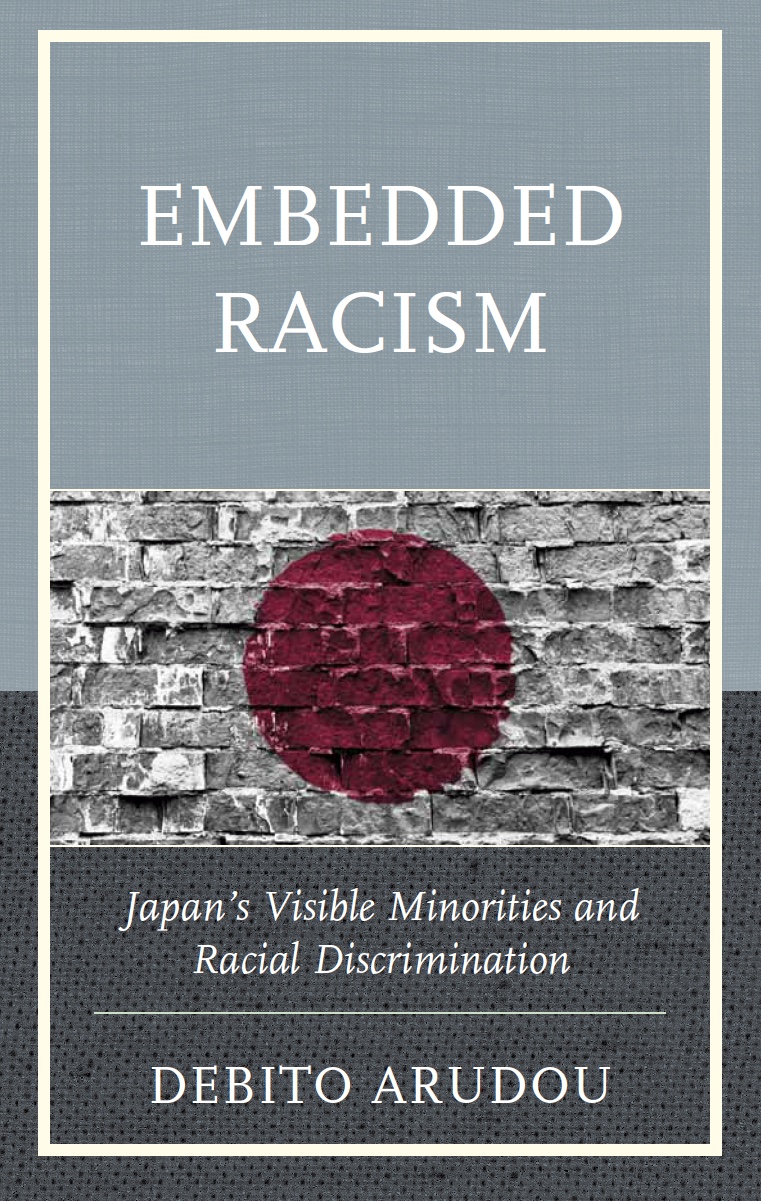
EMBEDDED
RACISM:
JAPAN'S VISIBLE MINORITIES AND RACIAL DISCRIMINATION
SECOND EDITION, 2022
Fully Revised and Updated
By Debito Arudou, Ph.D.
(Lexington Books, a division of Rowman & Littlefield,
Hardcover January 2022)
EXTENDED SUMMARY:
“We accept
that you’re a Japanese citizen.But you don’t LOOK
Japanese.So we
refuse you service.”
Despite domestic constitutional provisions and
international treaty promises, Japan has no law against racial
discrimination.Consequently,
businesses around Japan display “Japanese Only” signs, denying
entry to all “foreigners” on sight. Employers and landlords
routinely refuse jobs and apartments to foreign applicants.Japanese police
racially profile “foreign-looking” bystanders for invasive
questioning on the street. Legislators,
administrators, and pundits portray foreigners as a national
security threat and call for their segregation and expulsion.Public rallies
advocate the disenfranchisement – even killing – of foreign
residents born and living in Japan for generations. Nevertheless, Japan’s
government and media claim there is no discrimination by race in
Japan, therefore no laws are necessary.
How does Japan resolve the cognitive dissonance of
racial discrimination being unconstitutional yet not illegal?Embedded Racism
carefully untangles Japanese society’s complex narrative on race
by analyzing two mutually-supportive levels of national identity
maintenance.Starting
with case studies of hundreds of individual “Japanese Only”
businesses, Embedded
Racism carefully analyses the construction of Japanese
identity through legal structures, statute enforcement, public
policy, and media messages.It reveals how the concept of a “Japanese” has been
racialized to the point where one must look “Japanese” to be
treated as one.
This augurs ill for Japan’s future.With Japan’s low
birthrate, aging society, and decreasing population, one hope
for Japan’s revitalization, after more than two “lost decades”
of economic stagnation, is immigration.However, if people
(including Japanese citizens) face phenotypical barriers to
integration and acceptance, then Japan will not be able to
reverse its demographic decline by creating “new Japanese”.Thus, the systemic
treatment of what the author calls Japan’s “Visible Minorities”
is the “canary in the coal mine” for Japan’s future economic
vitality and solvency.
Completely
revised and updated for this Second Edition (with 100 new pages
including landmark events like the 2020 Tokyo Olympics, the Covid
Pandemic, and the Carlos Ghosn Case; more details below), Embedded
Racism is the product of three decades of research and fieldwork
by a scholar living in Japan as a naturalized Japanese citizen. It
offers a perspective into how Japan's entrenched, misunderstood,
and deliberately overlooked racial discrimination not only
undermines Japan's economic future but also emboldens white
supremacists worldwide who see Japan as their template ethnostate.
The Second Edition has a brand-new concluding chapter that argues
that Japan’s racism is not only hurting Japan demographically, it
is undermining liberal democracies worldwide. Japan's Netto
Uyoku (far-right internet denizens) have for decades
successfully beta-tested internet templates that mobilize
racially-motivated hatred, and these have been widely adopted by
alt-right trolls worldwide. No longer is Japan merely a
place for Neocon policymakers to indulge as “America’s unsinkable
aircraft carrier in Asia” for the sake of containing
communism. Japan’s long-ignored racism has empowered
ethnostatists and white supremacists (such as Steve Bannon, who
explicitly calls former PM Abe Shinzo “Trump before Trump”) to
influence public opinion, and shift the course of political
campaigns and the outcome of elections in favor of the illiberal
racists found in every society.
ADVANCE REVIEWS FOR THE SECOND EDITION:
In this revised edition,
Debito Arudou offers more trenchant explication of what it
means to be able to identify as “Japanese” in today’s
Japan—and not. Arudou's analysis underscores that even with
the guise of “diversity,” Japanese government policies
themselves undermine the future health of the nation.
Contrary to expanding Japan’s future possibilities, the
“embedded racism” sponsored by the country’s elite is
leading only to Japan’s economic and social decay.-- Alexis Dudden, University of Connecticut
This is a valuable update that
reinforces the author’s analysis of how racial
discrimination is endemic and harmful not only in managing
demographic problems but also Japan’s global relations. The
author explains how wide the gulf is between Japan’s
governing elite and global norms. Readers also learn how
non-citizen residents have endured an intensified Othering
during the pandemic that belies official preening on
diversity.-- Jeffrey Kingston, Temple
University Japan
Debito has made intellectual enemies in
Japan, but they struggle to match his depth of
understanding, erudition, and commitment. He brings those
qualities to bear in the revised edition of his classic text
Embedded Racism. The book is the summation of a life spent
trying to understand the internal logic that justifies and
embeds racism not just in Japan, but everywhere. --
David A. McNeill, University of the Sacred Heart, Tokyo
WHAT'S
NEW IN THE SECOND EDITION
This book has been completely updated and revised. The previous
edition covered up to 2015, and a lot has happened to make the
situation for Japan’s Visible Minorities and foreign residents both
better and worse:
The ultraconservative Abe Shinzö government
(2012-2020) became Japan’s longest-running postwar
administration, and with it the cementing of “status-quo
politics” that imported even more foreign labor under
exploitative visa statuses; yet Japan continues to avoid a clear
immigration policy encouraging permanent settlement and
naturalization.
Carlos Ghosn, the high-profile CEO of car manufacturer
Nissan, was arrested and perpetually detained without trial,
leading to his daring escape from Japan, with much international
attention drawn to Japan’s “hostage justice” system of criminal
jurisprudence.
The Japanese government conducted unprecedented surveys on
discrimination nationwide, revealing concrete numbers on
just how widespread racist practices are in scale and form.
Meanwhile, hate speech laws went into effect, driving public
displays of bigotry and calls for violence against foreigners
further underground and online.
The Alien Registration system that officially
segregated foreigners from their Japanese families was shut
down, but registered foreign residents continue to be racially
profiled by police and excluded from Japan’s official population
tallies.
The COVID-19 pandemic devastated Japan’s booming
tourist economy and led to a painful postponement of the 2020
Tokyo Olympics. In response, the government instituted racist
policies that banned border re-entry not only to all
foreign tourists but also registered foreign residents.
(Japanese citizens re-entering under the same conditions,
however, were allowed in.) As the disease spread regardless
(imported by unquarantined Japanese citizens), government and
media nevertheless targeted domestic “foreign clusters” as
hotbeds of contagion.
The rise to prominence of Japan’s Visible Minorities
included Miss Japan beauty queens and athletes, most notably
world tennis champion Ōsaka Naomi. Yet local governments
segregated children of international marriages into “low-IQ”
classes in compulsory education, utilized terminology
categorizing anyone with international connections (including
Wajin Japanese) as “foreign citizens”, and continued to treat
Japanese citizens with international roots as suspicious both in
the political realm and the job market.
Japan’s “lost decades” of economic doldrums since the
economic bubble burst in 1993 officially became the “lost
quarter century” in the 2020s as China further outdistanced
Japan as Asia’s representative regional power.
A brand-new concluding chapter that describes how Japan's
long-ignored racism is in fact empowering white supremacists and
ethnostatists worldwide.
And much more, including updates and conclusions to cases
mentioned in the First Edition.
Reviews and critical acclaim for the First
Edition (2015)
"Recommended
Reading" -- Dr. Jeff Kingston, Director of
Asian Studies, Temple University Japan, writing in The
Japan Times, December 19, 2015.
In an
anti-globalist era of Trump and ‘Brexit’ there will be many
who argue that Japan is right to severely restrict
immigration and preserve as much as possible that is unique
about its national character. If those who do not ‘look
Japanese’ have to suffer some discrimination, then that is
just the price that has to be paid. There are also many who
believe that the best antidote to racism is to have a nation
state where as few people as possible look out of place.
Arudou’s reply to this point of view, which acts
simultaneously as a challenge to Japan’s leaders, is that if
this national narrative is allowed to prevail, it will not
only condemn Japan’s aging population to an ever-worsening
demographic crisis, it will also have a ‘suffocating and
self-strangulating’ effect on society (p. 303). There
are important academic contributions to the study of racism
in Japan in this book, but it is as a must-read text on the
crisis facing the shrinking Japanese population and its
leaders that it really leaves its mark. Embedded Racism is
highly recommended reading to anyone—whether they
self-identify as Japanese or foreign or both—who is
interested in Japan’s future. (Dr. Robert Aspinall,
Social Science Journal Japan, July 15, 2017.
read more)
[Embedded Racism] is a brave
critique of Japanese society and its failure to look outward
in its demographic and economic development. The book will, no
doubt, add to a lively discussion already afoot in Japanese
studies, critical race studies, and critical mixed race
studies of racism in Japan. [...] The strongest part of
the book, in my view, is chapter 5, which illustrates how
"Japaneseness" is enforced through legal and extralegal means.
The examples of visa regimes and even exclusion from sports
and other contests through educational institutions show how
everyday racism leaks into larger organizational practices,
often without challenge. [...] The book is clearly
written and seems to be aimed primarily at undergraduate
students, as it makes an important contribution for those
wishing to understand racism in Japan better, and it compiles
interesting documentary legal data about the history of cases
of discrimination in Japan. The book would easily suit courses
that address global conceptions of race and ethnicity and how
these are changing in Japan at both the micro and macro levels
because of globalization.
(Dr. Rebecca Chiyoko
King-O’Riain, Sociology of Race and Ethnicity, an
imprint of the American Sociological Association, August
14, 2017. read more)
Arudou’s
book is a timely and important contribution to social and
scholarly debates about racial discrimination in Japan...
(Pacific
Affairs journal) (read full review)
This book, though, is more than a
narrative of instances of discrimination and campaigns for
redress. The author also seeks to explore the roots of the
problem, which he locates in the legal apparatus of
nationality, the workings of the court system, the lack of
serious official mechanisms to combat discrimination, and
stereotypes perpetuated by the mass media.... This book is
an important addition to the literature on problems of
citizenship and minorities in Japan, particularly because it
highlights the distinctive problems of visible minorities,
rather than focusing on the large ‘invisible minorities’
(Zainichi Koreans and Chinese, etc.) who have been the
subject of much existing research.... This is an important,
courageous and challenging book, and it casts a sharp light
on problems which are often ignored or veiled, but which
have profound consequences for the present and future of
Japanese society. (Dr. Tessa
Morris-Suzuki, Australian National University; Japanese
Studies journal) (read full review)
Debito Arudou demonstrates that
racism is pervasive in Japan and that many individuals and
institutions deny this reality. He also shows that racism
augurs ill for a society that will shrink for decades to
come unless it changes how it treats visible minorities.
People who care about the future of Japan need to engage
with this pellucid and provocative account of one of the
country’s most urgent but neglected problems. (Dr.
David T. Johnson, University of Hawaii)
In this important and insightful
book, and based on a long personal experience, Debito Arudou
offers a sophisticated critical analysis of the way visible
minorities are treated in contemporary Japan. As immigration
of work seekers to wealthy countries is on the rise, the
issues treated here have wider relevance not only to the
conduct and future of the Japanese society, but also to many
other societies in the West and beyond. Highly recommended!
(Dr. Rotem Kowner, University of Haifa)
Hats off to Arudou for breaking
once and for all the Silence Barrier that has permitted
Japan’s profound racial discrimination to purr along
undisturbed well into the 21st century. Exposing at long
last the definitional acrobatics of Japanese and foreign
Japan Studies experts—who have argued that since there is
nothing we could call racist attitudes in Japan it follows
that there can be no systemic racial discrimination
either—Arudou lays out voluminous evidence to the contrary
showing how Japan actually operates in its laws, public
policy, media messages, and social ordering. (Dr.
Ivan P. Hall, author of Bamboozled: How America Loses the
Intellectual Game with Japan and its Implications for Our
Future in Asia)
From the immigration
crisis in Europe to the growing tensions around racism
and law enforcement in the United States, discussion of
institutionalized racism, exclusionary rhetoric in the
media, and legal barriers to equality seems essential
now more than ever. In his most recent book […]
cultural critic, activist, and scholar Debito Arudou
attempts to spark just such a discussion. A
critical analysis of Japan’s treatment of visible
minorities (people living in japan who do not display
phenotypical Japanese traits) and the legal, political,
and social mechanisms that perpetuate the exclusion of
such minorities from various aspects of Japanese
society, Embedded Racism is extremely well timed.
Arguing that racism operating through various
institutions in Japan is akin to experiences of racism
in the United States, Europe, and elsewhere, Arudou’s
carefully constructed work attempts to debunk the
dominant narrative of Japanese exceptionalism, which he
claims provides an escape from accountability to the
rest of the world. Describing how structural
racism behind institutional, legal, social, and media
narratives influences the degree to which “outsiders”
are constructed and consequently excluded from essential
social and legal protections, Embedded Racism is an
important contribution to the fields of geography,
cultural, and area studies... (Japan
Studies Association of Canada (JSAC) Newsletter, Fall 2016)
(read
full review)
FROM THE PREFACE:
As this book is updated for its Second Edition, it remains the
culmination of nearly thirty five years of researching and living
in Japan—from around the time I first visited in 1986 to the
present day. I have always been intrigued by how some normalized
images of Japan did not square with what I was experiencing in
everyday life. Despite being friendly and hospitable to guests,
very progressive in unexpected ways, and open enough to outside
things to co-opt them (even the music for Japan’s national anthem
was written by a foreigner), Japan has a palpable undercurrent of
exclusionism. It is both subtle (e.g., ideas and proposals
dismissed due to their “lack of precedent”) and overt (e.g., “No
Foreigners Allowed” signs—the subject of my related book “Japanese
Only”: The Otaru Hot Springs Case and Racial Discrimination in
Japan). As I stayed longer, became fluent in Japanese, and felt
acculturated and comfortable in Japanese society (to the point of
taking Japanese citizenship and giving up my American), I saw the
exclusionism more and more—and wanted to understand it.
As a social scientist, I like figuring out why societies behave in
patterns, i.e., “why people generally do this and not that”. I
eventually arrived at answers that transcended the tautological
“cultural” explanations, i.e., “Japanese do this because they are
Japanese”. That mattered to me. I never liked “culture” as an
explanation for human behavior, since a) “culture” is hard to
define, and eclipses individual choice and foible, b) it is often
a “black box” that encages researcher curiosity, and c) I assume
that people anywhere are generally rational: they do things
because those things are in their best interests. I do not think
people are unthinking “prisoners of culture”. In most cases there
is a system—a collection of logics and incentives—that occasions
behavior, and in this research one that encourages people to
behave inclusively or exclusively. Even if those belief systems
initially made no sense to me, they made sense to someone. My
quest in this book was to find out how they made sense to people,
and to quantify how they were underpinned by rules, customs,
mores, and procedures.
Exclusionism in Japan (especially that of the racialized ilk) has
been one big puzzle, taking me decades to deconstruct, then
reconstruct a coherent picture of why a society as kind and
conscientious as Japan’s can be so cold and unsympathetic towards
people perceived as outsiders. But as we consider in this book how
racism takes shape in Japanese society, one conclusion I would
like readers to internalize immediately is that Japan should not
be treated as “special”—again, that “Japanese do this because they
are uniquely Japanese” thing. That generally leads to the
conclusion of “Japanese racism isn’t really racism as we know it
in the West—it’s just something that the Japanese reflexively do
as cultural practices.” Succumbing to that narrative invites all
sorts of exceptionalism that is ungrounded—and it causes enormous
cognitive dissonance when Japan is called upon to observe the
international standards of human rights set forth under the
international treaties it signed. (As we shall see later in this
book, Japan officially takes advantage of this “unique”
exceptionalist narrative to avoid addressing its own racism.)
Avoiding this logical pitfall is not just a matter of normative
principle. As I argue in the last chapter, Japan’s racialized
nation-state membership processes are so exclusionary that they
are undermining the very fabric of Japanese society: Japan is
strangling itself demographically on its Embedded Racism. And as I
argue in the new Afterword for this Second Edition, Japan’s
Embedded Racism is in fact undermining the world’s democracies.
In sum, Japan is no exception, especially to the world’s
racialization processes, and it deserves similar critique for
racism. I believe that Japanese society behaves like any other—it
just does it with an internal logic that is “special” and “unique”
in ways that all societies are special and unique. This book seeks
to unspool the internal logic that justifies and embeds racism. I
hope you find its arguments compelling.
Table of Contents:
Part One: The Context of Racism in Japan
Chapter One: Racial Discrimination in Japan: Contextualizing the
Issue
Chapter Two: How Racism 'Works' in Japan
Part Two: “Japanese Only”: Examples of Racial Discrimination
Chapter Three: Case Studies of “Japanese Only” Exclusionary
Businesses
Part Three: The Construction of Japan’s Embedded Racism
Chapter Four: Legal Constructions of 'Japaneseness'
Chapter Five: How 'Japaneseness' is Enforced through Laws
Chapter Six: A 'Chinaman’s Chance' in Japanese Court
Chapter Seven: From Foreign Fetishization to Fear in the Japanese
Media
Part Four: Challenges to Japan’s Exclusionary Narratives
Chapter Eight: Maintaining the Binary despite Domestic and
International Pressure
Part Five: Discussion and Conclusions
Chapter Nine: Putting the Concept of 'Embedded Racism' to Work
Chapter Ten: 'So What?' Why Japan’s 'Embedded Racism' Matters:
Japan’s Bleak Future
Chapter Eleven for the Second Edition:
Japan's Embedded Racism Undermines the World's Democracies
Appendix One: Sakanaka’s "Big Japan” vs. “Small Japan”
Appendix Two: This Research’s Debt to Critical Race Theory
Glossary, Bibliography, Index
==========================
Second Edition Hardcover, January 2022, 514 pages
ISBN-10 : 179365395X
ISBN-13 : 978-1793653956
ebook ISBN: 978-1-7936-5396-3 Subjects: Social Science / Political
Science / Asian Studies / Law and Social Justice / Discrimination
and Race Relations / Ethnic Studies / Minority Studies / Sociology
HOW TO GET YOUR COPY
US$145 list price on Amazon
for the Hardcover. Kindle US$50 SAVE: 30%
off from publisher direct using promo code LEX30AUTH21, or for students STUDENT30.
Price after discount: US$101.50 (Hardback), $35.00 (ebook),
or £78.40 and £26.60 respectively in the UK.
Or get your local or school library to order a copy that you can
borrow. Download
and present them this promo flyer from the publisher.
International orders (i.e., outside of North America or
the UK) can also order directly via orders@nbninternational.com
and give the same promo code as above in the email. This
will get you the hardcover version to Japan, for example, for
about $110 including SAL postage within one week.

 "Recommended
Reading" -- Dr. Jeff Kingston, Director of
Asian Studies, Temple University Japan, writing in The
Japan Times, December 19, 2015.
"Recommended
Reading" -- Dr. Jeff Kingston, Director of
Asian Studies, Temple University Japan, writing in The
Japan Times, December 19, 2015.