Two Cries du Coeur from ethnic residents of Japan being shaken down by the Japanese police

mytest

Hi Blog. Two Cries du Coeur from ethnic residents of Japan being shaken down by the Japanese police–one by Zero, a Issei Japanese-Filipino, the other by Ali Rustom, and Englishman of Egyptian descent. Racial profiling and the lingering anger it creates towards the authorities… Arudou Debito in Tokyo

===============================

An Isseijin’s Outcry
By Reijiro “Zero” Abrera
zero DOT abrera AT yahoo DOT com

Before reading any further, let me inform the readers that I am keeping my whole identity confidential, for the sole reason of protecting myself. But what I can tell you is this: that I am a Japanese citizen by birthright (born in Japan, and my father being a Japanese) and a half-Filipino half-Japanese in terms of ethnicity. I can understand Nihongo, but I have yet to become fluent with my native tongue. I was raised in my mother’s homeland to become an educated and responsible person and I have returned here in Japan with the hopes of pursuing my goals and aspirations.

Prior to my return, I have been informed of many accounts about the realities that people have faced during their stay here. I kept all these in mind but made utmost effort not to make hasty assumptions about the Japanese people in general. But now, only after 3 months of my stay, I am writing this entry because I am beyond compelled to relate to the readers an encounter that has exacerbated my growing skepticism about this country:

November 1, 2007. For Christians, it was a day designated in commemoration of the Church’s role models, the saints. Here in Japan it was just a typical autumn morning… or at least it was supposed to be. My brother walked out of our apartment as I was left making final preparations for a day’s work. When the clock struck 6:20 am, I knew I had 3 minutes left before I miss the train ride en route to the city where we work. And without a second thought, I hurriedly took the usual route on the way to the train station. And just when I was about a corner away, I caught a
glimpse of a scene that rendered me speechless for events to come – my sibling backed against a wall, holding his Japanese passport while being surrounded by not less than 8 men clad in blue suits or work clothes (genba). They were representatives from the local police and the immigration office, who disguised themselves as civilians to catch us off our guards.

Two of them saw me coming and tried to stop me from going any further. But they didn’t have to. I stood still, dumbfounded with what I saw, wondering how this could have happened to us. As I approached my brother, he told me that they are in pursuit of illegal immigrants and we appear to be their targets. But what baffled me was the fact that my brother had already shown his passport yet these individuals continued to bombard him with questions. Nor did they even back down to give my brother some personal space to explain that we are Japanese but have been raised elsewhere. Shouldn’t his passport suffice to let him continue to go to work? And what confused me even more was that I recall a policeman conducting a census in our area less than a month ago. My brother himself showed the proper documents as a proof of our legitimate residence.

I was so lost in my thoughts that I can hardly respond to their multiple queries. Then one of them asked if I was his brother. We responded “yes” and I was asked if I brought my passport. The first thing that entered my mind was “Why in the world do I have to bring it with me to work?” Obviously I didn’t have one, and so we were asked to escorted to our house and get it. And then it struck me. What if I was the one who went ahead to the station?

As we showed them my passport, they knew they were left with squat. My brother was psyched out and so he decided to stay in the apartment. I chose to go to work and explain the incident to our supervisor; but as I rushed back to the station, I noticed that there were more men than ever surrounding the vicinity of our house. I wasn’t there for their explanation, but I was told later that a tip from a source prompted them to make a move against us as soon as they heard it. But as far as I know, a tip in itself does not establish enough grounds to arrest someone. Just because of the way we look, we were tagged as criminals. Because of our complexion and facial features, because of our heritage… it was enough to send an armada of men to put us down, as if we were highly dangerous to the society. We felt debilitated, humiliated and dehumanized. And as an added insult to injury, I have to bear with the fact that I have to keep a passport handy whenever I go out for personal or work purposes, ironically, in a country where I bear a citizenship.

Now, I know for a fact that this incident is not as rare as a solar eclipse; there are some who may contend that everyone who is “gaijin” or considered to be one will most likely go through similar troubles here in Japan, thus it does not hold much gravity. But this experience is enough to stir thoughts that have been welling within me for quite some time; for this is just one facet of what my brethren, the so-called Japanese-Filipino (or Ja-pino) issei-jins go through in this country. Allow me to speak for those who share these burdens but are not able to articulate themselves, as I share to the readers our story that is perhaps unknown to many.

We, the isseijins, are children born out of the Japanese bandwagon during the 80’s until the 90’s, when a great interest in the Philippines (among other Southeast Asian nations) and its people was highly prominent. (Nowadays, it is apparent that the people from the West are getting the attention.) And when the time came for our country to lose its popularity, it is as if the Filipinos were reduced to almost non-existent. Nowadays, I have noticed that there is not a single Filipino featured in any television show that involved representatives from other countries. But that’s nothing compared to our current state of living. Today, isseijins like me, whether raised in Japan or elsewhere, are far from being recognized to be a part of the society. Most, if not all, are subjected to tough working conditions in a factory, required to produce perhaps twice the output of the “true” Nihon-jins and compelled to work longer hours when “requested” (they will deem us irresponsible if we decline). And while we do just that, at the end of the day, we will still be “arubaitos” (temporary workers) – and as such, we do not have the support of labor laws. Is this a predetermined social script that has been handed down to our kin? And unlike the “gaijins,” we have nowhere else to go; in our “other” homeland, we cannot easily get a job as the locals take precedence over us.

I myself have taken steps to get out of this social milieu. I tried vying for an English teaching job for almost a year now, but I only managed to merit three interviews in that length of time, all of which were from a reputed learning center. I recall the first one wherein I almost lost the chance for an interview from a branch within the prefecture, as the Japanese manager was deliberately deferring me to another school. I was told that the latter is nearer, only to find out that the opposite is true! Fortunately, the interviewer still gave me that chance, although I did not make the cut because “someone was in the immediate area and is willing to train immediately.”

It’s really sad, but I to continue the fight as I refuse to say “shoganai” and just stick to the program. I am willing to exert 10 times more effort in order to secure a job that I can be proud of, one that can inspire my fellow people to strive for excellence, instead of being kept in the shadows of a backbreaking unskilled labor job in a factory. I truly seek for recognition, if not acceptance, of our kind in this society; and I feel that that time has yet to come.

Reijiro “Zero” Abrera (pen name)
zero DOT abrera AT yahoo DOT com
ENDS

================================

From: Aly Rustom
Subject: My story about harrassment by the yoshikawa police

I would like to start off by asking Japanese people who have traveled overseas a very simple question: while overseas, how many of you actually had problems with police harassment. How many of you were asked to show your passports or proof of alien registration or visa just because you were not the right color, or because you just looked different? Chances are, most of you would say ”never!”

Now please sit back and read about the following situations that I, an Englishman, have had to endure. These incidences have taken place in the city of Yoshikawa in Saitama Prefecture and the authorities mentioned here are all members of the Saitama-ken Yoshikawa Keisatsu.

This is the incident that caused me to finally say enough is enough and tell someone about this. I was having the oil changed in my car and I had decided to take a walk to the local police box by Yoshikawa station, because I had lost my mobile phone the week before and I was wondering if they had found it. While walking, a police car passed me, and the two coppers inside stared at me intensely. I ignored the stares and walked on. I was close to the station, when the car pulled up beside me, coming to a screeching halt; there was only one cop inside. The other had snuck up behind me. I hadnft done anything wrong, yet both were treating me like a fugitive on the run, trying to cut my avenue of escape, as if I would try to run anyway! The one behind me asked if I was working here. (this whole conversation was conducted in Japanese) I said yes. He asked to see my GAIJIN card, a word that I find extremely offensive, as do most foreigners I know.

I asked him, ”Why? Have I done anything wrong?

”Nothing at all” he replied. ”We’re just checking foreigners’ GAIJIN cards, making sure that they are all legal. Recently there have been a lot of problems with Chinese people.” Did I miss something here?

I asked him, ”Do I look Chinese to you” (I’m white)? He said no. I continued, “As a matter of fact, you two look more Chinese than I do, correct?” They both laughed uncomfortably, not knowing whether to agree or disagree with my statement. The older one spoke up.

”Its not just the Chinese now days. Recently wefve been having many problems with Middle Eastern people. They are terrible people.” Now I was starting to get upset. My grandparents on my mother’s side came from Egypt. I told him that.

”Oh! Well, I don’t mean all of them are bad. Just some of them,” he said. ”And the Iranians. We have so many problems with Iranians.”

“In Yoshikawa?!” I was shocked.

“In Misato. But they are right next to each other.”

“I’ve never heard about anything happening,” I said.

”They’re minor infractions, but they do happen.”

“This is discrimination. Do you know that there are more than 100,000 Japanese nationals living in the UK alone? And what about America, Canada, Australia, etc. When Japanese nationals go overseas they don’t get treated this way. Why do you do this to us?”

”Over there, that’s England. This is Japan,” was the reply.

”And you are a racist,” was mine.

”We are often told that by people when we stop them, but it’s really not true.”

“You just stopped me simply because I don’t have an Asian face. That’s discrimination.”

“Oh, thatfs not true! We stop the Fillipinos and the Chinese as well!” was the enthusiastic reply.

”Well, that’s racism. You’re basically discriminating against non Japanese.”

“We have a lot of problems with foreign crime!” he protested.

“You don’t have problems with Japanese people committing crimes?” I asked.

”Yes we do,” he said.

”You don’t go around stopping THEM, do you?”

”They’re JAPANESE. They donft have Gaijin cards.” He laughed in a condescending way at me, as if to tell me my comment was stupid.

”That’s still discrimination. Both groups commit crimes. Both have good and bad people among them. Yet, you only stop the foreigners. That’s discrimination.”

”All right,” he challenged me. ”What DO YOU think we should do? What DO YOU think we should do?” I was quite frankly taken aback. I thought for a second. I looked at him.

”Nothing,” I said. ”Don’t do anything. You can’t do anything. You can’t arrest someone before they commit a crime, right? You have to wait until they commit a crime. Am I correct?”

”This is all we can do. We have to do this to check up on foreigners living here,” he insisted.

”Do you really think that most, much less all the foreigners in Japan who commit crimes donft have proper visas. There are foreign criminals who are married to Japanese women who are living on spouse visas. There are people living in Japan without a proper visa, but who have never committed a crime. There is absolutely no relation being a criminal and having a proper visa.”

”Hmm,” was all that came out of him.

“Therefore, you have done nothing. You have gained nothing. And you know that. This is nothing more than a racist gesture.”

He tried to argue some more, but at that moment I realized that this could go on for hours. So I gave him the ”Gaijin Card” he so badly wanted to see. He noted it momentarily, and gave it back, insisting that he shake my hand. I did reluctantly. We parted our separate ways.

A year before that, I was on my way home, riding my bike, and was a few feet from my house when 2 police cars flashing their lights and sirens told me through their loudspeakers in Japanese to stop. I did. Eight coppers got out of the car and surrounded me. Needless to say, I was quite alarmed.

”Have I done anything wrong?” I asked the one nearest to me.
”No,” he said. ”Routine Checku.” He pronounced it in katakana English.

Another one came up to my right side and growled for my Gaijin card (I really hate that word). I gave it to him. A third snuck up to me from behind and when I turned to face him, he leaned in close to me and asked me in a threatening voice that was meant to be intimidating which country I came from.

That was the last straw. Fear and alarm turned into outrage and downright fury. I leaned even closer so that our noses were almost touching and said, ”EGIRISU” in a loud and challenging voice. I glared at him, in a challenging way. He backed off, and retreated back into the safety of his comrades. I was asked a whole series of questions to which I responded to with as much patience as I could muster. I went home feeling pretty much the same way I felt after the last incident a few weeks ago: drained, tired, depressed, helpless, upset, and most of all furious.

What’s going on here? Why is Japan treating her foreigners like they are ALL criminals? Yes there is foreign crime in Japan. But it is significantly lower than in other countries and nothing when you compare it to crime committed by Japanese nationals. I can also tell you right now, the Yakuza are creating massive problems for us in London. They practically run Little Tokyo in Los Angeles and they are very powerful in parts of New York as well as North Vancouver. Contrary to popular belief, Japanese do commit crimes in other countries too, but nobody singles THEM out and forces them to show their proof of status.

Also, a very small number of foreigners actually commit crimes. I know this, because had the number been significant, there would have been martial law declared on all foreigners. This forcing people to show their passports or gaijin cards only incites hatred, disdain, and rage toward the Japanese people as a group, and does no one any good. You’re not stopping foreign crime. Anyone can get married to a national and get visa status. This happens around the world. This forcing of foreigners to carry ID with them at all times is nothing more than a racist gesture. It solves no problem. It adds to it. And believe me, it adds to Japanese people’s problems too.

Japanese people love to travel. Imagine having experiences like mine in a foreign country and coming home feeling nothing but negative about that country. Now imagine you just met someone from that country in your own country enjoying life, smiling, and enjoying the very privileges that were denied you when you were in that country. How would you feel towards that person? Hostile? Would you want revenge? All these foreigners you are mistreating have a home country. They will probably go back someday. Your friends, relatives, children, etc might someday find themselves as Gaijin in these countries. Heaven help them if they run into a disgruntled foreigner whose experiences in Japan were negative. Heaven help any Japanese national who runs into me in the UK and tells me he is a police officer in Japan.

See what you have done? And for WHAT? We are human like you.

ENDS

bai aag mp3dolte aage piche mp3jimbob 976 mp3aah tcha mp398 because degree mp3mp3 aahista aahistaaai chand mp3recognize mp3 98se Map
American Chamber of Commerce Japan on negotiations re NJ Fingerprinting

mytest

FYI: THE AMERICANS GET INVOLVED IN THE NJ FINGERPRINTING ISSUE

Subject: Info. on New Japan Immigrations Entry Procedures eff. from Nov. 20th

Dear SCCJ Member,

Re. New Immigration Entry Procedure, we send you the following mail sent by ACCJ for your information.

**************
Dear ACCJ Member,

As most undoubtedly are aware, this coming week, new immigrations procedures will go into effect in Japan requiring the collection of biometric data (facial photograph and fingerprints) for most foreign citizens entering the country.

Your Transportation and Logistics Committee as well as Board leaders have been working hard with local Immigrations authorities at the international airports as well as the Ministry of Justice, Immigration Bureau.

We believe that the Government of Japan is well aware of the issues of concern to the foreign business community and has worked collaboratively with us to mitigate any major difficulties at the transition. We are committed to closely monitoring implementation and will keep you apprised of any developments.

The following is a recap of measures that will be introduced to ensure that the new procedures are implemented as smoothly as possible:

Narita International Airport – Tokyo: – Add 100 immigration officers during the transition period – Provide dedicated queues for foreigners with re-entry permits – Provide dedicated queues for airline crew members and disabled/ reduced mobility passengers – Offer automated immigration gates in Terminal 1 South Wing and Terminal 2 for pre-registered travelers. Registration is available at the Tokyo Regional Immigration Bureau or the Narita District Office – Install cameras/fingerprint readers at all positions and dynamically expand number of queues available to foreigners – At least initially, allow mixed nationality families with children under the age of 16 and one Japanese parent to use the Japanese passport holder lanes

Central Japan International Airport – Nagoya: – Add 18 immigration officers during the transition period – Provide a dedicated queue for airline crew members and disabled/ reduced mobility passengers – Install cameras/fingerprint readers at all positions and dynamically expand number of queues available to foreigners – At least initially allow mixed nationality families (at least one Japanese parent) to use Japanese passport holder lanes – Consider installing automated immigration gates during 2008

Kansai International Airport – Osaka: – Add immigrations officers (number under study) during transition period – Provide a dedicated queue for airline crew members and disabled/ reduced mobility passengers – Install cameras/fingerprint readers at all positions and dynamically expand number of queues available to foreigners – Consider installing automated immigration gates during 2008 Note: the Kansai region is home to a large number of Korean special permanent residents who will use the Japanese passport holders lanes and are not subject to biometric data collection

Other airports: The U.S. carriers have met with the local immigrations authorities and believe that because a high percentage of passengers using these secondary airports, foreign citizens will encounter few problems.

Airlines: – Will actively advise foreign arriving passengers of the new procedures–onboard videos and/or announcements – Will actively encourage/monitor completion of Embarkation/ Disembarkation forms to minimize secondary queuing of passengers

If you have any questions or wish to provide feedback, please direct an email to the Transportation and Logistic Committee.

Sincerely,

Charles Duncan and Masamichi Ujiie,
Co-Chairs Transportation and Logistics Committee (Sent by ACCJ Communications)

****************************
The Swedish Chamber of Commerce and Industry in Japan – SCCJ
6-12 Kioicho Chiyoda-ku, Tokyo 102-0094
Tel: 03-5211-2101 Fax: 03-5211-2102 http://www.sccj.org
****************************
ENDS

Economist on J Media (particularly political collusion between LDP, DPJ, and Yomiuri Shinbun!)

mytest

Hi Blog. Finally, we are getting the articles coming out that should have done so long ago–and would have been done if reporters were either competent or not complicit in the media machine. What follows is an excellent article in The Economist (London) on that very media machine in Japan, and how it meddles with the political process here. (Pity it’s only confined to the web–the weekly article from Japan in the print version was a different one about Ozawa only.)

Let’s hope The Economist or someoone else someday does an entire survey on the situation. This kind of corruption runs very, very deep in Japan, and will ultimately keep our country on its future path to economic obscurity (and an untoward degree of xenophobic isolation) unless something drastically changes in the power structure. Exposing it to the light of the media spotlight is one way. Have a read. Arudou Debito in Sapporo

(PS: I will be on the road for the next couple of days, and not sure how many blog updates I’ll be able to do. FYI)

///////////////////////////////////////////////////////////////

Asia.view: Japan’s media don
Nov 14th 2007 From Economist.com
http://www.economist.com/world/asia/displaystory.cfm?story_id=10127783
Courtesy of DMG

Japan’s politics
The most powerful publisher you’ve never heard of
watanabetsuneo.tiff

FOR its Tokyo bureau The Economist rents a room in the headquarters of the conservative Yomiuri Shimbun, Japan’s most popular newspaper that also happens to own the country’s best-known baseball team. Or is it the other way around? Either way, the building brings to mind nothing commercial or sporting, but a vast government ministry in some bygone socialist country.

The floors are linoleum and the corridors endless, with way stations every 50 metres for smokers. The fourth floor boasts a proper newsroom; otherwise, with its fusty offices and featureless hallways, the place exudes the atmosphere of a massive, shabby bureaucracy.

The building boasts canteens, a phalanx of white-coated medical staff, a dormitory and even a proper bathhouse (for men only). The group has its own army of security guards, whose main job seems to be to stop you using the lift reserved for the chairman, 81-year-old Tsuneo Watanabe. His imperious arrival is heralded by bows and salutes.

The main difference between this building and a government ministry, however, is that Mr Watanabe is more powerful than almost any government minister in Japan could ever hope to be. Privately, Yomiuri journalists tell you that they have no choice but to follow the editorial line Mr Watanabe lays down. They are nowhere near as forthcoming to their readers.

Take the political farce of the past couple of weeks. On November 2nd Ichiro Ozawa, the fiery leader of the opposition Democratic Party of Japan (DPJ), which had seized control of the upper house of the Diet (parliament) in summer elections, sat down with the prime minister, Yasuo Fukuda, who heads the ruling Liberal Democratic Party (LDP).

Hitherto, Mr Ozawa had promised voters that he would bring down the LDP-led government, win a general election and prove the DPJ was able to govern. November 2nd, by contrast, was spent cutting deals: what would he and his party get in return for bringing the DPJ into a “grand coalition” with the LDP? Mr Fukuda, it seems, offered him the post of deputy prime minister, among other goodies.

When Mr Ozawa brought the deal back to his party’s executive the following day, it was outraged. Mr Ozawa resigned. Lacking a suitable replacement, however, the party reinstated him. Mr Ozawa sounded uncharacteristically contrite, though his old form re-emerged when he railed at journalists who had reported that it was he, not Mr Fukuda, who had made the first approach about a grand coalition. A few days later, he backtracked, explaining that “a certain person” had mediated his first contact with Mr Fukuda about it. The certain person was in fact Mr Watanabe.

Mr Watanabe’s credentials to speak on behalf of the 71-year-old Mr Fukuda and other members of the LDP’s old guard who backed the idea of a grand coalition are not in doubt. In September, after Shinzo Abe suddenly resigned as prime minister, having suffered a loss of nerve that was aggravated by Mr Ozawa’s attacks, Mr Watanabe convened the crucial meeting of party kingmakers where Mr Fukuda was persuaded to run for the LDP presidency.

Not only have the Yomiuri’s readers been kept in the dark about these events, so largely have those of the paper’s four national rivals. All that has appeared so far is just two editorials politely questioning Mr Watanabe’s involvement. A quip among Japan’s political class is that editorials are read only by their authors.

Political and cultural factors produce such opacity: the mainstream media are neither analytical nor adversarial; less charitably, they mostly serve the ruling party. But there is also a commercial dimension. The three most successful dailies (the Yomiuri, the Asahi Shimbun and the Nikkei) have a common interest in putting the two smallest nationals (the Mainichi Shimbun and the Sankei Shimbun) out of business and are not inclined to antagonise each other—indeed they even share commercial ventures.

As for the smaller two, their revenues would be in even worse shape were it not for the system of price-fixing the government allows for the newspaper industry. The powerful Mr Watanabe protects the industry in government circles, allowing the anti-competitive status quo to persist.

Consequently, newspapers provide little criticism of Mr Watanabe, or of his string-pulling to create a grand coalition, born from his belief that the affairs of state should be left in the hands of a few experienced men without the messy distractions of democratic politics—just like the old-school LDP in the old days. Indeed, Mr Ozawa cut his political teeth in that school, and Mr Watanabe and his kind have long regarded the DPJ as just an errant LDP faction.

But a grand coalition is a terrible idea. It would leave Japan without an opposition to keep the government clean, and it would deprive voters of political choice: most Japanese oppose it. The advancement of the idea has brought out the incompetence of both main parties, reducing Japanese politics to farce. Might the arrogant Mr Watanabe be humbled by the experience? That, says Minoru Morita, a venerable commentator, would be like asking the sun to rise in the west.
ENDS

Letter to Dr Deepu Sadhwani, President, Kobe Regatta & Athletic Club, re protesting NJ Fingerprint policy

mytest

Hi Blog. This is a letter I sent out tonight in response to Dr Deepu Sadhwani, President, Kobe Regatta & Athletic Club, who introduced himself today, and asked what he and his members (long-term residents of the Kansai) could do to protest the NJ Fingerprinting policy. Feel free to forward my response around to others that need convincing of the the whats, whys, and hows. Arudou Debito in Sapporo

ORIGINAL LETTER

////////////////////////////////////////////////////
From: Deepu Sadhwani
Subject: RE: DR D SADHWANI KOBE KRAC CLUB PRESIDENT
Date: November 15, 2007

Dear Debito,

Hi, my name is Deepu Sadhwani currently serving as President of the Kobe Regatta & Athletic Club. As mentioned by Mr. Issott, i am prepared to help in any way i can. I have many city councilmen amongst my contacts. They have been helping me in our fight with City Hall for the land rights of our Club. They are all stand up people and will fight a good fight. I understand the immediate priority is to get the scans installed at airports besides Narita but i believe we should carry this fight all the way. The whole process stinks and the airport checks is but only a start of many other hassles to come.

Please let me know how we can be of assistance. For your information the KR&AC was given a manifesto way back in the late 1800’s by the Embassies that said that the President and Committee of the KR&AC were to be the de facto leaders of the foreign community of Kobe, something that has never been changed though has not been used in decades either. I intend reminding City Hall of this.

Awaiting your advise, Deepu.
====================
UPDATE NOV 19

Debito……You can quote me on anything i write and put it in your blog if you like. I will be writing a special report for our KR&AC magazine and will be quoting from your article in the Japan Times that appeared on Nov. 13th. I will also be making representation to City Hall shortly and meet a group of concerned city councilmen. Best regards, Deepu

Sorry, forgot to mention. When i was at immigration this morning the tanto sha did mention that there would be officials pointing out booths for re-entry permit holders but that these booths would be the ones that the Japanese go through. In other words till the Japanese are done we’re still in line.
////////////////////////////////////////////////////

MY RESPONSE

////////////////////////////////////////////////////
Hello Dr Sadhwani. Arudou Debito in Sapporo here. Thank you very much for your email. Received with great honor and gratitude. Let me take this opportunity to make a few suggestions to your membership about activities you might engage in to protest the fingerprinting policy:

ACTIVE:
1) At any public opportunity you have, in any venue you deem appropriate, slip in a subtle (or not so subtle) indication that you have serious misgivings about a policy that follows the logic of treating all non-Japanese axiomatically as “terrorists and carriers of infectious diseases”.
http://www.us.emb-japan.go.jp/english/html/033005b.htm
And one that treats all long-term non-Japanese residents and taxpayers as tourists, non-residents, and aliens unconnected to their Japanese families–no matter how long they’ve lived here and contributed to this society’s demographically-troubled future.

Suggested venues include meetings with public officials, members of the government and bureaucracy, the diplomatic corps, press outlets, agencies connected with tourism and foreign exchange, and especially politicians. A mention in passing is fine. But do a little something. Remind them that this issue is not going to go away, and we are not just good little “guests” that will take a slight as deep as this lightly.

2) Encourage your friends to take their trips elsewhere–tell them you’ll meet them overseas. Even encourage them to join in the fight. For example, a contributor wrote me tonight:

=============================
Hello there, It really may sound quite a childish step to take, but if people wish to show their displeasure with the
fingerprinting/photo issue, then send a query to the JNTO in the UK (or any other office in an industrialised nation whose visitors and cash Japan would like to attract) asking about the new immigration rules as if you were thinking of bringing
your family to Japan for an extended visit (don’t use an obviously Japanese email address–plenty of Yahoo.uk etc addresses available).

http://www.jnto.go.jp/eng/contact/index.html

When they reply with a raft of information about the new entry procedures, write back and tell them that it’s all too much and that sadly you will have to forgo the treat of a visit to ‘beautiful Japan’ and that you will visit somewhere else (how about Korea or China!?).

If enough people do this, negative feedback about these measures from the JNTO may be heard where the rising sun doesn’t shine. Best regards, G. Alexander.
———————————————————————
http://www.thehungersite.com/cgi-bin/WebObjects/CTDSites
=============================

3) Write letters of your own to pertinent ministries and outlets. A template letter and suggestions on places to send it are available at
https://www.debito.org/?p=652
Consider even handing it to Immigration every time you clear Customs.

Others have proposed protest t-shirts, buttons, or other means to show your discomfort that are public and vocal. If you can help out with any of these efforts (if you have the means), please let me know. If you have other suggestions, please feel free to visit my blog and leave a comment and/or suggestion, anonymously if you prefer, or write me at debito@debito.org

———————-

PASSIVE: Refuse to be separated from your Japanese families at the border. Stand in the same line. Slow things up. Make it clear that Japan is not immune to the effects of immigration and globalization, and that it must remember that Japan’s international residents are as integrated into and contributing to this society as any other citizen.

In short, please don’t do nothing. Please consider showing that the “gaijin” being targeted by this policy (essentially anyone who is not US Military under SOFA, Diplomats, or Zainichi Korean/Chinese etc.–since their being exempted is purely political; they would have more effectively fought back if fingerprinted as well) are neither docile nor impervious to being treated as suspicious criminals–by a government that is happy to take their resident taxes and tourist dollars, yet not treat them with the commensurate respect.

If you need more background on the issue, my files on fingerprinting issue may be found on my blog under a special category, through the link below:
https://www.debito.org/?cat=33

If you still need convincing of the gravity of this situation, please consider reading my essay in Metropolis (October 26), about why this policy is such a bad idea.
http://metropolis.co.jp/tokyo/709/lastword.asp

And if you need a second opinion, consider that of Terrie Lloyd, entrepreneur, publisher of Japan Inc and Metropolis, and fellow long-term resident, in a recent “Terrie’s Take” (November 11). He calls this “an unmitigated public relations disaster for the Japanese government and the Justice Ministry in particular” :
https://www.debito.org/?p=724
Also recent protest letters from the European Business Council and the Australian/NZ Chambers of Commerce:
https://www.debito.org/?p=689

I hope that this inspires you do to what you can. Please consider forwarding my message around to anyone you like. We probably cannot stop the promulgation of this law from November 20 (and it will affect you down in the Kansai much worse than those coming through Narita–see Martin Issott’s evidence of this at https://www.debito.org/?p=656). But we can certainly inconvenience the promulgators right back. And so far, sustained protest has had a discernible effect on the authorities.
https://www.debito.org/?p=701

Thanks for reading and considering.

With best wishes, Arudou Debito in Sapporo, Japan
debito@debito.org, www.debito.org
November 15, 2007
ENDS

NUGW’s Louis Carlet: “NOVA collapse a turning point in language industry”, Lesson For Food

mytest

From: carlet@jca.apc.org (Louis Carlet, NUGW Nambu Union)
Subject: [Nambu FWC] Nova Union Meeting and other upcoming events
Date: November 15, 2007 3:15:30 PM JST

Sisters and Brothers, (Nova Union General Meeting Sunday 7pm!)

The Nova collapse represents a turning point in the language industry. We have a chance to push through crucial reforms for the industry as a whole, including permanent job status and health care options for all teachers.

Our efforts over the past few years and through the media over the past few months have succeeded in raising awareness among the public of the precarious situation of language teachers and the abuse they undergo on a daily basis. This public awareness included the current Nova trustees, which is why they are pressuring G Education (the so-called “sponsor” selected to take over Nova’s operations) to comply with all labor laws and treat teachers, staff and customers as human beings.

We should congratulate ourselves for this crucial victory while quickly taking the next step. Let’s demand collective bargaining from G Education as soon as we have members employed and let’s ask for everything early on — since this is a once-in-a-lifetime chance to chance the industry. Last Saturday, we passed out 500 flyers at the information session in Tokyo to potential G employees, asking them to join GUTS — G Union of Teachers and Staff.

Schedule

Saturday, Nov.17 2pm Lesson For Food

We will meet at 2pm at Shinkoiwa Station (Sobu Line) and move to the Shinkoiwa Park for the first official Lesson for Food. If you want to watch this, please come at this time. Although, the Lesson for Food program was voted by the Nova Union members, it has drawn criticism from around the country. If you object to this program, please attend the Nova Union meeting on Sunday at 7pm at the union office and voice your concerns.

Sunday, Nov. 18, 7pm Nova Union General Meeting

We will hold a Nova Union general meeting from 7pm Sunday at the union office (Minato-ku, Shimbashi 5-17-7 Kobayashi Bldg. 2F, 03-3434-0669).

See map at bottom of the following web page: http://nambufwc.org/about/contact/

During the meeting we will decide policy, explain details of current situation, advice on resignation versus dismissal, explain government subsidy and unemployment insurance systems and answer questions. We will also hold elections for all executive posts, including president, general secretary, treasurer and Nova Relief Fund administrator. If you are interested in any of these posts, please let us know (nambu.carlet@ezweb.ne.jp) in advance of the meeting or at the start of the meeting. Also, please attend even if, or especially if you are now employed by G Education since we would like to begin setting up GUTS as a local of Nambu as soon as possible.

Thursday, Nov. 22 through Sunday, Nov. 25

JALT’s 33rd International Conference

Japan Association of Language Teachers will hold its 33rd annual international conference from Thursday through Sunday, this year in Tokyo at the National Olympics Memorial Youth Center near Sangubashi Station, one stop from Shinjuku Station on the Odakyu Line. On Friday, Nov. 23, beginning 2:30pm the labor caucus of JALT — PALE* — will hold its annual series of meetings, with guest lecturers including yours truly. We will discuss teaching from a working conditions and labor perspective including prospects for improvement in the wake of the Nova collapse.

*PROFESSIONALISM, ADMINISTRATION AND LEADERSHIP IN EDUCATION (PALE) promotes the status of language teaching as a profession both within the Japanese educational system and in relation to the wider national and international context.

http://jalt.org/calendar/index.php?page=group&id=43&year=2007#3272

— NUGW Tokyo Nambu – Nambu FWC —
Lessons For Food Campaign: http://nambufwc.org/lessons-for-food
ENDS

Japan Times on Gaijin Carding in workplace, and downloadable wallet-size Gaijin Card laws from Erich Meatleg

mytest

Hi Blog. I had an article come out in the Japan Times last Tuesday Nov 13 (Wednesday outside the metropolises), which you can read with notes and links to sources at https://www.debito.org/japantimes111307.html.

Excerpting from the conclusion of the article (in mufti–go to the whole article above if you want to see links):

===================================
You know, Japan needs more lawyers, or at least more lawyerly types. Anyone who reads the actual laws will in fact find a natural check and balance.

For example, even if the cops issue their classic demand for your Gaijin Card on the street, under the Foreign Registry Law (gaitouhou) (Article 13), you are not required to display unless the cop shows you his ID first. Ask for it. And write it down.

And believe it or not, under the Police Execution of Duties Law (keisatsukan shokumu shikkou hou) (Article 2), cops aren’t allowed to ask anyone for ID without probable cause for suspicion of a crime. Just being a foreigner doesn’t count. Point that out.

As for Gaijin Carding at hotels, all you have to do is say you have an address in Japan and you’re in the clear. Neither foreign residents nor Japanese are required to show any ID. The hotels cannot refuse you service, as legally they cannot deny anyone lodging under the Hotel Management Law (Article 5), without threat to public morals, possibility of contagion, or full rooms.

And as for Gaijin Carding by employers, under the new law (Article 28) you are under no obligation to say anything more than what your visa status is, and that it is valid. Say you’ll present visual proof in the form of the Gaijin Card, since nothing more is required.

If your main employer forces you to have your IDs photocopied, point out that the Personal Information Protection Law (Kojin Jouhou Hokan Hou) governs any situation when private information is demanded. Under Article 16, you must be told the purpose of gathering this information, and under Article 26 you may make requests to correct or delete data that are no longer necessary.

That means that once your visa status has been reported to Hello Work, your company no longer needs it, and you should request your info be returned for your disposal.

Those are the laws, and they exist for a reason: to protect everyone–including non-Japanese–from stretches of the law and abuses of power by state or society.

Even if the Foreign Registry Law has long made foreigners legally targetable in the eyes of the police, the rest of Japanese society still has to treat foreigners–be they laborer, customer, neighbor, or complete stranger–with appropriate respect and dignity.

Sure, Japan’s policymakers are treating non-Japanese residents as criminals, terrorists, and filth columnists of disease and disorder–through fingerprinting at the border, gaijin-apartment ID Checkpoints, anonymous police Internet “snitch sites” (ZG Mar 30 2004), “foreign DNA crime databases” (ZG Jan 13 2004), IC Chips in Gaijin Cards (ZG Nov 22 2005), and now gaijin dragnets through hotels and paychecks.

But there are still some vestiges of civil liberties guaranteed by law in this country. Know about them, and have them enforced. Or else non-Japanese will never be acknowledged or respected as real residents of Japan, almost always governed by the same laws as everyone else.

More information on what to do in these situations, plus the letter of the law, at https://www.debito.org/whattodoif.html
===================================

To this end, Erich Meatleg has provided a very valuable service–wallet-sized copies of the original text (plus hiragana and English translations) of pertinent sections of the laws for you to download and carry around. For the next time you get racially-profiled on the street and Gaijin Carded by cops:

Download plain version of text of laws regarding Gaijin Card Checks here (pdf format).

Download color-coded version of text of laws regarding Gaijin Card Checks here (pdf format).

—————————————–

Other laws that you can use (such as for Gaijin Card Checkpoints at hotels and in the workplace) are also up linked from the whattodoif.html article, but Erich hasn’t gotten to them yet! 🙂

Great thanks to Erich for his assistance! I’m sure the cops will be nonplussed from now on re how legalistic their gaijin patsies have become. Arudou Debito in Sapporo

Official instructions on Narita automated gate for NJ fingerprinting

mytest

[For Foreigners]
(Reference Material for the PR Dept.)

Operation of the Automated Gate

Ministry of Justice, Immigration Bureau

1. Introduction
Automated gates will be placed at Narita Airport from November 20th, 2007, in order to improve convenience of immigration procedures by simplifying and accelerating them. We would like to ask foreigners who wish to use the automated gates to provide their personal identification information (fingerprints and a facial portrait) in advance and register themselves as applicants in order to use the gate.

2. Registration as an Applicant to Use the Automated Gate
(1) Required Items for Registration
1. Valid passport (including Re-entry Permit) and re-entry permission
2. Application form to use the automated gate
(2) Where and When to Register
We will be accepting applications from November 20th at the locations stated below:
1. Tokyo Regional Immigration Bureau
Application Counter for re-entry permission (2F) 9:00-16:00 (Except Saturdays, Sundays, National Holidays and December 29th to January 3rd)
2. Narita Airport District Immigration Office
The departure inspection area at South Wing of Passenger Terminal 1: 9:00-17:00
The departure inspection area at the South Exit of Passenger Terminal 2: 9:00-17:00
(3) Registration Procedures
Submit your application form with your passport and provide fingerprints of both index fingers and a facial portrait.
Then, when the official affixes a registration stamp on your passport, the registration procedure is complete. In principle, you can use the gate from that day forward.
(4) Points of Concern for the Registration
1. Time Limit of Registration
You can register until the expiration date of your passport or the expiration date of your re-entry permit, whichever comes earlier.
2. Registration Restrictions
In some cases, such as when you cannot provide fingerprints, you may not be able to register.
3. Using and Providing the Registered Information
We will manage information including fingerprints and facial portraits provided at the registration as personal information set forth in laws on protection of personal information held by administrative agencies, and the information will not be used or provided beyond the range allowed for in these laws.
4. Deletion of Registration
Submit the application form to delete registration if you wish to delete your registration. Then, your registration will be deleted and the fingerprints and facial portrait you provided will be erased.

3. How to Use the Gate
(1) How to Use the Gate
1. When you arrive
Step forward before the immigration officer and place your passport over the Passport Reader. After being recognized as a registrant, provide your fingerprints and facial portrait. Then, submit your passport and ED card to the immigration officer. After checking, the gate will open. Arrival inspection procedures are now complete.
2. When you depart
Step forward before the immigration officer and place your passport over the Passport Reader. After being recognized as a registrant, provide your fingerprints. Then, submit your passport and ED card to the immigration officer. After checking, the gate will open. Departure inspection procedures are now complete.
(2) When you use the automated gate, as a rule, the entry/departure record (a stamp) will not be left on your passport.
ENDS

Former Giants pitcher tarento promotes Narita Fingerprinting NJ system as “Anti-Crime” measure

mytest

Well, here’s the ultimate in government greenmailing: Get a real pitcher to pitch the system. Check out this chucklehead:

========================================
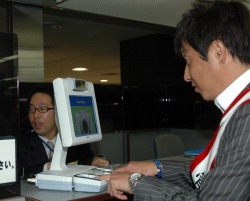
miyamotokazutomo1.jpg
FINGERED — TV celebrity Kazutomo Miyamoto tries out the new foreigner fingerprinting system at Narita Airport. As a Japanese national, Miyamoto will not need to have his fingerprints taken when the new system comes into operation from Nov. 20. (Mainichi)

Celebrity uses fingerprint photo-op to call for cut in foreign crime
http://mdn.mainichi.jp/national/news/20071114p2a00m0na030000c.html

NARITA — TV celebrity Kazutomo Miyamoto urged immigration officials during a photo-op to use a new process to fingerprint inbound foreigners to fight foreign crime, not terrorism as the government claims the system will be used for.

“I think it’d be best if we could cut the amount of crime foreigners are committing and make Japan a safer place,” Miyamoto said at Narita Airport, where he was serving as the Tokyo Regional Immigration Bureau Chief For a Day as a promotional event for the fingerprinting process.

Starting from Nov. 20, Japan will follow the United States to become the second country in the world to implement individual recognition software for foreigners entering and leaving the country.

With the new system, nearly all foreigners will have to have fingerprints from both hands and a picture of their face recorded. Fingerprints will be verified with a list in what the government says will be an attempt to prevent terrorists or known criminals from entering Japan.

Japanese nationals will be able to pass through Immigration via an automated gate instead of waiting in line to be processed by officials if they have applied for permission and submitted fingerprints in advance.

Miyamoto, 43, was once a pitcher for the Yomiuri Giants.

======================================

COMMENT: Anything for a photo-op–even if it’s at the expense of Japan’s NJ residents (whom Kazutomo-kun probably knows next to nothing about). He isn’t going to be fingerprinted under any circumstances anyway, so I guess this is his only chance.

Pity he thinks that it’s for stopping foreign crime (which is, in fact, falling). Sorry chum, it’s allegedly for preventing terrorism and disease; and if you think it will make Japan a safer place, your publicist is as uninformed as you.

Then again, profiteering helps. According to a reliable source, these photo-ops run JPY 300,000 to 500,000. Nice bit of pocket change to get your fingers on afterwards.

Let Kazutomo-kun know your feelings at his official site:
http://www.m-bravo.com/

Steve Koya below also notes that Mr Miyamoto’s manager’s office number is Tel:03-3224-1681 Fax:03-3224-1682 for anyone else who would like to make a complaint.

Arudou Debito in Sapporo
ENDS

毎日:タレント宮本和知は東京入管成田支局で指紋採取について、「外国人犯罪が減り、日本が安全になればベストだと思う」

mytest

一日入国管理局長:宮本さん、個人識別の手続き体験−−東京入管成田支局 /千葉
11月14日12時5分配信 毎日新聞 11月14日朝刊
http://headlines.yahoo.co.jp/hl?a=20071114-00000132-mailo-l12
miyamotokazutomo.jpg

 東京入国管理局成田空港支局は13日、タレントの宮本和知さん(43)を「一日入国管理局長」に招き、指紋などの個人識別情報を活用した新しい入国審査手続きを公開した。個人識別情報を出入国手続きに用いるのは、米国に続き世界で2番目。全国の空港や港湾で20日、一斉に導入される。
 新たな手続きでは、外国人旅客の両手人さし指の指紋採取と顔写真の撮影を実施。指紋情報をリストと照合し、テロリストや犯罪者の入国を防止する。事前申請と指紋提供をした日本人旅客を対象に、出入国審査の自動ゲートの運用も始まる。
 宮本さんは入国審査場で指紋採取などの手続きを体験。「外国人犯罪が減り、日本が安全になればベストだと思う」と話した。【倉田陶子】11月14日朝刊

==========================

コメント:(ちなみに減っている)「外国人犯罪」と無関係で、「反テロ措置」というのは入管の正当化でしたよ。和知君、何という無知ですよ。どうせあなたの指紋は入管で採取されないので、なぜプロモーションに加わるのですか。

どうぞ、感想は和知君のオフィシャルサイトへ
http://www.m-bravo.com/
ENDS

Japan Times on NJ Housing Discrimination, and how people are trying to help

mytest

Hi Blog. Pursuant to my post this morning on how an Osaka realtor has clear “foreigners OK” labels in its apartment catalog (meaning default mode is refusing them), here is an article in the Japan Times with some more evidence on just how systematic discrimination by nationality is in the housing market. Unfortunately, this is not really “news”… except to say that some people are finally trying to help. Debito in Sapporo

/////////////////////////////////////////////////////

BIAS, BUSINESS BEST SERVED BY UNDERSTANDING
Foreigners still dogged by housing barriers
By AKEMI NAKAMURA
The Japan Times: Saturday, Nov. 10, 2007

Courtesy http://search.japantimes.co.jp/cgi-bin/nn20071110f1.html
Courtesy of Japan Probe

Having arrived in Tokyo from Seoul about a year ago, Il Yeong Eun, like many foreigners who come to Japan, soon encountered a major difficulty — housing discrimination.

Il, 25, together with two South Korean friends who also came to Japan around that time, visited three real estate agencies to rent an apartment in Shinjuku Ward. But the agencies turned them away because they were foreigners.

“I never expected to be refused,” said Il, who goes to a Japanese language school in the ward. “I felt like I was treated like a criminal.”

Fortunately, she found a one-bedroom flat through a real estate agency that one of her friends introduced her to. The firm’s South Korean employee takes care of foreign customers by teaching them Japanese customs related to living in rental apartments.

Japan’s foreign population is steadily increasing. Government data show the number of registered foreign residents stood at 2.08 million in 2006, up from 1.48 million a decade ago. Nonetheless, housing discrimination against foreigners is surprisingly strong even in Tokyo.

According to a 2006 survey conducted by Tokyo-based nonprofit organization Information Center for Foreigners in Japan, 94 percent, or 220 respondents, out of 234 foreigners in Tokyo who visited real estate agents said they were refused by at least one agent.

To ease the discrimination, the public and private sectors have gradually come to offer various services to help foreigners find properties.

The Land, Infrastructure and Transport Ministry launched the Web site Anshin Chintai (safe rental housing) in June to provide rental housing information and lists of real estate agents and NPOs that can support foreign apartment-seekers.

“We hear that some foreign residents have been refused (by landlords or rental agents),” said Eiji Tanaka, a ministry official in charge of the project. “The system is to network local governments, rental agents and nonprofit organizations” to effectively help such foreigners as well as the aged and the disabled.

So far, Tokyo, Fukuoka, Osaka and Miyagi prefectures and Kawasaki have joined the project. For example, 237 real estate agents in Tokyo are listed as supportive firms.

The site — www.anshin-chintai.jp — is available in Japanese only, but foreigners who have difficulties with the language can ask local governments to explain the information on the site to them, according to the ministry.

The ministry is trying to have other local governments join the system and is considering offering the content in other languages as well, the official said.

The Japan Property Management Association, involving about 1,000 real estate agencies, also launched the Web site Welcome Chintai — www.jpm.jp/welcome/ — in September to introduce rental properties in six languages — Chinese, English, Korean, Mongolian, Spanish and Russian.

Information about properties and procedures and customs to rent rooms are put up by rental agents on the site’s six blogs — one blog in each of the six languages.

“The Web site is a tool for us to smoothly accept foreign customers,” said Masao Ogino, chairman of the association’s international exchange committee that runs Ichii Co., the real estate agent in Shinjuku Ward.

As real estate agents that registered with the site write about their experiences of dealing with foreign customers, other member companies can gain knowhow, he said.

But opening such Web sites is not enough to help foreigners, said Toshinori Kawada, a Meiji University student who set up The-You Inc., a rental housing consulting firm, in Shinjuku Ward last year.

“(Foreigners) often find apartments through word of mouth. Distributing fliers at places where they gather is more effective” than offering information online, he said, noting his company’s site showing properties for foreigners, launched in July, has failed to draw many viewers.

A key to solving the housing problem faced by foreigners is to ease landlords’ anxieties about accepting them as tenants, Kawada said.

Landlords and rental agents often say they are concerned that foreign tenants might not have proper guarantors and might cause trouble with neighbors.

To ease such anxieties, his firm gives rental agents and landlords consultations on foreign tenant management, such as teaching them rules of everyday life here and collecting rents, by utilizing the expertise he gained by working at a foreign customers-only real estate agency for a year.

These private-sector moves have come as real estate companies and landlords think the rental housing market targeting foreigners has potential as Japan struggles with a declining birthrate.

“An oversupply (of rental apartments) makes it difficult (for landlords) to manage their properties. So they reluctantly turn to foreign customers,” Kawada said.

Ogino of the association said more and more real estate agents would enter the market as the association is trying to enlighten them and pass along knowhow to handle foreign customers through its new site.

“Our industry is finally moving toward internationalization as some agents now hire foreign employees,” Ogino said. “If real estate agencies can obtain knowhow to deal with foreign customers, they could gain more benefits and make foreign residents happy.”

The Japan Times: Saturday, Nov. 10, 2007
ENDS

Rogues’ Gallery: Kansai Kensetsu Inc., a “No Foreigners” realtor in Osaka–according to its catalog

mytest

Hi Blog. Martin Oickle was kind enough to send me one page of a housing/apartment catalog from “Heartful Fukushima Ten”–an Osaka realtor (Fukushima 7-5-1, Fukushima-ku, Osaka-shi, KK Kansai Kensetsu Fukushima Ten, Ph 06-6455-7101).

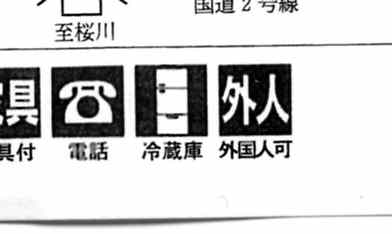
It has a system for refusing foreigners that is so clear it’s even got a special snappy logo:

heartfulrealtynogaijin005.jpg
very kindly abbreviated to “‘gaijin’ are allowed” for your handy-dandy reference. Cute.

Here’s the original page in its entirety, from page nine of its catalog:
(click on the image to see a very detailed 300 dpi scan close up)

heartfulrealtynogaijin001.jpg

You’ll notice the very clever logos at the bottom, for “Auto Lock”, “Satellite TV”, “Students Allowed”, “Pianos Allowed”, “Children Allowed”, “Sink for Shampooing”, “Pets Allowed”, “Toilet and Bath Unit Separate”, “Shower Included”, “Flooring”, “Piped in Radio”, “Specially for Women”, “Hot Water Pot Included”, “Staff Constantly On Duty”, “Cable TV”, “Parking Allowed”, “Handicapped Access”, “Contract with Legal Entity”, “Air Conditioning”, “Elevator”, “Rentable in Portions”, “Furnished”, “Phone Included”, “Refrigerator Included”, and finally… “Foreigners Allowed”.

(click below to see whole image in your browser)
heartfulrealtynogaijin004.jpg

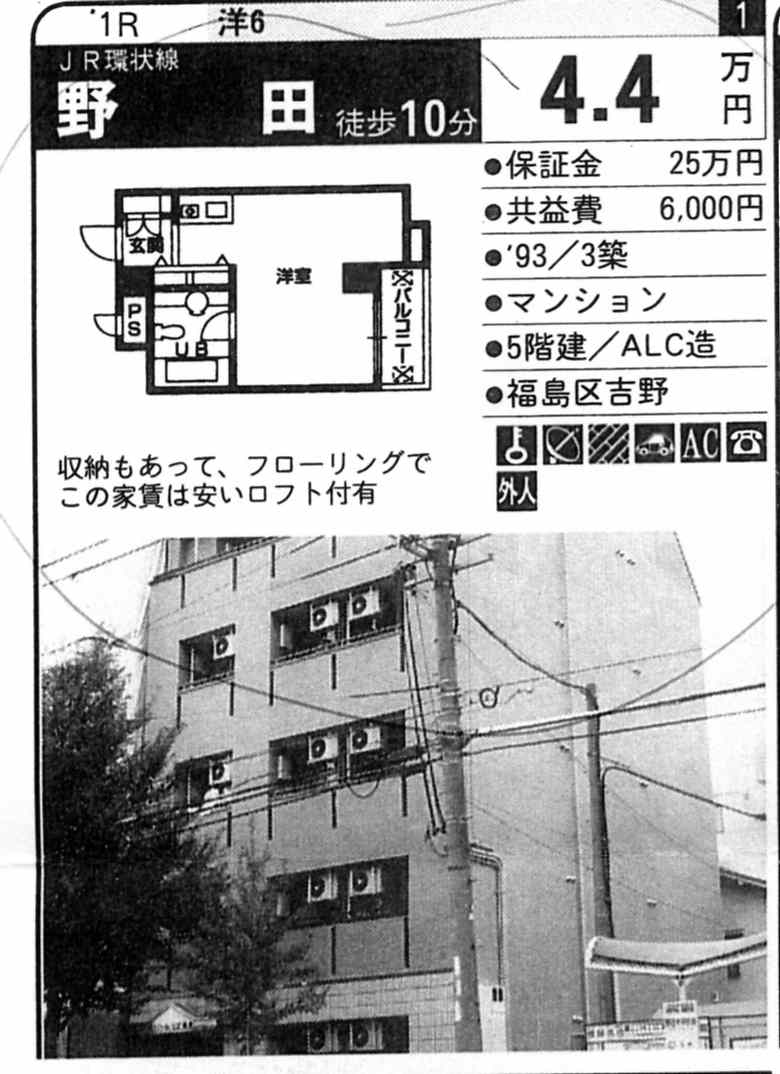
Thanks for making it so clear, I guess. Very Heartful. You’ll also notice that there is only one apartment of the twelve on this page which will deign to take “gaijin”:

heartfulrealtynogaijin003.jpg

And it’s nearly the cheapest and quite possibly the crappiest one on the entire page–only a one-room (1R). Now what a coincidence…

==========================

Now some quick counterarguments for the pedants, for what they’re worth:

Yes, there are restrictions on other things, such as pianos, but pianos and other material effects are not people. Same with pets, of course.

Yes, there are restrictions on students and children. But one does not remain a student or a child all their life, so it’s not the same as discrimination by nationality. (And for the record, I do not support “Women Only” apartments by the same logic. In any case, the default mode for apartments is accepting women, whereas the default for “gaijin” is rejection.)

What a lovely way to welcome newcomers who have enough hurdles to jump over in this society, without having the most fundamental thing they need in their life–a place to rest their head every day–denied them when they first arrive or need to move. Moreover relegate them to lousy housing regardless of income.

And the fact that this company is bold enough to make exclusionism so explicit (the realtor will no doubt counterargue that this is done by the landlord’s wishes; they’re just following orders) makes them an accessory to the discrimination in black and white.

Debito.org wishes to discourage this type of systematic discrimination in any way possible. I have put this company on the “Rogues’ Gallery of Exclusionary Establishments”.

Suggest you take your business elsewhere if you’re looking for apartments in Fukushima-ku, Osaka. Someplace less tolerant of intolerance.

Like some of these places, mentioned in a Japan Times article of November 10, 2007, blogged here.

Pertinent references from the article:
The Land, Infrastructure and Transport Ministry launched the Web site Anshin Chintai (safe rental housing) in June to provide rental housing information and lists of real estate agents and NPOs that can support foreign apartment-seekers. So far, Tokyo, Fukuoka, Osaka and Miyagi prefectures and Kawasaki have joined the project. For example, 237 real estate agents in Tokyo are listed as supportive firms.

The site — www.anshin-chintai.jp — is available in Japanese only, but foreigners who have difficulties with the language can ask local governments to explain the information on the site to them, according to the ministry.

The Japan Property Management Association, involving about 1,000 real estate agencies, also launched the Web site Welcome Chintai — www.jpm.jp/welcome/ — in September to introduce rental properties in six languages — Chinese, English, Korean, Mongolian, Spanish and Russian.

Arudou Debito in Sapporo

Valentine Lawsuit: Next Hearing Nov 20 11AM Tokyo High Court, join his support group.

mytest

Hi Blog. Nov 20 promises to be a busy day. If you’re not attending the Amnesty/SMJ Protest against Fingerprinting, then consider attending this event–in fact you can probably squeeze both of them in, since they’re both in Kasumigaseki.

About a person allegedly brutalized by the police, but undoubtedly denied medical treatment while incarcerated, and crippled in the event. Yet could not receive any compensation in court for his suffering or medical bills due in part to, according to the Lower Court decision, his (and his witnesses’) untrustworthy foreignness. I wrote about this in the Japan Times last August 14:

THE ZEIT GIST
Abuse, racism, lost evidence deny justice in Valentine Case
Nigerian’s ordeal shows that different standards apply for foreigners in court

https://www.debito.org/japantimes081407.html

Here are the details from the Support Group. Arudou Debito in Sapporo

////////////////////////////////////////////////////////////
SUPPORTERS WANTED FOR MR. VALENTINE’S TRIAL
== Please participate in his upcoming hearing ==

In Japan, when a witness is a foreigner, he can’t be trusted. And when an accused is a foreigner, he can’t have justice. At least, that is what is going on with his case…

Mr. Valentine, a Nigerian national, is defending himself against the Tokyo Metropolitan Government after a police beating incident which took place in Shinjuku almost 4 years ago. At the last trial, the judge did not close the case. Many thanks to the audience (more than 25 people sat in the public seats) who watched the trial so close. And now the date for the 3rd trial has been set. We are asking for your support, especially your participation in this upcoming hearing at Tokyo high court. Please help him to get justice.

The 3rd Appeal Tribunal Trial schedule:
Court opens at 11 am on November 20th. Tuesday, 2007
At Tokyo High Court 8th floor
Court Room Number 808
Court appellant : Mr. Valentine U.C.
< case number " (NE) 2429th of 2007" >

An application is not necessary to attend the hearing. Anyone can participate. Please come to the court before 11 am. You can enter the hearing room without any application or notification, but there will be a property check at the door. If you come earlier, please wait in the waiting room. Other supporters will meet you there. For more info: http://www.courts.go.jp/kengaku/

Access : “Kasumigaseki station” on Tokyo Metro Marunouchi line, Hibiya line or Chiyoda line. A1 exit, 1 minute walk. Or “Sakuradamon station” on Tokyo Metro Yuurakuchou line, No. 5 exit, 3 minute walk.

Mr. Valentine was arrested by Fuueihou violation in a back alley in Shinjuku Kabuki-cho on December 9th in 2003. Though he was handcuffed and did not resist during the arrest, he was brutally beaten by undercover police officers and it cost him a broken knee head bone. At the Tokyo police hospital, Mr. Valentine did not receive proper treatment. As a result, Mr. Valentine became a certified disabled person.

He brought a lawsuit against the Tokyo Metropolitan Government back in August, 2005, but lost the case. One of the reasons for the decision was based on the unaccountability of the eyewitness. The witness was also an African man. It stated anyone from the Kabuki-cho black people community can’t be taken as an accountable witness. And the Tokyo police hospital has not released his medical record, insisting it has been lost.

Read more:
http://search.japantimes.co.jp/cgi-bin/fl20070814zg.html
Contact: Valentine Trial Support Group (Japanese or English)
E-MAIL: rakuritsu.green@hotmail.co.jp
ENDS

バレンタインさんの警察官による外国人への暴力事件:【裁判傍聴に ご参加をお願いします!】 平成19年11月20日(火)11時 開廷

mytest

【裁判傍聴に ご参加をお願いします!】
===警察官による外国人への暴力事件===

ナイジェリア国籍のバレンタインさんは、新宿歌舞伎町で私服 警察官に不法な暴力を振るわれ障害者となりました。東京都を 相手取り裁判を起こしましたが、一審敗訴。東京都は暴力の事 実を認めず、バレンタインさんが勝手に看板に足をぶつけて怪 我をしたと虚偽の主張。証拠となる防犯カメラが現場にありま したが、都は防犯カメラを撤去し最初からなかったと主張しま した。初診のカルテも東京警察病院が「受診カルテを紛失した 」として裁判所命令にもかかわらず提出を拒否しています。一 審判決は原告側証人を「外国人だから信用できない」としまし た。原告は強大な公権力に翻弄され窮地に追い込まれています 。

人権が無視されていいのでしょうか、税金による公権力の不当 行使を許していいのでしょうか。

バレンタインさんは現在、控訴審公判中です。前回の第2回目 公判では25名以上の方々で傍聴席がうまり、そのお陰により 結審せず、第3回目公判につなげることができました。法廷で 真実を明らかにするため、東京高等裁判所に公正な判決を下し てもらうよう、多くの方々の傍聴参加をお願いします!

■ 【第3回・控訴審公判日程】 ■

平成19年11月20日(火)11時 開廷  東京高等裁判所 8階808号法廷

控訴人 バレンタインさんの事件名 「平成19年(ネ)第2 429号 」

○最寄り駅:地下鉄東京メトロ丸の内線・日比谷線・千代田線 「霞が関駅」A1出口から徒歩1分

地下鉄東京メトロ有楽町線「桜田門駅」5番出口から徒歩約3 分

○東京高等裁判所へのアクセス・案内図⇒
http://www.courts.go.jp/tokyo/about/syozai/tokyotisai.html

* 裁判の傍聴は、申込不要・受付不要です。誰でも傍聴でき ます。当日、開始時刻前に法廷に行って下さい。申込の必要や 、入口でどこの法廷に行くかなどの届出は不要です。(ただし 、裁判所の中にはいる際に、持物検査があります。)早くこら れた方は、隣接の待合室でお待ち下さい。他の支援者が同じよ うにそこで待っています。詳しい裁判傍聴案内は次のURLを参 照下さい⇒
http://www.courts.go.jp/kengaku/

【暴行の経緯】

ナイジェリア国籍のバレンタインさんは、2003年12月9 日午後7時45分、新宿歌舞伎町の路地裏にて風営法違反で逮 捕されました。当時歌舞伎町でナイトクラブのビラ配りのアル バイトをしていたバレンタインさんは、逮捕時には手錠をかけ られた上全く無抵抗であったのにも係わらず、私服警官から過 剰な暴行を受け、右膝周辺を力一杯踏みつけられ蹴飛ばされ、 右膝頚骨は粉砕してしまいました。その結果バレンタインさん は身体障害者になり、障害者手帳(5級)の保持者になりまし た。

バレンタインさんが懇願した末に搬送された東京警察病院でも 、必要な治療(手術)を受けらずに新宿署に10日間身柄を拘 束されました。本来ならば、通常このような患者には緊急手術 が施されますが、しかしその間も取調べは行われ、怪我を負わ された足にギブスをつけただけでした。そして現在も歩行に支 障をきたし、今後は普通に走ることなど望めません。

バレンタインさんはこの暴行に対し2005年8月、東京都に 対し国家賠償訴訟を起こしましたが、2007年3月29日敗 訴判決が下されました。(一審では、「歌舞伎町黒人コミュニ ティーの仲間である同国人の証人証言を、そのまま信用するこ とは到底できない。」などの理由により敗訴。また、東京警察 病院では「受診カルテを紛失した」とし、カルテを開示しませ んでした。)

同年5月に控訴し、7月15日に控訴審初公判、9月25日に 第2回公判を済ませ、現在は次回第3回公判の準備中です。

■連絡先: バレンタイン裁判支援会(メールは日本語でもO Kです。)

E-MAIL: rakuritsu.green@hotmail.co.jp
ENDS

Fingerprinting Protest: Lionel Dersot on making your own “WANTED” poster

mytest

Hi Blog. Here’s something I just got from Lionel Dersot out in cyberspace. If the idea tickles you, go for it. It does me. Arudou Debito in Sapporo

/////////////////////////////////////////////////

Hello, I am Lionel Dersot, a French resident of 22 years in Tokyo. Following a post on my French blog about alternative, vital ways to express discontent with the biometric filling of foreigners reaching Japan from November 20, I have created a Flickr public photo gallery where I will host any Wanted Poster candidate picture of people wishing to tell others that ” I am not a terrorist”.

My original post that shows my own Wanted Poster is here:

http://tokyo.blog.lemonde.fr/2007/11/09/wanted-in-tokyo/

The method to create and have you own WANTED poster uploaded is fairly simple. I did it in less than five minutes and I am no image application wizard. You need a free software and a decent digitized portrait picture of yourself.

Download the free PC software Poster Forge here:

http://www.ronyasoft.com/products/poster-forge/index.html

– Use the WANTED template and replace the fox picture with your own portrait picture.
– Modify the text as you wish. You can even mix Japanese and alphabet.
– Save your poster as a jpeg file, if possible at a size of 450 x 600 pixel and no more.
– If you don’t know how to do this, just save it as a jpeg document.
– Send it to my email ID: ldersot [at] gmail [dot] com, and I will post it in the gallery whenever I have time.

The gallery is here:

http://www.flickr.com/photos/77816505@N00/sets/72157603114510839/

Rules:

1. Use your own real name, no pseudonym
2. Use a decent picture of yourself, no provocative pose, no NOVA bunny or sunglasses or weird face
3. Be creative with the wording but polite, no slang, no harsh words
4. Spread the word and tell other people

Note: If you know of a less time consuming method to store pictures in a shared gallery and save me time, I will gladly modify the scheme.

Regards, Lionel Dersot

****************************************
Lionel Dersot
Japanese-English-French
Business & Technology Interpretation
Face to face & Over-the-Phone
http://ldersot.googlepages.com/
Skype ID: lionelskp
****************************************
ends

DEBITO.ORG NEWSLETTER NOVEMBER 12, 2007

mytest

This Newsletter podcasted here, in case you’d rather listen instead of reading:
[display_podcast]

This week’s contents:

///////////////////////////////////////////////////////////////////////////////////
1) NEW JAPAN TIMES ARTICLE TUES NOV 13 ON NEW WORKPLACE GAIJIN CARDING

2) NJ FINGERPRINTING UPDATE:
A) PROTEST WORKS: NARITA INSTITUTES NEW SEPARATE LINES FOR RESIDENTS
B) RECENT MEDIA: FP “AN UNMITIGATED PR DISASTER FOR THE GOJ”, “INEFFECTIVE”
C) CUTE ANIMATION RE FINGERPRINTING: DOWNLOAD AND SPREAD AROUND
D) TUES NOV 20, NOON, ASSEMBLE AND PROTEST AT JUSTICE MINISTRY

3) JAPAN TIMES: US GOVT FORCED PM ABE TO BACK DOWN RE COMFORT WOMEN
4) LA TIMES: HOW J POLICE IGNORE CERTAIN CRIMES. LIKE MURDER.
5) IHT/ASAHI, METROPOLIS, NUGW ON EIKAIWA NOVA BANKRUPTCY AFTERMATH
6) NOV 17 FED OF BAR ASSOC (NICHIBENREN) MEETING RE DIVORCE AND JOINT CUSTODY

…and finally…
7) UPCOMING SPEECH TOKYO NOV 18, “NO BORDER” GROUP ANNUAL MEETING

///////////////////////////////////////////////////////////////////////////////////

By Arudou Debito in Sapporo, Japan (debito@debito.org)
Daily blog updates, Newsletter archives, and podcasts at https://www.debito.org/index.php
Freely forwardable

///////////////////////////////////////////////////////////////////////////////////

1) NEW JAPAN TIMES ARTICLE TUES NOV 13 ON NEW WORKPLACE GAIJIN CARDING

First off, just wanted to advise readers to get a copy of the Japan Times tomorrow (Tuesday, Wednesday in the provinces).

I have an article coming out in the Community Page regarding the new Employment Policy Law, promulgated Oct 1, 2007, forcing all employers to report all their foreign workers to the Health, Labour, and Welfare Ministry. And how it’s already causing policy creep–to the point where any gaijin getting any money from any source is being Gaijin Carded.

The lay of the land and the letter of the law. And what you can do about it.
Tomorrow in the Japan Times. Have a look.

///////////////////////////////////////////////////////////////////////////////////

2) NJ FINGERPRINTING UPDATE:

A) PROTEST WORKS: NARITA INSTITUTES NEW SEPARATE LINES FOR RESIDENTS
Received a scanned pamphlet from somebody who passed through Immigration last week. Reads:

========================================
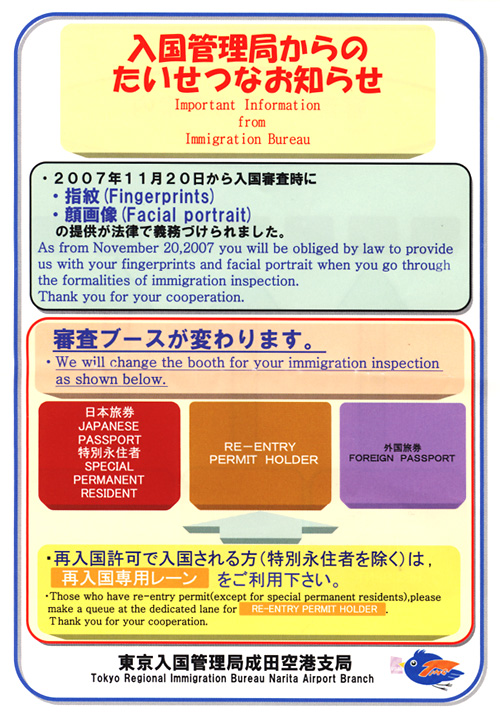
Important Information from Immigration Bureau

…We will change the booth for your immigration inspection, as shown below:
BOOTH ONE: JAPANESE PASSPORT, SPECIAL PERMANENT RESIDENT
BOOTH TWO: RE-ENTRY PERMIT HOLDER
BOOTH THREE: FOREIGN PASSPORT

Those who have re-entry permit (except for special permanent residetns), please make a queue at the dedicated lane for RE-ENTRY PERMIT HOLDER.
Tokyo Regional Immigration Bureau Narita Airport Branch

========================================
See original at https://www.debito.org/?p=701

COMMENT: You see, protest does have an effect. Residents (i.e. those who have paid the “Gaijin Homecoming Tax” by getting a Re-Entry Permit) are now no longer lumped in together with tourists.

But it still hasn’t resolved the problem of how this is going to impede businesspeople (especially APEC Business Travel Card holders), not to mention the issues of treating every non-Japanese as a potential Typhoid Mary or Osama Junior. And it’s still done to you every time.

Or the fact that the letter of the law is still not being followed nationwide. As Steve Koya poignantly commented at Debito.org:

========================================
We have a loophole, or at least a stay of execution! All we need is a decent lawyer and we can stop this legislation.

It is a simple argument, following on from my note yesterday about the Automatic gates. A chat to Sapporo Immigration confirmed that there were no plans to have the gates at Chitose or at any other airport other than Narita, giving lack of time and money as a reason.

Well, despite the fact they may have no time or insufficient funds, unfortunately Immigration are required by the new law to make the Automated Gates available to non-Japanese residents, at all airports within 18 months from the promulgation of the legislation, 24th May 2006. There is no “Only Narita” clause, there is no post promulgation amendment.

If they are not able to apply the law, then it should be rescinded. You could also state that failure to apply the law in full would also make it non-binding, so refusing to give your prints would theoretically not be illegal.

All we need is a decent lawyer! Amnesty, show us your muscle!
========================================
https://www.debito.org/?p=701#comments

Me again. Extra booth or not, I still say you should not be separated from your Japanese families. Stand together in the same line, everyone.

The issue just keeps on rolling…

///////////////////////////////////////////////////////////////////////////////////

B) RECENT MEDIA: FP “AN UNMITIGATED PR DISASTER FOR GOJ”, “INEFFECTIVE”, UNWIELDY

An article in the LA Times yesterday said everything we’ve been saying, for a big US Pacific Coast audience with close ties to Japan (the article even includes Justice Minister Hatoyama sexing up his arguments with his alleged terrorist friends):

================================
JAPAN’S WELCOME MAT GETTING PRICKLY
New rules requiring fingerprints and digital photos of visitors are revealing about attitudes toward foreigners, critics say.
From the Los Angeles Times November 11, 2007

By Bruce Wallace
http://www.latimes.com/news/nationworld/world/la-fg-screening11nov11,1,4675245.story?coll=la-headlines-world&ctrack=8&cset=true

Japan’s justice minister… even offered a bizarre personal anecdote to explain how easy it was for non-Japanese to sneak into the country. “A friend of my friend is a member of Al Qaeda,” Kunio Hatoyama told foreign reporters in Tokyo, saying that the man had entered Japan numerous times using fake passports and disguises. Hatoyama later backtracked slightly on his story, distancing himself from any connection to Al Qaeda and raising suspicions that he had embellished his anecdote to press the case for fingerprinting foreigners.
================================
https://www.debito.org/?p=724

Terrie’s Take this morning went even further:
================================
General Edition Sunday, November 11, 2007 Issue No. 445

We’ll say up front that the proposed measures have been an unmitigated public relations disaster for the Japanese government and the Justice Ministry in particular. Although the basic idea was to cooperate with the USA and other nations to try to catch potential terrorists at the borders, the measures have in fact proven to be disjointed, unorganized, and ultimately unworkable. They have also managed to infuriate pretty much every long-term, tax-paying, foreign resident in Japan.
================================
https://www.debito.org/?p=724

Other articles highlighted other issues passim, about not only the unwieldiness of this policy, but also its ineffectiveness:

================================
WILL ENTRY CHECKS CROSS THE LINE?
Fingerprinting foreigners won’t stop terrorists, critics say
By Jun Hongo, The Japan Times: Thursday, Nov. 8, 2007

http://search.japantimes.co.jp/cgi-bin/nn20071108f1.html

…[E]xperts doubt whether [the FP policy] will even stop potential terrorists from entering the country. Under the procedure, visitors whose biometric data match those on confidential terrorist watch lists will be denied entry to Japan. The lists are believed to include one compiled by the U.S. government and contain the names of about 750,000 “terror suspects.” Justice Minister Kunio Hatoyama has said Japan will cooperate with U.S. authorities in exchanging immigration data.

But Barry Steinhardt, director of the American Civil Liberties Union’s Program on Technology and Liberty, said the U.S. watch list is “bloated and full of inaccuracy.”…

“The U.S. immigration policy is a total failure,” Steinhardt warned, expressing concern that Japan’s version of biometric verification will likely be built on a flawed foundation. “It’s full of mistakes. That is the reality in the U.S. and it’s likely to become reality in Japan,” Steinhardt said. “Whether or not the loss of liberty is worth the security gained is not a question * because no security is gained.”…

Naoto Nikai, an Immigration Bureau official, …wouldn’t answer whether foreign mothers traveling with Japanese infants would be separated at immigration gates. “The immigration officer at the airport will (make the judgment),” Nikai said….
================================
https://www.debito.org/?p=709

================================
ARRIVING OUTSIDE NARITA WILL BE WORSE
By Eric Johnston, The Japan Times November 8, 2007

http://search.japantimes.co.jp/cgi-bin/nn20071108f2.html

OSAKA As annoying as the new fingerprinting procedure will be for non-Japanese going through immigration at Narita International Airport, it is going to be much worse for foreign residents who don’t live in the Tokyo area.

Unlike at Narita International Airport, those passing through regional airports will have to go through the fingerprint registration process every time they re-enter Japan. This is because only Narita, which handled half of all non-Japanese coming into the country in 2006, will introduce a new automated system that officials hope will speed up the new rules requiring most foreigners to have their fingerprints and photographs taken upon entry…

To date, airports have usually allowed foreigners with alien registration cards and re-entry permits to pass through immigration counters reserved for Japanese nationals.

At the moment, it remains unclear if fingerprinting and photographing machines will be set up at immigration counters reserved for Japanese citizens. During the initial period after Nov. 20, it could be the case that foreign residents will have to stay in the lines for foreign visitors only. “That policy may change after Nov. 20, but it depends on the airport,” said Takumi Sato, an Immigration Bureau official in Tokyo…

According to the Immigration Bureau, about 8.1 million foreigners passed through the immigration centers at 10 airports and eight ports in 2006. About 50 percent arrived via Narita, while about another third entered via Kansai, Chubu, New Chitose and Fukuoka airports. The remainder arrived at Haneda and smaller, international terminals at airports in Sendai, Naha, Okinawa Prefecture, Hiroshima, and Hakodate, Hokkaido, while a little more than 187,000 people, or 1.1 percent of the total, arrived by ship.
================================
https://www.debito.org/?p=705

///////////////////////////////////////////////////////////////////////////////////

D) CUTE ANIMATION RE FP ISSUE: DOWNLOAD AND SPREAD AROUND

A great bit of gif anime from UTU’s Nick Wood protesting the FP policy. It’s hard to describe here in words, but visually it’s pretty much spot on… It’s already been sighted on other blogs, so help yourself. View and download from here:

Welcome to Japan.gif

Download it from here and use as you like:

https://www.debito.org/WelcometoJapan.gif

///////////////////////////////////////////////////////////////////////////////////

E) TUES NOV 20, NOON, ASSEMBLE AND PROTEST AT JUSTICE MINISTRY

Excerpting from the public appeal from Amnesty International Japan and Solidarity for Migrants Japan:

=========================
…Japan’s version of the US-VISIT Program is so laden with problems, and passed without adequate deliberation by the Diet, that we call for the government and the Justice Ministry to immediately suspend it. To this end, we will assemble before the Justice Ministry on the day of its promulgation, November 20, 2007, for a public action and protest. We call on the public to join us at noon that day and lend your support and participation.

———————————-
DATE: Tuesday, November 20, 2007
TIME: Noon (public action will take 30 minutes to an hour)
PLACE: Ministry of Justice, Kasumigaseki, Tokyo (Goudou Chousha #6)
(Subway Marunouchi Line to Kasumigaseki Station, Bengoshi Kaikan exit)
ACTIVITIES: Sound truck with speeches
Placards, Message boards (NO TO FINGERPRINTING, FINGERPRINTING NON-JAPANESE IS DISCRIMINATION, “NON-JAPANESE” DOES NOT MEAN “TERRORIST” etc. Create your own slogan and bring your own sign!)

———————————-
CONTACT:
Amnesty International Japan (Tel 03-3518-6777)
http://www.amnesty.or.jp/
Solidarity Network with Migrants Japan (SMJ) (Tel 03-5802-6033)
http://www.jca.apc.org/migrant-net/
See you there!
=========================

Entire text of AI/SMJ’s Appeal here (English, then Japanese original)
https://www.debito.org/?p=708
https://www.debito.org/?p=707
Concurrent public action, signature campaign by a group called Privacy International at
https://www.debito.org/?p=698

Now’s your chance, people. Don’t like what’s happening? Do something. You won’t be alone.

Anyway, life is not all fingerprinting. Let’s move on to some great news coverage of issues Debito.org has long been concerned about:

///////////////////////////////////////////////////////////////////////////////////

3) JAPAN TIMES: US GOVT FORCED PM ABE TO BACKTRACK RE COMFORT WOMEN

Last March, blogs like mine followed how former Prime Minister Abe tried to deny there was any “coercion” involved in the WWII “Comfort Women” (i.e. sex slaves) servicing the Japanese Imperial Army in its colonies and war zones. You can trace the Arc of Abe, from denial to hair-splitting to no comment to deflection to apology through his cabinet, through
https://www.debito.org/?p=293

Back then, I wondered aloud how belated apologies like this (apologies tend to mean less when they come after being demanded, especially over a long wait) were indicate of any “coercion”–on Abe? How much pressure was put on him, and from where?

Well, the Japan Time/Kyodo News recently answered that question:

================================
U.S. GOT ABE TO DROP DENIAL OVER SEX SLAVES
Kyodo News, from The Japan Times: Friday, Nov. 9, 2007

http://search.japantimes.co.jp/cgi-bin/nn20071109a2.html

The United States warned Japan in March that Washington could no longer back Tokyo on the issue of North Korea’s past abductions of Japanese unless then Prime Minister Shinzo Abe reversed his contentious claim that there was no proof that the Imperial forces forced women and girls into sexual slavery during the war, sources revealed Thursday.

The warning, delivered by U.S. Ambassador Thomas Schieffer to a senior government official, prompted Abe to change his stance and announce that he stands by Japan’s 1993 official statement of apology to the “comfort women,” as they are euphemistically known, the sources said….
================================
Rest at https://www.debito.org/?p=293#comment-90922

COMMENT: Whaaa…? When I read this, I thought this article had popped in from another dimension: This US administration, which created Guantanamo Concentration Camp and actively resorts to kidnap and third-party torturing, excuse me, renditioning, actually caring about human rights? Putting pressure on Abe to change his stance regarding the Sex Slaves issue? Pinch me.

But let’s get into even weirder territory…

///////////////////////////////////////////////////////////////////////////////////

4) LA TIMES: HOW J POLICE IGNORE CERTAIN CRIMES. LIKE MURDER.

In a remarkable double-bill this week from Bruce Wallace, we have another article tying a heckuva lot of things together. And left me with a tremor down my spine…

================================
JAPAN’S POLICE SEE NO EVIL
The boy had been badly beaten but his death was ruled natural.
The case was closed in an official culture that discourages autopsies.
From the Los Angeles Times November 9, 2007
By Bruce Wallace, Los Angeles Times

http://www.latimes.com/news/nationworld/world/la-fg-autopsy9nov09,1,5774455.story?coll=la-headlines-world

...As is common in Japan, Aichi police reached their verdict on how [brutalized sumo wrestler Tokitaizan] Saito died without an autopsy. No need for a coroner, they said. No crime involved.

Only 6.3% of the unnatural deaths in Aichi are investigated by a medical examiner, a minuscule rate even by nationwide standards in Japan, where an autopsy is performed in 11.2% of cases…

But Saito’s case has given credence to complaints by a group of frustrated doctors, former pathologists and ex-cops who argue that Japan’s police culture is the main obstacle. Police discourage autopsies that might reveal a higher homicide rate in their jurisdiction, and pressure doctors to attribute unnatural deaths to health reasons, usually heart failure, the group alleges.

Odds are, it says, that people are getting away with murder in Japan, a country that officially claims one of the lowest per capita homicide rates in the world… “All the police care about is how they look to people; it’s all PR to show that their capabilities are high,” Saikawa says. “Without autopsies, they can keep their percentage [of solved cases] high. It’s all about numbers.”…

Many police examinations of the body are cursory, he alleges, sometimes nothing more sophisticated than a visual examination.

Take the case in January 2006, when financial advisor Hideaki Noguchi was found dead in an Okinawa hotel with knife wounds. Noguchi was a close associate of Takafumi Horie, the brash founder of the Internet company Livedoor, which had just been the target of a nationally televised police raid and seen most of its multibillion-dollar value evaporate.

But despite being a central figure in a sensational criminal investigation and privy to Livedoor secrets, police declared Noguchi’s death a suicide. They did not ask for an autopsy, and the body was cremated.

Or take the suicide in April of Agriculture Minister Toshikatsu Matsuoka, who was found hanged in his Tokyo apartment. Matsuoka was embroiled in a scandal involving the misappropriation of political funds that suggested a broad system of organized influence peddling. Even though Matsuoka’s troubles were destabilizing the government, and his death occurred just hours before his scheduled appearance to answer questions before a parliamentary committee, no autopsy was conducted to ensure that he had not died from something other than hanging.

A day later, Shinichi Yamazaki, a businessman implicated in the same scandal, plunged to his death in a parking lot outside his Yokohama apartment. No autopsy was conducted in that case either…
================================
Rest at https://www.debito.org/?p=713

COMMENT: Chilling. And I took a deep breath and said to myself, “What if somebody wanted to shut up Debito.org?” It worked for whistleblowing film director Itami Juuzo…

///////////////////////////////////////////////////////////////////////////////////

5) IHT/ASAHI, METROPOLIS, NUGW ON NOVA BANKRUPTCY AFTERMATH

Two good articles on the aftermath of the NOVA bankruptcy. One from the IHT/Asahi, the other from Metropolis Magazine:

======================================
ASAHI WEEKLY
Cover Story: Nova fallout
IHT/Asahi: November 8, 2007
BY HIROSHI MATSUBARA, STAFF WRITER

http://www.asahi.com/english/Herald-asahi/TKY200711080113.html

… G.communication group, a consulting firm based in Nagoya, will reopen at least 30 Nova schools and says it hopes to rehire the Nova staff.

As for Nova’s former president, Nozomu Sa[ru]hashi, he looks set to face criminal charges shortly for failing to pay billions of yen in wages to his employees, sources said.

Some former Nova teachers are in such dire financial straits they are having to rely on their former students to feed them.
======================================
Rest at https://www.debito.org/?p=710

======================================
THE DECLINE AND FALL OF NOVA
Japan’s largest employer of foreigners comes to an ignominious end
By Ken Worsley
Metropolis Magazine November 9, 2007, Issue #711

http://metropolis.co.jp/tokyo/recent/bulletin.asp

In a sense, Sahashi has been playing into the hands of bankruptcy administrators who seek to pin the blame for Nova’s woes on him alone. His selfishness, petulance, disdain for employees and customers, and lack of business acumen make him an exceedingly worthy scapegoat. As this article was going to print, Sahashi remained incommunicado, and the bankruptcy administrators seem to be hoping that the worse he looks, the more the firm will appear as an innocent victim of his tyranny.

Will the strategy of separating Sahashi from the firm he wrecked succeed? Nova’s bankruptcy administrators claim that they have found a few firms interested in taking over the company’s operations, but this time they’re not naming names. Nova supposedly has until the second week of November to find a “sponsor,” or else it will be forced to go into a bankruptcy liquidation process.
======================================
Rest at https://www.debito.org/?p=710
with great links to where former NOVA employees can get help.
Now for the union’s perspective:

======================================
From: Louis Carlet (carlet@jca.apc.org)
Subject: [Nambu FWC] Nova and G
Date: November 11, 2007 10:16:04 AM JST
To: action@nambufwc.org

Members, much happened yesterday regarding the Nova case. At 10am and 2pm at locations throughout the country, Nova’s trustee held information sessions explaining various aspects of the coming Nova bankruptcy and explaining G Education’s offer to hire all Nova teachers who want to be hired at the same working conditions they had before…

We also last night joined forces with General Union to tell the trustee, Noriaki Takahashi, that former conditions are not enough. Both unions (Nambu and G.U.) submitted to him several demands, including full enrollment of all teachers in shakai hoken and open-ended employment. Other demands included a fund to protect student tuition advances. The trustee said he agreed with all the demands…
Louis Carlet
NUGW Tokyo Nambu

http://www.nugw.org
======================================
https://www.debito.org/?p=715

Again, it pays to protest. And get organized. Do so.

///////////////////////////////////////////////////////////////////////////////////

6) NOV 17 FED OF BAR ASSOC (NICHIBENREN) MEETING RE DIVORCE AND JOINT CUSTODY

Following up on the headlining topic last newsletter, on the “FOR TAKA AND MANA” documentary film screening and fundraiser taking place December 11, 2007 (https://www.debito.org/?p=685)

The issue of joint custody (which is not allowed in Japan, meaning one parent is nearly always cut off from their child(ren) after divorce) is also gaining some traction with lawyers in Japan.

======================================
From: CRN Japan’s Mark Smith
Subject: [Community] JFBA joint custody seminar in Tokyo on Nov 17
Date: November 11, 2007

The Japan Federation of Bar Associations [Nichibenren] will be having a seminar in Tokyo entitled “Divorce and Children 2: Thinking of Joint Custody”.

This is not just for lawyers, so if you speak Japanese and are in Tokyo on November 17, from 13:00 to 17:00, you may want to attend. Their website page with more information about this event is here.
http://www.nichibenren.or.jp/ja/event/071117.html

Might be a good thing to have a lot of non-Japanese show up so that they saw that the problem is not restricted to Japanese.

Mark Smith, Children’s Rights Network Japan
http://www.crnjapan.com/en/
======================================

Back to the “FOR TAKA AND MANA” documentary film fundraiser.
https://www.debito.org/?p=685
Please do support this event. Spread the word. Attend. Contribute.
Even put a movie poster newly up at Debito.org:
https://www.debito.org/?p=696

///////////////////////////////////////////////////////////////////////////////////

…and finally…

7) UPCOMING SPEECH TOKYO NOV 18, “NO BORDER” GROUP ANNUAL MEETING

======================================
NO BORDER 2007
LIVING TOGETHER IN ONE SOCIETY
Round Table Discussion
Hosted by the Volunteer Network of Foreign Residents in Japan

More Information at http://zainichi.net/

Objective: Following last year’s event, a round table discussion session will be held with the aim to assist individuals in their efforts in networking. Through discussion, this event aims to create an opportunity for individuals to consider the experiences of foreign residents and Japanese nationals with various cultural backgrounds in Japan.

18 November 2007, 10:00 – 17:00
Hosei University Ichigaya Campus, Boissonade Tower 26F, Sky Hall

http://www.hosei.ac.jp/hosei/campus/annai/ichigaya/access.html

Entrance free. Participants are free to enter and leave the event venue as they wish.
Active participation is welcome and encouraged during the round table discussion session.

Part 1 (10:00 – 12:30)
Is there a place for Japanese of foreign descent in Japanese Society?

Discussing the multiplicity of what it means to be Japanese: Is there a place for Japanese nationals of various ethnic backgrounds in Japanese Society?

Defining the Issue: Presentation of the movie, “The New Foreign Residents of Japan” (Shin-Zainichi Gaikokujin)

Presentation 1: Gen Masayuki
Presentation 2: Elnaz Jalali, Nady

12:30 – 14:00 Lunch Break (Light lunch is served)

Part 2 (14:00 – 16:30)
What is necessary for a system to support a new Lifestyle?

Presentation 1: Kim Kyon Ju (Chukyo University)
Presentation 2: Inoue Hiroshi (Keidanren–Japan Business Federation)
Presentation 3: Arudou Debito (Hokkaido Information University)

Part 3 16:30-17:30 No Border Live
MORE INFORMATION AT http://zainichi.net/

///////////////////////////////////////////////////////////////////////////////////

That’s all for today! Thanks for reading!

Arudou Debito, Sapporo, Japan
debito@debito.org, https://www.debito.org
Daily blog updates, Newsletter archives, and podcasts at
https://www.debito.org/index.php
DEBITO.ORG NEWSLETTER NOVEMBER 12, 2007 ENDS

Global Voices Online: Some J bloggers’ view of NJ Fingerprinting

mytest

Hi Blog. Here are some translations, by Hanako Tokita at Global Voices Online, of some domestic voices in Japanese regarding the NJ Fingerprinting issue. Japanese and English T.

I won’t cut and paste them all here, since it is an elaborate site, but it’s worth a look. If only to see how half-baked the domestic debate has been.

http://www.globalvoicesonline.org/2007/11/12/japan-fingerprints-mugshot-welcome-to-japan/

Courtesy of Chris Salzberg. I hope Hana does more domestic comments, because given what I know and have experienced about how anonymity affects the responsibility of posters, I bet the ill-considered/reactionary/xenophobic comments are the majority. The ones up on GVO are surprisingly intelligent in places. Arudou Debito in Sapporo

PS: GVO has appropriated Nick Wood’s excellent animation gif portraying the issue. Bravo.

LA Times and Terrie’s Take on NJ Fingerprinting: “an unmitigated public relations disaster for the GOJ”

mytest

Hi Blog. The issue just keeps on rolling. LA Times yesterday below says everything we’ve been saying, for a big US Pacific Coast audience with close ties to Japan (the article even includes Hatoyama and Al-Qaeda, just didn’t mention the GOJ’s connecting “contagious diseases and terrorism” to all NJ only); Terrie’s Take this morning even gives a shout-out to Debito.org as an “excellent” source (thanks!). Notable quotes:

================================
LAT: “Japan’s justice minister… even offered a bizarre personal anecdote to explain how easy it was for non-Japanese to sneak into the country. “A friend of my friend is a member of Al Qaeda,” Kunio Hatoyama told foreign reporters in Tokyo, saying that the man had entered Japan numerous times using fake passports and disguises. Hatoyama later backtracked slightly on his story, distancing himself from any connection to Al Qaeda and raising suspicions that he had embellished his anecdote to press the case for fingerprinting foreigners.”
================================
================================
Terrie’s Take: “We’ll say up front that the proposed measures have been an unmitigated public relations disaster for the Japanese government and the Justice Ministry in particular. Although the basic idea was to cooperate with the USA and other nations to try to catch potential terrorists at the borders, the measures have in fact proven to be disjointed, unorganized, and ultimately unworkable. They have also managed to infuriate pretty much every long-term, tax-paying, foreign resident in Japan.”
================================

I’ll put Terrie Lloyd’s write up first, then Bruce Wallace of the LAT’s second. Arudou Debito in Sapporo

///////////////////////////////////////////////////////////////

* * * * * * * * * T E R R I E ‘S T A K E * * * * * * *

A weekly roundup of news & information from Terrie Lloyd. (http://www.terrie.com)
General Edition Sunday, November 11, 2007 Issue No. 445

+++ WHAT’S NEW

Back in early October (TT-440) we talked about the coming changes at Immigration, where the authorities have decided in their wisdom that every foreigner in the land except those who are third generation Koreans and Taiwanese, diplomats, US soldiers, and kids, will be subject to anti-terrorist biometric checks at the airport every time we come into Japan. Since writing about that, we have had lots of email and have been following the situation pretty closely. Many thanks to all those people dropping us notes about the changes as they have been happening.

We’ll say up front that the proposed measures have been an unmitigated public relations disaster for the Japanese government and the Justice Ministry in particular. Although the basic idea was to cooperate with the USA and other nations to try to catch potential terrorists at the borders, the measures have in fact proven to be disjointed, unorganized, and ultimately unworkable. They have also managed to infuriate pretty much every long-term, tax-paying, foreign resident in Japan.

Let’s get an update on what is happening now.

As many readers will already know, the Immigration folks have decided to put in place a pre-registration system and an “automatic” gate at Narita, so that permanent residents and others with re-entrant visas will be able to by-pass the tourist lines so long as they are pre-registered. You can apparently pre-register either at the Tokyo Immigration Bureau at Konan, inconvenient at the best of times, or at Narita Airport.

The pre-registration counters will be at the South Wing of Terminal 1 and South Side of Terminal 2. Note that the opening times at Narita are limited to 9.00am-5.00pm. So it’s probably a good idea to go early. There is no indication of how long the pre-registration process takes, but comments we’ve heard so far are a few minutes if there is no queue.

However, having said that, since literally tens of thousands of people with re-entry visas will be leaving for Christmas, you should leave plenty of time to get the pre-registration done. For documentation you just need the application form (presumably they’ll give it to you) and your up-to-date passport.

Now, if you happen to be using an airport other than Narita, including Haneda, Nagoya, and Osaka, there will be no automatic gates, and thus pre-registration isn’t going to do you much good. We can see this riling a lot of foreign business people who have picked Japan for lifestyle but who frequently travel to China and elsewhere in Asia for business. For those people, moving to Singapore right now has to look pretty good. It seems that the Japanese government isn’t really that interested in foreign investment after all…

Now for those of you used to the Japanese floating new laws and changing them after feeling the heat from the public, there is some hope. We have heard through a well-placed friend that the Immigration senior management are surprised at the amount of negative reaction by the foreign community. While their being surprised shows just how out of touch they are, in any case we heard that Immigration may in fact consider exempting permanent residents from the re-entry procedure after-all. If they do this, at least they’ll be bringing themselves back in line with the USA, where this whole biometric fiasco started in the first place. There, the green card holders are allowed to enter immigration through the US Citizen lines.

As the procedures have started to unfold (why do we get the sense that they’re making this up as they go along?), there has been plenty of newspaper reader feedback in the Daily Yomiuri and other foreign press. You have the Japan apologists stating, “Well, these measures aren’t so bad, what’s a little fingerprinting and eye scanning every now and again if it keeps the country safe?” through to “Oh, those whiney foreigners, if they don’t like it, let them go home.”

The fact is that the fingerprinting and eye scanning really are just an irritating inconvenience. What is making people mad is how the government has decided that foreigners living in Japan for decades, and in a number of cases those who were even born here, are now lumped in with tourists coming in for a week on the way to China or elsewhere. This seemingly insignificant rule change has woken up a lot of resentment over how Japan treats its foreign residents in general.

Getting past the feelings of shabby treatment, you then get to a more disturbing situation — what happens to the data after it is collected? At the end of October, we attended an Amnesty International Japan press conference, where a prominent leader of the American Civil Liberties Union (ACLU), Barry Steinhardt, related what is done with the data collected in the USA’s US-VISIT program.

He made some very interesting points. Firstly, that the terrorist alert database being used by the USA contains 750,000 names — an order of magnitude larger than the actual number of likely terrorists in the world — meaning that there are a lot of people on that list who shouldn’t be there.

Secondly, the database has been proven many times to be flawed thanks to its very superficial data. Essentially, any person with a suspicious first name/last name, like that of Dr. Robert J. Johnson, is flagged at the port of entry and they are regularly dragged off for grilling. Treatment like this of innocent people has naturally caused tourism to the USA as a percentage of the global travel market to fall — in fact by 35% since 1992. Japan can look forward to much the same result.

Thirdly, although no one has admitted as such, the ACLU suspects from recent cases involving activists prevented from entering Canada, that the USA is now sharing its database with other nations.

The announcements by Immigration say that the new biometric checks are being put in place to detect known terrorists as they enter the country. However, Japan doesn’t possess its own list of foreign terrorists, mainly because there hasn’t been an incident of foreign terrorism on Japanese soil (well, OK, North Korean abductions, maybe) since WWII. Thus, for them to correlate tourists entering the country, they’ll have to borrow someone else’s list. The ACLU and Amnesty are hinting that it will be the faulty US list. Too bad if your name happens to match one of the 750,000… Any Bob Johnsons among our readers? Let’s hope “Taru Suzuki” or a similarly popular Japanese name doesn’t suddenly make it to the list.

What is interesting, too, is that while Japanese names and biometrics are not on the Japanese database because the electorate wouldn’t stand for it, for those Japanese nationals traveling to the USA and UK, their data is indeed being captured — and it is only a matter of time before this data is fed back to Immigration here in Japan. This smacks very much of a back door effort by the powers that be to collect global data — and there isn’t much the civil rights people can do about it.

Then we heard another interesting tidbit. Now you might think that with all the hot technology for accurately scanning fingerprints and eyes, this data would be whizzing back in real time to some massive Interpol-like database, and that if there was a match then the Immigration officer’s screen would start flashing red and bells would start clanging.

Nope, nothing like that. What we heard is that the data is “batched” and sent to a screening center for analysis. Apparently it takes up to 24 hours to turn the data around! That’s probably just the right amount of time for an earnest terrorist to catch a bus over to the Tokyo Stock Exchange, let off some sort of device, and high-tail it back overseas.

So what we have here is a FUBAR situation of the highest order. 1) A law that no one really thought too hard about, but which will irritate the hell out of a lot of tax-paying, law-abiding permanent residents. 2) A computer database that is riddled with inaccuracies and is being adopted to buttress the Japanese screening effort. Let’s hope it gets some important Middle-eastern customer of Mitsui or Marubeni locked up for a week or two until the authorities find out that the database is unreliable. 3) A processing system that is so slow that a real terrorist could enter and exit the country without being detected in time.

There is a petition that you can sign to protest the new procedures. The URL is: http://www.ipetitions.com/petition/fingerprints-japan/index.html. This petition will be presented to the General Affairs Division, Immigration Bureau, at the Ministry of Justice.

Also, we can recommend the website of Debito Arudou, which has an excellent running log of developments on fingerprinting and similar human rights issues. You can find it at:
https://www.debito.org/?cat=33

We’d be interested in hearing the experiences of people who have pre-registered on November 20th, and/or who passing back into Japan as permanent residents.

terrie.lloyd@japaninc.com.
ENDS

///////////////////////////////////////////////////////////////

Japan’s welcome mat getting prickly
New rules requiring fingerprints and digital photos of visitors are revealing about attitudes toward foreigners, critics say.
From the Los Angeles Times November 11, 2007
By Bruce Wallace, Los Angeles Times Staff Writer

http://www.latimes.com/news/nationworld/world/la-fg-screening11nov11,1,4675245.story?coll=la-headlines-world&ctrack=8&cset=true
Courtesy of Jon Lenvik

TOKYO — The kind of greeting a foreigner receives at immigration upon arrival at an international airport can be a good, if imperfect, indication of the country that waits on the other side of the barrier.

London’s Heathrow? Long queues and lousy service.

New Delhi’s Indira Gandhi International? Crumbling infrastructure and over-the-top bureaucracy.

Some Middle Eastern airports? Slow-moving lines that can be circumvented with the right connections and cash.

Now the Japanese government has created new immigration procedures for foreign visitors — rules that critics say are all too revealing about official attitudes toward foreigners.

On Nov. 20, Japan will begin fingerprinting and photographing non-Japanese travelers as they pass through immigration at air and sea ports. The government says the controls are a necessary security measure aimed at preventing a terrorist attack in Japan.

The new system is modeled on the U.S. program instituted in 2004 that takes digital photos and fingerprints of travelers entering the United States on visas. But the Japanese system goes further by requiring foreign residents — in addition to visitors — to be photographed and fingerprinted.

There are exceptions: diplomats, children younger than 16, U.S. military personnel serving in Japan, and long-term residents of Korean or Chinese descent whose presence here is largely owed to Imperial Japan’s overseas conquests. But all other foreigners will be scanned each time upon entry.

Critics say the data collection is a dubious terrorism-fighting measure, instead reflecting the government’s desire for closer surveillance of foreigners.

“The Japanese government has a long history of not wanting long-term foreign residents, and they really feel they need more control over foreigners,” said Sonoko Kawakami of the Japanese chapter of Amnesty International. “The government just wants to gather as much information as possible on people.”

The only terrorist spectaculars in Japanese history have come from homegrown groups: the Japanese Red Army, which conducted attacks around the world in the 1970s and ’80s, and the Aum Shinrikyo cult, which carried out a sarin gas attack on the Tokyo subway in 1995.

But officials say Tokyo’s support for the U.S.-led wars in Iraq and Afghanistan makes Japan a target, and taking biometric data such as fingerprints and digital facial photos is the only way to nab terrorists traveling on fake passports.

At least that was the recent contention of Japan’s justice minister. He even offered a bizarre personal anecdote to explain how easy it was for non-Japanese to sneak into the country. “A friend of my friend is a member of Al Qaeda,” Kunio Hatoyama told foreign reporters in Tokyo, saying that the man had entered Japan numerous times using fake passports and disguises.

Hatoyama later backtracked slightly on his story, distancing himself from any connection to Al Qaeda and raising suspicions that he had embellished his anecdote to press the case for fingerprinting foreigners.

But Hatoyama has long been among the senior public officials who believe Japan is already too open to overseas workers. When he became justice minister in August, Hatoyama made it clear he had no intention of proceeding with earlier plans to allow in more unskilled workers.

That, he warned, could lead to an increase in crime.

Statistics, however, show that the number of crimes committed by foreign visitors is falling. And despite alarm about particularly sensational crimes that attract media attention, Japan’s overall crime rate is declining or flat.

That hasn’t stopped some senior Japanese politicians from stoking anti-immigrant fires by contending that foreigners living in Japan commit a higher proportion of crimes. And those contentions have sent bureaucrats in search of ways to weed out the “good” foreigners, presumably those with money to invest, from “bad” ones, such as the Chinese pickpocket gangs that get so much media attention here.

The new immigration system appears to be one answer. Fingerprinting is actually a resumption of a system that was abandoned in 2000 after strong protests by long-term Korean, Chinese and Taiwanese residents who resented being fingerprinted in their own country. A jittery, post-9/11 America provided the initiative for the Japanese to revive it.

The law instituting the new regime passed parliament last year with very little outcry. The Federation of Japanese Bar Assns. was a lonely critical voice, complaining that fingerprinting people who had already been granted residency was an infringement on civil liberties. But the government avoided a repeat showdown with the Koreans and Chinese by exempting them from the new requirements.

“The Japanese public does not see this as ‘our’ problem,” said Masashi Ichikawa, a human rights lawyer in Tokyo. “The climate is that it is legitimate to be ‘against terrorism,’ and that people just have to follow the rules.”

The fingerprinting issue underscores the Japanese dilemma in dealing with foreigners.

On the one hand, in this age of increased global mobility, the threat of terrorism, though remote, is a plausible one.

But on the other, the Japanese government needs more foreigners. Japan has low unemployment by global standards and faces a demographic crunch as its population ages and workforce shrinks. Tokyo is fighting to preserve its position as a world financial center as competitors such as Singapore actively cultivate a welcoming aura for foreign businesses.

And Japan is still searching for ways to address its tourist deficit at a time when well-heeled travelers have a widening array of Asian destination choices.

It remains to be seen whether treating every visitor as a potential terrorist, until their fingerprints prove otherwise, is the best way to roll out the welcome mat.

———————
bruce.wallace@latimes.com

Naoko Nishiwaki of The Times’ Tokyo Bureau contributed to this report.
ENDS

Fingerprinting of NJ issue summarized as animation. Spread it around.

mytest

Hi Blog. Fingerprinting of NJ issue aptly summarized in animation. Spread it around.

Welcome to Japan.gif

Download it from here and use as you like:

https://www.debito.org/WelcometoJapan.gif

Courtesy of UTU’s Nick Wood. Thanks very much, and well done. Arudou Debito in Sapporo

Nova Union on former NOVA employees exodus to G Education

mytest

Blog: News on the NOVA aftermath from the employee union’s point of view; watch Fuji TV tonight (Sunday Nov 11) for coverage of their Osaka negotiations. Arudou Debito

================================

From: carlet@jca.apc.org
Subject: [Nambu FWC] Nova and G
Date: November 11, 2007 10:16:04 AM JST
To: action@nambufwc.org

Members,
Much happened yesterday regarding the Nova case.

At 10am and 2pm at locations throughout the country, Nova’s trustee held information sessions explaining various aspects of the coming Nova bankruptcy and explaining G Education’s offer to hire all Nova teachers who want to be hired at the same working conditions they had before.

We leafletted the meeting in Tokyo, calling on teachers to join GUTS (G Union of Teachers and Staff, which doesn’t yet exist). Tony D. reports that 500 leaflets were passed out quickly with no problems.

We also last night joined forces with General Union to tell the trustee, Noriaki Takahashi, that former conditions are not enough. Both unions (Nambu and G.U.) submitted to him several demands, including full enrollment of all teachers in shakai hoken and open-ended employment. Other demands included a fund to protect student tuition advances. The trustee said he agreed with all the demands.

He explained that of all the 12 corporate “sponsors,” G had the best offer in terms of protecting staff and teachers — hire them all initially at same conditions — and in terms of offering something to students — can use remaining points by paying 25% of their cost on top of what they already paid to Nova. He said he agreed with the shakai hoken and open-ended employment demands and called on the unions to fight hard, to make his job easier.

Other details will be explained at our next Nova meeting — Nov. 18 at 7pm at the Nambu union office. Some details are very important concerning resignation versus dismissal. In short, if you want to work for G you must resign from Nova the day before you are hired by G. If you don’t resign from Nova, the trustee will fire you with a month’s notice. This will meet that your unpaid wages will continue to accrue even a month after you are fired. If you work for G, even if your school is not open and you are told to stand by at home, you will be paid full wages.

More to come later… Watch the Fuji TV news at 10pm tonight, which covers the Nova Union’s trip to Osaka to meet with the trustee.

In Solidarity,

Louis Carlet
NUGW Tokyo Nambu
http://www.nugw.org

LA Times on how J police ignore certain crimes. Like murder.

mytest

Hi Blog. We get some more press light on the Tokitaizan Sumo death last June, and how the police are NOT investigating it properly. No arrests have been made in conjunction with his brutal manslaughter. Turns out, according to this excellent article in the LA Times (well done Bruce Wallace), this is quite routine for the Japanese police. Read on.

This is far better than the recent NY Times outing on the subject. And it raises suspicions about a number of suspicious high-profile deaths in modern-day Japan. The nail that sticks out gets hammered down… on the coffin? Arudou Debito in Sapporo

///////////////////////////////////////////

Japan’s police see no evil
The boy had been badly beaten but his death was ruled natural. The case was closed in an official culture that discourages autopsies.
From the Los Angeles Times November 9, 2007
COLUMN ONE
By Bruce Wallace Los Angeles Times Staff Writer

http://www.latimes.com/news/nationworld/world/la-fg-autopsy9nov09,1,5774455.story?coll=la-headlines-world
Courtesy of Jon Lenvik

TOKYO — Photos of the teenager’s corpse show a deep cut on his right arm, horrific bruising on his neck and chest. His face is swollen and covered with cuts. A silhouette of violence runs from the corner of his left eye over the cheekbone to his jaw, and his legs are pocked with small burns the size of a lighted cigarette.

But police in Japan’s Aichi prefecture saw something else when they looked at the body of Takashi Saito, a 17-year-old sumo wrestler who arrived at a hospital in June. The cause of death was “heart disease,” police declared.

As is common in Japan, Aichi police reached their verdict on how Saito died without an autopsy. No need for a coroner, they said. No crime involved. Only 6.3% of the unnatural deaths in Aichi are investigated by a medical examiner, a minuscule rate even by nationwide standards in Japan, where an autopsy is performed in 11.2% of cases.

Forensic scientists say there are many reasons for the low rate, including inadequate budgets and a desperate shortage of pathologists outside the biggest urban areas. There is also a cultural resistance in Japan to handling the dead, with families often reluctant to insist upon a procedure that invades the body of a loved one.

But Saito’s case has given credence to complaints by a group of frustrated doctors, former pathologists and ex-cops who argue that Japan’s police culture is the main obstacle.

Police discourage autopsies that might reveal a higher homicide rate in their jurisdiction, and pressure doctors to attribute unnatural deaths to health reasons, usually heart failure, the group alleges. Odds are, it says, that people are getting away with murder in Japan, a country that officially claims one of the lowest per capita homicide rates in the world.

“You can commit a perfect murder in Japan because the body is not likely to be examined,” says Hiromasa Saikawa, a former member of the Tokyo Metropolitan Police security and intelligence division. He says senior police officers are “obsessed with statistics because that’s how you get promotions,” and strive to reduce the number of criminal cases as much as possible to keep their almost perfect solution rate.

Japan’s annual police report says its officers made arrests in 96.6% of the country’s 1,392 homicides in 2005.

But Saikawa, who says he became disillusioned by “fishy” police practices and in 1997 left the force in disgust after 30 years, claims that police try to avoid adding homicides to their caseload unless the identity of the killer is obvious.

“All the police care about is how they look to people; it’s all PR to show that their capabilities are high,” Saikawa says. “Without autopsies they can keep their percentage [of solved cases] high. It’s all about numbers.”

The former policeman has written a memoir of his time on the force. Called “Policeman at the Scene,” it describes a police culture that has chipped away at the effectiveness of an autopsy system created during the U.S. occupation after World War II.

“The police textbooks taught us not to trust doctors,” he says, adding that police officers indirectly pressure doctors to sign death certificates without an autopsy. “Doctors are afraid of the police. They are afraid of retaliation. They worry the police could prosecute them for malpractice. So they are easily pressured.

“There is no one refereeing the police,” Saikawa says. “It’s scary.”

After the war, Americans created a medical examiner’s office for Tokyo after learning that thousands of deaths in the postwar rubble were being ascribed to starvation without any forensic examination. It was soon discovered that a tuberculosis epidemic was the main culprit.

The system was soon expanded to six other big cities which, for the most part, are the jurisdictions where autopsies are done with the most frequency (in 2004, autopsies were conducted in 29% of Kanagawa prefecture’s unnatural deaths; 18% of those in Tokyo). But much of the country remains without a fully functioning medical examiner system.

“There aren’t many doctors who want to do this kind of work and that means some areas don’t have a medical examiner at all,” says Dr. Masahiko Ueno, a former chief medical examiner in Tokyo who spent 30 years in the coroner’s office until he retired in 1988. Since then he has written more than 30 books about the cases that animated his career and the cold cases that intrigue him in retirement.

Ueno says his experience leaves him convinced that many homicides are being missed and he, too, blames a system that gives police great discretion over when an autopsy is performed. Although doctors are legally required to report “unnatural deaths” to police, the country’s medical act does not precisely define what that is.

The philosophical approach to death investigations differs between the West and Japan.

In the West, autopsies are performed to determine the cause of death. That is one reason the autopsy rate for people who die in hospitals has fallen in most Western countries: Improved medical diagnostics has removed much of the uncertainty about why a patient died.

But in Japan, investigations are not as concerned with uncovering the cause of death as with whether a crime has been committed. Without obvious signs of homicide, police are less likely to ask for an autopsy.

That applies to investigations of apparent suicides.

Japan has one of the world’s highest suicide rates, accounting for more than 30,000 deaths a year, but police request “almost no autopsies on suicides,” which could determine whether the cause of death is what it appears, Saikawa says.

Many police examinations of the body are cursory, he alleges, sometimes nothing more sophisticated than a visual examination.

Take the case in January 2006, when financial advisor Hideaki Noguchi was found dead in an Okinawa hotel with knife wounds. Noguchi was a close associate of Takafumi Horie, the brash founder of the Internet company Livedoor, which had just been the target of a nationally televised police raid and seen most of its multibillion-dollar value evaporate.

But despite being a central figure in a sensational criminal investigation and privy to Livedoor secrets, police declared Noguchi’s death a suicide. They did not ask for an autopsy, and the body was cremated.

Or take the suicide in April of Agriculture Minister Toshikatsu Matsuoka, who was found hanged in his Tokyo apartment. Matsuoka was embroiled in a scandal involving the misappropriation of political funds that suggested a broad system of organized influence peddling. Even though Matsuoka’s troubles were destabilizing the government and his death occurred just hours before his scheduled appearance to answer questions before a parliamentary committee, no autopsy was conducted to ensure that he had not died from something other than hanging.

A day later, Shinichi Yamazaki, a businessman implicated in the same scandal, plunged to his death in a parking lot outside his Yokohama apartment. No autopsy was conducted in that case either.

“The police said it was suicide,” says an incredulous Saikawa, “because he had left his shoes placed neatly together on the balcony.”

Japan’s forensic specialists have long been calling for an overhaul of the coroner system, but it took the death of the young sumo wrestler to finally bring the shortcomings under sharper scrutiny.

Doctors at the hospital where Saito was brought in, unconscious and battered, have since acknowledged that they had doubts about the police verdict. They said they initially attributed his death to acute cardiac failure, which occurs when the heart stops suddenly and does not rule out foul play.

But the police insisted otherwise. So the hospital signed a death certificate that blamed a diseased heart for killing the 17-year-old. It released the body to Junichi Yamamoto, the master of the training facility where Saito lived and had collapsed after what was described as a “strenuous” practice session. No need to pick up the body, the boy’s grieving family claims Yamamoto told them by phone. We’re having him cremated.

Had Saito’s parents not demanded to see their son’s body, the truth about the wrestler’s death might never have been known.

But when the body was returned home in another prefecture, they were shocked by its battered state. The family asked medical professors at Niigata University to perform an autopsy, which revealed that Saito’s heart stopped from the shock of injuries inflicted upon him. He probably had been beaten to death.

On this wisp of suspicion rested justice for a dead boy.

More than a month later, under pressure from the family and Japan’s muckraking weekly magazines, Aichi police opened an investigation that found the stable master and other wrestlers had viciously beaten Saito. It was punishment, they said, because he was trying to quit sumo. The stable master has admitted hitting Saito in the forehead with a beer bottle the night before he died.

Leaks to the media from the police investigation indicated that the boy was beaten again the next morning, punched, kicked and hit with a baseball bat by other wrestlers while Yamamoto watched.

Under fire from an appalled public, the Japanese Sumo Assn. last month finally acted and banned Yamamoto from the sport. Aichi police did not respond to questions about the investigation, or the agency’s policies and practices on requesting autopsies.

They have yet to file charges.

————————-
bruce.wallace@latimes.com

Naoko Nishiwaki and Hisako Ueno of the Times’ Tokyo Bureau contributed to this report.
ENDS

IHT/Asahi and Metropolis: Two good articles on NOVA bankruptcy aftermath

mytest

Okay, yet another post under the wire…

Two good articles on the aftermath of the NOVA bankruptcy. One from the IHT/Asahi, the other from Metropolis Magazine by Ken Worsley of Trans Pacific Radio., including links to where people can get help. Arudou Debito in Sapporo

======================================
Asahi Weekly
Cover Story: Nova fallout
IHT/Asahi: November 8, 2007
BY HIROSHI MATSUBARA, STAFF WRITER

http://www.asahi.com/english/Herald-asahi/TKY200711080113.html
Courtesy of Thom Simmons

With 4,000 Nova Corp. teachers out of work, now is probably the worst possible time to be seeking a job as an English instructor in Japan.

Picture Caption: A Nova Corp. teacher, left, who lost his job when the Osaka-based chain of English-language schools collapsed seeks job advice from a counselor at the Shinjuku Employment Assistance and Instruction Center for Foreigners in Tokyo last week.

The collapse of the Osaka-based chain of language schools means that hundreds of teachers now apply for every job opening, according to GaijinPot, a popular online job-site for foreign nationals in Japan.

Longtime Nova employees accuse the company of operating under a system that made quitting the company an unpalatable option.

They said Nova specialized in recruiting young, inexperienced university graduates with little or no practical Japanese-speaking ability.

That left many of them ill-prepared to find new jobs outside of, and to an extent, within the teaching industry–hence the current fierce competition for teaching positions.

Nova insiders say the company churned out teachers in much the same way that a fast-food chain produces hamburgers.

English Spot, a school in Higashinari Ward, Osaka, said 400 people applied in October for a single job opening that eventually went to a 26-year-old French national who gained her teaching credentials in Britain and had been working for Nova.

It noted that the vast number of applicants for the job the woman landed were former Nova teachers like her.

The woman said, “I am happy that the school chose me because I know that a lot of people at Nova are in trouble right now.”

Her application for the new job stood out because of her track record as a language teacher in Britain, where she taught French and Spanish at a secondary school, said Matt Kelley, owner and director of English Spot.

On Oct. 26, the day she started working at the school, Nova filed for financial reconstruction under court supervision.

G.communication group, a consulting firm based in Nagoya, will reopen at least 30 Nova schools and says it hopes to rehire the Nova staff.

As for Nova’s former president, Nozomu Sahashi, he looks set to face criminal charges shortly for failing to pay billions of yen in wages to his employees, sources said.

Some former Nova teachers are in such dire financial straits they are having to rely on their former students to feed them.

Since mid-September when Nova’s arrears of payment problems came under the light, the number of job-seekers who posted their resumes at the GaijinPot Web site has increased five-fold, often reaching more than 1,100 new applicants a day.

“As former Nova teachers jump into the ring for fewer English teaching jobs, some employers might develop an attitude that potential employees must be the cream of the crop, with very little enthusiasm in even spending time on interviewing less qualified candidates,” said Percy Humphrey, GaijinPot’s general manager.

At least 9,000 former and current employees of Nova have registered with the Web site, which offers only around 200 openings.

Since Nova applied for court protection last month, 330 former Nova teachers have visited a specially created counseling corner set up by the Tokyo metropolitan government-run Shinjuku Employment Assistance and Instruction Center for Foreigners.

Their concerns rarely differ: They want advice on unpaid wages, unemployment insurance and new job opportunities. In addition, 500 former Nova teachers have contacted the counselors by phone.

Naoto Moriizumi, a senior official of the Tokyo Labor Bureau in charge of the counseling corner, said the teachers usually arrived in Japan with a visa in “humanities and international services,” which allows them to work at jobs requiring fluency in foreign languages.

“Aside from teaching English, there aren’t many kinds of jobs to which they can apply without a certain fluency in Japanese,” he said. “Even other language schools now want candidates to have conversation-level Japanese, but unfortunately most Nova teachers have not obtained it.”

This description certainly fits Schevon Salmon, a 24-year-old American, who was recruited by Nova on the campus of a Florida college two years ago.

Last week, the resident of Tokyo’s Taito Ward visited the Shinjuku employment center only to discover he is not eligible for a dozen English-teaching jobs due to his limited proficiency in Japanese.

“It’s twice as hard to find jobs in other areas, because you do not have experience or enough familiarity with the language,” he said.

Referring to Tuesday’s moves to take over some Nova outlets, Salmon said: “That’s great news … but it does little to console the mass of teachers out there who need work.

“Isn’t this Japan where your company is like your family and you take care of your company because you know your company will take care of you?”

He said Nova owes him 250,000 yen in unpaid wages.

The bureau estimates that former Nova employees are still owed at least 1.5 billion yen.

Operators of small-sized schools, meantime, expect Nova’s collapse will prove to be a windfall in terms of getting new students.

“There’s no doubt the Nova debacle must have hurt the image of English schools in Japan as well as Japan’s image as a job market outside of Japan,” said Kelley of English Spot in Osaka.

“But Japanese people’s enthusiasm to learn English remains unchanged and now students are becoming more discerning in choosing schools,” he said.

“English schools have to get back to fundamentals that we are here to educate, not just to make profit,” he said. (IHT/Asahi: November 8, 2007)

/////////////////////////////////////////////////////

Bulletin
By Ken Worsley

The Decline and Fall of Nova
Japan’s largest employer of foreigners comes to an ignominious end
Metropolis Magazine November 9, 2007, Issue #711
http://metropolis.co.jp/tokyo/recent/bulletin.asp

“Any company that loses sight of the future and begins to think only of maintaining the status quo… well, that company is as good as finished.”—from Nova’s website

On Friday, October 26—while struggling to survive under a mountain of unpaid student refunds, strict government penalties, zero cashflow and an angry workforce—English language school operator Nova closed its doors and filed for bankruptcy protection after President Nozomu Sahashi was ousted in an emergency late-night board meeting.

The question on the minds of thousands of teachers, staff and students is whether those doors will ever open again. The answer may depend on whether or not the court-appointed bankruptcy lawyers are savvy enough to separate Nova from the man who ran it.

After the announcement that Nova was filing for protection, the court acted quickly, and by Friday afternoon had appointed two lawyers to act as trustees. Their task was to find a “sponsor” who would be willing to take over Nova’s operations and rehabilitate the firm. Hours later, four firms were named at a press conference: Department store operator Marui, retail giant Aeon, internet retailer Rakuten and Yahoo Japan.

Within a few days, however, Marui, Aeon and Rakuten stated they were not interested in the deal. Rakuten President Hiroshi Mikitani told reporters, “It’s honestly surprising that our name came up. I think it would be difficult for us to consider supporting Nova.” That left Yahoo Japan, which has yet to issue a public statement on the matter.

A few days later, the reasons why Marui was so turned off became clearer. The media reported that in May, Nova’s management was negotiating a deal in which Marui would provide Nova with ¥6.6 billion in cash in exchange for exclusive rights to collect on all loans taken out by Nova’s students. At the last minute, Sahashi walked out on the deal, saying he needed more time to think about it. He subsequently disappeared for a few days. Marui was not impressed.

That was apparently not the only time Sahashi scuttled a business deal that could have potentially helped Nova. Upper-level managers seem to have realized this a few months ago, and according to the Yomiuri Shimbun, have made five requests that Sahashi resign since mid-August.

The available evidence, as well as the media’s treatment of the story, have led many to believe that Sahashi is the single largest cause of Nova’s problems. Bankruptcy trustees have continued in their attempts to separate the man from the firm, bringing along members of the Japanese media to view the former president’s Osaka office. Boasting a suite, sauna and tatami room, the office apparently cost the company ¥60-¥70 million.

Much more egregious seem to be Sahashi’s stock transactions and flouting of the Securities and Exchange Law. When the firm applied for bankruptcy protection, it was reported by Kyodo News that Sahashi held about 20 percent of Nova’s shares. This was surprising, since Sahashi and Nova Kikaku, a firm run by one of his relatives, were publicly listed as holding an ownership stake of over 70 percent. Of course, Sahashi’s power was derived from that massive equity stake, and without it in the way, the other members of the board were able to force Sahashi out of his position.

Where did those shares go? The Mainichi Shimbun told us that by September 30, Sahashi and Nova Kikaku’s stake in Nova had declined to 16.02 percent and 3.69 percent, respectively. Yet Financial Services Agency regulations state that sale or purchase of greater than 5 percent of shares in a listed company must be reported within five days.

To make matters worse (for himself), on October 31 it came to light that Sahashi had been skimming money from Nova by selling video conference hardware at marked-up prices from Ginganet (a company of which he was virtually the sole operator) to Nova. Legal action against Sahashi is apparently being considered.

Finally, on the very day Nova petitioned for bankruptcy protection, Sahashi sold all of his shares in Ginganet and NTB (a travel agency he also ran) to an IP phone company in Tokyo. Nova’s court-appointed lawyers have expressed anger over this move, saying it should not have happened while the firm was entering bankruptcy protection.

In a sense, Sahashi has been playing into the hands of bankruptcy administrators who seek to pin the blame for Nova’s woes on him alone. His selfishness, petulance, disdain for employees and customers, and lack of business acumen make him an exceedingly worthy scapegoat. As this article was going to print, Sahashi remained incommunicado, and the bankruptcy administrators seem to be hoping that the worse he looks, the more the firm will appear as an innocent victim of his tyranny.

Will the strategy of separating Sahashi from the firm he wrecked succeed? Nova’s bankruptcy administrators claim that they have found a few firms interested in taking over the company’s operations, but this time they’re not naming names. Nova supposedly has until the second week of November to find a “sponsor,” or else it will be forced to go into a bankruptcy liquidation process.

This observer fears it may be too late. To paraphrase the quote from Nova’s website, Sahashi was the status quo, and sold the firm’s future to secure his exit. Whatever happens, Sahashi himself is as bad as finished.

=============================

WHERE TO TURN
Questions regarding legal issues such as claiming unemployment insurance, getting back pay and how to deal with eviction are never pleasant. Mix that with being in a foreign land and sifting through the slew of information coming from all manners of sources, and things are bound to get downright confusing. Here are some resources that should be helpful in seeking answers to those questions. As always, try to verify information with a second source, and if something seems suspicious, that’s probably because it is.

Gaijin Pot (http://www.gaijinpot.com/nova.php) has put together a collection of resources divided into four categories: Jobs, Housing, Legal Issues and Flights. From there we learn that Sakura House (http://www.sakura-house.com/english/nova.php) is offering discounts to former Nova teachers and that Qantas Airlines (03-3593-7000) is offering discounted rates to Australia for former Nova teachers.

If you’re thinking about collecting unemployment insurance, or would like more information on finding a new job, Hello Work (the “Tokyo Employment Service Center for Foreigners”) is a good place to start. They have some resources available in English, and their website has a guide to offices with foreign language assistance. See http://www.tfemploy.go.jp/en/coun/cont_2.html.

A final source of information are the two websites of the General Union, which represents Nova workers. The main site (http://www.generalunion.org) has news, information and links to other resources. The Nambu Foreign Workers Caucus site (http://nambufwc.org/issues/shakai-hoken) has a bit more news on it, with information on upcoming meetings in the Tokyo area.

ENDS

Japan Times: Fingerprinting NJ won’t stop terrorists, critics say

mytest

Hi Blog. One more before the blog server goes down for maintenance all day tomorrow:

//////////////////////////////////////////////

Will entry checks cross the line?
Fingerprinting foreigners won’t stop terrorists, critics say
The Japan Times: Thursday, Nov. 8, 2007

By JUN HONGO, Staff writer
http://search.japantimes.co.jp/cgi-bin/nn20071108f1.html

Despite government claims it is necessary to counter terrorism, a new immigration procedure obliging most foreigners to be fingerprinted and photographed upon entry to Japan has come under fire as an unwarranted invasion of privacy.

Critics also contend the new policy, which takes effect Nov. 20, will result in even longer waits at immigration control gates.

More to the point, experts doubt whether it will even stop potential terrorists from entering the country.

Under the procedure, visitors whose biometric data match those on confidential terrorist watch lists will be denied entry to Japan. The lists are believed to include one compiled by the U.S. government and contain the names of about 750,000 “terror suspects.”

Justice Minister Kunio Hatoyama has said Japan will cooperate with U.S. authorities in exchanging immigration data.

But Barry Steinhardt, director of the American Civil Liberties Union’s Program on Technology and Liberty, said the U.S. watch list is “bloated and full of inaccuracy.”

“The U.S. immigration policy is a total failure,” Steinhardt warned, expressing concern that Japan’s version of biometric verification will likely be built on a flawed foundation.

Exempt from the new measure are “special permanent residents” of Korean and Taiwanese descent who had Japanese nationality before the end of the war and their descendants. Also exempt are diplomats, children under age 16 and those visiting at the invitation of the government. Foreigners with permanent residency status will be obliged to submit to fingerprinting every time they enter the country.

Speaking at the Foreign Correspondents’ Club of Japan in Tokyo last month, Steinhardt alleged that not only will the immigration system put all visitors to Japan into an antiterrorist database, it will also fail to provide the defenses against terrorism that it promises.

He questioned the credibility of the U.S. terrorist list, noting it remains unclear how it is compiled — and how people get onto or off of it.

Steinhardt pointed out that pop singer Yusuf Islam, formerly known as Cat Stevens, was denied entry to the U.S. in 2004 apparently after being mistaken for another person with the same name (though spelled differently) on the watch list.

“It’s full of mistakes. That is the reality in the U.S. and it’s likely to become reality in Japan,” Steinhardt said. “Whether or not the loss of liberty is worth the security gained is not a question — because no security is gained.”

According to the Justice Ministry’s Immigration Bureau, all foreigners ineligible for exemption will be directed to special equipment — similar in appearance to a small computer display — for taking fingerprints and photos upon arrival in Japan.

Questioning by an immigration inspector will follow. Those who refuse will be automatically deported.

Naoto Nikai, an Immigration Bureau official, said passengers who preregister their biometric data can use an automated gate system. But of all Japan’s international airports, such gates are scheduled to be installed only at Narita International Airport, while preregistration can only be accepted at an immigration office in Shinagawa Ward or at Narita’s departure area beginning on Nov. 20.

“This is an important tool against international terrorist activity,” Nikai repeated to reporters during a briefing last month.

Asked whether the new process will cause longer lines at immigration, Nikai only said the bureau will try to maintain its current goal of getting each passenger through immigration within 20 minutes.

He wouldn’t answer whether foreign mothers traveling with Japanese infants would be separated at immigration gates. “The immigration officer at the airport will (make the judgment),” Nikai said.

Japan has also not decided how long biometric information collected under the new procedure will be stored in the system.

Although Nikai gave assurances that only the minimum number of personnel would have access to the data, Makoto Teranaka, secretary general of Amnesty International Japan, called the procedure a “violation of human rights to privacy.”

During a recent news conference, Teranaka pointed out that the database will likely be shared by police and other government agencies — and possibly their counterparts in other countries as well.

“We can’t see any justification for introducing this system,” he said, adding that the group will ask the government to reconsider.

Stressing the need to fingerprint and photograph even Japan’s longtime foreign residents, however, Justice Minister Hatoyama claimed to know about a disguised al-Qaida member who repeatedly entered the country on fake passports.

“A friend of a friend of mine is a member of al-Qaida,” the minister said in a speech at the FCCJ last month — a remark that stirred up controversy for which Hatoyama was rebuked by his fellow Cabinet members. He also said he had been told that terrorists were sneaking across borders using fake IDs.

“I realize this is arduous, but (biometric verifications) must be carried out (even on permanent residents) to fight terrorism,” Hatoyama said.

Daisuke Arikado, a representative of Tokyo-based nonprofit group Foreign Criminal Expulsion Movement, welcomes the strict procedure in hopes that it will make Japan safer “not only for Japanese, but for foreigners living here as well.”

While acknowledging cases of human rights abuses overseas resulting from strict immigration procedures, Arikado argues that as a country that hosts many U.S. military bases, Japan is obliged to ensure that terrorists are stopped at its borders.

Arikado also says the system will help keep previous deportees from re-entering the country, which he claims will reduce the crime rate by foreigners in Japan.

“It wouldn’t bother me to provide fingerprints and photographs upon arriving in the U.S.,” Arikado said. “When visiting a foreign country, it’s obvious that one should abide by its rules.”

The United States has fingerprinted and photographed visitors since 2004. Japan will become only the second country in the world to introduce such a system.

Longtime permanent foreign residents in Japan have protested the new procedure.

Louis Carlet, deputy general secretary of the National Union of General Workers Tokyo Nambu, whose members include many foreign workers, claimed that the system would be ineffective because any determined terrorist would likely find a way through the biometric verifications.

“The union is against the system,” said Carlet, 41, who has lived in Japan for 12 years and holds a permanent resident visa. “Fingerprinting blameless foreigners and treating them as criminals is counterproductive, and a violation of their human rights. If Japan wants to fight terrorism, it should stop cooperating in a war that is itself an act of terror.”

The Japan Times: Thursday, Nov. 8, 2007
ENDS
///////////////////////////////////////////////////

RELATED STORY

Arriving outside Narita will be worse, By Eric Johnston. Japan Times same day.

Fingerprinting: Amnesty/SMJ Appeal for Noon Nov 20 Public Appeal outside Justice Ministry

mytest

Hi Blog. Here’s the public appeal I was asked to translate for sponsoring groups Amnesty International/Solidarity with Migrants Japan. This is their upcoming November 20 Public Action in front of the Justice Ministry against Fingerprinting NJ. Attend if you like. Details in the appeal below. More on the event also here. Arudou Debito in Sapporo

///////////////////////////////////////////////////

PROTEST JAPAN’S VERSION OF THE “US-VISIT PROGRAM”!
STOP FINGERPRINTING NON-JAPANESE!
TOKYO PUBLIC ACTION OUTSIDE THE JUSTICE MINISTRY, NOON, NOVEMBER 20!

(translated by Arudou Debito)

From November 20, 2007, the Japanese government will put into effect the Japan version of the US-VISIT Program, where all non-Japanese entering Japan (with the exception of children under age 16, Diplomats, and “Special Permanent Residents” (i.e. ethnic Koreans, Chinese, etc.) will have their fingerprints and facial photographs taken every time they cross the border.

This is none other than a system to track and tighten controls on foreigners, including residents. The government and the Justice Ministry loudly claim that this is an “anti-terror measure”, but consider the US-VISIT Program, inaugurated four years ago in the United States, that this policy is modeled upon: “It has been completely ineffective at uncovering terrorists. Rather, it has been used as a way for the government to create a blacklist and stop human rights activists from entering the country.” (Barry Steinhardt, American Civil Liberties Union, Foreign Correspondents Club of Japan October 29, 2007). We see Japan heading down the same path as the US.

Japan’s version of the US-VISIT Program is so laden with problems, and passed without adequate deliberation by the Diet, that we call for the government and the Justice Ministry to immediately suspend it. To his end, we will assemble before the Justice Ministry on the day of its promulgation, November 20, 2007, for a public action and protest. We call on the public to join us at noon that day and lend your support and participation.

=========================
DATE: Tuesday, November 20, 2007
TIME: Noon (public action will take 30 minutes to an hour)
PLACE: Ministry of Justice, Kasumigaseki, Tokyo (Goudou Chousha #6)
(Subway Marunouchi Line to Kasumigaseki Station, Bengoshi Kaikan exit)

ACTIVITIES: Sound truck with speeches
Placards, Message boards (NO TO FINGERPRINTING, FINGERPRINTING NON-JAPANESE IS DISCRIMINATION, “NON-JAPANESE” DOES NOT MEAN “TERRORIST” etc.–create your own slogan and bring your own sign!)
=========================

CONTACT:
Amnesty International Japan (Tel 03-3518-6777)
http://www.amnesty.or.jp/

Solidarity Network with Migrants Japan (SMJ) (Tel:03-5802-6033)
http://www.jca.apc.org/migrant-net/
See you there!
ENDS

アムネスティ/移住連アピール: 「日本版US−VISIT」施行に抗議する! 11.20昼、法務省前に集まろう!

mytest

 「日本版US−VISIT」施行に抗議する! 11.20昼、法務省前に集まろう!

 「日本版US−VISIT」が11月20日から施行されようとしています。16歳未満と特別永住者 を除く全ての外国人から、入国時に指紋・顔写真などの個人識別情報を採取するこの制度 は、外国人に対する管理・支配をますます強めるものにほかなりません。政府・法務省は「テロ 対策のため」と声高に主張しますが、4年前からこの制度を実施しているアメリカでは「US−VI SITは『テロリストの摘発』には何の役にも立たず、むしろ政府がブラックリストに挙げた人権活 動家などの入国拒否のためにのみ使われている」ことが明らかになっています。先日来日され た米自由人権協会のバリー・スタインハードさんはその実態をくわしく証言されました。日本もこ の制度を導入すれば、アメリカと同じ道を進むことは目に見えています。

 私たちは、さまざまな問題を孕みながら国会での審議も不十分なまま成立してしまった「日本 版US−VISIT」の施行を即時中止するよう政府・法務省に強く求めるとともに、施行開始の当 日、11月20日に、以下の通り法務省前での抗議行動を行います。平日の昼ですが、ぜひ多く の皆さんが参加されますよう呼びかけます。
 
日時:11月20日(火)正午から(30分〜1時間)
場所:法務省前(合同庁舎6号館)地下鉄丸の内線霞ヶ関下車 弁護士会館となり)

★宣伝カーを使ってのアピール
指紋の紙型(厚紙で)、メッセージボード(「指紋押捺にNO!」「指紋押捺は外国人差別」「外国人は『テロリスト』じゃないぞ!」など、各自工夫をこらしたものをお持ち下さい。

呼びかけ団体:
アムネスティ・インターナショナル日本 TEL:03-3518-6777」
移住労働者と連帯する全国ネットワーク  TEL:03-5802-6033

*****************************************************
川上園子
社団法人アムネスティ・インターナショナル日本
ホームページ:http://www.amnesty.or.jp/
101-0054 東京都千代田区神田錦町2-2 共同(新錦町)ビル4F
TEL. 03-3518-6777 FAX. 03-3518-6778
E-mail:ksonoko AT amnesty.or.jp
★アムネスティ・メールマガジンのお申し込みはこちらから!
http://secure.amnesty.or.jp/campaign/
ENDS

Japan Times on Immigration’s fingerprinting of NJ outside of Narita

mytest

Here’s another article to show we’re being listened to… Debito

=====================================

Arriving outside Narita will be worse
By ERIC JOHNSTON Staff writer
The Japan Times November 8, 2007

http://search.japantimes.co.jp/cgi-bin/nn20071108f2.html

OSAKA — As annoying as the new fingerprinting procedure will be for non-Japanese going through immigration at Narita International Airport, it is going to be much worse for foreign residents who don’t live in the Tokyo area.

Unlike at Narita International Airport, those passing through regional airports will have to go through the fingerprint registration process every time they re-enter Japan.

This is because only Narita, which handled half of all non-Japanese coming into the country in 2006, will introduce a new automated system that officials hope will speed up the new rules requiring most foreigners to have their fingerprints and photographs taken upon entry.

The Justice Ministry’s Immigration Bureau plans to introduce the automated gate system at Narita on Nov. 20.

Registration for the automated gate system is optional. Those who choose to do so must provide their passport information and have their fingerprints scanned and photographs taken. This has to be done first at select locations in and around Tokyo, including the immigration office at Narita airport.

Once registered, participants will go through the immigration line by having their passport electronically scanned and fingerprints confirmed.

They may still face questioning by immigration officials before being allowed to officially enter Japan. However, officials say people who are registered are likely to get through immigration quicker than those who aren’t.

While all of Japan’s international airports and ports will have the new equipment to take fingerprints and photos, Narita will be the only entry point where people will be able to register with the automatic gate system. There are no plans anytime soon to introduce it elsewhere.

Martin Issott, a Kobe-based British businessman, is calling on the Kansai region’s foreign residents, especially members of the business community, to lodge a protest to the Immigration Bureau over a policy he says is unfair and discriminatory.

“For foreign residents living in the Kansai, indeed, for all those living outside of the immediate Tokyo area, we will have no option but to be fingerprinted and photographed on each and every occasion we enter the country,” Issott said.

Kansai International Airport had little comment on Narita’s system, except to say it has no plan to introduce the automatic system.

Nor does the Immigration Bureau have the ability to preregister resident foreigners, Tokyo-based or not, before the system goes on line Nov. 20.

After Nov. 20, preregistration will be possible in Tokyo.

There are also questions on a separate matter. To date, airports have usually allowed foreigners with alien registration cards and re-entry permits to pass through immigration counters reserved for Japanese nationals.

At the moment, it remains unclear if fingerprinting and photographing machines will be set up at immigration counters reserved for Japanese citizens. During the initial period after Nov. 20, it could be the case that foreign residents will have to stay in the lines for foreign visitors only.

“That policy may change after Nov. 20, but it depends on the airport,” said Takumi Sato, an Immigration Bureau official in Tokyo.

In fact, the Justice Ministry has told the European Business Council in Japan that separate lines at immigration might be established for those foreign residents with re-entry permits who pass through certain regional airports. But the council warns this is merely an oral commitment.

On Oct. 26, the European Business Council and the Australian and New Zealand Chamber of Commerce sent a joint letter to Akira Tamura, director of the Immigration Bureau’s entry and status division, calling for a fingerprinting system that does not adversely affect foreign residents, businesspeople or companies in Japan.

“Foreign residents are currently allowed to line up together with Japanese citizens when re-entering Japan. Suddenly grouping long-term residents and taxpayers in Japan with occasional visitors risks creating excessive delays for frequent business travelers and imposing unacceptable costs on businesses that are heavily reliant on the efficient and rapid mobility of executives,” the letter states.

The letter calls on the ministry to notify regional airports in writing of the need to establish a separate line for foreign residents until the automatic gate system is introduced. As of early this week, the Justice Ministry had not formally responded to the letter, said Jakob Edberg, the European Business Council’s policy director.

According to the Immigration Bureau, about 8.1 million foreigners passed through the immigration centers at 10 airports and eight ports in 2006. About 50 percent arrived via Narita, while about another third entered via Kansai, Chubu, New Chitose and Fukuoka airports.

The remainder arrived at Haneda and smaller, international terminals at airports in Sendai, Naha, Okinawa Prefecture, Hiroshima, and Hakodate, Hokkaido, while a little more than 187,000 people, or 1.1 percent of the total, arrived by ship.

The Japan Times: Thursday, Nov. 8, 2007
ENDS

NO BORDER Speech Sun Nov 18 2007 Tokyo Hosei Univ Ichigaya Campus

mytest

Hi Blog. I’ll be speaking in Tokyo in two Sundays. Details as follows. Arudou Debito in Sapporo

======================================
No Border 2007
<ともに生きる社会をめざして> 
連絡先/More Information at
http://zainichi.net/

Living Together in One Society
在日外国人ボランティア・ネットワーク主催円卓会議
Round Table Discussion
Hosted by the Volunteer Network of Foreign Residents in Japan

主旨:昨年に引き続き、個人を主体としたボランタリーなネットワークづくりを目指した円卓会議(ラウンドテーブル)を開催します。議論を通じて、在日外国人および異なる文化をもつ日本国籍の人々について考えて行きたいと思います。
Objective: Following last year’s event, a round table discussion session will be held with the aim to assist individuals in their efforts in networking. Through discussion, this event aims to create an opportunity for individuals to consider the experiences of foreign residents and Japanese nationals with various cultural backgrounds in Japan.

11月18日(日)
10:00―17:00
法政大学市ヶ谷校舎
ボアソナードタワー26階 スカイホール
18 November 2007, 10:00 – 17:00, Hosei University Ichigaya Campus, Boissonade Tower 26F, Sky Hall
http://www.hosei.ac.jp/hosei/campus/annai/ichigaya/access.html

入場無料:途中入場・退出可
円卓会議は皆さんの発言をお待ちしています。
Entrance free. Participants are free to enter and leave the event venue as they wish.
Active participation is welcome and encouraged during the round table discussion session.

第1部「○○系日本人に居場所はあるか?」10:00~12:30
Part 1 (10:00 – 12:30)
Is there a place for Japanese of foreign descent in Japanese Society?
Discussing the multiplicity of what it means to be Japanese: Is there a place for Japanese nationals of various ethnic backgrounds in Japanese Society?
 VTR映像による問題提起「新・在日外国人」をめぐって
Defining the Issue: Presentation of the movie, “The New Foreign Residents of Japan” (Shin–Zainichi Gaikokujin)
 報告1 玄真行さん(映像作家)
 報告2 Elnaz Jalali, Nadyさん(ナディ)
Presentation 1: Gen Masayuki
Presentation 2: Elnaz Jalali, Nady

昼食:12時半~2時(軽食を用意します)。
12:30 – 14:00 Lunch Break (Light lunch is served)

第2部「新しい生き方を支えるためのシステムには何が必要か?」14:00~
   16:30
Part 2 (14:00 – 16:30)
What is necessary for a system to support a new Lifestyle?
 報告1 キムキョンジュさん(中京大学・コリア学園準備メンバー)
 報告2 井上 洋さん(日本経済団体連合会)
 報告3 有道 出人さん(北海道情報大学准教授)
Presentation 1:Kim Kyon Ju (Chukyo University)
Presentation 2:Inoue Hiroshi (Keidanren–Japan Business Federation)
Presentation 3:Arudou Debito (Hokkaido Information University)
Part 3 16:30-17:30 No Border Live

MORE INFORMATION AT
連絡先:http://zainichi.net/
ENDS

Protest pays off: Now separate lines for residents when fingerprinting NJ at Narita

mytest

Well, well, well. Look what cyberspace just sent me…

“On the way out of the country, I picked up an Immigration form. There WILL be a special booth for re-entry visa holders. But there WON’T be a card and we WILL have to be fingerprinted and photographed EVERY time we re-enter the country.”
naritanewbooths.jpg

COMMENT: You see, protest does have an effect.

But it still hasn’t resolved the problem of how this is going to impede businesspeople (especially APEC Business Travel Card holders…), not to mention the issues of treating every non-Japanese as a potential Typhoid Mary or Osama Junior… every time. Or the fact that the letter of the law is still not being followed nationwide. As Steve Koya poignantly commented today:

========================================
We have a loophole, or at least a stay of execution! All we need is a decent lawyer and we can stop this legislation.

It is a simple argument, following on from my note yesterday about the Automatic gates. A chat to Sapporo Immigration confirmed that there were no plans to have the gates at Chitose or at any other airport other than Narita, giving lack of time and money as a reason.

Well, despite the fact they may have no time or insufficient funds, unfortunately Immigration are required by the new law to make the Automated Gates available to non-Japanese residents, at all airports within 18 months from the promulgation of the legislation, 24th May 2006. There is no “Only Narita” clause, there is no post promulgation amendment.

If they are not able to apply the law, then it should be rescinded. You could also state that failure to apply the law in full would also make it non-binding, so refusing to give your prints would theoretically not be illegal.

All we need is a decent lawyer! Amnesty, show us your muscle!
========================================

I still say you should not be separated from your Japanese families. Stand together in the same line, everyone. Debito in Sapporo

Fingerprinting: Tokyo Demo Amnesty/SMJ Nov 20, Signature Campaign by Privacy International

mytest

Hi Blog. Forwarding with permission. Arudou Debito

—– Original Message —–
From: “toshimaru ogura”
Sent: Tuesday, November 06, 2007 16:25
Subject: Urgent action against Japan US-VISIT

Dear friends,

I am toshi, a co-president of People’s Plan Study Group (PPSG). As you know Japanese government will implement new immigration control system of finger printing and face scanning. We have two actions against the plan. One is an international signature organized by Privacy International. Another one is a demonstration in front of DOJ office at noon on Nov 20 organized by Amnesty International Japan and Solidarity Network with Migrants Japan (SMJ). I will inform in detail more about the demonstration soon.

I attach the statement from Privacy International. This signature is for organizations not for individuals. I hope your organization approves and signs on for the statement.

Address for sign on Gus Hosein, Privacy International gus@privacy.org

best wishes,
toshi
People’s Plan Study Group

================================================
The Rt Honourable Kunio Hatoyama
Minister of Justice
1-1-1 Kasumigaseki Chiyoda-ku, Tokyo Nippon

November 6, 2007

Dear Minister Hatoyama:

Regarding plans to fingerprint and face-scan all visitors to Japan

We, the undersigned human rights and civil liberties groups from around the world are writing to you to express our grave concerns regarding the Ministry of Justice’s imminent implementation of the Immigration Control and Refugee Recognition Act.

We believe that your plans to fingerprint and face-scan visitors and foreign-residents to Japan are a gross and disproportionate infringement upon civil liberties, copying the worst practices on border management from around the world.

We call on you to reconsider your plans to implement this system. We also call on you to explain to the world why they should travel to your country and face these inconveniences when you have done so little to explain the nature of this human processing.

Background

According to your plans for Immigration Control:

“In order to detect and oust, at the border, terrorists or foreign nationals who have been deported from Japan or committed crimes, one effective method is to further enhance measures against forged and falsified documents and to utilize biometrics in immigration examinations. In order to take facial portraits and fingerprint data during landing examinations of foreign nationals under the “Action Plan for Prevention of Terrorism” (as adopted at the Headquarters for Promotion of Measures Against Transnational Organized Crime and Other Relative Issues and International Terrorism on December 10, 2004), necessary preparations will be made by putting in order points for us to keep in mind, observing relevant measures taken by foreign countries and developing relevant law.”1

It has come to our attention that you plan to implement this system within a matter of weeks where you will face-scan and fingerprint all visitors to Japan and retain this information for an extended period of time (some reports claim that you intend to do so for up to 80 years), and combine it with other sources of personal information.

Infringing upon the Right to Privacy

Your plans are in breach of individuals’ human rights, and in particular, their right to privacy. The right to privacy is recognized specifically by numerous international human rights treaties. The Universal Declaration of Human Rights recognises the right to privacy under Article 12. Similar language is adopted in the International Covenant on Civil and Political Rights under Article 17, the United Nations (UN) Convention on Migrant Workers in Article 14, and the UN Convention on Protection of the Child under Article 16. We note that the Japanese Supreme Court has recognized the right to privacy under Article 13 of the Japanese Constitution.

Your system proposes to indiscriminately collect sensitive personal information from all foreign travellers. This mass project for the processing of human beings is tantamount to treating all visitors to your country as though they were criminals.

We are surprised by the lack of information regarding proposed safeguards and appeal methods. Instead we are given rhetoric about the importance of combatting terrorism and promises to force the return of anyone who fails to comply with this new requirement.

The protection of human rights is at its weakest when individuals are waiting for entry at the border of foreign country. Traditionally, governments afforded respect to visitors from other nations under the guise of reciprocity: if you treat our citizens with respect we will treat yours similarly. Japan is showing a remarkable level of disrespect to the dignity of your tourists and foreign business travellers by collecting detailed information on them, in an indiscriminate manner as a condition of entry, with no promise of safeguards, or means of appeal.

A Complex and Risky System

The collection of all this personal information and its centralisation into databases will create privacy risks, and will also lead to likely security risks.

We believe that Japan is making a grave mistake by following the path forged by the United States of America with its US-VISIT programme. Until the implementation of your system, the U.S. was alone in the world in fingerprinting and face-scanning all visitors and retaining this information for vast periods of time. Years into their programme we can now all see that the U.S. should serve as a cautionary tale rather than as an example for best practice.

The US-VISIT system was approved in a similar manner to the Japanese system. That is, it was approved through a highly political environment with little public debate and policy deliberation. In the U.S., the government relied on its rhetoric about fighting terrorism and crime instead of careful policy development and deployment. Now, years later, the US-VISIT system is finally receiving some of its much needed oversight, and the reality of advanced border systems is becoming clear. According to U.S. Government reports, we now are seeing that:

. after spending 1.3 billion over 4 years, only half the system is delivered.2

. expenditures continue on projects that “are not well-defined, planned, or justified on the basis of costs, benefits, and risks”, lacking “a sufficient basis for effective program oversight and accountability”.3

. the U.S. government has “continued to invest in US-VISIT without a clearly defined operational context that includes explicit relationships with related border security and immigration enforcement initiatives”.4

. “management controls to identify and evaluate computer and operational problems were insufficient and inconsistently administered” and thus “continues to face longstanding US-VISIT management challenges and future uncertainties” as it continues to “fall short of expectations”.5

. “lacking acquisition and financial management controls”, and project managers have failed to “economically justify its investment in USVISIT increments or assess their operational impacts”, “had not assessed the impact of the entry and exit capabilities on operations and facilities, in part, because the scope of the evaluations performed were too limited.”6

. “contracts have not been effectively managed and overseen”.7

. and finally, security “weaknesses collectively increase the risk that unauthorized individuals could read, copy, delete, add, and modify sensitive information, including personally identifiable information, and disrupt the operations of the US-VISIT program.” According to the chairman of the U.S. Senate Homeland Security Committee, Senator Joseph Lieberman, the U.S. government “is spending $1.7 billion of taxpayer money on a program to detect potential terrorists crossing our borders yet it isn’t taking the most basic precautions to keep them from hacking into and changing or deleting sensitive information.”8

It is therefore of little surprise that the U.S. border systems occasionally fail. On a number of occasions the U.S. border systems have broken down resulting in thousands of people being forced to wait until the system problems could be worked out. For instance, in August 2007, 20,000 travellers were left stranded at Los Angeles airport, with travellers spending the night on the airport floors and planes being prevented from even coming into the gates for passengers to de-plane because the airport was overwhelmed.9

More stories are emerging from around the world where weak security protocols have made personal information held on visa databases widely available to the public and potential identity thieves, 10 and fingerprint mismatches have lead to gross injustices. Without competent planning and care, visitors to Japan have no reason to be confident that their personal information that they are forced to disclose will be adequately protected by your system.

Towards Effective Border Management?

Japan should be careful not to follow the U.S. lead. Recent surveys have shown that the U.S. is now rated worst place to visit for its immigration and entry procedures, followed by the Middle East.11

There are better ways of greeting visitors to your country than treating tourists and business travelers as though they were terrorists. There are privacy-friendly ways of identifying criminals at borders, and there are more and more effective ways of using biometric data without invading the privacy of all visitors and making them vulnerable to identity theft through the leakage of data from your systems.

In our experiences, technological systems fail most when they do not get adequate policy deliberation. We also believe that immigration policy is a complex domain that rarely gets the necessary attention and deliberative care that it deserves. Your plans to fingerprint and face-scan every visitor to your country appears to exemplify this risk. It is unfortunate that we could not offer our views earlier but your consultation was only conducted in Japanese.

Your plans will likely damage Japan’s standing in the world, make a wonderful and beautiful country less inviting to tourists, and will unnecessarily hurt Japan’s role as global economic leader. If serious changes to your plans are not made, we worry that a boycott of travel to Japan will be the only way to ensure that your government has planned sufficiently to cater for the privacy and security interests of global travellers.

Please reconsider your plans. Also, please note, that if you move down this path, others may well follow and will start fingerprinting your own citizens on the grounds that you do it to theirs. These systems will likely be as complex, risky, and insecure as yours. This is not the type of world that you, your citizens, or we would like to live in.

Yours sincerely,

Privacy International [other signatories here in alphabetical order]

=============================
FOOTNOTES
1 Ministry of Justice, ‘Basic Plan for Immigration Control (3rd Edition) provisional translation’, Section 3: Major Issues and Guidelines on Immigration Control Administration Services.
2 Government Accountability Office, Prospects For Biometric US-VISIT Exit Capability Remain Unclear, July 28, 2007, GAO-07-1044T.
3 Government Accountability Office, ‘U.S. Visitor and Immigrant Status Programs: Long-standing Lack of Strategic Direction and Management Controls Needs to Be Addressed’ , August 2007, GAO-07-1065.
4 Government Accountability Office, ‘Planned Expenditures for U.S. Visitor and Immigrant Status Program Need to Be Adequately Defined and Justified’, February 2007, GAO-07-278.
5 Government Accountability Office, ‘US-VISIT Program Faces Operational, Technological, and Management Challenges’, March 20, 2007, GAO-07-623T.
6 Government Accountability Office, US-VISIT Has Not Fully Met Expectations and Longstanding Program Management Challenges Need to Be Addressed, February 16, 2007, GAO-07-499T.
7 Government Accountability Office, ‘Contract Management and Oversight for Visitor and Immigrant Status Program Need to Be Strengthened’, June 2006, GAO-06-404.
8 ‘Lieberman Cites Vulnerability of Terrorism Tracking Data’, August 3, 2007, statement available at
http://lieberman.senate.gov/newsroom/release.cfm?id=280527&&.
9 ‘Mayor calls for Probe of LAX Computer Crash’, CBS, August 13, 2007.
10 ‘Security concerns hit web visa applications’, Joe Churcher, The Scotsman, May 18, 2007.
11 ‘How to help the huddled masses through immigration’, Gideon Rachman, Financial Times, March 12, 2007.

((((((((((^0^))))))))))
toshimaru ogura
ogr@nsknet.or.jp
http://www.alt-movements.org/no_more_capitalism/
http://www.peoples-plan.org/jp/
((((((((((^0^))))))))))
ENDS

DEBITO.ORG NEWSLETTER NOVEMBER 5, 2007

mytest

DEBITO.ORG NEWSLETTER NOVEMBER 5, 2007

Podcast available here:
[display_podcast]

Contents as follows:
///////////////////////////////////////////////////////////////////////////
1) DOCUMENTARY FILM ON CHILD ABDUCTION: TOKYO DEC 11 FUND RAISER
2) NJ FINGERPRINTING POLICY FOLLOW-UP:
a) EUROPEAN AND ANTIPODEAN BUSINESS ORGANIZATIONS LODGE PROTESTS
b) US MILITARY SOFA EXCEPTED FROM FP LAWS
c) PROBABLE USG INVOLVEMENT IN FP POLICY INCEPTION
d) DIET DEBATES ON ANTI-TERROR POLICY NOT OVER YET
e) MOJ MINISTER HATOYAMA JUSTIFIES FP POLICY THRU HIS OWN AL-QAEDA LINKS

3) THE DRAGNET TIGHTENS: USG: PROVE NO CRIMINAL RECORD OVERSEAS FOR GOJ LONG-TERM VISAS
4) JAPAN FOCUS: “JAPAN’S MULTICULTURAL FUTURE OF MIGRANTS BECOMING IMMIGRANTS”
5) JAPAN TIMES: “JAPAN’S UNSCIENTIFIC HUMAN RIGHTS SURVEY”

…and finally…
6) WE ARE BEING LISTENED TO: ARTICLES ON SUMO AND EXCLUSIONARY SPORTS LEAGUES

///////////////////////////////////////////////////////////////////////////

By Arudou Debito (debito@debito.org, https://www.debito.org)
Previous newsletters and podcasts archived at https://www.debito.org/index.php
Freely forwardable

///////////////////////////////////////////////////////////////////////////

1) DOCUMENTARY FILM ON CHILD ABDUCTION: TOKYO DEC 11 FUND RAISER

I put this one first in the newsletter because I’m closely associated with this project (I’m interviewed in the film–see the link to the trailer below) and have a personal stake in the subject. I encourage you to join us for the fund raiser, help out in any way you can, and even perhaps suggest venues we could appear at to get the word out.

This is the Golden Age of the documentary, and this one ranks amongst the important ones. Help us get it launched.

=======================================
DOCUMENTARY FILM ON PARENTAL CHILD ABDUCTION IN JAPAN
PLANS DECEMBER 11TH FUNDRAISER IN TOKYO
By David Hearn and Matt Antell

We first learned of this situation in January 2006 in a Metropolis article titled “Think of the Children” by Kevin Buckland, and after some discussions we felt strongly that a documentary film would be an influential way to raise awareness about the issue. Both of us are married to Japanese and have started wonderful families, but hearing how easily and frequently a parent can be cut off from seeing their own kids was very disturbing. In reality, when a marriage in Japan or with a Japanese national(s) goes bad and there are kids involved, the situation easily becomes drastic and severe. Though the Japanese courts, government and police may not have intended it to be this way, Japan has become an abduction-friendly country, where the winner is the first one to grab the kids and run. We want to make this film to expose the depth of the current problem and how it affects everyone–worst of all, the children who are caught in the middle.

For the past year we have juggled our schedules to travel to several cities all over the world, talking to left-behind parents, attempting to speak with abducting parents, and conversing with experts on divorce, child psychology and law–to gain and ultimately share a greater understanding of how and why this situation exists. We plan to take at least two months off from our current employment in spring 2008, and dedicate ourselves full time to edit and finalize the film. We aim for a screening at a film festival before the year is out. Our intention is to show it outside Japan first, garnering international support to create “gaiatsu” (outside pressure) that will force Japan to address and take responsibility for addressing the current situation. Matt and I want to make a film with tremendous impact in a prompt time frame, and to do that will require a much greater amount of funds than we have at this point. It is our goal to raise close to a quarter million dollars for this purpose. We ask all of you to consider making a donation within your budget toward our goal. For American tax payers we will soon have information about how you can donate tax free to our non-profit account at IDA.

We will have a Fundraiser at the Pink Cow restaurant in Shibuya on December 11th from 7:30 to 10:00pm.
Tickets cost 10,000 yen include a beautiful buffet dinner two drinks (then cash bar), speakers and discussion about the current situation and a video presentation
.
For tickets contact: dave@fortakaandmana.com

Murray Wood, Steve Christie and Debito Arudou are among the list of attendees.
Please visit our website at:
http://www.fortakaandmana.com
View our trailer and find out more details about the film, links to other important websites, and donation details.
Matt’s e-mail is: matt@fortakaandmana.com
Dave’s e-mail is: dave@fortakaandmana.com

Thank you for your time and consideration.
David Hearn and Matt Antell

=======================================

MORE ON THIS ISSUE:
“Think of the Children: Japan’s prejudiced legal system encourages desperate parents to abduct their own kids”: Metropolis, January 27, 2006, by Kevin Buckland

http://metropolis.co.jp/tokyo/618/feature.asp
“Remember the Children: One year on, has anything changed in the fight against international child abduction?” Follow-up article in Metropolis January 26, 2007, by Kevin Buckland
http://metropolis.co.jp/tokyo/670/globalvillage.asp
Children’s Rights Network Japan
http://www.crnjapan.com/en/

///////////////////////////////////////////////////////////////////////////

2) NJ FINGERPRINTING POLICY FOLLOW-UP:
a) EUROPEAN AND ANTIPODEAN BUSINESS ORGANIZATIONS LODGE PROTESTS

Both the European Business Council in Japan and the Australian and New Zealand Chamber of Commerce in Japan have agreed that Immigration’s new NJ Fingerprint Laws “impose unacceptable costs” on businesses, and finds regrettable the “grouping [of] long-term residents and taxpayers in Japan with occasional visitors”.

========================================
“We believe that the introduction of mandatory fingerprinting and photographing of foreigners entering and re-entering Japan must be conducted in such a way that it does not adversely affect foreign residents, businessmen and companies in Japan.”
========================================

So says a protest letter to the MOJ Immigration Bureau (cced to MOFA) in PDF format signed by Richard Colasse, Chairman of the EBC, and Tim Lester, Chairman of the ANZCCJ. Click here to see it:
https://www.debito.org/EBCANZCCJletterOct262007.pdf
Jpeg thumbnails of the letters in English and Japanese here:
https://www.debito.org/?p=689

An email released to Debito.org written by Jacob Edberg, Policy Director of the EBC, indicates that the protesting is in some way paying off–with some changes in the procedures:

========================================
…After long discussions with the Ministry of Justice, it is now clear that re-entry permit holders will be able to pre-register fingerprints and photo at either Shinagawa or at Narita on the way out. Undergoing this procedure once should grant swift re-entry at Narita (not other international airports) as long as the passport/ re-entry permit is valid. Information about this system is not yet available in English but can since October 26 be found in Japanese on the MOJ website:
http://www.moj.go.jp/NYUKAN/nyukan63-2.pdf

The Ministry of Justice has also said that for those re-entry permit holders who have not yet pre-registered their fingerprints and photos, there should be a line separate from other foreigners (e.g. tourists) at the immigration counter. However, the MOJ not yet made this commitment in writing – because they may not be able to staff the extra lines at all times of the day… At this time, the semi automatic gate system will not be available at Kansai and Nagoya International airports...
========================================
Full email at https://www.debito.org/?p=689

COMMENT: What incredible incompetence by the Ministry of Justice! Did they think that inconveniencing people to this degree (under a discriminatory and xenophobic rubric, to boot) would occasion no protest or comment from the world around them? Are they still convinced that Japan is immune to the forces of globalization?!

Then again, it’s easier to understand when viewed through a prism of geopolitics. Consider two facts of the case:

///////////////////////////////////////////////////////////////////////////

b) US MILITARY SOFA EXCEPTED FROM FINGERPRINT LAWS
c) PROBABLE USG INVOLVEMENT IN POLICY INCEPTION

The favorite sons of Japan’s geopolitics are allowing their troops to be counted as “Diplomats”:

=========================
From: American Embassy Tokyo
Date: Wed Oct 31, 2007 19:57:07 Asia/Tokyo
Subject: Welcome to the November newsletter!
(EXCERPT)
http://tokyo.usembassy.gov/e/acs/tacs-newsletter20071101.html#bio

The Government of Japan recently informed us that as of November 20, 2007, Immigration officials at the port of entry will digitally scan the fingerprints of and photograph all foreign nationals entering Japan, with the exemption of certain categories listed below. This requirement does not replace any existing visa or passport requirements. Foreign nationals that are exempt from this new requirement include special permanent residents (Tokubetsu Eijuusha), persons under 16 years of age, holders of diplomatic or official visas, and persons invited by the head of a national administrative organization. Please note that permanent residents will also be expected to submit to this new requirement. The Immigration Bureau of the Ministry of Justice posted an explanatory video on the new procedures on June 14, 1007. The short video entitled “Landing Examination Procedures for Japan are Changing!” can be viewed here.

UPDATE: Status of Forces Agreement (SOFA) personnel are exempt under SOFA Article 9 (2) from the new biometrics entry requirements.
************************
Comment from the person who notified me:
“I think this means that if a person with three decades of permanent Japan residence under his/her belt flies into the airport with 18 year old Seaman Doe, whatever his/her nationality or background, Doe goes through the line without photo and fingerprint check. That does not make any sense at all.”
=========================

As for USG involvement, here’s a comment from the Oct 29 Debito.org podcast section up at Trans Pacific Radio:
http://www.transpacificradio.com/2007/10/31/debito-102907-fingerprints-japan-accenture/
==============
November 1, 2007
Hi Debito. Just read the last paragraph of this document prepared by the Department of Homeland Security of the US, and find who is forcing Ministry of Justice of Japan to collect fingerprints of foreigners coming to Japan:

—————————————–
Pool Data with Like-minded Foreign Governments – As the United States’ systems and data improve, State and DHS must make these initiatives global. We will continue diplomatic efforts for the comprehensive exchange of watchlists, biometrics, and lost and stolen passport information with other governments as well as building capacity to effectively use this information. A central topic in this diplomacy is development of a common approach to protecting the privacy of the data, both in the way it is collected and the way it is shared.
http://www.dhs.gov/xnews/releases/press_release_0838.shtm
—————————————–
This page was last modified on 01/17/06
=========================

A clear bit of gaiatsu happening here, from our friendly neighborhood hegemon.

Meanwhile, here’s how the opposition parties, which have stopped anti-terrorism measures (most notably the GOJ’s contribution to the war effort with refueling ships in the Indian Ocean) from being renewed, are likely to respond in future:

///////////////////////////////////////////////////////////////////////////

d) DIET DEBATES ON ANTI-TERROR POLICY NOT OVER YET

Jeff Korpa writes for Debito.org (excerpt):
========================================
In a previous message I said: “Regarding the Anti-terrorism Law, my belief is that reports of its demise are premature. Despite Ozawa having the power to snuff out the legislation, and his rhetoric about how the change in the LDP leadership would not change DPJ’s resolve on the issue, Ozawa has long supported lifting restrictions on Japan’s security forces. For instance, in 1998 he remarked that it only required a reinterpretation of the constitution to allow Japanese defense forces to take part in overseas combat operations. And less than a year later, Ozawa warned that the SDF needed strengthening.”

Well, even though Fukuda has been unable to get support from Ozawa in order to attain upper house approval for an extension to the Anti-terrorism Law, I still don’t think this is the end of the road for this legislation–as long as Fukuda can secure two-thirds of the lower house in a subsequent vote (which he can, since the lower house is controlled by the LDP), the Anti-terrorism Law (and the controversial refueling missions) will live to see another day.

OK, so why aren’t the two boys playing nice together? I have two theories–Small Politics and Big Politics:

Small Politics: Ozawa is playing games trying to capitalize on the MSDF refueling issue so he can steal back some popularity that Fukuda won in the aftermath of Abe’s resignation.

Big Politics: With regard to Japan’s military future, the long-term goals of the DPJ and LDP are the same, but the two men are at odds as to what role the United States should play…
========================================
Rest at https://www.debito.org/?p=688

COMMENT: Now with Ozawa’s resignation as DPJ party chief yesterday, all the cards are airborne. I still don’t follow how Ozawa’s inability to reach an agreement with PM Fukuda means he resigns his leadership of the opposition party. I have a feeling that all the future horse trading will mean that, as far as the NJ communities in Japan go, there’s going to be no relief or change in negative policies towards them for the foreseeable future. Especially when you have people like these grasping the reins of power:

///////////////////////////////////////////////////////////////////////////

e) MOJ MINISTER HATOYAMA JUSTIFIES FP POLICY THRU HIS OWN AL-QAEDA LINKS

Our Minister of Justice should be more careful about the company he keeps… and the conclusions he draws. Witness his denouement at the FCCJ last week:

========================================
HATOYAMA JUSTIFIES TAKING PRINTS WITH ‘FRIEND OF A FRIEND’ IN AL-QAIDA CLAIM
Mainichi Shinbun Oct 29, 2007 (excerpt)

http://mdn.mainichi.jp/national/news/20071029p2a00m0na052000c.html

TOKYO (AP) Japan’s justice minister said Monday a “friend of a friend” who belonged to al-Qaida was able to sneak into the country with false passports and disguises, proving Tokyo needs to fingerprint and photograph arriving foreigners…

Justice Minister Kunio Hatoyama, however, told reporters that he had personal knowledge of how terrorists can infiltrate the country, citing an unidentified “friend of a friend” who was involved in a bomb attack on the Indonesian island of Bali.

“I have never met this person, but until two or three years ago, it seems this person was visiting Japan often. And each time he arrived in Japan, he used a different passport,” Hatoyama said. The justice minister added that his friend, whom he also did not identify, had warned him to stay away from the center of Bali.

Hatoyama did not specify which of two Bali bomb attacks–in 2002 and 2005–he was referring to. Nor did he say whether the warning came before a bombing, or whether he alerted Indonesian officials…

“The fact is that such foreign people can easily enter Japan,” Hatoyama said. “In terms of security, this is not a preferable situation. I know this may cause a lot of inconvenience, but it’s very necessary to fight terror,” Hatoyama said of the fingerprinting measures. “Japan may also become a victim of a terrorist attack.”

Prime Minister Yasuo Fukuda said he hoped Hatoyama’s al-Qaida connection would not re-enter Japan. “I hope he’ll deal with this issue firmly through immigration controls now that he’s justice minister,” Fukuda said…
========================================
Full article and discussion at https://www.debito.org/?p=679

The aftermath:
========================================
MACHIMURA, FUKUDA WARN JAPAN MINISTER ABOUT REMARK ON AL-QAEDA
By Stuart Biggs and Takashi Hirokawa (excerpt)

http://www.bloomberg.com/apps/news?pid=20601101&sid=amFDgzcptPm0&refer=japan

Oct. 30 (Bloomberg) Chief Cabinet Secretary Nobutaka Machimura and Japan’s Prime Minister Yasuo Fukuda cautioned Justice Minister Kunio Hatoyama over comments he made suggesting a “friend of a friend of his” is a member of the al-Qaeda terrorist network.

Hatoyama spoke in “an inappropriate way without taking into account where he was,” Fukuda said at a session of parliament today. “I asked Chief Cabinet Secretary Nobutaka Machimura to caution him.”…
https://www.debito.org/?p=679#comment-87289
========================================

The issue does not seem to have gone much farther, but the deeper you dig, the more this Hatoyama bloke seems a right twit…

========================================
Interview with Justice Minister Kunio Hatoyama
Shuukan Asahi, October 26, 2007 P.121~125.
Title: “The Reason I will carry out Executions.”

Partial translation by Michael H. Fox, Director, Japan Death Penalty Information Center
http://www.jdpic.org

Q: There is a big trend to abolish the death penalty worldwide. Why do you want to keep it in Japan?

HATOYAMA: The Japanese place so much importance on the value of life, so it is thought that one should pay with one’s life after taking the life of another. You see, the Western nations are civilizations based on power and war. So, conversely, things are moving against the death penalty. This is an important point to understand. The so called civilizations of power and war are opposite (from us). From incipient stages, their conception of the value of life is weaker than the Japanese. Therefore, they are moving toward abolishment of the death penalty. It is important that this discourse on civilizations be understood.

Q: You are very critical of of the future plan to raise the passing rate for the Bar exam.

HATOYAMA: When we examine the problem from the viewpoint of government and administration, I think that Japanese civilization will suffer the most. As the Japanese respect the value of life, there is a strong and pressing demand to maintain order. Similarly, Japan is a civilization of beauty and compassion, a civilization of harmony. This is not to sanction collusion (dango), but engaging in dialogue and reciprocal understanding is a wonderful characteristic of Japanese civilization. The fact is, since the West is a very dry civilization, it’s all right to take everything to court. This type of thinking will disrupt and erase the very best parts of Japan.
========================================

COMMENT: What the heck? I just think Hatoyama didn’t think carefully before shooting off his mouth at the FCCJ. He’s part of the political elite, living in his own little debate world, and not used to the press (esp the docile J press and Kisha Clubs) holding his feet to the fire. His comments about Japan vs the West (in all its incantations) regarding the value of life are probably common currency in the top echelons of the LDP, indicative of how closed-circuit the discussion circles are this high up. But expose them to a bit of light and you see how far removed these people are from reality. Yet they are the ones voting on policy. Policies like these:

///////////////////////////////////////////////////////////////////////////

3) THE DRAGNET TIGHTENS: USG: PROVE LACK OF CRIMINAL RECORD OVERSEAS FOR GOJ LONG-TERM VISAS

Forwarding a message from The Community volunteer online group:

===============================
October 4, 2007
Hello, Does anyone have any more information about this new (I think) development? What do they mean by long-term residents? Anyone who is not a tourist? Does it include permanent residents?

——————————————-
New Long Term Residency Requirements: Japan recently modified its Immigration Control and Refugee Recognition Act. The law now requires that long-term residents provide satisfactory evidence that they do not have a criminal record in their home country when renewing their resident card. To obtain such proof, U.S. citizens with long-term resident status in Japan need to contact the Federal Bureau of Investigation (FBI) and provide it with a copy of their fingerprints. To request such service, please follow the guidance listed here. For more details about the Japanese requirements, check with the nearest immigration office in Japan,
http://www.moj.go.jp/ENGLISH/information/ib-09.html

Source:
U.S. Department of State, Consular Information Sheet: Japan

http://travel.state.gov/travel/cis_pa_tw/cis/cis_1148.html
——————————————-

I am getting really annoyed at being treated like a criminal what with all this fingerprinting. We seemed to be moving nicely away from that trend in recent years with the fingerprints being removed from our Alien Registration Cards. I am feeling distinctly unwelcome in the country I have called home for ten of the past twelve years… Shaney
===============================

Subsequent discussion on the issue, archived at
https://www.debito.org/?p=639
reveals that other agencies, such as Yokohama and Nagoya Immigration, and even other embassies (UK and Australia) haven’t heard of this requirement at all. What a mess.

People with more time than me (and I know some people in the US Embassy are receiving this newsletter), please clarify what’s going on on the blog or at Debito.org.

///////////////////////////////////////////////////////////////////////////

4) JAPAN FOCUS: JAPAN’S MULTICULTURAL FUTURE OF MIGRANTS BECOMING IMMIGRANTS

Another academic essay of mine got published at Japan Focus, a very good website for those who can’t get through academic journals, but want something meatier than the average newspaper article:

====================================
JAPAN’S FUTURE AS AN INTERNATIONAL, MULTICULTURAL SOCIETY: FROM MIGRANTS TO IMMIGRANTS
By Arudou Debito. Japan Focus, October 29, 2007

http://japanfocus.org/products/details/2559
Summary:

Despite an express policy against importing unskilled foreign labor, the Government of Japan (GOJ) since 1990 has been following an unacknowledged backdoor “guest worker” program to alleviate a labor shortage that threatens to become chronic. Through its “Student”, “Entertainer”, “Nikkei repatriation”, “Researcher”, “Trainee”, and “Intern” Visa programs, the GOJ has imported hundreds of thousands of cost-effective Non-Japanese (NJ) laborers to stem the “hollowing out” (i.e. outsourcing, relocation, or bankruptcy) of Japan’s domestic industry at all levels.

As in many countries including the United States, France and South Korea, immigration has become a hotly-debated subject. While Japan’s immigrant population is much smaller than that of many European and North American countries, there is growing reliance on foreign labor resulting in a doubling of the number of registered NJ in Japan since 1990.

Despite their importance to Japan’s economy, this has not resulted in general acceptance of these laborers as “residents”, or as regular “full-time workers” entitled to the same social benefits under labor laws as Japanese workers (such as a minimum wage, health or unemployment insurance). Moreover, insufficient GOJ regulation has resulted in labor abuses (exploitative or coercive labor, child labor, sundry human rights violations), to the degree that the GOJ now proposes to “fix” the system by 2009. The current debate among ministries, however, is not focused on finding ways to help NJ workers to assimilate to Japan. Rather it has the effect of making it ever clearer that they are really only temporary and expendable. The most powerful actor in the debate is the Justice Ministry. Its minister under the former Abe administration proposed term-limited revolving-door employment for NJ workers. Meanwhile, one consequence of the present visa regime is a growing underclass of NJ children, with neither sufficient language abilities nor education to develop employable skills and adjust to Japanese society. Nevertheless, immigration continues apace. Not only does the number of foreign workers grow, but Regular Permanent Residents (RPRs) also increase by double-digit percentages every year. By the end of 2007, the number of RPRs will surpass the number of generational Zainichi Permanent Residents of Korean and Taiwan origins. In conclusion, Japan is no exception to the forces of globalization and international migrant labor. The GOJ needs to create appropriate policies that will enable migrant workers and their families to integrate into Japanese society and to find appropriate jobs that will maximize their contributions at a time when Japan faces acute labor shortages that will increase the importance of migrants…
====================================

Full essay at:
http://japanfocus.org/products/details/2559

///////////////////////////////////////////////////////////////////////////

5) JAPAN TIMES: “JAPAN’S UNSCIENTIFIC HUMAN RIGHTS SURVEY”

Speaking of social science, consider the science involved in conducting a public survey. Now see how the GOJ can muck it up in a most discriminatory manner…

======================================
THE ZEIT GIST
HUMAN RIGHTS SURVEY STINKS
GOVERNMENT EFFORT RIDDLED WITH BIAS, BAD SCIENCE
By DEBITO ARUDOU
Special to The Japan Times Community Page, October 23, 2007

http://search.japantimes.co.jp/cgi-bin/fl20071023zg.html

On Aug. 25, the Japanese government released findings from a Cabinet poll conducted every four years. Called the “Public Survey on the Defense of Human Rights” (http://www8.cao.go.jp/survey/h19/h19-jinken), it sparked media attention with some apparently good news.

When respondents were asked, “Should foreigners have the same human rights protections as Japanese?” 59.3 percent said “yes.” This is a rebound from the steady decline from 1995 (68.3 percent), 1999 (65.5) and 2003 (54).

Back then, the Justice Ministry’s Human Rights Bureau publicly blamed the decline on “a sudden rise in foreign crime.” So I guess the news is foreigners are now regarded more highly as humans. Phew.

No thanks to the government, mind you. Past columns have already covered the figment of the foreign crime wave, and how the police stoked fear of it. If anything, this poll charted the damage wrought by anti-foreigner policy campaigns.

But that’s all the poll is good for. If the media had bothered to examine its methodology, they’d feel stupid for ever taking it seriously: Its questions are skewed and grounded in bad science…
======================================
Rest at Debito.org with an unpublished cartoon at
https://www.debito.org/japantimes102307.html

///////////////////////////////////////////////////////////////////////////

…and finally…
6) WE ARE BEING LISTENED TO: ARTICLES ON SUMO AND EXCLUSIONARY SPORTS LEAGUES

I hear from some readers that my newsletters as of late are rather depressing. Where is the good news?

Well, an inkling of good news is that what we are saying is not being ignored. Many journalists on Japan are putting out some articles of substance on real problems in Japan, not resorting to the typical fluff (economics, exotica, and erotica) to fill space. Here are two articles that were probably inspired by issues raised at Debito.org:

======================================
LET’S BE FAIR, LET JAPANESE WIN
Posted on : 2007-10-04 Deutsche Presse-Agentur
Courtesy of the Author

http://www.earthtimes.org/articles/show/118542.html
EXCERPT:

Tokyo – You would think that fairness is the virtue of sports, but tell that to the Japanese authorities. In May, they approved a high school ban on foreign students running the first and the longest leg of a relay race in response to complaints from fans, a spokesman for the All Japan High School Athletic Federation said.

The decision came after the federation received mounting complaints from fans that “African runners lead the race so much that the Japanese athletes can’t narrow the difference or catch up throughout the race.”… “We don’t consider this decision as discrimination,” the spokesman said. “We are not banning (foreign students) from participating in the race.”…

“They are basically saying that sports are great as long as Japanese win,” Arudou Debito, the author of Japanese Only, which highlights discrimination against foreign residents in Japan, told Deutsche Presse-Agentur.

“Racial discrimination is usually based on superiority, but it is based on inferiority in Japan in this sense,” Debito said.

“This is symbolic to Japan’s sly opportunist ideology,” Shiraishi [Osamu], a former official from the United Nations High Commissioner for Refugees, said. “Making nationality an issue in sports goes against the genuine sportsmanship.”…

Rest at https://www.debito.org/?p=624
======================================
Original Debito.org feature inspiring this article at
https://www.debito.org/?p=417

Also,
======================================
JAPAN WRINGS ITS HANDS OVER SUMO’S LATEST WOES
By NORIMITSU ONISHI New York Times: October 19, 2007

http://www.nytimes.com/2007/10/19/world/asia/19sumo.html?_r=2&ref=world&oref=slogin&oref=slogin
======================================
Original Debito.org/Japan Times article on this here
https://www.debito.org/?p=551

COMMENT: I’m still waiting for the sumo “coach” referred to in the NYT article (rather, the owner of a sumo stable) to actually be ARRESTED for assault and criminal negligence (if not manslaughter)… even after publicly admitting he used a beer bottle on his apprentice (who died soon afterwards), he’s still out there free. If only he were a foreigner… he could be arrested despite no evidence at all!
https://www.debito.org/?p=659

Hope that cheers you up. Well, maybe not. But it’s better than having things go ignored. I’ll do my best to see that doesn’t happen.

///////////////////////////////////////////////////////////////////////////

All for today. Thanks for reading.
By Arudou Debito (debito@debito.org, https://www.debito.org)
Sapporo, Japan
DEBITO.ORG NEWSLETTER NOVEMBER 5, 2007 ENDS

NY Times on Sumo, Tokitaizan, and Asashoryu

mytest

Hi Blog. Not a matter of fingerprinting for a change, but another article to show that topics we bring up do make some ripples in the press.

And I’m still waiting for the “coach” (rather, the owner of a sumo stable) to actually be ARRESTED for assault and criminal negligence (if not manslaughter)–even after publicly admitting he used a beer bottle on his apprentice (who died soon afterwards), he’s still out there free. If only he were a foreigner–he could be arrested despite no evidence at all

Previous article on Asashoryu here. Wonder if he’ll ever return–he said in a little over a month more than two months ago. Arudou Debito in Sapporo

///////////////////////////////////////////////////////
Memo From Tokyo
Japan Wrings Its Hands Over Sumo’s Latest Woes
By NORIMITSU ONISHI New York Times: October 19, 2007

http://www.nytimes.com/2007/10/19/world/asia/19sumo.html?_r=2&ref=world&oref=slogin&oref=slogin

TOKYO, Oct. 18 — The problems swirling through Japan’s ancient sport of sumo recently would seem to be random, unconnected events.

A coach was expelled from the sumo association this month for inflicting fatal injuries on a 17-year-old apprentice in a hazing incident and may face criminal charges. One of the two grand champions, Asashoryu, has been suspended for claiming an injury and then being filmed playing soccer in his native Mongolia. He is also suspected of fixing matches with other wrestlers, including the other grand champion, also Mongolian.

When things seemingly could not get any worse, a woman tried to climb up into the elevated sumo ring last month during a match, a no-go place for women, who are considered impure in sumo tradition. She broke free from a female security guard in the audience but was pulled down by a sumo wrestler who prevented her from entering the sacred ring and, in the eyes of traditionalists, defiling it.

While the problems may have looked disparate, however, they were rooted in a quintessentially Japanese conflict between tradition and modernity. Should sumo, whose popularity has long been declining, change? The debate in Japan has taken on a heated, though predictable, course. Traditionalists have said any change would mean the death of sumo, while others have said that sumo will die if it fails to change.

In fact sumo has undergone continual change during its long history, which inevitably raises other questions. What, really, are its traditions?

The 17-year-old, Takashi Saito, died after being hit on the head with a bottle by his master and struck with a metal bat by wrestlers during practice. He had tried to escape twice from the stable because of the hazing, the second time on the day before the beating.

Hazing, including corporal punishment, has long been considered a fact of life in sumo stables, feudal-like camps where wrestlers are expected to live and train. In a practice called kawaigari, older wrestlers repeatedly throw a novice down on the ring, ostensibly to toughen him up but also to mete out punishment.

Critics said that this practice, and the culture of violence that led to the fatal beating, was symbolic of sumo’s failure to keep up with the times.

Traditionally, brawny teenagers from poor rural families came to the capital and were entrusted to a stable master and his wife. To this day, wrestlers lead regimented lives in the stables, doing chores and performing services for older colleagues.

As Japan has grown richer and as rural areas have emptied out of young people, fewer Japanese teenagers have been willing to lead this kind of life. Last year only 84 Japanese trainees joined stables, less than half the numbers in the early 1990s. The sumo association has allowed foreigners in, though only one per stable. But even though only 61 out of 723 sumo wrestlers are foreigners, they have risen to the top. No Japanese is on course to join the two Mongolians as grand champions anytime soon.

Asashoryu, in particular, has incurred the wrath of traditionalists. Though a formidable wrestler, he gives the strong impression that Japan is his workplace and that his heart lies in Mongolia. He has shown flashes of anger in the ring and other behavior that his critics say lack a grand champion’s “dignity,” a vague quality that sometimes seems to mean simply that he is not Japanese enough.

And then he faked his injury.

“If he were a Japanese grand champion, I think he would have submitted his resignation by now,” said Kunihiro Sugiyama, who was a sumo announcer for four decades.

Mr. Sugiyama said that sumo was less a sport than a cultural heritage that needed to be protected from, among others, “hungry” foreigners from countries with lower standards of living.

“If you go to Africa or India or South America and look around, you’ll find large people,” Mr. Sugiyama said. “We’re in an age of overindulgence in Japan, so if you give them an inch, they’ll take a mile right away.”

Sumo is often said to be as old as Japan itself, but scholars trace the birth of a professional sport recognizable today to three centuries ago. The central aspects of today’s sumo — the tournaments and the rank of grand champion as the embodiment of sumo’s ideals — were established in the late 19th century, just as a new sport called baseball was becoming popular in Japan.

Sumo officials made other changes to emphasize the traditional aspects of sumo and to solidify its place as Japan’s “national sport,” said Lee A. Thompson, an American expert on sumo and a professor of sports sociology at Waseda University’s School of Sport Sciences here.

In the 1930s sumo authorities tried to stress ties to the Shinto religion by rebuilding the roof over the main sumo ring in Tokyo in the shape of a Shinto shrine. In the 1950s they formed the Yokozuna Review Board, a committee to consider candidates for the rank of grand champion.

“Sumo has latched on to a certain image of what Japan is — that Japan has this long tradition as a country and those things that are 1,000, 1,500 or 2,000 years old are still alive today,” Mr. Thompson said. “That’s why this appeal to tradition trumps a lot of other issues, in this case what might even turn out to be manslaughter,” he added.

So if sumo has always changed to fit the needs of the times, how can it do so now? Some have proposed raising the age of recruits or picking the best from college sumo clubs. Noriki Miyashita, a retired wrestler, favors turning sumo into an international professional league with Japan serving as “the major league.”

“When it comes to tradition, there invariably comes a time to re-examine things,” he said. “And I think the time has now come for the world of sumo.”
ENDS

Probable USG gaiatsu re GOJ fingerprint laws: Quote from Department of Homeland Security website

mytest

COMMENT FROM THE PODCAST SECTION UP AT TRANS PACIFIC RADIO:

==============
Comment by J
November 1, 2007 @ 8:04 pm

Hi, Debito.
Just read the last paragraph of this document prepared by the Department of Homeland Security of the US, and find who is forcing Ministry of Justice of Japan to collect fingerprints of foreigners coming to Japan.
http://www.dhs.gov/xnews/releases/press_release_0838.shtm

=========================
Pool Data with Like-minded Foreign Governments – As the United States’ systems and data improve, State and DHS must make these initiatives global. We will continue diplomatic efforts for the comprehensive exchange of watchlists, biometrics, and lost and stolen passport information with other governments as well as building capacity to effectively use this information. A central topic in this diplomacy is development of a common approach to protecting the privacy of the data, both in the way it is collected and the way it is shared.
###
This page was last modified on 01/17/06 00:00:00
=========================

A CLEAR BIT OF GAIATSU HAPPENING HERE, FROM OUR FRIENDLY NEIGHBORHOOD HEGEMON.

ARUDOU DEBITO IN SAPPORO
ENDS

Jeff Korpa on Diet debates regarding Anti-Terrorism

mytest

Hi Blog. Busy day today, so I’m not going to do much with the blog today, sorry. Here’s a message from Jeff Korpa, regarding the Japanese Diet ever rescinding or tempering the anti-terrorism putsches which have resulted in our upcoming fingerprinting laws (but have recently become hung up on whether or not Japanese ships should refuel coalition ships in the Indian Ocean).

As Jeff notes, even if the LDP is stymied at the moment, anti-terrorism moves in future will probably not be deep-sixed, even if the DPJ were to somehow assume power. Forwarding with permission. Arudou Debito in Sapporo

====================================

Hi Debito:

In a previous message I said: “Regarding the Anti-terrorism Law, my belief is that reports of its demise are premature. Despite Ozawa having the power to snuff out the legislation, and his rhetoric about how the change in the LDP leadership would not change DPJ’s resolve on the issue, Ozawa has long supported lifting restrictions on Japan’s security forces. For instance, in 1998 he remarked that it only required a reinterpretation of the constitution to allow Japanese defense forces to take part in overseas combat operations. And less than a year later, Ozawa warned that the SDF needed strengthening.”

Well, even though Fukuda has been unable to get support from Ozawa in order to attain upper house approval for an extension to the Anti-terrorism Law, I *still* don’t this is the end of the road for this legislation — as long as Fukuda can secure two-thirds of the lower house in a subsequent vote (which he can since the lower house is controlled by the LDP), the Anti-terrorism Law (and the controversial refueling missions) will live to see another day.

OK, so why aren’t the two boys playing nice together? I have two theories — Small Politics and Big Politics:

Small Politics: Ozawa is playing games trying to capitalize on the MSDF refelling issue so he steal back some popularity that Fukuda won in the aftermath of Abe’s resignation.

Big Politics: With regard to Japan’s military future, the long-term goals of the DPJ and LDP are the same, but the two men are at odds as to what role the United States should play.

Ozawa (once an LDP member himself mind you), has long accused the LDP of being too closely tied to the U.S. for Japan’s own defense. He has also been a strong voice for Japan taking part in international peacekeeping operations (albeit by reinterpreting the constitution), which would be a step toward redefining Japanese military capabilities and actions. For instance, in 1999, Ozawa called for deployment of Japanese peacekeepers to East Timor. And more recently, he said Tokyo should send peacekeepers to Sudan. In fact, he has gone further than that — in 2003 he said that should China become too “conceited,” the Japanese could grow “hysterical,” and that, “If Japan desires, it can possess thousands of nuclear warheads.”

So Ozawa’s vision is a strong, independent Japanese military. It seems to me that he and his supporters want Japanese military development to occur under the guise of international cooperation — the country should participate in U.N. missions but keep from being drawn into U.S. conflicts.

In contrast, I believe that Fukuda and the rest of the LDP brain trust are of the opinion that hooking up with the U.S. is the quickest and easiest road to realizing a militarily independent Japan. It looks like the LDP wants to let Washington continue to provide for Japan’s security so that they can focus on building up the nation’s defense capabilities (e.g. taking advantage of technology transfers and joint development of defense systems with the U.S.).

At any rate, another reason why I think the Anti-terrorism Law will be back sooner or later is because of outside pressure from the U.S. in the form of Defense Secretary Robert Gates who will arrive in Tokyo during the week of November 4th. By an amazing coincidence, Mr. Gates’ visit is due to come a week after the MSDF finished refueling their last customer (a Pakistani navy destroyer) under the Anti-terrorism Law.

It will interesting to see what the two boys do after Gates has come and gone.

Regards, Jeff Korpa
ENDS

欧州ビジネス協会など:外国人指紋採取に対する抗議文

mytest

ブログ読者の皆様こんばんは。有道 出人です。いつもお世話になっております。ホットニュースですが、欧州ビジネス協会(EBC)と豪州NZ商工会議所(ANZCCJ)は外国人指紋採取に対する抗議文を発行しました。法務省入国管理局と外務省宛で、原文より:
====================
「日本で税金を納まっている長期在留者を、不定期の訪問者と唐突にひとまとめにすることは、頻繁な商用旅行者にとって過剰な遅れを生み、経営者の効果的で迅速な移動性に大きく依存している企業に受け入れがたいコストを課すおそれがあれます。」など。
====================
(全文はコメントの下です)

コメント:標的としれている在住外国人住民のみではなく、米国以外の欧米人は既にこの政策に深く疑問を持つようであります。日本当局(特に法務省)は日本がグローバル化に対して例外的な国だと未だに思い込んでいるのでしょうか。「ようこそジャパン」と貿易に関する商売にどんな影響を与えるのかを深く考えこなしましたか。どうぞ報道して下さい。宜しくお願い致します。有道 出人

イメージをクリックして下さい:
2007OctImmigrationJ-1.jpeg
2007OctImmigrationE-1.jpeg

European Business Council and Australian/ NZ Chamber of Commerce protest NJ fingerprinting laws

mytest

Hi Blog. Important information from Japan’s non-US Western business leaders. Courtesy of Martin Issott.

Both the European Business Council in Japan and the Australian and New Zealand Chamber of Commerce in Japan have agreed that Immigration’s new NJ Fingerprint Laws “impose unacceptable costs” on businesses, and finds regrettable the “grouping [of] long-term residents and taxpayers in Japan with occasional visitors”.

“WE BELIEVE THAT THE INTRODUCTION OF MANDATORY FINGERPRINTING AND PHOTOGRAPHING OF FOREIGNERS ENTERING AND RE-ENTERING JAPAN MUST BE CONDUCTED IN SUCH A WAY THAT IT DOES NOT ADVERSELY AFFECT FOREIGN RESIDENTS, BUSINESSMEN AND COMPANIES IN JAPAN.” [emphasis added]

So says a protest letter to the MOJ Immigration Bureau (cced to MOFA) in PDF format signed by Richard Colasse, Chairman of the EBC, and Tim Lester, Chairman of the ANZCCJ. Click here to see it:
https://www.debito.org/EBCANZCCJletterOct262007.pdf

Jpeg thumbnails of the letters in English and Japanese here (click to expand in browser):
2007OctImmigrationE-1.jpeg2007OctImmigrationE-1.jpeg

What follows is the text from an email from Jacob Edberg, Policy Director of the EBC, which indicates that the protesting is in some way paying off–with some changes in the procedures. At Narita, anyway. Underlinings in the email added. Brief comment follows.

====================================

From: ebc@gol.com [mailto:ebc@gol.com]
Sent: Friday, November 02, 2007 11:42 AM
To: edberg@ebc-jp.com
Subject: Revised Immigration Law

TO: EBC Committee Members EBC EOB Members European National Chamber Presidents European National Chamber Executive Directors Delegation of the European Commission to Japan National European Embassies

FROM: Jakob Edberg
DATE: November 2, 2007

SUBJECT: Revised Immigration Law
***********************************************

Dear Colleagues,

This is to inform you about the implementation of the revised immigration law, scheduled for November 20. In short, the revised law says that all foreigners have to leave their fingerprints and take a photo when entering Japan. The EBC has over the past year strongly insisted that the implementation of the law should not complicate or delay the re-entry procedure of foreign residents in Japan. We have especially objected to forcing re-entry permit holders to line up in long queues with all other foreigners (tourists e.g.) to take fingerprints each time re-entering Japan.

After long discussions with the Ministry of Justice, it is now clear that re-entry permit holders will be able to pre-register fingerprints and photo at either Shinagawa or at Narita on the way out. Undergoing this procedure once should grant swift re-entry at Narita (not other international airports) as long as the passport/ re-entry permit is valid. Information about this system is not yet available in English but can since October 26 be found in Japanese on the MOJ website:

http://www.moj.go.jp/NYUKAN/nyukan63-2.pdf

The Ministry of Justice has also said that for those re-entry permit holders who have not yet pre-registered their fingerprints and photos, there should be a line separate from other foreigners (e.g. tourists) at the immigration counter. However, the MOJ not yet made this commitment in writing – because they may not be able to staff the extra lines at all times of the day.

EBC Chairman Richard Collasse sent a letter on October 26 (please see attached) jointly signed with the Australia New Zealand Chamber of Commerce to demand that information about the new system is made available in English ASAP and that the commitment to set up separate lines at immigration counter for re-entry permit holder are not pre-registered is made also in writing. At this time, the semi automatic gate system will not be available at Kansai and Nagoya International airports. The solution for Kanto residents appear to be to go to Narita airport early and preregister (you only have to do this once).

We will continue to ask for more clarity on the new procedures from MOJ and will be sure to get back to all of you as soon as we have more information on this urgent issue.

Yours sincerely,

Jakob Edberg
Policy Director
European Business Council in Japan
==============================

COMMENT: What incredible incompetence by the Ministry of Justice! Did they think that inconveniencing people to this degree (under a discriminatory and xenophobic rubric, to boot) would occasion no protest or comment from the world around them? Are they still convinced that Japan is immune to the forces of globalization?!

Arudou Debito in Sapporo
ENDS

多民族共生教育フォーラム2007東京 11月4日(日)午前10時〜午後5時

mytest

TAMINZOKU KYOUSEI KYOUIKU (MULTIETHNIC COEXISTENCE EDUCATIONAL) FORUM SUNDAY NOV 4, 2007, TOKYO SHINBASHI. FORWARDING DETAILS IN JAPANESE, INTERPRETATION PROVIDED ON SITE IN ENGLISH, PORTUGUESE AND SPANISH. ARUDOU DEBITO

========================================

【転送大歓迎、重複御免】
金東鶴です。
 既にお知らせを受けている方も多いと思いますが明後日の日曜日、多民族共生教育
フォーラム2007東京が行われます。
また明日3日にはプレシンポ、5日には外国人学校訪問の企画もあります。
今回のフォーラムには研究者だけでなく与野党議員、自治体担当者の方々もパネリスト
として参加していただけることとなりまし
た。
 外国人学校の子どもや教員たちも参加してアピールしてくれます。教育制度から放置
されたままの外国籍・民族的マイノリティの子どもたちの学習権保障法制化へのステッ
プとしたいと思います。ぜひご参加ください。
 なお、お申し込み方法については、できる限り事前申し込みをお願いし
ています。こちらに申し込みフォームがありますので、よろしくお願いします
(まだ予定がはっきりしない方などは当日飛び込み参加でもOKです)。
http://2007tokyo.blog113.fc2.com/blog-category-10.html

========================================
<東京フォーラムの案内> 
多民族共生教育フォーラム2007東京

日 時○11月4日(日)午前10時〜午後5時
会 場○東京国際交流館 国際交流会議場
       *「新橋駅」から「ゆりかもめ」で16分、
         「船の科学館駅」東口より徒歩3分
       *ポルトガル語の同時通訳、
         英語・スペイン語の逐語通訳あり
参加費:資料代として1500円(学生1000円)
午前9時半〜  開場・受付開始
午前10時〜  ビデオ上映「2005年兵庫フォーラム、2006年愛知フォーラムから」
          基調報告「外国人学校の現在」
午前10時半〜  「日本各地の取り組み、外国人学校からのメッセージ」
            多文化共生センター東京
            兵庫県外国人学校協議会
            愛知県外国人学校協議会(準備会)
            神奈川県外国人学校ネットワーク(準備会)
            埼玉県外国人学校ネットワーク(準備会)
            日本ブラジル学校協議会(AEBJ)
            アメラジアン・スクール・イン・オキナワ
            国際子ども学校(愛知県)
            枝川朝鮮学校(東京江東区)
            サグラド・コラソン・デ・ヘスス(群馬県伊勢崎市)
            インターナショナル・コミュニティ・スクール
            (群馬県玉村町)
            インスチトゥト・エドゥカスィオナウ・ジェンテ・ミウダ
            (群馬県大泉町)
午後1時〜   「外国人学校に通う子どもたちからのメッセージ」
            たぶんかフリースクール(東京)           
            東京韓国学校
            横浜インターナショナル・クリスチャンアカデミー
            大阪朝鮮高級学校(東大阪市)
            コレジオ・ピタゴラス(群馬県太田市)
            セントロ・エドゥカスィオナウ・カナリニョ
            (埼玉県鴻巣市)
            エスコラ・ピンゴ・デ・ジェンテ(茨城県下妻市) ほか

午後2時10分〜 パネルディスカッション
   「多民族・多文化共生教育へのロードマップ——外国人学校の制度的保障」
          <パネラー>水岡俊一さん(参議院議員/民主党)
             山下栄一さん(参議院議員/公明党)
春原直美さん(長野県国際交流推進協会)
             田中 宏さん(龍谷大学教授)
             阿部浩己さん(神奈川大学法科大学院教授)
          <コーディネーター>丹羽雅雄さん(弁護士)
午後4時30分〜 「外国人学校の制度的保障に関する市民提言」採択
◇会場ロビーで「外国人学校で学ぶ子どもたちの写真展」同時開催

・・・・・・・・・・・・・・・・・・・・・・・

また、11月4日東京フォーラムの前日と翌日には、
以下のプログラムもあります。

○11月3日(土)
プレシンポジウム「日本の学校/地域の中の外国籍の子どもたち」
     王 慧 槿さん(多文化共生センター東京)
     金 光 敏さん(大阪・コリアNGOセンター)
     リリアン・テルミ・ハタノさん(滋賀・子どもくらぶ「たんぽポ」)
会 場:在日本韓国YMCA 9階ホール
      (JR「水道橋駅」東口から徒歩6分)
時  間:午後4時〜6時
参加費:資料代として500円
      *ポルトガル語の同時通訳あり

○11月3日(土)全国交流会
 時  間:午後6時30分〜8時
 会  場:在日本韓国YMCA
 参加費:3000円/学生1500円(当日申し込み・当日支払い)

○11月5日(月)外国人学校訪問
 時  間:
 参加費:500円(交通費・昼食費は自己負担/事前申し込み・当日支払い)
 コース �埼玉コース
       (埼玉朝鮮初中級学校 ⇒ 
        セントロ・エドゥカスィオナウ・カナリニョ)
     �東京コース
       (枝川朝鮮学校⇒東京中華学校)
     �神奈川コース
       (横浜クリスチャンアカデミー ⇒ 川崎朝鮮初級学校→ふれあい
館)
 *詳細は下記HP

◇主催◇「多民族共生教育フォーラム2007東京」実行委員会
◇共催◇外国人学校・民族学校の制度的保障を実現するネットワーク
      NPO多文化共生センター東京
◇後援◇兵庫県外国人学校協議会/静岡県外国人学校協議会
      日本ブラジル学校協議会(AEBJ)/
      ブラジル大使館/ペルー総領事館/
      東京外国語大学多言語・多文化教育研究センター

<連絡先>★Eメール t_07@hotmail.co.jp(佐藤)
     ★電話 090-8400-7685(福井)
     ★住所 〒160-0023 東京都新宿区西新宿7−5−3 斎藤ビル4階
                       みどり共同法律事務所(張)
 
なお、詳しい情報は、下記のフォーラム実行委員会HPをご覧ください。
http://2007tokyo.blog113.fc2.com/
ENDS

Documentary film on parental child abduction in Japan: Fundraiser Tues Dec 11 in Tokyo

mytest

Hi Blog. I have been quite closely associated with this project for more than a year now (I’m interviewed in the film–see the link to the trailer below) and have a personal stake in the subject. I encourage you to join us for the fundraiser, help out in any way you can, and even perhaps suggest venues we could appear at to get the word out. This is the Golden Age of the documentary, and this one ranks amongst the important ones. Help us get it launched. Downloadable movie poster available here. Arudou Debito in Sapporo

=======================================

DOCUMENTARY FILM ON PARENTAL CHILD ABDUCTION IN JAPAN PLANS DECEMBER 11TH FUNDRAISER IN TOKYO

We first learned of this situation in January 2006 in a Metropolis article titled “Think of the children” by Kevin Buckland, and after some discussions we felt strongly that a documentary film would be an influential way to raise awareness about the issue. Both of us are married to Japanese and have started wonderful families, but hearing how easily and frequently a parent can be cut off from seeing their own kids was very disturbing. In reality, when a marriage in Japan or with a Japanese national(s) goes bad and there are kids involved, the situation easily becomes drastic and severe. Though the Japanese courts, government and police may not have intended it to be this way, Japan has become an abduction-friendly country, where the winner is the first one to grab the kids and run. We want to make this film to expose the depth of the current problem and how it affects everyone–worst of all, the children who are caught in the middle.

For the past year we have juggled our schedules to travel to several cities all over the world, talking to left-behind parents, attempting to speak with abducting parents, and conversing with experts on divorce, child psychology and law to gain and ultimately share a greater understanding of how and why this situation exists. We plan to take at least two months off from our current employment in spring 2008, and dedicate ourselves full time to edit and finalize the film. We aim for a screening at a film festival before the year is out. Our intention is to show it outside Japan first, garnering international support to create “gaiatsu” (outside pressure) that will force Japan to address and take responsibility for addressing the current situation. Matt and I want to make a film with tremendous impact in a prompt time frame, and to do that will require a much greater amount of funds than we have at this point. It is our goal to raise close to a quarter million dollars for this purpose. We ask all of you to consider making a donation within your budget toward our goal. For American tax payers we will soon have information about how you can donate tax free to our non-profit account at IDA.

We will have a Fundraiser at the Pink Cow restaurant in Shibuya on December 11th from 7:30 to 10:00pm. Tickets cost 10,000 yen include a beautiful buffet dinner two drinks (then cash bar), speakers and discussion about the current situation and a video presentation. For tickets contact: dave@fortakaandmana.com

Murray Wood, Steve Christie and Debito Arudou are among the list of attendees.

Please visit our website at:

http://www.fortakaandmana.com

View our trailer and find out more details about the film, links to other important websites, and donation details.

Matt’s e-mail is: matt@fortakaandmana.com
Dave’s e-mail is: dave@fortakaandmana.com

Thank you for your time and consideration.

David Hearn and Matt Antell
=======================================

MORE ON THIS ISSUE AT
“Remember the Children
One year on, has anything changed in the fight against international child abduction?”
Follow-up article in Metropolis by Kevin Buckland
http://metropolis.co.jp/tokyo/670/globalvillage.asp

Children’s Rights Network Japan
http://www.crnjapan.com/en/

https://www.debito.org/thedivorce.html
ENDS

NJ Fingerprinting Update: US Soldiers also exempt under SOFA

mytest

HI BLOG. FEEDBACK FROM CYBERSPACE. US SOLDIERS STATIONED IN JAPAN HAVE ALSO BEEN EXEMPT FROM BEING FINGERPRINTED. I GUESS THE GOJ IS COUNTING THEM AS DIPLOMATS. SWEETHEART DEAL. ARUDOU DEBITO

/////////////////////////////////////////////////////////////

The US Embassy just sent out this information:

============================================
UPDATE: Status of Forces Agreement (SOFA) personnel are exempt under
SOFA Article 9 (2) from the new biometrics entry requirements.

============================================

I think this means that if a person with three decades of permanent
Japan residence under his/her belt flies into the airport with 18 year
old Seaman Doe, whatever his/her nationality or background, Doe goes
through the line without photo and fingerprint check.

That does not make any sense at all.

SOURCE:
/////////////////////////////////////////////////////////////

From: American Embassy Tokyo
Date: Wed Oct 31, 2007 19:57:07 Asia/Tokyo
Subject: Welcome to the November newsletter! (EXCERPT)
http://tokyo.usembassy.gov/e/acs/tacs-newsletter20071101.html#bio

Here are the topics for this month:

Upcoming Holidays and ACS Office Closures

Security Situation
Information for Americans employed by NOVA
Reminder – New Biometrics Requirements for Foreigners Entering Japan
Thanksgiving is here…
Primary Elections, General Elections – Both Are Important!
Are you ready to vote?
Some Missouri Voted Ballots can be Faxed or Emailed
Ohio Special Congressional Primary Election
Employment Resources
Ask the Consul: Warden Messages
Consequences of Mailing Illegal Drugs to Japan
Embassy Tokyo & ConGen Naha Offering New Foreign Service Officer Test
“Green Card Lottery”
Early Warning System
Handy Calendar Converter
Services Leaving Japan? Unsubscribing Contact Us

(SNIP)

———————————————————————–
——–
Reminder: New Biometrics Requirements for Foreigners Entering Japan
———————————————————————–
——–

The Government of Japan recently informed us that as of November 20,
2007, Immigration officials at the port of entry will digitally scan
the fingerprints of and photograph all foreign nationals entering
Japan, with the exemption of certain categories listed below. This
requirement does not replace any existing visa or passport
requirements. Foreign nationals that are exempt from this new
requirement include special permanent residents (Tokubetsu Eijuusha),
persons under 16 years of age, holders of diplomatic or official
visas, and persons invited by the head of a national administrative
organization. Please note that permanent residents will also be
expected to submit to this new requirement.

The Immigration Bureau of the Ministry of Justice posted an
explanatory video on the new procedures on June 14, 1007. The short
video entitled “Landing Examination Procedures for Japan are
Changing!” can be viewed here.

UPDATE: Status of Forces Agreement (SOFA) personnel are exempt under
SOFA Article 9 (2) from the new biometrics entry requirements.

———————————————————————–
ENDS

New Long-Term Residency Requirements: Prove you’re not a criminal even overseas

mytest

–HELLO BLOG. QUOTING A RECENT EXCHANGE ON THE COMMUNITY REGARDING HOW THINGS ARE TIGHTENING UP FOR PEOPLE WHO WANT TO LENGTHEN THEIR VISAS HERE IN JAPAN:

///////////////////////////////////////////////////
October 4, 2007

Hello, Does anyone have any more information about this new (I think) development? What do they mean by long-term residents? Anyone who is not a tourist? Does it include permanent residents?

===============================
New Long Term Residency Requirements: Japan recently modified its Immigration Control and Refugee Recognition Act. The law now requires that long-term residents provide satisfactory evidence that they do not have a criminal record in their home country when renewing their resident card. To obtain such proof, U.S. citizens with long-term resident status in Japan need to contact the Federal Bureau of Investigation (FBI) and provide it with a copy of their fingerprints. To request such service, please follow the guidance listed here. For more details about the Japanese requirements, check with the nearest immigration office in Japan,
http://www.moj.go.jp/ENGLISH/information/ib-09.html

Source:
U.S. Department of State
Consular Information Sheet: Japan
http://travel.state.gov/travel/cis_pa_tw/cis/cis_1148.html
===============================

I am getting really annoyed at being treated like a criminal what with all this fingerprinting. We seemed to be moving nicely away from that trend in recent years with the fingerprints being removed from our Alien Registration Cards. I am feeling distinctly unwelcome in the country I have called home for ten of the past twelve years… Shaney.

///////////////////////////////////////////////////

I called immigration just now. I talked with a wise lady who has been at Nagoya immigration ever since I applied for my first visa extension over 12 years ago, she advised me when I got my first marriage visa, and my permanent visa. She also advised me when I wanted to sponsor a friend for permanent residence. So far she’s never steered me wrong.

She was completely baffled by me calling and said *I* personally have absolutely nothing to worry about, no one will be asking for my FBI records.

I tried to explain to her, I wasn’t necessarily concerned for myself but wanted to know if anyone else might have to at some point provide such FBI records. She said the only people she was aware of that required records from the FBI were American nikkeijin. She said this was indeed a new law, and that must be what the US state department is talking about. Even here, I think it might have only been third generation Americans that needed FBI records.

I found this requirement on the web, here it is:
http://www.moj.go.jp/NYUKAN/HOUREI/h07.html

Now, I read her in English what was at the State Departments site, and explained it in Japanese as well. She could not make any sense of the idea that I would have to provide FBI documents merely to renew my gaikokujin toroku sho. (Gaijin card). She said that didn’t make any sense to her as it has nothing to do with your visa.

That was that. She could be in error.

I think most big changes in immigration law are generally posted here:
http://www.immi-moj.go.jp/hourei/index.html

I looked there and could not find anything about needing FBI records. I will have a second look.

If anyone else looks into this, I would be interested in what they find out.

Best,
Matt Dioguardi

///////////////////////////////////////////////////

1) “Long term resident (teijusha)” is one of 27 Status of Residence (visa) categories.

The word “long term” is just a translation of “teiju” and has nothing to do with the validity of the Status of Residence nor the number of years you have lived in Japan. It’s just a name of the Status of Residence. So some have three year “long term resident” and others have one year “long term resident” on their passport. You can even obtain “long term residence” on arrival if you have a corresponding Certificate of Eligibility.

“Permanent Resident (eijusha, or eijuken)” is another Status of Residence. It is different from “Long term resident.”

Below is a list of all 27 Status of Residence categories. It has been like this for about 20 years, nothing new.
http://www.cas.go.jp/jp/seisaku/hourei/data/icrra.pdf ( p71 – 76, teijusha at the bottom )

2) However, the requirements for each Status of Residence have changed frequently. Part of it is stricter requirements for “Long term resident” because of, I think, recent crimes by the Japanese descendents (nikkei) with “Long term resident” Status of Residence who came to Japan with false documents or criminal records in home country (police clearance was not required back then.)

Not all “Long term resident” holders are required to submit police clearance, but only Japanese descendents (nikkei) and their spouse.

The new requirements below. (Only in Japanese) The phrase “sokou ga zenryou dearu mono = those whose behavior and conduct are good” was recently added to Item 3, 4, 5, 6 (i.e. requirement categories for Japanse descendents and their spouse), and is the legal basis for requiring police clearance.
http://www.moj.go.jp/NYUKAN/HOUREI/h07-01-01.html
http://www.immi-moj.go.jp/keiziban/happyou/nikkei.html

3) The new requirements themselves have nothing to do with “gaijin card” or alien registration card.

Akira HIGUCHI

////////////////////////////////////////////

COMMENT: THEN I WONDER WHY THE US EMBASSY WAS CONTACTING ITS AMERICANS ABOUT THIS IF IT’S BASICALLY ONLY PERTINENT TO NIKKEI TEIJUU? HERE WE GO AGAIN WITH YET ANOTHER BUNCH OF MISUNDERSTANDINGS ABOUT A NEW LAW IN PRACTICE AND ON PAPER? ARUDOU DEBITO IN SAPPORO

Japan Focus.com: Japan’s Future as an International, Multicultural Society: From Migrants to Immigrants

mytest

Japan’s Future as an International, Multicultural Society: From Migrants to Immigrants
By Arudou Debito. Japan Focus.com, October 29, 2007
http://japanfocus.org/products/details/2559

Summary

Despite an express policy against importing unskilled foreign labor, the Government of Japan (GOJ) since 1990 has been following an unacknowledged backdoor “guest worker” program to alleviate a labor shortage that threatens to become chronic. Through its “Student”, “Entertainer”, “Nikkei repatriation”, “Researcher”, “Trainee”, and “Intern” Visa programs, the GOJ has imported hundreds of thousands of cost-effective Non-Japanese (NJ) laborers to stem the “hollowing out” (i.e. outsourcing, relocation, or bankruptcy) of Japan’s domestic industry at all levels.

As in many countries including the United States, France and South Korea, immigration has become a hotly-debated subject. While Japan’s immigrant population is much smaller than that of many European and North American countries, there is growing reliance on foreign labor resulting in a doubling of the number of registered NJ in Japan since 1990.

Despite their importance to Japan’s economy, this has not resulted in general acceptance of these laborers as “residents”, or as regular “full-time workers” entitled to the same social benefits under labor laws as Japanese workers (such as a minimum wage, health or unemployment insurance). Moreover, insufficient GOJ regulation has resulted in labor abuses (exploitative or coercive labor, child labor, sundry human rights violations), to the degree that the GOJ now proposes to “fix” the system by 2009. The current debate among ministries, however, is not focused on finding ways to help NJ workers to assimilate to Japan. Rather it has the effect of making it ever clearer that they are really only temporary and expendable. The most powerful actor in the debate is the Justice Ministry. Its minister under the former Abe administration proposed term-limited revolving-door employment for NJ workers. Meanwhile, one consequence of the present visa regime is a growing underclass of NJ children, with neither sufficient language abilities nor education to develop employable skills and adjust to Japanese society. Nevertheless, immigration continues apace. Not only does the number of foreign workers grow, but Regular Permanent Residents (RPRs) also increase by double-digit percentages every year. By the end of 2007, the number of RPRs will surpass the number of generational Zainichi Permanent Residents of Korean and Taiwan origins. In conclusion, Japan is no exception to the forces of globalization and international migrant labor. The GOJ needs to create appropriate policies that will enable migrant workers and their families to integrate into Japanese society and to find appropriate jobs that will maximize their contributions at a time when Japan faces acute labor shortages that will increase the importance of migrants.

Full essay at:
http://japanfocus.org/products/details/2559
ENDS

Debito.org Newsletter Podcast October 29, 2007 on Fingerprinting at Trans-Pacific Radio

mytest

Hi Blog. If you’re too busy to read, or would prefer to listen to my most recent newsletter on fingerprinting while driving, exercising, etc., here are the topics:

In this edition of the Debito.org Newsletter:

SPECIAL ISSUE ON IMMIGRATION’S REINSTATEMENT OF FINGERPRINTING OF NON-JAPANESE AT THE BORDER

1) BRIEFING ON THE ISSUE: METROPOLIS OCT 26 “LAST WORD” COLUMN
2) ISSUE MADE EVEN SIMPLER: DOWNLOADABLE POWERPOINT PRESENTATION
3) THE CASE FOR HOW THE FINGERPRINT POLICY VIOLATES INTERNATIONAL TREATY
4) THE SUBTERFUGE: ACCENTURE’S PROFITEERING IN J IMMIGRATION FP MACHINES
5) POLICY CREEP: REUTERS ON HOW GOJ VERSION GOES FARTHER THAN US-VISIT PROGRAM
(by fingerprinting even Permanent Residents, i.e. “Green Card” holders)

…and finally…
6) WHAT YOU CAN DO: LINKS TO PROTEST ARTICLES, CARTOONS, LETTERS
AND ONLINE PETITION YOU CAN SIGN

[display_podcast]

Bonus Duran Duran song excerpt also included at the end, of course. Have a listen! Arudou Debito in Sapporo

Softbank and Shinsei Bank illegally require “Gaijin Cards”/passports for all NJ service

mytest

Hello Blog. Witness the further tightening of the dragnet around NJ residents.

First, we got the justification for fingerprinting all NJ at the border as potential Osama Juniors and Typhoid Maries. Now once inside, the “Gaijin Card” (gaikokujin touroku shoumeisho), designed in 1952 as a tracking device for all the Zainichi who wouldn’t leave postwar Japan like good little Sankokujin, is now being steadily voided. Even though by law it serves as a proxy for the passport (since it contains the same information, including visa status, so that NJ residents don’t have to schlep around their unloseable international paperwork 24/7). If you have your Gaijin Card, you needn’t show your passport. And according to the Foreign Registry Law you needn’t even show your Gaijin Card anyway to anyone except a member of Japan’s police forces (especially when other forms of ID, such as a drivers’ licence or health insurance booklet, will also do). Yet increasingly in some places, no show, no service.

Two prominent examples: Debito.org has received a reliable report from a Kansai-based foreign reader that Softbank not only requires alien registration cards but now passports. Shinsei Bank, formerly known as one of the more gaijin-friendly institutions in a banking system which treats NJ as potential money launderers, now requires the Gaijin Card even from established customers when other forms of ID will do for regular, obviously more trustworthy Japanese. The two reports follow, the first anonymized at the author’s request. Arudou Debito in Sapporo

/////////////////////////////////////////////////////////

–Debito,

Earlier today (October 29, 2007), I attempted to purchase a SIM card for my cell phone at an Osaka-based branch of Softbank, and was immediately told they needed to see my alien registration card and my passport. I said that was a strange policy and possible illegal, but definately a violation of common sense. I pointed out that both my passport number and my visa type were written on my gaijin card. But the young woman behind the counter showed her me her Softbank manual for granting contracts to foreigners and it did, indeed, say that both a gajin card and a passport were necessary in order to get a contract. Unfortunately, my cell phone is a Nokia type that locks me into purchasing a Softbank SIM card, or I would certainly take my business elsewhere.

As the young, part-time worker was in no position to do anything, I placed a call to Softbank’s Tokyo headquarters and asked to speak to somebody in their public affairs office. The guy who came on the phone said that, no, no passport was necessary. A gaijin card alone was sufficient. I said, “Oh really?” and passed the phone over to the young woman in the Osaka Softbank store, who told him that her manual specifically said a passport was needed as well. When she passed the phone back to me, he said that, yes, both were needed.

I told him I had heard there were legal questions about a business demanding to see a passport and that, besides, I couldn’t understand why Softbank needed to see both. He just kept repeating it was now company policy to require both. I told him I thought he should check up on that, and he agreed to call me back.

An hour or so later, I received a call from a different person in the PR department who basically said Softbank required both the card and a passport because they’d been ripped off by foreigners before and that gaijin cards can be faked. When I again brought up the question of whether it was legal, he said Softbank’s understanding was that, because the letter of the law does not specifically state that a business CAN’T also demand a passport, Softbank assumes that they CAN. But, when I said that, in effect, Softbank, without confirming the exact meaning of the law and despite knowing that foreingers were upset (based on past complaints) simply wrote the manual requiring a passport be shown, the official agreed that was the case.

One wonders: what is the purpose of a gaijin card if, as of November 20th, it alone will no longer get you through immigration. And, legal questions about showing it to anyone other than government officials aside, what is the practical purpose of carrying the card if, as of today, businesses like Softbank are going to demand to see our passports as well?

/////////////////////////////////////////////////////////

Beware: SHINSEI BANK, Japan, Discrimination of Foreigners
Discrimination of Foreign Nationals at SHINSEI BANK, Tokyo

Oct.4, 2007, 1 pm: I went to SHINSEI BANK, Tokyo, Ikebukuro branch to get me an new cash card as I did not find my old one any more.

Though I have had a (legal) bank account there for many years, I was asked for my Alien (we are all aliens in Japan!) Registration Card although I have been a Permanent Resident in Japan for 20 years.

When I showed my Japanese driving licence and even offered my Japanese health insurance card (a normal thing at any other institution in Japan if you are a permanent resident; I had just done it the day before at the postal bank) they refused to deal with my case unless they saw my Alien Registration Card insisting on some dubious company regulations.

Of course, all was written in Japanese, no English at all.

How international for a bank with American backup!

They left me with no choice. I had to show my Alien Registration Card. Although I protested, told them about the illegality and mentioned discrimination they would not budge. A copy of my Alien Registration Card was taken.

If/Before you go to SHINSEI BANK, Japan, remember my case and don�?Tt forget:

Any foreigner is a potential criminal, customer or not. All Japanese are good people.

Only foreigners have to be fingerprinted, when they enter Japan, no Japanese have ever or will ever commit a crime.

Hermann Troll

P.S. Feel free to pass on to this message.
ENDS

鳩山法相:「友人の友人にアルカイダ」、そうやって外国人指紋採取を正当化

mytest

鳩山法相:「友人の友人にアルカイダ」 後に「真偽不明」
http://mainichi.jp/select/seiji/news/20071030ddm012010061000c.html

 鳩山邦夫法相は29日、東京都内の外国特派員協会で講演し「私の友人の友人にアルカイダがいる。バリ島の爆破事件に絡んでいたが『バリ島の中心部は爆破するから近づかないように』とのアドバイスを受けていた」とのエピソードを披露した。法相自身が爆破事件を事前に知っていたと誤解されかねない発言で、講演後「(直接の)友人から爆破事件の3、4カ月後に聞いた話を申し上げた。真偽は確認してないし(アルカイダのメンバーとの)面識はない」などと釈明した。

 この日、法務行政について講演した鳩山法相は質疑の中で、入国管理局がテロ対策のため11月20日から実施する来日外国人から指紋や顔写真を採取する制度についての質問に答えた際、唐突に「アルカイダ」の話を持ち出した。法相の釈明によると、直接の友人は「私の趣味であるチョウ(の研究)の同好の士」だという。【坂本高志】

毎日新聞 2007年10月30日 東京朝刊

Mainichi: Justice Minister Hatoyama justifies NJ fingerprinting, alleging ‘friend of a friend’ al-Qaeda link

mytest

Hi Blog. Our Minister of Justice should be more careful about the company he keeps… and the conclusions he draws. Arudou Debito in Sapporo

//////////////////////////////////////////////////////

Hatoyama justifies taking prints with ‘friend of a friend’ in al-Qaida claim
Mainichi Shinbun Oct 29, 2007

http://mdn.mainichi.jp/national/news/20071029p2a00m0na052000c.html
Courtesy of FG

TOKYO (AP) — Japan’s justice minister said Monday a “friend of a friend” who belonged to al-Qaida was able to sneak into the country with false passports and disguises, proving Tokyo needs to fingerprint and photograph arriving foreigners.

Japan will begin imposing the new measures on Nov. 20 on all foreigners entering the country aged 16 or over to guard against terrorism, in a move critics say will fail to protect the country and will violate human rights.

Justice Minister Kunio Hatoyama, however, told reporters that he had personal knowledge of how terrorists can infiltrate the country, citing an unidentified “friend of a friend” who was involved in a bomb attack on the Indonesian island of Bali.

“I have never met this person, but until two or three years ago, it seems this person was visiting Japan often. And each time he arrived in Japan, he used a different passport,” Hatoyama said.

The justice minister added that his friend, whom he also did not identify, had warned him to stay away from the center of Bali.

Hatoyama did not specify which of two Bali bomb attacks — in 2002 and 2005 — he was referring to. Nor did he say whether the warning came before a bombing, or whether he alerted Indonesian officials.

Indonesian police have said the 2002 bombings that killed 202 people were carried out with funds and direction from al-Qaida. A splinter group of the Southeast Asian terror organization Jemaah Islamiyah allegedly carried out the 2005 attacks independently.

“The fact is that such foreign people can easily enter Japan,” Hatoyama said. “In terms of security, this is not a preferable situation.”

“I know this may cause a lot of inconvenience, but it’s very necessary to fight terror,” Hatoyama said of the fingerprinting measures. “Japan may also become a victim of a terrorist attack.”

Prime Minister Yasuo Fukuda said he hoped Hatoyama’s al-Qaida connection would not re-enter Japan.

“I hope he’ll deal with this issue firmly through immigration controls now that he’s justice minister,” Fukuda said.

Critics have blasted the new fingerprinting measures, which only exempt some permanent residents, diplomatic visitors and children.

“The introduction of this system is a violation of basic human rights, especially the right to privacy,” said Makoto Teranaka, secretary-general of the human rights group Amnesty International Japan.

He said it unfairly targets foreigners since Japanese could also be criminals or terrorists.

Under the new regulations, all adults will be photographed and fingerprinted on arrival in Japan, according to the country’s Immigration Bureau. Incoming aircraft and ship operators also will be obliged to provide passenger and crew lists before they arrive.

Resident foreigners will be required to go through the procedure every time they re-enter Japan, the bureau said. Immigration officials will compare the images and data with a database of international terror and crime suspects as well as domestic crime records. People matching the data on file will be denied entry and deported.

Similar measures have been introduced in the United States.

Tokyo’s support of the U.S.-led invasions of Afghanistan and Iraq and dispatch of forces to each region have raised concerns that Japan could become a target of terror attacks.

Fingerprinting carries a strong stigma in Japan because it is associated with criminals.

Japan previously fingerprinted foreign residents, but that system was abolished in 1999 following civil rights campaigns involving Japan’s large Korean and Chinese communities.

——————————————

Barry Steinhardt, of the American Civil Liberties Union, speaks at an FCCJ press conference in Tokyo Monday, Oct. 29, 2007. Japan is to launch new regulations for foreigners entering the country starting Nov. 20, which will require all adults ages 16 or over to be photographed and fingerprinted upon arrival in Japan. Steinhardt said a similar measure introduced in the United States in 2004 US-VISIT, which stands for U.S. Visitor and Immigrant Status Indicator Technology, has been an ineffective tracking measure. (AP Photo/Shizuo Kambayashi)
ENDS

DEBITO.ORG NEWSLETTER OCT 29, 2007 ON FINGERPRINTING

mytest

Hi Blog. Arudou Debito here back from an autumn speaking tour, alighting at Tokyo, Utsunomiya, and Kyoto. Thanks to everyone (Chris, DIJ, and Steve) for giving me shelter. Getting this information out while it’s still timely:

SPECIAL ISSUE ON J GOVT’S REINSTITUTION OF FINGERPRINTING (FP)
FOR ALMOST ALL NON-JAPANESE ONLY, FROM NOV 20, 2007
DEBITO.ORG NEWSLETTER OCTOBER 29, 2007

Contents:
////////////////////////////////////////////////////////////////////////////
1) BRIEFING ON THE ISSUE: METROPOLIS OCT 26 “LAST WORD” COLUMN
2) ISSUE MADE EVEN SIMPLER: DOWNLOADABLE POWERPOINT PRESENTATION
3) THE CASE FOR HOW THE FINGERPRINT POLICY VIOLATES INTERNATIONAL TREATY
4) THE SUBTERFUGE: ACCENTURE’S PROFITEERING IN J IMMIGRATION FP MACHINES
5) POLICY CREEP: REUTERS ON HOW GOJ VERSION GOES FARTHER THAN US-VISIT PROGRAM
(by fingerprinting even Permanent Residents, i.e. “Green Card” holders)

…and finally…
6) WHAT YOU CAN DO: LINKS TO PROTEST ARTICLES, CARTOONS, LETTERS
AND ONLINE PETITION YOU CAN SIGN

////////////////////////////////////////////////////////////////////////////

By Arudou Debito, Sapporo, Japan (debito@debito.org, https://www.debito.org)
Freely forwardable
Available as a podcast from Trans Pacific Radio
http://www.transpacificradio.com/2007/10/31/debito-102907-fingerprints-japan-accenture/

////////////////////////////////////////////////////////////////////////////

1) BRIEFING: METROPOLIS OCT 26 “LAST WORD” COLUMN

Some bits of information you will by now have heard already. Good. But there seems to be a lot of confusion out there as to some of the finer details. Here’s a one-page summary of the whole shenanigans, followed by information in one post so you can forward it anywhere…

==============================================

Last Word Column
BAD IMPRESSIONS
Japan’s new policy of fingerprinting foreigners is cack-handed and callous
By Arudou Debito
Metropolis Magazine, October 26, 2007, Issue #709

http://metropolis.co.jp/tokyo/709/lastword.asp

If you haven’t heard about the new immigration procedure coming into effect next month, it’s time you did. It will affect not only tourists and frequently traveling businesspeople, but also long-term residents. You will be targeted by a useless and xenophobic system, treated as fresh off the boat no matter how long you’ve lived here.

From November 20, 2007, all foreigners crossing the border into Japan will have their fingerprints and mug shots taken. Their biometric data will be stored for 70 years, and shared with other governments just in case of… well, just in case.

Unfortunately, entry won’t be smooth. The law requires an automated gate system at all ports of entry, to allow those who already filed their fingerprints to pass through quickly. However, Kobe Immigration recently acknowledged that only Narita will have an express gate. Everyone else coming in anyplace else must stand in the Gaijin Line like any other tourist, separated from their Japanese families and giving fingerprints the old-fashioned way. Every time they enter Japan. For however long it takes. Welcome home.
https://www.debito.org/?p=656

This new law doesn’t apply to all foreigners. The exceptions are people under age 16, those with “diplomat” or “official government business” visas, and “Special Status Permanent Residents” (i.e., the “Zainichi” Japan-born ethnic Koreans, Chinese, etc.). But it does apply to “Regular Permanent Residents”*those who moved here and got a permanent visa.
http://nettv.gov-online.go.jp/prg/prg1431.html

The policy is retrogressive. From 1952 through the 1990’s, Zainichi (and many other non-Japanese) led sustained protests against fingerprinted Gaijin Cards because, culturally speaking, the feeling is that only criminals get systematically fingerprinted. In 1998, the practice was abolished. Immigration officials admitted it was “ineffective,” and the contemporary Justice Minister mentioned “violations of human rights.”
https://www.debito.org/fingerprinting.html

Despite all that, fingerprinting is back–and how. Why now? The Foreign and Health Ministries say that gathering biometric data from foreigners is necessary for “the effective prevention of contagious diseases and terrorism.” It’s unclear why that justifies fingerprinting foreigners only. All terrorism in Japan thus far, from Aum Shinrikyo to political extremism, has been homegrown. And contagion knows no nationality.
http://www.us.emb-japan.go.jp/english/html/033005b.htm

If you really want to smoke out terrorists, you fingerprint everybody. But you can’t. The Japanese public would be in uproar. Witness what happened a few years ago when the government introduced a universal ID system. It was made moribund due to privacy concerns, and even ruled unconstitutional in 2006.

So you target the gaijin because you can. Unlike the Zainichi, “Newcomer” foreigners aren’t well organized, and have become a criminal bogeyman for policymakers. Witness the roots of this law: issued December 2004, the seminal “Action Plan for Pre-Empting Terrorism” treated threats to Japan as imported–foreign terrorists and international organized crime. Its very rubric was “defending our country and our people against the international threat.” “International” included foreign residents of Japan, naturally.

Theory met practice: after advocating that the general public (including hotels, banks, realtors, accountants, notary publics, even lawyers) be legally bound to report “suspicious” elements, the plan spawned its first law in 2005. Hotels must now report all their “foreign tourists” to the police. The police, however, told them to report all “foreign guests,” and refused to correct this “accidental” misinterpretation.

Add the “let’s make Japan the World’s Safest Country again” mantra (even though the increase in Japanese crime is more dramatic), and it’s clear that fingerprinting is merely part of a multi-pronged policy putsch.

The irony is this new law will not work. Google “how to fake fingerprints” and see how easy it is. Couple that with Japan’s porous seaports, and it’s clear that the only effect will be to show how xenophobic and reactionary Japan can get. For example, of all the 17 countries accepting the APEC Business Travel Card for international traders, only Japan has thus rendered it useless.

What can you do? Not a lot, since this law has been pipelined for years. Moreover, if you refuse your prints, you can’t resort to Zainichi-style civil disobedience. You just get turned away at the border.

But don’t do nothing. Voice your opinion wherever you can. Target people administering the program, as well as those being economically affected by it. Hand over a short letter of protest as you clear Customs. Send feedback online to groups like JETRO, the Japan National Tourist Organization and the Japan Hotel Association. Contact merchant groups in Tokyo or Akihabara that want foreign currency. Cite how copycatting the US-Visit Program will likewise hurt tourism and foreign direct investment. Nuts to “Yokoso Japan.”

If you’re the silent type: when you’re at the border, wait patiently together with your whole family, citizens and all, in the Gaijin Line. Let huge crowds demonstrate just how half-baked and callous this policy is.

Given the exceptional treatment given the Zainichi, policymakers assumed the “gaijin” would not fight back. Show them that’s not true.

After all, if you live here, you are not a “guest.” You are a taxpaying resident, helping Japan face its future demographic demons. Demand the commensurate respect.

————————————————————–
Amnesty International and Solidarity for Migrants Japan held a public meeting on the biometric data laws on Oct 27 in Chiyoda-ku. See https://www.debito.org/?p=585 for details.

Their joint appeal Oct 27, 2007 in English at
https://www.debito.org/?p=665
Oct 29 Press Conference at the FCCJ at
https://www.debito.org/?p=662

Arudou Debito (www.debito.org) is author of Japanese Only (Akashi Shoten)
===================================

NB: You can also listen to me talking about the issue in Part Two of Oct 26’s Metropolis Podcast (the longer version, listen between minutes five and fifteen).
http://podcast.metropolis.co.jp/podcast

////////////////////////////////////////////////////////////////////////////

2) FP ISSUE MADE EVEN SIMPLER: DOWNLOADABLE POWERPOINT PRESENTATION

Want a quick-and-dirty presentation on what’s wrong with the upcoming NJ Fingerprinting Program, for people with the attention span of the MTV generation?

Download my powerpoint presentation on this subject (from a speech given at Waseda University on Monday, October 22, 2007) at
https://www.debito.org/wasedafingerprint102207.ppt
Spread it around. Show it to others. It’s all there.

Here’s the most newsworthy piece of information within, regarding the US-VISIT Program (upon which the GOJ’s new policy is modeled):

=============================
“Roger Dow, president of the Travel Industry Association, told me that the United States has lost millions of overseas visitors since 9/11–even though the dollar is weak and America is on sale. ‘Only the U.S. is losing traveler volume among major countries, which is unheard of in today’s world,’ Mr. Dow said. Total business arrivals to the United States fell by 10 percent over the 2004-5 period alone, while the number of business visitors to Europe grew by 8 percent in that time. The travel industry’s recent Discover America Partnership study concluded that ‘the U.S. entry process has created a climate of fear and frustration that is turning away foreign business and leisure travelers and hurting America’s image abroad.’ Those who don’t visit us, don’t know us.”

–Thomas Friedman, New York Times, Sept. 30, 2007
=============================
http://www.nytimes.com/2007/09/30/opinion/30friedman.html?em&ex=1191297600&en=9b57e4776ffd004f&ei=5087%0A

And Japan thinks this will be good for its foreign exchange and tourism balance sheets? Beg to differ. I am already hearing rumblings that tourist agencies are diverting tourists away from Japan in anticipation of the long lines at Immigration. They only way the GOJ will pay attention and consider altering its policy is if it affects the bottom line. And if you let enough people overseas know that if they come here they they will be treated as Typhoid Maries and Osama Juniors by the GOJ, it will even more.

But even from the perspective of universal human rights, this policy becomes highly problematic:

////////////////////////////////////////////////////////////////////////////

3) THE CASE FOR HOW THIS POLICY VIOLATES INTERNATIONAL TREATY

Nick Wood of the University Teachers’ Union (http://www.utu-japan.org) writes:

=============================
The fingerprinting and photographing of (permanent and non-permanent) foreign residents on their re-entry to Japan (with the implementation of the revised Immigration Control and Refugee Recognition Act) constitutes a discriminatory action in breach of the Universal Declaration of Human Rights (UDHR) and International Covenant on Civil and Political Rights (ICCPR).

Relevant International Law

The Universal Declaration of Human Rights (UDHR) establishes the principle that “[e]veryone has the right to leave any country, including his own, and to return to his country.”(1) The International Covenant on Civil and Political Rights (ICCPR) similarly establishes that “[e]veryone shall be free to leave any country, including his own,”(2) and that “[n]o one shall be arbitrarily deprived of the right to enter his own country.”(3)

The right to return extends to those who have obtained citizenship in a third state, since the definition of “own country” in these provisions of the ICCPR is not limited to “country of nationality.” According to the U.N. Human Rights Committee, it applies as well to “an individual who, because of his or her special ties to or claims in relation to a given country, cannot be considered to be a mere alien.”…
=============================
More at
https://www.debito.org/?p=675

Still, issues of human rights and international treaties generally get swept aside when they compete with business values. Especially when they’re inter-governmental. Consider the subterfuge:

////////////////////////////////////////////////////////////////////////////

4) ACCENTURE’S PROFITEERING IN J IMMIGRATION FINGERPRINTING

I mentioned this last April in one of my newsletters, but now seems opportune for a repeat. In a new website entitled GYAKU, offering in-depth reportage about lesser-known stories, we have the eye-opening story about the future of electronic surveillance of foreigners entering Japan.

I have reported in the past about how Japan’s new Immigration powers will now reinstate fingerprinting for all foreigners who cross Japan’s borders:

Mainichi Daily News, Dec 5, 2004: “Japan seeks foreigners’ fingerprints, photos, lists to fight terror”
https://www.debito.org/mainichi120504.html

Japan Times May 24, 2005: “Here comes the fear: Antiterrorist law creates legal conundrums for foreign residents”
https://www.debito.org/japantimes052405.html

Japan Times November 22, 2005: “THE NEW “I C YOU” CARDS: LDP proposal to computer chip foreigners has great potential for abuse”
https://www.debito.org/japantimes112205.html

Even though Japan’s NJ residents have fought long and hard (and successfully, until the police took advantage of the fear of terrorism) to end fingerprinting as part of Immigration procedure back in 1999.
https://www.debito.org/fingerprinting.html

So here’s how it’s playing out. According to GYAKU, company without a country (which to some constitutes a security risk in itself) ACCENTURE (which created the digital mug-shot and fingerprint scans seen at US Immigration nowadays) has not only acted as consultant to Japan’s upcoming version, but also has been awarded the contract to develop Japan’s system for a song. This means that Japan becomes the second country to institute one of these systems in the world, in a bid to get a toehold in Asia and profit from the fear of terrorism.

The issues involved, the political backrooming, and links to all the necessary documents to make the case for concern are available at
http://gyaku.jp/en/index.php?cmd=contentview&pid=000188

Here’s an excerpt from the article.

======================================
Accenture, JAPAN-VISIT, and the mystery of the 100,000 yen bid
Tuesday, April 17, 2007
By gyaku
(http://gyaku.jp/en/)

The story first came to light nearly one year ago, on April 21, 2006, during questioning at the House of Representatives Committee on Judicial Affairs in the Japanese National Diet. Hosaka Nobuto of the Japan Social Democratic Party, a former journalist active in educational issues and one of the leaders in the fight against wiretapping laws in Japan, launched a barrage of questions at government officials over revelations that a contract for a new biometric immigration system had been awarded to Accenture Japan Ltd., a corporation previously hired in the role of “advisor” for the same project. For many years a thorn in the side of the ruling party coalition, Hosaka in 2000 was ranked by the Japanese newspaper Asahi shimbun as the most active member of the House of Representatives, with a record 215 questions, a number that rose to over 400 by 2006 [1]. The questions Hosaka put to the government on April 21st were undoubtedly some of the most important of his career, and yet, now nearly a year later, the story that he fought hard to publicize has barely made a ripple in the Japanese media, and remains virtually unknown to the outside world.

The background to the story reads as follows: Accenture Japan Ltd., the Japanese branch of the consulting firm Accenture, active in the Japanese market as far back as 1962 but only incorporated in Japan in 1995, received in May 2004 a contract to draft a report investigating possibilities for reforming the legacy information system currently in use at the Japanese Immigration Bureau. The investigation was requested in the context of government plans, only later made public, to re-implement and modernize a certification system to fingerprint and photograph every foreigner over the age of 18 entering the country, replacing an earlier fingerprinting system abandoned in the year 2000 over privacy concerns after prolonged resistance from immigrant communities.

Earlier the same year, against the backdrop of a post-9/11 society anxious about the threat of vaguely-defined dark-skinned “terrorists”, the U.S. had begun taking fingerprints of foreigners with visas entering the U.S. at international airports and other major ports. A program entitled US-VISIT (Visitor and Immigrant Status Information Technology) was initiated in July of 2003 with the intention to secure nearly 7000 miles of borders along Mexico and Canada, including more than 300 land, air and sea ports [2]. Described as “the centerpiece of the United States government’s efforts to transform our nation’s border management and immigration systems”, planners envisioned “a continuum of biometrically-enhanced security measures that begins outside U.S. borders and continues through a visitor’s arrival in and departure from the United States” [3].
======================
Rest of the article at:
http://gyaku.jp/en/index.php?cmd=contentview&pid=000188

And once a government like ours follows a government like the US’s so slavishly, you see policy creep very quickly…

////////////////////////////////////////////////////////////////////////////

5) REUTERS ON HOW GOJ VERSION GOES FARTHER THAN US-VISIT PROGRAM
(by fingerprinting even Permanent Residents, i.e. “Green Card” holders)

=============================
Japan to take fingerprints, photos of foreigners
By Isabel Reynolds, Reuters
Washington Post (as well as other worldwide media)
Friday, October 26, 2007 (excerpt)

http://www.washingtonpost.com/wp-dyn/content/article/2007/10/26/AR2007102600100.html

TOKYO (Reuters) – Japan is to fingerprint and photograph foreigners entering the country from next month in an anti-terrorism policy that is stirring anger among foreign residents and human rights activists.

Anyone considered to be a terrorist — or refusing to cooperate — will be denied entry and deported.

“This will greatly contribute to preventing international terrorist activities on our soil,” Immigration Bureau official Naoto Nikai said in a briefing on the system, which starts on November 20.

The checks are similar to the “U.S. Visit” system introduced in the United States after the attacks on September 11, 2001.

BUT JAPAN, UNLIKE THE UNITED STATES, WILL REQUIRE RESIDENT FOREIGNERS AS WELL AS VISITORS TO BE FINGERPRINTED AND PHOTOGRAPHED EVERY TIME THEY RE-ENTER THE COUNTRY.
(emphasis added by Arudou Debito)

“It certainly doesn’t make people who’ve been here for 30 or 40 years feel like they’re even human beings basically,” said businessman Terrie Lloyd, who has dual Australian and New Zealand citizenship and has been based in Japan for 24 years.

“There has not been a single incident of foreign terrorism in Japan, and there have been plenty of Japanese terrorists,” he said.

There are more than two million foreigners registered as resident in Japan, of whom 40 percent are classed as permanent residents.

CRIMINAL INVESTIGATIONS

The pictures and fingerprints obtained by immigration officials will be made available to police and may be shared with foreign immigration authorities and governments.

Diplomats and children under 16 are excluded from the new requirement, as are “special” permanent residents of Korean and Chinese origin, many of whom are descended from those brought to Japan as forced labor before and during World War Two…

Amnesty International is calling for the immigration plan to be abandoned.

“Making only foreigners provide this data is discriminatory,” said Sonoko Kawakami of Amnesty’s Japan office. “They are saying ‘terrorist equals foreigner’. It’s an exclusionary policy that could encourage xenophobia.”

The new system is being introduced as Japan campaigns to attract more tourists. More than 6.7 million foreign visitors came to Japan in 2006, government statistics show. Immigration officials say they are unsure how long tourists can expect to wait in line for the checks to be made…
===============================
ENDS

We are being listened to. Expect more news articles in future. Thanks Isabel.

////////////////////////////////////////////////////////////////////////////

…and finally…
6) WHAT YOU CAN DO: LINKS TO PROTEST ARTICLES, CARTOONS, LETTERS
AND ONLINE PETITION YOU CAN SIGN

Online Petition (created by Thomas in Kyoto (http://lariviereauxcanards.typepad.com/)) is available at:

===============================
http://www.ipetitions.com/petition/fingerprints-japan/
===============================
The petition has only been up a couple of days, and already several hundred people have signed. Join them. I have.

Bilingual protest letters you can print up and hand in as you clear Customs.
https://www.debito.org/?p=652

Martin Issott on Kansai Int’l Airport’s funny implementation of Fingerprint Law (with links to primary sources from Kobe Immigration saying that there are no plans to pre-register FP or offer scanning machines anywhere else but Narita).
https://www.debito.org/?p=592
https://www.debito.org/?p=638
https://www.debito.org/?p=656

Some angry satirical cartoons you can use as you like:
https://www.debito.org/?p=667

And all articles thus far on the fingerprint issue as blogged on Debito.org
https://www.debito.org/?cat=33

////////////////////////////////////////////////////////////////////////////

Final word: Again, don’t do nothing about this. Even if you are being treated as a goddamn gaijin by the government no matter how long you live here, you do have rights in Japan. Fight for them. At least show your displeasure in any way you can. Things are not going to get better all by themselves. Spread the word.

Arudou Debito
Sapporo, Japan
debito@debito.org
https://www.debito.org
DEBITO.ORG NEWSLETTER OCTOBER 29, 2007
SPECIAL ON NJ FINGERPRINTING REINSTATEMENT ENDS

Nick Wood on NJ Fingerprinting policy as breach of international treaty

mytest

Hi Blog. Nick Wood reports:

===============================

Legal challenge to the fingerprinting and photographing of foreign residents of Japan on their re-enter to the country

The fingerprinting and photographing of (permanent and non-permanent) foreign residents on their re-entry to Japan (with the implementation of the revised Immigration Control and Refugee Recognition Act) constitutes a discriminatory action in breach of the Universal Declaration of Human Rights (UDHR) and International Covenant on Civil and Political Rights (ICCPR).

Relevant International Law

The Universal Declaration of Human Rights (UDHR) establishes the principle that “[e]veryone has the right to leave any country, including his own, and to return to his country.”(1) The International Covenant on Civil and Political Rights (ICCPR) similarly establishes that “[e]veryone shall be free to leave any country, including his own,”(2) and that “[n]o one shall be arbitrarily deprived of the right to enter his own country.”(3)

The right to return extends to those who have obtained citizenship in a third state, since the definition of “own country” in these provisions of the ICCPR is not limited to “country of nationality.” According to the U.N. Human Rights Committee, it applies as well to “an individual who, because of his or her special ties to or claims in relation to a given country, cannot be considered to be a mere alien.” (See ICCPR General Comment No. 27, para. 20 (U.N. DOC. CCPR/ C/21/Rev.1/Add.9, 2/11/199): “The scope of ‘his own country’ is broader than the concept ‘country of his nationality.’ It is not limited to nationality in a formal sense, that is, nationality acquired at birth or by conferral; it embraces, at the very least, an individual who, because of his or her special ties to or claims in relation to a given country, cannot be considered to be a mere alien.”)

Present Practice

The present practice (to be terminated on 20 November 2007) of allowing foreign residents with re-entry visas to enter Japan through the same passport control as Japanese citizens is de facto recognition of their right of return and to be accorded the same treatment as those carrying Japanese passports.

The issuance of a re-entry visa by the Ministry of Justice provides a foreign resident with a legitimate basis to consider Japan as “his own country”.

Argument

Predicated on the provisions of UDHR and ICCPR, foreign residents have a justifiable claim to a “special tie” to Japan and cannot be considered “mere aliens”. They therefore have a right to return. Moreover, this right to re-enter Japan has been equated through custom and practice with that of Japanese citizens whose right to return is based on nationality. Thus, to treat foreign residents differently from Japanese nationals (that is, by insisting on the collection of biometric data before admission to Japan is allowed, and to thereby hinder the exercise of their right to return) is a discriminatory action in breach of UDHR and ICCPR.

In order to comply with relevant international law, Japan should either a) collect biometric data from both foreign residents and Japanese nationals as they re-enter the country, or b) terminate the discriminatory treatment of foreign residents.

Nick Wood, University Teachers Union

Notes
1. Universal Declaration of Human Rights, Article 13(2).
2. International Covenant on Civil and Political Rights, Article 1(2).
3. International Covenant on Civil and Political Rights, Article 12(4).

Based on: Human Rights Watch Publications
IV. Freedom of Movement in International Law
http://hrw.org/reports/2005/cuba1005/4.htm#_ftn199
ENDS

Some quick links re NOVA Bankruptcy

mytest

Hi Blog. The bankruptcy of NOVA, Japan’s erstwhile biggest eikaiwa school, is big news, so Debito.org need not amplify it much more (I try to give cyberspace to issues less covered). But for the sake of completeness, here is something from Ken Worsley of Trans Pacific Radio, courtesy of Metropolis. Do a quick search of this blog for “NOVA” for a few links to other germane stories.

Arudou Debito in Kyoto

=================================

NOVA BULLETIN
By Ken Worsley (http://www.JapanEconomyNews.com)

On the morning of Friday, October 26, a story appeared in the Yomiuri Shimbun announcing that Nova President Nozomu Sahashi had been ousted from his position at an emergency board meeting the previous night. The remaining three board members announced that the firm would file for court protection from creditors under the Corporate Rehabilitation Law.

Amid speculation that Sahashi has gone into hiding, a former Nova manager told us, “Sahashi probably hasn’t done a runner; he just didn’t turn up to the meeting last night, and he was always bad at turning up to meetings… Sahashi sent out a fax yesterday telling all employees that he had finally arranged it so that everyone would be paid. Then last night there was an emergency meeting where he was sacked, so that was a pretty big shock.”

An article published by the Nihon Keizai Shimbun the same morning stated that Nova was holding an eye-popping ¥43.9 billion in liabilities.

JASDAQ has announced that Nova trading was suspended on October 26, the day of the announcement, and that the firm would likely be delisted from the stock exchange as of November 27.

At the time of this writing, Nova has closed its doors, though this has been announced as a temporary measure. Thousands of employees, both Japanese and foreign, are all missing at least one paycheck and have been left waiting for news on their employer’s future.

On October 10, Nova announced that it had sold 400 equity warrants to two investment funds located in the British Virgin Islands. If exercised, these warrants would have created 200 million new shares in the company, with the investment funds paying ¥35 per share. Such a deal could have injected up to ¥7 billion into the ailing English language school operator.

Although those warrants could have been exercised from October 24, Nova’s share price remained too low for the option to be taken.

With the legality of that transaction in question, the JASDAQ has said that it will spend the next year examining how to create rules on such examples of corporate fund procurement via third parties.

Our source at Nova said he had never had much faith in Nova’s business plan. “The business model for Nova never really worked. They took money from customers and then spent it. They need a constant influx of money and, since the METI ban in June, there has been no money coming in and no new customers so the business simply couldn’t survive.”

Sources:
http://osaka.yomiuri.co.jp/news/20071026p101.htm
http://www.yomiuri.co.jp/atmoney/news/20071026it02.htm
http://www.nikkei.co.jp/news/main/20071026AT5D2600926102007.html
http://www.jasdaq.co.jp/files/jasdaq/company_report/1193353021284.pdf
http://www.jasdaq.co.jp/files/jasdaq/market/1193352648560.pdf
http://www.nni.nikkei.co.jp/AC/TNKS/Search/Nni20071024D24HH714.htm
Interviews with sources wishing to remain anonymous.

Research provided by Japan Inc. Magazine (http://www.japaninc.com)

Reuters/Wash Post etc on how new NJ Fingerprint policy goes beyond model US-VISIT Program

mytest

The Fingerprint Issue is starting to hit the overseas press now… With information on how it goes even further than the US-VISIT Program it was originally modelled upon. Debito in Osaka

======================================

Japan to take fingerprints, photos of foreigners
Washington Post, Friday, October 26, 2007; 1:04 AM
By Isabel Reynolds, REUTERS
Courtesy http://www.washingtonpost.com/wp-dyn/content/article/2007/10/26/AR2007102600100.html
And Taipei Times, Yahoo News, Reuters India, China Post…

Japan is to fingerprint and photograph foreigners entering the country from next month in an anti-terrorism policy that is stirring anger among foreign residents and human rights activists.

Anyone considered to be a terrorist — or refusing to cooperate — will be denied entry and deported.

“This will greatly contribute to preventing international terrorist activities on our soil,” Immigration Bureau official Naoto Nikai said in a briefing on the system, which starts on November 20.

The checks are similar to the “U.S. Visit” system introduced in the United States after the attacks on September 11, 2001.

But Japan, unlike the United States, will require resident foreigners as well as visitors to be fingerprinted and photographed every time they re-enter the country.

“It certainly doesn’t make people who’ve been here for 30 or 40 years feel like they’re even human beings basically,” said businessman Terrie Lloyd, who has dual Australian and New Zealand citizenship and has been based in Japan for 24 years.

“There has not been a single incident of foreign terrorism in Japan, and there have been plenty of Japanese terrorists,” he said.

There are more than two million foreigners registered as resident in Japan, of whom 40 percent are classed as permanent residents.

CRIMINAL INVESTIGATIONS

The pictures and fingerprints obtained by immigration officials will be made available to police and may be shared with foreign immigration authorities and governments.

Diplomats and children under 16 are excluded from the new requirement, as are “special” permanent residents of Korean and Chinese origin, many of whom are descended from those brought to Japan as forced labor before and during World War Two.

Local government fingerprinting of foreign residents when issuing registration cards, long a source of friction, was abolished in 2000.

Amnesty International is calling for the immigration plan to be abandoned.

“Making only foreigners provide this data is discriminatory,” said Sonoko Kawakami of Amnesty’s Japan office. “They are saying ‘terrorist equals foreigner’. It’s an exclusionary policy that could encourage xenophobia.”

The new system is being introduced as Japan campaigns to attract more tourists. More than 6.7 million foreign visitors came to Japan in 2006, government statistics show. Immigration officials say they are unsure how long tourists can expect to wait in line for the checks to be made.

Britain is set to require non-European foreign nationals to register biometric details when applying for visas from next year.
ENDS

NY1 News: Japanese Courts Make It Hard To Prove Innocence

mytest

Hi Blog. Word is getting out on what’s going on over here… Debito in Hirakata, Osaka.

======================================
JAPANESE COURTS MAKE IT HARD TO PROVE INNOCENCE
NY1 News, October 13, 2007

http://www.ny1.com/ny1/content/index.jsp?stid=1&aid=74482
Courtesy of John Blade

In part four of her five-part series Tokyo Justice, NY1 Criminal Justice reporter Solana Pyne looks into the story of a man who finds himself swallowed up in the Japanese criminal justice system even though he’s done nothing wrong, bullied by police who want him to confess to a crime he didn’t commit. The story became the basis for an eye-opening movie in Japan.

The film “I Just Didn’t Do It” tells the story of a young Japanese man wrongly convicted of groping a woman on the subway. Director Misayaki Suo says the idea for the movie came from a newspaper story about a man who went through that ordeal.

“In theory, the defendant is innocent until proven guilty, but in Japan the defendant has to earn his innocence by proving that he is not guilty. It appears to be that way to me,” says Suo through a translator.

He discovered Japanese courts convict close to 99 percent of those who come before them. It’s one of the many things about the movie that those who watch it think is fiction.

“Many people are surprised and they ask, ‘Is this a true story?’” says Suo.

It was no surprise to Takashi Yatabe, pictured above, and his wife. It was his story that inspired Suo. Yatabe’s ordeal began in December of 2000, during his routine commute to work.

“A lady was pinching my sleeve. I turned around and she began jumping and to her girlfriend. Her friend came over and suddenly called me a groper,” says Yatabe through a translator.

He says he went willingly to the local police box to tell his side of the story. Already he says there were holes in the woman’s account: he wasn’t where she said he was, and she said he unzipped his pants, but his pants only had buttons. Still, over the next few weeks he was interrogated some four times. And he had no lawyer in the room with him because Japanese law doesn’t allow it.

“One detective suddenly pounded on the table and said, ‘you must have done it, you must have done it,’” recalls Yatabe.

But he refused. After three months he was finally released on bail. While out, he made videos, and diagrams to show the woman was not telling the truth. After a series of proceedings that took almost a year, a judge eventually heard his case. There are no juries in Japan.

“Guilty. The sentence was a year and two months in prison,” says Yatabe.

He was able to stay out of prison on appeal, finally changing his strategy to say something bad must in fact have happened to his accuser, but he was not to blame. After more than a year, his conviction was overturned – something that happens just a few percent of the time.

“Before this, I thought the court was the place that protected human rights. I never doubted it. I believed in police and prosecutors too,” says Yatabe’s wife Atsuko Yatabe through a translator.

Some might ask what it will take to prevent what happened to Yatabe from happening to others. He says the system needs to be completely overhauled.

“If the entire judicial system changes, then police and prosecutors might improve,” says Yatabe.

– Solana Pyne
ENDS

Debito.org Powerpoint Presentation on what’s wrong with new NJ Fingerprinting Program

mytest

Hi Blog. Want a quick-and-dirty (and easy to understand) presentation on what’s wrong with the upcoming NJ Fingerprinting Program?

Download my powerpoint on this subject (from a speech given at Waseda University on Monday, October 22, 2007) at

https://www.debito.org/wasedafingerprint102207.ppt

Spread it around. Show it to others. It’s all there.

Most newsworthy piece of information within the presentation, regarding the US-VISIT Program, upon which this new program is modeled:

=============================
“Roger Dow, president of the Travel Industry Association, told me that the United States has lost millions of overseas visitors since 9/11–even though the dollar is weak and America is on sale. ‘Only the U.S. is losing traveler volume among major countries, which is unheard of in today’s world,’ Mr. Dow said. Total business arrivals to the United States fell by 10 percent over the 2004-5 period alone, while the number of business visitors to Europe grew by 8 percent in that time. The travel industry’s recent Discover America Partnership study concluded that ‘the U.S. entry process has created a climate of fear and frustration that is turning away foreign business and leisure travelers and hurting America’s image abroad.’ Those who don’t visit us, don’t know us.”
–Thomas Friedman, New York Times, Sept. 30, 2007

=============================

And Japan thinks this will be good for not only “YOKOSO Japan”, but also it’s balance sheets? Beg to differ.

Arudou Debito in Sapporo