DEBITO.ORG READERS’ ISSUES OF CONCERN, SEPT 2026

mytest

Books, eBooks, and more from Debito Arudou, Ph.D. (click on icon):

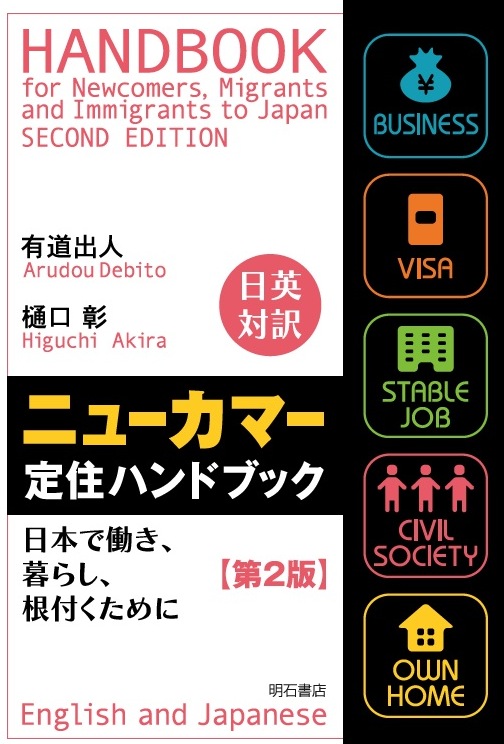
Guidebookcover.jpgjapaneseonlyebookcovertextHandbook for Newcomers, Migrants, and Immigrants to Japan「ジャパニーズ・オンリー 小樽入浴拒否問題と人種差別」(明石書店)sourstrawberriesavatardebitopodcastthumbFodorsJapan2014cover
UPDATES ON TWITTER: arudoudebito
DEBITO.ORG PODCASTS on iTunes, subscribe free
“LIKE” US on Facebook at http://www.facebook.com/debitoorg
https://www.facebook.com/embeddedrcsmJapan
http://www.facebook.com/handbookimmigrants
https://www.facebook.com/JapaneseOnlyTheBook
https://www.facebook.com/BookInAppropriate
If you like what you read and discuss on Debito.org, please consider helping us stop hackers and defray maintenance costs with a little donation via my webhoster:
Donate towards my web hosting bill!
All donations go towards website costs only. Thanks for your support!

Hi Blog.  I write Debito.org SNA “Visible Minorities” columns once a month (SNA website here) and send Debito.org Newsletters to subscribers sporadically.  After sending, I archive them here, and below, Debito.org Readers have been adding recent issues and articles that concern them regardless of the content of the post over the past several years.  It’s been a good way to allow Readers to be heard and engaged.

I still put out Debito.org Newsletters, but since I’m only posting on Debito.org approximately once a month, there’s only one article to repost (my SNA column), and I have it here as Debito.org post anyway.  So it’d only be a repeat if I dedicated another post to the Newsletter.

But I don’t want to deprive Readers of a forum, so let me continue this “Issues of Concern” section (still categorized under “Newsletters”) and let it be a free space for articles and comments germane to the mission of Debito.org.

Past “Issues of Concern” pages are getting filled with comments that are running farther afield than the original title, so let’s create a new one now.

Thanks as always for reading and contributing to Debito.org.  Debito Arudou, Ph.D.
======================
Do you like what you read on Debito.org?  Want to help keep the archive active and support Debito.org’s activities?  Please consider donating a little something.  More details here. Or if you prefer something less complicated, just click on an advertisement below.

20 comments on “DEBITO.ORG READERS’ ISSUES OF CONCERN, SEPT 2026”

    • Japan is in place 117

      In 2025, they were 118th, so…progress??

      The real tell is that both South Korea AND the PRC are *ahead* of Japan. Ouch!

      Reply
  • No doubt this is being done to alleviate a severe pilot shortage…oh, wait:

    Eligible jobs in the sector would include airport ground handling, such as cargo loading.

    So, more of the same — NJ workers = infrastructure, not participants in society; if the J-Gov is ‘lucky’, JAL’s ground handling operation robots will save the day and make the gaijin version redundant.

    Japan plans to add aviation sector to new foreign worker program

    The Japanese government has proposed adding the aviation sector to its new foreign-worker training and employment program set to start in April 2027, as the country seeks to secure labor in industries facing severe worker shortages.

    The planned expansion, presented to a panel of experts, would bring the number of industries covered by the program to 18, already including nursing care, agriculture and accommodation. The government hopes to approve the framework at a cabinet meeting in December.

    The Employment for Skill Development program, which will replace the country’s controversial technical intern training program for foreigners, encourages foreign workers to transition to the Specified Skilled Worker status after working for three years in principle, allowing them to work in Japan for longer periods.

    The government would allocate 300 of the 4,900 slots available in the aviation sector under the Type I Specified Skilled Worker status to the new program, according to the Immigration Services Agency.

    Eligible jobs in the sector would include airport ground handling, such as cargo loading.

    The panel also discussed the food service sector, where the government has effectively halted new admissions under the Type I Specified Skilled Worker program since April as the number of workers nears the 50,000 cap.

    The suspension has forced some businesses to revise plans to hire foreign workers, raising concerns about labor shortages in the industry.

    The government said it had seen “no major change in economic conditions” warranting a higher limit and will maintain the current quota of 50,000 workers through the end of fiscal 2028.

    The restriction was introduced after the number of foreign workers with Type I status in the food service industry reached roughly 46,000 at the end of February.

    Reply
    • Little tangent, but I’m an aviation enthusiast with some pilot friends. JAL and ANA used to hire plenty of foreign pilots from the US and Australia (if anyone freqquently flew with them, you maybe noticed a native English speaker making an announcement from the cockpit from time to time), but then they were all fired in 2008 due to the economic crisis. Then they hired them again between 2012-2020 but they were mostly fired again during covid. Even worse is that during the initial 6 month covid ban on all foreigners in 2020, foreign pilots who flew into a foreign country before April1st couldn’t return to Japan after the ban went into effect. These people worked for and flew hundreds of people as representatives of two Japanese flag carriers, but the government denied them to return HOME on these same flights, whether on duty or as passengers.

      So yeah, even if you get hired, you’ll alwqys be the “gaijin” who will be let go immediately if there’s any trouble.

      Reply
  • This is a sign of the times: the J-Gov is in such dire straits that it is considering having NJ workers guard a society that has not fully agreed to include them!:

    Japan police panel starts talks to allow more foreign security workers

    Japan’s police agency on Wednesday launched an expert panel to consider allowing more foreign nationals to work in the private-sector security service industry as it struggles with labor shortages and an aging workforce.

    The National Police Agency said the panel will examine whether people with Specified Skilled Worker or Employment for Skill Development status should be allowed to take security jobs.

    Under current rules, foreign nationals can work in the industry only if they hold certain residence statuses, such as long-term resident status.

    “The labor shortage in the security industry is particularly severe,” said Yoshitaka Yamada, head of the agency’s Community Safety Bureau.

    He added that the panel, which includes university professors and representatives of industry groups, should discuss how the industry should accept foreign workers.

    The panel plans to compile a report by January 2027. Based on its recommendations, the police agency will consult the Justice Ministry and the Ministry of Health, Labor and Welfare on the details of any new framework.

    According to data cited by the Ministry of Economy, Trade and Industry, the job-to-applicant ratio for security-related occupations stood at 6.55 in 2025, meaning there were 655 openings for every 100 job seekers, compared with 112 across all occupations. In 2024, 47 percent of security guards were aged 60 or older.

    Oh, the irony!

    Reply
  • The question of whether an NJ dying of kidney failure has a right to survival assistance was deemed not worth answering by the Supreme Court:

    Top court rejects Ghanaian man’s appeal claiming discrimination

    A Ghanaian man undergoing medical treatment who had his welfare application rejected by the city of Chiba because he is a foreign national has lost his Supreme Court appeal in a lawsuit seeking to overturn the city’s decision.

    The 36-year-old, who is being treated for chronic kidney failure, had argued that the rejection of his application under the Public Assistance Act was unconstitutional. However, the Second Petty Bench of the top court ruled that the plaintiff did not have grounds for a final appeal. The decision dated Sept. 9 did not address the constitutional issue.

    Presiding Justice Mamoru Miura, a former prosecutor, was the only one of the four justices to dissent, saying the part of the Public Assistance Act that excludes foreign nationals undergoing medical treatment from eligibility for benefits is unconstitutional and invalid.

    Based on Article 25 of the Constitution, which guarantees citizens’ right to survival, the Public Assistance Act explicitly limits eligibility to Japanese nationals. In 2014, the Supreme Court held, “Foreign nationals do not have the right to receive benefits under the Public Assistance Act.”

    At the same time, as an administrative measure providing de facto protection, benefits are paid on humanitarian grounds to permanent residents and long-term residents legally staying in Japan, their spouses, special permanent residents such as Korean residents in Japan and refugees. In the monthly average for fiscal 2024, there were 47,332 recipient households headed by foreign nationals.

    The plaintiff developed severe kidney failure in 2019, and his status of residence became “Designated Activities” for medical treatment. Because he was not allowed to work, he applied for public assistance, but the city rejected the application, saying he “does not qualify as a national.”

    In its January 2024 ruling, the Chiba District Court held that “whether to include foreign nationals among those eligible for protection is within the discretion of the legislature” and found the Public Assistance Act constitutional. It dismissed the suit, saying the man’s status of residence was not covered by the administrative measure. The Tokyo High Court upheld the ruling in August 2024.

    In his dissent, Miura said, “If foreign nationals undergoing medical treatment who are unable to work cannot maintain a minimum standard of living in Japan, it is difficult for them to avoid danger to their survival.” He said foreign nationals in Japan for medical treatment should be included among those eligible for public assistance, and that the high court ruling should have been overturned and the case sent back for further proceedings.

    BTW, the ‘Ghanaian man’ in this case is Siaw Johnson Kwaku — too bad the media couldn’t be bothered to mention his actual name!

    That said, the dissenting opinion of judge Miura (a former prosecutor!) is interesting: his argument is essentially that a) treating Mr. Kwaku *worse* than a Japanese citizen in identical circumstances doesn’t serve any coherent J-Gov purpose (other than performative cruelty for performative cruelty’s sake, I suppose), and b) at some point, a person’s right to survive has to matter more than what passport they carry.

    Reply
  • This entire dust-up unfolded in 48 hours — the proposal was submitted on September 2nd and summarily rejected on September 4th!:

    Foundation suggests hiring foreigners for shrinking SDF

    An influential private research institution called on the Defense Ministry to consider recruiting foreign nationals to fill the depleting ranks of the Self-Defense Forces.

    A study team at the Sasakawa Peace Foundation submitted the proposal to Defense Minister Shinjiro Koizumi on Sept. 2.

    The team included former defense officials, such as Tetsuro Kuroe, a former vice defense minister, and Koji Yamazaki, a former chief of staff of the Joint Staff.

    The proposal said an expansion of SDF recruitment should be included in the three key national security-related documents that will be revised this year.

    “Anything necessary should be included in the revisions,” Yamazaki told reporters about the proposal.

    Kuroe and Yamazaki also serve on an expert panel that advises the government on revisions to the three security-related documents.

    The Defense Ministry in recent years has been struggling to recruit members for the SDF. Japan’s continuing population decline is expected to exacerbate the problem.

    The Sasakawa Peace Foundation’s proposal noted that Australia allows foreign nationals from such countries as New Zealand, the United States and Britain to enter its military.

    “The time has come to consider the possibility of recruiting foreign nationals as SDF personnel,” it said.

    The proposal also said such recruitment should be limited to nationals from allied or like-minded countries.

    In addition, the foundation proposed the establishment of new legal frameworks to repair and enhance production of defense equipment in emergency situations.

    Japan not considering letting foreign nationals serve in Self-Defense Forces: minister

    Japanese Defense Minister Shinjiro Koizumi said at a news conference on Sept. 4 that the government is not considering recruiting foreign nationals into the Self-Defense Forces (SDF).

    Noting that only Japanese nationals are eligible to apply for positions in the SDF, Koizumi said, “Securing personnel is a major challenge amid the declining birth rate and aging population, but our first and foremost priority must be those who are already serving.”

    He indicated that improving conditions for active-duty SDF personnel would be his top priority.

    Koizumi also said he had instructed Defense Ministry officials to consider a comprehensive review of work practices. “It is extremely important to harness technology, including artificial intelligence, to improve productivity,” he said.

    The issue arose after the Sasakawa Peace Foundation submitted a set of recommendations on Sept. 2 aimed at strengthening the personnel base underpinning Japan’s defense capabilities. To address SDF personnel shortages caused by the country’s declining population, the foundation recommended considering the recruitment of foreign nationals. The proposals were presented directly to Koizumi at the Defense Ministry.

    The ‘expert’ comment at the end of the Japanese article is enlightening; first the article:

    自衛隊への外国人登用「考えていない」 小泉防衛相、会見で否定

    小泉進次郎防衛相は4日の記者会見で、自衛隊への外国人の登用について問われ、「考えていない」と否定した。笹川平和財団が、自衛隊のなり手不足を解消するため外国人の登用の検討などを求める提言を2日に小泉氏に提出していた。

    小泉氏は会見で、自衛官の応募資格は日本国籍の保有者に限っているとし、「少子高齢化の中で人材確保は大きな課題だが、何よりも優先すべきことは今いる人だ」と発言。処遇改善や、AI(人工知能)などを活用した生産性の向上、「退職自衛隊員・家族支援庁」(仮称)の新設による退職後のキャリア支援の充実などを進める考えを示した。

    笹川平和財団の提言は、黒江哲郎・元防衛事務次官や山崎幸二・元統合幕僚長らがとりまとめた。将来にわたって人口減少が続くなか、「(外国人登用の)可能性について真摯(しんし)に検討すべき時期に来ている」としていた。

    Now for the comment:

    佐藤優作家・元外務省主任分析官小泉進次郎防衛相の判断はまっとうです。外国人を自衛官として登用することは、自衛隊の内部に事実上の傭兵部隊をつくることにつながります。自衛隊は単なる労働力の集合体ではなく…

    I’m going to let Claude Sonnet 4.6 do the translation while I shoulder surf for accuracy:

    Satō MasaruAuthor / Former Senior Analyst, Ministry of Foreign Affairs

    The judgment of Defense Minister Koizumi Shinjirō is sound. Recruiting foreigners as Self-Defense Force personnel would effectively lead to the creation of a mercenary unit within the SDF. The Self-Defense Forces are not merely a collection of labor...

    “Australia allows foreign nationals from such countries as New Zealand, the United States and Britain to enter its military.” So, according to Satō Masaru, these individuals are mercenaries in the Australian armed forces, right?! Well, the SDF certainly can’t have mercenaries in its ranks — after all, “the Self-Defense Forces are not merely a collection of labor!”

    Reply
    • The US already offers service as a path to citizenship, as do many other nations.
      I think the idea of armed NJ is just aneurism inducing for many Japanese. Which is a shame, because such NJ would be a part of the economy, and learning skills within the SDF that could benefit Japanese civilian society when they end their military service.

      But Japan won’t do it.

      So as the population shrinks and the pool of potential Japanese manpower evaporates, Japanese tax payers will be obliged to increasingly pay higher amounts to the US military-industrial complex to ensure their safety (or not- allies ain’t what they used to be).

      Reply
  • 2040 is fast-approaching and the population of geiatric wajin keeps breaking records:

    Japan elderly population hits fresh high at 29.4%: 2025 census

    TOKYO – People aged 65 and over account for a record-high 29.4 percent of Japan’s population, the finalized 2025 census results showed Tuesday, 0.9 percentage point higher than in the previous survey in 2020 and underscoring the rapidly graying society.

    The population of Japan, including foreign residents, fell by 3.17 million, or 2.5 percent, to 122,972,528 as of Oct. 1 last year. The latest census data comes amid questions over the credibility of what the government views as “the most important statistics,” after a city in central Japan faced allegations of overstating its population by several thousand.

    As in the preliminary results, the census data showed that the total population declined for the third straight survey and that 30.1 percent of the population was concentrated in the Tokyo metropolitan area, crossing the 30 percent threshold for the first time.

    The number of foreign residents continued to increase, hitting a record 3,840,039, up 1,093,525, or 39.8 percent, from 2020, with increases in Vietnamese and Nepalese residents among those contributing to the rise.

    As for the population aged 65 and above, such residents accounted for 40.0 percent of Akita Prefecture’s population in northeastern Japan, up 2.5 percentage points from 2020 and the highest ratio among Japan’s 47 prefectures for the fourth consecutive survey since 2010.

    Kochi in western Japan followed at 36.9 percent and Aomori in northeastern Japan at 36.3 percent. The lowest was Tokyo at 22.8 percent.

    The census, which started in 1920, has been conducted every five years and has served as a fundamental source of data for the central and local governments in formulating measures to address the falling birthrate and promote industrial development. The data are also used for purposes such as drawing boundaries for House of Representatives single-seat constituencies.

    The reliability of the latest census has come under scrutiny, however, as the city of Toyama is suspected to have overreported its population by at least 2,000 people in the 2025 census, according to the internal affairs ministry.

    The padding was allegedly conducted by rewriting survey sheets and likely involved multiple city officials, the ministry said. They are suspected of deciding, without any specific evidence, not to treat census takers’ reports of no signs of habitation at properties as indicating that no household was present.

    The Ministry of Internal Affairs and Communications on Tuesday filed a complaint with Toyama police against an unidentified city official for allegedly violating the Statistics Act in connection with the overreporting. It is the first time that the ministry has taken such action in connection with a census.

    In the census data announced Tuesday, the city’s population stood at 399,197, which was 2,936 fewer than the preliminary figure announced in May.

    Officials at the internal ministry’s Statistics Bureau visited Toyama in September three times after doubts emerged over the figure.

    So, the J-Gov addressing the issue by importing foreign medical professionals en masse and providing them with a pathway to naturalization so that they stay for the long haul, right?

    LOL, of course not! The ‘solution’ was (and still is) robots, but now AI has joined the conversation!:

    70% in Japan positive about AI use in medical, health care sectors

    TOKYO – Over 70 percent of people in Japan are positive about the introduction of cutting-edge technology such as artificial intelligence and robots in the medical and health care sectors, a government study showed Tuesday.

    The study, released in the Ministry of Health, Labor and Welfare’s annual white paper, emphasized the “importance of improving efficiency and productivity by incorporating technology” by around 2040, when Japan’s elderly population aged 65 and above is expected to peak, amid worsening shortages of doctors, nurses and care workers.

    In the online survey, 72.4 percent of respondents agreed or somewhat agreed with the use of AI to assist doctors’ diagnoses, while 73.7 percent endorsed the use of robots to facilitate communication between caregivers and care recipients.

    Meanwhile, 74.5 percent said they felt or felt somewhat anxious about a labor shortage in medical care, while 81.3 percent said so for nursing care.

    The survey was conducted in January and February among residents of Japan aged 20 to 74 and received 3,000 valid responses.

    If this ‘solution’ sounds familiar, it’s because it is: Kōrō-shō and Bōei-shō are using the same J-Gov playbook of ‘it is extremely important to harness AI / advanced technology to improve productivity / efficiency’ — take a look at my comment here and you’ll see that Koizumi’s remark about no NJs in the SDF is almost a word-for-word copy-paste!

    Reply
  • I think the idea of armed NJ is just aneurism inducing for many Japanese.

    Can you imagine: gaijin with guns?!

    Anyone in the J-Gov, if you’re reading this comment, and want to float a policy trial balloon, suggest a new work visa category for bear culling, OK? LOL!

    Reply
  • When Japanese do it it’s not a problem, but when the NJ do it, it’s the pretext for a whole new law?
    People are buying new condos in Tokyo to flip them for profit.
    12.1% of new condos flipped in a year, driving up prices. Like concert ticket scalpers.
    5.9% of total condo purchases (flipped or not) were made by people (including J-nationals) with addresses out side of Japan.
    So sure, let’s frame this whole debate as ‘Tokyo condo prices are too high because of all the NJ speculative purchases’.🙄

    https://www.japantimes.co.jp/news/2026/10/01/japan/politics/ldp-condo-speculative-trading/

    They don’t want you living here and buying things, they don’t want you living elsewhere and buying things here.

    Decades of electorate endorsed LDP mismanagement has driven quality of life in Japan for so many, so low, that they will do themselves economic harm for the mere feeling of sticking it to the NJ.

    Reply
    • “Speculative transactions that are not based on actual demand should be restricted, regardless of whether they are conducted by Japanese or foreign nationals.”

      What we have here IMO is something arguably worse than the nationality clause / kokuseki jōkō / 国籍条項 — it’s what I’m calling the ‘regardless of nationality clause’ / kokuseki jōkō ni kakawarazu / 国籍条項にかかわらず: the proposal applies to everyone, you see, so it can’t possibly be discriminatory!

      Never mind the fact that it was drafted by a ‘project team’ under the Headquarters for Foreign Nationals Policy!

      Never mind the fact that unverified public perception is laundered into an official document thereby conveying legitimacy!

      Never mind the fact that the proposal references Singapore (i.e., a country which restricts not just speculative buyers, but all foreign buyers from purchasing most residential properties outright with additional stamp duties on top; references here, here, here)!

      Never mind that the proposal is delivered to PM Baka Ichi (i.e., PM of electoral coalition with significant anti-NJ energy)!

      Reply
  • Kyoto city to charge visitors more for taking public buses.

    Under the proposal, the current 230-yen ($1.50) flat fare for buses in the city center would be raised to between 350 yen and 400 yen for non-residents, while residents would pay a reduced rate of 200 yen.

    “Priority pricing will also be introduced in the city’s “adjusted-fare zones,” where prices vary by distance, although specific fares are still under consideration.

    A key hurdle for the bus pricing policy was the Road Transport Law, which prohibits “unjust discriminatory treatment” of passengers.

    The city has been consulting with the transport ministry on the matter since Matsui’s election in February 2024 and believes the proposal clears this legal requirement.

    City authorities concede, however, that the new fares are unlikely to alleviate congestion.

    The primary goal, they said, is to appease frustrated residents by having tourists bear a greater share of the financial burden.”

    So they just admit that it’s performative cruelty and serves no other purpose lol.

    https://www.asahi.com/ajw/articles/16378614

    Well at least these Kyoto city racists are honest.

    Reply
    • AI is only as good as the data set you give it.

      …and Baka Ichi says the J-Gov will compile an action plan to spread the use of AI — how is *this* going to negatively impact NJ lives?? First the the article, then I look into my crystal ball:

      Prime Minister Sanae Takaichi said Thursday that the government will draw up an action plan by the end of the year to promote the use of artificial intelligence, which she regards as an accelerator for economic growth.

      “The societal implementation of high-performance AI is essential for realizing the government’s growth strategy,” Takaichi said at a meeting of the Council for Japan’s Growth Strategy.

      She instructed relevant Cabinet ministers to compile a concrete vision for AI utilization, as well as regulatory and institutional reforms.

      At the meeting, participants discussed a growth strategy implementation program to be compiled at year-end alongside the government’s budget proposal for fiscal 2027.

      Takaichi said her government will designate the five years starting next April as an intensive period to promote public and private investment in 17 strategic sectors, including AI and semiconductors, and include priority sectors and investment amounts in the program.

      In the priority sectors, projects that are expected to effectively boost the potential growth rate will be identified based on factors such as profitability and ripple effects.

      To provide predictability for private-sector companies, the government will also clarify budgetary measures spanning multiple fiscal years.

      The government plans to manage sectors of particular importance to economic security separately in a special account, contingent on projects that contribute to ensuring “autonomy of the socioeconomic structure,” “competitive advantage over other countries and regions” and “indispensability to the international community.”

      Takaichi also instructed Cabinet ministers to compile a policy package aimed at resolving labor shortages in the construction sector, which could hinder growth-oriented investment.

      Looking into the future…

      • “Economic security” special account + “Autonomy of socioeconomic structure” = NJ will be restricted / excluded based on economic / national security grounds.

      • “Competitive advantage over other countries” = Any NJs actually working in AI (and more broadly, tech sectors) will be framed as security risks.

      Reply
      • ‘By the end of the year’🙄
        Never going to happen.
        She’s been PM for a year and she’s been promising to reduce consumption tax for a year.

        Reply
  • Another entry in nijonron mythology. Japanese business professors argue that US managment of companies would not work in Japan because America is an artificial nation formed by immigrants , while Japan is a naturally formed ethnostate.

    https://president.jp/articles/-/119901?page=1

    Let’s ignore the part where they ignore the existence of NJ and mixed race Japanese people like “hafu” etc., it’s unfortunately “normal” in Japan and I don’t really care to comment. BUT it’s amazing to me how they claim that Japan is a “natural” nation state. I don’t even understand what this means since all nation states are only a human invention, it’s not like they occur naturally. Do these people really think that the Kojiki is a historic account and that Japan was created by Gods? These people are supposed to be academics?

    Reply
  • Takaichi just went on a sexist rant in the Diet about how she needs an extra 3-4 hours per day due to cooking, cleaning, etc. so she doesn’t have as much time to be in the Diet.

    https://x.com/mrjeffu/status/2110335819307434296?s=46&t=IzAIE8zz8O3iUXFc2Hpuew

    Yeah, my heart breaks for her. This goes back to the discussion we had here when she was elected, ie. that she’s overcompensating because she’s a woman. She’s cruel towards NJ and escalating things with China because she has to prove that she’s just as right wing as her mentor Abe.

    Reply
    • 3-4 hours a day housework?
      With zero kids in the house?
      And a grown-ass husband who could get off his butt and help her while she’s trying to, uh, I dunno, RUN THE COUNTRY!?!?
      Yeah, she’s making herself look like an incompetent with poor time-management skills when she should be attacking Japan’s gender inequality.
      But she can’t because she’s a Japanese conservative. It’s like watching Stockholm syndrome or something.

      Reply

Leave a Reply

Your email address will not be published. Required fields are marked *

You may use these HTML tags and attributes: <a href="" title=""> <abbr title=""> <acronym title=""> <b> <blockquote cite=""> <cite> <code> <del datetime=""> <em> <i> <q cite=""> <s> <strike> <strong>