WHAT TO DO IF...
www.debito.org
WHAT
TO DO IF...
A quick
guide to important info sites on Debito.org
(Version
1.28)
This page is designed for people who need help with a situation in
Japan, and want a quick guide to information sites on debito.org or
elsewhere. Click on a link to page down.
WHAT
TO DO IF...
...you are
asked for your "Gaijin Card".
...you are
asked for your "Gaijin Card" by your employer(s).
...you
are stopped by the Japanese police.
NEW!
...you are stopped by the
Japanese police for a urine sample (drug test).
...you
are arrested by the Japanese police.
...you
overstay your visa.
...you see
a "Japanese Only" sign.
...you
are refused service at a business catering to the general
public.
...you
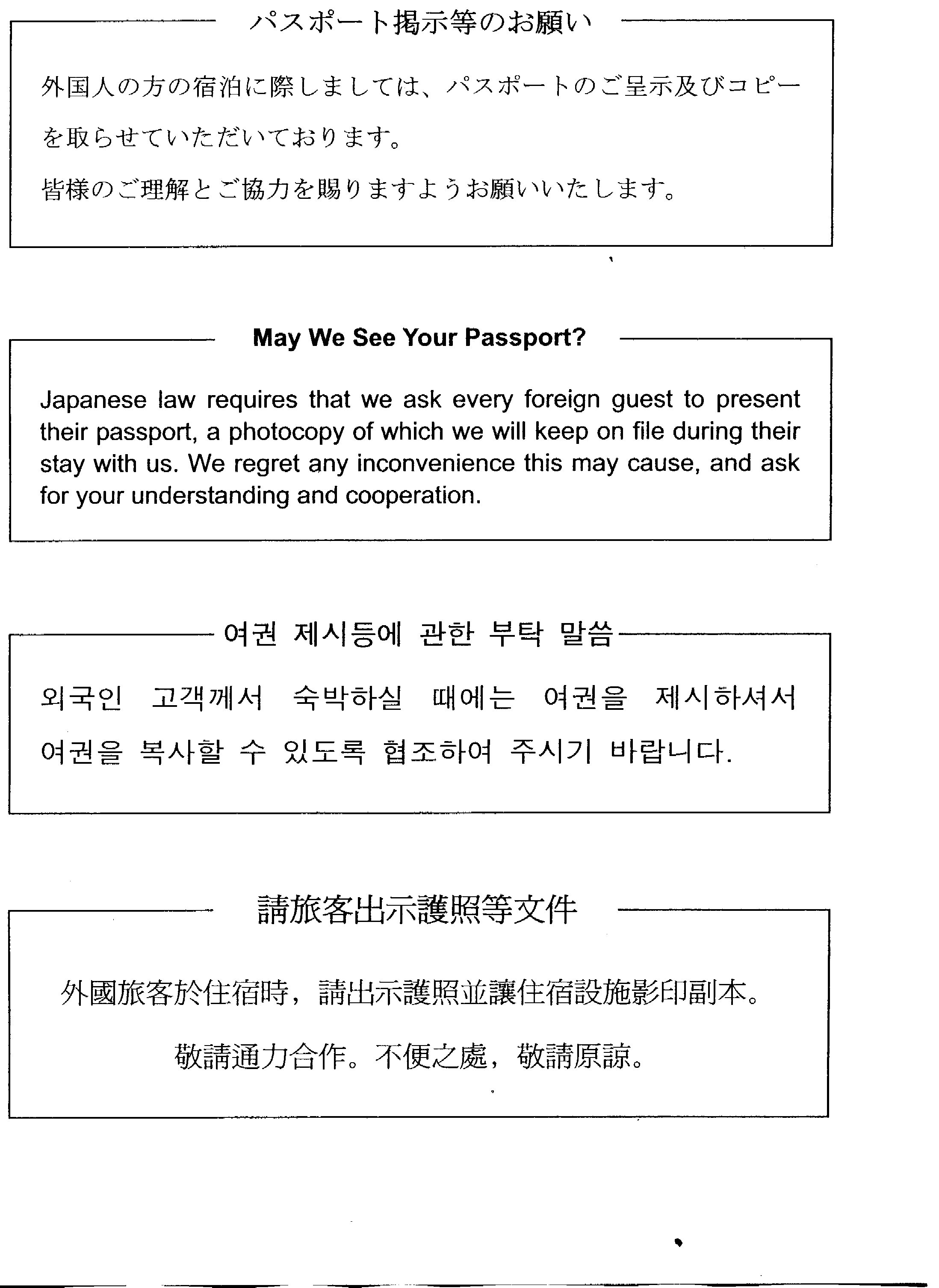
are asked for your passport number at a
hotel, despite having an address in Japan.
...you
are refused service at a hotel.
...you
want to protest something you see as discriminatory.
...you
want to take somebody to court.
...you are
being threatened with eviction from your apartment.
...you
want to get your deposit (shikin)
back from your landlord when moving out.
...you
want to get a job (or a better job) in Japanese academia.
...you
are having a labor dispute in the workplace.
...you
are swindled in a business deal.
...you
need a lawyer.
...you want
to get Permanent Residency (eijuuken).
...you
want to become a Japanese citizen.
...you want
to register your name in kanji.
...your child
is being singled out for "looking different" in Japanese
school.
...you want to run for
office.
...you want to
build a house.
...you want to
get a divorce.
...you want
to do some awareness raising.
...various extraneous bits of advice from people in the know
courtesy of the Japan Times, September 25, 2007, regarding union
support, unpaid wages, Immigration/Visas and employment,
redundancies, and unemployment insurance.
Note that
these links are not exhaustive. There is lots more on the
www.debito.org site and
Debito.org Blog,
so surf around and see what you can get. To use a search engine:
Access Google, type in www.debito.org (I have it at the top of all of
my pages), and then the keyword you are looking for.
You
can also get more concise, thorough, updated, and portable
information on these and other topics (such as how to write a Last
Will and Testament, how to found your own company, what sort of visas
are out there and which one is best for your circumstances, etc.) in
our new HANDBOOK FOR NEWBOOK FOR
NEWCOMERS, MIGRANTS, AND IMMIGRANTS TO JAPAN, pubished by
Akashi Shoten in March 2008, with English and Japanese on
corresponding pages. More details on
what the book is about, what reviewers have said about it, and how to
order it here.
Hope this helps! Arudou Debito in Sapporo
WHAT
TO DO IF...
...you are asked for your "Gaijin
Card".
(the gaikokujin touroku shoumeisho, the
wallet-sized card you get from the local Ward Office when you
initially register in Japan):
It depends who's asking.
Legally, nobody can ask for it unless they have been endowed with
police powers by the Ministry of Justice. Yes, that means hotels,
video store clerks, sports clubs, and JR platform attendants legally
cannot demand it as a condition for providing service.
Of
course, many situations need ID when customer accountability is a
must--like, say, before renting out equipment. If you have another
form of ID (such as a Japanese driver licence), show it instead.
Basically, you should request to show the same form of ID being
demanded from regular Japanese customers.
If you have no
other form of ID and you're willing to show the Gaijin Card--go right
ahead. That's your prerogative (that is, if you don't mind it being
photocopied and all that). But if you do have suitable ID which
should suffice, there is no reason for you to have to show the Gaijin
Card in addition. The business's reason for asking for it may
surprise you--some places, such as sports
clubs and hotels, claim that the
police have asked them specially to be on the lookout for visa
overstayers or terrorists. However, this de facto deputizing of the
general public for Gaijin Card Checks is illegal and you are under no
obligation whatsoever to cooperate with it.
Letter of the law
on who can ask for the Gaijin Card:
http://
www.debito.org/residentspage.html#checkpoints
Japan Times
article on this (July 27, 2004):
http://www.debito.org/
japantimes072704.html
More on this from Olaf Karthaus (Report,
January 19, 2005)
at
http://www.debito.org/olafongaijincarding.html
Download
wallet-sized version of text of laws regarding Gaijin Card Checks
here (pdf format)
Download
color-coded wallet-sized version of text of laws regarding Gaijin
Card Checks here (pdf format)
By the way, carry the Gaijin Card on your person at all times. If you're caught without it, it is a criminal offense in Japan, meaning you can be arrested. More on that in HANDBOOK and immediately below.
WHAT
TO DO IF...
...you are asked for your "Gaijin
Card" by your employer(s)
As of October 1, 2007, with the promulgation of the Employment Policy Law (Koyou Taisaku Hou), all non-Japanese workers, excepting people with "Special Permanent Residency" (i.e. the Zainichi generational "foreign" ethnic Koreans, Chinese etc.) and people here on special invitation of the Japanese government (such as Diplomats), must have their visas "checked" (kakunin) by their employers and reported to "Hello Work", the Ministry of Health, Labour and Welfare's local unemployment office. Failure to do so may result in a fine of up to 300,000 yen.
However, as reported in a Japan Times article (Zeit Gist Community Page November 13, 2007), this is being used as a pretense for anyone employing a gaijin even part-time (in one case, for a bit of arubaito which amounted to 500 yen!) demanding their passports and Gaijin Cards physically submitted for photocopying.
Legally, this is unnecessary. There is nothing in the law that requires physical submission or photocopying of your passport or Gaijin Card, and you are not required to do so for part-time work. What you should do:
Under the new Employment Policy Law
(Article 28) you are under no obligation to say anything more than
what your visa status is, and that it is valid. Say you'll
present visual proof in the form of the Gaijin Card, since nothing
more is required.
If your
main employer forces you to have your IDs photocopied, point out that
the Personal Information Protection Law (Kojin
Jouhou Hokan Hou) governs
any situation when private information is demanded. Under
Article 16, you must be told the purpose of gathering this
information, and under Article 26 you may make requests to correct or
delete data that are no longer necessary.
That
means that once your visa status has been reported to Hello Work,
your company no longer needs it, and you should request your info be
returned for your disposal. Download
the law and show it to your employer.
Read a fuller description of the issue (with links to sources) and
what you can do about it in
The Japan Times, "'GAIJIN
CARD' CHECKS SPREAD AS POLICE DEPUTIZE THE NATION": Zeit
Gist Community Page November 13, 2007.
WHAT
TO DO IF...
...you are stopped by the Japanese
police.
This is happening more frequently these days, with
all the media frenzy on the alleged
rise in foreign crime. The police are targeting foreign-looking
peoples in public places--in airports,
on bicycles,
in media
campaigns, and in general--through with tax-funded Immigration
"Snitch Sites" and through DNA
racial-profiling programs in police research institutes. After a
couple of questions about where you're going and perhaps what you're
up to, many a bored or inquisitive cop will escalate into asking for
your ID. Usually demanded is either your passport (which you are not
required by law to carry if you reside in Japan--that's what the
"Gaijin Card" is for), or the Gaijin Card (see previous
heading), which you are legally required to have on your person
at all times.
What to do if you face a police Gaijin Card
checkpoint:
http://
www.debito.org/residentspage.html#checkpoints
More concise
Japan Times article on this (July 27, 2004):
http://www.debito.org/
japantimes072704.html
More at the above links, but the
gist is, you had better cooperate--or face search and seizure.
However, you may beforehand ask for the policeman's ID (you are
legally entitled to do that), and I suggest you make a record of it.
Then, if they show, you must show. Unlike citizens, Japanese police
do not need probable cause or clear suspicion of a crime in order to
stop foreigners and ask personal questions.
If you do not
cooperate, they will probably want to drag you to the station
house--which they cannot do unless they arrest you. Make sure you
know they know that. But be careful--any resistance (a sudden move or
a raised voice) means they may decide to arrest you after all, under
the Koumu'in Shikkou Bougai Hou, or the "Obstruction of a
Public Official in the course of his Duties" Law.
So be
careful. Don't get uppity. You don't want to get arrested in Japan.
See next heading for more on that.
I
recommend you print up the letter of the law and carry it around with
you.
http://
www.debito.org/instantcheckpointsbrief.html
It's not
obnoxious. It's to show the police that we know our rights and are
not just dumb gaijin that can be pushed around.
Download
wallet-sized version of text of laws regarding Gaijin Card Checks
here (pdf format)
Download
color-coded wallet-sized version of text of laws regarding Gaijin
Card Checks here (pdf format)
NEW! ...you are stopped by the Japanese police for a urine sample (drug test).
Targeting of Non-Japanese residents by the Japanese police is happening more frequently (see section immediately above). It has recently, due to the marijuana scares of 2008-2009, led to the police conducting stops and backpack/pocket searches of people on the street for knives and drugs, with NJ being singled out for urine samples.
This is in fact not permitted without a warrant. Here is the law:
Police cannot search your person, property or possessions without
a warrant. Ask for one: “Reijou ga arimasu ka?”
If
they threaten to take you to a police box for questioning, refuse and
don’t move. Police cannot force you to go anywhere without a formal
arrest (taiho).
But be careful. Do not raise your
voice. And never ever touch the cop, or they could arrest you for
“obstruction of duty.” This is why sometimes you see street
standoffs between cops and questionees during which nobody moves or
talks until somebody gets tired and goes home.
More on this in Arudou Debito, "Cops crack down with 'I pee' checks", The Japan Times: Tuesday, July 7, 2009.
WHAT
TO DO IF...
...you are arrested by the Japanese
police.
You are in for a rough time. There is no writ of
Habeas Corpus in Japan, which means Japanese police can hold you for
up to 23 days (3 days' initial interrogation, extendable by 10 days a
maximum of twice if a judge approves. Which he will--judges rarely
deny public prosecutors the privilege unless a lawyer intervenes.).
There have been cases of extraction of information (signed
confessions that detainees could not read) through physical and
mental duress (beatings, lack of sleep and basic amenities, denial of
outside communication, consular contact, or legal counsel) carried
out by chain-smoking tag-team interrogators. Detention by the
Japanese police is one of the larger nightmares you can experience in
Japan. More on this at
http://www.debito.org/TheCommunity/communityissues.html#detention
Japanese
criminal law tends towards the Napoleonic (i.e. a suspect is presumed
guilty, and must prove his innocence). If you do not continuously
assert your innocence, you will become a pelt. Moreover, the right to
remain silent (which is, by the way, guaranteed in the Japanese
Constitution) will only arouse more suspicion. So answer questions,
be cooperative, calm, and friendly, but DON'T SIGN ANYTHING WITHOUT
LEGAL COUNSEL. Get a lawyer or suffer the consequences.
Information
on how to get legal counsel (ask for the Lawyer on Duty, or touban
bengoshi) from the Japan Bar Association (Nichibenren, in
English):
http://
www.nichibenren.or.jp/en/index.html
http://
www.nichibenren.or.jp/en/legal/arrest_01.html
http://
www.nichibenren.or.jp/en/legal/arrest_02.html
Also, unless
you are fully bilingual in Japanese, I suggest you continue to
communicate in your native tongue if under a serious interrogation.
Demand that you receive an interpreter.
Hold out for one. For if the police feel that your Japanese is
sufficient to commuicate in Japanese, they will treat you like any
other Japanese suspect, language barrier or not. Don't think that
speaking in pidgin Japanese is being cooperative--because there have
been many cases of interrogatees being railroaded into situations
without their full understanding. More on interpretation problems (in
Japanese courtrooms, not police interrogations, but it is still
symptomatic of the lack of balance between justice vs prosecution
exigency)
at
http://www.debito.org/TheCommunity/communityissues.html#courtinterp
Most
importantly, DO NOT SIGN ANY CONFESSION
(kyoujutsu chousho), no matter what your interrogators
promise. Or you will go to jail. Confession (jihaku) equals
conviction in Japan. Full stop. It will NOT be overturned later in
court.
Remember that many times, these interrogations are done
without arrest, as a "voluntary investigation" (nin'i no
tori shirabe)--which means you are technically able to leave at
any time. But if you just try to get up and leave before the cops'
suspicions are allayed, they will just formally arrest you for the
crime of Koumu'in Shikkou Bougai ("Obstruction of a
Public Official in the course of his Duties"). Time it right.
But make sure you confirm whether or not you have in fact been
arrested (Ask: watashi wa taiho sarete imasu ka) and on what
charge (Ask: donna yougi de taiho sarete imasu ka).
More substantiation of these claims here:
JAPANESE
JUSTICE: CONFESS AND BE DONE WITH IT: The Economist
(London), Feb 8th
2007
http://www.debito.org/index.php/?p=217
http://www.economist.com/world/asia/displaystory.cfm?story_id=8680941
Japan
Times Oct. 13, 2005: Justice system flawed by presumed
guilt
Rights advocates slam interrogation without counsel, long
detentions
An excellent summary from the Japan Times on what's
wrong with Japan's criminal justice system: To wit:
presumption of guilt, extreme police powers of detention,
jurisprudential incentives for using them, lack of transparency,
records or accountability during investigation, and a successful
outcome of a case hinging on arrest and conviction, not necessarily
on proving guilt or innocence. This has long since reached an
extreme: almost anything that goes to trial in a Japanese
criminal court results in a
conviction.
http://www.debito.org/japantimes102305detentions.html
According
to SUO Masayuki, director of 2007 film "I Just Didn't Do it"
(sore de mo boku wa yatteinai)
(http://en.wikipedia.org/wiki/Masayuki_Suo),
the best thing to do is have a lawyer (get one, like a family doctor)
contactable before you get taken into custody. Put one on your
cellphone. You will need the support, because otherwise with
the interrogative process in Japan, you will wink out from contact
with the outside world for weeks at a time with nobody the wiser
about what's going on, as the Suo movie demonstrates so powerfully.
More information at http://www.debito.org/activistspage.html#checkpoints
Final word: the Japanese criminal justice system, with conviction rates at nearly 100%, is overwhelmingly stacked against the accused. So don't get arrested in Japan.
WHAT
TO DO IF...
...you overstay your visa.
In
a word: DON'T. Because chances are you will have a hard time
remaining in or coming back to Japan again.
Draconian visa
procedures are happening more frequently these days with all the
media frenzy on the alleged
rise in foreign crime. The police are targeting foreign-looking
peoples, in airports,
on bicycles,
in media
campaigns, and in general--even with tax-funded Immigration
"Snitch Sites" and DNA
racial profiling programs in police crime research institutes.
Which means that, chances are, you are more likely to be caught now
than ever before.
If you overstay, you will likely be treated
like a hardened criminal: put into indefinite detention, if not
kicked out quite summarily, fined quite stiffly, and barred from
reentry for up to a decade. Too bad if you have a job, a family, or
any assets or responsibilities left behind in Japan.
Going
down to Immigration to come clean about your mistake may only mean
you getting extradited faster. Even if they treat you leniently, you
will have to come back to Immigration all over again at a future
date--without Immigration giving you any stamped proof in your
passport that your pending visa is being processed. Woe betide you if
you get stopped by the cops on the street in the interim...
So
write your visa expiry date in red letters in your schedulebook,
tattoo it on your nose, whatever. The Japanese press and the police
have convinced the public that most foreign crime is committed by
overstayers, so don't become one.
More information
at
http://www.debito.org/
japantimes062904.html (Japan Times, June 29, 2004) with more
detailed article at
http://www.debito.org
/japanvisapunishments.html
Some examples of people caught
in the crackdown (Japan Times, May 18,
2004)
http://www.japantimes.co.jp/cgi-bin/getarticle.pl5?fl20040518zg.htm
Trivia:
If you're going to Tokyo Immigration in Konan--remember that the 7th
floor is the "Floor of No Return"...
WHAT
TO DO IF...
...you see a "Japanese Only"
sign. (i.e. a notice put up by a business excluding entry to
foreigners)
Take a picture of it, plus a second one with the
storefront, and send it to me.
I collect them for The Rogues' Gallery
website.
http://www.debito.org/roguesgallery.html
Please
give me a date and approximate place and I will do the rest. It's all
evidence to show that signposted exclusionism is getting worse in
Japan.
If you're really ambitious and want to get the sign
down yourself (go for it!):
You can ask the manager (calmly)
why the sign is up, explain (calmly) why you think the sign should
not be up, and offer to write out a non-exclusionary one in your
native language. Usually these places have experienced communication
problems with "foreign-looking" customers in the past (even
though most managers admit that even Japanese customers transgress),
and think it's a problem with culture when it may in fact be a
problem with making rules and sanctions clear.
You can also contact the local Bureau of Human Rights (Jinken Yougobu) in the Ministry of Justice (Houmukyoku), found in most cities. Visit their offices and tell them what happened. Functionaries may contact the discriminator (if they think you have a case) and tell them to knock it off (called keihatsu (enlightenment) in the bureaucratspeak). They cannot, however, force discriminators to desist, sic the police on them, or refer it to a courtroom--all they can do is frown at them a lot and send a strongly-worded letter. However, a call from a government ministry has scared many a discriminator into taking a sign down. Just don't get your hopes up. More on the limitations of the BOHR in a Japan Times article (July 8, 2003):
http://www.debito.org/japantimes070803.html
If you think you will need third-party intervention (i.e. a
lawyer), consider the steps outlined in the following Japan Times
article (November 30,
2004):
http://www.debito.org/japantimes113004.html That's
what my friends and I have done in the past. See how we fared (with
some successes and failures) by following links to reports from the
abovementioned Rogues' Gallery. Or
read my book "JAPANESE ONLY"
(Akashi Shoten Inc. 2004). More
information on the book here. Also see section immediately
following.
That's
what my friends and I have done in the past. See how we fared (with
some successes and failures) by following links to reports from the
abovementioned Rogues' Gallery. Or
read my book "JAPANESE ONLY"
(Akashi Shoten Inc. 2004). More
information on the book here. Also see section immediately
following.
WHAT
TO DO IF...
...you are refused service at a business
catering to the general public.
Ask the management why.
Then if you are given a reason you find unconvincing or just plain
racist, read the steps outlined in the following Japan Times article
(November 30, 2004) in order to consider further
action:
http://www.debito.org/japantimes113004.html
But
a word of caution before you go off half-cocked: If management
requires shoes and shirt from everybody for service, put on the shoes
and shirt. If it is a matter of refusing people with tattoos (which
is unfortunate for you--you chose to get tattooed, and in Japan it
carries the image of organized crime), ask if covering up the
offending area would suffice for entry. If not, sorry, but you're
going to have to live with the fact that Japanese society considers a
tattoo a branding. It's not an issue of race here.
If it is,
however, a matter of having the wrong skin color, then there is a
problem caused by something that you were born with, something you
cannot do anything about--which makes it no longer a matter of
volition or free will.
Remember that businesses indeed do have
the right to choose their customers. It depends entirely upon what
criteria their choice is made. By race or physical appearance is not
acceptable--which is why there is an international
treaty against it (which Japan signed in 1995).
However,
bear in mind that racial discrimination is still not an illegal
activity in Japan (it is indeed unconstitutional, but not
illegal--due to the fact that there are no laws on the books to ban
it). So complaining to the cops will occasion nothing.
You
can, however, visit the local Bureau of Human Rights (Jinken Yougo
Bu) in the Ministry of Justice (Houmushou). If the
bureaucrats think you have a reasonable complaint, they will send a
functionary to "enlighten" (keihatsu) the
discriminator. However, the BOHR is limited in its ability to
actually force the discriminator to cease and desist (they cannot,
for example, have the business's operating licence suspended), as
witnessed in these cases recorded in the Japan Times (July 8,
2003):
http://www.debito.org/japantimes070803.html
and
catalogued here:
http://www.debito.org/policeapology.html
However,
a call from the BOHR has scared some discriminators into taking down
their "JAPANESE ONLY" signs, so it's worth a try.
See:
http://www.debito.org/misawaexclusions.html
Don't
expect your embassy or consulate to assist you in this. They will
only intervene in the case of an arrest, not to help you claim your
rights protected (or not) by domestic laws.More
on this in my book "JAPANESE ONLY"
(Akashi Shoten Inc. 2004). Information
about the book here.
And if there is a bonafide "NO
FOREIGNERS" sign displayed, contact me to put it
up on the Rogues' Gallery.
WHAT
TO DO IF...
...you are asked for your passport
number at a hotel, despite having an address in Japan.
Hotels nationwide have been erroneously informed by the Japanese government (the Ministry of Health, Labor, and Welfare) that laws now require all foreign hotel guests to display their passports and have them copied for police use (in the name of, quoting the Ministry of Foreign Affairs website, "effective prevention of contagious diseases and terrorism", as if this only applies to foreigners).
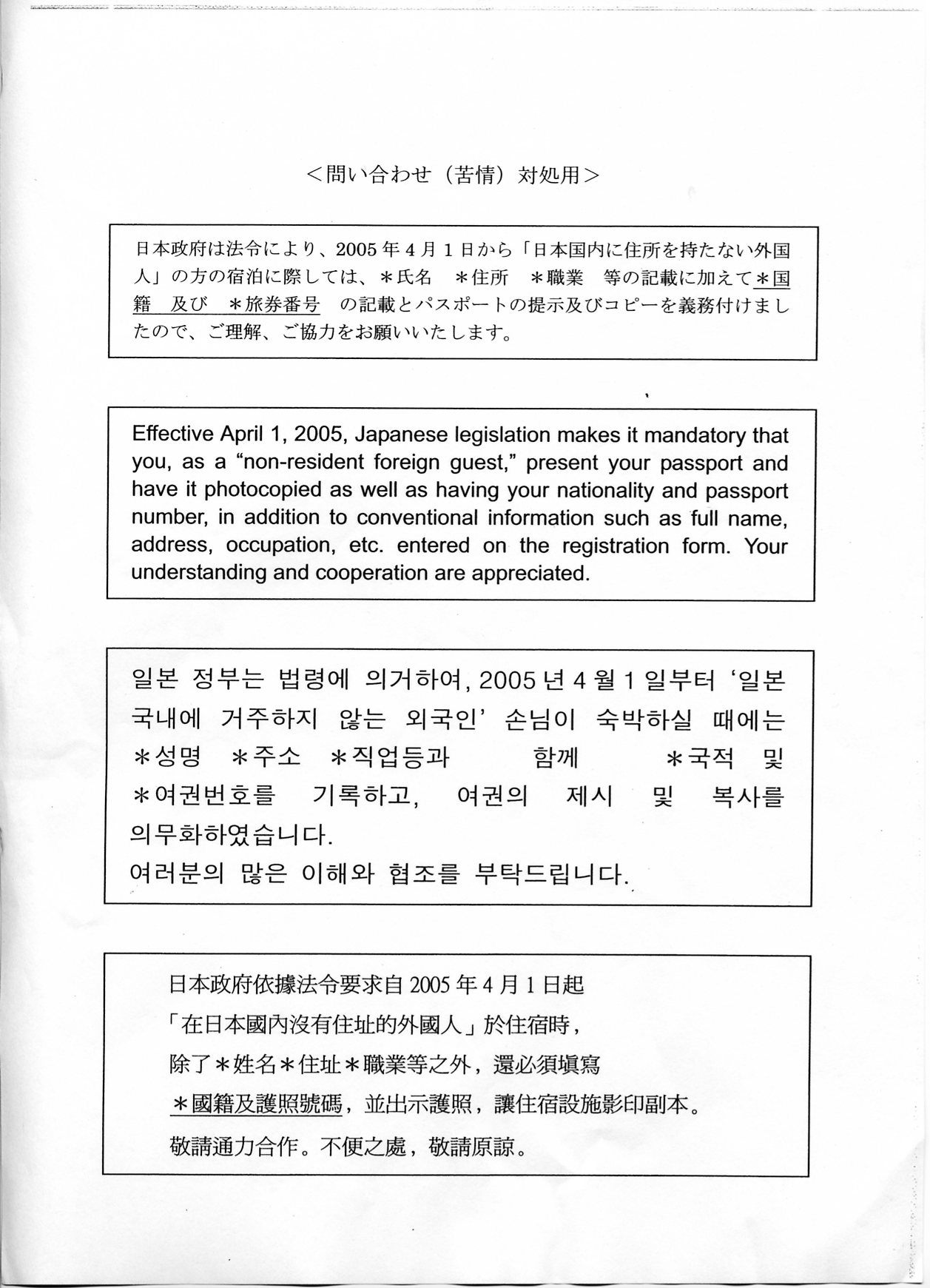
Incorrect. The law in fact been changed, as of April 1, 2005, to allow passport checks of tourists, i.e. guests without addresses in Japan (which is confirmable when you fill out your hotel check-in card). This means registered foreigners are in no way required (just as Japanese guests are not) either to carry or display their passport, or divulge their information to non-police authorities such as hotel management. Moreover, they have no legal right to refuse you a room just because you refuse to show your passport (see next section).
If hotel management insists that the law is different (as they have been erroneously informed by the ministries, they can hardly be blamed), print up the letter of the law here:
http://www.debito.org/newhotelpassportlaw.html
provided
to hotels nationwide by the MHLW.
(Amazing thing is that hotels cannot seem to read Japanese, as the MHLW has issued contradictatory multilingual notices: One says "check all foreigners", the other says "only those without domestic addresses".)
More on this bending of Japanese laws by the government in Japan Times column: " MINISTRY MISSIVE WRECKS RECEPTION: MHLW asks hotels to enforce nonexistent law" (Oct 18, 2005), by Arudou Debito.
Another Japan Times column on the proposed IC-chipped Gaijin Card, with incidental documentation of how the ministries are deliberately and systematically misconstruing the laws to target foreigners at hotels: "THE NEW IC YOU CARDS: LDP Proposal to computer chip foreigners has great potential for abuse": (Nov 22, 2005), by Arudou Debito.
Asked for your passport number despite being a resident of Japan? Want to do something about this? Fill out a survey at Olaf Karthaus's website at http://www.geocities.com/okarthaus/hotelcheckin.html
WHAT
TO DO IF...
...you are refused service at a
hotel.
You are on firmer legal ground than if you are
refused by any other business. Barring you from, say, a bath or a
meal is not illegal (there are no laws against racial discrimination
in Japan). But refusing accommodation in Japan is clearly illegal, as
it falls under the the Ryokan Management Law.
As Article 5
states:
旅館業法 第五条
営業者は、左の各号の一に該当する場合を除いては、宿泊を拒んでは
ならない。
一
宿泊しようとする者が伝染性の疾病にかかつていると明らか
に認められるとき。
二
宿泊しようとする者がとばく、その他の違法行為又
は風紀を乱す行為をする虞があると認められるとき。
三
宿泊施設に余裕が ないときその他都道府県が条例で定める事由があるとき。
an
establishment cannot turn away lodgers unless there is
1) a
health issue involving contagious disease,
2) a clear and present
endangerment of public morals, or
3) because all rooms are
full.
Letter of the law in Japanese (can't find an
official English translation) here:
http://
list.room.ne.jp/~lawtext/1948L138.html#5
You are welcome to print it up and show it to the hotel management. If they remain intransigent, try going to the cops, law in hand, and say that you were refused accommodation. Good luck. Let me know how it goes.
Some hotels are trying to claim that the law has been changed, to allow for Gaijin Card/Passport checks. Yes it has, as of April 1, 2005, but this only applies to tourists, i.e. people without domestic Japan addresses. See Japan Times article on this at
http://www.debito.org/japantimes101805.html
and a separate entry on this "What to do if..." page
here.
More on this phenomenon
from Olaf Karthaus (Report, January 19, 2005)
at
http://www.debito.org/olafongaijincarding.html
Olaf says that next time this happens to him, he will get it in
writing or via tape recording that the hotel refused him entry
illegally, then take them to court. If you have the same
stamina, go for it.
More on the extralegal measures being used
by police to target foreigners at hotels in Japan Times columns:
"CREATING
LAWS OUT OF THIN AIR: Revisions to hotel laws stretched by police
to target foreigners" (March 8, 2005), and Japan Times column:
"MINISTRY
MISSIVE WRECKS RECEPTION: MHLW asks hotels to enforce nonexistent
law" (Oct 18, 2005). Both by Arudou Debito
If there
is a bonafide "NO FOREIGNERS" sign displayed, contact
me to put it up on the Rogues' Gallery.
WHAT
TO DO IF...
...you want to protest something you see
as discriminatory.
You'd better have some willpower,
because domestic laws will not back you up. Racial discrimination is
not illegal in Japan (it is unconstitutional, but not illegal--due to
the fact that there no laws exist to ban it). So going to the cops or
City Hall to complain will result in nothing but bent necks and
advice to take your business elsewhere.
If your dander is
really up, consider the steps outlined in the following Japan Times
article (November 30,
2004):
http://www.debito.org/japantimes113004.html
You
can also visit the local Bureau of Human Rights (Jinken Yougo Bu)
in the Ministry of Justice (Houmushou). If the bureaucrats
think you have a reasonable complaint, they will send a functionary
to "enlighten" the discriminator. However, the BOHR is
limited in its ability to actually force the discriminator to cease
and desist, as witnessed in these cases recorded in the Japan Times
(July 8, 2003):
http://www.debito.org/japantimes070803.html
and
catalogued here:
http://www.debito.org/policeapology.html
However,
a call from the BOHR has scared some discriminators into taking down
their "JAPANESE ONLY" signs, so it's worth at least contact
them. Make them work a bit for your tax money.
See:
http://www.debito.org/misawaexclusions.html
If you see something discriminatory or culturally insensitive in
the broadcast or print media, you can call (or write) the complaints
department within the network. For television, that would be
called the shichou sentaa, and by calling any network and
asking for it you will be connected. For newspapers, call any
department and ask to be connected to the reporters section
(houdoubu) and say that you have a claim against an article
(saikin notta kiji ni tsuite chotto kureim (claim) ga
arimasu ga). Email protests (even large numbers of form
letters) have also been effective (you can usually find the network's
email easily after a Google search). See a case which elicited
an apology from a news anchor (Kume Hiroshi) over a decade after we
protested his anti-"gaijin" comments at
http://www.debito.org/activistspage.html#kume
Make
your case to the media slowly and calmly, and you will probably at
least get listened too. Don't expect anything more, but
apologies and changes in programming have been known to happen. For
example:
http://www.debito.org/HTBstepinfetchit.html
If it's something on the Internet (such as a blog), there's
probably not a goddamn thing you can do, except ask the administrator
to have it taken down. Even if that doesn't happen, AND you
take them to court, AND you win, the courts will not enforce their
decision. Example (of a case of Internet libel, not
specifically discrimination, but the result is the same) available at
http://www.debito.org/2channelsojou.html
Internet
libel and hate speech is a problem slowly garnering attention in
Japan, but not enough for Dietmembers to pass a law against it yet.
Grit your teeth.
In any case, don't expect your embassy or consulate to assist you
in your protest against discrimination (tell them if you like, but
don't expect to get anything more out of it than a polite blow-off).
They will only intervene in the case of an arrest, not to help you
claim your rights protected (or not) by domestic laws.You
can see a whole case of social protest (negotiations, media
campaigns, political lobbying, even a lawsuit all the way to the
Supreme Court) recorded in my book "JAPANESE
ONLY" (Akashi Shoten Inc. 2004) More
information on the book at http://www.debito.org/japaneseonly.html
WHAT TO DO
IF...
NEW!
...you are being threatened with eviction from your apartment.
Tenants
have extremely strong rights in this society, which means that if you
signed a contract, you are entitled to stay, even if you haven't paid
your rent for a stretch of time. You can even sue (and win) if
your landlord changes his or her mind after a contract is signed and
money paid. Stand your ground. You cannot be evicted
without a court order.
This situation has come up in the context of the NOVA Eikaiwa School Debacle, where the company has not paid rents on company-provided apartments and the poor employee has had to face eviction, but stand your ground. Advice from those in the know:
1) [With NOVA Inc.] deducting rent from your paycheck, but not forwarding it on to your landlord, Nova broke the law. They are in the wrong, not you. Your landlord can complain, but his contract is with Nova. Keep your pay stubs and any receipts you have. Legally, you've been paying rent. If the landlord changes your locks, removes anything from your apartment, or harrasses you without going to court and getting a court order for your eviction, he is in the wrong. He can give you all the letters he wants, but he needs a judge to evict you. Grounds for eviction are normally illegal activity in the apartment or non-payment of agreed rent obligations. This is why you should hang on to your pay stubs - just in case things get ugly and you have to fight your eviction.
2) Accommodation "Even if the owner/the landlord/the agency is screaming at you to get out, you don't have to leave-- just keep paying your rent. If the company was supposed to be paying the rent and they haven't, sue the company for fraud or tell the agency: 'Look, the company's supposed to be paying, and I've already paid the company.' You have a right of residency, and anyone who wanted to get you out is going to have to get a court order to do it." (Bob Tench, Nova union vice president)
REFERENTIAL ARTICLES:
IS IT ALL OVER FOR NOVA?
As ‘eikaiwa’ giant plans school
closures amid credit crunch, some fear the worst
The Japan
Times, Tuesday, Sept. 25, 2007
(Referential information at the
bottom of the
article)
http://search.japantimes.co.jp/cgi-bin/fl20070925a1.html
http://www.debito.org/index.php/?p=593
Korean Woman Wins Discrimination Damages in Japan
Chosun
Ilbo, South Korea, October 5,
2007
http://english.chosun.com/w21data/html/news/200710/200710050017.html
http://www.debito.org/index.php/?p=634
WHAT
TO DO IF...
...you want to get your deposit (shikin)
back from your landlord when moving out.
Adapted from mails by Kirk Masden and Joe
Tomei:
http://groups.yahoo.com/group/kumamoto-i/message/4899
Tokyo to clean act of dirty landlords
The
Asahi
Shimbun
http://www.asahi.com/english/politics/TKY200402070165.html
For tenants tired of kissing their maintenance deposits
goodbye, the Tokyo metropolitan government plans sweeping
changes to the shabby system exploited by greedy landlords.
There are no clear rules on how much of the costs to clean or repair
apartments should be covered by tenants' deposits.
"Actually,
the last sentence is not exactly right. The government has published
guidelines:
http://www.mlit.go.jp/jutakukentiku/house/torikumi/genzyokaifukugaido.pdf
but
the pdf file is 118 pages long. Here's a couple more in
Japanese, from a quick
google
http://www.heyasagase.com/guide/trouble/sikikin/k_02.html
http://hccweb5.bai.ne.jp/~hea14901/library/link.htm
http://www.zentaku.or.jp/223/index.htm
(issues 12-14, I think)
"The guidelines (in Japanese) focus on the concept of "genjo
kaifuku" (restoration to original condition). According to
the guidelines, you are NOT responsible for normal wear and tear. You
are only responsible for damage that you did to the apartment beyond
normal wear and tear. The guidelines help you figure out what should
be considered to be normal wear
and tear.
"When our
family left our apartment a few years ago we were asked to pay a lot
of money to, among other things, replace all the wallpaper in the
apartment to make it as nice as it was when we first moved in
(restoration to original condition) -- even though we had been in the
same apartment for 10 years! After I did a little research, the
government guidelines enabled me to get a more reasonable agreement
from the landlord. We had been asked to pay a significant amount of
money in addition to the deposit (shikikin) we had paid. Instead, we
received a good chunk of the deposit back.
"Sometimes you
have to be firm with landlords, who are used to intimidating people
and taking more than they deserve. I told the landlord that if we
could not work this out between ourselves that I was prepared to have
the matter settled in small claims court (kan'i saibansho--see
section below). In this respect, the goverment guidelines were a
big plus. I also sent explanations about the guidelines and the
reasons why we found the landlords claims to be unreasonable by
certified mail so there could not be any dispute about what we had or
had not told the landlord.
"In the end, we accepted an
agreement that was not perfect (we had to pay to replace the tatami
-- even though this should not be our responsibility according to the
guidelines), but much, much better than what were almost forced to
accept. What we did required a lot of Japanese. Still, even if your
Japanese is not good enough for you to fight on your own, it may be
worth your while to get someone to help you so that you can know your
rights and tell the landlord about the government
guidelines.
"Here's another related site (in
Japanese):
http://www.heyasagase.com/sitelist/joho/sikikin.html
"The
idea of taking the landlord to small claims court, especially with
the backing of goverment guidelines, is a good one. Take digital pics
of everything, making sure the camera's date function is on. You can
also take a picture of the 'problem points' with a newspaper to
verify the date. Retain everything and keep records of when you spoke
to people, who you spoke to and what they said. I have found
that when bullying from the landlord occurs (and this is clearly what
it is), the bully is generally strong on the standard fronts, but
with something like this, especially when it comes to documenting in
meticulous detail in your favor, they never see it coming. Don't
look for the knockout punch--just calmly get all your ducks in a row
and be ready to use official channels."
WHAT
TO DO IF...
...you want to take somebody to
court.
Start reading how to do it here in this Japan Times
article (November 30,
2004):
http://www.debito.org/japantimes113004.htmlThen
get my book "JAPANESE ONLY"
(Akashi Shoten Inc. 2004) More
information here.
You can of course see my Otaru Lawsuit
Site:
http://www.debito.org/otarulawsuit.html
but
there's a lot there, and it's better collated in "JAPANESE
ONLY". Get a copy. That's one
reason why I wrote it. To make the path easier to trammel for others.
WHAT
TO DO IF...
...you want to get a job (or a better
job) in Japanese academia.
Read up on the pitfalls, with
case studies of jobs gone sour, at
http://
www.debito.org/activistspage.html#ninkisei
Where NOT to
seek employment: The Blacklist of Japanese Universities
http://
www.debito.org/activistspage.html#blacklist
Advice to new
entrants to the job market:
http:/
/www.debito.org/activistspage.html#openlettertoacademics
Ten
questions you should ask a prospective employer before making any
decisions:
http://www.debito.org/univquestions.html
An update on the status of contract employment in Japan (with all
its loopholes emasculating any labor protections), as of October
2005, by Arudou Debito et
al.:
http://www.debito.org/acadapartupdateoct05.html
If you have been on a contract, renewed several times, then are suddenly facing dismissal, you can find out more about your rights in this essay by Steve van Dresser, "The Employment Rights of Repeatedly Renewed Private Sector Contract Workers" here (written 1999, previously of the now-defunct Issho Kikaku website).
How your employment experience (in Japan or abroad) counts towards pensions in Japan (kara kikan), by Steve van Dresser and Stephanie Houghton (written 2002, previously of the now-defunct Issho Kikaku website).
Many Japanese universities run rackets with foreign academic employment, creating exploitative revolving-door employment for foreigners only. So be advised. It's great work, if you can land a good position. You'll be better poised to do so after reading the above links.
WHAT
TO DO IF...
...you are having a labor dispute in the
workplace.
Say, for example, a salary dispute, a contract
dispute, an arbitrary dismissal, nonpayment for services rendered, or
something not initially part of your work conditions when hired that
the company unreasonably springs upon you.
There are avenues
of redress to pursue in Japan, of course.
1) Involve the
Labour Standards Bureau (Roudou Kijun Kyoku)
That's
why it exists.
See the Ministry of Health, Labour and
Welfare's Website in English
http://www.mhlw.go.jp/english/
There
is a LSB in the offices of the MHLW, found in any major
conglomeration of government buildings.
Labour Standards
Bureau duties and guidelines (English)
http://
www.mhlw.go.jp/english/org/policy/p16-17.html
The Letter
of the Labour Standards Law in Japan (English)
http://
www.jil.go.jp/jil/laborinfo-e/library/law1.shtml
Just
siccing (or threatening to sic) the LSB on your employer will work
wonders if you get threatened. Trust me. It's worked for me.
If
necessary, get a Labor Standards Board involved. See what happened in
the Prefectural University of Kumamoto Case of 1995-2000 (where
educators even went on strike). Select articles at
http://www.debito.org/PALE1298.
html
http://www.debito.org/PALE499.html
Full
roundup of the case on the Japan Policy Research Institute website,
working paper dated June 1999
http://
www.jpri.org/publications/workingpapers/wp58.html
Don't be
a pigeon to be plucked. Know the law and use it the way it was
designed in the Postwar Era--to prevent employee abuses under inhuman
working conditions.
Even then, I recommend you read this recent update on how even
these labor protections are being emasculated by development in the
Japanese labor
market:
http://www.debito.org/acadapartupdateoct05.html
2)
Join, or form your own, labor union.
The employer is not
required by law to negotiate with individuals in Japan. It is
required by law to negotiate with groups, though. And unions,
as I argue in the link directly above, are essentially the only way
left for people to secure their rights under the labor
laws.
Information on labor unions for academics and other
contracted
workers:
http://www.debito.org/blacklist.html#unions
http://www.debito.org/acadapartupdateoct05.html#unions
For
other job markets, there are too many unions to recount here. Find
out from your fellow employees what union they belong to (be warned,
however, that some are "yellow unions", which means they
essentially toe the corporate line, and others will not,
unfortunately, allow foreigners to join!). Or contact a union (see
link immediately above) to get a referral.
As for forming your
own union, read up on how to do it in a 1998 article by Timothy
Korst, formerly of The University of the
Ryukyus.
http://www.debito.org/PALE498korst.html
3)
Get a lawyer involved.
This is their job--to represent you in
a labyrinth of legal codes. Go down to the local Bar Association
(Bengoshikai) for a referral. There's one in every city, and
it will cost you 5000 yen per half hour. Have all your information at
your fingertips for an efficient presentation. It will save you
money. Take a native speaker with you just in case. Then do all your
negotiation with your employer through your lawyer (i.e. always
involve a third-party in your dispute from now on--to make sure there
is a paper trail should you need to go to court.).
More on hiring lawyers below.
WHAT
TO DO IF...
...you are swindled in a business
deal.
You can take things to Small Claims Court (shougaku
sosho, part of the Summary Court system, or kan'i saibansho),
which handles claims of up to 600,000 yen. You don't need a lawyer to
do so, but if you're new to this, I would recommend
you have a legal advisor of some sort. If your Defendant does not
show up to court on the day of the hearing, you win, according to
reliable sources who have gone through this process a number of
times, but have since contacted me asking to be made anonymous.
(Sorry there is no third-party for me to refer you to, but this
information is important enough to leave up as is.)
WHAT
TO DO IF...
...you need a lawyer.
Go down
to the local Bar Association (Bengoshikai) for a referral.
There's one in every city, and it will cost you 5000 yen per half
hour. Have all your information at your fingertips for an efficient
presentation. It will save you money. Take a native speaker with you
just in case. Many lawyers belong to lists of specialty issues, such
as international issues/labor issues/etc. Follow their advice and
contact their recommended lawyer.
Costs for consulting with a
lawyer vary widely from place to place, field to field (starting from
5000 yen per half hour, reaching 40,000 yen per half hour if the
matter involves corporate or international law). If you wish to hire
a lawyer on retainer, try to get the initial consulting fee lumped in
as part of the retaining fee.
All lawyers in Japan must make
their fee schedules clear in writing in advance when asked, before
payment or consultation, so you know what you're getting into. So
ask. If he or she will not, disengage contact with the lawyer
immediately, for s/he is a crook. (Trust me--I've gotten burned on
this one.)
If the lawyer doesn't share your fire in the belly
for the case, find another lawyer. The Bar Association generally
allows three referrals (but may allow more--depends on the area).
Consider it a sunk cost, and keep looking. It's your money. Buy the
service you need.
Once hired, do all your negotiation with the
other party to your dispute through your lawyer (i.e. always involve
a third-party in your dispute from now on--to make sure there is a
paper trail should you need to go to court.)
Lawyers
in Japan can be salt of the earth or just plain scum. Just like in
any other country. Be prepared to shop around. But don't get involved
in a serious negotiation in Japan without a professional's help.
Especially since the scales of power here are markedly tipped against
the little guy.
WHAT
TO DO IF...
...you want to get Permanent Residency
(eijuuken).
One stop shopping
at:
http://www.debito.org/permres.html
I recommend getting PR. You don't get the right to vote
or hold office, but you get just about everything else.
WHAT
TO DO IF...
...you want to become a Japanese
citizen.
This is a pretty hard-core decision (I've done
it), but all the information you really need is at:
http://
www.debito.org/residentspage.html#naturalization
Again, if
you're planning on staying here permanently, and are comfortable with
your lifestyle and Japanese language ability, I recommend taking out
citizenship. It has certainly changed my life for the better. But
it's not for everyone, natch.
WHAT
TO DO IF...
...you want register your name in
kanji.
If you want to use kanji for your name, simply go
to the city hall and ask for a tsuushoumei ("common-use
name") to be registered. If your tsuushoumei (通称名)
is in kanji then you can use that kanji name on all your official
documents--with the exception of immigration--and even register a
kanji jitsuin (official hanko stamp). My bank accounts,
postal savings account, and home loan are all in the kanji that I
created to match the katakana I had always been using.
It's
important to mention, though, that Japanese-citizen spouses or
children are not able to use the registered kanji tuushoumei
as they don't have a foreigner registration card or other form of ID
that the kanji could be written on. (The tsuushoumei is
not listed on any of the documents a Japanese citizen uses.)
It's
worked quite well. I find people often treat me much better
when I sign a kanji name. I often have people ask me if I've
taken Japanese citizenship, though I tell them at that point that I
haven't. It's nice though that it seems to take at least one
barrier away.--RH in Touhoku
WHAT
TO DO IF...
...your child is being singled out for
"looking different" in Japanese school.
This is
happening in Japanese schools,
where blind adherence to "school rules" means that people
of differences are getting snagged by the "Hair Police"
etc. Some are even being forced to straighten and dye their
hair to black from their natural hair color, for example.
Don't
tolerate this. Hair dye contains toxins and thus is not good
for your child's health (let alone emotional development; being
constantly singled out and made to feel different just because of
genetics
is not good for impressionable children). Simple
suggestions:
1. Support your child. Reassure him/her that
he/she is as "normal" as anyone else.
2. Seek
an understanding with teachers and the principal. Point out that
variation is normal. There are plenty of Japanese with naturally
lighter, curly hair.
3. Get written proof from your
previous school that your child's hair color or texture is
natural.
4. Raise this issue with the Classroom
Committee of Representatives ("gakkyuu iinkai") and/or the
local Board of Education ("kyoiku iinkai"). With all the
attention on "ijime," or bullying, these days, the board
may be sensitive to your concerns.
5. Be firm. Dyeing
hair is neither good for your child's mental or physical health.
6.
If compromise is impossible, consider changing schools ("tenkou").
Your child deserves a nurturing educational environment, not
alienated by perceived "differences" on a daily
basis.
Much of this advice of course is applicable to any
situation where you have to talk to a school administration which is
making your child unhappy by being unaccommodating of
differences.
More information at Arudou Debito, Japan Times
Community Page article "SCHOOLS SINGLE OUT FOREIGN ROOTS:
International kids suffer under archaic rules" (July 17, 2007).
Debito.org
"Director's Cut" version here. Scanned PDF
version of the article here.
A PDF conversion is easy
and simple to do.
More information on the background of this
issue
can be found at http://www.debito.org/index.php/?p=412.
WHAT TO DO
IF...
...you want to run for office.
This
is, of course, a right reserved for citizens. However, if you do
naturalize (and there are naturalized elected officials in Japan,
such as Dietmember Tsurunen
Marutei, local councillor Anthony Bianchi, and others), or if you
want to help out a candidate and learn more about the fascinating
Japanese election campaign process,
here is an essay which you might find
instructive.
http://www.debito.org
/nanporo2003elections.html
WHAT TO DO
IF...
...you want to build a house.
See
how I did it
at:
http://www.debito.org/residentspage.html#housebuilding
If
you do not have Permanent Residency,
however, you will find it very difficult to get financing. Few, if
any, Japanese financial institutions will loan to you, and this
process of "not lending to the gaijin" is judicially backed
up by the Steven
Herman Court Case decision.
WHAT
TO DO IF...
...you want to get a divorce.
Be
careful when you marry a Japanese. Be sure the relationship will
last. Divorce laws in Japan have not changed for over a hundred
years, meaning they establish marriage as a more ironclad bond to
keep families stable as a business. Divorce remains very difficult to
achieve unilaterally unless one party has committed a crime (theft,
embezzlement, what have you). A more complex matter of
"irreconcilable differences" is not considered adequate
grounds. Thus unless you both agree to put your inkan stamp on a
divorce form (rikon todoke) at the Ward Office, you will not
be able to get divorced and start a new life. Even legal separations
require at least 5 years (used to be 10 years) before annulment will
be considered by Family Court (katei saibansho).
Requiring
"mutual consent" for a divorce may sound like a nice
system, but in fact it has fostered a culture of severed ties and
hard bargains driven. It's pretty tough to have an amicable
settlement, and if you have to negotiate before third parties, you
will have to portray your former partner in public as an enemy in
order to convince anyone that you really deserve a divorce.
If
you have no children, there is less fallout. But if you do, you (as
the foreigner, particularly the male) will probably lose custody of
them. And possibly all contact with them. Japanese law, and judicial
enforcement of court decisions, do not adequately ensure access to
children. Stories of deadbeat dads and fortress moms are Legion, as,
again, the expectation in Japan is that the noncustody parent will
just disappear. Even Prime Minister Koizumi has that
history.
Moreover, if your relationship is intercontinental,
and if your kids get kidnapped from overseas and brought to Japan,
you will lose them. Period. Japan has not signed the UN Convention on
the Rights of the Child, and no police force in Japan will help you
search and extradite, even if there is an overseas court order
demanding it.
Get the lowdown at The Children's Rights Network
Japan at:
http://www.crnjapan.net/
Consider
the following before
marriage:
http://www.crnjapan.net/The_Japan_Childrens_Rights_Network/res-protectmarry.html
A primer on the problems with divorce law in
Japan:
http://www.debito.org/successstoriesjune2006.html
A first-hand experience of divorce from the author of this
site:
http://www.debito.org/thedivorce.html
This is not to deter you from marrying a Japanese--it's very easy
to do, and there are plenty of happy unions out there. Just do your
best to be sure this marriage is going to last. Because legally you
will lose big if there are kids involved.
Finally, remember
that if you want to start a new life with a new partner, Japanese law
allows men to remarry immediately, but women must wait six months
(due to possible pregnancy from the previous partner) before
registering a new mate at the Ward Office.
WHAT
TO DO IF...
...you want to do some awareness
raising.
Like a speech or a public presentation? Power to
you. Japanese society may often be quite rum, but people, much to
their credit, certainly will listen calmly (even if they disagree
with your every word). Borrow their ear and give them some
constructive ideas to mull over. It certainly will make you feel
better.
My advice about what to expect from a Japanese
audience and how to give an effective presentation
at:
http://www.debito.org/JALTpresentations.html
On
that note, here are some "survival strategies", and how you
can "make a difference" in
Japan:
http://www.debito.org/HAJETspeech.html
Finally,
if you want to meet like-minded people and perhaps try a little
activism as a group yourself, check out internet-based group "The
Community":
See who we are
at:
http://www.debito.org/TheCommunity
You can join us online
at
http://www.debito.org/TheCommunity/join_us.html
MISCELLANEOUS
ADVICE COURTESY OF THE JAPAN TIMES ON SUNDRY ISSUES
From:
IS IT ALL OVER FOR NOVA?
As ‘eikaiwa’ giant plans school
closures amid credit crunch, some fear the worst
The Japan Times,
Tuesday, Sept. 25,
2007
http://search.japantimes.co.jp/cgi-bin/fl20070925a1.html
http://www.debito.org/index.php/?p=593
RELATED
INFORMATION
Union support
"The general union and Nambu
decided on a policy that that we won't take new members if Nova goes
bankrupt. What we will have is a question-and-answer site--we'll give
all the information necessary to employees to get the government
subsidy for unpaid wages, and we'll hold a one-time "setsumeikai"
(meeting) for any employee who wants to come. If it goes bankrupt, we
will shut the doors on the Nova union, but of course they're welcome
to join Nambu separately.
"As for Nova members, we'll be
actively pursuing all their wages, not just the 80 percent guaranteed
by the government. If Nova has any assets left, in general employees
get first dibs, so we'll be fighting for that." (Louis Carlet,
deputy general secretary of the National Union of General Workers
Tokyo Nambu)
Unpaid wages
"If there's unpaid
wages, we would have to go to the Labor Standards Office or a court
and force (Nova) into paying whatever they have and then eventually
when they can't--when the court forces them to pay and they don't
have any money to pay--then it could be a long, drawn-out process. In
the meantime, a lot of foreigners may not be able to stay in Japan to
fight, so at least our union members, even if they have to leave the
country, we'll continue to fight for them." (Louis
Carlet)
Immigration
"Your company does not
sponsor your visa, even though a lot of companies say so: There is no
formal relationship between an employer and the immigration office.
When you go to renew your visa at the immigration office, you take
your certificate of insurance, your employment contract and your
tax-paid certificate. Those are the documents you need * that's it,
and your employer is obliged to provide you with those, for whatever
reason, on request, within 24 hours."
"If you think
(bankruptcy is) gonna happen and, for example, your visa is coming up
for renewal in one or two months, apply for a renewal now and present
the documents that you have. You can ask for a new certificate of
insurance, tax certificate and your current contract, which has an
expiry date coming up, and present that to the immigration office
saying: 'I'm expecting to be renewed,' and you get your visa renewed.
All you have to do is say something like, 'I'm thinking of taking a
holiday at the time of renewal, so I need to renew now,' because
while your visa renewal is in you're not allowed to leave the
country, so it's a perfectly valid excuse. . . . I would advise
anyone to do that if they're in that situation." (Bob
Tench)
Redundancies
"The union would fight
every redundancy and under Japanese law there are quite serious
restrictions about when redundancies may be made--certain stringent
conditions have to be met by the company and of course the union
knows the legal ins and outs of that, so of course the union would
fight tooth and nail to make sure that all those conditions were
properly met, and if they weren't then we take the company to court."
(Bob Tench)
Unemployment insurance
"It's a
really complicated formula but there's a limit--roughly speaking,
teachers will get JPY200,000 a month. It's not really a percentage of
salary--if it's a high salary you wouldn't get 80 percent of that.
You would get it for a certain number of months depending on your age
and how long you've been enrolled in employment. The minimum is three
months and you must get it before one year after dismissal, and if
you resign you can't get it for the first three months."
"If
(Nova) goes bankrupt, (employees) will be fired officially, dismissed
by the receiver, and if they're fired they can get unemployment
insurance right away, if you're in Japan and if you have a work visa,
so if they're in that situation that's OK." (Louis Carlet)
(B.S.)
More to come as requests come in and
essays come out...
Thanks for reading, Arudou Debito in
Sapporo
Want to support the goals of debito.org? Consider
the following:
Make a donation.Buy
a book (or the new HANDBOOK
FOR NEWCOMERS)
Or even buy a T-shirt:
|
|
Show how internationally-minded some of your
neighbors are! Get yourself a |
|
NOTE: This offer is completely independent of my book "JAPANESE ONLY" (Akashi Shoten 2006), but it is a good way to raise awareness of the issue. Most people would rather pretend these signs don't exist. Too bad. They do. Keep the issue alive in the public eye in the best of satirical traditions by wearing your heart on your sleeve, and the sign on your chest! |
|
Portions Copyright 2005-2009, Arudou Debito,
Sapporo, Japan