Alex Kerr falls into “Guestism” arguments with unresearched comments

mytest

Hi Blog. I covered some of this material in a previous post on the blog. However, for the newsletter I did a significant rewrite last night, describing how flippant and unresearched comments from a noteworthy person (Alex Kerr) can cause problems for others (particularly through unscrupulous anonymous editors on places like Wikipedia). I don’t want this new version to be buried in a newsletter, so I repost it separately and delete the older version from the blog. Debito in Sapporo

////////////////////////////////////////

Some time ago, Alex Kerr, author of DOGS AND DEMONS and LOST JAPAN (and a person I have great respect for), was asked in an interview with the Japan Times (Oct 25, 2005) about he thought about activists (and, er, about me in particular). He responded:

=========================================
JT: In Dogs and Demons you argue that Japan has failed to internationalize. What do you think about the work of Debito Arudou and others to combat racial discrimination in Japan?

AK: Well, somebody has to do it. I’m glad that there is a whistle-blower out there. But, I am doubtful whether in the long run it really helps. One would hope that he could do it another way. He’s not doing it the Japanese way. He’s being very gaijin in his openly combative attitude, and usually in Japan that approach fails.

I fear that his activities might tend to just confirm conservative Japanese in their belief that gaijin are difficult to deal with.

That said, perhaps we who live here are slow to stick our necks out when we sense an injustice, and quick to self-censor in order to get along smoothly in our communities.

To me the most interesting aspect of Arudou Debito is that, in taking on Japanese citizenship, he has brought the dialogue inside Japan. His activities reveal the fact that gaijin and their gaijin ways are now a part of the fabric of Japan’s new society. A very small part of course, but a vocal and real part.
http://search.japantimes.co.jp/member/member.html?fl20051025zg.htm
=========================================

This sticks in my craw for two reasons: One is that Alex, who does incredible amounts of research for his books, seems ill-informed about the ways we have combatted racial discrimination. If he had read my book JAPANESE ONLY (and despite receiving a copy from me nearly two years ago, he wrote me last January that he still hadn’t read it), he might understand that ARE doing it the so-called “Japanese Way”. We took every channel and route available to us WITHIN the Japanese system, as I meticulously detail in the book. In fact, there are plenty of Japanese who do exactly what we do (and more), and don’t get slapped with a “gaijin” label. It is out of character for Alex to comment on something he hasn’t done thorough research on.

The other reason is that this quote has been lifted out of context and selectedly reproduced by the unscrupulous on places like Wikipedia:
=========================================
Some critics question Arudou’s brand of conflict resolution: the judicial system. Alex Kerr, author of the best-selling Dogs and Demons: Tales from the Dark Side of Japan (ISBN 0-8090-3943-5), criticize such tactics as “too combative,” is doubtful “whether in the long run it really helps,” noting that “in Japan…[the combative] approach fails.” Acknowledging that “gaijin and their gaijin ways are now part of the fabric of Japan’s new society,” Kerr also notes that Arudou’s activities may “confirm conservative Japanese in their belief that gaijin are difficult to deal with.”[24]
http://en.wikipedia.org/wiki/Arudou_Debito
=========================================
The essence and thrust of Alex’s comment, which is in fact about two-thirds positive, is lost.

Anyhow, the reason I bring this up now is because Matt Dioguardi in a recent, thoughtful essay, grounds this phenomenon in historical context, from an angle I hadn’t considered before:

=========== MATT DIOGUARDI WRITES =================
As a foreign national who is making a life for himself in Japan, I’m personally concerned that remarks like his have a negative effect on me (as a so-called “gaijin”). Because regardless of what one may or may not think of Debito, unintentionally Kerr is commenting on all “gaijin”.

Compare this to C. Eric Lincoln’s vivid description of a “smart nigger” in Coming Through the Fire: Surviving Race and Place in America:

————————————————
The smart nigger was likely to be everything the good nigger was not. Most likely he was educated above the norm considered sufficient for colored folks; whether he got it in school or some bigger fool than he had put it into his head, he had some dangerous notions. In either case, Mr. Martin said that the smart nigger was a pain in his own ass, and everybody else’s too. He wanted too much. He wanted his street paved, and he wanted it paved because he paid taxes rather than because his wife cooked for the judge. His house was painted and well kept and he didn’t waste his money on rattletrap cars. He didn’t “owe money downtown,” or “take up” advances on his pay every Monday morning. More than likely he had “been up North,” and he had a colored newspaper come to his house in the mail. The smart nigger paid his poll taxes, and he was mighty slow, it seemed to Mr. Dubbie Gee, to answer when somebody said “Boy!” He didn’t think that the bad nigger was funny, or that the good nigger could be trusted. Clearly, every smart nigger would bear watching. “They don’t last long,” Mr. Martin said, and he “flat out had no use for them.” He said that if he were colored he’d either kick a smart nigger’s ass down off his shoulders or keep away from him. A smart nigger, he said “is a damn fool hell-bent for trouble. And mark my words, he’s gon’ find it quicker’n a catfish can suck a chicken gut off a bent pin.”
————————————————

Is Alex Kerr saying Debito is a “smart nigger”?

I’d like to note that Kerr should be more specific in his comments, because is it really the case that there are no non-“gaijin” doing the things that Debito does? Is he saying that when Japanese file lawsuits, this is a natural evolution of culture, but when Debito does it, it’s reinforcing the notion that “gaijin” have an “openly combative attitude”?

Is he saying the teachers who refuse to sing Kimigayo are acting like “gaijin”?

What exactly is the definitive way some one displays an “openly combative attitude”?

Moreover, what is the definitive “Japanese way”? And in what specific way is Debito not doing it?

It’s very disappointing to see some of Alex Kerr’s calibre engaging in Nihonjinron. He should know that there is nothing so destructive to Japan’s traditional local customs as Nihonjinron. Do I need to quote from his own books? Just like the centralization of construction standards begins to make all parks and all buildings look bleakly similar, the centralization of identity around the concept of “Japanese” in an essentialist sense is just as destructive to the development of a full personality.
=========== END MATT DIOGUARDI ==============

More at
http://japan.shadowofiris.com/nihonjinron/is-alex-kerr-calling-debito-a-smart-nigger/

The point is, I always find it amazing how easily people can fall right back into the “Guestist”-sounding paradigms of “nicely, nicely, don’t get too uppity, for it’s not ‘The Japanese Way'”. When in fact everything we have ever done has also been done by Japanese. I hope Alex gets around to reading my book (https://www.debito.org/japaneseonly.html) and will offer more informed comments. Arudou Debito in Sapporo

BBC: Japan set for divorce rate boom

mytest

Hi Blog. I’ve written a few essays on the problems with divorce in Japan in the past. (see artery site at https://www.debito.org/whattodoif.html#divorce

Well, the BBC is projecting the same thing as I have: that yesterday’s pension reforms are going to bring about a few changes in the artificially low divorce rates in Japan. Wait and see. The most recent issue of Terrie’s Take also offers some forecasts afterwards. Debito

========================

Japan set for divorce rate boom
By Chris Hogg BBC News, Tokyo
Published: 2007/04/01 05:44:14 GMT

http://news.bbc.co.uk/go/pr/fr/-/2/hi/asia-pacific/6515193.stm

New pension laws coming into effect in Japan could lead to an explosion in divorces, some experts are warning.

The rules will make it easier for wives to claim up to half their husband’s pension once the marriage is over.

The number of divorces in Japan has been rising for several decades, but the trend reversed four years ago when the new laws were first discussed.

Many believe that wives in unhappy marriages have been waiting for the new laws to come into effect on Sunday.

Japan’s divorce rate is still quite low – around two divorces for every 1,000 marriages.

Shame is one reason. A failed marriage is frowned upon here, particularly among the older generation.

But money is another important factor. Wives often have real concerns that they will not be able to support themselves if they leave the marital home.

Retirement looms

The change in the law will help. It will make it easier for women to force their husbands to share their pensions.

One survey suggested that in as many as 42,000 couples, wives have been waiting for the rules to change.

Last autumn, the social insurance agency began offering a confidential service which helped couples calculate how much of the husband’s pension should be given to the wife.

Some 90% of the applications have been from women.

And there is another factor at work. Japan’s baby boom generation is starting to retire this year.

That adds up to around five million mostly male workers, who have spent their lives working long hours, and often drinking long after work, several nights a week.

These absentee spouses will now have much more time to spend at home – all day, every day – perhaps for the first time in the couple’s married life.

Many here believe that will prove too much for their wives to cope with.
ENDS

///////////////////////////////////////////////////

AND AS A RESULT–WHAT HAPPENS TO THE RETIREES WHO COME HOME TO WIVES THEY DON’T KNOW? TERRIE’S TAKE SPECULATES (EXCERPT):

========================
The wave of retirements will definitely bring about some interesting socio-economic changes. Not having a “family” of like-minded salarymen to report to every morning will be a big shock for most male baby boomers — who have been described as the “generation waiting for instructions”. They will be forced to make lifestyle changes and as a result, many will become angry, upset, and confused. We expect the suicide and divorce rate to soar as a result.

The problem, of course, is that many of these men have followed a rigid routine for the last 40 years and find it very difficult to make friends outside their work — particularly with their alienated wives. As a result, they are likely to become part of the statistics contributing to the pending divorce surge we wrote about several weeks ago.

After the divorce, the future is unremittingly bleak for many of these male retirees. A recent OECD survey found that Japanese men are amongst the loneliest in the world, with 16.7% of males rarely or never having contact with friends or colleagues outside work. However, with Need being the Mother of Invention (and life changes), we imagine that a growing number of retirees will realize that to save their marriages, they have to start a new life and get to know their partner again.
========================

GOOD LUCK. ANYWAY, THIS IS GETTING BEYOND THE PURVIEW OF THIS BLOG, BUT THE MOST RECENT ISSUE OF TERRIE’S TAKE (FROM WHICH I HAVE EXCERPTED ABOVE) HAS SOME INTERESTING PROGNOSTICATION ABOUT JAPAN AFTER THE BABY BOOMERS RETIRE (PROBABLY ASSUMING RAPID MIGRATION INTO JAPAN DOES NOT HAPPEN). FOR THOSE INTERESTED, SEE IT AT http://www.japaninc.com/terries_take (ISSUE 415) DEBITO
ENDS

Otaru Onsens “Japanese Only” sign incorporated into video game

mytest

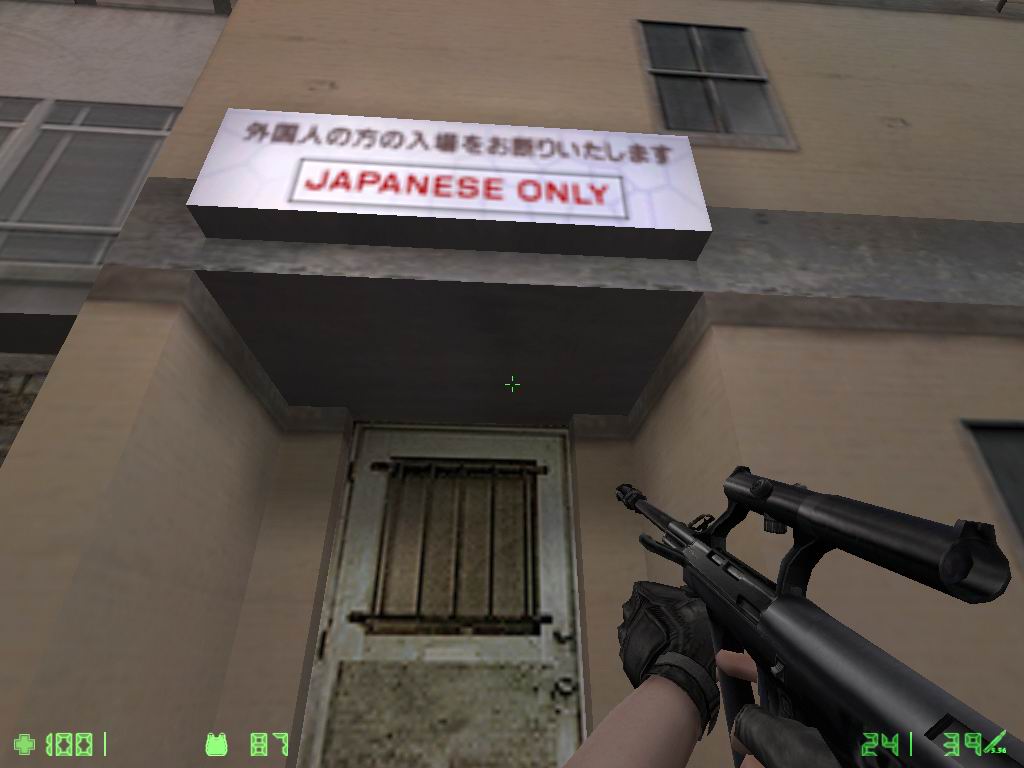
Well, here’s a surprise. Incorporated into an online video game (a first-person shoot ’em up called “Counter Strike, Condition Zero”, one of the most popular, with customizable characters, weapons, and backgrounds), here is a scene where our hero gunman faces a door with a “JAPANESE ONLY” sign.

Believe it or not, that is a copy and paste from the Otaru Yunohana Onsen sign (up between 1998 and 2000), defendant in a lawsuit for racial discrimination between 2001 and 2004 (which it lost). More on that here. (I was one plaintiff in that case.)

Here’s a screen capture of the scene (click thumbnail for larger image):
gamejosign.jpg

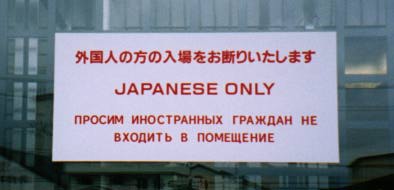
Here’s a picture of the original Japanese Only sign, for comparison’s sake:
onsenyunohanasign.jpg

BTW, the scene apparently didn’t make the final cut.
http://www.geocities.jp/palaceofdune/cscz2/list1.html
(Japanese text)

Amazing to think how far this case and lawsuit has entered the popular culture. Not only has it been featured on entrance and final exams for law degrees in Japan, I’m told it also has been cited as one of the twenty most influential postwar law cases in a Waseda University law publication, not to mention overseas textbooks studying Japanese law.

Now it’s been slipped into a video game? I wonder if as the gunman character I could have used the gun to shoot the sign up. Oh, well, I can dream, can’t I?

Thanks to Dan for notifying me. I wonder what’s on the other side of that doorway… Not me I hope. 🙂 Debito in Sapporo

Losing the “Sugawara” from my koseki

mytest

Hello Blog. This might come as news to some (but not those who follow the biased Wikipedia entries on me), that my official name on my koseki (the Family Registry, which is what all Japanese citizens must have to be) is in fact Sugawara Arudoudebito (meaning “Arudou Debito” is in fact officially my first name).

See why at https://www.debito.org/kikaupdate3.html

Well, that will be changing. Two Wednesdays ago, I took this up with Family Court to get my name officially changed to Arudou Debito (losing the Sugawara).

Two Fridays ago, the Sapporo Family Court judge came down in my favor. That’s it. Done. Fastest I’ve ever seen a Japanese court move–a decision within TWO days!

Bigger report to follow on the procedure. Fascinating journey, that. Arudou Debito (for real at last) in Sapporo

DEBITO.ORG NEWSLETTER NOV 27 2006

mytest

Good evening all. Recent articles on my blog have reached saturation point, so here’s a roundup:

DEBITO.ORG NEWSLETTER NOV 27, 2006
This post is organized thusly:

///////////////////////////////////////////////////////////////////
1) OTARU ONSENS CASE NOW TEACHING MATERIAL
2) GAIJIN CARD CHECKS OUTSIDE “SAKURA HOUSE”
3) UPDATE ON KITAKYUSHU EXCLUSIONARY RESTAURANT
4) J TIMES ON TOURISM PROMOTION, WITH LETTER TO THE ED
5) TBS: FUJIWARA NORIKA BUMPS ARUDOU DEBITO
6) KYODO: MOCK JURY TRIAL SPRINGS FOREIGN MANSLAUGHTERER
7) JALT PALE ROUNDTABLE ON ACADEMIC EMPLOYMENT
and finally…
8) WASH POST: GOJ CREATING SUSHI POLICE FOR OVERSEAS J FOOD
///////////////////////////////////////////////////////////////////

This and future material available in real time by subscription at
https://www.debito.org/index.php

1) OTARU ONSENS CASE NOW TEACHING MATERIAL

The Otaru Onsens Case (https://www.debito.org/otarulawsuit.html) refuses to fade into obscurity, thank goodness. Still, the facts of the case are being increasingly bleached out as time goes on. Witness how in this English teaching book discussing the case for educational purposes:

From “Shift the Focus”, Lesson 4: “Discrimination, or Being Japanese…?” pp 18-21, on the Otaru Onsens Case. Sanshusha Pubilshing Co., Ltd. February, 2006. Written by Colin Sloss.

After developing the case to make it appear as if I was doing this all on my own, the dialog continues:

======== EXCERPT BEGINS ===================
Some foreigners who had been living in Japan for a long time, lets [sic] call them “old Japan hands,” objected to the claim that this was discrimination and should be stopped. Their argument, as I understand it, was that trying to make Japan like other countries would, in fact, make Japan less distinct and more ordinary. Japan, as it is now (regardless of any problems it may possess, such as discrimination and racism), should be appreciated because of its uniqueness. Ultimately, this argument is romantic, condescending and resistant to the globalization of Japan. Lafcadio Hearn could be said to represent an extreme of this kind of thinking. During the late Meiji Period, Hearn was strongly against the Westernization of Japan, which he feared would destroy the charms of old Japan. Such hopes, though understandable, tend to be disappointed with the changing times.
======== EXCERPT ENDS ===================
Entire dialog at https://www.debito.org/?p=88

COMMENT:
While I am happy that the issue has been condensed and replicated for future discussion in an educational setting, I wish the author could have gotten a little closer to the facts of the case. Perhaps included the fact that there was more than one Plaintiff in the case (Olaf and Ken), not just me alone.

I also think he should take less seriously the intellectual squirrelling afforded those postulating pundits he calls “old Japan hands”, found chattering away on places like NBR. They are hardly representative of the foreign resident community in Japan, the proprortionally-shrinking English-language community in Japan, or of anything at all, really. Except perhaps old grouches and bores.

///////////////////////////////////////////////////////////////////

2) GAIJIN CARD CHECKS OUTSIDE “SAKURA HOUSE”

Received a mail (I get a lot of these, especially on weekends) from people wanting some advice. This time, a person named Alisa told me about how cops keep hanging out outside the “gaijin guesthouses” of Sakura House (http://www.sakura-house.com) essentially to snare foreigners (this is not the first time I’ve heard about this, by the way):

======== EXCERPT BEGINS ===================
Anyway this morning I was stopped by three men in black jackets (windbreakers) and one of them flashed me a badge. They asked me if I had my “card”. Even though I had read your article, I was running late for work and was extremely frazzled at being approached like that. I could feel my Japanese fumbling but did manage to ask “nan de desuka?”. They told me that they had heard that some sakura house people had overstayed their visa and were “just checking”. They went to far as to ask my room number and whether I lived alone. They made double sure to check the address on the back of my card and sent me on my way. I was very insulted and humiliated at being stopped like that…
======== EXCERPT ENDS ===================
Entire email at https://www.debito.org/?p=86

Alisa even took the trouble to print up copies of the law regarding these instant checkpoints for the benefit of fellow residents
(see https://www.debito.org/whattodoif.html#gaijincard)
and to contact Sakura House about the harassment.

Well, let the hand-washing preclude any hand-wringing. Response from Sakura House:

======== SAKURA HOUSE RESPONSE BEGINS ===============
Dear Ms. Alisa West
Thank you very much for your staying at Sakura House.

In fact, Japanese police officer or imigration [sic] officer has a right to check your passport, visa status and alien registration card. If they ask you to show your passport, you have to show it to them. This is a leagal [sic] action. They do that kind of inspection without informing.

With best regards,
Takuya Takahashi
======== SAKURA HOUSE RESPONSE ENDS ===============

Pity Mr Takahashi doesn’t know the law better. It’s not quite that simple. So much for helping out his renters.

As I’m sure I’ll get nitpickers with short memories or attention spans thinking this is much ado, a few reminders from the record accumulating on debito.org:

Re the developing tendency towards racial profiling in Japan:
“Here comes the fear: Antiterrorist law creates legal conundrums for foreign residents”
Japan Times May 24, 2005
https://www.debito.org/japantimes052405.html

“Justice system flawed by presumed guilt
Rights advocates slam interrogation without counsel, long detentions”
The Japan Times: Oct. 13, 2005
https://www.debito.org/japantimes102305detentions.html

An excellent summary from the Japan Times on what’s wrong with Japan’s criminal justice system: presumption of guilt, extreme police powers of detention, jurisprudential incentives for using them, lack of transparency, records or accountability during investigation, and a successful outcome of a case hinging on arrest and conviction, not necessarily on proving guilt or innocence. This has long since reached an extreme: almost anything that goes to trial in a Japanese criminal court results in a conviction.

Point: You do not want to get on the wrong side of the Japanese police, although riding a bicycle, walking outside, renting an apartment etc. while foreign seems more and more to incur police involvement.

///////////////////////////////////////////////////////////////////

3) UPDATE ON KITAKYUSHU EXCLUSIONARY RESTAURANT

At the beginning of this month, I told you about a restaurant in Kitakyushu which refuses service to foreigners. I was tipped off by a victim at a JALT national conference, and sure enough, I too was initially refused service as well. More details at https://www.debito.org/?p=69

Well, after sending letters on November 9 to the Kitakyushu Mayor, the tourism board, the local Bureau of Human Rights, the local newspaper, and JALT Central, I am pleased to report that I have had official responses.

The City International Affairs Desk (kokusai kouryuu bu) called me on November 20 to tell me that they had called the restaurant in question and straightened things out. No longer, they were assured, would foreigners be refused there.

The Bureau of Human Rights also called me on November 19 to get some more facts of the case. They would also be looking into them. “Go give them some keihatsu,” I urged them. They said they would.

Now, all we need is a letter from the Mayor’s Office and/or from JALT Central and we have a hat trick. I appreciate the concern given this matter (I have known many Bureaus of Human Rights, such as Sapporo’s, which couldn’t give a damn–even if it’s something as clearly discriminatory as the Otaru Onsens Case). Probably should write this up as a website later on to give people templates on how to work through administrative channels to deal with discrimination. Sure would help if we had a law against this sort of thing, though…

On that note:

///////////////////////////////////////////////////////////////////

4) JAPAN TIMES ON TOURISM PROMOTION, WITH LETTER TO THE EDITOR

On November 10, Kyodo reported that Japan is going to add to Koizumi’s “Yokoso Japan” campaign to bring over more tourists from Europe:

======== EXCERPT BEGINS ===================
Staff at the Japan National Tourist Organization are also hoping to attract spa-lovers by promoting Japanユs many “onsen” (hot springs) and Buddhist retreats.

The campaign “Cool Japan–Fusion with Tradition” officially kicked off at this week’s World Travel Market in London, an annual trade fair that attracts more than 5,000 exhibitors. This year, 202 countries will be there.

The latest promotion follows the successful “Visit Japan Campaign” in Europe in 2003, which helped boost number of tourists traveling to Japan. Britain currently sends the most visitors to Japan from Europe, followed by Germany and France.

As part of the “Cool Japan” campaign, staff are sending out brochures on “manga” (comic books) and animation-related attractions, along with information on Japan’s cutting-edge architectural sights…

This year, representatives from a ryokan are on hand to advise travel agents and tour operators on how to promote traditional forms of leisure. Many Europeans do not think of Japan as place to relax and staff at JNTO are keen to change that.
======== EXCERPT ENDS ===================
Rest of the article at https://www.debito.org/?p=87

That’s fine. But as a friend of mine pointed out in a letter he got published in the Japan Times:

============== LETTER BEGINS ====================
Obstacle to increased tourism
By HIDESATO SAKAKIBARA, Jamaica, New York
The Japan Times, Sunday, Nov. 19, 2006
http://search.japantimes.co.jp/cgi-bin/rc20061119a6.html

Regarding the Nov 10 article “Japan works on a makeover to attract more Europeans”:

While it is admirable to see the the Japan National Tourist Organization making efforts to draw more foreign tourists, our government officials are omitting one important thing–the promulgation of a law making it illegal to discriminate on the basis of race or nationality.

The article states that JNTO staff are “hoping to attract spa-lovers by promoting Japanユs many onsens (hot springs) and Buddhist retreats.” But what about the many onsen that refuse entry to those who don’t look Japanese (including Japanese citizens)? What impression will “young tourists” get when they seek to enter discriminatory bars, hotels, discos, pubs (izakaya) and other spots only to be greeted with the words “Japanese Only?”
============== LETTER ENDS =====================

Well done. We need more people pointing out this fact as often as possible. I keep on doing it, but I say it so often (and alone) that to some I probably sound like a health warning on a cigarette box. If others say it as well, it makes the message come from more quarters, and increases credibility (i.e. I’m not just a lonely voice in the wilderness).

I encourage everyone to keep pointing out the elephant in the room thusly. Thanks for doing so, Hidesato.

///////////////////////////////////////////////////////////////////

5) TBS: FUJIWARA NORIKA BUMPS ARUDOU DEBITO

No, it’s not what you might think. I reported last newsletter that TBS noontime program “Pinpon” would be doing a segment on Nov 18, regarding Internet BBS and frequent host of libel “2-Channel” (https://www.debito.org/2channelsojou.html). Thought the issue had reached a saturation point. Hell, they even flew up a producer and hired a camera crew on a moment’s notice all the way up to Sapporo just for an interview.

Well, guess what–the story got bumped for extended segments on Clint Eastwood’s new movie on Iwo Jima and supermodel Fujiwara Norika’s on-again/off-again engagement to some dork, er, nice guy.

Anyhoo, I called up the producer again ten days later. She says that the network wants a response from 2-Channel’s Administrator Defendant Nishimura Hiroyuki before airing. They’re still waiting for a response, unsurprisingly.

Ah well, that’s it then. Nishimura communicates with the press only by blog, as a recent story in AERA (https://www.debito.org/?p=48) indicates. He’s not going to make a TV appearance on this.

Meanwhile, the story cools, by design. S o might as well assume the TV spot is cancelled. Sigh. Sorry to inflict lunchtime TV on you, everyone.

///////////////////////////////////////////////////////////////////

6) KYODO: MOCK JURY TRIAL SPRINGS FOREIGN MANSLAUGHTERER

This was sent to me by a reporter friend which caused bewilderment in both him and me.

Japan will be reinstituting trial by jury (they had it before between 1928 and 1943, according to Wikipedia entry for 陪審制) in 2009. This will be for criminal cases, and there will be six laypeople and three judges on the jury (given the GOJ’s nannying instincts, you can’t trust the people with too much power, after all).

Kyodo reported extensively on Nov 23 about a mock trial to test the system. But what an intriguing test case to use:

======== EXCERPT BEGINS ===================
Citizen judges on Thursday came out with a mixed verdict on a Briton, who was indicted for bodily injury resulting in death, at a mock trial in Osaka.

Paul Lennon, 36-year-old English teacher, stood trial at the mimic court, sponsored by the Osaka Bar Association, on the assumption that he kicked a Japanese man because he thought the man had assaulted a woman, although the man was just caring for his drunken girlfriend. The man died after falling down on a street and hitting his head…

Some citizen judges argued the defendant’s act was excessive as he should have realized its danger as a karate master, while others said it was not excessive, based on testimony of the witness that the victim collapsed dizzily, arguing that he would have fallen fast if the karate grade-holder had kicked him hard.

While the citizen judges did not reach a consensus, Takashi Maruta, a professor at Kwansei Gakuin University law school, said after observing the conference, “The mock trial showed ordinary citizens can develop reasonable and persuasive debates.”
======== EXCERPT ENDS ===================
Rest of the article at https://www.debito.org/?p=83

I don’t know what the Osaka Bar Association is anticipating by putting a foreigner on mock trial like this, but there you have it. My reporter friend writes:

“Not sure what to make of this. Should I be disappointed that they chose a foreigner as the defendant in their mock trial or pleased that the jury didn’t necessarily lock him up and throw away the key just because he wasn’t Japanese?”

Quite. A real head scratcher. Anyway, what odd things make the news. With all the events jockeying for your attention, why so much space devoted to this highly-contrived fake court case? And I fail to see how this is any harbinger of the future of Japanユs upcoming jury system. Surely they could have come up with a more average case to test a jury with?

///////////////////////////////////////////////////////////////////

7) JALT PALE ROUNDTABLE ON ACADEMIC EMPLOYMENT

I mentioned the JALT meeting above. Our interest group PALE (https://www.debito.org/PALE) held a roundtable on Nov 3 to discuss future employment issues in Japan’s academia. Panelists were Jonathan Britten, Michael “Rube” Redfield, Pat O’Brien, Evan Heimlich, and Ivan Hall. Introduction to a collation I made of the event:

======== EXCERPT BEGINS ===================
Continuing the Roundtable forum that packed the hall at JALT 2005, five PALE members paneled a meeting to discuss a variety of issues relevant to the conference’s theme of “Community, Identity, and Motivation”. All presentations touched in some way upon employment issues, including issues of job security, union representation, the relationship of nationality to job description and employment terms, and the growing role of dispatch teaching arrangements in Japanese universities. They dealt explicitly or implicitly with the proper roles and responsibilities of PALE and JALT in managing these issues.
======== EXCERPT ENDS ===================
Full writeup at https://www.debito.org/?p=80

and finally…

///////////////////////////////////////////////////////////////////

8) WASH POST: GOJ CREATING SUSHI POLICE FOR OVERSEAS J FOOD

This article is making the rounds of the communities out there (at least three people have sent me the link), so I’ll forward this on to fill the gaps.

Yes, the Japanese Government will be establishing a bonafide committee to police the quality and authenticity of Japanese food restaurants overseas.

======== EXCERPT BEGINS ===================
TOKYO – On a recent business trip to Colorado, Japan’s agriculture minister popped into an inviting Japanese restaurant with a hankering for a taste of back home. What Toshikatsu Matsuoka found instead was something he considered a high culinary crime–sushi served on the same menu as Korean-style barbecued beef.

“Such a thing is unthinkable,” he said. “Call it what you will, but it is not a Japanese restaurant.”

A fast-growing list of gastronomic indignities–from sham sake in Paris to shoddy sashimi in Bangkok–has prompted Japanese authorities to launch a counterattack in defense of this nation’s celebrated food culture. With restaurants around the globe describing themselves as Japanese while actually serving food that is Asian fusion, or just plain bad, the government here announced a plan this month to offer official seals of approval to overseas eateries deemed to be “pure Japanese.”…

A trial run of sorts was launched this summer in France, where secret inspectors selected by a panel of food specialists were dispatched to 80 restaurants in Paris that claimed to serve Japanese cuisine. Some establishments invited the scrutiny, while others were targeted with surprise checks. About one-third fell short of standards–making them ineligible to display an official seal emblazoned with cherry blossoms in their windows or to be listed on a government-sponsored Web site of Japanese restaurants in Paris.
======== EXCERPT ENDS ===================
Rest of the article at https://www.debito.org/?p=84

I think you can imagine where I’ll be going with my comment on this, but anyway:

Certification as “real” and “pure Japanese”, hmmm? Sort of like the beauty contests in the Japanese community in Hawaii I read about a decade ago open only to people with “pure Japanese blood”?

Anyway, I know Japan is a nation of foodies, but fighting against overseas restaurants tendency towards “fusion food”? Especially since, as the article notes, so much of Japanese food is from overseas, anyway? Tenpura, castella, fried chicken (“zangi” where I come from), even ramen!

And what if J restaurants innovate, and want to offer something from another country on the menu (such a Chinese or a Vietnamese dish)? Will it have to be offered in J restaurants first in Japan before it can be offered in J restaurants overseas as “authentic Japanese cuisine”? Silly, silly, silly.

This culinary Balkanization seems to be yet another way to give some retired OBs some work after retirement. What better way than for them to take money from either the restaurants or the J taxpayer than by offering the good ol’ “certifications”?

Anyway, food for thought. (Sorry, couldn’t resist.)

///////////////////////////////////////////////////////////////////

That’ll do it for this newsletter. Thanks for reading.

Arudou Debito
Sapporo, Japan
debito@debito.org
https://www.debito.org
DEBITO.ORG NEWSLETTER NOV 27 2006 ENDS

Otaru Onsens Case published as English teaching material

mytest

Hello Blog. The Otaru Onsens Case (https://www.debito.org/otarulawsuit.html) refuses to fade into obscurity, thank goodness. Still, the facts of the case are being increasingly bleached out as time goes on. Witness how in this English teaching book discussing the case for educational purposes. Thanks to Bert for sending me this. Comment at the bottom.

From: Sloss, Colin; Kawahara Toshiaki; Grassi, Richard: “Shift the Focus”, Lesson 4: “Discrimination, or Being Japanese…?” pp 18-21, on the Otaru Onsens Case. Sanshusha Pubilshing Co., Ltd. February, 2006. ISBN 4-384-33363-3.

===========================

Lesson 4
Discrimination, or Being Japanese…?

Having lived some twenty years in Japan, I have not often felt I was facing negative discrimination for being a foreigner. On the other hand, I have often felt conscious of positive discrimination and of being given special treatment because I am a foreigner. However, like everything else, there are advantages and disadvantages to being a foreigner in Japan.

This is why there are varying opinions regarding the Otaru Onsen Case amongst foreigners living in Japan. To explain the case, a few years ago a foreign university professor who had lived a long time in Japan and who spoke Japanese fluently was denied entry to a hot spring, because the hot spring had a “no foreigners” policy. The foreign professor then received Japanese citizenship and went back to the hot spring. Once again he was stopped for being a foreigner, but he showed the people at the hot spring proof that he was now a Japanese. However, he was still refused entry because the owner said that Japanese people at the hot spring would still think he was a foreigner because of his appearance. So, the professor filed a court suit against the owner of the hot spring for discrimination and he won the case. There is more to this story than this brief summary, but I was interested in the reaction of the English-language-speaking foreigners to this incident.

Some foreigners who had been living in Japan for a long time, lets [sic] call them “old Japan hands,” objected to the claim that this was discrimination and should be stopped. Their argument, as I understand it, was that trying to make Japan like other countries would, in fact, make Japan less distinct and more ordinary. Japan, as it is now (regardless of any problems it may possess, such as discrimination and racism), should be appreciated because of its uniqueness. Ultimately, this argument is romantic, condescending and resistant to the globalization of Japan. Lafcadio Hearn could be said to represent an extreme of this kind of thinking. During the late Meiji Period, Hearn was strongly against the Westernization of Japan, which he feared would destroy the charms of old Japan. Such hopes, though understandable, tend to be disappointed with the changing times.

Many foreigners, particularly those who have been hurt by real or perceived discrimination in Japan, supported the man’s case against the hot spring. They were interested in the legal implications of the incident and the need to establish that open discrimination should be illegal in Japan. To some extent, I agree with them.

Nevertheless, if you look hard enough it is possible to find, or to imagine, discrimination everywhere. Once, I was at my local station and some women were handing out leaflets to people. However, they did not give anything to me. Inside my head a voice shouted “discrimination against foreigners.” So I walked back to the people who were handing out the leaflets and demanded one for myself. Then I read the leaflet and I felt embarrassed. The leaflet was asking young women to step forward to enter a “Miss Hyakumangoku” competition. What I had assumed had been racial discrimination was, in fact, sexual discrimination!

C.S. (Colin Sloss, author).

=============================
COMMENT:
While I am happy that the issue has been condensed and replicated for future discussion in an educational setting, I wish the author could have gotten a little closer to the facts of the case. Perhaps included the fact that there was more than one Plaintiff in the case (Olaf and Ken), not just me alone.

I also think he should take less seriously the intellectual squirrelling afforded those postulating pundits he calls “old Japan hands”, found chattering away on places like NBR. They are hardly representative of the foreign resident community in Japan, the proprortionally-shrinking English-language community in Japan, or of anything at all, really. Except perhaps old grouches and bores.
ENDS

Wash Post/MSNBC on GOJ moves against fake J food abroad (with update)

mytest

Hello Blog. Fascinating article (thanks Ryan) on how Japan is instituting “quality control” in Japanese restaurants abroad–by certifying them as “real” and “pure Japanese”. Sort of like the beauty contests in the Japanese community in Hawaii I read about a decade ago open only to people with “pure Japanese blood”…?

Anyway, I know Japan is a nation of foodies, but fighting against overseas restaurants tendency towards “fusion food”? Especially since, as the article notes, so much of Japanese food is from overseas, anyway? Tenpura, castella, fried chicken (“zangi” where I come from), even ramen! And what if J restaurants innovate, and want to offer something from another country on the menu (such a Chinese or a Vietnamese dish)? Will it have to be offered in J restaurants first in Japan before it can be offered in J restaurants overseas as “authentic Japanese cuisine”? Silly, silly, silly.

This culinary Balkanization seems to be yet another way to give some retired OBs some work after retirement–what better way than for them to take money from either the restaurants or the J taxpayer than by offering “certifications”? Anyway, enjoy the article. Food for thought. Debito

///////////////////////////////////////////////////////////////////////

Putting the bite on fake sushi and other insults
Japan plans to scrutinize restaurant offerings abroad

By Anthony Faiola, Washington Post. Courtesy of MSNBC
http://www.msnbc.msn.com/id/15871422/from/ET/
Updated: 5:18 a.m. ET Nov. 24, 2006

TOKYO – On a recent business trip to Colorado, Japan’s agriculture minister popped into an inviting Japanese restaurant with a hankering for a taste of back home. What Toshikatsu Matsuoka found instead was something he considered a high culinary crime — sushi served on the same menu as Korean-style barbecued beef.

“Such a thing is unthinkable,” he said. “Call it what you will, but it is not a Japanese restaurant.”

A fast-growing list of gastronomic indignities — from sham sake in Paris to shoddy sashimi in Bangkok — has prompted Japanese authorities to launch a counterattack in defense of this nation’s celebrated food culture. With restaurants around the globe describing themselves as Japanese while actually serving food that is Asian fusion, or just plain bad, the government here announced a plan this month to offer official seals of approval to overseas eateries deemed to be “pure Japanese.”

Some observers here have suggested that the government’s new push for food purity overseas is yet another expression of resurgent Japanese nationalism. But the mentality in Japan also echoes a similar movement by several nations — including Italy and Thailand — now offering guidelines and reward programs to restaurants abroad to regain a measure of control over their increasingly internationalized cuisines.

So beware, America, home of the California roll. The Sushi Police are on their way.

A trial run of sorts was launched this summer in France, where secret inspectors selected by a panel of food specialists were dispatched to 80 restaurants in Paris that claimed to serve Japanese cuisine. Some establishments invited the scrutiny, while others were targeted with surprise checks. About one-third fell short of standards — making them ineligible to display an official seal emblazoned with cherry blossoms in their windows or to be listed on a government-sponsored Web site of Japanese restaurants in Paris.

‘A highly developed art’

Matsuoka, who took over Japan’s top agricultural job in September, is the mastermind of the new “Japanese restaurant authentication plan.” He said it does not always take a culinary sleuth to spot an impostor. “Sometimes you can tell just by looking at their signs that these places are phony,” he said.

“What people need to understand is that real Japanese food is a highly developed art. It involves all the senses; it should be beautifully presented, use genuine ingredients and be made by a trained chef,” he continued. “What we are seeing now are restaurants that pretend to offer Japanese cooking but are really Korean, Chinese or Filipino. We must protect our food culture.”

In recent years, few culinary traditions have witnessed the kind of global boom, and distortion, of Japanese food.

In the United States alone, the number of restaurants claiming to serve Japanese food soared to 9,000 in 2005, or double the number a decade ago, according to Japanese government statistics. The government projects that the number of Japanese restaurants worldwide will leap to 48,000 by 2009, more than double the current level.

Some have gone all-out to ensure authenticity. Masa in New York City imports its fish from Tokyo’s Tsukiji Fish Market while Umu in London regularly flies in the soft water of Kyoto, Japan’s old capital, to make its bonito fish broths. But they are largely exceptions in a world where the Japanese fear their food is being lost in translation.

In the United States, the proliferation of counterfeit Japanese foods now includes seaweed rolls stuffed with smoked salmon and cream cheese. In Canada, Vera’s Burger Shack in Vancouver is offering tempura-battered onion rings. As the recent test in Paris showed, even such gastronomic bastions as France can be guilty of sushi sacrilege.

“You will find restaurants here that serve salmon sushi with a little yakitori [charcoaled chicken] on the side and call themselves Japanese,” said Tsuyoshi Nakai, the Paris head of JETRO, Japan’s overseas trade promotion arm. “Then there are the ones serving what they claim is Japanese sake, but of course, it isn’t. What is it? I don’t know. But it smells, and tastes, very strange.”

High demand for real Japanese chefs

With the demand for real Japanese chefs far greater than the global supply in a nation with a shrinking population and few modern-day emigrants, many foreign owners of Japanese restaurants have turned to cooks from other Asian countries to add a faux touch of authenticity to their establishments. Pan-Asian restaurants have also begun adding more healthful and light Japanese dishes to their menus to cater to new tastes, some of them going as far as changing their names to the inevitable “Mt. Fuji” or “Sakura” to lure broader clienteles.

That has infuriated Japanese sushi chefs overseas, leading some — including those who formed the D.C. Sushi Society in the 1990s — to unite into advocacy groups aimed at protecting an elaborate form of cooking that is tradition-bound and highly hierarchical.

Officials here emphasize that it is not the race of the cooks they are concerned about, but the fact that such chefs are rarely properly trained and know little about the culture behind the food.

In Japanese haute cuisine, for example, the aesthetics of a meal — from elegant ceramic serving bowls to suitable flower arrangements — are considered as important as the food itself. Quality quashes quantity; a single mouthful of otoro — fatty tuna sashimi sliced just right — can sell for $20 in Tokyo sushi houses. Japan’s famously elaborate kaiseki ryori can take days to prepare and must be presented in small courses on plates and in color combinations that delight and amuse.

Most importantly, such meals must be prepared by highly specialized chefs — some of whom apprentice for years before they are permitted to cook for paying customers.

Makoto Fukue, the head of the Tokyo Sushi Academy who trains about 75 Japanese chefs-for-export a year, insisted that the inexperience of some foreign sushi chefs may be driving customers away from more adventurous Japanese fare.

“Many Americans do not like the taste of conger eel sushi, but that is because the chefs are not preparing it right — and so it tastes fishy and has an odor,” he said. “If you had a trained chef preparing those same foods, you would find more openness to experiment with the same foods we eat in Japan.”

But some here have expressed caution about the launch of the government approval system, arguing that Japan is a country also notorious for adapting foreign foods to local tastes. Indeed, that rare talent gave birth to Japanese seafood and mayonnaise pizza.

In addition, many so-called Japanese foods have foreign influences or roots. Batter-coated and fried food known as tempura, for instance, was introduced to the Japanese by Portuguese missionaries during the 16th century.

“The question is, what can we really call ‘Japanese food’?” said Masuhiro Yamamoto, the Tokyo-based food guru. “Here in Japan, we believe that tonkatsu [fried pork cutlet] is essentially Japanese, but try and tell the French that isn’t porc paner.”

The government has appointed an advisory board of food luminaries and intellectuals to develop a workable method for the project ahead of its full launch in April. Matsuoka said the most likely scenario would be the creation of government-sanctioned food commissions in major countries to evaluate a restaurant’s “Japanese-ness” based on authentic ingredients, chef training, aesthetics and other criteria.

Such a method might also coincidentally increase Japanese food exports, given that restaurants using Japanese products are likely to score some brownie points.

“Of course using Japanese materials would be preferable,” Matsuoka said. “But our real purpose is to set benchmarks for how Japanese food is made overseas. We take our food very seriously.”
ARTICLE ENDS
////////////////////////////////////////////////

COMMENT FROM CYBERSPACE:
I think they should check the credentials of Japanese who go to the US, claim to be sushi masters and open their own shops–been to a few in Boston. Ironically, the best sushi master in Metro-West is a Chinese man who actually studied sushi for 8 years in Tokyo.

I wish I had the time to inspect the “American” restaurants here. Mos Burger and Mr. Bagu would be first on my list….CHAD

Potential Yarase on TV’s Tokudane next Weds Nov 22 re “Comedy About Japan” (with update)

mytest

Hello Blog. What follows is a post forwarded with the permission of the author from The Community, and Life In Japan mailing lists. About potential “yarase” (i.e. staging a story for journalistic sensationalism) in one of my favorite Japanese TV shows, “Tokudane”, on for two hours from 8AM every weekday. Read on. Comment from me follows:

===================================

From: martin@autotelic.com
Subject: [Community] Potentially annoying piece about comedy on Tokudane Wide
Date: November 15, 2006 12:16:53 PM JST

Community, Lifers In Japan,

As some already know, I organize and perform at some comedy shows around Tokyo with a group called “The Tokyo Comedy Store”. Last night our group did one of our regular stand up comedy shows at The Fiddler in Takadanobaba.

A film crew from Fuji TV came down to film us for a segment on the show “Tokudane Wide”. It will air at about 9:15 AM on Wednesday, November 22.

The reason they wanted to film us was because some Japanese researcher type person (didn’t catch the name), has written a book called “Sekai No Nihonjin Joke Syuu” (世界の日本人ジョーク集, “A collection of the world’s jokes about Japanese”). So for at least part of their segment, they wanted to see foreigners doing comedy on or about Japan, and talk
to us about what we find funny about Japanese culture and so on.

Up to that point, it’s no big deal. But, where it gets possibly annoying is where they clearly had an agenda for the piece. No surprise there, of course, as I’ve learned reporters always create their news as much as find it.

They specifically asked of our comedians before the show if we could bring our pieces that “made fun of Japan”. Afterwards, they came up and asked us if we could think up some new jokes about Japan. We were confused about why the entire hour and twenty minutes of material about Japan we had just done on stage was not enough for them to work with. But it became apparent that there were two reasons for this:

1. The woman they had on hand who was there to translate our jokes into Japanese was mediocre at best, and clearly did not understand most, if any, of the jokes. I mean, she probably understood the literal meanings, but not the humour. So they are probably unsure if anything we said matches the criteria of what they are looking for.

2. They wanted us to have jokes about things that Japanese people care about, like crimes against otaku in Akihabara, or about “Neets”, and other items of current interest within Japan. We tried to explain that what might be of interest for Japanese people within Japan is not necessarily of interest for foreigners observing Japan from their perspective. But that point may have been lost.

So instead of discovering what it is that we talk about when we do comedy about Japan, they were fishing for certain kinds of aspects.

What was really annoying was that they asked us to sit at a table after the show and do a bit of a jam session to come up with some jokes about Japan, and film the creative process. (Most stand ups don’t work collaboratively, but whatever). They kept asking us things like “well, what first surprised you when you first arrived?”, “What happens here that doesn’t happen anywhere else”, “What is difficult about living in Japan for a foreigner?”. You know, all the same tired old topics which are A) not funny at all after you’ve lived here any amount of time, and aren’t a wide eyed babe in the woods anymore, and B) all based on the premise that Japan is a super special unique place that is so totally different from anything anywhere else. Yes, it is different. Just as every place is different. So what?

Sorry, I’m starting to rant a bit. The point I fear most that will get perpetuated is this whole concept of “Japanese vs Western” humour, which I think is crap, and within that the idea that any joke about Japan is a criticism about all of Japan. There was a little talk about how “Western” humour is more cynical and relies on making fun of someone, and “Japanese” humour is always just childish silliness. Ugh.

One of our comedians does a few jokes about a magazine called “Ramen” magazine. And the whole bit is about how he can’t believe that there’s a whole magazine devoted to ramen. Back in his home country, it would be understood that he’s making fun of the readers and makers of such a magazine. But here it gets automatically interpreted as being a criticism of Japanese culture in general, as if “the Japanese” are crazy for having such a magazine.

Bottom line, I fear this segment is going to parade around some tired out old stereotypes about how foreigners find Japan so weird and unique, and we make fun of it, and Japanese and western humour don’t overlap, and at the end of the day “our” humour is basically kind of mean. Or hopefully not. We’ll see next Wednesday.

Oh, and last thing… maybe the most annoying thing was that after the show, they found two audience members who said everything the producer wanted to hear. I almost wanted to strangle them.

Dave M G

==============================
COMMENT FROM ARUDOU DEBITO

Fascinating post, Dave. Thanks for it. Comment:

On Nov 15, 2006, at 12:16 PM, Dave M G wrote:
> So instead of discovering what it is that we talk about when we do
> comedy about Japan, they were fishing for certain kinds of aspects.

Welcome to my world. Whenever I’ve dealt with reporters, especially those in TV, there has always been an angle, a preconception they were assigned to present before they even showed up–because the story had to be sold on a certain “peg” for it to be hung on for audience interest anyway. “Discovery” is very rare (unless you’re talking about those car crash and funny home video thingies) in essay media like what you see on Tokudane, unless you have the time to develop it like a real essay (in documentary format). These people are in a hurry to write an essay the show wants to show, not depict what actually goes on with any subtlety as a documentary.

Dave again:
> Oh, and last thing… maybe the most annoying thing was that after the
> show, they found two audience members who said everything the producer
> wanted to hear. I almost wanted to strangle them.

Yes, and that is a primary weakness in image control that people had better learn about fast if they’re being portrayed thusly. People who live under the magnifying glass constantly (as most non-Japanese do when they come and live in Japan) should know better. But few seem to learn (and like even less being advised about it), even when it clearly works to their disadvantage. I’ve found that very few people overseas have much awareness (aside from celebrities, diplomats, and those “trained” *specifically* in image self-control) about how they’re coming off in public, especially when asked pointed questions with a smile and no sarcasm.

You do that with people here, however, and voila, people wonder why you’re asking that, and look around carefully and measure how what they’re saying is being taken by the people around them. Image control here is pretty much second-nature. You’re not going to get nearly the same candor from an audience in this society. Especially if you’re talking in front of a television camera, for pete’s sake!

That phenomenon is going to give Tokudane plenty to work with, I bet, to fulfill every single fear you’re raising here. Or hopefully not, as you say. We’ll see next Wednesday.

I’ve given Dave Spector a heads-up about this, as Weds is his day on Tokudane. Maybe he can ground and temper the yarase. Debito in Sapporo

//////////////////////////////////////////////////////////////////

Debito,

>Dave, how did the Tokudane show turn out last Weds, re your Comedy
>Story portrayal of Japan in as humor and potential “yarase”?

Happily, it turned out not so bad. Basically harmless.

Actually, you can see it for yourself on YouTube. My friend Kevin, who
does a regular video blog thing, put it into one of his entries. He
chatters (a bit aimlessly) about it for a minute, and then you can see
the clip from the show:

For all my whining about the impression I got from when they filmed it,
I think it turned out to be kind of a non-issue. Dave M G
=============================
ends