DEBITO.ORG READERS’ ISSUES OF CONCERN, POST-ELECTION FEBRUARY 2026

mytest

Books, eBooks, and more from Debito Arudou, Ph.D. (click on icon):

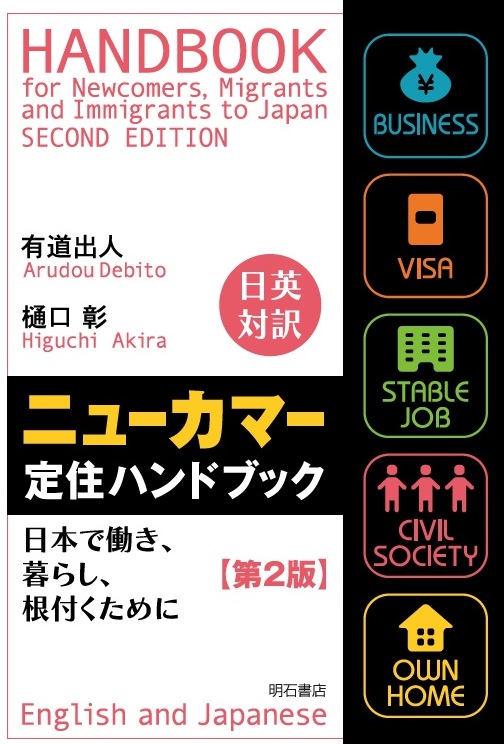
Guidebookcover.jpgjapaneseonlyebookcovertextHandbook for Newcomers, Migrants, and Immigrants to Japan「ジャパニーズ・オンリー 小樽入浴拒否問題と人種差別」(明石書店)sourstrawberriesavatardebitopodcastthumbFodorsJapan2014cover
UPDATES ON TWITTER: arudoudebito
DEBITO.ORG PODCASTS on iTunes, subscribe free
“LIKE” US on Facebook at http://www.facebook.com/debitoorg
https://www.facebook.com/embeddedrcsmJapan
http://www.facebook.com/handbookimmigrants
https://www.facebook.com/JapaneseOnlyTheBook
https://www.facebook.com/BookInAppropriate
If you like what you read and discuss on Debito.org, please consider helping us stop hackers and defray maintenance costs with a little donation via my webhoster:
Donate towards my web hosting bill!
All donations go towards website costs only. Thanks for your support!

Hi Blog.  I write Debito.org SNA “Visible Minorities” columns once a month (SNA website here) and send Debito.org Newsletters to subscribers sporadically.  After sending, I archive them here, and below, Debito.org Readers have been adding recent issues and articles that concern them regardless of the content of the post over the past several years.  It’s been a good way to allow Readers to be heard and engaged.

I still put out Debito.org Newsletters, but since I’m only posting on Debito.org approximately once a month, there’s only one article to repost (my SNA column), and I have it here as Debito.org post anyway.  So it’d only be a repeat if I dedicated another post to the Newsletter.

But I don’t want to deprive Readers of a forum, so let me continue this “Issues of Concern” section (still categorized under “Newsletters”) and let it be a free space for articles and comments germane to the mission of Debito.org.

Past “Issues of Concern” pages are getting filled with comments that are running farther afield than the original title, so let’s create a new one now.

This month, after the landslide election in favor of the LDP under a PM pandering to xenophobia, I think Debito.org Readers should be particularly concerned about where life is going.

Thanks as always for reading and contributing to Debito.org.  Debito Arudou, Ph.D.
======================
Do you like what you read on Debito.org?  Want to help keep the archive active and support Debito.org’s activities?  Please consider donating a little something.  More details here. Or if you prefer something less complicated, just click on an advertisement below.

20 comments on “DEBITO.ORG READERS’ ISSUES OF CONCERN, POST-ELECTION FEBRUARY 2026

  • I don’t really have anything to say, but it is kinda interesting how easily predictable Japanese politics are.

    Everyone here on debito.org predicted that the LDP under Takaichi will go full fascist mode to take away votes from Sanseito. Funnily enough some journalists who should now better claimed that the Unification Church scandal could potentially bring down the LDP, but everyone who’s even a bit familiar with Japanese politics knew that they would easily bounce back. As predicted, it was viewed as a “foreign problem” and since Takaichi is “tough on foreigners”, she will surely deal with those Unification foreigners the right way (and not take bribes).

    LDP will govern Japan till the end of time and nobody can convince me otherwise. The only thing that still amazes me, even after 20 years, is how all the opposition parties except for the Communist Party have no backbone. Amazing how the completely fold every 10 years or so and somehow think that a name change will do the trick, while they literally stand for nothing (Centrist Alliance? really?).

    Only interesting thing is if Takaichi will become the female Abe like she wants to, or if she’ll be gone after 1-2 years, like almost every PM except Abe. Article 9 is pretty much done for in my opinion. I wouldn’t be surprised if it’s gone completely in the next 5 years. Not going to be good for regional peace, but I honestly gave up on peace and the human race in general (like George Carlin). For some reason, whether it’s Japan, Europe, or the US, warmongers always get in power at the end.

    Anyways, I’m looking forward to all the gaijin handlers explaining how getting rid of Article 9 and reintroducing WW 2 military ranks is going to be good for world peace (and that Japan needs a permanent security seat of course).

    Reply
  • @Gary,

    Come on JK, just stop flooding this website with reams of AI manufactured statements of fact, it’s boring.

    For the record, my most recent AI-related post was on January 18, 2026 at 5:43 pm. All of my posts since then have been “AI-free”:

    January 28, 2026 at 9:56 pm
    January 28, 2026 at 10:24 pm
    January 28, 2026 at 10:34 pm
    January 31, 2026 at 10:31 pm
    February 7, 2026 at 10:32 pm
    February 7, 2026 at 10:50 pm
    February 5, 2026 at 11:55 pm
    February 6, 2026 at 11:54 pm
    February 7, 2026 at 11:21 pm
    February 7, 2026 at 11:34 pm
    February 7, 2026 at 11:54 pm
    February 8, 2026 at 12:08 am

    If anything, I am guilty of ‘flooding’ this website with reams of non-AI manufactured statements of fact!

    Post us a link of the information you wish to convey and if, we likewise, have a crush on AI, we’ll go to your link.I’ve been active on this site for 25+ years and while I’ve far from agreed with a lot that Debito has posted, I’ve enjoyed perusing this site.Your AI posts are making recent ‘perusings’ heavy going.

    As of February 7, 2026 at 10:32 pm I began posting entire articles along with the links due to articles disappearing behind paywalls, so I’m afraid that even my “AI-free” posts won’t get getting any lighter.

    I’ve been considering using an LLM to summarize / consolidate articles for easier consumption and clearly denoting them as such (My post on January 10, 2026 at 2:18 pm was my first attempt at this and my post on January 18, 2026 at 2:37 pm was my second). This way, should the linked-to article disappear, you and other Debito.org readers could simply scroll down to a ‘— BEGIN AI GENERATED CONTENT —‘ section and peruse that instead of slogging through multiple articles (especially if they are only available in Japanese).

    PS. As someone who’s heavily involved in programming

    @Dr. Debito, if you’ll allow me to go off-topic for just a bit…

    OK, what’s your favorite language and why? Mine? Pascal (yes, I’m an old guy).

    ask your favorite AI ‘bod’ – ask them all – the following question. ‘The sack of potatoes has been placed below the bag of flour, so it had to be moved first. What had to be moved first?’

    Since you asked, I put the question to Claude Opus 4.6; here’s what it had to say:

    The bag of flour has to be moved first, since it’s on top of the sack of potatoes.

    You stated:

    All AI bods will reply to you, ‘The sack of potatoes has to be removed first’.

    Care to proffer a theory as to why this model responded the way it did?

    In the kingdom of the blind, the one-eyed man is king. The eye missing with AI, is human cogitation. AI, as it presently exists, is mainly a glorified Python programming language construct – good at gathering data/information, but useless, without the correct algorithmic input, at making judgmental / moral calls.

    With all due respect, I disagree with your assessment of the technology. It’s like stating that the transformer architecture underlying modem LLMs is merely a steroid-enhanced pattern recognition engine. And in case you are wondering, no, AI was not involved in the generation of this response (I’m old guy, not a dumb old guy).

    So please, give us a rest from these mega-space consuming AI posts

    Here’s my suggestion: present a technical solution or policy solution to Dr. Debito for his consideration.

    For example, suggest he install a WordPress plugin that replicates the functionality of Confluence’s expand macro in order to prevent long posts from cluttering the site.

    Or suggest he establish and enforce a AI policy applicable to all contributors (i.e., instead of just one).

    And if he chooses to do nothing? Well, you can just skip my posts, right?

    and if you really want to understand the flaws of AI and have 4 years to spare, learn modern JavaScript ES 6 (2015).

    I do understand the flaws/pitfalls and don’t have 4 years to spare learning JavaScript. But assuming I did, it seems that learning a more modern language like Python or Rust would be better suited for your proposed exercise.

    — For the record, I appreciate having articles translated from Japanese to English, and if AI can do that ACCURATELY and more quickly than we can (I simply have no time anymore when I’m teaching more than 400 students per semester), I’m positively predisposed to it. I trust that JK will verify the accuracy of the translations, and as long as he continues to post the original links so we can check for ourselves, that’s a lot more information archived here from the vernacular press that we can process in real time.

    Reply
    • @Dr. Debito: FWIW, I’m now including verbiage in my posts where AI-generated content is used to indicate that a human being (i.e., me) reviewed said content for accuracy.

      Reply
  • Here’s a welcome change in the status quo!: Grad student’s film shows plight of detained foreigners

    From the article:

    Inspired by the tragic death of a Sri Lankan woman in a detention facility, an art school grad student faced a controversial immigration issue head-on and produced a feature film for his graduation project.
    In a rare development, the film “Imaginary Line” is also being screened at a Tokyo cinema.
    The movie encourages the audience to imagine the plight of foreign nationals in Japan where tougher immigration policies are being considered.
    Director Kensho Sakamoto, 27, completed the film in 2024 for his graduation project at Tokyo University of the Arts (Geidai) Graduate School of Film and New Media.
    The title derives from a technical term in filmmaking, which refers to an abstract line connecting characters facing each other.
    Sakamoto thought it could also represent a line that cruelly divides people in a society where some members have no residency status.
    The story centers around Yume, who was born in Japan but has no residency status because her Nigerian mother illegally entered Japan, and her friend Fumiko.
    One day, Yume travels to another prefecture from her place of residence without permission. She is taken away by a police officer and ends up in an immigration detention facility.
    The strong-minded Yume is exhausted and gradually begins to feel hopelessness about her life in Japan.
    Fumiko, meanwhile, finds herself increasingly angry at the absurdity of Yume not being released from the facility.
    Sakamoto took an interest in the immigration control system in 2021 after learning in a news report about Wishma Sandamali, who died at the Nagoya Regional Immigration Services Bureau facility.
    While Sakamoto was thinking about the theme for his graduation project in 2023, it was reported that the revised Immigration Control and Refugee Recognition Law was enacted.
    He felt an urge to deliver a movie to the world that would make people want to learn about the immigration control law and refugees even if they have no interest in such issues.
    In preparation for the project, the director frequently visited immigration detention facilities in Tokyo’s Shinagawa Ward and Ushiku in Ibaraki Prefecture to interview detainees. He also met foreign nationals on provisional release who were allowed to live temporarily outside the facilities.
    He met a total of about 40 detainees and foreigners on provisional release. 
    “I listened to their stories to understand their fears, discontent and anxieties,” he said.
    One of the detainees was left dumbfounded and couldn’t have conversations with him, while a young person on provisional release asked Sakamoto how to find a part-time job requiring no residency status.
    As he continued making visitations, he started wanting to convey that there are people whose rights are severely restricted when they just want to live like “Japanese people.”
    Masato Hojo, manager of Eurospace, an arthouse cinema in Tokyo’s Shibuya district that offers a showcase of graduation projects from Geidai for one week every year, praised “Imaginary Line.”
    Sakamoto gained cooperation from Eurospace to have the film shown solely at the theater this year, two years after it was completed.
    “It ends without solving anything, has no happy ending or doesn't condemn anybody, but it lingers in the heart,” Hojo said.
    Graduation projects from Geidai come in many varieties, ranging from artistic films to entertainment movies, he said, adding, “I have never seen a graduation work with such a strong social message.”
    Currently, photos and videos are often posted on social media to expose the faces of foreign nationals, making them targeted for slanderous comments.
    The government is considering imposing restrictions on accepting foreigners and introducing a more rigorous screening system for foreign residents on grounds of "public anxieties."
    “I feel like we have become too narrow-minded when it comes to dealing with foreigners,” Sakamoto said. “I intended the film to encourage people to think again.”
    “Imaginary Line” is currently being shown at Eurospace before it will be screened in Osaka and Aichi prefectures and elsewhere.

    Reply
  • Re-posting this here per Dr. Debito’s suggestion:

    Looks like we’re going to need a DEBITO.ORG READERS’ ISSUES OF CONCERN, FEBRUARY 2026  for all of the election-related commentary this month!

    Here’s a potential first post for said blog entry courtesy of Claude Sonnet 4.5 doing translation duties on this Youtube video:

    「外国人はもういらない」川口市長選で飛び交う“外国人排斥” クルド人が経営する店にはYoutuberが押し寄せ…異例の選挙戦で市民の選択は?【news23】|TBS NEWS DIG

    “We Don’t Need Foreigners Anymore”: Anti-Foreigner Rhetoric Dominates Kawaguchi Mayoral Race as YouTubers Swarm Kurdish-Owned Shops — What Did Voters Decide in This Unprecedented Election?

    Yesterday, Okamura Yusaku won his first term as mayor of Kawaguchi City in Saitama Prefecture. Looking back at the campaign, with riot police on hand, the atmosphere was undeniably strange. The reason? Two candidates campaigned on platforms of foreign-resident exclusion

    .“A town where Japanese people live most comfortably and foreigners find it hardest to live. We’ll end all preferential policies for foreigners. Forced deportation. I promise you. We don’t need foreigners anymore.”

    In response, protesters holding signs reading “Stop the Discrimination” clashed with supporters, and tensions nearly boiled over. In the end, the two candidates who pushed extreme anti-foreigner rhetoric each won more than 17,000 votes.

    Furukawa has received endorsement from a political organization led by Kawai Kousuke, a Saitama resident who has been vocal about excluding foreign nationals. Their primary target: “We will completely drive out the Kurds living in Kawaguchi City. Let me be clear. I absolutely will not tolerate them.”

    Social media has been flooded with posts like this from the mayor for years. Could these online messages have influenced public opinion? In a survey conducted by Kawaguchi City last year, when asked what they disliked most about the city, 54.1% of residents said “poor public safety”—the highest figure on record. However, according to interviews with the Saitama Prefectural Police and others, while the foreign population in Kawaguchi increased by more than 4,300 over the past five years, the number of crimes committed by foreigners has actually decreased.

    Furukawa also made this claim: “The current mayor, Mr. Oku, has been threatened by Kurds. He admits it himself. So this time too, he’s unable to act—he can’t deal with foreigners anymore.”

    When we checked with Kawaguchi City, they flatly denied that the mayor had been threatened by Kurds—there is no such fact.

    When asked, “If Mr. Furukawa has done something wrong, I apologize. But don’t you think this campaign amounts to hate speech?” he replied, “Yes, I suppose so. What do you think?”

    As baseless rumors spread, Waqas Chaudhary, who leads the Kurdish community in the city, says he receives defamatory emails every single day.

    Get out of Japan. If you don’t leave, we’ll kill all the Kurds. That’s the kind of thing I’m getting.”

    In December last year, a group of YouTubers suddenly descended on a kebab shop run by a Kurdish friend. “Out of nowhere, about six people showed up and started filming the shop, shouting things, doing interviews.” The YouTubers pointed their cameras at the shop. At the center of the group was Kawai.

    “Are Kurds coming? When Kurds come, it becomes a problem.”

    But there are also people speaking out against the spreading discrimination and xenophobia. “Stop the hate speech.” Last month, a demonstration opposing hate speech and similar rhetoric was held in Kawaguchi, with many participants marching through the city with police escort. Some residents waved as they passed.

    As xenophobic rhetoric escalates with each election, Waqas says: “There are issues that come from daily life and cultural differences, so the key is dialogue. Rather than excluding them, I think we should be thinking together about how we can make this work.”

    Two candidates who ran on xenophobic platforms lost, but each still captured around 17,000 votes. What do you make of these results?

    “Well, what we should really focus on here is the voter turnout. It nearly doubled from 21% four years ago. I think many voters concluded that electing a xenophobic mayor would be a bad thing, and that’s what brought them to the polls.

    “Of course, it’s only natural that foreign residents follow Japanese laws and rules. But at the same time, many people understand that without the cooperation of foreign workers, our economy and social services simply can’t function. In that sense, most people believe that coexistence is the only path forward. And I think this election shows that voters—in their own quiet way—made the choice to reject xenophobia. That’s a very positive lesson as we think about how to address these issues going forward.”

    ASR (automatic speech recognition) source text here:

    昨日埼玉県の川口市長で初当選を果たした岡村ゆ越戦を振り返り起動隊も来てですね、やっぱり異様な雰囲気だなと。その理由は2人の候補者による外国人廃斥の訴えです。日本人が1番住みやすく外国人が住みにくい町外国人の優遇政策。これ全部やめます。強制でうなんですよ。約束します。外国人がもういらない。これに対し差別をやめろなどのプラカードを掲げる人々が仕掛け一速発になる場面も。結果として外国人に対する過激な主張を展開した2人はそれぞれ1万7000以上の表を集めました。古川市は外国人廃を訴える埼玉の川井介氏が代表を務める政治団体から認を受けています。そのターゲットは川口市に住むクルド人は一掃します。はっきり言ます。絶対許しません。SNSでも数年前からこうした市長の投稿が多く見られるようになっています。こうしたSNSなどが影響しているのでしょうか?川口市が去年行った調査では市の良くないところという問に対し治安が悪いと答えた市民が54.1%に登り過去最多となりました。しかし、埼玉県警などへの取材によると、ここ5年間で川口市に住む外国人は4300人余り増えた一方、外国人の警報の謙虚は減少しています。古川市はこんな発言も今の師匠ね、奥木さんもクルシから共惑されたりしてるんですよ。本人は得てます。と、だから今回省も無理だとこれ以上もう外国人関わってないと少な川口市に確認したところ市長がクルド人から脅迫されたという事実はないと明確に否定古川にすとが何かしてましたら申し訳ないですねさせて選挙に足りたヘイドスピーチなんじゃないかっていう発電もそういはい、どう考えました?事実に基づかない視聴が拡散する中、市内でクルド人コミュニティを引きるワッカス長落さんの元には毎日のように誹謗中傷のメールが届くと言います。あの、日本から出ていけ、出て、出ていかなながら黒人がみんな殺すと、あの、ま、こういう風に、え、抱えていますね。去年12月にはクルド人の友人が経営するケバ店に突然YouTuberの集団が押しかけてきました。あの、何も強化なくていきなり6人ぐらいで行ってこっちでお店に向けて、あの、動画撮ったり、あの、わ言ったり、インタビューし、店手にカメラを向けるYouTuberたち。その中心には川師がました。来るの?来ると人間広がる差別や災害主義に声をあげる人々もいます。ヘイトスピーチだ。先月川ムしてヘイトスピーチなどに反対するデモが行われ、多くの人が警戒共に内を練り歩きました。手を振る住民の姿もみ選挙の旅にエスカレートする外主義的な主張にワッカスさんは日常生活だったり文化の違うという問いのがあるのでそれのキーも対話なんです。彼らが排除するじゃなくて、あの、ま、一緒にどういう風に、あの、すればうまくいけるか、それを考えるべきだと私は思っています。災害主義を掲げた候補が楽戦、ただそれぞれ1万7000秒ほど獲得しているという、ま、この結果ですけれども、こさん、どう考えます?そうですね。今回注目すべきはこの投票率なんですね。はい。4年前の21%から今回倍近くになってるんですけど、おそらく多くの有権者がですね、海外主義の市長が誕生するのはよろしくないと判断して投票所に向かったんだと思いますね。はい。ま、あの、外人の人が日本の法律とかルールに従っていだくの、これ当然のことなんですが、やっぱり一方でその経済活動とかね、福祉の現場でその外国人の協力がないともう立ち行かないっていうのはもう多くの人々が知っているわけで、そういう点ではやっぱり強制の道を探っていくしかないというのはとんどの人たちが思っているわけで、そういう有権者が今回そのあるある意味ではその静かに判断して、え、肺主義ではない法を選んだというのは1つこうこの問題を考える解決策の1つとして出てくる非常にあのいい経験かなと思いますね。

    Reply
  • My term for “political opportunists”? ‘Roaches’: INTERVIEW: Japan populist parties fueling unfounded fears: European scholar


    TOKYO - Acting as "political entrepreneurs," rising right-wing Japanese populist parties in recent years have been fueling fears about issues that do not match the country's reality, according to an observation by a European expert in comparative politics.

    Daniele Caramani, a professor at the University of Zurich, said it remains unclear whether such parties' gains in popularity and political ground will prove durable. But he said their views may be drawing attention amid generational change in Japan, with diminishing sensitivities over the country's past militarism.

    While rhetoric centered on "national identity" and opposition to immigration echoes trends in Europe and the United States, the actual circumstances in Japan differ markedly from those regions, Caramani, an Italian scholar, said in a recent interview with Kyodo News in Tokyo.

    His remarks came as the populist Sanseito party, known for its "Japanese First" slogan, expanded its presence in the Feb. 8 House of Representatives election by winning 15 seats, up from the two it held previously and continuing the surge seen in the July 2025 House of Councillors poll.

    Another small opposition group, the Conservative Party of Japan, which has criticized Japan's acceptance of foreign workers on visas as effectively opening the door to immigration, also drew attention when it won two seats in last year's upper house race, although it lost its sole lower house seat in this month's election.

    But Caramani argued that while the language is familiar, there is "no real immigration" in Japan. "This shows that these parties are really political entrepreneurs. They create a 'reality,' but sometimes it's not there."

    According to data from the Organization for Economic Cooperation and Development from 2024, foreign residents accounted for around 3 percent of Japan's population, a level far lower than in most other developed nations, where the share reaches 10 percent or more.

    Still, reports of foreigners misusing public services or engaging in problematic behavior have attracted attention in Japan, with parties including Sanseito seeking to capitalize on the concerns, presenting themselves as taking a tough stance.

    Caramani said it is difficult to predict whether Sanseito will be able to sustain its momentum but warned that international developments such as U.S. President Donald Trump's pressure on Greenland may prompt people to begin to view exclusionary nationalism as "dangerous."

    "If you go 'your country first,' you might also get very isolated," Caramani said, questioning whether such ideas can maintain long-term public support in smaller nations that are in a vulnerable position in a "world of predators" where "might is right."

    Caramani also said that nationalism, which has long been considered "taboo" in Japan due to its wartime history, may be resurfacing due to a generational change -- a development he says has parallels in Europe.

    In the lower house election, the Liberal Democratic Party led by Prime Minister Sanae Takaichi, known for her conservative political stance and hawkish security views, scored a historic landslide victory by winning more than a two-thirds majority.

    Caramani is the winner of the internationally prestigious Stein Rokkan Prize for Comparative Social Science Research in 2004.

    Reply
  • What follows is an English translation (courtesy of GPT-5.1) of the ASR (automatic speech recognition) text from the following YouTube video: ドライバーの半数近くが外国人 福岡市のタクシー会社に密着「稼げるようになった」インバウンド増加で活躍 ”強みは会話”

    Nearly Half the Drivers Are Foreigners: Inside a Fukuoka Taxi Company – “Now I Can Really Earn”
    Inbound Tourism Brings More Work, and Their Biggest Strength Is Conversation

    [On location – in the taxi]

    Sakai: “Thank you very much.”
    Aaron: “In English, please.”
    Sakai: “Ah—thank you.”

    Narration: This is Mr. Gransey Aaron from the U.K.He taught English conversation for 20 years, but last September he started driving a taxi.

    Sakai: “In your previous job, you didn’t have social insurance, right?”
    Aaron: “Right. And I’ve got a family, so I really do need that. Here I get proper pension and everything. And I can actually make more money doing this. I mean, it depends, but…”
    Sakai: “So your take-home pay has gone up?”
    Aaron: “Yeah, it’s gone up a lot. Before, things were pretty tight, but now it’s a lot easier.”
    Sakai: “Really?”
    Aaron: “Yes.”

    Narration: He’s still a brand-new driver, but he says he enjoys the work.

    Sakai: “So you used to be an English teacher. How old are you now?”
    Passenger (young man): “I’m 22.”
    Aaron: “22? I was probably already teaching when you were born—22 years ago.”
    Passenger: “Oh, really?”
    Aaron: “Yeah.”
    Passenger: “You don’t look it!”
    Aaron: “Right? I’m 46 now.”
    Passenger: “No way!”
    Aaron: “Yep. I’ve got three kids too.”

    Narration: Mr. Aaron works at Azuma Taxi in Higashi Ward, Fukuoka City. For the past three years, the company has been actively hiring foreign drivers.

    Sakai (in office): “What’s this?”
    Staff: “This is last month’s revenue ranking.”
    Sakai: “Oh, the top names are almost all written in katakana.”
    Staff: “The Japanese drivers are fighting hard too, but yeah, these days they’re the ones struggling to keep up.”

    Narration: Of the 53 drivers, 24 are foreigners—almost half. Four more foreign drivers have already been offered jobs, and that number is expected to keep growing.

    Even in the office, you hear English everywhere.

    Sakai (to foreign driver A): “What’s the most fun part of the job?”
    Foreign driver A: “You meet all kinds of people.”“And we get a lot of tips.”
    Sakai: “Really?”
    Foreign driver A: “Yeah, everyone gets them. Some days I’ll get like ¥30,000 (about $200) just in tips.”
    Sakai: “No way.”
    Foreign driver A: “Totally normal.”

    [Break room]

    Trainer (Pakistani senior driver): “Brakes are all good.”“That’s okay. Fuel’s okay too. This is fine as well.”

    Narration: This is Aslam, a new hire from Pakistan.

    Sakai (to Aslam): “So you’re aiming for the very top spot in sales?”
    Aslam: “Yeah, number one.”
    Sakai: “And your take-home would be…?”
    Aslam: “About ¥500,000 (about $3,300).”
    Sakai: “Around ¥500,000?”
    Aslam: “Yeah. Here, the more you work, the more you earn. If I really push, I think I can probably make around ¥400,000 (about $2,600).”
    Sakai: “Wow, that much.”

    Narration: On this day, he’s in the middle of his third day of on-the-job ride training.
    His trainer is also from Pakistan.

    Trainer (in the car): “With left-hand traffic, you’ve really got to stay as far left as you can.”
    Aslam: “Ah, okay, okay.”

    Narration: He gets detailed coaching in their native language.

    Sakai (to trainer): “What kind of training are you doing today?”
    Trainer: “Today I’ll show him how to use the DiDi ride-hailing app—how to handle it if we get a booking from a customer.”

    Narration: They start training on the DiDi taxi dispatch app.

    Trainer (looking at phone): “Oh, we just got a DiDi booking.”
    “Right—‘Please arrive at the pickup point by 15:51.’”
    Aslam: “Got it.”
    Trainer: “If you don’t know the destination, you just enter ‘Tenjin 2-chome 4’ into your phone.”

    Narration: Once they accept a dispatch order, they pull up the pickup point in the map app on their smartphone and follow the guidance.

    Trainer: “Street hails are actually harder. They just say where they want to go and sometimes I have no idea where that is, but with the app the destination is already entered. It’s easier to handle, easier to drive. You look at it and go, ‘Oh, that’s where it is.’”

    Aslam (to passenger): “Just so you know, I’m still in training—training driver here.”
    Passenger: “Okay, please go ahead.”
    Aslam (aside): “My driving is fine, I just don’t want to get yelled at.”

    Narration: Once the passenger is on board, he simply follows the route shown by the dispatch app and arrives at the destination.

    Aslam (driving): “There’s a bit of a traffic jam.”

    Narration: But there’s no getting lost; everything goes smoothly.

    Passenger: “Thank you very much.”

    [Industry context – narration]

    Narration: Since the pandemic, taxi companies all over Japan have been struggling with driver shortages. Against that backdrop, starting last year, the written test for the Class 2 license—required to drive a taxi—became available in 20 different languages.

    According to the Fukuoka City Taxi Association, the number of drivers is gradually recovering, and the operating rate has improved from 57.6% during the pandemic to 68.4% as of last month. Within that, Azuma Taxi—so proactive about hiring foreign drivers—has reached a remarkable 95% operating rate.

    Foreign drivers also bring unique strengths.

    Sakai (at airport taxi stand, to foreign driver B): “About what percentage of your passengers are foreigners?”
    Foreign driver B: “Around 80%.”
    Sakai: “80%?”
    Foreign driver B: “Yeah, this is the international terminal, after all.”
    Sakai: “How do you handle communication?”
    Foreign driver B: “I just stay quiet. They show me their smartphone and I take them to that destination.”
    Sakai: “So you don’t really talk.”
    Foreign driver B: “Right.”
    Sakai: “That sounds tough.”
    Foreign driver B: “Yeah, if you can’t speak English, it’s hard. That’s why I use translation apps too.”

    Narration: For Mr. Aaron from the U.K., English of course is his native language.

    Aaron (to passenger): “Is the temperature okay back there? Do you have a favorite Japanese food?”
    Passenger: “What?”
    Aaron: “Oh, ramen. Have you tried it?”
    Passenger: “[inaudible]?”
    Aaron: “It’s in [inaudible], kind of a hidden little place—black tonkotsu ramen.”

    Narration: Almost all of Azuma Taxi’s foreign drivers speak English.That’s a huge asset when dealing with foreign passengers who don’t speak Japanese.

    Aaron (about passengers): “We’re basically on equal footing, you know? We can talk like friends.”

    Sakai: “Have you had trips out to more distant sightseeing spots?”
    Aaron: “Yeah, the farthest was Sasebo.”
    Sakai: “If you hadn’t spoken English, you wouldn’t have gotten that customer, right?”
    Aaron: “Right. That fare was ¥43,200 (about $280). I remember it exactly.”

    Narration: With dispatch apps and the Class 2 written test now available in multiple languages, the barriers to entry have come down. At the same time, inbound tourism is booming, giving foreign drivers more chances to shine. They may turn out to be the saviors of a taxi industry plagued by driver shortages.

    [In the studio]

    Anchor: “We’re now joined by reporter Sakai, who covered this story. Thank you.”
    Sakai: “Thanks for having me.”

    Anchor: “How was it, being followed around like that while you were reporting?”
    Sakai: “I spent two days with them, and everyone just looked like they were really enjoying their work. They put a ton of effort into customer service, and passengers would actually say, ‘That was fun,’ as they got out of the cab. Performance numbers are up as well, so it’s a win for the company too. Seeing everyone smiling left a really strong impression on me.”

    Sakai: “Let’s take a quick look at where the taxi industry stands right now. I think a lot of people feel like it’s gotten harder to catch a cab. Over the last 20 years, the number of drivers nationwide has dropped by 150,000. The biggest factor is the aging workforce. The average age is 60.2. And if you look at the job-to-applicant ratio, it’s 9.11—that’s incredibly high. Companies are basically fighting over every single driver they can find. The labor shortage is that severe.”

    “In this situation, the government is trying to help by easing work visa requirements and, as we saw in the segment, offering the Class 2 written test in 20 languages. And maybe the biggest factor is the dispatch apps: they show you the route, so you can do the job even if you don’t know the streets well. All of this has created a much more favorable environment for foreign workers.”

    Anchor: “Mr. Motomura, what did you think watching this piece?”
    Motomura (commentator): “I thought it was fascinating. We keep hearing that self‑driving cars are coming, but they’re still not here. In the meantime, I think hiring people with foreign roots is a great approach. Their ‘disadvantage’ actually becomes a strength—they can overcome language barriers and turn that into an asset. It’s a really good idea. It does make me wonder what other taxi companies are doing if they’re not going this far.”

    Anchor: “So other companies aren’t quite as aggressive?”
    Sakai: “Right. Azuma Taxi is actually an outlier right now. When we asked the Fukuoka City Taxi Association, they said this approach hasn’t really spread through the industry yet. If it did, I think it could go a long way toward solving the driver shortage problem.”

    Anchor: “And everyone there really works hard.”
    Sakai: “They do. The fact that the more they work, the more they earn seems to be a big motivator. They mentioned tips earlier—he’s not the only one; the other drivers are getting them too.”
    Anchor: “Are those tips mostly from foreign tourists?”
    Sakai: “No, Japanese passengers as well.”
    Anchor: “I’ve never tipped a taxi driver in Japan.”
    Motomura: “Me neither. But I can imagine wanting to—wanting to support them, to say, ‘Keep it up.’”

    Anchor: “It probably changes the atmosphere inside the company too, doesn’t it?”
    Sakai: “Definitely.”

    Anchor: “So this time we got a rare behind‑the‑scenes look at foreign taxi drivers and their place in the industry. Sakai, thank you very much.”
    Sakai: “Thank you.”

    Exchange rate used: ¥1 ≈ $0.00655 (about ¥153 = $1) as of February 15, 2026.

    Reply
  • Following up on my ‘cut-down’ cherry blossom festival post from February 7, 2026 at 10:50 pm, here’s a YouTube investigative report by TV Asahi NEWS:

    20万人来場「桜まつり」中止 “相次ぐ迷惑行為” 観光客のマナー問題の実態は?【スーパーJチャンネル】(2026年2月16日)

    Translation of the ASR (automatic speech recognition) text is courtesy of Claude Sonnet 4.5; human review for accuracy is courtesy of me. Lest Debito.org readers think all I do is ‘spam’ this site with AI-generated content, I offer my human-generated two-yen on this situation at the end for commentary.

    “Cherry Blossom Festival” Drawing 200,000 Visitors Canceled — “Repeated Disruptive Behavior” — What’s Really Going on With Tourist Manners? [Super J Channel] (February 16, 2026)

    A cherry blossom festival that has run for 10 years has been canceled this year. What’s behind the decision? Our investigation revealed disruptive behavior by tourists. Here, a tourist has entered the grounds of a private residence. They trespass on someone else’s property without permission to take photos. “Is it not okay to take pictures here?” What’s more, they’re stepping onto railroad tracks to snap photos.

    The site experiencing a wave of tourist misconduct is Arakurayama Sengen Park in Fujiyoshida City, Yamanashi Prefecture. “This is the entrance to Sengen Park, and you can see many tourists visiting here.” It’s a popular spot offering panoramic views of Mount Fuji and a five-story pagoda. Word has spread overseas through social media, drawing large numbers of international visitors. “I came to see Mount Fuji. The scenery was so beautiful.”

    In spring, the miraculous view of Mount Fuji, cherry blossoms, and the pagoda all together creates a stunning sight. The park has hosted a cherry blossom festival for about 10 years. More than 200,000 people visited each year, but the city has decided to cancel this year’s festival.

    Overtourism—a problem of tourist manners. When we investigated the scene, the reality became clear. Tourists are smoking in front of a shop’s warehouse—people who don’t follow smoking etiquette. They’re entering the railroad tracks to take photos—reckless behavior that ignores danger. And food and drink trash is scattered everywhere.

    The area around the park is a residential neighborhood. “There’s quite a bit of trash like cans left behind, or things left at people’s gates—that happens a lot. The trash is really bad. I clean up pretty frequently, but it just keeps piling up.” According to residents, many of those not following the rules are foreigners. “Sometimes fights break out, and local residents end up unable to leave their homes.”

    And here, tourists are taking photos on the grounds of a private home. Why are they trespassing without permission? When we asked: “It looked like a traditional Japanese place and was beautiful, so I took photos.” “You can’t take photos here on someone else’s property?” “I didn’t know that.”

    Now tourists have parked their car on someone’s property without permission. According to the man who warned them, the trespassers were a group of foreigners who said they thought it was a restaurant parking lot. And there are even more shocking incidents. “People using the bathroom in someone’s yard—it was truly unbelievable.”

    On the other hand, there are voices concerned about the festival’s cancellation. “Canceling it is sad, isn’t it? Yeah, it’s sad.” “Looking at the whole year, the cherry blossom festival in April is definitely our peak sales period, so I’m wondering what’s going to happen this year. But there’s also the issue that it causes trouble for residents.”

    The city plans to strengthen measures to ease congestion during cherry blossom season, including increasing the number of guides and running shuttle buses.

    I’m starting to think that ‘overtourism’ is what happens when infrastructure and cultural education fail to scale with NJ visitor numbers (due to viral social media posts) in places where tourist sites intersect with residential areas.

    Reply
  • SPOILER ALERT!
    ‘AI could replace foreign workers in Japan’

    https://www.japantimes.co.jp/news/2026/02/17/japan/politics/team-mirai-immigration/

    PLOT TWIST!
    AI will replace hundreds of thousands of entry-level white collar jobs, forcing Japanese youth to work in combinis, farms, and elderly care homes so the NJ can be done away with.

    They can’t see that coming!🤣

    Personally, I think we’re in an AI stock market bubble and it’s gonna burst like the dotcom bubble. I’ve heard all the ‘but this technology is a paradigm shift’ excuses before.

    Reply
  • New snitch system deployed, now run by a prefecture (Ibaraki).

    https://www.asahi.com/ajw/articles/16368466

    “Eriko Suzuki, a professor at Kokushikan University specializing in immigration policy, called Ibaraki Prefecture’s measure “a form of official xenophobia” that risks attracting inaccurate information.”

    Correct.

    “While such a system is “understandable” when operated by the national immigration agency, which has investigative powers, Suzuki questioned if it should be the local government’s role”

    Wrong. It’s not “understandable”. Either get the police and immigration service to do their job in a fair system based on evidence and fair trials, or just stop accepting any immigration. Giving random citizens the power to report and deport any foreigner is exactly what nazi Germany did.

    Reply
  • Oh great, now Ibaraki prefecture is getting into the snitch site business (for reference, Dr. Debito blogged about the original one here):

    Ibaraki offers cash for tips on undocumented foreign workers

    MITO—Grappling with the highest illegal employment numbers in the nation, the Ibaraki prefectural government will offer a cash reward system for tips on undocumented foreign workers starting in fiscal 2026.
    The program will solicit information about foreign nationals working without proper visas and offer rewards if a report leads to a police arrest.
    The cost was included in the initial budget proposal for the new fiscal year, announced on Feb. 18.
    While the national Immigration Services Agency has a similar tip-based reporting system, prefectural-level programs are rare, officials said.
    "We must take drastic measures to solve this problem," Ibaraki Governor Kazuhiko Oigawa said at a news conference.
    Addressing concerns the policy could encourage snitching or lead to human rights violations, the governor said, "We will absolutely not allow this to become a reckless situation that makes even diligent foreign workers feel uneasy.”
    HIGHEST RATE IN JAPAN
    The move comes as Ibaraki prefectural officials seek to address the high number of foreigners working illegally, particularly in their agricultural sector.
    According to the Immigration Services Agency, of the slightly more than 14,000 foreigners identified as working illegally nationwide in 2024, 3,452 were in Ibaraki Prefecture—the highest number of any prefecture for the third consecutive year.
    Previously, prefectural staff focused on campaigns urging employers not to hire undocumented workers.
    The new online system is designed to strengthen information-gathering alongside industry groups and municipalities.
    Under the system, prefectural staff will investigate tips and contact police if illegal employment is suspected.
    The reward is expected to be several tens of thousands of yen.
    "We will work out the details of the system in a way that is considerate of human rights," said an official from the office for promotion of appropriate employment of foreign nationals.
    The official added that the prefecture expects more information to be provided about businesses illegally employing foreign nationals than foreign nationals working illegally.
    CRITICS VOICE FEARS
    A similar national system has existed since 1951, offering up to 50,000 yen ($320) if a tip leads to a deportation order.
    However, according to the Immigration Services Agency, no rewards were paid out between 2021 and 2025.
    The Ibaraki prefectural announcement has drawn criticism from Jiho Yoshimizu, head of Nichietsu Tomoiki Shienkai, a Tokyo-based nonprofit organization that supports Vietnamese in Japan.
    Yoshimizu said many foreigners his group supports have lost their place to live after being fired from their trainee placements or fleeing abusive workplaces. Unable to afford a flight home, they have ended up overstaying their visas, he said.
    Yoshimizu argued that the reward system will make it harder for such foreigners to seek help for fear of being reported, potentially pushing them toward commiting other crimes.
    "The number of foreigners who choose to hide rather than seek help may increase," he said. "Creating a safe environment for them to solicit advice early is more important than a mechanism to increase reports."
    Eriko Suzuki, a professor at Kokushikan University specializing in immigration policy, called Ibaraki Prefecture's measure "a form of official xenophobia" that risks attracting inaccurate information.
    While such a system is "understandable" when operated by the national immigration agency, which has investigative powers, Suzuki questioned if it should be the local government's role.
    A municipality's primary duty, she noted, is to provide services to residents, not to identify foreign nationals working illegally.
    (This article was written by Morio Choh, Tomonori Asada and Chika Yamamoto.)

    Reply
    • Here’s your chance to let Ibaraki prefecture know what you think about their proposed snitch site!:

      茨城県不法就労活動の防止に関する条例(案)に関する意見を募集します

      GPT-5.2 Thinking is handling the translation duties below with human supervision:

      We are seeking public comments on the Ordinance (Draft) on Preventing Illegal Employment Activities in Ibaraki Prefecture.

      1. Materials to be released
      Ordinance (Draft) on Preventing Illegal Employment Activities in Ibaraki Prefecture (PDF: 65KB)

      2. Comment period
      Tuesday, February 24, 2026 – Wednesday, March 25, 2026
      ※ If submitted by mail, submissions postmarked on March 25, 2026 will be accepted.

      3. How to submit comments

      (1) Format
      There is no required format. Clearly write “Comments on the Ordinance (Draft) on Preventing Illegal Employment Activities in Ibaraki Prefecture” as the subject/title, and include your address, name (or organization name), and phone number.

      (2) Submission methods
      Submit by mail, fax, email, or the Ibaraki Electronic Application/Notification Service.

      (3) Where to send comments

      a. By mail (※ Postmark valid as of March 25, 2026)
      Labor Policy Division, Industrial Strategy Department, Ibaraki Prefectural Government
      978-6 Kasaharachō, Mito, Ibaraki 310-8555, Japan

      b. By fax (※ Must arrive by March 25, 2026)
      Fax: 029-301-3649
      Labor Policy Division, Industrial Strategy Department, Ibaraki Prefectural Government

      c. By email (※ Must arrive by March 25, 2026)
      E-mail: rousei8@pref.ibaraki.lg.jp
      Labor Policy Division, Industrial Strategy Department, Ibaraki Prefectural Government
      ※ In the subject line, write: “Comments on the Ordinance (Draft) on Preventing Illegal Employment Activities in Ibaraki Prefecture.”

      d. Via the Ibaraki Electronic Application/Notification Service (※ Deadline: 5:00 p.m., March 25, 2026)
      ※ Access the URL below and enter the required information.
      https://apply.e-tumo.jp/pref-ibaraki-u/offer/offerList_detail?tempSeq=84479

      4. Notes

      (1) Comments are not accepted by phone.
      (2) Please understand that we are unable to provide individual responses to comments.
      (3) Comments must be submitted in Japanese.
      (4) Submissions will be treated as invalid if they do not arrive within the comment period, are not submitted using one of the methods above, or include any of the following:
      a. Content that defames or slanders an individual or a specific organization
      b. Content that infringes on the privacy of an individual or a specific organization
      c. Content that infringes on the copyright of an individual or a specific organization
      d. Content that violates laws or regulations, involves conduct contrary to public order and morals, or is connected to criminal activity
      e. Content intended for profit, such as business solicitations

      5. Handling of comments
      The comments received will be compiled by this division and published together with the prefecture’s views on them, and they will also be used as reference in preparing the final draft.

      Note that personal/corporate information—such as the address, name (organization name), and phone number of those who submit comments—will not be published.

      6. Contact information
      Foreign Nationals’ Proper Employment Promotion Office, Labor Policy Division, Industrial Strategy Department, Ibaraki Prefectural Government
      978-6 Kasaharachō, Mito, Ibaraki 310-8555, Japan
      Phone: 029-301-3849
      Fax: 029-301-3649
      E-mail: rousei8@pref.ibaraki.lg.jp

      Inquiries about this page
      Foreign Nationals’ Proper Employment Promotion Office, Labor Policy Division, Industrial Strategy Department
      978-6 Kasaharachō, Mito, Ibaraki
      Phone: 029-301-3849
      Fax: 029-301-3649

      Reply
  • So much for ‘foreign crime’ and its impact on public safety!:

    Xenophobic posts on social media have claimed that Japan’s growing foreign population is worsening public safety. But with foreign residents nearly doubling from 2.01 million to 3.95 million over the past two decades, the proportion involved in crime has declined.

    “Although the number of foreign nationals entering Japan is increasing, there is no clear impact on the deterioration of public safety. We will continue necessary enforcement regardless of nationality,” a senior National Police Agency official said.

    Number of foreigners detained in Japan down 40% from 20 yrs ago


    TOKYO - The number of foreigners detained in Japan in the five years through 2025 fell 40 percent from the peak recorded 20 years earlier, an analysis of police data showed Saturday, with the decline coming despite a nearly two-fold increase in foreign residents over the same period.

    A total of 56,706 foreign nationals were processed by police between 2021 to 2025, a sharp drop from the 93,899 recorded between 2001 to 2005, according to crime statistics from the National Police Agency. The number fell by half in 14 of Japan's 47 prefectures.

    Xenophobic posts on social media have claimed that Japan's growing foreign population is worsening public safety. But with foreign residents nearly doubling from 2.01 million to 3.95 million over the past two decades, the proportion involved in crime has declined.

    Enforcement cases involving foreign nationals, excluding permanent residents and U.S. military personnel, fell in 40 prefectures between the two five-year periods.

    Nagano Prefecture saw the largest drop at 73.2 percent from 1,679 to 450. Tokushima, Ehime, Wakayama, and Fukushima prefectures also recorded steep declines. By absolute numbers, Tokyo saw a decrease of 22,344 cases, Kanagawa 3,358, and Shizuoka 2,241.

    "Although the number of foreign nationals entering Japan is increasing, there is no clear impact on the deterioration of public safety. We will continue necessary enforcement regardless of nationality," a senior National Police Agency official said.

    In terms of single year data, the nationwide number of detentions in 2025 rose by 5 percent from the previous year to 12,777, marking the third consecutive year of increase.

    The climb reflects a rebound from the low crime levels during the COVID-19 pandemic, but is still proportionally lower than the roughly 300,000 person growth in foreign residents annually.

    Including Japanese nationals, the total number of people detained for Penal Code offenses topped 600,000 per year in the early 1950s but fell to the 300,000 range in the early 2000s.

    The figure has remained around 200,000 in recent years as community patrols, increased security cameras and crackdowns on organized crime have proven effective.

    Reply
  • So much for ‘overtourism’ — in its pursuit for more yen, the J-Gov is adding to ‘social friction’ with one hand while removing bureaucratic friction with the other!:

    The Japanese Embassy in Russia recently opened one visa application center each in Moscow and St. Petersburg to cope with the rapidly increasing number of people traveling to Japan from Russia.

    In contrast [to major European nations], the Japanese Embassy does not charge Russian applicants handling fees and issues visas as quickly as in four days.

    New Japanese visa centers open in Russia to meet high travel demand


    MOSCOW - The Japanese Embassy in Russia recently opened one visa application center each in Moscow and St. Petersburg to cope with the rapidly increasing number of people traveling to Japan from Russia.

    Last year's aggregate arrivals nearly doubled from 2024 to a record high of 194,900, according to Japan National Tourism Organization data. The sharp rise was believed to be driven by the ease of obtaining visas and affordability due to the weak yen.

    The new visa centers are aimed at alleviating the long daily queues at the embassy in Moscow and the consulate general in St. Petersburg.

    After Russia launched its full-scale invasion of Ukraine in February 2022, major European nations more than doubled visa application fees for Russians and implemented stricter procedures.

    In contrast, the Japanese Embassy does not charge Russian applicants handling fees and issues visas as quickly as in four days.

    Applicants need to pay service fees of 970 rubles ($12.6) at the new visa centers, the embassy said, with more than 100 reservations received on the opening day in Moscow.

    "Japan-Russia relations are complicated, but the increase in Russian visitors to Japan will lay the foundation for our future ties," Daiji Yamaguchi, minister at the embassy, said at the Moscow visa center opening ceremony on Feb. 12.

    Among the applicants, Ulyana, a self-employed 24-year-old who did not give her last name, is considering visiting Japan in March.

    "In the past, my friend had to wait for over an hour outside in temperatures of minus 20 C," she said. "(Here) I didn't have to stand in line at all, and everything was done in 30 minutes."

    Reply
  • It’s time for another news article about two-tiered pricing. This time though, it’s not a mom-and-pop restaurant owner trying to gouge NJ tourists, but rather the mayor of Kyoto city!:

    Kyoto mayor announces plan for Japan’s 1st dual bus fares with citizen discount / 京都市長が市バスの市民優先価格を公表 実現で全国初の「二重運賃」

    Here’s the surprising bit: he first has to get permission from the J-Gov in Tokyo. Why? Because “the Road Transportation Act prohibits unjust discriminatory treatment in fares for specific travelers, and officials have been in consultation with the transport ministry, which demands that a “reasonable reason” be presented for the change.”

    Let this sink in for a minute: there’s *actually* a law on the books in Japan prohibiting NJ from a form of discrimination (price of transportation), yet the profit motive to discriminate is so great that the mayor of a world-renound Japanese city is actively working to undermine this protection in the name of ‘overtourism’!

    KYOTO -- The mayor of this ancient Japanese capital has announced a plan to introduce a dual bus fare system by lowering the fare for locals and collecting more from nonresidents as part of measures against overtourism. If implemented, this will be Japan's first dual fare system.
    Kyoto Mayor Koji Matsui on Feb. 25 revealed a proposal to lower the current flat rate of 230 yen (about $1.50) within the city to 200 yen (roughly $1.30) for Kyoto citizens, and have noncitizens pay more, thereby redistributing the benefits of hosting a large number of tourists to residents.
    The city aims to seek approval from the Ministry of Land, Infrastructure, Transport and Tourism and implement the system in fiscal 2027.
    With a population of 1.43 million, Kyoto received 56.06 million tourists in 2024, including a record 10.88 million foreign visitors. Bus congestion and delays have become symbols of overtourism.
    Mayor Matsui, who was first elected in February 2024, pledged to set different fares for city buses and other services between citizens and noncitizens. However, the Road Transportation Act prohibits unjust discriminatory treatment in fares for specific travelers, and officials have been in consultation with the transport ministry, which demands that a "reasonable reason" be presented for the change.
    During the Feb. 25 municipal assembly meeting, Matsui stated that discussions with the ministry and private operators were underway, adding, "Due to overtourism measures and rising costs, fares are expected to be 350 to 400 yen (around $2.30 to $2.60), but we want to offer discounts to citizens."
    In a city survey in 2024, 79.9% of respondents reported being inconvenienced by public transportation congestion and tourists' poor manners. The city government prioritizes "harmonizing citizen life with tourism" as a key issue. Additionally, Kyoto is increasing its accommodation tax rate starting March 1 to boost tax revenue while also strengthening regulations on private lodgings.

    — Your recent posts offering overall summary/commentary as well as translation make reading much easier. Thanks for doing that. (Now could you just add a full cite for the article, not just the embedded link? Sorry to nit-pick, but that would complete the process. Thanks.)

    Reply
    • No problem; here you go:

      Kyoto mayor announces plan for Japan’s 1st dual bus fares with citizen discount

      KYOTO — The mayor of this ancient Japanese capital has announced a plan to introduce a dual bus fare system by lowering the fare for locals and collecting more from nonresidents as part of measures against overtourism. If implemented, this will be Japan’s first dual fare system.

      Kyoto Mayor Koji Matsui on Feb. 25 revealed a proposal to lower the current flat rate of 230 yen (about $1.50) within the city to 200 yen (roughly $1.30) for Kyoto citizens, and have noncitizens pay more, thereby redistributing the benefits of hosting a large number of tourists to residents.

      The city aims to seek approval from the Ministry of Land, Infrastructure, Transport and Tourism and implement the system in fiscal 2027.

      With a population of 1.43 million, Kyoto received 56.06 million tourists in 2024, including a record 10.88 million foreign visitors. Bus congestion and delays have become symbols of overtourism.

      Mayor Matsui, who was first elected in February 2024, pledged to set different fares for city buses and other services between citizens and noncitizens. However, the Road Transportation Act prohibits unjust discriminatory treatment in fares for specific travelers, and officials have been in consultation with the transport ministry, which demands that a “reasonable reason” be presented for the change.

      During the Feb. 25 municipal assembly meeting, Matsui stated that discussions with the ministry and private operators were underway, adding, “Due to overtourism measures and rising costs, fares are expected to be 350 to 400 yen (around $2.30 to $2.60), but we want to offer discounts to citizens.”

      In a city survey in 2024, 79.9% of respondents reported being inconvenienced by public transportation congestion and tourists’ poor manners. The city government prioritizes “harmonizing citizen life with tourism” as a key issue. Additionally, Kyoto is increasing its accommodation tax rate starting March 1 to boost tax revenue while also strengthening regulations on private lodgings.

      (Japanese original by Yoko Minami, Kyoto Bureau)

      京都市長が市バスの市民優先価格を公表 実現で全国初の「二重運賃」

      京都市の松井孝治市長は25日、オーバーツーリズム対策として市内を走るバスの運賃(均一区間運賃)を、京都市民は200円に変更する方向で国土交通省に許可を求めていることを明らかにした。

      現在の230円(大人)から市民は値下げし、市民以外からは多く徴収することで、大勢の観光客を迎え入れるメリットを市民に還元する。市は2027年度中の導入を目指しており、実現すれば全国初の「二重運賃」となる。

      京都市は143万人の人口に対し、訪れる観光客が24年で5606万人にのぼる。うち外国人観光客は過去最高の1088万人だった。バス車内の混雑や運行の遅れなどがオーバーツーリズムの象徴となっている。

      松井市長は初当選した24年2月の市長選で、市民と市民以外で市バスなどの運賃に差をつけることを公約。だが、道路運送法は特定の旅客に対する運賃の不当な差別的取り扱いを禁じており、「合理的な理由」を示すよう求める国交省と協議を重ねてきた。

      松井市長は25日の市議会で、国交省や民間事業者と協議中としつつ、「オーバーツーリズム対策や経費の上昇などで350~400円になる見込みだが、市民は割り引きたい」と述べた。

      市が実施した市民意識調査で、公共交通機関の混雑や観光客のマナー違反などに迷惑していると回答した人は79・9%(24年)に上り、市は「市民生活と観光との調和」を最重要課題としている。3月1日宿泊分から宿泊税率の税率を引き上げて税収を増やすほか、民泊の規制強化にも乗り出している。【南陽子】

      Reply
      • Some quick in-line commentary below to follow-up on this particular tiered pricing thread: Kyoto city to charge visitors more for taking public buses

        KYOTO—Kyoto announced a dual-pricing system for its public buses—the first in Japan to counter overtourism–that will require visitors to pay nearly double the fare charged to residents.

        Mayor Koji Matsui unveiled the plan to the city assembly on Feb. 25, aiming to address years of simmering public anger over a transport system swamped by visitors.

        The new fares are expected to take effect in fiscal 2027.

        The announcement of the “resident-priority pricing” system follows a campaign promise from Matsui, who framed the policy as a way for “residents to also feel the benefits of tourism.”

        It addresses a rising tide of complaints from locals about severe overcrowding, such as, “We can’t get on the bus.”

        Under the proposal, the current 230-yen ($1.50) flat fare for buses in the city center would be raised to between 350 yen and 400 yen for non-residents, while residents would pay a reduced rate of 200 yen.

        Priority pricing will also be introduced in the city’s “adjusted-fare zones,” where prices vary by distance, although specific fares are still under consideration.

        A key hurdle for the bus pricing policy was the Road Transport Law, which prohibits “unjust discriminatory treatment” of passengers.

        The city has been consulting with the transport ministry on the matter since Matsui’s election in February 2024 and believes the proposal clears this legal requirement.

        A law prohibiting unjust discriminatory treatment of passengers is viewed as a hurdle. Like I said in my previous comment, let this sink in for a minute.

        City authorities concede, however, that the new fares are unlikely to alleviate congestion.

        The primary goal, they said, is to appease frustrated residents by having tourists bear a greater share of the financial burden.

        LOL! So, clearing this ‘hurdle’ won’t actually fix anything — it’s basically a money grab dressed-up as a bone for the voters!

        Does Kyoto city have a proposal to deal with the actual problem?

        To tackle the congestion itself, the city plans to run special express buses for tourists and promote the use of the subway system.

        Sounds lovely. Now, how to determine who’s a local and who isn’t?

        To distinguish between residents and tourists, the city is considering a system that links data from the national My Number identification card to transportation IC cards.

        The transport ministry conducted a demonstration of a similar system on Feb. 17.

        Oh great, the solution is to update Edo-era travel documents 手形 (てがた / tegara) and checkpoints 関所 (せきしょ / sekisho) with modern-day tech!

        Reply
  • Looks like we’re going to need a ‘DEBITO.ORG READERS’ ISSUES OF CONCERN, MARCH 2026’.

    So much for ‘foreign crime’!:

    Saitama governor says no evidence foreign population has hurt Kawaguchi’s public safety

    SAITAMA — Saitama Gov. Motohiro Ono said there is “no clear evidence” that the growing number of foreign residents has had any impact on public safety in Kawaguchi, a prefectural city north of Tokyo where demonstrations calling for the exclusion of foreign residents have repeatedly taken place.

    He made the remark on Feb. 26 during a prefectural assembly session, responding to questions from Takumi Tamura, leader of the Liberal Democratic Party’s prefectural assembly group.

    Ono noted that recognized penal code offenses in Kawaguchi peaked at 16,657 cases in 2001 and fell to 4,417 in 2025. “During that period, the number of foreign residents grew roughly fourfold, yet crime has significantly decreased,” he said.

    Nationwide reported cases of penal code offenses increased in 2025 compared with 2024, while offenses declined in the areas policed by Kawaguchi Police Station and Bunan Police Station, which oversee the city. Ono said public safety in Kawaguchi “has improved” compared with the national trend, and he suggested that prefectural initiatives have contributed to the decrease in crime.

    He was also asked about his request to the national government to temporarily suspend visa exemptions for short-term stays by Turkish nationals. Ono said, “About half of the Turkish nationals in the prefecture are staying under the designated activities status granted to refugee applicants and others,” and he called this a highly unusual situation not seen in other regions.

    He added that his request sought fair and equal treatment consistent with that applied to people of other nationalities, and he emphasized that he has no intention of placing Turkish nationals at a disadvantage. He said the prefecture will continue urging the national government to ensure proper immigration and residency management.

    Asked about his commitment to creating a society where all residents can live with peace of mind, Ono said, “Unjust discriminatory remarks and actions can divide local communities. They must be thoroughly eliminated.” He added the prefecture will work to raise awareness of human rights through initiatives such as a prefecture-wide campaign engaging residents, municipalities and businesses to build a society that respects human rights.

    (Japanese original by Shoko Washizu, Saitama Bureau)

    「明確なファクトない」埼玉県知事、外国人増加による治安悪化を否定

    外国籍の市民が多く住み、「外国人排斥」を訴えるデモ活動などが繰り返される埼玉県川口市の現状を巡り、大野元裕知事は2月県議会の答弁で「外国人住民の増加が治安に影響を与えているという明確なファクト(事実)はない」との見解を述べた。自民党県議団の田村琢実団長の代表質問(26日)で関連の問いに答えた。

    大野知事は、同市内の刑法犯認知件数が、2001年の1万6657件をピークに、25年には4417件まで減少していることに言及。「その間、在留外国人数が約4倍に増加しているにもかかわらず大幅に減少している」と説明した。

    25年の国全体の刑法犯認知件数は24年と比べて悪化(増加)しているのに対し、川口市を管轄する県警川口署と武南署では改善(減少)しているといい、「国との間で比較すれば(治安は)改善している」と、県の取り組みが犯罪の減少に寄与しているとの考えを示した。

    また、大野知事が国にトルコ国籍者に対する短期滞在の査証(ビザ)免除の一時停止を要望していることについて問われると、「県内のトルコ国籍者の半分程度が難民申請者などに与えられる特定活動の在留資格で滞在しており、他の地域に見ることができない特異な状況」と指摘した。

    さらに、「他の国籍の人と同様の対応とすべきことを求めたものであり、特定の国籍者を他の国籍者と比較して不利な状況に置くことは求めるつもりはない」と説明した上で、適切な出入国在留管理の徹底を国に求め続ける考えを示した。

    このほか、全ての県民が安心して暮らせる社会を作るための決意を尋ねられた大野知事は、「不当な差別的言動は地域社会に分断を招きかねない。徹底して排除されるべきものだ」と答弁。企業や市町村を含めた県民総ぐるみの「人権尊重社会をめざす県民運動」の実施などを通じ、人権意識の高揚を図るとした。【鷲頭彰子】

    Reply
  • Unfortunately, it’s not The Good, the Bad and the Ugly starring Clint Eastwood — rather it’s the bullies, the misinformed, and the xenophobes!:

    Nara officials exhausted after numerous calls over abuse of beloved deer / SNS動画きっかけで「奈良のシカ」巡るクレーム急増 県職員は疲弊

    NARA — Complaints directed at a Nara Prefectural Government division concerning abuse of its famous deer have surged, leaving employees stressed and disrupting their work.

    These phone calls have prompted the prefecture to effectively utilize the NTT Docomo Business Inc’s Navidial call handling service. Such behavior toward vulnerable local government employees is increasing nationwide, with experts identifying it as “customer harassment.” Starting in October, a revised law will require businesses and local governments to implement measures against this type of harassment.

    Calls from across the country include demands such as, “Why do you turn a blind eye to violence against deer?” “Arrest the foreigners (from a specific country) who are violent to the deer” and “Ban these foreigners from entering Nara Park.” These calls often involve unreasonable demands and repeated content. When responses do not meet callers’ expectations, some resort to insults, shouting phrases like “You idiot!” On busy days, a single employee might spend up to three hours cumulatively handling calls.

    The increase in complaints began in 2024, triggered by a video on social media allegedly showing “foreigners bullying deer.” Although the situation has somewhat calmed down recently, the calls have not completely stopped.

    Some callers, strongly aware that they are speaking to “public servants,” adopt a high-handed attitude. Due to their position, public employees often cannot hang up. Repeated interactions like this cause mental stress, sapping motivation and hindering employees’ ability to focus on their work.

    Nara’s deer are a national natural monument and are wild, not domesticated animals. The unique sight of deer coexisting with city life for more than 1,000 years is due to people revering them as “messengers of the gods” from Kasugataisha Shrine.

    Unaware of this background, some viewers see videos of foreigners carelessly approaching deer and mistake the incidents for routine abuse, prompting calls made out of a sense of “justice.” A prefectural government official commented, “We appreciate valuable opinions, but if they’re concerned about Nara’s deer, we hope they’ll also deepen their understanding of Nara Park’s history and culture.”

    Regarding such complaints, professor Jin Ota of Nara University, specializing in social psychology, said, “The situation is critical and could lead to PTSD (post-traumatic stress disorder), raising concerns about whether the employees might suffer health issues.”

    A survey by the Ministry of Internal Affairs and Communications conducted from November to December 2024 on harassment among general employees at local governments found that 35% of respondents experienced customer harassment, roughly three times higher than the results of a similar survey targeting private sector employees by the Ministry of Health, Labor and Welfare. This highlights the frequent unreasonable attacks on local government employees, who tend to be in a weaker position.

    Meanwhile, many public servants worry about being perceived as incapable and feel they must handle complaints independently. Consequently, some experience burnout after dealing with such calls, feel isolated in their workplace, and even resign from their jobs.

    As a countermeasure, Ota advises, “Setting rules within departments, such as ending calls that become too lengthy or switching the person handling the call, is effective. It’s important to address issues as a team rather than leaving individuals to manage them alone.” Since December last year, the prefectural government has changed the phone numbers of each department to the Navidial system starting with “0570.” This has apparently led to some callers hanging up during the automated voice guidance, showing some effectiveness.

    Due to increased stress among staff, the labor ministry plans to enforce the revised comprehensive labor policy promotion law this October, mandating customer harassment countermeasures for local bodies and companies. Examples of responses include allowing the termination of calls if demands persist despite sufficient explanations. The law revision requires local bodies and businesses to ensure the mental and physical health and safety of employees and to create an environment where they can work with peace of mind. The Nara Prefectural Government established a manual for dealing with unreasonable demands in 2008 and plans to further educate its employees on the matter.

    (Japanese original by Kazugi Yamaguchi, Nara Bureau)

    「奈良のシカ」に関する奈良県の担当課へのクレーム電話が急増し、職員が疲弊している。暴言や長電話などで職員はストレスを抱え、業務に支障も出ている。職員の精神的ダメージにもつながることから、県はナビダイヤルの効果的な活用も始めた。立場が弱い自治体職員に対するこうした行為は全国で増えており、専門家は「カスタマーハラスメントに該当する」と指摘。10月には法改正で企業や自治体のカスハラ対策が義務化される方針だ。

    「なぜシカへの暴力を見て見ぬふりするのか」「シカさんに暴力を振るう(特定の国の)外国人を捕まえろ」「(同)外国人を奈良公園に入れるな」

    電話は全国各地の人から入り、理不尽な要求を突きつける。何度も同じ内容を繰り返すケースもある。職員の回答が意に反した場合は「なぜ要望を聞けないんだ」などと興奮してののしったり、「ばか野郎」などと強い口調で怒鳴ったりする人も。多い日には1人が累計で約3時間、電話対応に費やすこともあった。

    クレームの電話が増えたのは2024年。「外国人がシカをいじめている」という内容のSNS(交流サイト)の動画がきっかけだった。最近は比較的落ち着いているものの、完全になくなってはいない。

    「公僕」を強く意識し、高圧的な態度を取るケースも。公務員という立場上、電話を切れないこともある。こうしたやり取りを何度も繰り返すことが精神的ストレスになり、モチベーションが奪われて業務に集中できなくなる職員もいる。

    国の天然記念物である「奈良のシカ」は野生動物であり、飼育動物ではない。野生のシカを春日大社の「神の使い」と考え、人々が大切にしてきたことで1000年以上、市街地で共生する珍しい光景が成り立っている。

    こうした歴史を知らず、外国人がシカに不用意に近づいてトラブルになる一部の動画を見ることで、虐待が日常的に起きていると誤解し、“正義感”で電話を入れる人もいるという。「貴重なご意見はありがたいが、奈良のシカを心配してもらえるなら、奈良公園の歴史や文化にも認識を深めてもらいたい」(担当者)。

    こうしたクレーム行為について、奈良大の太田仁教授(社会心理学=対人援助分野)は「PTSD(心的外傷後ストレス障害)を発症しかねない危機的な状況。職員が体調を崩さないか心配」と思いやる。

    総務省が24年11~12月、地方自治体の一般職職員を対象に実施したハラスメントに関する調査では回答者の35%が「カスハラを受けたことがある」と回答。民間企業の従業員を対象とする厚生労働省の調査結果に比べ、約3倍に上っており、立場が弱くなりがちな自治体職員への理不尽な攻撃が多い状況がみえる。

    一方、公務員の中には「こんなこともできないのか」と周囲に思われるのを気にして「自分で何とかしなければならない」という意識を持つ人も多く、個人でクレームに対応しているケースも目立つという。その結果、電話の後に「燃え尽き症候群」のように意欲をそがれ、職場で孤立も感じ、辞職してしまう事例もある。

    太田教授は対策として「電話が長時間になれば切る、または担当を交代するなど部署の中で対応をルール化するのが効果的。個人に抱え込ませず、チームで対処する態勢が重要」と説く。県の担当部署でも昨年12月から各担当部署の電話番号を「0570」から始まるナビダイヤルに変更。自動音声の案内中に電話を切る人もいて、一定の効果につながっているという。

    職員らのストレスが増す中で厚生労働省は今年10月、自治体や企業にカスハラ対策を義務付ける改正労働施策総合推進法を施行する方針だ。対処例として「十分説明しても要求が続く場合は電話を切ることができる」なども挙げている。法改正により、自治体や企業は職員らの心身の健康や安全を確保し、安心して働くことができる職場環境を整備することなどを求められる。県は08年に不当要求行為への対応マニュアルを整備済みで、職員への更なる周知を徹底するという。【山口起儀】

    Reply
  • Glad to see this is getting the coverage it deserves!:

    Protest march in Tokyo supports foreign workers’ rights, opposes xenophobia / 「外国人労働者の春闘」でデモ行進 差別にも反対 東京・上野

    TOKYO — A protest march calling for the protection of the rights of foreign workers in Japan and opposing discrimination and xenophobia was held around Ueno Park in the capital’s Taito Ward on March 15.

    A total of 350 people took part in the “March in March 2026” demonstration, more than the year before, amid spreading concerns among workers and citizens in Japan about hostile rhetoric toward foreign workers, which increased around the July 2025 House of Councillors election.

    The rally was launched in 1993 as the “foreign workers’ spring labor offensive” by parties including labor unions for foreign workers and citizens’ groups supporting them. The aim was to demand improvements in foreign workers’ working conditions and rights. In the demonstrations, workers with diverse backgrounds gather and raise their voices together to declare, “We are here!” seeking a society of mutual coexistence.

    Yumiko Nakajima is the chair of the National Union of General Workers Tokyo Nambu, one of the unions that make up the march’s organizing committee. She told the Mainichi Shimbun that since last year’s upper house election, consultations from union members of foreign nationality have increased. These include sensing cold stares on the train and being treated in a discriminatory way at work.

    Nakajima said, “I have worked on issues surrounding foreign workers for 30 years, but I feel a growing sense of crisis over the spread of hate.” Sharing the realities of foreigners’ workplace conditions with other unions and civic groups has boosted participation in the protest march.

    Led by a samba group, the protesters carried signs saying “no” to hate and the division of laborers. Other placards highlighted foreign workers’ role in society with messages including, “I am making your convenience store’s bento” and, “I’m the one ironing clothes at the dry cleaners.”

    One male foreign worker said, “We work in this country, pay taxes and contribute to society. Migration is not a crime, and living isn’t a crime either.”

    The organizing committee said it hopes to strengthen its efforts in the “No to hate!” nationwide campaign, which calls for a better multiethnic and multicultural society.

    (Japanese original by Satoshi Tokairin, Tokyo City News Department)

     日本で働く外国人労働者の権利を守り、差別や排外主義に反対するデモ行進「マーチ・イン・マーチ2026」が15日、東京都台東区上野公園周辺で行われた。昨年の参院選を前後して、外国人労働者をターゲットにした批判的な言辞が増えたことに労働者や市民の間に危機感が広がり、昨年を上回る350人が参加した。

     デモは、1993年に、外国人労働者の労働条件向上と権利獲得を訴える「外国人労働者の春闘」として、外国人を組織する労働組合や市民団体などが始めた。多様なルーツを持つ労働者が集まり、一斉に声を上げ、「私たちはここにいる」と訴え、共生社会の実現を目指してきた。

     デモの実行委員会を構成する労組の一つ全国一般労働組合京南部の中島由美子委員長によると、昨年の参院選以降、外国籍の組合員から「電車の中などで冷たい視線を感じる」「職場で差別的な扱いを受けている」などの相談が増えたという。中島さんは「30年外国人問題に取り組んでいるが、ヘイトの広がりに危機感を感じる」と話す。今回、他の労組や市民団体に職場の実態を伝えるとデモへの参加が広がった。

     デモは、サンバ隊を先頭に「ヘイトにNO」「労働者分断にNO」などのプラカードや「コンビニのお弁当を作っているのは私です」「クリーニング店でアイロンをかけているのは私」など社会の中で働く姿をアピールした。外国人労働者の男性は「この国で働き、税金を払い社会に貢献している。移住は犯罪じゃない、生きることは犯罪じゃない」と訴えた。

     実行委は、よりよい多民族・多文化共生社会を求める「ヘイトにNO!全国キャンペーン」の取り組みを強めたいとしている。【東海林智】

    Reply

Leave a Reply

Your email address will not be published. Required fields are marked *

You may use these HTML tags and attributes: <a href="" title=""> <abbr title=""> <acronym title=""> <b> <blockquote cite=""> <cite> <code> <del datetime=""> <em> <i> <q cite=""> <s> <strike> <strong>