mytest
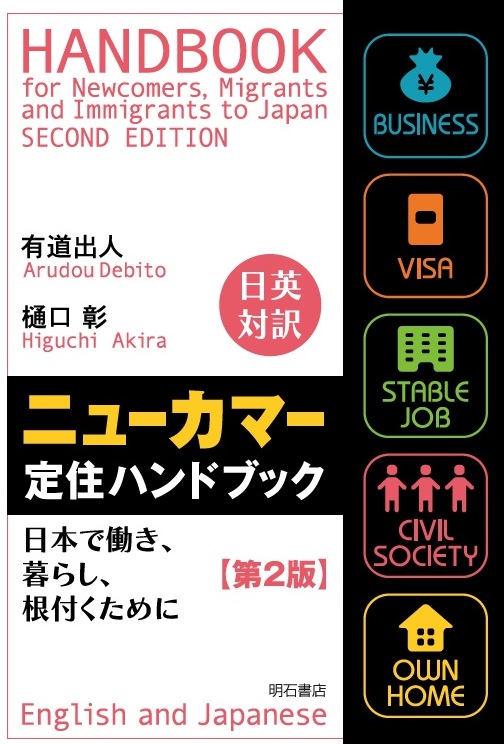
Books, eBooks, and more from Debito Arudou, Ph.D. (click on icon):







UPDATES ON TWITTER: arudoudebito
DEBITO.ORG PODCASTS on iTunes, subscribe free
“LIKE” US on Facebook at http://www.facebook.com/debitoorg
https://www.facebook.com/embeddedrcsmJapan
http://www.facebook.com/handbookimmigrants
https://www.facebook.com/JapaneseOnlyTheBook
https://www.facebook.com/BookInAppropriate
If you like what you read and discuss on Debito.org, please consider helping us stop hackers and defray maintenance costs with a little donation via my webhoster:

All donations go towards website costs only. Thanks for your support!
Hi Blog. The further away my studies and employment take me from Japanese politics, the closer I get to a more universalist view of politics and democracy in general. That’s where this blog is headed as well. I hope you will join me on this journey. Debito Arudou, Ph.D.
/////////////////////////////////////////////
REVOLUTION IS DUE IN AMERICA
Subtitle: Democracies happen because of a Middle Class, but you have to keep it fed and watered. America is no longer doing that.
By Debito Arudou. Shingetsu News Agency, “Visible Minorities” column 73, March 1, 2026
Courtesy https://shingetsunewsagency.com/2026/03/01/visible-minorities-revolution-is-due/
As I get older, I’m seeing the benefits of the habits of lifelong learning. I’m constantly curious about worlds out there, and that research energy is channeled into college classes I teach. Since every semester I’m assigned classes in different fields, I’m constantly acquiring new knowledge and teaching it in real time. I’m learning as my students learn.
It’s a healthy dynamic. All that knowledge and the 10,000 hours of classroom practice has crystalized into wisdom. And with it, I can see around corners for my columns.
This column is about something I’ve recently realized about how countries (or, as we call them in our field, “Nation-States”) rise and fall. And since the United States is following all the patterns of failing empires, this is a teachable lesson in real time.
HOW NATION-STATES BEAT FEUDALISM
Calling a country a “Nation-State” is no accident. It’s the combination of “Nations” (i.e., peoples linked by shared history, tribe, language, culture, geography, ethnicity, physical attributes, etc.) and “States” (something top-down and artificial, created at the stroke of a pen with defined borders, laws, and leaders).
Obviously, Nations are much older than States, and the modern “Nation-States” that we live in basically started (according to Eric Storm, Nationalism, Princeton University Press, 2024) with the popular revolutions of the United States and France in the late 1700s.
Before then, societies were organized feudalistically: top-down with kings and warlords demanding tribute from peasants and offering defense in return. Most people had no say in who their leaders were, or in the direction their society would take. So if you got a bad king or oligarch, tough beans. Your life was to tend to your farm and pay taxes to the nobles, and just hope the king kept his promises to protect you from invaders or didn’t start a war.
Feudalism lasted thousands of years, and there was no particular reason why we should have gotten a different system. Except for one magic innovation: The Middle Class.
FREEDOM AS A COMPETITIVE ADVANTAGE
Some feudal societies eventually realized that centuries of constant wars with your neighbors were costly in terms of people and treasure. You got into cycles of debt that somebody had to pay, and it was the peasants who shouldered the burden.
However, you can tax your peasants only so much before they starve or revolt. Ruling elites eventually realized that if you instead allowed your peasants to get richer, you could collect more taxes. Then you could use those extra revenues to fund more armies for defense or even conquest.
Tangible results appeared when tiny city-states (such as Venice) started punching above their weight in battle against vast old kingdoms. Some (such as the Dutch) had even gotten rich enough to find resources abroad by establishing ports and colonies. That’s how the feudal governments with prospering Middle Classes discovered a positive feedback loop, gaining a competitive advantage over bloated kingdoms and empires.
But how did peasants become a Middle Class? They were allowed to do things you’ve all heard of in the US Declaration of Independence: The god-given inalienable right to “Life, liberty, and the pursuit of happiness.”
Seems like a trite slogan, but it’s fundamental. Giving people enough freedom to make basic life choices, such as pursuing skills and trades beyond mere tract farming, and to keep enough of their hard-earned money to invest in materials and property, is revolutionary.
It ultimately created a civil society beyond the total control of the nobles. From the late 1600s to the early 1800s, mobs of Middle Class became the engine of growth and power as nascent Nation-States proliferated throughout the world.
I WOULD DIE FOR YOU
But one more innovation yielded an even bigger competitive advantage: patriotism.
Even with a burgeoning Middle Class, if the king didn’t have a strong enough military, there was nothing to stop barbarians beyond the gate from rushing in and looting everything. You needed people who were willing to fight and die for the State. Feudalism’s practice of mandatory conscription and hiring mercenaries didn’t breed the fighting spirit necessary to mobilize troops and maintain standing armies cheaply.
This was where nascent States realized they had to do something with the civil societies developing within their borders — to appeal to their local communities (as “Nations”) and make them feel part of a national one: an “imagined community” where people felt they “belonged” to the State.
The first ones that blended them successfully as a Nation-State were France and the US.
They were ripe for this. Both the peoples of France and the US were stuck in unfair taxation regimes—the US having no say over their trade relations or the UK’s weird wars in their backyard; and France, where the nobility and clergy paying no taxes while the people starved under famine.
Things came to a head when their rulers refused to reform their tax codes.
That’s the thing about a Middle Class—you can profit from them, but you better give something back. Keep social inequalities to a reasonable level or things go sour quickly.
And they did. The French Revolution created legislative reforms that eventually exterminated their ancient regimes, and the Americans cleansed their society of the British Loyalists, French, and Indians. Both societies created a society of laws, not of people, that made things clear where political power resided.
But then their paths diverged.
LEARNING HOW TO HARNESS THEIR MIDDLE CLASS
As you know, France fell into chaos: mob rule, a governing system without “checks and balances” (which the Americans took note of), and ideological purity leading to such extremism that France was soon a monarchy again.
Yet even Emperor Napoleon was smart enough to harness the Middle Class. He didn’t revert to feudalism. He kept the Revolutionaries’ universal application of tax codes, laws, land reform, legal citizenship, the abolition of serfdom, unified systems of calendars and measures, and civil registries, where nobody appears above the law.
He also kept their most fundamental innovation: Citizenship.
It was sense of “Frenchness” and community that was surprisingly progressive. Not only were the rules for who was entitled to the rights of being “French” clear and written down, they were even transferable. Anyone (even slaves and secular Jews) could become French citizens.
This made France’s sense of “community” a legal status, not something determined from birth. With that came the idea of belonging and being protected under the rule of law, and working within systems where you got ahead based upon merit, not birthright.
This new model of national “belonging” generated by the State was surprisingly effective. Napoleon used it to convince (not just compel) French citizens to fight and die for France. (How else was Napoleon able to rally so many people to fight surprisingly successful wars of conquest across Europe in a single lifetime?)
And it inspired peoples and leaders (such as Toussaint L’Ouverture, Miguel Hidalgo, Jose de San Martin, and Simon Bolivar) around the world that self-rule under Nation-States was possible.
THE US AS HAPPY ACCIDENT
The American model was a bit different, and it had flaws that should have doomed it. It kept many of its fundamental inequalities—such as women, non-landowning males, Catholics, slaves, and Indigenous peoples not being allowed the full rights of US citizenship.
But America got lucky in terms of their Middle Class. One had been developing in the Thirteen Colonies for more than a century. And by accident of geography it had a safety valve: plenty of land.
Want to become a landowning citizen? Head west and grab it. Want to live outside a discriminatory system? Head for the frontier where there are few laws and take your chances. America’s Middle Class prospered well enough to tolerate all manner of inequities and inequalities (the exception being the Civil War, of course).
As the citizenship franchise expanded over the next two centuries to include anyone over the age of 18, America developed an “imagined community” mobilized by the slogan of the “American Dream”: You will prosper as part of the landowning Middle Class (or better) if you just work hard. Keep the peace and your children will have a better life than yours.
But now I think the US’s luck has run out. The Americans don’t see their system as merely accidental. They see it as inevitable. And that’s why people aren’t doing what it takes to maintain it.
THE BREAKDOWN OF THE “AMERICAN DREAM”
The American promise of living a better life than your parents is now hard to see.
You hear about the “affordability” crisis in political slogans. Let’s quantify it:
According to the US Bureau of Labor Statistics, groceries in cities cost about 25% more in 2025 than they did in 2020, and in general have risen 19% just since 2022.
American higher education, the ticket to upward mobility in a meritocracy, has reached the point of perpetual debt. The average cost of college has increased by 84% since the year 2000. And that’s before we get to the newfound threat of AI replacing white-collar jobs.
The prospect of buying a house is out of reach no matter how hard you work. Adjusted for inflation, house prices have increased by about 65% since 2000 while median household incomes have barely risen. Polls indicate that 86% of people who want to buy a house can’t afford one.
The perpetual renting class are seeing rent increases of around 3.5% just over the past year (sometimes higher in places; and if it’s over 7% per year, that means rent doubles every decade). According to the US Treasury Department, rents have already risen by 20% since 2000 even adjusted for inflation (in Arizona alone, they increased 84% between 2019 to 2014). Meanwhile, corporations are snatching up these unaffordable properties and cartelizing future prices with algorithmic pricing software.
American annual health care costs per capita have doubled to nearly $16,000 per year over the past 25 years. Nearly one in ten Americans have no health insurance at all. And two-thirds of all medical bankruptcies worldwide happen in the United States.
More than two thirds of Americans live paycheck to paycheck, meaning they can’t save and invest.
The results are stark: According to a report filed with the US Senate Health, Education, Labor and Pensions Committee (2025), American life expectancies differ widely by geography, race, and economic class—sometimes by as much as 20 years!
This is intolerable. Especially since the erosion of Middle Class is happening while wealth inequalities are becoming the widest in history.
THE RICH GET RICHER
According to the Federal Reserve, the Top 1% of the US population owns nearly a third of all wealth in the US (where the Top 0.1% own nearly 14%). The Bottom 50% owns only 2.5%. According to the RAND Corporation, the Top 1% have absorbed $50 trillion from the Bottom 90% since 1974.
It’s only accelerated since Trump’s reelection. In only one year, the top 15 US billionaires have their wealth increase by nearly $1 trillion, while total US billionaire wealth grew by more than $8 trillion—probably the largest sudden transfer of wealth in human history.
Trump’s family alone has earned more than $4 billion off the presidency just over the past year, according to NPR.
According to a cute little wealth tracker, Elon Musk makes more than $7000 dollars a second, or more than America’smedian household income in about twelve seconds. He is on track to become the world’s first trillionaire.
And like in France before their revolution, the superrich can pay little if no federal income tax.
We all saw this coming. On Inauguration Day 2025, America’s business oligarchs and tech billionaires were lined upbehind Trump’s rostrum in a display of who’s really in charge. That’s why J.D. Vance, a tech-bro himself, was Trump’s weird pick for VP.
It’s unclear how much longer this situation can continue.
LEARN FROM HISTORY
The point is that the Middle Class is how feudal societies transformed into the modern Nation-State. But once you create a Middle Class, you must cultivate it. Keep them fed and watered and feeling like they belong and can get ahead. Or revolutions happen.
America is not even trying anymore. The “American Dream” is bygone, as is the guarantee of the rule of law and constitutional rights. The current administration is even abrogating a fundamental innovation of the modern Nation-State—citizenship—by mass deportations of even legal citizens-in-progress and denaturalization.
I predicted in an earlier column that there will be blood before this phase passes. As seen in lethal ICE raids, there has been blood and without consequence. As in days of yore, the President and his henchman have a king’s immunity from accountability.
Despite its 250th anniversary, American democracy has always been a bit creaky, with norms instead of laws that a chief executive could exploit. Countries that used the American model for their Nation-State wound up with autocratic executives. America didn’t because it got lucky. And because of that it never learned the outcomes of populism like France did. “It couldn’t happen here” has always been America’s blind spot.
SO WHERE IS THE FLASHPOINT?
Time for another prediction:
A draft executive order made public a few days ago dictates that Trump will declare a national emergency to take control of the 2026 Midterm Elections (for example, feds seizing ballot boxes and counting the votes themselves). This despite the administration of American elections being constitutionally delegated to the states. California has already proposed laws limiting federal presence in elections.
The flashpoint will be when state and federal forces skirmish. Then we will see the movements to secede from the union appear in lawmaker offices.
Already California’s Middle Class pays by far the most taxes to the federal government and gets the least back. This is basically true of 19 other mostly left-leaning states. Proposals have been floated to just not pay the feds—called “soft-secession”—and do better things with the $800 billion California would save. And that’s where the Democratic-leaning “blue states” are headed.
This is how the Middle Class is fighting back. As, historically, it always does when it is over-taxed and feeling like it’s not getting anything back.
Democracy exists for a reason. Compared to all the other governing systems, it is actually the best way to allocate resources over time. Let’s see if people in democracies can learn from history and change course.
I’m not sure that’s going to happen in America. Trump has the most personal power of any president in American history, and he rules with complete historical incuriosity. His toadies only study historical examples of how to advance their power. They don’t study the backlash because they are so cocksure they can suppress it.
But there will be backlash—because the Middle Class aren’t powerless peasants. So, sadly, there will be more blood. Where it all ends up remains uncertain, but the conclusion of my lifelong learning is that I don’t think the American Nation-State can survive in its present form. Revolution is due.
ENDS