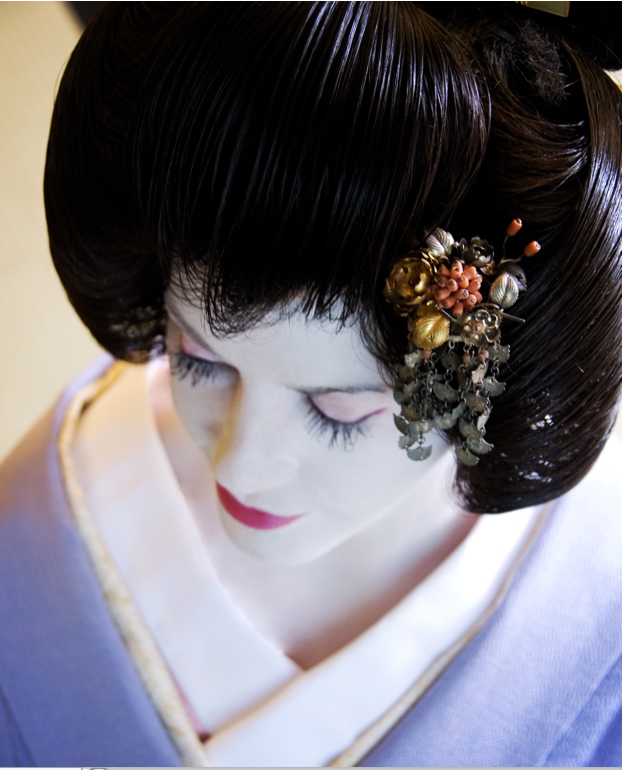
Holiday Tangent: SAYUKI, Japan’s first certified NJ Geisha, debuts

mytest

Hi Blog. In the first of a series of tangents, here’s news of the first-ever NJ geisha. Anthropologist Liza Dalby (author of GEISHA) got close to the ranks, but never became a geisha herself. Sayuki has. Congratulations and best wishes for her future understanding this very closed world! Arudou Debito

///////////////////////////////////////////////

Japan’s first ever foreign geisha
Courtesy of Sayuki

For the first time in the 400 year history of the geisha, a Westerner has been accepted, and on December 19, will formally debut under the name Sayuki.

Sayuki is specialized in social anthropology, a subject which requires anthropologists to actually experience the subject they are studying by participating in the society themselves.

Sayuki has been doing anthropological fieldwork in Asakusa – one of the oldest of Tokyo’s six remaining geisha districts – for the past year, living in a geisha house (okiya), and participating in banquets as a trainee. She has been training in several arts, and will specialize in yokobue (Japanese flute).

Sayuki took an MBA at Oxford before turning to social anthropology, and specializing in Japanese culture. She has spent half of her life in Japan, graduating from Japanese high school, and then graduated from Japan’s oldest university, Keio. Sayuki has lectured at a number of universities around the world, and has published several books on Japanese culture. She is also an anthropological film director with credits on NHK, BBC, National Geographic Channel programmes.

For further information please contact:

In English:

http://www.sayuki.net, sayuki.geisha@gmail.com

In Japanese:

お問い合わせ―所属事務所 マスターマインド
メールアドレスinfo@master-mind.jp www.master-mind.jp
Fax-03-3713-1604

Photographs are available for purchase and download at:

http://keyshots.smugmug.com/gallery/4014935
sayukiphoto.jpg
Photo by Kerry Raftis http://www.keyshots.com©
ENDS

Depressed? Consult with Int’l Mental Health Professionals Japan

mytest

Hello Blog. How do you feel this time of year? Not too dusty, I hope. But I have to admit, I hate spending the Xmas-New Year Holidays in Japan. No semblance of a real Christmas atmosphere, absolutely boring nenmatsu-nenshi (TV’s Kouhaku is the pits), and no way for a Hokkaidoite like myself to get to a warmer clime unless we pay the minimum RT 50,000 yen airline connection “tax” to get to a bigger international airport.

Not that I’m blaming Japan (or Hokkaido–we have to do pennance somehow for our magical summers)–that’s just the way it is, and part of the dues of choosing to live and be a part of this society. But I still don’t like it.

I have my own strategies for dealing with it (writing, DVDs, trashy magazines, and pizza). For those who aren’t confident about their strategies and need some professional help, here’s information about a group in Japan called “International Mental Health Professionals Japan” which offers psychological services to an international clientele. Heard about it at a recent speech in Tokyo from Dr Jim McRae, President.

Given the state of mental health services in this country (generally pretty lousy; most Japanese quasi-“counselors” will probably unhelpfully attribute any mental issue involving a NJ to a matter of “cultural differences”, and Japan doesn’t even have certifications for clinical psychologists), this group is a boon. Some friends and I have had horrible experiences trying to check friends (who were acting mentally erratically to the point of presenting a clear and present danger to others) into mental clinics in Japan. Many clinics/mental hospitals simply won’t take foreigners (claiming, again, cultural or language barriers), advising us to “send them home” for treatment.

It’s nice to see professionals in Japan in the form of the IMHPJ below trying to help out. Spread the word.

Happy Holidays–or as happy as you can make them. Arudou Debito in Sapporo

————————————–
INTERNATIONAL MENTAL HEALTH PROFESSIONALS JAPAN

What is IMHPJ?
(taken from their website and from a flyer I received from Dr Jim McRae)

IMHPJ is a multidisciplinary professional association of therapists who provide mental health services to the international communities in Japan. Members are working in private practices or mental health related organizations worldwide.

Founded in 1997, IMHPJ’s goals are to improve the quality, quantity, and accessibility of mental health services available to the international communities in Japan by:

–maintaining an up-to-date database of professional therapists, where you can find the professional profile of the therapist of your choice.
–providing a forum for discussing and making co-ordinated joint efforts related to important issues or events.
–encouraging a high standard of ethical and professional performance for mental health professionals.
–providing opportunities for continuing education for members.
–facilitating peer support and networking among members and with related Japanese mental health organizations.

Clinical Members hold a Masters Degree or higher and have supervised postgraduate clinical experience. Assocate Members work in fields related to mental health or are students or therapists not yet eligible for clinical membership.

IMHPJ is multidisiplinary, including Psychiatrists, Psychologists, Social Workers, Family Therapists, and Child Psychologists etc.

IMHPJ members offer a range of recognized theraputic approaches for the treatment of relationship issues, stress, anxiety, depression, abuse, cross-cultural issues, children’s emotional and educational problems, and many other issues. Many of our members also offer phone counseling.

Native speakers offer therapy in English, Dutch, German, French, Spanish, Japanese, and Polish. Some members are bilingual.

For more information, consult our website at:
http://www.imhpj.org
ENDS

UN News: UNHCR dismayed by secret death penalty of J convicts

mytest

Hi Blog. This is tangental to Debito.org, as it involves issues of the death penalty, not internationalization and multiculturalization. But it’s yet another example of Japan not following treaties. Do read to the very end, and goggle at a comment from Justice Minister Hatoyama…

//////////////////////////////////

TOP UN HUMAN RIGHTS OFFICIAL DISMAYED BY EXECUTION OF THREE JAPANESE PRISONERS
UN News.org. New York, Dec 7 2007 7:00PM
Courtesy UNNews AT un.org

The top United Nations human rights official today deplored the execution of three prisoners – including one aged over 75 – in Osaka, Japan, and appealed to the East Asian nation to reassess its approach to the death penalty.

The executions reportedly took place suddenly and neither the convicts nor their families were given advance warning.

“This practice is problematic under international law, and I call on Japan to reconsider its approach in this regard,” Louise Arbour, the High Commissioner for Human Rights, said.

Expressing particularly dismay at the execution of the prisoner over the age of 75, she said that “it is difficult to see what legitimate purpose is served by carrying out such executions of the elderly, and at the very least on humanitarian grounds, I would urge Japan to refrain from such action.”

In contrast to carrying out executions in secret as it has done in the past, Japan publicly released the names of those executed, the High Commissioner noted.

Japan is a party to the International Covenant on Civil and Political Rights (ICCPR), which legally obligates States Parties to ensure strict safeguards when applying the death penalty. It is widely accepted that executions cannot be carried out in secret and without warning, as this could be seen as inhuman punishment and treatment under the ICCPR.

Ms. Arbour urged the Japanese Government to implement a moratorium on executions or ban the practice altogether, as a growing number of nations have.
2007-12-07 00:00:00.000
ENDS

//////////////////////////////////

COMMENT: And this is where our Justice Minister, Hatoyama “al-Qaeda” Kunio, was referring to about the higher value put on life in Japan than in the West? I included this in an earlier Newsletter, but it bears repeating:

========================================
Interview with Justice Minister Kunio Hatoyama
Shuukan Asahi, October 26, 2007 P.122.
Title: “The Reason I will carry out Executions.”

Partial translation by Michael H. Fox, Director, Japan Death Penalty Information Center
http://www.jdpic.org

Q: There is a big trend to abolish the death penalty worldwide. Why do you want to keep it in Japan?

HATOYAMA: The Japanese place so much importance on the value of life, so it is thought that one should pay with one’s life after taking the life of another. You see, the Western nations are civilizations based on power and war. So, conversely, things are moving against the death penalty. This is an important point to understand. The so called civilizations of power and war are opposite (from us). From incipient stages, their conception of the value of life is weaker than the Japanese. Therefore, they are moving toward abolishment of the death penalty. It is important that this discourse on civilizations be understood.
========================================

Go figure.
The entire article translated with commentary by Michael H. Fox was recently published on Japan Focus. See
http://japanfocus.org/products/details/2609
Debito in Sapporo

Dream: “Japan is a Hugh Grant society.” Continue this story, everyone.

mytest

Good morning, Blog. It’s not like me to put dreams up on this blog (except maybe the pipe dreams, like a Japan with a law against racial discrimination 🙂 ), but I just had such a zinger that I thought I’d put it up. And give readers a chance to complete the story themselves in the Comments section, as I woke up laughing before the next person in line in the dream could take up where I left off.

==================

Scene in the dream: The back of a bus in a long road trip, destination unknown, with a bunch of bored people including for no apparent reason (this is a dream, remember) Hugh Grant, Hollywood actor. People wanted to poke fun, so we decided to create a chain-letter style story where one person would take up the story where the last one left off. It was my dream, so I started:

“When the Hugh Grant woke up that morning, he had no idea what kind of a day he was in for.

“Hugh had lived quite a successful life, developing a character built on personal embarrassment, charm, stuttering, and all manner of endearing and self-effacing characteristics that his fans found appealing and his detractors couldn’t really fling mud at. He was a profitable character too, ingratiating himself into many situations around the world, showing himself as willing to do what it took in public to give himself a good image (as that was the very nature of his job, of course–to be an appealing character), and leaving a positive impression lingering long after he had left the building–of somebody you’d like to see more of. Even if the only lingering memory Hugh himself had of any of these situations was the fact that he had been present there. And it was very, very difficult to imagine Hugh’s other side, like of him on the toilet having long and loud bowel movements, or of having predilections for late-night trysts with ladies of the night, or of lacking the shy yet sticking-to-it character that was omnipresent wherever he went. And if he were caught with his pants down, he would offer charmingly tearful apologies in public. Awww… never mind, people would say. Good job. Mission accomplished.

“Japan was much the same if you thought about it. A society that loves to show the outside world in its shy, stuttering, self-effacing manner, that Japanese were a group of uniformly ‘shiny, happy people’ and ‘hardworking ganbarujans’ in its media, music, catchy train ringtones, video games, etc.. How whenever Japan went overseas and faced the foreign public, be it media or individual homestay host, it was the job of every Japanese to act as an ingratiating cultural representative, leaving a nice impression lingering that we were a nice friendly people living in a nice friendly place with a shy but huggable persona, something you’d like to see more of (and would even pay money to do so). Even if many memories of these lucky plucky kokutai volunteers was ultimately the fact that they had made a good impression on others, less the impression the others had made on them. No matter. It served some sort of purpose–Japan as a character was profiting nicely.

“And it covered up the elements of Japan’s dark side: the fingerprinting of foreigners at the border as suspected terrorists and criminals; the racial discrimination so endemic and systematic that it was ignored, even justified by some as a matter of culture; the long and current history of dalliances with sexual slavery; the fundamental problems of inequality and squander created by a powerful (and largely unquestioned) ruling elite, one that has long forgotten (if it ever knew) what the common person needs; the unanswered questions of why hikikomori, why ijime, why the odd dichotomy between the purported crime-free society and the constant media focus on crime (except when it was white-collar or otherwise organized crime), why the largest pay differential between men and women in the OECD, why an ardent refusal to play by international rules and accept global standards…? No matter. People liked Japan for the image it put out. Just don’t come here and try and scratch the surface by staying here too long–you’d only get confused by the public persona and the reality. And if they were caught out in the Grand Kabuki, they would offer charmingly tearful apologies in public and get back to business as usual. Good job. Mission accomplished.

“And as Hugh Grant woke up that morning in the Park Hyatt Hotel in Tokyo, he had no idea what kind of a day he was in for. He was about to enter Hugh Grant Society himself…”

===================

This was where I woke up, laughing, rats. So I blog this for a bit of fun. Nothing against Hugh Grant, seriously (I have no idea why he’s in this dream!), but who wants to fill in the next part of the story? Or fill in the next segment for somebody else to take up the baton?

Japan as the Hugh Grant Society. Enjoy. Debito

NJ FP issue: Newsweek on damage done by model US-VISIT Program

mytest

Hi Blog. Only tangentially related to Debito.org, here is a Newsweek article quantifying the damages done by the US-VISIT Program, upon which Japan’s fingerprinting of NJ residents and tourists is based. As it says below, “The United States is the only major country in the world to which travel has declined in the midst of a global tourism boom.” Well, let’s watch Japan become the second country on that list.

It’s nice that we can have this dissent from a domestic outlet (unlike the completely stifled debate on, say, NHK), pity it took even an effervescent debate media like the US so long to start coming to its senses.

Points of interest in the article underlined. Arudou Debito in Sapporo

///////////////////////////////////////////

America the Unwelcoming
The United States is the only major country in the world to which travel has declined amid a tourist boom.

By Fareed Zakaria
NEWSWEEK Nov 26, 2007 Print Issue
Updated: 1:23 PM ET Nov 17, 2007
http://www.newsweek.com/id/70991
Courtesy of Shaney and others

As an immigrant, I’ve always loved Thanksgiving for all the corniest reasons. It’s a distinctly American holiday, secular and inclusive, focused on food, family and gratitude. But the one Thanksgiving tradition I try strenuously to avoid is travel. For those of you who must do it—and that’s 27 million people this year—brace yourselves for massive delays and frayed tempers. President Bush announced a few measures to ease congestion, describing this week as “a season of dread for too many Americans.” I only wish he would keep in mind that for foreigners now traveling to America, the dread is far more acute, and it’s lasted far longer than a few days in November.

Every American who has a friend abroad has heard some story about the absurd hassle and humiliation of entering or exiting the United States. But these pale in comparison to the experience of foreigners who commit minor infractions. A tourist from New Zealand, Rick Giles, mistakenly overstayed his visa in America by a few days and found himself summarily arrested for six weeks earlier this fall. Treaty obligations say his country’s embassy should have been informed of the arrest, but it wasn’t. A German visitor, Valeria Vinnikova, overstayed her visa by a couple of days and tried to remedy the situation—so that she could spend more time with her fiancé, the Dartmouth College squash coach. Instead she was handcuffed and had her feet shackled, then was carted off to be imprisoned. She now faces deportation and a 10-year ban on entering the United States. (Thanks to AndrewSullivan.com for drawing attention to these.)

According to the Commerce Department, the United States is the only major country in the world to which travel has declined in the midst of a global tourism boom. And this is not about Arabs or Muslims. The number of Japanese visiting the United States declined from 5 million in 2000 to 3.6 million last year. The numbers have begun to increase, but by 2010 they’re still projected to be 19 percent below 2000 levels. During this same span (2000–2010), global tourism is expected to grow by 44 percent.

The most striking statistic involves tourists from Great Britain. These are people from America’s closest ally, the overwhelming majority of them white Anglos with names like Smith and Jones. For Brits, the United States these days is Filene’s Basement. The pound is worth $2, a 47 percent increase in six years. And yet, between 2000 and 2006, the number of Britons visiting America declined by 11 percent. In that same period British travel to India went up 102 percent, to New Zealand 106 percent, to Turkey 82 percent and to the Caribbean 31 percent. If you’re wondering why, read the polls or any travelogue on a British Web site. They are filled with horror stories about the inconvenience and indignity of traveling to America.

For many, the trials begin even before they arrive. In a world of expedited travel, getting a visa to enter the United States has become a laborious process. It takes, on average, 69 days in Mumbai, 65 days in São Paolo and 44 days in Shanghai simply to process a request. It’s no wonder that quick business trips to America are a thing of the past. Business travel to the United States declined by 10 percent between 2004 and 2005 (the most recent data available), while similar travel to Europe increased by 8 percent. Discover America, a travel-industry-funded organization that tries to boost tourism, estimates that the 17 percent overall decline in tourism since 9/11 has cost America $94 billion in lost tourist spending, 200,000 jobs and $16 billion in tax revenues.

The administration and Congress say the right things, have passed a few measures to improve matters and keep insisting that the problem has been solved. But the data and loads of anecdotal evidence suggest otherwise. The basic problem remains: no bureaucrat wants to be the person who lets in the next terrorist. As a result, when one spots any irregularity—no matter how minor—the reflex is to stop, question, harass, arrest and deport. If tens of thousands of foreigners are upset, so what? But if one day a jihadist manages to slip in, woe to the person who stamped his passport. The incentives are badly skewed.

In his 2003 book “Courage Matters,” Sen. John McCain writes, “Get on the damn elevator! Fly on the damn plane! Calculate the odds of being harmed by a terrorist. It’s still about as likely as being swept out to sea by a tidal wave.” He added what seemed like a sound rule of thumb: “Watch the terrorist alert and when it falls below yellow, go outside again.”

Except that since 9/11, the alert has never dropped below yellow (which means an “elevated” level of risk from a terrorist attack). At airports, we have been almost permanently at orange—”high risk,” or the second highest level of alertness. Yet the Department of Homeland Security admits that “there continues to be no credible information at this time warning of an imminent threat to the homeland.” The department’s “strategic threat perspective … is that we are in a period of increased risk.” What is this “strategic perspective?” Is it the same as the “gut feeling” that Secretary Michael Chertoff cited when he warned, in July, that we were likely to be attacked during the summer? Or is it a bureaucratic mind-set, the technical term for which is CYA? [Cover Your Ass]

URL: http://www.newsweek.com/id/70991
ENDS

Excellent Economist editorial on anti-terrorism measures and civil liberties

mytest

Hi Blog. Excellent article in The Economist this week regarding anti-terrorism measures and the erosion of civil liberties.

How the pendulum has begun swinging back. As a twenty-year reader of The Economist, I’ve noticed a constant editorial slant favoring market-based solutions to just about everything, and the concomitant (but wan and blinding) hope that the more politically-conservative elements of governments in the developed economies would follow their preferred course. Hence their often backwards-bending support of the current administration in the world’s most powerful economy, which has long demonstrated a pursuit of power for its own (and its cronies’ own) sake.

Now, after struggling for years to come to terms with (and offering conditional, but certainly evident, support for) the American curtailment of civil liberties (enabling other countries, such as Japan, to take pages from their book and create policy rendering all foreigners suspicious as terrorists), this week’s Economist finally comes down against the erosion. Bravo.

Now if only Japan’s opinion leaders were as intelligent and outspoken about the flaws in Japan’s new anti-terrorist and foreign-crime targeting regime… Arudou Debito in Sapporo

/////////////////////////////////////////////////////////////

Civil liberties under threat
The real price of freedom
Sep 20th 2007
From The Economist print edition
Courtesy http://economist.com/opinion/displaystory.cfm?story_id=9833041
It is not only on the battlefield where preserving liberty may have to cost many lives

“THEY hate our freedoms.” So said George Bush in a speech to the American Congress shortly after the attacks on America in September 2001. But how well, at home, have America and the other Western democracies defended those precious freedoms during the “war on terror”?

As we intend to show in a series of articles starting this week (see article), the past six years have seen a steady erosion of civil liberties even in countries that regard themselves as liberty’s champions. Arbitrary arrest, indefinite detention without trial, “rendition”, suspension of habeas corpus, even torture—who would have thought such things possible?

Governments argue that desperate times demand such remedies. They face a murderous new enemy who lurks in the shadows, will stop at nothing and seeks chemical, biological and nuclear weapons. This renders the old rules and freedoms out of date. Besides, does not international humanitarian law provide for the suspension of certain liberties “in times of a public emergency that threatens the life of the nation”?

There is great force in this argument. There is, alas, always force in such arguments. This is how governments through the ages have justified grabbing repressive new powers. During the second world war the democracies spied on their own citizens, imposed censorship and used torture to extract information. America interned its entire Japanese-American population—a decision now seen to have been a cruel mistake.

There are those who see the fight against al-Qaeda as a war like the second world war or the cold war. But the first analogy is wrong and the moral of the second is not the one intended.

A hot, total war like the second world war could not last for decades, so the curtailment of domestic liberties was short-lived. But because nobody knew whether the cold war would ever end (it lasted some 40 years), the democracies chose by and large not to let it change the sort of societies they wanted to be. This was a wise choice not only because of the freedom it bestowed on people in the West during those decades, but also because the West’s freedoms became one of the most potent weapons in its struggle against its totalitarian foes.

If the war against terrorism is a war at all, it is like the cold war—one that will last for decades. Although a real threat exists, to let security trump liberty in every case would corrode the civilised world’s sense of what it is and wants to be.

When liberals put the case for civil liberties, they sometimes claim that obnoxious measures do not help the fight against terrorism anyway. The Economist is liberal but disagrees. We accept that letting secret policemen spy on citizens, detain them without trial and use torture to extract information makes it easier to foil terrorist plots. To eschew such tools is to fight terrorism with one hand tied behind your back. But that—with one hand tied behind their back—is precisely how democracies ought to fight terrorism.

Take torture, arguably the hardest case (and the subject of the first article in our series). A famous thought experiment asks what you would do with a terrorist who knew the location of a ticking nuclear bomb. Logic says you would torture one man to save hundreds of thousands of lives, and so you would. But this a fictional dilemma. In the real world, policemen are seldom sure whether the many (not one) suspects they want to torture know of any plot, or how many lives might be at stake. All that is certain is that the logic of the ticking bomb leads down a slippery slope where the state is licensed in the name of the greater good to trample on the hard-won rights of any one and therefore all of its citizens.

Human rights are part of what it means to be civilised. Locking up suspected terrorists—and why not potential murderers, rapists and paedophiles, too?—before they commit crimes would probably make society safer. Dozens of plots may have been foiled and thousands of lives saved as a result of some of the unsavoury practices now being employed in the name of fighting terrorism. Dropping such practices in order to preserve freedom may cost many lives. So be it.

ENDS

Stars and Stripes on Korean-style ethnic discrimination

mytest

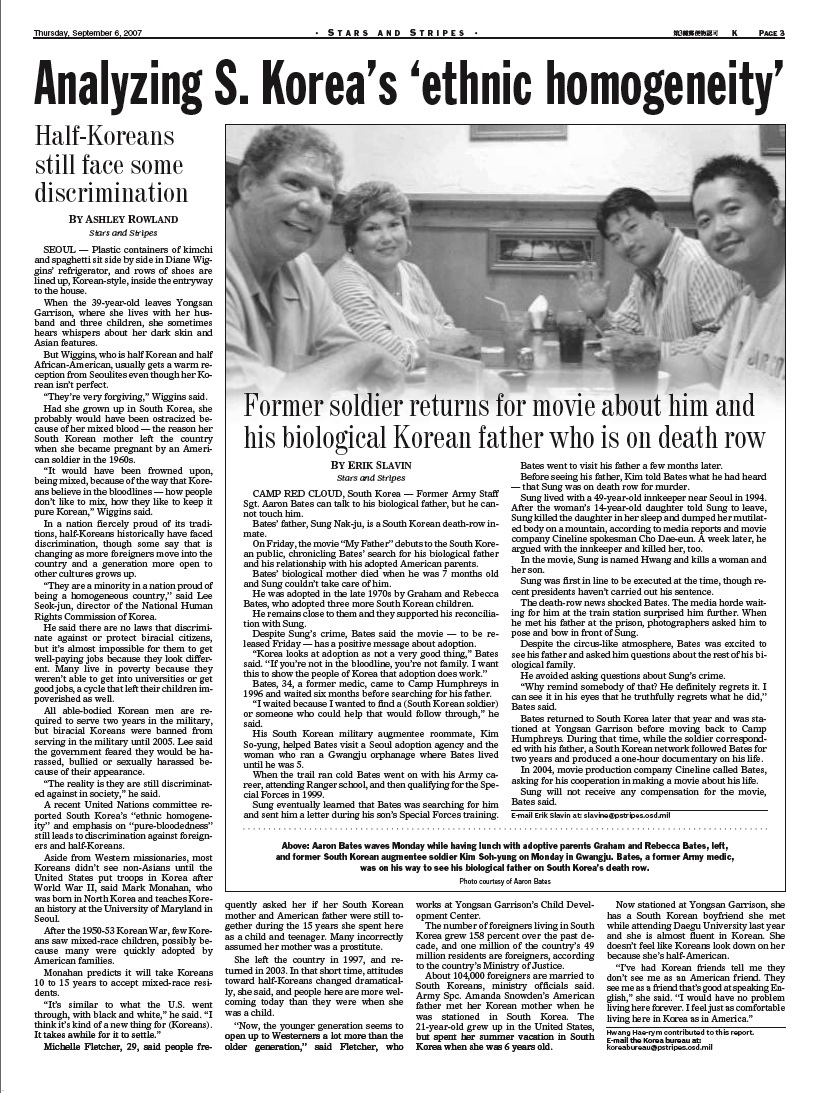
Hi Blog. Got this from Dave Spector: Stars and Stripes Sept 6, 2007 on what it’s like for international children in South Korea. A lot of the things reported (the ol’ “homogeneous society” chestnut) sound quite similar to what’s going on in Japan (understandibly, given their proximity and interlocking histories and cultures).

The most impressive points I got from the article were:

“There are no laws that discriminate against or protect biracial citizens, but it’s almost impossible for them to get well-paying jobs because they look different. Many live in poverty becaues they weren’t able to get into universities or get good jobs, a cycle that left their children impoverished as well.”

“…biracial Koreans were banned from serving in the military until 2005.”

“The number of foreigners living in South Korea grew 158 percent over the past decade, and one million of the country’s 49 million residents are foreigners, according to the Ministry of Justice.”

(which means 2 percent of the SK population is non-Korean, vs 1.6% of Japan’s, and is growing much faster than the NJ population in Japan).

Here’s the article. Well, two of them. Thanks Dave. Arudou Debito in Sapporo

(click on article to expand in browser)

starsandstripes090607.jpg

Tangent: Rebecca Walker on the “Identity Police”

mytest

Hi Blog. Friend Michael Fox sent me this article from Heeb Magazine, Issue 13. An interview with Writer/Activist Rebecca Walker. Now, while the focus may be on how one person grew up straddling two cultures within the same country (Black and Jewish), the points she makes about having a healthy attitude towards people who would try to police her identity (and towards activism in general) merit reprinting on Debito.org. Bonus points for showing us the merits of growing up under joint custody after divorce, something Japan’s divorce laws will not allow, much to the detriment of the children. Great feedback from a person well-adjusted to diversity and adversity. Enjoy. Arudou Debito in Sapporo

/////////////////////////////////////////////////

LOVE CHILD
WRITER/ACTIVIST REBECCA WALKER

(excerpt)

In 1967, civil rights lawyer Mel Leventhal, a white Jew from Brooklyn, married African-American activist and writer Alice Walker. His mother sat shiva for her son, not acknowledging his marriage until her granddaughter was born three years later. Young Rebecca was “the movement child,” living proof of the triumph of love over racial divisions. But soon the political climate changed and solidarity was replaced by segregation. Leventhal and Walker divorced, leaving Rebecca shuttling back and forth, spending two years with her Jewish father on the East Coast, then two with her African-American mom in California, then back again.

In her bestselling childhood memoir, BLACK, WHITE AND JEWISH, Rebecca Walker wrote about moving between worlds and belonging nowhere. Her second book, BABY LOVE, is about deciding to become a mother herself, and was recently published by Riverhead Books.

================

You are, like both of your parents, a writer and an activist. What do you think is different about being an activist today as compared with the turbulent ’60s and ’70s?

Being an activist today means understanding the limitations of the political system and making smart decisions about how you use your finite energy to make not just the world, but your home and even your synagogue, a better place. Our political leaders are not necessarily evolved as human beings, so we can’t expect them to lead us into a world they can’t envision…

How do you explain that rupture of the political alliance between American’s outsiders: African-Americans and Jews?

I think Jews feel betrayed by black anger about the treatment of Palestinians and Jewish participation in slavery. Blacks feel betrayed by the assimilation track so many Jews have taken in the last couple of generations. They feel that white-skin privilege has afforded American Jews access that most black people may never have, and they don’t see those Jews reaching back to pull them thorugh. I think as Jewish communities in America assimilated and became more secular, money and status replaced devotion to God and to healing the world.

In your first book, BLACK, WHITE AND JEWISH, you wrote that traveling between these two cultures blurred your notion of identity.

I would pretend to be Puerto Rican at school in the Bronx and then be the nice Jewish girl back in our apartment building in Riverdale. I was ghetto fabulous at the tough public school in Brooklyn and the hippie girl at the progressive alternative school in San Francisco. Because I performed all these different roles, I didn’t feel like I was completely any of them.

How do you think about your identity now?

People are constantly trying to tell me I’m not really Jewish. I didn’t go to Hebrew school, my mother’s not Jewish. I wasn’t Bat Mitzvahed and I’m Buddhist. I used to roll out a complete discussion about being culturally rather than spiritually Jewish–like a whole lot of American Jews my age–but these days, I just don’t care to expend a lot of energy proving I belong somewhere. If you get it, cool. If not, go police someone else’s identity. The only way to deal with this is to go on a psycho-spiritual journey of self-love, have babies and focus on strengthening your created family. You have to let go of people who can’t love you or who are ambivalent about loving you because of who you represent racially or culturally, even if they are your family members. The risk of letting them in is self-doubt and lifelong confusion about whether or not you deserve happiness.

ENDS

COUNTERPOINT: Sumo’s Scapegoating of Asashoryu

mytest

COUNTERPOINT
An occasional series from Debito.org for contrarian views. Ghostwriting for busy people who would otherwise be their own authors.
==================================
THE SCAPEGOATING OF ASASHORYU
All the media attention is a diversion from what’s really wrong with Sumo

==================================

By James Eriksson (jerik AT indigo.plala.or.jp), and Arudou Debito (debito@debito.org)
Released August 30, 2007

The Sumo Association has recently tag-teamed with the Japanese media to lay into Asashoryu—the Mongolian wrestler turned Sumo champ who has enjoyed a thorough winning streak. That is, until now.

Asashoryu, even at age 26, has dominated the sport. As Sumo’s sole Yokozuna (Grand Champion) for years now, his winning streaks and stellar win records (21 tournament wins so far) have been the stuff of legends, bringing attention back to a lackluster sport, and an inspiration to the Mongolian people who view him as a national hero.

But also earning him a place in the notoriety books has been his behavior. He has been known for fits of temper, flights of fancy, and throwing his weight around both figuratively and literally, in ways many felt were unbecoming the dignity of the sport.
http://www.economist.com/world/asia/displaystory.cfm?story_id=9717691

I believe these outbursts are symptoms of the unmentionable: the possible use of steroids. One of the downsides of the benefits of steroids (bulk and quick reaction time, all fundamental to Sumo) is the flash temper tantrums. And as far as I know, there are no enforced bans or even tests for the presence of steroids in Sumo rikishi.

Never mind. He kept winning, and winning is everything in Sumo. (To the degree where in 1993, two successful Sumo stables merged so their wrestlers would face each other less, thus lose less in tournaments. http://en.wikipedia.org/wiki/Takanohana_stable) And once Asa won enough to reach the top rank, people would support him because he’s the only Yokozuna out there. Within reason, of course.

The reasons came. First, a new Yokozuna, Hakuho (also of Mongolia) was anointed in May 2007. Meaning Asashoryu was now expendable.

Then, his little excursion to Mongolia this summer further chummed the waters.

Asa went home ostensibly to recover from a sports injury. But then he was videoed playing a game of soccer. Not only with a lot of vim apparently inappropriate for an injured athlete, but also having a good time and performing for the cameras. Never mind that he has been trained to do precisely that by Sumo.

People might say that this adultery with another sport and apparent cross purposes might be a breach of Sumo “etiquette”. But I believe Sumo etiquette works both ways here. Sumo is a sport for people who do what they’re told. Asa has been doing what his masters have been telling him to do for years now. Then when an authority as high as the Mongolian government (not to mention Japanese soccer start Nakata, who also happened to be there) invites him more than once to join in a friendly game for charity, he was probably not in a position to say no. I believe the press would have likewise criticized him if he had.

But I believe the whole soccer-Sumo scandal is a smokescreen. The real reason Asa was finally called to the carpet for a change was because Sumo as a sport is in a panic, and needs a scapegoat.

Not only has Sumo faced earlier this year yet another slew of allegations about bout fixing (http://search.japantimes.co.jp/cgi-bin/nn20070312f1.html), but also no Japanese signed up these days at the entry level last July to become junior wrestlers–for the first time in history (http://search.japantimes.co.jp/cgi-bin/ss20070702a2.html). Even though there is now another Yokozuna in existence, Asa was apparently needed this summer for recruitment purposes.

Not that difficult to understand why youths are shying away from Sumo, actually. Hazing in the junior ranks of the sport is rife and well-known. And it has gotten progressively worse–to the point where people are being killed by it.

Witness the death of wrestler Tokitaizan last June 26, after a “lynching”, where the body was found with a torn ear, broken teeth, broken bones, and cigarette burns.
http://www.debito.org/?p=464#comment-53538
Where was the media then? A blurb here and there, but coverage was definitely incommensurate to the degree of controversy a death should entail.

Instead, the media circus has sensed the blood in the water around Asa, and the Sumo Association has fanned the frenzy by slashing his pay, banning him from two tournaments, and confining him to house arrest (a degree of policing power which cannot be legal!).

Asa, meanwhile, is watching his world collapse around him. He is said to have suffered a mental breakdown, and needs treatment either here or in Mongolia. His wife has left him too—even left the country. Then there is the new charge of tax evasion. Speculation is growing that he’ll either leave Sumo for K1 pseudo-boxing (the Elephant’s Graveyard—witness former Yokozuna Akebono—for many an athlete in Japan), or abscond with all his riches back to Mongolia never to return—which would be a major black eye for the sport. He just yesterday actually did leave Japan for Mongolia, so breaths are being held to see if he ever returns. (After all, probably Sumo needs Asa more than vice versa at this stage.)

But again, this is all a diversion from the real story: That Sumo’s house of cards is being shaken.

We have a death deterring people from joining a system with institutionalized bullying, renewed allegations of bout fixing, the very real possibility of bodybuilding chemicals banned in most world sports, and the entirely possible death of the Sumo’s credibility that the Ohnaruto Scandal of 1996 (where a veteran wrestler and trainer, Ohnaruto, and commentator Hashimoto Seiichiro both became sick and died on the same day in the same hospital of unknown causes—shortly before they were to go before the press and spill the beans on charges of bout fixing etc.; see http://www.banzuke.com/96-3/msg00198.html) would have done a lot sooner.

Time for people to wake up, and realize that something smells fishy in Asashoryu’s persecution. This time it’s not the chanko nabe.

ENDS

NB: Views expressed in this essay are generally those expressed by James Eriksson, with some embellishments from Arudou Debito.

Summer Tangent: EW on the “Giving ‘The People’ what they want” fallacy

mytest

Hi Blog. It’s summertime. Time to unwind a bit, take a break, and switch it off. To do that, here’s an excellent essay from magazine ENTERTAINMENT WEEKLY (to which I have had a subscription to for about a decade; it’s my way of switching off in the evening at bedtime; it’s also a source of much consternation and teasing from some of my activist friends, who confuse it with PEOPLE magazine…).

Article is on the movie vs. television industry and their different approach to niche markets. The latter acknowledges and appeals to them, the former ignores them and blames the public for not liking their product.

But the essay is so well-written and eye-opening that it’s worth your time, even if it’s not Japan-related. And it is inarguably a departure from the usual fare on Debito.org, non?

Enjoy the summer, like you should. I’ll be on my bike cycling Hokkaido for at least a week, so signing off for a little while. Arudou Debito in Sapporo

PS: I’ll have another article out in the Japan Times Community page next Tuesday, August 14 (Wednesday in the provinces), on the Valentine Case and racial discrimination in Japan’s court decisions. Have a look!

=============================

The Final Cut
Power to the People
It’s the big Hollywood lie: Movie studios say they’re only ”giving the people what they want” — but who are these ”people”?
By Mark Harris
ENTERTAINMENT WEEKLY Published in issue #936 Jun 01, 2007

Courtesy http://www.ew.com/ew/article/0,,20040408,00.html?print

In the movie business, there are several ways to spot a lie. Some involve math: For instance, the sentence ”The movie was great — it was just marketed badly,” which is said every hour in Hollywood, is true exactly 3 percent of the time, whereas ”The movie was bad — it was just marketed really well,” which is almost never said, is true 97 percent of the time. Some lies are formulaic: Anybody in movies who starts a sentence ”At the end of the day…” is clearly revving up the manure spreader. But there’s an even more common lie. The sentence ”We’re just giving the people what they want,” when uttered by a studio executive, is always, always untrue.

How can you tell? Easy: There’s no such thing as ”the people.” Not anymore.

Late May is a roller-coastery time in pop culture. In TV, the season has just wrapped; we are near the end of The Sopranos and The Shield and in the middle of Lost and at the beginning of Heroes and Friday Night Lights and The Tudors and, depending upon our tastes, following any number of dark, complicated, challenging, years-long story arcs, assessing and arguing about them every week. It’s a good moment.

Meanwhile, here’s the movie slate in which the studios invested something like $750 million this month: part 3 of a movie based on a comic book. Part 3 of a movie based on a children’s book. And part 3 of a movie based on a Disneyland ride.

Not much of a contest, is it?

This is where ”We’re just giving the people what they want” comes in. It’s the defiant lie told by those who want to pretend that their failures of ambition are your fault — that because ”the people” eat what they’re fed, they must like it. The moneymen behind Spiders of the Shrekibbean brag about meaningless numbers (Spider-Man 3 had the biggest opening weekend of all time!) and shrink from meaningful ones, like the fact that Spider-Man 3 cost more and will likely gross less than the first two. And they start planning Spider-Man 4 because ”the people” want it, and try not to listen to the moviegoers saying ”Ehh, 3 was okay, the second one was better.” Because nothing that anyone says after the movie counts.

Don’t you hate being referred to as ”the people” — as if you were a big mass of grazing cows being herded from one multiplex pasture to the next every week? You don’t hear it in TV anymore, because networks know that we’ve become a niche nation, and we’re going to stay that way. We don’t all like the same shows; we don’t all want to like the same shows. When the most popular (and most people-powered) TV series is American Idol, and three-quarters of households are happily watching something else every time it’s on, talk of ”the people” as a unified entity becomes pointless. (It’s even pointless on Idol itself: Remember when ”the people” decided that they liked Taylor Hicks better than Chris Daughtry, and then months later, when their CDs came out, decided they were only kidding?)

It turns out that not caring about ”the people” is liberating. It frees you to care about your people — the 2 or 5 or 10 million who are passionate about Friday Night Lights or Rescue Me or The Wire or Battlestar Galactica or The Office, who will stay with your show for as long as it’s good, whose enthusiasms and high standards and judgments may even help, indirectly, to make it better.

The problem isn’t with American filmmakers, many of whom are doing exciting work right now (wait until fall), but with mainstream-studio-chief thinking. The people who finance big movies are still pretending they’re doing it for everyone, but the only segment of ”everyone” they’re willing to spend enormous sums of money wooing are 15-to-24-year-old males and little kids (and whomever they drag along). The true translation of ”We’re giving the people what they want” is ”We’re making the only kind of movies we know how to sell, and we’re selling them to the only demographics we know how to sell to.” Everyone else is treated as a minority or special-interest group — including women, who get one or two mid-budget films tossed at them per summer (usually the extent of studio thinking about that half of the population is ”Um…is Angelina Jolie available?”), and ”old people” (in Hollywood, that means all Americans 35 and over), who are brushed off until well after Labor Day.

Will Hollywood notice how many of ”the people” are staying home? Not yet — not as long as there are self-serving ways of tabulating actual ticket sales and another biggest weekend of all time! around every corner. But if the studios don’t figure out that ”the people” are a lot more diverse than their movies, they’re in for some bad news. Thirty-seven percent (according to a 2006 MPAA study) of Americans now feel that ”the ultimate movie-watching experience” resides not in a theater but in their own living rooms. That number is going to grow. As it does, maybe the studios will finally have to think about who ”the people” actually are — and what we really want.

Posted May 25, 2007 | Published in issue #936 Jun 01, 2007
ENDS

TPR podcast on NJ Labor Market and Duran Duran

mytest

Hi Blog. Trans-Pacific Radio has just released another interview, with a mix of the light and heavier:

===============================
TPR Spotlight: Debito Arudou on the Foreign Labor Market (& Duran Duran), Part 1 of 2
Filed under: Trans-Pacific Radio, TPR Spotlight
Posted by DeOrio at 1:34 pm on Tuesday, August 7, 2007

As well-known as he is, not many people know that human rights activist Debito Arudou is as passionate about Duran Duran as he is about anything.

Don’t worry, though – in this interview Debito and Ken Worsley discuss the foreign labor market in Japan – where it’s united, where it’s fractious, and where it still needs help – as well as what is being done to improve conditions and opportunities for foreign workers, and what needs to be done in the future. This is an important issue that relates to Japan’s economic future, and immigration policy (or reform) still seems untouchable within the nation’s political discourse. Why is this so?
===============================

Have a listen at:
http://www.transpacificradio.com/2007/08/07/tpr-spotlight-2-japans-foreign-labor-market/

Debito in Sapporo

Brief: Visit to San’ya, Tokyo’s Homeless District

mytest

Hello Blog. I briefly blogged last week that I was visiting San’ya, Tokyo’s day-laborer and homeless district, and was asked if I would write up a report. Okay, something brief:

SAN’YA, TOKYO’S ODD SLUM
AN INTRODUCTION TO THE DYNAMICS OF HOMELESSNESS IN JAPAN

By Arudou Debito (www.debito.org, debito@debito.org)
Released August 6, 2007, freely forwardable

San’ya (kanji: mountain valley) is a place of neither mountains nor valleys. In fact, its most famous landmark, the “Bridge of Tears” (Namidabashi) doesn’t even have a bridge. According to my guide, it was a place where in old Edo families saw off their relatives facing capital punishment, hence the name. It’s a place where people have never wanted to end up, bordering on the Yoshiwara Pleasure Quarters (a place with a long history and full of soaplands today) where people didn’t stay. Given that it’s not convenient to public transport, you won’t necessarily find it. Rather, it’s a place which finds you, depending on your economic situation. Even today, “San’ya” is not listed on a map. It’s long since been subsumed by more famous names on the map (Asakusa, Minami-Senjuu). And unless you have a reason to come here at all (cheap hotels during the World Cup 2002, day laboring), you could possibly spend your life in Tokyo and never know the place existed.

But scholars do. Cornell University Press published Edward Fowler’s “SAN’YA BLUES: Laboring Life in Contemporary Tokyo” in 1998 (reviews and overview at http://www.cornellpress.cornell.edu/cup_detail.taf?ti_id=3152). More history from them than I could ever glean in one short visit. Another researcher, Dr Tom Gill of Meiji Gakuin University (who is doing fascinating comparative research on the homeless in Japan, the US, and Britain), acted as my guide on July 31, 2007, and gave me a very brief but thorough introduction. Let me pass some of it on to you:

===============================

My introduction to the homeless and poverty-stricken in Japan started near Akihabara at Second Harvest Inc, talking to Charles McJilton (old Metropolis profile at http://metropolis.co.jp/lifeinjapan/346/lifeinjapaninc.htm website at http://www.secondharvestjapan.org/). He’s an energetic ex-US-miltary fortysomething who has lived in Japan with the homeless (sometimes as one) for nearly two decades. His irrepressible energy makes sure that all the tons of food (yes, tons) which go unsold weekly in Japanese malls and supermarkets–and would otherwise be disposed of (for sell-by or cosmetic reasons)–reach the thousands of people in Tokyo who in fact cannot feed themselves or their families.

I won’t go into any statistics here (I wasn’t taking notes; this was Dr Gill’s interview); contact Charles yourself at info AT secondharvestjapan DOT org for more. But what impressed me (or rather, depressed me) was the degree of polarization he told us about in a field as charitable as helping the dirt poor: Infighting within volunteer groups by ideology (often the radical left in Japan can’t get along with themselves, let alone dealing with areas that are Yakuza-controlled), turf wars over procedure and application, minute perfectionism getting in the way of leadership, responsibility, and decisive decisionmaking, and losing sight of the goal of just getting food out to people who would otherwise starve. Plus the fact that Charles was ignored or pushed aside because he’s a gaijin–after all, why should he be helping people in Japan when there are homeless in “his” country? Not to be sidelined, Charles has created his own company which is now, in the words of one of his rivals, doing better than them. Stop by and volunteer at Second Harvest (volunteer AT secondharvestjapan DOT org) if you really want to see how a country this rich can still have people who fall through the safety net.

For homelessness and abject poverty does indeed exist in Japan–and there is in my view (and Charles’s) a degree of social shame and misunderstanding about why people drop out of the job market. Myself, I would see these people as unfortunates–especially given theories of structural unemployment, closed mental institutions, and a long tradition of “permanent migrant work” I have heard about (“Grapes of Wrath”, anyone?) in the US. But in Japan, there is nary a tear shed. The attitude is more: If the person couldn’t hack it in the job market, it’s his (usually his) fault. Don’t you dare beg from me. You have all this time to be a bum and a hobo while I’m working 18-hour days? I wish I could have this carefree campfire life I see you have along the riverbanks with a fishing pole or a book… How poor can you be when you have enough money for shoes, a shirt on your back, and a cup of booze in the evening? Get a job, you loser. Sort of thing. Of course, elements of this view aren’t grounded in the reality of sleeping rough during all seasons with no fixed address, living hand-to-mouth on what you earned that day on the construction site. And that this lifestyle is for most of them (be it fallout from a lost job or a divorce) is probably not a choice.

Walking around San’ya later I heard about the scams run. About the churches/shelters entrusted with their homeless’s paycheck (they get about 13 man a month from the government–5 man for rent, 8 man living expenses–in Seikatsu Hoshou–although the GOJ intends to cut even that) taking too much off for rent (a regular room often partitioned into four sections of 4.5 tatami) and food. Or skimming 40% off a building site’s pay (around 8000 yen a day) as a broker’s fee. About the Yakuza which control one half of San’ya territory, who killed documentary makers filming life in San’ya because they were making the movie “too leftist” (it was finished, but is very difficult to find or show in Japan), etc. etc. All sorts of ways to further siphon money away from those who get the least of it.

San’ya, however, is an odd slum. It’s not a blue-tarp tent city or a phalanx of corrugated-metal shacks sucking on Smoky Mountain, like you’d see in other countries. It’s clean, cheap (a tourist draw, actually–it has excellent maps in English and Japanese telling you what’s there to see and eat and stay cheaply; the map even unabashedly calls the area “San’ya”–as do Internet maps http://www.maplandia.com/japan/kanto/tokyo/san-ya/). The inhabitants taking shelter under the covered main storefront area seemed to be quite friendly (especially later at night after they have a snootful) and often returned our konbanwas. We stayed in a day laborer hotel (which even had its own website!) offering a clean 4.5 tatami room with TV (free p*rn), common bath and toilet, Internet in the lobby for 2700 yen a night. And saw overseas backpackers checking in at hotels elsewhere. San’ya is certainly a lot better than Japan’s worst slum (that honor would probably belong to Osaka’s Kamagasaki–where people are reputedly very vocal against gawkers and ostentatious bearers of normal wealth). But my sample is biased; we were there on a good night–warm summer, no rain, and people able to sleep rough in the parks. It’s not a place you’d want to end up, to be sure–especially in winter. Tom and Charles have experienced life on the streets with these people, and a nice chat with one crowd (a very friendly guy in his sixties who had been living this life for close to 30 years) revealed that they would be clearing out of their sleeping area by 3AM to be first in line for the next day’s construction labor somewhere in Tokyo. Lose the romanticism about hoboes toasting marshmallows, people.

The Tokyo Metropolitan Government has taken some measures to alleviate this situation, such as offering apartment owners with spare rooms full payment of rent, with the homeless paying 3000 yen a month themselves to stay. Problem is that they have to be off the government rent deal within two years, and whatever feeling of community the San’ya long-term day laborers had created over the years gets dissipated when apartments are (naturally) scattered around Tokyo. And of course there are the scams I mentioned above, with people skimming off the homeless in their shelters. Very few people escaped this lifestyle with a steady job in any case, and back they would come to San’ya. The jury is still out on whether this policy has been effective.

In any case, that is my introduction to Japan’s laborers, done for Debito.org if only to turn readers onto the issues. I make no case that my narrative is properly informed, empathetic, or representative. It’s just an eyewitness account from someone who stayed one night in the comfort of a dive hotel, with proper access to food and basic amenities. Those who would like to know or do more, contact Second Harvest Japan and volunteer, or read up on Dr Gill’s research on the subject, links below.

Thanks for reading!

Arudou Debito
Sapporo, Japan
debito@debito.org, http://www.debito.org

REFERENTIAL LINKS
More on the homeless movement in Japan by Dr Tom Gill:
http://homepage3.nifty.com/shelter-less/english/seravip.html
http://homepage3.nifty.com/shelter-less/research/papers.html

Charles McJilton at Second Harvest Japan:
http://www.secondharvestjapan.org/

BRIEF ON THE HOMELESS IN SAN’YA ENDS

Tangent: IHT on International Divorce

mytest

Hi Blog. Not specifically Japan-related, but close to my heart: Historical article from the International Herald Tribune/Asahi (Nov 23-24, 2002) entitled “Hazards of Divorce: Unfamiliar laws can make expats especially vulnerable.”

Since I went through a particularly painful one myself, this info may be of help to others. Referential links specifically regarding divorce in Japan at
http://www.debito.org/whattodoif.html#divorce
and
http://www.crnjapan.com/prevention/en/protectselfbeforemarriage.html

FYI. Arudou Debito at Cornell University

(Click on image to see it full-screen)

IHT122302001.jpg
IHT122302002.jpg
ENDS

SPECIAL REPORT: KYUSHU CYCLETREK 2007 (with photos)

mytest

Hello Blog. Let’s give you a report on a fascinating week, this time blogged instead of the regular html format:

KYUSHU CYCLETREK 2007
MIYAZAKI TO FUKUOKA, VIA THE COASTAL ROUTE

By Arudou Debito, Sapporo, Japan
May 13, 2007

This is not the first time I’ve done something like this. I’ve undertaken a number of cycletreks (see one of my favorite essays at http://www.debito.org/residentspage.html#cycletreks), the last one last summer where friend Chris and I cycled from Sapporo to Abashiri via Wakkanai and Monbetsu (total for me, 940 kms over nearly two weeks). But cycling can be addictive, so long as you can take a bicycle seat numbing your tuckus all day, since it ultimately becomes meditation with a view. And by the end of around the third day, when your body has become accustomed to exhausted early nights crashing in a tent, followed by amazingly-full raring-to-go recovery by sunrise, you get into a rhythm and a self-actualizing sense of accomplishment: You have fuel, functional legs, full tyres, and a flat surface to cycle upon. You feel as if can go anywhere, do anything. All that stands between you and your destination is time–since distance (when you go at least 100 kms a day) becomes surmountable…

Anyway, with that in mind, here’s where my legs took me this Golden Week…

THE ENTIRE ROUTE:

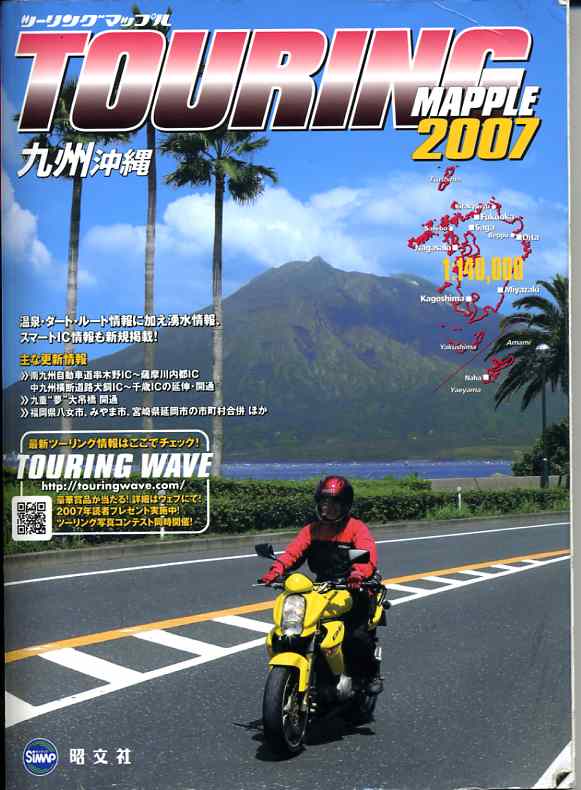
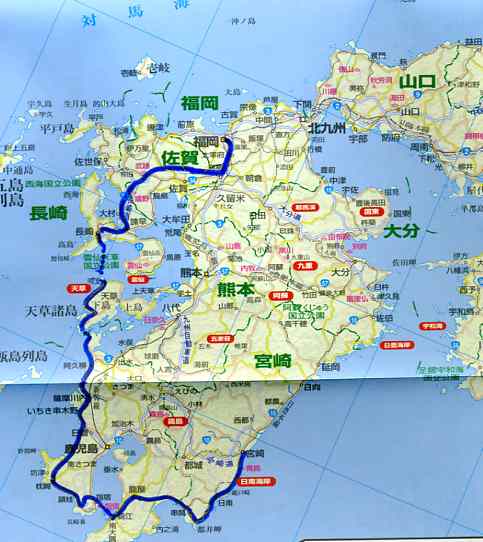
Here’s a scan from my brand-new TOURING MAPPLEmapplecover001.jpg–a new map designed for those who wish to see Japan on two wheels (with tips on where to eat, stay and see for motorbikers):
kyushumap001.jpg

The island is Kyushu, Japan’s southernmost big island containing Fukuoka as its metropolis. The route I took is traced in blue. Total distance covered: 768 kms over the course of ten days. Average speed for the duration of the trip, 13.1 kph–which sounds pretty doddering (my trip last summer averaged 16.9 kph) until you take into account the difference in terrain between Hokkaido and Kyushu…

=======================================
DAY ONE: APRIL 27, 2007: TOKYO TO HANEDA, THEN AROUND MIYAZAKI
TOTAL DISTANCE: 48 KMS

Friend Chris (who had the original idea of cycling around Kyushu in the first place–I was originally considering starting in Kurashiki and heading down counterclockwise around Shikoku) put me up in his apartment, and we cycled the surprisingly long distance to Haneda Airport (it’s at least 20 kms from downtown Tokyo) to get our bikes loaded on a regular domestic flight (they won’t take bikes without the front wheel taken off and all the loose parts stuffed into a bike bag, of course). But once finished (JAL, although it won’t take any responsibility for any damage incurred en route, was very good about packing), it was very comfortable to fly in cycling clothes with no luggage for a change.

Once in Miyazaki, I introduced Chris to my favorite chicken nanban restaurant (he’d never had the stuff, but it’s a staple in Miyazaki Prefecture). Then we enjoyed the hospitality of friends in Kyushu (Steve and Masako van Dresser), who proteined us up for the trip, and let us use their living room floor (we had bedrolls and sleeping bags, so no worries).

======================================
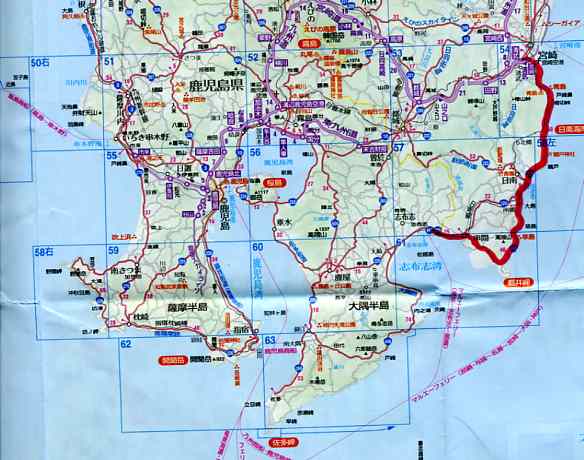
DAY TWO: APRIL 23: MIYAZAKI TO POINTS SOUTH
AOSHIMA, NICHINAN, KUSHIMA VIA TOI MISAKI, SHIBUSHI
TOTAL DISTANCE: 168 KMS
kyushumap002.jpg

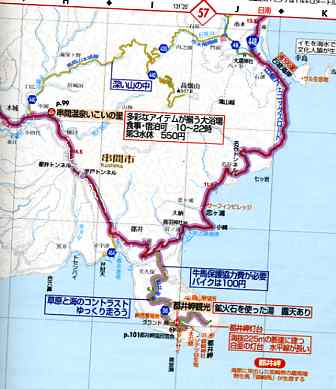
I’ve been on three separate other cycletreks totaling around a month, and I must say: This was the most difficult cycling day I’ve ever had. And it just had to come on the first day, of course. Although the map indicates that the road hugs the coast (indeed it does), Miyazaki’s roads in this region start about 50 or so meters up on each cape, zooming inland and downhill to a town with a beach and a traffic light (which kills your precious momentum). Then another uphill greets your journey to the next cape rising about 50 or so meters again in elevation. In Hokkaido, at least (the site of all my other cycletreks), coastal roads stay close to sea level most of the time.
kyushumap003.jpg
Closeup of Toi Misaki. Doesn’t this look flat to you? The coast, I mean. Heading south then west.

This daylong slingshotting up and down took an incredible amount of energy out of me (Chris less so, it seemed–as he’s more than 15 years younger than me, and with a brand new, light, state-of-the-art cycle jeering at my boneshaker of a mountain bike). Not to mention the weather was clear and lovely, but with a small enough headwind to hold me in place and toast the spots on my arms and feet I had missed coating with sunblock…
miyazakibay.jpg
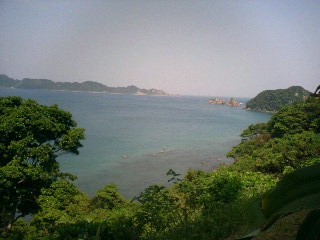
Some of the many beautiful bay views in southern Miyazaki. Pity we’re looking down upon them from such a high altitude…
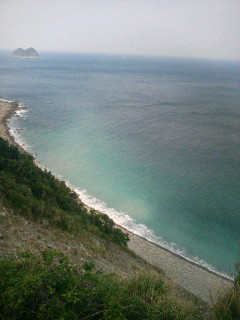
070428_154450.JPG

Turns out Day Two was an overture of road conditions that would last the entire trip: Zoom down, climb up, repeat, repeat… Then start having thoughts about the cursed inverse proportion of Potential and Kinetic Energy, and the tyranny of the Conservation of Momentum. I hate hills–I mean absolutely *loathe* them; I am not an athlete and always look for the easiest way to get from here to there (hence I credit my cycling mileage to mere stubbornness). Alas, hills are much of what the terrain down here is. Kyushu is in desperate need of an Ice Age…

Lesson we soon learned for those who follow in our wake: If you want to get anywhere in Kyushu in decent time, without a motor, and without significant anaerobic acid buildup in your muscles, stick to the main roads. They generally have some semblance of shoulder or bike path, and remain under ten degrees in slope. Otherwise, all bets are off (there was one detour in Nichinan that involved a hastily-built road with bits–I swear–with about 25- to 30-degree slopes. Don’t think that the small-scale side roads are going to give you scenery worth the effort. Get a motorcycle if you really want to explore.

We cycled past sunset, just made it across the border from Miyazaki Prefecture into Kagoshima Prefecture, and spent the evening in a resort onsen hotel, with baths and nap-inducing reclining chairs. Until we were booted out into the night…

========================================
DAY THREE: APRIL 29: AROUND THE RINGS OF KERRY (SATSUMA STYLE) WHERE DISASTER STRUCK
SHIBUSHI, KANOYA, SATA, IBUSUKI
TOTAL DISTANCE: 255 KMS
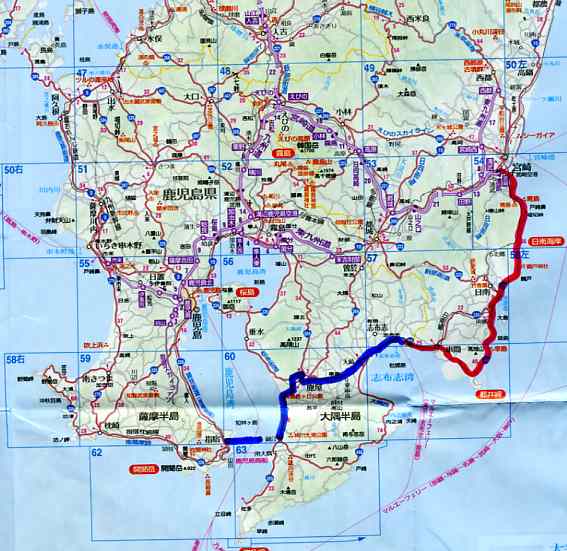
kyushumap004.jpg

If you really get cartoony about it, Kyushu is shaped vaguely like a upturned cupped hand reaching south to scoop up the islands leading to Okinawa. Our plans were to cross the pinky and head north to Kagoshima City, with its perpetually erupting volcano in the crook of the pinky and ring fingers called Sakurajima. That, however, was not to be.

This being Golden Week, the time when Japan has the most potentially consecutive holidays all year, all the hotels were booked in the onsen areas of port town Shibushi. No worries–tent and sleeping bag were bungee-corded to the back of my cycle, as per plan. What was not according to plan was Chris’s announcement as we were pulling up to Kanoya, Kagoshima Prefecture’s second city:

“Just got word through my keitai. Family emergency. I’ve got to return to Tokyo immediately.”

Oh hell. So be it. I saw Chris off at the Kanoya bus station (he made plane reservations from Kagoshima to Tokyo in minutes on his cellphone), and I went on alone.

That was better. Nobody to worry about falling behind or keeping up with, or taking responsibility for best-laid plans gone agly. I wound up taking the wrong road, found my way back to the coast, and cycled along the lovely seaside towards Sata (mainland Japan’s southernmost tip–but too hilly for my liking), embarked on a ferry across the bay to Ibusuki (famous for its hot beach sands–get buried up to your neck and experience one of the most relaxing situations ever), and found myself in a campsite overlooking an island connected to the mainland only at low tide.
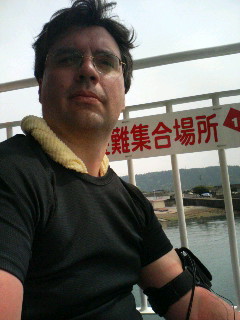
070429_142930.JPG
Exhausted, but made it aboard the ferry to Ibusuki with less than ten minutes to spare…

I was too tired to do much but just pitch my tent, unzip my sleeping bag, and fall asleep shortly after sunset. Again, it takes a couple of days for the body to get into the rhythm…
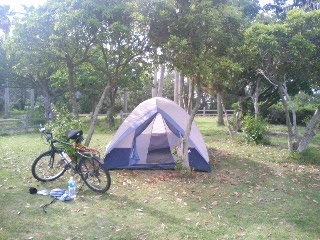
kyushutentnighttwo.jpg

====================================
DAY FOUR: APRIL 30: GETTING MY MOJO ON
IBUSUKI TO LAKE IKEDA/KAIMON DAKE, MAKURAZAKI, UP THE COAST TO KASEDA
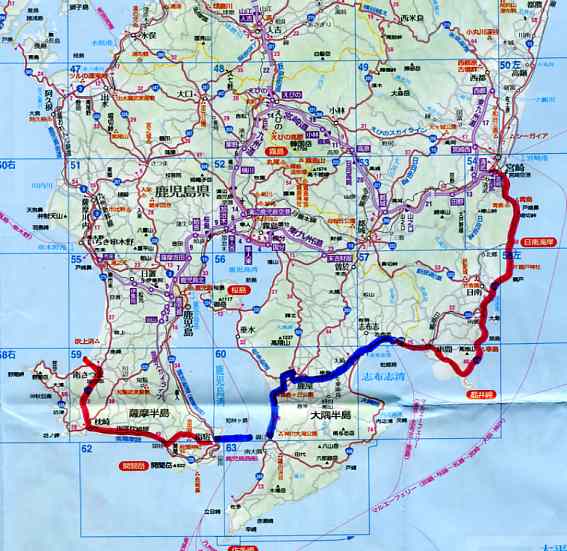
TOTAL DISTANCE: 345 KMS
kyushumap005.jpg

Again, cycling alone was advantageous because I lost two hours taking the wrong road up a caldera to see Lake Ikeda. To quote Led Zeppelin, nobody’s fault but mine. It wasn’t cycling after a while–it was just pushing the bike up the switchbacks, but that in itself was a nice break from pedaling (i.e. it uses different muscles) and the road was shaded. Interesting also was that occasionally people would actually stop their cars, get out, and talk to me about where I was from and where I was going (the baggage of dealing with a White face speaking Japanese took less time than average to get over, it seemed). And once over the rim of the crater, I was rewarded with a lake view backgrounded by Kaimon-Dake, the Mt. Fuji of Kagoshima Prefecture with its near-perfect cone.
070430_101240.JPG
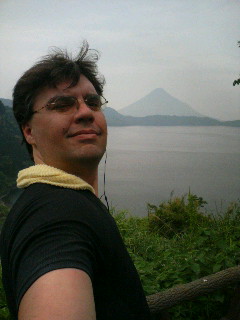
The view of Kaimon-Dake from Ikeda-ko. That’s not the ocean. That’s a lake. Lake elevation 60 meters, I’m at about 100 meters along the caldera rim.

However, I found I wasn’t making good time–it was nearly lunchtime and I hadn’t covered much more than 20 kms, so off I went along the reasonably flat coast to the southernmost city on the ring finger peninsula–Makurazaki.

Famous for its bonito (katsuo), Makurazaki is an industrial seaport town with its coast barred by a wall of cement tetrapots–as if it once got hit by a tidal wave and wasn’t going to get fooled again. Entering the city was no more pleasant–it reeked of smoke and looked run-down and Dickensian. Was glad to head inland on the main road as far north as I could reach that day: Kaseda, or after consolidation with nearby towns, Minami Satsuma City.

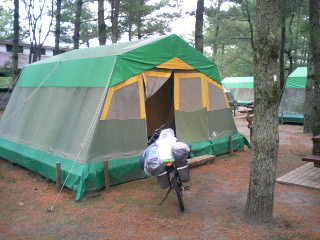
I found myself in a marvelous campsite (on a site that apparently had military connections during the war; war memorials to the Tokkoutai (“Kamikaze” pilots) are scattered throughout Satsuma) on coastal Kaseda, being put up in a tent within a tent that could stand a typhoon (we did in fact get zapped by a storm that night, which during my cycle coma I hardly noticed). It was the site of the national sandcastle festival, opening that night, so I got a free fireworks display thrown in. One of the nicest evenings of the trek.
kyushutentnight3.jpg
A tent within a tent at Fukiage Hama. Built like a brick shithouse. Could even stow the bike out of the weather within the first layer of canvas…

=======================================
DAY FIVE: MAY 1: GETTING INTO THE RHYTHM
KASEDA, FUKIAGE BEACH, SENDAI, AKUNE
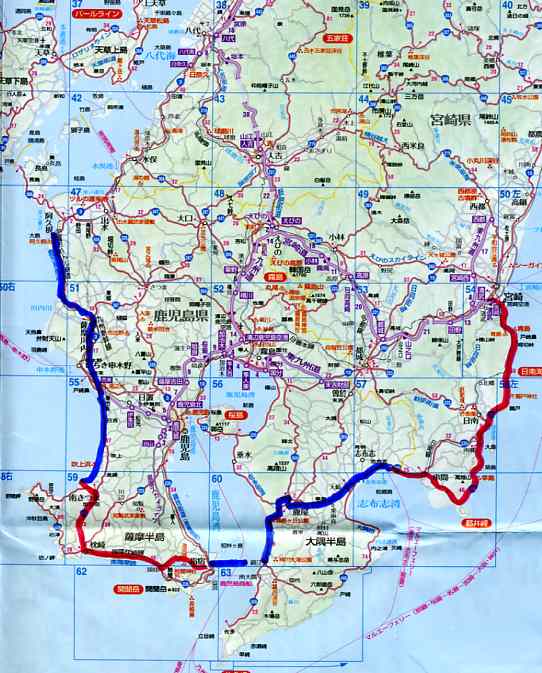
TOTAL DISTANCE: 434 KMS
kyushumap006.jpg

The storm had blown itself out, and I was able to take a cycle path following Fukiage Hama, a 40-km beach famous as a nest for sea turtles.
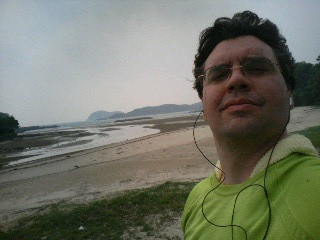
fukiagehama.jpg
A leisurely cycle along rice paddies, windbreak trees, and odd valleys filled with freshwater crabs clacking their way into nooks and crannies (redolent of that scene battling bugs in Peter Jackson’s KING KONG) made me glad I was not miniature. Sunburn had gone a painless burgundy (thanks to evening baths in cold water–a mizu buro was always available in every bathhouse I visited nightly), and once the cyclepath ended 30 kms later, I found myself playing chicken every now and again with trucks on shoulderless roads, wondering if I should take a side road–and realizing I had better not.

In Akune, I found a hotel in my Touring Mapple which had a room, and to my surprise the price listed in the book (a little over 6000 yen including two meals) not only was inapplicable (due to Golden Week), but also the 7500 yen holiday price they quoted me instead wouldn’t even include meals. I called the manager, showed him his Mapple listing, and said I would accept the holiday price (GW premiums were understandable) but wanted meals included. He obliged, and I made up the difference with the cheapest meal on the menu with a side order and a beer. The manager said he would be in touch with the Mapple publishers with a correction…

=======================================
DAY SIX: MAY 2: MARATHON MAN
AKUNE, NAGASHIMA, AMAKUSA, AND ZERO NORTH
TOTAL DISTANCE: 535 KMS
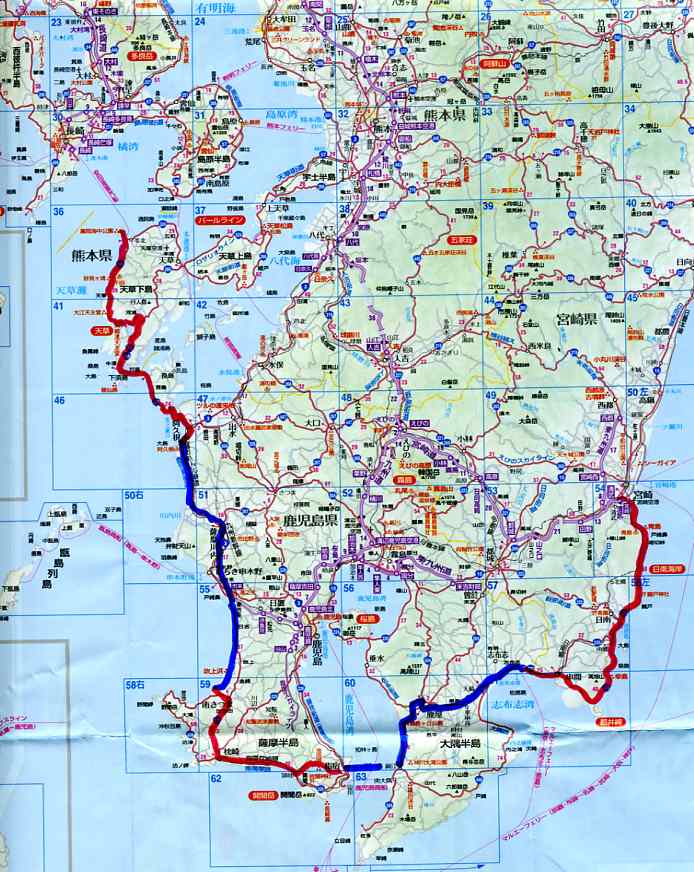
kyushumap007.jpg

This would be the most ambitious day on the road, as I would be covering a good distance with some difficult terrain, crossing two islands. Akune to Nagashima Island was fairly pat, with a swift current and a whirlpool under the bridge across, and some lovely terraced paddies covering too much topography. But otherwise the only thing of note was a shed storing a right-wing sound truck (so this is where they keep them…). Ironically parked in front was a jet-black Mercedes, with the circular logo clumsily removed (it’s not Japanese, after all). I reached the ferry between Nagashima and Amakusa islands before lunchtime, and celebrated the half-hour ferry break with a well-deserved nap.

This finally got me out of Kagoshima Prefecture, a place I found (particularly the ring finger and Nagashima) to be sullen and in parts impoverished. Kumamoto Prefecture, starting with Amakusa, seemed much richer, both in culture (there is a long, deep, Christian history with some towns, such as Sakitsu, built around a church!) and in income (receiving port Ushifuka was rich and full of public works). People seemed friendlier and more receptive to tourists (many of the signs were in Korean), and my stop by a roadside stand serving champon (again, recommended by the Mapple) got me a decent bowl of noodles served by a hospitable waiter overlooking the rising tides of the bay.
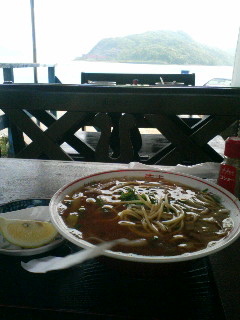
070502_143208.JPG
Champon with a view

But as I aimed my bicycle at Reihoku (a city at the top of the island, which I translated as Zero North until I realized the kanji for “nought” was different), I realized that what the champon restaurateur warned me was true–the roads would get steeper and narrower, down to nearly one lane even on a national road.
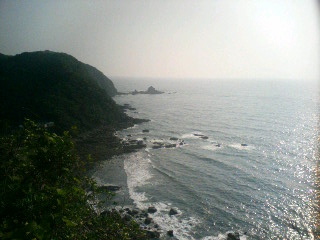
amakusaview.jpg
A lovely view. Much appreciated if you didn’t have to cycle up and down several of these per day…

Over the course of this trip I felt every kilometer, doddering slowly enough to see monkeys, ferrets, gigantic poisonous centipedes, and all manner of wildlife. But once past the mountain bottlenecks, I had an 11-km home stretch along the coastal plain, racing the sun to the horizon in hopes of reaching Zero North before the winds picked up, and the temperatures dropped again for the night.
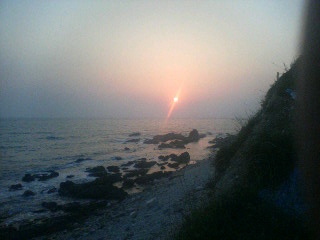
reihokusunset.jpg
The sunset over Reihoku, arriving just in time…

I made it, only to find the Mapple-recommended seaside campsite was primitive, and the administrator (a nearby ryokan) would not sell me a meal or let me into their baths (“Guests Only”, they said). The closest bath was more than 4 kms away, it was already dark and windy, so I resigned myself to a sweaty night in the sleeping bag–my first ever in Japan.

In a foul mood, I biked down to the harbor looking for a meal and found a friendly hole-in-the-wall restaurant, whose patrons soon made conversation as I was their only customer. They were most interested to hear my complaints about the ryokan (“If they are the kanrinin, shouldn’t they be providing some at least some kind of bath? It’s not like they have to buy advance provisions for a meal.”), and promised to pass them up the ladder in this small town. Then they offered to drive me the 4 kms to the nearest bath and retrieve me an hour later. I gratefully accepted, and found myself with the local working-class folk fresh out of work at the town’s biggest industry–the enormous garbage incineration plant, whose twenty-storey smokestack dominates the city skyline. One of the gentlemen in the locker rooms, in charge of plant publicity and used to dealing with NJ visitors, befriended me, listened to my Ryokan Complaint, and also promised to pass it up the ladder. He then showered me with osenbei rice cookies (hey, this is Japan), rubber gloves (clueless why), and information about the town and the plant that he rushed out and got on his own recognizance while I was soaking. I was then dropped back off near my bike, where I cycled in the full moon back to my campsite feeling like I had had yet another one of my little Japan adventures…

========================================
DAY SEVEN: MAY 3: DAY OFF
REIHOKU TO NAGASAKI
TOTAL DISTANCE: 548 KMS
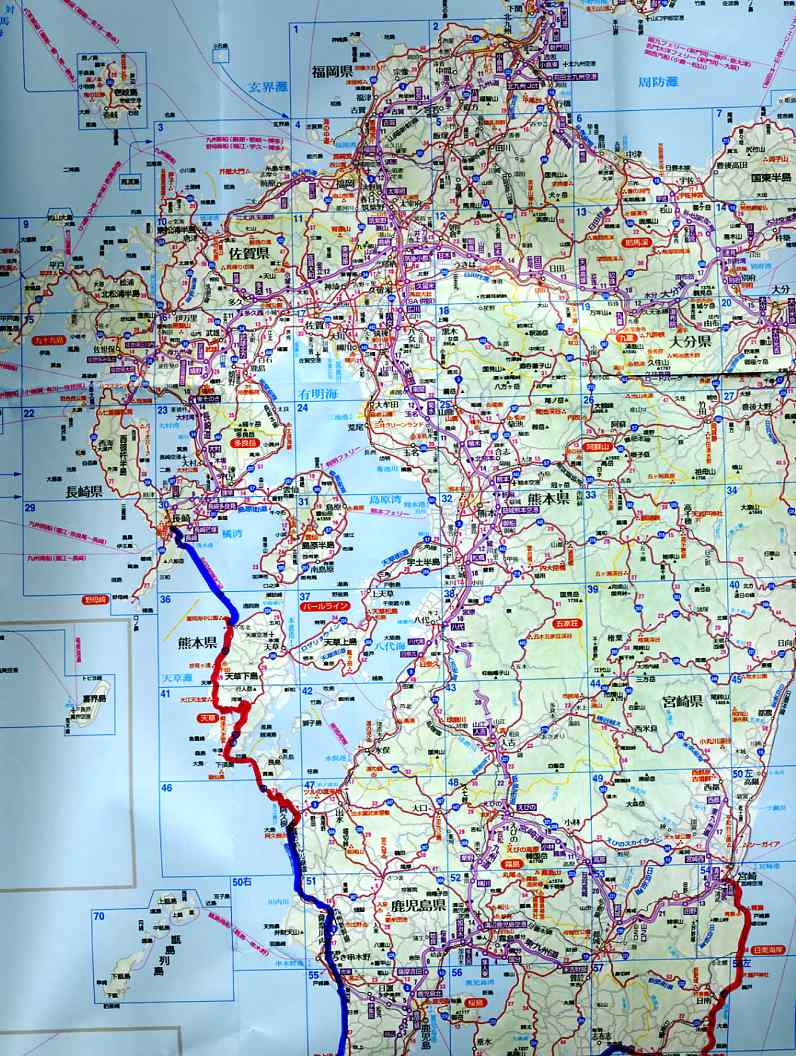
kyushumap008.jpg

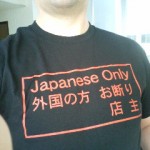
I caught the first ferry of the day (8:30 am) across the bay and left Central Kyushu for North. Maybe I’ve mentioned that I hated hills. Well–Nagasaki is nothing but, and getting there after an hour’s ferry ride meant surmounting an 8-km hill between Mogi and the city center. Done in surprisingly short time (when it’s the only hill of the day), I soon rolled into the pizza parlor of Chris Tierney, purchaser of my Japanese Only T-Shirt.
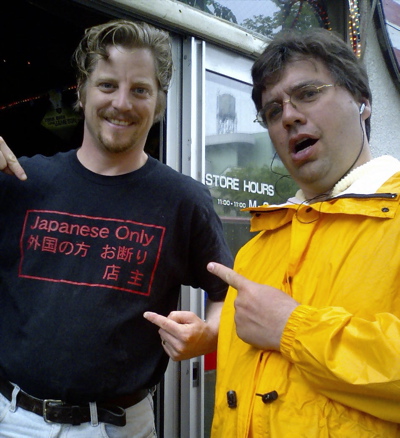
chrisjapaneseonly.jpg
A professional pizza pie thrower (he’s appeared on Japanese TV, taking second place in a national competition, and his dough is the best part of his lovely little pizzas), I ate four of them at CHRIS’ PIZZA during my stay.

070504_121009.JPG
Here’s one of them, long since digested…

He also introduced me to several friends, and we not only had a nice walk around the beautiful city of Nagasaki, but also evening beers around his campfire site next to his house on the very top of the hill (which he amazingly walks two and fro every day to get to work).
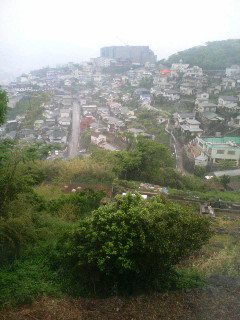
070504_075736.JPG
The view from Chris’s guestroom window in Nagasaki. Note hills.
This was the best night of the trek, and you can read about it a little more (with a photo) on one of the guest’s blogs (http://true-bitch.blogspot.com/2007/05/crusader-on-bicycle.html).

=====================================
DAY EIGHT: MAY 4: THE REACH NORTH
NAGASAKI, OHMURA, YOROKOBINO
TOTAL DISTANCE: 611 KMS
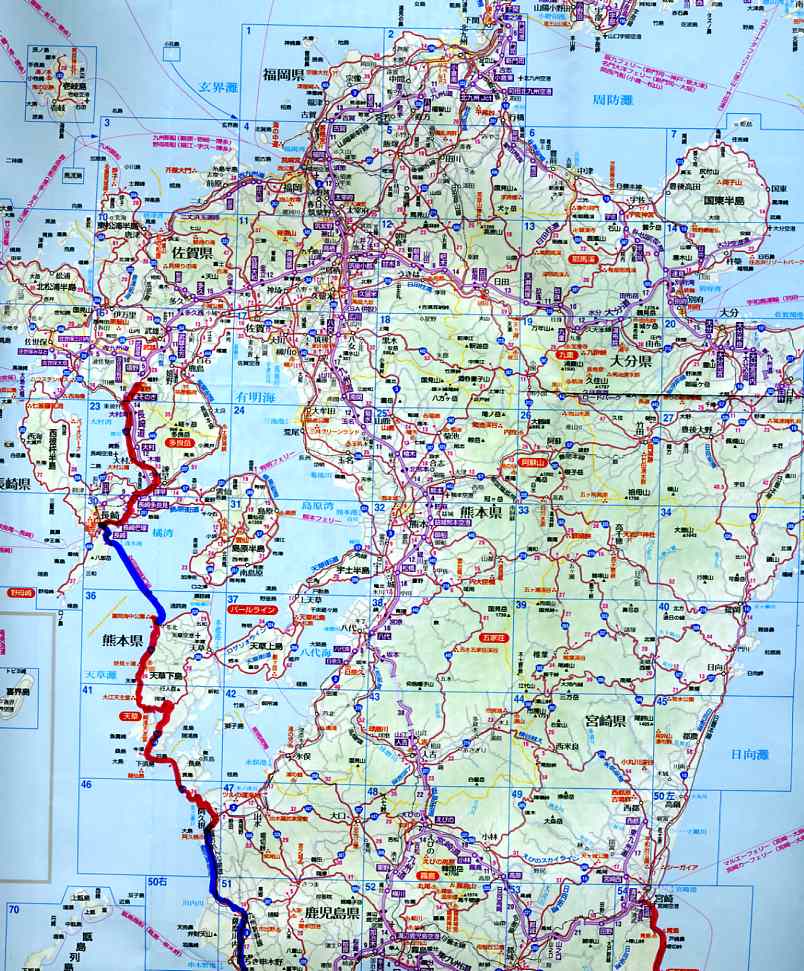
kyushumap009.jpg

This day should have been total crap, since it was raining constantly (and would without much letup the rest of my trek). But I waited until lunchtime for some abatement, realized after a pizza it was now or never, and bid farewell to Chris (not before a photo–you can see me in my bright-yellow raingear above).

And it was essentially a total crap day. All I could do was dodge car splashes and keep listening to NPR on my iPod, and wonder just how much distance I could cover this day (since I had lost half of it due to a sleep-in in a real bed and a nice breakfast courtesy of Chris’s wife). Chris noted that he’d covered the distance between Nagasaki and the local airport in Ohmura in ten minutes on the expressway. But he’s totaled three cars, so he’s not much of a measure of sane speeds. Even still, I didn’t get through the damn place (the city itself is about 6 kms long) until nearly 4PM, and had the sinking feeling that I would be sleeping rough in the rain in my tent, something I always prefer to avoid.

But I had better luck this time. When I eventually turned inland and finished climbing a 5-km hill (not very steep, but punishingly long) at about 5 kph, I realized that the outskirts of onsen town Yorokobino had some Love Hotels. Problem is, they weren’t offering their overnights unless you stayed in the hotel from after 10 PM, and by now it was only 6 PM. Nevertheless, I pulled into the shabbiest one around (they would probably be more hungry for my business and less likely to be full), and talked the laughing matron of the establishment into taking me in. “Don’t tell our manager, but I’ll comp you two hours. Pay me one Rest Rate and then the Stay Rate and I’ll throw in your meal.” Deal. Total cost: 7600 yen. Given the size of the bed and the bath (big enough for two, natch), plus free TV (I could only stay awake for about an hour of it–devoted to the weather channel, not porno), and curry rice and cup noodle brought to my door. I felt snug and safe as I heard the rain pick up for the evening…

==================================
DAY NINE AND TEN: MAY 5-6: REACHING MY DESTINATION
YOROKOBINO, TAKEO, SAGA, AND FUKUOKA
TOTAL DISTANCE: 768 KMS
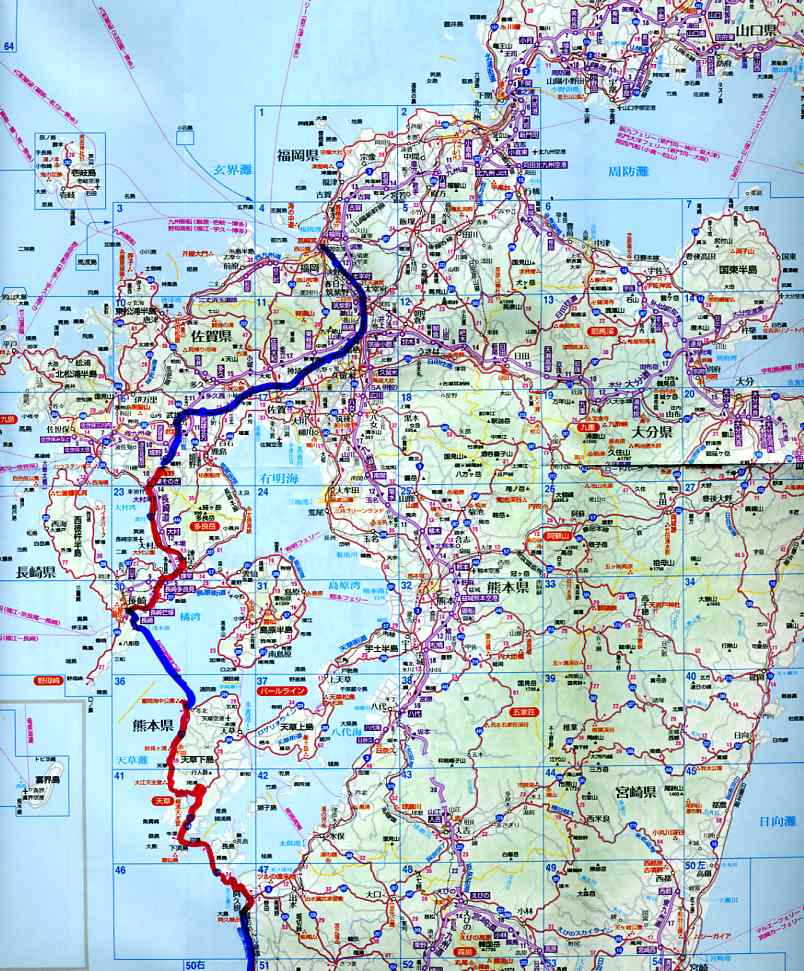
kyushumap010.jpg

As I said, the rain just kept on coming down, so I slogged it through to the flatlands of Saga (there isn’t much but rurality in the whole prefecture), turned north towards Dazaifu, and realized that despite covering more kilometers than any other day (more than 120), thanks to the lack of topography I was in downtown Fukuoka long before sunset.
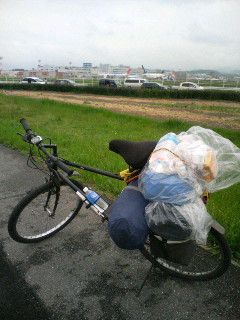
070505_163319.JPG
Arrival at Fukuoka Airport, trusty hoss as relieved as I…

My host, union activist Chris Flynn, took me into his brand new house, had me fed, and regaled me with stories of labor disputes won and lost. Since I had cut my trip a day short due to the weather, I spent the next and final day cycling around Fukuoka City proper, thinking I might see some of the man-made islands around the harbor. But when drizzle graduated up to downpour with chilly wind thrown in, I gave up and spent the day in a harborside onsen (ironically called Yunohana–the very name of the Otaru onsen which we sued successfully for racial discrimination) warming my bones. Another evening with Chris and family providing wine and SPIDERMAN on the TV later, I was cycling to the airport (probably the most convenient one in Japan–only two kms from the main train station, Hakata) the next morning to pack up my bike and head home, dressed only in short sleeves and shorts (I had thrown away my long-unwashed other clothes), to a Hokkaido about two months behind weatherwise.

==================================
CONCLUSIONS

I generally like to end my travelogues (see previous ones at http://www.debito.org/residentspage.html#OTHERESSAYS) with some insights into life, the universe, and everything. Doubt if I can this time, really. This report is one I have to toss off in one part because I have a lot of other essays, papers, and speeches baying to be finished.

But one lesson I think I have learned is that when it comes to the unpredictability of a journey like this (where there are so many variables, be it exhaustion, road conditions, fickle fancy of roadside attractions, and most of all the weather), it’s best (for me, anyway) to travel solo unless you really can relate to a partner. For alone, if something goes wrong, there are no fingers to point elsewhere, nobody to curse or blame but the fates, and no guilt for possible bad advice. And if people cycle at different rates, you either slow somebody down or feel like you’re being held back, which is a fun damper. I can’t imagine how others do these treks in groups.

I don’t feel alone in this. I saw other bikers on the trail (not many; about five), and three of them were not at all friendly. They kept themselves to themselves, and were not interested in sharing stories or discovering origins when they had to make a certain amount of distance before nightfall. Or maybe they just didn’t want me to break their meditation or stride. Suited me fine. The interesting thing was that the unfriendly ones looked older than me. Maybe that’s the future.

070505_144359.JPG
During one of my refuelling… er… eating breaks outside a konbini… Almost there. Don’t I look social?

Already looking forward to the next cycletrek (Hokkaido again, this summer),
Arudou Debito in Sapporo
May 13, 2007
KYUSHU CYCLETREK 2007 REPORT ENDS