Probable USG gaiatsu re GOJ fingerprint laws: Quote from Department of Homeland Security website

mytest

COMMENT FROM THE PODCAST SECTION UP AT TRANS PACIFIC RADIO:

==============
Comment by J
November 1, 2007 @ 8:04 pm

Hi, Debito.
Just read the last paragraph of this document prepared by the Department of Homeland Security of the US, and find who is forcing Ministry of Justice of Japan to collect fingerprints of foreigners coming to Japan.
http://www.dhs.gov/xnews/releases/press_release_0838.shtm

=========================
Pool Data with Like-minded Foreign Governments – As the United States’ systems and data improve, State and DHS must make these initiatives global. We will continue diplomatic efforts for the comprehensive exchange of watchlists, biometrics, and lost and stolen passport information with other governments as well as building capacity to effectively use this information. A central topic in this diplomacy is development of a common approach to protecting the privacy of the data, both in the way it is collected and the way it is shared.
###
This page was last modified on 01/17/06 00:00:00
=========================

A CLEAR BIT OF GAIATSU HAPPENING HERE, FROM OUR FRIENDLY NEIGHBORHOOD HEGEMON.

ARUDOU DEBITO IN SAPPORO
ENDS

Jeff Korpa on Diet debates regarding Anti-Terrorism

mytest

Hi Blog. Busy day today, so I’m not going to do much with the blog today, sorry. Here’s a message from Jeff Korpa, regarding the Japanese Diet ever rescinding or tempering the anti-terrorism putsches which have resulted in our upcoming fingerprinting laws (but have recently become hung up on whether or not Japanese ships should refuel coalition ships in the Indian Ocean).

As Jeff notes, even if the LDP is stymied at the moment, anti-terrorism moves in future will probably not be deep-sixed, even if the DPJ were to somehow assume power. Forwarding with permission. Arudou Debito in Sapporo

====================================

Hi Debito:

In a previous message I said: “Regarding the Anti-terrorism Law, my belief is that reports of its demise are premature. Despite Ozawa having the power to snuff out the legislation, and his rhetoric about how the change in the LDP leadership would not change DPJ’s resolve on the issue, Ozawa has long supported lifting restrictions on Japan’s security forces. For instance, in 1998 he remarked that it only required a reinterpretation of the constitution to allow Japanese defense forces to take part in overseas combat operations. And less than a year later, Ozawa warned that the SDF needed strengthening.”

Well, even though Fukuda has been unable to get support from Ozawa in order to attain upper house approval for an extension to the Anti-terrorism Law, I *still* don’t this is the end of the road for this legislation — as long as Fukuda can secure two-thirds of the lower house in a subsequent vote (which he can since the lower house is controlled by the LDP), the Anti-terrorism Law (and the controversial refueling missions) will live to see another day.

OK, so why aren’t the two boys playing nice together? I have two theories — Small Politics and Big Politics:

Small Politics: Ozawa is playing games trying to capitalize on the MSDF refelling issue so he steal back some popularity that Fukuda won in the aftermath of Abe’s resignation.

Big Politics: With regard to Japan’s military future, the long-term goals of the DPJ and LDP are the same, but the two men are at odds as to what role the United States should play.

Ozawa (once an LDP member himself mind you), has long accused the LDP of being too closely tied to the U.S. for Japan’s own defense. He has also been a strong voice for Japan taking part in international peacekeeping operations (albeit by reinterpreting the constitution), which would be a step toward redefining Japanese military capabilities and actions. For instance, in 1999, Ozawa called for deployment of Japanese peacekeepers to East Timor. And more recently, he said Tokyo should send peacekeepers to Sudan. In fact, he has gone further than that — in 2003 he said that should China become too “conceited,” the Japanese could grow “hysterical,” and that, “If Japan desires, it can possess thousands of nuclear warheads.”

So Ozawa’s vision is a strong, independent Japanese military. It seems to me that he and his supporters want Japanese military development to occur under the guise of international cooperation — the country should participate in U.N. missions but keep from being drawn into U.S. conflicts.

In contrast, I believe that Fukuda and the rest of the LDP brain trust are of the opinion that hooking up with the U.S. is the quickest and easiest road to realizing a militarily independent Japan. It looks like the LDP wants to let Washington continue to provide for Japan’s security so that they can focus on building up the nation’s defense capabilities (e.g. taking advantage of technology transfers and joint development of defense systems with the U.S.).

At any rate, another reason why I think the Anti-terrorism Law will be back sooner or later is because of outside pressure from the U.S. in the form of Defense Secretary Robert Gates who will arrive in Tokyo during the week of November 4th. By an amazing coincidence, Mr. Gates’ visit is due to come a week after the MSDF finished refueling their last customer (a Pakistani navy destroyer) under the Anti-terrorism Law.

It will interesting to see what the two boys do after Gates has come and gone.

Regards, Jeff Korpa
ENDS

欧州ビジネス協会など:外国人指紋採取に対する抗議文

mytest

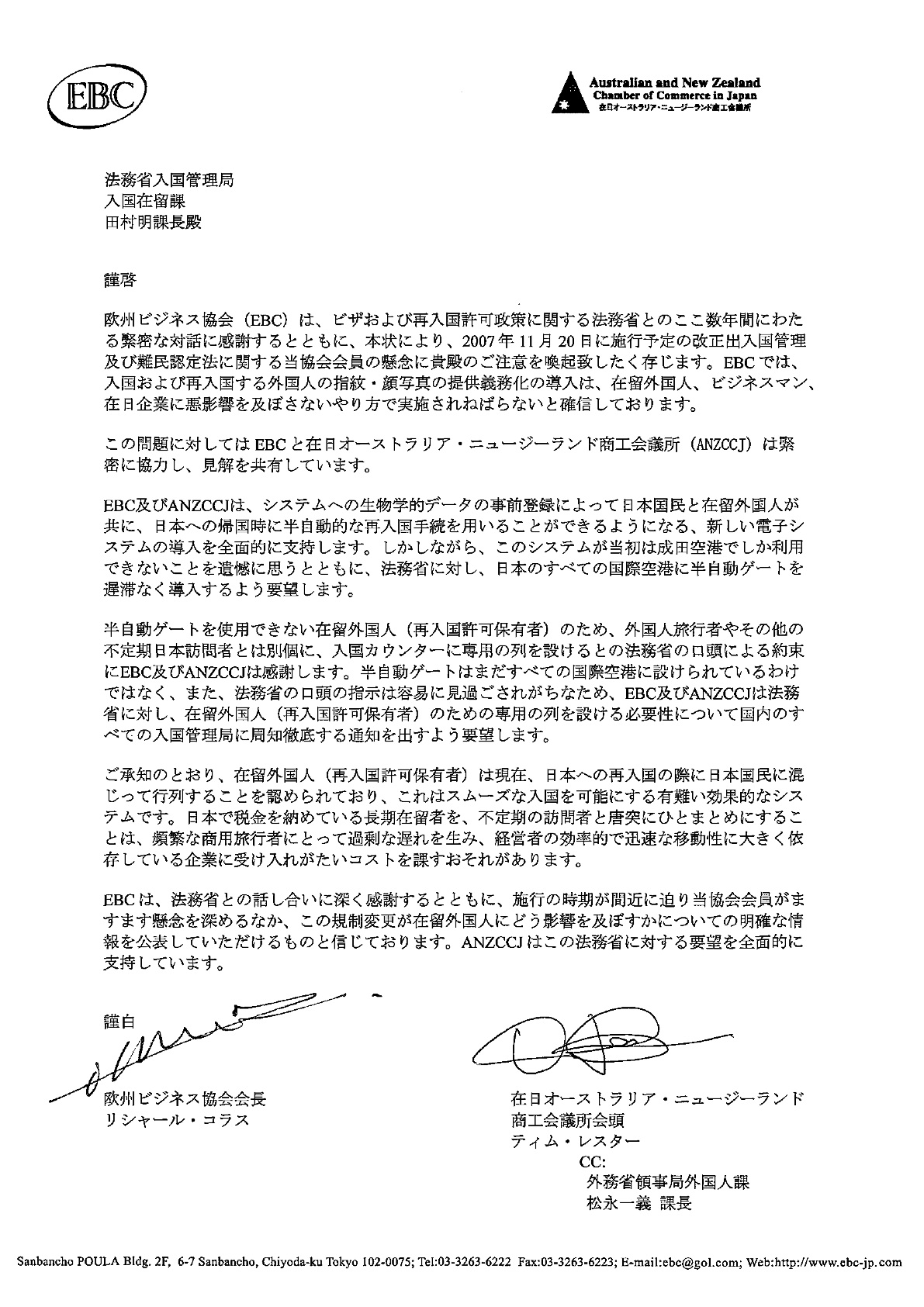
ブログ読者の皆様こんばんは。有道 出人です。いつもお世話になっております。ホットニュースですが、欧州ビジネス協会(EBC)と豪州NZ商工会議所(ANZCCJ)は外国人指紋採取に対する抗議文を発行しました。法務省入国管理局と外務省宛で、原文より:
====================
「日本で税金を納まっている長期在留者を、不定期の訪問者と唐突にひとまとめにすることは、頻繁な商用旅行者にとって過剰な遅れを生み、経営者の効果的で迅速な移動性に大きく依存している企業に受け入れがたいコストを課すおそれがあれます。」など。
====================
(全文はコメントの下です)

コメント:標的としれている在住外国人住民のみではなく、米国以外の欧米人は既にこの政策に深く疑問を持つようであります。日本当局(特に法務省)は日本がグローバル化に対して例外的な国だと未だに思い込んでいるのでしょうか。「ようこそジャパン」と貿易に関する商売にどんな影響を与えるのかを深く考えこなしましたか。どうぞ報道して下さい。宜しくお願い致します。有道 出人

イメージをクリックして下さい:
2007OctImmigrationJ-1.jpeg
2007OctImmigrationE-1.jpeg

European Business Council and Australian/ NZ Chamber of Commerce protest NJ fingerprinting laws

mytest

Hi Blog. Important information from Japan’s non-US Western business leaders. Courtesy of Martin Issott.

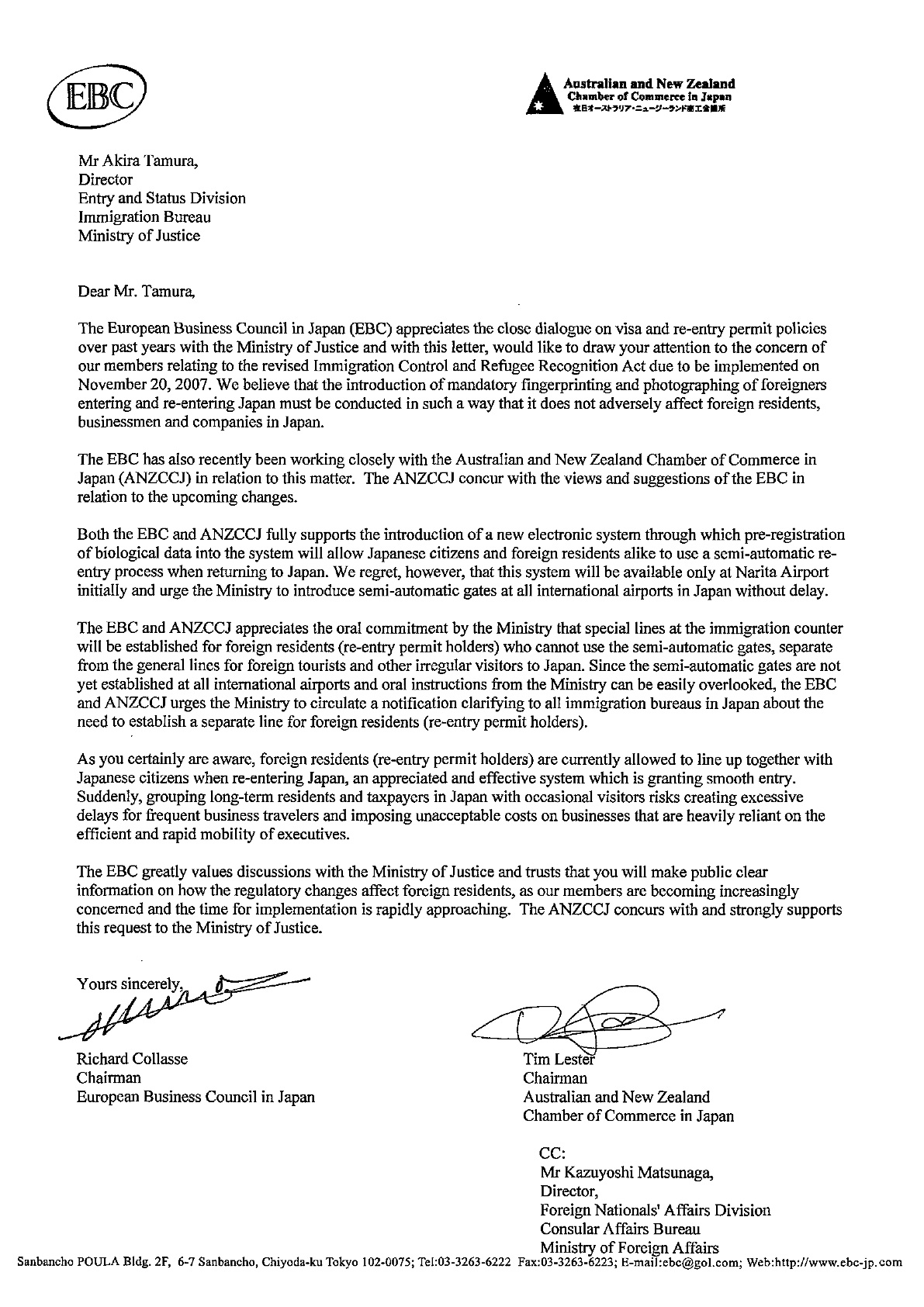
Both the European Business Council in Japan and the Australian and New Zealand Chamber of Commerce in Japan have agreed that Immigration’s new NJ Fingerprint Laws “impose unacceptable costs” on businesses, and finds regrettable the “grouping [of] long-term residents and taxpayers in Japan with occasional visitors”.

“WE BELIEVE THAT THE INTRODUCTION OF MANDATORY FINGERPRINTING AND PHOTOGRAPHING OF FOREIGNERS ENTERING AND RE-ENTERING JAPAN MUST BE CONDUCTED IN SUCH A WAY THAT IT DOES NOT ADVERSELY AFFECT FOREIGN RESIDENTS, BUSINESSMEN AND COMPANIES IN JAPAN.” [emphasis added]

So says a protest letter to the MOJ Immigration Bureau (cced to MOFA) in PDF format signed by Richard Colasse, Chairman of the EBC, and Tim Lester, Chairman of the ANZCCJ. Click here to see it:
https://www.debito.org/EBCANZCCJletterOct262007.pdf

Jpeg thumbnails of the letters in English and Japanese here (click to expand in browser):
2007OctImmigrationE-1.jpeg2007OctImmigrationE-1.jpeg

What follows is the text from an email from Jacob Edberg, Policy Director of the EBC, which indicates that the protesting is in some way paying off–with some changes in the procedures. At Narita, anyway. Underlinings in the email added. Brief comment follows.

====================================

From: ebc@gol.com [mailto:ebc@gol.com]
Sent: Friday, November 02, 2007 11:42 AM
To: edberg@ebc-jp.com
Subject: Revised Immigration Law

TO: EBC Committee Members EBC EOB Members European National Chamber Presidents European National Chamber Executive Directors Delegation of the European Commission to Japan National European Embassies

FROM: Jakob Edberg
DATE: November 2, 2007

SUBJECT: Revised Immigration Law
***********************************************

Dear Colleagues,

This is to inform you about the implementation of the revised immigration law, scheduled for November 20. In short, the revised law says that all foreigners have to leave their fingerprints and take a photo when entering Japan. The EBC has over the past year strongly insisted that the implementation of the law should not complicate or delay the re-entry procedure of foreign residents in Japan. We have especially objected to forcing re-entry permit holders to line up in long queues with all other foreigners (tourists e.g.) to take fingerprints each time re-entering Japan.

After long discussions with the Ministry of Justice, it is now clear that re-entry permit holders will be able to pre-register fingerprints and photo at either Shinagawa or at Narita on the way out. Undergoing this procedure once should grant swift re-entry at Narita (not other international airports) as long as the passport/ re-entry permit is valid. Information about this system is not yet available in English but can since October 26 be found in Japanese on the MOJ website:

http://www.moj.go.jp/NYUKAN/nyukan63-2.pdf

The Ministry of Justice has also said that for those re-entry permit holders who have not yet pre-registered their fingerprints and photos, there should be a line separate from other foreigners (e.g. tourists) at the immigration counter. However, the MOJ not yet made this commitment in writing – because they may not be able to staff the extra lines at all times of the day.

EBC Chairman Richard Collasse sent a letter on October 26 (please see attached) jointly signed with the Australia New Zealand Chamber of Commerce to demand that information about the new system is made available in English ASAP and that the commitment to set up separate lines at immigration counter for re-entry permit holder are not pre-registered is made also in writing. At this time, the semi automatic gate system will not be available at Kansai and Nagoya International airports. The solution for Kanto residents appear to be to go to Narita airport early and preregister (you only have to do this once).

We will continue to ask for more clarity on the new procedures from MOJ and will be sure to get back to all of you as soon as we have more information on this urgent issue.

Yours sincerely,

Jakob Edberg
Policy Director
European Business Council in Japan
==============================

COMMENT: What incredible incompetence by the Ministry of Justice! Did they think that inconveniencing people to this degree (under a discriminatory and xenophobic rubric, to boot) would occasion no protest or comment from the world around them? Are they still convinced that Japan is immune to the forces of globalization?!

Arudou Debito in Sapporo
ENDS

多民族共生教育フォーラム2007東京 11月4日(日)午前10時〜午後5時

mytest

TAMINZOKU KYOUSEI KYOUIKU (MULTIETHNIC COEXISTENCE EDUCATIONAL) FORUM SUNDAY NOV 4, 2007, TOKYO SHINBASHI. FORWARDING DETAILS IN JAPANESE, INTERPRETATION PROVIDED ON SITE IN ENGLISH, PORTUGUESE AND SPANISH. ARUDOU DEBITO

========================================

【転送大歓迎、重複御免】
金東鶴です。
 既にお知らせを受けている方も多いと思いますが明後日の日曜日、多民族共生教育
フォーラム2007東京が行われます。
また明日3日にはプレシンポ、5日には外国人学校訪問の企画もあります。
今回のフォーラムには研究者だけでなく与野党議員、自治体担当者の方々もパネリスト
として参加していただけることとなりまし
た。
 外国人学校の子どもや教員たちも参加してアピールしてくれます。教育制度から放置
されたままの外国籍・民族的マイノリティの子どもたちの学習権保障法制化へのステッ
プとしたいと思います。ぜひご参加ください。
 なお、お申し込み方法については、できる限り事前申し込みをお願いし
ています。こちらに申し込みフォームがありますので、よろしくお願いします
(まだ予定がはっきりしない方などは当日飛び込み参加でもOKです)。
http://2007tokyo.blog113.fc2.com/blog-category-10.html

========================================
<東京フォーラムの案内> 
多民族共生教育フォーラム2007東京

日 時○11月4日(日)午前10時〜午後5時
会 場○東京国際交流館 国際交流会議場
       *「新橋駅」から「ゆりかもめ」で16分、
         「船の科学館駅」東口より徒歩3分
       *ポルトガル語の同時通訳、
         英語・スペイン語の逐語通訳あり
参加費:資料代として1500円(学生1000円)
午前9時半〜  開場・受付開始
午前10時〜  ビデオ上映「2005年兵庫フォーラム、2006年愛知フォーラムから」
          基調報告「外国人学校の現在」
午前10時半〜  「日本各地の取り組み、外国人学校からのメッセージ」
            多文化共生センター東京
            兵庫県外国人学校協議会
            愛知県外国人学校協議会(準備会)
            神奈川県外国人学校ネットワーク(準備会)
            埼玉県外国人学校ネットワーク(準備会)
            日本ブラジル学校協議会(AEBJ)
            アメラジアン・スクール・イン・オキナワ
            国際子ども学校(愛知県)
            枝川朝鮮学校(東京江東区)
            サグラド・コラソン・デ・ヘスス(群馬県伊勢崎市)
            インターナショナル・コミュニティ・スクール
            (群馬県玉村町)
            インスチトゥト・エドゥカスィオナウ・ジェンテ・ミウダ
            (群馬県大泉町)
午後1時〜   「外国人学校に通う子どもたちからのメッセージ」
            たぶんかフリースクール(東京)           
            東京韓国学校
            横浜インターナショナル・クリスチャンアカデミー
            大阪朝鮮高級学校(東大阪市)
            コレジオ・ピタゴラス(群馬県太田市)
            セントロ・エドゥカスィオナウ・カナリニョ
            (埼玉県鴻巣市)
            エスコラ・ピンゴ・デ・ジェンテ(茨城県下妻市) ほか

午後2時10分〜 パネルディスカッション
   「多民族・多文化共生教育へのロードマップ——外国人学校の制度的保障」
          <パネラー>水岡俊一さん(参議院議員/民主党)
             山下栄一さん(参議院議員/公明党)
春原直美さん(長野県国際交流推進協会)
             田中 宏さん(龍谷大学教授)
             阿部浩己さん(神奈川大学法科大学院教授)
          <コーディネーター>丹羽雅雄さん(弁護士)
午後4時30分〜 「外国人学校の制度的保障に関する市民提言」採択
◇会場ロビーで「外国人学校で学ぶ子どもたちの写真展」同時開催

・・・・・・・・・・・・・・・・・・・・・・・

また、11月4日東京フォーラムの前日と翌日には、
以下のプログラムもあります。

○11月3日(土)
プレシンポジウム「日本の学校/地域の中の外国籍の子どもたち」
     王 慧 槿さん(多文化共生センター東京)
     金 光 敏さん(大阪・コリアNGOセンター)
     リリアン・テルミ・ハタノさん(滋賀・子どもくらぶ「たんぽポ」)
会 場:在日本韓国YMCA 9階ホール
      (JR「水道橋駅」東口から徒歩6分)
時  間:午後4時〜6時
参加費:資料代として500円
      *ポルトガル語の同時通訳あり

○11月3日(土)全国交流会
 時  間:午後6時30分〜8時
 会  場:在日本韓国YMCA
 参加費:3000円/学生1500円(当日申し込み・当日支払い)

○11月5日(月)外国人学校訪問
 時  間:
 参加費:500円(交通費・昼食費は自己負担/事前申し込み・当日支払い)
 コース �埼玉コース
       (埼玉朝鮮初中級学校 ⇒ 
        セントロ・エドゥカスィオナウ・カナリニョ)
     �東京コース
       (枝川朝鮮学校⇒東京中華学校)
     �神奈川コース
       (横浜クリスチャンアカデミー ⇒ 川崎朝鮮初級学校→ふれあい
館)
 *詳細は下記HP

◇主催◇「多民族共生教育フォーラム2007東京」実行委員会
◇共催◇外国人学校・民族学校の制度的保障を実現するネットワーク
      NPO多文化共生センター東京
◇後援◇兵庫県外国人学校協議会/静岡県外国人学校協議会
      日本ブラジル学校協議会(AEBJ)/
      ブラジル大使館/ペルー総領事館/
      東京外国語大学多言語・多文化教育研究センター

<連絡先>★Eメール t_07@hotmail.co.jp(佐藤)
     ★電話 090-8400-7685(福井)
     ★住所 〒160-0023 東京都新宿区西新宿7−5−3 斎藤ビル4階
                       みどり共同法律事務所(張)
 
なお、詳しい情報は、下記のフォーラム実行委員会HPをご覧ください。
http://2007tokyo.blog113.fc2.com/
ENDS

Documentary film on parental child abduction in Japan: Fundraiser Tues Dec 11 in Tokyo

mytest

Hi Blog. I have been quite closely associated with this project for more than a year now (I’m interviewed in the film–see the link to the trailer below) and have a personal stake in the subject. I encourage you to join us for the fundraiser, help out in any way you can, and even perhaps suggest venues we could appear at to get the word out. This is the Golden Age of the documentary, and this one ranks amongst the important ones. Help us get it launched. Downloadable movie poster available here. Arudou Debito in Sapporo

=======================================

DOCUMENTARY FILM ON PARENTAL CHILD ABDUCTION IN JAPAN PLANS DECEMBER 11TH FUNDRAISER IN TOKYO

We first learned of this situation in January 2006 in a Metropolis article titled “Think of the children” by Kevin Buckland, and after some discussions we felt strongly that a documentary film would be an influential way to raise awareness about the issue. Both of us are married to Japanese and have started wonderful families, but hearing how easily and frequently a parent can be cut off from seeing their own kids was very disturbing. In reality, when a marriage in Japan or with a Japanese national(s) goes bad and there are kids involved, the situation easily becomes drastic and severe. Though the Japanese courts, government and police may not have intended it to be this way, Japan has become an abduction-friendly country, where the winner is the first one to grab the kids and run. We want to make this film to expose the depth of the current problem and how it affects everyone–worst of all, the children who are caught in the middle.

For the past year we have juggled our schedules to travel to several cities all over the world, talking to left-behind parents, attempting to speak with abducting parents, and conversing with experts on divorce, child psychology and law to gain and ultimately share a greater understanding of how and why this situation exists. We plan to take at least two months off from our current employment in spring 2008, and dedicate ourselves full time to edit and finalize the film. We aim for a screening at a film festival before the year is out. Our intention is to show it outside Japan first, garnering international support to create “gaiatsu” (outside pressure) that will force Japan to address and take responsibility for addressing the current situation. Matt and I want to make a film with tremendous impact in a prompt time frame, and to do that will require a much greater amount of funds than we have at this point. It is our goal to raise close to a quarter million dollars for this purpose. We ask all of you to consider making a donation within your budget toward our goal. For American tax payers we will soon have information about how you can donate tax free to our non-profit account at IDA.

We will have a Fundraiser at the Pink Cow restaurant in Shibuya on December 11th from 7:30 to 10:00pm. Tickets cost 10,000 yen include a beautiful buffet dinner two drinks (then cash bar), speakers and discussion about the current situation and a video presentation. For tickets contact: dave@fortakaandmana.com

Murray Wood, Steve Christie and Debito Arudou are among the list of attendees.

Please visit our website at:

http://www.fortakaandmana.com

View our trailer and find out more details about the film, links to other important websites, and donation details.

Matt’s e-mail is: matt@fortakaandmana.com
Dave’s e-mail is: dave@fortakaandmana.com

Thank you for your time and consideration.

David Hearn and Matt Antell
=======================================

MORE ON THIS ISSUE AT
“Remember the Children
One year on, has anything changed in the fight against international child abduction?”
Follow-up article in Metropolis by Kevin Buckland
http://metropolis.co.jp/tokyo/670/globalvillage.asp

Children’s Rights Network Japan
http://www.crnjapan.com/en/

https://www.debito.org/thedivorce.html
ENDS

NJ Fingerprinting Update: US Soldiers also exempt under SOFA

mytest

HI BLOG. FEEDBACK FROM CYBERSPACE. US SOLDIERS STATIONED IN JAPAN HAVE ALSO BEEN EXEMPT FROM BEING FINGERPRINTED. I GUESS THE GOJ IS COUNTING THEM AS DIPLOMATS. SWEETHEART DEAL. ARUDOU DEBITO

/////////////////////////////////////////////////////////////

The US Embassy just sent out this information:

============================================
UPDATE: Status of Forces Agreement (SOFA) personnel are exempt under
SOFA Article 9 (2) from the new biometrics entry requirements.

============================================

I think this means that if a person with three decades of permanent
Japan residence under his/her belt flies into the airport with 18 year
old Seaman Doe, whatever his/her nationality or background, Doe goes
through the line without photo and fingerprint check.

That does not make any sense at all.

SOURCE:
/////////////////////////////////////////////////////////////

From: American Embassy Tokyo
Date: Wed Oct 31, 2007 19:57:07 Asia/Tokyo
Subject: Welcome to the November newsletter! (EXCERPT)
http://tokyo.usembassy.gov/e/acs/tacs-newsletter20071101.html#bio

Here are the topics for this month:

Upcoming Holidays and ACS Office Closures

Security Situation
Information for Americans employed by NOVA
Reminder – New Biometrics Requirements for Foreigners Entering Japan
Thanksgiving is here…
Primary Elections, General Elections – Both Are Important!
Are you ready to vote?
Some Missouri Voted Ballots can be Faxed or Emailed
Ohio Special Congressional Primary Election
Employment Resources
Ask the Consul: Warden Messages
Consequences of Mailing Illegal Drugs to Japan
Embassy Tokyo & ConGen Naha Offering New Foreign Service Officer Test
“Green Card Lottery”
Early Warning System
Handy Calendar Converter
Services Leaving Japan? Unsubscribing Contact Us

(SNIP)

———————————————————————–
——–
Reminder: New Biometrics Requirements for Foreigners Entering Japan
———————————————————————–
——–

The Government of Japan recently informed us that as of November 20,
2007, Immigration officials at the port of entry will digitally scan
the fingerprints of and photograph all foreign nationals entering
Japan, with the exemption of certain categories listed below. This
requirement does not replace any existing visa or passport
requirements. Foreign nationals that are exempt from this new
requirement include special permanent residents (Tokubetsu Eijuusha),
persons under 16 years of age, holders of diplomatic or official
visas, and persons invited by the head of a national administrative
organization. Please note that permanent residents will also be
expected to submit to this new requirement.

The Immigration Bureau of the Ministry of Justice posted an
explanatory video on the new procedures on June 14, 1007. The short
video entitled “Landing Examination Procedures for Japan are
Changing!” can be viewed here.

UPDATE: Status of Forces Agreement (SOFA) personnel are exempt under
SOFA Article 9 (2) from the new biometrics entry requirements.

———————————————————————–
ENDS

New Long-Term Residency Requirements: Prove you’re not a criminal even overseas

mytest

–HELLO BLOG. QUOTING A RECENT EXCHANGE ON THE COMMUNITY REGARDING HOW THINGS ARE TIGHTENING UP FOR PEOPLE WHO WANT TO LENGTHEN THEIR VISAS HERE IN JAPAN:

///////////////////////////////////////////////////
October 4, 2007

Hello, Does anyone have any more information about this new (I think) development? What do they mean by long-term residents? Anyone who is not a tourist? Does it include permanent residents?

===============================
New Long Term Residency Requirements: Japan recently modified its Immigration Control and Refugee Recognition Act. The law now requires that long-term residents provide satisfactory evidence that they do not have a criminal record in their home country when renewing their resident card. To obtain such proof, U.S. citizens with long-term resident status in Japan need to contact the Federal Bureau of Investigation (FBI) and provide it with a copy of their fingerprints. To request such service, please follow the guidance listed here. For more details about the Japanese requirements, check with the nearest immigration office in Japan,
http://www.moj.go.jp/ENGLISH/information/ib-09.html

Source:
U.S. Department of State
Consular Information Sheet: Japan
http://travel.state.gov/travel/cis_pa_tw/cis/cis_1148.html
===============================

I am getting really annoyed at being treated like a criminal what with all this fingerprinting. We seemed to be moving nicely away from that trend in recent years with the fingerprints being removed from our Alien Registration Cards. I am feeling distinctly unwelcome in the country I have called home for ten of the past twelve years… Shaney.

///////////////////////////////////////////////////

I called immigration just now. I talked with a wise lady who has been at Nagoya immigration ever since I applied for my first visa extension over 12 years ago, she advised me when I got my first marriage visa, and my permanent visa. She also advised me when I wanted to sponsor a friend for permanent residence. So far she’s never steered me wrong.

She was completely baffled by me calling and said *I* personally have absolutely nothing to worry about, no one will be asking for my FBI records.

I tried to explain to her, I wasn’t necessarily concerned for myself but wanted to know if anyone else might have to at some point provide such FBI records. She said the only people she was aware of that required records from the FBI were American nikkeijin. She said this was indeed a new law, and that must be what the US state department is talking about. Even here, I think it might have only been third generation Americans that needed FBI records.

I found this requirement on the web, here it is:
http://www.moj.go.jp/NYUKAN/HOUREI/h07.html

Now, I read her in English what was at the State Departments site, and explained it in Japanese as well. She could not make any sense of the idea that I would have to provide FBI documents merely to renew my gaikokujin toroku sho. (Gaijin card). She said that didn’t make any sense to her as it has nothing to do with your visa.

That was that. She could be in error.

I think most big changes in immigration law are generally posted here:
http://www.immi-moj.go.jp/hourei/index.html

I looked there and could not find anything about needing FBI records. I will have a second look.

If anyone else looks into this, I would be interested in what they find out.

Best,
Matt Dioguardi

///////////////////////////////////////////////////

1) “Long term resident (teijusha)” is one of 27 Status of Residence (visa) categories.

The word “long term” is just a translation of “teiju” and has nothing to do with the validity of the Status of Residence nor the number of years you have lived in Japan. It’s just a name of the Status of Residence. So some have three year “long term resident” and others have one year “long term resident” on their passport. You can even obtain “long term residence” on arrival if you have a corresponding Certificate of Eligibility.

“Permanent Resident (eijusha, or eijuken)” is another Status of Residence. It is different from “Long term resident.”

Below is a list of all 27 Status of Residence categories. It has been like this for about 20 years, nothing new.
http://www.cas.go.jp/jp/seisaku/hourei/data/icrra.pdf ( p71 – 76, teijusha at the bottom )

2) However, the requirements for each Status of Residence have changed frequently. Part of it is stricter requirements for “Long term resident” because of, I think, recent crimes by the Japanese descendents (nikkei) with “Long term resident” Status of Residence who came to Japan with false documents or criminal records in home country (police clearance was not required back then.)

Not all “Long term resident” holders are required to submit police clearance, but only Japanese descendents (nikkei) and their spouse.

The new requirements below. (Only in Japanese) The phrase “sokou ga zenryou dearu mono = those whose behavior and conduct are good” was recently added to Item 3, 4, 5, 6 (i.e. requirement categories for Japanse descendents and their spouse), and is the legal basis for requiring police clearance.
http://www.moj.go.jp/NYUKAN/HOUREI/h07-01-01.html
http://www.immi-moj.go.jp/keiziban/happyou/nikkei.html

3) The new requirements themselves have nothing to do with “gaijin card” or alien registration card.

Akira HIGUCHI

////////////////////////////////////////////

COMMENT: THEN I WONDER WHY THE US EMBASSY WAS CONTACTING ITS AMERICANS ABOUT THIS IF IT’S BASICALLY ONLY PERTINENT TO NIKKEI TEIJUU? HERE WE GO AGAIN WITH YET ANOTHER BUNCH OF MISUNDERSTANDINGS ABOUT A NEW LAW IN PRACTICE AND ON PAPER? ARUDOU DEBITO IN SAPPORO

Japan Focus.com: Japan’s Future as an International, Multicultural Society: From Migrants to Immigrants

mytest

Japan’s Future as an International, Multicultural Society: From Migrants to Immigrants
By Arudou Debito. Japan Focus.com, October 29, 2007
http://japanfocus.org/products/details/2559

Summary

Despite an express policy against importing unskilled foreign labor, the Government of Japan (GOJ) since 1990 has been following an unacknowledged backdoor “guest worker” program to alleviate a labor shortage that threatens to become chronic. Through its “Student”, “Entertainer”, “Nikkei repatriation”, “Researcher”, “Trainee”, and “Intern” Visa programs, the GOJ has imported hundreds of thousands of cost-effective Non-Japanese (NJ) laborers to stem the “hollowing out” (i.e. outsourcing, relocation, or bankruptcy) of Japan’s domestic industry at all levels.

As in many countries including the United States, France and South Korea, immigration has become a hotly-debated subject. While Japan’s immigrant population is much smaller than that of many European and North American countries, there is growing reliance on foreign labor resulting in a doubling of the number of registered NJ in Japan since 1990.

Despite their importance to Japan’s economy, this has not resulted in general acceptance of these laborers as “residents”, or as regular “full-time workers” entitled to the same social benefits under labor laws as Japanese workers (such as a minimum wage, health or unemployment insurance). Moreover, insufficient GOJ regulation has resulted in labor abuses (exploitative or coercive labor, child labor, sundry human rights violations), to the degree that the GOJ now proposes to “fix” the system by 2009. The current debate among ministries, however, is not focused on finding ways to help NJ workers to assimilate to Japan. Rather it has the effect of making it ever clearer that they are really only temporary and expendable. The most powerful actor in the debate is the Justice Ministry. Its minister under the former Abe administration proposed term-limited revolving-door employment for NJ workers. Meanwhile, one consequence of the present visa regime is a growing underclass of NJ children, with neither sufficient language abilities nor education to develop employable skills and adjust to Japanese society. Nevertheless, immigration continues apace. Not only does the number of foreign workers grow, but Regular Permanent Residents (RPRs) also increase by double-digit percentages every year. By the end of 2007, the number of RPRs will surpass the number of generational Zainichi Permanent Residents of Korean and Taiwan origins. In conclusion, Japan is no exception to the forces of globalization and international migrant labor. The GOJ needs to create appropriate policies that will enable migrant workers and their families to integrate into Japanese society and to find appropriate jobs that will maximize their contributions at a time when Japan faces acute labor shortages that will increase the importance of migrants.

Full essay at:
http://japanfocus.org/products/details/2559
ENDS

Debito.org Newsletter Podcast October 29, 2007 on Fingerprinting at Trans-Pacific Radio

mytest

Hi Blog. If you’re too busy to read, or would prefer to listen to my most recent newsletter on fingerprinting while driving, exercising, etc., here are the topics:

In this edition of the Debito.org Newsletter:

SPECIAL ISSUE ON IMMIGRATION’S REINSTATEMENT OF FINGERPRINTING OF NON-JAPANESE AT THE BORDER

1) BRIEFING ON THE ISSUE: METROPOLIS OCT 26 “LAST WORD” COLUMN
2) ISSUE MADE EVEN SIMPLER: DOWNLOADABLE POWERPOINT PRESENTATION
3) THE CASE FOR HOW THE FINGERPRINT POLICY VIOLATES INTERNATIONAL TREATY
4) THE SUBTERFUGE: ACCENTURE’S PROFITEERING IN J IMMIGRATION FP MACHINES
5) POLICY CREEP: REUTERS ON HOW GOJ VERSION GOES FARTHER THAN US-VISIT PROGRAM
(by fingerprinting even Permanent Residents, i.e. “Green Card” holders)

…and finally…
6) WHAT YOU CAN DO: LINKS TO PROTEST ARTICLES, CARTOONS, LETTERS
AND ONLINE PETITION YOU CAN SIGN

[display_podcast]

Bonus Duran Duran song excerpt also included at the end, of course. Have a listen! Arudou Debito in Sapporo

Softbank and Shinsei Bank illegally require “Gaijin Cards”/passports for all NJ service

mytest

Hello Blog. Witness the further tightening of the dragnet around NJ residents.

First, we got the justification for fingerprinting all NJ at the border as potential Osama Juniors and Typhoid Maries. Now once inside, the “Gaijin Card” (gaikokujin touroku shoumeisho), designed in 1952 as a tracking device for all the Zainichi who wouldn’t leave postwar Japan like good little Sankokujin, is now being steadily voided. Even though by law it serves as a proxy for the passport (since it contains the same information, including visa status, so that NJ residents don’t have to schlep around their unloseable international paperwork 24/7). If you have your Gaijin Card, you needn’t show your passport. And according to the Foreign Registry Law you needn’t even show your Gaijin Card anyway to anyone except a member of Japan’s police forces (especially when other forms of ID, such as a drivers’ licence or health insurance booklet, will also do). Yet increasingly in some places, no show, no service.

Two prominent examples: Debito.org has received a reliable report from a Kansai-based foreign reader that Softbank not only requires alien registration cards but now passports. Shinsei Bank, formerly known as one of the more gaijin-friendly institutions in a banking system which treats NJ as potential money launderers, now requires the Gaijin Card even from established customers when other forms of ID will do for regular, obviously more trustworthy Japanese. The two reports follow, the first anonymized at the author’s request. Arudou Debito in Sapporo

/////////////////////////////////////////////////////////

–Debito,

Earlier today (October 29, 2007), I attempted to purchase a SIM card for my cell phone at an Osaka-based branch of Softbank, and was immediately told they needed to see my alien registration card and my passport. I said that was a strange policy and possible illegal, but definately a violation of common sense. I pointed out that both my passport number and my visa type were written on my gaijin card. But the young woman behind the counter showed her me her Softbank manual for granting contracts to foreigners and it did, indeed, say that both a gajin card and a passport were necessary in order to get a contract. Unfortunately, my cell phone is a Nokia type that locks me into purchasing a Softbank SIM card, or I would certainly take my business elsewhere.

As the young, part-time worker was in no position to do anything, I placed a call to Softbank’s Tokyo headquarters and asked to speak to somebody in their public affairs office. The guy who came on the phone said that, no, no passport was necessary. A gaijin card alone was sufficient. I said, “Oh really?” and passed the phone over to the young woman in the Osaka Softbank store, who told him that her manual specifically said a passport was needed as well. When she passed the phone back to me, he said that, yes, both were needed.

I told him I had heard there were legal questions about a business demanding to see a passport and that, besides, I couldn’t understand why Softbank needed to see both. He just kept repeating it was now company policy to require both. I told him I thought he should check up on that, and he agreed to call me back.

An hour or so later, I received a call from a different person in the PR department who basically said Softbank required both the card and a passport because they’d been ripped off by foreigners before and that gaijin cards can be faked. When I again brought up the question of whether it was legal, he said Softbank’s understanding was that, because the letter of the law does not specifically state that a business CAN’T also demand a passport, Softbank assumes that they CAN. But, when I said that, in effect, Softbank, without confirming the exact meaning of the law and despite knowing that foreingers were upset (based on past complaints) simply wrote the manual requiring a passport be shown, the official agreed that was the case.

One wonders: what is the purpose of a gaijin card if, as of November 20th, it alone will no longer get you through immigration. And, legal questions about showing it to anyone other than government officials aside, what is the practical purpose of carrying the card if, as of today, businesses like Softbank are going to demand to see our passports as well?

/////////////////////////////////////////////////////////

Beware: SHINSEI BANK, Japan, Discrimination of Foreigners
Discrimination of Foreign Nationals at SHINSEI BANK, Tokyo

Oct.4, 2007, 1 pm: I went to SHINSEI BANK, Tokyo, Ikebukuro branch to get me an new cash card as I did not find my old one any more.

Though I have had a (legal) bank account there for many years, I was asked for my Alien (we are all aliens in Japan!) Registration Card although I have been a Permanent Resident in Japan for 20 years.

When I showed my Japanese driving licence and even offered my Japanese health insurance card (a normal thing at any other institution in Japan if you are a permanent resident; I had just done it the day before at the postal bank) they refused to deal with my case unless they saw my Alien Registration Card insisting on some dubious company regulations.

Of course, all was written in Japanese, no English at all.

How international for a bank with American backup!

They left me with no choice. I had to show my Alien Registration Card. Although I protested, told them about the illegality and mentioned discrimination they would not budge. A copy of my Alien Registration Card was taken.

If/Before you go to SHINSEI BANK, Japan, remember my case and don�?Tt forget:

Any foreigner is a potential criminal, customer or not. All Japanese are good people.

Only foreigners have to be fingerprinted, when they enter Japan, no Japanese have ever or will ever commit a crime.

Hermann Troll

P.S. Feel free to pass on to this message.
ENDS

鳩山法相:「友人の友人にアルカイダ」、そうやって外国人指紋採取を正当化

mytest

鳩山法相:「友人の友人にアルカイダ」 後に「真偽不明」
http://mainichi.jp/select/seiji/news/20071030ddm012010061000c.html

 鳩山邦夫法相は29日、東京都内の外国特派員協会で講演し「私の友人の友人にアルカイダがいる。バリ島の爆破事件に絡んでいたが『バリ島の中心部は爆破するから近づかないように』とのアドバイスを受けていた」とのエピソードを披露した。法相自身が爆破事件を事前に知っていたと誤解されかねない発言で、講演後「(直接の)友人から爆破事件の3、4カ月後に聞いた話を申し上げた。真偽は確認してないし(アルカイダのメンバーとの)面識はない」などと釈明した。

 この日、法務行政について講演した鳩山法相は質疑の中で、入国管理局がテロ対策のため11月20日から実施する来日外国人から指紋や顔写真を採取する制度についての質問に答えた際、唐突に「アルカイダ」の話を持ち出した。法相の釈明によると、直接の友人は「私の趣味であるチョウ(の研究)の同好の士」だという。【坂本高志】

毎日新聞 2007年10月30日 東京朝刊

Mainichi: Justice Minister Hatoyama justifies NJ fingerprinting, alleging ‘friend of a friend’ al-Qaeda link

mytest

Hi Blog. Our Minister of Justice should be more careful about the company he keeps… and the conclusions he draws. Arudou Debito in Sapporo

//////////////////////////////////////////////////////

Hatoyama justifies taking prints with ‘friend of a friend’ in al-Qaida claim
Mainichi Shinbun Oct 29, 2007

http://mdn.mainichi.jp/national/news/20071029p2a00m0na052000c.html
Courtesy of FG

TOKYO (AP) — Japan’s justice minister said Monday a “friend of a friend” who belonged to al-Qaida was able to sneak into the country with false passports and disguises, proving Tokyo needs to fingerprint and photograph arriving foreigners.

Japan will begin imposing the new measures on Nov. 20 on all foreigners entering the country aged 16 or over to guard against terrorism, in a move critics say will fail to protect the country and will violate human rights.

Justice Minister Kunio Hatoyama, however, told reporters that he had personal knowledge of how terrorists can infiltrate the country, citing an unidentified “friend of a friend” who was involved in a bomb attack on the Indonesian island of Bali.

“I have never met this person, but until two or three years ago, it seems this person was visiting Japan often. And each time he arrived in Japan, he used a different passport,” Hatoyama said.

The justice minister added that his friend, whom he also did not identify, had warned him to stay away from the center of Bali.

Hatoyama did not specify which of two Bali bomb attacks — in 2002 and 2005 — he was referring to. Nor did he say whether the warning came before a bombing, or whether he alerted Indonesian officials.

Indonesian police have said the 2002 bombings that killed 202 people were carried out with funds and direction from al-Qaida. A splinter group of the Southeast Asian terror organization Jemaah Islamiyah allegedly carried out the 2005 attacks independently.

“The fact is that such foreign people can easily enter Japan,” Hatoyama said. “In terms of security, this is not a preferable situation.”

“I know this may cause a lot of inconvenience, but it’s very necessary to fight terror,” Hatoyama said of the fingerprinting measures. “Japan may also become a victim of a terrorist attack.”

Prime Minister Yasuo Fukuda said he hoped Hatoyama’s al-Qaida connection would not re-enter Japan.

“I hope he’ll deal with this issue firmly through immigration controls now that he’s justice minister,” Fukuda said.

Critics have blasted the new fingerprinting measures, which only exempt some permanent residents, diplomatic visitors and children.

“The introduction of this system is a violation of basic human rights, especially the right to privacy,” said Makoto Teranaka, secretary-general of the human rights group Amnesty International Japan.

He said it unfairly targets foreigners since Japanese could also be criminals or terrorists.

Under the new regulations, all adults will be photographed and fingerprinted on arrival in Japan, according to the country’s Immigration Bureau. Incoming aircraft and ship operators also will be obliged to provide passenger and crew lists before they arrive.

Resident foreigners will be required to go through the procedure every time they re-enter Japan, the bureau said. Immigration officials will compare the images and data with a database of international terror and crime suspects as well as domestic crime records. People matching the data on file will be denied entry and deported.

Similar measures have been introduced in the United States.

Tokyo’s support of the U.S.-led invasions of Afghanistan and Iraq and dispatch of forces to each region have raised concerns that Japan could become a target of terror attacks.

Fingerprinting carries a strong stigma in Japan because it is associated with criminals.

Japan previously fingerprinted foreign residents, but that system was abolished in 1999 following civil rights campaigns involving Japan’s large Korean and Chinese communities.

——————————————

Barry Steinhardt, of the American Civil Liberties Union, speaks at an FCCJ press conference in Tokyo Monday, Oct. 29, 2007. Japan is to launch new regulations for foreigners entering the country starting Nov. 20, which will require all adults ages 16 or over to be photographed and fingerprinted upon arrival in Japan. Steinhardt said a similar measure introduced in the United States in 2004 US-VISIT, which stands for U.S. Visitor and Immigrant Status Indicator Technology, has been an ineffective tracking measure. (AP Photo/Shizuo Kambayashi)
ENDS

DEBITO.ORG NEWSLETTER OCT 29, 2007 ON FINGERPRINTING

mytest

Hi Blog. Arudou Debito here back from an autumn speaking tour, alighting at Tokyo, Utsunomiya, and Kyoto. Thanks to everyone (Chris, DIJ, and Steve) for giving me shelter. Getting this information out while it’s still timely:

SPECIAL ISSUE ON J GOVT’S REINSTITUTION OF FINGERPRINTING (FP)
FOR ALMOST ALL NON-JAPANESE ONLY, FROM NOV 20, 2007
DEBITO.ORG NEWSLETTER OCTOBER 29, 2007

Contents:
////////////////////////////////////////////////////////////////////////////
1) BRIEFING ON THE ISSUE: METROPOLIS OCT 26 “LAST WORD” COLUMN
2) ISSUE MADE EVEN SIMPLER: DOWNLOADABLE POWERPOINT PRESENTATION
3) THE CASE FOR HOW THE FINGERPRINT POLICY VIOLATES INTERNATIONAL TREATY
4) THE SUBTERFUGE: ACCENTURE’S PROFITEERING IN J IMMIGRATION FP MACHINES
5) POLICY CREEP: REUTERS ON HOW GOJ VERSION GOES FARTHER THAN US-VISIT PROGRAM
(by fingerprinting even Permanent Residents, i.e. “Green Card” holders)

…and finally…
6) WHAT YOU CAN DO: LINKS TO PROTEST ARTICLES, CARTOONS, LETTERS
AND ONLINE PETITION YOU CAN SIGN

////////////////////////////////////////////////////////////////////////////

By Arudou Debito, Sapporo, Japan (debito@debito.org, https://www.debito.org)
Freely forwardable
Available as a podcast from Trans Pacific Radio
http://www.transpacificradio.com/2007/10/31/debito-102907-fingerprints-japan-accenture/

////////////////////////////////////////////////////////////////////////////

1) BRIEFING: METROPOLIS OCT 26 “LAST WORD” COLUMN

Some bits of information you will by now have heard already. Good. But there seems to be a lot of confusion out there as to some of the finer details. Here’s a one-page summary of the whole shenanigans, followed by information in one post so you can forward it anywhere…

==============================================

Last Word Column
BAD IMPRESSIONS
Japan’s new policy of fingerprinting foreigners is cack-handed and callous
By Arudou Debito
Metropolis Magazine, October 26, 2007, Issue #709

http://metropolis.co.jp/tokyo/709/lastword.asp

If you haven’t heard about the new immigration procedure coming into effect next month, it’s time you did. It will affect not only tourists and frequently traveling businesspeople, but also long-term residents. You will be targeted by a useless and xenophobic system, treated as fresh off the boat no matter how long you’ve lived here.

From November 20, 2007, all foreigners crossing the border into Japan will have their fingerprints and mug shots taken. Their biometric data will be stored for 70 years, and shared with other governments just in case of… well, just in case.

Unfortunately, entry won’t be smooth. The law requires an automated gate system at all ports of entry, to allow those who already filed their fingerprints to pass through quickly. However, Kobe Immigration recently acknowledged that only Narita will have an express gate. Everyone else coming in anyplace else must stand in the Gaijin Line like any other tourist, separated from their Japanese families and giving fingerprints the old-fashioned way. Every time they enter Japan. For however long it takes. Welcome home.
https://www.debito.org/?p=656

This new law doesn’t apply to all foreigners. The exceptions are people under age 16, those with “diplomat” or “official government business” visas, and “Special Status Permanent Residents” (i.e., the “Zainichi” Japan-born ethnic Koreans, Chinese, etc.). But it does apply to “Regular Permanent Residents”*those who moved here and got a permanent visa.
http://nettv.gov-online.go.jp/prg/prg1431.html

The policy is retrogressive. From 1952 through the 1990’s, Zainichi (and many other non-Japanese) led sustained protests against fingerprinted Gaijin Cards because, culturally speaking, the feeling is that only criminals get systematically fingerprinted. In 1998, the practice was abolished. Immigration officials admitted it was “ineffective,” and the contemporary Justice Minister mentioned “violations of human rights.”
https://www.debito.org/fingerprinting.html

Despite all that, fingerprinting is back–and how. Why now? The Foreign and Health Ministries say that gathering biometric data from foreigners is necessary for “the effective prevention of contagious diseases and terrorism.” It’s unclear why that justifies fingerprinting foreigners only. All terrorism in Japan thus far, from Aum Shinrikyo to political extremism, has been homegrown. And contagion knows no nationality.
http://www.us.emb-japan.go.jp/english/html/033005b.htm

If you really want to smoke out terrorists, you fingerprint everybody. But you can’t. The Japanese public would be in uproar. Witness what happened a few years ago when the government introduced a universal ID system. It was made moribund due to privacy concerns, and even ruled unconstitutional in 2006.

So you target the gaijin because you can. Unlike the Zainichi, “Newcomer” foreigners aren’t well organized, and have become a criminal bogeyman for policymakers. Witness the roots of this law: issued December 2004, the seminal “Action Plan for Pre-Empting Terrorism” treated threats to Japan as imported–foreign terrorists and international organized crime. Its very rubric was “defending our country and our people against the international threat.” “International” included foreign residents of Japan, naturally.

Theory met practice: after advocating that the general public (including hotels, banks, realtors, accountants, notary publics, even lawyers) be legally bound to report “suspicious” elements, the plan spawned its first law in 2005. Hotels must now report all their “foreign tourists” to the police. The police, however, told them to report all “foreign guests,” and refused to correct this “accidental” misinterpretation.

Add the “let’s make Japan the World’s Safest Country again” mantra (even though the increase in Japanese crime is more dramatic), and it’s clear that fingerprinting is merely part of a multi-pronged policy putsch.

The irony is this new law will not work. Google “how to fake fingerprints” and see how easy it is. Couple that with Japan’s porous seaports, and it’s clear that the only effect will be to show how xenophobic and reactionary Japan can get. For example, of all the 17 countries accepting the APEC Business Travel Card for international traders, only Japan has thus rendered it useless.

What can you do? Not a lot, since this law has been pipelined for years. Moreover, if you refuse your prints, you can’t resort to Zainichi-style civil disobedience. You just get turned away at the border.

But don’t do nothing. Voice your opinion wherever you can. Target people administering the program, as well as those being economically affected by it. Hand over a short letter of protest as you clear Customs. Send feedback online to groups like JETRO, the Japan National Tourist Organization and the Japan Hotel Association. Contact merchant groups in Tokyo or Akihabara that want foreign currency. Cite how copycatting the US-Visit Program will likewise hurt tourism and foreign direct investment. Nuts to “Yokoso Japan.”

If you’re the silent type: when you’re at the border, wait patiently together with your whole family, citizens and all, in the Gaijin Line. Let huge crowds demonstrate just how half-baked and callous this policy is.

Given the exceptional treatment given the Zainichi, policymakers assumed the “gaijin” would not fight back. Show them that’s not true.

After all, if you live here, you are not a “guest.” You are a taxpaying resident, helping Japan face its future demographic demons. Demand the commensurate respect.

————————————————————–
Amnesty International and Solidarity for Migrants Japan held a public meeting on the biometric data laws on Oct 27 in Chiyoda-ku. See https://www.debito.org/?p=585 for details.

Their joint appeal Oct 27, 2007 in English at
https://www.debito.org/?p=665
Oct 29 Press Conference at the FCCJ at
https://www.debito.org/?p=662

Arudou Debito (www.debito.org) is author of Japanese Only (Akashi Shoten)
===================================

NB: You can also listen to me talking about the issue in Part Two of Oct 26’s Metropolis Podcast (the longer version, listen between minutes five and fifteen).
http://podcast.metropolis.co.jp/podcast

////////////////////////////////////////////////////////////////////////////

2) FP ISSUE MADE EVEN SIMPLER: DOWNLOADABLE POWERPOINT PRESENTATION

Want a quick-and-dirty presentation on what’s wrong with the upcoming NJ Fingerprinting Program, for people with the attention span of the MTV generation?

Download my powerpoint presentation on this subject (from a speech given at Waseda University on Monday, October 22, 2007) at
https://www.debito.org/wasedafingerprint102207.ppt
Spread it around. Show it to others. It’s all there.

Here’s the most newsworthy piece of information within, regarding the US-VISIT Program (upon which the GOJ’s new policy is modeled):

=============================
“Roger Dow, president of the Travel Industry Association, told me that the United States has lost millions of overseas visitors since 9/11–even though the dollar is weak and America is on sale. ‘Only the U.S. is losing traveler volume among major countries, which is unheard of in today’s world,’ Mr. Dow said. Total business arrivals to the United States fell by 10 percent over the 2004-5 period alone, while the number of business visitors to Europe grew by 8 percent in that time. The travel industry’s recent Discover America Partnership study concluded that ‘the U.S. entry process has created a climate of fear and frustration that is turning away foreign business and leisure travelers and hurting America’s image abroad.’ Those who don’t visit us, don’t know us.”

–Thomas Friedman, New York Times, Sept. 30, 2007
=============================
http://www.nytimes.com/2007/09/30/opinion/30friedman.html?em&ex=1191297600&en=9b57e4776ffd004f&ei=5087%0A

And Japan thinks this will be good for its foreign exchange and tourism balance sheets? Beg to differ. I am already hearing rumblings that tourist agencies are diverting tourists away from Japan in anticipation of the long lines at Immigration. They only way the GOJ will pay attention and consider altering its policy is if it affects the bottom line. And if you let enough people overseas know that if they come here they they will be treated as Typhoid Maries and Osama Juniors by the GOJ, it will even more.

But even from the perspective of universal human rights, this policy becomes highly problematic:

////////////////////////////////////////////////////////////////////////////

3) THE CASE FOR HOW THIS POLICY VIOLATES INTERNATIONAL TREATY

Nick Wood of the University Teachers’ Union (http://www.utu-japan.org) writes:

=============================
The fingerprinting and photographing of (permanent and non-permanent) foreign residents on their re-entry to Japan (with the implementation of the revised Immigration Control and Refugee Recognition Act) constitutes a discriminatory action in breach of the Universal Declaration of Human Rights (UDHR) and International Covenant on Civil and Political Rights (ICCPR).

Relevant International Law

The Universal Declaration of Human Rights (UDHR) establishes the principle that “[e]veryone has the right to leave any country, including his own, and to return to his country.”(1) The International Covenant on Civil and Political Rights (ICCPR) similarly establishes that “[e]veryone shall be free to leave any country, including his own,”(2) and that “[n]o one shall be arbitrarily deprived of the right to enter his own country.”(3)

The right to return extends to those who have obtained citizenship in a third state, since the definition of “own country” in these provisions of the ICCPR is not limited to “country of nationality.” According to the U.N. Human Rights Committee, it applies as well to “an individual who, because of his or her special ties to or claims in relation to a given country, cannot be considered to be a mere alien.”…
=============================
More at
https://www.debito.org/?p=675

Still, issues of human rights and international treaties generally get swept aside when they compete with business values. Especially when they’re inter-governmental. Consider the subterfuge:

////////////////////////////////////////////////////////////////////////////

4) ACCENTURE’S PROFITEERING IN J IMMIGRATION FINGERPRINTING

I mentioned this last April in one of my newsletters, but now seems opportune for a repeat. In a new website entitled GYAKU, offering in-depth reportage about lesser-known stories, we have the eye-opening story about the future of electronic surveillance of foreigners entering Japan.

I have reported in the past about how Japan’s new Immigration powers will now reinstate fingerprinting for all foreigners who cross Japan’s borders:

Mainichi Daily News, Dec 5, 2004: “Japan seeks foreigners’ fingerprints, photos, lists to fight terror”
https://www.debito.org/mainichi120504.html

Japan Times May 24, 2005: “Here comes the fear: Antiterrorist law creates legal conundrums for foreign residents”
https://www.debito.org/japantimes052405.html

Japan Times November 22, 2005: “THE NEW “I C YOU” CARDS: LDP proposal to computer chip foreigners has great potential for abuse”
https://www.debito.org/japantimes112205.html

Even though Japan’s NJ residents have fought long and hard (and successfully, until the police took advantage of the fear of terrorism) to end fingerprinting as part of Immigration procedure back in 1999.
https://www.debito.org/fingerprinting.html

So here’s how it’s playing out. According to GYAKU, company without a country (which to some constitutes a security risk in itself) ACCENTURE (which created the digital mug-shot and fingerprint scans seen at US Immigration nowadays) has not only acted as consultant to Japan’s upcoming version, but also has been awarded the contract to develop Japan’s system for a song. This means that Japan becomes the second country to institute one of these systems in the world, in a bid to get a toehold in Asia and profit from the fear of terrorism.

The issues involved, the political backrooming, and links to all the necessary documents to make the case for concern are available at
http://gyaku.jp/en/index.php?cmd=contentview&pid=000188

Here’s an excerpt from the article.

======================================
Accenture, JAPAN-VISIT, and the mystery of the 100,000 yen bid
Tuesday, April 17, 2007
By gyaku
(http://gyaku.jp/en/)

The story first came to light nearly one year ago, on April 21, 2006, during questioning at the House of Representatives Committee on Judicial Affairs in the Japanese National Diet. Hosaka Nobuto of the Japan Social Democratic Party, a former journalist active in educational issues and one of the leaders in the fight against wiretapping laws in Japan, launched a barrage of questions at government officials over revelations that a contract for a new biometric immigration system had been awarded to Accenture Japan Ltd., a corporation previously hired in the role of “advisor” for the same project. For many years a thorn in the side of the ruling party coalition, Hosaka in 2000 was ranked by the Japanese newspaper Asahi shimbun as the most active member of the House of Representatives, with a record 215 questions, a number that rose to over 400 by 2006 [1]. The questions Hosaka put to the government on April 21st were undoubtedly some of the most important of his career, and yet, now nearly a year later, the story that he fought hard to publicize has barely made a ripple in the Japanese media, and remains virtually unknown to the outside world.

The background to the story reads as follows: Accenture Japan Ltd., the Japanese branch of the consulting firm Accenture, active in the Japanese market as far back as 1962 but only incorporated in Japan in 1995, received in May 2004 a contract to draft a report investigating possibilities for reforming the legacy information system currently in use at the Japanese Immigration Bureau. The investigation was requested in the context of government plans, only later made public, to re-implement and modernize a certification system to fingerprint and photograph every foreigner over the age of 18 entering the country, replacing an earlier fingerprinting system abandoned in the year 2000 over privacy concerns after prolonged resistance from immigrant communities.

Earlier the same year, against the backdrop of a post-9/11 society anxious about the threat of vaguely-defined dark-skinned “terrorists”, the U.S. had begun taking fingerprints of foreigners with visas entering the U.S. at international airports and other major ports. A program entitled US-VISIT (Visitor and Immigrant Status Information Technology) was initiated in July of 2003 with the intention to secure nearly 7000 miles of borders along Mexico and Canada, including more than 300 land, air and sea ports [2]. Described as “the centerpiece of the United States government’s efforts to transform our nation’s border management and immigration systems”, planners envisioned “a continuum of biometrically-enhanced security measures that begins outside U.S. borders and continues through a visitor’s arrival in and departure from the United States” [3].
======================
Rest of the article at:
http://gyaku.jp/en/index.php?cmd=contentview&pid=000188

And once a government like ours follows a government like the US’s so slavishly, you see policy creep very quickly…

////////////////////////////////////////////////////////////////////////////

5) REUTERS ON HOW GOJ VERSION GOES FARTHER THAN US-VISIT PROGRAM
(by fingerprinting even Permanent Residents, i.e. “Green Card” holders)

=============================
Japan to take fingerprints, photos of foreigners
By Isabel Reynolds, Reuters
Washington Post (as well as other worldwide media)
Friday, October 26, 2007 (excerpt)

http://www.washingtonpost.com/wp-dyn/content/article/2007/10/26/AR2007102600100.html

TOKYO (Reuters) – Japan is to fingerprint and photograph foreigners entering the country from next month in an anti-terrorism policy that is stirring anger among foreign residents and human rights activists.

Anyone considered to be a terrorist — or refusing to cooperate — will be denied entry and deported.

“This will greatly contribute to preventing international terrorist activities on our soil,” Immigration Bureau official Naoto Nikai said in a briefing on the system, which starts on November 20.

The checks are similar to the “U.S. Visit” system introduced in the United States after the attacks on September 11, 2001.

BUT JAPAN, UNLIKE THE UNITED STATES, WILL REQUIRE RESIDENT FOREIGNERS AS WELL AS VISITORS TO BE FINGERPRINTED AND PHOTOGRAPHED EVERY TIME THEY RE-ENTER THE COUNTRY.
(emphasis added by Arudou Debito)

“It certainly doesn’t make people who’ve been here for 30 or 40 years feel like they’re even human beings basically,” said businessman Terrie Lloyd, who has dual Australian and New Zealand citizenship and has been based in Japan for 24 years.

“There has not been a single incident of foreign terrorism in Japan, and there have been plenty of Japanese terrorists,” he said.

There are more than two million foreigners registered as resident in Japan, of whom 40 percent are classed as permanent residents.

CRIMINAL INVESTIGATIONS

The pictures and fingerprints obtained by immigration officials will be made available to police and may be shared with foreign immigration authorities and governments.

Diplomats and children under 16 are excluded from the new requirement, as are “special” permanent residents of Korean and Chinese origin, many of whom are descended from those brought to Japan as forced labor before and during World War Two…

Amnesty International is calling for the immigration plan to be abandoned.

“Making only foreigners provide this data is discriminatory,” said Sonoko Kawakami of Amnesty’s Japan office. “They are saying ‘terrorist equals foreigner’. It’s an exclusionary policy that could encourage xenophobia.”

The new system is being introduced as Japan campaigns to attract more tourists. More than 6.7 million foreign visitors came to Japan in 2006, government statistics show. Immigration officials say they are unsure how long tourists can expect to wait in line for the checks to be made…
===============================
ENDS

We are being listened to. Expect more news articles in future. Thanks Isabel.

////////////////////////////////////////////////////////////////////////////

…and finally…
6) WHAT YOU CAN DO: LINKS TO PROTEST ARTICLES, CARTOONS, LETTERS
AND ONLINE PETITION YOU CAN SIGN

Online Petition (created by Thomas in Kyoto (http://lariviereauxcanards.typepad.com/)) is available at:

===============================
http://www.ipetitions.com/petition/fingerprints-japan/
===============================
The petition has only been up a couple of days, and already several hundred people have signed. Join them. I have.

Bilingual protest letters you can print up and hand in as you clear Customs.
https://www.debito.org/?p=652

Martin Issott on Kansai Int’l Airport’s funny implementation of Fingerprint Law (with links to primary sources from Kobe Immigration saying that there are no plans to pre-register FP or offer scanning machines anywhere else but Narita).
https://www.debito.org/?p=592
https://www.debito.org/?p=638
https://www.debito.org/?p=656

Some angry satirical cartoons you can use as you like:
https://www.debito.org/?p=667

And all articles thus far on the fingerprint issue as blogged on Debito.org
https://www.debito.org/?cat=33

////////////////////////////////////////////////////////////////////////////

Final word: Again, don’t do nothing about this. Even if you are being treated as a goddamn gaijin by the government no matter how long you live here, you do have rights in Japan. Fight for them. At least show your displeasure in any way you can. Things are not going to get better all by themselves. Spread the word.

Arudou Debito
Sapporo, Japan
debito@debito.org
https://www.debito.org
DEBITO.ORG NEWSLETTER OCTOBER 29, 2007
SPECIAL ON NJ FINGERPRINTING REINSTATEMENT ENDS

Nick Wood on NJ Fingerprinting policy as breach of international treaty

mytest

Hi Blog. Nick Wood reports:

===============================

Legal challenge to the fingerprinting and photographing of foreign residents of Japan on their re-enter to the country

The fingerprinting and photographing of (permanent and non-permanent) foreign residents on their re-entry to Japan (with the implementation of the revised Immigration Control and Refugee Recognition Act) constitutes a discriminatory action in breach of the Universal Declaration of Human Rights (UDHR) and International Covenant on Civil and Political Rights (ICCPR).

Relevant International Law

The Universal Declaration of Human Rights (UDHR) establishes the principle that “[e]veryone has the right to leave any country, including his own, and to return to his country.”(1) The International Covenant on Civil and Political Rights (ICCPR) similarly establishes that “[e]veryone shall be free to leave any country, including his own,”(2) and that “[n]o one shall be arbitrarily deprived of the right to enter his own country.”(3)

The right to return extends to those who have obtained citizenship in a third state, since the definition of “own country” in these provisions of the ICCPR is not limited to “country of nationality.” According to the U.N. Human Rights Committee, it applies as well to “an individual who, because of his or her special ties to or claims in relation to a given country, cannot be considered to be a mere alien.” (See ICCPR General Comment No. 27, para. 20 (U.N. DOC. CCPR/ C/21/Rev.1/Add.9, 2/11/199): “The scope of ‘his own country’ is broader than the concept ‘country of his nationality.’ It is not limited to nationality in a formal sense, that is, nationality acquired at birth or by conferral; it embraces, at the very least, an individual who, because of his or her special ties to or claims in relation to a given country, cannot be considered to be a mere alien.”)

Present Practice

The present practice (to be terminated on 20 November 2007) of allowing foreign residents with re-entry visas to enter Japan through the same passport control as Japanese citizens is de facto recognition of their right of return and to be accorded the same treatment as those carrying Japanese passports.

The issuance of a re-entry visa by the Ministry of Justice provides a foreign resident with a legitimate basis to consider Japan as “his own country”.

Argument

Predicated on the provisions of UDHR and ICCPR, foreign residents have a justifiable claim to a “special tie” to Japan and cannot be considered “mere aliens”. They therefore have a right to return. Moreover, this right to re-enter Japan has been equated through custom and practice with that of Japanese citizens whose right to return is based on nationality. Thus, to treat foreign residents differently from Japanese nationals (that is, by insisting on the collection of biometric data before admission to Japan is allowed, and to thereby hinder the exercise of their right to return) is a discriminatory action in breach of UDHR and ICCPR.

In order to comply with relevant international law, Japan should either a) collect biometric data from both foreign residents and Japanese nationals as they re-enter the country, or b) terminate the discriminatory treatment of foreign residents.

Nick Wood, University Teachers Union

Notes
1. Universal Declaration of Human Rights, Article 13(2).
2. International Covenant on Civil and Political Rights, Article 1(2).
3. International Covenant on Civil and Political Rights, Article 12(4).

Based on: Human Rights Watch Publications
IV. Freedom of Movement in International Law
http://hrw.org/reports/2005/cuba1005/4.htm#_ftn199
ENDS

Some quick links re NOVA Bankruptcy

mytest

Hi Blog. The bankruptcy of NOVA, Japan’s erstwhile biggest eikaiwa school, is big news, so Debito.org need not amplify it much more (I try to give cyberspace to issues less covered). But for the sake of completeness, here is something from Ken Worsley of Trans Pacific Radio, courtesy of Metropolis. Do a quick search of this blog for “NOVA” for a few links to other germane stories.

Arudou Debito in Kyoto

=================================

NOVA BULLETIN
By Ken Worsley (http://www.JapanEconomyNews.com)

On the morning of Friday, October 26, a story appeared in the Yomiuri Shimbun announcing that Nova President Nozomu Sahashi had been ousted from his position at an emergency board meeting the previous night. The remaining three board members announced that the firm would file for court protection from creditors under the Corporate Rehabilitation Law.

Amid speculation that Sahashi has gone into hiding, a former Nova manager told us, “Sahashi probably hasn’t done a runner; he just didn’t turn up to the meeting last night, and he was always bad at turning up to meetings… Sahashi sent out a fax yesterday telling all employees that he had finally arranged it so that everyone would be paid. Then last night there was an emergency meeting where he was sacked, so that was a pretty big shock.”

An article published by the Nihon Keizai Shimbun the same morning stated that Nova was holding an eye-popping ¥43.9 billion in liabilities.

JASDAQ has announced that Nova trading was suspended on October 26, the day of the announcement, and that the firm would likely be delisted from the stock exchange as of November 27.

At the time of this writing, Nova has closed its doors, though this has been announced as a temporary measure. Thousands of employees, both Japanese and foreign, are all missing at least one paycheck and have been left waiting for news on their employer’s future.

On October 10, Nova announced that it had sold 400 equity warrants to two investment funds located in the British Virgin Islands. If exercised, these warrants would have created 200 million new shares in the company, with the investment funds paying ¥35 per share. Such a deal could have injected up to ¥7 billion into the ailing English language school operator.

Although those warrants could have been exercised from October 24, Nova’s share price remained too low for the option to be taken.

With the legality of that transaction in question, the JASDAQ has said that it will spend the next year examining how to create rules on such examples of corporate fund procurement via third parties.

Our source at Nova said he had never had much faith in Nova’s business plan. “The business model for Nova never really worked. They took money from customers and then spent it. They need a constant influx of money and, since the METI ban in June, there has been no money coming in and no new customers so the business simply couldn’t survive.”

Sources:
http://osaka.yomiuri.co.jp/news/20071026p101.htm
http://www.yomiuri.co.jp/atmoney/news/20071026it02.htm
http://www.nikkei.co.jp/news/main/20071026AT5D2600926102007.html
http://www.jasdaq.co.jp/files/jasdaq/company_report/1193353021284.pdf
http://www.jasdaq.co.jp/files/jasdaq/market/1193352648560.pdf
http://www.nni.nikkei.co.jp/AC/TNKS/Search/Nni20071024D24HH714.htm
Interviews with sources wishing to remain anonymous.

Research provided by Japan Inc. Magazine (http://www.japaninc.com)

Reuters/Wash Post etc on how new NJ Fingerprint policy goes beyond model US-VISIT Program

mytest

The Fingerprint Issue is starting to hit the overseas press now… With information on how it goes even further than the US-VISIT Program it was originally modelled upon. Debito in Osaka

======================================

Japan to take fingerprints, photos of foreigners
Washington Post, Friday, October 26, 2007; 1:04 AM
By Isabel Reynolds, REUTERS
Courtesy http://www.washingtonpost.com/wp-dyn/content/article/2007/10/26/AR2007102600100.html
And Taipei Times, Yahoo News, Reuters India, China Post…

Japan is to fingerprint and photograph foreigners entering the country from next month in an anti-terrorism policy that is stirring anger among foreign residents and human rights activists.

Anyone considered to be a terrorist — or refusing to cooperate — will be denied entry and deported.

“This will greatly contribute to preventing international terrorist activities on our soil,” Immigration Bureau official Naoto Nikai said in a briefing on the system, which starts on November 20.

The checks are similar to the “U.S. Visit” system introduced in the United States after the attacks on September 11, 2001.

But Japan, unlike the United States, will require resident foreigners as well as visitors to be fingerprinted and photographed every time they re-enter the country.

“It certainly doesn’t make people who’ve been here for 30 or 40 years feel like they’re even human beings basically,” said businessman Terrie Lloyd, who has dual Australian and New Zealand citizenship and has been based in Japan for 24 years.

“There has not been a single incident of foreign terrorism in Japan, and there have been plenty of Japanese terrorists,” he said.

There are more than two million foreigners registered as resident in Japan, of whom 40 percent are classed as permanent residents.

CRIMINAL INVESTIGATIONS

The pictures and fingerprints obtained by immigration officials will be made available to police and may be shared with foreign immigration authorities and governments.

Diplomats and children under 16 are excluded from the new requirement, as are “special” permanent residents of Korean and Chinese origin, many of whom are descended from those brought to Japan as forced labor before and during World War Two.

Local government fingerprinting of foreign residents when issuing registration cards, long a source of friction, was abolished in 2000.

Amnesty International is calling for the immigration plan to be abandoned.

“Making only foreigners provide this data is discriminatory,” said Sonoko Kawakami of Amnesty’s Japan office. “They are saying ‘terrorist equals foreigner’. It’s an exclusionary policy that could encourage xenophobia.”

The new system is being introduced as Japan campaigns to attract more tourists. More than 6.7 million foreign visitors came to Japan in 2006, government statistics show. Immigration officials say they are unsure how long tourists can expect to wait in line for the checks to be made.

Britain is set to require non-European foreign nationals to register biometric details when applying for visas from next year.
ENDS

NY1 News: Japanese Courts Make It Hard To Prove Innocence

mytest

Hi Blog. Word is getting out on what’s going on over here… Debito in Hirakata, Osaka.

======================================
JAPANESE COURTS MAKE IT HARD TO PROVE INNOCENCE
NY1 News, October 13, 2007

http://www.ny1.com/ny1/content/index.jsp?stid=1&aid=74482
Courtesy of John Blade

In part four of her five-part series Tokyo Justice, NY1 Criminal Justice reporter Solana Pyne looks into the story of a man who finds himself swallowed up in the Japanese criminal justice system even though he’s done nothing wrong, bullied by police who want him to confess to a crime he didn’t commit. The story became the basis for an eye-opening movie in Japan.

The film “I Just Didn’t Do It” tells the story of a young Japanese man wrongly convicted of groping a woman on the subway. Director Misayaki Suo says the idea for the movie came from a newspaper story about a man who went through that ordeal.

“In theory, the defendant is innocent until proven guilty, but in Japan the defendant has to earn his innocence by proving that he is not guilty. It appears to be that way to me,” says Suo through a translator.

He discovered Japanese courts convict close to 99 percent of those who come before them. It’s one of the many things about the movie that those who watch it think is fiction.

“Many people are surprised and they ask, ‘Is this a true story?’” says Suo.

It was no surprise to Takashi Yatabe, pictured above, and his wife. It was his story that inspired Suo. Yatabe’s ordeal began in December of 2000, during his routine commute to work.

“A lady was pinching my sleeve. I turned around and she began jumping and to her girlfriend. Her friend came over and suddenly called me a groper,” says Yatabe through a translator.

He says he went willingly to the local police box to tell his side of the story. Already he says there were holes in the woman’s account: he wasn’t where she said he was, and she said he unzipped his pants, but his pants only had buttons. Still, over the next few weeks he was interrogated some four times. And he had no lawyer in the room with him because Japanese law doesn’t allow it.

“One detective suddenly pounded on the table and said, ‘you must have done it, you must have done it,’” recalls Yatabe.

But he refused. After three months he was finally released on bail. While out, he made videos, and diagrams to show the woman was not telling the truth. After a series of proceedings that took almost a year, a judge eventually heard his case. There are no juries in Japan.

“Guilty. The sentence was a year and two months in prison,” says Yatabe.

He was able to stay out of prison on appeal, finally changing his strategy to say something bad must in fact have happened to his accuser, but he was not to blame. After more than a year, his conviction was overturned – something that happens just a few percent of the time.

“Before this, I thought the court was the place that protected human rights. I never doubted it. I believed in police and prosecutors too,” says Yatabe’s wife Atsuko Yatabe through a translator.

Some might ask what it will take to prevent what happened to Yatabe from happening to others. He says the system needs to be completely overhauled.

“If the entire judicial system changes, then police and prosecutors might improve,” says Yatabe.

– Solana Pyne
ENDS

Debito.org Powerpoint Presentation on what’s wrong with new NJ Fingerprinting Program

mytest

Hi Blog. Want a quick-and-dirty (and easy to understand) presentation on what’s wrong with the upcoming NJ Fingerprinting Program?

Download my powerpoint on this subject (from a speech given at Waseda University on Monday, October 22, 2007) at

https://www.debito.org/wasedafingerprint102207.ppt

Spread it around. Show it to others. It’s all there.

Most newsworthy piece of information within the presentation, regarding the US-VISIT Program, upon which this new program is modeled:

=============================
“Roger Dow, president of the Travel Industry Association, told me that the United States has lost millions of overseas visitors since 9/11–even though the dollar is weak and America is on sale. ‘Only the U.S. is losing traveler volume among major countries, which is unheard of in today’s world,’ Mr. Dow said. Total business arrivals to the United States fell by 10 percent over the 2004-5 period alone, while the number of business visitors to Europe grew by 8 percent in that time. The travel industry’s recent Discover America Partnership study concluded that ‘the U.S. entry process has created a climate of fear and frustration that is turning away foreign business and leisure travelers and hurting America’s image abroad.’ Those who don’t visit us, don’t know us.”
–Thomas Friedman, New York Times, Sept. 30, 2007

=============================

And Japan thinks this will be good for not only “YOKOSO Japan”, but also it’s balance sheets? Beg to differ.

Arudou Debito in Sapporo

Online petition against NJ Fingerprint Policy you can sign

mytest

Hi Blog. Turning the keyboard over to Thomas in Kyoto:

===============================
Hi there. Here is an online petition against the NJ fingerprintings law:

http://www.ipetitions.com/petition/fingerprints-japan/

Best, Thomas in Kyoto
http://lariviereauxcanards.typepad.com/

===============================

Thanks for creating this, Thomas. Debito

Amnesty/SMJ Oct 27 Symposium, translated Public Appeal for abolition of NJ fingerprinting program

mytest

Hi Blog. Amnesty International Japan asked me to translate their public appeal for their Oct 27, 2007 Tokyo Symposium, calling for the abolition of the November 20 Reinstitution of Fingerprints for (almost) All Foreigners Program. Text follows below.

Sent it in an hour ago. If you like what they’re saying, attend this symposium. Details on where it’s being held here.

You want to get organized and stop all foreigners from being treated as terrorists? Now’s your chance. Arudou Debito in Tokyo

========================================

STOP THE “JAPAN VERSION OF THE US-VISIT PROGRAM”
APPEAL FOR THE OCTOBER 27, 2007 SYMPOSIUM

Sponsored by Amnesty International Japan and Solidarity Network with Migrants Japan (SMJ)
(Draft One, Translated by Arudou Debito, not yet approved translation)

The introduction of the Japan version of the US-VISIT Program, where almost all non-Japanese residents and re-entrants will have their fingerprints, face photographs, and personal details taken and recorded upon (re-)entry, is imminent.

Although this system, which was approved by the 2006 regular session of the Japanese Diet (Parliament) mainly as a means of combating terrorism, has not in our opinion been properly deliberated and considered by our policymakers.

For example:

1) Is it acceptable for these measures to be adopted without clear legislation regarding the collection, processing, use, and disposal of fingerprints, which is highly personal and biotic data?

2) Is it acceptable to entrust this kind of data, which as fingerprints and photos are of a highly personal and distinguishing nature, to all governmental bodies in this manner?

3) Is the technology behind biometric data collection really all that reliable?

4) Can we truly say that the definition and classification of “terrorist” has been clearly defined by law?

5) Have proper restrictions been put in place so that this information is not given to other governments?

These questions were neither adequately addressed nor answered when this program was passed by our legislators. Further, based upon our legislators’ answers and misunderstandings about these measures, it is clear that this program has been adopted without an adequate degree of preparation. Even though a year has passed since this program was approved, the above concerns remain unaddressed.

For these reasons we make this public appeal. We oppose this “Japanese version of the US-VISIT Program”, and add the following reasons:

The basis for requiring non-Japanese to give biometric data when entering Japan is the presupposition that “foreigners are terrorists”. This is discrimination towards non-Japanese people. With the exception of the Special Permanent Residents etc., taking fingerprints, photos, and other biometric data from almost all non-Japanese is an excessive and overreaching policy. In light of Japan’s history of using fingerprinting as a means to control and track non-Japanese residents, one must not forget that thus equating non-Japanese with criminals is a great insult and indignity.

It has also become clear in Diet deliberations that this biometric data will not only be utilized for “anti-terrorism”, but also in regular criminal investigations. This use is of sensitive biotic data is clearly beyond the bounds of the original goal of these measures, something we cannot allow our government to do.

Further, there an assumption that this data will be kept on file for at most 80 years, which means it will amount to millions of people being recorded. It goes without saying that keeping this much sensitive data (given that biometric data is the ultimate in personal information) for this long is highly dangerous.

Add the fact that the very definition of “terrorist” is vague, and that it is being applied not merely to people who “undertake action with the goal of threatening the public”. People who are “probable agents” of terrorism, or “can easily become probable agents” of terrorism, or who are even “acknowledged by the authorities as having sufficient grounds for becoming agents” of terrorism, are also included. This is completely unclear, and creates fears that Immigration officials will deliberately use this as a means to expand their powers.

Meanwhile, it is nowhere acknowledged that the US-VISIT Program is in any way an effective means of preventing terrorism. In fact, the very model for this system, the United States, has been advised by its Government Accountability Office that the US-VISIT Program has some serious weaknesses.

In other words, the US-VISIT Program, nominally introduced for anti-terrorism purposes, has not been clearly adjudged as fulfilling such purposes adequately. In fact, introducing said system has created clear and present human rights abuses. Even if such system was proposed for the express purposes of “anti-terrorism”, any country duty-bound to hold human rights in high regard has no mandate to do this. This point has been stressed several times by the United Nations, and in other international organizations debating anti-terror. It is hard to deny the danger that this means to control foreigners, under the guise of “anti-terror”, will lead to a deliberate disadvantaging of specific races, religions, and ethnic groups–in other words, the embodiment of racial profiling and racial discrimination.

This “Japan version of the US-VISIT Program” is thus laden with problems. There is not enough reason for it to be introduced in this version at this time. For this reason, we who have gathered at this symposium strongly oppose this program and demand its cancellation.

October 27, 2007

”Toward further control over foreign nationals?
Japan’s anti-terrorism policy and a Japanese version of the “US-VISIT” program”

Symposium organized by
Amnesty International Japan and Solidarity Network with Migrants Japan (SMJ)

Co-signed as Arudou Debito, Author, JAPANESE ONLY
ENDS
=====================================

アムネスティ/移住連「日本版US-VISIT」施行の中止を求める!10.27シンポジウム アピール

mytest

「日本版US-VISIT」施行の中止を求める!
10.27シンポジウム アピール 
ご出席希望ならこちらへ
有道 出人が翻訳した英文はこちらです(下書き)

 来日・在日外国人の(再)入国時に指紋や顔写真など個人識別情報を採取する日本版US-VISITの実施が目前に迫っている。
 この制度は、テロ対策を主たる目的として、06年の通常国会で導入が決定されたものであるが、そのさい国会審議は十分になされたとは言えない。
たとえば、

・指紋情報という生体情報に関する取得・保管・利用・廃棄について明確な法律による規制のないままでよいのか
・指紋・写真以外に提供させる個人識別情報の種類をすべて省令に委任してしまってよいのか
・生体認証技術は本当に信頼性を有しているのか
・「テロリスト」の定義や認定方法は明確と言えるのか
・外国政府との情報交換にきちんと制約が及ぶのか

など多くの疑問が残されたまま法案は可決・成立したのである。また、国会審議における政府関係者の答弁や認識に食い違いが見られ、十分な事前の準備がなされていない実態も明らかとなった。さらに、法案成立以後、1年以上の期間があったにもかかわらず、以上の疑問点について明らかにされることもなかった。
 私たちは、これまでも「日本版US-VISIT」に対して、反対の意思を表明するとともに、様々な社会的アピールも行ってきた。それには、以下の理由がある。

 入国時における外国人の生体情報の提供を義務づけることは、「テロリストは外国人である」という先入観に基づくもので、外国人に対する差別である。これによって、特別永住者を除くほぼすべての外国人から指紋・写真その他の生体情報を取るという広汎かつ過度な手段が取られることになる。しかし日本では、指紋採取は、歴史的に外国人管理の象徴と言えるものであり、外国人を犯罪者と同視するかのごとき屈辱感を与えてきたことを忘れてはならない。

 また、取得した生体情報を、「テロ対策」ばかりでなく一般の犯罪捜査にも利用することが国会審議の中で明らかとなってきた。これは、生体情報というセンシティブ情報に関する明らかな目的外使用であり、行政機関の間であっても許されない。

 さらに、取得した個人識別情報が、長ければ80年にも及んで保有されることが想定されており、億単位の情報量となる。生体情報という究極の個人情報が、かかる長期間にわたって多量に保有されることの危険性は言うまでもない。

 そのうえ、「テロリスト」の定義も曖昧で、「公衆等脅迫目的の犯罪行為」を実行した者だけでなく、その「予備行為」または「実行を容易にする行為」を「行うおそれがあると認めるに足りる相当の理由がある者」まで含まれる。これではまったく不明確であり、入管当局による恣意的な運用が拡大するおそれもある。

同時に、US-VISITが「テロ対策」として有効であるのかどうかも確認されていない。実際、日本に先立ってUS-VISITを実施している米国では、Government Accountability Office(行政監査院)が、その制度の脆弱性を指摘するにいたっている。

つまり「テロ対策」という名目のもと実施されようとしているUS-VISITは、その目的に適う手段であるかは明らかではない一方で、その実施による人権侵害は明白なのである。しかし、たとえ「テロ対策」を名目にしていようとも、人権の尊重という国家の義務から自由ではない。この点は、「テロ対策」に関わる国連の議論や国際会議においても繰り返し強調されてきたところである。また、このような外国人の管理が、「テロ対策」の名の下に、特定の人種・宗教・民族集団に恣意的に不利益をもたらす危険性、すなわち人種的プロファイリングという人種差別の一形態となるおそれは否定しがたい。

 以上のように日本版US-VISITは大きな問題をはらんでおり、現時点で導入するに足る理由があるとは認められない。このため、本シンポジウムに集った私たちは、日本版US-VISITに反対し、その実施中止を求めて、あらゆる力を結集することをここに表明する。

2007年10月27日
「どこまで強まる?外国人管理――「テロ対策」と日本版US-VISIT」シンポジウムにて

<主催団体>
社団法人アムネスティ・インターナショナル日本
移住労働者と連帯する全国ネットワーク
ENDS

FCCJ Press Conference on fingerprinting Oct 29

mytest

Hi Blog. FYI. The issue is still gathering steam. Debito in Tokyo

Press Conference
Barry Steinhardt & Makoto Teranaka
War on Terror & Controlling Foreign Nationals

15:15-16:15 Monday, October 29, 2007, Foreign Correspondents Club of Japan, Yuurakuchou, Tokyo
(The speech and Q & A will be in English)

On November 20, Japan will begin fingerprinting and photographing virtually all foreigners entering the country in the name of the “war on terror.” Even those with permanent residency — who have previously been given the right to stay for life in Japan — are not above suspicion as Japan attempts to regain the title “safest nation on earth,” according to the Ministry of Justice.

But what will the new regulations prove? Will fingerprinting visitors make the country any safer and just how many terrorists will make the mistake of entering Narita and getting caught because they absent-mindedly gave their fingerprints to the government? Or is Japan using the “war on terror” as an excuse to bring back the once-mandatory fingerprinting of foreign nationals?

http://www.fccj.or.jp
ENDS

Recent Media from Arudou Debito: J Times, TPR, Metropolis, and Japan Focus

mytest

Hi Blog. Here are some links to a few articles that have come out recently, and notice of a few more in store this week:

======================================
THE ZEIT GIST
Human rights survey stinks
Government effort riddled with bias, bad science
By DEBITO ARUDOU
Special to The Japan Times, October 23, 2007

On Aug. 25, the Japanese government released findings from a Cabinet poll conducted every four years. Called the “Public Survey on the Defense of Human Rights” (www8.cao.go.jp/survey/h19/h19-jinken), it sparked media attention with some apparently good news.

When respondents were asked, “Should foreigners have the same human rights protections as Japanese?” 59.3 percent said “yes.” This is a rebound from the steady decline from 1995 (68.3 percent), 1999 (65.5) and 2003 (54).

Back then, the Justice Ministry’s Human Rights Bureau publicly blamed the decline on “a sudden rise in foreign crime.” So I guess the news is foreigners are now regarded more highly as humans. Phew.

No thanks to the government, mind you. Past columns have already covered the figment of the foreign crime wave, and how the police stoked fear of it. If anything, this poll charted the damage wrought by anti-foreigner policy campaigns.

But that’s all the poll is good for. If the media had bothered to examine its methodology, they’d feel stupid for ever taking it seriously: Its questions are skewed and grounded in bad science….

======================================

Rest at http://search.japantimes.co.jp/cgi-bin/fl20071023zg.html
Or up at Debito.org with an unpublished cartoon at https://www.debito.org/japantimes102307.html

Next, my most recent podcast hosted by Trans Pacific Radio, reading my October 20, 2007 Newsletter (sandwiched by Duran Duran excerpted tracks):
http://www.transpacificradio.com/2007/10/21/debitoorg-newsletter-for-october-20-2007/

Finally, Friday sees my next Metropolis article (on fingerprinting), and somewhere in the next few days an article on Japan’s immigration in Japan Focus (http://japanfocus.org/)

I also got interviewed today for the Metropolis podcast, should be up by Thursday evening. I listened to their last one–it’s a really pro job, I hang my head in shame…
(http://www.metropolis.co.jp/podcast/)

Speech tomorrow, off to bed. Arudou Debito in Shinagawa, Tokyo

Deutsche Presse-Agentur: “Let’s be fair, let Japanese win our sports events”

mytest

Hi Blog.  Writing this to you on a timer at a hotel in Tokyo, so I’ll be brief.  An article on sports citing me, even though sports isn’t exactly my forte.  I hope I got the information below right.  Corrections from knowledgables appreciated.  Arudou Debito in Shinagawa

PS: Original Debito.org feature which inspired this article at
https://www.debito.org/?p=417

———————————————–

Let’s be fair, let Japanese win – Feature
Posted on : 2007-10-04 | Author : Deutsche Presse-Agentur
News Category : Sports  Courtesy of the Author

http://www.earthtimes.org/articles/show/118542.html

Tokyo – You would think that fairness is the virtue of sports, but tell that to the Japanese authorities. In May, they approved a high school ban on foreign students running the first and the longest leg of a relay race in response to complaints from fans, a spokesman for the All Japan High School Athletic Federation said.

The decision came after the federation received mounting complaints from fans that “African runners lead the race so much that the Japanese athletes can’t narrow the difference or catch up throughout the race.”

Marathon races in Japan have seen many runners from Kenya, Ethiopia and other African nations taking part. At most one foreign student is allowed per team.

The relay marathon and 29 other sporting events that the federation manages limits the ratio of overseas athletes to about 20 per cent of all entries, but, according to a spokesman, complaints have flooded in only in relation to the high school marathon.

One of the reasons is that the race receives much coverage on television with a high viewer rate.

Fans wonder why they are not seeing Japanese students run when it is an all-Japan race, he said.

“We don’t consider this decision as discrimination,” the spokesman said. “We are not banning (foreign students) from participating in the race.”

Japanese fans and authorities don’t seem to realize that this is a form of discrimination, which makes the problem even more serious, because people approve of such discriminatory treatment in other social areas, Osamu Shiraishi of Asia-Pacific Human Rights Information Centre said.

But criticism of the decision has come from many quarters.

“They are basically saying that sports are great as long as Japanese win,” Arudou Debito, the author of Japanese Only, which highlights discrimination against foreign residents in Japan, told Deutsche Presse-Agentur dpa.

Racial discrimination is usually based on superiority, but it is based on inferiority in Japan in this sense, Debito said.

“This is symbolic to Japan’s sly opportunist ideology,” Shiraishi, a former official from the United Nations High Commissioner for Refugees, said. “Making nationality an issue in sports goes against the genuine sportsmanship.”

There are sports that couldn’t generate solid competition without foreigners’ participation, the former UN High Commissioner for Refugees official said.

For such competitions, Japan makes talented athletes its own kind.

Brazilian soccer players Santos Alexandro and Ramos Ruy gave up their nationalities and played in the national team for the World Cup after they became Japanese citizens.

A new regulation to the Japanese national sport of sumo in 2002 to allow one stable to host one foreign national at a time, partly because the industry was suffering from declining Japanese enthusiasts but becoming a popular hub of muscle men from abroad.

The fear was that the national sport would be tainted with foreigners. But, ironically, it relies on them for its survival and the yokozuna or highest-ranking wrestlers are Mongolians.

The sumo association also came under attack in the past when Hawaiian wrestlers were climbing up to the top. Some Japanese fans demanded Japanese nationality from potential yokozuna.

Amidst the controversy, Hawaiian Akebono Taro became the first foreign-born yokozuna in 1992 and later gave up his US passport to prepare for opening his own stable.

Although one of the few retirement plans for most sumo wrestlers is to open up their own stables, the Japan Sumo Association requires stable masters to be Japanese citizens.

Others, however, remain mum about their nationalities.

Some Korean or Chinese residents of Japan who excelled with their athletic competence hide behind their Japanese-given names and remained outside of national competitions.

While the government requires and prefers foreigners to become Japanese nationals in certain areas such as sport, resident Koreans and Chinese who are born and raised in Japan for three or four generations, are not granted citizenship at birth.

Japan’s home-run king Sadaharu Oh, born and raised in Tokyo, has been stripped of his chances to compete in the nation’s largest amateur athletic meets because he holds Taiwanese nationality.

Oh was lucky to find a vacancy in the quotas for foreign nationals in Japanese baseball when he entered a professional league, according to Arudou.

But there must have been many more like Oh and could have been many more home runs or advanced skills imported from overseas to polish Japan’s athletes if not for the restrictions.

The US Major Leaguer Ichiro Suzuki needed somewhere more challenging than Japanese baseball fields to excel, and he found a niche in Seattle.

“It goes against being sporting,” Arudou said of limiting or eliminating participation by foreign athletes. “Restrictions make sporting boring. Everyone has a chance to be number one.”

Print Source :
http://www.earthtimes.org/articles/show/118542.html

END

Peace as a Global Language Conference Oct 27-28 Kyoto

mytest

Hi Blog. Here’s an announcement of a forum coming up next week. I’ll be speaking there on Japanese Immigration on Saturday. FYI. Debito in Tokyo

///////////////////////////////////////////////////////

Education – Peace and Security – Environment – Health – Global Issues Gender – Human Rights – Multicultural Issues – Politics – Values International Studies – and more!

Peace as a Global Language VI

Cultivating Leadership

October 27-28, 2007

Kyoto University of Foreign Studies,
Kyoto, Japan

A conference for educators, students, NGOs and anyone interested in
Peace and Global Issues in Education
English, Japanese and Bilingual Events!
Featuring a Model United Nations, plenary talks, lectures. workshops, poster sessions, NGO displays, a hunger banquet, a charity party, a children’s art display, a photo exhibition and much more.
Admission: Free

For more details, please visit our homepage at: http://www.pgljapan.org
or send an e-mail to: info@pgljapan.org

===========================
Cultivating Leadership
http://homepage.mac.com/p_g_l/2007.htm
together with
Imagine Peace
http://www.kufs.ac.jp/MUN/
both at
Kyoto University of Foreign Studies,
Kyoto, Japan

(1) Peace as a Global Language VI
A conference for educators, students, NGOs and anyone interested in Peace and Global Issues in Education – English, Japanese and Bilingual Events!
Join students, teachers, academics, activists and members of the local community to exchange ideas on how to make the world a better place. Participants can choose from up to six different workshops every hour, and attend several plenary talks by outstanding speakers.

Admission is to Peace As A Global Language conference is free, but you will have opportunities to donate to various charitable projects during the conference.
Admission to Imagine Peace event: 3,000 yen for delegates. Free for observers.

(2) Kyoto University of Foreign Studies 60th Anniversary Event
Imagine Peace
October 26 – October 28, 2007 at Kyoto University of Foreign Studies

“Imagine Peace” aims to make concrete contributions towards the achievement of the United Nations Millennium Development Goal Number 1: the eradication of extreme poverty and hunger.
Join us. Take action. Let’s take a step towards a world without poverty.

●IMAGINE EVENTS●

1. Action Plan Model United Nations Conference
Oct. 26: 6 pm-9 pm
Oct.27: 9 am-8 pm
Oct.28: 9 am-7 pm
Participants will represent one of the world’s countries on one of six committees. Before the conference, delegates will research their country’s poverty problems and policies, poverty issues in general, and actual plans to reduce poverty. Each conference committee will try to agree on one “Action Plan”, related to UN Millennium Development Goal Number 1, which the committee can actually carry out after the conference. Let’s make the world a better place step by step.
Participants: All ages and nationalities welcome.
Capacity: 192 people (number of the UN member states) *Registration is required in advance
Languages: English and Japanese
Registration Fee: 3000 yen for delegates only; free for observers

2. Hunger Banquet: Saturday October 27th, 2007
Time: 12:00-15:00
At Kyoto University of Foreign Studies (Cafeteria LIBRE)
Cost: 700 yen (payment onsite)
Capacity: 100 people (Apply in advance online at http://www.kufs.ac.jp/MUN/HB_registration.html)

The Hunger Banquet is an OXFAM/UNESCO concept. Participants will be placed in groups by lottery reflecting the inequalities in the food distribution situation in today’s world. Some will enjoy the food of the world’s richest people while others will eat the food of the poorest people. Our aim is to think deeply about poverty and hunger. We will share feelings and ideas in a discussion about reducing poverty and hunger.

3. Charity Party Oct.27 from 7 pm – Details will be announced later on the website.
4. Images of Peace Oct. 22- 28
An exhibition of drawings from Japanese children and from children from all around the world. The theme is “Let’s put our strength together. Let’s be one”.

5. Keynote Speakers
Betty Reardon
–founding Director of the Peace Education Center at Teachers College Columbia University and the International Institute on Peace Education
–an initiator of the Hague Appeal for Peace Global Campaign for Peace Education
–more than 40 years of experience in the international peace education movement and 25 years in the international movement for the human rights of women
–has served as a consultant to several UN agencies and has published widely in the field of peace and human rights education, gender and women’s issues
–nominated for the “1000 Women for the Nobel Peace Prize”

Kikuo Morimoto
Acting Director and founder of the Institute for Khmer Traditional Textiles
2004 laureate of the Rolex Awards for Enterprise “for breaking new ground in areas which advance human knowledge and well-being”
MOVED BY THE FAILURE OF CAMBODIA’S COUNTRYSIDE to recover from decades of war, silk expert Kikuo Morimoto left his job in Thailand in the 1990s to set up silk fabrication workshops in the hinterlands of Cambodia. His goal was to help impoverished villagers resurrect traditional silk production. His vision has grown, and he is now replanting trees needed to produce silk, reviving traditional weaving and providing profitable work to hundreds of people making heritage-class textiles. The next step is the establishment of a “silk village” as a model to help revitalise rural Cambodia.

Imagine Peace is organized by

And supported by:
The Ministry of Foreign Affairs of Japan
Kids Earth Fund
Habitat for Humanity Japan
Kyoto International Cultural Asssociation, Inc.
The Consortium of Universities in Kyoto
United Nations Association Kyoto
Kyoto City

Registered with: Agency for Cultural Affairs
ENDS

Upcoming articles in Japan Times and Metropolis

mytest

Hi Blog. I mentioned this at the end of my last newsletter, but don’t want it to get buried within:

FORTHCOMING ESSAYS IN JAPAN TIMES AND METROPOLIS ON REINSTATING FINGERPRINTING AND GOJ CABINET HUMAN RIGHTS SURVEY

It’s been a busy time, with five speeches next week, and also two essays coming out.

On Tuesday, October 23, Japan Times Community page will publish my 40th article, this time on the awful ‘Human Rights Survey”, put out every four years by the Prime Minister’s Cabinet Office, as some indication of popular sentiment towards granting human rights to fellow humans (tentatively including non-Japanese). They fortunately report that more people this time believe that “foreigners deserve the same rights as Japanese”, after more than a decade of steady decline. But if anyone actually took a closer look at the survey, with its leading questions, biased sampling, and even discriminatory language towards non-Japanese residents, you would wonder a) why anyone would take it at all seriously, and b) why our government Cabinet is so unprofessional and unscientific. Especially when the United Nations has long criticized Japan for ever making human rights a matter of popularity polls. Pick up a copy next Tuesday (Wednesday in the provinces). I even did the cartoon for it.

On Friday, October 26, Metropolis’s Last Word column will have my 20th article with them, this time on the Fingerprint Reinstitution I’ve been talking so much about recently. 850 words on the issue, the history, and more on what you can do about it. Get your copy next Friday.

And if you want me to start writing a column for the Japan Times and/or Metropolis on a regular basis, say, once a month, let them know.
community@japantimes.co.jp, editor@metropolis.co.jp

Thanks for reading! Arudou Debito in Tokyo

DEBITO.ORG NEWSLETTER OCT 20, 2007

mytest

This Newsletter is also available as a podcast.  See here:

[display_podcast]

DEBITO.ORG NEWSLETTER OCTOBER 20, 2007
This week’s contents:

//////////////////////////////////////////////////////////////////
1) NEW MHLW DIRECTIVE: ALL COMPANIES MUST CHECK & REGISTER THEIR NJ WORKERS
2) GLOBE & MAIL ON GOJ’S NASTY IMMIG AND REFUGEE POLICIES
3) ASAHI: UNHYGIENIC FOOD IN IMMIGRATION GAIJIN TANK TRIGGERS HUNGER STRIKE
4) ASAHI: NJ DIES DURING POLICE “SNITCH SITE” HOME ID CHECK
5) IDUBOR CASE UPDATE: DENIED RELEASE, NEXT HEARING IN TWO MONTHS!
6) WHAT TO DO IF… YOU ARE THREATENED WITH EVICTION
7) TEMPLATE PROTEST LETTERS RE UPCOMING FINGERPRINT LAWS

…and finally…
8) FORTHCOMING ARTICLES IN JAPAN TIMES AND METROPOLIS
ON REINSTATING FINGERPRINTING AND GOJ CABINET HUMAN RIGHTS SURVEY
//////////////////////////////////////////////////////////////////

By Arudou Debito (debito@debito.org, https://www.debito.org)
Freely forwardable

//////////////////////////////////////////////////////////////////

1) NEW MHLW DIRECTIVE: ALL COMPANIES MUST CHECK & REGISTER THEIR NJ WORKERS

I’ve been getting a lot of questions recently from people being approached by their employers and asked for copies of their Gaijin Cards. The MHLW says, in its link below:

==================================
“2) From October 1, 2007, all employers are now legally bound to formally submit (by todoke) to the Minister of Health, Labor, and Welfare (Hello Work) a report on all their pertinent foreign laborers (confirming their name, status of residence, and duration of visa) when they are hired or leave work. Exceptions to this rule are Special Permanent Residents [the Zainichis], or people here on Government Business or Diplomatic Visas. Those who do not do so promptly and properly will face fines of no more than 300,000 yen.” (Translation Arudou Debito)
==================================
http://www.mhlw.go.jp/bunya/koyou/gaikokujin-koyou/index.html

Note that it does not require your employer to make or submit photocopies etc. of your Gaijin Card and/or passport. Employers just have to check to make sure your visa is legit, then report it to the authorities. Suggest that if you don’t want things photocopied, say so.

COMMENT: I knew that the GOJ had long proposed taking measures against visa overstayers, and I too agreed that employers who employ illegals should take responsibility (as opposed to the standard practice of punishing the employee by merely deporting them at a moment’s notice). But I wish there was a less intrusive way of doing this. And I wish more care had been made to inform NJ workers in advance and explain to them the reasons why. (In comparison, the recent Fingerprint Law amendments were enlightened in their PR. Though that’s not saying a lot.)

Here’s an article from the vernacular press on the possible effects:

==================================
RE THE NEW REQUIREMENTS TO REPORT NJ WORKERS TO THE GOVT
KNOWLEDGE NOT MADE WIDESPREAD, AND DANGERS OF DISCRIMINATION

Kobe Shinbun Oct 1, 2007 (excerpt) Translated by Colin Parrott
https://www.debito.org/?p=632

…Until now, once a year in June, firms employing foreign workers have reported such details as residency status, nationality and number of foreign workers to the public employment security office, Hello Work, at their own discretion. According to the Labour Department, some 5000 employees at 910 firms (with 30 employees or more) in the prefecture have been targeted…

Around 500 Vietnamese live in Kobe’s Nagata ward, where most of them work at a local chemical factory. When The Japan Chemical Shoes Industrial Association reported the revisions of the law to its member companies by newsletter they were met with criticism. “Without an investigation into how many people are working where, I really don’t see what difference it will make,” said a 42-year old chemical factory manager. “Sure it’s good for decreasing illegal employment, but if we don’t first acknowledge the fact that illegal unskilled foreign labourers exist, we’re going to be left with a labour shortage.”

The manager realizes illegal Vietnamese labourers in the area will be exposed but worries, “foreigners who lose their jobs will unnecessarily turn to crime.”…

Furthermore, data gathered by the Ministry of Health, Labour and Welfare Ministry plans to be shared with the Ministry of Justice. The Japan Federation of Bar Associations and others criticize this scheme because it “violates foreigner’s rights to privacy.” They point out, “there is a possibility that discriminatory treatment based on race, skin colour or ethnic origin might arise.”

The Employment Promotion Law was established with the goal of advancing blue-collar job stability and to increase the economic and social status in society of women, the elderly and the disabled. From October onwards, it will be prohibited to use age limit restrictions in the the recruitment and hiring process….
==================================
Feedback from cyberspace and referential articles on the subject at
https://www.debito.org/?p=632

COMMENT: The good news above is the age restriction is being abolished, and that’s good for Japanese academia, where age caps of 35 for NJ academics are not unusual. At least one job info site now refuses to post ads with age restrictions. More later.

But note the underlying assumption that foreigners not employed legally will turn to crime; technically that’s true–but it’s not quite the same kind of crime as Japanese commit. Because Japanese don’t need visas to work. The incomparable crime being committed here is the NJ finding any work at all in order to survive. For example:

//////////////////////////////////////////////////////////////////

2) GLOBE & MAIL ON GOJ’S NASTY IMMIG AND REFUGEE POLICIES

I sometimes blog pretty mediocre articles on Debito.org by journalists just going through the motions to file stories, without much attempt at bringing new information or angles to the surface. For example, https://www.debito.org/?p=635

In contrast, here is an excellent one that could probably after a bit of beefing up be reprinted in an academic journal. I even think the reporter followed quite a few of our leads. Excerpt follows:

==================================
IMMIGRATION: JAPAN’S UNFRIENDLY SHORES
“One culture, one race:” Foreigners need not apply

Despite a shrinking population and a shortage of labour, Japan is not eager to accept immigrants or refugees
By GEOFFREY YORK, Globe and Mail (Canada) October 9, 2007
http://www.theglobeandmail.com/servlet/story/LAC.20071009.JAPAN09/TPStory/TPInternational/Africa/
Courtesy of Satoko Norimatsu

TOKYO In the Turkish village of his birth, Deniz Dogan endured years of discrimination and harassment by police who jailed him twice for his political activities on behalf of the Alevi religious minority. So he decided to escape to a country that seemed peaceful and tolerant: Japan.

Seven years later, he says he has found less freedom in Japan than in the country he fled. For a time, he had to work illegally to put food on his table. Police stop him to check his documents almost every day. He has suffered deportation threats, interrogations and almost 20 months in detention. In despair, he even considered suicide.

His brother and his family, who fought even longer for the right to live in Japan, finally gave up and applied for refugee status in Canada, where they were quickly accepted.

“We had an image of Japan as a very peaceful and democratic country,” Mr. Dogan said. “It was very shocking to realize that we had less freedom in Japan than in Turkey. We did nothing wrong, except to try to get into this country, yet we were treated as criminals. We felt like insects.”

Despite its wealth and democracy, Japan has one of the world’s most intolerant regimes for refugees and immigrants. And despite its labour shortages and declining population, the government still shows little interest in allowing more foreigners in.

From 1982 to 2004, Japan accepted only 313 refugees, less than 10 per cent of those who applied. Even after its rules were slightly liberalized in 2004, it allowed only 46 refugees in the following year. Last year it accepted only 34 of the 954 applicants…

These attitudes have shaped a system of tight restrictions against foreigners who try to enter Japan. One of the latest laws, for example, requires all foreigners to be fingerprinted when they enter the country. Japan’s rules on refugee claims are so demanding that it can take more than 10 years for a refugee to win a case, and even then the government sometimes refuses to obey the court rulings. Hundreds of applicants give up in frustration after years of fruitless effort…

[Sadako Ogata:] “From the perspective of Japanese officials, the fewer that come the better.”

While they struggle to prove their cases, asylum seekers are often interrogated by police and confined to detention centres, which are prisons in all but name. When not in detention, asylum seekers cannot legally work and are required to live on meagre allowances, barely enough for subsistence.

In one notorious case in 2005, Japan deported two Kurdish men after the UN refugee agency had recognized them as refugees. The UN agency protested the deportations, calling them a violation of Japan’s international obligations….

“Work permits are not given to them, but they have to work to survive, so they work illegally.”..
========================================
Rest at https://www.debito.org/?p=640
Lots more good information, have a read.

Meanwhile, let’s look at what happens to some of those refugees:

//////////////////////////////////////////////////////////////////

3) ASAHI: UNHYGIENIC FOOD IN IMMIG GAIJIN TANK CAUSES HUNGER STRIKE

One more reason you don’t want to be apprehended by the Japanese authorities–in this case Immigration. Bad food. No, I don’t mean humdrum food. Read on:

========================================
CATERPILLARS AND COCKROACHES:
FOREIGNERS LEAD HUNGER STRIKE IN IMMIGRATION DETENTION CENTER
Asahi Shinbun Oct 18, 2007

http://www.asahi.com/national/update/1018/OSK200710170103.html
Translated by Arudou Debito
Japanese original at https://www.debito.org/?p=657

OSAKA-FU IBARAKI CITY–Forty foreigners being detained in the Ministry of Justice West Immigration Detention Center are claiming, “There have been instances of stuff being mixed in with the meals provided by the Center, such as caterpillars (kemushi). We cannot safely eat it”. The Asahi learned on October 17 that they carried out a hunger strike on both October 9 and 10. The Immigration Center has confirmed that there have been 30 instances from April of inedibles mixed in the food. It has formally demanded their cooks improve the cooking.

According to the Center, as of October 17, there are 240 foreigners being detained. They receive three meals a day, cooked on site by professionals and provided in detainees’ cells. However, the company contracted to provide these meals have since April have had materiel mixed in the food, such as hair, cockroaches, and mold.

Consequently, the Center has taken measures from September to sure there is no extraneous stuff in the food, but one detainee claims it happened again on October 8. The Center said that they had already cleared the food and refused to exchange it for more, so the next day from breakfast the detainees went on hunger strike. By breakfast October 10, an additional 30 people had joined the movement. After the Center told them it would thoroughly check the sanitation procedures of the meal preparers, the detainees called off their strike.

The Center said, “We have demanded the meal preparers clean up their act, and will keep a sharp eye on them from now on.”
ENDS
========================================
https://www.debito.org/?p=658

COMMENT: You know things have gotta be pretty antipathetic when even inmates have bad food (and food in Japanese prison, from what I’ve read, is apparently sparse but not all that unhealthy). But then again, this is not a prison. It’s an Immigration Gaijin Tank–where NJ are held indefinitely and not subject to the same standards (such as exercise, baths, time outside their cells, and–most importantly–a definite time limit to their incarceration) that people who have been formally sentenced to a Japanese prison will have.

Back to the food. Remember where we are: This being Japan, a land of foodies, it’s famous for being a place where it’s hard to get a truly bad meal, let alone an unhygenic one. People are really fussy, and it shows in the marketplace. No professional in their right mind in the Japanese meal services lets quality slip.

It might be the effect of a captive market, literally, meaning no competition and no incentive for quality control.

Or it might be antipathy. Either this Detention Center’s meal preparers are completely shameless people, or they just don’t like foreigners and feel no compunction to serve them properly.

Pretty stunning. Stop faffing about and fire the cooks already, Immigration.

Anyway, it’s pretty clear that some people will do anything to avoid getting incarcerated in places like these. Sometimes with tragic results:

//////////////////////////////////////////////////////////////////

4) ASAHI: NJ DIES DURING POLICE “SNITCH SITE” HOME ID CHECK

========================================
WOMAN FALLS 9 STORIES FROM MANSION, DIES: OSAKA NISHI-KU
Asahi Shinbun October 16, 2007, 13:22
Courtesy http://www.asahi.com/national/update/1016/OSK200710160021.html
Translated by Arudou Debito, courtesy of Foo Bar

OSAKA NISHI-KU On October 16, 2007, around 9:55 AM, a woman resident on the 9th floor of an apartment complex thought to be a foreigner was asked by Nishi Prefectural Police for identification (shokumu shitsumon), in order to ascertain her Status of Residence.

The woman received the police in her genkan, but returned to her room, and minutes later fell from her veranda. She died of severe injuries to her entire body. The Nishi Police are ascertaining her identity.

According to sources, she was apparently an Asian foreigner in her forties or fifties. At the end of September, Nishi Police received an anonymous tip-off that “An illegal foreign woman lives there”, so this morning four police officers visited the premises. When they demanded her passport at the genkan, the woman was said to have replied, “please wait”, and went back into the apartment. There was no answer after that.

Nishi Vice Police Chief Akai Yasohachi said, “We don’t think there was any problem with the way the demands for identification were carried out.”
ENDS
========================================
https://www.debito.org/?p=655

COMMENT: Now it’s not even a matter of police stopping you on the street anymore for ID checks. They’re making house calls.
https://www.debito.org/whattodoif.html#checkpoint
This is not an isolated incident. Over the past few months, I have heard many reports from individuals regarding police investigating whole apartment complexes, door-to-door, especially those renting specifically to NJ. It’s all part of the dragnet against foreigners in Japan.

In this case in Osaka, I doubt there was foul play involved, and the consensus in the comments section of my blog is that she somehow tried to escape. But here we have the fruits of the anonymous anti-foreigner GOJ “snitch sites”–people unwilling to be taken into custody by Japanese police for whatever reason. Given how the Japanese police treat people in their care, it’s not difficult to see why.
https://www.debito.org/whattodoif.html#arrested

More news if there is any later. But will this develop into a clear case of, “somebody’s gotta die before bad policy gets changed”?

I wish they’d create snitch sites so we can anonymously rat on suspected members of organized crime. Those are the type of people I’d like to see falling from neighborhood balconies.

Meanwhile, another case of incarceration which warrants an update:

//////////////////////////////////////////////////////////////////

5) IDUBOR CASE UPDATE: DENIED RELEASE, NEXT HEARING IN TWO MONTHS!

Quick update on the Idubor Case. (Background at https://www.debito.org/?p=646 )

Just heard from Osayuwamen Idubor’s wife that the outcome of his latest court hearing (Oct 18), which had the hope of releasing him, did not.

Next hearing on December 10 at 1:30PM, Yokohama District Court. That’s almost a year since he was incarcerated without a speedy trial.

How nice. No material evidence of any crime committed, yet the defendant has to languish in jail (with deteriorating health) for another two months!  The prosecution want to give him five years.  At this rate, he’ll do it before even being declared guilty or innocent.

Suggest people drop by Mr Idubor’s bar in Yokohama. Support his wife and business by having a drink.

Details on how to get there at https://www.debito.org/?p=646

//////////////////////////////////////////////////////////////////

6) WHAT TO DO IF… YOU ARE THREATENED WITH EVICTION

With the NOVA Inc. Eikaiwa Debacle, I’ve been getting quite a few questions from people who are finding out their employer isn’t paying their rent for corporate housing, much less their salary. It’s getting tough to answer each person individually (I get dozens of general questions every week), so let me add to the WHAT TO DO IF… artery site for one-stop shopping:

=========================================
WHAT TO IF… you are being threatened with eviction from your apartment.
https://www.debito.org/whattodoif.html#eviction

Tenants have extremely strong rights in this society, which means that if you signed a contract, you are entitled to stay, even if you haven’t paid your rent for a stretch of time. You can even sue (and win) if your landlord changes his or her mind after a contract is signed and money paid. Stand your ground. You cannot be evicted without a court order.

Advice from those in the know, courtesy of the Japan Times:

1) [With NOVA Inc.] deducting rent from your paycheck, but not forwarding it on to your landlord, Nova broke the law. They are in the wrong, not you. Your landlord can complain, but his contract is with Nova. Keep your pay stubs and any receipts you have. Legally, you’ve been paying rent. If the landlord changes your locks, removes anything from your apartment, or harasses you without going to court and getting a court order for your eviction, he is in the wrong. He can give you all the letters he wants, but he needs a judge to evict you. Grounds for eviction are normally illegal activity in the apartment or non-payment of agreed rent obligations. This is why you should hang on to your pay stubs – just in case things get ugly and you have to fight your eviction.

2) Accommodation: “Even if the owner/the landlord/the agency is screaming at you to get out, you don’t have to leave–just keep paying your rent. If the company was supposed to be paying the rent and they haven’t, sue the company for fraud or tell the agency: ‘Look, the company’s supposed to be paying, and I’ve already paid the company.’ You have a right of residency, and anyone who wanted to get you out is going to have to get a court order to do it.” (Bob Tench, Nova union vice president)

REFERENTIAL ARTICLES:

IS IT ALL OVER FOR NOVA?
As ‘eikaiwa’ giant plans school closures amid credit crunch, some fear the worst
The Japan Times, Tuesday, Sept. 25, 2007
(Referential information at the bottom of the article)
http://search.japantimes.co.jp/cgi-bin/fl20070925a1.html
https://www.debito.org/?p=593

Korean Woman Wins Discrimination Damages in Japan
Chosun Ilbo, South Korea, October 5, 2007

http://english.chosun.com/w21data/html/news/200710/200710050017.html
https://www.debito.org/?p=634
=========================================

Plus, various extraneous bits of advice regarding union support, unpaid wages, Immigration/Visas and employment, redundancies, and unemployment insurance.
https://www.debito.org/whattodoif.html#misc

//////////////////////////////////////////////////////////////////

7) TEMPLATE PROTEST LETTERS RE UPCOMING FINGERPRINT LAWS

F-Day, November 20, is just around the corner. Are you ready to stand in the Gaijin Line, every time, regardless of how long you’ve been here, and for what’s forecasted to take hours at a time, and have to face finger inkpads and whatnot at every port of entry that’s not Narita?

Scott Wallace writes the following:
=========================================
“I know many have written comments about the new fingerprinting laws for all non-Japanese reentering Japan’s borders. So I had a Japanese friend draw up a letter of protest. Here it is in English and Japanese. For the cost of stamp and an envelope i think its well worth sending it. Even if nothing is done, it’s great for our health just to let them know and get it off our chests. Nothing ventured nothing gained, right?

“I have kept it to one A4 size so that it is read, points out politely why I think it the law should be removed or amended, and specifically makes a request. Feel free to amend it as you like.”
=========================================
Downloadable from https://www.debito.org/?p=652

Suggestions on what to do with it: Hand it over at the border as you clear Passport Control. Send it by snail or email to Japan National Tourist Organization and the Japan Hotel Association. CC Justice/Immigration and Naikakufu. Try also Hato Bus Co, JAL, ANA, Tokyo and Osaka governments, Ginza and Akihabara Merchants’ Associations, even JR, Keisei Dentetsu, Limousine bus companies, etc., all of which will be affected. Tell anyone you please that the fingerprinting/biometric system is going to repel both business and leisure travelers, and will ultimately cost Japan foreign exchange and jobs.

Another friend writes that the single best potential for protests will be international couples traveling together where one spouse is Japanese. They won’t be able stand in line and enter together any more, and that will also require the Japanese partner to cool his or her heels while waiting (with no place to go to do it except the baggage claim area).
https://www.debito.org/?p=627#comment

And of course there is civil disobedience. Another friend of a friend writes:
=========================================
“It’s not really common knowledge but electronic fingerprint readers don’t work on about 10% of the population. Something about the grooves being too shallow or something. So they have to have some sort of contingency plan in place, like taking ink prints and then scanning them. This costs them money. Lots of money; as in if everyone had to have manual prints done the project would go way over budget. I recommend applying superglue to your fingertips just before getting off the plane. EVERYONE. Or cover your fingers in a thick layer of vaseline or chewing gum to really mess up their readers. Apologize profusely when they find out, but just let them mess around trying to find out why nobody’s prints register on any machines before just saying “screw it” and letting everyone through. Let’s mess with the system, I say. Make it so cost inefficient and so time consuming that they have to stop.”
=========================================

Of course, I would never advocate messing up their machines like that. Never ever.

But one of the reasons, I believe, that Special Permanent Residents (the Zainichi) have been made exempt from this requirement is because there would have been hell to pay (like there was in the past) if they had. The GOJ just didn’t expect the disorganized gaijin to protest. I suggest you prove them wrong.

//////////////////////////////////////////////////////////////////

and finally…

8) FORTHCOMING ESSAYS IN JAPAN TIMES AND METROPOLIS ON REINSTATING FINGERPRINTING AND GOJ CABINET HUMAN RIGHTS SURVEY

It’s been a busy time, with five speeches next week, and also two essays coming out.

On Tuesday, October 23, Japan Times Community page will publish my 40th article, this time on the awful ‘Human Rights Survey”, put out every four years by the Prime Minister’s Cabinet Office, as some indication of popular sentiment towards granting human rights to fellow humans (tentatively including non-Japanese). They fortunately report that more people this time believe that “foreigners deserve the same rights as Japanese”, after more than a decade of steady decline. But if anyone actually took a closer look at the survey, with its leading questions, biased sampling, and even discriminatory language towards non-Japanese residents, you would wonder a) why anyone would take it at all seriously, and b) why our government Cabinet is so unprofessional and unscientific. Especially when the United Nations has long criticized Japan for ever making human rights a matter of popularity polls. Pick up a copy next Tuesday. I even did the cartoon for it.

On Friday, October 26, Metropolis’s Last Word column will have my 20th article with them, this time on the Fingerprint Reinstitution I’ve been talking so much about recently. 850 words on the issue, the history, and more on what you can do about it. Get your copy next Friday.

And if you want me to start writing a column for the Japan Times and/or Metropolis on a regular basis, say, once a month, let them know.
community@japantimes.co.jp, editor@metropolis.co.jp

//////////////////////////////////////////////////////////////////

All for today. Thanks for reading and/or listening.
Arudou Debito
Sapporo, Japan
debito@debito.org, https://www.debito.org
DEBITO.ORG NEWSLETTER OCTOBER 20, 2007 ENDS

Asahi: Hunger strike after rotten food in Immigration Gaijin Tank

mytest

Hi Blog. Here’s another reason you don’t want to be apprehended by the Japanese authorities–in this case Immigration. Bad food. No, I don’t mean humdrum food. Read on:

=======================

CATERPILLARS AND COCKROACHES:

FOREIGNERS LEAD HUNGER STRIKE IN IMMIGRATION DETENTION CENTER

Asahi Shinbun Oct 18, 2007

http://www.asahi.com/national/update/1018/OSK200710170103.html

Translated by Arudou Debito

Japanese original in previous blog entry.

OSAKA IBARAKI CITY–Forty foreigners being detained in the Ministry of Justice West Immigration Detention Center are claiming, “There have been instances of stuff being mixed in with the meals provided by the Center, such as caterpillars (kemushi). We cannot safely eat it”. The Asahi learned on October 17 that they carried out a hunger strike on both October 9 and 10. The Immigration Center has confirmed that there have been 30 instances from April of inedibles mixed in the food. It has formally demanded their cooks improve the cooking.

According to the Center, as of October 17, there are 240 foreigners being detained. They receive three meals a day, cooked on site by professionals and provided in detainees’ cells. However, the company contracted to provide these meals have since April have had materiel mixed in the food, such as hair, cockroaches, and mold.

Consequently, the Center has taken measures from September to sure there is no extraneous stuff in the food, but one detainee claims it happened again on October 8. The Center said that they had already cleared the food and refused to exchange it for more, so the next day from breakfast the detainees went on hunger strike. By breakfast October 10, an additional 30 people had joined the movement. After the Center told them it would thoroughly check the sanitation procedures of the meal preparers, the detainees called off their strike.

The Center said, “We have demanded the meal preparers clean up their act, and will keep a sharp eye on them from now on.”

ENDS

=======================

QUICK COMMENT: You know things have gotta be pretty antipathetic when even inmates have bad food (and food in Japanese prison, from what I’ve read, is apparently sparse but not all that unhealthy). But then again, this is not a prison. It’s a Gaijin Tank–where NJ are held indefinitely and not subject to the same standards (such as exercise, baths, time outside their cells, and–most importantly–a definite time limit to their incarceration) that people who have been formally sentenced to a Japanese prison will have.

Back to the food. Remember where we are: This being Japan, a land of foodies, it’s famous for being a place where it’s hard to get a truly bad meal. People are really fussy, and it shows in the marketplace. No professional in their right mind in the Japanese meal services lets quality slip.

It might be the effect of a captive market, literally, meaning no competition and no incentive for quality control.

Or it might be antipathy. Either this Detention Center’s meal preparers are completely shameless people, or they just don’t like foreigners and feel no compulsion to serve them properly.

Anyway, pretty stunning. Stop faffing about and fire the cooks already, Immigration. Debito in Sapporo

朝日:食事にゴキブリや毛虫 入管収容中の外国人がハンスト

mytest

食事にゴキブリや毛虫 入管収容中の外国人がハンスト
朝日新聞 2007年10月18日10時31分
http://www.asahi.com/national/update/1018/OSK200710170103.html

 法務省西日本入国管理センター(大阪府茨木市)に収容中の外国人約40人が「支給される食事に毛虫などの異物がたびたび混入し、安心して食べることができない」として、今月9、10両日にハンガーストライキをしていたことが17日、わかった。同センターは今年4月以降、約30件の異物混入を確認。施設内で食事を調理する業者に改善を申し入れた。

 同センターによると、17日時点の収容者は約240人。1日3回の食事は、給食業者が施設内で調理して各居室に配膳(はいぜん)しているが、現在の業者と委託契約を結んだ4月以降、人の毛髪のほか、毛虫、ゴキブリ、カビなどの異物がたびたび混入した。

 このため、同センターは9月以降、収容者が食事に異物がないことを確認したうえで食べさせる措置を取ったが、8日にも収容者1人が混入を訴えた。センター側は「自分で調べたはずだ」として交換を拒否したため、同室の外国人ら数人が翌9日朝食からハンストを開始。翌10日の朝食には三十数人が加わったことから、センターは「業者に衛生管理を徹底させる」と収容者に伝え、ハンストは終わった。

 同センターは「業者へ強く改善を申し入れており、今後も注意する」としている。
ENDS

New MHLW requirements Oct 1: Employers must report their NJ workers to the govt

mytest

Hi Blog. I’ve been getting a lot of questions recently from people being approached by their employers and asked for copies of their Gaijin Cards.

The MHLW says, in its link below:
 平成19年10月1日から、すべての事業主の方には、外国人労働者(特別永住者及び在留資格「外交」・「公用」の者を除く)の雇入れまたは離職の際に、当該外国人労働者の氏名、在留資格、在留期間等について確認し、厚生労働大臣(ハローワーク)へ届け出ることが義務付けられます。(届出を怠ったり、虚偽の届出を行った場合には、30万円以下の罰金の対象となります。)

“From October 1, 2007, all employers are now legally bound to formally submit (by todoke) to the Minister of Health, Labor, and Welfare (Hello Work) a report on all their pertinent foreign laborers (confirming their name, status of residence, and duration of visa) when they are hired or leave work. Exceptions to this rule are Special Permanent Residents [the Zainichis], or people here on Government Business or Diplomatic Visas. Those who do not do so promptly and properly will face fines of no more than 300,000 yen.” (Translation Arudou Debito)

I knew that the GOJ had long proposed taking measures against visa overstayers, and I too agreed that employers who employ illegals should take responsibility (as opposed to the standard practice of punishing the employee by merely deporting them at a moment’s notice). But I wish there was a less intrusive way of doing this. And I wish more care had been made to inform NJ workers in advance and explain to them the reasons why. (In comparison, the recent Fingerprint Law amendments were enlightened in their PR. And that’s not saying a lot.)

Feedback from cyberspace and referential articles on the subject follow. Arudou Debito in Sapporo

RE THE NEW REQUIREMENTS TO REPORT NJ WORKERS TO THE GOVT
KNOWLEDGE NOT MADE WIDESPREAD, AND DANGERS OF DISCRIMINATION
Kobe Shinbun Oct 1, 2007

https://www.debito.org/?p=632

////////////////////////////////////////////////

October 5, 2007:

Hi everyone. I’m writing on behalf of a friend who was requested by his employer today to submit a copy of his Alien Registration Card, which is to be submitted to Hello Work under a new requirement. I apologize if this has been covered here before; I did a search through the archives and didn’t find anything. Here is the pertinent page (in Japanese only):

http://www.mhlw.go.jp/bunya/koyou/gaikokujin-koyou/index.html

The law came into effect on the first of October, so don’t be surprised if someone from your workplace comes round asking for copies of your alien card. Perhaps I am simply clueless, but I hadn’t heard a single thing about this, and was therefore quite surprised to hear about it. Considering that all foreigners’ addresses are on file in the ward/town/city offices, one would think the government could make a bit more of an effort to inform us of changes in the laws… I suppose that may be expecting too much. Anyway, I haven’t been asked for any information yet, but we’ll see how things pan out. FWIW.

Jake Dunlap in Osaka

=================================

October 18, 2007:

Debito, After reading your many articles I NEVER show my gaijin card to hotels etc. Thanks so much for all your work and research on this topic!

Yesterday I got an email from a university where I teach part time. They said:

“The University Office called me to ask you for a photocopy of your ID Foreigner Registration Card). As you may know, our government has set a new law to protect foreign workers, so U of Toyama needs to keep the copy.”

Are you familiar with this “new law?” I am not. And do schools have the right to request a copy?

=================================

October 5, 2007:

Reading the rules at the website given, it seems that employers should use common sense in determining if a potential employee is a foreigner, e.g. their name, appearance or japanese ability.

I can expect to hear of returnees and the spouses/children of foreigners gettin some hassle over this.

BTW, nowhere do the rules require submission of the ARC to an employer. They are required to verify the details on it, which can be done without actually physically surrendering it (if you want to pick a fight about it that is.)

As regards not telling us about it, the rules seem to be aimed at employers rather than employees. Tony

P.S. Did anybody else get a letter from their tax ofice last month asking to confirm if you were a resident or domicile for tax purposes?

=================================

Tabloid Tidbits: Salarymen struggle as new law menaces gaijin nightspots
Nikkan Gendai (10/3/07)

Struggling salarymen who like a party have been shattered by recent changes to the Employment Promotion Law that threaten cheap nights out with young foreign women, says Nikkan Gendai (10/3).

http://mdn.mainichi.jp/culture/waiwai/news/20071006p2g00m0dm005000c.html

With the changes to the law that came into effect on Oct. 1, companies employing foreigners must report their names, visa status, address and date of birth to the government.

Those in Japan’s adult entertainment world are bemoaning the crackdown, saying the existence of cheap pubs and clubs where many foreign women work will be threatened.

“Up until now, the only companies that have had to report all this stuff have been those with 50 or more employees and they only had to do that once a year, while reporting was voluntary for companies with fewer staff than that,” a writer on the adult entertainment world tells Nikkan Gendai. “Now, under the new law, every company is legally obligated to report on each and every foreigner it employs. With employers facing fines of 300,000 yen if they fail to comply, everybody’s getting really antsy.”

Entertainment joints staffed by foreign women are popular among salarymen as they are typically cheaper than equivalent nightspots with Japanese women employees, and 3,000 yen to 4,000 yen is usually good enough to get a couple of stiff drinks and female companionship to make other things stiff, according to the lowbrow afternoon daily.

Nikkan Gendai says establishments that typically ignore their employees’ visa status, like South Korean nightclubs, Chinese massage parlors and Philippine pubs, may be terminally effected by the legal changes.

Aki Wakabayashi, author of a book called “Sarada Bouru ka shita Nihon (Japan Turned Into a Salad Bowl)” which advises Japanese to get used to a multicultural future, says the crackdown on foreigners could create plenty of problems.

“What this new law does is offer authorities a pretext to do a sweep of illegal aliens,” Wakabayashi tells Nikkan Gendai. “But just making it obligatory for companies to report on their foreign staff doesn’t mean they’re going to obey the law blindly. The move could, in fact, drive these places underground and quite possibly lead to an increase in crime.” (By Ryann Connell)

(Mainichi Japan) October 7, 2007
ENDS

Martin Issott on Kansai Int’l Airport’s funny implementation of Fingerprint Law

mytest

Hi Blog. Martin has been reporting on the half-assed implementation of the new Fingerprint Law for some time. His previous entries
https://www.debito.org/?p=592
https://www.debito.org/?p=638
Update follows. Debito

==================================

From: Martin_Issott
Subject: KIX IMMIGRATION UPDATE 171007
Date: October 17, 2007 11:02:40 PM JST

Dear Debito,

On return from a business trip this evening Oct 17 I began to distribute a protest letter to Kansai International Airport (KIX) Immigration staff re the amended Immigration Law.

The official who had started to process my re entry documentation refused to accept the letter, which resulted in my having a lengthy conversation with, to be fair, a sympathetic KIX Immigration official who was prepared to listen to my complaints, and to respond –

1) Immigration have no way to accept my demands to pre register my biometric data before Nov 20, as there will be no Automated Gate established at KIX by that date.

2) My statements that there was no plan to establish the Automated Gate at any other International Airport in Japan were denied – yes, eventually Automated Gates would be established at all other Airports – but as to when ref KIX, no idea now! ( Impression – not during 2008!)

3) My letter would be given to more senior officials, and the more resident foreigners complained about the situation the more likely it was to speed up the Automated Gate establishment process.

4) Meanwhile my situation was understood – a 2 minute immigration queue up to now going to a 2 hour one, each time, from Nov 20, 2 or 3 times per month – but KIX Immigration could do nothing except follow the law!

So the message is clear, all resident foreigners – at least those of us living outside of the immediate Tokyo area – must complain repeatedly in writing , to MOJ and Immigration officials at the Airports they regularly use!!

Martin
ENDS

Globe and Mail (Canada) on “Japan’s Unfriendly Shores”

mytest

Hi Blog. I sometimes post pretty mediocre articles on Debito.org by journalists just going through the motions to file stories, without much attempt at bringing new information or angles to the surface. In contrast, here is an excellent one that could probably after a bit of beefing up be reprinted in an academic journal. Lots of good information here, have a read. I think the reporter followed quite a few of our leads. Arudou Debito in Sapporo

/////////////////////////////////////////////////////////////

IMMIGRATION: JAPAN’S UNFRIENDLY SHORES
‘One culture, one race:’ Foreigners need not apply
Despite a shrinking population and a shortage of labour, Japan is not eager to accept immigrants or refugees

GEOFFREY YORK Globe and Mail (Canada) October 9, 2007
http://www.theglobeandmail.com/servlet/story/LAC.20071009.JAPAN09/TPStory/TPInternational/Africa/
Courtesy of Satoko Norimatsu

TOKYO — In the Turkish village of his birth, Deniz Dogan endured years of discrimination and harassment by police who jailed him twice for his political activities on behalf of the Alevi religious minority. So he decided to escape to a country that seemed peaceful and tolerant: Japan.

Seven years later, he says he has found less freedom in Japan than in the country he fled. For a time, he had to work illegally to put food on his table. Police stop him to check his documents almost every day. He has suffered deportation threats, interrogations and almost 20 months in detention. In despair, he even considered suicide.

His brother and his family, who fought even longer for the right to live in Japan, finally gave up and applied for refugee status in Canada, where they were quickly accepted.

“We had an image of Japan as a very peaceful and democratic country,” Mr. Dogan said.

“It was very shocking to realize that we had less freedom in Japan than in Turkey. We did nothing wrong, except to try to get into this country, yet we were treated as criminals. We felt like insects.”

Despite its wealth and democracy, Japan has one of the world’s most intolerant regimes for refugees and immigrants. And despite its labour shortages and declining population, the government still shows little interest in allowing more foreigners in.

From 1982 to 2004, Japan accepted only 313 refugees, less than 10 per cent of those who applied. Even after its rules were slightly liberalized in 2004, it allowed only 46 refugees in the following year. Last year it accepted only 34 of the 954 applicants.

Those numbers are tiny in comparison with Canada, which accepted more than 42,000 refugees last year, despite having a much smaller population than Japan.

But they are also tiny in comparison to European countries such as France and Italy. On a per capita basis, Japan’s rate of accepting refugees is 139th in the world, according to the United Nations.

Japan’s attitude toward immigrants is equally unwelcoming. It has one of the industrialized world’s lowest rates of accepting immigrants. Only about 1 per cent of its population is foreign-born, compared with 19 per cent in Canada and 9 per cent in Britain.

Yet paradoxically, Japan is in greater need of immigrants than most other nations. Because of a sharp drop in its birth rate, its population is on the verge of a decline unprecedented for any nation in peacetime. The latest projections have the number of its citizens – 127 million – plunging to just 95 million by 2050.

At the same time, the population is rapidly aging. By mid-century, about 40 per cent will be over 65, leaving a relatively small labour force to support the country.

Demographic decline has emerged as one of Japan’s most hotly debated and angst-ridden issues. Yet the obvious solution – allowing in a substantial number of immigrants – is rarely considered. The tight restrictions on foreigners have remained in place. Robots, rather than immigrants, are seen as the potential solution to labour shortages. One government panel has recommended that foreigners should never comprise more than 3 per cent of the population.

Much of Japan’s hostility to immigrants and refugees is the result of prejudice against foreigners, who are widely blamed for most of the crime in the country. Ignorance is widespread. In one survey, more than 90 per cent of Japanese said they don’t have any regular contact with foreigners, and more than 40 per cent said they rarely even see any.

Politicians are reluctant to allow any challenge to Japan’s racial homogeneity. Their beliefs are typified by a top leader of the ruling party, former foreign minister Taro Aso, who described Japan as “one culture, one race.” The government has refused to pass laws against racial discrimination, making Japan one of the few industrialized countries where it is legal.

“We do not often see Japanese people praising the work of foreign residents and warmly welcoming them as friends and colleagues,” wrote Sakanaka Hidenori, former director of the Tokyo Immigration Bureau who retired after 35 years in Japan’s immigration system and now heads the Japan Immigration Policy Institute.

“The native Japanese have lived as a single ethnic group for nearly 1,000 years and it will be a difficult task for them to build friendly relationships with other ethnic groups,” he wrote in a recent book, Immigration Battle Diary.

These attitudes have shaped a system of tight restrictions against foreigners who try to enter Japan. One of the latest laws, for example, requires all foreigners to be fingerprinted when they enter the country. Japan’s rules on refugee claims are so demanding that it can take more than 10 years for a refugee to win a case, and even then the government sometimes refuses to obey the court rulings. Hundreds of applicants give up in frustration after years of fruitless effort.

Japan demands “an unusually high standard of proof” from asylum seekers, according to the most recent United Nations report. They are asked to give documentary evidence of their claims, including arrest warrants in their home country, which can be impossible to provide. They are often required to translate those documents into Japanese, which is costly and complicated. Then the documents are often rejected as invalid.

“It has been a very legalistic approach, showing no humanitarian sense to those who had to flee,” said Sadako Ogata, the former UN high commissioner for refugees, in a recent Japanese newspaper interview.

“From the perspective of Japanese officials, the fewer that come the better.”

While they struggle to prove their cases, asylum seekers are often interrogated by police and confined to detention centres, which are prisons in all but name. When not in detention, asylum seekers cannot legally work and are required to live on meagre allowances, barely enough for subsistence.

In one notorious case in 2005, Japan deported two Kurdish men after the UN refugee agency had recognized them as refugees. The UN agency protested the deportations, calling them a violation of Japan’s international obligations.

“We really hesitate to tell asylum seekers to apply to Japan,” said Eri Ishikawa, acting secretary-general of the Japan Association for Refugees.

“Work permits are not given to them, but they have to work to survive, so they work illegally.”

In one of the most bizarre twists in its refugee policy, Japan sometimes sends its officials on fact-finding missions in the home countries of the asylum seekers, accompanied by local police and army troops, even when the police and soldiers are the ones accused of the persecution.

“This is really shocking to us,” Ms. Ishikawa said. “It puts their families in danger.”

In the case of Deniz Dogan and his brother, for example, Japanese officials went to their family’s home in Turkey, accompanied by local police. The families felt frightened and intimidated. Then the family were repeatedly called to the police station for questioning after the visit. “It was an indignity and a violation of our human rights,” he said.

Mr. Dogan’s lawyer, Takeshi Ohashi, says the long process of applying for refugee status is like a “mental torment” for asylum seekers.

“The government is very negative about accepting refugees,” he said. “It’s worried that there will be social unrest and crime if it allows too many foreigners into Japan.”

Mr. Ohashi, a refugee specialist for the past 11 years, says the process is heavily influenced by Japan’s diplomatic objectives. Because it is seeking good relations with countries such as China and Turkey, for example, it almost never accepts any refugees from those countries, he said.

Hundreds of Kurdish people from Turkey have applied for refugee status in Japan in recent years, but not a single one has been accepted.

Consider the case of Kilil, a 35-year-old Kurdish activist, who fled from Turkey fearing for his life after he was repeatedly detained by police and soldiers in his hometown because of his political activism.

He arrived in Japan in 1997, stayed illegally for two years, and then applied for refugee status. His application was twice rejected and his third appeal is now before the courts. In the meantime, he was put into custody for eight months at a detention centre. To support himself, he now works illegally as a labourer, demolishing buildings and removing asbestos. It is dirty, dangerous work – and asylum seekers are among the few who are willing to do it.

He lives in constant fear of being arrested for working illegally. “It’s very stressful,” he said. “The worst is the uncertainty. It’s been 10 tough years here, without any result. I can’t even afford to go to a hospital if I get sick. Every day is like being in prison.”

In many ways, he regrets his decision to flee to Japan. “But I want to keep fighting to change the system here. I want to fight to the end.”

Deniz Dogan and his brother, who endured the same kind of conditions, became so frustrated by 2004 that they held a sit-in for 72 days at the Tokyo office of the UN refugee agency. When it failed to influence authorities, his brother made the decision to emigrate to Canada.

This summer, Deniz was finally given a one-year visa to live and work in Japan, but only because he had married a Japanese woman.

“My visa could be cancelled at any time,” he said. “I feel a lot of unease. But for the other refugees, it is even worse. We all have the same goal: freedom.”

*****

FIGHTING TO STAY

Win Soe, a political activist from Myanmar, knows from painful experience how difficult it can be to survive in Japan’s refugee system.

As one who took part in protests against Myanmar’s military junta before fleeing the country, he knows he would face persecution if he returned to his homeland. He has been seeking refugee status in Japan for four years, but the government has twice rejected his application.

Most asylum seekers end up working illegally to survive. But because he wants to abide by the rules, Win Soe is trying to live on the official monthly allowance, which amounts to $760.

Most of it is needed for rent, electricity, utilities and transportation costs, leaving him about $90 a month for food, barely enough for survival in this expensive country.

He can’t afford new clothes, shoes, or medicine for his hay fever. He eats only two meals a day and often goes hungry.

“Sometimes I can’t even afford rice,” he said. “I eat mostly bread, potatoes and bananas. I’m trying to abide by the law very carefully.”

He believes the meagre allowance is part of the government’s attempt to put pressure on refugees to give up their claims. “They want me to surrender. But I will never give up.”

Geoffrey York

*****

Japan’s closed doors

Despite its wealth and democracy, Japan slows little interest in allowing more foreigners to enter the country.

Percentage of foreign-born population within each country

Australia: 23 per cent

Canada: 19

New Zealand: 19

United States: 13

Germany: 13

Sweden: 12

France: 11

Belgium: 11

Britain: 9

Italy: 4

South Korea: 1

Japan: 1

SOURCES: UNITED NATIONS AND OECD DATA, 2004 and 2005

gyork@globeandmail.com

ENDS


Asahi: Woman dies falling from veranda during Gaijin Card Check

mytest

Hi Blog. Happened not a few hours ago. Comment follows article:

///////////////////////////////////////////////////

WOMAN FALLS 9 STORIES FROM MANSION, DIES: OSAKA NISHI-KU
Asahi Shinbun October 16, 2007, 13:22

Courtesy http://www.asahi.com/national/update/1016/OSK200710160021.html
Translated by Arudou Debito, courtesy of Foo Bar

On October 16, 2007, around 9:55 AM, a woman resident on the 9th floor of an apartment complex (Osaka-shi Nishi-ku Minami Horie 3 chome) thought to be a foreigner was asked by Nishi Prefectural Police for identification (shokumu shitsumon), in order to ascertain her Status of Residence. The woman received the police in her genkan, but returned to her room, and minutes later fell from her veranda. She died of severe injuries to her entire body. The Nishi Police are ascertaining her identity.

According to sources, she was apparently an Asian foreigner in her forties or fifties. At the end of September, Nishi Police received an anonymous tip-off that “An illegal foreign woman lives there”, so this morning four police officers visited the premises. When they demanded her passport at the genkan, allegedly the woman said, “please wait”, went back into the apartment, and there was no answer.

Nishi Vice Police Chief Akai Yasohachi said, “We don’t think there was any problem with the way the demands for indentification were carried out.”
ENDS
///////////////////////////////////////////////////

COMMENT: Difficult to say why she fell off the balcony (did she jump after being rumbled, or was there a (highly unlikely) incident of foul play?). But here we have the fruits of the anonymous anti-foreigner GOJ “snitch sites”–people unwilling to be taken into custody by Japanese police for whatever reason. Given how the Japanese police treat people in their care, it’s not difficult to see why. And it’s all part of the dragnet against foreigners in Japan–it’s not just random checks on the street any more.

More news if there is any later. But will this develop into a clear case of, “somebody’s gotta die before bad policy gets changed”?

Hope they’ll create snitch sites so we can anonymously rat on suspected members of organized crime. Those are the type of people I’d like to see falling from neighborhood balconies. Debito in Sapporo

朝日:マンション9階から外国人風女性転落死 大阪・西区

mytest

マンション9階から女性転落死 大阪・西区
朝日新聞 2007年10月16日13時22分
http://www.asahi.com/national/update/1016/OSK200710160021.html

 16日午前9時55分ごろ、大阪市西区南堀江3丁目のマンション9階で、大阪府警西署員が在留資格の確認のため、外国籍とみられる住人の女性に職務質問した。女性は玄関でいったん応対したが室内に戻り、数分後、ベランダから転落した。女性は全身を強く打つなどして死亡。西署は身元の確認を急いでいる。

 調べでは、女性は40〜50代のアジア系外国人とみられる。西署は9月上旬、「不法滞在の外国人女性が住んでいる」との匿名の通報を受け、この日午前、署員4人で9階を訪問。玄関先で女性にパスポートの提示を求めたところ、女性は「ちょっと待って」と言ったまま室内に戻り、しばらく返事がなかったという。

 西署の赤井八十八副署長は「職務質問の方法に問題はなかったと考えている」と話している。
ENDS

Debito.org’s first podcast October 13, 2007

mytest

DEBITO.ORG NEWSLETTER OCTOBER 13, 2007 PODCAST
DEBITO.ORG’S FIRST-EVER PODCAST

[display_podcast]

In this edition of the Debito.org newsletter:

1) FINGERPRINT LAW REVISIONS: CONFUSION, OUTRAGE, AND AMNESTY INT’L
2) JAPAN’S ANTI-TERROR: GOVT PROFITEERING & USER-FRIENDLY SNITCH SITES
3) LAWSUITS: ZAINICHI KOREAN VICTORY, VIETNAM WORKERS VS TOYOTA
4) UPCOMING SPEECHES OCT 22-27 IN WASEDA, TOCHIGI & KYOTO
5) IDUBOR CASE: HEARING OCT 18, BEERS AT THEIR YOKOHAMA BAR OCT 2O

In this first-ever podcast from Debito.org, Trans Pacific Radio is hosting me reading from my latest newsletter–for people on the go who would rather listen than read.

A warning, however: I am doing this for the first time with new software, uncut, unrehearsed, in mono without intro or closing music etc., with a standard headphone mic, so there is sometimes background noise (most notably my fan within my PowerBook). Podcast lasts 24 minutes.

Apologies for starting on the bottom of the learning curve. We’ll someday look back at this and laugh. If you would instead prefer to read the text with links, go to https://www.debito.org/?p=649

Arudou Debito in Sapporo

PS: More interviews and podcasts at
https://www.debito.org/publications.html#INTERVIEWS

Template protest letter to authorities re new gaijin fingerprint laws

mytest

FROM SCOTT WALLACE. ARUDOU DEBITO IN SAPPORO

“I know many have written comments about the new fingerprinting laws for all non-Japanese reentering Japan’s borders. So i had a Japanese friend draw up a letter of protest. Here it is in English and Japanese. For the cost of stamp and an envelope i think its well worth sending it. Even if nothing is done, it’s great for our health just to let them know and get it off our chests. Nothing ventured nothing gained right?

I have kept it to one A4 size so that it is read, points out politely why i think it the law should be removed or amended, and specifically makes a request. I don’t expect much but i do expect it to make me feel better. Feel free to amend it as you like.” Scott Wallace

SUGGESTIONS ON WHERE YOU CAN SEND THESE LETTERS HERE

===============================

指紋押捺及び入国管理法について
“平成18年5月24日, 法律番号043.

前略 私達は最近可決された、日本での永住権を持ち、日本に居住し、労働し、日本に家族を持つ全ての外国人に対して写真及び 指紋押捺を義務付けるとする新しい法律に関して、非常に懸念しております。
 この法律は私達外国人を犯罪者としてみなし、私達の居住する地域だけでなく日本の家族や子供、同僚や友人から隔離するものであります。
 平等で公平な社会を供給するために、憲法に記載があるように政府は日本に居住する全てのものに対して平等に扱うことを保証せねばならないと確信いたします。
 私達は貴殿に、永住権を持ち日本に居住する者、または日本に家族を持つ者がこの法律の対象から免除されるように法改正にご助力及び提案頂けるよう、切に希望致します。法改正により、平和的かつ公正に私達が居住する地域との調和を生むものと確信し、貴殿に法改正への援助を賜れることを望みます。
 この件についてご質問等ございましたら、上記の住所へご遠慮なくお問い合わせ頂けます様お願い申し上げます。
 貴殿からのご回答をお待ち申し上げております。
 末筆ながら、貴殿のご健康と益々のご活躍を祈ります。草々
=====================================

Mr Suzuki

Your address

To the right honorable………

Reference finger printing and immigration law.

“Heisei 18.5.24, Law No. 043.

We are concerned at the recent passing of a new law by the government which forces all foreign permanent residents who live and work in Japan, or have a Japanese family to be photographed and finger printed。

This law stigmatizes us as criminals, separates us from our families, children, colleagues, and friends, as well as the Japanese community that we live in.

We believe that to provide an equal and fair society, the government should ensure that all people who live in Japan should be treated equally as written in our constitution.

We would kindly like you to support/propose a change in this law so that all people, who have permanent residence or have a Japanese family, are exempt from this law. This would bring us in line with other special permanent residents who have been granted an exemption from this law. We believe this will provide a harmonious, peaceful, and a fair society that we live in, and we hope you will support us by proposing such an amendment to the law.

If you wish to contact us please do not hesitate in contacting me at the above address.

We look forward to your reply.

Yours sincerely,

Jane/John Smith.

NOVA Union on NOVA’s impending bankruptcy, and strike/march Tues Oct 16

mytest

Hi Blog. Hot off the email press: Arudou Debito in Sapporo

/////////////////////////////////////////////////////
From: carlet@jca.apc.org
Subject: [Nambu FWC] Nova Action Day On Tuesday Not Monday
Date: October 14, 2007 7:09:24 PM JST

Dear Nova Members and Supporters,
Please read the following carefully:

1 Situation at Nova
2 Union’s plan of action
3 Schedule of Eventson Tuesday

==============================

1 Situation at Nova

As many of you know, Nova is on the verge of bankruptcy and is likely already insolvent, burdened with massive liabilities from terminated and ongoing student contracts, and little assets since most properties are rented. Administrative staff were not paid on their most recent payday of Sept. 27 and have yet to be paid. Management has already said that teachers’ salaries will not be paid on Oct. 15 (tomorrow) and may be paid by Friday, Oct. 19. The situation for thousands of foreign and Japanese employees around the country is serious. In addition to unpaid wages, some are being kicked out of their housing, others are having visa problems.

Meanwhile, President Nozomu Sahashi is nowhere to be found and refuses to file to the court for bankruptcy protection. Such a filing would aid all employees to retrieve 80% of their unpaid waves through government subsidies and to start to receive unemployment benefits (‘for those who have been employed long enough). The company is falling apart without Sahashi filing properly, the worst possible of situations, making it far more difficult and time-consuming to get our wages paid and onto the dole, etc.

2 Union’s Plan of Action

Only public pressure (or shame) will push Sahashi to do the right thing and file properly. We plan

1) to hold a massive strike ON TUESDAY of all members. (Initially we planned it for tomorrow but CHANGED TO TUESDAY to co-ordinate with General Union in Osaka)

2) to file a petition at the Shinjuku Labor Standards Office to prosecute Sahashi for criminal failure to pay wages as is stipulated in Labor Standards Law

3) to protest outside the LSO in front of the media to demand such a prosecution

4) to hold a press conference to explain the union’s position on the current situation

These actions are being coordinated with out sister union, General Union, in Osaka. It is crucial that all members go on strike on Tuesday and meet at the following times and places:

3 Schedule of Events

Monday Oct 15: We will fax document to Nova management notifying them that all members will strike for the entire day Tuesday.

Tuesday 11 am: Meet at South Exit of Okubo Station on the Sohbu Line

See map: http://maps.google.co.jp/maps?oe=UTF-8&hl=ja&tab=wl&q=

We will then walk to the Shinjuku LSO at 11:15pm

11:30pm We will say a few words to the press and then enter the LSO with our petition to prosecute Pres. Sahashi.

12:00pm-12:30pm We will demonstrate outside LSO in front of press

12:30-13:00pm We will hold a brief press conference

13:15pm to 14:00pm We will hold a union meeting back at the union office to decide our next collective move.

Again, remember all members must strike on Tuesday since we will be notifying management that way. Since we have many new members, we can decide tomorrow what future actions to take. But it is crucial that we act as a union tomorrow, particularly when there will be press attention.

If you have any questions, please call Louis at 09093636580.

If you talk to the press, tell them to be at the Shinjuku LSO (Shinjuku Rohdoh Kijun Kantoku-Sho at 11:15pm).

Please feel free to agree or refuse to personal interviews with the press. Friends and supporters of Nova Union, including all Nambu members are welcome to join us for the whole day of action.

In Solidarity, Louis Carlet Dep. Gen. Sec. NUGW Tokyo Nambu

Bob Tench Vice President Nova Union

— NUGW Tokyo Nambu – Nambu FWC — Vote today for your favourite Nova mascot!
http://nambufwc.org
ENDS
/////////////////////////////////////////////////////

REFERENTIAL ARTICLE:

IS IT ALL OVER FOR NOVA?
As ‘eikaiwa’ giant plans school closures amid credit crunch, some fear the worst
The Japan Times, Tuesday, Sept. 25, 2007
http://search.japantimes.co.jp/cgi-bin/fl20070925a1.html
https://www.debito.org/?p=593
ENDS

Wash Post on Brazilian Immigrants & Education in Japan

mytest

Hi Blog. Here’s an update in the Washington Post on the situation in Hamamatsu, Shizuoka, site of the Ana Bortz Lawsuit of 1998-99 (although mentioned below, now apparently fading into the folklore), and the Hamamatsu Sengen of 2001.

Decent rosy article, with some ideas on how the government tackled certain problems. Wish the reporter had also mentioned the Hamamatsu Sengen, and how the Hamamatsu city government has been spearheading efforts to make things more equitable throughout Japan for NJ. Much more important than repeating over and over again in the article how people can teach each other how to sort garbage. Ah well. Arudou Debito in Sapporo

/////////////////////////////////////////////////////////////////////
In Traditionally Insular Japan, A Rare Experiment in Diversity
School Fills a Gap for Immigrants Returning to Ancestral Homeland
By Lori Aratani
Washington Post Saturday, October 6, 2007; A12

Courtesy Mark Schreiber
http://www.washingtonpost.com/wp-dyn/content/article/2007/10/05/AR2007100502186.html

HAMAMATSU, Japan — Five years ago, in this coastal city southwest of Tokyo, Mari Matsumoto sank her life savings into building a school for the children and grandchildren of immigrants coming to Japan. But at Mundo de AlegrXXa (World of Happiness), the students aren’t what one might expect: Children with Japanese faces and names like Haruo and Tomiko dart around the two-story building chattering in Spanish and Portuguese.

The school is the result of an unusual social experiment. Faced with labor shortages, the Japanese government opened the doors in 1990 to allow immigrants to come to the country — so long as they were of Japanese descent. Government officials thought they would blend into the country’s notoriously insular society more easily than people from other ethnic backgrounds.

But many found they didn’t quite fit. Their names and faces were Japanese, but they didn’t speak the language. They didn’t understand local customs, such as the country’s stringent system for sorting garbage into multicolored containers. In cities such as Hamamatsu, where many settled, government officials and Japanese neighbors didn’t know what to make of newcomers who seemed familiar but foreign at the same time.

Despite the frictions here and in other communities, pressure is building in Japan to take in more immigrants, forcing the country to reconsider its traditional bias against outsiders. Its population is aging and shrinking. Analysts say Japan must find new sources of labor if it is to preserve its economic power and support its retirees.

Hamamatsu was a natural magnet for the newcomers because its many factories offered entry-level employment and required virtually no language skills. Officials here like to brag that their community became the most “international” of Japan’s cities. About 30,000 of its residents, or 4 percent, are foreign-born. That’s almost twice the proportion of foreign-born residents in Japan as a whole. (About 13 percent of the U.S. population is foreign-born.) Most newcomers are from Brazil and Peru. They are offspring of Japanese who immigrated to South America in the early 1900s to work in coffee fields and take other jobs.

The new arrivals here brought Latin culture with them. In Hamamatsu’s downtown, billboards in Portuguese advertise cellphones and air conditioners. In a popular market, Brazilians who long for a taste of home can buy a platter of bolinho de queijo — cheese croquettes — fresh from the fryer or rent DVDs of popular Brazilian shows.

Other parts of the city have Brazilian and Peruvian churches. One enterprising woman has built a small catering business making box lunches for homesick Peruvians.

But even as officials here tout their international credentials, they struggle to manage the diversity. That’s where Matsumoto, her life savings and the school come in.

For years, Matsumoto, a Japanese who learned Spanish and Portuguese in college, worked for Suzuki Motor, where she trained foreign workers from South America.

She soon grew alarmed by the number of immigrant children who were dropping out of Japanese public schools. Because many didn’t understand Japanese, they were falling behind in their studies. Others were bullied because they didn’t look Japanese (some of them are biracial, having Latin parents). Even though some schools hired aides to help the children, many were left to flounder, she said.

The parents urged Matsumoto to open a school for their children. Unable to get funding from government or school officials, she sank her savings into the enterprise. She began recruiting teachers willing to work for very little pay.

One recent day, as she watched her spirited charges dash around the makeshift classrooms in an office building on the city’s south side, Matsumoto said she wouldn’t have had to do this if the government had made an adequate effort to accommodate immigrant children. “That’s the root of the problem,” she said.

Problems in schools were just one sign the newcomers weren’t going to simply “blend in.” Those who lacked health insurance began turning up in local emergency rooms when they got sick. Since many depended on employers for housing, they ended up homeless if they lost their jobs.

Hidehiro Imanaka, director of Hamamatsu’s International Affairs Division, shook his head recalling angry citizens who would call city hall to tattle on foreign-born neighbors who didn’t sort the garbage properly or parked in the wrong places.

Some newcomers threw all-day barbecues with large crowds and loud music — just as they had back home. Their Japanese neighbors were horrified. At one point, tensions were so high that some merchants banned certain groups from their stores, until a lawsuit prompted them to stop.

But many immigrants say the struggle is worth it.

Roberto Yamashiro, who came to Japan from Peru when he was 15, said the adjustment was difficult. He didn’t know the language and didn’t like the food. He worked in a factory that made ice chests for several years. Now 24, he is one of a handful of immigrant students at Hamamatsu University. “I like it here a lot,” he said. “There is much more opportunity if you work hard.”

Officials in Hamamatsu say they never expected the outsiders to live in Japan for more than a few years. But now they realize they’re here to stay and must be helped along.

At city hall, officials have moved the foreign registration desk to a prominent spot on the first floor. Signs and forms are printed in Portuguese, Spanish, Japanese and English. The International Affairs Division, which used to focus on foreign exchange programs, now concentrates on the needs of the immigrant community. In an attempt to quell disputes over garbage, instructions on how to sort it are now available in four languages.

But the broader question of Japan’s traditional reluctance to accept outsiders remains.

Eunice Ishikawa, who was born in Brazil, teaches cultural policy and management in the Department of International Culture at Shizuoka University of Art and Culture in Hamamatsu. She said that when people learn where she was born, they can’t believe she’s a college professor.

For many of the immigrants from South America, “it’s almost impossible to assimilate because people have such negative images” of outsiders, she said. Sometimes her husband, a Japanese American who was born in San Diego, complains that people look down on him because they see him as an American.

Ishikawa said the Japanese may have no choice but to learn to live with outsiders, because their numbers are growing, not only in Hamamatsu, but in the country as a whole.

In 1990, about 1 million registered foreign residents lived in Japan; by 2004, that figure had nearly doubled, to just below 2 million. Most say the actual numbers are probably higher because not all foreigners register.

The pressure to let in more immigrants is building. Population experts project that by 2050, Japan’s population, about 128 million in 2005, will shrink to 95 million, about 40 percent of whom will be 65 or older. By some estimates, Japan will lose more than 4 million workers.

“With the age of globalization, these borders are going to open up,” said Fariborz Ghadar, director of the Center for Global Business Studies at Pennsylvania State University. “Unless they don’t want to see their economy grow as rapidly, they’re going to have to do something about it.”

Recently, the country struck an agreement with the Philippines to bring in qualified nurses and certified care workers. “In the near future, Japan must make a decision to receive immigrants into this country,” said Kazuaki Tezuka, professor of labor and social law at the University of Chiba, who has studied immigration policy around the world.

Joao Toshiei Masuko, a Brazilian immigrant of Japanese ancestry who opened the first Brazilian Japanese restaurant in Hamamatsu and then expanded his business to include a bakery and supermarket, predicted that immigrants will be accepted.

As he strolled through the aisle of his shiny new supermarket next to the downtown branch of Japan’s Entetsu department store, he noted that his customers are both Japanese and non-Japanese. Pointing to aisles that stock U.S., Peruvian and Brazilian products, he said his market — decorated in green and yellow, the colors on the Brazilian flag — has an “international flair” that he’s certain will translate in his adopted country.

“I opened my market to sell to Brazilians,” he said. “But now everyone comes.”
////////////////////////////////////////////////////////////////////////
ENDS

Debito.org Update: Addition to “What to do if…” site: Evictions

mytest

Hi Blog. New update to the Debito.org site:

WHAT TO IF…
…you are being threatened with eviction from your apartment.

With the NOVA Inc. Eikaiwa Debacle, I’ve been getting quite a few questions from people who are finding out their employer isn’t paying their rent for corporate housing, much less their salary. It’s getting tough to answer each person individally (I get dozens of general questions every week), so let me add to the What to do if… artery site for one-stop shopping.

Here’s I’ve put up at
https://www.debito.org/whattodoif.html#eviction

=========================================
WHAT TO IF…
…you are being threatened with eviction from your apartment.

Tenants have extremely strong rights in this society, which means that if you signed a contract, you are entitled to stay, even if you haven’t paid your rent for a stretch of time. You can even sue (and win) if your landlord changes his or her mind after a contract is signed and money paid. Stand your ground. You cannot be evicted without a court order.

This situation has come up in the context of the NOVA Eikaiwa School Debacle, where the company has not paid rents on company-provided apartments and the poor employee has had to face eviction, but stand your ground. Advice from those in the know:

1) [With NOVA Inc.] deducting rent from your paycheck, but not forwarding it on to your landlord, Nova broke the law. They are in the wrong, not you. Your landlord can complain, but his contract is with Nova. Keep your pay stubs and any receipts you have. Legally, you’ve been paying rent. If the landlord changes your locks, removes anything from your apartment, or harrasses you without going to court and getting a court order for your eviction, he is in the wrong. He can give you all the letters he wants, but he needs a judge to evict you. Grounds for eviction are normally illegal activity in the apartment or non-payment of agreed rent obligations. This is why you should hang on to your pay stubs – just in case things get ugly and you have to fight your eviction.

2) Accommodation: “Even if the owner/the landlord/the agency is screaming at you to get out, you don’t have to leave– just keep paying your rent. If the company was supposed to be paying the rent and they haven’t, sue the company for fraud or tell the agency: ‘Look, the company’s supposed to be paying, and I’ve already paid the company.’ You have a right of residency, and anyone who wanted to get you out is going to have to get a court order to do it.” (Bob Tench, Nova union vice president)

REFERENTIAL ARTICLES:

IS IT ALL OVER FOR NOVA?
As ‘eikaiwa’ giant plans school closures amid credit crunch, some fear the worst
The Japan Times, Tuesday, Sept. 25, 2007
(Referential information at the bottom of the article)
http://search.japantimes.co.jp/cgi-bin/fl20070925a1.html
https://www.debito.org/?p=593

Korean Woman Wins Discrimination Damages in Japan
Chosun Ilbo, South Korea, October 5, 2007
http://english.chosun.com/w21data/html/news/200710/200710050017.html
https://www.debito.org/?p=634
=========================================

Plus, various extraneous bits of advice from people in the know courtesy of the Japan Times, September 25, 2007, regarding union support, unpaid wages, Immigration/Visas and employment, redundancies, and unemployment insurance.

https://www.debito.org/whattodoif.html#misc

Arudou Debito in Sapporo

DEBITO.ORG NEWSLETTER OCT 13, 2007

mytest

DEBITO.ORG NEWSLETTER OCTOBER 13, 2007

Hello All. This week’s contents:

//////////////////////////////////////////////////////////////////////////
1) FINGERPRINT LAW REVISIONS: CONFUSION, OUTRAGE, AND AMNESTY INT’L
2) JAPAN’S ANTI-TERROR: GOVT PROFITEERING & USER-FRIENDLY SNITCH SITES
3) LAWSUITS: ZAINICHI KOREAN VICTORY, VIETNAM WORKERS VS TOYOTA
4) UPCOMING SPEECHES OCT 22-27 IN WASEDA, TOCHIGI & KYOTO
5) IDUBOR CASE: HEARING OCT 18, BEERS AT THEIR YOKOHAMA BAR OCT 2O

…and finally…

6) METROPOLIS’S MARK DEVLIN: “JUST LET THE DAMN JAPAN TIMES DIE”
//////////////////////////////////////////////////////////////////////////

By Arudou Debito, Sapporo, Japan
debito@debito.org, https://www.debito.org
Daily blog updates at http://www.debto.org/index.php
Freely Forwardable

//////////////////////////////////////////////////////////////////////////

1) FINGERPRINT LAW REVISIONS: CONFUSION, OUTRAGE, AND AMNESTY INT’L

“WHO ARE YOU GOING TO BELIEVE? ME, OR YOUR LYING EYES?”
–Groucho Marx

If you haven’t heard about the new Immigration procedure coming into effect next month, it’s time you did. It will affect not only tourists and frequently-traveling businesspeople, but also long-term residents. You will be targeted by a useless and xenophobic system, treated as fresh off the boat no matter how long you’ve lived here.

From November 20, 2007, all foreigners crossing the border into Japan will have their fingerprints and mug shots taken. Over the past few weeks, I’ve been asked a number of questions about some recent news articles, which indicate that “long-term” or Permanent Residents will not be fingerprinted at the border.

==========================
“Permanent residents, including ethnic Koreans born in Japan, will be exempt from the law, along with state guests and diplomats.”
http://news.yahoo.com/s/afp/20071004/wl_afp/japanimmigrationterrorism_071004070723

“Permanent residents will be exempt from the law, along with state guests and diplomats.”
http://story.malaysiasun.com/index.php/ct/9/cid/b8de8e630faf3631/id/287938/cs/1/

“Japanese permanent residency certificate holders, people under the age of 16, and guests of the country’s government chief administrators will not subject to the new measure, Sasaki [Seiko, head of Japan’s immigration agency’s intelligence management department], said.”
http://www.taiwanheadlines.gov.tw/ct.asp?xItem=89606&CtNode=39
==========================

Similar misportrayals of the law have appeared in the Japan Times, Iran TV, Kyodo, and other news agencies.

What a mess. Sloppy, lazy journalism and interpretation, if not some careless statements by government officials. As reported on Debito.org as far back as last June, the new Immigration procedures, according to the Japanese Government, apply to (quoting English original):
==========================
1. Persons under the age of 16
2. Special status permanent residents
3. Those performing actions which would be performed
[sic] by those with a status of residence, “diplomat” or “official government business”
==========================
http://nettv.gov-online.go.jp/prg/prg1203.html

(This hammy ad has since been supplanted by an avuncular British-voiced production with a sterner measure of punishments denoted–as well as NJ residents also being portrayed as “visitors”.)
http://nettv.gov-online.go.jp/prg/prg1431.html

Let’s define our terms. “Special status permanent residents” (tokubetsu eijuusha) mean the Zainichi generational “foreigners”. This means regular-status permanent-resident immigrants (ippan eijuusha) or “long-term foreign residents” (teijuusha) are NOT exempt. They will be fingerprinted.

This means you if you’re not a citizen, a Zainichi, or naturalized. Every time you enter the country. Don’t comply, you don’t get in. Be advised.

Find this annoying, even offensive? Don’t take it lying down.
Some suggestions on what you can do about it at
https://www.debito.org/?p=627
Also details on an Amnesty International public forum on this in Tokyo Oct 27.
https://www.debito.org/?p=585
Attend and get organized. Some letters of protest by Martin Issott in the Japan Times and Yomiuri at
https://www.debito.org/?p=638

Even more information in an article I wrote for Metropolis Magazine, out Friday, Oct 19. Eyes peeled.

//////////////////////////////////////////////////////////////////////////

2) JAPAN’S ANTI-TERROR PROGRAMS AGAINST NON-JAPANESE
GOJ PROFITEERING THROUGH PUBLIC EXHIBITIONS & USER-FRIENDLY SNITCH SITES

Pretty fascinating stuff going on these days in the official putsch to treat all foreigners as terrorists, er, criminals, er, so what–we Japanese can treat non-Japanese any way we like in our own country…

For example, get a load of this upcoming sales exhibition of anti-terrorism goods, coming up next week in Tokyo (English original):

==============================
Now, Confronting Terrorism
SPECIAL EQUIPMENT
EXHIBITION & CONFERENCE FOR ANTI-TERRORISM
2007.10.17-19 TOKYO BIG SIGHT, TOKYO, JAPAN
Organizer Tokyo Big sight
[sic] Inc.
http://www.seecat.biz/
==============================

SELECT LIST OF CONTRIBUTORS:
(note how the Ministry of Education is also attending)
==============================
DU PONT K.K.
GENERAL ELECTRIC INTERNATIONAL INC.
HITACHI HIGH-TECHNOLOGIES CORP.
KAWASAKI KOGYO CO., LTD.
Ministry of Education, Culture, Sports, Science and Technology (MEXT)
MITSUBISHI ELECTRIC CORP.
MITSUBISHI HEAVY INDUSTRIES, LTD. NAGASAKI SHIPYARD & MACHINERY WORKS
NPO INSTITUTE FOR NUCLEAR AND BIOLOGICAL AND CHEMICAL AND RADIATIONAL DEFENCE
OSAKA UNIVERSITY GRADUATE SCHOOL
RHEINMETALL WAFFE MUNITION GMBH
SAKURA RUBBER CO., LTD.
SECURITY SANGYO SHINBUN, INC.
SEIKO EG&G CO., LTD.
SHIGEMATSU WORKS CO., LTD.
SUMITOMO CORP.
========================

What’s the point of this meeting? (English Original)
========================
MERITS OF EXHIBITING

It is the first presentation in Japan of assembled counterterrorism equipment and information. It is an original, and very important opportunity to exchange information, with the latest counter-terror products and services brought together under one roof. As a specialized exhibition, it has two major features; “Effective presentation targeting specific group of people”, and “Attendees coming with a purpose”.

Attendance of important managers with purchasing authority is guaranteed by the connections with relevant authorities built through RISCON. This is the ideal chance to have direct contact with exhibited products and services and to discuss purchase and introduction.

Attendance at the site is limited to people connected to terrorism countermeasures such as crisis management administrators from major facilities, and public servants from government administration offices and local government. It is planned that during the exhibition entry to the site will be limited to only about 3000 people. Because of this it will be possible to exhibit high level equipment and products with special specifications which cannot generally be shown in public.
====================
http://www.seecat.biz/en/about/index.html

All the spooks under one roof, and our bureaucrats attending. Now that’s convenience. Full files at
https://www.debito.org/?p=638
Sugges the journalists get digging on this.

Speaking of that, look how user-friendly the GOJ, with their long history of UN-condemned “snitch sites” to rat on “illegal foreigners” for any reason whatsoever, is making things now. Weird on several levels…

====================
(NOTICE) HOW TO SUBMIT INFORMATION ON ILLEGAL FOREIGNERS
WHEN GOVERNMENT OFFICES ARE CLOSED

By The Tokyo Immigration Bureau
http://www.immi-moj.go.jp/keiziban/happyou/an%20informant_070921.html
(Courtesy of JJ. Japanese original, translated by Arudou Debito)

From October 6, 2007, we will be taking information on illegal foreigners on Saturdays, Sundays, and holidays too. Phone 03-5796-7256

In order to restore “Japan as the World’s Safest Country”, Immigration has the goal of reducing the number of illegal foreigners by half in the five years between 2003 and 2008. To this end, we need everyone’s cooperation.

So from October 6, 2007, in addition to the regular business hours of government offices, we will be open to receiving information on illegal foreigners by phone on Saturdays, Sundays, and holidays between 9 AM and 5PM (exceptions being holidays between December 29 and January 3).

–Note that we will not be open for informants to visit in person on these Saturdays, Sundays, or holidays.

–This avenue will only be open for those wishing to inform on illegal foreigners. Those with other needs should call us during regular business hours when our offices are open.
====================

Positively Orwellian. More on other snitch sites in Japan, their history, and their abusable parameters at

The Japan Times: March 30, 2004
DOWNLOADABLE DISCRIMINATION
THE IMMIGRATION BUREAU’S NEW SNITCHING WEB SITE IS BOTH SHORT-SIGHTED AND WIDE OPEN TO ALL MANNER OF ABUSES

By Debito Arudou
https://www.debito.org/japantimes033004.html

Anyone want to snitch on me to Immigration and see what happens?

//////////////////////////////////////////////////////////////////////////

3) LAWSUITS: ZAINICHI KOREAN VICTORY, VIETNAM WORKERS VS TOYOTA

Another lawsuit against an employer for bad work practices. This time around, however, the plaintiffs are NJ. Let’s hope their efforts both make the labor laws more clearly enforceable, and highlight more of the problems created by treating NJ laborers as inferior.
https://www.debito.org/?p=105

====================
EXPLOITING VIETNAMESE
Apocalypse now
Japan Times Sunday, April 29, 2007

By MARK SCHREIBER Shukan Kinyobi (April 20)
http://search.japantimes.co.jp/cgi-bin/fd20070429t2.html
Courtesy of Steve Silver
(excerpt)

…On March 27, Shukan Kinyobi reports, Lien and five of her Vietnamese compatriots filed charges in the Nagoya District Court against the Japan International Training Cooperation Organization (JITCO) and TMC, a Toyoda City-based, vehicle manufacturer that produced components on a subcontractor basis to Toyota Motor Corporation. The six demanded unpaid wages and financial compensation of some 70 million yen…

After having their personal seals, bank deposit books and passports taken away for “safekeeping,” the trainees were put to work at a monthly salary of 58,000 yen. They received a paltry 100 yen per hour for additional overtime work.

The six plaintiffs allege that their “training” frequently involved verbal harassment by supervisory staff. Any complaints were met with the threat of deportation, and mistakes on the job brought curses like, “You people aren’t humans, you’re animals.”

The greatest indignity, though, was that the employer posted a table outlining how many times and for how long its workers were permitted to utilize the toilets during work hours, and enforced the rule strictly. For each minute in the toilet in excess of the allotted times, they were docked 15 yen.

Besides being fined for responding to the call of nature, the six women also allege they underwent sexual harassment. One of the bosses, they claim, would “visit” their dormitory rooms at night and even slip into their futons, where he offered certain financial incentives in exchange for sexual favors…
====================

Rest of the article at
https://www.debito.org/?p=619

Thanks to Shuukan Kin’youbi and people at the Japan Times for bringing this to the fore. As opposed to all the rest of the J press, which according to Google News ignored this significant court victory:

====================
KOREAN WOMAN WINS DISCRIMINATION DAMAGES IN JAPAN
Chosun Ilbo, South Korea, October 5, 2007

http://english.chosun.com/w21data/html/news/200710/200710050017.html
Courtesy of Neil Marks

A Kyoto court ruled partially in favor of a Korean woman who sued a Japanese landlord for refusing to rent a room to her. A Kyoto district court ruled that refusing to rent a room to a person due to her nationality is illegal and ordered the landlord to pay the woman W8.65 million (US$1=W916) [about 110 man yen, pretty much the average award in these lawsuits] in compensation.

Courts have taken a dim view of refusal to let rooms to foreigners since an Osaka court in 1993 ruled this went against the constitutional stipulation of equality before the law. But in reality, Japanese homeowners often reject foreign tenants citing differences in the lifestyle and customs. Counsel for the plaintiff said the ruling was a “head-on attack on discrimination based on nationality” and predicted it would help eradicate unfair discrimination against foreigners.

The woman signed a contract to rent a room through a real estate agency in January 2005. But after she paid the deposit to the landlord and commissions to the realtor, the landlord changed his mind since she was a foreigner.
====================

Moral: Get refused for being a foreigner, sue. It’ll only take you a year or two and you had better have signed a contract.

Next step necessary in the court precedent ladder: winning in court for getting refused a room for being a foreigner, before a contract was even signed. Any takers? No doubt there are plenty of readers out there who have experience…

//////////////////////////////////////////////////////////////////////////

4) UPCOMING SPEECHES OCT 22-27 IN WASEDA, TOCHIGI & KYOTO

Here are four speeches I’ve got coming up in about a week. Attend if you like, and contact me at debito@debito.org in advance if you want to buy a book or a T-shirt (so I can bring some down):
https://www.debito.org/donations.html

=====================================
MONDAY OCT 22 WASEDA UNIVERSITY
Speech in English on Japan’s new fingerprint laws for Non-Japanese

2:40-4:20 PM, Graduate School of Asia Pacific Studies, Waseda University
Building 19, Room 315 For map see: http://www.wiaps.waseda.ac.jp/
(essay on this topic coming up in Friday Oct 19’s Metropolis Magazine)

=====================================
WEDS OCT 24 WASEDA UNIVERSITY
“Migration and Integration–Japan in a Comparative Perspective” international forum

Speech in English and Panel Discussion:
“Migration and Integration–Voices from the Grassroots” 2PM-4PM
Chair: Andrew HORVAT (Tokyo Keizai University)

Speakers:
Debito ARUDOU (Hokkaido Information University)
Iris BEDNARZ-BRAUN (German Youth Institute)
Angelo ISHI (Musashi University)
Mitsuo MAKINO (City of Iida, Mayor)
Masami MATSUMOTO (Mundo de Alegria)
Mariko TAMANOI (University of California at Los Angeles)
Keiko YAMANAKA (University of California at Berkeley)
Manami YANO (Solidarity Network with Migrants Japan)

Sponsored by the German Institute for Japanese Studies
http://www.dijtokyo.org
and the Waseda University Graduate School of Asia Pacific Studies (GSAPS)

=====================================
FRI OCT 26 TOCHIGI-KEN UTSUNOMIYA
Speech in Japanese on Racial Discrimination in Japan

Ninth Tochigi-Ken Human Rights Seminar, 1PM-4PM

Speakers: Morihara Hideki of IMADR
http://www.imadr.org/
Arudou Debito of Debito.org
Sponsored by the NPO Jinken Center Tochigi
http://www.h2.dion.ne.jp/~hstochig/
Tel 0285-23-2217

=====================================
SAT OCT 27 KYOTO SANGYOU DAI, KYOTO
PEACE AS A GLOBAL LANGUAGE CONFERENCE

http://pgljapan.org/
15:30 to 16:20 Room 153
“Japan’s imminent internationalization: Can Japan assimilate its immigrants?”

//////////////////////////////////////////////////////////////////////////

5) IDUBOR CASE: HEARING OCT 18, BEERS AT THEIR YOKOHAMA BAR OCT 2O

Turning the keyboard over to Chris Pitts, of Amnesty International Group 78:

=====================================
Please support Mr Osayuwamen Idubor (personal appeal)

While this is not an official Amnesty International case, I feel that many of you, like me, will want to do something to help. Please read on…

Osayuwamen IDUBOR, a Nigerian national and the owner of a cafe/bar in Yokohama was arrested by police in January, following an accusation that he had raped a customer 11 weeks earlier. Although there is no material evidence to justify holding him, he is still in police custody. The courts are treating him as guilty until proven innocent. Although his health is deteriorating, police have denied him access to a hospital.

For the full story, see the account on Arudou’s Debito’s excellent website:
https://www.debito.org/?p=537
with an update on the case at:
https://www.debito.org/?p=547

The important issue in this case is the lack of a speedy trial. The man is languishing in prison on the basis of a groundless (there is not a shred of material evidence against him) accusation. It could happen to anyone.

If you have time, please come and show your support for Mr Idubor by:

1) attending his next hearing, Thursday Oct 18th at 13:30, or
2) attending the special evening in Yokohama Saturday Oct 20 from 7 pm.

See below for details.

———————————
1) Next hearing:
Yokohama District Court

Nihon-odori 9, Naka-ku, Yokohama City
This is one minute’s walk from JR Kannai station. Map in Japanese:

http://www.courts.go.jp/yokohama/about/syozai/yokohamatisai.html

———————————
2) Join us for a drink at Idubor’s cafe/bar

Next Saturday, October 20th, Arudou Debito and I will be going to Mr Idubor’s bar, which is being run in his absence by his wife, to offer practical support and solidarity in the form of our custom. In other words, we’ll have a few drinks. Why don’t you join us?

Big Ys Cafe
Yokohama-shi Naka-ku Yamashita-cho 106-3
Laport Motomachi 104 Tel. 045-662-2261

Its open from 18:00 till morning. Map downloadable in Excel and htm format:
https://www.debito.org/bigycafemap.xls
https://www.debito.org/bigycafemap.htm

If you can’t join us on Oct 20, go there some other time. You can also join Mrs Idubor when she visits her husband. See Arudou’s website for details. Thanks for reading. Hope to see you there. Regards, Chris Pitts, Amnesty International Japan Group 78
http://www.aig78.org/
=====================================

//////////////////////////////////////////////////////////////////////////

…and finally…

6) METROPOLIS’S MARK DEVLIN: “JUST LET THE DAMN JAPAN TIMES DIE”

Nearly two weeks ago, I put out a special message to everyone about the financial plight of the Japan Times, having raised its newsstand prices by 30 yen, on how you might lend it some assistance.
https://www.debito.org/?p=620

It became one of the most commented pages on my blog, with even the President of the Japan Times, Yukiko Ogasawara, expressing her thanks online nearly immediately. Others commented with facts and figures about the newspaper’s sales figures, and some pretty harsh advice of their own.
https://www.debito.org/?p=620#comments

But the biggest piece of non-advice came from Mark Devlin, founder of Crisscross Inc, and publisher of JapanToday.com and Metropolis Magazine. He just sold Crisscross to company Japan Inc. for an undisclosed sum, and commented on my blog with no small measure of triumphalism and contumely that the Japan Times should just be allowed to die.

I was once a former columnist at JapanToday.com, contributing 18 articles between 2000 and 2002. That is, until they bilked me out of some of my pay. Mark himself brought up I am “not due anything further”. From what I have heard from other contributors who also claim they were bilked, I am not alone in feeling that there is a business practice here.

You can see his letter and my answer at
https://www.debito.org/?p=620#comment-78636

How I concluded my reply to Mark:
=====================================
But for this reason alone, I hope the Japan Times survives. They commendably treat their contributors better. Crisscross should definitely not be the template for success in your industry.

Anyway, I’m glad Japan Inc. took your paper over. The new editor and owner of your publication have been in touch, and already paid me the balance your company owed me [for more than five years]. Plus 5% p.a. Interest. And I look forward to writing for them again, if they’ll have me back.

They’re better businesspeople, because they’ve already demonstrated that goodwill also matters to the bottom line.
=====================================

Good news is Metropolis has already asked me back, thanks. My next article with them is next issue, due out next Friday. Have a read.

//////////////////////////////////////////////////////////////////////////

Thanks for reading this as well, everyone.
Arudou Debito
Sapporo, Japan
debito@debito.org, https://www.debito.org
Daily blog updates at http://www.debto.org/index.php
DEBITO.ORG NEWSLETTER OCTOBER 13, 2007 ENDS

Upcoming Speeches in Tokyo, Tochigi & Kyoto Oct 22-27

mytest

Hello Blog. Just want to tell you about four speeches I’ve got coming up in about a week. Attend if you like, contact me at debito@debito.org in advance if you want to buy a book or a T-shirt (so I can bring some down):

=====================================

MONDAY OCT 22 WASEDA UNIVERSITY
Speech in English on Japan’s new fingerprint laws for Non-Japanese

2:40-4:20 PM, Graduate School of Asia Pacific Studies, Waseda University
Building 19, Room 315 For map see: http://www.wiaps.waseda.ac.jp/
(essay on this topic coming up in Friday Oct 19’s Metropolis Magazine)

=====================================

WEDS OCT 24 WASEDA UNIVERSITY
“Migration and Integration–Japan in a Comparative Perspective” international forum

Speech in English and Panel Discussion: “Migration and Integration – Voices from the Grassroots” 2PM-4PM

Chair: Andrew HORVAT (Tokyo Keizai University)
Speakers:
Debito ARUDOU (Hokkaido Information University)
Iris BEDNARZ-BRAUN (German Youth Institute)
Angelo ISHI (Musashi University)
Mitsuo MAKINO (City of Iida, Mayor)
Masami MATSUMOTO (Mundo de Alegria)
Mariko TAMANOI (University of California at Los Angeles)
Keiko YAMANAKA (University of California at Berkeley)
Manami YANO (Solidarity Network with Migrants Japan)

Sponsored by the German Institute for Japanese Studies
http://www.dijtokyo.org
and the Waseda University Graduate School of Asia Pacific Studies (GSAPS)

=====================================

FRI OCT 26 TOCHIGI-KEN UTSUNOMIYA
Speech in Japanese on Racial Discrimination in Japan

第9回栃木県ヒュマンライツセミナー 午後1時から4時)
「日本にある人種差別 ジャパニーズ・オンリー」
発言者:森原 秀樹(IMADR)と有道 出人
主催:特定非営利活動法人人権センターとちぎ Tel 0285-23-2217

=====================================

SAT OCT 27 KYOTO SANGYOU DAI, KYOTO
PEACE AS A GLOBAL LANGUAGE CONFERENCE

http://pgljapan.org/
15:30 – 16:20 Room 153
“Japan’s imminent internationalization: Can Japan assimilate its immigrants?”

ENDS

The GOJ Anti-Foreign, er, Anti-Terrorist Movement keeps on rolling

mytest

Hello Blog. Brace yourself:

ANTI-TERRORISM/ANTI-CRIME MEASURES IN JAPAN
HAPHAZARD POLICY, MORE USER-FRIENDLY ONLINE SNITCH SITES,
EVEN ANTI-TERROR PROFITEERING SALES EXHIBITIONS WITH THE GOJ ATTENDING

Pretty fascinating stuff going on these days in the official putsch to treat all foreigners as terrorists, er, criminals, er, so what–we Japanese can treat non-Japanese any way we like in our own country…

First, here are two letters to the editor from Martin Issott regarding the recent fingerprinting revisions, coming up in late November, and how they aren’t being instituted across the board. (More on this from Debito.org here and here):

japantimes100907001.jpg

Click on thumbnail for Yomiuri Letter:
Letter to DY080907.jpg

And three documents that were Martin’s primary sources for the letter (click on thumbnails to expand in your browser):
A210907(J).jpgQ100907(J).jpgQ100907(E).jpg

///////////////////////////////////////

Meanwhile, look at the profiteering going on nowadays (English original):

Now, Confronting Terrorism
SPECIAL EQUIPMENT
EXHIBITION & CONFERENCE FOR ANTI-TERRORISM
2007.10.17-19 TOKYO BIG SIGHT, TOKYO, JAPAN
www.seecat.biz, Organizer Tokyo Big sight [sic] Inc.

http://www.seecat.biz/
(courtesy of MD)
==============================

Some select bits from the site, all English original:

LIST OF CONTRIBUTORS:
(note how the Ministry of Education is also attending)
ASAGUMO SHIMBUN INC.
AZEARTH CORPORATION
BRUKER DALTONIK GMBH
CANBERRA JAPAN
CHORI CO., LTD.
CORNS DODWELL LTD.
DU PONT K.K.
GADELIUS K.K.
GENERAL ELECTRIC INTERNATIONAL INC.
HITACHI HIGH-TECHNOLOGIES CORP.
JAPAN EDITORIAL & PUBLICATION CO., LTD.
KAWASAKI KOGYO CO., LTD.
MAJ CO., LTD.
Ministry of Education, Culture, Sports, Science and Technology (MEXT)
MITSUBISHI ELECTRIC CORP.
MITSUBISHI ELECTRIC TOKKI SYSTEMS CORP.
MITSUBISHI HEAVY INDUSTRIES, LTD. NAGASAKI SHIPYARD & MACHINERY WORKS
MORITA CORP.
NIKI GLASS CO., LTD.
NIPPON KAIYO CO., LTD.
NPO INSTITUTE FOR NUCLEAR AND BIOLOGICAL AND CHEMICAL AND RADIATIONAL DEFENCE
NUCSAFE INC.
OSAKA UNIVERSITY GRADUATE SCHOOL
PDI CO., LTD.
PONY INDUSTRY CO., LTD.
RHEINMETALL WAFFE MUNITION GMBH
RIKEI CORP.
SAKURA RUBBER CO., LTD.
SECURICO CO., LTD.
SECURITY CO., LTD.
SECURITY SANGYO SHINBUN, INC.
SEIKO EG&G CO., LTD.
SHIGEMATSU WORKS CO., LTD.
S.T.JAPAN INC.
SUMITOMO CORP.
TEIKOKU SEN-I CO., LTD.
TOHTO SECURITY PATROLS CO., LTD.
TOYO BUSSAN CO., LTD.

========================

What’s the point of this meeting?
Merits of Exhibiting

It is the first presentation in Japan of assembled counterterrorism equipment and information. It is an original, and very important opportunity to exchange information, with the latest counter-terror products and services brought together under one roof. As a specialized exhibition, it has two major features; “Effective presentation targeting specific group of people”, and “Attendees coming with a purpose”.

Attendance of important managers with purchasing authority is guaranteed by the connections with relevant authorities built through RISCON. This is the ideal chance to have direct contact with exhibited products and services and to discuss purchase and introduction.

Attendance at the site is limited to people connected to terrorism countermeasures such as crisis management administrators from major facilities, and public servants from government administration offices and local government. It is planned that during the exhibition entry to the site will be limited to only about 3000 people. Because of this it will be possible to exhibit high level equipment and products with special specifications which cannot generally be shown in public.
http://www.seecat.biz/en/about/index.html
====================

And of course there is security at the event itself
http://www.seecat.biz/en/registration/index.html
Visitors who wish to attend the exhibition are required to submit a declaration in regards to the purpose of their visit and description of their daily business activities.

The organizer will review the content of the declaration and permit entry to only those whose declarations are deemed appropriate.

Those who are permitted admittance can enter RISCON TOKYO, ASBEX and GPJ for free.
How to declare:
Click the “Declaration Form” button.
Fill in the form and click the “Declare” button.

The organizer will review the content of the declaration and send an e-mail directly to applicants granted entrance permission not later than Oct. 12, 2007.

How to enter on the day of exhibition:
Individuals permitted admittance through the declaration process must show the following documents at the Visitor Registration in order to confirm identity:

1. Printout of e-mail indicating entrance permission
2. Passport
3. Business card of individual specifying affiliated agency or company
seecatsecurity.tiff

Tool around the site yourself. Amazing.
http://www.seecat.biz/

//////////////////////////////////////////

Finally, user-friendly snitch sites from Immigration:

http://www.immi-moj.go.jp/keiziban/happyou/an%20informant_070921.html
(Courtesy of JJ)
Weird on several levels… (Japanese original, translated by Arudou Debito)

(NOTICE) HOW TO SUBMIT INFORMATION ON ILLEGAL FOREIGNERS WHEN GOVT. OFFICES ARE CLOSED
By Tokyo Immigration Bureau

From October 6, 2007, we will be taking information on illegal foreigners on Saturdays, Sundays, and holidays too. Phone 03-5796-7256

In order to restore “Japan as the World’s Safest Country”, Immigration has the goal of reducing the number of illegal foreigners by half in the five years between 2003 and 2008. To this end, we need everyone’s cooperation.

So from October 6, 2007, in addition to the regular business hours of government offices, we will be open to receiving information on illegal foreigners by phone on Saturdays, Sundays, and holidays between 9 AM and 5PM (exceptions being holidays between December 29 and January 3).

–Note that we will not be open for informants to visit in person on these Saturdays, Sundays, or holidays.

–This avenue will only be open for those wishing to inform on illegal foreigners. Those with other needs should call us during regular business hours when our offices are open.
====================
///////////////////////////////////////

More on other snitch sites in Japan and their abusable parameters at

THE ZEIT GIST
Downloadable discrimination
The Immigration Bureau’s new snitching Web site is both short-sighted and wide open to all manner of abuses
By Debito Arudou The Japan Times: March 30, 2004

https://www.debito.org/japantimes033004.html

Anyone want to report me to Immigration and see what happens?

What a lovely turn of events. Want to do something about this? Attend Tokyo Oct 27 Amnesty meeting on this if you want. Details at https://www.debito.org/?p=585

Arudou Debito in Sapporo
ENDS

Chosun Ilbo: Korean sues for apartment refusal, wins in Kyoto Court

mytest

Hi Blog. Got enough stuff backlogged recently to have two updates per day. Here’s a quick one, which didn’t appear in the Japanese media in English or Japanese, according to Google News. Thanks to the Korean press for covering it. Good news:

//////////////////////////////////////////////////////
Korean Woman Wins Discrimination Damages in Japan
Chosun Ilbo, South Korea, October 5, 2007

http://english.chosun.com/w21data/html/news/200710/200710050017.html
Courtesy of Neil Marks

A Kyoto court ruled partially in favor of a Korean woman who sued a Japanese landlord for refusing to rent a room to her. A Kyoto district court ruled that refusing to rent a room to a person due to her nationality is illegal and ordered the landlord to pay the woman W8.65 million (US$1=W916) [about 110 man en, pretty much the average award in these lawsuits] in compensation.

Courts have taken a dim view of refusal to let rooms to foreigners since an Osaka court in 1993 ruled this went against the constitutional stipulation of equality before the law. But in reality, Japanese homeowners often reject foreign tenants citing differences in the lifestyle and customs. Counsel for the plaintiff said the ruling was a “head-on attack on discrimination based on nationality” and predicted it would help eradicate unfair discrimination against foreigners.

The woman signed a contract to rent a room through a real estate agency in January 2005. But after she paid the deposit to the landlord and commissions to the realtor, the landlord changed his mind since she was a foreigner.

(englishnews@chosun.com )
//////////////////////////////////////////////////////

Moral: Get refused for being a foreigner, sue. It’ll only take you a year or two and you had better have signed a contract.

Next step necessary in the precedent ladder: winning in court for getting refused a room for being a foreigner, before a contract was even signed. Any takers? No doubt there are plenty of readers out there who have experience…

Arudou Debito in Sapporo

Kobe Shinbun on new GOJ requirements on employers to report NJ laborers

mytest

Hi Blog. Thanks to Colin for not only sending me the Japanese, but even saving me time by providing a translation! Gotta love the assumption below that unemployed NJ will turn to crime… Better keep tabs on them. Arudou Debito in Sapporo

//////////////////////////////////////////////

RE THE NEW REQUIREMENTS TO REPORT NJ WORKERS TO THE GOVT
KNOWLEDGE NOT MADE WIDESPREAD, AND DANGERS OF DISCRIMINATION
Kobe Shinbun Oct 1, 2007

Translated by Colin Parrott (thanks!!)
Japanese original in previous Debito.org Blog entry.

Beginning October 1st, according to new amendments in the Employment Promotion Law, all firms employing foreign workers will be obliged to report employment conditions to labour offices. The goal of the reforms are two fold – to provide foreigner workers with job support and to help curb illegal employment. As awareness about the amendments is still relatively low, officials at the Hyogo Labour Department are eager to distribute leaflets to business groups. However, some have pointed out the danger that such reforms might invite new kinds of prejudice toward foreigners.

Until now, once a year in June, firms employing foreign workers have reported such details as residency status, nationality and number of foreign workers to the public employment security office, Hello Work, at their own discretion. According to the Labour Department, some 5000 employees at 910 firms (with 30 employees or more) in the prefecture have been targeted.

Under the new amendments, all firms employing foreigner workers will be obligated to report the names, residency status/validity, address, date of birth and so on of foreign workers to Hello Work. Those with special permanent residency will be excluded. Even including international students with part-time jobs, companies that already employ foreign workers will have up to one year to submit these details. Business owners who neglect reporting such details or try to falsify information could be faced with a fine of up to 300,000 yen.

By better understanding the current status of foreign workers and by forcing business owners to check their residency status, not only is a crack down in the number of illegal employees expected but also work environment improvements and job-placement assistance programs are also expected to benefit.

Around 500 Vietnamese live in Kobe’s Nagata ward, where most of them work at a local chemical factory. When The Japan Chemical Shoes Industrial Association reported the revisions of the law to its member companies by newsletter they were met with criticism. “Without an investigation into how many people are working where, I really don’t see what difference it will make,” said a 42-year old chemical factory manager. “Sure it’s good for decreasing illegal employment, but if we don’t first acknowledge the fact that illegal unskilled foreign labourers exist, we’re going to be left with a labour shortage.”

The manager realizes illegal Vietnamese labourers in the area will be exposed but worries that, “foreigners who lose their jobs will unnecessarily turn to crime.”

Furthermore, data gathered by the Ministry of Health, Labour and Welfare Ministry plans to be shared with the Ministry of Justice. The Japan Federation of Bar Associations and others criticize this scheme because it, “violates foreigner’s rights to privacy.” They point out that, “there is a possibility that discriminatory treatment based on race, skin colour or ethnic origin might arise.”

The Employment Promotion Law was established with the goal of advancing blue-collar job stability and to increase the economic and social status in society of women, the elderly and the disabled. From October onwards, it will be prohibited to use age limit restrictions in the the recruitment and hiring process.

The exploitation of foreign labourers as “Cheap Manpower” has become a problem – now companies are obliged to report employment conditions.

神戸新聞:外国人労働者報告義務付け、周知進まず 差別の恐れも

mytest

ブログの皆様、こんばんは。用件のみ載せてすみませんが、以下で書いてある面白い大前提ですね:『「働けなくなった外国人が余計に犯罪に走るのではないか」と心配する。』どうですかね。有道 出人

////////////////////////

外国人労働者報告義務付け、周知進まず 差別の恐れも
2007/10/01 神戸新聞
http://www.kobe-np.co.jp/kobenews/sg/0000668949.shtml
Courtesy of Colin Parrott

外国人労働者の雇用状況の報告を事業所に義務付ける改正雇用対策法が10月1日から施行される。外国人の就労支援や不法就労の抑止が目的だが、事業所への周知は進んでいない。兵庫労働局はリーフレットを経済団体に配るなど周知に懸命だが、新たな外国人差別などを招く恐れも指摘されている。(高田康夫)

 これまで外国人を雇用する一定規模以上の事業所は毎年六月、在留資格や国籍、職種別の外国人数について、任意で職業安定所に報告してきた。同労働局によると、県内では従業員三十人規模以上の約九百十事業所で、約五千人が対象だった。

 改正で、特別永住など一部の在留資格をのぞいた外国人を雇用する全事業所が対象となり、氏名と在留資格・期限、住所、生年月日などを、職業安定所に届けることが義務化された。留学生のアルバイトも含め、すでに外国人を雇用している企業は一年以内に報告しなければならない。報告を怠ったり偽ったりした事業主には三十万円以下の罰金が科せられる。

 外国人の労働実態が把握でき、職場環境の改善や再就職支援に役立てられるほか、事業主に在留資格を確認させることで、不法就労の抑止が期待されるという。

 神戸市長田区では、約五百人のベトナム人が居住し、多くが地元のケミカル工場で働く。日本ケミカルシューズ工業組合は法律の改正を会報で会員企業に知らせたが、「どこで何人働いているか調査しておらず、影響も分からない」。ケミカル工場の経営者(42)は「不法就労をなくすのはいいが、その前に外国人の単純労働を認めてもらわないと、人手不足でやっていけない」。

 周辺では不法滞在のベトナム人が摘発されることもあるといい、「働けなくなった外国人が余計に犯罪に走るのではないか」と心配する。

 また、厚労省が取得した情報は法務省に提供する仕組みで、日本弁護士連合会などは「外国人のプライバシー権などを侵害する」と批判。「人種、皮膚の色、民族的・種族的出身を理由とした差別的取り扱いがもたらされる恐れがある」と指摘している。

雇用対策法 労働者の就労の安定と経済的、社会的地位の向上などを目的に、女性や高齢者、障害者などの施策の充実を定めた。10月から募集・採用時の年齢制限の原則禁止なども盛り込まれた。

 外国人労働者は、「安い労働力」として酷使されていることが問題になり、雇用状況の報告が義務付けられた。
ENDS

Fascinating lunchtime conversation with several faces of Japan

mytest

Hi Blog. I gave my speech this morning without incident, to a crowd of probably over 100 people, on “Non-Japanese Residents and their Health Treatment–What’s Necessary in this Era of Multicultural Co-Existence”, at Osaka University’s Suita Campus, Osaka University Convention Center. One of five speakers. You can download my powerpoint presentation (Japanese) at https://www.debito.org/iryouhokenosaka100807.ppt

After the speech, however, I had a most fascinating conversation which bears archiving at Debito.org. Over lunch, four attendees and I discussed issues of identity and assimilation.

Person A was a third-generation Zainichi Korean, who had lived in Japan all her life, and whose family had been Japanese citizens of Empire between 1910 and 1945 (her father had even been born a Japanese citizen, in Japan).

Person B was a Peruvian who has lived in Japan more than ten years and is fluent in Japanese.

Person C was a Japanese citizen who has lived a sizeable portion of her life (including two years of her childhood) in the US, been graduated from major US universities, and now works in an American university.

Person D was another Peruvian of Japanese descent who has lived in a few countries, but has been in Japan for three months.

I asked each of them whether they would naturalize into the countries where they live now. The answers were as different as the backgrounds.

Person A (the Zainichi Korean) would not take Japanese citizenship. Her Korean family would object, and she is very proud of her Korean heritage (and resentful of the treatment her family received from the Japanese government–stripping them of their Japanese citizenship after the war). She also happens to be married to a Korean, who is also negatively predisposed to her becoming Japanese. Moreover, if she did become a Japanese, she would lose her ability to be “different” in Japan in the ways she also likes.

Person B (the long-term Peruvian) would not take Japanese citizenship either, since she has no husband or family here, and would prefer to get Permanent Residency and see how she feels after that. She notes that Japanese often wonder why she stays here with no roots, and she does feel ties back to Peru that Japanese citizenship would affect. Ask her in a few more years.

Person C (the Japanese citizen working abroad) has not lived long enough in the US to feel “American”, although she doesn’t feel fully “Japanese” either. She is a kikoku shijou–a returnee child, who often has trouble reintegrating back into the Japanese educational system after a spell abroad. The problem is, she doesn’t feel like anywhere is actually “home”. Ask her in a few years how she feels about America, she said. Meanwhile, she’ll get her Green Card.

Person D (the Nikkei Peruvian) wanted to naturalize as soon as possible. She has been to Spain, Mexico, and the US, and never felt all that comfortable there. But she feels more in tune with how people think and interact here, and more “at home” given her Nikkei roots. She feels like she’s here for the long haul.

And Person E (yours truly) DID naturalize, as you know. But I did it because I live here, like it here, have strong ties and financial obligations, and don’t see my legal status of citizenship in any way bearing on my identity or personality. I am me no matter what my citizenship is. But I’m seeing more and more that I might be a pretty rare case in the world.

I got a lot out of this conversation. You might too, so here it is, blogged for posterity.

Arudou Debito in Osaka

Debito.org “goes electric”

mytest

An administrative note for those who have noticed that Debito.org as of today has “gone electric” (a paean to the time when Bob Dylan used an electric guitar at one of his concerts, much to the consternation to the acoustic folk-music fans who thought Dylan had betrayed his roots), by instituting Google advertising on the blog.

In the more than ten years since I created Debito.org, I have never run this blog or website for profit. Donations have always been welcome, but financial exigencies have brought me to the point where I have added a Google AdSense text button above the search engine. I have taken care to make the ad button small, text-only, and relatively unobtrusive.

My apologies for this. But I held out as long as I could, and have worked very hard to make Debito.org what it is over the years. I’d like to see some return on my investment, however small. Or even just break even somehow for the costs of running it. Thanks very much, everyone, for your support. I hope to keep this blog helpful to the non-Japanese communities in Japan.

Arudou Debito in Osaka

PS: You can also support Debito.org by buying some of our books and t-shirts, if you want…

Reuters/J Times on Immigration to Japan

mytest

Hi Blog. On the road, so today’s entry will match the tone of the article included–harried and lazy.

Seems the discussion is turning back towards immigration to Japan. Or at least media attention is. Here’s hoping reporters get around to doing something more in depth, rather than this filler article with random parroting of competing slogans below (it even throws in the old “homogeneous Japan” as a given). Like a bad sitcom, where the jokes could be placed anywhere with no regard to the current plot, there is no new news here.

Arudou Debito also on auto pilot in Osaka

/////////////////////////////////////////
Immigration could be answer but reluctance remains high
Japan Times Thursday, Oct. 4, 2007
By MAYUMI NEGISHI Reuters

http://search.japantimes.co.jp/mail/nn20071004f4.html
Thanks to Steve Silver

Sasrutha polishes machine parts and cleans offices in western Tokyo up to 60 hours a week, more than double the limit set by his student visa.

He has no problem finding willing employers, even though officially he is only allowed to work 28 hours a week.

“It’s a silly rule,” shrugs the 20-year-old Sri Lankan, who would not give his last name. “Immigration officials come, I go to the next factory. There is always work.”

People are retiring at a faster rate than young people are joining the labor force, which means there is plenty of work for the likes of Sasrutha.

But Japan is not in a rush to inflate its shrinking workforce with immigrants despite dire warnings that action is needed now to stave off a future pension crisis, a fall in productivity and ultimately a contraction of the economy.

“Immigration is one of the ways nations can change their destinies,” said Richard Hokenson, founder of consulting firm Hokenson & Co., which applies demographics to market forecasting.

“I am doubtful that Japan will actively try to import persons from other countries to a meaningful extent.”

The economy includes 600,000 registered foreign workers and an estimated 178,000 illegal workers.

In a homogenous country traditionally wary of outsiders, foreign workers are seen as a last resort to boost the shrinking workforce.

Instead, the preference is to bring more women into the workforce, keep senior citizens working and even resort to robots — but experts say these steps will not be enough to fill the hole left in the labor force as the population ages.

The government estimates the workforce will plunge 16 percent by 2030 to 56 million unless the labor participation rate picks up.

A decline of that size would strain the public and corporate pension systems as payouts rise while the number of people paying in drops.

The government would also receive less tax revenues to fund its spending plans, putting additional strain on its finances, economists say. The public debt is already equivalent to 150 percent of national income.

Instead, government officials hope the sort of technological innovation that propelled the economy in the 1980s will offset the impact of the shrinking workforce, a drive that is leading to a more relaxed attitude to highly skilled immigrant workers.
ENDS