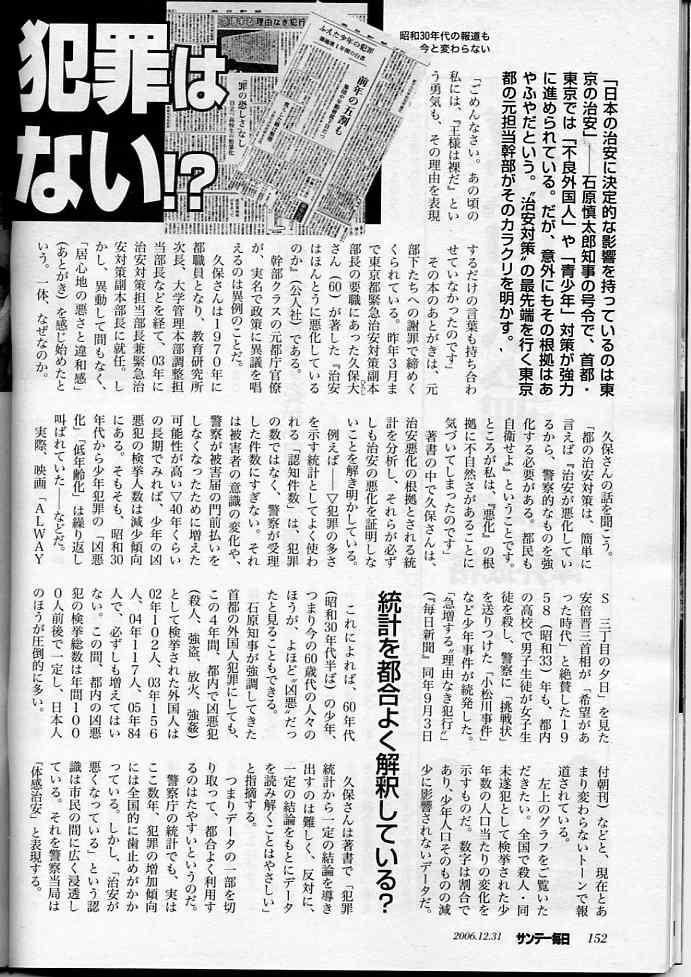
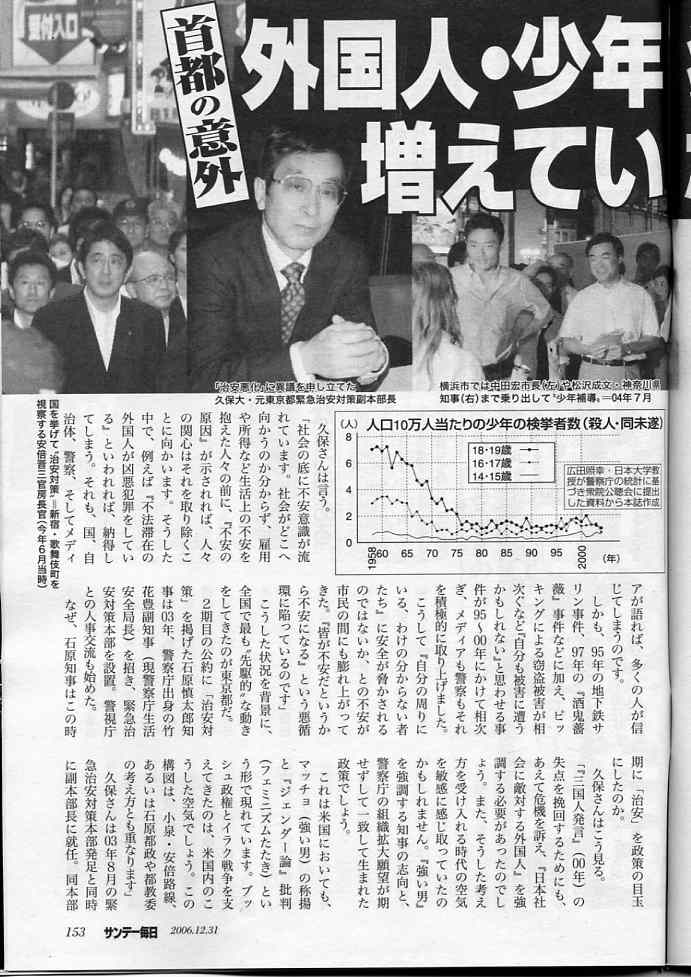
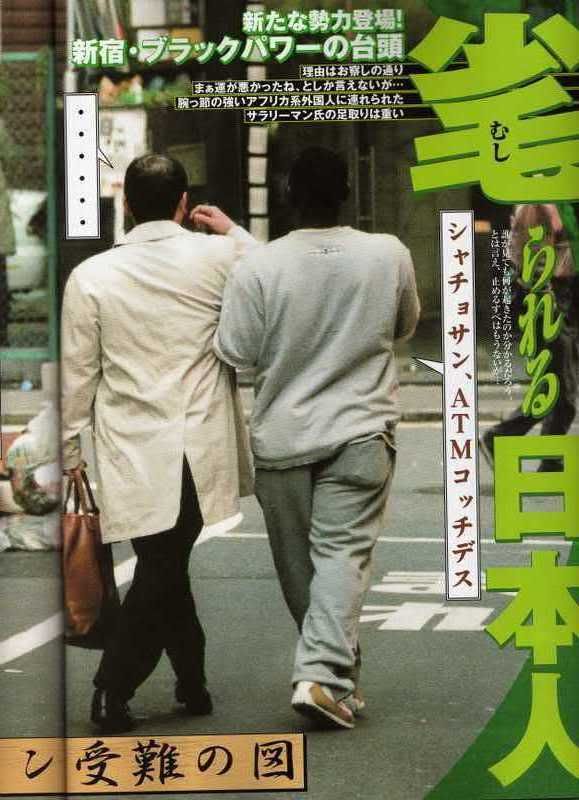
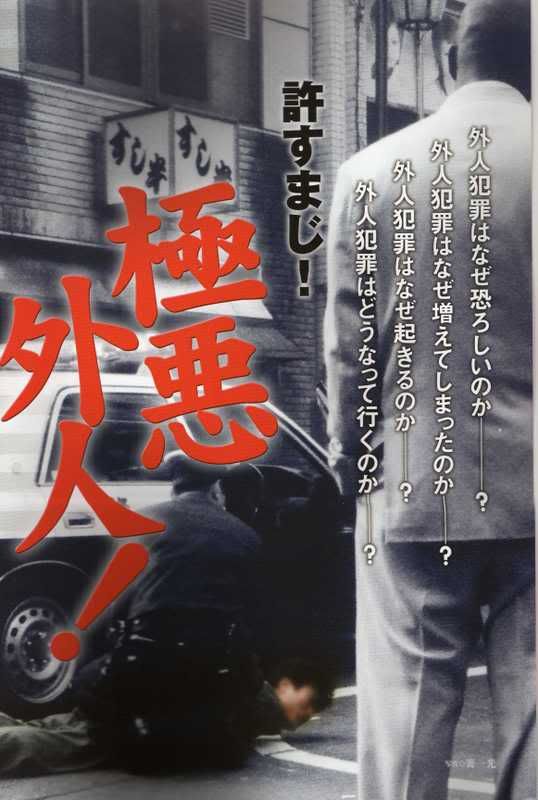
読売:2ちゃんねる管理者、敗訴43件も制裁金4億円不払い

mytest

ブロクの皆様、こんにちは。日本語でお久しぶりです。2ちゃんねるはここまで誹謗で被害を起していますが、責任者は責任を取らぬ。いつごろ日本は司法府をきちんと拘束力を与えられますか。
いきさつは
https://www.debito.org/?cat=21

https://www.debito.org/2channelsojou.html

有道 出人

===========================
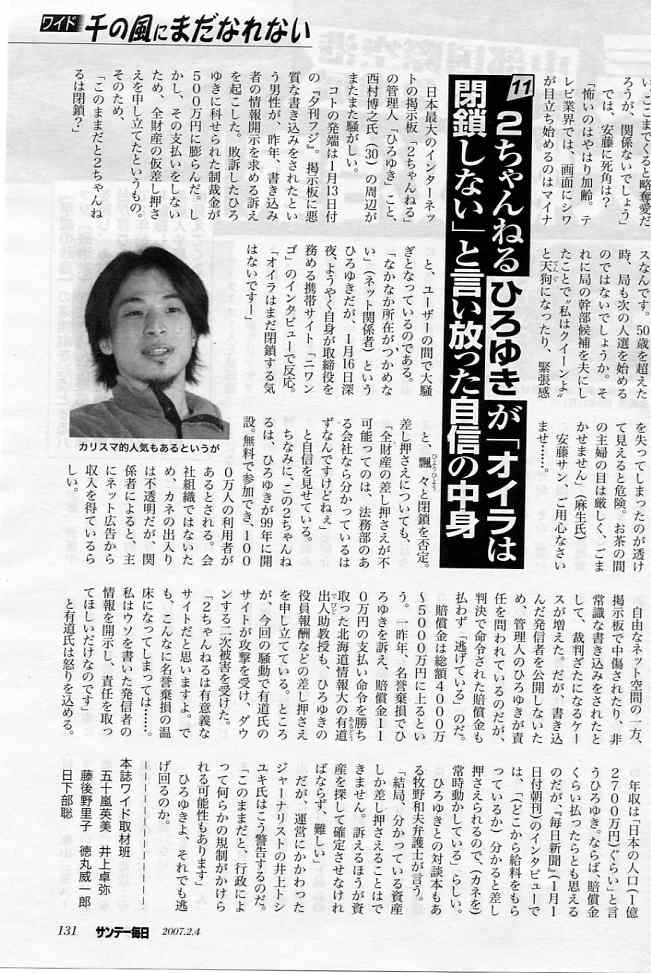
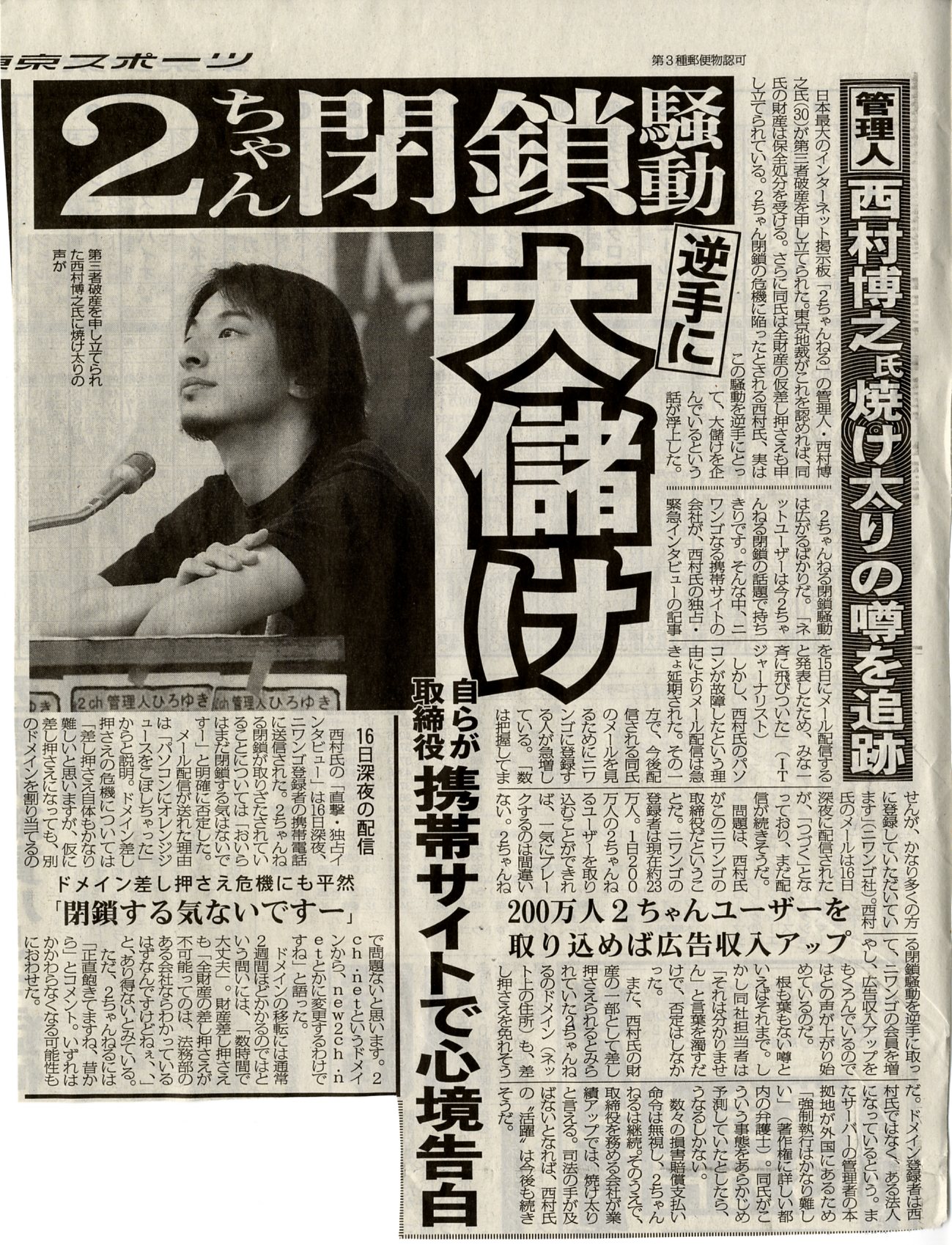
2ちゃんねる管理者、敗訴43件も制裁金4億円不払い
読売新聞 2007年3月5日14時30分
http://www.yomiuri.co.jp/national/news/20070305it05.htm?from=top

インターネット掲示板「2ちゃんねる」への誹謗(ひぼう)中傷の書き込みなどを巡り、管理者西村博之氏(30)を相手取り、名誉棄損などを訴える民事訴訟が全国で50件以上起こされ、少なくとも43件で西村氏側の敗訴が確定していることが読売新聞の調べでわかった。

この結果、西村氏に命じられた賠償額は約5800万円、仮処分命令などに従わないことによる「制裁金」が1日当たり約88万円、累計約4億3400万円に上るが、西村氏が自ら支払いに応じたケースはほとんどないと見られる。原告側は勝訴にもかかわらず賠償を得られない状態で、ネットの無法状態と司法の限界が露呈した形だ。

西村氏に対する訴訟は2001年以降、東京地裁だけで50件以上が起こされ、うち40件の敗訴が確定。ほかにも札幌、大阪、神戸の各地裁で計3件の敗訴が確定している。

訴えの内容は、〈1〉書き込みの削除請求〈2〉プロバイダー責任法に基づく、書き込んだ人の発信者情報の開示請求〈3〉書き込みを放置した管理者責任を問う損害賠償請求——がほとんどだ。このうち、01年7月に東京都内の動物病院経営者が「えげつない病院」などと書き込まれたとして提訴した訴訟では、400万円の賠償命令が確定。昨年1月にも、北海道の大学助教授が「人種差別者」「精神異常者」などと書き込まれたとして賠償を求めた訴訟で、110万円の賠償を命じた判決が確定している。

西村氏は多くの裁判で弁護士を付けず、裁判を欠席しているため、原告側請求を認める判決がほとんど。また西村氏は控訴などを余りしないため、敗訴確定が相次いでいる。

読売新聞の調査によると西村氏は、書き込み削除請求のうち11件、開示請求のうち3件には、裁判所の命令に応じた。

しかし賠償金支払いを命じられた21件で自ら賠償金を支払ったケースはなかった。このため9件の原告側は、西村氏の財産を差し押さえようと強制執行の手続きを取った。しかし回収できたのは、4件計三百数十万円にとどまっている。

差し押さえがうまくいかないのは、西村氏名義の銀行口座を突き止めても残高が少なかったり、西村氏が取締役を務める会社から「役員報酬は払っていない」と回答されたりしたため。

書き込み削除や情報開示については、当事者が仮処分を申し立てることが多い。被告が判決や仮処分命令に従わない場合は、裁判所が原告側の請求に基づき、命令に従うまで1日当たり一定額の制裁金支払いを義務付ける「間接強制」を行うことがある。

西村氏に間接強制が適用されたケースは確認できただけで5件。現在、1日約88万円の支払い義務が発生しており、3月1日現在の累計は4億3400万円に膨らんでいる。

読売新聞は西村氏に対し2月下旬以降、電子メールで取材を申し込んでいるが、返答がない。

(2007年3月5日14時30分 読売新聞)
ENDS

What others do re discrimination: stopping hate speech in the US

mytest

Hi Blog. I think I should probably start a site which talks about how other societies deal with problems of discrimination. Offer a template for what Japan can similarly do. First a comment, then the case:

The first case (thanks to Karen for notifying me) is about hate speech in the US, where somebody wrote an essay for a prominent media outlet on why he hates black people. Look at how other media and the anti-defamation leagues (not to mention national politicians) immediately pounced on it.

You don’t see that happening often enough in Japan–and when human rights groups and activists like us do react (often successfully), we get accused of “Western moralizing” (a la Gregory Clark), cultural imperialism, or worse of all censorship or denial of freedom of speech.

The US, for one, has long progressed beyond that. They don’t necessarily arrest the perpetrator, but in the following case, the media and pundits came through to debate him down.

In a similar example in Japan, the GAIJIN HANZAI magazine, the Japanese press just about completely ignored it, and it was up to us domestic bloggers and activists to tell the distributors to disavow. Which they did, eventually. But it wouldn’t have happened otherwise, because civil society is not sufficiently developed here (not to mention is suppressed by “press club” media cartels, even more so than in the US) to set things right and make the debate arena a fair fight.

This is what prominent J politicians (even people like Education Minister Ibuki Bunmei–contrast with Nancy Pelosi below) would pooh-pooh as “human rights metabolic syndrome”? Phooey. I think it’s time, given Bunmei’s Butter comments, for people to realize that Japan’s suffering from too few human rights enforcement mechanisms, not too many. This is what people should be doing in any society.

Anyway, the case study follows. Arudou Debito in Kurohime, Nagano

//////////////////////////////////////////////////////////

“WHY I HATE BLACKS”

US SOCIETY SHOUTS DOWN HATE SPEECH

Article follows:

Asian Week Suspends Writer Of Racist Column

POSTED: 12:56 pm PST February 28, 2007

UPDATED: 12:50 pm PST March 1, 2007

Courtesy NBC San Francisco

http://www.nbc11.com/news/11137241/detail.html

SAN FRANCISCO — An editor of a weekly newspaper calling itself “The Voice of Asian America” apologized and suspended a columnist after Asian-American and city leaders condemned an opinion piece titled “Why I Hate Blacks.”

The controversial column by 22-year-old New York based Kenneth Eng appeared in the current edition of Asian Week, which came out Friday.

READ: “Why I Hate Blacks,” by Kenneth Eng

In the piece, which appeared in the Feb. 23 edition, Eng lists reasons why he supports discrimination against blacks — including because “they are the only race that has been enslaved for 300 years.”

Leaders at the Asian American Justice Center, Chinese for Affirmative Action, Coalition for Asian Pacific Americans and other groups are circulating a petition denouncing the column as “irresponsible journalism, blatantly racist, replete with stereotypes, and deeply hurtful to African Americans.”

Ted Fang, AsianWeek’s editor-at-large, called the decision to publish Eng’s piece a “mistake” and held a news conference with NAACP leaders in San Francisco on Wednesday to discuss how the Asian and black communities “can be different and yet get along and work together.”

Fang said he suspended Eng from writing for the paper.

“The newspaper is sorry that this got published, and I am personally sorry that this got published,” Fang told The Associated Press. “The views in that opinion piece do not in any way reflect the views of AsianWeek.”

The paper, with a circulation of 48,505, plans to review its policies to “understand how this happened and make sure it doesn’t happen again,” he added.

Fang’s family publishes AsianWeek, along with a local newspaper called the Independent, and owned the San Francisco Examiner between 2000 and 2004.

The petition being circulated by Asian-American groups calls on AsianWeek to cut ties with Eng, issue an apology, print an editorial refuting the column, and fire or demote the editors who published it.

“It certainly does not speak for the vast majority of Asian Americans,” Stewart Kwoh, who heads the Asian Pacific American Legal Center in Los Angeles, said Tuesday. “This kind of inflammatory (column) really can hurt and damage relations with the broader African-American community.”

Kenneth Eng, who has described himself as an “Asian Supremacist,” has written several columns for AsianWeek since November, including pieces titled “Proof That Whites Inherently Hate Us” and “Why I Hate Asians.”

Eng is in his early 20s and a graduate of New York University, according to a biography on a Web site promoting his science fiction writing.

A telephone listing for Eng could not immediately be located.

Mayor Gavin Newsom said in a statement that the column had “no place in a city that is known around the world for civil rights and equality for all people. I am deeply concerned, both for the opinions expressed in the column and the fact that these opinions were published in a local newspaper.”

Supervisor Sophie Maxwell, one of the city’s top black officials, has co-sponsored a city resolution condemning the article and AsianWeek’s decision to publish it. But she doesn’t believe Eng’s column will hurt relations between blacks and Asians in San Francisco.

“This man clearly is very ignorant of African-American history and his own history, and he’s very angry,” said Maxwell, who represents a district with large black and Asian populations.

House Speaker Nancy Pelosi also weighed in on the matter.

“AsianWeek’s recent apology is a step in the right direction. Asian Week needs to make clear that despite this setback, it will move forward with policies that have no room for hate speech in its publication,” Pelosi said in a statement.

Full Pelosi Statement

“The hateful views expressed in Kenneth Eng’s column must not be tolerated and AsianWeek’s decision to print them was irresponsible. Eng’s words were not only offensive to African Americans, but to all Americans.

“AsianWeek, a publication known for promoting diversity and civil rights, has now issued an apology and has decided to no longer run material by Mr. Eng. These are steps in the right direction.

“I am proud to represent a city that prides itself on its diversity as its strength. Speech that promotes hate has no place in San Francisco or anywhere in our country. We must continue the fight to end racism and promote social justice for all.”

ENDS

J Times on GAIJIN HANZAI, finally

mytest

Hi Blog. Japan Times finally got to doing a story on the GAIJIN HANZAI Magazine. Fortunately, it’s probably the best article I’ve seen on it. Includes actual statistics of magazines sold and sent back (Family Mart, interestingly enough, was entrusted with about half the copies printed), and crime statistics debunking the book’s claims. Thanks Masami. Debito in Sapporo

////////////////////////////////////////

[photo caption]
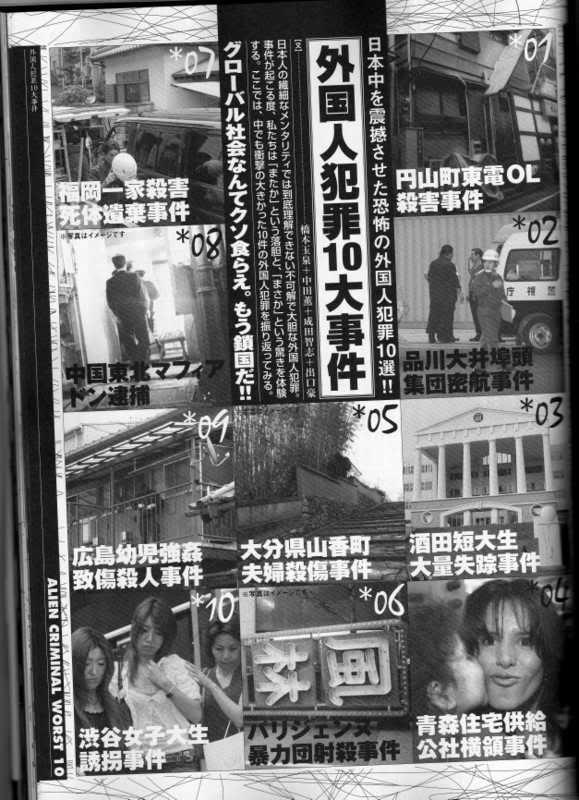
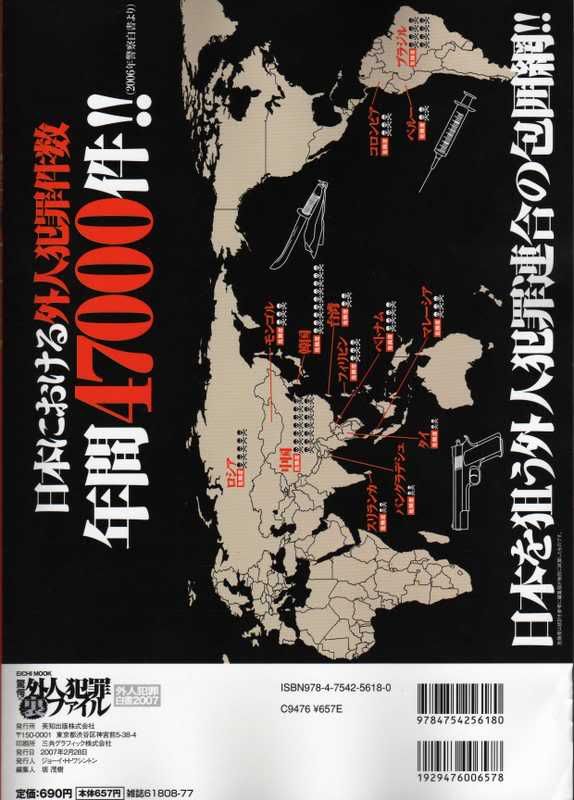
This is the cover of Kyogaku no Gaijin Hanzai Ura Fairu (Shocking Foreigner
Crime: the Underground File), a special-edition magazine published by
Tokyo-based Eichi that has triggered public outrage and caused Family Mart
to call it discriminatory and pull it off the shelves.

FAMILY MART CANS SALES
Mag on foreigner crimes not racist: editor
By MASAMI ITO Staff writer
The Japan Times: Friday, Feb. 23, 2007

http://search.japantimes.co.jp/cgi-bin/nn20070223f1.html

“Now!! Bad foreigners are devouring Japan,” screams the warning, surrounded
by gruesome caricatures of foreigners who look like savages, with blood red
eyes and evil faces.

The subtitle along the bottom of special edition magazine Kyogaku no Gaijin
Hanzai Ura Fairu (Shocking Foreigner Crime: the Underground File) asks, “Are
we allowing foreigners to devastate Japan?” with a tiny qualifier “some” on
the first kanji.

The 125-page single edition is about crimes committed by non-Japanese.

The pages are filled with crime stories and photographs of alleged crimes
being committed, drug deals, stabbings, gang fights and arrests — all of
them involving people from a wide range of countries. Some of the
nationalities named are Iranian, Chinese, South Korean, Brazilian and
Nigerian.

A spokesman for Family Mart, the main distributor, said that two days after
the magazine was released at the end of January, it began receiving e-mail
complaints.

According to a leaflet circulated by a group of protesters, the magazine
“gives discriminatory statements and images about non-Japanese residents of
Japan.”

After receiving more than 10 complaints, Family Mart took a closer look at
the magazine.

“When we read it, we found some expressions to be discriminatory and decided
to stop selling the book,” said the spokesman, who spoke on condition of
anonymity.

On Feb. 5, the firm ordered all its 6,800 outlets nationwide to remove the
magazine from the shelves and shipped them back to Eichi. It said that of
the 15,000 copies in stock — of the 20,000 to 30,000 that had been printed
— 1,000 were sold.

Shigeki Saka, editor of the magazine, claimed Eichi did not intend to
discriminate against foreigners but wanted to provide an opportunity for
“discussion” about the issue.

“This book was not originally published for foreign readers,” Saka said. “It
was to raise the issue (of crimes committed by foreigners) in Japanese
society. . . . But I believe the foreigners have the fear that they will be
viewed in the same way” as criminals.

Carlo La Porta, whole holds British and Italian citizenship and has lived in
Tokyo for 16 years, said he thought the magazine painted foreigners as
criminals.

The magazine “brings a problem into focus without adding perspective to it,
and as such implies that foreigners at large commit a lot of crimes,” La
Porta said.

Although the headline of a feature interview with a former Metropolitan
Police Department investigator, on the magazine cover, says, “In 2007,
anyone could be [sic–the Japanese says “ni naru”, will be, not “ni nareru” could be]
the target of foreigner crime!!” the number of crimes
committed by non-Japanese has actually fallen recently.

According to a report on organized crime to the National Police Agency,
18,895 foreigners were arrested in 2006, a decline of 2,283 from 2005.

In 2005, the number of foreigners arrested for serious crimes — murder,
robbery, arson and rape — fell to 396 from 421 arrests the previous year.

The 21,178 foreigners arrested in 2005 constituted only 5.5 percent of the
386,955 arrests that year.

Eichi’s Saka said he published the book despite the recent decline in
crimes, a point the magazine briefly mentions.

“The content (of the magazine) really is not intended to get rid of
foreigners nor is it extreme in tone. It is based only on facts,” Saka
claimed.

“I wanted to talk about the economic situation and environment in Japan that
has caused foreigners to commit crimes. But it does contain a little bit of
extreme expressions, for commercial purposes.”

The magazine contains several articles about the bad conditions many
foreigners work under, linking that to criminal activity.

One feature article says poor working conditions in Japan “have caused
(foreigners) to build resentment toward Japanese society and, one after
another, more people are getting involved in crimes because of the hardships
in their lives.”

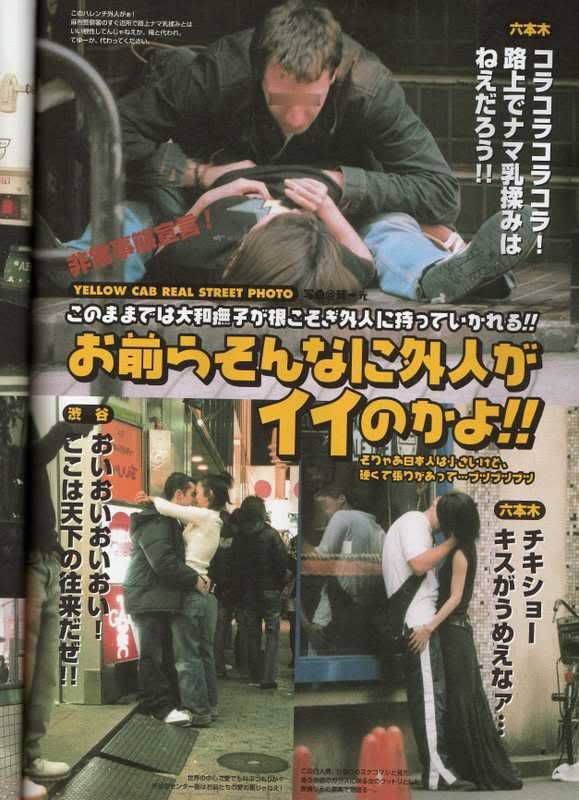
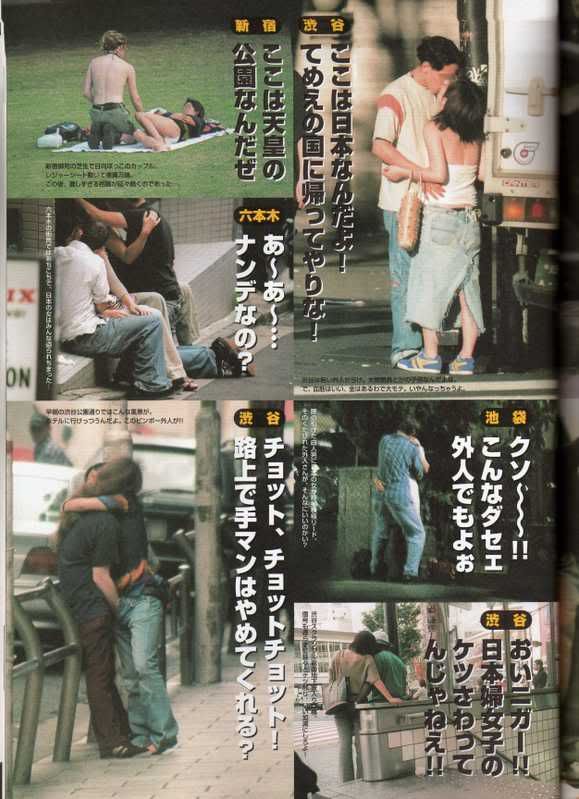
On what are called “entertainment” pages, there are photographs of
foreigners and Japanese women embracing on Tokyo streets. One photo of a
black man and a Japanese woman has the caption, “Hey nigger!! Don’t touch
that Japanese woman’s ass!!”

Saka said that while he knew the term “nigger” is racist, he reckoned it
would have a different nuance written in Japanese. “We used it as street
slang, writing it in katakana. But if we had known that we would get such a
huge reaction from foreigners, we might have refrained from using it,” he
figured.

Saka said that although the book had been pulled from Family Mart, it is
still available at some bookstores and on the Internet.

Hideki Morihara, secretary general of International Movement Against All
Forms of Discrimination and Racism, said the magazine is only part of a
wider problem for which the government is partially responsible.

He said the government frequently links foreigners with the growing threat
of crimes in Japan and is creating the image that all foreigners are
potential criminals.

He cited how in 2003, the Tokyo Metropolitan Government, along with the
Immigration Bureau and the NPA, launched a campaign to cut the number of
illegal foreign residents in Japan by half within five years.

A joint statement released at the start of the campaign says “immediate
action must be taken to resolve the issue of illegal overstayers for the
safety of our country” because “the existence of some illegal overstayers
(is the source) of foreign organized crime that occurs frequently.”

Morihara also said that last year’s legislation to revise the immigration
law to enable photographing and fingerprinting of every foreigner entering
Japan gives the impression that foreigners are potential terrorists.

“It is a big mistake to think that by categorizing foreigners as dangerous,
Japan will be protected,” Morihara said.

The Japan Times: Friday, Feb. 23, 2007
ENDS

J Times media roundup re Africans in Japan

mytest

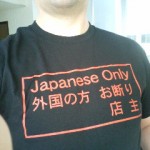
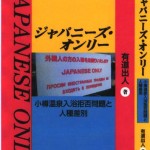
Handbook for Newcomers, Migrants, and Immigrants to Japan\Foreign Residents and Naturalized Citizens Association forming NGO\「ジャパニーズ・オンリー 小樽入浴拒否問題と人種差別」(明石書店)JAPANESE ONLY:  The Otaru Hot Springs Case and Racial Discrimination in Japansourstrawberriesavatardebitopodcastthumb
UPDATES ON TWITTER: arudoudebito
DEBITO.ORG PODCASTS on iTunes, subscribe free

Hi Blog. An interesting media roundup of how people are viewing Africans in Japan. I’ve been hearing from several quarters about a recent series of articles on them in the Asahi (was on the road, slow on the uptake)… Here’s a taste. Debito in Sapporo

======================================

‘Africans in Japan’…not from the quill of Ishihara, thank God

Jinichi Matsumoto’s series of articles about Africans in Japan transcends stereotypes often perpetuated by the Japanese media, says Philip Brasor

The Japan Times

Sunday, February 18, 2007

By Philip Brasor

Courtesy Asia Media http://www.asiamedia.ucla.edu/article.asp?parentid=64040

Last week, The Japan Times ran a Bloomberg interview with Shintaro Ishihara in which the proudly provocative Tokyo governor followed up his contention that foreigners were behind the city’s rising crime rate. He challenged his interviewers to go to Roppongi and see for themselves. “Africans — and I don’t mean African-Americans — who don’t speak English are there doing who knows what,” he said.

You expect such careless bluster from Ishihara, but his statement deserves scrutiny. One explanation for the governor’s popularity is the way he is seen to reflect what his supporters think is common sense. What are non-American black people doing in Japan? It must be something bad.

It wouldn’t be difficult to believe that Japanese people have a negative image of Africans, given what they see and hear through the media. As far as Roppongi goes, newspapers and magazines often run articles about how Africans, especially Nigerians, have become increasingly involved in Tokyo’s bar and nightclub business and use credit-card fraud and bill-padding practices to milk customers.

Tarento Bobby Ologun, who’s from Nigeria, may represent the only favorable image many people have of Africans living in Japan. Having emerged in 2001 on the variety show “Karakuri Terebi,” earning laughs as he learned Japanese, Bobby’s childlike appeal remains the same, despite his being blackballed from TV for a while over an alleged assault last year. With his sweet, deep voice and awkward command of the language he comes across as an innocent.

Bobby is not the first or only African tarento — in the 1990s, Guinea Embassy employee Osuman Sankhon was everywhere — but he appears on TV much more than either John Muwete Muruaka, the former secretary of politician Muneo Suzuki, or the multilingual Baudouin Adogony, two Africa-born tarento who have a more worldly image (and who belong to the same talent agency as Bobby).

Though university-educated, Bobby comes across as someone who doesn’t understand the world and doesn’t realize it when comedians poke fun at his skin color or lack of sophistication. He represents the perceived backwardness of Africa, which makes him the perfect topical tarento. By my count, at least seven feature films about Africa are opening in Japan this spring, but, except for South Africa’s “Tsotsi,” whose viewpoint is African, these films were made by white people who acknowledge the tragedy of the continent and even the West’s hand in creating that tragedy, but nevertheless approach it as outsiders. Regardless of the filmmakers’ intentions, these movies erect a wall, a feeling that the region’s problems are so huge that nothing can be done about them. As film critic Manohla Dargis recently wrote in the New York Times, “Watching Leonardo DiCaprio share the screen with genuine handless black Africans . . . doesn’t rouse me to action; it stirs horror, pity, sometimes repulsion, sentiments that linger uneasily until the action starts up again.”

Without the proper context, Africans become objects of fear or pity. One of the saddest developments of the last two decades is the diminishment of history as a scholastic pursuit. In America, history has become an option in compulsory education, and in Japan it is a tool for inculcating nationalism.

History provides the context with which we make judgments, but now we rely on the kind of “common sense” that Shintaro Ishihara prizes so highly, and which is shaped by the narrow parameters set by the media: What will get your attention? What will evoke fear and pity the best?

Jinichi Matsumoto’s ongoing series of articles in the Asahi Shimbun, “The Africans of Kabukicho,” provides this context. Using statistics and interviews, and then providing history as background, Matsumoto answers Ishihara’s question and explains exactly what those Africans are doing in Japan.

He focuses on a Nigerian named Austin who was recently released from jail. Austin came to Japan in 2001 on a tourist visa, hoping to buy used auto parts for export back to Nigeria. It was more difficult than he thought, and he eventually started working for Nigerian-owned bars in Roppongi as a street solicitor.

During the 2002 police crackdown of illegal immigrants, many of the Chinese and Korean-owned drinking establishments in Kabukicho closed, and rents plummeted. Nigerians who fled Roppongi’s crackdown opened their own bars in the ensuing vacuum, including Austin, who had married a Japanese woman. He was eventually arrested for fraud. He denies cheating anyone and never confessed to anything, but in Matsumoto’s retelling he does not come off as an innocent. “I think we should try to cultivate regular customers,” Austin’s wife says about the bar, “but he wants to make as much money as he can right now.” It’s this sort of detail that makes Austin a real person, and his situation comprehensible.

The series elaborates on Austin’s upbringing in the city of Port Harcourt, and in turn describes the history of Biafra, the southeastern region that tried to break away from Nigeria in the early 1960s and failed. Nigeria is controlled by the Muslim Hausa, but Biafra is populated by the Ibo, who are Christian and discriminated against by the government. It is on Ibo land where most of Nigeria’s oil is being drilled, though the Ibo don’t benefit at all.

Matsumoto estimates that 70 percent of the 2,400 legally registered Nigerians in Japan are Ibo (Bobby belongs to a third major ethnic group, Yoruba), and describes how Japan became a last hope for those who had the grit and money to make the long journey. It’s an amazing story, and while it doesn’t pardon any crimes that may have been committed by people who made that journey, it should at least make readers understand them better. As human beings, they deserve more than fear and pity.

Date Posted: 2/18/2007

ENDS

GAIJIN HANZAI editor Saka responds on Japan Today, with my rebuttal

mytest

Hi Blog. Here we have an interesting development: The editor of the GAIJIN HANZAI URA FILES responds to his critics. A fascinating and relatively rare glimpse into the mindset of a person with a “thing” about gaijin. I post his response below, then I offer up some comment after each paragraph:

=================================
CRIME
Why I published ‘Foreigner Underground Crime File:’ Editor makes his case and responds to critics
By Shigeki Saka, Editor, Eichi Shuppan Inc

Japan Today
Friday, February 16, 2007 at 07:03 EST
Courtesy http://www.japantoday.com/jp/news/399166/all

TOKYO — Ever since publishing a magazine called “Gaijin Hanzai Ura Fairu” (Foreigner Underground Crime File) last month, I have been subject to a campaign of harassment. In particular, some emails I’ve received have been quite vicious — and have included threats to my life. I have to admit that, although the ferocity of this reaction has surprised me, the basic emotions have not.

The topic of foreigner crime is taboo in Japan, with people on both sides of the issue distorting the facts and letting their feelings get the better of them.

On the Japanese side, the “foreign criminal” is a beast who lurks everywhere and wants nothing more than to destroy Japanese people and their way of life. Whether it’s a North Korean agent kidnapping our daughters or a Chinese thief invading our homes, many Japanese are convinced that foreigners should be treated with suspicion and fear.

This attitude makes it impossible to have an informed conversation about where real foreign criminals come from, or the reason they commit their crimes. In fact, one of my goals in publishing “Gaijin Hanzai Ura Fairu” was to help begin a frank discussion of the issue.

On the other side, many foreigners consider any suggestion that they engage in lewd or criminal behavior to be an unacceptable insult. This can be seen quite clearly in the reaction our magazine elicited in the Western media, and especially in the online community. The army of bloggers who bullied FamilyMart convenience stores into removing “Gaijin Hanzai Ura Fairu” from their shelves have decided for everyone else that this book is so dangerous that it cannot be read.

Yet I wonder how many of these “puroshimin,” or “professional civilians,” have read — or even seen — the magazine. I suppose the same right to free speech they claim for themselves should not extend to those who might want to buy and read our publication.

What these people are ignoring is a simple truth: there are no lies, distortions or racist sentiments expressed in “Gaijin Hanzai Ura Fairu.” All the statistics about rising crime rates are accurate, and all the photographs show incidents that actually occurred.

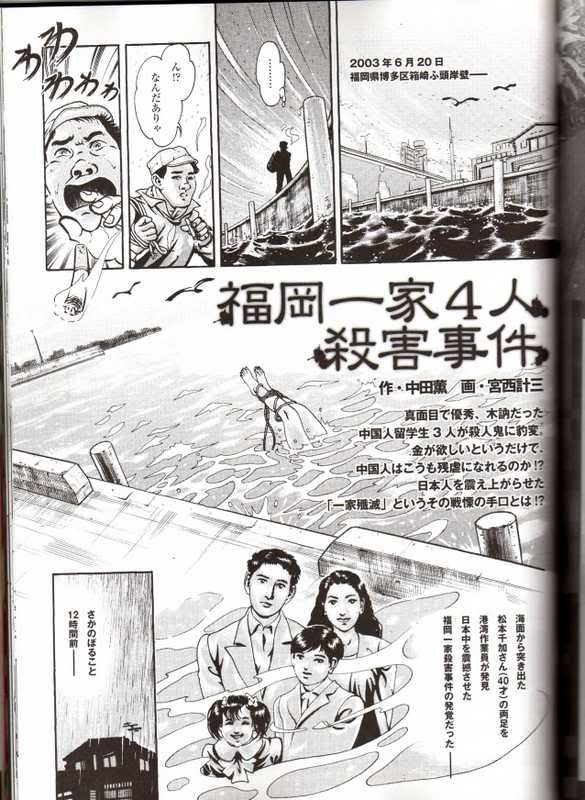
For instance, it is true that on June 19, 2003, three Chinese nationals murdered a Japanese family — a mother, father and two children aged 8 and 11 — and dumped their bodies into a canal in Fukushima. It’s true that Brazilians and Chinese account for over half of the crimes committed by foreigners in Japan. It’s true that American guys grope their Japanese girlfriends daily on the streets of Tokyo.

That’s not to say that some of the criticism leveled at “Gaijin Hanzai Ura Fairu” is unreasonable. Bloggers have called attention to a few of our crime scene photographs, in which we have blurred the faces of Japanese people but not those of foreigners. Let me respond by saying that, if we had covered up the foreigners’ faces, the reader wouldn’t be able to recognize them as foreign, and the illustrative power of the image would be lost.

Use of ‘niga’ doesn’t have emotive power of English word

Another criticism I have heard involves our use of the term “niga,” which appears in the caption of a photo showing a black man feeling up his Japanese girlfriend on the street. I would like to stress that this term has none of the emotive power in Japanese that the N-word does in English — and to translate it as such is unfair. Instead, “niga” is Japanese street slang, just like the language used in the other captions on the same page.

Finally, some critics point to the absence of advertisements in “Gaijin Hanzai Ura Fairu” as evidence that we are financed by a powerful and rich organization. Nothing could be further from the truth. The reason there are no ads in the magazine is because we couldn’t find any sponsors who wanted to be part of such a controversial project. However, in one way I wish we did have the backing of such an influential group: I would feel a lot safer if I could count on them for security!

Having been given this opportunity to share a message with Tokyo’s foreign community, I would like to stress three points. First, before foreigners rush to accuse me and my staff of racism, or to label our publication a typical example of Japanese xenophobia, I would ask that they consider how quick their own culture is to view the Japanese as subhuman. In World War II you labeled us “monkeys,” and in the bubble economy years, you considered us “economic predators.”

Second, as our country becomes increasingly globalized and more foreigners come here to live and work, the Japanese will be forced to confront the challenges of a pluralistic society. Only by honestly discussing this issue and all it entails can we prepare our culture for this radical change.

Finally, if we can manage to openly discuss the issue of foreign crime in Japan, we will have the opportunity to address our own problems as well. Sure, we could continue to run away from the topic and remove books from shelves, but in doing so we are losing the chance to become more self-aware. What we need to understand is that by having a conversation about violent and illegal behavior, we’re really talking about ourselves — not as “Japanese” or “foreigners,” but as human beings.

Shigeki Saka is an editor at Eichi Publishing Company in Tokyo.

============================

Now let me reprint the entire article and offer comments below each paragraph:

============================

Why I published ‘Foreigner Underground Crime File:’ Editor makes his case and responds to critics

First of all, let me thank Mr Saka for taking the trouble to respond. Most people of his ilk do not come forward with their views and hold them up to scrutiny. (The publisher himself hides behind the name “Joey H. Washington”, which is legally questionable) So I offer these comments hopefully in the same spirit with a bit less defensiveness, and hope that a constructive dialogue, which Mr Saka indicates he wants, will ensue in future.

Ever since publishing a magazine called “Gaijin Hanzai Ura Fairu” (Foreigner Underground Crime File) last month, I have been subject to a campaign of harassment. In particular, some emails I’ve received have been quite vicious — and have included threats to my life. I have to admit that, although the ferocity of this reaction has surprised me, the basic emotions have not.

Right from the start we get the underlying current of the mindset behind the response: A perpetual feeling of victimization on the part of people who threw the first stone. As if the critics are the bad guys guilty of “harassment”. Agreed, there are limits to how far criticism can go, and once there is a threat of violence the line has been crossed. But ye shall reap. You wilfully create an inflammatory book and put it on bookshelves nationwide, you will get inflammatory reactions. As an editor in the publishing world, Mr Saka should by now be used to criticism. But to cry about his own treatment in the media, after publishing something this distorted, shows a definite lack of self-reflection that will do him little good as a professional in future.

The topic of foreigner crime is taboo in Japan, with people on both sides of the issue distorting the facts and letting their feelings get the better of them.

The meaning of “taboo”, even in Japanese, means something that cannot be discussed. However, there has been much discussion about foreign crime since 2000, from Ishihara to the NPA to the tabloids to the Wide Shows to the respectable press. Not taboo at all, and for an editor to get this word so wrong in even a formal debate calls into question his qualifications as an editor and wordsmith.

As for distorting the facts, GAIJIN HANZAI does a respectable job of doing it all on it’s own (starting from the very cover, where “gaijin” are going to “devastate” Japan if we let them, and where “everyone” will be a target of “gaijin crime” this year). Saying that people on both sides are getting it wrong (even if true) is no defense, and no license to do it yourself.

On the Japanese side, the “foreign criminal” is a beast who lurks everywhere and wants nothing more than to destroy Japanese people and their way of life. Whether it’s a North Korean agent kidnapping our daughters or a Chinese thief invading our homes, many Japanese are convinced that foreigners should be treated with suspicion and fear.

I don’t want to get hung up on semantics here (as I have not seen the original interview in Japanese), but here we have the victim complex combined with the editor clearly admitting which side he’s on. “Our” side. “Our” daughters. “Our” homes. As opposed to crime affecting everybody badly, which it does. You can’t do “us” and “them” when criminals are indiscriminate sharks who treat everybody as food. Especially since almost all criminals in Japan are Japanese no matter how you fudge the “facts”.

Whether or not the foreign criminal is out to “destroy Japan” (as opposed to take advantage of it for profit motive like any other criminal regardless of nationality) feels more like a figment of Mr Saka’s active imagination. Last I heard, there are no real anti-government anarchic groups out there run by foreigners; that’s usually the domain of the Japanese radicals.

This attitude makes it impossible to have an informed conversation about where real foreign criminals come from, or the reason they commit their crimes. In fact, one of my goals in publishing “Gaijin Hanzai Ura Fairu” was to help begin a frank discussion of the issue.

This “attitude” being referred to here is not the fault of the critics, but the fault of the instigator, in this case the people who funded Mr Saka and Eichi Shuppan. By all means, let’s have an informed discussion about where crime and criminality comes from. But putting it in terms of racial and nationality paradigms certainly does not inform the discussion. Given how blunt these tools of analysis are as social science, this book generates far more heat than light.

Criminality is completely unrelated to nationality anyway. By offering no comparison to Japanese crime, there is no chance for informed conversation whatsoever since it is not grounded in any context. Which means the entire premise of your book is flawed and not on any search for the truth.

What you are getting, however, IS frank discussion. But you pass that off as “harassment”. Your positioning yourself as the victim switches off so many intellectual avenues.

On the other side, many foreigners consider any suggestion that they engage in lewd or criminal behavior to be an unacceptable insult. This can be seen quite clearly in the reaction our magazine elicited in the Western media, and especially in the online community. The army of bloggers who bullied FamilyMart convenience stores into removing “Gaijin Hanzai Ura Fairu” from their shelves have decided for everyone else that this book is so dangerous that it cannot be read.

Here we go with the victim mentality again, where an “army” of bloggers (I’m amazed the translator didn’t use the word “horde”) “bullied” innocent victim convenience stores into submission. This odd world-view assumes a) non-Japanese are that organized (Believe you me, they’re not! Unless you get their dander up like your magazine so effectively did.), and b) the convenience stores were powerless to stop them (No, the shopkeeps–and EVERY other Japanese I have shown this magazine to–reacted to your rhetoric, particularly when one showed them the pages with the interracial public displays of affection–with shame and revulsion. One didn’t even need fluency in Japanese to inform the discussion. You made our job incredibly easy for us.)

No, the shopkeeps and distributors, who apologized not out of fear or compulsion, decided for themselves that this book was offensive and not worthy of their racks. As did your advertisers, as you admit below.

Yet I wonder how many of these “puroshimin,” or “professional civilians,” have read — or even seen — the magazine. I suppose the same right to free speech they claim for themselves should not extend to those who might want to buy and read our publication.

Let’s walk through this Trojan Horse of logic. You deliberately put out a book that will aggravate a section of the Japanese population. If anyone successfully protests, you say we are censoring you. Drop the tatemae, already, and stop hiding behind pat and half-baked ideas of “free speech” when the honne is that all you want to do is sell books. And it was after people actually SAW the mook that shopkeeps followed through with sending them back.

(And for those who haven’t seen the mook, here’s the whole thing, scanned, and available for free:
http://www.flickr.com/photos/ultraneo/sets/72157594531953574/)

What these people are ignoring is a simple truth: there are no lies, distortions or racist sentiments expressed in “Gaijin Hanzai Ura Fairu.” All the statistics about rising crime rates are accurate, and all the photographs show incidents that actually occurred.

No lies, such as talking about Japanese penis size? Or that a Mr. “Joey H. Washington” published this book…? Anyway…

You fill the book with statistics, yes. But three tests of telling the truth is telling the truth, the whole truth, and nothing but the truth. By leaving out any mention of Japanese crime, which is, if anything, more likely to target Japanese and devastate the Japanese way of life, you leave out the whole truth. This is a distortion, which is inaccurate.

So are the statistics about rising crime rates. Many crime rates in certain sectors (and in general, according to recent news) have fallen. So have the numbers of visa overstayers EVERY YEAR since 1993. Maybe you didn’t get all that in before press time. Or maybe you just did not feel that these “facts” were convenient enough for inclusion.

For instance, it is true that on June 19, 2003, three Chinese nationals murdered a Japanese family — a mother, father and two children aged 8 and 11 — and dumped their bodies into a canal in Fukushima [SIC–It was Fukuoka]. It’s true that Brazilians and Chinese account for over half of the crimes committed by foreigners in Japan. It’s true that American guys grope their Japanese girlfriends daily on the streets of Tokyo.

For instance, it is true that a woman in Wakayama fed her neighbors poisoned curry rice. It is true that a Tokyo woman killed her husband with a wine bottle, cut him into little pieces, and threw him away with the nama gomi. It is true that a man killed a British hostess for his own sexual predilections. It is true a man killed his Dutch partner in Paris and ate her. It is true that a prostitute strangled her patron, dismembered him, and walked around town with his penis around her neck… Need I go on?

All of these criminals were Japanese. How would it feel if I were to write a book and publish it overseas saying you should never eat curry in Wakayama because Wakayama people might poison you. Or that one should never marry a Japanese woman because she might bludgeon you with a bottle and cut your prick off?

Or that a Japanese robber posing as a doctor poisoning everyone in a bank shows that Japanese are more devious than Westerners because they have to kill everyone in the building in order to get at the money? I bet there would be howls from the media and even the Japanese embassy.

And the groping thing? The Japanese government has to take measures to segregate public transportation because the “chikan” problem is so bad here. The differences between this and that is that it’s harder to photograph the same acts happening in a crowded train. And that it is consensual. Which means it is not a crime, and beyond the scope of this book.

That’s not to say that some of the criticism leveled at “Gaijin Hanzai Ura Fairu” is unreasonable. Bloggers have called attention to a few of our crime scene photographs, in which we have blurred the faces of Japanese people but not those of foreigners. Let me respond by saying that, if we had covered up the foreigners’ faces, the reader wouldn’t be able to recognize them as foreign, and the illustrative power of the image would be lost.

Another Trojan Horse of logic. No, Eichi Shuppan didn’t block out the gaijin faces because they didn’t think there would be any trouble from them, especially legally. Why not leave in the Japanese faces for more illustrative power that the situation is Japanese vs gaijin? Because you’d be slapped with a lawsuit for invasion of privacy, that’s why. Again, lose the tatemae.

Use of ‘niga’ doesn’t have emotive power of English wordAnother criticism I have heard involves our use of the term “niga,” which appears in the caption of a photo showing a black man feeling up his Japanese girlfriend on the street. I would like to stress that this term has none of the emotive power in Japanese that the N-word does in English — and to translate it as such is unfair. Instead, “niga” is Japanese street slang, just like the language used in the other captions on the same page.

You are seriously trying to argue that nigaa is not derived from the English epithet, that the Japanese streets just spontaneously came up with it to describe people with high melanin skin, or that it has no emotive connection to its root? 

I wonder who elected Mr Saka representative of all Japanese when it comes to interpreting how we feel about epithets. Every Japanese I have shown this book to (and I have shown it to thousands) has recoiled at the word (and one display to the shopkeeps gets it quickly removed from the shelves). Try saying it on Japanese television or using it in the respectable press. And try being the target of “jappu”, “nippu”, “yellow monkey”, “yellow cab” etc. anywhere in the world and see if that “street slang” defense works.

Same with the word “gaijin”, used in every situation in the book (even the title) except when citing police statistics (where the official word is “gaikokujin”, of course). Even here we translate it as “foreigner”, which is not the same word with the same emotive power either. But interpretation of epithets is less the property of the speaker, more the person being addressed. And Mr Saka’s attempt in an earlier explanation to say “this book is for a Japanese audience” (which he does not make in this essay) is a facile attempt to exclude or deligitimize the non-Japanese resident’s voice from the free and open debate he so highly prizes.

Finally, some critics point to the absence of advertisements in “Gaijin Hanzai Ura Fairu” as evidence that we are financed by a powerful and rich organization. Nothing could be further from the truth. The reason there are no ads in the magazine is because we couldn’t find any sponsors who wanted to be part of such a controversial project. However, in one way I wish we did have the backing of such an influential group: I would feel a lot safer if I could count on them for security!

I am looking forward to your next expose on the Yakuza and their methods of crime. Then I think you would have some real security concerns. A few angry letters in your email box does not a similarly life-threatening harrassment campaign make.

You still haven’t answered the question of where your funding came from. And the fact that advertisers had more sense than to be associated with your mook (and shopkeeps and distributors, once notified of the contents, also quickly washed their hands of you) should be some cause for self-reflection on your part.

Having been given this opportunity to share a message with Tokyo’s foreign community, I would like to stress three points. First, before foreigners rush to accuse me and my staff of racism, or to label our publication a typical example of Japanese xenophobia, I would ask that they consider how quick their own culture is to view the Japanese as subhuman. In World War II you labeled us “monkeys,” and in the bubble economy years, you considered us “economic predators.”

Cue victim complex again. We Japanese been done wrong (one or two generations ago, when Japanese were likewise contemporarily calling gaijin “devils”, “barbarians”, “lazy illiterates”…). So it justifies our doing wrong right back. How far back do we have to go here to justify the use of historically hateful and insulting epithets in the present day? And does Eichi Shuppan really want to sink to the level of the bigots (found in every society) who use those terms of debate?

Second, as our country becomes increasingly globalized and more foreigners come here to live and work, the Japanese will be forced to confront the challenges of a pluralistic society. Only by honestly discussing this issue and all it entails can we prepare our culture for this radical change.

Cue the possession complex again. “Our country” belongs to us too. We live here, and pay taxes and contribute to Japanese society the same as everyone else. Only by honestly dealing with the fact that Japanese social problems are not so easily blamed on foreigners, or on an internationalizing society, can we prepare “our culture” for the challenges of Japan’s future.

The operative word here is “honestly”. But thanks to books like GAIJIN HANZAI, which conflates criminality with nationality, I think that is beyond the likes of Mr Saka, Eichi Shuppan, or their anonymous patrons.

Finally, if we can manage to openly discuss the issue of foreign crime in Japan, we will have the opportunity to address our own problems as well. Sure, we could continue to run away from the topic and remove books from shelves, but in doing so we are losing the chance to become more self-aware. What we need to understand is that by having a conversation about violent and illegal behavior, we’re really talking about ourselves — not as “Japanese” or “foreigners,” but as human beings.

So why isn’t the book entitled “NINGEN HANZAI”? Because it’s not about talking about violent and illegal behavior “as human beings”. Nor about our “own problems”, but rather about “gaijin” and the evils that they do because they are gaijin. And how in some places in the book they should not be here in the first place and how we must defend ourselves from them. The problem being pointed at is not “ourselves”. It is about “them” and how they hurt “us”.

=======================

In conclusion, the reason why the mook should not go back on the shelves:

In my view, when one publishes something, there are of course limits to freedom of speech. Although Japanese laws are grey on this, the rules of thumb for most societies are you must not libel individuals with lies, maliciously promote hate and spread innuendo and fear against a people, and not wilfully incite people to panic and violence. The classic example is thou must not lie and shout “fire” in a crowded theater. But my general rule is that you must not make the debate arena inconducive to free and calm, reasoned debate.

GAIJIN HANZAI fails the test because it a) wilfully spreads hate, fear, and innuendo against a segment of the population, b) fortifies that by lacking any sort of balance in data or presentation, and c) offers sensationalized propaganda in the name of “constructive debate” (when I don’t think Mr Saka has any intention of doing anything more than selling magazines; he is on no search for the truth–only wishes to hawk wares for wareware nipponjin). Dialog is not promoted by fearmongering.

Even then, we as demonstrators never asked for the law, such as it is, to get involved. We just notified distributors of the qualms we had with this book, and they agreed that this was inappropriate material for their sales outlets. We backed that up by proposing a boycott, which is our inviolable right (probably the non-Japanese residents’ only inviolable right) to choose where to spend our money as consumers. We proposed no violence. Only the strength of our argument and conviction.

It’s not like this is a fair fight here–we do not have an entire publishing house at our disposal, with access to every convenience store in Japan, so we can publish a rebuttal side by side.  And the fact that the Japanese press has completely ignored this issue is indicative of how stacked the domestic debate arena is against us. You think the domestic press is going to go to bat for us and naturally restore balance to the national debate on foreign crime?

We did what we could, and it worked.  Especially since the tone of GAIJIN HANZAI did our work for us. You should be kicking yourself for making our job so easy.

========================

Again, I thank Mr Saka for making his ideology so plain. Ultimately, he comes off as a crybaby who sees other people going about their business, gets angry because the people there remind him of someone who teased him in grade school, then puts up posters accusing those people of ruining his neighborhood. Then wonders why people get angry at him, and accuse them of violating his freedom of expression when they pull those posters down. If this is the best argument the bigots in Japan can muster, then Japan’s imminent transition to an international, multicultural society will go smoother than expected.

Arudou Debito
Japanese citizen and full member of “our society”
Miyazaki, Kyushu
February 16, 2007
ENDS

=======================================

ADDENDUM FEB 20, 2007

Just got this from a friend. Seems like migration of labor is causing some problems with “foreign crime” in China too. So much for GAIJIN HANZAI’S speculation that Chinese somehow have more criminal tendencies. Anyway, FYI. Debito in Sapporo

South China Morning Post
Thursday, February 15, 2007
Crime-plagued Guangzhou considers foreigner database
AGENCE FRANCE-PRESSE in Beijing

Updated at 11.47am:
Legislators in crime-ridden Guangzhou wanted to set up an information
database to track the activities of foreigners blamed for some of the
lawlessness, state media said on Thursday.

The proposal by 13 legislators was based on data showing a 40 per cent
increase in illegal activities by foreigners in the southern city in
2001-05, the China Daily reported.

“[Foreigners] without legal permission to live and do business in
Guangdong, and especially those who commit crimes, pose a great threat
to the province’s social security,” Yan Xiangrong, a deputy in the
Guangdong Provincial People’s Congress, told the paper.

The scheme would involve “all related governmental organisations,
including departments of foreign affairs, public security, health,
labour and social security, industry and commercial and civil affairs”,
Mr Yan said.

No other details on the plan, which was put to the Congress last week,
were given.

Guangzhou is plagued by purse-snatching motorcycle gangs and other crime
linked to its spectacular export-fuelled boom.

The crime is typically blamed on the more than three million migrant
workers drawn to the booming city but a rising number of foreigners also
have set up residence or businesses in the province.

There were 40,000 foreigners living in the province, most of them in
Guangzhou, the paper said.

Recent cases involving foreigners have included smuggling and
drug-trafficking offences, it added.

Last month, Guangzhou announced it would more than triple the number of
surveillance cameras around the city to 340,000 to help stem the crime.
ENDS

Japan Focus on public perceptions of crime in Japan

mytest

Hello Blog. Trapped in Miyazaki at the moment with a newsletter to mail out but no emailability.  Meanwhile, let me cite a marvellous article dealing with crime and crime perception in Japan.  From Japan Focus (an academic site run out of Cornell University in the US, thanks to Mark for the notification), some selective quotes:

—————————————————-

Crime and Punishment in Japan: From Re-integrative Shaming to Popular Punitivism    

By Thomas Ellis & Koichi HAMAI

http://www.japanfocus.org/products/details/2340 


SUMMARY: In the late 1990s, press coverage of police scandals in Japan provoked policy reactions so that more ‘trivial’ offences were reported, and overall crime figures rocketed. The resulting ‘myth of the collapse of secure society’ appears, in turn, to have contributed to increasingly punitive public views about offenders and sentencing in Japan.

The NPA policy shift since 2000, toward encouraging greater reporting of minor offences has produced a large increase in overall recorded violent crimes that are virtually unsolvable and this has devastated the police clear up rate. In reality, International Crime Victims Surveys show that the risk of becoming a victim (including of violent crime) between 2000 and 2004 was generally reduced, but the proportion reported to and recorded by the police increased. These surveys also show that Japan has the lowest victimization rates for robbery, sexual assault and assault with force. Further, the homicide rate, which is one of the most reliable crime statistics, shows a downward trend since the 1980s, and the clear up rate has remained consistently above 90%. However, like the public elsewhere, the Japanese public rely more on media sources for opinions on crime than they do on objective sources. As Figure 4. shows, there is no clear relationship between the trends in homicide rates and the number of press articles relating to them, again supporting a notion of moral panic.

As with most comparable nations, the Japanese public’s fear of crime is not in proportion to the likelihood of being victimized. What is different is the scale of this mismatch. While Japan has one of the lowest victimization rates, the International Crime Victim Surveys (ICVS) indicate that it has among the highest levels of fear of crime. The Japanese moral panic about crime has been extremely durable in the new millennium. Some now claim that the panic perspective has become institutionalized in Japan and that there has been collapse of the pre-existing psychological boundary dividing experience of the ordinary personal world where crime is rare, and another hyper-real world where crime is common….

However, rather than the rise in relatively trivial crimes, the press focused on homicide and violent crime, which are the types of stories with high “news value” in Japan and elsewhere.

—————————————————-

Rest at http://www.japanfocus.org/products/details/2340

The full version of this article was published in International Journal of the Sociology of Law (2006, Vol. 34 (3) pp.157-178.) Posted on Japan Focus on January 29, 2007.

=====================================

COMMENT:  So as this article demonstrates, the perception gap between real and imagined crime in Japan is one of the highest in the world, and the media has been helping it along.  Meanwhile, the National Police Agency zeroes in on foreign crime, since it is a softer target.  The public perception there (cf. GAIJIN HANZAI mag re Fukuoka Chinese murder) is that it is more diabolical (i.e. something Japanese would never do as heinously), more organized and terroristic (cf. Embassy of Japan in Washington DC’s website on this at http://www.us.emb-japan.go.jp/english/html/033005b.htm  –also includes mention of infectious diseases, of course exclusive to foreigners…).

And just plain unnecessary from a sociological standpoint.  For if Japanese commit crime and the rates go up, the NPA will come under fire for not doing their job.  But if foreigners commit it (in their unpredictable ways, so lay off our poor boys in blue), they shouldn’t be coming to Japan in the first place now, should they?  Zeroing in on foreign crime is a great way to open the budgetary purse strings while deflecting criticism. 

Pity the Japanese media has to play along with it too for the sake of “impact”. (cf https://www.debito.org/?p=218)  As you can see, it reassures nobody and far divorces the debate from reality.

Arudou Debito in Miyazaki

=====================================

REFERENTIAL LINKS:

POLITICAL OPPORTUNISM AND FOREIGN CRIME IN JAPAN

https://www.debito.org/opportunism.html

IHT/ASAHI DEC 14-15 2002 ON EXAGGERATIONS OF FOREIGN CRIME

https://www.debito.org/TheCommunity/ihtasahi121502.html

JAPAN TIMES JAN 13 2004 ON RACISM (genetic racial profiling) IN NPA POLICE FORENSIC SCIENCE

https://www.debito.org/japantimes011304.html

MEDIA GAIJIN HANDLING (i.e. significantly different headlines and reportage depending on which side of the linguistic fence you report to) DURING KOIZUMI’S 2003 FOREIGN CRIME PUTSCH

https://www.debito.org/foreigncrimeputsch.html

JAPAN TIMES MAY 24, 2005 ON THE “ANTI-TERRORIST” CRIME BILL (which did get passed)

https://www.debito.org/japantimes052405.html

ENDS

Japan Today: “Blond Hair Blue Eyes” Eikaiwa job ad

mytest

Hi Blog. The issue I was notified of and posted about last November has finally hit the national press. Background on that issue here:

https://www.debito.org/?p=92

Japan Today reports the following:
===========================================
English school condemned for limiting teachers to blond hair, blue eyes
Monday, February 12, 2007 at 07:16 EST Courtesy Kyodo News
http://www.japantoday.com/jp/news/398818

KOFU — An English-language school in Kofu, Yamanashi Prefecture, had publicly posted a recruitment poster limiting instructors to those with “blond hair, blue or green eyes,” leading activists to file complaints, people involved said Sunday.

The poster for recruiting instructors the school sends to kindergartens was posted at the Yamanashi International Center for six months until November, when the center removed it after receiving the complaints and apologizing for its “lack of consideration.”

“Linking appearance and qualifications of English educators is questionable. It encourages discrimination on appearance and race,” according to the complaints filed with the center by the activists, including American-born Japanese citizen Debito Arudou.

Arudou, associate professor at Hokkaido Information University, who is working on human rights for foreign residents in Japan, also filed written requests with the school, kindergartens and the Kofu Regional Legal Affairs to promote human rights.

According to people related to the school, several kindergartens in Kofu have asked it to send English instructors so their children can get accustomed to “foreigners,” attaching such conditions as “blond hair” and “blue eyes.”

The school “was aware that it was an old discriminatory idea, but couldn’t resist customers’ needs,” one related person said, noting that the school now regrets it.
===========================================

It’s pretty late, and I’m too tired right now to comment meaningfully at the moment; will do so later on today. Watch this space. Debito in Kurashiki

共同と毎日:甲府市「金髪碧眼」求人募集について報道

mytest

 ブロクの皆様こんばんは。倉敷市内にて宿泊している有道 出人です。いつもお世話になっております。

 さて、昨年11月に報告した件ですが、きのうはようやく報道となりました。当日、岡山市内で人権問題についてスピーチをする最中だったから全然視聴ができませんでしたが、友人から新聞とテレビのリンクを転送してくれました。ありがとうございました。

========================

◎教師「金髪、碧眼が条件」
 英会話学校が求人ポスター
共同通信2007年2月12日

 甲府市の英会話学校が、幼稚園に派遣するための教師の条件を「金髪、目は青
か緑色」と限定した求人ポスターを作成、山梨県国際交流センターが約半年間に
わたって、館内に掲示していたことが●日、分かった。

 外国人の人権問題に取り組む米国系日本人で、北海道情報大助教授の有道出人
(あるどう・でびと)さんらが「外見と英語教育者の資格を結び付けるのは疑問。
外見、人種による差別を助長する」とセンターに抗議、センターは「配慮を欠い
た」と謝罪した。

 有道さんはまた、甲府地方法務局に、同校や幼稚園に人権啓発するように文書
で要望。同法務局は同日までに、関係者から事情を聴くなど、事実関係の把握に
乗り出した。

 関係者によると、ポスターは同校が昨年五月、センターに掲示するよう依頼、
センターが掲示した。ポスターには条件として英語で「Blonde hair
 blue or green eyes」などと書かれていた。

 同校によると、市内の複数の幼稚園から「子供を”外人”に慣れさせたいので
教師を派遣してほしい」との依頼を受けた際「金髪」「青い目」などの条件が付
いていたという。同校は「古い、差別的な考え方だと思ったが、客のニーズには
逆らえなかった」と反省している。

 センターは昨年十一月、抗議を受けた直後にポスターを撤去。「今後は、差別
につながるような表現については十分配慮して対応する」としている。

===========================

この事件のいきさつはこちらです:
https://www.debito.org/?p=127
https://www.debito.org/?p=93

そして、新聞のみではなく、TBSテレビでもきのう放送されました:
—————————————-

求人広告に「条件」、甲府の英会話学校
https://www.debito.org/?p=92#comment-1434
 山梨県甲府市の英会話学校が、外国人教師を募集したポスターに、「金髪で青か緑の目」という条件をつけていたことが分かり、人種差別につながるという批判が集まっています。

 このポスターは、山梨県甲府市の県国際交流センターに去年5月から11月まで貼り出されていたもので、外国人教師の募集条件として、「ブロンドヘア、ブルー・オア・グリーン・アイズ」などと書かれていました。

 外国人の人権問題に取り組む大学の助教授から、外見や人種による差別につながるという抗議を受けて取り外されましたが、県国際交流センターでは、これまで、求人などのポスターは自由に貼られていて、ほとんどチェックしていなかったということです。

 センターでは、「今後は差別につながるような表現については十分配慮して対応する」とコメントしています。(2007年2月12日11:43)
—————————————-

http://news.tbs.co.jp/headline/tbs_headline3491780.html

Video link for windows media:
http://news.tbs.co.jp/asx/news3491780_12.asx

ありがとうございました!有道 出人

============================

追伸

英会話講師求人ポスター:「差別助長」指摘で撤去−−甲府 /山梨
2月14日12時1分配信 毎日新聞

http://headlines.yahoo.co.jp/hl?a=20070214-00000095-mailo-l19

 甲府市内の英会話学校が、幼稚園に派遣する英語講師の求人ポスターで「金髪で青か緑色の目」と限定、「差別を助長する」との指摘を受け、同市飯田2の県国際交流センターの掲示板から撤去されていたことが分かった。同校の経営者の男性(38)は取材に「考慮が足りなかった」と話している。
 同校が昨年5月に掲示を希望し、センターを管理する財団法人県国際交流協会が許可。指摘を受けた同11月まで張り出され、ポスターには「Blonde hair blue or green eyes」などと採用条件が明記されていた。同協会も「今後は差別につながる表現は掲載しないようしっかりチェックしていく」と話した。
 問題を指摘したのは、外国人の人権問題に取り組む米国出身で日本国籍の北海道情報大助教授、有道出人(あるどうでびと)さん。昨年11月に甲府市内の友人から連絡を受け、「外見と英語教育者の資格は結び付ける必要はなく、明らかな差別」と同協会と甲府地方法務局に抗議文を送った。
 経営する男性によると、幼稚園の英語講師紹介の営業をしたところ、複数の幼稚園から「(日本人と)髪の毛や目の色が違う人」を求められた。男性は「日本には英語といえば西洋人という風土があり、幼稚園のニーズも理解できた」と釈明した。【吉見裕都】
ENDS

JT/Kyodo on foreign crime *decrease*, yet Mainichi focusses on increase

mytest

Hi Blog. So much for those (like the NPA and the GAIJIN HANZAI rags) that assert that foreign crime is on the increase. Not this time around:

==============================

Number of crime cases involving foreign suspects down in ’06: NPA
Kyodo News/Japan Times Feb 9, 2007


http://search.japantimes.co.jp/print/nn20070209a5.html

Police took action in 40,126 criminal cases in which the perpetrator
was believed to have been a foreigner, excluding permanent residents
and members of the U.S. military, down 16.2 percent from the record
high logged the previous year, the National Police Agency said Thursday.

There was a large drop in cases of suspected theft from cars and
vending machines, which contributed to the overall decline, the NPA
said, adding that police and volunteer groups have increased street
patrols and crime-prevention programs.

The number of foreigners who are suspected of committing crimes in
Japan but have left the country reached 656 as of the end of 2006,
according to NPA statistics, which have been kept since 1980 and do
not cover permanent residents or U.S. military personnel here.

The NPA said 38 of the people who left Japan have been charged by the
authorities of their home countries at the request of Japan since
1999, including 19 Chinese, 14 South Koreans and one Japanese-Brazilian.

The number of cases of foreigners charged under the Penal Code fell
16.9 percent to 27,459 last year. , while those under other laws,
mostly related to illegal drugs, dropped 14.6 percent to 12,667 cases
and involved 18,895 suspects, down 10.8 percent.

Money-laundering up Kyodo News A record 137 cases of money-laundering
were uncovered last year, up 25 from the previous year, with the
underworld accounting for some 40 percent, the National Police Agency
said Thursday.

The NPA attributed the uptrend over the past few years to stepped-up
efforts by police to investigate mob-related money flows.

In 90 cases, suspects attempted to disguise or conceal criminal
proceeds by using the bank accounts of others, and similar means. In
46 cases, money was knowingly received from crime suspects, the agency said.

The Japan Times: Friday, Feb. 9, 2007
=============================

Yet, as Japan Probe reports, the Japanese press (the Mainichi Shinbun, at least, notorious these days for this sort of thing) has to bend over backwards to make a sensation about foreign crime:

=============================
http://www.japanprobe.com/?p=1124

Earlier this week, I posted a link to an article that cited statistics that showed a 16.2% decrease in crime by foreigners in the last year. Here’s how Mainichi Shinbun covered the story, as pointed out by From the inside, looking in:

For a taste of Japanese journalism, I point you to the reporting of the statistics by the Mainichi newspaper.

The Japanese version.
http://www.mainichi-msn.co.jp/shakai/jiken/news/20070208k0000e040032000c.html

——————————————————-
外国人犯罪:地方で増加 中部は15年前の35倍に

 昨年の来日外国人の刑法犯の検挙件数は、15年前の91年に比べ、東京都内では減少する一方で、中部地方では35.4倍、四国では21.5倍に増え、地方に拡散する傾向にあることが8日、警察庁のまとめで分かった。同庁は「東京での取り締まりが強化され、外国人の犯罪集団が地方に活動の場を求めるようになった」と分析している。

 同庁によると、昨年の来日外国人刑法犯の検挙件数は2万7459件で、全体では前年同期に比べ16.9%減少した。都道府県別の検挙件数を91年と比較すると、東京都は3802件で0.9倍と、やや減少。一方、中部地方は7716件で35.4倍に増加。四国も279件で21.5倍に増えた。このほか、北海道9.1倍▽関東地方(東京都除く)7.4倍▽東北地方6.8倍▽中国地方5.0倍▽近畿地方4.1倍▽九州1.6倍で、東京都を除いていずれも増加した。

 検挙された刑法犯のうち67.9%は2人組以上の共犯で、日本人による共犯の比率(17.5%)の約4倍になり、集団での組織的な犯罪が目立っている。また、国内で罪を犯し、昨年国外に逃亡した外国人容疑者は40人で、昨年末までに逃亡している外国人容疑者の総数は656人になった。逃亡中の容疑者の出身国別では中国291人▽ブラジル92人▽韓国、北朝鮮50人▽ペルー19人−−などだった。【遠山和彦】

毎日新聞 2007年2月8日 10時53分
——————————————————-

The English version.
http://mdn.mainichi-msn.co.jp/national/news/20070208p2a00m0na007000c.html

——————————————————-

Number of crimes committed by nonpermanent foreigners declines in Tokyo

The number of crimes committed by nonpermanent foreign nationals in 2006 declined in Tokyo, the National Police Agency (NPA) said on Thursday.
Police investigated 27,459 cases nationwide of suspected crimes allegedly committed by nonpermanent foreign nationals in 2006. The number is 16.9 percent down from the previous year.

By region, Tokyo’s figure, 3,802 cases, was 10 percent less than in 1991. But in the Chubu region of central Japan, the number stood at 7,716, a staggering 35.4 times the number of 1991.

The 279 cases in the Shikoku region shows a rise of 21.5 times that of 1991. The number for other regions such as Hokkaido, Tohoku, Chugoku, Kinki and Kyushu, all increased from 15 years ago. The number for the Kanto region actually rose if Tokyo’s figure was excluded.

The figures reflect the surge in foreigners living in areas outside of Tokyo.
“We have beefed up our efforts in Tokyo, forcing foreign criminal groups to flee to other regions,” an NPA official said.

Of the 27,459 suspected crimes, 67.9 percent were committed by groups of at least two foreigners.

In 2006, 40 foreign nationals left Japan after allegedly committing crimes, the NPA said. The number of foreign nationals who have been accused of committing crimes in Japan and of fleeing totaled 656 by the end of 2006. (Mainichi, February 8, 2007)
——————————————————-

JAPAN PROBE COMMENTS:

The Japanese headline reads: Foreigner Crime: Increasing in the regions (ie outside Tokyo) – Up 35-fold in the Chubu Region in 15 years

The English headline: Number of crimes committed by nonpermanent foreigners declines in Tokyo (I see they can’t even concede that it decreased on a national aggregate level)

Hmm…interesting how a sensationalist headline about rising crime by foreigners can magically “translated” into a less offensive English headline about a decrease in crime!
——————————————————-

I commented on Japan Probe shortly afterwards:

——————————————————-

Arudou Debito Says:
February 10th, 2007 at 1:09 pm

Heard this from a Mainichi reporter during my travels (he came to one of my speeches, took me out for dinner afterwards):

There was a recent crime involving two Japanese, one Chinese.

The headline (assigned by a different person than the reporter) was “Chuugokujin ra ga…” commit the crime.

When he asked the editor why this misleading headline was being created, he said the editor said:

“Inpakuto ga chigau kara”
(The impact is different.)

Yes, it certainly is. Mainichi has been receiving a lot of flak from human rights groups for its misleading headlines. Thanks for pointing them out. Debito in Wakayama
——————————————————-

Foreigners just can’t win, I guess. Even when the crime rate goes down… Shame that this is even happening in the most liberal of the national newspapers, the Mainichi. Debito in Kurashiki

Economist: Police Confessions & J justice

mytest

Getting back to business as usual on the blog… Thanks to David for the notification.

Given the honne in Japanese Criminal Justice System of using the Napoleonic system (presuming guilt and having the defendant to prove his innocence–which is why the Right to Remain Silent (mokuhi ken) doesn’t work in Japan), and the special investigative and interrogative powers given the Japanese police, this Economist article about the Suo movie talks about a serious social problem.

Moreover, although this is something which affects everyone, with the climate of Japanese police targeting foreigners, this is more likely to happen to you if you get taken in for questioning… Referential links also follow. Debito in Wakayama

==============================

Japanese justice

Confess and be done with it
Feb 8th 2007 | TOKYO
From The Economist print edition
http://www.economist.com/world/asia/displaystory.cfm?story_id=8680941

PHOTO: Almost everyone accused of a crime in Japan signs a confession, guilty or not. Credit: Altamira Film

A TAXI driver in Toyama prefecture is arrested for rape and attempted rape, confesses to both crimes, is convicted after a brief trial and serves his three years in prison. Meanwhile, another man, arrested on rape charges, also confesses to the two crimes the first man was convicted for. He, too, goes to jail and serves his time. Is this a story by Jorge Luis Borges, a case of trumped-up charges from the annals of Stalinist Russia, a trick question in a Cambridge tripos? None of the above. It is a recent instance, and not an uncommon one, of the Japanese judicial system at work.

On January 26th Jinen Nagase, Japan’s justice minister, apologised for the wrongful arrest of the taxi driver and declared that an investigation would take place. After all, the suspect had an alibi, evidence that he could not have committed the crime and had denied vociferously having done so. But after the third day in detention without access to the outside world, he was persuaded to sign a confession.

With too many instances of wrongful arrest and conviction, few expect anything to come from the justice ministry’s investigation. But the spotlight has begun to shine on the practices of police interrogation as well as on the court’s presumption of guilt. More and more innocent victims of Japan’s judicial zeal are going public with grim accounts of their experiences at the hands of the police and the court system.

Now a new film about wrongful arrest by one of Japan’s most respected directors, Masayuki Suo, has just opened to critical acclaim. The movie, entitled “I Just Didn’t Do It”, is based on a true story about a young man who was accused of molesting a schoolgirl on a crowded train—and refused adamantly to sign a confession. Thanks to support from friends and family, the real-life victim finally won a retrial after two years of protesting his innocence, and is today a free man.

The film, which was premièred in America and Britain before opening in Japan, depicts how suspects, whether guilty or innocent, are brutalised by the Japanese police, and how the judges side with the prosecutors. Mr Suo argues that suspects are presumed guilty until proven innocent, and that the odds are stacked massively against them being so proven.

The statistics would seem to bear him out. Japan is unique among democratic countries in that confessions are obtained from 95% of all people arrested, and that its courts convict 99.9% of all the suspects brought before them. Prosecutors are ashamed of being involved in an acquittal and fear that losing a case will destroy their careers. Judges get promotion for the speed with which they process their case-loads. And juries do not exist, though there is talk of introducing a watered-down system called saiban-in for open-and-shut cases. Apparently, members of the public are not to be trusted with cases that might involve special knowledge. Those will still be heard and ruled on—as are all cases in Japan today—by judges alone.

Despite Article 38 of the Japanese constitution, which guarantees an accused person’s right to remain silent, the police and the prosecutors put maximum emphasis on obtaining a confession rather than building a case based on evidence. The official view is that confession is an essential first step in rehabilitating offenders. Japanese judges tend to hand down lighter sentences when confessions are accompanied by demonstrations of remorse. Even more important, prosecutors have the right to ask for lenient sentences when the accused has been especially co-operative.

It is how the police obtain these confessions that troubles human-rights activists. A suspect can be held for 48 hours without legal counsel or contact with the outside world. After that, he or she is turned over to the public prosecutor for another 24 hours of grilling. A judge can then grant a further ten days of detention, which can be renewed for another ten days.

Japan’s constitution also states that confessions obtained under compulsion, torture or threat, or after prolonged periods of detention, cannot be admitted as evidence. Yet threats and even torture are reckoned to be used widely in detention centres—especially as interrogators are not required to record their interviews. Accidental death during custody happens suspiciously often. Facing up to a possible 23 days of continuous browbeating, or worse, could persuade many wrongfully arrested people to accept their fate and sign a confession as the quickest way to put the whole sorry mess behind them.
ENDS
=======================

REFERENTIAL LINKS:

Japan Times Oct. 13, 2005: An excellent summary from the Japan Times on what’s wrong with Japan’s criminal justice system. To wit: presumption of guilt, extreme police powers of detention, jurisprudential incentives for using them, lack of transparency, records or accountability during investigation, and a successful outcome of a case hinging on arrest and conviction, not necessarily on proving guilt or innocence. This has long since reached an extreme: almost anything that goes to trial in a Japanese criminal court results in a conviction.
https://www.debito.org/japantimes102305detentions.html

What to do if you are arrested by the Japanese police:
https://www.debito.org/whattodoif.html#arrested

THE MORAL:
DO NOT CONFESS IF YOU DID NOT DO IT
OR YOU WILL GO TO JAIL
YOU GOT ME?
THE END

GAIJIN HANZAI mag endgame: “out of stock”

mytest

Hi Blog. Just a quick update. I’ve just come out of my last speech in Japanese this trip (I wanted the information to be fresh, so I left it until last night to get to it, and wound up working on my Powerpoint presentation in Japanese until 2:30 this morning), and have spent some time this afternoon unwinding along the rather pretty white beaches of Shirahama-Cho (hence the name), in Wakayama. Rich resort area, don’t see myself getting down here on my own dime anytime soon…

Anyhow, I was part of a panel discussion sponsored by the Buraku Liberation League on what the local governments can do to secure the rights of foreigners. Of course I had a lot to say (you can see the Powerpoint presentation in Japanese at https://www.debito.org/jinkenkeihatsushuukai020907.ppt) and wound up speaking a bit longer than my allotted 30 minutes (visuals invite stories and anecdotes, after all). Went very well.

One of the reasons it went so well was because of you bloggers. I want to thank you all for keeping us updated in the comments sections, with your letters to and from sellers and publishers. I was able to cite them in real time (the conference room had internet access, and as other people also suffered from logorhhea, I was able to read back mail, prune spam, and cut and paste your data onto projectable flips). When closing comments came up, I projected the letter from mag publisher Eichi Shuppan (thanks Simon) saying that they are no longer selling the magazine, and would be recalling it from stores. (https://www.debito.org/?p=215#comment-1147) Even Eichi’s website confirms that it’s “sold out”.

Sure enough, I have stopped by every convenience store I’ve come across on this trip (there are two FamilyMarts here in Shirahama alone), and the book is not in stock. Haven’t found it since I left Hokkaido. Other comments from you bloggers (see related blog entries) say that there are some stray issues floating around, but that other sellers are giving answers to your letters that are proactive and cooperative. Amazon remains the lone holdout (I have a feeling they would sell asbestos if it wasn’t illegal), but that shouldn’t matter as long as Eichi is suspending sales. Bravo, everybody. Well done.

One issue raised in our panel discussion today was whether boycotts are effective or the right course of action. I of course argued in the affirmative. Clearly, according to publisher Mr Sata, the creators of this trash did not expect us to be able to read it, and Sata was forced to fall back on the basic typical intellectual chauvinism of “our language, our rules” to demean and exclude “foreign comment” or feeling from the nationwide debate he apparently so highly prizes. What he didn’t count on was that non-Japanese residents, as customers, have the power of the pocketbook.

This is where a boycott comes in. If we don’t do something, anything, especially through our fundamental (and basically only) inviolable right in Japan to choose as customers where to spend our money, we as international residents are going to be walked all over again and again because the perception (held even by many within our ranks) that we are guests or we simply don’t count. Wrong. And we proved that conclusively in less than two weeks.

Given that this magazine cost probably a quarter-million dollars US to produce, I have the feeling somebody really took a bath on this issue. Should think they’ll think twice before publishing hateful crap like this again.

Somosomo, we aren’t going to make ourselves count if we don’t stand up for ourselves. We did, admirably. I want to thank James at JAPAN PROBE for spearheading this movement, and Steve for making it so easy for us to get the information promptly and right before I started travelling. Everywhere I have shown this magazine there have been gasps of disgust. And that’s the Japanese audiences. Good. That’s how it should be.

Treat yourselves to a nice dinner tonight, everyone. You’ve earned it.

Arudou Debito in Shirahama, Wakayama-ken

Japan Probe: GAIJIN HANZAI publisher Saka responds

mytest

Briefly:

JAPAN PROBE reports the overseas press is calling the publisher of GAIJIN HANZAI Mook, and cracks are starting to show in the logic:

http://www.japanprobe.com/?p=1109

Very good excerpts from two news media:

==============================

Bloomberg has published a story on the Foreigner Crime File, in which they mention Debito and Japan Probe:

Feb. 7 (Bloomberg) — FamilyMart Co., Japan’s third-largest convenience store chain, yesterday pulled a magazine on crimes committed by foreigners from store shelves, citing the publication’s “inappropriate racial expressions.’’
FamilyMart withdrew copies of “Gaijin Hanzai Ura Fairu,’’ or “Secret Foreigner Crime Files,’’ after receiving at least 10 complaints from customers since Feb. 3, Takehiko Kigure, a spokesman for Tokyo-based FamilyMart Co., said in a telephone interview yesterday. About 1000 copies of the magazine, which costs 690 yen ($5.74), were sold.

“We decided to remove it from our shelves because inappropriate racial expressions were found in the magazine,’’ Kigure said. The company removed the book from 7,500 stores in Japan yesterday.

[…]

Secret Foreigner Crime Files featured widely in Japanese blogs and other Internet forums after it appeared on FamilyMart’s shelves.

Debito Arudou, a naturalized Japanese citizen and author of “Japanese Only,’’ posted a bilingual letter for readers to take to FamilyMart stores protesting against “discriminatory statements and images about non-Japanese residents of Japan.’’

====================

Another blog, Japan Probe, asked readers to check that FamilyMart is complying with its pledge to remove the publication.

The Spanish Media has also picked up on the story, and they have published an interview with the publisher of the magazine. Here is an English translation by Julián Ortega Martínez:

====================

Publishing date: 7/2/2007 14:11:16
Magazine [editorial] director: “I feel I am in danger”
Shigeki Saka, director of a xenophobic magazine, receives a wave of complaints and threatening mails. Interview.
Tokyo – IPCJAPAN/Shiho Kohinata

Shigeki Saka, Eichi Shuppan’s editorial director, which published Gaijin Hanzai Ura File, a magazine accused of being xenophobic and racist, told ipcdigital.com he was conscious the magazine could arise criticism from foreigners, but he claims his intention was to lead Japanese people to discuss the increase of crimes by foreigners and the country’s internationalization.

He denied the magazine has any xenophobic sentences, claimed he’s not a racist and refused to apologize. During the dialogue with ipcdigital.com he received threatening e-mails whose content he did not want to disclose.

ipcdigital.com: What is your opinion on the reaction of the public about your magazine?

Shigeki Saka: I don’t understand it yet well. There are a lot of questions from foreign press [outlets] as Reuters or Bloomberg. I know there are a lot of complaints. But that depends on how you receive this stuff. In principle it is a magazine written in Japanese and sold in Japan. Then, it’s for Japanese people to read it. Besides, on the magazine there are not any discriminatory claims, though I imagine that foreigners who are always discriminated are a little bit more sensitive.

ipcdigital.com: What did you wanted with the approach given to the magazine?

SS: Currently Japan is facing a lot of offences starred by foreigners. There must be a why. I wanted to find that “why”. I can’t act as if nothing was actually happening. Today there are some Japanese afraid of foreigners and I wanted to survey these people’s psychology. I want you to read the magazine. You’ll see.

ipcdigital.com: And what have you discovered so far?

SS: Foreigners’ crimes in Japan have a profile which changes depending on the country and this is what I also wanted to know. For example, about Chinese and Koreans. Japan welcomes them as kenshusei and that system is officially intended to they to learn Japanese working techniques and that they take them back to their countries. But it happens that they are put to work as common employees, but with low salaries and some of them cause minor offences. The kenshushei system is the problem that has been generated by Japan. It is a problem from here.

ipcdigital.com: What are you based on to give an opinion about the crimes?

SS: We have spoken with Japanese police in order to write each article. For them this issue is serious and they have provided the data. I have also spoken with Japanese specialists, as university professors devoted to this issue. This magazine is a summary of these data and focused on the foreigners’ issue.

ipcdigital.com: Don’t you think the way the photographs are used is tendentious?

SS: If you read the magazine you will understand it. Maybe foreigners can’t read the articles in there and they only see the pictures of the discriminated. The magazine has a lot more than photographs, which is 1/4 of the total. I wanted the magazine to be read by a lot of people, so many people bought it we put shocking pictures, to call everyone’s attentiona. But I don’t want they think it’s a discriminating magazine only because of the pictures. Besides, I’m not a racist. In Japan there are a lot of contradictions and, in order to have a coexistence between different cultures we have to erase those contradictions. To solve those contradictions is one of the goals of this magazine.

ipcdigital.com: How did you get the photographs you published?

SS: There is a very special photographer. He walks the commercial districts as Roppongi, Shinjuku, Ikebukuro, and Shibuya. He’s around the city all day. He’s a freelancer. I did not ask him to take pictures of the foreigners, but he offered the ones he had to us. In the city there are a lot of foreigners, but he doesn’t go only after them.

ipcdigital.com: What do you think about Familymart’s withdrawal of the magazine?

SS: I’m sad about that. We can’t say anything else about the withdrawal of the magazine at the combini because Familymart has not communicated anything yet, they withdrew it without asking us. Normally distributors are more powerful. We can’t do anything, but I think that withdrawing it is a way to reject the debate. The magazine raises an issue to discuss. Why there are so many crimes by foreigners? What can we do? Without a magazine of that kind we can’t know the positive or negative opinion from the people. I want a discussion and I want to find the way to solve this problem. This is my other objective. But I see that the foreigners who are angry, but that’s because they’re afraid to be discriminated, that’s why they overreact. At the internet blogs I see they’re only putting the pictures and they discuss from that, I confess I’m discouraged about that. I want a discussion. Else, we will never be able to internationalize this country

ipcdigital.com: Will you apologize?

SS: Look. First, I’m receiving a lot of e-mails which seem like a joke.

ipcdigital.com: What do they say?

SS: I can’t tell you, but I feel I’m in danger. I want opinions, but most of the ones I receive are overreactions from the foreigners. Most complaints come from foreigners. I want to know the reactions of the Japanese. I must say I’m a little worried. I know there are some people bothered but if you read the magazine, you’ll see there’s no single discriminatory phrase, so I don’t know why should I apologize.
================================
EXCERPTS END

You can see what the problem is in my full review of the magazine, available at
https://www.debito.org/?p=214 No single discriminatory phrase? Makes me wonder if HE actually read the book.

One more article, while I’m at it. From the South China Morning Post:

================================

JAPAN: Magazine’s focus on crimes by foreigners sparks outrage
Graphic collage of foreigners’ crimes touches on Japanese xenophobia, say rights groups

South China Morning Post
Wednesday, February 7, 2007
By Julian Ryall
http://www.asiamedia.ucla.edu/article-eastasia.asp?parentid=63195

A lurid “true-crime” magazine that depicts foreigners as red-eyed criminals bent on causing mayhem in Japan has been criticised by a rights group as “ignorant propaganda” which will increase intolerance towards people from other countries.

Secret Files of Foreigners’ Crimes went on sale across Japan on January 31, according to Eichi Publishing, but quickly caused outrage with its garish depictions of Chinese, Koreans, Iranians and US military personnel.

Eichi is an otherwise unremarkable publisher which also publishes mainstream magazines, including hobby and movie magazines, as well as some soft-core pornography.

The one-off, glossy 128-page magazine, which sells for 690 yen (HK$45), includes graphic, manga-style comic strips retelling the story of the murder of a family of four by three Chinese nationals in 2003, grainy pictures of a police raid on a brothel, images of off-duty American soldiers in a street scuffle, and shots of foreigners holding hands with Japanese women under the headline, “Yellow cab real street photo”.

One is captioned “Hey nigger! Get your f****** hands off that Japanese lady’s ass!” Another reads: “This is Japan! Go back to your own f****** country and do that!”

“It’s disgusting,” said US-born Debito Arudou, a naturalised Japanese who campaigns for foreigners’ rights. “It’s fallacious, baiting, ignorant propaganda from cover to cover.

“It focuses exclusively on the bad things that some foreigners do, but has absolutely nothing about crimes committed by Japanese,” he said. “Crime is not a nationality issue and they are simply equating evil crimes with evil foreigners.”

A spokeswoman for the publisher declined to comment.

The publication is on sale in bookshops and convenience stores throughout Japan, as well as through Amazon Japan, although Mr Arudou said the FamilyMart chain, with nearly 7,000 stores, had removed it yesterday morning.

Mr Arudou said conservative politicians and media were edging Japanese society to the right and heightening fear of foreigners, and a magazine such as Eichi’s bordered on incitement to racial hatred and would not be tolerated in most other societies.

One chapter of the magazine reveals the alleged tricks that foreign sex industry workers use to take advantage of drunk Japanese men – adding a dig about Korean women smelling of kimchee.

Another article is titled “City of violent degenerate foreigners”, while a map of the world gives a “danger rating” for countries, with China top of the pile, followed by Korea and Brazil.

“The publication feels like a sales pitch for keeping foreigners out of Japan, and that’s a campaign that the Japanese police began in 2000 when they began to get tougher on people from overseas,” Mr Arudou said. He pointed out that the magazine contained an interview with a former police officer and mugshots of suspects. “I get the impression the police have been co-operating with the publishers.”

According to the National Police Agency, 47,865 cases involving foreigners were solved in 2005, an increase of 737 cases from the previous year. Some 21,178 foreign suspects were arrested, down 664 in the same period.

Date Posted: 2/7/2007
===========================

Still waiting for this to catch fire domestically… here’s hoping. Will cite this in my speech tomorrow to human rights groups here in Wakayama. Bests, Debito in Shirahama

///////////////////////////////////////////////////

UPDATE MARCH 15, 2007

Here’s an article I tracked down this morning while doing research for an academic piece on this subject. Was on the road, missed it, sorry. From China’s PEOPLE’S DAILY. Surprisingly, the issue of how evil Chinese criminality was portrayed in the book was completely ignored in the article. Hm. Debito

World
Japan stores withdraw ‘foreigner crime’ book
UPDATED: 16:55, February 06, 2007
PEOPLE’S DAILY, CHINA

http://english.people.com.cn/200702/06/eng20070206_347955.html

Japanese convenience store chain FamilyMart and other retailers are pulling copies of a book on “foreigner crime” from their shelves after a wave of complaints, the stores said yesterday.

The front cover of Shocking Foreigner Crime: The Undercover File, published in Japanese, features caricatures of non-Japanese, alongside the question: “Is it all right to let foreigners devastate Japan?”

“We are removing the book from our shelves today,” said Takehiko Kigure of FamilyMart Co’s public relations department. “We had complaints from customers, and when we checked the content of the magazine, we found that it contained some inappropriate language,” he added.

Inside the glossy magazine-style book, photographs and illustrations show what the editors say are non-Japanese engaged in criminal or reprehensible behaviour.

“We wanted to take this up as a contemporary problem,” said Shigeki Saka of Tokyo-based publishers Eichi, which also publishes magazines on popular US and South Korean television dramas. “I think it would be good if this becomes a chance to broaden the debate,” he added.

One caption in the magazine refers to a black man as “nigger”. “This is not a racist book, because it is based on established fact,” Saka said. “If we wanted to be racist, we could write it in a much more racist way,” he added, saying that the word “nigger” was not considered offensive in Japan.

Details of well-known past crimes committed by foreigners are also given, such as last year’s kidnapping of the daughter of a wealthy plastic surgeon by a foreign group.

Source: China Daily/Agencies
ENDS

Review of GAIJIN HANZAI Mag: what’s wrong with it?

mytest

Hi Blog. Had some time in train transit between Kashihara and Kyoto, so I decided to take care of some outstanding business:

GAIJIN HANZAI URA FAIRU 2007
WHAT’S WRONG WITH THE BOOK?
A VERY QUICK REVIEW
By Arudou Debito, Hirakata, Japan

To deflect the cultural relativists and naybobs who make a sport of poking holes in any argument or social movement, it’s probably a good idea to give a review of the “GAIJIN HANZAI UNDERGROUND FILES” publication. and why it’s symptomatic of so much of what is wrong about a media which has insufficient safeguards against hate speech and defamation of ethnic groups.

(And for those who haven’t seen the mook, here’s the whole thing, scanned, and available for free:
http://www.flickr.com/photos/ultraneo/sets/72157594531953574/)

The review is organized thusly:
////////////////////////////////////////////////////////
COVER
OPENING SECTION
FURTHER SECTIONS
WHY THIS BOOK IS MYSTERIOUS
WHY THIS BOOK IS SYMPTOMATIC
THE REACTIONS

////////////////////////////////////////////////////////

LET’S START WITH THE COVER

gaijinhanzaifile2007.jpg

The first impression is one which hardly needs explanation. Crazed faces of killers putting bullet holes in the cover, with classic ethnic profiles (center stage is what appears to be a slitty-eyed member of the Chinese Mafia), with a Jihadist, generic white and black people, and caricatures of both N and S Korean leadership in the very back–all coming to get you, the reader. Along with a listing of the countries covered inside (complete with flags), it advertises interviews with the National Police Agency (NPA–who will be “thoroughly” chasing down “gaijin crime”) and ex-cop and “crime expert” Kitashiba Ken (who is quoted as saying that “everyone will become a target of ‘gaijin crime’ in 2007”).

The take-home message at the bottom: “SHOULD WE LET THE GAIJIN LAY WASTE (juurin) TO JAPAN?”. As if “gaijin crime” is the main element of crime in Japan (it is not), and alarm towards hordes of gaijin is warranted.

Of course, the use of the word gaijin (a housou kinshi kotoba, or word not permitted for broadcast in the media) already shapes the debate. Whenever official stats are quoted within, they use the official word for it–“gaikokujin hanzai”. But whenever there is any analysis, “gaijin” becomes the rhetorical currency. Conclusion: From the start, there is no attempt to strike a balance or avoid targeting, alarmism, or sensationalism. The rest of the book will bear this out.

////////////////////////////////////////////////////////

OPENING SECTION: GLOSSIES OF BLOOD AND VIOLENCE ORGANIZED BY NATIONALITY

This is no exaggeration. The very first page asks the questions in the “Why do you beat your wife?” genre: “Why is gaijin crime frightening? Why is it rising? Why is it happening?…” with a collared gaijin splayed out on the sidewalk by police with the headline in blood-red, “GOKUAKU GAIJIN” (evil foreigner). “WE CANNOT ALLOW THIS TO HAPPEN!” reads the final departing thought.

The next pages develop their case for Tokyo as a “Lawless Zone” (fuhou chitai, or “dangerous zone” in katakana, just in case you missed the point), listing up the obviously anarchic areas of Shibuya, Shinjuku, and Roppongi. Often categorized by country (China, South Korea, Iran, Brazil, Philippines, black people…) and crime (stabbing, smuggling, kidnapping, attempted murder, assault, petty theft, gangland whacks, youth gangs…), it liberally interprets the scenes in an unfavorable light: A stabbing of an exchange students is questioned as a “battle between Chinese groups?”, a person found unconscious in the bar district of Roppongi, receiving medical attention from officials while gaijin and Japanese rubberneck, is interpreted as “the surrounding gaijin look as though they have no concern whatsoever”. After all, Roppongi is apparently “a city without nationality” (mukokuseki toshi–as opposed to, say, more accurately, “multicultural”?) where, as the article portrays, only the fittest survive.

One would get the impression from reading all this that the Yakuza don’t exist in Japan, and that they also do not have a long history of committing the same crimes in the same areas (if you doubt that, take a crime tour of Kabukichou with friend Mark S, who has been here for as long as I’ve been alive and has written books on Japanese crime). Ah, but you see, that would fall outside the purview of this book. This is about *FOREIGN* crime, after all. So no need to ground this in any context or give comparative statistics at any time with Japanese crime… (They don’t, in case you were wondering.)

Bonus points for the editorial tendency throughout the magazine to mosaic-over Japanese faces to mask their identity, but leave the gaijin faces intact. Gaijin are, after all, not entitled to the same rights of privacy in our country. Photo credits, by the way, are given to what looks to be a Chinese name. He must be everywhere at once, or at least as patient as Ansel Adams…

////////////////////////////////////////////////////////

FURTHER SECTIONS

give us profiles and motivations of perps based upon nationality (since naturally, their premise is that crime is committed by nationalities, not individuals).

We have an interview with an Instructor at Nihon University School of International Relations named O-izumi Youichi (who shares his insights into the general gaijin criminal mind through his studies of criminality in Spain), included to demonstrate that Japanese police and soft Japanese society don’t have the mettle to deal with more hardened foreign criminals.

A section depicting China as a breeding ground for hardened criminality (and South Korea as the same but bolstered by an extra booster of hatred for Japan). A more sympathetic section about Nikkei Brazilians (who given their hardships overseas would understandably want to re-emigrate back to the homeland–pity they’re corrupted by foreign criminality).

Something on the US military, whose crimes are “too small” (bag snatching, shoplifting, petty theft, bilking taxi drivers…) yet still cast doubt on their real ability to “keep peace in the Far East”. Something on foreign laborers in general (now 700,000 souls), with some background on their situation, but with a focus more on the apparent social damage than on their possible benefit to Japan (such as making Toyota the world’s number two automaker, for example).

Finally, the NPA are selectively quoted to make the case, naturally, that they are understaffed and need more money (which is quite possibly one major motivation for cooperating with this publication in the first place).

The bulk of the remainder of this book is devoted to developing stories beyond the visual, and into the graphic storytelling. Written by the same small number of authors (who demonstrate a clear voyeuristic tendency found in people with an extraordinary taste for the macabre), the next section leads off with a Top Ten of Foreign Crime Cases (subtitled in English, “ALIEN CRIMINAL WORST 10”–Chilean Anita, who landed her J husband in jail in Aomori for 13 years on corruption charges, is merely Number 4), and each gets a full page. The majority are murders.

Naturally, North Korea then gets its due, over six pages, where they make the case that “FOR THE DPRK, CRIME IS BUSINESS”. Then it finishes off with a lovely screed about how Japanese criminals may be taking refuge in the cruelty of foreign crime. As if foreigners are raising the bar.

============================

But the coup de grace surely belongs to a six-page manga recreating the 2003 murders of a Fukuoka family suspected of being rich by Chinese “exchange students”. After they break into the premises, they drown the wife (who is a state of undress and drawn titillatingly), then smile (and say, “Good, that’s put paid to one”) and strangle her nearby sleeping child. Then the father returns home and finds the Chinese threatening to knife his other daughter in the genkan, then strangles her in front of him. Then, when the father is unable to produce the riches they killed everyone for, he gets strangled by two Chinese pulling a rope between them taut (one puts his foot on his head for leverage). How these actions, conversations and thoughts were recreated when there were no witnesses is unclear. Finally, they are dumped in a Fukuoka harbor, weighed down with weights.

Pretty nasty stuff. But the jewel in the manga’s crown is the final caption: “Nihonjin ni wa kangaerarenai kono rifujinsa. koumo kantan ni hito ga korosareru no wa chuugokujin da kara na no ka?” “The unreasonable of this is unthinkable to Japanese. Does killing come so easily because these people are Chinese?” I guess thiis assumes that killings of this sort don’t happen between Japanese. History begs to differ.

(Then again, the editors have that base covered–if heinous crimes of this ilk occur, they are inspired by or encouraged by gaijin all over again, according to that previous essay about raising the bar. Wareware nipponjin can do no similar wrong, right?)

============================

Then we get into crime profiles of wanted criminals–two pages of gaijin killers, thieves, drug runners, smugglers, etc. All with photos, ages, body measurements, descriptions for the crimes, and phone numbers of the local police stations in charge. Like TV show America’s Most Wanted.

Two more manga follow–one with the botched kidnapping last June of a rich plastic surgeon’s daughter by two Chinese and one Japanese (only the Japanese perp is drawn with “normal” non-slitty eyes, of course). Of course, the narration only allows us to hear what goes on inside the Japanese’s head, and how he was a rather hesitant accomplice (even though at the end he’s the one with the gun to the kidnapped girl’s head, and who pulls the trigger on a jammed gun).

The other manga is about a Chinese “research” laborer working on a pig farm, and this time, for a change, we hear about the plight of the worker being exploited by nasty Japanese bosses (who are drawn like the pigs the Chinese keeps feeding at all hours of the day). It’s the most sympathetic story in the book, but the Chinese still ends up knifing his bosses. It’s an oasis with some sympathy, if anything.

But in between them is an interview with an ex-cop, Kitashiba Ken, famous for his pronouncements about law enforcement in Japan. His points (in headline): Stop illegals, Understand that “the age of internationalization” also means “the age of internationalized crime”, and that this spring there will be “an unimaginable planned organized event”–a Tet Offensive of foreign criminality, if you will?

There is another article speculating on whether Japanese society is creating foreign crime, another on crime by foreign cults (like Asahara’s, perchance?), more pages on smuggling, another on the CIA’s involvement in all this, another on foreign prostitution (focussing on the supply, not the demand, naturally), underground hospitals dealing with foreign abortions…

============================

But then we go off the scale with the most famous pages iin the book–showing gaijin and Japanese women engaging in public displays of affection and heavy petting on the street. The headlines are full of vitriol: “OI, N*****R, GET YOUR HAND OFF THAT J GIRL’S ASS!!”, “YOU B*TCH*S THINK GAIJIN ARE THAT GREAT?!!” (with subtitles about comparative size and hardness), “HEY HEY HEY, NONE OF THAT T*T RUBBING ON THE STREET!!”, and, of course, the prize-winner: “HEY HEY HEY, GET YOUR HAND OUT OF THAT GIRL’S P***Y IN PUBLIC!”

The problem here is that, given that this is all apparently consensual, none of this qualifies as a crime. It’s just an eyesore to the editors who wish they could switch places.

Next up (superimposed over a photo of a naked woman’s backside) is a story about prostitution servicing US servicemen. Then another bit on foreign copyright violators (as if Japanese industry doesn’t have a long history of engaging in widespread copying and innovation of foreign goods). And then a long section on the foreigner sex industry in Japan (again, focussing on supply, not demand). In the interest of full disclosure, the magazine provides great detail on how to deal with foreign hookers, particularly how to procure them (even market prices). And a Q&A section on “Delivery Health” Korean pros, including speculation on how their nether regions smell.

The book closes with a calendar of crime–187 cases over 2006 organized by month stretched over 12 pages. (Good thing they didn’t include Japanese crimes, since that would have made the book a lot thicker!) And a back page that says that “Gaijin Crime in Japan–47,000 cases per year. (Again, good thing they didn’t include Japanese crime…), with a world map surrounded by guns, knives, syringes, and skull-and-crossbones danger ratings for 14 countries that are “targeting Japan” (and, not mentioned, giving the overwhelming majority of domestic criminal elements some competition…)

////////////////////////////////////////////////////////

WHY THIS BOOK IS MYSTERIOUS

1) It is unclear who published it, and how it got so much shelf space in national chains. The name given, “Joey H. Washington”, is clearly a pseudonym, and books by law are apparently not allowed to be published anonymously like this. But in this current media culture, where outlets like 2-Channel can say whatever they like to a huge audience (even if it’s not true and it maliciously hurts people) with impunity.

2) There is no advertising whatsoever in the magazine. This is extremely odd because the book is printed often in full color on very fine quality paper, and runs for 130 pages. A friend who worked in the trade estimated this would run about a quarter-million dollars US for a nationwide press run. Yet it sells for 657 yen–a steal. Who is behind this? Smells like a rich and powerful patron…

3) They editors apparently thought nobody would notice. Foreigners, particularly those most often targeted for exposure, don’t read Japanese, of course. Wrong. And that’s why the reaction has been so interesting overseas. More on that in a sec.

4) This book is very well researched. The photos are incredible. It’s hard to believe that this came about without police cooperation. In fact, I don’t believe it. There is information in it that only the police are generally privy to (such as passport photos of suspects)! Another great method for the police to increase budgetary outlay–by inspiring fear in the public…?

////////////////////////////////////////////////////////

WHY THIS BOOK IS SYMPTOMATIC

Because it falls into the old fallacies that “we Japanese” rubric and faulty Japanese social science has for generations promoted. Attributing behavior to nationality, as if Chinese kill because they are Chinese (cf Gov. Ishihara’s Ethnic DNA speech to explain Chinese Crime). As if foreigners lead the way into harder crime (hardly). As if foreigners and Japanese are innately different (if foreigners are criminals, logically Japanese must not be–after all, who needs proper comparison?). And those aberrant exceptions are the results of foreign influences, not possibly sui generis…

It is a distressing tendency, not the least because it falls into a very common pattern in Japan of avoiding responsibility, and pinning the blame for your own problems (such as the general upward trend in domestic crime) on other people.

////////////////////////////////////////////////////////

THE REACTION

has been one of general revulsion all around. Blog Japan Probe led the charge for a boycott of the sellers of this mag, and some, particularly FamilyMart, have quickly decided to withdraw it from their stands (although several friends nationwide report that it is still on the shelves). Amazon.com defends the sale of the book with pat slogans of freedom of speech. The issue and developments have made AFAIK the Times London, the Guardian, IHT/Asahi, Bloomberg, Metropolis, and dozens of major blogs on Japan in the Blogosphere. I have mentioned this issue in my recent speeches (even projected some scanned images), and people have said they will be on the lookout. Meanwhile, the publisher, Eichi Shuppan, has said that this book is not racist because it is “based on established fact” (never mind interpretation or invective), and that “n****r is not an offensive word in Japan” anyway (sez who?). http://www.japantoday.com/jp/quote/2077

No doubt there will be more interesting ripples to come, particularly if the overseas press coverage boomerangs into the domestic. Let’s hope the real media watchdogs ferret out who’s really behind this and why. Meanwhile, I offer this quick review of the publication as a primer to those who cannot procure the book or read it. In haste, so sorry for any errors.

Arudou Debito
Hirakata, Japan
February 8, 2007
debito@debito.org
https://www.debito.org

REFERENTIAL LINK:
HOW THE JAPANESE POLICE AND POLICYMAKERS DISTORT FOREIGN CRIME

https://www.debito.org/foreigncrimeputsch.html
ENDS

GAIJIN HANZAI off shelves, apologies begin

mytest

Hi Blog.  Writing remotely, and have a speech to 350 people (not on this, but I might find a way to squeeze it in) coming up in a few hours, so I`ll be brief:

Looking at the crop of comments this morning (thanks very much for that–I had no internet access last night, so apologies for the delay in approving them), people forwarded us letters from retailers like Family Mart offering apologies and stating they would be pulling GAIJIN HANZAI from the shelves.  Well and good. 

(I’m not used to this computer, and don’t have time to figure out how to copy and paste links, so please tool around the comments sections of the GAIJIN HANZAI posts and find them? Some here: https://www.debito.org/?p=205#comments”>https://www.debito.org/?p=205#comments)

Also, overseas press, according to JAPAN PROBE (http://www.japanprobe.com/?p=1095), have also been reporting on the situation, and Eichi Shuppan publishers have been quoted as saying that “nigger is not an offensive word in Japan”.  Kinda like the word “gaijin”, huh?

Lastly, I finally found time last night on the plane and train to give GAIJIN HANZAI a good going-over. My initial reactions are that the magazine, despite a few sections where the authors are trying to show gaijin in a somewhat favorable light, this becomes faux given the invective.  Examples:

After showing the murders of the Fukuoka family by Chinese thieves, they conclude by saying, “Did they do this because they are Chinese?”  (No, they did this because they were murderous individuals.)  They also depict one of the killers as laughing and saying, after murdering the wife in the shower in a titillatingly-drawn scene, “That’s put paid to one of them.”  (What possible evidence could there be that he actually said that?)

In the photos of the crime scenes, all the Japanese faces are covered up.  The foreigners faces are rarely covered up.  One scene in Roppongi shows the authorities helping a downed person on the street.  The caption reads, “And the foreigners seem to show diffidence”, deliberately not covering up their faces to show how carefree they are in this “lawless zone”.  That’s completely unwarranted attribution.

Finally, I’m amazed at how good the photos are of the crime scenes.  The magazine even has a passport photo of a suspect.  These things should be hard to get.  I’m beginning to wonder whether they had any police cooperation in the production of this magazine. They have an interview with an ex-cop…

Anyway, I said I’d keep this brief. Gotta clear my head for the speech, so I’ll hopefully write a more detailed analysis of the magazine later, if this topic isn’t passe by then.

Arudou Debito
Kashihara

UPDATE EVE FEB 6 9PMJust got back from speech:  More attended than expected (about 380), sold ten books and two t-shirts.  Lovely enkai afterwards.  A bit tipsy, so excuse candor.Got calls from two reporters (South China Morning Post, for one) regarding the GAIJIN HANZAI mag before the speech.  Should be 500 words somewhere, keep an eye out.

Managed to copy four pages from the mag (hadn’t time to scan it in Hokkaido.  Friend took digital photos) and project it up for the audience today.  Lots of shockwaves.  Summary thoughts pointed out FYI:

1) THERE IS NO ADVERTISING IN THE MAGAZINE.  Given the fact that this is a very high-quality publication selling for the very reasonable price of 657 yen, it is very clear that these people have some very rich patrons financing them.

2) IT FEELS TO SOME OF THE HUMAN RIGHTS PEOPLE THAT THERE IS SOME OFFICIALDOM INVOLVED BEHIND THIS.  They have seen the likes of this before.

3) PHOTO CREDITS FROM KYODO TSUUSHIN AND THE MYSTERIOUS NITCHUU KEIZAI SHINBUN, not to mention AFP and PANA.  Curiouser and curiouser.

PHOTO CREDITS FROM KYODO TSUUSHIN AND THE MYSTERIOUS NITCHUU KEIZAI SHINBUN, not to mention AFP and PANA.  Curiouser and curiouser.Also got a call from a domestic rights activist, but was in speech mode and couldn’t answer.

PHOTO CREDITS FROM KYODO TSUUSHIN AND THE MYSTERIOUS NITCHUU KEIZAI SHINBUN, not to mention AFP and PANA.  Curiouser and curiouser.Also got a call from a domestic rights activist, but was in speech mode and couldn’t answer.Anyway, next stop Kyoto tomorrow.  Then Shiga the next day.  Keep us posted, everyone.  Thanks.  Debito in Kashihara

====================

UPDATE FEB 7 FROM HIRAKATA, KANSAI

Finally back online after two days in the wilderness, sorry. Just found out that the International Herald Tribune/Asahi Evening News had a brief blurb from the Reuters Wire (page 3, Feb 6) saying that FamilyMart is removing the books from its shelves.

Meanwhile, I stop by every convenience store I see. Haven’t seen the mag yet in the Kansai. Good. Debito in Hirakata

GAIJIN HANZAI Mag publisher “Joey Washington” a penname, not allowed

mytest

Hi Blog. According to a friend, whenever you publish something in Japan, you must put down the publisher’s name. On the GAIJIN HANZAI Mag, it is listed as “Joey H. Washington”, which is clearly a pseudonym, given the information below.

This is apparently not permitted under Japanese publishing laws. I’m in transit down south, and don’t have time to do research on this at the moment (so I’ll throw it out to the blogosphere for somebody else). Anyone want to do some research on the laws or the people involved here?

Information from a friend follows. Debito

============================
I’m given to understand that ISBN registration requires use of real
names, and “Joey H. Washington” does not appear on the Mook’s registration,
which is as follows.

http://www.isbn-center.jp/cgi-bin/isbndb/isbn.cgi

Notice publisher number at top is 7542.

ISBN of the mook is 9784754256180.

This parses as 978-4-7542-56180.

978 is general classification for book.

4 means Japan.

7542 is Eichi code.

56180 is the specific ISBN the published has assigned for the book for a list of purchased valid numbers.

Company website has more information on company.

http://www.eichi.co.jp/information/outline.html

代表取締役社長 is 上野文明.

Someone should telephone to 03-6419-2750 (or number given in magazine) and ask to speak to the person named in the mook as its publisher — or to Ueno if that doesn’t get the response you want.

ENDS

The Times (London) Weblog on GAIJIN HANZAI Mag Issue

mytest

Hi Blog. GAIJIN HANZAI Magazine issue now in another British publication: The Times London. Have a look. Thanks to Mr Parry. Debito

You’re not big, you’re not clever
By Richard Lloyd Parry, The Times Online Weblog
February 04, 2007
http://timesonline.typepad.com/times_tokyo_weblog/2007/02/ill_keep_this_b.html
(REPORTER BIO: Richard Lloyd Parry is the Asia Editor for The Times and has lived in Japan since 1995. He is also Foreign correspondent of the year.)

I’ll keep this brief because the tale is recounted in detail on other blogs – but there is an illuminating flap in progress over a magazine which appeared a few days ago in Japanese convenience stores. It is entitled Gaijin Hanzai Ura Fairu (‘Foreigners Underground Crime File’). I don’t yet have a copy myself, but a number of pages are scanned in at the pages indicated below. From these it is clear that it is a work of scrabrous racism of a kind which, in the west, you would not find outside the publications of the dedicated ultra-right. But this magazine was on sale in Family Mart, a chain convenience store with branches every few hundred years across Japan.

The magazine (or mook – Japanese for a hybrid of a magazine and a book) gives explicit expression to a notion which peeps between the lines of a lot of crime reporting – that crime in Japan is simply and straighforwardly the fault of foreigners. Not Caucasians or Europeans/North Americans (one and the same in this kind of thinking), but Africans, South Americans, South Asians and people of the Middle East.

There is an article about the state of Tokyo entitled:

City of violent, degenerate foreigners!

Another piece is headlined:

Catch the Iranian!

But the giveaway is a series of photographs, sneakily shot with a telephoto lens, of Japanese women canoodling with gaijin men (reminiscent of those old Ku Klux Klan publications showing pictures of mixed race couples guilty of “miscegenation”.)

Profanity and racist invective follow.

You sluts really think foreign guys are so great, huh!!

and

Oi Nigger!! Get your fuckin’ hands off that Japanese lady’s ass!!

and

This is Japan! Go back to your own fuckin’ country and do that!

And then the clincher:

We know Japanese guys are small, but . . .

Oh no. How sad. How disappointingly obvious. There was I, hoping to identify a complicated racial paradigm shift, or a radical rippling of the zeitgeist (or at the least a dangerous breach in the space-time continuum). But it turns out to be all about a little bloke somewhere who, in the words of Lily Allen, is “small in the game” . . .

A Google Blog Search for Gaijin Hanzai Ura File or Gaijin Hanzai Ura File or 外人犯罪裏ファイル will lead you to the latest webchat. The most comprehensive blogging on the subject so far is by that tireless campaigner for gaijin rights, Arudou Debito. He’s updating with new posts, so start from the top of the page, but the original post, including images from the mook, is here. The later posts contain the text of a letter to Family Mart (which ahs outlets in the US) demanding the removal of the offensive publication. Apparently they have agreed to do so within a week – which doesn’t strike me as particularly prompt or effective action.

If you want to buy it for yourself, it’s here on Japanese Amazon.

Posted by Richard Lloyd Parry on February 04, 2007 at 11:06 PM |
ENDS

「外人犯罪裏ファイル」雑誌コンビニ等で発売中

mytest

皆様こんばんは。有道 出人です。いつもお世話になっております。
gaijinhanzaifile2007.jpg

さて、近日から外国人住民コミュニティーで物議を醸し出したことですが、「外人[まま]犯罪裏ファイル」という雑誌はコンビニ(特にファミリマート)等とアマゾンで発売中です。内容はこれです:

=========================================
タイトル:
驚愕の外人犯罪裏ファイル2007

■発売日:2007/01/31
■定価:¥690-(税込)
■分類:エンターテイメント
■ページ(分):128p
■ISBN(雑誌コード):9784754256180

衝撃のフォトスクープ!新宿・渋谷・六本木。徹底検証、なぜ日本が狙われる?日本を震撼させた外国人犯罪10大事件!警察庁、元警視庁刑事インタビュー。外国人犯罪データベース2006等。ビジュアルと読み応え満足の1冊。
http://www.eichi.co.jp/esp.cgi?_file=detail1709&_page2=detail&_global_cg=magazine&_global_md=entertainer&_global_dt=others&sys_id=1709&
=========================================
詳しく内容;
https://www.debito.org/wp-content/uploads/2007/02/gaijinhanzaifile2007.jpg

表紙:
http://www.amazon.co.jp/gp/product/images/4754256182/ref=dp_image_0/503-2008728-9595969?ie=UTF8&n=465392&s=books
今!!外国のワルどもがニッポンを食い尽くすーー
2007年は誰もが外人犯罪の目的になる
日中韓のワルが手を組んだ!!
北朝鮮国家ぐるみ悪行三昧!!
凶悪中国人犯罪者の手口!!
外人どもに日本を蹂躙(じゅうりん)させていいのか!!

中身(それぞれの記事の見出し):
日本における外人犯罪件数年間47000件!!
各国の危険度:
China: 14 Russia: 5 Korea: 9 Brazil: 8 Colombia: 3
(日本人の犯罪は含まれていない)
「イラン人を捕まえ!!」
「不良外人暴力都市!!」
「毟られる日本人。『シャチョサン、ATMコッチデス』」
「YELLOW CAB REAL STREET PHOTO お前らそんなに外人がイイのかよ!!」
「そりゃあ日本人は小さいけど」
「おいニガー!!日本婦女子のケツさわってんじゃねえ!!」
「ここは日本なんだよ!てめえの国に帰ってやりな!」
「チョット、チョット、チョット!路上で手マンはやめてくれる?」

参考のページスキャン:
http://i44.photobucket.com/albums/f40/mrscuzzbucket/img037.jpg
http://i44.photobucket.com/albums/f40/mrscuzzbucket/img036.jpg
http://i44.photobucket.com/albums/f40/mrscuzzbucket/img033-1.jpg
http://i44.photobucket.com/albums/f40/mrscuzzbucket/img034.jpg
http://i44.photobucket.com/albums/f40/mrscuzzbucket/img032.jpg
http://i44.photobucket.com/albums/f40/mrscuzzbucket/img031.jpg
http://i44.photobucket.com/albums/f40/mrscuzzbucket/img030.jpg

出版社: 
=========================================
英知出版株式会社 (英文社名 Eichi Publishing co.,ltd.)
所在地 東京都渋谷区神宮前五丁目38番地4号
URL http://www.eichi.co.jp
代表者 代表取締役社長 上野 文明
従業員数
51名(正社員のみ)
参加団体 日本雑誌協会 雑誌公正取引協議会 出版文化産業振興財団
事業内容
書籍及び雑誌の出版・販売・編集受託業務
インターネットホームページの企画・制作
国内および国際付加価値通信網による情報提供サービス
映像ソフトの企画・製作・販売
http://www.eichi.co.jp/information/outline.html
=========================================

 そこで、英字のブログ世界では憤慨が多く、抗議文キャンペーンが打ち上げられ、それぞれの販売先(特にアマゾン・ジャパンの社長は香港生まれの中国系カナダ人のようなので、中国人の描写はどう思うでしょうか)にを送ったが、FAMIMA(アメリカのファミリーマート系列)のみからこの返事が来ました:

(前略)「7日間以内にこの雑誌を下げさせていただきます。」(後略)
担当者:
++++++++++++++++++++++++++++++++
FAMIMA CORPORATION HIDENARI SATO
20000 Mariner Ave, Suite 100, Torrance, CA 90503
Tel:310-214-1001 Fax:310-214-7200

e-mail: hsato@famima-usa.com
URL: http://www.famima-usa.com
++++++++++++++++++++++++++++++++
原文(英語)は
https://www.debito.org/?p=199

 しかし、その後、これに対して他者からのブログのコメント:

「どうせこの雑誌の賞味期限は1〜2週間にすぎないから、そんなに発売の予定は変更されていないんじゃない?なぜ『すみません、いますぐ撤去する』と言えない?誠意を感じない。」
https://www.debito.org/?p=199#comments

 更に波紋がすぐ広がりました。今朝、英国の英字新聞「The Guardian」は既に「日本のゼノフォービア(外人恐怖症)」について記事を載せました(英語):
http://www.guardian.co.uk/international/story/0,,2004645,00.html

 そして、Japan Probeというブログが「ファミリーマートに対して不買運動をしよう」と勧めてきました。
http://www.japanprobe.com/

 そのために、私は和英の抗議文を自分のブロクに載せました:
boycott-familymart.jpg
==========================================
Dear Family Mart Management:

I have always enjoyed being a customer of yours. However, I am gravely disappointed that you have decided to stock and sell a magazine entitled GAIJIN HANZAI URA FAIRU, which in my view offers discriminatory statements and images about non-Japanese residents of Japan.

Please remove this magazine from your shelves immediately and return them to the publisher. Please take care not to sell magazines of this type ever again in your stores.

Until you do, I will not shop in your store, and will tell my friends overseas and nationwide to boycott your stores. Non-Japanese are important customers too, and in this competitive market it will be no trouble for us to take our business elsewhere.

Sincerely,

冠省 いつもファミリーマートで日常品を購入させていただいております。

 しかし、最近貴社が雑誌「外人犯罪裏ファイル」を販売に対し、大変絶望しております。当雑誌のなか、「おいニガー!!日本婦女子のケツさわってんじゃねえ!!」「路上で手マンはやめてくれる?」「お前らそんなに外人がイイのかよ!!」「ここは日本なんだよ!てめえの国に帰ってやりな!」等という発言が載り、意図的に外国人住民のイメージ・ダウンを図っており、差別意識を助長しています。貴社が当雑誌を取り扱っていることに非常に憤りを感じております。

 よって、この雑誌をいますぐ棚から撤去し、販売を取り止め、出版社に返却して下さい。そして、二度とこのような雑誌を取り扱わないで下さい。

 このままですと、私は当分の間、他のコンビニで買い物をします。そして、私は友人にも連絡して、ファミリーマートの国内かつ海外店舗(米国でモFamima!モ社など)にも不買運動を促進します。宜しくお願いします。草々
==========================================

ダウンロードはできます。コンビニに持ち込んで抗議する人が多いようです。

https://www.debito.org/?p=205

 皆様、このような雑誌があってはいけないと思うなら、感想をそれぞれの販売先にお伝え下さい。

Family Mart Japan:
http://www.family.co.jp/
http://famima-usa.com/contactus/index.html

Seven and Y Holdings (7-Eleven):
http://www.7andy.jp/books/detail?accd=07179548

英知出版株式会社:
URL http://www.eichi.co.jp

Amazon.co.jp:
https://www.amazon.co.jp/gp/help/contact-us/english-speaking-customer.html/503-2008728-9595969?ie=UTF8&nodeId=

 宜しくお願い致します。有道 出人

Guardian UK on GAIJIN HANZAI Mag

mytest

Hi Blog. Fruition. Debito

=====================================

Magazine plays to Japanese xenophobia

Available in mainstream bookstores, magazine targets Iranians, Chinese, Koreans and US servicemen

Justin McCurry in Tokyo

Friday February 2, 2007

Guardian Unlimited (UK) newspaper online

http://www.guardian.co.uk/international/story/0,,2004645,00.html

PHOTO:Human rights activists say the magazine is indicative of the climate of fear of foreigners created by conservative newspapers and politicians

The recent release of a glossy magazine devoted to the foreign-led crime wave supposedly gripping Japan has raised fears of a backlash against the country’s foreign community, just as experts are calling for a relaxation of immigration laws to counter rapid population decline.

Secret Files of Foreigners’ Crimes, published by Eichi, contains more than 100 pages of photographs, animation and articles that, if taken at face value, would make most people think twice about venturing out into the mean streets of Tokyo.

The magazine, which is available in mainstream bookstores and from Amazon Japan, makes liberal use of racial epithets and provocative headlines directed mainly at favourite targets of Japanese xenophobes: Iranians, Chinese, Koreans and US servicemen.

Human rights activists said the magazine was indicative of the climate of fear of foreigners created by conservative newspapers and politicians, notably the governor of Tokyo, Shintaro Ishihara.

“It goes beyond being puerile and into the realm of encouraging hatred of foreigners,” Debito Arudou, a naturalised Japanese citizen, told the Guardian. “The fact that this is available in major bookstores is a definite cause of concern. It would be tantamount to hate speech in some societies.”

One section is devoted to the alleged tricks foreign-run brothels use to fleece inebriated Japanese salarymen, while another features a comic strip retelling, in graphic detail, the murders of four members of a Japanese family by three Chinese men in 2003.

An “Alien Criminal Worst 10” lists notorious crimes involving foreigners from recent years, including the case of Anita Alvarado, the “Chilean geisha” blamed by some for forcing her bureaucrat husband, Yuji Chida, to embezzle an estimated 800m yen from a local government. Mr Chida, who is Japanese, is serving a 13-year prison sentence.

The magazine’s writers are equally disturbed by the apparent success foreign men have with Japanese women: hence a double-page spread of long-lens photographs of multinational couples in mildly compromising, but apparently consensual, positions.

Mr Arudou accused the mainstream press of exploiting the supposed rise in foreign crime by failing to challenge official police figures. Although the actual number of crimes has risen, he said, so has the size of the foreign population.

“The portrayal [of foreign criminals] is not one of a neutral tone,” he said. “They don’t put any of the statistics into perspective and they don’t report drops in certain crimes.”

The magazine’s publication coincides with warnings more foreigners should be encouraged to live and work in Japan to counter the economic effects of population decline and the greying society.

The current population of 127 million is expected to drop to below 100 million by 2050, when more than a third of Japanese will be aged over 64.

“I think we are entering an age of revolutionary change,” Hidenori Sakanaka, director of the Japan Immigration Policy Institute and an advocate of greater immigration, said in a recent interview.

“Our views on how the nation should be and our views on foreigners need to change in order to maintain our society.”

ENDS

Family Mart replies: GAIJIN HANZAI off shelves “within 7 days”

mytest

Just got this reply from a friend named Tom who wrote Family Mart management. –Debito

Hello Debito—

Really quick—I wrote the Family Mart folks a very polite note in Japanese asking them to reconsider stocking the Gaijin Hanzai mag—haven’t received a reply yet. Wrote Famina a similar note and got the belowmentioned reply in less than 10 hours. Glad to see that some folks in Japan are occasionally willing to listen.

Thanks, Tom

======================================
Dear Tom,

Thank you very much for sending e-mail to our ‘info@’
and bringing this matter to our attention.

FamilyMart Japan will have this publication off their shelves
within 7days.

Once again, thank you so much for contacting us
and will continually strive to improve the quality of our
store to meet up to your expectation of Famima!!
as your local community store.

If you have any further questions, please feel free to let us know.

Respectfully,
Hidenari Sato
++++++++++++++++++++++++++++++++
FAMIMA CORPORATION
HIDENARI SATO (I¡$B%O%3%(%K(I£¡¡$B%”%`%?%g(I¡$B%R(B
20000 Mariner Ave, Suite 100, Torrance, CA 90503
Tel:310-214-1001
Fax:310-214-7200
e-mail:hsato@famima-usa.com
URL:www.famima-usa.com
++++++++++++++++++++++++++++++++
ENDS

Blogosphere: Boycott Family Mart (for selling GAIJIN HANZAI mag)

mytest

excerpted from Japan Probe blog–Debito
Courtesy http://www.japanprobe.com/?p=1072
boycott.gif

The magazine [GAIJIN HANZAI URA FILES] is disgusting, and I don’t think it would be out of line to use the word racist when referring to it. We here at Japan Probe are not going to let a mainstream convenience store like Family Mart get away with selling such offensive material. We would like to call for an international boycott of FamilyMart-affiliated convenience stores.

What exactly do we mean by “international boycott of FamilyMart-affiliated convenience stores”?

FamilyMart has 12,000 stores worldwide, in countries including South Korea, China, Canada, and the United States. We ask that you not shop at any of these stores.

Please write letters or e-mails to FamilyMart corporation, letting them know your displeasure with their decision to sell racist literature. [See the list below]

Spread the word about this to everyone you know. The foreign community in Japan is very small, so we will need every person we can get. If you have friends in one of the other countries FamilyMart operates, let them know about the boycott. If you have a website or blog, please write about this and spread the news [feel free to use the above image to show your support to the boycott]. If anyone has contacts in the media, please let them know about this!

We also support any other peaceful and legal method of getting the word out about this issue.
What do we want from Family Mart?

FamilyMart must issue an official apology and remove all copies of the magazine from its stores.

FamilyMart must stop selling publications from the company responsibile for the magazine in question. [Unless the publisher issues an apology and halts sales of the book.]

FamilyMart must make assurances that it will not sell similar racist literature in the future.

Charitible donations by FamilyMart Co. to organizations that promote international understanding would also be desirable.
If you’re planning to contact FamilyMart and complain, please use the following contact information:

FamilyMart Japan
FamilyMart Co., Ltd.
Head office
26-10,Higashi-Ikebukuro 4-chome,
Toshima-ku,Tokyo 170-8404,Japan
Telephone:(81)3-3989-6600

Family Mart USA
Tel: 310-214-1001
Fax: 310-214-7200
Email: info@famima-usa.com

As part of this campaign, we would like to compile a list of known store locations that have sold the magazine in question. If possible, take pictures of the magazines on their display rack, so we can post them here. If you buy a copy as a reference, scan your receipt as proof that it was purchased at FamilyMart. [It’s also rumored that Daily Yamazaki convenience stores are also selling the magazine, and if we get enough reports regarding Daily Yamazaki, we will add them to the boycott.]

List of online retailers currently selling Gaijin Hanzai Ura File

Amazon.co.jp
7&Y [Part of the Seven Eleven Group]
E-hon
Kinokuniya BookWeb
JBook
Boople
Rakuten Books
Honya Town
…
boycott.gif
more at http://www.japanprobe.com/?p=1072

Zakzak:2ch マルサ動く…国税局職員の父親を直撃

mytest

2ちゃんねる、マルサ動く…国税局職員の父親を直撃
http://www.zakzak.co.jp/top/2007_02/t2007020127.html

 日本最大の掲示板「2ちゃんねる(2Ch)」の管理人、西村博之氏(30、写真)に対し、東京国税局査察部(通称・マルサ)が調査を開始したことが1日、分かった。現役国税職員を父に持ち、「年収1億円以上」と公言する西村氏だが、税金の納付が滞っており、このままでは差し押さえも時間の問題。2Chをめぐる金の流れの解明は、マルサの手に委ねられた。

 夕刊フジが入手した東京国税局の内部資料によると、西村氏個人や自身が経営する会社に課された税金の一部は延滞が続いている。これまでは西村氏の住所、会社の所在地など所轄の各税務署が督促手続きをしてきたが、先月下旬になって東京国税局徴収部の中でも徴収困難な案件を扱う特別整理部門にまとめられ、西村氏には「徴収の引受通知書」が送付された。

 国税局関係者は「所得税の7月分の予納が遅れて課された延滞税を、西村氏がまだ払っていない。半年たったということで、他の延滞分も合わせて特別整理に回った」と内情を明かす。夕刊フジが把握した分だけで、延滞分は300万円以上だ。

 前年に一定以上の所得を申告した場合、所得税の納期は7月、11月の予定納税と、3月の確定申告時の3回に分かれる。税額は前年の所得を基準に決まるため、西村氏の年収が自己申告通り約1億円超ならば、1回の予納額も1000万円以上になる。前出の国税局関係者によれば「西村氏は昨年11月分の支払いができていない」という。

 金融業界関係者は「西村氏は銀行口座よりも差し押さえされにくい先物口座に数千万円を預けていたが、かぎつけられて10月ごろ、差し押さえられてしまったようだ。大口の口座が凍結され、納税も苦しくなったのではないか」と指摘する。

 29日、民事訴訟の被告として東京地裁に出廷してきた西村氏は、夕刊フジの直撃に対して「税金は払ってますよ」と応じた。郵便物をダミーの住所に転送しているため、通知書を受け取れていない可能性もある。

 ある税理士は「特別整理に回った時点で崖っぷち。通知書が出た後も対応がなければ、早い段階で国が差し押さえに動くことになる」と指摘する。

 これまで夕刊フジでも報じてきた通り、西村氏の父親は現役の東京国税局職員。定年を間近に控え、関東のある税務署で税務相談室長を務める。

 先月30日に直撃したところ、頭髪こそ薄いが目元や唇は西村氏そっくりの父親は「はい」と応じたものの、「息子さんの滞納の件で」と言い終わらないうちに「そのことだったらもういい」と遮った。なおも「成人とはいえ、お父さんの仕事上、問題では」と食い下がると、「いいから。息子は関係ない」と記者を制して歩き去った。

 西村氏の個人会社2社は本店を両親が住む実家に置いており、両社の延滞分の通知は実家に届いているとみられる。

 ずさんな納税の一方、西村氏の懐事情は巧みに覆い隠されている。2Chに出される広告の代金は、西村氏の個人会社、2Chの実務を仕切る“黒幕”とされる「ゼロ」(札幌市)、「マリオネットコーポレーション」(東京都新宿区)などの広告代理店に入り、2Chのデータを送受信するサーバーの使用料として直接、米サンフランシスコの「PIE」など国内外の会社に振り込まれる仕組みだ。

 西村氏自身が「自分が居ようが居まいが(2Chは)回る」と説明するサイクルの中、どの経路から西村氏に億単位の金が流れ込むかは謎に包まれ、債権者の差し押さえを困難にしている。

 このため、国税では徴収部とは別立てで、「マルサも金の流れに関する情報を集め始めた」(前出の国税関係者)とされる。西村氏が取締役を務める「未来検索ブラジル」(東京都渋谷区)、「ニワンゴ」(中央区)などの関係会社も含め、今後、調査の手を広げていくとみられる。  
ENDS

“GAIJIN HANZAI FILE” pubs spectre of evil foreign crime

mytest

Hello Blog. Here’s a lovely little publication, apparently available at convenience stores, courtesy of friend Steve (who took the trouble to purchase, scan, and help publicize this issue). Entitled “GAIJIN [sic] HANZAI URA FILE”, it publicizes all the underground evils that gaijin in Japan do, including seducing our women on the street…

Here’s a scan of the cover, with all manner of caricature which would be deemed offensive in any other developed country. And to give you an example of the hate speech within, some excerpts (Steve’s translation), and links to scanned images follow. Please excuse the language.

gaijinhanzaifile2007.jpg

Turning the keyboard over to Steve, as he has portrayed the goods most effectively. I’ve made sure the UN has gotten word. Debito in Sapporo

===================================================

OK,OK, I caved in and my curiosity got the better of me. I’ve scanned some pages at the bottom of this email:

Publisher: Eichi Shuppan 150-001 Tokyo-to, Shibuya-ku, Jingumae 5-38-4
Publisher-in-Chief: Joey H. Washington (I wonder who this guy is?)

Available online at
http://www.eichi.co.jp/esp.cgi?_file=detail1709&_page2=detail&_global_cg=magazine&_global_md=entertainer&_global_dt=others&sys_id=1709&

Here are some ‘highlights’:

Back Page:
日本における外人犯罪件数年間47000件!!
47,000 crimes by foreigners each year!!
There then follows a ‘danger rating’ (危険度) of each country, scattered on a world map surrounded by knives, guns and syringes:
China: 14
Russia: 5
Korea: 9
Brazil: 8
Colombia: 3
Etc.
None for the USA, Canada, Australia or the whole of Europe…

Article about crimes by Iranians:
イラン人を捕まえ!!
Catch the Iranian!!

Article lamenting Tokyo’s demise into lawlessness:
不良外人暴力都市!!
City of Violent Degenerate Foreigners!!

Article about foreigners scamming Japanese for money:
毟られる日本人。『シャチョサン、ATMコッチデス』
Japanese getting conned. “Theesaway to ze ATM, Meester Managing Director”

Feature of foreign guys picking up Japanese women (What this has to do with ‘crime’ is unclear)
YELLOW CAB REAL STREET PHOTO
お前らそんなに外人がイイのかよ!!
You sluts really think foreign guys are so great, huh!!
そりゃあ日本人は小さいけど。。
We know Japanese guys are small, but..

Picture of black guy touching a J.girls ass in Shibuya (obviously consensual too)
おいニガー!!日本婦女子のケツさわってんじゃねえ!!
Oi Nigger!! Get your fuckin’ hands off that Japanese lady’s ass!!
(… yes. It really does say ニガー)

Picture of dark-haired foreigner kissing J.girl in Shibuya (again, obviously consensual)
ここは日本なんだよ!てめえの国に帰ってやりな!
This is Japan! Go back to your own fuckin’ country and do that!

Picture of foreigner with hands down a J.girls knickers in Shibuya (definitely consensual)
チョット、チョットチョット!路上で手マンはやめてくれる?
Woah! Woah! Woah! Would you stop fingering a girls pussy in the street, OK?

Links to scanned images:

http://i44.photobucket.com/albums/f40/mrscuzzbucket/img037.jpg

http://i44.photobucket.com/albums/f40/mrscuzzbucket/img036.jpg

http://i44.photobucket.com/albums/f40/mrscuzzbucket/img033-1.jpg

http://i44.photobucket.com/albums/f40/mrscuzzbucket/img034.jpg

http://i44.photobucket.com/albums/f40/mrscuzzbucket/img032.jpg

http://i44.photobucket.com/albums/f40/mrscuzzbucket/img031.jpg

http://i44.photobucket.com/albums/f40/mrscuzzbucket/img030.jpg
===================================================

ENDS

「ニューカマーのための実用ガイドブック」単行本出版決定!

mytest

皆様おはようございます。有道 出人です。いつもお世話になっております。

さてさて、きょうのいいニュースがあります。「ジャパニーズ・オンリー」和英版 (https://www.debito.org/japaneseonly.html) に相次ぎ、人権に関する日本一の出版社明石書店は私たちの新しい単行本を出版するのを決定しました!

///////////////////////////////////////////
「ニューカマーのための実用ガイドブック
日本に定着するには 」
樋口 彰 と 有道 出人 共著
英語/日本語の対訳で、ほぼ200ページ
2007年夏期頃発売予定

///////////////////////////////////////////

この本の目的など、詳しくはどうぞ前書きと目次をご覧下さい。送り仮名も付いているのは申し訳ございません。この本は日本語が堪能でない読者のためにも計画しています。

宜しくお願い致します!有道 出人
debito@debito.org
https://www.debito.org

///////////////////////////////////////////

まえがき
「ニューカマー(にゅーかまー)のための実用(じつよう)ガイドブック(がいどぶっく)」
日本(にほん)に定着(ていちゃく)するには
(和訳(わやく)第1版(だい1はん))

労働者(ろうどうしゃ)の移住(いじゅう)はグローバル化(ぐろーばるか)する世界(せかい)では無視(むし)できない現実(げんじつ)だ。日本(にほん)も例外(れいがい)ではなく、近年(きんねん)の日本(にほん)の外国人(がいこくじん)登録者数(とうろくしゃすう)、国際(こくさい)結婚数(けっこんかず)、永住権(えいじゅうけん)取得(しゅとく)外国人(がいこくじん)は記録的(きろくてき)な数(かず)となっている。本書(ほんしょ)は、日本人(にほんじん)でない人(ひと)たちが日本(にほん)に定着し、安定した生活を送り、日本社会にも貢献できるようなるためのガイドブックである。

日本(にほん)は、世界(せかい)有数(ゆうすう)の裕福(ゆうふく)国(こく)であるだけでなく、生活(せいかつ)水準(すいじゅん)も非常(ひじょう)に高い(たかい)。日本(にほん)に来たいと思う(おもう)人(ひと)はたくさんいる。実際(じっさい)に多く(おおく)の人(ひと)がそうしている。一方(いっぽう)で日本(にほん)も外国人(がいこくじん)に来て(きて)もらいたいと思って(おもって)いる。内閣府(ないかくふ)のレポート(れぽーと)、経済(けいざい)団体、そして国連も日本が高齢化、少子化、納税者層の縮小(しゅくしょう)に対応(たいおう)するには、さらに外国人(がいこくじん)が必要(ひつよう)だと提言(ていげん)している。しかし、残念(ざんねん)なことに移住(いじゅう)に関する(かんする)政府(せいふ)の対応(たいおう)は十分とはいえない。ニューカマー(にゅーかまー)たちが、日本(にほん)に定着(ていちゃく)し、住民(じゅうみん)として安定(あんてい)した仕事(しごと)と生活(せいかつ)を送る(おくる)ために必要(ひつよう)となる施策(しさく)・情報(じょうほう)提供(ていきょう)がまだ十分(じゅうぶん)とはいえない。私たち(わたしたち)は、この実用(じつよう)ガイドブック(がいどぶっく)がその一助(いちじょ)になれば良い(よい)と考えて(かんがえて)いる。

この実用(じつよう)ガイドブック(がいどぶっく)は、どのような社会(しゃかい)に溶け込む(とけこむ)ためにも必要(ひつよう)となるそれぞれのステージ(すてーじ)に対応(たいおう)した7つの章(しょう)から構成(こうせい)されており、1)入国(にゅうこく)の手続(てつづき)、2)雇用(こよう)の確保(かくほ)・安定(あんてい)、3)起業(きぎょう)、4)諸問題への対処、5)将来・定年への備え(そなえ)、6)シビルソサエティー(しびるそさえてぃー)の発展(はってん)への寄与(きよ)という流れ(ながれ)になっている。多く(おおく)の読者(どくしゃ)に読んで(よんで)もらえるように、簡単(かんたん)な英語(えいご)(英語(えいご)を第二(だいに)言語(げんご)とする読者(どくしゃ)のため)とふりがなつきの日本語(にほんご)からなる見開き(みひらき)構成(こうせい)となっている。

この実用(じつよう)ガイドブック(がいどぶっく)は全て(すべて)の情報(じょうほう)を網羅的(もうらてき)に提供(ていきょう)するものではない。むしろ、効率よく(こうりつよく)必要(ひつよう)な情報(じょうほう)を捜す(さがす)ことができる簡潔(かんけつ)で手ごろ(てごろ)な価格(かかく)の参考書(さんこうしょ)としてつくられている。他(ほか)に詳しい(くわしい)情報(じょうほう)を載せた(のせた)「生活(せいかつ)マニュアル(まにゅある)」やホームページ(ほーむぺーじ)(役所(やくしょ)の電話番号(でんわばんごう)一覧(いちらん)などについて)がある場合(ばあい)には、情報(じょうほう)の重複(じゅうふく)をさけるため参照先(さんしょうさき)を記載(きさい)するのみに留めて(とめて)ある。又(また)、この本(ほん)は日本(にほん)の法令(ほうれい)を遵守(じゅんしゅ)する読者向け(どくしゃむけ)のものである(そのつもりのない方(ほう)はおことわり!)。この本(ほん)が、日本(にほん)の制度(せいど)に精通(せいつう)した者(もの)からのアドバイス(あどばいす)として、皆さん(みなさん)の時間(じかん)を節約(せつやく)し、無用(むよう)のトラブル(とらぶる)を避け(さけ)、日本(にほん)で生活(せいかつ)していく上での選択肢を探す上で、役に立つことを願っている。

この2007年度版(2007ねんどばん)は、実用(じつよう)ガイドブック(がいどぶっく)の初版(しょはん)である。本書(ほんしょ)でのアドバイス(あどばいす)は全て(すべて)、著者(ちょしゃ)の意見(いけん)に基づく(もとづく)ものであり、最初(さいしょ)から全て(すべて)の点(てん)について一番(いちばん)良い(よい)アドバイス(あどばいす)をできるとは考えて(かんがえて)いない。将来(しょうらい)の改訂(かいてい)にむけて、皆さん(みなさん)からの情報(じょうほう)提供(ていきょう)を頂き(いただき)、より皆さん(みなさん)のニーズ(にーず)にあったないように改良(かいりょう)を加えて(くわえて)いければ幸い(さいわい)である。皆様(みなさま)のご意見(ごいけん)・ご感想(ごかんそう)は大歓迎(だいかんげい)であり、さらに将来(しょうらい)中国語(ちゅうごくご)、ポルトガル語(ぽるとがるご)、スペイン語(すぺいんご)、タガログ語(たがろぐご)、ヒンディー語(ひんでぃーご)、ウルドゥー語(うるどぅーご)等(など)の他言語(たげんご)への翻訳(ほんやく)を協力(きょうりょく)して頂ける(いただける)方(ほう)がでてくることを期待(きたい)している。

皆さん(みなさん)が、この素晴らしい(すばらしい)国(くに)で豊か(ゆたか)な暮らし(くらし)を送る(おくる)ことを願って(ねがって)。

–(ーー) 樋口(ひぐち) 彰(あきら)、行政(ぎょうせい)書士(しょし)
–(ーー) 有(あり)道(みち) 出人(でじん)、JAPANESE ONLY著者(ちょしゃ) 
(www.debito.org, debito@debito.org)

日本(にほん) 札幌市(さっぽろし) において 2006年(ねん)12月(がつ)

///////////////////////////////////////////

目  次

まえがき

第1章(だい1しょう) 日本(にほん)にやってくる
1 - 日本(にほん)のビザ(びざ)制度(せいど)を理解(りかい)する(ビザ(びざ)、在留(ざいりゅう)資格(しかく)(SOR)、在留(ざいりゅう)資格(しかく)認定(にんてい)証明書(しょうめいしょ)(COE))の違い(ちがい)   
2 -(−) 日本(にほん)に来る(くる)ための手続(てつづき)
  -(−) 在留(ざいりゅう)資格(しかく)認定(にんてい)証明書(しょうめいしょ)を国外(こくがい)から取得(しゅとく)する
  -(−) 在留(ざいりゅう)資格(しかく)を日本(にほん)国内(こくない)で取得(しゅとく)・変更(へんこう)する
  -(−) ビザ(びざ)、在留(ざいりゅう)資格(しかく)、在留(ざいりゅう)資格(しかく)認定(にんてい)証明書(しょうめいしょ)のまとめ
3 -(−) 日本(にほん)に来て(きて)からの手続(てつづき)
  -(−) 家族(かぞく)を呼び寄せる(よびよせる)
  -(−) 一時(いちじ)出国(しゅっこく)する
  -(−) 滞在(たいざい)期間(きかん)を延長(えんちょう)する
  -(−) 転職(てんしょく)する
  -(−) 就職(しゅうしょく)のため在留(ざいりゅう)資格(しかく)を変更(へんこう)する
  -(−) 入国(にゅうこく)管理局(かんりきょく)での手続(てつづき)のまとめ
4 -(−)  どんな在留(ざいりゅう)資格(しかく)があるのか?
  -(−) 全27(ぜん27)種類(しゅるい)の在留(ざいりゅう)資格(しかく)の一覧(いちらん)
  -(−) 職種(しょくしゅ)にあわせた在留(ざいりゅう)資格(しかく)の例(れい)
  -(−) 在留(ざいりゅう)資格(しかく)をとるための条件(じょうけん)の例(れい)
5 -  オーバーステイ(おーばーすてい)や資格外(しかくがい)の活動(かつどう)をすると?
 -(−) 最近(さいきん)の入管法(にゅうかんほう)の改正(かいせい)
  -(−) 知らず(しらず)に違反(いはん)してしまう例(れい)
  -(−) オーバーステイ(おーばーすてい)した場合(ばあい)のアドバイス(あどばいす)
6 -(−) 永住(えいじゅう)許可(きょか)と日本(にほん)国籍(こくせき)
  -(−) 違い(ちがい)と取得(しゅとく)のための条件(じょうけん)
7 -(−)  まとめと安定(あんてい)した在留(ざいりゅう)資格(しかく)に向けて(むけて)のアドバイス(あどばいす)

第2章(だい2しょう) 安定(あんてい)した仕事(しごと)と生活(せいかつ)のために
1 - 日本(にほん)の労働(ろうどう)環境(かんきょう)の特徴(とくちょう)
2 -(−) 労働(ろうどう)に関する(かんする)法律(ほうりつ)
3 - 労働(ろうどう)契約(けいやく)
4 -(−) 給料(きゅうりょう)の制度(せいど)
5 -(−) 源泉(げんせん)徴収(ちょうしゅう)と税金(ぜいきん)
6 -(−) 労働者(ろうどうしゃ)のための労働(ろうどう)保険(ほけん)と社会保険
7 - まとめ
8 - 労働(ろうどう)に関する(かんする)用語(ようご)

第3章(だい3しょう) 事業(じぎょう)を始める(はじめる)
1 – なぜ起業(きぎょう)か
2 – 個人(こじん)事業(じぎょう)か法人(ほうじん)事業(じぎょう)か?
3 – 会社(かいしゃ)の種類(しゅるい)
4 – その他(そのた)の事業(じぎょう)形態(けいたい)(NPO、LLP)
5 – 株式(かぶしき)会社(がいしゃ)を設立(せつりつ)して事業(じぎょう)を開始(かいし)する方法(ほうほう)
6 – 事業(じぎょう)の許可(きょか)
  7 – 事業(じぎょう)を続けて(つづけて)いくために必要(ひつよう)な定期的(ていきてき)な手続(てつづき)
  8 – 事業(じぎょう)を成功(せいこう)させるためのアドバイス(あどばいす)
  9 – 用語集(ようごしゅう)

第4章(だい4しょう) こんなときはどうするか? トラブル(とらぶる)への対処法(たいしょほう)
警(けい) 察(さつ):
(オーバーステイ(おーばーすてい)、外国人(がいこくじん)登録証(とうろくしょう)やその他(そのた)の入管(にゅうかん)に関する(かんする)ことは第1章(だい1しょう)を参照(さんしょう))
   警察官(けいさつかん)からパスポート(ぱすぽーと)や身分(みぶん)証明書(しょうめいしょ)(「外国人(がいこくじん)カード(かーど)」)のチェックを受けたとき
   警察官(けいさつかん)以外(いがい)からパスポート(ぱすぽーと)や外国人(がいこくじん)カード(かーど)のチェック(ちぇっく)を受けた(うけた)とき
   警察(けいさつ)に逮捕(たいほ)や拘留(こうりゅう)されたとき
   交通(こうつう)事故(じこ)にあったとき
   犯罪(はんざい)の被害者(ひがいしゃ)になったとき

差(さ) 別(べつ):
(差別(さべつ)の定義(ていぎ)については、 )
   商業(しょうぎょう)施設(しせつ)への入場(にゅうじょう)を断られた(ことわられた)とき
   ホテル(ほてる)の利用(りよう)を断られた(ことわられた)とき
   アパート(あぱーと)への入居(にゅうきょ)を断られた(ことわられた)とき
   貸主(かしぬし)と問題(もんだい)があったとき、退去(たいきょ)するよういわれたとき
   ローン(ろーん)利用(りよう)を拒否(きょひ)されたとき
   差別(さべつ)と感じる(かんじる)ことについて抗議(こうぎ)したいとき

裁(さい) 判(はん):
(日本(にほん)の裁判(さいばん)制度(せいど)については、 )
   法律的(ほうりつてき)アドバイス(あどばいす)が必要(ひつよう)なとき、弁護士(べんごし)が必要(ひつよう)なとき
   裁判(さいばん)を起こしたい(おこしたい)とき
   少額(しょうがく)訴訟(そしょう)(詐欺(さぎ)、契約(けいやく)違反(いはん)等(など))を起こしたい(おこしたい)とき

職場(しょくば)での問題(もんだい):
(労働(ろうどう)に関係(かんけい)する法律(ほうりつ)、労働(ろうどう)条件(じょうけん)その他(そのた)の職場(しょくば)についての内容(ないよう)で、一般的(いっぱんてき)なことは第2章(だい2しょう)参照(さんしょう))
   労使(ろうし)問題(もんだい)で行政(ぎょうせい)機関(きかん)からの支援が必要なとき
   労働(ろうどう)組合(くみあい)に参加(さんか)したり、労働(ろうどう)組合(くみあい)を設立(せつりつ)したいとき
   転職(てんしょく)したいとき

家族(かぞく)に関する(かんする)問題(もんだい):
(家族(かぞく)について、結婚(けっこん)や子供(こども)の入学(にゅうがく)といった一般的(いっぱんてき)なことは、  章(しょう)参照(さんしょう))
   日本人(にほんじん)の子(こ)に、外国人(がいこくじん)親の氏をつけるには
   子供(こども)が学校(がっこう)での問題(もんだい)(イジメ(いじめ))にあったときは
   子供(こども)の学校(がっこう)をかえるには
   家(か)庭内(ていない)暴力(ぼうりょく)(ドメスティックバイオレンス(どめすてぃっくばいおれんす))にあったら
   離(り)婚したいときは
   子供(こども)との面会(めんかい)、親権(しんけん)、監護(かんご)に関する(かんする)問題(もんだい)があるときは
   未婚(みこん)で日本人(にっぽんじん)男性(だんせい)の子(こ)を妊娠(にんしん)したら

生活(せいかつ)一般(いっぱん):
(日本(にほん)で生活(せいかつ)するうえで障害(しょうがい)克服(こくふく)や生活(せいかつ)改善(かいぜん)についてよくある質問(しつもん)。銀行(ぎんこう)口座(こうざ)開設(かいせつ)などの一般的(いっぱんてき)な内容(ないよう)は  章(しょう)参照)
   日本語(にほんご)を勉強(べんきょう)したいとき
   クレジットカード(くれじっとかーど)を取得(しゅとく)したいとき
   保険(ほけん)に加入(かにゅう)したいとき(自動車(じどうしゃ)保険(ほけん)、生命(せいめい)保険(ほけん)、損害(そんがい)保険(ほけん))
   運転(うんてん)免許証(めんきょしょう)を取得(しゅとく)したいとき
   永住権(えいじゅうけん)を取得(しゅとく)したいとき
   家(いえ)やマンション(まんしょん)を購入(こうにゅう)したいとき
   自分(じぶん)で事業(じぎょう)を始めたい(はじめたい)とき
   カウンセリング(かうんせりんぐ)や精神的(せいしんてき)な支援(しえん)が必要(ひつよう)なとき
   日本(にほん)国籍(こくせき)を取得(しゅとく)したいとき
   公職(こうしょく)選挙(せんきょ)にでたいとき

未来(みらい)、定年(ていねん)、死(し)に備える(そなえる):
(年金(ねんきん)、長期(ちょうき)投資(とうし)等(など)については、第6章(だい6しょう)参照(さんしょう))
   遺言(ゆいごん)の書き方(かきかた)
   相続(そうぞく)に関する(かんする)日本(にほん)のルール(るーる)
   母国(ぼこく)の文化(ぶんか)にあわせた葬式(そうしき)をするには
   母国(ぼこく)で葬式(そうしき)をするために遺体(いたい)を送還(そうかん)するには
   墓地(ぼち)を確保(かくほ)するには

第5章(だい5しょう) こんなときはどうするか? トラブル(とらぶる)への対処法(たいしょほう)
  1-(−)経済的(けいざいてき)な備え(そなえ)
     -(−)退職(たいしょく)金(きん)制度(せいど)
-年金制度
-(−)民間(みんかん)の保険(ほけん)制度(せいど)
-(−)その他(そのた)の長期的(ちょうきてき)投資(とうし)
  2-(−)生活(せいかつ)・医療(いりょう)についての備え(そなえ)
     -(−)介護(かいご)
     -(−)老人(ろうじん)保健(ほけん)
-(−)成年(せいねん)後見
  3-(−)遺言(ゆいごん)・相続(そうぞく)について
     -(−)相続(そうぞく)と税金(ぜいきん)
-(−)遺言書(ゆいごんしょ)

第6章(だい6しょう) 社会(しゃかい)へ還元(かんげん)する: シビルソサエティー(しびるそさえてぃー)の発展(はってん)
1. 団体(だんたい)を探す(さがす)
2. 新た(あらた)に自分(じぶん)で団体(だんたい)を設立(せつりつ)する
3. 団体(だんたい)を正式(せいしき)なものにする
4. 行動(こうどう)から主義(しゅぎ)・主張(しゅちょう)へ
5. 「日本(にほん)は決して(けっして)変わらない(かわらない)」という主張(しゅちょう)を前向き(まえむき)にとらえる
6. 結論(けつろん)

第7章(だい7しょう) まとめとアドバイス(あどばいす)

用語集(ようごしゅう)
索引(さくいん)

ENDS

“HANDBOOK FOR NEWCOMERS” to be published March 2008

mytest

Hello Blog. Japan’s biggest human rights publisher Akashi Shoten will publish my third book (first two are here), coauthored with Akira Higuchi. Details follow after quick notice of the book tour:

===================================
“HANDBOOK FOR NEWCOMERS” BOOK TOUR
Arudou Debito will be traveling around Japan during the latter half of March 2008 to promote his co-authored new book. If you’d like him to drop by your area for a speech, please be in touch with him at debito@debito.org. (This way travel expenses are minimalized for everyone.)

Tentative schedule follows, subject to change with notice on this blog entry.

March 17-23, Tokyo/Tohoku area.
Applied for speaking engagements at Good Day Books and the FCCJ.

March 24-30, Kansai/Chubu area.
March 27, Speech at Shiga University (FIXED)
March 28-29 Speech in Kyoto and/or Kobe
March 29, evening, Speech for JALT Osaka (FIXED)
March 30, Speech at JALT Okayama (FIXED)

Due back in Sapporo by April 2, so three weeks on the road. Interested? Please drop him a line at debito@debito.org
===================================

===================================
“HANDBOOK FOR NEWCOMERS” (tentative title)

Authors: HIGUCHI Akira and ARUDOU Debito
Languages: English and Japanese
Publisher: Akashi Shoten Inc., Tokyo
Due out: March 2008

Goal: To help non-Japanese entrants become residents and immigrants

Topics: Securing stable visas, Establishing businesses and secure jobs, Resolving legal problems, Planning for the future through to death…
===================================

To give you an idea of what this book is about and is trying to achieve, let me enclose a draft English Introduction and Table of Contents from the manuscript:

////////////////////////////////

PREFACE
“WORKING HANDBOOK FOR NEWCOMERS”
Setting Down Roots in Japan

(Draft Seven, dated September 25, 2006)

Migration of labor is an unignorable reality in this globalizing world. Japan is no exception. In recent years, Japan has had record numbers of registered foreigners, international marriages, and people receiving permanent residency. This guidebook is designed to help non-Japanese settle in Japan, and become more secure residents and contributors to Japanese society.

Japan is one of the richest societies in the world, with an extremely high standard of living. People will want to come here. They are doing so. Japan, by the way, wants foreigners too. Prime Ministerial cabinet reports, business federations, and the United Nations have advised more immigration to Japan to offset its aging society, low birthrate, labor shortages, and shrinking tax base. Unfortunately, the attitude of the Japanese government towards immigration has generally been one of neglect. Newcomers are not given sufficient guidance to help them settle down in Japan as residents with stable jobs and lifestyles. WORKING HANDBOOK wishes to fill that gap.

Divided into seven chapters closely reflecting the stages of assimilation into any society, WORKING HANDBOOK takes the reader through 1) entry procedures, 2) securing employment, 3) establishing one’s own business, 4) addressing possible problems, 5) planning for the future and retirement, and 6) participating in the development of civil society. We offer the information in easy grammatical English (for readers of English as a second language) and furigana Japanese on opposing pages. We hope this will serve a wide readership.

WORKING HANDBOOK is not an exhaustive fount of information. It is meant to be a concise and affordable reference book to help people find information efficiently. If there is more thorough data in other “Survival Manuals” or websites (such as lists of government phone numbers), we point you to them instead of duplicating the information here. We also assume that readers are not breaking any Japanese laws (if you are, then sorry, we cannot help you). We wish to provide everyone concise advice as veterans of the system, to save readers time and trouble, and help them find out their options for living in Japan.

The 2007 edition is the first version of WORKING HANDBOOK. All advice within it is based on the opinions of the authors. We doubt we got everything right the first time, so we hope to have your input on how to make future editions more attuned to your needs. We welcome feedback, and hope that readers can assist us in creating future editions in other languages, including Chinese, Portuguese, Spanish, Tagalog, Hindi, and Urdu.

May you make a good life for yourself in this fine country.

HIGUCHI Akira, Administrative Solicitor
ARUDOU Debito, author, JAPANESE ONLY
Sapporo, Japan

===========================================
TABLE OF CONTENTS
(draft)

Chapter One: ARRIVING IN JAPAN
1 – Understanding the structure of the Japanese Visa System (the difference between “Visa”, “Status of Residence” (SOR) and “Certificate of Eligibility” (COE)) (page ##)
2 – Procedures for coming to Japan (from page ##)
– Acquiring SOR from outside Japan
– Changing or acquiring SOR from inside Japan
– Chart summarizing Visa, COE, and SOR
3 – Procedures after you came to Japan (from page ##)
– Bringing your family over to Japan
– Leaving Japan temporarily
– Extending your stay in Japan
– Changing jobs in Japan
– Changing SOR so you can work
– Chart summarizing Immigration procedures (page ##)
4 – What kinds of Status of Residence are there? (from page ##)
– Chart outlining all 27 possible SOR
– Recommendations for specific jobs
– Requirements for select Statuses of Residence (from page ##)
5 – What if you overstay or work without proper status? (from page ##)
– Recent changes to Immigration law
– Examples of unintended violations (page ##)
– Our advice if you overstay your SOR
6 – Getting Permanent Residency and Japanese Nationality (page ##)
– Chart summarizing the requirements and differences between the two
7 – Conclusions and final advice on how to make your SOR stable

Chapter Two: STABILIZING EMPLOYMENT AND LIFESTYLES
1 – Characteristics of Japanese labor environment (see page ##)
2 – Labor law (see page ##)
3 – Labor contract (see page ##)
4 – Salary system (see page ##)
5 – Deduction and Taxes (see page ##)
6 – Labor insurance and Social Insurance for workers (see page ##)
7 – Summary (see page ##)
8 – Labor related terminology (see page ##)

Chapter Three: STARTING A BUSINESS
1 – Why start a business? (page ##)
2 — Sole Proprietorship (kojin jigyou) or Corporation (houjin jigyou)? (page ##)
3 – Type of corporations (page ##)
4 – Other forms of business (NPO, LLP) (page ##)
5 – Procedures for starting a business by setting up a kabushiki gaisha (page ##)
6 – Business license (page ##)
  7 – Periodical procedures to keep your business going (page ##)
  8 – Advice for a successful business (page ##)
  9 – Terminology (page ##)

Chapter Four: WHAT TO DO IF… RESOLVING PROBLEMS
LIFESTYLE:
(These are frequently asked questions about overcoming obstacles and improving your lifestyle in Japan.)
…if you want to study Japanese (pg ##)
…if you want to open a bank account (and get an inkan seal) (pg ##)
…if you want a credit card (pg ##)
…if you want insurance (auto, life, property) (pg ##)
…if you want a driver license (pg ##)
…if you want to buy a car (pg ##)
…if you are involved in a traffic accident (pg ##)
…if you want Permanent Residency (eijuuken) (pg ##)
…if you want to buy property (pg ##)
…if you want to sell your property, apartment or house (pg ##)
…if you want to start your own business (see Ch 3 pg ##)
…if you need counseling or psychiatric help (pg ##)
…if you want to take Japanese citizenship (kika) (pg ##)
…if you want to run for public office (see Ch 7 pg ##)

POLICING:
(For visa overstay and other Immigration issues, see Ch 1. pg ##)
…if you are asked for a passport or ID (“Gaijin Card”) check by police (pg ##)
…if you are asked for a passport or Gaijin Card check by anyone else (pg ##)
…if you are arrested or taken into custody by the police (pg ##)
…if you are a victim of a crime (pg ##)

DISCRIMINATION:
(What we mean by “discrimination”, pg ##)
…if you are refused entry to a business (pg ##)
…if you are refused entry to a hotel (pg ##)
…if you are refused an apartment (pg ##)
…if you have a problem with your landlord, or are threatened with eviction (pg ##)
…if you are refused a loan (pg ##)
…if you want to protest something you feel is discriminatory (pg ##)

GOING TO COURT:
(Types of courts in Japan, pg ##)
…if you want legal advice, or need to find a lawyer (pg ##)
…if you want to go to court (pg ##)
…if you want to go to small-claims court (for fraud, broken business contracts, etc.) (pg ##)

WORKPLACE DISPUTES:
(For labor laws, legal working conditions, and other workplace issues that are not specifically problems, see Ch 1 pg ##)
…if you want government support for labor dispute negotiations (pg ##)
…if you want to join or form a labor union (pg ##)
…if you want to find another job (pg ##)

FAMILY MATTERS:
…if you want to get married (pg ##)
…if you want to register your children in Japanese schools (pg ##)
…if you want to register your newborn Japanese children with non-Japanese names (pg ##)
…if you have a problem (such as ijime bullying) in your children’s schools (pg ##)
…if you want to change your children’s schools (pg ##)
…if you suffer from Domestic Violence (pg ##)
…if you want to get divorced (pg ##)
…if you are having visitation, child custody, or child support problems (pg ##)
…if you are a pregnant out of wedlock by a Japanese man (pg ##)

Chapter Five: RETIREMENT AND PLANNING FOR THE FUTURE
1 – FINANCIALLY PREPARING FOR OLD AGE
– Corporate Retirement Benefits (taishokukin) (pg ##)
– Pension (nenkin) (pg ##)
– Private annuity (kojin nenkin) (pg ##)
– Long-term investment (pg ##)
2 – LIFESTYLE AND HEALTHCARE
– Elderly care and Nursing Care Insurance (kaigo hoken) (pg ##)
– Medical care and Medical services for the aged (roujin hoken) (pg ##)
– Guardian for adults (seinen kouken) (pg ##)
3 – INHERITANCE AND WILL
– Inheritance (souzoku) and taxes (pg ##)
– Last Will and Testament (yuigon, igon) (pg ##)
– Japanese rules regarding family inheritance (pg ##)
4- POSTHUMOUS CARE
– Culturally-sensitive funerals (osoushiki) (pg ##)
– Japanese cremation rules (pg ##)
– Repatriating a body for ceremonies overseas (pg ##)
– Maintaining a funeral plot in Japan (pg ##)

Chapter Six: GIVING SOMETHING BACK: DEVELOPING THE CIVIL SOCIETY
1. How to find a group
2. Starting your own group
3. Formalizing your group (NGOs etc.)
4. Making activism more than just a hobby.
5. Running for elected office
6. Staying positive when people claim “Japan will never change”
7. Conclusions

Chapter Seven: CONCLUSIONS: SUMMARIZING WHAT WE THINK YOU SHOULD DO TO CREATE STRONGER ROOTS IN JAPANESE SOCIETY
==============================
ENDS

I hope you will consider getting a copy of this book when it comes out.
Thanks for your support! Arudou Debito in Sapporo

NEWSFLASH: 2chan Comments in Wake-Up Plus TV and Sunday Mainichi

mytest

Hi Blog. Quick notice on two upcoming media events you might want to keep an eye on, as the 2-Channel media attention steps up a few more rungs:

==================================
“WAKE UP PLUS”, Yomiuri TV, Saturday January 20 8AM
If you can get up in time, there will be a report on 2-Channel, and comments from me.

If you can’t get up in time, my comments which were aired January 16 are visible at YouTube
http://www.youtube.com/watch?v=SpRfhR02T6k
Comments should be the same. NTV asked for my permission yesterday to recycle them. I said sure, and added there’s a lot more where they came from.
==================================

==================================
SUNDAY MAINICHI Weekly
Called this morning, got some comments, should be in their issue on sale Tuesday, January 23.
==================================

More to come. Debito

2ちゃんねる:読売テレビとサンデー毎日報道

mytest

NEWS FLASH
ブロクの皆様、取り急ぎ載せますが、NEWS FLASH 1/20(土)の読売テレビ(NTV)の「ウェクアッププラス」(午前8時から放送)とサンデー毎日(1/23)をご覧下さい。2ちゃんねるの件についてコメントが報道されるようです。

宜しくお願い致します。有道 出人

関連記事
2ちゃんねるが注目を集めている、サイバーテロがdebito.orgを標的する、16日NTV放送 (youtubeへリンク)
https://www.debito.org/?p=169

東京スポーツ:「2ちゃん閉鎖騒動・逆手に大儲け」
https://www.debito.org/?p=172

毎日:2ちゃんねる:書き込み者を名誉棄損で告訴 神奈川の学校
https://www.debito.org/?p=167

ZAKZAK: 2ch管理人に破産申し立て…35歳被害者が手続き
https://www.debito.org/?p=168

ENDS

2ちゃんねる:16日NTV放送(youtube), debito.orgがサイバーテロ標的

mytest

(ブログの皆様、取り急いた日本語のメーリングリストへのお知らせを載せます。日本語が乱れてすみません。有道 出人)

From: Arudou Debito
Subject: NEWS FLASH:2ちゃんねるが注目を集めている、今夜NTV放送

皆様こんばんは。有道 出人です。このメールは普通のdebito.orgのメールではなく、debito.orgは不通になってしまいました。なぜなら、サイバー・テロでやられて、ダウンになりました。そのことについて以下詳しく申し上げますが、取り急ぎのことを先に述べさせていただきます。早速書いてしまいますので、下手な日本語をお許し下さい。

///////////////////////////////////////////////////////////
1)今夜(16日)23:05より、NTV「ニュースゼロ」で
  2ちゃんねるについて有道 出人とのインタビューが放送
2)夕刊フジによって「2ちゃんねるのXデー」の噂によって
  違う裁判の原告の有道 出人はヘートメイルの標的となり
  サイトのdebito.orgがやられた
3)ちなみに、毎日新聞の2ちゃんねるについての元旦特集記事
///////////////////////////////////////////////////////////
January 16, 2006

///////////////////////////////////////////////////////////
1)今夜(16日)23:05より、NTV「ニュースゼロ」で
  2ちゃんねるについて有道 出人とのインタビューが放送

今晩さっき、STVとのインタビューを受けていただいて、当番組で私、2ちゃんねるの誹謗の標的になった原告としていきさつを指示します。youtubeでどうぞご視聴下さい。
http://www.youtube.com/watch?v=SpRfhR02T6k

詳しくは
https://www.debito.org/2channelsojou.html
このサイトがアクセスすることを祈っています。きゅう、サイバーテロ(cyber terrorism)の標的となって、ダウンになりました。

///////////////////////////////////////////////////////////

2)夕刊フジによって「2ちゃんねるのXデー」の噂によって
  違う裁判の原告の有道 出人はヘートメイルの標的となり
  サイトのdebito.orgがやられた

先週、この記事が載りました:

====================
ユーザーショックノ2ちゃんねる、再来週にも強制執行
昨年11月に早大で講演した「ひろゆき」。ついに追い込まれることにノ
http://www.zakzak.co.jp/top/2007_01/t2007011201.html”>http://www.zakzak.co.jp/top/2007_01/t2007011201.html
 ネット界激震!! 賠償命令を無視し続けてきた日本最大の掲示板「2ちゃんねる」(2Ch)の管理人、西村博之氏(30)の全財産が仮差し押さえされることが12日、分かった。債権者が東京地裁に申し立てたもので、対象となるのは西村氏の銀行口座、軽自動車、パソコン、さらにネット上の住所にあたる2Chのドメイン「2ch.net」にまで及ぶ見込み。執行されれば掲示板の機能が一時停止するのは必至だ。
 12日午前、仮差し押さえを申し立てたのは、西村氏に対して約500万円の債権を持つ東京都の会社員の男性(35)。
 男性は2Ch上で自身や家族の実名、住所を晒され、「人間の屑」「ネットストーカー」などと誹謗中傷されたため、昨年8月、管理人の西村氏を相手取り、東京地裁に書き込み者の情報開示を求める申し立てをした。
 西村氏が出廷してこないまま同9月に開示を命じる仮処分が出たが、何ら対応が得られないため、間接強制で1日5万円ずつ制裁金を科すこととなった。それでも西村氏の法廷無視は続き、決定から100日を経て債権は500万円に膨れあがった。
 夕刊フジ既報の通り、西村氏は一切の賠償命令を意識的に無視し続けている。昨年11月の講演会では「子供の養育費の踏み倒しと同じ。賠償金を払わせる方法はこれ以上ない。イヤなら法律をつくればいい」と強弁した。
 強気の背景には、何ら差し押さえられるはずがないという自信があるとされる。西村氏には固定資産がなく、給与の流れも不明なので、一般的な差し押さえは無理。弁護士が銀行口座を探り当てるなどしてきたが、西村氏も海外に資産を移すなど対抗策を講じてしまい、どの債権者も手をこまねいているのが現状だ。関係者によれば「(西村氏は)時効成立まで逃げ切るつもり」だという。
 男性も西村氏が所有する軽自動車の標識番号や銀行口座など、差し押さえられるものを何とか突き止めた。申し立てに際して周囲から「返り血を浴びる」「またネットでたたかれる」とたしなめられたが、「年収は1億円」とさまざまな媒体で放言する西村氏を見て意を決した。
 「被害者はみな、高い弁護士費用をかけながら賠償金を取ることもできない。当の西村氏は悠然と賠償命令を無視して億単位を稼ぎ、『賠償金が取れない法律に問題がある』と開き直っている。だから恨み言や批判を言うのはやめて、法律にのっとって被害者の痛みを少しでも知ってもらう」
 今後、西村氏の異議申立期間もあるが、これまでと同様に出廷しない場合、早ければ再来週にも強制執行が始まる。
 今回の仮差し押さえは、西村氏個人はもとより、1000万人ともされる2Chユーザーにも大きな影響を及ぼす公算が大きい。東京地裁の「値段がつくものは差し押さえ可能」との判断から、「日本国内では前代未聞」(ドメイン登録機関)とされるドメインの仮差し押さえも行われるからだ。
 手続きが進んでドメインの所有権が移り、2Chというサイトがネット上の住所を失ってしまうと、ユーザーが従来の「2ch.net」にアクセスしても、何ら閲覧できなくなる。
 運営側が掲示板の継続を望むなら、新たなドメインを取得して全システムを引っ越す必要があるが、「2Chはリスクを分散するため、50台ものサーバーが各自独立しており、全体を統括するサーバーがない。データの書き換えは容易でなく、引っ越しに2週間は必要だろう。さらに新ドメインを周知するのが大変だ」(IT業界関係者)。
 男性は「西村氏の収入源は2Ch上の広告なので、すぐに新しい掲示板をつくるだろうが、いたちごっこは望むところ。次は自分以外の債権者が同じ手段に訴えてくれるはず」と、泣き寝入り状態にある全国の債権者に共闘を呼びかける。
 元旦から全国紙に登場するなど注目度満点の西村氏だが、新春から手痛いしっぺ返しを食らうことになった。
====================

 しかし、2ちゃんねらーがこの35歳の原告と私のことを勘違いして、一昨日の夜、このような脅迫文は私のメールボックスに届け始めました:
「しねしねしね。。。」およそ500ページ
「ゲー、自殺しろ!」
「お前の安否は知らんぞ」
「痛みが好き?間もなくくるから」
などのヘートメイル(hate mail)があり、2ちゃんねるの英語版「4chan」(アメリカで2ちゃんねるをクロンしたようです)からの関連者がどうなるかを色々送りました。

そして、夕べから私のサイトdebito.orgのとブロクがヒットされて、何百万つで圧倒されてダウンになってしまいました。相手は機会で自動的でヒットができるので、ずっとサイトがダウンになる可能性です。(ところで、2ちゃんねるはダウンになりませんでした)。

(皮肉なのは、主なヘートメールは英語で、「お前は2ちゃんねるを奪って我々の言論の事由を放棄した」と主張しました。但し、それならなぜ私のサイトをダウンにするのか、矛盾を感じましたね。)

 このばを借りて申し上げたいのは、私は一切「2ちゃんねるを閉鎖しよう」と言っていません。かえって、何回も「非常にユースフルで活躍して下さい」と言っています。が、言論の事由はウソ、捏造、誹謗まで及ぼさないので、責任を取る措置が必要で、私の岩見沢地裁が下した判決を守りなさいを言っているだけです。なぜこういう風に脅迫しなければいけないのかは不明です。

 要は、これからこの4chanの法的グレイゾーンをどうやって役立って、海外でも誹謗の暗唱になって、アメリカでもどんなような措置を取るのかは大変興味をもっています。

最後に、

///////////////////////////////////////////////////////////

3)毎日新聞の2ちゃんねるについての元旦特集記事

このメールは既に長いので、リンク先のみお送りします。

ネット君臨:第1部・失われていくもの/1(その2) 「エサ」総がかりで暴露
http://www.mainichi-msn.co.jp/shakai/wadai/kunrin/archive/news/20070101ddm002040009000c.html

ネット君臨:第1部・失われていくもの/1(その3止) 2ch管理人に聞く
 ◇「これがネット、仕方ない」−−「2ちゃんねる」管理人・ひろゆき氏
http://www.mainichi-msn.co.jp/shakai/wadai/kunrin/news/20070101ddm003040021000c.html
///////////////////////////////////////////////////////////

以上です。取り急ぎお送りします。日本語が乱れて申し訳ございません。宜しくお願い致します。有道 出人
ENDS

Mainichi: Criminal complaint re slander of school on 2-Channel

mytest

School files criminal complaint over slandering on online bulletin board
Mainichi Shinbun, January 16, 2007
http://mdn.mainichi-msn.co.jp/national/news/20070116p2a00m0na002000c.html

ODAWARA, Kanagawa — The operator of a school where dozens of children who have dropped out of other schools are enrolled in has filed a criminal complaint with law enforcers over online bulletin board messages slandering the school, sources said.

In its complaint filed with Odawara Police Station, the Shonan Linus Gakuen corporation does not identify the suspects, who have withheld their names on the website.

The corporation accuses the unidentified suspects of placing more than 2,000 messages on the popular “Ni-Channeru” (“Channel 2”) bulletin board slandering the school and its operator between December 2005 and October 2006.

“The president of the corporation has mental problems,” one of the messages read.

“If you attend Linus, your academic ability will decline,” another message said.

Linus Gakuen charges that these messages damaged the public’s confidence in it and defamed it and its president.

Following the incident, some students quit the school while other children who were to join the school decided not to do so.

The school operator has asked Hiroyuki Nishimura, who manages the Ni-Channeru site, to delete the slandering messages, but he has not complied.

Currently, 43 students who have dropped out of other schools or are suffering from learning disorders are studying at Linus’ elementary, junior high and high schools that were opened in April 2005 with special permission from the government under its structural reform policies. (Mainichi)

Click here for the original Japanese story
January 16, 2007
ENDS

毎日:2ちゃんねる:書き込み者を名誉棄損で告訴 神奈川の学校

mytest

2ちゃんねる:書き込み者を名誉棄損で告訴 神奈川の学校
http://www.mainichi-msn.co.jp/shakai/jiken/news/20070116k0000m040145000c.html

 インターネット掲示板「2ちゃんねる」の書き込みで中傷されたとして、神奈川県小田原市で不登校の子供が通う学校を運営する学校法人「湘南ライナス学園」(吉崎真里学園長)が、書き込んだ人物を被疑者不詳のまま名誉棄損などで県警小田原署に刑事告訴していたことが分かった。

 告訴状は、05年12月〜06年10月、不特定多数が「学園長は精神異常者」「ライナスでは学力が低下する」などの中傷やうその書き込みをし、同学園の信用や吉崎学園長の名誉を損なった−−としている。同学園によると、中傷の書き込みは2000件以上に上り、退学者や入学予定者の辞退が相次いだという。同署は4日に告訴状を受理し、書き込み人物の特定を進めている。同学園は、2ちゃんねる運営者の西村博之氏に書き込みの削除を求めたが、削除されていない。吉崎学園長は「不登校など事情のある子供の居場所としてようやく設立された学園なのに、根拠のないことを書き込まれ運営に支障が出ている」という。

 同学園は、構造改革教育特区認定校に指定されたことを受け、05年4月に不登校やLD(学習障害)などの児童生徒向けに小・中・高一貫校として開校した。計43人が通っている。【堀智行】
英文を読む
毎日新聞 2007年1月16日 3時00分

ZAKZAK: 2ch管理人に破産申し立て…35歳被害者が手続き

mytest

2ch管理人に破産申し立て…35歳被害者が手続き
18:57 この記事についてのブログ(24)
http://www.iza.ne.jp/news/newsarticle/natnews/topics/35232/

 日本最大の掲示板「2ちゃんねる」(2ch)の管理人、西村博之氏(30)に対し、第三者破産が申し立てられていたことが16日、分かった。12日に東京都内の男性会社員(35)が西村氏の全財産仮差し押さえを申し立てたことから「2ch閉鎖」の憶測が広がる中、西村氏の包囲網は確実に狭まりつつあるようだ。

 東京地裁に15日、西村氏の第三者破産を申し立てたのは、埼玉県の男性会社員(35)。男性は「私の顔写真を勝手に使った侮辱的なアニメが公開されるなど、数年間にわたって2chで嫌がらせを受けてきた。いったんは沈静化したが、12日の仮差し押さえ報道後、2chで名指しで“犯人”扱いされ始めた。再び被害に遭う前に法的手段を取ることにした」と、申し立て理由を説明する。

 男性はかつて2chと類似した掲示板の運営に携わったことから目をつけられ、同僚らと共に平成13年から数年間、2chの掲示板で匿名者や2ch運営サイドの人間による攻撃を受けた。

 攻撃は執拗で、実家を密かに訪れた何者かが家の様子を2chに克明に書き込んだり、いたずら電話も来た。「自殺するしかない」とも書かれた。「いつも見張られているようで、不安と重圧感にさいなまれた」という。

 バッシングは男性が関わる掲示板が影響力を失い、2ch運営サイドにとって脅威でなくなるまで続いた。

 それから数年たった先週12日、本紙が西村氏の財産仮差し押さえ申し立てを報じると、2chでは申し立てた東京の男性への個人攻撃が始まった。
 「自分と同じ目に遭っていると感じた。2ch運営サイドは自分たちを脅かす人間に、相変わらずネット上で非合法な攻撃をしている。猛省を促す必要があると思った」

 これまで2chで被害にあった多くの人が、民事で西村氏の管理責任を問い、違法な書き込みをした投稿者の情報開示や損害賠償を求めてきた。西村氏は裁判に出ないで敗訴を重ねつつ、開示や賠償に一切応じていない。

 さらに自身の収入や財産が明らかでないのをいいことに、「債権とは債務者が支払えというものではなく、あくまで債権者の取り立ての権利」と居直る。賠償金が取れないのは、取り立てが甘いからと言わんばかりだ。 

 とはいえ、勝訴した誰1人として、西村氏から開示や賠償を得られていないのも事実。このため男性は、耐震偽装マンションを売ったヒューザーの小嶋進元社長(53)や投資詐欺が発覚した近未来通信に対して被害者らが行ったように、民事訴訟を起こす前に西村氏を破産させ、賠償金を確保することに決めた。

 男性は「仮差し押さえや差し押さえでは申立人にしかお金が入らない。これまで勝訴した全員に賠償金が配分される、第三者破産手続きのほうがいい」と説明する。

 司法には高度な判断が求められる。果たして東京地裁は、西村氏を債務超過と認めるのか。

 ある弁護士は「西村氏が最近、さかんに年収1億円と言っていたのは、第三者破産への牽制だろう。だが、数千万円もの賠償命令だけでなく、毎日全国で加算される間接強制の科料もある。今後も支払う意思がないと公言しているのも大きい。破産を認める可能性は十分ある」と分析する。

 破産手続きが始まれば、破産管財人には西村氏の帳簿や書類などを調査する権限があるため、これまで不透明だった2chなど西村氏周辺の金の流れが丸裸にされるのは間違いない。破産者は裁判所の許可なく居住地を離れることが禁じられ、海外への“高飛び”も不可能となる。

 本紙報道に端を発する“閉鎖騒動”の中、西村氏が取締役を務める会社「ニワンゴ」は、西村氏の「独占・緊急インタビュー」を15日にメール配信すると発表していたが、結局実現せず。ニワンゴはメールで「ひろゆきさん所有のパソコンが壊れていることが判明。残念ながらインタビュー実施には至りませんでした」と釈明したが、額面通り受け取るほど世間もおめでたくないだろう。

 年明けから次々と打たれるクサビ。1000万人ものユーザーを抱える巨大掲示板の管理人として、西村氏は重大な決断を迫られつつある。

debito.org website zapped by cyberelements

mytest

Hi Blog: One learns something new every day. Today’s lesson for me is how tenuous our connections with the Internet are, and how quickly the trappings of modern life one learns to take for granted can be taken away.

I’m referring to this website, debito.org, something I have been working on for nearly a decade to provide a valuable record on life and human rights in Japan. It got zapped today (January 16, 2007) by anonymous Cyberspace terrorists in the name of 2-Channel.

How this came about:

About a week ago, Yuukan Fuji (one of Japan’s most influential daily tabloids) reported that a 35-year-old guy sued 2-Channel (the world’s largest internet bbs) for libel and won. They also reported that he would be seizing the 2-Channel domain name within about a week (i.e. yesterday), and due to that 2-Channel would be closed down.

I also happen to have a libel lawsuit victory outstanding with 2-Channel (see, eventually, https://www.debito.org/2channelsojou.html). However, the Yuukan Fuji article wasn’t about me. I am not 35, and I have never advocated that 2-Channel be closed down. (Quite the opposite–I have said at various junctures that I think 2ch offers a very valuable service, and despite the bad eggs it should continue to exist.) I just wanted 2ch Administrator Nishimura Hiroyuki to honor the Iwamizawa District Court decision: pay damages, delete the libelous posts in question, and reveal the poster(s)’ IP addresses. (To this day, none of these things have been done.)

Unfortunately, the cyberspace terrorists out there (who are, according to my sources, becoming ever more sophisticated these days) do not have a great record regarding reading comprehension or research, and decided that I was the one to take revenge against.

From Monday morning Jan 15, the hate mail began trickling in. Then the death threats. Finally, according to my website domain admin today, debito.org has been zapped–i.e. people with large bandwidths have aimed internet guns and fired millions of page accesses onto my the debito.org server, overloading it and closing it down. Which means I am stuck without a site, or a blog, or email, until they get bored.

This is why, for the time being, debito.org will be inaccessible. Pity this had to happen. But given the fact that practically all the world’s major sites have had to face this kind of dilemma (apparently cyberterrorists have become cyber blackmailers, similarly crippling websites for major world corporations until a fee is paid), this is becoming an argument for policing the Internet better.

For if people like these can get away with hurting people, then decide to hurt those same people further if they try to defend themselves through legally-sanctioned means, then we have a culture of lawlessness that needs to be addressed.

In the end, it shows me that we as human beings have not evolved far from the apes and the wolf packs. Would have thought that developing a written language would have separated us. Instead, it, and its delivery vehicles, are enjoying knock-on effects as weapons.

It is things like these which have spoiled the Internet (once a more pleasant place to garner information and meet people) for the rest of us. Damned shame. Arudou Debito in Sapporo

———
PS: The most ironic thing about this whole issue is that most of the hate mail and death threats are in English. Native English, for the most part. Claiming responsibility for all this is some place called “4chan” which is apparently the overseas version of 2-Channel, with the same attitude towards information, anonymity, and personal responsibility. Replication imminent.

I keep saying this, but leave lawnessness alone and it spreads through copycatting. Copycats like any game of “monkey see, monkey do”, just so long as it suits their interests and they get off scot-free.

Meanwhile, 2-Channel did NOT go down. It was a hoax. And I had nothing to do with it. Yet these cyberelements just keep on plugging away to overwhelm the servers at debito.org.

So much for their claim to defense of freedom of speech.
ENDS

NEWSFLASH: NTV interviews Arudou Debito re 2-Channel Lawsuit

mytest

NEWS FLASH

I got interviewed earlier tonight with Nippon TV (Ch 5 in Sapporo, Ch 4 in Tokyo).
Details as follows:

/////////////////////////////////////////////
2-CHANNEL INTERNET BBS LIBEL ISSUE
INTERVIEW WITH ARUDOU DEBITO, PLAINTIFF
“NEWS ZERO” NEWS PROGRAM
STARTS FROM 11:05 PM
TONIGHT, JANUARY 16, 2007
/////////////////////////////////////////////

I’d send you a link for background on the issue (https://www.debito.org/2channelsojou.html) but my site has been zapped by cyberterrorists.

So much for these people who claim they are defending freedom of speech.

Arudou Debito
Sapporo, Japan
January 16, 2006

============================

UPDATE:

Watched the program. I got four soundbites: That I have never heard anything from 2-Channel before, during, or after. That I have never received a penny of court-mandated damages. That this case questions the very efficacy of having a court system. And that 2-Channel should take responsibility for its actions.

See it here at YouTube
http://www.youtube.com/watch?v=SpRfhR02T6k

Given that I had a day that would rival Jack Bauer’s: Eighteen 20-minute verbal interviews with individual students, the loss and return of debito.org, several calls to arrange affairs down south for events, and several calls from Japanese mass media regarding this case, I think I fared fairly well. Appearing on TV is not my strong suit anyway, so I think I did better than I expected.

Probably time to call it a day. Thanks to everyone out there for their letters of support! Debito

ZAKZAK:2ちゃんねる、再来週にも強制執行

mytest

ブログの皆様おばんでございます。有道 出人です。新年おめでとうございます!

 早速転送しますが、ニュースフラッシュをどうぞお読み下さい。関連リンクは記事の後です。宜しくお願い致します。

======================

ユーザーショックノ2ちゃんねる、再来週にも強制執行

昨年11月に早大で講演した「ひろゆき」。ついに追い込まれることにノ
http://www.zakzak.co.jp/top/2007_01/t2007011201.html

 ネット界激震!! 賠償命令を無視し続けてきた日本最大の掲示板「2ちゃんねる」(2Ch)の管理人、西村博之氏(30)の全財産が仮差し押さえされることが12日、分かった。債権者が東京地裁に申し立てたもので、対象となるのは西村氏の銀行口座、軽自動車、パソコン、さらにネット上の住所にあたる2Chのドメイン「2ch.net」にまで及ぶ見込み。執行されれば掲示板の機能が一時停止するのは必至だ。
 12日午前、仮差し押さえを申し立てたのは、西村氏に対して約500万円の債権を持つ東京都の会社員の男性(35)。
 男性は2Ch上で自身や家族の実名、住所を晒され、「人間の屑」「ネットストーカー」などと誹謗中傷されたため、昨年8月、管理人の西村氏を相手取り、東京地裁に書き込み者の情報開示を求める申し立てをした。
 西村氏が出廷してこないまま同9月に開示を命じる仮処分が出たが、何ら対応が得られないため、間接強制で1日5万円ずつ制裁金を科すこととなった。それでも西村氏の法廷無視は続き、決定から100日を経て債権は500万円に膨れあがった。
 夕刊フジ既報の通り、西村氏は一切の賠償命令を意識的に無視し続けている。昨年11月の講演会では「子供の養育費の踏み倒しと同じ。賠償金を払わせる方法はこれ以上ない。イヤなら法律をつくればいい」と強弁した。
 強気の背景には、何ら差し押さえられるはずがないという自信があるとされる。西村氏には固定資産がなく、給与の流れも不明なので、一般的な差し押さえは無理。弁護士が銀行口座を探り当てるなどしてきたが、西村氏も海外に資産を移すなど対抗策を講じてしまい、どの債権者も手をこまねいているのが現状だ。関係者によれば「(西村氏は)時効成立まで逃げ切るつもり」だという。
 男性も西村氏が所有する軽自動車の標識番号や銀行口座など、差し押さえられるものを何とか突き止めた。申し立てに際して周囲から「返り血を浴びる」「またネットでたたかれる」とたしなめられたが、「年収は1億円」とさまざまな媒体で放言する西村氏を見て意を決した。
 「被害者はみな、高い弁護士費用をかけながら賠償金を取ることもできない。当の西村氏は悠然と賠償命令を無視して億単位を稼ぎ、『賠償金が取れない法律に問題がある』と開き直っている。だから恨み言や批判を言うのはやめて、法律にのっとって被害者の痛みを少しでも知ってもらう」
 今後、西村氏の異議申立期間もあるが、これまでと同様に出廷しない場合、早ければ再来週にも強制執行が始まる。
 今回の仮差し押さえは、西村氏個人はもとより、1000万人ともされる2Chユーザーにも大きな影響を及ぼす公算が大きい。東京地裁の「値段がつくものは差し押さえ可能」との判断から、「日本国内では前代未聞」(ドメイン登録機関)とされるドメインの仮差し押さえも行われるからだ。
 手続きが進んでドメインの所有権が移り、2Chというサイトがネット上の住所を失ってしまうと、ユーザーが従来の「2ch.net」にアクセスしても、何ら閲覧できなくなる。
 運営側が掲示板の継続を望むなら、新たなドメインを取得して全システムを引っ越す必要があるが、「2Chはリスクを分散するため、50台ものサーバーが各自独立しており、全体を統括するサーバーがない。データの書き換えは容易でなく、引っ越しに2週間は必要だろう。さらに新ドメインを周知するのが大変だ」(IT業界関係者)。
 男性は「西村氏の収入源は2Ch上の広告なので、すぐに新しい掲示板をつくるだろうが、いたちごっこは望むところ。次は自分以外の債権者が同じ手段に訴えてくれるはず」と、泣き寝入り状態にある全国の債権者に共闘を呼びかける。
 元旦から全国紙に登場するなど注目度満点の西村氏だが、新春から手痛いしっぺ返しを食らうことになった。
======================
以上

関連リンク
2ちゃんねる名誉毀損敗訴事件(有道 出人原告)
https://www.debito.org/2channelsojou.html

毎日新聞2ちゃんねると西村氏について本年元旦特集
http://www.mainichi-msn.co.jp/shakai/wadai/kunrin/news/20070101ddm003040021000c.html
http://www.mainichi-msn.co.jp/shakai/wadai/kunrin/archive/news/20070101ddm002040009000c.html

有道 出人のブロクにて2ちゃんねる関連記事
https://www.debito.org/?cat=21

【ZAKZAKにて2ちゃんねる関連記事】
●前日からサーバーにノ合格者ファイル漏れて2chで公開(2006/11/29)
●米、独からも「捕まえて」猫殺しネット掲載男の動機ノ(2006/11/21)
●「2chが唯一の楽しみ」の男、爆破予告書き込み逮捕(2006/11/18)
●「機密漏洩」漢検4字熟語問題、前日2ch書き込み(2006/11/02)
●2ちゃんねるの「ひろゆき」失踪ノ掲示板閉鎖も(2006/09/22)

http://www.zakzak.co.jp/top/2007_01/t2007011201.html
(ページダウン)
ends

サンデー毎日:「外国人・少年犯罪は増えていない?」

mytest

ブログの皆様、2006年12月23日付の週刊誌「サンデー毎日」は非常に大事な記事を載せました。このようなことは私たちは数年も指示しております。(2000年4月より本格的に始まりました。私の単行本「ジャパニーズ・オンリー」(明石書店出版)第三章をご参考に。)参考サイトはこちらです:

https://www.debito.org/NPAracialprofiling.html#nihongo
https://www.debito.org/ishiharahikokusaika.html
https://www.debito.org/hiyorimishugi.html
https://www.debito.org/futouhanzaitaisaku.html
https://www.debito.org/TheCommunity/nakanohittakuri.html#nihongo
https://www.debito.org/immigrationsnitchsite.html#nihongo
https://www.debito.org/japantimes101805j.html
https://www.debito.org/crimestats.html

では、記事(2ページ分)以降の通りです。久保さまに大感謝!有道 出人。

sundaymainichi1223061.jpg
sundaymainichi1223062.jpg

この記事の英訳は
https://www.debito.org/?p=135
ENDS

ネット君臨:第1部・失われていくもの/1(その2) 「エサ」総がかりで暴露

mytest

ネット君臨:第1部・失われていくもの/1(その2) 「エサ」総がかりで暴露
毎日新聞2007年元旦特集
http://www.mainichi-msn.co.jp/shakai/wadai/kunrin/archive/news/20070101ddm002040009000c.html
<1面からつづく>

 ◇ブログに照準…氏名、住所、自宅写真、夫の勤務先まで特定
 ◇管理人「不在」、削除も執行不能
 記者が玄関をノックしても出て来ない。「本当に怖くて外も歩けませんでした」。電話越しに声の震えが伝わる。中部地方の主婦は半年前、ネットの掲示板「2ちゃんねる(2ch)」の「祭り」の被害に遭った。
 きっかけはブログの日記。内容が「非常識」と非難され、2chにスレッドが立った。「久々のエサなんだ。個人データを洗い出すんだ!」。日記には本名を出していない。なのにその日のうちに名字や夫の勤務先の電話番号が暴かれた。住所も特定され、自宅の写真がネットに流された。
 掲示板の書き込みをさかのぼると、2ちゃんねらーたちが主婦のブログの記述をヒントに、情報を積み重ねていったことが分かる。大まかな居住地域、近所の施設、自宅の窓から撮った風景……。掲示板には地元の住民からも情報が寄せられ、さらに電話帳や地図で住所を絞り込む。主婦の子供が載ったことがある育児雑誌まで見つけ出し、名字を突き止めた。
 攻撃はネット上にとどまらない。「電凸」(電話による突撃)が始まった。夫の勤務先に「奥さんの件はご存じですか」と尋ね、そのやりとりもスレッドに書いた。夫婦は警察や役所に相談し、住民票が入手されるのを防ぐため第三者への交付を止めた。しばらくの間、家を離れた。そして主婦はブログをやめた。
 「切込隊長」のハンドルネームで知られ、かつて2chの運営にもかかわった会社役員の山本一郎氏(33)は「欺まんと笑いがあると見られればネタにされる」と語る。たとえ事実が誤っていてもその二つの要素があれば、ネットで火が付く危険がある。
   @   @
 2chを裁判で訴える人も少なくない。
 北海道情報大助教授、有道出人(あるどうでびと)さん(41)は米国出身。人種差別撤廃を訴え、北海道小樽市の入浴施設が外国人の入浴を拒否していた問題では、施設や市に損害賠償を求める裁判の原告になった。
 ところが、2chで「白人至上主義者」と中傷が続く。管理人のひろゆき氏(30)=本名・西村博之=に削除を求めたが放置され、05年6月、札幌地裁岩見沢支部に提訴。同支部は昨年1月、名誉棄損を認め、賠償金110万円の支払いと削除、発信者情報の開示を命じた。
 しかし、判決の通りにはなっていない。裁判所がひろゆき氏の住所に通達書を送っても「不在」で届かず、手続きが進まない。「彼がずっと無視できるなら法治国家とは何なのか」。有道さんは昨年4月、ひろゆき氏が発信者情報の開示と内容の削除を実行しなければ1日20万円を支払うことを裁判所に申し立てて認められた。だが、この通達書も本人に届いていない。
 ひろゆき氏は毎日新聞の取材に「賠償命令は総額で四、五千万円くらいある」と語った。1億を超える年収があると認め、こう明かした。「役員報酬とかそういう形ではもらってない。どこかの会社から給料としてもらっている。それがどこか分かると差し押さえられるので(カネの流れを)常時動かしている」
   @   @
 掲示板の人権侵害をめぐっては04年、法務省が被害者に代わってインターネット接続業者や掲示板の管理人に削除要請できるガイドラインが定められた。
 同省によると、人権侵害の申し立て受理件数は04、05年で計471件。うち104件について要請したが、実際に削除されたのは昨年11月末時点で11件に過ぎない。業者に公印付きの文書を届ける必要があるためだ。担当者は「どこにいるか分からない掲示板の管理人もいる」と説明する。それ以外の多くは担当課が掲示板に書き込んで要請するが、実行されるとは限らない。
 ネット規制を強めれば「表現の自由」を侵すおそれもある。一方で、救う手だてのないまま被害者が増えていく。=つづく
==============
 ◇実態、ベールに覆われ−−2ちゃんねる
 2chは利用者が1000万人を突破した今もひろゆき氏が個人管理を続けている。
 ジャンルごとに「板」があり、各板に話題を議論する多数のスレッドがある。運営はボランティア任せ。利用者の要請を受けて書き込みを削除するかどうか判断する「削除人」が150人、特定のスレッドを立てる権限を持つ「記者」が二、三百人いるという。ユーザーのほとんどがネット上のハンドルネームや「名無し」を使う匿名掲示板だが、2ch側は書き込んだ人のIPアドレス(ネット上で各パソコンに割り振られた識別番号)などを記録し、保管する。
 「経営」の実態はベールに包まれている。システムを支える約60台のサーバーコンピューターは大半が米国の会社からのレンタルで、広告取りも外部の会社に委託している。ひろゆき氏は2chにかかわりのある複数の会社の取締役を務めるが、2ch自体は会社組織にはなっていない。絶頂期のライブドア社内では「広告力に目をつけて買収も議論された」(元役員)という。しかし「人権侵害や名誉棄損をめぐる訴訟リスクに耐えられない」(同)との理由で立ち消えになった。

連載の内容についてご意見をうかがっています。アンケートにご協力下さい
連載「ネット君臨」 過去の記事はこちら
取材班の特設ブログはこちら
ご感想のEメールはこちら
第1部・失われていくもの/1(その1) 難病児募金あざける「祭り」
第1部・失われていくもの/1(その3止) 2ch管理人に聞く
毎日新聞 2007年1月1日 東京朝刊

ネット君臨:第1部・失われていくもの/1(その3止) 2ch管理人に聞く

mytest

ネット君臨:第1部・失われていくもの/1(その3止) 2ch管理人に聞く
毎日新聞2007年元旦特集
http://www.mainichi-msn.co.jp/shakai/wadai/kunrin/news/20070101ddm003040021000c.html
インタビューに答える「2ちゃんねる」管理人の西村博之さん=山本晋写す

インターネットと2チャンネルの歩み
 ◇「これがネット、仕方ない」−−「2ちゃんねる」管理人・ひろゆき氏
 ネット上の掲示板に匿名で個人への中傷が書き込まれる問題を、管理する側はどう考えているのか。最大の掲示板2ちゃんねる(2ch)の管理人、ひろゆき氏(30)は毎日新聞の取材に「ネットの仕組みだから仕方がない」と答え、規制は難しいとする認識を示した。大学時代にネットの発展を体験し、IT(情報技術)の旗手を輩出する「ナナロク世代」の一人は掲示板を東京の歌舞伎町に例え、「きれいじゃない情報もあるから面白い」と語った。
 ◇情報いろいろあるから面白い/中傷は国民性の問題
 −−2chの匿名性をどう思うか。
 ◆匿名の良さもあるし実名でやりたい人もいる。書く人の選択の問題。
 −−匿名性の良さは。
 ◆例えば安倍首相が実名でネット掲示板に書き込んだら議論どころじゃなくなる。純粋に議論をするのなら、人格はないほうがしやすい。
 −−中傷や個人情報の暴露が行われている。
 ◆度を越したものは削除すればいいだけ。
 −−削除まで時間がかかり、ネットの他の場所に広がってしまう。
 ◆それはネットの仕組み。世の中に銃がなければ平和だよねっていうのと一緒で、あるから仕方がない。
 −−非がないのに中傷を受ける人もいる。
 ◆ネットのせいでなく、それが好きな国民性の問題。ネットがなくても内輪で楽しむはずだ。
 −−2chは内輪の話を表に出してトラブルになっている。
 ◆規模が大きいだけ。2chがなくてもネットがある限り、海外の掲示板などほかの場所に行く。
 −−「祭り」はネット上だけでなく対象者の家の撮影に行ったり、迷惑電話を掛けたりする。
 ◆2chの書き込みを削除する権限はあるが、それ以外の行動を僕には止めようがない。
 −−匿名掲示板は個人をつるし上げる大衆心理が働きやすいのでは。
 ◆(中傷を面白がる)人間の本質は変えるべきだと思うが、仕組みとしては無理。それが出来たらノーベル賞が取れる。
 −−誤った情報が独り歩きすることも多い。
 ◆既存のメディアが「冤罪(えんざい)報道」をした松本サリン事件と一緒。ただ(ネットの方が)間違う可能性は高いと思う。ネットはうさん臭いもので良い。大事なのは使い方を教育すること。
 −−法で規制すべきだとの意見もあるが。
 ◆海外とつながるネットを国内法で規制しても絵に描いた餅だ。
 −−あなたの管理責任は。
 ◆発言の妥当性を見極めてから載せるべきだとの意見もあるが、それはしなくてもいいのが今の法律。文句を言いたければ法律を作って下さいと国会議員に言うべきだ。
 −−2chは今後も「怪しい」情報が交じりつつ続くのか。
 ◆(危険なのに人が集まる)歌舞伎町と同じ。きれいな情報だけを集めることは難しい。いろいろな情報があるから面白いこともある。
 ◇奇抜な発想「ナナロク世代」
 ひろゆき氏は76年生まれ。その前後に生まれた通称「ナナロク世代」は次代のITベンチャーを担う。ネット交流サービス・SNS(ソーシャル・ネットワーキング・サービス)の最大手「ミクシィ」や検索サービス「はてな」の社長らだ。
 この世代が大学に入学した時期にOS(基本ソフト)のウィンドウズ95を搭載したパソコンが登場し、ネットの利用が本格的に始まる。卒業するころはデフレ不況で就職氷河期。笠原健治ミクシィ社長は「パソコンやネットに慣れ親しんだ年代。仕事は自分たちで何とかしなくちゃ、という意識が芽生えやすかった」と語る。
 ITベンチャーの歴史を振り返ると、孫正義ソフトバンク社長(49)らの第1世代、楽天の三木谷浩史社長(41)らの第2世代に続く第3世代に当たる。先輩に比べてカネもうけへの執着が薄いといわれ、笠原社長も「みんなが楽しむことができればいい。個人的に欲しいものはあまりない」と言う。第1世代でアスキー元社長の西和彦さん(50)は「我々にはない奇抜な発想を持っている」と分析する。
 彼らが生み出した2chやミクシィをのぞいてみると、ユーザーの間に既存のメディアへの強い不満もうかがえる。2ちゃんねらーにとってマスコミは格好の批判材料だ。ライブドアのフジテレビ乗っ取り騒動では、掲示板にライブドアを支持する声があふれた。
 社会への影響力も大きい。新潟県中越地震では被災者に携帯カイロを送る運動が盛り上がった。東芝社員の顧客への不適切な対応を告発した「東芝クレーマー事件」は副社長が謝罪会見に追い込まれた。「おたく青年」を2ちゃんねらーが掲示板の書き込みで応援するラブストーリー「電車男」は100万部を超えるベストセラーになった。
 一方で、2chの運営にもかかわったフリージャーナリスト、井上トシユキ氏(42)は「電車男以降、新しいユーザーが入り、書き込みのレベルが下がった。かつては『祭り』をやるにも義侠(ぎきょう)心や熟慮があったが、今は悪ふざけや単なる魔女狩りになっている」と指摘する。
==============
 ■ネット用語■
 ◇掲示板(電子掲示板)
 ネット上で利用者同士が意見や情報をやり取りするページ。画像を張り付けられるものもある。日本では「2ちゃんねる」が最も有名。
 ◇顔文字
 パソコンの文字を組み合わせて作った顔。感情を強調する時に使う。1面記事の「°∀°」の「°」は目、「∀」は開いた口。
 ◇ハンドルネーム(HN)
 ネット上で本名の代わりに名乗る仮名。
 ◇ブログ
 簡単にネット上で日々追加して書き込めるホームページ。日記に近い形式が多い。
 ◇スレッド
 掲示板内のある話題に対する意見や情報の集まり。書き込みに対して意見が寄せられ、さらにそれに誰かが書き込む形で議論が進む。
 ◇ソーシャル・ネットワーキング・サービス(SNS)
 広く情報を公開するほかのネット上のページと異なり、会員にならないと参加できない。日記を公開したり、共通の趣味を持つ仲間で情報交換をする。

Nikkan Gendai: foreign crooks fleeing Japan scot free. Just like J crooks fleeing here.

mytest

Hi Blog. File this article under the “sauce for the goose is sauce for the gander” category.

Nikkan Gendai reports on Japan grousing about a lack of extradition treaties, creating a situation where foreigners committing crimes in Japan can easily flee abroad and not be sent back to face justice. Then the article concludes that, “Japan is not a place where foreign criminals typically flee in order to escape arrest for crimes they committed elsewhere.”

Quite. It’s only the Japanese crooks that can flee here and get away with it. The most famous “Japanese” absconder from overseas justice, former Peruvian President Alberto Fujimori, is a textbook example of how Japan protects its own, even after they turn a country upside down. Note that the GOJ in its favor then cited the lack of an extradition treaty with Peru.
https://www.debito.org/japantodaycolumns10-12.html#12
Blog backlog to several articles and recent updates on Fujimori at
https://www.debito.org/?p=120

Then we get into all the Japanese divorcees of international marriages who abduct children into the safe haven of Japan, even when convicted of crimes overseas, and you can see how widespread the problem has gotten. More on that at
http://www.crnjapan.com

The clearest example being the Murray Wood Case:
http://www.crnjapan.com/people/wom/en/
https://www.debito.org/successstoriesjune2006.html
https://www.debito.org/?s=Murray+Wood

Sorry, Japan, you can’t have it both ways–make it seem as if the kokutai is a victim of rapacious and sneaky foreigners, then allow exactly the same thing to go on for your own repatriating nationals. Maybe this development will force Japan to make its own citizens accountable for crimes overseas as well… Anyway, the article:

Debito in Sapporo

========================================

Lack of extradition agreements prompting more criminals to flee abroad
Japan Today, December 31, 2006

http://www.japantoday.com/jp/kuchikomi/446
Courtesy of Matt at The Community. His comments follow below.

The number of cases involving foreigners who commit crimes in Japan
and flee the country to avoid arrest has been rapidly increasing,
reports Nikkan Gendai (Dec 27). The most recent incident involved the
murder of a 41-year-old Brazilian woman and her two sons, ages 10 and
15, in Yaizu City, Shizuoka Prefecture. The suspect in the murders,
Brazilian Neves Edilson Donizeti, 43, departed from Narita soon after
the slayings.

Japanese authorities have advised Interpol that Donizeti is wanted in
connection with the crimes. Unfortunately, the chance of Donizeti
being apprehended in Brazil and extradited to Japan is virtually nil.

According to the Ministry of Foreign Affairs, Japan has concluded
extradition agreements with just two countries, the United States and
South Korea. And Donizeti is particularly fortunate in that his own
country’s laws specifically forbid the extradition of its citizens,
except in drug-related offenses.

The approximately 188,000 Brazilians currently residing in Japan make
them the third largest foreign minority after Koreans (529,000) and
Chinese (253,000).

A spokesperson for the Ministry of Foreign Affairs tells Nikkan
Gendai that extradition is not the sole means of arranging for the
return of a wanted criminal to Japan. “It’s also possible to make a
request via diplomatic channels,” he explains.

However, diplomacy has not proved any more effective and currently
Brazil alone is said to harbor some 86 felons wanted for crimes in
Japan.

“The hijacking (by leftist radicals) of the JAL passenger jet Yodo to
North Korea in April 1970 is a typical example,” points out policeman
turned journalist Ken Kitashiba. “If the other country doesn’t regard
the act as a crime, it won’t turn them over. The international rules
simply don’t apply. This is the case not only for North Korea, but
African and Middle Eastern countries, which take an uncooperative
stance toward Japan. There’s nothing the Japanese police can do about
it.”

Well, remarks Nikkan Gendai tongue in cheek, at least it’s a good
thing that Japan is not a place where foreign criminals typically
flee in order to escape arrest for crimes they committed elsewhere.

==========================
ARTICLE ENDS

Additional comments from Matt at The Community:

—————————

There is a lack of extradition treaty between Brazil and Japan.
Apparently, some people are committing crimes in Japan and escaping
to Brazil.

Two problems:

1. Last year I had a talk with some middle-aged ladies about
immigration increasing in Japan. They all responded with “kowai,
kowai” (scary, scary). And when I asked them what was on their minds,
they said that foreigners can commit offenses in Japan then run away
to other countries. This was something new so I wasn’t prepared with
any kind of come back. Is this issue causing any (probably unfair)
problems with the perception of foreigners in Japan?

2. It’s a sore spot for Brazilians living in Japan, as they want
justice too. Often they are the ones who have been the recipients of
the crime. I’m not clear on this, but they *might* be the ones who
raised this issue.

There is a discussion of this on NBR’s Japan forum. If the following
link works, it should open an archive page for that forum, with the
search word, “extradition” already typed in, and the column sorted
according to date. Read the top five or six posts, especially Daniel
Sturgeon’s:
http://www.nbr.org/foraui/list.aspx?LID=5&sh=extradition&srt=EmailDate+DESC
—————————
ENDS

J Times Letter re Gregory Clark’s Ideological Laundry

mytest

Hi Blog. Bit of a surprise to find this Letter to the Editor regarding old Gregory Clark and his ranting ways. Especially since I’ve been such a target of them in the past (as the letter alludes). I promise I had nothing to do whatsoever with this letter. Still, glad somebody out there is ready with a critical eye to draw attention to the ironies and hypocrisies (see links below letter) of a man who should long have been retired from writing any column for the Japan Times. Debito in Sapporo

===========================================
Japan Times
Sunday, Dec. 3, 2006
READERS IN COUNCIL
As alike as they are different

http://search.japantimes.co.jp/cgi-bin/rc20061203a1.html
By A.E. LAMDON, Nishinomiya, Hyogo

Regarding Gregory Clark’s Nov. 20 article, “Ideological laundry unfurled“: While Yoshihisa Komori’s ideological bullying is deplorable, it is ironic that Clark complains about it. “Rightwing,” “right-leaning,” “besmirch,” “notorious,” “snide,” “sinister,” “fulminating,” “atrocities” — such flaming rhetoric lights up yet another Clark column as he rails against yet another target of his. Clark regularly uses his column (and letters to the editor) to verbally firebomb those targets, a good and ironic example being the case of Debito Arudou.

It is ironic because Clark’s fulminations about Arudou’s campaign against a “no-gaijin” bathhouse were noted by certain circles of Japanese society and resulted in unpleasant consequences for Arudou and his associates — the same sort of consequences that Clark claims he is the victim of now.

Although of opposite wings, Clark and Komori are essentially alike: They use their journalistic billets as bully pulpits to rant against those with whom they disagree. It was just a matter of time before they were exchanging fire.

===========================================
LETTER ENDS

More on this mysterious and extremely stripey character:
https://www.debito.org/PALEspring2000.html
https://www.debito.org/gregoryclarkfabricates.html
https://www.debito.org/onsensclarkjtimes122599.html
ENDS

イジメ本日TBS放送, ICカード,「外人お断り」カフェとレストラン, 「碧眼金髪外人募集」

mytest

ブログの皆様、こんにちは。有道 出人です。クリスマス・イブでメッセージを送ることはあれなんだけど、きょうTBSテレビ放送でイジメ特集で友人がインタビューされますので、それとブログに貯まったニュースを送信させていただきたいと思います。

/////////////////////////////////////////////////////////////////////////

1)12/24放送イジメ特集TBS番組:人種・民族による川崎いじめ事件も
2)読売:大村入管センターで常勤医不在2年に、確保のメド立たず
3)朝日:外国人にICカード 登録情報の一元管理へ政府原案(和英訳幾分異なる)
4)朝日:「外人の日本語は片言の方が」 久米さん10年後の謝罪
5)甲府市「碧眼金髪外人」英会話学校公募の件:掲示した山梨国際交流協会より返答
6)最後に、岡崎市のインタネット・カフェで「外国人お断り」、すぐに撤回

/////////////////////////////////////////////////////////////////////////

By Arudou Debito

December 24, 2006

和英参考資料をリアルタイムで私のブログで記載しております。

https://www.debito.org/index.php

/////////////////////////////////////////////////////////////////////////

1)12/24放送イジメ特集TBS番組:人種・民族による川崎いじめ事件も

(友人から転送いたします。全文は https://www.debito.org/?p=138 )

===========================

有道出人 先生

 (挨拶中略)有道出人先生もご存知のとおり、いじめによって自らの命を絶つという大変悲しい事件が続いており ます。数ヶ月ほど前から、「いじめ発生の背景は何か」、「きちんと対策を講じたのか」などの疑問が寄せられ、学校はもちろんのこと、加害者側の家庭教育への見直しが強く求められる中、川崎いじめ事件原告である私どものもとに、メディアからの取材要請が何件かございました。

 11月2日に行われた第9回公判の直後、TBSテレビから、娘への被害について特集番組を設け報道したいとの計画が提示されました。担当 の方と会い、事件に関する話しを交わす中で、「于さんが被った事件の全容を社会に 発信し、いじめの本質・残酷さを知ってもらい、さらにご両親が娘さんを救おうとし ている姿を紹介することで、いじめに苦しむ人々を元気づけたい」との方針を伺い、 報道に真剣に取り組もうとする信念を強く感じました。この事は、提訴を通じ、加害 者の責任を明確化する他、いじめは許されざる行為であることを証明したいと願う私 たち夫婦の気持ちと一致しており、番組制作に協力することにしました。

 取材は、娘をはじめ私たち家族と事件に関係した人た ち〔加害者被告、そして第三者である市教委、精神科医師、地域住民、弁護士、事件 の目撃者、転校先の元担任など〕に対して行われることとなりました。

 娘にとり、また私たち家族にとり、当時の一つひとつ の出来事を振り返り語ることは大変辛いものでした。一方、番組スタッフの方々に とっても、事件発生から6年もの歳月が経過しており、事の経緯を 遡りつつ、膨大な資料を整理する事は、大変な作業であったと思います。しかしこれ までの軌跡を再現しようとする精神力と報道に携わる上での優れた観察力に基づき、 着々と番組制作が行われていきました。

 事件の全貌を伝えるには、加害者側への取材が欠かせ ないことから担当の方が被告側に取材の要請をしましたが、メディアに対する加害者 被告の態度は、私たち原告や第三者の方とは全く対照的なものでした。加害者側は、 「理由」をつけて断ってきたそうです。

 取材班は、インタビュー予定者の中で加害者被告本人 を除く全ての関係者への収録を実現しました。なお、事件の全容を視聴者に知っても らう為、取材がかなわなかった加害者被告による主張内容も、番組の中に取り込む措 置をとるそうです。

 今、私たち家族と同じように、あるいは私たち以上に いじめを受けて悩む人々の為に何らかの助力になればと願うと共に、いじめは反社会 的犯罪行為であるというメッセージが、視聴者の方々のもとに必ずや届くものと信じ ております。

 放送日時は下記の通りです。ただし、他の事件との関 連、あるいは世の中に予想外の出来事が生じた場合には、放送日が年明けに延期にな る可能性もあるそうです。

放送局 TBSテレビ

放送日 12 月24日〔日曜日〕

時 間  17:30〜 18:24

番組名  『報道特集』

以上 ご報告申し上げます。(後略)

=======================

川崎いじめ事件の経緯は

https://www.debito.org/kawasakiminzokusabetsu.htm

どうぞ、ご視聴下さい!

/////////////////////////////////////////////////////////////////////////

2)読売:大村入管センターで常勤医不在2年に、確保のメド立たず

読売新聞 2006年12月21日

http://kyushu.yomiuri.co.jp/news/ne_06122153.htm

https://www.debito.org/?p=137#comment-115

 入管難民法違反の外国人を本国に送還するまで収容する法務省大村入国管理センター(長崎県大村市)と西日本入国管理センター(大阪府茨木市)で、収容外国人の診療と健康管理のため同省令で配置を義務付けられた常勤医が不在になっていることがわかった。

 不在期間は、大村センターが約2年間、西日本センターが約5か月間。入管側も不備を認め医師を緊急募集しているが、言葉や文化の違いなどがネックとなり、確保のメドは立っていない。

 同省入国管理局によると、同様の施設は全国に3か所あり、常勤医の定員はいずれも1人。東日本入国管理センター(茨城県牛久市)には常勤医がいるが、大村センターは2004年末に、西日本センターは8月初めにそれぞれ常勤医が退職して以降、後任が見つからない状態が続いている。

 不在の背景には、〈1〉言葉や生活習慣の違いから診療が困難〈2〉勤務経験が医者としての評価に結びつきにくい〈3〉給与が民間より低いムムなどの事情がある。

 収容者数は10月末現在、西日本センター254人、大村センター176人。収容される外国人の国籍は中国、韓国、ベトナムなどアジア諸国のほか、中東、中南米、アフリカなどに及んでいる。

 現在、両センターとも非常勤医を配置しているが、勤務時間はいずれも週2日計6時間。急患が発生し、外部の医療機関に搬送するケースが続発している。

 こうした収容施設での医療体制については、同省令で常勤医の配置が義務付けられているほか、1988年に採択された国連被拘禁者人権原則でも、各国政府が適切な医療体制を保障するよう求めている。

 両センターの現状について、大阪の外国人支援団体は「体調不良を訴えても診療を受けられず、症状を悪化させたケースがある」と指摘。アムネスティ日本の寺中誠事務局長は「政府は収容施設内の医療体制を充実させる責任を果たしていない。常勤医を2人体制にするなどの抜本的な改革が必要だ」と批判する。

 一方、入国管理局総務課は「非常勤医では十分な対応ができないのは事実。今後も常勤医確保に向け努力を続ける」とし、医師を同省のホームページなどで緊急募集し続けている。

以上

/////////////////////////////////////////////////////////////////////////

3)朝日:外国人にICカード 登録情報の一元管理へ政府原案

朝日新聞 2006年12月19日19時18分

http://www.asahi.com/national/update/1219/TKY200612190338.html

https://www.debito.org/?p=133

 外国人労働者らの居住地などを正確に把握するため、外国人登録情報を法務省入国管理局が一元管理する新制度の政府原案が19日、分かった。入管が氏名や国籍などを電子データとしてICに登録した「在留カード」を発行、外国人を雇う企業や市町村の情報も法務省が集約する。政府は、外国人労働者の受け入れ拡大に備えた体制整備の一環としている。

 原案は、首相が主宰する犯罪対策閣僚会議の作業部会がまとめ、19日午後に同会議に報告した。政府は、関連する外国人登録法や出入国管理法の改正案を08年度に国会に提出する方向だ。

 「在留カード」の対象者は、朝鮮半島を中心とした日本の旧植民地の出身者や子孫などの「特別永住者」や旅行などの短期滞在者を除き、主に80年代以降に来日した日系人やその家族。単純労働者を受け入れない政府方針の事実上の例外となっており、転居などのため居住地や滞在期間の把握が難しいとされる。

 原案によると、対象者を市町村での外国人登録制度から除外。一方で市町村を窓口に氏名や生年月日、国籍、居住地、家族、在留期間・資格を届け出る制度は残し、届け出に入管発行のICカードを使う。入管は転居情報も含め一元管理し、在留更新の判断材料などにする。ICカード発行は05年に自民党内の検討チームが携帯の義務化を含めて提案しているが、「管理強化につながる」と警戒する声もある。

 また、政府は来年の通常国会に提出予定の雇用対策法改正案で、外国人労働者の雇用状況報告を全企業に義務づける。内容も従来の人数や性別に加え氏名や年齢、国籍、在留期間・資格などに広げ、この情報も法務省が厚生労働省から得られるようにする方針だ。

=============================

有道 出人よりコメント:

 この朝日新聞の記事の和英訳はかなり異なります。英語は「IC cards planned to track “Nikkeijin”」(ICカードは日系人のトラッキングをする企画)、そして、「外国人労働者らの居住地などを正確に把握するため、外国人登録情報を法務省入国管理局が一元管理する新制度」のことは控えめに言っている。どうぞ英文と比較して下さい。

http://www.asahi.com/english/Herald-asahi/TKY200612200163.html

または

https://www.debito.org/?p=134

 決して対訳ではありません。なぜでしょうか。

=================

 最後にグッドニュース2点で終わりましょう:

/////////////////////////////////////////////////////////////////////////

4)朝日:「外人の日本語は片言の方が」 久米さん10年後の謝罪

朝日新聞 2006年12月21日16時59分

http://www.asahi.com/national/update/1221/TKY200612210282.html

 キャスターの久米宏氏が、テレビでの発言をめぐる在日外国人からの10年も前の抗議に対して今月1日、謝罪していたことがわかった。謝罪したのは、出演していたテレビ朝日「ニュースステーション」での「外人の日本語は片言の方がいいよね」との発言。久米氏は「今頃何をとお思いでしょうが、心からおわびします」としている。

 外国人の人権を守る活動をしている「ザ・コミュニティー」代表で米国出身の有道出人(あるどう・でびと)さん(41)によると、発言があったのは96年10月の同番組内。インドのルポの中で、インド人がよどみない日本語で話をする映像を見て、久米氏は「しかし、外人の日本語は片言の方がいいよね」と発言した。

 これに対して、有道さんらは同局に口頭やメールで、「日本語を必死に勉強し、日本社会に溶け込もうとしている外国人もいる。とても不快に感じた」などと抗議した。だが、当時、返事はなかったという。

 久米氏から有道さんに突然謝罪のメールが届いたのは、今年12月1日。発言を認めた上で、「よく考えてみると、これはかなり失礼な発言だと思います。いわゆる『島国根性』の視野の狭さ、と反省しています」などと書かれていた。

 久米氏は朝日新聞の取材に対し「最近、(抗議があったことを)ネット上でたまたま知りました。10年前は知りませんでした」とコメントした。

 有道さんは当時から、自身のホームページ(HP)にことの経緯を詳しく掲載していた。

 有道さんは「驚いたが、久米さんのように影響力のある人が過去の発言を放置せず、修正しようとしてくれてうれしい」と話している。

 テレビ朝日広報部は「当時の対応の内容はわからない。視聴者から毎日100件ほどの意見をいただいており、司会者らにすべて伝えるわけではない」としている。ENDS

=======================================

詳しくは

https://www.debito.org/nihongo.html#kume

https://www.debito.org/?p=106

 久米宏さま、このメーリングリストに載っていらっしゃいますので、この場を借りて再び感謝の気持ちを申し上げたいと思います。どうもありがとうございました!

/////////////////////////////////////////////////////////////////////////

5)「碧眼金髪外人」英会話学校公募の件:掲示した山梨国際交流協会より返答

 11月末、甲府市にあるER English School 英会話学校「碧眼金髪外人を求ム」公募の件ですが、掲示した(財)山梨県国際交流協会と甲府地方法務局人権擁護課に抗議文を郵送しました。文は

https://www.debito.org/?p=93

先日、山梨国際交流協会より返答をいただきました。ありがとうございました。スキャンした手紙はここです。

https://www.debito.org/?p=127

ご返答ありがとうございました。

 ちなみに、11月初めの「英語が怖いから外人お断り」と言った北九州のレストラン「ジャングル」の件ですが、いまだに福岡法務局人権擁護部の応対が大変遅うございます。ほぼ2ヶ月が経過しても今週金曜日、担当者の上原氏 (Ph. 093-561-3542) から再び電話が来て、「不明な点はまだあります。最初に断られた人から直接連絡が人権擁護部に行かなければ、当店には現実調べなどと問い合わせが出来かねます」のような返事をいただきました。「僕も断られたので、僕も証人になりませんか?」と聞いても、「元々断わられた人からも聞きたい」と言いました。なぜここまで来るのは2ヶ月もかかるのかは不明。やる気があるのは疑わしいです。経緯は

https://www.debito.org/roguesgallery.html#Kokura

https://www.debito.org/?p=81

/////////////////////////////////////////////////////////////////////////

6)最後に、岡崎市のインタネット・カフェで「外国人お断り」、すぐに撤回

 岡崎市在住のスェーデン人が12月10日に付近のインタネット・カフェでに訪れたが、外国人だから入場お断り、と当日お知らせが来ました。

https://www.debito.org/roguesgallery.html#Okazaki

 後日私は当店のマネジメントに連絡してみて、「以前顧客がある金融サイトに不正アクセスをして、当サイトでは当店のIPがブラックリストに載ったようです。」顧客が外国人だと確実?「名前は知らないが、英仏葡語でも記載があったようなので、確かに」と言いました。

 ところが、マネージャは「全ての外国人客を断るのは迷惑だし、外国人客からのお金もいただけないので」とすぐにこの排他的な看板を撤回して、国籍を問わず一律の会員制を実行しました。

良かったです。経緯は

https://www.debito.org/?p=117

間もなくTBSの番組が放送されるので、ここで失礼します。皆様、良いお年を!

宜しくお願い致します。有道 出人

debito@debito.org

https://www.debito.org

December 24, 2006

ENDS

SPECIAL REPORT: Issho Kikaku Deletion of the Historical Record

mytest

SPECIAL REPORT:
WHO IS KILLING THE GREAT MAILING LIST ARCHIVES OF JAPAN?

By Arudou Debito
December 23, 2006

(NB: The title is not meant to be sensational–merely a pun on the 1978 movie title, “Who is Killing the Great Chefs of Europe?” The movie was a comedy. This report is, unfortunately, deadly serious. It is an update of a Dec 7 report, archived at https://www.debito.org/?p=108, because yet another mailing list has since been deleted.)

/////////////////////////////////////////////////////////////////
1) GOOD NEWS: KUME HIROSHI’S APOLOGY MAKES ASAHI SHINBUN
THANKS TO DISCOVERY OF THE ISSUE ON INTERNET ARCHIVES
2) THE DEATH OF THE ISSHO KIKAKU, AND NOW THE SHAKAI ARCHIVES
3) THE GREAT HYPOCRISY UNDERLYING THIS CASE
4) CONCLUSIONS: FIVE YEARS LATER, WHY SPEAK OUT NOW?

/////////////////////////////////////////////////////////////////

1) THE GOOD NEWS FIRST:
KUME HIROSHI’S APOLOGY MAKES ASAHI SHINBUN

We open this report with a newspaper article:

========= ARTICLE BEGINS ================
Newscaster regrets anti-foreigner quip
December 21, 2006 BY MARIKO SUGIYAMA, THE ASAHI SHIMBUN

http://www.asahi.com/english/Herald-asahi/TKY200612210418.html
https://www.debito.org/?p=136

Atonement, it seems, can never come too late. Newscaster Hiroshi Kume has apologized for a disparaging remark he made 10 years ago about foreigners speaking Japanese.

The comment offended a number of foreign residents in Japan, prompting some people to formally complain to TV Asahi Corp. that aired the remark. At the time, Kume was a presenter on TV Asahi’s evening news program, then called News Station.

The program aired in October 1996 and featured a report on India in which an Indian spoke fluent Japanese, according to Debito Arudou, 41. Arudou, who was born in the United States as Dave Aldwinckle and is now a naturalized Japanese, is active in efforts to protect the rights of foreigners.

Kume blurted out on the program, “Isn’t it better to see a foreigner speaking in broken Japanese?”

Arudou and others complained to the TV station that many foreign nationals are studying Japanese and trying to integrate into society.

He posted details of the protest on his Web site. Kume did not respond at the time, according to Arudou.

But on Dec. 1, Kume sent an e-mail message to Arudou, saying, “Thinking deeply, I realize this was quite a rude remark and I regret this as being narrow-minded.”

Kume told The Asahi Shimbun: “I recently learned on the Internet about the protest. I didn’t know 10 years ago.”

Arudou, in turn, said, “I was surprised but happy that an influential individual such as Kume did not neglect what he said in the past and tried to make things right.”

========= ARTICLE ENDS ================
(See what Kume saw at https://www.debito.org/activistspage.html#kume)

Very happy to see this happening. As I said above, I’m elated when somebody in authority displays a conscience. And I’m also glad the media has taken this up to show that amends can be made.

But what this brings to light is the power of Internet archives. If I had not archived this on debito.org, Kume would never have seen it…. Which is why maintaining a record of the past is a serious matter.

/////////////////////////////////////////////////////////////////

2) THE DEATH OF THE ISSHO KIKAKU, AND NOW THE SHAKAI ARCHIVES

Information about the Kume Hiroshi Gaffe was also archived elsewhere–on a site called Issho Kikaku (http://www.issho.org). This domain is run and webmastered by Tony Laszlo, currently well-known as the star of the best-selling manga series “MY DARLING IS A FOREIGNER” (Daarin Wa Gaikokujin), created and rendered by wife Oguri Saori.

However, the Issho Kikaku archives, once open to the public, have been closed to the public since December 4, 2005, more than a year ago.

This is tragic. These archives contained the volunteer efforts of and reports from hundreds of researchers, essayists, and activists. These archives also had great historical value, as they charted the change in awareness in the mid-1990’s of the English-speaking foreign community in Japan. With the development of Japan’s Internet, foreigners went online, mobilized, and worked to change their status in Japan from “mere misunderstood guest who should shut up and behave” to “taxpaying resident with enforceable rights”.

Portions of this record can also be found in the archives of the seminal but now dead “Dead Fukuzawa Society”. (http://www.mail-archive.com/fukuzawa@ucsd.edu) Good thing these archives still exist.

However, the Issho Kikaku Mailing List archives, once a part of yahoogroups, were deleted several years ago. Information on and evidence of the list’s existence at https://www.debito.org/enoughisenough.html

When asked about moribund Issho.org in December of this year, Tony Laszlo said, in his final mail to the Shakai Mailing List (also an Issho Kikaku project), quote: “ISSHO Kikaku’s website is still in renewal… Tending to a new baby boy is keeping the webmaster busier than he had expected.” (December 10, 2006)

(That email–courtesy of a former Shakai member deeply troubled by these developments–is archived here:
https://www.debito.org/shakaiarchive121006.html
I archive it on debito.org because, since then, the Shakai Mailing List archive has also been deleted.)

Congratulations on the birth. But this is an unsatisfactory excuse. The average gestation period of a human being is a little over nine months, not a full year. And as a poster to the NBR mailing list pointed out:

———————————————–
“…Tony can take months, years, decades, whatever to work on a “revamp” of ISSHO.org if he wants to. But there is no reason to REMOVE ALL THE CONTENT that was previously there while doing this work. Keep the old site running until the work is done, and then make the switch by simply changing the URL of the top page. It’s a simple task, and something that just about any website does while working on improvements.”
———————————————–
http://nbr.org/foraui/message.aspx?LID=5&pg=4&MID=26526

What’s more, despite all the busyness (and a millionaire’s income from the manga, meaning financially he can devote all his time to househusbandry, if not webmastering), Tony Laszlo is finding time to write articles again for the Shukan ST, not to mention appear in public as “Representative, Issho Kikaku” at a November 26, 2006, meeting of new NGO “No-Borders”: (See http://www.zainichi.net Click under the left-hand heading “nettowaaku ni sanka suru soshiki, kojin” . If that archive has also mysteriously disappeared, refer to https://www.debito.org/noborders120706.webarchive)

So that means there have been three archives done away with: Shakai, Yahoogroups Issho, and Issho.org–all under the aegis of Issho Kikaku. What’s next–the older yahoogroups archive for Shakai (May 2000 to Oct 2003)? Go visit it while it’s still there:
http://groups.yahoo.com/group/shakai-archive/

What’s going on?

/////////////////////////////////////////////////////////////////

3) THE GREAT HYPOCRISY UNDERLYING THIS CASE

I worked in tandem for years with Tony Laszlo and Issho.org, particularly in a Issho subgroup called BENCI (I’d send you more information on it, but, again, the Issho.org files have disappeared). I created, wrote, and maintained the BENCI webarchive. We had a falling out. I left the group.

Meanwhile, I had long since been archiving the Otaru Onsens Lawsuit website on debito.org. (https://www.debito.org/otarulawsuit.html) To this day it is still up there, along with its Japanese equivalent, serving as a citeable record for academics, lawyers, media, activists, and other interested parties as consistently one of the top twenty (of thousands) of accessed sites on debito.org.

Laszlo then told me to take related materials on debito.org down due to “violation of copyright”. Even though I never signed a waiver of my copyright, nor agreed in any way to waive it, nor received any remuneration for my writings. Yet according to Issho Kikaku former Co-Moderator Bern Mulvey, an eyewitness to this case, Laszlo was considering a lawsuit against me for “appropriation and misuse of Issho documents”:

=======================================
December 13, 2006:

I was a member of ISSHO from the late 90s. Like Debito
and several other people, I was a also a member of the
Benci Project–the action group within ISSHO Kikaku which
took action against businesses with discriminatory
practices. Finally, I was co-moderator of the ISSHO
KIKAKU forum until June of 2001; hence, I have a pretty
good grasp of the details regarding Tony’s threatened
lawsuit (and other actions) against Debito.

Tony’s “issues” with Debito came out long before JAPANESE
ONLY was published first in Japanese (2003). Even when I
was co-moderator, there was a push from Tony to have
Debito removed from the ISSHO list because of his
“redundant” website and “misuse” of ISSHO documents. The
talk of suing Debito began then as well–ostensibly to
protect the accessibility and sanctity of the archived
materials, ironic given that said materials have
apparently been erased completely and permanently.

Much of the criticism directed at Debito from ISSHO and
Benci members was over how the collected documents and
other evidence–the fruits of a number of people’s
efforts–were being “appropriated” by Debito for his
supposedly “selfish” ends. The book was ostensibly just
another example of this–e.g., how dare Debito even
reference the ISSHO/Benci information?! (Note that there
was also a more legitimate anger over Debito’s use of
internal correspondence in the book.)

Of course, what Tony and others conveniently overlooked
was that much (80%?) of the archival information had been
gathered by Debito himself. I was one of Debito’s few
defenders when all this came down, and helped scuttle
Tony’s lawsuit (supposedly “on behalf of” BENCI members,
of which I was one). Indeed, I wonder, now that Tony has
taken down all documentation of 6 years of often
successful activism–almost all of it the results of
INTENSE effort he “ordered” but did not assist in–how his
former defenders live with themselves. Two of the most
vicious, at least, owe Debito a public apology.

For a long time, Tony justified his attacks on Debito
partly by asserting the need to ensure the archival
resources we created would remain open to everyone. Now,
they are gone, and I do not understand why. I am glad,
however, that Debito stood his ground and kept whatever
archives he could up at debito.org.
Bern Mulvey
=======================================
https://www.debito.org/?p=108#comment-14

We (Bern, Olaf Karthaus, Ken Sutherland, and myself) dispute the claims Laszlo made. Please see this historical website, written in 2001, and released for the first time today with updates for this report at:
https://www.debito.org/enoughisenough.html

It contains the remaining record of what went on in the Issho Kikaku Mailing list. It may also offer some insights on why these archives might want to disappear.

Then in 2004, my publisher was contacted by Laszlo’s lawyer. According to a letter dated August 13, 2004:
https://www.debito.org/letterlazlawyer.html

Laszlo, through a very famous TV lawyer named Kitamura Yukio, was formally threatening me with a lawsuit, claiming, quote, “violation of copyright, invasion of privacy, and libel” for the publication of my book “JAPANESE ONLY”.
https://www.debito.org/japaneseonly.html

In a face-to-face meeting we had at Kitamura’s offices in late August, he demanded that sales of the book cease.

What’s ironic, given Laszlo’s claims, is that Tony Laszlo, a journalist by byline, has himself taken materials verbatim from an Internet mailing list (Issho’s), without permission from or notification of the source. Then used them for personal remuneration in a Nihongo Journal article, dated December 1999. Archive at:
https://www.debito.org/enoughisenough.html#footnote7
https://www.debito.org/nihongojournal1299.jpg

He was also not above using his journalist byline in a published journal (Shuukan Kin’youbi, April 18, 2003) to put out a clarion call for help to deal with “a recent publication using copyrighted materials without permission”.
https://www.debito.org/letterlazlawyer.html#kinyoubi

Anyway, the lawsuit came to naught. And we got on with our lives. Until now.

/////////////////////////////////////////////////////

4) CONCLUSIONS: WHY SPEAK OUT NOW?

Note that I wrote the above “enoughisenough” website above more than five years ago. Why didn’t I release it then?

Because I was worried that this would just be construed as a personal squabble. Seen as a petty dispute between two alpha males who just can’t get along, or who are somehow jousting for the pole position of “Mr Kokusaika” etc. Or, as time went on and the DAARIN WA GAIKOKUJIN turned him into a media superstar, seen as sour grapes for him getting rich and famous on his wife’s talents.

So I let things go. I just thought that he could do his thing, I could do mine. Even after he threatened me with a lawsuit for me doing my thing and writing books. Let it go, life’s too short, I thought.

Unfortunately, once the above decisions were made to delete whole archives and begin a process of whitewashing over history, I realized that this was going too far.

The destruction of public records is verifiable public damage. First he threatens to sue people over information he claims is copyright Issho.org. Then that information becomes unavailable to the public anyway.

The sad thing is that, even if Webmaster Laszlo eventually decides to let the Issho.org archives come back to life, the yahoogroups Issho and Shakai mailing list archives are gone forever.

This is irreversible. It is unforgivable. And should be known about.

Arudou Debito
Sapporo, Japan
debito@debito.org
https://www.debito.org
December 23, 2006
SPECIAL REPORT ENDS

Previous report of this matter (Dec 7, 2006) available on this blog at
https://www.debito.org/?p=108

12/24放送イジメ特集TBS番組:人種・民族による川崎いじめ事件も

mytest

ブロクの皆様:友人から転送:

===========================
有道出人 先生
 日頃より、被害者人権擁護のた めにご尽力を賜り、心から敬服いたしております。

 さて、本日 は、新たなご報告があり、ご連絡させていただきました。

 有道出人先生もご存知のとおり、いじめによって自らの命を絶つという大変悲しい事件が続いており ます。数ヶ月ほど前から、「いじめ発生の背景は何か」、「きちんと対策を講じたのか」などの疑問が寄せられ、学校はもちろんのこと、加害者側の家庭教育への見直しが強く求められる中、川崎いじめ事件原告である私どものもとに、メディアからの取材要請が何件かございました。

 11月2日に行われた第9回公判の直後、TBSテレビから、娘への被害について特集番組を設け報道したいとの計画が提示されました。担当 の方と会い、事件に関する話しを交わす中で、「于さんが被った事件の全容を社会に 発信し、いじめの本質・残酷さを知ってもらい、さらにご両親が娘さんを救おうとし ている姿を紹介することで、いじめに苦しむ人々を元気づけたい」との方針を伺い、 報道に真剣に取り組もうとする信念を強く感じました。この事は、提訴を通じ、加害 者の責任を明確化する他、いじめは許されざる行為であることを証明したいと願う私 たち夫婦の気持ちと一致しており、番組制作に協力することにしました。

 取材は、娘をはじめ私たち家族と事件に関係した人た ち〔加害者被告、そして第三者である市教委、精神科医師、地域住民、弁護士、事件 の目撃者、転校先の元担任など〕に対して行われることとなりました。
娘にとり、また私たち家族にとり、当時の一つひとつ の出来事を振り返り語ることは大変辛いものでした。一方、番組スタッフの方々に とっても、事件発生から6年もの歳月が経過しており、事の経緯を 遡りつつ、膨大な資料を整理する事は、大変な作業であったと思います。しかしこれ までの軌跡を再現しようとする精神力と報道に携わる上での優れた観察力に基づき、 着々と番組制作が行われていきました。

 事件の全貌を伝えるには、加害者側への取材が欠かせ ないことから担当の方が被告側に取材の要請をしましたが、メディアに対する加害者 被告の態度は、私たち原告や第三者の方とは全く対照的なものでした。加害者側は、 「理由」をつけて断ってきたそうです。

 取材班は、インタビュー予定者の中で加害者被告本人 を除く全ての関係者への収録を実現しました。なお、事件の全容を視聴者に知っても らう為、取材がかなわなかった加害者被告による主張内容も、番組の中に取り込む措 置をとるそうです。

 今、私たち家族と同じように、あるいは私たち以上に いじめを受けて悩む人々の為に何らかの助力になればと願うと共に、いじめは反社会 的犯罪行為であるというメッセージが、視聴者の方々のもとに必ずや届くものと信じ ております。

 放送日時は下記の通りです。ただし、他の事件との関 連、あるいは世の中に予想外の出来事が生じた場合には、放送日が年明けに延期にな る可能性もあるそうです。

放送局 TBSテレビ
放送日 12 月24日〔日曜日〕
時 間  17:30〜 18:24
番組名  『報道特 集』
以上 ご報告申し上げます。
ご覧になられました後、ご見解ご意見など頂けました ら幸いです。
以上
=======================
この問題の経緯は
https://www.debito.org/kawasakiminzokusabetsu.htm

TV Anchorman Kume Hiroshi apologizes for anti-foreigner quip made a decade ago, thanks to records on Debito.org

mytest

Bravo! This is the power of a public archive, such as that found on debito.org. Kume would never have found this otherwise! Debito in Sapporo

=========================
Newscaster regrets anti-foreigner quip
12/21/2006 BY MARIKO SUGIYAMA, THE ASAHI SHIMBUN
http://www.asahi.com/english/Herald-asahi/TKY200612210418.html

Atonement, it seems, can never come too late.

Newscaster Hiroshi Kume has apologized for a disparaging remark he made 10 years ago about foreigners speaking Japanese.

The comment offended a number of foreign residents in Japan, prompting some people to formally complain to TV Asahi Corp. that aired the remark.

At the time, Kume was a presenter on TV Asahi’s evening news program, then called News Station.

The program aired in October 1996 and featured a report on India in which an Indian spoke fluent Japanese, according to Debito Arudou, 41. Arudou, who was born in the United States as Dave Aldwinckle and is now a naturalized Japanese, is active in efforts to protect the rights of foreigners.

Kume blurted out on the program, “Isn’t it better to see a foreigner speaking in broken Japanese?”

Arudou and others complained to the TV station that many foreign nationals are studying Japanese and trying to integrate into society.

He posted details of the protest on his Web site. Kume did not respond at the time, according to Arudou.

But on Dec. 1, Kume sent an e-mail message to Arudou, saying, “Thinking deeply, I realize this was quite a rude remark and I regret this as being narrow-minded.”

Kume told The Asahi Shimbun: “I recently learned on the Internet about the protest. I didn’t know 10 years ago.”

Arudou, in turn, said, “I was surprised but happy that an influential individual such as Kume did not neglect what he said in the past and tried to make things right.”

(IHT/Asahi: December 22,2006)
Japanese version of this article at
https://www.debito.org/?p=132
Background on the issue at
https://www.debito.org/activistspage.html#kume

Sunday Mainichi on Foreign Crime Fearmongering as NPA policy

mytest

Hi Blog. SITYS. See I told you so. As far back as 2000 (when this whole thing started, really–Check out Chapter Three of my book JAPANESE ONLY), I was saying that foreign crime was being artificially generated by policymakers in order to justify more budgetary outlay. Well, here’s an article on it from the Mainichi Daily News. Courtesy of Ben at The Community (thanks). Debito in Sapporo

===========================
Author dismisses government’s fear mongering myth of crime wave by foreigners

MAINICHI DAILY NEWS December 21, 2006
http://mdn.mainichi-msn.co.jp/waiwai/news/20061221p2g00m0dm003000c.html

Translating Sunday Mainichi article dated Dec 31, 2006, original version blogged here.

For years, people like Tokyo Gov. Shintaro Ishihara have been up in
arms about rising crime rates among foreigners and juveniles in Japan,
but one of the Tokyo Metropolitan Government’s public safety experts
has come out to say the claims are groundless, according to Sunday
Mainichi (12/31).

Ishihara and his ilk have long laid the blame on foreigners for a
perceived worsening of public safety standards that has allowed the
powers that be to strengthen and crack down on non-Japanese and teens.

But Hiroshi Kubo, the former head of the Tokyo Metropolitan
Government’s Emergency Public Safety Task Force, says they’ve got it
all wrong.

“Put simply, the Tokyo Metropolitan Government’s public safety policy
involves telling people that public safety standards have worsened and
police groups need strengthening to protect the capital’s residents,”
Kubo tells Sunday Mainichi. “But I’ve realized there’s something
unnatural about this ‘worsening.'”

In his newly released book, Kubo goes through the statistical data
being used to justify taking a hard line on foreigners and kids and
argues that maybe it’s not quite all there. For instance, the growing
crime rate in Tokyo is based on reported crimes, not actual crime
cases. This means the count includes cases where people who have been
scared into believing their safety is under such a threat they contact
the police for any trifling matter only to be sent away with no action
taken.

And taking a look back over the past 40 years shows that violent
crimes by juveniles has actually declined. Current worries about how
youths are becoming more criminally inclined — and at a younger age
— sound like a recording of similar cries dating back to the ’60s.

Crimes by foreigners have long been highlighted, but there’s little to
suggest that Tokyo or Japan is in the midst of a violent crime spree.
In 2002, there were 102 non-Japanese arrested in Tokyo for violent
crimes including murder, armed robbery, arson and rape. The following
year, that number jumped to 156, fell back to 117 in 2004 and was just
84 in 2005. And the number of violent crimes foreigners are committing
in Tokyo is not a patch on the Japanese, who account for about 1,000
cases a year.

Kubo says authorities are merely fear mongering, taking statistics
that work in their favor and molding them to suit their purposes.
National Police Agency data is used the same way as authorities are
doing in Tokyo, spreading fear nationwide.

“There’s an underlying current of anxiety throughout society. People
have no idea what’s going to happen in the future, they’re worried
about employment and pay and declining living standards and somebody
who’s going to openly talk about the reason for their anxieties is
going to attract their interest,” the public safety expert tells
Sunday Mainichi. “Say somebody comes out and says ‘foreigners’ violent
crimes are all to blame’ then anxious people are going to go along
with that. And the national government, prefectural governments,
police and the media all jump on the bandwagon and believe what’s
being said.” (By Ryann Connell)

December 21, 2006
ENDS

==========================
More on how the police fudge the stats at
https://www.debito.org/crimestats.html
https://www.debito.org/TheCommunity/communityissues.html#police
ENDS

Mysterious Asahi translation: “IC cards planned to track ‘nikkeijin'”

mytest

Hello Blog. Here’s something odd. My lawyer today told me about an Asahi article which came out two days ago regarding proposals to IC Chip all foreign workers.

Funny thing is this. The English version (enclosed below) is entitled “IC cards planned to track ‘Nikkeijin'”. The Japanese version is entitled “Gaikokujin ni IC kaado–touroku jouhou no ichigen kanri he seifu gen’an” (“IC Cards for Foreigners–a proposal before the Diet to unify all registered data for administrative purposes”). Sounds quite different, no?

And the J version focusses much more on how it’s going to affect “gaikokujin roudousha” (foreign workers), including any foreigner registered and/or working for a company in Japan. The Japanese version doesn’t even mention “Nikkeijin” until well into the third paragraph, let alone the headline. Odd indeed.

Both articles blogged on debito.org for your reference. Japanese version at
http://www.asahi.com/national/update/1219/TKY200612190338.html
Or on this blog at
https://www.debito.org/?p=133

What do you think is going on here? Is this a way to keep the members of the foreign elite that can’t read Japanese from protesting when hobnobbing with the Japanese elite? Debito in Sapporo

=============================

IC cards planned to track ‘nikkeijin’
12/20/2006 THE ASAHI SHIMBUN
http://www.asahi.com/english/Herald-asahi/TKY200612200163.html

The government plans to enhance its system of tracking foreign nationals of Japanese descent by issuing new IC cards containing information controlled by the Justice Ministry’s Immigration Bureau, sources said Tuesday.

The electronic information will include name, date of birth, nationality, address in Japan, family members, and duration and status of stay, the sources said.

The cards will be issued by immigration offices when they grant visas to the foreigners of Japanese ancestry, or nikkeijin.

With the information under its control, the Immigration Bureau will be able to follow changes in the foreign residents’ addresses when they present the IC cards to municipal governments in reporting that they are setting up residence there.

The Justice Ministry will also consolidate information on private companies and municipal governments that hire foreign workers, the sources said.

The moves are part of the government’s efforts to expand the scope of legal systems to prepare for a growing number of foreigners working in Japan, the sources said.

The IC cards will be issued mainly to nikkeijin and their family members who came to Japan in the 1980s and thereafter.

The nikkeijin have been practically exempted from the government’s policy of refusing entry to unskilled workers. Their whereabouts and duration of stay are often difficult to grasp, sources said.

Special permanent residents, including those from former Japanese colonies, such as the Korean Peninsula, and their descendants, as well as travelers and others here for a short period, will be exempted from the IC card program, the officials said.

Those who opt for the IC cards would not have to obtain an alien registration card from their municipal office. But they would have to present the IC cards when they register at new municipalities, the officials said.

The draft proposal was compiled by a working group of a government council on crime-fighting measures. The council, headed by Prime Minister Shinzo Abe, received the working group’s proposal Tuesday, they added.

A working group of the ruling Liberal Democratic Party in 2005 proposed that all foreigners be required to carry such IC cards, much like alien registration cards issued by municipal governments.

But the move was quashed after opponents said such action could lead to excess supervision.

For the new IC card plan, the government plans to submit a bill to revise related laws to the ordinary Diet session in fiscal 2008, the sources said.(IHT/Asahi: December 20,2006)
ENDS

朝日:「外人の日本語は片言の方が」 久米さん10年後の謝罪

mytest

「外人の日本語は片言の方が」 久米さん10年後の謝罪
朝日新聞 2006年12月21日16時59分
http://www.asahi.com/national/update/1221/TKY200612210282.html

 キャスターの久米宏氏が、テレビでの発言をめぐる在日外国人からの10年も前の抗議に対して今月1日、謝罪していたことがわかった。謝罪したのは、出演していたテレビ朝日「ニュースステーション」での「外人の日本語は片言の方がいいよね」との発言。久米氏は「今頃何をとお思いでしょうが、心からおわびします」としている。

 外国人の人権を守る活動をしている「ザ・コミュニティー」代表で米国出身の有道出人(あるどう・でびと)さん(41)によると、発言があったのは96年10月の同番組内。インドのルポの中で、インド人がよどみない日本語で話をする映像を見て、久米氏は「しかし、外人の日本語は片言の方がいいよね」と発言した。

 これに対して、有道さんらは同局に口頭やメールで、「日本語を必死に勉強し、日本社会に溶け込もうとしている外国人もいる。とても不快に感じた」などと抗議した。だが、当時、返事はなかったという。

 久米氏から有道さんに突然謝罪のメールが届いたのは、今年12月1日。発言を認めた上で、「よく考えてみると、これはかなり失礼な発言だと思います。いわゆる『島国根性』の視野の狭さ、と反省しています」などと書かれていた。

 久米氏は朝日新聞の取材に対し「最近、(抗議があったことを)ネット上でたまたま知りました。10年前は知りませんでした」とコメントした。

 有道さんは当時から、自身のホームページ(HP)にことの経緯を詳しく掲載していた。

 有道さんは「驚いたが、久米さんのように影響力のある人が過去の発言を放置せず、修正しようとしてくれてうれしい」と話している。

 テレビ朝日広報部は「当時の対応の内容はわからない。視聴者から毎日100件ほどの意見をいただいており、司会者らにすべて伝えるわけではない」としている。
ENDS

詳しくは
https://www.debito.org/nihongo.html#kume
https://www.debito.org/?p=106

J Times Eric Johnston on being misquoted in new book on Imperial Family

mytest

Hello Blog. Japan Times journalist Eric Johnston has been misquoted in a new book out in English, soon out in Japanese, on the Imperial Family. Before it gets him into any trouble, he has issued this disclaimer. Debito in Sapporo

==========================

From: Eric Johnston
Date: December 12, 2006 4:58:25 PM JST

(cut)
Eric Johnston December 12th, 2006

UPDATE FROM ERIC JOHNSTON FEB 19, 2007

Eric Johnston wishes to extend his thanks to everyone on the Debito.org list who wrote to him with messages of support over the “Princess Masako” book. There have been some new developments since his initial post, and he is looking into what, exactly, happened and why. Once the facts are known, Eric will write to Debito.org again and update everyone.

Kume Hiroshi reads his decade-old gaffe on debito.org, apologizes! And why archives matter (contrast with dead and deleted archives at Tony Laszlo’s ISSHO Kikaku)

mytest

Hello Blog. Got some great news regarding some unfinished business over a decade old:

FORMER NEWS STATION ANCHORMAN KUME HIROSHI APOLOGIZES
FOR AN ANTI-“GAIJIN” COMMENT HE MADE TEN YEARS AGO
THANKS TO THE ISSUE BEING ARCHIVED ON DEBITO.ORG

This post is structured thusly:
///////////////////////////////////////////////////
1) BACKGROUND TO THE ISSUE
2) KUME’S LETTER OF APOLOGY
3) MORAL: ARCHIVES SHOULD NOT BE DELETED

(CONTRAST WITH THE DELETION AND SUPPRESSION OF HISTORY
ON TONY LASZLO’S ISSHO.ORG)

///////////////////////////////////////////////////
December 7, 2006

BACKGROUND TO THE ISSUE

I realized the value of a maintaining an archive all these years, when I got a letter out of the blue last Friday night (Dec 1) from a certain individual named Kume Hiroshi.

This is significant. Kume Hiroshi is a very influential person–for more than a decade he was Japan’s most popular (and controversial) news anchorman, hosting NEWS STATION on the TV Asahi network throughout the 1990’s. Much of his controversy stemmed from his glib editorial comments about news during the broadcast, found caustic or offensive by some viewers.

One thing that friends and I found offensive was his flippant use of the word “gaijin”, already becoming a “housou kinshi gotoba” (word not for broadcast, at least officially) on the networks at the time.

A gaffe he made in October 1996, questioning the efficacy of “gaijin” speaking fluent Japanese, caused a huge debate on mailing lists such as the Dead Fukuzawa Society and ISSHO Kikaku (both now moribund). It also occasioned my seminal essay on why “gaijin” is in fact a racist word (https://www.debito.org/kumegaijinissue.html).

Anyhow, this was one of the first human-rights issues ever I took up publicly in Japan, becoming a template for how to use “proper channels” for protest. Now, ten years later, those efforts have finally come to fruition!

What happened back then in more detail: On October 17, 1996, I emailed the following letter to TV Asahi (Japanese original):

============ MY 1996 LETTER TO TV ASAHI BEGINS =================
To Mr Kume Hiroshi:

(opening salutations deleted) On Monday (10/14)’s News Station broadcast something happened which troubled me. In the middle of a broadcast from India about the Maharaja burger in McDonald’s, some Indian apparently spoke very good Japanese.

But after that, Mr Kume apparently said:

“But it’s better if foreigners talk broken Japanese, right?”
(shikashi, gaijin wa nihongo ga katakoto no hou ga ii)

What does this mean? Maybe this was no more than an offhand comment, but I am greatly troubled. The next day, it became an issue on the the Fukuzawa internet group, and some “foreigners” felt very uncomfortable. The reason why was because foreigners both inside and outside Japan [sic] have taken great pains to become bilingual, and even if they try to fit into Japanese society, is it good for you to tell the whole country that “after all, it’s better if they remain unskilled like children”?

And then, I called TV Asahi directly and was connected to a gentleman at News Station. After I explained the above, he [replied]:

“‘Baby talk’ isn’t a bad word, I think. It’s just you who thinks so”, among other things. In other words, it seems he doesn’t take seriously the opinions of his viewers.

Even after I asked him, he wouldn’t give me his name, nor would he write down mine. “I’ll tell him” was all he said. But I really don’t have the confidence that he will pass the word along, so I am sending you this directly by email.

Afterwards, I called TV Asahi again and got hold of the Shichousha Center and talked to Mr Sekimoto. He said friendily, “That won’t do” and “I’ll talk to News Station”. However, that was around noon and I haven’t heard anything from them, so I don’t know what happened.

Anyway, Mr Kume, couldn’t you please take care of your terminology when addressing people who aren’t Japanese? If you take care about how you talk about Burakumin [Japanese Underclass], Zainichi Kankokujin [Japan-born Koreans], and “cripples” (bikko), please also do the same for the “gaijin”. (closing salutations deleted)

============ 1996 LETTER ENDS ======================
https://www.debito.org/kume1.5letterenglish.html
Japanese original at:
https://www.debito.org/kumeltrnihongo.html
https://www.debito.org/nihongo.html

(The entire issue, related articles, and the debate on Fukuzawa is archived at
https://www.debito.org/activistspage.html#kume)

The issue then took off, hitting the Washington Post and the Daily Yomiuri twice. Finally, on November 28, News Station devoted an 11-minute segment on the word “gaijin” itself (a digression from the real issue of the “appropriateness” of their fluency–see my write-up of the telecast at https://www.debito.org/kume5tvasahibroadcast.html).

Alas, Kume topped the whole thing off by calling the reporter who anchored the story, award-winning novelist Dave Zoppetti, a “gaijin” all over again. Would he ever learn?

Yes, he would.

///////////////////////////////////////////////////

THE LETTER OF APOLOGY

Fast forward more than ten years. Kume-san is now no longer on the air (except for a radio program one day a week), and is apparently considering becoming a politician.

This is what I received last Friday:
(Japanese original, available at https://www.debito.org/?p=106
Translated by Arudou Debito):

============ LETTER FROM KUME BEGINS ======================
Subject: Mr. David Aldwinckle
Date: December 1, 2006 7:32:40 PM JST
To: debito AT debito.org
Aldwinckle sama:

Please excuse this sudden email. My name is Kume Hiroshi. I appeared three years ago on News Station.

This is something more than ten years old, but on my program I said something about “I find it weird when foreigners (gaikokujin) are good at Japanese.” Recently I found out that you sent in a letter of protest about this.

I remember this happening. That person who came on the show had such incredible Japanese that I was blown away. My memory was that I remarked with the nuance that foreigners (gaikoku no kata) who speak Japanese should speak it like they knew that they were foreign (gaikokujin).

However, after a good think about this, I realize that this is a pretty rude thing to say. I’m thinking about how this reflects the narrow viewpoint of someone with an island mentality (shimaguni konjou).

I’m not sure how you feel about this nowadays, but if you took offense to this, I apologize from my heart for it.

KUME HIROSHI
============ LETTER FROM KUME ENDS ======================

(Note how careful he is even to avoid using the word “gaijin” throughout his letter. Good.)

Now, given the nature of the Internet, I of course had doubts about the veracity of this email. So I asked the author nicely for some more proof. He answered to give me the contact details of his agency (I checked with Dave Spector to make sure it is legit) and the cellphone of his agent, and would let them know I would be calling. I called on Monday and confirmed that yes, Kume Hiroshi really was the author. I have already made this information public to my Japanese lists, to show that Kume really is a person with a conscience.

I also send this to you to show that it really does pay to protest.

Make your thoughts known calmly and earnestly, and minds might change even at the highest levels!

However, this incident brings a more serious issue to light:

///////////////////////////////////////////////////

3) MORAL: ARCHIVES SHOULD NOT BE DELETED
(cf. THE DELETION AND SUPPRESSION OF HISTORY ON TONY LASZLO’S ISSHO.ORG)

Now bear in mind that if these Kume letters were not up and searchable on debito.org, the entire issue would have been lost to the sands of time.

Which creates a clear irony. Another letter regarding the Kume “Gaijin” Gaffe up on my website is from ISSHO Kikaku, a formerly active Internet action group which promoted diversity in Japan (http://www.issho.org), headed by Tony Laszlo, now a millionaire and public figure. Tony Laszlo became very rich and famous in the 2000’s as “Tony-chan”, the amusing foreign husband of an international couple, thanks to the magical depiction by his wife, the very talented manga artist Oguri Saori, in the DAARIN WA GAIKOKUJIN multi-million-selling comic-book series. (Japan Times article “Drawing on Love: A publishing marriage made in heaven” at http://search.japantimes.co.jp/cgi-bin/fl20041017x1.html)

Anyway, the thing is, you can’t find that ISSHO Kume letter up at issho.org anymore. In fact, you can’t get any information whatsoever from the ISSHO Kikaku domain, despite all the years of work by hundreds of volunteers (myself included) creating that archive and information site. Issho.org also contained information on other important issues, such as foreign academics in Japan, the Azumamura Pool Exclusions Case, and the Ana Bortz Lawsuit.

Fact is, the ISSHO archives have been down for more than a year now (all you get when you access issho.org is “Site renewal – please wait a while. Submitted by issho on Sun, 2005-12-04 11:39.”) According to others doing net searches said: ” I just hope [information on the Ana Bortz Case] wasn’t solely on the issho.org site, because according to the Wayback Machine), ‘access to http://www.issho.org has been blocked by the site owner via robots.txt.’ Which means whoever controls that domain has purposely blocked any attempts from outside to access information from it.” “To be more specific, the robot directed all search engines not to create their own archive. Also, there was a text message in the file, it read: ‘Go away!'”

I don’t know any real human rights group which would do a thing like this. Collate all this information and then not let people access it?

Similarly, the archive for the former issho mailing list at yahoogroups, likewise under the administration of Tony Laszlo, was also deleted several years ago.

Why does this matter? Because ISSHO Kikaku’s archives were an important historical record of how the foreign community in Japan fundamentally changed its awareness in the 1990’s. Foreigners began to refuse being merely seen as “guests”. They began asserting themselves online with a newfound confidence as residents and taxpayers, demanding attention, due recognition, and commensurate human rights.

I also tried to chart the rise of foreign resident awareness in my books JAPANESE ONLY. However, I received a letter, dated August 13, 2004, from Tony Laszlo’s lawyer, the famous TV lawyer Kitamura Yasuo, accusing me of infringement of copyright, libel, and invasion of privacy. Kitamura’s letter is available at https://www.debito.org/letterlazlawyer.html”>https://www.debito.org/letterlazlawyer.html

On August 30, 2004, my publisher and I had a meeting with Tony Laszlo and his lawyer, where he demanded that my publisher halt publication of both my English and Japanese versions of JAPANESE ONLY. We didn’t.

I bring all this up now because there has been more than a year of dead issho.org archives, many years of dead yahoogroups archives, and an attempt to silence another published account of the times in two languages. Why is there so much suppression and/or deletion of the historical record?

The biggest irony is that Tony Laszlo is once again appearing in public as “Representative, ISSHO Kikaku”, according to a November 26, 2006, meeting of new NGO “No-Borders” (http://www.zainichi.net Click under the left-hand heading “nettowaaku ni sanka suru soshiki, kojin” in the blue field, fourth from the top. His is the fifth name on the list. If that archive also mysteriously disappears, refer to https://www.debito.org/noborders120706.webarchive)

With no clear membership, no accessible information site, and no archives to show whatever ISSHO Kikaku has ever done, it seems that this is a Potemkin group indeed.

===================================

The bottom line: It is precisely because of archives that Kume Hiroshi apologized. Without a record, we are writing sand messages on the wind. Let history be judged in retrospect without denial of access or mass deletion. If we’re ever going to get anything done for ourselves in this society, we need to know what to continue building upon.

Arudou Debito
Sapporo, Japan
debito@debito.org
https://www.debito.org
December 7, 2006
ENDS

//////////////////////////////////////////////////////////////////////

ADDITION: JAPAN TIMES ARTICLE
Drawing on love

The “Da-rin” books detailing a couple’s quirky ways are a publishing marriage made in heaven
By TOMOKO OTAKE, Staff writer

THE JAPAN TIMES Sunday, Oct. 17, 2004
Courtesy (and with photos and book excerpts at)
http://search.japantimes.co.jp/print/fl20041017x1.html

She is a Japanese manga artist with a piercingly sharp eye for human traits and foibles. He is an American writer and language buff who can chat with equal ease in four languages. Together, they make for a magnetic — not to say a “mangaetic” — couple.

That’s because for Saori Oguri and Tony Laszlo (above), their life together has also spawned a side-splitting comic-book series which, in two volumes, has recently topped the million-sales mark.

In the first of the books, “Da-rin wa Gaikokujin” (which means, “My Darling Is a Foreigner”), 37-year-old Oguri turned her life with 44-year-old Tony into a hilarious read.

Published in December 2002, “Da-rin” depicts Tony as a sensitive, naive and reflective guy with markedly chiseled features.

In one episode, bearded Tony is so emotionally affected by seeing a bus fly through the air off the middle of a broken highway in the action film “Speed” (only to miraculously land on the unbroken other side) that he has to get up and lean against the wall for a while “to soften” the shock. Meanwhile, Saori comes across as an articulate, no-nonsense type — a spouse Tony had no chance of shifting when she’d decided to buy two luxurious 200 yen buns at a bakery, despite him urging her to just get one 100 yen bag (with two buns in it) to save money.

“But what if we died tomorrow?” she retorts, her eyes narrowing into fiery slits. Next moment, she’s morphed into a woman on her deathbed, a worn-out futon — whispering feebly from between sunken cheeks: “I . . . wanted to eat that 200 yen bun . . . ”

Talking recently with the couple at a trendy cafe near their home in Tokyo’s Shibuya Ward, that same comical chemistry came to life from the pages of their book, with Tony waxing lyrical and reflective while his wife, in total contrast, cut straight to the chase.

Their first encounter dates back to 1995, when Saori volunteered to help at an event organized by a nongovernmental group that Tony had founded. Which one of them first had a crush on the other is a bone of contention, with each claiming the other was the first to look him/her in the eye.

Tiffs over ‘subtleties’
But anyway they clicked, started dating, and eventually got married. Although the book describes their budding relationship humorously, it was rocky at first, Saori said. That wasn’t just because Tony hails from the United States and has Hungarian and Italian parents, or just because Saori grew up in Japan. The tiffs came from differences in “subtleties” — like feeling that the efforts you’ve made to adjust to the other went unrecognized.

It was Noriko Matsuda, an editor at the Tokyo-based publisher Media Factory, who persuaded Saori, her older sister’s friend, to create a comic book based on the couple’s life. Matsuda had been a longtime fan of Saori, whose style before “Da-rin” had been relatively low-key, often allied to serious story lines and with dramatically different graphics from “Da-rin,” featuring lots of gorgeous girls and guys.

After she agreed to rise to Matsuda’s challenge, Saori drew the first volume of the book in just six weeks — from October 2002 — after taking time off from a series she was doing for a comic magazine.

Riding the success of the first “Da-rin,” whose total print run is now up to 550,000 copies, Saori came up with a sequel, simply titled “My Darling Is a Foreigner 2,” which was published in March.

Initially, the books were targeted at cross-culturally married couples. But they have turned out to have a much wider public appeal.

Nonetheless, the scale of the books’ success — with a combined 1.03 million copies printed so far (for which Saori receives 10 percent royalties for every one sold) raises the question of whether its popularity is connected to the rising number of Japanese getting hitched to non-Japanese (36,039 in 2003, up from 26,657 a decade ago, according to official statistics). Or does it mean that more Japanese are finally embracing multiculturalism — or at least feeling obliged to tune into the English-speaking world?

According to Matsuda, the book’s success has little to do with any of that.

“Whether you marry a Japanese or a foreigner, marriage, at the end of the day, is about living with someone else,” she said. “And readers probably resonated with the author’s message, which is, if you try to understand each other better, it makes life so much more enjoyable.”

Saori agrees that it’s not the theme of “international marriage” that has fueled the “Da-rin” boom. In fact more than 70 percent of the 60 to 100 postcard responses she gets from readers every month are from Japanese married to Japanese, she said — or from Japanese who are single.

Long after the book’s publication, there was one significant other whose opinion Saori was denied. Tony stopped himself from reading it, because he didn’t want to get caught up in all the hype.

Characteristically, though, when he did recently delve between its covers, he minutely examined its every detail. That was after contracts were signed for an as yet untitled English-Japanese bilingual version of the first book — and Tony was assigned as the translator. Now, he faces the daunting task of ensuring that all its many jokes and entertaining nuances equally successfully bridge the linguistic — and cultural — divide.

“I trust him,” Saori said. Then she turned to him with just a hint of intimidation in her tone, and said: “I’m counting on you, really.”

Keys to cohabitation
So just what are the keys to enjoying living with someone else?

“Talk a lot with each other, but don’t meddle in the other’s business,” Oguri replied directly and without hesitation. “I want him to clean up his stuff, but I don’t tell him persistently.”

I asked for Tony’s input. He paused, then started talking — in impeccable and soft-spoken Japanese — about the limitations of space in big cities and how it is important for a couple to secure enough living space to avoid needless conflict with each other.

“To overcome the shortage of space, you should learn how to put things upward, instead of sideways,” he said. “It’s been some 15 years since I came to Japan, but it’s still hard to master that. In Japan, stereos and other electronic appliances are all stacked up . . . ”

“Everyone is doing it,” Saori cut in. “You’re trying to justify your inability to clean up, aren’t you?”

“And it’s important not to interrupt someone when they’re speaking,” he continued.

Saori sighed, as Tony went on to stress at length the importance of community support in a disaster-rich nation like Japan. Eventually, though, his orbit brought him back to the area of relationships.

“It would be nice if you could be flexible so that you can adjust to your partner, while at the same time retaining your solid, individual self,” he opined.

“Yes, flexibility is necessary,” Saori concurred in an ever-so-slightly un-“Da-rin” way.

The Japan Times: Sunday, Oct. 17, 2004
ENDS

ニュースステーションの久米宏氏は10年間以上前の「外人は日本語が片言がいいよね」のコメント、謝罪文を!

mytest

 ブロクの皆様こんばんは。非常にいいニュースがあります。

 昔々のことですが、テレビ朝日のニュースステーションの元アンカーマン 久米宏(http://ja.wikipedia.org/wiki/久米宏)は当番組の平成8年10月14日放送でこういうことがありました。私の抗議文から引用します。

========================================

Subject heading: 外人は日本語が片言がいいですか

久米 宏 様へ

お忙しいところすみません。こちらは北海道情報大学の講師アルドウインクル デビッ ト(David Aldwinckle)と申します。いつもテレビ朝日のニュース ステションを拝見 し、久米さんのざっくばらんのスタイルは非常に爽やかだと思います。

しかし、月曜(10/14) ニュース ステションの放送の時に困ったことがありました 。インドのルポの中、マクドナルドのマハラジャ バーガーはトピックスで、あるイ ンド人が非常にお上手な日本語でしゃべたようです。

その後、久米さんはこうおっしゃったそうです:

「しかし、外人の日本語が片言がいいよね」

これはどういう意味ですか。

すてセリフにすぎないかもしれませんが、非常に困らせます。次の日、フクザワInte rnet Groupで論点になり、とっても不快に感じた「外人」も居ました。なぜならば、 在外、在日外国人はせっかく日本語をBilingualにし、日本の社会に溶け込めようと しても、やはり子供のようにうまくないママでいいと全国に伝えた方がいいですか。

そして、きょうテレビ朝日に直接、電話してニュース ステションの方までつないで いただきました。上記の通りを説明してから、電話を受けた人は私をちゃかす様な言 い方にしました。

「片言は悪い言葉だと僕は思わない。あんただけだよ。」とも。

つまり、視聴者の意見を尊重してないようです。

お願いしても、電話を受けた人がお名前を教えて下さいませんでした。それに、私の 名前も書いておくことも断りました。「伝えます」だけを言い、本当に伝えってくれ る自信がないのでemailで送信しています。

後程、私はまたテレビ朝日に電話して、視聴センターの関本様と話し合って、「それ はいかん」ともおっしゃい、「ニュース ステションの人と話す」と親しく交わして 下さいましたが、それはきょう正午頃なのにお返答がなくてどうなっているか分かりません。

とにかく、久米さん、日本人じゃない者にも言い方を気を付けて下さいませんか。部 落民、在日韓国人、ビッコ(足の不自由の方)等に対する言い方を気を付ければ、「外人」にも宜しくお願い致します。

平成8年10月17日 北海道情報大学 講師  デビット アルドウインクル
========================================
http://debito.org/kumeltrnihongo.html
http://debito.org/nihongo.html#kume

 では、先日、久米さんから返事が来ました:
========================================
December 1, 2006 7:32:40 PM JST

Aldwinckle様。

突然のメールで恐れ入ります。
私は、3年前までニュースステーションという番組に出演していた
久米宏と申します。

10年ほど前の話で恐縮ですが、
私が番組の中で、「外国人があまり日本語がうまいのはどうも・・・」
という趣旨の話をして、
それに対して貴方様が抗議の発言をしていらっしゃるのを最近知りました。

その時の状況は覚えています。
その方は、とにかく物凄く日本語が上手で、
あまりのうまさに驚いて、やはり外国の方は、外国人だと分かる日本語を話して
くれないと困る、というニュアンスで僕は話した記憶があります。

しかしながら、良く考えてみると、これはかなり失礼な発言だと思います。
いわゆる「島国根性」の視野の狭さ、と反省しています。
もし不愉快な思いをされたら、今頃何をとお思いでしょうが、
心からお詫びします。

                          久米宏。
========================================

 このメールは本人からかどうかは分かりませんでした。その後、彼からのマネージメント(オフィストゥーワン)と彼のマネジャーの連絡先を教えて下さって、私が確認してから確かに本人からだと確認できました。

 よって、私から皆様にお伝いたいのは、久米宏さんは非常に良心的な方なので、いくらでも過去なことがあってもかかわらずきちんと責任を取ろうとしていますね。私から心から感謝いたします。どうもありがとうございました!

 これから(特にマスコミでは)「外人」の言葉遣いをやめて、国籍を問わず日本住民が頑張っていること(特に言語的に)を認めましょう。
 有道 出人
ends
//////////////////////////////////////////////////

アップデート!
「外人の日本語は片言の方が」 久米さん10年後の謝罪
朝日新聞 2006年12月21日16時59分
http://www.asahi.com/national/update/1221/TKY200612210282.html
もしくは
https://www.debito.org/?p=132
ends