Historical artifact: NJ Jobs in 1984 (Tokyo Shinbun)

mytest

Here’s a little something friend Mark S sent on to me after cleaning off his bookshelves:

Shokugyo.0288.jpg

Yep, according to some magazine in Feb 88 citing Tokyo Shinbun January 8, 1988, the most popular jobs for foreigners in 1984 were:

1. Entertainers and Pro Sports
2. People working in regular companies
3. Foreign-language educators
4. Cooks of foreign foods
5. Artists and artisans
6. Academics in higher education
7. Technical specialists
(a mere 13 counted)

The article also mentions the concurrent Eikaiwa boom (with a snipe at why Japanese foreign language abilities seem to be going down).

It doesn’t mention the hundreds of thousands of Zainichi generational foreigners (probably by only counting “zairyuu gaikokujin”, even though only doing that still gives a very slanted account of how many foreigners are here), or the trades they engage in (entertainment, pachinko, regular corporate, and the olive-oil-style front businesses). And even if you total the numbers given, less than 15,000 people still seems artificially low. I guess either this is within Tokyo-to itself, or else bad social science isn’t only the province of the present day.

In any case, those were the days, for some. Now with the NJ population more than doubled since then, and most NJ residents are not from Anglophone countries (so lose the big gaijin noses whenever you try to depict a foreigner), I bet the highest number of NJ in one job sector would be factory worker.

Any other insights out there on the numbers then and now? Go for it. Debito in Sapporo

GOJ floats trial balloon: Japanese language improvement for visas

mytest

Hi Blog. This has made a huge splash in cyberspace, so I guess we’d better take it up here too:

/////////////////////////////////////////////////
Japan May Require Foreign Residents to Know Japanese (Update 3)
By Sachiko Sakamaki and Toko Sekiguchi
Bloomberg News, January 15, 2008
http://www.bloomberg.com/apps/news?pid=20601101&sid=a34ozVmUjMUU
Courtesy Ben Shearon, Rita Short, Louis Butto, Matthew Simko, Akita Laura, and many others… Discussion at http://www.japantoday.com/jp/news/425041 and many other places.

Jan. 15 (Bloomberg) — Japan may consider requiring long- term resident (chouki taizai) foreigners to have local language ability, Foreign Minister Masahiko Komura said today, without saying to what degree the language would have to be learned.

Komura said the Ministry of Foreign Affairs and Ministry of Justice plan to start discussing the possible requirement. Komura didn’t say when the meeting would take place or provide further details on which residents might be affected.

Japan’s mulling of a language requirement may hint at preparations to accept — rather than reject — more migrants, said Hidenori Sakanaka, director of the Japan Immigration Policy Institute in Tokyo and formerly head of the Justice Ministry’s Tokyo immigration office. Officials realize that Japan’s aging society and pending labor shortage obliges them to boost immigration.

“I think this is a preparation for that,” Sakanaka said. “It’s a global trend to require language ability for immigrants to integrate them into society.”

Japan’s labor force will shrink to 55.8 million in 2030 from 66.6 million in 2006 if more women and the elderly aren’t allowed to work, according to a labor ministry report.

“This shows that the government and business circles want to increase foreign workers,” said Ippei Torii, secretary general of Solidarity Network with Migrants Japan, an advocacy group for foreign laborers in Tokyo. A language rule, however, may prevent some workers from coming and may force non-Japanese speakers to leave, he said.

‘Quality of Life’

Komura said officials may not necessarily deny foreigners long-term residency just because they have no Japanese language ability. Establishing language as one criterion for residency would improve foreigners’ quality of life in Japan and encourage foreign students to learn Japanese abroad, he said.

“There are positive and negative aspects” of a language requirement, Komura said during a press conference in Tokyo today. “Because there may be more positive aspects we’re going to consider it.”

Wenzhou Song, 44, a consultant who founded the Tokyo software company Softbrain Co., said a language rule shouldn’t exclude talented people from immigrating.

“It’s a very difficult line to draw,” he said. “It makes sense to require long-term residents to speak the local language but you can’t make the requirement too harsh or you will discourage people who want to come to Japan.”

Song spoke little Japanese when he came to Japan from China as a student in 1985, he said.

On Nov. 20 Japan began fingerprinting and photographing foreigners entering the country to prevent terrorism.

To contact the reporters on this story: Sachiko Sakamaki in Tokyo at Ssakamaki1@bloomberg.net ; Toko Sekiguchi in Tokyo at Tsekiguchi3@bloomberg.net

Last Updated: January 15, 2008 01:53 EST
ENDS
/////////////////////////////////////////////////

COMMENT: As I told a reporter from ABC Radio Australia in an interview today (should be online fairly soon at http://www.radioaustralia.net.au/), I agree that Japanese language proficiency (meaning reading, writing, and speaking) is crucial for life in Japan. Functional illiteracy in any society is deprivational–it limits your world and voids your ability to control your fate here. And incentives should be there for those who are willing to make the investment and learn the lingua franca.

However, the GOJ as usual is making the incentives a matter of sticks, not carrots. Learn or we boot you out. No suggestion of how the GOJ is going to make it easier for NJ to learn–free language classes, for example, paid for by national and/or local governments, are de rigeur in other societies (such as the USA).

Other problems:

1) It is unclear what “long-term resident” (chouki taizai suru gaikokujin in Japanese) actually means. That could mean anyone from a one-year visa, to several one-year visas, all the way up to Permanent Resident. Are we saying that people who apply for PR will also have to take a language test? What “level of improvement” counts as valid at each stage? How high will that bar be raised the longer you stay?

2) It seems like yet another hurdle put up to keep the tide of immigration in check. With all the other languages out there with more use in other countries (English, for example, or even Spanish or French), are people going to be willing to put in all this investment in language just for the dubious honor of paying taxes, being treated like second-class residents with few labor rights and even fewer human rights, being assigned only 3K jobs with little chance of advancement (and no guarantee of education for their children), and being told in the end anyway they don’t belong here phenotypically–when they could just bog off to another set of countries where one language works for all of them instead? Nihongo is limited to this archipelago. Other multicultural languages beckon. Japan risks being passed by again.

3) How is this “language test” going to be administered? Is there a clear standard and grading regime, or is it just something administered by haughty Immigration officials–or worse yet, corporate bosses, to hold over their NJ employees like a Sword of Damocles? “You don’t speak like we do. You still have an accent. Either take a pay cut or we won’t approve your language improvement certificate and you’ll lose your visa”. And if there is a family of visas involved, what happens if some members of the family pass and others don’t?

I repeat, in principle, I think everyone should learn Japanese if they’re going to live here. But as I wrote before when this proposal was first floated years ago (Komura saying it now came as no surprise to me–it’s been in the pipeline; see links below), this requires more homework and concrete policy before floating anything as complicated as this as a mere policy trial balloon.

Previous mentions at Debito.org at
https://www.debito.org/?p=105
https://www.debito.org/?p=443
https://www.debito.org/?p=277

It’s saddening that even though it’s been a policy topic for more than a year, little seems to have been done to make it more sophisticated by now. Arudou Debito in Sapporo

毎日:入国や在留審査で日本語能力を重視へ 政府

mytest

来日外国人:入国や在留審査で日本語能力を重視へ 政府
毎日新聞 2008年1月15日
http://mainichi.jp/select/world/news/20080116k0000m010023000c.html

 政府は日本に長期滞在する外国人の入国や在留許可審査の際、日本語能力を要件として重視する具体策を外務、法務両省が検討することを決めた。就労目的などで増加傾向にある外国人が地域社会に溶け込みやすい環境整備につなげるとともに、来日する外国人にも日本語学習意欲を高めてもらうのが狙い。

 高村正彦外相が15日の閣議後会見で明らかにした。外相は「日本語能力は、外国人自身の生活の質を高めるためにも、日本社会のためにも大切」と強調したうえで「『日本へ行くために日本語を勉強しよう』という機運が高まれば大変よいことだ」と述べた。

 具体的には、入国時の上陸審査基準に日本語能力を新たに盛り込むかどうかや、在留期間の更新、資格変更時に日本語能力の向上について確認するなど、何らかの形で考慮することが検討対象となる見通し。外務省によると、カナダでは就労目的の永住者が査証申請時に提出する略歴で、語学力を含む6項目をポイント化し、総ポイント数に応じて許可。英国、ドイツ、フランスで語学能力を重視する移民政策を取っているという。

 ただ、政府内には、要件を厳しくすることで「査証(ビザ)の発給・更新などに影響が生じ、貴重な人材が入国できなくなる可能性もある」との課題を指摘する声もある。【上野央絵】

毎日新聞 2008年1月15日 18時12分 (最終更新時間 1月15日 23時34分)

DEBITO.ORG NEWSLETTER JANUARY 15, 2008

mytest

DEBITO.ORG NEWSLETTER JANUARY 15, 2008

Hi all. It’s been difficult to get to the keyboard these past two weeks (especially when the first Galley of our upcoming book, HANDBOOK FOR IMMIGRANTS TO JAPAN, just landed on my desk the other day. On sale in mid–March, more at:)
https://www.debito.org/?page_id=582
So for the time being, let me fire something off Newsletterwise:

Table of Contents:

SPECIAL ISSUE: STARING DOWN THE DISCRIMINATORS IN JAPAN

/////////////////////////////////////////////////////////////
1) STARING DOWN AN EXCLUSIONARY BALLET SCHOOL IN TOKYO
2) STARING DOWN AN EXCLUSIONARY NEWSPAPER OUTLET IN ISHIKAWA PREF
3) STARING DOWN AN EXCLUSIONARY LANDLORD IN YAMAGATA
4) GOING TOO FAR IN THE OTHER DIRECTION: CHEST HAIR AND SEXUAL HARASSMENT!?

…and finally, just for fun…

5) HUMOR: LETTER TO THE EDITOR REGARDING GOJ “UFO INVASION” SCENARIO
/////////////////////////////////////////////////////////////

By Arudou Debito in Sapporo, Japan
debito@debito.org, https://www.debito.org
Daily blog updates and RSS subscriptions at https://www.debito.org/index.php
Freely forwardable

/////////////////////////////////////////////////////////////

1) STARING DOWN AN EXCLUSIONARY BALLET SCHOOL IN TOKYO

https://www.debito.org/?p=838

On December 14, 2007, I heard from a list of a list that a Subcontinential Asian child (all of three years old) had been refused enrollment at a ballet school in Asabu, Tokyo (an area full of non-Japanese, thanks to the diplomatic community). This happened at a place called MG International Arts of Ballet (Mariko Goto, proprietor, website http://www.mg-ballet.org/home.html).

It turned out that the girl’s parents were part of the Pakistani Embassy, and they sent word to Debito.org in the form of several letters. Excerpting the introductory one:

=============================================
Dear Sir, I am a wife of a foreign diplomat representing the Government of Pakistan, and we wanted our little girl to start ballet (she is almost 4)… we thought she would look soooo cute in a tutu.

The place we went to enroll her MG International Arts of Ballet located in Photo house MG Hall, 5-5-9 Azabu Minato Ku Tokyo, December 13th 2007, around 4pm.

My husband took his official translator along for this exchange also. At the reception we were greeted coldly from the start, and when we requested information about ballet for our daughter we were told that this school does not accept international students.

Thinking she meant they needed students to understand ballet instruction in Japanese we argued that our daughter goes to a local Hoikuen and can understand Japanese. But to our surprise the lady told us that we would need a reference to enter this school.

Still misunderstanding her attitude my husband informed her that his blood relative, an aunt who is Japanese, referred us to this particular school . The lady flat out refused to entertain anything, and after being insulted in such a fashion we left the place with our daughter crying.

We will not under any circumstance be sending our child to such a racist establishment and have already enrolled her in another school.

My husband will be raising this issue with the Japanese Foreign Ministry and the Minato-Ku ward. He says that it is not a petty issue. Such people and establishments should be exposed for their racist behavior, and the general public should be made aware of their attitude.

Your dissemination on your blog of what happened to us to other people will serve as a means to identifying such people, and save a lot of them the heartache and disgust we felt when we left that place. Turning such a beautiful art form into something this ugly is a crime in our books.

I have no need to be anonymous because I want people to know what happened, and want to find ways to make sure this does not happen to other expatriate families. Yours sincerely, Amira Rahman
=============================================

Hours after I put this up on Debito.org, the Ballet School came out swinging–threatening the blog with legal action for damages, and sending out post after angry post in two languages, saying they had been misrepresented somehow.

However, when official protest letters came through from the Embassy of Pakistan, and it dawned on the Ballet School that just because people are saying things they didn’t like didn’t amount to libel (especially when they did ultimately come out and admit they HAD refused the little girl), they backed down, and eventually went to the Pakistani Embassy to apologize. But it was a tense weekend, I must say.

See everything, including all the official Embassy letters and threatening correspondence up at
https://www.debito.org/?p=838
Human rights is a bruising matter.

/////////////////////////////////////////////////////////////

2) STARING DOWN AN EXCLUSIONARY NEWSPAPER OUTLET IN ISHIKAWA PREF

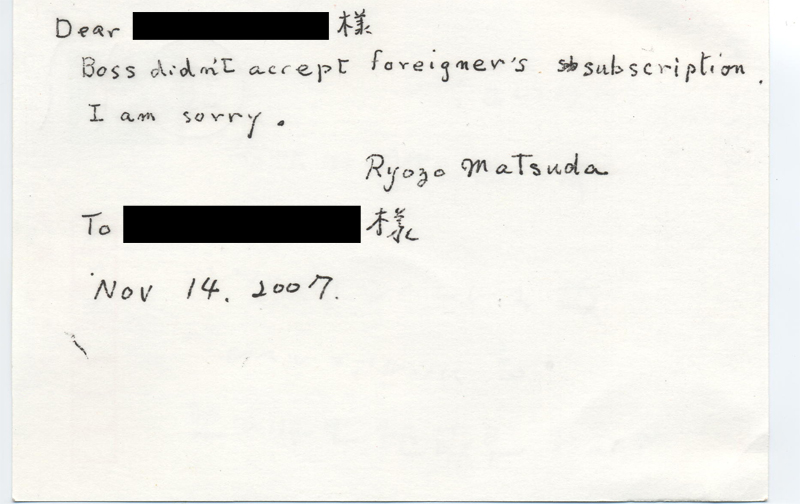
I mentioned in a quick report to y’all last week about how surreal the unfettered exclusionism is getting in Japan, cf. the Hokkoku Shinbun in Ishikawa, where a sales outlet rep sent a postcard last November to a NJ subscriber, saying “Boss didn’t accept foreigner’s subscription”.
https://www.debito.org/?p=867

The update to that, as of January 9, 2007, I talked with a number of people on this case (NHK and Kyodo have also been in touch), including the “boss” mentioned in the post card (a Mr Sakurai) and the actual manager of the Hokkoku Shinbun Hanbai Bu Kanazawa Tantou Mr Kotake (076-260-3564, email kotake@hokkoku.co.jp) twice, for about thirty minutes each. Here are their claims:

MR SAKURAI:
=============================================
1) There was no discrimination. He was unaware that their underling, a Mr Matsuda, had written anything like that in the postcard. It is Matsuda’s fault.
2) There was a problem with the contract, so we cancelled it. Yes, unilaterally.
3) Er… that’s it.

=============================================

When asked why they didn’t, like, come back with a new contract, or answer with a postcard or a personal visit something a little nicer than “no foreigners”, he just said he had no knowledge the postcard said such a thing, and was sorry he didn’t come back with a new contract. He didn’t explain convincingly why.

Fu ni ochinakatta ne. Doushitemo nasuri tsuke da to ki ni shite narimasen.

MR KOTAKE:
=============================================
1) This was a separate sales company unrelated to the actual Hokkoku Shinbunsha, so the problem is within the Nonoichi Sanba sales corp. itself.

2) There was no inkan (seal) on the contract, so it wasn’t a legitimate contract yet.

3) There was no intent to discriminate, and everyone (Mr Kotake, Mr Sakurai, Mr Matsuda) will be going to the client’s house and apologizing today if not tomorrow for not explaining this situation to the customer properly. (They did, and offered him two weeks’ free subscription; thanks for nothing.)

4) Er… that’s it.
=============================================

I pointed out that it still seemed unnatural (in this day of withering print journalism) for a sales outlet not to assiduously court paying customers (if this were a Japanese client, I doubt there would be any hesitation to go back with a new contract or ask for an inkan on the old contract). And if it I hadn’t made the phone calls, these apologies would never have happened. That, plus the postcard explicitly giving the reason as “no foreigners”, were enough to make one doubt the claim that there was no discrimination. And this attempt to pin the blame on Mr Matsuda, when it was Mr Sakurai who didn’t tell Mr Oda or anyone else in the company about the contract issue, is pretty strange.

Mr Kotake replied that he hoped that this would not give people a bad impression of Ishikawa Prefecture or of Hokkoku Shinbun. I said that how they handled this situation would determine that. He hoped that some of the information on this blog would be changed to reflect that Hokkoku Shinbun and Nonoichi Sanba were two different entities, and I have since made some alterations to the report above.

He also mentioned that he remembered me from the Otaru Onsens Case (he had read a lot of my website) and hoped that I would have no negative impressions of things. I simply said that this sort of thing is happening all over Japan, and if Japan is ever to get over their “gaijin allergy”, it’s going to take some work by media outlets, such as the Hokkoku Shinbun, to report the good things that NJ residents also do here, not just the allegedly bad. How about devoting an occasional newspaper column to that? He mentioned that few foreigner laborers come here, but lots of exchange students. It’s an idea, anyhoo.

Meanwhile, I thought Kyodo would have a story out by now, but I’ve heard that the editor in the Osaka Kyodo Branch is leaning on my reporter not to do an article!

Amazing. Nobody has been able to reach the scapegoat in this case, Mr Matsuda–he’s apparently been suspended from work.

I’ve also heard from a friend:
=============================================
I had a similar thing happen to me with the Yomiuri Shimbun in Yamagata City several years ago. The salesman told me and my wife that we could sign up under her name but not under mine, as a foreigner would be refused. At the time we just decided not to go with Yomiuri. I also didn’t know about their conservative politics at the time. I had almost forgotten about that.
=============================================

So the story has some potential to go beyond Ishikawa in general if more people come forward with their experiences, and if other print outlets would be willing to show some spine and take up the story. Drop by:
https://www.debito.org/?p=867

/////////////////////////////////////////////////////////////

3) STARING DOWN AN EXCLUSIONARY LANDLORD IN YAMAGATA

Ryan Hagglund found an apartment he really wanted for one of his employees. But, as many readers know, if the landlord has a hair in his heinie about foreigners and flat-out refuses them, there’s not a damn thing you can do about it in Japan. It’s not illegal. However, he managed to turn the tables on the landlord and realtors and convince them to take his money. See how in a remarkable case study at
https://www.debito.org/?p=922

The lessons to be learned:

Sticktoitiveness and accountability are crucial. You must talk to the landlord as politely as possible while being clear that you will not accept a denial based upon being foreign. And you must audio record everything (even covert recordings are admissible in court–I know because I recorded my refusal at Yunohana Onsen in Otaru on October 31, 2000, and that won us the case).
https://www.debito.org/otarulawsuit.html#FACTS

Anyway, well done, Ryan. Even if you have to go through all this trouble just to get somebody to take your rent.

Alright, let’s lighten up:

/////////////////////////////////////////////////////////////

4) GOING TOO FAR IN THE OTHER DIRECTION: CHEST HAIR AND SEXUAL HARASSMENT!?

Now look what happens when “human rights” actually DOES get enforced in Japan. People are clueless.

=============================================
JR East links “naked festival” posters to sexual harassment
Mainichi Shinbun January 8, 2008

http://mdn.mainichi.jp/national/news/20080108p2a00m0na012000c.html

See scan of the poster at
https://www.debito.org/?p=924

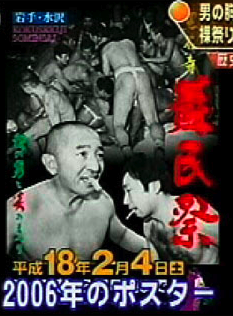
OSHU, Iwate — East Japan Railway Co. (JR East) has rejected calls to stick up posters promoting a local “naked festival,” saying there are many women who aren’t comfortable seeing men naked.

The Oshu Municipal Government had sought permission from the Morioka branch of JR East to display the posters advertising Kokuseki Temple’s Somin Festival at stations, but JR East said the posters could not be displayed unless the images were changed.

“As sexual harassment becomes more of a problem, the standards for displaying posters in public spaces are becoming stricter,” a representative of the Morioka branch of JR East explained. “It wasn’t just that it was out of line because there was nakedness; the pictures showed things that were particularly unpleasant for women, such as chest hair, and it was decided that showing them things they didn’t want to see was sexual harassment.”

In the festival, crowds of men wearing nothing but loincloths participate in scrambles using sacks called sominbukuro. The festival, which has continued for about 1,000 years, is held in the hope of warding off plagues and producing bumper crops. This year, it will be held between the evening of Feb. 13 and early Feb. 14.

The poster in question combines three photos, showing a close-up of a bearded man with a hairy chest, and men in the background wearing loincloths.

The city retouched some of the loincloths, but decided that it would be difficult to completely alter images as JR had requested. It has reportedly decided to decrease the number of posters by about 200 to 1,400, and will display them in the city and in the Tokyo metropolitan area instead.

Oshu Municipal Government official Yuzuru Sasaki said that efforts to liven up the festival would continue in spite of the setback.

“The number of tourists might drop, but we want to display the posters in the city and ask tourist facilities in the metropolitan area to display them to pump up the festival,” he said.
ARTICLE ENDS
=============================================

COMMENT: How silly. I have written in depth on how vague the notion of human rights is in Japan (yes, it tends to be vague everywhere in the world, but what the GOJ considers human rights in its surveys is especially confusing, even discriminatory in itself!).
https://www.debito.org/japantimes102307.html

Under half-baked concepts (where it’s okay to discriminate against NJ but not okay to ignore allegedly oversensitive people who might swoon in shock at stray muna-ge), it’s no wonder some people go over the top and construe something like “chest hair” as “sexual harassment”.

And the issue is chest hair, not nudity in itself. If you look at the previous year’s (approved) poster for the same event:
https://www.debito.org/wp-content/uploads/2008/01/oshuchesthair2.tiff
you still have the same thing (it’s a festival celebrating male near-nakedness, after all)–fundoshi, asses–except no hairy chest in the foreground.

Better not ask even me to bare my semi-hirsute pecs, such as they are. And let’s see if JR East will enforce this on Sumo, and not allow broadcasts of matches on TVs on their premises. Same degree of nakedness (if not even more flesh)–and yes, before you say it–some sumo wrestlers have chest hair. Horrors!

There is a happy end to this, however. Thanks to the scoffing nationwide media coverage given this tempest in a teapot, this festival has gotten more publicity nationwide than ever before, and according to Sunday Japon January 13, 2007, they’re anticipating the highest level of attendance ever!

Mattaku mechakucha! Grow up, people. Chest hair isn’t, say, pubic hair–you might as well be offended by beards. Establish some concept of what real human rights are. That’s supposed to be the job of places like the absolutely useless MOJ Bureau of Human Rights. And even if BOHR bothered to weigh in, they’ll only say, “we have no enforcement authority” and go back to soaking up tax monies for their own festivals.
https://www.debito.org/?p=810

No wonder the public has trouble taking people who promote human rights seriously!

Sumo wrestlers, get your razors out! And there are some rikishi I would pay money to see get a Steve Carell-style body waxing…

/////////////////////////////////////////////////////////////

…and finally, just for fun…

5) HUMOR: LETTER TO THE EDITOR REGARDING GOJ “UFO INVASION” SCENARIO

You might remember that at the end of 2007, the GOJ (only half-seriously, yes, but for far too much time) explored the possibility of an alien invasion. No not foreigners. Background at:
https://www.debito.org/?p=872

Charles Kowalski sent this letter to the Yomiuri when Defense Minister Hashiba (inter alia) was getting all nerdy about defenses. He takes the issue and runs with it. Hilariously.

The Yomiuri, not known for any sense of humor (or for brooking any criticism of Japan from outsiders), wouldn’t publish it. So I did, at Debito.org. Enjoy:

=============================================
To Defense Minister Shigeru Ishiba:

I urge you to reconsider your comment that UFOs “can’t be categorized as coming from a foreign country” (Yomiuri December 21, page 2). Please take a moment to think about the dangerous precedents this policy would set.

If UFOs could enter Japanese airspace without resistance, they could easily spirit away Japanese citizens. Japan has enough abduction issues already! But even worse, what if the extraterrestrial visitors liked our beautiful country so much that they decided to stay – and without the limitations that apply to humans from other countries?

First of all, with no visa restrictions, they could take jobs away from Japanese citizens. In the fields of astrophysics and aeronautics, an interstellar pilot would have a grossly unfair advantage over a Japanese graduate who shuffled through university with a perpetual hangover. Do you want more of our young people to become NEETs?

And if men from Mars, or women from Venus, were to marry Japanese citizens, what would prevent their names from being recorded in the juminhyo? Tama-chan was cute as a one-time joke, but do you really want to see Qrlzak Wzaxo from Jupiter listed on equal terms with Hanako Sato from Morioka? And their children, with one parent from a planet with higher gravity, would always beat their Japanese classmates in athletic competitions! How unsporting!

Our course of action should be clear: Treat extraterrestrials the same as any other aliens. When they arrive at the UFO terminal at Narita, take prints of their claws, tentacles, antennae or whatever they use for fingers. Make them carry Space Alien Registration Cards that the police could inspect at any time. Interplanetarization is all very well, but we Japanese must take measures to prevent these aliens from going where no gaijin has gone before.
ENDS
=============================================
https://www.debito.org/?p=902

All for today. Getting back to work! Arudou Debito in Sapporo
debito@debito.org, https://www.debito.org
Daily blog updates and RSS subscriptions at https://www.debito.org/index.php
DEBITO.ORG NEWSLETTER JANUARY 15, 2008 ENDS

“Human Rights” when enforced in Japan: Chest hair equals “sexual harassment”

mytest

Hi Blog. Here’s what happens when somebody in a position of authority (like a faceless boss at JR East) acts on what he or she katte ni considers “human rights”. Comment below article.

//////////////////////////////////////////////////////////

JR East links ‘naked festival’ posters to sexual harassment
Mainichi Shinbun January 8, 2008

http://mdn.mainichi.jp/national/news/20080108p2a00m0na012000c.html
oshuchesthair1.tiff
One of the rejected posters for the Somin Festival in Oshu, Iwate Prefecture.
(Screen capture courtesy Japan Probe)

OSHU, Iwate — East Japan Railway Co. (JR East) has rejected calls to stick up posters promoting a local “naked festival,” saying there are many women who aren’t comfortable seeing men naked.

The Oshu Municipal Government had sought permission from the Morioka branch of JR East to display the posters advertising Kokuseki Temple’s Somin Festival at stations, but JR East said the posters could not be displayed unless the images were changed.

“As sexual harassment becomes more of a problem, the standards for displaying posters in public spaces are becoming stricter,” a representative of the Morioka branch of JR East explained. “It wasn’t just that it was out of line because there was nakedness; the pictures showed things that were particularly unpleasant for women, such as chest hair, and it was decided that showing them things they didn’t want to see was sexual harassment.”

In the festival, crowds of men wearing nothing but loincloths participate in scrambles using sacks called sominbukuro. The festival, which has continued for about 1,000 years, is held in the hope of warding off plagues and producing bumper crops. This year, it will be held between the evening of Feb. 13 and early Feb. 14.

The poster in question combines three photos, showing a close-up of a bearded man with a hairy chest, and men in the background wearing loincloths.

The city retouched some of the loincloths, but decided that it would be difficult to completely alter images as JR had requested. It has reportedly decided to decrease the number of posters by about 200 to 1,400, and will display them in the city and in the Tokyo metropolitan area instead.

Oshu Municipal Government official Yuzuru Sasaki said that efforts to liven up the festival would continue in spite of the setback.

“The number of tourists might drop, but we want to display the posters in the city and ask tourist facilities in the metropolitan area to display them to pump up the festival,” he said.

Click here for the original Japanese story
//////////////////////////////////////////////////////////

COMMENT: How silly. I have written in depth on how vague the notion of human rights is in Japan (yes, it tends to be vague everywhere in the world, but what the GOJ considers human rights in its surveys is especially confusing, even discriminatory in itself!). Under half-baked concepts (where it’s okay to discriminate against NJ but not okay to ignore allegedly oversensitive people who might swoon in shock at stray muna-ge), it’s no wonder some people go over the top and construe something like “chest hair” as “sexual harassment”.

And the issue is chest hair, not nudity in itself. If you look at the previous year’s (approved) poster for the same event:
oshuchesthair2.tiff
(Screen capture courtesy Japan Probe)
you still have the same thing (it’s a festival celebrating male near-nakedness, after all)–fundoshi, asses–except no hairy chest in the foreground.

Better not ask even me to bare my semi-hirsute pecs, such as they are. And let’s see if JR East will enforce this on Sumo, and not allow broadcasts of matches on TVs on their premises. Same degree of nakedness (if not even more flesh)–and yes, before you say it–some sumo wrestlers have chest hair. Horrors!

There is a happy end to this, however. Thanks to the scoffing media coverage given this tempest in a teapot, this festival has gotten more publicity nationwide than ever before, and according to Sunday Japon January 13, 2007, they’re anticipating the highest level of attendance ever!

Mattaku mechakucha! Grow up, people. Chest hair isn’t, say, pubic hair–you might as well be offended by beards. Establish some concept of what real human rights are. That’s supposed to be the job of places like the absolutely useless MOJ Bureau of Human Rights…, and even if BOHR bothered to weigh in, they’ll only say, “we have no enforcement authority” and go back to soaking up tax monies for their own festivals. No wonder the public has trouble taking people who promote human rights seriously!

Sumo wrestlers, get your razors out! And there are some rikishi I would pay money to see get a Steve Carell-style body waxing… Debito in Sapporo

Ryan Hagglund on how he successfully dealt with an exclusionary landlord

mytest

Hi Blog. Turned 43 years old today… Here’s Ryan Hagglund of Yamagata on how he successfully dealt with a very common problem in Japan–exclusionary landlords.

As you probably know, if a landlord has a “thing” about foreigners and decides not to rent to you, legally there’s not a damn thing you can do about it. Racial discrimination is not illegal in Japan. But Ryan found a place he liked and wasn’t having any of it. And he managed to change the landlord’s (and realtor’s) mind.

How? Sticktoitiveness and accountability. Lessons: 1) be as polite as possible while being clear that you will not accept a denial based on being foreign, and 2) audio record everything just in case you have to go to court.

(Covert recordings are also admissible in court. I did it for the Otaru Onsens Lawsuit, and it removed any possible element of plausible deniability or misunderstanding.)

Good work Ryan. Here are the series of emails he sent to the Life in Japan List. Arudou Debito in Sapporo

///////////////////////////////////////

From: Ryan Hagglund
Subject: [LIFE IN JAPAN] Apartment Refusal
Date: December 4, 2007 10:10:00 PM JST

I have a quick question, if anyone can help. This afternoon the school I manage was told point-blank by the real estate agent we’ve been using that the apartment we had decided on for our new teacher is not available because the landlord doesn’t rent to foreigners, even if the company acts as the official tenant. We would like a chance to talk with the landlord, but the real estate company refuses to divulge any of his information. Is there any way to find out who the owner of an apartment building is? I would imagine there has to be some kind of public record out there. Any help would be appreciated. Thank you very much.

Ryan Hagglund, Yamagata

/////////////////////////////////////////////////////

UPDATE ONE

From: Ryan Hagglund
Subject: [LIFE IN JAPAN] Apartment Refusal
Date: December 5, 2007 8:21:40 PM JST

Thanks to everyone for the comments and thoughts so far. I thought I would write with a quick update and a little more background information.

Anyway, the whole situation started with a new teacher who needs housing accepting a position at our school. My wife, who is Japanese and works for the school, went apartment hunting while I was teaching and found a really great one. The real estate agent kept telling her how wonderful it was and she was right; it is by far the best apartment we have seen in the area for the price and in a good location too. We wanted the new teacher to have a chance to look at it, so my wife called to let the real estate know that her husband, me, and a new employee would be down to look at the apartment as well. Up to this point we had not said that the occupant would be a foreigner. We weren’t purposely trying to hide that fact by any means; we just hadn’t thought to mention it. It’s legally a non-issue anyway. When I arrived with the new teacher and came in saying we wanted to look at the apartment that had been played up for my wife, the agent was hesitant. She said she would show us it, but that “special permission” is required for foreigners to rent. I mentioned that such as policy was illegal and that we would like to see it. Aside from the comment about special permission, she was quite polite and pleasant, though I had to ask for her business card as she was walking back to her car to return to the office, something I thought was unusual. This all happened Saturday, just before the office closed. (All the above conversations happened in Japanese, by the way, though our new teacher doesn’t speak much at all.)

On Monday we called to confirm the apartment, but were told this afternoon that it is not available for rent by foreigners. When my wife asked to please speak with the landlord she was told that wasn’t possible. Following the suggestions on this list, my wife went to the city hall, but was told that they could not divulge private information on the ownership of a building. We decided, then, to return to the real estate agent. We were polite, letting her know we realize she is in a difficult situation, but that denying an apartment to someone simply because they are foreign is illegal, a conclusion with which our school’s attorney agrees. We said that we would like to speak with the landlord and were willing to work with him to find a suitable compromise, such as the school renting the apartment instead of the new teacher, but that we definitely wanted that apartment and feel it is very important for the law to be followed. (We also recorded the conversation so that we have proof that we were in fact denied based on being foreign.) The real estate agent said she would talk with landlord and get back to us, so we’ll se what happens. We’ve also scheduled a consultation with an attorney tomorrow to talk about our options in case the landlord refuses. I hope that won’t be necessary. Trying to be polite, but firm.

Ryan Hagglund, Yamagata

/////////////////////////////////////////////////

UPDATE TWO

From: Ryan Hagglund
Subject: [LIFE IN JAPAN] Re: Apartment Refusal
Date: December 17, 2007 12:07:44 AM JST

I want to thank everyone for their support, comments, and suggestions on the apartment situation we encountered. At least one person asked for updates, so I hope you don’t mind if I oblige.

As you may remember, my wife checked apartments through many realtors for a new employee for our school. We decided on the best one we could find, a nice, newer, spacious 1LDK with 9-foot ceilings; bar separating the kitchen from the dining area; three-panel, glass-inlaid sliding doors separating the kitchen and dining from the main room; outdoor storage connected to the balcony; hikari-fiber internet; and video intercom system for the front door in order to evade the NHK guy :-). All of this for 45,000 yen per month, which is a decent price in this area without all the extras. As the realtor had told my wife, “If I was looking for an apartment, I would live here.” We agreed.

When we told the realtor we wanted the apartment and it became apparent that it was for a foreigner, we were then refused since the apartment owner has apparently had problems with a foreigner in the past. We found the same apartment listed with another agent in the area who told us the same thing. We have one of the refusals recorded. Neither agent was the main listing agent for the apartment, however. We wanted to talk with the owner or main agent about the situation, but we were refused the information.

On the advice of one list member who wrote privately, I went to the houmukyoku to find the registered owner of the apartment, and my wife and I gave him a visit Thursday evening. We were very polite and asked him if we could talk to him about the problems he had previously had with foreigners, but he said he has no policy against renting to foreigners and would have no problems renting to us. He then (supposedly) called the main real estate agent and gave us the news that someone else was already interested in the apartment, though, telling us to check with them about the situation the next morning. We at least got the main listing agent’s name, however.

My wife, being the amazing woman she is, knew the agency and said the light had been on when we passed it on our way to the owner’s house. We hurried into the car and got to the agency just as they were about to close. When we told them why we were there, they said the owner had refused us and there was nothing they could do. They were extremely surprised to learn we had just spoken to the owner, leading us to believe the owner had just been pretending to be on the phone. They then said someone else was interested in the apartment, so we would have to wait for their decision. We made it very clear, however, that we had made our decision a full week-and-a-half prior and considered ourselves ahead of any other possible renters. To make an even longer story a little shorter, they kept giving us the runaround until we had countered all of their “reasons” for our not being able to rent to us and essentially trapped themselves in their own excuses and twisted logic. We recorded the exchanges with both the landlord and real estate office and I would love to post them sometime, as they are absolutely mind-boggling. In the end, though, they ran out of even semi-plausible excuses and we got the apartment.

I have to admit I’m somewhat dissatisfied with the fact that we will be giving these people money. There was definitely a concerted effort going on in the background to get rid of us. At the same time, it was definitely the best apartment available and our new teacher shouldn’t have to settle for second-best simply because she’s foreign. In the end, our polite determination won out. Next time we need an apartment, though, we’ll know to have a Japanese person look first at what’s available and then decide from there. We wouldn’t have been shown the best apartment otherwise, which is a real shame.

Ryan Hagglund
My English School
Higashine, Yamagata

///////////////////////////////////////////////

FINAL UPDATE

From: Ryan Hagglund
Subject: RESEND: Hi Ryan. May I blog your apartment report? Anything to add?
Date: January 11, 2008 10:35:07 PM JST
To: debito@debito.org

…Of course you may blog you like that I’ve reported to the Life in Japan list. I can’t think of anything at the moment to add to what I’ve written. I guess I would just emphasize that I made sure to be as polite as possible while being clear that I would not accept a denial based on being foreign… Thanks! Ryan

ENDS

Mark Mino-Thompson on “updated” Hotel Laws: Refusal OK if “unreasonable/unrational burden”

mytest

Hi Blog. Mark Mino-Thompson reports below on his discovery of new “amendments” to the Ryokan Gyouhou (Hotel Management Law), created in English and Japanese legalese and in generic format (meaning written by somebody else) for use in hotels nationwide. They are vague enough to make it seem as though a hotel could refuse a NJ lodging if the lodger poses an “unreasonable/unrational burden” (such as speaking a foreign language or offering beds instead of futons?). Copies of the laws linked below. Debito in Sapporo

============================
From: Mark Mino-Thompson
Subject: [Community] Hotels asking for passports from residents in Japan
Date: January 8, 2008 11:22:07 AM JST
To: The Community Yahoogroup

My family and I went to an Onsen hotel over the holidays. While the reservation was in my name (My wife’s family name + my first name in katakana), my sister-in-law handled the front desk registration, as we were busy with our kids. They didn’t request to see my passport or other ID, although as I wasn’t checking in directly, I can’t say what would have happened if I had been. I did notice that they did have the standard multilingual “May we see your passport?” sign Debito has posted before, featured on the front desk.

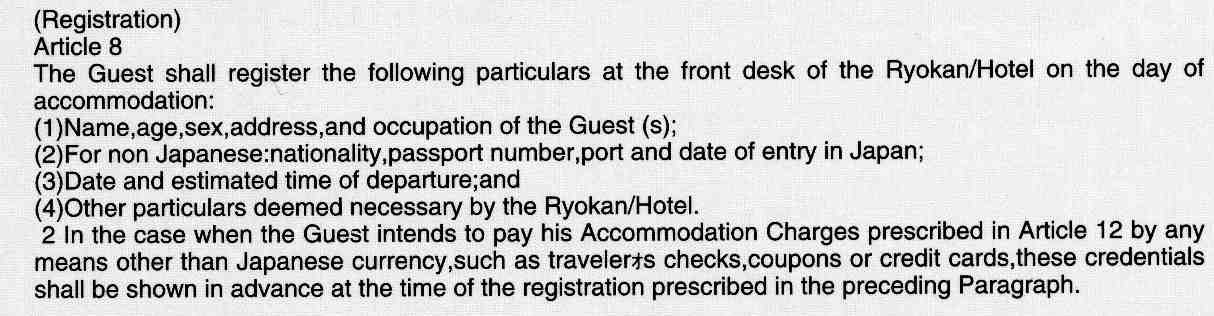
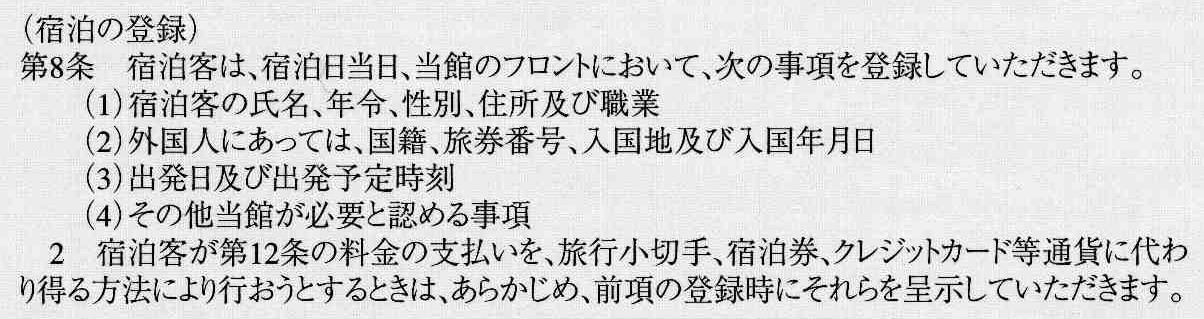
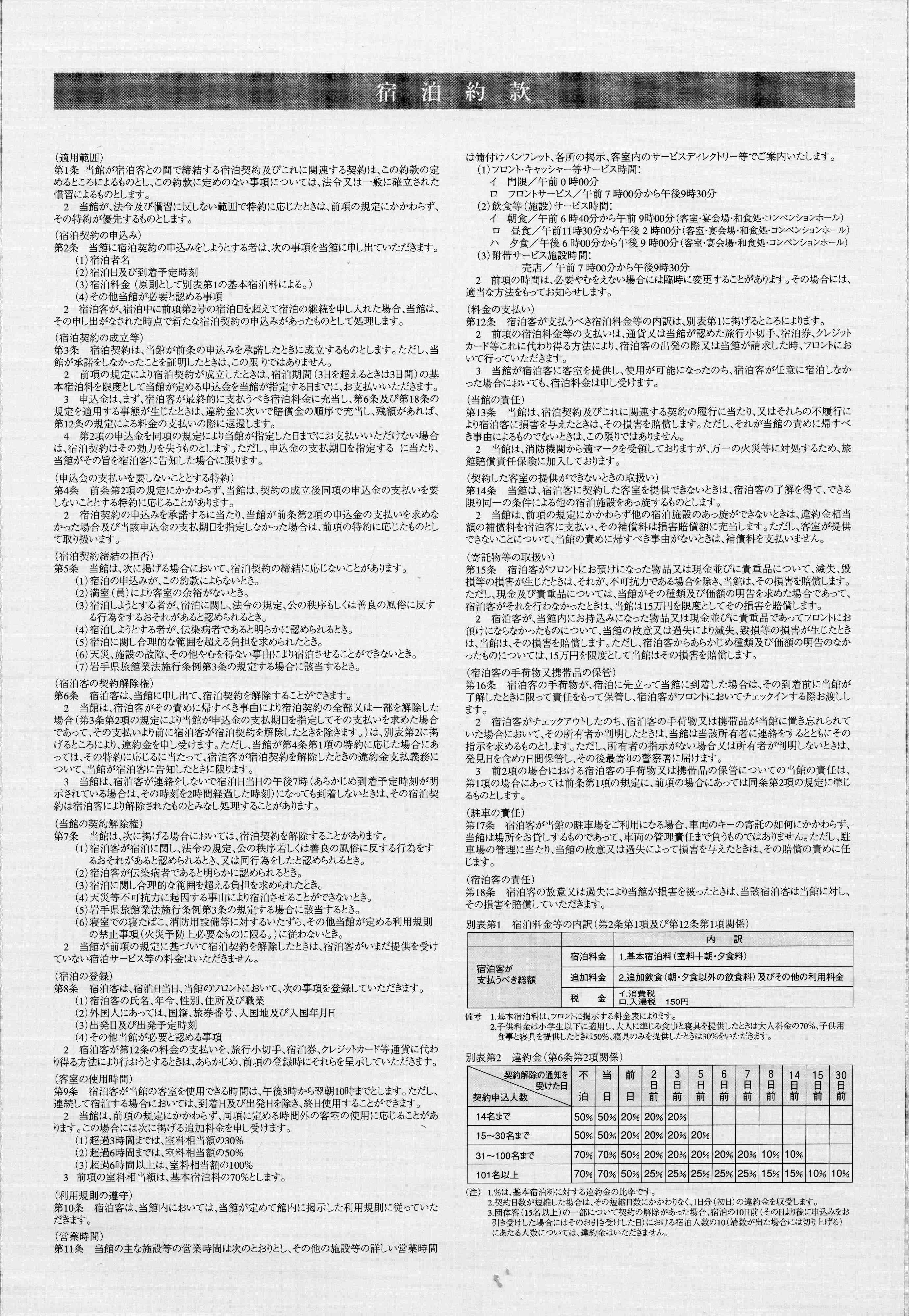
Later that day, while reading through the hotel information, I came across the Terms and Conditions for accommodation, printed in Japanese and English. Firstly, I noticed that much like others I’ve seen in various hotels over the past two years erroneously states in Article 8 that:

“The guest shall register the following particulars at the front desk of the Ryokan/Hotel on the day of accommodation: (1) Name, age, sex, address, and occupation of the guest(s) (2) For non Japanese: nationality, passport number, port and date of entry in Japan
newarticle8_eng.jpg
newarticle8_jp.jpg

This is nothing new. There have been many accounts from others about this error in Japanese hotel documentation. However, the Japanese version also seems to be the same wording as in English.

I’ve attached a scan of the original documents in the files section of the Community yahoogroups site. (Too big to put here as image or thumbnail–see them at Debito.org here:)

English: https://www.debito.org/newhotellaws2008eng.jpg

Japanese:
https://www.debito.org/newhotellaws2008j.jpg

Furthermore, as Debito has mentioned and documented before, the Hotel law article 5 states that accomodation can only be refused by the hotel in the case of:

1) a health issue involving contagious disease, 2) a clear and present endangerment of public morals, or 3) because all rooms are full.

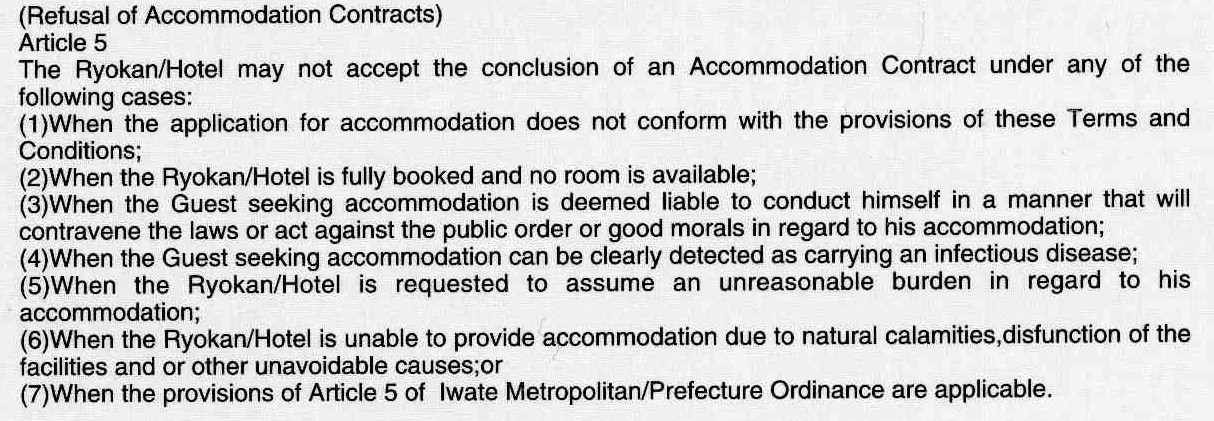
However, this hotel terms and conditions Article 5 has additional (new?), disturbing provisions:

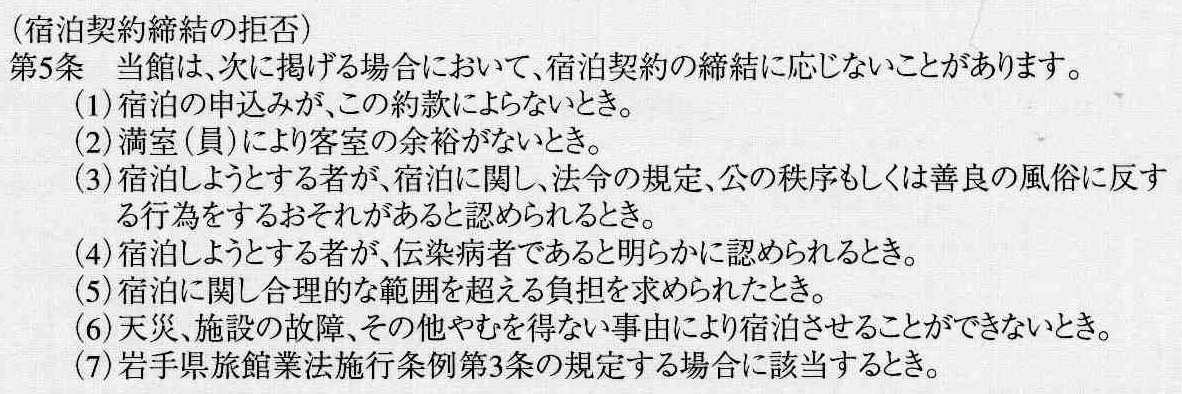
Article 5 (Refusal of Accommodation Contracts)

The Ryokan/Hotel may not accept the conclusion of an Accommodation Contract under any of the following cases:

(1) When the application for accommodation does not conform with these Terms and Conditions

(2) When the Ryokan/Hotel is fully booked and no room is available

(3) When the Guest seeking accommodation is deemed liable to conduct himself in a manner that will contravene the laws or act against the public order or good morals

(4) When the guest is clearly detected as carrying an infectious disease

(5) When the Ryokan/Hotel is requested to assume an unreasonable burden in regard to his accommodation [shukuhaku ni kanshi gouriteki na han’i o koeru futan o motomerareta toki–literally, “at times when the burden demanded in terms of staying has superseded the bounds of rationality/reasonability”–there we go with that easily-abusable “gouriteki sabetsu” “rational discrimination” concept again…]

(6) When the Ryokan/Hotel is unable to provide accommodation due to natural calamities, disfunction of the facilities and or other unavoidable causes, or

(7) When the provisions of Article 5 of Iwate Metropolitan/Prefecture Ordinance are applicable.

newarticle5_eng.jpg
newarticle5_jp.jpg
As you can see, clause number 1 seems to me to have a rather broad range of powers to refuse accommodation. Fail to give up your passport/ID to the front desk and we can deny you a room because you’re not conforming to Article 7 of our Accommodation Contract.

Clause number 5 also is troubling to me. What constitutes an “unreasonable burden” and who decides? Does having Japanese customers complaining about foreign bathers and demanding refunds allow the hotel to refuse non-Japanese out of fear of losing customers? Does not having English-speaking (or other language) staff cause “unreasonable burden” to rural hotels and allow them to turn away people as well?

Clause 7 I haven’t researched as of yet, but it seems that ordinances created at the prefectural level may have the power to refuse others as well.

In addition, these Terms and Conditions, similar to the multilingual front desk signs made by the Ministry of Health, Labour, and Welfare (that Debito has mentioned) seem to be quite professionally made. They are professionally printed on glossy paper, refer to “the Ryokan/Hotel” instead of the actual hotel name and the fact that the English legalese is high and above the ability of most English-speaking hotel clerks would suggest that they were made at either the prefectural (or more likely national) level for all hotels to use.

Any thoughts or comments on my interpretation of this document? Any suggestions or a course of action to get these documents corrected to accurately reflect the new passport ordinance for non-resident visitors and the hotel law itself?

Regards, Mark Mino-Thompson
ENDS

Permanent Resident protests US Embassy’s inaction towards protecting human rights of own citizens

mytest

Morning Blog. Got this letter last night from a friend who’s gotten disgusted with the US Embassy’s inaction towards protecting the human rights of its citizens. Myself, I think the USG has long forgotten it’s primary duty to its taxpayers/citizens, and sees its main duty as selling weapons and maintaining military bases and regional interests. Even though it has plenty of wherewithal (especially vis-a-vis Japan) to take on issues that affect the NJ residents here under their purview. The Canadian Govt. does, what with the Murray Wood Case, for one example. They even commented personally during the Otaru Onsens Case. (The USG did comment on its Country Reports on Human Rights, which I appreciate very much, but it was essentially too little, too late) Here’s the letter. Debito in Sapporo

/////////////////////////////////////////////////

[Kyushu Permanent Resident, reproduced with permission and anonymized by Debito.org] January 10, 2008

Dear U.S. Embassy,

I just finished reading your January newsletter. In it, like the previous two, you mentioned the new Japanese immigration control law without comment.

What I have not read in recent newsletters – what I and probably many other permanent-resident Americans in Japan are wondering – is what you have done to protest the new law. Regrettably, I have not heard a peep from the embassy regarding this discriminatory law. In case you don’t know, many permanent-resident Americans are upset about it.

I know you diplomats are exempt from the humiliating experience of having to be fingerprinted and photographed. But, what about those of us who have lived her many years (34 in my case), have been good, tax-paying, contributing residents? I am not talking about time or inconvenience. I am talking about being separated from Japanese spouse and kids upon return from abroad, singled out as a potential criminal or terrorist. This, in spite of having already been thoroughly investigated, fingerprinted, etc. to obtain permanent-resident status.

The U.S.A. does not require Japanese who are permanent residents in the U.S. to be fingerprinted when they return to the country. This is grounds enough for a protest to the Japanese government. It is often “gaiatsu” that gets things changed here.

More than just consular services and benign announcements, we Americans expect you to stand up for our rights here. Did the Japanese government ask the Embassy for comment on a law that affects thousands of Americans here, and if so what did you do/say?

Fifteen years ago, Ambassador Walter Mondale fought for the rights of over 100 U.S. citizen teachers at Japanese national universities (I was one.) who were slated to be released because they were in the high pay brackets and close to getting retirement benefits. He met personally with a representative group of affected teachers at the Embassy, and he took the matter to the highest levels of Japanese government and did not give up until they relented and reversed the policy. One point he made was that such an indignity would not happen to the many Japanese academics employed at American universities.

I hope you can so something about this fingerprinting issue; at the very least inform the Japanese government that most Americans resent this new requirement. If you are not sure about the depth of feeling on this issue, you could invite U.S. citizens to write in with feedback/comments on the law.

If your answer is simply that the law is a matter of Japanese internal policy, then you are not serving us well at all.

Thank you,

[Name Withheld]

U.S. Citizen

ENDS

Jeff on Japanese police documenting neighborhood residents

mytest

Hi Blog. Jeff sends this post (blogging with adaptation and permission) on how tracking NJ in Japan doesn’t end at the border with fingerprinting and photographing, or at the local government office with registering, or on the street with Gaijin Cards (with criminal charges for NJ only for not carrying ID 24-7).

According to Jeff, it’s also happening at the home, with the cops making house calls, asking for data to store at the local police station. I’ll let the Comments section hold court on how widespread this is (is there a national campaign going on?). But this has never happened to me in all my twenty plus years here, both as a NJ and a Japanese living in Sapporo and Niigata. Has it happened to other readers?

If it happened to me, I would just take the form politely and later throw it away. I doubt I am under any legal obligation to provide data like this to the local police station (you aren’t, after all, obligated to answer the National Census (kokusei chousa) in part or at all). Nor is anyone else, regardless of nationality. Comments? Debito in Sapporo

===============================

Japanese police documenting neighborhood residents

Hi Debito, this is the first time I have mailed or commented. I have been in the same apt in tokyo for about 6 years and in the past the police have come around once in a while to write down names and do their “rounds”, to keep the neighborhood safe, as they describe their activities. I was fine with that.

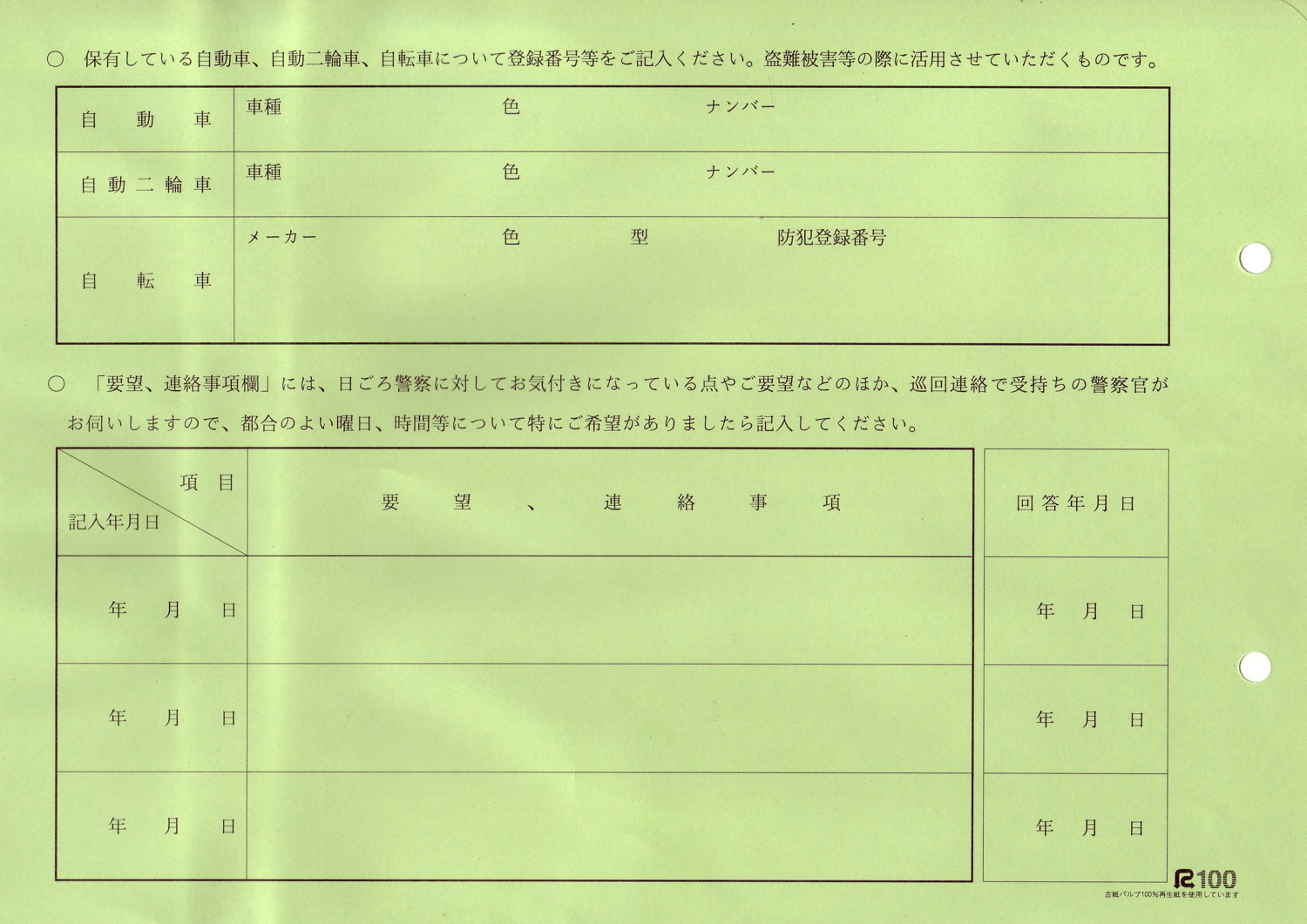
Last month and again last week, one officer came around with a green form (see below) and asked my wife and I to fill it out. The first time I threw it away. The form asks for name, birthdate, occupation, honseki, date began living at residence, address, contacts for an emergency including name, add, and tel number; as well as a description of any vehicles owned including bicycles. The top of the form, and I will paraphrase in English from Japanese, the form is intended for use to contact people in case of emergencies and the information will not be shown to anyone else.

The way the form is printed suggests that it was printed by the NPA for use all over the country, not just in Tokyo. I have no doubt that this is their primary intent, but I am reluctant for a number of reasons to supply this info and this much info not relevant to emergencies. We called the local police and they reiterated everything the officer said and what is written on the form. My first thought was that if they were going keep this form at my local koban, its not a bad idea, because it would make it easier for the police to do their job locally in case of a major emergency.

But after confirming that the information cards will be stored at the actual police station, I questioned whether there was any relevant argument for actually collecting this info. All of the info, except for the emergency contact person’s details is stored at the ku-yakusho (apart from vehicle info), along with all of the other info they have on me, being a foreign national. So, why don’t they just call the ku-yakusho and get the info from there, there is probably a law against that.

In addition, juki-net got shot down and I believe this is an attempt for the police to create there own juki-net by getting people to volunteer their information in the name of safety. It would not be all that difficult for the police to collect info locally and then put all of the info into a single database. This is starting to go long so I will leave it here.

Have you heard of this before? If you have, what are other people’s reactions? Any thoughts? Is this another step in the slowly degrading state of our civil rights here in Japan, after the reinstatement of fingerprinting what is next; national ID cards with pics and fingerprints for all residents regardless of nationality or maybe just a chip in our necks? I am not paranoid or anything, I just don’t like dealing with the police.

As the saying goes, when you need the police, they are never there; and when you don’t, you get a parking ticket. I just made that up. Sincerely, Jeff. ENDS

(click on image to expand in browser)
FRONT
policecardfront.jpg
BACK
policebackcard21.jpg
ENDS

Economist Leader makes the case why immigration is a good thing

mytest

Hi Blog. No mention of Japan in this week’s Economist Leader (and no wonder), but I put it on Debito.org with links to a fuller article because it makes many arguments that ought to be heard. Why should Japan accept NJ and encourage immigration? Because it stands to benefit. Here are some arguments from the experts, tracing many of the social trends, backlashes, and lessons that apply just as well to Japan. Underlined for your convenience. Arudou Debito in Sapporo

//////////////////////////////////////////////

Global migration
Keep the borders open
Jan 3rd 2008 From The Economist print edition
http://www.economist.com/opinion/displaystory.cfm?story_id=10430282

The backlash against immigrants in the rich world is a threat to prosperity everywhere

ITALIANS blame gypsies from Romania for a spate of crime. British politicians of all stripes promise to curb the rapid immigration of recent years. Voters in France, Switzerland and Denmark last year rewarded politicians who promised to keep out strangers. In America, too, huddled masses are less welcome as many presidential candidates promise to fence off Mexico. And around the rich world, immigration has been rising to the top of voters’ lists of concerns—which, for those who believe that migration greatly benefits both recipient and donor countries, is a worry in itself.

As our special report this week argues, immigration takes many forms. The influx of Poles to Britain, of Mexicans to America, of Zimbabweans to South Africa and of Bangladeshis to the Persian Gulf has different causes and consequences in each case. But most often migration is about young, motivated, dynamic people seeking to better themselves by hard work.

History has shown that immigration encourages prosperity. Tens of millions of Europeans who made it to the New World in the 19th and 20th centuries improved their lot, just as the near 40m foreign-born are doing in America today. Many migrants return home with new skills, savings, technology and bright ideas. Remittances to poor countries in 2006 were worth at least $260 billion—more, in many countries, than aid and foreign investment combined. Letting in migrants does vastly more good for the world’s poor than stuffing any number of notes into Oxfam tins.

The movement of people also helps the rich world. Prosperous countries with greying workforces rely ever more on young foreigners. Indeed, advanced economies compete vigorously for outsiders’ skills. Around a third of the Americans who won Nobel prizes in physics in the past seven years were born abroad. About 40% of science and engineering PhDs working in America are immigrants. Around a third of Silicon Valley companies were started by Indians and Chinese. The low-skilled are needed too, especially in farming, services and care for children and the elderly. It is no coincidence that countries that welcome immigrants—such as Sweden, Ireland, America and Britain—have better economic records than those that shun them.

Face the fears

Given all these gains, why the backlash? Partly because politicians prefer to pander to xenophobic fears than to explain immigration’s benefits. But not all fear of foreigners is irrational. Voters have genuine concerns. Large numbers of incomers may be unsettling; economic gloom makes natives fear for their jobs; sharp disparities of income across borders threaten rich countries with floods of foreigners; outsiders who look and sound notably different from their hosts may find it hard to integrate. To keep borders open, such fears have to be acknowledged and dealt with, not swept under the carpet.

Immigration can, for instance, hurt the least skilled by depressing their wages. But these workers are at greater risk from new technology and foreign goods. The answer is not to impoverish the whole economy by keeping out immigrants but to equip this group with the skills it anyway needs.

Americans object to the presence of around 12m illegal migrant workers in a country with high rates of legal migration. But given the American economy’s reliance on them, it is not just futile but also foolish to build taller fences to keep them out. Better for Congress to resume its efforts to bring such workers out of the shadows, by opening more routes for legal, perhaps temporary, migration, and an amnesty for long-standing, law-abiding workers already in the country. Politicians in rich countries should also be honest about, and quicker to raise spending to deal with, the strains that immigrants place on public services.

It is not all about money, however. As the London Tube bombers and Paris’s burning banlieues have shown, the social integration of new arrivals is also crucial. The advent of Islamist terrorism has sharpened old fears that incoming foreigners may fail to adopt the basic values of the host country. Tackling this threat will never be simple. But nor would blocking migration do much to stop the dedicated terrorist. Better to seek ways to isolate the extremist fringe, by making a greater effort to inculcate common values of citizenship where these are lacking, and through a flexible labour market to provide the disaffected with rewarding jobs.

Above all, perspective is needed. The vast population movements of the past four decades have not brought the social strife the scaremongers predicted. On the contrary, they have offered a better life for millions of migrants and enriched the receiving countries both culturally and materially. But to preserve these great benefits in the future, politicians need the courage not only to speak up against the populist tide in favour of the gains immigration can bring, but also to deal honestly with the problems it can sometimes cause.
ENDS

===============================
MORE ON THIS SUBJECT AT THE ECONOMIST AT
MIGRATION: Open up
Jan 3rd 2008 From The Economist print edition
Despite a growing backlash, the boom in migration has been mostly good for both sending and recipient countries, says Adam Roberts
http://www.economist.com/specialreports/displayStory.cfm?story_id=10286197
ends

石川県の北國新聞のセールズ:「外国人購読拒否」

mytest

皆様こんばんは。有道 出人です。あけましておめでとうございます。今年もよろしく!

では、今回の件は外国人が温泉入浴拒否ではなく、アパート入居拒否ではなく、店舗・ディスコ・飲み屋・レストラン・、眼鏡屋・ホテルなどの入場拒否ではなく、
https://www.debito.org/roguesgallery.html
今回は外国人新聞購読拒否の件です。

 証拠は
slip-front-1.jpgpostcard-back.jpgslip-back.jpgpostcard-front-1.jpg

載っているのは、11月付の北國新聞の契約書、そして翌日届いた外国人の購読を受付しないを言うセールスマンからのハガキ。
(Boss didn’t accept foreigner’s subscription. I am sorry. Ryozo Matsuda)
(上司は外国人の購読を受付かねます。すみません。松田了三より)

 拒否した外国人(以下「顧客」)によると、北國新聞を代表するセールズ(下請けの販売所)の松田氏は昨年11月13日に売り込みに顧客の自宅に訪れました。顧客は「日本語の練習になる」と思い、3ヶ月契約に結びました。月初めに前払いの形で、会社に取って全く未納の心配がないものの、翌日14日に「上司が拒否」というハガキが届いて契約が守られなかったです。

 驚愕ですね。いままで上記のサイトに載っている「ガイジンダメ」という正当化は「文化の違い」「ガイジンは怖い」「ガイジンは嫌い」「払わないかも」「暴れるかも」「衛生問題がある」などと言ってあるが、今回の相当な理由はどうなると思いました。「ガイジンは日本語が読めないから」ですか。

 年明け後調べ始めました。1月7日、北國新聞のセールズ「野々市三馬」(076-243-1810)に電話してみて、松田氏は留守で、翌日8日に午前11時23分に代表の織田氏から電話いただきました。織田氏はこの件について一切聞いていないと言い、私は契約書と拒否ハガキを電子メールで送りました。織田さんはその言及した松田氏の上司「桜井」氏と確認して、「過去色々なことがあったから、差別ではない、差別の意図はない」と弁解しました。理屈は分かりにくかったから、直接桜井氏と話したいと言いました。桜井氏は午後4時47分に電話下さいました。

 桜井氏の言い分は、松田さんはきちんと契約をしなかったから契約をキャンセルをしました。外国人だからではなく、契約にとって色々な問題が発生したからと。私は「それなら、違う人を顧客の自宅まで送って再契約すればどうでしょうか?なぜ2ヶ月経過してから何も動きはなかったですか。わざわざ顧客の自宅まで訪れて、契約して、そして解約するのですか。ハガキは『外国人だから拒否』は明確にあるのに、間違いなくそうなんじゃないでしょうか。私はここでクレームをしなかったら、そのまま解約と顧客精神苦痛はあるのでは?」と問いました。が、桜井氏は「松田はそういうハガキを書いたのかは知らなかった。」

 私は「でも、間違いなく一方的に契約をキャンセルしたに違いませんか。日本の印刷のマスコミが苦しんでいる中、改めて支払う意図のある顧客をこうやってフォローアップしないことは信じ難いのです。」

 桜井氏は「差別ではなく、松田が悪い」と主張しました。私は未だに腑に落ちませんね。

 それに、私は北國新聞本社(〒920-8588 石川県金沢市香林坊2丁目5番1号 TEL.076-263-2111 内線1)に連絡して、「これは御社の契約の問題なので、御社を代表するセールズは『外国人拒否』とはっきり書いたので、どうやら責任を取りませんか」と言っても、受付は「その販売所と話し合って下さい」と言い、私からその契約と拒否ハガキのファックスを拒否しました。その後(午後5時3分)、販売部金沢担当の小竹氏(076-260-3654)から連絡があり、明日現状を調べてからご連絡をいただくようです。

とりあえず、お気がすすめば、どうぞ、北國新聞とそのセールズまでご連絡下さい。
dokusha@hokkoku.co.jp
koho@hokkoku.co.jp
nanbuhanbai@hokkoku.co.jp
kotake@hokkoku.co.jp
http://www.hokkoku.co.jp/

宜しくお願い致します。有道 出人
以上

“Japanese Only” Newspaper Outlet: Hokkoku Shinbun in Ishikawa Pref (UPDATED)

mytest

Hi Blog. Things are getting surreal these days in Japan. Now even newspaper outlets are getting xenophobic.

Let’s trace the logical development of all this. In the Otaru Onsens Case, the management said they would refuse foreigners because of, inter alia, different bathing customs and sanitation issues.

In various other cases catalogued at the Rogues’ Gallery of Exclusionary Establishments, foreigners would be refused (these are actual reasons given from people in charge) at bars and restaurants ‘cos they might not pay, stores ‘cos they might shoplift, at a disco ‘cos they might drink too much or hit on Japanese women, at an Internet cafe cos they might breach security, at hotels ‘cos the management doesn’t speak any foreign languages, at a women’s relaxation boutique ‘cos their feet are too big, at an opticians ‘cos the owner doesn’t like Black people, and by realtors because, well, just because–the landlord has a “thing” about foreigners, and legally in Japan there’s not a damn thing you can do about it.

But here’s a case that just boggles the mind. Of a newspaper sales outlet refusing a foreigner his subscription. What, is the newspaper seller (in this day of withering print journalism) worried the gaijin might be able to read what they write?

Turning the keyboard over to the person was canvassed, subscribed, then got refused. Anonymized. Courtesy of The Community mailing list. With updates and sleuthing to get to the bottom of this afterwards. Arudou Debito in Sapporo

=======================
November 27, 2007

Hi everyone, I thought this might be of interest to people in The Community.

About 2 weeks or so ago, a newspaper salesman came to my door. As soon as I opened the door, he gave a robust greeting in English that he works for Hokkoku Shinbun 北國新聞 (a local Ishikawa-ken paper) and asked if I understood Japanese. My Japanese isn’t great, but I like trying to read things. He then asked if I would like to subscribe for 3 months and I said sure. We filled out the form and he said that my paper would start to be delivered in December. He was extremely polite and happy that I wanted to subscribe and I was quite happy to have a chance to gather an abundance of reading materials.

Here’s the receipt (front and back, click on images to expand in browser):
slip-front-1.jpgslip-back.jpg

However, about a week later, I got a postcard saying this: “Boss didn’t accept foreigner’s subscription. I am sorry.”
postcard-back.jpg
postcard-front-1.jpg

Naturally, this confused me. It’s for a three month subscription, of which I would pay each month for that month’s newspaper.

In our discussions, the salesman and I talked about where I work and it turns out that he took English classes at the same college way back when. So, he knew that I wouldn’t just up and run or that I wouldn’t be a deadbeat in paying.

Contact information on the newspaper:
北國新聞
販売所名: 野々市三馬(石川県)
代表者名:松田了三(まつだ・りょうぞ)
電話: 076−247-2120 (changed to 076-243-1810)
〒920-8588 石川県金沢市香林坊2丁目5番1号 TEL.076-263-2111
dokusha@hokkoku.co.jp
koho@hokkoku.co.jp
nanbuhanbai@hokkoku.co.jp
http://www.hokkoku.co.jp/
ENDS

////////////////////////////////////////////////

UPDATE JANUARY 8, 2008 FROM ARUDOU DEBITO

I made some calls around to get to the bottom of this. Here’s what I unearthed:

1) Mr Matsuda, who made the house call to get our client above signed up, is employed of those special selling agencies (seiruzu, from “sales”) hired by the parent newspaper company. It is only tangentally-related (shita-uke) to the hanbaibu within Hokkoku Shinbun itself.

2) Mr Matsuda did not return my call. A Mr Oda at 076-247-7834 did. He said he hadn’t heard anything about this event–he hadn’t even received the actual contract forms I’ve blogged above. Hence he was not the “boss” referred to within the postcard.

3) That boss is a Mr Sakurai, and when asked by Mr Oda why he refused the client, there were some incomprehensible excuses about something or other having to do with some prior experience with something or other. (I don’t think Mr Oda even understood the excuse as he was trying to relate it to me.) What, nonpayment? Stop the subscription, like you would do for any Japanese deadbeat. But the client would be paying in advance anyway, so that’s not even a problem. Mr Oda tried to claim that this wasn’t a case of discrimination, but, I asked, what else could it be?

4) So unless I had made these phone calls, this refusal would have stopped at Mr Sakurai and nobody within Hokkoku Shinbun would have been the wiser. Who’s going to be taking responsibility for this?

Frankly, I felt there was something very fishy about all this (I have received warnings not to purchase newspaper subscriptions from these seiruzu outlets–the ones that offer long-term subscriptions with big presents–because they are often run by organized-crime syndicates. This is according to Hokkaido Shinbun.) So I called the Hokkoku Shinbun head office above and asked if they knew of Mr Oda at this company at this phone number. They did, he’s legit. And when I asked if they would look into it all, they said I should take it up with Mr Oda’s company first. Huh?

What a strange situation. Newsprint hurting for subscribers these days and they’re refusing foreigners, based upon the stealthy prejudices of one person sitting at a veto gate? Hurting the reputation of the newspaper? And the head office doesn’t want to do anything about it? What bad business practices.

I’ve already sent out the above notices to my Japanese press lists, as well as to the dokusha and koho Hokkoku Shinbun email addresses above. The media should find this interesting as it’s one of their own. Should draw up a report in Japanese tonight.

More updates as they come in. Debito in Sapporo

//////////////////////////////////////////////

UPDATE JANUARY 9, 2007

I have talked with a number of people on this case (NHK and Kyodo have also been in touch), including Mr Sakurai and the actual manager of the Hokkoku Shinbun Hanbai Bu Kanazawa Tantou Mr Kotake (076-260-3564, email kotake@hokkoku.co.jp) twice, for about thirty minutes each. Here’s what else has surfaced:

MR SAKURAI (Last night before dinner):

1) There was no discrimination. He was unaware that Mr Matsuda had written anything like that in the postcard. It’s Mr Matsuda’s fault.

2) There was a problem with the contract, so we cancelled it. Yes, unilaterally.

3) Er… that’s it.

When asked why they didn’t, like, come back with a new contract, or answer with a postcard or a personal visit something a little nicer than “no foreigners”, he just said he had no knowledge the postcard said such a thing, and was sorry he didn’t come back with a new contract.

Fu ni ochinai ne.

MR KOTAKE (this morning, after checking with the Nonoichi Sanba company and Mr Sakurai):

1) This was a separate sales company unrelated to the actual Hokkoku Shinbunsha, so the problem is within the Nonoichi Sanba sales corp. itself. (As H.O. advised me below in the Comments section.)

2) There was no inkan (seal) on the contract, so it wasn’t a legitimate contract yet.

3) There was no intent to discriminate, and everyone (Mr Kotake, Mr Sakurai, Mr Matsuda) will be going to the client’s house and apologizing today if not tomorrow for not explaining this situation to the customer properly.

I pointed out that it still seemed unnatural (in this day of withering print journalism) for a sales outlet not to assiduously court paying customers (if this were a Japanese client, I doubt there would be any hesitation to go back with a new contract or ask for an inkan on the old contract). And if it I hadn’t made the phone calls, these apologies would never have happened. That, plus the postcard explicitly giving the reason as “no foreigners”, were enough to make one doubt the claim that there was no discrimination. And this attempt to pin the blame on Mr Matsuda, when it was Mr Sakurai who didn’t tell Mr Oda or anyone else in the company about the contract issue, is pretty strange.

Mr Kotake replied that he hoped that this would not give people a bad impression of Ishikawa Prefecture or of Hokkoku Shinbun. I said that how they handled this situation would determine that. He hoped that some of the information on this blog would be changed to reflect that Hokkoku Shinbun and Nonoichi Sanba were two different entities, and I have since made some alterations to the report above.

He also mentioned that he remembered me from the Otaru Onsens Case (he read a lot of my website last night) and hoped that I would have no negative impressions of things. I simply said that this sort of thing is happening all over Japan (see Comments section below for a claim that a Yomiuri subscription service did the same thing to somebody else), in all sectors of Japan, and if Japan is ever to get over their “gaijin allergy”, it’s going to take some work by media outlets, such as the Hokkoku Shinbun, to report the good things that NJ residents also do here, not just the allegedly bad. How about devoting an occasional column to that? He mentioned that few foreigner laborers come here, but lots of exchange students. It’s an idea.

That was it. Lots of loose ends here. Let’s wait and see how they play out in the other media. I spent another half hour on the phone this afternoon with a Kyodo reporter on this. Keep an eye on NHK and Kyodo News. Arudou Debito in Sapporo
ENDS

Yomiuri: DPJ pushing bill for NJ voting rights in local elections

mytest

Hi Blog. Here’s some very good news. Somebody at least is recognizing the reality that you can’t keep people who live here permanently for generations permanently disenfranchised from the democratic process. One more reason to support the DPJ (or the New Komeito, depending on your politics–hopefully enticing it out of its Faustian deal with the devil just to share power with the LDP).

Wouldn’t it be interesting if in the end what made the LDP finally fall from power was issues of immigration and assimilation? Arudou Debito in Sapporo

====================================

DPJ lawmakers to push foreigner suffrage bill
The Yomiuri Shimbun, Jan. 7, 2008
http://www.yomiuri.co.jp/dy/national/20080107TDY03102.htm
Courtesy of Chris Gunson

Lawmakers in the Democratic Party of Japan are stepping up efforts to resubmit a bill that would grant permanent foreign residents the right to vote in local elections, according to sources.

With New Komeito also strongly demanding local suffrage for permanent foreign residents, DPJ lawmakers hope in the upcoming Diet session “to split the ruling camp by submitting the bill to the House of Councillors and call on New Komeito to endorse it,” according to one of the sources.

But some conservative lawmakers in the party are determined to block the resubmission.

“Looking at this constitutionally and from the state of the nation, there’s no way we can approve this,” one party conservative said.

The DPJ previously submitted the bill to the House of Representatives on two occasions–in 1998 and 2002–but it was scrapped after failing to pass both times.

New Komeito also submitted to the lower house in 2005 a bill for granting permanent foreign residents voting rights in local elections, and discussions have spilled over into the current Diet session.

The passing of any bill of this nature has been stopped in its tracks mostly due to deep-rooted resistance mainly in the Liberal Democratic Party.

Yoshihiro Kawakami, a DPJ upper house member, plans to call on supporters in the party and establish a league of Diet members aimed at resubmitting the DPJ’s bill.

In the new bill, a “principle of reciprocity” will be introduced, in which local voting rights would only be granted to permanent residents who hold the nationality of a country that allows foreigners to vote in elections.

“New Komeito’s proposed bill has for sometime contained the principle of reciprocity, and so New Komeito won’t be able to oppose the DPJ’s bill,” Kawakami said.

Kawakami and his supporters hope to gain approval from the party leadership and submit the bill for prior consideration by the upper house. (Jan. 7, 2008)
ENDS

読売:外国人の地方参政権法案、民主内で再提出の動き

mytest

外国人の地方参政権法案、民主内で再提出の動き
 永住外国人に地方参政権を付与する法案を巡り、民主党内で次期通常国会に再提出を目指す動きが活発化してきた。
2008年1月5日21時23分 読売新聞
http://www.yomiuri.co.jp/politics/news/20080105ia22.htm

 地方参政権付与は公明党が強く求めており、「参院に民主党が法案を提出し、公明党に賛成を呼びかければ、与党の分断を図ることができる」との狙いからだ。ただ、党内の保守派議員は「憲法上も、国のあり方という観点からも、絶対に認められない」として阻止する構えだ。

 民主党は、同法案を1998年と2000年の2度にわたって衆院に提出したが、いずれも成立せず、廃案となった。一方、公明党は05年に衆院に「永住外国人地方選挙権付与法案」を提出、今国会でも継続審議になっている。自民党を中心に慎重論が根強いことが背景にある。

 民主党の川上義博参院議員は、党内の有志議員に呼びかけ、民主党案の再提出を目指す議員連盟を近く結成する方針だ。今回の法案には、相手国で外国人に対する選挙権を認めている場合にのみ、その国の国籍を持つ人に選挙権を付与する「相互主義」を新たに採用することを検討している。「公明党案にも、当分の間は相互主義をとることが盛り込まれており、公明党も民主党案に反対できなくなる」との判断がある。

 民主党の小沢代表は、「一定の要件のもとに地方参政権を与えるべきだ」と主張してきた経緯がある。川上氏らは、党執行部の賛同を得て、参院先議で法案を提出したい考えだ。

 これに対し、党内の保守派議員は「選挙権は、日本国籍を有する者に対してのみ保障されている。政局的な狙いから、『国のかたち』をゆがめるべきではない」と反発している。

(2008年1月5日21時23分 読売新聞)

Humor: Charles Kowalski letter to Yomiuri on Ishiba’s UFO fears

mytest

Hi Blog. This is so good I couldn’t just let it languish within the comments section of this blog. It deserves an entry all its own.

Charles Kowalski sent this letter to the Yomiuri when Defense Minister Hashiba (inter alia) was getting all nerdy about defenses against a theoretical UFO invasion late last year. Charles takes the issue and runs with it. Hilariously. The Yomiuri, not known for any sense of humor (or for brooking any criticism of Japan from outsiders), wouldn’t publish it. So I will. Debito in Sapporo

/////////////////////////////////////////

UNPUBLISHED LETTER TO THE EDITOR AT THE YOMIURI, BY CHARLES KOWALSKI:

To Defense Minister Shigeru Ishiba:

I urge you to reconsider your comment that UFOs “can’t be categorized as coming from a foreign country” (Yomiuri December 21, page 2). Please take a moment to think about the dangerous precedents this policy would set.

If UFOs could enter Japanese airspace without resistance, they could easily spirit away Japanese citizens. Japan has enough abduction issues already! But even worse, what if the extraterrestrial visitors liked our beautiful country so much that they decided to stay – and without the limitations that apply to humans from other countries?

First of all, with no visa restrictions, they could take jobs away from Japanese citizens. In the fields of astrophysics and aeronautics, an interstellar pilot would have a grossly unfair advantage over a Japanese graduate who shuffled through university with a perpetual hangover. Do you want more of our young people to become NEETs?

And if men from Mars, or women from Venus, were to marry Japanese citizens, what would prevent their names from being recorded in the juminhyo? Tama-chan was cute as a one-time joke, but do you really want to see Qrlzak Wzaxo from Jupiter listed on equal terms with Hanako Sato from Morioka? And their children, with one parent from a planet with higher gravity, would always beat their Japanese classmates in athletic competitions! How unsporting!

Our course of action should be clear: Treat extraterrestrials the same as any other aliens. When they arrive at the UFO terminal at Narita, take prints of their claws, tentacles, antennae or whatever they use for fingers. Make them carry Space Alien Registration Cards that the police could inspect at any time. Interplanetarization is all very well, but we Japanese must take measures to prevent these aliens from going where no gaijin has gone before.
ENDS

NYT: Losing an Edge, Japanese Envy India’s Schools

mytest

Hi Blog. Ironic article, given many eikaiwa won’t hire Subcontinental Indians because they don’t look the part or speak “gaijin” English… Then again, as the author admits, the following is just one of those fads, and fads fade. And when I sent this to an education list I’m a member of, they doubted many of the claims made in the article–such as the one-page essay in English at age five–as mere boosterism. And most importantly, what are the entry fees? Debito in Sapporo

////////////////////////////////////////////////////

Losing an Edge, Japanese Envy India’s Schools
By MARTIN FACKLER
New York Times January 2, 2008
http://www.nytimes.com/2008/01/02/business/worldbusiness/02japan.html?_r=1&hp=&oref=slogin&pagewanted=print
Courtesy of The Club

MITAKA, Japan — Japan is suffering a crisis of confidence these days about its ability to compete with its emerging Asian rivals, China and India. But even in this fad-obsessed nation, one result was never expected: a growing craze for Indian education.

Despite an improved economy, many Japanese are feeling a sense of insecurity about the nation’s schools, which once turned out students who consistently ranked at the top of international tests. That is no longer true, which is why many people here are looking for lessons from India, the country the Japanese see as the world’s ascendant education superpower.

Bookstores are filled with titles like “Extreme Indian Arithmetic Drills” and “The Unknown Secrets of the Indians.” Newspapers carry reports of Indian children memorizing multiplication tables far beyond nine times nine, the standard for young elementary students in Japan.

And Japan’s few Indian international schools are reporting a surge in applications from Japanese families.

At the Little Angels English Academy & International Kindergarten, the textbooks are from India, most of the teachers are South Asian, and classroom posters depict animals out of Indian tales. The kindergarten students even color maps of India in the green and saffron of its flag.

Little Angels is located in this Tokyo suburb, where only one of its 45 students is Indian. Most are Japanese.

Viewing another Asian country as a model in education, or almost anything else, would have been unheard-of just a few years ago, say education experts and historians.

Much of Japan has long looked down on the rest of Asia, priding itself on being the region’s most advanced nation. Indeed, Japan has dominated the continent for more than a century, first as an imperial power and more recently as the first Asian economy to achieve Western levels of economic development.

But in the last few years, Japan has grown increasingly insecure, gripped by fear that it is being overshadowed by India and China, which are rapidly gaining in economic weight and sophistication. The government here has tried to preserve Japan’s technological lead and strengthen its military. But the Japanese have been forced to shed their traditional indifference to the region.

Grudgingly, Japan is starting to respect its neighbors.

“Until now, Japanese saw China and India as backwards and poor,” said Yoshinori Murai, a professor of Asian cultures at Sophia University in Tokyo. “As Japan loses confidence in itself, its attitudes toward Asia are changing. It has started seeing India and China as nations with something to offer.”

Last month, a national cry of alarm greeted the announcement by the Organization for Economic Cooperation and Development that in a survey of math skills, Japan had fallen from first place in 2000 to 10th place, behind Taiwan, Hong Kong and South Korea. From second in science in 2000, Japan dropped to sixth place.

While China has stirred more concern here as a political and economic challenger, India has emerged as the country to beat in a more benign rivalry over education. In part, this reflects China’s image in Japan as a cheap manufacturer and technological imitator. But India’s success in software development, Internet businesses and knowledge-intensive industries in which Japan has failed to make inroads has set off more than a tinge of envy.

Most annoying for many Japanese is that the aspects of Indian education they now praise are similar to those that once made Japan famous for its work ethic and discipline: learning more at an earlier age, an emphasis on memorization and cramming, and a focus on the basics, particularly in math and science.

India’s more demanding education standards are apparent at the Little Angels Kindergarten, and are its main selling point. Its 2-year-old pupils are taught to count to 20, 3-year-olds are introduced to computers, and 5-year-olds learn to multiply, solve math word problems and write one-page essays in English, tasks most Japanese schools do not teach until at least second grade.

Indeed, Japan’s anxieties about its declining competitiveness echo the angst of another nation two decades ago, when Japan was the economic upstart.

“Japan’s interest in learning from Indian education is a lot like America’s interest in learning from Japanese education,” said Kaoru Okamoto, a professor specializing in education policy at the National Graduate Institute for Policy Studies in Tokyo.

As with many new things here, the interest in Indian-style education quickly became a fad.

Indian education is a frequent topic in forums like talk shows. Popular books claim to reveal the Indian secrets for multiplying and dividing multiple-digit numbers. Even Japan’s conservative education ministry has begun discussing Indian methods, said Jun Takai of the ministry’s international affairs division.

Eager parents try to send their children to Japan’s roughly half dozen Indian schools, hoping for an edge on the competitive college entrance exams.

In Tokyo, the two largest Indian schools, which teach kindergarten through junior high, mainly to Indian expatriates, received a sudden increase in inquiries from Japanese parents starting last year.

The Global Indian International School says that 20 of its some 200 students are now Japanese, with demand so high from Indian and Japanese parents that it is building a second campus in the neighboring city of Yokohama.

The other, the India International School in Japan, just expanded to 170 students last year, including 10 Japanese. It already has plans to expand again.

Japanese parents have expressed “very, very high interest” in Indian schools, said Nirmal Jain, principal of the India International School.

The boom has had the side effect of making many Japanese a little more tolerant toward other Asians.

The founder of the Little Angels school, Jeevarani Angelina — a former oil company executive from Chennai, India, who accompanied her husband, Saraph Chandar Rao Sanku, to Japan in 1990 — said she initially had difficulty persuading landlords to rent space to an Indian woman to start a school. But now, the fact that she and three of her four full-time teachers are non-Japanese Asians is a selling point.

“When I started, it was a first to have an English-language school taught by Asians, not Caucasians,” she said, referring to the long presence here of American and European international schools.

Unlike other Indian schools, Ms. Angelina said, Little Angels was intended primarily for Japanese children, to meet the need she had found when she sent her sons to Japanese kindergarten.

“I was lucky because I started when the Indian-education boom started,” said Ms. Angelina, 50, who goes by the name Rani Sanku here because it is easier for Japanese to pronounce. (Sanku is her husband’s family name.)

Ms. Angelina has adapted the curriculum to Japan with more group activities, less memorization and no Indian history. Encouraged by the kindergarten’s success, she said, she plans to open an Indian-style elementary school this year.

Parents are enthusiastic about the school’s rigorous standards.

“My son’s level is higher than those of other Japanese children the same age,” said Eiko Kikutake, whose son Hayato, 5, attends Little Angels. “Indian education is really amazing! This wouldn’t have been possible at a Japanese kindergarten.”
ENDS

Asahi: NPA Survey: 25% of hotels not following NPA demands to check “foreign guest” passports. Toyoko Inn not one of them.

mytest

Hi Blog. Here’s something I found rather interesting. A survey reported on the front page of the Asahi yesterday (courtesy Evan H., Matt, and H.O.) indicates that a quarter of major hotels nationwide sampled have qualms about asking NJ for their passports, and a third of them refused to copy them for police use. (No wonder–they can’t. By law they can only ask passports from NJ who have no addresses in Japan–meaning tourists.)

Hotels cite privacy reasons, and the problems and discomfort involved with explaining the rules to guests. Quite. Thank you. The Japanese article, however, notes that “some voices” (whoever they are) are noting the lack of punishment for noncooperating hotels (meaning we’ve got some legal holes to plug in the gaijin dragnet). Moreover, the survey was carried out by the National Police Agency. But you wouldn’t know either of these things if you read the English article only.

The two articles follow–the English translation, and the Japanese original. Note that the Japanese original is very specific in saying that “teijuu” NJ residents cannot be asked for their passports. However, the English translation omits that sentence entirely. And renders them misleadingly as “foreign guests”. Just like the NPA does. Wrong, wrong, wrong.

The translators (listed below as Seiji Iwata and Ichiro Noda) should be reprimanded for misinformation and unprofessionality. Feel free to express your opinion to the Asahi by email (they don’t have a comments page for the English site, but never mind–send in English if necessary) at http://www.asahi.com/reference/form.html

Meanwhile, there has been no reply from the Toyoko Inn chain regarding my letter re their reception in Hirosaki last November (asking me not only for my passport, but also proof that I’m even a Japanese). The head office in Tokyo had plenty of time to reply and say they’re concerned about customer complaints, and didn’t bother. So I say it again–don’t bother using the Toyoko Inn chain. Given their history towards other NJ clients, not to mention the handicapped, they don’t deserve your business.

The NPA indicates below that they will be cracking down on hotels who don’t “cooperate”. Expect more third-degree at Japanese hotels at check-in. Anyone want to create an information database for hotel and chains which follow the law properly, and confirm whether or not any and all guests are residents of Japan first before demanding their passports? Even a significant number of hotels aren’t happy with the oddly-enforced regulations. Arudou Debito in Sapporo

/////////////////////////////////////////////////

Survey: 1 in 4 hotels fails to record foreign guests
01/05/2008 BY SEIJI IWATA AND ICHIRO NODA, THE ASAHI SHIMBUN
http://www.asahi.com/english/Herald-asahi/TKY200801040263.html

One in four hotels and ryokan inns across Japan is not complying with government anti-terror initiatives that require them to record nationalities and passport numbers of foreign guests [sic], according to a survey.

Many hoteliers and inn owners say they are reluctant to do so for fear of treading on customers’ privacy.

The issue has taken on heightened importance in light of the Group of Eight summit to be held at Lake Toyako, Hokkaido, in July and fears of foreign terrorists infiltrating Japan.

The September survey of 33,000 hotels and ryokan inns was done to determine the level of compliance under the revised Hotel Business Law, according to the National Police Agency (NPA).

One in three hotels also failed to photocopy passports as directed by the government.

Many hotels said it is difficult to single out foreign guests. However, the agency has repeatedly asked hotels to check passports in light of the G-8 summit this summer.

“We want to ask all hotels to fully cooperate by April,” said an NPA spokesperson.

Because of the 9/11 terror attacks against the United States in 2001, the hotel law was amended in April 2005 to mandate hotels to record the nationalities and passport numbers of foreign guests, except for those with long-term residence status.

The law was originally enacted in 1948 to require hotels to record the names, addresses and occupations of all guests as a measure to prevent infectious diseases.

In addition to keeping proper records, the government has asked hotels to photocopy guests’ passports.

The survey targeted 33,000 hotels and inns which were deemed likely to be frequented by foreign visitors. There are 88,000 registered accommodations across Japan.

In several prefectures, more than half of hotels surveyed failed to write down the passport information.

The agency has refused to disclose survey results broken down by prefecture, saying that it may “let terrorists know the areas with poor security.”

Even in Hokkaido, which will host the G-8 summit, about 20 percent of hotels surveyed did not track the records.

Thanks to efforts by prefectural police, the figure fell about 10 percentage points in a follow-up survey conducted in November.

Prefectural police officials said small hotels tend not to have front desk clerks fluent in foreign languages and thus fail to obtain the information.

Since December, Hokkaido police have posted templates on their Web site for posters that publicize the requirements in English, Chinese, Korean and Russian so that hotel operators can download them for use at their facilities.

But an official at a Tokyo hotel said some customers are hesitant to let hotel clerks bring their passports to behind-the-counter clerk rooms to make photocopies.

“We don’t want to keep guests on business trips or group travelers waiting (while photocopies are taken),” said an official at a major U.S.-affiliated hotel chain.

“In addition, we find it difficult to explain why only foreign guests should have (their identity documents) photocopied,” the official said.

Reflecting these concerns, the Japan Ryokan Association, which has a membership of about 1,400 prestigious hotels and ryokan inns, asked the government in 2006 to stop requiring them to photocopy passports.

The NPA insists, however, that the records are needed for prompt cross-checks in case police obtain the identities of suspected terrorists before attacks take place.

“It will also play a crucial role in searching for the whereabouts of terrorists in case they commit an attack,” said an NPA official.

Emiko Iwasa, deputy counselor of the Japan Hotel Association, agrees that hotels should fully cooperate to “demonstrate that the country as a whole is fighting to prevent terrorism from occurring.”

Naofumi Miyasaka, an associate professor of international politics at the National Defense Academy of Japan, said the survey actually shows promising results, implying that an increasing number of hotels are now fully cooperating with the government’s anti-terrorism campaign.

“Hotels in Western countries usually cross-check identities of foreign guests, and if Japan fails to arrest terrorists or criminals on the international wanted list by allowing (hotels to) neglect an identity check, it will seriously damage the country’s credibility in the international community,” he said.(IHT/Asahi: January 5,2008)

/////////////////////////////////////////////////

Original Japanese, courtesy of H.O.:

宿の25%が旅券の記録せず 警察庁「テロ対策協力を」
朝日新聞 2008年01月04日15時54分
http://www.asahi.com/national/update/0104/TKY200801040150.html

01年の米国同時多発テロ以降の国際的なテロ情勢を受け、旅館業法施行規則で義務づけられた来日外国人の国籍と旅券番号の記録作業を、全国の主なホテル・旅館の4軒に1軒がやっていないことが警察庁の調査でわかった。罰則はないものの、宿泊現場では、客への配慮から徹底できないとの声がある。規則にはない旅券のコピー保存となると一層抵抗感が強い。半年後に迫った北海道洞爺湖サミットに向け、同庁はあらためて協力を求めている。

同法の本来の目的は感染症対策で、全宿泊者の氏名、住所、職業を宿泊者名簿に記録するように定めている。国際的なテロ対策強化を受け、 05年4月に外国人宿泊者については国籍と旅券番号の記録を義務づけるよう施行規則が改正された。本人確認が旅券でしかできないためで、定住外国人は除外されている。

今回の調査は昨年9月、警察庁の指示で各都道府県警が実施。全国のホテルなど約8万8000施設(06年3月現在)のうち、外国人が泊まる可能性があると判断した約3万3000を対象とした。

その結果、全体の4分の1が旅券番号などを記録していなかった。警察庁は「テロリストに手薄な場所を教えることになる」と都道府県別の結果の公表を拒むが、施設の半数以上が規則を守っていなかった県も複数あったという。

サミット首脳会議の会場となる北海道でも、国籍・旅券番号を記録していなかった施設は約20%あった。ただ、2カ月後の11月の再調査では約10ポイント改善したという。

道警は「一部の小規模業者は外国語を話せないなどの理由でお願いできないようだ」と話す。このため道は12月から、規則の内容を英語、中国語、韓国語、ロシア語で記したビラのひな型を、宿泊施設向けにホームページで公開している。

さらに、規則にはないが、国が通達で求めている旅券のコピーを取っていない施設も全国の3分の1にのぼっていたことも同調査で判明した。

日本ホテル協会の岩佐英美子副参事は「日本全体でテロ防止に取り組んでいるという姿勢を知らしめる効果は大きいはず」と理解を示す。

それでも都内のホテル担当者は「事務所に旅券を持ち込んで、コピーを取られることを嫌がる客がたまにいる」と話す。ある大手米系ホテルの担当者も「ビジネス客や団体客を待たせるのは申し訳ない。外国人だけコピーをとる理由の説明も難しい」と明かす。

そのため、フロントの負担軽減のためなどとして、国際観光旅館連盟が06年にコピーの省略を国に求めたこともある。

警察庁は「記録がなければ、テロリストが潜伏しているとの情報があっても旅券の照合ができないうえ、テロ発生後に追跡調査ができない恐れもある。4月までには全施設に協力をお願いしたい」としている。
ends

Japan Focus: Michael H. Fox translates Justice Minister Hatoyama interview re capital punishment

mytest

Hi Blog. I mentioned in my last Japan Times Article (December 18, 2007) the following oddity about our Justice Minister:

As the party cream floats to the top, debates become very closed-circuit, intellectually incestuous–and even oddly anti-gaijin. For example, Justice Minister Kunio “friend of a friend in al-Qaeda” Hatoyama was quoted as saying (Shuukan Asahi Oct 26, 2007 p. 122), “The Japanese place more importance on the value of life… European civilizations of power and war mean their concept of life is weaker than the Japanese. This is why they are moving towards abolishing the death penalty.” Then he approved three execution orders. Earth to Kunio, come in?

The thing is, there’s a lot more screwballity here. Here’s a link to the whole Shuukan Asahi interview I referred to translated by Michael H. Fox. I’ll excerpt Mike’s commentary here, but the interview is a long one, so I’ll let you go directly to the Japan Focus page for it.

Pretty remarkable opinions from a politico who has risen this far. Then again, as I’ve said, Japan’s parliament is a peerage in disguise, so for anyone who comes from a country with an inherited ensconced class, we all know what silly things their “upper-class twits” get up to. Pity they get elected and given this much unvetted political power here. Debito in Monbetsu
//////////////////////////////////////////////////

“Why I Support Executions”
An interview with Justice Minister Hatoyama Kunio
Translation and Commentary by Michael H. Fox
http://japanfocus.org/products/details/2609

COMMENTARY:

Hatoyama Kunio, current Justice Minister of Japan, is one of Japan’s most candid politicians. He has a penchant for speaking his mind, and startling the public, his party and even his ministry. In the wide ranging interview below, originally published in the weekly magazine Weekly Asahi (Shukan Asahi) on October 26 [2007], he sounds off on a number of timely and important issues regarding Japan’s justice system, particularly the death penalty, and upcoming changes to the socio-legal structure.

Hatoyama was born into a political dynasty. His father Seiichiro served in the Diet and was a Minister of Foreign Affairs. His grandfather Hatoyama Ichiro was Prime Minister from December 1954 to December 1956. And his great-grandfather Kazuo, served in the Diet and was president of Waseda University. His elder brother Yukio, is a Diet member and a leader of the opposition Minshuto (Democratic Party of Japan). According to his website, Hatoyama declared that he would enter politics when he was in the second year of elementary school. His wish started to materialize when he became a secretary to Prime Minister Tanaka Kakuei after graduating from Tokyo University’s Department of Law in 1972.

Hatoyama has had a long political career. Elected to the Diet in 1976, he has served as Education Minister and Labor Minister. He left the LDP in 1996, and was elected to the Diet as a Minshuto candidate. Three years later, he abandoned the party and resigned his seat in the Diet. He ran unsuccessfully for Governor of Tokyo in 1999. Soon after, he returned to the LDP and won a seat in the diet in 2000 under the system of proportional representation. He became Minister of Justice under previous Prime Minister Abe Shinzo in August of 2007, and continued in the post in the present cabinet of Prime Minister Fukuda Yasuo. At what turned out to be the last press conference for the Abe cabinet, he suggested that “executions should be carried out automatically without involving the Minister of Justice.”

The comment sent shock waves through the country. The last step in the long process of trying, sentencing and finally executing a convicted criminal is the signature of the minister of justice. Once signed, the execution of a death warrant must be carried out within five days. The justice minister’s involvement in the process is so critical that several of Hatoyama’s predecessors refused to carry out executions.

As a result of his reluctance to sign death warrants and a desire to continue executions, Hatoyama was widely criticized. Kamei Shizuka, a former director of the National Police Agency and LDP bigwig, now represents The People’s New Party in the diet. He was progenitor of the non-partisan Parliamentary League for the Abolition of the Death Penalty. Hosaka Nobuto, a member of the Social Democratic Party, is one of the country’s most progressive politicians and an outspoken opponent of the death penalty.

In addition to the death penalty, Hatoyama has voiced opinions on other areas of the criminal justice system, including the upcoming quasi-jury system for major criminal trials scheduled to begin in May 2009. Suspects charged with committing crimes that carry a sentence of three years or more will have the right to a jury composed of three sitting judges and six citizens. While supporting the quasi-jury system, in this interview he attacks the policy of increasing the number of attorneys in Japan’s severely under-lawyered society. Currently, approximately 1,200 people, or roughly two percent of candidates pass the National Bar Exam and begin careers as lawyers, prosecutors, or judges. This number is scheduled to grow to 3,000 in the near future as the first crop of students graduate from newly established law schools.

Also mentioned in the interview is the Toyama Rape Case, a now infamous miscarriage of justice. In 2002, a man was wrongly convicted of rape and attempted rape in Toyama Prefecture and served twenty-five months in prison before being exonerated this year when the real culprit confessed. The conviction was based on a coerced confession and the suppression of exculpatory evidence. This case has galvanized public opinion and stimulated the need for greater transparency in police investigations, especially the filming of interrogations.

Hatoyama suggests that executions should be carried out automatically after an objective examination by a third party who will “review the transcripts.” However, no such system has ever been proposed or even discussed in Japan. The idea of an objective third party seems to be a face-saving measure designed to deflect the storm of criticism that followed Hatoyama’s comments. He also suggests that executions should only be carried out after retrial requests and petitions for amnesty have been exhausted. The Japanese Code of Criminal Procedure does not limit retrial requests — Sakae Menda, the first Japanese man freed from death row – went through six retrials. Likewise, the mention of amnesties is irrelevant: none have been granted since the mid 1970’s.

Other Hatoyama comments are puzzling. He mentions that “some countries do not even have laws banning jeopardy” as if to infer that Japan is superior in this respect. Though Article 39 of the constitution prohibits double jeopardy, the prosecution in Japan may appeal any verdict, and almost always appeals innocent verdicts and sentences considered too light. Likewise, his statement that “in Japan there is a right to silence, but in England, if you keep silent, this means you acknowledge guilt.” In fact the complete opposite is true. Silence in Japan is considered an acknowledgement of guilt.

Hatoyama’s preference for reducing the number of lawyers is reactionary and contrary to his ministry’s policy. The increase occurred after a long process of judicial policy making involving the Japan Federation of Bar Associations, the Ministry of Justice, the Ministry of Education (which has set up law schools) and Parliament. All agreed that Japan has far too few lawyers, and is ill equipped for dealing with the complexities of International business law.

Hatoyama, like many of his LDP colleagues, has capitalized on the mostly docile electorate. An increase in lawyers, despite the pressing need, will certainly agitate this mind set. His comment about lawyers being unable to find work in contemporary Japan is completely askew from reality. His opinions indicate a deep mistrust of empowering the public and independent legal policy, and strong support for top-down decision making and bureaucratic control.

Just over a month after this interview was originally published, Hatoyama demonstrated his resolve to execute: three convicts, two in Tokyo and one in Osaka, were hung on December 7. Hatoyama’s imprint on the process was clear. In a clear break with previous policy, the ministry openly announced the names of the executed, and the crimes leading to conviction. From 1998, the ministry only announced the number of executions, omitting all other details. Before 1998, there were not even any announcements. In both cases the names of the executed were revealed only to attorneys and designated guarantors of the accused. These parties were charged with directly informing the press, or informing the public indirectly through the offices of Amnesty International.

The dramatic increase in executions –thirteen– over the last 12 months signifies a departure from policy. Double digit hangings in such a span have not occurred since 1975.

The flurry has generated a shock-wave of concern in a society trying to grapple with a rapidly ageing population: three of those executed have been over age 70. Akiyama Yoshimitsu, one of four convicts hung on Christmas Day 2006, became the oldest person executed in post-war Japan. Aged 77 and quite infirm, he was transported to the gallows in a wheel chair. Ikemoto Noboru, executed in Osaka on December 7th, was hung two weeks before his 75th birthday. Originally sentenced to life imprisonment, his sentence was raised to death upon appeal. Had the government allowed the original sentence to stand, Ikemoto would most likely have been paroled in 2006, eighteen years into his sentence.

INTERVIEW:
Go to
http://japanfocus.org/products/details/2609
ENDS

J Times’ Philip Brasor on Sasebo Shooting: “Japan faces up to a world of gun crime”

mytest

“I’m worried that Japan may have become just like foreign countries…we have to think of a good way to prevent such occurrences.”
Prime Minister Yasuo Fukuda, commenting on the fatal shooting at a Sasebo sports club. (NHK)
Japan Today Sunday, December 16, 2007

http://www.japantoday.com/jp/quote/2398

Hi Blog. More on the Sasebo Sports Club Shooting last December 14 (where the J media speculated a gaijin dunnit just because the shooter was reputedly tall). Seems that according to Philip Brasor of the Japan Times, the willful “exceptionalism” that Japan practices as part of its national narrative (“Gun crimes are a foreign problem, not something that happens in our peaceful society”–as alluded to by our PM above) has made it quite blind to just how deep gun control problems go here.

Most of the 300,000 (!!) privately owned firearms in Japan are shotguns, and ammunition is this loosely regulated?? And that’s just for starters. Read on.

Excellent investigative journalism, Philip. We should have more of it in the vernacular media, dammit. Arudou Debito in Monbetsu

///////////////////////////////////////////////////

MEDIA MIX
Japan faces up to a world of gun crime
By PHILIP BRASOR The Japan Times: Sunday, Dec. 23, 2007
http://search.japantimes.co.jp/cgi-bin/fd20071223pb.html”
Courtesy James Eriksson

As is often the case with breaking news stories, the on-site, real-time television coverage of the shooting at the Renaissance Sports Club on the evening of Dec. 14 in Sasebo City, Nagasaki Prefecture, was a flurry of vague incidentals and conflicting accounts.

The basic truth was stark enough to make an impression: A person dressed in camouflage-style clothing entered the club and started firing a gun, injuring several people, two of them seriously, and then fled into the night. Anything more specific was speculation.

But speculation was all that TV had, since the police were barely on the case at the time. The gunman was wearing a motorcycle helmet, or maybe it was a ski mask. He was tall or he was heavyset, or both — one witness described him as “well built.” Some said he entered the building and started blasting away indiscriminately, while others thought he acted purposefully.

When reporters asked how many shots were fired, one person said 30 or 40, another said fewer than 10. Some said the gunman looked “like a foreigner”; one even conjectured he was black.

Some of the witnesses appeared on TV, but most did not, and if anything was clear, it was that none of these testimonials could be called reliable. The information changed from one TV station to another. The foreigner angle was eventually dropped, but not before it was given some credence by TV Asahi’s “Hodo Station,” where that night’s guest commentator, veteran journalist Shuntaro Torigoe, explained it was natural for some people to think the shooter was not Japanese, since Sasebo hosts a major U.S. naval base, and recently there have been so many shooting incidents in America.

However, Torigoe added to this suspicion, perhaps inadvertently, by commenting on the gun that was used, saying that if the shooter had in fact fired off 30 or 40 rounds then he might have been using “a machine gun,” and though he didn’t say so, it’s obvious he was thinking that only military people have access to such weapons in Japan.

What makes this remark strange is not so much the underlying implication that a renegade American sailor had decided to carry out some bloody personal agenda, but that Torigoe knows nothing about guns. The police had already stated that the shooter was armed with a sandanju, a shotgun, and while the U.S. military does use such weapons, the bulk of the 300,000 privately owned firearms in Japan are, in fact, shotguns.

Torigoe wasn’t the only media person who didn’t really understand what a shotgun is and how it works. In the days since, the suspected shooter, a Japanese man who owned three shotguns, apparently killed himself later the same night. Meanwhile the press has been busy educating itself in matters to do with guns. Perhaps because the Japanese word “tama” is used for all ammunition, be it bullets, slugs or shotgun shells, people were understandably confused at what distinguishes a shotgun from other guns. On Sunday night, NHK spread this confusion to some of its foreign viewers when its English-language news broadcast said that the shooter had in his possession “2,700 bullets,” instead of the more accurate “2,700 shells.”

As an American who has never fired a gun much less owned one (which disqualifies me for citizenship in the eyes of many of my countrymen), I have nevertheless absorbed the lore and science of firearms by forced osmosis, and I found the media’s general ignorance of the subject surprising. No American newspaper would have ever had to print a tutorial on shotguns and shells as the Asahi Shimbun did on its front page last Monday. Had the reporters on the scene in Sasebo known anything about the mechanics of a sandanju, they would have realized that the shooter couldn’t have fired off 30 to 40 rounds in rapid succession.

There are people who will no doubt find comfort in the media’s implied ignorance, since it would seem to represent a popular sensibility that isn’t interested in guns. But disinterest can also be a sign of apathy, and another aspect of guns that the media has had to learn about since the Sasebo shooting is the legal side of firearm ownership in Japan.

The general impression one gets living in Japan is that only the police, soldiers and yakuza have guns. Of course, there are some hunters and sportsmen who own rifles, but they are a small group and the law regulates such ownership very strictly. Consequently, everyone wants to know how the suspected Sasebo killer was able to buy three shotguns and enough ammunition to blow away an entire neighborhood.

Apparently, it was easy. The laws may be strict, but their application and enforcement are not. A license must be obtained for each gun and renewed periodically, but these seem to be mere formalities. Various news reports cited instances of local police doing background checks on gun owners following complaints from neighbors, but such checks are pointless, since they are carried out after the licenses have been granted.

The only uses allowed for firearms are hunting and sports, but the authorities don’t check to see if the applicant really is hunting or skeet shooting — the alleged Sasebo shooter did neither. And while ammunition is also strictly regulated, it is more or less self-regulation. The suspected Sasebo shooter bought 1,000 shells at one time, though it’s against the law to possess more than 800. However, it isn’t against the law to sell that many at one time, and the owner of the store who sold the alleged shooter those 1,000 shells told reporters that he informed the man he would have to use 200 that day, otherwise he’s be breaking the law.

This is a common bureaucratic pattern in Japan: Regulations are treated more as road maps than as rules subject to active enforcement. Japan is still a very safe country when it comes to guns, a reality that has less to do with laws than with prevailing attitudes, which is why the Sasebo shooting received such breathless, blanket domestic coverage. Overseas, it barely merited mention.

The Japan Times: Sunday, Dec. 23, 2007
ENDS

読売:活動家入国阻止、洞爺湖サミットにフーリガン条項適用へ

mytest

活動家入国阻止、洞爺湖サミットにフーリガン条項適用へ
(2007年12月30日13時31分 読売新聞)
http://www.yomiuri.co.jp/national/news/20071230i104.htm

 来年7月の北海道洞爺湖サミット(主要国首脳会議)の警備強化に備え、法務省は、「反グローバリズム活動家」の入国を阻止するため、出入国管理・難民認定法(入管法)の「フーリガン条項」を適用する準備に着手した。

 活動家への適用は初めてで、関係省庁が判断基準などを検討し、各国政府の情報を収集している。

 「フーリガン条項」は、2002年のサッカー・ワールドカップ(W杯)日韓大会で、フーリガンの日本への入国を阻止する目的で、入管法を01年に改正して加えられ、02年に施行された。

 条項は、「過去に国際的規模の競技会や会議の円滑な実施を妨げるため、殺傷・暴行・脅迫・建造物破壊を行い、日本や他国で刑に処せられたり、退去させられたりした外国人が再び同様の行為をする恐れがある場合、上陸を拒否できる」との内容。

 同条項に基づき、02年のW杯ではフーリガン19人の入国を拒否した。しかし、これ以外の適用例はない。

 経済のグローバル化が貧富の差を拡大し、環境破壊をもたらすと主張する反グローバリズム運動には、労働組合や環境保護団体などがかかわることが多い。最近のサミットでも一部の活動家が過激なデモ活動を繰り広げ、特に、今年6月のドイツでのハイリゲンダム・サミットでは8万人規模のデモが発生。参加者の一部が暴徒化し、約1100人が身柄を拘束された。

 入管法ではもともと、入国審査官が「入国目的が申請したものと異なる」と判断した場合、入国を拒否できるが、虚偽申請を見抜くのは容易ではない。また、活動家には、過去に刑を受けたり、退去させられたりした経歴を持つ“常習者”が多いため、法務省は、同条項が有効だと判断した。

 法務省はすでに、警察庁や外務省と連携し、活動家情報などの収集に入った。

(2007年12月30日13時31分 読売新聞)

Yomiuri: GOJ shutting out ‘hooligans’ (i.e. antiglobalization activists) from Hokkaido G-8 summit

mytest

Hi Blog. Today’s moral: All it takes is a new vague law to be passed, and the government will find ways to tweak it to filter out things at its own convenience.

Witness what’s going on in the Yomiuri article below with the “new immigration laws” (i.e. fingerprinting and photographing at the border for NJ only). First it was justified on the grounds of preventing terrorism in the Post-9/11 World. Then with the SARS Pneumonia outbreak in 2003 (seen as an illness only foreigners carry, which is why some hotels began banning foreign guests), suddenly it was also justifiable as a way to prevent infectious diseases. Then just as it was coming online it became an “anti-foreign crime” measure. Then right afterwards it became (with the stroke of a bureaucrat’s pen) a means to forcibly incarcerate anyone who doesn’t cooperate with immigration discretion for whatever reason.

And as of a few days ago, it’s going to be instrumental in keeping out “antiglobalization activists” (whatever that means)… It’s become an “anti-hooligan” measure. As though G-8 Summits are football matches.

It makes no sense until you look at it in terms of politics, not logic. The National Police Agency sold the J public on “anti-hooliganism” specifically before in 2002, during the World Cup. It was a very effective scare campaign and made life pretty miserable for a lot of NJ residents (especially in Sapporo). Pity no hooligans showed up. But say “Open Sesame” with any hint of foreign danger, and police budgets get soaked with more public cash. People get stupid when motivated by fear. The NPA knows that, and now that next year’s budgets are being debated, its the perfect time to make house calls on the Finance Ministry. It’s a virtuous circle as long as you’re not a foreigner or a taxpayer.

As a friend pointed out, the hard-core American and European protestors wouldn’t really bother coming to Japan. It’s too far and too expensive, and too alien in language and cultural values for them to find much in the way of support from local Japanese before they come or after they arrive. And even fewer of them really care what Japan says or does in G-8. The sense is that, like a growing number of people elsewhere, they see Japan as a fading regional power that the world is listening to less and less. And if anything, this is probably more a way to please ascendant China in its Olympic Year–keep out Falun Gong and Free Tibet types in this very carefully-controlled media event.

Why does Japan even bother to hold any international events if they’re just going to put the J public through another fear campaign? I shudder to think what would happen if Tokyo actually does succeed in its bid to get another Olympics…

Arudou Debito in Sapporo

////////////////////////////////////////////////////////

Govt to keep ‘hooligans’ away from G-8 summit
The Yomiuri Shimbun Dec. 31, 2007
http://www.yomiuri.co.jp/dy/national/20071231TDY01301.htm
Courtesy of Jeff Korpa

The Justice Ministry has begun preparations to put into force a hooligan provision of the immigration law to prevent antiglobalization activists from entering the country to protest the Group of Eight summit meeting to be held in Hokkaido in July.

Relevant ministries and agencies will discuss criteria for defining antiglobalization activists, to whom the provision will be applied for the first time, and seek additional information from other countries.

The hooligan provision was added when the Immigration Control and Refugee Recognition Law was revised in 2001 and enforced in 2002 to keep hooligans out of the country for the 2002 World Cup soccer finals.

The provision states immigration authorities can refuse entry to people who have injured, assaulted, threatened or killed people or damaged buildings to disrupt international sports events or meetings.

It also disallows entry to people who have been imprisoned in Japan or other countries or have been deported before if immigration officials believe they might be involved in similar actions again.

Under the provision, 19 hooligans were prohibited from entering the country in 2002. The provision has not been applied in other cases.

Unions and environmental protection groups have often been involved in protests against economic globalization, which activists assert has widened the gaps between rich and poor and harmed the environment.

(Dec. 31, 2007)
ENDS

Patricia Aliperti & Catherine Makino on NJ Sexual Slavery/Human Trafficking in Japan

mytest

Hi Blog. Here is a situation covered only infrequently by the media and by the likes of Debito.org (mainly because there is so little public information out there, and it’s a topic I’m not at liberty to research myself)–how sex trafficking, particularly that involving non-Japanese, is a flourishing business. And how Japan is one of the world’s major trading posts for it.

I’ve dealt with issues of slavery before (to this day, it exists in just about every country on the planet), but Japan’s has always had a wink-wink attitude towards the water trades–even by Prime Ministers regarding Japan’s historical connections–and especially when it comes to its particularly nasty variant involving foreigners. NJ “entertainers” (there was even an official visa category for it) are in a much weaker position linguistically (language barrier), economically (in more desperate straits) and legally (NJ have visas, meaning bosses can use denial of visa status as a further means for forcing compliance). This means it took gaiatsu (i.e. an unfavorable report from the US State Department) before the GOJ actually did anything meaningful about it.

Older article from Catherine Makino follows. And if you hope or think the situation has improved, check out this incredible Powerpoint presentation by Ms. Patricia Aliperti, Rotary World Peace Fellow at the International Christian University in Tokyo, which she gave me after a speech I attended at the Peace as a Global Language Conference in Kyoto last October 27:

https://www.debito.org/HumanTraffickingShortPresentation.ppt

Breathtaking in its breadth and depth, it will open your eyes to the issue. Arudou Debito in Sapporo

////////////////////////////////////////////////////////////

Japan Installs Caution Signal for Sex Traffic
Run Date: 07/18/05
By Catherine Makino WeNews correspondent
http://www.womensenews.org/article.cfm/dyn/aid/2378/context/archive
Courtesy of Aly Rustom

Japan has revised its criminal law to stipulate human trafficking as a crime and punish those involved. Activists, however, remain alarmed by foreign-staffed sex parlors that have made the country a haven for traffickers.

TOKYO (WOMENSENEWS)–There are about 10,000 parlors in Japan that offer sex to patrons.

Many advertise that they have foreign women by using such names as Filipina Pub, Russian Bar or Thai Delight. The patrons pay $60 to $100 for drinks and then an additional $150 to $300 to take women out of the bar to have sex with them.

Most of these women come to Japan on falsified passports or with entertainer or short-term visas, says Hidenori Sakanaka, who until a year ago was the director of the Tokyo Immigration Bureau. They are told that they have to pay off fake debts and their passports often are taken away upon arrival in Japan. The women are beaten and controlled by threats to family members in their home countries.

“Most women are moved from place to place and are too scared to complain,” Sakanaka says.

Sakanaka, who now directs the Japan Aid Association for North Korean Returnees, is credited with pushing through revisions to the law to combat trafficking while in his former post. Passed by the National Diet last month, it has helped abate international concerns about a country that has long been criticized for a too-tolerant an approach to trafficking.

On Saturday, the National Police Agency said police had uncovered 29 cases of human trafficking of foreign women from January to the end of June, up by five from the same period last year.

Despite these and other promising moves by Japan–brought about in part by the activism of Japanese women’s groups–international and local advocates continue to worry about the country’s problem with human trafficking, the world’s third-largest underworld business after trade in drugs and arms, netting $9.5 billion annually.

In a recent report the Japan Network against Trafficking in Persons said that the government’s heightened anti-trafficking efforts had so far not “made a dent.”

Fact-Finding Mission Last Week

Last week, Sigma Huda, the special rapporteur on trafficking for the U.N. Commission on Human Rights, came here on an unofficial fact-finding mission with activists, lawyers, lawmakers, academics and others concerned about human trafficking. The visit followed widespread reports–including by Amnesty International Japan–of South Asian women from developing nations being trafficked in this highly developed country.

“It’s the dark side of globalization,” says Huda, who is based in Bangladesh.

Reports indicate that about 130,000 women come to Japan on entertainer visas every year, but only about 10 percent of them actually perform in legitimate shows at hotels and other venues. Many obtain entertainment visas through agents who recruit them to Japan with promises of jobs that don’t exist.

Sakanaka traces the problem to immigration officials who bend to politicians and businessmen who hire foreign women for illicit purposes. “Some men even said I was out of my mind to try to do something about human trafficking,” he says. “They claimed it was part of Japanese culture to have sex with foreign women. They were addicted to the parlors. I received phone calls from politicians and anonymous threats on my life.”

Japan Kept Off Worst-Trafficker List

Earlier this month, the U.S. State department removed Japan from a special watch list of countries that were to be included on an updated listed as the worst condoners of human trafficking after the Japanese government compiled an action program to combat human traffickers. The State Department had put Japan on that list a year ago.

Under the new Japanese legislation, those who “purchase” people in order to control their activities will face punishment of up to five years in prison. The maximum punishment could be increased to seven years imprisonment if the victim is a minor.

The new legislation will also grant victims, on a case-by-case basis, special residency status even if they have overstayed their original visa, so that they can be rehabilitated.

Before these revisions, police dealt with trafficking by arresting the victims as illegal aliens, jailing them and deporting them as soon as they had enough money to fly home. Traffickers received a fine or a short jail sentence.

One of the most notorious traffickers, Koichi Hagiwara, known as Sony for his habit of videotaping his victims while he humiliated and tortured them, was sentenced in March 2003 and served less than two years in prison for violating labor laws.

Japanese Women Enraged

Japanese women have also pressured the government to do something about human trafficking.

“Many women were enraged by an article in the Asahi Shimbun, a major daily newspaper in Japan, about the practice,” says Sakanaka, the former director of the Immigration Bureau, referring to an investigative article published Oct. 18, 2003. “Until this article came out, Japanese women knew little about the situation. Women’s groups mobilized, and called up magazines and newspapers to protest the treatment of the women victims.”

The government, Sakanaka says, has neglected to investigate many of the abuse cases. These women, he says, live horrific, lonely lives, forced into having unprotected sex and perform other risky acts with dozens of customers a day. “These new laws are valuable. But they also need to strike at the center of organized crime.”

Sakanaka is concerned that most foreign women will be too scared to go to the police because they think they will be killed if they try to escape.

Chieko Tatsumi, an official in the International Organized Crime Division of Japan’s Foreign Ministry, disagrees. She believes the victims would seek protection from the police.

“There has already been an increase in the number of women asking for protection,” Tatsumi says. “In 2002, there were only two Thais who sought help, but in 2004 there were 25.”

She says that the government set a budget of $100,000 in April for helping women who come to a public shelter.

“The government will pay for rehabilitation for the victims of sexual enslavement and tickets for them to return to their home countries,” Tatsumi says. Not enough, says Sono[ko] Kawakami, campaign manager for Victims of Violence of Japan Amnesty International. The government’s measures fail to sufficiently protect victims and the amount of money budgeted to stop trafficking is insufficient, she says.

Her organization wants separate facilities for trafficking victims, rather than housing them with victims of domestic violence. Many victims are so traumatized that they won’t talk to anyone, so they require specialists to handle them, Kawakami says. Since many do not speak Japanese she also wants language translation support for the victims and specialists in human trafficking to assist them.

Although she believes the government can do more, she says the revisions to the criminal law affecting trafficking are a good start.
Keiko Otsu, director of Asian Women’s Shelter in Tokyo, is also pleased with the new laws, but says there are currently only two shelters available for these women.

“The women don’t have any income, assistance or support,” she says. “Some may be pregnant and many have mental and other health problems, including AIDs and other sexually transmitted diseases and need expensive medial care.”

Catherine Makino is a freelance writer in Tokyo. She has written for San Francisco Chronicle, the Japan Times, The Asian Wall Street Journal and the China Morning Post.

For more information:

Japan Network Against Trafficking in Persons:
http://jnatip.blogspot.com
International Organization for Migration:
http://www.iom.int/
ENDS

mpeg movies squirtthing movie sweetestbeast teen moviesmovies teenytitmans moviesused cars movievoyer movieswelivetogether.com movies Map

Gyaku on upcoming GOJ regulations of the Internet: Online content, keitai, and file sharing

mytest

Happy New Year, everyone. Let’s kick off the new year with a post on our future as bloggers here: Internet info site Gyaku on Japan’s future regulation of the Internet.

My minor comment at this point is that I have mixed feelings about regulation–in that I know from personal experience there is no mechanism in place for regulating libel. I won a case in court exactly two years ago against the world’s largest BBS system, 2-Channel, for libel and defamation (where an anonymous poster said things I never said about the Iraq War etc.–see information site here). 2-Channel not only refused to either delete the comments or reveal the IP of the anonymous poster(s), but also administrators refused to answer any correspondence, appear in court, or pay court-ordered damages. Despite the same thing happening to dozens of other plaintiffs, all resulting in defeat for 2-Channel, there have been no arrests, and no progress whatsoever; you can still Google the libelous comments against me today and get more than 800 hits. Clearly something has to be done about this.

There are, of course, two issues which call for reform. One is a business registry issue–where there is no way to seize the assets of anonymous Internet “media sources” (the normal way of regulating the media when they say things that are untrue and damaging). The other is a Japanese judiciary issue–there is no Contempt of Court in Japan (which would change a Civil Suit into a Criminal Suit and cause 2-Channel administrators to be arrestable). But once you get the ball rolling on this issue, you never know what’s going to happen, when the actions of the GOJ are done in such secrecy and (ironically) with insufficient media scrutiny. And moderate reforms have a habit of becoming major–as the letter of the law is often left vague, and once enacted the GOJ appends “bureaucratic directives” to give enforcers more powers after the fact. 2-Channel, you’ve brought things like this upon all of us. Arudou Debito in Sapporo

//////////////////////////////////////////////////////////////////

Regulating the Japanese cyberspace, one step at a time
Thursday, December 27, 2007
by shioyama
http://gyaku.jp/en/index.php?cmd=contentview&pid=000320
Courtesy DJD and JBB

With little fanfare from local or foreign media, the Japanese government made major moves this month toward legislating extensive regulation over online communication and information exchange within its national borders. In a series of little-publicized meetings attracting minimal mainstream coverage, two distinct government ministries, that of Internal Affairs and Communications (Somusho) and that of Education, Culture, Sports, Science and Technology (Monbukagakusho), pushed ahead with regulation in three major areas of online communication: web content, mobile phone access, and file sharing.

On December 6th, in a final report compiled by a study group under the Somusho following up on an interim report drafted earlier this year, the government set down plans to regulate online content through unification of existing laws such as the Broadcast Law and the Telecommunications Business Law [1,2]. The planned regulation targets all web content, including online variants of traditional media such as newspaper articles and television broadcasting, while additionally going as far as to cover user-generated content such as blogs and webpages under the vaguely-defined category of “open communication” [3,4,5,6].

Only days following the release of the Dec. 6 report, again through the Somusho, the government on Dec. 10th requested that mobile phone companies NTT Docomo, KDDI, Softbank and Willcom commence strictly filtering web content to mobile phones for users under the age of 18 [7,8,9,10]. The move to filter content in this area comes at a time when the Japanese market has become saturated with mobile phones, a growing proportion of which are held by high-school and even grade-school students. The proposed policy, in part responding to fears and anxieties expressed by parents about online dating sites, is broad in scope and reportedly covers all websites with forum, chat, and social networking functionality.

Regulation of a third area of online communication, that of online file sharing, was meanwhile advanced through the Private Music and Video Recording Subcommittee of Japan’s Agency for Cultural Affairs (under the Mobukagakusho) in a meeting held on December 18th. Authorities and organizations pushed in this case for a ban on the download of copyrighted content for personal use, a category of file transfer previously permitted under Article 30 of Japan’s Copyright Law [11,12,13,14].

The final report on Internet regulation released on December 6th, and the meetings about mobile phone regulation and copyright policy held on December 10th and 18th, collectively touch on nearly every aspect of modern network communication in Japan and together indicate a significant shift in government policy vis-a-vis the Japanese cyberspace. While granted little attention in mainstream media, a series of Japanese-language articles, government reports, and blog entries on the topic together sketch basic details of the proposed regulations. The main points of these documents are summarized below, with references to resources offering more in-depth discussion included at the end of the article.

Step 1: Web content

Plans for regulation of web content are summarized in two primary documents drawn up by the “Study group on the legal system for communications and broadcasting” under the Ministry of Internal Affairs and Communications (Somusho) and headed by Professor Emeritus at Hitotsubashi University Horibe Masao. The first document is an interim report released on June 19th, setting down basic guidelines for regulating web content through application of the existing Broadcast Law to the sphere of the Internet [1,4]. Incorporating the views of a reported 276 comments from 222 individuals and 56 organizations collected shortly after publication of the interim report, the final report, made public on December 6th, sets down steps to move ahead and submit a bill on the proposed regulations to the regular diet session in 2010 [2,5,6].

One of the key points of both reports is their emphasis on the blurring line between “information transmission” and “broadcasting”, a distinction that becomes less and less meaningful as content-transfer shifts from the realm of traditional media to that of ubiquitous digital communication (so-called “all over IP”). The reports deal with this difficult problem in part through the creation of a new category, that of “open communication”, broadly described as covering “communication content having openness [kouzensei/公然性] such as homepages and so on” [3].

The term “open communication” may itself be vaguely defined, but implications of the new category are in fact very real. While previously largely excluded from government regulation thanks to the limited scope of existing broadcast legislation, all online content, with the exception only of private messages used only between specific persons (i.e. email, etc.), will henceforth be targeted under the proposed policy. Notably included in this category are hugely popular bulletin board systems such as 2channel as well as personal blogs and webpages.

Online content judged to be “harmful” according to standards set down by an independent body (specifics of which are unclear) will be subject to law-enforced removal and/or correction. While the interim report did not specify whether penal regulations would be enforced against policy violations, the final report, in response to concerns voiced in public comments over the summer, moved toward excluding such regulations for the time being at least. Nonetheless, the final report also notes that, if there is a need for it, the “adequacy of punishment should also be investigated” (page 22 of the final report) [5]. It thus remains an open question as to whether, if eventually enacted, penal regulations will be applied and, if so, what form they will take.

Step 2: Mobile phone access

As the number of elementary and high-school students with mobile phones in Japan has ballooned to over 7.5 million, the push for protecting young users from potentially dangerous content, such as online dating services and so-called “mobile filth”, has gained momentum in recent years within Japan. The government responded to such concerns on December 10th by demanding that mobile carriers NTT Docomo, KDDI, Softbank, and Willcom implement filtering on all mobile phones issued to users under the age of 18. While optional filtering currently exists and can be implemented at the request of the mobile phone owner, few users make use of or even know of this service. The proposed regulation would heavily strengthen earlier policy by making filtering on mobile phones the default setting for minors; only in the case of an explicit request by the user’s parent or guardian could such filtering be turned off by the carrier [7,8,9].

According to the new policy proposal, sites would be categorized on two lists, a “blacklist” of sites that would be blocked from mobile access by minors and a “whitelist” of sites that would not. The categorization of sites into each list will reportedly be carried out together with carriers through investigations involving each company targeted. The Telecommunications Carriers Association (TCA) of Japan is indicating that the new policy will be enforced with respect to new users by the end of 2007 and applied to existing users by the summer of 2008 [8].

While it is not yet entirely clear what content will be covered by the new policy, a look at existing filtering services promoted by NTT Docomo reveals the definition of “harmful” content to be very broad indeed. As noted by a number of Japanese bloggers, notably social activist Sakiyama Nobuo, current optional filtering services offered on NTT Docomo phones include categories as sweeping as “lifestyles” (gay, lesbian, etc.), “religion”, and “political activity/party”, as well as a category termed “communication” covering web forums, chat rooms, bulletin boards, and social networking services. The breadth of this last category in particular threatens to bankrupt youth-oriented services such as “Mobage”, a social networking and gaming site for mobile phones, half of whose users are under the age of 18.

Step 3: File sharing

While the cases of Internet regulation and mobile phone filtering primarily revolve on concerns over content, the third government policy proposal advanced this month in the domain of online communication targets the area of content transfer. On December 18th, the Private Music and Video Recording Subcommittee of Japan’s Agency for Cultural Affairs, an advisory body under the Japanese Ministry of Education, Culture, Sports, Science, and Technology (Monbukagakusho), held a meeting to re-examine Article 30 of Japan’s Copyright Law. With respect to online file transfer, the existing law currently bans uploading of copyrighted material onto public websites, while permitting copies for personal use only [12,13,14].

At the December 18th meeting, Kawase Makoto, general manager of the agency’s Copyrighted Work Circulation Promotion Department, remarked that revising article 30 was “inevitable” [11]. Kawase’s comment came less than a month after the same agency received more than 7500 public comments on the topic of the plans, the majority of which reportedly opposed any change to the current Copyright Law [15,16,17]. Haeno Hidetoshi , senior director of the Recording Industry Association of Japan, meanwhile described the state of the recording industry as “spine-chilling”, arguing that if illegal file sharing was not stopped the business would hit a dead end [12].

IT and music journalist Tsuda Daisuke on the other hand argued that he did not see any need for legal revision, observing that if users uploading copyrighted files are controlled, then there should be no need to outlaw illegal downloads or file sharing. In an earlier Nov. 28th meeting, addressing the divide in opions among public comments about the regulation, Tsuda noted that results evidenced a “deep gap” between the views of copyright holders and those of consumers. He further warned that to ignore the views of those opposing revision, and to not attempt to understand their arguments, would be to invite further deepening of this gap [16,17].

One of the key issues raised by opponents of the proposed revisions regards the murky definition of “download” itself. Critics argue that a user cannot determine whether a file is illegal before they actually download it, and even once the file is downloaded, such identification remains difficult. Moreover, it is difficult for users to judge whether, at the time of downloading a file, the site from which the file was downloaded was itself illegal or not. While proponents of the legal revision have argued in favour of a “mark” to identify approved sites, this approach brings with it many new problems; most critically, it would mean that every site not bearing the approved mark would be considered “illegal”, a blanket policy many consider extreme [17].

The murkiness of the definition of “illegal” file sharing also manifests itself in the difficulties legislators will potentially face in distinguishing between “downloading” and “streaming”, difficulties which some argue may ultimately lead to the regulation of sites such as YouTube and Nico Nico Douga. As there is no fundamental difference between downloaded content and streamed content, given that in both cases content is copied locally before viewing, commenters expressed anxiety about how judges with no specialized knowledge will handle this murky middle ground.

The future of “open”

The various problems evident in the regulation policies described above are compacted by the fact that there is a lack of coordination between branches of government, the first two proposals being handled by the Ministry of Internal Affairs and Communications while the last is being handled by the Ministry of Education, Culture, Sports, Science and Technology. Without a coordinated approach to regulation, legal conflicts inherent in the switch to “all over IP” are guaranteed to arise.

Even with such a coordinated approach, however, policy remains ill-defined and extremely vague. The future of online communication within Japan hinges on attracting attention to these issues and on drawing as wide a range of voices into the debate as possible. While current activism by groups within Japan such as the recently formed Movements for Internet Active Users (MIAU) have made important first steps in this direction, international attention is needed to coordinate support and confront the many pressing issues facing open communication in the Japanese cyberspace.

References

1. “Interim report of the Study group on the legal system for communications and broadcasting” (通信・放送の総合的な法体系に関する研究会 中間取りまとめ), June 19, 2007. link.
2. “Final report of the Study group on the legal system for communications and broadcasting” (通信・放送の総合的な法体系に関する研究会 報告書), December 6, 2007. link.
3. “Blogs and 2channel also subject to Telecommunications Law (tentative title)” (ブログ、2chも対象にする「情報通信法」(仮)とは), atmarkIT, June 20, 2007. link
4. “Internet regulation up for debate, but nobody is debating,” Global Voices Online, June 12, 2007. link
5. “Final Report on Internet Regulation,” Global Voices Online, December 16, 2007. link
6. “Japan to take steps to regulate the Internet,” Mainichi shimbun, December 6, 2007. link
7. “Request to mobile phone carriers regarding the introduction of services for restricting access to harmful sites from mobile phones and personal headsets used by young people” (filtering service) (青少年が使用する携帯電話・PHSにおける有害サイトアクセス制限サービス(フィルタリングサービス)の導入促進に関する携帯電話事業者等への要請), Ministry of Internal Affairs and Communications, December 10, 2007. link
8. “Minister of Internal Affairs and Communications to make use of filtering function on mobile phones and personal headsets in general mandatory for youth” (総務省、青少年の携帯・PHS利用でフィルタリング機能を原則義務化), December 10th, 2007. link
9. “Protect kids from crime: Mobile phone filtering, strengthening countermeasures for children” (子どもを犯罪から守れ – 携帯サイトのフィルタリング、子ども向け対策強化), MyCom Journal, December 12, 2007. link
10. “New cell phone rules eyed to protect kids,” Yomiuri Shimbun, Nov. 25, 2007. link
11. “Head of the Copyrighted Work Circulation Promotion Department of the Ministry of Education, Culture, Sports, Science and Technology indicates view that outlawing of illegal downloads is ‘unavoidable'” (ダウンロード違法化は「やむを得ない」、文化庁著作権課が見解示す), Internet Watch, December 18, 2007. link
12. Takeyoshi Yamada, “Final Blow to File Sharing? Japan’s Gov’t to Revise Copyright Law,” TechOn, December 19, 2007. link
13. “Economics of the ‘Illegal’ Download,” Global Voices Online, December 23, 2007. link
14. “Japanese Panel Pushes Ban on Illegal Downloads Forward,” Anime News Network, December 20, 2007. link
15. “The why of the ‘outlawing of downloads’ despite a great number of opposing views” (反対意見多数でも「ダウンロード違法化」のなぜ), IT Media, December 18, 2007. link
16. “7500 comments collected regarding illegal download legislation, Private Music and Video Recording Subcommittee” (ダウンロード違法化などに7,500件の意見集まる、私的録音録画小委員会), November 28, 2007. link
17. “Opposing views against ‘outlawing illegal downloads’, but … the gap between ‘copyright holders’ and ‘users'” (「ダウンロード違法化」に反対意見集まるが…… 埋まらぬ「権利者」vs.「ユーザー」の溝), IT Media, November 28, 2007. link

Article title translations by gyaku.
ENDS

End-Year Roundup: Twelve things that changed my life in 2007

mytest

Hi Blog. As rumination is the fashion at the end of every year, here are ten things (okay, twelve, because, to paraphrase faux rock group Spinal Tap, twelve is two more) which changed my life in some way in 2007. In ascending order of influence.

TWELVE) THE FIRST SIX SEASONS OF TV SHOW “KING OF THE HILL”

It took me a long time to get beyond the image of KING of being a cross between FAMILY GUY and SIMPSONS. But now that I have, I’m a convert. The humor is surprisingly subtle and subversive, most jokes get stuck in your throat but come back to make you laugh hours later (like the recollective humor in Saturday Night Live–which you remember at the water cooler on Monday), the animation is realistic to the point of being Cronenberg-surreal, and as the story moves along the characters physically grow (unlike SIMPSONS, where Bart and Lisa would be college graduates by now). With character development comes rewards: remarkably mature humor on puberty, parenthood, lingering traumas, and friendship, as well as digs at American society so subtle that I doubt even the Texans being lampooned would all get it. It takes a little while to get into KING’s stride, but like many of the best TV shows in existence, the fan payoff is great. And unlike SOUTH PARK (where you are pulled along in marathon viewing bursts of some of the most unsubtle humor on the planet), KING has to be taken in small doses, as some of the characters are deliberately annoying, yet ultimately oddly endearing. You really need to trace the arc across six seasons–but it’s a great way to unwind after work, over dinner, or before bed, with an episode or two a day. And the obligatory two-parter on Japan at the end of Season Six is in places startlingly accurate–even features the guest voice of Matsuda Seiko! Good entertainment that does more to remind me of what kind of place I came from than even the best Bruce Springsteen albums.

ELEVEN) UNCOVERING STASH OF CHEAP MUSIC MAGAZINES AT TOWER RECORDS SHIBUYA, DECEMBER 2007

I have always found British music journalism far superior to American. There’s a good reason–the UK is more into it. The third biggest musical market (behind the US and Japan), the British spend more on music per capita than anywhere in the world. Take a trip to London and see how powerful the music media is. So over the holidays I sat down with a bunch of NMEs, Qs, MOJOs, and UNCUTs (which had their prices slashed from 2000 to 300 yen at Tower Records Shibuya) that were special issues on genres I had only fuzzy knowledge of: Psychedelia, Prog Rock, Classic Rock, New Romantics/New Wave, and specials on Neil Young, Electropop, Pink Floyd, and David Bowie. I’ve since followed their advice on “essential albums in the genre” and picked up two Hendrixes (Experienced and Electric Ladyland) and one Jethro Tull (Aqualung)–finding them to be as good as they say. Only now in my forties do I see more clearly the bridges and cross-pollenizations between the groups I collect and trace: The Beatles, Pink Floyd, Genesis/Peter Gabriel, The Police/Sting, The Fixx, Pet Shop Boys, U2, Depeche Mode, Tangerine Dream, the B-52’s and Duran Duran. I now realize I am firmly rooted in the “concept album” in terms of preference, meaning I’m a prog rocker, highly resistant to the modern habit of merely downloading “tracks” from cyberspace with no context in a group’s musical timeline. Aka a geek (to those who understand what I’m talking about). Or a snob (to those who don’t).

TEN) DEBITO.ORG BLOG AND PODCASTS

I have found that blogging is quite addictive. With the newfound ease of quoting and linking I sometimes have trouble limiting my posts to one per day–and given that I posted about 700 blog entries this year, that works out to quite a daily average. It has become by some reckonings an even more valuable real-time forum and information service (especially during the “anti-terrorist” fingerprinting debacle, more below). The number of links to Debito.org has quintupled, there’s a chance that Technorati ranking service might put Debito.org into the top 10,000 next time it ranks it (it’s been exactly 28,441 worldwide for the past couple of months). Meanwhile, as of October, I’ve been reading aloud or excerpting from my Newsletters as podcasts on Trans Pacific Radio, with eight podcasts out so far. Learning how to tweak and edit my own voice to make it more listenable has been a major challenge, believe me, with a steep learning curve. You can see my handiwork trying to get the issues out for the hoodie-headphone and sports-club crowd here.

NINE) SERIOUS DVDS: THE CORPORATION, ENRON–THE SMARTEST GUYS IN THE ROOM, and AN UNREASONABLE MAN

I’ve already said this is the Golden Age of the Documentary. These three films help prove it. The first is on the history of the corporate body, and how its legal treatment as a private individual (despite its incredible economic power and lack of accountability) has created enormous control over society (and how moves such as “privatization” are merely guises for creating private ownership over public goods–even life forms). Exposes the quest to own everything in existence as property (proponents justify it due to an theoretical “stewardship role” that ownership would provide–but with ownership comes the potential for denial of public access). The second DVD is a case study of one corporation–the bankrupt energy giant Enron, and what happens when you couple inelastic demand curves (found in utilities markets) with the unfettered pursuit of profit. The unanswerable existential question becomes, “how much is enough?” It never is, and until government realizes that the degree of laissez-faire and the strength of destructive tendencies are directly proportional, you get a lot of market forces cheated and people hurt. The third DVD is a documentary on the life of Ralph Nader, and how his activism and good works are actively combatted and tarnished by smear campaigns. I empathize. Never trust a third party (such as Wikipedia–which to me for controversial topics is essentially a wall for intellectual graffiti artists) to relay information. Always get the arguments from the primary source. Which is why Debito.org so assiduously archives its arguments. In sum, these DVDs are some of the best statements regarding the status quo’s corruption and ideological bankruptcy that The Left have come up with in recent years. They show how the New Media can also be a means for getting out counterargument in the face of dominating Old Media machines.

(NB: Michael Moore’s SICKO isn’t on this list because it won’t be out in DVD in Japan until April.)

EIGHT) TWENTIETH CORNELL REUNION: JUNE 7-10, 2007
debitoatcornell060707.jpg

It was only four days on my college campus, and two decades since our undergraduate class scattered around the world. But I saw for myself that many alums hadn’t outgrown the Reagan Era penchant for converting skills into money (“Greed is Good”, remember?), and measuring success and personal growth by growth in one’s bank accounts and capital gains. Cornell’s world-class liberal arts education was discounted in favor of materialism: Here I was amidst successful bankers, lawyers, doctors, and other professionals, many preening. To some I was merely a prof in a no-name university, activist of causes nobody had heard of, and a scholar of some arcane language in a country past its prime and about to be leapfrogged by China. The brightest “star” was CBS’s Early Show weatherman and fellow alum Dave Price, who gave a smug (and yes, charmingly funny) presentation on how far he’d come. But I realized just how far I’d grown from this crowd–and how the artsy-fartsy types I hung around with in Risley College arts dorm were wise to have stayed away. Maybe check back in in another ten or fifteen years… Still, I had good conversations with much older alums (who were pre-Reagan, and by now had nothing to prove to anyone anymore), and nice meetings with Cornell academics (and their students) who knew what I’ve been up to over here.

SEVEN) MORE CYCLING–KYUSHU AND HOKKAIDO APRIL AND AUGUST 2007

Last year I said I’d break 1000 kms this year. I did it, but in dribs and drabs. 768 kms around Kyushu during Golden Week (from Miyazaki to Fukuoka, report with photos here) Then 382.1 kms from Sapporo to Hakodate via the mountains then the coast, in three days. Then Sapporo to Asahikawa (one day), Asahikawa to near Monbetsu (day two), and coasting into Monbetsu (day three) with a quick side trip to Okoppe (trip average over 20 kph, Okoppe one way averaging close to 30 kph on a mountain bike). Total 380.35 kms in three days. And 60 km cycles to and from school at least three times a week. Even though I doubt I’ll ever reach my personal record (set back during Cycletrek 1999) of 200 kms in one day, I cycled more than 150 kms in one day at least three times this summer. Total for 2007: around 2500 kms, and this despite my being hit by a car while cycling and getting injured in June. Not bad for a 42-year-old.

I was really, really fit this year. And happy about it. See how happy I look along the Okhotsk Sea August 28, having gotten out there completely on my own leg power?
debitookoppe082807.jpg
Pity winter has to come or I’d be doing this sort of thing year-round.

SIX) INVITED TO SPEAK WITH DOUDOU DIENE AS PANELIST AT FCCJ FEBRUARY 26, 2007
dienedobbsdebito.jpg
I was really surprised with the Foreign Correspondents Club of Japan asked me to sit down and open for the United Nations Special Rapporteur on Racial Discrimination, who has done a couple of very important high-profile reports on racial discrimination in Japan. Surely they could ask somebody else, I said to a friend in the human-rights community. He replied: “Actually, you’re the one to ask. Who else here is doing quite what you’re doing?” After more than a decade of speaking out about things, that was a pivotal moment.

Transcript of what was said, along with pre-cycling winter fat photo, available here. More on Doudou Diene blogged here, and what he’s said about Japan in the past (“racial discrimination is deep and profound”) archived at Debito.org here.

FIVE) MY CRAZY WEEK OF SPEECHES JUNE 21-27, 2007

I still look back and wonder how I got through it: Land in Tokyo June 21. Speech at Waseda June 22. Speech at Meiji Gakuin Daigaku June 23. Interview at FCCJ June 24. Huge speech at Tokai University June 25. Then speech at Shogakukan June 26. Finally back to Sapporo June 27 on a 9AM flight to teach an afternoon class. Every speech was original, with its own new unique powerpoint presentation in two languages. (See them all here.) And as soon as I finished one speech and went out for an evening tsukiai, I was back in a hotel room that night working until midnight (or getting up at 4 am) to finish up the next powerpoint. But I did it. I have no idea how, but I could. Guess all the pressure-cooker training I had in college is paying off.

Check out this photo of me first thing in the morning on June 27 on the monorail to Haneda–I’ve never looked so tired–those yellow patches under the eyes still make me shudder.
dogtireddebito.jpg

FOUR) THE NJ FINGERPRINTING DEBACLE

Speaking of marathon information sessions, the Nov 20 reintroduction for fingerprinting of almost all NJ in Japan, expressly treating them as ersatz Osama Juniors, Typhoid Maries, and Al Capones, was a watershed moment for Debito.org–even overshadowing the February publication of GAIJIN HANZAI Magazine (in which I was only tangentally involved–it was more the NJ communities as a whole fighting for themselves, organizing a boycott, getting the rag off the shelves, and ultimately helping to bankrupt the publisher). During Fingerprinting, Debito.org acted (amongst many others, of course) as a real-time forum and information source; I was making hourly updates as the information and outrage poured in. This was where people were suddenly tacking the word “blogger” onto my job description. And the synergy paid off in print:

THREE) MY JAPAN TIMES COMMUNITY PAGE ARTICLES, PARTICULARLY DECEMBER 18, 2007

I did nine JT articles for the Tuesday Zeit Gist column this year (all visible here, everything from school rules to sumo, and zeroed in how NJ get a raw deal both in government pronouncements, police treatment, and the judiciary. But the capper was my December 18 column, where I stitched together elements of all 42 of my columns into one 1600 word piece–I believe my best so far–describing how Japan’s now-clear xenophobic policymaking and the peerage masquerading as a parliament is actually devastating Japan. Hastening it towards a future of economic backwaterdom.

TWO) MY JOB EPIPHANY, SEPTEMBER TO NOVEMBER 2007

One other head turner I wrote was when I reported I wanted to quit my job at HIU–after finding out from the powers that be there that I wasn’t worth a sabbatical ‘cos, inter alia, I was merely an English teacher to them. Since then, I have gotten a few apologies from people about the things they said (in particular that “merely an English teacher” thang), and will see if they’ll look more favorably upon the same proposal next year. Meanwhile, I’ve still realized that I’ve outgrown the place in terms of research topic and educational focus, and want to work somewhere else more in tune with that. I’m still looking, and am following a few leads. But I’m also realizing that I’m at an awkward age–too old and senior to need to tolerate the gaijin treatment from my kouhai (who have to be barked at from time to time just to get them to follow Japanese rules), yet not senior enough to avoid the gaijin handling by my much older senpai (who land jobs here after retiring from other universities, meaning we don’t get promoted to positions of authority ourselves). It’s not a very comfortable stage in our lives (and I’m increasingly seeing older Japanese men as some of the loneliest people on the planet). But there is no guarantee it’ll be any better anywhere else. So we’ll just keep plugging away and hoping the kudos will accrue and stick. It’s all gotta mean something sometime, right? Fingers crossed.

ONE) MY TRIP TO THE UNITED STATES, JUNE 2007

This was one of the most traumatic experiences of my life, where I learned my parents don’t even wish me well, I saw confirmed and undeniable evidence of their child abuse, and I realized that many of the pivotal decisions I’ve made up to now have been attempts to get away from them. To quote activist and author Rebecca Walker:

“You have to let go of people who can’t love you or who are ambivalent about loving you because of who you represent racially or culturally, even if they are your family members. The risk of letting them in is self-doubt and lifelong confusion about whether or not you deserve happiness.”

Well put. My report on the nightmare that was my Homecoming 2007 is archived at https://www.debito.org/homecoming2007.html

ZERO) DEAD RINGER, AT LAST Completely as an aside, check out this youtube ad for a New Zealand movie. Somebody said I look exactly like the star. Funny thing is, he’s right! Poor bloke.
http://www.youtube.com/watch?v=Sh_OoO91AEo

That’s quite enough for one year. Here’s hoping 2008 is a good one for all of us. Thanks for reading and supporting Debito.org. Arudou Debito in Sapporo
December 31, 2007
ENDS

DEBITO.ORG HOLIDAY EDITION NEWSLETTER 2006

mytest

Yes, that’s right. 2006. And somehow it never got blogged. Remedying that. And this year, I’ll have ten things which changed my life in 2007. Next post. Archiving for posterity. Debito in Sapporo

—————————–

Hi All. Arudou Debito here with a special edition of the debito.org newsletter for the holidays. This offers lighter fare, some personal musings, and other things to read during a festive occasion (much like the year-end holiday double issue of The Economist newsmagazine). Here goes:

////////////////////////////////////////////////
1) INTERVIEW WITH J-SELECT MAGAZINE
2) BECOMING A LAWYER IN JAPAN: THE BIFURCATED J BAR EXAM
3) JOEL DECHANT AND HIS GUIDED TOURS OF BEPPU
4) TEN THINGS WHICH CHANGED MY LIFE IN 2006
and finally… DEBITO.ORG A DECADE ON…

////////////////////////////////////////////////
By Arudou Debito (www.debito.org, debito@debito.org)
December 31, 2006

////////////////////////////////////////////////

1) INTERVIEW WITH J-SELECT MAGAZINE

What follows is an interview which took place a few months ago with Elliott at J-SELECT MAGAZINE (http://www.jselect.net), featured in their December-January issue currently on sale. Give the interview a try–we don’t even talk about onsens or lawsuits!

==========================================
“Twenty Questions”
Interview with J-Select’s “Back Chat–Life in Japan from a Different Perspective”,
Japan Select Magazine, December 2006–January 2007, page 74.

Name: Arudou Debito
Age: 41
Nationality: Japanese
Occupation: Author, Columnist, University Prof
Likes: Compliments
Dislikes: Hypocrites

1. WHAT FIRST BROUGHT YOU TO JAPAN?
A woman. Hey, I was only 21.

2. WHAT’S KEEPING YOU HERE?
A woman. Kids. Steady job. And oh yeah, Japanese citizenship.

3. WHO IN JAPAN DO YOU MOST ADMIRE? WHY?
There are too many people to mention. And I cannot narrow it down to one person because none of them are saints. To be expected. Any decent study of history and biography reveals dark sides and shames in anyone. Guess the best thing to say is: I hope to become a composite of the best parts of people I admire.

4. WHY DID YOU DECIDE TO BASE YOURSELF IN HOKKAIDO AND NOT, SAY, CENTRAL TOKYO?
Again, cherche la femme. Hokkaido was the first place I visited in Japan, and it was summertime. Anyone who’s ever been up to Sapporo in summer will know what I mean. Inertia did the rest.

5. WHERE DO YOU GO TO ESCAPE HOKKAIDO? WHY?
Down south. Speeches, academic conferences, beers and homestays with friends. Japan is incredibly easy to travel around–if you have money and can read a map.

6. WHAT’S YOUR FAVORITE JAPANESE WORD OR PHRASE? WHY?
“Keizoku wa chikara nari”. “Continuation becomes its own strength.” It demonstrates the power of patience, precedence, and tenacity. Because the longer you keep on the path, fortifying a life’s work, the more likely that people are going to take you seriously. Then they will hopefully acquiesce, help out, or just plain get out of the way.

7. WHAT’S YOUR FAVORITE PHRASE IN ANY LANGUAGE? WHY?
“Somebody’s gotta do it. It might as well be me.” Think I’ll make that my epitaph.

8. WHAT MAKES YOU LAUGH?
The way the Japanese language uses onomatopoeia and twists foreign loanwords. Who says Japanese aren’t creative?!

9. WHAT MAKES YOU CRY?
The way I watch people around here treat every tree like it’s a bonsai. Chop them to shreds because branches might get tangled in phone lines, or poke somebody in the eye! I’m serious–that’s an actual reason once given me by zealous bureaucrats with pruning shears! It’s called tree growth, honey. It’s not something to stunt at the expense of shade and oxygen.

10. IF YOU HAD TO LIVE BY YOURSELF ON A DESERTED OKINAWAN ISLAND FOR A YEAR, WHAT THREE ITEMS WOULD YOU MAKE SURE YOU PACKED IN YOUR SUITCASE?
My computer with internet access, so I could keep sending out my newsletters.

If I have to be alone on the island, that one item should do, really. As long as I have my iPod and Skype as well. It’s kinda like my lifestyle anyway when I’m in the middle of writing a book.

11. WHAT’S THE MOST USEFUL PRODUCT/GADGET YOU HAVE BOUGHT IN JAPAN?
My Japanese electronic dictionary. Keeps me plugging away at kanji. Thanks to many a boring faculty meeting, I now even know the characters for metric units!

12. WHAT’S THE MOST EXCITING/OUTRAGEOUS THING YOU HAVE EVER DONE?
My summer cycle trips around Hokkaido are supremely exciting. Done three so far, last one August 2006 totalling 940 kms. The fact that I can still cycle more than 100 kms a day even at the age of forty is a confounding certification of health. 200 kms in one day is my best. People who see the size of my stomach are amazed I haven’t keeled over as roadkill yet.

Okay, something more outrageous and dishier, then. Out boozing one night with a friend from Finland. Overimbibed some evil 64-proof Suomi aniseed brew [salmiakki]. Wound up getting sick all over the front steps of Hokkaido Jingu, the capital of Shintoism up here. Er, on second thought, let’s keep that incident between you and me…

13. WHAT’S THE STRANGEST REQUEST YOU’VE EVER BEEN ASKED IN YOUR LINE OF WORK?
Probably the time I was asked to join in the okama-kon festival at my university. By that I mean, where all the guys dress up like girls and act feminine for prizes. Dressing in drag has got quite a history over here, thanks to Kabuki.

Anyway, my supervisor stuffed me into a dress and covered me in otherwise unusable make-up she bought in Russia. I went up on stage with my eight-month-old daughter sleeping in the crook of one arm, as proof of my obvious fertility. Nobody got the joke, and I didn’t even place in the top three. Surprisingly enough, this is NOT the most embarrassing thing I’ve ever done in Japan…

14. DESCRIBE YOUR MOST EMBARRASSING MOMENT IN JAPAN.
I was once asked to interpret at an international wedding, where a drunk old fart decided to go on a gabbing bender. Then he blabbed about the breezy day when he got lucky–an upskirt view of one of the women in the audience. Pity that woman happened to be the bride! I bunted and refused to translate it.

I later asked professional translators how they would have handled this situation. They said I should have compared her to Marilyn Monroe standing over a subway grating. Naruhodo. Interpreters deserve every penny.

15. WHEN YOU BECAME A NATURALIZED JAPANESE CITIZEN, WHY DID YOU CHOOSE THE NAME ARUDOU DEBITO AND NOT, SAY, WATANABE KEN OR ISHIHARA SHINTARO?
Wouldn’t want to be confused with them. Or with anyone else. I wish to be a Japanese on my own terms, and that starts with my name.

Anyway, my name was once Dave Aldwinckle, and that comes out as Arudouinkuru Debito in katakana. Shortened the last name and picked the kanji to fit.

16. WHAT IS THE BEST PART ABOUT BEING A NATURALIZED JAPANESE CITIZEN?
How surprisingly accepting people are of it. Seriously. It opens so many doors and settles so many arguments.

17. WHAT IS THE WORST PART ABOUT BEING A NATURALIZED JAPANESE CITIZEN?
The fact that you’d better speak Japanese pretty naturally before people accept you as one. Most people still equate nationality with face and race. And foreigners are the nastiest about it.

18. AS A LONG-TERM RESIDENT OF JAPAN, IF THERE’S ONE PIECE OF ADVICE YOU WOULD LIKE TO OFFER SOMEONE WHO HAS JUST STEPPED OFF THE PLANE AT NARITA, WHAT WOULD IT BE?
Learn Japanese. If you want to do anything at all with a degree of comfort and control in Japanese society, you must learn how to speak, read, and write. More advice in a “GUIDEBOOK TO LIVING IN JAPAN” a lawyer friend and I will be publishing next year.

19. WHAT’S THE BEST ACTION TO TAKE WHEN CONFRONTED WITH A SIGN THAT SAYS “JAPANESE ONLY”?
Take a photo of it with time and place and send it to me at debito@debito.org.

If you’re really daring, ask the management why they have that sign up. Then ask them calmly to take it down, since it invites misunderstandings–the biggest of all being that “foreigners” can be excluded with impunity. This situation must not be left alone, because it’ll only get worse.

20. IN YOUR OPINION, WHAT’S THE SINGLE BIGGEST MYTH THAT HAS BEEN PERPETUATED ABOUT JAPAN? BRIEFLY SET THE RECORD STRAIGHT?
The myth that Japanese laborers are workaholics. Leave the mania of Tokyo for a while and you’ll see just how laid back people get. Even in many Japanese companies, learning how to look busy is a fine art. Kinda like tax evasion. That said, the generally high commitment in Japan to a job well done more than makes up for any secret skiving…

22. WHAT DO YOU WANT TO BE WHEN YOU GROW UP?
A person who can make the best decision at all times. Hopefully sagacious without cynicism.

23. DO YOU HAVE ANY WORDS OF ADVICE FOR YOUNG PEOPLE?
Enjoy your youth for as long as possible, since you should have many twilight years to enjoy your age. Still, Japan is a society which largely wastes the energy of its youth. But the upside is that life gets easier as you get older in Japan. If you learn the rules of getting along, that is.

INTERVIEW ENDS
https://www.debito.org/jselectdec2006.html
(See, I told you this newsletter would have a different tone…)

////////////////////////////////////////////////

2) BECOMING A LAWYER IN JAPAN: THE BIFURCATED J BAR EXAM

A friend of mine studying to take the Japanese Bar wrote me a fascinating essay too good to be for my eyes only. It’s on the sea change in how lawyers are becoming qualified in Japan. There are currently two Bar exams to take (“New” and “Old”, with the Old being phased out by 2011), and the whats and whys (with copious comments from cyberspace) are available at https://www.debito.org/?p=101

Except follows:
=======================================
Japan’s bar exam (shihou shiken) is no longer called that–it’s called either the kyuu shihou shiken or the shin shihou shiken.

1. Kyuu Shihou Shiken–the “Old Bar”

Since the 1950s, Japan’s bar association has operated a very simple procedure for becoming a lawyer: pass the bar exam. That’s it. No law schools. No pre-exam training. Applicants did not even have to graduate from a university. After you passed you went and did [an internship] (shihou kenshuu), managed by the Supreme Court, and then you were a lawyer (or prosecutor, or judge). End of story.

While that might sound liberal, the results were not egalitarian… i.e. the opportunity was equal but the results were not. The pass rate was typically 1%, and half of all attorneys are from Japan’s top six universities (Todai, Kyodai, Keio, Chuo, Waseda, Hitotsubashi). More than 90% have undergraduate degrees in law, the average attorney passes the exam on the fifth try, and the average age of admittance to the bar is 28. That means many, many hopeful attorneys wasted years of their lives studying hard for the exam, many of whom had to give up in their 30s (or even 40s), having lost much of their young professional lives….

2. Shin Shihou Shiken–the “New Bar”

Japan took a major step towards revolutionizing its legal sector in 2004 when it opened American-style law schools. The standard course is three years (or two years for students with undergraduate degrees in law). The first “new bar exam” was held this past May, and the pass rate was 48% (for comparison purposes, that’s the same as California.)

However, the functional results are the same. I mean, 40,000 people applied for these new schools, 3,000 got in, only 2,000 sat for the exam, and 1,000 passed. So from 40,000 applicants to 1,000 lawyers means the bar is accomplishing the same result, in that many, many people who sit for the old bar will never pass it, and rejecting them from the get go is a more effective way of not getting the hopes up of people who will never become lawyers…

4. Reasons to change

A. A “quota” (i.e. we will admit 1,500 lawyers this year) as opposed to a score (everyone over 80% passes) means that the quality of lawyers varies by year in accordance with the respective competition…

C. Despite studying for five or more years or however many years, most lawyers aren’t very good! They’re trained in the theory of law, but not the practice, and are often bookworms or introverts, and not made to go out and reassure clients that they are representing them to the fullest.

D. The demand for lawyers had forced the pass rate up. Until 2000, the pass rate was 1%. By 2005 the pass rate was 3.8%, but lowering the bar pass rate given the incumbent exam regime just aggravated problem C.

E. The lack of competent business attorneys has meant a massive influx of foreign attorneys, who have maneuvered into a position where they come close to dominating the major transactions in the Tokyo legal world…
===============================
EXCERPT ENDS. Rest blogged at https://www.debito.org/?p=101

////////////////////////////////////////////////

3) JOEL DECHANT AND HIS GUIDED TOURS OF BEPPU

Friend Joel has become something of a celebrity down in Kyushu with the burgeoning onsens tourist trade. He sends word of government-sponsored ads for tours in part hosted by him. If you’re in the area, look him up. Turning the keyboard over to him:

==========BEGIN JOEL=====================
Friends and colleagues: My worldwide debut is now available for all to see in 6 different languages.
mms://ms2.primestage.net/mofajvt/1002/1002_en_256k.wmv

If this link gives you trouble, try accessing from the front page
http://web-japan.org/jvt/en/index.html

(Or try YouTube http://www.youtube.com/watch?v=DvdQrIbyJv8 )

This was produced by NHK International for the Japanese Ministry of Foreign Affairs, who has distributed this to hundreds of Japanese embassies worldwide, in addition to providing the streaming link online.

It’s only 5 minutes long, so please have a look. Regards, Joel
==========END JOEL=====================

Joel has also been featured on TV several times, most accessibly here (TV Tokyo):
http://www.japanprobe.com/?p=630
Well done. Hope to see more of you.

////////////////////////////////////////////////

4) TEN THINGS WHICH CHANGED MY LIFE IN 2006

Now we get into the realm of personal stuff. Here are ten things that changed my life in 2006, in ascending order:

TEN) AUDIBLE.COM. Since discovering this website, I have stopped listening to music in my car, and just stick the iPod in my ears every commute or cycle trip. I have downloaded hundreds of soundfiles, ranging from full books (Chomsky, Shakespeare, Malcolm Gladwell) to speeches, debates, and hearings (US presidential candidate debates, US Supreme Court oral arguments, Inaugural Addresses from every US president since FDR, Congressional Hearings on Iraq, WMD, Powell, Rice, Rumsfeld, and Bolton), and NPR radio broadcasts. Prices range from ten or so dollars US to completely free, and I have a full-year’s subscription to NPR’s Fresh Air with Terry Gross (which is quite, ahem, engrossing). Brain broccoli on a daily basis.

NINE) BASEBALL, BY KEN BURNS. This auteur and darling of the US TV network PBS crowd just keeps on doing it again and again. From his breakout series THE CIVIL WAR, Burns continues to crank out documentaries of incredible quality and accessible history. I own most of his movies already, but this year’s purchase of BASEBALL (which charts the origins and effects of the game on American society) was well worth the hefty price tag. Each installment (or “inning”) is well over two hours long, and there are ten innings. Is it compelling? Speaking as a non-baseball fan, I find them breathtakingly well-assembled and seamless in narrative, even touching upon issues such as gender and racial equality, labor unions, and immigration and assimilation. No, it’s not all baseball scores and people running rounders. Completely convincing as to why anyone should care about the game.

EIGHT) THE YAMATO DAMACY INTERVIEWS. I generally hate appearing before TV cameras–I freeze up and become all self-conscious, kinda like me on a dance floor. However, these podcasted interviews by Rahman and Jeshii are startlingly good: great fun while covering a lot of ground. I still enjoy watching them from time to time, and think, “Is that really how I come off when I’m in ‘The Zone’? Gee, even *I* like me!” See all four episodes for yourself here:
http://www.youtube.com/results?search_query=Arudou+Debito&search=Search
SEVEN) JUNIOR HIGH SCHOOL TEXTBOOKS. After perusing the textbooks my daughters will be reading in secondary education, I actually took the advice of friend Chris (who also mastered Japanese this way) by picking up a seventh-grade Kokugo textbook (“Tsutae Au Kotoba”, Kyouiku Shuppan, Monkashou Kokugo 709) for myself, and devoted time to doing at least two pages a night. Found that it was just about the right level–in that I could read it without having to refer to a dictionary at any time, but the topics and points covered were insightful as to what kids should understand about written language, both historical and current, as a means for expression and preserving the past. And no, it was not cold and militaristic, as I almost expected Jr High School education in Japan to be. It has a gentle yet persuasive tone that even I, a very skeptical person given PM Abe’s recent changes to the Basic Education Law, could buy into. For a reality check, I guess I’m going to have to pick up a history book once I work my way through HS Kokugo…

SIX) MANGA “KISEIJUU”, BY IWAAKI HITOSHI. This bestselling comic series (10 books, published by Kodansha 1990-1995 by Afternoon KC) was something I rediscovered in a treasure trove of my old books. Story is about space parasites which try to take over the earth, in the best traditions of “Invasion of the Body Snatchers”. Won’t develop further, as it already sounds hokey, but the story gets into issues of identity, life, and ecology, and has several different types of written tone in advanced Japanese. It is also well-rendered, with perfect line and facial characterization, mature enough to avoid pandering to silly comic exaggeration so common to Japanese manga. Why it made a difference to me is that for the first time in studying Japanese, I actually read something in Japanese for pure enjoyment. I proved to myself I could read something in Japanese not merely because I need the information. That is very promising.

FIVE) THE “JAPANESE ONLY WORLD TOURS”. Last year, I gave speeches at 24 different university and educational institutions (thanks!). The most interesting were the 10 speeches I was asked to give in the US and Canada, in that I was addressing a fundamentally different audience, some of whom knew very little of Japan outside their manga, video games, and cursory social studies classes. Others (such as those at NYU Law and Columbia Law) asked questions from a legal perspective for which I had difficulty coming up with answers. Still others just wanted to know why the universality of human experience would allow for racial discrimination to remain unchallenged in a society as rich and developed as Japan’s–which to me was the hardest question of all. A wonderful way to keep my mind from going stale and the issue fresh and growing. Similarly:

FOUR) AL GORE’S “AN INCONVENIENT TRUTH”. I watched this movie three times in a row on the airplane going to Canada last October and twice going back. It is a wonderful documentary from the master of the slide show–former presidential candidate Al Gore making his well-rehearsed and utterly compelling speech on Global Warming. Al has nearly single-handedly changed the debate from prevaricating inertia to implausible deniability… and shown us how an intellectual may not convince the beer-drinking crowd that he is worthy of a presidential vote, but is certainly worth a respectful audience for his earnest work (when driving my rental car through Vancouver traffic, the radio advertised tickets to go see his slide show live; I had to pull over and recompose myself, I was laughing and clapping so hard with joy). Personally, it showed me that my slide shows (now Powerpoint presentations) on racism in Japan do have a future, and when enough of them happen (as they did for Susan B. Anthony in her decades of tours promoting woman suffrage in the 1800’s), it is possible to just keep on keeping on and reach a tipping point. Bravo, Al.

THREE) MY NEXT BOOK: “GUIDEBOOK FOR NEWCOMERS SETTING DOWN ROOTS IN JAPAN”. To be published next year, but written in 2006. This collaborative effort with a legal scrivener friend promises to put into print the advice that many long-termers have but haven’t collated. More and more people are immigrating to Japan. It’s time somebody told them how they can get a leg up in this society. The Japanese government has been complacent in its guidance, if not outright complicit (with, for example, its Trainee and Researcher Visa programs) in keeping foreigners as temporary and exploitable labor. On a personal note, it has demonstrated to me as well that I can write about more than just onsens and lawsuits…

TWO) MY THIRD CYCLETREK AROUND HOKKAIDO. This two-week trek, covering 940 kms from Sapporo to Abashiri via Wakkanai (alluded to at https://www.debito.org/?p=25 ) with friend Chris was again a wonderful expedition and vision quest. My first Cycletrek (1999, available at https://www.debito.org/residentspage.html#cycletreks ) is still one of my favorite essays. This trek, travelling around with another person the whole time (a first, as I usually do these ordeals alone) proved to me that even a lone wolf by temperament and pace such as myself can keep up with another person more than ten years my junior both mentally and particularly physically. I intend to do this every August from now on (for why leave Hokkaido when the weather is so perfect and we’ve suffered so much snow waiting for it?), so anyone else is interested in joining me, let me know. I intend to break 1000 kms next summer.

ONE) MY DIVORCE. This has forced the largest recalibration of my life’s direction up to this point, my integrity as a person, and my preferences for the future. Lasting nearly three years, this experience is something I would never wish on anyone else. Enough said. I finally plucked up the courage to web my December essay on it at
https://www.debito.org/thedivorce.html

ZERO) And one more, just because I don’t want to end the list on a sad note: AERIAL, BY KATE BUSH. This bestselling musical album, in the era of where iTunes downloads of individual tracks are outdistancing CD purchases, reassured me that my upbringing as an aficionado of music in ALBUM form (i.e. two sides of a record or a cassette tape, midway taking you into a special musical zone that cannot be reached otherwise) is not dead. After nearly two decades waiting for Kate to come out with this, she does not disappoint in any way, and it’s one of those rare albums you can keep flipping over and over again. (And for what it’s worth, other albums you can do the same with: Genesis “Lamb Lies Down on Broadway”, Pink Floyd “Wish You Were Here”, Depeche Mode “Ultra”, Genesis “Trick of the Tale” followed by “Wind and Wuthering”, The Police “Synchronicity”, Seal’s Debut Album, Sade “Stronger than Pride”, Djivan Gasparyan and MIchael Brook “Black Rock”, Abdelli’s Debut Album, Beatles “Sgt. Pepper” and “Abbey Road”, Duran Duran “Wedding Album” and Arcadia’s “So Red the Rose”, Tangerine Dream “Turn of the Tides”, Roller Coaster (South Korea) “Absolute”, Blur “13”, B-52’s “Bouncing Off the Satellites”, The Fixx “Phantoms”, Men at Work “Business as Usual”, Moody Blues “Days of Future Passed”, George Michael “Faith”, Sting “Dream of the Blue Turtles”, U2 “Joshua Tree” and “Unforgettable Fire”, Talking Heads “Buildings and Food”…) Made me feel like my overwhelming preference for the contained collection of songs as an essay, as an art form, still matters.

////////////////////////////////////////////////

AND FINALLY… DEBITO.ORG A DECADE ON…

2007 marks the tenth year of debito.org’s existence, and it has grown from a backlog of personal essays to an award-winning database of several thousand articles and documents about life in Japan. It has become something I add to practically every day (thanks to my Blog, opened last June, at https://www.debito.org/index.php , now with 111 posts already), and occasions comments from people around the world with an interest in Japan, and who want to know more before coming here and trying to make a go of it.

And it just keeps on growing. The number of visitors reached record levels this month, growing from an average of about 2000 hits and page views and 700 visits on average throughout 2006, to nearly 3000 hits and page views and 1300 visits PER DAY in December. This has never happened before, and being a writer who loves to be read, this is extremely satisfying.

A more accessible statistic is this: According to the Technorati website, which tracks blog links worldwide, as of today debito.org has 159 links from 70 blogs–making it (out of all the millions of blogs out there) the 46,809th ranked blog worldwide. (http://www.technorati.com/search/www.debito.org)

Being in the top 50,000 in the world for a personal website is I think pretty impressive, and I thank everyone for their support. I hope to continue being of service.

////////////////////////////////////////////////

Have a safe and prosperous 2007, everyone! Arudou Debito in Sapporo
debito@debito.org
https://www.debito.org
December 31, 2006
DEBITO.ORG HOLIDAY EDITION NEWSLETTER 2006 ENDS
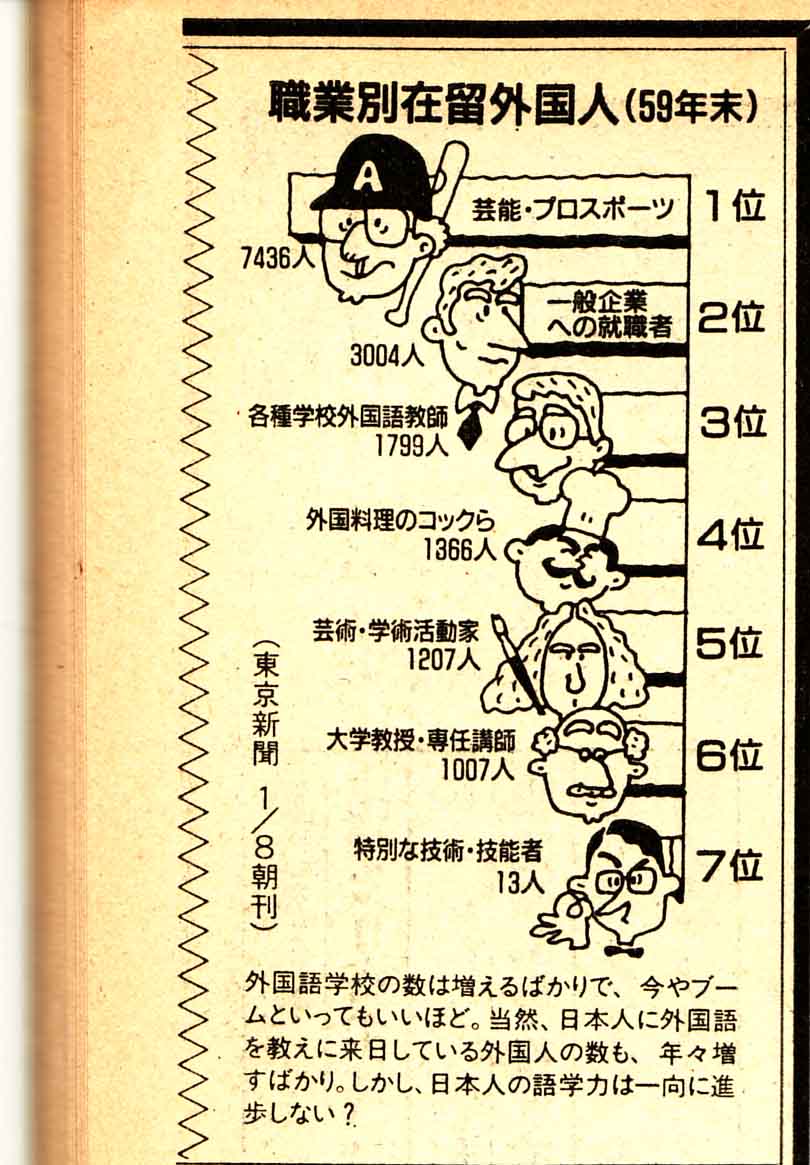
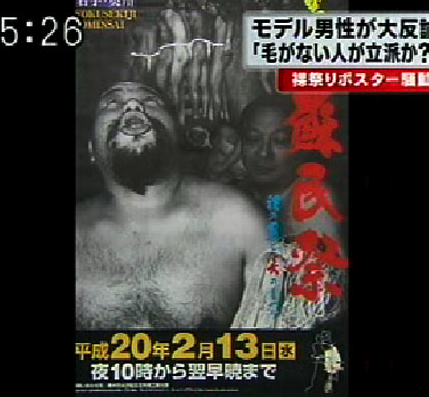
Comedian Dave M G on New News: parodies of current events

mytest

Hi Blog. News is piling up, but I promised more holiday tangent:

Turning the keyboard to comedian Dave M G, with news about a comedy show he’s doing as a non-native speaker on domestic events.

I’ve seen Dave in action many times before (he’s an amazingly funny guy, and I’ve spent a lot of time studying his sense of timing). Now he’s turning his edge towards the Japanese market. It’s about time. Political parody is in short supply in this society–where are the Daily Shows, where are the Have I Got News for You?s to lay bare fundamental truths in the form of humor?

(We do have the comedy troupe “Newspaper”, equally excellent in its impersonation of political figures, finally gaining traction after twenty years of performing. But Dave’s a friend.)

Here is his correspondence in order of receipt. Courtesy of The Community mailing list. Arudou Debito in Sapporo

========================

November 16, 2007:
Community,

Myself and some comedians I regularly perform with are going to be starting a new project – a news comedy show for Japan.

Comparisons with “The Daily Show” are inevitable, and we can’t deny that it’s a huge influence. I’m a big fan of “The Daily Show” and “The Colbert Report”. But at the same time, I’ve drawn inspiration from news comedy going back to SNL, SCTV, Brass Eye and more.

Of course, ultimately we want to find our own voice, one that works for Japan, and brings in a new style of comedy.

This show is in Japanese, and it is intended entirely for Japanese speakers. And while I know a lot of you speak Japanese (better than me!), I’m mainly bringing it to your attention because the material will of course be based on the social and political news headlines that are of interest to members of this group.

So I hope you’ll want to check it out. We’re going to film it and YouTube it, so I’ll put a link up here on Tuesday or Wednesday.

But I’m telling you now because we’re going to perform it live on Monday night in Nishi Azabu. I’m hoping to get a few audience members to come and watch. There will be some stand up comedians performing as well, rounding out the show. It’s free as well, so if you can make it, you can’t lose.

Please spread the word to your friends who are looking for Japanese comedy that isn’t the same old “dotabata” stuff that Yoshimoto keeps pumping out. Come be a part of the launch of our experiment with comedy that’s new to Japan.

Details on the location and times are on this web page. The web page refers to it as a show called “Nihongo De Comedy”, which is the show we regularly perform at that venue. “The New News Show” is a new segment in the middle of that show:

http://www.tokyocomedy.com/show.php?show=1200

===========================

November 29, 2007:
[Community] First shot at news comedy

Community List, I say “first shot” in the subject line because, well, things never go as perfectly as you’d hope.

Anyway, as mentioned before, I’m working with some others on making a news comedy show.

We finished our first go at it, and uploaded it to YouTube:
http://www.youtube.com/watch?v=_sbgcKFPywo

I could go on and on about the things I’m not happy with… Anyway, there it is. We’re going to try and work to make things better for next time, and if anyone is interested in participating in this kind of project, let me know.

===========================

December 21, 2007:
Our news comedy show for this month is up and on the web.

This time it’s shorter, and the production is a little smoother.

On The New News web site:

http://newnews.jp/

Or on YouTube:

http://www.youtube.com/watch?v=lg7XhFTFdPs

If you know anyone who is interested in comedy about Japanese politics and news, please pass the above web addresses along.
ENDS

Economist on “When Japan was a Secret”

mytest

Hi Blog. Debito.org is following the template set by The Economist Newsmagazine, where the journalists digress from the usual serious stuff and put out a holiday issue of tangents.

In this year’s Economist holiday issue, we have a three-pager on how people (particularly whalers and other merchant marines) were trying to open up Japan before Commodore Perry. It’s a long one, so here are some excerpts:

==================================
Japanese sea-drifters
When Japan was a secret
The Economist Dec 19th 2007

Long before Commodore Perry got there, Japanese castaways and American whalers were prising Japan open
http://www.economist.com/world/asia/displaystory.cfm?story_id=10278660

IF THAT double-bolted land, Japan, is ever to become hospitable, it is the whale-ship alone to whom the credit will be due; for already she is on the threshold.
Herman Melville, “Moby Dick”, 1851

The first English-language teacher to come to Japan landed in a tiny skiff, but before he did so, Ranald MacDonald pulled the bung from his boat in order to half-swamp her, in the hope of winning over locals with a story that he had come as someone who had fled the cruel tyrannies of a whale-ship captain and then been shipwrecked. The four locals who approached by boat, though certainly amazed, were also courteous, for they bowed low, stroked their huge beards and emitted a throaty rumbling. “How do you do?” MacDonald cheerily replied. This meeting took place in tiny Nutsuka Cove on Rishiri Island off Hokkaido on July 1st 1848, and a dark basaltic pebble from the cove sits on this correspondent’s desk as he writes, picked up from between the narrow fishing skiffs that even today are pulled up on the beach….

Far from fleeing a tyrant, MacDonald had in fact had to plead with a concerned captain of the Plymouth, a whaler out of Sag Harbour, New York, to be put down in the waters near Japan. MacDonald had an insatiable hunger for adventure, and the desire to enter Japan—tantalisingly shut to the outside world—had taken a grip on him. Both men knew of the risks, but the captain was less inclined to discount them. For 250 years, since the Tokugawa shogunate kicked Christian missionaries and traders out, only a tightly controlled trade with the Netherlands and China was tolerated in the southern port of Nagasaki, with a further licence for Koreans elsewhere. Though British and Russian ships had from time to time prodded Japan’s carapace, an edict in 1825 spelled out what would happen to uninvited guests “demanding firewood, water and provisions”:

The continuation of such insolent proceedings, as also the intention of introducing the Christian religion having come to our knowledge, it is impossible to look on with indifference. If in future foreign vessels should come near any port whatsoever, the local inhabitants shall conjointly drive them away; but should they go away peaceably it is not necessary to pursue them. Should any foreigners land anywhere, they must be arrested or killed, and if the ship approaches the shore it must be destroyed.

Two decades later the despotic feudalism of the Tokugawa shogunate was under greater strain. At home the land had been ravaged by floods and earthquakes, and famines had driven the dispossessed and even samurai to storm the rice warehouses of the daimyo, the local lords. Abroad, Western powers were making ominous inroads. After the opium war of 1840-42 China ceded Hong Kong to Britain. Meanwhile, thanks to a growth in whaling and trade with China, the number of distressed Western vessels appearing along Japan’s shores was increasing. Moderate voices made themselves heard within the government. A new edict was softer:

It is not thought fitting to drive away all foreign ships irrespective of their condition, in spite of their lack of supplies, or of their having stranded or their suffering from stress of weather. You should, when necessary, supply them with food and fuel and advise them to return, but on no account allow foreigners to land. If, however, after receiving supplies and instructions they do not withdraw, you will, of course drive them away.

…The most famous sea-drifter is known in the West and even Japan as John Manjiro. Two days after Melville set off in early 1841 from Fairhaven, Massachusetts, on the whaling adventure that provided the material for “Moby Dick”, Manjiro, the youngest of five crew, set out fishing near his village of Nakanohama on the rugged south-western coast of Shikoku, one of Japan’s four main islands. On the fourth day, the skipper saw black clouds looming and ordered the boat to be rowed to shore. It was too late. Over two weeks they drifted east almost 400 miles, landing on Torishima, a barren volcanic speck whose only sustenance was brackish water lying in puddles and nesting seabirds. In late summer even the albatrosses left. After five months, while out scavenging, Manjiro saw a ship sailing towards the island.

The castaways’ saviour, William Whitfield, captain of the John Howland, a Fairhaven whaler, took a shine to the sparky lad. In Honolulu he asked Manjiro if he wanted to carry on to Fairhaven. The boy did, studied at Bartlett’s Academy, which taught maths and navigation to its boys, went to church and fell for local girls. He later signed on for a three-year whaling voyage to the Pacific, and when he returned, joined a lumber ship bound round Cape Horn for San Francisco and the California gold rush. He made a handsome sum and found passage back to Honolulu.

By early 1851—the year of “Moby Dick” and two years before Commodore Perry turned up—Manjiro was at last back in Japan, and things were already changing. He and two of the original crew had been dropped in their open sailing boat by an American whaling ship off the Ryukyu Islands. They were taken to Kagoshima, seat of the Satsuma clan. The local daimyo, Shimazu Nariakira, grilled Manjiro, but the tone was inquisitive more than inquisitorial: please to explain the steamship, trains, photography, etc. In Nagasaki, Manjiro had to trample on an image of the Virgin and child. He was asked whether the katsura bush could be seen from America growing on the moon. He described America’s system of government, the modest living of the president and how New Englanders were so industrious that they used their time on the lavatory to read. Amazingly, he dared criticise Japan’s ill-treatment of foreign ships in need of wood and water, and made a heartfelt plea for the opening of Japan, going so far as to put the American case for a coal-bunkering station in Japan to allow steamships to cross the Pacific from California to China.

Rather than being kept in prison, he was freed to visit his mother—in Nakanohana she showed him his memorial stone—and was even made a samurai. In Tosa (modern-day Kochi), he taught English to men who were later influential during the overthrow of the shogunate and the establishment of constitutional government in the Meiji period, from 1860. During negotiations in 1854 with Perry, Manjiro acted as an interpreter. Later, in 1860, he joined the first Japanese embassy to America. But as Christopher Benfey explains in “The Great Wave: Gilded Age Misfits, Japanese Eccentrics and the Opening of Old Japan” (Random House, 2003), if the terror of being lost at sea was the defining experience of Manjiro’s life, then his greatest gift to the Japanese was his translation of Nathaniel Bowditch’s “The New American Practical Navigator”, known to generations of mariners as the “seaman’s bible”.

As for Ranald MacDonald, though he was handed over by the Ainu and taken by junk to Nagasaki for interrogation, he was treated decently. With a respectable education and a gentle presence, he was clearly a cut above the usual rough-necked castaway, and he was put to teaching English. Some of the students who came to his cell later flourished as interpreters and compilers of dictionaries. The most notable, Einosuke Moriyama, served as the chief translator in Japan’s negotiations with Perry, as well as interpreter to America’s first consul to Japan, Townsend Harris…

======================

The article gives a lot of interesting information, even if it strikes me a bit as if it’s from the perspective of overseas sources only. The labeling of Japanese ships as “junks”, for example, (junks are Chinese) is a bit of an indicator. And it concludes oddly. Read the final paragraph to the piece:

======================
As for whaling around Japan, vestigial echoes reverberate. Every northern winter, Japan faces barbs for sending a whaling fleet into Antarctic waters. And why, asks the mayor of Taiji, a small whaling port, should Japanese ships have to go so far, suffering international outrage? Because, he says, answering his own question, the Americans fished out all the Japanese whales in the century before last.
======================

Kerplunk. Er, so the whole article was leading up to justify this contention? It’s like putting a reggae conclusion on a classical piece.

Anyway, the whole article is worth a read as a holiday indulgence. See it at http://www.economist.com/world/asia/displaystory.cfm?story_id=10278660

Arudou Debito in Sapporo

IMADR: Connect Mag on UN Human Rights Council’s first year

mytest

Hi Blog. Here’s a synopsis from Tokyo human rights group IMADR of how the new UN Human Rights Council is doing over its first year of existence. This has been discussed on Debito.org at the following links:

=================
Economist: UN Human Rights Council in trouble (Posted on Thursday, March 29th, 2007)

A LOT of optimism attended the birth of the UN Human Rights Council, created last year by a 170-4 vote of the General Assembly. Whereas the United States kept on the sidelines (and confirmed this month it would stay away), many Western states saw the new body as an improvement on the discredited Human Rights Commission it replaced. But now some of the commission’s critics are fretting that the Geneva-based council may prove only a little better, or perhaps even worse, than its predecessor…
https://www.debito.org/?p=297

Economist: UN Human Rights Council “adrift on human rights” (Posted on Tuesday, April 17th, 2007)

I’ve been trying to get an opportunity to speak at the UN HRC regarding the Otaru Onsens Case, yet these articles from the Economist keep coming out and offering bad news about the meetings I’ve missed. Would be nice to believe that human rights, from the organization which has established some of the most important conventions and treaties in history, still matter in this day when rules seem grey, and even the most powerful country in the world dismisses long-standing international agreements as “outmoded” and “quaint”…
https://www.debito.org/?p=344

UN.ORG on pushes to make sure HRC holds all countries accountable (Posted on Wednesday, July 25th, 2007)

The UN News has been issuing press releases to make sure the Human Rights Council doesn’t become as emasculated as the former Human Rights Commission–by holding all countries accountable with periodic reviews of their human rights records. Good. Japan in particular is particularly remiss, given its quest for a seat on the UNSC without upholding its treaty obligations…
https://www.debito.org/?p=470

UN News: UNHCR urges HRC to begin reviews of every country’s human rights record (Posted on Saturday, September 15th, 2007)

UN News agency press release reports: United Nations High Commissioner for Human Rights Louise Arbour today urged the Human Rights Council to press forward with its Universal Periodic Review (UPR) mechanism, which allows the human rights records of every country to be scrutinized. Under this new mechanism, over the course of four years, all UN Member States – at the rate of 48 a year – will be reviewed to assess whether they have fulfilled their human rights obligations.
https://www.debito.org/?p=574

=================
Here’s IMADR. Arudou Debito in Sapporo
(click on image to expand in your browser)
imadrconnectsept2007001.jpg

imadrconnectsept2007002.jpg

imadrconnectsept2007003.jpg

imadrconnectsept2007004.jpg
ENDS

Gregory Hadley on “Field of Spears”, re US POWs in Japan during WWII

mytest

Remembering those who fell in a ‘field of spears’
By ANGELA JEFFS, Contributing writer
The Japan Times: Saturday, Dec. 8, 2007

http://search.japantimes.co.jp/cgi-bin/fl20071208a1.html
Courtesy of Gregory Hadley

A survivor of the B-29 crew is led from the village hall after being captured and tortured. PHOTO COURTESY OF VAL BURATI/GEORGE McGRAW

Greg Hadley — or professor Gregory Hadley, as he’s known in academic circles — is on his way home to Niigata. He has just completed the weekend JALT conference at Tokyo’s National Olympic Center.

“I go to the conference every year, this time seeking to recruit a new teacher for Niigata University. There’s a lot of talent out there, and it’s a good place to scout. Yes, I made contact with several highly qualified people. Now it’s a case of following them up.”

Hadley, who teaches American and U.K. cultural studies at Niigata University of International and Information Studies, says he normally spends his free time gardening and cooking meals for his Japanese wife.

He had absolutely no idea when he made a trip with a friend through the English Cotswolds in the summer of 2002, that he’d be asked the question that would lead him to write a book, “Field of Spears: The Last Mission of the Jordan Crew,” published this year by Paulownia Press.

“My friend asked why Niigata had been taken off the U.S. list of potential A-bomb attack sites in 1945. I’d lived in the city for years, and while remembering local stories about a B-29 bomber seen burning in the sky, this was news to me. Being the inquisitive, compulsive type, when I got back I asked around.”

What Hadley learned was that Niigata had been on the list until 10 days before the attack on Hiroshima. It was deleted because of its geographical location. Being surrounded by hills, the effects of the nuclear attacks on Hiroshima and Nagasaki were contained to some degree. With Niigata sitting among rice paddies, the effects would have spread far and wide.

Kyoto (as well as the arsenal at Kokura) was originally on the list; it was thought that striking at the heart of Japanese history and culture would swiftly demoralize the population. But it was saved by the intervention of U.S. Secretary of War Henry Stimson, who had honeymooned in the city several years before.

“Having settled that, I became fascinated by that legendary B-29. Had it existed? If so, where had it come down? And what had happened to the crew? Fifty years had passed. Given the taboo of Japan not liking to talk about those dark days, would it be possible for me, a foreigner, to learn anything?” So began a three-year quest — a search that took him into small Japanese farming communities, dusty archives and mid-American townships, and to meet what he describes as “the quite exceptional members” of a POW support group in Japan.

“Initially I thought of my investigation as an academic exercise. But the narrative element took over, and I found myself seeking to portray the two very human sides to the story: those of the Japanese — mostly women, children and the elderly — who were exhausted and brutalized by the war effort, and the young American crewmen who were lost so far from home.”

Greg Hadley, a professor at Niigata University of International and Information Studies, spent three years uncovering the fate of the crew of a B-29 that crash-landed in Niigata in 1945. ANGELA JEFFS PHOTO

What he learned was that a B-29 Superfortress bomber attached to the U.S. Army Air Forces’ 6th Bombardment Group, with a crew of 11 and under the command of Capt. Gordon Jordan, took off from Tinian in the Mariana Islands on a routine night-mining mission to Niigata on the night of July 19, 1945.

“We know it was hit by antiaircraft fire, then crashed-landed in potato fields between the former villages of Yokogoshi and Kyogase. After that, the story becomes less clear.”

The Jordan crew’s last mission marked a number of firsts: the first time a B-29 was shot down over Niigata; the first time anyone parachuted into the prefecture; the first time for Japanese women, trained by the military to fight with bamboo spears, to use them against armed American soldiers.

“Bamboo spears were the military’s last desperate means of fighting off invasion. Remember that these women has lost husbands, sons and grandsons; some had lost all the men in their family. They were basically in deep trauma. Of course, nothing forgives what happened, but it does help explain it.”

What happened mirrors what happens in any war when enemy fall into the hands of terrified overwrought civilians. Echoes of Iraq indeed, Hadley confirms.

Though born in north Texas — “the panhandle” — Hadley has spent the last 15 years in Japan, with time out at the University of Birmingham in the U.K., where he studied the sociology of English language teaching and acquisition. As a result his accent has flattened out to such an extent that “often I’m mistaken for Canadian.”

What he likes about living and working here is that you can so easily meet like-minded people and contribute to different fields. Although you hit the glass ceiling of any one profession pretty quickly, you can spread outward, broaden your sphere of influence and activity.

“Right now I have no interest in returning to the States. I don’t like the country it has become. But that’s not to say I’m not interested, that I don’t care. I do.”

He came to care very much for the fate of the Jordan crew, four of whom died. When Hadley began his research five years ago, five survivors were still alive, in scattered communities throughout the States. All were suspicious of his initial approaches. One chose not discuss what were still painful memories. The son of one victim, a toddler when his father died, supplied his father’s wartime diary.

“I was also enabled to locate photographs of the incident, taken for a local newspaper. One shows the bodies of two crew members. “We’ll probably never know what really happened to them, but by piecing together statements I have a good idea.”

Quote: “Pandemonium broke out with the arrival of these two bodies. The keibodan tried to keep the villagers back, but such was their frenzied rage that they began to beat and abuse the bodies in various ways, such as those who pulled down the pants of Adams and put a sweet potato in his crotch.”

Another photograph (shots of captured U.S. servicemen are rare) shows a survivor — tied and blindfolded — being led from the village hall where he and his colleagues were kept that first night. Two more pictures show six survivors in the back of a truck, being taken to a POW camp in Niigata; a sheet covers what is most probably the body of a seventh airman who did not survive the night.

“Four men, including one who refused to leave the plane, died. While small in number, their fate mirrors many such incidents all over Japan. As for the rest, yes they survived, but the experience — and their treatment once they were taken to Tokyo — left scars which could never be erased.”

Encouraging local people to talk about what happened required great patience. As Hadley recalls: “It was easier to obtain declassified information and dig in the mud to still find pieces of the aircraft. Villagers were ashamed. ‘We were rice farmers,’ they told me, ‘but that night we saw our dark side, we became the war. ‘ ”

Those U.S. airmen who gave in to fear, trying to shoot their way out of trouble, signed their death warrants. Those who took the beatings and the indignities heaped upon them — such as the captain, who was tied to a post, then urinated and defecated upon — survived. It was an elderly Japanese who chased away the women and youngsters, and protected him until the Japanese military came to the rescue.

Hadley cannot thank enough all those who helped him put together the story of the Jordan crew. To see the book in print, receiving critical acclaim from the popular press and academic circles alike, and available through Amazon.com makes all the effort worthwhile.

“Before I began ‘Field of Spears,’ I spent three years debunking the myth about 300 POWs being dynamited in gold mines on Sado Island, as proposed by a New Zealand writer. Next I want to properly investigate POW Camp 5B in Niigata.”

On the flyleaf of the copy of the classy paperback Hadley so kindly gave me, it reads: Dedicated to those who made it back alive, but never survived the war. Below this, penned in ink: “In reading this book we become part of its history.”

A select number of signed copies of “Field of Spears” can be obtained from the author at hadley@nuis.ac.jp
The Japan Times: Saturday, Dec. 8, 2007
ENDS

Kaoru/Coal manga on the “Mischievous Stealth Provocateur Debito”

mytest

Happy Boxing Day, readers. As another special treat, let me send you this manga created by fellow naturalized citizen Kaoru, who scribbles with great aplomb on a situation I’m bound to encounter sooner or later. In great manga style–so that’s how I look to some… Love it.

Blogged here with permission, original page at http://www.restall.org/2007/12/debito-mischievous-stealth-provocateur.html. Provocateur Debito in Sapporo

(Click on image to expand in browser.)
debitokaoru1.tiff
debitokaoru2.tiff
ENDS

Holiday Cheer: Best of Duran Duran–ranking all their albums

mytest

Hi Blog, and Merry Christmas. I’m going to talk about something completely unrelated to Japan for a change. Duran Duran. Yes, the 80’s rock band. And give you a line up of both songs and reasons why you shouldn’t dismiss them too quickly.

(NB: If you don’t want to read my ponderings regarding the Durans as a phenomenon, page down to a listing of albums I would recommend if you want to give them a listen.)

It’s long been an open secret that I am a Duran Duran fan. Why, you may ask (and you would be forgiven) would a person like me (or for that matter, a person like anyone) like a band like them?

Well, of course there is no accounting for taste, especially musical, when so much is influenced by where you grow up–and what seems to be floating around the airwaves and the zeitgeist when you’re growing up. But Duran Duran caught me at just the right point in my musical-taste development to lodge themselves irretrievably into my playlists. Their RIO album took America by storm in 1982, and it got quite a lot of radio play in my Upstate New York hometown. Not to mention our hungering for any videos when we didn’t have cable (hence no MTV), meaning all we could do was wait for weekend morsels from “Friday Night Videos”. And the Durans (along with Billy Joel) made the most memorable vids. (To this day: Any time you have an 80’s tokushuu on MTV Japan, sooner or later you get a Duran in there. No wonder. You Tube Duran Duran or Arcadia and watch what you get.)

RIO was one of the first albums I ever bought with my own money (the first one was, for the record, Supertramp’s BREAKFAST IN AMERICA, and that album holds up very well too even if Supertramp itself fizzled out in the American market with their next album, …FAMOUS LAST WORDS…, which is still one of the most depressing albums I’ve ever heard). Even if “The Reflex” was wildly overplayed, and NOTORIOUS both as an album and a single pretty blah, I could still work backwards and discover enough gems on PLANET EARTH, move forward to their interesting outing on ARCADIA, and catch them live (they’re really good live, believe it or not) both on ARENA and at our local concert shell (where yes, they came to play in one of their frequent sales troughs; and I still have the concert shirt). Then as I got older and saw how dark and cynical the world is, Duran offered me solace and good tunes with fine outings like BIG THING and WEDDING ALBUM. Then I was sold well enough to forgive further foibles and stumbles they would make, culminating in the payoff of their two good recent albums ASTRONAUT and RED CARPET MASSACRE.

That’s what I mean by good happenstance. They just kept catching me at the right junctures in my life. But here are a few more objective reasons why you should give the Durans a second chance and at least a third listen:

1) They’ve been around for closing in on thirty years now. There’s a good reason for that. They keep crafting tunes and staying together long enough to have not one, but two, renaissances (first with top ten hits in the early 1990s, and again nowadays with their current lineup and great tunes all over again).

2) Their tunes are uniquely theirs. From Simon LeBon’s voice to Nick Rhodes’s colorful magenta and hot pink tones, you know you’re listening to a Duran Duran song when one comes on. Yet they have enough edge and guitar to keep people who like more rock than pop listening. Consider songs such as “Girls on Film”, “Rio”, and “Is There Something I Should Know?”–to cite three you probably have heard already. Like them or not, they’re quite unique. There are hundreds of imitators of The Beatles, The Rolling Stones, U2, and all the supergroups (because they are so imitable). But who imitates Duran Duran? Who can?

3) Their lyrics are surprisingly deep at times. Really suggest you give them a try.

4) Duran Duran as a group makes me smile, even laugh. They don’t take themselves at all seriously. For example, watch the video for “View to a Kill”–and witness Simon’s awful pun at the end (and his face just before he gets blown up). When all the weight of the world is on one’s shoulders, putting them on cheers things up (so do the B-52’s, but they get a little too corny at times, especially to those who have gone through their Dr Demento Phase). In other words, they’re fun. And we all could use a little more fun in our lives.

5) Durannies are a great crowd to hang out with. It’s like being in any closeted minority–we learn how to have fun our own way.

===========================

Want to give Duran Duran a try? Here are my rankings of their best albums with the best tracks in descending order–based upon my star rankings (five stars being the best) in my iTunes folder. I only include tracks with four or five stars. The more tracks with high rankings, the higher I rank the album, so if you want to start somewhere, try the top albums. (NB: I haven’t included their greatest hits (DECADE), compilations (NIGHT VERSIONS, STRANGE BEHAVIOUR), live bootlegs, or singles.)

I also have sampled some of the songs on my Debito.org Podcasts, so if you want a preview, listen to the very end of the podcast and you’ll get a taste.

——————————————–
ALBUM IN CAPS, Track name in smalls:

RED CARPET MASSACRE (2007)
Box Full o’ Honey (5 stars)
The Valley (5)
Red Carpet Massacre (5)
Skin Divers (4)
Tempted (4)
Tricked Out (4)
Zoom in (4)

BIG THING (1988)
Too Late Marlene (5 stars)
Land (5)
Do You Believe in Shame? (5)
Big Thing (4)
The Edge of America (4)
I Don’t Want Your Love (4–excerpted on my Dec 8, 2007 Podcast)
All She Wants Is (4)

DURAN DURAN (1980)
Girls on Film (5 stars)
Tel Aviv (4)
Planet Earth (4)
Anyone Out There (4)
Careless Memories (4)
Is There Something I Should Know? (4)
Night Boat (4)

ASTRONAUT (2004)
What Happens Tomorrow (5 stars–excerpted on my Nov 28, 2007 Podcast)
Reach Up For the Sunrise (5–excerpted on my Nov 12, 2007 Podcast)
Point of No Return (5–excerpted on my Nov 19 2007 Podcast)
Still Breathing (5)
Want You More! (4)
Finest Hour (4)

EPONYMOUS (“WEDDING ALBUM”) (1993)
Come Undone (5 stars)
Ordinary World (5)
Breath After Breath (5)
None of the Above (4)
Sin of the City (4)

RIO (1982)
Last Chance on the Stairway (5 stars–excerpted in my Oct 20, 2007 Podcast)
The Chauffeur (5)
Rio (5)
New Religion (4)
Hungry Like the Wolf (4)

ARCADIA–SO RED THE ROSE (1985)
Lady Ice (5 stars)
El Diablo (5)
The Flame (4)
Keep Me in the Dark (4)
The Promise (4)

ARENA (Live) (1984)
New Religion (5 stars)
Careless Memories (4–excerpted on my Oct 13, 2007 Podcast, beware middling sound quality as it was my first podcast.)
The Chauffeur (4)
Planet Earth (4)
Is There Something I Should Know? (4)
The Wild Boys (4)

MEDAZZALAND (1997)
Be My Icon (5 stars)
Michael You’ve Got a Lot to Answer For (4)
Silva Halo (4)
Undergoing Treatment (4)

THANK YOU (1995)
Watching the Detectives (5 stars–excerpted in my Nov 5, 2007 Podcast)
Drive By (4)
Lay Lady Lay (4)
Crystal Ship (4)

SEVEN AND THE RAGGED TIGER (1983)
Of Crime and Passion (5 stars–excerpted in my Oct 29, 2007 Podcast)
Shadows on Your Side (4)
The Reflex (single version–4)

LIBERTY (1990)
Serious (5 stars)
First Impression (4)
My Antarctica (4)

NOTORIOUS (1986)
Winter Marches On (5 stars)
Hold Me (4)

POP TRASH (2000)
Playing With Uranium (4 stars–excerpted on my Dec 19, 2007 Podcast)

So you see, according to my tastes, however questionable, Duran Duran have gotten better over time. I’m glad I stuck with them. Here’s to many more years of good music, and hope to meet them someday.

Merry Christmas 2007, everyone! Arudou Debito in Sapporo
ENDS

Tangent: Europe becoming passport-free. Contrast with Japan.

mytest

Hi Blog. Here’s evidence that other countries are putting up less immigration controls, not more (unlike Japan with its new fingerprinting policy, justified on overtly xenophobic grounds). Yes, the article mentions that border controls are toughening outside the Schengen Zone, but it’s still an amazing feat to be able to drive from Estonia to Portugal without a single passport check. Or, despite the multitude of languages, cultures, and differences in standard of living, fingerprinting at any border.

America should also take note (and I do believe it will within the next few years, given the rising voices talking about the damage being done the US by ludicrously tough border controls). So should Japan, which is taking advantage of things to go even farther.

Sure, I hear the counterarguments–Japan’s “shimaguni” island society and all that. But do you think that being surrounded by an ocean makes you insular and impregnable? It arguably easier to sneak into Japan than into landlocked countries! Which shows how even more useless these border controls are–when anyone who really wants to get in here surreptitiously just has to pay a boatman and then hop a rubber dinghy. More and more, Japan’s fingerprint policy just seems a useless taxpayer boondoggle. As does the American.

But I digress. Back to Europe. Debito in Sapporo

/////////////////////////////////////////
Passport-free zone envelops Europe
By Doug Saunders, Globe and Mail (Canada)
December 21, 2007 at 1:02 AM EST

http://www.theglobeandmail.com/servlet/story/RTGAM.20071221.schengen21/BNStory/International/home
Courtesy Monty DiPietro

PHOTO: Fireworks illuminate the border bridge between Poland and Germany in Frankfurt on Oder early Friday morning. A minute after midnight the European Union’s border-free zone is extended to the Czech Republic, Estonia, Hungary, Lithuania, Latvia, Malta, Poland, Slovakia and Slovenia. People from these nations can travel to the existing 15 states of the ‘Schengen’ border-free zone without having to show their passports. (Johannes Eisele/Reuters)

LONDON — As midnight approached in the centre of Europe yesterday, hundreds of border guards left their posts for good and began tearing down the last remains of the old Iron Curtain.

At the border of Germany and Poland, the guards spent the day removing kilometres of tall steel fence, leaving unmarked and unguarded fields between the two once hostile nations. On the road between Vienna and Bratislava, Austrian and Slovakian leaders met to saw through border-crossing barriers. In Estonia, the government put its border-inspection stations up for auction.

This morning, for the first time in history, you can drive from the Russian border in Estonia to the Atlantic beaches of Portugal, across 24 countries, without encountering a single border crossing or having to show your passport at any point.

For the people who live inside the core countries of the European Union and especially in the old Eastern Bloc, today marks a historic moment, the long-awaited expansion of the EU’s Schengen zone, a huge space, named for the Luxembourg town where it was first devised, in which national borders have been eliminated and 400 million people are treated as citizens of a single country.

The addition of nine new countries to this borderless zone today, eight of them formerly Communist members of the old Warsaw Pact, means that the distinction between the “old” and the “new” Europe is beginning to vanish and freedom of movement is expected to create an economic boom as eastern workers continue to move westward and carry their earnings back home.

“A freedom is being restored which this country has been wanting for a hundred years,” Hungarian President Laszlo Solyom said last night as he opened his country’s borders to Austria, Slovakia and Slovenia. Residents of the Czech Republic and Slovakia, who have been isolated since Czechoslovakia split apart in 1993, were delighted to discover last night that they no longer have a border between them.

So there was a mood of celebration yesterday inside Poland, Hungary, Estonia, Latvia, Lithuania, the Czech Republic, Slovakia, Slovenia and Malta. But in the countries that now find themselves outside the borders of this free-living enclave, the mood was considerably different.

In Ukraine and Belarus, citizens made panicked last-minute shopping forays into Slovakia and Poland yesterday, loading their cars with meat, clothing, liquor, cigarettes, Christmas presents and automobile parts. The wait at the Poland-Belarus border, until last night a relatively lax crossing, was several hours long, with lines of cars and trucks backed up for dozens of kilometres.

As they crossed back eastward, it was easy to understand the alarm: Along a suddenly fortress-like border, hundreds of new border guards, equipped with high-technology surveillance equipment, were busy setting up a security cordon that has been two years in the planning and will make it far more difficult to enter Europe.

A 679-kilometre steel fence has been erected along the border of Belarus. Armed, fast-moving squads, known as Rapid Border Intervention Teams, monitor surveillance data. In eastern Slovakia, a large detention centre has been constructed along the Ukrainian border; it already houses dozens of people from as far away as Ghana who have recently tried to slip into Europe through this mountainous, sparsely populated frontier. It has room for hundreds more.

“It’s going to be a new Iron Curtain for all intents and purposes,” Samuel Horkay, a Ukrainian citizen who has discovered that it will be much harder to visit his mother in neighbouring Hungary, told the Bloomberg news agency yesterday. “That’s a strong way to put it, but Europe loves to guard its borders.”

That is the central paradox that lies behind today’s celebrations: Even as Europe is turning its national borders into historical footnotes — European Union countries currently have fewer independent powers, in most areas, than Canadian provinces do — the 27-nation federation is making entry from outside the EU far more difficult.

While the continent’s booming economies in places like Spain, Ireland and Britain (the latter two are not part of the Schengen zone) are hungrily trying to grab as many immigrants as they can in both skilled and unskilled fields, in order to fill hundreds of thousands of job vacancies, other countries such as France and Italy are facing unemployment and political crises over immigration. On the whole, there is a growing Western European consensus against non-European immigration.

While the borders are being toughened, many European citizens fear that the expansion of the Schengen zone will lead to increases in human trafficking, undocumented immigration and smuggling. One poll showed that 75 per cent of Austrian citizens are opposed to the expansion.

And the official responsible for Europe’s new high-security external borders, Ilkka Laitinen of the EU’s Warsaw-based Frontex border agency, agreed that freedom of movement is going to make it harder to control who lives in Europe, regardless of the level of border security. “It is a deliberate choice of the European Union to focus more on the free movement of persons than on security aspects,” he said.
ENDS

Holiday Tangent: SAYUKI, Japan’s first certified NJ Geisha, debuts

mytest

Hi Blog. In the first of a series of tangents, here’s news of the first-ever NJ geisha. Anthropologist Liza Dalby (author of GEISHA) got close to the ranks, but never became a geisha herself. Sayuki has. Congratulations and best wishes for her future understanding this very closed world! Arudou Debito

///////////////////////////////////////////////

Japan’s first ever foreign geisha
Courtesy of Sayuki

For the first time in the 400 year history of the geisha, a Westerner has been accepted, and on December 19, will formally debut under the name Sayuki.

Sayuki is specialized in social anthropology, a subject which requires anthropologists to actually experience the subject they are studying by participating in the society themselves.

Sayuki has been doing anthropological fieldwork in Asakusa – one of the oldest of Tokyo’s six remaining geisha districts – for the past year, living in a geisha house (okiya), and participating in banquets as a trainee. She has been training in several arts, and will specialize in yokobue (Japanese flute).

Sayuki took an MBA at Oxford before turning to social anthropology, and specializing in Japanese culture. She has spent half of her life in Japan, graduating from Japanese high school, and then graduated from Japan’s oldest university, Keio. Sayuki has lectured at a number of universities around the world, and has published several books on Japanese culture. She is also an anthropological film director with credits on NHK, BBC, National Geographic Channel programmes.

For further information please contact:

In English:

http://www.sayuki.net, sayuki.geisha@gmail.com

In Japanese:

お問い合わせ―所属事務所 マスターマインド
メールアドレスinfo@master-mind.jp www.master-mind.jp
Fax-03-3713-1604

Photographs are available for purchase and download at:

http://keyshots.smugmug.com/gallery/4014935
sayukiphoto.jpg
Photo by Kerry Raftis http://www.keyshots.com©
ENDS

SAYUKI 花柳界歴史上初の外国人芸者

mytest

SAYUKI 花柳界歴史上初の外国人芸者
http://keyshots.smugmug.com/gallery/4014935
sayuriphoto.tiff
国籍 オーストラリア
 日本の400年の歴史上において初めて異国の外国人女性として花柳界への扉を開き紗幸の名で芸者デビュー極めて異例の出来事である。

 2007年12月19日東京浅草においてお披露目される。

 日本で活躍する外国人女性として初の試みに加え、肩書きも異例で海外の国立大学での講師などを務め主な学位として、オックスフォード大学でMBAを取得後博士号「社会人類学」ならびに経営学の修士を取得最初の学位は日本の慶応大学「心理学」]で白人女性として初めて授与される。またテレビプロデューサーの顔も持ち、おもに比較文化的ドキュメンタリーの制作の監督を務めNHKをはじめBBCなど海外メディアで数多くのドキュメンタリー番組の監督、司会、ナレーションを日本語で行う、ファイナンシャルタイムス、ジャパンタイムスなどの記者として記事を寄稿、また、共同通信、ロイター通信の記者としての活動もこなす。

 日本文化の著作を3冊海外で発表し民族研究・経営学の研究著作は海外で話題を呼ぶ日本の伝統文化・花柳界を海外メディア、日本のメディアを通しドキュメンタリー番組の制作なども手がけていく予定

お問い合わせ マスターマインド
メールアドレスinfo@master-mind.jp http://www.master-mind.jp

In English:
http://www.sayuki.net, sayuki.geisha@gmail.com
Fax-03-3713-1604

Photographs are available for purchase and download at:
http://keyshots.smugmug.com/gallery/4014935

Photo by Kerry Raftis http://www.keyshots.com©
ENDS

GOJ now worried about aliens. No, not foreigners.

mytest

Hi Blog. It must be Christmas or New Year Holiday craziness (I too intend to limit myself to one blog entry per day, off the beaten track from the usual fare on Debito.org)–but get a load of this:

==================================
Japan’s defence minister braces for aliens
AFP Dec 19, 2007
http://afp.google.com/article/ALeqM5hHGF47XsVoM_97L8olNf_j3b1MBA
Courtesy Monty DiPietro

TOKYO (AFP) — As Japan takes a more active role in military affairs, the defence minister has more on his mind than just threats here on Earth.

Shigeru Ishiba became the second member of the cabinet to profess a belief in UFOs and said he was looking at how Japan’s military could respond to aliens under the pacifist constitution.

“There are no grounds for us to deny that there are unidentified flying objects (UFOs) and some life-form that controls them,” Ishiba told reporters, saying it was his personal view and not that of the defence ministry.

Ishiba, nicknamed a “security geek” for his wonkish knowledge of defence affairs, noted that Japan deployed its military against Godzilla in the classic monster movie.

“Few discussions have been made on what the legal grounds were for that,” the minister said with a slight grin, drawing laughter from reporters.

Due to the US-imposed 1947 constitution, Japan’s de facto military is known as the Self-Defence Forces and has never fired a shot in combat since World War II.

But Japan has gradually sought a greater global military role, sending troops to support US-led operations in Afghanistan and Iraq.

Ishiba said he was examining different scenarios for an alien invasion.

“If they descended, saying ‘People of the Earth, let’s make friends,’ it would not be considered an urgent, unjust attack on our country,” Ishiba said.

“And there is another issue of how can we convey our intentions if we don’t understand what they are saying,” he said.

“We should consider various possibilities,” he said. “There is no need at all to do this as the defence ministry, but I want to consider what to do by myself.”

Ishiba’s remarks came after the government this week said it had no knowledge of UFOs, prompting a surprise rebuttal from the top government spokesman.

“Personally, I absolutely believe they exist,” Chief Cabinet Secretary Nobutaka Machimura said on Tuesday.
ENDS

==============================
Japanese Minister O.K.’s Fighting Godzilla
By MARTIN FACKLER The New York Times: December 21, 2007
http://www.nytimes.com/2007/12/21/world/asia/22japan-briefs.html?_r=1&ref=world&oref=slogin

TOKYO — Japan’s defense minister stirred a minor media squall after joking with reporters about possible invasions by space aliens and movie monsters during a regular news conference.

Responding to a question, Defense Minister Shigeru Ishiba told reporters on Thursday that he was studying whether the nation’s pacifist Constitution would limit a military response to an attack by space aliens.

“There are no grounds to deny that there are unidentified flying objects and some life-forms that control them,” Mr. Ishiba said, smiling at first, but then launching into a straight-faced explanation. “If Godzilla attacked, that would probably be a natural disaster relief operation,” making military action legally permissible, he said.

But the legal grounds for mobilizing militarily against a U.F.O. would be less clear unless the aliens attacked first, he said.

The comments drew widespread disbelief here, coming after verbal gaffes that helped sink the previous prime minister’s administration, and days after the chief cabinet secretary, who is the government’s top spokesman, professed a belief in U.F.O.’s.
==============================
ENDS

COMMENT: No mention if Godzilla or E.T. would be fingerprinted upon entry. Or whether E.T.’s “ouch” finger would fit properly into the biometric machinery.

An off-the-cuff remark here or there, okay. But this discussion has gone on too long and taken too much media and time from real govt. business. And these representatives of the world’s second biggest economy still want to be taken seriously? Are there not more important things to discuss, such as the ongoing Nenkin debacle? I told you in my most recent Japan Times essay that Japan’s legislative peerage was out of touch with reality. They lining up to prove it?

Somebody call a snap election and get these fools out. Arudou Debito in Sapporo
ENDS

Fingerprinting: How Yomiuri teaches J children that NJ are criminals

mytest

“Teach your children well…” Crosby Stills and Nash

Hi Blog. Courtesy Jason Topaz:

======================
“Just to add a little more info in the fingerprinting issue: I’m not sure whether to laugh or cry, but the Yomiuri Shimbun had an online article a few weeks ago on their children’s section, explaining the fingerprinting scheme to children.

The article is at http://www.yomiuri.co.jp/kyoiku/children/weekly/20071201ya01.htm”>http://www.yomiuri.co.jp/kyoiku/children/weekly/20071201ya01.htm (and blogged at Debito.org here).

I have to say I was a little disturbed by the cartoon
http://www.yomiuri.co.jp/kyoiku/children/weekly/20071201ya01.htm
yomiurichildrenfingerprinting.tiff
http://www.yomiuri.co.jp/kyoiku/children/weekly/photo/20071201ya0101_L.jpg

which roughly translates as:

GIRL: This is how foreigners who come to Japan register their fingerprints at places like airports.

BOY: The aim is to protect against criminals and terrorists coming to Japan.

GIRL #2: But you have to properly manage the registered face photo and fingerprint information.

(note background drawing of foreigner whose nose is approximately the same size as the airplane flying by)
======================

COMMENT: It’s not a matter of managing the information. It’s a matter of how you manage this policy so that you achieve your goals without defaming an entire segment of the population. As usual, the Yomiuri has no qualms about selling the policy as a crime-prevention measure (which it never was–until recently) against “foreign guests” even to children.

Thanks a lot for carrying the bias down to the more impressionable generations. Arudou Debito
ENDS

読売:子供に「外国人=犯罪者」の教育(指紋採取再実施の件)

mytest

ブロクの読者、こんばんは。きょうの件は、子供の教育ですが、どうしても子供にも「外国人はテロリスト・犯罪者」を助長しないといけないですか。日本におけるテロは漏れなく日本人に起こされ、国内犯罪はほとんど日本人に犯されているのでこの指紋採取再実施は無意味と無関係です。この措置は税金の使用の手段にすぎないとはっきり言いましょう。でも、これは子供に伝わるでしょうか。有道 出人

===========================

こどものニュースウィークリー

指紋や顔写真を義務づけ入国審査の厳格化
(イメージをクリックすると拡大)
http://www.yomiuri.co.jp/kyoiku/children/weekly/20071201ya01.htm
yomiurichildrenfingerprinting.tiff
http://www.yomiuri.co.jp/kyoiku/children/weekly/photo/20071201ya0101_L.jpg

●イラスト スパイスコミニケーションズ(ごみかわ淳)
(情報管理の問題ではなく、外国人のイメージダウンの管理が問題では?それに、相変わらず、外国人の鼻を大きくしないと外国人になり得ないのでしょうか。)

 11月20日から、日本に来た外国人には、空港などで指紋(しもん)の読み取りや顔写真の撮影(さつえい)に応じることが義務(ぎむ)づけられました。テロリストや犯罪者(はんざいしゃ)といった悪い外国人の入国を防ぐのが狙(ねら)いです。このような制度(せいど)が設(もう)けられたのは、アメリカに次いで2国目なのだそうです。
 新制度は、外国人の不法な入国や滞在(たいざい)を禁じた出入国管理(しゅつにゅうこくかんり)・難民認定法(なんみんにんていほう)という法律(ほうりつ)を改正(かいせい)して、27の空港と126の港で導入(どうにゅう)されました。観光客も含めた16歳以上の外国人が対象で、その人数は1年間で約700万人に上ると見られています。
 具体的(ぐたいてき)には、外国から到着(とうちゃく)した空港や港などで、機械の前に立ち、指示に従(したが)って、ガラス板の上に両手の人さし指を置きます。すると1秒ぐらいでチャイムが鳴り、指紋の登録(とうろく)が終了します。顔写真も、同じ機械の前に立つと、小型のデジタルカメラで撮影されます。
入管リストと照合

 日本に入ってくる人をチェックしている「入国管理局(にゅうこくかんりきょく)」という国の機関がありますが、登録された指紋などは、この入国管理局のコンピューターにすぐに送られます。入国管理局は、入国させない外国人のリスト(ブラックリスト)を作っており、送られてきた指紋は、これらの外国人の指紋と照合(しょうごう)されます。ブラックリストに載(の)っている外国人かどうかが、5秒ぐらいで分かる仕組みになっているそうです。
 では、ブラックリストには、どのような人が載っているのでしょう。それは、警察が指名手配(しめいてはい)している容疑者(ようぎしゃ)や、以前に日本で悪いことをして強制的(きょうせいてき)に本国に帰国させられた人、国境(こっきょう)を超(こ)えて活動するテロリストなどです。登録された指紋が、こうした人物のものと一致(いっち)すれば、入国管理局は入国を拒否(きょひ)したり警察に通報(つうほう)したりします。
初日5人入国拒否
 新制度が始まった20日には、ブラックリストの人物と指紋が一致したとして、5人が入国を拒否されました。5人は、偽(にせ)のパスポートを使い、ほかの人になりすまして入国しようとしたようです。
 今回の制度が設けられたのは、空港などから日本に入国しようとする外国人に対し、パスポートをチェックしたり、入国の目的を口頭(こうとう)で質問(しつもん)したりするだけだった今までのやり方では、日本に入ってはいけない人が紛(まぎ)れていても、見逃(みのが)す恐(おそ)れがあると考えられたからです。
 2001年9月11日にアメリカで発生した同時テロ事件は、「アル・カーイダ」という国際テロ組織(そしき)が起こしました。この組織に関係する男が指紋付きで国際手配されていたにもかかわらず、この男は、1999年から2003年までの間に6回も日本に入っていたことが分かっているのです。
 ほかにも、過去に強制的に帰国させられたのに、偽造(ぎぞう)パスポートを使ったり、名前を変えて新しいパスポートを手に入れたりして、また日本に来る外国人がたくさんいます。06年に強制帰国させられた外国人約5万6000人のうち、約7300人は過去にも強制帰国させられたことがあり、本来なら入国できない人たちでした。
情報管理など課題
 新制度の導入で、こうした外国人の入国が防げると期待されているわけですが、指紋や顔写真といった情報の管理については、それらを見る権限(けんげん)を持っていない人が見たり、外に漏(も)れたりしないよう、十分に気をつける必要があります。
 また、地方の小さな港に不定期に上陸する漁船などについては、入国管理局の職員(しょくいん)の数が足りないために、チェックしきれないという問題もあります。
 新しい制度ができたから大丈夫と考えるのではなく、これからも改善(かいぜん)すべき点が見つかれば直していくことが大切です。
(2007年12月1日 読売新聞)

APEC line open to NJ residents at Kansai Int’l Airport (UPDATED 1/7/08–now it is not)

mytest

Hi Blog. For those travelling over the holiday season, here are some helpful letters for those going through Kansai International Airport (Kankuu, or KIX). It turns out NJ residents can go through the APEC Immigration Channel (business line). Print up these letters if the terms apply to you, show them at the border, and decriminalize yourself more efficiently. Courtesy of Martin Issott. Arudou Debito in Sapporo

(click on letter to expand in browser, Japanese and English)
Kix171207J.jpg
Kix171207E.jpg
ENDS

Japan Times: My Dec 18 Zeit Gist column on premeditated xenophobia in Japan

mytest

Hello Blog. Here’s the last Japan Times column I’ll do this year–and it’s a doozy. I’m very happy with how it came out, and judging by the feedback I’ve gotten others are too.

It’s about how Japan’s xenophobia is in fact by public policy design, due to unchallenged policymakers and peerage politicians, and how it’s actually hurting our country. Have a read if you haven’t already.

Best wishes for the holiday season, Arudou Debito in Sapporo, Japan

=====================================

“THE MYOPIC STATE WE’RE IN”

Fingerprint scheme exposes xenophobic, short-sighted trend in government

By ARUDOU DEBITO

THE JAPAN TIMES COMMUNITY PAGE

Column 42 for The Zeit Gist, Tuesday, Dec. 18, 2007

“Director’s Cut” of the article with links to sources at

https://www.debito.org/japantimes121807.html

Excellent illustration by Chris MacKenzie at the Japan Times website at

http://search.japantimes.co.jp/cgi-bin/fl20071218zg.html

We all notice it eventually: how nice individual Japanese people are, yet how cold — even discriminatory — officialdom is toward non-Japanese (NJ). This dichotomy is often passed off as something “cultural” (a category people tend to assign anything they can’t understand), but recent events have demonstrated there is in fact a grand design. This design is visible in government policies and public rhetoric, hard-wiring the public into fearing and blaming foreigners.

Start with the “us” and “them” binary language of official government pronouncements: how “our country” (“wagakuni”) must develop policy for the sake of our “citizens” (“kokumin”) toward foreign “visitors” (rarely “residents”); how foreigners bring discrimination upon themselves, what with their “different languages, religions, and lifestyle customs” an’ all; and how everyone has inalienable human rights in Japan — except the aliens.

The atmosphere wasn’t always so hostile. During the bubble economy of the late ’80s and its aftermath, the official mantra was “kokusaika” (internationalization), where NJ were given leeway as misunderstood outsiders.

But in 2000, kicked off by Tokyo Gov. Shintaro Ishihara’s “sangokujin” speech — in which he called on the Self-Defense Forces to round up foreigners during natural disasters in case they riot — the general attitude shifted perceptibly from benign neglect to downright antipathy….

==============

REST AT

https://www.debito.org/japantimes121807.html

http://search.japantimes.co.jp/cgi-bin/fl20071218zg.html

ENDS

Depressed? Consult with Int’l Mental Health Professionals Japan

mytest

Hello Blog. How do you feel this time of year? Not too dusty, I hope. But I have to admit, I hate spending the Xmas-New Year Holidays in Japan. No semblance of a real Christmas atmosphere, absolutely boring nenmatsu-nenshi (TV’s Kouhaku is the pits), and no way for a Hokkaidoite like myself to get to a warmer clime unless we pay the minimum RT 50,000 yen airline connection “tax” to get to a bigger international airport.

Not that I’m blaming Japan (or Hokkaido–we have to do pennance somehow for our magical summers)–that’s just the way it is, and part of the dues of choosing to live and be a part of this society. But I still don’t like it.

I have my own strategies for dealing with it (writing, DVDs, trashy magazines, and pizza). For those who aren’t confident about their strategies and need some professional help, here’s information about a group in Japan called “International Mental Health Professionals Japan” which offers psychological services to an international clientele. Heard about it at a recent speech in Tokyo from Dr Jim McRae, President.

Given the state of mental health services in this country (generally pretty lousy; most Japanese quasi-“counselors” will probably unhelpfully attribute any mental issue involving a NJ to a matter of “cultural differences”, and Japan doesn’t even have certifications for clinical psychologists), this group is a boon. Some friends and I have had horrible experiences trying to check friends (who were acting mentally erratically to the point of presenting a clear and present danger to others) into mental clinics in Japan. Many clinics/mental hospitals simply won’t take foreigners (claiming, again, cultural or language barriers), advising us to “send them home” for treatment.

It’s nice to see professionals in Japan in the form of the IMHPJ below trying to help out. Spread the word.

Happy Holidays–or as happy as you can make them. Arudou Debito in Sapporo

————————————–
INTERNATIONAL MENTAL HEALTH PROFESSIONALS JAPAN

What is IMHPJ?
(taken from their website and from a flyer I received from Dr Jim McRae)

IMHPJ is a multidisciplinary professional association of therapists who provide mental health services to the international communities in Japan. Members are working in private practices or mental health related organizations worldwide.

Founded in 1997, IMHPJ’s goals are to improve the quality, quantity, and accessibility of mental health services available to the international communities in Japan by:

–maintaining an up-to-date database of professional therapists, where you can find the professional profile of the therapist of your choice.
–providing a forum for discussing and making co-ordinated joint efforts related to important issues or events.
–encouraging a high standard of ethical and professional performance for mental health professionals.
–providing opportunities for continuing education for members.
–facilitating peer support and networking among members and with related Japanese mental health organizations.

Clinical Members hold a Masters Degree or higher and have supervised postgraduate clinical experience. Assocate Members work in fields related to mental health or are students or therapists not yet eligible for clinical membership.

IMHPJ is multidisiplinary, including Psychiatrists, Psychologists, Social Workers, Family Therapists, and Child Psychologists etc.

IMHPJ members offer a range of recognized theraputic approaches for the treatment of relationship issues, stress, anxiety, depression, abuse, cross-cultural issues, children’s emotional and educational problems, and many other issues. Many of our members also offer phone counseling.

Native speakers offer therapy in English, Dutch, German, French, Spanish, Japanese, and Polish. Some members are bilingual.

For more information, consult our website at:
http://www.imhpj.org
ENDS

Japan Today: Naturalized Chinese sues Hitachi for contract nonrenewal

mytest

Hi Blog. Here’s another lawsuit of note (sorry for not seeing it sooner).

Note the errroneous headline. This person is not a Chinese worker. She is a naturalized Japanese citizen, therefore a Japanese. Bishibashi for the copy editor (and the translation is pretty hokey too).

Quick comment follows article.

===================================

Hitachi sued by Chinese worker
Japan Today November 27, 2007
http://www.japantoday.com/jp/shukan/424

Hitachi is being sued for discrimination by a Chinese employee. The case is being watched by many major Japanese manufacturing companies because it’s quite a rare case that discrimination against their foreign workers becomes public.

The plaintiff graduated from a Chinese university and obtained a masters degree at a Japanese university. She joined Hitachi in 1994, and obtained Japanese citizenship during her career there. She is now 58 years old.

According to the plaintiff, after a one-year probation, she was hired by Hitachi and asked to work for a section dealing with China and assigned translation tasks. She was supposed to be given a full-time contract. But because of a working visa problem, she was given the status of a “non-regular staff,” which requires annual renewal of the contract. In April of 2004, Hitachi told her that they would not renew the contract.

In June of 2006, she sued Hitachi, saying, “The one-year contract as a non-regular staff is just an ad hoc measure, and I was virtually working full-time. There is no justification for making me quit.” In her suit, she has requested “confirmation of her rights in the contract,” unpaid salaries and 10 million yen compensation.

Hitachi says that she is just a non-regular worker whose contract had to be renewed annually and that the company let her go because her contract had finished.

However, on Oct 15, the plaintiff invited a former head of the Tokyo Immigration Bureau, Hidenori Sakanaka, who is now a specialist in foreign worker issues in Japan, to court. Sakanaka questioned Hitachi’s appeal, saying, “The plaintiff was given a special status called ‘Specialist in Humanities / International Services.’ This special status is given only to those who work as full-time staff and never given to ‘non-regular staff’ because ‘non-regular staff’ is not a legally recognized labor status.”

A lawyer who specializes in corporate laws says, “It’s actually common for foreign workers to renew their employment contracts every three years in order to renew their visa. I think corporations generally don’t fire their foreign employees who work full-time.”

Hitachi has refused further comments on the case, saying it is still a court matter. However, Sakanaka says the Hitachi case is the tip of the iceberg. Since China is an important market for Japanese companies, labor problems with Chinese employees could become more common from now on, he says. (Translated by Taro Fujimoto)
ENDS
===========================

COMMENT: The thing I don’t get about this article is that the plaintiff got Japanese citizenship while she was working at Hitachi, so why is visa and employment even an issue? Is she a Japanese worker or not? And did her work status not changed when she naturalized? And wow, this case is taking a long time, if she first filed suit in 2006!

Anyway, her case might help bring about some consistancy in the arrayed grey zone between perpetually-renewed contracted NJ and part-time J workers–something employers have been using to keep their staff disposable at will. Arudou Debito in Sapporo

Yomiuri: GOJ to forbid employers from confiscating NJ passports

mytest

Hi Blog. Here’s some good news.

After much trouble with employers confiscating NJ worker passports (ostensible reasons given in the article, but much of the time it led to abuses, even slavery, with the passport retained as a Sword of Damocles to elicit compliance from workers), the GOJ looks like it will finally make the practice expressly illegal.

About time–a passport is the property of the issuing government, and not something a foreign government (or another person) can impound indefinitely. The fact that it’s been used as a weapon to keep the foreign Trainee laborer in line for nearly two decades speaks volumes about the GOJ’s will to protect people’s rights once they get here.

Glad this is finally coming on the books. Now let’s hope it gets enforced. Referential articles follow Yomiuri article:

========================

Govt guidelines to forbid firms to keep foreign trainees’ passports
The Yomiuri Shimbun, Dec 18, 2007
http://www.yomiuri.co.jp/dy/national/20071218TDY01307.htm
Courtesy Jeff Korpa and Mark Schreiber

The Justice Ministry looks set to stop companies that accept foreign trainees from confiscating trainees’ passports and foreign registration certificates, ministry sources said Monday.

The toughened ministry guidelines for host companies also state that preventing foreign trainees from traveling wherever they wish to go when they are off duty is unacceptable. Firms have been curtailing the movement of workers and holding on to passports and certificates to prevent such trainees from disappearing.

The ministry will likely release the guidelines this week and will notify organizations, including commerce and industry associations, that accept foreign trainees of the new rules.

The foreign trainee system was designed to enhance international relations by introducing foreign trainees to new technology and skills, but it often has been misused as an excuse to bring unskilled workers into the country.

Commerce and industry associations and organizations of small and midsize companies accept foreign trainees, who are introduced to companies to learn skills for up to three years.

Under the current system, foreign trainees receive one year of training followed by two years as on-the-job trainees. As the training year is not considered employment, such workers are not protected by the Labor Standards Law.

The new guidelines for the entry and stay management of foreign trainees are a revised version of the 1999 guidelines.

The new guidelines prohibit host companies from using improper methods to manage foreign trainees, such as holding their passports, and foreign nationals from being accepted through brokering organizations other than via authorized organizations

Also banned are misleading advertisements for the recruitment of host companies, such as those that say foreign trainees can be used to resolve a labor shortage.

The tougher regulations are aimed at preventing commerce and industry associations from becoming nominal organizations for accepting foreign trainees. This practice has seen brokering organizations exploit foreign trainees by introducing them to companies.

To prevent overseas dispatch organizations from exploiting foreign trainees, the new guidelines also include a measure that requires host companies to refuse to accept foreign trainees in the event a foreign dispatch organization is found to have asked them to pay a large deposit. The guidelines have been revised for the first time in eight years because companies that do not not qualify to take on foreign trainees have been taking a rapidly increasing number of such workers.
==========================
ARTICLE ENDS

REFERENTIAL ARTICLES:
Japan scheme ‘abuses foreign workers’
By Chris Hogg BBC News, Tokyo, Wednesday, 3 October 2007
https://www.debito.org/?p=681

EXPLOITING VIETNAMESE Apocalypse now
Japan Times Sunday, April 29, 2007 By MARK SCHREIBER Shukan Kinyobi (April 20)
https://www.debito.org/?p=619

POINT OF VIEW/ Hiroshi Tanaka: Japan must open its arms to foreign workers
07/03/2007 THE ASAHI SHIMBUN
https://www.debito.org/?p=478

Nearly 10,000 foreigners disappear from job training sites in Japan 2002-2006
JAPAN TODAY.COM/KYODO NEWS Monday, July 2, 2007
https://www.debito.org/?p=475

Govt split over foreign trainee program
Yomiuri Shimbun May 19, 2007

https://www.debito.org/?p=435
For starters…
Arudou Debito in Sapporo
ENDS

読売:パスポート預かり禁止…外国人研修生の保護強化

mytest

パスポート預かり禁止…外国人研修生の保護強化
2007年12月18日 読売新聞
Courtesy of Tony Keyes and Mark Schreiber
http://job.yomiuri.co.jp/news/jo_ne_07121802.cfm

 外国人研修・技能実習制度が、安価な労働力として外国人を雇用する隠れみのとして使われていると指摘される問題で、法務省は17日、受け入れ企業などを対象とした同制度に関する新たな運用指針をまとめた。

 研修生の失踪(しっそう)防止のために外出を禁止したり、たとえ本人の同意があっても企業が旅券(パスポート)や外国人登録証を預かったりする行為を、違反すれば3年間、研修生の受け入れができなくなる「不正行為」にあたると明記するなど、研修生を保護するための規定を厳格化したのが特徴だ。同省は今週内にも新指針を公表し、商工会などの受け入れ機関に通知する。

 同制度は日本の技術・技能を海外に伝えることが目的で、海外から研修生を商工会や中小企業団体などが受け入れ、商工会などが紹介した企業で実務研修や技能実習を最長3年間行う。

 今回まとめられた「研修生及び技能実習生の入国・在留管理に関する指針」は1999年に策定された指針の改定版。企業などに対し、旅券を預かるなどの「不適正な方法による管理」を禁止したほか、商工会などに対する禁止事項として〈1〉正式な受け入れ機関以外が介在し、研修を行うこと〈2〉「労働力不足の解消」などの広告により実務研修を行う企業を募集すること――などを挙げた。商工会などが名目的に受け入れ機関となり、実際はブローカーが外国人研修生を企業に紹介し中間搾取することを防ぐ目的がある。

 一方、国内の受け入れ先だけでなく、海外の研修生派遣機関の不正行為を防ぐため「派遣機関が研修生から高額な保証金を徴収したことが判明した場合は、受け入れ機関は受け入れを取りやめる対応をとる」ことも盛り込んだ。

(2007年12月18日 読売新聞)
ENDS

DEBITO.ORG PODCAST DEC 19, 2007

mytest

DEBITO.ORG PODCAST DECEMBER 19, 2007

In this issue of the Debito.org Podcast:

1) Debito’s latest Japan Times Column, which came out on December 18, on the beginning of the end: How Japan’s xenophobia and closed-mindedness towards the outside world is now clearly not only hurting non-Japanese residents, but also destroying Japan for everyone–putting its very position as Asia’s leader and representative in jeopardy.

2) James Fallows of the Atlantic Monthly writes more poignantly and succinctly on what’s wrong with fingerprinting at Japan’s border than Debito could ever hope to.

3) TV personality and music aficionado Peter Barakan is attacked by an unknown assailant in public–he and his hosts at a speech are pepper-sprayed, in a clearly-planned assault with even a rented getaway car. Even though the police track down the car, the spray, and even a person inside, no arrests are made!

Twenty five minutes. As always, Duran Duran and Tangerine Dream excerpts are included to soothe.

Himu Case: Tokyo District Court orders Sankei Shinbun to pay NJ damages for reporting erroneous al-Qaeda link

mytest

Hi Blog. We’ve had enough rotten news recently. Now for some good news.

A Bangladeshi by the name of Islam Himu (whom I’ve met–he’s on my mailing lists) was accused during the al-Qaeda Scare of 2005 of being part of a terrorist cell. And the media, particularly the Sankei, reported him by name as such. Detained for more than a month by the cops, he emerged to find his reputation in tatters, his business rent asunder, and his life irrevocably changed.

This is why you don’t report rumor as fact in the established media. And as we saw in the Sasebo Shootings a few days ago, the papers and the powers that be won’t take reponsibility even when they get it wrong.

So Mr Himu sued the Sankei. And won. Congratulations. A good precedent. Now if only could get the Japanese police to take responsibility when they overdo things. Well, we can dream.

News article, referential Japan Times piece, and other background follows. Arudou Debito in Sapporo

================================

Sankei newspaper ordered to compensate foreigner over Al Qaeda slur
(Mainichi Japan) December 11, 2007
http://mdn.mainichi.jp/national/news/20071211p2a00m0na027000c.html

The Sankei newspaper has been ordered by the Tokyo District Court to pay a foreigner 3.3 million yen in compensation for implying he was linked to Al Qaeda and plotting a terrorist attack.

The court found the paper had defamed 37-year-old company president Islam Mohamed Himu of Toda, Saitama Prefecture, and ordered it to compensate him.

“It was inappropriate to publish his name,” Presiding Judge Hitomi Akiyoshi said as she handed down the ruling.

Sankei officials said they were not sure how the company will react to the case.

“We want to take a close look at the ruling before deciding how to respond,” a Sankei spokesman said.

Court records showed that Himu was arrested in 2004 for forgery and fined 300,000 yen. The day after his arrest, the Sankei ran a front page story under the headline “Underground bank produces terror funds, man with links to top terrorists arrested.”

Sankei proceeded to write that Himu had links to high-ranking Al Qaeda members and was suspected of involvement in procuring funds for terrorism.
ENDS
==================================

Alleged al-Qaeda link seeks vindication
Bangladeshi wants apology, claims he was falsely accused by police, press
The Japan Times April 2, 2005
http://search.japantimes.co.jp/print/nn20050402f4.html

A Bangladeshi businessman who was incorrectly alleged by police and the media last year as being linked to the al-Qaeda terrorist network is seeking vindication.

Investigators held Islam Mohamed Himu for 43 days but ultimately found he had no links to al-Qaeda.

Himu said that even since being freed, he has struggled to get his life and business back on track. He has filed a complaint of human rights violations with the Japan Federation of Bar Associations.

“I want to ask senior officials of the government or police: what was my fault?” Himu said in an interview.

“The Japanese police and media have destroyed my life,” said the 34-year-old, who runs a telecommunications company in Tokyo.

“I want them to apologize and restore my life,” he said, urging the government to help him obtain visas to make business trips to several countries that have barred his entry following the allegations.

Himu came to Japan in 1995 with his Japanese wife, whom he had met in Canada. After establishing a firm in Tokyo that mainly sells prepaid international phone cards, he obtained permanent residency in 2000.

Police arrested him last May 26 and issued a fresh warrant June 16. They alleged he had falsified a corporate registration and illegally hired two employees, including his brother.

While in custody, investigators mostly asked if he had any links to al-Qaeda, noting that a Frenchman suspected of being in al-Qaeda bought prepaid phone cards from him several times, according to Himu.

He said he tried to prove he had no connection with terrorists, telling police the Frenchman was one of several hundred customers and he had no idea the man used an alias.

However, police dismissed his claim, he said, and leaked to major media organizations, including Kyodo, their suspicions that he was involved with al-Qaeda, and all of them reported the allegations.

Himu said he believes police arrested him as a scapegoat even though they knew he had no link with al-Qaeda.

He was nabbed shortly after the media reported that the Frenchman had stayed in Japan in 2002 and 2003.

Prosecutors did not indict him on the first charge, while a court fined him 300,000 yen on the second charge. He was released on July 7.

Himu said the prosecutors’ failure to indict proves he was not an al-Qaeda member, but it did not necessarily constitute a public apology.

All his employees left following the release of the sketchy police information, and he now has 120 million yen in debts due to the disruption of his business, he claimed.

The Japan Times: Saturday, April 2, 2005

=============================

REFERENTIAL LINK:
Japan Times and Asia Times articles on 2004 police Al-Qaeda witch hunt, Himu Case, and police detentions in Japan.
https://www.debito.org/japantimes102305detentions.html

ENDS

アルカイダ報道:産経新聞に330万円賠償命令 東京地裁

mytest

アルカイダ報道:産経新聞に330万円賠償命令 東京地裁
毎日新聞 2007年12月10日 19時48分 (最終更新時間 12月10日 20時48分)
http://mainichi.jp/select/jiken/news/20071211k0000m040054000c.html
 国際テロ組織アルカイダと関係があると実名報道され名誉を傷付けられたとして、バングラデシュ国籍の会社社長、イスラム・モハメッド・ヒムさん(37)=埼玉県戸田市=らが産経新聞社に330万円の賠償を求めた訴訟で東京地裁は10日、全額支払いを命じた。秋吉仁美裁判長は「慎重な裏付け取材を続ける必要があった。少なくとも実名報道は妥当ではない」と指摘した。 

 判決によるとヒムさんは04年、電磁的公正証書原本不実記録容疑などで逮捕され、出入国管理法違反で罰金30万円の略式命令を受けた。産経新聞は逮捕翌日に1面で「地下銀行でテロ資金 幹部と接触男を逮捕」との見出しで、ヒムさんがアルカイダ幹部と接触し、テロ資金の送金に関与した疑いがあるなどと報じた。【高倉友彰】
ENDS

Mainichi Poll: 63% of Japanese favor immigration of unskilled foreign laborers

mytest

Hi Blog. I had a column in the Japan Times today talking about the mysterious perception gap between friendly, welcoming Japanese people, and a government which is expressly xenophobic and increasingly antipathetic towards foreigners. As further fodder for that claim, look at this interesting poll, where the majority of people aren’t falling for the media- and GOJ-manufactured fear of the outside world or the alien within. Arudou Debito in Sapporo

=============================
63% of Japanese favor allowing immigration of unskilled foreign laborers
(Mainichi Japan) December 17, 2007
http://mdn.mainichi.jp/national/archive/news/2007/12/17/20071217p2a00m0na038000c.html

More than 60 percent of people in Japan support accepting entry-level workers from overseas, in spite of the government’s policy of generally refusing such workers, a survey by the Mainichi has found.

In a nationwide telephone poll conducted by the Mainichi, 63 percent of respondents agreed with accepting foreign entry-level workers. Another 31 percent were against the idea, citing reasons such as that it would have a negative effect on Japanese employment or public peace.

A special employment plan approved by the Cabinet in June 1988 agreed to actively accept specialist and skilled foreign workers, but to take a “cautious” approach with regard to entry-level workers, and as a result, foreign unskilled laborers are generally refused entry to Japan.

When questioned about the government’s policy, 58 percent of respondents in the survey agreed with accepting unskilled foreign workers in fields where there was a lack of workers. Five percent said entry-level foreign workers should be accepted unconditionally.

When the 31 percent of respondents who said that such workers should not be accepted were asked to give a reason for their stance, 51 percent replied that it would have a negative effect on the employment and working environments of Japanese nationals. Another 35 percent said that public security would worsen, while 10 percent said trouble would occur as a result of differences between customs. Three percent cited an increased burden in areas such as social security costs and education costs.

When asked who would cover social security and education costs, the answers “the businesses employing the workers” and “industries that need workers” each received 38 percent. The answers “foreign workers themselves,” and “the whole public” each marked only 11 percent.

Hidenori Sakanaka, head of the Japan Immigration Policy Institute, who formerly served as a director of the Tokyo Regional Immigration Bureau, said Japan’s entry into an age with a dwindling population was behind the rising acceptance of allowing entry-level workers into Japan.

“Another reason is probably that the relationship with foreigners in Japan has taken a turn for the better,” he said. Sakanaka added that the work done by entry-level workers, such as nursing and work in the agriculture, forestry and fisheries industry, required specialist knowledge and skills, as well as the ability to adapt to Japanese society, and was certainly not simple. He added that a system to accept foreigners under a policy of cultivating human resources was urgently needed.
(Mainichi Japan) December 17, 2007
ENDS

毎日新聞世論調査:外国人労働者容認63% 雇用悪化に懸念も

mytest

毎日世論調査:外国人労働者容認63% 雇用悪化に懸念も
毎日新聞 2007年12月16日 19時16分
Courtesy Mark Schreiber
http://mainichi.jp/select/wadai/news/20071217k0000m040033000c.html

 労働力不足の分野では、外国人の単純労働者を受け入れてもよいと考える人が63%いることが、毎日新聞の全国世論調査(電話)で明らかになった。政府は、単純労働者を認めない方針だが、労働力不足の分野で容認する人が半数を超えていた。しかし、日本人の雇用に悪影響があるなどの理由で、受け入れに反対する人も31%あり、方針の転換に慎重な人たちも少なくない。

 外国人労働者については、88年6月に閣議決定された「第6次雇用対策基本計画」で「専門的・技術的労働者は積極的に受け入れ、(単純作業の繰り返しである)単純労働者は慎重に対応する」とし、単純労働者は事実上受け入れない施策が続けられてきた。

 政府方針について聞いたところ、労働力不足の分野での受け入れ容認が58%あり、「条件を付けずに単純労働者を受け入れるべきだ」が5%だった。一方、「現行通り、受け入れるべきではない」は31%だった。

 「受け入れるべきでない」と回答した人に理由を聞くと、「日本人の雇用や労働環境に悪影響を与える」が51%と最も多く、次いで「治安が悪化する」35%、「風習の違いによるトラブルが起きる」10%、「社会保障費や教育費などの負担が増える」3%だった。

 社会保障や教育費の負担を主に誰が担うかは、「雇い入れる事業主」と「労働者が必要な産業界」がいずれも38%。「外国人労働者自身」「国民全体」は双方11%と低かった。

 ◇若者は容認傾向

 毎日新聞の世論調査では、約6割が外国人の単純労働者受け入れを「労働力不足の分野」という条件付きで容認したが、特に若者にその傾向が強かった。しかし、受け入れ拒否の理由に、労働環境悪化を挙げる人が多かったことは、労働力不足への懸念に加え、雇用不安が広がったことを示している。

 労働力不足の分野で容認した人を年代別でみると、70代以上は44%と半数以下だが、20代は73%に達していた。若者に抵抗感が薄まっているとみられる。

 04年5月の内閣府世論調査では、(1)「単純労働者は受け入れるべきでない」26%(2)「労働力が不足する分野では受け入れてもよい」39%(3)「条件を付けずに受け入れるべきだ」17%--だった。

 調査方法が違うため単純比較はできないが、今回調査では、(2)の条件付き受け入れが19ポイント増え、逆に(3)の条件なし受け入れが12ポイント減ったのが目立つ。

 また、受け入れ拒否の理由は、内閣府調査では、「治安が悪化する」が74%と突出し、「風習の違いによるトラブルが起きる」49%、「日本人の雇用や労働環境に悪影響を与える」41%だったが、今回は、治安悪化は少なく、雇用への懸念が半数あった。

 04年当時は不法滞在者が急増しており、内閣府調査では治安悪化への懸念が色濃く出た。今回は雇用不安が影響したとみられる。【外国人就労問題取材班】

毎日新聞 2007年12月16日 19時16分 (最終更新時間 12月16日 21時02分)

Steve King on Gaijin Carding experience: Racially-Profiling Japanese citizens too? Plus his protest letter to JNTO

mytest

Hi Blog. Here’s a great little report from friend Steve King, on how he dealt with gaijin-carding police (and very well, too, to my mind). Great story, and questions asked properly and to the letter. Don’t make a racially-profiling J cop’s job easier. Make sure you let them know you know your rights.

Interestingly enough, Steve’s cop indicated that he would be carding Japanese citizens too. This is actually illegal under Japanese Law for citizens unless there is probable cause, so it’s probably a lie. But if a representative of the almighty police in this country are becoming that insistent, I guess when it happens to me (and you just know it’s going to, again), it’s going be worked out down at the Cop Shop… Ulp.

Anyway, Steve’s report follows, along with a letter he sent regarding this incident to the Japan National Tourist Organization. Arudou Debito in Sapporo

================================

Subject: Carded for the First Time
Date: December 17, 2007 11:34:43 AM JST

Hi Debito,

Had an interesting encounter outside JR Koenji Station in Tokyo on my way to work this morning – I got ‘Gaijin Carded’ for the first time in over 11 years of living in Japan. I am now no longer a ‘Gaijin Card Virgin’ :O)

A few things were interesting. First up, he – a Mr. Akiyasu Nishimura of Suginami Ward Police Office – asked for my passport, not my Alien Reg. Card. When I said I didn’t have it, he asked if I was a Japanese Citizen. When I replied that I am not a Japanese Citizen, he asked for my passport again.

I asked him why (in Japanese) and he just said, in English, ‘Because of Japanese Law’. So I asked his name and for his ID, which he produced with a smile and I jotted down his name. Then I said that since I lived in Japan, I don’t carry my passport around with me so I’ll be on my way. Then he caught up with me again and asked for my Alien Reg. Card. I asked him why, and again he repeated the reason, ‘because it’s the law’…

I then asked him if he was also asking Japanese citizens randomly on the street to produce ID. To my great surprise, he said that he was. He claimed to also be asking Japanese people to produce their Health Insurance, Driving Licenses and such.

To cut a long story short (this exchange went back and forth for about 10 minutes or so), he said it was the law for Foreign Nationals to carry their Alien Reg. Card and that he needed to see mine. I eventually relented and showed him my card, which he didn’t seem to really show much interest in, just giving it a perfunctory glance.

At the end I asked him if he wasn’t ashamed to harass people on the street for their ID on their way to work and what this means for the Japan Tourist Board’s ‘Yokoso Japan’ activities. He just shrugged and said well, you might carry your Alien Reg. Card but there are many others that don’t, and we don’t know until we ask..

He was a pleasant enough fellow and smiled throughout the exchange and of course, is just another guy carrying out the policies and orders of others, but I can’t say I enjoyed the experience of being carded outside the station I use every morning and a small crowd of onlookers gathering to see what the fuss is about..

I’m sure you’ve read many such anecdotes, but I wonder if it’s interesting to you that he asked if I was a Japanese citizen? Maybe the police have gotten wind of your campaigning on the basis of not judging a person’s citizenship status by skin colour alone and asked the police to check first? I dunno..

Also, what do you think of this guy’s insistence that he was also stopping and questioning Japanese citizens? I stopped and watched him from a suitable vantage point for a few minutes and watched him – he certainly didn’t stop any Japanese people during that time. Was this not a blatant lie on his part?

Anyway, given any more thought to running for office yet?

Steve King

PS: Now I think back to it, what I think he meant was (his English wasn’t great and he insisted on using it despite my demonstrably more than passable Japanese) that if he encountered a ‘foreign-looking’ person who claimed to be a Japanese citizen, he would then ask for some ID in order to obtain proof of this. I don’t think he meant that he would be as likely to stop ‘Japanese looking’ people on the street randomly.

Incidentally, there are four foreign staff where I work. Out of the four, three have been carded in this way over the last month or so (One guy got carded twice in one day, at his home station and at Koenji). The only one of us four foreigners working here who hasn’t been carded is a Nisei Japanese American. The guy that gets carded the most is an Australian of Lebanese extraction. SK
ENDS

/////////////////////////////////////////

Hi Debito, In a bad and sarcastic mood after this morning, I decided to email JNTO UK about the ‘Yokoso Japan’ campaign. I BCCd you on it. Feel free to pass it on to others who may want to contact JNTO Offices in their own home countries. List here:

http://www.jnto.go.jp/eng/contact/regional_offices.html

Cheers, Steve
=============================

From: Steve King
Subject: “Yokoso Japan”
Date: December 17, 2007 9:29:42 PM JST
To: info@jnto.co.uk
Dear Sir / Madam,

Re: Police / Immigration harassment of Foreign Nationals and the “Yokoso Japan” campaign.

I am writing to express my concern over the recent increase in the harassment, invasion of privacy, humiliation and general unfriendliness on the part of the Japanese government, police and immigration officials towards foreign nationals in Japan, and the effect this will have on your otherwise laudable “Yokoso Japan” campaign.

As you will be aware, since the end of last month foreign nationals have been required to undertake mandatory fingerprint checks at international airport checks throughout Japan, despite no clear or sensible rationale for this measure being offered by the Japanese government for its implementation. “Yokoso” in English of course means “Welcome”, and one wonders precisely how welcome tourists from the UK visiting Japan for the first time must feel after they step off the plane at Narita Airport and have to undergo this kind of humiliation.

I, however, am not a tourist in Japan, but a British National who is a long term resident. Today I was stopped outside of JR Koenji police station by a member of the Tokyo Suginami Ward Police Department, who subjected me to a series of questions and demands that I produce my Alien Registration Card for him to see. This has been happening a lot recently, and several of my colleagues have experienced similar kinds of hassle and intrusion into our lives. No clear explanation from the Japanese government has been offered to the foreign community for this. Is this “Yokoso Japan”? I certainly don’t feel very “Welcome”.

If this continues, I suggest that JNTO abandons the “Yokoso Japan” campaign as it is obvious to everyone that Japan does not, in fact, welcome foreigners. May I suggest an alternative campaign?

I suggest you re-title the campaign “Japan ni Konaide!”, and perhaps the following ideas for a poster campaign may be appropriate:

1. Instead of a picture of Mt. Fuji’s serene beauty, you could have a picture of foreign tourists being fingerprinted by uniformed officials at Narita Airport. The caption reads, “We think you’re all criminals. Please don’t come here”
2. Instead of a picture of a peaceful garden in a Kyoto temple, you could picture a foreigner being questioned by a policeman for no good reason on the street in the rain. The caption reads, “If you don’t look Japanese, our Police Force have some unwelcome questions for you”
3. Instead of a picture of an inviting plate of sushi, I suggest a picture of a family deciding whether to visit Japan or not, poring over some brochures. The caption reads, “Hmmmm.. No, I don’t think so. I’ve heard the people are not so friendly or welcoming”

Indeed, several of my family members in the UK were planning to visit Japan next April and spend a couple of weeks here. I’ve decided to tell them to cancel that trip, and we will all fly to Thailand instead. The people and government of Thailand have a much more welcoming and mature attitude towards people who visit their fine country.

Best Regards, Steve King, Fuchu City, Tokyo, Japan.
ENDS

Search for Lindsay Ann Hawker’s suspected killer goes on–at grassroots level

mytest

Hi Blog. Here’s an article from the Japan Times on how the NJ grassroots are trying to do what the J cops couldn’t do themselves–catch suspected killer Ichihashi Tatsuya (on the lam since March 2007) through leafletting and awareness-raising campaigns. Bravo.

Meanwhile, the cops do have notices out at police boxes with Ichihashi’s mug shots (even though the record shows they had the chance to apprehend him once before, and even watched him escape from his apartment), to no avail. Rumors are rife that he’s flitting about Japan being shielded by money-sending parents or underground communities. “Crime expert” Kitashiba Ken was on Dec 16’s TV “Koko made itte iinkai?” Debate show (an excellent program shown throughout Japan, except Kanto) speculating that he was being hidden by the Gay Community in Shinjuku 2-chome, or perhaps around Kyoto, where apparently (according to Kitashiba, full of reliable opinions found in reliable magazines, such as the late GAIJIN HANZAI URA FILE) lots of Kyoto faces look like his (a point greeted with much scoffing in the Kansai-based panelists). People don’t think he’s fled the country, in any case.

Okay, so find him, then. Japanese cops have little problem devoting their energies to stopping and checking foreigners as suspected criminals at the border or for walking, cycling, or living in an apartment while gaijin. Oh, wait, sorry, the requirement for probable cause only counts for the natives. Best thing to do is look somehow like a Kyoto person, I guess.

Good job on the leafletters below for doing something. And if you’d like to buy a T-shirt publicizing Ichihashi’s face, see link from Debito.org here. Debito in Sapporo

///////////////////////////////////////////////////////////

Hawker’s friends try new appeal
By KAZUAKI NAGATA, Staff writer
The Japan Times: Tuesday, Dec. 11, 2007
http://search.japantimes.co.jp/cgi-bin/nn20071211a5.html

Paul Dingwell (right) hands out leaflets Sunday in Tokyo’s Harajuku district, urging people to come forward with any information that could lead to the arrest of Tatsuya Ichihashi, who is wanted in the March slaying of Lindsay Ann Hawker. YOSHIAKI MIURA PHOTO

Friends of slain Briton Lindsay Ann Hawker issued a public appeal Sunday in Tokyo’s crowded Harajuku district for any information that might help police track down her alleged killer, Tatsuya Ichihashi, who has been on the run since the March slaying at his apartment.

About 10 people — friends of the slain English teacher and their supporters — turned out at Jingubashi Bridge in T-shirts bearing a photo of Ichihashi and distributed leaflets also bearing his image, along with the phrase “We can’t sleep until this man gets arrested” and other information about the case. “What we’re doing today is just making people aware that they should not allow him (Ichihashi) to get away with this,” said Paul Dingwell, the main organizer of the event and a friend of Hawker’s, who was a teacher at Nova Corp.

Hawker’s nude corpse was found March 26 buried in sand in a detached bathtub on the balcony of Ichihashi’s condo in Ichikawa, Chiba Prefecture.

Dingwell said he has been in contact with Hawker’s parents and recently received T-shirts and posters. He prepared about 1,000 copies to hand out to people to energize awareness of the case. “It’s coming up (on) Christmas,” Dingwell said. “This is going to be (the Hawkers’) first Christmas without Lindsay.”

Hawker was bicycling home March 21 near JR Nishi Funabashi Station when Ichihashi approached her and asked for a private English lesson, then followed her to her apartment, according to earlier reports. When he asked for a glass of water, Hawker let him into the apartment, apparently feeling safe because a roommate was present.

Ichihashi drew a sketch of Hawker on paper with his name and number. Hawker apparently agreed to give him an English lesson. She was seen March 25 with Ichihashi near Gyotoku Station in the vicinity of his condo.

When Hawker was reported missing and Gyotoku police were given the sketch, they sent several officers to Ichihashi’s condo to confront him.

Ichihashi opened the door when the officers knocked but then fled down a fire escape. Dingwell said he heard from Hawker’s parents that Ichihashi may have been sighted about a week ago near the Odakyu Line in Tokyo’s Shinjuku district. A witness saw a man wearing gloves and a mask acting in a strange manner, but his eyes resembled those of Ichihashi. Dingwell said the sighting may not have been reliable but noted it’s important to raise awareness of the case.
ENDS