DEBITO.ORG
Arudou Debito/Dave Aldwinckle's Home Page

New Novel by ARUDOU Debito

  • Book IN APPROPRIATE: A novel of culture, kidnapping, and revenge in modern Japan
  • Archive for the 'Labor issues' Category

    Issues regarding employment of NJ, and how jobs affect integration and assimilation in Japan (particularly regarding the “trainee” visa regime that even our politicians call a “scam”).

    Interesting lawsuits: French “Flyjin” sues employer NHK for firing her during Fukushima Crisis, 8 US sailors sue TEPCO for lying about radiation dangers

    Posted by debito on 17th January 2013

    Here’s a couple of interesting lawsuits in the pipeline: A French woman being fired from NHK (despite 20 years working there) apparently for leaving Japan during the Fukushima crisis, and eight US Navy sailors suing TEPCO (from overseas) for lying about nuclear fallout dangers and exposing them to radiation.

    No matter what you think about the act of litigation (and there are always those, such as House Gaijin Gregory Clark or tarento Daniel Kahl (see Komisarof, “At Home Abroad”, p. 100) who decry anything a NJ does in court, saying “they’re suing at the drop of a hat like the litigious Westerners they are” — even though millions of Japanese in Japan sue every year), these cases have the potential to reveal something interesting: 1) Blowing the lid off the Flyjin Myth of “fickle NJ leaving their work stations” once again, this time in the Japanese judiciary; and 2) showing whether international effects of GOJ negligence (and irradiating the food chain both domestically and internationally counts as such) is something that can be legally actionable from afar.

    Kyodo: A French woman on Tuesday sued public broadcaster Japan Broadcasting Corp., or NHK, for dismissing her after she left Japan in response to a French government warning issued during the Fukushima nuclear crisis. Emmanuelle Bodin, 55, who had engaged in translation and radio work, said in a complaint filed with the Tokyo District Court that she had told her boss that she would return to work on March 30, 2011, but received a termination letter on March 22. Two days after the earthquake-tsunami disaster triggered the accident at the Fukushima Daiichi plant on March 11 that year, the French government advised its citizens to leave the Tokyo area.

    Bloomberg: Tokyo Electric Power Co. is being sued for tens of millions of dollars by eight U.S. Navy sailors who claim that they were unwittingly exposed to radiation from the Fukushima No. 1 nuclear plant meltdowns and that Tepco lied about the dangers. The sailors aboard the nuclear-powered aircraft carrier USS Ronald Reagan were involved in the Operation Tomodachi disaster relief operations following the March 11, 2011, earthquake and tsunami that devastated the Tohoku region and led to the nuclear catastrophe, according to their complaint filed in U.S. federal court in San Diego on Dec. 21.

    Posted in "Pinprick Protests", Gaiatsu, Labor issues, Lawsuits, Problematic Foreign Treatment | 22 Comments »

    Call for help from JALT PALE group for Publications Chair

    Posted by debito on 10th January 2013

    PUBLICATIONS CHAIR WANTED
    HELP KEEP JALT PALE FROM POSSIBLE DECOMMISSIONING

    Hey everyone. Arudou Debito here. I have been told that one of the Japan Association for Language Teaching (JALT)’s most important SIG groups, PALE (Professionalism, Administration, and Leadership in Education), is in some difficulty at the moment.

    The PALE SIG desperately needs a Publications Chair. If it does not have one, then someone on the board will have to pick up the load, which has been the case the past year or so with disappointing results. It is a fact, alas, that PALE is not a popular SIG due to its stands on controversial issues, and it should not be surprising that some would be happy to see it go. It is still odd, since PALE is all about helping people find job stability and better employment conditions through being informed about labor law etc. We are the group that acts as a safety net, one that people keep falling upon to when times get tough in the workplace. Decommissioning the group is an option for JALT. One that we don’t think should happen, for everyone’s sake.

    PALE has a long history of activism and assistance. I was the editor of the PALE Journal for several years. An archive of PALE activities and publications is available at http://www.debito.org/PALE

    So if you a) are a JALT member (or are willing to become one), and b) are willing to join PALE (it costs a mere 1500 yen per year), and c) are willing to become Publications Chair, then please contact Tom Goetz right away at professor_goetz@yahoo.com.

    Posted in Education, Labor issues, Media, NJ legacies | Comments Off

    Beate Sirota Gordon, one architect of the Postwar Japanese Constitution, dies at 89, her goals uncompleted if not currently being undone

    Posted by debito on 5th January 2013

    Let me devote this blog entry to the passing of a historical figure whose importance within Japanese history cannot be overstated. Beate Sirota Gordon, a woman in a committee of men drafting the Japanese Postwar Constitution, wrote articles that remain fundamental to the rights Debito.org has devoted decades to upholding: Article 14, which guarantees that “All of the people are equal under the law and there shall be no discrimination in political, economic or social relations because of race, creed, sex, social status or family origin.” The other, Article 24, states (excerpt), “Marriage shall be based only on the mutual consent of both sexes and it shall be maintained through mutual cooperation with the equal rights of husband and wife as a basis. With regard to choice of spouse, property rights, inheritance, choice of domicile, divorce and other matters pertaining to marriage and the family, laws shall be enacted from the standpoint of individual dignity and the essential equality of the sexes;” this guarantees fundamental human and civil rights to women that weren’t present under the horrible Prewar Ie Seido (which among other things made people into property). A hearty Debito.org salute to Gordon for a life well lived and opportunities to improve Japanese society well taken. NYT obituary enclosed below.

    A few Debito.org-esque comments: One is that the NYT’s claim below of “Ms. Gordon was the last living member of the American team that wrote Japan’s postwar Constitution” is probably erroneous. That honor probably belongs to an old teacher of mine when I was at Cornell, Milton J. Esman, who was born in 1918 and is apparently still alive (see his resume page two here). (Wikipedia also notes that Gordon was not the only woman assigned to the group either, as economist Eleanor Hadley was also present.)

    Second, reflecting upon Gordon’s life when eulogizing, it is important to note a number of fundamental rights enshrined in the Japanese Constitution that have remained unenforced. One is of course the lack of a law against racial discrimination (which is unconstitutional under Article 14 but not illegal in the Civil or Criminal Code), meaning racial discrimination can be (and is) “practiced undisturbed”, as the UN has noted in the past, in a “deep and profound” manner (despite Japan effecting the UN Convention on Racial Discrimination in 1996; we’re now approaching seventeen years of unkept promises).

    The other I will just mention is the clause of “essential equality of the sexes” mentioned above in Article 24. Despite the Equal Employment Opportunities Law of 1986, Japan still maintains an immense gender-wage gap. (ILO data here.) Japan ranks at the very bottom (basically on par with ROK and Malaysia), and although the research notes that comprehensive comparisons cannot be made, the point still remains that women in Japan earn less than half of what men in Japan make for comparative work. Wage differentials may be true in all societies (I know of no society where gender-pay equality is systemwide), but this egregious a gap is unbecoming of a developed country, and shows the lack of good-faith drafting or enforcement of constitutionally-grounded laws in Japanese society.

    Finally, we have seen how much trouble the Japanese elite has gone to circumvent and undermine the Postwar “Peace Constitution”. We can start with the translation into Japanese (that Gordon’s group missed despite their fluency) that limited Article 14′s interpretation of constitutional protections for “all of the people” to Japanese citizens only. We can go on to talk about the unconstitutional standing military that is the JSDF and the right of education limited to citizens only in the Fundamental Law of Education. Plenty more, if people wish to point that out in Comments. And now, with the new PM Abe government, we can look forward to proposals for constitutional revisions to restore Japan’s military in name and allow for a remilitarization of Japan.

    I wonder what Gordon would say now about Japan’s December 2012 rightward swing. My guess is that she would lament her work remaining unaddressed if not being undone.

    Posted in History, Human Rights, Japanese Government, Labor issues, NJ legacies | 12 Comments »

    Japan Times JUST BE CAUSE Column 59: The year for NJ in 2012: a Top 10

    Posted by debito on 2nd January 2013

    Debito’s Top Ten human rights issues in Japan for NJ residents in 2012:
    10. DONALD KEENE’S NATURALIZATION
    9. OSAKA CITY DEFUNDS LIBERTY OSAKA
    8. COURTS RULE THAT MIXED-BLOOD CHILDREN MAY NOT BE “JAPANESE”
    7. DIET DOES NOT PASS HAGUE CONVENTION
    6. GOVERNMENT CONVENES MEETINGS ON IMMIGRATION
    5. MAINALI CASE VICTORY, SURAJ CASE DEFEAT
    4. JAPAN’S VISA REGIMES CLOSE THEIR LOOP
    3. NEW NJ REGISTRY SYSTEM
    2. POST-FUKUSHIMA JAPAN IS IRREDEEMABLY BROKEN
    1. JAPAN’S RIGHTWARD SWING
    Links to sources included

    Posted in Articles & Publications, Bad Social Science, Child Abductions, Cultural Issue, Education, Exclusionism, Fingerprinting, Targeting, Tracking NJ, Gaiatsu, Hate Speech and Xenophobia, History, Human Rights, Immigration & Assimilation, Ironies & Hypocrisies, Japanese Government, Japanese Politics, Labor issues, Lawsuits, Media, NJ legacies, NJ voices ignored, discounted & discredited, Unsustainable Japanese Society | 12 Comments »

    Japan now a place to avoid for international labor migration? NHK: Even Burmese refugees refusing GOJ invitations, electing to stay in Thai refugee camp!

    Posted by debito on 29th December 2012

    In this time of unprecedented migration of labor across borders (click to see some international labor migration stats from the ILO and the OECD), I think increasingly one can make a strong case that Japan is being seen as a place to avoid. As I will be mentioning in my next Japan Times JUST BE CAUSE column (out January 1, 2013), as part of my annual countdown of the Top Ten most influential human rights issues in 2012 affecting NJ in Japan, Japan’s “revolving-door” visa regimes (which suck the most productive work years out of NJ while giving them fewer (or no) labor law protections, and no stake in Japanese society — see here and here), people who are even guaranteed a slot in Japan’s most difficult visa status — refugees (see also here) — are turning the GOJ down! They’d rather stay in a Thai refugee camp than emigrate to Japan. And for reasons that are based upon word-of-mouth.

    That’s what I mean — word is getting around, and no amount of faffing about with meetings on “let’s figure out how We Japanese should ‘co-exist’ with foreigners” at the Cabinet level is going to quickly undo that reputation.

    Immediately below is the article I’m referring to. Below that I offer a tangent, as to why Burmese in particular get such a sweetheart deal of guaranteed GOJ refugee slots. According to media, “From 1982 to 2004, Japan accepted only 313 refugees, less than 10 per cent of those who applied. Even after its rules were slightly liberalized in 2004, it allowed only 46 refugees in the following year. Last year it accepted only 34 of the 954 applicants. Those numbers are tiny in comparison with Canada, which accepted more than 42,000 refugees last year, despite having a much smaller population than Japan. But they are also tiny in comparison to European countries such as France and Italy. On a per capita basis, Japan’s rate of accepting refugees is 139th in the world, according to the United Nations.” This means that Burmese make up between a third to a half of all refugees accepted! Why? As a holiday tangent, consider the elite-level intrigue of a wartime connection between the Japanese Imperial Army and SLORC…

    Posted in Gaiatsu, History, Immigration & Assimilation, Ironies & Hypocrisies, Japanese Government, Labor issues, Tangents, Unsustainable Japanese Society | 61 Comments »

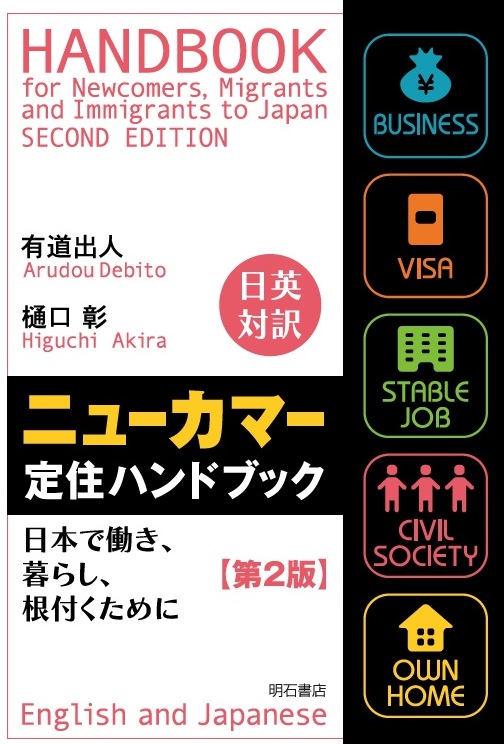
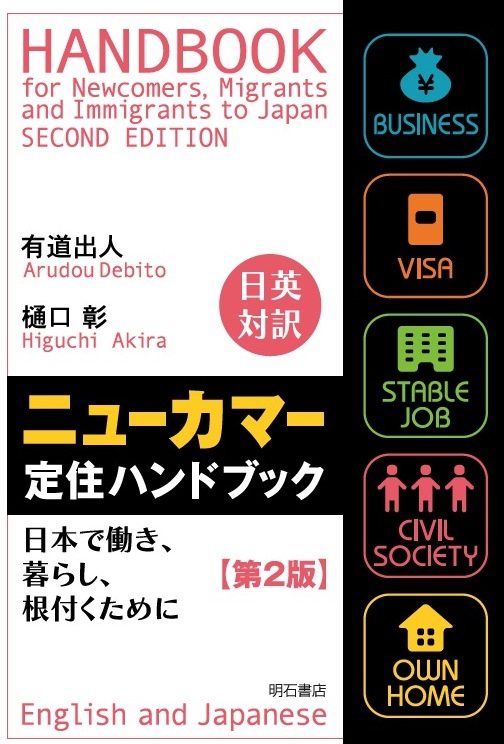
    2nd Edition of HANDBOOK FOR NEWCOMERS, MIGRANTS, & IMMIGRANTS to Japan on sale Dec 2012, updated

    Posted by debito on 3rd December 2012

    I’m very happy to announce that at long last (it takes a number of months to get things through the publishing pipeline), the Second Edition of HANDBOOK FOR NEWCOMERS, MIGRANTS AND IMMIGRANTS TO JAPAN goes on sale in December 2012.

    This long-selling bilingual guide to life in Japan, co-authored with legal scrivener Akira Higuchi, has assisted thousands of readers and engendered rave reviews. Its goal has been to assist people to live more stable, secure lives in Japan, and walks the reader through the process of securing a better visa, getting a better job (even start one’s own business), troubleshooting through difficult situations both bureaucratically and interpersonally, establishing one’s finances and arrangements for the next of kin, even giving something back to Japanese society. It is a one-stop guide from arrival in Japan through departure from this mortal coil, and now it has been updated to reflect the changes in the Immigration and registry laws that took place in July 2012. Get ready to get yourself a new copy!

    (Oh, and my Japan Times JBC column has been postponed a week due to a major scoop this week that will fill the Community Page…)

    Posted in Anti-discrimination templates/meetings, Articles & Publications, Good News, Handbook for Newcomers, Human Rights, Immigration & Assimilation, Labor issues, Practical advice, 日本語 | 4 Comments »

    Sakanaka in Japan Times: Japan as we know it is doomed, only immigrants can save it

    Posted by debito on 22nd October 2012

    Japan Times: Japan as we know it is doomed. Only a revolution can save it. What kind of revolution? Japan must become “a nation of immigrants.”

    That’s a hard sell in this notoriously closed country. Salesman-in-chief — surprisingly enough — is a retired Justice Ministry bureaucrat named Hidenori Sakanaka, former head of the ministry’s Tokyo Immigration Bureau and current executive director of the Japan Immigration Policy Institute, a private think tank he founded in 2007.

    “Japan,” he said in a recent telephone interview, “is on the brink of collapse.” [...] No nation, barring war or plague, has ever shrunk at such a pace, and as for aging, there are no historical precedents of any kind. The nation needs a fountain of youth. Sakanaka claims to have found one. Japan, he said, “must welcome 10 million immigrants between now and 2050.” [...] It sounds fantastic, and in fact, Sakanaka acknowledges, would require legislation now lacking — anti-discrimination laws above all.

    Posted in "Pinprick Protests", Cultural Issue, Discussions, Human Rights, Immigration & Assimilation, Japanese Government, Japanese Politics, Labor issues, Practical advice, Unsustainable Japanese Society | 52 Comments »

    Kyodo: NJ on welfare (unlike Japanese on welfare) now need to pay pension premiums, says Japan Pension Service

    Posted by debito on 19th October 2012

    Kyodo: Japan Pension Service has drawn up a guideline that renders foreign residents on welfare no longer eligible for a uniform waiver from premium payments for the public pension, effectively a turnaround from a long-held practice of treating them equally with Japanese, sources familiar with the matter said Tuesday.

    Human rights activists said it is tantamount to discrimination based on nationality. In fiscal 2010, roughly 1.41 million households were on public assistance. Around 42,000 were households led by foreign residents.

    In a reply dated Aug. 10 to a query from a local pension service office, JPS, a government affiliate commissioned to undertake pension services, said, “Public assistance benefits are provided to foreigners living in poverty as done so for Japanese nationals, but foreigners are not subject to the law on public assistance.”

    Posted in Exclusionism, Japanese Government, Labor issues, Pension System, Problematic Foreign Treatment | 15 Comments »

    Kyodo: “Foreign caregiver program faces tightening”: Death knell of program as J media finds ways to blame the gaijin?

    Posted by debito on 8th September 2012

    Let’s have a look at what’s becoming of Japan’s latest “revolving door” labor visa regime scam (after the “Trainees”, the “Nikkei Returnees”, and the “Points System”): the “foreign caregivers”, which has ground to a halt due to the (otherwise fully-qualified) NJ health professionals themselves realizing that the systematic barriers were creating an exploitative regime. So now according to Kyodo News it looks like it’s being scaled back. But not without kicking someone in the ribs first. As submitter JDG notes:

    “The foreign caregiver program was launched because there was a realization that the looming shortage of caregivers to meet Japan’s aging population had already arrived. However, as you have documented, from it’s inception it has been riddled with unrealistic expectations, low pay, harsh conditions, few incentives, and subject to some strange accounting.

    “Well, here is the logical conclusion: foreign caregivers are ‘gaijin criminals taking advantage of the system’. Rather than examining what is wrong with the system, the (of course) natural response by officials is to make the program even tougher to live with for caregivers. Only a Kyoto University Prof. seems to have any sense about him. I would say that this development will mark the end (in real terms) of the program. Of course, it’s all the NJ’s fault…”

    Posted in Bad Business Practices, Bad Social Science, Ironies & Hypocrisies, Japanese Government, Labor issues, Media | 12 Comments »

    Japan Times JUST BE CAUSE Column 54 Aug 7, 2012: “For nikkei immigrants in Japan, it doesn’t have to be a bug’s life”

    Posted by debito on 9th August 2012

    With apologies to Franz Kafka: As Beto awoke one morning from uneasy dreams, he found himself transformed in his futon into a gigantic cockroach.

    “What’s happened to me?” he thought. In his native land down south, he had been a person — if at times underprivileged due to his nikkei status. So, years ago, he “repatriated” to Japan, attracted by promises of better milk and honey. Yet now he felt even more marginalized by the locals here, who called themselves “people” yet treated him at times like he was an insect.

    Beto scurried off to work, where people shied away and refused to sit by him in the train cars. But as the end of the line approached, the coach filled up with fellow cockroaches, and people stopped paying attention.

    The people at his factory also took no notice of his metamorphosis. His supervisors were used to dealing with cockroaches. Bugs seemed an inevitable part of lower-rent circumstances. As in the train, it seemed some people had learned to “co-exist” with them in close quarters.

    In public, however, reactions were different. Alone, Beto was often seen as something exotic, maybe even collectable if there was a curious person flitting about who was interested in “speaking bug.” But if seen as part of a swarm, people’s knee-jerk reactions were to take steps against them. Bugs might overrun the place, making it feel less the realm of the masters, more of the roaches…

    Posted in Articles & Publications, Humor, Immigration & Assimilation, Labor issues, NJ voices ignored, discounted & discredited | 12 Comments »

    Japan Times on reaffirmed J workers’ “right to strike”, thanks to judicial precedent set by defeated 2012 nuisance lawsuit from eikaiwa Berlitz Inc.

    Posted by debito on 29th July 2012

    In one important NJ legacy, Japan’s courts have, according to the Japan Times, reaffirmed the right to strike for “laborers” (roudousha) in Japan’s private sector. Note that the right to strike has been denied to public-sector laborers — a legacy of SCAP’s “Reverse Course” of 1947-8 (Akira Suzuki, “The History of Labor in Japan in the Twentieth Century”, in Jan Lucassen, ed. “Global Labour History”, pg. 181), when the American occupiers were worried about Japan “going Red” like China and North Korea; to maintain administrative order, bureaucrats were explicitly denied the right to strike or engage in political activities (fortunately, they retained the right to vote; thanks for small favors). But in the face of eroding labor rights over the past few decades (when, for example, the rights of permanently-contracted workers to not have instant termination without reason, were being abused by unilateral contract terminations of NJ educators), a nuisance lawsuit by Berlitz against its eikaiwa workers fortunately ended up in the reaffirmation of their right to strike last February. Since we have talked about it on Debito.org at great length in the past, I just wanted to note this for the record. And say thanks, good job, for standing your ground for all of us.

    Japan Times: Over 100 Berlitz Japan teachers struck over 3,000 lessons between December 2007 and November 2008 in order to win a 4.6-percent pay hike and one-off one-month bonus. The language school claimed the strikes were illegal mainly because the union gave little notice of the impending strikes… Tokyo District Court dismissed the entire case in its Feb. 27, 2012, verdict, reaffirming the powerful guarantee of the right to strike in Japan.

    Posted in Anti-discrimination templates/meetings, Education, Labor issues, Lawsuits, NJ legacies | 2 Comments »

    Yomiuri: Iwate town sponsors Vietnamese future doctor — and people reportedly react with trepidation

    Posted by debito on 23rd July 2012

    In light of how NJ nurses under a national visa program have been treated in the face of a chronic careworkers shortage, here we have a case where even local sponsorship of a NJ doctor is also viewed (according to the Yomiuri, which may indeed in the interest of “balance” be conjuring up a tempest in a teapot) with suspicion because she is a foreigner. After all, she might not stay! Then again, so might not anyone else being trained on that scholarship program regardless of nationality. Ah, but foreigners are different, you see. They always represent a flight risk… Anyhoo, good news tainted with an editorial bias of caution and trepidation just because the subject is NJ.

    Yomiuri: Facing a serious and chronic shortage of doctors, the town of Ichinohe felt it necessary to look overseas to find medical staff willing to live and work in the rural area. The town plans to spend more than 10 million yen on school and living expenses for a Vietnamese woman on the condition that she will practice medicine in the town for at least seven years after obtaining her license.

    The unusual plan raised eyebrows when the town ran it by the Health, Labor and Welfare Ministry, and some residents have questioned why the town is sponsoring a foreigner. However, Ichinohe Mayor Akira Inaba believes the unprecedented plan is just what the town needs. “The scholarship program for Japanese medical students hasn’t attracted enough applicants to meet its quota,” he said. “We have no other choice but to secure our doctors on our own.”

    Posted in Cultural Issue, Good News, Immigration & Assimilation, Japanese Government, Labor issues, Unsustainable Japanese Society | 13 Comments »

    Japan Times JUST BE CAUSE Column 53 July 3, 2012: “In formulating immigration policy, no seat at the table for NJ”

    Posted by debito on 4th July 2012

    My Japan Times JUST BE CAUSE Column 53 dated July 3, 2012, is on the Japanese Government’s renewed policy debate on creating conditions conducive to immigration (without actually portraying it in any way as “immigration” (imin), just more NJ residents). It’s their attempt to address Japan’s demographic and probable economic nosedive despite their assiduous efforts over the decades to a) exploit NJ as temporary workers on a revolving-door labor visa regime, b) blame NJ for all manner of social ills, including foreign crime and desertion, and in the process c) poison the public debate arena for productive discussion about ever treating NJ well enough that they might want to actually stay (since the past three years have seen the NJ population continuously dropping, after 48 years of unbroken rise). The writing’s on the wall, and the GOJ is finally doing something constructive. But (as usual) the bureaucracy is controlling the agenda, and the typical blind spots are coming into play, so as things stand now I think the policy drive will be ineffective. Have a read and a think.

    Posted in Articles & Publications, Exclusionism, Fingerprinting, Targeting, Tracking NJ, Good News, Human Rights, Immigration & Assimilation, Ironies & Hypocrisies, Japanese Government, Labor issues, Practical advice, Unsustainable Japanese Society | 13 Comments »

    Asia Pacific Bulletin: “Accepting Immigrants: Japan’s Last Opportunity for Economic Revival”

    Posted by debito on 1st July 2012

    Here’s some evidence of how the debate regarding Japan’s need for immigration is starting to percolate through USG policy circles — this time the Asia Pacific Bulletin. It’s another well-intentioned brief article for busy policymakers, but with a couple of mistakes: 1) “since the 2011 earthquake the number of foreign residents in Japan has also been on a downward trend” is not quite right since it was on a downward trend before 3/11 too (in fact, when I was debunking the “Flyjin” Myth in my Japan Times column I demonstrated how the decreasing trend in NJ numbers was largely unaffected by the multiple disasters); 2) the “stagnant policy discussion at the national level” has in fact been restarted and quite actively discussed starting from May onwards (perhaps after Mr. Menju sent the article to press, but the APB website notes their turnaround on articles is mere weeks), as has been discussed here in detail on Debito.org. But Mr. Menju does get some important things very, very right — as in the other J media-manufactured myth of NJ crime and social disruption (especially the NPA’s involvement in cooking the numbers), how this dynamic forestalls a healthy discussion on immigration policy, and Japan’s overall need for immigration despite all the years of active ignoring of local governments’ advice on tolerance and acceptance. Decent stuff, and worth a read.

    Posted in Exclusionism, Immigration & Assimilation, Japanese Government, Japanese police/Foreign crime, Labor issues, Unsustainable Japanese Society | 32 Comments »

    GOJ Cabinet “Coexistence with NJ” Pt. 2: Critique of June 15, 2012 meeting — a very positive Third Act to this Political Theatre

    Posted by debito on 28th June 2012

    Following up on my blog post of June 10: “GOJ embryonic policymaking reboot for ‘co-existence with foreigners’”, here is an evaluation of the GOJ’s third meeting of June 15, 2012. I offer summaries of each presenter’s materials below. My overall comment is that despite some fair-to-middling presentation styles (one a bit limply bureaucratic, another full of irrelevant chaff), all of them have their heart in the right place. Two of them I just wanted to hug the presenter afterwards for getting things right all the way down to the proper semantics (of seeing NJ as fellow “resident” with their own sense of “community”; they even overrode the potentially dichotomous “coexistence” meme for seeing NJ as perpetual outsiders to “handle and administrate”, which Japan’s sweaty-handed bureaucrats can never get beyond). How much of this advice will be taken is another issue, but at least the advice is being given. It’s a good Third Act in this political theatre. It’s just a pity the short-sighted bureaucrats almost always get first dibs on agenda setting, with the people who might offer different opinions thrown in later down the line as an afterthought. And there’s still no mention of that law against racial discrimination…

    Posted in Cultural Issue, Good News, Immigration & Assimilation, Japanese Government, Labor issues, Practical advice, Unsustainable Japanese Society, 日本語 | 12 Comments »

    Kyodo: Foreign caregiver exits put program in doubt, complete with editorial slant blaming NJ for being fickle

    Posted by debito on 22nd June 2012

    The Kyodo article below, on how Indonesian and Filipina nurses and caregivers (even those who have passed the arduous qualifying exam) are leaving Japan anyway, has been featured within the comments section of another Debito.org blog entry (here). It seems to be gathering steam there, so let me post the article here as a stand-alone, and repost below it the subsequent replies from Debito.org Readers (the really good ones start doing the math, revealing there’s something fishy going on at the administrative level, beyond just blaming the NJ caregivers for not doing what they’re told after all the GOJ bullshit they’ve put up with).

    My take on this Kyodo article is about the nasty little editorial slants and needles within. Particularly nasty is how all otherwise qualified NJ caregivers are suddenly unworthy of emptying Japanese bedpans just because some decide they have a life outside Japan. Quoth one professor with a PhD in nastiness at Todai (Kiyoshi Kitamura, a professor at the University of Tokyo’s International Research Center for Medical Education): “To what extent would it be considered appropriate for the foreign caregivers’ lives to be bound by the program? We must contemplate this, along with the question of whether the Japanese people are really up for nursing care provided by foreigners.”

    Moreover, Kyodo, is this news, or editorializing? “Yet as of June, five of them had quit and returned to Indonesia ‘for personal reasons,’ bringing great disappointment to the facilities that spent tens of millions of yen training them.” Awww, diddums!

    Posted in Bad Business Practices, Human Rights, Ironies & Hypocrisies, Japanese Government, Labor issues, Media, Problematic Foreign Treatment | 23 Comments »

    GOJ embryonic policymaking reboot for “co-existence with foreigners”: Some good stuff, but once again, policy about NJ without any input from them

    Posted by debito on 10th June 2012

    John Morris at H-JAPAN: A committee has been set up within the Cabinet Office of Japan, composed of the vice-ministers of the Cabinet Secretariat, Ministry of Internal Affairs and Communications, Ministiry of Law, Foreign Affairs, Finance, Education etc, Health etc, Agricutlure etc, Industry etc, Land etc, Police to investigate and recommend policy on “co-existence with foreigners”. Information on the committee can be found at the following URL:
    http://www.cas.go.jp/jp/seisaku/kyousei/index.html
    The documentation provided here gives a very succinct summary of what the government (national level bureaucrats?) of Japan think about “foreigners” here, and how they formulate their perceptions of what the “problems” are, and very vaguely hint at where they see future solutions.

    SUMMARY AND ANALYSIS: This is not the first time the organs of the Japanese government have talked about “coexistence with foreigners” (gaikokujin to no kyousei shakai jitsugen), but more likely than not these happen at the local level (cf. the Hamamatsu Sengen, which happened repeatedly from over a decade ago yet was studiously ignored at the national level). Now that discussion on this is taking place at the national, Cabinet level, this is a positive development. However, these meetings (two so far, the first one was less than an hour) at the outset show the hallmarks of so much Japanese policymaking: a biased agenda (with all the normalized invective of “wagakuni” (our country) semantically offsetting those foreigners (who have to “co-exist” with Japanese, not merge into one polity)) regarding the policy treatment of people without any input from the people being treated. Inevitable blind spots, such as an overemphasis on Nikkei and children’s education, are already latent in the materials below. In any case, this is a very interesting and rare view into the dialogs and mindsets behind the creation of public policy re NJ in Japan. More detailed summaries and analysis follow below.

    Posted in Anti-discrimination templates/meetings, Fingerprinting, Targeting, Tracking NJ, Good News, Immigration & Assimilation, Japanese Government, Japanese police/Foreign crime, Labor issues, Problematic Foreign Treatment, 日本語 | 20 Comments »

    Kyodo: Municipalities to deny services to illegal NJ; Kuchikomi: Rising NJ welfare chiselers “social parasites”

    Posted by debito on 1st June 2012

    We’ve had a discussion recently as part of Debito.org Comments about one of the side-effects of Japan’s new residency-certificate registration (juuminhyou) coming up in July. People suspect that the GOJ is using this revision as a means not only to make sure that local governments aren’t being “soft” on NJ visa overstayers (by denying them benefits even the Kyodo article below acknowledges they are entitled to), but also to check whether all NJ residents are registered and paying into Japan’s social insurance system. This is controversial because plenty of Japanese also opt out of the system, and also because it will possibly become a means to say, “Pay in or no visa renewal,” something that citizens obviously cannot be threatened with.

    This is yet another example of social Othering on a policy level (if you want to tighten things up, you should do it across the board for everyone in Japan, not just NJ), not to mention with some pretty stiff potential penalties (back paying into the system may run into the tens and hundreds of man yen, which can be financially insurmountable, and unjust especially when some employers in Japan have conveniently forgotten to pay in their half of the NJ employee’s social insurance when hiring NJ full time). Thus NJ get uprooted from Japan due to their employer’s negligence.

    I for one haven’t done enough research on what’s going to happen in coming months under the new system (my scrivener colleague in the visa industry himself too is waiting and seeing), but when it becomes plainer it’ll be discussed here. What IS plainer is that the Japanese media is already gearing up to portray the perpetual scapegoats for Japan’s social ills — NJ — this time as welfare spongers and social parasites. See the second article below.

    Note that all of the things that are being alleged against foreign “welfare chiselers” in that article I’ve heard and seen being done by Japanese too (especially the fake marriage bit — but what’s not covered in the article is how a NJ visa changes when a divorce occurs, so it’s not that “easy”). But one need not mention that inconvenient detail. NJ shouldn’t be here anyway if they’re going to commit, er, the same crimes that Japanese commit. Once again, social Othering and scapegoating of a disenfranchised minority is SOP in Japan for lots of social ills — and worse yet, the specter of “foreign hordes taking advantage of Japan’s overgenerous system” sells newspapers and alienates the aliens. Nothing less than media-bred xenophobia.

    Posted in Bad Social Science, Exclusionism, Hate Speech and Xenophobia, Human Rights, Ironies & Hypocrisies, Japanese Government, Labor issues, Media | 28 Comments »

    Discussion: Aly Rustom on “Ways to fix Japan”

    Posted by debito on 26th May 2012

    Rustom: It has taken me over a year to write this piece. I have put my heart and soul into making this reading as concise as possible. This is a small essay on the problems of Japan, and my personal opinion on how to fix them.

    These days, Japan is suffering from a lot of socioeconomic problems. Whenever I talk to people and ask how can we fix them, no one ever has an answer. Everyone just folds their arms, tilts their head and says “Muzukashii” (Its difficult) Well, I do have a few solutions.
    I have written a small piece here on how to solve these problems. I have written this as a foreigner who has lived in Japan for over ten years and has the unique perspective of looking at things from both the inside and the outside.

    It is not my intention to try to tell Japan or it’s people what to do. Nor do I have any delusions of grandeur that the Japanese will all of a sudden sit up and take notice of what I have to say. I am only writing this to show that there are concrete steps that can be taken to heal Japan, and that all it takes is a little bit of thinking outside the box to make this happen. I am also hoping that this small piece will at least start up some degree of discourse which will eventually lead to some level of action sometime in the future. I also felt the need to vent, as I see a beautiful country being destroyed since no one wants to take the helm and do what needs to be done. So without further ado, let’s start:

    Posted in Discussions, Immigration & Assimilation, Japanese Government, Labor issues, Practical advice, Unsustainable Japanese Society | 40 Comments »

    Naha City now requires JETs/AETs and JTEs to provide urine sample (drug test?) for contract renewal (UPDATED: At this writing, probably a false alarm)

    Posted by debito on 30th March 2012

    Here’s another example of how NJ are not being trusted. Employees under the auspices of the JET Programme in Naha, AET, are being required to provide a urine sample in order to get a job. [...] We’ve seen this attitude from the police in Tokyo Azabu, who conducted similar “I-Pee” urine tests on NJ exiting bars in Roppongi without a warrant in 2009 just for tits and giggles, and because, after all, they’re the Japanese police so sod you. Now we see police powers expanding beyond the NPA (as they did when unlawfully deputizing hotels to smoke out illegal aliens back in 2005) and into private-sector/public-sector eikaiwa. Expect more of the same for whatever reason dreamable up.

    XY: Dear Debito, Naha city now requires all AETs to take a urine test. Only the AETs, not the Japanese teachers. I thought I would bring this to your attention, as you are the right one to handle this type of situation. Can you give advice on how to deal with it? As AETs are blocked from forming any type of organization or union to fight against this type of BS. Here is the link: http://www.edu.city.naha.okinawa.jp/gakkyou/H24AETnaitei.pdf Notice on the second set of requirements where it tells the prospective applicant to turn in health related materials, it includes urine analysis. This is for drug testing, and only applies to AETs…

    UPDATE MARCH 31: EVIDENCE PROVIDED THAT JTES ALSO REQUIRED TO SUBMIT TO URINALYSIS, SO THIS MEASURE ALSO APPLIES TO JAPANESE AS WELL. Conclusion: I still don’t think this is what some claim to be a mere “routine physical” (I think, given what I know about J employers’ access to health records, it is in fact a drug test, given the prior media shock of JETs and drugs in Okinawa), but if it’s applied across the board to Japanese and NJ as well, it’s not really a Debito.org issue. Might be an invasion of privacy issue, but not one necessarily of unfairness towards NJ, so that’s better discussed elsewhere. So Readers are welcome to continue to comment on this issue below, but unless we receive new information from the original claimant(s), I’m going to have to declare this one a false alarm and offer my apologies. Sorry.

    Posted in "Pinprick Protests", Japanese Government, Labor issues | 48 Comments »

    Mainichi: 23 percent of Japan’s top firms eager to employ more NJ. Why this is not newsworthy.

    Posted by debito on 15th March 2012

    Mainichi: Some 23 percent of Japan’s top 122 companies are considering employing more foreigners starting from next year, citing plans for overseas expansion as their main incentive, a Mainichi survey has revealed. Sixty-two companies, some 50.8 percent of all firms surveyed, further answered that they are likely to hire more foreign employees in the next 10 years as well. Conversely, 45 companies, or 36.9 percent, answered that their foreign employee numbers will remain unchanged. There were no firms that plan to decrease foreign employment from current figures.

    COMMENT: Well, seems that trumpeting that Japanese companies want to hire foreigners is becoming a periodic media thing (the last survey put up on Debito.org was featured in the Asahi back in April 2010). But saying you want something is not news; actually doing it, is. But the lack of job-placement support for NJ graduates of Japanese universities, and the treatment of Michael Woodford (who rose through the ranks to CEO over decades of dedication to the company, only to be sacked for “cultural reasons” in a sea of corruption), do not inspire hope.

    Posted in Cultural Issue, Good News, Labor issues, Media, 日本語 | 9 Comments »

    Japan Times JUST BE CAUSE Column 49: “Japan’s revolving-door immigration policy hard-wired to fail”

    Posted by debito on 7th March 2012

    Japan Times: Last December, the Japanese government announced that a new visa regime with a “points system” would be introduced this spring.

    It is designed to attract 2,000 non-Japanese (NJ) with a “high degree of capability” (kōdo jinzai), meaning people with high salaries, impeccable educational and vocational pedigrees, specialized technical knowledge and excellent managerial/administrative skills.

    Those lucky foreign millionaire Ph.Ds beating a path to this land of opportunity would get preferential visa treatment: five-year visas, fast-tracking to permanent residency, work status for spouses — even visas to bring their parents and “hired housekeepers” along.

    Sweet. But then comes the fine print: You must get 70 points on the Justice Ministry’s qualifying scale (see www.moj.go.jp/content/000083223.pdf) And it’s tough, really tough. Take the test and see if you qualify (I don’t). Symptomatic of decisions by committee, it’s a salad of idealized preferences without regard for real-world application. There’s even a funny sliding scale where you get more points the longer you’ve worked, yet fewer points the older you get.

    Interesting is how low Japanese language ability is weighted: only 10 points — in a “bonus” category. One would have assumed that people communicative in Japan’s lingua franca would be highly prized (especially when the call for kōdo jinzai is in Japanese only).

    However, I would argue the opposite: Crowds of NJ completely fluent in Japanese are exactly what the government does not want. Visa regimes with illiterate foreigners facing insurmountable hurdles are what maintain Japan’s revolving-door labor market.

    For example, consider 2008′s visa program to import elderly-care nurses from the Philippines and Indonesia…

    Posted in Articles & Publications, Bad Business Practices, Exclusionism, Human Rights, Immigration & Assimilation, Ironies & Hypocrisies, Japanese Government, Labor issues, Unsustainable Japanese Society | 34 Comments »

    Yomiuri: Language hurdle trips up Indonesian nurses in 4-year-old GOJ EPA program, and they’re leaving. By design, methinks.

    Posted by debito on 23rd February 2012

    Speaking of GOJ visa statuses with high to insurmountable hurdles, here’s how the years-long (started in 2008) bilateral program to bring over nurses from The Philippines and Indonesia to work in Japan’s medical system is doing: As predicted. Precisely due to “language barriers”, NJ are being relegated to lower-skilled labor and then sent home (or else, as you can also see below, going home by themselves after having enough of it all). Again, this is the point of Japan’s visa regimes — make sure migrants never become immigrants, siphon off the best working years of their lives, send them back for whatever excuse or shortcoming you can come up with, then bring in a new batch of dupes filled with false hopes. That way you keep the revolving-door labor market revolving, and never let NJ settle down here and get their due for their tax and pension payments. How nice. But as I’ve written before, it’s been the perpetual SOP for the GOJ.

    Yomiuri: More than half of 104 Indonesian nurses who came to Japan in 2008 through a bilateral economic partnership agreement to obtain nursing licenses have returned home, due mainly to difficulties meeting Japanese language requirements, it has been learned.

    Through the EPA program, Indonesian nurses have been allowed to work in Japanese hospitals for three years as assistant nurses who take care of inpatients. They are all licensed nurses in Indonesia. The program requires they pass an annual national nursing certification test during their three-year stay.

    However, only 15 of the first group of 104 nurses who came to Japan from Indonesia passed the national exam. Among the 89 who failed the exam, 27 were granted special permission to extend their stay if they wished to because they managed to score a certain number of points on the previous exam. These nurses will take the national exam again in February.

    The remaining 62 returned to Indonesia by the end of August, though they were still eligible to take the national exam. Only four of them will return to Japan to take the February exam, meaning the remaining 58 have likely given up working in Japan.

    Posted in Bad Business Practices, Exclusionism, Ironies & Hypocrisies, Japanese Government, Labor issues, Problematic Foreign Treatment | 24 Comments »

    CNN’s Zakaria: Japan’s economy “has run out of gas”: first trade deficit in 31 years shows J’s decline and “the end of an era”

    Posted by debito on 5th February 2012

    Reader JD submits this as “Cliff Notes for Debito.org”. Quite so. It’s what we’ve been saying for a while now about Japan in decline. Only this time, we have something quantitative (and a major economic indicator) to demonstrate it:

    CNN: This week marks a turning point – one of the world’s great export engines has run out of gas… For the first time in 31 years, Japan has recorded a trade deficit… Tokyo’s policymakers have failed its people – they could have opened up many of its closed sectors to competition, reformed its labor laws to make Japanese labor more attractive, cut pension benefits, and allowed more immigration. Its government could have put the country on a path to reduce its massive debt burden. Instead, we’re now entering an era where one of the great manufacturing nations of history faces a looming current account deficit. With its debt at 211% of its GDP, if the cost of its borrowing increases, Tokyo would face an even greater crisis: A default… [Japan] was unable to change its ways, reform, and get less rigid. The result was decline.

    Posted in Bad Business Practices, Cultural Issue, Immigration & Assimilation, Japanese Government, Labor issues, Unsustainable Japanese Society | 23 Comments »

    Thai flood victims getting 6-month visas into Japan to maintain Japan Inc.’s supply lines, then booted back home

    Posted by debito on 22nd November 2011

    JT: Several thousand Thai workers at Japanese firms operating in Thailand will be allowed to work in Japan, Chief Cabinet Secretary Osamu Fujimura said Friday, as companies shift their production in light of the impact of the massive floods in the Southeast Asian country…

    Fujimura said the government is looking to accept thousands of Thai workers from about 30 firms for a fixed time frame of roughly six months. Among the conditions the government will impose on the firms is to make sure the Thai workers return to their home country…

    COMMENT: File this yet again under Japan Inc. having its cake and eating it too. We wouldn’t want to have Japanese corporations losing out because of natural disaster overseas impeding our supply lines, now, would we? (And as a petty but definitely related tangent, where is the Japanese media when you need them to criticize the Japanese “fly-jin” fleeing the country instead of staying behind to help Thailand recover? They certainly did their bashing when NJ, and apparently only NJ, allegedly flew the coop post-Fukushima.) So we’ll temporarily export the workers to Japan, have them keep up with the conveyer belts for the apparent honor of being extant in our safe, clean, modern society (while no doubt working cheaper than native Japanese, as usual), then boot them back as soon as we can so they cause no disruptions to our safe, clean, modern society (like we did our Brazilian cousins back in 2009 when they outlived their usefulness; we get to keep their investments anyway and need show no gratitude). Good ole foreign workers. Under Japan’s visa regime, they’re just widgets in the Grand Scheme.

    Posted in Bad Business Practices, Exclusionism, Immigration & Assimilation, Ironies & Hypocrisies, Japanese Government, Labor issues | 21 Comments »

    Quoted in Asia Weekly: “Falling birthrate, rising life expectancy afflict Japan”

    Posted by debito on 5th July 2011

    China Daily/Asia Weekly: An obvious concern is whether fewer tax-paying workers will be able to support more benefit-claiming retirees. Japan’s healthy personal savings may help in that regard. A more human question is, “Who will provide the daily care the elderly require?”…

    In 2010, of the 257 Filipinos who took the [qualifying exam to become a healthcare worker in Japan], only one passed. The success rate for Filipinos and Indonesians over the first two years of the program was also less than 1 percent, prompting some to regard the exam as a contrivance designed to restrict foreign professionals’ period of stay.

    “Japan has long maintained a tacit revolving-door policy for migrant labor,” says Arudou Debito, a naturalized- Japanese human-rights activist and researcher on internationalization.

    “The Japanese government imports cheap young workers during their most productive labor years, but under short-term work visa regimes to ensure they don’t settle here. In that sense, what is happening to the caregivers and nurses is completely within character.”

    Posted in Articles & Publications, Bad Business Practices, Japanese Government, Labor issues, Problematic Foreign Treatment, Unsustainable Japanese Society | 6 Comments »

    US State Department report 2011: “Japan’s Foreign trainee program ‘like human trafficking’”

    Posted by debito on 2nd July 2011

    Yomiuri: Regarding conditions for foreign trainees in Japan, the [US State Department] noted “the media and NGOs continued to report abuses including debt bondage, restrictions on movement, unpaid wages, overtime, fraud and contracting workers out to different employers–elements which contribute to situations of trafficking.” The Japanese government has not officially recognized the existence of such problems, the report said. It also said Japan “did not identify or provide protection to any victims of forced labor.”

    Asahi: The report said, “Japan is a destination, source, and transit country for men, women, and children subjected to forced labor and sex trafficking… The State Department recommended the Japanese government strengthen efforts to investigate, prosecute and punish acts of forced labor, including those that fall within the foreign trainee program.

    COMMENT: The U.S. State Department report text in full included in this blog entry.

    Posted in Bad Business Practices, Gaiatsu, Good News, Human Rights, Japanese Government, Labor issues | 12 Comments »

    Reuters Expose: Japan’s ‘throwaway’ nuclear workers, including NJ “temporary temps”

    Posted by debito on 29th June 2011

    Here is a deep article from Reuters this month on how deep the rot goes in Japan’s labor market and safety practices regarding nuclear power. It’s germane to Debito.org because even NJ workers have been hired and exposed to radiation in Japan — without proper recordkeeping. Guess that’s one of the advantages of utilizing NJ laborers — they are the “temp temps” (my term) that escape any official scrutiny because imported labor “sent home” after use is somebody else’s problem.

    Reuters: [I]n 1997, the effort to save the 21-year-old [Fukushima] reactor from being scrapped at a large loss to its operator, Tokyo Electric, also included a quiet effort to skirt Japan’s safety rules: foreign workers were brought in for the most dangerous jobs, a manager of the project said.

    “It’s not well known, but I know what happened,” Kazunori Fujii, who managed part of the shroud replacement in 1997, told Reuters. “What we did would not have been allowed under Japanese safety standards.”

    The previously undisclosed hiring of welders from the United States and Southeast Asia underscores the way Tokyo Electric, a powerful monopoly with deep political connections in Japan, outsourced its riskiest work and developed a lax safety culture in the years leading to the Fukushima disaster, experts say…

    At Fukushima in 1997, Japanese safety rules were applied in a way that set very low radiation exposure limits on a daily basis, Fujii said. That was a prudent step, safety experts say, but it severely limited what Japanese workers could do on a single shift and increased costs.

    The workaround was to bring in foreign workers who would absorb a full-year’s allowable dose of radiation of between 20 millisieverts and 25 millisieverts in just a few days…

    It is not clear if the radiation doses for the foreign workers were recorded on an individual basis or if they have faced any heath problems. Tepco said it had no access to the worker records kept by its subcontractors. IHI said it had no record of the hiring of the foreign workers. Toshiba, another major contractor, also said it could not confirm that foreign workers were hired.

    Posted in Bad Business Practices, History, Ironies & Hypocrisies, Labor issues, Problematic Foreign Treatment | 9 Comments »

    2011′s annual GOJ Spot the Illegal Alien campaign enlists Tokyo Metro, deputizes general public with posters of cute and compliant NJ

    Posted by debito on 27th June 2011

    It’s that time of the year again, when the GOJ has its monthlong campaign to enlist the general public in spotting illegal aliens. Just to make sure that anyone can feel empowered to do Immigration’s job to spot check a NJ’s Gaijin Card (when, according to the Gaitouhou, only officials given policing powers by the MOJ are empowered to demand this form of ID), here we have a poster in a public place, issued by Tokyo Metro, with all sorts of cutesy NJ happily complying with the rigmarole. After all, the small print notes that that these NJ are causing “all kinds of problems” (well, at least they’re being less demonized this time; making them well dressed and cute was a nice touch). And also after all, the slogan is “ru-ru o mamotte kokusaika” (internationalization done by the rules); which is fine, except it would be nice if the police followed their own rules regarding enforcement of Gaijin Card checks. Poster follows, received June 23, 2011.

    Posted in Bad Social Science, Fingerprinting, Targeting, Tracking NJ, Immigration & Assimilation, Ironies & Hypocrisies, Japanese police/Foreign crime, Labor issues, Media, 日本語 | 38 Comments »

    Adidas assesses the “history of poor treatment of migrant workers in Japan”, now monitoring JITCO in conjunction with other major overseas outsourcers

    Posted by debito on 21st June 2011

    Supplementing yesterday’s report from Terrie Lloyd, concerning the aberrations from Japan’s addiction to underpaid NJ labor, Adidas (yes, the sports goods maker) suggests, as submitter Crustpunker says, “It is more or less common knowledge what goes on here regarding migrant workers I mean, ‘trainees’.”

    Talk about an open secret. It only took about two decades for the GOJ to amend the laws, of course so Japan’s industry (not to mention overseas sourcers) got away with plenty while the going was good. Nevertheless, no doubt we’ll soon have laments in the Japanese media about how our industry must now suffer since either a) Japanese are underemployed, or b) Japanese industry is being hurt by NJ labor refusing to be exploited anymore. Sob away.

    Adidas concludes: There is, regrettably, a history of poor treatment of migrant workers in Japan and it is not a situation which will change overnight, even with this new legislation. So we recognise that we have a role to play in improving the system for migrant workers. In collaboration with several other brands including Nike, Gap and Disney, the adidas Group has set up quarterly meetings with Japanese vendors, suppliers, government representatives and JITCO. Working together the brands are helping to bring more transparency to the Intern Training Programme and establish a standard for acceptable recruitment fees as well as offer capacity building and training on applying the immigration and labour laws.

    Posted in Bad Business Practices, Gaiatsu, Human Rights, Japanese Government, Labor issues | 4 Comments »

    Terrie’s Take on how Japanese companies are too “addicted” to cheap Chinese “Trainee” labor to hire unemployed Japanese

    Posted by debito on 20th June 2011

    Received this this morning from Terrie Lloyd. Very much worth reading, as it shows the damage done by the market aberration (if you believe in free markets as the final arbiter of fairness) of holding labor costs artificially low — you get resistance to ever raising them again once business gets used to those costs as being “normal”. As wages and working conditions in Japan continue their race to the bottom, it seems that two decades of NJ “Trainee” near-slave and slave labor will come back to haunt the Japanese economy after all.

    Terrie Lloyd: According to an article in the Japan Times on Thursday, quoting numbers from a Labor Ministry report released earlier in the week, there are now 2.02m people in Japan receiving welfare checks, more than any time since 1952. “Welfare” in Japan is apparently defined as financial assistance offered by the government to a household when its total income falls below the national minimum.

    Presumably a big contributor to this record number of needy people has been the Great East Japan earthquake in March. The level of joblessness has soared to around 90% of employable survivors in the worst hit areas, and by the end of May about 110,000 were out of work and applying for the dole at various Hello Work offices in Iwate, Miyagi, and Fukushima prefectures.

    So, one would think that with this excess capacity of workers, many of whom are from the agricultural, fisheries, and manufacturing industries, juxtaposed with the phenomenon of disappearing Chinese trainee workers from factories around the same regions, less than half of whom are yet to return, that there would be a slew of local hirings to make up the shortfall. Certainly after the Chinese trainees fled the disaster areas, there were plenty of news reports of employers grumpily saying, “We can’t trust Chinese employees, next time we’ll hire locals.”

    But are they following through with local hiring offers? Our guess is “not”.

    The reason is because a Japanese breadwinner from Iwate on unemployment, or even welfare, can still receive 2-5 times more than the Chinese trainees do for the same jobs. The factory and farm operators may grizzle about their “unreliable” Chinese employees, but without this source of ultra-cheap labor, they have no way of being able to compete with the flood of goods and produce coming in from China itself. The fact is that thousands of small companies all over Japan are addicted to cheap trainee labor from China and elsewhere, and to go local they would soon go out of business….

    Posted in Ironies & Hypocrisies, Japanese Government, Labor issues, Problematic Foreign Treatment, Shoe on the Other Foot Dept., Unsustainable Japanese Society | 11 Comments »

    Asahi: NJ Nurse trainees leave Japan despite 1-year extension to taking qualifying test

    Posted by debito on 15th June 2011

    The GOJ is trying to plug the leak of NJ trainee nurses leaving Japan despite their best efforts on the qualifying exam. But after all these years of insufficient institutional support, it’s too little, too late, and disorganized at that; according to the Asahi article below, morale is clearly low for them. Mayhaps the jig is up, and word is getting round at last that the NJ nurse training program was after all just another guise for a revolving-door labor force?

    Asahi: Many Indonesian nurse trainees who failed their exams have returned home amid confusion over who would be allowed to stay for another year to retake the test.

    The government decided to allow 68 of the 78 Indonesians who failed this year’s nursing exam to stay and take another exam next year. But 25 of the 91 Indonesians who took the exam in March have already left.

    “I first heard about an extended stay some time ago, but I was not given any details,” said a woman in her 30s who failed the exam and left in April. “After all, I think we are not needed.”…

    [Another] woman, who failed in the exam by a slight margin, knew she could be allowed to stay. But she said she has lost her enthusiasm to work in Japan because of a lack of support from the government.

    Posted in Immigration & Assimilation, Japanese Government, Labor issues, Problematic Foreign Treatment, Unsustainable Japanese Society | 8 Comments »

    Sankei: MOJ proposes easier visas for importing “higher quality” NJ labor; neglects to offer NJ stronger civil or labor rights

    Posted by debito on 31st May 2011

    The Sankei reports on May 25 that the Ministry of Justice will be loosening some of its strictures on NJ visas (the Sankei uses the word nohouzu in its headline; I’m not 100% sure of the nuance but it sounds like “a wild and endless expansion of favorable treatment regarding NJ entry visas”; rather snotty, but that’s the Sankei for ya).

    The new Immigration policy is directed at NJ with very high skills (koudo jinzai — a good idea) and their families (who will also be allowed to work; wow, that’s a change!), will have a points system for evaluation (another good idea), will offer longer visa periods (5 years), and will loosen the specificity between work visas. It’s being touted as a means to make Japan more appealing to NJ labor (you had better!).

    Sounds like a step in the right direction. But it’s still 中途半端. What’s missing is GOJ guaranteeing some degree of protection of labor and civil rights after NJ get here. And what about qualifications? Just try practicing law, medicine, or most other licensed skills in Japan now without going through the rigmarole of domestic certification, with walls so high (cf. the NJ nurses from Indonesia and The Philippines over the past few years) that almost all NJ applicants fail (and, magically, have to return home as usual after three years, just like any other revolving-door “Trainee” or “Researcher” NJ laborer).

    This isn’t the first time a points system etc. has been floated (only to die the death of a thousand meddling bureaucrats) either. I guess the mandarins are realizing what a fix Japan is in without NJ labor. But if this kind of policy is going to happen at all, the almighty MOJ has to be the one proposing it. Then perhaps the waters will part for Moses. Let’s wait and see.

    But this is on balance “good” news. But not “great” news unless the GOJ also does something to force domestic actors to treat NJ nicely. Which is doubtful.

    Posted in Good News, Human Rights, Immigration & Assimilation, Japanese Government, Labor issues, Unsustainable Japanese Society, 日本語 | 12 Comments »

    Nikkei Business magazine special (May 2, 2011) on the future and necessity of NJ labor to Japan

    Posted by debito on 24th May 2011

    Getting back to business, here is an excellent series of articles on how important NJ labor has been and will be to Japan’s future. Eighteen pages on the whos, whats, and why-you-should-cares in the Nikkei Business magazine dated May 2, 2011.

    After the cover (Title: Kieta Gaikokujin Roudou Ryoku: Nihonjin dake de shokuba o mamoreru ka, or “Disappeared NJ Labor Force: Can Japanese maintain the workplaces by themselves?”) and table of contents, we open with a splash page showing Chinese waiting for their bags at the airport carousel after returning to China.

    Pages 20 through 23 give us an assessment of NJ labor in several business sectors: Restaurants, Textiles, Finance, Convenience Stores, Agriculture, IT, Education, Tourism, and Airflight, headlining that the NJ labor force has “evaporated”.

    Pages 24 and 25 give us the raw data, noting that the majority of NJ (55%) work in small companies of less than 100 employees, and that the near majority of NJ laborers (44%) are Chinese. The point is that “a closed Japanese labor market is impossible”.

    Pages 26 and 27 give us a close up about a farm that lost none of its workers, and even asked (for a change, given the Japanese media) what NJ thought. It was all part of the magazine’s suggestions about what should be done to improve things and give NJ a stake: Accountability, Bonds, Careers, and recognizing Diversity. Even offered suggestions about how to simplify Japanese.

    Pages 27 and 28 are the “money shot”, where the article says most of the things that we have said all along here on Debito.org and in my Japan Times articles: You can’t keep on using people as simple throwaway labor and expect them to stay, and you can’t keep doing things like bribe people to go back (as was done with the Nikkei in 2009) or make hurdles too high to get over (as is being done with NJ nurses) and expect a sustainable labor force.

    Good stuff. And about bloody time. Scans of pages in gallery form below.

    Posted in Bad Business Practices, Cultural Issue, Human Rights, Immigration & Assimilation, Labor issues, Practical advice, Unsustainable Japanese Society, 日本語 | 7 Comments »

    JT/Kyodo: NJ key to Japan’s recovery, says Iokibe Makoto, chair of GOJ Reconstruction Design Council. Well, fancy that.

    Posted by debito on 18th May 2011

    Get a load of this:

    Kyodo — Large numbers of foreigners will be needed to help revive the farming and fishery industries in areas damaged by the March 11 mega-quake and tsunami, the head of a reconstruction panel said Friday.

    “It is important to draw human resources, including permanent foreign residents” to the hard-hit Tohoku region, Makoto Iokibe, chair of the Reconstruction Design Council, said at the Japan National Press Club.”

    COMMENT: As submitter CJ commented: “What foreigner WOULDN’T leap at the opportunity to perform manual labor all day bathed in background radiation while being treated like a potential criminal and expected to leave when no longer needed, sacrificing pension contributions in the course of doing so?”

    Touche. Especially since day laborers are now a hot commodity for hot radioactive reactor cleanups, see below. Get freshly-imported foreign workers doing this instead and you’ll have no family in Japan complaining…

    Posted in Bad Business Practices, Bad Social Science, Ironies & Hypocrisies, Japanese Government, Labor issues | 16 Comments »

    Japan Times JUST BE CAUSE Column 39: “Better to be branded a ‘flyjin’ than a man of the ‘sheeple’” (May 3, 2011)

    Posted by debito on 4th May 2011

    JBC: The past two months have been uncomfortable for Japan, and for the country’s foreign residents. Non-Japanese (NJ) have been bashed in the media, unreservedly and undeservedly, as deserters in the face of disaster.

    Consider the birth of the epithet “fly-jin.” A corruption of the racist word gaijin for foreigners, it appeared in English-language media as a label for NJ who apparently flew the coop in Japan’s time of need. The Japanese media soon developed its own variants (e.g., Nihon o saru gaikokujin), and suddenly it was open season for denigrating NJ…

    I saw no articles putting things into perspective, comparing numbers of AWOL NJ with AWOL Japanese. Cowardice and desertion were linked with extranationality.

    Don’t get me wrong: I don’t doubt that many NJ did move due to the Tohoku disasters. But my question is: So what if they did?… Why should Japan care if NJ are leaving? Japan hasn’t exactly encouraged them to stay…

    Posted in Articles & Publications, Cultural Issue, Exclusionism, Gaiatsu, Hate Speech and Xenophobia, Ironies & Hypocrisies, Labor issues, Media, Unsustainable Japanese Society | 35 Comments »

    Ekonomisuto gives better articles on effects of both NJ leaving Japan and tourists avoiding Japan

    Posted by debito on 28th April 2011

    The Ekonomisuto Weekly of March 26, 2011, devotes three pages to the effects of the Fukushima Disasters on both Japan’s tourism/export and NJ labor markets. In the vein of how Japanese media coverage has been unsympathetic, even critical, of NJ leaving Japan, page three is of particular note. It offers harder numbers of NJ departures (although again with no comparison with Japanese movement), does not stoop to a tone of blame, and even accepts that NJ have a choice to work in other countries, so Japan had better take some measures to make itself more attractive to NJ labor or else. That’s more like it.

    I have long found the policymaking attitude of “working in Japan should be its own reward, so we needn’t try to make things more hospitable for foreign labor” puzzling, so this article is refreshing. I’ll be dealing with that attitude in part in my next Japan Times JUST BE CAUSE column, to be published in the Tuesday, May 3 edition of the JT. Enjoy.

    Posted in Gaiatsu, Labor issues, Media, Unsustainable Japanese Society, 日本語 | No Comments »

    Mainichi: “Industries left short-handed after NJ workers flee Japan following nuke accident”

    Posted by debito on 27th April 2011

    Here’s another article tying together more pinpoint data of NJ leaving Japan, with a focus on Chinese. Spare a tear for those poor, poor Japanese industries who took advantage of so many cheap temporary NJ workers, and are now crying because the NJ aren’t sticking around to be potentially irradiated as well as exploited:

    Mainichi: Tens of thousands of worried foreign workers left Japan shortly after a crisis at the nuclear power plant that was crippled by the March 11 earthquake and tsunami, causing serious labor shortages in some industries.

    After foreign governments lifted their temporary evacuation advisories issued in the wake of the nuclear crisis at the Fukushima No. 1 Nuclear Power Plant, many Americans and Europeans started coming back to Japan, albeit gradually. But workers from neighboring countries such as China have yet to do so.

    Chinese people in particular — mostly students and trainees — had occupied key parts of the workforce in many Japanese industries, and therefore if they continue to stay out of Japan for an extended period of time, they could have a grave impact on the industries and force firms to review their business strategies or cut production.

    Posted in Ironies & Hypocrisies, Labor issues, Media, Unsustainable Japanese Society, 日本語 | 17 Comments »

    Nikkei reports on the effect of “nihon saru gaikokujin”, aka Fly-jin, with some pretty shaky journalistic practices

    Posted by debito on 25th April 2011

    Here’s yet another article from a more reputable source, the Nihon Keizai Shinbun, talking about the phenomenon of NJ allegedly leaving Japan behind and having an adverse effect on Japan’s economy.

    For the record, I don’t doubt that NJ have left Japan due to the Tohoku Disasters. I just have my doubts that a) it’s any more significant than the Japanese who also left, yet get less nasty media coverage (I have yet to see an article comparing both J and NJ “flight” in terms of numbers), b) it’s worth blaming NJ for leaving, since Japanese overseas would probably do much the same if advised to do so by their government in the face of a disaster, and c) the media is actually doing their job investigating sources to nail down the exact statistics. Let’s see how the Nikkei does below: Some bogus journalistic practices unbecoming of something as trusted as the Nikkei, to wit:

    Providing a generic photo of people drinking at a Tokyo izakaya and claiming that they’re talking about repatriating NJ (that’s quite simply yarase).

    Providing a chart of annual numbers (where the total numbers of NJ dropped in 2009 in part due to the GOJ bribing unemployed Brazilian workers to leave), which is unrelated to the Tohoku Disasters.

    Relying on piecemeal sources (cobbling numbers together from Xinhua, some part-timer food chains, an eikaiwa, a prefectural employment agency for “Trainee” slave labor, and other pinpoint sources) that do not necessarily add up to a trend or a total.

    Finishing their sentences with the great linguistic hedgers, extrapolators, and speculators (in place of harder sources), including “…to mirareru”, “… sou da”, “there are cases of…” etc. All are great indicators that the article is running on fumes in terms of data.

    Portraying Japanese companies as victimized by deserting NJ workers, rather than observing that NJ thus far, to say the least, have helped Japan avoid its labor shortage (how about a more positive, grateful tone towards NJ labor?, is what I’m asking for).

    And as always, not comparing their numbers with numbers of Japanese exiting. Although the article avoids the more hectoring tone of other sources I’ve listed on Debito.org, it still makes it seems like the putative Great Flyjin Exodus is leaving Japan high and dry. No mention of course in the article of how many of these NJ might also be leaving Japan because they have no stake in it, i.e. are stuck in a dead-end or part-time job with no hope of promotion, advancement, or leadership within their corporate sector.

    Once again, it’s pretty flawed social science. The Nikkei could, and should, do better, and if even the Nikkei of all media venues can’t, that says something bad about Japanese journalism when dealing with ethnic issues. Read the article for yourself.

    Posted in Bad Social Science, Labor issues, Media, Problematic Foreign Treatment, Unsustainable Japanese Society, 日本語 | 16 Comments »

    Zakzak headlines that NJ part-time staff flee Yoshinoya restaurant chain, and somehow threaten its profitability

    Posted by debito on 20th April 2011

    More on the Open Season on NJ. Here is Internet news site Zakzak headlining that Yoshinoya, famous beef bowl chain restaurant, is being affected by the “big-volume escaping of NJ part-timers”. It apparently has lost a quarter of its NJ staff (over 800 souls) fleeing from the fears of radiation from the Tohoku Disasters. Then Zakzak gives us the mixed news that Yoshinoya is still profitable compared to its losses the same period a year ago, but is expected to take a hit to its profits from the Disasters.

    Not sure how that relates, but again, the headline is that NJ are fleeing and that it’s raising doubts about whether the company is still “okay”. Even though Zakzak notes that the company is filling in the gaps with Japanese employees (er, so no worries, right? The Disasters, not the alleged NJ flight, are the bigger threat to solvency, no?). So… journalistically, we’ll hang the newsworthiness of a company’s profitability on the peg of “escaping NJ”?

    If we’re going to have this much NJ bashing, how about an acknowledgement of how much NJ labor has meant to Japan and how we’re thankful for it, so please don’t leave?

    Nah, easier to bash them. Takes the heat off the company for their own variably profitable business practices, and creates more attractive headlines for the media. It’s a win-win situation against the bullied and disenfranchised minority.

    Posted in Bad Social Science, Labor issues, Media, NJ legacies, Problematic Foreign Treatment, Unsustainable Japanese Society, 日本語 | 14 Comments »

    Tokyo Sports Shinbun blames closure of Tokyo Disneyland not on power outages, but on NJ!

    Posted by debito on 14th April 2011

    Debito.org is pleased to announce another Japan Official(TM) Open Season on NJ. We get these fads occasionally, like “NJ have AIDS” (1986), “NJ have SARS” (2003), “NJ are criminals” (2000-4).

    Now, with the advent of “Fly-jin” (or the variant “Bye-jin” — which is better, some might retort, than being “Die-jin”), it’s now “NJ are deserters”. And they can be conveniently blamed for various social ills. Here, I’ll anticipate a couple:

    1) “Fly-jin” are responsible for Japan’s lack of English ability because they fled their posts as English teachers. (Not so far-fetched, since they have been blamed in the past for the same thing because conversely “NJ have been in Japan too long”)…

    2) “Fly-jin” are responsible for our fruits and vegetables becoming more expensive, since NJ “Trainees” deserted their posts as slaves on Japanese farms and left things rotting on the vine…

    3) “Fly-jin” are responsible for a further decrease in Japan’s population, since some of them took Japanese citizens with them when they deserted Japan…

    4) “Fly-jin” are responsible for a downtick in Japan’s shipping industry, since NJ accounted for 90% of Japan’s maritime crews…

    5) “Fly-jin” are responsible for diplomatic snafus, since our NJ proofreaders at national government agencies did a runner…
    (Here, here’s what NJ have been blamed for in the past. Join in on the game.)

    Okay, that’s still fiction. But who says people in Japan aren’t creative? I never anticipated NJ being blamed for the closure of Tokyo Disneyland, as the Tokyo Sports Shinbun does on April 14, 2011:

    No, it’s not due to power outages or rolling blackouts or anything like that. They have to have NJ faces as dancers and people in parades, therefore no parade, no Tokyo Disneyland. We’re closed, and it’s your fault, NJ. Makes perfect sense, right? Enjoy the Open Season on you, NJ, while it lasts. I anticipate it’ll dissipate with the radiation levels someday.

    Posted in Bad Social Science, Cultural Issue, Ironies & Hypocrisies, Labor issues, Media, Problematic Foreign Treatment, 日本語 | 15 Comments »

    Weekend Tangent: NYT: “Japanese Workers Braved Radiation for a Temp Job” in Japan’s nuclear industry

    Posted by debito on 10th April 2011

    NYT: Mr. Ishizawa, who was finally allowed to leave, is not a nuclear specialist; he is not even an employee of the Tokyo Electric Power Company, the operator of the crippled plant. He is one of thousands of untrained, itinerant, temporary laborers who handle the bulk of the dangerous work at nuclear power plants here and in other countries, lured by the higher wages offered for working with radiation. Collectively, these contractors were exposed to levels of radiation about 16 times as high as the levels faced by Tokyo Electric employees last year, according to Japan’s Nuclear and Industrial Safety Agency, which regulates the industry. These workers remain vital to efforts to contain the nuclear crisis at the Fukushima nuclear plants.

    They are emblematic of Japan’s two-tiered work force, with an elite class of highly paid employees at top companies and a subclass of laborers who work for less pay, have less job security and receive fewer benefits. Such labor practices have both endangered the health of these workers and undermined safety at Japan’s 55 nuclear reactors, critics charge.

    “This is the hidden world of nuclear power,” said Yuko Fujita, a former physics professor at Keio University in Tokyo and a longtime campaigner for improved labor conditions in the nuclear industry. “Wherever there are hazardous conditions, these laborers are told to go. It is dangerous for them, and it is dangerous for nuclear safety.”

    Of roughly 83,000 workers at Japan’s 18 commercial nuclear power plants, 88 percent were contract workers in the year that ended in March 2010, the nuclear agency said. At the Fukushima Daiichi plant, 89 percent of the 10,303 workers during that period were contractors. In Japan’s nuclear industry, the elite are operators like Tokyo Electric and the manufacturers that build and help maintain the plants like Toshiba and Hitachi. But under those companies are contractors, subcontractors and sub-subcontractors — with wages, benefits and protection against radiation dwindling with each step down the ladder…

    Posted in Bad Business Practices, Labor issues, Tangents | 3 Comments »

    NYT: Japan society puts up generational roadblocks, wastes potential of young

    Posted by debito on 31st January 2011

    Continuing with the recent theme of what reforms Japanese society needs to face the next century, here’s Martin Fackler from the NYT making the case about the structural barriers that waste the potential of youth in Japan. Bit of a tangent, but not really. Fresh ideas and entrepreneurial energy (regardless of nationality) should be welcomed as revitalizing, but as Fackler writes, the sclerotic is turning necrotic and people are seeking opportunities elsewhere.

    NYT: An aging population is clogging the nation’s economy with the vested interests of older generations, young people and social experts warn, making an already hierarchical society even more rigid and conservative. The result is that Japan is holding back and marginalizing its youth at a time when it actually needs them to help create the new products, companies and industries that a mature economy requires to grow.

    A nation that produced Sony, Toyota and Honda has failed in recent decades to nurture young entrepreneurs, and the game-changing companies that they can create, like Google or Apple — each started by entrepreneurs in their 20s.

    Employment figures underscore the second-class status of many younger Japanese. While Japan’s decades of stagnation have increased the number of irregular jobs across all age groups, the young have been hit the hardest.

    Last year, 45 percent of those ages 15 to 24 in the work force held irregular jobs, up from 17.2 percent in 1988 and as much as twice the rate among workers in older age groups, who cling tenaciously to the old ways. Japan’s news media are now filled with grim accounts of how university seniors face a second “ice age” in the job market, with just 56.7 percent receiving job offers before graduation as of October 2010 — an all-time low.

    “Japan has the worst generational inequality in the world,” said Manabu Shimasawa, a professor of social policy at Akita University who has written extensively on such inequalities. “Japan has lost its vitality because the older generations don’t step aside, allowing the young generations a chance to take new challenges and grow.”..

    Posted in Bad Business Practices, Labor issues, Tangents, Unsustainable Japanese Society | 18 Comments »

    Japan Times on what needs to be deregulated for Japan’s future as an Asian business hub

    Posted by debito on 29th January 2011

    Japan Times Community Page: What do those companies need from you in addition to a secure environment in which to develop intellectual property? They need locations in Japan that are convenient to airports that provide access to a broad swath of Chinese cities. They’d also like those locations to be relatively near to urban centers that offer employees attractive housing, dining and entertainment options.

    They need those tax breaks you’ve offered, but they need greater assurance from your government that the deals they cut in establishing operations here will last longer than, well, your party’s likely tenure in power. The cost of setting up a regional research and development center makes the tax holiday you’re offering a very minor inducement, especially as your offer has an imminent expiration date.

    They need immigration policies that will let them decide what employees are required to staff their facility, and if you run into your counterparts at the ministries of education and justice, you might let them know that English- and other foreign language-speakers may be required, which may disqualify many of the Japanese citizens you’d like to see get jobs. And of course, they’ll need a streamlined visa procedure for any foreign workers, even if those workers are brown-skinned Asians.

    They need you to create a business environment that is quickly and easily navigable by foreigners, i.e. in English, and that is, above all, flexible. Businesses need to be able to do whatever they need to do to operate, survive and thrive, without stumbling over bureaucratic obstacles all the time.

    What they don’t need, Minister, is a Japan “that can say ‘no.’ ” Business investors need to hear “yes” and “no problem” and “we can get that done for you yesterday.”

    You can do it, I’m sure, and your efforts will pay large economic dividends for decades to come.

    Posted in Bad Business Practices, Japanese Government, Japanese Politics, Labor issues, Practical advice, Unsustainable Japanese Society | 21 Comments »

    Weekend Tangent: The future of Eikaiwa: AFP: Robots replace english teachers in SK

    Posted by debito on 16th January 2011

    AFP: Almost 30 robots have started teaching English to youngsters in a South Korean city, education officials said Tuesday, in a pilot project designed to nurture the nascent robot industry.

    The machines can be an efficient tool to hone language skills for many people who feel nervous about conversing with flesh-and-blood foreigners, he said.

    “Plus, they won’t complain about health insurance, sick leave and severance package, or leave in three months for a better-paying job in Japan… all you need is a repair and upgrade every once in a while.”

    Posted in Cultural Issue, Education, Labor issues, Tangents | 18 Comments »

    Tangent: End of an era: Asahi Evening News presses to close

    Posted by debito on 9th January 2011

    Weekend Tangent. It’s the end of an era: the demise of the Asahi Evening News. This means one less daily media outlet covering domestic Japanese news in English. And one less voice coming from and covering the NJ community in Japan.

    Consider what happened to the alternatives this past decade: the Mainichi Daily News went the way of the dodo some time ago. The Daily Yomiuri still exists, but essentially offers translations of its articles of right-wing bent, mostly avoiding criticism of Japan — and they have severely cut back on their full-time NJ staff anyway (they have more translators than actual NJ reporters, and they are being steadily replaced by mere proofreaders).

    Now it’s the Asahi’s turn. You might say that this is the natural outcome of the drop in print media revenues. But I think the Asahi had this in mind all along. Not only did they engage in union-busting activities this past decade (successfully — they axed lots of full-time NJ journalists), but they also isolated (I tried more than once to contact a few NJ reporters who had bylines in the paper through the Asahi switchboard; switchboard said they had no actual AEN division to connect to) and bled their English division so dry that someday there would be no other alternative but to get rid of it. And next month that’s what they’ll be doing.

    Last man standing (in English) is the Japan Times. And Kyodo News (as if there’s any comparison, as they also have few, if any, full-time NJ reporters). Long may they run.

    Posted in Bad Business Practices, Labor issues, Media, Tangents | 9 Comments »

    Japan Times JBC/ZG Column Jan 4, 2010: “Arudou’s Alien Almanac 2000-2010″ (Director’s Cut)

    Posted by debito on 5th January 2011

    Director’s Cut with excised text from published version and links to sources:

    Top Five for 2010 (plus five honorable mentions):
    5) RENHO BECOMES FIRST MULTIETHNIC CABINET MEMBER (June 8 )
    4) P.M. KAN APOLOGIZES TO KOREA FOR 1910 ANNEXATION (August 10)
    3) TOURIST VISAS EASED FOR CHINA (July 1)
    2) NJ PR SUFFRAGE BILL GOES DOWN IN FLAMES (February 27)
    1) THE DROP IN THE REGISTERED NJ POPULATION IN 2009

    Top Five for 2000-2010 (plus five honorable mentions):
    5) THE OTARU ONSENS CASE (1999-2005)
    4) ISHIHARA’S SANGOKUJIN RANT (April 9, 2000)
    3) THE SECOND KOIZUMI CABINET (2003-2005)
    2) THE POLICE CRACKDOWNS ON NJ (1999- present)
    1) THE DROP IN THE REGISTERED NJ POPULATION IN 2009

    Posted in Articles & Publications, Bad Business Practices, Bad Social Science, Education, Exclusionism, Fingerprinting, Targeting, Tracking NJ, Hate Speech and Xenophobia, Human Rights, Immigration & Assimilation, Ironies & Hypocrisies, Japanese Government, Japanese police/Foreign crime, Japanese Politics, Labor issues, Problematic Foreign Treatment, Shoe on the Other Foot Dept., Sport, Tourism, United Nations, Unsustainable Japanese Society | No Comments »

    Yomiuri on “Lehman Shock” and Japan’s foreign crime: Concludes with quote that “living in harmony with foreign residents might be just a dream”

    Posted by debito on 4th January 2011

    The Yomiuri is in full trumpet about foreign crime again — this time concluding (in an article that does develop the causes of some severe NJ suffering) with a quote from an elderly somebody about coexistence with foreigners being perhaps but a dream. A friend of mine offlist was quite critical of yesterday’s NYT article as an “anecdote-laden piece of fluff”. Okay, but check this one out: Nothing but anecdotes and nary a reliable stat in sight.

    One thing I’m not quite getting is the connection between Lehman and foreign crime. Is Japan’s economy so fragile that one event could ruin it? Don’t businesses make their own decisions, or sovereign countries have responsibility over their own fiscal and monetary policies? Or is this another way of pinning Japan’s woes on foreigners?

    Posted in Bad Business Practices, Bad Social Science, Hate Speech and Xenophobia, Immigration & Assimilation, Japanese police/Foreign crime, Labor issues, Problematic Foreign Treatment | 18 Comments »

    AP: Japan population shrinks by record numbers in 2010. NYT: Its workers aging, Japan turns away immigrants.

    Posted by debito on 3rd January 2011

    AP: Japan’s population fell by a record amount last year as the number of deaths climbed to an all-time high in the quickly aging country, the government said Saturday.

    Japan faces a looming demographic squeeze. Baby boomers are moving toward retirement, with fewer workers and taxpayers to replace them. The Japanese boast among the highest life expectancies in the world but have extremely low birth rates.

    Japan logged 1.19 million deaths in 2010 — the biggest number since 1947 when the health ministry’s annual records began. The number of births was nearly flat at 1.07 million.

    As a result, Japan contracted by 123,000 people, which was the most ever and represents the fourth consecutive year of population decline. The top causes of death were cancer, heart disease and stroke, the ministry said…

    Saturday’s report showed 706,000 marriages registered last year — the fewest since 1954 and a sign that birth rates are unlikely to jump dramatically anytime soon.

    NYT: Despite facing an imminent labor shortage as its population ages, Japan has done little to open itself up to immigration. In fact, as Ms. Fransiska and many others have discovered, the government is doing the opposite, actively encouraging both foreign workers and foreign graduates of its universities and professional schools to return home while protecting tiny interest groups — in the case of Ms. Fransiska, a local nursing association afraid that an influx of foreign nurses would lower industry salaries.

    In 2009, the number of registered foreigners here fell for the first time since the government started to track annual records almost a half-century ago, shrinking 1.4 percent from a year earlier to 2.19 million people — or just 1.71 percent of Japan’s overall population of 127.5 million.

    Experts say increased immigration provides one obvious remedy to Japan’s two decades of lethargic economic growth. Instead of accepting young workers, however — and along with them, fresh ideas — Tokyo seems to have resigned itself to a demographic crisis that threatens to stunt the country’s economic growth, hamper efforts to deal with its chronic budget deficits and bankrupt its social security system…

    Posted in Exclusionism, Immigration & Assimilation, Japanese Government, Labor issues, Unsustainable Japanese Society | 8 Comments »

    Economist.com podcast on costs and benefits of immigration

    Posted by debito on 15th December 2010

    Economist: What can you tell us as far as what you know about the fiscal burden of immigration, and the fiscal benefits of immigrants?

    Robert Shapiro, former Prez. Clinton advisor: Particularly in five or six states, where immigrants are highly concentrated, there’s a fiscal deficit. Much of that has to do with educating children of immigrants. That’s the single largest cost. But if you look at it more dynamically, immigrants tend to be aggressive about improving their conditions. Aggressive enough to leave their homeland. These are not the kinds of people who take life as it’s been given to them. They try to make the best of their lives, and so you would expect to see some income gains — whether they start out as a day laborer or as an entrepreneur. The whole issue of entrepreneurship is interesting, because we find that not only do you see a lot of entrepreneurship among educated immigrants, particularly from Asia — and this has been commented on: the large volume of Silicon Valley startups that were started by immigrants, particularly from India. You see this also among undocumented immigrants, who are generally low-skilled people. Now they’re different kinds of businesses they’re starting. But that’s entrepreneurship, whether it’s a software startup, or a small corner business…

    [There is] another benefit of immigration — and a fiscal benefit. And that is, immigrants — and they generally come in early working age — they work their whole lives, if they stay here their whole lives, and then they retire. That’s the same as an American, except that the American working young worker has parents. Who claim social security and medicare. Immigrants come without their elderly parents, and in that sense we get a contribution to the labor force without having to pay out the benefits to the parent. When you’re talking about millions of people, that’s big money…

    Posted in Immigration & Assimilation, Labor issues, Tangents | 7 Comments »


    Medical Treatment Oral Medication Oral medications used to treat erectile dysfunction include selective enzyme inhibitors (e.g., sildenafil [Viagra], vardenafil HCl [Levitra], tadalafil [Cialis]) and yohimbine (Yohimbine, Yocon). Among people with established coronary artery disease, the prevalence of erectile dysfunction may run as high as 75 percent, the researchers said. Surprisingly, Befar may also be suitable for women too! One study, suggested that its data supported further investigation for topical alprostadil in the treatment of Female Sexual Arousal Disorder (20). For while ED is now a recognized disorder, clitoral stimulation by vasodilatation is beginning to be seen as an important aid to sexual satisfaction for women. buy Viagra 150mg here brand viagra for sale best drugstore where you can buy cialis brand cialis for sale online best price viagra viagra for sale When there is angina or heart failure, the doctor may need to determine whether the heart has enough reserve to safely carry out the work necessary for sexual activity by performing cardiac treadmill stress testing.

    Viagra » Canadian Healthcare