DEBITO.ORG
Arudou Debito/Dave Aldwinckle's Home Page

New ebooks by ARUDOU Debito

  • Book IN APPROPRIATE: A novel of culture, kidnapping, and revenge in modern Japan
  • Archive for the 'Immigration & Assimilation' Category

    Issues regarding how NJ are coming over here to stay, and becoming a part of Japanese society.

    DEBITO.ORG NEWSLETTER MAY 13, 2013 PART 2: New eBooks by Debito on sale now

    Posted by debito on 14th May 2013

    New information about three new books of mine that are now out in downloadable eBook form:

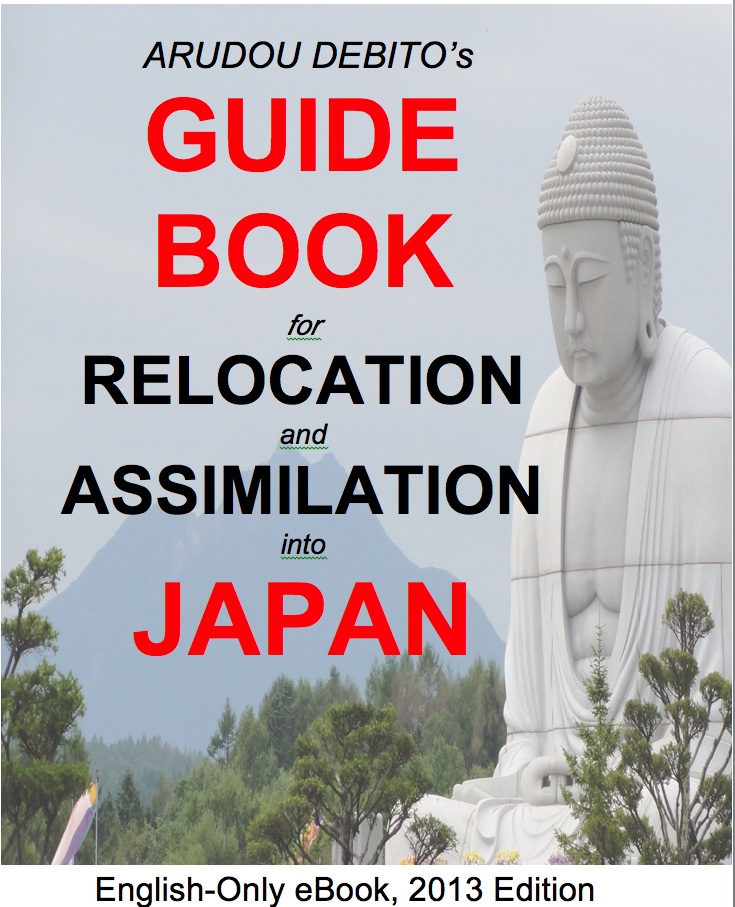
    1) Debito’s eBook “GUIDEBOOK FOR RELOCATION AND ASSIMILATION INTO JAPAN” now available on Amazon and NOOK for download. USD $19.99

    Following December’s publication of the revised 2nd Edition of long-selling HANDBOOK FOR NEWCOMERS, MIGRANTS, AND IMMIGRANTS comes a companion eBook for those who want to save paper (and money). A handy reference book for securing stable jobs, visas, and lifestyles in Japan, GUIDEBOOK has been fully revised and is on sale for $19.99 USD (or your currency equivalent, pegged to the USD on Amazons worldwide). See contents, reviews, and links to online purchasing outlets at http://www.debito.org/handbook.html

    2) Debito’s eBook “JAPANESE ONLY: THE OTARU ONSENS CASE AND RACIAL DISCRIMINATION IN JAPAN” now available in a 10TH ANNIVERSARY EDITION on Amazon and NOOK for download. USD $9.99

    It has been more than ten years since bathhouses in Otaru, Hokkaido, put up “NO FOREIGNERS” signs at their front doors, and a full decade since the critically-acclaimed book about the landmark anti-discrimination lawsuit came out. Now with a new Introduction and Postscript updating what has and hasn’t changed in the interim, JAPANESE ONLY remains the definitive work about how discrimination by race remains a part of the Japanese social landscape. See contents, reviews, and links to online purchasing outlets at http://www.debito.org/japaneseonly.html

    3) Debito’s eBook “IN APPROPRIATE: A NOVEL OF CULTURE, KIDNAPPING, AND REVENGE IN MODERN JAPAN” now available on Amazon and NOOK for download. USD $9.99

    My first nonfiction novel that came out two years ago, IN APPROPRIATE is the story of a person who emigrates to Japan, finds his niche during the closing days of the Bubble Years, and realizes that he has married into a locally-prominent family whose interests conflict with his. The story is an amalgam of several true stories of divorce and child abduction in Japan, and has received great praise from Left-Behind Parents for its sincerity and authenticity. See contents, reviews, and links to online purchasing outlets at http://www.debito.org/inappropriate.html

    Posted in Anti-discrimination templates/meetings, Articles & Publications, Child Abductions, Education, Good News, Handbook for Newcomers, Human Rights, Immigration & Assimilation, Labor issues, Media, NJ legacies, Otaru Onsen Lawsuit, Pension System, Practical advice | No Comments »

    Tangent on Sexual Minorities: Gay marriage trends worldwide, and how Japan’s Douseiaisha do it: Donald Keene’s marriage by Koseki adoption

    Posted by debito on 6th May 2013

    Economist: On April 17th New Zealand became the 12th country to legalise gay marriage, though the law will not come into effect until August. Uruguay, too, has passed a similar bill that awaits the signature of the president before it becomes law. And in late March the American Supreme Court began hearing arguments in a case on the constitutionality of the Defence of Marriage Act, which restricts marriage to a man and a woman. In all these countries—and indeed in much of the West—opinion polls show public support for same-sex marriages.

    Debito.org applauds this trend of legalizing gay marriage. Meanwhile Japan, as you can see above, to its credit has no law criminalizing homosexuality. It, however, does not permit gay marriages due to the vagaries of the Family Registry (Koseki) System. In short, only a wife and a husband by gender can create a married family unit. But as has been pointed out here on Debito.org before, people find ways to get around this. Gay couples, in order to pass on inheritance rights, adopt each other into the same family unit on the Koseki. The problem is for international couples that non-citizens cannot be listed on a Koseki as husband or wife.

    So here is how LGBT foreigners can get around it: Naturalize and adopt. As Debito.org previously suggested might be the case, famous naturalized Japanese Donald Keene has done it, and recently gone public about it. Congratulations. He provides the template: Gay NJ who wish to marry Japanese and get the same inheritance rights should naturalize and adopt one another. Or else, barring naturalization, go overseas to a society more enlightened about Same-Sex Marriage and get married.

    Posted in Cultural Issue, Human Rights, Immigration & Assimilation, NJ legacies, Practical advice, Tangents, 日本語 | 16 Comments »

    RocketNews: Automatic PR Status awarded to grads of Kyoto universities? Positive proposal by Kyoto Governor that will come to naught

    Posted by debito on 21st April 2013

    Kyoto Shimbun: On April 10, the [Governor] of Kyoto Keiji Yamada made public his intentions to appeal to the government to award overseas students who graduate from Kyoto [universities] with the right to permanent residence. It is a proposal entitled ‘Kyoto University Special Ward’ and also incorporates other supportive measures for foreign students. With a decrease in student intake within Japan in recent years, it is hoped that by providing incentives for academically skilled overseas students, Kyoto will not only be able to compete with other cities like Tokyo but will also be able to add a new lease of life to its cultural city….

    With air of conviction, Kyoto’s [Governor] put his proposition to the panel: “What I’d like to ask you to consider is whether overseas students who graduate from Kyoto [universities] and take part in the city’s job training program can be given permanent resident status. I’d like to work with everyone in producing an effective policy.”

    COMMENT: Interesting and very positive proposal, but it will come to naught, of course. Still, it shows how local governments are much more responsive to the needs of NJ than the central government (which is dominated by the control-the-borders-and-police-foreigners-only mindset of the Ministry of Justice). Although the central government occasionally deigns to listen to the locals (especially when they band together and say, “Our NJ residents need this!” as per the Hamamatsu Sengen of 2001), ultimately the regular blind spots prevail, and I think they will in this case too (as awarding PR is the job of the MOJ, not local governments).

    Posted in "Pinprick Protests", Anti-discrimination templates/meetings, Good News, Immigration & Assimilation, Japanese Government, Unsustainable Japanese Society, 日本語 | 18 Comments »

    TV Tokyo bangumi: “Why did you come to Japan?” interviews NJ arrivals at Narita, reifies mainstream media discourse of NJ as tourists, not residents

    Posted by debito on 12th April 2013

    JDG: “Saw this story on Japan Today (link): It’s a story about a poster campaign to advertise a TV show where NJ straight off the plane are asked why they came to Japan. In the poster, ‘talent(less)’ J-celebs, and a variety of caricatured NJ are proffering answers (‘maid’ cafes, lolitas, etc). I think that there are two ways of looking at this: The first is that they are proceeding from the false assumption that all NJ in Japan are visitors who must be here for some uniquely crazy ‘Japanese’ experience that they can’t get at home, and plays into the myth that there are no NJ long term residents who are here because of their jobs, or family connections. Whilst ignorant and not very helpful for understanding the wide variety of NJ identities, it is a common enough mistake for the Japanese to make.

    “However, my second thought is that this poster is an inadvertent and unintended insight into a darker aspect of Japanese psychology on the NJ issue. What if we suppose that this poster is not the product of some ignoramus who genuinely knows nothing of NJ realities in Japan, and believes the myth totally? What if this poster simply reflects a more widespread and deep rooted opinion that NJ shouldn’t be living in Japan because they have families or business here? What if the poster is deliberately not offering reasons such as ‘I’m here because I’m on the board or directors of (insert J-company here)’, or ‘I’m here to get my children back’, or ‘I’m here with the IAEA to inspect your reactors’? These are exaggerations, of course, but the point that I am making is that this poster in itself is a tool of devision, disenfranchisement, exclusion, subjugation, and othering. All that, and created with a lack of self-awareness in the process? A frightening indicator of the extent to which discrimination is normalized in japanese society.”

    COMMENT: I would concur in particular with the aspect of maintaining the dominant discourse in Japan of NJ as “guests”, i.e., “temporary visitors, not residents”, mixed in with the shades of “Cool Japan” that helps Japanese society revalidate and even fetishize itself through foreigners. But when you look back a bit historically, there’s more editorial subterfuge here…

    Posted in Bad Social Science, Cultural Issue, History, Immigration & Assimilation, Media, NJ voices ignored, discounted & discredited, Problematic Foreign Treatment, Tourism | 40 Comments »

    Japan Times JUST BE CAUSE Col 62, Apr 2, 2013: “Tweak the immigration debate and demand an upgrade to denizen class”

    Posted by debito on 3rd April 2013

    Crucial to any public discussion is defining the terms of debate. However, often those terms must be redefined later because they don’t reflect reality.

    One example is Japan’s concept of “foreigner,” because the related terminology is confusing and provides pretenses for exclusionism.

    In terms of strict legal status, if you’re not a citizen you’re a “foreigner” (gaikokujin), right? But not all gaikokujin are the same in terms of acculturation or length of stay in Japan. A tourist “fresh off the boat” has little in common with a noncitizen with a Japanese family, property and permanent residency. Yet into the gaikokujin box they all go.

    The lack of terms that properly differentiate or allow for upgrades has negative consequences. A long-termer frequently gets depicted in public discourse as a sojourner, not “at home” in Japan.

    Granted, there are specialized terms for visa statuses, such as eijuusha (permanent resident) and tokubetsu eijuusha (special permanent resident, for the Zainichi Korean and Chinese generational “foreigners”). But they rarely appear in common parlance, since the public is generally unaware of visa regimes (many people don’t even know foreigners must carry “gaijin cards”!).

    Public debate about Japan’s foreign population must take into account their degree of assimilation. So this column will try to popularize a concept introduced in the 1990s that remains mired in migration studies jargon: denizen…

    Posted in Articles & Publications, Bad Social Science, Exclusionism, History, Human Rights, Immigration & Assimilation, Japanese Government, NJ legacies, Unsustainable Japanese Society | 8 Comments »

    SITYS: GOJ’s new “Points System” to attract “higher-skilled” NJ being reviewed due to dearth of applications, impossibly high hurdles

    Posted by debito on 24th March 2013

    Asahi: A policy initiative designed to encourage highly skilled foreign professionals to come and stay in Japan is not working out as the Justice Ministry had envisioned. In fact, the point-based system has proved so unpopular that it is being reviewed only a year after it was introduced. [...] According to the Justice Ministry, less than 1,000 will likely be certified in the initial year, compared with 2,000 that officials had expected.

    COMMENT: We’ve talked about Japan’s “Points System” before on Debito.org, where I took a dim view of it as just another “revolving door” labor visa regime to bring people over, leech off their prime working lives, and then boot them back home without letting them settle and reap the rewards for contributing to Japanese society (cf. the “Trainees”, the “Nikkei Returnees”, and the “foreign caregivers“, all of whom I have written about for the Japan Times). Well, now, in yet another episode of SITYS (“See I Told You So”), Asahi reports the “Points System” is going through similar “revisions” as the visa scams above due to a dearth of applications. As I thought would happen — the PS’s qualifying hurdles are simply too high. Even if one assumes good faith in Japan’s policymakers (some of whom do see the slow-motion demographic disaster in progress due to crushing public debt unsupportable by a society that is shrinking and aging) who might want to treat “foreign laborers” as people, Japan’s bureaucrats are so paranoid about NJ somehow “abusing” the system that they make it practically impossible for anyone to ever “use” the system to their benefit. Again, the GOJ keep wanting “workers” and discover to their surprise later that they imported “people”, with livelihood needs beyond mere work hours converted into “the privilege of living in Japan”. These policy failures will keep happening again and again until NJ are treated as “people”, and given a fair chance by the GOJ at becoming “Japanese” (with transfers of political, economic, and social power — and that includes input at the policymaking stage too). But I still don’t see that happening anytime soon.

    Posted in Exclusionism, Immigration & Assimilation, Japanese Government, Labor issues, SITYS, Unsustainable Japanese Society | 34 Comments »

    JT/Kyodo: Record high applicants for J refugee status. Why media fixation on refugees? Because they are a bellwether of Japan’s “legitimacy as a competent, advanced, Western democracy”

    Posted by debito on 21st March 2013

    Making national news whenever statistics come out is how Japan deals with (i.e., mostly rejects) refugees. I was always curious about why refugee numbers have always been considered newsworthy (when there are many other significant NJ-related statistics that merit more fanfare but don’t, such as the number of “Newcomers” with Permanent Residency overtaking the “Oldcomer” Zainichis with Special Permanent Residency in 2007, representing a sea change in the composition of permanent immigrant NJs in Japan). But then I found something in an academic writing that put things in perspective: Acceptance of refugees are one bellwether of Japan’s acceptance of international norms, as part of its “greater role in international cooperation” and an attempt “to increase its legitimacy as a competent, advanced Western democracy”. First the most recent news article, then the academic article to put it in perspective:

    Kyodo: In 2011, there were 21 foreigners recognized as refugees, but for 2012, the number fell to 18. Since Japan began its refugee recognition system in 1982, there have been 14,299 people who applied and 616 who were recognized as refugees.

    Kashiwazaki: Since the mid-1970s, Japan has come into prominence in the international arena as a major player in the world economy. Internationalization became a slogan for the new direction of the country, with demands from both within and abroad to open, to take a leadership role, and to assume international responsibility. For the Japanese government, successful economic development provided the opportunity to assume a greater role in international cooperation and to increase its legitimacy as a competent, advanced Western democracy. To do so would require accepting an emerging set of international legal norms, including those in the area of citizenship…

    The end of the Vietnam War in 1975 generated refugees from Indochina. In the same year, the G7 Summit meeting was established. As the only Asian country admitted to membership in the G7 Summit, Japan was obliged to take some steps to accommodate refugees… With the acceptance of refugees, the Japanese government was compelled to join relevant international conventions. Japan acceded to the International Covenant on Civil and Political Rights as well as the International Covenant on Economic, Social, and Cultural, Rights in 1979, and then ratified the Convention relating to the Status of Refugees in 1981.

    COMMENT: Japan basically only acceded to these international norms and agreements as a vanity project — a matter of “not looking like an outlier” in the international community. Not because policymakers had any good-faith interest in helping NJ or outsiders in need come to Japan and settle. That’s why we see honne hiccoughs from time to time (like the one in 2010 when a 78-year-old Zainichi granny was denied social welfare by Oita Prefectural Government — where a court ruled that “Welfare payments to non-citizens would be a form of charity”. So much for those international treaties guaranteeing equal treatment being respected by Japan’s judiciary!). We’ve also seen how Japan simply will not pass a law against racial discrimination (despite signing another international agreement, the UN CERD, in 1995) — and will in fact counteract anyone who does. So in this context, Kyodo’s reporting that “since Japan began its refugee recognition system in 1982, there have been 14,299 people who applied and 616 who were recognized as refugees,” should come as no surprise. The GOJ has no intention of keeping its international treaty promises. They are merely national self-esteem boosters, not real guidelines or goals.

    Posted in Exclusionism, Gaiatsu, Human Rights, Immigration & Assimilation, Ironies & Hypocrisies, Japanese Government, Problematic Foreign Treatment, United Nations | 8 Comments »

    Interesting cases: naturalized Japanese sues city councilor fiance who jilted her for Korean ethnicity, Pakistani parents file criminal complaint for injurious school bullying, Hatoyama Yukio officially called “traitor” for not toeing official party line on Senkaku/Nanjing issues

    Posted by debito on 18th March 2013

    Here are a couple of interesting cases that have fallen through the cracks recently, what with all the higher-level geopolitical flurry and consequent hate speech garnering so much attention. With not much to link them thematically except that these are complaints made into public disputes, let me combine them into one blog post and let them stand for themselves as bellwethers of the times.

    First up, we have a criminal complaint filed with the police for classroom bullying resulting in serious injury due to his Pakistani ethnicity. This is one of a long line of cases of ethnic bullying in Japan, once again with insufficient intervention by authorities, and we’re lucky this time it hasn’t resulted yet in PTSD or a suicide. Like it has in these cases here with an ethnic Chinese schoolgirl, with an Indian student in 2007, or a Filipina-Japanese student in 2010 (in the last case NHK neglected to mention ethnicity as an issue). Of course, even here the Mainichi declines to give the name of the school involved. Whatever happened to perennial promises of a “major bullying study” at the ministerial level a couple of years ago to prevent things like this? Or of grassroots NGO actions way back when?

    Next, here’s an article about a victim fighting back. We have a thirty-something city councilor (in another unnamed local government in Hyougo-Ken) who proposed (in writing) to a woman (now 28, who accepted), then broke it off as soon as he heard that she was a Japanese citizen with a Zainichi Korean grandfather (horrors — how that might damage his political career!, he said). So in October of last year (appearing in an article dated January 28, 2013), she sued him for 2.4 million yen. Stay tuned. Interesting to see if the outcome will indicate how, once again, naturalization still doesn’t make a former NJ a “real Japanese” in elite society’s eyes:

    And finally, courtesy of japanCRUSH last January, we have this interesting titbit: “Japanese defense minister Onodera Itsunori is the latest politician to enter the fray by calling former prime minister Hatoyama Yukio a ‘traitor’ on a television programme. Onodera’s remark came after Hatoyama commented to Chinese officials that the Senkaku Islands should be recognised as disputed territory, rather than Japanese territory, during his trip to China. Interestingly, Hatoyama caused further controversy this week when he apologised for the Nanjing massacre.”

    So this is what it’s coming to. Dissent from prominent Japanese (who, in Hatoyama’s case, are no longer even political representatives) who act on their conscience, deviate from the saber-rattling party line, and show any efforts at reconciliation in this era of regional brinkmanship get decried as “traitors”. Doesn’t seem like there is much space for tolerance of moderate or diverse views (or people) anymore.

    Posted in "Pinprick Protests", Anti-discrimination templates/meetings, Education, Hate Speech and Xenophobia, Human Rights, Immigration & Assimilation, Japanese Government, Japanese Politics, Lawsuits, Media | 10 Comments »

    Prof. Kashiwazaki Chikako: Japan’s Nationality Law and immigration policy deviates from current international legal norm

    Posted by debito on 12th March 2013

    Over the years I have gotten from many corners (particularly from people who have not researched things too deeply) how “jus sanguinis” (law of blood) requirements for Japanese citizenship are not all that far from the international norm, and how Japan’s Nationality Law (which requires blood ties to a Japanese citizen for conferral of Japanese nationality) is but one example of many in the community of nations that confer nationality/citizenship by blood.

    Well, I knew both from experience and in my gut that there was something wrong with that. I felt that Japan’s method of conferring nationality/citizenship was quite specially exclusive (for example, we’ve had half a million Zainichi former citizens of Empire excluded from full “Denizenship” (see below) in Japanese society for three Postwar generations now, and only a tiny number of people becoming naturalized Japanese citizens every year). This exclusion (which every nation does when deciding national membership, but…) has been done in ways unbecoming of a country with the reputation of being a legitimate, competent, advanced Western democracy — one Japan has had since its emergence as a “rich society” in the 1980s — and thus expected to take on a greater role in international cooperation (such as acceptance of refugees) by accepting international legal norms (such as signing and enforcing international treaties).

    Now I’ve found something in writing from someone who HAS researched things deeply, Prof. Kashiwazaki Chikako at Keio, and she too finds that Japan’s policies towards the outside world are outside the international norm. Excerpts from one of her writings follows:

    Conclusion: It has never been policy in Japan, despite all the promises we heard in the “Kokusaika” 1980s about “getting in, making the effort to work hard in Japanese companies, learning the language and culture, and ultimately becoming Japanese like everyone else”, to let immigrants stay or make it easier for them to stay. So it’s not going to happen (no matter what recent flawed GOJ Cabinet opinion polls claim about the public’s “no longer rejecting” NJ), because of official government policy not to let people settle, and because policymakers don’t trust foreigners to ever be “Japanese”…

    Posted in Cultural Issue, Exclusionism, History, Human Rights, Immigration & Assimilation, Japanese Government, Japanese police/Foreign crime | 20 Comments »

    Letters from J human rights groups to the visiting Olympic Committee re Tokyo 2020: Discrimination in Japan violates IOC Charter

    Posted by debito on 5th March 2013

    The International Olympic Committee is currently in Japan considering Tokyo as a venue for the 2020 Summer Games. In light of recent events that point to clear examples of discrimination and advocacy of violence towards, for example, Koreans (see below), human rights groups in Japan are advocating that the IOC understand that these actions violate the Olympic Charter and choose their venue accordingly. Articles, photos, and letters follow from the Japan Federation of Bar Associations (Nichibenren), Tanaka Hiroshi in the Mainichi Shinbun, and sources demonstrating that, for example, all GOJ educational subsidies for Korean ethnic schools have been eliminated as of 2013 from government budgets.

    Academic Tessa Morris-Suzuki might agree with the assessment of rising discrimination, as she documents on academic website Japan Focus the protection of xenophobic Rightists and the police harassment of their liberal opponents. Her conclusion: “But there is no rule of law if the instigators of violence are left to peddle hatred with impunity, while those who pursue historical justice and responsibility are subject to police harassment. There is no respect for human rights where those in power use cyber bullying in an attempt to silence their opponents. And democracy is left impoverished when freedom of hate speech is protected more zealously than freedom of reasoned political debate.” Have a look.

    SITYS. This is yet but another example of Japan’s clear and dangerous swing to the Right under PM Abe. And granting an Olympics to this regime despite all of this merely legitimize these tendencies, demonstrating that Japan will be held to a different standard regarding discrimination. Wake up, IOC.

    Posted in "Pinprick Protests", Anti-discrimination templates/meetings, Education, Exclusionism, Gaiatsu, Hate Speech and Xenophobia, Human Rights, Immigration & Assimilation, Japanese Government, Problematic Foreign Treatment, SITYS, Sport | 16 Comments »

    Feb 9 2013 Tokyo Shin-Ohkubo Anti-Korean demonstrator slogans: “Good or Bad, Kill All Koreans” etc.

    Posted by debito on 4th March 2013

    It was only a matter of time. Debito.org has reported on anti-NJ demonstrations in the past (start here). And after the Takeshima/Dokdo Islands dispute, public displays of xenophobic hatred by Japan’s strengthening Right Wing has been increasingly directed towards Zainichi Koreans in their Tokyo neighborhoods (see here).

    Now comes the next step: Public demonstrations advocating violence and death, marching through an ethnic Korean neighborhood in Tokyo for maximum effect and impact. They are happening. Check out these photos of demonstrator signs, taken February 9, 2013, courtesy of a human rights lawyer and used with permission. Here is a video of that demonstration, taken in Shin-Okubo along Meiji Doori and Ohkubo-Doori on February 9, 2013:

    COMMENT: “KOREANS: HANG YOURSELVES, DRINK POISON, LEAP TO YOUR DEATHS.” “GOOD OR BAD, KILL ALL KOREANS.” At this rate, it is only a matter of time before these threats of violence become real. Still holding out hope that “Japan is a peaceful, nonviolent society” and is therefore somehow exceptional? Heed this warning: People are people anywhere you go, and when encouraged in this way to resort to violence, eventually there will be blood. Time to wake up and recognize what is happening in Japan before it is too late.

    Posted in Exclusionism, Hate Speech and Xenophobia, Human Rights, Immigration & Assimilation, Media, 日本語 | 31 Comments »

    Amazing new Cabinet survey finds “81% welcome ‘foreigners’ of Japanese descent”. Festival of cognitive dissonance!

    Posted by debito on 2nd March 2013

    Kyodo: More than 80 percent of respondents in a new poll said they are open to foreign nationals of Japanese descent living in the nation, the Cabinet Office reported. The office’s first survey of its kind, released Thursday, found 80.9 percent of respondents expressed openness to living alongside those with Japanese ancestry, including Brazilian and Peruvian descendents of Japanese immigrants. Only 12.9 percent opposed the idea.

    JDG: “It’s a brilliantly pointless piece of reporting, for the sake of massaging the egos of the Japanese readers, and assuring them that Japan is a ‘modern’ country… J-public are finally willing to accept foreigners… as long as they are ‘Japanese’ foreigners… I feel like I have gone back in time 5 years. The same politicians are back, the same old economic policies are back, and now Japan wants all those Nikkeijin they paid to go home, to come back too?”

    RM: Hopefully government officials will use this survey to promote further initiatives to empower the Nikkei (and hopefully other non-Japanese) in Japan. Publicly conducting the survey, posting it on the Cabinet Office website, and releasing it to the press, may indicate that the government is testing public support for such initiatives.

    DEBITO: Bingo! As has been noted before on Debito.org, the Cabinet, in its sessions last summer on how to “accept” NJ into Japanese society for future economic vitality, only showed interest in the treatment of Nikkei. Nikkei, you see, are somehow part of “us” (due to Wajin blood conceits), and it looks like Japan’s policymakers are going to give the old failed Nikkei worker importation strategy another try, and cite this “shooting fish in a barrel” survey to support it.

    Anyway, if the Cabinet is so keen on taking surveys, how about its perpetually embarrassing (and, as I’ve reported in the Japan Times, very flawed) Cabinet Survey on Human Rights that it conducts every four years? I just found the 2012 version, a year late, made public with significantly less fanfare. Perhaps because the results in the past were far more revealing about Japan’s cognitive dissonance regarding human rights, meaning a large proportion don’t support granting equal human rights to foreign humans! You see, human rights for NJ, by the very nature of having to ask this kind of question, are optional in Japan. Less so, it would seem based upon this new Cabinet survey, for the “foreigners” with the right bloodline. Which is the conceit that this new Cabinet survey is pandering to.

    Ultimately, I believe the GOJ will once again fall into the same old shortsightedness (like so many other societies) of wanting “workers” only to discover later they brought in “people”. And then, as before, society will seek to denigrate if not get rid of them as soon as they actually have needs (such as health care to provide, children to educate, lifestyles that reflect their backgrounds, retirement pensions to pay, political power to cede) that run counter to the original national plans…

    Posted in "Pinprick Protests", Bad Social Science, Cultural Issue, Human Rights, Immigration & Assimilation, Ironies & Hypocrisies, Japanese Government, Labor issues, Media, Problematic Foreign Treatment, Unsustainable Japanese Society | 9 Comments »

    Quoted in Die Zeit newspaper: “Japan: Old and Xenophobic” (German with machine translation)

    Posted by debito on 11th February 2013

    Sometimes I wish the Star Trek Universal Translators were already here. But we’re getting closer. Here’s a Google Translate version of an article that came out in Die Zeit newspaper a couple of months ago that cites me and others about Japan’s political problems with creating an immigration policy. Not a lot here that frequent readers of Debito.org don’t already know, but here’s a German media take on the issue:

    DIE ZEIT: For decades, Japan has been in a shaky position. The once-booming industrial nation barely registered economic growth. The national debt – in terms of economic power – is higher than that of Greece.

    Even today, every fourth Japanese is over 65 years old . The birth rate is so low that the population will decline by 2050 from 127 million today to below 90 million. Several governments have tried to counter by more kindergartens, child care allowance and the like, but little has borne fruit. In 100 years, there might be only 40 million Japanese.

    Now there is a lack of skilled labor, falling tax revenues, and no one knows who is going to pay in the future the growing pension claims. According to calculations by the United Nations, by 2050 only 17 million workers will be found to fund the pensions.

    But there is a solution: Immigrants like Ezekiel Ramat. Japan’s foreign population is currently 1.3 percent, extremely low for a highly developed country: Germany has at about 8.5 percent foreigners. In Japan, the number of immigrants in recent years even went down. But strange: no one in politics seems to care about immigration policy. Neither the ruling Democratic Party of Japan (DPJ) nor the main opposition parties mention the subject at all in their campaigns. When asked, all assert that they want to promote more immigration. But they make no specific proposals…

    Posted in Articles & Publications, Cultural Issue, Exclusionism, Immigration & Assimilation, Japanese Government, Japanese Politics, Labor issues, Problematic Foreign Treatment, Unsustainable Japanese Society | 26 Comments »

    Book Review: “At Home Abroad” by Adam Komisarof, a survey of assimilation/integration strategies into Japan (interviews include Keene, Richie, Kahl, Pakkun, and Arudou)

    Posted by debito on 20th January 2013

    “At Home Abroad” is an important, ambitious academic work that offers a survey, both from academics in the field and from people with expertise on living in Japan, of theories on how people can assimilate into foreign culture both on their own terms and through acquisition of local knowledge. Dr. Komisarof, a professor at Reitaku University with a doctorate in public administration from International Christian University in Tokyo, has published extensively in this field before, his previous book being “On the Front Lines of Forging a Global Society: Japanese and American Coworkers in Japan”. However, this book can be read by both the lay reader as well as the academic in order to get some insights on how NJ can integrate and be integrated into Japan.

    The book’s goal, according to its Preface, is to “address a pressing question: As the Japanese population dwindles and the number of foreign workers allowed in the country increases to compensate for the existing labor shortage, how can we improve the acceptance of foreign people into Japanese society?” (p. 1) To answer this, Komisarof goes beyond academic theory and devotes two-thirds of the book to fieldwork interviews of eleven people, each with extensive Japan experience and influence, who can offer insights on how Westerners perceive and have been perceived in Japan.

    The interviewees are Japan literary scholar Donald Keene, Japan TV comedian Patrick “Pakkun” Harlan, columnist about life in rural Japan Karen Hill Anton, university professor Robin Sakamoto, activist and author Arudou Debito, Japan TV personality Daniel Kahl, corporate managing director of a Tokyo IT company Michael Bondy, Dean of Waseda’s School of International Liberal Studies Paul Snowden, Tokyo University professor and clinical psychologist Stephen Murphy-Shigematsu, politico and business executive Glen Fukushima, Keio University professor Tomoko Yoshida, and Japan scholar Donald Richie…

    Posted in Articles & Publications, Cultural Issue, Education, Immigration & Assimilation, NJ legacies, Otaru Onsen Lawsuit, Practical advice, Unsustainable Japanese Society | 82 Comments »

    US Senator Daniel Inouye dies, Mazie Hirono Becomes First U.S. Senator Born in Japan; contrast with do-nothing self-gaijinizing Tsurunen

    Posted by debito on 8th January 2013

    Second in a series of two of prominent passings is American Senator Daniel Inouye, a notable Congressman who held on to his congressional seat longer than even legacy legislator Ted Kennedy. As per the local obit excerpt below, he had a quite glorious career in the military as part of the groundbreaking 442nd (some veterans I’ve even met in Hawai’i), then was a pathbreaker for Asian-Americans as a public servant. But consider how he was able to do this. as least as far back as Franklin Roosevelt (the better part of a century ago), we had the United States at the highest levels of public office attempting to untangle race/national or social origin from nationality.

    This is something that Japanese society to this day has never accomplished (Japan’s Nationality Law still requires blood for citizenship, and from that derives the entanglement of race and legal status). Nor is Japan really trying. I speak from personal experience (not to mention court precedent) when I say that civil and political rights in Japan are grounded upon being “Japanese”, and “Japaneseness” is grounded upon phenotype (i.e., “looking Japanese”). This MUST be untangled by Japan if it ever hopes to encourage people to come in and settle down as “New Japanese”, not to mention allow people of mixed heritage to breathe as diverse people. But I neither see it happening soon, nor are progressive steps even being taken towards it (I am in fact arguing that Japan in recent years has been regressing… see here, here and here).

    As further proof of the helpfulness of a society with notions of citizenship disentangled from race/national or social origin, we have another Senator from Hawaii who just got elected, Mazie Hirono — and she wasn’t even born in the United States! She was born in Japan.

    Now, you might say that, well, Finland-born Caucasian Dietmember Tsurunen Marutei has also been elected to high office in Japan. But Tsurunen has been at his post for more than a decade now, and he’s squandered the opportunity by settling into it like a sinecure — doing just about nothing for the rights of NJ in Japan (such as not even bothering to attend or send a rep to a UN CERD meeting at the Diet on May 18, 2006). In fact, Tsurunen has even gone so far as marginalize and gaijinize himself! If one gives him the benefit of the doubt (I don’t, but if), such are the effects of constant pressure of being socially “Othered” in Japan, despite his legal duty to uphold his constitutional status as a Japanese citizen and an elected official.

    In comparison, the hurdles Hirono overcame were significant but not insuperable. Even though she was nowhere near as articulate or politically thoroughbred as her Republican opponent, former Hawai’i Governor Laura Lingle, Hirono still grossed nearly double the votes (261,025 to 155,565) last November 6 to clinch the seat. Further, if the legacy of Inouye is any template, I think Hirono will do more than just settle for being a symbolic sphinx in her role as a legislator. Because she can — in a polity which can elect people for life despite their foreign (or foreign-looking) backgrounds, she has more opportunities in society than Tsurunen ever will — or will make for himself.

    My point is, the disentanglement of race/social origin from nationality (i.e., rendering clearly and politically at the highest levels of government) is something that every state must do if it is to survive as a nation-state in future. Given its demographics, especially Japan.

    Posted in Anti-discrimination templates/meetings, Cultural Issue, Exclusionism, Immigration & Assimilation, Japanese Government, Practical advice, Shoe on the Other Foot Dept., Tangents, Unsustainable Japanese Society | 13 Comments »

    Japan Times JUST BE CAUSE Column 59: The year for NJ in 2012: a Top 10

    Posted by debito on 2nd January 2013

    Debito’s Top Ten human rights issues in Japan for NJ residents in 2012:
    10. DONALD KEENE’S NATURALIZATION
    9. OSAKA CITY DEFUNDS LIBERTY OSAKA
    8. COURTS RULE THAT MIXED-BLOOD CHILDREN MAY NOT BE “JAPANESE”
    7. DIET DOES NOT PASS HAGUE CONVENTION
    6. GOVERNMENT CONVENES MEETINGS ON IMMIGRATION
    5. MAINALI CASE VICTORY, SURAJ CASE DEFEAT
    4. JAPAN’S VISA REGIMES CLOSE THEIR LOOP
    3. NEW NJ REGISTRY SYSTEM
    2. POST-FUKUSHIMA JAPAN IS IRREDEEMABLY BROKEN
    1. JAPAN’S RIGHTWARD SWING
    Links to sources included

    Posted in Articles & Publications, Bad Social Science, Child Abductions, Cultural Issue, Education, Exclusionism, Fingerprinting, Targeting, Tracking NJ, Gaiatsu, Hate Speech and Xenophobia, History, Human Rights, Immigration & Assimilation, Ironies & Hypocrisies, Japanese Government, Japanese Politics, Labor issues, Lawsuits, Media, NJ legacies, NJ voices ignored, discounted & discredited, Unsustainable Japanese Society | 12 Comments »

    Japan now a place to avoid for international labor migration? NHK: Even Burmese refugees refusing GOJ invitations, electing to stay in Thai refugee camp!

    Posted by debito on 29th December 2012

    In this time of unprecedented migration of labor across borders (click to see some international labor migration stats from the ILO and the OECD), I think increasingly one can make a strong case that Japan is being seen as a place to avoid. As I will be mentioning in my next Japan Times JUST BE CAUSE column (out January 1, 2013), as part of my annual countdown of the Top Ten most influential human rights issues in 2012 affecting NJ in Japan, Japan’s “revolving-door” visa regimes (which suck the most productive work years out of NJ while giving them fewer (or no) labor law protections, and no stake in Japanese society — see here and here), people who are even guaranteed a slot in Japan’s most difficult visa status — refugees (see also here) — are turning the GOJ down! They’d rather stay in a Thai refugee camp than emigrate to Japan. And for reasons that are based upon word-of-mouth.

    That’s what I mean — word is getting around, and no amount of faffing about with meetings on “let’s figure out how We Japanese should ‘co-exist’ with foreigners” at the Cabinet level is going to quickly undo that reputation.

    Immediately below is the article I’m referring to. Below that I offer a tangent, as to why Burmese in particular get such a sweetheart deal of guaranteed GOJ refugee slots. According to media, “From 1982 to 2004, Japan accepted only 313 refugees, less than 10 per cent of those who applied. Even after its rules were slightly liberalized in 2004, it allowed only 46 refugees in the following year. Last year it accepted only 34 of the 954 applicants. Those numbers are tiny in comparison with Canada, which accepted more than 42,000 refugees last year, despite having a much smaller population than Japan. But they are also tiny in comparison to European countries such as France and Italy. On a per capita basis, Japan’s rate of accepting refugees is 139th in the world, according to the United Nations.” This means that Burmese make up between a third to a half of all refugees accepted! Why? As a holiday tangent, consider the elite-level intrigue of a wartime connection between the Japanese Imperial Army and SLORC…

    Posted in Gaiatsu, History, Immigration & Assimilation, Ironies & Hypocrisies, Japanese Government, Labor issues, Tangents, Unsustainable Japanese Society | 61 Comments »

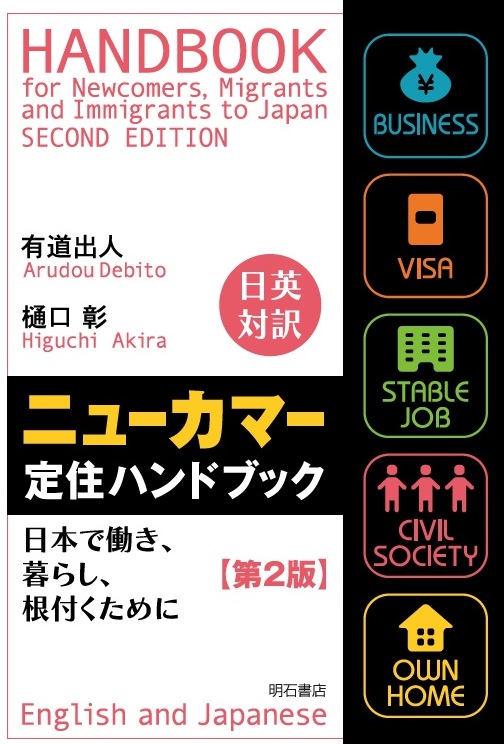
    2nd Edition of HANDBOOK FOR NEWCOMERS, MIGRANTS, & IMMIGRANTS to Japan on sale Dec 2012, updated

    Posted by debito on 3rd December 2012

    I’m very happy to announce that at long last (it takes a number of months to get things through the publishing pipeline), the Second Edition of HANDBOOK FOR NEWCOMERS, MIGRANTS AND IMMIGRANTS TO JAPAN goes on sale in December 2012.

    This long-selling bilingual guide to life in Japan, co-authored with legal scrivener Akira Higuchi, has assisted thousands of readers and engendered rave reviews. Its goal has been to assist people to live more stable, secure lives in Japan, and walks the reader through the process of securing a better visa, getting a better job (even start one’s own business), troubleshooting through difficult situations both bureaucratically and interpersonally, establishing one’s finances and arrangements for the next of kin, even giving something back to Japanese society. It is a one-stop guide from arrival in Japan through departure from this mortal coil, and now it has been updated to reflect the changes in the Immigration and registry laws that took place in July 2012. Get ready to get yourself a new copy!

    (Oh, and my Japan Times JBC column has been postponed a week due to a major scoop this week that will fill the Community Page…)

    Posted in Anti-discrimination templates/meetings, Articles & Publications, Good News, Handbook for Newcomers, Human Rights, Immigration & Assimilation, Labor issues, Practical advice, 日本語 | 4 Comments »

    Kyodo: UN HRC prods Japan on sex slaves, gallows. But the elephant in the room still remains no law against racial discrimination in Japan

    Posted by debito on 26th November 2012

    The UN Human Rights Council has once again prodded Japan to do something to improve its record on human rights (and this time the GOJ, which must submit a report every two years, actually submitted something on time, not eight years overdue as a combined “Third, Fourth, Fifth, and Sixth Combined Report”). Here’s how the media reported on their interplay:

    Kyodo: A panel under the U.N. Human Rights Council has endorsed some 170 recommendations for Japan to improve its human rights record, including Tokyo’s handling of the so-called comfort women issue, the euphemism for the Imperial army’s wartime sex slaves…

    Other recommendations include the safeguarding of Japanese citizens’ right to lead a healthy life, in light of the enormous amount of radioactive fallout spewed over a vast area by the March 2011 meltdowns at the Fukushima No. 1 plant. The town of Futaba, which found itself in the center of the nuclear storm since it cohosts the wrecked plant, had actively campaigned for the inclusion of this right. The report also called on Japan to abolish the death penalty after more than 20 countries, including prominent EU member states, objected to its continued use of capital punishment.

    COMMENT: As you can see in the HRC’s press brief enclosed in this blog entry, once again the GOJ is avoiding the topic of creating a legal framework to protect people against racial discrimination — claiming it’s already forbidden by the Japanese Constitution (but as we’ve stressed here umpteen times, no explicit law in the Civil or Criminal Code means no enforcement of the Constitution). But all the UN HRC seems to be able to do is frown a lot and continue the talk shop. Further, the UN still chooses the word “migrants” over “immigrants”, which makes NJ (and their J children) who need these rights look like they’re only temporary workers — the “blind spot” continues. Meanwhile, Fukushima and the death penalty seem to have sucked all the oxygen out of the debate arena regarding other human rights issues. In this blog entry is an excerpt of what Japan submitted to the HRC for consideration, and a media brief of the HRC’ s recommendations. It’s basically cosmetic changes, open to plenty of bureaucratic case-by-case “discretion”, and amounting to little promise of fundamental systemic or structural changes.

    Posted in Anti-discrimination templates/meetings, Gaiatsu, Human Rights, Immigration & Assimilation, Japanese Government, United Nations | 3 Comments »

    NYT on Donald Keene “becoming one of them”, in an underresearched article that eulogizes the man before time

    Posted by debito on 20th November 2012

    I didn’t know the New York Times was in the habit of writing eulogies before their subject dies. But that’s essentially what happened earlier this month with their write-up on Donald Keene.

    Frequent readers of Debito.org will remember why I take such a dim view of Keene’s ignominious actions at the twilight of an illustrious career. I’ve devoted a Japan Times column to how a scholar of his standing used poor social science in his public statements alluding to the “Flyjin Myth” and the fiction of foreigners as criminals. Despite this, Keene has still refused to acknowledge any of the good things that NJ residents have done (not only in terms of disaster relief “in solidarity” with “The Japanese”, but also on a day-to-day basis as workers, taxpayers, and non-criminals). Nor has Keene amended his public statements in any way to reflect a less self-serving doctrine — thus elevating himself while denigrating others in his social caste. In essence, Keene has essentially “pulled up the ladder behind him”, stopping others from enjoying the same trappings of what the NYT claims is “acceptance”. Thus, how NJ sempai in Japan (even after naturalization) eat their young to suit themselves is a fascinating dynamic that this article inadvertently charts.

    This article represents a missed research opportunity for an otherwise incredibly thorough reporter (Martin has written peerless articles on Fukushima, and I simply adored his report on the Ogasawaras). How about this for a research question: Why else might The Don have naturalized? I say it doesn’t involve the self-hugging cloaked as some odd form of self-sacrifice. How about investigating the fact that while gay marriage is not allowed in Japan, adoption (due to the vagaries of the Koseki Family Registry system) is a common way for same-sex partners to pass on their inheritance and legacies to their loved ones — by making them part of their family. Naturalization makes it clear that there will be no extranationality conceits to interfere with the smooth transfer of claims. This article could have been a fine peg to hang that research on.

    Not to mention the fact that even seasoned journalists at the NYT can fall for The Fame: Ever hear of the old adage that enables many a minority to receive the veneer of “acceptance” despite all the racialized reasons to deny it? It’s called: “They’ll claim us if we’re famous.” Yes, so many lovely “thanks” from strangers in coffee shops; but as I’ve written before, The Don sadly won’t be around for any denouement once The Fame inevitably fades.

    Anyway, if one gives the NYT the benefit of the doubt here, I think the tack of the article should have been, “A person has to jump through THIS many hoops in order to be considered ‘one of them’ [sic] in Japan? Go through all of this, and you should be ‘accepted’ by the time you are, oh, say, ninety years old.” Instead, this development is portrayed as a mutual victory for The Don and Japan.

    Why is this not problematized? Because this article is a eulogy — it’s only saying the good things about a person (not yet) departed, and about a society that will not realize that it needs New Japanese who are younger and able to do more than just feebly salve (instead of save) a “wounded nation”. That’s the bigger metaphor, I think, The Don’s naturalization represents to today’s Japan.

    Posted in Bad Social Science, Cultural Issue, Exclusionism, Immigration & Assimilation, Ironies & Hypocrisies, NJ legacies, Problematic Foreign Treatment | 13 Comments »

    Sakanaka in Japan Times: Japan as we know it is doomed, only immigrants can save it

    Posted by debito on 22nd October 2012

    Japan Times: Japan as we know it is doomed. Only a revolution can save it. What kind of revolution? Japan must become “a nation of immigrants.”

    That’s a hard sell in this notoriously closed country. Salesman-in-chief — surprisingly enough — is a retired Justice Ministry bureaucrat named Hidenori Sakanaka, former head of the ministry’s Tokyo Immigration Bureau and current executive director of the Japan Immigration Policy Institute, a private think tank he founded in 2007.

    “Japan,” he said in a recent telephone interview, “is on the brink of collapse.” [...] No nation, barring war or plague, has ever shrunk at such a pace, and as for aging, there are no historical precedents of any kind. The nation needs a fountain of youth. Sakanaka claims to have found one. Japan, he said, “must welcome 10 million immigrants between now and 2050.” [...] It sounds fantastic, and in fact, Sakanaka acknowledges, would require legislation now lacking — anti-discrimination laws above all.

    Posted in "Pinprick Protests", Cultural Issue, Discussions, Human Rights, Immigration & Assimilation, Japanese Government, Japanese Politics, Labor issues, Practical advice, Unsustainable Japanese Society | 52 Comments »

    ZakSPA!: “Laughable” stories about “Halfs” in Japan, complete with racialized illustration

    Posted by debito on 16th October 2012

    Debito.org Reader CJ submits the following ZakSPA! page talking about Japan’s genetic internationalization in tabloid style: How “funny” it is to be a “half.” Reading through the articles (enclosed below), I’m of two minds about this. On one hand, it’s good to have the media acknowledging that there are Japanese kids of diverse roots and experiences out there, with some tone of saying how silly it all is that so many people get treated in stereotypical ways (with a “roundtable of halfs” at the end giving their own views on the situation). On the other hand, the level of discourse gets pretty low (“some foreigner talked to me in Narita Airport in English and it was so frightening I felt like crying”), and an opportunity to actually address a serious issue of how Japan has changed is wasted on parts laughing, parts crybabying, parts confirmation that treating people as “different” because they look “different” is a natural, if not inevitable, part of life in Japan. I’ll let Debito.org Readers read for themselves and decide whether this important topic is being broached properly.

    Posted in "Pinprick Protests", Bad Social Science, Cultural Issue, Discussions, Humor, Immigration & Assimilation, Media, 日本語 | 29 Comments »

    Japan Times JUST BE CAUSE Column 54 Aug 7, 2012: “For nikkei immigrants in Japan, it doesn’t have to be a bug’s life”

    Posted by debito on 9th August 2012

    With apologies to Franz Kafka: As Beto awoke one morning from uneasy dreams, he found himself transformed in his futon into a gigantic cockroach.

    “What’s happened to me?” he thought. In his native land down south, he had been a person — if at times underprivileged due to his nikkei status. So, years ago, he “repatriated” to Japan, attracted by promises of better milk and honey. Yet now he felt even more marginalized by the locals here, who called themselves “people” yet treated him at times like he was an insect.

    Beto scurried off to work, where people shied away and refused to sit by him in the train cars. But as the end of the line approached, the coach filled up with fellow cockroaches, and people stopped paying attention.

    The people at his factory also took no notice of his metamorphosis. His supervisors were used to dealing with cockroaches. Bugs seemed an inevitable part of lower-rent circumstances. As in the train, it seemed some people had learned to “co-exist” with them in close quarters.

    In public, however, reactions were different. Alone, Beto was often seen as something exotic, maybe even collectable if there was a curious person flitting about who was interested in “speaking bug.” But if seen as part of a swarm, people’s knee-jerk reactions were to take steps against them. Bugs might overrun the place, making it feel less the realm of the masters, more of the roaches…

    Posted in Articles & Publications, Humor, Immigration & Assimilation, Labor issues, NJ voices ignored, discounted & discredited | 12 Comments »

    Yomiuri: Iwate town sponsors Vietnamese future doctor — and people reportedly react with trepidation

    Posted by debito on 23rd July 2012

    In light of how NJ nurses under a national visa program have been treated in the face of a chronic careworkers shortage, here we have a case where even local sponsorship of a NJ doctor is also viewed (according to the Yomiuri, which may indeed in the interest of “balance” be conjuring up a tempest in a teapot) with suspicion because she is a foreigner. After all, she might not stay! Then again, so might not anyone else being trained on that scholarship program regardless of nationality. Ah, but foreigners are different, you see. They always represent a flight risk… Anyhoo, good news tainted with an editorial bias of caution and trepidation just because the subject is NJ.

    Yomiuri: Facing a serious and chronic shortage of doctors, the town of Ichinohe felt it necessary to look overseas to find medical staff willing to live and work in the rural area. The town plans to spend more than 10 million yen on school and living expenses for a Vietnamese woman on the condition that she will practice medicine in the town for at least seven years after obtaining her license.

    The unusual plan raised eyebrows when the town ran it by the Health, Labor and Welfare Ministry, and some residents have questioned why the town is sponsoring a foreigner. However, Ichinohe Mayor Akira Inaba believes the unprecedented plan is just what the town needs. “The scholarship program for Japanese medical students hasn’t attracted enough applicants to meet its quota,” he said. “We have no other choice but to secure our doctors on our own.”

    Posted in Cultural Issue, Good News, Immigration & Assimilation, Japanese Government, Labor issues, Unsustainable Japanese Society | 13 Comments »

    Weekend Tangent: Louis Vuitton Journeys Award shortlisted J movie short has multicultural couple

    Posted by debito on 9th July 2012

    Debito.org Reader: In late May 2012, I was approached by a young and passionate Tokyo guy. He asked me if I can act in a short silent movie. He said that he is shooting this movie to participate in Louis Vuitton’s Journeys Awards competition. The competition gives emerging artists/producers/directors an opportunity to get into limelight.

    When he explained me the script, I could see why he approached me specifically. The story was about an Indian professional who was married to a Japanese woman. The Indian had to return to India … and the movie was about the moments of emotions after he told this to his wife. He was asking me to share the real moments of my life for his movie!

    Please check the following link to watch the (5 minute) movie online.
    http://www.journeysawards.com/en_US/shortlisted/Departure/

    While this movie is not directly related to your core topics of discussion in debito.org, I think the selection of this movie in shortlisted 10 (from among 100s of submissions), proves two things in a very subtle way… two very important things.

    What does the movie’s shortlisting success prove?
    1) Young Japanese artists/producers/directors are open to multicultural Japan and they are willing to take a chance on Japan that is not homogeneous.
    2) Multicultural Japan can compete just as effectively as monocultural Japan (there is another movie from Japan also in shortlisted 10!)…

    Posted in Immigration & Assimilation, Media, Tangents | 5 Comments »

    Japan Times JUST BE CAUSE Column 53 July 3, 2012: “In formulating immigration policy, no seat at the table for NJ”

    Posted by debito on 4th July 2012

    My Japan Times JUST BE CAUSE Column 53 dated July 3, 2012, is on the Japanese Government’s renewed policy debate on creating conditions conducive to immigration (without actually portraying it in any way as “immigration” (imin), just more NJ residents). It’s their attempt to address Japan’s demographic and probable economic nosedive despite their assiduous efforts over the decades to a) exploit NJ as temporary workers on a revolving-door labor visa regime, b) blame NJ for all manner of social ills, including foreign crime and desertion, and in the process c) poison the public debate arena for productive discussion about ever treating NJ well enough that they might want to actually stay (since the past three years have seen the NJ population continuously dropping, after 48 years of unbroken rise). The writing’s on the wall, and the GOJ is finally doing something constructive. But (as usual) the bureaucracy is controlling the agenda, and the typical blind spots are coming into play, so as things stand now I think the policy drive will be ineffective. Have a read and a think.

    Posted in Articles & Publications, Exclusionism, Fingerprinting, Targeting, Tracking NJ, Good News, Human Rights, Immigration & Assimilation, Ironies & Hypocrisies, Japanese Government, Labor issues, Practical advice, Unsustainable Japanese Society | 13 Comments »

    Asia Pacific Bulletin: “Accepting Immigrants: Japan’s Last Opportunity for Economic Revival”

    Posted by debito on 1st July 2012

    Here’s some evidence of how the debate regarding Japan’s need for immigration is starting to percolate through USG policy circles — this time the Asia Pacific Bulletin. It’s another well-intentioned brief article for busy policymakers, but with a couple of mistakes: 1) “since the 2011 earthquake the number of foreign residents in Japan has also been on a downward trend” is not quite right since it was on a downward trend before 3/11 too (in fact, when I was debunking the “Flyjin” Myth in my Japan Times column I demonstrated how the decreasing trend in NJ numbers was largely unaffected by the multiple disasters); 2) the “stagnant policy discussion at the national level” has in fact been restarted and quite actively discussed starting from May onwards (perhaps after Mr. Menju sent the article to press, but the APB website notes their turnaround on articles is mere weeks), as has been discussed here in detail on Debito.org. But Mr. Menju does get some important things very, very right — as in the other J media-manufactured myth of NJ crime and social disruption (especially the NPA’s involvement in cooking the numbers), how this dynamic forestalls a healthy discussion on immigration policy, and Japan’s overall need for immigration despite all the years of active ignoring of local governments’ advice on tolerance and acceptance. Decent stuff, and worth a read.

    Posted in Exclusionism, Immigration & Assimilation, Japanese Government, Japanese police/Foreign crime, Labor issues, Unsustainable Japanese Society | 32 Comments »

    GOJ Cabinet “Coexistence with NJ” Pt. 2: Critique of June 15, 2012 meeting — a very positive Third Act to this Political Theatre

    Posted by debito on 28th June 2012

    Following up on my blog post of June 10: “GOJ embryonic policymaking reboot for ‘co-existence with foreigners’”, here is an evaluation of the GOJ’s third meeting of June 15, 2012. I offer summaries of each presenter’s materials below. My overall comment is that despite some fair-to-middling presentation styles (one a bit limply bureaucratic, another full of irrelevant chaff), all of them have their heart in the right place. Two of them I just wanted to hug the presenter afterwards for getting things right all the way down to the proper semantics (of seeing NJ as fellow “resident” with their own sense of “community”; they even overrode the potentially dichotomous “coexistence” meme for seeing NJ as perpetual outsiders to “handle and administrate”, which Japan’s sweaty-handed bureaucrats can never get beyond). How much of this advice will be taken is another issue, but at least the advice is being given. It’s a good Third Act in this political theatre. It’s just a pity the short-sighted bureaucrats almost always get first dibs on agenda setting, with the people who might offer different opinions thrown in later down the line as an afterthought. And there’s still no mention of that law against racial discrimination…

    Posted in Cultural Issue, Good News, Immigration & Assimilation, Japanese Government, Labor issues, Practical advice, Unsustainable Japanese Society, 日本語 | 12 Comments »

    GOJ embryonic policymaking reboot for “co-existence with foreigners”: Some good stuff, but once again, policy about NJ without any input from them

    Posted by debito on 10th June 2012

    John Morris at H-JAPAN: A committee has been set up within the Cabinet Office of Japan, composed of the vice-ministers of the Cabinet Secretariat, Ministry of Internal Affairs and Communications, Ministiry of Law, Foreign Affairs, Finance, Education etc, Health etc, Agricutlure etc, Industry etc, Land etc, Police to investigate and recommend policy on “co-existence with foreigners”. Information on the committee can be found at the following URL:
    http://www.cas.go.jp/jp/seisaku/kyousei/index.html
    The documentation provided here gives a very succinct summary of what the government (national level bureaucrats?) of Japan think about “foreigners” here, and how they formulate their perceptions of what the “problems” are, and very vaguely hint at where they see future solutions.

    SUMMARY AND ANALYSIS: This is not the first time the organs of the Japanese government have talked about “coexistence with foreigners” (gaikokujin to no kyousei shakai jitsugen), but more likely than not these happen at the local level (cf. the Hamamatsu Sengen, which happened repeatedly from over a decade ago yet was studiously ignored at the national level). Now that discussion on this is taking place at the national, Cabinet level, this is a positive development. However, these meetings (two so far, the first one was less than an hour) at the outset show the hallmarks of so much Japanese policymaking: a biased agenda (with all the normalized invective of “wagakuni” (our country) semantically offsetting those foreigners (who have to “co-exist” with Japanese, not merge into one polity)) regarding the policy treatment of people without any input from the people being treated. Inevitable blind spots, such as an overemphasis on Nikkei and children’s education, are already latent in the materials below. In any case, this is a very interesting and rare view into the dialogs and mindsets behind the creation of public policy re NJ in Japan. More detailed summaries and analysis follow below.

    Posted in Anti-discrimination templates/meetings, Fingerprinting, Targeting, Tracking NJ, Good News, Immigration & Assimilation, Japanese Government, Japanese police/Foreign crime, Labor issues, Problematic Foreign Treatment, 日本語 | 20 Comments »

    Discussion: Aly Rustom on “Ways to fix Japan”

    Posted by debito on 26th May 2012

    Rustom: It has taken me over a year to write this piece. I have put my heart and soul into making this reading as concise as possible. This is a small essay on the problems of Japan, and my personal opinion on how to fix them.

    These days, Japan is suffering from a lot of socioeconomic problems. Whenever I talk to people and ask how can we fix them, no one ever has an answer. Everyone just folds their arms, tilts their head and says “Muzukashii” (Its difficult) Well, I do have a few solutions.
    I have written a small piece here on how to solve these problems. I have written this as a foreigner who has lived in Japan for over ten years and has the unique perspective of looking at things from both the inside and the outside.

    It is not my intention to try to tell Japan or it’s people what to do. Nor do I have any delusions of grandeur that the Japanese will all of a sudden sit up and take notice of what I have to say. I am only writing this to show that there are concrete steps that can be taken to heal Japan, and that all it takes is a little bit of thinking outside the box to make this happen. I am also hoping that this small piece will at least start up some degree of discourse which will eventually lead to some level of action sometime in the future. I also felt the need to vent, as I see a beautiful country being destroyed since no one wants to take the helm and do what needs to be done. So without further ado, let’s start:

    Posted in Discussions, Immigration & Assimilation, Japanese Government, Labor issues, Practical advice, Unsustainable Japanese Society | 40 Comments »

    Iida Yumiko on the nation-state, and how it includes people in the national narrative for its own survival (or in Japan’s case, how it doesn’t)

    Posted by debito on 16th May 2012

    Simplifying Dr. Iida’s points: Every country has to convince the people who live within it to accept that a) there is a country that they are members of, and b) that there are rules they have to follow in order to be members (obeying the laws, paying taxes, potentially giving up one’s life to defend it, etc.). When power becomes this unquestioned, it becomes (to use Gramsci’s word) “hegemonic”, in other words, normal enough to be invisible and generally unquestioned. Almost all people on this planet, born into a nation-state, accept that they are members of one country of another (by dint of having a passport, a tax home, accountability before the law etc.) and play by the rules because that’s how they were socialized.

    But there is a give-and-take here. The nation-state must give its members four things in order for them to adopt the rules of play and pass them down to the next generation. These are, according to Iida above:

    1) A shared memory of the past (i.e., a national narrative) that links them all,
    2) A sense of community, with moral obligations to it,
    3) A world view that makes sense,
    4) Hope for the future that other people share.

    Fine. Now, as this relates to Debito.org: What do NJ in Japan get? None of this, really. And that’s why NJ are given incentives not to stay: It goes beyond mere “alienation” — it is a fundamental, egregious, and probably fatal flaw in Japan’s nation-state dynamic of eliminating newcomers from the national narrative.

    Posted in Cultural Issue, Exclusionism, Human Rights, Immigration & Assimilation, Ironies & Hypocrisies, Japanese Government, NJ legacies, Unsustainable Japanese Society | 28 Comments »

    Yomiuri: J population falls record 259,000 in 2011 (as does NJ pop.); Keidanren think tank sees ROK surpassing J GDP by 2030

    Posted by debito on 21st April 2012

    Here are two sobering articles regarding Japan’s unsustainability. The first indicates that Japan’s population decrease is, as predicted, accelerating, dropping by a record quarter-million in 2011 alone. Now, let’s acknowledge the caveats: This may be a blip due to the horrendous year that 2011 was for Japan. However, the death toll from the triple disasters is only estimated (highball) at around 20,000, less than a tenth of the overall fall in Japanese population. Moreover, if people say that this is due to people fleeing the country (meaning they’ll come back when the coast is clear, i.e., the fall is but temporary), okay, but then, I can’t help but point out, it’s clear the preponderance of the “flyjin” phenomenon is, once again, not due to NJ fleeing. So I’m not so sure that “fleeing” is the cause either. I’ll just chalk this development as more evidence of Japan’s unsustainability without immigration.

    The second article is, I believe, more alarmist and latently jingoistic — appealing to nationalism to get Japan to pull its socks up. A think tank affiliated with Keidanren (and we know how influential they are in the public policy realm — through them we got our new NJ cheap labor visa regimes from 1990 onwards) is saying that, horrors, Japan will not only drop in the world rankings (which we’ve anticipated for quite a while now due to demographics), THEY’LL FALL BEHIND SOUTH KOREA!! Why South Korea (as opposed to, say, Spain)? Because that would be a blow to national pride — a former colony and perpetual rival that we’ve always felt superior to (and who can apparently only use but the simplest cameras) shaming us in the world economy rankings!

    Whether or not these predictions come true is irrelevant (after all, as Debito.org Reader Charuzu has pointed out in comments elsewhere, if and when the ROK and the DPRK reunify the costs will be horrendous) — if you don’t want this to become a self-fulfilling prophecy and have the Koreans lord it over us, DO SOMETHING!!, is basically the underlying call. After all, we’ve had warnings for well over a decade now that Japan’s population is going to fall and cause economic stagnation, and that didn’t change public policy all that much. It seems that only appeals to nationalism (and this time, targeting foreigners outside Japan, not within, as the latter strategy merely eliminated NJ labor and immigration as a possible solution), not appeals to logic, will pull Japan out of an economic nosedive.

    Posted in Cultural Issue, Immigration & Assimilation, Ironies & Hypocrisies, Japanese Government, Unsustainable Japanese Society | 30 Comments »

    Discussion: Reader Eric C writes in with an argument for “giving up on Japan”. What do you think?

    Posted by debito on 18th March 2012

    I was going to write on something else today, but I got this letter as a post comment this morning. It’s considered and considerate — usually letters on this topic are nasty flames, criticizing me personally for ever doing what Debito.org has been doing for (as of next month) fifteen years now. And it’s also a useful exercise to think about why we do the things that we do. I won’t answer it, for now. I’ll open it up for discussion here on Debito.org and see how other people think.

    Eric C: Thank you on behalf of all NJ who have lived in Japan or are living in Japan. You are doing brilliant work. I agree with almost everything you say and do and I am in awe of your energy, perseverance and spirit.

    However, the more I read your site and columns and learn about your story, the more I find myself wondering why you keep trying. I lived in Japan for years and I did what you did, but on a lesser scale: I fought discrimination, xenophobia and racism as hard as I could. I like to think I gave as good as I got, if not better. I caused a fair bit of hell at my local kuyakusho, at immigration, with the police and with various random racist folks. That’s not to say I went around with a chip on my shoulder: I had a lot of Japanese friends, spoke the language well and really tried to fit in. But, finally, I decided to leave Japan and I don’t regret it. Not for a second. Every day I’m out of there, I give thanks that I had the balls and foresight to leave.

    My question to you is why do you keep trying? I don’t want to be negative, but I think even you have to admit that Japan and the Japanese are not really going to change…

    Posted in Cultural Issue, debito.org blog and website biz, Discussions, Immigration & Assimilation, NJ legacies, Tangents | 134 Comments »

    Congratulations Donald Keene on getting Japanese citizenship. Now stop making yourself out to be somehow morally superior to NJ.

    Posted by debito on 9th March 2012

    Good news. Congratulations to The Don for getting his Japanese citizenship, and on what looks to be an expedited schedule (of course; the guy is in his ninetieth year!). I think it’s good that an old man can realize his twilight dreams, and take advantage of opportunities that he has clearly earned as a contributor to Japan in the world.

    That said, I don’t believe that gives him license to continuously bad-mouth other NJ, whom he yet again essentially accuses of desertion, according to the Asahi article trumpeting the news of his successful application below (translation mine):

    “…[Keene] received Japanese Permanent Residency, but after the Great East Japan Earthquake, knowing about the large numbers of foreigners that distanced themselves from Japan, he said, ‘I came to Japan, where I will always stay. I believe in Japan, is what I wanted to broadcast.’”

    The Yomiuri adds: Worried over the news that an increasing number of foreigners were leaving the country, Keene made up his mind to permanently live in Japan. “I wanted to endure the hardships with the Japanese, who had taken good care of me, at a difficult time like this,” he said… Starting next month, he will travel by ship to India and Africa for vacation.

    Posted in Bad Social Science, Good News, Hate Speech and Xenophobia, Immigration & Assimilation, Ironies & Hypocrisies, Japanese Government, Media, NJ legacies, 日本語 | 25 Comments »

    Japan Times JUST BE CAUSE Column 49: “Japan’s revolving-door immigration policy hard-wired to fail”

    Posted by debito on 7th March 2012

    Japan Times: Last December, the Japanese government announced that a new visa regime with a “points system” would be introduced this spring.

    It is designed to attract 2,000 non-Japanese (NJ) with a “high degree of capability” (kōdo jinzai), meaning people with high salaries, impeccable educational and vocational pedigrees, specialized technical knowledge and excellent managerial/administrative skills.

    Those lucky foreign millionaire Ph.Ds beating a path to this land of opportunity would get preferential visa treatment: five-year visas, fast-tracking to permanent residency, work status for spouses — even visas to bring their parents and “hired housekeepers” along.

    Sweet. But then comes the fine print: You must get 70 points on the Justice Ministry’s qualifying scale (see www.moj.go.jp/content/000083223.pdf) And it’s tough, really tough. Take the test and see if you qualify (I don’t). Symptomatic of decisions by committee, it’s a salad of idealized preferences without regard for real-world application. There’s even a funny sliding scale where you get more points the longer you’ve worked, yet fewer points the older you get.

    Interesting is how low Japanese language ability is weighted: only 10 points — in a “bonus” category. One would have assumed that people communicative in Japan’s lingua franca would be highly prized (especially when the call for kōdo jinzai is in Japanese only).

    However, I would argue the opposite: Crowds of NJ completely fluent in Japanese are exactly what the government does not want. Visa regimes with illiterate foreigners facing insurmountable hurdles are what maintain Japan’s revolving-door labor market.

    For example, consider 2008′s visa program to import elderly-care nurses from the Philippines and Indonesia…

    Posted in Articles & Publications, Bad Business Practices, Exclusionism, Human Rights, Immigration & Assimilation, Ironies & Hypocrisies, Japanese Government, Labor issues, Unsustainable Japanese Society | 34 Comments »

    Levin: J citizens of empire stripped of Japanese nationality in 1952, made into Zainichi by bureaucratic fiat — by a simple MOJ office circular (kairan)!

    Posted by debito on 3rd March 2012

    While doing research two days ago, I ran across this curious footnote in journal article (Levin, Mark, “Essential Commodities and Racial Justice”; Journal of International Law and Politics (NYU, Winter 2001) 33:419, at 500, footnote 288), which tells us a lot of something quite remarkable about how much extra-parliamentary legislative power is invested in Japan’s bureaucracy: The power to strip entire peoples of their Japanese citizenship (despite their colonial contributions and experience, including fighting and dying in the Imperial Army) by fiat. By kairan, even.

    Levin: The involuntary de-naturalization [of hundreds of thousands of Koreans and Taiwanese persons resident in Japan] was accomplished by administrative fiat, interpreting the Nationality Lw under an implicit association with the 1951 Peace Treaty between Japan and the Allied Powers. “In 1952, nine days before the Peace Treaty came into force, the Director-General of the Civil Affairs Bureau in the Ministry of Justice issued a Circular Notice [an internal government document] to the officials concerned, announcing that all Koreans, including those residing in Japan, were to lose their Japanese nationality.” … Although Japanese courts, including the Supreme Court, have consistently upheld the legality of this act, Iwasawa persuasively argues that the court rulings were analytically unsound, that Japan’s action violated international standards regarding nationality, and that the action was unconstitutional because the act “runs counter to Article 10 of the Constitution, which provides, ‘The conditions necessary for being a Japanese national shall be determined by hōritsu [statutes].’ The question should have been settled by a statute enacted by the Diet.”

    This degree of extralegal power — to the point of a simple office memo to disenfranchise for generations an entire minority in Japan — shows just how abusive and capricious Japan’s mandarins can be — and the judiciary will back them up.

    Posted in Cultural Issue, Exclusionism, History, Human Rights, Immigration & Assimilation, Injustice, Japanese Government | 26 Comments »

    Asahi: Registered NJ population drops again in 2010, GOJ to institute policy of “points system” for future NJ visas this Spring

    Posted by debito on 20th February 2012

    To kick off a salvo of blog entries on NJ migration/immigration to Japan, here are two articles from the vernacular press. The first one talks about the MOJ’s institution of a “points system” for future NJ visas, in order to encourage “foreign researchers, doctors, managers and people with specialized knowledge or skills” to come to Japan — with higher value accruing to those with good educational pedigrees, higher salaries, etc. “People with more than 70 points” will be considered “higher-degree people with capabilities” (koudo jinzai), with an annual quota of about 2000 souls. They’ll get special benefits like easier visa conditions for wives and children (something currently reserved for those here on foreign expat packages in the financial markets), and five-year waits for Permanent Residency (instead of the usual ten for those not married to Japanese), and no doubt more. It’s scheduled to start from this Spring.

    Fine, let’s have an objective and reviewable system for immigration (or in Japan’s case, just plain old inward migration), but there are two assumptions here, 1) that people are still simply beating a path to Japan now as a matter of course (when by now there are plenty of other rich countries in the region that are better at, say, foreign languages and import infrastructure, not to mention without an irradiated food chain), and 2) a guarantee of things that are fundamental to making a life here without harassment for being different (such as, say, oh, a law against racial discrimination, and checks and balances against a police force that sees racial profiling, street harassment, and even home invasion as part of its mandate). Japan has had plenty of opportunity to take some safeguards against this, and the fact that it won’t yet still wants to get people to live here anyway to offset its demographic crisis is just plain ignorant of reality.

    The second article talks about the effects of a society with institutions that aren’t all that friendly or accountable for its excesses — the second drop of the registered NJ population in two years, after a rise over 48 straight years. I talked about this briefly in my January Japan Times column (as one of the Top Ten Human Rights Events for 2011), so for the record, here is a vernacular source. I think, sadly, that people are starting to wise up, and realize that Japan isn’t all that open a place to settle.

    Posted in Human Rights, Immigration & Assimilation, Ironies & Hypocrisies, Japanese Government, Unsustainable Japanese Society, 日本語 | 37 Comments »

    Mainichi: NHK Press publishes book about NJ “underground reality” (e.g., prostitution, fake marriages and citizenships, profiteering). Contrast with interview with freewheeling cannibal Sagawa Issei.

    Posted by debito on 14th February 2012

    Speaking of Japanese media profiteering off NJ by peddling images of them to the public (after in some cases killing them first, e.g., Ichihashi Tatsuya, Sagawa Issei), here we have a quick book review of some author depicting NJ adding to the undercurrent of Japan’s crimes and misdemeanors (N.B., in two articles that are quite different in English and Japanese, as the Mainichi is quite prone to doing). While I haven’t read the book to see if there is any element of, “If these guys had better opportunities in Japan, they might not resort to these trades” (i.e., it’s not because NJ are intrinsically predisposed to criminality, despite what other Japanese media has nakedly asserted), it still panders to the latent NPA-promoted public prejudices of “foreigner as criminal”, sensationalizing the lives of NJ residents in Japan. Pity. There is significantly less media about the regular lawful contributions NJ make to Japanese society. But I guess a book about someone who does his or her day job, brings home the paycheck to put food on the table, spends the weekends playing with the kids, pays taxes on time, and takes on neighborhood association duties, isn’t fodder for selling scads of sensationalism. But I betcha that’s much closer to the “reality” for far more NJ in Japan.

    Mainichi: How much do we know about the real lives of Japan’s foreigners? This is the question that Kota Ishii, a spirited non-fiction writer, raises in his new book, “Nippon ikoku kiko — zainichi gaikokujin no kane, seiai, shi” (Journey through foreign Japan: The money, love, sex and death of foreigners in Japan)… Ishii, who has published several books on prostitution, slums and underground businesses in Asia, sheds light this time on different foreign communities in Japan.

    The book introduces a South Korean who has conquered the Japanese sex industry by undercutting prices; an Israeli man with an expired visa who pays a Japanese woman to marry him to obtain Japanese nationality; Chinese who flee from the country after obtaining citizenship, and many other examples that portray the reality of “underground” foreign communities in Japan. Because there are so many fake marriages initiated by foreigners in Japan, some international matchmaking companies even provide compensation to victims, Ishii writes.

    Posted in Bad Business Practices, Bad Social Science, Cultural Issue, GAIJIN HANZAI mag, Immigration & Assimilation, Ironies & Hypocrisies, Media, 日本語 | 14 Comments »

    CNN’s Zakaria: Japan’s economy “has run out of gas”: first trade deficit in 31 years shows J’s decline and “the end of an era”

    Posted by debito on 5th February 2012

    Reader JD submits this as “Cliff Notes for Debito.org”. Quite so. It’s what we’ve been saying for a while now about Japan in decline. Only this time, we have something quantitative (and a major economic indicator) to demonstrate it:

    CNN: This week marks a turning point – one of the world’s great export engines has run out of gas… For the first time in 31 years, Japan has recorded a trade deficit… Tokyo’s policymakers have failed its people – they could have opened up many of its closed sectors to competition, reformed its labor laws to make Japanese labor more attractive, cut pension benefits, and allowed more immigration. Its government could have put the country on a path to reduce its massive debt burden. Instead, we’re now entering an era where one of the great manufacturing nations of history faces a looming current account deficit. With its debt at 211% of its GDP, if the cost of its borrowing increases, Tokyo would face an even greater crisis: A default… [Japan] was unable to change its ways, reform, and get less rigid. The result was decline.

    Posted in Bad Business Practices, Cultural Issue, Immigration & Assimilation, Japanese Government, Labor issues, Unsustainable Japanese Society | 23 Comments »

    PS on Gaijin Card Checkpoint at his apartment — Immigration doing door-to-door checks, using physical force (photos included)

    Posted by debito on 27th January 2012

    Something I’ve noticed about Japan’s anti-crime campaigns: 1) These campaigns are not temporary (as in, “the campaign expires on this date”), meaning inevitable future crackdowns are cumulative (see for example here and here), 2) they quickly take on a racist bent (as NJ are officially depicted as more likely to commit crime, or even just be criminals by existing, as potential “illegal visa overstayers”) and encourage racial profiling in practice (see here and here), and 3) a general lack of legal oversight over the Japanese police means the cops go too far, bending laws (see for example here and here) and in this case targeting politically-disenfranchised people (NJ) who can’t fight back through the system or the media, or even through their political representative (who are basically in on the gaijin bashing for political capital and budgetary gain).

    These are all elements of a police state, and the systematic mistrust of foreigners in Japan enables the bureaucracy to carry out in microcosm what Submitter PS (a pseudonym) reports below. Fortunately this time, PS had the presence of mind to take photographs of these toughs from Immigration, who clearly felt their need to police gaijin overrode their need to treat people with respect and dignity (not to mention without resorting to physical force and with due process under the law).

    Submitter PS: My name is PS. I’m a 45-year-old American living and working in Tokyo, where I’ve resided for the last 8 and a half years. I have a valid working visa, pay my Japanese taxes (both national and local), and have never had any unpleasant encounters with the authorities; that is, until last Thursday, Jan. 19. It’s something that I think you should know about.

    That morning, an Immigration official showed up at the door of my apartment, unannounced, and demanded to see my passport. I was very suspicious that Immigration (not the police) would make a sudden home visit to do a spot-check, especially since I’ve lived in the same apartment since 2003, and since my address has been registered with the Shinagawa Ward office for over 8 years. Anyway, I asked this gentleman to show me his badge so that I could write down his name and badge number. He quickly flashed me some ID, but I pointed out that I didn’t have the opportunity to see, much less write down, the details. In a belligerent tone, he said in English, “Passport first!” I refused, bid him a good day, and started to close my door. It was at this point that things got out of hand.

    The aforementioned gentleman physically blocked my door from closing, and we got into a shoving match that led to my door getting knocked off its tracks. Then, suddenly, four of his associates (2 men and 2 women), who’d apparently been hiding in the stairwell, appeared en masse. Things continued to verbally escalate, though with no further physicality, until one of them finally relented and let me take a photo of his badge. I took the further liberty of photographing the three “men” who were harassing me. The photos are attached. The person wearing the surgical mask in Photos #2 and 3 is the one with whom I tussled. The name stitched on his uniform was “S. Maeda.”…

    Posted in "Pinprick Protests", Fingerprinting, Targeting, Tracking NJ, Human Rights, Immigration & Assimilation, Ironies & Hypocrisies, Japanese Government, Japanese police/Foreign crime | 81 Comments »

    Japan Times FYI Column: “Many angles to acquiring Japanese citizenship”, quotes inter alia Debito

    Posted by debito on 21st January 2012

    About a month ago Japan Times reporter Masami Ito contacted me for information about GOJ naturalization procedures (I’m honored; there are many other people out there who have done the same, and my information, more than a decade old, is by now probably a bit out of date). It appeared December 27, 2011 as the year’s last FYI Column. Excerpt follows. I enclose the original questions I was asked as well as my answers since they may be instructive.

    JT: Nationality has long been a controversial issue in Japan. For most, it is something they are born with; for others, it is something they had to fight for. For some, nationality may be a source of pride, while for others, it may be the cause of discrimination. Meanwhile, citizenship may be something that they have to sacrifice in order to pursue their goals or dreams — like comedian and runner Neko Hiroshi, who made headlines last month after announcing he had obtained Cambodian nationality in the hope of competing in the 2012 London Olympics.

    What are the conditions for obtaining Japanese nationality? …

    Posted in Articles & Publications, Immigration & Assimilation, Japanese Government, Practical advice | 9 Comments »

    Debito interview with Asia Times: “Overcoming the ‘Japanese Only’ factor”, on human rights and Japan’s future

    Posted by debito on 18th January 2012

    Last month I had an extensive interview with Victor Fic of the Asia Times on me, the Otaru Onsens Case, human rights in Japan, and the future. It went up last week. While long-term readers of Debito.org might not find much they haven’t heard before, it’s a good “catch-up” and summary of the issues for interested newbies.

    Asia Times: When US-born Dave Aldwinckle became a Japanese citizen named Arudou Debito in 2000, two Japanese officials told him that only now did he have human rights in Japan. Such prejudice galvanized him into becoming a crusader against anti-gaijin(foreigner) discrimination after braving death threats to him and his family. Is Arudou throwing the egg of morality and legality against the rock of ancient bias? In this exclusive interview with Asia Times Online contributor Victor Fic, he sees Japan turning inward.

    Victor Fic: Did you ever think that you would become a Japanese citizen?

    Arudou Debito: Hell no! I wasn’t even interested in foreign languages as a child. But I moved from my birthplace, California, to upstate New York at age five and traveled much overseas, learning early to communicate with non-native English speakers. I’d lived a lot of my life outside the US before I graduated from high school and wasn’t afraid to leave home. But changing my citizenship and my name, however, was completely off the radar screen. I didn’t originally go to Japan to emigrate – just to explore. But the longer I stayed, the more reasonable it seemed to become a permanent resident, then a citizen. Buying a house and land was the chief reason that I naturalized – a mortgage means I can’t leave. More on me and all this on my blog [1]…

    VF: Why do you insist that prejudice towards foreigners in Japan is severe?

    AD: It’s systematic. In my latest Japan Times column [2] I discuss the lack of “fairness” as a latent cultural value in Japan. Japanese tend to see foreigners as unquestionably different from them, therefore it follows that their treatment will be different. Everything else stems from that. My column gives more details, but for now let me note that a 2007 Cabinet survey asked Japanese, “Should foreigners have the same human-rights protections as Japanese?” The total who agreed was 59.3%. This is a decline from 1995 at 68.3%, 1999 at 65.5% and 2003 at 54%. Ichikawa Hiroshi, who was a Saga Prefecture public prosecutor, said on May 23, 2011, that people in his position “were taught that … foreigners have no human rights ” [3]. Coming from law enforcement, that is an indicative and incriminating statement…

    VF: Can you cite practical examples from daily life?

    AD: Sure…

    Posted in "Pinprick Protests", Anti-discrimination templates/meetings, Exclusionism, Human Rights, Immigration & Assimilation, Injustice, Japanese Government, NJ legacies, Otaru Onsen Lawsuit, Unsustainable Japanese Society | 2 Comments »

    Chris Johnson on his 2011 experiences in the “Narita Airport Gaijin Gulag”, a complement to Amnesty’s 2002 expose (Amended)

    Posted by debito on 12th January 2012

    Last blog entry I talked about Amnesty International’s 2002 report on horrendous treatment and conditions of NJ detainees in Narita Airport. As a complement, here is Chris Johnson, photojournalist at venues such as CNNGo and The Japan Times, offering his unexpurgated experiences there last December. Despite having a valid visa, he was denied entry, he believes, due to his critical press coverage of TEPCO and government responses to the Fukushima disasters. He spent 30 hours in the Narita Airport “Gaijin Tank” (which he calls a gulag) before being forced to buy an overpriced one-way ticket and deported, and it changed his views dramatically on Japan’s legal and policing system.

    This issue deserves more attention. Extralegality may be the norm in Customs and Immigration Zones around the world, but extreme treatment is exactly what happens when policing is unfettered and unmonitored. It is, to put it mildly, unbefitting a society such as Japan’s, with official pretensions towards respecting the rule of law. Especially when you read about Chris’s experience with the private security goons, who seem to have gone beyond any plausible mitigation (“just following orders”) by Milgram. Were these the people who killed Abubakar Awadu Suraj in 2010 while deporting him, and to this day have not been charged with any crime?

    CJ: When you line up to get your passport stamped at Narita international airport outside Tokyo, look to your right toward a set of “special examination rooms.” That is where the trap door into Japan’s secretive gulag begins.

    Most travellers, who regard Japan as a safe country of civilized people, have no idea that thousands of foreign arrivals — just like them — have fallen down that trap door into windowless dungeons in the bowels of the airport. From there, foreigners of all nationalities — seeking a pleasant vacation or a better life in Japan — have vanished into a horrific network of “detention centres” imprisoning thousands of innocent foreigners in appalling conditions.

    Most red-eyed foreign arrivals also don’t realize that the immigration officers taking their fingerprints and scanning their passports are working with xenophobic colleagues who have deported on average about 20,000 foreigners every year since 2005, and who have been on trial for themurder of a longtime foreign resident of Japan last year at Narita.

    They also don’t realize that airlines, according to the Immigration Bureau, are technically responsible for providing nightmarish dungeons and hiring “security guards” accused of human rights abuses — everything from extortion to theft, torture and denial of rights to call embassies, lawyers or family…

    Posted in "Pinprick Protests", Bad Business Practices, Exclusionism, Fingerprinting, Targeting, Tracking NJ, Gaiatsu, Human Rights, Immigration & Assimilation, Japanese Government, Japanese police/Foreign crime | 91 Comments »

    Changes to Alien Registration Act July 2012 — NJ to be registered on Juuminhyou Residency Certificates at last

    Posted by debito on 7th January 2012

    As the first real post of the new year, I thought we should start with a bit of unexpected good news. Let’s talk about the changes in Immigration’s registration of NJ residents coming up in July.

    It’s been in the news for quite a bit of time now (my thanks to the many people who have notified me), and there is some good news within: NJ will finally be registered on Residency Certificates (juuminhyou) with their families like any other taxpayer. Maximum visa durations will also increase from 3 to 5 years, and it looks like the “Gaijin Tax” (Re-Entry Permits for NJ who dare to leave the country and think they can come back on the same Status of Residence without paying a tariff) is being amended (although it’s unclear below whether tariffs are being completely abolished).

    But where GOJ giveth, GOJ taketh. The requirement for jouji keitai (24/7 carrying of Gaijin Cards) is still the same (and noncompliance I assume is still a criminal, arrestable offense), and I have expressed trepidation at the proposed IC-Chipped Cards due to their remote trackability (and how they could potentially encourage even more racial profiling).

    Anyway, resolving the Juuminhyou Mondai is a big step, especially given the past insults of awarding residence certificates to sea mammals and fictional characters but not live, contributing NJ residents (not to mention omitting said NJ residents from local government population tallies). Positive steps to eliminate an eye-blinkingly stupid and xenophobic GOJ policy. Read on.

    Posted in Exclusionism, Fingerprinting, Targeting, Tracking NJ, Good News, Human Rights, Immigration & Assimilation, Ironies & Hypocrisies, Japanese Government, Problematic Foreign Treatment | 34 Comments »

    My Japan Times JUST BE CAUSE Column 47: 2011′s Top 10 Human Rights Issues affecting NJ in Japan

    Posted by debito on 4th January 2012

    Here’s my fourth annual round-up of the top 10 human rights events that affected Japan’s NJ residents last year. Concluding paragraphs:

    Generations under Japan’s control-freak “nanny state” have accustomed people to being told what to do. Yet now the public has been deserted, with neither reliable instructions nor the organization to demand them.

    Nothing, short of a major revolution in critical thinking and public action (this time — for the first time — from the bottom up), will change Japan’s destructive system of administration by unaccountable elites.

    2011 was the year the world realized Japan has peaked. Its aging and increasingly-conservative public is trapped in a downward spiral of economic stagnation and inept governance. It is further burdened by an ingrained mistrust of the outsider (JBC Oct. 7, 2008) as well as by blind faith in a mythology of uniqueness, powerlessness as a virtue, and perpetual victimhood.

    Japan has lost its attractiveness as a place for newcomers to live and settle, since they may be outright blamed for Japan’s troubles if not ostracized for daring to fix them. Now, thanks to the continuous slow-burn disaster of Fukushima, anyone (who bothers to listen anymore) can now hear the doors of Japan’s historically-cyclical insularity slowly creaking shut.

    Posted in Articles & Publications, Bad Business Practices, Child Abductions, Cultural Issue, Exclusionism, Hate Speech and Xenophobia, Human Rights, Immigration & Assimilation, Ironies & Hypocrisies, Japanese Government, Japanese police/Foreign crime, Japanese Politics, Lawsuits, Media, NJ legacies, Unsustainable Japanese Society | 14 Comments »

    Gaijinwife blog on her house check — is having authorities visit Permanent Residency applicant’s home and throughly photograph its interior now SOP?

    Posted by debito on 21st December 2011

    Gaijinwife: Two men from the immigration office [were] waiting in their car across the street when I got home from shopping at about 3pm. They show me their ID badges and say they are here to do a checkup on my application for permanent residency that I submitted in August. They give me a piece of paper to sign saying that I give them permission to come into the house and have a look round. I have had no warning they would be coming so it is just pure luck I’m not still in my PJs squiffing wine and watching horny housewife porn on an illegal streaming site.

    The first thing they do is take a photo of the array of shoes in the genkan – focussing on the kids shoes. They ask me questions about the kids, where Granny K sleeps and then come into the lounge where they take a photo of the fire – the DVDs and the lego on the mantlepiece above it. We haven’t used the fire this season yet but when we do all the toys and shit will go and the big metal guard will come out – they asked about it. I offered to show them but that wasn’t necessary.

    Then they wanted to know where the kids clothes were – as if shoes, lego, DVDs, and a pile of unfolded kids laundry on the sofa wasn’t enough. He even took a picture of a pulled out drawer with kids clothes in it. I then got quizzed on the futon downstairs – was that the master bedroom? No, I said, it is where I am sleeping cause I’ve got a hacking cough and no point keeping hub up as well. Oh, so you and your hub aren’t sleeping in the same room? No, but we do usually. Would you like to see our bedroom – its upstairs. So up we go where more photos are taken of our bedroom (bed miraculously made) and kids bedrooms….

    Posted in "Pinprick Protests", Fingerprinting, Targeting, Tracking NJ, Immigration & Assimilation, Japanese Government | 38 Comments »

    J on how Japan’s Immigration Bureau uses unlegislated bureaucratic guidelines to trump the letter of the law, in this case re obtaining Permanent Residency

    Posted by debito on 18th December 2011

    J: I think I have an undeniable open-and-shut appeal case in which the courts will most likely overturn an immigration officer’s illegal decline of Permanent Residency. What makes [my] PR decline obviously “illegal” is that the following Law was ignored:
    #1 reason for declination is: having committed a crime.
    #2 reason for declination is: being financially too poor.
    #3 reason for declination is: not being a profit to Japan.
    The Law then nicely goes on to state that reason #1 and reason #2 can NOT be used to decline spouses of Japanese citizens. So, this means that if an immigration officer wants to legally decline Permanent Residency to a spouse of a Japanese citizen, he is REQUIRED to claim reason #3. My case is: I’m married to a Japanese citizen (7 years) and yet the immigration officer declined my Permanent Residence using reason #1, “previous conviction” [for a traffic accident].

    Followup from J: Whoever wrote the original Law saying that reason #1 and reason #2 can NOT be used to decline spouses of Japanese citizens, their goal was clear: to let foreigners married to Japanese citizens become Permanent Residents, regardless of whether they were convicted criminals, or poor, or both. But then, some bureaucrats within immigration with the opposite goal (limiting PRs) decided to write some new “Guidelines” which say the exact opposite.

    These new “Guidelines” (which the Unelected bureaucrats proclaim “trumps” the Laws written by Elected Lawmakers) say that reason #3 includes convictions… Guidelines written by Unelected bureaucrats are REVERSING and TRUMPING the Laws written by Elected Lawmakers, plus let’s remember that these Guidelines are usually secret.

    Do the Elected Lawmakers know that their will has been reversed and trumped? Do the Elected Lawmakers know that these new guidelines are in direct conflict with national Laws?

    My conversation recently with an immigration official summed it up perfectly, when I read him the Law stating that reason #1 can’t be used against me, he said, “That’s just a law!”

    I couldn’t believe it, this officer actually said, in front of his co-workers, “それはただの法律だけ!” His tone was perfectly clear, “WE make the decisions around here, not laws.”

    Posted in "Pinprick Protests", Fingerprinting, Targeting, Tracking NJ, Immigration & Assimilation, Ironies & Hypocrisies, Japanese Government, 日本語 | 31 Comments »

    Arbitrary bureaucratic hurdles for registering international marriages in Tokyo Edogawa-ku Ward office. Have things changed?

    Posted by debito on 15th December 2011

    K: My fiance and I went to get married today, and from the second we walked in the door it was: “…oh.” I understand that there have been many occasions of abuse of the system, but my fiance called the offices to ask what we needed to register. We took everything, but the second we walked in the door, it all changed.

    My fiance tried to convince me it was HIS fault that the office needed more “proof”. I told him to not give me a load of BS, and eventually he admitted that the staff even told him point blank: “Look, it’s different because you are marrying a foreigner. If she were Japanese you wouldn’t have this problem, but she’s a foreigner.”

    We brought every single document that they asked for. He called, made a checklist, and we brought it with us. Now they need everything from all of my “foreign proof and documentation” translated, extra stamps, his parents permission for him to marry me, etc. They told him none of that would be needed when he called, but when it came time to actually “seal the deal”, and we were standing in front of them, that is what we were told. We double checked with my embassy, etc, and we got told the same thing: “You don’t need any of that in your ward, just what you already have”. The items they ask for aren’t even on the ward’s website.

    What should I do, as I don’t feel this should be allowed. I looked at your site, but didn’t see it mentioned about what one should do if it is a governmental institution itself.

    I’ve dealt with so many sideways looks, been asked not to enter into establishments down south, etc, all because I am not good enough. I am “gaijin”. I’m not sure how you take it. My Japanese professor in college told me he left after 20 years, despite having a fiance, as he couldn’t take it. No matter what he did, he was still always “gaijin”. I understand, finally, what he means.

    COMMENT: So, what are experiences of others out there? I certainly didn’t have this rigmarole, but I got married all the way back in 1989. My impression from others has always been that it’s pretty easy to get married in Japan to a Japanese, period. Have things recently changed?

    Posted in "Pinprick Protests", Bad Social Science, Discussions, Immigration & Assimilation, Japanese Government, Problematic Foreign Treatment | 53 Comments »

    Thai flood victims getting 6-month visas into Japan to maintain Japan Inc.’s supply lines, then booted back home

    Posted by debito on 22nd November 2011

    JT: Several thousand Thai workers at Japanese firms operating in Thailand will be allowed to work in Japan, Chief Cabinet Secretary Osamu Fujimura said Friday, as companies shift their production in light of the impact of the massive floods in the Southeast Asian country…

    Fujimura said the government is looking to accept thousands of Thai workers from about 30 firms for a fixed time frame of roughly six months. Among the conditions the government will impose on the firms is to make sure the Thai workers return to their home country…

    COMMENT: File this yet again under Japan Inc. having its cake and eating it too. We wouldn’t want to have Japanese corporations losing out because of natural disaster overseas impeding our supply lines, now, would we? (And as a petty but definitely related tangent, where is the Japanese media when you need them to criticize the Japanese “fly-jin” fleeing the country instead of staying behind to help Thailand recover? They certainly did their bashing when NJ, and apparently only NJ, allegedly flew the coop post-Fukushima.) So we’ll temporarily export the workers to Japan, have them keep up with the conveyer belts for the apparent honor of being extant in our safe, clean, modern society (while no doubt working cheaper than native Japanese, as usual), then boot them back as soon as we can so they cause no disruptions to our safe, clean, modern society (like we did our Brazilian cousins back in 2009 when they outlived their usefulness; we get to keep their investments anyway and need show no gratitude). Good ole foreign workers. Under Japan’s visa regime, they’re just widgets in the Grand Scheme.

    Posted in Bad Business Practices, Exclusionism, Immigration & Assimilation, Ironies & Hypocrisies, Japanese Government, Labor issues | 21 Comments »

    Suraj Case of police brutality and death during Immigration deportation in Japan Times Nov 1, 2011

    Posted by debito on 4th November 2011

    Here we have more reported (thanks to assiduous folks at the Community Page at the Japan Times) on the Suraj Case, a mysteriously underinvestigated case we’ve mentioned here before of police brutality and death of an African during deportation. What gets me is that even some of the veto gates at the Japan Times, according to the editor of this article on his facebook entry, took issue with the use of the word “brutal” in the headline; given what finally came to light regarding the condition of Mr. Suraj’s corpse below, “brutal” is obviously appropriate. And it would not have come to light at all had not Mr. Suraj’s widow and these reporters not pursued this case with such tenacity. Keep it up, Japan Times. Who else in a milquetoast Japanese media that is generally unsympathetic to NJ issues would give a toss?

    JT: Abubakar Awudu Suraj had been in Japan for over two decades when immigration authorities detained him in May 2009. The Ghanaian was told in Yokohama of his deportation to Ghana at 9:15 a.m. on March 22 last year. Six hours later he was dead, allegedly after being excessively restrained by guards…

    The 45-year-old’s case has largely been ignored in the Japanese media and no politician has answered for his death. An investigation by Chiba prosecutors appears to have stalled. There has been no explanation or apology from the authorities…

    An autopsy report seen in a court document notes abrasions to his face, internal bleeding of muscles on the neck, back, abdomen and upper arm, along with leakage of blood around the eyes, blood congestion in some organs, and dark red blood in the heart. Yet the report bizarrely concluded that the cause of death is “unknown.”

    Any movement in the Suraj case is largely down to his wife, who wants to remain anonymous. She won a lawsuit against the Justice Ministry, which oversees immigration issues, demanding it disclose documents related to his death. The documents were finally released in May, more than a year after he died…

    Posted in Fingerprinting, Targeting, Tracking NJ, Human Rights, Immigration & Assimilation, Injustice, Ironies & Hypocrisies, Japanese police/Foreign crime | 25 Comments »