Japan’s traditional approach to diplomacy – characterised by “quiet dialogue” – is becoming a threat to Burma’s fragile reform process. In recent weeks, the Japanese government has demonstrated an alarming lack of transparency regarding both its role in Burma’s peace process and land grabbing problems at Thilawa, Japan’s flagship development project near Rangoon. Eleven News also reported on Tuesday that a Burmese parliament member demanded greater transparency about how Japanese financial aid is distributed to Burma’s health sector.
Perhaps of greatest concern is Japan’s abysmal response to land grabbing problems at Thilawa. When landgrabbing reports first surfaced in January 2013, a Japanese company developing Thilawa responded to media inquiries by saying that land issues were the sole responsibility of Burma’s government. The following month, a spokesman for Japan’s embassy in Burma took the same position, saying that Thilawa land issues were “very complicated” and that Burma’s government was solely responsible for land grabbing issues.
This kind of detached and dismissive response from Japan was nothing less than a public relations disaster. It also set off alarm bells among members of the international community who were hoping that Japan would play a responsible role in Burma. It wasn’t until this October – over 10 months after the initial land grabbing report – that Japan’s government finally decided to take some responsibility for land grabbing by holding a meeting with Thilawa landowners. Not surprisingly, The Irrawaddy reported that the meeting was off-limits to the media and held behind closed doors.
Japan’s secretive approach to such an important issue is an ominous sign that Japan is stubbornly clinging to its “quiet dialogue” approach to diplomacy, whereby Japanese officials “gently encourage” foreigners to capitulate in stuffy private meetings that are tightly controlled and choreographed by Japan. Japanese officials just don’t seem comfortable doing business any other way. But being uncomfortable isn’t an excuse. There’s a good reason why transparency has become a rallying cry for Burma’s opposition, and Japan will need to adapt. A lack of transparency breeds corruption, and corruption stifles development. So if Japan really wants to foster sustainable development in Burma it simply has to change its ways…
In other words, Japan is starting to destroy an amazing opportunity that practically fell into its lap when Burma’s military decided to give Japan a prominent role in developing the “new and improved” Burma. One reason why Japan has been so favoured lately is because it’s viewed as a “friendly” alternative to China. But if people start to equate Japan’s tactics with those of China, the whole game changes and Burma will be less willing to grant Japan special privileges.
Japan also made a huge mistake by asking Yohei Sasakawa to serve as Japan’s official peace ambassador in Burma. Sasakawa is a member of Japan’s far-right historical revisionist movement which still somehow thinks Japan was the victim rather than the aggressor of World War II. Sasakawa also cultivated personal ties with Burma’s former military dictatorship, and not surprisingly Sasakawa has yet to disavow his father’s controversial support for fascism.
In his blog, Sasakawa even sings high praises for former junta leader Than Shwe, an outrageous position which immediately puts him at odds with millions of Burmese citizens. As a personal friend and apologist of Than Shwe, it’s clear that Sasakawa should have been disqualified from the peace process from the beginning…
INDEPENDENT UN EXPERTS SERIOUSLY CONCERNED ABOUT JAPAN’S SPECIAL SECRETS BILL UN News, New York, Nov 22 2013 1:00PM Two independent United Nations human rights experts today expressed serious concern about a Government-sponsored draft bill in Japan that would decide what constitutes a State secret.
The Special Rapporteurs on freedom of expression and on the right to health requested further information from the Japanese authorities on the draft law and voiced their concerns regarding its compliance with human rights standards.
He stressed that secrecy in public affairs is only acceptable where there is a demonstrable risk of substantial harm and where that harm is greater than the overall public interest in having access to the information kept confidential.
“The draft bill not only appears to establish very broad and vague grounds for secrecy but also include serious threats to whistle-blowers and even journalists reporting on secrets.”
According to reports, information related to defence, diplomacy, counter-intelligence and counter-terrorism will all be classified as a state secret, while ministers could decide what information to keep from the public.
Meanwhile, the Special Rapporteur on the right to health, Anand Grover, who visited Japan last year and studied the response to the disaster in Fukushima, underlined the need for to always ensure full transparency in emergency contexts: “Particularly in calamities, it is essential to ensure that the public is provided with consistent and timely information enabling them to make informed decisions regarding their health.”
“Most democracies, including Japan, clearly recognize the right to access information. As much as the protection of national security might require confidentiality in exceptional circumstances, human rights standards establish that the principle of maximum disclosure must always guide the conduct of public officials,” concluded the rapporteurs.
The bill in question establishes the grounds and procedures for classification of information held by the Government of Japan.
Independent experts, or special rapporteurs, are appointed by the Geneva-based UN Human Rights Council to examine and report back on a country situation or a specific human rights theme. The positions are honorary and the experts are not UN staff, nor are they paid for their work.
________________
For more details go to UN News Centre at http://www.un.org/news
Why wasn’t this seen coming down the pike in the first place before it got to this stage? The warning signs were all there from last December’s election (before that, even, if you read PM Abe’s manifestoes about his “beautiful country“) about Japan’s rightward swing. This consolidation of information control has always been part and parcel of state control — no surprises, especially in Japan. So this public reaction of both naiatsu and gaiatsu is too little, too late. Get ready for the politicized criminalization of public disclosure. Arudou Debito

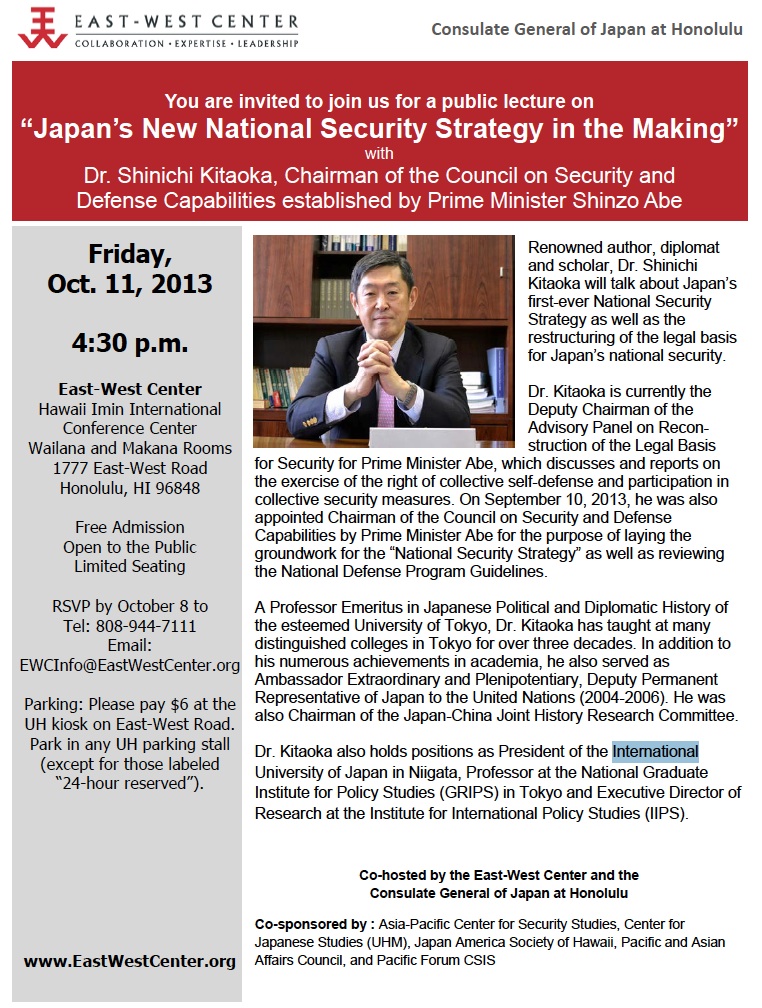
Hi Blog. Yesterday I attended the following speech:
I attended because I wanted to see what was making one of PM Abe’s leading advisors tick. Dr. Kitaoka did not disappoint.
He spoke in excellent English, and came off as a very articulate, passionate, and fluent advocate of his cause, which is essentially to make Japan strong enough militarily to deter China. He did not feel a need to be restrained by a diplomat’s training, calling various schools of thought “totally wrong” and “stupid”, nor an academic’s subtlety that should come with a doctorate, where he said with firm certainty at various stages that “no Japanese” wants things like expansion of Japan’s borders (he also called Koreans an “emotional people”). Almost all of the geopolitical problems he referred to in his talk were traced back to China, and he made a strong, reasoned plea for Japan’s inherent sovereign right for collective self defense in order to “contribute to peace and stability” by being empowered to assist Japan’s friends and allies (particularly, naturally, the Americans).
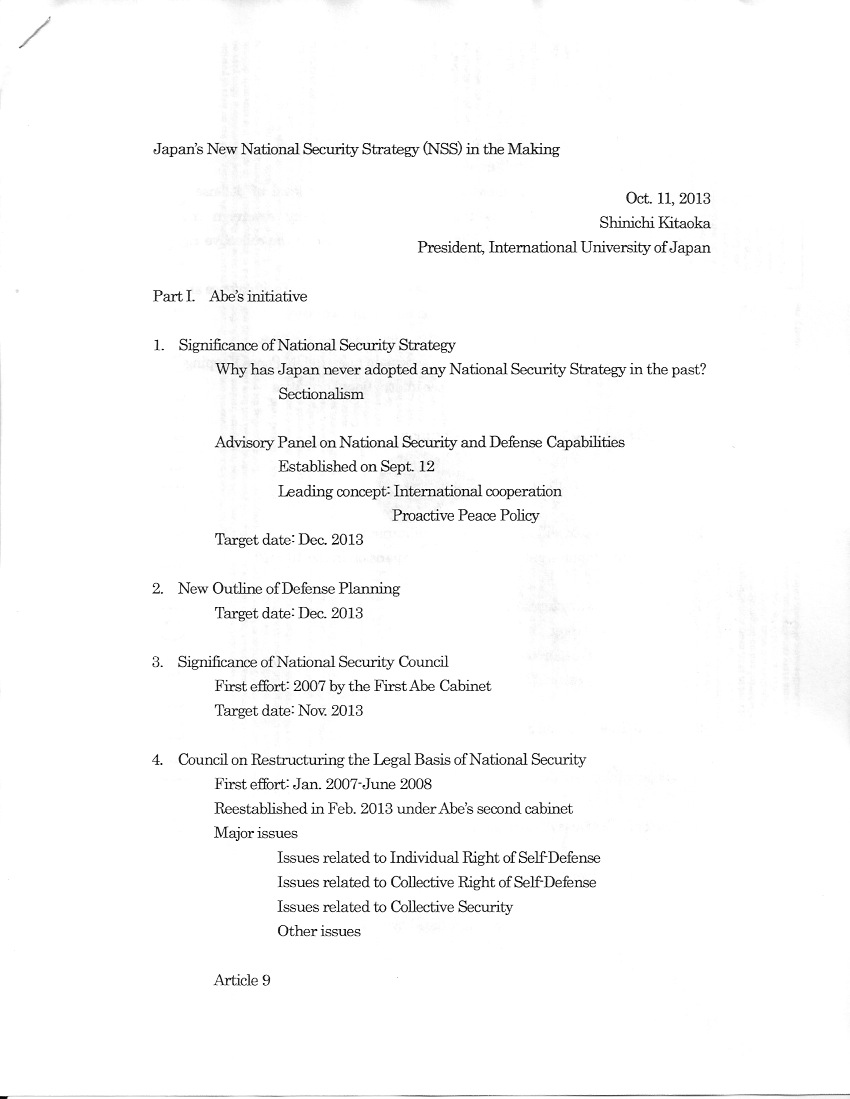
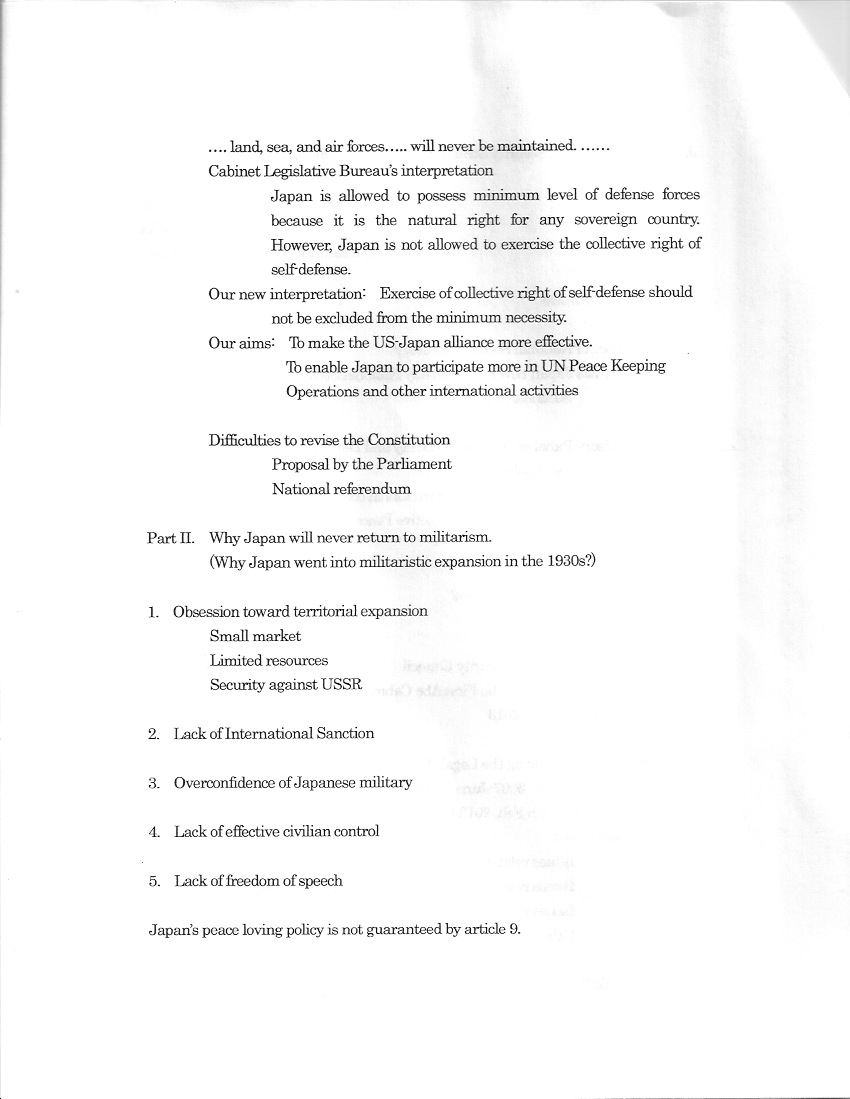
Dr. Kitaoka was very smooth. He pushed all the right rhetorical buttons with an American audience (this one at the EWC quite full of American military brass; the audience was quite emotive), contrasting rich, democratic, non-nuclear, and “peace-loving” Japan with richening, undemocratic, nuclear and unfree China, which is increasing its defense budget every year and seeking territorial expansion (he even mentioned China’s dealings in Africa in that context). He also smoothed feathers to head off the “Genie in the Bottle” argument (which is one image the US military uses to justify its continued presence in Japan — to stop Japan from remilitarizing) by pointing out five conditions why today’s Japan is different. (See them well elaborated in his Yomiuri article scanned below.)
So to this end, Japan would need its first National Security Council, which would hopefully be established by November 2013.
There were a couple more surprises in Dr. Kitaoka’s talk. One was that he was arguing that Japan is essentially in the same position today as China was in the early 20th century, where Japan is the one now who should think about how to defend itself from unjustified aggression from China! The other surprise was his reasoning about why the world should not worry about Japan’s potential renewed territorial expansion abroad — because treaty agreements between the US and South Korea would preclude Japan’s need to invade the Korean Peninsula for defensive reasons (now that’s a novel take on Japan’s colonial history!).
Oh, and that it would be an impossibility for Japan to go nuclear again, because Japan as a huge developed economy integrated into world markets is particularly vulnerable to international sanctions. But China, you see, is a member of the UN Security Council, unlike Japan, and they make UN sanctions more “ineffective”. Less democratic countries, such as China and Russia, have more power in the UN than the democratic countries such as Japan, Germany, India, and Brazil… (and that was a very neat way to allude to Japan’s need for a UNSC seat — told you he was smooth).
The Q&A was done by people passing papers to the front to be sorted, vetted, and read by EWC staff.
In the end, Dr. Kitaoka talked like I would expect one of Japan’s elites to talk — seeing the world only in terms of power, and how Japan needs more of it because its neighbors are security threats. That’s what any security analyst will say, of course (that’s how they’re trained), but Dr. Kitaoka spoke like a trained Gaijin Handler representing PM Abe’s political agenda, not a scholar. Fascinating in that light, but scary, since these are the people who have been voted right back into power and want to dramatically alter Japan’s future policy.
Through him we can see PM Abe’s remilitarizing machinations and goals. And next month, here they come. Arudou Debito
NB: LLK sends links to his full speech (with Q&A) available on vimeo.com. Here’s the link:
Hi Blog. I’m about to vacation the blog for a few weeks for the summer, but before I do, here’s some food for thought about the debate on discrimination in this part of the world. Contrast the Korea Times article below about racial discrimination in South Korea with any article about racial discrimination in Japan. I see striking parallels, especially given my experience as a naturalized Caucasian Japanese myself. The debate in South Korea seems to be falling into similar mental traps and policy-level blind spots.
(And in case you’re wondering, no, sorry, I’m not going to engage “Japan Lite” columnist Amy Chavez’s recent ill-considered column on racial discrimination; she essentially makes the argument that we “foreigners” should stop acting like “spoiled children”, and instead essentially be grateful for being discriminated against as minorities in Japan — as it will give us “compassion” for the plight of minorities in our “home countries” (as opposed to insights on how to prevent discrimination happening to our friends and children in Japan). I’m avoiding it for the same reason I didn’t engage columnist Gregory Clark back in 2009 when he claimed that “antiforeigner discrimination is a right for Japanese people” (also because Chavez has a history of writing silly racialized columns like this one in 2009). It just seems that everyone has an opinion about “racism” and “discrimination”, but few have either the training or the insight for how to deal with it in ways that don’t simply reflect their biases arising from their position in society (something CRT calls “structural determinism“). In Chavez’s case, her argument (which she unsophisticatedly tries to apply universally to “we foreigners”), has simply become a self-loathing expression of her White Guilt; I’ll let others such as Black Tokyo or Loco in Yokohama take that issue on with more verve and insight (as Black Tokyo did Clark)).
Anyway, back to the article, for some real insights. Arudou Debito
Alex, an Ethiopian by birth, is a naturalized Korean, so he was shocked when a bar in Seoul refused him entry because of the color of his skin.
“I went to a bar in Itaewon and they said, ‘Sorry, we don’t want any blacks,’” said the 31-year-old, who asked to be identified only by his first name. “I showed them my I.D. card to show them I am a Korean, but they said no.
“Koreans don’t think there is a lot of discrimination in Korea, but there is,” he said.
Four years ago Indian professor Bonojit Hussain won a landmark case in a Seoul court for racial abuse. The incident led to the introduction of legislation to ban discrimination based on race or nationality, but the bills have stalled in the National Assembly.
But is xenophobia a widespread problem or is it exaggerated based on a few well-publicized incidents?
Sabine Etienne, a black American exchange student in Korea, is writing a thesis on Korea’s immigration policy. “Xenophobia is definitely an issue in Korea, it is an issue of acceptance,” she said. “The process of becoming a citizen is very long and hard and I think foreigners never feel like they are on the same level as Koreans.”
Despite this, there are several high-profile examples of foreigners who have found acceptance as naturalized Koreans, including the Philippines-born lawmaker Jasmine Lee and German-born Lee Charm, the current head of the Korea Tourism Organization (KTO).
Lee, whose birth name was Bernhard Quandt, became a Korean citizen in 1986. On becoming KTO chief in 2009 he said, “I am so deeply moved that I’ve been finally accepted as a Korean. All my regrets about naturalizing have vanished.”
However, Alex, who is married to a Korean, complains about a lack of acceptance from Koreans, including from his wife’s family.
“My wife’s family didn’t accept me at first, now they are saying they are more open, but it is still tough. We see them one maybe two times a year. It is not like family,” he said.
Alex added that he has decided to postpone having children because of the hostility he has experienced in Korea. “Until I see change I don’t want to have kids.”
In a report submitted to the International Convention on the Elimination of all Forms of Racial Discrimination (CERD) in 2003, the Korean government explained that the “homogeneity of the Korean people and the relative lack of multiethnic experiences have been conducive to prejudice against foreign cultures and people.”
But Hyung-il Pai, a professor of Korean history at the University of California, argues in her book, “Constructing ‘Korean’ Origins,” that the idea of a pure Korean race is a myth constructed by Japanese colonial scholars and Korean nationalists.
The archaeological record actually shows that Korea’s historical development reflected diverse influences from throughout Northeast Asia.
Nonetheless, “Race as the basic unit of analysis in Korean history was the pedestal on which the nation was built. Race or blood was considered the most critical factor in Korean identity formation,” she explained about modern Korean attitudes on history.
These views have become accepted wisdom among Koreans. “I think there has only been one race in Korea, and we have a long history ― we were very closed off for a long time,” said Jun Dae-un, a student.
“Korea didn’t attack other people, they were always attacked by other countries. That is why Koreans are not very open-minded to foreigners, we think ― ‘they can steal my things, my jobs, my chances,’” he said.
Korea’s isolation from most of the rest of the world during the Joseon Kingdom has contributed to the belief that Korea is a cultural and racial homogenous society.
“We opened to other countries quite late. It was late compared, for example, to Japan or China. So we are not used to seeing foreigners,” said Charyong, a painter, who wants to be identified only by her first name.
“And we kind of believe this concept that says we are Han people, the Han race, like we are all the same blood, we are not mixed race, compared with Japan for example ― Japan is very mixed race. People believe we are all one race, one blood,” she said.
“That is an underlying concept ― people are not thinking about it all the time ― but it is the basis for our culture, so when we see foreigners we think they are different. We notice the difference, we notice that they are not the same,” she continued.
Some believe that discrimination against foreigners is also based on a mixture of racial and class prejudices.
“The extent of xenophobia is heightened among foreign migrant workers who have darker skin colors because they are easily identified,” said Rev. Frank Hernando from the Presbyterian Church in Korea. “And (they) are perceived by Koreans as coming from very poor economic and social backgrounds.”
He said that Filipino migrant workers are often subject to verbal and physical abuse and sexual harassment in the workplace because of these attitudes.
Other foreigners also spoke of their economic background as a cause for Korean discrimination.
“Koreans don’t like people from countries with worse economic situations than their own,” said Shylean Ghosh, an Indian worker at a garment factory in Uijeongbu. “If you are from America they like you, if you are from somewhere like India, like me, even if you have a lot of money they look down on you. If you are from America but have no money, they still don’t look down on you.”
Kim Padernal, a Filipino embassy driver in Seoul, said, “Koreans think they are better than us, because Korea is a progressive, successful economy, and the Philippines is poorer.”
Artist Charyong said Koreans don’t think of migrant workers as equals. “People think their (migrants’) country must be worse than Korea, because they are here working, and they work for what is so little money.” She added that Americans have a more positive image because of their help and support during the Korean War and their long-term presence in the country as a result.
Shin Gi-Wook, a professor of sociology at Stanford University, California, feels Korean attitudes toward foreigners are “hierarchical.”
“Korean racism is hierarchical in the sense that Koreans view white Caucasians more positively than Southeast Asians,” he said. “Koreans are not used to living with different ethnic or racial groups but with the influx of migrant labor and foreign brides, Koreans need to learn (to live) with ethnic non-Koreans.”
Kim Doo-nyeon, a law professor at Jungwon Univeristy, blames the local media for, spreading feelings of xenophobia.
“There is a tendency in the media to assume and exaggerate foreigners or illegal immigrants as future criminals,” he said. “The media is very responsible for xenophobia in Korea. They must stop producing news that is going to make people hate foreigners.”
Charyong added, “When people see something they don’t know it is often their first reaction to defend themselves from it because they don’t know what it is.
“I think the solution is more exposure to foreign culture.”
On the eve of an election that will only further empower this man, Scholar Tessa Morris-Suzuki talks about the media machines to rebrand him as “not a nationalist”. Hah. And double hah after reading some actual scholarship on this man. Read on and grit your teeth as election results come in. Arudou Debito
The Asia-Pacific Journal, Volume 11, Issue 28, No. 1, July 15, 2013.
The Re-Branding of Abe Nationalism: Global Perspectives
Tessa Morris-Suzuki
In 2010, the Australian Broadcasting Company (ABC) launched a highly successful TV show called The Gruen Transfer. The title refers to the disorienting psychological effects produced on consumers by the architecture of shopping malls, whose dazzle and noise are deliberately designed to mesmerize: on entering, “our eyes glaze over, our jaws slacken… we forget what we came for and become impulse buyers”.1 The ABC’s Gruen Transfer explored the weird, wonderful and disorienting effects produced by the advertising industry. Its most popular element was a segment called “The Pitch”, in which representatives of two advertising agencies competed to sell the unsellable to the show’s audience – creating gloriously sleek videos to market bottled air, promote the virtues of banning religion, or advocate generous pay raises for politicians.
I have been reminded of The Gruen Transfer in recent months, as sections of the media in Japan, and even internationally, have gone into overdrive to sell an equally challenging message: the message that Japanese Prime Minister Abe Shinzo is not a nationalist.2 This particular pitch has been running for some time. It began with the inception of Abe’s first short-lived prime ministership in 2006, when Japanese Foreign Affairs Deputy Press Secretary Taniguchi Tomohiko devoted considerable energy to persuading a US audience that Abe was “almost the polar opposite” of a nationalist.3 The right-of-centre Sankei Newspaper took up the challenge with enthusiasm: its Washington correspondent, Komori Yoshihisa, published numerous articles, including an opinion piece in the New York Times, which aimed to refute the “nationalist” tag. Far from being a hawkish nationalist, Komori argued, Abe had “merely been shaped by democracy”, and his real aim was to bring Japan back from the “post-war extreme towards the center”.4 But these pronouncements had only limited impact on international opinion, and by early 2007 one prominent Japanese marketing consultant was lamenting, in the pages of the Yomiuri newspaper, that the government needed a far more effective foreign media strategy to rescue Abe from the “hawk” and “nationalist” labels.5
The issue has resurfaced with renewed vigor since the advent of the second Abe regime in December 2012. In May 2013, a US Congressional Research Service paper describing Abe as a “strong nationalist” evoked a surprisingly querulous response from pro-government media in Japan, and even from Prime Minister Abe himself. Abe hit back with a statement in parliament, expressing his unhappiness that “the ideas of our country” were being misunderstood by foreigners. He went on to call for measures to “actively collect and spread information so that we will be correctly understood”.6
[…]
Abe’s core goal, inherited from Kishi, clearly set out in Towards a Beautiful Country, and echoed in the manifestos of groups like the Shinto Association of Spiritual Leadership, is to “escape from the postwar regime”: that is, to reverse the political reforms introduced to Japan during the allied occupation. In his view, these reforms undermine Japan’s traditions, which are centred on the figure of the Emperor. What Abe’s nationalist vision means in practice is best understood by examining his party’s far-reaching proposals to rewrite the postwar Japanese constitution. The proposed changes include removing the reference to “respect for the individual” and making it constitutionally impossible for foreign permanent residents to be given national or local voting rights. Freedom of expression and freedom of association would not be protected where these “have the purpose of harming the public interest or public order”. The same formula would be used to limit the right of citizens to “life, liberty and the pursuit of happiness”. The revised constitution prepared by the Liberal Democratic Party contains no guidelines as to how, and by whom, “public interest” and “public order” would be defined, leaving an alarmingly large loophole for the repression of civic freedoms by the state. A new article would also be added to the constitution to give the state sweeping powers to declare prolonged states of emergency, during which constitutional rights could be suspended.22 With the prospect of an LDP super-majority in parliament for the next two to three years, there is a strong likelihood that the ruling party will push forward with an attempt to carry out these changes: changes so profound that they should probably be described, not as plans for constitutional revision, but rather as plans for a new constitution.
This artwork appeared in an exhibition entitled “the Constitution and Peace” which opened in a public art space in Fukui Prefecture in May. The work consists of several sections of the current constitution written out in attractive calligraphy and coloured ink on Japanese paper. Soon after the exhibition opened, it was removed on the orders of the company which manages the art space for the local government on the grounds that “its political content might offend the feelings of some viewers”.
The current popularity of the Abe administration in no way reflects public enthusiasm for these grand political designs. It is, instead, a response to the government’s economic stimulus package, and to Abe’s skill in making optimistic statements, which convey a sense of leadership to a population weary of political uncertainty and economic malaise. In the end, the Abe government’s performance should and will be judged, not on any political labels, but on the impact that it has on Japanese society and on Japan’s relations with its region and the world. It is possible that Abe may yet choose to focus on the vital tasks of creating a basis for a strong Japanese economic future and improving relations with Japan’s neighbours, rather than pursuing the ideological agendas of anti-liberalism and “escape from the postwar regime”.
In the meanwhile, though, those who care about the future of Japanese society should not allow the dazzle of verbal juggling to induce a political version of the Gruen Transfer. The prime minister’s ideology may be re-branded for the global market, but the old adage remains: buyer beware.
Tessa Morris-Suzuki is Professor of Japanese History in the Division of Pacific and Asian History, College of Asia and the Pacific, Australian National University, and a Japan Focus associate. Her most recent books are Exodus to North Korea: Shadows from Japan’s Cold War, Borderline Japan: Foreigners and Frontier Controls in the Postwar Era and To the Diamond Mountains: A Hundred-Year Journey Through China and Korea.
Hi Blog. A bit of a tangent this time, but what do you think about this article? It suggests that diversity in Japan’s corporate culture is being suppressed, and overseas experience is in fact a DEMERIT to placement and advancement. If true, then how the heck are NJ supposed to get ahead in Japanese companies if even Japanese face the same resistance? And what does it say about Japan’s future in the global market? Arudou Debito
Many young Japanese students go abroad to study with high hopes. They return home with foreign degrees and even higher hopes, only to be shot down by conservative company ideals.
On the very first day in her first job after graduation, Tomoko Tanaka says her dominant emotion was of disappointment.
Tanaka, who does not want her real name or the name of her company used in this article because it could affect her career, began work in April of this year and had high hopes that the years she spent studying overseas would make her a popular candidate with Japanese employers.
Instead, it seems, the effort and money that went into perfecting her English skills in the UK may have been wasted as Japanese firms do not always welcome potential recruits who have been exposed to foreign ways of thinking and behaving.
“I did not have a clear dream for my career, but I did want to work for a big and famous company,” 23-year-old Tanaka told DW. “I studied in the UK for one year, I learned about the difficulties of living with people from various countries, from different cultures, and the importance of taking action in order to change something and to make myself understood.
“And I felt more confident after living abroad because I could overcome many difficulties,” she added.
High test scores Initially, Tanaka was encouraged by her job interviews as employers seemed to value a high score in language assessment tests.
After securing a job that appeared to offer good career prospects, Tanaka learned that she was being sent to a rural part of Japan and would be working in the administration department. Since she started, she has not yet had an opportunity to use her English skills.
“In my opinion, most Japanese companies want young people who have a ‘Japanese background’ and international communication skills, but I think that is global human resources in a very limited sense,” she said.
Graduates from foreign universities find it difficult to get a job
“It seems that Japanese companies want young people to obey their rules, but only to use their skills when the company needs it,” she added.
But this runs counter to what Japan needs in the rapidly evolving world of international trade, commerce and international relations.
In March, Prime Minister Naoto Kan announced that Japan would take part in negotiations to construct the Trans-Pacific Partnership free-trade agreement and indicated that opening up to the rest of the world offers the best chances of growth for the nation.
Japan has also actively been seeking a permanent seat on the United Nations Security Council, the government is planning to revise parts of the constitution that will enable Japanese troops to play much larger roles in international peace-keeping operations and companies are being encouraged to go further afield to secure the resources and markets that will provide for the nation’s future.
Companies lagging behind Many companies here, however, are not keeping up with that vision.
A survey conducted in March 2012 by Disco, a Tokyo-based recruitment company, determined that less than one in four firms planned to hire Japanese applicants who had studied abroad.
Even among major, blue-chip companies, less than 40 percent said they would employ Japanese who had attended a foreign university.
Aware of the problems they face if they have invested their time and funds on an education overseas, more are staying closer to home. In 2004, there were 82,945 Japanese at colleges overseas; in 2010, the figure had contracted to less than 60,000. In the US alone, the number has fallen from a peak of 47,000 in the 1997-’98 academic year to just 19,900 in 2011-’12.
Inevitably, as places are freed up at foreign institutions, they are being snapped up by students from developing nations with a thirst for knowledge, with China and India in the forefront of the surge.
“It seems to me that for the first few years of young Japanese graduates’ careers, they are effectively being ‘trained’ in the corporate culture and requirements of their company,” said Chris Burgess, a lecturer in English and Australian Studies at Tsuda College in Tokyo.
Talent going to waste “That means that despite all the rhetoric from the government, these companies are wasting so much talent,” he said.
PM Kan indicated that opening up to the rest of the world could help the country’s growth
“They are usually long-standing institutions with structures that are very difficult to reform,” he said. “There is an inbred corporate culture and they are very reluctant to evolve, even when they need to do precisely that to survive in an increasingly competitive business world.”
It is an alarming statistic that fully 25 percent of new employees at Japanese companies resign within the first three years, he said, simply because they are not satisfied with what they are doing.
“I felt confident and really motivated when I started my job interviews,” said 26-year-old Yumi Hara, from Yokohama, southwest of Tokyo.
Two years in London and a degree in East Asian Studies from the University of Virginia that gave her Chinese and Korean on top of her English would make her an attractive option for a Japanese company that had ambitions of expanding its operations overseas.
“But in the interviews, they didn’t really want to know what I thought, but whether I was able to give them the perfect answer, to tell them what they wanted to hear,” she said.
Hara admits she was “devastated” at the constant rejections – particularly when she discovered that friends who had opted to go to Japanese universities and had very limited language abilities were getting the very jobs that she wanted.
She shrugs.
“Today I’m teaching English in a small school and I’m pretty happy doing this as it’s a small company and I have the responsibility to start new things,” she said. “I don’t think I’ll be going to work for a big Japanese company any time soon.”
ENDS
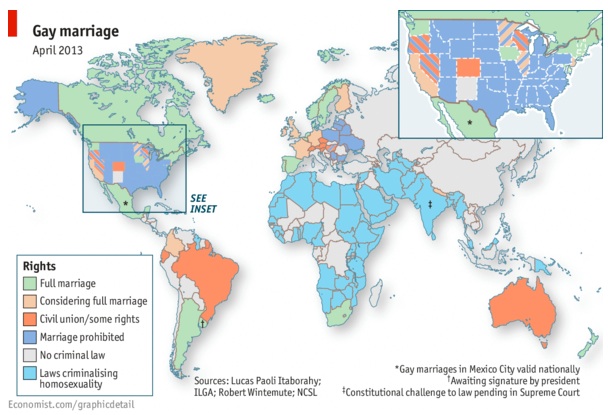
Hi Blog. Today I’d like to take readers on a bit of a tangent, as this blog tends to focus on minorities in Japan in terms of “race”, social, or national origin. We don’t talk much about Sexual Minorities, such as the LGBT communities in Japan (particularly the Douseiaisha, Japanese for Homosexuals), and how they are missing out on the wave of legalized gay marriage worldwide. Consider this from The Economist:
TENS of thousands of people thronged the streets of Paris at the weekend to protest against a gay-marriage bill that is set for a second reading in the National Assembly on April 23rd. They are unlikely to stop its passage. The bill, which is an election pledge by the Socialist president, François Hollande, was passed by a large majority at its first reading in February despite fierce opposition organised by conservative and Catholic groups. France is not the only country where gay marriage has been on the legislative or judicial agenda in recent weeks. On April 17th New Zealand became the 12th country to legalise gay marriage, though the law will not come into effect until August. Uruguay, too, has passed a similar bill that awaits the signature of the president before it becomes law. And in late March the American Supreme Court began hearing arguments in a case on the constitutionality of the Defence of Marriage Act, which restricts marriage to a man and a woman. In all these countries—and indeed in much of the West—opinion polls show public support for same-sex marriages.
ENDS
====================================
Debito.org applauds this trend of legalizing gay marriage. Meanwhile Japan, as you can see above, to its credit has no law criminalizing homosexuality. It, however, does not permit gay marriages due to the vagaries of the Family Registry (Koseki) System. In short, only a wife and a husband by gender can create a married family unit.
But as has been pointed out here on Debito.org before, people find ways to get around this. Gay couples, in order to pass on inheritance rights, adopt each other into the same family unit on the Koseki. The problem is for international couples that non-citizens cannot be listed on a Koseki as husband or wife.
So here is how LGBT foreigners can get around it: Naturalize and adopt. As Debito.org previously suggested might be the case, famous naturalized Japanese Donald Keene has done it, and recently gone public about it:
Anyway, that’s the template for how you do it. Gay NJ who wish to marry Japanese and get the same inheritance rights should naturalize and adopt one another. Or else, barring naturalization, go overseas to a society more enlightened about Same-Sex Marriage and get married. Bonne chance. Arudou Debito
Hi Blog. In the vein of the recent discussion on treatment of NJ in Japanese media, here’s food for thought from a Debito.org Reader under the pseudonym “Bignose”. I’m intrigued but not 100% convinced, so I’ll open this one up under the Discussions heading for lighter moderation. Arudou Debito
//////////////////////////////////////////
Cute Kobito and Control Fantasies? January 6, 2012
Hi Debito, It’s Bignose here.Remember those stereotypical pictures of Caucasian gaijin so beloved in this country? Looks like theeeey’re back with a vengeance! I am filing this with you to see what you and other readers think.
Initially I thought the point I want to make might be a stretch; that I might be being hypersensitive. It’s possible to see insults where there are none, or that comments received are misinterpreted through cultural misunderstandings, poor language ability, things taken out of context. So I am going to be quite careful what I say. But after long, long experiences living in Japan, to put it in a nutshell, I smell a rat.
To the item at hand. It’s about othering and control fantasies referring to a “lost paradise” (a shitsuraken perhaps?) that was Japan when foreigners were cute and mainly for entertainment.
A few nights ago my wife (who is Japanese) and I and our infant child were having dinner at a friend’s place. Our friend is a longstanding one, she’s known and worked with my wife when they were at a major Japanese advertising company 15 years ago and our friend, who is in her 40s, is a professional and an account manager. She speaks reasonably fluent English and has done home stays, a year abroad, etc.
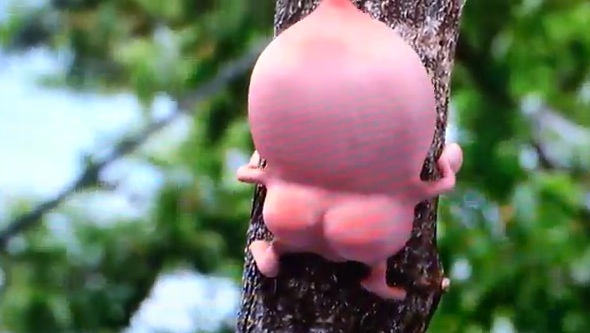
So the three of us were round our friend’s place where she cooked a lovely dinner and then she introduced us to a “must watch” waraibangumi called こびとづかん. I was very interested because as a father I monitor Japanese kids programs my wife wants to show our child quite closely, avoiding programs that I think are problematical (too cute, squealing, gender stereotypes and having very young performers, especially young girls, performing adult routines…and it’s not only my wife and I that find groups such as AKB48 extremely disturbing and problematic on many, many levels). I always try to balance out any media experiences my child has with Japanese media with alternatives in English, either from the U.S. or the UK, for example.
As I watched it, I thought fine, fine, it looks like a decent story, very entertaining. But I wondered, why is this kiddies program so entertaining for adults? Why is it such a hit? My friend’s eye were glowing, and she was clearly getting very excited.
By the second minute I started to find the patronizing tone grating, largely because it reminds me of how I am still sometimes treated by Japanese people dealing with gaijin, you know as if we are some sort of stupid alien pets. Or perhaps sometimes it’s just trying to be kind and well meaning to the alien. Or perhaps it’s just me, I was thinking.
As soon as our little critter appeared in the third minute, I realized I felt a little bit uncomfortable, but I couldn’t put my finger on why.
[NB: Note that the newspaper put down as a cage to catch the critter is in English…]
Then suddenly in just on the 4th minute, our friend starting squealing in laugher. As our stupid but harmless character [kakure momojiri] she loved so much because he was so cute was inching his way up the trap showing his pink ass, our friend squealed out “XXXXX-san, it looks just like YOU!” and she started giggling uncontrollably.
I went along with it but I felt even more unsettled. I do want to say that her friend has never seen my (admittedly) pink-ish ass and secondly I don’t think our lovable momo-munching kobito friend looks like me. I’m relatively slim, even if I am not as young as I used to be.
But when our little friend ….whoops!…bikkuiri !!! hilariously plopped into the tender trap prepared for him, the yen started to fall, so to speak.
Before I go any further, I’d like readers to look at the other pictures from the set of characters for this series:
Bignoses! They all look like that older grumpy University English teacher you had that you didn’t really like and had to put up with, with his strange alien ideas and his attitude problem at not playing the game and being “yasashii,” i.e. entertainment.
They even have blackfaced “kokujin” characters with even bigger flatter noses and big lips.
Where are the Asian characters? There are none.
As I watched further, more things fell into place. The lovable western looking kobito is lured into a world thinking he’s going to get his nice juicy peach, not knowing in fact that he’s going to be completely controlled as a lovable pet that is going to be patted and taken care of until his part is played.
It struck me why this children’s program such a huge hit with adults. On one level they are great stories, but I really am not sure that it is a good lesson to take creatures out of nature and turn them into entertainment pets. But as they are not humans and with only limited intelligence, no harm done, no doubt! Yep, an there are many more problematical kiddies programs out there involving sexualization and gender stereotyping, violence and etc. and all sorts of garbage from just about anywhere you care to name in the world.
But on another level, this to me seems all about appealing to the control fantasies of othering gaijin. Controllable kobito lovingly lured into traps by their own stupidity to be cared for and controlled and as entertainment for Japanese.
I thought about it and I thought about it. I said to my wife, am I being oversensitive? She was completely confused. So I said, well, what if all these kobito had slanted eyes and were yellow and this was a U.S. show. Would you feel comfortable about it. Then the penny dropped for her too.
There is a lot more could say at this point, but I just wanted to share this with other Debito readers to see what they thought. “Bignose.”
Hi Blog. As our last post talked about labor law issues (and the proposal to abridge Labor Standards in favor of greater “flexibility” to dismiss labor without reasons), here’s an important article that came out in the Japan Times last December that I was waiting to get to, discussing issues once again of employer power over employees: When is a person under the authority of his or her employer, deserving compensation as “work time”? Okunuki talks about important cases in a very enlightening article about just how grey “work hours” are, and underscoring how powerless Japanese employees are regarding all that overtime going unpaid — how many people take things to court or to labor unions to fight under this precedent, or are even aware of “kyakkan setsu vs. nibun setsu”?. And the proposal we discussed last blog entry is to give even more power to employers? Arudou Debito
////////////////////////////////////////////////
Japan Times Tuesday, Dec. 18, 2012 THE COMMUNITY PAGE LIFELINES: LABOR PAINS When is an hour at work not a work hour?
It was 1988, in an ad for Regain energy drink. Actor Saburo Tokito, wearing a suit and carrying an attache case, asked a question that would go down in TV history: “Can I work 24 hours straight?”
Japan was reveling in the go-go years of the bubble economy, its people sacrificing their health, families and private lives in a mad devotion to work, work and more work. But beneath all the bright economic indicators lurked a dark underbelly of millions of hours of unpaid overtime and innumerable cases of karōshi, or death from overwork.
As 2012 winds down, economic and political stagnation drags on, while our society increasingly feels somehow claustrophobic. If we cannot have permanent economic growth, then shouldn’t we at least do away with the 24/7 work ethic? Yet the Japanese disease of “all work and no play” unfortunately seems to be here to stay. With job security fading fast, things are worse than ever.
I’d like to close 2012 with a major labor law theme: work hours. When is an hour a work hour? It’s not as straightforward as it might seem. To ensure that work hours are a pleasant and humane experience, we first need to define them.
The Labor Standards Law sidesteps a proper definition, and labor law scholars fall into two camps over how a work hour should be defined. One subscribes to what is known as kyakkan-setsu, roughly translating as “objective theory.” This camp argues that work hours are the entire time during which the employee can objectively be considered to be under the authority of her or his employer.
The nibun-setsu (two-part theory) camp, on the other hand, splits work hours into “core” and “peripheral” work hours, with the status of the latter gray area between strictly defined work hours and break time to be determined through agreement between the employer and employed.
The gold standard in case law regarding work hours is the Mitsubishi Heavy Industries Nagasaki Shipyard case. The Supreme Court’s Petty Bench on March 9, 2000, rejected outright the nibun-setsu approach and backed the kyakkan-setsu interpretation. Let’s examine the case.
The plaintiffs built and repaired vessels for Mitsubishi Heavy. The shūgyō kisoku (work rules) stipulated work hours and break time, as well as rules regarding changing into work clothes before and after work.
Workers were expected to be on site at the start and end of each shift in proper work clothes and gear. The preparation had to be done in the changing room and failure to do so before the start of each shift could result in disciplinary action, including poor evaluation, pay cuts or suspension.
The plaintiffs sued the plant, claiming that the following periods, numbered 1 through 8, were working hours and therefore should be paid as overtime and at overtime rates.
1) Time in the morning to get from the shipyard gate to the changing room.
2) Time in the changing room to don work clothes and special equipment, then to move to the preshift calisthenics area.
3) Time spent taking out equipment and materials from the warehouse before and after work and hosing down the yard before the shift.
4) Time to get from the shipyard to the cafeteria and then remove some gear and clothing for lunch break.
5) Time to move from the cafeteria to the calisthenics area and then put gear and clothing back on after lunch.
6) Time to get from the work site to the changing room and remove clothing and gear after work.
7) Time spent washing or taking a shower and then changing into ordinary clothes.
8) Time to get from the changing room to the gate of the shipyard at the end of the shift.
Nagasaki District Court in 1989, the Fukuoka High Court in 1995 and the Supreme Court in 2000 all ruled that 2, 3 and 6 constituted work hours that must be paid, while the others did not, for the following reasons: Workers were not under company authority during time periods 1 and 8; workers were free to use their break time as they chose for periods 4 and 5; and period 7 involved actions that were not required of workers and did not interfere unduly with their commute home.
This case was the first to take up the definition of work hours and is thus extremely important. Much attention is paid to the wording in the verdict that “time to do activities that are unavoidable or ordered by the employer constitute work hours.” This applies even if the order is tacit.
This case gives a sense of the courts’ thinking on work hours. If more workers understood this jurisprudence, we would surely see more workplaces that are “healthy in body and mind.”
Nicolson has found the time and energy to lead a group of cyber-bullies who hounded US-born rights activist, author and Japan Times columnist Debito Arudou out of Japan.
is not true. I am in Hawaii for research purposes, working on my PhD. Activities in cyberspace are unconnected to my overseas hiatus.
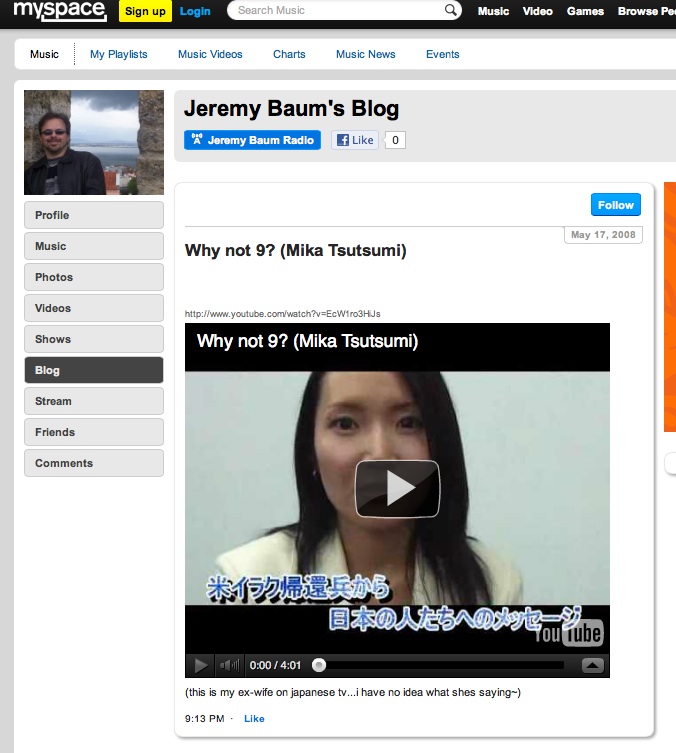
Hi Blog. I’ve devoted a couple of blog entries (here and here) plus a Japan Times column to propagandizing journalist Tsutsumi Mika, who has had her “Poverty Superpower of America” book series adapted for Japanese grade-school audiences nationwide and a manga-reading Japanese public.
I’ve already gone into detail elsewhere about the latent journalistic problems with her reportage (not the least the outright falsification of evidence), and the implicit ironies involved with her demonizing a foreign society as a cautionary tale to audiences without sufficient training in comparative cultural study and critical thinking.
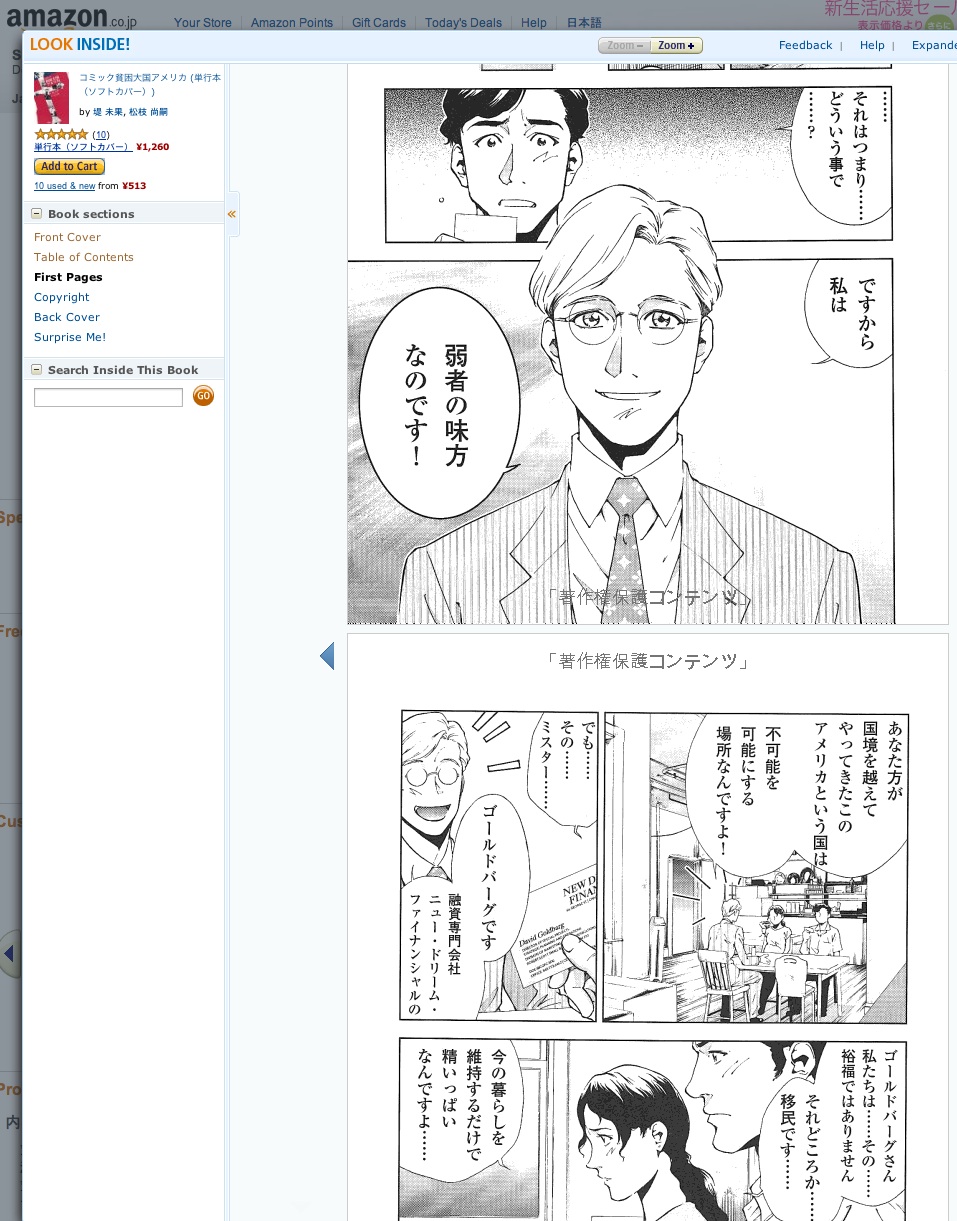
Now here’s another irony, sent to me by a friend who wishes to remain anonymous. Further inspection of Tsutsumi’s works reveals an odd attitude towards Jews. Consider this excerpt from her “Poverty Superpower of America” manga, courtesy of Amazon Japan:
Here we have a Jew named “David Goldberg” from a financial agency selling bogus house loans to an immigrant Mexican family before the whole US derivatives crisis. Goldberg announces himself as “the ally of the weak” before destroying all of their hopes and dreams.
================================== Blue eyes, blond hair: that’s US problem, says Japanese minister
Justin McCurry in Tokyo
The Guardian, Thursday 22 March 2007 http://www.guardian.co.uk/world/2007/mar/23/japan.usa
Taro Aso, Japan’s foreign minister, risked upsetting his country’s strongest ally by suggesting US diplomats in the Middle East would never solve the region’s problems because they have “blue eyes and blond hair”.
Mr Aso, a straight-talking nationalist, said the Japanese, on the other hand, were trusted because they had “yellow faces” and had “never been involved in exploitation there, or been involved in fights or fired machine guns”.
Japan has healthy relations with Arab countries and Iran and imports much of its oil from the Middle East. It is a big contributor of aid to the Palestinian Authority, but also has friendly ties with Israel.
“Japan is doing what Americans can’t do,” local media quoted Mr Aso as saying in a speech about Japan-sponsored investment in the Middle East. “Japanese are trusted. It would probably be no good to have blue eyes and blond hair. Luckily, we Japanese have yellow faces.”
Mr Aso, seen by some as a possible successor to the prime minister, Shinzo Abe, is no stranger to controversy.
In 2001 he said a member of the burakumin, Japan’s underclass, could never lead the country. He later angered Japan’s indigenous Ainu population by describing the country as unique in being “one nation, one civilisation, one language, one culture and one race”. While economics minister, he said he wanted to turn Japan into a country where “rich Jews” would want to live.
In 2003, he sparked protests when he praised imperial Japan’s often brutal colonial rule of the Korean peninsula from 1910 to 1945, and last month he described the US post-invasion plans for Iraq as “very immature”.
==================================
叩けば埃が出る。Tsutsumi Mika is a person replete with irony. I wonder what the Jewish anti-defamation leagues would make of Tsutsumi’s Jewish crook? The American Embassy (unlike the Japanese Embassy) is pretty lackadaisical about how the US is portrayed in Japan’s media. But I doubt, say, the Simon Wiesenthal Center would be.
January 30, 2013 Dear writers, Thank you very much for contributing your articles to The Japan Times. We would like to inform you that the special reconstruction income tax, introduced by the government to secure financial resources for reconstruction after the Great East Japan Earthquake of March 2011, took effect on January 1, 2013. This tax is imposed on individuals and corporations – both Japanese and foreign – at a rate of 2.1 percent over a 25-year period through 2037.
As a result, the total withholding tax rate deducted from the manuscript fee will rise from 10 percent to 10.21 percent for residents in Japan, and from 20 percent to 20.42 percent for overseas residents, starting with the February payment for articles carried in The Japan Times in January. Thank you for your understanding and cooperation. Sincerely, The Japan Times
///////////////////////////////////////
This post is not to criticize The Japan Times (who clearly have no control over this circumstance whatsoever). But have others also received word of yet another tax on income to go towards “reconstruction”?
What say other readers of Debito.org? We’ve already discussed extensively how the Post-Fukushima Debacles have laid bare just how irredeemably broken Japan’s system is (see related articles here, here (item #2), here, here, here, here, here, here, here, and here). Are you also seeing more skimming, both GOJ and non-GOJ related, from your paychecks for “reconstruction”? Just how bad do things have to get before people say “enough”? Arudou Debito
Hi Blog. In one of the most haunting news dispatches I’ve seen on Japan, Rupert Wingfield-Hayes of the BBC reported from the field last November in a video I have watched several times just to take in all the points. I’ll paste the accompanying text below, but make sure you watch the video, as Wingfield-Hayes takes us to the Senkakus, before a pre-PM Abe Shinzou talking tough, to otherwise sensible-looking college students spouting in public anti-Chinese vitriol to support a remilitarizing Japan, before an equally vitriolic Ishihara Shintaro calling for Japan to unsheath its sword (who, visibly chuffed by the international attention, comes back with a smirk (and a surprising level of English) to make sure the BBC got his point), finishing aboard a brand-spanking new Japanese aircraft carrier, the Hyuuga (one of two others planned), showing an emerging arms race in Asia. Watch it! And shudder as the dogs of war begin straining their leashes. Arudou Debito
Watching Japan and China square off in East China Sea By Rupert Wingfield-Hayes BBC News, Japan, 12 November 2012
Who do the Senkaku or Diaoyu Islands belong to? The short answer is I don’t know.
Japan once had a small colony there for a few decades. But they left in the 1940s.
No-one has lived on the remote islands since the end of WWII. As a piece of real estate they are not very attractive. Only one is big enough to be, just possibly, habitable.
But to therefore dismiss the islands as an irrelevance would be a mistake.
China has long claimed them, and is now for the first time aggressively asserting that claim. It is equally clear Japan is not about to give them up, and is possibly prepared to fight to keep them. It is, in other words, a very dangerous situation.
The only way to get to the islands is by fishing boat. It is not a particularly pleasant journey. In late October, the seas were choppy. The small 12m (39ft) fishing boat we had chartered pitched and rolled constantly. Inside the cabin the engine-noise was almost unbearable.
After 10 hours ploughing through the waves, the islands hove in to view through the pre-dawn light.
But between our boat and the islands were two large, white coastguard cutters. Out of the gloom, a pair of speedboats came skipping across the waves towards us. The coastguard officers were extremely polite, but made it clear we must stay at least one mile off shore.
Japan has banned all civilians, including Japanese, from landing on the island. It is to stop right-wing Japanese nationalists, who have in the past attempted to build a lighthouse and other structures there. It is exactly the same reason the Japanese government gives for “nationalising” the islands in September; to stop right-wing nationalists taking control of them.
When Japan and China established diplomatic relations in 1972, the leaders of both countries agreed to put the issue of the Senkaku/Diaoyu islands to one side; to let future, supposedly wiser, generations deal with the problem. They both also agreed that neither side would unilaterally change the status quo.
That is what China says Japan has done by “nationalising” the island. Beijing is now using that alleged change to justify its own assertion of sovereignty.
Brazen tactics As the sun rose higher over the island the radio on board our fishing boats crackled into life. It was the Japanese coastguard. “Chinese ships are heading in this direction, please immediately move around to the north of the island!”
Over the horizon we could see them coming: first two, then two more. Large, white Chinese ships with four blue stripes down the side.
Our fishing boat captain didn’t need asking twice. He was off. We sped round to the north of the main island.
But the Chinese boats kept on coming.
A Japanese P3 Orion surveillance plane then appeared from the east, swooping back and forth over the Chinese ships. The Japanese coastguard was now extremely nervous.
“Please stop filming and leave the area immediately,” came the message from the radio.
“They’re worried the Chinese will come and board us,” said the captain. If that happened it could turn into an international incident.
I don’t think that was really ever the Chinese intention. Their job was pretty simple, to brazenly sail through Japanese-controlled waters, while loudly proclaiming them to actually be Chinese.
The Chinese tactics are aggressive, but not too aggressive. The ships are “civilian” not naval. The aim is to wear down the Japanese resolve, to make Chinese control of the waters around the islands at least equal to that of the Japanese.
The Japanese government does not appear to have a counter strategy. We watched as the Japanese coastguard ships shadowed the Chinese ships, always keeping a distance.
After the anti-Japanese violence in China in September, Tokyo is understandably reluctant to do anything to antagonise Beijing further.
But China’s communist leadership, caught up with the 18th party congress, has shown no interest in dialogue.
Indeed, President Hu Jintao’s speech at the opening of the congress last week was a very public statement of China’s determination to build a powerful blue-water navy and enforce its territorial claims.
Such rhetoric is making people in Japan nervous of China’s intentions and more susceptible to the calls of right-wingers like Shintaro Ishihara, the former governor of Tokyo. He is one of many on the right who say it is time for Japan to scrap its pacifist constitution, and prepare to defend itself.
ENDS
Books etc. by ARUDOU Debito (click on icon):
UPDATES ON TWITTER: arudoudebito
DEBITO.ORG PODCASTS on iTunes, subscribe free
“LIKE” US on Facebook at http://www.facebook.com/handbookimmigrants
Hi Blog. Second in a series of two of prominent passings is American Senator Daniel Inouye, a notable Congressman who held on to his congressional seat longer than even legacy legislator Ted Kennedy. As per the local obit excerpt below, he had a quite glorious career in the military as part of the groundbreaking 442nd (some veterans I’ve even met in Hawai’i), then was a pathbreaker for Asian-Americans as a public servant.
http://www.kitv.com/news/hawaii/Sen-Daniel-K-Inouye-dead-at-age-88/-/8905354/17808008/-/wsjrh/-/index.html Senator Inouye began his career in public service at the age of 17 when he enlisted in the U.S. Army shortly after Imperial Japan attacked Pearl Harbor on December 7, 1941. He served with ‘E’ company of the 442 Regimental Combat Team, a group consisting entirely of Americans of Japanese ancestry. Senator Inouye lost his arm charging a series of machine gun nests on a hill in San Terenzo, Italy on April 21, 1945. His actions during that battle earned him the Medal of Honor.
But consider how he was able to do this, as pointed out by submitter PKU:
http://en.wikipedia.org/wiki/442nd_Infantry_Regiment_%28United_States%29 President Roosevelt announced the formation of the 442nd Infantry Regimental Combat Team (the “Go For Broke” regiment), saying, “Americanism is not, and never was, a matter of race or ancestry.” Ultimately, the draft was instated to obtain more Japanese–Americans from the mainland and these made up a large part of the 14,000 men who eventually served in the ranks of the 442nd Regiment.
Now this is important. Even as least AS FAR BACK AS FDR (the better part of a century ago), we had the United States at the highest levels of public office attempting to disentangle race/national or social origin from nationality.
This is something that Japanese society to this day has never accomplished (Japan’s Nationality Law still requires blood for citizenship, and from that derives the entanglement of race and legal status). Nor is Japan really trying. I speak from personal experience (not to mention court precedent) when I say that civil and political rights in Japan are grounded upon being “Japanese”, and “Japaneseness” is grounded upon phenotype (i.e., “looking Japanese”). This MUST be untangled by Japan if it ever hopes to encourage people to come in and settle down as “New Japanese”, not to mention allow people of mixed heritage to breathe as people of color and diversity. But I neither see it happening soon, nor are progressive steps even being taken towards it (I am in fact arguing that Japan in recent years has been regressing… see here, here and here).
As further proof of the helpfulness of a society with notions of citizenship disentangled from race/national or social origin, we have another Senator from Hawaii who just got elected, Mazie Hirono — and she wasn’t even born in the United States! She was born in Japan.
In comparison, the hurdles Hirono overcame were significant but not insuperable. Even though she was nowhere near as articulate or politically thoroughbred as her Republican opponent, former Hawai’i Governor Laura Lingle, Hirono still grossed nearly double the votes (261,025 to 155,565) last November 6 to clinch the seat. Further, if the legacy of Inouye is any template, I think Hirono will do more than just settle for being a symbolic sphinx in her role as a legislator. Because she can — in a polity which can elect people for life despite their foreign (or foreign-looking) backgrounds, she has more opportunities in society than Tsurunen ever will — or will make for himself.
My point is, the disentanglement of race/social origin from nationality (i.e., rendering clearly and politically at the highest levels of government) is something that every state must do if it is to survive as a nation-state in future. Given its demographics, especially Japan. Arudou Debito
UPDATE: U.S. Democratic Rep. Mazie Hirono defeated former Hawaii Gov. Linda Lingle on Tuesday night, according to the Associated Press. Ms. Hirono becomes the Aloha State’s first woman senator as well as the first Japan-born immigrant to be elected to the U.S. Senate.
As Japan’s politicians jockey over when to hold the next general election, one of Japan’s own is on the cusp of making U.S. election history.
Recent polls show Democratic Rep. Mazie Hirono is favored to win the open Senate seat in Hawaii when voters cast their ballots Tuesday. If successful, Ms. Hirono will usher in a wave of firsts. She will be the first Japanese immigrant to be elected senator. She will also be the first Buddhist and Asian-American woman. She will be the first woman senator to represent the Aloha State, and is already the first foreign-born woman of Asian ancestry to be sworn into Congressional office.
The 65-year-old congresswoman was born in Fukushima, the northeastern prefecture where the tsunami-damaged Fukushima Daiichi nuclear plant is located. When she was 8 years old, her mother moved the family to Hawaii. Ms. Hirono once said the immigrant experience and being raised by a single mother in economically difficult circumstances made her a “feisty and focused” lawmaker. She became a naturalized citizen in 1959, the same year Hawaii became a state.
Regardless who wins, Hawaii will get its first woman senator. Ms. Hirono, currently serving her third term in the House of Representatives, is up against former Gov. Linda Lingle, a Republican and long-time political rival to whom Ms. Hirono lost the 2002 gubernatorial race. The two women are chasing the seat opened up by Hawaii’s 88-year-old junior senator, Daniel Akaka, a Democrat. After a 36-year career, Mr. Akaka, the Senate’s only Chinese American, announced his retirement last year.
Scores of Americans of Japanese descent have been elected to public office since World War II. Case in point: If Ms. Hirono wins, both senators from the Aloha State will be of Japanese descent. Senior senator Daniel Inouye, who is also a Democrat, made his own imprint on Asian American history as the first Japanese American to serve in the U.S. House of Representatives and later, the Senate. The 88-year-old Mr. Inouye has been a senator since 1963, making him the second-longest serving senator in U.S. history.
There have been only five Asian American senators until now. Four have represented Hawaii and one has represented California.
But no Japanese-born–or any Asian-born for that matter–has been elected to the Senate. According to the U.S. Senate Historical Office, of 1,931 senators who have been sworn in since 1789, there have been 58 born outside the U.S. Most immigrated from Ireland (16), England (12) and Canada (10). One each came from Cuba, Mexico, Antigua and Sweden. People who have been U.S. citizens for at least nine years are eligible to be senator.
Ms. Hirono is a familiar face among Hawaii’s Democratic establishment. Since returning from the mainland after earning a law degree from Georgetown University, she served for 14 years in the state legislature, eight years as lieutenant governor and is currently in her fifth year in the U.S. House of Representatives. Her one election failure was her bid to become governor in 2002. But it raised her profile, both at home and in Japan. State broadcaster NHK covered her campaign extensively and had plans to televise the 2002 election live, according to a Chicago Tribune story.
Ms. Hirono, whose immigrant story seems to resonate with Hawaii’s diverse voting population, has campaigned fully backing President Barack Obama’s platform, casting her opponent as a Republican lackey. The Hawaiian-born president recently recorded a radio ad for Ms. Hirono, noting that she once worked with his late grandmother, Madelyn Dunham.
“So Mazie isn’t just a reliable partner of mine in Washington; she is part of my ohana at home in Hawaii. Now, I need Mazie’s cooperative style and commitment to middle-class families in the U.S. Senate,” said the president in the ad released Saturday. “Mazie is a nationally recognized leader in early childhood education. A staunch defender of Medicare and Social Security.”
Ms. Lingle’s campaign challenges Ms. Hirono’s past claims of support for the middle class. “Contrary to her rhetoric and her efforts to portray herself as caring about working people, Mazie Hirono’s actions clearly illustrate either that her words are just talk or that she simply does not understand the impact of her votes,” said Retired Maj. Gen. Robert Lee, Ms. Lingle’s campaign manager, in a statement on Oct. 23.
In the final days of campaigning, polls indicated Ms. Hirono breaking away from her opponent with as much as a 22-percentage-point lead.
Books etc. by ARUDOU Debito (click on icon):
UPDATES ON TWITTER: arudoudebito
DEBITO.ORG PODCASTS on iTunes, subscribe free
Hi Blog. In this time of unprecedented migration of labor across borders (click to see some international labor migration stats from the ILO and the OECD), I think increasingly one can make a strong case that Japan is being seen as a place to avoid. As I will be mentioning in my next Japan Times JUST BE CAUSE column (out January 1, 2013), as part of my annual countdown of the Top Ten most influential human rights issues in 2012 affecting NJ in Japan, Japan’s “revolving-door” visa regimes (which suck the most productive work years out of NJ while giving them fewer (or no) labor law protections, and no stake in Japanese society — see here and here), people who are even guaranteed a slot in Japan’s most difficult visa status — refugees (see also here) — are turning the GOJ down! They’d rather stay in a Thai refugee camp than emigrate to Japan. And for reasons that are based upon word-of-mouth.
All 16 people on a list of Myanmar refugees preparing to enter Japan have dropped out of the program. They have decided to remain in a camp in northwestern Thailand.
The 16, from 3 families, said they were worried about life in Japan. They had already quit studying Japanese language and culture.
The Japanese government started the program 2 years ago to help refugees who escaped from conflicts and persecutions in their home countries.
45 people from 9 families have used the program to move to Japan.
One of those leaving the program this year said he wanted his children to study technology in Japan, but was concerned that he had no support network in the country.
He had planned to move to Japan with his wife and 4 children.
Myanmar’s democratization has convinced some refugees to return home.
The Japanese government says it plans to continue the program next year.
Japanese people often claim that their nation has a “special relationship” with Burma. Most older Japanese think of Michio Takeyama’s novel Biruma no tategoto (translated by Howard Hibbett as Harp of Burma), the story of Private Mizushima, a good-hearted soldier who is separated from his comrades and dons the robes of a Buddhist monk. When his unit is repatriated to Japan after the war, he refuses to go with them, staying behind to take care of the remains of the Japanese war-dead. As many as 190,000 Japanese soldiers died in Burma in 1941-1945, and groups of veterans regularly visit the country to relive old memories and pray at the graves of fallen comrades.[…]
The most important legacy of the Japanese occupation was the establishment of a powerful national army, Tatmadaw in Burmese, which grew out of the BIA and was largely modeled on Japanese rather than British lines. Many of its officers studied at Japanese military academies during the war. Lieutenant General Khin Nyunt, a leading member of the military junta that has ruled Burma since September 1988, commented in November 1988, “We shall never forget the important role played by Japan in our struggle for national independence” and “We will remember that our Tatmadaw [army] was born in Japan.”1 Ethnic minorities like the Karens and Shans who have experienced the Tatmadaw’s counterinsurgency campaigns in the border areas claim that its brutal behavior was inspired by the Imperial Japanese Army.[…]
Postwar Economic Ties
Postwar relations between Japan and Burma were primarily economic in nature. Official ties began in 1954, after Tokyo and the U Nu government signed a peace treaty and a war reparations agreement, which brought the struggling young state some US$250 million in Japanese goods and services, supplemented by “quasi-reparations” amounting to US$132 million between 1965 and 1972. Tokyo allocated these additional “quasi-reparations” (jun baisho) on the grounds that the original funds were insufficient compared to those given other Asian countries.
During this period, many Japanese who went to Burma as diplomats or technical advisers fell in love with the country. Back home, they were called biru-kichi (Biruma-kichigai, “crazy about Burma”), a remarkable attitude given the condescension with which most Japanese officials regarded their poor Asian neighbors. Japanese were impressed by the professionalism and honesty of Burma’s civil servants, who used reparation funds conscientiously, in contrast to some other recipient governments.
Many Japanese also identified with the country because of shared Buddhist values, although the schools of Buddhism (Theravada in Burma, Mahayana in Japan) are different. Their social ethics are similar, however, stressing respect for elders and educated people, strong family ties, and a sense of mutual obligation. But while Japan had rapidly modernized and is losing many of these traditional values, Burma seemed to have preserved them uncorrupted by modernity.
According to the well-known business guru Ken’ichi Ohmae, who visited Burma in 1997 with a Japanese business delegation and was a quick convert to the biru-kichi mindset, “Even I, with much contact with many Asian countries, have seen no other country in Asia whose morality is so firmly grounded in Buddhism.”2 Ohmae compares Burma favorably with China where allegedly “they do everything for money.” Burma also evokes his nostalgia for Japan’s rural past: “Seeing the lives of the people in Myanmar [Burma], I remembered Japan in previous years. I was raised in the countryside in Kyushu, where children always walked around barefoot, the lights were not electric, and the bathrooms had no running water. The current Myanmar mirrors these memories of farming villages in Japan.” While biru-kichi is a refreshing alternative to the insular Japan-is-unique worldview, it is not unmixed with other motives, as the title of Ohmae’s November 26, 1997, article in Sapio (magazine) suggests: “Cheap and Hardworking Laborers: This country Will Be Asia’s Best.” […]
Many inside Japan’s business world–and their supporters in academia and the media–seem to share a common goal with the junta: discrediting Aung San’s daughter. Given her central role in the struggle for democracy, it is not an exaggeration to say that if she could be marginalized and lost the support of the international community, big corporations in Japan and elsewhere would find it easy to get their governments to snuggle closer to the junta. Without Suu Kyi, full economic engagement and recognition would surely follow swiftly.
Kazushige Kaneko, director of an obscure Institute of Asian Ethnoforms and Culture in Tokyo, repeats the junta’s racist charges that Aung San Suu Kyi sold out her country by marrying a foreigner, the late Oxford professor Dr. Michael Aris. He writes, “For example, if Makiko Tanaka [the daughter of former Prime Minister Kakuei Tanaka and today a member of the Diet] stayed in America for thirty years and returned with a blue-eyed American husband and children, do you think we Japanese would make her our prime minister?” (The Asia 21 Magazine, Fall 1996).
Nor is the attack on Aung San Suu Kyi confined to fringe figures. In an April 1995 article published in Bungei Shunju, Yusuke Fukada claims that Burmese are sending out a “love call” (rabu kooru) to Japan for economic assistance and that Suu Kyi is the only real obstacle to better relations. The reason she is so uncompromising with the military regime, Fukada argues, is her marriage to an Englishman. “If she had married a Japanese, she would have made quite different decisions.” In the June 1996 issue of Shokun, Keio University Professor Atsushi Kusano expresses amazement that Suu Kyi has become a figure of international stature, attributing it to a campaign by the mass media.8 […]
Two factors seem to account for Japan’s ambiguous Burma policy. One is the strength of its business interests, counterbalanced by pressure from Japan’s Western trading partners who take a less indulgent stance toward the junta. Some observers cynically suggest that Western governments, especially Washington, act as Tokyo’s “superego” on human rights, inhibiting it from pursuing its usual economics-first policies. But Liberal Democratic Party cabinets cannot ignore business interests, which have been stepping up pressure for full engagement since 1989, using means both fair and foul. The best of both worlds for policymakers in Japan would be a transition to civilian rule, either involving Aung San Suu Kyi or someone else. This could legitimize more active aid policies as well as greater investment by Japanese companies. But given the political situation, this is unlikely to happen soon.
Second, if Tokyo strongly supported the democracy movement in Burma, this would inevitably reflect on its policies toward other countries such as China and Indonesia, where the stakes for Japan are much higher. Some Americans have criticized their own government’s inconsistency on this matter: the Clinton Administration maintains sanctions on little-known Burma but maintains full economic engagement with the regime in Beijing.
Japanese elites are not used to and do not like open debate, especially on foreign policy. Some members of the Diet are interested in Burma, both pro- and anti-junta, but the issues are rarely discussed, even the junta’s misuse of debt relief funds for the procurement of weapons. Bureaucrats and LDP bigwigs keep policy initiatives to themselves, which means that their actions often appear incomprehensible or arbitrary to outsiders, including Japanese citizens. The flap over so-called humanitarian aid for Rangoon’s airport is an example of this. In a way, Tokyo’s Burma policy, deeply influenced by the sentimental Orientalism of the business world and its allies, says as much about the limitations of Japanese-style democracy as it does about the lack of democracy in Burma.
Just a brief note (amongst the time zones — it’s currently first thing in the morning of Christmas here) to wish all Readers, fans, and yes, even opponents, of Debito.org the happiest Christmas/Boxing Day/End-Year Week imaginable with good tidings from all.
Although a quarter-century in Japan (where Xmas Eve is perhaps more celebrated than Xmas Day, and both are work days regardless) has gotten me out of the habit of Xmas cards, presents, and the regular consumerist trappings of the day, I for one am looking forward to some turkey roll (sans gravy or potatoes — diet!) cooked in the dormitory oven and some instant ginger snaps (okay, diet phooey!) today. Let us know if you like what today holds (or yesterday held) for you in the Comments Section.
With best wishes to all, Arudou Debito in Honolulu, where he is not missing snow one whit.
Books etc. by ARUDOU Debito (click on icon):
UPDATES ON TWITTER: arudoudebito
DEBITO.ORG PODCASTS on iTunes, subscribe free
Hi Blog. Something that came up on one of the mailing lists I’m on (a JALT group called PALE) is an interesting debate on physical education in Japan as part of cultural education in Japan — the new requirement for students to take a martial art in Junior High School as an attempt to “transmit tradition” and develop one’s inherent inner Japanese-ness.
My basic objection with all this education on “what it means to be Japanese” (which reasserted itself with former PM Abe’s reforms of the Basic Law of Education in 2006 to foster “an attitude that loves the nation“) is that, given the binary approach to “being Japanese” (especially when defined as “being unique”, with an added contrast to “being foreign”), it encourages people of NJ roots to be excluded (or else to deny their own diversity as incompatible). But the debate on PALE added a new dimension — an unnecessary degree of danger, given how martial attitudes in Japan often invite physical brinkmanship in unaccountable sports coaches over their young athletes. It’s tangental to the discussion of diversity in Japanese education, but read on as it’s good food for thought. Used with permission. Arudou Debito
//////////////////////////////////////////
October 2, 2012 From RA [PALE] Concerns about compulsory judo in junior high schools
PALErs: Although not directly connected to PALE’s brief, this issue is so important to anyone involved in the Japanese education system that it deserves exposure on this forum.
As most of you will know, traditional martial arts became compulsory in junior high schools this year.
This is a direct result of the new Fundamental Law of Education introduced the last time Abe was prime minister (so nice to see him back at the helm of the LDP!) which called for a return to traditional Japanese values.
In most cases the martial art that has been chosen is judo.
Many parents of young children are very concerned about this.
Since 1983 there have been 108 recorded deaths of children in judo class or school club activities in Japan. With a huge increase in the number of participants it can be assumed that the death rate will increase in the future.
Nobody has been prosecuted for any of these deaths.
As a result, a group of parents and activists have set up the Japan Judo Accidents Victim Association.
I hope that PALE can do its bit to spread awareness of this serious issue.Yours, RA
//////////////////////////////////////////
From: MP
Thanks RA, For me the most important link was on the left side for the Al-Jazeera program broadcast from Osaka. The older Japanese judoka/MD is opposed to the new system. I’ve forwarded the link to all PE teachers at my place. Yours, MP
//////////////////////////////////////////
From: EF
I had not heard about this so I appreciate you sharing the information. I do think that an important aspect of your alarm is missing. 108 Children have died in 27 years of judo practice in schools – but there’s no mention of the total # of youth who participated safely in judo (which I’d guess is in the thousands nationwide). So, while the death of 108 children is sad, it’s not the alarmist statistic the website is portraying. How many children are killed walking to school along crowded narrow streets? How many are killed riding bicycles on busy roads? I don’t know but I’d guess it’s no small number either.
The fact that, “Nobody has be prosecuted for any of these deaths.” does not necessarily mean that it’s a conspiracy to hide the facts. Maybe all 108 were deemed to be accidents – something that’s VERY common among youth sports programs worldwide. Let us consider our own childhoods; if a person was injured playing sports, was there a lawsuit or criminal proceedings for all cases? These 108 cases which resulted in death (which the website states were due primarily to brain injury) could have been tragic accidents by kids not paying attention to how they were flipping or being flipped. Without further details of each case, it’s premature to throw up our arms in protest against the implementation of judo in junior high schools.
Sports are dangerous and a measure of risk is involved in simply rising from one’s futon in the morning. Throwing up alarm flags to stop children from learning a traditional Japanese sport which teaches discipline and self-defense–something which I think many would argue is lacking in today’s youth—is not a prudent step in the big scheme of things. You may argue that their goal is not to ban judo, but to “to support victims and find ways to reduce death and serious injury among students” as stated on their website. But the tone of the language implies to me that they desire more than just an “improved safety regime.” If I am misreading this, I apologize.
I agree that an emphasis on safety needs to be made so that we can minimize risk, but banning a sport because somebody might get hurt is like banning bicycles because someone in the past had an accident (a current policy at my daughter’s junior high school). Thank you for allowing me to voice my concerns about the power of PALE’s membership jumping behind this issue without truly looking at the big picture. Have a great week and let the flaming commence.Yours, EF
//////////////////////////////////////
From: RA
EF, thank you for your questions.
First of all there are quite a lot of options available between banning a sport and making it compulsory. So, yes you are misreading the site if you think it is calling for a ban. Although you are free to contact the campaign organisers if you want more clarification.
If you want further details of each accident, please go back to the site and click on ‘Download’ and look at the details of the deaths.
There are some heat stroke and heart attack cases but most deaths are due to brain contusions or subdural hematomas. These are directly caused by being thrown. There are also some suffocations caused by choke holds (sometimes by the teacher). This is NOT the same as falling off a bike. You are not supposed to fall of a bike or ride it into a fast moving car. You ARE supposed to throw your opponent in judo. I know almost nothing about judo and how someone is able to protect themselves when they fall. Clearly there are techniques for doing this and equally clearly they are not working for many school children in Japan. Making everyone do judo will only make this problem worse.
I do not agree with your implied notion that there is an acceptable number of deaths and serious injuries for any school sport. Rugby is a sport where serious injury can occur. However, over the years there have been changes in the rules of rugby in order to (successfully) reduce the number of accidents. Maybe this is the way to go with judo in schools.
On the subject of criminal prosecution, take a look at this Japan Times article from 2010:
Thursday, Aug. 26, 2010 108 school judo class deaths but no charges, only silence Fatalities since ’83 highest rate in any sport; brain injuries abound http://www.japantimes.co.jp/text/nn20100826f1.html
It describes some tragic cases where the police did try to get prosecutions but public prosecutors threw the case out.
It may be only a matter of time before a prosecution does stick. The only question is how many children will die between now and then.
Someone who knows judo much better than me (and is a fan) told me that judo is the most dangerous legal two-person sport: more dangerous than boxing. Is it a smart idea to make this sport compulsory for 12-year-old boys and girls?
As far as I have been able to find out deaths in judo world-wide are extremely rare – except in Japan.
With the making of judo compulsory it is a statistical certainty that the number of deaths will increase in the future if nothing serious is done to change the way judo is taught in Japan.Yours, RA
PS: You asked us to think of our own childhoods and the accidents that are bound to occur in school games. Well, when I think back I can clearly remember boys coming in to school on Monday morning with injuries sustained over the weekend in various sporting fixtures. I remember broken arms, black eyes, missing teeth etc. usually from rugby games. I knew one boy who lost his front teeth by, as he put it, ‘unwisely trying to catch a cricket ball in my mouth’. I think the closest I ever came to serious injury myself was when I was chased by a wild horse during a cross country run (but I managed to escape up a tree). When I was a teacher in a school near London I had to apply First Aid to a boy whose bare foot had been spiked by another boy’s running shoe. Try as I might I can’t think of any case of a child being killed or put in a coma during a school sporting activity in my school or any nearby schools. And the atmosphere is much more safety conscious in the UK now than it was then. We need to seriously ask if schools in Japan are doing all they can to protect the children in their care, and if they can learn from best practice in other school systems.
////////////////////////////////////////
From CB:
“Hai sai” (Okinawa dialect for konnichi wa) from Okinawa, everyone.
I think EF shares some good points (RE: it is always possible to overprotect children by erring too much on the side of safety…in fact, Stephen Pinker in his new book “The Better Angels of Our Nature” posits that one of the unfortunate side effects of the worldwide decline in violence is that kids are coddled and overprotected too much – e.g., being discouraged from playing outside due to kidnapping fears…child kidnapping by strangers is in fact extremely rare in developed nations).
However, 108 judo-related deaths in what are supposedly supervised classrooms still raises some alarms for me…namely, how qualified are the judo teachers, and what, if any, nation-wide mechanisms are in place to ensure adequate qualifications and quality control of said judo instructors? In fact, I think that someone brought up in a similar thread on PALE a number of months ago some stats showing that there are a fair number of unqualified judo instructors in Japanese schools. This wouldn’t surprise me – remember when the MonKaSho rushed English into elementary schools a few years ago without ensuring adequate EFL teacher training for the homeroom instructors who were expected to add English teaching to their already ridiculously busy schedules?
This compulsory judo has similar potential to be problematic (though with more serious consequences than a lack of EFL training of course!) if the new teachers in schools where judo instruction introduced for the 1st time are being rushed into these classrooms without proper training.
My daughter attends a private jr. high school in Okinawa where karate instruction has been mandatory for many years (as a way to promote Okinawan culture – this prefecture is the birthplace of karate). I doubt that karate will be replaced any time soon by judo, given the high pedigree of karate here, which also ensures that all instructors – 3 or 4 black belt teachers per class of 35 students – are well-qualified…I observed one of my daughter’s karate classes and was duly impressed by the teachers…in fact, Sakura-chan seems to think that some of them are “too strict” with regards, for example, to how the kids tie their belts. This is a good sign to me that they are watching kids very closely for safety, etc…indeed, that seemed to be the case during the class I observed.)Cheers, CB
/////////////////////////////////////
From: JT
I’ve done martial arts for almost 30 years, my first martial art was judo, when I was in second grade, and my father went with me (he received his black belt in an alternate system to Kodokan judo, Kodenkan in Hawaii, under Seishiro Okazaki) and I have a sandan in judo, so I’m more sympathetic to EF’s points.
As for learning how to fall, one usually first learns ukemi, which is how to take breakfalls. Having taught adults how to take breakfalls, it is much better to teach it to students when they are young. Less mass so less chance of injury, and more youthful flexibility. I do think some things should be done to make it safer. I have been told and I pass it on to my aikido students that learning how to fall is probably a bigger safety factor than thinking how martial arts is going to protect you from being mugged because whenever you don’t see a curb, or miss a step, you may need to fall correctly. I remember when I was a kid and my father got tripped by the dog running just in front of his feet at the top of 6 concrete steps at our house. He went down doing a judo style breakfall and got up afterwards. Later found out that he had cracked two ribs, but that is far better than breaking his neck.
I also think that there should be some compulsory sport in school. While the ideal would be to have several sports that students can choose from, judo has a number of advantages in terms of cost, facilities and participation. Judo also has an advantage in that it permits students of all sizes and builds to adequately participate. Team sports would have problems not only from the nature of the sport (how can you be sure students are getting the exercise they need), but also from the fact that students of particular builds are favored, while I can’t think of any other individual sports that provide exercise over the full range of body movements, with the possible exception of wrestling, though that is problematic for women (especially with male teachers) and has many of the same injury possibilities as judo. Swimming might be the ideal, but that is season dependent and requires specialised facilities.
I do worry that poor teachers, both those with inadequate training and those with behavioral problems are a worry, but I think that is more a problem with the way Japanese schools are staffed and their hierarchical nature. However, I don’t think that should be an indictment of judo.
For high schools, the compulsory sport is either judo or kendo iirc. I’m not sure about numbers, but kendo has the possibility of some particularly horrific injuries, specifically shattered shinai (practice swords made up of 4 bamboo slats) blinding or, in the worse case, killing practitioners when they go thru the eye and enter the brain. Furthermore, the gear makes it difficult to assess student injuries or problems like heatstroke until it is potentially too late.
I do think there are some things that should be done to improve safety as RA suggests. In junior judo in the US, chokes and armbars are not permitted and tsutemi waza (sacrifice techniques) are generally not taught. I realize that Japanese might balk at ‘watering down’ judo, but in the glance over the listed fatalities caused by judo, shime waza (chokes) seems to be a big factor. In addition, many of the other fatalities in the longer list occurred in tournament competitions. This problem arises when a match is fought and the person who is being thrown doesn’t want to lose the match and so refuses to take the ukemi and is thrown so that they hit their head or techniques that are even more risky (in that they don’t permit the uke (the person being thrown) much option in the ukemi) are used. While it is a judo fatality, I see it as the result of competition rather than the inherent nature of judo.
Again, I am biased, but judo is a great sport to learn as a kid, it lets you develop balance and strength without over emphasizing any particular part of the body, it requires very little money and ideally gives you a certain amount of confidence.Yours, JT
////////////////////////////////////
From: MP
I too am biased. I haven’t done it for years but I like judo. My first introduction was in college and I recall that the teacher had us loosening up and only practicing falls for the first classes. (Note: Most universities in Japan do not have mandatory PE classes but the University of Tsukuba does. Some students like this. Some don’t.) Our small university has one campus for the visually impaired. Judo is one of the main sports (the others are sound table tennis, floor volleyball and blind soccer) and this year one of our girls went to the Paralympics in London. Also, some of our students join the U of Tsukuba clubs. It’s a great sport for the blind because they can compete on an equal basis. But having said that, after watching the Al-Jareeza program that was done in Osaka, and listening to the interviewed parents and doctor, and seeing the boy in the hospital bed, and reading the postings on this list, I have some real concerns about the compulsory classes. Yours, MP
/////////////////////////////////////
From: EF
First, let me thank JT and MP for their input and insight into the world of judo. I’ve never played judo but my brother did in university and for a bit thereafter (he stopped when he moved to an Indian Reservation due to lack of partners). I agree, Robert, that it’s a very dangerous sport and the causes of death bear witness to this fact (thank you for directing me to the details).
In reviewing the list, there did seem to be about 25 or 30 which were incidental deaths not directly attributable to the sport itself but occurred in proximity to practice or competitions (heat stroke, dehydration, other medical issues, etc.). One pattern which was readily apparent was that the vast majority were due to the judoka’s head striking the mat and them suffering brain injuries / hematomas. I hope that this organization is able to push for the possibility of having the students wear headgear (similar to that worn in wrestling) to protect against such injuries. Doing so would add cost to the sports program (which I’m sure is already underfunded) so the likelihood may be low, but I do think it best to support this move as a group.
Anyway, thanks for raising this discussion and for everyone who added their two cents. I will definitely raise my concerns at the PTA meeting should I hear that my daughter’s school adopts compulsory judo in PE.
Books etc. by ARUDOU Debito (click on icon):
UPDATES ON TWITTER: arudoudebito
DEBITO.ORG PODCASTS on iTunes, subscribe free
Hi Blog. Here’s something that’s been on my mind for years, and probably on other Readers’ minds too: The emphasis on blood in Japan in determining one’s status in society.
The BBC below talks about the hegemony of discourse in Japan linking personality traits to blood types. Most of the developed world with any social science training has debunked this. There is of course other quackery of the same ilk (horoscopes/palmistry etc.), but they are hardly taken seriously (they don’t matter in, for example, job interviews). But “blood”-based conceits encourage much more dangerous habits. As noted below, they have historical connections with eugenics, Master-Race theories and Social Darwinism (i.e. that people can be sorted into personality “types” based upon birth-determined genotypical markers) which, in extreme cases, have led to pogroms and genocide.
Yet in Japan, blood-based theories of social behavior hold significant sway. In my opinion (based upon my current research), a conceit with “blood” not only legitimizes a lot of bad science (both physical and social), but also converts a lot of latent racializing tendencies into “old-school racism” (I say “old school” because most social scientists nowadays acknowledge that racism is a social construct, not a biological one). In some cases, for example, one has to be “pure-blooded” in order to be, for example, a “real” Japanese. Thus it doesn’t just allegedly determine personality — it determines one’s legal standing in society. More on that from me some other time.
In any case, in society such as Japan’s that has this amount of weight put on hierarchy, having a quack science like this (so normalized that people can profit handsomely from it) avails people with poor analytical skills of one more factor to “sort, categorize, typify, and even stigmatize” people for things that are simply not their fault. It’s one more way of taking the individual out of the equation for personal behavior.
Simply put, this pseudoscience fosters horrendously bad habits. For in Japan, once the “blood type” equation is expanded beyond the allegedly “uniform and homogeneous society” trope, people become more susceptible to engaging in racial profiling towards “foreigners” — once the invisible genetic markers get expressed as visible phenotypical ones.
In sum, dumb ideas with common currency dumb down an entire society. And personality typing by blood is one of the dumbest. Arudou Debito
/////////////////////////////////////////
OPENING SIDEBAR
A minister quits
In July 2011, Minister for Reconstruction Ryu Matsumoto resigned after being criticised for making insensitive remarks. He blamed his blood type.
“I would like to offer my apologies for offending the people in the disaster-hit areas. I thought I was emotionally close to the disaster victims, but I lacked sufficient words and my comments were too harsh.
“My blood’s type B, which means I can be irritable and impetuous, and my intentions don’t always come across.
“My wife called me earlier to point that out. I think I need to reflect about that.”
Are you A, B, O or AB? It is a widespread belief in Japan that character is linked to blood type. What’s behind this conventional wisdom?
Blood is one thing that unites the entire human race, but most of us don’t think about our blood group much, unless we need a transfusion. In Japan, however, blood type has big implications for life, work and love.
Here, a person’s blood type is popularly believed to determine temperament and personality. “What’s your blood type?” is often a key question in everything from matchmaking to job applications.
According to popular belief in Japan, type As are sensitive perfectionists and good team players, but over-anxious. Type Os are curious and generous but stubborn. ABs are arty but mysterious and unpredictable, and type Bs are cheerful but eccentric, individualistic and selfish.
About 40% of the Japanese population is type A and 30% are type O, whilst only 20% are type B, with AB accounting for the remaining 10%.
Morning television shows, newspapers and magazines often publish blood type horoscopes and discuss relationship compatibility. Many dating agencies cater to blood types, and popular anime (animations), manga (comics) and video games often mention a character’s blood type.
A whole industry of customised products has also sprung up, with soft drinks, chewing gum, bath salts and even condoms catering for different blood groups on sale.
Blood types, however, are simply determined by proteins in the blood. Although scientists regularly try to debunk these beliefs, they remain popular in Japan. One reason often given is that in a relatively uniform and homogenous society, it provides a simple framework to divide people up into easily recognisable groups.
“Being the same is considered a good thing here in Japanese society,” says translator Chie Kobayashi. “But we enjoy finding little differences that distinguish people. On the other hand, it can also lead to bad things being said about the minority B and AB types.”
It was only in 1901 that the ABO blood group system was discovered by the Austrian scientist Karl Landsteiner. His Nobel prize-winning work made it possible to identify the different blood groups, paving the way for transfusions to be carried out safely.
Theorists of eugenics later hijacked his research during the inter-war years, with the Nazis using his work to further their ideas of racial supremacy.
It was also adopted by Japan’s militarist government in the 1930s to train better soldiers, and during World War II, the Imperial Army is reported to have formed battle groups according to blood type.
The study of blood types in Japan gained mass appeal with the publication of a book in the 1970s by Masahiko Nomi, who had no medical background. More recently, his son Toshitaka went on to promote it further through a series of popular books – he also runs the Institute of Blood Type Humanics. He says his aim is not to judge or stereotype people, but simply to make the best of someone’s talents and improve human relationships.
Between them, father and son have published dozens of books on the subject, not just the handful of bestsellers.
These beliefs have been used in unusual ways.
The women’s softball team that won gold for Japan at the Beijing Olympics is reported to have used blood type theories to customise training for each player. Some kindergartens have even adopted methods of teaching along blood group lines, and even major companies reportedly make decisions about assignments based on employees’ blood types.
In 1990 the Asahi Daily [sic] newspaper reported that Mitsubishi Electronics had announced the creation of a team composed entirely of AB workers, thanks to “their ability to make plans”.
These beliefs even affect politics. One former prime minister considered it important enough to reveal in his official profile that he’s a type A, whilst his opposition rival was type B. Last year a minister, Ryu Matsumoto, was forced to resign after only a week in office, when a bad-tempered encounter with local officials was televised. In his resignation speech he blamed his failings on the fact that he was blood type B.
Not everyone sees the blood type craze as simply harmless fun.
It sometimes manifests itself as prejudice and discrimination, and it seems this is so common, the Japanese now have a term for it – bura-hara, meaning blood-type harassment. There are reports of discrimination against type B and AB groups leading to children being bullied, the ending of happy relationships, and loss of job opportunities.
Despite repeated warnings, many employers continue to ask blood types at job interviews, says Terumitsu Maekawa, professor of comparative religion at Tokyo’s Asia University and author of several books about blood groups. He’s critical about sweeping popular beliefs about blood types.
“We can point out some general tendencies as a group, but you can’t say this person is good or bad because of their blood type.”
His own research, he says, is based more on empirical research rather than popular superstition. In his books he explores the theory that predominant blood types may determine religious beliefs and societal norms.
In the Western world, O and A types make up almost 85% of people, but in India and Asia, B types predominate. Japan, he says, is unusual in Asia in that it has more variety of blood types.
“A type societies tend to be characterised by monotheism such as Christianity and Judaism, with one fundamental analysis of human beings and a strong sense of societal norms. But societies dominated by B types are more prone to polytheism – like Buddhism and Hinduism – with lots of gods, and they think people are all different.”
Professor Maekawa, himself type B, says in Japan his blood group is often criticised for being too individualistic and selfish.
“It isn’t very nice. But it doesn’t annoy me or hurt me, because it has no scientific basis at all.”
In a smart state-of-the-art clinic busy with lots of people donating blood, director Akishko [sic] Akano says he’s not aware that the negative image of certain blood types has an impact on their work, or dissuades minority B and AB types from coming forward. A bigger problem in Japan’s rapidly ageing society, he says, is persuading enough young people to volunteer as blood donors.
In the next room, I find Masako, lying on a bed strapped to a quietly purring machine as a nurse takes samples. This is the eighth time she’s given blood. Her blood type is AB, which is rare as it accounts for only 10% of people in Japan.
“People sometimes don’t like me,” she tells me. “They think I am weird and strange. Lots of people tell me they don’t understand what I am thinking about.”
Although Masako laughs as she tells me this, it seems that in Japan, no amount of scientific debunking can kill the widely held notion that blood tells all.
=====================
CLOSING SIDEBAR What’s your blood type?
The main blood group system is ABO, with four blood types: A, B, O, AB
Rhesus system, for which you can be positive or negative, is the second most important with regard to blood transfusions.
In total there are 32 recognised blood group systems, which all have either positive or negative indicators.
The discovery of the latest two blood types – Langereis and Junior – were announced by researchers from Vermont earlier this year.
Four books describing the different blood groups characteristics became a huge publishing sensation, selling more than five million copies.
Books etc. by ARUDOU Debito (click on icon):
UPDATES ON TWITTER: arudoudebito
DEBITO.ORG PODCASTS on iTunes, subscribe free
Hi Blog. This story has hit a lot of newspapers worldwide. I’ll just blog the first article I saw, and other Debito.org Readers who find articles that cover points not mentioned here can add them to the Comments Section.
For all the talk we have had in the past of Japan’s efficient government and incorruptible bureaucracy (dating from, oh, perhaps Chalmers’ MITI AND THE JAPANESE MIRACLE — even Transparency International still ranks Japan higher than say, oh, the US, France, or Spain in its “Corruption Perceptions Index 2011”), one major factor that not only despirits a nation but also steals its wherewithal is an unaccountable administrative branch robbing the public coffers blind. In this case, the GOJ is reportedly siphoning off disaster funds that had been earmarked to save people’s lives and livelihoods and diverted to support completely unrelated projects.
The news below goes beyond the fact that TEPCO and the GOJ have finally admitted their collusion to cover up their malfeasance in preventing the nuclear meltdown (article archived below — note that the investigative committee was led by a NJ). It shows, as Debito.org first mentioned back in December 2011 (and repeated in a different incarnation last July) that our first “see I told you so” moment (where even our critics would not capitulate for being wrong about corruption and coverup) stating that Japan’s control-freak governance system in Japan is irredeemably broken, was ever more right all along.
And more Japanese elites, as I am hearing through as-yet inconclusively-researched channels, are moving overseas to set up transplant Japanese communities away from this strangler-fig bureaucracy. More on that later if we get something conclusive. Arudou Debito
About a quarter of the US$148 billion budget for reconstruction after Japan’s March 2011 tsunami and nuclear disaster has been spent on unrelated projects, including subsidies for a contact lens factory and research whaling.
The findings of a government audit buttress complaints over shortcomings and delays in the reconstruction effort. More than half the budget is yet to be disbursed, stalled by indecision and bureaucracy, while nearly all of the 340,000 people evacuated from the disaster zone remain uncertain whether, when and how they will ever resettle.
Many of the non-reconstruction-related projects loaded into the 11.7 trillion yen budget were included on the pretext they might contribute to Japan’s economic revival, a strategy that the government now acknowledges was a mistake.
“It is true that the government has not done enough and has not done it adequately. We must listen to those who say the reconstruction should be the first priority,” Prime Minister Yoshihiko Noda said in a speech to parliament on Monday.
He vowed that unrelated projects will be “strictly wrung out” of the budget.
But ensuring that funds go to their intended purpose might require an explicit change in the reconstruction spending law, which authorizes spending on such ambiguous purposes as creating eco-towns and supporting “employment measures.”
Among the unrelated projects benefiting from the reconstruction budgets are: road building in distant Okinawa; prison vocational training in other parts of Japan; subsidies for a contact lens factory in central Japan; renovations of government offices in Tokyo; aircraft and fighter pilot training, research and production of rare earths minerals, a semiconductor research project and even funding to support whaling, ostensibly for research, according to data from the government audit released last week.
A list of budget items and spending shows some 30 million yen went to promoting the Tokyo Sky Tree, a transmission tower that is the world’s tallest freestanding broadcast structure. Another 2.8 billion yen was requested by the Justice Ministry for a publicity campaign to “reassure the public” about the risks of big disasters.
Masahiro Matsumura, a politics professor at St. Andrews University in Osaka, Japan, said justifying such misuse by suggesting the benefits would “trickle down” to the disaster zone is typical of the political dysfunction that has hindered Japan’s efforts to break out of two decades of debilitating economic slump.
“This is a manifestation of government indifference to rehabilitation. They are very good at making excuses,” Matsumura told The Associated Press.
Near the crippled Fukushima Dai-Ichi nuclear plant, which suffered the additional blow from the worst nuclear accident since the 1986 Chernobyl disaster, recovery work has barely begun.
More than 325,000 of the 340,000 people evacuated from the disaster zone or forced to flee the areas around the nuclear plant after the March 11, 2011, disaster remain homeless or away from their homes, according to the most recent figures available.
In Rikuzentakata, a fishing enclave where 1,800 people were killed or went missing as the tsunami scoured the harbor, rebuilding has yet to begin in earnest, says Takashi Kubota, who left a government job in Tokyo in May 2011 to become the town’s deputy mayor.
The tsunami destroyed 3,800 of Rikuzentakata’s 9,000 homes. The first priority, he says, has been finding land for rebuilding homes on higher ground. For now, most evacuees are housed, generally unhappily, in temporary shelters in school playgrounds and sports fields.
“I can sum it up in two words speed and flexibility that are lacking,” Kubota said. Showing a photo of the now non-existent downtown area, he said, “In 19 months, there have basically been no major changes. There is not one single new building yet.”
The government has pledged to spend 23 trillion yen over this decade on reconstruction and disaster prevention, 19 trillion yen of it within five years.
But more than half the reconstruction budget remains unspent, according to the government’s audit report.
The dithering is preventing the government, whose debt is already twice the size of the country’s GDP, from getting the most bang for every buck.
“You’ve got economic malaise and political as well. That’s just a recipe for disaster,” said Matthew Circosta, an economist with Moody’s Analytics in Sydney.
Part of the problem is the central government’s strategy of managing the reconstruction from Tokyo instead of delegating it to provincial governments. At the same time, the local governments lack the staff and expertise for such major rebuilding.
The government “thinks it has to be in the driver’s seat,” Jun Iio, a government adviser and professor at Tokyo University told a conference in Sendai. “Unfortunately the reconstruction process is long and only if the local residents can agree on a plan will they move ahead on reconstruction.”
“It is in this stage that creativity is needed for rebuilding,” he said.
Even Sendai, a regional capital of over 1 million people much better equipped than most coastal communities to deal with the disaster, still has mountains of rubble. Much of it is piled amid the bare foundations, barren fields and broken buildings of its oceanside suburb of Arahama.
Sendai quickly restored disrupted power, gas and water supplies and its tsunami-swamped airport. The area’s crumbled expressways and heavily damaged railway lines were repaired within weeks.
But farther north and south, ravaged coastal towns remain largely unoccupied.
More than 240 ports remain unbuilt; in many cases their harbors are treacherous with tsunami debris.
Like many working on the disaster, Yoshiaki Kawata of Kansai University worries that the slow progress on reconstruction will leave the region, traditionally one of Japan’s poorest, without a viable economy.
“There is almost no one on the streets,” he said in the tiny fishing hamlet of Ryoishi, where the sea rose 17 metres. “Building a new town will take many years.”
Even communities remain divided over how to rebuild. Moving residential areas to higher ground involves cumbersome bureaucratic procedures and complicated ownership issues. Each day of delay, meanwhile, raises the likelihood that residents will leave and that local businesses will fail to recover, says Itsunori Onodera, a lawmaker from the port town of Kesennuma, which lost more than 1,400 people in the disaster.
“Speed,” he says, is the thing most needed to get the region back on its feet. -AP
TOKYO — The utility behind Japan’s nuclear disaster acknowledged for the first time Friday that it could have avoided the crisis.
Tokyo Electric Power Co (TEPCO) said in a statement that it had known safety improvements were needed before last year’s tsunami triggered three meltdowns at the Fukushima Daiichi nuclear plant, but it had feared the political, economic and legal consequences of implementing them.
“When looking back on the accident, the problem was that preparations were not made in advance,” TEPCO’s internal reform task force, led by company President Naomi Hirose, said in the statement. “Could necessary measures have been taken with previous tsunami evaluations? It was possible to take action” by adopting more extensive safety measures, the task force said.
The task force said TEPCO had feared efforts to better protect nuclear facilities from severe accidents such as tsunamis would trigger anti-nuclear sentiment, interfere with operations or increase litigation risks. TEPCO could have mitigated the impact of the accident if it had diversified power and cooling systems by paying closer attention to international standards and recommendations, the statement said. TEPCO also should have trained employees with practical crisis management skills rather than conduct obligatory drills as a formality, it said.
The admissions mark a major reversal for the utility, which had defended its preparedness and crisis management since the March 2011 tsunami. The disaster knocked out power to the Fukushima plant, leading to the meltdowns, which forced massive evacuations and will take decades to clean up.
The statement was released after TEPCO held its first internal reform committee meeting, led by former U.S. nuclear regulatory chief Dale Klein. His five-member committee oversees the task force’s reform plans.
“It’s very important for TEPCO to recognize the needs to reform and the committee is very anxious to facilitate the reform necessary for TEPCO to become a world-class company,” Klein told a news conference. “The committee’s goal is to ensure that TEPCO develops practices and procedures so an accident like this will never happen again.”
The reform plans aim to use the lessons learned at TEPCO’s Kashiwazaki-Kariwa plant in northern Japan. The cash-strapped utility wants to restart that plant, but TEPCO officials denied the reform plans are aimed at improving public image to gain support for the plant’s resumption.
“The reforms are intended to improve our safety culture, and we have no intention to link it to a possibility of resuming the (Kashiwazaki-Kariwa) plant,” said Takafumi Anegawa, the TEPCO official in charge of nuclear asset management. “We don’t have any preconditions for our reforms.”
The Fukushima Daiichi plant has been substantially stabilized but is still running on makeshift equipment as workers continue their work to decommission the four damaged reactors, which could take several decades.
Additional safety measures have been installed at nuclear power plants nationwide since the accident under the government’s instructions, including enhancing seawalls, adding backup power and cooling water sources, and developing better crisis management training. But plant operators will be required to take further steps as a new nuclear regulatory authority launched in September steps up safety requirements.
Investigative reports compiled by the government and the parliament panels said collusion between the company and government regulators allowed lax supervision and allowed TEPCO to continue lagging behind in safety steps.
Despite records indicating a major tsunami had once hit off Japan’s northern coast, TEPCO took the most optimistic view of the risk and insisted that its 5.7-meter-high seawall was good enough. The tsunami that struck Fukushima Dai-ichi was more than twice that height.
The company had said in its own accident probe report in June that the tsunami could not be anticipated and that the company did the best it could to bring the critically damaged plant under control, although there were shortfalls that they had to review. TEPCO bitterly criticized what it said was excessive interference from the government and the prime minister’s office.
TEPCO’s Anegawa said the task force plans to compile by the end of the year recommendations “that would have saved us from the accident if we turn the clock back.”
ENDS
Books etc. by ARUDOU Debito (click on icon):
UPDATES ON TWITTER: arudoudebito
DEBITO.ORG PODCASTS on iTunes, subscribe free
Hi Blog. The Washington Post’s Chico Harlan does a very good article summarizing what it was once like for us “Bubble Era” veterans, and how views of Japan were once either Japan as the perfectible society to be emulated or as the irresistible wave of the future (as in, in addition to the pop-culture economic bellwethers listed below, Michael J. Fox’s boss in BACK TO THE FUTURE II being a Japanese). Remember?
Now, as the article indicates below, it’s all collapsed, and former boosters have now become pessimists (with even Japan championer Ezra Vogel now turning his attention to China!). Here in Hawaii, the Chinese consumer is ascendant (look how empty most of the “Japanese Only” trolleys are nowadays in Waikiki), with the likely domination of Chinese over Japanese language on store signs fairly soon. In this year’s remake of TOTAL RECALL, the exotic language being used in the background was no longer Japanese (a la BLADE RUNNER), but rather Chinese. Check out the dominant kanji in this greeting card: Mainland Chinese (with Japanese far receding).
I think this trend will continue as Japan is eclipsed not only by China but even South Korea (Gangnam Style on last week’s episode of SOUTH PARK anyone? It’s Japan with more color and better pronunciation of diphthongs…) in terms of economics, politics, and visions of the future.
Ah well, Japan, you had your chance. You blew it. Arudou Debito
TOKYO — Jesper Koll, an economist who’s lived in Japan for 26 years, says it’s not easy for him to keep faith in a country that’s shrinking, aging, stuck in protracted economic gloom and losing fast ground to China as the region’s dominant power.
“I am the last Japan optimist,” Koll said in a recent speech in Tokyo.
Indeed, the once-common species has been virtually wiped out. It was only two decades ago that Japan’s boosters — mainly foreign diplomats and authors, economists and entrepreneurs — touted the tiny nation as a global model for how to attain prosperity and power.
But the group has turned gradually into nonbelievers, with several of the last holdouts losing faith only recently, as Japan has failed to carry out meaningful reforms after the March 2011 triple disaster.
The mass turnabout has helped launch an alternative — and increasingly accepted — school of thought about Japan: The country is not just in a prolonged slump but also in an inescapable decline.
There’s frequent evidence for that in economic data, and in the country’s destiny to become ever-smaller, doomed by demographics that will shrink the population from about 127 million today to 47 million in 2100, according to government data.
The current doom is a sharp reversal from several decades ago, when Japanese companies bought up Columbia Pictures and Rockefeller Center, and Americans argued whether Japan was to be feared or envied.
Like a separate but related group, known as “Japan bashers,” the optimists were bullish about Japan’s future as an economic powerhouse. But unlike the bashers, who viewed Japan as a dangerous challenger to the United States, the optimists saw Japan as a benevolent superpower — rich but peaceful, with a diligence worth emulating.
Now, when Japan is discussed, it’s instead for its unenviable fiscal problems — debt, rising social security costs, flagging trade with China because of an ongoing territorial dispute.
China, not Japan, is mentioned in U.S. presidential debates and described as the next threat to American supremacy. Japan’s government has announced record quarterly trade deficits while some of its iconic companies — Sony and Sharp — have announced staggering losses.
By 2050, Japan “will be the oldest society ever known,” with a median age of 52, according to the recent book “Megachange,” published by the Economist magazine. Even over the next decade, Japan’s aging population will drag down the gross domestic product by about 1 percent every year. That will further strain Japan’s economy, which in 2010 lost its status as the world’s second-largest, a position now claimed by China.
“If you speak optimistically about Japan, nobody even believes it,” Koll said. “They say, ‘Oh, in 600 years there will be 480 Japanese people left. The Japanese are dying out and debt is piling up for future generations.’ Japan is an easy whipping boy.”
Now a pessimist
Japan optimism became a mainstream movement with the 1979 publication of “Japan As No. 1,” an international bestseller that described the way a country the size of Montana had come to make cars as well as the Germans, watches as well as the Swiss and steel as well as the Americans — in more efficient plants. Japan’s people worked hard, its government guided the economy, and its streets were clean and crime-free.
“Japan has dealt more successfully with more of the basic problems of postindustrial society than any other country,” wrote author Ezra Vogel, a sociologist at Harvard.
But Vogel, who has lived for several periods in Japan, and has traveled here at least once a year since 1958, says he, too, has become a pessimist. Most Japanese still have a comfortable life, he says, but the political system is “an absolute mess,” juggling prime ministers almost every year. The youngest generation, its expectations sapped by years of deflation, “doesn’t have the excitement about doing things better.”
Even the promise of lifetime employment and tight cooperation between government and corporations has backfired, leaving a bureaucracy-enforced status quo that makes it hard for established companies to reform and for smaller, more creative companies to emerge.
“What I did not foresee is that the slowdown would be such a challenge — that many of the things that worked so well on the way up . . . would be so difficult on the way down,” Vogel said.
Vogel, still a professor emeritus at Harvard, says he has switched his focus in the past five years to China.
A disturbing trend
For more than a decade after Vogel’s book was published, his predictions seemed prescient. Between 1980 and 1990, Japan’s national wealth nearly tripled. Real estate prices in downtown Tokyo skyrocketed so high that analysts said the land under the Imperial Palace was worth more than the state of California. Japanese companies bought up American landmarks, and some policymakers feared Japan was challenging U.S. supremacy, particularly by using protectionist trade policies that blocked American products.
Vogel credited Japan’s success in part to its willingness to study others. He described a nation obsessed with overseas travel: Students went to American universities, national sports coaches studied the training programs in other countries, trade ministry bureaucrats went on missions to Europe to hone policies. Japan even had programs in five foreign languages available on its national television networks.
But today, former Japan optimists see a disturbing trend. Fewer Japanese, they say, want to interact with the rest of the world, and undergraduate enrollment of Japanese students at U.S. universities has fallen more than 50 percent since 2000. The generation now entering Japan’s job market is described by older workers here as risk-averse and unambitious, with security and comfort their top priorities.
“They have just given up trying to be number one” said Yoichi Funabashi, former editor in chief of the Asahi Shimbun newspaper and chairman of the Rebuild Japan Initiative. “People think you just cannot beat China, so don’t even try. But that’s bad, because if you don’t train yourself on the international scene, you don’t . . . sharpen your edge. And you become more inward-looking. There’s a sense in Japan that we are unprepared to be a tough, competitive player in this global world.”
Japan is famous among historians for its sudden transformations, re-engaging with the world in the mid-19th century after two centuries of isolation, later moving toward the militarism that helped launch World War II. After the mega-disaster last year, Japanese hoped for another transformation, with the reconstruction of a tsunami-battered region prompting a broader political and economic overhaul.
But Japanese increasingly feel that hasn’t happened, according to a recent Pew Research Center poll. Just 39 percent now say that last year’s disaster has made Japan a stronger country, compared with 58 percent in a similar survey taken right after the earthquake and tsunami. (According to the same survey, released in June, 93 percent of the Japanese public describe the current state of the economy as bad.)
Preference for self-criticism
Global sentiment has swung so far against Japan, the last few optimists now relish the chance to make a case on Japan’s behalf.
Although Japan is commonly thought to be a “Detroit-like zone” with little chance for economic growth, former Sony chief executive Nobuyuki Idei said in an interview, the country still has a chance to prosper if it can tap into Asia’s booming economies as a trade partner or investor. Tokyo-based venture capitalist Yoshito Hori said that Japan’s many strengths are often overlooked, because Japanese prefer self-criticism to self-promotion.
“The value of Japan is, even when we do something good, we rarely say it,” Hori said.
“When the Chinese achieve something, they say, ‘We have done this.’ ” Japanese must learn to do the same, Hori said, “otherwise, we will lose our position globally.”
That’s partly why Koll, a JPMorgan Japan manager, decided this summer to give a TED talk — the common name for a series of pop-education speeches — in which he described his reasons for being the last optimist.
Japan has the world’s most competent financial regulator, Koll said, and a per capita GDP several times that of China. Real estate prices are back down to 1981 levels — “wealth destruction has been tremendous,” he said — but Japan has weathered this while still retaining its social cohesion and relative quality of life, with an unemployment rate of just 4.2 percent.
But Koll also admitted in his speech that being bullish on Japan is tantamount to saying Elvis is still alive.
“Things have changed,” he said. “When I first got here, I had conversations with people who said, ‘Oh, you’re so lucky to speak Japanese, because we’ll all be working for the Japanese soon.’ You know, those are the things they’re saying about China now.”
ENDS
Books etc. by ARUDOU Debito (click on icon):
UPDATES ON TWITTER: arudoudebito
DEBITO.ORG PODCASTS on iTunes, subscribe free
Hi Blog. Something very important happened a few days ago when Tokyo Governor Ishihara Shintaro made a surprise announcement that he would resign his governorship, launch a new political party, and run for a Diet seat in the next Lower House election due in two months.
I say bring it on for two reasons. One is that even if elected (which he will be, under Japan’s Proportional Representation system — the main avenue for celebrity schmoes to pad their resume and stroke their egos), Ishihara can do less damage as a Dietmember of a fringe party (analysts already are beginning to doubt the strength of the Rightist alliance between other fringe parties) than as Governor of Tokyo, with an entire Metropolitan Police Force (the strongest and most influential in all of Japan) at his disposal to target people he doesn’t like. One of the reasons he says he resigned his Diet seat in 1995 after 25 years in office is because of his frustration with the powerlessness of the Diet in the face of the pervasive Japanese bureaucracy (which, as he correctly claims, rules the country). Now he’s going right back to that same Diet, and I think he thinks he’ll stop at nothing short of becoming PM (He won’t. He won’t live long enough. Osaka Mayor Hashimoto is the bigger threat at half the age.)
The other reason is because it’s time to put some cards on the table. The Center-Left in Japan (in the form of the DPJ) tried their liberalizations (with NJ PR local suffrage, etc.) and lost badly due to the hue and cry over how NJ, if given any power in Japan, would automatically abuse it and destroy Japan). The image in Japanese politics nowadays is of a rightward swing. Alright, let’s see just how rightward. Japan’s bureaucrats like things just the way they are (their sole purpose is to keep the status quo as is, even if that means Japan irradiates itself and strangles itself to death demographically). It would take a miracle (something I think not even Ishihara is capable of) to dismantle that system. If Ishihara wins, Japan’s rightward swing is conclusive, and the world will have to stop ignoring a resurgent militarist xenophobic Japan. If Ishihara loses, that will take a lot of wind out of Rightist sails and push the country back towards centrism.
In this poker game, I believe Ishihara will lose. And NJ in Japan have already won a victory by having that bigot abdicate his throne/bully pulpit as leader of one of the world’s largest cities.
The clock is ticking, Ishihara. How much more time you got? Do your thing and then shuffle this mortal coil. Arudou Debito
///////////////////////////////////////////
The Japan Times, Friday, Oct. 26, 2012 Ishihara to resign, form new political party Outspoken nationalist says he wants to take his case countrywide By MIZUHO AOKI Staff writer
In a surprise move, Tokyo Gov. Shintaro Ishihara announced Thursday he will resign and return to the national arena by launching a new political party that can battle the Democratic Party of Japan and Liberal Democratic Party in the next Lower House election.
Later in the day, Ishihara submitted his letter of resignation to the chairman of the Tokyo Metropolitan Assembly, in effect giving 30 days’ notice. However, he can leave office earlier if the assembly gives its approval. The election to replace him will be held no more than 55 days from Thursday.
The 80-year-old former author said he would launch the party with Diet members later in the evening, and he plans to run in the next Lower House election on the proportional representation segment of the ballot.
Ishihara said he will be the leader of the new party, which is expected to include members of Tachiagare Nippon (Sunrise Party of Japan). He said at least five Diet members, the minimum required to be recognized as a national political party under election laws, will join up with him.
How much influence the party will have on the national level remains to be seen.
Ishihara was once regarded as a key player in a possible realignment of existing political parties, but public attention shifted to Nippon Ishin no Kai (Japan Restoration Party) led by Osaka Mayor Toru Hashimoto, who has gained popularity among voters frustrated with the DPJ and LDP.
Ishihara said he wants to cooperate with Nippon Ishin no Kai but didn’t elaborate.
The Japan Times, Saturday, Oct. 27, 2012 ANALYSIS Ishihara-Hashimoto tieup seen as difficult Hawkish allies share nationalist bent but differ on nuclear future By ERIC JOHNSTON and NATSUKO FUKUE, Staff writers
Tokyo Gov. Shintaro Ishihara’s announcement Thursday that he is resigning to form a new national party marks the first step in his final major political push.
But one of Ishihara’s key assumptions, that his new party will team up with Osaka Mayor Toru Hashimoto’s Nippon Ishin no Kai (Japan Restoration Party), remains problematic due to unresolved differences, especially on the future of nuclear power.
Ishihara, 80, and Hashimoto are close personally and have long hoped to form a third political force able to challenge the ruling Democratic Party of Japan and the Liberal Democratic Party. But political experts say the influence Ishihara’s envisioned party would wield in Nagata-cho could be far more limited.
Books etc. by ARUDOU Debito (click on icon):
UPDATES ON TWITTER: arudoudebito
DEBITO.ORG PODCASTS on iTunes, subscribe free
Hi Blog. Guest author “Bitter Valley” is back again with another thing he wants to get off his chest. I think he should, so here it is. One of my pet theories about Japan’s swing towards insularity and conservatism is that as people get older (and Japan as a society is doing just that demographically), they get more politically conservative and resistant to change — or at least change that is not in their best interests. And as “Bitter Valley” points out, it means an inordinate weighting of political power and economic resources in favor of the old at the expense of the young (especially since the very young have no vote, ever fewer numbers, and few political and civil rights to begin with). This is manifesting itself in ways that BV thinks are worth mentioning in Japan’s most cosmopolitan city. Given how centralized political power is in Japan, what happens here will set precedents for the rest of the nation. Arudou Debito
===============================
Victimizing the Young, Featherbedding the Old? By Bitter Valley. Exclusive to Debito.org, October 19, 2012
We’ve just had some terrible news that the second major children’s facility we have access to in Shibuya, the Kodomo no Shiro (Kiddies Castle) is closing down in 2015. It’s a bit of a hammer blow for us, as we have already just lost the Jidokaikan (Tokyo Children’s Center), which is going to be demolished for another old people’s home.
Regardless of what might really behind the closures (more on this later) it’s going to lower the quality of life for kids and mums and dads in Shibuya (and wider afield) considerably.
Both children’s facilities are/were two of the only major educational/ fun/ accessible/ cheap (no or low cost) play centers. Both, incidentally, were/are tremendous resources for Shibuya’s large ratio of multinational kids. Parents of older children say that there are schools with most classes not only have one but several multiracial or foreign or Japanese but of NJ parentage in classes. Increasingly it’s seen as no big deal.
That’s great, at least to non-knuckleheads and/or racists.
But the closures suck.
First of all the Tokyo Children’s Hall (Jidokaikan) was shut down last year and this spring. The adjacent park was closed and the homeless community, many of whom had been forcibly ejected from what is now “Nike Park,” went where? I don’t know.
I don’t mind people whizzing up and down on their silly skateboards in some lumpen concrete basin. Better that than the road, where the idiots sometimes venture. But I do feel for the homeless, who have now been shunted out of two parks in two years.
After spending a fortune building a gochiso, luxurious old people’s home at Mitake no Oka next door to the Jidokaikan, the plan is now by Tokyo Metropolitan Government to turn it into a old folks leisure center. That means the kids lose out, but the old folks get two delux centers.
That’s right. The building next to the Jidokaikan used to be a shogakko and a fire station. That got knocked down and deluxe old folks home got built. I unfondly remember when it opened. The officials used to park their expensive Toyota Land Cruisers and other official vehicles with their parking rights windshield stickers on the sidewalk in front. I was so angry at this I put up stickers on the windshields saying “Your luxury vehicle paid for by our local taxes.” The cars all disappeared the next day.
There was a minor concession- they built a nursery, but the nursery that had been public before was privatized, run by Benesse, so while we continue to pay our taxes, we have to pay for privatized nursery care by a company that immediately starts throwing its branded toys, goods disguised as educational programs, at infants.
Meanwhile the “park” next to the Jidokaikan is now a plain concrete flat space. The jidokaikan just sits there, empty and unused, 18 months after being closed down.
The loss of Jidokaikan was a great blow for mums, dads and kiddies people all over Tokyo as it was a major fun and educational center for kids from all over the place.
NOW to our disgust (my wife is appalled and angry, rare for her, it takes a lot to make her disgusted) Kodomo no Shiro (Kiddies Castle) (http://www.kodomono-shiro.jp/index.shtml) up the road (Omotesando) is being closed in 2015 due to “lack of demand.”
Turn my brain upside down- white is black and black is white. The place is like a non-branded treasure trove for kids, with an excellent kiddies gym, educational and workshop facilities and an AV and music center, excellent, trained staff — who don’t treat gaijin any differently from any other kids or parents.
Lack of demand? The place is brilliant, popular and packed out. On any given weekend, it’s also packed with foreign kids, haafus, kids from all over the place. It genuinely is a major popular, well-run, packed out educational and fun palace for all sorts of children — open, tolerant, vibrant, safe and cheap.
This amounts to a systematic closing down of badly needed facilities for kids and infants that are paid for by entrance fees and taxes, for more expensive, privatized versions.
From our perspective there seems to be clear bias here. The oyaji making these decisions are making things great for themselves, and stuff the mums and kids and people raising families.
Kiddies 0, Oldies 2; or perhaps oldies win by two knockouts and submission by tired, stressed mums.
Perhaps this is Japan’s plan for the future. Turn Tokyo into a vast old folks home and leave their children’s children to pick up the bill, or have their kids play in the ruins?
As per this column’s title, this month’s topic was chosen, well, “just because” it’s been on my mind.
Some weeks ago I was asked to give a speech at my current research institute. When I offered workshops on activism and racial discrimination in Japan in general, they asked for something more personal: “Tell us how you’ve made a difference in Japan.”
I said, “How can I do that without sounding boastful and self-aggrandizing?”
They had no answer. Thus this perfectly legitimate topic was oddly taboo only because I would be talking about myself. That’s when I became aware of the undermining effects of modesty and humility.
Modesty, according to dictionaries, is essentially a lack of conceit or vanity; humility is a lack of pride in oneself and a sense of deference.
These two words are associated with very positive and virtuous feelings, whereas their antonyms — arrogance, hauteur, egotism, conceitedness, etc. — are very negative. Within that contrast lies immense subliminal and normalized pressure to be humble and modest in society.
But there are negative aspects to that. Given my recent studies in sociology, where one thinks about what is “normal” in a society and what justifies the status quo, those alleged virtues can in fact be enormous barriers.
For example, if you’re giving a speech, have you ever noticed how social convention dictates that somebody else must introduce you and list up all your achievements — even if that results in omitting or misrepresenting important information? Nobody can ever know your life as thoroughly as you, yet you still can’t introduce yourself — because for some unquestioned reason you will “turn off” your audience.
For another example, if you’re doing research, you must reference other people and refrain from citing yourself — even if you’ve been the only one doing your kind of research in such breadth and depth for decades.
In Japan, the pressure to be reticent and deferential is especially strong: You essentially can never “toot your own horn” — even in job interviews! You have to wait until you are “discovered” and vouched for by others.
Mottainai — what a waste. Think of all the people you’ve come across in Japan with incredible talents who are languishing in obscurity. They remain unrecognized for all their hard work, unable to claim their rightful place in the canon simply because they’re too modest to tell people about it.
They wanly wait for others perchance to notice them, and if not, well, shikata ga nai. Years later, in seeps the twinge of regret for that effort and training for nothing.
But that happens everywhere, if you think about it. You have highly trained, disciplined and motivated individuals beavering away for lifetimes getting good at something, yet unable to make it “valuable,” i.e., lucrative (after all, you’re apparently not “professional” at anything until it earns you enough money). Why? Because most people have been raised to think that promoting oneself is egotistical.
Of course, some people get around those barriers. If you’re born with an ego the size of a rock star like Sting’s (or become a politician, where self-promotion is a job requirement — which is one reason why politicos are viewed so negatively), you’re innately impervious to the clique of critics, and switch off all that pesky modesty and humility.
Or, if you’re rich enough (and don’t want to pay the opportunistic self-help industry to help you reclaim your self-worth), you can hire a publicist, who will essentially act as the person introducing your speeches and tooting your horn.
Thus the rich inhabit a different level of “normal.” Think of the overweening and carpet-bombing publicity campaigns just before, say, Michael Jackson went anywhere. Media events revolving around people are basically modesty switcher-offers.
This is also why so many stars, celebs and politicians are able to keep their status “in the family” for generations: They have a self-sustaining publicity machine on hand to choke back the threat of obscurity. The egotists create their own elite social class because they don’t let humility and modesty get in the way.
Furthermore, consider the activists, who are at a particular disadvantage since they are not supposed to be celebrities or media hounds. They have to be self-sacrificing, fighting not for themselves but “for the cause,” rarely gaining the wherewithal (especially in Japan) to make their activism sustainable.
If due to humility (or fear of being seen as profiteering from the suffering of others) activists cannot embed themselves within a fund-raising group, then the status quo they’re trying to change is quite copacetic with that. Status quos by definition thrive on remaining unchallenged.
The point is, modesty and humility are in fact socially-imposed ways of keeping individuals disenfranchised, unable to reach their potential or a position of influence in a society. If they are ever “discovered” and “recognized” at all for their hard work and contributions, it will usually be in their twilight years (when they lack the energy to benefit from it) or, worse still, posthumously.
I believe this is by design. People are rarely able to change what’s “normal” in society when the “normal” forces them to be submissive and resigned to their fate. You are supposed to voluntarily give up your power for no reward — except the faint praise of being considered “modest” and “humble.” Suckers.
Look, will the sky fall if you praise yourself a bit and tell people what good works you’ve been trying to do? I say it’s time to recognize modesty and humility for what they are: scams to keep you down and keep society’s sense of normal unchanged.
You worked hard for what you’ve made of yourself; now become your own biggest fan and claim your kudos. For if you don’t tell others about your achievements, who will? And it might open doors both for you and for others.
=====================
Arudou Debito is the author of seven books and has been writing about Japan for more than 25 years (10 of them for The Japan Times), etc., etc. Twitter @arudoudebito. Just Be Cause appears on the first Community Page of the month. Send your comments to community@japantimes.co.jp
Again, I’m not sure why Japan is so seductive to the Western media (Dower would perhaps claim it’s part of the GOJ’s media savviness, starting with the Imperial duck hunt charm offensive of SCAP that saved the Imperial system (Embracing Defeat, p. 299-301)), while China keeps getting treated as devious. The only theory I can come up is geopolitics (and the fear that the future of democracy and economic growth will have Chinese uniparty characteristics). What say you, Readers? Arudou Debito
///////////////////////////////////
China Grapples With Issues of Race and Ethnicity Jul 30, 2012 Newsweek Magazine By Duncan Hewitt Courtesy of the Daily Beast and CD http://www.thedailybeast.com/newsweek/2012/07/29/china-grapples-with-issues-of-race-and-ethnicity.html SUBTITLE: As China grapples with rising nationalism and an influx of foreign residents, the country’s long and contradictory relationship with outsiders is coming to the fore—and it’s turning ugly.
Beijing’s Sanlitun Village mall is the very image of cosmopolitan, modern China. Its quirky and colorful glass-fronted modern buildings are filled with top international name-brand stores. In its paved plaza, smart young Chinese shoppers rub shoulders with foreign residents and visitors of every age and nationality. Groups of young foreign students mix with smartly dressed professionals and diplomats. It’s a scene that seems to embody the “inclusiveness” that, according to an official slogan on the street nearby, is now part of the “Beijing spirit.”
But there’s a seamier side to the neighborhood too—on the small street just behind the village, several stores have sprung up with signs proclaiming, in English, the words “Sex Shop.” Pictures of attractive young women try to tempt passersby into nearby nightclubs. And over the years, local residents have complained about noise and drunkenness from the area’s bars and clubs, which attract a sizable proportion of foreigners among their clientele.
In recent months, tensions over the unsavory behavior of some of Beijing’s foreign residents have come to the fore. In May there was a furious public reaction after footage was posted online showing the aftermath of an alleged attempted sexual assault on a young Beijing woman by a drunken British man. The pictures showed angry locals beating up the supposed perpetrator. This was soon followed by film of an incident on a train in which a Russian cellist from the Beijing Symphony Orchestra insulted a Chinese passenger who asked him to take his feet off the back of her chair. The cellist eventually made a public apology, but still had to resign his post.
Amid a mood of public anger, at least in online forums, the Beijing police announced a three-month campaign to crack down on “foreigners illegally staying in the capital”—including those who had jobs but no work permit or who had overstayed their visas. They also set up a hotline and encouraged locals to “report such violations,” according to Chinese media. Several other cities, including Shanghai, also stepped up spot-checks on the documents of foreigners, in the most visible campaign of its type since the run-up to the Beijing Olympics in 2008.
All this caused some anxiety, notably among foreign residents in Beijing. And tension was stirred up further by a post on Weibo, China’s equivalent of Twitter, by Yang Rui, host of one of China Central Television’s main English-language programs. The show Yang fronts is called Dialogue, and its stated aim is to promote intercultural understanding. But that appeared to be the last thing on Yang’s mind when he tweeted, in response to the two incidents, that China should kick out “foreign trash.” He also warned of foreign “spies” shacking up with Chinese women as a cover while they tried to steal state secrets, and he gloated over the expulsion from China in May of Melissa Chan, the Beijing correspondent for Al Jazeera TV’s English channel.
Yang later sought to cool the controversy, emphasizing that he thought there were many good foreigners in China, and arguing that he had not called Chan a bitch, as had been widely reported—but rather, in his own translation, a “shrew.” And he received some criticism online, as well as from China’s official English-language newspaper, Global Times, which said his comments were “too harsh” and had “caused misunderstanding,” though it rejected calls for him to be sacked.
Yet while the paper sought to reassure readers that what it described as “the anti-foreigner campaigns seen in some Western countries will not be staged in China,” a column in another official paper, China Daily, put Yang’s comments in the context of the Opium Wars and past foreign humiliation of China. And with the nation in the midst of a sensitive political transition and anxieties about social stability growing, some observers have suggested that a more nationalistic mood is quite likely over the coming months. Chan’s expulsion (the first of a foreign journalist in more than a decade) and recent threats to other foreign journalists that their visas might be canceled if they report on sensitive subjects were seen as further evidence of a changing mood.
Not everyone thinks that China is witnessing an upsurge of xenophobia: Daniel Bell, a specialist in Chinese philosophy and values at Beijing’s Tsinghua University, says Yang’s “nationalistic” remarks are “unrepresentative” of a society that has, he says, historically welcomed outsiders who accept its values—indeed, he notes, even some of the country’s more hawkish commentators have argued that China’s current economic strength provides a prime opportunity to “compete with the U.S. to hire foreign talent,” citing the example of China’s “golden age” in the Tang dynasty when foreigners are said to have served in official posts.
Hu Xingdou, an outspoken social critic and professor at the Beijing Institute of Technology, believes that nationalism has risen in China in recent years, partly in step with the nation’s growing economic strength. Consequently, he says, “if foreigners are seen to be behaving inappropriately, this may prompt some extreme comments.” But he suggests that overall, Chinese people are welcoming to outsiders—the country’s problem, he suggests, is not so much one of “racial prejudice,” but rather of putting too much emphasis on “differentiating people by race.” Since the Chinese Communist Party came to power in 1949, he notes, it has made a point of identifying people by their ethnicity—the identity cards carried by all Chinese citizens specify which of the country’s ethnic groups they belong to. In these circumstances, he say, “it’s more likely that people who don’t have so much experience of the world will see an outsider and say, ‘Oh, there’s a foreigner,’ or ‘There’s a black person.’?”
That the use of such phrases is seen as acceptable in China was highlighted by the fact that even when TV host Yang tried to play down the controversy over his remarks, he appeared quite happy to go on record as calling Chan a “foreign shrew” and did not seek to distance himself from the phrase “foreign trash”—words that in many societies would be considered highly inflammatory.
It’s evidence of what many of China’s foreign residents and visitors know well—that it’s not uncommon to be defined, even to one’s face, by one’s ethnicity: “When I’m taking my child for a walk in the lanes near our house in Beijing, people will often point and say, look, a laowai—a foreigner,” says Bell. It is, he suggests, something one gets used to, and he adds that the best solution is often to make a joke of the situation: “Sometimes I just turn round and look behind me, as if to see where they’re pointing,” he adds, “and then everyone starts laughing.”
Cultural commentator Hung Huang, a prominent writer and editor who lived for many years in the U.S., says that for most Chinese people, the use of phrases such as laowai “carries no intention of discrimination.” China, she says, “is more claustrophobic than xenophobic—many people are still not used to foreigners and just feel awkward around them.” Still, she acknowledges that such comments highlight the fact that China has never had a public debate on how to deal with issues of race and ethnicity. “People are not so aware of ideas like political correctness. It’s not like in the U.S.,” she says. “And in fact they tend to make comments about all aspects of people’s appearance—you’re so fat, you’re not pretty—there are few taboos.”
As a result, it’s not uncommon, for example, to hear commentators on Shanghai television’s coverage of European soccer matches pointing out that a certain player is “black.” Times may have moved on from the late 1980s, when students at a university in Nanjing besieged a group of African students in their dormitory, following tensions over their relationships with local women. But a few years ago, when a Shanghai TV reality show featured a young Chinese woman whose father was black, the girl and her mother received a significant amount of abuse online.
According to Professor Hu, it’s evidence that there is still some lingering “folk prejudice towards black people” in Chinese society. Yiyi Lu, a Beijing-based sociologist, argues, however, that “Chinese people are not so much racist as snobbish—they tend to think of Africans, for example, as coming from poor countries.” Contact with wealthier Africans or African-Americans, she believes, will gradually break down such attitudes.
But not everyone is convinced. Frank Dikötter, Chair Professor of Humanities at Hong Kong University and a specialist in Chinese attitudes to race, argues that China remains “permeated with racial stereotypes—there’s an obsession with skin color and a deep-rooted fixation with blackness,” he said, adding, “When I was a kid, if I stared at someone, I got a slap. In China, staring at foreigners is allowed, sometimes even encouraged.” It is, he suggests, “completely unacceptable in the 21st century—and I’m tired of the double standards people use in their attempts to find excuses for such attitudes in China.”
Indeed, Dikötter argues that Chinese government policy has enshrined the notion of foreigners being separate since its earliest days: in the first decades of communism, he notes, foreigners were either denounced as capitalists, or, if considered friendly and therefore permitted to visit China, they were treated “as a special case and were given guides or mentors when they visited the country—so the whole idea of foreigners was loaded with all sorts of meaning.”
Perhaps it’s no coincidence, then, that foreigners have often been seen in China not just as individuals, but also as representatives of their countries—or, indeed, of the entire outside world. Some have argued that this applies particularly if they have done something bad—not least because of the emphasis on the crimes visited upon China by foreigners during and after the Opium Wars of the 19th century, which have formed a major part of China’s “patriotic education” curriculum over the past two decades. Thus the alleged British assailant in Beijing and the Russian cellist on the train were widely depicted not just as individuals doing something wrong, but as symbols of how bad foreigners could be and the threat they could pose.
But sociologist Yiyi says such attitudes work the other way, too—she notes that Chinese media recently also played up incidents where foreigners had rescued Chinese citizens from drowning and from attacks. “Suddenly the media were saying that foreigners were more public-spirited than Chinese people,” she says. “We’re still just too quick to generalize,” she adds, pointing out that “Chinese society as a whole remains quite isolated—we’re just not cosmopolitan enough to know how to interact with foreigners.”
It’s an apparently contradictory attitude summed up in the phrase “beautiful imperialist,” famously used by American academic David Shambaugh to describe China’s view of the U.S. And Hung, the cultural commentator, feels that the radical shifts in official perceptions of foreigners over the past half century have left a legacy of both confusion and some bitterness among the Chinese public. After denouncing them in the Cultural Revolution, she says, China suddenly “elevated foreigners to special-guest status” when economic reforms got underway in the 1980s: “We had hotels and shops that were only open to foreigners back then,” she recalls, “so for a long time Chinese people were artificially made to feel second class.”
As a result, she suggests, there’s still a tendency to treat foreigners as VIPs: if a foreigner commits a traffic violation, for example, she says, “the police are less likely to do anything about it—they think it’s too much trouble.” Yet now, in a nation that has grown wealthier, many people feel they deserve equal status to foreigners, she believes. “So people are very sensitive about this.” Add to this the fact that China’s growing wealth gap has given many ordinary people “a sense of resentment towards all privileged classes,” and the continuing perception that most foreigners in China are well off, and it’s hardly surprising that people have reacted angrily to the recent incidents of foreigners behaving badly, she argues. “The forced hospitality we had to show to foreigners in the past has actually been detrimental to our relations with them,” she says.
The number of foreigners in China is still relatively low, at about 1 million, but they are becoming more common in most of the country’s major cities—and farther afield, too. As numbers grow, and China’s economy attracts more and more such people, its citizens may have to get used to dealing with foreigners of all kinds—not just the “beautiful” and respected VIPs of past decades, but the arrogant or even downright criminal. It’s clearly still a steep learning curve for both sides—with foreigners’ understanding of China’s historical sensitivities often under scrutiny and Chinese attitudes toward race facing new challenges. China does not recognize dual nationality, and many people regard foreign nationals of Chinese ethnicity as basically still “Chinese.” So how will the country cope with the growing number of mixed children being born? In Shanghai alone, there are currently around 27,000 Chinese citizens married to foreign spouses, yet the offspring of such marriages are still referred to by many people as being “mixed blood” (though this also now appears to be seen as increasingly desirable by some—it’s not uncommon to hear people commenting that such children are “more intelligent” or “more beautiful”).
As China’s interaction with the outside world grows, there’s clearly going to be a lot to get used to. Some believe the outlook remains optimistic, however—Professor Hu says relations between Chinese people and foreigners “should get better … We need to look at this with an inclusive attitude,” he adds, “but I think society will become more mature and more welcoming.” Still, he says, an antiracism law would help, too. Or perhaps the authorities could simply start by telling Yang, as the host of one of China’s multibillion-dollar attempts to improve the nation’s global image by expanding its English-language media internationally, that he might try to avoid using phrases such as “foreign trash” in the future.
=========================== Duncan Hewitt, a former BBC China correspondent, writes for Newsweek and other publications from Shanghai. His book China: Getting Rich First: A Modern Social History (published in the U.K. as Getting Rich First: Life in a Changing China) focuses on social change in the country and its impact on ordinary people’s lives.
I recently received the following email which may be of interest to you. I have also included a few comments at the end.
——————-
From: Findateacher.Net_SenseiSagasu.com_Research info@senseisagasu-research.com Subject: Findateacher.Net-Non-teaching Income Opportunity -Pa nasonic Olympic Promotion “SHARE THE PASSION” Date: 07/17/2012 To: senseisagasu-research info@senseisagasu-research.com
Hello,
Occasionally, we (findateacher.net) get offers for part time non-teaching work for foreigners living in Japan.This time, we have “Panasonic/Olympic online promotion – Share The Passion” Project. Please reply to us as soon as possible since we don’t have much time. And we will choose participants on first come first serve basis. Thank you.
PANASONIC Olympic Campaign “SHARE THE PASSION” [For foreigners live in Japan]
*Required condition
1) Foreigners from UK, U.S.A, Australia, Canada and New Zealand, who speaks English. 2) You have a Facebook account. 3) You can let us check your activity on Face book. (This is only for confirmation that your activities that you clicked “like” and upload the photo)
*REWARD : 2,000 JPY (We will pay in the beginning of September via Bank Account)
*STEPS 1. You log into Facebook and click “Like” button on “SHARE THE PASSION” APP Page. 2. You will download “SHARE THE PASSION” Facebook APP and upload the photos of you playing sports. 3. After we confirm that you clicked “Like” button on and uploaded the photo on that APP, we will pay the reward.
[Date: TBA]
IF YOU’RE INTERESTED IN THIS PROJECT, PLEASE REPLY TO info@senseisagasu-research.com with SUBJECT “SHARE THE PASSION” with the following information A.S.A.P.
1. Full name 2. Nationality 3. Age 4. Where do you live? 5. E-mail Address(Your registered email address) 6. Telephone number 7. Do you have Facebook account? 8. Can you allow us to check your activities on Facebook? (For the confirmation of clicking “like” and uploading photo)
************* DEADLINE: July 19th 10:00am**************
Regards
Kana —————– Kana Sato info@senseisagasu-research.com satokana@findateacher.net http://www.findateacher.net
FindaNet, Inc., K2 Building 1st Floor, 15-4 Maruyama-cho Shibuya-ku, Tokyo 〒150-0044
/_/_/_/_/_/_/_/_/_/_/_/_/_/_/_/_/_/_/_/_/_/_/_/_/_/_/_/
——————-
COMMENT FROM SUBMITTER: It appears that Panasonic, rather than advertise on Facebook the proper way, instead is targeting non Japanese living in Japan and offering 2,000 yen if they download the app and give Panasonic and Findateacher.net their Facebook passwords.
I believe this is not only against the privacy laws in Japan, Facebook has clearly stated it will consider taking legal action against companies that take part in this practice. Sharing one’s Facebook password, also give a company access to the private information of all of that user’s friends, violating the privacy of other Facebook users.
Books etc. by ARUDOU Debito (click on icon):
UPDATES ON TWITTER: arudoudebito
DEBITO.ORG PODCASTS on iTunes, subscribe free
Hi Blog. We’re going to do a tangent now away from our regular focus of life and human rights in Japan, and talk about life and, er, human rights in Japan (except in general, not as they specifically impact on NJ). Debito.org has talked at length about the whole Fukushima Fiasco in the past (even asked fruitlessly for naysayer capitulation when our initial assertions of public corruption and coverup proved to be pretty much spot-on), but only in concentrated bursts, as it is something better discussed elsewhere. Nevertheless, Debito.org Reader MD sent me a poignant post involving “cultural ironies” that I thought deserved a wider audience, so here it is. A brief comment from me follows:
//////////////////////////////////////////// From: MD Date: July 12, 2012 Dear Debito,
I dug up the following story during the weekend while having a enlighting Twitter discussion with a NJ-journalist friend living in Tokyo.
Meanwhile lots of US-American and British newspapers followed suit and criticise the report. Even Gerald Curtis shared his thoughts on justifying the Fukushima incident by attaching some cultural myth to it. (Financial Times story here) (free registration required)
The Japanese media in turn also picked up on how the international media picked up on the story (does that make sense?). I especially like the Asahi headline “Western media: Don’t blame Fukushima on ‘culture'” and the quote from Kiyoshi Kurokawa head of the commission: When asked by reporters why the Japanese and the English version of the reports differ, Kurokawa said: “If you are Japanese, you would understand by reading the original version.” I suppose the irony of blaming the Japanese culture for the Fukushima incident, and how he used that myth to evade a straight answer was totally lost on him. (full Asahi article here: http://ajw.asahi.com/article/0311disaster/analysis/AJ201207120045)
Make of it what you will, but I call (linguistic) foul play on part of the NAIIC.
By DAISUKE NAKAI/ Correspondent NEW YORK–British and U.S. media are not buying the Diet’s investigation commission’s report that Japanese culture was largely to blame for last year’s nuclear disaster.
They said the finding only helps to divert attention from the true lessons of the catastrophe.
The English-language version of the final report by the Fukushima Nuclear Accident Independent Investigation Commission, released on July 5, said: “This was a disaster ‘Made in Japan.’ Its fundamental causes are to be found in the ingrained conventions of Japanese culture: our reflexive obedience; our reluctance to question authority; our devotion to ‘sticking with the program’; our groupism; and our insularity.”
U.S.-based Bloomberg ran an editorial on July 8 titled: “Japan’s Unsatisfying Nuclear Report.” The article appreciated the report’s detail and its assertion that the disaster was “profoundly man-made,” but pointed out that it “does not identify which men (and this being Japan, there probably weren’t many women) failed.”
It went on to say: “It is both a cop-out and a cliche to fall back on Japan’s ‘groupism’ and say that ‘had other Japanese been in the shoes of those who bear responsibility for this accident, the result may well have been the same.'”
Gerald Curtis, a professor of political science at Columbia University who is well-versed in Japanese affairs, also lambasted the cultural labeling in his contribution to Britain’s Financial Times.
“If culture explains behavior, then no one has to take responsibility,” he said. “People have autonomy to choose. At issue are the choices they make, not the cultural context in which they make them.”
Reporting from Tokyo on July 8, the Financial Times also raised concerns about labeling the disaster as “Made in Japan.”
“That, tragically, was the kind of conclusion that Japanese policymakers and engineers came to after the world’s last big nuclear accident, at Chernobyl in 1986,” the article said. “It was easier to blame Chernobyl on Soviet shortcomings of design and operation, rather than to truly question the safety of Japanese plants. Other nations should not repeat the mistake.”
Many of the statements at issue appear in the “Message from the Chairman” section of the English-language report written by investigation chairman Kiyoshi Kurokawa, but are found nowhere in the Japanese-language version.
Reporters asked the reasons for the differences between the Japanese and English versions during a news conference following the release of the report.
Kurokawa replied that, “If you are Japanese, you would understand by reading the original version.”
COMMENT FROM DEBITO: This linguistic prestidigitation is par for the course due to, as I have written before, the institutionalized culture of lying in Japan. Tatemae and honne — the two great ways to justify speaking differently out of two corners of one’s mouth — made clearer as never before, by having one official report on the world’s arguably worst (but definitely ongoing) nuclear disaster use the Japanese language as a code for domestic consumption, and its English translation to handle the gaijin. And true to character, as was noted by the chairman, it’s the gaijins’ fault for not understanding our Japanese…! And that’s before we get to the issues of the actual arguments being made within the report, as Gerald Curtis articulates so well below. As I’ve said before, this system is irredeemably broken. Arudou Debito
More than a year has passed since tragedy struck the Tohoku region of Japan. A huge earthquake and tsunami left 20,000 people dead and missing, hundreds of thousands homeless, and resulted in a nuclear accident at Fukushima that ranks with Chernobyl among the worst ever.
The tragedy cried out for a rapid policy response: the government failed to meet this challenge. The authorities’ incompetence is chronicled in the report of the Fukushima Nuclear Accident Independent Commission released this month. Its sobering conclusion is that this was not a natural disaster but “a profoundly manmade disaster – that could and should have been foreseen and prevented. Its effects could have been mitigated by a more effective human response.”
The report documents the failings of Tepco, the power company that ran the Fukushima plant, the bureaucracy with regulatory responsibility for the nuclear industry and the government of prime minister Naoto Kan. It describes a culture of collusion inside Japan’s “nuclear village” that put the interests of power producers ahead of public safety and wilfully ignored the risks of a major nuclear accident in an earthquake prone country.
But one searches in vain through these pages for anyone to blame. It “singles out numerous individuals and organisations for harsh criticism, but the goal is not to lay blame”. Why not? Because, the commission concludes, “this was a disaster ‘Made in Japan.’ Its fundamental causes are to be found in the ingrained conventions of Japanese culture: our reflexive obedience; our reluctance to question authority; our devotion to ‘sticking with the programme’; our groupism; and our insularity. Had other Japanese been in the shoes of those who bear responsibility for this accident, the result may well have been the same.”
I beg to differ. Had Mr Kan not stormed into Tepco headquarters and tried to exercise some authority over the company’s executives, the situation might have been far worse. If Tepco had had a more competent president, its communications with the prime minister’s office would have been better. People matter: one of the heroes in the Fukushima story was Tepco’s Masao Yoshida, the plant manager who disobeyed orders not to use saltwater to cool the reactors. Incredibly, Tepco’s management initially clung to the hope the reactors might one day be brought back to operation, something that would be impossible once saltwater was injected into them.
To pin the blame on culture is the ultimate cop-out. If culture explains behaviour, then no one has to take responsibility. This is indeed what the report concludes when it says that the results would have been the same even with others in charge.
Culture does not explain Fukushima. People have autonomy to choose; at issue are the choices they make, not the cultural context in which they make them. If obedience to authority is such an ingrained trait in Japan, how then is it possible for a group of Japanese to write a report that not only questions but lambasts authority, anything but an example of reflexive obedience? The culture argument is specious.
Prime Minister Noda promised to have a new independent nuclear regulatory commission up and running by April of this year. The parliament’s lower house finally passed a bill to do that just last week. The government has decided to go ahead and restart two nuclear reactors at a plant that services Osaka and surrounding areas despite widespread public opposition. But it is unlikely that any of Japan’s other 51 nuclear power reactors will be brought online until after the commission is established and new safety standards announced. Culture does not explain this painfully slow response; politics do.
Those inside the Japanese nuclear village do share a particular culture but it is hardly uniquely Japanese. What jumps out from this report are the parallels between the manmade causes of and responses to Fukushima and the “culture” that led to the financial meltdown in the US after the Lehman Brothers collapse and that continues to resist meaningful reform and the pinning of responsibility for this manmade disaster on specific individuals.
The Fukushima Commission report “found an organisation-driven mind-set that prioritised benefits to the organisation at the expense of the public.” Well, if that is Japanese culture, then we are all Japanese.
The writer is a professor at Columbia university ENDS
Books etc. by ARUDOU Debito (click on icon):
UPDATES ON TWITTER: arudoudebito
DEBITO.ORG PODCASTS on iTunes, subscribe free
Hi Blog. As a Weekend Tangent, here’s a letter from a Debito.org Reader who has appeared in a short film you might be interested in. I’ll let him tell you about it:
/////////////////////////////////////////// July 4, 2012 Debito-san,
In late May 2012, I was approached by a young and passionate Tokyo guy. He asked me if I can act in a short silent movie. He said that he is shooting this movie to participate in Louis Vuitton’s Journeys Awards competition. The competition gives emerging artists/producers/directors an opportunity to get into limelight.
When he explained me the script, I could see why he approached me specifically. The story was about an Indian professional who was married to a Japanese woman. The Indian had to return to India … and the movie was about the moments of emotions after he told this to his wife. He was asking me to share the real moments of my life for his movie!
While this movie is not directly related to your core topics of discussion in debito.org, I think the selection of this movie in shortlisted 10 (from among 100s of submissions), proves two things in a very subtle way… two very important things.
SYNOPSIS (from site):
DEPARTURE
A Japanese woman, Yuko is about to move out from Japan since her Indian husband got transferred to his own country India. In spite of having a great devotion and affection to her husband Yuko can’t stop feeling the anxiety to depart for her new life in India and the reluctance to be apart from her parents and her hometown. Impulsively running from the reality, she needs to find a faith for herself.
What does the movie’s shortlisting success prove? …
1) Young Japanese artists/producers/directors are open to multicultural Japan and they are willing to take a chance on Japan that is not homogeneous.
2) Multicultural Japan can compete just as effectively as monocultural Japan (there is another movie from Japan also in shortlisted 10!)
If you think that the above topic/note will be of interest to your blog readers, please feel free to post it.
===========
(And feel free to vote for it, Debito.org Readers, if you want. Arudou Debito)
UPDATES ON TWITTER: arudoudebito
DEBITO.ORG PODCASTS on iTunes, subscribe free
Hi Blog. I’m happy to announce that more than a year after writing my piece within (and what with major disasters in Japan naturally setting back the publication date), FODOR’S has just released their JAPAN Guide, 20th Edition (of which I got a copy yesterday, thanks!).
I was privileged to be allowed to write their Section on Hokkaido, so if you can’t get enough of my writing, get yourself a copy!
Scans of the cover, Table of Contents, and my opening essay on what’s so nice about Hokkaido are below. Enjoy! Arudou Debito
UPDATES ON TWITTER: arudoudebito
DEBITO.ORG PODCASTS on iTunes, subscribe free
Hi Blog. I’ve been studying in recent months the dynamic of “othering” and concomitant practices of racism at the nation-state level. Lotsa food for thought for me there, of course.
But this came across my computer screen a few days ago and I think it worth reposting. Two articles, one journalistic, one from scientists at Psychology Today, on “Microaggression”, and how subtle practices of social “othering” in everyday interactions are difficult to deal with without getting (or sounding) paranoid. It happens on a daily basis to minorities and people of differences in any culture, to be sure. But in Japan, methinks, it gets dismissed as merely a Japanese cultural practice (“curiosity”, the product of the ubiquitous “shimaguni konjou“, the way many Japanese reconfirm themselves as “different” and “unique” as defined in contrast to the NJ, etc.). It’s not necessarily a willful act of racialization (and I would put it down to more of a “dominant group” issue rather than a “White” issue, so the analysis can cross societies), but is is definitely an aggressive act of “othering” (as in, assuming through the line of questioning, and against all evidence to the contrary that comes out in conversation, that someone is “different”) on the micro level. And when it happens often enough, it become a macro phenomenon. The advantage is, in English, there is a word for it. Not in Japanese, which makes it tougher to deal with. Again, lots of food for thought. Have a read. Arudou Debito
Maybe it’s the dim lighting, or maybe it’s the soft 80s rock – but there’s something about catching a taxi alone at night that gives cab drivers the illusion they’re on a speed date with you. At least that’s one way of explaining the huge number of uncomfortably intimate conversations I’ve had with taxi drivers over the years.
There are the standard ice-breakers – whether I’m single, what I do, where I’d been, and it usually ticks along politely until I get one question wrong.
Driver: “So, where are you from?” Me: “Oh, I grew up here.” Driver: “But I mean, where are you from, originally? What are you Thai? Malaysian?”
And that, I’ve come to recognise, is my cue to provide a solid explanation for being Asian. Of course, I could’ve mentioned I was born in Hong Kong from the start, but what if they decide to compliment me on my English? It’d be rude to take credit for what’s practically the only thing I speak.
Interestingly, the question of ancestry hardly ever comes up in casual banters for my Anglo Saxon friends (although they too are descended from immigrants). We may laugh at the overwhelming percentage of Republican voters who still believe Barack Obama is Muslim, but even in a truly multicultural society like ours, are certain cultural and religious backgrounds perceived as more ‘authentically Australian’ than others?
The term ‘microagression’ was first coined by psychiatrist Chester M. Pierce in 1970 to describe the everyday things we say or do which causes someone to feel ‘othered’. Originally a racially-related phenomenon, its definition has since evolved to include any subtle verbal or non-verbal communication that conveys insensitivity towards a person’s sex, social status, physical appearance or sexuality.
Microaggressive remarks can often come in the form of back-handed compliments. For example, “She’s gorgeous for a big girl” or “I would never be able to tell you’re GAY!” Essentially, they are messages that appear innocent enough on the surface but contain ‘demeaning meta-communications’ to its recipients.
According to Columbia University psychologist Derald Wing Sue, “Most people… harbour unconscious biases and prejudices that leak out in many interpersonal situations.” Just think of all the talk-back radio rants that begin with “Now, I’m not racist/ sexist/ homophobic, but …” or any number of ‘well-meaning’ comments that finish with: [chuckle] “No offence”. And since most ‘microaggressors’ are genuinely unaware of any wrongdoings, this makes it nearly impossible to confront the situation without evoking paranoia.
Ironically, Sue’s research also found that most of us are actually better at handling overt acts of discrimination than subtle insults, because at least the former has “no guesswork involved” whereas victims of microaggression are “often left to question what actually happened”.
The challenge ultimately lies in making the invisible visible – however ‘insignificant’ it may be. And we can do this, writes Cultural Anthropologist Zara Zimbardo, by “returning the gaze”: “In feminist discourse, it’s when “the targeted ‘other’ look[s] back at the non-target “norm”, putting them in the spotlight of scrutiny.” Viral videos like S**t White Girls Say to Black Girls or the Microaggression Project – where contributors are encouraged to submit snippets of microaggressive insults – are great examples of putting the spotlight on the myriad ‘invisible things’ that make up a marginalised experience.
In the end, this is an awkward subject because it often requires well-meaning people to reflect on their own bias and privilege. Sure, you may object to racism, but do you speak really, reaaally slowly when you order Thai home delivery? Perhaps no one sums up the value of self-awareness better than David Foster Wallace in his famous ‘This is water’ speech:
“Two young fish swimming along and they happen to meet an older fish swimming the other way, who nods at them and says “Morning, boys. How’s the water?” And the two young fish swim on for a bit, and then eventually one of them looks over at the other and goes “What the hell is water?””
It’s surprising what goes unnoticed sometimes.
ENDS
////////////////////////////////////////////
Not too long ago, I (Asian American) boarded a small plane with an African American colleague in the early hours of the morning. As there were few passengers, the flight attendant told us to sit anywhere, so we choose seats near the front of the plane and across the aisle from one another.
At the last minute, three White men entered the plane and took seats in front of us. Just before takeoff, the flight attendant, who is White, asked if we would mind moving to the back of the aircraft to better balance the plane’s weight. We grudgingly complied but felt singled out as passengers of color in being told to “move to the back of the bus.” When we expressed these feelings to the attendant, she indignantly denied the charge, became defensive, stated that her intent was to ensure the flight’s safety, and wanted to give us some privacy.
Since we had entered the plane first, I asked why she did not ask the White men to move instead of us. She became indignant, stated that we had misunderstood her intentions, claimed she did not see “color,” suggested that we were being “oversensitive,” and refused to talk about the matter any further.
Were we being overly sensitive, or was the flight attendant being racist? That is a question that people of color are constantly faced with in their day-to-day interactions with well-intentioned White folks who experience themselves as good, moral and decent human beings.
The Common Experience of Racial Microaggressions
Such incidents have become a common-place experience for many people of color because they seem to occur constantly in our daily lives.
When a White couple (man and women) passes a Black man on the sidewalk, the woman automatically clutches her purse more tightly, while the White man checks for his wallet in the back pocket. (Hidden Message: Blacks are prone to crime and up to no good.) A third generation Asian American is complimented by a taxi cab driver for speaking such good English. (Hidden Message: Asian Americans are perceived as perpetual aliens in their own country and not “real Americans.”)
Police stop a Latino male driver for no apparent reason but to subtly check his driver’s license to determine immigration status. (Hidden message: Latinas/os are illegal aliens.) American Indian students at the University of Illinois see Native American symbols and mascots – exemplified by Chief Illiniwek dancing and whooping fiercely during football games. (Hidden Message: American Indians are savages, blood-thirsty and their culture and traditions are demeaned.)
In our 8-year research at Teachers College, Columbia University, we have found that these racial microaggressions may on the surface, appear like a compliment or seem quite innocent and harmless, but nevertheless, they contain what we call demeaning meta-communications or hidden messages.
What Are Racial Microaggressions?
The term racial microaggressions, was first coined by psychiatrist Chester Pierce, MD, in the 1970s. But the concept is also rooted in the work of Jack Dovidio, Ph.D. (Yale University) and Samuel Gaertner, Ph.D. (University of Delaware) in their formulation of aversive racism – many well-intentioned Whites consciously believe in and profess equality, but unconsciously act in a racist manner, particularly in ambiguous situations.
Racial microaggressions are the brief and everyday slights, insults, indignities and denigrating messages sent to people of color by well-intentioned White people who are unaware of the hidden messages being communicated. These messages may be sent verbally (“You speak good English.”), nonverbally (clutching one’s purse more tightly) or environmentally (symbols like the confederate flag or using American Indian mascots). Such communications are usually outside the level of conscious awareness of perpetrators. In the case of the flight attendant, I am sure that she believed she was acting with the best of intentions and probably felt aghast that someone would accuse her of such a horrendous act.
Our research and those of many social psychologists suggest that most people like the flight attendant, harbor unconscious biases and prejudices that leak out in many interpersonal situations and decision points. In other words, the attendant was acting with bias-she just didn’t know it. Getting perpetrators to realize that they are acting in a biased manner is a monumental task because (a) on a conscious level they see themselves as fair minded individuals who would never consciously discriminate, (b) they are genuinely not aware of their biases, and (c) their self image of being “a good moral human being” is assailed if they realize and acknowledge that they possess biased thoughts, attitudes and feelings that harm people of color.
To better understand the type and range of these incidents, my research team and other researchers are exploring the manifestation, dynamics and impact of microaggressions. We have begun documenting how African Americans, Asian Americans, American Indians and Latina(o) Americans who receive these everyday psychological slings and arrows experience an erosion of their mental health, job performance, classroom learning, the quality of social experience, and ultimately their standard of living.
Classifying Microaggressions
In my book, Racial Microaggressions in Everyday Life: Race, Gender and Sexual Orientation (John Wiley & Sons, 2010), I summarize research conducted at Teachers College, Columbia University which led us to propose a classification of racial microaggressions. Three types of current racial transgressions were described:
• Microassaults: Conscious and intentional discriminatory actions: using racial epithets, displaying White supremacist symbols – swastikas, or preventing one’s son or daughter from dating outside of their race.
• Microinsults: Verbal, nonverbal, and environmental communications that subtly convey rudeness and insensitivity that demean a person’s racial heritage or identity. An example is an employee who asks a co-worker of color how he/she got his/her job, implying he/she may have landed it through an affirmative action or quota system.
• Microinvalidations: Communications that subtly exclude negate or nullify the thoughts, feelings or experiential reality of a person of color. For instance, White people often ask Latinos where they were born, conveying the message that they are perpetual foreigners in their own land.
Our research suggests that microinsults and microinvalidiations are potentially more harmful because of their invisibility, which puts people of color in a psychological bind: While people of color may feel insulted, they are often uncertain why, and perpetrators are unaware that anything has happened and are not aware they have been offensive. For people of color, they are caught in a Catch-22. If they question the perpetrator, as in the case of the flight attendant, denials are likely to follow. Indeed, they may be labeled “oversensitive” or even “paranoid.” If they choose not to confront perpetrators, the turmoil stews and percolates in the psyche of the person taking a huge emotional toll. In other words, they are damned if they do and damned if they don’t.
Note that the denials by perpetrators are usually not conscious attempts to deceive; they honestly believe they have done no wrong. Microaggressions hold their power because they are invisible, and therefore they don’t allow Whites to see that their actions and attitudes may be discriminatory. Therein lays the dilemma. The person of color is left to question what actually happened. The result is confusion, anger and an overall draining of energy.
Ironically, some research and testimony from people of color indicate they are better able to handle overt, conscious and deliberate acts of racism than the unconscious, subtle and less obvious forms. That is because there is no guesswork involved in overt forms of racism.
Harmful Impact
Many racial microaggressions are so subtle that neither target nor perpetrator may entirely understand what is happening. The invisibility of racial microaggressions may be more harmful to people of color than hate crimes or the overt and deliberate acts of White supremacists such as the Klan and Skinheads. Studies support the fact that people of color frequently experience microaggressions, that it is a continuing reality in their day-to-day interactions with friends, neighbors, co-workers, teachers, and employers in academic, social and public settings…
UPDATES ON TWITTER: arudoudebito
DEBITO.ORG PODCASTS on iTunes, subscribe free
Hi Blog. I was going to write on something else today, but I got this letter as a post comment this morning. It’s considered and considerate — usually letters on this topic are nasty flames, criticizing me personally for ever doing what Debito.org has been doing for (as of next month) fifteen years now. And it’s also a useful exercise to think about why we do the things that we do.
I won’t answer it, for now. I’ll open it up for discussion here on Debito.org and see how other people think. Thanks for writing in, Eric. Arudou Debito
////////////////////////////////// Eric C
Submitted on 2012/03/18 Debito: Thank you on behalf of all NJ who have lived in Japan or are living in Japan. You are doing brilliant work. I agree with almost everything you say and do and I am in awe of your energy, perseverance and spirit.
However, the more I read your site and columns and learn about your story, the more I find myself wondering why you keep trying. I lived in Japan for years and I did what you did, but on a lesser scale: I fought discrimination, xenophobia and racism as hard as I could. I like to think I gave as good as I got, if not better. I caused a fair bit of hell at my local kuyakusho, at immigration, with the police and with various random racist folks. That’s not to say I went around with a chip on my shoulder: I had a lot of Japanese friends, spoke the language well and really tried to fit in. But, finally, I decided to leave Japan and I don’t regret it. Not for a second. Every day I’m out of there, I give thanks that I had the balls and foresight to leave.
My question to you is why do you keep trying? I don’t want to be negative, but I think even you have to admit that Japan and the Japanese are not really going to change. Not in any meaningful way. They are xenophobic to the core, perhaps even genetically so. The society is feudal, with only the flimsiest veneer of legality. There is no real law – power and connections are all that matter. Japan reached a highpoint of openness and internationalization in the early 90s, and it’s been rapidly closing and going backwards since then. As the country stagnates and gets poorer, it’s going to become less and less welcoming to foreigners. I mean, the mayors of the three main cities in Japan are all nationalists and, most likely, racists.
Frankly, I don’t even think it’s worth trying to change Japan. They’re not worth it. Let them go their own miserable way to stagnation and backwardness. Let the world pass them by. Japan is like a stubborn old geezer in your neighborhood who does something offensive (letting his dog bark all night, for instance). You know that arguing with him is a waste of time. The only sensible thing to do is move away. Fuck him, to be direct about it.
You’ve fought the good fight, Debito, and a lot of gaijin owe you a huge debt of gratitude. But, for your own peace of mind, why not let someone else take up the burden? Or, better yet, wouldn’t it be best for all NJ to simply pack up and leave and let the Japanese do whatever it is they want to do? Let them sing the kimigayo morning, noon and night. Let them teach English so poorly that no one can speak it. Let them lobotomize their kids in the name of educating them. Let them claim that their actions in WWII were one vast charitable mission to spread peace and love throughout the world. Let them sink slowly into the swamp of their own bloody minded ignorance.
It’s not our job to “fix” their society. It’s not our job to educate them about how the world really works. It’s not our job to try to bring them into the modern world.
Sorry, this is a bit of a downer of a post, but anyone who knows Japan as well as you know it must surely realize that the defining characteristic of modern Japan is the inability to change. They’re so stubborn that if you ask them to change, they’ll consciously avoid changing just to spite you. I mean, why do you think they keep whaling and dolphin killing when it requires vast government support to keep doing it? They do it precisely because the world tells them to stop.
I say, leave them to it and live your own life.
ENDS
UPDATE: The author has offered more lengthy and elaborate comments below here and here. You might want to read them first before going on to everyone else’s.
UPDATES ON TWITTER: arudoudebito
DEBITO.ORG PODCASTS on iTunes, subscribe free
Hi Blog. Here’s a shocking development post-Tohoku disasters: The bureaucrats interfering with international business assistance/opportunities in disaster relief unless Japanese firms could get a slice of the pie. Which begs the question: What’s more important — the lives, shelter, and comfort of stricken Japanese citizens, or maintaining the trade barriers around Japan Inc.? I think I already knew that answer (given what happened in Kobe in 1995-9), but this article helps substantiate it. Arudou Debito
Red tape and rigid adherence to regulations stopped a number of foreign firms from providing help and specialist expertise in the immediate aftermath of the March 11 disasters in northeast Japan, while other firms say their efforts to render assistance to the homeless and destitute were frustrated because the markets here are effectively closed to outsiders.
Among those whose offers of help were dismissed, and who agreed to speak to ACUMEN, are British firms with experience in providing high- quality emergency shelter — that has been gratefully accepted in disaster zones around the world — as tens of thousands of people were living rough in school gymnasiums and municipal offices in the hardest-hit prefectures of Fukushima, Miyagi and Iwate. In addition, there are at least two UK firms that were eventually successful in securing contracts, after having endured frustrating delays and red tape, but they declined to be identified out of fear of jeopardising future deals.
The experience of trying to meet the demands of government ministries and prefectural authorities has left some British firms irritated or angry — in particular those whose members travelled to areas affected by the magnitude-9 Great East Japan Earthquake and the tsunami that it triggered, and who saw for themselves the misery of the victims. The people who lost out due to officials’ inability to think outside the box, they say, were those who had already lost everything in the disasters.
“Our first reaction, on hearing of the disaster, was that we could help — and help very quickly — with low-cost, quickly assembled temporary housing and other raw materials for rebuilding,” said Colin Shea, managing partner of Sure Lock Homes.
The firm, a subsidiary of UK-based Convolvulus Ltd, manufactures solid- wood, interlocking buildings and has been operating for more than 25 years.
“We have the resources, the manpower and the technology to design, make and deliver 500 solid-wood temporary homes each month,” he said. “Each unit can be put up in a single day by two semi-skilled workers.
“We worked 24 hours a day for three days to complete the tender requested by the Ministry of Land, Infrastructure and Transport and I submitted it in person by the April deadline at the Shibuya offices,” Shea said. “It was immediately rejected as we did not have a Japanese partner with a construction license.”
Trade officials at the British Embassy Tokyo used all their contacts and skills to help UK firms get a toehold in the Japanese market, but to no avail.
“Even with their support, we could not get past the red tape”, said Shea, who complains that the experience of trying to offer assistance to Japan has left him deeply frustrated.
The Charles Kendall Group (CKG) had a similar experience.
Three members of staff from the firm’s offices in Kuala Lumpur were in Sendai within 48 hours of the tragedy striking and an operations room had been opened in Tokyo. The firm, which is a global end- to-end supply-chain management group based in London, immediately grasped that there would be a critical need for modular housing. That was confirmed in meetings with officials from the three prefectures most severely affected and the ministry.
CKG responded to the tender, partnering with Berkshire Hathaway’s Clayton Homes — the largest builder of homes in the world — offering 10,000 modular homes that met all the requirements of the ministry and the prefectural authorities. The homes would be manufactured in the U.S. and could have been installed in Japan within 60 days.
Not a single unit was accepted, said Hugh Mainwaring, who spearheaded the campaign to provide assistance.
“Once the tender had been submitted, before the 25 April closing date, the prefectures and the ministry became very distant and somewhat unthankful for the offer,” said Mainwaring. He was told that the local Japanese market would be able to meet the demand for emergency housing — but that was proved incorrect by the delays over the summer that saw families, the elderly and those with infants still living rough well into August.
The Japanese government initially promised to provide 30,000 temporary housing units for victims of the quake and the tsunami, as well as those who had to be evacuated from the immediate vicinity of the Fukushima Daiichi Nuclear Power Plant, by the end of May. The effort fell nearly 3,000 units short and it was not until the Bon summer holidays that emergency housing was available to the 110,000 people who had been in 2,000 shelters across northern Japan.
The ministry stipulated that foreign firms submitting tenders to provide emergency services or assistance needed to have a Japanese partner on the grounds that the three prefectures would find it difficult to communicate with non-Japanese firms. It also had a deadline of one week before tenders had to be submitted.
“As soon as the UK firms heard they had to find a Japanese partner and provide a tender—preferably in Japanese, as the ministry stated — most of them simply gave up,” said a UK Trade and Investment spokesperson at the embassy. “It was just impossible for them to do that.”
The official, who was instrumental in providing help and advice to a number of UK firms that decided to push ahead with the tender process, said the effort was almost certainly futile from the outset. “The ministry was, we believe, keen to show that it was doing all it could to help the people of Tohoku by opening up the opportunity to foreign trade and imports,” the official said. “For example, they relaxed the normal requirement for pre-registration as a government supplier to make it easier for foreign companies to participate. But the reality was that the need for local partners and for submission in Japanese meant that foreign companies were disadvantaged from the start.” But the problems were not limited to British firms and the construction sector.
A large amount of high-end children’s clothing was donated through the Embassy of Portugal in Tokyo during the summer, but was initially refused because the aid agencies said they already had enough, while another firm delivered boxes of gloves to a shelter in the disaster zone, only to be told that they could not be accepted as there were not enough pairs for everyone at the facility.
The barriers that foreign firms need to overcome may not be deliberately erected, and are more likely due to excess caution, inefficiency and Japan not keeping up with technological advances, believes Alison Murray, executive director of the European Business Council in Japan.
“We hope to change their mindset and, once they start removing some of the non-tariff barriers, I think there will be a significant shift in attitude,” said Murray. “They have to overcome the fear that they will be flooded with foreign imports that will be of inferior quality.
“We are not talking about not having any regulations, but we want rational regulations that meet global standards,” she said. “Where there are international standards that the EU and the U.S. use, then Japan should use those standards as well.”
The situation in Tohoku may have been exacerbated by the preference, among local authorities, for employing firms based in the region, in order to provide work for local businesses, she said, while the government has also been slow to draw up a master plan for the overall reconstruction of the affected area.
The hurdles that Sure Lock Homes’ Colin Shea came up against simply encouraged him to try to circumvent the red tape, with a degree of success.
In early November, Shea visited the Fukushima Prefecture town of Aizu Misato to meet the mayor and local town hall staff to discuss the donation of a community centre by information technology and communications services provider KVH Co Ltd for evacuees from the nearby town of Naraha-machi, which was devastated by the tsunami and lies within the exclusion zone around the nuclear plant.
Previously, Sure Lock Homes built a kindergarten in the town of Kamaishi, with the help of the local rugby team, the Kamaishi Sea Waves. The building was donated by Sure Lock Homes and the former CEO of Wedgwood Japan.
“I believe that the Japanese wanted to do everything in-house,” Shea said. “I get a sense of inflexibility.
“Anyone who visits the Tohoku region will see it is the people who are suffering; they are the ones losing out by far,” he added. “I shall never forget the look of hope and appreciation on faces of the people of Naraha on my visit to Aizu Misato. One little boy, curious as to why a foreigner was visiting the temporary home camp, said ‘Hello’ — I think it was his only English vocabulary. And I replied in English to encourage him.
“We will never give up and shall continue offering our building solutions to the Japanese people, especially children,” he added. “We will keep chipping away, so to speak.”
in THERMAE ROMAE, and thought that it was a bit rich to cast a Japanese guy as an Italian, considering the outcry in Japan when a Chinese actress starred in the film adaptation of MEMOIRS OF A GEISHA, the showing of which was even banned by some theaters in Japan on that basis!
It’s a double standard, and the apologists are all over it already. The very fact that the producers can’t find a European looking, Japanese speaking actor for the part (who is well known enough in Japan to pull in a crowd), is a direct result of Japan’s insularity.
COMMENT: To head those apologists off at the pass: There is indeed a long history in Hollywood to cast Asians fungibly — Chinese cast as Japanese in WWII propagandistic movies, some quite odd ethnic Japanese cast as “real” Japanese or even other Orientals (e.g., Mako, Gedde Watanabe), etc., etc., and that’s before we get to the outright racial stereotyping done in period-piece embarrassments such as Mickey Rooney’s Mr Yunioshi in BREAKFAST AT TIFFANY’S. Doesn’t take much to dig up the same phenomenon anywhere in world cinema.
But this is becoming unforgivable in this time of greater globalization, migration, immigration, and general ability to research, travel, and understand different people. People in the media should be trying harder. And they certainly are not in the THERMAE example. Nor were they in SPACE BATTLESHIP YAMATO (2010) — the live-adaptation of the manga and anime starring Kimura Takuya, in which the whole human galaxy is exclusively Japanese! (according to the IMDB full cast list) Even the STAR TREK crew casting did a bit better than that way back in the mid-1960’s! (Incidentally, I love how again-fungible-Asian Mr. Sulu is translated into “Mr. Katou” for the Japanese audience… But I digress. Then again, at least the cast is diverse enough to allow for that.)
I’m no doubt opening a can of worms (I can hardly wait until someone brings up the deliberate cultural insensitivities of BORAT…), but let’s end the year on a relatively frivolous note, since 2011 was probably the worst year on record for Japan and its residents in my lifetime. More on that in my upcoming Japan Times JUST BE CAUSE column, out on Tuesday, January 3, 2012.
Have a happy remainder of the year, everyone, and thanks for reading Debito.org! Arudou Debito
UPDATES ON TWITTER: arudoudebito
DEBITO.ORG PODCASTS on iTunes, subscribe free
Hi Blog. As the sands in the 2011 hourglass trickle away, here are a couple of posts to be filed away under Ironies. Today’s deals with how the GOJ sees “Tohoku disasters relief measures” — both in terms of funding foreign tourists and in funding ships killing whales.
Once again, evidence of just how out of touch Japanese bureaucrats are with the public they purportedly serve. I guess the next disaster, sadly, will have to happen in Tokyo. Arudou Debito
This autumn there were many reports about the Japan Tourism Agency proposing to give away 10,000 free flights to Japan in 2012. After the proposal was reported, people from around the world sent messages to Japan National Tourism Organization saying they would like to participate in the programme to visit Japan and to help revitalize Japan’s tourism industry following the March 2011 earthquake. So it is with regret that the Japanese Government announced the budget for this proposal has been declined, so the flight give away will not be going ahead.
Thanks to the support of the international community, Japan is making vigorous progress towards reconstruction in the earthquake and tsunami affected northeast of Japan, but recovery from the earthquake continues to be a pressing issue.
“We realise that this announcement is going to disappoint thousands of people around the world, but we hope people will understand how insensitive it would appear for the Japanese Government to give people free flights to Japan when the cities, towns and villages devastated by the tsunami are still in desperate need of funding for reconstruction. We also would not want people thinking that the generous donations given from around the world to aide [sic] those affected by the disaster was being spent on giving people free flights.
[“]The places most popular with visitors to Japan – Tokyo, Kyoto, Hakone, Osaka, Hiroshima, Sapporo and Okinawa – were outside the earthquake and tsunami affected areas. Please do not let the fact that there will be no free flights put you off visiting Japan. There are lots of great deals available and Japan is ready and waiting to welcome back visitors more warmly than ever before,” said Kylie Clark, Head of PR & Marketing, Japan National Tourism Organization.
To find out more about the deals available on flights and holidays to Japan, please visit www.seejapan.co.uk.
For more information about this matter, please visit the Japan Tourism Agency website at www.visitjapan.jp and Japan National Tourism Organization’s global website at www.jnto.go.jp. The Japan Tourism Agency statement on this annoucement can be viewed here.
The project titled Fly to Japan! (to offer flight tickets to 10,000 foreigners with high potential to communicate Japan’s attractions), which had been covered in a number of media in autumn this year, was not approved as a governmental draft budget of FY 2012.
We express our hearty gratitude to a multitude of people for offering inquiries and messages to support Japan after its coverage.
As the recovery from the earthquake is an ongoing urgent task, Japan has been vigorously working towards its restoration with the support from the world. Almost all of Japan has been back to normal and ready to welcome visitors. We are sincerely looking forward to having you to see Japan with your own eyes. Japan Tourism Agency and Japan National Tourism Organization would like to inform you of the events and promotions in 2012. If you are interested, please register as a Visit Japan fan from the site below. http://www.jnto.go.jp/eng/fb/index.html
ENDS
////////////////////////////////////
Referential site:
You Won’t Believe How Japan Is Spending Extra Fukushima Relief Money Business Insider.com, By Dina Spector, December 08, 2011
Of the $230 billion in government funds allocated to rebuilding Japan post-tsunami, $29 million is going toward the country’s annual whale hunt, an official from the nation’s Fisheries Agency told the AP.
The yearly whale expeditions that take place in the Antarctic Ocean are extremely controversial, often sparking aggressive anti-whaling campaigns from environmental groups like Greenpeace and the Sea Shepard Conservation Society.
But Japanese officials argue that the seasonal hunt is largely carried out for research purposes.
This year, the commercial trip will also aid whaling communities still struggling to recover from the March tsunami.
The AP reports:
Tatsuya Nakaoku, a Fisheries Agency official in charge of whaling, defended the move, saying the funding helps support Japan’s whaling industry as a whole, including some whaling towns along the devastated northeastern coast. One ship on the hunt is based in Ishinomaki, a town hit badly by the March 11 tsunami, he said.
A portion of the funds is also being funneled into efforts to protect the fleet from attacks by environmental groups. For the third year in a row, Coast Guard boats will be sent with the hunting convoy as a precautionary safety measure, reports Yoree Koh of The Wall Street Journal.
Japan has long drawn criticism from the international community for its whaling practices, which the country considers an integral part of its culture. For decades, Japansese whaling fleets have wriggled their way around a 1986 moratorium on commercial whaling by insisting that whales are captured for scientific research.
But according to Toko Sekiguchi of Time, “once a whale is killed, scientists collect data from the animal’s remains on its age, birthing rate and diet; the meat is then packaged and sold.”
Despite outrage from marine activists, whaling ships left Japan on Tuesday on a five-month journey that will return some 900 whales.
Now see what it’s actually like to go whale hunting >
In the text of this volume, Edward Seidensticker gives an interpretation of Japan based on more than 13 years of residence in the country, where he won a reputation as a sensitive intepreter of the Japanese people and as an incisive commentator on the contemporary scene. His knowledge of the country dates from 1945, when he served for a time as a Marine officer with the U.S. Occupation Forces. Mr. Seidensticker, who was born in Colorado, returned to Tokyo in 1948 for two years’ service with the Department of State and then did graduate work at the University of Tokyo. A noted translator of Japanese literature, he contibutes to general and scholarly publications in the United States and Europe. He is now a professor of Japanese literature at Stanford University.
============================
Okay, time out. After I read this, I blinked and said, “Only 13 years in Japan and he gets this much credibility? What’s with that?” The Table of Contents offered me little solace (The Crowded Country, The Heritage of a Long Isolation, Storm and Calm in Politics, A Resilient and Growing Economy, Upheavals in Family and Society, Traces of Spirit, Diversions Borrowed and Preserved, The Tolerant Believers, Powerful Molders of Young Minds, and A Nation in the Balance), all broad strokes all in a slim volume of only about 150 pages including voluminous photos.
But let me type in the concluding chapter. Let’s see what you think about Seidensticker’s insights then and consider how much has or has not changed, both on the ground and in overseas discourse on Japan, fifty years later. My comments follow.
///////////////////////////////////////////
Chapter 10, A Nation in the Balance, pp. 145-151 By Edward Seidensticker
There is an imaginary border line skirting the ridges of Tokyo, which thrust eastward towards the bay like fingers. In the days when the city’s predecessor, Edo, was a fishing village, the ridges came down to the water’s edge. The shogunate later filled in the shallow fringes of the bay to provide a mercantile center for the city and a place for the merchants to live. The line between the eastern “downtown'” of the flats and the western “uptown” of the ridges therefore became the line between the easygoing, slangy, pleasure-loving townsmen and the austere members of the warrior class. Today it may be taken to symbolize the political division of the country. East of the line, in the flats, is the world of the Japanese who works hard, does not trouble himself much with transcendental thoughts and loves to have a festival now and then. Although he may not be deliriously happy with things as they are, he generally accepts them. In the hills to the west is the world of the professional and white-collar classes, of commuter trains, drab middle-class housing, the huge Iwanami Publishing Company and the influential and somewhat highbrow newspapers. Suspicious of the West and wishful, if at the moment confused, about the Communist bloc, this is the articulate half of the country, and it can be generally relied on for opposition to suggestions for an expansion of the American alliance. It is not from the poor low-lying districts east of the imaginary line but rather from the hilly white-collar districts to the west that Communists are elected to the Tokyo City Council.
Badly divided, with one half willing to accept fundamental principles that the other half wants only to ignore, Japan as yet finds it difficult to come forward as a nation and answer the question that is put to it: Which side is it on?
The Japanese should not be pushed for an answer, but they may not be ignored. They have accomplished too much during the last century and particularly the last two decades, and their position in the world is too important Until a few years ago, Japan’s economic stability was heavily dependent on the American economy. Today the dependence has been so reduced that some economist think Japan could weather a fairly severe American recession, though not a full-scale depression. If the resourcefulness of the Japanese stays with them, even the rising monster across the China Sea need not be as threatening a competitor as one might think it.
===============
The Japanese economy is one of the half dozen most powerful in the world. Any transfer of such an economy to the other side in the cold war would be an event of tremendous moment. By tipping a delicate balance in Asia, it could, indeed, be the jolt that would send the whole precarious complex of world politics crashing into disaster.
Of all the great industrialized peoples of the world, the Japanese are the least committed, and so perhaps among those most strategically placed for administering that final push. It could be argued that France, with its own kind of polarization and its disaffected intellectuals, in an equally good position; but when the French underwent a crisis in 1958, they turned to help not to a Marxist but to a conservative and a Roman Catholic, General de Gaulle, and so back to the very sources of the western tradition. A shift to the other side would be for them a shattering revolution.
===============
In the middle years of the 1960s, the Japanese, industriously building, and even occasionally hinting that they might like to assist the U.S. foreign-aid program, gave a surface impression of having allowed old uncertainties to recede into the background. Certainly the country leans to the West at present; yet only a relatively few observers would make the definite assertion that it would be impossible for Japan to shift to the other side. A few more years of prosperity, of Red Chinese truculence and of freedom from rankling incidents in relations with the United States might see the old uncertainties buried forever. The future, will tell, and it may be significant that the Left was unable in 1964 to make visits of American nuclear submarines to Japan into the issue that had been made over revising the Security Treaty with the United States in 1960. For the present, the wise ally ought still to be aware of a certain suspicion of U.S. motives on the part of some Japanese.
It is difficult to blame the Japanese for their lack of firmness. They are part of the western alliance not because they are part of its tradition but because they lost a war with its strongest member Material prosperity has not ended a feeling of restlessness. No number of washing machines can really substitute for a sense of mission. When Eisako [sic]Sato became Japan’s 10th postwar prime minister in 1964, almost his first words were: “Japan’s international voice has been too small”. What that voice will say is as yet unclear. Obviously, dreams of empire are gone, but the Japanese government apparently does wish to take a more active role in the free world’s fight for peace. The country is already giving $600 million in aid to underdeveloped nations. It would like a seat on the United Nations Security Council, and there have been proposals in Japan that the country contribute a peace-keeping force to the U.N. But Japan as a whole remains ambivalent about playing a strong international role.
By and large, the Japanese still dread the prospect of rearmament. Many Japanese — in a general way, those from east of the symbolic Tokyo line — are able to sink themselves into their work and so to accept the chiefly negative attractions of the American alliance. Others look to the Chinese or the Russians or waver between them.
United in fear of war and the atom bomb, to which they alone have offered victims, the Japanese are in a difficult position. The observer pities a country that cannot make up its mind to defend itself but cannot really make up its mind to have others defend it; that cannot live with armaments (especially nuclear ones) but cannot live without them. The observer can even understand, so emotion-ridden is the question, why those who resolve the dilemma by dismissing defenses and defenders show a strong tendency to try to eat their cake and have it too.
It is the articulate intelligentsia that does so, and in a way this is a new twist to the venerable Japanese institution of blithely accepting contradictory beliefs. The policy approved by the intelligentsia means, in effect, that a country can have security without paying for it. The policy in question is disarmed neutralism, and it has the support of the second largest party in the country, the Socialist party.
===============
There are two cynical but logical ways of defending such a policy. One is the position of the few who have followed their Marxist assumptions through to a conclusion: that neutralism is a device for preparing to switch sides in the world conflict. The other is the hardheaded position held by such operators as President Gamal Abdel Nasser of Egypt: that the two sides can be played off against each other.
For most of its supporters, however, disarmed neutralism is simply a matter of wishfulness and self-deception. Its advocates assume that an economically powerful country, situated far from the nearest help, would be safe if disarmed, because any invasion or fifth-column subversion would start a major war. In other words, it assumes that the United States, even if it were restricted to its own side of the Pacific, would come to the aid of the Japanese in an attack. Hence a self-deception arises that verges on willful duplicity: the West is simultaneously condemned and looked to for protection.
===============
Yet intolerable though this attitude may seem to an American, it is after all one which might have been anticipated. The stronger party must accept it in good humor and hope that there will one day be an awakening.
The chances of an awakening certainly seem better than they were a few years ago. Although it is still far from victory, the Socialist party creeps a little closer to it with every election. In its eagerness to make the last push, it may turn to wooing the essentially conservative voter east of that imaginary downtown-uptown line. It cannot do so unless it stops talking revolution and tones down its hostility toward the United States, a country which continues to be popular east of the line. So far the talk has been ambiguous, with one clause contradicting the next in the same sentence. The whole argument apparently leads to the conclusion that there will be a revolution, but not quite yet, and a revolution that will not necessarily have to be achieved by forceful means.
However domestic politics alone might have altered its position, the Socialist party has recently been exposed to winds from abroad. The Chinese nuclear test and the belligerent position of Peking on revolution by force, as well as its attack on the nuclear-test treaty concluded between the Soviet Union and the United States early in 1964, have driven the Socialists into the arms of Moscow and to an acceptance of Moscow’s line of peaceful coexistence. By backing the treaty, the Socialists, for the first time since the Occupation, have taken a position in international affairs that is openly at odds with that of the Japanese Communist party. The Russians may move toward the West, and the Japanese Socialists may move with them, but on that possibility one can only speculate.
If the Russians, the Chinese and the Japanese themselves can influence this left-wing Japanese pole, possible influence on it from the United States must be listed as a poor fourth. Yes U.S. influence in Japan is not negligible, as witness the fact that the Security Treaty was, after all, accepted in 1960 despite all the fulmination from the the Left, and by the fact that successive postwar governments have affirmed their support for the U.S. alliance. In 1965 Premier Sato, on a visit to the United States, declared that Japan and the U.S. were bound by ties of “mutual interdependence.”
===============
So many forces shaping the future of Japan are nevertheless out of Japanese hands, and therefore beyond the power of anyone to influence, that no country can afford to be unmindful of them. This can be said of any country, but it is particularly true of a country that remains divided.
For the West, and particularly its most powerful nation, a pair of injunctions would seem to be an apt conclusion to what has been said: Be quiet, and be strong.
Be quiet. If the troubles the United States had with Japan in 1960 taught a lesson, it was that the Japanese must not be pushed to a decision about their responsibilities in the world. They may eventually come to a decision by their own devices, but as things stand today, nothing should be done that might give the impression that the United States is applying pressure.
Proposals which demand of the Japanese more positive cooperation than they are now offering are still more dangerous. It may seem that every nation has an obligation to defend itself, particularly if on occasion its international monetary problems seem of less moment than those of its chief ally. Yet the Japanese are too important to the western world and too vulnerable to be left wandering unprotected, and today there are elements in Japan itself which seem to have reached that conclusion. There are even some important factions in Prime Minister Sato’s own conservative party that not ony recognize the necessity of U.S. nuclear defenses but also see a need for Japan to have nuclear weapons of its own. That is not a widely shared view; any proposal for adequate defenses flies squarely in the face of the American-drafted Japanese Constitution, and any effort to alter the Constitution would provoke violent opposition. So the disagreeable but undeniable fact, not likely to change for a long time, is that the United States must be responsible for the defense of Japan and expect considerable vituperation in return.
And the United States and the West must be strong. There is yet another important element in Japanese neutralism. In addition to being in some measure cynical, in some measure pro-Communist and in some measure wishful, neutralism is based on fear and opportunism, in this case closely intertiwned. There are Japanese who simply want to be on the winning side, and they think they see which side it will be. Hence, whether or not they have any convictions, they say favorable things about China.
===============
It is possible to understand and even to sympathize with such people. The United States is across the Pacific, but the Soviet Union is within sight of the northernmost Japanese island, and across the China Seas lies the newest of the nuclear powers, larger in terms of manpower than all the others put together.
On a practical level, the strength of the American economy is important. Although Japan is not as dependent on the United States as it once was, it is nevertheless more dependent on the United States than on any other country.
A serious recession in America is the thing most certain to disturb the solid voting habits of the Japanese. To remain prosperous is perhaps the best thing the United States and the West can do for Japan. Economic stability may not answer all the questions, but economic disaster would be quite certain to produce all the wrong answers.
COMMENT: Seidensticker attempts what all good scholars try to do with the society they have devoted their lives to: Convince everyone else that they should be paying attention to it as well.
In this case, we have the classic Western assessments of a fragile Japan in balance, at the time teetering between the contemporary poles of Free World and Communist Bloc; an ignorant nudge from the United States just might send it crashing down on the wrong side and throw world politics into “disaster”. (Clearly the USG is the intended audience here, as it reads more like a policy prescription in Foreign Affairs than an exotic travelogue; I am reminded of George Kennan’s “X” Soviet containment article.)
Don’t get “pushy” with this “badly divided” and society mired in its “confused” exoticism? Clearly this is a much better route than getting involved in Japan’s minutia like the US was doing in Vietnam (later soon Cambodia and Laos), if this indeed is how dipolar the choices were seen back then. But if so, is there any wonder why Japan’s intellectuals showed such mistrust of the US?
In sum, this is a thoughtful article, and in 2000 words Seidensticker acquits himself well when it comes to knowledge and sensitivity towards Japan. But it’s clearly dated (not just because of smug hindsight to see how many predictions he got wrong); it’s clearly in the Edwin Reischauer camp of “poor, poor, misunderstood Japan, let’s not be ignorant or mean towards it”, meaning protecting the status quo or else someday Japan will attack us.
Yet now, fifty years later, Japan has essentially gotten everything it wanted from the West in order to develop and prosper. Yet I believe it’s heading back towards insularity today due to structures and habits that were NOT removed from Japan’s postwar bureaucracy and education system. Such as a weak investigative press, an economic system not geared beyond developmental capitalism, a lack of solid oversight systems that encourage rule of law rather than allow bureaucratic extralegal guidelines or political filibustering, a lackluster judiciary that cannot (or refuses to) hold powerful people and bureaucrats responsible, a public undereducated beyond a mythological and anti-scientific “uniqueness” mindset, able to understand equality and fairness towards people who are disenfranchised or who are not members of The Tribe, etc.
These are all essential developments crucial to the development of an equitable society that were stalled or stymied (starting with the Reverse Course of 1947) under the very same name of maintaining the delicate balance of Japan’s anti-communist status quo. Well, the Cold War is long over, folks, yet Japan still seems locked into unhealthy dependency relationships (unless it is able to lord it over poorer countries in cynical and venal attempts to influence world politics in its own petty directions; also unhealthy). Only this time, for the past twenty years and counting, Japan simply isn’t getting rich from it any longer.
Further thoughts, Debito.org Readers? Arudou Debito
UPDATES ON TWITTER: arudoudebito
DEBITO.ORG PODCASTS on iTunes, subscribe free
Hi Blog. Merry Xmas to those celebrating. As a special treat, allow me to connect some dots between terms of public discourse: How Japan gets kid-gloved in international debate because it gets treated, consciously or unconsciously, with religious reverence.
It’s a theory I’ve been developing in my mind for several years now: How Japan has no religion except “Japaneseness” itself, and how adherence (or irreverence) towards it produces zealots and heretics who influence the shape and scope of Japan-connected debate.
So let me type in two works — one journalistic, the other polemic — and let you connect the dots as I did when I discovered them last November. I hope you find the juxtaposition as insightful as I did.
I’ll do a couple more of these thinking pieces for the holidays as Debito.org enters 2012, its fifteenth year of operation. Thanks for reading, everyone. Arudou Debito
////////////////////////////////////////////////
Excerpted from “Rice, the Essential Harvest”, from NATIONAL GEOGRAPHIC (USA) Vol. 185, No. 5, May 1994, pp. 66-72. By Freelancer Robb Kendrick of Austin, Texas.
NB: This section comes after the author takes us on a journey of other rice-centered countries. Watch the subcontextual treatment: First photos from 1) India, where its caption portrays rice as a means of avoiding starvation; 2) Japan, whose caption immediately resorts to religious subtext: “Colossal strands of rice straw entwine over an entrance to the Izumo Shinto shrine, one of Japan’s oldest. Denoting a sacred place, the rice-straw rope, — or shimenawa — is the world’s largest at six metric tons. Grown in Japan for more than 2000 years [sic], rice is woven through culture, diet, even politics. Small shimenawa often hang over doorways to ward off evil. One evil the nation cannot stop: skimpy harvests, which in 1993 forced Japan to ease its sacrosanct restrictions on rice imports.”; 3) Madagascar, seen as staving off hunger in the face of a dearth of harvesting technology; 4) The Philippines, where rice technology is supported under the International Rice Research Institute; and 5) China, where peasant children eat rice for breakfast in rice-growing Zhejiang Province.
Then we get two paragraphs of text talking about the religious symbolism of rice in Bali. Then the intercontinental versatility of rice growing and usage (as it’s even used in Budweiser beer), plus the research being done in The Philippines to make it even more so. Then mentions of low-tech production in The Philippines, with photos of rice being used in a Hindu wedding in India and in religious ceremonies in India and Bali. Further paragraphs depict how the Balinese meld both ritual and routine in perpetual harvests. Then we get into the history of rice’s migration from India through to China, and how China has been working on rice hybrids at the Chinese National Rice Research Institute. Thus the focus of this article has so far been more on the history and ubiquitousness of rice as a staple in many societies.
Then we get to Japan, and the tone of the article shifts perceptibly:
=================================
Next stop, Japan. At the Grand Shrines of Ise, 190 miles southwest of Tokyo, the most revered precinct of Japan’s Shinto religion, white-robed priests cook rice twice daily and present it to the sun goddess, Amaterasu, who, they say, is the ancestor of the imperial family.
“The goddess brought a handful of rice from the heavens,” a senior priest tells me, “so that we may grow it and prosper.” He adds that in the first ceremony performed by each new emperor, he steps behind a screen to meet the goddess and emerges as the embodiment of Ninigi no Mikoto, the god of the ripened rice plant. Then every autumn the emperor sends to Ise the first stalks harvested from the rice field he himself has planted on the imperial palace gorunds. All Japanese, says the priest, owe their kokoro — their spiritual essence, their Japaneseness — to the goddess, “and they maintain it by eating rice, rice grown in Japan.”
Japanese law, in fact, long restricted the importation of rice. “Rice is a very special case,” explained Koji Futada, then parliamentary vice minister for agriculture, forestry, and fisheries. “It is our staple food, and so we must have a reliable supply as a matter of national security. That is why we politicians favor sulf-sufficiency, the domestic growing of all the rice we eat.”
And also because the farmers exert disproportionate influence in elections?
“Yes,” he said, “that is also true.”
And so the government buys the rice from the farmers at about ten times international market prices. It also subsidizes part of the cost to consumers. Still, Japanese consumers pay about four times as much as they would if they could buy rice in a California supermarket. All this cost the government about 2.5 billion dollars in 1992. One result is that land will stay in rice production that might otherwise be available for housing, which is in short supply. About 5 percent of the city of Tokyo is classified as farmland, worked by 13,000 families. That would be space enough for tens of thousands of new homes. Does all this mean that Japanese rice farmers are rolling in money?
Thirty miles north of the capital, in the Kanto Plain, I visit the Kimura family in the town of Kisai — typical of most of Japan’s 3.5 million rice-farming households: Rice is not a major part of their working life. Grandfather Shouichi, 83, along with his son Take and Take’s wife, Iwako, both in their 50s, look after a prosperous gardening-supply business; grandson Masao, 25, commutes to an office in central Tokyo. Three out of four rice-growing families hereabouts have become “Sunday farmers,” relying on income from other sources, mainly jobs in factories that sprang up nearby in the past ten years.
The Kimuras farm two and a half acres — this modest size is typical too — and they tell me the work is not arduous: Excerpt for planting seeds in boxes in a shed, they do it all with machines — transplanter, tractor — in about ten working days for one person, plus a few hours for spraying fertilizer, insecticide, and herbicide. “Harvesting is no work at all. We hire a combine.” What do the Kimuras get out of it?
“Enough rice for us to eat for a year,” says Shoichi. “But no profit. Zero.” Expenses go up, rice prices don’t. It’s the same for most farmers around here. “We do this only because we inherited the land.”
But nature and international politics are forcing a change. An unusually cold and rainy summer reduced Japan’s 1993 harvest by some 25 percent, so more than two million tons of rice will have to be imported before the end of this year. And after that, a newly revised global treaty — the General Agreement on Tariffs and Trade, or GATT — will oblige to allow annual imports of 4 to 8 percent of its rice requirement. But will the domestic rice price drop? Hardly. The government still sets the wholesale price, and that’s likely to stay high.
=================================
That’s it. The rest of the article deals with a) liberalization of the rice markets in Vietnam, b) rice economies in Europe, c) in Africa, d) in the United States, and finally e) the future of rice technology and how production will have to accommodate growing populations.
////////////////////////////////////////////////
Here’s my point: No other country is treated in this National Geographic article with such reverence and deference as Japan. Look: A parroted religious introduction citing an obscure deity is channeled into a discourse on national identity, and an alleged political need for self preservation by excluding outside influences (everyplace else mentioned is seen as increasingly cooperative in developing a reliable food supply). If anything, many other countries are seen as somehow less able to cope with their future because of their technological or economic insularity. Not Japan. It gets a free pass on cultural grounds, with a deference being accorded to “Japaneseness” as a religion. (There is, by the way, one more picture of Japan in the article — that of sumo wrestlers doing “ritual shiko exercise”, with attention paid to the dohyo rice ring in this “honored Japanese sport”. Cue the banging of gongs and the occasional shakuhachi flute…)
Why does this keep happening? My theory is that it is due to the politics of religiosity. For when you treat Japanese culture as a religion, the terms of debate change, putting rationality, logic, and overall fairness on their back foot.
Consider this excerpt from Richard Dawkins, “The God Delusion”, between pp. 20 and 23:
//////////////////////////////////////////////// A widespread assumption, which nearly everybody in our society accepts — the non-religious included — is that religious faith is especially vulnerable to offence and should be protected by an abnormally thick wall of respect, in a different class from the respect that any human being should pay to any other. Douglas Adams put it so well, in an impromptu speech made in Cambridge shortly before his death, that I never tire of sharing his words:
“Religion… has certain ideas at the heart of it which we call sacred or holy or whatever. What it means is, ‘Here is an idea or a notion that you’re not allowed to say anything bad about; you’re just not. Why not? — because you’re not!’ If somebody votes for a party that you don’t agree with, you’re free to argue about it as much as you like; everybody will have an argument but nobody feels aggrieved by it. If somebody think taxes should go up or down you are free to have an argument about it. But on the other hand if somebody says ‘I mustn’t move a light switch on a Saturday’, you say, ‘I respect that’.
“Why should it be that it’s perfectly legitimate to support the Labour party or the Conservative prty, Republicans or Democrats, this model of economics versus that, Macintosh instead of Windows — but to have an opinion about how the Universe… no, that’s holy? … We are used to not challenging religious ideas but it’s very interesting how much of a furore Richard creates when he does it! Everybody gets absolutely frantic about it because you’re not allowed to say these things. Yet when you look at it rationally there is no reason why those ideas shouldn’t be as open to debate as any other, except that we have agreed somehow between us that they shouldn’t be.”…
[Dawkins continues further down:] If the advocates of apartheid had their wits about them they would claim — for all I know truthfully — that allowing mixed races is against their religion. A good part of the opposition would respectfully tiptoe away. And it is no use claiming that this is an unfair parallel because apartheid has no rational justification. The whole point of religious faith, its strength and chief glory, is that it does not depend on rational justification. The rest of us are expected to defend our prejudices. But ask a religious person to justify their faith and you infringe “religious liberty”.
////////////////////////////////////////////////
This is why appeals to “Japaneseness” so many times take on a religious overtone. Why does the National Geographic feel the need to interview a priest as some sort of source about world rice? Allegedly, “because Japanese rice is as essential fundamental to the Japanese people as their kokoro“. Presto! It’s off the subject table for rational debate. Because once you criticize Japan’s rice policy, apparently Japanese are hard-wired to take it as a personal affront. After all, there IS so much pressure to somehow, somewhere, say something “nice” about Japan — especially if you’re being any way critical. For balance, some might say, but I would say it is because we feel the pressure to treat Japan more kid-glovey than we would, say, China, Russia, or any other nation, really. Why? Out of reverence for how somehow “special” Japan is.
I believe Japan is neither exceptional nor special (no more special than any other society), and it should be exposed to the same terms of critique and debate as anyone else. Yet it gets a free pass, as I saw during the Otaru Onsens Case, where for example many bought into the “foreigners must be excluded” thanks in part in reverence to some arguments being made, in paraphrase, were “Japanese baths are a very special place for Japanese people, and if they want those kept pristine and exclusive only for those who really understand Japanese bathing culture, then so be it.” No need to treat people equally just because they’re people anymore. Only those born with the sacerdotal kokoro need apply to bathe in these now holy waters.
This is my Xmas present to Debito.org Readers: Look at Japan-related discourse now through the lens of religious discourse. Watch the kid gloves come on. It is a very careful and deliberate means to defang political debate and stymie change in this society which badly needs it.
Again, “Japaneseness” as a religion with all the trappings — an analytical thought process in progress on Debito.org. Arudou Debito
This is why we have press cartels in Japan to keep it quiet, since the ineptness of and obfuscation by the GOJ (with little apparent hope for things being fixed) makes for depressing reading. This in a domestic media that wants the public and the world to think “nice things about Japan”. Too bad. What’s happening is not nice at all, and without a full and frank public assessment, as I have argued before, people are going to get hurt in the afterglow.
From: H-Japan Editor Date: 10 December, 2011 To: H-JAPAN@H-NET.MSU.EDU Subject: H-Japan (E): More attempts at decontamination Reply-To: H-NET/KIAPS List for Japanese History
H-JAPAN December 10, 2011
Date: Sun, 11 Dec 2011 From: David H. Slater Subject: More attempts at decontamination
As decontamination continues, here are a few recent articles.
“Residents exposed to high doses of radiation” in the Yomiuri: http://www.yomiuri.co.jp/dy/national/T111209006244.htm
Here is the goverment’s review of radiation exposure for residents. “A Fukushima prefectural government survey on residents’ external radiation exposure showed those in government-set evacuation zones were likely exposed to annualized radiation doses of up to 14 millisieverts, government sources said Friday.” The government-set
annual limit is 1 millisievert, which means relief workers must limit
their digging time.
“SDF battling with brooms, brushes”, the Yomiuri. http://www.yomiuri.co.jp/dy/national/T111209006358.htm
Here is a review of the SDF (Self-Defense Forces) and their uneven and
slow attempts to clear irradiated soil. It seems that they carry as
little protection as many of the ad-hoc volunteer groups. Some of the
work was outsourced to private companies, but all of the different
groups mostly work with shovels and buckets. “‘There’s no magical way to decontaminate the areas instantly. Our job is to prove our technology, even though it’s low-tech,’ said an official of the Japan Atomic Energy Agency, which is jointly conducting the decontamination project with the central government.” And “A dosimeter briefly displayed radiation levels of seven to eight microsieverts per hour during the cleanup. The central government has set a goal of lowering the radiation level to 20 millisieverts per year and 3.8 microsieverts per hour in the contaminated zones.”
Here is the New York Times article that gives a broader scope to the
issues, and problems, of decontamination. Fackler writes, “So far, the government is following a pattern set since the nuclear accident, dismissing dangers, often prematurely, and laboring to minimize the scope of the catastrophe. Already, the trial cleanups have stalled: the government failed to anticipate communities’ reluctance to store tons of soil to be scraped from contaminated yards and fields.” http://www.nytimes.com/2011/12/07/world/asia/japans-huge-nuclear-cleanup-makes-returning-home-a-goal.html
— David H. Slater, Ph.D. Faculty of Liberal Arts Sophia University, Tokyo
********************************************************
TO POST A MESSAGE TO THE H-JAPAN LIST
SEND MAIL TO
h-japan@h-net.msu.edu
********************************************************
A Fukushima prefectural government survey on residents’ external radiation exposure showed those in government-set evacuation zones were likely exposed to annualized radiation doses of up to 14 millisieverts, government sources said Friday.
This is the first statistical data indicating external radiation exposure among people living around the crippled Fukushima No. 1 nuclear power plant.
The prefectural government sent questionnaires to about 29,000 residents from Iitatemura, Namiemachi and the Yamakiya area in Kawamatamachi, which are designated as in either a no-entry zone or expanded evacuation zone, between late June and mid-July, ahead of those in other areas. The survey covered the four months after the crisis began.
The figure is based on analysis of questionnaires from 1,730 people who responded early. The prefectural Fukushima Medical University and the National Institute of Radiological Sciences analyzed the results of the survey.
About half of the surveyed residents from the three municipalities are believed to have been exposed to external radiation of at least the government-set annual limit of 1 millisievert, according to the sources.
While the prefecture projected the annualized external radiation exposure would be up to 5 millisieverts for most residents, the figure was 10 millisieverts or higher for about 10 residents.
Among those examined, a Fukushima plant worker was estimated to have been exposed to a maximum annualized dose of 37 millisieverts, while the highest dose among non-plant workers was 14 millisieverts. The resident is suspected to have gone through a highly contaminated area at the time of evacuation, according to the sources.
The prefectural government has been conducting health surveys on those who lived in the prefecture when the crisis broke out at the plant.
The prefectural government plans to release the survey results by the end of December.
Meanwhile, the city government of Koriyama, also in the prefecture, announced Thursday four primary and middle school students’ cumulative radiation exposure exceeded 0.40 millisievert in the month from Oct. 5. The dose translates into an annualized dose of 4 millisieverts or more, city officials said.
The data was obtained from measurements by dosimeters that gauge cumulative radiation exposure. The city government distributed the dosimeters to 25,551 primary and middle school students. The cumulative radiation exposure levels among the students ranged between 0.01 millisieverts and 0.45 millisieverts, the city said.
“Experts told us the figures [for the four students] do not represent health problems, but we’d like to question the students to find out why their radiation exposure levels were high,” a city official said.
The International Commission on Radiological Protection sets the annual limit for radiation exposure at 20 to 100 millisieverts at the time of an emergency and 1 to 20 millisieverts after the disaster has been contained.
Dai Adachi and Setsuko Kitaguchi / Yomiuri Shimbun Staff Writers (Dec. 10, 2011)
TOMIOKAMACHI, Fukushima–Self-Defense Forces members have begun decontamination work in the no-entry and expanded evacuation zones in Fukushima Prefecture, using only such low-tech implements as brooms, deck brushes and shovels.
The central government has commissioned private companies to do decontamination work in some areas on a trial basis, but they, too, lack sophisticated resources, and some Environment Ministry officials involved with the decontamination work are frustrated by its slow pace.
“The areas to be decontaminated are so wide. I wonder when the radiation levels will go down so residents can return home,” one official said.
As cold rain fell Thursday, decontamination work by SDF personnel was shown to the media in Tomiokamachi, about nine kilometers from the crippled Fukushima No. 1 nuclear plant.
Some SDF members used brooms to gather fallen leaves, while others trimmed weeds growing under trees or shoveled mud from ditches.
At a first glance, it looked like a peaceful scene at a park. However, the about 300 SDF members were entirely covered by white protective suits, large surgical masks and green gloves.
On the third-floor balcony of the town office, several personnel used buckets and rope to lower bags of gravel taken from the office’s roof.
“We’ve no choice but to do this by hand,” an SDF official said.
SDF personnel also dug up soil in a 3,400-square-meter plot of grassland contaminated with radioactive substances, and carefully cleansed asphalt-covered areas such as a parking lot with high-pressure water sprayers.
A dosimeter briefly displayed radiation levels of seven to eight microsieverts per hour during the cleanup. The central government has set a goal of lowering the radiation level to 20 millisieverts per year and 3.8 microsieverts per hour in the contaminated zones.
SDF members will be engaged in the work for about two weeks.
“To attain the goal, we’ll have to make our personnel finish a substantial amount of work,” an SDF senior official said.
The central government asked the SDF to do the decontamination work as an advance party, with the aim of securing rest areas for private decontamination companies and bases to store materials before the government starts a full-fledged decontamination project in 12 municipalities in the no-entry and expanded evacuation zones from January.
About 900 SDF members currently are involved in that work at municipal offices in Tomiokamachi, Namiemachi, Narahamachi and Iitatemura of the prefecture.
“If we commissioned private companies to do the preparations, it would take about 2-1/2 months because we have to make an official notice and hold a bid. We wanted to secure at least storage bases by the end of this year,” said Satoshi Takayama, parliamentary secretary of the Environment Ministry.
At some places in the zones, the central government has commissioned private companies to do the decontamination, in model projects to find effective measures to rid the areas of radiation.
However, these model projects also lack high-tech equipment.
“There’s no magical way to decontaminate the areas instantly. Our job is to prove our technology, even though it’s low-tech,” said an official of the Japan Atomic Energy Agency, which is jointly conducting the decontamination project with the central government.
Some local governments in the zones still cannot start decontamination at all.
According to the agency, decontamination has begun at only five municipalities because it takes time to reach an agreement with local governments and residents over the establishment of temporary places to store removed soil and other matter.
Futabamachi, which hosts the nuclear power plant, has not yet agreed to hold an explanatory meeting on the decontamination work.
“It’s meaningless to hold [an explanatory meeting] at this stage as [decontamination] technology has yet to be established,” an official of the municipal government said.
Decontamination activities also are affected by the weather. If work is conducted in heavy rain, for example, removed soil will be washed away, which could spread radioactive materials.
Decontamination cannot be conducted if snow piles up because the snow will throw off radiation readings and workers might scrape away more soil than necessary.
The decontamination of roads and highways will be given priority and start in January, followed by residential areas including private houses.
However, a concrete operation schedule for the project has yet to be decided, as are specific instructions to private companies.
It still is not certain how long it will be before residents can return home.
“Not all the places have high radiation levels. There must be areas where people can return comparatively earlier. However, the targeted areas are large, so it will take a substantial time for some areas,” a ministry official said.
FUTABA, Japan — Futaba is a modern-day ghost town — not a boomtown gone bust, not even entirely a victim of the devastating earthquake and tsunami that leveled other parts of Japan’s northeast coast.
Its traditional wooden homes have begun to sag and collapse since they were abandoned in March by residents fleeing the nuclear plant on the edge of town that began spiraling toward disaster. Roofs possibly damaged by the earth’s shaking have let rain seep in, starting the rot that is eating at the houses from the inside.
The roadway arch at the entrance to the empty town almost seems a taunt. It reads:
“Nuclear energy: a correct understanding brings a prosperous lifestyle.”
Those who fled Futaba are among the nearly 90,000 people evacuated from a 12-mile zone around the Fukushima Daiichi plant and another area to the northwest contaminated when a plume from the plant scattered radioactive cesium and iodine.
Now, Japan is drawing up plans for a cleanup that is both monumental and unprecedented, in the hopes that those displaced can go home.
The debate over whether to repopulate the area, if trial cleanups prove effective, has become a proxy for a larger battle over the future of Japan. Supporters see rehabilitating the area as a chance to showcase the country’s formidable determination and superior technical skills — proof that Japan is still a great power.
For them, the cleanup is a perfect metaphor for Japan’s rebirth.
Critics counter that the effort to clean Fukushima Prefecture could end up as perhaps the biggest of Japan’s white-elephant public works projects — and yet another example of post-disaster Japan reverting to the wasteful ways that have crippled economic growth for two decades.
So far, the government is following a pattern set since the nuclear accident, dismissing dangers, often prematurely, and laboring to minimize the scope of the catastrophe. Already, the trial cleanups have stalled: the government failed to anticipate communities’ reluctance to store tons of soil to be scraped from contaminated yards and fields.
And a radiation specialist who tested the results of an extensive local cleanup in a nearby city found that exposure levels remained above international safety standards for long-term habitation.
Even a vocal supporter of repatriation suggests that the government has not yet leveled with its people about the seriousness of their predicament.
“I believe it is possible to save Fukushima,” said the supporter, Tatsuhiko Kodama, director of the Radioisotope Center at the University of Tokyo. “But many evacuated residents must accept that it won’t happen in their lifetimes.”
To judge the huge scale of what Japan is contemplating, consider that experts say residents can return home safely only after thousands of buildings are scrubbed of radioactive particles and much of the topsoil from an area the size of Connecticut is replaced.
Even forested mountains will probably need to be decontaminated, which might necessitate clear-cutting and literally scraping them clean.
The Soviet Union did not attempt such a cleanup after the Chernobyl accident of 1986, the only nuclear disaster larger than that at Fukushima Daiichi. The government instead relocated about 300,000 people, abandoning vast tracts of farmland.
Many Japanese officials believe that they do not have that luxury; the area contaminated above an international safety standard for the general public covers more than an estimated 3 percent of the landmass of this densely populated nation.
“We are different from Chernobyl,” said Toshitsuna Watanabe, 64, the mayor of Okuma, one of the towns that was evacuated. “We are determined to go back. Japan has the will and the technology to do this.”
Such resolve reflects, in part, a deep attachment to home for rural Japanese like Mr. Watanabe, whose family has lived in Okuma for 19 generations. Their heartfelt appeals to go back have won wide sympathy across Japan, making it hard for people to oppose their wishes.
But quiet resistance has begun to grow, both among those who were displaced and those who fear the country will need to sacrifice too much without guarantees that a multibillion-dollar cleanup will provide enough protection.
Soothing pronouncements by local governments and academics about the eventual ability to live safely near the ruined plant can seem to be based on little more than hope.
No one knows how much exposure to low doses of radiation causes a significant risk of premature death. That means Japanese living in contaminated areas are likely to become the subjects of future studies — the second time in seven decades that Japanese have become a test case for the effects of radiation exposure, after the bombings of Hiroshima and Nagasaki.
The national government has declared itself responsible for cleaning up only the towns in the evacuation zone; local governments have already begun cleaning cities and towns outside that area.
Inside the 12-mile ring, which includes Futaba, the Environmental Ministry has pledged to reduce radiation levels by half within two years — a relatively easy goal because short-lived isotopes will deteriorate. The bigger question is how long it will take to reach the ultimate goal of bringing levels down to about 1 millisievert per year, the annual limit for the general public from artificial sources of radiation that is recommended by the International Commission on Radiological Protection. That is a much more daunting task given that it will require removing cesium 137, an isotope that will remain radioactive for decades.
Trial cleanups have been delayed for months by the search for a storage site for enough contaminated dirt to fill 33 domed football stadiums. Even evacuated communities have refused to accept it.
And Tomoya Yamauchi, the radiation expert from Kobe University who performed tests in Fukushima City after extensive remediation efforts, found that radiation levels inside homes had dropped by only about 25 percent. That left parts of the city with levels of radiation four times higher than the recommended maximum exposure.
“We can only conclude that these efforts have so far been a failure,” he said.
Minamisoma, a small city whose center sits about 15 miles from the nuclear plant, is a good place to get a sense of the likely limitations of decontamination efforts.
The city has cleaned dozens of schools, parks and sports facilities in hopes of enticing back the 30,000 of its 70,000 residents who have yet to return since the accident. On a recent morning, a small army of bulldozers and dump trucks were resurfacing a high school soccer field and baseball diamond with a layer of reddish brown dirt. Workers buried the old topsoil in a deep hole in a corner of the soccer field. The crew’s overseer, Masahiro Sakura, said readings at the field had dropped substantially, but he remains anxious because many parts of the city were not expected to be decontaminated for at least two years.
These days, he lets his three young daughters outdoors only to go to school and play in a resurfaced park. “Is it realistic to live like this?” he asked.
The challenges are sure to be more intense inside the 12-mile zone, where radiation levels in some places have reached nearly 510 millisieverts a year, 25 times above the cutoff for evacuation.
Already, the proposed repatriation has opened rifts among those who have been displaced. The 11,500 displaced residents of Okuma — many of whom now live in rows of prefabricated homes 60 miles inland — are enduring just such a divide.
The mayor, Mr. Watanabe, has directed the town to draw up its own plan to return to its original location within three to five years by building a new town on farmland in Okuma’s less contaminated western edge.
Although Mr. Watanabe won a recent election, his challenger found significant support among residents with small children for his plan to relocate to a different part of Japan. Mitsue Ikeda, one supporter, said she would never go home, especially after a medical exam showed that her 8-year-old son, Yuma, had ingested cesium.
“It’s too dangerous,” Ms. Ikeda, 47, said. “How are we supposed to live, by wearing face masks all the time?”
She, like many other evacuees, berated the government, saying it was fixated on cleaning up to avoid paying compensation.
Many older residents, by contrast, said they should be allowed to return.
“Smoking cigarettes is more dangerous than radiation,” said Eiichi Tsukamoto, 70, who worked at the Daiichi plant for 40 years as a repairman. “We can make Okuma a model to the world of how to restore a community after a nuclear accident.”
But even Mr. Kodama, the radiation expert who supports a government cleanup, said such a victory would be hollow, and short-lived if young people did not return. He suggested that the government start rebuilding communities by rebuilding trust eroded over months of official evasion.
“Saving Fukushima requires not just money and effort, but also faith,” he said. “There is no point if only older people go back.”
This article has been revised to reflect the following correction:
Correction: December 9, 2011
An earlier version of this article said the evacuation zone covered more than 3 percent of Japan’s landmass; in fact it is the area contaminated above an international safety standard for the general public that covers roughly 3 percent of the country’s landmass.
ends
///////////////////////////////////////////
Japan looks to giant washer to clean Fukushima debris
TOKYO, December 2, 2011 (AFP) – Japan is looking to launder tsunami debris in a giant washing machine to get rid of radiation from the Fukushima nuclear accident, a researcher said Friday.
In a scheme they hope will result in finally being able to dispose of contaminated waste left by the waves that crushed towns on the country’s northeast coast, a cleaning plant will be built near the Fukushima Daiichi power station.
Shredded waste — including the remains of houses and cars destroyed by the tsunami — will be put inside a huge water-filled drum where steel attachments will scrub away radioactive particles, the researcher told AFP.
The plan is a joint scheme between Tokyo-based construction company Toda Corp. and the Japan Atomic Energy Agency.
“We, as a general contractor, have experience of cleaning soil and hope that we will eventually be able to decontaminate soil as well as debris,” said a research at Toda Corp, who asked not to be named.
He said researchers will experiment with pure water and detergents to find the best way to decontaminate the waste and hope to be able to recycle the water using a series of filters.
In an initial test they will use a tub 120 centimetres (four feet) long and plan to install multiple washing drums three times larger than that once the project fully launches, he said.
Large areas around the Fukushima plant have been left contaminated with radiation since the tsunami of March 11 knocked out its cooling systems and sent reactors into meltdown.
The world’s worst nuclear accident since Chernobyl has not directly claimed any lives, but has left tens of thousands of people displaced and rendered whole towns uninhabitable, possibly for decades.
The radiation that has leaked from the crippled reactors has contaminated the waste left behind by the tsunami, complicating the clean-up operation.
The Japanese government and plant operator Tokyo Electric Power have pledged to bring the reactors to a state of cold shutdown by the end of the year.
Government planners have said radiation-contaminated debris could be stored in a facility in Fukushima prefecture for at least 30 years until its final destination is determined.
ends
///////////////////////////////
Tepco may dump decontaminated water from Fukushima plant into sea
TOKYO Dec 8 (Reuters) – The operator of Japan’s crippled Fukushima nuclear power plant said on Thursday that it is considering dumping water it treated for radiation contamination into the ocean as early as March, prompting protests from fishing groups.
Tokyo Electric Power, (Tepco) the utility operating Fukushima’s Daiichi plant hit by a powerful tsunami in March in the world’s worst nuclear accident in 25 years, said it was running out of space to store some of the water it treated at the plant due to an inflow of groundwater.
“We would like to increase the number of tanks to accommodate the water but it will be difficult to do so indefinitely,” Tepco spokesman Junichi Matsumoto told reporters, adding the plant was likely to reach its storage capacity around March.
The admission is a setback for the utility which appeared to be making progress in its cleanup after building a cooling system that no longer required pumping in vast amounts of water. It also built a system, drawing on French, U.S. and Japanese technology, that decontaminates the vast pool of tainted runoff to supply the cooling system with water.
The company said representatives of a nationwide federation of fishing cooperatives on Thursday visited its Tokyo headquarters to protest.
Tepco said it is still assessing the potential environmental impact of releasing the accumulating water, but that if forced to do so it would discharge water expected to have the least effect the environment.
Tens of thousands tons of water contaminated with radiation have accumulated at the plant, 240 kilometres (150 miles) northeast of Tokyo after early on in the crisis Tepco tried to cool reactors that suffered nuclear fuel meltdowns by pouring in water, much of it from the sea.
“Our priority is also to look for ways to limit the inflow of groundwater into the buildings at the plant,” Matsumoto said.
The operator estimates that due to the inflow the amount of water requiring storage is increasing by 200 to 500 tonnes every day.
The utility released more than 10,000 tonnes of water tainted with low levels of radiation in April to free up space for water that had much higher levels of radioactivity, drawing sharp criticism from neighboring countries such as South Korea and China. (Editing by Tomasz Janowski)
UPDATES ON TWITTER: arudoudebito
DEBITO.ORG PODCASTS on iTunes, subscribe free
Hi Blog. A bit of a tangent, but an important one, as it’s a watershed moment. I saw some news three days ago that made me say out loud, “That’s torn it. The System is irredeemable.” According to the BBC and the SMH below, we have relief efforts that should be going towards helping its own citizens recover from a tsunami and botched corrupt nuclear disaster going towards a GOJ pet project, a corrupt one that essentially exists to thumb its nose at the world: whaling. Yes, whaling.
People might have excused the GOJ for botched relief efforts up to now because a) the scale of the disaster is unprecedented or facing too many unknowns, b) the infrastructure was too damaged for efficient cleanup and rescue, c) things just take time and money to fix. But there is NO excuse for diverting money away from relief efforts for this kind of vanity project. It’s porkbarrel at the expense of a slowly-poisoned public.
As coroner, I must aver: The GOJ has bankrupted Japan morally, ethically, spiritually, physically, positively, absolutely, undeniably and reliably. Arudou Debito
UPDATE: NB to Commenters: Please avoid getting the discussion bogged down in the petty politics of whaling (this has been discussed on much better forums). This is not a blog post about whaling per se, rather about GOJ corruption and money earmarked for disaster relief purposes being sunk into what is in this blogger’s opinion an unrelated industry. If you wish to debate cogently whether or not this activity counts as corruption, go ahead. But tangents and snipes about alleged ocean terrorism, Sea Shepherd tactics etc. will not be approved.
Japan has used funds from its tsunami recovery budget to subsidise its controversial annual whaling programme, environmental activists say.
Greenpeace says 2.3bn yen ($30m; £19m) is being used to fund extra security measures for the whaling fleet.
Japanese officials argued when they applied for extra funding that whaling helped coastal communities.
The whaling fleet reportedly headed for Antarctic waters this week, though Tokyo has not confirmed the reports.
There has been a ban on commercial whaling for 25 years, but Japan catches about 1,000 whales each year in what it says is a scientific research programme.
Critics say those claims are just a cover for a commercial operation, and accuse the Japanese of hunting the animals to the brink of extinction only for food.
Activists from the Sea Shepherd group have attacked the fleet as part of their campaign against whaling.
Last year Japanese abandoned its programme before it was completed, citing “harassment” from the group.
Earlier this year, the Japanese Fisheries Agency applied to the government for extra funding for its programme from the emergency budget aimed at helping communities recover from the devastating tsunami and earthquake.
The agency argued that some of the towns and villages affected relied on whaling for their livelihoods.
Activists say the agency’s funding request was approved and it has spent the money on extra security and covering its debts.
Junichi Sato, from Greenpeace Japan, told Australia’s ABC that there was no link between the whaling programme and the tsunami recovery.
“It is simply used to cover the debts of the whaling programme, because the whaling programme itself has been suffering from big financial problems,” he said.
The Australian and New Zealand governments have both criticised Japan’s decision to continue whaling.
They are both considering sending vessels to monitor the whaling fleet.
Sea Shepherd activists have promised to carry on their campaign against the whaling fleet.
ENDS
A growing number of Japanese environmental and consumer groups are joining in protest against the use of disaster recovery funds to subsidise the loss-making whaling fleet.
The government recently gave the whalers 2.28 billion yen ($28.5 million) as part of a special budget for recovery from the March 11 triple disaster. Mr Kaz Inadome from the Japanese Consulate said no money from the disaster relief funds collected in Australia had been used. All that money had gone to the Red Cross in Japan.
Much of the extra funding will go towards security forces for the whaling fleet, which left Japan yesterday for the Antarctic, where conflict is expected with Sea Shepherd activists.
A total of 18 Japanese non-government organisations, including the Environmental Lawyers Federation and Consumers Union have signed on to a protest letter to Prime Minister Yoshihiko Noda.
“We demand the government not waste any more taxpayers’ money on the whaling program, but instead spend this money on projects that actually help the people, communities and region affected by the tragic March 11 earthquake, tsunami and nuclear crisis,” the letter said.
“It is clear that the Japanese government’s stated goal of resuming commercial whaling in the Southern Ocean is unachievable. The whaling program cannot survive without taxpayer handouts.”
Greenpeace Japan distributed the letter, because, according to executive director, Junichi Sato: “This is a new low for the shameful whaling industry and the callous politicians that support it.”
However, the Fisheries Agency of Japan said the funding was necessary because some traditional whaling communities were devastated on March 11.
Senior Agriculture and Fisheries vice-minister Nobutaka Tsutsui told a review committee recently the government was determined to continue its research program until it led to the resumption of commercial whaling.
Mr Kaz Inadome from the Japanese Consulate said no money from the disaster relief fund had been used.
ENDS
Japan’s Antarctic whaling fleet has left port on its annual hunt, seeking to kill 900 minke whales and 50 fin whales for what it claims are ‘scientific research’ purposes. (The meat from the hunt is sold commercially.)
The hunt, already controversial, has attracted greater ire from critics with an admission by the Japanese government that it is using funds earmarked for earthquake and tsunami reconstruction to subsidize the fleet’s operations.
Greenpeace accused the government of diverting 2.28 billion yen (US$30m) from the earthquake recovery fund to help pay for this year’s hunt.
“It is absolutely disgraceful for the Japanese government to pump yet more taxpayer money on an unneeded, unwanted and economically unviable whaling programme, when funds are desperately needed for recovery efforts,” said Junichi Sato, the executive director of Greenpeace Japan, to The Guardian newspaper.
Japan’s Fisheries Agency stated that the money would be used for “stabilising whale research.” In the words of one official: “We will bolster measures against acts of sabotage by anti-whaling groups so as to stably carry out the Antarctic whaling research.”
That was a reference to the fact that last year’s hunt was called off a month early, with the fleet having caught only 172 whales, which the Fisheries Agency blamed on the attentions of Sea Shepherd. Japan’s Coast Guard stated that it would be sending an unspecified number of vessels to escort the whaling fleet. Some domestic news reports indicated that there would be two escorts.
Fisheries Agency official Tatsuya Nakaoku justified the use of funds by claiming that a successful whaling program would help ensure the recovery of some coastal towns devastated by this year’s tsunami.
“The government will support the reconstruction effort of a whaling town and nearby areas,” he told AFP. “This program can help it reconstruct food-processing plants there… Many people in the area eat whale meat, too. They are waiting for Japan’s commercial whaling to resume.”
However, Greenpeace sources told Discovery News that as far as they could tell, 2 billion yen was being appropriated as a straight subsidy for the Institute for Cetacean Research (ICR), the body that runs Japan’s ‘research’ whaling program. This is on top of an existing 700 million yen subsidy. (Update: This Wall Street journal blog quotes a Fisheries Agency official as confirming that 1.8 billion yen is for “supporting whaling research.”)
They also expressed confidence that the fleet would not come close to reaching its publicly-stated quota, pointing out that, two years ago, the number of ‘catchers’ – or harpoon-equipped hunting vessels – in the fleet dropped from three to two, and last year it dropped further, from two to one. This year, as last year, just one catcher will be used. Within official circles in Tokyo, the sources said, the target quota is much lower, largely due to a recognition that there is not enough demand for the meat.
“As always, it’s important to pay attention, not to what is said but what actually happens,” he told Discovery News. “On the one hand, the Japanese government is finding the funds to continue with this money-losing enterprise. On the other hand, all the signals – for example, at the Scientific Committee of the International Whaling Commission – are that this may well be the last hurrah for Japanese whaling in the Antarctic. The current Prime Minister is a long-time advocate for and supporter of the whaling industry. But the number of those supporters in the Diet, and particularly the ruling Democratic Party of Japan, is dwindling.”
New novel IN APPROPRIATE, on child abductions in Japan, by ARUDOU Debito
UPDATES ON TWITTER: arudoudebito
DEBITO.ORG PODCASTS on iTunes, subscribe free
Hi Blog. This is an email written by an academic in Japan sent to a public Japan listserv. It is a very indicative accounting of how protests and grassroots activism is systematically stifled and stymied in Japan (in the context of Fukushima), and how even local governments are given the wrong incentives and making weird (and wrong) decisions (e.g., the apparent public shame in decontamination). Plus the terminology (i.e., kegare) that is shifting the blame from the perpetrator of the contamination to the victim. Followed by an excellent conclusion that is worthy of print that the social effects of this disaster (particularly in terms of discrimination) will last a lot longer than anticipated. The bits I found most enlightening I’ve rendered in boldface. Arudou Debito
/////////////////////////////////////////////////
From: “David H. Slater” Date: 29 November, 2011 To: EASIANTH@LISTSERV.TEMPLE.EDU Subject: Re: [jaws] reports of bullying Fukushima kids, and roaming cows Reply-To: “East Asia Anthropologists’ discussion”
Just to follow up on an old thread–if anyone else has been working on these topics it would be interesting to share what we have…. dhs Levels of contamination: kegare in official designations, in community activism, in young bodies
As the process of decontamination in Tohoku gets going, we see a range of often chilling representations and bad options, pollution and risk everywhere. “Contamination” today goes beyond the early reports of avoidance behavior and school bullying. Fear of this stigmatization is forcing some townships to forgo governmental relief and retarding local protest efforts. These fears and choices are being played out in municipalities, communities and individual images of life course.
Municipality Funding
In yesterday’s Yomiuri [full text below] there was an article about municipalities that have refused governmental help with the decontamination processes for fear of stigmatization. ‘”If the government designates our city [as subject to intensive investigation of radiation contamination], the entire city will be seen as contaminated. We decided to avoid such a risk,” a senior municipal government official said.” Another official is quoted: “If our town receives the designation, it may deliver a further blow to our image, already damaged by radiation fears.” This, despite the fact these townships have already received excessive radiation measurements. Usually, the townships are afraid of hurting tourism or exports of agricultural products, but often the cost of decontamination is too high for them to pay themselves. Here is the English version of the article: http://www.yomiuri.co.jp/dy/national/T111127003736.htm
In Community Activism
In a set of interviews that I have been doing among Fukushima women anti-nuke activists, one explained that it was very hard to enlist other women from her community for similar reasons. “It is sort of crazy–even though these women are afraid of radiation, and even though they actually know that areas all around [their children’s school] have high radiation, they do not want to say anything…. because they are afraid of the being singled out.” This activist was frustrated with the other mothers, angry because their reluctance to say anything weakened the voice of the community in taking a unified position. She also understood their reluctance, albeit with some impatience. “I know, I know. If you object, then you are also bringing attention to yourself and maybe worse, to your community, as dirty, as full of radiation. I know that story.” But she said, “If we do not say anything, are we really protecting our community or even our families?” Later in a more reflective moment in the interview, when she was acknowledging the ambiguous progress that activism has made, she said “We mothers know that activism might puts these ideas into other people’s heads sometimes, and this might hurt us, mark us, for years. It is a hard situation, knowing what to do.”
In Young Bodies
In my class on oral narrative of disaster, one group of my students at Sophia U. is interviewing another group of college students from Fukushima University, old high school friends now separated by radiation. The result is alarmingly direct, intimate interviews. (Besides being gifted interviewers, they are also of the same age, which seems to be important.) In one interview, a Fukushima college student addressed her own fears in a way that frightened my students. She resents those who call it the “Fukushima” disaster, marking everyone who lives in the prefecture. And yet, she also called herself contaminated, using the work kegare, a Shinto term meaning unclean, impure, defiled. She wondered, seemingly more to herself than to the interviewers, if she would ever marry or have children, knowing that this is how she will be thought of, knowing this is how she thinks about herself. Then she snapped out of it to explain the many active and constructive programs and events that the young people in her college relief and support club were doing, how they were looking ahead (mae muki) to a fresh start to the next year.
Not knowing how far to push this religious connection, my understanding is that usually kegare is the result of natural occurring contamination, unlike tsumi, which is more the result of human transgression. If radiation were considered tsumi would there be some transgressive agent who might be held responsible (Tepco)? In either case, is purification possible? If so, does it coincide with the on-going decontamination procedures? In any case, radiation is not just science nor just ritual pollution, but because now it involves official government designation and the transfer of funds (or not), these labels have consequences beyond the reports of random discrimination that occurred almost as soon as people began to evacuate. By linking contamination to official nomenclature and funding schemes, marks of contamination might last far longer than the excessive levels of radiation.
— David H. Slater, Ph.D. Faculty of Liberal Arts Sophia University, Tokyo
MAEBASHI–Municipalities contaminated with radiation as a result of the crisis at the Fukushima No. 1 nuclear power plant are concerned that the central government’s plan to designate municipalities for which it will shoulder the cost of decontamination will stigmatize those communities, according to a Yomiuri Shimbun survey.
As early as mid-December, the government plans to begin designating municipalities that will be subject to intensive investigation of their contamination, which is a precondition for the government paying for decontamination in place of the municipalities.
Municipalities with areas found to have a certain level of radiation will be so designated. The aim of the plan is to promote the thorough cleanup of contaminated cities, towns and villages, including those outside Fukushima Prefecture.
However, many local governments are reluctant to seek such designation, fearing it may give the false impression that the entire municipality is contaminated.
Based on an aerial study of radiation conducted by the Education, Culture, Sports, Science and Technology Ministry in mid-September, municipalities in Tokyo and Miyagi, Fukushima, Ibaraki, Tochigi, Gunma, Saitama and Chiba prefectures were candidates for the government designation.
The aerial study examined radiation in the atmosphere one meter above the ground. Municipalities with areas where the study detected at least 0.23 microsieverts of radiation were listed as candidates. About 11,600 square kilometers of land, equivalent to the size of Akita Prefecture, reached that level, the ministry said.
The Yomiuri Shimbun has asked municipalities in the prefectures–excluding Fukushima Prefecture–whether they would seek the government designation as municipalities subject to intensive investigation of radiation contamination. Fifty-eight of the cities, towns and villages that responded to the survey said they would seek the designation.
Almost all the municipalities in Gunma and Ibaraki prefectures had areas where radiation in excess of the government standard was detected. However, only 10 municipalities in Gunma Prefecture and 19 in Ibaraki Prefecture said they would seek the designation.
The figures represent only about 30 percent of the municipalities in Gunma Prefecture and about 40 percent of those in Ibaraki Prefecture.
The Maebashi municipal government said it would not request the designation.
In late August, radioactive cesium exceeding the government’s provisional regulatory limit was detected in smelt caught at Lake Onuma, located on the summit of Mt. Akagi in northern Maebashi. The opening of the lake’s fishing season for smelt has been postponed.
Usually, the lake would be crowded with anglers at this time of year, but few people are visiting this season.
However, in most of Maebashi, excluding mountainous regions, the radiation detected in the September study was below the regulatory limit.
“If the government designates our city [as subject to intensive investigation of radiation contamination], the entire city will be seen as contaminated. We decided to avoid such a risk,” a senior municipal government official said.
The Maebashi government wants to prevent the city’s tourism and agriculture from being damaged further, the official added.
Daigomachi in Ibaraki Prefecture, a city adjacent to Fukushima Prefecture, said the city has also refrained from filing for the designation. Usually about 700,000 people visit Fukuroda Falls, the city’s main tourist destination, every year, but the number has dropped to half since the nuclear crisis began, the town said.
“If our town receives the designation, it may deliver a further blow to our image, already damaged by radiation fears,” an official of the town’s general affairs department said.
In recent months, citizens in the Tokatsu region of northwest Chiba Prefecture have held protests demanding local governments immediately deal with areas where relatively high levels of radiation were detected. All six cities in the region, including Kashiwa, said they would file requests for the government designation. The Kashiwa municipal government said it had already spent about 180 million yen on decontamination.
“People are loudly calling for decontamination. We hope that the designation will eventually lower the cost of decontamination,” an official of the municipal government’s office for measures against radiation said.
Observers have said one of the reasons the six cities decided to request the designation was their low dependence on agriculture and other primary industries that are vulnerable to fears of radiation.
Kobe University Prof. Tomoya Yamauchi, an expert on radiation metrology, said: “It will be a problem if decontamination activities stall due to local governments’ fears of stigmatization. To prevent misunderstanding of radiation, the government needs to do more to disseminate correct information.”
UPDATES ON TWITTER: arudoudebito
DEBITO.ORG PODCASTS on iTunes, subscribe free
Hi Blog. As a Weekend Tangent, here’s Saturday Night Live poking fun at American kids obsessed with J-pop culture. I found it very funny, and from what I’ve heard it’s scarily accurate (although I wouldn’t know — been out of the US for too long). What do you think?
New novel IN APPROPRIATE, on child abductions in Japan, by ARUDOU Debito
UPDATES ON TWITTER: arudoudebito
DEBITO.ORG PODCASTS on iTunes, subscribe free
Hi Blog. Here we have some more GOJ mischief in the works regarding the Fukushima debacle. What follows is a primary-source document from the Minister of the Environment, Division of Waste and Recycle Policy, dated October 7, 2011, addressed to all prefectural waste management department heads.
It concerns disposing of debris from the Tohoku disaster areas in other prefectures, as a follow-up to their communication/”survey” of April 8, 2011, where they asked regional governments to pitch in in dispersing the rubble nationwide. The Education Ministry acknowledges that several prefectures expressed trepidation at spreading radioactive refuse all over Japan. Nevertheless, as Tokyo has started undertaking the disposal of the debris, it’s clear the GOJ considers it high time that others did their part (as per the “close cooperation” (genmitsu ni rentai shi) between the Minstry and the regional environmental agencies) to match that effort. It is clear that by the fourth paragraph of the directive below, the Ministry will be moving forward with this policy full steam regardless of regional objections.
The results of the abovementioned April communication/”survey” where local governments balked will not be made public. That is to say, those prefectures who balked at taking radiation into their area will not be named [after all, we don’t want NIMBY citizens rallying behind their local representatives that are clearly antipathetic towards GOJ policy].
COMMENT FROM DEBITO: I had heard about this months ago (a rumor that toxic waste from Fukushima was being delivered to my nearby garbage incinerator in Hassamu, Sapporo), but lacked enough evidence to say much at the time. Now we have documented proof that the Japanese government (the Environment Ministry, no less) is taking steps to pressure local governments nationwide into swallowing their fair share of the radiation. Why does this debris have to be carted around the country? Not only could it contaminate the entire nation, it will also shield the nuclear power industry from criticism and responsibility — as it will make it harder to link radiation to the cause of any future sickness or death if casualties are not limited to the Fukushima area. Having the national government shove this down the local governments’ throats is one thing, but the sheer venality, nay, flat-out evil of this kind of policy is staggering.
Just in case you think this may be a hoax, see the Chunichi Shinbun of October 15, 2011 (reprinted below) acknowledging this dispersal is exactly what’s happening, with the local governments (in this case, Aichi-ken) refusing to make public how much debris they’re disposing of. Arudou Debito
UPDATES ON TWITTER: arudoudebito
DEBITO.ORG PODCASTS on iTunes, subscribe free
Hi Blog. This is a very interesting development that has been uncovered and discussed on the H-Japan academic public listserv (which I include in full below to show the context).
The Ministry of Health, Labour, and Welfare Ministry has issued a directive, written by the Education Ministry’s Department of Life Sciences, Bureau for the Promotion of Research, to all related research industries, universities, and tertiary-education associations regarding health surveys and research conducted within the Tohoku disaster area.
Dated May 15, 2011, a little more than two months after the tsunami, the directive (full Japanese text below) essentially tells academic researchers 1) there are “ethical guidelines” (rinri shishin) for epidemiologists to follow, and that research guidelines must be passed by ethics committees and approved by their research institution’s head; 2) these health surveys and research must also sufficiently (juubun) be run by the local governments (jichitai) in the disaster areas beforehand, and afterwards the results of the research (if I’m reading this odd and rather vague sentence right) must “take into due consideration” (hairyo) the disaster victims and the appropriate systems providing them health and welfare (better translations welcome); 3) in order to not to cause any undue stress to the disaster victims, health surveys and research must avoid repetition by “not surveying and researching in more detail than necessary”, and with sufficient understanding of the situation on the ground.
The point is, in the name of “ethics”, the government is inserting veto gates into what might become research independent of the GOJ, and making sure that information tracked before and afterwards stays under central control. Which means, in practice, that if there are research lines or inquiries or results unpalatable to the GOJ, they might not be seen by the public.
My read of this document is that this is primary-source evidence of GOJ central control over the scientific method regarding a politically-sensitive issue. And this will control the information flow out to the world regarding the effects and aftermath of Fukushima. Arudou Debito
From: H-Japan Editor (j-edit@MAIL.H-NET.MSU.EDU) Editor’s Subject: H-JAPAN (E): Teaching the Crisis: some reflections Author’s Subject: H-JAPAN (E): Teaching the Crisis: some reflections Date Posted: Tue, 10 Oct 2011
H-JAPAN (E) October 9, 2011
From: JFMorris (jfmorris@mgu.ac.jp)
Dear List Members
I would like to thank David Slater for his open call to bring together people working on the disaster in Tohoku.
However, reading his proposal, I cannot help but feel a certain disquiet about it. I think that this stems most directly from the fact that I cannot find Tohoku involved in this proposal in any but a passive way. If you want to reflect the voices of people from Tohoku, then why not get us involved from the outset? Tohoku University had set up one of the major world class interdiscipinary research projects on natural disasters some years before this current disaster (we all knew that a big one was coming, and were already gearing up for it): outside of Tohoku University, numerous scholars within Tohoku are involved in dealing with it a multitude of ways. One thing that has really bugged me watching reporting on this disaster unfold is that we of Tohoku are there to be talked about, but not to be seriously allowed to go much beyond eyewitness accounts, the more heart-rending the better. If you want to deal with topics such as trying to reframe Tohoku history (this requires you to reframe crucial junctures of “Japanese” history…), interdisciplinary approaches to studying disasters, experiences learnt from this disaster, then there is a wealth of academic experience here. Is the problem that the overwhelming portion of this is available in Japanese? This list was originally set up with the high ideal of bringing Japanese and non-Japanese scholars together in a truly bilingual list, where posting in 2 languages was meant to be the norm… How many years is it since I saw anything on this list written in Japanese, let alone any other language?
While on my high horse, I would like to add a little word of caution about barging in and doing research here. I am as much aware of the need to do this as anyone else. As IKEDA Ken’ichi pointed out in his posting of 3rd October, (1) Japan does have ethical standards to be maintained in conducting research, and (2) the Ministry of Education and Science has put out effectively a blanket ban on doing research unless this is specifically at the request of the local government of the relevant area: there are that many people crawling through this area that this kind of restriction is necessary (well, up to a point…).
I do not want to start a flame; that is furthest from my intention. From his postings to this net, I am seriously impressed with David’s commitment to acting both as a rank and file member of humanity, and as an academic, to reacting in a constructive way to this disaster. However, if you want to start some kind of a summing up, if you leave the major research centres of the region out, then I think that you are going to miss something very important. If I have misconstrued David’s posting, then I apologise in advance.
Faithfully, John Morris Miyagi Gakuin Women’s University
/////////////////////////////////////////////
From: H-Japan Editor (j-edit@MAIL.H-NET.MSU.EDU) Date: 12 October, 2011 Subject: H-JAPAN (E): Research ban? Reply-To: H-NET/KIAPS List for Japanese History
On-line editor: Janet R. Goodwin (jan@cs.csustan.edu)
H-JAPAN (E) October 12, 2011
From: gsjohnson@otsuma.ac.jp
From John Morris’ post appearing on October 9th :”(2) the Ministry of Education and Science has put out effectively a blanket ban on doing research unless this is specifically at the request of the local government of the relevant area: there are that many people crawling through this area that this kind of restriction is necessary (well, up to a point…).”
Could you provide more information about the research ban? Is it for certain designated districts or certain research subjects? I was surprised to read of a ban because the government has been encouraging tourism as a means of economic recovery. Recently, I caught a few seconds of an NHK clip showing students taking a boat on coastline tour of a tsunami hit area and snapping away with cameras. From what little I saw, this activity was being presented as an edifying experience. I hope that researchers do not interfere with recovery. However, it seems odd that the government would allow school children to visit an area from which it banned researchers.
From: H-Japan Editor (j-edit@MAIL.H-NET.MSU.EDU) Author’s Subject: H-JAPAN (E/J): Ban on Research? Date Written: Wed, 12 Oct 2011 22 On-line editor: Janet R. Goodwin
H-JAPAN (E/J) October 12, 2011
From: J.F.Morris
Dear Greg and List Members,
The directive issued jointly by the Ministry of Education and Science and is as follows. Please note that to display the rest of this mail on your screen, you will have to set your “View” settings to display in either Japanese or Universal font. It is not a total ban, but a very limiting one.
From: j-edit@MAIL.H-NET.MSU.EDU Date: 13 October, 2011 To: H-JAPAN@H-NET.MSU.EDU Subject: Re H-JAPAN (E/J): Ban on research?
—————————- Original Message —————————-
On-line editor: Janet R. Goodwin
H-JAPAN (E/J) October 13, 2011
From: gsjohnson@otsuma.ac.jp
Thanks. So the Health Ministry is restricting research on human subjects,
被災地における被災者を対象とした健康調査・研究 not all research as I mistakenly assumed. The 対象となる被災者 refers to people in the 被災地, but I wonder if the Ministry shouldn’t consider whether people displaced by the disasters and no longer in 被災地 require a clause in this memorandum, however difficult it would be to enforce. Even if the government is incapable of keeping tabs on extra-district research, in the end the scholarly community has to police its own research ethics.
2。。。必要と考えられる被災者には、適切な保健医療福祉サービスが提供される体制を 整備する等配慮すること。 Needless to say, I hope the responsible agencies are also giving those 被災者who do not become research subjects this consideration in sufficient measure!
New novel IN APPROPRIATE, on child abductions in Japan, by ARUDOU Debito
UPDATES ON TWITTER: arudoudebito
DEBITO.ORG PODCASTS on iTunes, subscribe free
Hi Blog. As a complete tangent for today, I just wanted to share what I consider to be very happy news.
I’ve been dieting with guidance since April 1, 2011. Back then, I tipped the scales at a massive 265.3 pounds (120.6 kgs). It was the product of a steady upcline of maybe 1-2 kgs a year, slow enough over the decades to be barely noticeable save for magically-shrinking belts and the occasional sore back. After all, life was too short (and stressful) to forgo good meals (the norm in Japan just about anytime, anywhere).
But I had to draw a line somewhere. People simply can’t keep gaining weight until they pop. So from April 1, I went on a supervised diet of 1800 kcal per day (no more or else I won’t lose weight at a decent clip, no less because at my height and body type I will go into starvation mode, meaning my metabolism will drop and I won’t lose weight again). A “decent clip” defined as about two pounds per week, I have manage to lose weight every week since then (except for a month I was travelling, and successfully managed to keep my net weight steady (as in, no gain) for that full month despite all the booze and culinary temptations of eating out).
So over time this has been a mathematical process. And as of this week I’ve reached one milestone I’m very proud of.
I’ve shed a total of fifty pounds (22.7 kgs). Actually, as of this morning I weighed in at 213.4 lbs (96.8 kgs), so more than that.
It’s uncanny how much better I feel. I can get out of cars without feeling extra gravity. I can sleep on my stomach (my preferred pose, thanks to months of outdoor Boy Scout camping in high altitudes) without getting a sore back. I psychologically feel more empowered and in control of my life. And I look significantly different:
BEFORE: April 2011:
AFTER: September 2011:
I’m not going to say how I did it (since people will think I’m promoting a weight loss program), but the crux is that calorie counting with the assistance of a nutritionist worked for me.
I’m not done yet. I still want to drop down to 190 lbs (86.4 kgs), meaning I still have more than 20 lbs to go (my high school weight was 183 lbs, but that’s overambitious), and then comes the unenviable task of KEEPING the weight off, of course.
But we’ll worry about that a bit later. I’m just happy to know that someone with my decades of (former) dietary practices of meat and potatoes (and despite decent amounts of exercise) can reform and change himself to this degree. It’s been one big shedding, both physically and mentally, and I think it shows. I feel a lot happier about myself and life in general. Arudou Debito
New novel IN APPROPRIATE, on child abductions in Japan, by ARUDOU Debito
Hi Blog. I was invited last week to contribute a bio of who I thought was one of Japan’s “most useless” Prime Ministers. I was surprised to find that Murayama was not taken. So here’s my writeup (#5, ordered by when they held office). There are nine other biographies done by some very knowledgable writers and observers of Japan, so have a read of them here. Enjoy! (And if you think there are some even more useless PM notables, mention them in the Comments Section below — but give concrete reasons why, please!). Arudou Debito
Short tenures, imprudent public statements, poor character judgment, weakness under pressure — when we think of useless prime ministers, all this seems like standard operating procedure. However, Tomiichi Murayama’s particular brand of uselessness was peerless. Essentially, everything he touched turned to sh-te.
It’s not as if Murayama had a hard act to follow. His predecessor, Tsutomu Hata, only lasted two months, and was most famous for arguing (when agriculture minister) that beef imports were unnecessary because Japanese have long intestines.
But Murayama was a case study in gutless leadership. His pattern of playing evasive games with the media and the Diet served him poorly during 1995’s Kobe quake, when it took him a day to recognize the disaster and send assistance — and several days more before he even visited the site.
Even potentially notable acts stunk. Murayama’s general apology for Imperial war atrocities was caveated into meaninglessness by both sides of the political spectrum, not to mention overseas observers. He barely developed a concrete platform beyond the perpetual narrow-focus leftist issues (the U.S.-Japan Security Treaty and war-renouncing Article 9 of the Constitution), while ironically giving even more power to the already very-powerful Japanese police (through the Anti-Subversive Activities Act, a reaction to the Tokyo sarin gas attacks).
He was the first Socialist Party prime minister, and the last. Having made a Faustian bargain to take the top job, he then proceeded to sell his party’s soul so blatantly that in his wake the Socialists were moribund and fractured. He proved to Japan’s voters that the left cannot govern, putting the corrupt Liberal Democrats back in power for 13 more years.
No other PM can be credited with setting back Japan’s development into a two-party democracy while killing his own party in the process. Yet. For that, he gets my vote not only as Japan’s most useless, but also its flat-out worst postwar prime minister.
Debito Arudou is the Just Be Cause columnist for The Japan Times
UPDATES ON TWITTER: arudoudebito
DEBITO.ORG PODCASTS on iTunes, subscribe free
Hi Blog. Submitter JK also wrote a brief essay on “Ganbare”, and how it seems more than just a bit facile for the times we live in. Food for thought. I’ll put this under “Discussions”, which means I’ll comment less and allow more comments through (as long as they do not go ad hominem and do stick to point, of course). What do Debito.org Readers think? Arudou Debito
//////////////////////////////////////
September 17, 2011
From JK
Hi Debito: I wanted to share this with you on a side thread not connected to debito.org as it’s been on my mind for a while now.
I’ve been pondering the following question — “If I had to boil down the essence of what it is to be Japanese using a single expression, what would it be?”.
My answer is 「頑張れ」.
And the situation in 釜石市 epitomizes this.
Brief synopsis of 釜石市: it is 90% mountains and 10% flat land — the former is basically a glorified fishing village that was wiped out by the March tsunami.
I did some research, and it turns out that this place has been flattened by tsunami, not once, not twice, but three times prior to 2011 (specifically, 1896, 1933, and 1968).
The city council is floating various reconstruction plans, such as making the sea wall higher, raising the elevation of the land, better evacuation response and improved shelters, a ‘dual-layer’ approach, etc. The plans are either not feasible (project cost is too high and/or schedule cannot be met in time to prevent another tsunami disaster) or cannot guarantee the safety of the citizens and/or their property (people must be evacuated into shelters, not all will make it in time, those who do make it will survive, but their dwelling and belongings will be destroyed).
It appears to me that 釜石市 as a city is untenable unless the national government or fishing industry is going to do something to ensure that this city can last for more than 50 years at a time (e.g. shoulder the cost of a 10-meter high sea wall). If neither entity values the existence 釜石市 enough to make this happen, then in my opinion, the city need not exist.
But I have not seen or heard this point addressed. 「諦め」, it seems, is not an option on the table if certain conditions are not met to ensure the long-term survival of 釜石市. I have, however seen and heard a great deal of 「頑張れ東北!」 and 「頑張れ日本!」.
As you can see, 頑張れ is not always appropriate — it can only take you so far, and then that’s it. The key of course is to know when to 頑張れ and when to 諦め, and I don’t see much critical thinking along these lines taking place at the moment.
On a related note, 「頑張れ日本!」 and 「頑張れ東北!」come across to me as over-simplistic panaceas for Japan’s / Touhoku’s woes, and because of this, I resent the use of these expressions.
Cordial Regards, JK
P.S. Compare and contrast 「頑張れ」 with “La Joie de vivre”, the essence of what it is to be French IMO.
UPDATES ON TWITTER: arudoudebito
DEBITO.ORG PODCASTS on iTunes, subscribe free
Hi Blog. In line with the current thread on sexuality in Japan, what follows is a testimony by a NJ female, Sexylass, about how she got into (and got out of) a sexless marriage. She also talks about “The Douzo Effect” — the chilling effect that forced sexuality has on a relationship. Have a read. Arudou Debito
//////////////////////////////////////
The Douzo Effect By SexyLass September 7, 2011
I have always had a penchant for the exotic or the different. It is not the ordinary Australian girl that marries a Japanese man. There are a few of us but the most commonly-held scenario is Western men marrying Asian women (even if more Japanese men in fact marry foreign women). I love Asian faces and even though I am separated now from my Japanese husband something inside me still gets very excited when I see a good looking Asian man.
I studied Japanese at university as a mature age student and then I moved to Japan when I was thirty so I could really immerse myself into the Japanese language. I was a very lonely Western woman shagging the local temple’s Japanese monk whenever he could ‘come over and see me’ type of thing.
I met my (future) husband on a Japanese dating website for other lonely types.He spoke to me in Japanese. This was refreshing as the sexy monk who knew English never spoke to me in Japanese. This new man, lets call him Ken, charmed me by speaking to me slowly in Japanese, the way that every person in Japan expected me to speak to them in English so I could surreptitiously teach them English. Instead Ken did this for me in Japanese. Though we could probably have very well conversed in English as he had lived in America for a year of his life.
I stopped shagging the local monk and Ken and I spoke on the phone every night for several months in Japanese. We developed a long distance relationship over the phone. We had a lot of phone sex. I really believed that he was into it and his libido seemed quite similar to mine, that is, that he needed to have sex a lot. I had more long distance phone sex with Ken than I could count. Things looked very promising though we hadn’t yet met.
Ken began sending me gifts. It started with boxes of English versions of Japanese comic books. He sent me the English version of The Parasite and a few others because he wanted me to read what he read. He also sent me an orange wallet and said he had bought two so we could be like a ‘real Japanese couple’ with matching wallets. The gifts got bigger and more extravagant as time went on. There was an ice cream maker, boxes of chocolates and cartons of Lotte and Meiji chocolates, about as much as a convenience store would sell in a week perhaps. He also used to send me lots of chilled packages of meat. There was a lot of lamb, as Ken wanted me to experience the taste of his region. There were also a lot of sausages and beef and potatoes.
After a few weeks Ken convinced me to delete my profile from the dating website where we had met. I wasn’t keen to do it, but I felt obliged to with all the gifts I was getting and accepting from him. The gifts seemed never ending. I deleted my profile from the dating website.
I decided that I didn’t want to live in the same town as the monk anymore and that the only way to really emotionally leave the monk was to also physically leave the town where we both lived. So I got a better job in another prefecture. No longer was I going to be the English Conversation school slave catching trains all over Matsuyama all day from 6 in the morning till 10 at night with classes interspersed throughout train trips each day. I was going to be a different kind of English slave, an 8am to 4pm English slave. I had got a job as an ALT (Assistant Language Teacher) for a dispatching company. I was happy as I was going to be in Japanese schools hearing Japanese all day and although I was employed to teach English, at least I was going to be immersed in a more Japanese atmosphere. I had not come all the way to Japan to be told I could only speak English all day every day. I had studied Japanese as my university major so I wanted some kind of cultural immersion. I was happy to be going to work as an ALT.
When I arrived in the new town there was one more phone call from the monk but I sent him an angry text saying not to contact me anymore as I could no longer provide him with the emotional support he needed. That is to talk to him on the phone every night when he would call me after he had drunk a bottle of whiskey. The monk had alcohol issues. He had drained me spiritually for too long.
In the new town, the phone relationship and the phone sex continued with Ken.And so did the presents, as Ken sent me presents to settle in. These presents were too extravagant and really should have been a warning bell about Ken’s personality. I should have had them returned but I was poor and lonely and I was in love with him.
So I accepted the brand new fridge, washing machine, TV, couch, bed, vacuum cleaner, and microwave. It was over the top but the presents kept arriving. I emailed my mum and my best friend in Australia and they suggested to me that it was a dubious situation and that I should suspect something was wrong with Ken. Really I should have, someone who I had never even met in person was furnishing my flat with brand new appliances. I had heard lots of outrageous stories of generosity in Japan from other non-Japanese and I thought it was just that, Japanese generosity. I didn’t have much money at the time and I welcomed the gifts.
I enjoyed my new job as an ALT in Nagoya, I was hearing Japanese every day and some teachers in some staff rooms would speak to me in Japanese. Six months went by and Ken came down south to meet me. He was everything I hoped for, tall, dark and handsome and he took me out and he kissed me passionately on the first day. That night we slept together but that should have been a warning sign too. Although we had kissed lots of times that day I had to seduce him to sleep with me. He had got me excited through the day with lots of kissing and I thought he wanted the same thing as I did, wild hot sex. I thought he was really into me like I was into him. Though it seemed I did all the work and it was over within a minute. Oh well I thought, must have been the ‘first time excitement’ for Ken and he will probably take more time as he becomes more relaxed with me.
The next day Ken surprised me with tickets to his hometown. I stayed a week in with him and also met his parents. The meeting with the parents went well. They were kind and accepting of me in the first instance. The rest of the time we drove around his prefecture exploring and staying in various Japanese inns. There was enough sex in that week of our meeting for me to be satisfied. Once per night, and though it was at my initiation it didn’t phase me as he seemed to enjoy it. I was so happy to have met such a lovely man like Ken. I felt I had found true love.
Another thing that really makes sense to me now in hindsight is that I didn’t mind the lack of sex so much then, or lack of initiation by Ken as I had had some Australian boyfriends that wanted it all night every night. At that time I was relieved to have found someone that didn’t need sex three or four times a night. Though at the time Ken was probably wondering about this woman that had him ‘working’ every night. He was probably just being too polite and Japanese to talk about the fact that he didn’t want to do it so much.
It was a gorgeous week spent in his part of Japan and I went back down south with love in my heart for Ken. Six months later I quit my ALT job and moved prefectures to be with Ken.
I remember the day I arrived in Ken’s town; it was cold, wet, slushy and snowy. There was another warning sign when I turned up at the family noodle shop where Ken worked. I turned up and he didn’t seem too phased, he just kind of said “hi” and gave me the keys to his LDK (one room flat). His dad was in the shop and he wasn’t overly friendly either, though I had met him before. Perhaps Ken hadn’t even told his parents I was moving there. I mean it could be possible they had been quite shocked to see me actually turn up to live with their son.
I got a job as an ALT on the JET Program and life began as a live-in couple. We weren’t even living together a few months and the affection from him began to noticeably diminish. I remember one occasion when he came home after work and took my pants off. Ken went down on me, but only for about a minute, it didn’t last long, and that was the only time Ken ever went down on me in the whole 10 years we stayed together. Just once for a minute. Could you imagine just having intimate oral sex only once in your defacto or married life?
You might wonder why I stayed with him. I loved him and didn’t pay too much attention to the lack of sex at the beginning. Though I thought it was unusual I didn’t realise it was going to be a very serious problem in our marriage. But as he started to refuse my affections it became an enormous source of angst for me. It was a puzzle that I couldn’t solve, something he refused to talk about and something that I just hoped would get better and not worse as time went by. He wanted to be together all the time, just never sexually. I persisted to try and talk to him about the sexlessness but every time I would try to discuss it he refused to talk about it coming back each time with the same answer “nan no hanashi o shiteiru?” (what are you going on about?). We were both in denial that the marriage was not a normal marriage. I even suggested divorce back then but he refused to talk about that too.
Despite the pain of continuous sexual rejection I believed he truly loved me and I loved him and wanted to marry him. He never agreed or proposed though I suggested it. One day he completely surprised me by taking me to his parents’ house and announced that we were going to get married. I was shocked. And his mother must have been too as she burst into tears and hugged me hard for ages. Such a great show of emotion from Ken’s Japanese parents was quite phenomenal. Twelve months later we went to Australia and got married in my hometown.
The night before I flew out to Australia to get married I met a friend downtown for a coffee. I told her I didn’t really want to get married but my mother and his parents had gone to great expense and that I felt I had to go through with it. Really I shouldn’t have been so stupid, and so dishonest. I should have been assertive enough to cancel the wedding and at least pay my mum back for any money she had spent. I should have been a runaway bride but I was delusional. There is no excuse really, obviously I just needed to learn a very hard lesson.
So we were married. After a short honeymoon in Australia we went back to Japan and we never had sex again unless I insisted on it or initiated it. It was demoralising. It was shameful. Even in the first week of marriage I found strange messages on his phone of meeting rendezvous arrangements between him and various people. I thought they were potential girlfriends but in hindsight I think they must have been prostitutes. I confronted him and said I wanted an annulment. I didn’t care anymore and even told his parents about it, his parents screamed at him and he never did it again. Looking back I should have relied on my instinct. If you feel something is wrong in your relationship, well it is. If you think your partner is playing up, they generally are, what you feel is not imaginary.
It was like a prison sentence, not a marriage. I felt like I was in a sexual prison. The life sentence was that I would never have sex again with my husband but not with anyone else either because in the hope that things could get better I chose to be faithful to this man. I would get angry about it, then I would argue with him, then he would do something nice for me, take me out or buy me a present or tell me that he loved me. Each time he convinced me to stay in the marriage with him for love. This pattern continued for years. I would get angry and confront him and he’d convince me to stay, then I would calm down for a while always hoping for the best, thinking that one day our marriage might become slightly sexually normal. By normal I mean possibly we might have sex once a year or once every six months. I know now that if things don’t start out as you’d like they are not going to change into what you would like. I really seem to need to learn the hard way.
————————–
After five years I was tired of teaching English in Japan. And there weren’t many employment opportunities for non-Japanese where we lived. I wanted to broaden my employment prospects. Ultimately I planned to return to Australia and I hoped to get a job as a Japanese translator or interpreter. I thought I would try and get into an Australian university that offered the best course in translation and interpreting. I had to pay an invigilator and that person needed to be a lecturer working at a university in Japan. I didn’t know anyone so I took a chance and emailed a fairly well known teacher and writer. I will call him John. I emailed him and asked him to come over to my place and proctor me for a fee. John agreed.
And so John came over and invigilated me. I didn’t pass. My Japanese still wasn’t as good as I had hoped it was. Though John stayed for a cup of tea and a biscuit and we chatted. It was great to get to know John. He was divorced from a Japanese woman and as a matter of course we got talking about our Japanese marriages. I spilled over that I was in a sexless marriage with a great guy. How is that for an oxymoron, sexless marriage but great guy? “He doesn’t satisfy me or give me much affection, but he is a top guy, a good husband.” John identified too that his ex-wife had also given him years of sexless marriage. We made jokes about the ridiculousness of sexless marriages, and shared demoralising stories. Most importantly though I was given some comic relief to laugh at such a sad situation, being in a marriage when clearly one person didn’t want to be intimate with the other anymore. And possibly never had really wanted to.
One of John’s stories really stood out. He coined it the ‘Douzo Effect’. John recalled to me that similarly to me he had hounded his wife a fair bit as to when they would have sex again. To appease him, he told me that one night she got in the shower, dried herself off, then with a towel around her laid on their bed and said ‘douzo’. John was horrified and completely turned off. It was as though she was offering herself, her body but she was not actually interested in any of the sex that would take place. Literally offering herself for him to do with what he wanted to do with her, but she wouldn’t be there emotionally, just physically. As demoralising as it was we still laughed a lot about this story. And so the Douzo Effect was born. I never thought I would experience the Douzo Effect. John said another thing to me that day that really made sense too, “if you don’t like who you yourself are when you are with a person, it is time to get out of the relationship”. I listened and understood those words but didn’t act on them. I just kept hoping things would get better.
So life went on and I continued to check Ken’s phone. There was no sign of anything clandestine and in my denial I convinced myself Ken just wasn’t a sexual person. Ken got a spouse visa and came back to Australia with me and we moved in with my mother for 12 months. Later we moved into my townhouse which I had bought ten years previously. He got various jobs. He became mentally unstable. Countless times I tried to hug him and he would physically push me away. On the few occasions when I did initiate sex and we did it, his forehead would be all tight and frowning when we were in the act. It looked like he was physically repulsed by me. It was always with me on top and him on the bottom. He was too lazy to even make an effort to try any other positions. As long as he didn’t have to do anything and could just lay there he would ‘participate’.
It was a couple of years later when it happened to me. After years of very little sex and fruitless discussions (initiated by me) with Ken about the marriage the Douzo Effect became reality. I had all but given up trying to resolve the problem of our sexless marriage with Ken but I still mentioned it as a joke sometimes. I think I had already forgotten about it by the time he got back from his shower and laid on his bed (as we were sleeping in separate beds by then). I went into his room to say goodnight and he said to me ‘douzo’ as he lay there naked on a towel on his single bed. I couldn’t believe it, years later exactly the same thing that John had shared with me was happening to me. Needless to say I was completely turned off and didn’t take up the offer.
That was the last time I even talked about sex with him again. The Douzo Effect had turned me off so much I stopped even mentioning anything about our sexlessness. I began to completely give up on the marriage. I gave up trying to communicate with him about it and in my mind wondered how I could continue in a marriage with a man that never wanted to have sex with me ever again. I often wondered if I would experience mutual affection or sex again in this lifetime, before I died. I knew that my marriage was not a real marriage. By then I had even talked about my sexless situation with my family. My mother, my brothers and my sister-in-law knew about my sexless marriage. It was all so shameful for me. Before I had met Ken I had never spoken to my family about my sex life, that kind of thing did not feel right. But I had become so desperate and my self image was so distorted I couldn’t help sharing the details of my stupid situation with family and even workmates. In hindsight I think the sharing about it was the beginning of me emotionally leaving the marriage. By verbalising the situation I was beginning to clear a pathway out of the marriage. Though getting out was a long process.
Eventually there was no sex at all and by this point I no longer tried to have sex with him. After years of trying I no longer WANTED to have sex with him. We had not kissed for years. If he held my hand or sat next to me I would push him away, the same way he had physically pushed me off him for years. He had hurt me so much that I would not let him back in. I got fatter and ate more and more.
Despite Ken not wanting to have sex with me he desperately wanted a child and wanted me to go through the IVF process. He wanted an incubator. Thank goodness I was barren. I entertained this stupid thought and to cure my infertility I had an operation to get fibroids removed from my uterus. At the time I thought it would be my last chance at having a child. Funnily enough Ken’s grandmother had had the same operation. Her operation was so successful that she had produced four children after, one being Ken’s father.
After my operation when I was full of stitches and could barely walk Ken became mentally unstable and was in the end committed to a mental hospital for a few weeks. His family rang me and abused me and said that it was my fault that he had had his breakdown. That was interspersed with phone calls asking me to call the mental hospital and to interpret for them. After one too many abusive phone calls, I said to his mother that they would need to come to Australia to get him out and that they would need to do it through the Japanese consulate. They did, I didn’t hear from them much after that. They came and picked up Ken and took him back to Japan for lots of promised therapy.
Ken phoned me and mailed me from Japan as though nothing was wrong. In no uncertain terms I told him to stop calling me and in the emails I said I definitely didn’t want him in my life anymore. Ken was either angry or depressed before he finally broke down. He exhibited behaviours that didn’t correspond with friendship let alone marriage. He needed professional help. I did not like the person I had become in the marriage either. I had to begin to look after myself.
Unannounced, Ken turned up on my doorstep three months later. He said he was sleeping in his car. I felt sorry for him and took him back. He lived with me again for another twelve months. We never had sex again. We continued to sleep in separate rooms for those 12 months. I had become a mother figure to him. He wanted to stay in this mother-son marriage but again I couldn’t take it anymore. I felt that he was just using me for a place to live by then. He was also planning to set up a business despite being mentally unstable and having severe health problems related to his diabetes.
I suggested he find a share-house and so instead of calmly looking for a place online or in the paper he left in a wild rage. I did not throw him out, he chose to leave the way he did.
I heard from my sister-in-law who he had gone to visit and complain about me to, that he was sleeping in his car again. I was worried about him so I checked his mail. I know that is wrong but I was genuinely worried about him. I learnt that he had been sleeping in his car and emailing prostitutes and arranging meetings.
He had emailed a woman and arranged to buy her used knickers for the sum of $60 in a car park at night. Strangely though he had been coming back to my house during the day when I was at work and doing the dishes and putting the rubbish out. Buying used knickers at night and house chores by day.
After I discovered what he was up to, the proof that Ken still had sexual desires just not with me, I sent him a text asking for my key back. I also let him know that he wasn’t welcome in my house anymore. He returned my key and took the last of his things. I didn’t tell him I knew about the prostitutes, knickers or other strange mails. It was not going to resolve anything by this stage.
I have not seen him since and I don’t wish to. I still miss him, but I realise I am probably missing the Ken that I want him to be and not the Ken that he really is. I would rather be single and a bit lonely than to live in that lonely prison of a marriage. A marriage where I couldn’t have sex with my partner but I couldn’t have sex with anyone else either. I plan to have sex again with someone who mutually wants to have sex with me before I die at least. Now I have the freedom I should have granted myself long ago. I should have ended the relationship and not married but hindsight is only valuable if we treat it as a learning experience.
Basically Ken is a good person and despite everything that happened between us I wish him all the best. I hope he is ok but we don’t need to be married anymore, that is for sure. I think we are just two people that were getting older and got married for all the wrong reasons. We certainly aren’t the first and wont be the last.
—————————–
You might wonder why I stayed for so long, ten years with this man. I took my marriage vows seriously and tried to make the best of the marriage. I continuously hoped for the best, that things would get better. I even convinced myself at times that things could be worse and that I would be able to stay in a sexless marriage. Clearly the truth is that Ken didn’t desire me, he wanted a wife who played his mother. He is still interested in sex, just not with me.
It is really important that a couple agree about sex before they get married. No one is going to change and it is really important that your idea of marriage is the same idea of your partner’s idea of marriage, before you sign up. People get married for the wrong reasons. I did. I was lonely and I was worried about my age and finding someone. I also thought I had met the most wonderful man. He was kind, hardworking, funny, cooked well and always wanted to be with me. I ignorantly thought everything would work out for the best.
Being single now is great. I don’t plan on getting married again. I have a pretty good job and have interesting hobbies. I wouldn’t mind a sex friend or two but that’s all. I don’t want to live with anyone again. I am not holding out for Mr Right or even Mr Fantastic. I am not even searching for anyone. I am enjoying my life, my friends, my work and my hobbies. I like who I am and I will not stay in a relationship again because I think I have to.
EPILOGUE
Recently I took a risk and asked an acquaintance on a date. I didn’t expect anything to come of it but since I wrote my story I have had sex with this lovely man. He worships my body with his. Sleeping with him in the last few weeks has boosted my self-image and self-esteem more than thousands of dollars worth of therapy ever could. I don’t know where this relationship will go and am not worried either. I am enjoying the intimacy. The new man never directly or indirectly criticises my body. He accepts me and loves me for who I am. I did not realise how much the sexless marriage had damaged my self esteem until I finally had mutually desired sex again. The sex I am having now has done more for me than any therapy would ever do. I cannot emphasise that enough for anyone who is coming out of a sexless marriage. Hallelujah I am a woman again, a desirable beautiful woman.
UPDATES ON TWITTER: arudoudebito
DEBITO.ORG PODCASTS on iTunes, subscribe free
Hi Blog. While I still want to reserve the summer for cycling and outdoor non-blog stuff, one thing has to be said: Fukushima is a mess, just like we suspected it would be. More than five months later, the Japanese public still has insufficient information about what’s going on down there, and people are being slowly poisoned as radiation percolates through the food chain and begins to be picked up overseas. As I’ve said before, this is Japan’s long-burning tyreyard fire, and there is still no end to the crisis in sight.
But one other thing also has to be said. Back in March, when Debito.org merely had the audacity to raise some questions about the situation and the information we were getting, we were roundly criticized for being “alarmist”, “ignorant”, “wrong”, “reputation-damaging”, and even “racist”. One even said, “The greatest health effects of all nuclear incidents have been due to the anxiety that people like you are doing their best to ramp up. Thanks a lot for contributing to the problem.” That’s pretty bold — as if we were trying to instigate a panic and damage people’s health just because we wanted to know more information (which the nuclear industry worldwide keeps a lid on, down to the very science, to keep the public in the dark about their shenanigans and corruption).
Well, guess what critics — five months later, clearly YOU were wrong.
The Fukushima Crisis has exposed the inability of the GOJ (whether you mean politician or bureaucrat) to respond in a timely or safe manner, to follow the rules and safety standards (even changing safe radiation levels to suit political exigency), to show proper leadership or even adequate concern for its citizens in harm’s way, to release facts of the case so that people could make an informed decision, or to acknowledge there had even been a meltdown (something other observers knew based upon reasoned analysis of reactors’ output, but the GOJ would not admit), for months! The political culture which enables people in power in Japan to evade responsibility is now slowly poisoning Japanese society, if not eventually parts of the world, and that has to be addressed in the arena of public opinion.
Back in March, we at Debito.org did try to err on the side of caution and give some benefiting of the doubt (even shutting ourselves up when we had insufficient information). We wanted to wait and see how the cards fell. They clearly fell in favor of our original assertions that we were not being told the full story, and that things were far worse than was being let on. Now, critics, let’s have some honest capitulation on your part. You know who you are. It’s so easy to be a critic, but much harder to admit you’re wrong. Have the cojones to do that, especially about something as serious and society-changing as this.
Some referential articles follow, showing 1) the slow poisoning of children by Fukushima (NHK World), 2) how deep the institutional rot runs (NY Times), 3) more on the science of radioactivity and how seriously matters are not being taken (Japan Focus), and 4) the new attempts at spin-doctoring the situation, for starters. Knee-jerk defensive comments that do not reflect a careful reading of these references will not be approved. I think we’ve had quite enough knee-jerk-ism regarding this subject here already. Arudou Debito
REFERENTIAL ARTICLES
(Debito.org Readers who wish to post more articles in the Comments Section, please do so with date, link, and pertinent excerpt if not entire article.)
More Fukushima-related articles on Japan Focus, a trustworthy academic site, can be found by plugging in keyword “Fukushima” in their search engine, see http://japanfocus.org/site/search
/////////////////////////////////////////
Radiation effect on children’s thyroid glands
NHK World Sunday, August 14, 2011 02:16 +0900 (JST) http://www3.nhk.or.jp/daily/english/13_26.html Courtesy BCH A survey shows that a small amount of radioactive iodine has been detected in the thyroid glands of hundreds of children in Fukushima Prefecture.
The result was reported to a meeting of the Japan Pediatric Society in Tokyo on Saturday.
A group of researchers led by Hiroshima University professor Satoshi Tashiro tested 1,149 children in the prefecture for radiation in their thyroid glands in March following the accident at the Fukushima Daiichi nuclear plant. Radioactive iodine was detected in about half of the children.
Tashiro says radiation in thyroid glands exceeding 100 millisieverts poses a threat to humans, but that the highest level in the survey was 35 millisieverts.
Tashiro says based on the result, it is unlikely that thyroid cancer will increase in the future, but that health checks must continue to prepare for any eventuality.
ENDS
/////////////////////////////////////////
Japan Held Nuclear Data, Leaving Evacuees in Peril
By NORIMITSU ONISHI and MARTIN FACKLER Published: August 8, 2011
FUKUSHIMA, Japan — The day after a giant tsunami set off the continuing disaster at the Fukushima Daiichi nuclear plant, thousands of residents at the nearby town of Namie gathered to evacuate.
Given no guidance from Tokyo, town officials led the residents north, believing that winter winds would be blowing south and carrying away any radioactive emissions. For three nights, while hydrogen explosions at four of the reactors spewed radiation into the air, they stayed in a district called Tsushima where the children played outside and some parents used water from a mountain stream to prepare rice.
The winds, in fact, had been blowing directly toward Tsushima — and town officials would learn two months later that a government computer system designed to predict the spread of radioactive releases had been showing just that.
But the forecasts were left unpublicized by bureaucrats in Tokyo, operating in a culture that sought to avoid responsibility and, above all, criticism. Japan’s political leaders at first did not know about the system and later played down the data, apparently fearful of having to significantly enlarge the evacuation zone — and acknowledge the accident’s severity.
“From the 12th to the 15th we were in a location with one of the highest levels of radiation,” said Tamotsu Baba, the mayor of Namie, which is about five miles from the nuclear plant. He and thousands from Namie now live in temporary housing in another town, Nihonmatsu. “We are extremely worried about internal exposure to radiation.”
The withholding of information, he said, was akin to “murder.”
In interviews and public statements, some current and former government officials have admitted that Japanese authorities engaged in a pattern of withholding damaging information and denying facts of the nuclear disaster — in order, some of them said, to limit the size of costly and disruptive evacuations in land-scarce Japan and to avoid public questioning of the politically powerful nuclear industry. As the nuclear plant continues to release radiation, some of which has slipped into the nation’s food supply, public anger is growing at what many here see as an official campaign to play down the scope of the accident and the potential health risks.
Seiki Soramoto, a lawmaker and former nuclear engineer to whom Prime Minister Naoto Kan turned for advice during the crisis, blamed the government for withholding forecasts from the computer system, known as the System for Prediction of Environmental Emergency Dose Information, or Speedi.
“In the end, it was the prime minister’s office that hid the Speedi data,” he said. “Because they didn’t have the knowledge to know what the data meant, and thus they did not know what to say to the public, they thought only of their own safety, and decided it was easier just not to announce it.”
In an interview, Goshi Hosono, the minister in charge of the nuclear crisis, dismissed accusations that political considerations had delayed the release of the early Speedi data. He said that they were not disclosed because they were incomplete and inaccurate, and that he was presented with the data for the first time only on March 23.
“And on that day, we made them public,” said Mr. Hosono, who was one of the prime minister’s closest advisers in the early days of the crisis before being named nuclear disaster minister. “As for before that, I myself am not sure. In the days before that, which were a matter of life and death for Japan as a nation, I wasn’t taking part in what was happening with Speedi.”
The computer forecasts were among many pieces of information the authorities initially withheld from the public.
Meltdowns at three of Fukushima Daiichi’s six reactors went officially unacknowledged for months. In one of the most damning admissions, nuclear regulators said in early June that inspectors had found tellurium 132, which experts call telltale evidence of reactor meltdowns, a day after the tsunami — but did not tell the public for nearly three months. For months after the disaster, the government flip-flopped on the level of radiation permissible on school grounds, causing continuing confusion and anguish about the safety of schoolchildren here in Fukushima.
Too Late
The timing of many admissions — coming around late May and early June, when inspectors from the International Atomic Energy Agency visited Japan and before Japan was scheduled to deliver a report on the accident at an I.A.E.A. conference — suggested to critics that Japan’s nuclear establishment was coming clean only because it could no longer hide the scope of the accident. On July 4, the Atomic Energy Society of Japan, a group of nuclear scholars and industry executives, said, “It is extremely regrettable that this sort of important information was not released to the public until three months after the fact, and only then in materials for a conference overseas.”
The group added that the authorities had yet to disclose information like the water level and temperature inside reactor pressure vessels that would yield a fuller picture of the damage. Other experts have said the government and Tokyo Electric Power Company, known as Tepco, have yet to reveal plant data that could shed light on whether the reactors’ cooling systems were actually knocked out solely by the 45-foot-tall tsunami, as officials have maintained, or whether damage from the earthquake also played a role, a finding that could raise doubts about the safety of other nuclear plants in a nation as seismically active as Japan.
Government officials insist that they did not knowingly imperil the public.
“As a principle, the government has never acted in such a way as to sacrifice the public’s health or safety,” said Mr. Hosono, the nuclear disaster minister.
Here in the prefecture’s capital and elsewhere, workers are removing the surface soil from schoolyards contaminated with radioactive particles from the nuclear plant. Tens of thousands of children are being kept inside school buildings this hot summer, where some wear masks even though the windows are kept shut. Many will soon be wearing individual dosimeters to track their exposure to radiation.
At Elementary School No. 4 here, sixth graders were recently playing shogi and go, traditional board games, inside. Nao Miyabashi, 11, whose family fled here from Namie, said she was afraid of radiation. She tried not to get caught in the rain. She gargled and washed her hands as soon as she got home.
“I want to play outside,” she said.
About 45 percent of 1,080 children in three Fukushima communities surveyed in late March tested positive for thyroid exposure to radiation, according to a recent announcement by the government, which added that the levels were too low to warrant further examination. Many experts both in and outside Japan are questioning the government’s assessment, pointing out that in Chernobyl, most of those who went on to suffer from thyroid cancer were children living near that plant at the time of the accident.
Critics inside and outside the Kan administration argue that some of the exposure could have been prevented if officials had released the data sooner.
On the evening of March 15, Mr. Kan called Mr. Soramoto, who used to design nuclear plants for Toshiba, to ask for his help in managing the escalating crisis. Mr. Soramoto formed an impromptu advisory group, which included his former professor at the University of Tokyo, Toshiso Kosako, a top Japanese expert on radiation measurement.
Mr. Kosako, who studied the Soviet response to the Chernobyl crisis, said he was stunned at how little the leaders in the prime minister’s office knew about the resources available to them. He quickly advised the chief cabinet secretary, Yukio Edano, to use Speedi, which used measurements of radioactive releases, as well as weather and topographical data, to predict where radioactive materials could travel after being released into the atmosphere.
Speedi had been designed in the 1980s to make forecasts of radiation dispersal that, according to the prime minister’s office’s own nuclear disaster manuals, were supposed to be made available at least to local officials and rescue workers in order to guide evacuees away from radioactive plumes.
And indeed, Speedi had been churning out maps and other data hourly since the first hours after the catastrophic earthquake and tsunami. But the Education Ministry had not provided the data to the prime minister’s office because, it said, the information was incomplete. The tsunami had knocked out sensors at the plant: without measurements of how much radiation was actually being released by the plant, they said, it was impossible to measure how far the radioactive plume was stretching.
“Without knowing the strength of the releases, there was no way we could take responsibility if evacuations were ordered,” said Keiji Miyamoto of the Education Ministry’s nuclear safety division, which administers Speedi.
The government had initially resorted to drawing rings around the plant, evacuating everyone within a radius of first 1.9 miles, then 6.2 miles and then 12.4 miles, widening the rings as the scale of the disaster became clearer.
But even with incomplete data, Mr. Kosako said he urged the government to use Speedi by making educated guesses as to the levels of radiation release, which would have still yielded usable maps to guide evacuation plans. In fact, the ministry had done precisely that, running simulations on Speedi’s computers of radiation releases. Some of the maps clearly showed a plume of nuclear contamination extending to the northwest of the plant, beyond the areas that were initially evacuated.
However, Mr. Kosako said, the prime minister’s office refused to release the results even after it was made aware of Speedi, because officials there did not want to take responsibility for costly evacuations if their estimates were later called into question.
A wider evacuation zone would have meant uprooting hundreds of thousands of people and finding places for them to live in an already crowded country. Particularly in the early days after the earthquake, roads were blocked and trains were not running. These considerations made the government desperate to limit evacuations beyond the 80,000 people already moved from areas around the plant, as well as to avoid compensation payments to still more evacuees, according to current and former officials interviewed.
Mr. Kosako said the top advisers to the prime minister repeatedly ignored his frantic requests to make the Speedi maps public, and he resigned in April over fears that children were being exposed to dangerous radiation levels.
Some advisers to the prime minister argue that the system was not that useful in predicting the radiation plume’s direction. Shunsuke Kondo, who heads the Atomic Energy Commission, an advisory body in the Cabinet Office, said that the maps Speedi produced in the first days were inconsistent, and changed several times a day depending on wind direction.
“Why release something if it was not useful?” said Mr. Kondo, also a retired professor of nuclear engineering at the University of Tokyo. “Someone on the ground in Fukushima, looking at which way the wind was blowing, would have known just as much.”
Mr. Kosako and others, however, say the Speedi maps would have been extremely useful in the hands of someone who knew how to sort through the system’s reams of data. He said the Speedi readings were so complex, and some of the predictions of the spread of radiation contamination so alarming, that three separate government agencies — the Education Ministry and the two nuclear regulators, the Nuclear and Industrial Safety Agency and Nuclear Safety Commission — passed the data to one another like a hot potato, with none of them wanting to accept responsibility for its results.
In interviews, officials at the ministry and the agency each pointed fingers, saying that the other agency was responsible for Speedi. The head of the commission declined to be interviewed.
Mr. Baba, the mayor of Namie, said that if the Speedi data had been made available sooner, townspeople would have naturally chosen to flee to safer areas. “But we didn’t have the information,” he said. “That’s frustrating.”
Evacuees now staying in temporary prefabricated homes in Nihonmatsu said that, believing they were safe in Tsushima, they took few precautions. Yoko Nozawa, 70, said that because of the lack of toilets, they resorted to pits in the ground, where doses of radiation were most likely higher.
“We were in the worst place, but didn’t know it,” Ms. Nozawa said. “Children were playing outside.”
A neighbor, Hiroyuki Oto, 31, said he was working at the plant for a Tepco subcontractor at the time of the earthquake and was now in temporary lodging with his wife and three young children, after also staying in Tsushima. “The effects might emerge only years from now,” he said of the exposure to radiation. “I’m worried about my kids.”
Seeds of Mistrust
Mr. Hosono, the minister charged with dealing with the nuclear crisis, has said that certain information, including the Speedi data, had been withheld for fear of “creating a panic.” In an interview, Mr. Hosono — who now holds nearly daily news conferences with Tepco officials and nuclear regulators — said that the government had “changed its thinking” and was trying to release information as fast as possible.
Critics, as well as the increasingly skeptical public, seem unconvinced. They compare the response to the Minamata case in the 1950s, a national scandal in which bureaucrats and industry officials colluded to protect economic growth by hiding the fact that a chemical factory was releasing mercury into Minamata Bay in western Japan. The mercury led to neurological illnesses in thousands of people living in the region and was captured in wrenching photographs of stricken victims.
“If they wanted to protect people, they had to release information immediately,” said Reiko Seki, a sociologist at Rikkyo University in Tokyo and an expert on the cover-up of the Minamata case. “Despite the experience with Minamata, they didn’t release Speedi.”
In Koriyama, a city about 40 miles west of the nuclear plant, a group of parents said they had stopped believing in government reassurances and recently did something unthinkable in a conservative, rural area: they sued. Though their suit seeks to force Koriyama to relocate their children to a safer area, their real aim is to challenge the nation’s handling of evacuations and the public health crisis.
After the nuclear disaster, the government raised the legal exposure limit to radiation from one to 20 millisieverts a year for people, including children — effectively allowing them to continue living in communities from which they would have been barred under the old standard. The limit was later scaled back to one millisievert per year, but applied only to children while they were inside school buildings.
The plaintiffs’ lawyer, Toshio Yanagihara, said the authorities were withholding information to deflect attention from the nuclear accident’s health consequences, which will become clear only years later.
“Because the effects don’t emerge immediately, they can claim later on that cigarettes or coffee caused the cancer,” he said.
The Japanese government is considering monitoring the long-term health of Fukushima residents and taking appropriate measures in the future, said Yasuhiro Sonoda, a lawmaker and parliamentary secretary of the Cabinet Office. The mayor of Koriyama, Masao Hara, said he did not believe that the government’s radiation standards were unsafe. He said it was “unrealistic” to evacuate the city’s 33,000 elementary and junior high school students.
But Koriyama went further than the government’s mandates, removing the surface soil from its schools before national directives and imposing tougher inspection standards than those set by the country’s education officials.
“The Japanese people, after all, have a high level of knowledge,” the mayor said, “so I think information should be disclosed correctly and quickly so that the people can make judgments, especially the people here in Fukushima.”
ENDS
////////////////////////////////////////////
Radiation Effects on Health: Protect the Children of Fukushima
Kodama TatsuhikoProfessor, Research Center for Advanced Science and Technology, the University of Tokyo Head, Radioisotope Center, the University of Tokyo
Talk at the July 27, 2011 meeting of the Committee on Welfare and Labor of the House of Representatives
…In that case, the total dose is not much of an issue; rather, the density of radiation in each individual is the focus. However, following the recent accident at the Fukushima Nuclear Power Plant, 5 μSv within 100 kilometers and 0.5 μSv within 200 kilometers from the complex were recorded. And as all of you know now, radiation reached further beyond to affect Ashigara and Shizuoka tea leaves.When we examine radiation poisoning, we look at the entire amount. TEPCO and the government have never clearly reported on the total amount of radiation doses resulting from the Fukushima nuclear accident. When we calculate on the basis of the knowledge available at our Radioisotope Center, in terms of the quantity of heat, the equivalent of 29.6 Hiroshima a-bombs leaked. Converted to uranium, an amount equivalent to 20 Hiroshima a-bombs is estimated to have leaked.
What is further dreadful is that, according to what we know so far, when we compare the amount of radiation that remained after the a-bomb and that of radiation from the nuclear plant, that of the former goes down to one-thousandth after one year whereas radioactive contaminants of the latter are reduced to only one-tenth.
In other words, in thinking about the Fukushima nuclear power plant disaster, the first premise is that, as in the case of Chernobyl, an amount of radiation equivalent to tens of a-bombs was released and far greater contamination remains afterward compared with the a-bomb…
Fukushima forced depopulation, Japanese plead world aid
Deborah Dupre, Human Rights Examiner, August 22, 2011, Examiner.com, courtesy BCH (excerpt)
After “off-scale” radiation contamination at Fukushima was reported in early August, this weekend extremely excessive radiation contamination around Fukushima reported by the Ministry of Science and Education is forcing the Japanese government toward what New York Timestermed “long-term depopulation” with an announcement making the area officially uninhabitable for decades, as Japanese people, including radiation refugees, plead for global help to survive human right to health violations experienced since March when Japan’s ever worsening nuclear power plant catastrophe began.
The government is expected to make a formal announcement telling many of the radiation refugees that they will be prohibited from returning to their homes indefinitely according to several Japanese news reports over the weekend reported theNew York Times on Monday.
“Broad areas around the stricken Fukushima Daiichi nuclear plant could soon be declared uninhabitable, perhaps for decades, after a government survey found radioactive contamination that far exceeded safe levels, several major media outlets said Monday.”
Fukushima area being uninhabited for decades is no surprise to many independent nuclear experts or lay persons aware that has been case for areas around the Chernobyl nuclear power plant in Ukraine after its 1986 catastrophic accident. Today, an estimated five million people in the Ukraine suffer Chernobyl radiation deformities and cancer, many of whom were not born when that catastrophe began, according to a recent Australia CBS report. (See: “Fukushima now radiating everyone: ‘Unspeakable’ reality,” Dupré, August 16, 2011)
Examiner colleague, Alfred Lambremont reported in early July that, “Leuren Moret [MA, PhD (ABT)] released her court statement as expert witness in a lawsuit brought to force government officials to evacuate more than 350,000 children from the Fukushima area where they are being forcibly exposed by the government to lethal doses of radiation.”
The anticipated Japanese government relocation announcement would be the “first official recognition that the March accident could force the long-term depopulation of communities near the plant” reported The New York Times.
This forced depopulation issue is one that “scientists and some officials have been warning about for months” and criticized the government for not doing sooner. New York Times reports that:
“… evacuations have been a sensitive topic for the government, which has been criticized for being slow to admit the extent of the disaster and trying to limit the size of the areas affected, despite possible risks to public health. Until now, Tokyo had been saying it would lift the current evacuation orders for most areas around the plant early next year, when workers are expected to stabilize Fukushima Daiichi’s damaged nuclear reactors.”
U.S. involvement in nuclear genocide abroad and at home has been recorded by Leuren Moret who wrote in her Court statement:
“Instead of evacuation, the government gives the children (sick with radiation symptoms) film badges to measure the external exposure dose… another study group like U.S. govt. studies on Hiroshima and Nagasaki victims (they are still being studied), Iraq victims, Gaza victims. And the U.S. government did the same thing to Americans during 1300 nuclear bomb tests in the US.”
Radiation deniers foster nuclear industry
There have been Japanese government televised programs espousing Plutonium is good for humans.
After the Fukushima nuclear power plant catastrophe began, the nuclear industry urgently redoubled efforts to convince the world that nuclear radiation is safe and even more, “they are trying to say that radiation is actually good for us” according to Noel Wauchope.
“The whole idea of radiation is good for you is not new,” said Nuclear News editor Christina MacPherson in an email to Dupré. “It was pushed a few years back by Frenchman Bruno Comby with his ‘environmentalists for nuclear power’ campaign.”
More Fukushima-related articles on Japan Focus, a trustworthy academic site, can be found by plugging in keyword “Fukushima” in their search engine, see http://japanfocus.org/site/search
ends
UPDATES ON TWITTER: arudoudebito
DEBITO.ORG PODCASTS on iTunes, subscribe free
Hi Blog. As a complete tangent (and to show you how human a lot of glasses of beer/wine renders a person), here we have an interview with vlogger Tkyosam done at the FCCJ Tokyo July 27, 2011, with a bunch of friends. It’s pretty silly, but dreadfully amusing, and it makes a good case for why humans need the outlet of booze. Kanpai, everyone. Debito
UPDATES ON TWITTER: arudoudebito
DEBITO.ORG PODCASTS on iTunes, subscribe free
Hi Blog. Reporter Joel Legendre-Koizumi of RTL France had this very poignant comment on Facebook on June 28, 2011, which he has nicely granted me permission to post on Debito.org (provided I don’t over-comment on it — which I won’t, so I’ll stop here). Have a read. It’s an insider’s view on how the Japanese media is getting in PM Kan’s policymaking. A complete tangent, but worthy of a wider audience. Arudou Debito
//////////////////////////////////////////
Yesterday night 2215, at the Prime Minister Kan press conference at Kantei, Nagatacho, Tokyo. By Joel Legendre-Koizumi, RTL France reporter, informal Facebook comment
Unbelievable! Most questions were mere bullying and nothing concrete. Except the Mainichi and two free lance reporters the rest was on a hunt on the chief of the government. Media played themselves the Nagatacho’s game. I was shocked to see that the only of the 2 good questions asked to PM Kan was by Mr. Shimada, a free lance reporter. A good validated comment and question about actions since and after the triple catastrophes (earthquake, tsunami and nuclear contamination) and how Japan’s social aspect has changed since 3/11 and the implications in actions and behaviors of the society. Kan started to answer on his philosophy and his expectation regarding Japanese population and I really noticed he was continuing explaining and elaborating his ruling concrete plan. Fabulous. But then NHK TV suddenly cut the answers of Prime Minister Kan… very articulated ones. He offered a vision of the present and the future after these exceptional disaster circumstances, I was astonished by Kan’s words.
So now, it’s clear. One knows one cannot truly rely on kisha clubs press releases. Luckily but minor impact, Kan’s comment is available on the web page of the Kantei. Now !! Why on earth do the media shut up the prime minister when he is presenting the most important policy speech of reconstruction after Japan chaos of March 11? Would the US cut B. Obama at a major speech? Would France cut N. Sarkozy live talks on such issues? During a press conf? Unbelievable. Then I asked again and again. No-one dares to say a word. His political death as current prime minister is planned? I am told by a close friend of Kan that the Kantei kisha club never forgave Kan’s administration to open the kisha club to other members of the national and international press… One reason certainly to explain the DIVIDE between what Naoto Kan said and what the press prints!
Following is the kind of things which supports the nasty pressure against Kan’s administration that you can read in the local media after last night press conf’. quotes:
“Prime Minister Naoto Kan has named Ryu Matsumoto as reconstruction minister and Goshi Hosono as minister in charge of resolution to the Fukushima Daiichi nuclear plant disaster. The additional cabinet posts were created on Monday. “The move is to assuage the heavy criticism Prime Minister Kan has received for his lack of leadership in handling the March 11 catastrophe.” (Said who?) Prime Minister Kan has gone so far as to agree to resign (pushed by who?) but only after Japan is on solid footing and the passage of budget bills and a renewable energy measure. “I’m aiming at stepping down after achieving those bills” said Kan on Monday. Hosono, (he is Kan’s successor in policies) who has been director of the nuclear task force, will be in charge of power conservation.” (At last a positive note of policy reported): “Kan explained that “the main purpose of the new appointments is to push for reconstruction from the disaster and to take steps to prevent another nuclear accident.” ” End of quotes.
I have to say that Akira was not uninformed when he commented with a certain passion yesterday on my fb wall about the way the media do the OMERTA on Kan’s policies. One word of advice, one friend told me again yesterday: “Just don’t! Just don’t trust national media* about Nagatacho and Japan’s politics, reporters report but editors CUT!”
The emotionally abusive bully who engages in mobbing (or parental alienation) revels in the excitement produced by their animosity. It produces a pleasurable buzz or rush in them. Westhues (2002) refers to this as “the euphoria of collective attack.”
Parental Alienation and Personality Disorders
People that have no compunction about using their kids to hurt their exes seem to fit the profile of the emotionally abusive Cluster B personality disorders (Borderline Personality Disorder, Narcissistic Personality Disorder, Antisocial Personality Disorder). These individuals play the professional victim as they emotionally bully anyone who confronts, challenges, or criticizes them. They don’t recognize appropriate boundaries, won’t accept personal responsibility for their actions—in fact, they blame you for the horrible things they do and always have an excuse to justify their indefensible behaviors.
If your ex is actively or passively alienating your child(ren)’s normal affection toward you, he or she was probably emotionally abusive while you were together. Parental alienation is her or his way of continuing to abuse and hurt you via remote access. Generally, most bullies don’t see themselves as such. If you confront your ex about this behavior, they’ll deny it and blame you for your deteriorating relationship with your child(ren), even as you make every effort to be a present and involved parent.
UPDATES ON TWITTER: arudoudebito
DEBITO.ORG PODCASTS on iTunes, subscribe free
Hi Blog. As a Weekend Tangent, let’s take a look at this oldie but a weirdie article from Fox News, about child adoption in Japan Post-3/11. Even if we can overlook the as usual careless sourcing (shall we scan the nation’s juuminhyou for an “Ogaway”, anyone?), it’s hard to take at face value the assertion that, “Osborne said a dwindling population, as well as strong family ties in the country, makes adoption fairly unnecessary, because children who can’t be cared for by their parents are usually taken in by other relatives…”, and that Japan’s “extended family system is going to consider that child their child.” Tell that to the kids in orphanages across Japan (which I have had brief contact with) who generally stay there for their childhood (there is an odd antipathy towards adoption in general in Japan; the common feeling I’ve heard is, “It’s not my kid, so I can’t trust what I would get. What if I adopt somebody who turns out to be a murderer? I’d have to take responsibility!” But anyway, this is nothing more than a throwaway article (under the category of the “Three E’s” that are a staple of Western reporting on Japan — Economics, Exotica, and Erotica) from a generally US/domestic-agenda-only news source. FYI. Arudou Debito
Foreigners looking to adopt a Japanese child orphaned by the recent earthquake may be surprised to know their help, in that respect, is not wanted at the moment.
“I have been receiving many strange emails, from mostly U.S., and was asked, ‘I want girl, less than 6 months old, healthy child,’ Tazuru Ogaway, director of the Japanese adoption agency Across Japan, told FoxNews.com. “I honestly tell you such a kind of emails makes Japanese people very uncomfortable, because for us, sound like someone who are looking for ‘what I want’ from our terrible disaster.”
In the wake of the massive January 2010 earthquake in Haiti, countries around the world almost immediately began fast-tracking adoptions from the troubled country. The United States alone took in 1,090 Haitian children as part of a Special Humanitarian Parole granted immediately following the disaster, according to the State Department’s 2010 Annual Report in Intercountry Adoptions.
But Martha Osborne, spokeswoman for the adoption advocacy website RainbowKids.com, said Japan and Haiti couldn’t be more different when it comes to adoption.
“You see that in developing nations, there’s no outlet for these children and the people left in the wake of the disaster are completely impoverished and unable to care for them, and in that case even extended relatives often say that the best case for the child is to be adopted because there are no resources,” Osborne told FoxNews.com. “But in Japan that’s just not the case, it’s a fully developed nation that’s capable of caring for its own children.”
Osborne said a dwindling population, as well as strong family ties in the country, makes adoption fairly unnecessary, because children who can’t be cared for by their parents are usually taken in by other relatives.
“I don’t believe there’s going to be a true orphan situation in Japan in the wake of this disaster. I do not believe that there are going to be children without any ties to relatives…that extended family system is going to consider that child their child,” she said.
Tom Defilipo, president of Joint Council on International Children Services, said that stress on lineage also makes the Japanese society “very averse to adoptions.”
“Very few adoptions take place in Japan domestically and only about 30-34 last year internationally” despite having “about 400 children’s homes in the country and about 25,000 children approximately in those homes,” Defilipo told FoxNews.com. “Bloodlines are exceptionally important, so the whole idea of adopting or raising a child that’s not your own or isn’t part of your extended family is relatively unheard of.”
Still, Ogaway, Osborne, and Defilipo all agree that the children whose parents died in the earthquake will likely be absorbed into extended families. It is, they say, far too early for any of the children to be considered for adoption because Japanese authorities are still searching to find which children’s parents are just missing, which are confirmed dead and which of those children have other family to care for them.
“We can’t just place children without [verifying] she or he is a complete orphan,” Ogaway said.
Those looking to help Japan are instead directed to donate to organizations that are providing direct emergency relief there.
“We all want to help in whatever way we can,” Osborne said. “But Japan is very capable, unlike many undeveloped nations, of caring for its own.”
ENDS