Archive for the 'Human Rights' Category
Issues which affect everyone on a fundamental level, especially in terms of access to the fruits and protections of a constitutionally-based society.
Posted by debito on 4th September 2010
Here is my FRANCA report last March delivered to UN Rapporteur Jorge Bustamante, rendered into Japanese (English original from here).
Posted in Anti-discrimination templates/meetings, Articles & Publications, Human Rights, United Nations, 日本語 | No Comments »
Posted by debito on 14th August 2010
We’ve seen plenty of cases where Far-Right protesters who harass and even use violence towards people and counter-demonstrators doing so with impunity from the Japanese police (examples here, here, here, and within the movie Yasukuni). However, it looks as though they went too far when this case below was brought up before a United Nations representative visiting Japan last March, and now arrests and investigations of the bullies are taking place (youtube video of that event here, from part two). Good.
Asahi: Senior members of a group of “Net rightists” who hurled abuse at elementary schoolchildren attending a pro-Pyongyang Korean school were arrested by police on Tuesday.
The group, part of a new wave of extreme nationalist groups that use video-sharing websites to promote their activities, targeted children at Kyoto Chosen Daiichi Elementary School in the city’s Minami Ward with taunts including “Leave Japan, children of spies” and “This school is nurturing North Korean spies.”
A janitor, a snack bar operator, an electrician and a company employee, all men in their 30s and 40s, are suspected of playing leading roles in the demonstration near the school on Dec. 4 last year.
On Tuesday, police began questioning four people, including Dairyo Kawahigashi, 39, an executive of Zainichi Tokken o Yurusanai Shimin no Kai, which literally means, “a citizens group that does not approve of privileges for Korean residents in Japan,” and is known as Zaitokukai for short.
Police also searched the Tokyo home of the group’s chairman, Makoto Sakurai, 38…
Posted in Anti-discrimination templates/meetings, Exclusionism, Good News, Hate Speech and Xenophobia, Human Rights, Japanese police/Foreign crime, 日本語 | 14 Comments »
Posted by debito on 4th August 2010
Here we have a report from human rights group IMADR, along with a number of other NGOs, making their case to the UN CERD Committee again about discrimination in Japan. The UN then makes recommendations, and then the GOJ answers once again that those recommendations are unfeasible. It’s the same process that has been going on for decades, my recent research has shown. I’ll share that paper with you when it gets published. Meanwhile, enjoy the circus below.
Posted in Anti-discrimination templates/meetings, Human Rights, Japanese Government, United Nations | 4 Comments »
Posted by debito on 3rd August 2010
Japan Times: Recent amendments to the Immigration Control Act, which also included changes to Japan’s alien registration card system, have improved the situation for participants of the internship program, although arguably it is a case of too little, too late.
Under the old system, those in the first year of the program were officially classed as “trainees,” not workers, meaning they were unable to claim the protections Japanese labor law affords regular employees.
For example, the minimum wage in Japan varies according to prefecture, and currently the national average is ¥713 per hour. But as foreign trainees are not technically “workers,” employers are not obliged to pay them even this. Instead, they receive a monthly “trainee allowance,” which for most first-year trainees falls between ¥60,000 and ¥80,000 — the equivalent to an hourly wage in the range of ¥375 to ¥500 for a full-time 40-hour week.
For first-year trainees, trying to survive on such a low income is a real struggle, so most have to do a great deal of overtime just to make ends meet.
Although the “trainee” residency status still exists for foreign workers who arrived before 2010, it is currently being phased out, and from 2011 all first-year participants in the program will be classed as technical interns. This a significant step forward, as the Labor Standards Law and the Minimum Wage Act apply to foreign migrant workers with technical-intern residency status. However, whether migrant workers are actually able to access the protections they are entitled to is another matter, and the issue of oversight — or the lack of it — is still a long way from being resolved.
Abiko believes this absence of proper oversight has grown out of the internship program’s weak regulatory structure and a general lack of government accountability. The government entrusts most of the operations of the internship program to JITCO, an authority that lacks the power to sanction participating organizations or companies, says Abiko.
“JITCO is just a charitable organization. It is very clear that JITCO is not appropriate to regulate and monitor this program.”
In addition, she argues, the financial relationship between JITCO and the collectives or companies under which trainees work makes JITCO’s role as a regulatory body even more untenable. JITCO’s total income for the 2008 financial year was ¥2.94 billion. More than half this amount, ¥1.66 billion, came from “support membership fees” paid by the companies themselves.
“How can JITCO appropriately regulate and monitor their support members when they are dependent on them for membership fees?” she said.
Posted in Bad Business Practices, Human Rights, Japanese Government, Labor issues, Lawsuits | 1 Comment »
Posted by debito on 27th July 2010
In another case of NJ dying in Immigration’s custody, we have a person who came to Japan this weekend, apparently felt ill, allegedly tried to escape from Immigration’s questioning, and died in custody after “being subdued”.
Now while there are insufficient details to determine whether foul play was involved, it has been documented how rough Immigration can be towards people in their care, with for example “being subdued” leading to death in the Suraj Case earlier this year. Since Immigration (aka “Japan’s Bouncers”) still hasn’t come clean about what happened there, this is yet another case worth mentioning on Debito.org. JT article follows.
Posted in Human Rights, Japanese Government, Problematic Foreign Treatment | 13 Comments »
Posted by debito on 20th July 2010
Here we have JIPI’s Sakanaka-san in the Japan Times speaking out from a position of authority again in favor of NJ, this time regarding Japan’s Immigration Detention Centers (aka Gaijin Tanks for visa overstayers) and their conditions. As has been discussed here before, Gaijin Tanks are not prisons; they do not fall under the penal code for incarceration conditions, there is no arraignment before a judge or court sentence to fulfill, and there is no time limit to how long you can be incarcerated for visa violations in Japan. This has deleterious effects on the physical and mental health of detainees, of course. So Mr S. is quite magnanimously (given Japan’s racially-profiling law enforcement) offering a compromise limit of one year behind bars. Think there will be any takers?
Japan Times: Illegal residents should not be held in detention for more than one year because any longer causes too much stress, a former chief of the Tokyo Regional Immigration Bureau said, noting extended incarceration led to two hunger strikes at detention centers this year, one of which followed suicides…
There is no limit on how long the government can hold foreign residents deemed to be in Japan illegally. The Immigration Bureau’s Enforcement Division said 71 inmates out of 442 being held in three detention centers in Ibaraki, Osaka and Nagasaki prefectures had been confined for more than a year as of May 31.
Dozens of detainees went on hunger strikes lasting more than a week at the East Japan Immigration Control Center in Ushiku, Ibaraki Prefecture, in May and at the West Japan Immigration Control Center in Ibaraki, Osaka Prefecture, in March. They were demanding better treatment, including limiting their incarceration to six months… The hunger strikes failed to win any concessions…
Posted in Human Rights, Immigration & Assimilation, Japanese police/Foreign crime | No Comments »
Posted by debito on 9th July 2010
Here we have a good opinion piece in the NYT (the overseas paper the GOJ takes most seriously) from a Japanese (not a NJ, so there’s no possible excuse of a “cultural misunderstanding”) who looks suspicious to Japanese police simply because she is taller and darker than average. So she gets zapped for racial profiling (a word, as she acknowledges, is not in common currency in nihongo). Well, good thing she didn’t get arrested for looking “too foreign” and not having a Gaijin Card, which happened back in February 2006 (article enclosed below).
As I have said on numerous occasions, racial profiling by the NPA is a serious problem, as it will increasingly single out and multiethnic Japanese as well. I am waiting one day to get leaked a copy of the NPA police training manuals (not available to the public) which cover this sort of activity and scrutinize them for latent racist attitudes (we’ve already seen plenty of other racism in print by the Japanese police, see for example here, here, and here). But scrutiny is one thing the NPA consistently avoids. So this is what happens — and victims have to take it to outside media to get any attention.
Posted in Bad Social Science, Fingerprinting, Targeting, Tracking NJ, Human Rights, Japanese police/Foreign crime, Problematic Foreign Treatment, 日本語 | 15 Comments »
Posted by debito on 7th July 2010
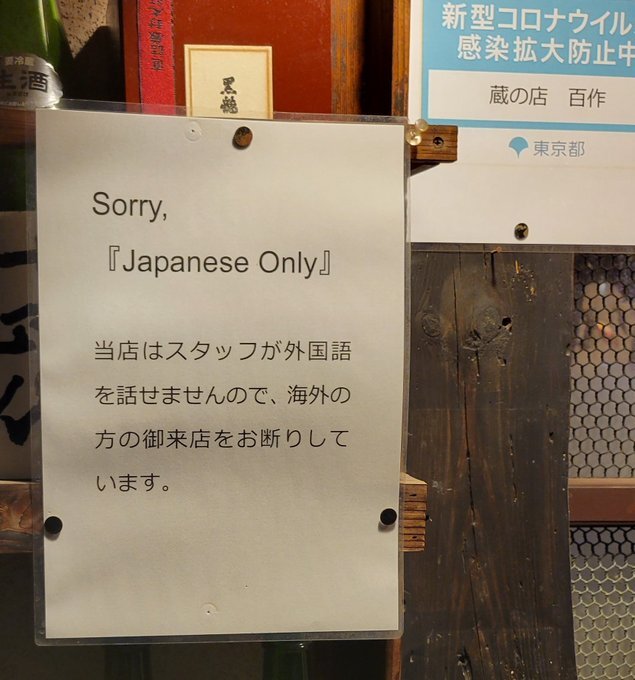
As you may know, Japan has no national civil or criminal legislation outlawing and punishing racial discrimination, meaning businesses with “Japanese only” signs aren’t doing anything illegal.
Problem is, I’m not sure it would matter if such a law existed.
To illustrate, consider one business sector that — technically — cannot exclude customers by race or nationality: hotels. … However, the Hotel Management Law is frequently ignored. Quick online searches (try Rakuten or Jalan) soon uncover hotels either outright refusing non-Japanese (NJ) lodgers, or, more circumspectly, those that say, “We don’t take reservations from NJ without addresses in Japan” (which is still unlawful).
Furthermore, when a government agency allows — even promotes — the systematic exclusion of NJ clients, we have a real problem with the rule of law in Japan.
Consider the curious case of the Fukushima Prefectural Tourist Association ( www.tif.ne.jp ). In September 2007, I was notified that their English site was offering member hotels two preset options for “acceptance of foreigners” and “admittance of foreigners” (whatever that difference may be). Of the 142 hotels then listed, 35 chose not to accept or admit NJ customers….
Let’s connect some dots: We have public policies working at cross-purposes. The Ministry of Land, Infrastructure, Transport and Tourism wants more NJ to visit and pump money into our economy, with Japan relaxing visa requirements for mainland Chinese tourists as of July 1. Yet the Ministry of Justice and other law enforcement agencies just want to keep policing NJ, and that includes deputizing hotels. This is why since 2005 they’ve been demanding hotels photocopy all NJ passports at check-in — again, unlawful (Zeit Gists, Mar. 8 and Oct. 18, 2005). Of course, this assumes that anyone pays attention to the laws at all.
Japan’s lack of legal support for hapless NJ tourists (not to mention residents) — who face unfettered exclusionism precisely where the HML says they shouldn’t — are thus finding local government bodies conspiring against them…
Posted in Articles & Publications, Bad Business Practices, Bad Social Science, Cultural Issue, Exclusionism, Human Rights, Ironies & Hypocrisies, Japanese Government, Japanese police/Foreign crime, Media | 19 Comments »
Posted by debito on 6th July 2010
Kyodo: Twenty-seven foreign nationals who came to Japan for employment under a government-authorized training program died in fiscal 2009, the second worst figure on record, government officials said Monday. The number was the second largest, following the 35 foreign nationals who died in fiscal 2008. This could trigger moves toward revising the government program, first launched in 1993, as a number of irregular practices have recently been observed, such as having foreign trainees work for long hours with below-minimum wages.
Separate Kyodo: A labor office in Ibaraki Prefecture will acknowledge that a Chinese national working as an intern at a local firm under a government-authorized training program died from overwork in 2008, marking the first foreign trainee “karoshi” death from overwork, sources said Friday….
COMMENTS: Taste the ironies in these articles. First, how in 2009, the death of 27 “Trainees” (i.e. people brought over by the GOJ who as people allegedly “in occupational training” don’t qualify as “workers” (roudousha) entitled to labor law protections) is only the SECOND worst figure on record. Second, how we have close to a third (as in eight NJ) of the total dying of “unknown causes” (as if that’s a sufficient explanation; don’t they have autopsies in Japan to fix that? Oh wait, not always.) Third, how about the stunning ignorance of the sentence, “a number of irregular practices have recently been observed, such as having foreign trainees work for long hours with below-minimum wages”. If the Kyodo reporter had bothered to do research of his media databases, he’d realize it’s hardly “recent” at all. And it’s not being fixed, despite official condemnation in 2006 of the visa regime as “a swindle” and death after death (at a rate two to three per month) racking up. Karoushi was a big media event way back when when Japanese were dying of it. Less so it seems when NJ are croaking from it. Finally, look how it only took about two years for “a labor office” to admit that a NJ “trainee” had been worked to death, given the hours he worked that were a part of the record? Gee whiz, what Sherlocking! How many more people have to die before this exploitative and even deadly system is done away with?
Posted in Bad Business Practices, Bad Social Science, Human Rights, Ironies & Hypocrisies, Japanese Government, Labor issues, Media | 5 Comments »
Posted by debito on 4th July 2010
For a Sunday Tangent, here is a hard-hitting article (thanks CNN) showing how activism against a corrupt but entrenched system gets treated: Detention and interrogation of activists, possible sentencing under criminal law, and international bodies turning a blind eye to their own mandate. Lucky for the author (and us) he is out on bail so he could write this. He wouldn’t be bailed if he were NJ. More on the IWC’s corruption in documentary The Cove — yet another reason why the bully boys who target people’s families (yet don’t get arrested for their “activism”) don’t want you to see it.
Sato opens with: After just two days of closed-door negotiations, the leaders who had gathered at the International Whaling Commission in Agadir, Morocco, announced no agreement was reached on the IWC chair’s proposal to improve whale conservation.
Greenpeace did not support the proposal, but we had hoped governments would change it to become an agreement to end whaling, not a recipe for continuing it.
It is particularly disappointing to me, because my professional commitment to end the whale hunt in my country of Japan — which led to the exposure of an embezzlement scandal at the heart of the whaling industry — has come at significant personal cost.
The investigation I conducted with my colleague, Toru Suzuki, led to our arrests in front of banks of media outlets who had been told about it in advance.
The homes of Greenpeace office and staff members were raided. Seventy-five police officers were deployed to handcuff two peaceful activists. We were held without charge for 23 days; questioned for up to 10 hours a day while tied to chairs and without a lawyer present. We are now out on bail awaiting verdict and sentencing, expected in early September.
If I can risk my future to bring the fraudulent Japanese hunt to an end, if whaling whistle-blowers are prepared to risk their lives to expose the corruption, how can it be that the IWC has yet again failed to take the political risk to pressure my government to end the scientific whaling sham?…
Posted in Bad Business Practices, Cultural Issue, Gaiatsu, Human Rights, Injustice, Ironies & Hypocrisies, Japanese Government, Tangents, United Nations | 18 Comments »
Posted by debito on 3rd July 2010
Here is NGO International Movement Against All Forms of Discrimination and Racism (IMADR), based in Tokyo, with their periodical in English on the issue. They inter alia are the group who keeps bringing over the UN for briefings (here and here), and have kept various committees appraised of GOJ progress (or mostly lack thereof), and answered GOJ benkai justifying inaction re human rights (example here). Their May 2010 edition talks about the UN’s May 14 visit to hear cases of discrimination in Japan. FYI.
Posted in Anti-discrimination templates/meetings, Exclusionism, Human Rights, Problematic Foreign Treatment, United Nations | 1 Comment »
Posted by debito on 2nd July 2010
Kyodo: The Yokohama District Court has banned a Tokyo civic group from staging protests around a movie theater in Yokohama that plans to screen the Oscar-winning U.S. documentary “The Cove” about a controversial dolphin hunt in Japan, its Japanese distributor said Friday.
The court decision on the injunction Thursday prohibits making loud speeches within a 100-meter radius of the movie theater and entering the movie theater without permission, the distributor Unplugged Inc. said.
As the movie theater is planning to screen the film from July 3, scores of people from the Tokyo group staged street protests around the theater on June 12. The theater applied to the court for an injunction to ban such protests.
The theater said it will show the movie as scheduled. The film, which was mostly shot in Taiji, Wakayama Prefecture, partly with hidden cameras, won the 2010 Academy Award for best documentary.
Ric O’Barry: Last week we had some important successes in Japan – several theater owners came forward and committed to show the film and we also won a key injunction in a Yokohama court against the group protesting the film. Unfortunately, the “protestors” are ramping up, employing their worst tactics to date.
This week they moved to the Yokohoma theater owner’s home, and when that didn’t work they moved on to his mother’s home:
(YouTube video): As you can see, the woman is elderly. She has nothing to do with the distribution of the film. This is intimidation of the lowest order.
We tried to engage or critics – inviting them to participate in open forums, but they refused. Rather than discuss the issues they engage in highly aggressive bullying tactics to shut down the film. I personally believe they are being paid to protest and don’t really have a point of view. I don’t even think they care about Taiji. There only goal is to keep people from knowing the truth, no matter what it takes.
Posted in Good News, Hate Speech and Xenophobia, Human Rights, Ironies & Hypocrisies, 日本語 | 43 Comments »
Posted by debito on 18th June 2010
Another Debito.org Reader contributes two poignant articles: One is germane to the recent comments here about whether immigration offers economic benefits to societies (an article in The Guardian in 2007 citing a PriceWaterhouseCoopers study indicates that it has for the UK). Another is an evergreen letter to the editor (which went unpublished) about Japan’s historical record advocating anti-racism 90 years ago in the League of Nations.
Guardian: The flow of migrant workers into the UK has boosted economic growth and helped keep a lid on inflation without undermining the jobs of British-born workers, according to a study released [in February 2007]. The report by accountancy firm PricewaterhouseCoopers enters a vigorous debate about whether immigration has a positive impact on the UK economy. The public finances have also not suffered as a result of the influx of migrant workers, the study finds. Most migrants are aged between 18 and 34 years, with high employment rates compared with their UK equivalents, and therefore benefit payments are low. They also receive comparatively low wages despite their good education and skills levels. Younger workers have fewer dependants and so are unlikely to be an additional burden on public services, the report says.
League of Nations: Discussions for what should be included in the [League of Nations, the precursor to the United Nations] Covenant were not without controversy, notably the following proposal: “The equality of nations being a basic principle of the League of Nations, the High Contracting Parties agree to accord, as soon as possible, to all alien nationals of states members of the League, equal and just treatment in every respect, making no distinction, either in law or fact, on account of their race or nationality.”
Unsurprisingly, Great Britain and its Dominions of Canada, Australia, South Africa and New Zealand saw the proposal as a threat to “white” colonial power and swiftly engineered its rejection … Perhaps surprising, especially to letter writers whose advice to foreign residents with complaints about their lives here is to put up, shut up, or leave, is that the proposal was put forward by Japan’s Foreign Minister Nobuaki Makino.
Posted in History, Human Rights, Immigration & Assimilation, Ironies & Hypocrisies, Japanese Government, Tangents, United Nations | 4 Comments »
Posted by debito on 15th June 2010
Here’s another interesting article from Kansai Scene magazine this month, this time on the issue of refugees and Detention Centers (“Gaijin Tanks”) in Japan. Excerpt:
Joseph isn’t his real name. He’s afraid of what theconse- quences might be if Japanese Immigration finds out that that he is speaking with the press. There’s a chance he would be sent back to the Immigrant Detention Center. His appeal might be denied, which would lead todepor- tation. Deportation means arrest as soon as his plane hits African soil. ‘Arrest’ in his country usually means disappearing forever. He needs to stay in Japan, and to stay here he has to remain invisible. So, he stays invisible.
Historically, Japan has been far from welcoming to refugees. Since 1990, 344 people have been given refugee status. In 2009, only thirty asylum-seekers were accepted, out of 1,388 applicants; an acceptance rate of 2.2 percent. Despite signing the 1951 UN Conventions Relating to the Status of Refugees and the 1967 Protocol Relating to the Status of Refugees in 1981 and 1982, respectively, the government essentially keeps the borders closed to the dispossessed, while donating enough money to the UNHCR (UN High Commission for Refugees) to justify their claim to be a humanitarian nation.
The issue, however, is not only the overwhelming denial of applications, but also the total lack of a safety net for those who do arrive on Japanese soil. It is difficult to obtain informa-tion at the airport, and some who try are sent to detention centers or are deported immediately for lack of proper documentation. Because of the language barrier, many new arrivals are unaware that a refugee application process exists at all. They simply overstay their visas until they are caught by immigration and arrested.
The detention centers are essentially prisons. Up to ten people share a room with one toilet. They are each given five blankets for a bed, and one or two hours of exercise a day. Those applying for refugee status are mixed with criminals awaiting deportation. Joseph spent almost a year in the Ibaraki detention center after being arrested for overstaying his visa. It was upon arriving at the center that he first learned of the potential to be declared a refugee, and began the application process. His application was refused within a month, and he started his appeal. In the meantime, he sat in his cell, keeping to himself. “The inmates are chaotic,” he told me. “[They are] from prison and awaiting deportation. They will do anything. They know they are going back.”…
Posted in Exclusionism, Human Rights, Immigration & Assimilation, Japanese Government, United Nations | 4 Comments »
Posted by debito on 3rd June 2010
Mark in Yayoi on Okinawa Futenma Issue: Debito, when reading your essay, I was surprised to find that I agreed with you, but for almost totally opposite reasons…
The American occupation of Okinawa, unjust as it might be, is a net benefit to the mainland Tokyo government, which gets protection while simultaneously pretending that it’s “Japan” bearing the burden when in fact it’s Okinawa that suffers — they’re the people putting up with the loud airplanes and unruly soldiers. And these people bearing the cost of the protection were never seen as equals by Tokyo — they were used as human shields in a hopeless defense of Japan in 1945, and used as tax-paying slaves in the decades before that.
The US bases need to leave, and Okinawa needs to be free. Not free from the US, and not free to be Japan’s 47th prefecture (both chronologically and on the status totem pole), but free to be *its own independent nation.*
Exactly what “sovereignty” can the Tokyo government legitimately claim over the people of Okinawa, if we’re trying to redress past wrongs?…
Posted in Cultural Issue, Gaiatsu, History, Human Rights, Immigration & Assimilation, Ironies & Hypocrisies, Japanese Government | 18 Comments »
Posted by debito on 27th May 2010
The Ministry of Foreign Affairs has just started asking for opinions from the public regarding Japan’s ascension to the Hague Convention on the Civil Aspects of International Child Abduction (which provides guidelines for dealing with cases of children being taken across borders without the consent of both parents, as well as establishing custody and visitation).
Sounds good until you consider the contexts. We’ve already had a lot of Japanese media portraying the Japanese side of an international marriage as victims, fleeing an abusive NJ. Even the odd crackpot lawyer gets airtime saying that signing the Hague will only empower the wrong side of the divorce (i.e. the allegedly violent and-by-the-way foreign side), justifying Japan keeping its status as a safe haven. Even the Kyodo article below shies away from calling this activity “abduction” by adding “so-called” inverted quotes (good thing the Convention says it plainly).
But now we have the MOFA officially asking for public opinions from the goldfish bowl. Despite the issue being one of international marriage and abduction, the survey is in Japanese only. Fine for those NJ who can read and comment in the language. But it still gives an undeniable advantage to the GOJ basically hearing only the “Japanese side” of the divorce. Let’s at least have it in English as well, shall we?
Kyodo article below, along with the text of the survey in Japanese and unofficial English translation. Is it just me, or do the questions feel just a tad leading, asking you to give reasons why Japan shouldn’t sign? In any case, I find it hard to imagine an aggrieved J parent holding all the aces (not to mention the kids) saying, “Sure, sign the Hague, eliminate our safe haven and take away my power of custody and revenge.” That’s why we need both sides of the story, with I don’t believe this survey is earnestly trying to get.
Posted in Bad Social Science, Child Abductions, Human Rights, Japanese Government, Problematic Foreign Treatment, 日本語 | 17 Comments »
Posted by debito on 24th May 2010
AFP: Scores of foreigners in a Japanese immigration detention centre have been on hunger strike for more than a week, demanding to be released and protesting the mysterious death of an African deportee.
Some 70 detainees — many of them Sri Lankans and Pakistanis — have refused food since May 10, also seeking to highlight suicides there by a Brazilian and a South Korean inmate, say their outside supporters.
The protest comes after UN rights envoy Jorge Bustamante in March raised concerns about Japan’s often years-long detentions of illegal migrants, including parents with children as well as rejected asylum seekers…
Human rights activists, lawyers and foreign communities have complained for years about conditions at Ushiku and Japan’s two other such facilities, in the western prefecture of Osaka and in southwestern Nagasaki prefecture.
At Ushiku, about 380 people are detained, with eight or nine inmates living in rooms that measure about 20 square metres (215 square feet), said Tanaka, a member of the Ushiku Detention Centre Problem Study Group.
“They are crammed into tiny segmented rooms that are not very clean, and many contract skin diseases,” she told AFP…
Hiroka Shoji of Amnesty International Japan said: “The immigration facilities are supposed to be places where authorities keep foreigners for a short period before deportation.
“But some people have been confined for over two years as a result. The government must introduce a limit to detentions.”
Posted in Human Rights, Immigration & Assimilation, Japanese police/Foreign crime, Problematic Foreign Treatment | 4 Comments »
Posted by debito on 19th May 2010
In an interesting twist to the whole “racial discrimination” issue in Japan, we have Japanese managers suing their former employer, world-famous luxury brand maker Prada, for alleged workplace sexual and power harassment, and “lookism” (i.e. treating people adversely based upon their “looks”).
Good, in the sense that people who are treated badly by employers don’t just take it on the chin as usual. But what makes this a Debito.org issue is the allegation, made by at least one morning Wide Show (“Sukkiri” last Monday, May 17), is that the companies are practicing “racial discrimination” (jinshu sabetsu).
Funny thing, that. If this were a Japanese company being sued for harassment, there would be no claim of racial discrimination (as race would not be a factor). But this time it’s not a Japanese company — it’s Prada. Yet when NJ or naturalized Japanese sue for racial discrimination (as they did in the Otaru Onsen Case), the media would NEVER call it “racial discrimination”, merely “cultural misunderstandings” and the like.
Another example of the Japanese media saying racism is only something done TO Japanese, never BY Japanese?
Posted in Bad Business Practices, Human Rights, Ironies & Hypocrisies, Labor issues, Media, Shoe on the Other Foot Dept. | 12 Comments »
Posted by debito on 18th May 2010
Now here we have the Suraj Case making it out of Japan and being reported overseas. The new twist is that the widow now has lost her job allegedly because of the fuss made over her husband’s death while being deported by Japan’s Immigration Bureau. I’m fond of the title, with Immigration being depicted as “Japan’s Bouncers”, and pleased the reporter noted how little coverage this horrible incident got domestically. But the unaccountability regarding the cause of death and a possible homicide at the hands of GOJ officials is no joke.
Economist excerpt: Around 2m foreigners live legally in Japan, which has a population of 128m; the justice ministry counted 91,778 illegal residents as of January. But the number, boosted by cheap Chinese labourers, may well be much higher. After a nine-day research trip last month, Jorge Bustamante, the UN’s special rapporteur on migrants’ rights, complained that legal and illegal migrants in Japan face “racism and discrimination, exploitation [and] a tendency by the judiciary and police to ignore their rights”.
The Special Residency Permit system is an example of the problem. No criteria for eligibility are specified. Instead, published “guidelines” are applied arbitrarily. And people cannot apply directly for an SRP: illegal residents can only request it once in detention, or turn themselves in and try their luck while deportation proceedings are under way. So most illegal residents just stay mum. Mr Suraj fell into the SRP abyss after he was arrested for overstaying his visa. Although he had lived in Japan for 22 years, was fluent in the language and married to a Japanese citizen, his SRP request was denied.
Why the tougher policy now? Koichi Kodama, an immigration lawyer assisting Mr Suraj’s widow, believes it is a reaction to the appointment last year as justice minister of Keiko Chiba, a pro-immigration reformer; the old guard is clamping down. The police are investigating the incident and the ten immigration officers in whose custody Mr Suraj died, though no charges have been brought. As for Mr Suraj’s widow, she has yet to receive details about her husband’s death or an official apology. The topic is one Japanese society would rather avoid. The press barely reported it. Still, when her name appeared online, she was fired from her job lest the incident sully her firm’s name.
Posted in Exclusionism, Human Rights, Injustice, Japanese Government, Japanese police/Foreign crime | 38 Comments »
Posted by debito on 30th April 2010
Bringing this old article up as a matter of record: I mentioned on Debito.org back in early 2008 about a Swiss woman who came to Japan as a tourist and was arrested on drug charges. She got acquitted not once but twice in Japanese courts, yet was not released on bail because NJ and are considered more of a flight risk. While actual convicted felons are released in the interim if they are Japanese.
Again, foreigners aren’t allowed bail in Japan. Unlike Japanese: When Japanese defendants appeal guilty verdicts, they are not detained (see Horie Takafumi and Suzuki Muneo; the latter, now convicted of corruption twice over, is still on the streets, even re-elected to the Diet!).
So despite being incarcerated as an innocent NJ since 2008, she finally gets booted out for “overstaying her visa” (oh, sure, she could have gone to Immigration any time and renewed, right?) and barred from reentry. Rights of the defendant and “Hostage Justice” depending on your nationality. What a swizz.
Posted in Human Rights, Injustice, Ironies & Hypocrisies, Japanese police/Foreign crime, Lawsuits | 9 Comments »
Posted by debito on 25th April 2010
I have been hearing word from several sources about the new draconian laws being enacted in Arizona to catch illegal migrant workers, including legally-sanctioned racial profiling, and stopping people on the street for ID checks. Many have said that it seems Arizona has taken a page out of the GOJ’s handbook for dealing with NJ in Japan. The difference, however, is that 1) the US dragnet is (necessarily) a coarser mesh (as Japanese authorities have a wider view of who doesn’t “look Japanese”, since anyone can “look American” and more sophistication is needed over there), and 2) it’s caused a level of controversy that has never happened in Japan (imagine street protests to this degree, even a J prime minister denouncing it?).
I believe it’s only a matter of time (and it will take some time) before the Arizona authorities stop the wrong person on racial grounds, other American laws kick in to protect people against racial discrimination, and American courts rule this Arizona law unconstitutional. Wait and see.
That just ain’t gonna happen in Japan for obvious reasons: We ain’t got no legal sanctions against racial discrimination, let alone this degree of people caring for the human rights of foreigners.
Posted in Anti-discrimination templates/meetings, Bad Social Science, Fingerprinting, Targeting, Tracking NJ, Human Rights, Labor issues, Problematic Foreign Treatment, Tangents | 17 Comments »
Posted by debito on 3rd April 2010
Take that, 2-Channel. Mainichi: Just because a piece of information is published on the Internet, viewers do not necessarily deem it to be of low credibility. So ruled the Supreme Court recently in a defamation suit in which a man was accused of slandering a restaurant operator on his own Web site, saying that the company was affiliated with a cult.
The top’s court’s ruling secures a guilty verdict that ordered the man to pay 300,000 yen in compensation. It was the first ruling to confirm that the conditions for establishing defamation were not relaxed on the Internet.
Considering that people are often slandered, have their privacy violated, and sometimes even suffer human rights violations on the Internet — where users can post comments anonymously — the Supreme Court’s decision can be deemed appropriate.
Posted in Human Rights, Injustice, 日本語, 2ちゃんねる | 5 Comments »
Posted by debito on 31st March 2010
PRESS RELEASE MARCH 31, 2010: UN MIGRANTS RIGHTS EXPERT URGES JAPAN TO INCREASE PROTECTION OF MIGRANTS (excerpt)
TOKYO – The UN expert on migrants’ human rights on Wednesday praised Japan for some of the measures it has taken to alleviate the impact of the economic crisis on migrants, but, based on information provided by civil society, he noted that it is still facing a range of challenges, including racism and discrimination, exploitation, a tendency by the judiciary and police to ignore their rights and the overall lack of a comprehensive immigration policy that incorporates human rights protection…
The Special Rapporteur said, many challenges still need to be addressed by the Government in order to protect the human rights of migrants and their children. He listed some of the most important, along with some preliminary recommendations on how to improve the situation:
Posted in Anti-discrimination templates/meetings, Human Rights, Immigration & Assimilation, Japanese Government, Practical advice, 日本語 | 10 Comments »
Posted by debito on 31st March 2010
(Debito.org) TOKYO MARCH 31, 2010 — Dr Jorge A. Bustamante, United Nations Special Rapporteur for the Human Rights of Migrants, gave an hourlong press conference at United Nations Information Center, United Nations University, Japan.
Assisted by the International Organization for Migration and Japan’s civil society groups, Dr Bustamante concluded nine days, March 23 to March 30, of a fact-finding mission around Japan, making stops in Tokyo, Yokohama, Hamamatsu, and Toyoda City. He met with representatives of various groups, including Zainichi Koreans, Chinese, Brazilians, Filipinos, women immigrants and their children, “Newcomer” immigrant and migrant Non-Japanese, and veterans of Japan’s Immigration Detention Centers.
He also met with Japanese government representatives, including the ministries of Education, Foreign Affairs, and Justice. He also met with local government officials in Hamamatsu City (including the Hamamatsu “Hello Work “ Unemployment Agency), the mayor of Toyoda City, and others.
He debriefed the Japanese Government today before his press conference.
The press conference can be heard in its entirety, from Dr Bustamante’s entrance to his exit, on the DEBITO.ORG PODCAST MARCH 31, 2010, downloadable from this blog entry. Duration: One hour five minutes. Unedited. I ask a question around minute 40.
Posted in Anti-discrimination templates/meetings, Exclusionism, Human Rights, Immigration & Assimilation, Japanese Government, Labor issues, Media, Podcasts, United Nations | 3 Comments »
Posted by debito on 27th March 2010
What follows is a speech by Mr RYOM Munsong, read and presented to UN Special Rapporteur for the Human Rights of Migrants, Dr. Jorge Bustamante, just before I did on March 23 (my speech here). I have offered Debito.org as a space for Japan’s presenting NGOs to release their information to the general reading public. Read on.
Posted in Anti-discrimination templates/meetings, Education, Human Rights, Immigration & Assimilation, Japanese Government, Speech materials, United Nations | 12 Comments »
Posted by debito on 26th March 2010
I would like to invite you to two more speeches, one Saturday evening, one Monday evening, both in Tokyo. The Saturday evening one will be a FRANCA meeting in the newly-refurbished International House in Roppongi, while the Monday evening one will be a JIPI speech in Japanese on why Japan needs immigration. Details as follows:
Posted in FRANCA, Human Rights, Immigration & Assimilation, Speech materials, 日本語 | 1 Comment »
Posted by debito on 24th March 2010
As you know, as representative of NGO FRANCA I met with Special Rapporteur for the Human Rights of Migrants Dr Jorge A. Bustamante on March 23, 2010. Here’s a briefing:
Starting from 9AM at one of the Diet Lower House meeting rooms, I sat in as Amnesty International Japan and Solidarity with Migrants Japan made their cases about how NJ are being treated badly by the media, the government, and labor policy. Dr Bustamante asked a lot of questions and wanted statistics, particularly about the death rates for migrant workers (we were all surprised; he said that in other developed countries those statistics were available at the government level, something inconceivable to us). After 45 minutes, he went off to meetings with GOJ officials.
We were supposed to meet again for another 45 minutes from 1PM, but Dr Bustamante arrived more than twenty minutes late. (This is a typical GOJ trick so the NGOs get less time; if NGOs go overtime, they become the object of criticism, but if the GOJ goes overtime, nobody complains but the NGOs.) A representative from the Zainichi Koreans, an academic from Korea University (Kodaira, Tokyo) named Mr RYOM Munsong, kept his speech to 12 minutes, I kept mine to twelve as well (we had timers), and mixed our powerpoint with movie and speech.
As far as I went, I was able to squeeze in my full introduction and two of my five bullet issues, then had to skip to the end with the entreaty to not see NJ as “temporary migrant workers” but “immigrants” (read entire speech here). But I was very disappointed that we had virtually no time for Q&A (Dr Bustamante looked tired), and that all that preparation was cut short because we were keeping our promises with the scheduling and the GOJ was not.
Some photos from the proceedings:
Posted in Anti-discrimination templates/meetings, FRANCA, Human Rights, Japanese Government, United Nations | 19 Comments »
Posted by debito on 23rd March 2010
We had a NGO FRANCA (Foreign Residents and Naturalized Citizens Association) meeting last Sunday in Sendai. We’ll be having another one this coming Saturday evening in Tokyo, so if you like what you read below, please consider coming to our meeting and joining our group. FRANCA Chair Arudou Debito gave a presentation on what FRANCA is and what it’s doing. (You can download that presentation at http://www.debito.org/FRANCA.ppt). What follows are some photos and minutes of the meeting.
Posted in Anti-discrimination templates/meetings, FRANCA, Human Rights, Immigration & Assimilation | 4 Comments »
Posted by debito on 22nd March 2010
Addendum to yesterday’s post on the Ibaraki Gaijin Tank Hunger Strikers and the upcoming meetings with the government. The Japan Times has put out another article, which I will excerpt from. It also hints at the timing of it, wondering whether it’s due to Special Rapporteur Bustamante (to whom I will be talking tomorrow, wish me luck) visiting Japan. Which means, once he leaves, things go back to the ignored normal? Fortunately, according to the article below, we have some traction within the ruling party on this issue as well, so let’s hope in the end we see progress. Although, as noted before, Japan’s police forces have quite extreme (and unaccountable) powers, especially as regards treatment of NJ, so unless some legal changes are made to this largely extralegal system itself, the amount of oversight necessary in an already abusive system is pretty demanding.
Posted in Human Rights, Immigration & Assimilation, Japanese Government, Japanese police/Foreign crime | 2 Comments »
Posted by debito on 20th March 2010
The following Japan Times article wouldn’t normally be put up on Debito.org yet because the negotiation is ongoing (covering much the same argumentative ground as already reported here), and nothing necessarily decisive has been decided. However, a new development in the USG’s constant-looking pressure on the GOJ to sign the Hague, and do something about its citizens using Japan as a haven for child abductions after divorce, is the fact that somebody official is bothering to answer the GOJ claim that obeying the Hague would mean sending back J children to be endangered by an abusive NJ parent (I’ll take that as a slur, thank you very much). Excerpts from the JT article below.
Posted in Child Abductions, Gaiatsu, Human Rights, Japanese Government, Media | 5 Comments »
Posted by debito on 19th March 2010
Excerpt: I wish to focus on the situation of peoples of “foreign” origin and appearance, such as White and non-Asian peoples like me, and how we tend to be treated in Japanese society. Put simply, we are not officially registered or even counted sometimes as genuine residents. We are not treated as taxpayers, not protected as consumers, not seen as ethnicities even in the national census. We not even regarded as deserving of the same human rights as Japanese, according to government-sponsored opinion polls and human rights surveys (blue folder items I-1, I-6 and III-6). This view of “foreigner” as “only temporary in Japan” is a blind spot even the United Nations seems to share, but I’ll get that later.
Here is a blue 500-page information folder I will give you after my talk, with primary source materials, articles, reference papers, and testimonials from other people in Japan who would like their voice heard. It will substantiate what I will be saying in summary below.
[...] [I]t is we “Newcomers” who really need the protections of a Japanese law against racial discrimination, because we, the people who are seen because of our skin color as “foreigners” in Japan, are often singled out and targeted for our own special variety of discriminatory treatment.
Here are examples I will talk briefly about now:
1) Discrimination in housing and accommodation
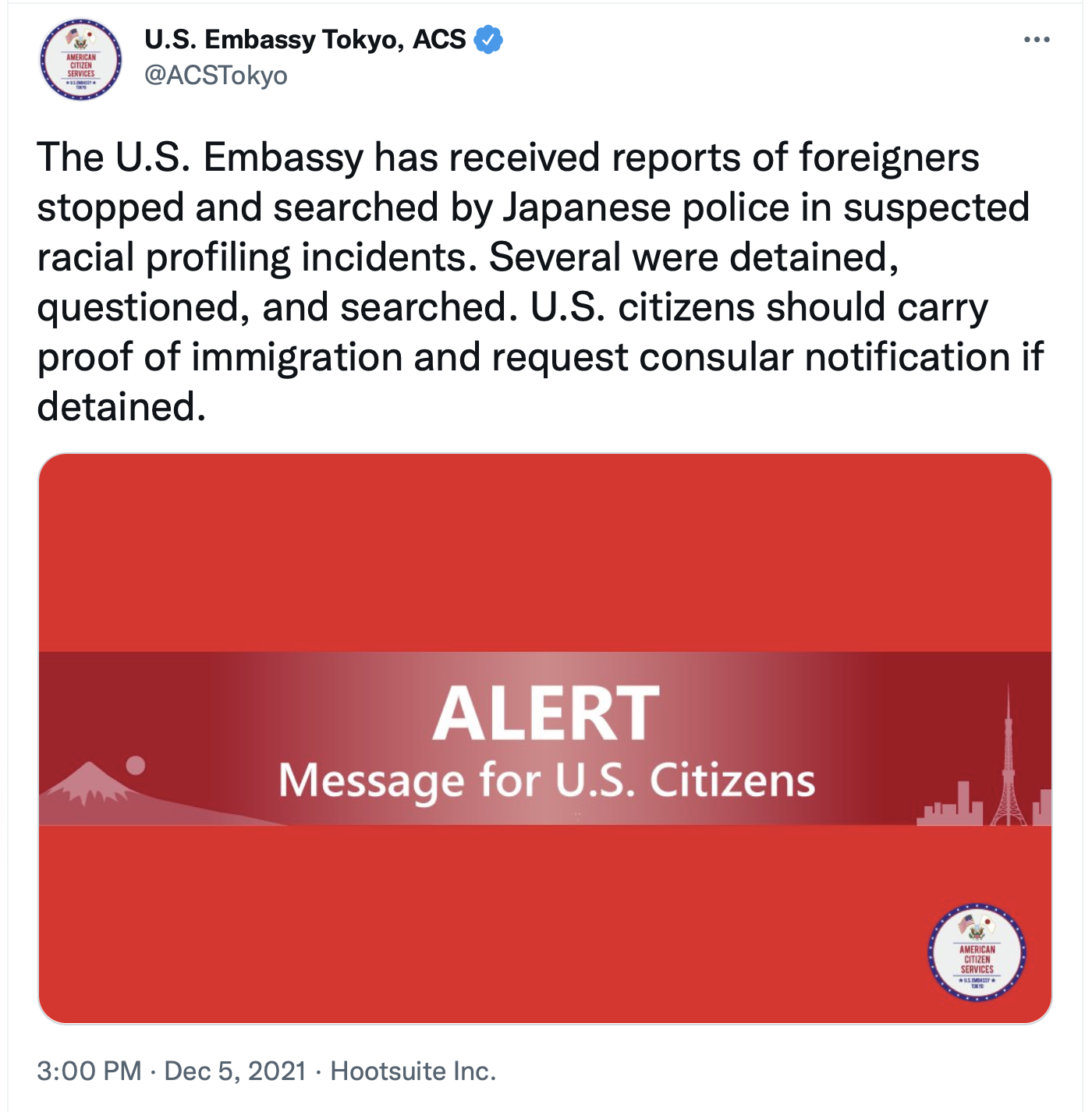
2) Racial Profiling by Japanese Police, through policies officially depicting Non-Japanese as criminals, terrorists, and carriers of infectious disease
3) Refusal to be registered or counted as residents by the Japanese Government
4) “Japanese Only” exclusions in businesses open to the public
5) Objects of unfettered hate speech…
Posted in Anti-discrimination templates/meetings, FRANCA, Fingerprinting, Targeting, Tracking NJ, GAIJIN HANZAI mag, Hate Speech and Xenophobia, Human Rights, Immigration & Assimilation, Japanese Government, Japanese police/Foreign crime, Otaru Onsen Lawsuit, Speech materials, United Nations | 25 Comments »
Posted by debito on 18th March 2010
The United Nations Convention on the Elimination of Racial Discrimination (CERD) Committee just issued its latest recommendations to the GOJ on March 16, stating what Japan should be doing to abide by the treaty they effected nearly a decade and a half ago, in 1996.
Guess what: A lot of it is retread (as they admit) of what the CERD Commitee first recommended in 2001 (when Japan submitted its first report, years late), and Japan still hasn’t done.
To me, unsurprising, but it’s still nice to see the UN more than a little sarcastic towards the GOJ’s egregious and even somewhat obnoxious negligence towards international treaties. For example, when it set the deadline for the GOJ’s answer to these recommendations for January 14, 2013, it wrote:
UN: “Noting that the State party report was considerably overdue, the Committee requests the State party to be mindful of the deadline set for the submission of future reports in order to meet its obligations under the Convention.”
Again, some more juicy quotes, then the full report, with issues germane to Debito.org in boldface. Arudou Debito in Sapporo
===========================
7. The Committee notes with concern that insufficient information regarding the concrete measures for the implementation of its previous concluding observations (2001) was provided by the State Party and regrets their overall limited implementation as well as that of the Convention as a whole.
9. The Committee notes the State party’s view that a national anti-discrimination law is not necessary and is concerned about the consequent inability of individuals or groups to seek legal redress for discrimination (art. 2). [meaning under current Japanese law, FRANCA cannot sue the Sumo Association for its recent racist rules counting foreign-born sumo wrestlers as foreign even if they naturalize. Nor will Japan allow class-action lawsuits. The UN says this must change.] The Committee reiterates its recommendation from previous concluding observations (2001) and urges the State party to consider adopting specific legislation to outlaw direct and indirect racial discrimination…
13. [...] The Committee reiterates its view that the prohibition of the dissemination of ideas based upon racial superiority or hatred is compatible with freedom of opinion and expression and in this respect, encourages the State party to examine the need to maintain its reservations to article 4 (a) and (b) of the Convention with a view to reducing their scope and preferably their withdrawal. The Committee recalls that the exercise of the right to freedom of expression carries with it special duties and responsibilities, in particular the obligation not to disseminate racist ideas and calls upon the State party once again to take into account the Committee’s general recommendations No. 7 (1985) and No. 15 (1993)…
14. [...] the Committee reiterates its concern from previous concluding observations (2001) that discriminatory statements by public officials persist and regrets the absence of administrative or legal action…
22. (b) [...] the principle of compulsory education is not fully applied to children of foreigners in the State party in conformity with articles 5 (e.v) of the Convention; 28 of the Convention on the Rights of the Child; and 13 (2) of the Convention on Economic, Social and Cultural Rights, all of which Japan is a party;
24. The Committee expresses its concern about cases of difficulty in relations between Japanese and non-Japanese and in particular, cases of race and nationality-based refusals of the right of access to places and services intended for use by the general public, such as restaurants, family public bathhouses, stores and hotels, in violation of article 5 (f) of the Convention (art. 2, 5).
The Committee recommends that the State party counter this generalized attitude through educational activities directed to the population as a whole and that it adopt a national law making illegal the refusal of entry to places open to the public.
29. The Committee encourages the State party to consider making the optional declaration provided for in article 14 of the Convention recognizing the competence of the Committee to receive and consider individual complaints.
Posted in Exclusionism, Good News, Human Rights, Ironies & Hypocrisies, Japanese Government, Practical advice, United Nations | 3 Comments »
Posted by debito on 15th March 2010
What follows is the Table of Contents for an information packet I will be presenting Special Rapporteur for the Human Rights of Migrants Jorge A. Bustamante, who will be visiting Japan and holding hearings on the state of discrimination in Japan. Presented on behalf of our NGO FRANCA (Sendai and Tokyo meetings on Sun Mar 21 and Sat Mar 27 respectively).
It’s a hefty packet of about 500 pages printed off or so, but I will keep a couple of pockets at the back for Debito.org Readers who would like to submit something about discrimination in Japan they think the UN should hear. It can be anonymous, but better would be people who provide contact details about themselves.
Last call for that. Two pages A4 front and back, max (play with the fonts and margins if you like). Please send to debito@debito.org by NOON JST Thursday March 18, so I can print it on my laser printer and slip it in the back.
Here’s what I’ll be giving as part of an information pack. I haven’t written my 20-minute presentation for March 23 yet, but thanks for all your feedback on that last week, everyone…
Posted in Anti-discrimination templates/meetings, Articles & Publications, Exclusionism, FRANCA, Fingerprinting, Targeting, Tracking NJ, GAIJIN HANZAI mag, Hate Speech and Xenophobia, Hokkaido Toyako G8 Summit 2008, Human Rights, Immigration & Assimilation, Injustice, Ironies & Hypocrisies, Japanese Government, Japanese Politics, Japanese police/Foreign crime, Labor issues, Otaru Onsen Lawsuit, Speech materials, United Nations | 7 Comments »
Posted by debito on 13th March 2010
Japan Times: At least 70 detainees at the West Japan Immigration Control Center, which has long been criticized by human rights groups and Diet members, have been on a hunger strike since Monday, center officials and volunteers helping them confirmed Thursday.
Activist Sano-san reports: Our group decided not to use [name deleted's] name on articles that goes to public from now on. He has hepatitis B and has fever since December. Obviously bad health condition. But the center is not taking to him to the hospital, and also did I mention that they share the same razor to shave? We talked to Nishimura at the center, but they denied it , and said that each razor has the number so that the detainee will know which one is his. Detainees said there is no number on the razor. Nishimura also said that razors are sterilized after detainees use them.
Posted in Human Rights, Immigration & Assimilation, Japanese police/Foreign crime, Problematic Foreign Treatment | 10 Comments »
Posted by debito on 12th March 2010
Let me forward something to you about conditions in Japan’s Immigration Detention Centers (better known as “Gaijin Tanks”) — an activist named Sano-san who wants to draw long-overdue attention to widespread abuse of NJ in these notorious extralegal prisons. Link to Japan Times article substantiating Sano-san’s claims follows her email. Reporters, be in touch with her (or me at debito@debito.org) if you want more information.
The extralegal powers of Japan’s police forces are atrocious, and they are especially bad when people fall completely outside the legal system (as in, NJ detainees not tried and convicted criminals, with a term-limited sentence and minimum prison conditions as stipulated by law; these are people who can be held indefinitely in crowded conditions, without oversight, access to exercise, medical care, hygiene, etc.) They just happen to be NJ (because Gaijin Tanks cannot hold Japanese) and thus remain shrouded in even more secrecy than usual (as people assume they’re full of riffraff trying to come in and take advantage of Rich Citadel Japan) and operate under the media radar. Trying to remedy that.
Sano-san: Ibaraki Detention Center is a very brutal and abusive place to be. Since March 8th, about 80 male detainees are doing hunger strike.
Japan Times: Detainees allege abuse at Kansai holding center
Guards meting out harsh treatment behind the walls of Ibaraki immigration facility, say inmates
Posted in Human Rights, Immigration & Assimilation, Japanese police/Foreign crime, Problematic Foreign Treatment | 9 Comments »
Posted by debito on 10th March 2010
What follows is the full text of the GOJ’s meeting Feb 24-25, 2010, with the United Nations Committee on the Elimination of Racial Discrimination, something it faces for review every two years.
Media-digested highlights of this meeting already up on Debito.org here.
Although it was noteworthy for having 14 Japanese delegates from five different ministries (something the UN delegates remarked upon repeatedly), quite frankly, the 2010 session wasn’t much different from the previous two reviews. In that: The CERD Committee tells the GOJ to do something, and the GOJ gives reasons why things can’t change (or offers cosmetic changes as evidence that things are changing; it even cites numerous times the new Hatoyama Government as evidence of change, and as a reason why we can’t say anything conclusive yet about where human rights improvements will happen). The 2008 review was particularly laughable, as it said that Japan was making “every conceivable measure to fight against racial discrimination”. I guess an actual law against racial discrimination isn’t a conceivable measure. As the GOJ delegates say below, it still isn’t. But it is according to the CERD Committee below.
In sum, the biannual to-and-fro has become Grand Kabuki. And while things got bogged down in the standard “minority” questions (Ainu, Ryukyuans, Burakumin, and Zainichis — all worthy causes in themselves, of course), very little time was spent on “Newcomer” minorities, as in, the NJ (or former-NJ) immigrants who are now here long-term. People like me, as in racially-diverse Japanese, aren’t seen as a minority yet, even though we very definitely are by any UN definition. Plus, hardly any time was devoted at all to discussing the “Japanese Only” signs extant throughout Japan for many UN sessions now, the most simple and glaring violation of the CERD yet.
I haven’t the time to critique the whole session text below, but you can look at the 2008 session here (which I did critique) and get much the same idea. I have put certain items of interest to Debito.org in boldface, and here are some pencil-dropping excerpted quotes:
Posted in Anti-discrimination templates/meetings, Cultural Issue, Discussions, Education, Exclusionism, Gaiatsu, Human Rights, Ironies & Hypocrisies, Japanese Government, Practical advice, United Nations | 9 Comments »
Posted by debito on 9th March 2010
Here’s a valuable document I unearthed when doing research yesterday. One of the major arguments put forth by nativists seeking to justify discrimination against minorities (or rather, against foreigners in any society) is the argument that foreigners, since they are not citizens, ipso facto don’t have the same rights as citizens, including domestic protections against discrimination. The GOJ has specifically argued this to the United Nations in the past, repeatedly (see for example GOJ 1999, page down to Introduction, section 3). However, the UN, in a clarification of the Convention on the Elimination of Racial Discrimination, has made it clear that non-citizens are supposed to be afforded the same protections under the CERD as citizens. To quote the most clear and concise bit:
===========================
II. Measures of a general nature
7. Ensure that legislative guarantees against racial discrimination apply to non-citizens regardless of their immigration status, and that the implementation of legislation does not have a discriminatory effect on non-citizens;
===========================
This was issued way back in 2004. I’m reading a transcript of the discussions between the GOJ and the CERD Committee review during their review Feb 24-25 2010 (in which it was referred, and even mentioned granting foreigners suffrage not beyond the pale of rights to be granted). I’ll have the full text of that up on Debito.org tomorrow with some highlighting. Meanwhile, enjoy this gem. Something else for the GOJ to ignore.
Posted in Anti-discrimination templates/meetings, Gaiatsu, Human Rights, Practical advice, United Nations | 9 Comments »
Posted by debito on 4th March 2010
Mainichi: The government has abandoned proposing a bill to grant local voting rights to permanent foreign residents in Japan during the current Diet session, in the face of intense opposition from coalition partner People’s New Party (PNP).
“It’s extremely difficult for the government to sponsor such a bill due to differences over the issue between the ruling coalition partners,” said Internal Affairs and Communications Minister Kazuhiro Haraguchi…
PNP leader and Minister of State for Financial Services Shizuka Kamei stressed his strong opposition against the measure, saying his party would not allow the enactment of the suffrage bill.
Moreover, the DPJ itself seems to be split over the issue. Although the foreign suffrage bill is an “important bill” that DPJ Secretary-General Ichiro Ozawa has been promoting, a forceful submission of the bill could cause a rift within the party, and the discussion over the matter has stalled.
Posted in Human Rights, Immigration & Assimilation, Japanese Politics, 日本語 | 9 Comments »
Posted by debito on 1st March 2010
Here we have some preliminary reports coming out of Geneva regarding the UN CERD Committee’s review of Japan’s human rights record vis-a-vis racial discrimination. We have the GOJ claiming no “rampant discrimination”, and stressing that we still need no law against RD for the same old reasons. This despite the rampant discrimination that NGOs are pointing out in independent reports. Read on.
Excerpts: (Kyodo)—Japan does not need laws to combat racial discrimination, a Japanese official said Thursday as Japan’s racism record was examined by the U.N. Committee on the Elimination of Racial Discrimination.
“Punitive legislation on racial discrimination may hamper legitimate discourse,” Mitsuko Shino of the Japanese Foreign Ministry told a session in Geneva. “And I don’t think the situation in Japan is one of rampant discrimination, so we will not be examining this now.”…
[UN official] Thornberry particularly criticized Japan’s lack of laws to combat hate speech, saying “in international law, freedom of expression is not unlimited.”
The convention commits states to fight racial discrimination by taking such steps as restricting racist speech and criminalizing membership in racist organizations. Japan has expressed reservations about some of the provisions, which it says go against its commitment to freedom of expression and assembly.
Prior to the review, Japanese nongovernmental organizations presented various examples they say highlight the need for legislative action to fight racism in their country.
“There seems to have been little progress since 2001,” when the last review was held, committee member Regis de Gouttes said. “There is no new legislation, even though in 2001 the committee said prohibiting hate speech is compatible with freedom of expression.”
UPDATES: Correspondence with the UN reveals that the CERD Committee is doing a lot more than Kyodo reports.
Posted in Anti-discrimination templates/meetings, Bad Social Science, Gaiatsu, Human Rights, Japanese Government, United Nations | 12 Comments »
Posted by debito on 23rd February 2010
One more piece in the puzzle about why divorces with children in tow in Japan are so problematic. As we’ve discussed here before umpteen times, Japan does not allow joint custody (thanks to the Koseki Family Registry system etc.), nor does it guarantee visitation rights. Following below is another excellent article by Colin Jones on why that is — because Japan’s paternalistic courts and bureaucrats believe they know more than the parents about what’s best for the child. It’s one more reason why I believe that without substantial reforms, nobody should marry (Japanese or NJ) and have children under the Japanese system as it stands right now.
Posted in Bad Social Science, Child Abductions, Cultural Issue, Human Rights, Lawsuits | 4 Comments »
Posted by debito on 22nd February 2010
The Government of Japan comes under review this month in Geneva by the United Nations Committee on the Elimination of Racial Discrimination. I was invited to submit a chapter for a report to the UN by the NGO Solidarity with Migrants Japan (SMJ) on how Japan is doing with enforcing it.
NGO Report Regarding the Rights of Non-Japanese Nationals, Minorities of Foreign Origins, and Refugees in Japan.
Prepared for the 76th United Nations Committee on the Elimination of Racial Discrimination Session February 2010
Compiled and published by: Solidarity Network with Migrants Japan (SMJ)
CHAPTER 2 Race and Nationality-based Entrance Refusals at Private and Quasi-Public Establishments By Debito Arudou. Page 7
As I conclude:
“In conclusion, the situation is that in Japan, racial discrimination remains unconstitutional and unlawful under the ICERD, yet not illegal. Japan has had more than a decade since 1996 to pass a criminal law against RD. Its failure to do so can only be interpreted as a clear violation of ICERD Article 2(1): “States Parties condemn racial discrimination and undertake to pursue by all appropriate means and without delay [emphasis added] a policy of eliminating racial discrimination.” We urge the Committee to make the appropriate advisements to the Japanese government to pass a law against racial discrimination without any further delay.”
Enjoy. Let’s see how the UN and GOJ respond. Here’s how the GOJ responded in 2008 — read and guffaw at their claim that they have taken “every conceivable measure to fight against racial discrimination”.
Posted in Anti-discrimination templates/meetings, Articles & Publications, Exclusionism, Human Rights, Japanese Government, United Nations | 11 Comments »
Posted by debito on 16th February 2010
Here’s a case of how the GOJ can be incredibly insensitive towards how the J cops police NJ: Not issuing them documents properly just in case they get snagged for Gaijin Card checks:
Mainichi: “A Rwandan man seeking refugee status in Japan has been held in custody for over two weeks, on suspicion of violating the Immigration Control Law.
The office of the United Nations High Commissioner for Refugees (UNHCR) and refugee relief organizations are requesting his release, police said.
The 30-year-old was arrested on Jan. 7 for failing to present valid identification after stopped by local police in the Aichi Prefecture city of Kita-Nagoya, according to his lawyer. He was carrying a copy of the receipt for his refugee status application, but the document was deemed invalid without a photograph.”
This negligence on the part of otherwise thorough policing in Japan is worse than ironic. It should be unlawful — harassing, even incarcerating, otherwise law-abiding NJ just because they got zapped by racial profiling in the first place.
Posted in Fingerprinting, Targeting, Tracking NJ, Human Rights, Immigration & Assimilation, Japanese police/Foreign crime, Problematic Foreign Treatment, 日本語 | 29 Comments »
Posted by debito on 11th February 2010
I have just heard that the United Nations will be coming to visit Japan again in late March to see how she’s doing regarding keeping her promise to eliminate with racial discrimination.
I know for a fact that “Japanese Only” etc. signs and rules are up around Japan in various guises and places of visit. I have been asked to help out giving a tour of these places in the Osaka, Kyoto, Nagoya, and/or Tokyo areas.
So let me ask Debito.org readers: Do you know of any places open to the public in these areas that explicitly refuse NJ (or those who look like NJ) entry and service? The best places actually have a sign up saying so. If so, please send me (to debito@debito.org) 1) a snap photo (cellphone ok) of the sign, 2) a snap of the storefront with the sign visible, 3) the name and approximate address of the place and date of photos. I’ll do the rest. Thanks for helping out.
Posted in Anti-discrimination templates/meetings, Exclusionism, Good News, Human Rights, United Nations | 19 Comments »
Posted by debito on 6th February 2010
Creepy LA Times article on vigilante Korean otaku group stalking “English teachers”: “The volunteer manager of a controversial group known as the Anti-English Spectrum, Yie investigates complaints by South Korean parents, often teaming up with authorities, and turns over information from his efforts for possible prosecution.
Outraged teachers groups call Yie an instigator and a stalker.
Yie waves off the criticism. “It’s not stalking, it’s following,” he said. “There’s no law against that.”
Since its founding in 2005, critics say, Yie’s group has waged an invective-filled nationalistic campaign against the 20,000 foreign-born English teachers in South Korea.
On their website and through fliers, members have spread rumors of a foreign English teacher crime wave. They have alleged that some teachers are knowingly spreading AIDS, speculation that has been reported in the Korean press…”
Posted in Cultural Issue, Education, Human Rights, Problematic Foreign Treatment, Tangents | 8 Comments »
Posted by debito on 2nd February 2010
Various media: Envoys of eight countries met the Japanese foreign minister Jan 30, 2010, to press the government to sign a treaty to prevent international parental child abductions.
Activists say that thousands of foreign parents have lost access to children in Japan, where the courts virtually never award child custody to a divorced foreign parent.
Japan is the only nation among the Group of Seven industrialised nations that has not signed the 1980 Hague Convention that requires countries to return a child wrongfully kept there to their country of habitual residence.
In the latest move to urge Tokyo to sign the convention, envoys from Australia, Britain, Canada, France, Italy, New Zealand, Spain and the United States expressed their concerns to Foreign Minister Katsuya Okada…
The envoys’ visit to Okada followed their meeting with Justice Minister Keiko Chiba in October, as they hope Japan’s new centre-left government, which ended a half-century of conservative rule in September, will review the issue.
Activist groups estimate that over the years up to 10,000 dual-citizenship children in Japan have been prevented from seeing a foreign parent.
Posted in Child Abductions, Gaiatsu, Good News, Human Rights, Japanese Government, 日本語 | 5 Comments »
Posted by debito on 30th January 2010
It is with great sadness that I write to you about the death of one of my personal heroes, Howard Zinn. A person who departed from historical orthodoxy to write history books from the minority point of view. His “People’s History of the United States” is a must-read. Good man. Already missed. Obits below.
That’s one less of the ideological lions out there who have made an impression on me, speaking up for the little guy as much as possible, and narrating against the grain with tireless activism no matter how ripe the age. Including Noam Chomsky, Chalmers Johnson, Ralph Nader…
Posted in Education, History, Human Rights, Labor issues, Tangents | 3 Comments »
Posted by debito on 27th January 2010
In a breathtakingly excellent article that only the Japan Times can give us, we have Colin P.A. Jones once again offering eye-opening historical research and commentary on how family law in Japan (or lack thereof) has been created so much on the fly that few accommodations are made for modern circumstances. In fact, Colin claims below, many circumstances (such as birth registries in complicated circumstances, or joint custody after divorces) are so inconceivable to this anachronistic system that people’s lives are forced to conform to it for its convenience, not the other way around. It’s so bad that even the Koreans wised up and abolished theirs recently. So should Japan. Read excerpt below.
Posted in Child Abductions, Human Rights, Ironies & Hypocrisies, Japanese Government | 3 Comments »
Posted by debito on 26th January 2010
Two interesting developments in the weird system for registering people in Japan.
We all know that Japanese (by definition, unless they’re royals) are listed on Family Registries (koseki), and if they have an established address are listed on Residency Certificates (juuminhyou). We also know that NJ are not listed on either, and that has created problems for them not just logistically but also logically (how dare people who pay residency taxes (juuminzei) not be treated as residents?) There’s talk of fixing that, but anyhoo…
Adding insult to more insult is the fact the government keeps issuing juuminhyou residency documents to things that can’t actually reside anywhere, such as Tama-Chan the sealion in Yokohama (2003),Tetsuwan Atomu in Niiza (2003), Crayon Shin-chan in Kusakabe (2004), Lucky Star in Washinomiya (2008), and most recently a photogenic sea otter named Ku-chan in Kushiro, Hokkaido (2009) (who quickly swam to Nemuro and then points beyond; check your fishing nets).
Now Kyodo reports that the animals or fictitious creatures don’t even have to be famous anymore to become residents. It can be your favorite pet. Read on.
Wags (pardon the pun) on Debito.org wondered what happened if your pet happened to be born overseas — would they get this juuminhyou anyway?
Finally, one more idiotic thing about registration is the double standard when it comes to carrying ID. In Japan, there is no standardized identification card which all citizens have to carry (drivers licenses are fine, but not everyone drives; health insurance cards work but they’re not photo ID; nobody carries passports except tourists (except me, in case I get stopped by cops). NJ, of course, have to carry their Gaijin Cards at all times under threat of arrest and criminal prosecution.) Japan’s proposed answer to that was the Juuki-Netto System early last decade, and it came under fire quickly for “privacy concerns” (well, fancy that). It was even declared unconstitutional in 2006 by the Osaka High Court (the judge ruling in that case soon afterwards committed suicide).
But Juuki-Netto has been a complete flop. Only 3%, the Asahi says below, of Japanese nationwide applied for their cards. (I didn’t either.) Now Nagoya is even withdrawing from it. Read on.
Posted in Human Rights, Immigration & Assimilation, Ironies & Hypocrisies, Japanese Government, Problematic Foreign Treatment | 15 Comments »
Posted by debito on 6th January 2010
Opening: They say that human rights advances come in threes: two steps forward and one back. 2009, however, had good news and bad on balance. For me, the top 10 human rights events of the year that affected non-Japanese (NJ) were, in ascending order:
10) “Mr. James”, 9) “The Cove”,
The pocket knife/pee dragnets (tie), 7) “Itchy and Scratchy” (another tie), 6) “Newcomers” outnumber “oldcomers”, 5) Sakanaka Proposals for a “Japanese-style immigration nation”, 4) IC-chipped “gaijin cards” and NJ juminhyo residency certificates (tie), 3) The Savoie child abduction case, 2) The election of the DPJ, and 1) The “Nikkei repatriation bribe”.
Posted in Articles & Publications, Fingerprinting, Targeting, Tracking NJ, Human Rights, Immigration & Assimilation, Ironies & Hypocrisies, Japanese Government, Japanese Politics, Japanese police/Foreign crime, Labor issues, Pension System | 7 Comments »
Posted by debito on 23rd December 2009
Steve: Proposed plan of action: a law-abiding human here in Japan (with taxes, national insurance, and even pension – all paid-up in full (nod to Hoofin), preferably a permanent resident of Japan or Japanese national, to avoid the possibility of visa-denial retaliation) who has an establishment (a bar, restaurant, shop, whatever) AND COURAGE (very essential) and good property insurance (also essential, since some right-wing crazies will probably break some windows and/or start some fires) should put up a big sign out front proclaiming “No Japanese” and/or “No Japanese may enter” and/or “Non-Japanese Only” and/or “Entry Restricted to Non-Japanese” (in perfect Japanese of course) PLUS underneath this sign should be big poster-sized-laminated-PHOTOS of all the variations of “Japanese Only” signs found in Japan (e.g. www.debito.org/roguesgallery.html – especially photos of the signs written in Japanese such as http://www.debito.org/edensign030707.jpg) PLUS underneath those photos should be a sentence in Japanese which says, “Japan needs a law which clearly states, ‘Barring entry to private establishments based on nationality, or race, is hereby illegal, and violators of this law will be prosecuted and face severe penalties.’ ”
A well-written (triple-proofread) press-release in Japanese together with this story’s dramatic money-shot: a well-taken photo which clearly shows the whole picture, meaning, the controversial “Non-Japanese Only” sign TOGETHER with the big poster-sized-laminated-photos of “Japanese Only” signs directly underneath that, TOGETHER with the solution to this problem stated underneath that, specifically, our proposed law against discrimination.
Posted in Exclusionism, Human Rights, Ironies & Hypocrisies, Practical advice | 34 Comments »