mytest
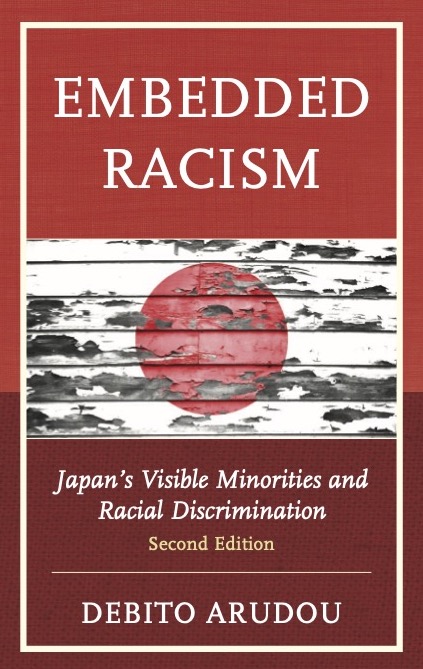
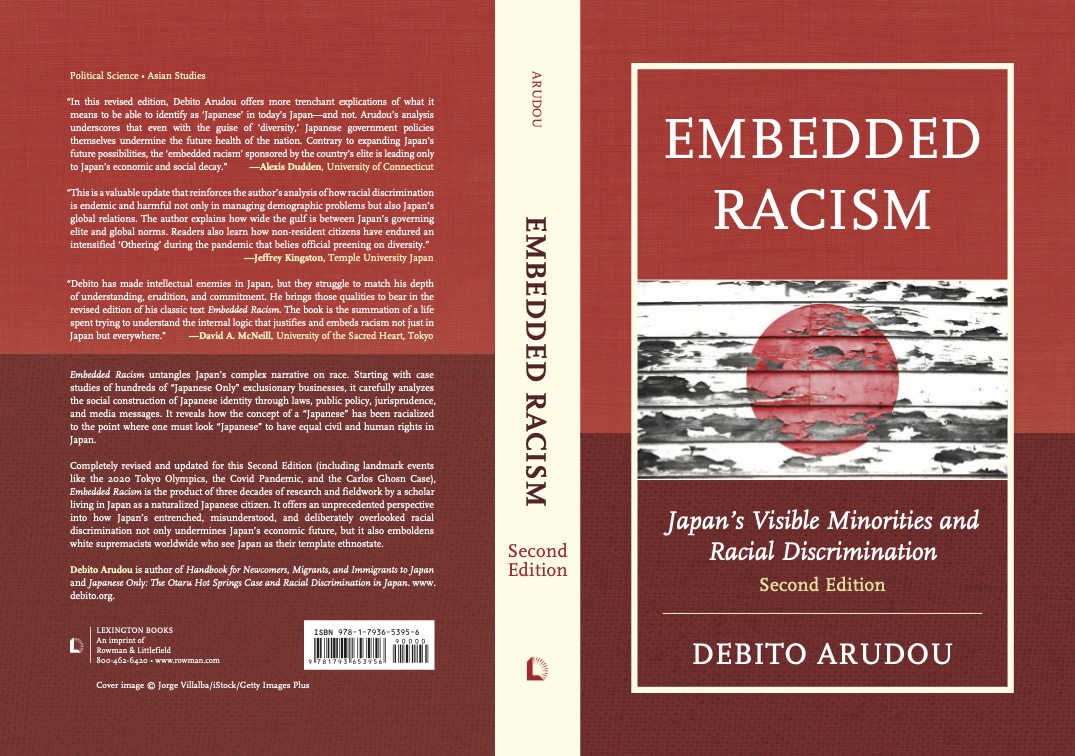
Books, eBooks, and more from Debito Arudou, Ph.D. (click on icon):




UPDATES ON TWITTER: arudoudebito
DEBITO.ORG PODCASTS on iTunes, subscribe free
“LIKE” US on Facebook at http://www.facebook.com/debitoorg
https://www.facebook.com/embeddedrcsmJapan
http://www.facebook.com/handbookimmigrants
https://www.facebook.com/JapaneseOnlyTheBook
https://www.facebook.com/BookInAppropriate
If you like what you read and discuss on Debito.org, please consider helping us stop hackers and defray maintenance costs with a little donation via my webhoster:

All donations go towards website costs only. Thanks for your support!
Japan’s Foreigners and the Four Worst Words
Subtitle: But I will say them. Because what Japan is doing to its foreign residents is all within character, and everyone should have seen it coming long ago.
By Debito Arudou. SNA VM 75, May 28, 2026, courtesy https://shingetsunewsagency.com/2026/05/28/visible-minorities-the-four-worst-words/
Frankly, given the state of the world, I’ve dreaded writing another column. Where to start anymore?
But a recent question from a reporter put my mind back in focus:
“Sanseito, which has promised to put ‘Japanese First,’ made a strong showing in the 2025 Upper House election. Some wonder why those who voted for the party were not aware that the slogan could promote discrimination and anti-foreigner sentiment. I would very much appreciate it if you give us your take on this.”
My answer was:
“After several decades of economic stagnation, and now a shrinking economy and falling wages, people are ever hungrier for change, any change. Sanseito profited from that like nationalist/populist movements and parties have done worldwide. It’s a cresting wave of anti-globalism and identity politics.
“I’m sure voters were perfectly well aware that ‘Japanese first’ would stoke discrimination. Now playing dumb about rising xenophobia is just, if I’m being gracious, a form of ‘buyer’s remorse.’
“But I actually doubt all that many voters in Japan are all that regretful beyond the ‘tatemae‘ (pretense) of expressing a simple ‘kawaisou‘ (what a pity).
“People have had decades to make anti-discrimination policies to prevent this sort of thing, but never really have. Because after all, the discrimination won’t affect most of them.
“Again, foreigners aren’t really seen as residents and neighbors in the ‘monoethnic’ Japan national narrative, so all this to me is within character. I’m more surprised a Sanseito-type party wasn’t as successful sooner.”
This brings us to me saying the four worst words in the English language:
I. Told. You. So.
THERE SHOULD BE NO SURPRISES HERE
The rise of Sanseito, and the competing downward spiral of policies to make foreign residents ever more miserable, are all part of a pattern.
Since the 1990s, pundits like me have warned that Japanese society has public policies with racism baked in. It’s so embedded that people reflexively accept a basic premise: That some people are entitled to power (e.g., Japanese in Japan), and those who “don’t belong here” will just have to settle for second-class status (e.g., you foreign residents). Some opinion polls have even said a large proportion of Japanese don’t believe foreigners deserve the same human rights in Japan.
But Japan’s foreign residents should have seen it coming. There’s a long history to cite:
More than a century ago, a generation of colonized foreigners in the Greater East Co-Prosperity Sphere became subjects of the Japanese Empire. Many ethnicities collaborated, fought, and died for the Emperor in Japan’s wars. Then after World War II, they were summarily denaturalized and disenfranchised, losing their right to vote and participate in Japanese society, many becoming the card-carrying Zainichi generational foreigners.
That set the template. As Japan prospered in its Postwar boom, “Newcomer” foreigners invited into Japan’s burgeoning labor market fared no better, finding themselves on revolving-door labor visas and exploited under government-sponsored human trafficking systems. Even the “good foreigners” (the racially bonafide “Nikkei Japanese” laborers from South America, given instant de facto Permanent Residency) were summarily booted in the 2009 economic crisis.
Today, under late-stage cultural capitalism, the ruse is now to get quick money from foreigners who are even more temporary — tourists. But that plan has soured under its own success, with crowds of foreigners being blamed for all manner of social ills. This has provided political leverage to the xenophobes who no longer have to hide their intentions anymore. In comes Sanseito, encouraging a Liberal Democratic Party to compete with policies making life for foreigners as miserable as possible.
That means all you foreign residents who devoted your lives to Japan by marrying, paying taxes, investing in homes, becoming gainfully employed and starting companies, having kids, taking out Permanent Residency, and contributing to Japanese society like everyone else: Your status is now tenuous.
You face new “Permanent” Residency statuses that require twice the time, with application fees that have risen tenfold — conveniently too expensive for many lower-wage long-term residents. And it’s no longer “permanent” — it can be revoked in an instant if you miss a tax payment.
You also face ever-higher hurdles both in terms of arduous visa ladders (3-year visas are difficult enough to get, but 5-year visas will now be required for PR), “upper-intermediate level” N2 language tests, higher entry fees all around, and likely an extra “gaijin tax” as dual-pricing schemes and racial profiling wind up on your restaurant bills, as an automatic “seating charge for tourists.” After all, Japan’s policymakers make almost no distinction between foreign tourist and resident, so why should anyone else?
So where’s the outrage from those affected? It’s muted, because making life difficult for foreign residents has been so normalized that some of the biggest advocates are the long-term foreigners themselves. As I’ve written many times in the past, many promote “guestist” arguments, i.e., foreigners are the “guests” to the Japanese “hosts,” so don’t rock the boat. Or they depict the “bad foreigners” (as opposed to the “good ones”) as despoiling their Japan due to their illiteracy, deliberate misbehaving, or cultural-klutziness. Or they argue that Japan can run its society as it pleases and foreigners should have no say — anything else is a tantamount to cultural imperialism. Or that “shimaguni” island-country Japan just doesn’t know any better. Yada yada.
Nothing quite like denying your own right to exist in a society as an equal.
YOU BROUGHT THIS ON YOURSELVES
Activists like me have tried to warn you that things won’t get better unless you stood up for yourselves. I for one have written books and hundreds of columns on how Japan systemically excludes all sorts of people (not just foreigners), pointed out where the pressure points are for fixing these situations, and offered advice for how you can assimilate better. You can still read them at Debito.org.
But the reactions towards us immigrants trying to help Japan’s foreign communities have been counterproductive. Again, just speaking for myself, a solid number of readers generally concluded that people like me were just angry malcontents trying to self-aggrandize (if not capitalize) on human rights, or just decided to shoot the messenger for popping their bubble with uncomfortable truths.
So let’s pop another: It might be a relief to some that you don’t have to care about Japan’s political outcomes, or have any input into public policies that affect you. But now look what that got you — blame and public sanctions for things you didn’t do.
So after 30 years of cautionary tales culminating in the public policies we predicted, I think I’ve earned the right to say those four words:
I. Told. You. So.
YOU COULD HAVE BEEN CONTENDERS
Another future was possible. There was arguably a window in the late 1980s when Japan was bringing in Non-Japanese as longer-term residents, and policymakers were thinking about how Japan could best assimilate itself into a globalizing economy by “internationalizing” its labor force. Companies were hiring foreign workers like us at the ground floor. We were learning Japanese and figuring out how power flowed for ourselves. Many of us assimilated into Japan on our own terms.
And we did good. Our generation of Japan specialists between 1985-1995 eventually paved the way for today’s widespread acceptance of “soft-power” Japanese (and Asian) cool cultural exports — including Anime, Manga, arguably even K-Pop bands. Not to mention more than a generation of JETs. Thankfully, the era of the “inscrutable Japanese” has gone the way of Reischauer.
Sadly, that time frame of expertise slammed shut, as Japanese society eventually realized that the “Bubble Era” of prosperity for all was a phase that would never return. Instead, people took their anxieties out on the easiest targets — foreigners — as most societies feeling real economic pain do.
This could have been ameliorated significantly if policymakers had taken our suggestions decades ago:
1) Create a national narrative where anyone could be a “Japanese” based on legal status, not physical appearance.
2) Create laws against racial discrimination, as both the Japanese Constitution and United Nations treaty require.
As you know, that didn’t happen. Now foreign residents have a generation of their children saddled with the same racial profiling that targeted them as parents.
What can you do about it now? You can rebel, settle into quiet second-class-citizen suffering, or leave. All options are such a waste of Japan’s talent and energy.
Or worse, you can become enough of a “self-hating gaijin” to have to constantly prove yourself to be a “real Japanese,” as Diet Member Kimi Onoda, Cabinet “Minister in Charge of a society of Well-Ordered and Harmonious Coexistence with Foreign Nationals,” does when she aims make herself look good by making you look bad..
That’s how we got here. These monstrous situations could have been avoided if Japan had taken the reasonable advice of treating people like human beings regardless of nationality and physical appearance. But no.
THE COMEUPPANCE IS COMING
Instead, Karma’s a bitch. Japan’s countryside is depopulating. Its economy keeps falling down the international GDP rankings, shrinking from senescence due to a lack of replacement birthrates or immigration. Its pension systems, as forecast, are going bankrupt. Its old people are living lives of penury as real wages drop for everyone and inflation does its damage. The slide in the international exchange value of the yen means foreign tourists get the bargains, while people living in Japan get trapped in a domestic spiral of decreasing buying power,
And it was all for naught. Unless Japan engages in ethnic cleansing (not impossible, given Sanseito), its foreign population will rise anyway as a percentage regardless just from natural attrition.
Again, everyone, Japanese and Non-Japanese, was told this was coming. As far back as the year 2000, Prime Minister Keizo Obuchi and the United Nations both said that Japan would need to import 600,000 foreign residents per year to maintain the current standard of living. Then two decades ago, prominent thinkers, such as Hidenori Sakanaka, warned that we were at a crossroads to becoming either a “Big Japan” (a regional if not a world power) or a “Small Japan” (an irrelevant geopolitical backwater), depending on whether Japan chose to treat its foreigners as guest workers or future Japanese citizens.
More than a quarter century later, it’s clear the “Small Japan” scenario is nigh.
We. Told. You. So.
Yet most of you acquiesced to this. If you also stood up for your rights as citizens, residents, and taxpayers, things might have turned out differently. But you didn’t.
Instead, most of you chose to ignore, marginalize, if not outright attack people like us. (I for one still get regular death threats.) Oh well. Ye shall reap.
So enjoy your sunset years within a sunsetting society. I too will enjoy Japan, like many other Japanese abroad, as a citizen but not as a resident. Because I did everything I could to become Japanese and it wasn’t enough. Given Sanseito-ism, it’s even less likely to be enough now.
Maybe now you’ll listen now. But I doubt it. Like any community you bought into but can’t leave (the MAGA personality cult comes to mind), it’s nearly impossible to admit you were wrong.
But I will still say it: I. Told. You. So.
ENDS
======================
Do you like what you read on Debito.org? Want to help keep the archive active and support Debito.org’s activities? Please consider donating a little something. More details here. Or if you prefer something less complicated, just click on an advertisement below.