mytest
Books, eBooks, and more from Dr. ARUDOU, Debito (click on icon):





UPDATES ON TWITTER: arudoudebito
DEBITO.ORG PODCASTS on iTunes, subscribe free
“LIKE” US on Facebook at http://www.facebook.com/debitoorg
https://www.facebook.com/embeddedrcsmJapan
http://www.facebook.com/handbookimmigrants
https://www.facebook.com/JapaneseOnlyTheBook
https://www.facebook.com/BookInAppropriate
If you like what you read and discuss on Debito.org, please consider helping us stop hackers and defray maintenance costs with a little donation via my webhoster:

All donations go towards website costs only. Thanks for your support!
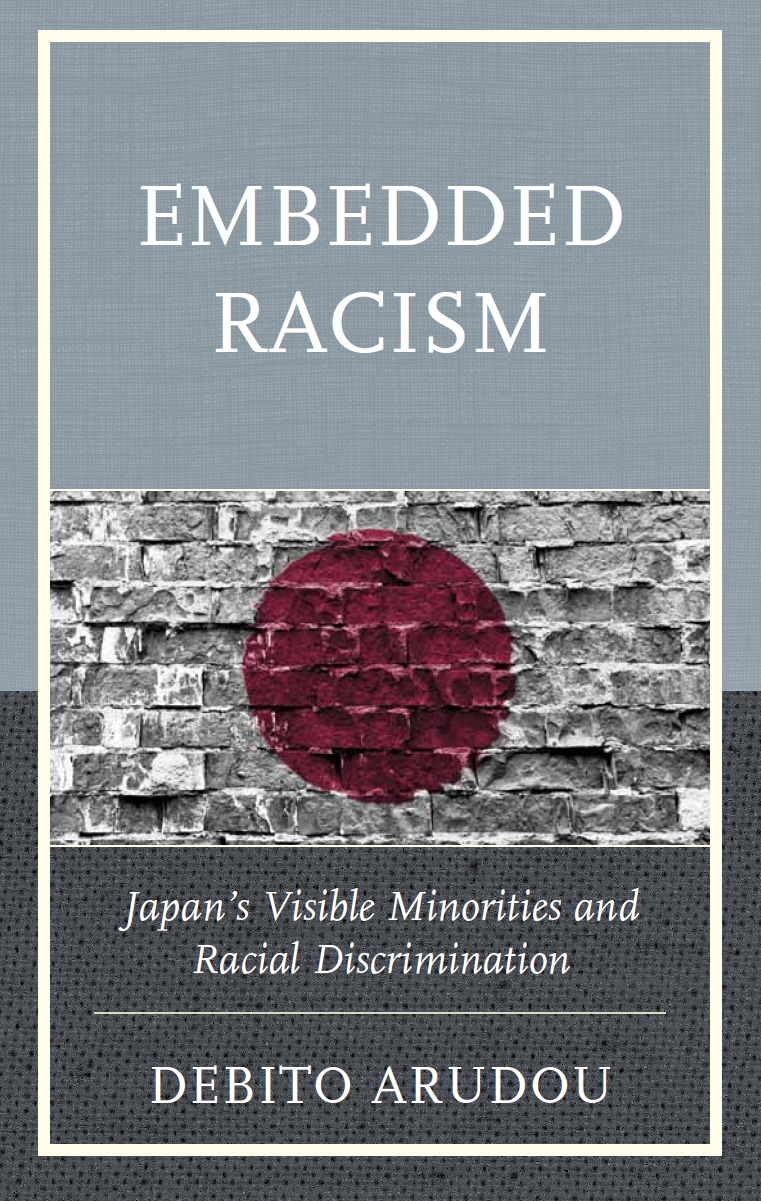
Book “Embedded Racism: Japan’s Visible Minorities and Racial Discrimination” now in paperback, discounted to $34.99 if bought through publisher directly using promo code at https://www.debito.org/?p=14096
DEBITO.ORG NEWSLETTER AUGUST 1, 2016
Table of Contents:
////////////////////////////////
GOOD NEWS
1) Ten years of Debito.org’s Blog: June 17, 2006. And counting.
2) Book “Embedded Racism: Japan’s Visible Minorities and Racial Discrimination” (Lexington Press 2016) now out early in paperback
LESS GOOD
3) Brief comments on the July 2016 Upper House Election: The path is cleared for Japan’s Constitutional revision
4) Meanwhile back in Tokyo: Gov candidate Koike Yuriko allegedly spoke at anti-foreign hate group Zaitokukai in 2010
5) Zaitokukai xenophobic hate group’s Sakurai Makoto runs for Tokyo Governorship; his electoral platform analyzed here (UPDATED: he lost badly)
6) One reason why human rights are not taken seriously in Japan: Childish essays like these in the Mainichi.
MORE BAD
7) Shibuya Police asking local “minpaku” Airbnb renters to report their foreign lodgers “to avoid Olympic terrorism”. Comes with racialized illustrations
8 ) TV “Economist” Mitsuhashi Takaaki on foreign labor in Japan: “80% of Chinese in Japan are spies”: “foreigners will destroy Japanese culture”
9) Overseas online info site Traveloco.jp’s “Japanese Only” rules: “People with foreign-sounding names refused service”
10) Kyodo: Foreign laborers illegally working on farms in Japan increases sharply [sic]. How about the J employers who employ illegally?
11) CG on increased exit taxes on health insurance and residency when you change jobs and domiciles in Japan
AND ON A HAPPIER NOTE:
12) Ivan Hall’s new book: “Happier Islams: Happier US Too!” A memoir of his USIS stationing in Afghanistan and East Pakistan. Now available as Amazon Kindle ebook.
////////////////////////////////
By Dr. ARUDOU, Debito
debito@debito.org, www.debito.org, Twitter @arudoudebito
The Debito.org Newsletter as always is freely forwardable
////////////////////////////////
GOOD NEWS
1) Ten years of Debito.org’s Blog: June 17, 2006. And counting.
June 17, 2016 marked the Tenth Anniversary of founding of the Debito.org Blog (as opposed to the Debito.org Website, which has been in existence this year for 20 years).
We’ve done a lot. As of that day, Debito.org has 2605 blog posts, 29,537 read and approved comments from Debito.org Readers, and probably around a hundred published articles archived with links to sources here. It has been the archive for at least one Ph.D. research, and cited as the source for many more publications by independent scholars, researchers, and journalists.
The award-winning Debito.org website remains the online domain of record concerning human rights for Non-Japanese residents and Visible Minorities in Japan, and long may it continue.
https://www.debito.org/?p=14048
////////////////////////////////
2) Book “Embedded Racism: Japan’s Visible Minorities and Racial Discrimination” (Lexington Press 2016) now out early in paperback
”Embedded Racism” has just come out in paperback a year early, due to outstanding hardcover sales (according to WorldCat, 86 of the world’s prominent academic libraries, including Harvard, Princeton, Cal Berkeley, Stanford, Yale, Cornell, and Columbia, have it in their collections), in time for Fall Semester. The textbook describes how Japan’s under-researched minorities and immigrants suffer from systemic discrimination, and how that augurs ill for Japan’s future as its population decreases.
More information at https://www.debito.org/embeddedracism.html
The publisher has just discounted “Embedded Racism” to $34.99 (Kindle too) if bought through them directly. Use promo code LEX30AUTH16.
https://rowman.com/ISBN/9781498513906/Embedded-Racism-Japan’s-Visible-Minorities-and-Racial-Discrimination
Book flyer and order form at https://www.debito.org/EmbeddedRacismPaperbackflyer.pdf
Examination copies (book and ebook) for academics available at https://rowman.com/Page/Professors
////////////////////////////////
LESS GOOD
3) Brief comments on the July 2016 Upper House Election: The path is cleared for Japan’s Constitutional revision
Commentators have talked about the deception behind this election (that Abe kept the talk on economics instead of his pet project of reforming Japan’s American-written 1945 Constitution in ways that are neither Liberal nor Democratic), about how Japan’s opposition have been so disorganized that they haven’t put up much more than an “anyone-but-Abe” policy stance, and about how PM Abe probably won’t go after the Constitution for a while.
But I would disagree. What more does Abe need in terms of confirmed mandate? As I said, he’s won three elections solidly (probably better than even former PM and LDP party-leader template Koizumi did), he’s essentially gotten a supermajority in both houses of Parliament, and these wins will be seen as public affirmation that Abe’s on the right track (especially within the ranks of the LDP itself; he already regained the LDP presidency running unopposed). Abe has made it quite clear constantly since he’s been anywhere close to power that he wants a return to Japan’s past (foreigner-uninfluenced) glories. Now nothing is really stopping him, short of a national referendum.
And despite opinion polls saying that people don’t want bits or all of Japan’s Constitution changed, I don’t think the Japanese public is all that scared of that happening anymore. Not enough to vote significantly against him at election time. My take is that Japan is becoming a more geriatric society, and with that more politically conservative. That conservatism I don’t think extends to old documents seen as imposed as part of Victors’ Justice. As of this writing, I will be surprised if a) Abe doesn’t push for Constitutional revision, and b) it doesn’t succeed. Clearly the Japanese public keeps handing Abe the keys to do so.
https://www.debito.org/?p=14086
////////////////////////////////
4) Meanwhile back in Tokyo: Gov candidate Koike Yuriko allegedly spoke at anti-foreign hate group Zaitokukai in 2010
For those who haven’t been following Japanese politics (recently it’s been a pretty dismal science), there’s another race you might want to follow — that of the race for Tokyo Governorship on July 31, 2016. This matters, because Tokyo is 1) Japan’s largest and most cosmopolitan city, one of few with a still-growing population (as Japan’s countryside continues to depopulate and die) and even significant foreign resident enclaves; 2) a world city, cited by at least one international ranking system (Monocle, incidentally partially owned by a Japanese publisher) as the world’s “most livable city”; and 3) the city with the highest GDP (according to the Brookings Institution, even adjusted for PPP) in the world — in fact, according to the IMF, Tokyo alone is the ninth-largest economy in the world, larger even than Brazil, and easily over a third of Japan’s entire GDP (at 36%).
So who gets elected governor of this capital city area should matter to the world. And it has, at least to the world’s third-largest economy. Tokyo set the trend for electing far-right xenophobic governors by electing (several times) Ishihara “I wanted a war with China” Shintaro, who legitimized a xenophobic program within Tokyo environs to the point where bullying of foreigners became normalized throughout Japan (see also book “Embedded Racism” Ch. 7). And with that, far-right hate group Zaitokukai and similar groups became emboldened to hold anti-foreign rallies (some that advocated the “killing of all Koreans”) on a daily basis in recent years. Not to mention that Tokyo is hosting the 2020 Olympics. Given the degree of centralization of, well, everything that matters in Japan in Tokyo, as Tokyo does, so does the rest of Japan.
That’s why the Tokyo Governorship has been a controversial seat this century. First, Governor Ishihara used it as a bully pulpit to justify destabilizing the rest of Asia. Then his hand-picked successor, former Vice-Governor and investigative writer Inose Naoki resigned after a payola scandal. His successor, TV personality and pundit Masuzoe Yoichi similarly recently resigned after a payola scandal. Now the seat has become a referendum of the two leading parties, the waxing and right-shifting Liberal Democratic Party of PM Abe Shinzo, and the waning leftist Democratic Party still trying to recapture some momentum. And into the breach has dived LDP former cabinet member Koike Yuriko, who may even be a favorite to win.
But not so fast. According to Zaitokukai, Koike spoke at their organization back in 2010. Koike is known as a person who flip-flops between parties and positions often, but this is a bit too far for Debito.org’s comfort. Is this the type of person that Tokyoites want?
UPDATE: Apparently she is. Koike yesterday won in a landslide.
https://www.debito.org/?p=14099
////////////////////////////////
5) Zaitokukai xenophobic hate group’s Sakurai Makoto runs for Tokyo Governorship; his electoral platform analyzed here (UPDATE: he lost badly)
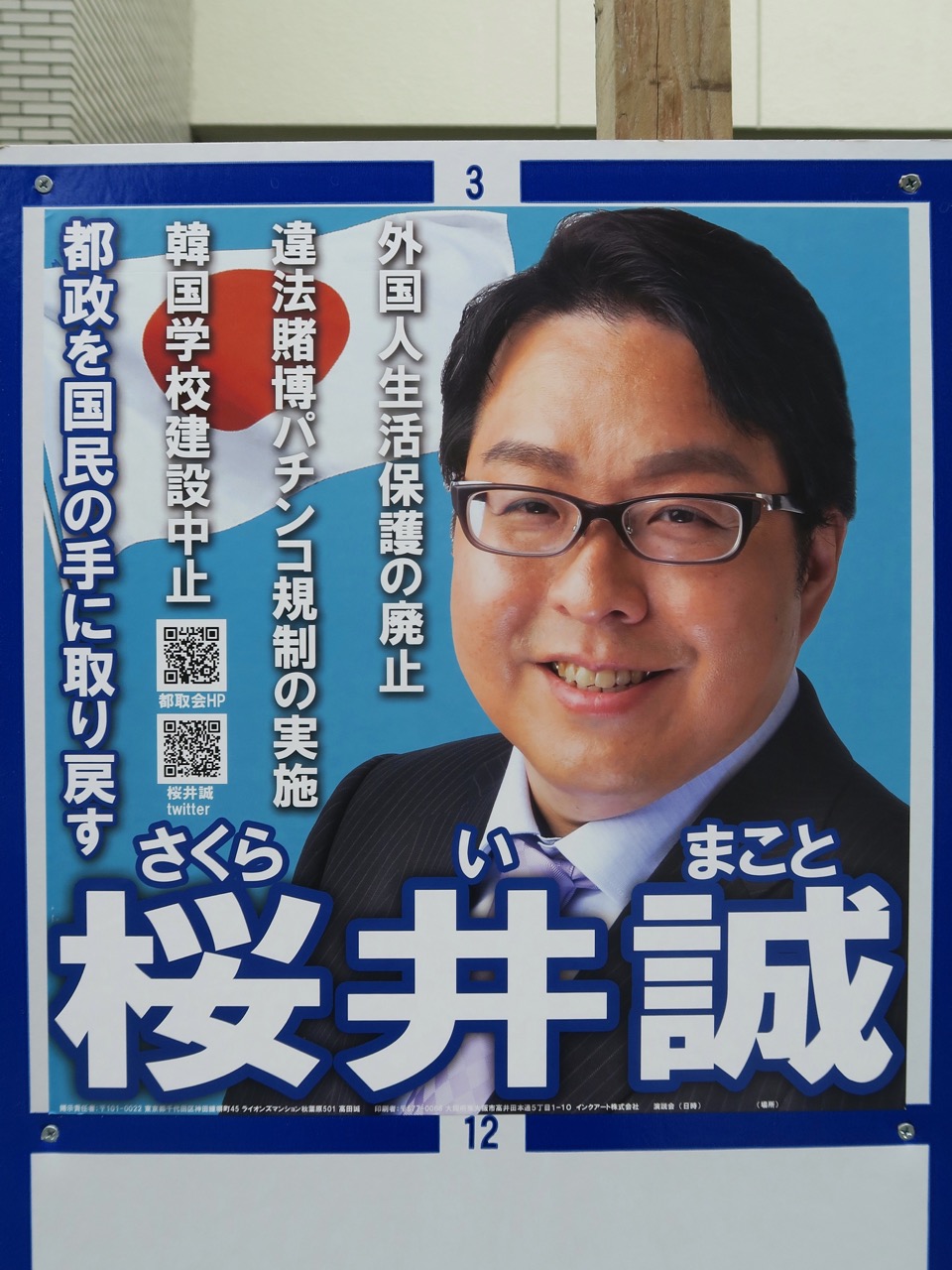
As Debito.org’s second post on the upcoming July 31, 2016 Tokyo Governorship race, I just wanted to cover the candidacy of the anti-foreign vote, particularly Sakurai Makoto, “former leader” of the officially-certified xenophobic hate group Zaitokukai. Here’s his campaign poster:
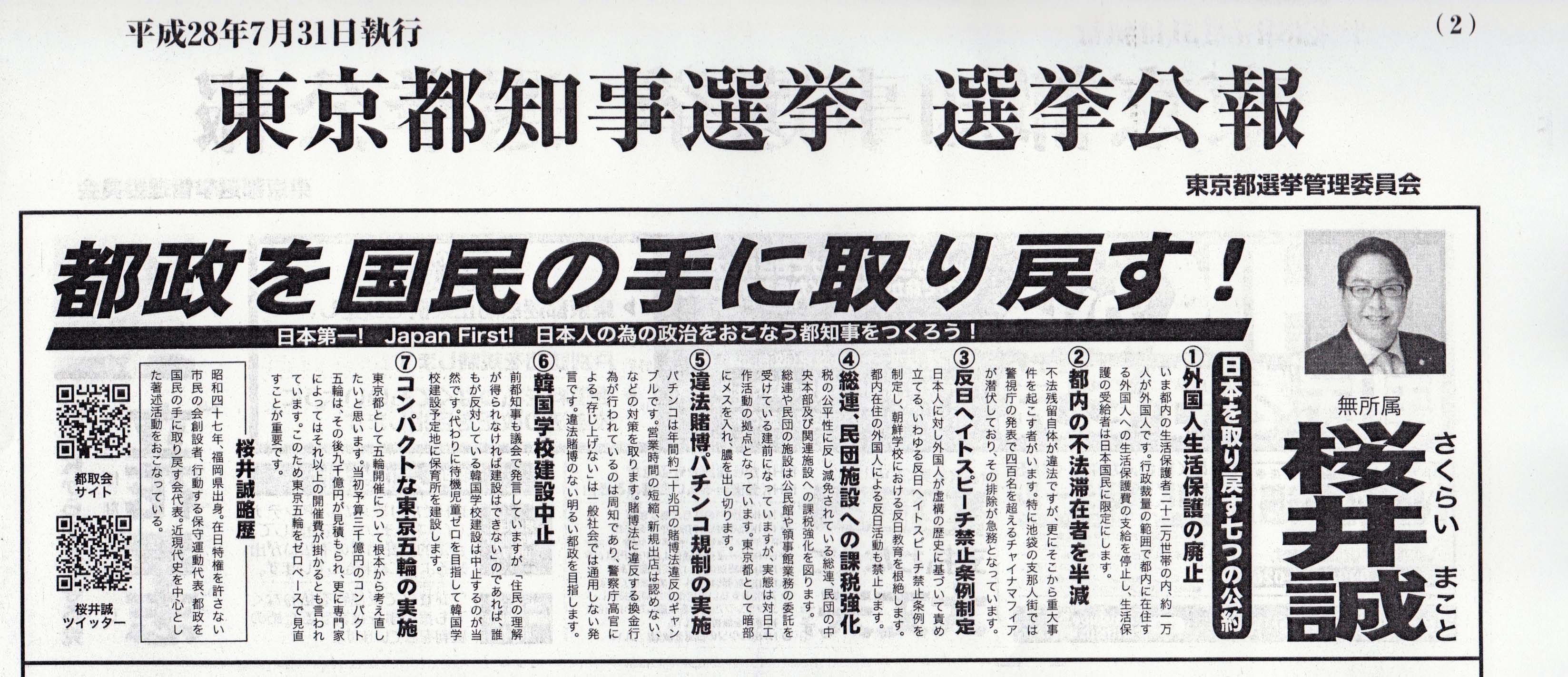
While this bullying berk hasn’t a snowball’s chance of winning, thank goodness, it’s still a bellwether of Japan’s general tolerance of hate speech that a person like this would be taken seriously enough to allow a candidate who espouses hatred of whole peoples (and believe me he’s not alone, pre-hate speech law). So let’s take a look at his party platform, since that’s what we do here. Here are the seven points of his platform:
https://www.debito.org/?p=14116
////////////////////////////////
6) One reason why human rights are not taken seriously in Japan: Childish essays like these in the Mainichi.
Mainichi: The new hate speech law is what you might call a “principle law,” as it has no provisions for punishing violators. Furthermore, it only protects “those originally from nations outside this country” who are “living legally in Japan.” As such, it does not outlaw discrimination against Japanese citizens or foreigners applying for refugee status, among other groups. However, the supplementary resolution that accompanied passage of the law states, “It would be a mistake to believe that discrimination against groups not specifically mentioned in the law is forgivable.” I suppose we can say that the Diet essentially stated, “Discrimination is unforgiveable in Japan.” […]
I have read a paper based on research conducted outside Japan that showed that ethnically diverse workplaces produce more creative ideas than those dominated by a single race or nationality. In contrast to working with people who understand one another from the get-go, getting people with wildly varying perspectives and ways of thinking together in one place apparently sparks the easy flow of groundbreaking ideas.
So, talk to someone different than yourself. Even if that’s impossible right away, you will come to understand one another somehow. It’s time to put an end to knee-jerk hatreds, to discrimination and pushing away our fellow human beings. With the new hate speech law, Japan has finally become a country where we can say, “We will not tolerate discrimination.”
COMMENT: While this article is well-intentioned, and says most of the things that ought to be said, the tone is pretty unsophisticated (especially if you read the Japanese version — the English version has been leveled-up somewhat). I have always found it annoying how discussions of human rights in Japan generally drop down to the kindergarten level, where motherly homilies of “we’re all human beings”, “let’s just get along” and “talking to somebody different will solve everything” are so simplistic as to invite scoffing from bigots who simply won’t do that…
https://www.debito.org/?p=14054
////////////////////////////////
MORE BAD
7) Shibuya Police asking local “minpaku” Airbnb renters to report their foreign lodgers “to avoid Olympic terrorism”. Comes with racialized illustrations
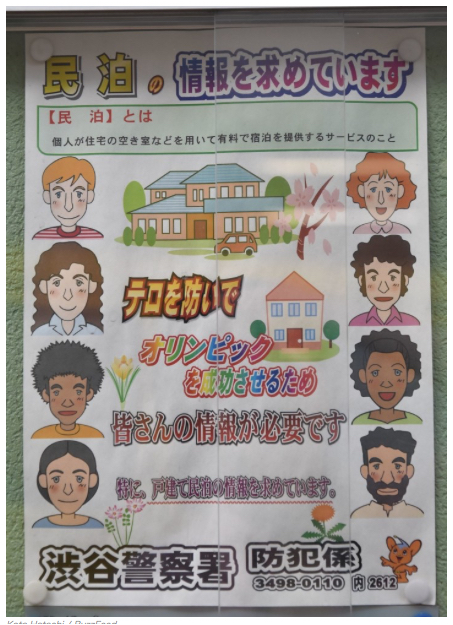
A Shibuya Police poster reads:
=============================
WE ARE ASKING FOR INFORMATION FROM MINPAKU HOSTELERS
“Minpaku” is defined as the service of offering paid accommodation using empty rooms etc. from individual homes.
To prevent terrorism and for the success of the Olympics, we need information from everyone
We are especially asking for information from individually-standing homes doing Minpaku.
Please call the Shibuya Police Department, Head of Crime Prevention, at 3498-0110 ext 2612.
=============================
That’s the literal translation of the text. Note how there is no reference whatsoever textually about foreigners. However, contextually, in the margins there are illustrations of eight racialized “foreigners” of ostensibly European, African, and Middle-Eastern extractions complete with differentiated eye color, hair color, skin color, and facial hair. Note how there is no representation of “Asian” foreigners, even though they make up the majority of Japan’s tourists. I guess they’re not the type that Shinjuku cops are looking for.
My comments about this are seasoned to the point of predictably: 1) Once again, Japan’s police are using racial profiling to determine who is a foreigner as well as a terrorist. 2) Japan’s police are rallying the public to do their bidding on unlawful activities (i.e., scaring them with the threat of terrorism into reporting their foreign lodgers to the police, which neither minpaku nor actual hotels are required to do). 3) The use and proliferation of racialized caricature seems to be normalized standard operating procedure with Japan’s police. (Why not? Nobody’s going to stop them when they keep Japan’s public constantly afraid of foreigners to the point of normalized targeting.) And 4), as I have written before, Japan is not mature enough as a society to host these international events, for the National Police Agency whips everyone up into a frenzy about foreign crime, hooliganism, and/or terrorism. And then the NPA uses the events to clamp down on civil liberties for everyone. Thus there is insufficient check and balance to keep these bunker-mentality bureaucrats from exaggerating their mandate. The Tokyo Olympics are still more than 4 years away. Expect even more of this embedded racism to surface into full-blown state-sponsored xenophobia in the meantime.
https://www.debito.org/?p=14071
////////////////////////////////
8 ) TV “Economist” Mitsuhashi Takaaki on foreign labor in Japan: “80% of Chinese in Japan are spies”: “foreigners will destroy Japanese culture”
Watch this short video about Mitsuhashi Takaaki, a commentator, writer, TV personality, seminarist (juku), failed LDP candidate, and blogger about things he considers to be politics and economics. It shows how normalized bigotry is in Japan — to the point of silliness. Once you get past the stupid tic Mitsuhashi has with pushing up his eyeglasses (redolent of aspiring Hollywood wannabes of the 1910s-1930s who thought their cute catchphrase, gesture, or sneeze would fuel an entire career), you realize what he’s enabling: Japanese media to espouse xenophobia.
In the video he’s critical of PM Abe’s policies (ignorantly portraying Abe as a proponent of importing foreign labor in order to undercut Japanese workers’ salaries), but he goes beyond economics and into bigotry: about Chinese (depicted as invading hordes with queue hairstyles, where he claims that “80% are spies” [source, please?]) and foreigners in general (they will “destroy Japanese culture”). The research gets so sloppy that it reaches the point of silliness (they even misspelled TPP as “Trance Pacific Partnership”). Watch the video yourself, but not as a lunch digestion aid.
In the end, Mitsuhashi is just an IT dork relishing his time in the sun, riding a patriotic wave while dividing, “othering”, and bullying minorities for his own financial gain. Again, it’s one more indication that the long-awaited next generation of “more liberal Japanese” will be just as narrow-minded as the previous one.
https://www.debito.org/?p=14057
////////////////////////////////
9) Overseas online info site Traveloco.jp’s “Japanese Only” rules: “People with foreign-sounding names refused service”
Here we have an online information site called Traveloco.jp, which apparently reserves its services “for Japanese Only living abroad”. This is another permutation of Japanese corporate practices erecting arbitrary firewalls between people due to their nationality, ethnicity, etc., or, in Traveloco.jp’s case, “having a name that does not appear to be Japanese”. I wonder how “Arudou Debito” would fare. And as MT says below, why can’t anyone who can read and write Japanese be allowed service?
MT: I am thinking of suing traveloco.jp site because they closed and banned my account right after I informed them of my name, which to them “does not appear to be Japanese”. Note that there is no explicit mention of this in their official terms of use (enclosed), and I had some interesting ideas for them and some services to share with those Japanese who would be interested in my country or would be coming to [my home country].
I want them to review their policies, so that everyone (regardless of race) who is capable to communicate in Japanese could use the site with no discrimination against them – especially not based on their western-like names (if it is not a “Japanese” name)! My correspondence with them speaks for itself. And these are young entrepreneurs, not just some old folks, but the Y-generation!!! This sentiment and notion of Japaneseness is routed very very deeply even in these young men, who are getting their foot in the door of the start-up world.
https://www.debito.org/?p=14078
////////////////////////////////
10) Kyodo: Foreign laborers illegally working on farms in Japan increases sharply [sic]. How about the J employers who employ illegally?
Kyodo: The number of foreign laborers working illegally on farms across the nation rose threefold over the three year period ending in 2015, according to government data. The findings highlight the difficulties facing Japan’s agricultural sector, including labor shortages and the advanced age of many of the country’s farmers.
Among all the illegal foreign workers subject to deportation in 2015, the greatest number — 1,744 or 21.9 percent — had worked in the farming sector. That was up from 946 in 2014, 695 in 2013, and 592 in 2012, according to the Justice Ministry. The ministry also found illegal farm workers were “concentrated on farms in Ibaraki and Chiba prefectures, which are easily accessible from Tokyo.”
The average age of the nation’s farmers is now 66.4 years old, and the fact so many have no one to succeed them has become a serious social issue. “I just cannot keep my business afloat unless I hire (illegal laborers), even if it means breaking the law,” said a 62-year-old farmer in Ibaraki.
Comment from Submitter BGIO: I love the way that the headline is “Foreign laborers illegally working on farms in Japan increases sharply” when in reality it should have been more along the lines of “Japanese agricultural employers continue to flout trainee laws and illegally exploit foreign workers from developing countries”, or alternatively “percentage of foreign workers from developing countries exploited by Japanese agriculture sector worker rises to 7% (1,744 of 24,000) of those employed in ‘trainee’ scheme”. But then such headlines would require the type of objective and balanced media coverage than has long been missing in what has the temerity to call itself ‘journalism’ in this country.
Comment from Submitter JDG: If it wasn’t for the LDP letting it’s voters illegally employ NJ, those voters and their farming culture would be over! No wonder Ibaraki police are so crazy; they are being told one thing by the government and then expected to turn a blind eye to the NJ underpinning the local economy! That conflict of interest must be causing them trauma!
https://www.debito.org/?p=14052
////////////////////////////////
11) CG on increased exit taxes on health insurance and residency when you change jobs and domiciles in Japan
CG: I was hoping to ask you a question. I’ve done a fair amount of searching online and haven’t found an answer, and the people directly involved in the issue can’t (or won’t) give a plausible answer either. Recently I switched jobs and moved to a new town here after over ten years working for the previous town’s 教育委員会 [BOE]. When I received my final paycheck, they deducted twice the normal tax amount for 社会保険 [shakai hoken; health and pension insurance] and three times the normal amount for 住民税 [juuminzei; local residency taxes]、helping themselves to an extra over 8万円 [80,000 yen]。 Have you heard of such a situation before? The fact that I can’t find any information about such a “moving tax” or get clear answers strikes me as very strange. If you have a moment, I’d be very glad to know your thoughts.
MY THOUGHTS: Not sure. Anyone out there with this experience who figured out what was going on?
https://www.debito.org/?p=14069
////////////////////////////////
AND ON A HAPPIER NOTE:
12) Ivan Hall’s new book: “Happier Islams: Happier US Too!” A memoir of his USIS stationing in Afghanistan and East Pakistan. Now available as Amazon Kindle ebook.
Debito.org is proud to announce that longtime friend and colleague Dr. Ivan P. Hall, author of the landmark books “Cartels of the Mind” and “Bamboozled: How America Loses the Intellectual Game with Japan”, has just come out with his latest book: “Happier Islams: Happier US Too!: Afghanistan: Then a Land Still at Peace. East Pakistan (Now Bangladesh): There, an Island of Toleration, 1958-1961”. It is his long-awaited memoir of being stationed as a young man with the USIS as a cultural attache.
Book Summary: As a fragile peace in Afghanistan breaks down once again in 2016, and as machete murders in broad daylight of progressive intellectuals by radical zealots erode the rare heritage of religious toleration in secularist Bangladesh, Ivan Hall with grace and wry wit brings back to life for us today – in a chronicle penned then and there – the now totally counterintuitive “Happier Islams” he experienced as a young cultural officer with the U.S. Information Service, sent out in 1958-1961 to promote America’s good name in Muslim South Asia.
In Kabul a half century ago Islam though forbiddingly traditional was still politically quiescent. In Dacca, East Pakistan (today’s Dhaka, capital of Bangladesh) a less rigid type of Islam had long accommodated its large Hindu minority. And a “Happier US,” too, as American diplomats worked in lightly guarded embassies, personal safety taken for granted, enjoying an individual and political popularity unthinkable throughout the Muslim world today.
Rare as a memoir by an active embassy officer (rather than scholar or journalist) about a still dictator-run Afghanistan totally at peace in the late 1950s, Hall’s story also offers a unique glimpse into Dacca’s lively America-savvy intelligentsia as of 1960. Illustrated by 200 color photos taken at the time, and updated with geopolitical backgrounders for his two posts then and now, Hall’s narrative also casts a critical eye on the bent of his USIS employer at the height of the Cold War for short-term political advocacy at the expense of long-term cultural ties. By way of contrast his prologue and epilogue limn the heartwarming American genius for private sector “cultural diplomacy he witnessed or took part in during his years “before and after,” in Europe and Japan.
https://www.debito.org/?p=14044
////////////////////////////////
That’s all for this month. Thanks for reading!
Dr. ARUDOU, Debito
debito@debito.org, www.debito.org, Twitter @arudoudebito
DEBITO.ORG NEWSLETTER AUGUST 1, 2016 ENDS
Do you like what you read on Debito.org? Want to help keep the archive active and support Debito.org’s activities? We are celebrating Debito.org’s 20th Anniversary in 2016, so please consider donating a little something. More details here.