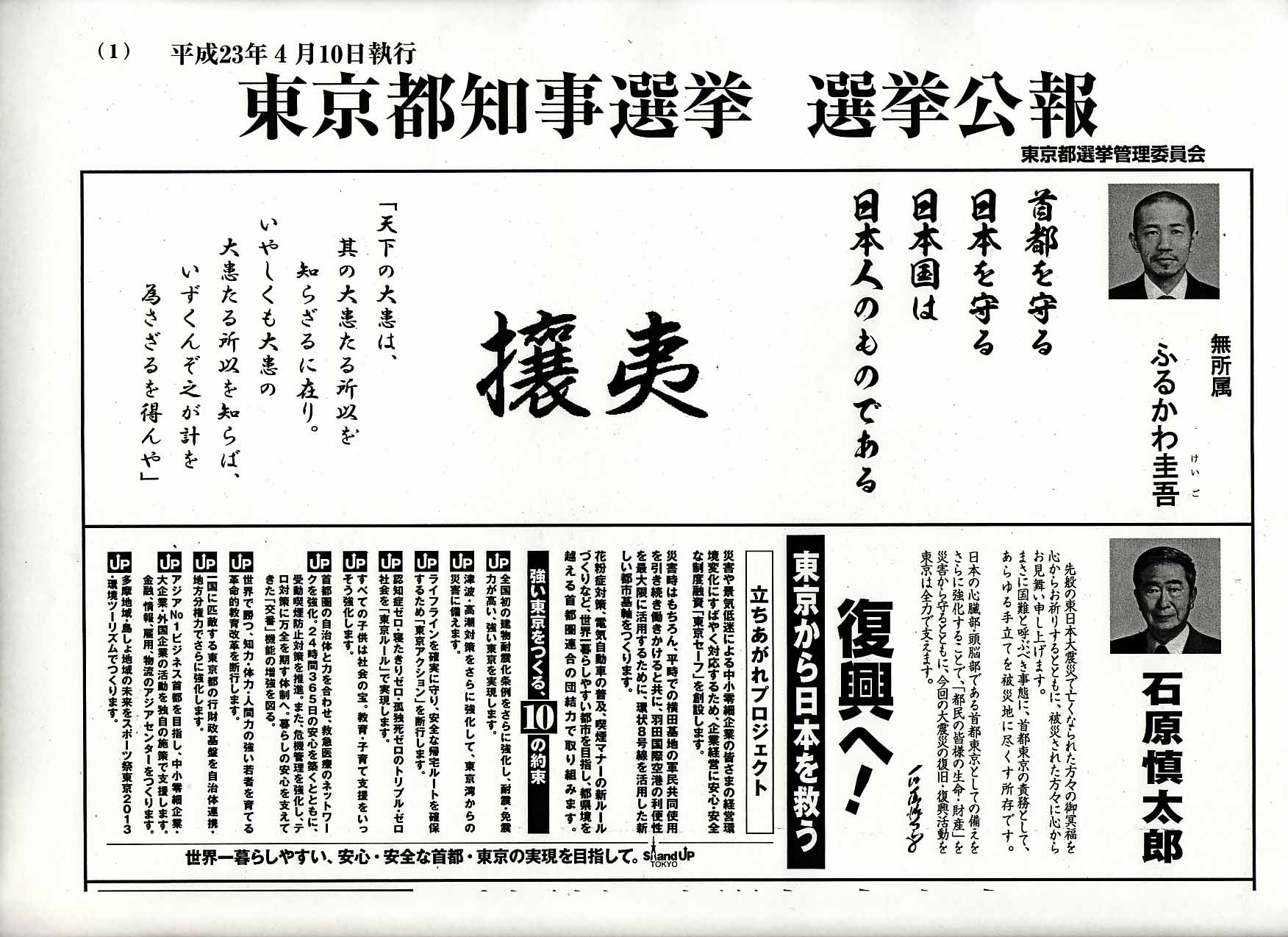
Tokyo Gov Ishihara encourages witch hunt for J politicians with naturalized ancestors

mytest

Handbook for Newcomers, Migrants, and Immigrants to Japan\" width=Foreign Residents and Naturalized Citizens Association forming NGO\" width=「ジャパニーズ・オンリー 小樽入浴拒否問題と人種差別」(明石書店)JAPANESE ONLY:  The Otaru Hot Springs Case and Racial Discrimination in Japansourstrawberriesavatardebitopodcastthumb
Hi Blog. They say that as you age, you become a caricature of yourself, as the mind becomes more inflexible and lifelong habits and ideologies become ingrained.

But then there are those who turn mean and nasty, if not outright insane. And I believe Tokyo Governor Ishihara has finally turned from a committed politician to a politician who should be committed.

Debito.org Reader GS puts it well when he writes:
///////////////////////////////////////////

Hi Debito, Anti-suffrage rightists say they are against suffrage for permanent residents because “foreigners can naturalize if they want equal rights with Japanese.” Well, now Governor Ishihara is using “naturalized” as an epithet to smear members of the ruling cabinet as untrustworthy.

====================

外国人参政権「先祖へ義理立てか」 石原知事が与党批判
朝日新聞 2010年4月18日11時2分
http://www.asahi.com/politics/update/0418/TKY201004170390.html
石原慎太郎・東京都知事は17日、東京・大手町のホールであった永住外国人への地方参政権付与などに反対する集会で、親などが帰化した与党幹部が多いとした上で、「ご先祖への義理立てか知らないが、日本の運命を左右する法律をまかり通そうとしている」と発言した。

石原知事は、出席した自民党の地方議員ら約450人に「帰化された人や、お父さんお母さんが帰化された、そのお子さんという議員はいますか」と質問。「与党を形成しているいくつかの政党の党首とか、大幹部は多い」と話した。

石原知事はこれまでも、地方参政権付与反対を繰り返し発言しており、この日は「参院選では、まさに外国人に参政権を与えるか与えないかが問題になる」とも述べた。

石原知事は、出席した自民党の地方議員ら約450人に「帰化された人や、お父さんお母さんが帰化された、そのお子さんという議員はいますか」と質問。「与党を形成しているいくつかの政党の党首とか、大幹部は多い」と話した。

====================

福島・社民党首が石原都知事の発言の撤回求める
2010年4月19日11時58分配信 産経新聞
http://headlines.yahoo.co.jp/hl?a=20100419-00000532-san-pol

社民党の福島瑞穂党首(消費者・少子化担当相)は19日、国会内で記者会見し、東京都の石原慎太郎知事が17日の外国人地方参政権の反対集会で、名 指しこそ避けたものの与党党首の中に帰化した人がいるという趣旨の発言をしたことについて「私も、私の両親も帰化したものではない」と否定した。

その上で、「私は外国人地方参政権には一貫して賛成してきた。政治家の政治信条を帰化したからだという事実誤認に基づいて説明することは、私の政治 信条をゆがめ、踏みにじるものだ」と述べ、石原氏に発言の撤回を求めた。

石原氏は17日の「全国地方議員決起集会」で、「この中に帰化された人、お父さん、お母さんが帰化され、そのお子さんいますか。与党を形成している いくつかの政党の党首とか、与党の大幹部ってのは調べてみると多いんですな」などと発言していた。

福島氏は会見で「『与党を形成している政党の党首』といえば、おのずと特定され、私のことをおっしゃっているのだと考えた」とした上で、「(帰化 を)問題とすること自体、人種差別だ」とも述べ、発言を撤回しない場合は法的措置も辞さない考えを示した。

============================

Apparently they’re on a witch hunt for not only “naturalized” Japanese who supposedly can’t be trusted, but any Japanese who might have parents who have been naturalized!  I really believe Japan is an outlier when it comes to race. The idea that nationality is a racial concept – as opposed to a legal concept – is so ingrained here I’m afraid it will not die easily.  A minister in Germany is of Vietnamese descent. And yet Japan is terrifried that a cabinet member might be naturalized or have naturalized parents. Really pathetic. GS

=========================

COMMENT:  It hardly bears fully iterating, but:  Here we have this dangerous tendency of Ishihara solidifying into a fully-formed ideology, based upon the fundamental tenets that 1) foreigners cannot be trusted, 2) foreigners are always foreigners, even if they are Japanese citizens for generations, 3) foreigners think along blood lines and will work against Japanese interests if their blood is not Japanese.  In other words, personal belief is a matter of genetics.  But these blood-based arguments went out of fashion a few generations ago when we saw that they led to things such as pogroms and genocides.  Study your history.  Yet some of the most powerful people in Japan (in this case the governor of one of the world’s major cities) not only fervently believe it, but also create political parties to rally others around it.

This is beyond pathological racism.  This is the febrile insanity of a mean old man who has long since lost control of himself and his grasp of reality after so many years in power.  And as evidenced above, he will even encourage xenophobic witch hunts for people on allegations of blood and ethnicity to push a political agenda that has one horrible conclusion:  hatred, exclusion, and silencing of others.

Dietmember Fukushima is right to call it racial discrimination and call for a retraction (and threaten legal action).  But she must also make it clear to the public that even if somebody was naturalized, it is not a problem:  Naturalized Japanese are real Japanese too.  Otherwise there’s no point to naturalization.  But for people like Ishihara, that IS the point; as I’ve written before, it makes no difference to racists whether or not people become Japanese citizens, despite the protests of those opposing votes for NJ PRs.  “If they want the right to vote, they should naturalize” has been and always will be a red herring to genuine xenophobes, so see it for what it is — a Trojan Horse of an argument camouflaging racism as reasonableness.

These are the people who should be booted from power.  Give NJ PRs the vote and we’re one step closer.  Don’t, and these bigots only grow stronger.  Arudou Debito in Sapporo, naturalized citizen.

Xenophobic rantings of the Far-Right still continue despite NJ Suffrage Bill’s suspension; scanned flyers enclosed

mytest

Handbook for Newcomers, Migrants, and Immigrants to Japan\Foreign Residents and Naturalized Citizens Association forming NGO\「ジャパニーズ・オンリー 小樽入浴拒否問題と人種差別」(明石書店)JAPANESE ONLY:  The Otaru Hot Springs Case and Racial Discrimination in Japansourstrawberriesavatardebitopodcastthumb

Hi Blog. For some people, anything is an excuse for a party. Especially if it’s a Political Party. For the Far-Right xenophobes in Japan, it’s their party and they’ll decry if they want to — as they continue their anti-NJ rantings, even when they’ve effectively shouted down the NJ Suffrage Bill the DPJ proposed after they came to power last August. Everyone has to have a hobby, it seems. Pity theirs is based upon hatred of NJ, particularly our geopolitical neighbors. Two submissions of primary source materials and posters enclosed below, one from Debito.org Reader AS, one from me that I picked up when I was in Tokyo last March, which led to a rally reported on in the Japan Times and Kyodo the other day.  Drink in the invective and see how naked and bold Japan’s xenophobia is getting.

/////////////////////////////////////////

From: AS
Subject: More anti-NJ suffrage propaganda
Date: April 14, 2010

Hi Debito, There was a person handing out anti-NJ suffrage materials at Tokorozawa station yesterday morning, and, as I promised myself I would, I got a photo and the stuff he was handing out.

I think I caught him off guard when I approached him from the flank and stuck my hand out for the pamphlets – he just handed them over without realizing until it was too late.

Ok, the pamphlets themselves. The first one is not particularly nasty, it’s just another “Release the North Korean kidnap victims” flyer. It appears to be produced by another group.

Funny how this stuff talks about the international community, while the group distributing it want nothing to do with the international community.

The second one is quite vindictive and lacking in logic. The first side is largely devoted to portraying China as a murderous country with no justice or morals (“a culture of evil”) and then jumping to the conclusion that foreign suffrage, dual nationality, recognized residency for NJs and spouses with different surnames will mean the same fate for the Japanese as is has for ethnic minorities in China!! (The same kind of logic as “Don’t buy a Toyota because Tojo was a murderer!”)

“China is evil, so we can’t have…”

Page 2 resorts to character assassination of DPJ members, linking them with China, South Korea and communism, then goes on to the same arguments that NJs will abuse child support allowance and that Japanese won’t be able to receive it.

Next is the big stinking lie that anyone (including illegal residents and criminals) can get PR just by living here for 5 years and that they will have the same voting rights as Japanese.

It then goes on to suggest that human rights laws will turn Japan into a communist nation with no freedom (Gosh – I was under the impression that page one was slagging off China for not protecting human rights)

Finally, we get the guff that allowing different surnames for spouses will be the end of the family unit. (Let’s just make everyone change their name to Suzuki, then).  DS

//////////////////////////////////////////////////

ADDENDUM FROM DEBITO:  I too saw these protesters and felt their invective outside the Diet Building on March 23, 2010, just after I gave my presentation to UN Special Rep Bustamante.  (I wonder if he caught wind of these people; they certainly were making enough of a stink.)

I too managed to get some flyers (off a kind reporter), and here are some of them.  Hang on to your logical hats, everyone:

In addition to the flyers AS referred to above (these are the same people distributing, after all):

We have former ASDF general Tamogami wallowing in all the luscious pink trappings of Japanese patriotism, calling for people to come pay money to hear him speak in Kamakura.  What you would be in store for:  According to the Japan Times January 24, 2010 (http://search.japantimes.co.jp/cgi-bin/fl20100124x4.html), “20 percent of shares in the Japanese mass media are held by foreigners. This means that the Japanese mass media are controlled by foreign investments. Former Prime Minister Shinzo Abe was brought down by these foreign powers.” Good thing he’s no longer imbedded in our military.

Here’s our laundry list of national heroes (with Tamogami and racist Dietmember Hiranuma enjoying big pictures) for us lesser mortals:

The greater national hero I’d like to see honored more often would be journalist Kotoku Shusui, but some of these faces above are the type of people who would have him and his ideology killed.  (They managed it, and look where it got Japan — destroyed in WWII.)

Underpinning all of the counterarguments proffered above is more hatred.  NJ hate us.  So we shouldn’t allow any of them to vote.  QED.

Next up:

ad

And here comes the kitchen sinking — where we lump in all sorts of other issues (including Nikkyouso, even Japan’s sex education) with the NJ suffrage stuff.  And of course Ozawa’s qualification as a real Japanese are called into question due to his beliefs.  Didn’t realize “Japaneseness” also meant ideological conformity and uniform arguments.  Oh wait, yes it did, back in the bad old days when it led the nation to destruction in a world war.  Never mind.  Reenforced patriotism will surely fix everything!

And finally:

An advertisement for a big free public rally against NJ suffrage in the Budoukan (the place the Far-Rightists also protested when the Beatles played back in 1966, as they were too decadent for Japanese morals; they paved the way for Cheap Trick, however, phew).  Wish I could have gone.  The Japan Times and Kyodo attended, however.  Here’s what they say (excerpt):

//////////////////////////////////////////////////

The Japan Times Sunday, April 18, 2010

Foreigner suffrage opponents rally
Conservative politicians express outrage at DPJ plan

http://search.japantimes.co.jp/cgi-bin/nn20100418a1.html
By ALEX MARTIN Staff writer

Conservative intellectuals and key executives from five political parties were among the thousands who gathered in Tokyo on Saturday to rally against granting foreign residents voting rights for local elections.

On hand were financial services minister Shizuka Kamei, who heads Kokumin Shinto (People’s New Party), Liberal Democratic Party Secretary General Tadamori Oshima, former trade minister Takeo Hiranuma, who recently launched his own political party, Tachiagare Nippon (Sunrise Party of Japan), and Your Party leader Yoshimi Watanabe.

According to the organizer, a total of 10,257 people attended the convention at the Nippon Budokan arena in Chiyoda Ward, including representatives of prefectural assemblies and citizens from across the nation…

In an opening speech preceded by the singing of the “Kimigayo” national anthem, Atsuyuki Sassa, former head of the Cabinet Security Affairs Office and chief organizer of the event, expressed his concern about granting foreigners suffrage.

“I was infuriated when I heard of plans to submit to the Diet a government-sponsored bill giving foreign residents voting rights,” he said.

“Our Constitution grants those with Japanese nationality voting rights in return for their obligation to pay taxes,” he said. “Granting suffrage to those without Japanese nationality is clearly a mistake in national policy.”

[NB:  As any taxpaying NJ knows, this is untrue.  I guess that means they don’t need NJ tax monies.]

Taking the podium to a round of applause, Kamei emphasized his party’s role in preventing the government from submitting the bill to the Diet, and said that “it was obvious that granting suffrage will destroy Japan.”

Kamei, who has in the past argued that giving foreigners voting rights could incite nationalism during polling, went so far as to declare that his party would leave the ruling coalition if the government submitted the bill to the Diet…

//////////////////////////////////////////////////

Rest of the article at http://search.japantimes.co.jp/cgi-bin/nn20100418a1.html

Kyodo News adds:

//////////////////////////////////////////////////

Lawmakers oppose giving foreign residents right to vote

Japan Today/Kyodo Sunday 18th April, 2010

http://www.japantoday.com/category/politics/view/lawmakers-voice-opposition-to-giving-foreign-residents-right-to-vote

TOKYO — A group of conservative lawmakers from both ruling and opposition parties on Saturday voiced their opposition to proposed legislation to enfranchise permanent foreign residents for local elections. Shizuka Kamei, who leads the People’s New Party, addressed a gathering of people against the proposed legislation in Tokyo, saying, ‘‘The right to vote for foreigners will ruin Japan.’‘

‘‘It will not be enacted during the current parliamentary session because the People’s New Party has invoked a veto (within the government of Prime Minister Yukio Hatoyama),’’ said Kamei, who is a cabinet member within the tripartite coalition government.

While Hatoyama’s Democratic Party of Japan is aiming to pass the legislation, at least one member is apparently opposed.

Jin Matsubara, a House of Representative member of the DPJ, told the meeting, ‘‘There is an argument that Europe is positive about enfranchising foreigners, but that does not hold water in Japan. I am unequivocally opposed. It’s my belief that it is necessary to faithfully speak up (about the issue) within the party.’‘

Meanwhile, Mizuho Fukushima, a cabinet member and leader of the Social Democratic Party of Japan that partners the DPJ and PNP in the government, reiterated her endorsement of the proposed legislation.

‘‘It’s not about all foreigners and it’s also limited to local elections,’’ she told reporters in Odate, Akita Prefecture. ‘‘Participation in the local community is necessary, as some countries have approved it.’‘

Objections to the bill were also expressed by opposition lawmakers at the Tokyo meeting. Tadamori Oshima, secretary general of the Liberal Democratic Party, ‘‘We must protect Japan’s sovereignty. I am absolutely opposed.’‘

Yoshimi Watanabe, leader of Your Party, suggested that enfranchising foreign residents is a vote-buying tactic. ‘‘The Democratic Party says livelihood is the No. 1 issue, but in fact aren’t elections their No. 1 business?’’ he said.

Takeo Hiranuma, who leads the just launched Sunrise Party of Japan, said he ‘‘will stake his life in fighting’’ against the legislation.

//////////////////////////////////////////////////

CONCLUSION:  These are some awfully flash and well produced pamphlets, and renting sound trucks and the whole Budoukan for all these sound bites cost a helluva lot of money.  Who’s funding this?  Arudou Debito in Sapporo

MHLW clamps down on NJ spongers of system claiming overseas kids. What spongers?

mytest

Handbook for Newcomers, Migrants, and Immigrants to Japan\Foreign Residents and Naturalized Citizens Association forming NGO\「ジャパニーズ・オンリー 小樽入浴拒否問題と人種差別」(明石書店)JAPANESE ONLY:  The Otaru Hot Springs Case and Racial Discrimination in Japansourstrawberriesavatardebitopodcastthumb
UPDATES ON TWITTER: arudoudebito
DEBITO.ORG PODCASTS now on iTunes, subscribe free

Hi Blog.   In mid-March we had a storm in a teacup about DPJ policy re child allowances:  If NJ also qualified for child support, politicians argued, some hypothetical Arab prince in Japan would claim all 50 of his kids back in Saudi Arabia.  Well, thanks to that storm, we have the Health Ministry creating policy within weeks to prevent NJ from potentially sponging off the system.  As submitter JK notes, “What follows is article on why 厚生労働省 feels the need to clamp down on those untrustworthy foreigners; never mind about the lack of data.”

Gov’t gets tough on allowances for foreigners who claim to have children in home countries
http://mdn.mainichi.jp/mdnnews/news/20100407p2a00m0na008000c.html

子ども手当:外国人支給、厳格に 子との年2回面会要件
http://mainichi.jp/life/edu/child/archive/news/2010/04/20100407ddm002010042000c.html

Well, that’s proactive policymaking in Japan.  In the same way that anti-terrorism policy that targets foreigners only was proactive (although it took a few years to draft and enact).  Here, the bureaucrats could just do it with a few penstrokes and call it a “clarification”, without having to go through the pesky political process.

But the assumption is, once again, that a) foreigners are untrustworthy and need extra background checks, and b) any policy that might do something nice for the Japanese public needs to be carefully considered by viewing it through the “foreigner prism”, for who knows what those people might do to take advantage of our rich system?  “What-if” panicky hypotheticals without any data win the debate and govern policymaking towards NJ again.

Arudou Debito in Sapporo

/////////////////////////////////////////

Gov’t gets tough on allowances for foreigners who claim to have children in home countries
(Mainichi Japan) April 7, 2010

The Health, Labor and Welfare Ministry has tightened conditions for paying child-care allowances to foreigners who reside in Japan and claim to have children in their home countries, ministry officials said.

The move is aimed at preventing foreign residents from illicitly receiving expensive allowances by falsely adopting children in their home countries or using other tricks to deceive Japanese authorities. The ministry has notified local governments across the country of its decision.

Before providing child-care allowances, local governments are required by the ministry to confirm that such recipients meet their children in their home countries at least twice a year by checking their passports, and make sure that they send money to their children at least once every four months.

The ministry took the measure out of fear that a large number of foreigners would falsely adopt children in their home countries for the sole purpose of illegally receiving child-care allowances in Japan.

The number of foreign residents’ children who receive child allowances while living in their home countries remains unclear, according to the ministry.

Some local governments have expressed concern that the measure would increase their workload.

Original Japanese story

子ども手当:外国人支給、厳格に 子との年2回面会要件
毎日新聞 2010年4月7日 東京朝刊

厚生労働省は、国内に住み母国に子供がいる外国人に対する子ども手当の支給要件を厳格化する通知を各自治体に出した。年2回以上面会していることをパスポートで確認することなどが柱。児童手当は比較的緩やかな条件下で支給されてきたが、高額の子ども手当で不正受給を防ぐことを狙った。

児童手当は、子を養育する権限があり、生計を維持する保護者に支給。母国に子がいる外国人については、出生証明書と送金証明書があり、面会などしていれば支給してきた。だが面会の立証は困難で、手紙の提示だけでよかったり、証明を求めない自治体もあった。証明書の偽造も可能と指摘されており、不正受給目的の養子縁組の横行などが危惧(きぐ)されていた。

このため厚労省は、少なくとも年2回以上の面会をパスポートで確認▽約4カ月に1回以上の送金を銀行の送金通知などで確認--などを支給要件と定め通知した。

厚労省によると、母国で児童手当を受給する子どもの数は把握されていない。年度末に子ども手当の駆け込み申請があった自治体もあり、今回の通知に対し、自治体側からは「事務負担がどのくらい増えるか未知数」と懸念する声も上がっている。【野倉恵】
ENDS

Sunday Tangent: Japanese porkbarrel airports as “infrastructure in a vacuum”, and how JR duped me into buying a train ticket to nowhere

mytest

Handbook for Newcomers, Migrants, and Immigrants to Japan\Foreign Residents and Naturalized Citizens Association forming NGO\「ジャパニーズ・オンリー 小樽入浴拒否問題と人種差別」(明石書店)JAPANESE ONLY:  The Otaru Hot Springs Case and Racial Discrimination in Japansourstrawberriesavatardebitopodcastthumb
UPDATES ON TWITTER: arudoudebito
DEBITO.ORG PODCASTS now on iTunes, subscribe free

Hi Blog.  Had an interesting experience yesterday on the way home to Sapporo yesterday, so I thought I’d make that today’s blog entry.

We’ve had some media buzz last month about Japan’s regional airports (with the opening of Ibaraki’s airport, that makes a total of 98 international, national, and municipal airports around Japan — close to two per prefecture, and that apparently does not count the ones inside of JSDF military bases).  A full list of them here.  The buzz from the Japan Times, Editorial, March 23, 2010:

EDITORIAL
When airports eat each other
Japan has 98 airports. The transport ministry’s recent survey of 72 of them indicates that the economic viability of many airports is low. Unless local governments and concerned businesses make serious efforts to attract more passengers, some airports may be forced to close.

The survey compared the actual number of passengers who used the 72 airports in fiscal 2008 with passenger-number forecasts. The actual number exceeded the forecast at only eight airports — Naha, Kumamoto, Nagasaki, Okayama, Nagoya, Haneda, Shonai (Yamagata Prefecture) and Asahikawa (Hokkaido). At about half of the 72 airports, actual use was less than 50 percent of what was forecast.

On March 11, Ibaraki airport opened as the nation’s 98th airport. Some ¥22 billion was spent to build the airport, which has a 2,700-meter runway. The chance of the actual passenger total of the airport exceeding the forecast amount is almost nil, as it connects only to Seoul, with one round-trip service a day. From April 16, it will also offer a once-daily round-trip service to Kobe.

Major airlines have shied away from Ibaraki, fearing a lack of passengers. The airport, about 80 km from Tokyo, is touted as the third for the capital, but access to it is hardly convenient.
Rest of the article at http://search.japantimes.co.jp/cgi-bin/ed20100323a1.html

I personally have used a lot of Japan’s airports on my domestic travels, usually for business:  Sapporo Chitose, Sapporo Okadama, Hakodate, Misawa, Akita, Higashine Yamagata, Hanamaki Morioka, Niigata, Sendai, Chubu Nagoya, Mihara Hiroshima, Izumo Shimane, Fukuoka, Kitakyushu, the former Kokura Fukuoka, Oita, Kagoshima, Miyazaki, Naha Okinawa, and of course Itami, KIX, Narita and Haneda.  I also will state that I have no problem with regional airports being built as long as they are used.  As the Japan Times editorial mentions above, if access is convenient.

However, I thought Hanamaki Morioka defied that assumption pretty badly yesterday, so let me narrate the adventure:

As regular Debito.org readers know, I have been on a two-week tour of Tokyo and environs doing UN and NGO FRANCA stuff.  But as my JAL mileage seems to accumulate less and less every year, I found that I could only get as far as Hanamaki Airport this year (the next band of free return flights starts at Sendai and stretches to Osaka, I was about 2000 miles short).  So I made arrangements to meet friends in Morioka, gave a speech in Sendai, and did my business further south.  Fine.  The problem was I had to get back up to Hanamaki from Tokyo to go home (no problem again, I thought; my flight back was from 6:10PM), and that’s at least 3 hours from Tokyo (it still worked out cheaper than a RT flight to Haneda, and I can spend time productively watching episodes of Survivor on my iPod).

Here’s where it got interesting.  I bought my ticket via JR all the way from Tokyo to “JR Hanamaki Kuukou Eki”, logically thinking that a JR station with the name of the destination would actually take me to that destination.  I got a print-out from JR Tokyo:  get off at Shinkansen Eki Shin-Hanamaki, change trains for JR Hanamaki Station, and finally arrive at JR Hanamaki Kuukou Eki.

It wasn’t to be.  I arrived at Shin-Hanamaki only to find the stationmaster advising me to get a cab from there to the airport.  I said I had a ticket all the way to Hanamaki Airport Station but he still made the same recommendation.  I asked for a refund of the remaining two-station portion but he refused to give it.  So I followed my ticket to see where it would take me.  It took me outside, a five-minute walk, to a completely separate teeny station that was JR Shin-Hanamaki regular-train station.

With changes, it took me another half hour to get to JR Hanamaki Station, where I changed to another station which after another twenty minutes or so got me to the Holy Land.

But JR “Hanamaki Airport Station” was a tiny place, where even the office was closed despite arriving a little after 4PM.  It was 4kms from the airport, a sign said.  As was advised, no way to get there but again by cab.

Here are some pictures to illustrate how idiotic the situation is (click on any photo to expand in browser):

Caption:  This is a JR station servicing an international airport?

Caption:  Yes it is.

Caption:  Note the distance to the airport:  4kms.  Used to be two.  Still, this JR station was never connected to the airport, is the point.

Caption:  Station office is closed.  Note time on clock.  You have to hand in your ticket into a little mailbox as you enter the station doors.  Honor system.

Caption:  Business is done for the day.  Nice to have bureaucrats go home so early.  If they even come to work here at all.

On the way to the airport, I talked to the cabdriver about this situation.  He said that Hanamaki Airport was indeed four kms away, and 5 kms from JR Hanamaki Station.  It was in fact 6 kms from Shin-Hanamaki Station, meaning I had just gone one great ellipse to get to the airport.  “JR Hanamaki Airport Station is the closest to the airport, therefore it became the station.”  But it’s still only accessible by taxi. “Or bus.  From Morioka Station.”  Which was the way I went when arriving from Sapporo two weeks ago, but it’s a half-hour bus ride away.

The taxi driver continued, “The JR station used to be only two kms away, not the four that it is now.  But they decided to spend even more money to build another terminal closer to the auto expressway.”  Even though they have cars so they don’t have that much farther to drive, while we foot travelers have to shell out for a taxi?  “Yep.  It’s good for us taxi drivers.”

All told, I wasted close to an hour between arriving by shinkansen and arriving at the airport; good thing I allowed enough time to get there.  I was also 1240 yen cab ride poorer for the experience, but sometimes one has to pay to get interesting blog entries.

But what kind of a government and infrastructure builds an airport, and then makes it nearly impossible for basic public transport to service it?  Even dupes the consumer into believing the JR station goes to the airport?

“Ozawa and his porkbarrel,” said the cabdriver.

This is why the regional airports attracted so much controversy last month.  And why, every now and again, we get annoyed articles about bureaucrats building public buildings, staffing them with retired bureaucrats, then making it as complicated or expensive as possible for the public to actually use them.

As we should.  Guess what airport I won’t be using again.  Thanks for the memories, Hanamaki.  Arudou Debito back in Sapporo.

Table of Contents of FRANCA information folder to UN Spec. Rapporteur Bustamante, Mar 23. Last call for submissions from Debito.org Readers.

mytest

Handbook for Newcomers, Migrants, and Immigrants to Japan\Foreign Residents and Naturalized Citizens Association forming NGO\「ジャパニーズ・オンリー 小樽入浴拒否問題と人種差別」(明石書店)JAPANESE ONLY:  The Otaru Hot Springs Case and Racial Discrimination in Japansourstrawberriesavatardebitopodcastthumb
UPDATES ON TWITTER: arudoudebito
DEBITO.ORG PODCASTS now on iTunes, subscribe free

Hi Blog.  What follows is the Table of Contents for an information packet I will be presenting Special Rapporteur for the Human Rights of Migrants Jorge A. Bustamante, who will be visiting Japan and holding hearings on the state of discrimination in Japan.  Presented on behalf of our NGO FRANCA (Sendai and Tokyo meetings on Sun Mar 21 and Sat Mar 27 respectively).

It’s a hefty packet of about 500 pages printed off or so, but I will keep a couple of pockets at the back for Debito.org Readers who would like to submit something about discrimination in Japan they think the UN should hear.  It can be anonymous, but better would be people who provide contact details about themselves.

Last call for that.  Two pages A4 front and back, max (play with the fonts and margins if you like).  Please send to debito@debito.org by NOON JST Thursday March 18, so I can print it on my laser printer and slip it in the back.

Here’s what I’ll be giving as part of an information pack.  I haven’t written my 20-minute presentation for March 23 yet, but thanks for all your feedback on that last week, everyone.  Arudou Debito in Sapporo

/////////////////////////////////////////////////////

(FRANCA LETTERHEAD)

To Mr. Jorge Bustamante, Special Rapporteur on the Human Rights of Migrants:

Date: March 23, 2010  Tokyo, Japan

Thank you for coming to Japan and hearing our side of the story.  We have a lot to say and few domestic forums that will listen to us.  –ARUDOU Debito, Chair, FRANCA Japan (debito@debito.org, www.debito.org)

ANNOTATED CONTENTS OF THIS FOLDER:

Referential documents and articles appear in the following order:

I. On Government-sponsored Xenophobia and Official-level Resistance to Immigration

This section will seek to demonstrate that discrimination is not just a societal issue.  It is something promoted by the Japanese government as part of official policy.

  1. OVERVIEW:  Japan Times article:  “THE MYOPIC STATE WE’RE IN:  Fingerprint scheme exposes xenophobic, short-sighted trend in government” (December 18, 2007).  Point:  How government policy is hard-wiring the Japanese public into fearing and blaming Non-Japanese for Japan’s social ills. http://search.japantimes.co.jp/cgi-bin/fl20071218zg.html
  2. Japan Times article, “Beware the Foreigner as Guinea Pig“, on how denying rights to one segment of the population (NJ) affects everyone badly, as policies that damage civil liberties, once tested on Non-Japanese residents, eventually get applied to citizens too (July 8, 2008). http://search.japantimes.co.jp/cgi-bin/fl20080708zg.html
  3. Japan Times article:  “THE BLAME GAME:  Convenience, creativity seen in efforts to scapegoat Japan’s foreign community” (August 28, 2007), depicting foreigners as criminal invaders, and thwarting their ability to assimilate properly. http://search.japantimes.co.jp/print/fl20070828zg.html
  4. Japan Times article: “VISA VILLAINS: Japan’s new Immigration law overdoes enforcement and penalties” (June 29, 2004) http://search.japantimes.co.jp/print/fl20040629zg.html
  5. Japan Times article, “Demography vs. Demagoguery“, on how politics has pervaded Japanese demographic science, making “immigration” a taboo for discussion as a possible solution to Japan’s aging society. (November 3, 2009) http://search.japantimes.co.jp/cgi-bin/fl20091103ad.html
  6. Japan Times article: “HUMAN RIGHTS SURVEY STINKS:  Government effort riddled with bias, bad science” (October 23, 2007), talking about how official government surveys render human rights “optional” for Non-Japanese, and downplays the discrimination against them. http://search.japantimes.co.jp/cgi-bin/fl20071023zg.html
  7. Japan Times article: “WATCHING THE DETECTIVES: Japan’s human rights bureau falls woefully short of meeting its own job specifications” (July 8, 2003), on how the oft-touted Ministry of Justice’s “Jinken Yōgobu” is in fact a Potemkin System, doing little to assist those with human rights issues in Japan. http://search.japantimes.co.jp/cgi-bin/fl20030708zg.html
  8. Japan Times article, “Unlike Humans, Swine Flu is Indiscriminate“, on the lessons to be learned from Japan’s public panic from the Swine Flu Pandemic, and how to avoid discrimination once again from arising (August 4, 2009). http://search.japantimes.co.jp/print/fl20090804ad.html
  9. Japan Times article, “Golden parachutes for Nikkei only mark failure of race-based policy“, on the downfall of Japan’s labor visa policies, e.g., the “April 2009 repatriation bribe” for the Nikkei Brazilians and Peruvians, sending them “home” with a pittance instead of treating them like laborers who made investments and contributions to Japan’s welfare and pension systems. http://search.japantimes.co.jp/cgi-bin/fl20090407ad.html

II. On Abuses of Police Power and Racial Profiling vis-à-vis Non-Japanese

This section will seek to demonstrate that one arm of the government, the National Police Agency, has had a free hand in generating a fictitious “Foreign Crime Wave of the 2000s”, by characterizing Non-Japanese in the media as criminals, exaggerating or falsifying foreign crime reportage, bending laws to target them, engaging in flagrant racial profiling of minorities, and otherwise “making Japan the world’s safest country again” by portraying the foreign element as unsafe.

  1. Japan Times article: “DOWNLOADABLE DISCRIMINATION: The Immigration Bureau’s new “snitching” Web site is both short-sighted and wide open to all manner of abuses.” (March 30, 2004), on how online submission sites (which still exist) run by the government are open to the general public, for anonymous reporting of anyone who “looks foreign and suspicious” to the police. http://search.japantimes.co.jp/print/fl20040330zg.html
  2. Japan Times article: “FORENSIC SCIENCE FICTION: Bad science and racism underpin police policy” (January 13, 2004), how the National Research Institute for Police Science has received government grants to study “foreign DNA” (somehow seen as genetically different from all Japanese DNA) for crime scene investigation.   http://search.japantimes.co.jp/member/member.html?fl20040113zg.htm
  3. 3. Japan Times article:  “FOREIGN CRIME STATS COVER UP A REAL COP OUT:  Published figures are half the story” (Oct 4, 2002), indicating how the National Police Agency is falsifying and exaggerating foreign crime statistics to create the image of Non-Japanese residents as criminals. http://search.japantimes.co.jp/print/fl20021004zg.html
  4. Japan Times article: “HERE COMES THE FEAR: Antiterrorist law creates legal conundrums for foreign residents” (May 24, 2005), showing nascent anti-terrorist policy introduced by the Koizumi Administration specifically targeting Non-Japanese as terrorists. http://search.japantimes.co.jp/print/fl20050524zg.html
  5. Debito.org Website:  “Ibaraki Prefectural Police put up new and improved public posters portraying Non-Japanese as coastal invaders” (November 20, 2008), and “Ibaraki Police’s third new NJ-scare poster” (July 29, 2009), showing how the Japanese police are putting up public posters portraying the issue as defending Japanese shores from foreign invasion, complete with images of beach storming, riot gear and machine guns.  www.debito.org/?p=2057 and www.debito.org/?p=3996
  6. Japan Times article: “UPPING THE FEAR FACTOR:  There is a disturbing gap between actual crime in Japan and public worry over it” (February 20, 2007), showing the Koizumi policy in full bloom, plus the media’s complicity in abetting the National Police Agency’s generation of a “foreign crime wave”. http://search.japantimes.co.jp/print/fl20070220zg.html
  7. Japan Times article: “MINISTRY MISSIVE WRECKS RECEPTION: MHLW asks hotels to enforce nonexistent law” (October 18, 2005), http://search.japantimes.co.jp/print/fl20051018zg.html and
  8. Japan Times article: “CREATING LAWS OUT OF THIN AIR: Revisions to hotel laws stretched by police to target foreigners” (March 8, 2005), both articles showing how the Japanese police use legal sleight-of-hand to convince hotels to target foreigners for visa and ID checks. http://search.japantimes.co.jp/print/fl20050308zg.html
  9. Japan Times article: “‘GAIJIN CARD’ CHECKS SPREAD AS POLICE DEPUTIZE THE NATION” (November 13, 2007), showing how extralegal means are being used to expand the “visa dragnets” to people who are not Immigration Officers, or even police officers. http://search.japantimes.co.jp/print/fl20071113zg.html
  10. Japan Times article, “IC You:  Bugging the Alien“, on the new IC Chip Gaijin Cards and national protests (May 19, 2009), how RFID-chipped ID cards (of which 24/7 carrying for Non-Japanese only is mandatory under criminal law) can be converted into remote tracking devices, for even better racial profiling as technology improves. http://search.japantimes.co.jp/print/fl20090519zg.html
  11. Japan Times article, “Summit Wicked This Way Comes“, on the Japanese Government’s bad habits brought out by the Hokkaido Toyako 2008 G8 Summit (April 22, 2008) – namely, a clampdown on the peaceful activities of Japan’s civil society, with a focus on targeting people who “look foreign”. http://search.japantimes.co.jp/print/fl20080422zg.html
  12. Japan Times article, “Forecast:  Rough with ID checks mainly to the north“, focusing on a protest against Hokkaido Police’s egregious racial profiling during the G8 Summit, and how the police dodged media scrutiny and public accountability (July 1, 2008). http://search.japantimes.co.jp/print/fl20080701ad.html
  13. Japan Times article, “Cops Crack Down with ‘I Pee’ Checks“, on the Japanese police stretching their authority to demand urine samples from Non-Japanese on the street without warrants (July 7, 2009). http://search.japantimes.co.jp/print/fl20090707ad.html
  14. Japan Times article, “PEDAL PUSHERS COP A LOAD ON YASUKUNI DORI: Japan’s low crime rate has many advantages, although harassment by bored cops certainly isn’t one of them” (June 20, 2002), demonstrating how arbitrarily Tokyo police will nab people at night ostensibly for “bicycle ownership checks”, but really for visa checks – if they are riding while “looking foreign”.

III. On Racism and Hate Speech in Japan

This section talks about other activities that are not state-sponsored or encouraged, but tolerated in society as “rational” or “reasonable” discrimination, or natural ascriptive social ordering.  These unfettered acts of discrimination towards minorities, decried by previous Special Rapporteur Doudou Diene as “deep and profound”, are examples of why we need a law against racial discrimination and hate speech in Japan.

1. OVERVIEWNGO Report Regarding the Rights of Non-Japanese Nationals, Minorities of Foreign Origins, and Refugees in Japan (33 pages).  Prepared for the 76th United Nations Committee on the Elimination of Racial Discrimination in Japan, submitted to UNCERD February 2010.  Compiled by Solidarity with Migrants Japan.  Particularly germane to this information packet is Chapter 2 by Arudou Debito, entitled “Race and Nationality-Based Entrance Refusals at Private and Quasi-Public Establishments” (3 pages). http://www.debito.org/?p=6000

2. Japan Focus paper (14 pages):  “GAIJIN HANZAI MAGAZINE AND HATE SPEECH IN JAPAN:  The newfound power of Japan’s international residents” (March 20, 2007).  This academic paper talks about how a “Foreign Crime Magazine” deliberately distorted data (to the point of accusing Non-Japanese of criminal acts that were not actually crimes), and portrayed Chinese and other minorities as having criminality as part of their innate nature. http://www.japanfocus.org/-Arudou-Debito/2386

3. Japan Times article, “NJ Suffrage and the Racist Element” (February 2, 2010), on xenophobic Japan Dietmember Hiranuma’s racist statements towards fellow Dietmember Renho (who has Taiwanese roots), and how it lays bare the lie of the xenophobic Rightists demanding people take Japanese citizenship if they want the right to vote in local elections – when it clearly makes no difference to them if they do. http://search.japantimes.co.jp/cgi-bin/fl20100202ad.html

4. Japan Times article, “The Issue that dares not speak its name“, on the suppressed debate on racial discrimination in Japan (June 2, 2009), where the term “racial discrimination” itself is not part of the Japanese media’s vocabulary to describe even situations adjudged “racial discrimination” by Japanese courts. http://search.japantimes.co.jp/print/fl20090602ad.html

5. Japan Times article:  “HOW TO KILL A BILL:  Tottori’s Human Rights Ordinance is a case study in alarmism” (May 2, 2006), on how Japan’s first prefectural-level ordinance against discrimination was actually unpassed months later, due to a hue and cry over the apparent dangers of giving foreigners too many rights. http://search.japantimes.co.jp/print/fl20060502zg.html

6. Academic Paper (Linguapax Asia, forthcoming) (14 pages):  “Propaganda in Japan’s Media:  Manufacturing Consent for National Goals at the Expense of Non-Japanese Residents”, on how government policy, political opportunism, and the Japanese media fomented a fictitious “Foreign Crime Wave” in the 2000s, and how that caused quantifiable social damage to Non-Japanese residents.

7. Japan Focus paper (2 pages): “JAPANESE ONLY:  The Otaru Hotspring Case and Discrimination Against ‘Foreigners’ in Japan” (November 2005), a very brief summary explaining Japan’s first case of racial discrimination that made to the Supreme Court (where it was rejected for consideration), and what it means in terms of Japan’s blind-eying of discrimination. http://japanfocus.org/-Arudou-Debito/1743

8. Debito.org Website:  “Tokyo Edogawa-ku Liberal Democratic Party flyer, likens granting Permanent Residents the right to vote in local elections to an alien invasion”.  (February 24, 2010)  Seventeen local politicians of the formerly-ruling LDP lend their names against the ruling Democratic Party of Japan’s liberalizing policy, illustrated with a UFO targeting the Japanese archipelago. http://www.debito.org/?p=6182

9. Debito.org Website:  “More anti-foreigner scare posters and publications, linking Permanent Resident suffrage bill to foreign crime and Chinese invasion”. (March 15, 2010)  Anonymous internet billeters are putting propaganda in home post boxes in Nagoya and Narita, and bookstores are selling books capitalizing on the fear by saying that granting NJ the vote will make Japan “disappear” by turning into a foreign country. http://www.debito.org/?p=6182

10. Debito.org Website:  Anti-foreign suffrage protests in Shibuya Nov 28 2009. The invective in flyers and banners: “Japan is in danger!” (December 4, 2009).  An overview and summary translation of the invective and arguments being put forth by the xenophobic Far-Right in public demonstrations. http://www.debito.org/?p=5353

IV. On the Disenfranchisement of the Non-Japanese communities in Japan

This section touches upon how Non-Japanese minorities are shut out of Japan’s debate arenas, public events, even court rooms, making them largely unable to stand up for themselves and assimilate on their own terms.

1. Trans Pacific Radio:  “RUMBLE AT THE MINISTRY OF FOREIGN AFFAIRS – A hearing on human rights is disrupted by right wingers” (September 10, 2007), demonstrating how the government will not stop hate speech from Right-wingers even when it willfully disrupts their official fact-finding meetings. http://www.transpacificradio.com/2007/09/10/debito-rumble-at-moj/

2. Japan Times article, McDonald’s Japan’s “Mr James” campaign:  Why these stereotyping advertisements should be discontinued. (September 1, 2009), showing how McDonald’s, an otherwise racially-tolerant multinational corporation overseas, is able thanks to lax attitudes in Japan to stoop to racial stereotyping to sell product, moreover not engage in constructive public debate about the issues. http://search.japantimes.co.jp/print/fl20090901ad.html

3. Japan Times article: “ABUSE, RACISM, LOST EVIDENCE DENY JUSTICE IN VALENTINE CASE: Nigerian’s ordeal shows that different judicial standards apply for foreigners in court” (August 14, 2007), where even foreigners’ testimony is overtly dismissed in court expressly because it is foreign. http://search.japantimes.co.jp/print/fl20070814zg.html

4. Japan Times article: “TWISTED LEGAL LOGIC DEALS RIGHTS BLOW TO FOREIGNERS:  McGowan ruling has set a very dangerous precedent” (February 7, 2006), in that a store manager who barred an African-American customer entry, expressly because he dislikes black people, was exonerated in court on a semantic technicality. http://search.japantimes.co.jp/print/fl20060207zg.html

5. Japan Times article: “SCHOOLS SINGLE OUT FOREIGN ROOTS: International kids suffer under archaic rules” (July 17, 2007). An article about the “Hair Police” in Japan’s schools, who force Non-Japanese and ethnically-diverse Japanese to dye their natural hair color black. http://search.japantimes.co.jp/cgi-bin/fl20070717zg.html

6. Japan Times article: “A LEVEL PLAYING FIELD?: National Sports Festival bars gaijin, and amateur leagues follow suit” (Sept 30, 2003), on Japan’s National Sports Meets (kokutai), and how Japan’s amateur sports leagues refuse Non-Japanese residents’ participation: http://search.japantimes.co.jp/print/fl20030930zg.html

7. Asahi Shimbun English-language POINT OF VIEW column, “IF CARTOON KIDS HAVE IT, WHY NOT FOREIGNERS?” (Dec 29, 2003).  A translation of my Nov 8 2003 Asahi Watashi no Shiten column, wondering why cartoon characters and wild sealions (see #9 below) are allowed to be registered as “residents” in Japan under the government’s jūminhyō Residency Certificate system, but not Non-Japanese. http://www.debito.org/asahi122903.jpg

8. Japan Times article, “FREEDOM OF SPEECH: ‘Tainted blood’ sees ‘foreign’ students barred from English contests” (Jan 6, 2004), with several odd, blood-based rules indicating a belief that foreign ancestry gives people an advantage in terms of language ability – even if the foreign ethnicity is not Anglophone! http://search.japantimes.co.jp/print/fl20040106zg.html

9. Japan Times article on “SEALING THE DEAL ON PUBLIC MEETINGS: Outdoor gatherings are wrapped in red tape.” (March 4, 2003), on the sealion “Tama-chan” issue and demonstrations over the issue of family registry exclusionism (see #7 above).  Why is it so difficult to raise public awareness about minority issues in Japan?  Because police grant permission to public gatherings. http://search.japantimes.co.jp/print/fl20030304zg.html

V. On What Japan should do to face its multicultural future

This section offers suggestions on what Japan ought to be doing:  Engaging immigration, instead of retreating further into a fortress mentality and defaming those who wish to emigrate here.

1. Japan Focus paper:  “JAPAN’S COMING INTERNATIONALIZATION:  Can Japan assimilate its immigrants?” (January 12, 2006) http://www.japanfocus.org/-Arudou-Debito/2078

2. Japan Times article, “A Level Playing Field for Immigrants” (December 1, 2009), offering policy proposals to the new DPJ ruling party on how to make Japan a more attractive place for immigration. http://search.japantimes.co.jp/print/fl20091201ad.html

3. Japan Focus paper:  “JAPAN’S FUTURE AS AN INTERNATIONAL, MULTICULTURAL SOCIETY: From Migrants to Immigrants” (October 29, 2007) http://www.japanfocus.org/-Arudou-Debito/2559

4. “Medical Care for Non-Japanese Residents of Japan: Let’s look at Japanese Society’s General ‘Bedside Manner’ First“, Journal of International Health Vol.23, No.1 2008, pgs 19-21. http://www.debito.org/journalintlhealth2008.pdf

VI. Japan and the United Nations

1. Academic paper (forthcoming, draft, 21 pages):  “Racial Discrimination in Japan:  Arguments made by the Japanese government to justify the status quo in defiance of United Nations Treaty”.  This paper points out the blind spot in both United Nations and the Japanese government, which continues to overlook the plight of immigrants (viewing them more as temporary migrant workers), and their ethnically-diverse Japanese children, even in their February 2010 UNCERD Review of Japan (please skip to pages 18-19 in the paper).

2. Japan Times article: “PULLING THE WOOL:  Japan’s pitch for the UN Human Rights Council was disingenuous at best” (November 7, 2006), talking about the disinformation the government was giving the UN in its successful bid to have a leadership post on the newfound HRC. http://search.japantimes.co.jp/print/fl20061107zg.html

3. Japan Times article: “RIGHTING A WRONG: United Nations representative Doudou Diene’s trip to Japan has caused a stir” (June 27, 2006). http://search.japantimes.co.jp/print/fl20060627zg.html

VII. OTHER REPORTS FROM CONCERNED PARTIES (emails)

Topics:  Daycare center teaching “Little Black Sambo” to preschoolers despite requests from international parents to desist, Anonymous statement regarding professional working conditions in Japan for professional and expatriate women (issues of CEDAW), Discriminatory hiring practices at English-language schools (2 cases), Racial profiling at Narita Airport, Harassment of foreign customers by Japanese credit agencies, Hunger strikers at Ibaraki Detention Center, Politician scaremongering regarding a hypothetical  “foreign Arab prince with 50 kids claiming child tax allowance”

ENDS

DPJ backs down from suffrage bill for NJ Permanent Residents, as “postponement”. Hah.

mytest

Handbook for Newcomers, Migrants, and Immigrants to Japan\Foreign Residents and Naturalized Citizens Association forming NGO\「ジャパニーズ・オンリー 小樽入浴拒否問題と人種差別」(明石書店)JAPANESE ONLY:  The Otaru Hot Springs Case and Racial Discrimination in Japansourstrawberriesavatardebitopodcastthumb
UPDATES ON TWITTER: arudoudebito
DEBITO.ORG PODCASTS now on iTunes, subscribe free

Hi Blog.  Now here’s a disappointment.  Looks like the DPJ caved in with all the pressure (and outright xenophobia and nastiness) from the opposition regarding local suffrage for NJ PRs.  Admittedly, the DPJ didn’t do much of a job justifying the bill to the public.  And where were people like DPJ Dietmember Tsurunen going to bat for the policy, for Pete’s sake?  Disappointing.  Not just because of course Debito.org is in support of the measure (reasons why here), but also because it’s one more clear failure in the DPJ’s Manifesto.  First the “temporary gas tax” backpedal, now this.  It’s making the DPJ look like they can’t reform things after all.  Sad.  Arudou Debito in Sapporo.

///////////////////////////////////////////

DPJ postpones bill to grant local voting rights to permanent foreign residents
(Mainichi Japan) February 27, 2010
, Courtesy lots of people
http://mdn.mainichi.jp/mdnnews/news/20100227p2a00m0na009000c.html

The government has abandoned proposing a bill to grant local voting rights to permanent foreign residents in Japan during the current Diet session, in the face of intense opposition from coalition partner People’s New Party (PNP).

“It’s extremely difficult for the government to sponsor such a bill due to differences over the issue between the ruling coalition partners,” said Internal Affairs and Communications Minister Kazuhiro Haraguchi.

Now, the attention is focused on whether ruling and opposition parties will launch a campaign to pass the bill as legislator-initiated legislation.

The suffrage bill was expected to be based on a draft that the DPJ prepared before it took over the reins of government, and it proposes to grant local suffrage to foreign residents from countries with which Japan has diplomatic ties. The DPJ’s proposal will cover some 420,000 Korean and other special permanent residents — both those who arrived in Japan before World War II and their offspring — as well as about 490,000 foreign residents from other countries.

The campaign to enact legislation on foreign suffrage in local elections dates back to 15 years ago.

Encouraged by the 1995 Supreme Court ruling that “foreign suffrage is not banned by the Constitution,” over 1,500 local assemblies adopted a resolution to support and promote legislation to grant local suffrage to permanent foreign residents in Japan — some 910,000 people as of the end of 2008.

However, as the passage of the bill becomes a real possibility along with the change of government, various views have emerged.

The National Association of Chairpersons of Prefectural Assemblies held an interparty discussion meeting on local suffrage for permanent foreign residents on Feb. 9 in Tokyo.

“It’s not the time for national isolation,” said Azuma Konno, a House of Councillors member of the DPJ, as he explained the party’s policy on the legislation at the meeting, raising massive jeers and objections from participants.

“We can introduce legislation which will make it easier for foreigners to be naturalized,” said Kazuyoshi Hatakeyama, speaker of the Miyagi Prefectural Assembly, while Kochi Prefectural Assembly Vice Speaker Eiji Morita countered, saying: “The DPJ excluded the suffrage bill from its manifesto for last summer’s election.”

The Mie Prefectural Assembly, in which DPJ members form the largest political group, was the only chapter to support the granting of local suffrage to permanent foreign residents.

“The argument against suffrage rings of ethnic nationalism,” said Speaker Tetsuo Mitani.

The fact that the DPJ’s legislation plan met with strong opposition during the meeting highlighted the Liberal Democratic Party (LDP)’s strong sway over local assemblies, where its members manage to remain as the largest political group.

Opponents of the bill argue that it is unreasonable for the central government to make decisions on regional electoral systems while pledging to promote decentralization of authority. Furthermore, the national association of chairpersons adopted a special resolution calling on the government to focus more on the opinions of local assemblies on Jan. 21.

During the LDP Policy Research Council’s national meeting on Feb. 10, LDP lawmakers instructed its prefectural chapters to promote resolutions opposing foreign suffrage at respective local assemblies, in a bid to undermine the Hatoyama administration and the DPJ in cooperation with regional politics.

According to the chairpersons’ association, before the change of government last summer, a total of 34 prefectures supported the granting of local suffrage to foreign residents; however, eight reversed their positions after the DPJ came into power. The trend is expected to accelerate further, pointing to antagonism between the nation’s two largest political parties, as well as the conflicts between the DPJ-led national government and local governments.

Meanwhile, the recent political confrontation has raised concerns in the Korean Residents Union in Japan (Mindan), which seeks realization of the suffrage bill.

The Chiba Prefectural Assembly, which adopted the resolution supporting foreign suffrage in 1999, reversed its position in December last year.

“We cannot believe they overturned their own decision,” said an official at Mindan’s Chiba Prefecture branch. The branch, which has a close relationship with LDP lawmakers, had owed the prefecture’s previous decision to support the suffrage bill to the efforts of LDP members in the prefectural assembly.

The Ibaraki Prefectural Assembly, too, is one of the eight local assemblies that went from for to against suffrage. Mindan’s Ibaraki branch has also expressed its disappointment, saying: “Assembly members are using the issue as part of their campaign strategy for the coming election.”

According to the National Diet Library, foreign residents are granted local suffrage in most major developed countries.

The PNP has also declared strong objection to the bill, saying “It could stimulate ethnic sentiment in the wrong way.”

PNP leader and Minister of State for Financial Services Shizuka Kamei stressed his strong opposition against the measure, saying his party would not allow the enactment of the suffrage bill.

Moreover, the DPJ itself seems to be split over the issue. Although the foreign suffrage bill is an “important bill” that DPJ Secretary-General Ichiro Ozawa has been promoting, a forceful submission of the bill could cause a rift within the party, and the discussion over the matter has stalled.

“Considering the future relationship between Japan and South Korea, we should clarify the government’s policy,” said Ozawa, who showed strong enthusiasm for the realization of the suffrage bill during his meeting with South Korean President Lee Myung-bak in Seoul last December. Hatoyama agreed.

Ozawa apparently aims to pass the bill before this summer’s House of Councillors election in a bit to win Mindan’s support for the DPJ.

DPJ executives had agreed to submit the proposal as a Cabinet bill, not as a lawmaker-initiated legislation, during a meeting on Jan. 11.

However, Cabinet members were slow to react to Ozawa’s move, with Haraguchi insisting the legislation be led by lawmakers, saying: “The legislation is related to the foundations of democracy, and it’s questionable whether the Cabinet should take the initiative in this.” One DPJ senior member said: “If we promote the bill forcibly, it will cause a split in the party.”

“Consensus within the ruling coalition is a minimum requirement for realizing the legislation. It’s not an easy task,” said Hatoyama on Saturday.

After all, the government was forced to abandon submitting a foreign suffrage bill to the ongoing Diet session.

(Mainichi Japan) February 27, 2010
ENDS

//////////////////////////////////////////////////////

外国人地方選挙権:法案先送り 反対の国民新に配慮--政府方針
毎日新聞 2010年2月27日 東京朝刊
http://mainichi.jp/select/seiji/news/20100227ddm001010015000c.html

政府は26日、永住外国人に地方選挙権を付与する法案について、政府提案による今通常国会への提出を見送る方針を固めた。連立を組む国民新党が反対しており、原口一博総務相は同日の閣議後の記者会見で、「連立与党内で立場が異なり、政府提案はなかなか難しい」と表明。与野党内で議員立法の動きが広まるかが焦点となる。

地方選挙権法案を巡っては、民主党の小沢一郎幹事長の意向を踏まえ、同党が昨年末、政府に検討を要請。鳩山由紀夫首相も同調していたが、平野博文官房長官は26日の記者会見で「連立(与党)の合意を取らなければ、政府から提出するのは大変厳しかろう」と述べ、政府提案は困難との見通しを示した。

国民新党は「選挙権を付与すると、日本人との間で民族間の対立を招きかねない」などとして、法案提出に反対姿勢を崩していない。原口氏は26日の記者会見で「総務省内で議論の整理をしたが、民主主義の基本にかかわる。国会の場でしっかりご議論いただくことが大事だ」と述べ、議員立法で検討すべきだとの考えを示した。【横田愛、石川貴教】
ends

//////////////////////////////////////////////////////////

国民新:「保守」強調 夫婦別姓、外国人選挙権に「反対」
毎日新聞 2010年2月25日
http://mainichi.jp/select/seiji/news/20100226k0000m010041000c.html

参院選に向け、国民新党が新たな看板作りに腐心している。衆参合計で9議席と与党最少の同党の存亡に直結するためだ。参院選ポスターの原案では、党是の「郵政改革」に加えて「外国人参政権(選挙権)反対」「夫婦別姓反対」を明記した。民主、自民両党に不満を持つ保守層を意識してた旗印を掲げ、活路を見いだす方針だ。

国民新党の亀井静香代表が24日の定例会見でポスター案を公表した。永住外国人への地方選挙権付与法案と、選択的夫婦別姓導入の民法改正案への反対を繰り返し明言する亀井氏は、会見でも「うちが反対する限り絶対日の目を見ない。そういう(与党内の)力学なんだ」と胸を張った。

昨年の衆院選で代表と幹事長が落選した同党の危機感は強い。党幹部は「今回、改選3議席を減らせば党は終わりだ」と悲壮感を漂わせる。だが民主党との選挙協力は進まず、国民新党側には「衆院選では幹部同士で協議したのに今回はまだない」との不満が漏れる。

同党の支持基盤は郵便局長を中心に全国に薄く広く存在するのが特徴で、選挙区での新候補者擁立は困難なのが実情だ。地盤を持つ富山や島根でも民主党の候補者擁立の動きが先行する。亀井氏は24日の会見で「国民新党の協力なくして勝てると思ってるからおやりになってるんじゃないか」と不快感を示した。連立政権内での発言権確保を視野に、参院選に向けて今後、神経戦は深まりそうだ。【朝日弘行】

ends

Tokyo Edogawa-ku LDP flyer, likens granting NJ PR suffrage to UFO alien invasion. Seriously.

mytest

Handbook for Newcomers, Migrants, and Immigrants to Japan\Foreign Residents and Naturalized Citizens Association forming NGO\「ジャパニーズ・オンリー 小樽入浴拒否問題と人種差別」(明石書店)JAPANESE ONLY:  The Otaru Hot Springs Case and Racial Discrimination in Japansourstrawberriesavatardebitopodcastthumb
UPDATES ON TWITTER: arudoudebito
DEBITO.ORG PODCASTS now on iTunes, subscribe free

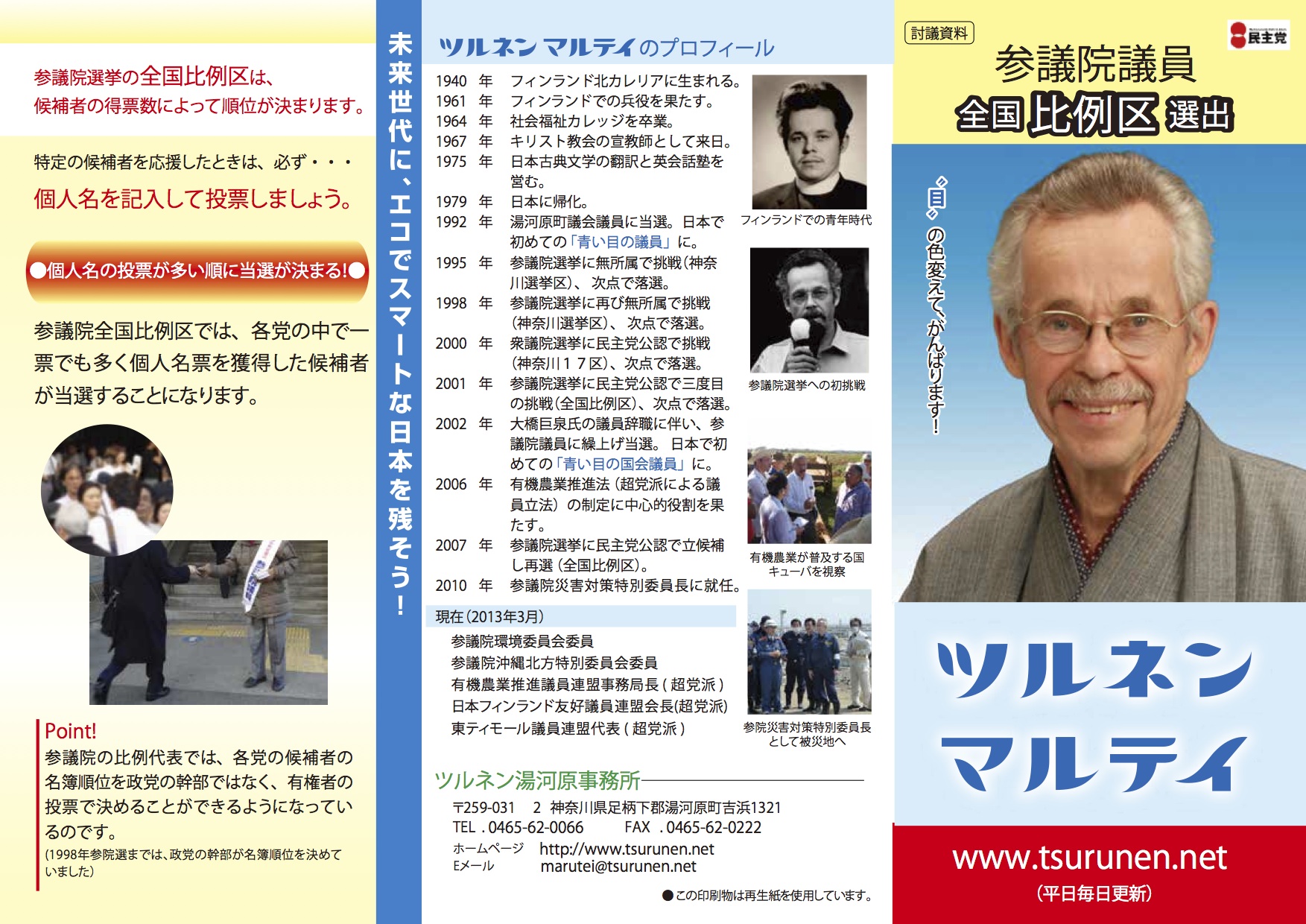
Hi Blog.  Here’s something I received the other day from Debito.org Reader XY.  It’s a flyer he found in his mailbox from the Tokyo Edogawa-ku LDP, advising people to “protect Japan and vote their conscience” (although they can’t legally use the word “vote” since it’s not an official election period).  It talks about how “dangerous” it would be to grant NJ PR local suffrage.

I’ve given some of the con arguments here before (from radical rightists loons like Dietmember Hiranuma and co.), but this time it’s seventeen more-mainstream LDPers (a party which would otherwise be in power but for people voting their conscience last August) offering a number of questionable claims.  First, have a look at the flyer (received February 19, 2010):

The arguments in summary are these:

1) PR NJ suffrage might be unconstitutional (hedging from the rabid right’s clear assertion that it is).  In fact, I’m not sure anyone’s absolutely sure about that.

2) PR NJ suffrage will give foreigners say over how our children are taught and how our political decisions are made.  (Well, yeah, if there are enough NJ in any particular district; and even if there were, given how nasty Japan’s public policy can be towards NJ, I’m not so sure that’s such a bad thing.)

3) Granting PR NJ suffrage is not the world trend.  (Oh, now we cite how other countries do things?  If other countries were creating a world trend, such as signing the Hague Convention on Child Abductions, you’d no doubt be begging off stressing how unique Japan is instead.  Besides, at least three dozen other countries, many of them fellow developed countries, grant local suffrage to non-citizens, and they deal with it just fine.)

4) One shouldn’t equate taxpayer with voting rights, asserting that Japanese wouldn’t get suffrage if they lived overseas.  (Actually, yes they would, if they lived in one of those abovementioned three dozen plus countries which grant it.)

5) We haven’t studied the issue enough.  (This is a typical political stalling tactic.  How much debate is enough?  How long is a piece of string?)

6) We’ve got prefectural governors coming out against PR suffrage.  (And we have prefectural governors coming out FOR suffrage too.  Anyway, when has the national government listened to local governments until now?  It hasn’t been for the past decade since the Hamamatsu Sengen, for example.)

My favorite bit is the illustration at the bottom.  “JAPAN, LET’S PROTECT OURSELVES!!”  Love how it’s an angry-looking alien ship with its spotlight on our archipelago.  NJ as invading alien!!  And I remember back in the day when we had a UFO Party (yes, the UFO党) waiting to cart us all away!!  How times change when there’s a real policy up for debate.

But seriously folks, this isn’t some podunk backwater like Dejima Award Winner Setaka Town in Fukuoka, which decided that its local university should be officially “foreigner-free”.  This is Edogawa-ku, the easternmost ku of Tokyo proper, right across the river from Chiba, with more than half a million registered residents.  It’s not the type of place for xenophobic alarmist politicians to immaturely paint the spectre of an alien invasion in a serious debate.

Vote your conscience.  Now that we know who these LDP idiots are, don’t vote them back into power.  Arudou Debito in Calgary

Kyodo & Mainichi: 14 prefectures now oppose NJ PR suffrage (Debito.org names them)

mytest

Handbook for Newcomers, Migrants, and Immigrants to Japan\Foreign Residents and Naturalized Citizens Association forming NGO\「ジャパニーズ・オンリー 小樽入浴拒否問題と人種差別」(明石書店)JAPANESE ONLY:  The Otaru Hot Springs Case and Racial Discrimination in Japansourstrawberriesavatardebitopodcastthumb
UPDATES ON TWITTER: arudoudebito
DEBITO.ORG PODCASTS now on iTunes, subscribe free

Hi Blog.  Here we have Japan’s version of the US opposition “Tea Parties”, with some prefectural assemblies (most rural and apparently LDP-strongholded) coming out in opposition to giving NJ with PR the vote in local elections.  (Debito.org, unsurprisingly, is in favor of granting suffrage; reasons passim here.)  The interesting thing is, when has the media granted much attention to what the prefectures think before about national policies?  They certainly didn’t when it came to a decade of requests from lots of city governments, after the Hamamatsu Sengen, to make life easier for their NJ residents.  Oh, that’s right.  It’s not business as usual since the LDP is not in power.  Plus it looks like the Cabinet may actually help pass a law to do something nice for foreigners.   How dare they!

Anyway, name and shame.  These are the prefectures you should write to to say you’re unimpressed by their lack of tolerance:

Akita, Yamagata, Chiba, Ibaraki, Toyama, Ishikawa, Shimane, Kagawa, Oita, Saga, Nagasaki and Kumamoto, plus Saitama and Niigata.

Source in Japanese below.  Arudou Debito in Lake Louise, Alberta, Canada

//////////////////////////////////////////

14 prefectures oppose allowing foreigners to vote in local elections
JapanToday.com/Kyodo News Tuesday 09th February, 07:52 AM JST

http://www.japantoday.com/category/politics/view/14-prefectures-oppose-allowing-foreigners-to-vote-in-local-elections
Courtesy of MMT, John in Yokohama, and Cleo

TOKYO — Local assemblies in 14 of Japan’s 47 prefectures have adopted statements in opposition to giving permanent foreign residents in Japan the right to vote in local elections since the Democratic Party of Japan took power last year, a Kyodo News tally showed Monday.

[Those open-minded prefectures are: Akita, Yamagata, Chiba, Ibaraki, Toyama, Ishikawa, Shimane, Kagawa, Oita, Saga, Nagasaki and Kumamoto, plus Saitama and Niigata]

Before the launch last September of the new government under Prime Minister Yukio Hatoyama who supports granting local suffrage, 31 prefectural assemblies took an affirmative stance, but six of them have turned against it since then.

The results underscored growing opposition to the government’s policy, with local assembly members, including those belonging to the main opposition Liberal Democratic Party, pressing for the adoption of statements of opposition in prefectural assemblies.

The Japanese government is considering formulating a bill that will grant local suffrage to permanent residents in Japan, and DPJ Secretary General Ichiro Ozawa has expressed the hope that such a bill will pass through parliament in the current Diet session.

But reservations remain within the DPJ-led coalition government about the idea, with collation partner People’s New Party President Shizuka Kamei reiterating his opposition last week.

Explaining the reason behind the Chiba prefectural assembly’s opposition, Naotoshi Takubo, secretary general of the LDP’s local branch in Chiba, said the change of government made it more likely than before that a law will be enacted to accept local suffrage.

‘‘The political situation has changed and we now have a sense of danger for the Hatoyama administration,’’ he said. The Chiba assembly adopted a supporting statement in 1999 when the coalition government between the LDP and the New Komeito party was launched.

An LDP member of the Ishikawa prefectural assembly expressed a similar view, saying the assembly had been supportive because giving permanent residents the right to vote was not ‘‘realistic’’ before.

The Akita prefectural assembly, which adopted its opposing statement after the change of government, said that ‘‘a national consensus has not been built at all.’‘

The Kagawa prefectural assembly says in its statement that foreign residents should be nationalized [sic] first to obtain the right to vote.

The issue of local suffrage for permanent foreign residents in Japan came under the spotlight in 1995 after the Supreme Court said the Constitution does not ban giving the right to vote to foreign nationals with permanent resident status in local elections.

Since 1998, the DPJ, the New Komeito party and the Japanese Communist Party have submitted local suffrage bills, but their passage was blocked by the then ruling LDP.

Japan does not allow permanent residents with foreign nationality, such as those of Korean descent, to vote in local elections, let alone in national elections, despite strong calls among such residents for the right to vote on the grounds that they pay taxes as local residents.

Residents of Korean descent comprise most of the permanent foreign residents in Japan.

Japan grants special permanent resident status to people from the Korean Peninsula and Taiwan who have lived in the country since the time of Japan’s colonial rule over the areas, and to their descendants.

ENDS
/////////////////////////////////////////////////

<外国人選挙権>8県議会が「反対」に転向
2月9日12時38分配信 毎日新聞
http://headlines.yahoo.co.jp/hl?a=20100209-00000047-mai-pol
永住外国人への地方選挙権付与について、昨年9月の民主政権発足以降、47都道府県議会のうち14の県議会が反対や、慎重な対応を求める意見書を可決していたことが、全国都道府県議会議長会の調べで分かった。このうち千葉や石川など8県議会は、かつて賛成の立場の意見書を採択しており、政権交代で外国人への選挙権付与が現実味を帯びてきたことに対し、自民系が多数を占める地方議会による反発とみられる。【渡辺暢】

永住外国人への地方選挙権付与は、民主党のマニフェスト(政権公約)の原案となった「09年政策集」に盛り込まれた。民主が今国会にも新法案を提出する方針を示す一方、亀井静香金融・郵政担当相が反対を明言するなど、足並みはそろっていない。

議長会の調べでは政権交代から昨年末までに、秋田、山形、千葉、茨城、富山、石川、島根、香川、大分、佐賀、長崎、熊本の12県議会が法制化に反対、埼玉と新潟が慎重な対応を求める意見書を採択した。在日本大韓民国民団の働きかけもあり、参政権に賛成または検討を求める意見書を採択した都道府県は昨年6月までに34に達していた。しかし、政権交代後、かつて賛成意見書を採択した千葉、茨城、富山、石川、島根、大分、佐賀、長崎が反対に転じた。

自民党千葉県連の田久保尚俊幹事長は「民主党による(法案の)提出が現実味を帯びてきた。選挙で(県議会の)構成メンバーも代わっており、(99年の賛成意見書とは)別に考えてほしい」と話す。同石川県連の福村章幹事長は昨年12月の意見書採択を受け「(賛成の意見書を採択した95年)当時は自社さ政権。状況が変わった」と説明した。

反対意見書の急増について、千葉大の新藤宗幸教授(政治学、行政学)は「極めて政治的なもの。地方議会全体では今も自民系が多く、『地方は反対』という状況を作って政権に亀裂を入れていこうという、自民党中央の考えではないか」と分析する。全国市議会議長会によると、昨年末までに反対の意見書を採択したのは山形県天童市など、少なくとも13市議会ある。

ENDS

My Japan Times JUST BE CAUSE Column Feb 2, 2010: “NJ suffrage and the racist element”

mytest

Handbook for Newcomers, Migrants, and Immigrants to Japan\Foreign Residents and Naturalized Citizens Association forming NGO\「ジャパニーズ・オンリー 小樽入浴拒否問題と人種差別」(明石書店)JAPANESE ONLY:  The Otaru Hot Springs Case and Racial Discrimination in Japansourstrawberriesavatardebitopodcastthumb
UPDATES ON TWITTER: arudoudebito
DEBITO.ORG PODCASTS now on iTunes, subscribe free

justbecauseicon.jpg
The Japan Times February 2, 2010
JUST BE CAUSE, Column 25, Version with links to sources.
Non-Japanese suffrage and the racist element
By ARUDOU DEBITO

http://search.japantimes.co.jp/cgi-bin/fl20100202ad.html

On Jan. 17, Takeo Hiranuma made this statement about fellow Diet member Renho:

“I hate to say this, but she’s not originally/at heart (motomoto) a Japanese.”

http://www.debito.org/?p=5770

What could have provoked such a harsh criticism of one’s identity?

A simple question Renho, of the ruling Democratic Party of Japan, asked mandarins (as is her job) who were requesting more cash: “Why must we aim to develop the world’s No. 1 supercomputer? What’s wrong with being No. 2?” Hiranuma claimed, “This is most imprudent (fukinshin) for a politician to say.”

Is it? I’ve heard far more stupid questions from politicians. Moreover, in this era of deflationary belt-tightening, it seems reasonable to ask the bureaucrats to justify our love.

Being pilloried for asking inappropriate questions is one thing (as “appropriate” is a matter of opinion). But having your interests in the country, and people you represent, called into question because you have non-Japanese (NJ) roots (Renho’s father is Taiwanese, her mother Japanese, and she chose Japanese citizenship) is nothing less than racism, and from a Diet member at that.

Hiranuma predictably backpedaled: First he accused the media of sensationalizing his comments. Then he claimed this was not racial discrimination because Renho has Japanese citizenship.

http://mainichi.jp/select/seiji/news/20100118k0000m010058000c.html

Somebody should explain to Hiranuma the official definition of “racial discrimination,” according to a United Nations treaty the Liberal Democratic Party government ratified in 1996, when he was a Cabinet minister:

http://ja.wikipedia.org/wiki/平沼赳夫#.E5.A4.96.E9.83.A8.E3.83.AA.E3.83.B3.E3.82.AF

“Racial discrimination shall mean any distinction, exclusion, restriction or preference based on race, color, descent, or national or ethnic origin which has the purpose or effect of nullifying or impairing the recognition, enjoyment or exercise, on an equal footing, of human rights and fundamental freedoms in the political, economic, social, cultural or any other field of public life.” (U.N. Convention on Racial Discrimination, Article 1.1)

So, by raising Renho’s descent/ethnicity/national origin in questioning her credentials, Hiranuma is guilty as charged.

But there is a larger issue here. Hiranuma’s outburst is symptomatic of the curious degree of power the ultrarightists have in Japan.

Remember, this is the same Hiranuma who helped scuttle a human rights bill in 2006, headlining a book titled, “Danger! The Imminent Threat of the Totalitarianism of the Developed Countries.” Within it he claimed, “This human rights bill will exterminate (horobosu) Japan.”

http://debito.org/abunaijinkenyougohouan.html

This is also the same politician who declared in 2006 that Japan should not have a female Empress, for she might “marry a blue-eyed foreigner” and spawn the next Emperor — managing to double-dip racism into sexism and misogyny. (Why assume women are more susceptible to rapacious NJ than male heirs to the throne?)

http://search.japantimes.co.jp/cgi-bin/nn20060202a2.html

Hiranuma wasn’t so lucky in 2008 when trying to stop a bill revising the Nationality Law, fixing paternity recognition loopholes our Supreme Court had ruled unconstitutional mere months earlier. He argued that granting bastard children Japanese citizenship would dilute “Japan’s identity.”

http://search.japantimes.co.jp/cgi-bin/nn20081127a1.html

But he’s still at it: The Hiranuma hobbyhorse is currently rocking against the proposal of granting suffrage in local elections to NJ with Permanent Residency (PR), which may pass the Diet this year.

It is probably no surprise that this columnist supports PR suffrage. There are close to half a million Special Permanent Residents (the zainichi ethnic Koreans, Chinese, etc.), born and raised here, who have been paying Japanese taxes their entire lives. Moreover, their relatives were former citizens of the Japanese empire (brought here both by force and by the war economy), contributing to and even dying for our country. In just about any other developed nation, they would be citizens already; they once were.

Then there are close to a half-million more Regular Permanent Residents (the “newcomer” immigrants) who have taken the long and winding road (for some, two decades) to qualify for PR. They got it despite the discretionary and often obstructionist efforts of Japan’s mandarins (Zeit Gist May 28, 2008).

http://www.debito.org/?p=1681

Anyone who puts in the years and effort to meet PR assimilation requirements has earned the right to participate in their local community — including voting in their elections. At least three dozen other countries allow foreigners to vote in theirs, and the sky hasn’t fallen on them.

http://search.japantimes.co.jp/cgi-bin/nn20091201i1.html
http://magnesiumagency.com/2010/01/24/no-local-suffrage-for-foreigners-in-japan-shibuya-protest/

But that’s not what antisuffrage demonstrators, with Hiranuma their poster boy, would have you believe. Although public policy debate in Japan is generally pretty milquetoast, nothing brings out apocalyptic visions quite like the right wing’s dry-throated appeals to Japanese-style xenophobia.

Granting foreigners suffrage, they say, will carve up Japan like a tuna. Okinawa will become another Chinese province. Beijing will control our government. Even Hiranuma claims South Korea will annex the Tsushima Islands. The outside world is a perpetual threat to Japan.

http://www.debito.org/?p=5353
http://www.tokyo-shinsei.jp/2201.html

This camp says that if NJ want the right to vote, they should naturalize. Sounds reasonable, but I know from personal experience it’s not that simple (the application procedure can be arbitrary enough to disqualify many Japanese). This neutralizes the Alien Threat, somehow.

But by criticizing Renho for her NJ roots, Hiranuma exposed the naturalization demand as a lie.

Renho has taken Japanese citizenship, moreover graduated from one of Japan’s top universities, became a member of Japanese society as a famous newscaster and journalist, and even gotten elected by fellow Japanese to Parliament.

http://en.wikipedia.org/wiki/Ren_Hou
http://www.debito.org/residentspage.html#naturalization

But to Hiranuma, that doesn’t matter. Renho is still a foreigner — in origin if not at heart — and always will be.

This is where Hiranuma and company’s doctrinaire bigotry lies. You can’t trust The Alien no matter what they do, especially if they don’t do what Real Japanese tell them to do.

Why is this expression of racism so blatant in Japan? Because minorities are so disenfranchised in our political marketplace of ideas. In any marketplace (be it of products or ideas), if you have any barriers to entry, you get extremes and aberrations (be it in prices or views). Open the market, and things tend to correct themselves.

That is what these zealots are most afraid of: not merely The Alien, more the loss of the ability to attract votes by whipping up public fear. Let The Alien in, and those on the cosseted ideological extremes would have to be more tolerant of, if not appeal to, a newly enfranchised section of Japan’s electorate with more diverse interests.

That’s the best argument yet for giving NJ with PR the vote: to reduce the power of Japan’s xenophobic fringe, and rid our polity of these racists and bigots. Make it so that next time a Hiranuma makes racist statements, those affected will have the chance to vote him out of office.

—————————

Debito Arudou coauthored the “Handbook for Newcomers, Migrants and Immigrants.” Twitter arudoudebito. Just Be Cause appears on the first Community Page of the month

ENDS

Japan Today article on naturalized former-NJ politicians in Tsukuba, Inuyama, and Parliament

mytest

Handbook for Newcomers, Migrants, and Immigrants to Japan\Foreign Residents and Naturalized Citizens Association forming NGO\「ジャパニーズ・オンリー 小樽入浴拒否問題と人種差別」(明石書店)JAPANESE ONLY:  The Otaru Hot Springs Case and Racial Discrimination in Japansourstrawberriesavatardebitopodcastthumb

Hi Blog.  On a happier note for a change, here’s an article from Japan Today on naturalized former NJ who have been elected to Japanese political bodies.  Well done them, and it’s nice to have a kind word for them (as opposed to racists like Dietmember Hiranuma Takeo, dissing former-NJ Dietmember Ren Ho recently for her foreign roots; I’ll be devoting my next Japan Times JUST BE CAUSE column to that nasty little incident, out next Tues Feb 2).  PS:  Jon Heese has commented to Debito.org before, twice, as has Tsurunen Marutei.  And of course, Anthony Bianchi has been prominently featured here as well.  Arudou Debito in Sapporo

////////////////////////////////////////////

Foreign-born politicians put new face on Japanese officialdom
By Jesse Veverka
Japan Today, downloaded January 22, 2010

http://www.japantoday.com/category/lifestyle/view/foreign-born-politicians-put-new-face-on-japanese-officialdom
TOKYO —
After spending an hour zipping through the outskirts of north Tokyo on the sleek Tsukuba Express, I find myself on the receiving end of a sales pitch from a local city councilor on the virtues of living in “Tsukuba Science City.” We walk through a shopping mall as he enthusiastically explains how the municipality was laid out to enhance technical research and scientific innovation. He waves a quick hello to a constituent on the escalator.

Perhaps it’s not so odd for a local politician to promote his turf, but what is unusual is that the guy I am talking to looks like he might be Bill Clinton’s younger brother. It’s clear he is a dedicated public official; it’s also clear he isn’t originally from Japan.

I have just met Jon Heese, a Saskatchewan native, Japanese citizen and Tsukuba city councilor. Heese is a member of a small but burgeoning group of foreign-born politicians whose experiences are a testament to Japan’s internationalization — and the success that comes with integration into a difficult-to-penetrate local culture.

Like many foreigners, Heese, 46, got his start in Japan as an English instructor. “I came in ’91 in the good old days, when teaching salaries were 400,000 yen a month with an apartment included,” he says, with a distinct note of nostalgia in his voice. He also tried his hand at acting, playing American presidents in independent Japanese flicks like “Nihon Igai Zenbu Chinbotsu” and “Girara no Gyakushu.”

But Heese wanted to connect with Japan more deeply. “All day long I was speaking English. My Japanese just wasn’t improving,” he recalls. “I wanted to put myself in a position where I had to speak Japanese, so I opened up a bar — it was pretty easy to get going, I was really surprised how cheap it was. The liquor companies basically gave me everything I needed on spec, so all I needed was the location. Getting the actual liquor license was unbelievably easy.”

Heese’s business initially met with overwhelming success, but as Japan’s inflated bubble economy went flat, his customer base began to dry up. Then, in 2002, the Japanese government enacted new drunk driving laws — a death sentence for his pub.

“At least 30% of my business came from 10 kilometers away. The cops sat outside my bar five nights a week, catching everybody — even if they had only drunk half a glass of beer, they were busted. I had never seen anything like it anywhere, how hardcore these cops were. We lost 70% of our business overnight.”

The venture soon collapsed under the weight of debt. Shell-shocked at how quickly decisions by national bureaucrats could affect his livelihood, Heese felt the need to act.

“I am not advocating drunk driving in any way,” he says. “However, in Canada, when they did the same thing — setting up checkpoints and busting people — and the bars started to lose business, what did the bars do? They organized and went to the town or city council to say, ‘Hey, we need help.’ The city council would start doing public service announcements to advocate having a designated driver, so people could still go out.”

Heese visited other bar owners and found out they were hurting, too. “I explained that we should organize—I even wanted to go demonstrate in front of the police station. People don’t realize what an asset a good nightlife is for a city. It means that young people want to live there, and if you have young people, you have a future. If you only have old people, your city dies.”

Despite getting sympathy from fellow pub owners, Heese realized that not many of them were willing to speak up.

“It’s like the one nail that sticks out — no one wanted to stand up and get knocked down. So I said, ‘I’m out of here,’ and closed up and sold the bar — with a lot of debt that I am still paying off.”

Yet this sour experience provided the impetus for Heese’s new and novel vocation. “When you get lemons, you make lemonade, and that was kind of my push. We had an election in 2004 and I thought, ‘I’ll give it a shot!’”

Need Japanese citizenship first

In order to become an elected official, foreign-born residents first have to apply for Japanese citizenship, a process that Heese recounts as tedious but not particularly difficult. In fact, just two years prior to Heese’s election to city council, Marutei Tsurunen, a former Finn, became the first foreign-born politician to serve in Japan’s national government.

A Lutheran missionary-turned-politician, Tsurunen made a name as the first naturalized citizen to serve on a town council, in Yugawara, Kanagawa, in 1992. Like many groundbreakers, however, success did not always come easy. In his bid for national office, Tsurunen, 69, suffered four defeats before making it into the House of Councilors — and then only when the elected Diet member decided to relinquish his seat and it automatically went to Tsurunen, his runner-up.

“Luckily, he quit after just five and a half months, so I got five and a half years for my first term” explains Tsurunen as I sip tea with him in his office in Nagatacho. Things went smoother in the next election, in 2007, when he was directly elected with 240,000 votes — more than enough to seal his legitimacy as Japan’s first blue-eyed Diet member.

At around the same time, another foreign-born political contender was making his debut. Brooklynite Anthony Bianchi had decided to make a go at life in Japan when a TV show he was working on in New York got cancelled. After starting off in the JET program, he got a job with the board of education in Inuyama City, outside of Nagoya, to develop a specialized English program using proprietary materials.

“I felt a responsibility to find good teachers, so the students could get a good education,” Bianchi, 51, says. “And I also felt a responsibility to those teachers to make sure they were treated well in the schools.”

It took years to get the program up and running and, like Heese, Bianchi became frustrated dealing with the Japanese bureaucracy. “I felt like I was just complaining about stuff, and I got tired of complaining and decided I should do something more positive for the community,” he says. “That’s when I started thinking about getting citizenship and running for office.”

Bianchi admits that he knew “zero about running a campaign” when he started out, but thanks to a platform based on greater transparency in government and empowering schools — not bureaucrats — to make decisions about education, his message resonated with voters. In 2003, he was elected as a city councilor in Inuyama with 3,300 votes — a record number.

Treated with fairness and respect

Despite Japan’s reputation as hostile to newcomers, all three foreign-born politicians say they’ve been treated with respect and fairness — to a point. “It’s hard to get here, but once you get in, there is a lot of acceptance,” Bianchi says.

“I am on a Japanese [right wingers’] ‘watch list’ and there are these guys in black vans,” Heese says. “But the Japanese are pretty open, and they have a long tradition of sending out people to bring back new ideas.”

“They can welcome me as a politician, but not as a leader,” says Tsurunen, who suggests that this may be the reason he has not been tapped for a ministerial post.

Indeed, most policy decisions in Japan are not made by politicians, but by the country’s murky and obstinate bureaucracy, as Heese learned shortly after getting elected. “I wanted to make one small change to the timing of a traffic light in the city, but I found out it’s not the council that decided such things, it’s the police, and they just said no,” he recalls.

“‘Kanryoshugi’ — Japanese officialdom — is running everything, but it is really the politicians’ fault,” Bianchi adds. “We let them take that power, and we need to take it back. No one voted for those guys. We have elections, and the people who are elected should be making the policies.”

On a municipal level, true administrative power lies not with the city councilors, but with the mayor — an office for which Bianchi ran unsuccessfully in 2008. Tsurunen says he would have been surprised if Bianchi had won. “Foreigners are welcome, but Japanese want to rule this country.”

Yet despite the concentration of power in the bureaucracy, elected officials are able to bring about gradual change through concerted effort. Tsurunen talks excitedly about a push by his Democratic Party of Japan to enact a dual-citizenship bill — as it stands now, Japan is the only G8 country that does not allow it.

Pledged to pursue policies important to constituents

Like other politicians, these foreign-born officials have pledged to pursue policies that are of importance to their constituents. Bianchi has dedicated himself to reducing wasteful public spending, while Tsurunen and Heese support efforts to aid Japan’s farmers and increase domestic food production.

“In Tsukuba, we have 200,000 people and only 700 farmers, and only 200 of those farm full-time,” says Heese. “Farmers feed us all. We can pretend that there is enough food in China and the U.S. even if some big disaster happens, but that ain’t the truth. It really is important to support local farmers.”

Tsurunen, meanwhile, champions the idea of reducing imports of animal feed and using under-utilized farmland to increase domestic production.

Bianchi admits that farming is not his strong suit — “I am from Brooklyn, and there is not much agriculture, except grass growing through the cracks in the concrete,” he says, but he’s focused on his own projects, particularly a push to make local government operate in a leaner fashion. “I analyze the budget a lot and look for places where they are wasting money,” he says. “There is a lot of stupid spending.”

Heese points out that a politician’s job is not all about trying to amend policies or pass legislation. He strives to be an inspirational representative of Japan’s increasingly complex global community. “My dream is to see 30 to 40 of us foreign-born politicians out there,” he says. “I guarantee it will benefit Japan, because it will change people’s image of the country.”

He tells of a recent visit by American officials from Tsukuba’s sister city of Irvine, California. “They walked into the room and started shaking hands with all the Japanese, and when it came to me and I was introduced as a city councilor, all of a sudden it was like, ‘Wow!’ Their whole image of Tsukuba changed.”

The reaction has been much the same when delegations arrive from Tsukuba’s sister cities in Korea and China. “It really does change people’s perspective of what’s possible in Japan.”

Jon Heese: aishiterutsukuba.jp

Marutei Tsurunen: http://homepage2.nifty.com/yugatsuru/

Anthony Bianchi: www.bianchi-inuyama.com

================================

Turning Japanese

So you’re thinking of becoming a naturalized Japanese citizen? Here’s what to do.

1. Be serious. Changing your citizenship is, obviously, a big decision. Japan doesn’t recognize dual citizenship, meaning by law you’ll have to renounce the nationality of your homeland. You will have to give up your old passport, and you may no longer be able to live freely, work, or in some cases, own property in your former country.

2. Get a job. As wonderful as it is to freelance, Japanese bureaucracy puts a heavy emphasis on traditional full-time employment, and you’ll need to show on your application how you make a living.

3. Establish residency. You must have been a resident of Japan for at least five years, as reckoned from the date of landing on your gaijin card. And don’t forget to get a re-entry permit if you leave; otherwise the counter will be reset.

4. Get married. The easiest way to expedite the process is to marry a Japanese national. You will have a much harder time becoming a Japanese citizen if you don’t.

5. Learn the language. You should anyway, but because you will be dealing with your immigration officer in Japanese and writing an essay about why you want to naturalize, you’ll need to have your speaking and (at least some) reading and writing in order.

6. Pay your taxes. You’ll need to prove that you have made your contribution to society.

7. Behave. Don’t get into any legal entanglements.

8. Get your papers in order. Among other documents, you’ll need copies of your tax and financial records, birth certificate, parents’ birth certificates, parents’ marriage license and your marriage license.

9. Pick a name. If you’ve always wanted a cool kanji name, this is your chance. In the old days, you had to pick from a limited group of standardized names, but now you can choose your own characters. You can even write your name with katakana if you prefer.

10. Prepare yourself for the long haul. Applying for citizenship is a trying process, designed to weed out applicants through attrition. You will need to meet multiple times with the immigration officer, so be ready to accommodate any extra requests.

ENDS

Japan Times on proposal to convert Itami Airport into “International Campus Freedom City”

mytest

Handbook for Newcomers, Migrants, and Immigrants to Japan\Foreign Residents and Naturalized Citizens Association forming NGO\「ジャパニーズ・オンリー 小樽入浴拒否問題と人種差別」(明石書店)JAPANESE ONLY:  The Otaru Hot Springs Case and Racial Discrimination in Japansourstrawberriesavatardebitopodcastthumb
UPDATES ON TWITTER: arudoudebito
DEBITO.ORG PODCASTS now on iTunes, subscribe free

Hi Blog. Young-Turk Osaka Governor Hashimoto has been suggesting some interesting reforms recently, one of them, according to the Japan Times, is to close down Osaka Itami Airport (relocating all flights to KIX), and to use the land for creating an international campus, where international schools and universities would be located and the lingua franca English.

On the surface of it (regardless of the efficacy of essentially creating a Dejima for ideas and culture, nestled right next to Osaka proper), it’s an intriguing idea with great potential, and not one that in principle Debito.org can oppose (what could a move like this hurt if successful, except the natural insular order of things, which does deserve some change).  It’s already incurring a lot of opposition from entrenched interests (read full article at JT site).  What do other Debito.org Readers think?  Arudou Debito in Sapporo

///////////////////////////////////////////
Airport wars roil Kansai region
Osaka, Hyogo leaders clash over hub plans
The Japan Times Friday, Jan. 15, 2010

By ERIC JOHNSTON Staff writer
http://search.japantimes.co.jp/cgi-bin/nn20100115f2.html
(pertinent excerpt)

Under [Osaka Gov] Hashimoto’s plan, Itami [Airport]’s 400 hectares would be turned into what he calls the International Campus Freedom City. Up to 20,000 people, including many foreigners, would live in the area, which would be home to international schools and universities. The common language would be English.

“To turn out talented workers of international stature, all elementary, junior high and high schools in the international free city will be instructed in English,” the plan reads.

“Along with international schools and universities, home-stays with resident foreigners will provide practical education to students and all signs in the city will be in English. Young people from around Japan who want to improve their English will gather, and it will become a tourist spot, with shops and tourist facilities reminding people of overseas,”

The governor envisions an influx of highly skilled foreign workers in certain sectors who would serve as language tutors to interested Japanese students.

“Along with attracting highly skilled foreigners who specialize in biotechnology, new energy and other strategic industries like cutting edge medicine, incentives such as reducing income and residency taxes for foreigners who offer home-stays to Japanese wishing to learn a foreign language in a native linguistic environment could be given,” the plan reads.

Ido also sees an international future for Itami, but one where foreigners arrive and go elsewhere, not live, work or serve as language tutors and tourist attractions…
EXCERPT ENDS
Full article at http://search.japantimes.co.jp/cgi-bin/nn20100115f2.html

Racist statements from Xenophobe Dietmember Hiranuma re naturalized J Dietmember

mytest

Handbook for Newcomers, Migrants, and Immigrants to Japan\Foreign Residents and Naturalized Citizens Association forming NGO\「ジャパニーズ・オンリー 小樽入浴拒否問題と人種差別」(明石書店)JAPANESE ONLY:  The Otaru Hot Springs Case and Racial Discrimination in Japansourstrawberriesavatardebitopodcastthumb
UPDATES ON TWITTER: arudoudebito
DEBITO.ORG PODCASTS now on iTunes, subscribe free

Hi Blog. Here we go again. Pet Xenophobe Dietmember Hiranuma Takeo (who is so far out there he won’t, or can’t, run under the LDP banner) has once again said something nasty about foreigners. Or at least people he still considers to be “foreigners”. Read on, comment from me follows the Japanese Sankei article:

////////////////////////////////////

◆Ex-minister Hiranuma says lawmaker Renho is ‘not originally Japanese’
OKAYAMA, Japan, Jan. 18 2010 KYODO NEWS

http://home.kyodo.co.jp/modules/fstStory/index.php?storyid=480954
and http://www.tmcnet.com/usubmit/2010/01/18/4576412.htm

OKAYAMA, Japan, Jan. 18_(Kyodo) _ Former trade minister Takeo Hiranuma on Sunday criticized remarks made by House of Councillors member Renho in November in trying to slash budget allocations for the supercomputer development by pointing to the fact that the politician, who goes by a single name, is a naturalized Japanese.

“I don’t want to say this, but she is not originally Japanese,” said the former Liberal Democratic Party member during a speech before his supporters in Okayama City. “She was naturalized, became a Diet member, and said something like that,” the independent House of Representatives member continued.

Hiranuma was referring to the high-profile remarks made by the ruling Democratic Party of Japan member, who asked during a debate with bureaucrats, “Why must (Japan) aim to (develop) the world’s No. 1 (supercomputer)? What’s wrong with being the world’s No. 2?” The remarks have been broadcast repeatedly on TV as a symbolic image of the DPJ-led government’s efforts to cut wasteful spending.

The remarks were “not appropriate for a politician,” Hiranuma said, adding that Japan, as a country aiming to be a science technology power, “must have the budget for (developing) the world’s No. 1 (supercomputer).” He later told reporters he did not intend to say anything discriminatory and what he meant was that politicians should not engage in “sensational politics that ring the bell with TV broadcasters.” According to Renho’s website, she was born in 1967 as the child of a Taiwanese father and a Japanese mother, and switched her citizenship from Taiwanese to Japanese in 1985.

Renho’s office told Kyodo News on Monday that the lawmaker would not make any comment on Hiranuma’s remarks because she did not hear them directly.

////////////////////////////////////

「もともと日本人じゃない」 平沼氏が蓮舫氏を批判
2010.1.18  産經新聞 Courtesy of AS
http://sankei.jp.msn.com/politics/situation/100118/stt1001181234002-n1.htm
平沼赳夫元経済産業相(衆院岡山3区)が岡山市で17日に開かれた後援会パーティーのあいさつで、政府の事業仕分けで注目された民主党の蓮舫参院議員について「言いたくないけれども、もともと日本人じゃない。帰化して国会議員になって事業仕分けでそんなことを言っている」などと発言した。
蓮舫議員の事務所は18日、取材に「内容を確認してから判断したい」としている。ホームページによると、蓮舫議員は昭和60年に日本国籍を取得している。
平沼氏は次世代スーパーコンピューター開発事業の仕分けで、蓮舫議員が「世界1位でなければ駄目なのか」と発言したことを「政治家として不謹慎だ」と指摘。「科学技術立国の予算は世界1位じゃなきゃいけない。つけを払わされるのは有権者だ」と強調した。
パーティー終了後、平沼氏は記者団に「差別と取ってもらっては困る。テレビ受けするセンセーショナルな政治は駄目だ」と説明した。

=========================

平沼赳夫氏:蓮舫議員の仕分け批判「元々日本人じゃない」

毎日新聞 2010年1月17日

http://mainichi.jp/select/seiji/news/20100118k0000m010058000c.html

平沼赳夫元経済産業相(岡山3区)は17日、岡山市内で開いた政治資金パーティーのあいさつで政府の事業仕分けを批判し、仕分け人を務めた民主党の蓮舫参院議員について「元々日本人じゃない」と発言した。

平沼氏はあいさつの中で、次世代スーパーコンピューター開発費の仕分けで蓮舫議員が「世界一になる理由があるのか。2位では駄目なのか」と質問したことは「政治家として不謹慎だ」とし、「言いたくないが、言った本人は元々日本人じゃない」と発言。「キャンペーンガールだった女性が帰化して日本の国会議員になって、事業仕分けでそんなことを言っている。そんな政治でいいのか」と続けた。

平沼氏はパーティー終了後の取材に対し、「差別と取ってもらうと困る。日本の科学技術立国に対し、テレビ受けするセンセーショナルな政治は駄目だということ。彼女は日本国籍を取っており人種差別ではない」と説明した。

蓮舫議員のウェブサイトによると、蓮舫議員は67年、台湾人の父と日本人の母の間に生まれた。当時は父親が日本人の場合にしか日本国籍を取得できなかったが、改正国籍法施行後の85年に日本国籍を取得した。【石川勝義】

/////////////////////////////////////////

COMMENT:  Well, people will stoop to anything to delegitimize a person’s opinion, won’t they?  Even question their ability to put their country’s needs first if they have NJ roots?  Well, as a fellow naturalized Japanese, I say:  Fuck you very much, Takeo.  Given your family history as an adopted son of the family name, I question your ability to represent Japan’s Blue-Blooded Elites as you claim to do.

There’s a reason for my intemperance.  This is not the first time Hiranuma has resorted to bigotry and ignorance to take cheap shots at an internationalizing Japan.

Consider Hiranuma’s rallying with the alarmists to try and deny Permanent Residents from getting local suffrage in 2009.  (Bonus points for irony:  It’s his camp which usually says that PRs should naturalize if they want suffrage.  Then he says the above; clearly naturalization is irrelevant to him.)

Consider Hiranuma’s opposition in 2008 to a bill plugging paternity loopholes in Japan’s Nationality Laws (which he fortunately could not stop) because it would dilute “Japan’s identity”.

Consider Hiranuma’s alarmism rallying against passing a Human Rights Bill in 2006 since it would lead to “totalitarianism of the developed countries” (which his camp unfortunately probably did manage to stop).

And consider Hiranuma’s belief that a female Empress might let a NJ in to sully The Royal Womb:

//////////////////////////////////////////

The Japan Times Thursday, Feb. 2, 2006
Female on throne could marry foreigner, Hiranuma warns
The Associated Press

http://search.japantimes.co.jp/cgi-bin/nn20060202a2.html
Dozens of conservative lawmakers and their supporters Wednesday attacked a proposal to let females and their descendents ascend to the Chrysanthemum Throne, warning the move threatens a centuries-old tradition — and could even allow foreign blood into the Imperial line.

The lawmakers, led by former trade minister Takeo Hiranuma, are fighting a bill being drafted by the government to avert a succession crisis in the Imperial family by allowing reigning empresses and their descendents.

Females have been barred from the throne since the Meiji Era (1868-1912) and a 1947 law further restricted ascension to males from the male line. No woman has reigned in more than 200 years.

The Imperial family has not produced a male heir since the 1960s and public support has been growing for a change in the law to allow Princess Aiko, the only child Crown Prince Naruhito and Crown Princess Masako, to ascend to the throne.

Hiranuma, however, warned the reform could corrupt the Imperial line, which he said has been the supreme symbol of Japanese national and ethnic identity for centuries.

“If Aiko becomes the reigning empress and gets involved with a blue-eyed foreigner while studying abroad and marries him, their child may be the emperor,” Hiranuma told about 40 lawmakers, academics and supporters at a Tokyo hall. “We should never let that happen.”

Despite the overwhelming public support for the reform, traditionalists have stepped up a campaign to quash the move — going so far as to propose bringing back concubines to breed male descendants as was done until the Taisho Era (1912-1926). Others have argued the aristocracy, banned after World War II, should be reinstated as a way of broadening the pool of candidates for the throne.

///////////////////////////////////////

COMMENT CONTINUES:  This video-nasty of a person is in my view unfit for national office.  Unfortunately, his constituency did not agree.  He got comfortably reelected in Okayama as an independent last August.  I’d say that’s Okayama’s shame, but Hokkaido reelects shameful politicians too (think Suzuki Muneo).

Let’s hope the media takes Hiranuma to task like the media did somewhat for a similar-style othering of TV personality Takigawa Christel (unrelated to Hiranuma, but same genre).  Japan’s future has no use for people like him.  Arudou Debito in Sapporo

Japan Times JUST BE CAUSE column with my top ten NJ human rights issues for 2009

mytest

Handbook for Newcomers, Migrants, and Immigrants to Japan\Foreign Residents and Naturalized Citizens Association forming NGO\「ジャパニーズ・オンリー 小樽入浴拒否問題と人種差別」(明石書店)JAPANESE ONLY:  The Otaru Hot Springs Case and Racial Discrimination in Japansourstrawberriesavatardebitopodcastthumb
UPDATES ON TWITTER: arudoudebito
DEBITO.ORG PODCASTS now on iTunes, subscribe free

Human rights in Japan: a top 10 for ’09

JUST BE CAUSE Column 24/ZEIT GIST Column 53 for the Japan Times Community Page

The Japan Times January 5, 2010

http://search.japantimes.co.jp/print/fl20100105ad.html

They say that human rights advances come in threes:  two steps forward and one back.  2009, however, had good news and bad on balance.  For me, the top 10 human rights events of the year that affected non-Japanese (NJ) were, in ascending order:

10) “Mr. James”

Between August and November, McDonald’s Japan had this geeky Caucasian shill portraying foreigners to Japanese consumers (especially children, one of McDonald’s target markets) as dumb enough to come to Japan, home of a world cuisine, just for the burgers.  Pedantry aside, McDonald’s showed its true colors — not as a multinational promoting multiculturalism (its image in other countries), but instead as a ruthless corporation willing to undermine activists promoting “foreigner as resident of Japan” just to push product.  McD’s unapologetically pandered to latent prejudices in Japan by promoting the gaijin as hapless tourist, speaking Japanese in katakana and never fitting in no matter how hard he shucks or jives.  They wouldn’t even fight fair, refusing to debate in Japanese for the domestic media.  “Mr. James’s” katakana blog has since disappeared, but his legacy will live on in a generation of kids spoon-fed cultural pap with their fast food.

http://www.debito.org/?p=4303

http://www.debito.org/?p=4243

9) “The Cove”

Although not a movie about “human” rights (the subjects are sentient mammals), this documentary (www.thecovemovie.com) about annual dolphin slaughters in southern Wakayama Prefecture shows the hard slog activists face in this society.  When a handful of local fishermen cull dolphins and call it “Japanese tradition,” the government (both local and national), police and our media machines instinctively encircle to cover it up.  Just to get hard evidence to enable public scrutiny, activists had to go as far as to get George Lucas’s studios to create airborne recording devices and fit cameras into rocks.  It showed the world what we persevering activists all know:  how advanced an art form public unaccountability is in Japan.

8) The pocket knife/pee dragnets (tie)

The Japanese police’s discretionary powers of NJ racial profiling, search and seizure were in full bloom this year, exemplified by two events that beggared belief.  The first occurred in July, when a 74-year-old American tourist who asked for directions at a Shinjuku police box was incarcerated for 10 days just for carrying a pocket knife (yes, the koban cops asked him specifically whether he was carrying one).  The second involved confirmed reports of police apprehending NJ outside Roppongi bars and demanding they take urine tests for drugs.  Inconceivable treatment for Japanese (sure, sometimes they get hit for bag searches, but not bladder searches), but the lack of domestic press attention — even to stuff as egregious as this — shows that Japanese cops can zap NJ at whim with impunity.

http://www.debito.org/?p=3772

http://www.debito.org/?p=4257

7) “Itchy and Scratchy” (another tie)

Accused murderer Tatsuya Ichihashi and convicted embezzler Nozomu Sahashi also got zapped this year.  Well, kinda.

Ichihashi spent close to three years on the lam after police in 2007 bungled his capture at his apartment, where the strangled body of English teacher Lindsay Ann Hawker was found.  He was finally nabbed in November, but only after intense police and media lobbying by her family (lessons here for the families of fellow murdered NJs Scott Tucker, Matthew Lacey and Honiefaith Kamiosawa) and on the back of a crucial tip from plastic surgeons.

Meanwhile Sahashi, former boss of Eikaiwa empire NOVA (bankrupted in 2007), was finally sentenced Aug. 27 to a mere 3.5 years, despite bilking thousands of customers, staff and NJ teachers.

For Sahashi it’s case closed (pending appeal), but in Ichihashi’s case, his high-powered defense team is already claiming police abuse in jail, and is no doubt preparing to scream “miscarriage of justice” should he get sentenced.  Still, given the leniency shown to accused NJ killers Joji Obara and Hiroshi Nozaki, let’s see what the Japanese judiciary comes up with on this coin toss.

http://www.debito.org/?p=4364

http://www.debito.org/?p=5413

6) “Newcomers” outnumber “oldcomers”

This happened by the end of 2007, but statistics take time to tabulate.  Last March, the press announced that “regular permanent residents” (as in NJ who were born overseas and have stayed long enough to qualify for permanent residency) outnumber “special permanent residents” (the “Zainichi” Japan-born Koreans, Chinese etc. “foreigners” who once comprised the majority of NJ) by 440,000 to 430,000.  That’s a total of nearly a million NJ who cannot legally be forced to leave.  This, along with Chinese residents now outnumbering Koreans, denotes a sea change in the NJ population, indicating that immigration from outside Japan is proceeding apace.

http://www.debito.org/?p=2852

5) Proposals for a “Japanese-style immigration nation”

Hidenori Sakanaka, head of the Japan Immigration Policy Institute (www.jipi.gr.jp), is a retired Immigration Bureau mandarin who actually advocates a multicultural Japan — under a proper immigration policy run by an actual immigration ministry.  In 2007, he offered a new framework for deciding between a “Big Japan” (with a vibrant, growing economy thanks to inflows of NJ) and a “Small Japan” (a parsimonious Asian backwater with a relatively monocultural, elderly population).  In 2009, he offered a clearer vision in a bilingual handbook (available free from JIPI) of policies on assimilating NJ and educating Japanese to accept a multiethnic society.  I cribbed from it in my last JBC column (Dec 1) and consider it, in a country where government-sponsored think tanks can’t even use the word “immigration” when talking about Japan’s future, long-overdue advice.

http://www.debito.org/?p=4832

http://www.debito.org/?p=4944

4) IC-chipped “gaijin cards” and NJ juminhyo residency certificates (tie)

Again, 2009 was a year of give and take.  On July 8, the Diet adopted policy for (probably remotely trackable) chips to be placed in new “gaijin cards” (which all NJ must carry 24-7 or risk arrest) for better policing.  Then, within the same policy, NJ will be listed on Japan’s residency certificates (juminhyo).  The latter is good news, since it is a longstanding insult to NJ taxpayers that they are not legally “residents,” i.e. not listed with their families (or at all) on a household juminhyo.  However, in a society where citizens are not required to carry any universal ID at all, the policy still feels like one step forward, two steps back.

http://www.debito.org/?p=3786

3) The Savoie child abduction case

Huge news on both sides of the pond was Christopher Savoie’s Sept.28 attempt to retrieve his kids from Japan after his ex-wife abducted them from the United States.  Things didn’t go as planned:  The American Consulate in Fukuoka wouldn’t let them in, and he was arrested by Japanese police for two weeks until he agreed to get out of Dodge.  Whatever you think about this messy case, the Savoie incident raised necessary attention worldwide about Japan’s status as a safe haven for international child abductors, and shone a light on the harsh truth that after a divorce, in both domestic and international cases, there is no enforced visitation or joint custody in Japan — even for Japanese.  It also occasioned this stark conclusion from your columnist:  Until fundamental reforms are made to Japan’s family law (which encourages nothing less than Parental Alienation Syndrome), nobody should risk getting married and having kids in Japan.

http://www.debito.org/?cat=49

http://www.debito.org/?p=4664

2) The election of the Democratic Party of Japan

Nothing has occasioned more hope for change in the activist community than the end of five decades of Liberal Democratic Party rule.  Although we are still in “wait and see” mode after 100 days in power, there is a perceptible struggle between the major proponents of the status quo (the bureaucrats) and the Hatoyama Cabinet (which itself is understandably fractious, given the width of its ideological tent).  We have one step forward with permanent residents probably getting the vote in local elections, and another with Prime Minister Yukio Hatoyama saying at the APEC Summit on Nov. 14 that Japan should “create an environment that is friendly to [NJ] so they voluntarily live in Japan.”  But then we have the no-steps-anywhere: The DPJ currently has no plans to consider fundamental issues such as dual nationality, a racial discrimination law, an immigration ministry, or even an immigration policy.  Again, wait and see.

http://www.debito.org/?p=5141

1) The “Nikkei repatriation bribe”

This more than anything demonstrated how the agents of the status quo (again, the bureaucrats) keep public policy xenophobic.  Twenty years ago they drafted policy that brought in cheap NJ labor as “trainees” and “researchers,” then excluded them from labor law protections by not classifying them as “workers.”  They also brought in Nikkei workers to “explore their Japanese heritage” (but really to install them, again, as cheap labor to stop Japan’s factories moving overseas).  Then, after the economic tailspin of 2008, on April Fool’s Day the bureaucrats offered the Nikkei (not the trainees or researchers, since they didn’t have Japanese blood) a bribe to board a plane home, give up their visas and years of pension contributions, and become some other country’s problem.  This move, above all others, showed the true intentions of Japanese government policy:  NJ workers, no matter what investments they make here, are by design tethered to temporary, disposable, revolving-door labor conditions, with no acceptable stake or entitlement in Japan’s society.

http://www.debito.org/?p=2930

Bubbling underNoriko Calderon (victim of the same xenophobic government policies mentioned above, which even split families apart), Noriko Sakai (who tried to pin her drug issues on foreign dealers), sumo potheads (who showed that toking and nationality were unrelated), and swine flu (which was once again portrayed as an “outsiders’ disease” until Japanese caught it too after Golden Week).

2009 was a pretty mixed year.  Let’s hope 2010 is more progressive.

Debito Arudou coauthored “Handbook for Newcomers, Migrants, and Immigrants.”  Twitter arudoudebito.  Just Be Cause appears on the first Community Page of the month.  Send comments to community@japantimes.co.jp

ENDS

1538 WORDS

Anti-NJ suffrage protests in Shibuya Nov 28 2009. The invective in flyers and banners: “Japan is in danger!”

mytest

Handbook for Newcomers, Migrants, and Immigrants to Japan\Foreign Residents and Naturalized Citizens Association forming NGO\「ジャパニーズ・オンリー 小樽入浴拒否問題と人種差別」(明石書店)JAPANESE ONLY:  The Otaru Hot Springs Case and Racial Discrimination in Japansourstrawberriesavatardebitopodcastthumb
UPDATES ON TWITTER: arudoudebito
DEBITO.ORG PODCASTS now on iTunes, subscribe free

Hi Blog.  One of the more interesting proposals from the new DPJ-run Administration is suffrage for Special Permanent Residents.  The Cabinet is ready to send a bill to the Diet so that Permanent Residents (in American terms, essentially “Green Card holders”) obtain the right to vote in local elections.

Regardless of whether you support or disapprove (Debito.org is in support, given how difficult it can be to get PR in Japan, not to mention how arbitrary the naturalization procedures are), what is interesting is the invective in the debate by people who oppose it.  Numerous and very visible demonstrations by right-wing fringe elements (who also seem to get all xenophobic at, say, Hallowe’en being celebrated in Japan) are resorting to daft arguments that defy calm and common sense.  Here are some photos and flyers, received from a witness of one demonstration in Shibuya November 28, 2009, courtesy of ER.  Drink in the alarmism and panic by people who are probably going to lose the debate.  Arudou Debito in Sapporo

PHOTOS FROM THE PROTESTS (click to expand in browser)

IMG_0059

Lower flyer with PM Hatoyama proclaims with menace that the DPJ is trying to give foreigners the right to vote.  Chinese and Korean flags background text that is illegible.  Upper flyer proclaims opposition to the suffrage measure, declaring it unconstitutional, and throwing in a red herring that American league baseball players Ichiro and Matsui wouldn’t get suffrage in the US.  (Okay.  But Ichiro and Matsui aren’t AFAIK Permanent Residents there, nor at this time clearly immigrants; and would these opponents of suffrage for foreigners here be in opposition if fellow members of Team Japan COULD as foreigners vote in the US?  Somehow I doubt it.)

IMG_0067

The sound trucks and picketers in Shibuya depict “JAPAN IS IN DANGER” (nihon ga abunai), and “BLOCK THE DISSOLUTION (kaitai) OF JAPAN”.  If I read correctly the yellow sign on the sound truck on the left, they are even claiming that Okinawa will even be snatched away if suffrage goes through!  Not sure how that follows, but anyhoo…

IMG_0069

This shirt lumps together a completely hitherto unestablished linkage between NJ suffrage and the Protection of Human Rights Bill (the jinken yougo houan, which is another item these alarmists get all dry-throated about).  (And for those kanji nerds, the upper kanji are read soumou kukki, which I have looked up and pieced together a translation for; but never mind — it’s pretty esoteric.)

IMG_0073

And finally, some more basic “We won’t give the vote to foreigners.”  “Now this is a threat to Japan”, etc.

Freedom of speech allows more interesting arguments to be made in their flyers (click on image to expand in your browser), some of which I daresay would qualify as hate speech under UN Treaty:

antisuffrageflyer

This one makes the case that granting NJ suffrage is bad because:

1) It gives voting rights to people that don’t want to naturalize (i.e. don’t want to become Japanese), yet want to participate in the politics of this easy-to-live-in country Japan. (Oh, but you see, it’s so easy to naturalize, after all.  Not.)

2) They have voting rights already in their home country of nationality (yet want to participate… repeated argument)

3) They don’t want to give up their special rights as Zainichi (such as tax breaks (??)) [even though not all PR are Zainichi, i.e. descendants of former colonial citizens of empire, generational foreigners born in Japan yet not citizens, usually Korean or Chinese “Special Permanent Residents”] (yet want to… repeated argument)

4) There are illegal overstayers and illegal entrants amongst these Permanent Residents [wait, that’s contradictory; that’s not how the visa system works], therefore criminals (yet want to… you get the idea).

5) There are some PRs who hold grudges against Japanese and Japan… [oh?]

6) They will vote for Diet candidates who will allow in huge amounts of immigrants from their mother countries. [I bet these people would make the same argument to take away voting rights from anyone they perceive would vote against their interests.  They don’t believe in plurality and majority rule, I guess, even when they are in the majority.]

And more.  The final question, with a poke at the DPJ, “We ask you, as Japanese citizens, ARE YOU [GODDAMN] SERIOUS?” [emphasis added to accommodate for expanded font size and boldface]

Here’s another:

antisuffrageflyer2

This one’s all about protecting Japan from DPJ Dietmembers who are “selling the country off”, with little thunderbolts stabbing photos and points (particularly against Dietmember Madoka Yoriko, the Dietmember apparently submitting the suffrage proposal).  Labelled as discriminatory against Japanese (!!), we’ve now rolled into this protest the gaikokujin jinken kihon hou (Basic Law for Human Rights for NJ), which has been on the drawing board for over a decade now) but now suddenly in the crosshairs (naturally; it just might come to fruition).  Arguments against it include how it will empower Chinese and North Koreans (the perpetual boogeymen in these debates — it even asserts that the Chinese Embassy is controlling things), and how after only five years they could get the power to vote!  (Methinks they don’t actually know how difficult it is to get PR.)  And more.  Love how the invective changes font sizes for individual kanji to project even more alarmism.

antisuffrageflyer3

Here’s another target for Zeus’s lightning bolts.  Much the same arguments as above (except now accusing the media in being complicit in stifling the debate; that’s rich), except the focus is on the next “sell-out”, Dietmember Yamaoka Kenji and his treasonous gang promoting NJ suffrage and the dissolution of Japan, by merely giving a few hundred thousand NJ (far less than 1% of the entire Japanese population, and scattered around Japan) the right to vote.  Maa, you get the idea.  Moving on:

antisuffrageflyer4

Next on the laundry list of grievances against NJ is the claim that the Tsushima Islands (not the Takeshima/Tokdo disputed rocks, but the much larger islands in the channel between South Korea and Kyushu) will be invaded by Korea!  Being wheeled out for speeches is pet former LDP xenophobe Hiranuma Takeo (from Okayama; I watched him get reelected in August with a comfortable margin — see his website and enjoy his depiction in English lamenting about how kids nowadays are ignorant of the date his family mansion was burned down) and pet former Japanese military revisionist Tamogami Toshio (who is clearly more in his element with extreme rightists after being kicked out of the JSDF last year).  Oh, but these events bring out the self-important, don’t they.  Particularly those who predict that any concessions towards foreigners means that Japan gets carved up.

antisuffrageflyer5

And here’s a petition saying that Yonaguni Island, just off Taiwan, needs a JSDF military base to protect against Chinese invasion of Okinawa.  Just imagine what cases these nutcases would come up with if Japan actually had any international land borders.

antisuffrageflyer6

And here we have the webs the DPJ weaves (as opposed to the webs that the perpetually incumbent LDP wove during its 50 plus years in power):  Supporters include leftist extremists and labor unions, socialists, revolutionary laborers, the Chuukakuha, Nikkyousou, the Red Army, North Korean group Chousen Souren, South Korean Mindan, the Buraku Liberation League, the Yakuza, the media (controlled by the DPJ regarding what you see and hear; again, that’s rich), and the kitchen sink.  Great fun.

Finally:

antisuffrageflyer7

In the same vein of how the DPJ has totalitarian powers, this last flyer declares that PM Hatoyama believes the Japanese Archipelago is not the property of the Japanese.  And the DPJ’s grand plans include Okinawa getting 30 million Chinese (and, oh, giving Okinawa to China), and the abovementioned Human Rights Bill (which will allegedly enable searches without warrants, and has no Nationality Clause within to ensure that people who man the enforcement mechanisms are kept secure from foreigners).  And of course that NJ suffrage thingie.  But of course you’re not hearing about all this because the DPJ controls the media.  Naturally.

ENDS

Ruling coalition currently not considering NJ human rights laws beyond PR suffrage: Dietmember Aihara

mytest

Handbook for Newcomers, Migrants, and Immigrants to Japan\Foreign Residents and Naturalized Citizens Association forming NGO\「ジャパニーズ・オンリー 小樽入浴拒否問題と人種差別」(明石書店)JAPANESE ONLY:  The Otaru Hot Springs Case and Racial Discrimination in JapansourstrawberriesavatardebitopodcastthumbUPDATES ON TWITTER: arudoudebito
Hi Blog.  I had a conversation with Upper House Dietmember Aihara Kumiko (62, from Hokkaido, elected 2007 on Proportional Representation) yesterday.  With a labor union background, she has an eye on a number of human rights issues, including the Nikkei Visa and NJ “Trainee” Programs.

I took the opportunity to ask about a few things that are overdue for NJ resident rights in Japan (which the recent polls on Debito.org cover), namely:

  1. Japan signing the Hague Convention on Child Abductions
  2. Japan passing the long-proposed general law protecting human rights (jinken yougo houan)
  3. Japan passing a law against racial discrimination
  4. Japan approving local suffrage for NJ residents with Permanent Residency

She answered that the DPJ ruling coalition would be submitting the bill for local suffrage in next year’s Diet session.

The other three were currently not being considered in any committee or study group at this time.  I asked when they might be, and she didn’t know.

Just letting readers of Debito.org know.  Comments douzo.  Arudou Debito in Sapporo

Mainichi: DPJ split over bill to give NJ permanent residents right to vote

mytest

Handbook for Newcomers, Migrants, and Immigrants to Japan\Foreign Residents and Naturalized Citizens Association forming NGO\「ジャパニーズ・オンリー 小樽入浴拒否問題と人種差別」(明石書店)JAPANESE ONLY:  The Otaru Hot Springs Case and Racial Discrimination in JapansourstrawberriesavatardebitopodcastthumbUPDATES ON TWITTER: arudoudebito

Hi Blog.  Here’s a little update on the current debate regarding granting local suffrage to PR holders.  As ruling parties go, the Social Democrats led by Fukushima Mizuho support it, the (tiny) Kokumin Shintou led by Kamei Shizuka opposes it, and the DPJ itself (as usual) is split.  No surprises there, but we’ll see how the cards fall if and when it’s brought to a vote.  Of course, watching public policy being made is famously like watching sausages being made (you don’t want to know what goes into it), but the fact that the Cabinet in general supports it is telling.  And enough people are feeling threatened by it that there is quite visible public protest (but I’ll get to that later), which is also telling (if people felt no threat of it actually coming to pass, they wouldn’t bother).

My take is that whenever you have an opposition party in power (particularly a leftist one), you always have deep internal divisions, because the left in particular has trouble rallying around one issue.  The right has it a lot easier:  either rally around money issues (very clear cut), or else just keep the status quo (“there’s a good reason why things are the way they are, so if they ain’t broke…”).  So the DPJ having divisions and mixed feelings about this is only natural — it’s par for the course on the political spectrum.  Majority rules, anyway.  So let people grouse about it for an adequate amount of time, and let’s see how the vote turns out.  Arudou Debito in Sapporo.

//////////////////////////////////////////////////////

Government split over bill to give non-Japanese permanent residents right to vote
Mainichi Daily News November 7, 2009.
Courtesy HJ
http://mdn.mainichi.jp/mdnnews/news/20091107p2a00m0na009000c.html

A bill proposed by a key member of the ruling Democratic Party of Japan (DPJ) to grant permanent foreign residents the right to vote in local elections has split the party.

DPJ Diet Affairs Committee Chairman Kenji Yamaoka has declared that he intends to submit a bill to the current session, and recommended that parties allow their legislators to freely decide whether to vote for or against the bill.

His move is widely viewed by many politicians as an attempt to drive a wedge between the largest opposition Liberal Democratic Party (LDP), which is reluctant to give foreigners the right to vote, and its former coalition partner Komeito, which is enthusiastic about the move.

However, the issue has drawn opposition from within the DPJ and the coalition government it leads.

DPJ legislators are divided over the issue. There are numerous legislators within the governing party in favor of giving permanent foreign residents the right to vote in local elections, including Prime Minister Yukio Hatoyama, Foreign Minister Katsuya Okada and DPJ Secretary-General Ichiro Ozawa.

However, there are a certain number of opponents, including Chief Cabinet Secretary Hirofumi Hirano and Deputy Chief Cabinet Secretary Yorihisa Matsuno.

“There are over 140 new members of the House of Representatives who have just been elected to their first term in the latest general election. It’s necessary to hold in-depth discussions on the issue within the party,” Hirano told a news conference on Oct. 22.

Moreover, in order to ensure that the bill be passed into law, it will require an extension to the Diet session — which has drawn complaints from officials at the prime minister’s office and ministries, for fear that a longer Diet session could adversely affect their compilation of the fiscal 2010 state budget draft.

The government has limited the number of bills it submitted to the current Diet session to make sure that it can complete the compilation of the fiscal 2010 budget draft by the end of this year.

Even Hatoyama, who is in favor of the permanent foreign residents’ rights to vote in local elections, has taken a cautious approach toward the bill. “I’m enthusiastic about the move, but it’s an extremely serious theme within the party. There are various opinions on the issue. We have no intention of trying to forcibly push ahead with the bill,” Hatoyama told a Lower House Budget Committee session on Thursday.

Furthermore, Yamaoka’s move runs counter to the DPJ’s policy of leaving policy-making entirely to the Cabinet and banning legislator-sponsored bills in principle.

Even Komeito, which is in favor of the move, has displayed skepticism. “I don’t think we’ve completely formed a consensus among party members,” a senior member said.

LDP Secretary-General Tadamori Oshima also voiced opposition to allowing its members to decide whether to vote for or against the bill at their own discretion.

“It’s different from the Organ Transplantation Law (that political parties allowed their legislators to freely decide to vote for or against). It’s a matter involving sovereignty. I sense a bit of resistance to the recommendation,” he said.
ENDS

臨時国会:外国人参政権焦点に 政府・民主党、足並みの乱れ露呈--法案提出浮上
毎日新聞 2009年11月7日 東京朝刊
http://mainichi.jp/select/seiji/news/20091107ddm002010042000c.html
臨時国会の焦点に6日、永住外国人への地方参政権付与法案が急浮上した。民主党の山岡賢次国対委員長が今国会に議員立法で提出し、党議拘束をかけずに採決する考えを示したためだ。参政権の付与に積極的な公明党と、消極的な自民党の間にくさびを打ち込む狙いがあるとみられるが、法案の成立を図るには会期延長は必至だ。10年度予算編成への影響を懸念する政府は反発し、逆に政府・民主党の足並みの乱れが露呈する結果となった。

「今国会で(の提出を)考えている」

山岡氏は6日、民主・自民両党の国対委員長会談を終えた後、記者団に語った。民主党は政権交代後、政策決定を内閣に一元化し、議員立法を原則行わない方針だったが、早速、例外が生じる。

同党内では鳩山由紀夫首相や岡田克也外相、小沢一郎幹事長ら付与への賛成議員が多い一方で、平野博文官房長官、松野頼久同副長官ら反対派も一定数おり、意見集約は終わっていない。平野氏は10月22日の記者会見で「(衆院選で初当選した)新人が百四十数人いる。党内でしっかり議論する場面が必要だ」と強調しており、議員立法での提出は党内の意見集約を省略する意図もある、とみられる。

小沢氏は、衆院選前から在日本大韓民国民団(民団)の会合に出席するなど接触を続けており、民団側は付与に賛成する候補者の支援に踏み切っていた。

政府は10年度予算の年内編成を確実にするため、今国会への提出法案を絞り込んでいる。賛成派の鳩山首相も、5日の衆院予算委員会で「前向きに考えるが、党内でも大変大きなテーマ。さまざまな意見があり、強引に押し通さない」と述べた。

野党側も、付与に積極的な公明党でさえ「党の意思と確定したとは思えない」(幹部)と疑心暗鬼だ。自民党の大島理森幹事長は6日、党議拘束なしの採決に関し記者団に「臓器移植法とは異質だ。主権にかかわる問題で、いささか抵抗感を持つ」と反対の考えを示した。【田中成之、田所柳子】

Japan Focus: Lawrence Repeta on DPJ and Ministry of Justice: fundamental reforms at last?

mytest

Handbook for Newcomers, Migrants, and Immigrants to Japan\Foreign Residents and Naturalized Citizens Association forming NGO\「ジャパニーズ・オンリー 小樽入浴拒否問題と人種差別」(明石書店)JAPANESE ONLY:  The Otaru Hot Springs Case and Racial Discrimination in Japansourstrawberriesavatardebitopodcastthumb
UPDATES ON TWITTER: arudoudebito

Hi Blog.  For those of you who think that the DPJ is just warmed-over LDP, or that the election last August will result in few changes, the author of this piece for the academic website Japan Focus would beg to differ.  Excerpt follows.  Again, the DPJ keeps surprising me with just how ambitious its policy proposals are.  Be skeptical, of course, since politics in Japan is the art of the stupefying, but having this sort of thing on the drawing board at last is nothing short of remarkable.  Ganbatte Chiba Daijin!  Arudou Debito in Sapporo

//////////////////////////////////////////////////

Transfer of Power at Japan’s Justice Ministry

Lawrence Repeta

Japan Focus.org, downloaded November 4, 2009

It may take a little while to get used to this. Longtime observers of the approach to criminal justice sponsored by LDP governments have grown accustomed to several disturbing aspects, including harassment and prosecution of political dissidents on trivial charges (see, e.g., David McNeill), repeated efforts to expand police power through legislation such as the wiretapping law, the long-proposed criminal conspiracy law and others, and total disregard of criticisms and recommendations from international human rights treaty organizations. (Link)

The landslide victory of the Democratic Party of Japan (DPJ) in parliamentary elections held on August 30, 2009 is likely to result in policy change in many areas. There seems little doubt that we will see a very different approach to calibrating the balance between police power and individual rights.

One of the more startling appointments to the new Cabinet is that of Yokohama lawyer Chiba Keiko to be Minister of Justice. The authority of the Ministry is great, with responsibility to enforce criminal laws, protect individual rights, manage the immigration system, and generally oversee the legal system itself, including preparation and review of draft legislation. Ms. Chiba’s appointment should result in a sharp change in policy. She brings with her a history of more than two decades in the Diet in which she opposed nearly all LDP initiatives related to Ministry operations.

Chiba at work

Ms. Chiba’s opposition to the death penalty has made headlines, but this is only one example of her progressive agenda. Among other things, she has supported local voting rights for non-citizen permanent residents, clear recognition of the injuries suffered by so-called “comfort women” and other victims of Japan’s past aggressions, and expanding the admission of refugees to Japan. Chiba’s track record should provide strong clues to the kind of attitude she brings to her new post.

If there was any doubt on this score, she wiped it away in formal comments released on September 16, the day the new Cabinet took office. In her first message to the nation as Minister, Chiba declared that her mission is to help build a society that respects human rights and a judicial system that is “close to the people” (kokumin ni mijika na shiho). To achieve this, she listed three specific steps. First is the establishment of a new human rights agency. Second is ratification of so-called “Optional Protocols” to human rights treaties. Third is creating transparency in criminal interrogations.

The baton passed from LDP Minister of Justice Mori Eisuke to DPJ Minister Chiba Keiko on September 17

Her selection of these particular measures for the spotlight displays ambition to make significant institutional reform. They strike at the heart of an established regime that allows arbitrary power to police and other officials. All three measures have been recommended many times by United Nations human rights bodies and other international organizations, but were categorically rejected by LDP governments.

An Independent Human Rights Commission for Japan?

The proposals to establish an independent human rights commission and to ratify “Optional Protocols” to several human rights treaties are each directed toward providing individuals with avenues to bring complaints of abuse to bodies outside the control of the Ministry of Justice and the courts…

Rest of the article at

http://japanfocus.org/-Lawrence-Repeta/3244

Speaking tomorrow, Thurs Nov 5, Sapporo Gakuin Dai 「法の下の平等と在住外国人」

mytest

Handbook for Newcomers, Migrants, and Immigrants to Japan\Foreign Residents and Naturalized Citizens Association forming NGO\「ジャパニーズ・オンリー 小樽入浴拒否問題と人種差別」(明石書店)JAPANESE ONLY:  The Otaru Hot Springs Case and Racial Discrimination in Japansourstrawberriesavatardebitopodcastthumb
UPDATES ON TWITTER: arudoudebito
Hi Blog. Speaking in Japanese tomorrow, FYI, at Sapporo Gakuin.
Thursday November 5, 2009 1PM. 札幌学院大学法学部公開講座リレー講義「人権・共生・人間の尊重 あらためてその理念と現実を考える」第7回「法の下の平等と在住外国人」。札幌学院大学D202教室にて。
http://www.sgu.ac.jp/other/do050b0000000bdm-att/j09tjo0000000aes.pdf

Powerpoint here.
http://www.debito.org/sgu110509.ppt

Have a look! Or come see. Debito

NHK’s lingering bias favoring the opposition LDP. Anyone else noticing this?

mytest

Handbook for Newcomers, Migrants, and Immigrants to Japan\Foreign Residents and Naturalized Citizens Association forming NGO\「ジャパニーズ・オンリー 小樽入浴拒否問題と人種差別」(明石書店)JAPANESE ONLY:  The Otaru Hot Springs Case and Racial Discrimination in Japansourstrawberriesavatar
UPDATES ON TWITTER: arudoudebito

Hi Blog.  Just a short essay for today.  Has anyone noticed how NHK still reports as if the LDP is in power?

It’s been a month and a half since the DPJ assumed office, the first real bona fide party in Japan’s modern, developed, postwar history to actually offer a change of perspective and an alternative opposition.  They keep surprising me with both their proposals and their competence so far.

But you wouldn’t get that impression from watching NHK.  Yesterday morning’s 7AM news (Nov 2, 2009) had a smidge on the DPJ’s latest policy move, but then had a citation from former cabinet member (who nearly was booted out this election from my local electorate, Ebetsu, and had to be brought back in as a Proportional Representation “Zombie” Dietmember) Machimura Nobutaka, mentioned by name, offering a counterargument seemingly nearly as long as the airtime given the LDP.  Who is he to comment and why should anyone, particularly NHK, care?

I’ve seen this time and time again on NHK, supposedly neutral — or at least pro-government.  Which means it should be promoting the DPJ’s view now that it is the government.  But that’s not happening.  NHK, to me, seems to be treating our current government as if it’s an aberration, a lull or momentary lapse of reason before the LDP gets back in.

I’m not alone in this view.  Christopher Johnson, writing for the FCCJ’s Number One Shimbun of October 2007, commented (excerpt):

THE ELECTION : Two – Is NHK still in bed with the LDP?

State-funded network still airing views of defeated politicians

After booting them from power in a landslide vote, many Japanese were hoping to forget about the Liberal Democratic Party and its 55 years of rule, at least for now.

But not NHK.

The night of the election, when the opposition Democratic Party of Japan trounced the ruling party by a 3:1 margin, NHK paid special attention to the victory of young LDP candidate Shinjiro Koizumi, the son of former LDP leader Junichiro Koizumi.

The day after the election, when Japanese were experiencing real democratic change for perhaps the first time, NHK news featured an all-party discussion, where it allowed LDP Secretary-General Hiroyuki Hosoda to browbeat the victorious Katsuya Okada and criticize the DPJ’s plans to reward the public with free roadways and education.

It’s as if the public had never spoken, had never fired Hosoda and the LDP. NHK, which has grown accustomed to propagating the views of the almighty LDP, was apparently the last to get the message that Japanese citizens have had enough of old-guard politicians.

It’s hard to imagine CNN, after Obama’s historic victory, allowing John McCain to shoot the air out of the Democrats, or the BBC hosting a forum to gang up on a party just given a massive mandate to rule.

NHK didn’t stop there. All week, the network played up the race for the LDP leadership, as if anyone cares. It also ridiculed rookie DPJ lawmakers in their 20s and 30s, suggesting they wouldn’t know how to carry out their duties.

And then, moments after the Diet selected Yukio Hatoyama as Japan’s new prime minister, NHK focused yet again on LDP golden boy Koizumi, as if he, and not the DPJ, is the future hope of Japan…

… overall, NHK, as well as many elements of the Japanese and foreign media, has failed to realize that Japan’s election is nothing short of a social revolution, and a blow to the old-boys’ network nationwide… NHK continues to grant the LDP more air time than it ever gave opposition parties in the past.

Rest of the article at:

http://www.fccj.or.jp/node/5001

Anyone else noticing this?  Arudou Debito in Sapporo

The Toland Child Abduction Case: making waves in the wake of the Savoie Case

mytest

Handbook for Newcomers, Migrants, and Immigrants to Japan\Foreign Residents and Naturalized Citizens Association forming NGO\「ジャパニーズ・オンリー 小樽入浴拒否問題と人種差別」(明石書店)JAPANESE ONLY:  The Otaru Hot Springs Case and Racial Discrimination in Japansourstrawberriesavatar
UPDATES ON TWITTER: arudoudebito

Hi Blog.  I’ve been following another case of child abduction to Japan, that of Paul Toland, US Navy Commander, who lost his daughter Erika to an international divorce with a Japanese and abduction seven years ago. Then when his ex-wife died two years ago, custody went not to the only surviving parent in existence, but to the Japanese mother-in-law!  Background follows, but Toland has been pushing on both sides of the Pacific for reforms, and he just might succeed.  Keep an eye on this one. Arudou Debito in Sapporo

More on the Toland Case case here:
http://www.crnjapan.net/The_Japan_Childrens_Rights_Network/res-crn-av.html
(page down to Radio Interviews)

CNN:

Download that report in mp4 format here:
http://www.debito.org/video/CNN093009.mp4

Background to the case, according to his Facebook entry (which has nearly 800 members, join if you like), courtesy:

http://www.facebook.com/group.php?gid=98937667971&ref=ts

On July 13th 2003, Erika Toland was abducted from her home at Negishi Navy Family Housing in Yokohama, Japan. She was abducted by her mother, Etsuko Toland, who subsequently died on October 31st, 2007. Since the death of her mother, Erika has been held by her maternal Grandmother, Akiko Futagi. For six long years her father, Commander Paul Toland, US Navy, has been trying to see his daughter Erika, but to no avail. Erika is held in Japan, a haven for international child abduction. Japan is the only G7 country that is not a signatory to the Hague Convention on the Civil Aspects of International Child Abduction. The United States Department of State is not aware of any case in which a child taken by one parent has been ordered returned to the United States by Japanese courts, even when the left-behind parent has a United States custody decree.


You can see Erika’s abduction discussed on the Floor of the United States House of Representatives at
http://www.c-spanarchives.org/congress/?q=node/77531&id=9005768and see Paul discussing Erika’s case on CNN at http://www.cnn.com/video/#/video/bestoftv/2009/09/29/cb.dad.behind.bars.cnn?


On March 11, 2009, the United States House of Representatives unanimously passed House Resolution 125 by a vote of 418-0. This Resolution condemned Japan for its actions on International Child Abduction and called on Japan to sign the Hague Convention. This Congressional resolution described Japan as “a United States ally which does not recognize intra-familial child abduction as a crime, and though its family laws do not discriminate by nationality, Japanese courts give no recognition to the parental rights of the non-Japanese parent, fail to enforce United States court orders relating to child custody or visitation, and place no effective obligation on the Japanese parent to allow parental visits for their child.”


On May 21, 2009, the United States, the United Kingdom, France and Canada released a joint press statement condemning Japan for it’s actions on International Child Abduction, and calling on Japan to sign the Hague Convention. These four nations together with one voice stated that “the left-behind parents of children abducted to or from Japan have little realistic hope of having their children returned and encounter great difficulties in obtaining access to their children and exercising their parental rights and responsibilities.” These countries urged Japan “to identify and implement measures to enable parents who are separated from their children to maintain contact with them and to visit them,” and described the “failure to develop tangible solutions to most cases of parental child abduction in Japan particularly troubling.”


Nothing in this world is more important than a parent’s love for their child. Equally important is a society’s responsibility to allow a child to love and know both of their parents. This is where Japan has failed.


Today, Erika remains separated from her father, with no means of return. Her father has spent his life savings trying to return her, but Japan does not even recognize parental or intrafamilial child abduction as a crime, so the situation remains grim. Please join us in continuing to press the US Government for the return of our children from Japan.

Most recent message to the members of Facebook HELP BRING ERIKA TOLAND HOME. (http://www.facebook.com/group.php?gid=98937667971&ref=ts)

——————–
Subject: Update to Erika’s Case, October 14, 2009

Friends,

I want to thank you all again for your continued support.  Your support, comments, thoughts and prayers give me strength and keep me going over here thousands of miles away from home.

Yesterday was a productive day.  I attended a working group at the Japanese Diet (Parliament) on reforming family law in Japan.  The last time this group met was in July, before the Japanese elections which swept a new party into power, and before the case of Christopher Savoie.  The working group was covered by CNN, NBC and others.  I had been told that in the past, there were usually one or two diet members at this working group, but yesterday there were 23 diet members present, far more than at any of the past working groups.  Many left behind parents attended, mostly Japanese, although American parents Steve Christie and Paul Wong were also in attendance.  Steve and Paul deserve a lot of credit.  They live here in Japan and spend countless hours lobbying Japanese diet members on our cause, and when they find a sympathetic member, they then contact the Embassy to put US officials in contact with that diet member.  They are doing great work and deserve
much credit.

Anyway, back to the Diet session.  I did have the opportunity to get up in front of the diet members and discuss Erika’s case.  I stressed that the most important thing in reforming family law in Japan was enforcement.  Japan has no enforcement of their family law, and that is really at the root of the problem.  Any legal system without enforcement is powerless, and the laws of that system are therefore nothing more than worthless shreds of paper.  I explained to them that officials from the US Embassy asked to visit Erika and were told “no” by the Grandmother, and even officials from Japan’s Ministry of Foreign Affairs asked to visit Erika and were told “No” by the Grandmother, and all anyone could say to me is “sorry, we tried.”  This is the end result of a legal system without enforcement.  It amounts to nothing more than anarchy.

I also stressed urgency.  This working group has been meeting for two years now, and this was their 12th meeting, yet no legislation has been proposed in Japan to reform family law.  I explained that while they meet and have discussions, our children grow older every day, and we continue to miss out on their lives, and children like Erika miss out on the opportunity to be reunited with loving parents.  I also explained to them that I was going to Erika’s house this coming weekend to bring her birthday presents for her seventh birthday.

My presentation to the diet members was met with considerable interest, and they had numerous questions for me, so I hope this  effort at least bears some fruit.

I also had a three-hour interview yesterday with a reporter from the Yomiuri Shimbun, the largest newspaper in Japan.  This is my first time talking to the Japanese language press in depth.  The reporter seemed genuinely sympathetic, but I have seen how the Japanese press has reported on this issue in the past, and have been generally disappointed with the results.  The reporter told me that they try to “balance” the issue.  However, none of the abducting spouses ever grant press interviews, so I think that speaks for itself.

An article came out today in ABC news, and while the article was good, I read over the comments posted by readers, and realize that many Japanese are posting comments attacking this issue.  These readers are not very well informed about the nature of Japanese family law (or maybe they are well informed, but they are simply against any reform to Japanese law).  I ask that you all go to the article at http://www.facebook.com/l/f2bfe;abcnews.go.com/International/fighting-custody-abducted-children-japan/comments?type=story&id=8817579 and post your own informed comments.

I am prepared for attacks from those who do not want family law reform in Japan, and I even welcome these attacks.  When a cause is just, there is no need to fear. Ghandi said, “First they ingore you, then they laugh at you, then they fight you, then…you win.”  This issue has been ignored and laughed at for years, but now those who are against this can no longer ignore us, so they are attacking us.  That is a good thing, because it only means that we are closer to real change.

Tomorrow, I plan to guest lecture two classes at Waseda University.  Congressman Smith will hopefully be here by the weekend.  I will write again soon.  Thank you all again.  Sincerely,  Paul
——————–

To reply to this message, follow the link below:
http://www.facebook.com/n/?inbox/readmessage.php&t=187044323708&mid=13f79f5G23e55442G2f9572dG0

SOUR STRAWBERRIES Cinema Debut Oct 10th-30th every day, Cine Nouveau Osaka Kujo

mytest

Handbook for Newcomers, Migrants, and Immigrants to Japan\Foreign Residents and Naturalized Citizens Association forming NGO\「ジャパニーズ・オンリー 小樽入浴拒否問題と人種差別」(明石書店)JAPANESE ONLY:  The Otaru Hot Springs Case and Racial Discrimination in Japansourstrawberriesavatar
UPDATES ON TWITTER: arudoudebito

Passing on this info.  (日本語のアナウンスメントは英語の下です。)Arudou Debito in Sapporo

Dear Ladies and Gentlemen,

We are happy to announce that the critically acclaimed documentary “SOUR STRAWBERRIES – Japan’s hidden »guest workers«” will have its premier in a cinema in Japan at Osaka’s Ciné Nouveau in Kujo.

The first screening will be on Saturday, 10th October 2009 at 10:30 am. Director Tilman König will be present and happy to answer questions from 11:30 onwards.

The discussion will be held in Japanese. Questions in English and German will be answered as well.

“SOUR STRAWBERRIES – Japan’s hidden »Guest Workers«”, a movie by Tilman König and Daniel Kremers, G/J 2008, 56 min, color, 16:9. Original in German, Japanese, Chinese, English with English and Japanese Subtitles.

Everyday from October 10th to October 30th 2009

The film was supported by Stiftung “Menschenwürde und Arbeitswelt”, Berlin and CinemAbstruso, Leipzig.

Trailer: http://www.vimeo.com/2276295

http://www.cinemabstruso.de/strawberries/main.html

http://www.cinenouveau.com/

“‘Sour Strawberries’ spotlights the plight of non-Japanese ‘trainees'” — Japan Times Online

“A must see!” – Kansai Scene

>>>>>>>>>>>>>>>>>>>>>>>>>>>>>>>>>>>>>>>>>>>>>>>>>>>>>>>>>>>>>>>>>>>>>>>

『サワー・ストロベリーズ〜知られざる日本の外国人労働者〜』映画館上映のお知らせ

2009年10月10日(土)より、大阪九条のシネ・ヌーヴォXにて
『サワー・ストロベリーズ〜知られざる日本の外国人労働者〜』が
公開されることになりました。

初日の10月10日(土)は、監督のティルマン・ケーニヒによる舞台挨拶と
初回上映後にトークイベントを予定しております。
詳細は、映画館HPをご覧下さい。
http://www.cinenouveau.com/

『サワー・ストロベリーズ〜知られざる日本の外国人労働者〜』
2009年/ドイツ・日本/ドイツ語・日本語・英語・中国語(日本語/英語字幕)/58分
http://www.cinemabstruso.de/strawberries/main.html

上映期間:2009年10月10日(土)〜2009年10月30日(金)
時期によって上映時間が異なります。HPをご覧下さい。
皆さまのお越しを、お待ちいたしております。

ENDS

Former PM Aso’s last mail magazine: still a sore loser

mytest

Handbook for Newcomers, Migrants, and Immigrants to Japan\Foreign Residents and Naturalized Citizens Association forming NGO\「ジャパニーズ・オンリー 小樽入浴拒否問題と人種差別」(明石書店)JAPANESE ONLY:  The Otaru Hot Springs Case and Racial Discrimination in JapansourstrawberriesavatarUPDATES ON TWITTER: arudoudebito

Hi Blog. Here’s Aso’s final email mag, with his capitulation, kinda.  No gracious nods to the victors (perhaps because the LDP has never been so soundly the non-victor).  Note how the major issue Aso mentions below, other than the usual fluff about serving the people, is his stance against North Korea. Maybe that in the end is not “the essence of conservative politics”, but of LDP politics:   scare the electorate into accepting the status quo, since who know what lies ahead if you ever diverge from the precedented path? Fortunately, it didn’t sell this election. Arudou Debito in Shikoku

//////////////////////////////////////////////////////

From: “Cabinet”
Date: September 3, 2009 14:32:38 GMT+09:00
Subject: [Aso Cabinet E-mail Magazine No.44] (September 3, 2009)
Reply-To: kantei@mmz.kantei.go.jp

===================================
Aso Cabinet E-mail Magazine No.44 (September 3, 2009)
===================================

Thank you very much for subscribing to the Aso Cabinet E-mail
Magazine.

*** Notification from the Cabinet Public Relations Office ***
Please be informed that the Cabinet Public Relations Office may
send you e-mails regarding the e-mail magazine.

===================================

“Politics will continue”
— Message from the Prime Minister (Provisional Translation)

In the recent general election of members of the House of
Representatives, we failed to meet the expectations of the people
with a regrettable result.

I accept with sincerity the people’s dissatisfaction with the
government and ruling parties and criticism toward them.

We must seriously reflect upon matters such as whether we responded
effectively to the people’s dissatisfaction over the various social
issues, including the disparity issue and the sense of helplessness
in the society, and whether we sent out a message on policies fully
and unfailingly.

I have boldly advanced policies, placing the foremost priority on
reviving the economy.

Japan was facing a historic global recession and experiencing
a downturn of its economy when I assumed the office of
Prime Minister on September 24 last year. At that time, I had given
priority to policy over politics, or economic and unemployment
countermeasures over a general election, in order to safeguard the
daily lives of the Japanese people.

Abnormal circumstances require extraordinary countermeasures;
we have passed four budgets in six months. This could not have been
realized were bureaucrats to take the rein. The result was a 3.7%
annualized real economic growth rate for April to June this year,
the highest rate among the developed nations. The economic
countermeasures have thus started to bring about their results.

Yet, we have only reached half-way. If we were to think of the
people’s daily lives, I am convinced that I have made the right
decision to prioritize policy over politics.

I am also confident that I have advanced the correct policies on
the North Korean issue, the fight against terrorism, and measures
to counter piracy, with an aim to safeguard the nation and the
people.

However, my inadequacy led to this result. I offer a frank apology
and take sincere heed of the people’s voice, determined to make
a fresh start. Safeguard what must be safeguarded. Reform to
safeguard what must be safeguarded. Change what must be changed.
This is the essence of conservative politics.

I would like to express my gratitude to all the readers of this
e-mail magazine for having taken the time to read it. The various
opinions for criticism and encouragement have all spurred me on and
given me the courage to drive forward policies. Thank you so very
much.

I pledge that I will continue to make my utmost efforts and achieve
politics that meets public expectations.

* Profile of the Prime Minister
http://www.kantei.go.jp/foreign/asoprofile/index_e.html

===================================
[What’s New in Government Internet TV]

<1ch>Prime Minister
[Prime Minister’s Week in Review]
– The Prime Minister Attends the Memorial Ceremony for the War Dead
and other topics (August 3 – 16, 2009)
http://nettv.gov-online.go.jp/eng/prg/prg1905.html

* Please click below to open “Japanese Government Internet TV”
in English.
http://nettv.gov-online.go.jp/eng/index.html

===================================
[What’s up around the Prime Minister]

– Consumer Committee (September 1, 2009) and other topics
http://www.kantei.go.jp/foreign/asophoto/index_e.html

* Please click below to open the online magazine
“Highlighting JAPAN,” which introduces the main policies of
the Japanese Government, as well as Japan’s arts, culture,
science and technology, among other topics.
http://www.gov-online.go.jp/eng/publicity/book/hlj/

===================================
[Aso Cabinet E-mail Magazine]

– Click below to make comments on this e-mail magazine
http://www.mmz.kantei.go.jp/enquetePcEn

– Subscription, cancellation, and backnumber of this e-mail
magazine
http://www.mmz.kantei.go.jp/foreign/m-magazine/

General Editor : Prime Minister Taro Aso
Chief Editor : Deputy Chief Cabinet Secretary Jun Matsumoto
Publication : Cabinet Public Relations Office
1-6-1 Nagata-cho, Chiyoda-ku, Tokyo 100-8968, Japan
ENDS

More quick thoughts on last night’s election: Looking at the numbers

mytest

Hi Blog.  Again, remote computer, on the road, so this time just a few thoughts based upon what I read in all the major newspapers this morning (just looking at the matrix of data), nothing insider or anything:

THE RAW NUMBERS:  According to two major newspapers (Asahi and Mainichi, the others had slightly different numbers when they went to press), opposition parties got a total of 322 seats including Proportional Representation (308 for elected seats), gaining 195.  Incumbent ruling parties got 140 (119 elected seats), losing 192.  This is a landslide for the opposition no matter how you slice it, and an absolute majority of the 480 total seats in the Lower House.  In terms of PR (180 seats total), The LDP dropped from 77 to 55, while the DPJ rose from 61 to 86.  It was a rout.

THE AFTEREFFECTS:  Former PM Aso (get used to that moniker!) almost immediately announced his resignation as party leader.  But he showed just how much of an ungracious loser he is (as I mentioned in my last blog entry) when interviewed by being cold, abrupt, nasty, impolite, and pretty much impolitic when interviewed by all networks (let’s face it, Aso killed the LDP, and he’s gotta blame somebody else in his mind).  And as noted yesterday in a very insightful comment, punditry was advising caution and fear (Tahara Souichiro’s opening speech in his debate program was scare-mongering; maybe it’s time to get someone younger to lead these debates) and flinty-eyed expectations of the DPJ overnight, as if we can’t quite trust the public to have spoken properly.  People have just gotta get used to the LDP being clearly out of office for the first time, as the Yomiuri noted, for 55 years.

THE VOTERS REALLY DID SPEAK:  Voting went up in every prefecture except Oita.  The average was 69%, the highest since 1990.  In terms of individual elected seats, the DPJ won in most prefectures, except for LDP strongholds in outlying Honshu (Yamaguchi, Shimane, Tottori, Fukui, Toyama, and Aomori), Kyushu (Kumamoto, Kagoshima, and Miyazaki), and Shikoku (Kouchi and Ehime).  The DPJ kicked ass in the Nagoya area (all elected seats went DPJ), also seizing all seats in Shiga, Niigata, Nagano, Fukushima, and Iwate, then seizing almost all seats in Shizuoka, Tokyo, Kanagawa, Osaka, Hyougo, Mie, Hiroshima, Kanagawa, Chiba, Ibaraki, Miyagi, Akita, and Hokkaido.  And in all Proportional Representation blocs, even those with prefectures that had LDP wins, the DPJ won more PR seats than the LDP (breaking even with Koumeitou support only in Okayama).  Again, there’s no way for the LDP to put a bright face on all of this.

KINGPINS OUT.  We got rid of a number of old farts that have long overstayed their welcome.  Nakagawa the G8 Drunk.  Sexual harasser Yamasaki.  Controversial Kyuuma (from Nagasaki, who insinuated positive things about the atomic bombings), former PM Kaifu (former PMs don’t get kicked out; first time for decades), IIRC current cabinet member Fuyushiba, and a couple of others.  Biggest embarrassment of the election:  Koumeitou leader Ohta, who also lost his seat — and party leaders are supposed to be in safe seats; Koumeitou clearly paid a heavy price for not distancing themselves from Aso.   Drawing a close second in terms of embarrassment was the number of Aso cabinet members (current and previous) who lost their seats entirely (again, Nakagawa, and his replacement Yosano).  There may be more, don’t have the current cabinet list in front of me.

But with PR, many of the “zombie candidates” (who can run both in single-seat constituencies, and if they don’t get in they can stay in by PR) came out after midnight:  Former cabinet ministers Machimura, Noda, Koike, and Takebe, for example.   The oldest person I saw elected was 77 (Mr Fukui), the youngest 27 (a Mr Yokokume), both DPJ, both Minami Kanto Bloc.

BUT SOME STILL VOTED THE PERSON NOT THE PARTY:  Former PMs Aso and Abe (and narrowly Fukuda) all maintained their seats.  Former PM Mori, the kingpin with the “god’s country” remarks, just squeaked in, but in most cases when there was a close race with the LDP incumbent, the second-place opposition candidate got in with PR to balance it out.  Former PM Koizumi’s son did inherit his father’s seat (which has done more to deligitimize this “reformer” in my eyes).  But of the “Koizumi Children” (young LDP politicians riding K’s coattails to “reform the LDP”, and soon found themselves frozen out from this unsavable party), only two retained their seats; 65 lost.  Awful but apparently popular twice-convicted crook (his case is still on appeal in the Supreme Court; he’s stalling for time) Suzuki Muneo got in again with his own party on PR.

More LDP notables:  Nasty TV personality Hirasawa got back in his individual seat in Tokyo.  Even nastier right-wing exclusionary xenophobe Hiranuma got in comfortably in Okayama.  Daughter of former PM Obuchi (currently in the cabinet) was relected in Gunma in a landslide.  BTW, anyone want to count for me the number of women that got elected this time and compare to previous?  Heckuva lot!

In sum, a historic day.  And it may change everything.

That’s all I time I have for now.  More trends, please let the blog know, but I’m again on the road for awhile and may take a while to approve comments.  Please be patient.  Thanks for reading.  Debito in Kurashiki

Quick update on Japan’s national election: WOW

mytest

Hi Blog.  Just a quick word from on the road on a remote computer:

Wow.

I thought the DPJ were going to win big.  But not this big.  Watching kingpin after kingpin fall in the LDP (not sure if they’ll be resurrected by the PR vote; results are not all in yet).

To say the least, I’m very cheered by the result.  About bloody time.  More than five decades of the same party is far too long for any electoral system.

And was anyone else watching former PM Aso as he was answering questions to the networks?  Refusing to say hello to anyone or thanks when done, just pulling his earpiece out all surly.  He really is a piece of work.

Will try to comment in more detail tomorrow when I have some numbers and newspapers in front of me.  Arudou Debito in Kurashiki

CSM’s Kambayashi on Japan’s “hereditary candidates” and new voter attitudes

mytest

Handbook for Newcomers, Migrants, and Immigrants to Japan\Foreign Residents and Naturalized Citizens Association forming NGO\「ジャパニーズ・オンリー 小樽入浴拒否問題と人種差別」(明石書店)JAPANESE ONLY:  The Otaru Hot Springs Case and Racial Discrimination in JapansourstrawberriesavatarUPDATES ON TWITTER: arudoudebito

Hi Blog.  On this election eve, I thought I’d just send one reporter’s opinion about how Japan is shaping up towards one important issue (that affects both the leaders of the LDP and DPJ):  inherited seats.  Courtesy of the author.  Moreover, keep an eye out tomorrow night for coverage of the old LDP gorillas who could very well lose their seats (according to the J media):  Former PM Mori in Ishikawa, Former PM Abe in Yamaguchi, Takebe in Hokkaido… Arudou Debito in Kurashiki

========================================
Christian Science Monitor July 09, 2009
http://www.csmonitor.com/2009/0709/p06s21-wogn.html
In election season, Japan’s voters more skeptical of ‘hereditary’ candidates
Amid recession woes, some politicians see an opening in a system long tipped toward political families.
By Takehiko Kambayashi | Correspondent of The Christian Science Monitor

Shimonoseki, Japan
Just a few years ago, it would have been unimaginable for a political neophyte like Takako Tokura to try to crack into politics.

But today, Ms. Tokura, a vivacious mother of three, is on the stump. Her goal: to represent Yamaguchi Prefecture’s 4th District in the House of Representatives in an election that is expected to be held in late August or in early September.

It’s a gutsy move for an unknown. For one thing, her audience in the venerable city of Shimonoseki, where she is contesting the seat, has a long tradition of supporting the next generation of well known political families. Indeed, her opponent is former prime minister Shinzo Abe, whose father, Shintaro, was a foreign minister, and grandfather, Nobusuke Kishi, also held the prime ministership.

But Tokura – whose candidacy is seen as a long shot – is convinced that the country is ready for fresh blood.

The political climate has changed since former Prime Minister Abe and his successor, Yasuo Fukuda (whose father also served as premier) abruptly stepped down under pressure. And their woes, analysts say, have contributed to growing skepticism about both the qualifications of hereditary politicians and the merits of giving certain families such a strong grip on power.

“This could mark the beginning of a permanent shift, and it is a shift that could ultimately help shake up Japanese politics,” says Akikazu Hashimoto, a political science professor at J. F. Oberlin University in Tokyo. “This is probably the first time we’ve seen the pendulum swing against them.”

The image of hereditary politicians has been further aggravated by policy flip-flops and weak leadership from Mr. Aso – himself the grandson of former Prime Minister Shigeru Yoshida, and the son-in-law of Zenko Suzuki, also a former premier. Major polls show 60 to 70 percent of those surveyed don’t support Aso’s cabinet.

Tokura is running for office in one of Japan’s most conservative regions, a stronghold of the ruling Liberal Democratic Party (LDP) and the hometown of Mr. Abe and Yoshimasa Hayashi, a newly appointed minister of economic and fiscal policy and a fourth-generation lawmaker.

But even here, Tamotsu Tomoda, who is close to Abe, was defeated in the March race for Shimonoseki mayor, while, last month, in the nearby city of Ube, Kimiko Kubota, who rose from a citizen group leader, won the mayoral poll and will become the first woman mayor in Yamaguchi Prefecture.

“Many people are asking us to change [Japanese politics],” says Tokura, a member of the major opposition Democratic Party of Japan (DPJ).

Ruling party’s hereditary tradition

While political dynasties have held sway in the United States – think the Kennedys and the Bushes – in Japan they exert more influence in the nation’s politics.

“If you include those whose grandfather was a local assembly member, the total number of hereditary politicians makes up about 50 percent of LDP lawmakers,” says Tomoaki Iwai, a political science professor at Nihon University in Tokyo.

Moreover, politicians invest in forming support groups. The koenkai, which are usually backed by local business leaders, connects the politicians to constituents.

The local organization provides votes and money, while, in return, politicians give them things like business licensing, regulatory approvals, and public works projects.

“The koenkai is an organization that keeps a patronage system,” says Mr. Iwai. “Given their money, name recognition, and organizational power, it is easier for hereditary politicians to win. But that prevents a capable person from running in that seat.”

I’m a reformer – but want my son to get my seat

The institution of a political dynasty is so entrenched that former Prime Minister Junichiro Koizumi, known as a top reformer, is now working to help his son Shinjiro “inherit” his seat after announcing his retirement from politics.

“The times have changed. But [politicians] still succeed using old ideas and old styles of politics. They cannot breathe new ideas into the political system,” argues Mr. Hashimoto of J. F. Oberlin University.

Even so, in Yokosuka, the hometown of Mr. Koizumi that lies just south of Tokyo, incumbent Ryoichi Kabaya lost to 33-year-old Yuto Yoshida in the June mayoral election – despite Koizumi’s endorsement.

The DPJ puts some limits on candidates whose parents or close relatives were lawmakers. The LDP tried, but could not.

In Yamaguchi, candidate Tokura, who helped her husband run a small business in Shunan, an industrial town 450 miles west of Tokyo, is critical of second- and third-generation politicians like Abe.

Tokura, whose father works as a fisherman, has witnessed a number of contractors going under, while more locals have been forced to shutter their businesses, she says.

She emphasizes that hereditary politicians like Abe, who grew up and went to a private school in Tokyo, are out of touch with local struggles. She is proud to say all her family members, including their three children, have attended local public schools.

“Many here are finding it hard to make ends meet,” says Tokura, who led a local team in plans to revitalize the area and also spearheaded the sales of blowfish – a local delicacy – at a nationwide exhibition. “The government budget proposal is just for the haves. We have to invest in education and social-security services.”

Hisatsugu Ishimori, a first-time DPJ candidate, also faces formidable challenges as he tries to defeat Hajime Funada, a third-generation LDP lawmaker in the Tochigi 1st District, about 60 miles north of Tokyo, which sits on the buckle of the nation’s conservative belt.

Mr. Ishimori, a burly brain surgeon and former champion rugby player, has witnessed the breakdown of the medical care system.

“Even though there’s an excessive burden being imposed on medical staff, the patients still aren’t getting adequate care,” he says.

Ishimori says he wants to get into politics to repair a damaged system. He’s already visited nearly 30,000 households in the district.

“Japan has a lot of potential,” he says. “We should invest in people.”


Takehiko Kambayashi
ENDS

Reuters THE GREAT DEBATE column on how this election in Japan just might change everything

mytest

Handbook for Newcomers, Migrants, and Immigrants to Japan\Foreign Residents and Naturalized Citizens Association forming NGO\「ジャパニーズ・オンリー 小樽入浴拒否問題と人種差別」(明石書店)JAPANESE ONLY:  The Otaru Hot Springs Case and Racial Discrimination in JapansourstrawberriesavatarUPDATES ON TWITTER: arudoudebito

Hi Blog. I was asked by Reuters to write a little something at the end of last month. This popped out in a little more than 45 minutes. Felt good, hope it reads well and rings true. Arudou Debito in Sapporo

===============================
THE GREAT DEBATE: REUTERS
06:58 August 25th, 2009

Japan: The election that might change everything
By: Arudou Debito

http://blogs.reuters.com/great-debate-uk/2009/08/25/japan-the-election-that-might-change-everything/
– Arudou Debito, is a columnist for the Japan Times, activist, blogger at debito.org, and Chair of the NPO Foreign Residents and Naturalized Citizens Association. The opinions expressed are his own –

Japan’s famous mantra is that things don’t change much or very quickly. But I have a feeling that this approaching Lower House parliamentary election on August 30 just might prove that wrong.

But first some background. Japan has been ruled essentially by one party since the end of World War II — the Liberal Democrats (LDP). That’s longer than in any other liberal democracy, competing with other countries that have no other parties to choose from.

There are many theories as to why that happened. Some might insist that risk-averse Japanese weren’t ready to tamper with the status quo, when economic growth was running so smoothly between 1950 and 1990, and everyone was feeling prosperous.

But that theory breaks down when you realize that Japan is the only developed economy which actually SHRANK on average over the past twenty years. If prosperity breeds contentment, two decades is enough time to voters make the elected feel their winter of discontent.

I believe there just hasn’t been a viable opposition party until now. The previous #2 party for most of the postwar era, the Socialists, were essentially a one-issue group, holding just enough seats to block any revisions to Japan’s “Peace Constitution”. They succeeded. Our peacetime constitution has never been amended.

But the Socialists imploded in 1995 when their leader made a Faustian bargain to take power briefly from the LDP. Ineptitude and three decades of opposition politics soon tripped them up, and the LDP was back in power within a year.

Arising from the ashes, eventually, was the Democratic Party of Japan (DPJ), which eventually convinced enough voters that it wasn’t going to similarly implode. It’s only taken 15 years and a lot of horse trading (and some years holding the basically powerless Upper House) before it proved itself a viable second party.

It really proved itself earlier this July, when it ambushed the LDP in the Tokyo Government elections. For the first time in 40 years, Japan’s largest city has the opposition in control. This is riding the wave of a shambolic LDP, with three disastrous (and unelected) prime ministers after the famously-charismatic Koizumi. The current PM, Aso, is essentially an oblivious political Brahmin, who has made it clear that his only claim to power is his personal sense of entitlement. Tellingly, he has refused to give up the LDP leadership even after the July ambush, and is driving his party into the ground.

It is now clear how deep the rot runs. A near-majority of people in the LDP hold “inherited seats”, meaning they are sons, daughters, or blood relatives of former Dietmembers — some for several unbroken generations. This degree of cosy entitlement has only encouraged more elitism, rot, and preservation of a status quo that is long run out of excuses for Japan’s relative lack of prosperity. The LDP are the party resisting change, and the only weapon they have left in their arsenal is that you can’t trust the opposition party because it’s never held the reins. But that fear by circular logic isn’t selling this time.

I think, as do most people, that we will have a change of government, with the DPJ taking power in September. Will it change anything, however?

It just might. The DPJ Manifesto (They were the party that started this earlier this decade. How revolutionary! Making your policies clear to the voter!) is already out and it’s saying some pretty ambitious things. Paying families sizable amounts to support their children. Making schools up to junior high free. Making our toll highways free. Breaking the stranglehold the bureaucrats have over our policymaking levers. And quite a bit more that is ambitious if not a bit vague. (But that’s quite normal.) According to my backdoor channels, there’s even the promise of the DPJ facing up to the task of dealing with Japan’s decreasing population by broaching that taboo topic (until after the election) — loosening up the borders to let more immigration happen! That would mean EVERYTHING changes!

Many of these may turn out to be merely political promises, of course. But they’re still better than anything the LDP has come up with, and the DPJ is setting the agenda for this election. Being in control of the debate is a good thing. And it has had the intended effect. Although a month is a long time in politics, I think at this time the attitude is, “Well, why not give the DPJ a try? Can they really do all that worse than the LDP are doing now?”

I am an American-born naturalized citizen of Japan. Have been for nearly a decade now. I’ve voted in several elections. This is the one I’m most looking forward to.
ENDS

DPJ changes its slogan from “Kokumin” to “Anata…”

mytest

Handbook for Newcomers, Migrants, and Immigrants to Japan\Foreign Residents and Naturalized Citizens Association forming NGO\「ジャパニーズ・オンリー 小樽入浴拒否問題と人種差別」(明石書店)JAPANESE ONLY:  The Otaru Hot Springs Case and Racial Discrimination in JapansourstrawberriesavatarUPDATES ON TWITTER: arudoudebito

Hi Blog.  I watched the LDP and the DPJ’s respective political advertisements on NHK yesterday, and had quite a surprise:

Well, two actually.  First was I thought the LDP’s was better (the DPJ’s, despite the catchy song, was too corny).  But never mind.  I don’t think it’s going to make a huge difference, what with recent polls forecasting DPJ landslide victories.

The bigger surprise was the DPJ’s slogan in the TV spot.  Their campaign slogan has been “kokumin no seikatsu ga daiichi” (the citizens’ livelihoods are the most important thing).  It says as such on their Manifesto and their website.

However, in the TV spot (and on the back of the Manifesto) it was “ANATA no seikatsu ga daiichi” (your livelihoods are the most important thing).

For reasons I can’t elaborate upon at this juncture, I have been giving a lot of feedback and input to DPJ Hokkaido in recent months.  One of my recommendations has been to remove the “kokumin” in favor of “shimin” or “juumin”, so that NJ are not excluded.  But “anata” will do just as well.   I’d like to believe my suggestions some impact.

Meanwhile, one policy issue I didn’t bring up, because I didn’t think it was tenable now, was the issue of suffrage for long-term NJ.  But as we’ve seen on Debito.org, DPJ Head Hatoyama has come out in favor of that when it really wasn’t necessary in this election.  That suggests some pretty nice potential changes on the drawing board after the DPJ more than likely wins.

After all, PM Aso just keeps on gaffing.  His latest?  Insinuating that people who don’t have enough money should not get married last Sunday.  I think the remaining LDP candidates are just facepalming their way through this election.

Arudou Debito in Sapporo

Japan Times on nuts and bolts of Japanese elections

mytest

Handbook for Newcomers, Migrants, and Immigrants to Japan\Foreign Residents and Naturalized Citizens Association forming NGO\「ジャパニーズ・オンリー 小樽入浴拒否問題と人種差別」(明石書店)JAPANESE ONLY:  The Otaru Hot Springs Case and Racial Discrimination in JapansourstrawberriesavatarUPDATES ON TWITTER: arudoudebito

Hi All.  More stuff from the JT to get you up to speed on how the numbers game works in Japan’s Diet.  Excerpted below.  Arudou Debito in Sapporo

==================================

The Japan Times Wednesday, Aug. 19, 2009
Q&A
Ultimately, it all comes down to numbers

http://search.japantimes.co.jp/cgi-bin/nn20090819f3.html
By ALEX MARTIN
Staff writer

All signs seem to indicate Prime Minister Taro Aso and his Liberal Democratic Party-New Komeito ruling coalition face a tough battle in trying to hold onto their Lower House majority in the Aug. 30 election.

If the Democratic Party of Japan-led opposition camp wins a majority in the Lower House, it will be able to select the prime minister, most likely the current DPJ president, Yukio Hatoyama, ending more than five decades of almost uninterrupted LDP rule.

Following are questions and answers regarding how the Lower House election works:

What are the terms of office, the chamber’s electoral breakdown and the length of the campaign period?

The Lower House has 480 members, elected for four-year terms. Of these, 180 are elected from 11 multimember districts via proportional representation, and 300 from single-seat districts.

But the Lower House can be dissolved by the prime minister at any time, as Aso did on July 21.

By contrast, the Upper House has 242 members who each serve six-year terms, with half standing for re-election every three years on fixed dates. The next Upper House election will be in 2010.

The Lower House is the more powerful chamber, able to override votes on bills imposed by the Upper House with a two-thirds majority. The LDP-New Komeito coalition currently controls the Lower House, while the opposition, with the DPJ the largest force, controls the Upper House…

More at http://search.japantimes.co.jp/cgi-bin/nn20090819f3.html

Japan Times: Parties split on issues of NJ PR suffrage

mytest

Handbook for Newcomers, Migrants, and Immigrants to Japan\Foreign Residents and Naturalized Citizens Association forming NGO\「ジャパニーズ・オンリー 小樽入浴拒否問題と人種差別」(明石書店)JAPANESE ONLY:  The Otaru Hot Springs Case and Racial Discrimination in JapansourstrawberriesavatarUPDATES ON TWITTER: arudoudebito

More good coverage on issues that matter to the NJ community by the Japan Times:  Where the parties stand on one of the most fundamental rights that can be granted to anyone:  the right to vote.  Including those NJ who were born and raised here.  This issue is quite unnecessary (given that even talking about immigration in public is taboo), yet Hatoyama is making an issue of it.  Good.  Again, this election could change everything.  Arudou Debito in Sapporo

=================================
The Japan Times Tuesday, Aug. 18, 2009
Parties split on foreigner suffrage
By MASAMI ITO Staff writer

http://search.japantimes.co.jp/cgi-bin/nn20090818a1.html

Prime Minister Taro Aso and Democratic Party of Japan President Yukio Hatoyama displayed clear differences Monday in their parties’ positions on whether to allow foreigners with permanent residency to vote in local races.

During an open debate hosted by the Japan National Press Club in Chiyoda Ward, Tokyo, Aso said his Liberal Democratic Party does not favor immediately giving foreigners local-level suffrage.

“(Foreigners’) right to vote is a big issue and we are not fully in agreement with those who are calling for granting suffrage (to foreigners) immediately,” Aso said, refusing to elaborate.

But Hatoyama said it is now time to consider granting foreigners voting rights at the local level.

“There are pros and cons and the DPJ is in the process of unifying its opinion right now,” Hatoyama said. “But considering the future, I think that the time has come to take a positive step.”

Whether to grant foreigners suffrage has become a contentious issue in the political world. While the conservative ranks of the LDP are strongly opposed, its coalition partner New Komeito is actively promoting this right.

Kokumin Shinto (People’s New Party), which is expected to join hands with the DPJ if the main opposition party ousts the LDP-New Komeito coalition Aug. 30, has sided with the LDP view on this issue.

“Giving foreigners local-level suffrage is a major issue that could shake the existence of the nation, and we are against it,” said Kokumin Shinto leader Tamisuke Watanuki, a veteran lawmaker who used to belong to the LDP.

Foreign nationals currently do not have the right to vote, and permanent foreign residents, especially Korean descendants of those who lived in Japan before and during the war and were forced to take Japanese citizenship at that time, have been fighting for local-level suffrage.

According to the Justice Ministry’s Immigration Bureau, there were more than 910,000 foreign nationals registered as permanent residents at the end of 2008.

ENDS

Japan Times on upcoming national election #1: Rules regarding Campaigning

mytest

Handbook for Newcomers, Migrants, and Immigrants to Japan\Foreign Residents and Naturalized Citizens Association forming NGO\「ジャパニーズ・オンリー 小樽入浴拒否問題と人種差別」(明石書店)JAPANESE ONLY:  The Otaru Hot Springs Case and Racial Discrimination in JapansourstrawberriesavatarUPDATES ON TWITTER: arudoudebito

Hi Blog. Let’s get back to other important matters: The general election coming up on August 30. Got a good primer here on how campaigns are run in Japan, courtesy of the Japan Times.

No doubt you’ve experienced some of the soundtruckery that causes some to plug their ears.  I actually like elections in Japan, see why here.  I’ve also experienced some of these campaigning restrictions (some I believe interfere with a normal democratic process of public debate) myself when I helped get my ex-wife elected some years ago (see here). Have a read. Arudou Debito in Sapporo

==============================

Japan Times Tuesday, Aug. 4, 2009
FYI
CAMPAIGNS
Strict rules in play to keep campaigning above board (excerpt)
By MASAMI ITO. Staff writer

http://search.japantimes.co.jp/cgi-bin/nn20090804i1.html

Since Prime Minister Taro Aso dissolved the Lower House last month and announced Aug. 18 would be the official start of campaigning for the Aug. 30 general election, hundreds of undeclared candidates have been making the rounds to attract voters.

But both before Aug. 18 and afterward, they will be subject to a raft of detailed campaign regulations. And all it takes is one slip, whether by a candidate or an aide, to jeopardize what could otherwise be a successful campaign….

What can candidates do as far as campaigning?

Soapbox speeches with loudspeakers are permitted between 8 a.m. and 8 p.m. if the candidate displays a special flag distributed by the Election Administration Commission.

Even without microphones, candidates can still give speeches. They are often found outside train stations or other areas with high pedestrian traffic. Candidates engage in “tsuji-dachi” (standing on street corners), picking strategic locations to hail passersby early in the morning or early evening during peak commute times.

A candidate may ply the streets of an electoral district between 8 a.m. and 8 p.m. in clearly identified campaign cars blaring speeches and loaded with waving supporters.

Naturally, politicians also turn out at local events like festivals where they can press the flesh to build name recognition.

What about the time before the official campaign kickoff?

By law, candidates are prohibited from engaging in campaigning except for the designated time before the election, but they have the right to freedom of political activities. The Public Offices Election Law separates election campaigning from political activities, saying the goal of the former is to get elected while the latter is a promotion of a general political objective or policy .

Most political activities before campaigning starts are unrestricted.

Posters to announce lectures or speeches bearing the potential candidate’s image can be put up as long as they don’t identify the person as a candidate for a specific election.

But these posters must be taken down six months before the end of the legislator’s term, which currently for the Lower House is Sept. 10, so those bearing individual photos should have been removed by now.

Then why are there still posters around with the faces of candidates?…

Rest of the article at http://search.japantimes.co.jp/cgi-bin/nn20090804i1.html

ENDS

Aso presides over sinking LDP ship, slams DPJ Hatoyama for being open to NJ suffrage

mytest

Handbook for Newcomers, Migrants, and Immigrants to Japan\Foreign Residents and Naturalized Citizens Association forming NGO\「ジャパニーズ・オンリー 小樽入浴拒否問題と人種差別」(明石書店)JAPANESE ONLY:  The Otaru Hot Springs Case and Racial Discrimination in JapansourstrawberriesavatarUPDATES ON TWITTER: arudoudebito

Hi Blog.  Election season has officially kicked off, as of yesterday (whadda time for me to take a vacation!), and here we have the slow and steady disintegration of the LDP (Japan Times speculates not on whether opposition DPJ will win, but by how much).  Even former LDP independent Tanaka Makiko just joined the DPJ.

But where this dovetails with Debito.org is the long-standing issue of suffrage for Permanent Residents (particularly the Special PRs, who have lived here for generations as foreigners).  DPJ head Hatoyama is making liberalizing overtures, while PM Aso tries to claim Japan for the Japanese only.  This according to a Japan Times article courtesy of John I’ve excerpted below.

Personally, I’m glad Aso stayed on as LDP head after the disastrous Tokyo Prefectural elections last July.  He’s running the party into the ground.  And making it all that much easier for the DPJ to assume the reins.  One fear, however, a friend expressed to me this morning is that too much defection to the DPJ might make it the same party with a different name.  But I’m not going to go all that pessimistic yet.  A change of political party after five decades is good.

Eyes on the election, everyone.  And I should have a Japanese letter of protest for you to take to your local McDonald’s re the ludicrous “Mr James” Campaign up here by tomorrow.  Arudou Debito on holiday.  Kinda.

=========================================

The Japan Times Wednesday, Aug. 19, 2009
PARTY POWERS
Down in polls, Aso says only LDP can provide security (excerpt)
By MASAMI ITO

http://search.japantimes.co.jp/cgi-bin/nn20090819a6.html

… Aso also expressed his disapproval of DPJ President Yukio Hatoyama’s willingness to give local-level suffrage to foreign nationals with permanent residency.

“Hatoyama says that Japan is not a country just for Japanese, but if that is the case, then whose country is it for?” Aso asked. “Honestly speaking, this isn’t something that will be resolved by just granting (foreigners) suffrage and it is likely that there will be many more difficult problems.”

While many lawmakers in the DPJ and New Komeito are for granting foreigners the right to vote in local elections, many conservative LDP members have expressed strong reluctance.

The prime minister added that the number of descendants of Koreans who lived in Japan before the war and were forced to take Japanese nationality at that time is declining and that “we must consider various things like whether (suffrage for foreigners) is even necessary.”

ENDS

The Economist Banyan column on the LDP’s terminal decline

mytest

Handbook for Newcomers, Migrants, and Immigrants to Japan\Foreign Residents and Naturalized Citizens Association forming NGO\「ジャパニーズ・オンリー 小樽入浴拒否問題と人種差別」(明石書店)JAPANESE ONLY:  The Otaru Hot Springs Case and Racial Discrimination in JapansourstrawberriesavatarUPDATES ON TWITTER: arudoudebito

Hi Blog.  The election is approaching, and it looks as though we really will get a change in government, which may change everything.  I’m surprisingly hopeful at this juncture.  To open this discussion, here’s a column from last month’s Economist, a very thought-provoking one on what one-party politics (in that, Japan has effectively had one political party in power longer than some countries with only one political party!) has done to Japan as a society.

The most eyebrow-raising claim within is that Aso isn’t giving up his leadership to somebody else because of a “family honour” thing — between him and another political Brahmin, even if he is in the opposition party:  “The man who will bring the LDP’s rule to an end this summer is Hatoyama’s grandson, Yukio Hatoyama, leader of the DPJ. Family honour is demanding its due: for Shigeru Yoshida’s grandson, it is nobler to fall to Ichiro Hatoyama’s descendant than to succumb to mere LDP hoplites.” Do readers agree?

Arudou Debito in Sapporo

======================

Banyan Column
End of the line for the LDP
Jul 16th 2009
From The Economist print edition

http://www.economist.com/world/asia/displaystory.cfm?story_id=14041696

Japan has long been changing faster than its Liberal Democratic Party, which is now in terminal decline

HIS distraught colleagues cannot forgive Taro Aso for calling a general election on August 30th, following a dismal stint as prime minister. They accuse him of setting up the opposition Democratic Party of Japan (DPJ) for a landslide victory, so bringing the long rule of the Liberal Democratic Party (LDP) to an abrupt and ignominious end.

Yet the question is not why the LDP’s rule looks about to end soon. Rather it is how on earth the party managed to cling on to power for so long. A once-invincible party failed to adapt to wholesale changes in the social and economic model that it was set up to manage. If its 54-year rule really does come to a halt, that fact alone will confront both party and country with wrenching change and unprecedented uncertainty.

Few things more powerfully demonstrate the inbred character of LDP-dominated politics than its family background. Mr Aso’s grandfather, Shigeru Yoshida, was the great statesman of shattered Japan’s post-war reconstruction. Yoshida’s rule came to an end in 1954 when he was unseated as prime minister by his nemesis, Ichiro Hatoyama. The next year the two men joined forces and the Liberal Party merged with the Japan Democratic Party to form the Liberal Democratic Party, which has dominated Japan’s politics ever since. The man who will bring the LDP’s rule to an end this summer is Hatoyama’s grandson, Yukio Hatoyama, leader of the DPJ. Family honour is demanding its due: for Shigeru Yoshida’s grandson, it is nobler to fall to Ichiro Hatoyama’s descendant than to succumb to mere LDP hoplites. In any case, Mr Aso knows no one can save his party now.

That is because its history runs so deep. Old Hatoyama and Yoshida formed the LDP as a bulwark against resurgent socialist parties and the political system they devised seems expressly designed to resist change. The American occupiers had anyway pushed Japan in a conservative direction as early as 1948, when the risk of communist revolution in Japan and China—to say nothing of the Soviet threat—had come to be seen as a greater peril than militarism. The Korean war reinforced these priorities, while adding an economic dimension: the United States needed Japan’s economy to be humming again to help the war effort.

Thus developed Japan’s characteristic mix of anti-communist—even anti-civic—politics with state-directed development and policy set by bureaucrats. Yoshida founded the Ministry for International Trade and Industry, MITI, whose bureaucrats were famously powerful. Trust-busting efforts were quickly wound down after the second world war. Oligopolies—in the form of the former zaibatsu conglomerates—were supported, even if they had been implicated in Japanese aggression. A man accused of war crimes became a notable post-war prime minister and Yakuza gang bosses consorted with top politicians and helped put down left-wing protests. The political and bureaucratic system was solidly made and has lasted, like so many things in Japan. But its origins, and its effects on Japan, were ultimately rotten.

In some countries—Italy, say—incestuous politics is resented, mocked or circumvented by the rest of the country. During Japan’s boom years, it seemed to be delivering the goods. Outside the radical left, most Japanese were bought off by a social contract in which politicians, bureaucrats and big business arranged the country’s economic affairs. Businesses won preferential finance and in return offered “salarymen” job guarantees and the dream of a middle-class life. But the contract could be honoured only with high rates of growth, and the oil shocks of the early 1970s put paid to these.

Perhaps this might have been the end of the LDP, but political competition had been so stifled that there was nothing to take the party’s place. Instead, the crisis of the 1970s led to a steep rise in corruption. Factional competition within the party increased. Fund-raising skills came to the fore (in Japan, like America, politicians mostly finance their own campaigns). So did the ability to fund public works in rural areas that were still the LDP’s base. Corruption cemented local baronies and for a good while won votes. Even today the late Kakuei Tanaka, an astonishingly corrupt prime minister, is more often praised than cursed.

The beginning of the end

A 19th-century Russian said that Europe’s democracies were moderated by corruption. Japan had corruption moderated by democracy. During the 1980s, the LDP managed to adapt itself somewhat to new political concerns, such as pollution and the success of issue-driven opposition figures in cities and prefectures. The party even lost power briefly in 1993 and, in 2001-06, a razzle-dazzle prime minister, Junichiro Koizumi, seemed to be giving it a new lease on life.

But by the time Mr Koizumi came along, the tension had become intolerable between the change-resisting features of politics on the one hand, and the reality of profound economic and social upheaval on the other. Companies could no longer keep lifetime promises to workers yet the government failed to take over social-welfare obligations. Women wanted better work prospects yet ministers would refer to them as “breeding machines”. The demands of civic groups for more consumer protection were met grudgingly and late.

Now, the LDP has abandoned nearly all pretence at reform. Though the party has plenty of modernisers, many—notably the so-called Koizumi’s children—will be the first to be swept out on August 30th while the old guard may survive better because they have their own sources of funding and support. That the LDP is still so mired in the past shows both why its fall would be such an historic moment and why it would also be only the start of real change. The party was the keystone of a political system that has long been crumbling. To effect change means not just replacing the keystone but painstakingly rebuilding the arch.

ENDS

Yomiuri: UN set to criticize Japan for lack of gender equality and flawed marriage law (read: child abductions after divorce)

mytest

Handbook for Newcomers, Migrants, and Immigrants to Japan\Foreign Residents and Naturalized Citizens Association forming NGO\「ジャパニーズ・オンリー 小樽入浴拒否問題と人種差別」(明石書店)JAPANESE ONLY:  The Otaru Hot Springs Case and Racial Discrimination in JapansourstrawberriesavatarUPDATES ON TWITTER: arudoudebito

Hi Blog.  A bit of a tangent, as it doesn’t talk about human rights for NJ in specific, but it shows how in other areas the GOJ plays the same old game of bait and switch with the UN and human rights groups, and refuses to come to terms with trends and pressures one finds in other fellow modern, industrialized countries.

Comment from submitter:  Excellent Yomiuri article on gender inequality in Japan – While this article doesn’t directly touch on child abduction issues it does discuss issues that might lead to and allow forced retention. A very good read.

========================================

Gender equality long overdue / U.N. set to rap govt stance on women’s rights, marriage law, education
By Mihoko Tsukino / Yomiuri Shimbun Staff Writer

Daily Yomiuri Jul. 30, 2009
http://www.yomiuri.co.jp/dy/national/20090730TDY04302.htm

The U.N. watchdog panel on gender equality is poised to issue recommendations to Japan in which it will address this nation’s delay in implementing policies to bring about equality between men and women.

The government should humbly accept the findings of the expert U.N. panel known as the Committee on the Elimination of Discrimination against Women, and lawmakers are urged to buckle down and begin implementing a wide range of gender equality measures.

The pact that sets out the principles covering equality of the sexes– officially called the Convention on the Elimination of All Forms of Discrimination against Women–was adopted by a meeting of the U.N. General Assembly in 1979. Japan ratified the convention in 1985.

Known as the women’s rights version of the Bill of Rights, the convention stipulates the equality of women and men in political and public activities, calls for the prohibition of sexual exploitation of women and inequality in access to education and employment, as well as discrimination on the basis of sex in marital and family relations.

Signatory countries to the convention, now numbering 186, are required to periodically undergo monitoring by CEDAW by submitting reports to the panel on measures taken to comply with their obligations under the treaty.

CEDAW tracks the progress of parties to the treaty in rectifying inequalities and draws up recommendations to address shortcomings, prodding nations to take legislative and other remedial actions, including changing their social systems.

===

Japan severely criticized

Last Thursday, CEDAW screened a report presented by the Japanese government at the U.N. headquarters in New York.

The screening of Japan’s records on elimination efforts of discrimination against women was the first in six years. Japan had previously been screened three times.

CEDAW singled out various areas in which efforts by the Japanese government were considered to have fallen short of addressing problems linked to gender discrimination. Among them were a failure to conduct in-depth discussions on the need to revise the Civil Code–which leads to discriminatory treatment of children born outside of marriage in inheritance procedures–and a provision that stipulates married couples should have the same surname.

The U.N. committee also took note of what it regards as Japan’s retrogressive gender equality education and sex education, as well as a slow pace of improvement in women’s social participation.

The Japanese officials who replied to questioning at the CEDAW screening session were drawn from the Cabinet Office, the Justice Ministry and the Education, Science and Technology Ministry.

Some of them were reportedly subject to such warnings from panel members as “not to repeat replies to the same effect” as those given by previous Japanese officials, or asked sternly to “provide explanations in more concrete terms.”

Yoko Osawa, a member of a Japanese nongovernmental body called mNet- Information Network for Amending the Civil Code, who sat in on the committee session, said, “Most members of the Japanese government delegation made a point of repeating prepared, boilerplate explanations of systems and laws in response to the various questions posed by the CEDAW members.

“Several CEDAW members pulled the translation headphones out of their ears, apparently because they were so disgusted,” Osawa said.

As lawyer Mikiko Otani, an expert in international human rights law, put it, “The way the Japanese officials responded to the panel members should be considered a reflection of their lack of knowledge of the U.N. treaty and also Japan’s lack of a sense of responsibility as a signatory country to the treaty.”

“I think Japan, a country that seeks to hold a permanent seat on the U.N. Security Council, should be ashamed of being subject to such criticism from the gender equality panel,” she added.

The pact for abolishing discrimination against women has led Japan to enact a number of laws, including the Equal Employment Opportunity Law in 1985 and laws requiring both boys and girls to take a homemaking course in middle school and high school, enacted in 1993 and 1994, respectively.

Although CEDAW recommendations have no binding power, they nonetheless have been a catalyst for advancing gender equality, such as spurring this nation’s legislation to bring about the Basic Law for a Gender- Equal Society in 1999 and the Domestic Violence Prevention Law in 2001.

However, a mountain of issues remain unaddressed.

Japan ranked 58th among 108 countries on the most recent U.N. index on women’s social participation, one of the the lowest among industrially advanced nations.

Highlighting the disparity between women and men in this nation, women account for less than 10 percent of the members of the House of Representatives, while women section chiefs in private sector companies stand at a mere 6.6 percent.

===

Optional Protocol left unratified

Every one of this nation’s lawmakers should be held responsible for failing to pay due attention to the international gender equality treaty and related U.N. recommendations that have resulted in delays in ending the disparities that disadvantage women.

A legislator-sponsored bill calling for a revision of the Civil Code in response to CEDAW recommendations has been repeatedly presented to the Diet. But the bill that would delete provisions that discriminate against women has been scrapped every time without in-depth deliberation.

Japan’s failure to ratify the Optional Protocol on the convention on the elimination of discrimination against women also is being questioned by the international community.

The protocol stipulates that a mechanism should be put in place that would allow individual women who have exhausted legal and other avenues available within Japan to report directly to CEDAW to ask them to inquire into alleged human rights violations against them.

As Japan has been repeatedly urged to ratify the protocol, government ministries and agencies concerned have been studying the wisdom of doing so.

However, with many politicians expressing wariness about signing a protocol they say might come into conflict with the principle of independence of the nation’s judiciary, no earnest discussions have yet to take place in the political arena.

Following the latest screening by CEDAW, a new set of recommendations will be issued as early as late August, around the time new members of the lower house have been elected in the coming general election.

Judging from the way CEDAW carried out the screening of the Japanese government-submitted report, its recommendations will most likely be pretty tough.

This country should be humble in accepting the forthcoming recommendations and both the government and legislature should be ready to tackle the task of adopting and enforcing gender equality policies in a way considered worthy of a full member of the international community.

(Jul. 30, 2009)
ENDS

Aso Cabinet Email Mag: Aso explains himself away to the outside world as he asks for renewed power

mytest

Handbook for Newcomers, Migrants, and Immigrants to Japan\Foreign Residents and Naturalized Citizens Association forming NGO\「ジャパニーズ・オンリー 小樽入浴拒否問題と人種差別」(明石書店)JAPANESE ONLY:  The Otaru Hot Springs Case and Racial Discrimination in JapansourstrawberriesavatarUPDATES ON TWITTER: arudoudebito

Hi Blog. On the eve of Aso finally dissolving his Cabinet and reading the country for another election, bashing politicians resumes its role in society as one of the national sports. And it times like these one enjoys watching politicians kinda squirm to explain themselves. Here’s Aso doing his, asking for more tenure because, well, he’s entitled to it. Direct from the Aso Cabinet, his mail magazine justifying himself. Enjoy it as a time capsule of attitude and rhetoric, as he flies his LDP into the group. Assume crash positions, everyone. Arudou Debito in Sapporo

From: “Cabinet”
Date: July 15, 2009 11:27:11 PM MDT (CA)
Subject: [Aso Cabinet E-mail Magazine No.39] (July 16, 2009)
Reply-To: kantei@mmz.kantei.go.jp
Courtesy of Peach
========================
Aso Cabinet E-mail Magazine No.39 (July 16, 2009)
========================
“A time of decision”
— Message from the Prime Minister (Provisional Translation)

On Monday this week, I made the decision to dissolve the House of Representatives early next week.

Since taking office last September, I have consistently stated that the responsibility of politics is to ensure the peace of mind of our citizens and to safeguard people’s daily lives.

In order to discharge this responsibility, my cabinet has focused all its energies on economic and stimulus measures. Abnormal circumstances require extraordinary countermeasures. We have passed four budgets.

Although we are still facing austere economic circumstances, the policy effects are gradually appearing, bringing some bright signs in the Japanese economy. Production has started to grow in business with many related industries and a broad base, such as eco-cars and energy-saving home appliances.

We have placed particular emphasis on maintaining employment. For businesses which fail to increase sales despite all efforts and find it difficult to maintain employment, we have expanded the employment adjustment subsidies, thus supporting the employment of more than 2.5 million people.

We have also enhanced support for micro, small and mid-sized enterprises. Approximately 800,000 companies, or one in five of about 4.2 million small and mid-sized enterprises nationwide, are making use of a total of approximately 16 trillion yen in loans and credit guarantees. Securing their cash-flow has led to the job security of a great many people, numbering more than 5 million.

I will resolutely pursue economic countermeasures so that Japan will regain its vitality and each household and micro, small and mid-sized enterprise can sense economic recovery.

Meanwhile, I have also done my utmost for the security of Japan.

We have strengthened the Japan-US alliance, the cornerstone of Japanese foreign policy and the pillar of our security. In close communication, President Barack Obama of the United States and I are collaborating in efforts to address issues, not least the financial crisis and others including the North Korean issue and the fight against terrorism.

North Korea’s missile launches and nuclear tests are a real threat to the safety and peace of mind of the Japanese people in their daily lives. Japan took a leading role in the United Nations Security Council in sending a resolute message to North Korea. We are currently preparing a law for inspection of North Korean cargo, so as to render the Security Council resolution effective. The bill has already been passed by the House of Representatives, and I call for the cooperation of the opposition in the Diet for its enactment.

To Japan, which relies on the Middle East for 90 percent of its crude oil, measures to counter piracy off the coast of Somalia and in the Gulf of Aden and the fight against terrorism in Afghanistan and Pakistan are of vital importance for maintaining our livelihoods. In order to achieve peace in the region, we have responded boldly in cooperation with other countries around the world.

The responsibility of politics is none other than to safeguard people’s daily lives and to protect Japan.

As I am in a position of responsibility, I must clarify the fiscal revenues for policies and the path to restore fiscal health in the long term. I must also show a clear diplomatic vision to protect the people. I will work together with the people to create a vision of the future of Japan.

How do we balance the enhancement of the social security system, such as pensions, medical care, and nursing care, with the rebuilding of public finances? How do we work with the international community to address the North Korean issue, which threatens the security of Asia, and the piracy issue, and to fight against terrorism?

For these difficult issues, I will listen to what the people have to say and dedicate myself to fulfilling my political responsibility to safeguard people’s daily lives and to protect Japan.

Lastly, on the website of the Prime Minister of Japan and His Cabinet we created a new section under the title of a “Japan which I Seek to Achieve,” which introduces my views on the following four topics*: achieving a society providing peace of mind; foreign policy; growth strategy; and global environmental issues. Please take a look.

* The section is currently prepared in Japanese only. For the English translation of the Prime Minister’s speeches and the transcript of a press conference on these topics, please click below.

– Speech by Prime Minister Taro Aso on A “Society Providing Peace
of Mind which I Seek to Achieve” (June 25, 2009)
http://www.kantei.go.jp/foreign/asospeech/2009/06/25speech_e.html

– Japan’s Diplomacy: Ensuring Security and Prosperity Speech
by H.E. Mr. Taro Aso, Prime Minister of Japan (June 30, 2009)
http://www.kantei.go.jp/foreign/asospeech/2009/06/30speech_e.html

– Japan’s Future Development Strategy and Growth Initiative
towards Doubling the Size of Asia’s Economy (April 9, 2009)
http://www.kantei.go.jp/foreign/asospeech/2009/04/09speech_e.html

– Speech on the Environment by Prime Minister Taro ASO (June 10,
2009)
http://www.kantei.go.jp/foreign/asospeech/2009/06/10kaiken_e.html

* Profile of the Prime Minister
http://www.kantei.go.jp/foreign/asoprofile/index_e.html

========================
[What’s New in Government Internet TV]

<1ch>Prime Minister
[Prime Minister’s Week in Review]
– Ceremony to Present the National Honor Award and other topics
(June 29 – July 5, 2009)
http://nettv.gov-online.go.jp/eng/prg/prg1900.html

* Please click below to open “Japanese Government Internet TV”
in English.
http://nettv.gov-online.go.jp/eng/index.html

========================
[What’s up around the Prime Minister]

– Ministerial Council on Monthly Economic Report and Other Relative
Issues (July 13, 2009) and other topics
http://www.kantei.go.jp/foreign/asophoto/index_e.html

* Please click below to open the online magazine
“Highlighting JAPAN,” which introduces the main policies of
the Japanese Government, as well as Japan’s arts, culture,
science and technology, among other topics.
http://www.gov-online.go.jp/eng/publicity/book/hlj/

========================
[Aso Cabinet E-mail Magazine]

– Click below to make comments on this e-mail magazine
http://www.mmz.kantei.go.jp/enquetePcEn

– Subscription, cancellation, and backnumber of this e-mail
magazine
http://www.mmz.kantei.go.jp/foreign/m-magazine/

General Editor : Prime Minister Taro Aso
Chief Editor : Deputy Chief Cabinet Secretary Jun Matsumoto
Publication : Cabinet Public Relations Office
1-6-1 Nagata-cho, Chiyoda-ku, Tokyo 100-8968, Japan

ENDS

Sunday Tangent: James Eriksson on the Greenmailing and Bloat within the Bio-Gas market

mytest

Handbook for Newcomers, Migrants, and Immigrants to Japan\Foreign Residents and Naturalized Citizens Association forming NGO\「ジャパニーズ・オンリー 小樽入浴拒否問題と人種差別」(明石書店)JAPANESE ONLY:  The Otaru Hot Springs Case and Racial Discrimination in Japansourstrawberriesavatartwitter: arudoudebito

Hi Blog. Turning the keyboard to James Eriksson of Monbetsu (he of the lousy summer this year), who is using his time productively to write an expose of the Bio-Gas market. How the “eco” fad is being used as a means to justify yet more bloat and corruption, with the domestic media (with its lack of ability to do investigative journalism — or even simple mathematics) a willing accomplice in perpetuating the lies being told within the industry. Read on, I dare you, and wonder how people could ever be fooled by all this. Arudou Debito in Sapporo

=========================

To the readers of this essay on debito.org. The following news article appeared in the English Language Daily Yomiuri newspaper July 14, 2009. My initial reaction to reading it was to attempt a Letter to the Editor which normally the Yomiuri would not publish because it questions the quality of Yomiuri’s own journalism. Bearing that in mind after Debito saw what I had written — (I ask his opinion once in a while) he offered to post it on his blog. Where someday it will be read by ‘real’ journalists who ask real questions. The article below illustrates several problems mentioned many times on Debito.org:

a. the low quality of normal newspaper journalism that the Japanese reader has available to him.

b. The “public works” boondoggles and dependencies that are far too prevalent in Japan.

c. The inability of Japanese bureaucrats and politicians to see the economic folly of the models of development they sponsor.

d. And finally why both the political class and the bureaucratic class need to develop a real fear of the voter.

After a conversation with Debito I was challenged to offer not only a criticism but an alternative. Here it is. Currently I do not have the time (I am a slow writer) to polish this essay and to correct its obvious flaws.

The Yomiuri article follows with the link where it was gotten. According to my information Yomiuri articles come off the web after very few days.

Then the first draft of my Letter to the Editor, then the general essay.

///////////////////////////////////////

Biogas attracting attention as new fuel
Kunio Kobinata / Yomiuri Shimbun Staff Writer
July 14, 2009

http://www.yomiuri.co.jp/dy/national/20090714TDY04301.htm

A plant established in Shikaoicho in the Tokachi region of Hokkaido in March 2007 to produce biogas from livestock excreta is now the largest production facility of its kind in the nation.

The Hokkaido government built the plant at a cost of about 1.7 billion yen on about four hectares of land surrounded by wheat fields and ranches located about three kilometers east of the center of the town.

The plant is operated by a union comprising the town government and local dairy farmers.

On an average day, a single milk cow discharges more than 60 kilograms of excreta. Scattering the excreta across fields fertilizes the soil, but the strong smell is unpopular with nearby residents.

If the excreta is left unattended outdoors, it naturally ferments and discharges into the air methane gas, which is said to have greenhouse gas effects about 20 times stronger than those of carbon dioxide.

If methane gas is used as a fuel, energy resources can be saved because other energy sources are not used, despite the fact that burning methane gas releases carbon dioxide.

However, as methane gas is released into the air regardless of whether there is any intervention, there are attempts to produce biogas from livestock excreta and food scraps for use as an energy resource.

About 60 to 70 tons of livestock excreta are brought to the Shikaoicho plant each day. The excreta is fermented for a month in sealed tanks at 38 C to extract methane gas.

Hydrogen sulfide is then removed from the gas and the methane gas is burned to generate electricity with a dynamo.

The plant currently generates about 3,500 kilowatt-hours of electricity each day. As nearly 60 percent of this energy is used by the plant itself, there is a daily surplus of about 1,500 kilowatt-hours.

The plants’ net output is equivalent to the electricity consumption of about 145 ordinary households. The surplus power is sold to Hokkaido Electric Power Co., and the plant records an annual profit of 2 million yen to 3 million yen.

Excreta that has been wholly fermented gives off a much less noxious odor than its untreated counterpart. The liquid leftover after the methane gas has been extracted is used as a fertilizer for farming fields.

Mikio Ando, who supplies the Shikaoicho plant with excreta from his 150 cows, uses the liquid fertilizer on his pasture.

“It’s an attempt at creating a recycling-oriented society,” Ando said proudly.

Motohiro Oi, chief of the town government’s agriculture promotion section, said, “[The methane gas extraction] can help reduce foul smells and prevent global warming.”

There are more than 20 similar facilities in Hokkaido. But building plants of this type requires land and a large initial capital investment.

In Germany and some other countries, the government, as part of its national policy, sets prices relatively high for electricity generated by such plants.

Kunio Nishizaki, a specially appointed professor of Obihiro University of Agriculture & Veterinary Medicine, said, “The use of methane gas made from livestock excreta has great merit in terms of fully and effectively utilizing farming communities.

“The government should assist with the promotion of these energy sources in addition to solar power generation and other approaches,” he said.

===

Biogas piloted in Koto Ward

Entities including Koto Ward Office and Tokyo Gas Co. started this fiscal year a full-fledged pilot scheme for generating biogas by fermenting combustible garbage.

With more than 200 tons of combustible garbage produced by households in the ward every day, officials see the mountain of garbage as a potentially rich source of energy.

The pilot operation is taking place at a plant installed in the ward’s facility for environmental education. About 300 kilograms of mixed garbage, including food and waste paper from eateries and companies in the ward, are placed in the fermenter each day.

The temperature inside the fermenter is kept at 55 C, and biogas is produced by each day’s garbage after it has been fermented for about two months. Paper, which contains more carbon than other perishable garbage, takes longer to ferment but is better for generating methane gas.

About 63 cubic meters of methane gas can be generated at the facility each day–equivalent to the total energy consumed by about 30 households. The gas produced can be mixed with town gas, the main component of which also is methane, to make it suitable for everyday use.

Kazunari Yamamoto of Tokyo Gas said, “We’d like to raise the percentage of biogas [in the mixed gas] as much as possible.”

Residue remaining after gas has been extracted is expected to be used as fuel. The pilot project is to continue until next fiscal year. Naoki Ito, manager of the ward’s Environmental Affairs Division, said, “We hope to use biogas energy to supply hot water and air conditioning to the athletes village [scheduled to be built] in the ward if Tokyo hosts the Olympic Games in 2016.”

(Jul. 14, 2009)

/////////////////////////////////

LETTER TO THE EDITOR (unpublished)
Doing the math. For Shikaoichi’s Biogas Plant
By James Eriksson

Kunio Konibata’s article “Biogas attracting attention as new fuel” leaves this letter writer wondering if Mr. Konibata slept through his Junior High School math class.

Let’s see now 70 tons of manure a day at 60 kg per cow is an equation 70,000kg divided by 60 equals a plant that handles the excreta of 1200 cows. Okay 6 dairy farms. Well, 8 farms of size of Mr. Ando’s above and only 4 farms of those households where I have the pleasure to teach their children.

The plant was built at a cost of 1.7 billion yen and returns a profit of 2-3 million yen. Let’s see ….3,000,000 divided by 1,700,000,000 that’s a rate of return of .17 percent …less than two tenths of 1 percent. Is that before or after the plant makes payments on the monies borrowed to build it? What allowance is made for replacing the plant when it breaks down and wears out? Mr. Konibata didn’t ask or the Yomuiri editors didn’t think it important to tell us! The Hokkaido Government built it …but who financed it? Who okayed it? Where did the money come from?

Did Mr. Konibata think it important to find out what similar plants cost to build and run elsewhere in the world? And what are the reasons for the differences?

Mr. Konibata thinks it important to tell us that in Germany( a pioneer in making biogas) the government mandates the purchase of biogas generated electricity at a premium but not how much a premium compared to Hokkaido’s already high price of electricity. Let’s see making the Hokkaido consumer pay 300% of the current electrical price would raise the rate of return on the investment to what?

In cases like these what is needed is a forensic accountant. Maybe if the entire staff of the Yomiuri Shinbun were forced to invest their pensions in projects like these they would learn to ask the questions that make up responsible journalism. (end of letter draft)

Don’t get me wrong I believe alternative energy is needed, biogas production from manure is an excellent way of reducing greenhouse gases while moving from fossil fuel consumption to a process that creates CO2 from a cycle where the CO would have normally been created in the decaying of grass and manure and removes CO2 from the air when new forage corps are grown. What fuels my anger is that this…this project with its astronomical costs and terrible rate of return is a disgrace; a disgrace to Japan, a disgrace to Hokkaido and a disgrace to the good name of Japanese engineering. There was another project, a wind farm project in Hokkaido that had to declare bankruptcy. A town in Hokkaido financed a dai-san sector project where the rate of return was ‘mistakenly’ calculated by someone missing a decimal point!! These projects are alternative energies biggest enemies….swallowing wasteful amounts of government monies and creating an entire industry whose goal is to maximize “there’s gold in this there green fad” instead of to economically produce green energy. Producing not a bang but a whimper for the taxpayers buck.

Let’s do some more math round down again to 50kg a day of excreta per cow. 70 tons divided by 50 is 1400 cows. The capital cost of the plant was 1,700,000,000 yen divided by 1400cows … so …This plant was built at the per head cost of 1,214,285 yen per cow. Let’s do that in dollars 100yen to the dollar exchange rate. Today’s rate was around 93 yen to the dollar.. Okay $12,142. per head. A capital cost of $12,142 dollars per cow.

The links given below take you to web sites in the US that comment on and analyze methane digesters in America. Wading through them you will notice that capital costs there are between $500 and $2000 per cow! So basically, the ‘wise’ people involved in this Shiraoichi joke have done the equivalent of paying $150,000 each for a fleet of 110 hybrid Priuses. How many jobs could have been created if Shiraoichi town could have built digesters at America’s capital costs? How much greenhouse gas release could have been prevented if 8,000 cows had their shit turned into methane?

SOURCES
http://www.alliantenergy.com/wcm/groups/wcm_internet/@int/dochttp://www.mnproject.org/pdf/agstar%20report%20full%20update.pdfuments/contentpage/013122.pdf

http://www.epa.gov/agstar/news/digest/index.html#two $1325

http://www.epa.gov/agstar/pdf/conference04/wichert.pdf page 15

http://www.biogas.psu.edu/casestudies/pennengland.pdf

An Assessment of Technologies for Management and Treatment of …

File Format: PDF/Adobe Acrobat
Biogas from anaerobic digesters has been used to produce heat and power for decades …… production and air emissions from a methane digester before and after using the product …… The capital cost per head is estimated at $392.00. …
http://www.arb.ca.gov/ag/caf/dairypnl/dmtfaprprt.pdf – Similar

http://www.saukherald.com/main.asp?SectionID=12&SubSectionID=48&ArticleID=8364&TM=42177.3

http://www.mnproject.org/pdf/agstar%20report%20full%20update.pdf

This writer is left seriously wondering if Mr. Konibata, his editors, and the persons involved in the Shiraoichi project have anything inside their heads besides “shit for brains”. And also wondering if Japan would be better off if they themselves were used for feedstock for Shiraoichi’s biogas plant!

A windfarm is called a windfarm because it sites multiple towers in a single location. Leading to efficient construction and very efficient maintenance, 1 maintenance crew minimizes travel time going from 1 tower to the next.

A single tower located 1 hour a way from the next tower is not green and any amakudari staffed Tokyo office funding them has proven their incompetence. A single tower only makes economic-green sense only if it saves transmission losses and local electric consumers can buy power at a cheaper rate.

Hokkaido really needs jobs, good jobs, fulltime jobs, even construction jobs but when they always happen in permanent money losing gov’t boondoggles that we have come to depend on they do several things.

1 They drive out our entrepreneurial thinkers. In a version of bad money drives out good. Bad unaccountable investment drives out good investment and entrepreneurship.
2 They distort the demand curve for construction services. So real industrial development has to bid against boondoggles.
3 They prevent efficiency, technological creativity and learning in the construction industry. Turn construction firms into beggars that cannot stand up to bureaucracy when bureaucracy insists on counterproductive, inefficient and unnecessary regulation.
4 They create a continuous cycle of public works dependence and lack of accountability.
5 They create in the mindset of the business, political and bureaucratic elite a continuous fantasy world somewhere along the lines of the movie “Field of Dreams”. If you build it they will come…well they aren’t coming and they haven’t come and we not only have gone further into debt to build it, we have to pay for its continuous red ink. While our tax base is not strengthened, by this. We end up becoming Yubari’s. Going into increasing debt building projects that end up being operated at below cost. A film festival, golf course, a camp ground, an onsen costing local yen (begged from Tokyo) but run below cost subsidizing the holidays of the few people who come from elsewhere to enjoy them. When this finally becomes unsustainable it is local services that will be cut to pay for them.
6 They create a labor force that staffs underutilized projects where time hangs on workers hands. Televisions get installed in staffrooms and the workforce learns to expand the time needed to complete a task so they are not bored. Counter people who see 1 customer an hour and then 15 in half an hour.
7 Japan’s green energy industry cannot deliver cost effective green energy projects. They are driven by and have always been driven by the bloated cost, design, thought processes and regulatory inefficiencies of government run or funded projects. Entire industries begin to live in Fantasy worlds.

So what is a workable alternative? That’s really easy but somewhat technical.

The government gives me, well a corporation I set up, not even me. but a totally independent transparent and not connected to any existing entity corporation. The “Inaka Hokkaido Agricultural Electric Development Corp”

1,000,000,000 yen every year for 3 years. Twice as much as the Shiraoichi project cost. We hire from overseas 1 extremely competent biogas engineer fanatic. And 1 extremely competent construction manager. Dynamic cost managers who can demand of a supplier why they can’t deliver a needed input at a competitive cost and with the will and knowledge to search out alternative suppliers. Men or women rude and strong enough to throw ‘red tape bureaucrats, those who waste time, or those who don’t deliver off the place. People who don’t owe favors and never ask for favors. People whose job it is to build digesters not relationships.

**People of the same trade seldom meet together, even for merriment and diversion, but the conversation ends in a conspiracy against the public, or in some contrivance to raise prices**
Adam Smith, Wealth of Nations Vol 1 p412 Methuen 1950

We set up a new construction company that avoids the overhead, tea lady and high cost of doing business of normal Japanese construction companies. It is forbidden by law to solicit political donations from us or us to give political donations.

The government also gives us a hunting license to shoot bureaucrats and Ag-coop officials on sight. We receive 1 building permit and never have to go through the ‘regulatory’ costs, hoops and useless reports when we build biogas plants. Sending blueprints to bureaucrats who can’t understand what they see on them.

A forensic accountant rips through the accounts of the Shiraoichi project, not looking to “punish’ anyone but so we have access to knowing where the bloat is and can learn what suppliers to avoid.

(When my wife and I built our house we were told by persons in the construction industry that our blueprints had to be re-drawn so that the ‘city hall’ would understand them. Every change made to our blueprints ‘weakened’ the structure and in several cases made the actual structure unsafe)

Because of the nature of the Civil Service exams bureaucrats have little or no background knowledge that helps them understand engineering or construction.

We set up a construction team that doesn’t have to reinvent the wheel every time a biogas plant is built. So we build biogas plants to a common design getting good and efficient at it the way Toyota builds cars. It would be safe to say that most if not all of the 20 or so biogas plants in Hokkaido were separately ‘custom’ designed and engineered. With hundreds of hours of time being wasted drawing blueprints, making permit applications and making reports to people who don’t know how to read them. With the majority of equipment used in them having to be ‘custom’ designed and fabricated.

Our construction team moves directly from 1 project to the next. Our design team only has to make minor changes in moving from 1 project to the next.

Architects and design engineers operate in Japan usually on a percentage of the construction cost. There is a built in ‘incentive’ to over engineer public works projects and to also require unnecessarily items or unnecessarily expensive options. (my favorite examples are top quality solid hardwood flooring going into a municipal funded ski lodge…to be walked on by people in ski-boots so the floor has to be covered in expensive rubber matting….and a mushroom so over engineered it would be like a car with 2 engines)

Using the pre -existent slurry tanks at farms in a municipality we take over excreta management at farms one at a time by lottery as long as 1. the farm has some sort of existing system we can use and 2. it comes close to making sense by scale. Basically we won’t do anything for the 70 year old operator who is milking 30 cows except make it possible to truck to the nearest on- farm digester. We build utilizing as much as possible the current facilities state of the art automated methane digesters. (what are the costs in loading and trucking excreta off farm to Shiraoichi’s plant and trucking the fertilizer back to the farms?) Trucking 70 tons a day (5-8 loads) a very short distance is not an efficient use of a truck and driver.

We would have to pay the farmer a nominal charge for the shit and charge him a nominal charge for spreading the post digested organic fertilizer.

This has to be set up so that it is neutral to the economic balance sheet of the farmer. Any industry wide plus benefit to the farmer is a subsidy while any specific site based rewards would create winners and losers. Because all farms would not get the systems at the same time and could not equally benefit. Imagine the envy and strife that this would cause in a small community.

We set up a full time state of the art honey wagon (slang for liquid manure truck) system…and where possible ‘state of the art’ slurry “towed hose injector” systems that minimize the N nitrogen lost to the air (a further saving of chemical fertilizer that more often than not is made from fossil fuel). A full 50% of travel time from traditional liquid and solid spreading is spent towing an empty spreader while over 80% of towed hose injection is actual spreading.

so as long as it is possible we have drivers and honey wagons in full time operation. Minimizing both labor(waiting for the honey wagons to be filled) and capital spreader costs. The farmer is thus freed from the costs of having to keep and maintain manure spreaders in operation only a few days a year.

Hydrogen sulfide gas is scrubbed from the methane and sent to any fertilizer manufacturer that will use it.

Our electrical generation internal combustion engines are set for automatically timed operation to generate power at the ‘solar’ production peak so Hokuden pays us the mandated “photo-voltaic rate”.

At the end of the first three years when we have constructed as many plants as possible with our seed capital we do the math and return our seed capital slowly 10% a year in the form of 10 or 20 year bonds that pay a reasonable interest rate based on our actual returns. As we get better we can reduce construction costs to that approaching Germany and the USA.

For your information construction wages are higher in both countries it is ‘efficiency’ that keeps US construction costs down. We can then have realistic rates of return on investments that equal and beat similar investments in the USA and Germany.

In return the central government guarantees new bonds we issue that pay for the new plants we continue to build. Using a predictable rate of return we can issue bonds that pay much better than alternative non-risk investments in Japan. Purchase of such bonds is then restricted to the local municipal governments in the towns we build methane plants. We create a computerized 1 day a month bond market where outside financial institutions bid up the price of bonds to where the rate of return equals the lower rates of return elsewhere. First tier bond purchasers (local governments) are then mandated to use all the profits from sales to pay down and off the mountains of debt they have accumulated following Tokyo’s economic development models.

We ourselves don’t get paid very much until our operation is successful.

Within 3 or 4 years our business model can be cloned and set up in other parts of Hokkaido and agricultural Japan. A singular infusion of capital from the National government can thus result in a sustainable self-supporting industry with considerable growth potential. But only if the government and construction tribe stays out!! Only if we get the freedom to slice through any structural and regulatory obstacle that raises our costs or slows us down!!!

I am convinced that once the Aegean Stables of bloat, political kickbacks, inefficiency, over regulation, fraud and outright incompetence are driven out of the system Hokkaido and Japan could have a new industry creating jobs that would all of us could be proud of.

Our expertise can be also channeled into cost effective micro-hydro and small to medium scale wind projects in which we deliver power on to the grid minimizing ‘transmission losses and mandating Hokuden to charge the municipally based consumer exactly what they offer us. (Hokuden still makes a hook up fee and money on the residual power they sell the local consumer)

“Yumi-cho” a fictional name for a real town in Hokkaido builds a windtower on the hill overlooking it’s main population center. The Hokuden gives the town about 14 yen per kwh for the power it buys and turns around and sells it to households within 1000meters at rates between 19 and 29 yen per kwh.

The following synergies suggest themselves:
1 mounting photo-voltaic panels on existing and new roof structures. Including PV generating panels that are incorporated into the building materials.
2 the use of solar thermal ‘hotwater’ panels to generate some of heat that keeps the digesters operating at optimum conditions as well as cleaning, domestic hot water, and milk room needs
3 the use of ‘microwave heating’ ie more efficient that resistance heat again to heat water for the digesters as well as cleaning, dhw and milking room needs.
4 constructing ‘state of the art’ energy efficient greenhouses to utilize the waste heat from the generating engines as well as to enrich the air inside them with CO2 from the combustion gases.

In rural Japan there is the environmental concern, engineering know how, work ethic, and pent –up energies waiting to break out if we ever get a chance to break out/past the failed models of development followed for the last 40 years.

These visions and desires do not generally exist in the civil service whose educational background to pass the civil service test is woefully incomplete. It usually does not exist in the construction tribe who have little experience outside of bloated public works dependencies and resulting political donations. It does not exist in the political elite who can’t read a balance sheet and don’t know the meaning of the term to “stand guard over the public purse”.

It does not exist in the Hokkaido Development Agency who have funded hundreds if not thousands of money losing bloated projects. It does not exist in government officials in Tokyo where sidewalks that no one will walk on are thought to be ‘infrastructure’. Unfortunately the leadership for the first few years will have to come from elsewhere. Japan cannot afford “Potemkin Villages” masquerading as green projects. The world faces an environmental crisis where cost effectiveness and financial sustainability are absolute requirements.
ENDS

Some brief commonsensical thoughts on Tokyo Election July 12, 2009

mytest

Handbook for Newcomers, Migrants, and Immigrants to Japan\Foreign Residents and Naturalized Citizens Association forming NGO\「ジャパニーズ・オンリー 小樽入浴拒否問題と人種差別」(明石書店)JAPANESE ONLY:  The Otaru Hot Springs Case and Racial Discrimination in Japansourstrawberriesavatartwitter: arudoudebito

Hi Blog. As usual (I get all geeky looking at election results; dunno why), let me give you a quick set of thoughts on yesterday’s election in Tokyo. I’m not going to provide really deep politico analysis on Japanese politics (that can be found most fascinatingly here and here), just some common sense.

QUICK BACKGROUND — skip if you know this already.
Yesterday’s election for the 127 seats in the Tokyo Prefectural Assembly was seen as a bellwether on how people would be voting in the next General Election (due by October by the latest, more below). If there was a significant shift towards the opposition parties, then it would be a report card for how the party in power for almost all the past five decades, the Liberal Democratic Party (LDP), was doing (as well as the New Koumeitou (KMT), the political arm of the Souka Gakkai quasi-Buddhist religious group, who have been in an alliance with the LDP). After all, it’s been five years since we had a General Election (and the last one was a single-issue campaign, on postal reform). Four prime ministers later (Koizumi, Abe, Fukuda, now Aso), people are grumbling that the LDP is a political hulk whose only pretense to power is that they are the status quo. This penultimate Tokyo election is being seen by the media as a potential slingshot for the opposition parties (the Democratic Party of Japan (DPJ), the Japan Communist Party (JCP), the unaffiliated, and other fringe parties participating in the election).

ELECTION RESULTS

All these results have been gleaned from the newspapers (particularly this morning’s Asahi and Mainchi) and the televised media (particularly NHK and JNN) and have my tack within.

As my friend said last night, “The LDP have been taken to the woodshed.” The LDP dropped from 48 to 38 seats. Although KMT held on to their seats (23), the DPJ was the biggest gainer, rising from 35 seats to 54. Since the majority line is at 64, for the first time an LDP-fronted coalition is not in charge of the Tokyo Prefectural Assembly.

With further breakdowns of data, the situation looks even more dire for the incumbents. According to today’s Asahi, in LDP strongholds the DPJ won two seats and lost five in 2005 (the last election). Yet this year won six and only lost one. In fact, in 40 out of 42 electoral districts, the DPJ won a seat. The same cannot be said for the LDP, which only managed this feat in 35 districts. One downtown electoral district fell from the LDP’s grasp for the first time in four decades. In all, close to half of all the DPJ’s elected members (21) were newbies. Only 4 of the LDP’s were. The status quo lost big.

Another big loser was the JCP. Despite media hype about a “boom” in the JCP’s support, they went from 13 seats to 8. The biggest loser of all was the fruitcake religious-group-funded Happiness Realization Party, the one advocating the “revision” (hah) of Article 9 of the Constitution (the bit about remaining a peaceful society) and calling for a defense against North Korean missiles. For all the money they’ve been spending nationwide, they didn’t pick up a single seat. Preliminary counts in a number of districts put their vote totals at “zero”. Yes, zero.

So now it is clear that things are truly crystallizing into a two-party polity. And it looks as if there might just be a changing of the guard come August.

THE AFTERMATH:

PM Aso has kept saying that the Tokyo Elections have no bearing on national politics, but it seems that he’s a minority of one in that belief. Even his own party is calling for his resignation. He refuses to leave the helm of the LDP. Good. That means this proud old fool will probably drive his party further into the ground than ever before. It’s hard to envision, but if he manages to cause the dissolution of the LDP itself, he could even go down as the worst PM ever (that honor I bestow unto former PM Murayama, who killed the Socialist Party during his Faustian bargain for the prime ministership in the 1990s).

The DPJ has decided to introduce a vote of “No Confidence”, and Aso decided today that the Diet would be dissolved on July 21, with elections on August 30. As a voter, I’m looking forward to that. The long hot summer has just gotten hotter. And we may emerge with a brand new polity and sweep out the long-entrenched and corrupt incumbents at last.

Arudou Debito in Sapporo

New Immigration Law with IC Chip Gaijin Cards passes Diet

mytest

Handbook for Newcomers, Migrants, and Immigrants to Japan\Foreign Residents and Naturalized Citizens Association forming NGO\「ジャパニーズ・オンリー 小樽入浴拒否問題と人種差別」(明石書店)JAPANESE ONLY:  The Otaru Hot Springs Case and Racial Discrimination in JapansourstrawberriesavatarUPDATES ON TWITTER: arudoudebito

Hi Blog. This is it, then. We lost. The new IC Chipped Gaijin Cards will be a reality. Gonna have to start looking on the bright side of things, like the fact that NJ will now have juuminhyou instead. Commentary and links from Anonymous. Add some more English-language articles in the Comments section (with links, please). Thanks. Arudou Debito

As I’m sure that you’ve heard, today was a not a good day for NJ rights. The immigration revision formally passed the upper house today, July 8, 2009. With the various changes, we may need a 2nd edition of your Handbook.
Several news clippings:

==========================
http://www.nikkei.co.jp/news/seiji/20090708AT3S0800B08072009.html
改正入管法成立、在留外国人の情報を一元管理
NIKKEI NET 2009年7月8日
 国が在留外国人の情報を一元管理する改正出入国管理・難民認定法が8日午前の参院本会議で自民、公明、民主各党などの賛成多数で可決、成立した。3年以内に施行される。
 同法は現在、市町村が扱っていた在留外国人の住所や勤務・通学先などの情報を国が在留資格や出入国情報とともに一元的に管理する内容。市町村発行の外国人登録証を廃止し、法務省が新たに「在留カード」を発行する。在日韓国・朝鮮人らについても「特別永住者証明書」を発行して国に情報を集約する。
 在留カードは常時携帯することが義務付けられるが、特別永住者証明書に関しては自民、公明、民主各党の修正協議で携帯義務を撤廃した。現在は在日韓国・朝鮮人らにも外国人登録証の携帯が義務付けられている。(11:46)
=====================
http://www.asahi.com/politics/update/0708/TKY200907080106.html
改正入管法が成立 在留カード交付、3年以内に施行
朝日新聞 2009年7月8日10時56分
印刷ソーシャルブックマーク
 3カ月を超えて日本に滞在する外国人を対象に新たな在留管理制度を導入する改正出入国管理法などの関連法が8日の参院本会議で可決、成立した。従来の「外国人登録証」(外登証)を廃止し、新たに「在留カード」を交付するのが主な内容で、日本の在留制度の大きな転換点となる。新制度は3年以内に施行される。

 外登証を持つ外国人は08年末に約221万7千人で過去最多を更新した。在留管理を厳格化して不法滞在者を減らしつつ、外国人の利便性も高めるのが改正の狙い。

 外登証は不法滞在者でも取得できたが、今後は適法な滞在者に在留カードを交付し、住民基本台帳にも登載する。住所変更などは自治体を通じて法務省も継続的に管理。職場や学校に対し、受け入れた外国人の情報を国に提供する努力義務を課している。

 一方で、適法な滞在者の在留期間は上限を3年から5年に延長。1年以内の再入国は原則として許可を不要とするなど利便性も高める。

 今後は国内に約13万人とみられる不法滞在者の扱いが課題になる。新制度の対象外となるため、「地下に潜り、犯罪に走る恐れがある」との懸念がある。法務省は「在留を認めるべき外国人は受け入れる」として、在留特別許可のガイドラインを見直して自主的な出頭を促す方針だ。

 約42万人いる在日韓国・朝鮮人らには別途、「特別永住者証明書」が交付される。国会審議の過程で、歴史的な経緯に配慮し、常に証明書を携帯する義務は課さないよう当初案が修正された。

 低賃金労働の温床との批判があった「研修・技能実習制度」の改正も盛り込まれている。「技能実習」という在留資格を新設し、1年目から最低賃金法や労働基準法を適用する。この改正については1年以内に施行される。(延与光貞)
===============================

http://sankei.jp.msn.com/politics/policy/090708/plc0907081102003-n1.htm

 改正出入国管理及び難民認定法(入管難民法)が8日、参院本会議で可決、成立した。国による新たな在留管理制度で、中長期間滞在する外国人の利便性を向上する一方、不法滞在者対策をはかり、「外国人と日本人とが共生する社会の基礎」(森英介法相)になる。同法は公布後、在留カード交付など最長3年以内に段階的に施行される。
 3カ月を超える中長期滞在の外国人について、これまで法務省では上陸時と在留許可申請時の情報しか得られず、在留中は国が委託した自治体で実施する外国人登録の情報で管理していた。だが、居住実態などが正確に把握できず、就学や保険、手当など自治体の事務にも支障を来たしているほか、外国人登録証(外登証)が不法滞在者にも交付され、就労や在留継続を容易にするなどの問題が生じていた。
 改正法では外登証を廃止し、正規滞在者だけに新たに「在留カード」を交付。在留情報を国(法相)が一元管理することになった。
 在留カードは新規入国者は上陸時に、在留者は各地の入国管理局でそれぞれ作成。写真のほか届け出事項の氏名、生年月日、性別、国籍、住居地、在留資格・期間などが記載される。常時携帯が求められるほか、記載事項変更時は入国管理局への届け出義務もあり、いずれも違反すると罰則が科せられる。また届け出事項については入管の事実調査も可能になった。
 カードには登録情報を収めたICチップが入り、偽変造などには、懲役や罰金などの罰則が科せられる。
 一方、戦前から日本で生活する在日韓国・朝鮮人の特別永住者には同様の「特別永住者証明書」を交付するが、歴史的な背景を考慮し、常時携帯義務はない。
 また、低賃金労働などの事例が問題になっていた外国人研修制度では、新たな在留資格「技能実習」(最長3年)を作り、1年目の技能習得段階でも企業と雇用契約を結ばせることで、労働基準法や最低賃金法など労働関係法令の適用を可能にし、保護する。
 このほか、在留期間を従来の3年から5年にするなど、利便性を高める。
        ◇
●改正入管法の骨子●
・国が在留情報を一元管理、外国人登録証は廃止
・中長期の在留者に「在留カード」交付、常時携帯義務
・特別永住者に「特別永住者証明書」交付、携帯義務なし
・外国人の在留期間を3年から5年に伸長
・外国人研修制度で在留資格「技能実習」を創設。労働関係法令適用で、搾取を防ぐ
・在留資格「留学生」「就学生」の一本化
ENDS

**********************************************************************
                              2009年7月8日
          ★IMADRインフォメーション★
                               【No.153】
**********************************************************************

─────────────────────────────────── 
◆目次◆
─────────────────────────────────── 
1)入管法・入管特例法、住民基本台帳法・改定案成立に抗議する
2)IMADR-JC第20回総会が開催されました
3)ボランティアガイダンス
4)イベントなどの予定
5)IMADR-INFO配信について

━━━━━━━━━━━━━━━━━━━━━━━━━━━━━━━━━━━
1.入管法・入管特例法、住民基本台帳法・改定案成立に抗議する
───────────────────────────────────
本日(7月8日)の参議院本会議にて、入管法・入管特例法、住民基本台帳法・
改定案が可決、成立しました。IMADR-JCも参加する「在留カードに異議あり!」
NGO実行委員会は本日、十分な議論を経ていないこの法案成立をうけて、参議院
議員会館にて記者会見を開催し「改定入管法・入管特例法・住基法の成立に対
する抗議声明」を発表しました。

記者会見では、「入管法改定案は与党がおしてきた案であるとともに、グロー
バル企業と法務省の連携が可決につながった。グローバル企業の勢力が日本の
法案に強い影響を及ぼし、国会の機能が低下しはじめている」(衆議院議員
(社民党)保坂展人さん)、「入管法改定の大きな目的の1つに、日本の産業を
担ってきた非正規滞在者を『使いにくく管理しにくい労働力』として国外へ追い
出し、代わりに『使いやすい労働力』として労働権・人権を制限された外国人
研修生・技能実習生の受け入れシステムを固定化する、ということがある」
(全統一労働組合・鳥井一平さん)といった問題が指摘されました。

IMADR-JCはこれに先立ち、参議院での審議が進行中の6月30日、これらの法案
成立への動きに抗議する声明を発表し、参議院法務委員会委員長および理事に
送付しています。

IMADR-JC声明「外国籍者の管理強化ではなく、権利確立を─入管法・入管特例
法、住民基本台帳法・改定案成立への動きに抗議する」の全文は以下をご覧
ください。
http://www.imadr.org/japan/statement/imadrjc/post_19/

━━━━━━━━━━━━━━━━━━━━━━━━━━━━━━━━━━━
2.IMADR-JC第20回総会が開催されました
───────────────────────────────────
反差別国際運動日本委員会(IMADR-JC)の第20回総会が6月30日に開催されま
した。今年度(2009年4月1日〜2010年3月31日)の活動の重点課題として、引き
続き、国内における人種主義・人種差別の解決に向けた活動、インドやスリ
ランカなどの被差別マイノリティとの差別撤廃に向けた連帯などに取り組んで
いくことが確認されました。加えて、アイヌ民族の先住民族としての権利確立
に向けた取り組みに連携していくことも確認されました。80人の参加者から
なる総会は、「マイノリティ間、マイノリティとそれ以外の人びとが、国内で
あるいは国境を越えて結びつくことを通じて、差別撤廃・人権確立を推し進め
る力をはぐくんでいくために引き続き全力を尽くしていく」とするアピール文
を決議して閉会しました。

アピールの全文は以下をご覧ください。
http://www.imadr.org/japan/statement/imadrjc/imadrjc20/

━━━━━━━━━━━━━━━━━━━━━━━━━━━━━━━━━━━
3.7月18日 ボランティアガイダンス
───────────────────────────────────
反差別国際運動(IMADR)ならびに反差別国際運動日本委員会(IMADR-JC)は、さ
まざまなプロジェクトの運営をはじめ、活動をいっしょにつくってくださる
ボランティアを募集しています。次回のボランティアガイダンスは以下の通り
です。

■日時:2009年7月18日(土)午後1時〜午後2時

■場所:IMADR/IMADR-JC事務所
 東京都港区六本木3-5-11 松本治一郎記念会館 地階
 東京メトロ南北線「六本木一丁目」 出口1より徒歩5分
 東京メトロ日比谷線・都営地下鉄大江戸線「六本木」出口5または3より
 徒歩7分
 地図:http://www.imadr.org/japan/contact.php#access

※ご参加を希望される場合は事前にご連絡ください。
 (連絡先は末尾参照)

詳しくは、以下をご参照ください。
http://www.imadr.org/japan/joinus/

━━━━━━━━━━━━━━━━━━━━━━━━━━━━━━━━━━━
4.イベントなどの予定
───────────────────────────────────
◇7月◇
 18(土)IMADR/IMADR-JCボランティアガイダンス
     http://www.imadr.org/japan/event/imadr_imadr-jc_main/post_49/

 23(木)廃案までもう一歩─7・23共謀罪に反対する院内集会

◇9月◇
  1(火)第18回ヒューマンライツセミナー
     「先住民族アイヌの権利確立に向けて」
     http://www.imadr.org/japan/event/imadr_imadr-jc_main/hrs18/

         ◇IMADR-JC入会・参加のご案内◇
         http://www.imadr.org/japan/joinus/

━━━━━━━━━━━━━━━━━━━━━━━━━━━━━━━━━━━
5.IMADR-INFO配信について
───────────────────────────────────
このメールマガジンは、まぐまぐが提供するサービスにより運営しています。
配送停止を希望される方は、お手数ですが下記IMADRホームページより配送解
除を行って下さい。メールアドレスを変更される際は、現在のアドレスへの配
送解除の後、新しいアドレスをご登録ください。
なお、「ウィークリーまぐまぐ」は、http://www.mag2.com/wmag/
から解除することができます。

購読登録・解除用アドレス
http://www.imadr.org/japan/joinus/#a000200

**********************************************************************
発行元:
 反差別国際運動(IMADR)    
  Tel: 03-3586-7447  Fax: 03-3586-7462 E-mail: imadris@imadr.org
 反差別国際運動日本委員会(IMADR-JC) 
  Tel: 03-3568-7709  Fax: 03-3586-7448 E-mail: imadrjc@imadr.org

 〒106-0032 東京都港区六本木3-5-11  Website: http://www.imadr.org
**********************************************************************
◎IMADRインフォメーション
のバックナンバー・配信停止はこちら
http://archive.mag2.com/0000169133/index.html
このメールに返信すれば、発行者さんへ感想を送れます

▽こちらもいかが?投資・マネージャンルの注目メルマガ
 ̄ ̄ ̄ ̄ ̄ ̄ ̄ ̄ ̄ ̄ ̄ ̄ ̄ ̄ ̄ ̄ ̄ ̄ ̄ ̄ ̄ ̄ ̄ ̄ ̄ ̄ ̄ ̄ ̄ ̄ ̄ ̄ ̄ ̄ ̄ ̄ ̄
●プロが教える、つかむ広告のコツ 儲かるデフレ経営編
http://www.mag2.com/m/0000114295.html 不定期になりました。
集客、広告でお金をドブに捨てていませんか。お客のココロをつかむポイント
はキャッチコピー?コピーライター20年「荻野功一朗」がそのポイント解説。
中小企業社長、ネットショップ店長が注目!経営、売上、営業に即効力。そし
て「儲かるデフレ経営編」始動
━━━━━━━━━━━━━━━━━━━━━━━━━━━━【まぐまぐ!】━

━【まぐまぐ!からのお知らせ】━━━━━━━━━━━━━━━━━━━━━
★★★★★★★★★★★★アウトレット価格で広告販売中★★★
まぐまぐ!の広告は選べる117種、9,660円より!
お問い合わせはこちら⇒ http://a.mag2.jp/iEbd
━━━━━━━━━━━━━━━━━━━━━━━━━━━━━━━━━━━━
ENDS

入管法・入管特例法・住基法は参院で可決されました。改悪入管法成立に抗議!日時: 7月8日(水)11:30~12:30 参議院議員会館第5会議室

mytest

Handbook for Newcomers, Migrants, and Immigrants to Japan\Foreign Residents and Naturalized Citizens Association forming NGO\「ジャパニーズ・オンリー 小樽入浴拒否問題と人種差別」(明石書店)JAPANESE ONLY:  The Otaru Hot Springs Case and Racial Discrimination in Japansourstrawberriesavatartwitter: arudoudebito
転送しております。有道 出人

移住連の高谷です。重複投稿失礼いたします。

入管法・入管特例法・住基法は参院で可決されました。
明日の本会議で成立予定です。

このことに抗議し、明日下記の要領で記者会見を行います。
ぜひご参加をお願いします。

<転送歓迎>
———————————————————
十分な議論もなく!改悪入管法成立に抗議!!
記者会見

日時: 7月8日(水) 11:30~12:30
場所:参議院議員会館第5会議室
———————————————————-

外国籍住民への負担を増やし、監視を強化し、さらに一部の外国籍住民を社会
から完全排除するなど数々の問題が指摘された改悪入管法。しかし十分な審議
を行うことなく、7日の参議院法務委員会で可決されました。明日にも本会議
で成立予定です。
法案成立に抗議し、8日(水)午前11時半から参議院議員会館第5会議室で
記者会見を行います。ぜひご取材・報道をお願いします。

【主催】 在留カードに異議あり! NGO実行委員会
【問合せ先】移住労働者と連帯する全国ネットワーク(移住連)
tel. 03-5802-6033, mail. fmwj@jca.apc.org

【実行委員会構成団体】
移住労働者と連帯する全国ネットワーク(移住連)/在日韓国人問題研究所(R
AIK)/社団法人アムネスティ・インターナショナル日本/(社)自由人権
協会/日本カトリック難民移住移動者委員会/反住基ネット連絡会/在日大韓
基督教会関東地方会社会部/フォーラム平和・人権・環境/外登法問題と取り
組む全国キリスト教連絡協議会/カラバオの会/在日本朝鮮人人権協会/中崎
クィアハウス/山谷争議団 反失業闘争実行委員会/山谷労働者福祉会館活動
委員会/在日アジア労働者と共に闘う会/在日コリアン青年連合(KEY)/聖公
会平和ネットワーク

***********************************************
移住労働者と連帯する全国ネットワーク
東京都文京区小石川2-17-41富坂キリスト教センター
2号館203号室
TEL:03-5802-6033 FAX:03-5802-6034
e-mail
URL http://www.jca.apc.org/migrant-net/

Mネット年間購読募集中!
年間購読費:団体・12000円、個人・6000円
詳しくは、移住連事務局までお問い合わせください。
***********************************************
ends

Japan Times: JCLU’s Hatate opposes IC Chip Gaijin Cards

mytest

Handbook for Newcomers, Migrants, and Immigrants to Japan\Foreign Residents and Naturalized Citizens Association forming NGO\「ジャパニーズ・オンリー 小樽入浴拒否問題と人種差別」(明石書店)JAPANESE ONLY:  The Otaru Hot Springs Case and Racial Discrimination in Japansourstrawberriesavatar
UPDATES ON TWITTER: arudoudebito

Hi Blog. Next in the series on the IC Chip Gaijin Card controversy (the first two were on the politicians’ views, the second on the bureaucrats‘, and why they were both proponents), the Japan Times’s Matsutani-san now presents the activists’ view from the Left in opposition. The Japan Civil Liberties Union’s Hatate explains his viewpoint. Right after the view from the Extreme Right (who are also in opposition because it’s not tough enough!). Excerpt follows. Arudou Debito in Sapporo

==========================

The Japan Times, Tuesday, June 30, 2009
CONTROLS ON FOREIGNERS
Activist sees holes in bills to snare illegals
By MINORU MATSUTANI, Staff writer
Third in a series

http://search.japantimes.co.jp/cgi-bin/nn20090630f1.html

Making a stand: Akira Hatate, director at the nongovernment organization Japan Civil Liberties Union, speaks with The Japan Times at a cafe in Chiyoda Ward, Tokyo, on June 23. He is among the key activists opposing legislation to tighten control of foreign residents. MINORU MATSUTANI PHOTO

Activist Akira Hatate opposes the bills to tighten control of foreign residents, arguing they will not serve the government’s goal of clarifying who is in the country illegally because transgressors will see little benefit in turning themselves in.

“What (the bills will) achieve is to tighten control of law-abiding foreigners, who have no need to be under tight control,” Hatate, director of the nongovernmental organization Japan Civil Liberties Union, told The Japan Times…

“The bills are very unbalanced because the government will not be able to control the intended target: undocumented foreigners,” Hatate said. “Instead they will greatly tighten the leash on properly registered foreigners, who do not need monitoring.

“To me, this is the government’s reinforcement of infrastructure to control foreigners. Fingerprinting at airports is to control entrants and the bills are to control residents. The government probably thinks it needs to do this because the number of foreigners will inevitably increase,” he said.

Full article at http://search.japantimes.co.jp/cgi-bin/nn20090630f1.html

ENDS

Thoughts on DPJ rally Sat Jun 27, 2009, Sapporo

mytest

Handbook for Newcomers, Migrants, and Immigrants to Japan\Foreign Residents and Naturalized Citizens Association forming NGO\「ジャパニーズ・オンリー 小樽入浴拒否問題と人種差別」(明石書店)JAPANESE ONLY:  The Otaru Hot Springs Case and Racial Discrimination in Japansourstrawberriesavatar
UPDATES ON TWITTER: arudoudebito

Hi Blog. In case you haven’t heard (the J press has been making headlines of it), we’re amidst a “Hatoyama Boom”. Hatoyama (Yukio, aka Hatopoppo) being the current leader of the opposition Democratic Party of Japan (DPJ), replacing Ozawa Ichiro (whose old-school J politics still include accepting bribes, directly or indirectly). With the anticipated boost in PM Aso’s approval ratings (after a lot of hay was made of Ozawa’s associates’ corruption) petering out to nothing, and an election required by law by October at the latest, there are a number of rumors floating around that other contenders may rise to fill the soulless golem of the Liberal Democratic Party (LDP the party essentially in power in Japan for more than five decades, whose policy platform is essentially just staying in power). A couple of prefectural governors (Osaka’s Hashimoto, Miyazaki’s Higashikokubaru) are rumored to have designs on future local and national governance. But so far, Hatoyama seems to be outdistancing them all, riding the crest of his “boom” on a nationwide whistle-stop tour with stern-faced posters and constant public speeches.

All caught up now? Well, Hatoyama gave a speech at a DPJ rally last Saturday, June 27, in Sapporo’s Odori Kouen. I was there in the front row wearing a lot of sunscreen, enjoying a lot of old people’s company. Let me give you the scene:

The DPJ’s sound truck was parked on the main street bisecting Odori Park, the green spine of Sapporo City, where spectators sat on the grass behind a cordon, and a sidewalk before us allowed foot traffic (policed by security guards with those coiled ear inserts; they had one young, handsome, but stern security woman do most of the cajoling of gawkers to keep moving) to pass by. In front of the sound truck were vertical banners crying for “a switching of government” and bearing various names of elected politicians for all 12 Hokkaido electoral districts (Hokkaido is a DPJ stronghold; every district for a Dietmember has at least one DPJ rep). And they each spoke in turn, three minutes or less. Here’s how it looked before people started speaking:
090627_115204

The DPJ rally was only an hour long (thankfully: it was very hot and the noontime sun was crisping a lot of oldies), but it was quite exciting. People were cheering, the media was out in droves, and there was the frisson of excitement at seeing in person the man who might indeed be our next prime minister:
090627_115334

Up second speaking was perennial gatecrasher (and twice-convicted of corruption; my files on this creep here) criminal Suzuki Muneo; in the Diet only because his case is on perpetual appeal in the Supreme Court; and because some Eastern Outback Dosanko are so desperate they’ll elect anyone making empty promises with conviction and charisma). I saw him speak last May Day in Sapporo (when Ozawa was still DPJ leader; he spoke too), but Muneo’s typical vocal self-immolation was less effective this time because he has to do it every time he speaks; his voice was shot today. He made the same old appeals to local governance and against uncaring nest-feathering national-bureaucrats (which received rapt applause; in any case it’s still rich of Muneo to claim these things). He made sure to pose for photo ops for his staff upon the sound truck, asking for Proportional Representation votes for his (separate) party, and otherwise unabashedly coasting on DPJ’s coattails (Faust would have taken notes). And, I nearly forgot to mention, Muneo made an appearance beforehand along the sidewalk to wave at everyone and bow before select people (including me; he has a thing for people who look foreign, given Muluwaka’s on his staff). I didn’t give him The Finger this time.
090627_120909

The other speakers were all interesting in style and form. Most gave the standard leftist speeches using themes of a society of unequal opportunity and wealth distribution; of unfair taxation and disadvantaged people becoming further disadvantaged; of a ruling party which has long lost its way; and of a need to have a healthy change of government every now and again (meaning, now). Some of the politicians, while all bearing a hearty voice with a sense of passion and conviction, were unable to feel the atmosphere beyond their bunched microphones, meaning they didn’t pause enough between clauses to allow their previous statements to clear — and their speeches blurred into dull, flat white noise.

The best speech within the DPJ was by Hokkaido political legend Yokomichi Takahiro, former two-time Hokkaido Governor and permanent Dietmember. He knew the cadence, he had the caring, orotund voice, he even cited a few facts and figures to give his slogans some meat. He demonstrated why he’s electable.

090627_123633
Finally, up came Hatopoppo. He looked tired and more spoken out than outspoken, but he stood in front of the sound truck by the banners. People walking by shocked by the happenstance soon congregated to shake his hand. He was duly attentive, for he represents Hokkaido 9-ku (Tomakomai and environs), and is a local hero: maybe even Hokkaido’s first PM. If all worked out well next election.

But Hatoyama wasn’t the best speaker. He’s surprisingly intellectual in his style. Fewer slogans than average. A lot of places (thanks to Japanese grammar, where the verb comes at the end) he would say things that the crowd began cheering for, then end it with the negative tense “…de wa arimasen”. Aoh, deflated the crowd. He spoke in paragraphs, not sentences (a no-no for arenas with bad acoustics). And he said things rather oddly, such as, “I am not an Ainu. I am not even a Dosanko [native Hokkaidoite]. I came to Hokkaido 25 years ago. I don’t really belong here. But the hospitality you have showed me has been unforgettable. And I hope to represent you as the first prime minister from Hokkaido.” Thoughtful, yes, but surely that could have been phrased better to get the crowd cheering. He’s not a public speaker, although he is a thinker (unlike his brother, Former Justice Minister Hatoyama Kunio, who has weird ideas about Western and Japanese notions of death; not to mention self-alleged connections to al-Qaeda). And although Yukio came off as uninspiring, he did sound sincere. He had us at “Dosanko”, anyway.

The rally ended with Hatoyama and a few other baskers shaking hands for fifteen or so minutes with onlookers, then he was bundled onto a car, where he rolled down the window and waved to everyone and no-one in particular as the driver waited for the light to turn green.

That should have been it. But taking advantage of the American Idol-style lead in was “Koufuku Jitsugen Tou” (official translation, “The Happiness Realization Party”, seriously), a new group who have a rose-petal woman as their front person to give their party a softer image. It works, until you read their literature (they had no hesitation in giving me a pamphlet, unusually). Their first platform slogan is, “STOP MISSILES FROM NORTH KOREA”, then launching their attacks on what they deem is the empty LDP and the overfriendly DPJ. They want Article 9 of the Constitution (the one that talks about peace) overturned, a remiltarization, and less interference from allies and the UN in Japanese domestic and international policy. Oh, and as a couple of Milk Bone treats, they advocate the abolition of the 5% Consumption Tax and inheritance taxes. Whose happiness is this? Those who fear.

But they had the best speaker of the day. Don’t care to remember his name (their rose-petal front person wasn’t there), but he had that rasp of determination and a perfect pausing style, using all the tricks in the book to play to the crowd and get cascades of applause: “North Korea is going to attack us. A normal country has a military that can defend us. National sovereignty permits this, and our country has become weak. The Chinese are…” you get the idea. I left before things got too xenophobic. But fear not, the other speakers were not as subtle or manipulative, and their screaming white noise as I had lunch in the park left me with the impression that they were the party of fear and anger, not much else, that you see sponsored by far-Rightists all over the world. They might get some votes. But I’ll be surprised if they get a seat in Hokkaido. Let’s see, however. They are certainly pouring enough money, time, and energy into us.

Looks to be a long, hot, electoral opportunist summer. Enjoy. Arudou Debito in Sapporo

Japan Times updates on new IC Chip Gaijin Card bill — in fact drafted by MOJ

mytest

Handbook for Newcomers, Migrants, and Immigrants to Japan\Foreign Residents and Naturalized Citizens Association forming NGO\「ジャパニーズ・オンリー 小樽入浴拒否問題と人種差別」(明石書店)JAPANESE ONLY:  The Otaru Hot Springs Case and Racial Discrimination in Japansourstrawberriesavatar
Hi Blog. The Japan Times is following the story of the new deluxe Gaijin Cards, complete with IC Chip and more punitive policing of most foreigners. And it is now clear from the articles below that the bills were actually drafted by the Ministry of Justice. Meaning it’s all been created in favor of policing, not assimilating, NJ — and under the all-consuming need to keep track of potential “illegal foreign overstayers” by policing everyone (anyone else smell a kind of a witch hunt?).

Got a call from the author Mr Matsutani this evening. He notes that there will be a series of articles on this over the next few days (below are the two camps within the LDP and the DPJ, then on successive days an opponent from the left, and then an opponent from the extreme right). So keep reading the Japan Times — the only paper that cares to give you the straight poop, and do some investigative journalism on topics that matter to its NJ readers.

Excerpts follow:
////////////////////////////////////////////
CONTROLS ON FOREIGNERS
LDP’s point man on immigration bills
Shiozaki says despite opposition, clampdown on illegals still intact
By MINORU MATSUTANI

Excerpt follows, full article at http://search.japantimes.co.jp/cgi-bin/nn20090626f1.html
First in a series

The legislative package, now in the Upper House, is the fruit of time-consuming negotiations between Shiozaki and Ritsuo Hosokawa of the Democratic Party of Japan, the two key members of the judicial committee.

“I accepted some of the DPJ’s requests as long as they did not change the main idea of the bills,” Shiozaki told The Japan Times.

The contentious bills that Shiozaki, a former chief Cabinet secretary, was steering through the Lower House actually had been drafted by the Justice Ministry’s Immigration Bureau…

One of Hosokawa’s proposals that Shiozaki did not agree to was eliminating a clause requiring foreigners to carry residence (“zairyu”) cards.

“We can’t give in on that,” Shiozaki said. “Carrying green cards is mandatory in the United States as well.”

Another proposal he rejected was not print the holder’s identification number on the card. Hosokawa argued that an embedded chip would be sufficient, but Shiozaki said he couldn’t accept this because police and immigration officers should be able to write down the number without having to carry around an IC chip reader.

“Basically, I was squeezed by LDP conservatives and Mr. Hosokawa was squeezed by DPJ liberals. In the end, we came up with something that doesn’t change the basic philosophy,” which is to get a comprehensive picture on illegal foreigners, he said.

EXCERPT OF FIRST ARTICLE ENDS
////////////////////////////////////

CONTROLS ON FOREIGNERS
With some concessions, DPJ backs crackdown
The Japan Times, Friday, June 26, 2009
By MINORU MATSUTANI, Staff writer

Excerpt follows, full article at http://search.japantimes.co.jp/cgi-bin/nn20090626f2.html
Second in a series

Ritsuo Hosokawa, justice minister in the Democratic Party of Japan’s shadow Cabinet, says he succeeded in softening the tone of the government’s immigration reform package.

“When I saw the original bills for the first time, my impression was that they allowed the government to control foreigners too much,” said Hosokawa, a ranking DPJ member of the Lower House Judicial Affairs Committee…

Among the biggest concerns Hosokawa had was that the proposed legislation was too harsh on people overstaying their visa for legitimate reasons and the possibility that foreign residents’ personal information could be misused…

While Hosokawa had to give up other revisions, including scrapping the requirement to always carry the zairyu card, he “pretty much incorporated in the final version the opinion of people who had concerns,” he said.

Hosokawa stressed his belief that the bills are necessary. “The government needs to know where foreigners live and how many there are,” he said.

“But we should not tighten our control too much. We don’t want to make ‘good foreigners,’ including overstaying foreigners, feel uncomfortable by micromanaging them,” he said. “We want to establish a society where Japanese and foreigners can live together.”

EXCERPT OF SECOND ARTICLE ENDS
//////////////////////////////////////////

Alert Debito.org reader MMT comments thusly:
================================
Two comments regarding this quote with the articles:

“Also, there is concern that residence (“zairyu”) card numbers could be leaked outside the Justice Ministry,” he said, explaining why the final version would enable foreign residents to change residence card numbers whenever they want.”

Me: Really? I haven’t read the bill yet, but can NJ actually go to immigration any time they feel like it to change their registration number? Would that actually be a worthwhile thing?

“While Hosokawa had to give up other revisions, including scrapping the requirement to always carry the zairyu card, he “pretty much incorporated in the final version the opinion of people who had concerns,” he said.”

I’d love to hear the “concerns” of the people who insisted on retaining this clause. Other than for the convenience for police (acting as agents for the Ministry of Justice) to be able to randomly harass “foreign-looking” individuals, why the need for this?
===========================
ENDS

Text of proposed amendments to new Immigration Law, including IC Chip Gaijin Cards

mytest

Handbook for Newcomers, Migrants, and Immigrants to Japan\Foreign Residents and Naturalized Citizens Association forming NGO\「ジャパニーズ・オンリー 小樽入浴拒否問題と人種差別」(明石書店)JAPANESE ONLY:  The Otaru Hot Springs Case and Racial Discrimination in Japansourstrawberriesavatar
Hi Blog. I asked the author of the recent Japan Times articles (here and here) on the passage of the new laws on IC Chip Gaijin Cards et al. to send me his source materials. He very kindly complied. Thanks very much!

Here are fifteen pages of very thick and oddly-formatted pages of legal changes. It’s cumbersome wading through it. So rather than wait until I read everything before commenting, I might as well put these up so we can all read them at the same time.

Revisions to the Juumin Kihon Daichou Hou (which governs how people are registered with local governments, as in juuminhou), followed by the interestingly-titled “shutsu nyuu koku kanri oyobi nanmin nintei hou oyobi nihonkoku to no heiwa jouyaku ni motozuki kokuseki o ridatsu shita mono tou no shutsu nyuu koku kanri ni kansuru tokurei hou no ichibu o kaisei suru tou no houritsu an ni taisuru shuusei an” (draft of the revisions for one part of the draft of the laws governing administration of immigration, administration of recognized refugees, and the special law governing administration of immigration of people who have renounced their Japanese citizenship from countries with a peace treaty with Japan).

What a mouthful. I’m wondering what inspired the special-law conceit about having a peace treaty (does this weed out Russians and North Koreans?). Any ideas out there?

Alright, have a read. Order is as received from the Japan Times. Click on any thumbnail to expand in your browser. Arudou Debito in Sapporo
nyuukanhoukentou001nyuukanhoukentou002nyuukanhoukentou003nyuukanhoukentou004nyuukanhoukentou005nyuukanhoukentou006nyuukanhoukentou007nyuukanhoukentou008nyuukanhoukentou009nyuukanhoukentou010nyuukanhoukentou011nyuukanhoukentou012nyuukanhoukentou013nyuukanhoukentou014nyuukanhoukentou015
ENDS

Japan Times: New IC Chip Gaijin Card passes Lower House, expected to pass Upper too

mytest

Handbook for Newcomers, Migrants, and Immigrants to Japan\Foreign Residents and Naturalized Citizens Association forming NGO\「ジャパニーズ・オンリー 小樽入浴拒否問題と人種差別」(明石書店)JAPANESE ONLY:  The Otaru Hot Springs Case and Racial Discrimination in Japansourstrawberriesavatar
Hi Blog. Here it comes. Arudou Debito in Sapporo

=============================
ALIEN RESIDENCY REVISION ADVANCES
Lower House passes bill revising foreign residency rules
The Japan Times, Saturday, June 20, 2009
By MINORU MATSUTANI

(excerpt)

…Foreign residents will be listed on the Juki Net resident registry network, a computer network linking municipalities that contains demographic information of Japanese residents.

Visas, typically good for three years, will be extended to five. Also, foreign residents will no longer be required to obtain re-entry permits if they return to Japan within a year.

On the other hand, the punishments for failing to report one’s address and other personal information will become harsher. In order to curb fake marriages, the bills give the justice minister the authority to revoke the spousal visas of those who fail to conduct “activities spouses normally do” for six months. Special consideration would be given to spouses who live separately because of mitigating circumstances, including abuse.

According to the bills, the government must review the new immigration law and make necessary changes within three years of enforcement. If enacted, the new law will be enforced within three years of its announcement to the public.
=============================

Full article at
http://search.japantimes.co.jp/cgi-bin/nn20090620a3.html
ENDS

MMT on Aso Admin’s plans for “secure society”: reforms in five areas. But not immigration.

mytest

Handbook for Newcomers, Migrants, and Immigrants to Japan\Foreign Residents and Naturalized Citizens Association forming NGO\「ジャパニーズ・オンリー 小樽入浴拒否問題と人種差別」(明石書店)JAPANESE ONLY:  The Otaru Hot Springs Case and Racial Discrimination in Japansourstrawberriesavatar
Hi Blog. MMT sends this article on PM Aso’s proposed reforms. But as he notes, the informal taboo on discussing the future of Japan involving immigration is still in effect. With this, it looks pretty official to me. Arudou Debito in Sapporo

========================

COMMENT FROM MMT: Seems the government has decided to focus on 5 areas to ensure an (economic, prosperous) secure future for Japan.

Quote: “To realize a secure society, the panel called for reforms in five areas—employment, child rearing, education, medical care and pensions, with employment being the central axis in a coordinated reform of all five areas.”

But no mention of where the money is going to come from with a falling tax base and extinction-level birth rates? Hello? Immigration? MMT.

=================================
Gov’t proposes reforms in 5 areas to achieve ‘secure’ society
Japan Today.com, Tuesday 16th June, 06:15 AM JST

http://www.japantoday.com/category/politics/view/govt-proposes-reforms-in-5-areas-to-achieve-secure-society

TOKYO — A government expert panel proposed to Prime Minister Taro Aso on Monday that Japan needs to reform five areas centering on employment in order to construct a ‘‘secure’’ society amid widening social and financial disparities.

To achieve a secure society, consensus building would be needed on costs and their financial resources, the 15-member panel said in a report, indicating that discussions will be needed on raising the nation’s consumption tax rate to finance the measures.

The report said, ‘‘If it becomes clear that the tax burden would be used for specific benefits in return, it would be a great help to dispel distrust (in social security) and build consensus to strengthen social security,’’ the report said without specifically mentioning the timing and scale of the consumption tax hike.

‘‘It is definitely true that Japan’s tax burden rate is low. We cannot allow any delay in squarely discussing the tax burden issue including the consumption tax,’’ Hiroshi Yoshikawa, professor at the University of Tokyo, said at the meeting.

To realize a secure society, the panel called for reforms in five areas—employment, child rearing, education, medical care and pensions, with employment being the central axis in a coordinated reform of all five areas.

The report called for enhancing support not only for the elderly but also younger generations in areas such as employment in order to provide ‘‘unbroken’’ social security.

To provide support for younger people, the report called on the government to implement such measures as giving benefits to low-income households and expanding social insurance for non-regular employees in the next three years.

‘‘It is important to provide (social) security for young people and the generations who are still working,’’ Aso said at the meeting, noting that the social security coverage has been overly concentrated on the elderly.

Education reform will lead to the creation of a society that supports long-term employment, while stable employment will enhance security in post-retirement years, the report said, adding that improving medical care would lead to the nurturing of the next generation.

The panel also called on the government to implement emergency measures including alleviating the burden associated with receiving advanced education, introducing a social security number and realigning administrative bodies.

In seeking a secure society, the panel said the country should construct a distinct ‘‘Japanese free-market economy’’ that integrates social equity and a market economy, referencing an apparent departure from a U.S.-style market economy.

The prime minister plans to have the report reflected in the government’s basic policies for fiscal management and to have some parts included in the Liberal Democratic Party’s manifesto for the upcoming House of Representatives election.
=================================
ENDS

Japan Times: New Gaijin Cards bill looks set to pass Diet

mytest

Handbook for Newcomers, Migrants, and Immigrants to Japan\Foreign Residents and Naturalized Citizens Association forming NGO\「ジャパニーズ・オンリー 小樽入浴拒否問題と人種差別」(明石書店)JAPANESE ONLY:  The Otaru Hot Springs Case and Racial Discrimination in Japansourstrawberriesavatar
Hi Blog. Looks like we lost this one. Arudou Debito in Sapporo

VOTE LOOMS FOR IMMIGRATION BILL
Immigration revision set to be passed
The Japan Times: Friday, June 19, 2009

http://search.japantimes.co.jp/mail/nn20090619a1.html
Compromise paves way for state-issued foreigner cards
By MINORU MATSUTANI, Staff writer, courtesy lots of people.

The ruling and opposition camps have revised a contentious set of immigration bills in a way that increases government scrutiny of both legal and illegal foreign residents while extending additional conveniences, according to a draft obtained Thursday by The Japan Times.

Legislators from the Liberal Democratic Party-New Komeito ruling bloc and the Democratic Party of Japan hammered out the bills to reach a balance on how the estimated 110,000 undocumented foreigners living in Japan should be tracked. Currently, municipalities issue alien registration cards and provide public services to foreigners, even if they know they are overstaying their visas.

The revised bills, expected to be passed Friday by the Lower House, will abolish the Alien Registration Act and revise the immigration control and resident registration laws with sweeping changes that put information on foreign residents completely in the hands of the central government.

“The bills are well made. Foreigners obeying the law will be treated better,” said Hidenori Sakanaka, director general of the Japan Immigration Policy Institute, a private think tank. Sakanaka headed several of the government’s local immigration offices, including the Tokyo bureau.

According to the draft, authority for managing foreign residents will shift from municipalities to the Immigration Bureau, allowing it to consolidate all personal information collected from foreign residents, including type of visa and expiration date.

Documented foreigners will be given more conveniences, including five-year visas and permit-free re-entry as long as they return within a year.

Undocumented foreigners, however, will have to keep in hiding, request special permits to stay, or face deportation.

To prevent illegal residents who have legitimate reasons for staying from being deported, the bills state that the Justice Ministry, which oversees the Immigration Bureau, must clarify and announce the standard for granting such permits so illegal residents will be motivated to turn themselves in.

“We have to make sure overstaying foreigners who are behaving as good citizens as ordinary Japanese will not have to be deported or go underground,” said DPJ lawmaker Ritsuo Hosokawa, who helped draft the bills in the Lower House Justice Committee.

“We need these bills to be enacted. We need to know how many foreigners there are and where they live. So consolidating information into the Justice Ministry is necessary,” Hosokawa said.

The draft also says a new form of identification called a “zairyu” (residence) card will replace the current alien registration cards, and the personal information and code numbers on them will be given to “the justice minister.”

The bills also have a provision to prevent the ministry from using that data improperly, a decision that was made to ward off criticism that “the minister” could abuse the zairyu card number to violate foreigners’ privacy. But no penalty for such abuse was listed.

The practice, dubbed data-matching, was outlawed by the Supreme Court in regard to its use on Japanese citizens.

The provision says “the justice minister” must limit the use of foreign residents’ personal information to the minimum required for managing such residents and that the information must be handled with care to protect the rights of individuals. But no penalties or methods for enforcing such compliance are listed in the bills.

In addition, foreign residents will also be required to be listed on Juki Net, the contentious nationwide resident registry network that lists data on all Japanese residents in each municipality.

On the other hand, the Immigration Bureau will tighten control of foreign residents by stripping away their residential status if they fail to report changes in address, marital status or workplace within three months. No regulations for that exist under current law.

In addition, those who fail to report such changes within 14 days or are found not carrying their zairyu cards could be hit with a ¥200,000 fine, the same regulation as the current law.

To crack down on fake marriages, the bills allow the justice minister to cancel the residential status of foreigners holding spouse visas who have not conducted “normal spousal activities,” such as living together, for six months without legitimate reason. Legitimate reasons include things like domestic violence, Hosokawa said.

The bills also say, however, that foreigners who lose their spouse visas for such reasons should be made eligible to receive other types of visas.

Special permanent residents, who are typically of Korean or Taiwanese descent, will not have to carry special permanent resident cards, but will still need to possess them.

Special permanent resident status is normally given to people who moved to Japan from the Korean Peninsula and Taiwan during Japan’s colonial rule in the early 20th century, and lost their Japanese citizenship due to peace treaties, and their descendants.

The bills also state that the government is to review the new immigration law and make necessary changes within three years after it comes into force. If enacted, the new law take force within three years after it is announced.

Paperwork on foreign residents, including changes of status and renewal of their alien registration cards, are usually handled by their municipalities. If the new law is enforced, they will have to go to the nearest immigration office to handle everything except for changes of address, which will still be handled by their municipalities.

The Japan Times: Friday, June 19, 2009
ENDS

Sunday Tangent: DPJ submits bill to limit seshuu seijika (hereditary politicians)

mytest

Handbook for Newcomers, Migrants, and Immigrants to Japan\Foreign Residents and Naturalized Citizens Association forming NGO\「ジャパニーズ・オンリー 小樽入浴拒否問題と人種差別」(明石書店)JAPANESE ONLY:  The Otaru Hot Springs Case and Racial Discrimination in Japansourstrawberriesavatar

Hi Blog.  Here’s the best reason I can see for voting for (and urging your relatives to vote for) the opposition DPJ yet.  And no, it’s not a NJ issue.  It’s the issue of seshuu seijika (世襲政治家), or politicians with inherited Diet seats.

In my view, inherited seats and political dynasties to this degree are the biggest reason we have so much rot in Japan’s democratic institutions:  gormless politicians who neither understand how the other (poorer) half of Japan lives, nor have any reason to rock the boat and institute any real reforms of the status quo — because they’re a political elite with their future estates sewn up for life.  

For example, either way the next election swings, we’ll have Aso (grandson of former PM Yoshida Shigeru and son of a former Dietmember) or Hatoyama Yukio (grandson of former PM Hatoyama Ichiro and son of a former Dietmember too).  All thoroughbreds.  As have most PMs been in the past couple of decades.

I talk more about this in the context of just how myopic Japan’s policymaking is in a Japan Times article back in December 2007.  It’s one of my best, so have a look.  Excerpt:

Politicians are even further out of touch.  No wonder, considering they are effectively a peerage masquerading as an elected legislature.

After the last election, 185 of 480 Diet members (39%) were second- or third- (or more) generation politicians (seshuu seijika).  Of 244 members of the LDP (the ruling party for practically all the postwar period), 126 (52%) are seshuu seijika.  Likewise eight of the last ten Prime Ministers, and around half the Abe and Fukuda Cabinets.  When the average turnover per election is only around 3%, you have what can only be termed a political class.

http://www.debito.org/japantimes121807.html

Any political party willing to limit the powers of its own politicians is worth a second look.  So now read with the Japan Times has to say about it.  Arudou Debito in Sapporo

===========================

The Japan Times Tuesday, June 2, 2009
DPJ submits bill to cut back on culture of hereditary politicians
Staff writer
The Democratic Party of Japan submitted a bill to the Lower HouseMonday aimed at cutting back on what many in the public believe is the unfair advantage enjoyed by so-called hereditary politicians.

The revision proposed by the largest opposition party to the Political Funds Control Law would restrict relatives within three degrees of kinship — up to nieces or nephews — of retired or deceased Diet members from inheriting a seat and running in the same electoral district as their predecessor.

One-third of ruling Liberal Democratic Party lawmakers are said to have inherited their father’s or grandfather’s constituencies, as well as their campaign machines and political funding sources.

Rest of the article at…

http://search.japantimes.co.jp/cgi-bin/nn20090602b1.html

=============================

The Japan Times, Saturday, May 30, 2009
End of ‘hereditary lawmakers’?

Those who “inherit” campaign machines, political funds and electoral districts from a close relative are dubbed “hereditary lawmakers.” While the practice has been going on for years, it now has become a red-hot issue.

The Democratic Party of Japan has decided to adopt a party rule that will prohibit new candidates from running in future elections if they fit the definition of a hereditary politician. By adopting this rule, the party apparently wants to deflect criticism of the party and former party leader Mr. Ichiro Ozawa following the arrest of his chief aide in connection with alleged political donation irregularities.

The DPJ’s move may have a positive effect on Japanese politics in the long run. According to Kyodo News, about 130 people who plan to run in the 300 single-seat constituencies in the coming Lower House election have parents or grandparents who were Diet members. About 110 of them have been elected from the same constituencies as their parents or grandparents — about 90 of them belong to the Liberal Democratic Party and about 20 are with the DPJ. Among them are Mr. Ozawa and former Prime Ministers Shinzo Abe and Yasuo Fukuda.

Read the rest at:

http://search.japantimes.co.jp/cgi-bin/ed20090530a2.html

============================

LDP puts off ban on hereditary candidates
The Japan Times: Wednesday, June 3, 2009

http://search.japantimes.co.jp/print/nn20090603a1.html

Kyodo News

With only a few months remaining until the next Lower House election must be called, the Liberal Democratic Party has postponed a plan to restrict so-called hereditary candidates until after the campaign, party sources said Tuesday.

The postponement comes amid speculation that Prime Minister Taro Aso may dissolve the Lower House in late June or early July and call a snap election in early or late August. The current term of Lower House members expires in September.

The LDP apparently failed to forge a consensus among its members, many of whom are from well-established political families. Such a rule would prevent their kin from inheriting not only their electoral districts but also their support groups and fundraising machines.

Because of their easy wins in elections, such hereditary politicians are often criticized for an inability to grasp voter sentiment or develop policies that connect with the public.

The LDP has judged that excluding hereditary candidates, some of whom have already obtained informal endorsements as the party’s official candidates in the upcoming election, “would harm the LDP’s trustworthiness,” the sources said…

Rest of the article at:

http://search.japantimes.co.jp/print/nn20090603a1.html

============================

ENDS

DIJ Tokyo Symposium 2009: Japan’s Demographic Science overtaken by anti-immigration politics

mytest

Handbook for Newcomers, Migrants, and Immigrants to Japan\Foreign Residents and Naturalized Citizens Association forming NGO\「ジャパニーズ・オンリー 小樽入浴拒否問題と人種差別」(明石書店)JAPANESE ONLY:  The Otaru Hot Springs Case and Racial Discrimination in Japansourstrawberriesavatar
Hi Blog.  I’ve been in Tokyo the past couple of days attending a symposium sponsored by the German Institute of Japanese Studies (DIJ), which has, as always, provided much food for thought.

This year’s theme is “Imploding Populations:  Global and Local Challenges of Demographic Change“, and I’ve seen presentations on health care, migration (both internal and external), geriatric treatment in the media, retirement options, and the like.  Good stuff, if a little tangental to what I research.

How it dovetails with Debito.org is how the conclusions shared by all — that Japan needs to do something now about its demography — are studiously being ignored by the Japanese scientific representatives in attendance.

June 2’s series of talks by Japanese researchers was particularly enlightening.  Everyone concluded that Japan is facing a demographic juggernaut, given its aging society with low birthrate, depopulating countryside, and ever more populating cities.  Japan is not only greying, but also losing its economic prowess.

Yet these conclusions suddenly become null once you bring in the topic of immigration.

One speaker, a Mr Takahashi Shigesato, rendered in the program as “deputy director general at the National Institute of Population and Social Security Research” (kokuritsu shakai hoshou – jinkou mondai kenkyuujo fuku shochou — a big cheese), so glibly skipped over the issue that I just had to raise my hand at the end for a question.

Sez I:  “Thanks for your presentation.  You mention the entry of foreigners into Japan as an option only briefly in your presentation.  You also use the term ‘gaikokujin roudouryoku jinkou no katsuyou‘ (active use of the foreign working labor population) without any mention of the word ‘immigration’ (imin).  Why this rhetoric?”

Mr Takahashi gave a noncommittal answer, citing that Japan is (now suddenly) a crowded place, that immigration was not an option for our country, and that inflows must be strictly controlled for fear of overpopulation.  A follow-up with him one-on-one got him claiming there is “no national consensus” (he used the word in English) on the issue.  When I asked him whether or not this was a vicious circle (as in, no discussion of the issue means no possible consensus), he dodged.  When I asked him if this term was a loaded one, one political instead of scientific regarding demography, he begged off replying further.

This dodging also happened with every other Japanese speaker on the issue (one other person in the audience raised the same question with a second speaker, and he gave a begrudging acknowledgement that foreigners might be necessary for Japan’s future — although he himself couldn’t envision it).

This does not give me hope for the future.  There is a definite “deer in the headlights” attitude happening here, where we know that Japan’s population will drop no matter what (Mr Takahashi even extrapolated in his powerpoint that Japanese would go extinct by the year 3000).  Yet extinction is still preferable to letting in people to stay.  This is why I’m having trouble seeing any public policy (from the health-care givers from Indonesia and the Philippines on down) as anything more than a revolving-door labor exploitation effort:  offering the promise of a life in Japan in exchange for intensive labor, revocable after a few years either due to the vicissitudes of world economics, or if you don’t pass some kind of arbitrary and difficult test that even natives would find challenging.

It also does not give me hope for this branch of Japanese science.  As a doctor of demographics (a fiery researcher  to whom I could really relate) stated in a later conversation with me that day:

“Demographics is the study of population changes:  births, deaths, inflows and outflows.  How can the Japanese demographers ignore inflows, even the possibility of them, in their assessments?”

Because once again, science is being riddled with politics.  Immigration is another one of those issues which one must not mention by name.  Especially if you want to be a member of a national government thinktank.

ENDS

Protest IC Chipped Gaijin Cards Tues June 2 anytime between 9AM-12:30PM, Diet Building, Tokyo

mytest

Hi Blog.  Here’s your last chance to protest the proposed IC Chipped Gaijin Cards, before they go through the Diet and bring us one step closer to the surveillance society by race and nationality.  Suggest you do it if you have the time.  Courtesy of NUGW Nambu labor union.  Arudou Debito

=============================

A sit-in will be held in front of the Diet Building on
Tuesday, June 2, from 9:00-12:30 a.m., to protest the
changes to immigration law which are being pushed through
parliament with little debate, and no consultation with
those directly affected by the laws.

Place: 
Shugiin Dai 2 Giinkaikan (Second Members Office Building of
the House of Representatives)
Kokkai gijido mae Station: (Marunouchi line, Chiyoda line)
We will have banners and posters prepared. 
You can come for any length of time, between 9 and 12:30. 

For those who have never been at a sit-in at the Diet
building before: this is a recognized form of political
protest, and does not involve clashes with the police. 

If you would like to observe the Diet Committee meeting
held after the sit-in, please send us your name by noon on
Monday, June 1. 

Volunteers are needed to carry folding chairs and other
gear from Nambu to the Diet building early on Tuesday
morning. If you can help, please be at Nambu by 8:15 a.m.
on Tuesday morning. 

In solidarity,
Catherine Campbell
NUGW Tokyo Nambu

http://nambufwc.org/

ENDS

Japan Times May 20, 2009: “IC you: Bugging the Alien” article on new Gaijin Cards

mytest

Handbook for Newcomers, Migrants, and Immigrants to Japan\Foreign Residents and Naturalized Citizens Association forming NGO\「ジャパニーズ・オンリー 小樽入浴拒否問題と人種差別」(明石書店)JAPANESE ONLY:  The Otaru Hot Springs Case and Racial Discrimination in Japansourstrawberriesavatar

Hi Blog.  Here’s the JT version of my article yesterday, with links to sources. Enjoy!  Debito in Sapporo

IC you: bugging the alien

New gaijin cards could allow police to remotely track foreigners

http://search.japantimes.co.jp/cgi-bin/fl20090519zg.html

When the Japanese government first issued alien registration cards (aka gaijin cards) in 1952, it had one basic aim in mind: to track “foreigners” (at that time, mostly Korean and Taiwanese stripped of Japanese colonial citizenship) who decided to stay in postwar Japan.

Gaijin cards put foreigners in their place: Registry is from age 16, so from a young age they were psychologically alienated from the rest of Japanese society. So what if they were born and acculturated here over many generations? Still foreigners, full stop.

Even today, when emigrant non-Japanese far outnumber the native-born, the government tends to see them all less as residents, more as something untrustworthy to police and control. Noncitizens are not properly listed on residency registries. Moreover, only foreigners must carry personal information (name and address, personal particulars, duration of visa status, photo, and — for a time — fingerprints) at all times. Gaijin cards must also be available for public inspection under threat of arrest, one year in jail and ¥200,000 in fines.

However, the Diet is considering a bill abolishing those gaijin cards.

Sounds great at first: Under the proposed revisions, non-Japanese would be registered properly with residency certificates (juuminhyou). Maximum visa durations would increase from three years to five. ID cards would be revamped. Drafters claim this will “protect” (hogo) foreigners, making their access to social services more “convenient.”

However, read the fine print. The government is in fact creating a system to police foreigners more tightly than ever.

Years ago, this column (“The IC You Card,” Nov. 22, 2005) examined this policy in its larval stage. Its express aims have always been to target non-Japanese in the name of forestalling crime, terrorism, infectious diseases and the scourge of illegal aliens. Foreigners, again, are trouble.

But now the policy has gone pupal. You might consider helping chloroform the bug before it hatches. Here’s why:

The “new gaijin cards,” or zairyuu kaado (ZRK), are fundamentally unchanged: The usual suspects of biometric data (name, address, date of birth, visa status, name and address of workplace, photograph etc. — i.e. everything on the cover of your card) will be stored digitally on an embedded computer chip. Still extant is the 24/7 carrying requirement, backed by the same severe criminal punishments.

What has changed is that punishments will now be even swifter and stricter. If you change any status recorded on your chip and don’t report it to the authorities within 14 calendar days, you face a new ¥200,000 fine. If you don’t comply within three months, you risk losing your visa entirely.

Reasonable parameters? Not after you consider some scenarios:

• Graduate high school and enroll in college? Congratulations. Now tell the government or else.

• Change your job or residence? Report it, even if your visa (say, permanent residency or spouse visa) allows you to work without restrictions anywhere.

• Get a divorce, or your spouse dies? Condolences. Dry your eyes, declare the death or marital mess right away, and give up your spouse visa.

• Suffering from domestic violence, so you flee to a shelter? Cue the violins: A Japanese husband can now rat on his battered foreign wife, say she’s no longer at his address, and have her deported if she doesn’t return to his clutches.

Foreigners are in a weaker position than ever.

Now add on another, Orwellian layer: bureaucratic central control (ichigen kanri). Alien registration is currently delegated to your local ward office. Under the new system, the Ministry of Justice will handle everything. You must visit your friendly Immigration Bureau (there are only 65 regional offices — not even two per prefecture) to stand in line, report your changes and be issued with your card.

Try to get there within what works out to be a maximum of 10 weekdays, especially if you live in a remote area of Japan (like, say, Hokkaido or an Okinawan island). Then try to explain away a lost workday in this corporate culture.

Now consider refugees. They don’t even get an ID card anymore. They won’t be able to open a bank account, register to attend schools, enter hospital, or qualify for social insurance anymore. No matter; our country accepts fewer than a few dozen refugees every year; they shouldn’t have come here anyway, thinking they could impose upon our peaceful, developed country.

That’s still not the worst of it. I mentioned that embedded computer chip. The ZRK is a “smart card.” Most places worldwide issue smart cards for innocuous things like transportation and direct debit, and you have to swipe the card on a terminal to activate it. Carrying one is, at least, optional.

Not in Japan. Although the 2005 proposal suggested foreign “swiping stations” in public buildings, the technology already exists to read IC cards remotely. With Japan’s love of cutting-edge gadgets, data processing will probably not stop at the swipe. The authorities will be able to remotely scan crowds for foreigners.

In other words, the IC chip is a transponder — a bug.

http://en.wikipedia.org/wiki/Contactless_smart_card#Identification

http://www.dameware.com/support/kb/article.aspx?ID=300080

Now imagine these scenarios: Not only can police scan and detect illegal aliens, but they can also uncover aliens of any stripe. It also means that anyone with access to IC chip scanners (they’re going cheap online) could possibly swipe your information. Happy to have your biometric information in the hands of thieves?

Moreover, this system will further encourage racial profiling. If police see somebody who looks alien yet doesn’t show up on their scanner (such as your naturalized author, or Japan’s thousands of international children), they will more likely target you for questioning — as in: “Hey, you! Stop! Why aren’t you detectable?”

I called the Immigration Bureau last week to talk about these issues. Their resident experts on ZRK security said that data would be protected by PIN numbers. The bureau could not, however, answer questions about how police would enforce their next-generation gaijin card checkpoints. Those police are a different agency, they said, and there are no concrete guidelines yet.

Come again? Pass the law, and then we’ll decide law enforcement procedures? This blind faith is precisely what leads to human rights abuses.

One question lingers: Why would the government scrap the current alien policing system? For nearly six decades, it effectively kept foreigners officially invisible as residents, yet open to interrogation and arrest due to a wallet-size card. What’s broke?

Local government. It’s too sympathetic to the needs of its non-Japanese residents.

Remember Noriko Calderon, whose recently deported parents came to Japan on false passports? Did you ever wonder how she could attend Japanese schools and receive social services while her parents were on expired visas?

Because local governments currently issue the gaijin cards. At their own discretion, they can even issue ID to visa overstayers. Rendered as zairyu shikaku nashi (no status of residence), the card can be used to access social services. They can live relatively normal lives, as long as they avoid police gaijin-card checkpoints.

Why are local governments so sweet? With high concentrations of non-Japanese residents, many see foreigners as human beings needing assistance. After all, they keep local factories humming, pay taxes and add life to local infrastructure. Hamamatsu in Shizuoka Prefecture and Yokkaichi, in Mie, have long petitioned the national government for improvements, such as facilitating foreign access to public services and education, and easing registry and visa applications.

After years of deaf ears, the central government took action. Under the rhetoric of “smoking out illegal aliens,” Prime Minister Junichiro Koizumi in 2005 pledged to “make Japan the world’s safest country again” by halving the number of visa overstayers by 2010.

Never mind that the overall trend in Japan is toward devolving power to the provinces (chiho bunken); Japan now wants to rein in local governments because they poke holes in their dike. It’s still a shame the proposed plugs make life impossible for refugees, and harder for any law-abiding non-Japanese resident with a busy life.

Still, did you expect the leopard to change its spots? Put immigration policy in the hands of the police and they will do just that — police, under a far-removed centralized regime trained to see people as potential criminals.

This is counterproductive. As we’ve said in this column many times before, an aging Japan needs immigration. These new gaijin cards will make already perpetually targeted foreigners (and foreign-looking Japanese) even less comfortable, less integrated members of society.

Why stop at bugging the gaijin? Why not just sew gold stars on their lapels and be done with it?

Fortunately, a policy this egregious has fomented its own protest, even within a general public that usually cares little about the livelihoods of foreigners. Major newspapers are covering the issue, for a change. The opposition Democratic Party of Japan wants the bill watered down, vowing to block it until after the next general election.

The coalition group NGO Committee against Resident Alien Card System (www.repacp.org/aacp) has as its banner “Less policing, more genuine immigration policy that promotes multiethnic co-existence.”

On Sunday afternoon, there will be a demonstration in Tokyo against the new gaijin cards. Do attend if so inclined.

=================

A public assembly against the new IC-chip gaijin cards will take place Sunday, May 24, 2-5 p.m. at the Koutsu Building, Shimbashi 5-15-5, Tokyo. For further information,see www.repacp.org/aacp/pdf/MultiLang/20090420LeafENv01.pdf or contact Amnesty International Japan via www.amnesty.or.jp or by mail at ksonoko@amnesty.or.jp. Send comments to community@japantimes.co.jp
ENDS 

Metropolis & Japan Today: “Proposed NJ resident registry card creates Big Brother concerns”

mytest

Handbook for Newcomers, Migrants, and Immigrants to Japan\Foreign Residents and Naturalized Citizens Association forming NGO\「ジャパニーズ・オンリー 小樽入浴拒否問題と人種差別」(明石書店)JAPANESE ONLY:  The Otaru Hot Springs Case and Racial Discrimination in Japansourstrawberriesavatar

Hi Blog. To lead this week off, here’s an article about a subject I’ll be writing about in tomorrow (Tuesday)’s Japan Times. Beat me to it. But more articles on this, the merrier. This proposed legislation concerning the new Gaijin Cards cannot go without comment, even opposition. My Japan Times article will be voicing opposition. Meanwhile, enjoy Metropolis’s very thorough and well-considered version below. Arudou Debito in Sapporo

==========================================

Proposed resident registry card for foreigners creates Big Brother concerns

http://www.japantoday.com/category/lifestyle/view/now-new-resident-registry-card-for-foreigners-create-big-brother-concerns#show_all_comments

Metropolis and Japan Today, May 16, 2009 By Andy Sharp, courtesy of lots of people

TOKYO —All foreigners in Japan know him. The 62-year-old isn’t particularly loved — he’s a bit of a square — but we’ve all had to live with him and even take him out with us every day. Like many of his generation, he could keep on working, but he’s recently learned that he may have to settle for his pipe and slippers sooner rather than later.

The Baby Boomer in question is the Certificate of Alien Registration, or gaijin card, a form of ID that non-Japanese residents have been required to carry since the enactment of the Alien Registration Order in May 1947.

It may come as a surprise to learn that, if the government gets its way, the card will be consigned to the bureaucratic scrapheap. The Diet is currently debating bills to replace “gaikokujin torokusho” with a new residency (“zairyu”) card, which would shift administration of alien registration from municipal offices to the Immigration Bureau.

So what are the government’s plans? And, more importantly, what are the implications for foreigners?

If enacted, the bills submitted by the Cabinet in March would revise three laws — the Basic Resident Registration Law, the Immigration Control and Refugee Recognition Act, and the Special Law on Immigration Control — with the government looking to pass them before the end of the current ordinary Diet session on June 3. Once passed, the revisions would become effective in less than three years.

According to the immigration bureau, the government’s main aims are to simplify the administration of foreigners by having the bureau handle nearly all paperwork related to immigration and residency; reduce the burden on foreigners living legally in Japan by extending visa periods and relaxing re-entry rules; ensure all legal aliens join social insurance and state pension schemes; track the movement of foreigners more closely; and clampdown on illegal aliens such as visa overstayers by denying them the right to carry the new card.

However, opposition parties, legal organizations and migrant activists have slammed the revisions. They claim the changes could impose excessive fines for failure to carry the card, make notification of status changes less convenient, and lead to undue dissemination of personal information and excessive monitoring of foreigners.

One aspect of the revisions few would bemoan is the extension of the three-year visa to five years, and the removal of the need to obtain a re-entry permit for residents who leave the country for less than a year. The revisions would also give foreigners some parity with locals by placing them on the same Basic Residents’ Registration Network, or Jumin Kihon Daicho Netowaku, a system the government created to enable easy exchange of information between municipal offices. There is, however, one significant difference.

The Juki-net cards distributed to Japanese do not have numbers printed on them, and the law strictly protects information on the IC chip imbedded in the cards. But as the revisions stand, numbers would be printed on foreigners’ cards, and a greater amount of data could be kept on the chip. While this would ostensibly enable smoother administration, critics have conjured up an image of a regulatory Big Brother tracking foreigners more rigorously than their Japanese neighbors.

Immigration bureau documents state that, in addition to a photograph, the following information would be printed on the cards: name; date of birth; sex; nationality; address; visa status, type and expiry date; card number, issue; date; expiration date; working restrictions; and other necessary information stipulated in justice ministry ordinances. But with the documentation also stating that some or all of this data may be recorded on the chips, opponents fear what may be held in this “other information.”

Masashi Ichikawa, an attorney involved with the Japan Federation of Bar Associations, is concerned about unwarranted access to such personal details.

“The card could be used as identification at places such as banks and libraries, where the chip could be read and the card number recorded,” he says. “I fear that people reading the card would be able to tell how much money is in a person’s account or what books they are borrowing. Authorities such as the police and immigration would be able make inquiries to banks and other places to ask for information on a person’s number.”

Ichikawa also sees disparities between the treatment of foreigners and Japanese. “The law on resident registration for Japanese permits only the card number to be recorded on the IC chip — not the card — and does not make available information from private establishments such as banks. We want foreigners to be protected in the same way as Japanese.”

An Orwellian nightmare?

However, Kazuyuki Motohari of the immigration bureau’s general affairs division says that the IC chip has only been put on the cards to make it easier to share information between government ministries, agencies and local authorities. He also fends off fears of an Orwellian nightmare.

“Only the minimum amount of information would be put on the cards,” he says. “We’ll only perform data matching when absolutely necessary, such as to check whether a person works where they say they do — no more. The IC chip has not been put in for other people to read.”

Opponents point out that the revisions contradict the government’s objective of keeping closer tabs on foreigners. Under the current system, undocumented residents, overstayers and asylum seekers can obtain a gaijin card and access to basic education and health services. But the changes would prevent the issue of zairyu cards to such people — effectively rendering these individuals invisible.

It would still be a crime, however, for foreigners to not always carry the new card. The current law, which the immigration bureau says would not change in the revisions, specifies that aliens must present certification (i.e. the gaijin card) to officials such as immigration inspectors and officers, police officers and maritime safety officers, but mentions nothing about having to show the card as identification to private organizations such as cell phone companies and banks.

The maximum fine for failing to carry the new card would remain at 200,000 yen. Yet the immigration bureau’s Motohari says he cannot recall a case in which a fine has been levied on a legal card-carrying alien who pops out of his house for a short time without it. Even so, opponents are hammering the government to drop this obligation.

“Making all foreigners carry cards is excessive regulation,” Ichikawa says. “There are bad foreigners and also bad Japanese. We don’t think it’s necessary to oblige foreigners, especially permanent residents, to show their card on request. Even the United Nations says it’s wrong to make people with permanent residency in a country carry such a card.”

Azuma Konno, an upper house Democratic Party of Japan lawmaker, says: “The DPJ is considering amending the revisions so people are cautioned rather than fined for failing to carry the cards.”

Notifying authorities of changes in status, such as when you start a new job or get married, is currently relatively straightforward — you just head down to your local municipal office and do the necessary paperwork. The proposed changes, though, could make things more troublesome, as notifications would have to be made at your local immigration office. That means Tokyoites would have to squeeze onto the No. 99 bus at Shinagawa with the rest of humanity to the dreary office in Konan.

Failing or forgetting to notify authorities of a change in status could also come at a heavy price. It would still be possible to change your address at your municipal office, but you must report it within 14 days, and failure to do so within 90 days could mean annulment of your visa — and deportation. Foreigners on spouse visas would have to report to the immigration bureau within 14 days in cases of divorce, or the death of a spouse.

A contentious element is that a visa could be nullified if a person, in cases such as separation or living apart, is not engaged in “marital activities” for three months or more (something many Japanese couples do when one partner is “asked” by his or her company to relocate). The 14-day notification period and 90-day potential cancellation would also apply when foreigners on common visas switch jobs.

The immigration bureau stresses it has considered the plight of foreigners and would take personal circumstances into account when making decisions on visa annulment. “We are considering other more convenient ways to make notifications, such as online or by mail,” Motohari says. “We hope to lessen the burden on foreigners as much as possible.”

The bureau says it has held meetings to gather views from both Japanese and aliens. It also claims it has not widely publicized the content of the revisions because it wants to focus its efforts on getting them passed into law before it provides information to the foreign community.

Opponents, however, insist the government hasn’t really listened to non-Japanese viewpoints and that the insubstantial press coverage has meant few foreigners are aware of the government’s plans, denying them the opportunity to protest.

But with groups such as the Solidarity Network with Migrants Japan organizing rallies and hearings in which opposition lawmakers, Korean groups and legal organizations put counterarguments to the government, the revisions could wind up significantly amended.

Moreover, should the government fall and a DPJ-led administration take office — a distinct possibility this year — before the bills are passed, one 60-something gent could find he has to put his retirement plans on hold for a while.

How will the new card affect you?

Pros
– Typical length of visa stay changed from three years to five years
– No need to obtain a re-entry permit when leaving the country for less than a year
– Assurance that all legal foreigners will be placed on social insurance and state pension schemes
– Administrative procedure simplified
– Possibility to notify authorities of certain changes of status by email or post

Cons
– Notification of most changes of status must be made at Immigration Bureau rather than at local municipal offices
– IC chip on the new card raises privacy concerns
– Asylum seekers and visa overstayers won’t be eligible to receive the cards, resulting in possible loss of basic health and education services
– Possibility of visa annulment if status notifications are not made within a 90-day period

This story originally appeared in Metropolis magazine (www.metropolis.co.jp).