




mytest


![]()
Hi Blog. Filmmaker Adrian Francis has this request. Arudou Debito
=================================
Adrian Francis
mytest


![]()
Hi Blog. Filmmaker Adrian Francis has this request. Arudou Debito
=================================
mytest


![]()
Hi Blog. Here’s a mail I got from The Community. Arudou Debito
=============================
This is an email I got through a left mailing list which describes a ‘Foreigner Expulsion’ demonstration that happened in Saitama, which passed right by the elementary school of the Philipino Calderon family whose case has recently come to national attention.
Apparently a ‘kyuuenkai’ (support group) has been set up for two people arrested protesting against the demo.
Here is their blog:
http://d.hatena.ne.jp/oidashino/
Here’s an example of the debate going on with the rightists.
http://blog.livedoor.jp/the_radical_right/
More on this issue from FG:
http://www.fuckedgaijin.com/forums/showthread.php?t=22775
—– Original Message —–
To: parkfw-info@yahoogroups.jp
Sent: Tuesday, April 14, 2009 10:56 PM
Subject: [parkfw-info][02797] FW:「外国人追い出しデモ」に抗議した2名が逮捕!]
—
取り急ぎ表題の記事を転送します。
—-
2009年4月12日
「外国人追い出しデモ反対行動」救援会
この追い出しデモに対する抗議行動も行われましたが、
抗議した男性2名が逮捕されたそうです!
詳しくは以下の救援会声明を読んでください。
この救援会の背景には、埼玉県蕨市で4月11日土曜日、蕨市で暮らす外国人を
追い出そうという暴力的なデモが行われたということがあります。
この「追い出しデモ」の主催者(在日特権を許さない市民の会)は、この地域に
住む外国人を「犯罪者」扱いして彼ら彼女らの生活を脅かそうとしています。
特に日本での滞在地位を求めるフィリピン人カルデロン親子を標的に、「不法入
国・不法残留外国人」を追い出せというキャンペーンを行い、一家を個人攻
撃しています。信じられないことに「追い出しデモ」は、カルデロン一家の子ど
もが通っていた小学校、そして現在通っている中学校の前をわざわざ行進ルー
トに入れているのです。
デモの様子の動画です。http://www.youtube.com/user/nandeyanenmou
■□■□■□■□■□■□転送・転載歓迎■□■□■□■□■□■□
救援会声明
4月11日、外国人「追い出しデモ」に抗議した二人の男性が埼玉県警蕨署に
逮捕される事件が起きました。
ひとりは「追い出しデモ」の主催者が掲げていた紙製の横断幕を「盗んだ」容疑で、
もうひとりはそのおよそ3時間後、公務執行妨害容疑での逮捕でした。
彼らの友人として、私たちは両名の救援を呼びかけるとともに、彼らの行動の意義
と逮捕の不当性を訴え、埼玉県警に即時釈放を求めます。
この日、外国人「追い出しデモ」を主催したのは、「在日特権を許さない市民の会」
という右翼団体でした。彼らはこれまであちらこちらで「外国人=犯罪者」という
扇動を続けてきた団体です。彼らはあたり前に地域と関係を作り暮らしている外国
籍の人々を「犯罪者」扱いして、国外への追放を求める活動を続けています。
そのあげく彼らは個人攻撃を開始し、長期に地域に滞在する一家を「追い出せ」と
まで言いだしたのです。
このことをネットなどで知り、当日「在特会」のデモに抗議しようと蕨市外から
駅前に40名ほどの個人が集まりました。それぞれの思いは異なるにしても、
共通していたのは彼らの煽る排外主義への危機感と、弱い立場にある人を標的にし
て攻撃する彼らの卑劣さへの怒りでした。
あろうことかこの日のデモコースには、長期滞在の外国人ご一家のお子さんが通っ
ていた小学校と、現在も通っている中学校が含まれていました。
そこで彼らが「一家を追放せよ」と叫ぶことは、その一家に対してだけでなく、
長期滞在するすべての外国人に対する暴力です。
「特権を許さない」と彼らは言います。
しかし、彼らが攻撃の標的としたのは、もっともこの社会の特権からは遠い外国人
の、しかも子どもです。
彼らの言う「国民大行進」は、そのような卑劣かつ卑怯なデモだったのです。
午後1時から「在特会」は「一家の追放」を叫ぶ集会を駅近くの公園で開始しまし
た。その集会の終わりごろになって、公園の入口に彼らが作成した紙製の横断幕が
運ばれてきたのです。
そこに書かれていたのは「不法入国は犯罪だ。『かわいそう』のペテンにだまされ
るな」という文字でした。蕨に住む家族を明らかに標的としたこの言葉は言葉の名
に値するものではありません。これは地域に住む超過滞在の外国人を攻撃する暴力
なのです。「追い出しデモ」への抗議に参加していた彼が行ったのはこの暴力への
抵抗でした。警察は当初、彼に「任意同行」を求め、彼もそれに応じました。
ところが「在特会」はあろうことか「窃盗」事件として被害届を出し、そのため
彼は「窃盗犯」として逮捕されいまなお蕨署に留置されています。
その後、抗議活動に参加した人々の多くは蕨署に集まり、正規の手続きに則って
逮捕された人への面会を求めました。ところが蕨警察署はバリケードを築き警察官
を配置し、根拠も無く面会を拒みました。それどころか弁護士が身分を提示して
面会を求めても1時間以上にわたって面会を拒否し続けたのです。
そして突如そこに蕨警察署に先導された右翼が登場しました。彼らは抗議活動に参
加した人々に罵声を浴びせかけ、その際に生じた混乱の中で一名が公務執行妨害容
疑で逮捕されたのです。
今回の行動については、参加者の間に充分な意思統一がはかれず、抗議行動を呼び
かけた側の不手際も多々あったようです。抗議行動を呼びかけた側はその点を十分
認識しなければならないと私たちも考えます。
しかし、抗議行動が企図した「在特会」への抗議そのものは正当なものだと私たち
は考えます。彼らの行ったデモは多くの外国籍で暮らす不安定な法的地位の人々を
恐怖にさらす重大な犯罪です。裁かれるべきは彼らです。
一方で、「在特会」が「犯罪者」と叫び排除を求めているのは、この社会で生き、働
き、人々と友情関係を結ぶ人々です。ビザがないことはだれを傷つけているわけでも
誰を侵害しているわけでもないのです。生きることは犯罪ではありません。
私たちは排外主義扇動を終らせることを求めて逮捕された二人をただちに釈放するこ
とを要求します。
2009年4月12日
「外国人追い出しデモ反対行動」救援会
連絡先:oidashihantai@gmail.com
ブログ:http://d.hatena.ne.jp/oidashino/
★カンパの御願い★
2名をいちはやく釈放させるために両名の友人が中心となってボランティアで活動
しています。差し入れ、面会、弁護士の手配などに
お金が必要です。まことに心苦しい限りですが、救援会にカンパを寄せて下さい。
よろしくお願いします。
銀行振込 みずほ銀行 早稲田支店 店番068 普 2223022
タノ シンイチ
ENDS
mytest
Hi Blog. Turning the keyboard over to Michael Collison, who tells his tale of an employer, Interac, who apparently would not give him a break even when there was a death in the family. Arudou Debito in Sapporo
============================================
April 13, 2009
Dear Debito,
I have worked for Interac for 3 years 2006 04 to 2009 03. Some bumps along the way but usually not my fault. Anyway, my wife became pregnant with our second child in October 2008, great ! I also got a Letter of Recommendation from Interac praising my teaching work and thanking me December 2008 (attached).

About 3 months later on February the 11th 2009, during the night, my wife had some water leak, which isn’t uncommon. There are lots of fluid leaks during pregnancy. She called the hospital and was told to come for her prebooked appointment as scheduled on February 17th 2009. When she went I kept my phone with me during the lesson at Nakahara Junior High School in Hiratsuka, my main school, hoping everything would be fine. I was interviewing first year kids 1 to 1, there were only 3 kids left to interview and it was 15 minutes before the end of my last lesson of the day (each interview took 2 1/2 mins).
The phone rang !!
I’ve never had a phone call during a lesson before, but for my wife and unborn child I’m going to take the call. I did and my wife was heartbroken and in tears. She told me we had lost the baby.
I told her I was in a lesson and that I would come to her. I hung up the phone, apologised to the student telling him it was very important, and then finished his interview. After that I went to the classroom that the Japanese teacher was in and quickly explained that I had to go to the hospital because of my wife and unborn child. I went to the teachers room and explained everything I knew to a very nice third grade English teacher who translated it all into Japanese for the vice principal. They understood my reason for leaving.
So I ran to catch a bus, then a train, then ran to the hospital.
Once there I found out that the baby was still alive but had no water surrounding it. That’s when the hardest 3 weeks of my life started, (and I’ve had some hard times believe me) the baby survived that long.
The doctors wanted us to abort ASAP, that very day.
So that afternoon and night I was fighting a mental battle against doctors and nurses who were all saying that we should abort ASAP because the baby was doomed.
I went home as late as I could and started researching ‘PPROM’ (Premature Prenatal Rupture of Membranes) which is what this problem is called. I found many many cases in which the infant survived, and techniques to try.
Due to the stress of all this I went to work the next day, as my wife wished, and got the days mixed up, thinking it was Wednesday when it was Thursday, thus turning up an hour later than I should have. I missed 1 lesson but did the lesson in my free time. I also interviewed the 3 students I had missed, when I rushed off to the hospital, again in my free time.
That morning February 18th 2009 at aprox 8:30am, I recieved a call from Interac, a Japanese male from the Yokohama branch, speaking in English, asking why I had left school early the day before. I explained that there had been a medical emergency and that my wife was in the hospital and that we could be losing the baby. He told me that if I have any more medical emergencies to call Interac 1 week before the emergency to let them know in advance. He also said he would take a 1/2 day’s paid holiday because I left early.
Later at aprox 9:30am I recieved another call from Interac, a Japanese female from the Yokohama branch, again speaking in English, asking why I was late for work, again I explained the situation to a 2nd person. Interac took another 1/2 day’s paid holiday for being 1 hour late.
I expected someone I knew, the Hiratsuka trainer Joel Northan from Interac to call me and say ‘sorry to hear about your situation, please take some time off’, or at least ‘sorry to hear about your situation’. As he would call me often, sometimes just to chat and see how things were going at the schools, but especially if anything unusual had happened. No one ever called back.
The next 3 weeks were traumatic but I still went to work cheerful, had great lessons, and then spent the rest of my time researching medical procedures, at my wife’s bedside and taking care of our 1 year old son.
On Monday the 2nd of March I had to go to Interac Yokohama ( 神奈川県横浜市中区長者町5丁目85明治安田生命ラジオ日本ビル / 10F, Radio Nihon Building, 5-85, Chojamachi, Naka-ku, Yokohama-shi, Kanagawa) at around 4:30 pm for a meeting with Joel Northan (Trainer) and Satoko Aoki (Managing Consultant). It seemed to be for contract renewal.
They told me they would not give me another contract for 2009-10.
I asked them why.
Joel Northan said “Well, you left school early one day last week, and then you were late the day after”.
He then put 4 pieces of paper in front of me and I was told to sign them.
I asked if they understood why I left the school early and was late on the day after, and also if that was the only reason for not giving me a contract.
Joel Northan told me that they had a long list of problems with my work.
I asked him “Like what?” and “Did a school or the BOE complain about something?”
I was told it the schools or BOE had not complained. Then he told me that the Manager (presumably Akihiko Omata) had looked at the phone records and seen that I had made a lot of phone calls to the office, so he decided that it was evidence of lots of problems.
(Many times I had been told by Joel Northan and William Smith another trainer) to call the office much more, and to call over the smallest things to keep them up-to-date with details. I still didn’t like to call over trivial things like a school changing the time of 1 lesson, or schools not filling sheets out correctly).
Satoko Aoki told me that the Manager didn’t have confidence in me anymore and that I have to sign the papers so that they could pay me.
I told them that, as my wife was in the hospital at that very moment, I didn’t want to waste anymore time in the meeting and that I would read the papers at home, sign them and send them back.
Satoko Aoki was quite rude at this point and insisted that I sign them now. She told me that I couldn’t leave the room until I had signed them.
I was feeling quite sickened by their behaviour at this point so I picked up the papers, glanced at them and then put them into my folder and then into my bag.
I told them again that I would sign them at home and send them back.
Satoko Aoki was now rather angry, her face was red, slightly contorted and she was showing signs of shaking.
Satoko Aoki again and again said that I was not allowed to leave the room until I had signed.
After listening to this a few times and realising there was nothing more to discuss I stood up and told them I was leaving with the papers. I bidded them good-day and left. (Note see *** below)
I went straight to the hospital and that night my wife and I informed the doctor that we had decided to stop using the medicine which was preventing the onset of labour. The doctor told us that labour should begin around 48 hours later
I went to work as usual on Tuesday the 3rd.
On the evening of March 3rd, at around 6:30pm, I called Interac and asked to speak to a native English speaker (so as not to be misunderstood). I spoke to William Smith. I told him that I probably couldn’t go to work on the 5th as the baby was expected to die and be delivered that day, and that I would have to identify the body, as required by Japanese law. He told me that it was the first time he had heard about my situation and he sounded genuinely concerned. He told me to take the rest of the week off at least. I was thankful but told him I would go to work tomorrow and take Thursday off (expected birth date).
However at 11pm on the same night of the 3rd, my wife called and told me that labour was starting. So I, took my son to his grandparents and then went to the hospital. The baby died in the early hours of the morning. I called Interac as soon as the office opened to tell them that I couldn’t go to work, and to explain the situation. The baby was delivered at 10:48am, Wednesday the 4th of March.
We got to hold her. A little girl.
We had to arrange the funeral for as soon as possible. We could not book for Saturday and so booked for Friday.
I called Interac again and asked for a native speaker, again to avoid possible misunderstandings. I spoke to Joel Northan and told him I couldn’t go to work on Friday because I was going to the funeral. He told me it was fine and also said to apologise to my wife on his behalf as he didn’t know that she had been in the hospital when he informed me about my contract on March the 2nd.
***
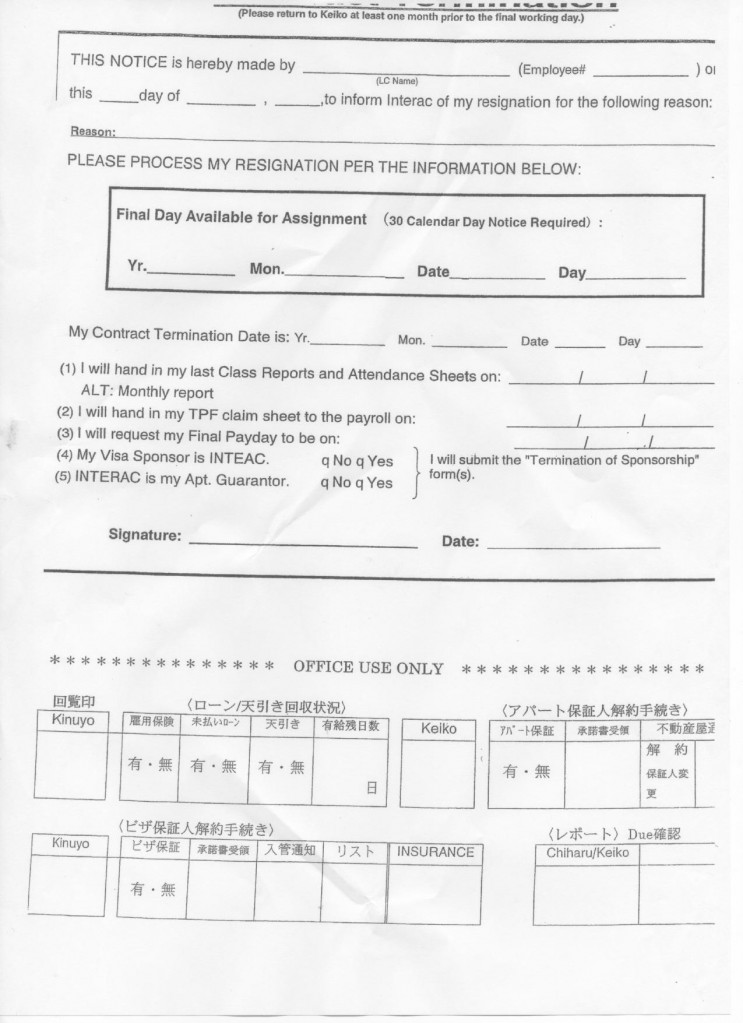
After the funeral I had a chance to look at the papers that Joel Northan and Satoko Aoki tried desperately to get me to sign at that meeting on March the 2nd. Upon checking the 4 papers I found 1 was not for me, it was for Interac staff to fill in, 1 was requesting when I would like my final payment, 1 was requesting the same plus when I would like my penultimate payment.
However 1 paper (attached) stated:
‘THIS NOTICE is hereby made by ___________ (Employee#_____) on this _____ day of _____ , _____, to inform Interac of my resignation for the following reason:’ etc etc
Signature _________________ Date ______________’
So, on top of all the previous, they also tried to get me to sign a paper stating I was resigning without me even knowing it.

Extra notes –
2 months previously I was told that Interac were hoping I would continue my employment with them by Joel Northan.
I found out that Interac had lost the contract with the BOE in Hiratsuka for elementary schools for the 2009-10 year. The trainer involved has left Interac.
No-one ever called to apologise, the trainer and another trainer only apologised when 1 I called to tell them I had to take time off to identify the body, and 2 when I called to tell them about the funeral. Previously, they used to call me up at all hours about the smallest things.
About my teaching –
When I first started at Interac I was given, as my main school, what the BOE and teachers described as the worst school in the city. It probably was. Kids were smoking in the school, climbing out of second floor windows during the lessons and sitting on a 40 cm ledge smoking and talking in groups, sleeping in the class, punching teachers, bullying in the open etc etc.
3 years later the school is one of if not the best schools in the city, judging by the others I taught at. I could ‘reach’ every kid in the school, some for longer than others granted. Now the English level of even the first graders is far better than the 3rd graders from 3 years ago and almost every student in the school enjoys English lessons now. I walked into a bad atmosphere and spent every minute I was there trying to improve it through methods that Interac trainers and managers and many teachers don’t even know exist, like honesty, integrity, confidence, openess, friendliness, actually wanting to teach etc etc.
I’m not going to say I changed everything but I did what I could to improve things. There are some very nice teachers there who I respect, but at the student’s graduation ceremony this year I sat next to other teachers, head teachers, the vice principal etc and was very proud when a high percentage of the kids I’d known since their first year, walked up looking directly at me and bowed before receiving their certificates.
I will also send this to a union and to the Japan Times.
Feel free to contact me if you need anything else or if I have made some mistakes. michael1 AT mopera DOT net
Thank you for reading,
Michael Collison.
ENDS
mytest


![]()
Hi Blog. David McNeill of the Japan Times makes an interesting point about the Calderon Noriko Case, where the parents of a Japan-born Philippine adolescent were forcibly repatriated for overstaying, but the adolescent is allowed to remain in Japan without her parents on a tenuous one-year visa. It’s become an ideological tug-of-war between liberals (who want more humanistic immigration policies) and conservatives (who don’t want to encourage illegal-alien copycatting, and, yes, do resort to “purity of Japan” invective), in an inevitable and very necessary debate about Japan’s future.
The question that hasn’t been asked yet is, would these conservative protesters (see YouTube video of their nasty demonstration here, courtesy of Japan Probe) have the balls to do this to a 13-year-old girl if she were Japanese? Somehow I doubt it. I think they’re expecting to get away with their (in my view heartless) invective just because Noriko’s foreign.
Anyway, an excerpt of the JT article follows. More on this issue from FG:
http://www.fuckedgaijin.com/forums/showthread.php?t=22775
Arudou Debito in Sapporo
=======================================
‘A battle for Japan’s future’
Calderon case fallout will linger long after parents’ departure, writes David McNeill
Despite being Japan’s most densely populated area, Warabi rarely causes a blip on the national media radar.
![]() |
| Fiery rhetoric: Makoto Sakurai tells nationalists in Warabi, Saitama Prefecture, on Sunday to send Noriko Calderon “back to the Philippines.” DAVID MCNEILL PHOTOS |
Set in a rusting corner of Saitama Prefecture, the city has two minor recent claims to fame: a communist mayor and the 13-year-old daughter of illegal Filipino immigrants.
An odd place perhaps for two groups with radically different visions of Japan to take to the streets, but this is where neo-nationalists and liberal opponents could be found slugging it out last weekend.
On one side, a party of nationalists crammed into a small park and listened to ringleader Makoto Sakurai, a rising new-right star who turns out for protests in a three-piece suit and watch chain.
“People in other countries are looking at this case very carefully,” Sakurai told the crowd to cheers of “Send illegal foreigners home!” “They see that we are a soft touch. If we allow this girl to stay, many more will come. It’s totally unacceptable.”…
Walking behind a van blasting out high-decibel venom at the local government, the Hinomaru-waving protesters filed noisily past Noriko’s junior high school. “Shame on Filipinos,” shouted one middle-aged man who held a sign saying: “Kick out the Calderons.” Takehiro Tanaka said they would be back every month until Noriko was put on a plane to Manila. “We can’t allow her to stay or foreigners will exploit our softness. It sends the wrong message to other countries.”…
Last month, the family’s six-month legal battle ended when Justice Minister Eisuke Mori gave Noriko a one-year special residence permit, allowing her to live with her aunt and continue school in this city. Her parents, Arlan and Sarah, who came to Japan in the early 1990s on false passports, were sent back to the Philippines on Monday…
Read the rest of the article at:
http://search.japantimes.co.jp/cgi-bin/fl20090414zg.html
See the protest for yourself on YouTube at:
http://www.japanprobe.com/?p=9757
ENDS
mytest


![]()
Hi Blog. On the theme of “bringing people over but not taking care of them” (a la the “Trainees” and the Nikkei), here we have GOJ entities beefing enrollment of depopulated Japanese universities with NJ students, then leaving them twisting in the wind when it comes to job searches. This according to the Yomiuri. Courtesy of Matt D. Arudou Debito in Sapporo
===================================
Foreign students seeking work in Japan after graduation are facing difficulties in finding jobs as employment conditions deteriorate because of the economic downturn.
More than 120,000 foreign students study in Japan annually. Observers say the government should support the students’ job-hunting efforts to keep them from losing interest in Japan and returning to their home countries.
One foreign student looking for work is a 24-year-old graduate student from China’s Jiangsu Province who lives in Akita. She is currently looking for full-time work at a Japanese firm for after she graduates. But the search is proving difficult.
“Since I began spending my time looking for work, my standard of living has been deteriorating day by day,” she said.
With no financial support from her parents, she is living only on a scholarship and a part-time job to make ends meet. With graduation looming, she decided to quit her part-time job and focus on finding full-time work. By such methods as giving up her trips home to China, she has amassed 300,000 yen in savings. But she has found herself in a hard situation without her part-time income.
On March 8, she traveled halfway across the country to Tokyo, where she attended a job fair for foreign students held near JR Hamamatsucho Station in Minato Ward. Following the event, she stayed for a week with a friend living in the capital so she could call on companies in Tokyo, but she came away empty-handed, she said.
Savings wiped out, she can no longer afford to eat out, and is saving money by cooking and eating at home whenever possible.
“I’ve made it a habit to seek cheap foods at supermarkets. For example, I decided not to buy enoki mushrooms, whenever they cost more than 100 yen,” she said.
The student buys boxed meals at supermarkets only after they become discounted at night and takes them to school the next day for lunch.
Still, she said she is not considering returning to China. “The competition is even more intense in China than here. There are fewer jobs to go around because of the economy. I want to work in Japan to utilize what I have learned in university and graduate school during my stay here,” she said.
Similar difficulties have been experienced by a 31-year-old man from South Korea who now lives in Saitama Prefecture. After graduating from a private university here in 2007, he returned home and found employment. However, he returned to Japan after his wife decided to enter a Japanese graduate school, and he began searching for a job here this year. However, he has had no luck.
“There are far fewer companies hiring than there were before. I need to find a job as soon as possible to support my wife and me, but I haven’t found a good place to work,” he said.
According to the Japan Student Services Organization (JASSO), the number of foreign students studying in Japan at universities, graduate schools and junior colleges has been on the rise in recent years. As of May 1 last year, a record 123,829 foreign students were studying in Japan, up 5,331 from the previous year. About 60 percent of the foreign students came from China, followed by students from South Korea, Taiwan and Vietnam, according to JASSO.
Many students from Asia hope to work in Japan. However, only 10,262 students were able to obtain working visas in 2007 after finding jobs. Many students ended up returning to their home countries after failing to find work.
The employment situation for foreign students has gone from bad to worse due to the economic downturn. According to the Tokyo Employment Service Center for Foreigners–a job-placement office for foreign residents–there were 252 job listings targeting foreign students graduating in March available at the center as of Jan. 31, down 54 from the same period last year.
According to the organization, it is mainly small and medium-size companies that seek employees through the center. However, general manager Kazuo Hirasawa said companies across the spectrum are cutting the number of foreign students they hire.
The government has announced a plan to increase the number of foreign students studying in Japan to 300,000 by 2020 to enhance the country’s international competitiveness by securing excellent human resources from around the world.
However, the government’s measures to support foreign students finding jobs in Japan are limited, even though this is supposed to be an integral part of the government’s plan. The government is now planning to host job fairs targeting foreign students and a meeting of universities and companies interested in recruiting foreign students.
But observers say the government measures are failing to keep up with rapidly deteriorating employment conditions.
Mitsuhiro Asada, chief editor of J-Life, a free magazine targeting foreign students published by ALC Press, Inc., said: “Foreign students are integral to the future of Japan. If the government really wants to increase the number of foreign students, it needs to focus its efforts on improving the status of foreign students after they graduate–including setting a target figure for the number of foreign students hired by Japanese companies.”
Foreign students receiving more assistance in job hunt
When trying to get a job in Japan after completing their higher education here, foreign students often struggle with the nation’s peculiar job-hunting procedures, under which students usually start such activities as early as the latter half of their junior year and submit “entry sheets” rather than resumes to prospective employers for the first round of screening.
Many job-hunting foreign students are uncertain about how to fill in these entry sheets or how they are expected to behave during interviews.
Therefore, some universities have been taking steps to help their foreign students find jobs.
For example, Ritsumeikan Asia Pacific University (APU), a private institution in Oita Prefecture whose foreign students accounts for 40 percent of the student body, regularly holds events called “Open Campus Recruiting,” in which companies are invited to the campus to hold briefing sessions for foreign students and conduct recruitment tests.
During the 2007 academic year, there were about 380 sessions of the Open Campus Recruiting program.
On the other hand, Meiji Gakuin University in Tokyo started to offer job-hunting support to its foreign students in October last year. The private institution has asked for help from temporary staffing agency Pasona Inc., which provides advice to these students regarding how to fill in application forms and how to behave during interviews.
In addition to these two examples, many other institutions now offer special job-hunting seminars for foreign students.
In recent years, some companies have been willing to hire more and more foreign students. Starting with new recruits for the 2008 fiscal year, Lawson Inc., for example, has been hiring foreign students under the same working conditions as their Japanese colleagues. For the fiscal year starting this month, the major convenience store chain has about 40 foreign recruits.
“We value diversity [in our workforce],” a Lawson official says of why the company has hired an increasing number of foreign students.
Diversity in the workplace is thought to encourage people to respect different values that come from differing nationality, gender and age. This is also said to enhance their creativity.
“If companies can provide foreign employees with comfortable working systems,” says Masato Gunji, senior researcher at the Japan Institute for Labor Policy and Training, “it would become easier for them to hire other types of workers such as homemakers and the elderly.”
mytest
Hi Blog. A tangent in a sense, but macroeconomics affect us all, and it’s harder to keep our eye on loftier goals like human rights when people’s pocketbooks are emptying. This is the first mention I’ve seen in the press about Japan’s “TWO lost decades”. And I’m afraid I agree that this is not an overstatement. To me, it’s symbolic of the self-damaging “seesawing self-image” Japan tends to have of itself.
That is to say, when times are going well, really well (like say 1960 to 1990), popular sentiment begins to tend towards a superiority complex, in that “We Japanese are harder workers and have an exceptional, unique society that is designed to grow and enrich itself perpetually” (unlike the hybrid mutt multicultural societies, whose factory workers are lazy and less intelligent, according to Japan’s contemporary premier politicians). Then follows the arrogance and self-convincing which justifies staying the course: After all, it’s “The Japanese Way”, after all. Of course, there ‘s little mention of other possible root causes for Japan’s phenomenal success, such as a lack of post-WWII war reparations, or preferential trade agreements, or markets overseas opened to nurture export-led countries away from the temptation of warmaking economies. And once Japan had (through hard work and perseverance) matured and reached its due, one might argue it has done quite poorly, compared to fellow mature economies in The Economist’s graphs below. For after all, if there’s no business model except a slavish following of “The Japanese Way”, what’s next for people sitting tight and waiting for the next ideological auto-pilot to take over?
After now nearly two decades of bumbling about (and fortunately losing a lot of that unhealthy superiority complex, except perhaps towards the foreigners who decide to come here that it can pick on), one begins to wonder whether the “Japan Inc.” model of business was actually all that stand-alone successful. There are plenty of other rich economies that are relatively resource poor (as in, probably most of the Western Europeans’ economies) yet still are outperforming Japan, so let’s not fall back on the shimaguni excuses. I think the evidence is mounting that using the Americans as a economic crutch was the key to Japan’s postwar growth. Fine. But if Japan wants to stick to the same “crutch economy” to power itself, it had better shut its uyoku up and get friendlier with China, because China is probably going to be the export purchaser of the future. Otherwise, consider the consumer-led economy being proposed by The Economist below.
Sorry, random brain farts after a gloriously sunny week. Omatase: Here’s the more substantial Economist article, already. Arudou Debito in Sapporo
=========================================
Japan
The incredible shrinking economy
http://www.economist.com/finance/displaystory.cfm?story_id=13415153
Japan is in danger of suffering not one but two lost decades
|
|
![]() |
|
TO LOSE one decade may be regarded as a misfortune; to lose two looks like carelessness. Japan’s economy stagnated in the 1990s after its stockmarket and property bubbles burst, but its more recent economic performance looks even more troubling. Industrial production plunged by 38% in the year to February, to its lowest level since 1983. Real GDP fell at an annualised rate of 12% in the fourth quarter of 2008, and may have declined even faster in the first three months of this year. The OECD forecasts that Japan’s GDP will shrink by 6.6% in 2009 as a whole, wiping out all the gains from the previous five years of recovery.
If that turns out to be true, Japan’s economy will have grown at an average of 0.6% a year since it first stumbled in 1991 (see top chart). Thanks to deflation as well, the value of GDP in nominal terms in the first quarter of this year probably fell back to where it was in 1993. For 16 years the economy has, in effect, gone nowhere.
|
|
|
![]() |
|
Was Japan’s seemingly strong recovery of 2003-07 an illusion? And why has the global crisis hit Japan much harder than other rich economies? Popular wisdom has it that Japan is overly dependent on exports, but the truth is a little more complicated. The share of exports in Japan’s GDP is much smaller than in Germany or China and until recently was on a par with that in America. During the ten years to 2001, net exports contributed nothing to Japan’s GDP growth. Then exports did surge, from 11% of GDP to 17% last year. If exporters’ capital spending is included, net exports accounted for almost half of Japan’s total GDP growth in the five years to 2007.
Exports boomed on the back of a super-cheap yen and America’s consumer binge. Japan did not have housing or credit bubbles, but the undervalued yen encouraged a bubble of a different sort. Japanese exporters expanded capacity in the belief that the yen would stay low and global demand remain strong, resulting in a huge misallocation of resources.
As foreign demand collapsed and the yen soared last year, Japan’s export “bubble” burst. Total exports have fallen by almost half in the past year. Japan’s high-value products, such as cars and consumer electronics, are the first things people stop buying when the economy sours.
Richard Jerram, an economist at Macquarie Securities, argues that the worst may soon be over for industrial production. This year, output and exports have fallen by much more than the drop in demand, because firms have temporarily closed plants in order to slash excess stocks. For instance, Japan’s vehicle production in the first two months of 2009 was 50% lower than a year before, but global car sales fell by only 25%.
Mr Jerram reckons that the inventory rundown is coming to an end, which will lead to a short-term bounce in output as factories reopen. If so, car output in June could be around 50% higher than in March (but still down by 25% on a year earlier). This means that GDP growth might turn positive in the second quarter even if foreign demand remains weak.
Unfortunately, the economy is likely to totter again as the second-round effects of tumbling profits and rising unemployment squeeze investment and consumer spending. According to the latest Tankan survey of the Bank of Japan (BOJ), in March business sentiment among big manufacturing firms was the gloomiest since the poll began in 1974. Manufacturers say they plan to cut investment by 20% this year. They are also trimming jobs and wages. The seemingly modest unemployment rate of 4.4% in February understates the pain. The ratio of job offers to applicants has declined to only 0.59, from around one at the start of 2008, and average hours worked have also fallen sharply. Average wages (including bonuses and overtime pay) went down by 2.7% in the 12 months to February. Household spending fell by 3.5% in real terms over the same period; department store sales plunged by 11.5%.
The weakening domestic economy has prompted the government to man the fiscal pumps. A stimulus of 1.4% of GDP is already in the pipeline for 2009, and a further boost of perhaps 2% of GDP is expected to be unveiled in mid-April. The package is likely to include measures to strengthen the safety net for the unemployed and so ease concerns about job security. There will also be new infrastructure spending. Much of the expenditure on public works in the 1990s is now considered wasteful, so this time the focus is meant to be on projects that boost productivity, such as an expansion of Tokyo’s Haneda airport. Better crafted stimulus measures which raise long-run growth are also less likely to spook bond markets concerned about the government’s vast debt.
So long as the extra measures are not delayed by an early election (which must be called by September), Japan’s total fiscal stimulus in 2009 could be the largest among the G7 economies. But it would not be enough to prevent a sharp widening of the output gap (the difference between actual GDP and what the economy could produce at full capacity). This had already risen to 4% of GDP in the fourth quarter of 2008, and it is likely to approach 10% by the end of 2009, twice as much as in the 1990s downturn (see bottom chart, above).
This gaping economic hole is again putting downward pressure on prices. By late summer consumer prices could be more than 2% lower than a year before—a faster decline than during Japan’s previous bout of deflation. The risk is that deflation will squeeze profits and hence jobs, thereby further depressing demand and prices. The BOJ cut interest rates to 0.1% in December and it has introduced several measures to keep credit flowing, such as buying commercial paper and corporate bonds, as well as shares held by banks, which boosts their capital ratios. In contrast to the 1990s, bank lending is still growing.
The BOJ has also stepped up its purchases of government bonds, but after its experience in 2001-06, the bank remains sceptical that such “quantitative easing” can lift inflationary expectations and spur demand. One big difference is that the previous episode of quantitative easing coincided with stringent budget-tightening under Junichiro Koizumi, the then prime minister. The budget deficit was reduced from 8% of GDP in 2002 to 1.4% in 2006 (which partly explains why domestic demand was weak). The combination of fiscal expansion and government-bond purchases by the BOJ should work better.
The OECD predicts that public-sector debt will approach 200% of GDP in 2010, so the scope for further fiscal stimulus will be limited. Nor can Japan rely on exports for future growth; to the extent that it had enjoyed an export bubble, foreign demand will not return to its previous level. Japan needs to spur domestic spending.
One possible option, which the government is exploring, is to unlock the vast financial assets of the elderly. Japanese households’ stash of savings is equivalent to more than five times their disposable income, the highest of any G7 economy, and three-fifths of it is held by people over 60 years old. Gifts to children are taxed like ordinary income, but if this tax were reduced, increased transfers could boost consumption and housing investment since the young have a much higher propensity to consume. In theory, this could give a much bigger boost to the economy than any likely fiscal stimulus.
Of course, one reason why the elderly are cautious about running down their assets is concern about the mismanaged pension system and future nursing care. Services for the elderly should be among Japan’s fastest growing industries and create lots of new jobs, but they are held back by regulations which restrict competition and supply. Deregulation of services would not only help to improve the living standards of an ageing population, but by helping to unlock savings might also drag the economy out of deep recession.
Japan’s second lost decade holds worrying lessons for other rich economies. Its large fiscal stimulus succeeded in preventing a depression in the 1990s after its bubble burst—and others are surely correct to follow today. But Japan’s failure to spur a strong domestic recovery a decade later suggests that America and Europe may also have a long, hard journey ahead.
ENDS
mytest


![]()
Hi Blog. Here’s Sunday’s tangent. On March 27, 2009, NPR replayed a 1990 interview with the late John Hope Franklin, historian of racism within the United States. He died at age 94 on March 25. The Economist ran this as part of their obituary on April 2:

…Academia offered no shelter. He excelled from high school onwards, eventually earning a doctorate at Harvard and becoming, in 1956, the first black head of an all-white history department at a mostly white university, Brooklyn College. Later, the University of Chicago recruited him. But in Montgomery, Louisiana, the archivist called him a “Harvard nigger” to his face. In the state archives in Raleigh, North Carolina, he was confined to a tiny separate room and allowed free run of the stacks because the white assistants would not serve him. At Duke in 1943, a university to which he returned 40 years later as a teaching professor, he could not use the library cafeteria or the washrooms.
Whites, he noted, had no qualms about “undervaluing an entire race”. Blacks were excluded both from their histories, and from their understanding of how America had been made. Mr Franklin’s intention was to weave the black experience back into the national story. Unlike many after him, he did not see “black history” as an independent discipline, and never taught a formal course in it. What he was doing was revising American history as a whole. His books, especially “From Slavery to Freedom” (1947), offered Americans their first complete view of themselves…
http://www.economist.com/obituary/displaystory.cfm?story_id=13403067
Now read this excerpt from the NPR interview, which I transcribed, and see if you get what I did from it:
Terry Gross: In some of your essays in your new book, you talk about some of the obstacles that you faced as a Black scholar, and you wrote that you faced discrimination that goes beyond any discrimination you faced in the field itself. For example, when you were chairman of history at Brooklyn College [New York City, in 1956], one of the problems you had was finding an apartment you wanted to live in, because a lot of neighborhoods refused to sell to you.
JHF: That’s right. I spent more than a year trying to find a place I wanted to purchase. My appointment was so spectacular that news of it with my picture was on the front page of the New York Times. But when I set out to find a house near my college — I hoped to be able to walk to work — almost none of the real estate dealers in the area would show me any of the houses that they were widely advertising. And when I finally found one being sold by the owner, I then had the problem of trying to find the money so I could purchase the house. And that was another round of excruciating experiences. I finally found it, but I could have spent this time so much better.
TG: Let me ask you kind of a stupid question. Did you ever take that New York Times article around to the real estate agents and say to them, “Look, don’t you know who I am?”
JHF: No, I don’t believe in that. I’m a human being, and that ought to be enough. I’m well-mannered, I think I’m well-dressed, and I think that my conduct is above reproach. I think that that should commend me. And if it doesn’t, well, then I think they’re not interested in hearing anything about who I am. I have no doubt that many of these people knew who I was. And yet, I was still rejected.
COMMENT: These sorts of things are mostly seen nowadays as unpleasant historical anachronisms, approached and reflected upon with the attitude of “How could people do this sort of thing? What were we thinking back then?” And rightly so.
However, just try to rent as a foreigner in Japan, and get credit as a foreigner in Japan. Bonne chance. You simply are not going to resolve these situations until you make what happened to JHF illegal.
Arudou Debito in Sapporo
mytest


![]()
Hi Blog. Mainichi reports yet another case of “Trainee” labor abuses, and this time the public prosecutor looks to do something about it. Plus a brief Yomiuri article on how deep the abuses are going, alas with only a brief citation of figures, nothing about the whos, wheres, and what’s to be done about it. Like siccing the public prosecutor on them. Debito in Sapporo
====================================
Mainichi Shinbun April 9, 2009, courtesy of Jeff K.
http://mdn.mainichi.jp/mdnnews/news/20090409p2a00m0na004000c.html
KOFU — The Kofu Labor Standards Inspection Office has sent documents to public prosecutors accusing a dry-cleaning company president of violating labor and wage laws by making Chinese trainees work for pay below the minimum wage.
The office sent documents to the Kofu District Public Prosecutors Office accusing 60-year-old Masafumi Uchida, the president of a dry-cleaning company in Yamanashi Prefecture, of violating the Minimum Wage Law and Labor Standards Law.
The labor standards inspection office had been conducting an investigation after the Mainichi Shimbun reported on the treatment of the workers on Aug. 27 last year.
Uchida was reported to prosecutors over the alleged failure to pay about 11.15 million yen to six female trainees from China aged in their 20s and 30s, during the period between February 2007 and July 2008.
The office also reported a 37-year-old certified social insurance labor consultant from Chuo, Yamanashi Prefecture, to public prosecutors accusing him of assisting in the violation of both laws by providing assistance to Uchida and other related parties.
(Mainichi Japan) April 9, 2009
ENDS
Japanese version with sparser details:
=================================
毎日新聞 2009年4月9日 東京朝刊
http://mainichi.jp/select/jiken/news/20090409ddm041040120000c.html
中国人実習生を最低賃金未満の給与で働かせていたとして甲府労働基準監督署は8日、山梨県昭和町のクリーニング会社「テクノクリーン」と内田正文社長(60)を最低賃金法と労働基準法違反容疑で甲府地検に書類送検した。毎日新聞が08年8月27日付で報じ、同署が調べていた。
容疑は07年2月~08年7月、雇用していた20~30代中国人女性実習生6人に対し、総額約1115万円を支払わなかったとしている。同県中央市の社会保険労務士の男性(37)も社長らに協力したとして、両法違反のほう助容疑で送検した。【中西啓介】
=================================
The Justice Ministry says it has found irregularities at a 452 companies and organizations that hosted foreign trainees last year.
The job-training system for foreign trainees from developing countries was introduced to help them acquire technical expertise and skills from Japanese organizations, but it has often been misused by unscrupulous companies and organizations as a means to get unskilled workers from developing countries who will work for extremely low wages.
Officials of the ministry said it had confirmed that the companies and organizations violated labor laws, such as by paying lower-than-minimum wages to foreign trainees. Of the total, 169 cases of entities making trainees work unpaid overtime were found and 155 cases concerned other labor law violations such as payment of illegally low wages.
mytest
Hi Blog. Here come the stats. The “Trainees” (mostly Chinese working non-laborers in Japanese farms and factories), which I discussed in part in my most recent Japan Times article, are being sent home in large numbers, to face debts. Oh well, so what, as I’ve said — they’re not Nikkei. They don’t get any assistance. Just the promise of a “review”of the “trainee visa system” by May 2009, something people have been clamoring for since at least November 2006! Yet it only took a month or so for the GOJ to come up with and inaugurate something to help the Nikkei, after all (see above JT article). But again, too bad: wrong blood.
I think we’ll see a drop in the number of registered NJ for the first time in more than four decades this year. Maybe that’ll be See I Told You So #3. I hope I’m wrong this time, however. Arudou Debito in Sapporo
PS: Love how the Mainichi classifies this as “National News” in English, but “Overseas News” (kaigai) in Japanese. I guess the hundreds of thousands of “Trainees” saving our industries are not a domestic problem for Japanese readers.
============================
(Mainichi Japan) April 7, 2009, Courtesy Matt D and Jeff K
http://mdn.mainichi.jp/mdnnews/national/news/20090407p2a00m0na014000c.html
More than 1,000 foreign trainees involved in government programs were forced to return home as sponsor companies have been suffering from the deteriorating economy, a government survey has revealed.
According to the survey held by the Justice Ministry’s Immigration Bureau, a total of 1,007 foreign trainees left Japan between October last year and January before their contract period ended. Of that figure, 921 people were laid off due to their employers’ deteriorating business conditions, and 86 were dismissed after their host companies went bankrupt.
The figures have increased every month, quadrupling to 489 in January from 114 in October last year.
The trainees’ three-year contracts can be terminated if both parties agree, however, most of foreigners were forced to leave, according to the survey.
“Most of the trainees took out a loan of about 700,000 yen to 1 million yen to come to Japan,” said a representative of Advocacy Network for Foreign Trainees in Tokyo’s Taito Ward. “If they return home before their contract period ends, they will be left in debt. The government should take some countermeasures.”
The central government is now reviewing the trainee program, including the guarantee of the trainees’ status, which is not covered by the current Labor Standards Law. A revision is expected to be made in May.
Japan received a total of 102,018 foreign trainees in 2007, according to the Immigration Bureau.
ENDS
=============================
http://mainichi.jp/select/world/news/20090407k0000m040125000c.html
国の外国人研修・技能実習制度を利用して来日したが、受け入れ企業の倒産や事業縮小で途中帰国した外国人が昨年10月~今年1月で1000人を超えたことが、法務省入国管理局の初めての調査で分かった。原則3年認められている期間中の打ち切りは、受け入れ側と研修・実習生側が合意すれば認められるが、実際には企業側の都合で行われるケースが大半といい、市民団体は「実質的な派遣切り」と訴えている。
東京や大阪など8カ所の入国管理局が、途中帰国した理由を不況の影響に絞って集計した。総数は1007人で、内訳は研修生222人、企業と雇用関係を結ぶ実習生が785人。月別では、昨年10月114人▽11月154人▽12月250人▽今年1月489人。
理由は受け入れ企業の事業縮小や経営悪化が921人、企業の倒産が86人だった。
入国管理局によると、07年に企業が受け入れた研修生は10万2018人。制度変更では、労働基準法の適用外になっている研修生の身分保障などが検討されている。
「外国人研修生権利ネットワーク」(東京都台東区)の高原一郎さん(57)は「実習生らの多くは来日するため70万~100万円程度の借金をしており、途中で帰ると借金しか残らない。国は何らかの対策を打つべきだ」と指摘している。【松井聡】
毎日新聞 2009年4月7日 2時30分
ENDS
mytest
Hi Blog. In my humble but loud opinion, good news:
Former Peruvian Prez Alberto Fujimori, who ran a corrupt government, parachuted into Japan for sanctuary in 2000 (getting a Japanese passport without due process), lived the life of a Tokyo elite with full impunity (despite extradition demands and an Interpol warrant for kidnapping and murder), bogged off back to Chile on private jet in 2005 to run for election in Peru (not to mention run for election here in Japan; the fool lost in both places). Then the fool was arrested upon landing and later extradited back to Peru for trial. Yesterday he finally got his: A jail sentence for a quarter-century for executive excesses. As in death squads. In complement to the six years he got in December 2007 for lesser charges.
Good. Rot there, you dreadful man.
Debito.org has said time and again why I have it in for this creep. It’s not just because he leapfrogged genuine candidates for Japanese citizenship (claiming it by blood and spoils within weeks of faxing a resignation letter to Peru, from a Tokyo hotel!). It’s because a person like this could spoil it for every other Nikkei in South America. What other country would want to elect another possible Fujimori after all this? Sorry, as wrongfully racist as that sentiment is, clear criminal activity is not going to help the assimilation and social advancement of others like him. That man is quite simply a destroyer of anything that gets in his way.
But Fujimori, like many leaders in Latin American countries (think Simon Bolivar, Santa Anna, the Perons, or Porfirio Diaz), seems to have nine lives. And his elected daughter is jockeying to become president and pardon him. (Chip off the old block. Now that’s an important national priority and a key campaign plank! Kinda like another president invading Iraq to avenge his father…)
BTW, I saw on the Discovery Channel on Tuesday night a Canadian documentary about the siege of the Japanese Ambassador to Peru’s house in 1996-7. When the commandos were on tiptoe for 34 hours ready to go in, deputy Montesinos was trying to contact Fujimori to get final approval. Guess what. It took a while to reach him, because he was dealing with personal stuff — his divorce hearing! One would think a looming assault on your biggest national donor’s sovereign territory would take ultrapriority for a president. Not a president like FJ.
Ecch. Again, what a dreadful man. Stay tuned. Arudou Debito in Sapporo
—————————
http://mdn.mainichi.jp/mdnnews/news/20090408p2g00m0in001000c.html
April 8, 2009. Courtesy lots of people.
LIMA, Peru (AP) — Former Peruvian President Alberto Fujimori was convicted and sentenced to 25 years in prison Tuesday for death squad killings and kidnappings during his 1990s struggle against Shining Path insurgents.
Outside court, pro- and anti-Fujimori activists fought with fists, sticks and rocks. About 50 people chanted “Fujimori killer!” while several hundred chanted “Fujimori innocent!” before riot police separated them.
The court convicted the 70-year-old former leader, who was widely credited for rescuing Peru from the brink of economic and political collapse, of “crimes against humanity” including two operations by the military hit squad that claimed 25 lives. None of the victims, the three-judge court found, were connected to any insurgency.
Presiding judge Cesar San Martin said there was no question Fujimori authorized the creation of the Colina unit, which the court said killed at least 50 people as the government battled Shining Path terror with a “parallel terror apparatus” of its own. He sentenced Fujimori to 25 years in prison, only five fewer than the maximum.
Victims’ family members nodded with satisfaction and shed tears in the courtroom as the verdict was read.
“For the first time, the memory of our relatives is dignified in a ruling that says none of the victims was linked to any terrorist group,” said Gisela Ortiz, whose brother was killed.
Fujimori, who proclaimed his innocence in a roar when the 15-month televised trial began, barely looked up, uttering only four words — “I move to nullify” — before turning, waving to his children, and walking out of the courtroom at the Lima police base where he has been held and tried since his 2007 extradition from Chile.
His supporters in the courtroom shook their heads in disgust and groaned in exasperation. Fujimori’s congresswoman daughter, Keiko, called the conviction foreordained and “full of hate and vengeance.” She said it would only strengthen her candidacy for the 2011 presidential race.
“Fujimorism will continue to advance. Today we’re first in the polls and will continue to be so,” she said outside the courtroom. She has vowed to pardon her father if elected.
But some political analysts think Keiko Fujimori, 33, is more likely weakened by the verdict and would become a one-issue candidate. Her party has, after all, just 13 seats in Peru’s 120-member congress.
“It’s one thing to capitalize on the romantic image of the daughter defending a presumably innocent father, another defending a sentenced criminal,” said Nelson Manrique, a Catholic University professor.
Human rights activists heralded the case as the first in which a democratically elected former president was extradited and tried in his home country for rights violations.
Although none of the trial’s 80 witnesses directly accused Fujimori of ordering killings, kidnappings or disappearances, the court said the former mathematics professor and son of Japanese immigrants bore responsibility by allowing the Colina group to be formed.
It said Fujimori’s disgraced intelligence chief and close confidant, Vladimiro Montesinos, was in direct control of the unit.
And it noted that Fujimori freed jailed Colina members with a blanket 1995 amnesty for soldiers while state security agencies engaged in a “very complete and extensive” cover-up of the group’s deeds.
The Colina group was formed in 1991. In its first raid, using silencer-equipped machine guns, the group killed 15 people at a barbecue, including an 8-year-old boy. The intended victims, it turned out, lived on a different floor. The following year, the group “disappeared” nine students and a leftist professor at La Cantuta University.
In both cases, the killers targeted alleged sympathizers of the Shining Path, which was killing Peruvians with nearly daily car bombings. The group was devastated by the September 1992 arrest of its charismatic leader, Abimael Guzman, but some 500 Shining Path remnants remain active in Peru’s jungle, financed by the cocaine trade.
Fujimori also was convicted of two 1992 kidnappings: the 10-day abduction of opposition businessman Samuel Dyer and the one-day kidnapping of Gustavo Gorriti, a journalist who had criticized the president’s shuttering of the opposition-led Congress and courts.
In the trial, prosecutors presented declassified cables showing that U.S. diplomats including then-Ambassador Anthony Quainton repeatedly questioned Fujimori and his aides about reports of extrajudicial killings by his military.
“He never wanted to talk about it very much. He always, of course, said that human rights abuses were not tolerated by his government,” Quainton, now an American University professor, told The Associated Press by phone from Washington.
Fujimori has already been sentenced to six years in prison for abuse of power and faces two corruption trials, the first set to begin in May, on charges including bribing lawmakers and paying off a TV station.
His 10-year presidency ended in disgrace in 2000, when videotapes showed Montesinos, now serving a 20-year term for corruption and gunrunning, bribing lawmakers and businessmen. Fujimori fled to Japan, then attempted a return five years later via Chile.
Fujimori remains remarkably popular and his successors have maintained his market-friendly policies. Peru had Latin America’s strongest economic growth from 2002-2008, averaging 6.7 percent. A November poll found two-thirds of Peruvians approve of Fujimori’s rule.
In his final appeal Friday, Fujimori cast himself as a victim of political persecution, saying the charges against him reflect a double standard. Why, he asked, isn’t current President Alan Garcia also being prosecuted, since it was from Garcia, who also preceded him in office, that Fujimori inherited the messy conflict that would claim 70,000 lives.
Garcia denies responsibility for human rights abuses during his 1985-90 administration — and has the power to pardon Fujimori.
Human rights advocates called the verdict historic.
“What this verdict says is that these crimes did in fact happen and that Fujimori was in fact responsible for them, and that’s something Peruvians needed to hear,” said Maria McFarland, senior Americas researcher at Human Rights Watch, who was in the courtroom.
“For so many years, certain sectors in Peru have said that you have to look the other way and refused to acknowledge what happened.”
(Mainichi Japan) April 8, 2009
ENDS
mytest


![]()
Hi Blog. Turning the keyboard over to my friend in the Hokkaido outback, who is asking us for feedback about how to approach his local junior high school and help create a more positive learning environment for his child. Those with experience or advice, please let us know? Arudou Debito in Sapporo, less outback
//////////////////////////////
Dear Debito.org:
I’m looking for advice here. I went to my child’s JHS today for about the 4th time in the last year. Again I was struck and depressed by how dingy it looked. It got me to thinking that the kids don’t take pride in the place and this leads to and has led to a lot of serious problems.
I came home and wrote the following and am wondering if it or I can do any good. Can I translate this and say this, to the School and Principal? to the School Board?, to the Mayor?, publicly to the PTA at their general meeting in 2 weeks? Is it too rude? Could you say it more diplomatically? How? Would you? Could you? Does it have a chance of succeeding?
Please feel free to comment on any one of the paragraphs numbered below.
========================
1. I am sorry to have to mention this and possibly I am sorry to use this sort of strong and possibly rude language. In English it is okay in Japanese I don’t know and most people prefer to keep quiet because they don’t want the reputation of being “noisy”
2. Last year when I heard that some students here did not respect this building and were damaging things my initial reaction was “why is anybody surprised?” In my opinion any damage here will not make this building look any worse than it does.
3. I don’t think you could find a school in the entire country of Canada whose walls and ceilings looked as bad as this school. This place is dingy. The sarcastic comment that most Canadian parents would make in this case would be:
4. Does anybody here in authority know what paint is?…It comes in tins and 20 liter pails…It costs about 500,000yen per ton…It is quickly put on by brush, roller, or spray…It is great for making buildings look fresh and bright and clean. 2 of the buildings I went to school in were over 60 years old. They didn’t look this bad because they were repainted at least every 10 years.
5. In my opinion the walls and ceilings in this school need cleaning, patching and a new paint job! If this happened a great number of students would take more pride in this building. Most of them would treat it with much greater respect. There would be massive group disapproval of any one deliberately or accidentally causing damage. It would pay off in much higher student morale and thus effort towards listening to teachers, paying attention in class, and caring about what is taught and trying to learn.
6. I don’t think this was a problem for any of the parents or teachers in this room when you went to school. You were much closer in time to when coming to school meant sacrifices. Maybe your parents or grandparents couldn’t go to school. Maybe someone in their family skipped meals so they or someone else in their family could go to school.
7. Another thing is that maybe when you went to school the buildings were much newer and looked much better.
I am also quite sure that almost all of your homes look better than this school and that none of you would be happy living in a house that looked like this school without trying very hard to make it look better.
8. It would also pay off in much higher teacher morale. Teachers would find their days less stressful and if student morale improved they would of course be much happier.
9. I think that the PTA should make the effort to start the ball rolling to paint this school. We should try to do this for the teachers who teach here, our children who spend so much time in class and clubs and for the children that come after them when they graduate. We should try even if we have to raise the money for paint, and volunteer a lot to help out in preparing the walls for paint and doing the cleanup. IMO it would show our children and their teachers how much we care about the value of education.
10. Towards this goal here is 20,000 yen.
Comments?
ENDS
mytest


![]()
Hi Blog. This month’s JUST BE CAUSE column was a challenge because of the news cycle. I had originally written this month’s JBC about three weeks ago, before I went on the SOUR STRAWBERRIES movie tour. Here I was thinking I was Mr. Prepared and all that. However, I arrived back in Sapporo on April 1 to hear news of this special GOJ bribe for Nikkei, and realized that story took precedence. But my first draft of the JBC column was due April 2, so within 24 hours I pounded out something of hopefully passable quality. It was, and the next three days were spent refining the original 1150-word draft into the 1550-worder you see below. Not too dusty. I feel fortunate to be a columnist with time to think, as opposed to a reporter with a much stricter set of news deadlines… Arudou Debito in Sapporo
![]()
JUST BE CAUSE
‘Golden parachutes’ mark failure of race-based policy
By DEBITO ARUDOU
Japan Times, April 7, 2009
http://search.japantimes.co.jp/cgi-bin/fl20090407ad.html
Japan’s employment situation has gotten pretty dire, especially for non-Japanese workers. The Health, Labor and Welfare Ministry reports that between last November and January, more than 9,000 foreigners asked the Hello Work unemployment agency for assistance — 11 times the figure for the same period a year earlier.
The ministry also claims that non-Japanese don’t know Japan’s language and corporate culture, concluding that they’re largely unemployable. So select regions are offering information centers, language training, and some degree of job placement. Good.
But read the small print: Not only does this plan only target 5,000 people, but the government is also trying to physically remove the only people they can from unemployment rosters — the foreigners.
Under an emergency measure drawn up by the ruling Liberal Democratic Party only last month, from April 1 the Japanese government is offering nikkei — i.e. workers of Japanese descent on “long-term resident” visas — a repatriation bribe. Applicants get ¥300,000, plus ¥200,000 for each family dependent, if they “return to their own country,” and bonuses if they go back sooner (see www.mhlw.go.jp/houdou/2009/03/dl/h0331-10a.pdf ).
History is repeating itself, in a sense. These nikkei beneficiaries are the descendants of beneficiaries of another of Japan’s schemes to export its unemployed. A century ago, Japan sent farmers to Brazil, America, Canada, Peru and other South American countries. Over the past two decades, however, Japan has brought nikkei back under yet another wheeze to utilize their cheap labor. This time, however, if they take the ticket back “home,” they can’t return — at least not under the same preferential work visa.
Let this scheme sink in for a minute. We now have close to half a million nikkei living here, some of whom have been here up to 20 years, paying in their taxes and social security. They worked long hours at low wages to keep our factories competitive in the world economy. Although these policies have doubled Japan’s foreign population since 1990, few foreigners have been assimilated. Now that markets have soured, foreigners are the first to be laid off, and their unassimilated status has made them unmarketable in the government’s eyes. So now policy has become, “Train 1 percent (5,000) to stay, bribe the rest to be gone and become some other country’s problem.”
Sound a bit odd? Now consider this: This scheme only applies to nikkei, not to other non-Japanese workers also here at Japan’s invitation. Thus it’s the ultimate failure of a “returnee visa” regime founded upon racist paradigms.
How did this all come to pass? Time for a little background.
Japan had a huge labor shortage in its blue-collar industries in the late 1980s, and realized, with the rise in the value of the yen and high minimum wages, that Japan’s exports were being priced out of world markets.
Japan’s solution (like that of other developed countries) was to import cheaper foreign labor. However, as a new documentary entitled “Sour Strawberries: Japan’s Hidden ‘Guest Workers’ ” ( www.cinemabstruso.de/strawberries/main.html ) reveals, Japan’s policy was fundamentally different. Elites worried about debasing Japan’s supposedly “homogeneous” society with foreigners who might stay, so the official stance remained “No immigration” and “No import of unskilled labor.”
But that was all tatemae — a facade. Urged by business lobbies such as the Japan Business Federation (Nippon Keidanren), Japan created a visa regime from 1990 to import foreign laborers (mostly Chinese) as “trainees,” ostensibly to learn a skill, but basically to put them in factories and farms doing unskilled “dirty, difficult, and dangerous” labor eschewed by Japanese. More importantly, trainees were getting paid less than half minimum wage (as they were not legally “workers” under labor law) and receiving no social welfare.
Even the offer of competitive wages was tatemae. Although some trainees were reportedly working 10 to 15 hours a day (one media outlet mentioned 22-hour days!), six to seven days a week including holidays, they found themselves receiving sums so paltry they beggared belief — think ¥40,000 a month! A Chinese trainee interviewed in “Sour Strawberries” said he wound up earning the same as he would in China. Others received even less, being charged by employers for rent, utilities and food on top of that.
Abuses proliferated. Trainees were harassed and beaten, found their passports confiscated and pay withheld, and were even fired without compensation if they were injured on the job. One employer hired thugs to force his Chinese staff to board a plane home. But trainees couldn’t just give up and go back. Many had received travel loans to come here, and if they returned early they would be in default, sued by their banks and ruined. Thus they were locked into abusive jobs they could neither complain about nor quit without losing their visa and livelihoods overseas.
As labor union leader Ippei Torii explains in “Sour Strawberries,” this government-sponsored but largely unregulated trainee program made so many employers turn bad that places without worker abuses were “very rare.”
But trainees weren’t the only ones getting exploited. 1990 was also the year the long-term resident visa was introduced for the nikkei. However, unlike the trainees, they were given labor law protections and unlimited employment opportunities — supposedly to allow them to “explore their heritage” (while being worked 10 to 15 hours a day, six days a week).
Why this “most-favored visa status” for the nikkei? Elites, in their ever-unchallenged wisdom, figured nikkei would present fewer assimilation problems. After all, they have Japanese blood, ergo the prerequisite understanding of Japan’s unique culture and garbage-sorting procedures. So, as LDP and Keidanren policymakers testified in “Sour Strawberries,” it was deemed unnecessary to create any integration policy, or even to make them feel like they “belong” in Japan. It was completely counterproductive and demoralizing for an enthusiastic workforce. A nikkei interviewed in the film mentioned how overseas she felt like a Japanese, yet in Japan she ultimately felt like a foreigner.
So over the past 20 years Japan has invited over a million non-Japanese to come here and work. And work they did, many in virtual indentured servitude. Yet instead of being praised for all their contributions, they became scapegoats. They engendered official opprobrium for alleged rises in crime and overstaying (even though per-capita crime rates were higher among Japanese than foreigners, and the number of visa overstayers has dropped every year since 1993). They were also bashed for not learning the language (when they actually had little time to study, let alone attend Japanese classes offered by a handful of merciful local governments) — nothing but disincentives toward settling in Japan.
The policy was doomed to failure. And fail it did on April Fool’s Day, when the government confirmed that nikkei didn’t actually belong here, and offered them golden parachutes. Of course, it was a race-based benefit, unavailable to wrong-blooded trainees, who have to make it home on their own dime (perhaps with some fines added on for overstaying) to face financial ruin.
It’s epiphany time. Japan’s policymakers haven’t evolved beyond an early Industrial-Revolution mind set, which sees people (well, foreigners, anyway) as mere work units. Come here, work your ass off, then go “home” when we have no more use for you; it’s the way we’ve dealt many times before with foreigners, and the way we’ll probably deal with those Indonesian and Filipino care workers we’re scheming to come take care of our elderly. Someday, potential immigrants will realize that our government is just using people, but the way things are going we eventually won’t be rich enough for them to overlook that.
What should be done instead? Japan must take responsibility. You invited foreigners over here, now treat them like human beings. Give all of them the same labor rights and job training that you’d give every worker in Japan, and free nationwide Japanese lessons to bring them up to speed. Reward them for their investment in our society and their taxes paid. Do what you can to make them more comfortable and settled. And stop bashing them: Let Japanese society know why foreigners are here and what good they’ve done for our country. You owe them that much for the best part of their lives they’ve given you.
Don’t treat foreigners like toxic waste, sending them overseas for somebody else to deal with, and don’t detoxify our society under the same race-based paradigms that got us into this situation in the first place. You brought this upon yourselves through a labor policy that ignored immigration and assimilation. Now deal with it here, in Japan, by helping non-Japanese residents of whatever background make Japan their home.
That’s not a radical proposal. Given our low-birthrate, aging-society demographics, experts have been urging you to do this for a decade now. This labor downturn won’t last forever, and when things pick up again you’ll have a younger, more acculturated, more acclimatized, even grateful workforce to help pick up the pieces. Just sending people back, where they will tell others about their dreadful years in Japan being exploited and excluded, is on so many levels the wrong thing to do.
Debito Arudou is organizing nationwide screenings of “Sour Strawberries” in late August and early September; contact him at debito@debito.org to arrange a screening. Just Be Cause appears on the first Community Page of the month. Send comments and story ideas to community@japantimes.co.jp
ENDS
mytest
DEBITO.ORG NEWSLETTER APRIL 6, 2009
Table of Contents:
///////////////////////////////////////////////////////////
NEWS:
1) See I told you so #1: Newcomer PR outnumber Oldcomer Zainichis as of 2007
2) NPA enforcing Hotel Management Law against exclusionary Prince Hotel Tokyo
3) Yomiuri: NPA finally cracking down on Internet BBS threats and defamation
4) Mainichi: Tourism to Japan plunges by over 40% compared to last year
5) Metropolis Mag on how to get your housing deposit (shikikin) back
BLUES:
6) GOJ bribes Nikkei NJ with Golden Parachutes: Go home and don’t come back
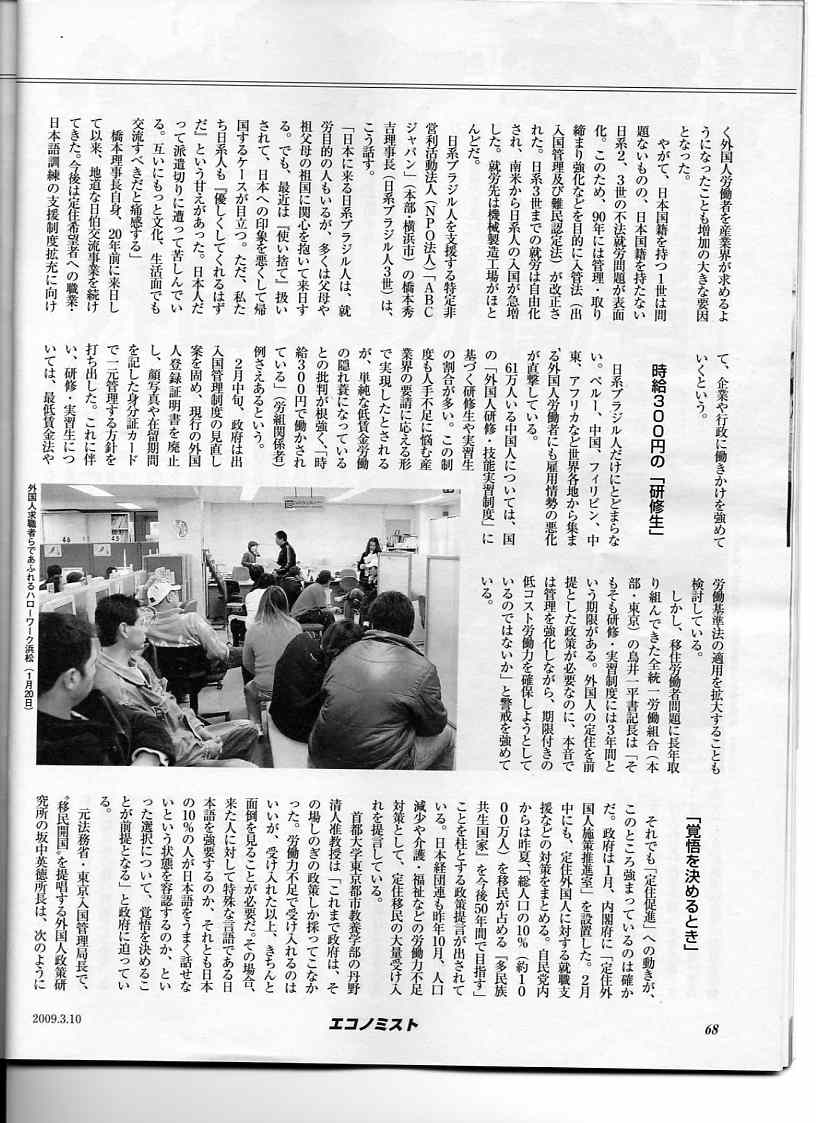
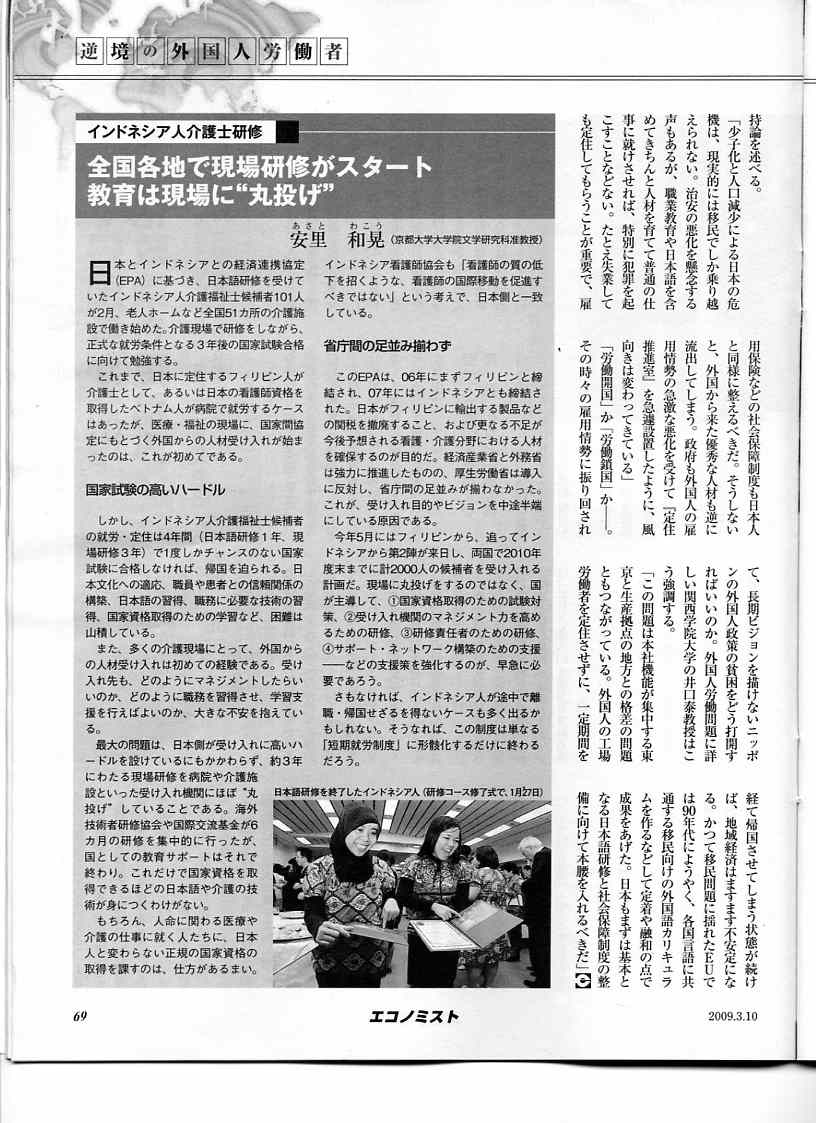
7) Ekonomisuto March 10 2009 re worsening job and living conditions for Nikkei Brazilians et al.
8 ) Mainichi: Lawson hiring more NJ, offering Vietnamese scholarships
9) Japan Times on Japan’s emerging NJ policing laws. Nichibenren: “violation of human rights”
10) Mark in Yayoi on cop checkpoint #123, and “Cops”-style TV show transcript
11) Japanese also fingerprinted, at Narita, voluntarily, for “convenience” (not terrorism or crime)
REVIEWS:
12) Thoughts on Suo Masayuki’s movie “I just didn’t do it”: A must-see.
13) Audience reactions to documentary SOUR STRAWBERRIES roadshow March 21-April 1
Next showing Sapporo Apr 23, organizing next roadshow August-September
14) Debito.org has citations in 37 books, according to Amazon
15) The definition of “Gaijin” according to Tokyu Hands Nov 17, 2008
… and finally... THE MUSE:
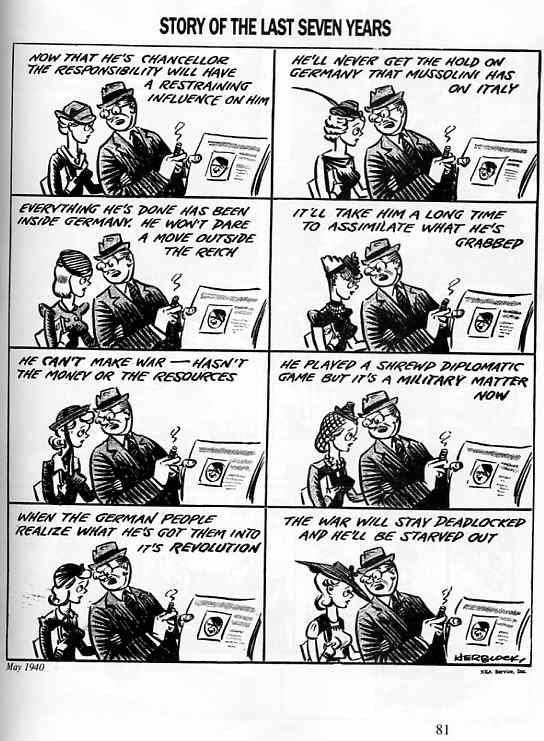
16) Complete tangent: 1940 Herblock cartoon on inaction towards Hitler
///////////////////////////////////////////////////////////
By Arudou Debito, Sapporo, Japan
debito@debito.org, www.debito.org
Freely forwardable
///////////////////////////////////////////////////////////
NEWS:
1) See I told you so #1: Newcomer PR outnumber Oldcomer Zainichis as of 2007
Mainichi: With more and more foreign residents facing employment and immigration problems due to the ongoing recession, the Ministry of Justice is creating new “One Stop Centers” for foreign residents in the Kanto and Tokai regions to handle queries in one place…
The number of native and Japan-born Koreans with special permanent residency, who have lived in Japan since the pre-war period, has been declining. However, the number of Chinese and Filipinos, as well as foreigners of Japanese descent whose employment was liberalized under the 1990 revision to the Law on Immigration Control and Refugee Recognition, has surged. In 2007, the number of these so-called “new comers” exceeded that of special permanent residents for the first time (440,000 vs. 430,000).
COMMENT: Believe Immigration’s plausibly pleasant intentions if you like, but I’ll remain a little skeptical for the moment. Still mentioned is that hackneyed and ludicrous concern about garbage separation, after all, demonstrating that the GOJ is still dealing in trivialities; it might take a little while before the government sees what true assimilation actually means. It’s not just giving information to NJ. It’s also raising awareness amongst the Japanese public about why NJ are here in the first place.
https://www.debito.org/?p=2852
///////////////////////////////////////////////////////////
2) NPA enforcing Hotel Management Law against exclusionary Prince Hotel Tokyo
Asahi: Police sent papers to prosecutors Tuesday against the operator of a Tokyo hotel that refused entry to the Japan Teachers Union for its annual convention, fearing protests by right-wing groups.
Police said Prince Hotels Inc., its president, Yukihiro Watanabe, 61, the 52-year-old general manager of three Prince group hotels, and managers of the company’s administration and reception departments are suspected of violating the Hotel Business Law.
COMMENT: This is a good precedent. The police are at last enforcing the Hotel Management Law, which says you can’t refuse people unless there are no rooms, there’s a threat to public health, or a threat to public morals. But hotels sometimes refuse foreigners, even have signs up to that effect. They can’t legally do that, but last time I took it before the local police box in Tokyo Ohkubo, they told me they wouldn’t enforce the law. Not in this case.
https://www.debito.org/?p=2766
///////////////////////////////////////////////////////////
3) Yomiuri: NPA finally cracking down on Internet BBS threats and defamation
Yomiuri: Police on Friday sent papers to prosecutors on six people suspected of defaming or threatening to physically harm comedian Smiley Kikuchi in messages they posted on his blog after groundlessly concluding he was involved in the murder of a high school girl in 1989…
It is the first time a case has been built simultaneously against multiple flamers over mass attacks on a blog. The police’s reaction represents a strong warning against making online comments that cross the line from freedom of expression to defamation or threats.
COMMENT: Now if only Japan’s police would only enforce past pertinent Civil Court decisions…
https://www.debito.org/?p=2837
///////////////////////////////////////////////////////////
4) Mainichi: Tourism to Japan plunges by over 40% compared to last year
Mainichi: The JNTO said Wednesday that 408,800 foreigners visited Japan in February, a 41.3 percent decrease from the same month the previous year. The rate of decline was the second largest since statistics were first kept in 1961, after a 41.8 percent reduction in August 1971, the year following the Osaka Expo.
COMMENT: We have tourism to Japan plunging, the second-highest drop in history. Of course, the high yen and less disposable income to go around worldwide doesn’t help, but the Yokoso Japan campaign to bring 10 million tourists to Japan is definitely not succeeding. Not helping are some inhospitable, even xenophobic Japanese hotels, or the fingerprinting campaign at the border (which does not only affect “tourists”) grounded upon anti-terror, anti-crime, and anti-contageous-disease policy goals. Sorry, Japan, must do better. Get rid of the NJ fingerprinting campaign, for starters.
Very active discussion on the causes of the drop at
https://www.debito.org/?p=2840
///////////////////////////////////////////////////////////
5) Metropolis Mag on how to get your housing deposit (shikikin) back
THAT SHIKIKIN FEELING
METROPOLIS MAGAZINE (TOKYO) DELVES INTO THE CONFUSING WORLD OF APARTMENT DEPOSITS
AND HOW TO GET THEM BACK
You may feel like you’ve had to wrestle with all kinds of bureaucracy to land that perfect 1DK apartment, but the fun and games don’t end when the contract is stamped. Moving out can present a whole new world of hassle. For many tenants, both foreign and Japanese, the hard-earned shikikin (deposit) they paid when they moved in becomes nothing but a distant memory, as landlords have their way with the cash and return only the change to the renter.
Kazutaka Hayakawa works for the NPO Shinshu Matsumoto Alps Wind, a group that specializes in helping get that deposit back. Here he offers up the basics on renters’ rights…
https://www.debito.org/?p=2801
///////////////////////////////////////////////////////////
BLUES:
6) GOJ bribes Nikkei NJ with Golden Parachutes: Go home and don’t come back
Mainichi: Japan began offering money Wednesday for unemployed foreigners of Japanese ancestry to go home, mostly to Brazil and Peru, to stave off what officials said posed a serious unemployment problem.
Thousands of foreigners of Japanese ancestry, who had been hired on temporary or referral contracts, have lost their jobs recently, mostly at manufacturers such as Toyota Motor Corp. and its affiliates, which are struggling to cope with a global downturn…
The government will give 300,000 yen ($3,000) to an unemployed foreigner of Japanese ancestry who wishes to leave the country, and 200,000 ($2,000) each to family members, the ministry said. But they must forgo returning to Japan. The budget for the aid is still undecided, it said.
COMMENT: Here’s the ultimate betrayal: Hey Gaijin, er, Nikkei! H ere’s a pile of money. Leave and don’t come back.
So what if it only applies to people with Japanese blood (not, for example, Chinese). And so what if we’ve invited you over here for up to two decades, taken your taxes and most of your lives over here as work units, and fired you first when the economy went sour. Just go home. You’re now a burden on Us Japanese. You don’t belong here, regardless of how much you’ve invested in our society and saved our factories from being priced out of the market. You don’t deserve our welfare benefits, job training, or other social benefits that are entitled to real residents and contributors to this country.
https://www.debito.org/?p=2860
///////////////////////////////////////////////////////////
7) Ekonomisuto March 10 2009 re worsening job and living conditions for Nikkei Brazilians et al.
Shuukan Ekonomisuto (from Mainichi Shinbun presses) dated March 10, 2009 had yet another great article on how things are going for Nikkei NJ et al.
Highlights: Numbers of Nikkei Brazilians are dropping (small numbers in the area surveyed) as economic conditions are so bad they can’t find work. Those who can go back are the lucky ones, in the sense that some with families can’t afford the multiple plane tickets home, let alone their rents. Local NGOs are helping out, and even the Hamamatsu City Government is offering them cheap public housing, and employing them on a temporary basis. Good. Lots of fieldwork and individual stories are included to illustrate people’s plights.
The pundits are out in force offering some reasonable assessments. Labor union leader Torii Ippei wonders if the recent proposals to reform the Trainee Visa system and loosen things up vis-a-vis Gaijin Cards and registration aren’t just a way to police NJ better, and make sure that NJ labor stays temp, on a 3-year revolving door. Sakanaka Hidenori says that immigration is the only answer to the demographic realities of low birthrate and population drop. The LDP proposed a bill in February calling for the NJ population to become 10% of the total pop (in other words, 10 million people) within fifty years, as a taminzoku kyousei kokka (a nation where multicultures coexist). A university prof named Tanno mentions the “specialness” (tokushu) of nihongo, and asks if the GOJ has made up its mind about getting people fluent in the language. Another prof at Kansai Gakuin says that the EU has come to terms with immigration and labor mobility, and if Japan doesn’t it will be the places that aren’t Tokyo or major industrial areas suffering the most.
The biggest question is posed once again by the Ekonomisuto article: Is Japan going to be a roudou kaikoku or sakoku? It depends on the national government, of course, is the conclusion I glean.
https://www.debito.org/?p=2721
///////////////////////////////////////////////////////////
8 ) Mainichi: Lawson hiring more NJ, offering Vietnamese scholarships
On the heels of Japan’s latest wheeze to cover up it’s failed Nikkei import labor policy, here’s a bit of good news: Somebody trying to do their bit to help keep unemployed NJs’ heads above water. Lawson convenience stores.
I smiled until I saw how small the numbers being employed full time were, despite the “quadrupling” claimed in the first paragraph. But every little bit helps. So does Lawson’s offer for scholarships for Vietnamese exchange students (see Japanese below).
Many times when I go into convenience stores in the Tokyo area, I’m surprised how many Chinese staff I see. Anyway, patronize Lawson if they’re trying to do good for the stricken NJ community.
https://www.debito.org/?p=2868
///////////////////////////////////////////////////////////
9) Japan Times on Japan’s emerging NJ policing laws. Nichibenren: “violation of human rights”
Japan Times: The Japan Federation of Bar Associations and nonprofit organizations voiced concern Wednesday that bills to revise immigration laws will violate the human rights of foreign residents.
Namba and Nobuyuki Sato of the Research-Action Institute for the Koreans in Japan urged lawmakers to amend the bills so the state can’t use the zairyu card code number as a “master key” to track every detail of foreigners’ lives. “Such a thing would be unacceptable to Japanese, and (the government) must explain why it is necessary for foreigners,” Sato said.
https://www.debito.org/?p=2833
///////////////////////////////////////////////////////////
10) Mark in Yayoi on cop checkpoint #123, and “Cops”-style TV show transcript
Turning the keyboard over to Mark in Yayoi, who has just been stopped for the 123rd time by the Japanese police for an ID Check.
This time, however, he was stopped and demanded a bag search. Although NJ are not protected against random ID checks (if he shows, you must show), random searches are in fact something protected against by the Constitution (Article 35) if you don’t feel like cooperating. But tell the cops that. He did. See what happened.
https://www.debito.org/?p=2806
///////////////////////////////////////////////////////////
11) Japanese also fingerprinted, at Narita, voluntarily, for “convenience” (not terrorism or crime)
As many of you know (or have experienced, pardon the pun, firsthand), Japan reinstituted its fingerprinting for most non-Japanese, be they tourist or Regular Permanent Resident, at the border from November 2007. The policy justification was telling: prevention of terrorism, crime, and infectious diseases. As if these are a matter of nationality.
Wellup, it isn’t, as it’s now clear what the justification really is for. It’s for the GOJ to increase its database of fingerprints, period, of everyone. Except they knew they couldn’t sell it to the Japanese public (what with all the public outrage over the Juuki-Net system) as is. So Immigration is trying to sell automatic fingerprinting machines at Narita to the public as a matter of “simplicity, speed and convenience” (tansoka, jinsokuka ribensei).
https://www.debito.org/?p=2745
///////////////////////////////////////////////////////////
REVIEWS:
12) Thoughts on Suo Masayuki’s movie “I just didn’t do it”: A must-see.
See Suo Masayuki’s movie SORE DE MO, BOKU WA YATTENAI (I Just Didn’t Do It), everyone. I did. It’s an excellent illustration of court procedure in Japan long, drawn-out, well researched, and necessarily tedious. Experience vicariously what you might go through if arrested in Japan.
Don’t think it just won’t happen to you. Random searches on the street without probable cause are permitted by law only for NJ. If you’re arrested, you will be incarcerated for the duration of your trial, no matter how many years it takes, even if you are adjudged innocent (the Prosecution generally appeals), because NJ are not allowed bail (only a minority of Japanese get it as well, but the number is not zero; NJ are particularly seen as a flight risk, and there are visa overstay issues). And NJ have been convicted without material evidence (see Idubor Case). Given the official association with NJ and crime, NJ are more likely to be targeted, apprehended, and incarcerated than a Japanese.
If it happens to you, as SOREBOKU demonstrates, you will disappear for days if not weeks, be ground down by police interrogations, face months if not years in trial if you maintain innocence, have enormous bills from court and lawyers’ fees (and if you lose your job for being arrested, as often happens, you have no income), and may be one of the 0.1 percent of people who emerge unscathed; well, adjudged innocent, anyway.
Like getting sick in the US (and finding that the health care system could destroy your life), getting arrested in Japan could similarly ruin yours. It’s Japan’s SICKO system…
https://www.debito.org/?p=2705
///////////////////////////////////////////////////////////
13) Audience reactions to documentary SOUR STRAWBERRIES roadshow March 21-April 1
Next showing Sapporo Apr 23, organizing next roadshow August-September
Some various and sundry thoughts on audience reactions to the excellent SOUR STRAWBERRIES documentary as we finish up the last screenings (thinking about another August-September tour, so book me if you’re interested), and consider what the movie may mean in the context of international labor migration. In sum, SOUR STRAWBERRIES may be a testiment to the last days of Japan’s internationalized industrial prowess, as people are being turfed out because no matter how many years and how much contribution, they don’t belong. Have to wait and see. But to me it’s clear the GOJ is still not getting beyond seeing NJ as work units as opposed to workers and people. Especially in these times of economic hardship. I saw it for myself as the movie toured.
A quick positive review from Japan Visitor site on documentary SOUR STRAWBERRIES Japan’s Hidden Guest Workers. Excerpt here.
http://japanvisitor.blogspot.com/2009/04/arudou-debito-and-sour-strawberries.html
If you’d like a showing in your area like the one mentioned above, be in touch with me at debito@debito.org. Planning another nationwide tour between late August and early September.
Next showing March 23, L-Plaza, Sapporo. More at:
https://www.debito.org/?p=2894
If you’d like to contact the directors or order a copy of the movie (it’s a great educational aid), go to:
http://www.cinemabstruso.de/strawberries/main.html
///////////////////////////////////////////////////////////
14) Debito.org has citations in 37 books, according to Amazon
Just indulge me a little here as I talk about something that impressed me about the power of the Internet.
It started during a search on Amazon.com two weeks, when I found an amazing avenue for researching insides of books for excerpts.
I realized I could go through and see just how often Debito.org is being cited as a resource in respectable print publications. I soon found myself busy: 37 books refer in some way to me by name or things archived here. I cite them all below from most recent publication on down.
Amazing. Debito.org as a domain has been going strong since 1997, and it’s taken some time to establish a degree of credibility. But judging by the concentration of citations in recent years, the cred seems to be compounding.
https://www.debito.org/?p=2786
///////////////////////////////////////////////////////////
15) The definition of “Gaijin” according to Tokyu Hands Nov 17, 2008
Here’s the definition of “gaijin” not according to me (a la my Japan Times columns), but rather according to the marketplace. Here’s a photo sent in by an alert shopper, from Tokyu Hands November 17, 2008.
https://www.debito.org/?p=2012
Note what makes a prototypical “gaijin” by Japanese marketing standards: blue eyes, big nose, cleft chin, and outgoing manner. Not to mention English-speaking. Yep, we’re all like that. Anyone for buying some bucked-tooth Lennon-glasses to portray Asians in the same manner? Naw, that would get you in trouble with the anti-defamation leagues overseas. Seems to me we need a league like that over here…
///////////////////////////////////////////////////////////
… and finally… THE MUSE:
16) Complete tangent: 1940 Herblock cartoon on inaction towards Hitler
A quick tangent for a weekend blogging: A 1940 Herblock cartoon I found (one of my favorites ever) demonstrating how people will make dithering arguments against the inevitable: in the cartoon’s case against doing something to stop Hitler. Now compare that with the dithering arguments against doing something to stop racial discrimination in Japan, with a law against it.
https://www.debito.org/?p=2889
///////////////////////////////////////////////////////////
All for today. Thanks for reading!
Arudou Debito, Sapporo, Japan
debito@debito.org, www.debito.org
Speaking schedule at https://www.debito.org/?page_id=1672
Please feel free to contact me if you would like a presentation in your area.
DEBITO.ORG NEWSLETTER APRIL 6, 2009 ENDS
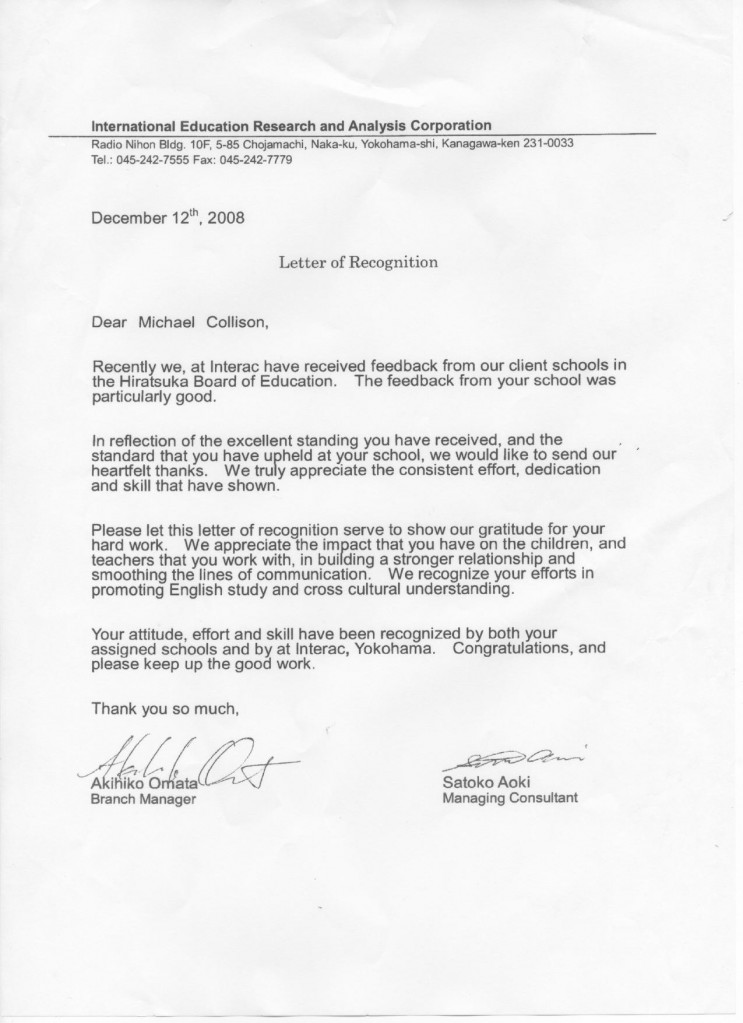
mytest
Tomorrow, Tuesday April 7, sees my next Japan Times column: 1500 words on the GOJ’s latest wheeze to reduce unemployment figures and welfare costs by reexporting imported NJ labor.
As of April 1, Nikkei Brazilians etc. are being offered 300,000 yen to go back to their home countries. That’s right: Only Nikkeis. It’s the ultimate bellwether of a failed policy of bringing people in, leaching them of their best years of their lives as work units, then bribing them to leave before they can claim their investments in taxes and social services. Ersatz Golden Parachutes.
And it’s only for Nikkeis, not the Chinese etc. “trainees” who have likewise been fired, despite working longer hours for lower pay and no social benefits. They stand to lose, according to SOUR STRAWBERRIES, their very livelihoods even back in China as they default on their travel loans. But as far as the GOJ goes, they have the wrong blood. Sorry.
Anyway, do get a copy of the JT tomorrow (Weds in the provinces). Arudou Debito in Sapporo
mytest


![]()
Hi Blog. A rather unusual request from overseas today. I received word from some Americans that have a Japanese World War II artifact they would like to repatriate. Here’s their communique, forwarded with permission, altered for privacy. Debito
==========================================

mytest


![]()
Hi Blog. A review from Japan Visitor Blog on documentary SOUR STRAWBERRIES.
http://japanvisitor.blogspot.com/2009/04/arudou-debito-and-sour-strawberries.html
Excerpt:
“…I attended a meeting in Tokyo at the end of last month, part of a 10-day tour of the Kanto and Kansai regions by Arudou Debito, where he promoted the documentary Sour Strawberries – Japan’s hidden guest workers.
Sour Strawberries is a 60-minute film shot in Tokyo in March 2008 by a German-Japanese film crew that focuses on the issue of discrimination in Japan, mainly as it affects foreign workers from other Asian countries.
Numerous interviews in the film reveal the blatancy of discrimination in Japan, with foreign workers treated very much like slaves, most notably the workers who inspired the film’s title: strawberry pickers from China who worked days of at least 12 hours, 365 days a year, and whose passports were taken from them by their employer.
Union activism in defense of victims of discrimination in Japan is also liberally documented, the most startling example being the story told by a Japanese union activist, Torii Ippei of the Zentôitsu Workers Union, who, in response to his efforts in one case involving foreign workers, was doused in gasoline and set alight by the infuriated employer….”
Go check out the site. There’s even an awful picture of me. The things I do to show off “Japanese Only” T-shirts…
If you’d like a showing in your area like the one mentioned above, be in touch with me at debito@debito.org. Planning another nationwide tour between late August and early September.
Next showing:
///////////////////////////////////////////////////////////////
THURS APRIL 23, 2009. 7PM
Sapporo L-Plaza for Hokkaido International Business Association (HIBA)
Sapporo Chuo-ku Kita 8 Nishi 3
http://www.danjyo.sl-plaza.jp/information/index.html
(just off JR Sapporo Station’s North Exit (kitaguchi), follow the underground exits to the very end).
///////////////////////////////////////////////////////////////
Arudou Debito in Sapporo
mytest


![]()
Hi Blog. Little tangent on a Saturday. My travel reading was HERBLOCK: A CARTOONIST’S LIFE, by Herbert Block. He’s that cartoonist who caricatured presidential administrations from Hoover to Clinton. I loved his work for its prescience and insight.
My favorite cartoon out of the 200 in the book was one about Hitler in 1940. Have a gander:

The reason I love this so much is because it demonstrates that inaction towards the inevitable, justified by self-convincing sophistries, is timeless. We learned this history in retrospect, where Americans apparently took up arms promptly against a clearly evil foe, came to Europe’s aid, vanquished the Axis Powers and saved the world. Not so. As this cartoon illustrates brilliantly, it took nearly a decade of dithering (practically until 1945 before people even believed Nazi Germany had extermination camps!) before people finally did what they had to do. Meanwhile, they came up with all sorts of intelligent-sounding arguments to justify doing nothing.
How does this relate to Debito.org? Because we get the same sort of arguments for doing nothing, say, against the evil of clear and present racial discrimination in Japan. We say it’s some kind of misunderstanding, language, or cultural barrier. Or that foreigners brought it upon themselves. Or that Japan’s unique culture or long history of being a closed island society makes it special or blind to the issue. Or that once the older generation dies out or people travel more or get used to foreigners things will change. Or that fundamental attitudes won’t change even if we make a racial discrimination law illegal. Or that Japan actually is a fundamentally thoroughbred pure society and should be kept pristine. Or that people are imposing outsider values on the poor put-upon Japanese people. Or that international treaty is not binding enough to justify a law when we have an adequate judiciary…
There, that’s eight intelligent-sounding pseudo-scientific arguments, just like in the cartoon above.
But they’re all bullshit. There is no getting around the fact we need a law against racial discrimination. Now.
But people, as history shows, will even make arguments for doing nothing against Hitler.
They are on the wrong side of history.
Arudou Debito in Sapporo
mytest


![]()
Hi Blog. On the heels of yesterday’s post, depicting Japan’s latest wheeze to cover up it’s failed Nikkei import labor policy, here’s a bit of good news: Somebody trying to do their bit to help keep unemployed NJs’ heads above water. Lawson convenience stores.
I smiled until I saw how small the numbers being employed full time were, despite the “quadrupling” claimed in the first paragraph. But every little bit helps. So does Lawson’s offer for scholarships for Vietnamese exchange students (see Japanese below).
Many times when I go into convenience stores in the Tokyo area, I’m surprised how many Chinese staff I see. Anyway, patronize Lawson if they’re trying to do good by the stricken NJ community. Arudou Debito in Sapporo
=================================
(Mainichi Japan) April 2, 2009, courtesy of Jeff K.
http://mdn.mainichi.jp/mdnnews/news/20090402p2a00m0na003000c.html
Japanese convenience store chain Lawson almost quadrupled the number of fulltime foreign employees it hired this spring as it searches for a new growth path amid stagnant consumption and fierce competition in the industry.
“Let’s create innovative ideas by fusing diverse views and different cultures,” said Takeshi Niinami, the president of Lawson, Inc. The company started hiring foreigners as regular employees last spring.
Compared to last year’s 10 new foreign employees, the convenience store giant hired 39 new workers, who studied in Japan, among a total of 122 regular employees this spring, made up of 28 Chinese, four South Koreans, three Taiwanese, two Vietnamese and one each from Indonesia and Bangladesh.
According to the company, like their Japanese counterparts, the foreign employees will work at directly-managed stores across Japan for about three years.
ENDS
==================================
ローソン新入社員:3割超はアジアの外国人…多彩な価値観
毎日新聞 2009年4月1日
http://mainichi.jp/select/biz/news/20090402k0000m040057000c.html
大手コンビニエンスストア、ローソンに1日入社した122人の新入社員のうち、日本に留学した中国などアジア出身の外国人が3割超の39人を占めた。消費低迷と競争激化で国内市場が頭打ちとなる中、異なった価値観を持つ人材をそろえ、新たな成長の糸口をつかむのが狙いだ。
39人の出身地は中国28、韓国4、台湾3、ベトナム2、インドネシア、バングラデシュの各1人。初の外国人採用となった昨春の10人から、一気に3倍以上に増えた。
新浪剛史社長は東京都内で行った入社式で「多様な考え、異なる文化を持った新入社員が交ざり合い、わくわくするような新しい発想を生み出していこう」と激励した。
同社によると入社後は外国人社員も日本人と同様、3年前後、全国の直営店で接客業務をこなす。08年の新入社員では、おせち料理の予約数で日本人以上の好成績を上げた人材もいたという。
ENDS
============================
平成21年3月25日 毎日オンライン
http://mainichi.jp/select/biz/release/01/news/20090325p0400a021017000c.html
ローソン(東京品川区:代表取締役社長CEO 新浪剛史)は、2009年4月より、日本に留学を希望するベトナムの学生のための奨学金制度を設立し、人材育成に民間レベルで貢献いたします。
一期生2名が3月に来日し、4月より日本の学校に入学いたします。
ローソンは商品の原材料調達の縁を発端に、ベトナムとの関係を築いてまいりました。
ベトナムの学生は勤勉で、多くの学生が日本への留学を希望していると知り、今回の制度を設立致しました。この制度がベトナムの発展に寄与し、日本との友好がさらに深まることを期待しています。
<年間募集人員>
2009年度を初年度とし、毎年新たに25名を募集致します。
特待生:5名
一般生:20名
(4月入学の2名を含み、今年度合計25名となります。)
◎給付内容
▼対象者
日本の大学に留学を希望するベトナムの25才以下の男女
▼給付期間
日本に在留し学校で学んでいる期間(最大6年:一年毎に更新面談)
▼給付金額
特待生(20才以下):年間120万円 住宅補助月3万円
一般生(25才以下):年間30万円 住宅補助なし
◎選考フロー
▼10月入学
4月ベトナム国内にて説明会 → 5月・7月に選考 → 合否通知
▼4月入学
10月ベトナム国内にて説明会 → 11月・12月に選考 → 合否発表
(募集に関する説明会をハノイ市とホーチミン市にて実施)
◎その他
奨学金の返済は不要です。但し、中途退学および成績不良の場合は返済義務が発生します。
■問い合わせ先■ローソン[2651.T]
※発表日 2009年3月24日
以 上
2009年3月25日 ends
mytest


![]()
Hi Blog. Here’s the ultimate betrayal: Hey Gaijin, er, Nikkei! Here’s a pile of money. Leave and don’t come back. So what if it only applies to people with Japanese blood (not, for example, Chinese). And so what if we’ve invited you over here for up to two decades, taken your taxes and most of your lives over here as work units, and fired you first when the economy went sour. Just go home. You’re now a burden on Us Japanese. You don’t belong here, regardless of how much you’ve invested in our society and saved our factories from being priced out of the market. You don’t deserve our welfare, job training, or other social benefits that are entitled to real residents and contributors to this country.
Why did I have the feeling this was coming? Arudou Debito back in Sapporo
=========================
(Article courtesy of lots of people, thanks!)
Original Ministry of Health, Labour, and Welfare proposal in Japanese, courtesy of Silvio:
http://www.mhlw.go.jp/houdou/2009/03/dl/h0331-10a.pdf
====================
(Mainichi Japan and Japan Today) April 1, 2009
http://mdn.mainichi.jp/mdnnews/news/20090401p2g00m0dm008000c.html
and
TOKYO (AP) — Japan began offering money Wednesday for unemployed foreigners of Japanese ancestry to go home, mostly to Brazil and Peru, to stave off what officials said posed a serious unemployment problem.
Thousands of foreigners of Japanese ancestry, who had been hired on temporary or referral contracts, have lost their jobs recently, mostly at manufacturers such as Toyota Motor Corp. and its affiliates, which are struggling to cope with a global downturn.
The number of foreigners seeking government help to find jobs has climbed in recent months to 11 times the previous year at more than 9,000 people, according to the Ministry of Health, Labor and Welfare.
“The program is to respond to a growing social problem,” said ministry official Hiroshi Yamashita.
Japan has tight immigration laws, and generally allows only skilled foreign workers to enter the country. The new program applies only to Brazilians and Peruvians of Japanese ancestry who have gotten special visas to do assembly line and other manufacturing labor. It does not apply to other foreigners in Japan, Yamashita said.
The government will give 300,000 yen ($3,000) to an unemployed foreigner of Japanese ancestry who wishes to leave the country, and 200,000 ($2,000) each to family members, the ministry said. But they must forgo returning to Japan. The budget for the aid is still undecided, it said.
The visa program for South Americans of Japanese ancestry was introduced partly in response to a labor shortage in Japan, where the population is shrinking and aging. But the need for such workers has dwindled in recent months after the global financial crisis hit last year. The jobless rate has risen to 4.4 percent, a three-year high.
Tokyo has already allocated 1.08 billion yen ($10.9 million) for training, including Japanese language lessons, for 5,000 foreign workers of Japanese ancestry.
Major companies traditionally offer lifetime employment to their rank and file, and so workers hired on temporary contracts have been the first to lose their jobs in this recession.
(Mainichi Japan) April 1, 2009
ENDS
==============================
TOKYO (AP) — Japan is offering $3,000 for a plane ticket home to some foreigners who have lost their jobs, a sign of just how bad the economic slump has gotten.
The program, which began Wednesday, applies only to several hundred thousand South Americans of Japanese descent on special visas for factory work. The government’s motivation appears to be three-fold: help the workers get home, ease pressure on the domestic labor market and potentially get thousands of people off the unemployment rolls.
“The program is to respond to a growing social problem,” said Hiroshi Yamashita, an official at the Ministry of Health, Labor and Welfare, referring to joblessness, which has climbed to a three-year high of 4.4 percent.
But there may not be too many takers for the 300,000 yen ($3,000) handout, plus 200,000 yen ($2,000) for each family member. The money comes with strings attached: The workers cannot return to Japan on the same kind of visa.
Given Japan’s strict immigration laws, that means most won’t be able to come back to work in Japan, where wages are higher than in Latin America.
“It is not necessarily a totally welcome deal,” said Iwao Nishiyama, of the Association of Nikkei & Japanese Abroad, a government-backed organization that connects people of Japanese ancestry.
The government’s offer — as well as the backdrop of history that has given birth to a vibrant community of South Americans of Japanese ancestry here — highlight this nation’s complex views on foreigners and cultural identity.
Many Japanese consider their culture homogenous, even though there are sizeable minorities of Koreans and Chinese, as well as Ainu, the indigenous people of northern Japan.
In the early 1990s, Tokyo relaxed its relatively tight immigration laws to allow special entry permits for foreigners of Japanese ancestry in South America to make up for a labor shortage at this nation’s then-booming factories.
They took the so-called “three-K” jobs, standing for “kitsui, kitanai, kiken” — meaning “hard, dirty, dangerous” — jobs Japanese had previously shunned.
Before their arrival, many such jobs had gone to Iranians and Chinese. But the government saw their influx — much of it illegal — as a problem and was eager to find a labor pool it felt would more easily adapt to Japanese society, said Nishiyama of Japanese Abroad association.
So by virtue of their background, these foreigners of Japanese descent — called “Nikkei” in Japanese — were offered special visa status.
“They may speak some Japanese, and have a Japanese way of thinking,” Nishiyama said. “They have Japanese blood, and they work hard.”
The workers are mainly descendants of Japanese who began emigrating to Latin America around the turn of the last century.
Brazil has the biggest population of ethnic Japanese outside Japan, numbering about 1.5 million. Last year marked the 100th year of Japanese immigration to Brazil. Initially many ventured to toil in coffee plantations and other farms.
Brazilians are the most numerous of such foreigners in Japan, totaling about 310,000 overall in 2007, the latest tally available. Peruvians are next at 59,000. Those from other South American nations were fewer at 6,500 Bolivians, 3,800 Argentineans and 2,800 Colombians.
Nearly all work manufacturing jobs, many through job referral agencies. Major companies, like Toyota Motor Corp., have relied on contract employees to keep a flexible plant work force.
Foreign workers in Japan are entitled to the basic unemployment and other benefits that Japanese workers get. Though rates vary, Japan provides about 7,000 yen ($71) a day in unemployment — which would equal about $2,100 per month.
Still, Nikkei are sometimes victims of discrimination in Japan, as they are culturally different and aren’t always fluent in Japanese. As a result, many have had a hard time blending into Japanese society.
Now, as the economy worsens, many find themselves out of jobs.
The government doesn’t track the number of jobless foreigners, but the number of foreigners showing up at government-run centers for job referral has climbed in recent months to 11 times the previous year at more than 9,000 people, according to the Ministry of Health, Labor and Welfare.
Overall, the government estimates that some 192,000 temporary workers who had jobs in October, including Japanese, are expected to be jobless by June. Experts fear such numbers are growing.
In addition to the handout offer the government is also helping Nikkei find jobs in Japan.
“These are like two sides of the same effort to assist people of Japanese ancestry,” said Yamashita of the labor ministry.
Tokyo has already allocated 1.08 billion yen ($10.9 million) for training, including Japanese language lessons, for 5,000 foreign workers.
Fausto Kishinami, 32, manager at a Brazilian restaurant in Oizumimachi, a city with a large Japanese-Brazilian population, said none of his friends are applying for the government money because of the no-return condition.
“I don’t think people should take that money,” he said, adding that he hasn’t gone home in eight years, and is focused on his work in Japan.
Some 20 percent to 30 percent of the South American foreigners of Japanese ancestry are estimated to have already returned home, said Nishiyama. They have paid their own way back and may return, once a recovery brings fresh opportunities, he said.
ENDS
mytest
Hi Blog. An update on how Japan’s police forces are cracking down on the nastiness of the Internet. About time. Now if only Japan’s police would only enforce past pertinent Civil Court decisions... Arudou Debito in Kumamoto
==========================
Police on Friday sent papers to prosecutors on six people suspected of defaming or threatening to physically harm comedian Smiley Kikuchi in messages they posted on his blog after groundlessly concluding he was involved in the murder of a high school girl in 1989.
Of the six whose cases were sent to the Tokyo District Public Prosecutors Office, two are suspected of threatening to physically harm Kikuchi, 37, on his blog. The remaining four–including a 45-year-old male university employee of Takatsuki, Osaka Prefecture, and a male company employee, 36, of Toda, Saitama Prefecture–are suspected of defaming him, according to the Metropolitan Police Department.
The two suspected of threatening Kikuchi with bodily harm, including a 36-year-old male construction worker of Iruma, Saitama Prefecture, allegedly continued sending threatening messages to Kikuchi through the blog even after he restricted access to its message board in April.
It is the first time a case has been built simultaneously against multiple flamers over mass attacks on a blog. The police’s reaction represents a strong warning against making online comments that cross the line from freedom of expression to defamation or threats.
According to the Metropolitan Police Department, the four suspected of defaming the comedian posted vicious comments, three or four times each, between early April and mid-August last year, wrongly concluding that he was involved in a 1989 murder in Adachi Ward, Tokyo, in which a high school girl was killed and her body abandoned in a drum and covered in cement.
The messages posted by the four included “You murderer! Why don’t you drop dead?” and “[You are] the one suspected of involvement in the confinement, assault and murder of a high school girl.”
The two suspected of threatening Kikuchi posted messages once and twice, respectively, between early May and early June, with one of them writing in a message: “Many guys are targeting you. Die!”
As the message board of the blog was flooded with malicious comments–including one that read, “How come a murderer can be a comedian?”–since it was set up in January last year. Kikuchi filed a complaint with the MPD in August.
The police had been investigating 18 people they were able to identify.
The police concluded that four of the 18 repeatedly posted vicious messages or made groundless accusations related to the murder.
Of the remaining 14 flamers, two were accused of making threats as they posted messages in which they clearly indicated their intention to harm the comedian.
===
Insults rife online
More than 3,000 messages expressing the hardship Internet users suffered as a result of defamation on the Internet were posted on a comedian’s blog after police announced in February they would pursue criminal responsibility for people who posted messages there wrongly accusing him of involvement in the 1989 murder of a teenage girl.
In messages posted on the blog of comedian Smiley Kikuchi, 37, people related their experiences after being the target of abuse on the Internet. One person posted a message expressing feelings of helplessness as he or she had to bear the pain silently.
According to the police, Kikuchi has been the subject of groundless defamation accusing him of involvement in the high school girl’s murder in Adachi Ward, Tokyo. The girl was killed by a group of teenage boys and her body left in a drum and covered in cement. The comedian’s blog has been flooded with similar messages since he set it up.
After the Metropolitan Police Department announced it was planning to send papers to prosecutors on people whose messages were especially malicious, Kikuchi expressed on Feb. 5 his feelings about the problem and how the defamatory messages escalated on his blog.
After that, more than 3,000 messages, many of them encouraging Kikuchi, were posted on his blog. The senders related their experiences of receiving verbal violence from anonymous people, including being harassed on their blogs or being defamed on informal alternative school bulletin boards. One person said harassing messages were even sent to his or her workplace.
According to the National Police Agency, it received 81,994 consultations about cybercrime from citizens last year–up 12 percent from 2007–with 11,516 from people complaining they were defamed on blogs and Internet bulletin boards. The number exceeded 10,000 for the first time.
mytest


![]()
Hi Blog. Here’s an article from the Mainichi courtesy of MS talking about making life easier for NJ through “one-stop centers”, noting (in a poorly-translated paragraph) that Newcomer Permanent Residents now outnumber the historical Zainichi Oldcomer Permanent Residents. And have done since 2007.
Anyway, the article follows. Believe Immigration’s plausibly pleasant intentions if you like, but I’ll remain a little skeptical for the moment. Still mentioned is that hackneyed and ludicrous concern about garbage separation, after all, demonstrating that the GOJ is still dealing in trivialities; it might take a little while before the government sees what true assimilation actually means. It’s not just giving information to NJ. It’s also raising awareness amongst the Japanese public about why NJ are here in the first place. Arudou Debito in Kumamoto
==========================
Mainichi Shinbun March 30, 2009
http://mdn.mainichi.jp/mdnnews/news/20090330p2a00m0na011000c.html
With more and more foreign residents facing employment and immigration problems due to the ongoing recession, the Ministry of Justice is creating new “One Stop Centers” for foreign residents in the Kanto and Tokai regions to handle queries in one place.
Until now, these issues were handled separately by local governments and regional immigration bureaus, but the three centers — to be set up in Tokyo, Saitama and Hamamatsu in Shizuoka Prefecture — will be open for consultations on all matters pertaining to foreign residents in the country, in an attempt to better integrate them into Japanese society.
“The immigration bureau is not just about exposing illegal residents, it’s now at a turning point where it can work toward creating a society where Japanese people and foreigners can live in harmony,” said an Immigration Bureau official.
The number of native and Japan-born Koreans with special permanent residency, who have lived in Japan since the pre-war period, has been declining. However, the number of Chinese and Filipinos, as well as foreigners of Japanese descent whose employment was liberalized under the 1990 revision to the Law on Immigration Control and Refugee Recognition, has surged. In 2007, the number of these so-called “new comers” exceeded that of special permanent residents for the first time (440,000 vs. 430,000).
As a result, there are fears that the number of children unable to speak Japanese, and of foreigners unable to fit into society, is also on the rise.
The centers will be staffed by local government and former immigration bureau employees, and will cover everything from residency procedures to how to correctly separate garbage.
The Hamamatsu center will open in April.
==================================
毎日新聞 2009年3月29日 東京朝刊
http://mainichi.jp/select/wadai/news/20090329ddm001010111000c.html
法務省は日本に定住する外国人の相談を広く受け付ける「ワンストップセンター」を、定住者が多い浜松市など関東・東海地方の3カ所に設置する方針を決めた。従来は自治体と入国管理局が相談内容ごとに相談を受け付けていたが、一括して「よろず窓口」として対応する。景気低迷で外国人の失業が相次いでおり、定住外国人との共生社会づくりに向け支援体制を整える。
日本の定住外国人は、戦前から住む在日韓国・朝鮮人ら特別永住者が減少傾向にある一方、90年の入管法改正で就労が自由化された日系人や中国人、フィリピン人ら「ニューカマー」と呼ばれる永住者が急増した。07年のニューカマーの永住者は約44万人で、特別永住者(約43万人)を初めて上回った。
このため、日本語が苦手な子供や風土になじめない外国人の増加が懸念されている。「1回で用事が済む」という意味のワンストップセンターは、入国管理局職員OBや自治体職員らが常駐し、在留手続きに関する問い合わせからゴミ出しや日本人との接し方まで幅広く相談に乗る。設置場所は浜松市のほか、さいたま市と東京23区内の計3カ所が選定された。浜松市については、4月に開設する。
失業した外国人の場合、元の在留資格が認められない場合もあり、再就職の相談と同時に法的な相談の必要も生まれる。これまでは、別々の窓口を訪れなければならなかった。医師や弁護士、労働相談員なども必要に応じて助言する。
入国管理局の担当者は「入管は不正の摘発だけでなく、外国人と共生できる社会づくりへの転換期にいる」と話す。【石川淳一】
ends
mytest
Hi Blog. Quick tangent for today. We have tourism to Japan plunging, the second-highest drop in history. Of course, the high yen and less disposable income to go around worldwide doesn’t help, but the Yokoso Japan campaign to bring 10 million tourists to Japan is definitely not succeeding. Not helping are some inhospitable, even xenophobic Japanese hotels, or the fingerprinting campaign at the border (which does not only affect “tourists”) grounded upon anti-terror, anti-crime, and anti-contageous-disease policy goals. Sorry, Japan, must do better. Get rid of the NJ fingerprinting campaign, for starters. Debito in Okayama
——————————————-
http://mdn.mainichi.jp/mdnnews/news/20090326p2a00m0na002000c.html
(Mainichi Japan) March 26, 2009, Courtesy of Jeff K
The number of foreign tourists to Japan in February declined by more than 40 percent, the Japan National Tourism Organization (JNTO) has announced.
The JNTO said Wednesday that 408,800 foreigners visited Japan in February, a 41.3 percent decrease from the same month the previous year. The rate of decline was the second largest since statistics were first kept in 1961, after a 41.8 percent reduction in August 1971, the year following the Osaka Expo.
The plunge in the number of foreign visitors to Japan is thought to have been caused mainly by the global recession. It is also believed attributable to last year’s leap year and the Lunar New Year holidays in January this year, which were in February last year.
ends
———————————-
http://mainichi.jp/select/wadai/news/20090326k0000m040062000c.html
日本政府観光局(JNTO)が25日発表した2月の訪日外国人旅行者数は、前年同月比41.3%減の40万8800人と大きく落ち込んだ。大阪万博の反動で減少した1971年8月(41.8%減)に次いで、統計を取り始めた61年以降で2番目の減少率となった。
世界的な景気後退が主因で、昨年がうるう年だったことや、昨年は2月だったアジアの旧正月の休暇が今年は1月だったことも影響した。
主要12カ国・地域すべてで訪日客が減少した。ウォン安が続く韓国が54.5%減と大幅に減ったのをはじめ、旧正月の要因が大きい中国、台湾、香港もそれぞれ25.9%、48.0%、60.4%の減少だった。【位川一郎】
ends
mytest


![]()
Hi Blog. Quick update for today. Japan Times reports due (but long overdue) outrage from some quarters regarding privacy issues and overdone punishments (the 200,000 yen fine being raised as an issue below is worthy of condemnation, but it’s NOT a change from the status quo — the fine is in place now under Gaitouhou Article 18!). But I doubt this debate will cause the MOJ or the GOJ to deviate from their ever-vigilant course of preferring policing NJ over treating them like other residents of Japan… incentives are ever in place for increasing the policing. Arudou Debito in Okayama
———————————————
Immigration reforms spell Big Brother, JFBA warns
The Japan Times, Thursday, March 26, 2009
By MINORU MATSUTANI, Staff writer, Courtesy of Mark MT
http://search.japantimes.co.jp/cgi-bin/nn20090326a3.html
The Japan Federation of Bar Associations and nonprofit organizations voiced concern Wednesday that bills to revise immigration laws will violate the human rights of foreign residents.
The bills were submitted to the Diet earlier this month and will be deliberated on soon.
Critics of the bills also said punishments for violators of the revised laws, including a fine of up to ¥200,000 for those not carrying the new “zairyu” (residence) card that will replace the current alien registration cards, are too harsh.
The bills propose consolidating the management of foreign residents’ data under the Justice Ministry, replacing the current system in which local governments take charge of foreign resident registration, while the ministry handles immigration control.
“Overall, the revision greatly lacks consideration of foreigners’ privacy. The level of consideration is so much lower than that for Japanese,” Mitsuru Namba, a lawyer and member of the JFBA’s human rights protection committee, told reporters in Tokyo.
Social Democratic Party chief Mizuho Fukushima, who was at the briefing, is ready to oppose the government in the House of Councilors. “The bills suggest monitoring of foreigners will be strengthened. Management of information will lead to surveillance of foreigners,” she said.
Namba and Nobuyuki Sato of the Research-Action Institute for the Koreans in Japan urged lawmakers to amend the bills so the state can’t use the zairyu card code number as a “master key” to track every detail of foreigners’ lives.
“Such a thing would be unacceptable to Japanese, and (the government) must explain why it is necessary for foreigners,” Sato said.
Rest at
http://search.japantimes.co.jp/cgi-bin/nn20090326a3.html
mytest
Hi Blog. I was asked a few days ago in the Comments Section to give you an update on how the documentary SOUR STRAWBERRIES Spring Tour was going. I’m in Okayama at the moment, fresh out of two screenings (one more to go, in Kumamoto), and a couple of hours in an internet cafe getting mentally prepared for an evening of partying, so here you go. A quick summary:
First, the executive summary at the very top. The response to this movie, about Japan’s hidden NJ migrant workers, has been remarkable. I have never sold so many DVDs and books ever on a tour (we sold out so fast — you can buy your own copies by clicking on the avatars above — that I had to have my stocks replenished twice on the road by post). Sixty DVDs and 40 books sold later, I think it’s prudent to plan yet another tour. I’ll be working down at Nagoya University the second week of September, so that takes care of the airfare costs to and from Hokkaido. For places that missed me this time, how about planning something late August/early September? If you’d like to schedule an event, please contact me at debito@debito.org.
Now for some tour highlights (directors Koenig and Kremers, please feel free to comment or answer questions if you’re reading this):
The first showing was at Second Harvest Japan, a very nice public service provided by Charles McJilton and company to provide homeless people with food that supermarkets decide not to sell. A capacity crowd (eating, you guessed it, leftover strawberries beyond the supermarket sell-by date) asked poignant questions about why the film covered the Trainees and Nikkei workers so well but didn’t mention those being human trafficked on “Entertainer” visas. I didn’t have the answer (I’m a promoter, Jim, not a producer or a director), but Patricia Aliperti, a scholar of human trafficking in Japan who serendipitously happened to be in attendance, gave us a firsthand account of how Japan was listed as a Tier-Two Human Trafficker by the US State Dept in 2004, promised to abolish its state-sponsored sexual slavery, reduced the number of NJ visa-ed women in the water trades on this visa by about 75%, then neglected to abolish the visa status completely. Seems to me within character.
One attendee of the first screening offered her thoughts here. http://hinoai.livejournal.com/716510.html
Other screnings were equally well-attended, with Amnesty International at Ben’s Cafe Takadanobaba pulling in at least 50 viewers and the Blarney Stone in Osaka pulling in close to the same. Smaller screenings in Tsukuba and Shiga had interested commentary from viewers asking about how the directors came to choose this subject, and why it took itinerant Germans to finally produce a movie of outstanding quality about this issue. The Nagoya University Labor Union screening was so full of Nikkei (as was the Okayama screening) that we decided the lingua franca for the Q&A would be Japanese language, and everyone, however haltingly for some, put their thoughts into Japanese.
Further sundry thoughts: Two Nikkei participants in the Okayama screening had lost their jobs at the end of January, were on unemployment, and were thinking they would probably have to return to Brazil when the dole money ran out in three months. I made sure they got a free copy of the DVD and of the HANDBOOK to show around, if that would help. Participants were nearly unanimous in both the power and necessity of labor unions to inform and enforce labor rights. The audience’s outrage was palpable over the GOJ’s negligence at inviting all these people here, neglecting the schooling of both them (the Okayama Nikkei, for example, worked 11 hours a day, six days a week, and had no time to study Japanese) and their children, and telling them to go home now that they “weren’t necessary”. After all their time spent here paying taxes, living here for years if not decades, and saving Japanese industry from being priced out of the market.
Rumor has it the GOJ has advised Hello Work to consider three Japanese for every non-Japanese applicant. It’s unconfirmed, but if true, that means nationality once again has become a job qualification, one should think in violation of Labor Standards Law.
Moreover, 2HJ’s Charles also told us that visa overstayers in Japan are actually being issued with Gaijin Cards from local governments (yes, stating that they are overstaying). That’s why they’re centralizing the Gaijin Card system behind the new Zairyuu Cards, to remove the local government’s discretion in these matters (so much for chihou bunken, then!). I’ll have more information later on in the blog after some confirmations.
In sum, SOUR STRAWBERRIES may be a testiment to the last days of Japan’s internationalized industrial prowess, as people are being turfed out because no matter how many years and how much contribution, they don’t belong. Have to wait and see. But to me it’s clear the GOJ is still not getting beyond seeing NJ as work units as opposed to workers and people. Especially in these times of economic hardship. I’m seeing it for myself as the movie tours.
Call me out for another movie tour by the end of the summer. I might by then be able to get FROM THE SHADOWS movie about child abductions after divorce as well. Arudou Debito in Okayama
mytest
Hi Blog. Debito.org went down in the middle of the night close to two days ago. Sysadmin tells me it was a technical problem with the ISP. It also seems to have nuked most emails I’ve gotten in the interim, so apologies to anyone who sent and bounced. Sorry for the delay. One more screening of SOUR STRAWBERRIES, in Kumamoto on Tuesday. Otherwise, I’m thinking about another tour in late August/early September. If you’d like the movie with commentary and an event, please contact me at debito@debito.org. If you just want a copy of the movie, click on the last gray avatar above. Bests, Debito in Okayama
mytest


![]()
Hi Blog. Writing to you from Nagoya, had a lovely evening with Andrew, Michael, and John eating spicy tebasaki, and a great discussion with all manner of labor union activists at Nagoya University before that. Next stop, documentary SOUR STRAWBERRIES showings tomorrow at Shiga University and Osaka at the Blarney Stone. Stop by and see this truly excellent movie, and snap up a DVD and a book (never had such a successful selling tour: Nearly 50 DVDs, nearly 40 books!)
Meanwhile, let me do a quick one for tonight, with the definition of “gaijin” not according to me (a la my Japan Times columns), but rather according to the marketplace. Here’s a photo sent in by an alert shopper, from Tokyu Hands November 17, 2008:
Very funny. Note what makes a prototypical “gaijin” by Japanese marketing standards: blue eyes, big nose, cleft chin, and outgoing manner. Not to mention English-speaking. Yep, we’re all like that.
Anyone for buying some bucked-tooth Lennon-glasses to portray Asians in the same manner? Naw, that would get you in trouble with the anti-defamation leagues overseas. Seems to me we need leagues like that over here… Arudou Debito in Nagoya
mytest


![]()
PUNISHING FOREIGNERS, EXONERATING JAPANESE
Growing evidence that Japan’s judiciary has double standards by nationality
By Arudou Debito
Column 47 for the Japan Times ZEIT GIST Community Page
March 24, 2009
http://search.japantimes.co.jp/cgi-bin/fl20090324zg.html
Based upon Debito.org Newsletter May 11, 2008 (https://www.debito.org/?p=1652)
DRAFT SIXTEEN, as submitted to Japan Times editor, version with links to sources
Examine any justice system and patterns emerge. For example, consider how Japan’s policing system treats non-Japanese. ZEIT GIST has discussed numerous times (Jul. 8 2008, Feb. 20 and Nov. 13 2007, May 24 2005, Jan. 13 2004, Oct. 7 2003) how police target and racially profile foreigners under anti-crime and anti-terrorism campaigns.
SOURCES: https://www.debito.org/?p=1767
https://www.debito.org/japantimes111307.html
https://www.debito.org/japantimes022007.html
https://www.debito.org/japantimes052405.html
https://www.debito.org/japantimes011304.html
http://search.japantimes.co.jp/member/member.html?fl20031007zg.htm
But the bias goes beyond cops and into criminal prosecution, with Japanese courts treating suspects differently according to nationality. We’ve already discussed how judges discount testimony from foreigners (ZG Aug. 14 2007), but here’s the emerging pattern: If you are a Japanese committing a crime towards a non-Japanese, you tend to get off lightly. Vice versa and you “haven’t a Chinaman’s chance,” as it were.
https://www.debito.org/japantimes081407.html
http://en.wikipedia.org/wiki/Chinaman’s_chance
For example, consider the Hiroshi Nozaki Case. In 2000, Nozaki was caught flushing a Filipina’s body parts down a public toilet. However, he was not charged with murder — only with “abandoning a corpse” (shitai iki). That got him all of three-and-a-half years in jail. By 2008 he was stowing another dismembered Filipina corpse, that of Honiefaith Ratila Kamiosawa, in a train station locker.
https://www.debito.org/?p=1633
We’ve had plenty of cases where Japanese men kill and mutilate Japanese women (e.g. Yoshio Kodaira, Kiyoshi Okubo), and they tend to get the hangman’s noose. Not Nozaki.
Contrast this with the case of Nigerian Osayuwamen Idubor, convicted on appeal in 2008 of sexually assaulting a Japanese woman. Sentenced to two years plus time served during trial, Idubor asserts that his confession was forced, that police destroyed crucial evidence, and most importantly that there was no material evidence. Didn’t matter: He got about as much jail time as Nozaki. Which means, pardon the ghoulish tone, that if Idubor had been Japanese and the woman foreign, he could have chopped her up without adding much to his sentence. If there was material evidence, that is.
SOURCE: https://www.debito.org/?p=1630
Hyperbole? Consider other crimes against non-Japanese women, like those by convicted serial rapist Joji Obara. His connection with the Lucie Blackman murder has been well-reported, particularly the botched police investigation despite ample material evidence — even video tapes of his rapes. Regardless, in 2007 Obara was acquitted of Blackman’s murder due to “lack of evidence”.
Obara did get life imprisonment (not death), since he was only charged with “rape leading to death” of nine other women (one of them foreign). But only after strenuous appeals from Blackman’s family was the acquittal overturned in 2008. Obara became guilty of “dismembering and abandoning” her corpse. Again, guilty of crimes to their dead bodies, not of making them dead.
https://www.debito.org/?p=2098
Lousy investigation http://search.japantimes.co.jp/cgi-bin/nn20070424f1.html
Now triangulate that with the case of Lindsay Ann Hawker, who was allegedly murdered by Tatsuya Ichihashi in 2007. The evidence here is damning too: video evidence of her accompanying him to his apartment building, her beaten and strangled body found in a tub of sand on his apartment balcony, and his fleeing barefoot when police visited to investigate. He’s still at large today. You can see his mug shot on police posters for people wanted for “murder” (satsujin). That is, except for Ichihashi. He’s just accused of “abandonment of a corpse”, again.
http://search.japantimes.co.jp/cgi-bin/nn20071211a5.html
http://search.japantimes.co.jp/cgi-bin/nn20070424f1.html


Last week I called Chiba Police inquiring about Ichihashi’s charges. An investigator entrusted with the case wouldn’t comment on specifics. Asked about the process of determining murder or abandonment, he said if the suspect admits “homicidal intent” (satsu-i), it’s murder. However, it’s unclear how at least one of the crimes shown on the poster are significantly different from Ichihashi’s, or how some suspects indicated their homicidal intent before escaping. Police did not respond to requests for further clarification.
Clearer is the exceptional treatment given Atsushi Watanabe, who in March 2008 choked to death an allegedly irate Scott Tucker at a Tokyo bar. Generally, in these situations the survivor goes down for “too much self defense” (kajou bouei), regardless of intent. That precedent was set in the 1980s by Steve Bellamy, a British martial artist, who intervened in a drunken altercation and killed someone. Bellamy was acquitted of wrongdoing, then convicted on appeal, then acquitted again.
Although asphyxiating somebody is arguably overdoing it, media anticipated the case was “likely to draw leniency”. They were right. Last November Tucker’s killer got a “suspended sentence” of three years. Moreover, public prosecutors, normally pit-bulls in these situations, unusually decided not to appeal.
https://www.debito.org/?p=1412
https://www.debito.org/?p=2060
http://en.wikipedia.org/wiki/Steven_Bellamy
Even less tenacious were the police prosecuting Peter Barakan’s case. Barakan, a famous British commentator on Japanese TV, was assaulted with pepper spray by a masked assailant in 2007. Police tracked down the getaway van, found the driver, and found mace cans in the back. Yet no one was given that 23-day-maximum marathon of interrogations granted for investigating lesser crimes (such as foreigners who don’t cooperate with police ID checks). Barakan tells me the police have since done “absolutely zilch” about his case.
https://www.debito.org/?p=1635
Maybe police were too busy to pursue Barakan’s macing, but I doubt the relatives of American Matthew Lacey would sympathize. As the Japan Times reported in 2007, Lacey was found dead in his apartment in a pool of blood in 2004. Fukuoka Police declared the cause of death to be “dehydration”. When his family insisted on an autopsy, the cause was updated to “cerebral hemorrhage”, apparently from an accidental fall. The police, however, refused to issue Lacey’s full autopsy for independent inspection. Public prosecutors and the US Embassy have not pursued the case. It’s a busy world.
https://www.debito.org/?p=1204
So does this mean that authorities have it in for foreigners? You could make that case. This is a land with a policing regime instead of an immigration policy, where under the Foreign Registry Law (Article 18) only foreigners can be arrested, fined up to 200,000 yen, and incarcerated for up to a year just for not carrying ID 24-7. Severe criminal penalties for something as easy to misplace as a library card or car keys?
http://www.cas.go.jp/jp/seisaku/hourei/data/ARA.pdf (Article 18)
You could counterargue that this system affects everyone regardless of nationality. Masayuki Suo’s excellent movie “I Just Didn’t Do It” depicts how the judicial process overwhelmingly favors the prosecution. Don’t forget that 99.9% conviction rate.
But you’d be wrong. Non-Japanese are particularly disadvantaged because 1) there is no certified quality control for court and investigative language interpretation, 2) public prosecutors can have negative attitudes towards non-Japanese, and 3) non-Japanese cannot get bail (hoshaku).
Item 1 creates obvious communication problems for non-natives, especially given how heavily Japan’s judiciary relies on confessions, so let’s not dwell further. The next item, attitudes of prosecutors, has received due attention from scholars.
Professor David T. Johnson writes in his book “The Japanese Way of Justice” that prosecutors consider “crimes committed by foreigners” as “one of the three main challenges facing the procuracy”. Tokyo University law professor Daniel H. Foote was cited saying that criminal justice officials “have stepped up their surveillance and prosecution of [foreign workers]”, and the foreign influx poses “the greatest external challenge” to Japan’s “benevolent paternalism” in criminal justice. Thus foreigners, in Foote’s view, have “a separate track” for criminal prosecution.
CITES: Johnson pp 137, 157, 181
As for bail, it’s not only difficult for Japanese to get — it’s impossible for non-Japanese to get. Standard reasons for denial are fears that the suspect might flee or destroy evidence. However, that didn’t stop twice-convicted-yet-bailed businessman Takafumi Horie or Diet member Muneo Suzuki (who even got reelected during his perpetual appeal).
Horie: http://search.japantimes.co.jp/cgi-bin/nn20080729a3.html
Muneo: http://search.japantimes.co.jp/cgi-bin/nn20080227a3.html
Non-Japanese, however, face an extra legal layer: status of residence. Stuck in Japanese jug means you can’t renew your visa at Immigration. Therefore, the logic goes, if a foreigner is bailed, even if they don’t flee, they might get deported before their trial is finished. So they remain in custody for the duration of the case, no matter how many years it takes. Then they can be released for deportation.
https://www.debito.org/?p=1659
https://www.debito.org/?p=1202
Released then deported: https://www.debito.org/?p=1659
And it will indeed take years. For example, a Swiss woman, declared innocent twice in court of drug smuggling, has been incarcerated since October 2006. Even though an acquitted Japanese would have been released during the appeal, the Supreme Court upheld the denial of her bail. Same with Nepalese man Govinda Prasad Mainali, acquitted of murder in 2000, yet detained until his conviction in high court that same year. Thus for foreign defendants, all a public prosecutor has to do is file an appeal and it will void any court acquittal.
CITES: Johnson 158
https://www.debito.org/?p=1447
So let’s summarize. If you’re a foreigner facing Japan’s criminal justice system, you can be questioned without probable cause on the street by police, apprehended for “voluntary questioning” in a foreign language, incarcerated perpetually while in litigation, and treated differently in jurisprudence than a Japanese.
Statistics bear this out: According to Johnson, 10% of all trials in Japan had foreign defendants in 2000. Considering that non-Japanese residents back then were 1.3% of the Japanese population, and foreign crime (depending on how you calculate it) ranged between <1% to 4% of the total, you have a disproportionate number of foreigners behind bars in Japan.
CITES: Johnson page 181
http://www.moj.go.jp/PRESS/010613-1/010613-1-1.html
https://www.debito.org/crimestats.html#caveats
Feeling paranoid? Don’t. Just don’t believe the bromide that Japanese are a “peaceful, law-abiding people by nature”. They’re actually scared stiff of the police and the public prosecutor. So should you be. For until official government policy changes to make Japan more receptive to immigration, non-Japanese will be treated as a social problem and policed as such.
1528 WORDS
Debito Arudou is coauthor of the “Handbook for Newcomers, Migrants, and Immigrants.” A version of this essay with links to sources can be found at debito.org. Send comments to community@japantimes.co.jp
ENDS
mytest


![]()
Hi Blog. On the road in Tokyo Kagurazaka, showing documentary SOUR STRAWBERRIES tonight in Shinbashi (tomorrow in Takadanobaba), something simple for today.
Heads up to tell you about my next Japan Times Zeit Gist article (my 47th), out tomorrow, Tuesday March 24 (Wednesday 25th outside conurbs). Talking about Japan’s criminal justice system and how it treats NJ suspects and defendants differently by nationality. An excerpt to whet the appetites:
“Examine any justice system and patterns emerge. For example, consider how Japan’s policing system treats non-Japanese. ZEIT GIST has discussed numerous times (Jul. 8 2008, Feb. 20 and Nov. 13 2007, May 24 2005, Jan. 13 2004, Oct. 7 2003) how police target and racially profile foreigners under anti-crime and anti-terrorism campaigns.
“But the bias goes beyond cops and into criminal prosecution, with Japanese courts treating suspects differently according to nationality. We’ve already discussed how judges discount testimony from foreigners (ZG Aug. 14 2007), but here’s the emerging pattern: If you are a Japanese committing a crime towards a non-Japanese, you tend to get off lightly. Vice versa and you “haven’t a Chinaman’s chance,” as it were…”
Get a copy of the Japan Times from the newsstands tomorrow and read the rest! Arudou Debito in Tokyo.
mytest
Hi Blog. Turning the keyboard over to Mark in Yayoi, who has just been stopped for the 123rd time by the Japanese police for an ID Check.
This time, however, he was stopped and demanded a bag search. Although NJ are not protected against random ID checks (if he shows, you must show), random searches are in fact something protected against by the Constitution (Article 35) if you don’t feel like cooperating. But tell the cops that. He did. See what happened. Arudou Debito in Tokyo
MARK IN YAYOI WRITES:
===============================
Hey Debito, interesting thing the morning March 20 at 4:46 AM on the way home, in Azabu. Cop car pulls up along side me and I know what’s coming next. Extremely patronizingly-voiced young cop talking to me like I’m five years old while his senior, stepping out of the car a few seconds later, looks on.
I tell him that my bicycle is registered to the company (under its former name, which has already been a problem once), and he comes out with「じゃ、いいです。結構です。」 I’m about to ride off, full of pleasant thoughts about how enlightened the police are becoming, when he demands instead to see what’s in my bag. I point out that it’s private and not suspicious, and he insists again. I couldn’t remember which article in the constitution forbids this (turns out it’s Article 35), and wish I’d had it with me!
I keep trying to say no, and his voice turns on a dime from patronizing to interrogating (while still using childlike grammar: 「危ないもの!薬!刃物!」
Then the senior guy tells him to stop. He asks me if I’m a Hanshin fan (I was wearing their white pinstriped home hat, for increased visibility), and I say I am. Questioning over.
I tip my hat to the older guy and ignore the young guy, who says サンキュー as I ride off. Ass.
So today I go on the internet to see which law it was, and I stumble upon Japan Probe, with a recording of a “Cops” style TV show, which finds a foreign overstayer on the street:
http://www.japanprobe.com/?p=9323
…full of comments from people. Did you get to see this show? As Level3 mentions in the comments, it was an amazing stroke of luck that they managed to spot this guy just when a cameraman was present. And he’s got a very obviously fake alien card with him! (Check out the font used for the “2010” date; it and the alignment of the characters are not even close to real).
I can only imagine how many innocent people were harassed in order to catch this guy for the cameras. Who knows, maybe there was one in the cop car that hassled me Friday morning!
Here’s the transcript of the TV show, translated by yours truly. Mark in Yayoi
===================
INTRODUCTORY COMMENTS FROM MARK: I noticed a few more interesting things about the video.
– The cops invariably use the word “gaijin” while the announcer’s script and subtitles have “gaikokujin”, but in one instance the subtitles reflect what the cop actually said.
– The cops’ tone seems downright friendly *after* they’ve caught the guy red-handed *and* chased him long enough to be winded. Is that normal? I get ruder tones from them as soon as they see me.
– Also, the announcer never fails to refer to the suspect as a “Chinese man”, with emphasis on how he’s going to be sent back “to China” at the end. If I were a legally-resident Chinese, I’d be enraged — the man is a criminal who made use of forged documents, and not any kind of representative of China.
Now for the translation! Things in parentheses are spoken by the announcer or shown on the screen; things in brackets are added by me for clarification.
TV show at http://www.japanprobe.com/?p=9323
[00:01}
(Announcer: The patrol car moves down Dogenzaka, in Shibuya. Officer Nakazato is looking for suspicious people [“fushinsha”] in the crowd.
[00:19]
(Announcer: Then, they see some interesting movement. A young person, who had been standing still, suddenly began walking in the other direction when the police car passed by.)
Cop: Let’s go have a look. [runs over to side of street]
[00:34]
Cop: Sorry to stop you; do you mind? Japanese? Where [do you come from]?
(Announcer: He seemed to be Chinese. [The police] demand to see his Alien [“gaikokujin”] Registration Card. (Graphic: “Alien Registration Card”))
[00:45]
Cop: What does this say? “Long-Term Resident” Suspect: Yes. Cop: [The alien card is valid] until 2010? Suspect: My Japanese is, uh… Cop: Difficult? You can’t [speak/understand]? Suspect: Yes. Cop: Ah ha… so you were watching a movie today? Say, could you let me see… Suspect: My bag? Cop: Your bag, your bag… Suspect: Quickly, then. Cop: OK, quickly. Suspect: Here you go.
[01:11; camera angle shifts] (Graphic: “Inspection of Personal Effects” Announcer: After getting permission [shoudaku no moto] from the suspect, the inspection begins.)
Suspect: It’s fine; go ahead, open it; open it. Cop: Then your wallet when we’re done with the bag. Suspect: OK. The wallet, you don’t need to worry about.
[01:34; after a cut]
Cop: Can we see your wallet? Suspect: OK, OK, OK. There’s nothing [unusual].
(Announcer: But for some reason, the Chinese man doesn’t want to show the police his wallet.)
Cop: What does it say here? Suspect: I can’t [read] it at all. Cop: Your name is XX-san? Suspect: Yes. Suspect: There are no problems, so… Cop: Can I see that again? Suspect: I’m not carrying [(unclear)]; OK, open it, open it. No, that’s not… Cop: Let us see… Suspect: Wait, open this first… Cop: No, no, that comes last… Cop 2: What? There’s nothing to be worried about! Cop: (slightly angry voice) Hey, why are you suddenly… Suspect: Open that; it’s fine. Cop (speaking at the same time): Hold on, hold on. Cop: Hey, what are you– what are you shaking for!?
[02:17]
(Announcer: The Chinese man had been cooperative with the questioning, suddenly doesn’t want to let go of his wallet. And he’s carrying two Alien Registration Cards. Suspicious!)
[02:37]
Cop: Hey, what are you– what are you shaking for!? Suspect: That’s, uh, um… Cop: Why do you have so many [“ippai”] of these? Cop: Let me see that Alien [here and after “gaijin” spoken by cop; “gaikokujin” in subtitle] Registration Card. Let me see that. This is strange [“hen”] Cop: Why are you looking nerv– (suspect suddenly bolts)
[02:43]
(55-second montage of the suspect sprinting away and the cops chasing him) (Announcer: During the questioning, the Chinese man suddenly runs away in a sprint!)
[03:42]
(Announcer: The camera couldn’t get the moment when he was caught. But… officer Nakazato caught him in Center-Gai!)
[The two cops lead the suspect away, each holding him on one side.]
Cop: I run the marathon; I’m fast.
(They lead him to the patrol car.)
Suspect: I’m not going in– Cop: Yes, you are! [“Dame da!”] Suspect: I’m going in.
[04:22]
(Announcer: The suspect had tossed his bag aside, and run away. [Bystanders scream and shout “kowai!” (scary!)] Was he attempting to destroy the evidence [shouko inmetsu]? The two alien cards, however, reveal what he is!)
[04:37; back in the patrol car]
Cop: This is fake. A fake alien [“gaijin” both spoken and in subtitles] card. Cop 2 (into radio): Police 100 to base. Cop: How long have you been using this? Base (from radio): Go ahead, Police 100. Cop 2 (into radio): We’re in XX, Shibuya. Handling an overstay. Please send a Shibuya car as backup. Cop (to suspect): This is fake. Base (from radio): Describe the suspect? Cop 2: Male, one; we have him in the PC [patrol car]. Base (from radio): Is he violent or anything? Cop 2: He attempted to escape, but we caught him. Backup, please. Base (from radio): Understood.
Suspect: I don’t have anything. (cop seems to be searching him again) Cop: Nothing? (voice rising) You’re not carrying a knife, are you? (To other officers) Admitted by the suspect; another alien (“gaijin”) card. He has two. Cop 2: Here’s the second one. Cop (to cameraman, holding up two cards): This is the fake one. This is the real one.
[05:29]
(Announcer: An alien card forged in fine detail. Both are in the suspect’s name. The one on the left is the real one; the one on the right is a fake.)
[05:43; closeup of the status and period of stay; fake one has a different, finer but misaligned, number font]
(Announcer: The real one has “trainee” as the suspect’s status; the fake one has “long-term resident”. And the fake one has the period of stay extended for three years! The Chinese man has been staying illegally for approximately a year)
[05:58]
Cop: How much did you pay for this? Suspect: 50,000 yen. Cop: You made this fake one for 50,000 yen. Suspect: [My period of stay] finished after a year, and I wanted work. Cop: Is that so? And you stayed here using this? But you can’t! You have to go through the proper procedures; this is a fake. You can’t be in Japan using a fake Alien Registration Card.
(Announcer: The backup patrol car arrived from Shibuya.)
Cop 2 (into radio): Patrol car entering on the right.
(Announcer: The Chinese man will be asked more detailed questions at the police station. He arrived in Japan two years ago, and earned money working at a restaurant. He is being arrested on suspicion of “yuuin koubunsho gizou dou koushi” [“forgery or use of a stamped public document”? Seems to be covered in Part 17, Article 155 of the Criminal Code, here: http://www.houko.com/00/01/M40/045.HTM). He will be deported to China.)
================
TRANSCRIPT ENDS
mytest


![]()
Hi Blog. Just spotted an excellent article in Tokyo’s METROPOLIS Magazine, on Shikikin (rental deposits), what they cover, how you can get them back, and, very importantly, the Japanese terminology involved in negotiation. Well done. For those who cannot get the magazine, here is the text of the article. Arudou Debito in Tokyo
================================
HOUSE PROUD SECTION page 12
Metropolis Magazine, March 20, 2009
http://metropolis.co.jp/specials/782/782_top.htm#2
THAT SHIKIKIN FEELING
WE DELVE INTO THE CONFUSING WORLD OF APARTMENT DEPOSITS—AND HOW TO GET THEM BACK
You may feel like you’ve had to wrestle with all kinds of bureaucracy to land that perfect 1DK apartment, but the fun and games don’t end when the contract is stamped. Moving out can present a whole new world of hassle. For many tenants, both foreign and Japanese, the hard-earned shikikin (deposit) they paid when they moved in becomes nothing but a distant memory, as landlords have their way with the cash and return only the change to the renter.
Kazutaka Hayakawa works for the NPO Shinshu Matsumoto Alps Wind, a group that specializes in helping get that deposit back. Here he offers up the basics on renters’ rights.
What is shikikin for?
Shikikin is a form of deposit that was originally meant to cover unpaid rent during or at the end of a contract. Somewhere along the lines, landlords began to use the money for other purposes, known under the umbrella term of genjou kaifuku, or “returning the room to its original condition.”
So what does genjou kaifuku entail?
Genjou kaifuku is the maintenance done on the room to make it suitable for the next tenant. Everything from simple cleaning to re-wallpapering or replacing tatami mats is categorized under this term, and unfortunately, shikikin is often used to pay for the work. While this is not illegal per se, it’s debatable as to why a renter should have to pay for cleaning or renovations for the next tenant. To protect renters’ rights in this gray area, the Ministry of Land, Infrastructure and Transport released a set of guidelines about ten years ago for the types of maintenance for which shikikin should be used, based on who is responsible for the damages.
While these remain merely guidelines for the rest of the country, Tokyo Prefecture enacted a law in 2004 (the Chintai Juutaku Funsou Boushi Jourei) that was directed at landlords and real estate agents, detailing the responsibilities of landlords and tenants in returning rental property to its original condition, as well as covering maintenance during the contract.
What to do if your shikikin is being used unfairly or unlawfully
While the balance of power between landlord and tenant traditionally doesn’t favor the little guy, times are changing and renters are finding it easier to defend their rights. Hayakawa has the following tips for those who smell something fishy:
• Know your rights: Familiarize yourself with the relevant laws, and never forget that shikikin is legally your money.
• Talk it out: Many landlords are open to discussion, and some don’t even realize they’re doing anything wrong. Show your landlord a copy of the government guidelines and try to work things out face-to-face.
• Recruit some support: Numerous organizations and businesses like Shinshu Matsumoto Alps Wind exist in all parts of the country, and are willing to work as mediators for a nominal fee.
• Last-ditch effort: Small claims courts offer special services for shikikin disputes, and they can work things out in the space of a few hours for a small percentage of the total disputed amount.
Hayakawa stresses that 99 percent of shikikin disputes can be resolved just by talking things through. Take photos of the apartment for evidence, ideally before moving in (though afterwards is fine too). Make sure the landlord provides copies of all receipts for work done using shikikin money. Sometimes real estate agents will also be willing to mediate disputes, but many provide little follow-up service to renters and will disappear from the scene after the contract is signed and they’ve received their cut. Agents who have long-standing relationships with landlords also tend to be a bit biased, so it may be best to recruit the help of a Japanese-speaking friend or special “Shikikin Dispute Mediator” (shikikin henkan dairinin) when entering into negotiations.
DIVISION OF RESPONSIBILITIES FOR MAINTENANCE OF RENTAL PROPERTY
LANDLORD’S RESPONSIBILITIES
Flooring
Responsible for: marks on flooring and carpets caused by heavy furniture; fading of tatami and flooring due to age and/or sunlight
Procedures: replacing tatami, waxing floors
Walls & Ceiling
Responsible for: nicotine stains; marks on walls left by fridge or TV; pinholes from hanging posters, etc.
Procedures: replacing wallpaper, filling holes
Fittings & Doors
Responsible for: glass broken due to earthquakes; naturally occurring cracks in reinforced glass
Procedures: replacing glass
Other
Responsible for: lighting and other machinery that no longer works due to age
Procedures: replacing locks, disinfecting kitchen and bathroom, replacing water heater, etc.
RENTER’S RESPONSIBILITIES
Flooring
Responsible for: scratches on flooring caused by moving furniture; stains on carpet, tatami or flooring due to spillage or rain damage
Procedures: replacing tatami, carpets, etc.
Walls & Ceiling
Responsible for: oil stains on walls in kitchen; mold and stains due to accumulated moisture; corrosion of air conditioning unit; holes from nails; ceiling damage caused by lighting fixtures
Procedures: replacing wallpaper, filling holes, patching
Fittings & Doors
Responsible for: damage and stains caused by pets
Other
Responsible for: damage due to lack of care or misuse
From the Ministry of Land, Infrastructure and Transport’s “Guidelines for Returning Rental Property to its Original Condition” (Genjou Kaifuku Wo Meguru Toraburu To Gaidorain)
ENDS
mytest


![]()
Hi Blog. Writing you from Tokyo, just a quick post.
I’m on the road from now until April 1, stopping in Tokyo, Tsukuba, Nagoya, Shiga Hikone, Osaka, Okayama, and Kumamoto. Showing an hourlong documentary on Japan’s hidden NJ labor force, SOUR STRAWBERRIES, in case you haven’t heard, at venues there. Come and see it if you like. Screening schedule here.
So in the interim I’m not sure when I’ll be online (every morning provided I have internet access, and probably most evenings after the movie and beers with friends), but I’ll try to approve posts as quickly as possible. I also can’t guarantee a daily update with a new post and commentary, but I’ll try.
If people have essays they want put up (Mark in Yayoi sent me a doozy today), please pass them by me at debito@debito.org. And you’ll get another Japan Times article (not a 700-word JUST BE CAUSE column, but a full-blast 1500 word ZEIT GIST article) next Tuesday March 24 if you’re feeling lonely.
Meanwhile, thanks to everyone out there for the support and hospitality. Arudou Debito in Tokyo.
mytest
Hi Blog. I’m going to be on the road from tomorrow showing documentary SOUR STRAWBERRIES across Japan, so indulge me this evening as I talk about something that impressed me today about the power of the Internet.
It started during a search on Amazon.com this evening, when I found an amazing avenue for researching insides of books for excerpts. Check it out (click “Excerpt”).
I realized I could go through and see just how often Debito.org is being cited as a resource in respectable print publications. I soon found myself busy: 37 books refer in some way to me by name or things archived here. I cite them all below from most recent publication on down.
Amazing. Debito.org as a domain has been going strong since 1997, and it’s taken some time to establish a degree of credibility. But judging by the concentration of citations in recent years, the cred seems to be compounding.
So tonight I’m realizing the reach of the Internet into print media, and the power of an online archive. Mukashi mukashi, you young whippersnappers, it was truly time-consuming to find stuff in places like microfiche and Readers’ Guide to Periodical Literature. Now we can find what we need in seconds online. Likewise, damn those who destroy history by deleting online archives — as you can see in book citations below regarding “Issho Kikaku”).
The following is tonight’s update to part of Debito.org’s PUBLICATIONS PAGE. Have a look at the other stuff up there if you’re interested. Arudou Debito in Sapporo
==========================
CITATIONS OF DEBITO.ORG IN ACADEMIC AND OTHER PUBLICATIONS
ENDS
mytest
Hi Blog. A new development on the border fingerprinting front.
As many of you know (or have experienced, pardon the pun, firsthand), Japan reinstituted its fingerprinting for most non-Japanese, be they tourist or Regular Permanent Resident, at the border from November 2007. The policy justification was telling: prevention of terrorism, crime, and infectious diseases. As if these are a matter of nationality.
Wellup, it isn’t, as it’s now clear what the justification really is for. It’s for the GOJ to increase its database of fingerprints, period, for everyone. Except they knew they couldn’t sell it to the Japanese public (what with all the public outrage over the Juuki-Net system) as is. So Immigration is trying to sell automatic fingerprinting machines at Narita to the public (via a handout, courtesy of Getchan) as a matter of “simplicity, speed and convenience” (tansoka, jinsokuka, ribensei).
I’m not sure how “convenient” it is, or how much speedier or simpler it can get as things are right now. As a citizen, I don’t have to fill out a card to leave the country, nor do I really have to wait all that long in line (if at all) to be processed. Just hand over my passport, get it stamped by an official, and head off to inhale Duty-Free perfumes. Funny that, really — having to track people going out as well as coming in.
Japan’s not alone in trying to get everyone coming and going, but that’s what control-freak police will do if they have enough mandate. In Japan, they do. They even get budgets to invest in these elaborate automatic fingerprint machines, lookie here:

(illustration courtesy of pdf document link below). Arudou Debito in Sapporo
http://www.moj.go.jp/NYUKAN/nyukan63-1.pdf
Original text follows. Not sure of the date:
=========================================
(広報用資料) 【日本人用】
自動化ゲートの運用について
法務省入国管理局
1 はじめに
本年11月20日から,出入国の手続を簡素化・迅速化して利便性を高めるために,自動化ゲートを成田空港に設置します。自動化ゲートを利用することを希望される日本人の方は,利用前に個人識別情報(指紋)を提供していただき利用希望者登録をして下さい。
2 利用希望者登録
(1)登録のために必要なもの
①有効な旅券
②自動化ゲート利用希望者登録申請書
(2)登録場所及び登録受付時間
下記の場所において登録を受け付けます。ただし,成田空港における登録は,出国する当日に当該出国手続きの前に行う登録のみを受け付けています。ご注意ください。
①東京入国管理局
再入国申請カウンター(2階)9時~16時(土日・祝日,12 月29 日~ 1 月3 日を除く。)
②東京入国管理局成田空港支局
第1旅客ターミナル南ウイング出国審査場8時~17時
第2旅客ターミナル南口出国審査場8時~17時
(3)登録手続
申請書及び旅券を提出していただき,その後両手ひとさし指の指紋を提供していただきます。その後,登録担当者から旅券に登録済みのスタンプを受ければ,登録手続は終了し,原則としてその日から自動化ゲートが利用できます。
(4)登録に当たっての留意事項
①登録期限
旅券の有効期間満了日まで登録は有効です。
②登録制限
指紋の登録の提供ができない場合等,登録ができない場合もあります。
③登録された情報の利用及び提供
登録時に提供のあった指紋を含む情報は,行政機関個人情報保護法に規定する
個人情報として取り扱われ,同法に基づいて可能な範囲を超えて利用又は提供さ
れることはありません。
④登録の抹消
登録の抹消を希望される方は,登録抹消申出書を提出して下さい。登録は抹消され,提供された指紋情報も消去されます。
3 利用方法
(1)利用方法
①ゲート入口前の旅券リーダーに旅券をかざしていただきます。登録者であることが確認されれば,ゲート入口が開きます。
②ゲート内に進み,指紋の提供を行っていただきます。登録者であることが確認されれば,ゲート出口が開きます。これで出国・帰国の確認手続は終了します。
(2)自動化ゲートを利用した場合,原則として旅券上に出帰国記録(スタンプ)は残りません。
http://www.moj.go.jp/NYUKAN/nyukan63-1.pdf
ENDS
mytest


![]()
Hi Blog. Interesting precedent here. A hotel which refused a booking to a major organization (in fact, cancelled their reservation) looks to be taken before the public prosecutor by police.
This is a good precedent. The police are at last enforcing the Hotel Management Law, which says you can’t refuse people unless there are no rooms, there’s a threat to public health, or a threat to public morals. But hotels sometimes refuse foreigners, even have signs up to that effect. They can’t legally do that, but last time I took a case before the local police box in Shinjuku, they told me they wouldn’t enforce the law.
Not in this case. Read on. As I said, interesting precedent being set here, what with this criminal case instead of a civil suit. Pity it took more than a year to enforce, and it took a group this big and organized to kick the NPA’s butt into action. I’m not sure this is a situation the average NJ will be able to take much advantage of. But again, a step in the right direction. Courtesy of HH. Arudou Debito in Sapporo
=======================================
THE ASAHI SHIMBUN
IHT/Asahi: March 17,2009
http://www.asahi.com/english/Herald-asahi/TKY200903170247.html
Police sent papers to prosecutors Tuesday against the operator of a Tokyo hotel that refused entry to the Japan Teachers Union for its annual convention, fearing protests by right-wing groups.
Police said Prince Hotels Inc., its president, Yukihiro Watanabe, 61, the 52-year-old general manager of three Prince group hotels, and managers of the company’s administration and reception departments are suspected of violating the Hotel Business Law.
They said the parties reneged on their obligation to provide lodging as stipulated by the law.
It is rare for police to establish a case based on the hotel law’s stipulation, according to officials of the Ministry of Health, Labor and Welfare.
According to police, Prince Hotels and Watanabe in November 2007 rescinded a contract signed with the teachers union to use the Grand Prince Hotel New Takanawa in Tokyo’s Minato Ward for its 57th National Conference on Educational Research scheduled from Feb. 2, 2008.
They also refused, without a justifiable reason, to let the union reserve 190 rooms at the hotel for conference participants, police said.
As a result, the teachers union was forced to cancel the plenary session of the conference for the first time since 1951.
According to police, Prince Hotel officials said they were aware that their actions were illegal, but they insisted they had no choice because the Japan Teachers Union’s convention could draw “protests by right-wing groups and cause problems for other guests and residents nearby.”
The union has demanded an apology and has sued the hotel for compensation.
The union filed a criminal complaint with police in August last year.
Under the Hotel Business Law, hotel operators are prohibited from denying accommodations to guests except when they pose a clear risk of spreading a communicable disease, engage in illegal activities, or disrupt public moral, or when the hotel has no vacancies.
Violators face a 5,000-yen fine, but under a special measures law on fines, the hotel operator and executives can be fined a maximum 20,000 yen if found guilty.
A lawyer representing the union said the issue with the hotel touches upon basic constitutional rights.
“Freedom of assembly, protected under the Constitution, will be jeopardized” if government and judiciary fail to take strict measures, the lawyer said.
The union made reservations in March 2007 through a travel agency, paid half of the costs in July that year, and signed a formal contract the following month.
The hotel then sent a certified letter to the union saying the contract had been annulled.
The union fought back and won a tentative injunction from the Tokyo District Court to allow it to use the hotel facilities.
The Tokyo High Court upheld the injunction on Jan. 30, 2008. However, the hotel still refused to let the union members in.
Minato Ward, where the hotel is located, reprimanded hotel officials in April 2008. But the ward stopped short of using administrative penalties, such as ordering a suspension of business operations, after receiving a letter from the operator vowing to prevent a recurrence.
Prince Hotels issued a statement Tuesday saying it “considers seriously the sending of papers to prosecutors and will continue to cooperate with the investigation.”
(IHT/Asahi: March 17,2009)
ENDS
mytest
Hi Blog. Something interesting I found last week: An NPA wanted poster for murderers, put up in banks, post offices, and police boxes nationwide, offering tidy rewards for information leading to their arrest.

Snap taken March 3, 2009, by the ATMs of Hokuyou Ginkou Ebetsu Branch. Sorry it’s a bit hard to see, but all of them are wanted for murder (satsujin).
Actually, sorry, I fib. One isn’t. The fourth one from the left. Closeup.

Recognize the name and that face? That’s Ichihashi Tatsuya, the suspected murderer of Lindsay Ann Hawker, former NOVA English teacher, found beaten, suffocated, and buried in a tub of sand on his apartment balcony back in 2007. Police bungled their investigation, and he escaped on foot down a fire escape without even his shoes. He’s still at large. Hence the wanted poster. Sources:
https://www.debito.org/?p=356
http://search.japantimes.co.jp/cgi-bin/nn20071211a5.html
http://search.japantimes.co.jp/cgi-bin/nn20070424f1.html
Funnily enough, unlike everyone else on that poster, Ichihashi is not wanted on a charge of “murder”. It’s rendered as “abandonment of a corpse” (shitai iki). Even more funnily enough, that’s the same charge levelled at Nozaki Hiroshi (the dismemberer of a Filipina in 2000, who got out after only 3 years to stow more Filipina body parts in a locker in 2008), and at Obara Jouji, convicted serial rapist and dismemberer of Lucie Blackman. Seems like these crimes, if they involve NJ, are crimes to their dead bodies, not crimes of making them dead.
https://www.debito.org/?p=1633
https://www.debito.org/?p=2098
http://search.japantimes.co.jp/cgi-bin/nn20070424f1.html
My next Japan Times article is on this, in part (due out Tuesday, March 24). So as part of my research, today I called the Chiba Police number provided on the poster above to ask why Ichihashi wasn’t accused of murder. The investigator, a Mr Shibusa, said he couldn’t comment in specific on the case. When I asked how one distinguishes between charges of murder vs. abandonment, he said that it depended on the details of each case, but generally if the suspect admits homicidal intent (satsu-i), it’s murder. However, how the other suspects on the poster were so cooperative as to let the police know their will to kill before escaping remains unclear. I’m still waiting for an answer to my request for further clarification on why Ichihashi’s charge was rendered differently.
I’ll be making the case in the JT article that Japanese jurisprudence and criminal procedure, both in the prosecution of criminals and as criminals, differs by nationality, with the NJ getting a raw deal. The wanted poster above is but one piece of evidence. Stay tuned. Arudou Debito in Sapporo
mytest
Hi Blog. Shuukan Ekonomisuto Weekly (from Mainichi Shinbun presses) dated March 10, 2009 had yet another great article on how things are going for Nikkei NJ et al.
Highlights: Numbers of Nikkei Brazilians are dropping (small numbers in the area surveyed) as economic conditions are so bad they can’t find work. Those who can go back are the lucky ones, in the sense that some with families can’t afford the multiple plane tickets home, let alone their rents. Local NGOs are helping out, and even the Hamamatsu City Government is offering them cheap public housing, and employing them on a temporary basis. Good. Lots of fieldwork and individual stories are included to illustrate people’s plights.
The pundits are out in force offering some reasonable assessments. Labor union leader Torii Ippei wonders if the recent proposals to reform the Trainee Visa system and loosen things up vis-a-vis Gaijin Cards and registration aren’t just a way to police NJ better, and make sure that NJ labor stays temp, on a 3-year revolving door. Former Immigration Bureau bigwig Sakanaka Hidenori says that immigration is the only answer to the demographic realities of low birthrate and population drop. The LDP proposed a bill in February calling for the NJ population to become 10% of the total pop (in other words, 10 million people) within fifty years, as a taminzoku kyousei kokka (a nation where multicultures coexist). A university prof named Tanno mentions the “specialness” (tokushu) of nihongo, and asks if the GOJ has made up its mind about getting people fluent in the language. Another prof at Kansai Gakuin says that the EU has come to terms with immigration and labor mobility, and if Japan doesn’t it will be the places that aren’t Tokyo or major industrial areas suffering the most. The biggest question is posed once again by the Ekonomisuto article: Is Japan going to be a roudou kaikoku or sakoku? It depends on the national government, of course, is the conclusion I glean.
And of course we have the raw numbers: From 1991 to the end of 2007, the number of NJ total have increased from around 1,220,000 to 2,150,000. Of those, Brazilians have gone from 120,000 to 320,000, Chinese from 170,000 to 610,000, Filipinos/pinas from 60,000 to 200,000. Not included in the article is this prognostication (mine), but could the total number of registered NJ actually DROP for the first time in more than four decades in 2009? We’ll have to wait quite some time to see, but the Ekonomisuto article doesn’t paint a rosy picture. Here are the four main pages of the tokushuu. Enjoy. Go to your local library and see the other four pages of EU immigration trends and the lessons for Japan. Arudou Debito in Sapporo


ENDS
mytest
Hi Blog. Sunday’s tangent: Suo Masayuki’s movie “Sore de mo, boku wa yatte nai” (I just didn’t do it), some quick thoughts:
Saw the movie on TV last week, I think it’s a must buy (I’m angling for the special edition, with 200 or so minutes of extras). I agree with the January 2008 Japan Times review by Mark Schilling: “…the Japanese are a law-abiding people for a very good reason — once the system here has you in its grips you are well and truly in the meat grinder. True, safeguards exist for the accused, who are entitled to a defense lawyer, but the legal scales are tipped in favor of the police and prosecution, who want to save face by convicting as many “criminals” as possible — and nearly always succeed.”
You can see more on Debito.org about the nastiness of criminal procedure here.
Soreboku is an excellent illustration of how court procedure in Japan grinds one down (remember, Asahara Shoko, correctly judged guilty, was on trial for more than a decade (1995-2006); it drove him nuts, and calls into the question the Constitutional right to a speedy trial in Japan (Article 37)). I fortunately have not been involved in a criminal court case (I have done Civil Court, with the Otaru Onsens Case (1999-2005) and the 2-Channel Case (2005-present day), and can attest that it’s a long procedure), but am not in any hurry to. Soreboku — long, drawn-out, well researched, and necessarily tedious — is one vicarious way to experience it.
What came to mind mid-movie was Michael Moore’s SICKO. One very salient point he made was how rotten the health insurance system is in the US: If you get sick in the US, given how much things cost and how insurance companies enforce a “culture of no” for claimants, you could lose everything.
Japan’s got health insurance covered. But the “SICKO Syndrome” here in Japan is the threat of arrest, given the enormous discretion allowed Japan’s police forces. You will disappear for days if not weeks, be ground down by police interrogations, face months if not years in trial if you maintain innocence, have enormous bills from court and lawyers’ fees (and if you lose your job for being arrested, as often happens, you have no income), and may be one of the 0.1 percent of people who emerge unscathed; well, adjudged innocent, anyway.
The “SICKO Syndrome” is particularly likely to happen to NJ, too. Random searches on the street without probable cause are permitted by law only for NJ. If you’re arrested, you will be incarcerated for the duration of your trial, no matter how many years it takes, even if you are adjudged innocent (the Prosecution generally appeals), because NJ are not allowed bail (only a minority of Japanese get it as well, but the number is not zero; NJ are particularly seen as a flight risk, and there are visa overstay issues). And NJ have been convicted without material evidence (see Idubor Case). Given the official association with NJ and crime, NJ are more likely to be targeted, apprehended, and incarcerated than a Japanese.
Sources: Research I’m doing for my PhD thesis; subsection I’ve written on this is still pretty rough. But in the meantime, see David T. Johnson, THE JAPANESE WAY OF JUSTICE.
See Suo’s Soreboku. It’s excellent. And like Michael Moore’s SICKO, a good expose of a long-standing social injustice perpetuated on a people that think that it couldn’t happen to them. Be forewarned.
Arudou Debito in Sapporo
mytest


DEBITO.ORG NEWSLETTER MARCH 14, 2009
Table of Contents:
////////////////////////////////////////////////////////////////////
THE DARK SIDE
1) NPA targeting NJ zones, “to ensure safety”. (Oh, and to prevent crime.)
2) NJ company “J Hewitt” advertises “Japanese Only” jobs, in the Japan Times!
3) Documentary SOUR STRAWBERRIES, on Japan’s NJ labor, screening schedule Mar 21-31
Tsukuba Tokyo Nagoya Hikone Osaka Okayama Kumamoto
POINTS OF LIGHT
4) Interior Ministry scolds MOJ for treatment of tourists, also notes member hotels not following GOJ registration rules
5) Officially proposed by Soumushou: NJ to get Juuminhyou
6) AXA Direct insurance amends its CNN advertising to sound less exclusive to NJ customers
7) Tsukuba City Assemblyman Jon Heese Pt II: Why you should run for office in Japan
MISCELLANEOUS
8 ) Books recently received by Debito.org: “Japan’s Open Future”, et al.
9) Fun Facts #13: National minimum wage map
10) Tangent: Terrie’s Take on Japan going to pot
11) Economist.com on jury systems: spreading in Asia, being rolled back in the West
… and finally…
12) Japan Times JUST BE CAUSE Column Mar 3 2009 on “Toadies, Vultures, and Zombie Debates” (full text)
////////////////////////////////////////////////////////////////////
By Arudou Debito, Sapporo, Japan
debito@debito.org Daily blog updates at www.debito.org
Freely Forwardable
////////////////////////////////////////////////////////////////////
THE DARK SIDE
1) NPA targeting NJ zones, “to ensure safety”. (Oh, and to prevent crime.)
First, sit down and stifle your mirth. The National Police Agency says it’s going to start implementing “crime prevention measures to ensure safety in areas where many foreigners reside”, in order to “enable foreigners in Japan to live a better life”.
Yeah sure. We’ve heard that one before.
Kyodo doesn’t seem to have, however, reporting this as though it’s some kind of new policy. Hardly. The first anti-crime action plans this decade happened before the World Cup 2002, with all manner of “anti-hooligan” measures. Then came the “anti-NJ and youth crime” programs under Koizumi 2003-2004. Then came the anti-terrorism plans of 2004 which resulted in passport checks (for all NJ, erroneously claimed the police) at hotels from 2005. Not to mention the al-Qaeda scares of 2004, snapping up innocent people of Islamic appearance. Then the border fingerprinting from 2007. Then the overpolicing during the Toyako G8 Summit of 2008. Now what? The “anti-NJ-organized crime” putsch in the NPA’s most recent report (see Debito.org entry of last week), with little reference to the Yakuza organized crime syndicates in Japan. (NB: Links to all these events from the blog.)
And that’s before we even get to the biannual reports from the NPA saying “foreign crime is rising” (even when it isn’t). Never lets up, does it?
And this is, again, for our safety? Save us from ourselves?
Okay, now you can laugh.
https://www.debito.org/?p=2593
////////////////////////////////////////////////////////////////////
2) NJ company “J Hewitt” advertises “Japanese Only” jobs in the Japan Times!
Shock horror. Seriously. Soap seller “J Hewitt” (run by a NJ named Jon Knight) advertised three “Japanese Only” jobs through the Japan Times Classifieds, March 9, 2009. This is not kosher for the employer to do (it’s in violation of Japan’s Labor Standards Law Article 3), nor is it a hiring practice the Japan Times should promote. Scans of the advertisements and corporate email address of the employer enclosed, should you feel the urge to express your feelings.
https://www.debito.org/?p=2645
////////////////////////////////////////////////////////////////////
3) Documentary SOUR STRAWBERRIES, on Japan’s NJ labor, screening schedule Mar 21-31
Tsukuba Tokyo Nagoya Hikone Osaka Okayama Kumamoto
I sent out news in a special-edition Newsletter earlier this week, but documentary “Sour Strawberries – Japan’s hidden guest workers” will be shown nationwide the last week of March 2009. The movie shows migrants fighting for their rights as workers and citizens. Contains interviews with NJ workers on their treatment, with input from people like migration expert Dr Gabriele Vogt, Dietmember Kouno Taro, Keidanren policymaker Inoue Hiroshi, labor rights leader Torii Ippei, Dietmember Tsurunen Marutei, and activist Arudou Debito, who gives us an animated tour of “Japanese Only” signs in Kabukicho.
In lieu of the directors, Arudou Debito will host the movie screenings at each of the venues in Tsukuba, Tokyo, Nagoya, Shiga Hikone, Osaka, Okayama, and Kumamoto, and lead discussions in English and Japanese. Screening schedule from the blog (with information on how to get there from adjacent links):
https://www.debito.org/?page_id=1672
////////////////////////////////////////////////////////////////////
POINTS OF LIGHT
4) Interior Ministry scolds MOJ for treatment of tourists, also notes member hotels not following GOJ registration rules
AP and Mainichi report that Japan’s ministries are interfering with each other’s goals. The Interior Ministry (Soumushou) wants tourism up to 10 million entrants per annum, but MOJ’s ludicrous and discriminatory fingerprinting system has made entry worse than cumbersome. And the Ministry of Land, Infrastructure, Transport, and as of last year Tourism (MLITT) isn’t enforcing sightseeing laws, to force member hotels to offer suitable standards for NJ tourists. Excerpt:
“A survey of 1,560 hotels and inns registered under the Law for Improving International Tourism Hotels showed that 40.1 percent couldn’t serve customers in a foreign language, and 22.9 percent said they had no intention of providing such a service in the future. The law is designed to provide tax breaks to hotels catering to foreign tourists.”
You know things are getting bad fiscally when the bureaucrats start bickering to this degree over people who can’t even vote, but can choose another market to patronize. Good. Finally.
After government agencies acquiesced in enabling hotels to refuse NJ (and a poll last year indicated that 27% of responding hotels didn’t want gaijin), even had a Tourism Agency chief saying he’d ignore those hotels, it’s about time somebody in the GOJ got miffed at people at all levels not doing their jobs or keeping their promises. Sic ’em, Soumushou.
https://www.debito.org/?p=2628
////////////////////////////////////////////////////////////////////
5) Officially proposed by Soumushou: NJ to get Juuminhyou
Good news. In a land where bureaucrats draft the laws and quasi-laws, the bureaucrats have just announced a bill for putting NJ on Juuminhyou Residency Certificates. This is long-overdue, since it’s taken 60 years (1952 to 2012) for them to realize that non-citizens should also be registered as residents (and family members), not invisible taxpayers and spouses.
Notifications and scans from an alert Debito.org reader of the Interior Ministry draft enclosed. Also news on how the bureaucracy might just have realized the error of their ways after enough people downloaded legal directives from Debito.org over the past decade, indicating in clear legal language that NJ could be juuminhyoued. Some local governments even created special forms to answer the demand more efficiently.
Bravo. Next thing to tackle: The Koseki Family Registry issue, where citizenship is still required for proper listing as a spouse and current family member.
https://www.debito.org/?p=2584
////////////////////////////////////////////////////////////////////
6) AXA Direct insurance amends its CNN advertising to sound less exclusive to NJ customers
More good news. Chand B, who reported last October that AXA Direct insurance company had some pretty rough (and exclusionary-sounding) English wording in its CNN television advertising, updates his report. AXA Direct actually took his request for amendment seriously, and changed their text. Well done. Thanks for taking this up and getting things improved, Chand. Scans and links enclosed, and AXA Direct’s new advertised guidelines:
Axa only prepares its product information in Japanese. If you can understand this you can sign.
If you can understand you can sign.
Also if you have an accident we can only deal with it in Japanese.
In that case you would always require a Japanese-speaking friend.
We only sell by phone so please prepare your information in Japanese.
https://www.debito.org/?p=2564
////////////////////////////////////////////////////////////////////
7) Tsukuba City Assemblyman Jon Heese Pt II: Why you should run for office in Japan
Jon Heese, recently-elected Tsukuba City Assemblyman, wrote an entry on Debito.org a month ago on how and why to get elected to local politics as naturalized Japanese. By popular demand, here’s his follow-up, in the same wiseacre style you’ve come to know and expect.
Excerpt: Now, let’s start thinking about how we are going to get your ass in the queue. With the few visits Debito has made to various offices, he has confirmed everything I said in the last post: 1. you don’t need money; 2. the system is designed to get you elected…
Look at all the problems we face, from global warming to “pick your your favourite gripe.” Everyone has said, “If enough people would just get their head out of their asses, we could change things.” Here is the scoop, boys and girls, things change when everyone wants them to change. When things are not changing well, clearly people don’t want to change.
No change may be a result of not knowing of the problem. This is where debito.org is making a difference. However, elected reps no longer have the option to just bitch about bad situations. You may call it co-option, I call it planning the fights you can win. And you win those fights because you have the support of the masses, not just because something is the right thing to do.
https://www.debito.org/?p=2566
////////////////////////////////////////////////////////////////////
MISCELLANEOUS
8 ) Books recently received by Debito.org: “Japan’s Open Future”, et al.
Some very friendly people out there send me books from time to time, for review or just because they think it might be of interest. I’m grateful for that, and although time to read whole books is a luxury (I just got a pile of them for my own PhD thesis in two languages, anticipate a lot of bedtime reading), I thought it would be nice to at least acknowledge receipt here and offer a thumb-through review. Those books are: “JAPAN’S OPEN FUTURE: An Agenda for Global Citizenship” (Anthem Press 2009), “CURING JAPAN’S AMERICA ADDICTION: How Bush & Koizumi destroyed Japan’s middle class and what we need to do about it” (Chin Music Press 2008), and “GOODBYE MADAME BUTTERFLY: Sex, Marriage and the Modern Japanese Woman” (Chin Music Press 2007). Excerpts and links enclosed, for your Sunday-afternoon enjoyment.
https://www.debito.org/?p=2605
////////////////////////////////////////////////////////////////////
9) Fun Facts #13: National minimum wage map
Have you ever wondered what the minimum wage is in Japan? Well, guess what, it depends. On the prefecture. On the industry. On the industry within the prefecture too.
Now, before you throw up your arms in anguish and wonder how we’ll ever get an accurate measure, along comes the GOJ with a clickable minimum wage map by prefecture and industry. You can have a look and see where people on the bottom rung of the ladder are earning the least and most. To quote Spock, “Fascinating.”
Of course, when I say “on the bottom rung of the ladder”, I mean citizens. There are however, tens of thousands of people (i.e. NJ “Trainees”) who don’t qualify for the labor-law protections of a minimum wage. They get saddled with debts and some make around 300 yen an hour, less than half the minimum minimum wage for Japanese…
https://www.debito.org/?p=2598
////////////////////////////////////////////////////////////////////
10) Tangent: Terrie’s Take on Japan going to pot
Reefer madness in Japan, according to the WSJ and Terrie’s Take. Excerpt from the latter: If there is anything the Japanese authorities are allergic to, following perhaps foreign burglars and divorced foreigners wanting custody of their kids, it would be marijuana — the demon weed that always seems to have been “bought from a foreigner in Roppongi”. The media is having a field day with the number of arrests frequently, and clearly the police are feeding lots of juicy details as each case breaks.
The National Police Agency announced this last week that it arrested 2,778 people for marijuana offenses in 2008, 22.3% more people than in 2007. 90% of those arrested where first-time offenders not habitual criminals, and 60% of them were under the age of 30. Over the last 12 months, we’ve seen a parade of high-profile marijuana users get busted. Entertainers, sumo wrestlers (Russian and Japanese), students at prestigious universities (e.g., Keio and Waseda), foreign rugby players, and even large portions of entire university rugby teams…
https://www.debito.org/?p=2454
////////////////////////////////////////////////////////////////////
11) Economist.com on jury systems: Spreading in Asia, being rolled back in the West
Economist: MARK TWAIN regarded trial by jury as “the most ingenious and infallible agency for defeating justice that human wisdom could contrive”. He would presumably approve of what is happening in Russia and Britain. At the end of 2008, Russia abolished jury trials for terrorism and treason. Britain, the supposed mother of trial by jury, is seeking to scrap them for serious fraud and to ban juries from some inquests. Yet China, South Korea and Japan are moving in the opposite direction, introducing or extending trial by jury in a bid to increase the impartiality and independence of their legal systems. Perhaps what a British law lord, the late Lord Devlin, called “the lamp that shows that freedom lives” burns brighter in Asia these days.
https://www.debito.org/?p=2415
////////////////////////////////////////////////////////////////////
… and finally…
12) JT JUST BE CAUSE Column Mar 3 2009 on “Toadies, Vultures, and Zombie Debates” (full text)
Here’s this month’s Japan Times JBC column. I think it’s my best yet. It gelled a number of things on my mind into concise mindsets. Enjoy.
ON TOADIES, VULTURES, AND ZOMBIE DEBATES
JUST BE CAUSE
Column 13 for the Japan Times JBC Column, published March 3, 2009
By Arudou Debito
DRAFT TWENTY THREE, as submitted to the JT
http://search.japantimes.co.jp/cgi-bin/fl20090303ad.html
https://www.debito.org/?p=2516
If there’s one thing execrable in the marketplace of ideas, it’s “zombie debates”. As in, discussions long dead, yet exhumed by Dr. Frankensteins posing as serious debaters.
Take the recent one in the Japan Times about racial discrimination ((here, here,here, here, and here). When you consider the human-rights advances of the past fifty years, it’s settled, long settled. Yet regurgitated is the same old guff:
“We must separate people by physical appearance and treat them differently, because another solution is inconceivable.” Or, “It’s not discrimination it’s a matter of cultural misunderstandings, and anyone who objects is a cultural imperialist.” Or, “Discrimination maintains social order or follows human nature.”
Bunkum. We’ve had 165 countries sign an agreement in the United Nations defining what racial discrimination is, and committing themselves to stop it. That includes our country.
We’ve had governments learn from historical example, creating systems for abolition and redress. We’ve even had one apartheid government abolish itself.
In history, these are all fixed stars. There is simply no defense for racial discrimination within civilized countries.
Yet as if in a bell jar, the debate continues in Japan: Japan is somehow unique due to historical circumstance, geographic accident, or purity of race or method. Or bullying foreigners who hate Japan take advantage of peace-loving effete Japanese. Or racial discrimination is not illegal in Japan, so there. (Actually, that last one is true.)
A good liberal arts education should have fixed this. It could be that the most frequent proponents Internet denizens have a “fluid morality.” Their attitude towards human rights depends on what kind of reaction they’ll get online, or how well they’ve digested their last meal. But who cares? These mass debaters are not credible sources, brave enough to append their real names and take responsibility for their statements. Easily ignored.
Harder to ignore are some pundits in established media who clearly never bought into the historical training found in all developed (and many developing) multicultural societies: that racial discrimination is simply not an equitable or even workable system. However, in Japan, where history is ill-taught, these scribblers flourish.
The ultimate irony is that it’s often foreigners, who stand to lose the most from discrimination, making the most racist arguments. They wouldn’t dare say the same things in their countries of origin, but by coupling 1) the cultural relativity and tolerance training found in liberal societies with 2) the innate “guestism” of fellow outsiders, they try to reset the human-rights clock to zero.
Why do it? What do they get from apologism? Certainly not more rights.
Well, some apologists are culture vultures, and posturing is what they do. Some claim a “cultural emissary” status, as in: “Only I truly understand how unique Japan is, and how it deserves exemption from the pantheon of human experience.” Then the poseurs seek their own unique status, as an oracle for the less “cultured.”
Then there are the toadies: the disenfranchised cozying up to the empowered and the majority. It’s simple: Tell “the natives” what they want to hear (“You’re special, even unique, and any problems are somebody else’s fault.”) and lookit! You can enjoy the trappings of The Club (without ever having any real membership in it) while pulling up the ladder behind you.
It’s an easy sell. People are suckers for pinning the blame on others. For some toadies, croaking “It’s the foreigners’ fault!” has become a form of Tourette’s syndrome.
That’s why this debate, continuously looped by a tiny minority, is not only zombified, it’s stale and boring thanks to its repetitiveness and preposterousness. For who can argue with a straight face that some people, by mere dint of birth, deserve an inferior place in a society?
Answer: those with their own agendas, who care not one whit for society’s weakest members. Like comprador bourgeoisie, apologists are so caught up in the game they’ve lost their moral bearing.
These people don’t deserve “equal time” in places like this newspaper. The media doesn’t ask, “for the sake of balance,” a lynch mob to justify why they lynched somebody, because what they did was illegal. Racial discrimination should be illegal too in Japan, under our Constitution. However, because it’s not (yet), apologists take advantage, amorally parroting century-old discredited mind sets to present themselves as “good gaijin.”
Don’t fall for it. Japan is no exception from the world community and its rules. It admitted as such when it signed international treaties.
The debate on racial discrimination is dead. Those who seek to resurrect it should grow up, get an education, or be ignored for their subterfuge.
755 WORDS
Debito Arudou is coauthor of the “Handbook for Newcomers, Migrants, and Immigrants.” Just Be Cause appears on the first Community Page of the month. Send comments to community@japantimes.co.jp
ENDS
////////////////////////////////////////////////////////////////////
All for this Newsletter. See you on the road starting from the end of next week!
Arudou Debito
Sapporo, Japan
debito@debito.org, www.debito.org
DEBITO.ORG NEWSLETTER MARCH 14, 2009 ENDS
mytest


Hi Blog. Since weekends are usually times for people to relax (and hits to this blog reflect that; most of the traffic seems to come at the beginnings of weeks, tapering off during Saturdays and Sundays, as people find better things to do than spend their lives behind computer screens), let me devote this Saturday’s entry to a pleasant afterglow I had yesterday morning.
Linking to Debito.org was a blog by a chap named Kelly Yancey. He’s going through a bit of a bad patch at the moment, it seems, and I hope he snaps out of it. (Kelly, if you’re reading this, things will get better over time — stick with it; avoid grand conspiracy theories, and do what you can to fill your world with sympathetic people and pleasant things.)
Anyway, the afterglow was from this section:
Since coming to Japan, I have come to appreciate Dave Aldwinckle’s complaints and the hard work he has been doing to try and bring the injustices in Japan into the forefront. Whenever I get worked up enough about something that I want to bitch about it on my own blog, I just need to go hit his debito.org to commiserate.
When I was sitting in the comfort of the U.S.A., Debito’s stories seem farfetched and, frankly, unbelievable. More than once I thought he was making a mountain out of a molehill. However, I now realize that he doesn’t have to go digging to find examples of racism, discrimination, injustice, and hypocrisy…it turns out there is just a lot of material to pull from here in Japan.
Unfortunately, while brave individuals like Debito are trying to recitify the situation, apologists still abound…
http://kbyanc.blogspot.com/2009/03/racism-in-japan.html
I like hearing that. There’s just no convincing some people that there are issues that need to be addressed regarding treatment of, and, yes, discrimination towards, people who are NJ or who look NJ. Especially when many of the dismissive are either unaware (which Debito.org tries to fix with as much reportage and substantiation as possible), or incredulous because they just haven’t experienced the discrimination for themselves. But when it does happen to them here in the end — and it’s systematic enough that sooner or later it probably will — then people generally react in two ways: either 1) they refuse to believe it out of spite (plenty of people don’t like to admit they were wrong; this is the wrong approach, for it will just make you bitter and eventually drive you out of Japan), or 2) they capitulate, face up to the issue constructively, and find ways to deal with their feelings that bring things to a resolution.
Like Kelly has. Thanks for coming out and saying so. It makes the years of effort creating and maintaining Debito.org feel that much more worthwhile.
Now let’s do something about resolving things. We need everyone’s help, and let’s hope even the diehard apologists come round someday. Arudou Debito in Sapporo
mytest


![]()
========= プレス リリース =============
DEBITO.ORG 号外 2009年3月13日発行 (転送歓迎)
//////////////////////////////
「サワー・ストロベリーズ 〜知られざる日本の外国人労働者〜」
ドキュメンタリー全国ロードショー
//////////////////////////////
3月21日〜31日(東京・筑波・名古屋・彦根・大阪・岡山・熊本ないし4月札幌)
ご出席・ご取材大歓迎
2008年3月に東京で撮影された、日独合作のドキュメンタリー映画(60分)。日本で自らの人権のために戦う外国人労働者たちが、その体験を語っている。日本で暮らす外国人労働者や移民たちを様々な角度から捉え、異なる国籍・階級を持つ人びとの運命を3部構成で照らしだす。
また、政治・経済界の専門家や関係者たちにインタビューをおこない、移民問題の実情も紹介している。
インタビュー出演者:
● ガブリエル・フォーグト(ドイツ・日本研究所)
● 河野太郎(自民党・衆議院議員・元法務副大臣)
● 井上洋(日本経団連産業本部産業基盤グループ長)
● マルテイ・ツルネン(民主党・欧米出身の日本国籍取得者では初の参議院議員)
● 有道 出人(意識高揚家、著者、英字新聞ジャパンタイムズのコラムニスト) ほか
写真、プロモーションはこちらです:
https://www.debito.org/SOURSTRAWBERRIESpromo.pdf
映画の予告編(和英・3分)
http://www.vimeo.com/2276295
ロードショーの上映前後、司会有道 出人は各場所でディスカッション(和英)を指揮します。映画は和英音声・字幕。
(もっと詳しくは上映日程の後)
========= ========= ========= =========
上映日程(行き方はリンク先をご参考に)
========= 関東地方 =========
秋葉原: Sat March 21, 5PM Second Harvest Japan Offices
http://www.2hj.org
スポンサー: Second Harvest Japan
筑波: Sun March 22, 夕方上映(市議会議員ヒース氏の打ち合わせ中)
スポンサー: 筑波市議会議員 Jon Heese (http://aishiterutsukuba.jp/)
東京新橋: Mon March 23, 7PM at NUGW 本部
http://nambufwc.org
スポンサー: National Union of General Workers
高田馬場: Tues March 24, 7:30 PM at Ben’s Cafe
http://www.benscafe.com
スポンサー: Amnesty International AITEN
http://www.amnesty.or.jp/
http://groups.google.com/group/aiten
========= 中部地方と関西地方 =========
名古屋: Weds March 25, 6PM 名古屋大学
18:00〜 映画の上映「サワー・ストロベリーズ 〜知られざる日本の外国人労働者〜」_19:00〜 有道先生を司会として質疑応答・懇談_20:00 終了予定◎ 会場 ◎ 名古屋大学職員組合事務局会議室。 名古屋大学内工学部二号館北館332号室 TEL 052−789−4913(内線 4913) 地下鉄名城線「名古屋大学」駅下車3番出口よりすぐ。キャンパスマップ30番の建物です。→
http://www.nagoya-u.ac.jp/camp/map_higashiyama/
スポンサー: 名古屋大学職員組合
彦根: Thurs March 26, 1PM to 3PM, 滋賀大学
(連絡先: Dr Robert Aspinall at aspinall_robert AT hotmail DOT com)
大阪: Thurs March 26, 7:30PM The Blarney Stone, Osaka
http://www.the-blarney-stone.com
スポンサー: Osaka Amnesty International, Osaka JALT, Democrats Abroad Japan, EWA Osaka
========= 中国地方と九州 =========
岡山: Sat March 28, 日本語講演 (1:30PM) then English (3:30PM),
岡山市表町三丁目14番1-201号(アークスクエア表町2階).
http://www.city.okayama.okayama.jp/shimin/danjo/center/
スポンサー: Okayama JALT.
熊本: Tues March 31, 2PM, 熊本学園大学 第14ビル, 1411 (1階)
スポンサー:熊本学園大学
========= 北海道 =========
札幌:April 2009, 北海道国際ビジネス協会 (HIBA)(取り合わせ中、日程は後日発表)
=============================================
皆様にご連絡:監督らにプロダクション費用を若干相殺するために、各上映はカンパの形態で500円をお願いいたします。それに、この映画を教材にしたければ、現場でDVD50枚を発売しております。1500円(税込み)
監督 Tilman Koenig氏 と Daniel Kremers氏 は当日欠席ですが、直売・上映・放送ライセンシングなど、直接ご連絡の場合、 email koenigtilman@googlemail.com と daniel.kremers@gmx.de (日本語可)
司会有道 出人(あるどう でびと)はdebito@debito.org まで、携帯:090-2812-4015
上記の場所以外の上映は大歓迎。ご連絡下さい。
See you in late March! 宜しくお願い致します。
Arudou Debito in Sapporo
もっと詳しく
=============================================
「サワー・ストロベリーズ 〜知られざる日本の外国人労働者〜」の主旨
第1部ではペルー人女性とボリビア人男性を例に、日系人が置かれている特別な状況を取り上げる。日系人には1990年以降、無期限で日本に滞在し働くことが許可されている。しかし彼らの多くは、日本人が就きたがらない職業に非正規雇用として従事しており、日本社会での立場も「ゲスト」のままだ。
第2部。撮影チームは有道出人の案内で、新宿へとやって来る。日本のあちこちで近年増えているのが、外国人の遊技場やプールなどへの入場を拒む看板。有道は「Japanese Only」と書かれた看板をめぐって、ある性風俗店のマネージャーに疑問を投げかける。
第3部では、労働組合の活動に携わる鳥井一平が登場する。鳥井が書記長を務める全統一労働組合には2000人を超える外国人が加入しており、その多くはオーバーステイだ。鳥井は、交渉相手に瀕死の火傷を負わされた事件や、ときには警察や組織的な犯罪にも立ち向かう全統一の活動を語る。
鳥井の紹介で撮影チームは、研修先から逃げ出した3人の中国人研修生と知り合う。彼らに話を聞くうちに、かつての雇用主が彼らを「国外追放」しようとした事実が明るみに出る。全統一メンバーは、成田空港でこの模様を撮影していた。本作品の終わりでは、この映像が効果的に使用されている。
企画・脚本・編集:ティルマン・ケーニヒ、ダニエル・クレーマース
撮影:ティルマン・ケーニヒ、松村真吾、アレクサンダー・ノール
録音:松村真吾、アレクサンダー・ノール
コーディネーター:松村真吾
音楽:坂本弘道
広告デザイン:ガブリエレ・ラーダ、フィリップ・ヴァインリヒ
字幕:鈴木智(日本語) フランク・アンドレス、余晴(中国語)
ドイツ語・日本語・英語(日本語字幕)/60分
PRESS RELEASE ENDS
mytest


![]()
========= PRESS RELEASE =============
DEBITO.ORG SPECIAL EDITION MARCH 13, 2009
INFORMATION ABOUT NATIONWIDE SCREENINGS
OF “SOUR STRAWBERRIES” MARCH 21 TO MARCH 31
A documentary by Daniel Kremers and Tilman Koenig, Leipzig, Germany
on “Japan’s Hidden Workers” and human rights
Hi all. An hourlong documentary, on how NJ workers are being treated as part of Japan’s labor force, will be shown nationwide, from Tsukuba to Kumamoto, with stops in Tokyo, Nagoya, Shiga, Osaka, and Okayama.
========= WHAT THE MOVIE IS ABOUT =========
The documentary “Sour Strawberries – Japan’s hidden guest workers” was shot in March 2008 by a German-Japanese film crew in Tokyo. The movie shows migrants fighting for their rights as workers and citizens. The persons concerned are always at the centre of interest. While describing their situation, they are the protagonists of the movie. Contains interviews with NJ workers on their treatment, with input from people like migration expert Dr Gabriele Vogt, Dietmember Kouno Taro, Keidanren policymaker Inoue Hiroshi, labor rights leader Torii Ippei, Dietmember Tsurunen Marutei, and activist Arudou Debito, who gives us an animated tour of “Japanese Only” signs in Kabukicho.
More information and stills from the movie at
https://www.debito.org/SOURSTRAWBERRIESpromo.pdf
A three-minute promo of the movie at
http://www.vimeo.com/2276295
May I add that I have seen the movie, and it is excellent.
========= ========= ========= =========
In lieu of the directors, Arudou Debito will host the movie screenings at each of the venues below and lead discussions in English and Japanese. (The movie is subtitled in both English and Japanese simultaneously.) Screening schedule as follows (with information on how to get there from adjacent links):
========= TOKYO AND KANTO AREA =========
AKIHABARA: Sat March 21, 5PM Second Harvest Japan Offices
http://www.2hj.org
Sponsored by distributor of food to the homeless Second Harvest Japan
TSUKUBA: Sun March 22, evening screening
(venue still being arranged, please contact Debito at debito@debito.org if you are interested in attending)
Sponsored by City Assemblyman Jon Heese (http://aishiterutsukuba.jp/)
SHINBASHI: Mon March 23, 7PM at NUGW Main Office
http://nambufwc.org
Sponsored by the National Union of General Workers
TAKADANOBABA: Tues March 24, 7:30 PM at Ben’s Cafe
http://www.benscafe.com
Sponsored by Amnesty International AITEN group
========= CHUBU AND KANSAI AREA =========
NAGOYA: Weds March 25, 6PM Nagoya University Kougakubu Building 2 North Building Room 332
Number 30 on the map at http://www.nagoya-u.ac.jp/camp/map_higashiyama
HIKONE: Thurs March 26, 1PM to 3PM, Shiga University
(please contact Dr Robert Aspinall at aspinall_robert AT hotmail DOT com for venue)
OSAKA: Thurs March 26, 7:30PM The Blarney Stone, Osaka
http://www.the-blarney-stone.com
Sponsored by Osaka Amnesty International, EWA Osaka, Democrats Abroad Japan, and Osaka JALT.
========= FARTHER SOUTH =========
OKAYAMA: Sat March 28, Japanese screening (1:30PM) then English (3:30PM),
Sankaku A Bldg 2F, Omotecho, Okayama. Sponsored by Okayama JALT.
http://jalt.org/events/okayama-chapter/09-03-28
KUMAMOTO: Tues March 31, 2PM, Kumamoto Gakuen Daigaku, Bldg 14, Rm 1411 on the first floor.
========= HOKKAIDO =========
April 2009, Sapporo SOUR STRAWBERRIES screening for the Hokkaido International Business Association (HIBA) (BEING FINALIZED)
=============================================
Please note that all screenings will have a voluntary contribution of 500 yen per person. (The directors went to great time and expense to create this documentary; let’s do what we can to compensate them.)
Fifty copies of the movie will also be on sale at the venue for 1500 yen each. If you would like to contact the directors directly, email daniel.kremers@gmx.de and koenigtilman@googlemail.com.
See you in late March!
Arudou Debito in Sapporo
PRESS RELEASE ENDS
mytest


Hi Blog. Good news. Chand B, who reported last October that AXA Direct insurance company had some pretty rough (and exclusionary-sounding) English wording in its CNN television advertising, updates his report.
AXA Direct actually took his request for amendment seriously, and changed their text. Well done. Thanks for taking this up and getting things improved, Chand. Here’s his report. Arudou Debito in Sapporo
========================
March 3, 2009
Dear Debito, sorry for the delay in replying.
The ad they were running on CNN was subtitled:
‘Being resident in Japan and understanding spoken and written Japanese are the basic requirements for any transaction of this insurance service.’

Well after a few emails they replied that they would in fact accept people without Japanese language ability and I’m pleased to report that they’ve now changed the subtitling on their commercial to the more friendly:
‘Kindly note that all our insurance services in Japan are offered to residents in Japan in the Japanese language.’

It’s nice to see a company take note of criticism and action to correct it, or maybe in the current economic crisis they’re just looking to rake in some NJ cash.
Please find attached a photograph of the new subtitling their email reply, with my basic translation of it. Chand B
———————————–
Axa only prepares its product information in Japanese. If you can understand this you can sign.
If you can understand you can sign.
Also if you have an accident we can only deal with it in Japanese.
In that case you would always require a Japanese-speaking friend.
We only sell by phone so please prepare your information in Japanese.
Axa Direct.
[Chand B]様
アクサダイレクトにご連絡いただきありがとうございます。
お問合わせいただいた点につきましてご回答させていただきます。
当社では、日本語で記載しております契約概要・注意喚起情報・重要事項説明書・約款等を契約者様にご理解いただいた上でご契約をいただくことになります。
また事故時の対応に関しても日本語での対応となる為、常に代理人との同席をお願いする可能性が高い状況にございます。
上記の点をご理解いただける場合には、ご契約を承ることは可能となっております。
なお、当社は通信販売形式の会社の為、お電話にてご対応させていただくことになります。
お見積りをご希望の場合には、お車の情報をご用意の上、本人様同席にて、下記カスタマーサービスセンターまでご連絡をいただきますようお願いいたします。
今後ともアクサダイレクトをよろしくお願いいたします。
アクサダイレクト カスタマーサービスセンター
E-mail………………… mailto:master@axa-direct.co.jp
URL …………………… http://www.axa-direct.co.jp
フリーコール……… 0120−193−078
受付時間…………月曜−日曜(祝日含む) 9:00 〜 22:00
ENDS
mytest


Hi Blog. Have you ever wondered what the minimum wage is in Japan? Well, guess what, it depends. On the prefecture. On the industry. On the industry within the prefecture too.
Now, before you throw up your arms in anguish and wonder how we’ll ever get an accurate measure, along comes the GOJ with a clickable minimum wage map by prefecture and industry. You can have a look and see where people on the bottom rung of the ladder are earning the least and most. Found this while researching the PhD. To quote Spock, “Fascinating.”
MHLW sponsored minimum wage prefectural map at http://www.saiteichingin.com/linkMap.html
Here’s a partial screen capture of it. It’s very well organized. They’ve made it real easy even in terms of language. See, when the GOJ really wants you to have the information, they do a pretty good job of it.

http://www.saiteichingin.com/linkMap.html
If you want to see more about their definitions and science, click here:
http://www.saiteichingin.com/about.html
Of course, when I say “on the bottom rung of the ladder”, I mean citizens. There are however, tens of thousands of people (i.e. NJ “Trainees”) who don’t qualify for the labor-law protections of a minimum wage. They get saddled with debts and some make around 300 yen an hour, less than half the minimum minimum wage for Japanese. See more here, here, and here.
FYI. Arudou Debito in Sapporo
mytest


Hi Blog. In what came as a shock to me, alert reader Rob sent me scans of yesterday’s (March 9, 2009) Japan Times Classified Ads, with three sections advertising for “Japanese Only” applicants! See scans:

Sounds a bit like a forklift operator. But Japanese Only?

“Must be bilingual”. So then why Japanese Only?

Selling soap and ear piercing products. Okay, again, why Japanese Only?
Nice company, this J. Hewitt KK (http://www.jhewitt.co.jp/). Seems to be run by a NJ named Jon Knight. Feel free to drop the company a line to say how you feel at info@jhewitt.co.jp
Rob also sent a message of complaint to the Japan Times. (You can too. Classified Ads Dept at jtad@japantimes.co.jp, and all other departments at https://form.japantimes.co.jp/info/contact_us.html).
For by their own guidelines:

Advertising jobs that discriminate by nationality may not be “offensive” to some, but they certainly may easily be construed to be illegal. They violate Japan’s Labor Standards Law Article 3: “An employer shall not engage in discriminatory treatment with respect to wages, working hours or other working conditions by reason of the nationality, creed or social status of any worker.” That’s before we even get to the Japanese Constitution Article 14…
I shouldn’t have to be barking about this. I expected more from the Japan Times when it comes to promoting equality in the workplace. Shame on them, and especially on their client.
JT, screen your advertisements and stop abetting discrimination.
Arudou Debito in Sapporo
mytest


Hi Blog. Here’s something interesting, courtesy of alert reader M-J:
Japan’s ministries are bickering with each other over an NJ issue (tourism), demonstrating how MOJ and MLITT are stepping on MOIA’s toes and goals. (Not to worry, alphabet soup defined below.)
Also exposed is how Japan’s hotels aren’t keeping their legal promises. They’re snaffling tax breaks for registering with the GOJ to offer international service — without actually offering any. Two articles (AP and Mainichi, E and J) follow. Comment from me afterwards:
////////////////////////////////////////
Ministry seeks faster entry procedures for foreigners at airports
March 2, 2009, Associated Press
http://www.breitbart.com/article.php?id=D96M81NG1&show_article=1
TOKYO, March 3 (AP) – (Kyodo)—The internal affairs ministry on Tuesday recommended that the Justice Ministry take measures to shorten the time foreign nationals must wait at airports before being able to enter Japan.
The Internal Affairs and Communications Ministry recommendation is intended to help Japan attain its goal of boosting the number of foreign travelers to the country to 10 million a year by 2010.
The ministry also proposed that the Land, Infrastructure, Transport and Tourism Ministry implement steps to improve accommodation services in Japan for foreign travelers.
The Justice Ministry has set the goal of reducing the entry-procedure time for foreign nationals to an average 20 minutes at all airports in Japan.
But the percentage of months during which that goal was achieved came to 0 percent at Haneda and Kansai airports in 2008. The rate stood at 17 percent at Narita airport and 25 percent at central Japan airport the same year.
The latest recommendation calls for the Justice Ministry to review the deployment of immigration control officers at airports to shorten the amount of time foreign nationals must wait.
The recommendation to the tourism ministry includes boosting the number of hotels able to provide foreign-language service.
In 2007, 40 percent of 1,560 hotels where foreign travelers stayed provided no foreign-language service, though they were registered as hotels giving such service in line with the international sightseeing hotel law.
No signs written in foreign languages were posted at 41 percent of those hotels.
ENDS
======================
Mainichi Shinbun March 3, 2009
http://mdn.mainichi.jp/mdnnews/national/news/20090303p2a00m0na012000c.html?inb=rs
The Ministry of Internal Affairs and Communications has made a string of recommendations to other ministries to make Japan more tourist-friendly, including speeding up the immigration process and promoting foreign languages in hotels.
The recommendations are designed to help meet the government’s target of 10 million inbound tourists by 2010.
The Ministry of Justice has been asked to reduce the waiting time for foreign visitors at immigration centers.
Average waiting time targets are 20 minutes at the maximum, but during 2008 those waiting for processing had to wait an average of 30.4 minutes at Haneda, Narita International, Kansai International and Central Japan International airports.
At Kansai International Airport alone, that figure shot up to an average of 49 minutes in one month.
The figures are largely the result of the new photograph and fingerprint entry system, which Japan introduced in 2007. While supposedly reducing the risk of terrorism and illegal entry, it has also served to severely slow down the immigration process for foreign tourists.
Other measures include improving foreign-language services at hotels. A survey of 1,560 hotels and inns registered under the Law for Improving International Tourism Hotels showed that 40.1 percent couldn’t serve customers in a foreign language, and 22.9 percent said they had no intention of providing such a service in the future.
The law is designed to provide tax breaks to hotels catering to foreign tourists.
ENDS Original Japanese:
======================
外国人観光:入国審査30分、ホテル対応も不備 改善勧告
2009年3月3日 毎日新聞
http://mainichi.jp/select/today/news/20090303k0000e010032000c.html
来日した外国人の入国審査に時間がかかり過ぎているとして、総務省は3日、法務省に改善を勧告した。またホテルなどでの外国語での対応に不十分な点があるとして国土交通省に改善を勧告した。
総務省は外国人に対する政府の観光施策について、07年8月~今年3月まで、法務省や国土交通省など6省を対象に調査した。
勧告によると、空港での入国審査の待ち時間を最長でも20分にするとの政府目標に対し、羽田、成田、中部、関西の主要4空港の待ち時間は08年平均で30.4分。06年は25.5分、07年が26.8分だった。特に関西では、08年に待ち時間が平均49分に達した月もあった。
入国審査は、07年11月に指紋や顔写真提供を義務付ける新制度が米国に次いで導入され、審査終了までの待ち時間が大きく増えた。政府は外国人観光客を10年までに1000万人に増やす目標を立てているが、テロや不法入国防止目的の新制度が障害となっている。勧告は、入国審査官の適切な配置や、外国人を担当するブースの増設などの対応が必要とした。
また、外国人が安心して泊まれる基準を満たしているとして「国際観光ホテル整備法」(1949年制定)の登録を受けたホテルや旅館のうち、07年に外国人が宿泊した1560施設にアンケートした結果、40.1%が外国語によるサービスを行っていないことが判明。22.9%は外国語のサービスを「行っていないし、行う予定もない」と回答した。同法に基づいて登録されると、固定資産税の軽減など税制上の優遇措置を受けられる。
ENDS
////////////////////////////////////////
COMMENT: First, love those last paragraphs in both the AP and Mainichi articles, about how hotels aren’t enforcing international standards they’ve agreed to.
Let’s do the math: 40% of 1560 member hotels is 624 hotels with no foreign-language service, whatever that means. Moreover, according to the AP, 41% of those 624 hotels couldn’t be bothered to put up even a foreign-language sign (how hard could that be?). That means 256 hotels are accepting the international registry advertising, along with concomitant breaks on property taxes, but not doing their job.
Weak excuse time: Some accommodations have claimed they turn away NJ simply because they don’t feel they can provide NJ with professional service, as in service commensurate with their own standards (sources here and here). As if that’s the customer’s problem? Oh, but this time there’s no excuse for those shy and self-effacing hoteliers. They’re clearly beckoning NJ to come stay through the International Sightseeing Hotel Law.
But the rot runs deep. As Debito.org reported last year, we’ve even had a local government tourism board (Fukushima Prefecture) as recently as 2007 (that is, until Debito.org contacted them) advertising hotels that won’t even ACCEPT foreigners. (Yes, the tourism board knew what they were doing: they even offered the option of refusal to those shy hotels!) You know something is really screwy when even the government acquiesces in and encourages illegal activity . (You can’t turn away guests just because they’re foreign, under the Hotel Management Law.)
And that’s even before we get to the MOJ’s ludicrous and discriminatory fingerprinting system (targeting “terrorists”, “criminals”, and carriers “infectious diseases”, which of course means targeting not only foreign tourists, but also NJ residents). It has made “Yokoso Japan” visits or returns home worse than cumbersome. The ministries are tramping on each other’s toes.
Do-nothing bureaucratic default mode time: Honpo Yoshiaki, chief of the Japan Tourism Agency, in an Autumn 2008 interview with the Japan Times and a Q&A with Nagano hotelier Tyler Lynch, diffidently said that those hotels that don’t want NJ (and an October 2008 poll indicated 27% of hotels nationwide didn’t) will just be “ignored” by the ministry.
Yeah, that’ll fix ’em. No wonder MOIA is miffed. Sic ’em.
Arudou Debito in Sapporo
PS: MJ offers more comments and links below. He says it best, I’ll just copy-paste.
mytest


Hi Blog. Some very friendly people out there send me books from time to time for review, or just because they think it might be of interest to Debito.org. I’m grateful for that, and although time to read whole books is a luxury (I just got a pile of them for my own PhD thesis in two languages, anticipate a lot of bedtime reading), I thought it would be nice to at least acknowledge receipt here and offer a thumb-through review.
Last week I got a book from John Haffner, one author of ambitious book “JAPAN’S OPEN FUTURE: An Agenda for Global Citizenship” (Anthem Press 2009). The goal of the book is, in John’s words:
As our aim is ultimately to contribute to the policy debate in Japan, I’d also be grateful if you’d consider mentioning or linking to our book and/or my Huffington piece via your website or newsletter. I took the liberty of linking to debito.org on our (still embryonic) “Change Agents” page on our book website: http://www.japansopenfuture.com/?q=node/22
The Huffington Post article being referred to is here:
http://www.huffingtonpost.com/john-haffner/japan-in-a-post-american_b_171933.html
Excerpt:
===================================
In our book Japan’s Open Future: an Agenda for Global Citizenship, my co-authors and I contend that if Japan wishes to escape a future of decline and irrelevance, and if it wants to take meaningful steps towards a more secure, contented and prosperous future, it needs to think big. Japan really has only one sustainable option: to become a more open, dynamic, conscientious, engaged, globally integrated country. In our book we show why this is so, and we offer a set of interconnected policy prescriptions for how Japan could undertake this radical transformation. There are many things Japan could do, but especially by moving beyond a rigid and inflexible conception of its national identity, by opening up to trade and immigration, by learning to communicate more effectively, including with the English language as the global lingua franca, and by undertaking a much more spirited commitment to global development and security, Japan has the potential to make a profound contribution to domestic, regional, and global challenges.
To pursue this path, however, Japan must think beyond isolationism and the US security alliance. Japan must begin to see itself as a global citizen and as an Asian country, and it must walk the walk on both counts.
At a time when multilateralism is imperiled, the United States would also benefit from such a radical shift in Japan’s posture: it would find an expanded, wealthy market for its exports, a more secure Asian region, and a talented civil society capable of constructively contributing to global issues. President Obama understands that multilateralism is the only path forward for the world, and that its importance is even greater in dark economic times. As a grand strategy for Asia, therefore, President Obama should encourage Japan to pursue policies leading to a peaceful and integrated Asian community, one rooted in reasonably harmonious and dynamic relations between those (highly complementary) leading economies, Japan and China.
Now more than ever, the United States needs Asia to prosper, and Japan must play its part.
=========================
Thumbing through the book, I feel as though it adds a necessary perspective (if not a reconfirmation of Japan’s importance) to the debate, especially in these times when “Asia Leadership” in overseas policymaking circles increasingly means China. If not cautioned, the media eye may begin truly overlooking Japan as a participant in the world system (particularly, as far as I’m of course concerned, in terms of human rights). I don’t want Japan to be let off the hook as some kind of “quaint hamlet backwater of erstwhile importance, so who cares how it behaves towards outsiders?” sort of thing. How you treat foreigners inside your country is of direct correlation to how you will treat them outside. I think, on cursory examination, the book provides a reminder that Japan’s economic and political power should not be underestimated just because there are other rising stars in the neighborhood.
(And yes, the book cites Debito.org, regarding the GAIJIN HANZAI Magazine issue two years ago, on page 194. Thanks.)
////////////////////////////////////////////
Now for two other books I received some months ago. One is Minoru Morita, “CURING JAPAN’S AMERICA ADDICTION: How Bush & Koizumi destroyed Japan’s middle class and what we need to do about it” (Chin Music Press 2008). Rather than give you a thumbed-review, Eric Johnston offers these thoughts in the Japan Times (excerpt):
In “Curing Japan’s America Addiction,” Morita says publicly what a lot of Japanese think and say privately, in sharp contrast to whatever pleasantries they offer at cocktail parties with foreign diplomats and policy wonks, or in speeches they give abroad. For that reason, “Curing Japan’s America Addiction” deserves to be read by anybody tired of the Orwellian doublespeak coming out of Washington and Tokyo and interested in an alternative, very contrarian view on contemporary Japan, a view far more prominent among Japanese than certain policy wonks and academic specialists on Japan-U.S. relations want to admit.
http://search.japantimes.co.jp/cgi-bin/fb20080928a1.html
The other is Sumie Kawakami, “GOODBYE MADAME BUTTERFLY: Sex, Marriage and the Modern Japanese Woman” (Chin Music Press 2007; I seem to be on their mailing list, thanks), a handsome little tome,which, according to the blurb on the back, “offers a modern twist on the tradition in Japanese literature to revel in tales of sexual exploits. Kawakami’s nonfiction update on this theme offers strands of hope for women struggling to liberate themselves from joyless, sexless relationships.”
It is that, a page-turner indeed. In the very introduction (which is as far as I got, sorry; I’m a slow reader, and reading this cover to cover wasn’t a priority), Kawakami says:
“[W]hile the sex industry maintains a high profile in Japan, the nation doesn’t seem to be having much actual sex. A case in point is the results of the Global Sex Survey by Durex (http://www.durex.com/cm/gss2005results.asp), the world’s largest condom maker. In its 2005 survey, the company interviewed 317,000 people from forty-one countries and found that Japan ranked forty-first in terms of sexual activity. The survey found that people had sex an average of 103 times a year, with men (104) having more sex than women (101). The Japanese, at the very bottom, reported having sex an average of forty-five times a year.
Japan also ranked second to last, just ahead of China, in terms of sexual contentment…” (pp. vi. – vii).
See what I mean? The book explores this, with case studies of Japanese women’s sexuality.
Thanks for the books, everyone. If others want to send their tomes to Debito.org, I’d be honored, but I can’t promise I’ll get to them (I spend eight hours a day reading and mostly writing a day already). Arudou Debito in Sapporo
================================
UPDATE MARCH 13, 2009
I got round to reading one of the books, GOODBYE MADAME BUTTERFLY. I generally write reviews on the back pages if and when I get through a book, something brief that fills the page (or two). Here’s what I scribbled:
Started March 10, 2009, Finished March 13, 2009, Received Gratis from publisher 2007.
REVIEW: A gossipy little book. The best, most scientific part of the book is the introduction, which introduces the point of this book as an exploration of why sex doesn’t seem to happen much in Japan, according to a Durex survey. So one plunges into some very obviously true stores that are well-charted gossip, but not case studies of any scientific caliber. If Iate-night unwinding or beach-blanket reading is what you’re after, this book is for you. If you’re after the promise of why Japanese apparently don’t have much sex, you’ll end up disappointed. The author isn’t brave enough to try and draw any conclusions from the scattering of stories. I wouldn’t have, either. But I felt lured by the promise the foreword. And left the book in the end disappointed.
The best thing about the book is, sadly, the handsome, well-designed print and cover, making the fluff a joy to look at. Just not think about.
ENDS
mytest
Hi Blog. Surveying the wave of reefer madness in Japan (from sumo wrestlers to curious celebrities; blame the foreigner wherever possible), here’s Terrie Lloyd’s Terrie’s Take from a coupla weeks ago.
Another reeferential article from the WSJ March 4, 2009:
http://online.wsj.com/article/SB123612257155123461.html
And I, BTW, came out on the J-side regarding national policies towards drugs, and was duly taken to task by somebody in the know. That historical article from 1996 (!) here.
https://www.debito.org/drugsinjapan.html
Arudou Debito in Sapporo
* * * * * * * * * T E R R I E ‘S T A K E * * * * * * *
A weekly roundup of news & information from Terrie Lloyd.
(http://www.terrie.com)
General Edition Sunday, February 22, 2009 Issue No. 506
If there is anything the Japanese authorities are allergic to, following perhaps foreign burglars and divorced foreigners wanting custody of their kids, it would be marijuana — the demon weed that always seems to have been “bought from a foreigner in Roppongi”. The media is having a field day with the number of arrests frequently, and clearly the police are feeding lots of juicy details as each case breaks.
The National Police Agency announced this last week that it arrested 2,778 people for marijuana offenses in 2008, 22.3% more people than in 2007. 90% of those arrested where first-time offenders — not habitual criminals, and 60% of them were under the age of 30. Over the last 12 months, we’ve seen a parade of high-profile marijuana users get busted. Entertainers, sumo wrestlers (Russian and Japanese), students at prestigious universities (e.g., Keio and Waseda), foreign rugby players, and even large portions of entire university rugby teams.
How do Japanese get a taste for marijuana? With the draconian laws over possession, it’s surprising that anyone goes anywhere near the stuff. Still, partly it’s because of the weird split personality the judiciary has over the various forms of the plant. Since the seeds do not yet contain detectable levels of THC, the active psychotropic ingredient, they are legally sold in Japan as a spice for cooking and as bird seed. Some of this product has been irradiated and can’t grow into plants, but other sources don’t go to this amount of effort. More recently seeds are also sold as curiosities and you can go online and order them from both local suppliers as well as from “coffee shops” in Amsterdam — 10 seeds for between JPY10,000 to JPY20,000. It’s only when they’ve been planted and the plants produce THC that the substance suddenly becomes illegal.
But to get to the stage of wanting to plant out your own stash, it seems that most Japanese kids, and usually it’s the richer, better educated kids who are likely to travel overseas, that get to taste the demon weed first. They will try it on the beach in Hawaii, or in universities on the U.S. mainland, in Australia, the U.K., etc. Or they’ll travel to Amsterdam to enjoy the hash experience. However it starts, they soon realize that marijuana can be a lot of fun and is essentially harmless (let’s not get into possible gene damage). When they get back to Japan, they realize that the demonization of the plant is not based on fact or logic and they talk to their friends, write about it on Japanese blogs, and basically reinforce the aura of coolness that the hemp culture has here.
There are also the wild hemp plants up north in Aomori and elsewhere, which we recall were particularly popular with surfers back in the 80’s and 90’s. Things may be a bit different these days, especially now that the authorities in Hokkaido have started issuing growing licences for varieties proven not to be a significant source of THC, but back then, in the middle of Fall, groups of guys would get in their vans and do a road trip to the areas where THC-rich wild hemp plants are still known to pop up. Indeed, there were so many people doing this that they got to be a nuisance and the police were called out to warn them to stay away.
We don’t do drugs — it’s just not worth the risk. However, researching for this column, and amusingly we found lots of information on the teacher website www.gajinpot.com, we find that the price of weed in Tokyo is as high as JPY200,000 a gram, which is about 40 times the price in Hawaii. This means that not only does the trade attract criminals out to make some big money, but it is also highly tempting for kids who otherwise might not bother to sell the stuff. After all, if you’ve been able to buy the seeds, and marijuana does grow furiously like a weed, then what better way to pay for electricity and grow lights than to sell a few bags to your friends so as to support the costs?
Unfortunately, despite the seemingly innocuous nature of marijuana, the fact remains that Japan wants none of the foreign drug taking culture here. Sentences for locals include 3-5 years in prison, while for foreigners it means prison followed by deportation. We don’t see any likelihood of attitudes changing any time soon. So the result is that otherwise law-abiding kids, who would have gone on to quietly become doctors and scientists, are instead hauled before the courts, are castigated in the newspapers, and have their lives and family reputations ruined for good.
It all seems so pointless. Heck, one of them might have even become a future Prime Minister. Since Japan likes to emulate U.S. values (it was GHQ that criminalized marijuana in 1948 in the first place), maybe they’ll take note that Barack Obama is the first U.S. president to admit youthful marijuana and cocaine use, and certainly he has the people’s trust a darned sight more than any Japanese politician of recent times.
ENDS
mytest


Hi Blog. Read this and then I’ll comment:
=============================
Japan Today/Kyodo Thursday 5th March, 2009. Courtesy of Ben
TOKYO —The National Police Agency on Thursday ordered prefectural police forces across Japan to implement crime prevention measures to ensure safety in areas where many foreigners reside. The police will sponsor seminars on crime prevention and road traffic safety in foreign communities based on comprehensive basic guidelines compiled for the safety of such communities, the NPA said.
The police will also join hands with local government organizations, business corporations and citizen groups in implementing crime prevention measures, the NPA said, adding that they will monitor employment conditions in foreign communities as factors that may induce crime. The guidelines are based on an action program the government’s anticrime council worked out last December to help build a crime-free society and make Japan the world’s safest country again.
The latest measures are designed to enable foreigners in Japan to live a better life, as well as to prevent organized crime groups and terrorists from sneaking into certain foreign communities to plot crimes, an NPA official said.
ENDS
========================
COMMENT: Oh yes, safety. Like instituting IC Chips in Gaijin Cards because it will “make things more convenient” for NJ. It’s for our own good. We’ve heard that one before. And we didn’t buy it then.
As for the “action program worked out last December” in the article above, this is not phrased well, because these things have been worked out before, repeatedly. The first anti-crime action plans this decade happened 2000-2001 before the World Cup 2002 with all manner of “anti-hooligan” measures. Then came the “anti-NJ and youth crime” programs under Koizumi 2003-2004. Then came the anti-terrorism plans of 2004 which resulted in passport checks (for all NJ, erroneously claimed the police) at hotels from 2005. Not to mention the al-Qaeda scares of 2004, snapping up innocent people of Islamic appearance. Then the border fingerprinting from 2007. Then the overpolicing during the Toyako G8 Summit of 2008. Now what? The “anti-NJ-organized crime” putsch in the NPA’s most recent crime report (see Debito.org entry of last week), with little reference to the Yakuza organized crime syndicates in Japan.
And that’s before we even get to the biannual reports from the NPA saying “foreign crime is rising” (even when it isn’t). Never lets up, does it.
And this is, again, for our safety? Traffic safety? Helping us lead a better life? Save us from ourselves?
How about giving us jobs (which according to Ekonomisuto March 10, 2009, some local governments are doing on a temporary basis; more on that next week), not more community targeting and policing “for our own good”?
Same old song and dance. Bureaucrats are remarkably uncreative when it comes to policy justifications. And the media remarkably dimwitted in not seeing through them. Arudou Debito in Sapporo
mytest


Hi Blog. In a country where NJ are so separated from Japanese that citizenship has been required for residency, the news keeps getting better.
In a country where the bureaucrats are usually the drafters of laws and quasi-law directives (whereas the politicians are more the lobbyists), we have a proposal formally announced by Soumushou (The Ministry of the Interior) that puts NJ on a Juuminhyou Residency Certificate with their Japanese families. Email regarding this arrived yesterday from AM:
======================
Hi Debito, It looks like the details of NJ inclusion in the juuminhyou system have been cemented.
http://www.soumu.go.jp/menu_04/k_houan.html
The link above has some interesting information under the new proposed law titled 住民基本台帳法の一部を改正する法律案. Especially the 概要 part and the 法律案・理由 part. Excerpt from the former:

For one, it looks like the proper handling of international families is a main goal. So no more need to be a “jijitsujou no setainushi”. Also, any change in visa status will be reported directly from immigration, so no need for a trip to city hall.
It looks like this inclusion in the juuminhyou system will happen on the same day the residence card is rolled out. Best Regards, AM
====================
Yes, and how about that jijitsujou setai nushi (“effective head of household”, the tenuous status granted to NJ breadwinners if they happen to be breadwinners, and male (females often got rejected, because gimlet-eyed bureaucrats have discretionary powers to doubt that people without the proper gonads could make proper money)). This status used to be the only way an NJ could be listed with his or her family on the Residency Certificate.
Well, for more than a decade now Debito.org has had copies of a particular “legal clarification” (Seirei 292, in this case) that bureaucrats can make to mint new laws without involving politicians. According to this Seirei, NJ could actually be juuminhyoued if they requested it. People then downloaded that and forced the gimlets to effectively household head them. So many NJ did it that the gimlets actually created special forms for the procedure. See another email I got yesterday:
====================
Hi Debito: The Juuminhyou request went surprisingly smooth, we didn’t even need to hit anybody over the head with a rolled up copy of Seirei 292.
As a matter of fact, look at this nice form they gave us, which kindly notified us of 2 additional rights we have, so we said “Yes” to all 3 rights:

I think this form, plus the “Juuminhyou for all Residents by 2012” possibility, are both direct results of your activism. Thanks again Debito!
====================
Quite welcome. We all played a part in this. It’s only taken 60 years (1952, when NJ first had to register, to 2012) for it to change. But we did it.
Next up, the Koseki Family Registry issue, where citizenship is again required for proper listing as a spouse and current family member.
Arudou Debito in Sapporo
mytest
Hi Blog. Here’s this month’s JT JBC column. I think it’s my best yet. It gelled a number of things on my mind into concise mindsets. Enjoy. Arudou Debito in Sapporo
ON TOADIES, VULTURES, AND ZOMBIE DEBATES
JUST BE CAUSE
Column 13 for the Japan Times JBC Column, published March 3, 2009
By Arudou Debito
DRAFT TWENTY THREE, as submitted to the JT
http://search.japantimes.co.jp/cgi-bin/fl20090303ad.html
If there’s one thing execrable in the marketplace of ideas, it’s “zombie debates”. As in, discussions long dead, yet exhumed by Dr. Frankensteins posing as serious debaters.
Take the recent one in the Japan Times about racial discrimination (here, here, here, here, and here). When you consider the human-rights advances of the past fifty years, it’s settled, long settled. Yet regurgitated is the same old guff:
“We must separate people by physical appearance and treat them differently, because another solution is inconceivable.” Or, “It’s not discrimination — it’s a matter of cultural misunderstandings, and anyone who objects is a cultural imperialist.” Or, “Discrimination maintains social order or follows human nature.”
Bunkum. We’ve had 165 countries sign an agreement in the United Nations defining what racial discrimination is, and committing themselves to stop it. That includes our country.
We’ve had governments learn from historical example, creating systems for abolition and redress. We’ve even had one apartheid government abolish itself.
In history, these are all fixed stars. There is simply no defense for racial discrimination within civilized countries.
Yet as if in a bell jar, the debate continues in Japan: Japan is somehow unique due to historical circumstance, geographic accident, or purity of race or method. Or bullying foreigners who hate Japan take advantage of peace-loving effete Japanese. Or racial discrimination is not illegal in Japan, so there. (Actually, that last one is true.)
A good liberal arts education should have fixed this. It could be that the most frequent proponents — Internet denizens — have a “fluid morality.” Their attitude towards human rights depends on what kind of reaction they’ll get online, or how well they’ve digested their last meal. But who cares? These mass debaters are not credible sources, brave enough to append their real names and take responsibility for their statements. Easily ignored.
Harder to ignore are some pundits in established media who clearly never bought into the historical training found in all developed (and many developing) multicultural societies: that racial discrimination is simply not an equitable or even workable system. However, in Japan, where history is ill-taught, these scribblers flourish.
The ultimate irony is that it’s often foreigners, who stand to lose the most from discrimination, making the most racist arguments. They wouldn’t dare say the same things in their countries of origin, but by coupling 1) the cultural relativity and tolerance training found in liberal societies with 2) the innate “guestism” of fellow outsiders, they try to reset the human-rights clock to zero.
Why do it? What do they get from apologism? Certainly not more rights.
Well, some apologists are culture vultures, and posturing is what they do. Some claim a “cultural emissary” status, as in: “Only I truly understand how unique Japan is, and how it deserves exemption from the pantheon of human experience.” Then the poseurs seek their own unique status, as an oracle for the less “cultured.”
Then there are the toadies: the disenfranchised cozying up to the empowered and the majority. It’s simple: Tell “the natives” what they want to hear (“You’re special, even unique, and any problems are somebody else’s fault.”) — and lookit! You can enjoy the trappings of The Club (without ever having any real membership in it) while pulling up the ladder behind you.
It’s an easy sell. People are suckers for pinning the blame on others. For some toadies, croaking “It’s the foreigners’ fault!” has become a form of Tourette’s syndrome.
That’s why this debate, continuously looped by a tiny minority, is not only zombified, it’s stale and boring thanks to its repetitiveness and preposterousness. For who can argue with a straight face that some people, by mere dint of birth, deserve an inferior place in a society?
Answer: those with their own agendas, who care not one whit for society’s weakest members. Like comprador bourgeoisie, apologists are so caught up in the game they’ve lost their moral bearing.
These people don’t deserve “equal time” in places like this newspaper. The media doesn’t ask, “for the sake of balance,” a lynch mob to justify why they lynched somebody, because what they did was illegal. Racial discrimination should be illegal too in Japan, under our Constitution. However, because it’s not (yet), apologists take advantage, amorally parroting century-old discredited mind sets to present themselves as “good gaijin.”
Don’t fall for it. Japan is no exception from the world community and its rules. It admitted as such when it signed international treaties.
The debate on racial discrimination is dead. Those who seek to resurrect it should grow up, get an education, or be ignored for their subterfuge.
755 WORDS
Debito Arudou is coauthor of the “Handbook for Newcomers, Migrants, and Immigrants.” Just Be Cause appears on the first Community Page of the month. Send comments to community@japantimes.co.jp
ENDS