Japan Times Community Page on “Trainee” Jiang karoushi, how employer Fuji Denka Kogyo is trying to get away with it

mytest

Handbook for Newcomers, Migrants, and Immigrants to Japan\Foreign Residents and Naturalized Citizens Association forming NGO\「ジャパニーズ・オンリー 小樽入浴拒否問題と人種差別」(明石書店)JAPANESE ONLY:  The Otaru Hot Springs Case and Racial Discrimination in Japansourstrawberriesavatardebitopodcastthumb
UPDATES ON TWITTER: arudoudebito
DEBITO.ORG PODCASTS now on iTunes, subscribe free

Hi Blog. The Japan Times once again makes Tuesdays a must-buy day, as the Community Page once again puts out another good article of investigative journalism, this time about the death of NJ from overwork under the aegis of the GOJ’s “Trainee” visa program.

We’ve already talked here about the Jiang Xiaodong death being the first officially acknowledged as a NJ karoushi. The latest development on that is, according to the article:

The labor office ruling has been passed to the public prosecutor, but it is unknown at this stage whether criminal charges will be laid against Fuji Denka Kogyo or the company’s president, Takehiko Fujioka. Furthermore, lawyers representing Jiang’s wife and family, who are suing for compensation, are claiming the company falsified work records by creating a new time card that showed Jiang worked considerably less overtime than he actually did. Their investigators were able to determine that in the year up to his death, Jiang did an average of more than 150 hours overtime per month — meaning he spent a combined monthly total of 310 or more hours on the factory floor.

But the investigation goes deeper now in the Japan Times. Excerpt:

//////////////////////////////////////////////////////

The Japan Times, Tuesday, Aug. 3, 2010
THE ZEIT GIST
Dying to work: Japan Inc.’s foreign trainees
By SIMON SCOTT

…Recent amendments to the Immigration Control Act, which also included changes to Japan’s alien registration card system, have improved the situation for participants of the internship program, although arguably it is a case of too little, too late.

Under the old system, those in the first year of the program were officially classed as “trainees,” not workers, meaning they were unable to claim the protections Japanese labor law affords regular employees.

For example, the minimum wage in Japan varies according to prefecture, and currently the national average is ¥713 per hour. But as foreign trainees are not technically “workers,” employers are not obliged to pay them even this. Instead, they receive a monthly “trainee allowance,” which for most first-year trainees falls between ¥60,000 and ¥80,000 — the equivalent to an hourly wage in the range of ¥375 to ¥500 for a full-time 40-hour week.

For first-year trainees, trying to survive on such a low income is a real struggle, so most have to do a great deal of overtime just to make ends meet.

Although the “trainee” residency status still exists for foreign workers who arrived before 2010, it is currently being phased out, and from 2011 all first-year participants in the program will be classed as technical interns. This a significant step forward, as the Labor Standards Law and the Minimum Wage Act apply to foreign migrant workers with technical-intern residency status. However, whether migrant workers are actually able to access the protections they are entitled to is another matter, and the issue of oversight — or the lack of it — is still a long way from being resolved.

Abiko believes this absence of proper oversight has grown out of the internship program’s weak regulatory structure and a general lack of government accountability. The government entrusts most of the operations of the internship program to JITCO, an authority that lacks the power to sanction participating organizations or companies, says Abiko.

“JITCO is just a charitable organization. It is very clear that JITCO is not appropriate to regulate and monitor this program.”

In addition, she argues, the financial relationship between JITCO and the collectives or companies under which trainees work makes JITCO’s role as a regulatory body even more untenable. JITCO’s total income for the 2008 financial year was ¥2.94 billion. More than half this amount, ¥1.66 billion, came from “support membership fees” paid by the companies themselves.

“How can JITCO appropriately regulate and monitor their support members when they are dependent on them for membership fees?” she said.

Full article at
http://search.japantimes.co.jp/cgi-bin/fl20100803zg.html

ENDS

Shame on Berlitz Japan for its court harassments, firing teacher for having cancer

mytest

Handbook for Newcomers, Migrants, and Immigrants to Japan\Foreign Residents and Naturalized Citizens Association forming NGO\「ジャパニーズ・オンリー 小樽入浴拒否問題と人種差別」(明石書店)JAPANESE ONLY:  The Otaru Hot Springs Case and Racial Discrimination in Japansourstrawberriesavatardebitopodcastthumb
UPDATES ON TWITTER: arudoudebito
DEBITO.ORG PODCASTS now on iTunes, subscribe free

Hi Blog. Shame on Berlitz Japan for its harassment of employees in court, and for firing people for their union activities (illegal under labor law) and for having cancer. This sort of thing should not be allowed in a civilized labor union market. But of course, especially in Japan’s Eikaiwa market, that’s assuming a lot. Arudou Debito in Sapporo

///////////////////////////////////////////////////

The Japan Times Tuesday, July 27, 2010
ZEIT GIST: UPDATE
Talks drag on, teachers fired in Berlitz case
By JAMES McCROSTIE, courtesy of Kevin (excerpt)

http://search.japantimes.co.jp/cgi-bin/fl20100727a1.html

After 20 months of legal wrangling, neither side has managed to snag a win in Berlitz Japan’s ¥110 million lawsuit against five teachers and their union, Begunto.

On the recommendation of the case’s lead judge, the company and union have been in court-mediated reconciliation talks since December. The agreement to enter the talks came after a year of court hearings into the suit…

Louis Carlet, one of the union officials being sued, describes progress at the once-a-month, 30-minute negotiating sessions as “glacially slow.”…

The battle between Berlitz Japan and Begunto began with a strike launched Dec. 13, 2007, as Berlitz Japan and its parent company, Benesse Corp., were enjoying record profits. Teachers, who had gone without an across-the-board raise for 16 years, struck for a 4.6-percent pay hike and a one-month bonus. The action grew into the largest sustained strike in the history of Japan’s language school industry, with more than 100 English, Spanish and French teachers participating in walkouts across Kanto.

On Dec. 3, 2008, Berlitz Japan claimed the strike was illegal and sued for a total of ¥110 million in damages. Named in the suit were the five teachers volunteering as Begunto executives, as well as two union officials: the president of the National Union of General Workers Tokyo Nambu, Yujiro Hiraga , and Carlet, former NUGW case officer for Begunto and currently executive president of Zenkoku Ippan Tokyo General Union (Tozen)…

Another of the teachers named in the suit, Catherine Campbell, was fired earlier this month after taking too long to recover from late-stage breast cancer cancer. In June 2009, Campbell took a year of unpaid leave to undergo chemotherapy and radiation treatment. Because Berlitz Japan failed to enroll Campbell in the shakai hoken health insurance scheme, she was unable to receive the two-thirds wage coverage it provides and had to live with her parents in Canada during treatment. The company denied Campbell’s request to extend her leave from June to Sept. 2010 and fired her for failing to return to work.

Berlitz Japan work rules allow for leave-of-absence extensions where the company deems it necessary.

“If cancer is not such a case, what would be?” Campbell asks. “On one hand, I’m lucky to be alive and healthy enough to even want to go back to work, so everything else pales in comparison,” she explained. “But on the other, the company’s decision does seem hard to understand. The leave is unpaid, and I don’t receive any health benefits, so it wouldn’t cost Berlitz anything to keep me on; and for me, it’s that much harder to restart my life without a job.”

Rest of the article at http://search.japantimes.co.jp/cgi-bin/fl20100727a1.html

FCCJ No.1 Shimbun & Jiji on Japanese police’s extralegal powers, and how that power corrupts

mytest

Handbook for Newcomers, Migrants, and Immigrants to Japan\Foreign Residents and Naturalized Citizens Association forming NGO\「ジャパニーズ・オンリー 小樽入浴拒否問題と人種差別」(明石書店)JAPANESE ONLY:  The Otaru Hot Springs Case and Racial Discrimination in Japansourstrawberriesavatardebitopodcastthumb
UPDATES ON TWITTER: arudoudebito
DEBITO.ORG PODCASTS now on iTunes, subscribe free

Hi Blog.  Further exploring the theme of the Japanese police’s extralegal powers and how power corrupts, here are two articles outlining cases where the Japanese police can arrest people they find inconvenient.  Arudou Debito in Sapporo

/////////////////////////////////////

6都府県の殺人現場に張り紙=「未逮捕おめでとう」男書類送検―軽犯罪法違反容疑
2010年6月24日13時51分配信 時事通信 Courtesy of XX
http://headlines.yahoo.co.jp/hl?a=20100624-00000099-jij-soci
東京都世田谷区の一家4人殺害事件などの現場付近に、「未逮捕おめでとう」などと書いた張り紙をしたとして、警視庁捜査1課は24日までに、軽犯罪法違反容疑で、会社員の男(29)=群馬県邑楽町=を書類送検した。
同課によると、男は「小さいころから警察が嫌いだった」と述べ、容疑を認めている。埼玉、千葉、東京、愛知、大阪、兵庫各都府県で「15件ぐらいやった」とも話しているという。
送検容疑は今月初旬から中旬、一家4人殺害事件(2000年12月)と板橋区の資産家夫婦殺人放火事件(09年5月)、江東区の質店夫婦殺害事件(02年12月)の現場付近に、「故一家に捧ぐ」「犯人未逮捕一周年おめでとうございます」などと書かれた紙を張った疑い。
同課によると、板橋の現場には「あ」と書かれた紙と線香を「ハ」の字の形に並べ、笑い声を模したものもあった。

XX notes: So golly, apparently it actually is a crime to criticize the police. In this news item a man who does not like the police has been putting up notices near crime scenes that say “Congratulations on not catching the killer.” He was arrested and prosecutored for violating the Minor Crimes Act. Interestingly, the Minor Crimes Act does not seem to have any offenses which cover what he did. Minor technicality, I guess. Interesting law to read though – it is a crime to cut in line, among other things…
http://law.e-gov.go.jp/htmldata/S23/S23HO039.html

////////////////////////////////////////////

On the Wrong Side of the Law
by Julian Ryall
Japanese Police Branded as ‘Criminals’ by One of their Own

Number 1 Shimbun, June 2010
http://www.fccj.or.jp/node/5758

Haruhiko Kataoka is remarkably composed. For a man who has only recently been released from prison after completing a sentence of one year and four months for a crime that he is adamant he did not commit, his self-control is admirable. Even more so when one takes into account Kataoka’s insistence that he was framed by the police for the death of one of their officers, and that the legal system colluded in sending an innocent man to prison.

When he spoke at a press conference at the Club in April, there was no disguising Kataoka’s determination to continue the fight to clear his name.

There have been a number of high-profile cases that have gone against the police and judicial authorities in recent months – perhaps most famously the exoneration of Toshikazu Sugaya in March after he served more than 17 years in prison on the strength of inaccurate DNA evidence and a coerced confession to the sexual assault and murder of a girl aged 4 in Ashikaga in 1991. But Toshiro Semba, a former police officer who is supporting Kataoka’s claims, says these cases involving the Japanese police – which he describes as “a criminal organization” – are just the tip of the iceberg.

Kataoka’s head-on collision with the forces of law and order here began on the afternoon of May 3, 2006, as he was behind the wheel of a bus containing 22 students and three teachers on National Route 56 in Kochi City. After slowly pulling out of a restaurant parking lot – and observing all the appropriate safety precautions, he insists – a motorcycle being driven by a uniformed member of the Kochi Prefectural Police drove into the right side of his vehicle.

At the instant the accident happened, Kataoka says the bus was at a complete halt, a claim that he says has been backed up by the students and teachers aboard the vehicle as well as the principal of Niyodo Junior High School, who was in a passenger car following the bus.

As he tried to help the injured motorcyclist, another police officer who happened to be passing intervened and arrested Kataoka on the spot. When he reached the local police station, he was told that the officer on the motorcycle had died.

Taken back to the site of the accident later in the day, he was told to describe what had happened, but was not permitted to get out of the police patrol car. Kataoka says he could not even see the part of the road where the collision occurred. After being questioned for two days – and repeatedly told that the officer’s death was his fault – Kataoka was released.

“It was only eight months later that I was given an opportunity to explain what had happened, after I was summoned to the Kochi District Prosecutors’ office,” he said. “But the description of the accident they gave me then was beyond my belief.”

The prosecutors told Kataoka the accident had been entirely his fault due to his negligence to confirm that the road was clear, and that he was being charged with professional negligence resulting in death. To support their case, the police showed him photos of tire skid marks on the road.

“Since the bus was stopped, I told them, there was no way it could have made the skid marks,” he said. “It was then that I realized I was in a very problematic situation.

TESTIMONY DISMISSED

“From the moment the accident happened, the police had a scenario in which all the blame was put on me, and they didn’t even bother to carry out a proper on-site investigation.”

Kataoka had not given up the belief that his name would be cleared as, he reasoned, he would at least be able to explain what had really happened on Route 56 in court. He says he “had trust in Japan’s trial system.”

Instead, the testimony of the school principal and a teacher who had been aboard the bus were dismissed by Judge Yasushi Katata of the Kochi Local Court, on the grounds that their comments “lacked a realistic basis.” The testimony provided by the police officer who had been passing the scene of the accident on another motorcycle, however, was perfectly acceptable to the court because “testimony by a fellow officer is not necessarily unreliable.”

The court also accepted the tire skid marks put forward by the prosecution, which provided scientific analysis that the bus was moving at a speed of 14 kph while the motorcycle was traveling at between 30 kph and 40 kph. That contradicted another eye-witness statement that the police motorcycle was doing 60 kph. Judge Katata dismissed that suggestion as simply difficult to believe.

Kataoka was found guilty and sentenced to one year and four months in prison – with the judge taking a swipe at the defendant in his summing up by saying that he had failed to show feelings of remorse.

An appeal was immediately launched, with Kataoka’s lawyers carrying out exhaustive tests on an identical bus that revealed that even if the vehicle had been moving at the speed prosecutors insisted, it would only have left a skid mark measuring 30 cm long. Instead, police were presenting evidence of skid marks measuring 1 meter for the front right tire and 1.2 meters for the left tire. Kataoka says there are other discrepancies in the evidence, including the fact that the marks were not parallel. Fortunately for the police case, they claimed the marks had completely disappeared the day after the accident. And they refused to hand over the negatives of the photos of the skid marks, which could have been used to prove Kataoka’s innocence.

Even confronted with this evidence, the Takamatsu High Court dismissed Kataoka’s appeal.

“The judge said there was no reason to reopen the investigation,” Kataoka said. “He merely dismissed all the evidence that was unfavorable to the police and tried to cover up the criminal actions of the police against me.”

The Supreme Court reacted in the same way.

“I believe the courts have discarded the very principles of the judicial system and are only trying to cover up the wrongful actions of the police,” Kataoka said. “But I cannot allow that to happen. This case is not special at all and there have been many victims of criminal actions by the police and the failure of the powers that be to carry out full investigations.

“How can I put my faith in the justice system when the facts of a case are fabricated?”

JAPANESE MEDIA SLAMMED

And Kataoka reserves a healthy dose of scorn for the Japanese media.

“It is up to the media to follow up on cases such as this, but they looked away,” he said. “I was interviewed by the local media in Kochi, but no stories ever appeared.

“It is the responsibility of the Japanese media to report these events, but they cannot face up to the police,” he added.

Sitting alongside him, Semba nodded in agreement, adding that the system of kisha clubs “exists to conceal what is problematic for the police.” And he added that the media’s failure to report on these issues means that every day, more false charges are filed against innocent people.

Semba retired from the Ehime Prefectural Police in March, after 36 years on the force. At 24, he had been the youngest officer in the history of the prefectural force to be promoted to the rank of sergeant, but he says his refusal to falsify expenses forms that were funneled into a vast slush fund meant that he was never promoted again, was regularly transferred between unappealing assignments and had his handgun taken away on the grounds that he might kill himself or pose a danger to others.

“The Japanese police are a criminal organization and the senior officers of the force are all criminals,” Semba said. “Of all the companies and organizations in Japan, only the ‘yakuza’ and the police commit crimes on a daily basis. That includes building up slush funds and it was because I refused to participate in that that I stayed in the same position for all those years.”

Semba alleges that ¥40 billion is systematically racked up from falsified travel expenses and fictitious payments to individuals who assist the police in their investigations. Pretty much every officer in the country is involved in the scam, he claims, and they do not speak out because they are all too busy climbing the ranks to try to get their hands on a larger share of the pie.

“The money is spent by senior officer on purchasing cars, buying homes and entertainment,” he said, pointing to the example set by Takaji Kunimatsu, the former commissioner general of the National Police Agency who was shot by an unidentified assailant outside an apartment amid the Aum Shinrikyo cult investigations in 1995.

Even though Kunimatsu was on a civil servant’s wages, Semba alleges, he had two apartments worth a combined ¥80 million. And Semba says the gunman was able to get close enough to nearly kill him because Kunimatsu’s bodyguards had apparently been given the night off (for reasons that discretion prevents Number 1 Shimbun from mentioning).

“Japanese journalists all know this but they won’t report it,” Semba said.

Similarly, he said they know that the charges against Kataoka are based on falsified evidence, but the police are not held accountable.

Semba has written a series of books about police corruption and given 88 lectures around the country on his experiences, the vast majority of them while he was still a serving officer. He was never disciplined for his whistle-blowing, he believes, because the police do not want a court case in which all their dirty laundry can be aired in public.

Semba is still clearly a thorn in the side of the force – two plainclothes officers attended the press conference at the Club and took notes on what was said – and he half-joked that it is “a miracle that I am still alive.”

“If I was in a senior position in the police, I would definitely eliminate Semba,” he said. “I’m the police’s worst enemy. But it is those who have already given up their lives that are the strongest.” ❶

Julian Ryall is the Japan correspondent of The Daily Telegraph.

ENDS

Japan Times’ Colin Jones on Japanese enforcement of vague laws: “No need to know the law, but you must obey it”

mytest

Handbook for Newcomers, Migrants, and Immigrants to Japan\Foreign Residents and Naturalized Citizens Association forming NGO\「ジャパニーズ・オンリー 小樽入浴拒否問題と人種差別」(明石書店)JAPANESE ONLY:  The Otaru Hot Springs Case and Racial Discrimination in Japansourstrawberriesavatardebitopodcastthumb
UPDATES ON TWITTER: arudoudebito
DEBITO.ORG PODCASTS now on iTunes, subscribe free

Hi Blog. In one of the best articles I’ve ever read in the Japanese media, here we have legal scholar Colin Jones finally connecting the metadots, laying bare how things work in Japanese jurisprudence and law enforcement.  It’s an excellent explanation of just how powerful the police are in Japanese society.  God bless the Japan Times for being there as an available forum (I can’t imagine any other English-language paper in Japan publishing this) for this research. Arudou Debito in Sapporo

//////////////////////////////////////////////////

The Japan Times Tuesday, June 29, 2010
THE ZEIT GIST
No need to know the law, but you must obey it
Colin P.A. Jones tells us why it’s hard to get clear answers when dealing with Japan’s legal system (excerpt)
http://search.japantimes.co.jp/cgi-bin/fl20100629zg.html
By COLIN P.A. JONES (excerpt) courtesy of the author and John in Yokohama

A few months ago I met with some Western diplomats who were looking for information about Japanese law — in particular, an answer to the question, “Is parental child abduction a crime?” As international child abduction has become an increasingly sore point between Japan and other countries, foreign envoys have been making concerted efforts to understand the issue from the Japanese side. Having been told repeatedly by their Japanese counterparts that it is not a crime, some diplomats may be confused by recent cases of non-Japanese parents being arrested, even convicted for “kidnapping” their own children. I don’t think I helped much, since my contribution was something along the lines of “Well, it probably depends on whether the authorities need it to be a crime.”

Of course, the very question “Is x a crime?” reflects a fairly Western view of the law as a well-defined set of rules, the parameters of which people can know in advance in order to conduct themselves accordingly. However, there is a Confucian saying that is sometimes interpreted as “The people do not need to know the law, but they should be made to obey it.” This adage was a watchword of the Tokugawa Shogunate, whose philosophy of government was based in part on neo-Confucian principles.

It is also a saying that could provide some insights into why it sometimes seems difficult to get a clear answer about what exactly the law is in modern Japan. I am not suggesting that Japanese police and prosecutors have Confucian platitudes hanging framed over their desks, but knowing the law is a source of power. Being able to say what the law means is an even greater one, particularly if you can do so without being challenged. In a way, clearly defined criminal laws bind authority as much as they bind the people, by limiting the situations in which authorities can act. Since law enforcement in Japan often seems directed primarily at “keeping the peace,” laws that are flexible are more likely to serve this goal…

Rest at http://search.japantimes.co.jp/cgi-bin/fl20100629zg.html
ENDS

Claiming workplace harassment is “The Japanese Way” costs Eikaiwa GEOS in NZ NZD 190,000 in court

mytest

Handbook for Newcomers, Migrants, and Immigrants to Japan\Foreign Residents and Naturalized Citizens Association forming NGO\「ジャパニーズ・オンリー 小樽入浴拒否問題と人種差別」(明石書店)JAPANESE ONLY:  The Otaru Hot Springs Case and Racial Discrimination in Japansourstrawberriesavatardebitopodcastthumb
UPDATES ON TWITTER: arudoudebito
DEBITO.ORG PODCASTS now on iTunes, subscribe free

Hi Blog.  Here’s something that should raise a smile this Saturday morning.  Somebody working in an administrative position as a NJ in a Japanese company (GEOS, an Eikaiwa!) gets harassed in the workplace (gosh, what a surprise).  Then when taken to court, the company tries to claim this harassment is “The Japanese Way”!  Guess what:  They forgot this ain’t a Japanese courtroom where this actually might wash.  They lose.  Just goes to show you that what are considered working standards in Japan towards NJ (or anybody, really) aren’t something that will pass without sanction in other fellow developed societies.  Attitudes like these will only deter other NJ from working in Japanese companies in future.  Idiots.  Arudou Debito in Sapporo

////////////////////////////////////////////////

‘Japanese way’ costs $190,000
By Joseph Barratt, Courtesy of CM
New Zealand Herald Sunday May 30, 2010

http://www.nzherald.co.nz/nz/news/article.cfm?c_id=1&objectid=10648373

The boss of a multi-national English language school in Auckland has been awarded $190,000 after an employment tribunal dismissed claims he was used to being treated “the Japanese way”.

David Page was stripped of his job as regional director of GEOS New Zealand at a conference in 2008 and demoted to head of the company’s Auckland language centre.

In April last year, he was fired by email after being given “one last chance” to make the school profitable.

Page launched an unfair dismissal claim against GEOS, which comes under the umbrella of the GEOS Corporation founded by Japanese businessman Tsuneo Kusunoki.

But the company responded by claiming that Page “accepted understanding of the ‘Japanese way’ of doing business”. They went on to say he was used to Kusunoki “ranting”, “berating” and “humiliating” people “so this was nothing new”.

But the Employment Relations Authority said the company’s failings were “fundamental and profound”.

Member Denis Asher said the final warning was “an unscrupulous exploitation of the earlier, unlawful demotion”. He said: “A conclusion that the ‘Japanese way’ already experienced by Mr Page was continuing to be applied is difficult to avoid.”

Page, an Australian, started with the company as general manager for GEOS Gold Coast, Australia, in July 1999.

He moved to Auckland in March 2006, to take on the role of regional director. He was informed of his demotion at a regional conference in Thailand in November 2008.

Four months later he received a final warning that if the Auckland language centre was not in profit by the end of May his employment would be terminated.

Asher also said “an entirely unfair, unilateral process was applied” by the company in the decision to dismiss Page.

Page was awarded $55,000 for loss of income, $21,000 for hurt and humiliation, and $31,849.99 for long service leave. The total amount, including superannuation, under-payment of salary, holiday pay and bonuses came to more than $190,000.

The parent company, GEOS Corporation, went bankrupt in April owing $121 million. The New Zealand branch has been taken over by New Zealand Language Centres Limited. They refused to comment last night.

ENDS

Savoie Child Abduction Case: Father sues judge and lawyer that enabled ex-wife to abduct

mytest

Handbook for Newcomers, Migrants, and Immigrants to Japan\Foreign Residents and Naturalized Citizens Association forming NGO\「ジャパニーズ・オンリー 小樽入浴拒否問題と人種差別」(明石書店)JAPANESE ONLY:  The Otaru Hot Springs Case and Racial Discrimination in Japansourstrawberriesavatardebitopodcastthumb
UPDATES ON TWITTER: arudoudebito
DEBITO.ORG PODCASTS now on iTunes, subscribe free

Hi Blog. Taste the difference in jurisprudence between Japan and the US here. We have Christopher Savoie suing his former lawyer — and the judge in his case — for enabling his ex-wife to get her passport back and take their kids for a visit to Japan, whereupon she abducted the kids despite her court promises. Imagine being able to sue a judge in Japan for negligence! We’ll see where this goes. Arudou Debito in Sapporo

/////////////////////////////////////////////
WSMV.com Nashville Tennessee USA
Franklin Dad Sues Judge After Japanese Arrest
Lawsuit Filed Against Williamson County Circuit Court Judge James G. Martin

http://www.wsmv.com/news/23277866/detail.html
Associated Press
POSTED: 10:43 am CDT April 27, 2010
UPDATED: 4:37 pm CDT April 27, 2010

FRANKLIN, Tenn. — A Tennessee man who was arrested in Japan when he tried to take his children back from his ex-wife is suing the local judge and an attorney who handled the divorce.

Japanese prosecutors eventually dropped the case against Christopher Savoie of Franklin after he tried in September to enter the U.S. Consulate with his 9-year-old son and 7-year-old daughter. Ex-wife Noriko Savoie had violated a U.S. court custody decision by taking the children to her native Japan a month earlier.

The lawsuit says the children are still living in Japan with their mother.

Savoie filed a federal lawsuit this month against Williamson County Circuit Court Judge James G. Martin, who served as both the mediator during the divorce and then later as the judge that lifted a restraining order barring the ex-wife from taking the children to Japan.

Savoie claims that Tennessee Supreme Court law states that mediators should refrain from acting in a judicial capacity in cases in which they mediated. He also claims negligence because the judge was aware of the risk of child abduction in this case.

He also filed a state lawsuit in Williamson County against his former divorce attorney, Virginia Lee Story, arguing she failed to object to having Martin hear the case as a judge. He claims she was negligent and asks for compensatory and punitive damages.

Messages left for Martin and Story on Tuesday were not immediately returned.
Sharon Curtis-Flair, a spokeswoman for the Tennessee Attorney General’s Office, said her office typically represents state officials in lawsuits relating to their official duties, but they had not yet been served with this lawsuit.

Timothy Tull, Savoie’s attorney, said that judges should be aware of child custody issues that have resulted from Japan’s refusal to join an international agreement three decades ago on the matter.

An arrest warrant issued in Tennessee for Savoie’s ex-wife has no effect in Japan because the country hasn’t signed the 1980 Hague Convention on International Child Abduction, which seeks to ensure that custody decisions are made by the appropriate courts and that the rights of access of both parents are protected. Japanese law also allows only one parent to be a custodian — almost always the mother.

“Our goal is to educate and help the judiciary understand they need to heed the State Department’s warning that every measure should be taken to preclude this from happening,” Tull said.

Court records show that Savoie filed for divorce in June 2008 and Martin served as the mediator in multiple sessions before the couple agreed to a marital dissolution agreement and parenting plan. The plan allowed for Noriko Savoie to take the children to Japan on vacation, but required that she continue to live with them in Tennessee.

Savoie said in the federal lawsuit that he grew increasingly concerned that his ex-wife would take the children to Japan permanently and turned over an e-mail as evidence and asked for the court to intervene.

In March 2009 soon after their divorce was final, another Williamson County Judge Circuit Court judge issued an emergency restraining order barring her from traveling with the children. The case was initially assigned to another judge, but then was transferred to Martin, who lifted the travel restriction and returned the children’s passports.

The lawsuit said Christopher Savoie spent 18 days in custody after he went to Japan to get the children back and said he has “little hope of future reunification.”
ENDS

Swiss woman acquitted of crimes yet denied bail due to being NJ, then barred as “visa overstayer” anyway

mytest

Handbook for Newcomers, Migrants, and Immigrants to Japan\Foreign Residents and Naturalized Citizens Association forming NGO\「ジャパニーズ・オンリー 小樽入浴拒否問題と人種差別」(明石書店)JAPANESE ONLY:  The Otaru Hot Springs Case and Racial Discrimination in Japansourstrawberriesavatardebitopodcastthumb
UPDATES ON TWITTER: arudoudebito
DEBITO.ORG PODCASTS now on iTunes, subscribe free

Hi Blog.  Bringing this old article up as a matter of record:  I mentioned on Debito.org back in early 2008 about a Swiss woman who came to Japan as a tourist and was arrested on drug charges.  She got acquitted not once but twice in Japanese courts, yet was not released on bail because NJ and are considered more of a flight risk.  While actual convicted felons are released in the interim if they are Japanese.

Again, foreigners aren’t allowed bail in Japan. Unlike Japanese: When Japanese defendants appeal guilty verdicts, they are not detained (see Horie Takafumi and Suzuki Muneo; the latter, now convicted of corruption twice over, is still on the streets, even re-elected to the Diet!).

So despite being incarcerated as an innocent NJ since 2008, she finally gets booted out for “overstaying her visa” (oh, sure, she could have gone to Immigration any time and renewed, right?) and barred from reentry.  Rights of the defendant and “Hostage Justice” depending on your nationality.  What a swizz.  Arudou Debito in Sapporo

/////////////////////////////////////////////////////

Held despite acquittal, now barred from re-entry, woman slams legal system
The Japan Times, Friday, Oct. 10, 2008, courtesy of MMT (excerpt)

http://search.japantimes.co.jp/cgi-bin/nn20081010a3.html

CHIBA (Kyodo) A Swiss woman who was detained by Japanese authorities for seven months after being acquitted of a drug charge expressed anger over the Japanese legal system in a recent written message to Kyodo News.

“I was put under continuous detention because of shortfalls in Japanese law and alien policies,” wrote Klaudia Zaberl. “I have been filled with despair and anger.”

Upon arriving in Japan from Malaysia as a tourist in October 2006, Zaberl, 29, was arrested for allegedly smuggling about 2.2 kg of amphetamines hidden in a suitcase into Narita airport.

She denied the allegation, saying she was not aware the suitcase she had been handed by a stranger in return for money contained the drugs, but was later indicted.

The Chiba District Court cleared Zaberl of the charge in August 2007, saying there was reasonable doubt she was aware of the drugs.

However, following the ruling she was transferred to an immigration facility instead of being freed, as her visa had expired during her detention.

Prosecutors soon appealed the ruling and obtained court permission to detain her again to block her deportation.

In April, the Tokyo High Court ruled that she was not guilty of the charges, leading prosecutors to drop the case. She returned to Switzerland later in April.

Rest of the article at: http://search.japantimes.co.jp/cgi-bin/nn20081010a3.html

A personal hero, Chong Hyang Gyun, retires her nursing post at 60

mytest

Handbook for Newcomers, Migrants, and Immigrants to Japan\Foreign Residents and Naturalized Citizens Association forming NGO\「ジャパニーズ・オンリー 小樽入浴拒否問題と人種差別」(明石書店)JAPANESE ONLY:  The Otaru Hot Springs Case and Racial Discrimination in Japansourstrawberriesavatardebitopodcastthumb
UPDATES ON TWITTER: arudoudebito
DEBITO.ORG PODCASTS now on iTunes, subscribe free

Hi Blog.  Although I like to devote Mondays to “bigger news”, I’d like to take this day to salute a personal hero of mine, former nurse Chong Hyang Gyun, a Zainichi Korean who, like any other qualified civil servant in Japan, expected to be promoted commensurate with her experience and dedication.

But not in Japan.  She in 1994 was denied even the opportunity to sit the administrative civil service exam because, despite her being born in Japan, raised in Japan, a native speaker of Japanese, and a taxpayer in and contributor to Japan like any other, she was still, in the eyes of the Tokyo Metropolitan Government, a “foreigner”, therefore not to be trusted with administrative power over Japanese (the old “Nationality Clause”, kokuseki joukou, struck again).

So she sued for the right to sit the exam nearly twenty years ago.  Over more than ten years she lost, won, then ultimately lost in the Supreme Court, which, in a landmark setback for civil rights and assimilation, ruled there was nothing unconstitutional in denying her the right to chose her occupation and employment opportunities.

Now she’s retired as of April 1 (although rehired and working fewer hours).  I’m just grateful that she tried.  Some occupations are completely denied to NJ, including public-sector food preparation (for fear that NJ might poison our bureaucrats) and firefighting (for fear that NJ entering Japanese houses and perhaps damaging Japanese property might cause an international incident), that it becomes ludicrous for NJ to even consider a public-service job in Japan.(*)  Especially if the “glass ceiling” (in fact, an iron barrier, thanks to the Supreme Court) means you can never reach your potential.  The Chong-san Case made that clear, to Japan’s shame.

A report on workplace discrimination in Japan from Chong-san (Japanese) archived on Debito.org here.  Arudou Debito in Sapporo

(*) Apologies for the lack of links to substantiate the firefighting and food preparation claims.  My source was “Darling wa Gaikokujin” mascot Tony Laszlo’s Issho Kikaku website, which dozens of activists worked on in the late 1990’s, whose historical archives have all since mysteriously disappeared now that Issho Kikaku is moribund.

////////////////////////////////////////////////

Korean worker who sued Tokyo govt retires
The Yomiuri Shimbun Apr. 3, 2010, Courtesy of JK
http://www.yomiuri.co.jp/dy/national/20100403TDY03T02.htm

Public health nurse Chong Hyang Gyun was all smiles when she retired from the Tokyo metropolitan government recently, even though it had refused to let her seek promotion because of her South Korean nationality.

A second-generation Korean resident of this country, Chong sued the metropolitan government in 1994, demanding she be allowed to take a promotion exam for a managerial post. The trial went on for 10 years of Chong’s 22-year career with the metropolitan government.

Ultimately, Chong was not able to be promoted because the Supreme Court overturned her victory in a lower court. Upon her retirement, however, she smiled and said, “I have no regrets.”

Chong officially retired Wednesday, as she had reached her mandatory retirement age of 60.

Chong was born in Iwate Prefecture. In 1988, she was hired as the first non-Japanese public health nurse to work for the metropolitan government.

Her application to take the internal exam to become a manager was refused, however, because of the metropolitan government’s “nationality clause,” which prohibits the appointment of non-Japanese employees to managerial posts.

The Tokyo District Court decided against her in 1996, ruling that the metropolitan government’s action was constitutional.

In 1997, the Tokyo High Court ruled that the metropolitan government’s decision violated the Constitution, which guarantees the freedom to choose one’s occupation, and ordered the Tokyo government to pay compensation to Chong.

The metropolitan government appealed this decision and in 2005, the Supreme Court nullified the high court ruling and rejected Chong’s demand.

After Chong openly expressed her disappointment at a press conference about the Supreme Court ruling, she received critical e-mails and other messages. Chong also said she sometimes felt it was hard to stay in her workplace.

However, a sizable number of her colleagues and area residents understood her feelings.

“I was supported by many people. I enjoyed my job,” Chong said.

For two years from 2006, Chong worked on Miyakejima island, helping residents deal with difficulties resulting from their prolonged evacuation.

Just before her retirement, Chong visited health care centers in Tokyo and other related facilities as chief of a section for preventing infectious diseases and caring for mentally handicapped people.

She was rehired from April as a nonregular employee at her workplace’s request, but she will work fewer days.

“I’ve been tense ever since filing the lawsuit, trying not to make any mistakes in other areas. Now I can finally relax,” Chong said.

Chong recently has been interested in supporting Indonesian nurse candidates in Japan. During the New Year holidays, she held a gathering to introduce them to Japanese culture.

“Now that a greater number of foreigners are in Japan, society as a whole should think about how to assimilate them,” Chong said.

She said she believed her lawsuit has helped raise those kind of questions.
ENDS

在日保健師定年「悔いなし」…昇任に国籍の壁
http://www.yomiuri.co.jp/national/news/20100327-OYT1T00524.htm
(2010年3月28日20時29分 読売新聞)
管理職試験の受験資格を求めて勤務先の東京都を提訴し、最高裁で逆転敗訴した在日韓国人2世の保健師、鄭香均(チョンヒャンギュン)さん(60)が3月末で、定年を迎える。

22年間の在職中、10年を裁判に費やし、結局昇任は果たせなかったが、「悔いは全くない」と語る表情は晴れやかだ。

岩手県生まれの鄭さんは、1988年に都の外国籍保健師第1号として採用された。管理職試験に挑戦しようとしたが、外国人を登用しないという都の「国籍条項」を理由に拒否され、94年に提訴した。

96年の東京地裁判決は、都の措置を合憲と判断して請求を棄却。97年の2審判決は都の措置を「職業選択の自由などを定めた憲法に違反する」と判断し、慰謝料支払いを命じたが、都が上告。最高裁は2005年、2審の違憲判決を破棄し、請求を棄却した。

記者会見で落胆を率直に口にした鄭さんに、批判のメールなどが多数届いた。職場で「居づらい」と感じることもあった。

一方で、同僚や地域には、思いを理解してくれる人も多く、「多くの人に支えてもらった。仕事は楽しかった」と振り返る。

06年から2年間三宅島で勤務し、長期の避難生活を経て様々な悩みを抱える島民らの支援にあたった。現在は係長として都内の保健所などを回り、感染症対策や精神障害者のケアに携わる。

4月からは職場の要望もあり、都に再任用されるが、勤務日数は少なくなる。「提訴以来、ほかのことでつまずいたらいけないと常に緊張していた。やっとほっとできる」と笑顔で語る。

最近は、来日したインドネシア人看護師候補者らの支援に関心があり、正月に自宅で日本文化を紹介する集いを開いたことも。

「これだけ外国人が増えたのだから、どう受け入れるのか社会全体で考えなければ」。自分の裁判がそうした問題の提起につながったのでは、と思っている。

(2010年3月28日20時29分 読売新聞)
ENDS

Colin Jones and Daily Yomiuri on J judiciary’s usurpingly paternal attitudes re families post-divorce

mytest

Handbook for Newcomers, Migrants, and Immigrants to Japan\Foreign Residents and Naturalized Citizens Association forming NGO\「ジャパニーズ・オンリー 小樽入浴拒否問題と人種差別」(明石書店)JAPANESE ONLY:  The Otaru Hot Springs Case and Racial Discrimination in Japansourstrawberriesavatardebitopodcastthumb
UPDATES ON TWITTER: arudoudebito
DEBITO.ORG PODCASTS now on iTunes, subscribe free

Hi Blog.  One more piece in the puzzle about why divorces with children in tow in Japan are so problematic.  As we’ve discussed here before umpteen times, Japan does not allow joint custody (thanks to the Koseki Family Registry system etc.), nor does it guarantee visitation rights.  Following below is another excellent article by Colin Jones on why that is — because Japan’s paternalistic courts and bureaucrats believe they know more than the parents about what’s best for the child — and another full article from the Yomiuri illustrating how this dynamic works in practice.  It’s one more reason why I believe that without substantial reforms, nobody should marry (Japanese or NJ) and have children under the Japanese system as it stands right now.  Arudou Debito in Calgary

/////////////////////////////////////////////////////////

The Japan Times Tuesday, Feb. 2, 2010
THE ZEIT GIST
Children’s rights, judicial wrongs
By COLIN P. A. JONES Last in a two-part series (excerpt)

http://search.japantimes.co.jp/cgi-bin/fl20100202zg.html

Parents, lawyers and activists alike understandably frame the problems of parental child abduction and parental alienation in Japan in terms of children’s rights. While it would be easy to conclude from what I wrote in last week’s column that Japanese courts simply do not care about them, this would probably be a mistake.

On the contrary, family courts and their specially trained investigative personnel are held out as the “experts” on children, their welfare and rights…

Thus, in my view, the fact that courts might be inclined to ignore Civil Code provisions that describe parental authority as including parental rights is understandable for the same reason that they might not be keen on referring to the Children’s Rights Convention: It is probably personally and professionally more satisfying to tell other people what they should be doing than the other way around.

With rights being the principle way in which parents and other citizens could tell the courts and other government institutions what to do, their conversion into duties is also understandable. While in other countries courts provide a mechanism by which people assert their rights against bureaucracies, in Japan the courts tend to be more like bureaucracies themselves. The same logic may also explain why the Japanese government is able to advance plans to make it easier to terminate the rights of abusive parents at a time when growing calls for the adoption of joint custody, enforceable visitation and joining the Hague Convention on international child abduction remain unaddressed.

Consequently, parents and activists trying to address the problems of child abduction and parental alienation in Japan using arguments framed in terms of children’s rights may not get very far with family courts or other bureaucracies. After all, they are the experts in the subject, and if you are in court they may presume you are a bad parent anyways. That being the case, they will tell you what is best for your child, not the other way around.

Full article at: http://search.japantimes.co.jp/cgi-bin/fl20100202zg.html

////////////////////////////////////////////

WHEN FAMILIES BREAK UP / Divorced parents fighting for right to see own children
The Yomiuri Shimbun Feb 3, 2010, courtesy of TC

http://www.yomiuri.co.jp/dy/national/20100203TDY01303.htm

We live in a time when divorce has become commonplace. In Japan, a couple gets divorced every two minutes. Consequently, the number of divorced parents filing requests with the courts for visitation rights is increasing.

There is also a growing number of conflicts resulting from breakups of couples from different countries. Due to differences in interpretation regarding child custody, parents have been accused of abducting their own children and taking them to another country.

As families and people’s values diversify, certain problems have become difficult to resolve under the existing system.

Starting today, we will look at some of the problems divorced parents face as they struggle to win the right to see their children.

After separating from her husband five years ago, a 51-year-old woman in Tokyo began a long struggle to see her 15-year-old son.

The woman, a temporary worker, has only been able to see her son twice in the five years that have passed. The meetings, held in a court and in the presence of a court personnel, totaled just 95 minutes.

On both occasions when the woman saw her son, she was unable to stop tears welling up.

“My son, who is taking piano lessons, put his hand on mine to compare the size,” she said. “As I saw him staring at me while talking, I felt we were deeply bound inside.”

Desperately wishing to see her son more often, in July 2007 she applied to the family court for mediation on the issue of visitation rights.

However, the woman’s former husband initially resisted all requests to allow her to visit her son, citing the boy’s need to focus on his schooling, including preparing to move up to the next grade.

As part of the mediation process, in which a voluntary settlement is sought with the help of commissioners, the court initially set up two short meetings between the woman and her son as a way of determining the format future meetings should take.

The two met for 50 minutes in March 2008 and 45 minutes in April 2009.

“My son remembered the meeting we had a year earlier,” the woman said.

While the court advised that the woman be allowed to visit her son every two months, the couple failed to reach an agreement. As a result, the mediation process moved to the next stage, which will see a final decision issued by a judge.

“I’m so worried that I might never be allowed to see my son again,” she said.

===

Children caught up in disputes

The number of divorces nationwide reached 250,000 in 2008, according to a Health, Labor and Welfare Ministry survey. Of those divorced couples, 140,000 had children aged under 20, which numbered more than 240,000.

The rising number of divorced couples is accompanied by an increasing number of conflicts involving children.

According to an annual survey compiled by the Supreme Court, family courts across the country mediated in 6,261 cases concerning disputes over meetings between divorced parents and their children and judges were forced to deliver a final decision in 1,020 of those cases. Both figures were triple the numbers a decade ago.

Even through such court-mediated procedures, only half of the parents involved in the cases won permission to see their children.

In addition, regardless of an agreement or court order reached on visitation, if the parent who lives with the child strongly resists allowing meetings, it remains difficult for the other parent to see the child.

===

Maintaining contact important

Several years ago, a 40-year-old man from Kanagawa Prefecture seeking the right to see his then 1-year-old son applied for court mediation.

He had helped his wife take care of the baby, feeding him milk and changing his diapers at night. On his days off, he took the boy to a park to play. “I had no inkling I’d be prevented from meeting my son after the divorce,” he said. “But I was completely wrong.”

He said that even after the official mediation procedure started, his former wife maintained she would never allow him to see their son. She even pushed back the scheduled date for the mediation. Time passed and no decisions were made.

Desperate to see his son, the man even visited the neighborhood where the boy lived with his mother.

The former couple failed to reach a compromise through the court-led mediation process and began proceedings that would lead to a decision by a judge. Two years later, the court concluded that the man should be allowed to see his son once a month, for half a day. Nevertheless, the former wife broke the appointment set for the first meeting, leaving the man unable to see the boy.

After repeated negotiations with the woman through lawyers, he finally managed to ensure he could regularly see his son. “I believe it’s important for children’s growth to maintain a relationship with both parents,” the father said. “I think adults shouldn’t deprive their children of this right due to selfishness.”

Waseda University Prof. Masayuki Tanamura argues the existing system no longer meets society’s changing needs. “It was previously believed that divorced parents had to accept they couldn’t see children they’d been separated from,” Tanamura said. “In recent years, however, men have become more involved in child rearing and the number of children born to couples has declined. Because of this, many divorced parents have an increased desire to maintain their relationship with their children even after a divorce.”

What needs to be done to ensure that parents can see their children after a divorce? There is a growing need for this nation to find an answer to this question.

===

Sole custody causing headaches

A key factor behind disputes involving divorced couples over their children’s custody is a Civil Code stipulation that parental prerogatives are granted to either the mother or father–not both.

The parent who obtains custody assumes rights and duties for his or her child, such as the duty to educate the child and the right to control any assets they might have. However, the parent without parental authority can claim almost no rights concerning their children.

In fact, mothers win in 90 percent of court decisions concerning the custody of a child–known as mediation and determination proceedings.

There is no provision in the Civil Code referring to the visitation rights of a parent living separately from his or her child, so whether the absent parent can meet the child depends on the wishes of the former partner who has been granted custody.

If the parent who has custody refuses to let his or her child meet with the former spouse in a court mediation, it is difficult to arrange visits.

Even if the parent living separately from his or her child or children is allowed to visit, the chances are limited–for example, to once a month. Moreover, if the parents who have custody ignore the court’s decision to grant their spouses visiting rights, there is almost no legal recourse to implement such visits.

Waseda University Prof. Masayuki Tanamura said: “The current system strongly reflects the Japanese family system established in the Meiji era [1868-1912]. Since that time, parental authority has been regarded as the right of the parents to control their children, so couples fight over it.”

Meanwhile, as the number of divorces increased from the 1970s to the ’90s in Europe and the United States, such countries began allowing joint custody, in which former couples cooperate in bringing up their children even after breaking up.

Lawyer Takao Tanase, who also serves as a professor at Chuo University, said: “[In such countries,] the rights of parents who live separately from their children after divorce to visit and communicate with their children are recognized, and such visits occur regularly. For example, there are cases in which such parents meet with their children once a fortnight and spend the weekend together.”

The number of international marriages is increasing yearly–reaching a record high of 18,774 cases in 2008–and the difference in the custody system between Japan and foreign countries causes serious problems when a Japanese splits from his or her foreign spouse.

Cases in which Japanese living in foreign countries take their children back to Japan after divorcing a foreign spouse have become an international problem. The Foreign Ministry confirmed 73 such incidents in the United States, 36 in Canada, 35 in France and 33 in Britain.

There is an international law to deal with such disputes. The Hague Convention on the Civil Aspects of International Child Abduction stipulates that if a former husband or wife takes his or her child or children to another country without the consent of the former spouse, the spouse can apply to bring the child back to the country where they were living. Member countries assume an obligation to cooperate in bringing the child back to the home country.

Many European countries and the United States have joined the convention, but Japan has yet to ratify it. International pressure on Japan to adopt the convention is growing.

“We need to separate the problems of parent-child relationships from the problems between couples. We need to establish laws enabling children to meet with the parent who is living separately after divorce, with the exception of cases in which the child is exposed to potential physical danger by meeting the parent,” Tanase said.

“In Japan, divorce is becoming increasingly common, and it’s important to accept the idea that divorced couples will share child-rearing duties even after divorce,” he added.

(Feb. 3, 2010)

Kyodo: NJ “Trainees” win ¥17 million for trainee abuses by employer and “broker”

mytest

Handbook for Newcomers, Migrants, and Immigrants to Japan\Foreign Residents and Naturalized Citizens Association forming NGO\「ジャパニーズ・オンリー 小樽入浴拒否問題と人種差別」(明石書店)JAPANESE ONLY:  The Otaru Hot Springs Case and Racial Discrimination in Japansourstrawberriesavatardebitopodcastthumb
UPDATES ON TWITTER: arudoudebito
DEBITO.ORG PODCASTS now on iTunes, subscribe free

Hi Blog.  Here’s some more good news.  After a nasty dispute some moons ago involving Chinese “Trainees” that ended up with a court ruling in their favor (the inspiration for the movie SOUR STRAWBERRIES), here we have another one that holds not their client, but also their pimp accountable.  Good.  Pity it the system as designed means it has to come to this, but I’m glad to see it happening.  Arudou Debito in Edmonton

////////////////////////////////////////////////

The Japan Times Saturday, Jan. 30, 2010
Foreigners win ¥17 million for trainee abuses

http://search.japantimes.co.jp/cgi-bin/nn20100130b2.html

KUMAMOTO (Kyodo) The Kumamoto District Court awarded more than ¥17 million in damages Friday to four Chinese interns who were forced to work long hours for low wages in Kumamoto Prefecture.

The court ordered that the union Plaspa Apparel, which arranged the trainee work for the four, to pay ¥4.4 million and that the actual employer, a sewing agency, pay ¥12.8 million in unpaid wages.

It is the first ruling that held a job broker for foreign trainees liable for their hardships, according to lawyers representing the four interns.

The four female Chinese trainees, aged 22 to 25, engaged in sewing from early morning to late evening with only two or three days off a month after arriving in Japan in 2006, according to the court.

ENDS

//////////////////////////////////////

中国人実習生「過酷労働」 業者らに賃金など支払い命令

朝日新聞 2010年1月29日
http://www.asahi.com/national/update/0129/SEB201001290003.html

外国人研修・技能実習制度で来日した中国人女性4人が、熊本県天草市の縫製工場で不当に過酷な労働を強いられたとして、業者や受け入れを仲介した1次機関などに未払い賃金や慰謝料など計約3600万円を求めた訴訟の判決が29日、熊本地裁であった。高橋亮介裁判長は業者と受け入れ機関の計3者に計1725万円の支払いを命じた。原告弁護団によると、制度をめぐる労働裁判で、外国人を直接雇用しない1次受け入れ機関にも不法行為責任を認めたのは初めて。

賠償命令を受けたのは、熊本県天草市の縫製会社スキールと個人事業所のレクサスライク(いずれも廃業)の2業者と、両者に実習生をあっせんした同県小国町の1次受け入れ機関プラスパアパレル協同組合の3者。制度を支援する財団法人国際研修協力機構(JITCO)に対する訴えは退けられた。

原告は中国・山東省出身の22〜25歳の女性4人。2006年4月に来日して研修を始めたが、休日は月1回程度で、午前2時まで働かされたこともあったという。給料は最低賃金より少なく、労働基準法で禁じられた「強制貯金」もさせられたと訴えた。

ENDS

Oguri’s “Darling wa Gaikokujin” becomes a movie, with parody cartoon about the “Darling Dream” being sold by all this

mytest

Handbook for Newcomers, Migrants, and Immigrants to Japan\Foreign Residents and Naturalized Citizens Association forming NGO\「ジャパニーズ・オンリー 小樽入浴拒否問題と人種差別」(明石書店)JAPANESE ONLY:  The Otaru Hot Springs Case and Racial Discrimination in Japansourstrawberriesavatardebitopodcastthumb
UPDATES ON TWITTER: arudoudebito
DEBITO.ORG PODCASTS now on iTunes, subscribe free

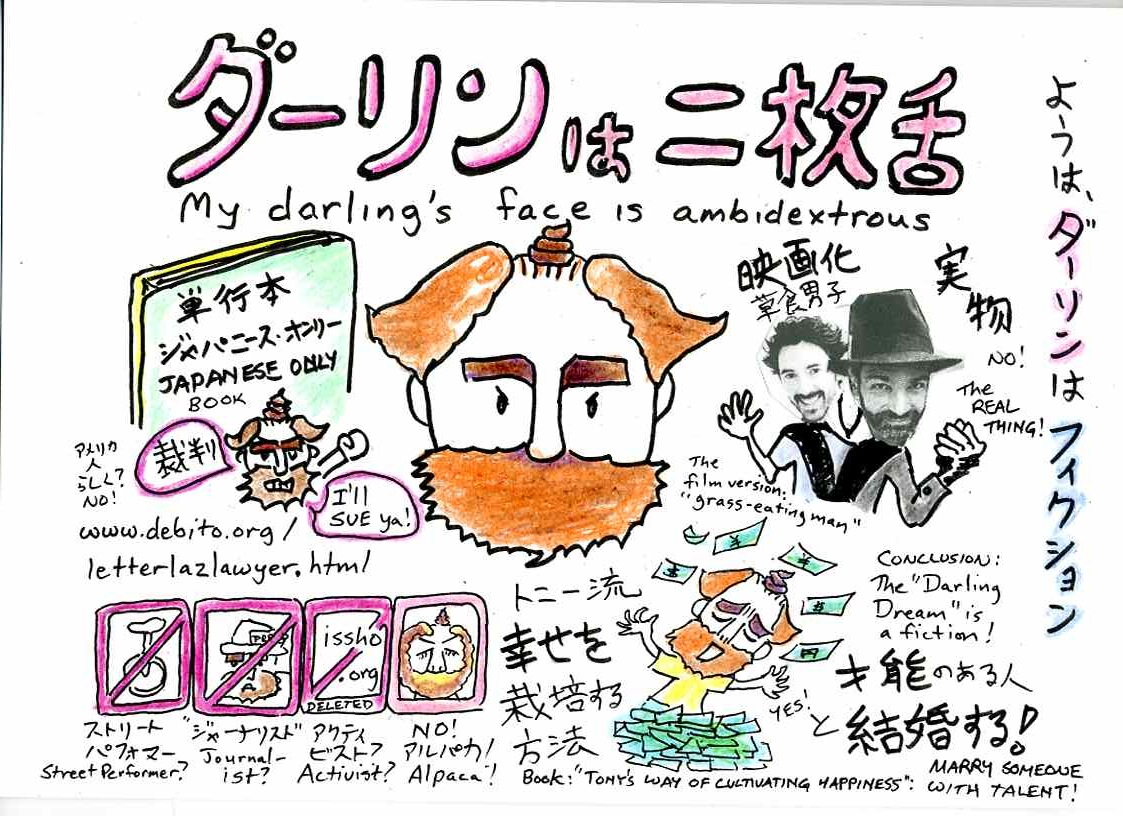
Hi Blog.  I want to offer my congratulations to Oguri Saori, very successful author of the “Darling wa Gaikokujin” series (translated as “My Darling is a Foreigner”, but officially subtitled “My Darling is Ambidextrous”), for the news just out this month that the first book in the series will be made into a live-action movie (starring Inoue Mao and Jonathan Share as Saori and Tonii respectively).  The empire built upon the dream being sold to Japanese women for marrying a white foreigner keeps on gathering strength.  See the movie trailer here.

More interesting to me is the mutation of the Tonii character.  It’s apparently based upon Tony Laszlo, one-time unicyclist, “journalist”, “activist” and self-proclaimed leader of unregistered NGO “Issho Kikaku” (a long-defunct group — you can’t even find their once-copious archives on the Wayback Machine because they have been blocked by the site owner — see what’s left of it at Issho.org), and now happy multimillionaire thanks to his partnership with and characterization by his very talented wife.

Although portrayed in the movie by the very handsome and disarming Jonathan as a “grass-eating man”, Tonii in real life is not as he is cartooned.  Laszlo is a big fan of putting his funds into threatening lawsuits, for one thing.  And of deleting internet archives.  And more.

It just so happens I found a cartoon parodying this phenomenon of the contrasts.  As the last post on Debito.org for this decade, enjoy.

Arudou Debito in Sapporo, wishing everyone a happy new year.  For Oguri Saori, it looks to be a fine one indeed, so, again, congratulations.

(click on image to expand in your browser)

ENDS

Int’l Child Abduction issue update: Chinese found guilty in J court of abducting daughters, MOFA sets up panel on issue

mytest

Handbook for Newcomers, Migrants, and Immigrants to Japan\Foreign Residents and Naturalized Citizens Association forming NGO\「ジャパニーズ・オンリー 小樽入浴拒否問題と人種差別」(明石書店)JAPANESE ONLY:  The Otaru Hot Springs Case and Racial Discrimination in Japansourstrawberriesavatardebitopodcastthumb
UPDATES ON TWITTER: arudoudebito
DEBITO.ORG PODCASTS now on iTunes, subscribe free

Hi Blog.  Three articles (two with original Japanese) below charting a couple of interesting developments regarding Japan as an international haven for child abductions.

The first article is what happens when the shoe’s on the other foot, and the NJ parent goes on trial for allegedly abducting his or her child from Japan — the Japanese authorities eventually convict the NJ.  Asahi reports a Chinese father was found guilty (sentence suspended) in Japanese court of successfully, shall we say, “committing a Savoie” — actually getting his Japanese-Chinese daughters out of Japan (moreover after a J court awarded his ex-wife custody).  The story follows below, but one of the daughters came back to Japan from China and stayed on, and the father came over to get her — whereupon he was arrested and put on trial.  Now the mother wants Japan to sign the Hague Convention to protect Japanese from abductions (well, fine, but neither China nor Japan is a party, so there you go; oddly enough, accusations of spousal abuse — as in this case — are being leveled conversely as reasons for Japan NOT to sign the Convention).  Just sign the damn thing, already.

The second article is from the Mainichi highly critical of the Japanese consulate in Shanghai for renewing the daughters’ J passports without consent of the J mother overseas.  Even though this is standard operating procedure when a Japanese spouse wants to bring the children back to Japan from overseas.  It only seems to make the news when the valve is used against the Japanese spouse.

Final irony:  Quoth the judge who ruled in this case, “It is impossible to imagine the mental anguish of being separated for such a long time from the children she loved.”  Well, that works both ways, doesn’t it?  Why has there never been a child returned by a Japanese court to a NJ parent overseas?  Why didn’t this matter in, for example, the Murray Wood Case, when overseas courts granted custody to the NJ father yet the Saitama Family Court ruled against him?  And how about the plenty of other cases slowly being racked up to paint a picture that NJ get a raw deal in Japanese courts?

The third article (following the original Japanese versions of the first two) is how Minister Okada of the Foreign Ministry is setting up a special task force on this issue. Good.  But let’s see if it can break precedent by acknowledging that NJ have as much right to access and custody of their children as Japanese do.  Dubious at this juncture.  Arudou Debito in Sapporo

================================
Former Chinese husband found guilty of abducting daughters
THE ASAHI SHIMBUN 2009/12/4
, Courtesy GB, FG, and HH
http://www.asahi.com/english/Herald-asahi/TKY200912040352.html

In another case highlighting legal complexities if international marriages fall apart, a court found a Chinese man guilty of “abducting and taking overseas” his two daughters from their Japanese mother 10 years ago.

The Tachikawa branch of the Tokyo District Court sentenced Qin Weijie, 55, to two years in prison, suspended for three years, on Thursday.

According to the ruling, Qin and his Japanese wife were undergoing divorce procedures in June 1999, when he talked to their daughters, then 7 and 8, on a street in Akishima in western Tokyo. He took them on a flight to Hong Kong from Kansai Airport. The girls had been living with their mother at the time.

When the divorce was finalized, a Japanese court gave the mother sole custody of the children.

But Qin refused to hand over the daughters.

“(The defendant) disrespected the law, and his behavior was malicious. The circumstances after his criminal act were not good, either,” Presiding Judge Manabu Kato said.

According to Qin’s 44-year-old former wife, she was staying at a shelter with the two girls in 1999 to escape Qin’s physical abuse. She said she spent the next 10 years searching for her children, fearing that they may be abused.

But the presiding judge said the daughters “grew up with a proper amount of love.” He also noted that the younger daughter chose to live with her father in China, even after returning to Japan temporarily earlier this year.

After the ruling, Qin said: “In Shanghai, not only my second daughter but also my 1-year-old son from my remarriage are waiting. I’d like to go home soon and fulfill my duty as their father.”

He had told the court that he took the girls to China for their own sake because “their life was unstable” in Japan at the time.

Prosecutors had demanded a three-year prison term for Qin.

When the daughters returned to Japan in January to renew their passports, the second daughter returned to China on her own will, but the elder daughter decided to stay with her mother.

Qin was arrested in September when he entered Japan for the purpose of getting the older daughter back.

According to the mother, the older daughter broke down in tears when she passed by the site where she was taken away 10 years ago. The girl is also being treated for an eating disorder, the mother said.

“My daughter is afraid of my ex-husband, and she is emotionally hurt. How can we get back the lost 10 years?” the mother said.

Disappointed with the suspended sentence, the mother urged the Japanese government to sign the Hague Convention on international child abduction and adopt measures to protect mothers and children who have escaped from abuse.

Under the convention, when a child has been taken from his or her country of residence, the child must be returned to that country.

Neither Japan nor China is party to the Hague Convention.

In recent months, cases of legal problems have surfaced concerning divorced Japanese women bringing their children to Japan without the consent of their former husbands overseas.

When the mother reported the abduction to police, she was told there was nothing they could do.

After she obtained legal custody, she asked the Foreign Ministry, the Chinese government, Diet members and lawyers for support. She even traveled to China several times but could not get her daughters back, she said.

In 2004, Tokyo police finally accepted her criminal complaint against Qin.

According to the welfare ministry, there were 37,000 international marriages in Japan last year, as well as 19,000 divorces among international couples. (IHT/Asahi: December 4,2009)
ENDS
=============================

Japanese consulate renewed passports of children taken overseas without consent
Mainichi Shinbun Dec 4, 2009
, courtesy of TC
http://mdn.mainichi.jp/mdnnews/news/20091204p2a00m0na015000c.html

The Japanese consulate general in Shanghai renewed the passports of two girls without permission from their Japanese mother in violation of the Passport Law, after their Chinese father took them to China in the wake of a marriage breakup, it has been learned.

The consulate general renewed the passports of the girls, now aged 18 and 17, in 2004, despite their mother’s repeated requests to the Ministry of Foreign Affairs not to renew the passports.

As a result of the consulate general’s actions, the girls remained in China for five more years, and the situation was not resolved until the father came to Japan in September this year and was arrested on suspicion of child abduction.

“As a result of the government’s mistake, I had to wait five years for the return of my daughters,” the children’s mother, who is in her 40s, said. “I want the government to move actively to protect the rights of children.”

Passports for minors are valid for five years. Passport Law regulations state that permission must be obtained from a person who has custody of the children for the passports to be issued.

Representatives of the woman said that she and the Chinese man, 55-year-old Qin Weijie, married in 1988 and lived in Tokyo, but she left due to domestic violence by Qin. In June 1999, Qin met his daughters as they were traveling to school near the home to which his wife had moved, and he took them to China.

Qin and his wife divorced in 2000, and she was granted custody of the children. However, as she didn’t know where they were, she repeatedly asked the Foreign Ministry not to renew their passports. She also filed a criminal complaint against Qin accusing him of abducting the children and taking them overseas. However, the consulate general renewed the passports in January 2004.

About five years later, when the deadline for renewing the passports of the children was again approaching, Qin contacted his former wife asking her to sign a consent form for renewal, but she said she wanted to meet them directly and confirm what they wanted to do, so the two came to Japan in January.

Qin was arrested after entering Japan in September this year at Narita Airport, trying to take his elder daughter, who wanted to remain in Japan, back with him. His former wife said the eldest daughter was suffering from an eating disorder and panic attacks, due in part to violent behavior from Qin.

On Thursday, Qin was sentenced to two years’ imprisonment, suspended for three years, after going on trial facing international abduction and other charges. In handing down the ruling, Presiding Judge Manabu Kato criticized Qin’s actions, saying, “His act of taking the children away without notice deserves criticism,” but noted, “At the time Qin also held custody of the children.” Commenting on the wife’s position, the judge stated: “It is impossible to imagine the mental anguish of being separated for such a long time from the children she loved.”

The Ministry of Foreign Affairs’ Japanese Nationals Overseas Safety Division admitted the mistake in renewing the passports without consent, but said it could not provide detailed background information on individual cases.

(Mainichi Japan) December 4, 2009

国際結婚破綻:母に無断で子の旅券更新…上海日本総領事館
毎日新聞 2009年12月4日
http://mainichi.jp/select/wadai/news/20091204k0000m040117000c.html
国際結婚した日本人妻との生活が破綻(はたん)した後、2人の娘(18歳と17歳)を母国に連れ去ったとして、国外移送誘拐などの罪に問われた中国出身の会社員の事件に絡み、在上海日本総領事館が04年、2人の旅券を、旅券法の規則に反し、親権者である元妻(40代)の同意を取らないまま更新していたことが分かった。元妻は外務省に対し更新しないよう繰り返し要請していた。

更新で2人はその後5年間中国にとどまることになり、元夫が今年9月に来日し逮捕されるまで解決が遅れる結果となった。元妻は「国のミスで5年間も娘の帰りを待たされた。国は子の人権を守るため積極的に動いてほしい」と訴えている。

未成年者の旅券の有効期限は5年間で、旅券法施行規則は発給を受ける際には親権者の同意書が必要と定めている。

元妻の弁護士らによると、夫婦は88年に結婚し東京都内で暮らしていたが、元妻は98年、夫だった中国出身の会社員、秦惟傑被告(55)による家庭内暴力に耐えかねて別居。秦被告は99年6月、元妻の別居先近くの路上で、小学校に登校途中だった娘2人(当時8歳と7歳)に声を掛けて連れ出し、中国に連れ去った。

離婚は00年に成立、元妻は親権も認められた。居場所も分からない娘との再会を希望し、外務省に旅券を更新しないよう何度も要請。国外移送誘拐容疑で刑事告訴もした。しかし、上海日本総領事館は更新期限の04年1月、元妻の同意なしに2人の旅券を更新した。

秦被告は5年が経過し旅券の再更新時期が迫ったため、元妻に「親権者の同意書にサインしてほしい」と連絡してきた。しかし、元妻は「直接会って意思を確認したい」と一時帰国を求め、2人は1月に来日した。結局、秦被告が今年9月、日本に残ることを希望した長女を連れ戻そうと成田空港から入国、逮捕されたことで、元妻は10年ぶりに長女との暮らしを取り戻すことができた。元妻によると、長女は秦被告の家庭内暴力などの影響で摂食障害やパニックを起こしているという。

外務省海外邦人安全課は毎日新聞の取材に「同意書がないまま旅券を発行したのは確か」とミスを認めたが、原因については「個々の案件について詳しい経緯は話せない」としている。【青木純】

◇国外移送誘拐罪 父親に有罪判決
この件で国外移送誘拐などの罪に問われた秦惟傑被告(55)に対し、東京地裁立川支部は3日、懲役2年、執行猶予3年(求刑・懲役3年)の判決を言い渡した。加藤学裁判長は「黙って連れ去った行為は非難に値する」としたが、「当時は被告も娘の親権を有していた」などと述べた。

判決によると、秦被告は99年6月8日、別居していた妻の自宅から登校途中だった娘2人に声を掛け、同日中に国外に連れ去った。

加藤裁判長は判決で「長い間愛するわが子と離れることを余儀なくされた(元妻の)精神的苦痛は察するに余りある」と述べた。【青木純】

==================================

Foreign Ministry sets up division on child custody issue
Japan Today/Kyodo News Wednesday December 2 2009
, courtesy lots of people
http://www.japantoday.com/category/national/view/foreign-ministry-sets-up-division-on-child-custody-issue

TOKYO — The Foreign Ministry on Tuesday set up a division to handle such issues as whether Japan should sign the 1980 Hague Convention, seeking to protect children from the harmful effects of failed international marriages.

Japan is the only country among the Group of Seven industrialized nations that is not a party to the convention, which provides a procedure for the prompt return of children to their habitual country of residence.

‘‘I have heard opinions from European countries and America…and I would like to consider how to deal with the matter swiftly. But it is also a fact that there are difficult problems,’’ Foreign Minister Katsuya Okada said.

The Division for Issues Related to Child Custody will consist of nine officials who are already serving the Foreign Ministry.

In a related move, the ministry held the first Japan-France liaison meeting aimed at promoting information exchanges and information sharing regarding specific cases that involve the two countries.

France is the first country with which Japan has set up such a bilateral mechanism in relation to the issue, a Japanese Foreign Ministry official said.

During the meeting, French officials handed a list of 35 cases in which Japanese women had returned to the country with their children after their marriages with French men failed.

The French officials also called for Japan to facilitate the process of identifying the children’s locations or their health condition.

ENDS

Asahi and Mainichi: J Supreme Court rules against Nationality Clause for employment in judiciary

mytest

Handbook for Newcomers, Migrants, and Immigrants to Japan\Foreign Residents and Naturalized Citizens Association forming NGO\「ジャパニーズ・オンリー 小樽入浴拒否問題と人種差別」(明石書店)JAPANESE ONLY:  The Otaru Hot Springs Case and Racial Discrimination in Japansourstrawberriesavatar
UPDATES ON TWITTER: arudoudebito

Hi Blog.  In probably one of the most important legal decisions all year, the Supreme Court has ruled that the “Nationality Clause” (kokuseki joukou), often cited as a reason for barring NJ from administrative (and often, even stable noncontracted) jobs in the public sector, has been scrapped.  I’m not sure if that means it’s been ruled “unconstitutional”, but the clause in the Mainichi below, (“The citizenship requirement was eliminated because the courts could be seen as denying employment based solely on the question of citizenship,” the court stated.) could reasonably be stretched in future cases to say that barring NJ from jobs (currently allowed in places such as firefighting and food preparation, and also in Tokyo Prefecture for nursing) should not be permitted.  That would be excellent news for the long-suffering NJ academics in Japan’s higher-education system of Academic Apartheid.  Let’s hope some professor has the cojones to take it to court.  (Not me:  I’m tenured already, thank goodness.)  Arudou Debito in Sapporo

///////////////////////////////////////

Supreme Court scraps Japanese nationality requirement for legal training
THE ASAHI SHIMBUN 2009/10/29, Courtesy HH

http://www.asahi.com/english/Herald-asahi/TKY200910290213.html

Ending what has long been labeled discriminatory, the Supreme Court has scrapped a clause requiring Japanese nationality among those seeking legal training to start careers in the judiciary.

Non-Japanese who have passed the bar examination have, in fact, undergone legal training, but only under “exceptional” measures and if the Supreme Court deems them “adequate.”

Foreign nationals and officials at the Japan Federation of Bar Associations have said the clause has unfairly shut the door on many non-Japanese and demanded its elimination.

The clause stems from a Cabinet legislation bureau policy that states that Japanese nationality is a prerequisite for those applying for public service work that involves the execution of public power or has a bearing on the formulation of national intention.

That policy was extended to legal training based on the reasoning that trainees could attend prosecutors’ questioning of suspects or closed-door counsel discussions held by courts.

A Supreme Court official explained the court decided to “delete any mention that suggests that in principle (non-Japanese) cannot be accepted (for legal training).”

Tokuji Izumi, a lawyer and former Supreme Court justice, said he hopes the move will increase the number of foreign lawyers practicing in Japan and “will help in protecting the rights of foreign nationals.”

Izumi was involved in the top court’s acceptance in 1976 of Kim Kyung Duk, an ethnic Korean born in Japan, for legal training.

Kim had put consistent pressure on the Supreme Court, and became the first non-Japanese to enter legal training in 1977. He went on to become a prominent human rights lawyer in Japan before his death in 2005.

After lobbying by Kim and others, the Supreme Court agreed to allow “those deemed adequate to attend (legal training),” but it kept the nationality clause.

In 1990, the top court scrapped its policy of requiring foreign applicants to pledge to abide by the law. The court also widened the scope of those eligible for legal training to include foreign nationals who do not hold permanent residence status.

But the court still retained the nationality clause.

According to the Supreme Court, more than 140 foreign nationals who passed the bar examination have attended legal training.

In applying for legal training, applicants must submit copies of family registries known as koseki. Since foreign nationals do not hold koseki, the Supreme Court will request documents to prove their residency in Japan.

Non-Japanese are also barred from being employed as prosecutors or judges, which are national civil servant jobs.

Foreign nationals who complete legal training can enter the judiciary as lawyers, but they will have to acquire Japanese nationality before working as judges or prosecutors.

The Japan Federation of Bar Associations has also submitted a request that district and family courts accept foreign lawyers as judicial commissioners and mediators “regardless of nationality if they are qualified.”(IHT/Asahi: October 29,2009)

////////////////////////////////////////////////////

Supreme Court eliminates Japanese citizenship requirement for articling students
(Mainichi Japan) October 30, 2009, Courtesy JK

http://mdn.mainichi.jp/mdnnews/news/20091030p2a00m0na012000c.html

The Supreme Court has eliminated the Japanese citizenship requirement for student articling positions at courts of law.

“The citizenship requirement was eliminated because the courts could be seen as denying employment based solely on the question of citizenship,” the court stated. The decision will first affect those taking up articling positions in November.

Those who pass the bar exam can go on to become articling students, after which they take a final graduation exam and, if they pass, may become courtroom lawyers, judges and public prosecutors. Until the ruling, Japanese citizenship was a requirement to become an articling student at the court as, in order to prepare for jobs as judges or prosecutors, they studied “the exercise of government power involved in being a civil servant.”

In 1977, the court created exceptions to the ban on foreigners holding legal positions. Foreigners may not become public prosecutors or judges, which as civil servants must hold Japanese citizenship, but may become courtroom lawyers.

////////////////////////////////////////////////////////

「司法修習生は日本国籍必要」条項を削除 最高裁
2009年10月29日8時1分 朝日新聞
http://www.asahi.com/national/update/1029/TKY200910280425.html

最高裁は11月から修習を始める司法修習生の選考要項から日本国籍を必要とする「国籍条項」を削除した。最高裁は外国籍の司法試験合格者には30年以上、特例の形で修習を認めてきたが、在日外国人や日本弁護士連合会などが「差別だ」として条項自体の削除を求めていた。

司法試験の受験資格には以前から国籍条項はない。だが合格者が実務を学ぶ司法修習では、検察庁で容疑者の取り調べをしたり、裁判所で非公開の合議に立ち会ったりする機会がある。そのため、最高裁は「公権力の行使や国家意思の形成に携わる公務員には日本国籍が必要」との内閣法制局の見解を準用。外国籍の合格者には日本国籍取得を修習生として採用する際の条件としてきた。

しかし、76年、司法試験に合格した在日韓国人の金敬得(キム・キョンドク)さん(故人)が韓国籍のままでの採用を希望。全国的に支援が広がり、最高裁は77年に国籍条項は残したまま「相当と認めるものに限り、採用する」との方針を示し、金さんの採用を決めた。

90年には、外国籍の希望者に提出を義務づけていた法律順守の誓約書の廃止を決めた。さらに、永住権がない人に対しても修習を認めるなど特例扱いでこの問題に対応してきたが、一方で、国籍条項はそのまま記載していた。

最高裁によると、これまで140人以上の外国籍の合格者が司法修習を受けたという。国家公務員である検察官と裁判官には任用されないため、外国籍の修習生は日本国籍を取得したうえで任官するか、弁護士になっている。

司法修習生の選考を申し込む際は戸籍抄本などが必要。外国籍の場合は戸籍がないため、最高裁は、日本に定住していることを示す資料などの提出は引き続き求めるという。要項から条項を削除した理由について最高裁は「原則として採用しないと読めるような記載は削除した」と説明している。(三橋麻子、中井大助)

最高裁事務総局の任用課長として、金さんの採用問題に取り組んだ元最高裁判事の泉徳治弁護士の話 自由に職業を選択し、自己実現をはかることは基本的人権の中核をなす。実質的には外国籍の人も司法修習生に採用していたとはいえ、国籍条項は外国籍の人からすれば、差別感を感じることもあっただろう。外国籍の弁護士が増えることは、外国人の権利の救済が進むことにもつながると思う。

===========================

司法修習生:採用選考要項から国籍条項を削除 最高裁
毎日新聞 2009年10月29日
http://mainichi.jp/select/jiken/news/20091030k0000m040086000c.html
最高裁は、司法修習生の採用選考要項から「日本国籍が必要」との国籍条項を削除した。適用は、11月に司法修習を始める人たちから。外国籍の司法試験合格者は77年以降、特例として司法修習を認められているが、国籍条項は残ったままで、日本弁護士連合会などから削除を求める声が上がっていた。

司法試験合格者は、司法修習を終え卒業試験に合格して初めて、裁判官、検事、弁護士になれる。修習中には裁判官や検察官の実務を学ぶため、「公権力の行使などに携わる公務員は日本国籍が必要」として、司法修習生の採用選考を受けるには日本国籍の取得が必須とされていた。

しかし、在日韓国人の故金敬得(キム・キョンドク)さん(後に弁護士)が、「外国人に門戸を開かないのは不当だ」と韓国籍のまま採用を希望したことを受け、最高裁は77年に国籍条項を残しながらも「相当と認めた者」について採用を認める例外規定を設けた。【銭場裕司】

Global Post’s Justin McCurry on Savoie Child Abduction Case. Issue isn’t passe yet.

mytest

Handbook for Newcomers, Migrants, and Immigrants to Japan\Foreign Residents and Naturalized Citizens Association forming NGO\「ジャパニーズ・オンリー 小樽入浴拒否問題と人種差別」(明石書店)JAPANESE ONLY:  The Otaru Hot Springs Case and Racial Discrimination in Japansourstrawberriesavatar
twitter: arudoudebito

Savoie’s choice: abduct or fight?
An American father wants his children back. Japan says no.
By Justin McCurry – GlobalPost.com

Published: October 27, 2009
http://www.globalpost.com/dispatch/japan/091026/child-abductions-japan
Courtesy of the author

TOKYO, Japan — Under normal circumstances it would be impossible to summon any sympathy for a man who snatches two young children as they walk to school with their mother.
But what if the “abductor” is the children’s father, and the mother, his former wife, herself the subject of an arrest warrant?

When Christopher Savoie, an American, went to these extraordinary lengths to regain custody of his children from his Japanese ex-wife last month, he not only landed himself in a police cell for more than two weeks, he also placed the spotlight firmly on Japan’s complicity in international parental child abduction — turning it from a minor irritant into a potential source of genuine tension between Washington and Tokyo.

Savoie was arrested after attempting to take his children, aged 9 and 6, to the U.S. consulate general in Fukuoka, southwestern Japan, in September.

The 38-year-old from Tennessee, and his former wife, Noriko, lived in Japan for several years before moving to the U.S. in 2008. When they divorced in the U.S. in January this year, Noriko was granted primary custody of the children.

Despite giving assurances that she would remain with the children in the U.S., in August she took them to Japan, without Savoie’s knowledge and in defiance of a court order. The U.S. authorities awarded Savoie full custody in Noriko’s absence and issued a warrant for her arrest on suspicion of “custodial interference.”

Yet Savoie has no legal right to see his children for as long as they remain in Japan, which refuses to sign the 1980 Hague Convention on International Child Abduction.

The treaty, with 81 signatories including every other member of the G7, states that a “child whose parents reside in different countries shall have the right to maintain on a regular basis … personal relations and direct contacts with both parents.”

Savoie’s is one of about 80 cases of international parental child abduction involving U.S. citizens, while France and Britain are dealing with 35 each.

The unofficial number is much higher, particularly when failed marriages between Japanese and people from other Asian countries are included. The Assembly for French Overseas Nationals for Japan estimates that 10,000 children with dual citizenship in Japan are prevented from seeing their foreign parent after separation or divorce.

Japanese courts habitually award custody of children to the mother. In many cases, they say they are simply trying to protect the rights of women fleeing abusive former husbands, a claim vigorously disputed by campaigners.

The country’s courts will be tested again later this week when Shane Clarke appeals in a custody battle with Japanese ex-wife.

The 39-year-old Briton has not seen his two young daughters since May 2008 after his ex-wife took them to Japan to visit their “ill” grandmother and never returned.

Though Britain’s media has taken an interest in his plight, Clarke says he has received little support from the authorities, despite a court order naming the U.K. as his children’s country of habitual residence.

“I have been writing repeatedly to more than a dozen government ministers, and not a single one has had the common decency to reply,” he told GlobalPost.

Legal precedent indicates that Clarke, who was denied custody at a hearing in Japan last year, will again return home without his daughters.

“We are talking about two British citizens, and no one will help me. The message our government is sending out to foreign nationals is that it’s perfectly all right for them to commit a crime on British soil, and as long as they leave the country quickly enough, they’ll get away scot-free.”

Left-alone parents in the U.S. have fared better. Chris Smith, a New Jersey congressman, recently urged the Japanese prime minister, Yukio Hatoyama, to use the Savoie arrest as a “catalyst” to end Japan’s tacit approval of international parental child abduction.

Smith has drawn up legislation that would enable the U.S. to “more aggressively” pursue the rights of American parents, including imposing sanctions against countries that habitually refuse to cooperate on international child abductions.

Pressure is also mounting in Japan, where the ambassadors of eight countries, including the U.S., have urged the justice minister, Keiko Chiba, to sign the Hague treaty.

The foreign minister, Katsuya Okada, indicated he would speed up a study into the agreement’s pros and cons, although ratifying it will require changes to domestic laws that could take years to implement.

Savoie, meanwhile, says he is struggling to come to terms with the possibility that he will not see his children again until they are adults.

“If loving my kids so much that I really want to be with them is a crime, then, well, I’m guilty,” he told CBS News after returning to the U.S. “I’m guilty of loving my kids.”

Source URL (retrieved on October 28, 2009 01:16 ): http://www.globalpost.com/dispatch/japan/091026/child-abductions-japan
ENDS

Letter to Prime Minister Hatoyama regarding Child Abductions and legislative lag, from a Left-Behind Parent

mytest

Handbook for Newcomers, Migrants, and Immigrants to Japan\Foreign Residents and Naturalized Citizens Association forming NGO\「ジャパニーズ・オンリー 小樽入浴拒否問題と人種差別」(明石書店)JAPANESE ONLY:  The Otaru Hot Springs Case and Racial Discrimination in Japansourstrawberriesavatar
twitter: arudoudebito
Forwarding, courtesy of EK. Arudou Debito in Sapporo

===================================

What Are We Bargaining For?

Dear Prime Minister Hatoyama,
It’s important that left-behind parents understand what the Japanese Government mean when they say they “will need at least two more years before it will sign an international treaty (Hague Convention on the Civil Aspects of International Child Abduction) designed to settle child custodial disputes” and that “relevant legislative measures are unlikely to be submitted to the Diet until 2011 at the earliest”. The Yomiuri Shimbun article “Govt. unlikely to Sign Child Custody Pact for 2 Years” dated October 19, 2009 goes on to state that it will take “some time until the country is able to facilitate such a move by addressing the necessary domestic laws”.

Left-Behind parents have been denied access to their children for one second too long, now you’re asking us to be patient for two years. Well, What are we bargaining for? Will the process take only two years? and How will the process be carried out?

I’ll get straight to the point. There are those in the Foreign Ministry and the Justice Ministry that know very well the article written by Dr. Hans van Loon “The implementation and Enforcement of the Hague Convention of 25 October 1980 on the Civil Aspects of International Child Abduction in Comparative Perspective: It’s Japan’s Move!” and the related article by Professor Yuko Nishitani. (Tohoku University 21st Century COE Program, Gender Law and Policy Annual Review, Vol.2 2004) Dr. Hans van Loon suggested seven (7) measures were necessary for Japan to implement the Hague Convention on the Civil Aspects of International Child Abduction. I will only remind you of the second, which states:

a high level Central Authority should be designated, equipped with a small but highly competent staff with broad international experience, excellent knowledge of the convention and its operation in other States Parties and expertise in conciliation and mediation. However, conciliation and mediation should not hold up legal proceedings.

In another article, The Judges Newsletter, Enforcement and Return of Access Orders, National Report by Fourteen (14) States and The Conclusion of the Noordwijk Judicial Seminar Vol. VII Spring 2004 Professor Yuko Nishitani writes the following:

A working group of Japanese scholars have proposed a draft statute to implement this Convention in view of Japan’s possible accession in the future. In this draft, the Foreign Minister is appointed as “Central Authority,” acting through the Minister of Justice, who further delegates his duties to other institutions (e.g. police and the youth welfare office) which are to be appointed separately. The “judicial authority” is the Family Court, which has the necessary resources to carry out the required investigations and order the return of child. However, in order to comply with the obligations prescribed by the Convention, the Family Court must be provided with authority to ensure expeditious procedures and coercive enforcement, even if this represents a tough challenge for the Japanese legislature as well as for judges and practitioners. This is also crucial for other Contracting States so that they will be able to trust and rely on the Japanese judicial system for securing the return of a child abducted to Japan.

Apparently the draft statute is here, 119-2 Minshô–Hô Zasshi 302-311 (1998), but I haven’t been able to find it. It appears the administrative duties will be carried out by the Foreign Ministry, while the Family Court under the Justice Ministry will carry out the implementation and enforcement. Professor Nishitani, along with Professor Colin P.A. Jones in his research, In the Best Interest of the Court What American Lawyers Need to Know About Child Custody and Visitation in Japan, has pointed out quite clearly how joining the Hague Convention on the Civil Aspects of International Child Abduction will favor Japan. As they say, the elephant in the room is how will Japan implement and enforce the treaty? The Justice Ministry, the Supreme Court Justices, the Judicial Review Council (JRC), and possibly the Japan Federation Bar Association (JFBA) will play a critical role in crafting any new legislation required to implement and enforce the treaty. What can we expect this time from the Judicial Review Council and the Supreme Court Justices?


In Japan’s first Judicial Reforms of the 21st century the Judicial Review Council and the Supreme Court Justices chose not to address parental rights issues directly, but instead chose to try and deal with the issue by expanding the jurisdiction of the Family Court and relying on the courts so called “expert knowledge” in dealing with human relationships. The Judicial Review Council’s Initial Report, The Points at Issue in the Judicial Reform was created December 21, 1999. The Personal Status Litigation Law was approved by the Diet on July 9, 2003 and went into effect April 01, 2004 nearly five years after the process began. The Family Court was granted authority to legislate contested divorces after they failed mediation. It was clear that Family Court Judges had the authority to award visitation based on their preference, but it was also widely known any award of visitation was unenforceable. Previously contested divorces were legislated in District Court by District Court Judges, but now they are being handled by Family Court judges. This means the Supreme Court swept parental rights issue under the rug and relied heavily on the Family Courts to deal with these issues. The Diet has to take some responsibility as well because they passed the Personal Status Litigation Law without any assurances that it would protect parental rights.


The Mediators, Investigators, and Councilors (Sanyoin) which the Supreme Court and the nation put so much trust in to uphold Japanese family values let down the Justices and embarrassed the country’s international reputation in dealing with parental rights. Professor Colin P.A. Jones’ research points out the ineptitude of Family Court Mediators and Family Court Investigators. The Family Courts have failed miserably in protecting parental rights and the Supreme Court Justices have been so wishy-washy on the issue they’ve left the non-custodial parent with no choice but to take self-help measures when the custodian of the child refuses any meaningful access. Professor Colin points out that up until the Abduction for the purpose of performing an obscene act, murder and abandonment of corpse, case number: 2000 (Kyo) No.5 of the year 2000 the lower courts’ interpretations of parental rights were widely held views that he narrowed down as the following:

(i) an inherent right arising naturally from the parent-child relationship; (ii) an aspect of physical custody; (iii) a right arising in connection with physical custody; (iv) a right of children to develop emotionally through contact with their parent; and (v) a right of both parent and child.

After the 2000 ruling parental rights came down to a right to demand versus a right to request, with the right to request becoming the de facto meaning of Parental Rights. It seems that up until the 2000 ruling some of the lower court judges were determining the meaning of rights as those similar to what is proscribed in the United Nations Convention on the Rights of the Child. One significant point, the Supreme Court Judges that made the 2000 ruling, Justice FUJII Masao, Justice ENDO Mitsuo, Justice IJIMA Kazutomo, Justice OHDE Takao, and Justice MACHIDA Akira are no longer on the bench. If a similar case is brought before the Justices today we could get a different ruling. Of course, you remember the Judicial Reforms that began in December of 1999, in my opinion the Justices were aware of how their ruling would affect The Personal Status Litigation Law that was being drafted at the time.


By reviewing the work of Nishitani, Colin, Han van Loons, Bryant, the Judicial Review Council, and others I’ve been able to create a timeline that could give the left behind parents some idea as to when Japan will start to implement and enforce parental rights. I’ve compared the time it took Japan to implement and enforce the Jury System with the Personal Status Litigation Law because both legislations have a profound affect on the nation, as will the implementation and enforcement of the Hague Convention on the Civil Aspects of International Child Abduction along with the enforcement of Parental Rights of Access.

Jury System Personal Status Litigation Law
• December 21, 1999 Initial Report from the JRC 1. December 21, 1999 Initial Report from the JRC
• November 12, 2000 Sixty Five (65) Page Interim Report by JRC 2. November 12, 2000 Sixty Five (65) Page Interim Report by JRC
• June 12, 2001 Final Recommendations to the Cabinet by JRC 3. June 12, 2001 Final Recommendations to the Cabinet by JRC
• May 28, 2004 Approved by the Diet 4. July 09, 2003 Approved by the Diet
• June 01, 2009 Law went into effect 5. April 01, 2004 Law went into effect
• 9 Years 6 months to enact 6. 4 Years 5 months to enact

For simplicity, I’ve rounded the number of years and concluded it will take between 5 to 10 years before implementation and enforcement of the treaty or parental rights of access will be legally enforceable. From the article in the Yomiuri Shimbun one can assume the reform process will be carried out similar to the Judicial Reform process that started in December 1999 and took two (2) years before it actually reached the Diet.
While I believe you, Prime Minister Hatoyama, are sincere about resolving this issue, the facts lead me to distrust the bureaucrats in the Ministry of Justice and the Foreign Ministry. The Judicial Review Council and the Supreme Court knew about these problems in the first Judicial Reforms that began 10 years ago but chose not to face the tough issue of Parental Rights head on. Now, Mr. Hatoyama, are you relying on these same bureaucrats again? Why, is it that Professor Nishitani refers to a draft statute created by Japanese Scholars that would have paved the way for Japan to implement the Hague Convention on the Civil Aspects of International Child Abduction and the bureaucrats are sounding as though we have to start from scratch? If the Judicial Reform Council is drafting this legislation then who are the current members? I hope it is not any of the retired Supreme Court Justices that made the 2000 ruling. Furthermore, the Democratic Party of Japan’s Manifesto states the cabinet will be the center of policy-making. What happens if the DPJ loses power in the next election, which will be in two years, do we start from scratch again? Let’s see what Professor Yuko Nishitani and the Japanese Scholars proposed; maybe the cabinet can start from there. If the government wants the international community and all left-behind parents to cooperate while reforms are being created we need to know, What Are We Bargaining For?

Sincerely,
IGOTCHU

Colin Jones in Japan Times: What the media attention from Savoie Child Abduction Case highlights

mytest

Handbook for Newcomers, Migrants, and Immigrants to Japan\Foreign Residents and Naturalized Citizens Association forming NGO\「ジャパニーズ・オンリー 小樽入浴拒否問題と人種差別」(明石書店)JAPANESE ONLY:  The Otaru Hot Springs Case and Racial Discrimination in Japansourstrawberriesavatar
UPDATES ON TWITTER: arudoudebito

Hi Blog.  People have asked what the Savoie Child Abduction Case actually brought to light.  I’ll let lawyer Colin Jones explain that below.  Again, whichever side of the custody battle you support, you have to give Christopher credit for bringing the international spotlight on one of Japan’s dirty little secrets.  Excerpt follows.  Arudou Debito in Sapporo

====================================

The Japan Times Tuesday, Oct. 20, 2009
THE ZEIT GIST
Signing Hague treaty no cure-all for parental abduction scourge
‘Best interests of the bureaucracy’ standard applies in Japan
By COLIN P. A. JONES

http://search.japantimes.co.jp/cgi-bin/fl20091020zg.html
Excerpt follows:

…Thus, the fact that police have recently started to arrest parents like Mr. Savoie despite the Japanese penal code remaining unchanged may simply reflect the police having decided that parental abduction is a problem they should do something about either in general, or in specific cases. Having made this decision, what the law actually says or is intended to address doesn’t really matter, so long as there is a vaguely drafted statute they can point to as justification.

A similar dynamic plays out in Japanese courts. In custody disputes, courts purport to apply a “best interests of the child” standard. Fortunately for the courts, this standard remains undefined by either statute or clearly announced judicial rules, meaning that judges are free to resolve cases in whatever way is most convenient for the court — which more often than not is the status quo, which they have little power to change. Thus, the real standard being applied is probably what is in the best interests of the court.

A similarly bureaucratic approach may also explain the apparent willingness of Japanese courts to cooperate with other bureaucracies such as police and prosecutors by ratifying seemingly novel applications of criminal law arrests and prosecutions that seem to stretch the law. In another parental abduction case earlier this decade a Dutch man was arrested for trying to leave Japan with his daughter. He was prosecuted for violating an obscure human trafficking statute and duly convicted. In rejecting his appeal, Japan’s Supreme Court noted that there is a high degree of unlawfulness in taking a child whose life is established in one country to another country, even if the person doing so is one of that child’s parents. Apparently, neither this statute nor this logic has ever been applied to any of the scores of cases of abduction to Japan.

My own view is that as a matter of law, Japan could start returning abducted children tomorrow without having signed the Hague Convention — just as children who have been abducted to countries like the United States or England have been returned to Japan notwithstanding the country’s nonsignatory status. Mr. Savoie’s case clearly demonstrates that it is not actually necessary to waste time and money in futile family court proceedings to get your child back: The police will do it for you if it is in their interests to arrest the abducting parent. The converse is that they may not do anything if it is not, and this is also why it is conceivable that Japan could sign the Hague Convention and immediately appear on the U.S. State Department’s list of noncompliant treaty partners.

Whatever the law says, it is very hard to imagine it being in the interests of the police and prosecutors to be seen taking crying half-Japanese children away from distraught Japanese mothers.

This is why the media attention is so important on this issue. Because law in Japan tends to serve the bureaucrats first and the people second, legislation and litigation may not lead to solutions if the bureaucrats are part of the problem. Thus, it will likely be criticism — relentless pressure and attention from both domestic and foreign sources — that will probably carry the day in Japan shedding its shameful status as an abduction haven. If so, it will be because the criticism risks damaging the authority of the bureaucrats by making them look bad…

Full article at:
http://search.japantimes.co.jp/cgi-bin/fl20091020zg.html
ENDS

Joseph pieces together plausible timeline in Savoie Case, finds for Christopher

mytest

Handbook for Newcomers, Migrants, and Immigrants to Japan\Foreign Residents and Naturalized Citizens Association forming NGO\「ジャパニーズ・オンリー 小樽入浴拒否問題と人種差別」(明石書店)JAPANESE ONLY:  The Otaru Hot Springs Case and Racial Discrimination in Japansourstrawberriesavatar
UPDATES ON TWITTER: arudoudebito

Hi Blog. I received this comment early this morning from “Joseph” regarding the Savoie Case, piecing together with a minimum of speculation (shame on all you online rumormongers) a probable plausible timeline for what happened between Christopher and Noriko. It’s too good to be buried as a comment, so I create a separate blog entry for it. He finds for Christopher, concluding:

In Japan, sole custody is awarded to one parent, and one parent only. This means that if there is a messy divorce, as it appears to be in this case, and the mother doesn’t want to allow the father to see his children, there is nothing that can be done. Period. Christopher was obviously well aware of this, and knew that if he wanted to have any access to his children, he needed to have his divorce here.

Noriko, with full knowledge of Amy, came here specifically for the purpose of getting that divorce – she was not “tricked” into it. She came here, she had her day in court, she received a large financial settlement, she repeatedly assured the court that she had no intention of removing the father from his childrens’ lives, and then she went ahead and did just that. She took the children away, took the money, and now she happily spends her days walking the children to and from school, while he spends his being interrogated in jail. He sits there knowing that, as the Japanese courts always favor the Japanese parent in these cases, he will in all likelihood never see his children again.

Read on. Arudou Debito in Sapporo

===============================
LETTER FROM JOSEPH BEGINS

Hello, This is a very confusing case due to all of the “facts” that are flying around. I have read everything that I can find, including the court transcripts (http://wtvf.images.worldnow.com/images/incoming/Investigates/savoie1.pdf and http://wtvf.images.worldnow.com/images/incoming/Investigates/savoie2.pdf) and I’m wondering whether anyone can add to any of this:

It has been reported that Noriko has either US citizenship or US permanent residency status. Some have suggested that this is false because she only just came here this year, and could not have gotten either in such a short amount of time. However, in the transcripts I mentioned above, Noriko states that she and Christopher have known each other for 18 years, and have been married for 14 years (See page 79 http://wtvf.images.worldnow.com/images/incoming/Investigates/savoie2.pdf).

This would mean that they met sometime in or around 1991, and married sometime in or around 1995. From reading around, it seems that they had lived in Japan from 2001 through 2008. That would mean that they met outside of Japan? This seems to corroborate the information relayed on this message board by Amy Savoie (http://www.topix.net/forum/source/wtvf/T40LV9OOMRME6BAHB/p2) Specifically, she stated that Noriko had been working in Silicon Valley, and that Isaac was born at Stanford University, in California. This suggests that the claims of Noriko’s US citizenship / permanet residency status might have some truth after all.

Combining those dates, with the other significant dates, allows one to contruct a possible timeline:

– 1991: Noriko and Christopher met in California, where Noriko was working? (Partial Speculation)

[correction from Joseph: -1995 ~ ? Christopher begins work at Kyushu University]
– 1996: Noriko and Christopher were married in California? (Partial Speculation)
– 2001: Issac was born at Stanford University, in California? (Partial Speculation)
– 2001: Noriko, Christopher, and Issac moved to Japan after Issac’s birth (Confirmed)
– 2003: Rebecca is born in Japan (Confirmed)
– 2005: Noriko and Christopher were separated. (Confirmed)
– 2005-2008?: Noriko asks for a divorce in Japan (Confirmed)
– January 2009: Noriko comes to Tennessee for the divorce (Confirmed)
– September 2009: Noriko takes children, and returns to Japan (Confirmed)

I will state outright that this timeline is partial speculation, but it fits the facts, and it does seem to paint a somewhat more sympathetic picture of Christopher.

He meets a Japanese woman in California in 1991. They are married, in California, in 1996. Their first child, Isaac, is born at Stanford University, in California, in 2001. Shortly after Issac’s birth, Noriko convinces Christopher to move to Japan. What the reasoning for that move was, only those two can know for sure, but knowing what I know of Japanese families (I am married to a Japanese national. My wife’s sister is a happily married Japanese woman, married to a Japanese man, and she and the children spend 75% of their time at her mother’s house. This is common over there), I am going to assume the reason was so that she could have lots of help raising Isaac (and eventually Rebecca) from her mother and extended family. Again, whatever the reason, the three of them move to Japan. Rebecca is born there three years later. Sometime between Rebecca’s birth and 2005, things fall apart, and he and Noriko are separated.

Once again, the reasons for the divorce are known only to Noriko and Christopher. People can speculate that it was because of Amy, but we do not yet know if the relationship with Amy started before or after the separation. Additionally, I have also read speculation or accusations that it was becasue Christopher was abusive, but the facts do not support this. Noriko was divorced here, and had her day in court. If he was abusive, she easily could have brought that up, received sole custody of the children, alimony, and carte blanche to return to Japan with the children permanently. She made no such claims, and Christopher was awared substantial visitation rights.

Either way, during this separation, Noriko asks Christopher for a divorce in Japan. Christopher knows that if he divorces in Japan, he will, with almost absolute certainty, have no contact whatsoever with his children, and refuses. He then talks Noriko into coming to Tennessee for the divorce, where he will receive the visitation rights he would never get in a Japanese court, and where she would recieve a large monetary settlement that she would never receive in a Japanese court.

She accepts this arrangement, comes to the US specifically for the divorce, and receives: (1) $800,000 in a lump sum; (2) $30,000 in an account for Isaac; (3) $30,000 in an account for Rebecca; (4) an unspecified (in the transcript) amount money for Noriko’s education; (5) unspecified (in the transcript) monthly alimony payments; (6) primary custody of the children (7) The right to take the children to Japan for 6 weeks every summer, with Christopher paying for all airfare (please see page 95-96 http://wtvf.images.worldnow.com/images/incoming/Investigates/savoie2.pdf)

While staying here, the two of them continuously spar via email, culminating in an email from Noriko in which she basically threatens to take the children to Japan, and cut off all contact with him. This causes Christopher to file for a restraining order preventing Noriko from taking the Children to Japan for the six week vacation awarded in the marriage dissolution agreement, out of fear that she will not return, and that he will never see his children again.

It is at that hearing (again, the transcripts can be found at http://wtvf.images.worldnow.com/images/incoming/Investigates/savoie1.pdf and http://wtvf.images.worldnow.com/images/incoming/Investigates/savoie2.pdf), that Noriko repeatedly lies to the court:

Pg 77————————————————————–

Q: And do you think it’s important for the children to visit their father?

A: Yes, of course.

Q: Do you have plans to move permanently to Japan since we signed the – since you signed the permanent parenting plan and the final decree was enacted?

A. No, I haven’t.

PG 88————————————————————–

Q. Ms. Savoie, you know that one of Dr. Savoie’s biggest fears is that you will take the children to Japan, and he will never see them again –

A. Right

Q. — you know that correct?

A. Yes, I do.

Q. And he’s expressed that to you many, many times?

A. Yes, he did.

Q. But even knowing that, you put in writing to him, february 12th that “it is very hard to watch the kids become American and losing their Japanese identity. I have tremendous fear for my children and myself. I’m overwhelmed without a problem. Therefore, please cooperate with me in order for us to stay here”?

A. Correct.

Q. The only way I can read that is that was a threat to him; that if you don’t do what I want you to do, I’m going to take your children away and you will never see them again. You understand the fear?

A. I do understand his fear, however –

Q. Well, what can you do today to alleviate that fear; what can you do, what can you say to Judge Martin, what can you say to their father that assures us that when you get to Japan –

A. Yes

Q. — you will not let your parents and your friends and your — as you said, all the people that came to the airport, influence you to just stay there, what assurance do we have?

A. Yes, actually that’s why I brought this here. First of all, I have never thought about taking children away from their father, never. And — but based on that –

Q. Well, let me ask you this — and I’ll ask the questions, if you would — do you have plans to take your children and move to Japan?

A. No, I don’t.

Q. And are your plans to take the children for a vacation and return home?

A. Return home means –

Q. To Tennessee.

A. Yes.

p 100————————————————————–

Q How can we know that when you go, that you won’t let your family persuade you to stay there;

A. Because I won’t; I mean, because I won’t stay there.
———————————————————————

In the end, it is that lying, and that dishonesty, that I have a real problem with. That, and the fact that the Japanese courts, with regards to this sort of thing, are a complete and total mess.

In Japan, sole custody is awarded to one parent, and one parent only. This means that if there is a messy divorce, as it appears to be in this case, and the mother doesn’t want to allow the father to see his children, there is nothing that can be done. Period. Christopher was obviously well aware of this, and knew that if he wanted to have any access to his children, he needed to have his divorce here.

Noriko, with full knowledge of Amy, came here specifically for the purpose of getting that divorce – she was not “tricked” into it. She came here, she had her day in court, she received a large financial settlement, she repeatedly assured the court that she had no intention of removing the father from his childrens’ lives, and then she went ahead and did just that. She took the children away, took the money, and now she happily spends her days walking the children to and from school, while he spends his being interrogated in jail. He sits there knowing that, as the Japanese courts always favor the Japanese parent in these cases, he will in all likelihood never see his children again.
ENDS

Wiegert Case of child custody awarded to NJ: In 1984! A precedent, anyway.

mytest

Handbook for Newcomers, Migrants, and Immigrants to Japan\Foreign Residents and Naturalized Citizens Association forming NGO\「ジャパニーズ・オンリー 小樽入浴拒否問題と人種差別」(明石書店)JAPANESE ONLY:  The Otaru Hot Springs Case and Racial Discrimination in Japansourstrawberriesavatar
twitter: arudoudebito

Hi Blog.  I received this yesterday, and am forwarding this with permission, from a person by the name of James Wiegert, who tells his story of how he received custody of his then 8-year-old son from a Japanese court a quarter century ago as a NJ.

He points out a number of mitigators — the clear and present unreasonableness of the mother (who first said he could have custody and then took it back), his gainful employment in a major company in Japan (and generous offer of a settlement to her), and the fact the son could only have US citizenship (i.e. could only have the citizenship of the father, which was the law at the time),

His wife did receive visitation rights, which Mr Wiegert allowed to be enforced.

Although this case is to me the exception that proves the rule (even he says he’s not sure why he was granted custody), there is indeed a legal precedent for allowing NJ to get custody in court.  I hope that NJ parents in proceedings can cite this in order to tip the overwhelming one-sided judicial scales a little more in their favor.  Arudou Debito in Sapporo

=================================

Dear Debito san,

In your Japan Times article of 7 October ‘Savoie case shines spotlight on Japan’s “disappeared dads”‘ you said that you’d never heard of a non-Japanese man being granted custody of a child born to him and his Japanese wife by Japanese courts.

Well, now you have.

When my Japanese wife of nine years and I divorced in 1984, officials of the Tokyo Family Court gave me- a Caucasian of US citizenship who was then 41 years old, had lived in Japan for 14 years and spoke Japanese well enough to converse with court officials in Japanese- custody of our eight-year-old son, H.

I was given full legal custody and my former wife once monthly visiting rights.

She lived in Hitachi City in Ibaraki Prefecture where the three us had lived as a family before I moved to Tokyo. She filed suit against me in the Family Court in Mito City, the capital of Ibaraki Prefecture, I think it was. Officials of the Tokyo Family Court adjudicated because H was living with me in Tokyo at the time.

I prepared for the court proceedings as best I could and apparently said what I should’ve said because I was given custody of H, but I don’t know why I was, not really. (When I’d been notified that my wife had filed suit against me, I went to the Tokyo Family Court to ask about proceedings there and how to prepare for them, and I consulted a lawyer.)

Some facts mitigated in her favor, and some in mine.

My wife had Japanese citizenship, which was in her favor.

Our son was born at a time when Japanese law specified that children born of marriages where only one parent was of Japanese nationality had to take the nationality of the father, which meant that H had US citizenship, which, perhaps, was in my favor.

My wife had agreed to my taking custody of H and then disagreed with my doing so. Therefore, I took H to Tokyo against my wife’s wishes on a visit to Hitachi City when she was at a neighbor’s house. When I telephoned her from Tokyo to tell her what I’d done, she complained but never came after him, which, probably went against her.

Immediately after taking H to Tokyo, I enrolled him in the local elementary school. I took time off from work to attend PTA meetings and was even elected one of three parents from among those of the children in H’s class at the time to represent the others at school-wide PTA meetings, all of which was in my favor.

I was working as an editor of English language publications at the head office of the then Fuji Electric Company, Ltd.- now Fuji Electric Holdings Company, Ltd. Since that company, and companies related to it like Fujitsu Ltd., is well known, working there was probably in my favor. (My wife was working but I was making more money than she was.)

I agreed to pay my wife one million yen, even after I was given custody of H, and even though I had to cash a life insurance policy to do it, to clear the air, so to speak. That worked in my favor because I wasn’t required to do it. (During the year my wife and I were separated and before we divorced, I’d paid her expenses for once monthly visits to Tokyo to see H and had agreed to pay all his expenses for his visits to Hitachi City to see her after the divorce.)

The panel of three court officials who heard my and my wife’s versions of events was composed of two men and one woman. For her own reasons- which I can only guess at- the woman voiced very vocal support for me. When I said that I regularly attended PTA meetings and had even been elected to represent the parents of the children in H’s class at school-wide PTA meetings, she held me up as a model to the two men on the panel. They looked browbeaten, which I think helped me, though it was the judge who sat in on the final of the three meetings my wife and I had with court officials who decided I’d be given custody of H.

Also, during the year of monthly visits in Tokyo preceding our divorce, my wife never once spoke directly to me. When I spoke to her, she always said: ‘H, tell your father that …’ That put such pressure on H that I eventually refused further meetings, which is why my wife filed suit against me. The woman on the panel of court officials castigated my wife severely for speaking through H as she’d done, which worked very much in my favor.

The lawyer I consulted before Tokyo Family Court proceedings began told me that ‘Court officials will want to know that your son is well taken care of. Convince them that you can do better than she- your wife- can, and you’ll get custody. Fail to do so, and you won’t.’ So, I brought every question asked me and every answer given back to the same question: ‘What about my son?’ And, while I don’t know how much that helped, I think it did indeed help at least a little. At any rate I was given custody, after which my son and I continued to live in Tokyo where I raised him as a single parent while working at Fuji Electric Company, Ltd. (I say ‘I raised him,’ but no one raises a child alone. Friends I made among the parents at H’s school and other neighbors helped out when either H or I were sick, or I had to work late, and my mother came to visit during school summer holidays or H visited with her in the US.)

H and I left Japan together in the summer of 1998 when he was 24 years old. He lives in Maryland in the US now, and keeps in touch with me over the telephone, and with his mother too. She still lives in Hitachi City in Japan. I live in Malta. (My Japan interlude was from the summer of 1970 to the summer of 1998.)

I had permanent residence and, so, could’ve stayed but decided that since H wanted to leave, I’d leave too, even though I knew he wanted to go to the US and I didn’t.

(I lived in Japan for twenty-some-odd years before immigration officials decided I could finally be trusted, as it were, with permanent residence, and even then I needed a guarantor. Which is to say I could be trusted, but I couldn’t, not really. Which disappointed me- really- so I left. Not that there weren’t other reasons for leaving, but that was one of the major ones.

(I very much miss Japanese friends and foods. Of course, I can keep in touch with friends over the internet, but foods … I would love a meal of shimesaba no sashimi, akadashi and nukatsuke no oshinko right now, but I’d have to return to Japan for that. Perhaps for a visit someday …)

Sincerely,
James Wiegert

ENDS

Valentine Court Case re police brutality next hearing Tues Oct 6 2:30PM, Tokyo High Court Kasumigaseki

mytest

Handbook for Newcomers, Migrants, and Immigrants to Japan\Foreign Residents and Naturalized Citizens Association forming NGO\「ジャパニーズ・オンリー 小樽入浴拒否問題と人種差別」(明石書店)JAPANESE ONLY:  The Otaru Hot Springs Case and Racial Discrimination in Japansourstrawberriesavatar
UPDATES ON TWITTER: arudoudebito

Hi Blog.  I heard word from Plaintiff Valentine last week that the latest hearing on his lawsuit against the Japanese police (which has lasted four years now) for police brutality will be happening next Tuesday.  Do attend if you can.  Here’s why:

You may not remember, but I wrote about the Valentine Case for the Japan Times:

ABUSE, RACISM, LOST EVIDENCE DENY JUSTICE IN VALENTINE CASE: Nigerian’s ordeal shows that different standards apply for foreigners in court” (Japan Times Zeit Gist August 14, 2007).

where I did a bit of sleuthing and described how the police’s claim that Nigerian citizen Valentine smashed his knee on a sign while running from them is pretty much impossible.  Then their denying him medical treatment during interrogation has left him crippled for life.  This is one major case of how a man (who has not been convicted to this day of any crime) can be abused due to the lack of accountability in the police system of criminal investigation, and have it covered up by negligent Japanese courts.  The outcome of this case will speak volumes.

More background from his supporters group follows.  Arudou Debito in Sapporo

============================

WHO MAY BE THE NEXT VICTIM?   Mr. Valentine   who was beaten up  with a broken knee by the uncovered police officers  4 years ago,  is calling on the foreign  community living in Japan to  attend his next  high  court  trial on 6th. tuesday 2009.  By  2:30pm.  Venue: Tokyo  High court. Kasumigaseki.   8th  floor. Room   808.

Why?  This  Case is very  important   to attend is because some  thing strange is  going on with this case.  On 6th. tuesday,  a  DNA professor.   Prof  Ishiyama.  is coming to  give  his expert opinion   about   the  cause of the broken knee. on behalf of the  Tokyo Govt.

We need  Justice  to be done.   Your presence is highly needed.  This  matter has  being going on for 4 years  now.

APPEAL BACKGROUND:

1st appeal hearing (July 17th,2007) A statement of reasons for appeal. Requests the court to provide order to submit a document(s) ( the Shinjuku ward police would have some inhouse documents that recorded how his injury was). Also requested a record(s) of monitoring video camera at the scene at Shinjuku.

2nd appeal hearing(Sep.25th,2007) Metropolitan Government (the Police) says these two evidences that he requested have never existed. Conversely, they asked the appellant to submit a ground(s) why he asks so. Also asked to order to let a new doctor(s) give an expert opinion.(This was to withdraw by the appellant himself after that and re-submit a doctor’s expert opinion).

3rd appeal hearing(Nov.20th,2007) The court requests more detailed statement of eyewitness and the appellant to be prepared again. Also the court asked the appellant to appeal against his original doctor’s expert opinion(already submitted)

4th appeal hearing(Feb.12th, 2008) Every orders to submit documents sorted out. Reply of Metropolitan Gov.:1)Detention name list->exist, but no need to submit 2) A report(s) from a chief investigator to a chief of detention-> no exist 3) a detentions’ medical report->exist, but no need to submit. For 3), the chief judge urged the Metropolitan Gov. to submit “with painting in black at the non related ”, and Gov. under examination.

5th appeal hearing(May.22nd, 2008)The court didn’t make any approval or decision for testimony of new eyewitness & 2nd doctor. A detention name list and a detentions’ medical report have submitted before this time. The appellant pursuited to release internal regulations to the court, that concerning a report(s) when the Tokyo Metropolitan Police Department arrested him. However, Metropolitan Gov. refused it and requested “in-camera” proceeding*1).
*1)”In-Camera” proceeding:”It is not submitted to court where opens to the public, and no chance to read it is given even to the person concerned, only the judge receives the presentation of the document. “

6th appeal hearing(Jul.8th, 2008)The chief justice instruct to conclude the appeal. The most point is the reason of his injury whether it is advantageous accident or others disadvantageous accident. This time an inhouse documents has submitted by the Shinjuku police station that might concern about it. The court wait for counterarguement from Tokyo gov. side (if any), then the chief justice to judge.

7th appeal hearing(Oct.28th, 2008)At last hearing, Mr.Tsuzuki instructed to conclude new proofs and new states during last 6 hearings, and the appallant submitted concerned documents, then Tokyo Gov. side submitted counterarguements following after that. This time the court confirmed these documents again, and also no other request has confirmed. Also the court confirmed no other documents to be submitted, and a witness and a docter witness accepted after consultation at the backyard of the court. Two witness to be stand at next hearing.

8th appeal hearing(Jan.27th, 2009)From appalent side, a witness who stayed close at scene of the accident and, a doctor who declare the cause of his fracture and also explained 10 day detention affection, stood for the court.

9th appeal hearing(Apr.21st, 2009)Most of people believed that conclusion of the hearings to be announced. However, Tokyo Gov. side submit a “Ishiyama Opinion” more than after one week of the closing date. Appallent side pursuit not to accept it because it is clealy expired, however the chief justice Mr Tsuzuki accepted it (as document No. Otsu-18) by the reason he want to compete the expert opinions, and also he called Prof.Ishiyama to the witness stand.

10th appeal hearing(Jul.21st, 2009)The plaintiff side submit Ishiyama’s second opinion and pre-documents, and the chief justice decided to call Prof.Ishiyama as a witness. FYI: Mr.Ikuo ISHIYAMA, a honorary professor to the Teikyo University, is a famous expert opinion. The 6th professor to a legal medicine class of the Tokyo University. He is a suceeder of Professor Furuhata who generate a lot of false charge by his attempt judge. Mr.Ishiyama also close to Police side.

Copyright (c) Valentine Trial Support Group/バレンタイン裁判支援会 All Rights Reserved.

Again, background on the case at http://www.debito.org/japantimes081407.html

More media on the Savoie Case (CNN, CBS, Stars&Stripes, AP, BBC, Japan Times, local TV). What a mess.

mytest

Handbook for Newcomers, Migrants, and Immigrants to Japan\Foreign Residents and Naturalized Citizens Association forming NGO\「ジャパニーズ・オンリー 小樽入浴拒否問題と人種差別」(明石書店)JAPANESE ONLY:  The Otaru Hot Springs Case and Racial Discrimination in Japansourstrawberriesavatar
UPDATES ON TWITTER: arudoudebito

Hi Blog.  As more information comes to light about the Savoie Case, I will admit for the record, in all intellectual honesty, that there are a number of circumstances that, as commenters point out, detract from supporting husband Christopher as a “poster child” for the push to get Japan to sign the Hague Convention.  But unfortunately divorces are messy things.  I’ll probably write an apologia (not an apology, look up the word) tomorrow on the case.  However, I’ve got to write a different article for the Japan Times tonight on Tokyo’s Olympic Bid (depending on which way it goes), so I’ll be diverting my attention from this issue shortly.

Meanwhile, here is more media, courtesy of the Children’s Rights Network Japan (www.crnjapan.net) and lots and lots of friends.  Thank you all very much.  Feel free to add more in the Comments section.  Arudou Debito in Sapporo

==========================
MEDIA BEGINS:
CNN’s Kyung Lah reports on her fifteen-minute interview with Christopher in jail (or, rather, the police incarceration center during investigation, of course).
http://edition.cnn.com/video/#/video/world/2009/10/01/lah.japan.jailed.father.speaks.cnn?iref=videosearch

Other video links on CNN, all visible from

http://search.cnn.com/search?query=savoie&type=video&sortBy=date&intl=true

  1. Kidnapping your own kids? 11:45 CNN.com’s Blogger Bunch discusses the dad who was arrested in Japan for kidnapping his own kids.
  2. Savoie Custody Battle 2:09  An American dad is jailed in Japan for trying to reclaim his children. CNN’s Kyung Lah reports. 2:09
  3. Dad Jailed in Japan.  5:37  Amy Savoie, whose husband is jailed in Japan over a custody dispute, speaks to CNN’s Kiran Chetry.
  4. Dad wants custody, gets jail 1:48 American Christopher Savoie is in jail in Japan because he tried to get his children back. CNN’s Kyung Lah reports.

============================
CBS News weighs in, citing CNN:
October 1, 2009 11:33 AM
Christopher Savoie, Dad Jailed in Japan for Child Rescue, Speaks from Prison

http://www.cbsnews.com/blogs/2009/09/30/crimesider/entry5353939.shtml

============================

It looks as though Christopher was ready to take a stand on this issue a priori, with a previous interview before he went to Japan and got arrested:

Nashville Tenn TV station NC5 Investigates:

Abducted to Japan, Oct 1, 2009

(excerpt) “If [Japan joins] the Hague Treaty, then it would also be good for Japanese people in this situation because we could come up with an amicable — or even unamicable — arrangement where legally both parents could be guaranteed some time with their kids,” Savoie said.

On Wednesday, the U.S. State Department renewed its calls for Japan to sign the agreement after Savoie found himself locked up in a Japanese jail, accused of snatching his own children and making a run to the nearest U.S. Consulate.

“On this particular issue, the issue of abduction, we have different points of view,” said Assistant Secretary of State P.J. Crowley.

It’s a plight shared by non-Japanese fathers around the globe.

“There are a lot of Japanese fathers who need the same treatment,” Savoie said, adding that it highlights how — in Japan — men in general are cut out of the parenting process in the case of divorce.

“I happen to have been brought up in this country and I can speak English and I can live here, but that’s not an option for all the other Japanese Dads — and they are in the same shoes as me,” he added. “They have no rights in their own country.”

Ironically, Savoie also holds Japanese citizenship — so he spoke as fellow countryman when he asked Japan to join the world in protecting families and signing the Hague Convention.

Plus video interview at http://www.newschannel5.com/Global/story.asp?S=11236448

===================================

Hostile article to Christopher reports a friend saying that Noriko felt abused by courts (even though the court transcript indicates to me that the judge acted civilly towards her, and gave her the benefit of the doubt when dissolving the restraining order against her) and financially dependent on Christopher, even though it also reports that she received more than three-quarters of a million dollars from him for the divorce:

AP:  Friend: Japanese woman who took kids felt trapped
By TRAVIS LOLLER and ERIK SCHELZIG, Associated Press Writers
October 1, 2009

http://news.yahoo.com/s/ap/20091001/ap_on_re_us/as_japan_us_custody_battle
excerpt:
FRANKLIN, Tenn. – A friend says Noriko Savoie felt trapped — she was a Japanese citizen new to the U.S. whose American husband had just served her divorce papers (snip)

Noriko Savoie did not have court permission to bring the children to the country where they had spent most of their lives, and Christopher Savoie says he didn’t do anything wrong when he tried to get them back.

Court records and conversations with a friend, Miiko Crafton, make it clear that Noriko Savoie was hurt and angry from the divorce and chafing at the cultural differences.

She had no income when she moved to the U.S. in June 2008, divorce court filings show, and appears to have been totally dependent on Christopher Savoie, who was still legally her husband but was involved with another woman.

Crafton, a native of Japan who befriended Noriko Savoie during her short time in Tennessee, said her friend tried to get a divorce while the couple still lived in Japan, but her husband had refused and later persuaded her to move to the U.S. with the children.

“Everything was provided so she could begin a new lifestyle, but right after that he gave her divorce papers,” Crafton said. “So basically she was trapped.”

Although financially stable — she was awarded close to $800,000 in cash as well as other support in the divorce — Noriko Savoie was not free to return to Japan. She was given primary custody of the children, but her ex-husband was also awarded time with them.

She felt mistreated by the courts and emotionally abused by her ex-husband, Crafton said…

===================================

However: From the U.S State Department note on International Child Abduction-Japan:

… U.S. consular officers are prohibited by law from providing legal advice, taking custody of a child, forcing a child to be returned to the United States, providing assistance or refuge to parents attempting to violate local law…

Full document at:
http://travel.state.gov/family/abduction/country/country_501.html

Others:

CNN’s Wolf Blitzer and Anderson Cooper have each separately done programs on the arrest and the Japan abduction issue. Their videos have apparently not been posted yet (links welcome).

Japan Times article Oct 1, 2009: http://search.japantimes.co.jp/cgi-bin/nn20091001a2.html

Stars & Stripes, the US military’s daily newspaper:
http://www.stripes.com/article.asp?section=104&article=65109
notable excerpt:

“[Savoie] took the step that none of us have taken, but one that we’ve all thought about,” Navy Cmdr. Paul Toland said Tuesday from his home in Bethesda, Md.

Toland’s wife absconded with his daughter, Erika, from their home in Yokohama, Japan, in 2003 while he was stationed at Yokosuka Naval Base. She was not charged with child abduction and was able to prevent Toland from even visiting his daughter.

The U.S. and the international community for years have lobbied the Japanese government to sign the Hague Convention on the Civil Aspects of International Child Abduction of 1980. The treaty, which includes 81 countries as signatories, prevents parents from fleeing with their children to or within those countries to circumvent standing custody orders or before a court can determine custody.

“The problem has gotten so big that Japan is becoming known as a destination country for international parental kidnapping, even when no one in the family is of Japanese descent,” Smith wrote in a Sept. 24 letter to Hatoyama obtained by Stars and Stripes.

The Savoie case demonstrates not only the desperate measures parents can resort to, but also the hypocrisy of Japanese law, contend Toland and Paul Wong, an American attorney based in Tokyo who continues to fight for access to his daughter, Kaya.

“Japanese law says that parental [child] abduction is not a crime,” said Toland, whose daughter was taken by his in-laws after his Japanese wife died in 2005. “So it’s asinine that he’s being charged because he’s the biological father and his rights have not been terminated by a Japanese court.” (snip)

A spokesman for the Japanese Ministry of Foreign Affairs on Wednesday said it is aware of the Savoie case and had not been asked by the U.S. to release Savoie.

Embassy officials in Tokyo and Fukuoka would not comment on whether those discussions would take place.

As of August, the State Department had identified 118 Japanese-American children who are living in Japan and cut off from their American parents.

UK’s BBC about Shane Clarke’s abduction case,
which coincides with Christopher’s arrest arrest:
http://news.bbc.co.uk/2/hi/uk_news/england/8283948.stm

All for now. Updates in real time at
http://www.crnjapan.net/The_Japan_Childrens_Rights_Network/Welcome.html

And lots more stories on the Children’s Rights Network Japan website to show you why Savoie’s case is hardly unusual, although the actions leading to his arrest might be deemed to be:

http://www.crnjapan.net/The_Japan_Childrens_Rights_Network/res-perstor.html

ENDS

Court Transcripts of Christopher vs. Noriko Savoie re child abduction

mytest

Handbook for Newcomers, Migrants, and Immigrants to Japan\Foreign Residents and Naturalized Citizens Association forming NGO\「ジャパニーズ・オンリー 小樽入浴拒否問題と人種差別」(明石書店)JAPANESE ONLY:  The Otaru Hot Springs Case and Racial Discrimination in Japansourstrawberriesavatar
UPDATES ON TWITTER: arudoudebito

Hi Blog.  Obviously since yesterday the Savoie Child Abduction Case has gotten a lot more complicated.  So let’s go to the primary source information:  the sworn testimonies of the parties to the case.

Now, divorces are generally nasty messy affairs with both sides at fault and deserving of criticism. But the fact is that wife Noriko Savoie negotiated in bad faith, broke her promises, abducted the children, and committed a criminal offense, and she should not be allowed to get away with it. Or else it just encourages other Japanese to take the kids and run (or threaten to) whenever there’s a domestic dispute. This situation as it stands will also remain a deterrent to people marrying Japanese, and is ultimately defeating of Japan’s intent to stem the demographic juggernaut that is Japan’s falling population.

Courtesy of David in yesterday’s comments (thanks), here are the last seventy pages of testimony in Tennessee court.

http://wtvf.images.worldnow.com/images/incoming/Investigates/savoie2.pdf

Highlights:

There was a restraining order against Noriko Savoie filed due to various threats from Noriko to abduct the children (page 94).

She promised in court under oath that she would not do that.

She obviously lied.

She came to the US willingly, knowing how things would turn out (i.e. divorce, not reconciliation):

(pg 121)
THE COURT: And she clearly understood that when she was
coming to the United States, she wasn’t coming
here to reconcile . And it was clear she came here knowing that
her husband was involved with another woman, and
she came here knowing that he wanted a divorce.
.

and a social worker testified that she was in fact acclimatizing to the US and would probably stay (pg 109).

Noriko even tried to use the allegation of husband Christopher’s Japanese citizenship (which looks like it may be true, although given the relatively amount of time Christopher was in Japan it was gleaned awfully quickly) against him to say that he had the same rights as a Japanese. Which he technically would (but not positively, when Japanese have so few rights between them regarding child custody and visitation following divorce anyway), but then again probably not (as the court admits, see below).

Court testimony excerpts follow, then further commentary from me:

http://wtvf.images.worldnow.com/images/incoming/Investigates/savoie2.pdf

NORIKO SAVOIE:
I don’t have any plans to
return to Japan or move to Japan, I haven’t had
any plans to move to Japan since I entered the
final decree
. (page 80)

(page 88-89)
CROSS EXAMINATION OF NORIKO:
… you put in writing to him
February 12th that “it is very hard to watch the kids
become American and losing their Japanese identity . I
have tremendous fear for my children and myself . I’m
overwhelmed without a problem . Therefore, please
cooperate with me in order for us to stay here”?

A. Correct.

Q. The only way I can read that is that was a threat
to him ; that if you don’t do what I want you to do, I’m
going to take your children and you will never see them
again . You understand his fear?

A I do understand his fear; however —

Q. Well, what can you do today to alleviate that
fear ; what can you do, what can you say to Judge Martin,
what can you say to their father that assures us that
when you get to Japan —

A. Yes.

Q. — you will not let your parents and your friends
and your — as you said, all the people that came to the
airport, influence you to just stay there ; what
assurance do we have?

A. Yes, actually that’s why I brought this here .
First of all, I have never thought about taking children
away from their father, never . And — but based on
that —

Q. Well, let me ask you this — and I’ll ask the
questions, if you would — do you have plans to take
your children and move to Japan?

A . No, I don’t .

(pg 96-97)
NORIKO: Yes, I actually want to say because if you
talking about based on he has no authority in Japan,
however, he is Japanese citizen ; he is not — Hague
Convention has nothing to do with him, because that is
between American citizen and Japanese citizen .

THE COURT : Ms . Savoie, let me just say that
this kind of discussion concerns the Court . I
really don’t care what his rights are in Japan .
What I care about is ensuring that you don’t take
these children permanently to Japan .

THE WITNESS : Right .

THE COURT : You’ll never convince this Court
that this gentleman has the same rights that you
have in Japan to freely enforce the terms of this
order, because every bit of the law that I’ve
ever seen as mediator — and this case was
presented – and this case, by the way, was
discussed in mediation, so that’s not anything
new either .So for you to try to convince the Court now
that Dr . Savoie has the full ability to enforce a
foreign decree in Japan, is not going to be very
productive . That causes me concern that you
might have some intent to move that you said you
do not have . See what I’m saying?

THE WITNESS : Yes, Sir, I understand .

THE COURT: They’re inconsistent positions .
On the one hand you say, “I’m not moving, I’ve
made no plans to move, I intend to go on vacation
and return here and bring the children back
here”; on the other hand you’re saying, “but he
has full rights to enforce the decree in Japan .”
Well, if you have no intent to move, why do you —

THE WITNESS : Yes, Sir .

THE COURT: — try to convince the Court
that he has the full rights to enforce a foreign
decree in Japan . There’s no reason to try to go
there . You see what I’m saying?

(skip to page 100)

THE WITNESS : Yes . However, he won’t see
them again that — that part is that concern
before me that from a long time ago, like I said
I’ve never split children and father . I know how
important father is for children, and I am not
going to do that . I keep telling him I’m not
going to do that .

(skip to page 119-120)
THE COURT, IN SUMMATION:
I think Ms . Savoie understands that if she
elects to go to Japan and not return, she’s going
to lose her alimony, because the Court’s going to
pay it into court ; she’s going to have problems
with her child support ; she’s going to have
problems with her education fund ; she’s going to
be fighting her husband in the courts of Japan ;
and it just — it’s going to be a terrible mess
for her and the children if she pursues that, and
the Court has no reason to believe that she
doesn’t understand that or that she intends to
pursue that .

But on the other hand, obviously Dr . Savoie
is not convinced that his former wife is acting
with him in good faith . Frankly, I don’t know
that he will ever be convinced until time passes
and she’s made trips to Japan and she’s returned
from Japan, and the children seem to be
acclimating to the notion that they have two
cultures that form them ; one is a Japanese
culture and the other is an American culture, and
they’re part Japanese, they’re part American,
they have part Japanese heritage, they have part
American heritage, and they’re entitled to know
both heritages, they’re entitled to know
grandparents from their Japanese heritage .

And what she will do when she gets to Japan
and she’s under the pressure of her family and
friends to stay there and not return, remains to
be seen.

(pg 121)
THE COURT: And she clearly understood that when she was
coming to the United States, she wasn’t coming
here to reconcile . And it was clear she came here knowing that
her husband was involved with another woman, and
she came here knowing that he wanted a divorce .
(snip, pg 122)
And it’s clear to this Court that it’s in
the best interest of these children that these
children–and I’ll say it again–have a
relationship with their father, and that they
also understand their Japanese culture and
heritage, and it’s part of their makeup, and that
they unde, and their American culture and
heritage as part of their makeup .
So based on the limited issue that’s before
me, the Court’s going to dissolve the restraining
order.

COMMENT FROM DEBITO:  So the retraining order gets dissolved and Noriko breaks her sworn promises.  That is the background to the case.  Her current extraterritoriality notwithstanding, she broke the law, and now there’s an arrest warrant out on her.  That’s what occasioned Christopher taking the drastic actions that he did.

Now, speaking as a left-behind parent myself might be coloring my attitude towards this issue. But divorces are nearly always messy and fault can be found with both sides in mediations. And the fact remains that Noriko did what so many Japanese will do in these situations — abduct the children and claim Japan as a safe haven. Then the children are NEVER returned, and usually contact is completely broken off with the left-behind parent for the remainder of the childhood.

This is an untenable situation. And it must stop. For the sake of the children. This in my mind is undisputable. The children must be returned to Dr Savoie in order to discourage this sort of thing happening again. Anything else is just more encouragement for Japanese to abduct their children.

More media up on the case later today.  Arudou Debito in Sapporo

Otaru Onsens Case 10th Anniv.#1: News Station Oct 12, 1999 on Ana Bortz Verdict YouTubed

mytest

Handbook for Newcomers, Migrants, and Immigrants to Japan\Foreign Residents and Naturalized Citizens Association forming NGO\「ジャパニーズ・オンリー 小樽入浴拒否問題と人種差別」(明石書店)JAPANESE ONLY:  The Otaru Hot Springs Case and Racial Discrimination in Japansourstrawberriesavatar
UPDATES ON TWITTER: arudoudebito

OTARU ONSENS TAPE (1999-2003) PART ONE

All TV shows in Japanese (no subtitles or dubbing) with amateur editing

By Arudou Debito (www.debito.org, debito@debito.org)

Total time:  2 hours 20 minutes.  Recorded on one VHS tape in 3X format.

CONTENTS WITH TEACHING NOTES

1) TV ASAHI NEWS STATION on ANA BORTZ DECISION (Nationally broadcast October 12, 1999) (10 minutes).  National broadcast.  Describes the first court decision regarding racial discrimination in Japan, citing the UN Convention on the Elimination of Racial Discrimination, and the fact that Japan has no law against racial discrimination.

Imbedded video follows.  If you would like to download and watch this broadcast in mp4 format on your iPod, click here:  http://www.debito.org/video/anabortz101299.mp4 (NB:  if you want it to download as a file, not open up in a different browser:  right-click for Windows users, or Control + Click for Macs)

COMMENT:  What’s remarkable about this broadcast is how thoroughly it describes the Bortz Case and the UN CERD.  Also the videotape, from Sebido Jewelry Store security cameras in Hamamatsu, showing the owner refusing Ana quite forcefully.  It is the most sympathetic broadcast to come out during the Otaru Onsens Case, and unfortunately it would come at the very beginning, before the media really lost the point.

(Shortly after being YouTubed, there was a complaint from a viewer in Japanese that this report wasn’t balanced because it didn’t give the store’s perspective.  Actually, the store refused to comment for this broadcast.)

The Ana Bortz Lawsuit would inject new energy into the Otaru Onsens Case (which first started in earnest on September 19, 1999, about a month before), offering positive legal precedent for the onsens to take their signs down.  Shortly afterwards, one did (Onsen Panorama).  The other two, Onsen Osupa, would take until March 2000 and a lot of beers and making friends with the owner.  The last one (in Otaru, at least), Onsen Yunohana would take until January 2001, nearly fifteen months and a lot of events later, on the day that we announced that we would be suing them.  Then, and only then, and Yunohana only replaced it with a new set of exclusionary rules.  It would take several years to prove this, but these moves would be a losing formula for them in court.  More in my book JAPANESE ONLY.

Next up, the broadcasts which painted this issue as a matter of “cultural misunderstandings” and lost the point — that this discrimination is a matter of race, not culture.

Arudou Debito in Sapporo

Japan Times: New “lay judge” court system sentences first NJ

mytest

Handbook for Newcomers, Migrants, and Immigrants to Japan\Foreign Residents and Naturalized Citizens Association forming NGO\「ジャパニーズ・オンリー 小樽入浴拒否問題と人種差別」(明石書店)JAPANESE ONLY:  The Otaru Hot Springs Case and Racial Discrimination in JapansourstrawberriesavatarUPDATES ON TWITTER: arudoudebito

Hi Blog.  Here’s an event worthy of mention on Debito.org:  Japan’s “Lay Judge” system (meaning jurors, kinda — see more here) pass their first ruling on an NJ defendant.

I am in support of jury systems (I’ve seen firsthand what aloof and removed judges can do even in the most commonsensical court cases), and they seem to have sped up the process for criminal cases (for better or worse).  It has also resulted, it seems according to the article below, in better court interpretation (one big problem with Japanese criminal procedure — there is no certification procedure for quality control).  Comments?  Arudou Debito in Tokyo

====================================

Lay judges hand prison term to first foreigner (Excerpt)
Saturday, Sept. 12, 2009

http://search.japantimes.co.jp/cgi-bin/nn20090912a9.html

SAITAMA (Kyodo) The first foreign defendant to be tried in a lay judge trial was sentenced Friday to five years in prison at the Saitama District Court for two counts of robbery resulting in injury.

The case involving the 20-year-old Filipino man was also the first in which interpreters were used in a lay judge trial.

The defendant, who cannot be named as he was a minor when he committed the crimes, was charged with assaulting two people, along with two other juvenile accomplices, on streets in Saitama Prefecture last December and taking a total of ¥37,000 in cash and other items in the two assaults…

The lay judge system, which debuted in May, requires courtroom participants to make their arguments orally so trials are easier for people who are not legal professionals to follow, which in turn means more work for the interpreters in cases involving foreign nationals.

Much of the focus in the latest case was on whether the two Tagalog interpreters could accurately convey the tone of the remarks and how their interpretation might affect the decisions of the lay judges.

As of April, there were some 4,000 courtroom interpreters covering 58 languages.
Full article at

http://search.japantimes.co.jp/cgi-bin/nn20090912a9.html

ENDS

Eikaiwa NOVA embezzler and former boss Saruhashi gets his: 3.5 years

mytest

Hi Blog.  Sorry to be so late in reporting this, but some good news a couple of weeks ago:  Eikaiwa NOVA embezzler and former boss Saruhashi gets his:  sentenced to 3.5 years in the clink.  No word if the employees are going to get their money back, however.

More background details on this case here (plug in the word “sahashi”) into search engine.  More on Debito.org here.

Arudou Debito in Nagoya

==============================

Nova boss handed 3 1/2 years
By ERIC JOHNSTON
Staff writer
The Japan Times Thursday, Aug. 27, 2009

OSAKA — Former Nova President Nozomu Sahashi was sentenced Wednesday to 3 1/2 years in prison by the Osaka District Court for his role in skimming off employee funds in 2007, just before the foreign language school giant’s bankruptcy that October.

Presiding Judge Hiroaki Higuchi’s severe sentence took some in the courtroom by surprise. Prosecutors had sought five years for the former president of what was once the country’s largest foreign language school chain and employer of foreign nationals. Sahashi is expected to appeal the sentence.

Sahashi was charged with funneling nearly ¥320 million from employee benefit funds to a bank account belonging to a Nova affiliate in July 2007. He denied embezzling the funds, telling the court he used the money on behalf of his employees.

He tried to portray himself as only one of a group of senior Nova executives responsible for the decision. But the judge said that given the amount of money and his authority, Sahashi bore a heavy responsibility for the crime.

Rest of the article at

http://search.japantimes.co.jp/cgi-bin/nn20090827a1.html

Peru’s Fujimori really really gets his: 25 years jail for death squads

mytest

Handbook for Newcomers, Migrants, and Immigrants to Japan\Foreign Residents and Naturalized Citizens Association forming NGO\「ジャパニーズ・オンリー 小樽入浴拒否問題と人種差別」(明石書店)JAPANESE ONLY:  The Otaru Hot Springs Case and Racial Discrimination in Japansourstrawberriesavatar

Hi Blog. In my humble but loud opinion, good news:

Former Peruvian Prez Alberto Fujimori, who ran a corrupt government, parachuted into Japan for sanctuary in 2000 (getting a Japanese passport without due process), lived the life of a Tokyo elite with full impunity (despite extradition demands and an Interpol warrant for kidnapping and murder), bogged off back to Chile on private jet in 2005 to run for election in Peru (not to mention run for election here in Japan; the fool lost in both places).  Then the fool was arrested upon landing and later extradited back to Peru for trial.  Yesterday he finally got his:  A jail sentence for a quarter-century for executive excesses.  As in death squads. In complement to the six years he got in December 2007 for lesser charges.

Good. Rot there, you dreadful man.

Debito.org has said time and again why I have it in for this creep.  It’s not just because he leapfrogged genuine candidates for Japanese citizenship (claiming it by blood and spoils within weeks of faxing a resignation letter to Peru, from a Tokyo hotel!). It’s because a person like this could spoil it for every other Nikkei in South America. What other country would want to elect another possible Fujimori after all this?   Sorry, as wrongfully racist as that sentiment is, clear criminal activity is not going to help the assimilation and social advancement of others like him.  That man is quite simply a destroyer of anything that gets in his way.

But Fujimori, like many leaders in Latin American countries (think Simon Bolivar, Santa Anna, the Perons, or Porfirio Diaz), seems to have nine lives. And his elected daughter is jockeying to become president and pardon him. (Chip off the old block. Now that’s an important national priority and a key campaign plank! Kinda like another president invading Iraq to avenge his father…)

BTW, I saw on the Discovery Channel on Tuesday night a Canadian documentary about the siege of the Japanese Ambassador to Peru’s house in 1996-7. When the commandos were on tiptoe for 34 hours ready to go in, deputy Montesinos was trying to contact Fujimori to get final approval. Guess what. It took a while to reach him, because he was dealing with personal stuff — his divorce hearing! One would think a looming assault on your biggest national donor’s sovereign territory would take ultrapriority for a president.  Not a president like FJ.

Ecch. Again, what a dreadful man. Stay tuned. Arudou Debito in Sapporo

—————————

Peru’s Fujimori gets 25 years for death squad

http://mdn.mainichi.jp/mdnnews/news/20090408p2g00m0in001000c.html

April 8, 2009. Courtesy lots of people.

LIMA, Peru (AP) — Former Peruvian President Alberto Fujimori was convicted and sentenced to 25 years in prison Tuesday for death squad killings and kidnappings during his 1990s struggle against Shining Path insurgents.

Outside court, pro- and anti-Fujimori activists fought with fists, sticks and rocks. About 50 people chanted “Fujimori killer!” while several hundred chanted “Fujimori innocent!” before riot police separated them.

The court convicted the 70-year-old former leader, who was widely credited for rescuing Peru from the brink of economic and political collapse, of “crimes against humanity” including two operations by the military hit squad that claimed 25 lives. None of the victims, the three-judge court found, were connected to any insurgency.

Presiding judge Cesar San Martin said there was no question Fujimori authorized the creation of the Colina unit, which the court said killed at least 50 people as the government battled Shining Path terror with a “parallel terror apparatus” of its own. He sentenced Fujimori to 25 years in prison, only five fewer than the maximum.

Victims’ family members nodded with satisfaction and shed tears in the courtroom as the verdict was read.

“For the first time, the memory of our relatives is dignified in a ruling that says none of the victims was linked to any terrorist group,” said Gisela Ortiz, whose brother was killed.

Fujimori, who proclaimed his innocence in a roar when the 15-month televised trial began, barely looked up, uttering only four words — “I move to nullify” — before turning, waving to his children, and walking out of the courtroom at the Lima police base where he has been held and tried since his 2007 extradition from Chile.

His supporters in the courtroom shook their heads in disgust and groaned in exasperation. Fujimori’s congresswoman daughter, Keiko, called the conviction foreordained and “full of hate and vengeance.” She said it would only strengthen her candidacy for the 2011 presidential race.

“Fujimorism will continue to advance. Today we’re first in the polls and will continue to be so,” she said outside the courtroom. She has vowed to pardon her father if elected.

But some political analysts think Keiko Fujimori, 33, is more likely weakened by the verdict and would become a one-issue candidate. Her party has, after all, just 13 seats in Peru’s 120-member congress.

“It’s one thing to capitalize on the romantic image of the daughter defending a presumably innocent father, another defending a sentenced criminal,” said Nelson Manrique, a Catholic University professor.

Human rights activists heralded the case as the first in which a democratically elected former president was extradited and tried in his home country for rights violations.

Although none of the trial’s 80 witnesses directly accused Fujimori of ordering killings, kidnappings or disappearances, the court said the former mathematics professor and son of Japanese immigrants bore responsibility by allowing the Colina group to be formed.

It said Fujimori’s disgraced intelligence chief and close confidant, Vladimiro Montesinos, was in direct control of the unit.

And it noted that Fujimori freed jailed Colina members with a blanket 1995 amnesty for soldiers while state security agencies engaged in a “very complete and extensive” cover-up of the group’s deeds.

The Colina group was formed in 1991. In its first raid, using silencer-equipped machine guns, the group killed 15 people at a barbecue, including an 8-year-old boy. The intended victims, it turned out, lived on a different floor. The following year, the group “disappeared” nine students and a leftist professor at La Cantuta University.

In both cases, the killers targeted alleged sympathizers of the Shining Path, which was killing Peruvians with nearly daily car bombings. The group was devastated by the September 1992 arrest of its charismatic leader, Abimael Guzman, but some 500 Shining Path remnants remain active in Peru’s jungle, financed by the cocaine trade.

Fujimori also was convicted of two 1992 kidnappings: the 10-day abduction of opposition businessman Samuel Dyer and the one-day kidnapping of Gustavo Gorriti, a journalist who had criticized the president’s shuttering of the opposition-led Congress and courts.

In the trial, prosecutors presented declassified cables showing that U.S. diplomats including then-Ambassador Anthony Quainton repeatedly questioned Fujimori and his aides about reports of extrajudicial killings by his military.

“He never wanted to talk about it very much. He always, of course, said that human rights abuses were not tolerated by his government,” Quainton, now an American University professor, told The Associated Press by phone from Washington.

Fujimori has already been sentenced to six years in prison for abuse of power and faces two corruption trials, the first set to begin in May, on charges including bribing lawmakers and paying off a TV station.

His 10-year presidency ended in disgrace in 2000, when videotapes showed Montesinos, now serving a 20-year term for corruption and gunrunning, bribing lawmakers and businessmen. Fujimori fled to Japan, then attempted a return five years later via Chile.

Fujimori remains remarkably popular and his successors have maintained his market-friendly policies. Peru had Latin America’s strongest economic growth from 2002-2008, averaging 6.7 percent. A November poll found two-thirds of Peruvians approve of Fujimori’s rule.

In his final appeal Friday, Fujimori cast himself as a victim of political persecution, saying the charges against him reflect a double standard. Why, he asked, isn’t current President Alan Garcia also being prosecuted, since it was from Garcia, who also preceded him in office, that Fujimori inherited the messy conflict that would claim 70,000 lives.

Garcia denies responsibility for human rights abuses during his 1985-90 administration — and has the power to pardon Fujimori.

Human rights advocates called the verdict historic.

“What this verdict says is that these crimes did in fact happen and that Fujimori was in fact responsible for them, and that’s something Peruvians needed to hear,” said Maria McFarland, senior Americas researcher at Human Rights Watch, who was in the courtroom.

“For so many years, certain sectors in Peru have said that you have to look the other way and refused to acknowledge what happened.”

(Mainichi Japan) April 8, 2009

ENDS

Japan Times ZEIT GIST Mar 24, 2009: “Punishing Foreigners, Exonerating Japanese”

mytest

Handbook for Newcomers, Migrants, and Immigrants to Japan\Foreign Residents and Naturalized Citizens Association forming NGO\「ジャパニーズ・オンリー 小樽入浴拒否問題と人種差別」(明石書店)JAPANESE ONLY:  The Otaru Hot Springs Case and Racial Discrimination in Japansourstrawberriesavatar
PUNISHING FOREIGNERS, EXONERATING JAPANESE
Growing evidence that Japan’s judiciary has double standards by nationality
By Arudou Debito
Column 47 for the Japan Times ZEIT GIST Community Page
March 24, 2009

http://search.japantimes.co.jp/cgi-bin/fl20090324zg.html
Based upon Debito.org Newsletter May 11, 2008 (http://www.debito.org/?p=1652)
DRAFT SIXTEEN, as submitted to Japan Times editor, version with links to sources

Examine any justice system and patterns emerge.  For example, consider how Japan’s policing system treats non-Japanese.  ZEIT GIST has discussed numerous times (Jul. 8 2008, Feb. 20 and Nov. 13 2007, May 24 2005, Jan. 13 2004, Oct. 7 2003) how police target and racially profile foreigners under anti-crime and anti-terrorism campaigns.

SOURCES:  http://www.debito.org/?p=1767

http://www.debito.org/japantimes111307.html

http://www.debito.org/japantimes022007.html

http://www.debito.org/japantimes052405.html

http://www.debito.org/japantimes011304.html

http://search.japantimes.co.jp/member/member.html?fl20031007zg.htm

But the bias goes beyond cops and into criminal prosecution, with Japanese courts treating suspects differently according to nationality.  We’ve already discussed how judges discount testimony from foreigners (ZG Aug. 14 2007), but here’s the emerging pattern:  If you are a Japanese committing a crime towards a non-Japanese, you tend to get off lightly.  Vice versa and you “haven’t a Chinaman’s chance,” as it were.

http://www.debito.org/japantimes081407.html

http://en.wikipedia.org/wiki/Chinaman’s_chance

For example, consider the Hiroshi Nozaki Case.  In 2000, Nozaki was caught flushing a Filipina’s body parts down a public toilet.  However, he was not charged with murder — only with “abandoning a corpse” (shitai iki).  That got him all of three-and-a-half years in jail.  By 2008 he was stowing another dismembered Filipina corpse, that of Honiefaith Ratila Kamiosawa, in a train station locker. 

http://www.debito.org/?p=1633

We’ve had plenty of cases where Japanese men kill and mutilate Japanese women (e.g.  Yoshio Kodaira, Kiyoshi Okubo), and they tend to get the hangman’s noose.  Not Nozaki.

Contrast this with the case of Nigerian Osayuwamen Idubor, convicted on appeal in 2008 of sexually assaulting a Japanese woman.  Sentenced to two years plus time served during trial, Idubor asserts that his confession was forced, that police destroyed crucial evidence, and most importantly that there was no material evidence.  Didn’t matter:  He got about as much jail time as Nozaki.  Which means, pardon the ghoulish tone, that if Idubor had been Japanese and the woman foreign, he could have chopped her up without adding much to his sentence.  If there was material evidence, that is.

SOURCE:  http://www.debito.org/?p=1630

Hyperbole?  Consider other crimes against non-Japanese women, like those by convicted serial rapist Joji Obara.  His connection with the Lucie Blackman murder has been well-reported, particularly the botched police investigation despite ample material evidence — even video tapes of his rapes.  Regardless, in 2007 Obara was acquitted of Blackman’s murder due to “lack of evidence”. 

Obara did get life imprisonment (not death), since he was only charged with “rape leading to death” of nine other women (one of them foreign).  But only after strenuous appeals from Blackman’s family was the acquittal overturned in 2008.  Obara became guilty of “dismembering and abandoning” her corpse.  Again, guilty of crimes to their dead bodies, not of making them dead.

http://www.debito.org/?p=2098

http://www.debito.org/?p=356

Lousy investigation http://search.japantimes.co.jp/cgi-bin/nn20070424f1.html

Now triangulate that with the case of Lindsay Ann Hawker, who was allegedly murdered by Tatsuya Ichihashi in 2007.  The evidence here is damning too:  video evidence of her accompanying him to his apartment building, her beaten and strangled body found in a tub of sand on his apartment balcony, and his fleeing barefoot when police visited to investigate.  He’s still at large today.  You can see his mug shot on police posters for people wanted for “murder” (satsujin).  That is, except for Ichihashi.  He’s just accused of “abandonment of a corpse”, again.

http://www.debito.org/?p=356

http://search.japantimes.co.jp/cgi-bin/nn20071211a5.html

http://search.japantimes.co.jp/cgi-bin/nn20070424f1.html

ichihachimugshot090309

wantedposter090309

Last week I called Chiba Police inquiring about Ichihashi’s charges.  An investigator entrusted with the case wouldn’t comment on specifics.  Asked about the process of determining murder or abandonment, he said if the suspect admits “homicidal intent” (satsu-i), it’s murder.  However, it’s unclear how at least one of the  crimes shown on the poster are significantly different from Ichihashi’s, or how some suspects indicated their homicidal intent before escaping.  Police did not respond to requests for further clarification.

Clearer is the exceptional treatment given Atsushi Watanabe, who in March 2008 choked to death an allegedly irate Scott Tucker at a Tokyo bar.  Generally, in these situations the survivor goes down for “too much self defense” (kajou bouei), regardless of intent.  That precedent was set in the 1980s by Steve Bellamy, a British martial artist, who intervened in a drunken altercation and killed someone.  Bellamy was acquitted of wrongdoing, then convicted on appeal, then acquitted again.

Although asphyxiating somebody is arguably overdoing it, media anticipated the case was “likely to draw leniency”.  They were right.  Last November Tucker’s killer got a “suspended sentence” of three years.  Moreover, public prosecutors, normally pit-bulls in these situations, unusually decided not to appeal.

http://www.debito.org/?p=1412

http://www.debito.org/?p=2060

http://www.debito.org/?p=83

http://en.wikipedia.org/wiki/Steven_Bellamy

Even less tenacious were the police prosecuting Peter Barakan’s case.  Barakan, a famous British commentator on Japanese TV, was assaulted with pepper spray by a masked assailant in 2007.  Police tracked down the getaway van, found the driver, and found mace cans in the back.  Yet no one was given that 23-day-maximum marathon of interrogations granted for investigating lesser crimes (such as foreigners who don’t cooperate with police ID checks).  Barakan tells me the police have since done “absolutely zilch” about his case.

http://www.debito.org/?p=830

http://www.debito.org/?p=1635

Maybe police were too busy to pursue Barakan’s macing, but I doubt the relatives of American Matthew Lacey would sympathize.  As the Japan Times reported in 2007, Lacey was found dead in his apartment in a pool of blood in 2004.  Fukuoka Police declared the cause of death to be “dehydration”.  When his family insisted on an autopsy, the cause was updated to “cerebral hemorrhage”, apparently from an accidental fall.  The police, however, refused to issue Lacey’s full autopsy for independent inspection.  Public prosecutors and the US Embassy have not pursued the case.  It’s a busy world.

http://www.debito.org/?p=1204

So does this mean that authorities have it in for foreigners?  You could make that case.  This is a land with a policing regime instead of an immigration policy, where under the Foreign Registry Law (Article 18) only foreigners can be arrested, fined up to 200,000 yen, and incarcerated for up to a year just for not carrying ID 24-7.  Severe criminal penalties for something as easy to misplace as a library card or car keys?

http://www.cas.go.jp/jp/seisaku/hourei/data/ARA.pdf (Article 18)

You could counterargue that this system affects everyone regardless of nationality.  Masayuki Suo’s excellent movie “I Just Didn’t Do It” depicts how the judicial process overwhelmingly favors the prosecution.  Don’t forget that 99.9% conviction rate. 

But you’d be wrong.  Non-Japanese are particularly disadvantaged because 1) there is no certified quality control for court and investigative language interpretation, 2) public prosecutors can have negative attitudes towards non-Japanese, and 3) non-Japanese cannot get bail (hoshaku).

Item 1 creates obvious communication problems for non-natives, especially given how heavily Japan’s judiciary relies on confessions, so let’s not dwell further.  The next item, attitudes of prosecutors, has received due attention from scholars.

Professor David T. Johnson writes in his  book “The Japanese Way of Justice” that prosecutors consider “crimes committed by foreigners” as “one of the three main challenges facing the procuracy”.  Tokyo University law professor Daniel H. Foote was cited saying that criminal justice officials “have stepped up their surveillance and prosecution of [foreign workers]”, and the foreign influx poses “the greatest external challenge” to Japan’s “benevolent paternalism” in criminal justice.  Thus foreigners, in Foote’s view, have “a separate track” for criminal prosecution.

CITES:  Johnson pp 137, 157, 181

http://books.google.com/books?id=qIHNWWx0ZOIC&dq=David+T+Johnson+The+Japanese+Way+of+Justice&printsec=frontcover&source=bn&hl=en&ei=llS-SeKFO4_akAWdjIWnCA&sa=X&oi=book_result&resnum=4&ct=result

As for bail, it’s not only difficult for Japanese to get — it’s impossible for non-Japanese to get.  Standard reasons for denial are fears that the suspect might flee or destroy evidence.  However, that didn’t stop twice-convicted-yet-bailed businessman Takafumi Horie or Diet member Muneo Suzuki (who even got reelected during his perpetual appeal).

Horie:  http://search.japantimes.co.jp/cgi-bin/nn20080729a3.html

Muneo:  http://search.japantimes.co.jp/cgi-bin/nn20080227a3.html

Non-Japanese, however, face an extra legal layer:  status of residence.  Stuck in Japanese jug means you can’t renew your visa at Immigration.  Therefore, the logic goes, if a foreigner is bailed, even if they don’t flee, they might get deported before their trial is finished.  So they remain in custody for the duration of the case, no matter how many years it takes.  Then they can be released for deportation.

http://www.debito.org/?p=1659

http://www.debito.org/?p=1202

Released then deported: http://www.debito.org/?p=1659

And it will indeed take years.  For example, a Swiss woman, declared innocent twice in court of drug smuggling, has been incarcerated since October 2006.  Even though an acquitted Japanese would have been released during the appeal, the Supreme Court upheld the denial of her bail.  Same with Nepalese man Govinda Prasad Mainali, acquitted of murder in 2000, yet detained until his conviction in high court that same year.  Thus for foreign defendants, all a public prosecutor has to do is file an appeal and it will void any court acquittal.

CITES: Johnson 158

http://www.debito.org/?p=1447

So let’s summarize.  If you’re a foreigner facing Japan’s criminal justice system, you can be questioned without probable cause on the street by police, apprehended for “voluntary questioning” in a foreign language, incarcerated perpetually while in litigation, and treated differently in jurisprudence than a Japanese.

Statistics bear this out:  According to Johnson, 10% of all trials in Japan had foreign defendants in 2000.  Considering that non-Japanese residents back then were 1.3% of the Japanese population, and foreign crime (depending on how you calculate it) ranged between <1% to 4% of the total, you have a disproportionate number of foreigners behind bars in Japan.

CITES:  Johnson page 181

http://www.moj.go.jp/PRESS/010613-1/010613-1-1.html

http://www.debito.org/crimestats.html#caveats

Feeling paranoid?  Don’t.  Just don’t believe the bromide that Japanese are a “peaceful, law-abiding people by nature”.  They’re actually scared stiff of the police and the public prosecutor.  So should you be.  For until official government policy changes to make Japan more receptive to immigration, non-Japanese will be treated as a social problem and policed as such.

1528 WORDS

Debito Arudou is coauthor of the “Handbook for Newcomers, Migrants, and Immigrants.”  A version of this essay with links to sources can be found at debito.org.  Send comments to community@japantimes.co.jp

ENDS

Thoughts on Suo Masayuki’s movie “I just didn’t do it”: A must-see.

mytest

Handbook for Newcomers, Migrants, and Immigrants to Japan\Foreign Residents and Naturalized Citizens Association forming NGO\「ジャパニーズ・オンリー 小樽入浴拒否問題と人種差別」(明石書店)JAPANESE ONLY:  The Otaru Hot Springs Case and Racial Discrimination in Japan

Hi Blog.  Sunday’s tangent:  Suo Masayuki’s movie “Sore de mo, boku wa yatte nai” (I just didn’t do it), some quick thoughts:

Saw the movie on TV last week, I think it’s a must buy (I’m angling for the special edition, with 200 or so minutes of extras).  I agree with the January 2008 Japan Times review by Mark Schilling:  “…the Japanese are a law-abiding people for a very good reason — once the system here has you in its grips you are well and truly in the meat grinder. True, safeguards exist for the accused, who are entitled to a defense lawyer, but the legal scales are tipped in favor of the police and prosecution, who want to save face by convicting as many “criminals” as possible — and nearly always succeed.”

You can see more on Debito.org about the nastiness of criminal procedure here.  

Soreboku is an excellent illustration of how court procedure in Japan grinds one down (remember, Asahara Shoko, correctly judged guilty, was on trial for more than a decade (1995-2006); it drove him nuts, and calls into the question the Constitutional right to a speedy trial in Japan (Article 37)).  I fortunately have not been involved in a criminal court case (I have done Civil Court, with the Otaru Onsens Case (1999-2005) and the 2-Channel Case (2005-present day), and can attest that it’s a long procedure), but am not in any hurry to.  Soreboku — long, drawn-out, well researched, and necessarily tedious — is one vicarious way to experience it.

What came to mind mid-movie was Michael Moore’s SICKO.  One very salient point he made was how rotten the health insurance system is in the US:  If you get sick in the US, given how much things cost and how insurance companies enforce a “culture of no” for claimants, you could lose everything.

Japan’s got health insurance covered.  But the “SICKO Syndrome” here in Japan is the threat of arrest, given the enormous discretion allowed Japan’s police forces.  You will disappear for days if not weeks, be ground down by police interrogations, face months if not years in trial if you maintain innocence, have enormous bills from court and lawyers’ fees (and if you lose your job for being arrested, as often happens, you have no income), and may be one of the 0.1 percent of people who emerge unscathed; well, adjudged innocent, anyway.

The “SICKO Syndrome” is particularly likely to happen to NJ, too.  Random searches on the street without probable cause are permitted by law only for NJ.  If you’re arrested, you will be incarcerated for the duration of your trial, no matter how many years it takes, even if you are adjudged innocent (the Prosecution generally appeals), because NJ are not allowed bail (only a minority of Japanese get it as well, but the number is not zero; NJ are particularly seen as a flight risk, and there are visa overstay issues).  And NJ have been convicted without material evidence (see Idubor Case).  Given the official association with NJ and crime, NJ are more likely to be targeted, apprehended, and incarcerated than a Japanese.

Sources:  Research I’m doing for my PhD thesis; subsection I’ve written on this is still pretty rough.  But in the meantime, see David T. Johnson, THE JAPANESE WAY OF JUSTICE.

See Suo’s Soreboku.  It’s excellent.  And like Michael Moore’s SICKO, a good expose of a long-standing social injustice perpetuated on a people that think that it couldn’t happen to them.  Be forewarned.

Arudou Debito in Sapporo

Economist.com on jury systems: spreading in Asia, being rolled back in the West

mytest

Handbook for Newcomers, Migrants, and Immigrants to Japan\Foreign Residents and Naturalized Citizens Association forming NGO\「ジャパニーズ・オンリー 小樽入浴拒否問題と人種差別」(明石書店)JAPANESE ONLY:  The Otaru Hot Springs Case and Racial Discrimination in Japan

Hi Blog.  To kick this week off, here’s an interesting article from The Economist (London) about how the jury system is mutating both East and West.  For all the overdone media osawagi about the upcoming jury system in Japan (I think judges here have up to now had far too much power and unaccountability in their decisions; note how they’re still not relinquishing it by including three non-lay judges in a jury), we’re having similar systems being instituted elsewhere in Asia.

My opinion about juries in Japan is:  Just do it.  You have to have the view of regular people (not just cloistered bookish judges) in these things.  Trust people to know their public duty in a courtroom.  If you can’t do that, there’s a problem with the public education system, not with the courts system.  As I have experienced in four domestic civil lawsuits (here and here), and seen elsewhere here with cracked judges (here and here), leaving all the power in the hands of judges (usually just one of a set of three, by seniority) is a recipe for more noncommonsensical judicial miscarriages than it’s worth.  But that’s my opinion.  Fire away with yours.  Arudou Debito in Sapporo

Decent Japan Times FYI column here on the issue.

Legal scholar Michael H. Fox’s site, Japan Institute for the Study of Wrongful Arrests and Convictions (JISWAC) here.

=================================

Juries 

The jury is out

Feb 12th 2009 
From The Economist print edition

http://www.economist.com/world/international/displaystory.cfm?story_id=13109647

European countries are restricting jury trials; Asian ones expanding them

MARK TWAIN regarded trial by jury as “the most ingenious and infallible agency for defeating justice that human wisdom could contrive”. He would presumably approve of what is happening in Russia and Britain. At the end of 2008, Russia abolished jury trials for terrorism and treason. Britain, the supposed mother of trial by jury, is seeking to scrap them for serious fraud and to ban juries from some inquests. Yet China, South Korea and Japan are moving in the opposite direction, introducing or extending trial by jury in a bid to increase the impartiality and independence of their legal systems. Perhaps what a British law lord, the late Lord Devlin, called “the lamp that shows that freedom lives” burns brighter in Asia these days.

It is often thought that juries are a peculiarity of common-law countries such as America and Britain. Not so. Twelve-member citizens’ juries are widely used in Islamic-law countries, too. Even in civil-law ones in continental Europe lay jurors sitting alongside professional judges help reach verdicts in serious criminal cases.

Where the jury system is entrenched, it may not be common. In America, where a right to trial by jury is in the constitution, the vast majority of cases result in plea-bargains (so do not go to trial) or concern minor offences, which are normally dealt with by a single judge. In Britain, only 1% of criminal cases end up before juries, which rarely deal with inquests, either.

Britain is seeking to restrict juries even further. In 2003 the government gave itself the power to abolish juries in long and complex fraud trials, arguing that judges sitting alone or accompanied by expert “assessors” would be able to reach speedier, safer and cheaper verdicts. Such was the outcry that it agreed to seek fresh parliamentary approval before using that power. Five years and three bills later, it still hasn’t succeeded. But plans to remove juries from coroners’ courts when the public interest is involved (first proposed in a counter-terrorism bill but defeated) have resurfaced in another bill that is grinding its way through Parliament.

Russia’s bid to do away with most jury trials has little to do with efficiency. Russia reintroduced jury trials in 1993 for several charges including terrorism, hostage-taking and armed insurrection to show its commitment to the rule of law. The commitment did not last. Research showing that Russian juries are nine times more likely to acquit defendants than judges sitting alone led to a decision to revert to non-jury trials for all cases save murder.

Meanwhile, three Asian countries are going the other way. Under a law that came into force in 2005, some 50,000 “people’s assessors” have been appointed in China to serve in trials for all but the most minor criminal offences. Selected on merit and appointed for five years, Chinese assessors resemble English lay magistrates, likewise appointed for several years, rather than common-law jurors, who are usually chosen at random and serve for just one trial. Still, like jurors in civil-law countries, the assessors, sitting alongside judges, are required to reach decisions on law and fact, and sometimes help with sentencing, too.

In Japan, jury trials were once available in theory but little used in practice. Starting in May, though, six lay jurors, chosen at random from among voters, will sit alongside three judges in contested cases punishable by death or life imprisonment.

South Korea has been more tentative. In a bid to modernise an opaque legal system, it introduced juries in 2008, restricted to trials for the most serious crimes. At the moment, they are advisory. Under the constitution, all defendants must be tried by a judge, so giving juries decision-making powers would require a constitutional amendment. As elsewhere, the system has led to more acquittals. It is due to be reviewed by the Supreme Court in 2012.

ENDS

Japan Times Zeit Gist on Berlitz’s lawsuit against unions for “strike damage”

mytest

Handbook for Newcomers, Migrants, and Immigrants to Japan\Foreign Residents and Naturalized Citizens Association forming NGO\「ジャパニーズ・オンリー 小樽入浴拒否問題と人種差別」(明石書店)JAPANESE ONLY:  The Otaru Hot Springs Case and Racial Discrimination in Japan

Hi Blog.  Here’s a landmark case, dismissed by activists as a “frivolous claim”, which will affect unions profoundly in future if the right to strike (a right, as the article notes, which is guaranteed by the Japanese Constitution Article 28 under organization and collective bargaining) is not held sacrosanct by a Japanese court.

Language school Berlitz, shortly after a request was filed with the authorities for an investigation of its employment practices, sued Begunto labor union for damages due to strikes.  Although the article stops short of saying the epiphany-inducing words “union busting activities”, Berlitz below seems to playing for time in court, not even offering their reasons for their lawsuit by the appointed court date.  

Keep an eye on this case, readers. Arudou Debito in Sapporo

Next Labor Commission Begunto hearing date Feb 20 in Tokyo.  Directions from the union:

Berlitz Labor Commission Hearing Number 2    Friday, Feb. 20, at 1:30pm at Tokyo Labor Commission
 
Take Oedo Line to Tochomae Station, exit A3, up two sets of escalators, pass passport office, up stairs, take elevator bank H up to 34th floor and find “roh” (labor) room for Life Communications (company name).

  Let’s show the commission how much support our Berlitz sisters and brothers continue to have in their fight for the right to strike.  Their strike began in Dec. 2007 for a 4.6% base-pay hike and a one-month bonus.  The strike escalated in autumn of 2008 and management rather than yield to the demand decided to cheat — threatening strikers and suing all the executives for 110 million yen each.  Come on out and support Begunto (Berlitz General Union Tokyo).

News photo
Van hailing: Members of the Berlitz General Union Tokyo (Begunto) and the National Union of General Workers (NUGW) Tokyo Nambu make their voices heard atop a sound truck outside the Berlitz school in Yurakucho, Tokyo. COURTESY OF BEGUNTO

THE ZEIT GIST

Berlitz launches legal blitz against striking instructors

By JAMES McCROSTIE

The Japan Times: Tuesday, Feb. 17, 2009

http://search.japantimes.co.jp/cgi-bin/fl20090217zg.html
It has been 14 months since members of the Berlitz General Union Tokyo (Begunto) first downed chalk and launched rotating strikes against the language school Berlitz Japan.

The strike has grown into the longest and largest sustained strike by language teachers in Japan. While about 500 Nova teachers struck during that firm’s collapse in 2007, the action only lasted a day.

The dispute entered a new phase on Dec. 3 when, after nearly a year of strike action by union members, Berlitz Japan served notice they were suing the five teachers who serve as volunteer Begunto executives, as well as two officials of the National Union of General Workers (NUGW) Tokyo Nambu: President Yujiro Hiraga and Louis Carlet, the deputy general secretary and case officer for Begunto. The suit also names NUGW Tokyo Nambu and its Begunto branch as defendants.

Claiming the strike is illegal and that the union is trying to damage the company, Berlitz Japan is suing for ¥110 million in damages from each defendant.

“I first heard officially about the suit when a subpoena was delivered to my door in early December,” recalls Catherine Campbell, Begunto Vice President. “It was a shock to see myself and the others named individually as defendants.”

“The amount of money is so large that it didn’t seem real to me,” says Campbell. “It’s obvious that no English teacher has ¥110 million lying around, so I find it hard to believe that financial compensation is the real objective of their suit. The real objective is to intimidate and weaken the union.”

For Carlet, the suit also came as a surprise. “We were shocked because we make every effort to follow all Japan’s laws. We also felt frustrated that rather than concede the union’s strength and make meaningful concessions, Berlitz Japan has decided to spend a lot of money to sue us based on a frivolous claim that the strike is illegal.”

The company’s resort to the courts is unusual, explains Takashi Araki, a law professor at the University of Tokyo. “It’s not often that Japanese employers sue striking workers for illegal actions. An employer must bear the burden to prove the illegality of the strike, the amount of damages and causal relationship between the illegal strike and the damages. It’s not easy.”

On precedents for this kind of action, Timothy Langley, an American lawyer working in Tokyo, called the suits “very unusual,” adding, “but once again, it’s a tactic.” Langley predicted that like the vast majority of civil court cases in Japan, the Berlitz dispute would be settled out of court through negotiation.

The Begunto strike began on Dec. 13, 2007. Seeking the first across-the-board pay raise for Berlitz Japan teachers in 16 years, the union had a list of nine demands, including a 4.6-percent raise for all employees (teachers and staff), a one-time bonus equal to a month’s pay, and enrollment in Japan’s health insurance and pension system.

Inequalities between old and new teachers influenced the decision to strike. According to Begunto’s Web site, the number of lessons taught has increased from 30 per week for teachers hired in the early 1990s to 40 lessons a week for teachers hired after 2005, with no corresponding increase in the ¥250,000-a-month starting salary.

“The strike was an inevitable result of the new contracts introduced in 2005,” says Campbell. “Berlitz has had a history of slowly reducing conditions for new hires every once in a while, and up until now the changes have been small enough and incremental enough not to inspire a major backlash. This time they simply went too far, and created a pool of new hires working alongside teachers on older contracts who had obviously better conditions; teachers old and new felt the unfairness of this.”

The financial health of Benesse Corp., Berlitz Japan’s parent company, also influenced the timing of the strike. In their annual report for the financial year ending March 31, 2008, Benesse recorded their highest-ever earnings. Operating income grew 11.4 percent and Berlitz International Inc. achieved its best result since being bought by Benesse. Operating income for Benesse’s language company division rose 36 percent from the year before to ¥6.35 billion, in part due to higher revenues and profits at Berlitz International, which benefited from “an increase in the number of lessons taken worldwide, particularly in Japan and Germany,” according to the report.

Since the start of the strike, more than 100 English, Spanish, and French teachers have participated in spot strikes of almost 3,500 lessons. Carlet explained how the strikes work: “Nambu and Begunto notify management who will strike and from what time to what time. Sometimes they last only one lesson, other times several lessons.” During the strike, 32 of 46 Kanto-area schools have had teachers walk out.

In addition to the traditional Japanese labor-dispute staples, such as sound trucks and leaflet hand-outs, Berlitz’s striking teachers have also been taking advantage of what every hip industrial action requires nowadays: a Web site and YouTube videos.

“Internet technology has given us a chance to go almost head to head with the company, which has far greater financial and public relations resources to construct a positive self-image,” says Carlet. “We have used our site — www.berlitzuniontokyo.org — for general information and YouTube for visuals on our public appeals for support for the strike.”

Early in the strike the union made several concessions, reducing their list of demands down to two: a 4.6 percent base-pay raise for all teachers and staff and a bonus equal to one month’s salary. “If management makes a serious concession we will consider moving on our side even further than we have already,” says Carlet.

Management offered a raise of less than 1 percent at the end of September. Union members rejected that offer and, according to Carlet, “The union escalated their actions in October, including more strikes.” Begunto members also stepped up the number of leafleting sessions outside Berlitz schools and demonstrated in front of Berlitz’s Aoyama headquarters. “We also asked Benesse, Berlitz Japan’s parent company, to meet for talks. Berlitz began sending protests and threats of litigation soon after that.”

When reached by phone, Berlitz Japan representatives declined to comment on either the lawsuit or the strike.

The first court date for Berlitz Japan’s lawsuit on Jan. 26 proved anticlimactic. The more than 30 union members and supporters — as well as a contingent of Berlitz Japan managers — who came to the hearing at the Tokyo District Court didn’t have the chance to hear any legal arguments of substance.

The lawyers for Berlitz Japan failed to submit their written arguments for why the strike was illegal. They informed the judge that it would take until March to prepare because of the time required to translate documents between English and Japanese. Ken Yoshida, one of the lawyers for the teachers, expressed surprise that a language school would offer such an excuse for the delay.

Problems also arose because Berlitz Japan had failed to properly serve three of the defendants with notice of the lawsuit. The 20-minute hearing ended with the second court date scheduled for April 20. Addressing union members and supporters after the hearing, Yoshida said that the Berlitz lawyers were “obviously stalling” and wanted a protracted court fight.

The burden of proof for the case lies with Berlitz Japan, says professor Araki. “Since Japan’s Constitution and Labor Union Act guarantee the workers’ right to go on strike, employers cannot claim damages caused by legal strikes. Thus, generally speaking, it is an employer who must prove the illegality of the strike.”

However, unions must follow rules when striking. According to Hideyuki Morito, an attorney and Professor of Law at Sophia University, “There are four checkpoints as to propriety of the strike.” The striking union must be a qualified union under the Labor Union Act and the strike must be related to working conditions. The means of the strike must also be legal, so striking union members can’t occupy offices or interfere with operations. “In short, all they can do is not work ,” says Morito. Finally, unions must “try to bargain collectively with the employer before deciding to go on a strike and give a notice in advance when they will strike.”

Tadashi Hanami, professor emeritus at Sophia University, outlined what the company must prove to win. “The outcome of the court judgment depends almost entirely on whether the company can provide enough evidence to convince the judge that some of the union activities were maliciously carried out in order to intentionally cause undue damage, by disturbing normal running of day-by-day school business, thus exceeded the scope of legally protected bona fide collective actions as a kind of harassment.”

Begunto and NUGW Nambu launched their own legal challenge to Berlitz Japan, filing an unfair labor practices suit for violations of Trade Union Law on Nov. 17. The suit asked the Tokyo Labor Commission to investigate unfair labor practices by the company.

Union representatives argue that memos posted at all Berlitz Japan language schools in November that declared the strike illegal and letters sent to union members telling them to end the strike are illegal interference. “Since nothing about our strike was the slightest bit illegal, the memos and warning letters themselves are illegal interference in the strike,” says Carlet.

The unions’ suit also asks the Labor Commission to investigate Berlitz Japan’s refusal to meet the union’s pay demands and failure to provide any data on the company’s finances to the union. According to Carlet, “Management has a responsibility to explain to the union why it can’t meet our financial demands. It makes no such effort.”

As the company and the unions gear up for what could be a drawn-out fight, Campbell describes a surreal existence as the sued teachers wait for the lawsuits to wind through the legal system. “Now it just feels strange to be going to work as usual, teaching Berlitz lessons, while at the same time being accused of deliberately damaging the company.”

The next stage in the legal battle will be an open hearing at the Tokyo Labor Commission on Feb. 20 at 1:30 p.m.

Send comments on this issue and story ideas to community@japantimes.co.jp
The Japan Times: Tuesday, Feb. 17, 2009

ENDS

============================

Berlitz Labor Commission Hearing Number 2    Friday, Feb. 20, at 1:30pm at Tokyo Labor Commission
 
Take Oedo Line to Tochomae Station, exit A3, up two sets of escalators, pass passport office, up stairs, take elevator bank H up to 34th floor and find “roh” (labor) room for Life Communications (company name).

  Let’s show the commission how much support our Berlitz sisters and brothers continue to have in their fight for the right to strike.  Their strike began in Dec. 2007 for a 4.6% base-pay hike and a one-month bonus.  The strike escalated in autumn of 2008 and management rather than yield to the demand decided to cheat — threatening strikers and suing all the executives for 110 million yen each.  Come on out and support Begunto (Berlitz General Union Tokyo).

The Economist on international divorce and child custody (Japan passim)

mytest

Handbook for Newcomers, Migrants, and Immigrants to Japan\Foreign Residents and Naturalized Citizens Association forming NGO\「ジャパニーズ・オンリー 小樽入浴拒否問題と人種差別」(明石書店)JAPANESE ONLY:  The Otaru Hot Springs Case and Racial Discrimination in Japan
Hi Blog.  The Economist print edition last week had a thorough story (albeit not thorough enough on Japan) on what divorce does to people when it’s international.  Of particular note was that in Japan, the article noted that you don’t comparatively lose much money, but you lose your kids.  It also mentions Japan’s negligence vis-a-vis the Hague Convention on child abduction.  

Good. First Canada’s media and government,then America’s ABC News, then the UK’s Grauniad, and most recently Australia’s Sydney Morning Herald.  The story continues to seep out about Japan as a problematic party to a divorce and as a haven for child abduction.  Now what we need is ever more international-reach media outlets such as The Economist to devote an entire story to it.  Arudou Debito in Sapporo

=============================

MONEY IN MISERY

The Economist.com February 5, 2008

Except follows.  Full article at http://www.economist.com/world/international/displaystory.cfm?story_id=13057235

…According to Jeremy Morley, an international divorce lawyer based in New York, hiding assets from a spouse is also much easier in some countries than in others. California, at one extreme, requires complete disclosure of assets. At the other extreme, Austria, Japan and many other countries require very little disclosure. A California court recently ordered a husband to pay $390,000 in costs and penalties to his wife because he did not disclose some significant financial information. In another jurisdiction, the assets could have stayed hidden.

Who gets the children?

Cash and kids may pull in different directions. Countries that are “man-friendly” (shorthand for favouring the richer, usually male, partner) when it comes to money may be “mum-friendly” when it comes to custody. Japan, for example, is quick and cheap for a rich man—unless he wants to keep seeing his children. English courts are ferocious in dividing up assets, even when they have been cunningly squirrelled away offshore. But compared with other jurisdictions, they are keen to keep both divorced parents in touch with the children.

The children’s fate, even more than family finances, can be the source of the hottest legal tussles. The American State Department unit dealing with child abduction has seen its caseload swell from an average in recent years of 1,100 open cases to 1,500 now. In Britain, the figures rose from 157 in 2006 to 183 in 2007, according to Nigel Lowe of Cardiff Law School.

Of the cases reported worldwide, mothers are the main abductors when a marriage breaks down. They are cited in 68% of cases. Ann Thomas, a partner with the International Family Law Group, a London law firm, says child abduction has increased “dramatically” in the past three years or so. A big reason is freedom of movement within the European Union, which has enabled millions of people from the new member states to live and work legally in the richer part of the continent. That inevitably leads to a boom in binational relationships, and in turn more children of mixed marriages. Ms Thomas notes that when a relationship between a foreign mother and an English father breaks down, the mother often assumes that she can automatically return to her homeland without the father’s permission. That may be a costly legal mistake.

Most advanced industrialised countries, plus most of Latin America and a sprinkling of others, are signatories to the 1980 Hague Convention, a treaty which requires countries to send abducted children back to the jurisdiction where they have been living previously. That is fine in theory: it means that legal battles have to be fought first, before a child is moved. It is a great deal better than a fait accompli which leaves one parent in possession, while the other is trying to fight a lengthy and expensive legal battle in a faraway country.

But in practice things are very different. Views on the desirability of children being brought up by “foreigners” vary hugely by country; so do traditions about the relative roles of fathers and mothers in bringing up their children after divorce. In most Muslim countries, for example, the assumption is that children over seven will be brought up by the father, not the mother, though that is trumped by a preference for a local Muslim parent. So the chances of a foreign mother recovering abducted children from a Muslim father are slim. Apart from secular Turkey and Bosnia, no Muslim countries have signed the Hague Convention, though a handful have struck bilateral deals, such as Pakistan with Britain, and Egypt and Lebanon with America.

Japan has not signed it either—the only member of the rich-country G7 not to have done so. Canada and America are leading an international effort to change that. Foreign fathers, in particular, find the Japanese court system highly resistant to attempts even to establish regular contact with abducted and unlawfully retained children, let alone to dealing with requests for their return. Such requests are met with incomprehension by Japanese courts, complains an American official dealing with the issue. “They ask, ‘Why would a father care that much?’” Countries edging towards signing the Hague Convention include India, Russia and mainland China. But parents whose ex-spouses have taken children to Japan should not hold their breath: as Ms Thomas notes, even if Japan eventually adopts the Hague Convention, it will not apply it retrospectively.

Rest of the article at http://www.economist.com/world/international/displaystory.cfm?story_id=13057235

ENDS

Japanese stewardesses sue Turkish Airlines for discrim employment conditions

mytest

Handbook for Newcomers, Migrants, and Immigrants to Japan\Foreign Residents and Naturalized Citizens Association forming NGO\「ジャパニーズ・オンリー 小樽入浴拒否問題と人種差別」(明石書店)JAPANESE ONLY:  The Otaru Hot Springs Case and Racial Discrimination in Japan
Hi Blog. Here’s something that didn’t make the English-language news anywhere, as far as Google searches show. Japanese stewardesses are suing Turkish Airlines for unfair treatment and arbitrary termination of contract.  They were also, according to some news reports I saw on Google and TV, angry at other working conditions they felt were substandard, such as lack of changing rooms.  I even saw the headline “discrimination by nationality”.  So they formed a union to negotiate with the airline, and then found themselves fired. 

Fine.  But this is definite Shoe on the Other Foot stuff, especially given the conditions that NJ frequently face in the Japanese workplace.  Let’s hope this spirit of media understanding rubs off for NJ who might want to sue Japanese companies for the same sort of thing. Arudou Debito in Sapporo

(Text of article below follows, quickly translated by Arudou Debito)

===================================

Dispatch stewardesses sue Turkish Airlines, demand acknowledgment of their status within the company

Sankei Shinbun January 29, 2009

「直接雇用してもらいたい」。会見で訴えるトルコ航空ユニオンの船田明子さん(右)らメンバー=29日、厚労省

PHOTO CAPTION:  “We want to be directly employed.”  So charged Funada Akiko (R), member of the Turkish Airlines Union at a press conference at the Ministry of Health, Labour, and Welfare.

On January 29, 13 Japanese women contract workers under dispatch company “TEI” (Tokyo), who were working as flight attendants for Turkish Airlines, filed suit at Tokyo District Court.  “We were effectively working under the same conditions as if we were directly employed by the airline,” they said, and demanded recognition of this status in their contracts from both companies.

The litigants were members of the “Turkish Airlines Union”, led by Funada Akiko (34).

According to the lawsuit filed, the women were dispatched from TEI. Nevertheless, they were treated as if they were workers under a contract with Turkish Airlines.  They were given essential training as flight attendants from Turkish Airlines, and had employment time slots as per Turkish Airlines flight plans.   Each fulfilled their duties as a Japanese flight attendant, supervised by the airline.

At the press conference after filing suit, Ms Funada claimed that TEI would issue a notice dated February 28 that Japanese flight attendant contracts would be terminated.  “The contract period would last until June.  We are furious at how one-sided this termination of contract was.  We want to be employed directly as Japanese flight attendants.”  

She continued, “There was an invisible division between us and the Turkish flight attendants, in terms of differential treatment and salary.  We want to highlight this as a social problem, so that there won’t be any more second- and third-class treatment of staff in the airline industry.”

In September 2008, the 13 Japanese flight attendants formed a union of supporters.  They filed for group negotiations with Turkish Airlines to demand direct employment.  However, the airlines still apparently refuses to meet.

A 33-year-old woman who attended the press conference spoke strongly, “If there are no Japanese flight attendants in the airplane, what happens if there’s an emergency?  How will Japanese passengers be attended to?”

The Japan branch of Turkish Airlines said in a statement, “We haven’t seen the legal brief yet, so we cannot comment at this time.”  TEI:  “We haven’t received the brief, so we will reserve official comments for now.” ENDS

==============================

派遣乗務員、地位確認求め提訴 トルコ航空など相手取り

http://sankei.jp.msn.com/affairs/trial/090129/trl0901292005011-n1.htm

2009.1.29 20:01

「直接雇用してもらいたい」。会見で訴えるトルコ航空ユニオンの船田明子さん(右)らメンバー=29日、厚労省「直接雇用してもらいたい」。会見で訴えるトルコ航空ユニオンの船田明子さん(右)らメンバー=29日、厚労省

 派遣・請負会社「TEI」(東京)の契約社員で、派遣先のトルコ航空の客室乗務員として働く日本人女性13人は29日、「実質的には航空会社から直接雇用の状態で働いていた」などとして、2社に対し雇用契約上の地位確認などを求め、東京地裁に提訴した。

 提訴したのは、「トルコ航空ユニオン」委員長の船田明子さん(34)ら。

 訴状などによると、女性はTEIから派遣されているにもかかわらず、トルコ航空が設けた契約に基づいて労務管理が行われていた。トルコ航空によって乗務に必要な教育訓練も実施され、飛行機の割り振りといった勤務時間も調整して決定。トルコ航空の指揮監督下で、日本人乗務員は各業務をこなしてきたとしている。

 提訴後の会見で、船田さんは、TEIから、契約する日本人客室乗務員全員に、2月28日付での解約予告通知書が届いたことを明らかにした上で、「契約期間は6月まであった。一方的な契約解除には憤りを感じる。日本人客室乗務員を直接雇用してもらいたい」と主張。「トルコ人の客室乗務員と、(給与面など待遇に差があるといった)目に見えない分断線があった。第2、第3の人員整理が航空業界で行われないよう、社会問題化してもらいたい」と訴えた。

 昨年9月、日本人客室乗員員の有志13人がユニオンを結成。トルコ航空に直接雇用などを求める団体交渉を申し入れていた。しかし、会社側は拒否し続けているという。

 会見に出席した別の女性(33)は、「機内から日本人の客室乗務員がいなくなれば、緊急事態の発生時に日本人の客に不安を与えかねない。客室の安全とサービスが落ちかねない」と語気を強めた。

 トルコ航空日本支社は、「訴状も見ておらず、コメントできない」とし、TEIは「訴状が届いておらず、正式なコメントは控えたい」と話している。

ENDS  More at:

http://news.google.co.jp/news?hl=ja&tab=wn&ned=jp&nolr=1&q=トルコ航空&btnG=検索

Japan Today & Yomiuri: Criminal charges against Internet bullies

mytest

Handbook for Newcomers, Migrants, and Immigrants to Japan\Foreign Residents and Naturalized Citizens Association forming NGO\「ジャパニーズ・オンリー 小樽入浴拒否問題と人種差別」(明石書店)JAPANESE ONLY:  The Otaru Hot Springs Case and Racial Discrimination in Japan

Hi Blog. Further to my Japan Times JUST BE CAUSE column earlier this week, here is somebody else who is finally taking action against Internet stalkers and bullies. Smiley Kikuchi, a comedian (whose name is listed in today’s Yomiuri), has finally gotten the NPA to get off their asses and actually prosecute people criminally for posting threatening messages.

Good for him. I get death threats all too frequently. The first time I got a major death threat, the police did nothing except take the threat letter, hold it for six years, and send it back with “inconclusive results”. The second time, much the same. In Smiley’s case, the messages were posted directly to his blog, by fools who didn’t realize that (unlike 2channel) their IP addresses would be visible.

Given how inept I consider the NPA to be about enforcing its own mandate, or even court decisions, I usually just delete messages to my blog that are malicious or threatening in tone. Now, thanks to Smiley, they just might be legally actionable. Thanks, Smiley. Arudou Debito in Sapporo

======================================

18 people to be prosecuted over insulting messages on comedian’s blog

http://www.japantoday.com/category/crime/view/18-people-to-be-prosecuted-over-insulting-messages-on-comedians-blog

TOKYO —Police plan to establish a criminal case against 18 men and women on charges of allegedly posting a number of defamatory messages on a comedian’s blog, police sources said Thursday.

In launching what is believed to be the first such move associated with mass attacks on a blog in Japan, the Metropolitan Police Department said the 18 people, aged from 17 to 45, posted defamatory messages suggesting that the 37-year-old comedian is the perpetrator in the 1988 murder of a high school girl in Tokyo.

Some of the messages included: “How can a murderer be a comedian?” and “Die, you murderer,” according to police.

Investigators, acting on a complaint filed by the comedian, have identified those who posted the messages and decided to establish a criminal case against them, the sources said.

Among the 18 are a 17-year-old high school girl from Sapporo, a 35-year-old man from Matsudo, Chiba Prefecture, and a 45-year-old man from Takatsuki, Osaka Prefecture.

The suspects allegedly defamed the comedian by posting malicious comments between January and April 2008, suggesting that the comedian was involved in the highly publicized murder case in Tokyo’s Adachi Ward in 1988, which resulted in prison sentences for four minors.

The comedian, whose name has been withheld, launched his career about 10 years ago, characterizing himself as ‘‘an ex-hoodlum from Adachi Ward,’’ which apparently attracted the messages connecting him to the brutal murder that came to light after the girl’s remains were found in a drum filled with concrete.

He temporarily closed his blog due to the flood of malignant messages but reopened it in January last year, only to draw the defamatory messages again.

Investigators believe dozens of people have posted several hundred vicious messages on the blog, the sources said.

This is probably the first criminal case to be built over intense online attacks on a particular blog, the National Police Agency said.

The latest move by police came amid an increasing number of ‘‘flaming’’ blogs, particularly blogs by celebrities, TV personalities and notable sports athletes.

In one case, a commentator’s blog was forced to close in 2006 due to a flood of slanderous messages, and a man was arrested and given a suspended prison term the following year for threatening the commentator on Japan’s largest anonymous electronic bulletin board ‘‘2channel.’’

ENDS

=========================================

Papers sent on woman over flaming of comedian
The Yomiuri Shimbun Feb. 6, 2009

http://www.yomiuri.co.jp/dy/national/20090206TDY02307.htm

Police on Thursday sent papers to prosecutors on a woman suspected of threatening to kill a well-known comedian in a message she posted on his blog after wrongly concluding he was involved in a girl’s murder in 1989.

According to the police, the 29-year-old woman, a temporary worker from Kawasaki, has admitted posting the message on the blog of Smiley Kikuchi, 37, who regularly appears on TV.

The Metropolitan Police Department also plans to send papers to prosecutors on 18 people suspecting of defaming Kikuchi by posting hundreds of malicious messages between January and April 2008.

The woman reportedly believed messages on the blog that claimed Kikuchi had been involved in the murder and “couldn’t forgive him.”

The woman sent a message from her computer on Dec. 26 to the comedian’s blog saying, “I’ll kill you,” police said.

Online bulletin boards and a blog set up by Kikuchi in January 2008 were flooded with messages suggesting he was involved in the murder of the high school girl in Adachi Ward, Tokyo. Her body was abandoned in a cement-filled drum.

Kikuchi restricted access to the blog’s message board in April and filed a complaint with the police. He lifted the restrictions on Dec. 24.

According to the police, the woman came to the conclusion that the comedian and late TV personality Ai Iijima were involved in the murder. The woman based her belief on information she found on Iijima’s Web site and several other sites after learning from media reports that Iijima had been found dead in her Shibuya Ward apartment on Dec. 24.

“I thought I could never forgive people who had been party to a crime like murder,” the woman reportedly told police.

The 18 people, aged between 17 and 45, allegedly made groundless accusations on the blog that the comedian is a murderer.

The case is an example of flaming, which refers to personal and/or defamatory attacks by users against others on Internet bulletin boards, chat rooms, Web pages and blogs over the target user’s attitude or remarks.
(Feb. 6, 2009)

ENDS

===========================

Update: One more from the Japan Times

NPA probes 19 over slander on comedian’s blog
The Japan Times: Friday, Feb. 6, 2009

By REIJI YOSHIDA Staff writer
http://search.japantimes.co.jp/cgi-bin/nn20090206a2.html

In a rare Internet crackdown, police have turned over to prosecutors their case against a 29-year-old woman and plan to hand another 18 suspects over for abusive comments posted on the blog of a 37-year-old Japanese comedian, police sources said Thursday.

The 29-year-old Kawasaki woman allegedly posted a death threat on the blog of comedian Smiley Kikuchi, writing “I will kill you” in December, a police source said.

The other 18 include a 17-year-old girl and 45-year-old man, who allegedly posted messages last year claiming the comedian was involved in the murder of a high school girl in 1988, the source said.

The allegation is groundless and police are sending the cases to prosecutors on suspicion of defamation, the source said.

This case is likely the first crackdown on what is known in Internet parlance as a flame attack, or “enjo” in Japanese, as far as the National Policy Agency knows, an NPA official told The Japan Times.

Many bloggers, including well-known TV celebrities, have been flamed recently, and many have shut down their blogs because of the rumors or abusive language.

In Kikuchi’s case, anonymous Internet users have been accusing the comedian of participating in the murder of a high school girl who was encased in concrete and dumped.

Hundreds of messages denouncing him as a murderer have reportedly been posted on the blog and many other Web sites recently.

Kikuchi and his agent, Ohta Production Inc., initially declined comment out of fear of drawing further attacks on the Web. But Kikuchi released a comment later in the day saying the information in circulation contains factual errors.

“For about 10 years, I, Smiley Kikuchi, have been suffering from slanderous remarks from anonymous people all over the Internet,” he said.

“All (of the Web allegations) are groundless. . . . The attacks have escalated to the point where I myself feel my life is in danger,” he said in a written statement.

He also said that some media reports said a TV agency once marketed Kikuchi using the catchphrase “former delinquent boy,” but that the reports were all wrong.

“I express my deep appreciation to the police officers who conducted the investigation and pray that an incident like this will never happen again,” he said.
The Japan Times: Friday, Feb. 6, 2009

ENDS

Japan Times Zeit Gist followup on Dec’s Otaru Onsen lawsuit analysis

mytest

Handbook for Newcomers, Migrants, and Immigrants to Japan\Foreign Residents and Naturalized Citizens Association forming NGO\「ジャパニーズ・オンリー 小樽入浴拒否問題と人種差別」(明石書店)JAPANESE ONLY:  The Otaru Hot Springs Case and Racial Discrimination in Japan
Hi Blog.  Last month the Japan Times put a cat amongst the pigeons last December with a Zeit Gist column about the Otaru Onsens Case, decrying the court ruling against racial discrimination as something undermining Japanese society.

It caused quite a stir, according to my editor, with most of the comments coming in critical of the thesis.  Some of the responses were worth a reprint as a follow-up column, and that came out last Tuesday.  Have a read.  And yes, I briefly responded too (although only on this site as a comment), which I paste at the very bottom below.  Love the illustration, as always.  Arudou Debito

News photo

Otaru ruling beats ‘mob rule’
The Japan Times: Tuesday, Jan. 6, 2009
Dan O’Keeffe defends court’s 2002 decision in ‘onsen’ case
By DAN O’KEEFFE

Paul de Vries’ treatise on group accountability in Japanese society (“Back to the baths: Otaru revisited,” Zeit Gist, Dec. 2) offered a new take on the now familiar story of the court case between Japan’s naturalized enfant terrible, Debito Arudou, and the managers of the Yunohana public bath in Otaru, Hokkaido. De Vries presented a “thin edge of the wedge” argument for the ultimate unraveling of Japanese society if certain groups are no longer allowed to practice overt discrimination in the name of making Japan “cohesive and safe.”

However, by using the crutch of group discrimination to prop up the old utilitarian bulwark that the needs of the many outweigh the needs of the few, De Vries simply makes the case that the prejudices of the majority outweigh the rights of the minority. Call it “group accountability,” call it “might means right,” call it “mob rule” — whichever way you spin it, it is simply a form of institutionalized bullying that limits Japan’s ability to create a dynamic, enlightened society for the 21st century.

De Vries’ primary objection to the Arudou judgment is that “the case was fought and won on the issue of racial discrimination when the policy being employed by the Yunohana onsen could more accurately be described as the racial application of ‘group accountability.’ “

“Racial application of group accountability” sounds so much nicer than boring old “racial discrimination,” doesn’t it? The question is whether there really is any difference between the two. Sadly, De Vries offers no logical reasons why we should see his preferred version of these two (identical) concepts as being anything other than a new name for the same old discredited idea. To deny access to public facilities to an innocent individual because of the color of their skin is simply wrong, regardless of who is doing it or what their motives are.

The judge in the Arudou case rightly recognized that the managers of the bath were using race as their sole means of determining who would be able to access their facility. That Arudou, a Japanese citizen, was denied entry shows that the management of the facility was not interested in denying entry to non-Japanese per se, they were in fact trying to exclude people on the basis of how they look. To find for the defendant, the judge in this case would have had to be convinced that it is acceptable to deny access to a public facility to an individual not based on the way he or she behaves, their capacity to pay, or even their nationality, but solely on the way they look.

Leaving aside the morally reprehensible aspects of this idea, there is also the farcical notion of who gets to decide just what constitutes “Japanese-looking.” Black hair and brown eyes are in plentiful supply in many parts of the world, as are epicanthic folds (where a fold of the upper eyelid covers the inner corner of the eye). In the popular mind, Chinese actress Zhang Ziyi looked “Japanese enough” to play Sayuri in the movie “Memoirs of a Geisha,” but would she be Japanese enough to make it past the sentries at Yunohana onsen? How about Malaysian actress Michelle Yeoh? How about Mickey Rooney dressed as Mr. Yunioshi from “Breakfast at Tiffany’s”?

Clearly, there is no objective basis for deciding who looks Japanese, just as there is no basis for using racial features as a pretext for a denial of rights. How one looks doesn’t determine how one will behave. The management at Yunohana onsen was using a ridiculous standard to tackle their problem and the judgment against them reflected that.

De Vries tells us that individuals should be prepared to sacrifice certain freedoms in the name of social cohesion. It all sounds very nice and honorable and somewhat in the vein of great social thinkers such as John Locke and Jean-Jacques Rousseau, but only superficially. Where Rousseau saw individual submission to a “general will” as an essential part of the social contract in a civil society, he also saw the need for individual liberty to be enshrined in the fabric of a community. In his 1762 “Of The Social Contract,” Rousseau wrote that the group must “receive each individual as an indivisible part of the whole.”

Under De Vries’ model, individuals are forced to offer the same submission to the will of the dominant, but they must do so without the protections and privileges of individual rights and freedoms. Irrespective of cultural differences, group accountability has largely been rejected in the West because it is intellectually lazy and it doesn’t work. Just because it’s common here doesn’t make it right.

De Vries tells us that we needn’t worry when Japanese apply such group accountability, even on a blatantly racial basis, because they do so with a benevolently “even hand.” Despite the scant comfort this brings to those on the receiving end, even this turns out to be little more than wishful thinking.

De Vries wonders at the lack of comment from the foreign community regarding the introduction of women-only carriages on commuter trains since 2002. He cites a lack of outcry as evidence that men understand that such a case of group accountability is reasonable. What De Vries has failed to take into account is that women-only carriages do not prevent anyone from accessing a public utility: Men simply redistribute themselves among the remaining carriages, an act which would not be considered a sanction or punishment by any reasonable person. De Vries draws a long bow in arguing that this is an example of group accountability when no one is punished. Presumably one could use the same confused logic to rail against women’s toilets, single-sex schools and the WNBA. Moreover, moving the potential victims rather than actually tackling the problem of molestation hardly holds anyone to account, group or otherwise.

Tellingly, De Vries was silent on the matter of how it came to be that there are so many “chikan” (gropers) on Japanese trains, especially since he goes to great lengths to tell us that “the fear of random violence is relatively low” in Japan.

De Vries again fires wide of the mark with his reference to the mandatory fingerprinting and photographing of foreign nationals upon entry to Japan. Given that the actions of Aum Shinrikyo, the Japanese Red Army and various politically motivated assassins have shown that any terrorist threat against Japan is far more likely to be a homegrown one, can the targeting of foreign nationals for fingerprinting really be legitimized by the concept of group accountability? Further, where is the group accountability of Japanese themselves in these cases?

It is clear that De Vries thinks it perfectly rational for Japanese authorities to lump all non-Japanese, be they Chinese or Chilean, American or Armenian, Irish or Amish, into one enormous clade and treat them as equally prone to criminality and violence, as opposed to peaceful, law-abiding Japanese. This is patently absurd, as if all Japan’s troublemakers come from elsewhere.

As with the Yunohana onsen case, simply banning or punishing a whole group of people on racial grounds fails to target only those who break the rules (drunken bathers, terrorists) but succeeds in impinging on the rights of a large number of innocent people. If you want to prevent drunken people from ruining your onsen, then deny entry to people who are intoxicated — a simple breathalyzer test will suffice. Similarly, if you want to catch criminals entering the country via an airport, fingerprint everyone arriving: You’ll catch a lot more criminals that way and no one will be discriminated against.

The reality is, however, that the Japanese government would not insist on fingerprinting all arriving passengers regardless of nationality because of the uproar it would cause among Japanese people — Japanese people who can vote. This is the crux of the argument against group accountability: It allows the powerful to dictate to the weak. By singling out foreigners for fingerprinting, the authorities were imposing a regulation on a section of the community that had no means of voicing its displeasure other than the various petitions and forums that De Vries found so “unbelievable.”

As De Vries also points out, group accountability circumvents the rule of law. This encourages mob rule and bullying. In Japan, this manifests itself in ways ranging from the violent hazing of military personnel and the trauma of “park debut” for young mothers, to “karoshi” (death through overwork). Group accountability isolates, divides and discriminates. None of this helps Japan progress and develop as a cohesive society.

The history of human societies is a litany of division and stratification, be it on ethnic, caste, religious or economic lines. Time and again, the one thing that has brought about positive change and integration has been a respect for individual rights and a rejection of group accountability. It is the lesson of Gandhi, Mandela and Martin Luther King.

By protecting individual rights and demanding corresponding individual responsibilities, societies offer each and every member the chance to live their lives productively and with dignity. If De Vries’ forthcoming book discusses what Japan can teach the world, the lesson may well be how not to do it.

Dan O’Keeffe is a faculty member at Osaka Electro-Communication University. Send comments on this issue and story ideas to community@japantimes.co.jp

===================================
Back to the baths: readers responses

Following are a couple of responses to “Back to the baths: Otaru revisited” (Zeit Gist, Dec. 2).

Substitution speaks volumes

I often think it is useful to substitute alternative racial groups when someone writes something, to see whether it is a racist statement or not. Here we go for the final paragraph of Mr. De Vries’ article:

“And this brings us to the point that (Debito) Arudou ignores or simply fails to see. Group accountability is Ghettos are not employed in Japan Nazi Germany simply for the sake of pushing people around. It is They are employed for the purpose of making Japan the Fatherland cohesive and safe. It is a major reason why Japan Germany, unlike the U.S., is a nation in which the fear of random violence is relatively low. If Arudou succeeds in his quest, Japan Germany will become one more nation in which the individual is to be feared. That is an outrageously high price to pay for the occasional racial, national, generational or gender race-driven slight human-rights abuse.”

Some people may complain about my use of the example of Jews in Nazi Germany, but would the story be significantly improved if we used another group, another injustice? How about African-Americans in pre-civil rights movement America, or blacks in South Africa under apartheid, or Aborigines in Australia, or something even simpler and closer to home, like the continuing struggle for equal rights for women in almost every country in the world?

One wonders just what Mr. De Vries is afraid of from his fellow man. I am not afraid. Arudou-san is apparently not afraid. No, Mr De Vries is simply using an imaginary perceived threat to justify the subjugation of the rights of one group by another.

Not all discrimination is wrong. We all discriminate for and against people for a variety of reasons — we can’t help it; it’s built into our brains. We instinctively make patterns linking people to events, both positive and negative, even when those associations are false. However, that doesn’t make it right to allow or promote legal discrimination on the basis of something so arbitrary as race or sex. It is important to remember what laws are there for — to protect the weak from the strong, the minorities from the majorities, and even occasionally the majorities from themselves.

Louis J. Irving
Sendai

===============================

Article made me rethink ideas

What a great article! I have been giving some thought to Westerners’ reaction to what I now know — thanks to you — as “group accountability.” I’ve tried to take sides — for or against the Japanese government — but I hadn’t been able to come to a clear conclusion.

Sure, the Japanese demonstrate a certain amount of xenophobia, but if I take a second to look at my nation of origin (Quebec, Canada), we are quite the same in our own way. Immigrants in Canada are supposedly widely accepted, but they’re still labeled as “immigrants” anyway, and I had to come and live here to realize that.

One perennial hot topic is Japan’s past “war efforts.” It took me six years to start reconsidering some firm opinions that I held (the horrors committed were very “Japanese”; their arrogance was unique to them; their occupation of other countries and the use of forced labor in factories and brothels are unforgivable, etc.), but then I realize that my very own country did just as bad in its own time, and so did our neighbors.

Your article clarified many things for me. I look forward to reading your book.

Pierre Nadeau 
Shimizu, Wakayama Pref.

The Japan Times: Tuesday, Jan. 6, 2009
ENDS

=========================

Debito here. How I responded to the De Vries article some weeks ago:

Hi Blog. Sorry to keep you waiting. A few opinions in addition to yours (thanks to everyone for commenting on Debito.org):

I’ll start with my conclusion. Look, as Ken said above, this article is basically incoherent. We have a flawed academic theory (which somehow groups people into two rigid ideological categories — 2.5 categories if you slice this into “American standards” as well) regarding social sanction and control, and proceeds on faith that this pseudo-dichotomy actually exists. As evidence, we have citations of women-only train carriages and border fingerprinting — both fundamentally dissimilar in content, origin, and enforcement to the onsens case. And presto, the conclusion is we must maintain this dichotomy (and condemn the Japanese judiciary for chipping away at it) for the sake of Japan’s safety and social cohesion.

Get it? Sorry, I don’t. That’s why I’m not going to do a paragraph-by-paragraph commentary on what is essentially ideological nonsense.

But I will mention some glaring errors and omissions in the article:

1) “Pushed to the brink of ruin… by the behavior of Russian sailors”. Not quite. Earth Cure KK’s original sauna did go bankrupt (shortly after it opened Yunohana in 1998), but it’s not as if the Russian sailors descended on the former. The sauna in fact courted Russian business, and according to sources in Otaru offered information to them at portside. The sauna’s location was, quite simply, bad, being on the higher floor of a bar district, and went bankrupt like plenty of other decrepit bathhouses are around Japan. And as other bathhouses around Otaru noted, “Why did Yunohana [which never let in any foreigners and thus never, despite the claims of the article, suffered any damage] feel so special as to need signs up? We didn’t put up signs and still stayed in business.” Because it’s easier to blame the foreigner for one’s own business problems; as was the fashion for some at the time.

Proof in hindsight: Now the signs are down, Yunohana as a franchise has profited enough to open three more branches around this part of Hokkaido, so nuts to the idea the company was ever in any danger of going bankrupt due to rampaging NJ. There are simply some people who do not like foreigners in this world, and some of them just happen to be running businesses. That’s why other developed countries have actual laws to stop them, unlike Japan. It had nothing to do with grandiloquent theories like “group accountability”.

2) This theory assumes the “group” being held accountable has clearly-defined dichotomous borders that are easily enforced. The article neglects to make clear that other members of the “group”, as in Japanese citizens, were also being turned away from places like Yunohana — and I’m not referring only to myself. I’m referring to other Japanese children (and not just one of mine). Hence given the overlap of internationalization, the theory, even if possibly correct, is in practice unenforceable.

3) And it is moot anyway. There is no mention of international treaty (the ICERD) which Japan effected in 1996, where it promised to enforce standard UN-sanctioned international norms and rules to eliminate all forms of racial discrimination. These are not “American” standards, as the article claims. These are world standards that the GOJ has acknowledged as the rules of play in this situation. The end.

4) The court decisions (there were in fact two, plus a Supreme Court dismissal) in any case does a) admit there was racial discrimination, but b) that RD was not the illegal activity. It was c) “unrational discrimination” based upon the judges’ interpretation of Japanese Civil Law, not the ICERD per se. Thus the standards being applied are in fact Japanese. Read the court documents. Everything is online. And in book form. In two languages.

There are more errors, but never mind. If the writer were to do a bit more homework about the facts of the case at hand, instead of trying to squash a landmark legal case into his own ideological framework, I think we might have had a more interesting discussion. But working backwards from a conclusion (especially when it’s a dogma) rarely results in good science, alas. Maybe his advertised book will offer something with better analytical power. Arudou Debito

ends

Japan Times JUST BE CAUSE Jan 6 2009 reviewing 2008’s human rights advances

mytest

Handbook for Newcomers, Migrants, and Immigrants to Japan\Foreign Residents and Naturalized Citizens Association forming NGO\「ジャパニーズ・オンリー 小樽入浴拒否問題と人種差別」(明石書店)JAPANESE ONLY:  The Otaru Hot Springs Case and Racial Discrimination in Japan

Morning Blog.  Here’s my latest Japan Times column, which came out last Tuesday.  Links to sources provided.  Debito

justbecauseicon.jpg
JUST BE CAUSE
2008: THE YEAR IN HUMAN RIGHTS
By Arudou Debito, Article 11 for JBC Column
Published January 6, 2009
Draft Seven as submitted to editor.
Published version at http://search.japantimes.co.jp/cgi-bin/fl20090106ad.html

As we start 2009, let’s recharge the batteries by reviewing last year’s good news. Here is my list of top human rights advancements for 2008, in ascending order:

As we start 2009, let’s recharge the batteries by reviewing last year’s good news. Here is my list of top human rights advancements for 2008, in ascending order:

6) The U Hoden Lawsuit Victory (Dec. 21, 2007, but close enough): The plaintiff is a Chinese-born professor at Japan Women’s University, who sued for damages on behalf of his Japanese grade-school daughter. Abused by classmates for her Chinese roots, she suffered at school and was medically diagnosed with Post-Traumatic Stress Disorder. Professor U took the parents of the bullies to court and won.

WHY THIS MATTERS: In an era when elementary schools are seeing the byproduct of Japan’s frequent international marriages, this ruling sets a positive precedent both for insensitive local Boards of Education and parents who want to protect their kids.
http://www.debito.org/?p=874

5) Strawberry Fields Forever (Feb. 11): Fifteen Chinese Trainees sued strawberry farms in Tochigi Prefecture for unpaid wages, unfair dismissal, and an attempted repatriation by force. Thanks to Zentoitsu Workers Union, they were awarded 2 million yen each in back pay and overtime, a formal apology, and reinstatement in their jobs.

WHY THIS MATTERS: This is another good precedent treating NJ laborers (who as Trainees aren’t covered by labor laws) the same as Japanese workers. It is also the namesake of German documentary “Sour Strawberries” (www.vimeo.com/2276295), premiering in Japan in March.
http://www.debito.org/?p=1018 and http://www.debito.org/?p=1221

4) The increasing international awareness of Japan as a haven for international child abductions. It’s one of Japan’s worst-kept secrets, but not for much longer: Japan’s laws governing access for both parents to children after divorce are weak to non-existent. Consequently, in the case of international breakups, one parent (usually the foreigner) loses his or her kids. As this newspaper has reported, even overseas court decisions awarding custody to the NJ parent are ignored by Japanese courts. All the Japanese parent has to do is abduct their child to Japan and they’re scot-free. Fortunately, international media this year (America’s ABC News, UK’s Guardian, and Australia’s Sydney Morning Herald) have joined Canada’s media and government in exposing this situation.

WHY THIS MATTERS: Our government has finally acknowledged this as a problem for domestic marriages too, and made overtures to sign the Hague Convention on Child Abduction (for what that’s worth) by 2010. More in upcoming documentary “From The Shadows” (www.fromtheshadowsmovie.com).
http://www.debito.org/?p=1660
http://search.japantimes.co.jp/cgi-bin/fl20080826zg.html

http://www.debito.org/?s=child+abduction

3) Opening the 12,000 yen “financial stimulus” to all registered NJ (Dec. 20). The “teigaku kyufukin” first started out as a clear bribe to voters to yoroshiku the ruling Liberal Democratic Party. Then complaints were raised about the other taxpayers who aren’t citizens, so Permanent Residents and NJ married to Japanese became eligible. Finally, just before Christmas, all registered NJ were included.

WHY THIS MATTERS: Even if this “stimulus” is ineffective, it’s a wall-smasher: Japan’s public policy is usually worded as applying to “kokumin”, or citizens only. It’s the first time a government cash-back program (a 1999 coupon scheme only included Permanent Residents) has included all non-citizen taxpayers, and recognized their importance to the Japanese economy.
http://www.debito.org/?p=2104
http://search.japantimes.co.jp/cgi-bin/nb20081113a1.html

2) Revision of Japan’s Nationality Law. If a Japanese father impregnated a NJ out of wedlock, the father had to recognize paternity before birth or the child would not get Japanese nationality. The Supreme Court ruled this unconstitutional on June 4, noting how lack of citizenship causes “discriminatory treatment”.

WHY THIS MATTERS: Tens of thousands of international children have lost their legal right to Japanese citizenship (or even, depending on the mother’s nationality, become stateless!) just because a man was too shy to own up to his seed, or didn’t acknowledge paternity in time. This ruling led to a change in the laws last December.
http://www.debito.org/?p=1715
http://globalvoicesonline.org/2008/11/21/japan-revision-of-the-nationality-law/
http://search.japantimes.co.jp/cgi-bin/nn20090101a1.html

1) The government officially declaring the Ainu an indigenous people (June 6).

WHY THIS MATTERS: Because it not only affects the Ainu. This finally shows how wrong the official pronouncements that “Japan is a monocultural monoethnic society” have been. It also voids knock-on arguments that enforce ideological conformity for the “insiders” and exclusionism for the foreigners. On Sept. 28, it even became a political issue, forcing an unprecedented cabinet resignation of Nariaki Nakayama for mouthing off about “ethnic homogeneity” (among other things). Even blue-blood PM Aso had better think twice before contradicting the Diet’s consensus on this issue.

Let’s see what 2009 brings. Proposals to watch: a) the possible abolition of Gaijin Cards, b) the registration of NJ residents with their Japanese families, and c) dual nationality. Stay tuned to www.debito.org, and Happy New Year, everyone!
735 WORDS

Debito Arudou is coauthor of the “Handbook for Newcomers, Migrants, and Immigrants.” Just Be Cause appears on the first Community Page of the month. Send comments to community@japantimes.co.jp

Tokyo High Court overrules lower court regarding murder of Lucie Blackman: Obara Joji now guilty of “dismemberment and abandonment of a body”

mytest

Handbook for Newcomers, Migrants, and Immigrants to Japan\Foreign Residents and Naturalized Citizens Association forming NGO\「ジャパニーズ・オンリー 小樽入浴拒否問題と人種差別」(明石書店)JAPANESE ONLY:  The Otaru Hot Springs Case and Racial Discrimination in Japan
Hi Blog. Serial rapist and sexual predator Obara Joji yesterday had his “innocent on the grounds of lack of evidence” lower court decision overturned by the Tokyo High Court, with Lucie Blackman’s rape and murder now added to his long list of crimes against women. A hair was split between actual murder and just doing nasty things to her corpse, but for people outraged about the rather odd consideration of evidence in this case (which I in the past have indicated might have something to do with a J crime against a NJ, as opposed to the opposite), this is a victory of sorts. Given that Obara got away with a heckuva lot before he was finally nailed (including some pretty hapless police investigation), I wonder if the outcome of his cases will be much of a deterrent to other sociopathic predators out there. Anyway, this verdict is better than upholding the previous one, of course. Two articles follow. Arudou Debito in Sapporo

=============================

Guilty verdict ends Blackman family’s fight for justice
http://www.independent.co.uk/news/world/asia/guilty-verdict-ends-blackman-familys-fight-for-justice-1192828.html
By David McNeill in Tokyo
The Independent. Wednesday, 17 December 2008

A Japanese businessman has been convicted of abducting Lucie Blackman and mutilating her body, ending an eight-year campaign by her family.

The millionaire property developer Joji Obara was cleared last year of raping and killing the 21-year-old British bar hostess in Japan in 2000. Yesterday the High Court in Tokyo agreed that there was insufficient evidence to convict him on these charges but ruled that Obara dismembered and abandoned her body.

Ms Blackman’s family said they were “delighted” by the higher court’s judgment but added that they were left with a bitter taste in the mouth after their long fight for justice through Japan’s drawn-out legal system.

Her mother, Jane Steare, sat weeping yards from Obara in court as the verdict was read out, an experience she called “very, very harrowing”. It was her first sighting of the man who used a chainsaw to mutilate her daughter’s body, which he then dumped in a cave south-west of Tokyo. On a previous court appearance, Obara had failed to show up.

After the verdict, she said: “At last we have two guilty verdicts and a life sentence for the crimes Obara committed against my wonderful Lucie. He’s got a life sentence and I think justice has been done.”

Her father, Tim Blackman, who lives on the Isle of Wight, said: “Although the result is not the absolute decision we had hoped for, it is still an obvious recognition of guilt. After such a long time it is clear that it was necessary for this protracted process to get any degree of result and some form of justice for Lucie, but it still leaves a bitter taste in the mouth.”

Ms Blackman’s sister, Sophie, 26, said: “It is not important exactly what he was charged with – what matters is that he is finally taking responsibility after all this time. I’m delighted.”

Ms Blackman, a former flight attendant, went to Japan in May 2000 and found a job as a hostess at a Tokyo nightclub. She vanished in July that year after telephoning her flatmate to say she was going out for the afternoon with a man. Her remains were found in a cave near Obara’s beachside condominium in February 2001 following an extensive search.

In April last year Tokyo District Court acquitted Obara of involvement in Ms Blackman’s death. But he was ordered to spend life in prison for a string of rapes and causing the death of an Australian woman. Tokyo High Court also upheld this sentence yesterday. Judge Hiroshi Kadono held that Obara’s actions left no room for leniency and said: “His action of damaging and abandoning her body was ruthless and did not even give the slightest consideration to her dignity.”

Police found hundreds of home-made videos in the businessman’s flat, showing him having sex with unconscious women, many of whom he met while cruising the Tokyo entertainment district where Ms Blackman worked.

However, although strong circumstantial evidence, including proof that he bought the chainsaw, apparently linked him to the death of the former air stewardess, there was no video recording of her rape.

============================

The Japan Times, Wednesday, Dec. 17, 2008
High court: Obara buried Blackman
Serial rapist’s life term is upheld; abduction added to convictions
By SETSUKO KAMIYA Staff writer

http://search.japantimes.co.jp/cgi-bin/nn20081217a1.html

The Tokyo High Court on Tuesday sentenced serial rapist Joji Obara to life in prison for kidnapping Briton Lucie Blackman and mutilating her corpse eight years ago, after a lower court acquitted him of the charges.

The high court also upheld the Tokyo District Court’s life sentence for Obara, 56, for nine other rape cases, including that of an Australian woman who died from an overdose of sleeping drugs Obara slipped her before the assault.

Dressed in a dark suit and brown-framed glasses, Obara nervously wiped his face with a blue handkerchief before the judge read out the 1 1/2-hour decision. As the ruling was being announced, Obara stared at the floor and remained motionless.

Obara was charged with six cases of rape, two cases of rape resulting in bodily injury, and rape resulting in the death of Australian hostess Carita Ridgway.

In the Blackman case, he was charged with kidnapping with intent to rape, attempted rape, and damaging and disposing of a body. He was not charged with murder or manslaughter, however, due to lack of evidence.

Prosecutors demanded a life term.

Presiding Judge Hiroshi Kadono said that while the court couldn’t find direct evidence that Obara raped Blackman, there was enough circumstantial evidence to conclude he abducted the 21-year-old from her residence in Shibuya Ward with the intention of drugging and raping her in July 2000.

The court also said that there was enough evidence to believe that Blackman died for some reason after Obara drugged her in his condominium in Zushi, Kanagawa Prefecture, and that he dismembered her with a chain saw and buried her body parts in a cave near another condo he owned on the Miura coastline.

But the court said it was unable to determine exactly where Obara dismembered her corpse, except that it was in the vicinity of his condo.

The court also rejected Obara’s appeal in the Ridgway case and determined her death was caused by the chloroform Obara forced her to inhale, which caused her to die from fulminant hepatitis in 1992.

Afterward, Ridgway’s family issued a statement saying they welcomed the ruling.

“It is hoped that this finally brings an end to a process that began over eight years ago. The process has been prolonged because Obara refused to accept his guilt and has had access to significant financial resources which he used to fund his attempts to escape justice,” they said.

In April 2007, the Tokyo District Court sentenced Obara to life in prison for a string of nine rapes between 1992 and 2000, including Ridgway’s.

But the court acquitted him of all charges in the Blackman case, ruling that the circumstantial evidence linking him to her dismemberment and burial was not convincing enough to link him directly to her death.

Although the evidence included some 200 videotapes showing Obara engaging in sexual acts with his victims, Blackman was not among them, and the court said other evidence could not prove Obara was involved in any way with Blackman.

During appeal sessions that began in March, prosecutors said there was sufficient evidence showing Obara was involved in the Briton’s death.

Blackman’s dismembered corpse was found in February 2001 in a Miura cave near one of his condos. The prosecution argued that Obara raped her at his Zushi condo several kilometers away.

Prosecutors said he bought a chain saw shortly after the ex-British Airways flight attendant vanished in July 2000.

ENDS

Economist.com: Bilateral agreements to give US servicemen immunity from Japanese criminal procedure

mytest

Handbook for Newcomers, Migrants, and Immigrants to Japan\Foreign Residents and Naturalized Citizens Association forming NGO\「ジャパニーズ・オンリー 小樽入浴拒否問題と人種差別」(明石書店)JAPANESE ONLY:  The Otaru Hot Springs Case and Racial Discrimination in Japan
Hi Blog. I’ve covered this case on Debito.org before, but here’s something with a little more depth from The Economist Newsmagazine. Seems that some perpetrators are more privileged than others. Greenpeace activists get zapped while American servicemen, according to the article below, get off lightly in Japanese police work and jurisprudence. By bilateral geopolitical agreement. Arudou Debito in Sapporo

===============================

Dec 10th 2008
From Economist.com, Courtesy AW

http://www.economist.com/world/asia/displayStory.cfm?story_id=12756824

Crime without punishment in Japan

THIS story is of no material importance to Japan. It is the story of Jane. And it is a story of a very small, dark sliver of 20th century geopolitics that festers still.

Jane is an attractive, blonde 40-something Australian, resident for many years in Japan and a mother of three boys. She is also the victim of a rape. Jane is not her real name.

She is actually the victim of two violations. The physical one was committed on April 6th 2002 near the American naval base at Yokosuka by Bloke T. Deans, an American serviceman. He violently raped her in her car.

What Jane refers to as her “second rape” happened afterwards, when she reported the crime to the Kanagawa prefectural police. There, she alleges that she was interrogated for hours by six policemen, who mocked her. At a later meeting, they laughed and made crude sexual comments. She was initially denied medical treatment, water and food. Jane was denied a receptacle to keep a urine sample—key forensic evidence in a rape. After four hours, all she could do was relieve herself on a cold police toilet and cry. The police made no attempt to preserve sperm or DNA on her body.

Her torment at the hands of the police so amplified the trauma of the evening that she actually tried to dial emergency services to report that she was being held against her will at the station, but an officer ripped the phone from her hand. Ultimately she was kept in custody for some 12 hours following the crime, before having to drive herself home.

The police located the assailant, Mr Deans, of the aircraft carrier USS Kitty Hawk, but for reasons that remained unclear, no charges were filed against him.

Jane, however, filed and won a civil case against him: a Tokyo court ordered him to pay ¥3m (around $30,000) in November 2004. But unbeknownst to Jane or the court, soon after the suit was filed, the American navy had quietly discharged Mr Deans, who returned to America and disappeared. Later, she received compensation from Japan’s Ministry of Defence, out of a discreet fund for civilian victims of crimes by American military personnel.

In Jane’s view, the first rape went unpunished: Mr Deans remains at large. So she turned her attention to the “second rape”. She sued the Kanagawa police for a bungled investigation that denied her proper justice. In December 2007 the court ruled against her, stating that the police had fulfilled their responsibilities. She appealed the decision.

Jane’s ordeal underscores the clumsiness of Japan’s police force. In several recent high-profile cases, the police have coerced confessions from suspects. It also highlights the lack of a tradition of individual rights in the country, and the often thinly reasoned rulings of Japanese courts. And it fits the pattern that in many crimes by American servicemen, the Japanese authorities fail to press charges.

But the reason why cases like Jane’s are not prosecuted may have less to do with incompetent police and more because of a secret agreement between America and Japan in 1953 that has recently come to light.

In September 2008, Shoji Niihara, a researcher on Japanese-American relations, uncovered previously classified documents in the U.S. National Archives. They show that in 1953, soon after Dwight Eisenhower assumed the presidency, John Foster Dulles, his secretary of state, embarked on a massive programme to get countries to waive their jurisdiction in cases of crimes by American servicemen.

On October 28th 1953, a Japanese official, Minoru Tsuda, made a formal declaration to the United States (not intended for public disclosure), stating, “The Japanese authorities do not normally intend to exercise the primary right of jurisdiction over members of the United States Armed Forces, the civilian component, or their dependents subject to the military law of the United States, other than in cases considered to be of material importance to Japan.”

In other words, Japan agreed to ignore almost all crimes by American servicemen, under the hope that the military itself would prosecute such offences—but with no means of redress if it did not.

This helps explain the perplexing, toothless approach of the Japanese police and prosecutors even today in cases of crimes by American military personnel. When Mr Niihara first made the documents public in October, a senior Japanese official denied any such agreement, but in words so mealy-mouthed that it raised suspicion.

Japan’s landmark accord with the United States over troops stationed in the country, called the Status of Forces Agreement, was signed in 1960. Article XVII.1b states: “The authorities of Japan shall have jurisdiction over the members of the United States armed forces, the civilian component, and their dependents with respect to offences committed within the territory of Japan and punishable by the law of Japan.”

But in practice the Japanese do not exercise their authority. Jane’s case was just one of many in which the Japanese authorities opted to look the other way. This has nothing to do with the specifics of her case; it stems from an intergovernmental security protocol negotiated a half-century earlier.

Why did America fight so hard in 1953 to maintain control of criminal cases involving its boys? The documents do not say, but provide a clue: in numerous settings, American officials express unease that American servicemen commit roughly 30 serious crimes each month. Having 350 soldiers sent to Japanese jails each year would have been bad for America’s image. According to a separate document, America struck similar, secret agreements with the governments of Canada, Italy, Ireland and Denmark.

When Jane talks to reporters, she wears stylish, bug-eyed, mirrored sunglasses that seem more shields than fashion statement. It is futile protection—a tangible symbol of her quest for anonymity, akin to her pseudonymity.

On December 10th 2008, the Tokyo High Court ruled on Jane’s appeal in the suit against the Kanagawa police. Judge Toshifumi Minami entered the court, told her “You lost. And the financial burden of the case lies with you,” and then left. A 20-page ruling, considered short, sheds little insight into how the court reached its decision. Jane plans to appeal to the Supreme Court. “I lost—but they lost too,” she said.

Jane will always bear indelible, invisible scars. But this is of no material importance to Japan. Or America.
ENDS

AP: US court rules Japan has jurisdiction in child joint custody case

mytest

Handbook for Newcomers, Migrants, and Immigrants to Japan\Foreign Residents and Naturalized Citizens Association forming NGO\「ジャパニーズ・オンリー 小樽入浴拒否問題と人種差別」(明石書店)JAPANESE ONLY:  The Otaru Hot Springs Case and Racial Discrimination in Japan

Hi Blog.  Here’s a bit of astounding news.  Comment follows article.  

===============================

Nebraska court rules Japan has jurisdiction in child custody case

OMAHA — The Nebraska Supreme Court has ruled that the state’s courts have no jurisdiction over a custody dispute involving a 6-year-old boy, leaving the issue to a Japanese court.

In the ruling issued Friday, the court said a Douglas County district judge had no authority to grant joint custody of the boy to his divorced parents, even though the boy was born in Nebraska and had lived here while in the U.S.

The court determined that under custody law, the child’s residence is considered to be in Japan.

The boy’s father, Stuart Carter, was stationed with the U.S. Navy in Yokosuka in October 2002, when the boy was about 10 weeks old. When his assignment ended in May 2005, Carter left his wife and took the child back to Nebraska.

According to court documents, Carter did not tell his wife, Nahoko Hata Carter, that he was going back to the U.S. or that he was taking the boy with him. Within days of arriving in Nebraska, he filed for legal separation and custody of his son.

Nahoko Hata Carter holds U.S. and Japanese citizenship.

Her attorney, Susan Koenig, said Friday that Nahoko Hata Carter, who has been living in Nebraska so she can see her son, plans to file a custody petition in Japan. Ideally, Koenig said, the mother would like to move back there with the boy.

A message left Friday for Stuart Carter’s attorney was not immediately returned.

The couple married Nov 11, 1994, after Stuart Carter was stationed in Japan. Because of his military duty, they later lived in California, Kansas and Nebraska, where their son was born.

Koenig said that because they moved back to Japan, the boy’s first language was Japanese and that he had close contact with his mother’s relatives.

“His whole culture, his whole life has been in Japan, until he was brought (back) here,” she said.

Koenig said that’s why custody should be determined by a Japanese court. She explained that the boy’s day-care provider, doctors and close family members—all of whom would likely testify at a custody hearing—are there.

“All the evidence is in Japan,” she said.

ENDS

////////////////////////////////////////////////////
COMMENT:  We should hope the Japanese courts would be so impartial. But they aren’t. Contrast with the Murray Wood Case, where international children kidnapped from British Columbia (whose courts granted the Canadian father custody) were deemed unremovable from Japan. And are American courts so ignorant to not know (or was Mr Carter’s legal defense so inept to not point out) that Japan does not recognize joint custody, full stop? Mr Carter will not get a fair trial in Japan. No child kidnapped to Japan as of yet has been returned to the NJ parent by a Japanese court.  He’s lost his kid. Full stop.  Debito in Sapporo

The killer of Scott Tucker, choked to death by a DJ in a Tokyo bar, gets suspended sentence.

mytest

Handbook for Newcomers, Migrants, and Immigrants to Japan\Foreign Residents and Naturalized Citizens Association forming NGO\「ジャパニーズ・オンリー 小樽入浴拒否問題と人種差別」(明石書店)JAPANESE ONLY:  The Otaru Hot Springs Case and Racial Discrimination in Japan

HI Blog.  I made the case last May, in a special DEBITO.ORG NEWSLETTER on criminal justice and policing of NJ, that NJ get special (as in negative) treatment by courts and cops.  An article I included from the Japan Times mentioned that a case of a NJ man killed in a bar “was likely to draw leniency” in criminal court.  It did.  The killer essentially got off last September.  Here’s an article about it, from Charleston, WV.  Arudou Debito in Sapporo

That special NEWSLETTER:  http://www.debito.org/?p=1652

================================

No appeal in Japan murder of state man
The Charleston Gazette, September 20, 2008

CHARLESTON, W.Va. – Prosecutors in Japan have decided not appeal the sentence in the murder conviction of a man placed on five years’ probation for murdering Charleston native and West Virginia University graduate Scott Tucker.

“Prosecutors decided not to even present the appeal,” said Kenneth Tucker II, Scott Tucker’s brother. “They said the witness’s testimony was strong enough not to appeal.”

Tucker’s wife and family had hoped prosecutors would appeal the sentencing in an attempt to get the man jail time. But prosecutors said Thursday they would not pursue an appeal before the two-week window to file ends on Monday.

On Sept. 8, Atsushi Watanabe, 29, was sentenced to three years in prison or five years’ probation for killing Scott Tucker. Under Japanese law, probation in murder cases can begin immediately so Watanabe will serve five years probation rather than three years in prison, David Yoshida, who attended the trial with Tucker’s wife, Yumiko Yamakazi, said previously.

Yamakazi is weighing her options in pursuing a civil case against Watanabe, Kenneth Tucker said.

“Unfortunately we just have to live with it and go on,” he said. “I know my brother was a Christian and I hope to see him again someday.”

Tucker, 47, had been drinking at a bar before going into Bullets, a club located beside his home in downtown Tokyo.

The club was known for its parties, noise and fights, and Tucker went there because he wanted the place to quiet down, according to witness statements.

At the time, officials with Tokyo police told Japan Today, an English-language newspaper, that Tucker appeared very drunk and acted violently toward customers, at times striking a boxer’s pose.

“With the help of alcohol he went down there to tell them,” said David Yoshida, who attended the trial with Yamakazi.

Yoshida, a Baptist missionary, served as an interpreter for Ken Tucker when he went to Japan after his brother died.

According to Yoshida and Yamakazi, witnesses told the court that Scott pushed a couple of people who fell on the floor and were not hurt.

Watanabe then kicked him in the groin and got Tucker in a chokehold, crushing his Adam’s apple.

In court, Watanabe said he felt his life was in danger. Watanabe is 5 feet, 9 inches and weighs 154 pounds. Scott was 5 feet, 9 inches and weighed 242 pounds.

The courtroom was flooded with supporters for Watanabe, Yoshida said.

Earlier this week, Tucker’s family sent a letter to Ichiro Fujisaki, Japan’s ambassador to the United States. They hope that he will look into the case.

“We do not understand how it is possible that the two detectives (Sergeant Abe and Megumi Akita, who assured us the evidence pointed to a deliberate and brutal murder), were not in court because they had been re-assigned or possibly promoted; nor do we understand the absence of the original prosecutor at the trial,” Kenneth Tucker wrote in the letter, provided to the Gazette. “We also don’t understand how our family’s concerns were not admitted into evidence during the court proceeding.”

The conviction rate for those accused of murder in Japan is 99.95 percent, Michael Griffith, an international criminal defense attorney who has handled many cases in Japan said previously.

Japanese police routinely hold suspects for 23 days without seeing a judge, Griffith said. During that time they can interrogate them daily, for as much as 12 hours at a time.

“The lawyers over there aren’t defense lawyers. I’d categorize them as sentencing experts,” Griffith said previously.

Once a case goes to sentencing, the convicted often get more lenient sentences than in the U.S., he said. People convicted for murder often get under 10 years, he said.

Reach Gary Harki at gha…@wvgazette.com or 348-5163.

Kyodo: ‘Institutional racism’ lets Japan spouses abduct kids

mytest

Handbook for Newcomers, Migrants, and Immigrants to Japan\Foreign Residents and Naturalized Citizens Association forming NGO\「ジャパニーズ・オンリー 小樽入浴拒否問題と人種差別」(明石書店)JAPANESE ONLY:  The Otaru Hot Springs Case and Racial Discrimination in Japan

Hi Blog.  Here’s an article further keeping the hoop rolling on Japan’s child abduction issue after divorce.  Not a great one, though.  In its need to be cautious (actually, probably to save the reporter the need of doing complete research, even though there a few articles already out in English, including a much better one by The Guardian on this very same case; the sources below are mostly “Clarke said”), it says below, “The foreign father is rarely able to persuade the judge to grant joint custody or have the child returned to the home country.”  Wrong.  Joint custody does not exist in Japan.  And according to reports, no child has EVER been returned to a foreign country by a J court ruling.  Anyway, more coverage, more pressure.  That’s good enough.  Arudou Debito in Sapporo

==================================

The Japan Times, Wednesday, Oct. 15, 2008

‘Institutional racism’ lets Japan spouses abduct kids

By WILLIAM HOLLINGWORTH
Kyodo News

LONDON — Japanese courts should give more support to foreigners seeking access to their children now living in Japan, according to a British father seeking the return of his two daughters to England.

News photo
Shane Clarke

Shane Clarke said Japanese courts need to do more for the hundreds of foreign parents whose estranged Japanese spouses have taken children away from their home countries to Japan.

Once back in Japan, family courts will generally award custody to the Japanese parent even when the spouse (normally the mother) has deliberately taken children away from their home country.

The foreign father is rarely able to persuade the judge to grant joint custody or have the child returned to the home country. The courts will generally side with the Japanese mother who already has custody in an effort to avoid any further disruption of the child’s life.

This is the current situation Shane Clarke finds himself in, and he would like the British government to press Japan to get its courts to acknowledge the access rights of foreign fathers.

Britain is calling on Japan to improve the rights of foreign fathers, and the Japanese government said it is looking at legal moves to improve the situation. But Tokyo disputes claims that the courts are instinctively biased toward Japanese mothers.

Clarke’s problems began in January when his wife took his daughters, aged 1 and 3, to Japan on a long holiday to visit her family in Ibaraki Prefecture. She claimed her mother was terminally ill.

As far as Clarke was aware there were no major problems in the four-year marriage — although his wife did not like him seeing his other child by a previous marriage. But when he went out to see his wife in May, he realized something was wrong.

She acted strangely and in the end told him she and the children would not be returning to Britain.

In hindsight, he realizes it was a “very well planned child abduction.” His wife had taken all the necessary papers and, like many others before her, had decided to go back home because she could expect the courts to side with her.

He claims his wife has refused mediation and access to his children. She has now started divorce proceedings.

Clarke, 38, who lives in central England, has since been given an order from the British courts that declares that the children are “habitually resident” in Britain, and he claims his wife would be prosecuted under English law if she returned.

However, the family judge in Ibaraki Prefecture has told Clarke informally that if his case went to court, he would not order that the children return home or give Clarke access.

The judge explained that it was “complicated” and he did not have the powers to enforce an order coming from a British court, Clarke said.

Critics claim this habitual refusal from family courts stems from the fact that Japan has not yet ratified the Convention on the Civil Aspects of International Child Abduction.

In effect, the convention requires signatory states to order the return of children to their home countries and to provide police and legal assistance. Many major developed countries have signed on.

Clarke argues that aspects of Japanese law should already support foreigners in his circumstances. Even if Japan did sign the convention, he wonders whether its courts would actually abide by their obligations, given what he feels is the “institutional racism” in the judicial system.

Parental abduction is not recognized as a crime in Japan and there have been no extraditions of Japanese to countries where the child originally lived.

According to Clarke, there are as many as 10,000 foreign fathers currently in his position, including at least 23 from Britain.

“The message to Japanese nationals is that they can commit crimes on foreign soil and if they get home in time they won’t face extradition,” he said.

He said he has had little help from the British Embassy or government in his fight.

“I would never have let her leave Britain if I knew what was going to happen,” he said. “I need the kids returned to Britain. I have not spoken to the children since June. I miss them so much, it’s killing me.”

Clarke wants to highlight the situation, which he brands “Japan’s dirty little secret,” to get some changes in the family courts.

A spokesman for the Japanese Embassy in London said: “Japan acknowledges that the treaty is one tool in dealing with this situation. We are currently exploring the possibilities of signing it.”

ENDS

======================

REFERENTIAL LINKS:

More cases at the Children’s Rights Network Japan.

Good roundup of the issue at Terrie’s Take (issue 469, May 18, 2008)

ABC News on what’s happening to abducted children of American citizens. (Answer=same thing:  ”Not a single American child kidnapped to Japan has ever been returned to the United States through legal or diplomatic means, according to the State Department.”)

What’s happening to Canadians:  The Murray Wood Case and Japanese courts ignoring Canadian court custody rulings in favor of the NJ parent.

And it happens to Japanese citizens too, thanks to the lack of joint custody and unenforceable visitation rights.

ENDS

Tangent: Question raised about apparently problematic judicial ruling on media responsibility for public criticism

mytest

Handbook for Newcomers, Migrants, and Immigrants to Japan\Foreign Residents and Naturalized Citizens Association forming NGO\「ジャパニーズ・オンリー 小樽入浴拒否問題と人種差別」(明石書店)JAPANESE ONLY:  The Otaru Hot Springs Case and Racial Discrimination in Japan
Hi Blog. Readers, thanks for making yesterday’s column the #1 read article all day on the Japan Times website yesterday. Very honored.

Shifting gears a little, here’s a question I got from The Community mailing list. You legal scholars out there have any comment? Thanks very much. Arudou Debito

FROM THE COMMUNITY, AUTHORSHIP ANONYMIZED
=================================
From the Daily Yomiuri on 10/3 — link below for both English and Japanese.

The key question I have is whether anyone has ever heard of this in a ruling or statute, whatever?

“The judge also said that urging the public to call for disciplinary action through mass media was illegal and inappropriate.” (7th line)

And the “urging” the judge was referring to is explained here:

“During a TV appearance last year, Hashimoto urged the public to call for the Hiroshima Bar Association to discipline the four lawyers for arguing in a retrial that their client had acted without criminal intent, after stating the opposite in earlier trials.” (4th line)

Here is the online English version from the Daily Yomiuri:

http://www.yomiuri.co.jp/dy/national/20081003TDY02309.htm

Here is the link in Japanese: http://osaka.yomiuri.co.jp/tokusyu/h_osaka/ho81002c.htm

There could be some problem with the Japanese use of (fuho- koui) (2nd paragraph)
判決で、橋本裁判長は「弁護団が虚偽の事実を創作したと(視聴者に)思わせる(橋下知事の)発言は名誉を棄損した。マスメディアを通じて公衆に懲戒請求をするよう呼びかける行為は、懲戒制度の趣旨に照らして相当性を欠き、不法行為に当たる」として原告側の主張を認めた。

http://ja.wikipedia.org/wiki/%E4%B8%8D%E6%B3%95%E8%A1%8C%E7%82%BA

But it seems the English translation here “… urging the public to call for disciplinary action through mass media was illegal …” does justice to the original in Japanese. If that is correct, then we have a judge stating that I cannot go on television to ask the public to send letters to Prime Minister Aso to fire Mr. Kakayama. Well, “mass media” would include print, web, radio, etc.

Am I missing something here? It doesn’t read in Japanese or English that it was only illegal for a lawyer to do this. It doesn’t read that it is only illegal reference a bar association. It appears to be a general statement.

Can anyone please explain to me where I am getting this wrong? I ask because this can’t possibly be correct, can it? Haven’t we seen letters and appeals to the public to a prime minister for one of his cabinet officials to be fired?

Thanks for the help, folks.

========================================

(Archived articles follow, first Japanese original, then English)

橋下知事に賠償命令 弁護団懲戒呼びかけ「不当」…広島地裁

 山口県光市の母子殺害事件の差し戻し控訴審を巡り、被告弁護団の4人(広島弁護士会)が、弁護士でもある橋下徹・大阪府知事に対し、テレビ番組で、弁護団への懲戒請求を呼びかけられたことで名誉を傷つけられ、業務に支障が出たとして、1人300万円の損害賠償を求めた訴訟の判決が2日、広島地裁であった。橋本良成裁判長は1人200万円、計800万円の支払いを命じた。橋下知事は控訴する意向を明らかにした。

 判決で、橋本裁判長は「弁護団が虚偽の事実を創作したと(視聴者に)思わせる(橋下知事の)発言は名誉を棄損した。マスメディアを通じて公衆に懲戒請求をするよう呼びかける行為は、懲戒制度の趣旨に照らして相当性を欠き、不法行為に当たる」として原告側の主張を認めた。

 判決によると、橋下知事は知事就任前の昨年5月27日に読売テレビが放送した「たかじんのそこまで言って委員会」に出演。差し戻し審の被告の元少年(27)=死刑判決を受け上告=の弁護団の主張が1、2審から変遷し殺意や強姦(ごうかん)目的を否定したことを批判し、「弁護団を許せないと思うなら一斉に弁護士会に懲戒請求をかけてもらいたい」と視聴者に呼びかけた。

 橋本裁判長は、広島弁護士会に寄せられた計約2400件の懲戒請求は、橋下知事のテレビでの発言が契機になったと認定。「多数の懲戒請求に対応するため、原告は答弁書を作成しなければならないなど相応の事務負担を必要とし、それ以上に精神的損害を被ったと認められる」と言及した。

 橋下知事の話「弁護団、遺族に大変ご迷惑をおかけしました。申し訳ありません。裁判所の判断は重く受け止めます。私の法律解釈、表現の自由に対する考え方が間違っていました。判決が不当だとは一切思っていませんが、3審制ということもあり、高裁の意見をうかがうために控訴したい」

(2008年10月02日  読売新聞)

========================================

Defamed lawyers win 8 mil. yen from Osaka gov.

HIROSHIMA–Osaka Gov. Toru Hashimoto was ordered Thursday to pay a total of 8 million yen to four lawyers whose performance in a murder-rape trial he criticized on a TV program, which adversely affected their business.

In a ruling handed down at the Hiroshima District Court, presiding Judge Yoshinari Hashimoto ordered the governor to pay 2 million yen in compensation to each of the lawyers, who acted as defense counsel in the trial, to compensate for loss of business.

Hashimoto, a lawyer himself, issued an apology to the lawyers later Thursday but announced that he would appeal the decision.

During a TV appearance last year, Hashimoto urged the public to call for the Hiroshima Bar Association to discipline the four lawyers for arguing in a retrial that their client had acted without criminal intent, after stating the opposite in earlier trials.

The four lawyers claimed that Hashimoto’s remarks were defamatory and had interfered with their business, and demanded compensation of 12 million yen, 3 million yen each.

In the ruling, the judge acknowledged their claim, saying the governor had defamed the lawyers by giving viewers the impression that the lawyers had made false statements during the case.

The judge also said that urging the public to call for disciplinary action through mass media was illegal and inappropriate.

The case centered on a murder-rape that occurred in Hikari, Yamaguchi Prefecture, in 1999, for which a 27-year-old man was sentenced to death by the Hiroshima High Court in April this year.

According to Thursday’s ruling, Hashimoto appeared on a TV program aired by YTV on May 27 last year, before he became governor.

He criticized the defense counsel for changing key elements of the defense argument between earlier trials and the high court trial.

Hashimoto particularly criticized the counsel for denying that their client acted with criminal intent, because they had admitted in a previous statement that he had acted with criminal intent.

In his first trial, in March 2000, the man was sentenced to life imprisonment. The sentence was upheld in March 2002, before being overturned in June 2006 by the Supreme Court, which remanded the case to the Hiroshima High Court.

(Oct. 3, 2008)
=====================================
ENDS

BTW…
Osaka governor ordered to pay lawyers after damaging gaffe
The Japan Times: Friday, Oct. 3, 2008
http://search.japantimes.co.jp/cgi-bin/nn20081003a7.html
OSAKA (Kyodo) Osaka Gov. Toru Hashimoto was slapped with a court order Thursday to pay ¥8 million in damages to four lawyers over a gaffe he made last year.

The Hiroshima District Court ruled that the business of the lawyers, who were part of a defense team representing a juvenile defendant in a high-profile 1999 murder case, was disrupted after the celebrity lawyer-turned-governor called on the public to strip them of their licenses during a TV program in May 2007.

Hashimoto was critical of the defense lawyers and in the TV program he urged viewers to send letters requesting their dismissal to the Hiroshima Bar Association, which the four belong to.

The bar association received more than 2,500 letters since the program aired. Although it did not move to strip them of their licenses, the four sued Hashimoto anyway for disrupting their law firms’ business.

“I apologize for causing trouble to the people concerned. I misunderstood the legal system and made remarks beyond the boundary of freedom of expression,” Hashimoto told reporters Thursday after the ruling.

Nevertheless, the governor indicated that he will appeal the ruling.
ENDS

Japan Times FYI on Supreme Court

mytest

Handbook for Newcomers, Migrants, and Immigrants to Japan\Foreign Residents and Naturalized Citizens Association forming NGO\「ジャパニーズ・オンリー 小樽入浴拒否問題と人種差別」(明石書店)JAPANESE ONLY:  The Otaru Hot Springs Case and Racial Discrimination in Japan
Hi Blog.  Here’s a primer courtesy of the Japan Times on Japan’s Supreme Court (JSC).

I’m not a big fan of the JSC, as my experience with it was when they summarily ruled that the Otaru Onsens Case (which involved racial discrimination, Japan Constitution Article 14) was “unrelated to constitutional issues”.  This after only a couple of months of deliberation (it usually takes many years for rulings to come down).

It also refused to hear the case for Gwen Gallagher vs. Asahikawa University case, where she was fired for not being “fresh” (their words) enough to teach.  And also, given Japan’s lower court rulings, because she’s a woman.

Yes, the JSC does sometimes issue miraculous rulings, such as this recent one regarding international children and J citizenship laws (causing some speculation that the JSC is in fact becoming more liberal; a bit premature IMO).  But given the odd conservatism seen otherwise (such as the Chong-san case a few years back, ruling that denying a Zainichi the right to sit Tokyo medical administrative exams, merely because she’s a foreigner, is constitutional), that’s why they’re miraculous.

Anyway, read on.  My favorite bit is at the end on how we can vote on Supreme Court justices.  (I’ve done so when I voted.)  It’s not much of an indicator–abstaining from voting for someone is counted as a “yes” vote (yes, I asked), meaning it’s not a majority of “yes” vs “no” votes, it’s “yes and no vote” vs “no” votes, meaning it’s highly unlikely the public could ever turf out a Robert Bork type.  In other words, it’s a sham.  And it’s never denied a JSC appointment, as the article indicates.

Garbage in, garbage out, in Japan’s quite bent judiciary, atop which sits this Supreme Court.  Arudou Debito in Sapporo

=================================== 
The Japan Times, Wednesday, Sept. 17, 2008

SUPREME COURT

Supreme Court place of last judicial resort 

When parties in lawsuits aren’t satisfied with district and high court decisions, they appeal to the top

By SETSUKO KAMIYA Staff writer

In 1889, Japan took its first step toward forming a modern constitutional state by promulgating the Meiji Constitution, dividing power among the legislature, or Diet, the executive branch, or Cabinet, and the judiciary, with the Supreme Court at the top.

News photo
Judicial power: The Supreme Court is located in Hayabusa-cho in Chiyoda Ward, Tokyo.YOSHIAKI MIURA PHOTO

Under the Meiji Constitution, sovereignty resided with Emperor Meiji. The courts handed down decisions on his behalf and in his name.

Under today’s Constitution, promulgated in 1946 and enforced in 1947, sovereignty resides with the people and the courts exercise judicial power to secure the people’s rights.

Following are basic questions and answers about the Supreme Court:

How many justices work for the Supreme Court and how are they chosen?

The Supreme Court has 15 justices, including Chief Justice Niro Shimada.

While the chief justice is appointed by the Emperor upon nomination by the Cabinet, the others are appointed by the Cabinet and certified by the Emperor.

Their backgrounds vary, from high court judges, prosecutors, lawyers, bureaucrats and legal scholars. This is to reflect various views when they interpret the law as the top court.

Among the current members, only Justice Ryuko Sakurai, a former labor ministry bureaucrat who was appointed Thursday, is female.

Justices must be over 40 years old upon appointment and their retirement age is set at 70. The average age of the current justices is 66.6.

Occasionally, some resign upon request. Sakurai’s predecessor, Kazuko Yokoo, stepped down at age 67 earlier this month. Yokoo was a former labor ministry bureaucrat and head of the Social Insurance Agency, which has been attacked for mishandling of pension records.

Where is the top court?

The Supreme Court is in Hayabusa-cho in Chiyoda Ward, Tokyo, not far from the Diet Building and the prime minister’s office in Nagata-cho, Japan’s political nexus.

Before the current structure was built in 1974, the Supreme Court stood in the Kasumigaseki administrative district where the Tokyo High Court and District Court stand today.

Upon relocation, a major public competition for designing a new Supreme Court building took place. Architect Shinichi Okada’s design was chosen out of 217 entries. This is still considered one of the biggest open design competitions for national institutions in the postwar period.

What are the Supreme Court’s judicial functions?

The Supreme Court is the court of final appeal where questions of law are decided.

A court case is first filed and tried at the district court level and moves on to a high court if one or both sides opposes the lower court decision.

If the parties involved are again dissatisfied with the high court decision, they file a petition of final appeal to the Supreme Court.

The Supreme Court consists of the Grand Bench, where all 15 justices preside, and three Petty Benches, each composed of five justices. Every case is first sent to one of the three. But if a case involves a constitutional issue, the Grand Bench makes the judgment.

In 2007, the Supreme Court received about 4,700 civil and 2,600 criminal appeals.

What are its administrative functions?

Being at the top, the Supreme Court plays various administrative roles.

It is responsible for determining the rules of judicial administration, as well as compiling and submitting its annual budget to the Cabinet.

It also nominates lower court judge candidates who must then be appointed by the Cabinet. It is also authorized to decide the assignments of judges to courts around the country.

Because of this, critics say judges tend to hand down conservative rulings to avoid upsetting the Supreme Court.

The top court is also responsible for running the Legal Training and Research Institute, where people who have passed the National Bar Examination are trained for 16 months. While attending the institute, trainees receive practical training from the judges, prosecutors and lawyers. They must pass the final qualifying exam to obtain their licenses to practice law.

Does the top court have the power to perform judicial reviews?

Lower courts hold the authority to review whether certain laws and regulations passed by the Diet are constitutional, but the Supreme Court is where the decision is finalized.

If the Supreme Court determines a law is unconstitutional, that law is invalidated.

Are the performances of Supreme Court justices reviewed?

Yes. Article 79 of the Constitution stipulates that justices are subject to a national review by voters at the first general election after their appointment. They are reviewed again after 10 years.

A judge who engages in misconduct can be discharged if the Court of Impeachment, composed of 14 Upper House and Lower House members, deems it appropriate.

Only Supreme Court justices are subject to national reviews.

At the next general election, which is expected to take place later this year, six justices will be subject to a popular vote for the first time.

They can be dismissed if the majority of voters reject them. A justice has never been dismissed under the review system, which was started in 1947.

The national review is one of the few chances for the public to have a direct say against authority. But some question whether it is serving its purpose to watch and evaluate justices because many people vote without much knowledge of what sort of decisions the justices have supported.

The Weekly FYI appears Tuesdays (Wednesday in some areas). This time it is published on Wednesday (Thursday in some areas) because Monday was a press holiday. Readers are encouraged to send ideas, questions and opinions to National News Desk
ENDS

2-Channel’s Nishimura again ducks responsibility for BBS’s excesses

mytest

 Handbook for Newcomers, Migrants, and Immigrants to Japan\Foreign Residents and Naturalized Citizens Association forming NGO\「ジャパニーズ・オンリー 小樽入浴拒否問題と人種差別」(明石書店)JAPANESE ONLY:  The Otaru Hot Springs Case and Racial Discrimination in Japan

Hello Blog.  Yet another interview with BBS 2-Channel’s Nishimura, where he claims that what goes on at 2-Channel is not his responsibility.

Love the section below where he says, “Unless there is a court order, we will not delete any messages.”  That’s a lie.  He’s had a court order since January 2006 to delete the posts on me judged by a court to be libelous.  More than two and a half years later, they’re still there…!  And with copy-pastes the number just keeps rising.

I don’t think this guy realizes that sooner or later, there’s going to be legislation passed that will ultimately deprive the Internet of the privacy he allows his BBS to so wantonly abuse.  More on 2ch on my blog here.  Debito in San Francisco

2channel founder says don't blame him for criminals' posts    

Hiroyuki Nishimura
FILE PHOTO

2channel founder says don’t blame him for criminals’ posts

Courtesy Japan Today, undated, but downloaded August 27, 2008

http://www.japantoday.com/category/shukan-post/view/2channel-founder-says-dont-blame-him-for-criminals-posts

Over the past few years 2 Channel (2ch) has become the largest online forum in Japan, registering up to 200 million hits a day. Launched by college student Hiroyuki Nishimura in 1999, the site is often at the center of controversy and was criticized in June after it was used by the suspect in the Akihabara stabbing rampage to announce his plans.

Freelance journalist Tetsuya Shibui interviews Nishimura for Shukan Post.

The suspect in the Akihabara rampage has told police he killed people because his messages were ignored on 2ch. 

That case has nothing to do with us. I don’t believe he killed people just because he was ignored online. He says he doesn’t have friends. But it’s not surprising people like him don’t have friends. But that alone cannot be a reason for murder. It’s too simple to think the Internet causes such crimes.

Many crime announcements have been made on 2ch since the Akihabara case. Do you have any plans to change the site?

Not at all. 2Ch has clear rules of use that allow people to request deletion of messages and a system to report inappropriate messages.

Don’t you think it’s irresponsible for you to make your users take all the responsibility?

I don’t think so. I always cooperate with police when I think some messages clearly indicate a crime may be involved and when police request disclosure of posters’ information such as IP addresses, we oblige.

2ch also carries information on how to commit crimes, does it not?

No, no, no. Many people misunderstand 2ch. It has links to other websites which might contain information like how to make a bomb, but that’s a matter for other websites to address, not 2ch.

However, 2ch recently carried detailed information on the spate of hydrogen sulfide gas suicides. 

Yes, 2ch did carry that kind of information. But that’s copy and paste information copied from other websites. It’s the mainstream media which is spreading information that 2ch has that kind of information. Those who were not interested in such information have suddenly become interested in 2ch through newspaper coverage. Why don’t those media criticize themselves?

Are you saying you have no responsibility because other websites have the same information.

Well, let me ask you a question. Is there any evidence that the Internet has led to an increase in crimes? I’ve never seen any such evidence. The Internet is just a tool and all tools have side effects. Look at cars. Do you blame car makers when accidents are caused by speeding? I have my own logic to justify what I’m doing. People can submit information freely on the Internet. Anti-Internet people are just afraid of the unknown potential of the Internet which has a short history.

Perhaps, one reason for the fear is not the “unknown,” as you cal it, but the anonymity of the information. Why don’t make your users post messages using their real names?

I disagree. Even Social Network Services which have greater transparency have trouble and contain inappropriate information. It totally depends on users when dealing with inappropriate information. Those who cannot make judgments by themselves or don’t like 2ch should not use it.

What do you think about the information filter for minors

I support information filtering measures for kids because they are not capable of making proper judgments on information they get from the Internet. If I had a kid, I would give him/her a mobile phone without an Internet connection function. I think the issue has to be debated nationwide.

You’ve been ignoring lawsuits against you for defamation for years, and you don’t pay compensation that courts have ordered you to make.

Yes, that’s correct. I’ve received more than 100 lawsuits so far. It’s time consuming, but recently, I’ve been working on about 30 legal cases. I’m seeing how it goes. The reason why I don’t pay compensation is that I think I am not responsible for what others post. If I were posting death threats or whatever, then I must pay. But I’m just a manager of 2ch. I don’t feel guilty at all.

Why don’t you make a system to check inappropriate messages?

It’s difficult even for legal professionals to distinguish between legal and illegal content. If we were to delete messages, 2ch would cease to be a forum where people can freely post. Unless there is a court order, we will not delete any messages.

Have you ever thought of closing 2ch?

Never. That’s because we currently monopolize this sort of business in Japan.

Your income is reported to be around 100 million yen acquired from online ads and book sales.

Yes, that’s about right.

What do your parents think of your business and all the flak?

My father is an ex-tax officer. But we have never talked about our businesses to each other. When I go home sometimes, he just says to me: “Go ahead with what you’re doing.” (Translated by Taro Fujimoto)

First Zainichi resident to refuse fingerprinting in 1980 dies at 79

mytest

Handbook for Newcomers, Migrants, and Immigrants to Japan\Foreign Residents and Naturalized Citizens Association forming NGO\「ジャパニーズ・オンリー 小樽入浴拒否問題と人種差別」(明石書店)JAPANESE ONLY:  The Otaru Hot Springs Case and Racial Discrimination in Japan

Hi Blog. We’ve just lost a hero. Here’s a quick obit for the person who started the end of fingerprinting in Japan–at least permanently for Special Permanent Residents (the Zainichi).

My great thanks to Mr Han for his great work. We all benefit when somebody stands up and refuses to cooperate with an irrational system. Arudou Debito.

============================

First foreign resident to refuse fingerprinting dies at 79
Japan Today/Kyodo Friday 25th July, 02:17 PM JST

http://www.japantoday.com/category/national/view/1st-foreign-resident-to-refuse-fingerprinting-dies-at-79
Courtesy of Mark MT

TOKYO — The first foreign resident in Japan to reject alien fingerprinting, Han Jong Sok, died of respiratory failure at a Tokyo hospital on Thursday, his family said Friday. He was 79. Han, a Korean resident in Japan, in 1980 rejected the fingerprinting required under the then alien registration law, and was the first foreign resident to do so.

He was convicted over the violation of the law at lower courts. But in 1989, the Supreme Court dismissed the charge against Han, invoking imperial amnesty that was declared on the funeral of Emperor Hirohito. Han was known as a symbolic figure in an anti-fingerprinting movement that spread among foreign residents in Japan during the 1980s. Japan’s fingerprinting requirement for foreign residents, which drew international fire for infringing upon human rights, was lifted in 2000 after the alien registration law was revised in 1999.
ENDS
============================

More on the 1999 abolition here.

More on the 2007 resurrection of fingerprinting for all NJ except a select few with political power here.

Terrie’s Take: Oji Homes and asbestos–and treating NJ customers badly

mytest

Handbook for Newcomers, Migrants, and Immigrants to Japan\Foreign Residents and Naturalized Citizens Association forming NGO\「ジャパニーズ・オンリー 小樽入浴拒否問題と人種差別」(明石書店)JAPANESE ONLY:  The Otaru Hot Springs Case and Racial Discrimination in Japan

Hi Blog.  Yet another fantastic article from Terrie Lloyd.  I doff my hat in respect with the depth, breadth, and context provided every week in his “Terrie’s Take”s.

This one talks about the rot within Oji Seishi (Oji Paper), which is, incidentally, one of Hokkaido’s biggest employers (with factories in Tomakomai and Kushiro, not to mention seven other cities, and offices in Beijing, Melbourne, Vancouver, and Shanghai).  Its nine other “specialty paper plants” include my city of employment, Ebetsu, Hokkaido, and their works and subsidiary investments are the backbone of many a community.  Which is why the rot is supremely bad news.

Why is this a Debito.org issue?  Because their expat housing is treating NJ badly–toxically, in fact.  Terrie doesn’t make too big of a deal of that in his writing (you have to read almost to the end and blink when you realize the clientele include expats).  But I will.  (What did you expect?).  

In whatever fairness is warranted these people, Terrie asserts that the lies and poisons the NJ clients are enduring would not happen to the same degree to Japanese.  I’m not so sure of that, but it’s nevertheless a landlord that anyone would want to avoid.  Especially when they are lying about the degree of toxins they are releasing into the land and air, and asbestos in their housing.  Be advised.  Arudou Debito in Sapporo

* * * * * * * * * T E R R I E ‘S T A K E * * * * * * *

A weekly roundup of news & information from Terrie Lloyd.

(http://www.terrie.com)

General Edition Sunday, July 13, 2008 Issue No. 477 (excerpt)

When one thinks of Oji Paper, Japan’s largest paper manufacturing company (in terms of consolidated sales), the image is of vast green forests in Hokkaido, excellent paper-making technology, and the guiding hand of Eichi Shibusawa. Shibusawa was the father of Japan’s capitalist economy, initially helping to modernize the Ministry of Finance, then going out on his own to found the nation’s first modern bank, one of its first joint stock companies, and helping around 500 other now major companies (such as Tokyo Gas, Mizuho, the Imperial Hotel, Sapporo Breweries, and Taiheiyo Cement) to get started.

One of Shibusawa’s key philosophies was the promotion of business ethics and that helping others was an intrinsic part of making a business successful. Perhaps this is where the Japanese view that the purpose of companies is to provide for society first and shareholders second, came from. On the philanthropic and education side of his life, Shibusawa engaged in a purported 600+ projects to improve the living standards of those around him.

What a shame, then, that Oji Paper has lost the positive spirit and moral fiber of this great pioneer of modern Japan.

The reason we make this statement is that despite its pedigree, Oji and its group companies have shown that corporate pride and covering one’s back is more important than ethics. The “ethics” we’re talking about here concern Oji’s record on environmental pollution and resulting business decision-making.

As an example, on July 8th of this last week, the Tokyo District Court ordered Oji Paper to pay JPY590m in damages to Seiko Epson for selling Seiko Epson a 30,000 sq. m. plot of land in Nagano which turned out to be highly polluted with PCBs and Dioxin. Seiko Epson had to have 8,300 tons of soil removed to remediate the problem. Of course there was no mention by Oji prior to the sale of the fact that the plot was damaged.

For some reason almost no foreign media picked up on this law suit, but it shows that Oji has a pattern of lying and covering up pollution and general business problems. You may recall that in January this year, Oji among other paper producers was found to have been a leading culprit in lying about the level of recycled fiber/paper content in their “green” paper products. In many cases the recycled content was only 10% – 20% of that claimed, and in some cases there was NO recycled material present at all. While the CEO of competitor Nippon Paper stepped down over the industry-wide scandal, the CEO of Oji Paper, true to form, decided to say “sorry” but to otherwise chose to dodge the bullet.

Going back a bit further, to July, 2007, Oji Paper was forced to admit that its Fuji paper plant in Shizuoka had emitted more nitrogen oxide (NOx) than allowed under a local agreement with Shizuoka prefectural authorities. What’s worse, they falsified their emissions data to cover up the problem and were only found out after the Hokkaido Prefectural government challenged the company up north and did its own inspection of the company’s Kushiro plant. They found that the Kushiro emissions were in some cases twice Japan’s allowable limit. Ironically, NOx is a leading cause of acid rain, which destroys forests…!

Go further back still, and there are other instances of similar cover-ups and subsequent court cases. However, the point of today’s Take is that a related Oji company, Oji Real Estate, has now been found to have been engaging in its own form of cover-up that is much closer to home.

It is common knowledge in the expat community that the three Oji Real Estate condominium complexes in Minami-Aoyama: Oji Palace, Oji Homes, and Oji Green Hills are extremely popular with out-of-town CEOs and their young families. Oji Homes in particular draws a long waiting list of young families thanks to its 20m outdoor swimming pool and it’s convenient location right in the middle of fashionable Omote Sando. There are approximately 20 apartments in that complex, and over the last 25 years, we imagine that more than 200 families have lived there.

That’s 500+ tenants who rented their luxury apartments in the knowledge that they had a rock-solid landlord and the building was safe — or so they thought.

About two years ago. Oji started refusing to renew leases with tenants at Oji Homes, on the basis that they wanted to do renovations to improve earthquake standards for the building. This sounded credible, and most of the families have subsequently moved out despite being offered inadequate compensation to find a similar replacement apartment (standard practice in Japan for high-class apartments being renovated or torn down is to offer tenants 1-2 years supplementary rent to move to digs of a comparable level).

However, two families who’ve been long-term residents decided to dig their heels in and demand from Oji fair and reasonable compensation to move out. Oji decided to ignore them by starting renovation work around the families, arranging for their utilities to stay connected until a resolution was reached, or until the living conditions became so difficult that the families would eventually move out.

By “difficult” we mean that the building is being jacked up, so as to strengthen the building foundations, and the passage ways are soon to be full of dust, wheel barrows, and workers lugging in and out building materials.

As work has progressed, the families became suspicious that Oji may have had another reason for doing the construction work and decided to hire a professional architect to come in and assess the work. To their shock, he pointed out a number of areas fitted with asbestos and worse still, PCBs — perhaps from the same source as those found in the Nagano soil by Seiko Espon.

When confronted by the families, Oji initially denied any presence of either substance and continued their work as if everything was OK. However, the two families persisted and in June (last month), in front of lawyers and staff representing the families AND the Minato-ku Ward Office, Oji Real Estate and Takenaka Construction company representatives admitted that the building does in fact have both substances, with the asbestos being present in significant amounts, and that they’d known for some time about the presence of these substances.

Now, let’s think about this. A luxury apartment full of young kids, top-level international executives, and their guests, and yet Oji had known for possibly up to two years about the presence of asbestos and PCBs! What does this tell you about the company and its ethics?

As far as we know, we’re the first to break this story to the public, but the families are obviously hoping that the media will pick up on the situation and give Oji the coverage that the company obviously still needs in order to get the message: “a quick admission of the problem and proper settlement of tenant claims is the only reasonable outcome”.

In the meantime, if you are living in or have lived in any of the Oji apartment complexes, you may be wondering what the presence of asbestos means. Providing it is inert, probably the buildings have been/are reasonably safe, but the problem with asbestos is that one never knows when it or the binders it is applied with will age and start to flake off. Oji Palace is even older than the Oji Homes facility and there has been no indication at this stage that Oji plans any investigation or remediation of substances possibly present there. We think this is extremely irresponsible.

We also think it is very irresponsible that there is a public school right next to the building site, with kids running around in the playground every week day. Perhaps the parents of those children are not aware that even a wisp of the stuff inhaled into your lungs can cause mesothelioma and asbestosis later in life. Oji can and should be taking a lot more precautions and needs to come clean to the public about the work being done. Elsewhere in Japan, when asbestos is removed from schools, the entire school is closed (so it’s normally done during the summer holidays), to prevent danger to the kids.

The following link gives you some idea of what level of work precautions are necessary to safely remove asbestos from a work site. From what we’ve heard from the residents, so far the Takenaka workers are taking only the very most basic of precautions, and sophisticated respirators don’t appear to be part of them.

http://www.workershealth.com.au/facts001.html.

Then of course, there is the matter of the two families and their kids left in the building… We find it incredible that Oji Real Estate is able to engage in such dangerous construction work with tenants still present. This represents a level of bloody mindedness on the part of Oji managers that wouldn’t be tolerated if those families were Japanese. The proper venue for a showdown of this nature is the courts, and if Oji wants the resisting tenants to move, it should take them to court, reveal the levels of compensation being offered, and wait for the courts to decide before continuing their work.

ENDS

Kyodo: Mock trial for upcoming lay judge translation system puts NJ on trial for drug smuggling!

mytest

Handbook for Newcomers, Migrants, and Immigrants to Japan\Foreign Residents and Naturalized Citizens Association forming NGO\「ジャパニーズ・オンリー 小樽入浴拒否問題と人種差別」(明石書店)JAPANESE ONLY:  The Otaru Hot Springs Case and Racial Discrimination in Japan
Hi Blog. Guffawable article below. I think submitter Mark MT puts it best, so I’ll just cite him:

Although they most likely decided this scenario before the Narita customs [drugs planting] scandal came to light, they couldn’t have picked a worse “hypothetical” case to test. :O

Furthermore, the report that official court interpreters were “pushed to the limit in concentration” doesn’t make me feel like the level of interpretation necessary for a criminal trial will be maintained for all. The people chosen for these jobs must be the best, not feel stress from the procedure.

[A tangent relating to this issue here.]

======================

Interpreters pushed to limit in mock trial for foreign defendant
Japan Today/Kyodo News Thursday 10th July, 06:34 AM JST

http://www.japantoday.com/category/crime/view/interpreters-pushed-to-limit-in-mock-trial-for-foreign-defendant

TOKYO —
Interpreters who took part in the first-ever mock trial for a defendant of foreign nationality ahead of the introduction of lay judges in Japan said Wednesday that a court session extending the whole day pushed them to the limit of concentration and stamina.

The trial was held at the Chiba District Court for two days under a scenario in which a Chinese Singaporean woman pleaded not guilty to a drug smuggling charge after nearly 2 kilograms of amphetamines were found in her suitcase at Narita airport in Chiba Prefecture. The woman claimed the drugs were put there by an acquaintance without her knowledge.

Two professional court interpreters translated statements by the defendant, questions by lay judges to the defendant and her replies to the questions.

‘‘In deliberations that run from morning until night, physical strength and concentration are required,’’ one of the interpreters said. ‘‘Unless meticulous steps are taken in arranging breaks and other matters, we’ll be pushed to the limit.’’

It took about two hours for a verdict to be delivered following the end of deliberations.

‘‘It took time to have the verdict and all other documents translated,’’ Presiding Judge Hiroshi Furuta said. ‘‘We need to find a more efficient trial procedure.’’

The panel of lay and professional judges rendered a guilty verdict, saying the defendant made ‘‘unreasonable’’ statements. The woman was sentenced to a prison term of eight years and fined 5 million yen, while prosecutors had sought 13 years in prison and a fine of 7.5 million yen.

The Chiba District Court handles similar cases because of Narita International Airport, the biggest international airport in Japan. Last year, 52 cases involving foreign nationals would have been subject to the lay judge court. Lay judges are scheduled for introduction next year.

Under the citizen judge system, professional judges and lay judges will try such serious crimes as murder, robbery resulting in death, injuries leading to death and arson.
ENDS

Otaru Onsens Lawsuit 2002 Sapporo District Court decision translated into English

mytest

Handbook for Newcomers, Migrants, and Immigrants to Japan\Foreign Residents and Naturalized Citizens Association forming NGO\「ジャパニーズ・オンリー 小樽入浴拒否問題と人種差別」(明石書店)JAPANESE ONLY:  The Otaru Hot Springs Case and Racial Discrimination in Japan
Thanks to Tim for sending me this!   Arudou Debito

Hi Debito-san,

I just wanted you to know that the [Otaru Onsens Lawsuit] Sapporo District Court decision of 11/11/02 is now available in English for the Asian-Pacific Law and Policy Journal Vol 9:2. Please feel free to set up a link to the following url on your own website:

http://www.hawaii.edu/aplpj/articles/APLPJ_09.2_webster.pdf

Thanks and keep up the good work.  Yours, Tim Webster

Japan’s Supreme Court rules Japan’s marriage requirement for Japanese nationality unconstitutional

mytest

Handbook for Newcomers, Migrants, and Immigrants to Japan\Foreign Residents and Naturalized Citizens Association forming NGO\「ジャパニーズ・オンリー 小樽入浴拒否問題と人種差別」(明石書店)JAPANESE ONLY:  The Otaru Hot Springs Case and Racial Discrimination in Japan
Hi Blog.  I think this will be the best news we’ll hear all year:

Thanks to the vagaries (and there are lots of them) of Japan’s koseki Family Registry system, if a child is born out of wedlock to a Japanese man and a NJ woman, and the father’s parentage is not acknowledged BEFORE birth, Japanese citizenship up to now has NOT been conferred.  Japanese citizenship is still NOT conferred EVEN IF the J man acknowledges parentage AFTER birth.  

(If the situation was reversed i.e. J mother-NJ father, it doesn’t matter–obviously the mother and child share Japanese blood, therefore Japanese citizenship is conferred.  Of course, the NJ father has no custody rights, but that’s a separate issue…  More in HANDBOOK pp 270-2.)

But as NHK reported tonight, that leaves tens of thousands of J children with J blood (the main requirement for Japanese citizenship) either without Japanese citizenship, or completely *STATELESS* (yes, that means they can never leave the country–they can’t get a passport!).  It’s inhumane and insane.

But the Japanese Supreme Court finally recognized that, and ruled this situation unconstitutional–conferring citizenship to ten international children plaintiffs.  Congratulations!

News photo

Photo by Kyodo News

(NHK 7PM also reported last night that three Supreme Court judges wrote dissents to the ruling, some claiming that the Diet should pass a law on this, not have the judiciary legislate from the bench.  Yeah, sure, wait for enough of the indifferent LDP dullards in the Diet to finally come round, sounds like a plan; not.)

Read on.  I’ll add more articles to this blog entry as they come online with more detail.  One more step in the right direction for Japan’s internationalizing and multiculturalizing society!  Arudou Debito in Sapporo

======================================

Top court says marriage requirement for nationality unconstitutional

TOKYO, June 4, 2008 KYODO

http://www.breitbart.com/article.php?id=D9133QJG2&show_article=1

     The Supreme Court on Wednesday declared unconstitutional a Nationality Law article requiring parents to be married in order for their children to receive Japanese nationality, ruling in favor of 10 Japanese-Filipino children.

     The top court’s grand bench made the landmark decision in two separate cases, filed in 2003 by one such child and in 2005 by a group of nine who were born out of wedlock to Japanese fathers and Filipino mothers and who obtained recognition of the paternity of their fathers after birth.

     After the ruling, the children — boys and girls aged 8 to 14 years who live in areas in eastern and central Japan — and their mothers celebrated in the courtroom by exchanging hugs, with some bursting into tears.

     One of the children, Jeisa Antiquiera, 11, told a press conference after the ruling, ”I want to travel to Hawaii with on Japanese passport.”

     One mother, Rossana Tapiru, 43, said, ”I am so happy that we could prove that society can be changed,” while another said, ”It was truly a long and painful battle.”

     Hironori Kondo, lawyer in one of the two cases, said it is the eighth top court ruling that has found a law unconstitutional in the postwar period and that ”it will have a significant bearing on the situation facing foreign nationals in Japan.”

     Yasuhiro Okuda, law professor at Chuo University who has submitted an opinion on the case to the Supreme Court, said that in the past 20 years tens of thousands of children are estimated to have been born out of wedlock to foreign mothers, citing data by the Health, Labor and Welfare Ministry.

     A majority of the 15 justices including Presiding Justice Niro Shimada on the grand bench ruled the Nationality Law clause goes against the Constitution.

     The justices said in a statement, ”there might have been compelling reasons that the parents’ marriages signify their child’s close ties with Japan at the time of the provision’s establishment in 1984.”

     ”But it cannot be said that the idea necessarily matches current family lifestyles and structures, which have become diversified,” they said.

     In light of the fact that obtaining nationality is essential in order for basic human rights to be guaranteed in Japan, ”the disadvantage created by such discriminatory treatment cannot easily be overlooked,” the justices stated in the document.

     Without nationality, these children face the threat of forced displacement in some cases and are not granted rights to vote when they reach adulthood, according to lawyer Genichi Yamaguchi, who represented the other case.

     Chief Cabinet Secretary Nobutaka Machimura told a press conference following the ruling, ”I believe the government needs to take the verdict seriously, and we will discuss what steps should be taken after examining the ruling carefully.”

     Three justices countered the majority argument, saying it is not reasonable to take into consideration the recent trend in Western countries that have enacted laws authorizing nationality for children outside marriages, on the grounds that the countries’ social situations differ from that in Japan.

     In both of the cases, the Tokyo District Court in its April 2005 and March 2006 rulings granted the children’s claims, determining that the differentiation set by the parents’ marital status is unreasonable and that the Nationality Law’s Article 3 infringes Article 14 of the Constitution, which provides for equality for all.

     Overturning the decisions, however, the Tokyo High Court in February 2006 and February 2007 refused to pronounce on any constitutional decisions, saying it is the duty of the state to decide who is eligible for nationality, not the courts.

     Under Japan’s Nationality Law that determines citizenship based on bloodline, a child born in wedlock to a foreign mother and Japanese father is automatically granted Japanese nationality.

     A child born outside a marriage, however, can only obtain nationality if the father admits paternity while the child is in the mother’s womb. If the father recognizes the child as his only after the child’s birth, the child is unable to receive citizenship unless the parents get married.

     In short, the parents’ marital status determines whether the child with after-birth paternal recognition can obtain nationality.

     Children born to Japanese mothers are automatically granted Japanese nationality, irrespective of the nationality of the father and whether they are married.

==Kyodo  ENDS

JAPAN TIMES EDITORIAL

EDITORIAL

June 6, 2008
Giving children their due

http://search.japantimes.co.jp/cgi-bin/ed20080606a2.html

In a landmark ruling, the Supreme Court on Wednesday declared unconstitutional a Nationality Law clause that denies Japanese nationality to a child born out of wedlock to a foreign woman and Japanese man even if the man recognizes his paternity following the birth.

It thus granted Japanese nationality to 10 children who were born out of wedlock to Filipino women and Japanese men. The ruling deserves praise for clearly stating that the clause violates Article 14 of the Constitution, which guarantees equality under the law. The government should immediately revise the law.

The 12-3 grand bench decision concerned two lawsuits filed by the 10 children aged 8 to 14, all living in Japan. The Tokyo District Court, in two rulings, had found the clause unconstitutional, thus granting Japanese nationality to the children. But the Tokyo High Court had overturned the rulings without addressing the issue of constitutionality.

Under the Nationality Law, a child born to a foreign woman married to a Japanese man automatically becomes a Japanese national. Japanese nationality is also granted to a child of an unmarried foreign woman and Japanese man if the man recognizes his paternity before the child is born. If paternal recognition comes after a child’s birth, however, the child is not eligible for Japanese nationality unless the couple marries.

The law lays emphasis on both bloodline and marriage because they supposedly represent the “close connection” of couples and their children with Japan.

The Supreme Court, however, not only pointed out that some foreign countries are scrapping such discriminatory treatment of children born out of wedlock but also paid attention to social changes. It said that in view of changes in people’s attitude toward, and the diversification of, family life and parent-child relationships, regarding marriage as a sign of the close connection with Japan does not agree with today’s reality.

The ruling is just and reasonable because children who were born and raised in Japan but do not have Japanese nationality are very likely to face disadvantages in Japanese society.

The Japan Times: Friday, June 6, 2008
ENDS

Japan Times’ Colin Jones on Japan’s offer to sign Hague Convention on Child Abductions by 2010

mytest

Handbook for Newcomers, Migrants, and Immigrants to Japan\Foreign Residents and Naturalized Citizens Association forming NGO\「ジャパニーズ・オンリー 小樽入浴拒否問題と人種差別」(明石書店)JAPANESE ONLY:  The Otaru Hot Springs Case and Racial Discrimination in Japan
Hi Blog. Here’s a professional assessment by legal scholar Colin Jones in the Japan Times, on Japan’s recent offer to sign the Hague Convention on Child Abductions, and promise to do something about Japan becoming a haven for international kidnapping. As Colin puts it, results remain to be seen–when an abducted child to Japan actually gets returned. But it’s never happened.  

And I know from personal experience that Japan’s signing a treaty doesn’t mean the legal structure actually enforces it, such as in the case of racial discrimination in Japan. Read on:

=====================================

Hard work begins once Japan signs child-abduction treaty
By COLIN P.A. JONES, June 3, 2008

THE JAPAN TIMES COMMUNITY PAGE
THE ZEIT GIST


News photo
CHRIS McKENZIE ILLUSTRATION

If my own mailbox is any indicator, the Internet is buzzing as international family lawyers, family rights activists and others share an exciting piece of news: Japan is reportedly planning to join the Hague Convention on the Civil Aspects of International Child Abduction! Perhaps Japan’s days as a haven for international parental child abduction are numbered. Perhaps Japanese courts will stop giving the judicial seal of approval to one parent’s selfish desire to erase the other from a child’s life. Fingers crossed.

Though one could question the timing of the very low-key announcement two months before the Hokkaido G8 Summit, the Japanese authorities should be commended for taking what will be a big step forward in the sphere of private international law. The concerted pressure of diplomats from a number of countries (including several G8 nations) who have pushed Japan on this issue for years, and the efforts of activists often parents who have lost any hope of being part of their own children’s lives but have continued to speak up for the benefit of others must also be acknowledged and appreciated.

I must confess to having been skeptical that this would happen so soon (it could happen as early as 2010) if at all. I will be glad–ecstatic–to be proved wrong. However, I do not plan to crack open any champagne until an abducted child is actually returned home. International treaties, like marriages and childbirth, are events to be celebrated, but all of the hard work comes afterward.

By entering into the convention, Japan will be agreeing with other signatory countries that children wrongfully brought to Japan even by a parent will be promptly returned. One key aspect of the convention is that it limits the role of judges in these decisions. Rather than deciding whether remaining in Japan is in a child’s best interests (which has almost always been the conclusion of Japanese judges in abduction cases), in cases under the convention judges are limited to deciding whether a child has been brought from his or her home country “wrongfully” (in violation of foreign law or court orders, without the consent of the other parent, etc.). If the removal is found to be wrongful, absent exceptional circumstances the judge is supposed to order the child’s return. All this is supposed to happen on an expedited basis in order to prevent a new status quo from developing in the child’s living environment.

Two other aspects of the convention are noteworthy. First, signatory countries are obliged to help locate abducted children. This would be a great improvement over the current situation in Japan, where parents who are able to commence what is likely to be hopelessly futile litigation in Japan’s family courts are actually the lucky ones, since this means they at least know where their children are. Less lucky parents have to try and find their children somewhere in the country, often disadvantaged by barriers of language and culture. The act of trying to find or communicate with your own child may even be deemed a form of stalking.

Second, the convention protects rights of access (or visitation, as it is called in some countries). Thus even foreign parents who do not have custody over their children can use the convention to try to preserve contact with children brought to Japan. Courts in some convention countries have been aggressive in interpreting this provision to ensure that even a parent with full custody does not use those rights to frustrate visitation by the other by relocating to a foreign country. Since Japanese courts typically only award visitation if both parents agree, and visitation orders are unenforceable anyway, any improvement in this area would be welcome.

Enforcement of return orders is likely to be the big hurdle for Japan in implementing the convention. Enforcement is an obstacle even in strictly domestic disputes between Japanese parents over child abduction or denial of access. Since family court orders are unenforceable, one wonders what will happen when the first return order is issued by a Japanese judge under the convention. It is, after all, clearly limited to the civil aspects of child abduction it does not require that children be returned by force.

In the U.S. or Canada, whether a case arises under the convention or not, court orders are backed by quasi-criminal sanctions such as contempt. In some states interfering with custody or visitation is itself a criminal offense. Even if it is not, a parent in these countries seeking to enforce access rights or the return of a child can usually call upon the police to help them. In extreme cases intransigent parents resisting enforcement may be arrested or jailed.

In Japan, however, police typically do not get involved in family matters or in the enforcement of court orders in civil matters. The only remedy available to parents with even a whiff of penal sanction involved is habeas corpus (which requires an abducting parent to appear with the child in court), though access to this remedy in disputes between parents has been limited by the Supreme Court.

It seems unlikely that Japan joining the convention alone would change this basic aspect of the country’s legal system, since it would involve the police (and prosecutors) in a vast new area of law enforcement family disputes when only a tiny fraction of such disputes would involve the Hague Convention. Perhaps some enforcement mechanism limited to convention cases will be developed, though it would be an odd (though not impossible) result if parents and children from abroad got a better deal in the Japanese legal system than those actually living in Japan. Furthermore, bureaucratic imperatives being at least as important as actual law in Japan, it is difficult to imagine how the police and prosecutors could ever find it in their interests to be arresting Japanese parents (more often than not mothers) in order to return Japanese children to foreigners.

Thus, if Japan joins the convention, its implementation may develop in one of three ways. First, it may be implemented as it is in other major countries and abducted children will be returned through its procedures–great! Or judges will issue return orders that prove impossible to enforce, leaving things largely as they are now. Perhaps convention cases will be given greater access to habeas corpus, which could be an improvement.

A third possibility, however, is that rather than issuing orders they know are unenforceable (or to avoid being seen as favoring foreigners), judges aggressively take advantage of the exceptions in the convention. One of these is that children do not need to be returned if it would “expose the child to physical or psychological harm or otherwise place the child in an intolerable situation.” In some countries this exception is limited to cases where the child would be returned to a war zone, or similar situations. However, if the reasons used for denying visitation are any indicator–excessive present-buying, visitation making the custodial parent ill, etc. are any indicator, the bar for applying the psychological harm exception may end up being low.

Under the convention, another reason for refusing to return the child is if “the child objects and has attained an age and degree of maturity at which it is appropriate to take account of its views.” Since the convention does not specify what this age is, it gives courts a high degree of flexibility. Thus Japanese courts could continue to reward parental alienation by placing the burden of deciding on children. Getting children to say “I don’t want to see Daddy/Mommy” seems to work pretty well for getting a court to deny visitation, so getting them to say “I want to stay in Japan with Daddy/Mommy/Grandma” may work in convention cases too.

I feel like a bit of a wet blanket writing this. Make no mistake, it will be great if Japan actually does join the convention. Whatever help Japanese authorities need in understanding and implementing the convention should be offered unstintingly. Anything which improves the situation of children abducted to Japan is to be applauded. And if joining the convention somehow leads to improvements for the many more Japanese children in strictly domestic cases who lose one parent through judicial action (or inaction), it would be almost revolutionary.

Colin P.A. Jones is a professor at Doshisha University Law School. Send comments and story ideas to community@japantimes.co.jp
The Japan Times: Tuesday, June 3, 2008

Wired Magazine on 2-Channel’s Nishimura Hiroyuki

mytest

HANDBOOKsemifinalcover.jpgwelcomesticker.jpgFranca-color.jpg
Hi Blog. Here’s an excellent article on the Japanese internet, particularly 2-Channel and Nico Nico Douga. But as far as the Debito.org Blog is concerned, here is the pertinent section to excerpt:
==========================
WIRED MAGAZINE: 16.06
TECH BIZ : PEOPLE
Meet Hiroyuki Nishimura, the Bad Boy of the Japanese Internet
By Lisa Katayama 05.19.08
Courtesy of the Author, Gene van Troyer, and Tim Hornyak
(excerpt)
===============================
…His online fans may adore him, but 2channel is becoming increasingly controversial. There have been stalking incidents and suicide pacts supposedly planned through the site. (Nico Nico Douga is more supervised: Users must log in, there’s a six-page agreement, and Dwango responds to takedown notices.) Nishimura’s nonchalant response to complaints and libel suits probably doesn’t help. “I used to show up in court,” he says. “Then one day I overslept, and nothing happened. So I stopped going.”

Nishimura has lost about 50 lawsuits and owes millions of dollars in penalties, which he has no intention of paying. “If the verdict mandates deleting things, I’ll do it,” he says. “I just haven’t complied with demands to pay money. Would a cell phone carrier feel responsible when somebody receives a threatening phone call?”

Japan is just now having the debate about free speech online that roiled America a decade ago, but it seems to be reaching different conclusions. A government panel recently proposed to start regulating “influential widely read news-related sites in the same way that newspapers and broadcasting are regulated.” Many believe this move was triggered by outrage over 2channel.
Nishimura giggles at the prospect of a government crackdown. “Our lawmakers aren’t that dumb,” he says. “Besides, 2channel’s servers are in San Francisco.”…

===============================
http://www.wired.com/techbiz/people/magazine/16-06/mf_hiroyuki?currentPage=all

COMMENT: I was one of the 50 lawsuiters mentioned above, winning against Nishimura on a charge of libel in Iwamizawa District Court in January 2006.

While the article focusses on quirky iconoclasm (Nishimura’s success despite being an indecorous “slacker”, especially in Japan), two things must be mentioned:

One is the fact that Nishimura is once again lying. Do a Google Search for “2ch”, アルドウィンクル (my former last name in katakana, which is how I was rendered in the problematic copy-pasted text), and イラク (the topic which I was alleged to have commented about), page down to the bottom to click and see duplicate results, and you’ll see that you get 1130 hits (as of May 23, 2008).
http://www.google.com/search?q=2ch+アルドウィンクル+イラク&num=100&hl=en&safe=off&client=safari&rls=en&filter=0
This is a larger number than ever before, and you’ll see that most of the web addresses are “2ch” for 2-Channel. More than two years after the verdict was handed down, mandating that things be deleted, they clearly still haven’t. Sorry, folks, the slacker is a liar.

Not to mention a deadbeat. Like it or not, iconoclast or not, internet hero or pioneer or whatever, Nishimura must abide by this country’s laws (and their judicial interpretations). He has been ordered fifty times to pay damages (he is the sole public owner of the media, and a telephone call between two individuals is not the same kind of media in public scope or impact). He won’t. Simply taking advantage of the Japanese judiciary’s inability to convert civil suits into criminal ones through Contempt of Court does not further justify or lionize this person’s negligence. In the end, it’ll be easier to pass laws to hinder freedom of internet speech, the lynchpin of Nishimura’s existence, than to reform the judiciary–and that is precisely what looks to happen.

“Our lawmakers aren’t that dumb,” he might claim. Oh yes they are. And at the end of the day when the damage is done, the question will remain, “How could Nishimura have been that dumb?”

Arudou Debito in Sapporo

See full information on my unrequited libel lawsuit win against Nishimura and 2-Channel, January 2006, here.
ENDS

Filipina allegedly killed by J man, one let out of jail despite killing another Filipina in past

mytest

HANDBOOKsemifinalcover.jpgwelcomesticker.jpgFranca-color.jpg
Hi Blog. Now here’s where Japan’s judiciary gets really astounding.

We have (insufficient) news reports about a case earlier this month of a Filipina suspected of being killed by a Japanese man, and having her body parts stowed in a locker in Hamamatsu Station (yes, the one with the Monorail; how many times have I walked past that spot?).

Then it turns out this guy, Nozaki Hiroshi, had killed a Filipina some years before, and apparently tried to flush her body parts down a toilet.

For that previous crime, Nozaki was convicted, but only sentenced to three years plus. It wasn’t even judged a murder. And he got out allegedly to kill again.

Oddly enough, Nozaki’s jail sentence was only a bit more than Nigerian citizen Mr Idubor’s, and Idubor’s conviction was for alleged rape, not murder. Yet Nozaki was apparently caught red-handed, while there was no physical evidence and discrepant testimony in Idubor’s Case. Ironically, that means that under these judicial litmus tests, the women involved could have been killed and it would have made no difference in the sentencing. That is, if you’re a Japanese criminal victimizing a foreigner, it seems. It’s getting harder to argue that the J judiciary is color-blind towards judging criminals and victims.

Sorry, I’ve seen a lot of funny things come out of this judicial system. But I’m having a lot of trouble wrapping my head around this one.

Sources follow. Arudou Debito in Sapporo

===================================
Murder suspect hid body parts in locker
Kyodo News/The Japan Times: Tuesday, April 8, 2008
http://search.japantimes.co.jp/cgi-bin/nn20080408a3.html
Courtesy of notnotchris and Red at Stippy.com

A man suspected of dismembering the body of a Filipino bar hostess in a high-rise Tokyo apartment last week was arrested Monday after he attempted suicide in Saitama Prefecture, police said.

Hiroshi Nozaki, 48, slashed his wrist Sunday evening on a road in Kawaguchi and dialed 119 himself, the police said. In the ambulance on the way to a hospital, he handed a memo to rescue workers indicating where the remaining body parts of Kamiosawa Honiefaith Ratila, 22, were hidden, the police said.

His injury was not life-threatening, they said.

Based on the memo, officers found some 10 body parts, including a piece of the woman’s chest, in a coin locker at the World Trade Center in Hamamatsucho, Tokyo, the police said.

The pieces were packed in a large suitcase, but the head was still missing, the police said.

Nozaki was arrested on suspicion of mutilating a corpse. The police plan to add a murder charge. He has refused to talk to investigators, they said.

According to sources, Nozaki committed a similar crime in 2000. He was convicted and served a prison term for dismembering a 27-year-old Filipino woman he was dating, they said. He was not charged with murder due to lack of evidence.

In Thursday’s incident, a paper bag containing a severed body part of the bar hostess was found in her high-rise apartment in the Odaiba waterfront area in Minato Ward.

The bag contained a 30-sq.-cm piece of human flesh from Ratila’s waist, which was apparently severed by a knife. A blood-soaked futon was found in the kitchen, the police said.

The apartment was shared by Nozaki, Ratila and two other Filipino women who work at the same bar in the Roppongi entertainment district, according to the police.

Although they initially believed Nozaki was employed by the bar to keep tabs on the hostesses, he is unemployed.

Ratila failed to report to work Thursday night, so a roommate went to look for her.

When she got to the apartment she encountered Nozaki carrying a severed body part. She fled to a nearby police box, but he was gone by the time police arrived.

The Japan Times: Tuesday, April 8, 2008
===================================

Eye-opening roundup of the case and media sources by Red at Stippy.com. See photos and video there. Excerpting text:
===================================

What would have happened if she was an American?
Red on Apr 10 2008 at 12:25 am | Filed under: Japan: News and Media
http://www.stippy.com/japan-news-and-media/chopped-up-filipina-body-found-in-tokyo-coin-locker/

PHOTO: Kamiosawa: Murdered and Chopped Up in Tokyo

How many of you have been following the attempted suicide of Hiroshi Nozaki (野崎浩) on April 6? I’m guessing not that many of you, because for some reason it’s not really receiving that much air time on Japanese TV. Nozaki’s suicide is particularly controversial because after calling an ambulance he gave instructions to the doctor to search in a coin locker at the Hamamatsucho Station (浜松町駅) next to the World Trade Center Building. Inside the locker was a suitcase filled with 10 chopped up body parts of a 22 year old Filipina woman, Honiefaith Ratilla Kamiosawa. As foreigners in Japan, there is more to this story than the Japanese media make out. How much different would this situation be if she were say, American? Or perhaps if she was a Japanese national, and the killer was an African American?

In case you haven’t seen the news let me give you a very brief rundown on what appears to have happened:

PHOTO: Hiroshi Nozaki – Cut up Pinay into Pieces

Nozaki shared an apartment in Odaiba with the woman and 2 of her cousins. It seems that the 3 women all worked at the same hostess club in Roppongi.

Nozaki was a regular patron of Kamiosawa’s establishment, and he was hooked on Filipino women. He offered to pay half of Kamiosawa’s rent, on the condition that he could move in with her. She accepted.
Kamiosawa and Nozaki got in to a fight after Nozaki failed to pay his share of the rent. The police believe that Nozaki murdered Kamiosawa on April 3.

After killing Kamiosawa, Nozaki carved her body up in their bath and tried to hide the cause of death by washing her in their washing machine.

Three days later, Nozaki supposedly attempted to commit suicide by slitting his wrists (hmmm) but then called an ambulance for help (hmmm) . That’s a sure fire way of ensuring that you don’t die.

VIDEO: This video is a sample nonchalant media coverage that this case got on Japanese TV (Japanese language). The last line in the story regarding the washing machine trick is particularly interesting. Translation: “It is thought that Nozaki washed the parts of the body in a washing machine before putting them in a suitcase. The police are thinking about whether to charge him with Murder also”.

This alone is a pretty horrific story. But I ask you, Why isn’t this a bigger issue? Why isn’t it getting more press? Why is it that the life of a Filipino is deemed to be so worthless? Would it have been any different if she was an American? Of course it would have. It would be a high profile international crime case. President Bush would be knocking on Fukuda’s door. I know that Japan is an important country for the Philippines but come on? Where is the power of your politicians? Why aren’t they making a bigger issue of this? The future of the Philippines rides on the success of its overseas workers, it can’t afford to allow Japan to get away with something like this? Has anybody seen any comments from the Embassy?

PHOTO: Coin Lockers at the Tokyo Monorail; Hamamatsucho Station where the body was found

What makes it even worse, is that it is not the first time that this has happened. In fact it is not even the first time that this man has carved up a pinay! I can hear your jaw dropping and hitting the floor right now. Nozaki was arrested and sentenced in 2000 for three and a half years jail for carving up the body of another 27 year old Filipina girl that he was living with at the time. After hacking up her body, he flushed it down the toilet of a park in Yokohama!

This raises a few more questions. Why on earth was he only given a 3.5 year jail sentence? You’re never going to believe this, but apparently he wasn’t found guilty of murder at all. He was “only” found guilty of “mutilating and abandoning of a dead body” (死体損壊・遺棄). At the time he claimed that when he woke up she was lying dead beside him. Well, I guess that explains why he then cut her up into pieces doesn’t it. The investigation into the death of the 27 year old is still unsolved. This is wrong in so many ways (unless of course, Nozaki genuinely couldn’t pay for the funeral of the sexy young lady who died of natural causes in bed next to him – in which case chopping her up and disposing of her in a more unorthodox, though frugal way would have of course been the only option…)

How do you decide that three and a half years is an appropriate term for the “mutilating and abandoning of a dead body”?

Why isn’t it obvious that a man who was overheard fighting with a Filipina dancer and then caught flushing her body down a park toilet killed her, too?

Why does Japan allow such sickos to go back out into society?

Why would this story have been so different if either of the girls were American?

Perhaps even more provoking yet, why would this story have been so different if the murderer was an American? (Or even if the girl was British!)
ENDS

===================================

Tabloid Tidbits: Clumsy cop the link between mutilated Filipina, slain stalker victim
Nikkan Gendai (4/10/08) Courtesy of Mainichi Waiwai
http://mdn.mainichi.jp/culture/waiwai/news/20080412p2g00m0dm004000c.html

There’s a link between the arrest of habitual Filipina mutilator Hiroshi Nozaki and one of Japan’s most notorious crimes ever — the slaying of a Saitama Prefecture woman who was ignored by the cops when she complained about being stalked, according to Nikkan Gendai (4/10).

The link is Hiroshi Nishimura, who was head of the Saitama Prefectural Police in October 1999 when the stalker slaying occurred, and the now-62-year-old former top cop was lambasted by the public for his appalling mishandling of the case.

But at the same time, the same force that Nishimura headed had also arrested Nozaki for chopping up the body of another Filipina, but stuffed up that investigation so badly he was never charged with that woman’s murder.

The stalker slaying created public outcry. A young woman filed a criminal complaint to the Saitama Prefectural Police’s Ageo Police Station, saying that she was being stalked by a man threatening her with violence. Police did nothing about the case and the man she had been accusing stabbed her to death in broad daylight on the streets of Okegawa, Saitama Prefecture. Ageo cops later forged paperwork in an effort to appear a little less lax, but eventually several police were punished for their poor handling of the case, including Nishimura.

While all this was going on, Nishimura’s cops had Nozaki in their custody.

“In September 1999, he was charged with embezzlement for not returning a car he had rented. During his trial in January 2000, he said that he had mutilated a Filipina’s body in Soka, Saitama Prefecture, so he was arrested for mutilation of a corpse,” a Saitama Prefectural Police insider tells Nikkan Gendai. “Just like this case, Nozaki cut up the body in an apartment and dumped the parts in a public toilet in a park. The Saitama police tried to pin a murder charge on Nozaki, but they couldn’t find any evidence to pin him to the case and he refused to talk. He wasn’t even charged for the murder.”

Eventually, Nozaki was released from jail after serving just three years behind bars. He’s back in confinement now, having been arrested Monday, accused of chopping up the body of 22-year-old nightclub hostess Honiefith Ratilla Kamiosawa.

Nishimura, meanwhile, quickly bounced back from his tumultuous time at the head of the Saitama Prefectural Police. He was eventually transferred to Kyushu before he retired in September 2003 and landed a cushy job as the president of a security company based in Fukuoka.

“It’s the biggest security company in western Japan, with annual earnings of about 19 billion yen,” the Saitama police insider says.

Considering he let Nozaki go, perhaps Nishimura would like to comment on the current case.

“I don’t really know much about it,” he tells the lowbrow afternoon tabloid in a statement released through his company.

Ironic, Nikkan Gendai muses, considering his reply when asked for a comment about the stalker slaying not long after it happened.

“We haven’t got the investigation documents,” Nikkan Gendai quotes Nishimura saying at the time, “So I don’t really know much about it.” (By Ryann Connell)
ENDS
================================

死体損壊:女性切断の疑いで同居の男を逮捕 東京・台場
毎日新聞 2008年4月7日 11時37分(最終更新 4月7日 14時45分)
http://mainichi.jp/select/jiken/news/20080407k0000e040041000c.html

遺体の一部が見つかったコインロッカー(右)=東京都港区浜松町で2008年4月7日午前11時47分、石井諭撮影

 東京都港区台場のマンションの一室で、腰の部分とみられる肉片などが見つかった事件で、警視庁捜査1課は7日、この部屋に住む職業不詳の野崎浩容疑者(48)を死体損壊容疑で逮捕し、東京湾岸署に捜査本部を設置した。また、被害者は同居のフィリピン国籍の女性で、東京・六本木の飲食店店員、カミオオサワ・ハニーフィット・ラティリアさん(22)と判明した。

 野崎容疑者は、交際していたフィリピン人女性(当時27歳)の遺体を99年春ごろ切断したとして00年1月に埼玉県警に死体損壊・遺棄容疑で逮捕され、懲役3年6月の実刑判決を受け、服役している。

 調べでは、野崎容疑者は3日夜、この部屋でラティリアさんの遺体を刃物などで切断、解体した疑い。「黙秘します」と供述している。捜査本部は、ラティリアさんを殺害した疑いでも追及する。

 野崎容疑者は6日夜、埼玉県川口市内の路上で手首を切り自殺を図り、自ら119番通報した。その際、持っていたメモに基づき、東京都港区浜松町2のビル2階のコインロッカーを捜索したところ、7日未明、スーツケースに入った胸などの肉片十数個が見つかった。

 部屋の肉片はDNA鑑定でラティリアさんと判明、ロッカーの肉片もラティリアさんとみて調べる。捜査本部は頭部など見つかっていない遺体の捜索を続ける。野崎容疑者とラティリアさんは、ラティリアさんと同じ店に勤めるフィリピン人女性2人と同居していた。【川上晃弘、佐々木洋、古関俊樹】

OFFICIAL TRANSLATION OF THE ABOVE JAPANESE

Man arrested for mutilation of Filipina hostess
(Mainichi Japan) April 7, 2008
http://mdn.mainichi.jp/national/archive/news/2008/04/07/20080407p2a00m0na026000c.html

A Japanese man who became the prime suspect in the murder of his Filipina hostess roommate was arrested Monday for mutilating her body, police said.

Hiroshi Nozaki, 48, a resident of Tokyo’s Minato-ku and of unknown occupation, was arrested for the desecration of the body of his 22-year-old nightclub hostess roommate Honiefith Ratilla Kamiosawa.

Nozaki, who has served time for mutilating a Filipina he once dated almost a decade ago, is exercising his right to remain silent while being investigated in a criminal case.

Police said Nozaki dismembered Ratilla’s body and chopped it up into little parts on or around the night of April 3.

Police said Nozaki attempted suicide on Sunday night in Kawaguchi, Saitama Prefecture, slashing his wrists, but later called for an ambulance when he didn’t die. Based on notes he had with him at the time, police went to a coin locker in the World Trade Center building in Minato-ku, where early Monday they found a suitcase containing several body parts.

DNA testing has confirmed human remains found in Nozaki’s apartment belonged to Ratilla and the parts found in the locker are also believed to be hers. The woman’s dismembered head has not been found and investigators continue searching for it.

Nozaki and Ratilla shared an apartment with two other Filipinas.

In January 2000, Nozaki was arrested for the illegal disposal in about spring 1999 of the body of a 27-year-old Filipina he had been dating. He was later convicted and served time in prison for the offense.
ENDS