



Sunday Tangent: America’s Japan Society now led by a Japanese

mytest

Handbook for Newcomers, Migrants, and Immigrants to Japan\Foreign Residents and Naturalized Citizens Association forming NGO\「ジャパニーズ・オンリー 小樽入浴拒否問題と人種差別」(明石書店)JAPANESE ONLY:  The Otaru Hot Springs Case and Racial Discrimination in Japansourstrawberriesavatar

Hi Blog.  As a tangent for this Sunday, consider this degree of open-mindedness:  a major cultural institution being run by a foreigner.  It’s a little tough to see this happening in Japan.  But one can hope.  Those out there who know domestic institutions here being run by NJ, please let us know.  

Gotta love the stereotypes also being perpetuated by this article as well.  Ah well.  It’s a cultural thing, I guess.  Arudou Debito in Sapporo

==========================

Seeing Japan from US — through Japanese eyes
  by Shaun Tandon

http://www.google.com/hostednews/afp/article/ALeqM5jCOuUk6GzmRfoywD4bPOKSwb66Tw

  NEW YORK, May 4, 2009 (AFP) – As Japanese culture seeps into the  American mainstream, a key US institution devoted to Japan has crossed a threshold — its new head is Japanese. And he is out to make sure Japan’s influence gets noticed.
  Motoatsu Sakurai, a former executive and ambassador, took over  last month as president of the Japan Society — founded in 1907 by  members of New York high society intrigued by a nation then completely foreign to most Americans.
  He conceded that his appointment presented an intriguing cross-cultural question — while plenty of Japanese and Americans study each other’s country, how does a Japanese lead Americans in their dealings with Japan?
  “I don’t think it would be unnatural,” Sakurai said with Japanese understatement when asked whether it made sense for a Japanese to run the Japan Society.
  “In many ways, Japanese and Americans see the same things in a different way,” he told AFP.
  “I think it is good for the Japan Society — since its inception  an American institution — to have an injection of new ideas, especially as the Japanese are one partner in this bilateral relationship.”
  At a time when a growing number of Americans are interested in  China, Sakurai sees his role as pointing out to the US public the  Japanese lurking in their day-to-day lives.
  The Japan Society’s latest exhibition, which organizers say has  drawn a large turnout, features quintessentially Japanese “manga” cartoons, but also a room of video-game machines from Pac-Man to Nintendo immediately familiar to most Americans under 40.
  “Much of the Japanese creativity has been, so to speak, embedded  into American society,” Sakurai said. “Japanese things are rampant,  but people are not aware that they’re Japanese.”
  The Japan Society, a stone’s throw from the United Nations in a  sleek building with an indoor waterfall and other Japanese touches,  holds a variety of artistic performances and lectures, besides  offering language instruction.
  “Whenever I’m asked at colleges to give speeches, the majority  of students come simply because they like manga,” he said. “I don’t  know whether that will connect into a broader interest in Japan, but  first at least you have to increase the audience.”
  Sakurai, who turns 65 this month, spent more than 40 years in  the private sector, rising to be chief executive of Mitsubishi International Corp., before serving as Japan’s consul general in New York.
  David Heleniak, vice chairman of Wall Street giant Morgan  Stanley and a board member of the Japan Society, said Sakurai was  chosen on his merits.
  “This was not a political statement saying, ‘Gosh, what an amazing thing, we’re picking a Japanese as the head of the Japan Society,'” Heleniak said. “New York is an international city so nationality doesn’t matter.”
  Sakurai will have a tough job on the financial front. Like many  non-profits, the Japan Society has watched its endowment dwindle due  to the economic crisis. It has cut back one-quarter of staff to  about 45 full-time employees now.
  About one-third of the staff is Japanese. Sakurai said one of  his missions will be to encourage them to speak up more, as Americans by nature are more assertive.
  But he doubted he would suddenly shake up the organization.
  “I’m Japanese, and as you know the Japanese don’t make very  hasty decisions,” he said with a hearty laugh.

ENDS

NYT: Japanese Fans Mobilize to Keep Valentine as Their Manager

mytest

Handbook for Newcomers, Migrants, and Immigrants to Japan\Foreign Residents and Naturalized Citizens Association forming NGO\「ジャパニーズ・オンリー 小樽入浴拒否問題と人種差別」(明石書店)JAPANESE ONLY:  The Otaru Hot Springs Case and Racial Discrimination in Japansourstrawberriesavatar

For the sports fans out there (I’m indifferent about baseball except if it’s the Fighters), here’s the NYT on how the fans are battling the management to keep their NJ baseball manager.  Comments?  Debito

====================================
The New York Times
May 21, 2009
Japanese Fans Mobilize to Try to Keep Valentine as Their Manager
By DAVID WALDSTEIN

http://www.nytimes.com/2009/05/21/sports/baseball/21valentine.html?hpw=&pagewanted=all

CHIBA, Japan — After nine innings of sustained chanting and singing, about 150 of the most loyal fans remained behind in silence with their banners raised over their heads, the Japanese characters on the 70-foot signs shouting out in protest from the right-field bleachers.

“We would rather fight with Bobby, who says we’re the world’s best fans,” one sign read, “than with a front office who calls us worthless.”

“Bobby stands behind us. We stand behind Bobby,” read another.

It was the third consecutive game that the fans had staged this unusual protest, all part of a campaign to force the Chiba Lotte Marines to reverse course and keep Bobby Valentine, a baseball lifer from America, as their manager beyond the current season.

For six weeks, the fans of the Marines have been engaged in a battle with the front office over the fate of Valentine, who was told over the winter that his contract would not be renewed for financial reasons, despite his success with the team.

With over 50,000 signatures on a petition to keep Valentine, this is a struggle, the fans believe, that goes to the heart of Japanese baseball. They see Valentine as a positive influence who is leading the team and the sport toward a more viable future by promoting more access to players and more fan-friendly marketing concepts.

At the same time, they view the current front office, led by the team president, Ryuzo Setoyama, as more interested in the old status quo, when, they contend, fans were treated less as coveted customers and more as people expected to attend games out of a sense of duty. Although the team insists that Valentine simply makes too much money to be retained in 2010, the fans believe other factors may be in play.

“This problem is more than Japanese baseball itself; it’s about the Japanese society,” Kazuhiro Yasuzumi, a 39-year-old Marines fan and leader of the protest, said through an interpreter. He said that people with power and influence in Japan did not necessarily appreciate someone like Valentine, who has never been bashful about offering his opinion.

Valentine is indeed paid a lot of money: $3.9 million per season. When, and if, he goes, he will take with him some significant accomplishments, starting with the championship he won in 2005, the Marines’ first in 31 years. It was after that feat that he became the only foreigner to win the prestigious Shoriki Award for contributions to Japanese baseball.

During his six seasons in Chiba (Valentine also managed here for one season in 1995 before returning to the United States to manage the Mets), membership in the team’s fan club has grown by 600 percent to 140,000 card-carrying members and team revenues have increased by 400 percent. The street where he lives in Chiba has been renamed Valentine’s Way.

Still, Setoyama announced over the winter that the team could no longer afford Valentine and that he would not be retained after the 2009 season, angering some fans and mobilizing others.

In 1995, when Valentine was fired after one season, fans attempted to generate a petition on his behalf, but the effort was too late. This time they vowed to be better organized.

So, when Valentine returned to Japan in January to begin to prepare for the season, the protests began. Two hundred fans greeted him at the airport when he arrived. On opening day in early April, Marines fans unfurled a 200-foot banner that read, “Marines Is My Life,” but then quickly rolled it up to reveal more than a dozen flags, pennants and banners proclaiming support for Valentine.

Some of the banners displayed Valentine’s likeness or the No. 2 he wears on his jersey. Some read, “Bobby 2010”; others stated, “Respect Bobby,” in English.

Valentine said the protest left him in tears. He was not the only one affected.

“I got chills,” said Hiram Bocachica, a former major leaguer now with the Lions. “You don’t expect that for a manager.”

The fans also took their protest beyond the stands, going directly to the acting team owner, Akio Shigemitsu, in the stadium parking lot after one game and asking him to reconsider. Then came a front-office meeting. The minutes of that meeting were leaked to the Japanese press and portrayed Setoyama, the team president, speaking derisively about the team’s fans and discussing the possibility of moving the team out of Chiba.

In response, the team held a news conference in which Shigemitsu declared his support for Valentine through the end of the season and denied the team might be moved. Setoyama disputed the comments attributed to him in the news media reports; he did not respond to a request by The New York Times for an interview.

Meanwhile, Lotte, the team’s multinational parent company, is conducting an internal review of the circumstances surrounding Valentine and the club. And as it does, the protests continue. At every home game fans are greeted by supporters of Valentine asking for more petition signatures. The banners supporting him are unfurled every time a Marine batter reaches base. There are even rumblings of a silent protest in the right-field stands, where the loudest cheering section is traditionally situated.

“It’s an ugly battle taking place, but I think it’s only a blip on the screen,” said Jim Small, Major League Baseball’s top executive in Asia, when asked about the Valentine controversy. “For the most part, I think the trend is toward the new way of thinking, and that started with the Marines.”

And more particularly with Valentine, who took such steps as opening the windows of his office to give out autographs to surprised patrons and having some of the protective netting around the field removed so players could sign for fans. Normally loquacious, he has tried to keep a distance from the protests. But he did salute the fans for their support, and what he termed the magic show, when the banners supporting him appear “out of nowhere.”

Valentine also knows there is talk that he will be back managing in the major leagues before long but says any speculation about next year is insulting to those who have taken up his cause.

“I always talk about passion and commitment, but they have one-upped me,” he said of those fans. “They have committed themselves to the team, and whether it’s 1-1 in the 12th or 19-1 in the ninth, they always have incredible passion for the team. It’s inspiring. It’s a great life lesson for anybody.”

ENDS

「新たな在留管理制度」導入に抗議する5.24集会・デモ ご賛同のお願い

mytest

Handbook for Newcomers, Migrants, and Immigrants to Japan\Foreign Residents and Naturalized Citizens Association forming NGO\「ジャパニーズ・オンリー 小樽入浴拒否問題と人種差別」(明石書店)JAPANESE ONLY:  The Otaru Hot Springs Case and Racial Discrimination in Japansourstrawberriesavatar
<転送歓迎>
*******
ストップ! 外国人いじめ法案
「新たな在留管理制度」導入に抗議する5.24集会・デモ ご賛同のお願い

「新たな在留管理制度」を導入する入管法・入管特例法改定案の審議がスター
トしています。この法案に反対している私たちは、下記のとおり5月24日に集
会とデモを行います。当日はぜひご参加をお願いしたく、ご案内申し上げる次
第です。また当集会・デモをへの賛同についてもご協力賜りますようお願い申
し上げます。

◆5.24集会・デモにご賛同ください。
個人:一口1000円
団体:一口2000円
郵便振替口座:00100-5-335113
加入者名:外国人人権法連絡会

※通信欄に「5.24 賛同金」とご記入ください。
※5月19日までにお振り込みいただくか、集会当日に現金をお持ちください。
※労働組合関係は、原則5口以上でお願いします。

**********************************************************************
ストップ! 外国人いじめ法案
当事者の意見も聴かずに決めるんですか?
利便性が向上するって本当ですか?
「新たな在留管理制度」導入に抗議する5.24集会・デモ
**********************************************************************

4月24日、衆議院法務委員会で、「新たな在留管理制度」を導入する入管法・
入管特例法改定案の審議がスタートしました。しかしその法案の対象となる外
国籍者のほとんどは、法改定について知らされていません。入管法・入管特例
法は、対象となるのが選挙権を持たない外国籍者であり、「自己決定」という
民主主義の原則から外れた法律です。しかしだからこそ、対象となる当事者か
ら意見を聴取する場が求められるのではないでしょうか。

また今回の法改定の目的の一つとして利便性の向上が謳われていますが、本当
にそうなのでしょうか? たとえば「新たな在留管理制度」では、対象となる
外国籍者に、住居地や配偶者との関係などの届け出義務を罰則(刑事罰)や処
分(在留資格取り消し処分)つきで課しています。しかしもし本当に便利な制
度なら、過剰な罰則や処分をつける必要が、なぜあるのでしょうか?

私たちは、当事者の意見を聴かずに進められる法案審議に抗議する集会とデモ
を下記のように開催します。当日は、参加者のリレートークを中心にすすめま
す。外国籍住民の声、「多民族・多文化共生社会」を求める街からの声を、国
会に届かせましょう!

◆日時:5月24日(日)
14:00-15:30 集会
16:00-17:00 デモ(新橋-銀座)
◆場所:交通ビル地下1階(東京都港区新橋5-15-5)
JR新橋駅(烏森口)より徒歩6分
http://www.kokuro.net/kaika004.pdf
◆資料代:500円(日本人のみ)
◆集会内容:法案の概要説明・参加者のリレートークなど
※通訳:英語・スペイン語
※デモでのプラカードやバナー持参大歓迎!

【主催】「新たな在留管理制度」導入に抗議する5・24集会実行委員会
(呼びかけ団体:移住連/外国人人権法連絡会)
【問合せ先】移住労働者と連帯する全国ネットワーク(移住連)
tel. 03-5802-6033, mail. fmwj@jca.apc.org
在日韓国人問題研究所(RAIK)
mail. raik@abox5.so-net.ne.jp
【実行委員会構成団体】
アジア女性資料センター/アムネスティ・インターナショナル日本/移住労働
者と連帯する全国ネットワーク/NPO法人 ABC Japan/外国人人権法連絡会/
外登法問題と取り組む全国キリスト教連絡協議会(外キ協)/神奈川シティユ
ニオン/カラバオの会/在日韓国人問題研究所(RAIK)/自由人権協会/全国
一般労働組合東京南部/全国労働組合連絡協議会/全統一労働組合/中小労組
政策ネットワーク/日本消費者連盟/反差別国際運動日本委員会/反住基ネッ
ト連絡会/フォーラム平和・人権・環境

◆法案批判の詳細は:http://www.repacp.org/aacp/

◆法案概要多言語パンフは:
日本語版
http://www.repacp.org/aacp/pdf/MultiLang/20090420LeafJPv01.pdf
日本語版(ふりがな付)
http://www.repacp.org/aacp/pdf/MultiLang/20090420LeafJPrubyv01.pdf
英語版
http://www.repacp.org/aacp/pdf/MultiLang/20090420LeafENv01.pdf
スペイン語版
http://www.repacp.org/aacp/pdf/MultiLang/20090420LeafSPv01.pdf
ポルトガル語
http://www.repacp.org/aacp/pdf/MultiLang/20090512LeafPTv01.pdf
中国語
http://www.repacp.org/aacp/pdf/MultiLang/20090501LeafCHv01.pdf

ENDS

Reminder: Protest against new IC Gaijin Cards May 24 Shinbashi Tokyo

mytest

Handbook for Newcomers, Migrants, and Immigrants to Japan\Foreign Residents and Naturalized Citizens Association forming NGO\「ジャパニーズ・オンリー 小樽入浴拒否問題と人種差別」(明石書店)JAPANESE ONLY:  The Otaru Hot Springs Case and Racial Discrimination in Japansourstrawberriesavatar
AITEN SPECIAL MAILING May 2009

Amnesty International Tokyo English Network
By Chris Pitts
Subject: [AITEN] Rally against increased surveillance of NJ this Sunday May 24th
Date: May 18, 2009 3:16:47 PM JST

We have a special reason to send this special mailing about Sunday’s
action against the legal amendments currently proposed – the reason is
that they will affect YOU.
As the details become clearer, more and more people, both Japanese and
non-Japanese, are voicing opposition and organizing against the
proposals. We have a rare chance to influence government policy in the
few weeks ahead. Please support us:
• Pass this on to others in the next few days;
• Attend the assembly and rally this Sunday;
• If you can’t attend, find out about the proposed changes and alert
your friends and colleagues;
• The Japan Times tomorrow, Tuesday 19th, (Wednesday 20th in the
provinces) will carry a Zeit Gist article on the New IC “Gaijin Cards”
by Arudou Debito:

My article will be on the proposed legislation to make things more
“convenient” and “protected” for NJ residents: New Zairyuu Kaado with
biometric data stored on IC Chips.
Convenient? Yeah, for the police, not NJ. I make the case that, if
the legislation is passed, policing and punishments will only get
stricter, and the chipped cards will act as “bugs” encouraging further
police checkpoints and racial profiling…
• Read it!

• See you at Shimbashi on Sunday!

STOP! PROPOSALS TO CRACK DOWN ON FOREIGN RESIDENTS!
Rally Against Reforms to the Immigration Law

The “NGO Committee against the Introduction of the ‘Zai-ryu’ Residence
Card” calls on people living in Japan, both citizens and foreign
residents, to join together to oppose discriminatory reforms to
immigration law.

Date: May 24 (Sun) 14:00-15:30 Assembly
16:00-17:00 Rally

Location: Koutsu Biru in Shimbashi (Minato-ku, Shimbashi 5-15-5)
(6 minutes walk from JR Shimbashi Station, Karasumori Exit)
For leaflet and map:
http://www.repacp.org/aacp/pdf/MultiLang/20090420LeafENv01.pdf

Interpreters: English, Spanish

The assembly will include an overview of the proposed reforms to the
Immigration Law, and speeches by the affected parties. Participants
are encouraged to bring their own banners and signs to carry in the
demonstration.

BACKGROUND
A new registration card with IC chip will replace the current foreign
resident registration card.
Some people are saying that the proposed new “gaijin card” system is
just the same as the old system, but administered centrally. If only
it was that simple…

Under the new system, the Immigration Bureau will collect and control
personal information on foreign residents. A new foreign resident
registration card with an IC chip will be issued to replace the
current registration card.
The new registration card must be carried at all times…anyone not
carrying their card can be detained.
The new registration card must be up-to-date…if it isn’t you can be
fined up to 200,000 yen, and in some cases have your visa revoked!
The kind of IC chip to be used on the card can be read remotely –
meaning police can scan a crowd or line of people and snatch those
apparently not carrying one. This kind of IC chip is also readable by
criminals – making you more likely to be a victim of identity theft.
Documented foreigners will be subject to heightened surveillance,
while undocumented foreign residents will “disappear” from the record
and be excluded from social services entirely.

Find out how the proposals will affect you. Join the campaign to
oppose surveillance of foreign residents. AITEN says: Integrate, don’t
discriminate!

** PLEASE CHECK the following links to the leaflet in several
languages.**
– Japanese
http://www.repacp.org/aacp/pdf/MultiLang/20090420LeafJPv01.pdf
– Japanese with Furigana
http://www.repacp.org/aacp/pdf/MultiLang/20090420LeafJPrubyv01.pdf
– English
http://www.repacp.org/aacp/pdf/MultiLang/20090420LeafENv01.pdf
– Spanish/Espanol
http://www.repacp.org/aacp/pdf/MultiLang/20090420LeafSPv01.pdf
– Portuguese
http://www.repacp.org/aacp/pdf/MultiLang/20090512LeafPTv01.pdf
– Chinese
http://www.repacp.org/aacp/pdf/MultiLang/20090501LeafCHv01.pdf

Organized by:
Executive Committee for the May 24 Assembly Against Immigration Law
Reform (Solidarity Network with Migrants Japan,
Network for Human Rights Legislation for Foreigners)

Contact:
Solidarity Network with Migrants Japan,
Tel: 03-5802-6033 E-mail: fmwj@jca.apc.org
Research Action Institute for Koreans in Japan (RAIK)
raik@abox5.so-net.ne.jp

ENDS

Monty DiPietro’s new play “Honiefaith”, June 5, 6, 7, Tokyo Shinjuku

mytest

Handbook for Newcomers, Migrants, and Immigrants to Japan\Foreign Residents and Naturalized Citizens Association forming NGO\「ジャパニーズ・オンリー 小樽入浴拒否問題と人種差別」(明石書店)JAPANESE ONLY:  The Otaru Hot Springs Case and Racial Discrimination in Japansourstrawberriesavatar
Monty DiPietro writes:

Good Day!  Press release attached for the upcoming Tokyo International Players production of “Honiefaith.”
 
“Honiefaith” a three-act drama, the action triggered by the death of a Filipino hostess. This is the premiere of the play, which is set in Tokyo and based on real events — the first production of its kind in TIP’s 112-year history.
 
I’m particularly excited that TIP is producing “Honiefaith” because I wrote it!
 
“Honiefaith” runs June 5-7, opening TIP’s “Second Stage” series at a cozy space not so far from Shinjuku Station.
 
Hoping you’ll help promote homegrown community theater. Contact me anytime!
Regards,
Monty DiPietro

Special to: MEDIA RELEASE / Free Use
“Honiefaith” Press Release
Attention: Arts & Entertainment Editor / Listings Calendar

TOKYO INTERNATIONAL PLAYERS PRESENTS “HONIEFAITH”

Written by Monty DiPietro
Directed by Jonah Hagans

With:
David Aranez as Victor Balmori
Arlene Dinglasan as Cora Diaz
Elena Yankova as Nadya Karsavina
Takuya Matsumoto as Daisuke Sakamoto
Ken Suzuki as Yutaro Mukaide

When a Filipino hostess’ dismembered body is discovered in a Tokyo coin locker, Manila newspaper reporter Victor Balmori is dispatched to Japan. Balmori is looking for a story, he finds a nightmare.

Written by long-time Tokyoite Monty DiPietro, “Honiefaith” is a three-act play about people pushed into extraordinary circumstances demanding difficult choices. The premiere of “Honiefaith” opens the Tokyo International Players’ new “Second Stage” series, and is being directed by TIP president Jonah Hagans.

Jonah Hagans (director): “I’m very excited to be working directly with the author on a production, this is the first opportunity I’ve had to build a piece up from the very beginning. ‘Honiefaith’ involves so much interpersonal dynamic — the challenge for me working with the actors has been developing the connection to the character and each other, and bringing out the genuine emotion and feeling to maximize the play’s impact.”

Monty DiPietro (playwright): “In the spring of 2008 I read a news report about the death of Honiefaith Ratilla Kamiosawa, and began imagining characters and their reactions to the tragedy. The ideas became notes and the notes became a script. I’m honored that TIP is producing ‘Honiefaith’, watching Jonah and the cast bringing the story to life has been thrilling, and a little terrifying.”

“Honiefaith” is based on real events. Some scenes contain violence that may not be suitable for small children.

June 5,6,7, 2009 at Our Space Theater:
Fri. June 5 @ 7 pm
Sat. June 6 @ 7 pm
Sun. June 7 @ 3 pm

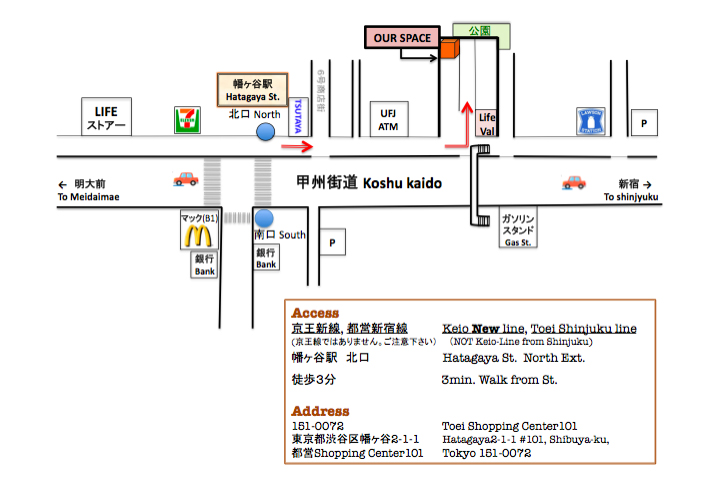
The venue, Our Space, is located off the north side of Koshu Kaido street, a three-minute walk from Hatagaya Station, or a five-minute taxi from Shinjuku Station’s south exit.
Our Space
Toei Shopping Center 101
Hatagaya 2-1-1 #101
Shibuya-ku
Map: http://www.tokyoplayers.org/?lang=1&page=16

Our Space has a limited capacity, and so reservations are strongly recommended.

Tickets cost 2,000 yen, including one drink, and are available through the Tokyo International Players website:
www.tokyoplayers.org

Now in its 112th season, TIP is Japan’s oldest English-language community theater group.

***For more information, or to arrange photographs or interviews, the media contact is Andrew Martinez: 090-2643-5919; amartinez@tokyoplayers.org***
honiefaithflyer

ourspacetheatermap

Various respondents: Police crackdowns in Roppongi and elsewhere, Olympic Bid cleanup?

mytest

Handbook for Newcomers, Migrants, and Immigrants to Japan\Foreign Residents and Naturalized Citizens Association forming NGO\「ジャパニーズ・オンリー 小樽入浴拒否問題と人種差別」(明石書店)JAPANESE ONLY:  The Otaru Hot Springs Case and Racial Discrimination in Japansourstrawberriesavatar
Hi Blog.  I’ve been receiving bits and pieces of information from people who frequent Roppongi, with rumors of police cracking down on this foreign enclave.  If not nationwide at places of business. If others have more experiences to share, feel free to comment.  The US Embassy has indeed warned people to stay out of the area.  Read on.  Three posts follow.  Arudou Debito in Sapporo

============================

May 15, 2009

(identifying details redacted upon request)

Big heads up to any of you who may be inclined to stray into Roppongi and sample the more exotic mind-altering products…      

A friend a friend who is a bilingual, long-term resident has just found himself in the clink facing down a multi-year jail sentence for simply testing positive (urine test) to a “Class A substance” … whatever that means. Apparently a couple of weeks ago 100 police raided a regular nightclub (not a rave or trance party or anything like that) and dragged out 100 people and held them for testing.

Also, apparently, the police are on a drive to “clean up” Roppongi as a part of the Olympic bid (OK, we are getting into big-time hearsay/rumour there, but that is what my friend heard), and before this incident the US Embassy had issued a warning to all its staff to simply stay away from Roppongi. Even if you are completely clean, getting caught up in one of these raids could cost you several days of liberty before you are processed, cleared and allowed to go. No apologies, nothing.      

So, be warned, tell any of your friends who may have a predilection for such activities.
============================

From: American Embassy Tokyo [mailto:tokyoacs@state.gov]
Sent: Tuesday, March 17, 2009 12:36 PM
Subject: Warden Message ・Roppongi Security Notice      

Date: March 17, 2009

This is to inform the American community that the U.S. Embassy has
recommended that the embassy community avoid frequenting Roppongi bars and clubs in Tokyo due to a significant increase in reported drink-spiking incidents.  American citizens may choose to avoid frequenting drinking establishments in this area as well.

The number of reports of U.S. citizens being drugged in bars has increased significantly in recent weeks.  Typically, the victim unknowingly drinks a beverage that has been secretly mixed with a drug that renders the victim unconscious for several hours, during which time large sums of money are charged to the victim’s credit card or the card is stolen outright.  Victims sometimes regain consciousness in the bar or club, while at other times the victim awakens on the street.

Because this type of crime is already widespread in Roppongi bars and is on the rise, the U.S. Embassy has recommended that members of the embassy community avoid frequenting drinking establishments in this area.  American citizens may consider this recommendation as it applies to their own behavior.  If you, nevertheless, choose to participate in Roppongi night life, we urge you to remain extra vigilant of your surroundings and maintain a high level of situational awareness.  Establishments in the area of Roppongi Intersection (Roppongi Dori and Gaienhigashi-dori) have had the highest level of reported incidents.

For further information please consult the Country Specific Information Sheet for Japan, available via the Internet at http://travel.state.gov. U.S. citizens living or traveling abroad are encouraged to register with the nearest U.S. embassy or consulate through the State Department’s travel registration web site at https://travelregistration.state.gov/ibrs/ui/ so that they can obtain updated information on travel and security.  Americans without Internet access may register in person with the nearest U.S. embassy or consulate.  By registering, American citizens make it easier for the embassy or consulate to contact them in case of emergency.

U.S. citizens are strongly encouraged to maintain a high level of vigilance, be aware of local events, and take the appropriate steps to bolster their personal security.  For additional information, please refer to “A Safe Trip Abroad” found at http://travel.state.gov.

For further information or any emergencies involving American citizens, please contact the American Citizens Services (ACS) Unit of either the U.S. Embassy in Tokyo or one of the U.S. Consulates in Japan listed below:

U.S. Embassy in Tokyo
American Citizen Services
1-10-5 Akasaka, Minato-ku, Tokyo 107-8420
Tel: 03-3224-5174
Fax: 03-3224-5856
http://japan.usembassy.gov/e/tacs-main.html

ENDS

============================

May 17, 2009

Dear Debito, I enjoy reading your blog as always!

These days I have been going to bed early but I happened to find my way to a Roppongi club for the birthday party of a friend. The club is called Muse and is quite popular in the area. I always go there and have no problems with the staff, but I noticed an interesting sign in English. It said something to the effect of “To all foreign customers, we are checking Japanese government issued ID of all foreigners on the advice of the police. Thank you for your cooperation”. 

I in fact did not experience a check in spite of the sign, but the sign seems to indicate to me that the police are pressuring places to make alien card checks on foreigners. This wouldn’t be the first time, even today. Earlier in the day I went to Nissan Rentacar when I often rent cars and for the first time was asked for my alien card. I said “nande?” in Japanese and the staff member promptly said “Umm… ohh.. never mind, actually you live in Japan right? So no problem.” The same sort of thing has happened to me at a hotel in Mie prefecture where the guy specifically asked for my alien card before promptly withdrawing the request when I questioned it.

These three things lead me to the same conclusion. There seem to be multiple campaigns underway by someone (perhaps the police) for a number of establishments to check alien registration cards. For me this is not acceptable. The club was the worst example but the other two are not far behind. Perhaps the police are an organization that can be targeted in a demand for change.  Best Regards, AM
ENDS

Japan Times May 20, 2009: “IC you: Bugging the Alien” article on new Gaijin Cards

mytest

Handbook for Newcomers, Migrants, and Immigrants to Japan\Foreign Residents and Naturalized Citizens Association forming NGO\「ジャパニーズ・オンリー 小樽入浴拒否問題と人種差別」(明石書店)JAPANESE ONLY:  The Otaru Hot Springs Case and Racial Discrimination in Japansourstrawberriesavatar

Hi Blog.  Here’s the JT version of my article yesterday, with links to sources. Enjoy!  Debito in Sapporo

IC you: bugging the alien

New gaijin cards could allow police to remotely track foreigners

http://search.japantimes.co.jp/cgi-bin/fl20090519zg.html

When the Japanese government first issued alien registration cards (aka gaijin cards) in 1952, it had one basic aim in mind: to track “foreigners” (at that time, mostly Korean and Taiwanese stripped of Japanese colonial citizenship) who decided to stay in postwar Japan.

Gaijin cards put foreigners in their place: Registry is from age 16, so from a young age they were psychologically alienated from the rest of Japanese society. So what if they were born and acculturated here over many generations? Still foreigners, full stop.

Even today, when emigrant non-Japanese far outnumber the native-born, the government tends to see them all less as residents, more as something untrustworthy to police and control. Noncitizens are not properly listed on residency registries. Moreover, only foreigners must carry personal information (name and address, personal particulars, duration of visa status, photo, and — for a time — fingerprints) at all times. Gaijin cards must also be available for public inspection under threat of arrest, one year in jail and ¥200,000 in fines.

However, the Diet is considering a bill abolishing those gaijin cards.

Sounds great at first: Under the proposed revisions, non-Japanese would be registered properly with residency certificates (juuminhyou). Maximum visa durations would increase from three years to five. ID cards would be revamped. Drafters claim this will “protect” (hogo) foreigners, making their access to social services more “convenient.”

However, read the fine print. The government is in fact creating a system to police foreigners more tightly than ever.

Years ago, this column (“The IC You Card,” Nov. 22, 2005) examined this policy in its larval stage. Its express aims have always been to target non-Japanese in the name of forestalling crime, terrorism, infectious diseases and the scourge of illegal aliens. Foreigners, again, are trouble.

But now the policy has gone pupal. You might consider helping chloroform the bug before it hatches. Here’s why:

The “new gaijin cards,” or zairyuu kaado (ZRK), are fundamentally unchanged: The usual suspects of biometric data (name, address, date of birth, visa status, name and address of workplace, photograph etc. — i.e. everything on the cover of your card) will be stored digitally on an embedded computer chip. Still extant is the 24/7 carrying requirement, backed by the same severe criminal punishments.

What has changed is that punishments will now be even swifter and stricter. If you change any status recorded on your chip and don’t report it to the authorities within 14 calendar days, you face a new ¥200,000 fine. If you don’t comply within three months, you risk losing your visa entirely.

Reasonable parameters? Not after you consider some scenarios:

• Graduate high school and enroll in college? Congratulations. Now tell the government or else.

• Change your job or residence? Report it, even if your visa (say, permanent residency or spouse visa) allows you to work without restrictions anywhere.

• Get a divorce, or your spouse dies? Condolences. Dry your eyes, declare the death or marital mess right away, and give up your spouse visa.

• Suffering from domestic violence, so you flee to a shelter? Cue the violins: A Japanese husband can now rat on his battered foreign wife, say she’s no longer at his address, and have her deported if she doesn’t return to his clutches.

Foreigners are in a weaker position than ever.

Now add on another, Orwellian layer: bureaucratic central control (ichigen kanri). Alien registration is currently delegated to your local ward office. Under the new system, the Ministry of Justice will handle everything. You must visit your friendly Immigration Bureau (there are only 65 regional offices — not even two per prefecture) to stand in line, report your changes and be issued with your card.

Try to get there within what works out to be a maximum of 10 weekdays, especially if you live in a remote area of Japan (like, say, Hokkaido or an Okinawan island). Then try to explain away a lost workday in this corporate culture.

Now consider refugees. They don’t even get an ID card anymore. They won’t be able to open a bank account, register to attend schools, enter hospital, or qualify for social insurance anymore. No matter; our country accepts fewer than a few dozen refugees every year; they shouldn’t have come here anyway, thinking they could impose upon our peaceful, developed country.

That’s still not the worst of it. I mentioned that embedded computer chip. The ZRK is a “smart card.” Most places worldwide issue smart cards for innocuous things like transportation and direct debit, and you have to swipe the card on a terminal to activate it. Carrying one is, at least, optional.

Not in Japan. Although the 2005 proposal suggested foreign “swiping stations” in public buildings, the technology already exists to read IC cards remotely. With Japan’s love of cutting-edge gadgets, data processing will probably not stop at the swipe. The authorities will be able to remotely scan crowds for foreigners.

In other words, the IC chip is a transponder — a bug.

http://en.wikipedia.org/wiki/Contactless_smart_card#Identification

http://www.dameware.com/support/kb/article.aspx?ID=300080

Now imagine these scenarios: Not only can police scan and detect illegal aliens, but they can also uncover aliens of any stripe. It also means that anyone with access to IC chip scanners (they’re going cheap online) could possibly swipe your information. Happy to have your biometric information in the hands of thieves?

Moreover, this system will further encourage racial profiling. If police see somebody who looks alien yet doesn’t show up on their scanner (such as your naturalized author, or Japan’s thousands of international children), they will more likely target you for questioning — as in: “Hey, you! Stop! Why aren’t you detectable?”

I called the Immigration Bureau last week to talk about these issues. Their resident experts on ZRK security said that data would be protected by PIN numbers. The bureau could not, however, answer questions about how police would enforce their next-generation gaijin card checkpoints. Those police are a different agency, they said, and there are no concrete guidelines yet.

Come again? Pass the law, and then we’ll decide law enforcement procedures? This blind faith is precisely what leads to human rights abuses.

One question lingers: Why would the government scrap the current alien policing system? For nearly six decades, it effectively kept foreigners officially invisible as residents, yet open to interrogation and arrest due to a wallet-size card. What’s broke?

Local government. It’s too sympathetic to the needs of its non-Japanese residents.

Remember Noriko Calderon, whose recently deported parents came to Japan on false passports? Did you ever wonder how she could attend Japanese schools and receive social services while her parents were on expired visas?

Because local governments currently issue the gaijin cards. At their own discretion, they can even issue ID to visa overstayers. Rendered as zairyu shikaku nashi (no status of residence), the card can be used to access social services. They can live relatively normal lives, as long as they avoid police gaijin-card checkpoints.

Why are local governments so sweet? With high concentrations of non-Japanese residents, many see foreigners as human beings needing assistance. After all, they keep local factories humming, pay taxes and add life to local infrastructure. Hamamatsu in Shizuoka Prefecture and Yokkaichi, in Mie, have long petitioned the national government for improvements, such as facilitating foreign access to public services and education, and easing registry and visa applications.

After years of deaf ears, the central government took action. Under the rhetoric of “smoking out illegal aliens,” Prime Minister Junichiro Koizumi in 2005 pledged to “make Japan the world’s safest country again” by halving the number of visa overstayers by 2010.

Never mind that the overall trend in Japan is toward devolving power to the provinces (chiho bunken); Japan now wants to rein in local governments because they poke holes in their dike. It’s still a shame the proposed plugs make life impossible for refugees, and harder for any law-abiding non-Japanese resident with a busy life.

Still, did you expect the leopard to change its spots? Put immigration policy in the hands of the police and they will do just that — police, under a far-removed centralized regime trained to see people as potential criminals.

This is counterproductive. As we’ve said in this column many times before, an aging Japan needs immigration. These new gaijin cards will make already perpetually targeted foreigners (and foreign-looking Japanese) even less comfortable, less integrated members of society.

Why stop at bugging the gaijin? Why not just sew gold stars on their lapels and be done with it?

Fortunately, a policy this egregious has fomented its own protest, even within a general public that usually cares little about the livelihoods of foreigners. Major newspapers are covering the issue, for a change. The opposition Democratic Party of Japan wants the bill watered down, vowing to block it until after the next general election.

The coalition group NGO Committee against Resident Alien Card System (www.repacp.org/aacp) has as its banner “Less policing, more genuine immigration policy that promotes multiethnic co-existence.”

On Sunday afternoon, there will be a demonstration in Tokyo against the new gaijin cards. Do attend if so inclined.

=================

A public assembly against the new IC-chip gaijin cards will take place Sunday, May 24, 2-5 p.m. at the Koutsu Building, Shimbashi 5-15-5, Tokyo. For further information,see www.repacp.org/aacp/pdf/MultiLang/20090420LeafENv01.pdf or contact Amnesty International Japan via www.amnesty.or.jp or by mail at ksonoko@amnesty.or.jp. Send comments to community@japantimes.co.jp
ENDS 

Charles McJilton on how visa overstayers too get Gaijin Cards

mytest

Handbook for Newcomers, Migrants, and Immigrants to Japan\Foreign Residents and Naturalized Citizens Association forming NGO\「ジャパニーズ・オンリー 小樽入浴拒否問題と人種差別」(明石書店)JAPANESE ONLY:  The Otaru Hot Springs Case and Racial Discrimination in Japansourstrawberriesavatar

Hi Blog. I asked Charles to write this up because it’s an interesting case study on how visa overstayers still get Gaijin Cards for social services (such as Calderon Noriko’s schooling). The answer is: local governments issue them. And the police, according to one anecdote below, are aware of it. Now, however, the GOJ is trying to close that avenue, by abolishing the current Gaijin Card system and replacing it with something even more draconian. See my Japan Times article today on it. Arudou Debito in Sapporo

=======================================

GAIJIN CARDS EVEN FOR OVERSTAYERS

By Charles E. McJilton
Catholic Community Worker
Debito.org, May 19, 2009

“All my paperwork except my visa…”

This was the constant refrain of Miss X. For her a visa was not the beginning of the process of legitimizing her legal existence in Japan but the end. For most foreigners in Japan, receiving a visa to stay in Japan begins the road of registering at the local ward, applying for a gaijin card, opening a bank account, and eventually paying taxes. All of these things are milestones signifying that one is a bona fide member of society. But how does one survive if the do not have a visa? How do they go about legitimizing their existence, and is it possible?

I first met Miss X in June 1994 when she was staying at Catholic facility for unwed mothers. I was a Catholic community worker and met her went I went to mass on Saturday nights. Her son had just been born and she was not sure what she was going to do. The father was also a foreigner and was not really prepared for this new responsibility. Over the years I saw many changes in her life and the struggles she went through. She and the father were never able to make things work and went their separate ways. Left to work things out for herself she had many different jobs until she settled at a factory making toys for 600 yen an hour, or 4800 yen a day. On a good month her pay would be 100,000 yen, but it could easily be as a low as 80,000 yen. With rent at 50,000 a month, money was tight for her Miss X, but she found many ways to save money and get by. While the pay was low, it meant she could be home with her son in the evening rather than working at some club.

There is an unwritten rule among the foreigners I deal with and that is we do not ask about one’s visa status. There is no reason to ask. So, in 2002 I was having coffee with Miss X when she casually told me, “I have all my paperwork except my visa.” She then pulled out a folder filled with documents. And sure enough, one was a copy of her foreign registration at her local ward. And then she showed me her gaijin which had written in black 在留資格なし(no permission to stay). She explained that each year she was required to “renew” her gaijin card.

Then she explained why she registered. As registered foreigner and single mother she was eligible for support from the government for specific things related to her son. For example, when she gave birth, the ward office picked a part of the hospital bill. When her son went to daycare while she was working the ward stepped in and provided some assistance. And when her son entered elementary school the ward subsidized his lunch meals. This would not have been possible had she not registered her son.

In 2003 the police served her with a warrant to search her house. The police suspected that an acquaintance of hers had left a gun in her apartment. What was amazing was that the warrant had her address and correct legal name even though she never uses this name and it is doubtful many of her friends know what it is. However, the police did not arrest her. In fact, she later told me that on two other occasions the police had questioned her at the local police station and in court about a crime they believed she had information about. Again, she was never arrested.

Miss X finally went home in July 2004 when she voluntarily turned herself in to immigration. I went with her that day and waited to see what would happen to her and her son. As I waited I wondered if she would be detained or what would happen. She was the first person of her group that had been questioned together to leave interrogation room. “The let me go first because I had all my paperwork.” She explained she had to return two more times; once with paperwork from her embassy and the last time with her ticket proving she was leaving Japan. “My son asked them to change the date we had to come back so he could attend a school event and they said OK.”

I recently called Miss X to see how she is doing. Her son is doing well in school and she is in nursing school. She said she would like to come back to Japan again some day. “But this time I want to have a proper visa.” I called her local ward and asked what their policy was regarding issuing gaijin cards to overstayers. They said in principle they notify immigration and seek guidance on whether to issue a gaijin card. If they do issue a card, the word “在留資格なし“ will be written in read, which was the case for Miss X’s last gaijin card. It is indeed an interesting world out there.

Charles E. McJilton

Tokyo, Japan

ENDS

Get Japan Times tomorrow Tuesday May 19, next Zeit Gist article on the New IC “Gaijin Cards”.

mytest

Handbook for Newcomers, Migrants, and Immigrants to Japan\Foreign Residents and Naturalized Citizens Association forming NGO\「ジャパニーズ・オンリー 小樽入浴拒否問題と人種差別」(明石書店)JAPANESE ONLY:  The Otaru Hot Springs Case and Racial Discrimination in Japansourstrawberriesavatar
Hi Blog. My next article in the JT will be tomorrow, Tuesday May 19 , on the proposed legislation to make things more “convenient” and “protected” for NJ residents: the New Zairyuu Kaado with biometric data stored on IC Chips.

Convenient? Yeah, for the police, not NJ. I make the case that, if the legislation is passed, policing and punishments will only get stricter, and the chipped cards will act as “bugs” encouraging further police checkpoints and racial profiling.

You can also hear more about the public protest against it, coming up May 24th in Tokyo.

Read all about it tomorrow, Tuesday (Wednesday in the provinces)! Get a copy! Arudou Debito in Sapporo

Metropolis & Japan Today: “Proposed NJ resident registry card creates Big Brother concerns”

mytest

Handbook for Newcomers, Migrants, and Immigrants to Japan\Foreign Residents and Naturalized Citizens Association forming NGO\「ジャパニーズ・オンリー 小樽入浴拒否問題と人種差別」(明石書店)JAPANESE ONLY:  The Otaru Hot Springs Case and Racial Discrimination in Japansourstrawberriesavatar

Hi Blog. To lead this week off, here’s an article about a subject I’ll be writing about in tomorrow (Tuesday)’s Japan Times. Beat me to it. But more articles on this, the merrier. This proposed legislation concerning the new Gaijin Cards cannot go without comment, even opposition. My Japan Times article will be voicing opposition. Meanwhile, enjoy Metropolis’s very thorough and well-considered version below. Arudou Debito in Sapporo

==========================================

Proposed resident registry card for foreigners creates Big Brother concerns

http://www.japantoday.com/category/lifestyle/view/now-new-resident-registry-card-for-foreigners-create-big-brother-concerns#show_all_comments

Metropolis and Japan Today, May 16, 2009 By Andy Sharp, courtesy of lots of people

TOKYO —All foreigners in Japan know him. The 62-year-old isn’t particularly loved — he’s a bit of a square — but we’ve all had to live with him and even take him out with us every day. Like many of his generation, he could keep on working, but he’s recently learned that he may have to settle for his pipe and slippers sooner rather than later.

The Baby Boomer in question is the Certificate of Alien Registration, or gaijin card, a form of ID that non-Japanese residents have been required to carry since the enactment of the Alien Registration Order in May 1947.

It may come as a surprise to learn that, if the government gets its way, the card will be consigned to the bureaucratic scrapheap. The Diet is currently debating bills to replace “gaikokujin torokusho” with a new residency (“zairyu”) card, which would shift administration of alien registration from municipal offices to the Immigration Bureau.

So what are the government’s plans? And, more importantly, what are the implications for foreigners?

If enacted, the bills submitted by the Cabinet in March would revise three laws — the Basic Resident Registration Law, the Immigration Control and Refugee Recognition Act, and the Special Law on Immigration Control — with the government looking to pass them before the end of the current ordinary Diet session on June 3. Once passed, the revisions would become effective in less than three years.

According to the immigration bureau, the government’s main aims are to simplify the administration of foreigners by having the bureau handle nearly all paperwork related to immigration and residency; reduce the burden on foreigners living legally in Japan by extending visa periods and relaxing re-entry rules; ensure all legal aliens join social insurance and state pension schemes; track the movement of foreigners more closely; and clampdown on illegal aliens such as visa overstayers by denying them the right to carry the new card.

However, opposition parties, legal organizations and migrant activists have slammed the revisions. They claim the changes could impose excessive fines for failure to carry the card, make notification of status changes less convenient, and lead to undue dissemination of personal information and excessive monitoring of foreigners.

One aspect of the revisions few would bemoan is the extension of the three-year visa to five years, and the removal of the need to obtain a re-entry permit for residents who leave the country for less than a year. The revisions would also give foreigners some parity with locals by placing them on the same Basic Residents’ Registration Network, or Jumin Kihon Daicho Netowaku, a system the government created to enable easy exchange of information between municipal offices. There is, however, one significant difference.

The Juki-net cards distributed to Japanese do not have numbers printed on them, and the law strictly protects information on the IC chip imbedded in the cards. But as the revisions stand, numbers would be printed on foreigners’ cards, and a greater amount of data could be kept on the chip. While this would ostensibly enable smoother administration, critics have conjured up an image of a regulatory Big Brother tracking foreigners more rigorously than their Japanese neighbors.

Immigration bureau documents state that, in addition to a photograph, the following information would be printed on the cards: name; date of birth; sex; nationality; address; visa status, type and expiry date; card number, issue; date; expiration date; working restrictions; and other necessary information stipulated in justice ministry ordinances. But with the documentation also stating that some or all of this data may be recorded on the chips, opponents fear what may be held in this “other information.”

Masashi Ichikawa, an attorney involved with the Japan Federation of Bar Associations, is concerned about unwarranted access to such personal details.

“The card could be used as identification at places such as banks and libraries, where the chip could be read and the card number recorded,” he says. “I fear that people reading the card would be able to tell how much money is in a person’s account or what books they are borrowing. Authorities such as the police and immigration would be able make inquiries to banks and other places to ask for information on a person’s number.”

Ichikawa also sees disparities between the treatment of foreigners and Japanese. “The law on resident registration for Japanese permits only the card number to be recorded on the IC chip — not the card — and does not make available information from private establishments such as banks. We want foreigners to be protected in the same way as Japanese.”

An Orwellian nightmare?

However, Kazuyuki Motohari of the immigration bureau’s general affairs division says that the IC chip has only been put on the cards to make it easier to share information between government ministries, agencies and local authorities. He also fends off fears of an Orwellian nightmare.

“Only the minimum amount of information would be put on the cards,” he says. “We’ll only perform data matching when absolutely necessary, such as to check whether a person works where they say they do — no more. The IC chip has not been put in for other people to read.”

Opponents point out that the revisions contradict the government’s objective of keeping closer tabs on foreigners. Under the current system, undocumented residents, overstayers and asylum seekers can obtain a gaijin card and access to basic education and health services. But the changes would prevent the issue of zairyu cards to such people — effectively rendering these individuals invisible.

It would still be a crime, however, for foreigners to not always carry the new card. The current law, which the immigration bureau says would not change in the revisions, specifies that aliens must present certification (i.e. the gaijin card) to officials such as immigration inspectors and officers, police officers and maritime safety officers, but mentions nothing about having to show the card as identification to private organizations such as cell phone companies and banks.

The maximum fine for failing to carry the new card would remain at 200,000 yen. Yet the immigration bureau’s Motohari says he cannot recall a case in which a fine has been levied on a legal card-carrying alien who pops out of his house for a short time without it. Even so, opponents are hammering the government to drop this obligation.

“Making all foreigners carry cards is excessive regulation,” Ichikawa says. “There are bad foreigners and also bad Japanese. We don’t think it’s necessary to oblige foreigners, especially permanent residents, to show their card on request. Even the United Nations says it’s wrong to make people with permanent residency in a country carry such a card.”

Azuma Konno, an upper house Democratic Party of Japan lawmaker, says: “The DPJ is considering amending the revisions so people are cautioned rather than fined for failing to carry the cards.”

Notifying authorities of changes in status, such as when you start a new job or get married, is currently relatively straightforward — you just head down to your local municipal office and do the necessary paperwork. The proposed changes, though, could make things more troublesome, as notifications would have to be made at your local immigration office. That means Tokyoites would have to squeeze onto the No. 99 bus at Shinagawa with the rest of humanity to the dreary office in Konan.

Failing or forgetting to notify authorities of a change in status could also come at a heavy price. It would still be possible to change your address at your municipal office, but you must report it within 14 days, and failure to do so within 90 days could mean annulment of your visa — and deportation. Foreigners on spouse visas would have to report to the immigration bureau within 14 days in cases of divorce, or the death of a spouse.

A contentious element is that a visa could be nullified if a person, in cases such as separation or living apart, is not engaged in “marital activities” for three months or more (something many Japanese couples do when one partner is “asked” by his or her company to relocate). The 14-day notification period and 90-day potential cancellation would also apply when foreigners on common visas switch jobs.

The immigration bureau stresses it has considered the plight of foreigners and would take personal circumstances into account when making decisions on visa annulment. “We are considering other more convenient ways to make notifications, such as online or by mail,” Motohari says. “We hope to lessen the burden on foreigners as much as possible.”

The bureau says it has held meetings to gather views from both Japanese and aliens. It also claims it has not widely publicized the content of the revisions because it wants to focus its efforts on getting them passed into law before it provides information to the foreign community.

Opponents, however, insist the government hasn’t really listened to non-Japanese viewpoints and that the insubstantial press coverage has meant few foreigners are aware of the government’s plans, denying them the opportunity to protest.

But with groups such as the Solidarity Network with Migrants Japan organizing rallies and hearings in which opposition lawmakers, Korean groups and legal organizations put counterarguments to the government, the revisions could wind up significantly amended.

Moreover, should the government fall and a DPJ-led administration take office — a distinct possibility this year — before the bills are passed, one 60-something gent could find he has to put his retirement plans on hold for a while.

How will the new card affect you?

Pros
– Typical length of visa stay changed from three years to five years
– No need to obtain a re-entry permit when leaving the country for less than a year
– Assurance that all legal foreigners will be placed on social insurance and state pension schemes
– Administrative procedure simplified
– Possibility to notify authorities of certain changes of status by email or post

Cons
– Notification of most changes of status must be made at Immigration Bureau rather than at local municipal offices
– IC chip on the new card raises privacy concerns
– Asylum seekers and visa overstayers won’t be eligible to receive the cards, resulting in possible loss of basic health and education services
– Possibility of visa annulment if status notifications are not made within a 90-day period

This story originally appeared in Metropolis magazine (www.metropolis.co.jp).

Sunday Tangent: Economist on UN racism conference fiasco, April 2009

mytest

Handbook for Newcomers, Migrants, and Immigrants to Japan\Foreign Residents and Naturalized Citizens Association forming NGO\「ジャパニーズ・オンリー 小樽入浴拒否問題と人種差別」(明石書店)JAPANESE ONLY:  The Otaru Hot Springs Case and Racial Discrimination in Japansourstrawberriesavatar

Hi Blog.  Here’s what happened some weeks ago, regarding how the April UN conference on racism, the Olympics for human rights worldwide, turned into a bit of a fiasco, what with competing interests hijiacking the event.  Again.  A bit old, but still worth blogging on Debito.org nonetheless, because it shows that what goes on in Japan is comparatively small potatoes, and how our issues are probably not going to get the attention from outside that they should.  Pity.  Racism is one hard mother to define, unite against, and defeat.  Arudou Debito in Sapporo

===============================

UN conference on racism

Avoiding the worst
Apr 23rd 2009 | GENEVA
From The Economist print edition

http://www.economist.com/world/international/displaystory.cfm?story_id=13527953

Despite the indignation caused by an Iranian tirade, some gallant souls were accentuating the positive after a UN deliberation on race

IN ONE of the more dramatic scenes in modern diplomacy, a resolution describing Zionism as a form of racism, adopted by the UN General Assembly in 1975, was excoriated by Daniel Patrick Moynihan, America’s UN ambassador, as an “infamous act” and a “terrible lie”. Then in 1991, the resolution was reversed and (to quote another senior American diplomat) consigned “to the dustbin of history”.

In both votes, the outcome matched the times: the first resolution was promoted by a Soviet-Muslim coalition in a spirit of cold-war antagonism; the second reflected expectations of a “new world order” with America at the helm. To judge by the disorderly scenes that unfolded in Geneva this week, at a UN conference on racism, today’s international climate is far more rancorous than it was 18 years ago, and not too far from the poisonous mood that prevailed in 1975.

At this week’s gathering, expectations were cautious, to put it mildly. A legion of critics (in governments and elsewhere) said the affair would just be a hatefest directed at Israel and the Jews: no better, they said, than the UN’s anti-racism conference in 2001. Fear of a repetition had persuaded Australia, Canada, Israel and four European countries to stay away. So, at the last minute, did America, dashing hopes that a black president would warm to a discussion, however flawed, on racism.

The sceptics’ case received a huge fillip from Iran’s president, Mahmoud Ahmadinejad, who railed not only against Israel but the Western countries which helped found the Jewish state, and “under the pretext of protecting the Jews…made a nation homeless with military expeditions and invasion.” Although in his public remarks he dropped an earlier formula which directly called in question the Holocaust, the speech led to a walkout by 23 European delegations. The governments that walked out (or stayed away) got notes of thanks from Binyamin Netanyahu, Israel’s prime minister.

That scene is undoubtedly the thing that the world will remember most about the week’s proceedings. Yet only a day later, supporters of the conference (including some sane-ish governments and NGOs) were speaking of success: the adoption of a resolution that might just be a landmark in the battle for tolerance and free speech.

Most of the European countries that walked out of Mr Ahmadinejad’s speech made clear soon after that they were not quitting the whole conference. (Only the Czech Republic did; it now holds the European-Union presidency, but on this matter it was not acting for the EU.)

For those who walked back in, another source of relief was the fact that few were inclined to follow the lead of Mr Ahmadinejad (the only head of government who was present) and focus mainly on Israel and the Middle East. This change of tone, plus the fact that a carefully drafted resolution was adopted by consensus, led some Western governments to claim that the sharp-tongued visitor had been neutralised. It all “showed just how out of step the Iranian government is,” said Peter Gooderham, Britain’s envoy to the UN in Geneva.

For diehard optimists in the human-rights world, Mr Ahmadinejad’s intervention was only a hiccup in the process of crafting a charter setting out principles that could guide national legislation and other efforts to combat racism.

It is true that some hard work went into making the final resolution easier for Western governments to sign. In early drafts, Islamic countries had sought to introduce a clause making defamation of religion a breach of human rights, with disturbing implications for freedom of expression. Iran, alone, had also sought to exclude any reference to the Holocaust.

The document finally adopted makes no explicit reference to Israel and the Middle East. Its chief flaw, in the eyes of critics, is that it reaffirms the outcome of the 2001 conference, where the Jewish state had come in for much criticism. Despite that, Western human-rights groups hailed the new text’s exclusion of illiberal language deploring the “defamation” of faith; instead, it deplores the “derogatory stereotyping and stigmatisation of persons based on their religion or belief”. Thus “it recognises the primacy of individuals, not the primacy of religions or ideologies,” noted Agnes Callamard of the London-based free-speech group, Article 19.

For B’nai B’rith, one of a raft of Jewish groups which came to Geneva to voice alarm over the UN proceedings, the final text was still “fatally flawed” because of its allusion to the 2001 meeting in Durban. “The adoption of this document shows nothing has changed since 2001, no lessons have been learnt—and the hope for a unified approach to fighting racism and intolerance around the world will again go unfulfilled,” B’nai B’rith said.

But several human-rights groups concurred with Mr Gooderham’s view that the final statement “covers the ground pretty well”. It avoids some of the unwelcome language (from a Western standpoint) that was initially mooted.

“It’s a breakthrough because it overcomes the polarisation that existed between the Islamic countries and the Western world. It shows they can find common ground on issues that had caused this polarisation,” said Julie de Rivero, Geneva representative of Human Rights Watch (HRW), a global civil-liberties group.

For HRW, the outcome added weight to its contention that liberal-minded governments should stay in the room and argue rather than storming out and leaving the ground to noisy extremists. Perhaps so—but it might be a tad too optimistic to say that polarisation between the West, the Islamic world and other ideological and regional blocks has been overcome. In any case, some fresh evidence on that question will emerge next month—when the United States stands for election to the UN Human Rights Council in the hope of changing that body and making it less inclined to direct all its fire at Israel.
ENDS

DEBITO.ORG NEWSLETTER MAY 16, 2009

mytest

Handbook for Newcomers, Migrants, and Immigrants to Japan\Foreign Residents and Naturalized Citizens Association forming NGO\「ジャパニーズ・オンリー 小樽入浴拒否問題と人種差別」(明石書店)JAPANESE ONLY:  The Otaru Hot Springs Case and Racial Discrimination in Japansourstrawberriesavatar

DEBITO.ORG NEWSLETTER MAY 16, 2009

First off…
Get Japan Times Tuesday May 19, Zeit Gist article on the New IC “Gaijin Cards”.

My next article next week in the JT will be on the proposed legislation to make things more “convenient” and “protected” for NJ residents: New Zairyuu Kaado with biometric data stored on IC Chips.

Convenient? Yeah, for the police, not NJ. I make the case that, if the legislation is passed, policing and punishments will only get stricter, and the chipped cards will act as “bugs” encouraging further police checkpoints and racial profiling. Read all about it next Tues (Weds in provinces)!

Now for the Newsletter:

Table of Contents:
//////////////////////////////////////////////////
ILLNESSES AND RESUSCITATIONS
1) Wash Post on GOJ border controls of Swine Flu,
Mainichi/Kyodo on hospitals turning away J with fevers or NJ friends
2) GOJ shuts down NJ academic conference at Josai University due to Swine Flu
3) Revamped article on the Nikkei Repatriation Bribe, and BBC on what’s happening to returnees
4) Tokyo Shinbun: GOJ to amend Nikkei Repatriation Bribe exile to Mar 2012
5) Japan Times: “Immigrants” magazine & advocates’ moves to establish J immigration policy
6) Kirk Masden resuscitates debate on TV Asahi show KokoGaHen

DEBATES FROM BIZZAROWORLD
7) Hokkaido Kushiro gives special Residency Certificate to sea otter
8 ) AP on resuscitating discriminatory Buraku historical maps on Google Earth
9) Chunichi Shinbun May 11, 2009 on New IC Gaijin Card debate
10) Thoughts on May 11’s TV Asahi TV Tackle on NJ issues
11) Thoughts on May Day 2009 in Odori Park, Sapporo
12) Kambayashi Column: Self-censoring media abets incompetent politicians.
13) Sunday Tangent: Obama’s March 8, 2008 speech on race, link to full text

… and finally …
14) Japan Times JUST BE CAUSE column May 5, 2009 on Alberto Fujimori’s 31-year sentencing
(full text)

//////////////////////////////////////////////////

By Arudou Debito, Sapporo, Japan (debito@debito.org, www.debito.org)
Freely forwardable

//////////////////////////////////////////////////

ILLNESSES AND RESUSCITATIONS

1) Wash Post on GOJ border controls of Swine Flu,
Mainichi/Kyodo on hospitals turning away J with fevers or NJ friends

Wash Post: Armed with thermographic guns, Japanese health inspectors in surgical gowns, goggles and masks boarded United Flight 803 from Washington Dulles. They prowled the aisles, pointing their fever-seeking machines at jet-lagged faces.

Asia was stung in 2003 by an outbreak of severe acute respiratory syndrome (SARS), which killed about 800 people and caused temporary harm to the economies of Hong Kong, Singapore, China and Malaysia. As a result, governments and health bureaucracies across the region are ready and willing to move aggressively against swine flu.

For jumbo jets arriving from North America, a shortage of health inspectors [in Japan] has meant that considerable time is being spent by passengers in parked airplanes. Thousands of travelers have waited for hours in their seats before inspectors could clear them to pass through immigration.

“We’re just about managing to handle the situation with a limited number of inspectors,” a government official told the Yomiuri newspaper. “But I wonder what will happen if more outbreaks occur in other countries.”

COMMENT: My critique of this situation might surprise you…

https://www.debito.org/?p=3195

But then it turns out, according to the Mainichi and Kyodo, that unprofessional hospitals are turning away people with fevers or a foreign friend! Read on:

//////////////////////////////////////////////////

2) GOJ shuts down NJ academic conference at Josai University due to Swine Flu

Anonymous: A friend of mine was supposed to come to Tokyo from the U.S. for an academic conference next week. There would be around 800 mostly North American participants good business for hotels and lots of tourism money in general in these tough economic times. Last week, the GOJ started pressuring the host university to cancel the conference. The host, Josai University, managed to negotiate the following conditions to have the conference:

1. Detailed location/contact info for participants during conference and 10 days after
2. Temperature taken every day of the conference; those with 100.4 F given additional test and possibly quarantined
3. Fill out health declaration every day
4. Wear masks every day
5. Participants are required to pay all quarantine and medical costs

Needless to say, many did not want to attend under these strict conditions, and the conference ended up being canceled…

https://www.debito.org/?p=3263

//////////////////////////////////////////////////

3) Revamped article on the Nikkei Repatriation Bribe, and BBC on what’s happening to returnees

DEBITO: How has a government policy for a developed country disintegrated into something so ludicrous, where even officially sanctioned exclusionism has a hierarchy?

Put bluntly, the policy is: train one percent (5,000) to stay; bribe the rest to go and become some other country’s problem. In fact, the government stands to save a great deal of money by paying the nikkei a pittance in plane fares and repatriation fees, while keeping their many years of pension contributions (usually about 15% of monthly salary). By using this economic sleight-of hand, offering desperate people short-term cash if they foresake their long-term investments, this anti-assimilation policy becomes profitable for the government, while beggaring foreigners’ retirements

This is what happens when people are brought into a country by official government policy, yet for unofficial purposes at odds with official pledges. Japan has no immigration policy. It then becomes awkward for the government to make official pronouncements on how the new workforce is contributing to the economy, or why it should be allowed to stay. So the workforce remains in societal limbo. Then when things go wrong in this case a tectonic macroeconomic shift and the policy fails, it is the foreigners, not the government, who bear the brunt.

https://www.debito.org/?p=3151

====================

BBC: The advice centre used to get 200 inquiries a month. Now they have 1,000, many from Brazilian workers who have been laid off. Wellington Shibuya is one of them. He not only prays in a local church. After losing his home, this is also where he sleeps.

Now he is taking an offer from Japan’s Government of 300,000 yen, around 3,000 dollars, to go back to Brazil. But the Government help comes with a catch. He won’t be allowed back into Japan on the same easy terms to seek work. Effectively it is a one way ticket.

“They told us ‘come, come, welcome to Japan’,” he says in halting Japanese. “‘We’ll give you a job, a place to live. Welcome, welcome.’ Now they don’t have a job for us, they’re saying ‘we’ll give you a little money, but don’t come back. Bye bye’.”

Supporters of the scheme say the Government had to do something to help people in need far from home…

https://www.debito.org/?p=3168

//////////////////////////////////////////////////

4) Tokyo Shinbun: GOJ to amend Nikkei Repatriation Bribe exile to Mar 2012

The Tokyo Shinbun reports that the 300,000 yen Repatriation Bribe for Nikkei (with consequent bar on reentry on the same special “Long-Term Resident” (teijuusha) status) is to be amended, to shorten the length of exile to the end of March 2012. After that, Nikkei are welcome to reapply for the same status and come back to work in Japan.

Anyone know whether Japan has a pension treaty with the Nikkei-origin countries so their work contributions overseas will be counted as part of their Japanese pension for the duration of their exile, or in case they don’t get their visa renewed to come back from exile?

https://www.debito.org/?p=3233

//////////////////////////////////////////////////

5) Japan Times: “Immigrants” magazine & advocates’ moves to establish J immigration policy

Japan Times: “Japan’s immigration policy has always been a patchwork. We need to have proper laws and regulations in place when accepting people from abroad,” Susumu Ishihara, 57, president of the Japan Immigrant Information Agency, said during a recent interview with The Japan Times.

Motivated by a sense of urgency, Ishihara recently spent 5 million of his own money to launch a quarterly Japanese-language magazine, called Immigrants, focusing on immigration issues. The goal is to provide more information on foreigners living here to Japanese people to bridge the gap between the two sides.

The first issue of the quarterly, circulation 10,000, included messages from ambassadors of South American countries as well as interviews with immigration policyexperts, including Liberal Democratic Party lawmaker Taro Kono, and Shigehiko Shiramizu, a professor of global media studies at Komazawa University…

https://www.debito.org/?p=3203

//////////////////////////////////////////////////

6) Kirk Masden resuscitates debate on TV Asahi show KokoGaHen

Kirk Masden unearths an opening segment of controversial TV Asahi show “Koko Ga Hen Da Yo Nihonjin”, a show long off the air but definitely not forgotten. Remember the format? A group of 100 NJ panelists in tiered seating being egged on to make a ruckus and, according to Kirk’s analysis, being portrayed as scary. He shudders to think that people might take this show (which is still being seen a lot on YouTube) as something serious or indicative of NJ or foreign societies. See his critique of the show (and mine) from this blog entry. Tell us what you think.

https://www.debito.org/?p=3202

//////////////////////////////////////////////////

DEBATES FROM BIZZAROWORLD

7) Hokkaido Kushiro gives special Residency Certificate to sea otter

Continuing in the eye-blinkingly ludicrous trend of issuing government residency documents to things that can’t actually reside anywhere, we have the fifth in the series, behind Tama-Chan the sealion in Yokohama (2003), Tetsuwan Atomu in Niiza (2003), Crayon Shin-chan in Kusakabe (2004), and Lucky Star in Washinomiya (2008), of a juuminhyou Residency Certificate now being granted to a photogenic sea otter in Kushiro, Hokkaido.

Juuminhyou been impossible to issue, despite decades of protest, to taxpaying foreign residents because “they aren’t Japanese citizens” (and because they aren’t listed on the juumin kihon daichou, NJ aren’t even counted within many local government population tallies!). Oh, well, seafaring mammals and anime characters aren’t citizens either, but they can be “special residents” and bring in merchandising yen. Why I otter!

We now have GOJ proposals to put NJ on juuminhyou at long last. But not before time (we’re looking at 2012 before this happens), and after far too much of this spoon-biting idiocy.

https://www.debito.org/?p=3154

//////////////////////////////////////////////////

8) AP on resuscitating discriminatory Buraku historical maps on Google Earth

AP: When Google Earth added historical maps of Japan to its online collection last year, the search giant didn’t expect a backlash. The finely detailed woodblock prints have been around for centuries, they were already posted on another Web site, and a historical map of Tokyo put up in 2006 hadn’t caused any problems.

But Google failed to judge how its offering would be received, as it has often done in Japan. The company is now facing inquiries from the Justice Ministry and angry accusations of prejudice because its maps detailed the locations of former low-caste communities…

Castes have long since been abolished, and the old buraku villages have largely faded away or been swallowed by Japan’s sprawling metropolises. Today, rights groups say the descendants of burakumin make up about 3 million of the country’s 127 million people. But they still face prejudice, based almost entirely on where they live or their ancestors lived…

COMMENT: A very good debate about this ensued on the blog. Check it out at:

https://www.debito.org/?p=3185

//////////////////////////////////////////////////

9) Chunichi Shinbun May 11, 2009 on New IC Gaijin Card debate

Excellent article in May 10’s Chunichi Shinbun on what’s the problem with the new proposed IC Gaijin Cards, and how the extra policing that NJ will have to endure will just make life worse for a lot of people. Again, the goal is only to police, not to actually help NJ assimilate and make a better life here.

In particular, read the contrarian arguments. Now this is how we proceed with a debate. We get people who know what they’re talking about to express the minority view (for where else is it going to be heard?). As opposed to last night’s TV Tackle, which basically had the status quo maintained with the same old commentators spouting much the same old party lines.

https://www.debito.org/?p=3256

//////////////////////////////////////////////////

10) Thoughts on May 11’s TV Asahi TV Tackle on NJ issues

Regarding abovementioned TV Asahi program “TV Tackle”: It was, in a word, disappointing.

Maybe that’s par for the course in a 55-minute (minus commercials) show edited for content, and it did try to take on some serious issues. Eight commentators participated: three academics a Korean, a Brazilian, and a Chinese plus two media pundits and three politicians LDP’s Kouno Taro, plus Koumeito, and DPJ. All people of Asian background (save an overlong and as incomprehensible as ever commentary from Koko Ga Hen TV show bomb-thrower Zomahoun Rufin), all reasonably informed, but all clipped for airtime before much of substance came out.

The show had four segments: 1) the new Gaijin Cards with IC Chips, 2) The historical issue of the Zainichis and other Permanent Residents and their right to vote in local elections, 3) the Nikkei Repatriation Bribe, and 4) the new Tourism Agency and the new tightening of Immigration controls (fingerprinting etc.). Synopsis follows…

https://www.debito.org/?p=3247

//////////////////////////////////////////////////

11) Thoughts on May Day 2009 in Odori Park, Sapporo

A little post for the holidays: I was cycling on my way to work on May 1 and going through Odori Park, where the 80th Annual Hokkaido May Day labor union rallies were taking place. They’re fun affairs (you get the pretentious lefties spouting off about protecting human rights, but then with no sense of irony whatsoever refuse to give me a flyer as I’m walking past), and it’s always interesting to see who’s speaking. In addition to Hokkaido Governor Takahashi and Sapporo City Mayor Ueda, we got wait for it Suzuki Muneo and Ozawa Ichiro! Who hijacked May Day for their own purposes.

Especially ironic, given that mere days later, Ozawa would be resigning his post as DPJ head…

https://www.debito.org/?p=3163

//////////////////////////////////////////////////

12) Kambayashi Column: Self-censoring media abets incompetent politicians.

Kambayashi: Media outlets here have been heralding an apparent jump in the approval ratings of Prime Minister Taro Aso’s Cabinet, with a recent poll by major daily The Sankei Shimbun and the Fuji News Network suggesting that 28.2 percent of Japanese approve of the government’s performance, up from 20.8 percent in late March. But what the media doesn’t want to talk about is the 60 percent of those surveyed who still disapprove of the Cabinet.

Aso continues to struggle to win over the rest of the Japanese public because of his lack of leadership and because of his predilection for embarrassing himself. But this begs the question: why was such a weak and controversial politician able to climb to the top of the political heap in the first place?

Why doesn’t the media do its job? One reason is that it is common knowledge that, in the quirky world of Japanese journalism, when a politician is awarded an influential post, the reporter covering that politician earns a promotion.

Yasushi Kawasaki, himself a former political reporter for NHK, told me that many political reporters become politicians of a sort themselves, seeking to bolster their backroom influence. Major news organizations are “in collusion with those in power.”

https://www.debito.org/?p=3163

//////////////////////////////////////////////////

13) Sunday Tangent: Obama’s March 8, 2008 speech on race, full text

As a Sunday Tangent, here is the speech which probably sealed Obama’s image as a serious thinker and candidate: his 2008 remarks on race.

To me it is a very sophisticated version of MLK’s “I have a Dream” speech few speeches have taken such a complex issue, i.e. race in America, and dealt with it with such insight, balance, and disarmingness. We need more of this insight in discourse about race in Japan. Unfortunately, too many people would prefer to think that there is NO issue of race in Japan. We’ll get to that. Meanwhile, read and savor the full text of Obama’s speech on race, and glean what you can about the approach to the issue. Ultimately, I believe, this got him elected.

Debate on the blog, however, doesn’t quite agree:

https://www.debito.org/?p=3156

//////////////////////////////////////////////////

… and finally …

14) Japan Times JUST BE CAUSE column May 5, 2009 on Alberto Fujimori’s 31-year sentencing
(full text)

JUST BE CAUSE
Fujimori gets his; Japan left shamed
Finally, an outlaw president sets a good legal precedent
The Japan Times: Tuesday, May 5, 2009
By ARUDOU DEBITO

http://search.japantimes.co.jp/cgi-bin/fl20090505ad.html

Director’s Cut with extra paragraph. Sources at https://www.debito.org/?p=3199

News item: Alberto Fujimori, former president of Peru, was sentenced last month to 25 years in prison by a Peruvian court for connections to death squads.

In my humble but loud opinion, hurrah! World media headlined it “a victory for the rule of law.” It was the first time an elected world leader in exile had been extradited back to his home country, tried, and found guilty of human-rights abuses. Take that, Pinochet, Amin and Milosevic.

That’s the only positive precedent set by an outlaw president who made a career of putting himself above the law. Lest we forget, Fujimori spoiled things for a lot of people, exploiting his Japanese roots in a ruthless pursuit of power.

Recap: Fujimori was elected in 1990 as South America’s first leader descended from Japanese immigrants. As the Japanese government likes to claim anyone with the correct blood as one of its own (recall 2008’s emigre Nobel Prize winners), out came the predictable cheers and massive investment.

Giving credit where credit’s due, Fujimori’s much-ballyhooed successes included economic development, antiterrorism programs, and a famous hostage situation at the Japanese ambassador’s residence (which ended with every insurgent executed). But Fujimori’s excesses eventually caught up with him. His corrupt administration (right-hand man Vladimiro Montesinos is serving 20 years for bribery) skimmed at least $1 billion of public money. He also suspended Parliament, purged the judiciary, and amended the constitution, allowing him to claim a hitherto illegal third term after rigged elections in 2000.

(BTW, I saw on the Discovery Channel April 12 2009 a Canadian documentary about the siege of the Japanese Ambassador to Peru’s house in 1996-7. When the commandos were on tiptoe for 34 hours ready to go in, deputy Montesinos was trying to contact Fujimori to get final approval. Guess what. It took a while to reach Fujimori, because he was dealing with personal stuff his divorce hearing! One would expect Fujimori to be on tiptoe too, what with a looming assault on your biggest national donor’s sovereign territory! Not as high a priority for a president like Fujimori.)

Four months later Fujimori bailed out. On the pretext of visiting an international conference in Brunei, he surfaced in Japan, faxed a letter of resignation from his Tokyo hotel room, and claimed he was a Japanese.

Legal contortionism ensued. Although Japan does not recognize dual nationality and spends at least a year deliberating bona fide naturalization applications, our government decided within three weeks to issue him a passport. Reasoning: Fujimori’s parents had registered his Peruvian birth with the Japanese Embassy. Since he hadn’t personally renounced his Japanese citizenship, he was to our justice minister still a Japanese citizen, and therefore immune from Peru’s demands for extradition.

For the next five years, despite Interpol arrest warrants for murder, kidnapping and crimes against humanity, Fujimori lived a comfortable exile in multiple residences within Japan’s elite society. Supported by the likes of Tokyo Gov. Shintaro Ishihara, Fujimori was for a time the toast of Tokyo, charming all manner of nationalistic authors, rightwing politicians, diplomats and journalists with his celebrity. Meanwhile he plotted his political comeback through the Internet. “I live as if I were in Peru,” he told the New York Times in 2004.

You can’t keep a bad man down. In 2005 he renewed his Peruvian passport, formally declared his candidacy for Peru’s 2006 presidential election, and abandoned his safe haven for a chartered flight to Chile. Chilean authorities immediately put the fool under arrest.

Then it got comical. Fujimori was trounced in Peru’s presidential election, so he ran in absentia in 2007 for the Japanese Diet (under the Kokumin Shinto Party). He was trounced here too. Chile then extradited him to Peru for trial. In 2007 he got six years for abuses of power. Last month he got an additional quarter-century for murder, bodily harm, and kidnapping and there are still more trials outstanding.

That should put him out of harm’s way. Now 70, Fujimori will be three digits old before he sees turnkeys, unless his daughter chip off the old block carries out her platform plank to become president and pardon him. Fujimori is a political vampire who makes one wish wooden stakes were part of the political process.

But seriously, consider the precedents set by this megalomaniac:

First, Fujimori rent asunder Japan’s due process for both naturalization and asylum-seekers (while dozens of North Korean children of Japanese mothers who have clear blood ties to Japan remain STATELESS). He made it clear that Japanese elites arbitrarily enforce our laws to benefit their own.

Now contrast him with fellow nikkei in Japan. It’s obviously OK for an overseas citizen with Japanese blood to assume dictatorial powers, pillage the public purse, then slither off to Japan. But how about the thousands of nikkei Peruvian workers in Japan who are now being told even bribed to go home?

Then contrast him with fellow nikkei overseas. If any nikkei despot can parachute into Japan and be granted asylum through mere tribalism, what country would want to elect another Fujimori as head of state? Although wrong-headed and racist, this precedent hurts future prospects for nikkei assimilation.

But sociopaths like Fujimori are by definition incurious about how they affect others, especially when granted power in young, weak constitutional democracies. At least Peru and Chile had the sense (and the chance) to lock him up and re-establish the rule of law.

No thanks to Japan, of course, from whom the world expects more maturity. Rumor has it the International Olympic Committee has been nudged by rival candidate cities about Ishihara and Fujimori. If this knocks Tokyo out of contention for the 2016 Olympics, more hurrahs for poetic justice.

In sum, Fujimori is a classic case of how power corrupts. A former math teacher comes to power, comes to believe that he can do anything, then comes to a dazzlingly rich society run by elites who shelter him and further encourage his excesses.

A pundit friend said it well: “Fujimori is an accident of birth. If he had been born in North America, he’d have been a dentist, not a dictator.”

At least this time, this kind of “accident” has not gone unpunished.

Debito Arudou is coauthor of the “Handbook for Newcomers, Migrants, and Immigrants.” Just Be Cause appears on the first Tuesday (Wednesday in some areas) Community Page of the month. Send comments to community@japantimes.co.jp
ENDS

//////////////////////////////////////////////////

All for this month. Thanks for reading!
Arudou Debito in Sapporo
debito@debito.org
Read updates in real time and RSS at https://www.debito.org

DEBITO.ORG NEWSLETTER MAY 16, 2009 ENDS

UN News: US among 18 nations elected to UN Human Rights Council

mytest

Handbook for Newcomers, Migrants, and Immigrants to Japan\Foreign Residents and Naturalized Citizens Association forming NGO\「ジャパニーズ・オンリー 小樽入浴拒否問題と人種差別」(明石書店)JAPANESE ONLY:  The Otaru Hot Springs Case and Racial Discrimination in Japansourstrawberriesavatar

Hi Blog.  Let’s do some catching up with UN stuff for the weekend.  Some of this stuff regarding membership on the UN Human Rights Council is pretty rich, especially given the US’s record on torture during the Bush II Admin.  But again, it’s time to see the back of that dark era.  And let’s hope the HRC actually becomes a meaningful organization that can pressure Japan to pass laws against racial discrimination.  Arudou Debito in Sapporo

////////////////////////////////////////

US AMONG 18 NATIONS ELECTED TO UN HUMAN RIGHTS COUNCIL
UN News, New York, May 12 2009 3:00PM

The General Assembly today <“http://www.un.org/News/Press/docs//2009/ga10826.doc.htm“>elected 18 countries to serve on the Geneva-based United Nations <“http://www2.ohchr.org/english/bodies/hrcouncil/”>Human Rights Council for three-year terms starting next month, including – for the first time – Belgium, Hungary, Kyrgyzstan, Norway and the United States.

The 47-member Council replaced the Human Rights Commission – which faced increasing criticism over the years as being ineffective and not accountable – in 2006.

The Assembly also re-elected Bangladesh, Cameroon, China, Cuba, Djibouti, Jordan, Mauritius, Mexico, Nigeria, Russia, Saudi Arabia, Senegal and Uruguay. All 18 members elected today will begin their terms on 19 June.

In March, Secretary-General Ban Ki-moon had welcomed the announcement by the US that it would seek a seat on the Council, saying it embodies the country’s commitment to a “new era of engagement.”
________________

MEMBERSHIP IN UN RIGHTS COUNCIL BRINGS GREATER RESPONSIBILITY, SCRUTINY – PILLAY
UN News New York, May 14 2009  7:00PM

In becoming a member of the United Nations Human Rights Council, a country not only takes on greater responsibility for tackling abuses worldwide, but also lays bear its own record for the scrutiny of others, the world body’s top rights official said today. 

“Council membership is not a reward for good behaviour. It is a responsibility, one that exposes members to increased accountability before their peers,” High Commissioner for Human Rights Navi Pillay wrote in an <“http://www.nytimes.com/2009/05/14/opinion/14iht-edpillay.html?_r=1“>opinion piece published today in the International Herald Tribune. 

She noted that critics of the Council point to the fact that among its 47 members are countries with “less-than-pristine” human rights records. 

“To those critics I say two things: Is there any country that has a blemish-free record? Human rights violations are not the bane of any particular country or region. And even if such a thing were possible, what impact would a club of the virtuous have on those outside?” 

Ms. Pillay called the Universal Periodic Review – by which the human rights record of every country in the world, including its own members, is examined – one of the “true innovations” of the three-year-old body. Almost 80 countries have already been scrutinized. 

This week the United States became one of five countries – along with Belgium, Hungary, Kyrgyzstan and Norway – elected to the Council for the first time. “President [Barack] Obama’s decision to seek membership is a welcome step to restoring international trust in US support for human rights,” noted the High Commissioner.

She added that participation in the Council is indispensable if States wish to influence how it develops, and also crucial to confront global human rights challenges and threats.

On terrorism, Ms. Pillay said that, in their countermeasures, the US and other governments have expanded executive power at the expense of the legislature and the courts, and eroded many of the most basic human rights guarantees of the modern era. “Experience shows that if checks and balances are not adequate, the margin of abuse is high.

“Although much more needs to be done, President Obama’s determination to resolve the untenable situation of detainees at Guantánamo Bay, ban CIA prisons and implement the prohibition on torture in compliance with international standards is highly welcome,” she wrote. 

“The US should also shed light into the still opaque areas that surround capture, interrogation methods, rendition and detention conditions of those alleged to have been involved in terrorism, and ensure that perpetrators of torture and abuse are held to account,” Ms. Pillay added. 

The Geneva-based Council replaced the Human Rights Commission – which faced increasing criticism over the years as being ineffective and not accountable – in 2006.
________________

For more details go to UN News Centre at http://www.un.org/news

ENDS

AP on resuscitating discriminatory Buraku historical maps on Google Earth

mytest

Handbook for Newcomers, Migrants, and Immigrants to Japan\Foreign Residents and Naturalized Citizens Association forming NGO\「ジャパニーズ・オンリー 小樽入浴拒否問題と人種差別」(明石書店)JAPANESE ONLY:  The Otaru Hot Springs Case and Racial Discrimination in Japansourstrawberriesavatar

Hi Blog.  Here’s a bit of history that some would rather be left undisturbed:  the historical locations of Japan’s historical underclass, the Burakumin.  To me it’s existential historical fact.  To corporate employers and marriage suitors, it could be grist for discrimination.  Am of two minds about the issue, but if if the BLL comes out against it, so shall I.  Arudou Debito in Sapporo

============================
Old Japanese maps on Google Earth unveil secrets
• By JAY ALABASTER, Associated Press – Sat May 2, 2009 

http://www.google.com/hostednews/ap/article/ALeqM5h1ON4xXZci7XWpI8IxdZNg86ZYlAD97U56SG0
Courtesy Steve H, MS, and Paul G

TOKYO -When Google Earth added historical maps of Japan to its online collection last year, the search giant didn’t expect a backlash. The finely detailed woodblock prints have been around for centuries, they were already posted on another Web site, and a historical map of Tokyo put up in 2006 hadn’t caused any problems.

But Google failed to judge how its offering would be received, as it has often done in Japan. The company is now facing inquiries from the Justice Ministry and angry accusations of prejudice because its maps detailed the locations of former low-caste communities.

The maps date back to the country’s feudal era, when shoguns ruled and a strict caste system was in place. At the bottom of the hierarchy were a class called the “burakumin,” ethnically identical to other Japanese but forced to live in isolation because they did jobs associated with death, such as working with leather, butchering animals and digging graves.

Castes have long since been abolished, and the old buraku villages have largely faded away or been swallowed by Japan’s sprawling metropolises. Today, rights groups say the descendants of burakumin make up about 3 million of the country’s 127 million people.

But they still face prejudice, based almost entirely on where they live or their ancestors lived. Moving is little help, because employers or parents of potential spouses can hire agencies to check for buraku ancestry through Japan’s elaborate family records, which can span back over a hundred years.

An employee at a large, well-known Japanese company, who works in personnel and has direct knowledge of its hiring practices, said the company actively screens out burakumin job seekers.

“If we suspect that an applicant is a burakumin, we always do a background check to find out,” she said. She agreed to discuss the practice only on condition that neither she nor her company be identified.

Lists of “dirty” addresses circulate on Internet bulletin boards. Some surveys have shown that such neighborhoods have lower property values than surrounding areas, and residents have been the target of racial taunts and graffiti. But the modern locations of the old villages are largely unknown to the general public, and many burakumin prefer it that way.

Google Earth’s maps pinpointed several such areas. One village in Tokyo was clearly labeled “eta,” a now strongly derogatory word for burakumin that literally means “filthy mass.” A single click showed the streets and buildings that are currently in the same area.

Google posted the maps as one of many “layers” available via its mapping software, each of which can be easily matched up with modern satellite imagery. The company provided no explanation or historical context, as is common practice in Japan. Its basic stance is that its actions are acceptable because they are legal, one that has angered burakumin leaders.

“If there is an incident because of these maps, and Google is just going to say ‘it’s not our fault’ or ‘it’s down to the user,’ then we have no choice but to conclude that Google’s system itself is a form of prejudice,” said Toru Matsuoka, a member of Japan’s upper house of parliament.

Asked about its stance on the issue, Google responded with a formal statement that “we deeply care about human rights and have no intention to violate them.”

Google spokesman Yoshito Funabashi points out that the company doesn’t own the maps in question, it simply provides them to users. Critics argue they come packaged in its software, and the distinction is not immediately clear.

Printing such maps is legal in Japan. But it is an area where publishers and museums tread carefully, as the burakumin leadership is highly organized and has offices throughout the country. Public showings or publications are nearly always accompanied by a historical explanation, a step Google failed to take.

Matsuoka, whose Osaka office borders one of the areas shown, also serves as secretary general of the Buraku Liberation League, Japan’s largest such group. After discovering the maps last month, he raised the issue to Justice Minister Eisuke Mori at a public legal affairs meeting on March 17.

Two weeks later, after the public comments and at least one reporter contacted Google, the old Japanese maps were suddenly changed, wiped clean of any references to the buraku villages. There was no note made of the changes, and they were seen by some as an attempt to quietly dodge the issue.

“This is like saying those people didn’t exist. There are people for whom this is their hometown, who are still living there now,” said Takashi Uchino from the Buraku Liberation League headquarters in Tokyo.

The Justice Ministry is now “gathering information” on the matter, but has yet to reach any kind of conclusion, according to ministry official Hideyuki Yamaguchi.

The League also sent a letter to Google, a copy of which was provided to The Associated Press. It wants a meeting to discuss its knowledge of the buraku issue and position on the use of its services for discrimination. It says Google should “be aware of and responsible for providing a service that can easily be used as a tool for discrimination.”

Google has misjudged public sentiment before. After cool responses to privacy issues raised about its Street View feature, which shows ground-level pictures of Tokyo neighborhoods taken without warning or permission, the company has faced strong public criticism and government hearings. It has also had to negotiate with Japanese companies angry over their copyrighted materials uploaded to its YouTube property.

An Internet legal expert said Google is quick to take advantage of its new technologies to expand its advertising network, but society often pays the price.

“This is a classic example of Google outsourcing the risk and appropriating the benefit of their investment,” said David Vaile, executive director of the Cyberspace Law and Policy Center at the University of New South Wales in Australia.

The maps in question are part of a larger collection of Japanese maps owned by the University of California at Berkeley. Their digital versions are overseen by David Rumsey, a collector in the U.S. who has more than 100,000 historical maps of his own. He hosts more than 1,000 historical Japanese maps as part of a massive, English-language online archive he runs, and says he has never had a complaint.

It was Rumsey who worked with Google to post the maps in its software, and who was responsible for removing the references to the buraku villages. He said he preferred to leave them untouched as historical documents, but decided to change them after the search company told him of the complaints from Tokyo.

“We tend to think of maps as factual, like a satellite picture, but maps are never neutral, they always have a certain point of view,” he said.

Rumsey said he’d be willing to restore the maps to their original state in Google Earth. Matsuoka, the lawmaker, said he is open to a discussion of the issue.

A neighborhood in central Tokyo, a few blocks from the touristy Asakusa area and the city’s oldest temple, was labeled as an old “eta” village in the maps. It is indistinguishable from countless other Tokyo communities, except for a large number of leather businesses offering handmade bags, shoes and furniture.

When shown printouts of the maps from Google Earth, several older residents declined to comment. Younger people were more open on the subject.

Wakana Kondo, 27, recently started working in the neighborhood, at a new business that sells leather for sofas. She was surprised when she learned the history of the area, but said it didn’t bother her.

“I learned about the burakumin in school, but it was always something abstract,” she said. “That’s a really interesting bit of history, thank you.”

ENDS

GOJ shuts down NJ academic conference at Josai University due to Swine Flu

mytest

Handbook for Newcomers, Migrants, and Immigrants to Japan\Foreign Residents and Naturalized Citizens Association forming NGO\「ジャパニーズ・オンリー 小樽入浴拒否問題と人種差別」(明石書店)JAPANESE ONLY:  The Otaru Hot Springs Case and Racial Discrimination in Japansourstrawberriesavatar

Hi Blog.  Turning the keyboard over to a friend who wishes to remain anonymous.  Debito

===============================================
Dear Debito,

I’m an avid reader of your blog — thanks for all your hard work! I thought I’d pass this information along to you in the event you are hearing about similar cases.

A friend of mine was supposed to come to Tokyo from the U.S. for an academic conference next week. There would be around 800 mostly North American participants — good business for hotels and lots of tourism money in general in these tough economic times. Last week, the GOJ started pressuring the host university to cancel the conference. The host, Josai University, managed to negotiate the following conditions to have the conference:

1. Detailed location/contact info for participants during conference and 10 days after
2. Temperature taken every day of the conference; those with 100.4 F given additional test and possibly quarantined
3. Fill out health declaration every day
4. Wear masks every day
5. Participants are required to pay all quarantine and medical costs

Needless to say, many did not want to attend under these strict conditions, and the conference ended up being canceled:

http://web.mac.com/leslielemond/SCMS@50-Tokyo/Welcome.html

So the GOJ in the end got its desired result.

Anyway, while I think that of course diligence is required in containing the flu epidemic, I find it a little disconcerting that the GOJ is coming down so strictly on NJs, especially in academic activities. I’m not even sure how legal it is for the GOJ to dictate terms and conditions of their private conference.

Perhaps this one case isn’t worth mentioning, (or perhaps I’m just upset because now I don’t get to see my friend!!) but if many things like this start to happen, it might be worth examining.

ENDS

=========================================

URGENT — SCMS CONFERENCE CANCELLATION

Dear Colleagues:

It is with a very great regret that we are announcing the cancellation of the SCMS conference in Tokyo scheduled for May 21-24, 2009.

Late last week we learned that the Government of Japan and the Chiyoda District Government had requested that Josai International University cancel the conference due to concerns about containing the H1N1 (“Swine Flu”) virus.  That request, and the conditions that were subsequently imposed under which the conference might occur, resulted in daily discussions among the officers of SCMS, members of the Board of Directors, the Society’s legal counsel, and representatives of Josai.

We have determined that proceeding with the conference under the conditions ordered by the government presents too many risks for our members and the Society.  These include the personal risks to individual members (including possible quarantine, additional expense, and considerable stress), potential liability to SCMS, as well as pressures on the Society’s small infrastructure.  Moreover, the survey conducted yesterday (564 of 748 registrants replied) indicated that almost one-third of those responding chose to withdraw from the conference.  Many of those who said that they would still attend indicated that they would do so out of a sense of obligation or said that they would spend minimal time at the conference.  It was also clear that some registrants who did not respond to the survey, but who communicated in other ways, were waiting for more information before making a decision.

We are extremely grateful for the efforts of JIU, on behalf of SCMS, for negotiating with the national and local governments to create conditions under which the conference could move forward.  But it is clear that members felt that those conditions would not be conducive to a satisfactory conference experience.  The high cancellation rate – with more likely – presented us with a depleted program rather than the robust intellectual and social experience our members have come to expect of the SCMS conference.

  1.     You are urged to cancel your hotel reservations and flights immediately, unless you plan to travel to Japan for pleasure.  You should contact your airline to arrange for credit on your airfare.  We will be working with Japan Travel Bureau to reduce or eliminate hotel cancellation penalties.

  2.     Conference fees will be refunded, or individuals may request that their registration fee be used for the 2010 conference in Los Angeles.  More details will follow.

  3.     We are working on plans to retain as much of the Tokyo conference as possible as a part of our Los Angeles conference.  We will provide more information as soon as possible.   

  4.     We will be creating a forum on the SCMS website for individuals to register their comments.

  5.     If you have already arrived in Japan and need assistance, please contact the SCMS office staff as soon as possible.  Others can expect their e-mail messages and phone calls to be answered in the order that are received as soon as the staff can respond.

This has been a severe trial for the SCMS leadership, and we realize that the uncertainty caused by this global health situation has created great confusion and anxiety among our members.

We are extremely disappointed that we have had to make this decision, especially in light of the tremendous amount of planning and work that our members, the SCMS staff, and our exhibitors committed to this conference.  Again, we offer our heartfelt gratitude to the Chancellor of Josai and Josai International Universities, MIZUTA Noriko, Dean EN Fukuyuki, SHINOZAKI Kayo and the rest of the staff at JIU who generously offered his or her services above and beyond any duties, responsibilities, or obligations and on top of their already considerable responsibilities at JIU.

We are saddened that we will not be able to meet in Tokyo, but when the dust settles, we look forward to a combined Tokyo/Los Angeles conference to celebrate our fiftieth anniversary, which will represent the very best of who we are and what we do.

Sincerely,

Patrice Petro, President

Anne Friedberg, President-Elect

Stephen Prince, Past-President

Eric Schaefer, Secretary

Paula Massood, Treasurer

Scott Curtis, Member of the Board

F. Hollis Griffin, Graduate Student Representative

Michele Hilmes, Member of the Board

Priya Jaikumar, Member of the Board

Victoria Johnson, Member of the Board

Charles Wolfe, Member of the Board

Michael Zryd, Member of the Board

ENDS

Japan Times: “Immigrants” magazine & advocates’ moves to establish J immigration policy

mytest

Handbook for Newcomers, Migrants, and Immigrants to Japan\Foreign Residents and Naturalized Citizens Association forming NGO\「ジャパニーズ・オンリー 小樽入浴拒否問題と人種差別」(明石書店)JAPANESE ONLY:  The Otaru Hot Springs Case and Racial Discrimination in Japansourstrawberriesavatar

Hi Blog.  On the other end of the cantilever balancing out those who would sooner cleanse Japanese society of the foreign element, we have those who accept the reality of immigration and call for something to be done to help people.  Excerpting from the Japan Times.  Arudou Debito in Sapporo
============================

The Japan Times, Thursday, April 30, 2009

Opening the door to foreigners

Expert warns Japan shuns the very immigrants it needs to thrive

http://search.japantimes.co.jp/cgi-bin/nn20090430f1.html

…”Japan’s immigration policy has always been a patchwork. We need to have proper laws and regulations in place when accepting people from abroad,” Susumu Ishihara, 57, president of the Japan Immigrant Information Agency, said during a recent interview with The Japan Times.
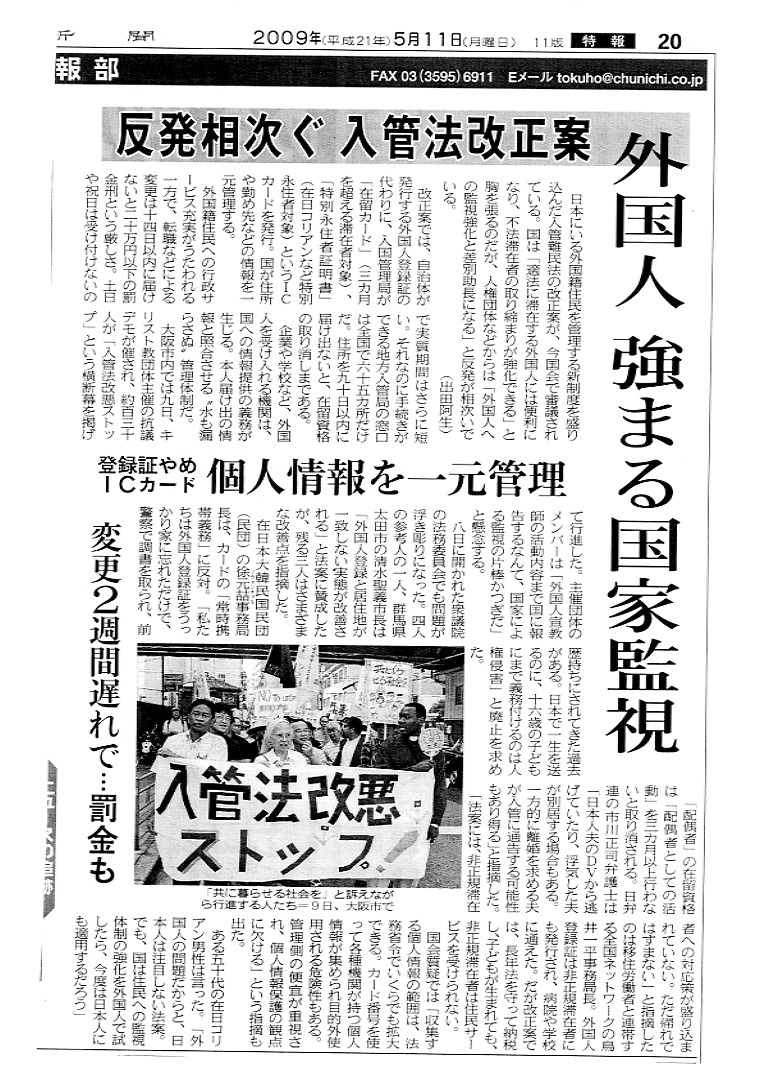
Motivated by a sense of urgency, Ishihara recently spent ¥5 million of his own money to launch a quarterly Japanese-language magazine, called Immigrants, focusing on immigration issues. The goal is to provide more information on foreigners living here to Japanese people to bridge the gap between the two sides.

The first issue of the quarterly, circulation 10,000, included messages from ambassadors of South American countries as well as interviews with immigration policyexperts, including Liberal Democratic Party lawmaker Taro Kono, and Shigehiko Shiramizu, a professor of global media studies at Komazawa University…

“When I use the term ‘immigration policy,’ people may think I am urging Japan to accept more foreigners, but it’s not quite true. What I’m saying is that there are already so many foreigners living here, so we have to think about them. We have already opened the door to foreigners, and companies need them, too,” Ishihara said.

His views are shared by politicians in the Liberal Democratic Party-New Komeito ruling bloc. In February last year, about 80 LDP politicians, led by former Chief Cabinet Secretary Hidenao Nakagawa, formed a group to promote foreign personnel exchanges.

The group submitted a proposal to educate and train foreigners who wish to come to Japan and to accept 10 million immigrants over the next 50 years. The policy proposal also called for accepting 1,000asylum seekers annually and others who need protection on humanitarian grounds.

Separately, current Chief Cabinet Secretary Takeo Kawamuraestablished a lawmakers’ group to create a bill to support schools for foreigners living in Japan. In addition, the Cabinet Office set up an office especially to deal with problems facing foreigners here earlier this year….

============================

End excerpt.  Full text of the article at

http://search.japantimes.co.jp/cgi-bin/nn20090430f1.html

Chunichi Shinbun May 11, 2009 on New IC Gaijin Card debate

mytest

Handbook for Newcomers, Migrants, and Immigrants to Japan\Foreign Residents and Naturalized Citizens Association forming NGO\「ジャパニーズ・オンリー 小樽入浴拒否問題と人種差別」(明石書店)JAPANESE ONLY:  The Otaru Hot Springs Case and Racial Discrimination in Japansourstrawberriesavatar
Hi Blog. Excellent article in yesterday’s Chunichi Shinbun on what’s the problem with the new proposed IC Gaijin Cards, and how the extra policing that NJ will have to endure will just make life worse for a lot of people. Again, the goal is only to police, not to actually help NJ assimilate and make a better life here.

In particular, read the contrarian arguments. Now this is how we proceed with a debate. We get people who know what they’re talking about to express the minority view (for where else is it going to be heard?). As opposed to last night’s terebi bangumi TV Tackle, which basically had the status quo maintained with the same old commentators spouting much the same old party lines. Article courtesy of Dave Spector. Arudou Debito in Sapporo

immigration_235

入管法改正案:反対であす市民団体がデモ 「逆行の動き、納得できない」 /大阪

 ◇外国籍住民を一元管理

毎日新聞 2009年5月8日 地方版

http://mainichi.jp/area/osaka/news/20090508ddlk27040357000c.html

 法務省が外国籍住民の在留情報を一元管理する入管法改正案などに対し、府内の在日外国人や市民団体などが「外国人を監視し、分断・差別や人権侵害を招く」と反発している。既に国会審議が始まっており、大阪市内で9日、廃案を訴えるデモ行進をする。

 新しい在留管理制度は、短期滞在(90日以内)や特別永住者(在日コリアンら)を除く中長期滞在者に、ICチップ内蔵の在留カードを交付。顔写真や氏名、生年月日、在留資格、期間などの情報を記載させ、さらに外国人が所属する企業や大学、日本語学校などに就労・就学状況の報告を義務付け、法務省が情報を集中的に把握する。

 カードの常時携帯や居住地を変更した場合の届け出を怠れば刑事罰を科し、在留資格取り消し理由になる場合もある。

 在日中国人2世で「永住者」の在留資格を持つ徐翠珍さん(62)=大阪市西成区=は「戦前から日本に溶け込んで生活している私たちが、いまだに住民として認められない」と憤り、チラシ配布の活動を続ける。

 徐さんはかつて、外国人登録の更新時に指紋押なつ(99年全廃)を拒否して逮捕された。「現行の外国人登録証の常時携帯や切り替えがなくなり、地方参政権も得られるようになると期待したのに、全く逆行する動きは納得できない」と話す。

 デモ行進は、午後3時に同市西区新町1の新町北公園(大阪厚生年金会館南側)に集合。御堂筋を通って中央区難波5の高島屋大阪店までの約2キロを歩く。問い合わせは、主催のカトリック大阪シナピス(06・6942・1784)。【立石信夫】

ends

Thoughts on tonight’s TV Asahi TV Tackle on NJ issues

mytest

Handbook for Newcomers, Migrants, and Immigrants to Japan\Foreign Residents and Naturalized Citizens Association forming NGO\「ジャパニーズ・オンリー 小樽入浴拒否問題と人種差別」(明石書店)JAPANESE ONLY:  The Otaru Hot Springs Case and Racial Discrimination in Japansourstrawberriesavatar
Hi Blog. Just a few thoughts on tonight’s TV Asahi program “TV Tackle”.

It was, in a word, disappointing.

Maybe that’s par for the course in a 55-minute (minus commercials) show edited for content, and it did try to take on some serious issues.

Eight commentators participated: three academics — a Korean, a Brazilian, and a Chinese — plus two media pundits and three politicians — LDP’s Kouno Taro, plus Koumeito, and DPJ. All people of Asian background (save an overlong and as incomprehensible as ever commentary from Koko Ga Hen TV show bomb-thrower Zomahoun Rufin), all reasonably informed, but all clipped for airtime before much of substance came out.

The show had four segments: 1) the new Gaijin Cards with IC Chips, 2) The historical issue of the Zainichis and other Permanent Residents and their right to vote in local elections, 3) the Nikkei Repatriation Bribe, and 4) the new Tourism Agency and the new tightening of Immigration controls (fingerprinting etc.)

The show gave good backgrounds on the issues (lots of data, historical facts), but what the panelists did with the show was what disappointed.

1) The IC Gaijin Cards was far too short, and fumbled the issue when talking about why NJ have to carry cards 24/7 or face arrest and criminal charges. Nikkei Brazilian Angelo Ishi showed his card for the cameras (thanks; surprisingly few Japanese know NJ have to carry them, or even have them), but there was not enough reportage on why these cards are so controversial (heavy fines and jail time, for example), and why the new cards are even more so (potential remote tracking of IC Chips and and heavier penalties for delayed reporting of changes of status). Even the DPJ rep there admitted he had no problems with the Cards, despite the official party line of opposing them. So much for the debate. Where’s Tanaka Hiroshi when we need him?

There was a decent bit on the Calderon Noriko Case, fortunately, but the hardliners held sway: If her parents hadn’t come in on someone else’s passport, then maybe they could have stayed here together as a family. End of debate.

2) We then got bogged down in the historical issues of the Zainichi Koreans, and how historically they’ve been here for generations yet have no right to vote. Kouno Taro disappointed by saying that if you want the right to vote, naturalize. Even though, as we’ve said time and time again (and I have to him directly), the process is not all that easy and is quite arbitrary. It is not a kirifuda. This segment wound up a waste of time with the Korean academic getting hot under the collar and appearing to talk too much.

3) The best bit was on the Nikkei Repatriation Bribe, where just about everyone there agreed that bribing workers to go home was a national disgrace. Kouno again took a hard line and said that we shouldn’t have imported people because they were Nikkei, but rather because they speak Japanese well (as if people working this hard in factories could have done much about it; you want perfection before entry?). Angelo Ishi got in good points that Japanese companies actually went overseas to RECRUIT Nikkei, with all sorts of false promises about income and conditions, and others pointed out that Japan’s special ties with Nikkei overseas actually did choose people based upon blood and little else. It was portrayed rightfully as a failed policy, but hands were wrung about how to keep the NJ here, sigh.

4) Last bit was on tourism and the fingerprinting issue. Much fearmongering about the Koreans in particular and their ability to come over without visas, and one case of falsified fingerprints was portrayed as the evils of Koreans, not as flaws in the system. No mention at all was made of how it’s NOT MERELY TOURISTS being fingerprinted, but EVERY NJ WHO IS NOT A ZAINICHI.  And that includes Regular Permanent Residents, who too have to suffer the humiliation of being treated like tourists and suspected terrorists.

Therein was the great flaw in the program. Nobody was there who could represent the “Newcomers”. No naturalized Japanese. No non-Asian Permanent Residents. Nobody who could give a perspective (except Angelo, and he did well, but he’s halfway in The Club anyway) of somebody that has been a pure outsider both by race and by face, and show the cameras that Japan is in fact changing with these new kinds of people who are here to stay as immigrants.

Pity. The show meant well. But it fell back into old hackneyed paradigms with few eyes opened.

This synopsis has been written over the 20 minutes since the show ended, all from memory. If people find segments of this show on YouTube, please send this blog entry a link. Keeps me honest. Thanks.

Arudou Debito in Sapporo

今夜9時テレビ朝日『TVタックル』:「ニッポンは天国?地獄?在日外国人決起集会」

mytest

 Handbook for Newcomers, Migrants, and Immigrants to Japan\Foreign Residents and Naturalized Citizens Association forming NGO\「ジャパニーズ・オンリー 小樽入浴拒否問題と人種差別」(明石書店)JAPANESE ONLY:  The Otaru Hot Springs Case and Racial Discrimination in Japansourstrawberriesavatar

Related to the 300,000 yen Nikkei bribe, watch TV Tackle tonight 9PM:

■5月11日(月)21:00〜21:54 
テレビ朝日『ビートたけしのTVタックル』http://www.tv-asahi.co.jp/tvtackle/ 
「ニッポンは天国?地獄?在日外国人決起集会」
 「経済危機」に続いて「新型インフルエンザ」の恐怖に世界中が大混乱の中、国際社会で今こそ日本が果たすべき役割とは? 今夜は韓国、ブラジル、中国から来た在日外国人の皆さんとともに徹底討論してまいります。
 永住権を持つ外国人の地方選挙への参政権を認めようという「外国人参政権」ですが、賛成・反対が入り乱れている今、日本の進むべき方向性とは?
 また、不況のあおりで仕事も住居も失ってしまった外国人労働者たちの処遇について、厚生省の日系人帰国支援制度30万円が「手切れ金」だとの声もあり、日本政府の対応が問われています。
 他方、抜け穴だらけのずさんな日本の入国管理の現実にも迫ります。お楽しみに!
ゲスト:三宅久之、河野太郎、大口善徳、渡辺周、王曙光、アンジェロ・イシ、金慶珠、勝谷誠彦

ENDS

Tokyo Shinbun: GOJ to amend Nikkei Repatriation Bribe exile to Mar 2012

mytest

Handbook for Newcomers, Migrants, and Immigrants to Japan\Foreign Residents and Naturalized Citizens Association forming NGO\「ジャパニーズ・オンリー 小樽入浴拒否問題と人種差別」(明石書店)JAPANESE ONLY:  The Otaru Hot Springs Case and Racial Discrimination in Japansourstrawberriesavatar

Hi Blog. Good news, in a sense, I guess. The Tokyo Shinbun yesterday reports below that the 300,000 yen Repatriation Bribe for Nikkei (with consequent bar on reentry on the same special “Long-Term Resident” (teijuusha) status) is to be amended, to shorten the length of exile to the end of March 2012. After that, Nikkei are welcome to reapply for the same status of residence and come back to work in Japan.

This is, according to the article due to complaints by Nikkei and the Brazilian Government to the GOJ. I bet it’s also due to all the negative press the GOJ got for this tidy little rip-off of Nikkei pensions. Anyone know whether Japan has a pension treaty with the Nikkei-origin countries so their work contributions overseas will be counted as part of their Japanese pension for the duration of their exile, or in case they don’t get their visa renewed to come back from exile? I’d be happily surprised if there was. Arudou Debito in Sapporo

=====================================
支援金受給の帰国日系人 入国禁止12年まで 政府方針

東京新聞 2009年5月10日 朝刊

Courtesy of Silvio

http://www.tokyo-np.co.jp/article/politics/news/CK2009051002000076.html

政府は九日、不況で失業中の日系人が支援金を受給して帰国した場合、定住者としての再入国を二〇一二年三月までは認めない方針を固めた。再入国の 制限を「当分の間」としていたが、日系人らが「事実上の追放」などと反発していることを考慮し、期限を明示することにした。週明けに正式決定する。

政府は、日本国内の雇用情勢の悪化を受け、今年三月までに失業した日系ブラジル人らに帰国を促しており、離職者本人に原則三十万円、扶養家族一人 につき二十万円をそれぞれ支給する支援事業を四月にスタートさせた。同時に、支援金目的での一時帰国などを防ぐため、受給の条件に日系三世までに与えられ る「定住者」在留資格による再入国を当分認めないとした。

問題はブラジル国内でも報道され、同国政府も在日大使館などを通じ、日本側に善処を申し入れていた。

ends

Sunday Tangent: Obama’s March 8, 2008 speech on race, full text

mytest

Handbook for Newcomers, Migrants, and Immigrants to Japan\Foreign Residents and Naturalized Citizens Association forming NGO\「ジャパニーズ・オンリー 小樽入浴拒否問題と人種差別」(明石書店)JAPANESE ONLY:  The Otaru Hot Springs Case and Racial Discrimination in Japansourstrawberriesavatar

Hi Blog.  As a Sunday Tangent, here is the speech which probably sealed Obama’s image as a serious thinker and candidate:  his 2008 remarks on race.  

To me it is a very sophisticated version of MLK’s “I have a Dream” speech — few speeches have taken such a complex issue, i.e. race in America, and dealt with it with such insight, balance, and disarmingness. We need more of this insight in discourse about race in Japan. Unfortunately, too many people would prefer to think that there is NO issue of race in Japan. We’ll get to that. Meanwhile, read and savor the full text of Obama’s speech on race, and glean what you can about the approach to the issue. Ultimately, I believe, this got him elected.

Although it’s impossible to lift any part of this speech out of context and apply it universally as a lesson, one portion of particular merit is in boldface.  Arudou Debito in Sapporo

//////////////////////////////////////////
(CBS)  The following are the remarks prepared for delivery by Democratic presidential candidate Sen.Barack Obama on March 18, 2008 in Philadelphia.

=============================

http://www.cbsnews.com/stories/2008/03/18/politics/main3947908.shtml

“We the people, in order to form a more perfect union.”

Two hundred and twenty one years ago, in a hall that still stands across the street, a group of men gathered and, with these simple words, launched America’s improbable experiment in democracy. Farmers and scholars; statesmen and patriots who had traveled across an ocean to escape tyranny and persecution finally made real their declaration of independence at a Philadelphia convention that lasted through the spring of 1787.

The document they produced was eventually signed but ultimately unfinished. It was stained by this nation’s original sin of slavery, a question that divided the colonies and brought the convention to a stalemate until the founders chose to allow the slave trade to continue for at least twenty more years, and to leave any final resolution to future generations. 

Of course, the answer to the slavery question was already embedded within our Constitution – a Constitution that had at is very core the ideal of equal citizenship under the law; a Constitution that promised its people liberty, and justice, and a union that could be and should be perfected over time.

And yet words on a parchment would not be enough to deliver slaves from bondage, or provide men and women of every color and creed their full rights and obligations as citizens of the United States. What would be needed were Americans in successive generations who were willing to do their part – through protests and struggle, on the streets and in the courts, through a civil war and civil disobedience and always at great risk – to narrow that gap between the promise of our ideals and the reality of their time.

This was one of the tasks we set forth at the beginning of this campaign – to continue the long march of those who came before us, a march for a more just, more equal, more free, more caring and more prosperous America. I chose to run for the presidency at this moment in history because I believe deeply that we cannot solve the challenges of our time unless we solve them together – unless we perfect our union by understanding that we may have different stories, but we hold common hopes; that we may not look the same and we may not have come from the same place, but we all want to move in the same direction – towards a better future for of children and our grandchildren. 

This belief comes from my unyielding faith in the decency and generosity of the American people. But it also comes from my own American story. 

I am the son of a black man from Kenya and a white woman from Kansas. I was raised with the help of a white grandfather who survived a Depression to serve in Patton’s Army during World War II and a white grandmother who worked on a bomber assembly line at Fort Leavenworth while he was overseas. I’ve gone to some of the best schools in America and lived in one of the world’s poorest nations. I am married to a black American who carries within her the blood of slaves and slaveowners – an inheritance we pass on to our two precious daughters. I have brothers, sisters, nieces, nephews, uncles and cousins, of every race and every hue, scattered across three continents, and for as long as I live, I will never forget that in no other country on Earth is my story even possible. 

It’s a story that hasn’t made me the most conventional candidate. But it is a story that has seared into my genetic makeup the idea that this nation is more than the sum of its parts – that out of many, we are truly one. 

Throughout the first year of this campaign, against all predictions to the contrary, we saw how hungry the American people were for this message of unity. Despite the temptation to view my candidacy through a purely racial lens, we won commanding victories in states with some of the whitest populations in the country. In South Carolina, where the Confederate Flag still flies, we built a powerful coalition of African Americans and white Americans. 

This is not to say that race has not been an issue in the campaign. At various stages in the campaign, some commentators have deemed me either “too black” or “not black enough.” We saw racial tensions bubble to the surface during the week before the South Carolina primary. The press has scoured every exit poll for the latest evidence of racial polarization, not just in terms of white and black, but black and brown as well.

And yet, it has only been in the last couple of weeks that the discussion of race in this campaign has taken a particularly divisive turn. 

On one end of the spectrum, we’ve heard the implication that my candidacy is somehow an exercise in affirmative action; that it’s based solely on the desire of wide-eyed liberals to purchase racial reconciliation on the cheap. On the other end, we’ve heard my former pastor, Reverend Jeremiah Wright, use incendiary language to express views that have the potential not only to widen the racial divide, but views that denigrate both the greatness and the goodness of our nation; that rightly offend white and black alike. 

I have already condemned, in unequivocal terms, the statements of Reverend Wright that have caused such controversy. For some, nagging questions remain. Did I know him to be an occasionally fierce critic of American domestic and foreign policy? Of course. Did I ever hear him make remarks that could be considered controversial while I sat in church? Yes. Did I strongly disagree with many of his political views? Absolutely – just as I’m sure many of you have heard remarks from your pastors, priests, or rabbis with which you strongly disagreed. 

But the remarks that have caused this recent firestorm weren’t simply controversial. They weren’t simply a religious leader’s effort to speak out against perceived injustice. Instead, they expressed a profoundly distorted view of this country – a view that sees white racism as endemic, and that elevates what is wrong with America above all that we know is right with America; a view that sees the conflicts in the Middle East as rooted primarily in the actions of stalwart allies like Israel, instead of emanating from the perverse and hateful ideologies of radical Islam. 

As such, Reverend Wright’s comments were not only wrong but divisive, divisive at a time when we need unity; racially charged at a time when we need to come together to solve a set of monumental problems – two wars, a terrorist threat, a falling economy, a chronic health care crisis and potentially devastating climate change; problems that are neither black or white or Latino or Asian, but rather problems that confront us all.

Given my background, my politics, and my professed values and ideals, there will no doubt be those for whom my statements of condemnation are not enough. Why associate myself with Reverend Wright in the first place, they may ask? Why not join another church? And I confess that if all that I knew of Reverend Wright were the snippets of those sermons that have run in an endless loop on the television and You Tube, or if Trinity United Church of Christ conformed to the caricatures being peddled by some commentators, there is no doubt that I would react in much the same way. 

But the truth is, that isn’t all that I know of the man. The man I met more than twenty years ago is a man who helped introduce me to my Christian faith, a man who spoke to me about our obligations to love one another; to care for the sick and lift up the poor. He is a man who served his country as a U.S. Marine; who has studied and lectured at some of the finest universities and seminaries in the country, and who for over thirty years led a church that serves the community by doing God’s work here on Earth – by housing the homeless, ministering to the needy, providing day care services and scholarships and prison ministries, and reaching out to those suffering from HIV/AIDS.

In my first book, Dreams From My Father, I described the experience of my first service at Trinity:

“People began to shout, to rise from their seats and clap and cry out, a forceful wind carrying the reverend’s voice up into the rafters….And in that single note – hope! – I heard something else; at the foot of that cross, inside the thousands of churches across the city, I imagined the stories of ordinary black people merging with the stories of David and Goliath, Moses and Pharaoh, the Christians in the lion’s den, Ezekiel’s field of dry bones. Those stories – of survival, and freedom, and hope – became our story, my story; the blood that had spilled was our blood, the tears our tears; until this black church, on this bright day, seemed once more a vessel carrying the story of a people into future generations and into a larger world. Our trials and triumphs became at once unique and universal, black and more than black; in chronicling our journey, the stories and songs gave us a means to reclaim memories that we didn’t need to feel shame about…memories that all people might study and cherish – and with which we could start to rebuild.”

That has been my experience at Trinity. Like other predominantly black churches across the country, Trinity embodies the black community in its entirety – the doctor and the welfare mom, the model student and the former gang-banger. Like other black churches, Trinity’s services are full of raucous laughter and sometimes bawdy humor. They are full of dancing, clapping, screaming and shouting that may seem jarring to the untrained ear. The church contains in full the kindness and cruelty, the fierce intelligence and the shocking ignorance, the struggles and successes, the love and yes, the bitterness and bias that make up the black experience in America.

And this helps explain, perhaps, my relationship with Reverend Wright. As imperfect as he may be, he has been like family to me. He strengthened my faith, officiated my wedding, and baptized my children. Not once in my conversations with him have I heard him talk about any ethnic group in derogatory terms, or treat whites with whom he interacted with anything but courtesy and respect. He contains within him the contradictions – the good and the bad – of the community that he has served diligently for so many years.

I can no more disown him than I can disown the black community. I can no more disown him than I can my white grandmother – a woman who helped raise me, a woman who sacrificed again and again for me, a woman who loves me as much as she loves anything in this world, but a woman who once confessed her fear of black men who passed by her on the street, and who on more than one occasion has uttered racial or ethnic stereotypes that made me cringe.

These people are a part of me. And they are a part of America, this country that I love.

Some will see this as an attempt to justify or excuse comments that are simply inexcusable. I can assure you it is not. I suppose the politically safe thing would be to move on from this episode and just hope that it fades into the woodwork. We can dismiss Reverend Wright as a crank or a demagogue, just as some have dismissed Geraldine Ferraro, in the aftermath of her recent statements, as harboring some deep-seated racial bias. 

But race is an issue that I believe this nation cannot afford to ignore right now. We would be making the same mistake that Reverend Wright made in his offending sermons about America – to simplify and stereotype and amplify the negative to the point that it distorts reality. 

The fact is that the comments that have been made and the issues that have surfaced over the last few weeks reflect the complexities of race in this country that we’ve never really worked through – a part of our union that we have yet to perfect. And if we walk away now, if we simply retreat into our respective corners, we will never be able to come together and solve challenges like health care, or education, or the need to find good jobs for every American. 

Understanding this reality requires a reminder of how we arrived at this point. As William Faulkner once wrote, “The past isn’t dead and buried. In fact, it isn’t even past.” We do not need to recite here the history of racial injustice in this country. But we do need to remind ourselves that so many of the disparities that exist in the African-American community today can be directly traced to inequalities passed on from an earlier generation that suffered under the brutal legacy of slavery and Jim Crow.

Segregated schools were, and are, inferior schools; we still haven’t fixed them, fifty years after Brown v. Board of Education, and the inferior education they provided, then and now, helps explain the pervasive achievement gap between today’s black and white students.

Legalized discrimination – where blacks were prevented, often through violence, from owning property, or loans were not granted to African-American business owners, or black homeowners could not access FHA mortgages, or blacks were excluded from unions, or the police force, or fire departments – meant that black families could not amass any meaningful wealth to bequeath to future generations. That history helps explain the wealth and income gap between black and white, and the concentrated pockets of poverty that persists in so many of today’s urban and rural communities.

A lack of economic opportunity among black men, and the shame and frustration that came from not being able to provide for one’s family, contributed to the erosion of black families – a problem that welfare policies for many years may have worsened. And the lack of basic services in so many urban black neighborhoods – parks for kids to play in, police walking the beat, regular garbage pick-up and building code enforcement – all helped create a cycle of violence, blight and neglect that continue to haunt us. 

This is the reality in which Reverend Wright and other African-Americans of his generation grew up. They came of age in the late fifties and early sixties, a time when segregation was still the law of the land and opportunity was systematically constricted. What’s remarkable is not how many failed in the face of discrimination, but rather how many men and women overcame the odds; how many were able to make a way out of no way for those like me who would come after them.

But for all those who scratched and clawed their way to get a piece of the American Dream, there were many who didn’t make it – those who were ultimately defeated, in one way or another, by discrimination. That legacy of defeat was passed on to future generations – those young men and increasingly young women who we see standing on street corners or languishing in our prisons, without hope or prospects for the future. Even for those blacks who did make it, questions of race, and racism, continue to define their worldview in fundamental ways. For the men and women of Reverend Wright’s generation, the memories of humiliation and doubt and fear have not gone away; nor has the anger and the bitterness of those years. That anger may not get expressed in public, in front of white co-workers or white friends. But it does find voice in the barbershop or around the kitchen table. At times, that anger is exploited by politicians, to gin up votes along racial lines, or to make up for a politician’s own failings.

And occasionally it finds voice in the church on Sunday morning, in the pulpit and in the pews. The fact that so many people are surprised to hear that anger in some of Reverend Wright’s sermons simply reminds us of the old truism that the most segregated hour in American life occurs on Sunday morning. That anger is not always productive; indeed, all too often it distracts attention from solving real problems; it keeps us from squarely facing our own complicity in our condition, and prevents the African-American community from forging the alliances it needs to bring about real change. But the anger is real; it is powerful; and to simply wish it away, to condemn it without understanding its roots, only serves to widen the chasm of misunderstanding that exists between the races.

In fact, a similar anger exists within segments of the white community. Most working- and middle-class white Americans don’t feel that they have been particularly privileged by their race. Their experience is the immigrant experience – as far as they’re concerned, no one’s handed them anything, they’ve built it from scratch. They’ve worked hard all their lives, many times only to see their jobs shipped overseas or their pension dumped after a lifetime of labor. They are anxious about their futures, and feel their dreams slipping away; in an era of stagnant wages and global competition, opportunity comes to be seen as a zero sum game, in which your dreams come at my expense. So when they are told to bus their children to a school across town; when they hear that an African American is getting an advantage in landing a good job or a spot in a good college because of an injustice that they themselves never committed; when they’re told that their fears about crime in urban neighborhoods are somehow prejudiced, resentment builds over time. 

Like the anger within the black community, these resentments aren’t always expressed in polite company. But they have helped shape the political landscape for at least a generation. Anger over welfare and affirmative action helped forge the Reagan Coalition. Politicians routinely exploited fears of crime for their own electoral ends. Talk show hosts and conservative commentators built entire careers unmasking bogus claims of racism while dismissing legitimate discussions of racial injustice and inequality as mere political correctness or reverse racism.

Just as black anger often proved counterproductive, so have these white resentments distracted attention from the real culprits of the middle class squeeze – a corporate culture rife with inside dealing, questionable accounting practices, and short-term greed; a Washington dominated by lobbyists and special interests; economic policies that favor the few over the many. And yet, to wish away the resentments of white Americans, to label them as misguided or even racist, without recognizing they are grounded in legitimate concerns – this too widens the racial divide, and blocks the path to understanding. 

This is where we are right now. It’s a racial stalemate we’ve been stuck in for years. Contrary to the claims of some of my critics, black and white, I have never been so naïve as to believe that we can get beyond our racial divisions in a single election cycle, or with a single candidacy – particularly a candidacy as imperfect as my own.

But I have asserted a firm conviction – a conviction rooted in my faith in God and my faith in the American people – that working together we can move beyond some of our old racial wounds, and that in fact we have no choice is we are to continue on the path of a more perfect union. 

For the African-American community, that path means embracing the burdens of our past without becoming victims of our past. It means continuing to insist on a full measure of justice in every aspect of American life. But it also means binding our particular grievances – for better health care, and better schools, and better jobs – to the larger aspirations of all Americans — the white woman struggling to break the glass ceiling, the white man whose been laid off, the immigrant trying to feed his family. And it means taking full responsibility for own lives – by demanding more from our fathers, and spending more time with our children, and reading to them, and teaching them that while they may face challenges and discrimination in their own lives, they must never succumb to despair or cynicism; they must always believe that they can write their own destiny.

Ironically, this quintessentially American – and yes, conservative – notion of self-help found frequent expression in Reverend Wright’s sermons. But what my former pastor too often failed to understand is that embarking on a program of self-help also requires a belief that society can change. 

The profound mistake of Reverend Wright’s sermons is not that he spoke about racism in our society. It’s that he spoke as if our society was static; as if no progress has been made; as if this country – a country that has made it possible for one of his own members to run for the highest office in the land and build a coalition of white and black; Latino and Asian, rich and poor, young and old — is still irrevocably bound to a tragic past. But what we know — what we have seen – is that America can change. That is true genius of this nation. What we have already achieved gives us hope – the audacity to hope – for what we can and must achieve tomorrow.

In the white community, the path to a more perfect union means acknowledging that what ails the African-American community does not just exist in the minds of black people; that the legacy of discrimination – and current incidents of discrimination, while less overt than in the past – are real and must be addressed. Not just with words, but with deeds – by investing in our schools and our communities; by enforcing our civil rights laws and ensuring fairness in our criminal justice system; by providing this generation with ladders of opportunity that were unavailable for previous generations. It requires all Americans to realize that your dreams do not have to come at the expense of my dreams; that investing in the health, welfare, and education of black and brown and white children will ultimately help all of America prosper. 

In the end, then, what is called for is nothing more, and nothing less, than what all the world’s great religions demand – that we do unto others as we would have them do unto us. Let us be our brother’s keeper, Scripture tells us. Let us be our sister’s keeper. Let us find that common stake we all have in one another, and let our politics reflect that spirit as well. 

For we have a choice in this country. We can accept a politics that breeds division, and conflict, and cynicism. We can tackle race only as spectacle – as we did in the OJ trial – or in the wake of tragedy, as we did in the aftermath of Katrina – or as fodder for the nightly news. We can play Reverend Wright’s sermons on every channel, every day and talk about them from now until the election, and make the only question in this campaign whether or not the American people think that I somehow believe or sympathize with his most offensive words. We can pounce on some gaffe by a Hillary supporter as evidence that she’s playing the race card, or we can speculate on whether white men will all flock to John McCain in the general election regardless of his policies.

We can do that.

But if we do, I can tell you that in the next election, we’ll be talking about some other distraction. And then another one. And then another one. And nothing will change. 

That is one option. Or, at this moment, in this election, we can come together and say, “Not this time.” This time we want to talk about the crumbling schools that are stealing the future of black children and white children and Asian children and Hispanic children and Native American children. This time we want to reject the cynicism that tells us that these kids can’t learn; that those kids who don’t look like us are somebody else’s problem. The children of America are not those kids, they are our kids, and we will not let them fall behind in a 21st century economy. Not this time. 

This time we want to talk about how the lines in the Emergency Room are filled with whites and blacks and Hispanics who do not have health care; who don’t have the power on their own to overcome the special interests in Washington, but who can take them on if we do it together. 

This time we want to talk about the shuttered mills that once provided a decent life for men and women of every race, and the homes for sale that once belonged to Americans from every religion, every region, every walk of life. This time we want to talk about the fact that the real problem is not that someone who doesn’t look like you might take your job; it’s that the corporation you work for will ship it overseas for nothing more than a profit. 

This time we want to talk about the men and women of every color and creed who serve together, and fight together, and bleed together under the same proud flag. We want to talk about how to bring them home from a war that never should’ve been authorized and never should’ve been waged, and we want to talk about how we’ll show our patriotism by caring for them, and their families, and giving them the benefits they have earned. 

I would not be running for President if I didn’t believe with all my heart that this is what the vast majority of Americans want for this country. This union may never be perfect, but generation after generation has shown that it can always be perfected. And today, whenever I find myself feeling doubtful or cynical about this possibility, what gives me the most hope is the next generation – the young people whose attitudes and beliefs and openness to change have already made history in this election. 

There is one story in particularly that I’d like to leave you with today – a story I told when I had the great honor of speaking on Dr. King’s birthday at his home church, Ebenezer Baptist, in Atlanta. 

There is a young, twenty-three year old white woman named Ashley Baia who organized for our campaign in Florence, South Carolina. She had been working to organize a mostly African-American community since the beginning of this campaign, and one day she was at a roundtable discussion where everyone went around telling their story and why they were there. 

And Ashley said that when she was nine years old, her mother got cancer. And because she had to miss days of work, she was let go and lost her health care. They had to file for bankruptcy, and that’s when Ashley decided that she had to do something to help her mom.

She knew that food was one of their most expensive costs, and so Ashley convinced her mother that what she really liked and really wanted to eat more than anything else was mustard and relish sandwiches. Because that was the cheapest way to eat. 

She did this for a year until her mom got better, and she told everyone at the roundtable that the reason she joined our campaign was so that she could help the millions of other children in the country who want and need to help their parents too.

Now Ashley might have made a different choice. Perhaps somebody told her along the way that the source of her mother’s problems were blacks who were on welfare and too lazy to work, or Hispanics who were coming into the country illegally. But she didn’t. She sought out allies in her fight against injustice.

Anyway, Ashley finishes her story and then goes around the room and asks everyone else why they’re supporting the campaign. They all have different stories and reasons. Many bring up a specific issue. And finally they come to this elderly black man who’s been sitting there quietly the entire time. And Ashley asks him why he’s there. And he does not bring up a specific issue. He does not say health care or the economy. He does not say education or the war. He does not say that he was there because of Barack Obama. He simply says to everyone in the room, “I am here because of Ashley.” 

“I’m here because of Ashley.” By itself, that single moment of recognition between that young white girl and that old black man is not enough. It is not enough to give health care to the sick, or jobs to the jobless, or education to our children.

But it is where we start. It is where our union grows stronger. And as so many generations have come to realize over the course of the two-hundred and twenty one years since a band of patriots signed that document in Philadelphia, that is where the perfection begins.

ENDS

Kirk Masden resuscitates debate on TV Asahi show KokoGaHen

mytest

Handbook for Newcomers, Migrants, and Immigrants to Japan\Foreign Residents and Naturalized Citizens Association forming NGO\「ジャパニーズ・オンリー 小樽入浴拒否問題と人種差別」(明石書店)JAPANESE ONLY:  The Otaru Hot Springs Case and Racial Discrimination in Japansourstrawberriesavatar
Hi Blog.  Happy Saturday.  Word from Kirk Masden at The Community, regarding a dead but not forgotten controversial TV show called “Koko Ga Hen Da Yo, Nihonjin”.  Keyboard’s his:

/////////////////////////////////////

Hi Community!

I posted a critique of Koko ga hen da yo (particularly one of the opening sequences they used) on YouTube:

http://www.youtube.com/watch?v=-jhAc4-OtCU

It’s getting a stronger response than anything I’ve posted to YouTube thus far.  Much of the commentary is negative but the first three ratings it received were five stars.  Since then somebody who hates my  view of the show gave it a low rating so now the average is four  stars.  People seem to either love my critique or hate it — not much middle ground so far.

At any rate, if you’re interested in this show, please have a look —  and feel free to tell others with an interest in media critique about  it. Kirk

/////////////////////////////////////

DEBITO ANSWERED:

Thanks Kirk.  I watched the YouTube entry last night and was very intrigued by it, especially given our own experience being on the show, re the Otaru Onsens Lawsuit:

Transcript of the show at:

https://www.debito.org/KokoGaHen1.html

and my positive critique of the show in retrospect:

https://www.debito.org/japantodaycolumns7-9.html
(page down to essay 8 )

I was also impressed with Kirk’s flawless accentless spoken Japanese, as always.  Gnash.

//////////////////////////////////////

FOLLOW-UP BY KIRK:

Hi everyone!

In regard to the timing of my post . . .

Actually, I’m posting to YouTube now because I didn’t have the
technical know-how to do so when I first recorded the show and started
showing parts of it in my comparative culture class.  I was
particularly bothered by the opening but lacked the ability to slow it
down appropriately to give people a chance to think about it.  Since
then, I’ve learned a bit more about video editing and so when I was
going through some old VHS tapes and found the Koko ga hen da yo
video, I could resist the temptation to make that kind of critique I
had been meaning to make for years.

What was interesting to me was the immediacy of the response.  There
must be a significant number of people who periodically search for
segments of that show on YouTube because my little video was found
immediately by a significant number of people.  Those who have rated
my critique on the five-star scale have, for the most part, been quite
generous but those who first found it and wrote comments were
decidedly negative.  I guess that had been searching for more videos
of their favorite show and didn’t appreciate negative comments about it.

So, in short, the show has been off the air for a long time but there
still seem to be a lot of people want to watch it on the web.  Kirk

//////////////////////////////////////////////

What do others think?  Debito

ENDS

Revamped article on the Nikkei Repatriation Bribe

mytest

Handbook for Newcomers, Migrants, and Immigrants to Japan\Foreign Residents and Naturalized Citizens Association forming NGO\「ジャパニーズ・オンリー 小樽入浴拒否問題と人種差別」(明石書店)JAPANESE ONLY:  The Otaru Hot Springs Case and Racial Discrimination in Japansourstrawberriesavatar

Hi Blog.  A few weeks ago I was invited to retool my recent Japan Times article on the Nikkei Repatriation Bribe for an academic website.  After doing so (and integrating a point I had neglected about the bribe being one way to save on pension monies), they decided that I had enough outlets (what with this blog and the JT) and thought it wasn’t quite original enough.  Ah well.  I like how it turned out anyway, so I’ll post it here as the outlet.  Thanks for reading it.  Debito in Sapporo

======================================

THE NIKKEI REPATRIATION BRIBE:  WHY IT’S A RAW DEAL FOR NJ

By Arudou Debito.  Debito.org May 8, 2009

One cannot read the news without hearing how bad the world economy has become, and Japan is no exception. Daily headlines proclaim what was once considered inconceivable in a land of lifetime employment: tens of thousands of people fired from Japan’s world-class factories. The Economist in April referred to Japan’s “two lost decades”, suggesting that modest economic gains over the past five years will be completely wiped out, according to OECD forecasts for 2009.

Cutbacks have bitten especially deeply into the labor market for non-Japanese workers. The Health, Labor and Welfare Ministry reports that in the two months up to January 2009, more than 9,000 foreigners asked “Hello Work” unemployment agencies for assistance — eleven times the figure for the same period a year earlier. The Mainichi Shinbun reported (April 7, 2009) that 1,007 foreign “trainees”, working in Japanese factories, were made redundant between October 2008 and January 2009 alone.

In the same report [1], the labor ministry asserts that non-Japanese are unfamiliar with Japan’s language and corporate culture, concluding that (despite years of factory work) they are “extremely unre-employable” (saishuushoku ga kiwamete muzukashii).[2] So select regions are offering information centers, language training, and some degree of job placement. Under an emergency measure drawn up by the ruling Liberal Democratic Party in March, the Japanese government began from April 1 offering workers of Japanese descent (nikkei) working here on “long-term resident” visas — a repatriation package. Applicants get 300,000 yen, plus 200,000 yen for each family dependent, if they return to their own country. If they take up the offer before their unemployment benefit runs out, they get 100,000 yen added to each sum for each month outstanding.

This sounds good. After all, why keep people here who cannot find a job? But read the small print of the proposal: The retraining measures only target 5,000 people, a tiny fraction of the 420,000-plus nikkei already in Japan. Of course, the offer extends to none of the 102,018 “trainees” (mostly Chinese) that Japan’s factories received in 2007 alone. Hundreds of thousands of people are on their own.

From this, it is clear the government is engaging in damage control by physically removing a small number of people from Japan’s unemployment rosters – the nikkei – and doing a dramatic U-turn in imported-labor policies. A twenty-year-old visa regime, based on economic and political contradictions, official and unofficial cross-purposes, unregulated corrupt programs, and a mindset of treating people as mere work units, is coming to a close. This is an enormous policy miscalculation by the Japanese government thanks to a blind spot of using racially based paradigms to create a new domestic workforce.

First, let’s return to the “repatriation offer” and consider its implications. Although the sum of 300,000 yen may appear magnanimous, it comes with two built-in ironies. One is the sense that history is repeating itself. These nikkei beneficiaries are the descendents of beneficiaries of an earlier scheme by the Japanese government to export its unemployed. A century ago, Japan sent farmers to Brazil, America, Canada, Peru and other South American countries. Over the past two decades, however, Japan has brought nikkei back under yet another scheme to utilize their cheap labor. This time, however, if the nikkei take the ticket back “home,” they can’t return — at least not under the same preferential work visa. The welcome mat has been retracted.

The other irony is the clear policy failure. Close to half a million nikkei are living in Japan, some for up to twenty years, paying taxes, social security, and nenkin retirement pensions. They have worked long hours at low wages to keep Japan’s factories competitive in the world economy. Although the nikkei have doubled Japan’s foreign population since 1990, minimal seniority and entrenchment has taken a heavy toll on these long-termers; books have been written on how few foreigners, including the Nikkei, have been assimilated.[3] Now that markets have soured, foreigners are the first to be laid off, and their unassimilated status, even in the eyes of the labor ministry, has made many of them unmarketable.

Put bluntly, the policy is: train one percent (5,000) to stay; bribe the rest to go and become some other country’s problem. In fact, the government stands to save a great deal of money by paying the nikkei a pittance in plane fares and repatriation fees, while keeping their many years of pension contributions (usually about 15% of monthly salary). By using this economic sleight-of hand, offering desperate people short-term cash if they foresake their long-term investments, this anti-assimilation policy becomes profitable for the government, while beggaring foreigners’ retirements.

Now consider another layer: This scheme only applies to nikkei, not to other non-Japanese workers such as the large number of Chinese “trainees” also here at Japan’s invitation. How has a government policy for a developed country disintegrated into something so ludicrous, where even officially sanctioned exclusionism has a hierarchy?

The background, in brief, is this: Japan faced a huge blue-collar labor shortage in the late 1980s, and realized with the rise in the value of the yen and high minimum wages, that its exports were being priced out of world markets.

Japan’s solution, like that of many other developed countries, was to import cheaper foreign labor. Of course, other countries with a significant influx of migrant labor, also had problems with equitable working conditions and assimilation.[4] However, as a new documentary, Sour Strawberries: Japan’s hidden “guest workers” vividly portrays, what made Japan’s policy fundamentally different was a view of foreign labor through a racial prism. Policymaking elites, worried about debasing Japan’s allegedly homogeneous society with foreigners who might stay, maintained an official stance of “no immigration” and “no import of unskilled labor”.

However, that was tatemae — a façade. Urged by business lobbies such as Nippon Keidanren, Japan created a visa regime from 1990 to import foreign laborers (mostly Chinese) as “trainees”, ostensibly to learn a skill, but basically to put them in factories and farms doing unskilled “dirty, difficult, and dangerous” labor eschewed by Japanese. The trainees were paid less than half the minimum wage (as they were not legally workers under Japanese labor law) and received no social welfare.

Although some trainees were reportedly working 10, 15 and in one case even 22-hour days, six to seven days a week including holidays, they received wages so paltry they beggared belief — in some cases 40,000 yen a month. A Chinese “trainee” interviewed in Sour Strawberries said he wound up earning the same here as he would in China. Others received even less, being charged by employers for rent, utilities, and food on top of that.

Abuses proliferated. Trainees found their passports confiscated and pay withheld, were denied basic human rights such as freedom of association or religious practice, were harassed and beaten, and were even fired without compensation if they were injured on the job. One employer hired thugs to force his Chinese staff to board a plane home. But trainees couldn’t just give up and go back. Due to visa restrictions, requiring significant deposits before coming to Japan (to put a damper on emigration), Chinese took out travel loans of between 700,000 to one million yen. If they returned before their visas were up, they would be in default, sued by their banks or brokers and ruined. Thus they were locked into abusive jobs they couldn’t complain about or quit without losing their visa and livelihoods overseas.

As Zentoitsu Worker’s Union leader Torii Ippei said in the documentary, this government-sponsored but largely unregulated program made so many employers turn bad, that places without worker abuses were “very rare”. The Yomiuri Shinbun (April 11, 2009) reported a recent Justice Ministry finding of “irregularities” at 452 companies and organizations involving trainees in 2008 alone, including hundreds of cases of unpaid overtime and illegal wages. Cases have been remanded to public prosecutors resulting in the occasional court victory, such as the 2008 landmark decision against the Tochigi strawberry farm that became the sobriquet for the documentary, have resulted in hefty (by Japanese standards) punitive judgments.

But these “trainees” were not the only ones getting exploited. 1990 was also the year the “long term resident” visa was introduced for the nikkei. Unlike the trainees, they were given significantly higher wages, labor law protections and unlimited employment opportunities — supposedly to allow them to “explore their heritage” — while being worked, in many cases 10 to 15 hours a day, six days a week.

Why this most-favored visa status for the nikkei? The reason was racially based. As LDP and Keidanren representatives testified in Sour Strawberries, policymakers figured that nikkei would present fewer assimilation problems. After all, they have Japanese blood, ergo the prerequisite cultural understanding of Japan’s unique culture and garbage-sorting procedures. It was deemed unnecessary to create any integration policy. However, as neighborhood problems arose, visible in the “No Foreigner” shop signs around nikkei areas and the Ana Bortz vs. Seibido Jewelry Store (1998-9) lawsuit, the atmosphere was counterproductive and demoralizing for an enthusiastic workforce.[5] A nikkei interviewed in the documentary described how overseas she felt like a Japanese, yet in Japan she ultimately felt like a foreigner.

Under these visa regimes, Japan invited over a million non-Japanese to come to Japan to work — and work they did, many in virtual indentured servitude. Yet instead of being praised for their contributions, they became scapegoats. Neighborhoods not only turned against them, but also police campaigns offered years of opprobrium for alleged rises in crime and overstaying (even though foreign crime rates were actually lower than domestic, and the number of visa overstayers dropped every year since 1993). Non-Japanese workers were also bashed for not learning the language (when they actually had little time to study, let alone attend Japanese classes offered by a mere handful of merciful local governments) — all disincentives for settling in Japan.

This is what happens when people are brought into a country by official government policy, yet for unofficial purposes at odds with official pledges. Japan has no immigration policy. It then becomes awkward for the government to make official pronouncements on how the new workforce is contributing to the economy, or why it should be allowed to stay. So the workforce remains in societal limbo. Then when things go wrong — in this case a tectonic macroeconomic shift — and the policy fails, it is the foreigners, not the government, who bear the brunt.

And fail the policy did on April Fools’ Day 2009, when the government confirmed that nikkei didn’t actually belong in Japan by offering them golden parachutes. Of course, race was again a factor, as the repatriation package was unavailable to wrong-blooded “trainees,” who must return on their own dime (perhaps, in some cases, with fines added on for overstaying) to face financial ruin.

What to do instead? In my view, the Japanese government must take responsibility. Having invited foreigners over here, it is necessary to treat them like human beings. Give them the same labor rights and job training that you would give every worker in Japan, and free nationwide Japanese lessons to bring them up to speed. Reward them for their investment in our society and their taxes paid. Do what can be done to make them more comfortable and settled. Above all, stop bashing them: Let Japanese society know why foreigners are here and what they have contributed to the country.

Don’t treat foreigners like toxic waste, sending them overseas for somebody else to deal with, and don’t detoxify our society under the same racially-based paradigms that got us into this situation in the first place. You brought this upon yourselves through a labor policy that ignored immigration and assimilation. Deal with it in Japan, by helping non-Japanese residents of whatever background make Japan their home.

This is not a radical proposal. Given the low-birthrate of Japan’s aging society, experts have been urging you to do this for a decade now. This labor downturn won’t last forever, and when things pick up again you will have a younger, more acculturated, more acclimatized, even grateful workforce to help pick up the pieces. Just sending people back, where they will tell others about their dreadful years in Japan being exploited and excluded, is on so many levels the wrong thing to do.

NOTES:
[1] Ministry of Health, Welfare, and Labour report at http://www.mhlw.go.jp/houdou/2009/03/dl/h0331-10a.pdf
[2] Original Japanese reads in the above report 「日本語能力の不足や我が国の雇用慣行の不案内に加え、職務経験も十分ではないため、いったん離職した場合には、再就職が極めて厳しい状況にあります。]
[3] See Takeyuki Tsuda, Strangers in the Ethnic Homeland.[add source information]
[4] For examples of issues of migrant labor and assimilation in Spain, South Korea, and Italy as well as Japan, see Takeyuki Tsuda, ed. Local Citizenship in Recent Countries of Immigration: Japan in Comparative Perspective. Other examples, such as the Turks in West Germany, Poles in the British Isles, Algerians and Moroccans in France, and Africans throughout Western Europe, have warranted significant media attention over the decades, but the labor mobility created by EU passports have arguably made the counterarguments against migration less “homogeneous-society” and “racially-based” in origin than in the Japanese example. [recheck and revise last sentence]
[5] For a description of the Ana Bortz and other cases of Nikkei exclusionism, see https://www.debito.org/bortzdiscrimreport.html

Arudou Debito, Associate Professor at Hokkaido Information University, is a columnist for The Japan Times and the manager of the debito.org daily blog. The co-author of Handbook for Newcomers, Migrants, and Immigrants to Japan, and author of Japanese Only: The Otaru Hot Springs Case and Racial Discrimination in Japan (Akashi Shoten, Inc.), Arudou is organizing nationwide showings of Sour Strawberries around Japan late August-early September; contact him at debito@debito.org to arrange a screening. You can purchase a copy of the documentary by visiting http://www.cinemabstruso.de/strawberries/main.html

A briefer version of this article was published in The Japan Times on April 7, 2009

BBC on what’s happening to returning Nikkei Brazilians

mytest

Handbook for Newcomers, Migrants, and Immigrants to Japan\Foreign Residents and Naturalized Citizens Association forming NGO\「ジャパニーズ・オンリー 小樽入浴拒否問題と人種差別」(明石書店)JAPANESE ONLY:  The Otaru Hot Springs Case and Racial Discrimination in Japansourstrawberriesavatar

Hi Blog. Some more follow-up from the overseas media on what’s happening to imported Nikkei who take the GOJ bribe back to their countries of origin. Worth a look, although not much unexpected information there.

Meanwhile, I’ll have a revamped and more thorough article online later on today on The Bribe based upon my previous Japan Times article, for the record. Arudou Debito in Sapporo

From Brazil to Japan and back again

May 1, 2009 Courtesy Sean B.

By Roland Buerk, BBC correspondent, Tokyo, Japan.

http://news.bbc.co.uk/2/hi/business/8025089.stm

The NYK Clara, escorted by a tug, slipped into Yokohama port, Tokyo bay carrying the BBC Box.

For our container, which we have been following around the world since last September, it is the end of a long journey from Brazil – across the Atlantic, round the Cape of Good Hope and then on across the Indian Ocean.

Inside is a cargo of foodstuffs, ingredients that had been ordered by one of Japan’s biggest food manufacturing companies.

Not enough food is grown in mountainous Japan to supply its large population’s needs, so imports like this are vital.

Returning migrants

It is not just goods that have made the journey from Brazil to Japan.

Carlos Zaha, radio broadcaster
They called us to come back to Japan and put us in factory lines the day after
Carlos Zaha, radio broadcaster

In the last 20 years, migrant workers have been coming here too, to fill vacancies in factories.

But they are not faring well in the global downturn.

So many Brazilians live in Hamamatsu in central Japan that Carlos Zaha has set up a radio station broadcasting pop songs in Portuguese.

He looks Japanese because by blood he is.

Like many others, his ancestors left Japan a century ago, escaping rural poverty for a better life in Brazil.

Exports halved

Mr Zaha’s family history is of being blown around the world by the winds of economic change.

“In the 1990s they called us because they needed people to work in factories,” he says. “They called us to come back to Japan and put us in factory lines the day after.”

But visit the local advice centre in Hamamatsu, and there is evidence enough that times have changed.

Wellington Shibuya
Now they don’t have a job for us, they’re saying ‘we’ll give you a little money, but don’t come back. Bye bye’
Wellington Shibuya

Japan’s exports have nearly halved when compared with last year.

Companies making cars and electronic gadgets once needed Brazilian workers to fill vacancies.

In recent months they have instead been slashing production as fast as they can.

Sent home

The advice centre used to get 200 inquiries a month. Now they have 1,000, many from Brazilian workers who have been laid off.

Wellington Shibuya is one of them. He not only prays in a local church. After losing his home, this is also where he sleeps.

Now he is taking an offer from Japan’s Government of 300,000 yen, around 3,000 dollars, to go back to Brazil.

But the Government help comes with a catch. He won’t be allowed back into Japan on the same easy terms to seek work.

Effectively it is a one way ticket.

“They told us ‘come, come, welcome to Japan’,” he says in halting Japanese. “‘We’ll give you a job, a place to live. Welcome, welcome.’ Now they don’t have a job for us, they’re saying ‘we’ll give you a little money, but don’t come back. Bye bye’.”

Supporters of the scheme say the Government had to do something to help people in need far from home.

There is also an offer of courses in Japanese to help Brazilians become more employable outside the factories.

Changing lives

Critics say Japan can scarcely afford to lose people. For a great industrialized nation it has remarkably few immigrants.

There are strict immigration laws because many people value a homogenous society.

But the low birth rate means the population is in long term decline.

“The work force is shrinking, the society is aging,” says Taro Kono, a member of the House of Representatives for the governing Liberal Democratic Party.

“So the pension, our medical fees [mean] we have to do something about it. The best way is to have immigration in this country. A lot of people are reacting very emotionally, so the politicians are a bit afraid to do the straight talk.”

Back in Yokohama port a giant crane lifted our BBC box off the ship before placing it on a truck to be driven away.

It is looking a little battered now and the scarlet paint is a bit faded after all that time at sea.

It is not just the flow of goods that is being affected by the global downturn.

People’s lives are being changed too.

ENDS

5月13日(水)2PM院内集会「在留カードに異議あり!」NGO実行委員会

mytest

Handbook for Newcomers, Migrants, and Immigrants to Japan\Foreign Residents and Naturalized Citizens Association forming NGO\「ジャパニーズ・オンリー 小樽入浴拒否問題と人種差別」(明石書店)JAPANESE ONLY:  The Otaru Hot Springs Case and Racial Discrimination in Japansourstrawberriesavatar
■□□■□□■□□■□□■□□■□□■□□■□□■□□■
審議真っ最中!
ここが問題!入管法・入管特例法改定案&住基法改定案
5月13日(水) 院内集会 第4弾
「特別永住者にとってプラスになるか?」
■□□■□□■□□■□□■□□■□□■□□■□□■□□■
【日時】 5月13日(水) 14:00〜15:00
【場所】 衆議院第二議員会館 第一会議室
【主催】 「在留カードに異議あり!」NGO実行委員会
◆ますます広がる批判と不安の声に耳を傾けて!
【4回目のテーマ】「永住者・特別永住者にとって今回の法改定は」
【集会内容】○NGOからの問題提起
田中宏さん(外国人人権法連絡会共同代表)/佐藤信行さん(RAIK)

○当事者からの発言
○各党議員からの発言
現在国会で審議中の入管法・入管特例法の改定案の上程理由には、「適法に在留す
る外国人の利便性を向上させる」という文言が含まれています。では、永住資格を持
つ人たちにとっては、どんな利便性向上が用意されているのでしょうか?
たとえば、在日コリアンなど「特別永住者」は、永住者を含めた他の「中長期在留
者」とは異なり、IC在留カードではなく、「特別永住者証明書」を持つこととされて
います。しかし、従来の外国人登録制度が持つ問題点として、国連の自由権規約委員
会からも指摘されてきた常時携帯・提示義務は、今回も残されています。また、「朝
鮮籍」の特別永住者にとっては、再入国許可制度において不当な扱いを受ける恐れが
あります。今回の法改定案はどう見ても、管理維持・強化の部分ばかりが目について
しまいます。
また、今回の法改定に限らず、「一般永住者」と「特別永住者」の扱いが大きく異
なってきています。歴史的経緯を持つ朝鮮半島・台湾・中国出身者の中にも、一般永
住者が多く存在しています。在日コリアンの中でも、特別永住者/一般永住者/永住
者の配偶者等……と混在する家族が多いのです。
そもそも「一般永住者」ですら、なぜ在留カードを常時持ち、職場や学校などの情報
を逐次報告しなければならず、日本に再入国する際に指紋情報を提供しなければなら
ないのでしょうか? 結局、永住を持つほど日本に定着したとしても、強い管理の下
で生活せざるを得ないということになるでしょう。これらの問題は、永住資格を持つ
者だけの問題ではなく、外国人の人権をどう考えるかという根本に触れる問題です。
戦前から日本に住むオールドカマーも、今回の法改定には強く反対しています。そ
の主張をぜひ一度聞いてください。
◆本集会前には、13:45より同会場で、キリスト教会関係者らによる
今回の問題への声明文発表に関する記者会見を開く予定です。
◆「改定法案」批判の詳細は⇒  http://www.repacp.org/aacp/
◆お問合せ先
移住労働者と連帯する全国ネットワーク(移住連) 
TEL:03-5802-6033   fmwj@jca.apc.org
社団法人アムネスティ・インターナショナル日本 
TEL:03-3518-6777
◆「在留カードに異議あり!」NGO実行委員会
移住労働者と連帯する全国ネットワーク(移住連)/在日韓国人問題研究所(RAIK)/
社団法人アムネスティ・インターナショナル日本/(社)自由人権協会/
日本カトリック難民移住移動者委員会/反住基ネット連絡会/
在日大韓基督教会関東地方会社会部/フォーラム平和・人権・環境/
外登法問題と取り組む全国キリスト教連絡協議会/カラバオの会/
在日本朝鮮人人権協会/中崎クィアハウス/山谷争議団 反失業闘争実行委員会/
山谷労働者福祉会館活動委員会/在日アジア労働者と共に闘う会/
在日コリアン青年連合(KEY)/聖公会平和ネットワーク

ENDS

Wash Post on GOJ border controls of Swine Flu, Mainichi/Kyodo on hospitals turning away J with fevers or NJ friends

mytest

Handbook for Newcomers, Migrants, and Immigrants to Japan\Foreign Residents and Naturalized Citizens Association forming NGO\「ジャパニーズ・オンリー 小樽入浴拒否問題と人種差別」(明石書店)JAPANESE ONLY:  The Otaru Hot Springs Case and Racial Discrimination in Japansourstrawberriesavatar
Hi Blog. Sooner or later we’re going to have to discuss the issue of Swine Flu (which looks ultimately to be rated as a Pandemic), as it feeds into the (universal, but particularly strong in Japan) mentality of keeping the country safe at the border.

A reporter from the Washington post, on a return flight from DC to Narita, gives us a thorough eye-witness account. If I had been on that flight, I would probably have filed a grumpy report too. But my critique of this might seem out of character. I’ll put that below the article.

And after my critique, just when I thought I could say something nice, the Mainichi and Kyodo report that hospitals, of all places, are overreacting; again, with a foreign dimension involved.

==================================

Japan Inspecting Airliners for Flu Victims
Gowned, Goggled Officials Hold Passengers Aboard Flight From Dulles for 70 Minutes
By Blaine Harden
Washington Post Foreign Service
Tuesday, May 5, 2009

http://www.washingtonpost.com/wp-dyn/content/article/2009/05/04/AR2009050400688_pf.html

Videotaping of the proceedings by the reporter on the scene (worth watching) at:

http://www.washingtonpost.com/wp-dyn/content/video/2009/05/04/VI2009050401124.html?sid=ST2009050401605

TOKYO, May 4 — Armed with thermographic guns, Japanese health inspectors in surgical gowns, goggles and masks boarded United Flight 803 from Washington Dulles. They prowled the aisles, pointing their fever-seeking machines at jet-lagged faces.

The nonstop flight had taken 13 1/2 hours. Toddlers were crying. Adults were wilting. Everyone was under strict orders to stay in his or her seat.

Exhausted-looking flight attendants handed out surgical masks, gifts from the government of Japan, which has yet to find a single confirmed case of swine flu but is diligently seeking feverish suspects.

Passengers could not leave the aircraft until they had filled out a form the government had hurriedly printed. “The Questionnaire of Heath [sic] Status” asked if travelers had been to Mexico lately, if they had a runny nose, if they were taking medication to mask a fever.

As long as the threat of a flu pandemic persists, anyone who flies into this country from North America with flulike ailments will not be allowed to walk off an airplane and infect the country. Last week, inspectors began boarding every flight from Mexico, Canada and the United States. They take the temperature of about 6,000 passengers a day. Near Tokyo’s Narita airport, 500 rooms have been secured by the Health Ministry to quarantine infected passengers.

Asia was stung in 2003 by an outbreak of severe acute respiratory syndrome (SARS), which killed about 800 people and caused temporary harm to the economies of Hong Kong, Singapore, China and Malaysia. As a result, governments and health bureaucracies across the region are ready and willing to move aggressively against swine flu.

China suspended flights from Mexico on Saturday, after the first confirmed case of the virus was found in Hong Kong. At the Hong Kong hotel where the swine flu victim stayed, about 200 guests and 100 workers were confined to the premises for a week. In South Korea, which has two probable cases of swine flu, all passengers pass in front of thermographic cameras. Those found to be feverish are held for testing that takes about six hours.

Even though it has yet to find one confirmed case of swine flu, Japan has opened 684 “fever clinics” across the country. Officials installed thermographic imaging devices at the world table tennis championships in Yokohama after a local high school student was admitted to a hospital with what turned out to be a seasonal strain of the flu. On Monday, a woman who had just returned from the United States tested positive for influenza A and was experiencing symptoms, news agencies reported, but more tests were needed to determine whether she was in fact the island nation’s first swine flu victim.

“It’s not a short-term fight, and we need to brace ourselves for what will likely take a considerable time,” Prime Minister Taro Aso told reporters Friday.

For jumbo jets arriving from North America, a shortage of health inspectors has meant that considerable time is being spent by passengers in parked airplanes. Thousands of travelers have waited for hours in their seats before inspectors could clear them to pass through immigration.

“We’re just about managing to handle the situation with a limited number of inspectors,” a government official told the Yomiuri newspaper. “But I wonder what will happen if more outbreaks occur in other countries.”

Inspectors boarded United Flight 803 a few minutes after it landed at Narita. They completed their work in 1 hour and 10 minutes. Although everyone was sick of sitting in the airplane, no was found to be feverish.
ARTICLE ENDS
==============================

COMMENT FROM DEBITO: Actually, I think Japan has improved on its techniques since the last outbreak scare. Again, remember SARS back in 2003? I do. I was being refused entry into some hotels just because I had foreign roots (I hadn’t even left Japan in many years, let alone visit a SARS-infected country). SARS back then merely exacerbated the same government-promoted fear phenomenon that wound up painting foreigners in general as potential criminals and social destabilizers. And the MHLW has specifically said that border controls were specifically for “effective prevention of infectious diseases and terrorism.”

That so far hasn’t really happened this time. Instead, we have everyone being tested regardless of nationality. Contrast this with the differing treatment found in one confirmed case a few years ago, from a 2005 Japan Times article I wrote:

I see. Then it naturally follows that on May 8, 2005, after a Caucasian passenger became ill on a Cathay Pacific flight from Bangkok to Fukuoka via Hong Kong and Taipei, all Caucasians, according to a passenger, were given yellow quarantine forms at Fukuoka Airport. Japanese, she alleges, were not. When called on this, Fukuoka Quarantine Station did acknowledge on May 18 that not all passengers were given the yellow forms–just to those originating in Thailand (even though some recipients boarded at Hong Kong). The question remains: Why weren’t all passengers, after so much time in a contained environment, screened for contagious diseases?

Compared to this, the latest Washington Post article shows that the GOJ is learning something from past procedures. Japan is using relatively unobtrusive procedures for screening (skin-surface scanners for body temperatures) and scanning everyone, which of course I support. I’m not vouching for the effectiveness of these procedures (I really have doubts whether goggles and masks actually stop viruses effectively), but I understand the need to do something. Doing nothing means the LDP will definitely fall in the looming elections. I’m just glad the politics here so far aren’t being enforced by nationality, when disease knows no citizenship.

Pity some hospitals don’t know that:

===============================

Paranoid hospitals turning away those with fever, or with a foreign friend

(Mainichi Japan) May 5, 2009, Courtesy of M-J

http://mdn.mainichi.jp/mdnnews/national/news/20090505p2a00m0na003000c.html?inb=rs

As hospitals step up their precautions against swine flu, those in the Tokyo area are starting to refuse examinations to those suffering from fever and other potential influenza symptoms, or even those with a foreign friend, it’s been learned.

Between Saturday morning and Monday morning, 63 people were turned away, according to the metropolitan government. All have no recent history of visiting countries where infections have been confirmed, and the new closed door policy could constitute a violation of the Medical Practitioners Law.

Patients are now being referred to public health centers for preliminary diagnoses, and a worker at Narita International Airport was refused on the spot. One patient was denied an examination for mentioning that they had a foreign friend.

Local governments are asking patients suffering from fever and who have recently traveled to Mexico, the U.S. or other high-risk countries to immediately contact their local Fever Consultation Center, rather than their local hospital.

“If the number of hospitals refusing examinations increases, there’s the danger of people believing it’s better to report false symptoms,” said the metropolitan government’s Bureau of Social Welfare and Public Health.

新型インフルエンザ:感染国に渡航歴ないのに…発熱患者の診察拒否 東京で63件

◇「成田勤務」「友人に外国人」

毎日新聞 2009年5月5日 東京朝刊

http://mainichi.jp/select/science/archive/news/2009/05/05/20090505ddm001040003000c.html

新型インフルエンザへの警戒が強まる中、東京都内の病院で、発熱などの症状がある患者が診察を拒否される例が相次いでいることが分かった。都によると、2日朝~4日朝だけで計63件に上る。新型への感染を恐れたためとみられるが、感染者が出た国への渡航歴などがない患者ばかりで、診察拒否は医師法違反の可能性がある。大学病院が拒否したケースもあり、過剰反応する医療機関の姿勢が問われそうだ。

患者から都に寄せられた相談・苦情によると、診察拒否のパターンは(1)患者が発熱しているというだけで診察しない(2)感染者が出ていない国から帰国して発熱したのに診察しない(3)自治体の発熱相談センターに「新型インフルエンザではないから一般病院へ」と言われたのに診察しない--の三つという。

拒否の理由について都は「万一、新型インフルエンザだった場合を恐れているのでは」と推測する。

拒否されたため、都が区などと調整して診療できる病院を紹介した例も複数あった。「保健所の診断結果を持参して」と患者に求めた病院や、成田空港に勤務しているとの理由で、拒否した例もあった。友人に外国人がいるというだけで拒否された患者もいたという。

国や自治体は、熱があって、最近メキシコや米国など感染が広がっている国への渡航歴があるといった、新型インフルエンザが疑われる患者には、まず自治体の発熱相談センターに連絡するよう求めている。一般の病院を受診して感染を拡大させることを防ぐためだ。だが、単に熱があるだけなどの患者は、その対象ではない。

都感染症対策課の大井洋課長は「診察を拒否する病院が増えれば、『症状を正直に申告しないほうがいい』といった風潮が広まるおそれがある」と懸念している。【江畑佳明】

ENDS

===============================

Increasing number of patients with fever rejected by Tokyo hospitals

TOKYO —An increasing number of patients with fever have been rejected by hospitals in Tokyo even though their risk of being infected with a new type of influenza is low, given that they have never been to any of the countries affected by the new flu, a Tokyo metropolitan government survey showed Tuesday. The number of cases in which Tokyo hospitals refused medical examinations for such patients totaled 92 from Saturday morning to Tuesday noon, according to the survey.

‘‘We want hospitals to respond calmly even if they fear that patients infected with the new flu may appear or that other patients will get infected,’’ a Tokyo metropolitan government official said. In many cases, patients with fever were told to visit ‘‘fever clinics’’ set up solely to treat people suspected of being infected with the new strain of the H1N1 influenza A virus, according to the survey.

Some patients were rejected by hospitals after telling them, ‘‘I work at Narita airport’’ or ‘‘I have a foreign friend,’’ the survey showed.

In some cases, those who were told by fever clinics to go to general hospitals were then rejected by them.

The Health, Labor and Welfare Ministry plans to conduct a nationwide survey on such rejections by hospitals, ministry officials said.

The Tokyo metropolitan government’s division in charge of infectious diseases said hospitals’ refusal to conduct medical examinations could be a violation of the medical practitioners’ law.

‘‘We will consider some sort of measures against malicious refusals to conduct medical examinations by hospitals,’’ a division official said.

ENDS

==================================

How unprofessional.

Arudou Debito in Sapporo (not panicky — relatively pristine in this crisis — Chitose isn’t even on the media maps as an international airport taking measures)

Japan Times JUST BE CAUSE column May 5, 2009 on Alberto Fujimori

mytest

Handbook for Newcomers, Migrants, and Immigrants to Japan\Foreign Residents and Naturalized Citizens Association forming NGO\「ジャパニーズ・オンリー 小樽入浴拒否問題と人種差別」(明石書店)JAPANESE ONLY:  The Otaru Hot Springs Case and Racial Discrimination in Japansourstrawberriesavatar
Hi Blog. What follows is yesterday’s Japan Times JUST BE CAUSE Column on former Peruvian president Alberto Fujimori, and the precedents left behind by his antics.  A “Director’s Cut” with links to sources, it contains an extra paragraph (in italics only) I couldn’t fit into a very limited column space.  Enjoy.  Arudou Debito in Sapporo

justbecauseicon.jpg

JUST BE CAUSE


Fujimori gets his; Japan left shamed
 

Finally, an outlaw president sets a good legal precedent

The Japan Times: Tuesday, May 5, 2009

By ARUDOU DEBITO

News item: Alberto Fujimori, former president of Peru, was sentenced last month to 25 years in prison by a Peruvian court for connections to death squads.

In my humble but loud opinion, hurrah! World media headlined it “a victory for the rule of law.” It was the first time an elected world leader in exile had been extradited back to his home country, tried, and found guilty of human-rights abuses. Take that, Pinochet, Amin and Milosevic.

That’s the only positive precedent set by an outlaw president who made a career of putting himself above the law. Lest we forget, Fujimori spoiled things for a lot of people, exploiting his Japanese roots in a ruthless pursuit of power.

Recap: Fujimori was elected in 1990 as South America’s first leader descended from Japanese immigrants. As the Japanese government likes to claim anyone with the correct blood as one of its own (recall 2008’s emigre Nobel Prize winners), out came the predictable cheers and massive investment.

Giving credit where credit’s due, Fujimori’s much-ballyhooed successes included economic development, antiterrorism programs, and a famous hostage situation at the Japanese ambassador’s residence (which ended with every insurgent executed). But Fujimori’s excesses eventually caught up with him. His corrupt administration (right-hand man Vladimiro Montesinos is serving 20 years for bribery) skimmed at least $1 billion of public money. He also suspended Parliament, purged the judiciary, and amended the constitution, allowing him to claim a hitherto illegal third term after rigged elections in 2000.

(BTW, I saw on the Discovery Channel early April 12 2009 a Canadian documentary (「ゼロアワー・ペルー日本大使館人質事件」) about the siege of the Japanese Ambassador to Peru’s house in 1996-7. When the commandos were on tiptoe for 34 hours ready to go in, deputy Montesinos was trying to contact Fujimori to get final approval. Guess what. It took a while to reach Fujimori, because he was dealing with personal stuff — his divorce hearing! One would expect Fujimori to be on tiptoe too, what with a looming assault on your biggest national donor’s sovereign territory!  Not as high a priority for a president like Fujimori.)

Four months later Fujimori bailed out. On the pretext of visiting an international conference in Brunei, he surfaced in Japan, faxed a letter of resignation from his Tokyo hotel room, and claimed he was a Japanese.

Legal contortionism ensued. Although Japan does not recognize dual nationality and spends at least a year deliberating bona fide naturalization applications, our government decided within three weeks to issue him a passport. Reasoning: Fujimori’s parents had registered his Peruvian birth with the Japanese Embassy. Since he hadn’t personally renounced his Japanese citizenship, he was to our justice minister still a Japanese citizen, and therefore immune from Peru’s demands for extradition.

http://news.bbc.co.uk/2/hi/asia-pacific/1065667.stm 

For the next five years, despite Interpol arrest warrants for murder, kidnapping and crimes against humanity, Fujimori lived a comfortable exile in multiple residences within Japan’s elite society. Supported by the likes of Tokyo Gov. Shintaro Ishihara, Fujimori was for a time the toast of Tokyo, charming all manner of nationalistic authors, rightwing politicians, diplomats and journalists with his celebrity. Meanwhile he plotted his political comeback through the Internet. “I live as if I were in Peru,” he told the New York Times in 2004.

http://www.bigempire.com/sake/fujimori.html

http://metropolis.co.jp/tokyo/609/feature.asp

http://www.nytimes.com/2004/02/24/world/an-ex-president-of-peru-plots-his-return.html?sec=&spon=&pagewanted=2

You can’t keep a bad man down. In 2005 he renewed his Peruvian passport, formally declared his candidacy for Peru’s 2006 presidential election, and abandoned his safe haven for a chartered flight to Chile. Chilean authorities immediately put the fool under arrest.

Then it got comical. Fujimori was trounced in Peru’s presidential election, so he ran in absentia in 2007 for the Japanese Diet (under the Kokumin Shinto Party). He was trounced here too. Chile then extradited him to Peru for trial. In 2007 he got six years for abuses of power. Last month he got an additional quarter-century for murder, bodily harm, and kidnapping — and there are still more trials outstanding.

That should put him out of harm’s way. Now 70, Fujimori will be three digits old before he sees turnkeys, unless his daughter — chip off the old block — carries out her platform plank to become president and pardon him. Fujimori is a political vampire who makes one wish wooden stakes were part of the political process.

But seriously, consider the precedents set by this megalomaniac:

First, Fujimori rent asunder Japan’s due process for both naturalization and asylum-seekers (while dozens of North Korean children of Japanese mothers who have clear blood ties to Japan remain STATELESS). He made it clear that Japanese elites arbitrarily enforce our laws to benefit their own.

Now contrast him with fellow nikkei in Japan. It’s obviously OK for an overseas citizen with Japanese blood to assume dictatorial powers, pillage the public purse, then slither off to Japan. But how about the thousands of nikkei Peruvian workers in Japan who are now being told — even bribed — to go home?

Then contrast him with fellow nikkei overseas. If any nikkei despot can parachute into Japan and be granted asylum through mere tribalism, what country would want to elect another Fujimori as head of state? Although wrong-headed and racist, this precedent hurts future prospects for nikkei assimilation.

But sociopaths like Fujimori are by definition incurious about how they affect others, especially when granted power in young, weak constitutional democracies. At least Peru and Chile had the sense (and the chance) to lock him up and re-establish the rule of law.

No thanks to Japan, of course, from whom the world expects more maturity. Rumor has it the International Olympic Committee has been nudged by rival candidate cities about Ishihara and Fujimori. If this knocks Tokyo out of contention for the 2016 Olympics, more hurrahs for poetic justice.

In sum, Fujimori is a classic case of how power corrupts. A former math teacher comes to power, comes to believe that he can do anything, then comes to a dazzlingly rich society run by elites who shelter him and further encourage his excesses.

A pundit friend said it well: “Fujimori is an accident of birth. If he had been born in North America, he’d have been a dentist, not a dictator.”

At least this time, this kind of “accident” has not gone unpunished.

Debito Arudou is coauthor of the “Handbook for Newcomers, Migrants, and Immigrants.” Just Be Cause appears on the first Tuesday (Wednesday in some areas) Community Page of the month. Send comments tocommunity@japantimes.co.jp
ENDS

Hokkaido Kushiro gives special Residency Certificate to sea otter

mytest

Handbook for Newcomers, Migrants, and Immigrants to Japan\Foreign Residents and Naturalized Citizens Association forming NGO\「ジャパニーズ・オンリー 小樽入浴拒否問題と人種差別」(明石書店)JAPANESE ONLY:  The Otaru Hot Springs Case and Racial Discrimination in Japansourstrawberriesavatar

Hi Blog.  Continuing in the eye-blinkingly ludicrous trend of issuing government residency documents to things that can’t actually reside anywhere, we have the fifth in the series, behind Tama-Chan the sealion in Yokohama (2003), Tetsuwan Atomu in Niiza (2003),  Crayon Shin-chan in Kusakabe (2004), and Lucky Star in Washinomiya (2008), of a juuminhyou Residency Certificate now being granted to a photogenic sea otter in Kushiro, Hokkaido.  

Juuminhyou been impossible to issue, despite decades of protest, to taxpaying foreign residents because “they aren’t Japanese citizens” (and because they aren’t listed on the juumin kihon daichou, NJ aren’t even counted within many local government population tallies!).  Oh, well, seafaring mammals and anime characters aren’t citizens either, but they can be “special residents” and bring in merchandising yen.  Why I otter…!

We now have GOJ proposals to put NJ on juuminhyou at long last.  But not before time (we’re looking at 2012 before this happens), and after far too much of this spoon-biting idiocy.  Arudou Debito in Sapporo

============================

Kushiro gives sea otter special residency status
Thursday 30th April, 07:15 AM JST  Courtesy of Mark M-T and MJ

http://www.japantoday.com/category/national/view/kushiro-gives-sea-otter-special-residency-status

KUSHIRO — The city of Kushiro in Hokkaido has awarded special residency status to a sea otter which began appearing in the Kushiro River in February. The award ceremony for the sea otter, named Ku-chan, was held Wednesday at the riverbank near Nusamai Bruidge, where the sea otter has often been spotted.

Ku-chan appeared during a ceremony speech being delivered by Mayor Hiroya Ebina. The residency card bears the sea otter’s name, favorite food and ID photo. Copies of the card will be distributed free of charge at kiosks and a shopping complex near the bridge. 

============================


Popular sea otter receives special residency status

A special residency card awarded to a sea otter that frequents Kushiro River in Hokkaido. (Mainichi)

KUSHIRO, Hokkaido — A wild sea otter has become a special resident here, after making a contribution to the city by attracting many tourists.

The otter, dubbed “Ku-chan,” began appearing in Kushiro River in February and was awarded special residency status from the city of Kushiro in Hokkaido last week.

The economic benefit to the local area generated by the sea otter, which has been attracting visitors even from outside of the country, is said to reach about 50 million yen per month.

“It seems like he has the will to receive it,” said Kushiro mayor Hiroya Ebina, commenting on the otter’s appearance immediately after the award ceremony, held at a square near the foot of Nusamai Bridge.

Copies of Ku-chan’s residency card are provided free as souvenirs upon request.

(Mainichi Japan) May 3, 2009

ラッコ:晴れて新住民、クーちゃん 北海道・釧路

クーちゃんに授与された「特別住民票」=2009年4月29日、山田泰雄撮影   

クーちゃんに授与された「特別住民票」=2009年4月29日、山田泰雄撮影

 釧路川に2月から居着いている野生のラッコ、クーちゃんに29日、北海道釧路市から特別住民票が贈られた。

 クーちゃんは登場以来、市民はもとより海外からも見物客が来るほどの人気。地元への経済効果は毎月5000万円ともいわれ、その“功績”をたたえるため、交付が決まった。希望者には無料配布され、お土産にもなる。

 幣舞(ぬさまい)橋たもとの広場で行われた式典では、クーちゃんが姿を見せず、皆をがっかりさせたが、式の終了後に突然、川面に登場。あまりのタイミングの良さに蝦名大也市長は「受け取る意志はあるようだ」。【山田泰雄】

ENDS

Get Japan Times tomorrow Tues May 5: JBC Column on Alberto Fujimori

mytest

Handbook for Newcomers, Migrants, and Immigrants to Japan\Foreign Residents and Naturalized Citizens Association forming NGO\「ジャパニーズ・オンリー 小樽入浴拒否問題と人種差別」(明石書店)JAPANESE ONLY:  The Otaru Hot Springs Case and Racial Discrimination in Japansourstrawberriesavatar
Hi Blog.  Just a quick word to say that the Japan Times will be publishing my next JUST BE CAUSE column tomorrow, this time on the recent sentencing of former Peruvian President Alberto Fujimori’s recent sentencing to 21 years in jail for human rights abuses. 

I know I know, I’ve commented on Fujimori ad nauseam in the past. However, with this sentencing to essentially life imprisonment (he’s 70 years old) by a Peruvian court, this column brings a sense of closure to his case, discussing the final good precedent of holding an outlaw president accountable for his international excesses. Have a read. At 950 words, you might find it concise and insightful.  Get a copy!

Arudou Debito in Sapporo

Kambayashi Column: Self-censoring media abets incompetent politicians.

mytest

 Handbook for Newcomers, Migrants, and Immigrants to Japan\Foreign Residents and Naturalized Citizens Association forming NGO\「ジャパニーズ・オンリー 小樽入浴拒否問題と人種差別」(明石書店)JAPANESE ONLY:  The Otaru Hot Springs Case and Racial Discrimination in Japansourstrawberriesavatar
Hi Blog. In concert with yesterday’s blog posting on politicians hijacking events for their own ends, here’s Takehiko Kambayashi on how the media lets them hijack their airwaves and printing presses without sufficient critique, letting the incompetent drift to the top. Arudou Debito in Sapporo

/////////////////////////////////
Self-censoring media abets incompetent politicians.
THE DIPLOMAT
By Takehiko Kambayashi 30-Apr-2009

http://www.the-diplomat.com/article.aspx?aeid=13420
Courtesy of the author.

Media outlets here have been heralding an apparent jump in the approval ratings of Prime Minister Taro Aso’s Cabinet, with a recent poll by major daily The Sankei Shimbun and the Fuji News Network suggesting that 28.2 percent of Japanese approve of the government’s performance, up from 20.8 percent in late March. But what the media doesn’t want to talk about is the 60 percent of those surveyed who still disapprove of the Cabinet.

Aso continues to struggle to win over the rest of the Japanese public because of his lack of leadership and because of his predilection for embarrassing himself. But this begs the question: why was such a weak and controversial politician able to climb to the top of the political heap in the first place?

Putting his foot in his mouth is hardly a recent problem for Aso. As a candidate in the 2001 Liberal Democratic Party presidential elections, for example, he suggested to reporters at the Foreign Correspondent Club in Tokyo that the best country would be one “where the richest Jewish people would want to live.”

He later apologized. But he hardly needed to, because the Japanese media ignored this blatant example of bigotry from the then-economics minister of the world’s second largest economy – a man who went on to serve as the country’s top diplomat under two prime ministers. Fortunately for Aso, the media in Japan censors itself even when politicians err blatantly.

A prime example of this kid-glove approach with Aso came in July 2006, when prominent journalist Ryuichi Teshima, a former Washington bureau chief for state broadcaster NHK, praised Aso for his “steadiness” as foreign minister in a “time of crisis,” following an attempted North Korean missile launch earlier that month.

Nonsense. A string of gaffes convincingly demonstrate Aso’s tin ear for diplomacy and international affairs, not least when dealing with Japan’s supposed allies. For instance, Aso has argued that U.S. diplomats in the Middle East can’t solve the region’s problems because of their “blue eyes and blond hair.” He said the Japanese would be more likely to be trusted because they have “yellow faces.” Yet this stunning display of ignorance elicited barely a murmur from the mainstream Japanese media. And sadly, this is hardly an isolated case. Every news outlet scrambles to follow LDP politicians around, and the LDP in turn loves the attention its lawmakers get. This is especially true during elections for the party leadership, when its candidates often get a free ride in newspapers and on television, with the pervasive coverage serving to boost the LDP’s popularity even though the vast majority of the public do not even have a say in choosing the party’s leader.

Former Prime Minister Shinzo Abe is a case in point. He took office in 2006 with great fanfare and approval ratings that hovered around 65 percent. But his treatment during the LDP leadership contest was telling. During an “NHK Special” aired before the race, reporter Akiko Iwata bragged about her interview with Abe, saying as she sat on his couch that such media access was almost impossible to get. Yet Iwata, who ostensibly became a journalist because she wanted to work for “social justice,” proceeded to lob softball questions for the entire interview.

Why doesn’t the media do its job? One reason is that it is common knowledge that, in the quirky world of Japanese journalism, when a politician is awarded an influential post, the reporter covering that politician earns a promotion.

Yasushi Kawasaki, himself a former political reporter for NHK, told me that many political reporters become politicians of a sort themselves, seeking to bolster their backroom influence. Major news organizations are “in collusion with those in power.”

Kawasaki is a refreshingly honest voice on the cozy relationship between the Japanese media and politicians. Unfortunately, it is also a very lonely voice.
ENDS

Thoughts on May Day 2009 in Odori Park, Sapporo

mytest

Handbook for Newcomers, Migrants, and Immigrants to Japan\Foreign Residents and Naturalized Citizens Association forming NGO\「ジャパニーズ・オンリー 小樽入浴拒否問題と人種差別」(明石書店)JAPANESE ONLY:  The Otaru Hot Springs Case and Racial Discrimination in Japansourstrawberriesavatar

Hi Blog.  A little post for the holidays:

I was cycling on my way to work on May 1 and going through Odori Park, where the 80th Annual Hokkaido May Day labor union rallies were taking place.  They’re fun affairs (you get the pretentious lefties spouting off about protecting human rights, but then with no sense of irony whatsoever refuse to give me a flyer as I’m walking past…), and it’s always interesting to see who’s speaking.

I had just missed Hokkaido Governor Takahashi Harumi’s speech (but I saw her in the speaker gallery — she’s a tiny little person!), but Sapporo Mayor Ueda Fumio gave a short and well-tailored speech designed for the workers:  about how Hokkaido’s in the job market toilet and we have to keep it from getting worse; and we’d better make sure that no more companies go bankrupt (I raised an eyebrow at that; that doesn’t sound all that populist anymore).

But then came the rabbit out of the hat.  DPJ leader Ozawa Ichiro (yes, THAT Ozawa) gave a ten-minuter about how the LDP was about to lose power and how the DPJ and associated allies were going to kick butt in the next unavoidable election.  I snickered a bit, about how the worm had turned (given Ozawa’s history as a LDP kingpin dealing within the smoke-filled rooms of Kanemaru and PM Takeshita), and renewed my distrust of him.  He’ll say anything to get into power, which might indeed be the job description of any politician, but I still felt after he left the podium that he lacked any personal convictions except getting his own back on the LDP.

But he was soon overshadowed two speakers later.  After the vice-prez of Shamintou gave the proper address about unemployed workers, the Japanese Constitution, and various other leftie issues that I agreed with to the core but noticed how smoothly they were served up, out came the person that should be banished from any public event with crucifixes:  Suzuki Muneo.  Yes, another former LDP kingpin, now twice-convicted for corruption (and in office only because his case is on appeal in the Supreme Court, and because Hokkaido people can be pretty stupid), up at the podium protesting his innocence yet again.  Yes, no kidding, in between the pat statements that Hokkaido is underrepresented and kept poor by the mainland (I agree, but I wouldn’t want Muneo to be the representer), he talked about how the police are going after people like Ozawa and himself unfairly because the latter are challenging the ruling class.  And how he looked forward to being part of the new ruling DPJ even if his one-person party has only elected him (played that one for laughs; it worked).  The shikai who came on after that noted how suddenly May Day had taken on a different tone.  No wonder.  The politicians had hijacked it for their own purposes, not for the promotion of worker rights.

Anyway, back to Muneo.  He had clearly hitched his wagon to the left.  At about 150 decibels, he was the most attention-getting speaker of the day (I admit he’s an incredible speaker; even if you don’t trust him, you’ll be boxed about the ears by his high-volume convictions).  He walked off with more applause than anyone (Ozawa got some desultory claps; he’s a by-the-numbers speaker because he believes in very little fervently; Muneo, a performance artist like Iggy Pop, would cut his chest on stage if he got your support — he certainly shredded his vocal cords) and probably garnered a few more votes from desperate Dosanko.  Sigh.

I resumed my trek to work after that.  As always, I’m fascinated by Japanese politics, because I like to see what appeals.  Very little of it is as well-thought-out or as inspiring as a single Obama speech.  That’s one reason that Obama’s speeches are best-sellers in Japan.  The Japanese electorate is thirsting for someone to show some impressive leadership.  All the left got today in Sapporo, however, were Ichiro and Muneo.  And they are hardly leftists.  

Arudou Debito in Sapporo

DEBITO.ORG NEWSLETTER MAY 2, 2009

mytest

Handbook for Newcomers, Migrants, and Immigrants to Japan\Foreign Residents and Naturalized Citizens Association forming NGO\「ジャパニーズ・オンリー 小樽入浴拒否問題と人種差別」(明石書店)JAPANESE ONLY:  The Otaru Hot Springs Case and Racial Discrimination in Japansourstrawberriesavatar
Hi everyone. Debito here. Happy Golden Week! If you’re in the mood for a Newsletter, also check out my recent blog poll on what you think about GW, visible from any page at www.debito.org. For according to Terrie’s Take last week:
========================
“The central government is reportedly looking at modifying the dates of some public holidays, so as to ensure that they fall on days that allow 3-day weekends and thus encourage employees to take time off work and travel with their families. To ensure that Dads actually do take off their extra days of leave, which currently they don’t 50% of the time, the government is also considering changing accounting rules so that any unused employee leave will have to be accounted for as a liability, and be financially provisioned for in company accounts.”

Terrie’s Take on Golden Week (2008 and 2009)


========================
Anyway, on to the Newsletter:

DEBITO.ORG NEWSLETTER MAY 2, 2009

Table of Contents:
///////////////////////////////////////////////////////
ANTI-NJ POLICY PROPOSALS, AND CONCOMITANT PROTESTS
1) Amnesty Intl May 24 Tokyo protest against Diet bills under deliberation to further police NJ residents
2) Japan Times: DPJ slams new Gaijin Cards and further tightening of NJ policing
3) Asahi: Domestic resistance to new IC Gaijin Cards
4) TIME Mag, Asahi, NY Times: “Japan to Immigrants: Thanks, but go home”
5) Economist.com blog piles on re Nikkei Repatriation Bribe
6) What if the GOJ was not a barrier to multiculturalism?
Asahi on Multiethnic Japan in LA’s Little Tokyo

MORE ASSISTANCE AND MIXED SIGNALS
7) The GOJ’s economic stimulus plan (teigaku kyuufukin):
Tokyo pamphlet on how to get your tax kickback
8 ) “Tokyo Reader” on odd rental contracts for apartments:
“lease” vs. “loan for use”? Plus Kyoutaku escrow for disputes
9) Economist on Japan buying LNG from Sakhalin (finally!) and Hokkaido’s missed opportunities
10) From the archives: How criminals fool the police: talk like foreigners!
11) Japan Times: Police surprisingly mellow when dealing with Japanese shoplifting

… and finally…

12) Get Japan Times next Tuesday May 5:
My next JUST BE CAUSE column out on Fujimori’s 31-year sentencing.

///////////////////////////////////////////////////////

By Arudou Debito (www.debito.org, debito@debito.org)
Sapporo, Japan. Freely forwardable.

///////////////////////////////////////////////////////

ANTI-NJ POLICY PROPOSALS, AND CONCOMITANT PROTESTS

1) Amnesty Intl May 24 Tokyo protest against Diet bills under deliberation to further police NJ residents

Here’s a nice roundup from Amnesty International about upcoming GOJ proposals for further policing NJ residents, and what you can do to protest them. Amnesty International says:

========================
Say no to immigration law revision!

An assembly and rally will be held to protest amendments to the law.
Everyone is welcome to attend!

Date : May 24th (Sun) 14:00-15:30
Assembly 16:00-17:00 Rally
Place : Koutsu Biru (Tokyo, Minato-ku, Shimbashi 5-15-5) 6 minutes’ walk from Shimbashi station (JR Line, Karasumori-guchi)

========================

This is information from Amnesty International Japan regarding controversial bills under discussion in the Diet to impose tighter control on foreign residents. Brochures with background on the issue in different languages are available in this blog entry:
https://www.debito.org/?p=3100

///////////////////////////////////////////////////////

2) Japan Times: DPJ slams new Gaijin Cards and further tightening of NJ policing

Japan Times: A Democratic Party of Japan legal affairs panel has drafted proposals to soften the rules and punishments stipulated in government-sponsored bills to tighten immigration regulations on foreign residents, DPJ lawmaker Ritsuo Hosokawa said Thursday.

The panel called for eliminating eight provisions in the bills, including one that would oblige foreigners to always carry residency cards, Hosokawa told The Japan Times

“The control (over foreign residents) is too tight” in the bills, said Hosokawa, who is the justice minister in the DPJ’s shadow Cabinet. Under the proposed system, resident registrations would be handled by the Justice Ministry, not the municipalities where people live.
https://www.debito.org/?p=3034

///////////////////////////////////////////////////////

3) Asahi: domestic resistance to new IC Gaijin Cards

Asahi: The review of the proposed new section of the laws controlling residency of foreigners in Japan under exit and entry laws for foreigners is currently taking place in the Legal Subcommittee of the Lower House. Although on one hand it is expected that the law will have the effect of reducing illegal residency in Japan, on the other hand criticism is being heard that this law “Can be seen as nothing more than making foreigners (residing in Japan) an object of surveillance”…

Negative reactions, mainly from human rights NPO groups that support foreigners are very strong. Numerous faults with the law, have been pointed out one after the otherThe requirement that foreigners carry the residency card with them at all times is excessive, criminal penalties for not carrying it are too heavy, canceling residency privileges because of errors in reporting address or because of getting married without reporting it are too severe, the human rights of foreigners who are attempting to flee from domestic violence are not protected, refugees, whose necessarily must undergo a lengthy administrative process are not covered by this law and their status is left vague (and other problems).

Hatate Akira, head of the group “Freedom and human rights coalition” has attacked the very philosophical basis of the law saying that “This new level of surveillance (of foreigners) will lead to increased discrimination” In response to this, the Japan Democratic Party has proposed dropping from the law the requirement to carry this identity card and the imposition of criminal penalties for not doing so, as well as other modifications…
https://www.debito.org/?p=3143

///////////////////////////////////////////////////////

4) TIME Mag, Asahi, NY Times: “Japan to Immigrants: Thanks, but go home”

TIME: If Nikkei Brazilians, Peruvians and others who have lost their jobs go home, what will Japan do? Last week, Prime Minister Taro Aso unveiled a long-term growth strategy to create millions of jobs and add $1.2 trillion to GDP by 2020. But the discussion of immigration reform is notoriously absent in Japan, and reaching a sensible policy for foreign workers has hardly got under way. Encouraging those foreigners who would actually like to stay in Japan to leave seems a funny place to start.

Asahi: SAO PAULO: Many Brazilians of Japanese ancestry returning here from recession-struck Japan are struggling to find work, according to Grupo Nikkei, an NGO set up to support the job-seekers Some returnees who performed unskilled labor in Japan have found it difficult to return to old jobs that require specific expertise, according to Leda Shimabukuro, 57, who heads the group. Some youths also lack Portuguese literacy skills, Shimabukuro said.

NY Times: So Japan has been keen to help foreign workers go home, thus easing pressure on domestic labor markets and getting thousands off unemployment rolls.

“Japan’s economy has hit a rainstorm. There won’t be good employment opportunities for a while, so that’s why we’re suggesting that the Nikkei Brazilians go home,” said Jiro Kawasaki, a former health minister and senior lawmaker of the ruling Liberal Democratic Party.

“Naturally, we don’t want those same people back in Japan after a couple of months,” Mr. Kawasaki said, who led the ruling party task force that devised the repatriation plan, part of a wider emergency strategy to combat rising unemployment in Japan

Mr. Kawasaki said the economic slump was a good opportunity to overhaul Japan’s immigration policy as a whole. “We should stop letting unskilled laborers into Japan. We should make sure that even the three-K jobs are paid well, and that they are filled by Japanese,” he said. “I do not think that Japan should ever become a multi-ethnic society.” He said the United States had been “a failure on the immigration front,” and cited extreme income inequalities between rich Americans and poor immigrants.
https://www.debito.org/?p=3055

///////////////////////////////////////////////////////

5) Economist.com blog piles on re Nikkei Repatriation Bribe

Economist piles on re Nikkei Repatriation Bribe: Japan’s policy results from a perception that the stock of jobs is fixed, so if you remove the foreign population more jobs go to natives. But low-skill immigrants often do jobs natives will not. Some argue that without immigrants these undesirable jobs would pay more and then natives would take them. But that simply encourages employers to outsource these jobs to another country (which means the wages are spent elsewhere). When it comes to jobs that can physically not be sent abroad, it raises the costs of production which can mean fewer high-skill, well-paid jobs.
https://www.debito.org/?p=3094

///////////////////////////////////////////////////////

6) What if the GOJ was not a barrier to multiculturalism?
Asahi on Multiethnic Japan in LA’s Little Tokyo

Remove the exclusivity of the GOJ from the political landscape, and consider what might happen:

Asahi: Little Tokyo, a strip of land 700 meters east-west and 500 meters north-south, has become more “international,” or rather, multiethnic, multilingual and multicultural.

The town has seen a sharp rise in the Korean population in recent years, while young Japanese-Americans are leaving the area…

On the streets, Chinese and Korean, among many other languages, can be heard along with Japanese and English…

In recent years, redevelopment of downtown Los Angeles attracted more young residents, including students, to apartment complexes with reasonable rents. Little Tokyo soon became a popular hangout of those people.

The town’s transformation from a Japanese to multiethnic community reflects changes in the Nikkeijin (Japanese-American) community in the United States…
https://www.debito.org/?p=3124

///////////////////////////////////////////////////////

MORE ASSISTANCE AND MIXED SIGNALS

7) The GOJ’s economic stimulus plan (teigaku kyuufukin):
Tokyo pamphlet on how to get your tax kickback

One of the best bits of good news that came out last year regarding the international community in Japan was the teigaku kyuufukin — the 12,000 yen per person (plus 8000 yen on top of that per dependent and oldie) economic stimulus bribe that the GOJ thinks will boost domestic consumption.

Regardless of whether you think it makes any economic sense (I should think a holiday from the 5% Consumption Tax would go a lot farther to stimulate consumer consumption, and I bet it would cost a lot less to administrate), it’s good that registered NJ residents regardless of visa also qualify (they almost didn’t, and really didn’t last time they came out with this kind of scheme in 1999; it barely amounted to much more than bribes for electoral yoroshikus back then either).

But when and how do NJ get it now? What follows is how the stimulus is being administrated in one part of Tokyo, courtesy of Ben. Eight pages, the first four are bilingual, the rest are directed at citizens. Your administrative taxes at work.
https://www.debito.org/?p=3113

///////////////////////////////////////////////////////

8 ) “Tokyo Reader” on odd rental contracts for apartments:
“Lease” vs. “loan for use”? Plus Kyoutaku escrow for disputes

Tokyo Reader: I am currently in a dialogue with company HT. Over the winter, HT looks to have lowered rents on the 1K apartments. What used to be advertised as 150,000 yen a month is now 135,000 yen. (I say “used to be advertised” because there is some evidence that different parties are paying different rents, having nothing to do with a discount system.)

Since I had been paying the higher rent, I proposed paying the new advertised price. According to the Land & House Lease Law (“LHLL”), Article 32, a tenant can propose a rent reduction when there is evidence that rents in a given neighborhood have declined. The landlord may disagree and then a mandatory arbitration panel is supposed to decide the matter.

Company HT insists that my 1K is somehow special that it requires the higher price (150,000 yen). Funny is that when I moved into the building, there was no such tiered pricing. Further, Company HT claims that my lease is not covered by the Land & House Lease Law, but rather is a “Loan for use” under Civil Code, Article 593…

Michael Fox: Can anything be done if your rent is increased unfairly? Or what if people moving into your building are paying less? Good news, there is a designated process for alleviating overcharges…

If negotiation fails, the next step is to deposit the money into escrow (kyoutaku with the local government. The papers for such procedure can be obtained from the Legal Affairs Department (Houmukyoku) of your city/town office.
https://www.debito.org/?p=3073

///////////////////////////////////////////////////////

9) Economist on Japan buying LNG from Sakhalin (finally!) and Hokkaido’s missed opportunities

I spotted this recent Economist article (I have a paper subscription; call me retro) over lunch yesterday, and was surprised to see that Japanese industry, after decades of wait (see article below), has finally bought Russian fuel. About time.

Living in Hokkaido for more than twenty years now has given me a number of insights by osmosis regarding our extremely proximate Russian neighbor (in three places — Wakkanai, Nemuro, and Rausu — mere kilometers away), and how that affects business.

First, Japanese and Russians tend not to get along. We still have no peace treaty (merely an armistice) with Russia after the 1945 seizure of the Northern Territories (and the big loss of southern Sakhalin, still called by its prewar name “Karafuto” by not a few Hokkaidoites). We also get occasional articles in the Hokkaido Shinbun reminding the public of pre-surrender Soviet submarine raids off Rumoi, and the impending invasion of northern and eastern Hokkaido before McArthur stepped in. Old people still remember postwar Russian concentration camps and forced repatriations from lands they feel they rightfully settled. And even today, the rough-and-tumble nature of the Russian that Hokkaidoites most frequently come in contact with (the sailor) was at the heart of the exclusionism behind the Otaru Onsens Case. The Japanese military, excuse me, “Self Defense Forces” still have a very strong presence up here (even building our snow sculptures) to ward off possible Soviet invasions, and keep us from getting too friendly with (or receive too many Aeroflot flights from) the Rosuke.

Second, Hokkaido has for years been unable to take advantage of the goldmine just off their shores. Potential deals with Sakhalin have not only been stymied by foot-dragging government bureaucrats (and the occasional businessman who, according to business contact Simon Jackson of North Point Network KK, cite business deals gone sour with the Soviets around three or four decades ago!). The most ludicrous example was where overseas energy interests were considering opening offices in Sapporo in the early 1990s (for Sapporo’s standard of living was far higher than that of Yuzhno-Sakhalinsk). But they took one look at the toolshed that was essentially the Hokkaido International School back then and decided their relocated families needed better educational opportunities. The Hokkaido Government has since rectified that with a much nicer building for HIS, but it remains in the annals of bungled policy and opportunities. Thus Sapporo missed out on all the gobs of riches that oil money provides anywhere (viz. Edmonton or Calgary) as the end of the era of cheap petroleum makes exploration and development economically feasible just about anywhere.

Third, as the article demonstrates below, Tokyo seems to be skipping over Hokkaido again with its first LNG deal. If we had set up the infrastructure when we had the chance, we could be getting some of that value-added. Granted, doing business in Russia (what with the shady elements posing as dealers and administrators) is pretty risky. But it seems in keeping with the historical gormlessness of Hokkaido (what with all the crowding out of entrepreneurial industry through a century of public works), and the maintenance of our island as a resource colony of the mainland. See an essay I wrote on this way back in 1996, and tell me if much has changed.

In fact, it seems the only reason Japan has come round to dealing with Sakhalin at all is because increasingly mighty China is squeezing them out of the market, according to The Economist below.
https://www.debito.org/?p=3075

///////////////////////////////////////////////////////

10) From the archives: How criminals fool the police: talk like foreigners!

Mainichi Daily News July 19, 2000 talks about a killer gang that effected foreign accents to throw police off their scent. This is not the first time I’ve found cases of NJ being blamed for J crime. Check out three cases (Mainichi 2004 and 2006). where biker gangs told their victims to blame foreigners, a murderer and his accomplice tried to say a “blond” guy killed his mother, and an idiot trucker, who overslept late for work, tried to claim that a gang of foreigners kidnapped him! How many other crimes have been pinned on foreigners in this way, one wonders.
https://www.debito.org/?p=3060

///////////////////////////////////////////////////////

11) Japan Times: Police surprisingly mellow when dealing with Japanese shoplifting

Shrikant Atre comments on Japan Times article on shoplifting, where Japanese suspects are getting kid-gloved by the NPA:

“I think any crime is a crime. If the NPA tries to solve the problem by “counselling and trying to find out Mental State of criminals involved in these cases” this must be another form to forcibly reduce crime rate of (I suspect crimes done by J citizens) in Japan.

I wanted JT to find out that out of the 17,816 cases alone in Tokyo last year, how many were NJ criminals ? How many J criminals have been “Counselled and Let to go with a small verbal notice”.

The same report states that “Items worth over 300 billion yen are shoplifted each year in Japan where the crime is usually seen as a minor offense”.

Now, if there are 145,429 cases reported in last year in Japan which has a population of 125 million, it means that 1.16 percent of all the Japanese people (unless only NJ did all the said crimes) ARE Criminals. Good indication ! All the world should watch Japanese Tourists instead of making a YOKOSO to them. Also the same report statistics if believed, these 1.16% people stole goods worth of 300 billion yen / year in Japan, means 2400 yen of shoplifting per capita or a Whopping 2.06 million yens of heist apiece by caught criminals (145,429 only) ? I am literally amazed by these statistics.”
https://www.debito.org/?p=3007

///////////////////////////////////////////////////////

… and finally…

12) Get Japan Times next Tuesday May 5: Next JUST BE CAUSE column out on Fujimori’s 31-year sentence.

I know I know, I’ve commented on Fujimori ad nauseam in the past. However, with his recent sentencing to essentially life imprisonment (he’s 70 years old) by a Peruvian court, this column brings a sense of closure to his case, discussing the final good precedent of holding an outlaw president accountable for his international excesses. Have a read. At 950 words, you might find it concise and insightful.

///////////////////////////////////////////////////////

Have a nice holiday, everyone!
Arudou Debito in Sapporo, Japan
Daily Blog updates at www.debito.org. Speaking schedule at
https://www.debito.org/?page_id=1672
If somebody wants me to give a speech somewhere, please contact me at debito@debito.org.
DEBITO.ORG NEWSLETTER MAY 2, 2009 ENDS

Terrie’s Take on Golden Week (2008 and 2009)

mytest

Handbook for Newcomers, Migrants, and Immigrants to Japan\Foreign Residents and Naturalized Citizens Association forming NGO\「ジャパニーズ・オンリー 小樽入浴拒否問題と人種差別」(明石書店)JAPANESE ONLY:  The Otaru Hot Springs Case and Racial Discrimination in Japansourstrawberriesavatar

Hi Blog and Happy Start of Golden Week.  I have a new blog poll up on the right-hand side of every blog page, and here’s some background information on the issue.  Two Terrie’s Takes, one from last week, one from last year (which is a bit of a time capsule as it’s pre-economic crisis).  Enjoy.  Debito in Sapporo, who is not traveling.

* * * * * * * * * T E R R I E ‘S T A K E * * * * * * *
A weekly roundup of news & information from Terrie Lloyd.

(http://www.terrie.com)

General Edition Sunday, Apr 26, 2009 Issue No. 515
-> Possible holiday reform

The central government is reportedly looking at modifying
the dates of some public holidays, so as to ensure that
they fall on days that allow 3-day weekends and thus
encourage employees to take time off work and travel with
their families. To ensure that Dads actually do take off
their extra days of leave — which currently they don’t 50%
of the time, the government is also considering changing
accounting rules so that any unused employee leave will
have to be accounted for as a liability, and be financially
provisioned for in company accounts. ***Ed: This is a great
idea, and will certainly make companies more interested in
having their staff actually take time off.** (Source: TT
commentary from nikkei.co.jp, Apr 21, 2009)

http://www.nni.nikkei.co.jp/e/fr/tnks/Nni20090421DA1J4211.htm

* * * * * * * * * T E R R I E ‘S T A K E * * * * * * *

General Edition Sunday, April 27, 2008 Issue No. 467
www.terrie.com

Here we are at the start of what normally for many is one of their longest holiday breaks — Golden Week (“Renkyu”). But not this year — as neither of the two weeks that the holidays occur in provides workers more than 2 days off. Normally, the 4 days: Showa Day, Constitution Day, Greenery Day, and Children’s Day would generate a string of holidays up to 7 or 8 days long, but because this year two of the days fall on the weekend, we only get a single compensation day on Tuesday, May 6th. Next year is better, we get 5 consecutive days.

This hasn’t deterred a number of traditional companies from going ahead and giving their employees some extra time off — so next week it will be hard to order anything from factories or service companies. We know because we just tried to get a new TV installed. No way Jose, we’ll have to wait until at least May 7th or 8th — ten days from now.

But while some lucky workers are getting a couple of bonus days off, most are not. This is apparently the main reason why the number of tourists expected to travel overseas this Golden Week is likely to fall almost 15% from last year, to 458,000 people. This is the biggest drop since 2003, when SARs scared everyone into staying home. SARs of course is just a faded memory (other than the government which has a stock pile of 35m doses of Tamiflu), and this year, 269,000 people will still make the pilgramage to Hong Kong, South Korea, and/or China.

But it seems that there are other factors besides the scattered nature of the holidays which are keeping the Japanese at home during Golden Week, 2008.

As far as Asia is concerned, the Japanese are a relatively peripatetic nation, with around 17m people making overseas trips and 22m taking domestic holidays in 2007. This is equivalent to 32% of all its citizens taking a holiday away from home at least once a year. Golden Week is a particularly important travel period economically. Destinations like Hawaii receive about 458,000 Japanese tourists a year, and about 1/3 of them travel during Golden Week, spending an average US$269 a day, almost double the US$169 Americans from the mainland spend.

Those who don’t go overseas instead journey to Tokyo and other major centers to shop. Last year 1.5m people visited the then-new Mitsui Midtown shopping/office complex in Roppongi. Department stores such as Daimaru saw shopper numbers rise by around 12%. Taxi company Nihon Kotsu had its fare earnings increase by JPY1,300 per cab, due to customers making round trips to Haneda airport and the city. In Osaka, sales at the Namba Parks entertainment complex soared 170%.

Some of the reasons that JTB, Japan’s largest travel agency, is giving for the international tourist drop-off this year include the higher fuel surcharges, adding up to 10% to ticket prices; the Chinese gyoza food scare; and just the simple lack of holiday budget by families and younger people who have historically flocked to Hawaii and other international destinations.

This last point is in our minds probably the biggest factor affecting travel statistics in general — not just international travel. Although one would think that the 13% revaluation of the yen versus the dollar would make Hawaii and similar dollar-tied destinations a lot more attractive, it seems that the cloud of pessimism which has been hanging over the Japanese economy since the subprime news started breaking last summer, is still very much affecting the moods of both employers and workers alike.

As polls are showing, the average Japanese appears to be very concerned about their overall future — the Cabinet Office’s March consumer confidence poll showed that just 36.5% of households in the period January-March were confident about the future, the lowest level of confidence since June 2003, when it was 36.1%. A reading of less than 50% indicates a general mood of pessimism in the nation. So, perhaps it is natural that people are less likely than ever to want to lay out thousands of dollars on a trip when doing so might create a shortfall in their budget if the prices continue to rise.

And this is not a new trend. Overseas travel has dropped each year over the last two years, and has only just barely retraced the levels of pre-SARs 2002. However, whereas in previous years falling international travel was offset by local visits to onsen and tourist spots around the country, this year JTB is also forecasting a slight drop in domestic tourists, to 21.44m people. Gunma reckons its visitor numbers to onsen this year will be down around 5%.

The feeling of pessimism (or realism?) is nowhere more pronounced than amongst young adults in their 20’s. While in 1996, around 4.63m people in this age group traveled overseas, in 2006, only 2.98m did — a fall of 35.7%. This huge drop can be explained by simple economics. Although the job market is tight, companies are not opening their purse strings to employees — they’re scared too, and thus real income for workers in their 20’s has dropped almost yearly since 2001. Recent inflation is speeding up this deficit. JTB says the average Japanese tourist spends about JPY214,000 on an overseas trip, and that is several thousand dollars more than a worried single is prepared to pay. Indeed, the Statistics Bureau gives the average 2006 disposable income of under-34’s, who have their own apartment as being just barely more than JPY20,000 (US$200) per month — hardly enough to do any travel on.

As a result, not just travel, but other forms of youth spending such as autos and alcohol have also dropped. According to a recent Nikkei article, the Japan Automobile Manufacturers Association says that the ratio of cars owned by young men in their 20s dropped from 81% in 1995 to 74% in 2005. Another survey found that single males 34 years or younger were last year spending 26% less on alcohol then they did in 2002.

So is there a silver lining to a slow golden holiday period? It seems there is. In 2002, the number of people killed in Golden Week accidents was 224, while last year, just five years later, 119 died this way. More notable was the fact that only 12 people died through drunk-driving accidents versus 29 in 2007.

Japan’s youth appear to becoming a generation of worried, sober bicycle and train riders, who stay at home or meet friends during Golden Week…
ENDS

Asahi: domestic resistance to new IC Gaijin Cards

mytest

Handbook for Newcomers, Migrants, and Immigrants to Japan\Foreign Residents and Naturalized Citizens Association forming NGO\「ジャパニーズ・オンリー 小樽入浴拒否問題と人種差別」(明石書店)JAPANESE ONLY:  The Otaru Hot Springs Case and Racial Discrimination in Japansourstrawberriesavatar

Hi Blog.  As Debito.org reported two days ago (with the upcoming Tokyo May 24 public demonstration by Amnesty International et al), there is domestic protest against the proposed new IC Gaijin Cards — it’s even made domestic media.  Good.  Suggest you get involved and spread the word.  Yesterday’s article from Asahi Shinbun, translated by William Stonehill.  Courtesy of TimK at PALE.  Arudou Debito in Sapporo
////////////////////////////////////////////////

“Proposed tightening of Foreigner residency control draws negative reactions”
Asahi Shinbun, April 30, 2009, page 3.  

Scan of article at very bottom.

The review of the proposed new section of the laws controlling residency of foreigners in Japan under exit and entry laws for foreigners is currently taking place in the Legal Subcommittee of the Lower House. Although on one hand it is expected that the law will have the effect of reducing illegal residency in Japan, on the other hand criticism is being heard that this law “Can be seen as nothing more than making foreigners (residing in Japan) an object of surveillance”.

Under the current system of foreigner registration, which the government leaves up to local governments, there is no attempt to determine whether foreigners are residing legally in Japan or not.Even  Illegal residents can apply for foreigner registration at any local government office because this is used as an identity card to open a bank account or look for work.

Because information on immigration status is under the management of the Ministry of Justice, there is no obligation for foreigners to report change of address so it is difficult to discover their exact residency status.To end this problem, the Ministry of Justice has proposed a system whereby all different status reports are brought under one roof.

The central tenet of this (proposed) system is a “Residency Card”. It will use an IC Chip to be hard to counterfeit, and will carry the name, address and immigration status of the holder.It will also carry information on work permissions, enabling speedy discovery of illegal workers. All foreigners above the age of 16 who have resided in Japan for more than three months will be required to carry it and be subject to criminal penalties if discovered without it. The present Gaikokujin Torokusho will be abolished.

The Ministry of Justice further contends that the number of items actually reported on will be reduced as compared to the present Gaikokujin Torokusho: Residency will be increased from the current limit of three years to five years and application, changes and renewal will be simplified along with other changes that the Ministry of Justice insists will make it more convenient for foreigners.

However, negative reactions, mainly from human rights NPO groups that support foreigners are very strong. Numerous faults with the law, have been pointed out one after the other–The requirement that foreigners carry the residency card with them at all times is excessive, criminal penalties for not carrying it are too heavy, canceling residency privileges because of errors in reporting address or because of getting married without reporting it are too severe, the human rights of foreigners who are attempting to flee from domestic violence are not protected, refugees, whose necessarily must undergo a lengthy administrative process are not covered by this law and their status is left vague (and other problems).

Hatate Akira, head of the group “Freedom and human rights coalition” has attacked the very philosophical basis of the law saying that “This new level of surveillance (of foreigners) will lead to increased discrimination” In response to this, the Japan Democratic Party has proposed dropping from the law the requirement to carry this identity card and the imposition of criminal penalties for not doing so, as well as other modifications.

Once a new law on foreigner residency is approved, it will be put into operation within three years of passage.At present, the question of how to treat the (estimated) 110,000 illegal resident of Japan remains. (….here the article goes on to discuss illegal resident and the special problems of Korean and Chinese permanent residents of Japan)

//////////////////////////////////////////////

asahinewgaijincard043009001

Asahi: Multiethnic Japan in LA’s Little Tokyo

mytest

Handbook for Newcomers, Migrants, and Immigrants to Japan\Foreign Residents and Naturalized Citizens Association forming NGO\「ジャパニーズ・オンリー 小樽入浴拒否問題と人種差別」(明石書店)JAPANESE ONLY:  The Otaru Hot Springs Case and Racial Discrimination in Japansourstrawberriesavatar

Hi Blog.  Here’s a tidy little survey of how multiculturalism can happen in a (formerly-) Japanese-dominated community:  LA’s Little Tokyo.  What’s interesting is that not only is the uniqueness been diluted (as the area is no longer the the exclusive province of, say, Japanese food), but also people with different (and amalgamated) ethnic backgrounds have moved in.  

Which to me demonstrates that Japanese are not in themselves culturally xenophobic — it’s more the enforcement of exclusivity on the part of the Japanese government (including elite xenophobic politicians, who simply can’t envision a multicultural Japan), which actively create policies (including short-term revolving-door work visas and perpetual contract work, barriers to accessing credit, unequal registration procedures, lack of protections under the law or from law enforcement, and other things necessary for stable lifestyles) that discourage NJ from either staying too long in Japan or getting too comfortable.  Remove the GOJ from the equation, and I think you see what would happen below.  Arudou Debito in Sapporo

=================================

Multiethnic flavor permeates Little Tokyo in L.A.
BY TAKASHI HORIUCHI, THE ASAHI SHIMBUN
IHT/Asahi: April 20,2009  Courtesy of Dave Spector

http://www.asahi.com/english/Herald-asahi/TKY200904200051.html

LOS ANGELES–The smell of Korean barbecue sauce wafts through the air as Chinese and Thai conversations add flavor to the street buzz.

Although the signs of many shops and restaurants remain in Japanese, this bustling downtown area called Little Tokyo for most of the past century is certainly not what it used to be.

Little Tokyo, a strip of land 700 meters east-west and 500 meters north-south, has become more “international,” or rather, multiethnic, multilingual and multicultural.

The town has seen a sharp rise in the Korean population in recent years, while young Japanese-Americans are leaving the area.

Symbolic of the town’s “ethnic crucible” today is a food stall that opens on Thursday evenings near the Japanese American National Museum.

Mark Manguera, a Filipino-American, operates the stall that sells tacos with Korean-style barbecued meat filling.

Enticed by the sauce’s sweet smell, people form a long line, many of them Filipinos, Thais, Koreans and other Asian immigrants. Three tacos cost $5.

On the streets, Chinese and Korean, among many other languages, can be heard along with Japanese and English.

At Miyako Hotel in the town’s center, eight of 10 guests used to be Japanese. Now, seven in 10 are Americans.

In recent years, redevelopment of downtown Los Angeles attracted more young residents, including students, to apartment complexes with reasonable rents. Little Tokyo soon became a popular hangout of those people.

The town’s transformation from a Japanese to multiethnic community reflects changes in the Nikkeijin (Japanese-American) community in the United States.

Japanese emigration to the United States began in the late 19th century. Around that time, a Japanese fisherman opened a Japanese restaurant where Little Tokyo now stands.

The moniker was given to the town around 1905.

But the Asian Exclusion Act of 1924, which virtually banned immigration from Asia, dampened the Japanese inflow. And after Nikkeijin were sent to internment camps during World War II, the town was briefly called Bronzeville because of the many black residents there.

After the war, Japanese returned to the town. And during Japan’s bubble era of the 1980s, many Japanese businesses set up shop.

The current Nikkeijin society comprises mainly descendants of early immigrants. Most were born as Americans and educated in the United States.

The younger Nikkei people do not need Little Tokyo, said Yukikazu Nagashima, who had long served as editor for the Japanese section of the Rafu Shimpo newspaper.

He said those pursuing professional careers as doctors and lawyers believe they cannot succeed if they rely solely on the Nikkeijin society.

The town has also lost its significance as a place to support the Japanese community. For example, Japanese foods that were available only in Little Tokyo can now be found throughout the city.

Meanwhile, the Korean presence has gained weight.

Last year, Korean investors bought the Little Tokyo Shopping Center, which housed Japanese supermarket Mitsuwa Marketplace. The center is now called Little Tokyo Marketplace and the store Little Tokyo Galleria Market.

The Japanese and Koreans form the largest groups of residents in Little Tokyo, at roughly the same size.

The ratio of Korean residents is especially high at homes for seniors, including the 300-unit Little Tokyo Towers, where the number of Korean households rose more than threefold over seven years from 30 in 2000.

And 74 Koreans make up the largest group of people living at the 100-unit Miyako Gardens.

Korean immigration sharply increased first in the mid-1950s, when Korean women married to American soldiers after the Korean War crossed the Pacific.

The second wave started after 1965, when the national-origin quotas on immigrants were lifted.

In the past decade, more than 16,000 Koreans obtained U.S. citizenship annually, compared with about 2,000 Japanese.

Koreatown, about 7 kilometers west of Little Tokyo, continues to expand. But residences for seniors are short in supply there.

So when Japanese leave Little Tokyo, Koreans move in.

Pastor Hong Sun Kim, born in South Korea and raised in Japan, promotes exchanges between Japanese and Koreans.

Kim, 39, works at the Little Tokyo Service Center (LTSC), a social welfare organization, and is in charge of care for Korean residents.

In January 2008, he set up the Little Tokyo Korean and Japanese Better Relations Committee with residents from both sides.

The committee held a Japan-Korea friendship concert in August, with the profits used to produce bilingual publicity bulletins.

Kim admits that Japanese-Korean friction has also crossed the Pacific.

Koreans told him once that someone snipped off the buds of the shrubby althaea, South Korea’s national flower, that they had planted.

Japanese have asked why a Korean like him works at the center for Japanese residents.

Back in Japan, Kim was known as a “zainichi” Korean resident. During his military service in South Korea, he was labeled with a derogatory term meaning “half-Japanese.”

Kim’s work for Japan-Korea exchanges is part of his effort to pursue his own identity.

“To bring down prejudice, there is no way but to eliminate misunderstandings through dialogue,” Kim said.

Meanwhile, there are also efforts to revive Little Tokyo as a Japanese community.

“We don’t want to say they (non-Japanese) are not welcome,” said LTSC Executive Director Bill Watanabe, a third-generation Japanese-American. “We want to tell them to keep Japan-ness, and just respect our history.”

Watanabe, 65, who was born in a wartime internment camp, has high expectations for a new Budokan sports facility to be built in the town at the cost of $15 million.

Besides a martial arts hall, it will have a multipurpose gym that can hold four separate basketball games.

When completed in five years, it could be used to hold the annual Los Angeles Nikkeijin basketball tournament, Watanabe said.

“It can bring young Nikkei back to L.T. (Little Tokyo),” he said. “We want young Japanese-American families to use it. Parents can tell their kids about their roots in L.T.”

A plan to build a Nikkei Center, a residence-office-shopping complex, is also under way to attract Japanese businesses.

“We would like to make it a showcase of Japan’s state-of-the-art technology by employing energy-saving technology and other features in the building,” said Junichi Ihara, the Japanese consul-general in Los Angeles.(IHT/Asahi: April 20,2009)
ENDS

Amnesty Intl May 24 Tokyo protest against Diet bills under deliberation to further police NJ residents

mytest

Handbook for Newcomers, Migrants, and Immigrants to Japan\Foreign Residents and Naturalized Citizens Association forming NGO\「ジャパニーズ・オンリー 小樽入浴拒否問題と人種差別」(明石書店)JAPANESE ONLY:  The Otaru Hot Springs Case and Racial Discrimination in Japansourstrawberriesavatar
Hi Blog.  Here’s a nice roundup from Amnesty International about upcoming GOJ proposals for further policing NJ residents, and what you can do to protest them.  Mark your calendars. Arudou Debito in Sapporo

Say no to immigration law revision!

An assembly and rally will be held to protest amendments to the law.  Everyone is welcome to attend!

Date : May 24th (Sun) 14:00-15:30

Assembly 16:00-17:00 Rally

Place : Koutsu Biru (Tokyo, Minato-ku, Shimbashi5-15-5)

6 minutes’ walk from Shimbashi station (JR Line, Karasumori-guchi)

Bills are now under discussion in the Diet to impose tighter control on foreign residents.

This is information from Amnesty International Japan regarding controversial bills under discussion in the Diet to impose tighter control on foreign residents. I would appreciate if you could pass these to anyone interested.

Brochures in different languages are available as below (keep reading):

Sonoko Kawakami
Amnesty International Japan

Sonoko Kawakami
Campaign Coordinator
Amnesty International Japan
2-2-4F Kanda-NIshiki-cho, Chiyoda-ku
Tokyo 101-0054 JAPAN
TEL:+81-3-3518-6777 FAX:+81-3-3518-6778
E-mail:ksonoko@amnesty.or.jp

English
http://www.repacp.org/aacp/pdf/MultiLang/20090420LeafENv01.pdf

Contents:

==================================

Tighter regulations on foreign residents

A new registration card with IC chip will replace the current foreign resident registration card.

Bills revising the Immigration Control and Refugee Recognition Act and Basic Resident Registration Law were submitted to the Diet to create a new residence control system and resident certificate system for foreigners.

Under the new system, the Immigration Bureau will collect and control personal information on foreign residents. A new foreign resident registration card with an IC chip will be issued to replace the current registration card.

Further, the revision of the Basic Resident Registration Law aims to establish a resident certificate system for foreign residents in order to provide administrative services.

The new registration card must be carried at all times.

The new registration card will be issued to foreign residents who are officially permitted to stay in Japan for 3 months or longer. Foreigners must always carry the new registration card when going out, or be subject to penalties.

You will be required to provide a wide range of information to the Immigration Bureau.

1. The new registration card will be issued at the Immigration Bureau, rather than at the local municipal office.
2. Depending on your visa status, you will be required to report a wide range of information to the Immigration Bureau. Failure to report is punishable by a fine, and possible revocation of visa (see the following points).

Foreigners officially permitted to stay in Japan for 3 months or longer
You must report any change of address to the municipal office within 14 days when you move. The office will send the address change to the Immigration Bureau.

Your visa status can be cancelled if you don’t report within 90 days.

Foreigners with “Spouse of Japanese National” or “Spouse of Permanent Resident” visa status
You must report to the Immigration Bureau within 14 days in the case of divorce, or death of your spouse.

Your visa status can be cancelled if you are continuously “inactive as a spouse”, e.g. due to separation, for 3 months or longer.

Foreigners with working visas including “Specialist in Humanities/ International Services”, “Engineer”, “Skilled Labor”, “College Student” or “Trainee”
You must report to the Immigration Bureau the name and address of the organization to which you belong. If you leave the reported organization and join another (i.e. change jobs or schools), you must report it. In the case of “Specialist in Humanities/ International Services”, “Engineer”, or “Skilled Labor”, you must report to the Immigration Bureau within 14 days if your contract ends or you enter into a new contract

Your visa status can be cancelled if you do not conduct the permitted activity continuously for a period of 3 months or longer.

Undocumented residents and asylum seekers become invisible.

Under the revised law, undocumented residents and asylum seekers will not be issued the new foreign resident IC card. In addition, they cannot register as residents at municipal offices unless they have permission for provisional stay or landing permission for temporary refuge. It is of grave concern that they will face even greater difficulties in going to school or hospital.

◆ Immigration Bureau will collect and control personal information on foreigners

It will be technically possible for the Immigration Bureau to match a foreigner’s personal information with the data gathered from his/her employer or other institution, and use it when deciding the change of visa status or extension of period of stay.

=========================

Spanish
http://www.repacp.org/aacp/pdf/MultiLang/20090420LeafSPv01.pdf

Japanese
http://www.repacp.org/aacp/pdf/MultiLang/20090420LeafJPv01.pdf

Jananese with furigana
http://www.repacp.org/aacp/pdf/MultiLang/20090420LeafJPrubyv01.pdf

Best regards,

Sonoko Kawakami
Amnesty International Japan

Sonoko Kawakami
Campaign Coordinator
Amnesty International Japan
2-2-4F Kanda-NIshiki-cho, Chiyoda-ku
Tokyo 101-0054 JAPAN
TEL:+81-3-3518-6777 FAX:+81-3-3518-6778
E-mail:ksonoko@amnesty.or.jp

ENDS

The GOJ’s economic stimulus plan (teigaku kyuufukin), Tokyo pamphlet on how to get your tax kickback

mytest

Handbook for Newcomers, Migrants, and Immigrants to Japan\Foreign Residents and Naturalized Citizens Association forming NGO\「ジャパニーズ・オンリー 小樽入浴拒否問題と人種差別」(明石書店)JAPANESE ONLY:  The Otaru Hot Springs Case and Racial Discrimination in Japansourstrawberriesavatar

Hi Blog. As one of the best bits of good news that came out last year regarding the international community in Japan (see my top five published at the beginning of the year in the Japan Times) comes the teigaku kyuufukin — the 12,000 yen per person (plus 8000 yen on top of that per dependent and oldie) economic stimulus bribe that the GOJ thinks will boost domestic consumption (we’ve talked about it on Debito.org here in the past).

Regardless of whether you think it makes any economic sense (I should think a holiday from the 5% Consumption Tax would go a lot farther to stimulate consumer consumption, and I bet it would cost a lot less to administrate), it’s good that registered NJ residents regardless of visa also qualify (they almost didn’t, and really didn’t last time they came out with this kind of scheme in 1999; it barely amounted to much more than bribes for electoral yoroshikus back then either). But when and how do NJ get it now?

Commenter Jim in Osaka yesterday mentioned that he was displeased that his Japanese wife and child got stimulated, but he didn’t; subsequent commenters noted that NJ are on a separate system, but he’ll get it eventually. What follows is how the stimulus is being administrated in one part of Tokyo, courtesy of Ben. Eight pages, the first four are bilingual, the rest are directed at citizens. Your administrative taxes at work. I apparently have to wait another few weeks before Sapporo ladles our monies out. Arudou Debito in Sapporo

==================================

12000yeng_page_112000yeng_page_212000yeng_page_312000yeng_page_412000yenj_page_112000yenj_page_212000yenj_page_312000yenj_page_4

ENDS

“Tokyo Reader” on odd rental contracts for apartments: “lease” vs. “loan for use”? Plus Kyoutaku escrow for disputes

mytest

Handbook for Newcomers, Migrants, and Immigrants to Japan\Foreign Residents and Naturalized Citizens Association forming NGO\「ジャパニーズ・オンリー 小樽入浴拒否問題と人種差別」(明石書店)JAPANESE ONLY:  The Otaru Hot Springs Case and Racial Discrimination in Japansourstrawberriesavatar

Hi Blog. Turning the keyboard over to “Tokyo Reader”, who tells an interesting tale about how people are playing with contracts regarding residences for NJ, and how rents can be renegotiated if the asking price for new entrants in your building (or area) is lower than the current rent you’re paying. His redacted housing contract at the very bottom. But first, a KTO article from Michael Fox regarding Kyoutaku, the government escrow system which can hold your rent while a dispute with your landlord is in progress. Arudou Debito in Sapporo

=======================================

Rent Adjustment Problems

by Michael Fox, courtesy of the author

Published in Kansai Time Out March 2009

Can anything be done if your rent is increased unfairly? Or what if people moving into your building are paying less? Good news, there is a designated process for alleviating overcharges.

First, you should negotiate face to face with your landlord. Both parties should bargain in good faith. If your rent is reduced sufficiently, then the problem is solved.

If negotiation fails, the next step is to deposit the money into escrow (kyoutaku 供託)with the local government. The papers for such procedure can be obtained from the Legal Affairs Department (Houmukyoku法務局) of your city/town office.

If you start kyoutaku, you may once again negotiate with your landlord face to face. If no conciliation is reached, the next step is civil arbitration (minji-choutei). The arbitrator is an ordinary citizen who listens to both sides and encourgages a conciliation. You need not employ a lawyer, and you may bring a translator to help with language concerns. In the unlikely event that a conciliation is not reached, the issue may be continued in open court.

Depositing rent into escrow is also recommended for the following situations:

1) Several different people request the rent and you cannot decide whom to pay.

2) Your landlord dies, and you do not know whom to pay.

3) You want to pay the rent but it is refused by the party designated to receive it.

It is important to pay your rent every month. As it is extremely difficult to evict tenants in Japan, the rent may be refused because the landlord is looking for a way to boot you out. Even if your building is sold, and the new owner wants it demolished, you are entitled to a consolation payment, which may very well be equivalent to one or more year’s rent.

For more information, contact your local Legal Affairs Bureau. Many locales offer assistance in foreign languages.
Michael H. Fox
Kakogawa

===================================

Tokyo Reader:

Dear Debito.org. Here is one for the blog community.

For over a year now, I have rented an apartment in Tokyo through a management company I will call “HT”.

The building I rent in has eight different 1K apartments. For many months last year, a number of the rooms remained vacant. This was easy to tell based off things like lighting, the level of refuse in the garbage area, and even electric meters whose dial seldom moved. Plus, it was rare to see or hear anyone enter or leave the building, in which all apartments exit to the outside.

For what I know, these may be rented out on a monthly mansion basis, in the style of a Leopalace 21. This is the method where a tenant pays a lump-sum amount to secure the apartment for a specific time period. There are usually no additional fees, even for utilities. It is an “all-in” pricing, and often with a discount for signing up a larger number of months.

I am fairly confident that at least one other resident has a lease-style arrangement. This would be the standard one in Japan, where an original lease is contracted for a term of many months, where a security deposit is given, and the rent paid on a monthly basis. Sometimes a “key deposit” is involved. The key deposit is said to be additional rent paid at the beginning to help the landlord secure a profitable leasing in the event the tenancy ends early. But it’s not required to make a housing arrangement a lease in Japan.

Utilities appear to be included in the rent. The apartments are furnished.

I am currently in a dialogue with company HT. Over the winter, HT looks to have lowered rents on the 1K apartments. What used to be advertised as 150,000 yen a month is now 135,000 yen. (I say “used to be advertised” because there is some evidence that different parties are paying different rents, having nothing to do with a discount system.)

Since I had been paying the higher rent, I proposed paying the new advertised price. According to the Land & House Lease Law (“LHLL”), Article 32, a tenant can propose a rent reduction when there is evidence that rents in a given neighborhood have declined. The landlord may disagree and then a mandatory arbitration panel is supposed to decide the matter.

Company HT insists that my 1K is somehow special that it requires the higher price (150,000 yen). Funny is that when I moved into the building, there was no such tiered pricing.

Further, Company HT claims that my lease is not covered by the Land & House Lease Law, but rather is a “Loan for use” under Civil Code, Article 593.

I read that LHLL Article 28 stipulates that a lease over a period of time (several months) but less than a year, will be considered a lease with an indefinite period. Additionally, the LHLL requires six-months’ notice for a landlord to end the lease.

Apparently, a rental relationship that fits a “Loan for use” is governed by different terms. My suspicion is that a hotel room would fit this type of contract. And maybe the Leopalace system, since the entire rental arrangement seems to be made to fit.

But I don’t think that any landlord who decides to post a “Monthly Mansions” sign on the side of the building, and gets the occasional tenant, becomes one who can write a standard lease contract and then decide whether or not the Land & House Lease Law applies.

My original lease contract looks like, well, a lease. The initial term was for three months, and there was a one-month security deposit required. There is no mention of “Loan for Use”, Civil Code article 593, or anything else that would suggest that my lease is anything other than a lease. I have simply been paying rent monthly along the way.

There is one term that references a one-day eviction notice, but I think all landlord leases include this type of language regardless of what the actual law says.

And if for some reason Company HT were correct on “Loan for Use”, if I am paying the advertised price I fail to see where I should have to pay more. Is my 1K simply more valuable because I would have to move from it?

Tokyo Reader

****************

lease-top-pagelease-page-1
lease-page-2

lease-page-3

ENDS

Sunday Tangent: Economist on Japan buying LNG from Sakhalin (finally!) and Hokkaido’s missed opportunities

mytest

Handbook for Newcomers, Migrants, and Immigrants to Japan\Foreign Residents and Naturalized Citizens Association forming NGO\「ジャパニーズ・オンリー 小樽入浴拒否問題と人種差別」(明石書店)JAPANESE ONLY:  The Otaru Hot Springs Case and Racial Discrimination in Japansourstrawberriesavatar

Hi Blog. I spotted this recent Economist article (I have a paper subscription; call me retro) over lunch last week, and was surprised to see that Japanese industry, after decades of wait (see article below), has finally bought Russian fuel. About time.

Living in Hokkaido for more than twenty years now has given me a number of insights by osmosis regarding our extremely proximate Russian neighbor (in three places — Wakkanai, Nemuro, and Rausu — mere kilometers away), and how that affects business.

First, Japanese and Russians tend not to get along. We still have no peace treaty (merely an armistice) with Russia after the 1945 seizure of the Northern Territories (and the big loss of southern Sakhalin, still called by its prewar name “Karafuto” by not a few Hokkaidoites). We also get occasional articles in the Hokkaido Shinbun reminding the public of pre-surrender Soviet submarine raids off Rumoi, and the impending invasion of northern and eastern Hokkaido before McArthur stepped in. Old people still remember postwar Russian concentration camps and forced repatriations from lands they feel they rightfully settled. And even today, the rough-and-tumble nature of the Russian that Hokkaidoites most frequently come in contact with (the sailor) was at the heart of the exclusionism behind the Otaru Onsens Case. The Japanese military, excuse me, “Self Defense Forces” still have a very strong presence up here (even building our snow sculptures) to ward off possible Soviet invasions, and keep us from getting too friendly with (or receive too many Aeroflot flights from) the Rosuke.

Second, Hokkaido has for years been unable to take advantage of the goldmine just off their shores. Potential deals with Sakhalin have not only been stymied by foot-dragging government bureaucrats (and the occasional businessman who, according to business contact Simon Jackson of North Point Network KK, cite business deals gone sour with the Soviets around three or four decades ago!). The most ludicrous example was where overseas energy interests were considering opening offices in Sapporo in the early 1990s (for Sapporo’s standard of living was far higher than that of Yuzhno-Sakhalinsk). But they took one look at the toolshed that was essentially the Hokkaido International School back then and decided their relocated families needed better educational opportunities. The Hokkaido Government has since rectified that with a much nicer building for HIS, but it remains in the annals of bungled policy and opportunities. Thus Sapporo missed out on all the gobs of riches that oil money provides anywhere (viz. Edmonton or Calgary) as the end of the era of cheap petroleum makes exploration and development economically feasible just about anywhere.

Third, as the article demonstrates below, Tokyo seems to be skipping over Hokkaido again with its first LNG deal. If we had set up the infrastructure when we had the chance, we could be getting some of that value-added. Granted, doing business in Russia (what with the shady elements posing as dealers and administrators) is pretty risky. But it seems in keeping with the historical gormlessness of Hokkaido (what with all the crowding out of entrepreneurial industry through a century of public works), and the maintenance of our island as a resource colony of the mainland. See an essay I wrote on this way back in 1996, and tell me if much has changed.

In fact, it seems the only reason Japan has come round to dealing with Sakhalin at all is because increasingly mighty China is squeezing them out of the market, according to The Economist below.

Enough comment from me. Here’s the article. It reflects none of the background I give above, sadly. Hokkaido’s perpetual non-player status means we’re skipped over again. Arudou Debito in Sapporo

///////////////////////////////////////////////////

Energy in Japan
Raising the stakes

Apr 8th 2009 | TOKYO
From The Economist print edition

http://www.economist.com/business/displaystory.cfm?story_id=13447453

Low prices and a strong yen give Japanese firms an opportunity to buy abroad

WHEN Energy Frontier, an enormous tanker, glided into Tokyo Bay on April 6th from Sakhalin Island, she was not just carrying the first shipment of liquefied natural gas (LNG) from a problematic Russian venture, under a deal signed 15 years ago. She was also bearing the symbolic weight of Japan’s aspirations to greater energy security. Lacking natural resources, Japan imports more than 95% of its energy. Almost all its oil and a quarter of its LNG come from the Middle East. To reach Japan ships must travel for 20 days, passing near pirate-infested waters. Sakhalin, by contrast, is just three days away.

In 2006 the Japanese government called on industry to increase its ownership of foreign energy projects to cover 40% of Japan’s energy needs, up from 15% at the time. The idea was to make the country less dependent on the spot market in case of trouble by taking stakes in various energy projects around the world. But as prices soared and China became a keen buyer, slow-moving Japanese firms found themselves being shut out of deals.

Today, however, many energy projects are starved of capital because of the credit crunch, energy prices are low and the yen is strong. Since mid-2008 the price of crude oil has fallen by two-thirds and the yen had at one point appreciated by as much as 20% against the dollar. This has given Japanese energy firms a window of opportunity to make foreign acquisitions.

In January Nippon Oil bought rights to oilfields in Papua New Guinea. Inpex, Japan’s largest oil-development company, has acquired rights to oil in South America and Australia. A consortium that includes Nippon Oil and Inpex is vying for rights to a project in southern Iraq. And this month Hugo Chávez, Venezuela’s president, visited Tokyo to sign energy deals.

“We have been very quietly shifting the gravity of our strategy from exploration and ‘greenfield’ projects to acquisitions and exchange deals,” says Tadashi Maeda of the Japan Bank for International Co-operation (JBIC), a state-backed lender for foreign projects. Deals rather than digging lets Japan obtain resources faster, he says. JBIC can put around $12 billion a year towards energy acquisitions.

The Japanese government’s 40% target is immaterial, Mr Maeda asserts. Instead, JBIC’s aim is to ensure that the market functions smoothly and that the fuel can be transported to Japan if necessary. A stake in an oilfield does not always entitle the owner to a share of its output, rather than a share of the revenue when the oil is sold on the open market. But ownership helps absorb the shock of sudden price increases or tight supply. And some contracts do specify that in the event of a crisis, output is reserved for the owners.

So far the Japanese firms’ deals have been small, raising concerns that they may be missing their chance to buy at a favourable time, says David Hewitt of CLSA, a broker. Yet the hesitation is understandable. Lower energy prices means certain projects are no longer viable. Some firms, including Mitsubishi and Mitsui, are expected to have to write off portions of recent investments, making them wary of new deals. Even when capital is available, taking on debt can jeopardise a firm’s credit rating. And the recession has reduced Japan’s energy use by 10-20%.

Japanese executives also complain that Chinese firms, which have plenty of capital from state-run banks and face less pressure to show profits, are overpaying and driving up prices. JBIC encourages Japanese firms to form consortiums to increase their heft. In February Toshiba, Tokyo Power and JBIC took a joint 20% stake in Uranium One of Canada—a deal that suits everybody’s interests but which no party could have achieved on its own.

The shipment of LNG that arrived in Tokyo this month came from the giant Sakhalin II project, set up in the 1990s by Royal Dutch Shell, an Anglo-Dutch oil giant, in partnership with Mitsubishi, Mitsui and other Western firms. At the time it was the only big energy project in Russia that did not involve a local partner. That changed in late 2006 when Shell and its Japanese partners reluctantly agreed to sell a 50% stake to Gazprom, Russia’s state-controlled gas giant. This highlighted the political risks involved in the pursuit of energy security—and why having the government represented, via a state-backed lender like JBIC, is not a bad idea.

The Sakhalin II project will produce as much as 9.6m tonnes of LNG a year, 60% of which will go to Japan, accounting for about 7% of its LNG imports. For Japan, the project’s proximity is its main appeal. Parts of Sakhalin were Japanese territory in the late 19th and early 20th centuries, and were ceded after Japan’s defeat in the second world war. Today’s commercial battles are less bloody, but no less intense.

ENDS

Economist.com blog piles on re Nikkei Repatriation Bribe

mytest

Handbook for Newcomers, Migrants, and Immigrants to Japan\Foreign Residents and Naturalized Citizens Association forming NGO\「ジャパニーズ・オンリー 小樽入浴拒否問題と人種差別」(明石書店)JAPANESE ONLY:  The Otaru Hot Springs Case and Racial Discrimination in Japansourstrawberriesavatar
Hi Blog. Here’s a brief from The Economist, also questioning the wisdom of the Nikkei Repatriation Bribe, as similar influential media in yesterday’s blog entry did. Courtesy of Norik. Feel free to comment there as here. (Not sure if I’ll have access to my blog during the weekend, so please be patient with comments, sorry.) Arudou Debito in Sapporo

====================================

April 23, 2009
And don’t come back
Posted by: Economist.com | NEW YORK

Categories: Immigration
http://www.economist.com/blogs/freeexchange/2009/04/and_dont_come_back.cfm

PROTECTIONISM is rearing its ugly head again, in unusual ways. Japan is offering money to unemployed low-skill immigrants if they leave the country and do not return. Well, they can come back as tourists, but they give up the right to live and work in Japan again (unless they transform into high-skill professionals).

Low-skilled workers are an odd target for Japan. The country has so few immigrants to begin with; they make up less than 2% of the population. (Most immigrant labourers are ethnic Japanese coming from Latin America.) Given the demographic pressures facing Japan, the government should be begging immigrants to come. Perhaps they have plans to counteract this policy with a programme to encourage Japanese women to have more babies.

Japan’s policy results from a perception that the stock of jobs is fixed, so if you remove the foreign population more jobs go to natives. But low-skill immigrants often do jobs natives will not. Some argue that without immigrants these undesirable jobs would pay more and then natives would take them. But that simply encourages employers to outsource these jobs to another country (which means the wages are spent elsewhere). When it comes to jobs that can physically not be sent abroad, it raises the costs of production which can mean fewer high-skill, well-paid jobs.

Low-skill foreigners also provide cheap services to natives, such as childcare and care for the elderly (something Japan needs). This frees up family members to pursue other work that pays more than what a low-skill immigrant demands, but less than the market wage if only natives did the job.

The Czech Republic and Spain have also bribed foreigners to leave, but at least they will let them come back. Japan is pursuing this policy because its concerned about rising unemployment, but presumably it will need immigrants when the economy improves. Jiro Kawasaki, a former health minister and senior lawmaker of the ruling Liberal Democratic Party explains:

“Naturally, we don’t want those same people back in Japan after a couple of months,” Mr. Kawasaki said. “Japanese taxpayers would ask, ‘What kind of ridiculous policy is this?’”

It’s a good question.

ENDS

From the archives: How criminals fool the police: talk like foreigners!

mytest

Handbook for Newcomers, Migrants, and Immigrants to Japan\Foreign Residents and Naturalized Citizens Association forming NGO\「ジャパニーズ・オンリー 小樽入浴拒否問題と人種差別」(明石書店)JAPANESE ONLY:  The Otaru Hot Springs Case and Racial Discrimination in Japansourstrawberriesavatar
Hi Blog. Friend MS was cleaning out his files and found this. Mainichi Daily News July 19, 2000. This is not the first time I’ve found cases of NJ being blamed for J crime. Check out three cases (Mainichi 2004 and 2006). where 1) biker gangs told their victims to blame foreigners, 2) a murderer and his accomplice tried to say a “blond” guy killed his mother, and 3) an idiot trucker, who overslept late for work, tried to claim that a gang of foreigners kidnapped him!

How many other crimes have been pinned on foreigners in this way, one wonders. Arudou Debito in Sapporo

mdn07192000

ENDS

TIME Mag, Asahi, NY Times: “Japan to Immigrants: Thanks, but go home”

mytest

Handbook for Newcomers, Migrants, and Immigrants to Japan\Foreign Residents and Naturalized Citizens Association forming NGO\「ジャパニーズ・オンリー 小樽入浴拒否問題と人種差別」(明石書店)JAPANESE ONLY:  The Otaru Hot Springs Case and Racial Discrimination in Japansourstrawberriesavatar

Hi Blog. Three articles that echo much of the sentiment I expressed in my April 7, 2009 Japan Times article on the Nikkei repatriation bribe. First TIME Magazine, then a blurb (that’s all) from the Asahi on how returned Nikkei are faring overseas, and than finally the New York Times with some good quotes from the architect of this policy, the LDP’s Kawasaki Jiro (who amazingly calls US immigration policy “a failure”, and uses it to justify kicking out Japan’s immigrants). Arudou Debito in Sapporo

PS:  Here’s a political comic based upon the NY Times photo accompanying the article below.  Courtesy of creator RDV:

http://politicomix.blogspot.com/2009/04/foreigners-fuck-off.html

/////////////////////////////////////////////////////////////

TIME Magazine, Monday, Apr. 20, 2009
Japan to Immigrants: Thanks, But You Can Go Home Now
By Coco Masters / Tokyo,
Courtesy Matt Dioguardi and KG
http://www.time.com/time/world/article/0,8599,1892469,00.html

When union leader Francisco Freitas has something to say, Japan’s Brazilian community listens. The 49-year old director of the Japan Metal and Information Machinery Workers called up the Brazilian Embassy in Tokyo April 14, fuming over a form being passed out at employment offices in Hamamatsu City, southwest of Tokyo. Double-sided and printed on large sheets of paper, the form enables unemployed workers of Japanese descent — and their family members — to secure government money for tickets home. It sounded like a good deal to the Brazilians for whom it was intended. The fine print in Portuguese, however, revealed a catch that soured the deal: it’s a one-way ticket with an agreement not to return.

Japan’s offer to minority communities in need has spawned the ire of those whom it intends to help. It is one thing to be laid off in an economic crisis. It is quite another to be unemployed and to feel unwanted by the country where you’ve settled. That’s how Freitas and other Brazilians feel since the Japanese government started the program to pay $3,000 to each jobless foreigner of Japanese descent (called Nikkei) and $2,000 to each family member to return to their country of origin. The money isn’t the problem, the Brazilians say; it’s the fact that they will not be allowed to return until economic and employment conditions improve — whenever that may be. “When Nikkei go back and can’t return, for us that’s discrimination,” says Freitas, who has lived in Japan with his family for 12 years.

With Japan’s unemployment rate on the rise — it reached a three-year high of 4.4% in February — the government is frantic to find solutions to stanch the flow of job losses and to help the unemployed. The virtual collapse of Japan’s export-driven economy, in which exports have nearly halved compared to the first two months of last year, has forced manufacturers to cut production. Temporary and contract workers at automotive and electronics companies have been hit especially hard. Hamamatsu has 18,000 Brazilian residents, about 5% of the total in Japan, and is home to the nation’s largest Brazilian community. After immigration laws relaxed in 1990, making it easier for foreigners to live and work in Japan, Brazilians have grown to be the country’s third largest minority, after Koreans and Chinese. But as jobs grow scarce and money runs out, some Nikkei ironically now face the same tough decision their Japanese relatives did 100 years ago, when they migrated to Brazil.

Japan can scarcely afford to lose part of its labor force, or close itself off further to foreigners. Japan, with its aging population that is projected to shrink by one-third over the next 50 years, needs all the workers it can get. The U.N. has projected that the nation will need 17 million immigrants by 2050 to maintain a productive economy. But immigration laws remain strict, and foreign-born workers make up only 1.7% of the total population. Brazilians feel particularly hard done by. “The reaction from the Brazilian community is very hot,” says a Brazilian Embassy official. The embassy has asked Japan’s Ministry of Health, Labor and Welfare to “ease the conditions” of reentry for Brazilians who accept the money. (Paradoxically, the Japanese government had recently stepped up efforts to help Brazilian residents, with programs such as Japanese-language training and job-counseling.) This particular solution to unemployment, however, is perceived as a misguided gift. “Maybe there were good intentions, but the offer was presented in the worst way possible,” says the Brazilian official. The program applies to Brazilians who have long-term Nikkei visas, but restricts their right — and that of their family members — to reentry until jobs are available in Japan. The terms are vague and will probably stay that way. Tatsushi Nagasawa, a Japanese health ministry official says it’s not possible to know when those who accept the money will be allowed back into Japan, though the conditions for reentry for highly skilled positions might be relaxed.

The Brazilian community plainly needs some help. The Brazilian embassy normally pays for between 10 and 15 repatriations each year, but in the last few months it has already paid for about 40. Since last September, Carlos Zaha has seen many in his Hamamatsu community lose their jobs. In December, he helped start Brasil Fureai, or “Contact Brazil,” an association to help unemployed Brazilian residents find jobs. He’s thankful to the Japanese government for the offer of assisted repatriation, but says the decision will be a rough one for workers. “I don’t think [the government] thought this through well,” Zaha says. “If someone is over 50 years old and is already thinking of returning to Brazil then it might work. But there are many people in their 20s and 30s, and after two or three years they’re going to want to come back to Japan — and they won’t be able to.”

Lenine Freitas, 23, the son of the union leader, lost his job at Asmo, a small motor manufacturer, one month ago, but says he plans to stay in Japan and work. Freitas says that there would be no problem if the Japanese government set a term of, say, three years, after which Brazilians who took the money could return. But after nine years working at Suzuki Motor Corp., he thinks that the government should continue to take responsibility for foreigners in Japan. “They have to help people to continue working in Japan,” he says. “If Brazilians go home, what will they do there?”

And if Nikkei Brazilians, Peruvians and others who have lost their jobs go home, what will Japan do? Last week, Prime Minister Taro Aso unveiled a long-term growth strategy to create millions of jobs and add $1.2 trillion to GDP by 2020. But the discussion of immigration reform is notoriously absent in Japan, and reaching a sensible policy for foreign workers has hardly got under way. Encouraging those foreigners who would actually like to stay in Japan to leave seems a funny place to start.

ENDS

=========================================

http://www.asahi.com/english/Herald-asahi/TKY200904170104.html

Returnees to Brazil finding it tough

THE ASAHI SHIMBUN

2009/4/17, courtesy of KG
SAO PAULO–Many Brazilians of Japanese ancestry returning here from recession-struck Japan are struggling to find work, according to Grupo Nikkei, an NGO set up to support the job-seekers.

The group said the number of returnees seeking help had more than doubled from 70 a month last year to 150 a month this year.

Some returnees who performed unskilled labor in Japan have found it difficult to return to old jobs that require specific expertise, according to Leda Shimabukuro, 57, who heads the group. Some youths also lack Portuguese literacy skills, Shimabukuro said.(IHT/Asahi: April 17,2009)

ENDS (yes, that’s all the space this merits in the Asahi)

==========================================

New York Times April 23, 2009

Japan Pays Foreign Workers to Go Home

The government will pay thousands of dollars to fly Mrs. Yamaoka; her husband, who is a Brazilian citizen of Japanese descent; and their family back to Brazil. But in exchange, Mrs. Yamaoka and her husband must agree never to seek to work in Japan again.

“I feel immense stress. I’ve been crying very often,” Mrs. Yamaoka, 38, said after a meeting where local officials detailed the offer in this industrial town in central Japan.

“I tell my husband that we should take the money and go back,” she said, her eyes teary. “We can’t afford to stay here much longer.”

Japan’s offer, extended to hundreds of thousands of blue-collar Latin American immigrants, is part of a new drive to encourage them to leave this recession-racked country. So far, at least 100 workers and their families have agreed to leave, Japanese officials said.

But critics denounce the program as shortsighted, inhumane and a threat to what little progress Japan has made in opening its economy to foreign workers.

“It’s a disgrace. It’s cold-hearted,” said Hidenori Sakanaka, director of the Japan Immigration Policy Institute, an independent research organization.

“And Japan is kicking itself in the foot,” he added. “We might be in a recession now, but it’s clear it doesn’t have a future without workers from overseas.”

The program is limited to the country’s Latin American guest workers, whose Japanese parents and grandparents emigrated to Brazil and neighboring countries a century ago to work on coffee plantations.

In 1990, Japan — facing a growing industrial labor shortage — started issuing thousands of special work visas to descendants of these emigrants. An estimated 366,000 Brazilians and Peruvians now live in Japan.

The guest workers quickly became the largest group of foreign blue-collar workers in an otherwise immigration-averse country, filling the so-called three-K jobs (kitsui, kitanai, kiken — hard, dirty and dangerous).

But the nation’s manufacturing sector has slumped as demand for Japanese goods evaporated, pushing unemployment to a three-year high of 4.4 percent. Japan’s exports plunged 45.6 percent in March from a year earlier, and industrial production is at its lowest level in 25 years.

New data from the Japanese trade ministry suggested manufacturing output could rise in March and April, as manufacturers start to ease production cuts. But the numbers could have more to do with inventories falling so low that they need to be replenished than with any increase in demand.

While Japan waits for that to happen, it has been keen to help foreign workers leave, which could ease pressure on domestic labor markets and the unemployment rolls.

“There won’t be good employment opportunities for a while, so that’s why we’re suggesting that the Nikkei Brazilians go home,” said Jiro Kawasaki, a former health minister and senior lawmaker of the ruling Liberal Democratic Party.

“Nikkei” visas are special visas granted because of Japanese ancestry or association.

Mr. Kawasaki led the ruling party task force that devised the repatriation plan, part of a wider emergency strategy to combat rising unemployment.

Under the emergency program, introduced this month, the country’s Brazilian and other Latin American guest workers are offered $3,000 toward air fare, plus $2,000 for each dependent — attractive lump sums for many immigrants here. Workers who leave have been told they can pocket any amount left over.

But those who travel home on Japan’s dime will not be allowed to reapply for a work visa. Stripped of that status, most would find it all but impossible to return. They could come back on three-month tourist visas. Or, if they became doctors or bankers or held certain other positions, and had a company sponsor, they could apply for professional visas.

Spain, with a unemployment rate of 15.5 percent, has adopted a similar program, but immigrants are allowed to reclaim their residency and work visas after three years.

Japan is under pressure to allow returns. Officials have said they will consider such a modification, but have not committed to it.

“Naturally, we don’t want those same people back in Japan after a couple of months,” Mr. Kawasaki said. “Japanese taxpayers would ask, ‘What kind of ridiculous policy is this?’ ”

The plan came as a shock to many, especially after the government introduced a number of measures in recent months to help jobless foreigners, including free Japanese-language courses, vocational training and job counseling. Guest workers are eligible for limited cash unemployment benefits, provided they have paid monthly premiums.

“It’s baffling,” said Angelo Ishi, an associate professor in sociology at Musashi University in Tokyo. “The Japanese government has previously made it clear that they welcome Japanese-Brazilians, but this is an insult to the community.”

It could also hurt Japan in the long run. The aging country faces an impending labor shortage. The population has been falling since 2005, and its working-age population could fall by a third by 2050. Though manufacturers have been laying off workers, sectors like farming and care for the elderly still face shortages.

But Mr. Kawasaki said the economic slump was a good opportunity to overhaul Japan’s immigration policy as a whole.

“We should stop letting unskilled laborers into Japan. We should make sure that even the three-K jobs are paid well, and that they are filled by Japanese,” he said. “I do not think that Japan should ever become a multi-ethnic society.”

He said the United States had been “a failure on the immigration front,” and cited extreme income inequalities between rich Americans and poor immigrants.

At the packed town hall meeting in Hamamatsu, immigrants voiced disbelief that they would be barred from returning. Angry members of the audience converged on officials. Others walked out of the meeting room.

“Are you saying even our children will not be able to come back?” one man shouted.

“That is correct, they will not be able to come back,” a local labor official, Masahiro Watai, answered calmly.

Claudio Nishimori, 30, said he was considering returning to Brazil because his shifts at a electronics parts factory were recently reduced. But he felt anxious about going back to a country he had left so long ago.

“I’ve lived in Japan for 13 years. I’m not sure what job I can find when I return to Brazil,” he said. But his wife has been unemployed since being laid off last year and he can no longer afford to support his family.

Mrs. Yamaoka and her husband, Sergio, who settled here three years ago at the height of the export boom, are undecided. But they have both lost jobs at auto factories. Others have made up their minds to leave. About 1,000 of Hamamatsu’s Brazilian inhabitants left the city before the aid was even announced. The city’s Brazilian elementary school closed last month.

“They put up with us as long as they needed the labor,” said Wellington Shibuya, who came six years ago and lost his job at a stove factory in October. “But now that the economy is bad, they throw us a bit of cash and say goodbye.”

He recently applied for the government repatriation aid and is set to leave in June.

“We worked hard; we tried to fit in. Yet they’re so quick to kick us out,” he said. “I’m happy to leave a country like this.”

ENDS

Nisshin Kasai Insurance company allows insurance to NJ customers

mytest

Handbook for Newcomers, Migrants, and Immigrants to Japan\" width=Foreign Residents and Naturalized Citizens Association forming NGO\" width=「ジャパニーズ・オンリー 小樽入浴拒否問題と人種差別」(明石書店)JAPANESE ONLY:  The Otaru Hot Springs Case and Racial Discrimination in Japansourstrawberriesavatar

Hi Blog. Just got a call from the insurance company that insures my car, answering my request for information regarding how open-door their policies are towards customers of varied backgrounds.

Nisshin Fire and Marine Insurance Company (Nisshin Kasai Kaijou Hoken 日新火災海上保険) KK allows insurance for NJ regardless of Japanese language ability. If that is lacking, the customer just has to bring along an interpreter.

Of course, this should not be blog-entry-worthy news. The default should be acceptance of customers and their money. But we do hear at Debito.org of companies that refuse NJ flat out because they assume that NJ cannot communicate in Japanese, therefore they cannot get into contractual relationships.

Some examples:

Shounan Shinkin Bank in Chigasaki

Hokkoku Shinbun in Ishikawa Prefecture (yes, a newspaper!)

AXA Direct Insurance (later amended its CNN advertising to accept NJ)

Just wanted to put the word out there that there is a good company to steer your business towards. Arudou Debito in Sapporo

UN News posts on Durban Review Conference on human rights, Geneva Apr 20 2009

mytest

Handbook for Newcomers, Migrants, and Immigrants to Japan\Foreign Residents and Naturalized Citizens Association forming NGO\「ジャパニーズ・オンリー 小樽入浴拒否問題と人種差別」(明石書店)JAPANESE ONLY:  The Otaru Hot Springs Case and Racial Discrimination in Japansourstrawberriesavatar

Hi Blog. Expanding the scope of the fight for human rights beyond Japan’s borders, here’s what’s happening on a macro scale: The UN “Olympics” on human rights (held quite infrequently) has become a right mess, from what I saw of Ahmadinejad’s speech live on CNN Monday night (there was nasty invective marbling whatever salient points he was there to make; generated more heat than light). Here is the UN’s point of view. Doesn’t give me a lot of hope for seeing Japan’s issues as all that urgent. Arudou Debito in Sapporo

======================================
UN RIGHTS CHIEF ‘SHOCKED’ AT US WITHDRAWAL FROM ANTI-RACISM CONFERENCE
UN News, New York, Apr 19 2009 1:00PM

Sent directly to debito.org

Expressing her deep regret that the United States has decided to not attend the global anti-racism gathering beginning tomorrow, the top United Nations human rights official has called on States shift their priorities to prohibiting racism over politics.

The US withdrawal from the Durban Review Conference in Geneva comes on the heels of nations agreeing on a draft outcome document just last Friday, said High Commissioner for Human Rights Navi Pillay.

“I am shocked and deeply disappointed by the United States decision not to attend a conference that aims to combat racism, xenophobia, racial discrimination and other forms of intolerance worldwide,” she said.

Several states have permitted one or two issues to dominate their approaches to the entire issue of racism, Ms. Pillay said, “allowing them to outweigh the concerns of numerous groups of people that suffer racism and similar forms of intolerance to a pernicious and life-damaging degree on a daily basis all across the world, in both developed and developing countries.”

She stressed that no matter how sensitive and difficult they are, these issues must be discussed on a global level.

The statement by the US announcing that it will not be attending the Conference nonetheless praised the significant progress made in recent weeks, culminating in nations attending the Preparatory Committee agreeing on a 16-page document last week.

The main stumbling block for the US is the current text’s reaffirmation of the landmark Durban Declaration and Programme of Action (DDPA) agreed by consensus at the end of the 2001 World Summit against Racism in Durban, South Africa.

The US, along with Israel, had withdrawn from the 2001 conference citing concerns the forum was being used by some to push an anti-Israel agenda. Israel has already declared that it will not be taking part in the Review Conference.

Ms. Pillay stressed that that the US’ objections could have been overcome.

“It would have been possible to make it clear in a footnote that the US had not affirmed the original document and therefore is not in a position to reaffirm it, which is a routine practice in multilateral negotiations to enable consensus-building while allowing for individual positions to be expressed,” she noted. “And then we could have all moved on together, and put the problems of 2001 behind us.”

According to the US statement, the nation also finds the draft outcome’s reference to incitement to hatred as problematic, even though it is a well-established concept under the International Covenant on Civil and Political Rights (ICCPR).

That pact, the High Commissioner highlighted, was “intended to ensure that the type of incitement to hatred employed by the Nazi propaganda machine in the 1930s and 40s would be prohibited by law.”

The need for such an agreement, she said, was underscored by the creation of an environ
ment by the media and politicians in which the Rwandan genocide occurred 15 years ago this month, when 800,000 ethnic Tutsis and Hutu moderates died, mostly by machete, during a period of less than 100 days.

“We should not underestimate the power of incitement to hatred to fuel violence, conflict and even genocide,” the High Commissioner maintained. “I therefore believe it is very relevant to include this concept in a conference designed to tackle racism and xenophobia.”

According to some media reports, the US’ withdrawal centres around the continued use of language on defamation of religion and anti-Semitism in the outcome document, but she pointed out that no such language exists in the text adopted last week.

Further, it clearly calls for the Holocaust to “never be forgotten” and also deplores all forms of racism, including Islamophobia and anti-Semitism, Ms. Pillay noted.

“I fail to see why, given that the Middle East is not mentioned in this document, that politics relate
d to the Middle East continue to intrude into the process,” she said.

Hailing the flexibility of member States in the difficult negotiations that ended with agreement on a revised text last week, the High Commissioner said that the draft document “still provides us with a meaningful outcome.”

Nearly 4,000 people — including Secretary-General Ban Ki-moon — have registered to participate in the week-long gathering, including more than 100 heads of delegation from Member States and over 2,500 representatives from non-governmental organizations (NGOs).
_______________

For more details go to UN News Centre at http://www.un.org/news

////////////////////////////////////////////////////

DIVISIVENESS PERPETUATES RACISM, SECRETARY-GENERAL WARNS

UN News, New York, Apr 20 2009 2:00PM

Sent directly to debito.org

Unity is essential to moving past intolerance, Secretary-General Ban Ki-moon underscored today, lamenting the decision by several nations not to attend the United Nations anti-racism conference which kicked off today and deploring remarks made by Iranian President Mahmoud Ahmadinejad.

“Some nations, who by rights should be helping to forge a path to a better future, are not here,” Mr. Ban <“http://www.un.org/apps/news/infocus/sgspeeches/statments_full.asp?statID=467“>said at the start of the <“http://www.un.org/durbanreview2009/“>Durban Review Conference in Geneva, referring to countries such as the United States and Israel which have refused to attend the five-day gathering.

He also spoke out against the comments made by Mr. Ahmadinejad at today’s session which he said were intended to “accuse, divide and even incite,” calling them a roadblock to tackling the scourge of racism.

“This is the opposite of what this Conference seeks to achieve,” noted the Secretary-General in a <“http://www.un.org/apps/news/infocus/sgspeeches/statments_full.asp?statID=466“>statement, who, at an earlier meeting with the Iranian official, emphasized the importance of the gathering to galvanize global will to fight intolerance.

During their talks, Mr. Ban said that he also underlined the need to look ahead to the future, not to the past of divisiveness, reminding Mr. Ahmadinejad that the UN General Assembly has adopted resolutions rejecting the equation of Zionism with racism and reaffirming the Holocaust’s historical facts.

In a statement directed at the Iranian President’s subsequent remarks, however, he said “we must all turn away from such a message in both form and substance.”

In his address to the Geneva gathering today, he called for nations to move beyond old divisions and form a united front against racism.

“Let us recognize the difference between honest disagreement and mere divisiveness – or worse, sheer obstructionism,” the Secretary-General said.

If left unchecked, he warned that racism could spiral into social unrest and violence, especially during the current economic crisis.

“If ever there were a cause in which we can all believe, this is it – a truly great and noble cause that binds [us] as human beings,” Mr. Ban maintained, calling on nations to seize the moment to work together to combat racism in all its manifestations.

Nearly 4,000 people have registered to take part in the Conference, including more than 100 heads of delegation from Member States and over 2,500 representatives from non-governmental organizations (NGOs).

The event seeks to assess progress and implementation thus far of the landmark Durban Declaration and Programme of Action (DDPA) agreed on by States eight years ago.

“The hopes of millions of victims are pinned on the implementation of this document, but the noblest charter is reduced to empty rhetoric if the commitments it enshrines are given no practical effect,” UN High Commissioner for Human Rights Navi Pillay said in <“http://www.un.org/durbanreview2009/stmt20-04-09_pillay.shtml“>remarks to the Conference today.

She pointed out that “a failure to agree on the way forward would negatively reverberate on the human rights agenda for years to come,” stressing that “each and every one of us has a stake in the fight against racism.”

Participants at the Conference are expected to consider and adopt a 16-page draft outcome, agreed on last Friday by States attending the Preparatory Committee.

Drafting the text was not an “easy process, but it is excellent that delegates have agreed on the key issues,” the High Commissioner said in welcoming agreement on the outcome document, voicing hope that this week’s Conference will send an unequivocal message that “we are, indeed, united against racism.”
________________

For more details go to UN News Centre at http://www.un.org/news

Japan ‘regrets’ US boycott of UN racism conference

TOKYO (AFP) – Japan said Monday that it would attend a UN conference on racism and regretted a US boycott of the event, which has been overshadowed by fears of a Western walkout and a verbal onsault on Israel.

“I regret that the United States cannot participate in the conference,” Chief Cabinet Secretary Takeo Kawamura told reporters. “Japan will send our delegation led by Ambassador to Geneva (Shinichi) Kitajima.”

UN chief Ban Ki-moon was due to open the anti-racism conference in Geneva later Monday amid fears Iran’s president will attack Israel.

The US government decided Saturday to join Canada and Israel in staying away from the Geneva meeting. The boycott has snowballed as Australia, Germany, Italy and the Netherlands have also followed suit.

Iranian President Mahmoud Ahmadinejad — who has called for Israel to be “wiped off the map” and described the Holocaust as a “myth” — arrived in Geneva late Sunday as one of the few heads of state attending the conference.

Before setting off for Switzerland, Ahmadinejad — who is seeking re-election in June — was quoted by Iran’s state broadcaster as saying that “the Zionist ideology and regime are the flag-bearers of racism”.

Similar sentiments expressed by some Arab and African countries eight years ago prompted a US and Israeli walkout during the World Conference against Racism in Durban, South Africa, and the five-day Geneva follow-up this week has descended into what Israel called a “tragic farce” even before it starts.

In a rare break with its Western allies, Japan has historically enjoyed warm relations with Iran, although ties have recently soured somewhat as Tokyo has backed international efforts to stop Tehran’s nuclear drive. (AFP)

ENDS

Japan Times: Police surprisingly mellow when dealing with Japanese shoplifting

mytest

Handbook for Newcomers, Migrants, and Immigrants to Japan\Foreign Residents and Naturalized Citizens Association forming NGO\「ジャパニーズ・オンリー 小樽入浴拒否問題と人種差別」(明石書店)JAPANESE ONLY:  The Otaru Hot Springs Case and Racial Discrimination in Japansourstrawberriesavatar

Hi Blog. Turning the keyboard to Shrikant Atre, frequent letterwriter to the Japan Times, who makes an interesting observation:

—————————————————————————–
Amazing shoplifting statistics revealed by JT report
—————————————————————————-

Dear Debito,

I was surprised and shocked by the news below. News is about the statistics of shop-lifting (Manbiki) and how the NPA is looking at it. See below.

http://search.japantimes.co.jp/cgi-bin/nn20090413a5.html

Japan Times Monday, April 13, 2009
Tokyo police to survey shoplifting suspects
Kyodo News
The Metropolitan Police Department has decided to conduct a survey on about 2,000 shoplifting suspects concerning their motives and whether they premeditated the crime as the number of shoplifting cases has been on the rise, according to Tokyo police officials.


Finding out more about the living conditions and the mental state of such suspects could help prevent further escalation of shoplifting crimes, the officials said.

The police will collect information based on questioning for about two months from later this month, covering 30 survey items including the suspect’s occupational status and whether they are on welfare.


The survey items also include why the suspects chose a particular shop and if there was something that could have prevented them from carrying out the crime.


The police will compile the data by dividing up the results into first-time offenders and repeat offenders…

Rest of the article at http://search.japantimes.co.jp/cgi-bin/nn20090413a5.html

COMMENT: I think any crime is a crime. If the NPA tries to solve the problem by “counselling and trying to find out Mental State of criminals involved in these cases” this must be another form to forcibly reduce crime rate of (I suspect crimes done by J citizens) in Japan.

I wanted JT to find out that out of the 17,816 cases alone in Tokyo last year, how many were NJ criminals ? How many J criminals have been “Councelled and Let to go with a small verbal notice”.

The same report states that “Items worth over 300 billion yen are shoplifted each year in Japan where the crime is usually seen as a minor offense”.

Now, if there are 145,429 cases reported in last year in Japan which has a population of 125 million, it means that 1.16 percent of all the Japanese people (unless only NJ did all the said crimes) ARE Criminals. Good indication ! All the world should watch Japanese Tourists instead of making a YOKOSO to them. Also the same report statistics if believed, these 1.16% people stole goods worth of 300 billion yen / year in Japan, means 2400 yen of shoplifting per capita or a Whopping 2.06 million yens of heist apiece by caught criminals (145,429 only) ? I am literally amazed by these statistics.

Also if stealing goods worth to the max tune of average 2 million yen is a “minor offense” as NPA / report says about it, what kind of message are J criminals sending to NJ criminals ?

I want all (the J and NJ community) to seriously think of the report and tell us incidents where an NJ was targeted even for a mistaken good stealing accusation (of some 200 or 300 yen worth goods) which may have accidentally fallen in his bags, being caught and being immediately detained and subsequently deported. Yes, I had seen that on TV serials about MANBIKI, also heard about such stories in past.

In my thinking (I repeat my view here), stealing even 1 yen worth of goods / money that does not belong to oneself, is a Crime. And seeing how the news talks about it, I am shocked, amazed, bewildered.

Regards

Shrikant Atre
Pune, India
http://www.japanmitra.com
—————————————–
ENDS

Debito’s computer is in the shop: Debito.org updated only during business hours JST this week

mytest

Handbook for Newcomers, Migrants, and Immigrants to Japan\Foreign Residents and Naturalized Citizens Association forming NGO\「ジャパニーズ・オンリー 小樽入浴拒否問題と人種差別」(明石書店)JAPANESE ONLY:  The Otaru Hot Springs Case and Racial Discrimination in Japansourstrawberriesavatar

Hi Blog.  A quick post on Blog Biz this morning:

My computer is in the shop for an upgrade this week.  That means that I don’t have a computer at home, and I won’t be able to access email, skype, or Debito.org online during the evenings until probably the end of this weekend.

That said, I will be online every day of course during regular business hours JST, as I have computer access from work.  So blog updates will happen later than usual, and commenters will have to wait a little longer before I can read and approve their posts.

My apologies for that.  I’ll still be blogging daily, as usual, however.  And this morning’s offline status of Debito.org is apparently nothing to worry about.  My sysadmin says the system just “got tired”, in his expert cybermedical opinion… 🙂

Thanks to everyone as always for reading and contributing to Debito.org!  Arudou Debito in Sapporo

Japan Times: DPJ slams new Gaijin Cards and further tightening of NJ policing

mytest

Handbook for Newcomers, Migrants, and Immigrants to Japan\Foreign Residents and Naturalized Citizens Association forming NGO\「ジャパニーズ・オンリー 小樽入浴拒否問題と人種差別」(明石書店)JAPANESE ONLY:  The Otaru Hot Springs Case and Racial Discrimination in Japansourstrawberriesavatar
Hi Blog.  Here’s a Japan Times article that is rather incomplete as is, but depicts the rumblings between the status-quo LDP (not to mention the bureaucracy and police forces) and the neophyte DPJ:  the frictions over foreigners in Japan.  This could be quite significant.  It’s not the first time NJ issues have caused rifts in the highest echelons of Japanese politics.  See here and here.  Courtesy of Black Tokyo and Ben Shearon.  Arudou Debito in Sapporo

========================================

DPJ slams strict bills on foreign residents
By MINORU MATSUTANI
The Japan Times, Friday, April 17, 2009

A Democratic Party of Japan legal affairs panel has drafted proposals to soften the rules and punishments stipulated in government-sponsored bills to tighten immigration regulations on foreign residents, DPJ lawmaker Ritsuo Hosokawa said Thursday.

The panel called for eliminating eight provisions in the bills, including one that would oblige foreigners to always carry residency cards, Hosokawa told The Japan Times.

These cards, called “zairyu,” would replace alien registration cards if the bills now before the Diet are passed. Foreigners are currently required to carry their alien cards at all times, but unlike at present, a failure to carry the zairyu could draw a ¥200,000 fine. Also subject to the fine would be failure to promptly report changes in personal information, including residential address, place of employment or marital status.

“The control (over foreign residents) is too tight” in the bills, said Hosokawa, who is the justice minister in the DPJ’s shadow Cabinet. Under the proposed system, resident registrations would be handled by the Justice Ministry, not the municipalities where people live.

The bills to revise the immigration law, which were submitted to the Diet in March, have drawn fire from foreigners, lawyers and nonprofit organizations, who complain the proposed stricter monitoring is a violation of human rights…

Rest of the article at http://search.japantimes.co.jp/mail/nn20090417a1.html

========================================

ENDS

DEBITO.ORG NEWSLETTER APRIL 19, 2009

mytest

Handbook for Newcomers, Migrants, and Immigrants to Japan\Foreign Residents and Naturalized Citizens Association forming NGO\「ジャパニーズ・オンリー 小樽入浴拒否問題と人種差別」(明石書店)JAPANESE ONLY:  The Otaru Hot Springs Case and Racial Discrimination in Japansourstrawberriesavatar
DEBITO.ORG NEWSLETTER APRIL 19, 2009

Table of Contents:
////////////////////////////////////////////////////////
JAPAN SLOWLY RUNNING DOWN
1) Economist: First mention of Japan’s “two lost decades”:
Calls into question efficacy of “Japan Inc” business model
2) Mainichi: Kofu Laundry taken to cleaners over abuses of Chinese “trainees”
3) See I told you so #2: Oct-Jan 1000 “Trainees” repatriated, returning to debts.
4) Yomiuri: NJ students brought to J universities by the bushelful, but given little job assistance
5) In contrast: Korea Times: South Korea proposes dual citizenship

HISTORY AND HISTORICAL EVENTS
6) Japan Times on the Calderon Noriko Case: “The Battle for Japan’s Future” and fascist demo on YouTube
7) Calderon Case: Two protesters against right-wing demo arrested, supporters group established
8 ) Sunday Tangent: NPR interview with late scholar John Hope Franklin: feel the parallels
9) Peru’s Fujimori really gets his: 25 years jail for death squads

PLEAS FOR HELP
10) Michael Collison Case: “Fired from Interac after death of infant daughter”
11) Friend requests advice on how to approach JHS PTA, regarding repainting rundown school
12) Filmmaker requests interviewees for documentary on NJ visa overstayers

… and finally…
13) Sapporo Screening of documentary SOUR STRAWBERRIES Thurs Apr 23 7PM HIBA
14) Japan Times on Tokyo Takadanobaba SOUR STRAWBERRIES screening

////////////////////////////////////////////////////////

By Arudou Debito (debito@debito.org, www.debito.org)
Freely Forwardable

////////////////////////////////////////////////////////

JAPAN SLOWLY RUNNING DOWN
1) Economist: First mention of Japan’s “two lost decades”: Calls into question efficacy of “Japan Inc” business model

The Economist (London): To lose one decade may be regarded as a misfortune; to lose two looks like carelessness. Japan’s economy stagnated in the 1990s after its stockmarket and property bubbles burst, but its more recent economic performance looks even more troubling. Industrial production plunged by 38% in the year to February, to its lowest level since 1983. Real GDP fell at an annualised rate of 12% in the fourth quarter of 2008, and may have declined even faster in the first three months of this year. The OECD forecasts that Japan’s GDP will shrink by 6.6% in 2009 as a whole, wiping out all the gains from the previous five years of recovery.

If that turns out to be true, Japan’s economy will have grown at an average of 0.6% a year since it first stumbled in 1991 (see top chart). Thanks to deflation as well, the value of GDP in nominal terms in the first quarter of this year probably fell back to where it was in 1993. For 16 years the economy has, in effect, gone nowhere

Japan’s second lost decade holds worrying lessons for other rich economies. Its large fiscal stimulus succeeded in preventing a depression in the 1990s after its bubble burstand others are surely correct to follow today. But Japan’s failure to spur a strong domestic recovery a decade later suggests that America and Europe may also have a long, hard journey ahead.

COMMENT: I think the evidence is mounting that using the Americans as a economic crutch was the key to Japan’s postwar growth. If Japan wants to stick to the same “crutch economy” to power itself, it had better shut its uyoku up and get friendlier with China, because that’s probably going to be the export purchaser of the future. Otherwise, consider the consumer-led economy being proposed by The Economist in this article.

https://www.debito.org/?p=2933

////////////////////////////////////////////////////////

2) Mainichi & Yomiuri: Kofu Laundry taken to cleaners over abuses of Chinese “trainees”

Mainichi: The Kofu Labor Standards Inspection Office has sent documents to public prosecutors accusing a dry-cleaning company president of violating labor and wage laws by making Chinese trainees work for pay below the minimum wage…

Uchida was reported to prosecutors over the alleged failure to pay about 11.15 million yen to six female trainees from China aged in their 20s and 30s, during the period between February 2007 and July 2008.

The office also reported a 37-year-old certified social insurance labor consultant from Chuo, Yamanashi Prefecture, to public prosecutors accusing him of assisting in the violation of both laws by providing assistance to Uchida and other related parties.

================

Yomiuri: The Justice Ministry says it has found irregularities at a 452 companies and organizations that hosted foreign trainees last year.

Officials of the ministry said it had confirmed that the companies and organizations violated labor laws, such as by paying lower-than-minimum wages to foreign trainees. Of the total, 169 cases of entities making trainees work unpaid overtime were found and 155 cases concerned other labor law violations such as payment of illegally low wages…

https://www.debito.org/?p=2960

////////////////////////////////////////////////////////

3) See I told you so #2: Oct-Jan 1000 “Trainees” repatriated, returning to debts.

Mainichi: More than 1,000 foreign trainees involved in government programs were forced to return home as sponsor companies have been suffering from the deteriorating economy, a government survey has revealed “Most of the trainees took out a loan of about 700,000 yen to 1 million yen to come to Japan,” said a representative of Advocacy Network for Foreign Trainees in Tokyo’s Taito Ward. “If they return home before their contract period ends, they will be left in debt.

COMMENT: Here come the stats. The “Trainees” (mostly Chinese workers in Japanese farms and factories), which I discussed in part in my most recent Japan Times article, are being sent home in large numbers, to face debts. Oh well, they’re not Nikkei. They don’t get any assistance. Just the promise of a “review” by May 2009, something people have been clamoring for since at least November 2006! Yet it only took a month or so for the GOJ to come up with and inaugurate something to help the Nikkei, after all (see above JT article). But again, wrong blood.

I think we’ll see a drop in the number of registered NJ for the first time in more than four decades this year. Maybe that’ll be See I told you so #3. I hope I’m wrong this time, however.

https://www.debito.org/?p=2949

////////////////////////////////////////////////////////

4) Yomiuri: NJ students brought to J universities by the bushelful, but given little job assistance

Yomiuri: According to the Japan Student Services Organization (JASSO), the number of foreign students studying in Japan at universities, graduate schools and junior colleges has been on the rise in recent years. As of May 1 last year, a record 123,829 foreign students were studying in Japan, up 5,331 from the previous year. About 60 percent of the foreign students came from China, followed by students from South Korea, Taiwan and Vietnam, according to JASSO.

Many students from Asia hope to work in Japan. However, only 10,262 students were able to obtain working visas in 2007 after finding jobs. Many students ended up returning to their home countries after failing to find work.

The employment situation for foreign students has gone from bad to worse due to the economic downturn. According to the Tokyo Employment Service Center for Foreignersa job-placement office for foreign residentsthere were 252 job listings targeting foreign students graduating in March available at the center as of Jan. 31, down 54 from the same period last year.

COMMENT: Continuing with the theme of “bringing people over but not taking care of them” (a la the “Trainees” and the Nikkei), here we have GOJ entities beefing enrollment of depopulated Japanese universities with NJ students, then leaving them twisting in the wind when it comes to job searches.

See comments section for opinions of people actually experiencing the constrictions of the GOJ to the point where they can’t make ends meet in Japan at

https://www.debito.org/?p=2955

////////////////////////////////////////////////////////

5) In contrast: Korea Times: South Korea proposes dual citizenship

Korea Times Editorial: It’s good news for foreigners that they can get Korean citizenship without giving up their own nationality from the latter part of this year at the earliest. The Ministry of Justice plans to present a bill to the National Assembly by June in a move to offer dual citizenship to foreigners with ample potential to contribute to national development. The plan is to allow dual citizenship on a limited basis to cope with the worsening brain-drain problem and attract talented foreigners into the country.

It was inevitable that the country would ease its ban on dual citizenship in the era of globalization and a multicultural society. We believe the ministry has made the right decision to improve our national competitiveness by drawing more talented foreign professionals to the country. In fact, the rigid single-nationality regulation has been an impediment to foreigners’ activities and their life here. Thus, the possible softening of the regulation will enable more foreigners to better contribute to Korean society.

According to official statistics, 170,000 people have given up their Korean citizenship over the last 10 years, while only 50,000 have obtained it. This means that the county suffers from a brain drain of more than 10,000 people every year. In separate developments, South Korea is steadily becoming a multicultural society. The number of foreign residents in the country has already reached one million, accounting for over 2 percent of the total population. And the ratio is likely to hit 5 percent in 2020.

COMMENT: Your homework, should you choose to accept it: Compare and contrast with Japan.

https://www.debito.org/?p=2971

////////////////////////////////////////////////////////

HISTORY AND HISTORICAL EVENTS
6) Japan Times on the Calderon Noriko Case: “The Battle for Japan’s Future” and fascist demo on YouTube

David McNeill of the Japan Times makes an interesting point about the Calderon Noriko Case, where the parents of a Japan-born Philippine adolescent were forcibly repatriated for overstaying, but the adolescent is allowed to remain in Japan without her parents on a tenuous one-year visa. It’s become an ideological tug-of-war between liberals (who want more humanistic immigration policies) and conservatives (who don’t want to encourage illegal-alien copycatting, and, yes, do resort to “purity of Japan” invective), in an inevitable and very necessary debate about Japan’s future.

The question that hasn’t been asked yet is, would these conservative protesters (see YouTube video of their nasty demonstration here, courtesy of Japan Probe) have the balls to do this to a 13-year-old girl if she were Japanese? Somehow I doubt it. I think they’re expecting to get away with their (in my view heartless) invective just because Noriko’s foreign. Anyway, an excerpt of the JT article follows.

https://www.debito.org/?p=2990
////////////////////////////////////////////////////////

7) Calderon Case: Two protesters against right-wing demo arrested, supporters group established

The Community: This is an email I got through a left-leaning mailing list which describes a ‘Foreigner Expulsion’ demonstration that happened in Saitama, which passed right by the elementary school of the Philipino Calderon family whose case has recently come to national attention.

Apparently a ‘kyuuenkai’ (support group) has been set up for two people arrested protesting against the demo. Here is their blog, and an example of the blog by the rightists…

https://www.debito.org/?p=3005

////////////////////////////////////////////////////////

8 ) Sunday Tangent: NPR interview with late scholar John Hope Franklin: feel the parallels

Sunday Tangent: An interview with the late John Hope Franklin, historian of the Negro experience in North America. I excerpt a section where he’s trying to buy a house in Brooklyn. Should ring some bells with any NJ trying to rent a place and/or get credit in Japan. One more historical template for why we need a law against racial discrimination here too.

https://www.debito.org/?p=2966

////////////////////////////////////////////////////////

9) Peru’s Fujimori really gets his: 25 years jail for death squads

LIMA, Peru (AP) Former Peruvian President Alberto Fujimori was convicted and sentenced to 25 years in prison Tuesday for death squad killings and kidnappings during his 1990s struggle against Shining Path insurgents.

The court convicted the 70-year-old former leader, who was widely credited for rescuing Peru from the brink of economic and political collapse, of “crimes against humanity” including two operations by the military hit squad that claimed 25 lives…

Fujimori, who proclaimed his innocence in a roar when the 15-month televised trial began, barely looked up, uttering only four words “I move to nullify” before turning, waving to his children, and walking out of the courtroom at the Lima police base where he has been held and tried since his 2007 extradition from Chile…

Fujimori’s congresswoman daughter, Keiko, called the conviction foreordained and “full of hate and vengeance.” She said it would only strengthen her candidacy for the 2011 presidential race.

“Fujimorism will continue to advance. Today we’re first in the polls and will continue to be so,” she said outside the courtroom. She has vowed to pardon her father if elected.

===============

COMMENT: In my humble but loud opinion, this is good news:

Former Peruvian Prez Alberto Fujimori, who ran a corrupt government, parachuted into Japan for sanctuary in 2000 (getting a Japanese passport without due process), lived the life of a Tokyo elite with full impunity (despite extradition demands and an Interpol warrant for kidnapping and murder), bogged off back to Chile on private jet in 2005 to run for election in Peru (not to mention run for election here in Japan; the fool lost in both places). Then the fool was arrested upon landing and later extradited back to Peru for trial. Yesterday he finally got his: A jail sentence for a quarter-century for executive excesses. As in death squads. In complement to the six years he got in December 2007 for lesser charges.

Good. Rot there, you dreadful man.

Debito.org has said time and again why I have it in for this creep. It’s not just because he leapfrogged genuine candidates for Japanese citizenship (claiming it by blood and spoils within weeks of faxing a resignation letter to Peru, from a Tokyo hotel!). It’s because a person like this could spoil it for every other Nikkei in South America. What other country would want to elect another possible Fujimori after all this? Sorry, as wrongfully racist as that sentiment is, clear criminal activity is not going to help the assimilation and social advancement of others like him. That man is quite simply a destroyer of anything that gets in his way.

But Fujimori, like many leaders in Latin American countries (think Simon Bolivar, Santa Anna, the Perons, or Porfirio Diaz), seems to have nine lives. And his elected daughter is jockeying to become president and pardon him. (Chip off the old block. Now that’s an important national priority and a key campaign plank! Kinda like another president invading Iraq to avenge his father)

BTW, I saw on the Discovery Channel on April 7 a Canadian documentary about the siege of the Japanese Ambassador to Peru’s house in 1996-7. When the commandos were on tiptoe for 34 hours ready to go in, deputy Montesinos was trying to contact Fujimori to get final approval. Guess what. It took a while to reach him, because he was dealing with personal stuff his divorce hearing! One would think a looming assault on your biggest national donor’s sovereign territory would take ultrapriority for a president. Not a president like FJ.

Ecch. Again, what a dreadful man.

https://www.debito.org/?p=2945

////////////////////////////////////////////////////////

PLEAS FOR HELP
10) Michael Collison Case: “Fired from Interac after death of infant daughter”

What follows is a story of a person, in his own words, who dealt with a language company called Interac in Yokohama, which disciplined him for being late for classes despite his explanation that his pregnant wife was undergoing complications. The baby eventually died. And Interac said they would not be renewing his contract. Read on. Suggest the labor unions be informed of this.

https://www.debito.org/?p=2993

////////////////////////////////////////////////////////

11) Friend requests advice on how to approach JHS PTA, regarding repainting rundown school

Dear Debito.org: I’m looking for advice here. I went to my child’s JHS today for about the 4th time in the last year. Again I was struck and depressed by how dingy it looked. It got me to thinking that the kids don’t take pride in the place and this leads to and has led to a lot of serious problems.

I came home and wrote the following and am wondering if it or I can do any good. Can I translate this and say this, to the School and Principal? to the School Board?, to the Mayor?, publicly to the PTA at their general meeting in 2 weeks? Is it too rude? Could you say it more diplomatically? How? Would you? Could you? Does it have a chance of succeeding?

Please feel free to comment on any one of the paragraphs numbered below.

https://www.debito.org/?p=2939

////////////////////////////////////////////////////////

12) Filmmaker requests interviewees for documentary on NJ visa overstayers

Adrian Francis: I am an Australian documentary filmmaker living in Tokyo. I am currently researching a documentary about illegal workers in Japan. Their plight has been in the spotlight in recent months due to the Calderon family case, and more generally, against a background debate about the role of immigration in present and future Japan. Like the Calderons, many illegal workers in Japan are important contributors to this country, but are not acknowledged as such by the police, a sensationalist media, or official government policy. My aim is to make a film that can give illegal workers themselves some kind of voice in a public discussion about their role.

At this stage I’m thinking purely in terms of research. I understand that this is a highly sensitive topic, and for the people themsleves it could potentially involve deportation or incarceration. If you, or someone you know is in this situation, I would very much like to hear about your/their experiences. I would be happy to communicate in any form that is most comfortable – email, phone, or in person.

https://www.debito.org/?p=3027

////////////////////////////////////////////////////////

… and finally…
13) Sapporo Screening of documentary SOUR STRAWBERRIES Thurs Apr 23 7PM HIBA

More on how to get there and what the movie is about at
https://www.debito.org/?page_id=1672

To whet your appetite:

14) Japan Times on Tokyo Takadanobaba SOUR STRAWBERRIES screening

Japan Times review: The plight of foreign “trainees” in Japan, who often provide cheap labor at factories and in farm fields with no access to labor rights protection, is usually not something you discuss leisurely over a cup of coffee or a mug of beer. But people who showed up last month at Ben’s Cafe in Tokyo had an opportunity to do just that at the screening of a German-Japanese collaboration, the documentary film “Sour Strawberries.”

Tensions rise toward the end of the film, when Chinese trainees who sought help from a labor union are forcibly taken to Narita airport to be sent back to their countries.

The subsequent scuffle — between the workers and the private security guards hired by the employer — was videotaped by union officials and provided to the filmmakers to be incorporated into the film. Another highlight is where Arudou takes the film crew to Kabukicho — Tokyo’s night-life mecca in Shinjuku — for a showdown with officials from a nightclub with a sign out front saying “Japanese only.”…

https://www.debito.org/?p=2988

////////////////////////////////////////////////////////

All for today! Thanks for reading! If you’d like to come speak somewhere near you, please be in touch via debito@debito.org. Planning another nationwide tour of documentary SOUR STRAWBERRIES late-Aug, early-Sept this year. Dates already booked: Okayama (Aug 30), Tokyo (Sept 10 and 12).

Arudou Debito
Sapporo, Japan
debito@debito.org, www.debito.org
DEBITO.ORG NEWSLETTER APRIL 19, 2009 ENDS

Korea Times: South Korea proposes dual citizenship

mytest

Handbook for Newcomers, Migrants, and Immigrants to Japan\Foreign Residents and Naturalized Citizens Association forming NGO\「ジャパニーズ・オンリー 小樽入浴拒否問題と人種差別」(明石書店)JAPANESE ONLY:  The Otaru Hot Springs Case and Racial Discrimination in Japansourstrawberriesavatar
Hi Blog.  Another Asian country unbuttoning its top button regarding assimilation.  In the wake of passing a law in 2007 which effectively outlaws racial discrimination, it’s now proposing dual citizenship, with people keeping their second nationality if they naturalize.  Good.

Japan, you taking notice?  Your Asian neighbor (and in their view, historical and economic rival) is yet again taking a lead to make things a bit better for its people of differences.  Well, maybe Japan won’t take notice.  But in any case it’s cheerworthy, especially if the bill passes.  Arudou Debito in Sapporo

=====================================
Allowing Dual Citizenship
It’s Necessary to Enforce Fair, Transparent Rules
Korea Times, Editorial, 03-29-2009, Courtesy anonymous

http://www.koreatimes.co.kr/www/news/opinon/2009/03/137_42173.html

It’s good news for foreigners that they can get Korean citizenship without giving up their own nationality from the latter part of this year at the earliest. The Ministry of Justice plans to present a bill to the National Assembly by June in a move to offer dual citizenship to foreigners with ample potential to contribute to national development. The plan is to allow dual citizenship on a limited basis to cope with the worsening brain-drain problem and attract talented foreigners into the country.

It was inevitable that the country would ease its ban on dual citizenship in the era of globalization and a multicultural society. We believe the ministry has made the right decision to improve our national competitiveness by drawing more talented foreign professionals to the country. In fact, the rigid single-nationality regulation has been an impediment to foreigners’ activities and their life here. Thus, the possible softening of the regulation will enable more foreigners to better contribute to Korean society.

According to official statistics, 170,000 people have given up their Korean citizenship over the last 10 years, while only 50,000 have obtained it. This means that the county suffers from a brain drain of more than 10,000 people every year. In separate developments, South Korea is steadily becoming a multicultural society. The number of foreign residents in the country has already reached one million, accounting for over 2 percent of the total population. And the ratio is likely to hit 5 percent in 2020.

Under current law, non-Koreans are required to reside here for at least five years to apply for Korean citizenship, take a state exam and give up their original citizenship within six months after being naturalized. Many foreigners have long complained about the difficult, tedious and cumbersome process of naturalization. Likewise, businesses, universities and research institutions have also undergone difficulties in recruiting competent and talented foreigners due to the rules.

If the bill is passed by the National Assembly and becomes law, foreigners evaluated by the government as “talented” will be allowed to become naturalized Koreans without rescinding their original nationality. The ministry has yet to set the criteria for foreigners eligible for dual citizenship. It simply said that those showing “outstanding performances” in the fields of science, business, culture and sports are likely to be the beneficiaries.

The to-be-eased rules are also expected to help the country attract second- and third-generation ethnic Koreans overseas willing to return and contribute to the country’s development. But the government plan leaves something to be desired because it seeks to allow dual citizenship on a selective basis. Some immigration experts recommend that the government take bolder measures to allow more foreign residents to enjoy dual citizenship because many of them are working for Korea.

It is imperative that policymakers shake off the negative image of dual citizenship because it has often been abused by some people, mostly Koreans, to avoid mandatory military service or evade taxes. It’s important to ensure fairness and transparency in the selection of foreigners for dual citizenship. We hope the government thoroughly prepares to make dual citizenship a success.

ENDS

Japan Times on Tokyo Takadanobaba SOUR STRAWBERRIES screening

mytest

Handbook for Newcomers, Migrants, and Immigrants to Japan\Foreign Residents and Naturalized Citizens Association forming NGO\「ジャパニーズ・オンリー 小樽入浴拒否問題と人種差別」(明石書店)JAPANESE ONLY:  The Otaru Hot Springs Case and Racial Discrimination in Japansourstrawberriesavatar
Hi Blog.  Here’s an excerpt of another positive review of a screening of documentary SOUR STRAWBERRIES.  Arudou Debito in Sapporo

==========================================

News photo
Debito Arudou

 Japan Times Tuesday, April 14, 2009

‘Sour Strawberries’ spotlights plight of non-Japanese ‘trainees’

Staff writer

The plight of foreign “trainees” in Japan, who often provide cheap labor at factories and in farm fields with no access to labor rights protection, is usually not something you discuss leisurely over a cup of coffee or a mug of beer. But people who showed up last month at Ben’s Cafe in Tokyo had an opportunity to do just that — at the screening of a German-Japanese collaboration, the documentary film “Sour Strawberries.”

News photo
Screening: Human-rights activist Debito Arudou leads a discussion in Tokyo’s Takadanobaba after the screening of “Sour Strawberries,” a documentary about the often exploitative working conditions of foreign “trainees” in Japan. SATOKO KAWASAKI PHOTOS

The night’s event, organized by Amnesty International Tokyo English Network (AITEN), started with a brief background briefing by Debito Arudou, a human-rights activist and Japan Times columnist who also appears in the hourlong documentary…

Tensions rise toward the end of the film, when Chinese trainees who sought help from a labor union are forcibly taken to Narita airport to be sent back to their countries.

The subsequent scuffle — between the workers and the private security guards hired by the employer — was videotaped by union officials — and provided to the filmmakers to be incorporated into the film. Another highlight is where Arudou takes the film crew to Kabukicho — Tokyo’s night-life mecca in Shinjuku — for a showdown with officials from a nightclub with a sign out front saying “Japanese only.”

Read the rest of the review at:

http://search.japantimes.co.jp/cgi-bin/fl20090414ev.html

Get yourself a copy of SOUR STRAWBERRIES by going to:

http://www.cinemabstruso.de/strawberries/main.html

ENDS