United Nations demands Tokyo introduce anti-discrimination law to counter hate speech (HRC report CCPR/C/JPN/CO/6 text included in full, citing “Japanese Only” signs, thanks)

mytest

eBooks, Books, and more from ARUDOU, Debito (click on icon):
Guidebookcover.jpgjapaneseonlyebookcovertextHandbook for Newcomers, Migrants, and Immigrants to Japan「ジャパニーズ・オンリー 小樽入浴拒否問題と人種差別」(明石書店)sourstrawberriesavatardebitopodcastthumbFodorsJapan2014cover
UPDATES ON TWITTER: arudoudebito
DEBITO.ORG PODCASTS on iTunes, subscribe free
“LIKE” US on Facebook at http://www.facebook.com/debitoorg
http://www.facebook.com/handbookimmigrants
https://www.facebook.com/JapaneseOnlyTheBook
https://www.facebook.com/BookInAppropriate
If you like what you read and discuss on Debito.org, please consider helping us stop hackers and defray maintenance costs with a little donation via my webhoster:
Donate towards my web hosting bill!
All donations go towards website costs only. Thanks for your support!

Hi Blog.  Good news.  The United Nations has once again reviewed Japan’s human rights record (preliminary report below), and found it wanting.  Here’s the bit that has been cited in Japan’s news media (also below):

////////////////////////////////////////

Human Rights Committee
Concluding observations (2014) CCPR/C/JPN/CO/6
ADVANCE UNEDITED VERSION
Human Rights Committee
Concluding observations on the sixth periodic report of Japan (excerpt)

Hate speech and racial discrimination

12. The Committee expresses concern at the widespread racist discourse against members of minority groups, such as Koreans, Chinese or Burakumin, inciting hatred and discrimination against them, and the insufficient protection granted against these acts in the criminal and civil code. The Committee also expresses concern at the high number of extremist demonstrations authorised, the harassment and violence perpetrated against minorities, including against foreign students, as well the open display in private establishments of signs such as “Japanese only” (arts. 2, 19, 20 and 27).

The State should prohibit all propaganda advocating racial superiority or hatred that incites to discrimination, hostility or violence, and should prohibit demonstrations that intended to disseminate such propaganda. The State party should also allocate sufficient resources for awareness-raising campaigns against racism and increase its efforts to ensure that judges, prosecutors and police officials are trained to be able to detect hate and racially motivated crimes. The State party should also take all necessary steps to prevent racist attacks and to ensure that the alleged perpetrators are thoroughly investigated and prosecuted and, if convicted, punished with appropriate sanctions.

////////////////////////////////////////

COMMENT:  As well as the hate-speech issue, happy to see the generally-overlooked aftermath of the Otaru Onsens Case and the information on Debito.org’s Rogues’ Gallery of Exclusionary Establishments is still being cited.  Keep the pressure on, UN.  The media reaction and the report in full follows, and there’s lots more important stuff (including issues of “Trainee” NJ slave-wage work, Japan’s historical wartime sexual slavery, abuses of police power, and even Fukushima irradiation!)  Dr. ARUDOU Debito

////////////////////////////////////////

U.N. committee calls on Tokyo to introduce anti-discrimination law to counter hate speech
Asahi Shinbun, August 22, 2014, By ICHIRO MATSUO/ Correspondent
http://ajw.asahi.com/article/behind_news/social_affairs/AJ201408220041

GENEVA–A U.N. panel on racial discrimination has compiled a draft recommendation calling on Japan to introduce comprehensive anti-discrimination legislation to contain hate speech against ethnic Koreans in the country.

The draft was produced after the Committee on the Elimination of Racial Discrimination held a meeting here on Aug. 20-21 to discuss racial issues in Japan. The committee is expected to soon present its concluding remarks based on the draft recommendation.

At the opening of the meeting, a Japanese government representative said Tokyo needs to carefully consider freedom of expression, which is guaranteed by the Japanese Constitution, if it is to establish a new anti-discrimination law covering a wide range of issues.

Before the meeting officially got under way, many of the U.N. committee members watched a video that showed Japanese right-wing group members and others shouting such threats as “Come out and I’ll kill you” at ethnic Koreans on streets in Japan.

Some committee members pointed out that taking countermeasures against such verbal abuse would likely not conflict with the protection of freedom of expression.

They also criticized the way police in the video stood passively by as the people yelled insults and curses, saying that it seemed as if the police officers were accompanying them.

Yoshifu Arita, a Democratic Party of Japan Upper House member who sat in on the committee session, said Japan lags behind other advanced countries in the protection of human rights.

“For other nations, Japan’s sense of human rights probably appears to be going against (the times),” he said.

Arita said he will make efforts to introduce a basic law on the elimination of racial discrimination as early as possible to counter hate speech.
ENDS

Japanese Version:

ヘイトスピーチ「禁止法が必要」 国連委、日本に勧告案
朝日新聞 ジュネーブ=松尾一郎2014年8月21日23時17分 Courtesy of MS
http://www.asahi.com/articles/ASG8P1RGLG8PUHBI004.html?iref=comtop_6_04

国連人種差別撤廃委員会による対日審査が20、21両日、スイス・ジュネーブで行われ、在日韓国・朝鮮人らを対象にしたヘイトスピーチ(差別的憎悪表現)に関連して、「包括的な差別禁止法の制定が必要」とする日本政府への勧告案をまとめた。今後、この案を基にした「最終見解」を公表する。

審査の冒頭、日本政府側は、ヘイトスピーチを禁止する法律の制定や、インターネットなどでの外国人差別や人種差別が発生した場合の法の運用について、「民法上の不法行為にも刑事罰の対象にもならない行為に対する規制に対しては、憲法が保障する『表現の自由』などの関係を慎重に検討しなくてはならない」と述べた。

多くの委員は、審査前に日本でのヘイトスピーチの様子をビデオで視聴。右派系市民団体が「出てこい、殺すぞ」などと叫ぶ様子について「これに対応することは表現の自由の保護と抵触しないのではないか。スピーチだけではなく実際に暴力を起こすような威嚇なのではないか。非常に過激でスピーチ以上のものだ」との指摘が出た。警察の警備の様子についても「(ヘイトスピーチをする)加害者たちに警察が付き添っているかのように見えた。多くの国では、こういうことが起こった場合には逮捕するものだ」と批判した。

傍聴した有田芳生参議院議員(民主党)は「日本の人権感覚は外国からすると(時代に)逆行しているようにみえるのだろう」と述べ、ヘイトスピーチなどに対応するための「人種差別撤廃基本法」の早期制定を目指す考えを示した。

委員会には「在日特権を許さない市民の会」と「なでしこアクション」がそれぞれ、「在日韓国朝鮮人は日本で特権を得ている」などと主張する報告書を事前提出している。(ジュネーブ=松尾一郎)
ENDS

//////////////////////////////////////////

THE UN REPORT IN FULL:

Courtesy http://www.ohchr.org/EN/countries/AsiaRegion/Pages/JPIndex.aspx
http://tbinternet.ohchr.org/_layouts/treatybodyexternal/Download.aspx?symbolno=CCPR/C/JPN/CO/6&Lang=En

Human Rights Committee
Concluding observations (2014) CCPR/C/JPN/CO/6
ADVANCE UNEDITED VERSION
Human Rights Committee
Concluding observations on the sixth periodic report of Japan

1. The Committee considered the sixth periodic report submitted by Japan (CCPR/C/JPN/6) at its 3080th and 3081st meetings (CCPR/C/SR.3080 and CCPR/C/SR.3081), held on 15 and 16 July 2014. At its 3091st and 3092nd meetings (CCPR/C/SR.3091, CCPR/C/SR.3092), held on 23 July 2014, it adopted the following concluding observations.

A. Introduction
2. The Committee welcomes the submission of the sixth periodic report of Japan and the information presented therein. It expresses appreciation for the opportunity to renew its constructive dialogue with the State party’s delegation on the measures that the State party has taken during the reporting period to implement the provisions of the Covenant. The Committee is grateful to the State party for its written replies (CCPR/C/JPN/Q/6/Add.1) and supplementary information to the list of issues which were supplemented by the oral responses provided by the delegation and for the supplementary information provided to it in writing.

B. Positive aspects
3. The Committee welcomes the following legislative and institutional steps taken by the State party:
(a) The adoption of Japan’s Action Plan to Combat Trafficking in Persons, in December 2009;
(b) The approval of the Third Basic Plan for Gender Equality, in December 2010;
(c) The amendment of the Publicly-Operated Housing Act in 2012, to the effect that same-sex couples are no longer removed from the publicly-operated housing system;
(d) The amendment of the Nationality Act in 2008 and of the Civil Code in 2013, which removed discriminatory provisions against children born out of wedlock.
4. The Committee welcomes the ratification by the State party of the following international instruments:
(a) Convention for the Protection of All Persons from Enforced Disappearance in 2009;
(b) The Convention on the Rights of Persons with Disabilities in 2014.

C. Principal matters of concern and recommendations
Previous concluding observations
5. The Committee is concerned that many of its recommendations made after the consideration of the State party’s fourth and fifth periodic report have not been implemented.
The State party should give effect to the recommendations adopted by the Committee in the present as well as in its previous concluding observations.
Applicability of the Covenant rights by national courts
6. While noting that treaties ratified by the State party have the effect of domestic laws, the Committee is concerned at the restricted number of cases in which the rights protected under the Covenant have been applied by courts (art. 2).
The Committee reiterates its previous recommendation (CCPR/C/JPN/CO/5, para. 7) and calls on the State party to ensure that the application and interpretation of the Covenant forms part of the professional training of lawyers, judges and prosecutors at all levels, including the lower instances. The State party should also ensure that effective remedies are available for violations of the rights protected under the Covenant. The State party should consider acceding to the Optional Protocol to the Covenant providing for an individual communication procedure.
National Human Rights Institution
7. The Committee notes with regret that, since the abandonment in November 2012 of the Human Rights Commission Bill, the State party has not made any progress to establish a consolidated national human rights institution (art. 2).
The Committee recalls its previous recommendation (CCPR/C/JPN/CO/5, para. 9) and recommends the State party to reconsider establishing an independent national human rights institution with a broad human rights mandate, and provide it with adequate financial and human resources, in line with the Paris principles (General Assembly resolution 48/134, annex).
Gender equality
8. The Committee is concerned at the State party’s continuing refusal to amend the discriminatory provisions of the Civil Code that prohibit women to remarry in the six months following divorce and establishes a different age of marriage for men and women, on the grounds that it could “affect the basic concept of the institution of marriage and that of the family” (arts. 2, 3, 23 and 26).
The State party should ensure that stereotypes regarding the roles of women and men in the family and in society are not used to justify violations of women’s right to equality before the law. The State party should, therefore, take urgent action to amend the Civil Code accordingly.
9. While welcoming the adoption of the Third Basic Plan for Gender Equality, the Committee is concerned at the limited impact of this plan in view of the low levels of women carrying out political functions. The Committee regrets the lack of information regarding participation of minority women, including Buraku women, in policy-making positions. It is concerned about reports that women represent 70 percent of the part-time workforce and earn on average 58 percent of the salaries received by men for equivalent work. The Committee also expresses concern at the lack of punitive measures against sexual harassment or dismissals of women due to pregnancy and childbirth (arts. 2, 3 and 26).
The State party should effectively monitor and assess the progress of the Basic Plan for Gender Equality and take prompt action to increase the participation of women in the public sector, including through temporary special measures, such as statutory quotas in political parties. It should take concrete measures to assess and support the political participation of minority women, including Buraku women, promote the recruitment of women as full-time workers and redouble its efforts to close the wage gap between men and women. It should also take the necessary legislative measures to criminalise sexual harassment and prohibit and sanction with appropriate penalties unfair treatment due to pregnancy and childbirth.

Gender-based and domestic violence
10. The Committee regrets that, despite its previous recommendation, the State party has not made any progress to broaden the scope of the definition of rape in the criminal code, to set the age of sexual consent above 13 years, and to prosecute rape and other sexual offences ex officio. It also notes with concern that domestic violence remains prevalent, that the process to issue protection orders is too lengthy and that the number of perpetrators that are punished for this offence is very low. The Committee is further concerned by reports of the insufficient protection provided to same-sex couples and immigrant women (arts. 3, 6, 7 and 26).
In line with the Committee’s previous recommendations (CCPR/C/JPN/CO/5, paras 14 and 15) the State party should take concrete action to prosecute rape and other crimes of sexual violence ex officio, raise without further delay the age of consent for sexual activities, and review the elements of the crime of rape, as established in the Third Basic Plan for Gender Equality. The State party should intensify its efforts to ensure that all reports of domestic violence, including of same-sex couples, are thoroughly investigated, that perpetrators are prosecuted, and if convicted, punished with appropriate sanctions; and that victims have access to adequate protection, including by granting emergency protective orders and preventing immigrant women that are victims of sexual violence from losing their visa status.
Discrimination based on sexual orientation and gender identity
11. The Committee is concerned about reports of social harassment and stigmatisation of lesbian, gay, bisexual and transgender (LGBT) persons and discriminatory provisions which practically exclude same-sex couples from the municipally-operated housing system (arts. 2 and 26).
The State party should adopt comprehensive anti-discrimination legislation which prohibits discrimination on all grounds, including on sexual orientation and gender identity, and provides victims of discrimination with effective and appropriate remedies. The State party should intensify its awareness raising activities to combat stereotypes and prejudice against LGBT persons, investigate allegations of harassment against LGBT persons and take appropriate measures to prevent them. It should also remove the remaining restrictions in terms of eligibility criteria applied toward same-sex couples with respect to publicly operated housing services at municipal level.

Hate speech and racial discrimination
12. The Committee expresses concern at the widespread racist discourse against members of minority groups, such as Koreans, Chinese or Burakumin, inciting hatred and discrimination against them, and the insufficient protection granted against these acts in the criminal and civil code. The Committee also expresses concern at the high number of extremist demonstrations authorised, the harassment and violence perpetrated against minorities, including against foreign students, as well the open display in private establishments of signs such as “Japanese only” (arts. 2, 19, 20 and 27).
The State should prohibit all propaganda advocating racial superiority or hatred that incites to discrimination, hostility or violence, and should prohibit demonstrations that intended to disseminate such propaganda. The State party should also allocate sufficient resources for awareness-raising campaigns against racism and increase its efforts to ensure that judges, prosecutors and police officials are trained to be able to detect hate and racially motivated crimes. The State party should also take all necessary steps to prevent racist attacks and to ensure that the alleged perpetrators are thoroughly investigated and prosecuted and, if convicted, punished with appropriate sanctions.

Death penalty
13. The Committee remains concerned that several of the 19 capital offences do not comply with the Covenant’s requirement of limiting capital punishment to the « most serious crimes », that death row inmates are still kept in solitary confinement for periods of up to 40 years before execution, and that neither they nor their families are given prior notice before the day of execution. The Committee notes, furthermore, that the confidentiality of meetings between death row inmates and their lawyers is not guaranteed, that the mental examinations regarding whether persons facing execution are “in a state of insanity” are not independent, and that requests of retrial or pardon do not have the effect of staying the execution and are not effective. Moreover, reports that the death penalty has been imposed on various occasions as a result of forced confessions, including in the case of Iwao Hakamada, are a matter of concern (arts. 2, 6, 7, 9 and 14).
The State party should:
(a) Give due consideration to the abolition of death penalty or, in the alternative, reduce the number of eligible crimes for capital punishment to the most serious crimes that result in the loss of life;
(b) Ensure that the death row regime does not amount to cruel, inhuman or degrading treatment or punishment, by giving reasonable advance notice of the scheduled date and time of execution to death row inmates and their families, and refraining from imposing solitary confinement on death row prisoners unless it is used in the most exceptional circumstances and for strictly limited periods;
(c) Immediately strengthen the legal safeguards against wrongful sentencing to death, inter alia, by guaranteeing to the defense full access to all prosecution materials and ensuring that confessions obtained by torture or ill-treatment are not invoked as evidence;
(d) In light of the Committee’s previous concluding observations (CCPR/C/JPN/CO/5, para. 17), establish a mandatory and effective system of review in capital cases, with suspensive effect of the request for retrial or pardon, and guaranteeing the strict confidentiality of all meetings between death row inmates and their lawyers concerning requests for retrial;
(e) Establish an independent review mechanism of the mental health of the death row inmates;
(f) Consider acceding to the Second Optional Protocol to the Covenant, aiming at the abolition of the death penalty.
Sexual slavery practices against “comfort women”

14. The Committee is concerned by the State party’s contradictory position that the “comfort women” were not “forcibly deported» by Japanese military during wartime but that the “recruitment, transportation and management» of these women in comfort stations was done in many cases generally against their will through coercion and intimidation by the military or entities acting on behalf of the military. The Committee considers that any such acts carried out against the will of the victims are sufficient to consider them as human rights violations involving the direct legal responsibility of the State party. The Committee is also concerned about re-victimization of the former comfort women by attacks on their reputations, including some by public officials and some that are encouraged by the State party’s equivocal position. The Committee further takes into account, information that all claims for reparation brought by victims before Japanese courts have been dismissed, and all complaints to seek criminal investigation and prosecution against perpetrators have been rejected on the ground of the statute of limitations. The Committee considers that this situation reflects ongoing violations of the victims’ human rights, as well as a lack of effective remedies available to them as victims of past human rights violations (arts. 2, 7 and 8).
The State party should take immediate and effective legislative and administrative measures to ensure: (i) that all allegations of sexual slavery or other human rights violations perpetrated by Japanese military during wartime against the “comfort women”, are effectively, independently and impartially investigated and that perpetrators are prosecuted and, if found guilty, punished; (ii) access to justice and full reparation to victims and their families; (iii) the disclosure of all evidence available; (iv) education of students and the general public about the issue, including adequate references in textbooks; (v) the expression of a public apology and official recognition of the responsibility of the State party; (vi) condemnation of any attempts to defame victims or to deny the events.

Trafficking in persons
15. While appreciating the efforts made by the State party to address trafficking in persons, the Committee remains concerned about the persistence of this phenomenon, as well as about the low number of prison sentences imposed on perpetrators, the absence of cases of forced labour brought to justice, the decline in victim identification, and the insufficient support granted to victims (art. 8).
In line with the Committee’s previous concluding observations (CCPR/C/JPN/CO/5, para. 23), the State party should:
(a) Enhance victim identification procedures, particularly with regard to victims of forced labour, and provide specialised training to all law enforcement officers, including labour inspectors;
(b) Vigorously investigate and prosecute perpetrators and, when convicted, impose penalties that are commensurate with the seriousness of the acts committed;
(c) Enhance the current victim protection measures, including interpretation services and legal support for claiming compensation.

Technical Intern Training Programme (TITP)
16. The Committee notes with concern that, despite the legislative amendment extending the protection of labour legislation to foreign trainees and technical interns, there are still a large number of reports of sexual abuse, labour-related deaths and conditions that could amount to forced labour in the TITP (art. 2 and 8).
In line with the Committee’s previous concluding observations (CCPR/C/JPN/CO/5, para. 24), the State party should strongly consider replacing the current programme with a new scheme that focuses on capacity building rather than recruiting low-paid labour. In the meantime, the State party should increase the number of on-site inspections, establish an independent complaint mechanism and effectively investigate, prosecute and sanction labour trafficking cases and other labour violations.
Involuntary hospitalization
17. The Committee is concerned that a large number of persons with mental disabilities are subject to involuntary hospitalization on very broad terms and without access to an effective remedy to challenge violations of their rights, and that hospitalization is reportedly prolonged unnecessarily by the absence of alternative services (art. 7 and 9).
The State party should:
(a) Increase community-based or alternative services for persons with mental disabilities;
(b) Ensure that forced hospitalization is imposed only as a last resort, for the minimum period required, and only when necessary and proportionate for the purpose of protecting the person in question from harm or preventing injury to others;
(c) Ensure an effective and independent monitoring and reporting system for mental institutions, aimed at effectively investigating and sanctioning abuses and providing compensation to victims and their families.

Daiyo Kangoku (substitute detention system) and forced confessions
18. The Committee regrets that the State party continues to justify the use of the Daiyo Kangoku on the lack of available resources and on the efficiency of this system for criminal investigations. The Committee remains concerned that the absence of an entitlement to bail or a right to State-appointed counsel prior to the indictment reinforces the risk of extracting forced confessions in Daiyo Kangoku. Moreover, the Committee expresses concern at the absence of strict regulations regarding the conduct of interrogations and regrets the limited scope of mandatory video recording of interrogations proposed in the 2014 “Report for Reform Plan” (arts. 7, 9, 10 and 14).
The State party should take all measures to abolish the substitute detention system or ensure that it is fully compliant with all guarantees in articles 9 and 14 of the Covenant, inter alia, by guaranteeing:
(a) That alternatives to detention, such as bail, are duly considered during pre-indictment detention;
(b) That all suspects are guaranteed the right to counsel from the moment of apprehension and that defence counsel is present during interrogations;
(c) Legislative measures setting strict time-limits for the duration and methods of interrogation, which should be entirely video-recorded;
(d) A complaint review mechanism that is independent of the prefectural public safety commissions and has the authority to promptly, impartially and effectively investigate allegations of torture and ill-treatment during interrogation.

Expulsion and detention of asylum-seekers and undocumented immigrants
19. The Committee expresses concern about reported cases of ill-treatment during deportations, which resulted in the death of a person in 2010. The Committee is also concerned that, despite the amendment to the Immigration Control and Refugee Recognition Act, the principle of non-refoulement is not implemented effectively in practice. The Committee remains further concerned at the lack of an independent appeal mechanism with suspensive effect against negative decisions on asylum as well as at the prolonged periods of administrative detention without adequate giving of reasons and without independent review of the detention decision (arts. 2, 7, 9 and 13).
The State party should:
(a) Take all appropriate measures to guarantee that immigrants are not subject to ill-treatment during their deportation;
(b) Ensure that all persons applying for international protection are given access to fair procedures for determination and for protection against refoulement, and have access to an independent appeal mechanism with suspensive effect against negative decisions;
(c) Take measures to ensure that detention is resorted to for the shortest appropriate period and only if the existing alternatives to administrative detention have been duly considered and that immigrants are able to bring proceedings before a court that will decide on the lawfulness of their detention.

Surveillance of Muslims
20. The Committee is concerned about reports on widespread surveillance of Muslims by law enforcement officials (arts. 2, 17 and 26).
The State party should:
(a) Train law enforcement personnel on cultural awareness and the inadmissibility of racial profiling, including the widespread surveillance of Muslims by law enforcement officials;
(b) Ensure that affected persons have access to effective remedies in cases of abuse.
Abduction and forced de-conversion
21. The Committee is concerned at reports of abductions and forced confinement of converts to new religious movements by members of their families in an effort to de-convert them (arts. 2, 9, 18, 26).
The State party should take effective measures to guarantee the right of every person not to be subject to coercion which would impair his or her freedom to have or to adopt a religion or belief.
Restriction of fundamental freedoms on grounds of “public welfare”
22. The Committee reiterates its concern that the concept of “public welfare” is vague and open-ended and may permit restrictions exceeding those permissible under the Covenant (arts. 2, 18 and 19).
The Committee recalls its previous concluding observations (CCPR/C/JPN/CO/5, para. 10) and urges the State party to refrain from imposing any restriction on the rights to freedom of thought, conscience and religion or freedom of expression unless they fulfil the strict conditions set out in paragraph 3 of articles 18 and 19.
Act on the Protection of Specially Designated Secrets
23. The Committee is concerned that the recently adopted Act on the Protection of Specially Designated Secrets contains a vague and broad definition of the matters that can be classified as secret, general preconditions for classification and sets high criminal penalties that could generate a chilling effect on the activities of journalists and human rights defenders (art. 19).
The State party should take all necessary measures to ensure that the Act on the Protection of Specially Designated Secrets and its application conforms to the strict requirements of article 19 of the Covenant, inter alia by guaranteeing that:
(a) The categories of information that could be classified are narrowly defined and any restriction on the right to seek, receive and impart information complies with the principles of legality, proportionality and necessity to prevent a specific and identifiable threat to national security;
(b) No individual is punished for disseminating information of legitimate public interest that does not harm national security.

Fukushima Nuclear Disaster
24. The Committee is concerned that the high threshold of exposure level set by the State party in Fukushima, and the decision to cancel some of the evacuation areas, gives no choice to people but to return to highly contaminated areas (arts. 6, 12 and 19).
The State party should take all the necessary measures to protect the life of the people affected by the nuclear disaster in Fukushima and lift the designation of contaminated locations as evacuation areas only where the radiation level does not place the residents at risk. The State party should monitor the levels of radiation and disclose this information to the people affected in a timely manner.
Corporal punishment
25. The Committee observes that corporal punishment is only prohibited explicitly in schools, and expresses concern at its prevalence and social acceptance (arts. 7 and 24).
The State party should take practical steps, including through legislative measures where appropriate, to put an end to corporal punishment in all settings. It should encourage non-violent forms of discipline as alternatives to corporal punishment, and should conduct public information campaigns to raise awareness about its harmful effects.

Rights of indigenous peoples
26. While welcoming the recognition of the Ainu as an indigenous group, the Committee reiterates its concern regarding the lack of recognition of the Ryukyu and Okinawa as well as of the rights of these groups to their traditional land and resources or the right of their children to be educated in their language (art.27)
The State party should take further steps to revise its legislation and fully guarantee the rights of Ainu, Ryukyu and Okinawa communities to their traditional land and natural resources, ensuring respect for the right to engage in free, prior and informed participation in policies that affect them and facilitate, to the extent possible, education for their children in their own language.
27. The State party should widely disseminate the Covenant, the text of its sixth periodic report, the written replies to the list of issues drawn up by the Committee and the present concluding observations among the judicial, legislative and administrative authorities, civil society and non-governmental organizations operating in the country, as well as the general public.
28. In accordance with rule 71, paragraph 5, of the Committee’s rules of procedure, the State party should provide, within one year, relevant information on its implementation of the Committee’s recommendations made in paragraphs 13, 14, 16 and 18 above.
29. The Committee requests the State party to provide in its next periodic report, due for submission on 31 July 2018, specific, up-to-date information on the implementation of all its recommendations and on the Covenant as a whole. The Committee also requests the State party, when preparing its next periodic report, to broadly consult civil society and non-governmental organizations operating in the country.

ENDS

My Japan Times JUST BE CAUSE column 78, August 14, 2014, “Past victimhood blinds Japan to present-day racial discrimination”

mytest

eBooks, Books, and more from ARUDOU, Debito (click on icon):
Guidebookcover.jpgjapaneseonlyebookcovertextHandbook for Newcomers, Migrants, and Immigrants to Japan「ジャパニーズ・オンリー 小樽入浴拒否問題と人種差別」(明石書店)sourstrawberriesavatardebitopodcastthumbFodorsJapan2014cover
UPDATES ON TWITTER: arudoudebito
DEBITO.ORG PODCASTS on iTunes, subscribe free
“LIKE” US on Facebook at http://www.facebook.com/debitoorg
http://www.facebook.com/handbookimmigrants
https://www.facebook.com/JapaneseOnlyTheBook
https://www.facebook.com/BookInAppropriate
If you like what you read and discuss on Debito.org, please consider helping us stop hackers and defray maintenance costs with a little donation via my webhoster:
Donate towards my web hosting bill!
All donations go towards website costs only. Thanks for your support!

justbecauseicon.jpg

Hi Blog.  Here’s my August Japan Times column, bumped a week due to Colin Jones’s excellent column on the topic I open up with.

////////////////////////////////////////////////////

Past victimhood blinds Japan to present-day racial discrimination
Like the abused who then go on to abuse, Japan is too psychologically scarred to see discrimination going on within its borders
BY DEBITO ARUDOU

Japan Times JUST BE CAUSE Column 78, August 14, 2014

Readers may be expecting this column to have something to say about the Supreme Court decision of July 18, which decreed that non-Japanese (NJ) residents are not guaranteed social welfare benefits.

But many have already expressed shock and outrage on these pages, pointing out the injustice of paying into a system that may choose to exclude them in their time of need. After all, no explicit law means no absolute guarantee of legal protection, no matter what court or bureaucratic precedents may have been established.

I’m more surprised by the lack of outrage at a similar legal regime running parallel to this: Japan’s lack of a law protecting against racial discrimination (RD). It affects people on a daily basis, yet is accepted as part of “normal” unequal treatment in Japan — and not just of noncitizens, either.

This brings me to an argument I wanted to round off from last month’s column, about how Japan has a hard time admitting RD ever happens here. Some argue it’s because RD does not befit Japan’s self-image as a “civilized” society. But I would go one step further (natch) and say: RD makes people go crazy.

First, let me establish the “hard time admitting it” bit. (Apologies for reprising some old ground.)

As covered in past columns, Japan’s government and media are seemingly allergic to calling discriminatory treatment based upon skin color or “foreign” appearance racial discrimination (specifically, jinshu sabetsu).

For example, take the Otaru onsen case (1993-2005), which revolved around “Japanese only” signs barring entry to hot springs in Otaru, Hokkaido, to anyone who didn’t “look Japanese” enough (including this writer). Only one major Japanese media source, out of hundreds that reported on it, referred to jinshu sabetsu as an objective fact of the case (rather than reporting it as one side’s claim) — even after both the Sapporo district and high courts unequivocally adjudged it as such.

Public discourse still shies away from the term. That is why the reaction to the “Japanese only” banner displayed at the Urawa Reds soccer game in March was such a landmark. After initial wavering (and the probable realization that the World Cup was approaching), the team’s management, the J. League and the media in general specifically called it out as jinshu sabetsu, then came down on it with unprecedented severity.

Bravo. Thank you. But so far, it’s the exception that proves the rule.

This see-no-evil attitude even affects scholarship on Japan, as I discovered during my doctoral dissertation literature review. Within the most-cited sources reviewing discrimination in Japan, not one listed “skin color” as among Japan’s discriminatory stigmata, or included RD as a factor (calling it instead discrimination by nationality, ethnicity, ingrained cultural practice, etc.). Indicatively, none of them (except some obscure law journal articles) mentioned the Otaru onsen ruling either.

Now peer into Japan’s education system. Jinshu sabetsu happens anywhere but Japan. The prototypical examples are the American South under segregation and apartheid-era South Africa. But homogeneous Japan, the argument runs, has no races, therefore it cannot logically practice racial discrimination. (Again, the Otaru onsen ruling disproves that. But, again, see no evil.)

So why can’t Japan own up? Because RD inflicts such deep psychological wounds that whole societies do irrational, paranoid and crazy things.

Consider this: Harvard University anthropologist Ayu Majima, whose chapter in Rotem Kowner and Walter Demel’s 2013 book “Race and Racism in Modern East Asia” I cited last month, also discussed the aftermath of the United States’ Asian exclusion policy of 1924 — under which Japan, despite all its attempts to “Westernize” and “de-Asianize” itself, was subordinated as a “colored” nation.

Japan’s public reaction was (understandably) furious, and visceral. The Kokumin Shimbun called it “a national dishonor” and demanded that U.S.-Japan ties be severed. In the words of one liberal Japanese journalist at the time: “Discrimination from the United States was due to regarding the Japanese as a colored people. This is a disgrace to the most delicate matter of the Japanese ethnic pride.”

Public outcry morphed into mass hysteria, including countless letters to the government urging war on America. Several people even committed suicide outside the American Embassy!

Although these events subsided, Japan’s elites never let go of this slur. The Japanese ambassador wrote the U.S. secretary of state, saying that the issue was “whether Japan as a nation is or is not entitled to the proper respect” that forms “the basis of amicable international intercourse throughout the civilized world.” Emperor Hirohito later called the act “a remote cause of the Pacific War.” It has also been connected to Japan’s rejection of the West and invasion of Manchuria.

See how crazy RD makes people? Mass hysteria? Calls for war? Suicides? International isolation? Invading China?

RD also psychologically wounds people to the point that it can feed illogical exceptionalism, denialism and perpetual victim status.

It short-circuits the ability to run self-diagnostics and see the fundamental hypocrisy behind the idea that, for example, Japanese are perpetual victims of RD, but rarely, if ever, perpetrators of it — as if Japan is somehow an exception from the racialization processes that happen in every society.

Seriously. During Japan’s colonial era, when Japan was “liberating” and colonizing its neighbors under the Greater East Asian Co-Prosperity Sphere, officials argued that under Japan’s Pan-Asianism, where (unlike Western colonization) her new subjects were of the same skin color, Japan could not practice “racism” in the Western sense.

Source:  Oguma Eiji, A Genealogy of “Japanese” Self-Images, 2002, pg. 332-3.

But the historical record indicates that Japan’s colonized subalterns were subordinated and exploited like any racialized minority — something Japan’s similarly psychologically-wounded neighbors have never forgotten.

Then, in the postwar period, Japan’s national narrative mutated from “heterogeneous Asian colonizer” to “pure homogeneous society.” How did official illogic accommodate this shift? Again, with fallacious ideas such as “Japan has no races, therefore it cannot possibly practice racism.”

This claim is easily disproven by pointing to the country’s “Japanese only” signs. But then what happens? Relativism, denialism and counterattack.

Either deniers repeat that Japan has no RD (patently false; again, that pesky Otaru onsen case), or they argue that everyone else in the world is racist and Japanese have been victims of it (citing wartime examples such as the U.S. and Canadian Japanese internment camps, or the atomic bombings) — as if racism is just how the world naturally functions, and two wrongs make a right.

Then the focus turns on you. You face accusations of racism for overgeneralizing about Japan (e.g., with the counterargument that only a few places post “Japanese only” signs — just don’t point out the standard practice of denying NJ apartments . . .). Or you are charged with being remiss for not acknowledging the “positive discrimination” that “esteemed NJ” get (some, that is), and that positive discrimination somehow compensates for and justifies the negative. Then the debate gets tangled in red herrings.

But the point is that the reaction will be as swift, clear and visceral as it was way back when. The milder accusations will be of cultural insensitivity, Japan-bashing or Japan-hating. But as you get closer to the heart of the matter, and the incontrovertible evidence moves from anecdotal to statistical, you’ll be ostracized, slandered, harassed by Japan’s shadowy elements, stalked and issued death threats. Believe me, I know.

Again, racism is not seen as something that “civilized” countries like Japan would do. To call it out is to question Japan’s level of civilization. And it conjures up an irrational denialism wrapped within a historical narrative of racialized victimization.

Thus Japan’s constant self-victimization leads to paranoia and overreaction (justifying even more tangential craziness, such as defenses of whaling and dolphin culls, international child kidnappings after divorce, and historical amnesia) due in part to fears of being besmirched and discriminated against again. Like a jilted suitor heartbroken by an exotic lover, Japan thus takes extreme precautions to avoid ever being hurt again — by forever forsaking close, equal and potentially vulnerable relationships with anyone with a whiff of the exotic.

Until Japan gets over itself and accepts that racialization processes are intrinsic to every society, it will never resolve its constant and unwarranted exceptionalism. Bigots must be dealt with, not denied or justified. Like the abused who becomes the abuser, Japanese society is simply too psychologically damaged by RD to stop its RD.

This remains the fundamental hurdle Japanese society must overcome before it can empathize fully with outsiders as fellow equal human beings. As was evident in last month’s Supreme Court ruling.

There — now you have my comment on it.

================================

Debito Arudou’s most recent publication is the Hokkaido and Tohoku Chapters in Fodor’s 2014 Japan travel guide. Twitter: @arudoudebito. An excerpt of Ayu Majima’s chapter can be read at www.debito.org/?p=12122, and more of Debito’s analysis of the Supreme Court ruling at www.debito.org/?p=12530. Just Be Cause usually appears in print on the first Thursday of the month. Your comments: community@japantimes.co.jp

Yomiuri: TV shows to get foreign-language subtitles by 2020 for “foreign visitors” to Tokyo Olympics. Nice, but how about for NJ residents now?

mytest

eBooks, Books, and more from ARUDOU, Debito (click on icon):
Guidebookcover.jpgjapaneseonlyebookcovertextHandbook for Newcomers, Migrants, and Immigrants to Japan「ジャパニーズ・オンリー 小樽入浴拒否問題と人種差別」(明石書店)sourstrawberriesavatardebitopodcastthumbFodorsJapan2014cover
UPDATES ON TWITTER: arudoudebito
DEBITO.ORG PODCASTS on iTunes, subscribe free
“LIKE” US on Facebook at http://www.facebook.com/debitoorg
http://www.facebook.com/handbookimmigrants
https://www.facebook.com/JapaneseOnlyTheBook
https://www.facebook.com/BookInAppropriate
If you like what you read and discuss on Debito.org, please consider helping us stop hackers and defray maintenance costs with a little donation via my webhoster:
Donate towards my web hosting bill!
All donations go towards website costs only. Thanks for your support!

Hi Blog.  Here’s something a little less dramatic (but no less pesky and maybe even indicative of something unconscious) for a hot summer Sunday in Japan.  Article and comments courtesy of KM.  Dr. ARUDOU, Debito

/////////////////////////////////////////////

Hi Debito!  Here’s another indication that the government cares more about short-term visitors than about the foreigners who actually live here:

===============================

TV shows to get foreign-language subtitles by 2020
July 22, 2014, The Yomiuri Shimbun, courtesy of KM
http://the-japan-news.com/news/article/0001439680

The Internal Affairs and Communications Ministry will develop a system to show Japanese TV programs with subtitles in foreign languages, including English and Chinese, to provide a more comfortable viewing experience for foreign visitors, according to sources.

In response to the increasing number of visitors from overseas, the envisaged system will be launched by 2020, the year in which the Tokyo Olympics and Paralympics will be held, the sources said.

Behind the ministry’s decision were requests from foreign visitors for more foreign-language subtitles for domestic TV programs. The envisaged system will be offered for news programs related to visitors’ safety and security during their stay, as well as variety shows.

A TV station broadcasts a program in the original Japanese, then the contents are automatically translated by a system to produce the foreign-language subtitles. Finally, the subtitles are sent to TV screens via the Internet.

The ministry will form a promotional organization comprising broadcasting stations, IT firms, electronics companies, research institutes and others by the year-end. The organization is expected to begin trials in fiscal 2015.

The ministry will encourage the communications and IT industries to take part in offering translation and subtitle distribution services for the system. The promotional organization will be tasked with studying how the cost of translation services and distributing the subtitles should be covered.

ENDS

===============================

KM:  I have a few thoughts about this:

  1. It probably would be nice to have more programing with English subtitles (and subtitles in other languages) but I’m a bit surprised that such a huge adjustment to daily programing in Japan would be made on behalf of those visiting short-term for the olympics. Of course, it would be open to anyone but the article (and a similar article in Japanese) makes it sound like the olympics and the comments of short-term visitors are primary motivations for the change.
  2. The article says that Japanese content will be “automatically translated by a system to produce the foreign-language subtitles.” Such subtitles might be intelligible for things like a weather forecast, but I can’t imagine them being of much use (except as something to laugh at — because of their poor quality) with variety programs.
  3. Instead of making a major adjustment like this to satisfy the whims of short-term visitors, perhaps the money to make this change could be spent to improve the quality of disaster information and disaster warning systems for people who actually live here.


===============================

Japanese:

テレビに外国語の字幕、五輪までに実現…総務省
2014年07月21日 読売新聞
http://www.yomiuri.co.jp/it/20140721-OYT1T50025.html

総務省は、テレビのニュース番組などに英語や中国語など外国語の字幕が表示されるよう取り組む方針だ。

東京五輪・パラリンピックが開かれる2020年までに表示が始まるようにする。増加する訪日外国人が、より快適に過ごせる環境を整備する狙いだ。

日本を訪れた外国人から、テレビ番組に外国語の字幕を増やしてほしいとの声が出ており、滞在中の安心・安全にかかわるニュースのほか、バラエティー番組などで対応することにした。

字幕は、インターネットと接続するテレビに表示する。放送局が番組を電波で流し、自動翻訳システムで外国語に変換した字幕をネット経由で画面に映す仕組みを想定している。年内に放送局やIT企業、家電メーカー、研究機関などによる推進組織を設立し、15年度から実証実験を始める。

ENDS

JT: Japan needs to get tough on hate speech: U.N. experts and columnist Eric Johnston; why I doubt that will happen

mytest

eBooks, Books, and more from ARUDOU, Debito (click on icon):
Guidebookcover.jpgjapaneseonlyebookcovertextHandbook for Newcomers, Migrants, and Immigrants to Japan「ジャパニーズ・オンリー 小樽入浴拒否問題と人種差別」(明石書店)sourstrawberriesavatardebitopodcastthumbFodorsJapan2014cover
UPDATES ON TWITTER: arudoudebito
DEBITO.ORG PODCASTS on iTunes, subscribe free
“LIKE” US on Facebook at http://www.facebook.com/debitoorg
http://www.facebook.com/handbookimmigrants
https://www.facebook.com/JapaneseOnlyTheBook
https://www.facebook.com/BookInAppropriate
If you like what you read and discuss on Debito.org, please consider helping us stop hackers and defray maintenance costs with a little donation via my webhoster:
Donate towards my web hosting bill!
All donations go towards website costs only. Thanks for your support!

Hello Blog.  In the wake of last week’s shocking decision that NJ of any status have no automatic right to their paid-in social welfare benefits, here’s another push for increased protections for Japan’s minorities that looks unlikely in this current political climate to come to pass, despite both the court rulings and the gaiatsu pressure from overseas:

/////////////////////////////////////////////

NATIONAL / SOCIAL ISSUES
Japan needs to get tough on hate speech: U.N. experts
Japan Times/JIJI JUL 16, 2014
http://www.japantimes.co.jp/news/2014/07/16/national/social-issues/get-tough-hate-speech-u-n-experts/

Japan came under pressure at a U.N. meeting Tuesday to do more to help stop hate speech that promotes discrimination by race or nationality.

“According to information we received, there have been more than 360 cases of racist demonstrations and speeches in 2013, mainly in Korean neighborhoods in Tokyo,” Yuval Shany from Israel, one of the experts at the U.N. Human Rights Committee, said at the meeting in Geneva.

Shany asked Japan whether it is considering adopting legislation to address hate and racist speech.

Existing laws in Japan do not allow police to intervene to stop hate speech demonstrations, Shany said at the meeting held to review the civil and political rights situation in Japan.

“It seems almost nothing has been done by the government to react to Japanese-only signs which have been posted in a number of places,” Shany said.

Another committee member, Zonke Majodina from South Africa, asked if Japan has “plans to enact a national anti-discrimination law, for direct and indirect discrimination, applying to both public and private sectors, complying with international standards and ensuring equal protection to everyone.”

Elsewhere in the meeting, committee members questioned whether human rights are protected in Japan under the country’s capital punishment system, as well as its system designed to provide equal employment opportunities for men and women.

The review is scheduled to continue into Wednesday when it is expected to cover the issue of “comfort women” who were forced to work in Japan’s wartime military brothels.

This is the committee’s first review of Japan in six years. The committee is set to announce recommendations for improvement on July 24.

///////////////////////////////////////////////////////

NATIONAL | VIEW FROM OSAKA
Time for legislation to prevent spread of hate speech
BY ERIC JOHNSTON, JUL 19, 2014
http://www.japantimes.co.jp/news/2014/07/19/national/time-for-legislation-to-prevent-spread-of-hate-speech/

On July 8, the Osaka High Court ruled that, yes, standing in front of a primary school while kids are in class, shouting through a megaphone that they and their parents are not human, and then vandalizing the school’s property, is legal discrimination.

The decision against the anti-Korean group Zaitokukai for its actions at a pro-North Korean school in Kyoto is welcomed by all civilized people and will likely (unless the notoriously conservative Supreme Court hears the case) end one of the more high-profile hate speech cases seen in Kansai or elsewhere in Japan.

However, the Kyoto incident is just one of many involving what some countries legally define, and ban, as hate speech. Yet Japan, citing freedom of expression, is reluctant to confront the issue.

Given the official silence and unofficial tolerance, it’s hardly surprising that hate speech is on the rise, especially in Kansai:

• In 2011, a Zaitokukai representative visited a Nara museum running a temporary exhibition on Japan’s occupation of Korea. He later showed up in front of the museum and hurled insults at people of “burakumin” (social outcast class) origin, since the museum also has a permanent exhibition on the buraku people. Thankfully, the man was forced to pay ¥1.5 million — not for making derogatory remarks against Koreans or buraku people, per se, but for “defamation of the museum.”

• In a particularly shocking case, a 14-year-old girl in Osaka’s traditional Korean district of Tsuruhashi participated in a February 2013 anti-Korean demonstration by shouting through a megaphone that she wanted to kill all of the Koreans in the area.

When comments by Osaka Mayor Toru Hashimoto about Japan’s prewar “comfort women” system being necessary at the time were added to the mix a few months after the Tsuruhashi incident, Osaka found itself with a reputation both inside and outside of Japan as an intolerant city under mob rule, a place where misogynists, bigots and hate-mongers can say whatever they want without fear of social or legal reprisals.

The good news is that, finally, more and more people in Osaka and the Kansai region are fighting back against the haters.

Counter-demonstrations against Zaitokukai in particular are increasing. At the same time, there is a feeling among many here that, as Osaka and Korea have a deep ties, things will work themselves out.

But that’s the problem. What’s needed now is not “historical perspective,” “understanding” or “respect,” but legislation ensuring protection and punishment. This is precisely because perspective, understanding and respect alone will not stop hate speech — especially that directed at new groups or those who have not traditionally been as ostracized as ethnic minorities.

Rest of the article at
http://www.japantimes.co.jp/news/2014/07/19/national/time-for-legislation-to-prevent-spread-of-hate-speech/

///////////////////////////////////////////////////////

As Eric noted, there is the muscle (such as it is) of Japan’s judiciary recently supporting something like this:

///////////////////////////////////////////////////////

NATIONAL / CRIME & LEGAL
Japanese high court upholds ruling against anti-Korean activists’ hate speech
KYODO, JUL 8, 2014

The Osaka High Court on Tuesday upheld a lower court ruling that branded as “discriminatory” demonstrations staged near a pro-Pyongyang Korean school by anti-Korean activists who used hate-speech slogans.

A three-judge high court panel turned down an appeal by the Zaitokukai group against the Kyoto District Court decision ordering that it pay about ¥12 million in damages to the school operator, Kyoto Chosen Gakuen.

The order also banned the group from staging demonstrations near the school in Minami Ward, Kyoto.

Presiding Judge Hiroshi Mori said in the high court ruling that Zaitokukai members staged the demonstrations near the school with the intention of spreading anti-Korean sentiment among Japanese people.

Mori said Zaitokukai members’ activities were not intended to serve the public interest and that the group’s actions seriously damaged the school’s provision of ethnic education.

The ruling found that eight Zaitokukai activists staged anti-Korean demonstrations near the school three times between 2009 and 2010, using loudspeakers to denounce those inside.

They yelled slogans, accusing the students of being “children of North Korean agents” and demanding that all ethnic Koreans be kicked out of Japan.

The activists posted footage of their activities on the Internet.

In October 2013, the Kyoto District Court accepted a lawsuit by the school operator, ordering the nationalist group to pay damages and noting that Zaitokukai’s activities run counter to the International Convention on the Elimination of All Forms of Racial Discrimination, which came into force in 1969. Japan ratified the convention in 1995.

During the high court hearings, Zaitokukai argued that their members exercised their rights to freedom of assembly and freedom of expression, and argued that the damages were excessive.

Rest of the article at http://www.japantimes.co.jp/news/2014/07/08/national/crime-legal/japanese-high-court-upholds-ruling-anti-korean-activists-hate-speech/

///////////////////////////////////////////////////////

For the record, here’s how people deal with it in other countries, such as, oh, the European Parliament and France:

///////////////////////////////////////////////////////

WORLD / SOCIAL ISSUES
Polish MEP’s racial slur sparks anger
AFP-JIJI JUL 17, 2014

STRASBOURG, FRANCE – A far-right Polish MEP outraged lawmakers gathered in the European Parliament on Wednesday by comparing the continent’s unemployed youth to “niggers” in the U.S. South.

Janusz Korwin-Mikke, the outspoken leader of the royalist and libertarian Congress of the New Right party, delivered the remark during a speech to deputies decrying the existence of minimum wage laws.

Comparing job-seeking youth to black laborers in the American South during the 1960s, Korwin-Mikke said: “Four millions humans lost jobs. Well, it was four million niggers. But now we have 20 millions Europeans who are the Negroes of Europe.

“Yes, they are treated like Negroes!

“We must destroy the minimum wage and we must destroy the power of trade unions,” the 72-year-old added, before being shouted down in the parliament session.

The Socialist coalition immediately called on Korwen-Mikke to apologize or resign over what it called the “worst insult of racist discrimination and humiliation.”

“What Mr. Korwin-Mikke has preached did not only offend those that have a different skin color, but everyone who is inspired by the European values of dignity and equality,” said Italian Socialist Cecile Kyenge, who is of Congolese origin.

Rest at http://www.japantimes.co.jp/news/2014/07/17/world/social-issues-world/polish-meps-racial-slur-remark-sparks-anger/

//////////////////////////////////////

Front National politician sentenced to jail for ape slur
Anne-Sophie Leclere handed nine-month prison term for comparing French justice minister to chimpanzee
Agence France-Presse in Cayenne
The Guardian, Wednesday 16 July 2014 13.20 EDT
http://www.theguardian.com/world/2014/jul/16/french-national-front-politician-sentenced-to-jail-monkey-slur-christiane-taubira

A former local election candidate for the far-right Front National (FN) in France has been sentenced to nine months in prison for comparing the country’s justice minister, who is black, to an ape.

Anne-Sophie Leclere provoked a storm last year when she compared Christiane Taubira to an ape on French television and posted a photomontage on Facebook that showed the justice minister, who is from French Guiana, alongside a baby chimpanzee. The caption under the baby ape said “At 18 months”, and the one below Taubira’s photograph read “Now”.

Leclere was an FN candidate in Rethel, in the eastern Ardennes region, for the 2014 local elections, but the FN soon dropped her and went on to do well in the March polls.

On Tuesday, a court in Cayenne, French Guiana’s capital, sentenced her to nine months in jail, banned her from standing for election for five years, and imposed a €50,000 (£39,500) fine. French Guiana is an overseas département of France and is inside the European Union. It also handed the FN a €30,000 fine, putting an end to a case brought by French Guiana’s Walwari political party, founded by Taubira.

The court went well beyond the demands of prosecutors, who had asked for a four-month jail sentence and a €5,000 fine.

Leclere, who was not present in the court, said that she would appeal. The FN said it would also appeal, denouncing the sentences as “appalling” and criticising the trial as a “trap”, as the party was unable to find a lawyer in Cayenne to defend it.

In a television appearance last year, Leclere said she would prefer to see Taubira “in a tree swinging from the branches rather than in government”.

“She is wild,” Leclere said, adding: “I have black friends and it doesn’t mean I call them monkeys.”

Leclere has since defended her comments, saying that while clumsy, they were not racist. She said the photo montage was a joke, and added: “The photo was posted on my Facebook page and I took it off a few days later. I was not the creator of this photograph.”

Taubira has been on the receiving end of several racial slurs over the past year. Not long after Leclere’s comments, the far-right weekly newspaper Minute published a cover featuring a picture of Taubira and headlines that read: “Crafty as a monkey” and “Taubira gets her banana back”.

In French, getting your banana back is roughly the equivalent of recovering the spring in your step.

Joel Pied, of Walwari, said Tuesday’s court decision was “historic and beneficial”. He said: “A prominent institution of the republic recognises that the Front National is punishable by law and that it’s a racist party. We hope this decision will mark a milestone.”

//////////////////////////////////////

Thanks for the reference to our work, United Nations.  So there is precedent, example, template, and international embarrassment.  Will this result in a law in Japan against hate speech (ken’o hatsugen)?  I say again: not in the foreseeable future, sadly.  As noted on Debito.org many times, we have had all four of these pressures in Japan for decades now (not to mention an international treaty signed in specific), yet we still can’t get a law against racial discrimination (jinshu sabetsu) in Japan.  Dr. ARUDOU, Debito

Japan Times JBC 77 July 3, 2014,”Complexes continue to color Japan’s ambivalent ties to the outside world”, modified version with links to sources

mytest

eBooks, Books, and more from ARUDOU, Debito (click on icon):
Guidebookcover.jpgjapaneseonlyebookcovertextHandbook for Newcomers, Migrants, and Immigrants to Japan「ジャパニーズ・オンリー 小樽入浴拒否問題と人種差別」(明石書店)sourstrawberriesavatardebitopodcastthumbFodorsJapan2014cover
UPDATES ON TWITTER: arudoudebito
DEBITO.ORG PODCASTS on iTunes, subscribe free
“LIKE” US on Facebook at http://www.facebook.com/debitoorg
http://www.facebook.com/handbookimmigrants
https://www.facebook.com/JapaneseOnlyTheBook
https://www.facebook.com/BookInAppropriate
If you like what you read and discuss on Debito.org, please consider helping us stop hackers and defray maintenance costs with a little donation via my webhoster:
Donate towards my web hosting bill!
All donations go towards website costs only. Thanks for your support!

Hi Blog. Thanks for putting my column once again in the Top 10 read articles for two days!  Dr. ARUDOU, Debito:

justbecauseicon.jpg

////////////////////////////////////////////////////////

COMPLEXES CONTINUE TO COLOR JAPAN’S AMBIVALENT TIES TO THE OUTSIDE WORLD

JAPAN TIMES JUST BE CAUSE COLUMN 77
Published July 3, 2014, amended version from unanticipated edits with links to sources.

Courtesy http://www.japantimes.co.jp/community/2014/07/02/issues/complexes-continue-color-japans-ambivalent-ties-outside-world/

Hang around Japan long enough and you’re bound to hear the refrain that the Japanese have an inferiority complex (rettōkan) towards “Westerners” (ōbeijin).

You’ll hear, for example, that Japanese feel a sense of akogare (adoration) towards them, wishing Japanese too had longer legs, deeper noses, lighter and rounder eyes, lighter skin, etc. You’ll see this reflected in Japan’s advertising angles, beauty and whitening products, and cosmetic surgery. [Endnote 1]

This can be quite ingratiating and disarming to the (white) foreigners being flattered, who have doubtless heard complementary refrains in Western media about how the short, humble, stoic Japanese are so shy, self-deprecating and appreciative.

But people don’t seem to realize that inferiority complexes have a dark side: They justify all kinds of crazy beliefs and behavior.

For example, Japan’s pundits have already begun arguing that Japan’s disappointing performance in the World Cup in Brazil was partly down to the fallacy that Japanese bodies are smaller and weaker than those of foreigners. Japan’s sports leagues have long used this belief to justify limiting foreign players on teams — as if it somehow “equalizes” things.

This “equalization” is not limited to the infamous examples of baseball and sumo. The National Sports Festival (kokutai),[2] Japan’s largest amateur athletic meeting, bans almost all foreigners. Japan’s popular Ekiden footrace bans all foreigners from the first leg of the marathon, and from 2007 has capped foreign participants on teams at two (the logic being that the Ekiden would become “dull” (kyōzame) without a Japanese winning).[3]

Who is a “foreigner”? It’s not just a matter of citizenship: The Japan Sumo Association decided to count even naturalized Japanese citizens as “foreign” in 2010, in clear violation of the Nationality Law. (Somebody, please sue!)

These limitations also apply to intellectual contests. Until 2006, Japan’s national Takamado English Speech Contests barred all people (including Japanese) with “foreign ancestry”. This included non-English-speaking countries, the argument being that any foreign blood somehow injects an unfair linguistic advantage. (After 2006, Takamado provided a list of English-speaking countries whose descendants would continue to be ineligible.)

This is atrocious reasoning. But it is so hegemonic because of Japan’s long history of race-based superiority studies.

In 1875, Yukichi Fukuzawa (the man gracing our ¥10,000 note) wrote an influential treatise called “An Outline of a Theory of Civilization.” Borrowing from Western eugenics, he reordered the world to correlate levels of civilization with skin color.[4]

White-hued people were at the top, dark-skinned people at the bottom. Naturally for Fukuzawa, Asians were ranked just below whites. And, naturally, Japanese were the most “civilized” of the Asians.

The West has largely moved on from this dangerous bunkum, thanks to the “master race” excesses of World War II and Nazi Germany’s Final Solution. However, Japan’s social sciences still largely ascribe to century-old social stratification systems that see race as a biological construct, and bloodlines and blood types as determinants of behavior.

So far, so Japanese Society 101. But the point I want to stress here is that inferiority complexes are counterintuitively counterproductive.

I say counterintuitive because they foster feelings not of humility towards people they admire, but of anger. Yes, anger.

Harvard University anthropologist Ayu Majima discusses this in her 2013 essay “Skin Color Melancholy in Modern Japan.” She talks about how the elites of the Meiji Era (1868-1912) (who would set Japan’s nascent national narratives) felt a sense of “distance, inferiority and disjuncture towards the West.”[5]

Distance was a big theme back then. Although Japan is of course geographically Asian, with deep historical connections to China, Fukuzawa and other Meiji Era elites advocated that Japan “quit Asia and enter Europe” (datsu-a nyū-ō).

So that’s what happened. Over several decades, Japan industrialized, militarized, colonized and adopted the fashions and trappings of “Western civilization.” Japan sought recognition and acceptance from the West not as an inferior, but as a fellow world power. Japan wanted the sense of distance to disappear.

But that didn’t happen. Japan’s elites were shocked when the League of Nations (the precursor to the United Nations) refused to include in its 1919 Covenant an anti-racial discrimination clause that Japan (yes!) had demanded. More shocking was when Japan was treated like a “colored,” “uncivilized” nation under America’s Asian Exclusion Act of 1924.[6]

This is where the psychology of inferiority complexes is generally misunderstood. When people try this hard for validation and don’t get it, it doesn’t engender the passive humility and must-try-harder attitudes so often gushed about in the Western media regarding Japan.

Majima argues, “While an inferiority complex is generally regarded as a sense of inferiority towards oneself, it should rather be regarded as a sense of indignity and anger towards the lack of recognition of one’s worth . . . for not being recognized, approved or admitted by the important ‘other.’ “

So instead you get isolation, loneliness, anxiety and scant sense of belonging. (I’m sure you long-termers who feel unrecognized for all your efforts to “fit in to Japan” can relate to this.)

How did Japan react to being rebuffed? Policymakers declared that Japan neither belonged to the East nor the West. It isolated itself.

Worse, according to Majima, “Japan sought to identify itself through the unstable ‘distance’ between self and others as ‘tradition.’ “

Ah, tradition. Lovely thing, that. It turns this angry mindset from a phase in Japan’s history into part of its permanent self-image.

This feeling of isolation gave rise to Japan’s “cult of uniqueness,” and it dominates Japan’s self-image today, constantly vacillating between superiority and inferiority when dealing with foreigners. This “tradition” of ranking oneself in comparison with others, particularly in terms of degrees of civilization, has become ingrained as cultural habit and reflex.

And that’s why inferiority complexes are counterproductive for Japan’s relationship to the outside world: They make it more difficult for “foreigners” to be seen and treated as individuals. Instead, they get thrust into the impossible role of national or cultural representative of a whole society.

They also make it more difficult for Japanese to be neutral towards foreigners. Rather, the default reflex is to see them in terms of comparative national development and civilization.

These complexes also interfere with constructive conversations. For if acceptance, recognition and superlative praise of Japan as a safe, peaceful, developed country are not forthcoming from the outsider, insult and anger almost inevitably ensue. After all, criticism of Japan besmirches its self-image as a civilized society.

This is especially true when it comes to issues of racial discrimination in Japan. Japanese society is loath to admit it ever happens here — because racial discrimination is not what “civilized” societies do. I will discuss this in a future column.

============================
Debito Arudou received his Ph.D. from Meiji Gakuin University in International Studies in April. Twitter: @arudoudebito. Just Be Cause appears on the first Thursday of the month. Your comments: community@japantimes.co.jp

ENDNOTES:

[1] Ashikari, Mikiko. 2005. “Cultivating Japanese Whiteness: The ‘Whitening’ Cosmetics Boom and the Japanese Identity.” Journal of Material Culture 10(1): 73-91.

[2] References includeArudou Debito, “A level playing field? National Sports Festival bars gaijin, and amateur leagues follow suit.” Japan Times, September 30, 2003; “Sumo shutout in Fukushima.” Japan Times, September 30, 2003; “Top court upholds foreigner ban.” Japan Times, June 12, 2004. See also Douglas Shukert’s testimonial about his case at www.debito.org/TheCommunity/kokutaiproject.html. Also, JASA’s information on the Kokutai is at www.japan-sports.or.jp/kokutai/, in English at www.japan-sports.or.jp/english (which makes no mention of nationality requirements for participants).

[3] Sources include “Foreign students can’t start ekiden.” Asahi Shinbun, May 24, 2007; “Let’s be fair, let Japanese win.” Deutsche Press-Agentur, October 4, 2007. The official site for the High School Ekiden is at www.koukouekiden.jp. Restrictions on “foreign exchange students” are at www.koukouekiden.jp/summary/point.html (items 5 and 6), and prior race results are at www39.atwiki.jp/highschoolekiden.

[4] Dilworth, David A. et al. trans. 2009. Yukichi Fukuzawa: An Outline of a Theory of Civilization. New York: Columbia University Press.

[5] Majima, Ayu. 2013. “Skin Color Melancholy in Modern Japan: Male Elites’ Racial Experiences Abroad, 1880s-1950s.” In Kowner, Rotem, and Walter Demel, eds., Race and Racism in Modern East Asia: Western and Eastern Constructions. Leiden, The Netherlands: Brill.

[6] Cf. Lauren 1988; Kearney 1998; Dikötter 2006.  Even then, as Russell (in Weiner, ed. 2009:  99) notes, “[Japan’s] rhetoric of racial equality left much to be desired, for not only did Japan’s racial equality clause not question the right of League members to possess colonies (at the time Japan was also seeking [a new colony in China]) but its demand for ‘fair and equal treatment’ applied only to ‘civilized nations’ (bunmei koku) and League member states – not to their colonies and subject peoples.  Japan’s ruling elites were less interested in securing equality for non-whites than in ensuring that Japan, as a sovereign nation and member of the League, would be afforded the same privileges as Western nations…”

ENDS

Japan’s population tally in media still excludes NJ residents; plus J political misogyny and appeals to gaiatsu

mytest

eBooks, Books, and more from ARUDOU, Debito (click on icon):
Guidebookcover.jpgjapaneseonlyebookcovertextHandbook for Newcomers, Migrants, and Immigrants to Japan「ジャパニーズ・オンリー 小樽入浴拒否問題と人種差別」(明石書店)sourstrawberriesavatardebitopodcastthumbFodorsJapan2014cover
UPDATES ON TWITTER: arudoudebito
DEBITO.ORG PODCASTS on iTunes, subscribe free
“LIKE” US on Facebook at http://www.facebook.com/debitoorg
http://www.facebook.com/handbookimmigrants
https://www.facebook.com/JapaneseOnlyTheBook
https://www.facebook.com/BookInAppropriate
If you like what you read and discuss on Debito.org, please consider helping us stop hackers and defray maintenance costs with a little donation via my webhoster:
Donate towards my web hosting bill!
All donations go towards website costs only. Thanks for your support!

Hi Blog. Debito.org Reader JK offers the following links and commentary about two important subjects: 1) The unwillingness of Japan’s media to count NJ as “residents” in official population tallies (despite NJ inclusion on the juumin kihon daichou Resident Registry since 2012), and 2) the widespread misogyny in Japan’s policymaking arenas that has no recourse but to appeal to pressure from the outside world (gaiatsu) for assistance (as NJ minorities clearly also must do).

Speaking to the first point in particular (since it is more within Debito.org’s purview):  Before we even touch upon the lousy demographic science, how insulting for NJ once again to simply “not count” as part of Japan’s population.

Some J-articles have minced words by qualifying the ethnically-cleansed statistic as “the population of Japanese people” (nihonjin no jinkou).  But others (see the Nikkei below) simply render it as “Japan’s population” (nihon no jinkou).  When they eventually get around to mentioning that NJ are also here, they render them as “nihon ni taizai suru gaikokujin” (NJ “staying” in Japan, as opposed to zaijuu “residing”).  How immensely arrogant and unappreciative of all that NJ residents do for Japan!  Dr. ARUDOU, Debito

=================================

JK:  Hi Debito.  Passing along some links regarding Japan’s ongoing population decline.  I’ll comment afterwards.

//////////////////////////////////////////////////////////////////

Population drops for fifth year as migration to cities continues
Yomiuri Shinbun, June 25, 2014
http://the-japan-news.com/news/article/0001380919

Jiji Press:  Japan’s population on Jan. 1 of this year was down 0.19 percent from a year before at 126,434,964, falling for the fifth straight year, the internal affairs ministry said Wednesday.

The figure was calculated based on Japan’s resident registry network system and does not include foreign residents.

While the number of births in 2013 edged up 955 from the previous year to 1,030,388, the number of deaths reached a record high of 1,267,838.

As a result, the natural population decline, or the number by which deaths exceed births, stood at 237,450, the highest on record. Japan’s population marked a natural decline for the seventh consecutive year.

The number of foreign residents in Japan stood at 2,003,384 as of Jan. 1 this year, down 0.12 percent from a year earlier. Since July 2012, the resident registry network system has also handled foreign resident registration.

The population in Japan including foreign residents came to 128,438,348.

Of the total Japanese population, people aged under 15 accounted for 13.04 percent, down 0.09 percentage point, while the productive-age population, or people aged 15-64, was 61.98 percent, down 0.49 point.

The proportion of people aged 65 or over rose 0.58 point to 24.98 percent, reflecting the aging of the society.

The Japanese population in the three major metropolitan areas of Tokyo, Nagoya and Kansai increased 44,276 to a record high of 64,394,619, demonstrating a tendency of the population concentrate in big cities, especially Tokyo.

Of Japan’s 47 prefectures, 39 saw their populations decline. The drop was especially steep in Akita, at 1.23 percent, Aomori, at 1.02 percent, and Yamagata, at 0.96 percent.

Fukushima Prefecture, home to Tokyo Electric Power Co.’s crippled Fukushima No. 1 nuclear power plant, saw its population fall at a slower pace of 0.72 percent. An official from the internal affairs ministry said the slowdown suggests that the impact of the nuclear accident has softened.

Eight prefectures experienced population growth, including Tokyo, at 0.53 percent, Okinawa, at 0.42 percent, and Aichi, at 0.16 percent.

Miyagi Prefecture in northeastern Japan saw a 0.06 percent increase apparently due to a rise in the number of people moving to the prefecture to take part in reconstruction work following the March 2011 earthquake and tsunami.

The average number of members per household for the whole of Japan stood at a record low of 2.30. The average was the lowest in Tokyo, at 1.97.

Japan’s population declines for 5th straight year
http://mainichi.jp/english/english/newsselect/news/20140626p2g00m0dm027000c.html

TOKYO (Kyodo) — Japan’s population stood at 126,434,964 on a resident register basis as of Jan. 1, down 243,684 from a year earlier and declining for the fifth straight year, amid a falling birthrate and a growing proportion of elderly people, government data showed Wednesday.

The number of deaths last year hit a record high of 1,267,838, while the number of births increased slightly to 1,030,388, according to the data released by the Ministry of Internal Affairs and Communications.

The number of the people aged 65 or older stood at 31,582,754 — the highest figure since 1994 when comparable data became available. The number of children aged 14 or younger stood at 16,489,385, the lowest figure since 1994.

Of the country’s 47 prefectures, 39 saw a decline in population. The population declined by 29,639 in Japan’s northernmost prefecture of Hokkaido, followed by Niigata Prefecture on the Sea of Japan coast and by Shizuoka Prefecture in central Japan. Akita Prefecture in northeastern Japan saw the largest rate of decline at 1.23 percent.

Miyagi, Saitama, Tokyo, Kanagawa, Aichi, Shiga, Fukuoka and Okinawa prefectures saw population increases, with Tokyo’s population growing 67,539, or 0.53 percent, the biggest increase among the eight prefectures.

Elderly people accounted for 24.98 percent of Japan’s population. By prefecture, the proportion was highest in Akita Prefecture at 31.23 percent and lowest in Okinawa Prefecture at 18.1 percent.

The number of foreign residents declined by 2,347 to 2,003,384, the data showed.

The population of Japanese and non-Japanese residents totaled 128,438,348.

June 26, 2014 (Mainichi Japan)

JK comments:  What is the reason the population figure does not include NJ even though the resident registry network system has been able to account for NJ registration since 2012?

How it’s rendered in Japanese:

日本の人口、5年連続減 労働力の都市部集中強まる
日本経済新聞 2014/6/25 21:16
http://www.nikkei.com/article/DGXNASFS25015_V20C14A6MM8000/

総務省が25日発表した住民基本台帳に基づく1月1日時点の人口動態調査によると、日本人の総人口は1億2643万4964人で5年連続の減少となった。15~64歳の生産年齢人口は調査開始以来の最少を更新し、成長の押し下げ要因になる。人手不足の都市部に、景気回復の遅れが指摘される地方から働く世代が向かう傾向が強まり、地方では自治体の行政運営が難しさを増している。

調査期日は年度末移動の影響を避けるため3月末から1月に変更、増減は昨年1月と比べた。

日本人の総人口は前年より24万人減った。出生数はやや持ち直したが、死亡者数の増加が止まらず、自然減は7年連続。生産年齢人口は7836万人で総人口に占める割合は61.98%、65歳以上の老年人口は3158万人(同24.98%)だった。

三大都市圏に住む人は全人口の半数を超えて増え続けており、首都圏(東京、神奈川、千葉、埼玉)の人口は今年初めて3500万人を超えた。働き手が流入する首都圏は生産年齢人口の割合がなお高いが、65歳以上の割合も22.69%と前年3月末より0.55ポイント上昇、高齢化の足音が近づく。

人口が減ったのは39道府県で、秋田県と青森両県は減少率が1%を超えた。両県は増田寛也元総務相らが試算した「消滅の可能性がある」市町村の割合でも1、2位。増田氏は「東京の景気が先行して良くなると地方から人口が流出する。地方の景気回復が課題だ」と指摘する。

地方で人口減が続けば行政サービスの維持が難しくなる。秋田県は40年に今より30万人余り少ない70万人になるとの推計に基づき、地域や行政のあり方の再検討に着手。市町村とは電算システムや上下水道の維持管理の話し合いを始めた。青森県は3億円かけ結婚支援など27の人口減対策を進める。

市町村で人口減少率が高い市町村は6%を超える宮城県女川町、奈良県野迫川村、山梨県小菅村など全国に広がる。4番目に高い高知県大豊町は平均年齢が60歳を超え、年間の出生数は十数人。「集落の維持が難しい」として住民が担っていた道路の草刈りや側溝の掃除は町が臨時職員を雇って代行している。

日本人と3カ月を超えて日本に滞在する外国人を合わせた総人口は1億2843万8348人。そのうち外国人は200万人で、前年よりやや減少した。

In other news, have a look here:

Victim of sexist jeers tells foreign media more than one person responsible

Mainichi Shinbun June 25, 2014
http://mainichi.jp/english/english/newsselect/news/20140625p2a00m0na009000c.html

PHOTO CAPTION:  Ayaka Shiomura meets reporters at the Foreign Correspondents’ Club of Japan in Tokyo’s Chiyoda Ward on June 24. (Mainichi)

A Tokyo metropolitan assemblywoman, who was subjected to sexist jeers during a recent assembly meeting, stressed that the heckling came from more than one person as she spoke at a news conference for the foreign media.

Over 100 reporters and workers with the foreign media gathered at the Foreign Correspondents’ Club of Japan in Tokyo’s Chiyoda Ward on June 24 as Tokyo metropolitan assemblywoman Ayaka Shiomura, 35, held a news conference over the sexist heckling during the June 18 Tokyo Metropolitan Assembly meeting. She stressed once again that the heckling came from not just Akihiro Suzuki, an assembly member who has admitted to sexist jeering, but from other colleagues in the assembly. She said, “I want those who are responsible to step forward.”

At the beginning of the conference, Shiomura told reporters how the incident took place and her feelings about it.

A female Associated Press correspondent congratulated Shiomura for continuing with her speech in the assembly meeting under such circumstances, and asked her what it is like for women to be working in local assemblies and the general attitude of men in the political world. Shiomura said, “I cannot deny that it is not easy for women to work in the political scene, and I do feel that politics is built around men’s standards.”

Reporter Thomas Hoy Davidsen, from a Danish newspaper, expressed disappointment, saying, “The incident has caused deep embarrassment to Japan which is preparing to host the Olympics.”

Tokyo assembly votes down resolution calling for identifying hecklers

Mainichi Shinbun June 26, 2014
http://mainichi.jp/english/english/newsselect/news/20140626p2g00m0dm028000c.html

PHOTO CAPTION:  Tokyo Metropolitan Assembly member Akihiro Suzuki is seen after a press conference where he apologized for sexist heckling, at the Tokyo Metropolitan Government building on June 23. (Mainichi)

TOKYO (Kyodo) — The Tokyo metropolitan assembly voted down on Wednesday a resolution that called for identifying assembly members who heckled an assemblywoman last week with sexist remarks, with disapproval by the Liberal Democratic Party delegation, the biggest group in the assembly.

Among a suspected few hecklers, only 51-year-old Akihiro Suzuki, who quit the LDP delegation amid the scandal, was identified as he came forward later to admit to having made one of the remarks — “You should get married first.”

The Communist Party submitted another resolution urging Suzuki to resign but the assembly voted it down.

The assembly passed another resolution submitted by five assembly groups which calls for assembly members to make efforts to restore voters’ confidence in the assembly and to prevent recurrence of a similar incident.

At the opening of the day’s plenary session, the chairman of the 127-seat assembly, Toshiaki Yoshino, urged all members to maintain order and dignity.

Last week, Ayaka Shiomura, a 35-year-old female assembly member from Your Party, was heckled during the plenary session while she was asking questions on maternity support measures.

She was heckled with such remarks as, “You should get married first,” and, “Can’t you have babies?”

On Monday, Suzuki admitted to having made the first remark and apologized to Shiomura. But he denied making the second remark.

Shiomura told reporters that one of the hecklers said, “You should have babies first.”

Last Friday, Shiomura filed a written request with the assembly chairman seeking identification of the hecklers. But Yoshino, an LDP member, refused to accept the request.

JK comments:  The quote I’d like to focus on is this: “The incident has caused deep embarrassment to Japan which is preparing to host the Olympics.”

Soo…. seeing as how the political option got voted down twice, it looks to me like the only option Shiomura has to effect change in the gikai is via pulling the shame lever in form of a Kisha Club press conference. My take is that this move is intended to generate attention with gaiatsu as a real and possible side effect.

Assuming this is case, can your conclusion to the Urawa “Japanese Only” Soccer Banner Case (i.e. Gaiatsu is basically the only way to make progress against racial discrimination in Japan) be generalized to include political misogyny as well?

ENDS

World Cup 2014: Held in Brazil, but causes tightened police security in Tokyo due to alleged possibility of “vandalism”

mytest

eBooks, Books, and more from ARUDOU, Debito (click on icon):
Guidebookcover.jpgjapaneseonlyebookcovertextHandbook for Newcomers, Migrants, and Immigrants to Japan「ジャパニーズ・オンリー 小樽入浴拒否問題と人種差別」(明石書店)sourstrawberriesavatardebitopodcastthumb
UPDATES ON TWITTER: arudoudebito
DEBITO.ORG PODCASTS on iTunes, subscribe free
“LIKE” US on Facebook at http://www.facebook.com/debitoorg
http://www.facebook.com/handbookimmigrants
https://www.facebook.com/JapaneseOnlyTheBook
https://www.facebook.com/BookInAppropriate
If you like what you read and discuss on Debito.org, please consider helping us stop hackers and defray maintenance costs with a little donation via my webhoster:
Donate towards my web hosting bill!
All donations go towards website costs only. Thanks for your support!

Hi Blog. As you probably know, the World Cup kicked off today. I found today’s Brazil vs. Croatia match a rather lackluster performance by the favored Brazilian team.  And for the record, I especially disliked ESPN’s announcer pointing out that the ref, who called the crucial penalty kick on questionable grounds, is a Japanese (insinuating he made the bad call BECAUSE he’s a Japanese), as it’s completely irrelevant.  Bad form, ESPN.

But what you probably didn’t know is that back in Japan, the Japanese police are back up to their old tricks of linking foreigners anywhere in the world to domestic crime. Get a load of this:

////////////////////////////////////////
Police to flood Shibuya as Japan kicks off World Cup campaign
The Japan Times NATIONAL JUN 11, 2014
Comments at the JT at http://www.japantimes.co.jp/news/2014/06/11/national/police-flood-shibuya-japan-kicks-world-cup-campaign/

Tokyo police will deploy about 800 officers in the Shibuya area Sunday to control crowds and reduce jams, noise and possible vandalism as Japan faces Cote d’Ivoire in the opening round of soccer’s World Cup.

“We expect considerable congestion with soccer fans, shoppers and tourists,” a spokesman for the Metropolitan Police Department said Wednesday. “We will take necessary security measures to ensure a smooth traffic flow, control the congestion and prevent trouble.”

Officers will be deployed around the main scramble intersection outside Shibuya Station, as well as in the Hachiko statue square and several adjacent streets where bars and cafes are likely to have the match playing on TVs. There will also be several public viewing spots in the area.

The police presence will last from 10 a.m., when the match kicks off, until 2 p.m., the spokesman said.

On an average day, 2.26 million passengers pass through Shibuya Station.

“It depends on the degree of congestion, but officers will direct the crowd of soccer fans not to flock to one area,” the spokesman said.

The police have no plans yet to cordon off areas or enforce traffic controls, he said.

The crossing in front of Shibuya Station attracts soccer fans every time Japan plays an international match, leading to rowdy, good-natured revelry.
ENDS
////////////////////////////////////////

COMMENT: Sooo…. once again we see the bad precedents established by bringing any major international event to Japan.  I’ve written before on the bad precedents set by, for example, the G8 Summits (where foreigners anywhere in Japan, even hundreds of miles away in Hokkaido!, are cause for NPA crackdowns in the capital).  And also the same with the 2002 World Cup, where the media was whipped into a frenzy over the possible prospect of “hooligans” laying waste to Japan and siring unwanted babies from rapes (seriously).  This time, in 2014, the games are thousands of miles away in Brazil.  But the NPA has still gotta crack down!  Who knows what those Ivory Coasters might get up to!  The paranoia, bunker mentalities, even outright falsification of data in order to justify a more-policed Japan are reaching ever more ludicrous degrees.  How immature this all is.  Dr. ARUDOU Debito


Tangent: Economist: China to become world’s largest economy by end-2014. Will USA react to being overtaken similar to Japan?

mytest

eBooks, Books, and more from ARUDOU Debito (click on icon):
Guidebookcover.jpgjapaneseonlyebookcovertextHandbook for Newcomers, Migrants, and Immigrants to Japan「ジャパニーズ・オンリー 小樽入浴拒否問題と人種差別」(明石書店)sourstrawberriesavatardebitopodcastthumb
UPDATES ON TWITTER: arudoudebito
DEBITO.ORG PODCASTS on iTunes, subscribe free
“LIKE” US on Facebook at http://www.facebook.com/debitoorg
http://www.facebook.com/handbookimmigrants
https://www.facebook.com/JapaneseOnlyTheBook
https://www.facebook.com/BookInAppropriate
If you like what you read and discuss on Debito.org, please consider helping us stop hackers and defray maintenance costs with a little donation via my webhoster:
Donate towards my web hosting bill!
All donations go towards website costs only. Thanks for your support!

Hi Blog.  Bit of a tangent here, but when we saw Japan drop behind China to become the #3 largest economy, we saw reactions of craziness that still reverberate today (not the least sour grapes, but more heightened security issues).  I wonder how the Americans will react to this news.

The Economist (London) tells us like it is, with the aplomb of a former world power itself, declaring the American Century over.  China will be the world’s largest economy years at the end of this year, nearly half a decade ahead of schedule.

Myself, I think this is (or should be) inevitable:  China has the most people, so it stands to reason that it should have the most capacity to produce and be rich if not richest.  After all, the Pax Americana Postwar goal of helping countries become rich and developed is that they’ll become more stable economically, thus more likely to suppress warlike urges in favor of the mutual profit motive.  Plus the Americans always held out hope that an emerging middle class would agitate for democratic reforms, and shudder at the thought of the Chinese system in its current form becoming the global hegemon.  Will it react similar to Japan and see China as a threat, or will it keep Postwar historical goals in perspective and see it as a form of mission accomplished?

Yet China, as the second article below indicates, is downplaying that kind of future.  Although global development theories are something I studied in grad school, China isn’t my field.  So Debito.org Readers. any thoughts as to why?  Dr. ARUDOU, Debito

/////////////////////////////////////////////////

Daily chart
Crowning the dragon
The Economist, Apr 30th 2014 by J.M.F. and L.P.
China will become the world’s largest economy by the end of the year
http://www.economist.com/blogs/graphicdetail/2014/04/daily-chart-19?fsrc=scn/tw/te/pe/ed/dailychartppp

UNTIL 1890 China was the world’s largest economy, before America surpassed it. By the end of 2014 China is on track to reclaim its crown. Comparing economic output is tricky: exchange rates get in the way. Simply converting GDP from renminbi to dollars at market rates may not reflect the true cost of living. Bread and beer may be cheaper in one country than another, for example. To account for these differences, economists make adjustments based on a comparable basket of goods and services across the globe, so-called purchasing-power parity (PPP). New data released on April 30th from the International Comparison Programme, a part of the UN, calculated the cost of living in 199 countries in 2011. On this basis, China’s PPP exchange rate is now higher than economists had previously estimated using data from the previous survey in 2005: a whopping 20% higher. So China, which had been forecast to overtake America in 2019 by the IMF, will be crowned the world’s pre-eminent country by the end of this year according to The Economist’s calculations. The American Century ends, and the Pacific Century begins.

/////////////////////////////////////////////////

China doesn’t want to be recognized as such:

http://www.japantimes.co.jp/opinion/2014/05/18/commentary/world-commentary/china-plays-down-gdp-size/

China plays down GDP size
BY FRANK CHING
THE JAPAN TIMES, MAY 18, 2014

More than a week after new World Bank figures indicated that China would overtake the United States this year and become the No. 1 economy comes the news that, for the first time, the world’s three biggest public companies and five of the top 10 in the Forbes Global 2000 List are Chinese.

American companies accounted for the remaining five on the top 10 list. The biggest U.S. companies were JPMorgan Chase and Berkshire Hathaway, in fourth and fifth place respectively, trailing Industrial and Commercial Bank of China, China Construction Bank and Agricultural Bank of China.

There are no European companies among the top 10. Royal Dutch Shell and HSBC Holdings, among the top 10 last year, have been edged out.

Xinhua, the official Chinese press agency, reported the news without comment under the headline “China has world’s 3 largest companies: Forbes.”

This was unlike the treatment given to the report the previous week that China would become the world’s largest economy this year. Then, the news was played down, if reported at all.

In fact, the official People’s Daily newspaper made clear the disdain with which the Chinese government held predictions using purchasing power parity by declaring, “Chinese want a better life, not an artificial ranking as world’s no. 1 economy.”

It cited “another report from the World Bank” that “indicated that the GDP of the U.S. was about $16.8 trillion in 2013, ranking first, while China’s GDP was only $9.18 trillion, ranking second.” It then put things in better perspective by saying: “China’s per capita GDP ranks only 99th in the world.”

Clearly China not was comfortable about its elevation to the world’s No. 1 economy by the end of this year. Being in second place is more comfortable and can be used by the government to urge the Chinese people to work harder.

The People’s Daily recalled that “catching up with the United States” was once stated as the goal of the Chinese people. But it added pointedly, “this meant not only the pursuit of economic strength but also a strong demand for self-esteem and self-confidence.”

Rest of the article at http://www.japantimes.co.jp/opinion/2014/05/18/commentary/world-commentary/china-plays-down-gdp-size/
ENDS

Scholar Majima Ayu on how the racial discrimination inherent in America’s Japanese Exclusion Act of 1924 caused all manner of Japanese craziness

mytest

eBooks, Books, and more from ARUDOU Debito (click on icon):
Guidebookcover.jpgjapaneseonlyebookcovertextHandbook for Newcomers, Migrants, and Immigrants to Japan「ジャパニーズ・オンリー 小樽入浴拒否問題と人種差別」(明石書店)sourstrawberriesavatardebitopodcastthumb
UPDATES ON TWITTER: arudoudebito
DEBITO.ORG PODCASTS on iTunes, subscribe free
“LIKE” US on Facebook at http://www.facebook.com/debitoorg
http://www.facebook.com/handbookimmigrants
https://www.facebook.com/JapaneseOnlyTheBook
https://www.facebook.com/BookInAppropriate
If you like what you read and discuss on Debito.org, please consider helping us stop hackers and defray maintenance costs with a little donation via my webhoster:
Donate towards my web hosting bill!
All donations go towards website costs only. Thanks for your support!

Hi Blog.  Today’s post is a history lesson, about a very different Japan that took racial discrimination very seriously.  Especially when Japanese were the victims of it overseas.  Let me type in a section from Majima Ayu, “Skin Color Melancholy in Modern Japan”, in Rotem Kowner and Walter Demel, Eds., Race and Racism in Modern East Asia: Western and Eastern Constructions. Leiden, Netherlands: Brill, 2013, pp. 398-401.  Quick comment from me follows (skip to it if you think this text is a little too academic for your tastes).

///////////////////////////////////////////////////////////

Pathos of the Glorious “Colored”

Japan’s Racial Equality Clause was denied by the Western powers, and racial discrimination such as the Japanese exclusion in California still remains, which is enough insult to raise the wrath among the Japanese. — Emperor Showa, 1946.

Although Japanese exclusion was largely caused by racial discrimination, some elites tried to deny this by replacing the issue with class issues, similar to the interpretation of physical grooming. According to the minister of war, Terauchi Masatake (1852-1919), the Anti-Japanese movement arose because Japan had sent “bottom-class workers” who looked like “monkeys in the zoos” to the United States. In fact, the Japanese government encouraged workers from farming villages to emigrate because these villages were so impoverished and their population continued to grow. Terauchi’s view towards the Japanese immigrants to the United States was shared among elites since racial issues originally emerged as labor issues. However, the Japanese Exclusion Act of 1924 did not support the Japanese elites’ interpretation of existing class issues but made obvious the racial distinction between Japan and the United States.

As cited, the Emperor Showa (1901-1989) saw the Exclusion Act as “a remote cause of the Pacific War” (Terasaki & Miller 1995: 24). When President Woodrow Wilson met Ambassador Chinda Sutemi (1857-1929) in 1913, he was shocked by Chinda’s grave reaction to the Law, and knew then that war was more than a possibility. As a letter on 8 February 1924 from Secretary of State Charles E. Hugues to Chairman of the House Committee on Immigration and Naturalization Albert Johnson stated, “The Japanese are a sensitive people, and unquestionably would regard such a legislative enactment as fixing a stigma upon them.” It also aptly used the term stigma used before by Taguchi. In fact, opinions against the Japanese Exclusion Act were an immediate reason for public outcry in Japan. The population had become exasperated by the weak-kneed diplomacy that brought national dishonor amidst the emotional bashing from the mass media. This manifested in extremely emotional and near mass-hysteric situations, such as the suicides near the American Embassy on May 31, the follow-up suicides, the events for consoling the spirits of the deceased, and the countless letters sent to the Naval Department calling for war against the United States (Matsuzawa 1980: 363-4).

While the situation heated up rapidly, it quickly subsided. However, the elites’ reaction against the Act remained strong. On the 15th of January 1924, Hanihara Masano, the Japanese Ambassador to the United States, stated in a memorandum that to “to preserve the self-respect” of Japan, “the sole desire of the Japanese Government was to relieve the United States Government of the painful embarrassment of giving offense to the just national pride of a friendly nation”. Three months later on April 10th, Hanihara sent another letter to Secretary of State Hughes:

To Japan the question is not one of expediency, but of principle. To her the mere fact that a few hundreds or thousands of her nationals will or will not be admitted into the domains of other countries is immaterial, so long as no question of national susceptibilities is involved. The important question is whether Japan as a nation is or is not entitled to the proper respect and consideration of other nations. In other words, the Japanese Government asks of the United States Government simply that proper consideration ordinarily given by one nation to the self-respect of another, which after all forms the basis of amicable international intercourse throughout the civilized world.

Some criticized Japan’s contradiction in terms of its pressure on Asia, but their anger only focused on Japan’s national dishonor and on the insults to its reputation. According to Hanihara’s correspondence with Secretary of State Hughes, the Exclusion Act “would naturally wound the national susceptibilities of the Japanese people.” It would also bring the “possible unfortunate necessity of offending the national pride of a friendly nation… stigmatizing them as unworthy and undesirable in the eyes of the American people” and “seriously offend the just pride of a friendly nation.”

Even Kiyosawa Kiyoshi (1890-1945), known as a liberal journalist, also took a critical stance of this. “Discrimination from the United States,” he wrote, “was due to regarding the Japanese as colored people. This is a disgrace to the most delicate matter of the Japanese ethnic pride.” On the 2nd of July at the Kokumin Shinbun, Tokutomi Sohou designated the 1st of July 1924 — the day the Anti-Japanese Immigration Law had passed — as the “Day of National Dishonor”. He explained the significance of the day to be one of “cutting ties with the United States”, and embracing their Asian brothers.” Tokutomi explained that the Anti-Japanese Law had caused “the Japanese to suffer unprecedented insult.” He also stated, “The immigrant issue is not simply a matter of US-Japan relations, it is the issue [lying] between the United States and the colored races” In the meantime, Nitobe Inazo (1862-1933) wrote in his 1931 correspondence on the night before the Manchurian Incident that the Exclusion Act was “a severe shock which came completely out of the blue… my heart was deeply wounded and I felt strongly insulted as if we Japaense were suddenly pushed down from our respected status to being the wretched of the earth.”

American’s racial categorization aggravated Japan’s anger, which turned to anxiety as a result of Japan’s diminishing sense of belonging in the world; “the world being limited to the Western powers,” as Tokutomi cited earlier, even if Japan earned a status equal to that of the Western powers, there would still be a great “distance” between them, namely one of racial and religious differences, and the whole difference between the East and West. The sentiment of being a “solitary wanderer” rejected by the West contradicts the manner in which Japan brought about its own isolation. Tokutomi also asserted that the express “Asian” had no other meaning beyond the geographical, and thus Japan’s self-perceptions and identity no longer belonged to Asia. The sense of isolation was actually based on the denial of “Asia”, and it came from Japan’s own identification built upon the idea of “Quit Asia and Join Europe”. It could be said that Japan’s contradictory identification came to reveal Japan’s inability to identify with either the East or the West, a situation that came about through the emergence of a consciousness of the racial distance, especially from 1919 to 1924.

///////////////////////////////////////////////////////////

COMMENT:  There is a lot here to parse and analyze, and I’ll leave space for Debito.org Readers to tell us their reads.  But mine on the most topical level is this:

Look at how crazy racial discrimination makes people.  Mass hysteria?  Suicides?  Rumors of war?  Feeling rejected by the West after the elites had taken a risk and turned the national narrative away from the East?  Thereby laying the groundwork for Postwar Japan’s narrative of uniqueness and exceptionalism that fuels much of the irrational and hypocritical behavior one sees in Japan today (especially vis-a-vis racial discrimination towards anyone NOT “Japanese”).  Yet during Prewar Japan (when Japan was colonizing), the GOJ denied that it could even ideologically PRACTICE racial discrimination, since it was liberating fellow members of the Asian race (Oguma Eiji 2002:  332-3); and now we get denials that it exists in Japan, or that Japanese even understand the concept of racial discrimination because Japanese society allegedly has no races.  After all, racial discrimination is something done to us Japanese by less civilized societies.  It couldn’t happen in Japan.  Yet it does.  And when that is pointed out, then the denialism comes roaring back intertwined, as the above passage demonstrates, with the historical baggage of victimization.  Dr. ARUDOU, Debito

Japan’s Right-wing swing taking on NJ media: Foreign correspondents ‘blindly swallowing’ anti-Japanese propaganda, writer alleges

mytest

eBooks, Books, and more from ARUDOU Debito (click on icon):
Guidebookcover.jpgjapaneseonlyebookcovertextHandbook for Newcomers, Migrants, and Immigrants to Japan「ジャパニーズ・オンリー 小樽入浴拒否問題と人種差別」(明石書店)sourstrawberriesavatardebitopodcastthumb
UPDATES ON TWITTER: arudoudebito
DEBITO.ORG PODCASTS on iTunes, subscribe free
“LIKE” US on Facebook at http://www.facebook.com/debitoorg
http://www.facebook.com/handbookimmigrants
https://www.facebook.com/JapaneseOnlyTheBook
https://www.facebook.com/BookInAppropriate
If you like what you read and discuss on Debito.org, please consider helping us stop hackers and defray maintenance costs with a little donation via my webhoster:
Donate towards my web hosting bill!
Thanks for your support!

Hi Blog. As Japan’s right-wing swing begins to be noticed and acknowledged overseas (I predicted this swing would happen quite a while ago), foreign media are increasingly taking off the kid gloves, and dealing forcefully with Japan’s perpetual historical amnesia. So much so that it’s making some Japanese opinion leaders uncomfortable, and, as the article below attests, they’re pushing back against the apparent gaiatsu by claiming the foreign correspondents are succumbing to “propaganda”. Have a read.

Within, note how opportunist NJ panderer Henry Scott-Stokes is being tossed around like a ball in play as evidence of something (hey, revisionism has more credibility if someone, anyone, from the NJ side will parrot their views). Debito.org has already covered the profiteering that some NJ (particularly those who have no idea what has been written for them in Japanese) will engage in. Shame on them for becoming the monkey to the organ grinder.

As a bracing counterpose, check out this other extremely angry article by Robert Fisk in the UK Independent on the Abe Administration and Japan’s burgeoning (and hypocritical) revisionism; he’s clearly commenting outside of his comfort zone, but this is what will increasingly come out as the mask of “peaceful Western ally” that Japan’s elites have shamelessly worn for two generations continues to slip.  And this generation of elites, who have never known war (and will never have to serve even if there ever is one), will continue to extol the glory of it.  Arudou Debito

////////////////////////////////////////////

Foreign correspondents ‘blindly swallowing’ anti-Japanese propaganda, writer alleges
JAPAN TODAY KUCHIKOMI APR. 10, 2014, courtesy of MS
http://www.japantoday.com/category/kuchikomi/view/foreign-correspondents-blindly-swallowing-anti-japanese-propaganda-writer-alleges

TOKYO — In his “East Asia Anemometer” (an anemometer is a device for measuring wind speed) column for the Sankei Shimbun column of March 29, Takao Harakawa accused foreign correspondents based in Tokyo of harboring “blind belief” in the anti-Japanese propaganda being generated by China and South Korea. He bases this on his observations from a recent press conference that in his view descended into a “blame-Japan” fest.

China, he alleges, has ordered its embassies in various countries to engage in a worldwide campaign to criticize prime minister Abe for visiting Yasukuni Shrine last December. And South Korea recently went so far as to use the venue of an international comic exhibition to lambaste Japan over the sex-slave (“comfort women”) issue.

These two neighboring countries’ persistent efforts to discredit Japan, suggests Harakawa, may finally be starting to show results, as the press event held in mid-March at the Foreign Correspondents’ Club of Japan in Yurakucho, Tokyo, turned into a one-sided affair.

The event was intended to publicize the activities by a delegation of Japanese legislators in local government assemblies who had visited Glendale, California to protest Korean lobbyists’ installation of a statue of a comfort woman in a public park.

But when it came time for questions, Harakawa didn’t like the tone of the reporters at all.

“During the war, Korean laborers worked in the coal mines in Oita prefecture. Do you think they were sent there forcibly or not?” was one question.

“We’re not here today to discuss laborers, this is a press conference about ‘sex slaves,’” replied Yoshiko Matsuura, a councilor in the Suginami assembly, in an attempt to deflect his question.

Matsuura pointed out that the 1993 “Kono Statement” apologizing to the sex slaves was based on “completely vague testimony, and also noted that as a result of the controversy there, Japanese children residing in Glendale had been subjected to “bullying and harassment” by Korean children.

“The statue of the ‘comfort woman’ erected in Glendale will leave a huge bill to be paid in the future,” she warned.

The questions fired back by the correspondents in attendance, however, were “conspicuous in the way they were either based on insufficient understanding or bias.”

Another correspondent’s remarks that “You’re saying that the ‘sex slaves’ are a fabrication, but as opposed to merely making that statement, how many facts are there to support it? Presently Japan is continuing to lose sympathy throughout the world,” is given as another example.

Tomoko Tsujimura, a member of the Komae City assembly who also attended the gathering, was quoted as saying “Since the Japanese government is not completely responding [to the allegations], Japan’s position is being outweighed by propaganda from South Korea, and I feel the foundations have been laid for many members of the foreign media to harbor feelings of disgust toward Japan.”

After the event, Kawahara said a sympathetic foreign journalist said to him, “Today’s event was not to ask questions to you, but to cast blame on Japan.”

In the background of the journalists’ mindset, believes Harakawa, was a viewpoint echoing the Tokyo War Crimes Tribunal.

Details from the press event have appeared in the online versions of TIME magazine and Hong Kong’s South China Morning Post. Neither of them were inclined to support Matsuura’s views. TIME’s reporter even wrote that the speakers’ efforts to take the offensive over the sex slave issue was “likely to do them more harm than good.”

Interpreter at the event was Hiroyuki Fujita, an international journalist and translator of Henry Scott-Stokes’ recent book (in Japanese) titled, “Falsehoods of the Allied Nations’ Victorious View of History, as Seen by a British Journalist.”

“Foreigners, especially citizens of the Allied nations (during WW2), tend to view the historical truth in terms of judgments handed down by the Tokyo war crimes tribunal,” said Fujita. “According to that view, Japan must be the villain, and anyone who attempts to assert something at odds with that is stereotypically tarred as a revisionist who is attempting to gloss over history. One of the very few correspondents who’s an exception to this would be Mr Henry Scott-Stokes, who has really done his homework on the issues.”

Japan faces an urgent need to assume a state of readiness to counter propaganda from China and Korea, including additional budgetary measures for issuing information, Harakawa concludes.

ENDS

Urawa “Japanese Only” Soccer Banner Case: Conclusions and Lessons I learned from it

mytest

eBooks, Books, and more from ARUDOU Debito (click on icon):
Guidebookcover.jpgjapaneseonlyebookcovertextHandbook for Newcomers, Migrants, and Immigrants to Japan「ジャパニーズ・オンリー 小樽入浴拒否問題と人種差別」(明石書店)sourstrawberriesavatardebitopodcastthumb
UPDATES ON TWITTER: arudoudebito
DEBITO.ORG PODCASTS on iTunes, subscribe free
“LIKE” US on Facebook at http://www.facebook.com/debitoorg
http://www.facebook.com/handbookimmigrants
https://www.facebook.com/JapaneseOnlyTheBook
https://www.facebook.com/BookInAppropriate
If you like what you read and discuss on Debito.org, please consider helping us stop hackers and defray maintenance costs with a little Paypal donation:


Thanks for your support!

Hi Blog.  Let’s sew this issue up:

LESSONS OF THE URAWA “JAPANESE ONLY” SOCCER STADIUM BANNER CASE OF MARCH 8, 2014

Urawajapaneseonlysideview030814

What happened this week (see my Japan Times column on it a few days ago) is probably the most dramatic and progressive thing to happen to NJ in Japan, particularly its Visible Minorities, since the Otaru Onsens Case came down with its District Court Decision in November 2002.

In this decision, a Japanese court ruled for only the second time (the first being the Ana Bortz Case back in October 1999) that “Japanese Only” signs and rules were racial discrimination (jinshu sabetsu).

It did not call it discrimination instead based on “ethnicity” (minzoku), “nationality” (kokuseki), outward appearance (gaiken), or some kind of “misunderstanding” (gokai), “ingrained cultural habit” or “necessary business practice” (shuukan no chigai, seikatsu shuukan, shakai tsuunen, shikatsu mondai etc.).  All of these claims had merely been excuses made to ignore the elephant in the room — that more invidious racialized processes were involved.

But in the Urawa “Japanese Only” Soccer Stadium Banner Case, the word jinshu sabetsu reappeared in the terms of debate, and we may in fact have witnessed a watershed moment in Japan’s race relations history.

BACKGROUND ON WHY THIS MATTERS: The following is something I wanted to get into in my last column, but I lacked the space:

After studying this issue intensely since 1999, and doing a doctoral dissertation on it, I can say with confidence that using the abovementioned alternative language is the normal way the Japanese media and debate arenas obfuscate the issue — because jinshu sabetsu is what other countries do (most common examples of racial discrimination taught in Japanese education are the US under Segregation and South African Apartheid), NOT Japan. As I wrote in my column on Thursday, Japan sees itself as a “civilized country”; rightly so, but part of that is the conceit that real civilized countries don’t engage in “racial discrimination” (and since allegedly homogeneous Japan allegedly has no races but the “Japanese race“, and allegedly no real minorities to speak of, Japan cannot possibly engage in biologically-based “racial discrimination” like other heterogeneous societies do).

So admitting to actual racial discrimination within Japan’s borders would undermine Japan’s claim to be “civilized”, as far as Japan’s elites and national-narrative setters are concerned. Hence the determined resistance to ever calling something “racial discrimination”.  Further proof:  In my extensive research of the Otaru Onsens Case, where I read and archived hundreds of Japanese media pieces, only ONE article (a Hokkaido Shinbun editorial after the Sapporo High Court Decision in  September 2004) called it “jinshu sabetsu” as AS A FACT OF THE CASE (i.e., NOT merely the opinion of an expert or an activist, which meant for journalistic balance the “opinion” had to be offset with the opinions of the excluder — who always denied they were being racial, like the rest of Japanese society).  It’s systematic.  We even have prominent social scientists (such as Harumi Befu) and major book titles on discrimination in Japan that steadfastly call it only “minzoku sabetsu“, such as this one:

nihonnominzokusabetsucover

where I had to fight to get my chapter within it properly entitled “jinshu sabetsu“:

nihonnominzokusabetsu002

No matter how conscientious the scholar of minority issues in Japan was, it was never a matter of jinshu.

Until now.  That has changed with the Urawa “Japanese Only” Stadium Banners Case.

FINALLY CALLING A SPADE A SPADE

Get a load of what Murai Mitsuru, Chair of the J. League, said after some initial hemming and hawing:

==============================

“There are various ways of determining what constitutes discrimination.  But what is important is not so much why discrimination occurs, but how the victim perceives it and in this case, the acts must be considered nothing short of discriminatory.

“Over the last several days through the media and on the Internet, these acts have had unexpected social repercussions both domestic and abroad, and it is clear that they have damaged the brand of not just the J-League but of the entire Japanese football community.

“With regards to Urawa Reds, they have had repeated trouble with their supporters in the past and the club have previously been sanctioned for racist behavior by their fans.”

“While these most recent acts were conducted by a small group of supporters, it is with utmost regret that Urawa Reds — who have been with the J-League since its founding year in 1993 and who ought to be an example for all of Japanese football — allowed an incident like this to happen.”

==============================

It’s the speech I would want to give.  He cited a record both past and present to give the issue context.  He said that stopping racist behavior was integral to the sport and its participants.  And he acknowledged that it was the victims, not the perpetrators, who must be listened to.  Well done.

Then he issued the stiffest punishment ever in Japanese soccer history, where Urawa would have to play its next match to an empty stadium (their games are some of the best attended in Japan), which really hurts their bottom line. Better yet, it ensures that Urawa fans will now police each other, lest they all be excluded again. After all, even stadium management let the sign stay up for the entire game:

urawajapaneseonlybanner030814
Courtesy of the Asahi Shinbun.  Note the staff member guarding the full gate, behind Urawa’s goal posts.  Note also the Rising Sun flags.

It also looks like those racist fans will also be banned indefinitely from Urawa games, and stadium staff may too be punished.  Bravo.

More important, look how this issue was reported in Japanese (Mainichi Shinbun):

==============================

8日に埼玉スタジアムで行われたサッカーJリーグ1部の浦和−鳥栖戦の試合中、会場内に人種差別的な内容を含む横断幕が掲げられた問題で、Jリーグの村井満チェアマンは13日、浦和に対し、けん責と、23日にホームの同スタジアムで開催される清水戦を無観客とする処分を科すと発表した。Jリーグでの無観客試合の処分は初めて。

==============================

with jinshu sabetsu included AS A FACT OF THE CASE.

And then look how the issue spread, with the Yokohama Marinos on March 12 putting up an anti-discrimination banner of their own:

showracismtheredcard031214

And Huffpost Japan depicting jinshu sabetsu AGAIN as a fact of the case:

==============================

横浜マのサポーターがハーフタイムに「Show Racism the Red Card」(人種差別にレッドカードを)

==============================

The incentives are now very clear.  Discriminate, and punishment will be public, swift, meaningful, and effective.  And others will not rally to your defense — in fact, may even join in in decrying you in public.  Excellent measures that all encourage zero tolerance of jinshu sabetsu.

LESSONS

However, keep in mind that this outcome was far from certain.  Remember that initially, as in last Sunday and Monday, this issue was only reported in blurbs in the Japanese and some English-language media (without photos of the banner), with mincing and weasel words about whether or not this was in fact discrimination, and ludicrous attempts to explain it all away (e.g., Urawa investigators reporting that the bannerers didn’t INTEND to racially discriminate; oh, that’s okay then!) as some kind of performance art or fan over-exuberance.  At this point, this issue was going the way it always does in these “Japanese Only” cases — as some kind of Japanese cultural practice.  In other words, it was about to be covered up all over again.

Except for one thing.  It went viral overseas.

As Murai himself said, “these acts have had unexpected social repercussions both domestic and abroad, and it is clear that they have damaged the brand of not just the J-League but of the entire Japanese football community“.  In other words, now Japan’s reputation as a civilized member of the world’s sports community (especially in this age of an impending Olympics) was at stake.  Probably FIFA was watching too, and it had only two months ago punished another Asian country (China/Hong Kong) for “racial discrimination” towards towards Filipino fans.  In this political climate, it would be far more embarrassing for Japan to be in the same boat as China being punished from abroad.  So he took decisive action.

This is not to diminish Murai’s impressive move.  Bravo, man.  You called it what it is, and dealt with it accordingly.

But I believe it would not have happened without exposure to the outside world:  Gaiatsu (outside pressure).

After all these years studying this issue, I now firmly believe that appealing to moral character issues isn’t the way to deal with racism in Japan.

After all, check out this baby-talk discussion of this issue in Japan’s most prominent newspaper column, Tensei Jingo, of March 13, 2014:

==============================

Tokyo’s Shinagawa Ward is starting a project called “A shopping district with people who understand and speak a little English.” I like the part that says “a little.” Shinagawa will be the venue for some of the events during the 2020 Tokyo Olympics. The ward came up with the idea as a way to welcome athletes and visitors from abroad.

Why “a little”? Few Japanese can confidently say they can speak English. Many more think they can perhaps speak “a little” English. According to Kiyoshi Terashima, the ward official in charge of the project, it is aimed at encouraging such people to positively try and communicate in English. The ward will ask foreigners to visit the stores so that attendants there can learn how to take orders and receive payments using English.

Writer Saiichi Maruya (1925-2012) vividly depicted the trend of 50 years ago when Tokyo hosted the Summer Olympics for the first time. Just because we are having the Olympics, “there is no need to stir up an atmosphere that all 100 million Japanese must turn into interpreters,” he wrote. The quote appears in “1964-Nen no Tokyo Orinpikku” (1964 Tokyo Olympics), compiled by Masami Ishii. I wonder if we can be a little more relaxed when Tokyo hosts the Olympics for the second time.

Warm smiles are considered good manners in welcoming guests. By contrast, I found the following development quite alarming: On March 8, a banner with the English words “Japanese Only” was put up at the entrance to a stand at Saitama Stadium during a soccer game.

Posting such a xenophobic message is utterly thoughtless to say the least. This is not the first time. In the past, an onsen bathhouse in Otaru, Hokkaido, put up a sign that said “no foreigners” and refused the entry of some people, including a U.S.-born naturalized Japanese man. The Sapporo District Court in 2002 ruled that the action was “racial discrimination” and ordered the bathhouse to pay damages to the plaintiffs for pain and suffering.

Hate speech against foreigners is another example. Hostility is becoming increasingly prevalent and Japanese society is losing its gentleness. Are we a society that denies and shuts its doors to people or one that welcomes and receives them? Which one is more comfortable to live in? Let us learn to be more tolerant toward each other; for starters, if only by just a little.

==============================

That’s the entire article.  Asahi Shinbun, thanks for the mention of me, but what a twee piece of shit! It devotes half of the column space to irrelevant windup, then gives some necessary background, and summarily ends up with a grade-school-level “nakayoshi shimashou” (let’s all be nice to one another, shall we?) conclusion. The theme starts off with “a little” and ends up thinking “little” about the issue at hand.  They just don’t get it.  There’s no moral imperative here.

Contrast that to Murai’s very thoughtful consideration above of how the victims of discrimination feel, how racists must not be given any moral credibility or leniency from punishment, and how anti-racism measures are not merely an honor system of tolerance towards each other.  Correctamundo!  One must not be tolerant of intolerance.  But after all this, even Japan’s most prominent leftish daily newspaper just resorts to the boilerplate — there is neither comprehension or explanation of how discrimination actually works!

When will we get beyond this dumbing down of the issue?  When we actually have people being brave enough to call it “racial discrimination” and take a stand against it.  As Murai did.  And as other people, with their banners and comments on the media and other places, are doing.  Finally.

CONCLUSION:  IT AIN’T OVER UNTIL WE GET A LAW CRIMINALIZING THIS BEHAVIOR

I do not want to get people’s hopes up for this progress to be sustainable (after all, we haven’t seen the full force of a potential rightist backlash against Murai yet, and the Internet xenophobes are predictably saying that too much power has been given up to the Gaijin).  We are still years if not decades away from an anti-RACIAL-discrimination law with enforceable criminal penalties (after all, it’s been nearly twenty years now since Japan’s signed the UN CERD treaty against racial discrimination, and any attempt to pass one has wound up with it being repealed due to pressure from alarmists and xenophobes!).

But at least one thing is clear — the typical hemmers and hawers (who initially criticized my claim that this is yet another example of racial discrimination) are not going to be able to claim any “cultural misunderstanding” anymore in this case.  Because Urawa eventually went so far as to investigate and make public  what mindset was behind the banner-hoisters:

==============================

Japan Times:  “The supporters viewed the area behind the goal as their sacred ground, and they didn’t want anyone else coming in,” Urawa president Keizo Fuchita said Thursday as he explained how the banner came to be displayed in the stadium.

“If foreigners came in they wouldn’t be able to control them, and they didn’t like that.”

==============================

Wow, a fine cocktail of racism, mysticism, and power, all shaken not stirred, spray-painted into this banner.  Which goes to show:  In just about all its permutations, “Japanese Only” is a racialized discourse behind a xenophobic social movement in Japan.  If it looks like a duck and quacks like a duck…  And if and only if people in authority will allow the quack to be properly heard and the quacker LABELED as a duck, then we’ll get some progress.

But chances are it won’t be, unless that quack is also heard outside of Japan.  After waiting more then ten years for somebody to call the “Japanese Only” trope a matter of jinshu sabetsu again, finally this week the fact that jinshu sabetsu exists in Japan has been transmitted nationwide, with real potential to alter the national discourse on discrimination towards Visible Minorities.  But it wouldn’t have happened unless it had leaked outside of Japan’s media.

Conclusion:  Gaiatsu is basically the only way to make progress against racial discrimination in Japan.  Remember that, and gear your advocacy accordingly.  ARUDOU, Debito

Japan Times JUST BE CAUSE Col 73, “J.League and Media Must Show Red Card to Racism” on Saitama Stadium “Japanese Only” Urawa Reds soccer fans, Mar 13, 2014

mytest

eBooks, Books, and more from ARUDOU Debito (click on icon):
Guidebookcover.jpgjapaneseonlyebookcovertextHandbook for Newcomers, Migrants, and Immigrants to Japan「ジャパニーズ・オンリー 小樽入浴拒否問題と人種差別」(明石書店)sourstrawberriesavatardebitopodcastthumb
UPDATES ON TWITTER: arudoudebito
DEBITO.ORG PODCASTS on iTunes, subscribe free
“LIKE” US on Facebook at http://www.facebook.com/debitoorg
http://www.facebook.com/handbookimmigrants
https://www.facebook.com/JapaneseOnlyTheBook
https://www.facebook.com/BookInAppropriate
If you like what you read and discuss on Debito.org, please consider helping us stop hackers and defray maintenance costs with a little Paypal donation:


Thanks for your support!

Hi Blog and JT Readers.  Thanks again for putting this article top of the JT Online for two straight days again! ARUDOU Debito

ISSUES| JUST BE CAUSE
justbecauseicon.jpg
J.LEAGUE AND MEDIA MUST SHOW RED CARD TO RACISM 
JBC Column 73 for the Japan Times Community Page
To be published March 13, 2014
By ARUDOU Debito
Courtesy http://www.japantimes.co.jp/community/2014/03/12/issues/j-league-and-media-must-show-red-card-to-racism/
Version with links to sources

Urawajapaneseonlysideview030814

On Saturday, during their J. League match against Sagan Tosu at Saitama Stadium, some Urawa Reds fans hung a “Japanese only” banner over an entrance to the stands.

It went viral. Several sports sections in Japanese newspapers and blogs, as well as overseas English media, covered the story. The banner was reportedly soon taken down, and both the football club and players expressed regret that it had ever appeared. Urawa investigated, and at the time of going to press Wednesday, reports were suggesting that the club had decided that the banner was discriminatory, reversing a previous finding that the fans behind the incident had “no discriminatory intent.”

So case closed? Not so fast. There is something important that the major media is overlooking — nay, abetting: the implicit racism that would spawn such a sign.

None of the initial reports called out the incident for what it was: racial discrimination (jinshu sabetsu). News outlets such as Kyodo, Asahi, Mainichi, Yomiuri, AP, AFP, Al-Jazeera — even The Japan Times — muted their coverage by saying the banner “could apparently be considered/construed/seen as racist.” (Well, how else could it be construed? Were they trying to say that “only the Japanese language is spoken here”?) Few ran pictures of the banner to give context or impact.

Japanese media appended the standard hand-wringing excuses, including the cryptic “I think the meaning behind it is for Japanese to pump up the J. League,” and even a reverse-engineered claim of performance art: “I think it was just tongue-in-cheek because the club is not bolstering the team with foreign players.” (Oh, and that’s not prejudiced?)

The Internet buzzed with speculation about the banner’s intent. Was it referring to the fact that Urawa was allegedly fielding a Japanese-only team for a change (notwithstanding their Serbian coach)? Or were the bleachers to be kept foreigner-free?

Doesn’t matter. “Japanese only” has long been the exclusionary trope for Japan’s xenophobes. The phrase came to prominence in 1999 in the Otaru onsen case, which revolved around several public bathhouses in Otaru, Hokkaido, that refused entry to all “foreigners” based on their physical appearance (including this author, a naturalized Japanese). Later, exclusionary businesses nationwide copycatted and put up “Japanese only” signs of their own. “Japanese only” is in fact part of a social movement.

The upshot is, if you don’t “look Japanese,” you are not welcome. That’s where the racism comes in. Why should the Urawa banner be “construed” any differently?

The better question is: Why does this language keep popping up in public places? I’ll tell you why. Because Japan keeps getting a free pass from the outside world.

Just look at Japan’s sports leagues and you’ll find a long history of outright racism — excluding, handicapping and bashing foreigners (even the naturalized “foreigners”) in, for example, sumo, baseball, hockey, rugby, figure skating, the Kokutai national sports festivals and the Ekiden long-distance races. So much for a sporting chance on a level playing field.

Nevertheless, Japan keeps getting rewarded with major international events, such as the FIFA World Cup in 2002, the Rugby World Cup in 2019, and the Olympics in 2020. So be as racist as you like: There’s no penalty.

Anyplace else and soccer governing body FIFA would probably take swift action to investigate and penalize offenders in line with its policy of zero tolerance for racism, as has been done in the past, most recently in China. In January, the Hong Kong Football Association got fined for shirking its responsibility to stop racial discrimination against Filipino supporters by Hong Kong national team fans during a “friendly” match.

The Urawa Reds incident is still fresh. I await FIFA’s reaction (if any) with anticipation. But after more than two decades of watching this stuff — and even doing a doctoral dissertation on it — I’m not hopeful.

After all, Japan is not China. The developed world sees Japan as their bulwark of democracy in Asia, and is willing to overlook one very inconvenient truth: that a racialized narrative in Japan is so commonplace and unchallenged that it has become embedded in the discourse of race relations. Foreigners are simply not to be treated the same as Japanese.

People often blame this phenomenon on legal issues (foreigners are not treated exactly the same as citizens anywhere else either, right?) but the pachyderm in the parlor is that the practical definition of “foreigner” is racial, i.e., identified by sight. Anyone “looking foreign” who defied that Urawa banner and entered that stadium section would have gotten — at the very least — the stink-eye from those (still-unnamed) xenophobes who put it up. What other purpose could the banner possibly serve? In any case, it has no place under official FIFA rules.

Make no mistake: “Japanese only” underscores a racialized discourse, and the media should stop making things worse by kid-gloving it as some kind of cultural misunderstanding. It does nobody any favors, least of all Japanese society.

Consider this: As Japan’s rightward swing continues, overt xenophobia (some of it even advocating murder and war) is getting more vociferous and normalized. Not to mention organized: The Asahi Shimbun reported that in Tokyo’s recent gubernatorial election, about a quarter of the 611,000 people who voted for extreme-right candidate Toshio Tamogami, an overtly xenophobic historical revisionist, were young men in their 20s — a demographic also over-represented at soccer games.

Giving their attitudes a free pass with milquetoast criticism (J. League Chairman Mitsuru Murai said that he will act if the banner was proven to be “discriminatory” — meaning he could possibly find otherwise?) only encourages discriminatory behavior: Be as racist as you like; there’s no penalty.

Point is, the only way to ensure Japan keeps its international promises (such as by creating a law against racial discrimination, after signing the U.N. Convention on Racial Discrimination nearly 20 years ago!) is to call a spade a spade. As scholar Ayu Majima notes, Japan has a fundamental “perception of itself as a civilized nation,” an illusion that would be undermined by claims of domestic racism. Remember: Racism happens in other countries, not here.

(Source:  Ayu Majima, “Skin Color Melancholy in Modern Japan.”  In Kowner and Demel, Eds., RACE AND RACISM IN MODERN EAST ASIA.  Brill, 2013, p. 409.)

By always denying racism’s existence, Japan preserves its self-image of civilization and modernity, and that’s why calling out this behavior for what it is — racial discrimination — is such a necessary reality check. FIFA and media watchdogs need to do their jobs, so I don’t have to keep writing these columns stating the obvious. Stop abetting this scourge and show some red cards.

Arudou Debito is the author of the “Guidebook for Relocation and Assimilation into Japan” (www.debito.org/handbook.html) Twitter: @arudoudebito. Comments and story ideas: community@japantimes.co.jp
==============================

UPDATE:  A lot happened soon after this article came out; I believe some of it because.  You can read comments below for some updates, and see my separate blog entry for the conclusions and lessons I learned from it — that essentially you’re not going to get any progress on the human rights front by appealing to moral arguments, because Japan’s elites and national narrative-setters don’t really care about that.  What they really DO care about is Japan’s image abroad as a “civilized” country, and that is the only pressure point NJ have.

Bloomberg column: “A rebuke to Japanese nationalism”, gets it about right

mytest

eBooks, Books, and more from ARUDOU Debito (click on icon):
Guidebookcover.jpgjapaneseonlyebookcovertextHandbook for Newcomers, Migrants, and Immigrants to Japan「ジャパニーズ・オンリー 小樽入浴拒否問題と人種差別」(明石書店)sourstrawberriesavatardebitopodcastthumb
UPDATES ON TWITTER: arudoudebito
DEBITO.ORG PODCASTS on iTunes, subscribe free
“LIKE” US on Facebook at http://www.facebook.com/debitoorg
http://www.facebook.com/handbookimmigrants
https://www.facebook.com/JapaneseOnlyTheBook
https://www.facebook.com/BookInAppropriate
If you like what you read and discuss on Debito.org, please consider helping us stop hackers and defray maintenance costs with a little Paypal donation:


Thanks for your support!

Hi Blog. Although I have been commenting at length at Japan’s right-wing swing, I have focused little on the geopolitical aspects (particularly how both China and Japan have been lobbying their cases before the congress of world opinion), because Debito.org is more focused on life and human rights in Japan, and the geopolitics of spin isn’t quite my specialty. That said, I’m happy to cite other articles that get the analysis pretty much right. Here are two, one from Bloomberg, the other from Reuters. After all, Japan can take its constant “victim” narrative only so far, especially in light of its history, and that distance is generally its border.  These articles highlight how outsiders are increasingly unconvinced by the GOJ’s behavior and invective, despite the longstanding bent towards giving Japan the benefit of the doubt as a regional ally.  ARUDOU, Debito

////////////////////////////////

A Rebuke to Japanese Nationalism
By The Editors Bloomberg News, Feb 16, 2014
http://www.bloomberg.com/news/2014-02-16/a-rebuke-to-japanese-nationalism.html?cmpid=yhoo.view
Courtesy of Baudrillard

A series of recent blunt statements from U.S. officials have left no doubt that Washington blames China’s maritime expansionism for rising tensions in Asia. Now, America’s main ally in the region needs to hear a similarly forthright message.

Japan had been clamoring for the U.S. to speak out more forcefully after China imposed an “air-defense identification zone” over a set of islands claimed by both countries. Officials in Tokyo have warned that any hint of daylight between Americans and Japanese only encourages further bullying from the mainland. For that same reason, U.S. officials have tempered their criticism of statements and actions by Japanese leaders that irk China, not to mention other victims of Japanese aggression during World War II.

This circumspection is becoming counterproductive. Since China imposed its air-defense identification zone in November, Japanese Prime Minister Shinzo Abe has visited the deeply controversial Yasukuni shrine, which honors, along with millions of fallen soldiers from various conflicts, 14 Class A war criminals from World War II. What’s more, several of Abe’s nominees to the board of the state broadcaster NHK have made appallingly retrograde comments that Abe has declined to disavow. One claimed the horrific 1937 Nanjing Massacre never took place, while another pooh-poohed complaints that the Japanese military had exploited thousands of women from Korea and elsewhere as sex slaves during the war. Other Abe allies are busily trying to rewrite textbooks to downplay Japan’s wartime brutality.

Japanese officials seem unconcerned with the impression all this creates abroad, arguing that relations with China and even with fellow U.S. ally South Korea can hardly get worse, and in any case are unlikely to improve so long as nationalists remain in power in those countries. A more conciliatory Japanese attitude, they are convinced, would only prompt endless humiliating demands from Beijing and Seoul.

Worse, Japan seems to be taking U.S. backing for granted. Abe went to Yasukuni even after Vice President Joe Biden quietly urged him not to. Details of their conversation were then strategically leaked, presumably to showcase Abe’s defiant stance. In private, Japanese officials snipe about the Barack Obama administration’s alleged unreliability. Anything other than unstinting support for Japan is taken as a lack of backbone.

The U.S. should push back, and less gently than usual. President Obama’s trip to Asia in April is an opportunity for the White House not only to reaffirm its disapproval of Chinese adventurism but also to make clear that Abe’s provocations are threatening stability in the region, and damaging the U.S.-Japan alliance.

This won’t change many minds inside Abe’s inner circle, of course. But most Japanese are acutely sensitive to any hint of U.S. displeasure. (Nearly 70 percent of respondents to one poll called on Abe to heed the negative reaction to his Yasukuni visit, which included a mild expression of “disappointment” from U.S. Ambassador Caroline Kennedy.) Voters threw out Abe once before when he let nationalist obsessions distract him from minding the economy. Sustained domestic pressure is needed to rein him in again.

Abe is not necessarily wrong to want to make Japan a more muscular nation — to rejuvenate its economy, open up its society and normalize its self-defense forces. A more robust Japanese military could play a bigger role in promoting global and regional stability — whether through anti-piracy patrols or peacekeeping missions — and come to the defense of its allies. Inflaming Chinese and Korean sensitivities helps achieve none of those goals.

All it does is raise the likelihood of conflict in the region. That Abe’s recent actions and comments may be less dangerous than China’s adventurism is beside the point. He’s eroding the international goodwill that Japan has built up over decades as a responsible democracy — all for no good reason. If he can’t see that for himself, perhaps the U.S. — and his own citizens — can help him.
ENDS

////////////////////////////////

NATIONAL / POLITICS & DIPLOMACY
Abe put Japan on back foot in global PR war with China
BY LINDA SIEG AND BEN BLANCHARD
REUTERS, FEB 17, 2014
Courtesy http://www.japantimes.co.jp/news/2014/02/17/national/abe-put-japan-on-back-foot-in-global-pr-war-with-china

Japan risks losing a global PR battle with China after Prime Minister Shinzo Abe’s visit to a controversial shrine for war dead and comments by other prominent figures on the wartime past helped Beijing try to paint Tokyo as the villain of Asia.

Sino-Japanese ties have long been plagued by territorial rows, regional rivalry and disputes stemming from China’s bitter memories of Japan’s occupation of parts of the country before and during World War II.

Relations chilled markedly after a feud over disputed East China Sea isles flared in 2012.

Beijing, however, has stepped up its campaign to sway international public opinion since Abe’s Dec. 26 visit to Tokyo’s Yasukuni Shrine. The shrine is seen by critics as a symbol of Japan’s past militarism because it honors leaders convicted as Class-A war criminals with millions of war dead.

That strategy has helped China shift some of the debate away from its growing military assertiveness in Asia, including double-digit defense spending increases and the recent creation of an air defense identification zone in the East China Sea that was condemned by Tokyo and Washington, experts said.

“Right now, this is a real war,” said Shin Tanaka, president of the FleishmanHillard Japan Group in Tokyo, a communications consultancy.

“Japan and China are using missiles called ‘messages’ and the reality is that a lot of damage is already happening in both countries,” he added, warning of a mutual backlash of nationalist emotions and potential harm to business ties.

Abe has repeatedly said he did not visit the shrine to honor war criminals but to pay his respects to those who died for their country and pledge Japan would never again go to war.

Getting that message across is not easy, communications and political experts said. Abe’s Yasukuni visit “gave China the opportunity . . . to attack Japan and send the message that China is the good guy and Japan is the bad guy,” Tanaka said.

Some Japanese diplomats and officials dismissed any suggestion they were worried, saying Tokyo’s rebuttals and the country’s postwar record of peace would win the day.

“Their Goebbelsian PR binge — repeat it 100 times then it becomes true, ungrounded or not — shows all the symptoms of a Leninist regime still remaining in the 21st century,” Tomohiko Taniguchi, a councilor in the Cabinet secretariat of the prime minister’s office, said in an email.

He was referring to Joseph Goebbels, Adolf Hitler’s minister of propaganda from 1933 to 1945.

“Yes we feel annoyed, but the next moment we relax for we have nothing to be ashamed of.”

Still, experts said Abe’s shrine visit had made it easier for Beijing to try to link Abe’s plans to bolster the military and loosen limits on the pacifist Constitution to Japan’s militarist past.

“The most fundamental thing they say is to assert that Japan is going on a path of militarism a la the 1930s. That’s just nonsense,” said Daniel Sneider, associate director for research at Stanford University’s Shorenstein Asia-Pacific Research Center. “But the problem is the Chinese are able to blur a lot of this stuff because of what Abe did.”

Recent remarks about Japan’s wartime past by the chairman of NHK and members of its board of governors have added grist to China’s PR mill.

Among those remarks were comments by new NHK Chairman Katsuto Momii, who told a news conference last month that the “comfort women” — a euphemism for the vast number of females forced to work in Japanese wartime military brothels — had counterparts in every country at war at that time. He later apologized.

NHK’s chief is selected by a board of governors that includes four Abe appointees.

Since the start of the year, Chinese ambassadors and other officials have targeted Japan 69 times in media around the world, the Foreign Ministry said in Tokyo. The campaign includes interviews, written commentaries and news conferences.

As of Feb. 10, Japan had issued rebuttals in 67 cases with the other two under review, Foreign Ministry spokesman Masaru Sato said.

Asked if China had won over international opinion, Chinese Foreign Ministry spokeswoman Hua Chunying said countries such as South Korea — where memories of Japan’s 1910-1945 colonial rule run deep — had also criticized Tokyo.

“The mistaken ways of the Japanese leader have incurred the strong opposition of the international community,” Hua told reporters. “China is willing to work with other victims of the war and the international community to uphold historical justice.”

The verbal jousting has spanned the globe from capitals such as London and Washington to remote Fiji and South Sudan.

The best known exchanges are the “Voldemort attacks” in which China’s ambassador to Britain, Liu Xiaoming, last month compared Japan to the villain in the Harry Potter children’s book series. In reply, Japan’s envoy, Keiichi Hayashi, said China risked becoming “Asia’s Voldemort.”

“We try to explain that Japan faces its history squarely and has expressed remorse . . . (and that) Japan will continue to pursue the path of a peace-loving country,” Sato said.

“Sometimes they try to link the visit to the shrine to security policy. That is a totally unrelated matter.”

Still, some in Japan fear that China’s PR blitz is having an impact on world opinion.

“A lie is repeated so that people are brainwashed and start to believe it,” Akira Sato, head of the ruling Liberal Democratic Party’s panel on defense policy, told Reuters.

Echoed a Western diplomat in Beijing: “China is being successful at getting its message across while Japan keeps saying stupid things like questioning the existence of comfort women. I think (China) has changed opinions.”

Tokyo’s mostly reactive approach, some PR experts said, was not enough to sway international public opinion, a worry some Japanese diplomats share privately.

“Japan is very worried that China is winning this propaganda war,” said an Asian diplomat based in Beijing. “Their diplomats have been asking how they can better put their side of the story and win people over in the West.”

That could be tough if Abe declines to say whether he will visit Yasukuni again or other prominent Japanese figures make contentious comments on wartime history, experts said.

Other matters, such as revisionist changes to Japanese textbooks to promote patriotism, could add fuel to the fire.

“Even if he doesn’t go to Yasukuni again, there are plenty of issues on their (the Japanese government’s) agenda,” Sneider said.

ENDS

My Japan Times JUST BE CAUSE column January 7, 2014: “The empire strikes back: The top issues for NJ in 2013”, with links to sources

mytest

eBooks, Books, and more from ARUDOU Debito (click on icon):
Guidebookcover.jpgjapaneseonlyebookcovertextHandbook for Newcomers, Migrants, and Immigrants to Japan「ジャパニーズ・オンリー 小樽入浴拒否問題と人種差別」(明石書店)sourstrawberriesavatardebitopodcastthumb
UPDATES ON TWITTER: arudoudebito
DEBITO.ORG PODCASTS on iTunes, subscribe free
“LIKE” US on Facebook at http://www.facebook.com/debitoorg
http://www.facebook.com/handbookimmigrants
https://www.facebook.com/JapaneseOnlyTheBook
https://www.facebook.com/BookInAppropriate
If you like what you read and discuss on Debito.org, please consider helping us defray maintenance costs and anti-hacking measures with a little Paypal donation:


Thanks for your support!

Happy New Year to all Debito.org Readers.  Thank you as always for reading and commenting.  2014 has a few things looming that will affect life for everyone (not just NJ) in Japan, as I allude to in my next Japan Times JUST BE CAUSE column (came out a few days later than usual, since there was no paper on January 2, on January 7, 2014).

Thanks to everyone once again for putting it in the most-read article for the day, once again. Here’s a version with links to sources. Arudou Debito
justbecauseicon.jpg

THE JAPAN TIMES ISSUES | JUST BE CAUSE
The empire strikes back: the top issues for non-Japanese in 2013
BY ARUDOU Debito
JANUARY 7, 2014
Courtesy http://www.japantimes.co.jp/community/2014/01/06/issues/the-empire-strikes-back-the-top-issues-for-non-japanese-in-2013/

Welcome to JBC’s annual countdown of 2013’s top human rights events as they affected non-Japanese (NJ) in Japan. This year was more complex, as issues that once targeted NJ in specific now affect everyone in general. But here are six major events and five “bubble-unders” for your consideration:

11. Marutei Tsurunen, Japan’s first foreign-born Diet member of European descent, loses his seat (see “Ol’ blue eyes isn’t back: Tsurunen’s tale offers lessons in microcosm for DPJ,” JBC, Aug. 5).

10. Donald Richie, one of the last of the first postwar generation of NJ commentators on Japan, dies aged 88.

9. Beate Sirota Gordon, one of the last living architects of the liberalizing reforms within the postwar Japanese Constitution, dies at 89.

8. Osaka Mayor Toru Hashimoto takes a revisionist stance on Japanese history regarding the wartime sex-slave issue and reveals his camp’s political vulnerability (“By opening up the debate to the real experts, Hashimoto did history a favor,” JBC, June 4).

7. Tokyo wins the 2020 Olympics, strengthening the mandate of Japan’s ruling class and vested construction interests (see “Triumph of Tokyo Olympic bid sends wrong signal to Japan’s resurgent right,” JBC, Sept. 1).

6. Xenophobia taints No. 1 cleanup

The Fukushima debacle has been covered better elsewhere, and assessments of its dangers and probable outcomes are for others to debate. Incontrovertible, however, is that international assistance and expertise (despite this being an international problem) have been rejected due to official xenophobia.

Last January, The New York Times quoted Hidehiko Nishiyama, deputy director of the Environment Ministry and the man in charge of the cleanup, as saying that foreign technologies were somehow not applicable to Japan (“Even if a method works overseas, the soil in Japan is different, for example”), and that foreigners themselves were menacing (“If we have foreigners roaming around Fukushima, they might scare the old grandmas and granddads there”). Nishiyama resigned several months later, but Fukushima’s ongoing crisis continues to be divisively toxic both in fact and thought.

5. Japan to adopt Hague treaty

As the last holdout in the Group of Eight (G-8) nations yet to sign this important treaty governing the treatment of children after divorces, both houses of the Diet took the positive step in May and June (after years of formal nudging by a dozen countries, and a probable shove from U.S. President Barack Obama last February) of unanimously endorsing the convention, with ratification now possible in 2014.

As reported on previous Community pages, Japanese society condones (both in practice and by dint of its legal registration systems) single-parent families severing all contact with one parent after divorce. In the case of international divorces, add on linguistic and visa hurdles, as well as an unsympathetic family court system and a hostile domestic media (which frequently portrays abducting Japanese mothers as liberating themselves from violent foreign fathers).

The Hague treaty seeks to codify and level the playing field for negotiation, settlement and visitation. However, Japanese legal scholars and grass-roots organizations are trying to un-level things by, among other things, fiddling with definitions of “domestic violence” to include acts that don’t involve physical contact, such as heated arguments (bōgen, or violent language) and even glaring at your partner (nirami). Put simply: Lose your temper (or not; just seethe) and you lose your kids. Thus, the treaty will probably end up as yet another international agreement caveated until it is unenforceable in Japan.

4. Visa regimes get a rethink

Two years ago, domestic bureaucrats and experts held a summit to hammer out some policies towards foreign labor. JBC pointed out flaws in their mindsets then (see “In formulating immigration policy, no seat at the table for non-Japanese,” July 3, 2012), and last year they ate some crow for getting it wrong.

First, a highly touted “points system” for attracting highly skilled workers with visa perks (which JBC argued was unrealistically strict; see “Japan’s revolving-door immigration policy hard-wired to fail,” March 6, 2012) had as of September only had 700 applicants; the government had hoped for 2,000. Last month, the Justice Ministry announced it would relax some requirements. It added, though, that more fundamental reforms, such as raising salaries, were also necessary — once again falling for the stereotype that NJ only alight in Japan for money.

In an even bigger U-turn, in October the government lifted its ban on South American NJ of Japanese descent “returning” to Japan. Those who had taken the repatriation bribes of 2009 (see “Golden parachutes for Nikkei mark failure of race-based policy,” JBC, April 7, 2009), giving up their accumulated welfare benefits and Japanese pensions for an airfare home, were now welcome to return to work — as long as they secured stable employment (as in, a one-year contract) before arrival. Good luck with that.

Again, what’s missing in all this is, for example, any guarantee of a) equal protection under labor and civil law against discrimination, b) equal educational opportunities for their children, and c) an integration and settlement program ensuring that revolving-door visas and tenuous jobs do not continue forever. But the Abe administration has never made a formal immigration plan one of its policy “arrows”; and, with the bigger political priorities discussed below, this is unlikely to happen anytime soon.

3. Hate speech turns murderous

This was also the year that the genteel mask of “polite, peace-loving Japan” slipped a bit, with a number of demonstrations across the nation advocating outright hatred and violence towards NJ. “Good Koreans or bad, kill them all,” proclaimed one placard, while another speaker was recorded on video encouraging a “massacre” in a Korean neighborhood of Osaka. An Asahi Shimbun reporter tweeted that anti-Korean goods were being sold on Diet grounds, while xenophobic invective (even rumors of war with China) became normalized within Japan’s salacious tabloids (see here and here).

It got so bad that the otherwise languid silent majority — who generally respond to xenophobia by ignoring it — started attending counterdemonstrations. Even Japan’s courts, loath to take strong stands on issues that might “curb freedom of speech,” formally recognized “hate speech” as an illegal form of racial discrimination in October, and ordered restitution for victims in one case (a Zainichi Korean school) and a year of actual jail time in another (for harassing a company that had used a Korean actress in its advertising).

However, leading politicians offered only lukewarm condemnations of the hatred (Prime Minister Shinzo Abe called it “dishonorable,” months after the fact) and no countermeasures. In fact, in April, Tokyo’s then-governor, Naoki Inose, slagged off fellow Olympic candidate city Istanbul by denigrating Islam — yet Tokyo still got the games.

Meanwhile, people who discussed issues of discrimination in Japan constructively (such as American teacher Miki Dezaki, whose viral YouTube video on the subject cost him his job and resulted in him retreating to a Buddhist monastery for a year) were bullied and sent death threats, courtesy of Japan’s newly labeled legion of anonymous netto uyoku (Internet rightists).

This political camp, as JBC has argued in the past two annual Top 10 lists, is ascendant in Japan as the country swings further to the right. With impressive victories:

2. LDP holds both Diet chambers

In July, the ruling Liberal Democratic Party accomplished its primary goal by chalking up a landslide victory in the Upper House to complement its equally decisive win in the Lower House in December 2012. Then, with virtually no opposition from the left, it got cocky in its deceptiveness.

Shortly after the election, Deputy PM Taro Aso enthused aloud about Nazi Germany’s policymaking tactics, advocating similar stealth for radical constitutional reforms before Japan’s public realizes it. Later it became clear that LDP reform proposals (excising, for example, “Western” conceits of individuality, human rights and a demystified head of state, and replacing them with the duty to “respect” national symbols, the “public interest” and “public order”) might be too difficult to accomplish if laws were actually followed. So off went Abe’s gaijin-handlers on overseas missions (see “Japan brings out the big guns to sell remilitarization in U.S.,” JBC, Nov. 6) to announce that reinterpretations of the Constitution’s current wording would resolve pesky postwar restrictions.

Meanwhile, Abe was being rebranded for foreign consumption as a peace-loving “ethnic nationalist” instead of (in JBC’s view) a radical historical revisionist and regional destabilizing force. Not only was his recent visit to controversial Yasukuni Shrine repackaged as a mere pilgrimage to Japan’s version of Arlington National Cemetery, but Japan’s remilitarization was also portrayed as a means to assist America and the world in more effective peacekeeping operations, as seen in Abe’s “human security” and “proactive peace policy” neologisms.

As always, a liberal slathering of “peace” talk helps the munitions go down. Just pay no attention to the man behind the curtain. For curtains are precisely what are being drawn with the passage of:

1. The state secrets law

In a country where most reforms proceed at a glacial pace, the Act on Protection of Specified Secrets took everyone by surprise, moving from the public-debate back burner to established law in mere weeks. We still don’t know what will be designated as a “secret,” although official statements have made it clear it would include information about Fukushima, and could be used to curtail “loud” public rallies by protesters LDP Secretary-General Shigeru Ishiba likened to “terrorists.”

We do know that the punishments for leakers, including journalists, will be severe: up to 10 years’ jail for leaking something the government says it doesn’t want leaked, and five for “conspiracy” for attempting to get information even if the investigating party didn’t know it was “secret.” It’s so vague that you can get punished for allegedly “planning” the leak — even before the leak has happened or concrete plans have been made to leak. Although resoundingly condemned by Japan’s media, grass roots and the United Nations, it was too little, too late: Stealth won.

The state secrets law is an unfolding issue, but JBC shares the doomsayers’ view: It will underpin the effort to roll back Japan’s postwar democratic reforms and resurrect a prewar-style society governed by perpetual fear of reprisal, where people even in privileged positions will be forced to double-guess themselves into silence regarding substantiated criticism of The State (see the JT’s best article of the year, “The secret of keeping official secrets secret,” by Noriko Hama, Japanese Perspectives, Nov. 30).

After all, information is power, and whoever controls it can profoundly influence social outcomes. Moreover, this law expands “conspiracy” beyond act and into thought. Japan has a history of “thought police” (tokubetsu kōtō keisatsu) very effectively controlling the public in the name of “maintaining order.” This tradition will be resuscitated when the law comes into force in 2014.

In sum, 2013 saw the enfranchised elite consolidating their power further than has ever been seen in the postwar era, while Japan’s disenfranchised peoples, especially its NJ residents, slipped ever lower down the totem pole, becoming targets of suspicion, fear and loathing.

May this year be a healthy one for you and yours. ARUDOU, Debito

NYT Editorial: “Japan’s Dangerous Anachronism”, on State Secrets Law and PM Abe’s intentions to “cast off Postwar regime”

mytest

eBooks, Books, and more from ARUDOU Debito (click on icon):
Guidebookcover.jpgjapaneseonlyebookcovertextHandbook for Newcomers, Migrants, and Immigrants to Japan「ジャパニーズ・オンリー 小樽入浴拒否問題と人種差別」(明石書店)sourstrawberriesavatardebitopodcastthumb
UPDATES ON TWITTER: arudoudebito
DEBITO.ORG PODCASTS on iTunes, subscribe free
“LIKE” US on Facebook at http://www.facebook.com/debitoorg
http://www.facebook.com/handbookimmigrants
https://www.facebook.com/JapaneseOnlyTheBook
https://www.facebook.com/BookInAppropriate
If you like what you read and discuss on Debito.org, please consider helping us defray maintenance costs and anti-hacking measures with a little Paypal donation:


Thanks for your support!

Hi Blog. You know things are really getting serious when the Old Grey Lady starts doomsaying. After a milder editorial last April, the NYT has broken the news about Japan’s Extreme (I think we can call it “extreme” without hyperbole) Rightward Swing in an editorial last month. And it does it without worrying about allegedly imperiling “The Relationship”, the typical excuse for pulling punches when it comes to criticism of Japan (e.g., avoid “racist Japan bashing”, and protect our closest ally, hitherto largest sales market outside of the USA, and most successful American-reconstructed Postwar country in Asia). The NYT now sees the “danger” (and calls it that).  It’s time for people to start considering the PM Abe Administration as a regional security risk, and  — Dare I say it? Yes I do — drawing up contingent strategies of containment as one would China.

This is where we’re heading in 2014. The longer the world averts one’s eyes to Abe’s true intentions over the next two years, the worse it will be for the Japanese, and for Japan’s neighbors. Arudou Debito

////////////////////////////////////

THE NEW YORK TIMES EDITORIAL
Japan’s Dangerous Anachronism
Published: December 16, 2013
http://www.nytimes.com/2013/12/16/opinion/japans-dangerous-anachronism.html

The government of Prime Minister Shinzo Abe this month rammed through Parliament a state secrecy law that signals a fundamental alteration of the Japanese understanding of democracy. The law is vaguely worded and very broad, and it will allow government to make secret anything that it finds politically inconvenient. Government officials who leak secrets can be jailed for up to 10 years, and journalists who obtain information in an “inappropriate” manner or even seek information that they do not know is classified can be jailed for up to five years. The law covers national security issues, and it includes espionage and terrorism.

Just before the passage of the law, the secretary general of the governing Liberal Democratic Party, Shigeru Ishiba, likened those legally demonstrating against the state secrecy law to terrorists in his blog on Nov. 29. This callous disregard of freedom of speech greatly raised suspicion of what the Abe government really has in mind. The Japanese public clearly seems to fear that the law will infringe on press freedom and personal liberties. In a public opinion poll conducted by the Kyodo News Agency, 82 percent of respondents said that the law should be repealed or revised.

Mr. Abe is, however, arrogantly dismissive of the public’s concerns. “The law does not threaten ordinary life,” he said after the law’s passage. Showing an alarming ignorance of democracy, Gen Nakatani, a senior member of the Liberal Democratic Party, stated that “the affairs of government are distinct from the affairs of the people.”

The law is an integral part of Mr. Abe’s crusade to remake Japan into a “beautiful country,” which envisions expanded government power over the people and reduced protection for individual rights — a strong state supported by a patriotic people. His stated goal is to rewrite the nation’s Constitution, which was imposed by the United States Army during occupation seven decades ago.

The Liberal Democratic Party’s draft constitution, made public in April last year, deletes the existing article on the guarantee of fundamental human rights. It adds that the people must respect the national flag and national anthem. It states, “The people shall be aware that duties and obligations accompany freedoms and rights and shall never violate the public order and public interest.” It also says that the prime minister will have the power to declare a state of emergency and suspend ordinary law.

Mr. Abe’s aim is to “cast off the postwar regime.” Critics in Japan warn that he is seeking to resurrect the pre-1945 state. It is a vision both anachronistic and dangerous.

ENDS

========================

PS:  I am loath to quote this source, but even Fox News on New Years Eve turned on its ally: “Yet the visit to the [Yasukuni] Shrine makes many Americans think twice — wherein lies the real danger point in the Pacific — the crazy kid running North Korea, Chinese adventurism or a resurgence of the kind of nationalism that led Japan into war and conquest?”

DVB News: Japan’s lack of transparency threatens Burma’s development (as PM Abe seeks to contain China)

mytest

eBooks, Books, and more from ARUDOU Debito (click on icon):
Guidebookcover.jpgjapaneseonlyebookcovertextHandbook for Newcomers, Migrants, and Immigrants to Japan「ジャパニーズ・オンリー 小樽入浴拒否問題と人種差別」(明石書店)sourstrawberriesavatardebitopodcastthumb
UPDATES ON TWITTER: arudoudebito
DEBITO.ORG PODCASTS on iTunes, subscribe free
“LIKE” US on Facebook at http://www.facebook.com/debitoorg
http://www.facebook.com/handbookimmigrants
https://www.facebook.com/JapaneseOnlyTheBook
https://www.facebook.com/BookInAppropriate

Hi Blog. A bit of a tangent today. The author of this article asked me for some input some months back, and I steered him towards some resources that talked about Japan’s historical involvement with Burma (and deep ties between the ruling junta and Japan’s WWII government — to the point of using the Imperial Army’s public order maintenance style over its colonies as a template to repress domestic dissent). Even with recent changes in Burma’s government, Japan’s engagement style is reportedly not changing — it’s still up to its old nontransparent policymaking tricks.  I put up this article on Debito.org because it relates to the Abe Administration’s perpetual use of China not only as a bugbear to stir up nationalism and remilitarization, but also something to encircle and contain, as Abe visits more Asian countries in his first year in office than any other PM (without, notably, visiting China). Nothing quite like getting Japan’s neighbors to forget Japan’s wartime past (and, more importantly, Japan’s treatment of them as a colonizer and invader) than by offering them swagbags of largesse mixed with a message of seeing China instead as the actual threat to regional stability.  Result:  Who will agitate for the offsetting of Japan’s historical amnesia if the descendants of their victims (or their governments, lapping up the largesse) will not?  These are the “arrows” Abe is quietly loosing, and this time outside Japan in support of his revisionism.  Arudou Debito

/////////////////////////////////////////////

Japan’s lack of transparency threatens Burma’s development
Demographic Voice of Burma News, October 31, 2013, By Jacob Robinson,courtesy of the author
http://www.dvb.no/analysis/japans-lack-of-transparency-threatens-burmas-development-myanmar/34024
Excepted below

Japan’s traditional approach to diplomacy – characterised by “quiet dialogue” – is becoming a threat to Burma’s fragile reform process. In recent weeks, the Japanese government has demonstrated an alarming lack of transparency regarding both its role in Burma’s peace process and land grabbing problems at Thilawa, Japan’s flagship development project near Rangoon. Eleven News also reported on Tuesday that a Burmese parliament member demanded greater transparency about how Japanese financial aid is distributed to Burma’s health sector.

Perhaps of greatest concern is Japan’s abysmal response to land grabbing problems at Thilawa. When landgrabbing reports first surfaced in January 2013, a Japanese company developing Thilawa responded to media inquiries by saying that land issues were the sole responsibility of Burma’s government. The following month, a spokesman for Japan’s embassy in Burma took the same position, saying that Thilawa land issues were “very complicated” and that Burma’s government was solely responsible for land grabbing issues.

This kind of detached and dismissive response from Japan was nothing less than a public relations disaster. It also set off alarm bells among members of the international community who were hoping that Japan would play a responsible role in Burma. It wasn’t until this October – over 10 months after the initial land grabbing report – that Japan’s government finally decided to take some responsibility for land grabbing by holding a meeting with Thilawa landowners. Not surprisingly, The Irrawaddy reported that the meeting was off-limits to the media and held behind closed doors.

Japan’s secretive approach to such an important issue is an ominous sign that Japan is stubbornly clinging to its “quiet dialogue” approach to diplomacy, whereby Japanese officials “gently encourage” foreigners to capitulate in stuffy private meetings that are tightly controlled and choreographed by Japan. Japanese officials just don’t seem comfortable doing business any other way. But being uncomfortable isn’t an excuse. There’s a good reason why transparency has become a rallying cry for Burma’s opposition, and Japan will need to adapt. A lack of transparency breeds corruption, and corruption stifles development. So if Japan really wants to foster sustainable development in Burma it simply has to change its ways…

In other words, Japan is starting to destroy an amazing opportunity that practically fell into its lap when Burma’s military decided to give Japan a prominent role in developing the “new and improved” Burma. One reason why Japan has been so favoured lately is because it’s viewed as a “friendly” alternative to China. But if people start to equate Japan’s tactics with those of China, the whole game changes and Burma will be less willing to grant Japan special privileges.

Japan also made a huge mistake by asking Yohei Sasakawa to serve as Japan’s official peace ambassador in Burma. Sasakawa is a member of Japan’s far-right historical revisionist movement which still somehow thinks Japan was the victim rather than the aggressor of World War II. Sasakawa also cultivated personal ties with Burma’s former military dictatorship, and not surprisingly Sasakawa has yet to disavow his father’s controversial support for fascism.

In his blog, Sasakawa even sings high praises for former junta leader Than Shwe, an outrageous position which immediately puts him at odds with millions of Burmese citizens. As a personal friend and apologist of Than Shwe, it’s clear that Sasakawa should have been disqualified from the peace process from the beginning…

Full article at http://www.dvb.no/analysis/japans-lack-of-transparency-threatens-burmas-development-myanmar/34024
ENDS

UN News: “Independent UN experts seriously concerned about Japan’s Special Secrets Bill” Fine, but too late.

mytest

eBooks, Books, and more from ARUDOU Debito (click on icon):
Guidebookcover.jpgjapaneseonlyebookcovertextHandbook for Newcomers, Migrants, and Immigrants to Japan「ジャパニーズ・オンリー 小樽入浴拒否問題と人種差別」(明石書店)sourstrawberriesavatardebitopodcastthumb
UPDATES ON TWITTER: arudoudebito
DEBITO.ORG PODCASTS on iTunes, subscribe free
“LIKE” US on Facebook at http://www.facebook.com/debitoorg
http://www.facebook.com/handbookimmigrants
https://www.facebook.com/JapaneseOnlyTheBook
https://www.facebook.com/BookInAppropriate

Hi Blog. First the news, then commentary:

=========================

INDEPENDENT UN EXPERTS SERIOUSLY CONCERNED ABOUT JAPAN’S SPECIAL SECRETS BILL
UN News, New York, Nov 22 2013  1:00PM
Two independent United Nations human rights experts today expressed serious concern about a Government-sponsored draft bill in Japan that would decide what constitutes a State secret.

The Special Rapporteurs on freedom of expression and on the right to health requested further information from the Japanese authorities on the draft law and voiced their concerns regarding its compliance with human rights standards.

“Transparency is a core requirement for democratic governance,” the Special Rapporteur on freedom of expression, Frank La Rue, <“http://www.ohchr.org/EN/NewsEvents/Pages/DisplayNews.aspx?NewsID=14017&LangID=E“>said.

He stressed that secrecy in public affairs is only acceptable where there is a demonstrable risk of substantial harm and where that harm is greater than the overall public interest in having access to the information kept confidential.

“The draft bill not only appears to establish very broad and vague grounds for secrecy but also include serious threats to whistle-blowers and even journalists reporting on secrets.”

According to reports, information related to defence, diplomacy, counter-intelligence and counter-terrorism will all be classified as a state secret, while ministers could decide what information to keep from the public.

Meanwhile, the Special Rapporteur on the right to health, Anand Grover, who visited Japan last year and studied the response to the disaster in Fukushima, underlined the need for to always ensure full transparency in emergency contexts: “Particularly in calamities, it is essential to ensure that the public is provided with consistent and timely information enabling them to make informed decisions regarding their health.”

“Most democracies, including Japan, clearly recognize the right to access information. As much as the protection of national security might require confidentiality in exceptional circumstances, human rights standards establish that the principle of maximum disclosure must always guide the conduct of public officials,” concluded the rapporteurs.

The bill in question establishes the grounds and procedures for classification of information held by the Government of Japan.

Independent experts, or special rapporteurs, are appointed by the Geneva-based UN Human Rights Council to examine and report back on a country situation or a specific human rights theme. The positions are honorary and the experts are not UN staff, nor are they paid for their work.
________________
For more details go to UN News Centre at http://www.un.org/news

The Foreign Correspondents Club of Japan has issued a protest of their own, in pdf format, at http://www.fccj.or.jp/images/FCCJ-State-Secrets-Protest-eng.pdf

However, my comment is pretty straightforward:  The snowball is rolling and a version of this legislation, even if “watered down” (or perhaps not), will probably be rammed through into law, since both houses of Parliament are in the hands of ultraconservative parties without a viable opposition party anymore.

Why wasn’t this seen coming down the pike in the first place before it got to this stage?  The warning signs were all there from last December’s election (before that, even, if you read PM Abe’s manifestoes about his “beautiful country“) about Japan’s rightward swing.  This consolidation of information control has always been part and parcel of state control — no surprises, especially in Japan.  So this public reaction of both naiatsu and gaiatsu is too little, too late.  Get ready for the politicized criminalization of public disclosure.  Arudou Debito

Japan Times JUST BE CAUSE Col 69, Nov 7 2013: “Japan brings out big guns to sell remilitarization in U.S.” about PM Abe’s charm offensive through Gaijin Handler Kitaoka Shin’ichi

mytest

eBooks, Books, and more from ARUDOU Debito (click on icon):
Guidebookcover.jpgjapaneseonlyebookcovertextHandbook for Newcomers, Migrants, and Immigrants to Japan「ジャパニーズ・オンリー 小樽入浴拒否問題と人種差別」(明石書店)sourstrawberriesavatardebitopodcastthumb
UPDATES ON TWITTER: arudoudebito
DEBITO.ORG PODCASTS on iTunes, subscribe free
“LIKE” US on Facebook at http://www.facebook.com/debitoorg
http://www.facebook.com/handbookimmigrants
https://www.facebook.com/JapaneseOnlyTheBook
https://www.facebook.com/BookInAppropriate

Hello Blog. This month sees my 69th Japan Times JUST BE CAUSE column, and I’m happy to report that even after nearly six years of monthly articles (and nearly 12 years of semimonthly reports), I don’t feel like I’m losing my stride. In fact, this month’s entry is one that I’m particularly proud of, as it helped crystallize a feeling I’ve had for quite some time now about the rightist shift in Japan’s politics — and how it inevitably leads (in Japan’s case) to militarism. It spent a couple of days in the JT Online Top Ten, thanks everyone!

justbecauseicon.jpg

////////////////////////////////////

JAPAN BRINGS OUT BIG GUNS TO SELL REMILITARIZATION IN U.S.
By Arudou Debito
JUST BE CAUSE Column 69 for the Japan Times Community Pages
The Japan Times, November 7, 2013
Courtesy http://www.japantimes.co.jp/community/2013/11/06/issues/japan-brings-out-the-big-guns-to-sell-remilitarization-in-u-s/
Version follows with links to sources

Last month in Hawaii I attended a speech titled “Japan’s new National Security Strategy in the Making” by a Dr. Shinichi Kitaoka. A scholar and university president, Dr. Kitaoka is deputy chairman of the “Advisory Panel on Reconstruction of the Legal Basis for Security” within the Shinzo Abe administration.

I sat in because I wanted to see how a representative of Japan’s government would explain away Abe’s militaristic views to an American audience.

Dr. Kitaoka did not disappoint. He was smooth. In impeccable English, to a packed room including numerous members of Hawaii’s military brass, he sold a vision of a remilitarizing Japan without a return to a prewar militarized Japan. (You can see the entire speech at http://www.vimeo.com/77183187.)

He laid out how Japan would get around its ban on having a military beyond a “self-defense force,” i.e., one that could project power beyond its borders. It would be the same way Japan got around its constitutional ban on having any standing military at all: Japan would once again reinterpret the wording of the Constitution.

His logic: If Japan has a sovereign right to “individual self-defense” (i.e., the right to attack back if attacked), it also has an inherent sovereign right to “collective self-defense” (i.e., the right to support Japan’s allies if they are attacked). A reinterpretation must happen because, inconveniently, it is too difficult to reform the Constitution itself.

That legal legerdemain to undermine a national constitution should have raised eyebrows. But Kitaoka was culturally sensitive to what his American audience wanted to hear: that the ends justify the means. He immediately couched Japan’s freer hand as a way to better engage in the U.S.-Japan security alliance, as well as participate more equally and effectively in United Nations peacekeeping operations. Japan could now assist the world in “human security” through a “proactive peace policy.”

As further reassurance, he gave five reasons why Japan could not return to 1930s-style fascism. Back then, 1) Japan needed more territory, resources and markets, which were being denied them by economic blocs formed during the Great Depression (conveniently omitting the entire “liberating Asians from white imperialism” narrative that underpinned Japan’s “Greater East Asia Co-Prosperity Sphere”); 2) there was hubris on the part of Japan’s military, convinced that neighboring territories were weak and easy targets; 3) the international community had little economic integration or punitive sanctioning power; 4) the military was not under civilian control; and 5) Japan lacked freedom of speech.

Then his rhetoric entered what I call “perpetual wolf-at-the-door territory,” reflecting the typical ideological polarization of a trained geopolitical security analyst. They see the world only in terms of power, potential threats and allies vs. enemies. (That’s why I stopped studying security issues as an undergrad at Cornell.)

Kitaoka sold China as the polar opposite of Japan. Japan is a “peace-loving” society with a “peace Constitution” and capped military expenditure, while China is a nuclear power with an enormous and expanding military budget. Japan has, if anything, “too much” freedom of speech, unlike China, where dissidents are jailed. Japan has no territorial designs abroad (not even the constant threat of invasion from the Korean Peninsula is worrisome anymore — the U.S. has it covered), while China is claiming islands and expanding into markets as far away as Africa! If Japan steps out of line, it would be hurt by international sanctions, as it is fully integrated into and dependent on the world economy, while China . . . isn’t. China is safeguarding its national security and enhancing its prestige through a nationalism that is “obsessed with national glory” while Japan . . . isn’t.

In fact, Kitaoka managed to trace just about every problem in his speech back to China. His conclusion in a Yomiuri Shimbun column on Sept. 22 was stark: “We should now take the place of the (prewar) Republic of China, which was invaded by Japan, and think about how to defend ourselves from unjustified aggression, and consider what should be done to defend ourselves more aggressively.” History, to Kitaoka, has come full circle.

So, in order to maintain regional security and balance of power, Kitaoka announced that Japan would adopt two measures by the end of 2013: 1) A comprehensive “national security strategy,” the first in Japan’s history, integrating foreign and defense policy; and 2) a new “outline of defense planning” through the establishment of an official “National Security Council.”

This would be led by a PM Abe unfettered by the “cancer of sectionalism” between “pro-Western” and “pro-Socialist” camps in Japan’s bureaucracy. Abe’s strong executive leadership would break the hold of Japan’s leftists (whom Kitaoka dismissed as “vocal minorities”) and give the “majority” their proper hand in policymaking.

Then Kitaoka felt he was in a position to make guarantees to the audience. He told them not to worry, for there was “zero possibility” of Japan intervening in the Koreas, including over the Takeshima/Dokdo disputed rocks, “without a request from you.” Japan would also not go nuclear, because nukes are unnecessary in a land so “narrow and densely populated” with no place to put them!

What about Japan’s ability to project power at sea? Despite the recent unveiling of the Izumo (one of three SDF “helicopter-carrying destroyers”; see “Watching Japan and China square off in East China Sea,” BBC News, Nov. 12, 2012), Kitaoka says Japan has “no use” for them. After all, the whole archipelago is full of “unsinkable aircraft carriers” — the Japanese islands themselves. So pay no attention to the man behind the curtain.

My favorite part of Kitaoka’s speech (other than when he defied his doctorate training by calling Koreans an “emotional people,” and dismissed several counter-opinions as “stupid”) was when he blamed the putative ineffectiveness of the U.N. Security Council on a struggle between democratic and undemocratic member states, with China and Russia getting in the way. The U.N. would be more effective if more democratic countries were allowed into the UNSC — India, Germany, Brazil and . . . Japan, naturally.

Nice segue. Told you he was smooth.

This is why I am devoting a whole column to this event: The Abe administration is clearly on a charm offensive, sending out an articulate “gaijin handler” with an elite pedigree (Kitaoka is president of the International University of Japan, professor emeritus at Tokyo University, a former ambassador and U.N. representative, and a member of several major think tanks) on a whistle-stop U.S. tour to reassure American power brokers that they can relax their grip over Japan’s security.

After all, that seems to be what the U.S. wants. The schizophrenic U.S.-Japan security relationship has demanded for decades that Japan make more contributions to the geopolitical order, while making sure U.S. bases underpin Japan’s regional security and stop regional worries about a resurgent militarist Japan. As Maj. Gen. Henry Stackpole, former commander of the U.S. Marines in Japan, put it in 1990, the U.S. is the “cork in the bottle.” Thus, Kitaoka is softening up the crowd for Abe to uncork Japan’s military potential.

Now it all makes sense. This is why Abe is making so much noise recently in places like the Wall Street Journal and domestic media about Chinese aggression and regional security.

Abe has a timetable to meet. His national security council is due this month. The defense planning outline is due in December. It’s time to rile up the Japanese public once again about the Chinese wolf at the door, and get them ready to sign off on Japan’s remilitarization.

Look, when Japan’s gross domestic product fell behind China’s in 2011, we all knew there would be blowback in terms of Japan’s national pride. But so much so quickly? Who would have thought that a troublemaking Tokyo governor could create such geopolitical mayhem by threatening to buy some specks in the ocean outside his prefecture, throw Japan’s left-leaning government into chaos and get Japan’s most right-leaning government in generations elected by the end of 2012?

Then again, it’s not so surprising. Watching Kitaoka’s speech, I realized again just how smooth Japan’s elites are. They know whose hands to shake, whose ears to bend, and how to behave as public campaigners in the diplomatic community. Hey, that’s how they somehow got the 2020 Olympics! They know how to say what people want to hear. That is the training of a lifetime of tatemae (pretenses masking true intentions).

Sit back, folks. We’re going to get an official and resurgent Japanese military. With a probable nod and a wink from the Americans, there’s not a lot we can do but watch Abe’s military machinations march to fruition. In 10 years, let’s see how many of Kitaoka’s public promises about a peaceful, internationally cooperative Japan hold.

=====================================
More discussion of the Kitaoka speech at www.debito.org/?p=11896. Debito Arudou’s updated “Guidebook for Relocation and Assimilation into Japan” is now available as a downloadable e-book on Amazon. See www.debito.org/handbook.html. Twitter @arudoudebito. Just Be Cause appears on the first Thursday Community page of the month. Send your comments on these issues and story ideas to community@japantimes.co.jp.

ENDS

Come back Brazilian Nikkei, all is forgiven!, in a policy U-turn after GOJ Repatriation Bribes of 2009

mytest

eBooks, Books, and more from ARUDOU Debito (click on icon):
Guidebookcover.jpgjapaneseonlyebookcovertextHandbook for Newcomers, Migrants, and Immigrants to Japan「ジャパニーズ・オンリー 小樽入浴拒否問題と人種差別」(明石書店)sourstrawberriesavatardebitopodcastthumb
UPDATES ON TWITTER: arudoudebito
DEBITO.ORG PODCASTS on iTunes, subscribe free
“LIKE” US on Facebook at http://www.facebook.com/debitoorg
http://www.facebook.com/handbookimmigrants
https://www.facebook.com/JapaneseOnlyTheBook
https://www.facebook.com/BookInAppropriate

Hi Blog.  In an apparent policy U-turn, the GOJ decided last week to lift the ban on certain South Americans of Japanese descent (Nikkei) from re-entering Japan.  This after bribing them to leave in 2009 so that they would not become an inconvenient unemployment statistic (not to mention that it was cheaper to pay their airfare than to pay them their social welfare that they had invested in over the decades, or pay them their pensions in future when reaching retirement age).

The reasons for this U-turn are being discussed in a recent Japan Times article, excerpted below.  The article speculates that a couple of embarrassing lawsuits and visa-denials might have tipped the GOJ’s hand (I for one doubt it; Japan’s visa regimes, as can be seen for example in its perennial stance towards refugees, are generally impervious to public exposure and international pressure).  I believe it was more an issue of the GOJ facing reality (as happened more than one year ago at the highest policymaking levels, where even the GOJ still maintained the stance that if immigration was an inevitability, they had better bring back people with Japanese blood; after all, the only ones in attendance were all Wajin and one token Nikkei).
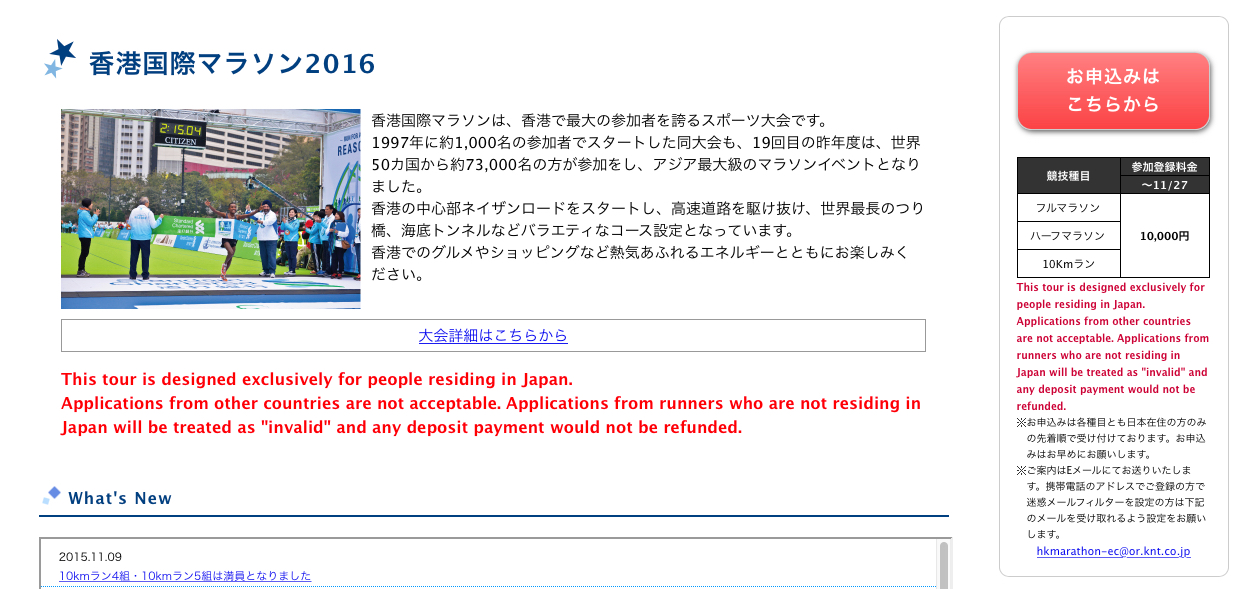
Debito.org has spoken out quite hot-tonguedly about how ludicrous the Nikkei Repatriation Bribe was, not the least because of its inherently racialized paradigms (because they only applied to Nikkei — people who were also in even more dire financial straits due to the economic downturn, such as the Chinese and Muslim factory workers laboring in conditions of indentured servitude, were left to fend for themselves because they lacked the requisite Japanese blood).

So as a matter of course Debito.org cheers for the lifting of the ban.  But the Bribe and the Ban should never have happened in the first place.  So the GOJ can also take its lumps even if they are ultimately making the right decision.

Does this mean that the numbers of registered NJ residents of Japan will start to increase again?  I will say it could happen.  I stress: could, not will happen.  But if it did, that statistic, not any asset bubbles and transient stock-market numbers that people keep championing as the putative fruits of “Abenomics”, will be the real indicator of Japan’s recovery.   That is to say, if Japan ever regains its sheen as an attractive place to work for international labor, then an increase in Japan’s NJ population will cause and signal a true leavening of Japan’s economic clout and prowess.  But I remain skeptical at this juncture — as I’ve said before, the jig is up, and outsiders generally know that Japan has no intention or enforceable laws to treat immigrants as equals, no matter how much of their lives and taxes they invest.

At this time, I believe international migrant labor will continue to vote with their feet and work elsewhere.  So good luck with significant numbers coming to Japan even with this ban lifted.  Arudou Debito

==========================
Referential article:

Ban lifted on ‘nikkei’ who got axed, airfare
But Japanese-Brazilians must have work contract before coming back
BY TOMOHIRO OSAKI, The Japan Times OCT 15, 2013
EXCERPT:
In what could be a significant change in policy affecting “nikkei” migrant workers from Brazil, the government Tuesday lifted a ban on the return of Japanese-Brazilians who received financial help in 2009 to fly home when they were thrown out of work during the global financial crisis.

Ostensibly an attempt to help the unemployed and cash-strapped Latin American migrants of Japanese ethnic origin escape the economic woes here, the 2009 initiative offered each an average of ¥300,000 to be used as airfare. It eventually resulted in an exodus of around 20,000 people, including 5,805 from Aichi Prefecture and 4,641 from Shizuoka Prefecture.

Although some of the migrants were genuinely thankful for the chance to get out of struggling Japan and find jobs back home, others were insulted because accepting the deal also meant they couldn’t come back to Japan at least “for the next three years” under “the same legal status.” This was seen as an outrageous move by the government to “get rid of” foreign workers as demand for their services fizzled out.

The migrants were initially banned from re-entering Japan for an unspecified period of time, but after a storm of both domestic and international condemnation, the government eventually said it might green-light their return after three years, depending on the economy.

Rest at http://www.japantimes.co.jp/news/2013/10/15/national/ban-lifted-on-nikkei-who-got-axed-airfare/
ENDS

Dr. Kitaoka Shinichi, Chair of Council on Security and Defense Capabilities, speaks at UH EWC Oct 11, 2013 on Japan’s need to remilitarize

mytest

eBooks, Books, and more from ARUDOU Debito (click on icon):
Guidebookcover.jpgjapaneseonlyebookcovertextHandbook for Newcomers, Migrants, and Immigrants to Japan「ジャパニーズ・オンリー 小樽入浴拒否問題と人種差別」(明石書店)sourstrawberriesavatardebitopodcastthumb
UPDATES ON TWITTER: arudoudebito
DEBITO.ORG PODCASTS on iTunes, subscribe free
“LIKE” US on Facebook at http://www.facebook.com/debitoorg
http://www.facebook.com/handbookimmigrants
https://www.facebook.com/JapaneseOnlyTheBook
https://www.facebook.com/BookInAppropriate

Hi Blog.  Yesterday I attended the following speech:

KitaokaShinichiEWCflyer

I attended because I wanted to see what was making one of PM Abe’s leading advisors tick.  Dr. Kitaoka did not disappoint.

He spoke in excellent English, and came off as a very articulate, passionate, and fluent advocate of his cause, which is essentially to make Japan strong enough militarily to deter China.  He did not feel a need to be restrained by a diplomat’s training, calling various schools of thought “totally wrong” and “stupid”, nor an academic’s subtlety that should come with a doctorate, where he said with firm certainty at various stages that “no Japanese” wants things like expansion of Japan’s borders (he also called Koreans an “emotional people”).  Almost all of the geopolitical problems he referred to in his talk were traced back to China, and he made a strong, reasoned plea for Japan’s inherent sovereign right for collective self defense in order to “contribute to peace and stability” by being empowered to assist Japan’s friends and allies (particularly, naturally, the Americans).

Dr. Kitaoka was very smooth.  He pushed all the right rhetorical buttons with an American audience (this one at the EWC quite full of American military brass; the audience was quite emotive), contrasting rich, democratic, non-nuclear, and “peace-loving” Japan with richening, undemocratic, nuclear and unfree China, which is increasing its defense budget every year and seeking territorial expansion (he even mentioned China’s dealings in Africa in that context).  He also smoothed feathers to head off the “Genie in the Bottle” argument (which is one image the US military uses to justify its continued presence in Japan — to stop Japan from remilitarizing) by pointing out five conditions why today’s Japan is different.  (See them well elaborated in his Yomiuri article scanned below.)

So to this end, Japan would need its first National Security Council, which would hopefully be established by November 2013.

There were a couple more surprises in Dr. Kitaoka’s talk.  One was that he was arguing that Japan is essentially in the same position today as China was in the early 20th century, where Japan is the one now who should think about how to defend itself from unjustified aggression from China!  The other surprise was his reasoning about why the world should not worry about Japan’s potential renewed territorial expansion abroad — because treaty agreements between the US and South Korea would preclude Japan’s need to invade the Korean Peninsula for defensive reasons (now that’s a novel take on Japan’s colonial history!).

Oh, and that it would be an impossibility for Japan to go nuclear again, because Japan as a huge developed economy integrated into world markets is particularly vulnerable to international sanctions.  But China, you see, is a member of the UN Security Council, unlike Japan, and they make UN sanctions more “ineffective”.  Less democratic countries, such as China and Russia, have more power in the UN than the democratic countries such as Japan, Germany, India, and Brazil… (and that was a very neat way to allude to Japan’s need for a UNSC seat — told you he was smooth).

The Q&A was done by people passing papers to the front to be sorted, vetted, and read by EWC staff.

In the end, Dr. Kitaoka talked like I would expect one of Japan’s elites to talk — seeing the world only in terms of power, and how Japan needs more of it because its neighbors are security threats.  That’s what any security analyst will say, of course (that’s how they’re trained), but Dr. Kitaoka spoke like a trained Gaijin Handler representing PM Abe’s political agenda, not a scholar.  Fascinating in that light, but scary, since these are the people who have been voted right back into power and want to dramatically alter Japan’s future policy.

Through him we can see PM Abe’s remilitarizing machinations and goals.  And next month, here they come.  Arudou Debito

NB:  LLK sends links to his full speech (with Q&A) available on vimeo.com. Here’s the link:

http://vimeo.com/77183187

Japan’s New National Security Strategy in the Making from East-West Center on Vimeo.

Here are the handouts that were presented to the audience for Dr. Kitaoka’s talk:

(click on image to expand in browser)

KitaokaShinichiYomiuri

KitaokaShinichihandout1KitaokaShinichihandout2
ENDS

Is Japan ready for Olympics? Kyodo: Hokkaido bathhouse refuses entry to Maori visiting scholar due to traditional tattoos

mytest

eBooks, Books, and more from ARUDOU Debito (click on icon):
Guidebookcover.jpgjapaneseonlyebookcovertextHandbook for Newcomers, Migrants, and Immigrants to Japan「ジャパニーズ・オンリー 小樽入浴拒否問題と人種差別」(明石書店)sourstrawberriesavatardebitopodcastthumb
UPDATES ON TWITTER: arudoudebito
DEBITO.ORG PODCASTS on iTunes, subscribe free
“LIKE” US on Facebook at http://www.facebook.com/debitoorg
http://www.facebook.com/handbookimmigrants
https://www.facebook.com/JapaneseOnlyTheBook
https://www.facebook.com/BookInAppropriate

maorirefuseekyodonews091213

Maori woman refused entry to bath due to traditional tattoos
SAPPORO, Sept. 12, 2013 Kyodo News, courtesy of JK
http://english.kyodonews.jp/news/2013/09/245956.html

A public bath facility in Eniwa, Hokkaido, refused entry to a Maori woman from New Zealand due to her face tattoos, a facility official said Thursday.

The Maori language lecturer, 60, has the tattoos, called ta moko, worn traditionally by some indigenous New Zealanders, on her lips and chin. She was in Hokkaido for a conference on indigenous languages in the town of Biratori in the northernmost prefecture.

On Sunday afternoon a group of 10 people involved in the conference visited the thermal baths but were refused entry by a facility staff member.

When a member of the group claimed the decision was discriminatory, the staff replied that the facility prohibits entry to anyone with tattoos in order to put customers at ease.

“Even if it is traditional culture, a typical person cannot judge the context behind the tattoos,” the facility official told reporters.

An Ainu language lecturer who was in the group said he felt sorry to disappoint an important guest.

“It is unfortunate that other cultures are not understood,” he said.

According to the food and sanitation section of the Hokkaido prefectural government and the National Federation of Public Bath Industry Trade Unions, the law on public baths allows operators to refuse entry to customers with infectious diseases, but does not rule on customers with tattoos.

Prohibition of tattoos is often used by public facilities in Japan to prevent entry by members of the country’s organized crime groups, many of whom have tattoos on their bodies.

ENDS

//////////////////////////////////

Hi Blog.  Oh the ironies of the above happening.  It’s standard practice nationwide at many public bathhouses to refuse entry to Japanese with tattoos because they might be yakuza, and it’s long been a debate when one gets NJ who have tattoos as fashion statements.

isawafront

(Courtesy Debito.org Rogues’ Gallery. Note sign and people with tattoos, on left.  And while we’re at it, note sign that refuses foreigners who can’t speak Japanese and who don’t have valid visas.  More information here.)

But what really floors me is that a) it’s in Hokkaido, site of the famous Otaru Onsens Case (where people were refused entry just for being foreign; well, okay, just looking foreign), b) it’s in Hokkaido, site of the indigenous Ainu (whose conference in Biratori this indigenous Maori lecturer was attending), and c) it’s a traditional face tattoo, which the Ainu themselves used to have before the GOJ outlawed them:

ainuliptattooing

(Courtesy http://www.ksc.kwansei.ac.jp/~jed/CompCult/)

Well, luckily for these bathhouse owners the GOJ erased that culture in its indigenous Ainu, not to mention erased most of the Ainu culture and people themselves.   So nobody in Japan can claim cultural suppression of expression of tattoo culture anymore since suppression worked so well.

But wait, there’s more irony.  Check this out:

Gov’t aims to complete national Ainu museum for 2020 Olympics
http://mainichi.jp/english/english/newsselect/news/20130911p2a00m0na034000c.html

アイヌ政策推進会議:「象徴空間、20年に」 五輪に合わせ政府方針
http://mainichi.jp/select/news/20130911dde041010025000c.html

Full text of articles below.  Submitter JK notes:
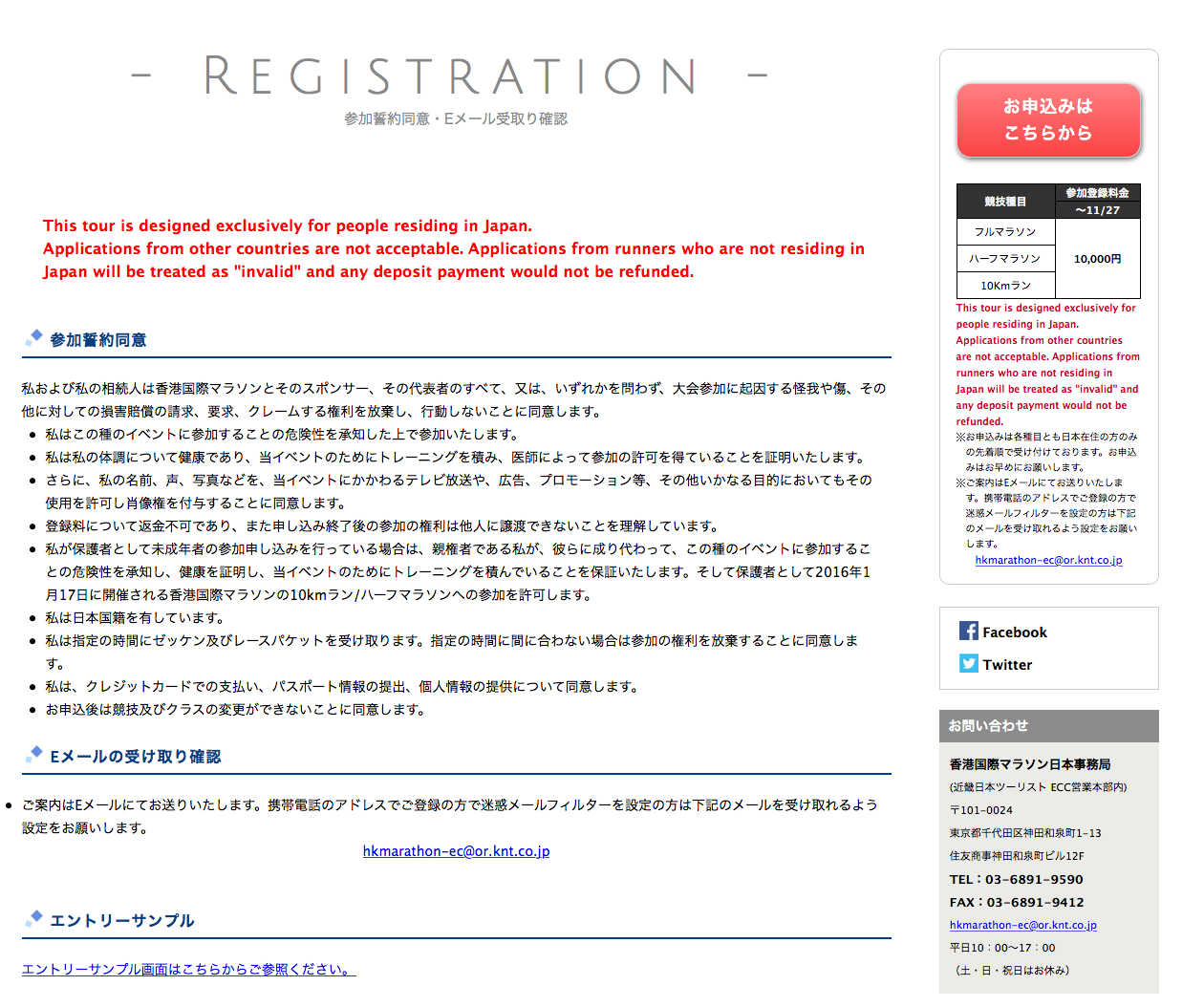
====================

On the one hand, it’s about time the Ainu get the recognition they deserve.  Yet on the other hand, focusing on the Ainu creates a cultural blind spot:

“The project aims to end discrimination against Ainu people in Japan and create a society where people of different ethnicities can live together in harmony.”

Wait, hold on – why stop with just the Ainu? Why not end discrimination against *all* people in Japan and create a society where people of different ethnicities can live together in harmony?

My fear is that the GOJ will use the Olympics to politicize the Ainu at the expense of other NJ (e.g. Zainichi  Koreans, immigrants).

====================

That’s precisely the point, really.  If we’re the GOJ, we’ll turn a blind eye towards (if not actively promote) the cultural suppression and denial of domestic ethnic diversity.

Except when we’re on our best behavior because the eyes of the world are on us.  Then we’ll pay lip service to the ending of discrimination against one minority group.  Never mind the others.

And if anyone comes here during the Olympics and gets refused service somewhere?  Sorry, shikata ga nai.  We have no laws against racial discrimination in Japan.  Even though it’s closing in on twenty years since we promised to do so when signing the UN CERD in 1995.  Maybe if you give us the Olympics a few more times, we’ll promise to protect a few more minorities.

I assume the Maori researcher has a topic for her next research paper.  Arudou Debito

//////////////////////

先住民族マオリ女性の入浴拒否 北海道・石狩管内の温泉、顔の入れ墨理由に(道新 09/12 06:25)

http://www.hokkaido-np.co.jp/news/donai/491172.html
ニュージーランドの先住民族マオリの言語指導者で、日高管内平取町で6日まで開かれたアイヌ語復興を目指す講習会の講師を務めた女性が、石狩管内の民間の温泉施設で顔の入れ墨を理由に入館を断られていたことが11日、分かった。講習会関係者は「入れ墨はマオリの尊厳の象徴であり、大変残念」としている。

女性はエラナ・ブレワートンさん(60)。講習会関係者ら約10人で8日、札幌市内でのアイヌ民族の行事を見学後、入浴と食事のため温泉施設に行った。その際、ブレワートンさんの唇とあごの入れ墨を見た温泉側が「入れ墨入館禁止」を理由に入館を断った。同行したアイヌ民族の関係者らが温泉側に「多様な文化を受け入れることが必要では」と再考を求めたが聞き入れられなかった。

同温泉は、入り口に「入れ墨入館禁止」の看板を設置。入れ墨がある人の入浴はすべて断っているという。ブレワートンさんは「深い悲しみを感じた」と落胆。温泉の支配人は「入れ墨にもいろいろな背景があることは理解するが、一般客はなかなか分からない。例外を認めると、これまでの信頼を裏切ることになる」と説明している。<北海道新聞9月12日朝刊掲載>

//////////////////////////////////////////

Gov’t aims to complete national Ainu museum for 2020 Olympics
September 11, 2013 (Mainichi Japan)
http://mainichi.jp/english/english/newsselect/news/20130911p2a00m0na034000c.html

SAPPORO — The national government’s panel to work on revitalizing Ainu culture has decided to complete the building of an Ainu-themed museum and memorial park around Lake Poroto in Shiraoi, Hokkaido, by the summer of 2020, with a goal to promote Japan’s multiethnic culture during the 2020 Olympics in Tokyo.

Chief Cabinet Secretary Yoshihide Suga, chairman of the Council for Ainu Policy Promotion, said, “The government aims to make the 2020 Olympics an opportunity for people overseas to learn about Ainu culture.” His comments came during a panel meeting on Sept. 11 to explain the plan to complete construction of the “Symbolic Place for Ethnic Harmony” as a national center for Ainu culture revitalization before the Games begin in Tokyo in July 2020.

The project aims to end discrimination against Ainu people in Japan and create a society where people of different ethnicities can live together in harmony. It will conduct studies on Ainu history and culture while working on human resource development for the cultural preservation of the Ainu. The government also plans to bury bones of Ainu people at the site, which have been collected from their graves for research purposes by institutions including the University of Tokyo and Hokkaido University.

An expert panel on Ainu policy blueprinted the idea of building the memorial museum and park in 2009 as the 2008 Diet resolution concluded that the Ainu were an indigenous people of Japan.
ENDS

Original Japanese:

アイヌ政策推進会議:「象徴空間、20年に」 五輪に合わせ政府方針
毎日新聞 2013年09月11日 東京夕刊
http://mainichi.jp/select/news/20130911dde041010025000c.html

政府の「アイヌ政策推進会議」(座長・菅義偉官房長官)が11日、札幌市であり、北海道白老(しらおい)町のポロト湖周辺に整備するアイヌ文化の復興拠点「民族共生の象徴となる空間」(象徴空間)を2020年度にオープンする工程表を決定した。

菅官房長官はあいさつで、東京五輪が開催される20年7月までに象徴空間を完成させる考えを示し、「(東京五輪を)海外の皆さんにアイヌのことを知っていただく機会にしたい」と述べた。

象徴空間はアイヌ差別の歴史に終止符を打ち、多民族共生社会の実現を目指す拠点。アイヌの歴史や文化の展示・調査研究、アイヌ文化の伝承と人材の育成などを行うほか、北海道大や東京大などが研究目的でアイヌ墓地から収集した遺骨を慰霊する。

「アイヌを先住民族とする」とした国会決議(08年6月)を受け、政府の「アイヌ政策のあり方に関する有識者懇談会」が09年に象徴空間構想を打ち出した。【千々部一好】
ENDS


Scholar Morris-Suzuki on the rebranding of PM Abe for foreign consumption, contrasted with his “reverse postwar political reforms” goals set out in his manifesto

mytest

eBooks, Books, and more from ARUDOU Debito (click on icon):
Guidebookcover.jpgjapaneseonlyebookcovertextHandbook for Newcomers, Migrants, and Immigrants to Japan「ジャパニーズ・オンリー 小樽入浴拒否問題と人種差別」(明石書店)sourstrawberriesavatardebitopodcastthumb
UPDATES ON TWITTER: arudoudebito
DEBITO.ORG PODCASTS on iTunes, subscribe free
“LIKE” US on Facebook at http://www.facebook.com/debitoorg
http://www.facebook.com/handbookimmigrants
https://www.facebook.com/JapaneseOnlyTheBook
https://www.facebook.com/BookInAppropriate

On the eve of an election that will only further empower this man, Scholar Tessa Morris-Suzuki talks about the media machines to rebrand him as “not a nationalist”.  Hah.  And double hah after reading some actual scholarship on this man.  Read on and grit your teeth as election results come in.  Arudou Debito

The Asia-Pacific Journal, Volume 11, Issue 28, No. 1, July 15, 2013.

The Re-Branding of Abe Nationalism: Global Perspectives

Tessa Morris-Suzuki

In 2010, the Australian Broadcasting Company (ABC) launched a highly successful TV show called The Gruen Transfer. The title refers to the disorienting psychological effects produced on consumers by the architecture of shopping malls, whose dazzle and noise are deliberately designed to mesmerize: on entering, “our eyes glaze over, our jaws slacken… we forget what we came for and become impulse buyers”.The ABC’s Gruen Transfer explored the weird, wonderful and disorienting effects produced by the advertising industry. Its most popular element was a segment called “The Pitch”, in which representatives of two advertising agencies competed to sell the unsellable to the show’s audience – creating gloriously sleek videos to market bottled air, promote the virtues of banning religion, or advocate generous pay raises for politicians.

I have been reminded of The Gruen Transfer in recent months, as sections of the media in Japan, and even internationally, have gone into overdrive to sell an equally challenging message: the message that Japanese Prime Minister Abe Shinzo is not a nationalist.This particular pitch has been running for some time. It began with the inception of Abe’s first short-lived prime ministership in 2006, when Japanese Foreign Affairs Deputy Press Secretary Taniguchi Tomohiko devoted considerable energy to persuading a US audience that Abe was “almost the polar opposite” of a nationalist.The right-of-centre Sankei Newspaper took up the challenge with enthusiasm: its Washington correspondent, Komori Yoshihisa, published numerous articles, including an opinion piece in the New York Times, which aimed to refute the “nationalist” tag. Far from being a hawkish nationalist, Komori argued, Abe had “merely been shaped by democracy”, and his real aim was to bring Japan back from the “post-war extreme towards the center”.But these pronouncements had only limited impact on international opinion, and by early 2007 one prominent Japanese marketing consultant was lamenting, in the pages of the Yomiuri newspaper, that the government needed a far more effective foreign media strategy to rescue Abe from the “hawk” and “nationalist” labels.5

The issue has resurfaced with renewed vigor since the advent of the second Abe regime in December 2012. In May 2013, a US Congressional Research Service paper describing Abe as a “strong nationalist” evoked a surprisingly querulous response from pro-government media in Japan, and even from Prime Minister Abe himself. Abe hit back with a statement in parliament, expressing his unhappiness that “the ideas of our country” were being misunderstood by foreigners. He went on to call for measures to “actively collect and spread information so that we will be correctly understood”.6

[…]

Abe’s core goal, inherited from Kishi, clearly set out in Towards a Beautiful Country, and echoed in the manifestos of groups like the Shinto Association of Spiritual Leadership, is to “escape from the postwar regime”: that is, to reverse the political reforms introduced to Japan during the allied occupation. In his view, these reforms undermine Japan’s traditions, which are centred on the figure of the Emperor. What Abe’s nationalist vision means in practice is best understood by examining his party’s far-reaching proposals to rewrite the postwar Japanese constitution. The proposed changes include removing the reference to “respect for the individual” and making it constitutionally impossible for foreign permanent residents to be given national or local voting rights. Freedom of expression and freedom of association would not be protected where these “have the purpose of harming the public interest or public order”. The same formula would be used to limit the right of citizens to “life, liberty and the pursuit of happiness”. The revised constitution prepared by the Liberal Democratic Party contains no guidelines as to how, and by whom, “public interest” and “public order” would be defined, leaving an alarmingly large loophole for the repression of civic freedoms by the state. A new article would also be added to the constitution to give the state sweeping powers to declare prolonged states of emergency, during which constitutional rights could be suspended.22 With the prospect of an LDP super-majority in parliament for the next two to three years, there is a strong likelihood that the ruling party will push forward with an attempt to carry out these changes: changes so profound that they should probably be described, not as plans for constitutional revision, but rather as plans for a new constitution.

This artwork appeared in an exhibition entitled “the Constitution and Peace” which opened in a public art space in Fukui Prefecture in May. The work consists of several sections of the current constitution written out in attractive calligraphy and coloured ink on Japanese paper. Soon after the exhibition opened, it was removed on the orders of the company which manages the art space for the local government on the grounds that “its political content might offend the feelings of some viewers”.


The current popularity of the Abe administration in no way reflects public enthusiasm for these grand political designs. It is, instead, a response to the government’s economic stimulus package, and to Abe’s skill in making optimistic statements, which convey a sense of leadership to a population weary of political uncertainty and economic malaise. In the end, the Abe government’s performance should and will be judged, not on any political labels, but on the impact that it has on Japanese society and on Japan’s relations with its region and the world. It is possible that Abe may yet choose to focus on the vital tasks of creating a basis for a strong Japanese economic future and improving relations with Japan’s neighbours, rather than pursuing the ideological agendas of anti-liberalism and “escape from the postwar regime”.

In the meanwhile, though, those who care about the future of Japanese society should not allow the dazzle of verbal juggling to induce a political version of the Gruen Transfer. The prime minister’s ideology may be re-branded for the global market, but the old adage remains: buyer beware.

– See full article at: http://japanfocus.org/-Tessa-Morris_Suzuki/3966

Tessa Morris-Suzuki is Professor of Japanese History in the Division of Pacific and Asian History, College of Asia and the Pacific, Australian National University, and a Japan Focus associate. Her most recent books are Exodus to North Korea: Shadows from Japan’s Cold War, Borderline Japan: Foreigners and Frontier Controls in the Postwar Era and To the Diamond Mountains: A Hundred-Year Journey Through China and Korea.

ENDS

My Japan Times JUST BE CAUSE Col 64 Jun 4, 2013: “By opening up the debate to the real experts, Hashimoto did history a favor”

mytest

eBooks, Books, and more from ARUDOU Debito (click on icon):
Guidebookcover.jpgjapaneseonlyebookcovertextHandbook for Newcomers, Migrants, and Immigrants to Japan「ジャパニーズ・オンリー 小樽入浴拒否問題と人種差別」(明石書店)sourstrawberriesavatardebitopodcastthumb
UPDATES ON TWITTER: arudoudebito
DEBITO.ORG PODCASTS on iTunes, subscribe free
“LIKE” US on Facebook at http://www.facebook.com/debitoorg
http://www.facebook.com/handbookimmigrants
https://www.facebook.com/JapaneseOnlyTheBook
https://www.facebook.com/BookInAppropriate

Hi Blog. Here’s my latest column for your comments. Thanks to everyone who read it in print and online! Arudou Debito
justbecauseicon.jpg
JUST BE CAUSE
By opening up the debate to the real experts, Hashimoto did history a favor
BY ARUDOU Debito
The Japan Times June 4, 2013, version with links to sources
Courtesy http://www.japantimes.co.jp/community/2013/06/04/issues/by-opening-up-the-debate-to-the-real-experts-hashimoto-did-history-a-favor

Osaka Mayor Toru Hashimoto has been busy making headlines around the world with his controversial views on Japan’s wartime sex slaves (or “comfort women,” for those who like euphemisms with their history). Among other things, he claimed there is no evidence that the Japanese government sponsored the program, and suggested these exploited women were (and still are) a “necessary” outlet for a military’s primal urges. (Sources here and here)

I will say something for this idiot’s provocative behavior: He brought this issue out for long-overdue public scrutiny. He has also presented us with a case study of how to keep people like him in check.

For a person in power, Hashimoto has behaved unusually candidly. Generally, after Japanese politicians or bureaucrats burp up ignorant, bigoted, sexist or offensively ahistorical comments, they backpedal by claiming they were somehow misunderstood (which Hashimoto did), or even try to excuse their remarks by saying they were “for a domestic audience only.” (They seem to think they live on an isolated debate Galapagos, and that the Japanese language is a secret code.)

Then Japan’s media plays along by ignoring or downplaying the events or, if pressed, lobbing the ideologues a few softball interview questions. Most reporters lack the independence (due to editorial constraints and incentives not to rock the powerful press club system) or the cojones to hold elites’ feet to the fire.

However, when their statements make the foreign media (particularly the BBC or New York Times) they get serious domestic traction, because now Japan’s international image — vis-a-vis countries Japan’s government actually cares about — is being tarnished.

In the bad old days, blunderers would then tentatively apologize and tender a snap resignation — without effecting any real change in how Japan’s elites “really think,” or sufficient debate on the issues they resuscitated. It feels like lopping off one of the heads of a hydra — you just know more noggins will pop up shortly.

Nowadays it’s worse, because the hydra often stays unlopped. Bona fide bigots (such as former Tokyo Gov. Shintaro Ishihara; see JBC, Nov. 6, 2012: If bully Ishihara wants one last stand, bring it on) remain boldly unrepentant or tepidly sorry, hunker down at their posts and wait for the public to swallow the issue before the next media cycle begins.

The result is a toxic aftertaste regurgitated in the region: Japan seemingly rewrites a pretty awful colonial past, and former colonies see this free pass from historical purgatory as a product of Japan’s special political and military relationship with hegemon America. Asia’s acid reflux thus sours other international relationships.

This time, however, Hashimoto is doing something different: He’s actually cooking up an international debate. A marathon press conference at the Foreign Correspondents’ Club of Japan last week exposed some juicy bones of contention.

Hashimoto reiterated his denial that the government was “intentionally involved in the abduction and trafficking of women” but, more indicatively, he said: “It would be harmful, not only to Japan but also to the world, if Japan’s violation of the dignity of women by soldiers were reported and analyzed as an isolated and unique case, and if such reports came to be treated as common knowledge throughout the world.”

To paraphrase: Japan did nothing all that wrong because it did nothing unusually wrong. Hashimoto is thus rationalizing and normalizing sexual slavery as a universal part of war — as if blaming Japan is wrong because everyone else allegedly did it.

Essentially, revisionists such as Hashimoto want a bowdlerized assessment of history. But remember, every country has shameful periods in their past; the trick is to learn from them, not cover them up (as Hashimoto’s ilk seeks to do, all the way down to a sanitized education curriculum).

They also want a dishonest tone in the narrative. For them, Japan must not only be seen accurately (as they see it); it must be seen nicely. That is simply not possible when addressing certain parts of Japan’s history.

Why are these people trying so hard to be relativistic? They might actually be so thick as to believe that any government would institutionalize sexual slavery in the “fog of war.” It’s more likely, however, that they simply don’t want their “beautiful country” to be the bad guy in their movie.

Fortunately Hashimoto’s posturing has exposed this ugly illogic. He has given people who know better (such as historians and eyewitnesses) the opportunity to correct and inform Japan’s revisionists on a national level.

To be sure, Hashimoto (a lawyer famous for taking extreme stances as a TV celebrity before his election to office) has never developed the “caution filter” that usually comes with public office, which is why he should return to private practice, where his semantic games would be limited to Japan’s petty courts.

But Hashimoto has also inadvertently shown us a way to blunt the rise of Japan’s incorrigible right wing: Reduce their rants to performance art.

As historian Tessa Morris-Suzuki sagely notes: “This is not politics by persuasion but politics by performance. The object of the current performance is obvious. It is to provoke impassioned counter-attacks, preferably from those who can be labeled left-wing and foreign — best of all from those who can be labeled Korean or Chinese nationalists. This will then allow Hashimoto to assume the ‘moral high ground’ as a martyred nationalist hero assailed by ‘anti-Japanese’ forces . . .

“This makes a careful and considered response to the Hashimoto phenomenon particularly important. Above all, this phenomenon should not be ‘nationalized.’ Hashimoto does not speak for Japan, and to condemn Japan because of his comments would only be to boost his demagogic appeal.

“The best reply from those who hope he never will speak for Japan is to allow his words to speak for themselves. Those outside Japan who are alarmed or offended by these words should seek out and lend support to the embattled peace, human rights and reconciliation groups in Japan which also seek a different future, so that their voices too may be heard at the national level.”

So, I encourage readers to understand what’s behind maintaining these narratives. Japan’s Hashimotos want to channel Japanese society’s innate cautiousness towards the outside world (JBC, Oct. 2, 2012: Revisionists marching Japan back to a dangerous place) into domestic support for their xenophobic populism. When they make their venomous statements, take them up and calmly point out the illogic and inaccuracies therein — stress on the word “calmly.” Use their tactics against them.

It’s a bit ironic, but Japan needs more Hashimotos to make a hash of contentious issues. The clearer they spout stupid stuff, the clearer our corrections will be. And, with sufficient attention and pressure, the shorter their political lives will be.

Debito Arudou’s updated “Guidebook for Relocation and Assimilation into Japan” is now a downloadable e-book on Amazon. See www.debito.org/handbook.html. Twitter @arudoudebito. Just Be Cause appears on the first Community pages of the month. Send comments and ideas to community@japantimes.co.jp.

ENDS

Good news: GOJ signs Hague Child Abductions Treaty. Bad news: GOJ will probably caveat its way out of ever following it

mytest

eBooks, Books, and more from ARUDOU Debito (click on icon):
Guidebookcover.jpgjapaneseonlyebookcovertextHandbook for Newcomers, Migrants, and Immigrants to Japan「ジャパニーズ・オンリー 小樽入浴拒否問題と人種差別」(明石書店)sourstrawberriesavatardebitopodcastthumb
UPDATES ON TWITTER: arudoudebito
DEBITO.ORG PODCASTS on iTunes, subscribe free
“LIKE” US on Facebook at http://www.facebook.com/debitoorg
http://www.facebook.com/handbookimmigrants
https://www.facebook.com/JapaneseOnlyTheBook
https://www.facebook.com/BookInAppropriate

Hi Blog.  I have some good news to report.  After years of pressure on the GOJ to act like its fellow advanced societies in terms of divorce and child custody, Japan earlier this week signed the Hague Convention on Child Abductions.  Good.  I will comment more after the BBC article:

/////////////////////////////////////////

Japan votes to adopt child abduction treaty

22 May 2013 BBC News

Japan's Upper House members approve the international treaty Hague Convention after an unanimous vote at the National Diet in Tokyo on 22 May 2013
Japan’s parliament voted unanimously to approve the treaty

Japan’s parliament has voted to adopt an international treaty on child abductions, after years of pressure from Western countries.

The 1980 Hague Convention sets out procedures for handling cross-border child custody disputes.

Japan is the only country out of the Group of Eight industrialised nations (G8) yet to ratify the convention.

Its policies have been blamed for making it easy for Japanese mothers to remove children from foreign fathers.

Parents who have had their children abducted and taken to Japan by ex-spouses have describe the country as a “legal black hole” into which their children disappear, the BBC’s Rupert Wingfield-Hayes reports from Tokyo.

In February, Japanese Prime Minister Shinzo Abe expressed his support for the treaty after meeting US President Barack Obama.

The upper house of parliament voted to join the treaty on Wednesday. The lower house, which is more powerful, approved the treaty last month.

The government will ratify the treaty after finalising domestic procedures, including setting up a central authority responsible for locating abducted children and helping parents settle out of court where possible.

Japan says it aims to ratify the treaty by March 2014.

Divorced abroad

The 1980 Hague Convention on the Civil Aspects of International Child Abduction aims to protect the rights of both parents in custody cases.

“When I said I wanted to see [my daughter] on weekends, the judge and the attorneys in the room laughed” — Paul Toland, US Navy Commander

It seeks to ensure that custody decisions are made according to the laws of the country which provided the first residence for the children.

Under the convention, children who are taken away by a parent following a marriage breakdown must be returned to the country where they normally reside, if requested by the other parent.

However, campaigners say little will change until Japan reforms its own archaic divorce laws, our correspondent reports.

Japan’s family courts normally grant custody to one parent – traditionally the mother – after a divorce.

That parent is under no obligation to give the other parent access to the child, and it is not unusual for one parent to be cut out of their children’s lives forever.

There have been more than 200 international custody cases involving Japan. Many involve cases of Japanese nationals – married to non-Japanese nationals – who were divorced abroad taking their children back to Japan, despite joint custody rulings.

One high-profile case is that of US Navy Commander Paul Toland, who lost custody of his daughter Erika after his marriage with his Japanese wife broke down.

“The [family] court completely avoided any discussion regarding visitation with Erika,” he said in a statement in 2009.

“When I said I wanted to see Erika on weekends, the judge and the attorneys in the room laughed.”

He was unable to regain custody after his ex-wife killed herself – instead, his daughter now lives with her maternal grandmother, who Cdr Toland said in his 2009 statement had refused to allow access.

In 2010, the ambassadors of 12 countries, including the US, UK, Australia and Germany, signed a joint statement urging Japan to adopt the 1980 Hague Convention.

However, critics of the convention have previously argued that it could make it harder for Japanese women to flee abusive relationships abroad.

ENDS

/////////////////////////////////////////

COMMENT:  I don’t want to dismiss this development out of hand, because Japan doing this is a step in the right direction (after all, if even after this I had nothing good to say, then what would EVER count as good news on Debito.org?)  But as I have argued before, I think it’s been signed because enough time has passed for caveats to be put in place — so that the home team will rarely lose a custody case in Japan (furthermore, part of the argument for signing has been that Japanese would have a stronger footing overseas to pursue custody cases in Hague signatory countries — again, benefiting the home team in either case).  After all, the normalized portrayal in Japanese media of NJ as violent spouses, and Japanese as victims (particularly wives, even though they are the great minority in international marriages) has expanded Japan’s definition of “Domestic Violence” to even simple heated arguments.  Fight with your J-wife anytime and lose your kids. The deck is stacked.

Let me quote one submitter:  “From May 13’s Japan Times.  A series of articles hammering home what will evidently be Japan’s final word on the subject, that Japanese fleeing countries abroad are doing so to protect their kids and themselves from angry, violent, abusive foreign husbands.  Cue standardized quotes from proclaimed “expert on the issue” Kensuke Onuki as well as lawyer Mikiko “I was for the convention but now I see it conflicts with Japanese culture” Otani and a slew of heart-wrenching stories of Japanese wives fleeing abusive marriages (one claiming that had Japan been party to the Hague Convention at the time of her escape she would have chosen killing her child and herself than risk a return to her husband.  Whether these individual stories have merit of not, it’s pure one-sided sensationalism.  Where are the Murray Wood stories of wife abuse and neglect?
http://search.japantimes.co.jp/cgi-bin/nn20100514f1.html
http://search.japantimes.co.jp/cgi-bin/nn20100514f3.html
“Only Minoru Matsutani’s article sandwiched between offers any sense of balance.”
http://search.japantimes.co.jp/cgi-bin/nn20100514f2.html

And to quote another anonymous legally-trained friend:  “How to address DV is an issue in all Hague countries. In addition to allegations of DV, the Japanese legislation will also allow a judge to consider whether it would be difficult for EITHER the taking parent OR the parent requesting return to raise the child in the country of origin.  This sounds awfully close to a full-blown custody determination, which is sort of what courts are NOT supposed to do in Hague cases.”

As for future prospects, I shall defer to the better-informed judgment of a specialist international lawyer in this field, who wrote the following shortly before the Hague was signed:

/////////////////////////////////////////

Friday, March 15, 2013

Japan’s Potential Ratification of the Hague Convention: An Update
Jeremy D. Morley

http://www.internationalfamilylawfirm.com/2013/03/japans-potential-ratification-of-hague.html

Japan has not yet ratified the Hague Abduction Convention. The Japanese Cabinet has today reportedly approved the ratification but the necessary legislation has not yet been passed by the Japanese Diet (Parliament).

The issue of Japan’s joining the Hague Convention is still controversial in Japan. Many members of the Diet are flatly opposed to the treaty on the ground that it will lead to the imposition of “Western thinking” on family relationships in Japan, i.e. that it might lead to the intervention of the courts into the private life of families, to the issuance of judicial orders concerning family matters that can be enforced by the power of the state, and to both parents having meaningful rights to their children after a divorce or separation.

Accordingly, newspaper editorials in Japan have demanded that, when Japanese wives “flee” foreign countries because of alleged domestic violence abroad, they must not be forced to return to the country where such abuse has occurred.

Such concerns have already led to inclusion of a provision in the draft legislation that is most likely to lead to an unnecessarily broad interpretation of the “grave risk” exception in Article 13(b) of the Convention. Indeed, that is the intended result.

The result of such an exception would be to shield abductors who are able to claim domestic abuse even though:

  • (a) The legal system in the (American) habitual residence would provide an abuse victim and child with very substantial protection;
  • (b) No change is being made in Japan to the lack of any meaningful provisions in Japanese law for the other parent to have any access to the child or any decision-making role in the life of the child, so that in reality the foreign left-behind parent would still be without any meaningful rights to the child; and
  • (c) There is no meaningful system within Japan to effectively determine the merits of such claims of abuse.

In addition, there is a serious concern that petitioning parents will be forced into mediation before being allowed to proceed with or complete their judicial case. There are special provisions in the draft legislation promoting mediation. If the mediation process works similarly to the current Family Court mediation process it will lead to lengthy delays and extreme unfairness to petitioning parents.

Mediation is generally an extremely unhelpful forum for foreigners in family law cases in Japan, since (i) foreign parties must appear in person regardless of their place of residency, (ii) the sessions are usually short and are repeatedly adjourned for lengthy periods of time, necessitating multiple inconvenient and expensive visits to Japan, (iii) the foreigners’ views are generally misunderstood for language and cultural reasons, and (iv) the foreigners are pressured to accept unfair terms since there is no enforcement of court decisions in family law matters in Japan and because they are told that their refusal to accept the mediators’ recommendations will be held against them in a trial.

When most other countries have joined the Convention the United States could choose whether or not to accept the accession. If a country has not enacted satisfactory legislation designed to effectively enforce the terms of the Convention other countries need not accept the accession. Such is the case with Thailand, which acceded to the Convention in 2002 but has not yet enacted implementing legislation satisfactory to the United States or several other countries. By contrast, as an original member of the Hague Conference, Japan will not be acceding to the Convention, but will ratify it which will trigger its immediate entry into force without any place for international review.

Meanwhile, the Japanese public is being told that even if Japan signs the Convention, “The return of a child can be denied if the parent seeking it is believed to abuse the child or have difficulties raising him or her.” Daily Yomiuri, Mar. 16, 2013. If that is the gloss that Japan intends to put on the Hague Convention – even though the Convention is expressly designed to secure the expeditious return of all abducted children except in extremely unusual cases – there is little or no point in Japan’s purported ratification of the treaty.

The result of Japan’s ratification of the Convention will likely be to create the appearance of Japan’s compliance with international norms but without any of the substance.

ENDS

/////////////////////////////////////////

CONCLUSION:  Same as other treaties that Japan has signed but doesn’t enforce, I think the Hague will wind up as a historical footnote as another treaty Japan chooses to ignore.  When we see the highly unlikely prospect of children of international marriages abducted to Japan sent back overseas by a Japanese court (in contrast to other judiciaries that DO repatriate children, see for example here and here) then I’ll think progress has been made.  But it’s pretty inconceivable to me, since child abduction happens between Japanese couples too thanks to Japan’s insane marriage system, and it’s hard to imagine foreigners suddenly being granted more rights in Japanese marriages than fellow Japanese.  Arudou Debito

Asahi on arrest of Zaitokukai participant in anti-Korean demo; J-Cast on anti-Korean stuff being sold at Dietmember kaikan; Osaka sign saying “Stop Scrawling Discriminatory Graffiti”

mytest

eBooks, Books, and more from ARUDOU Debito (click on icon):
Guidebookcover.jpgjapaneseonlyebookcovertextHandbook for Newcomers, Migrants, and Immigrants to Japan「ジャパニーズ・オンリー 小樽入浴拒否問題と人種差別」(明石書店)sourstrawberriesavatardebitopodcastthumb
UPDATES ON TWITTER: arudoudebito
DEBITO.ORG PODCASTS on iTunes, subscribe free
“LIKE” US on Facebook at http://www.facebook.com/debitoorg
http://www.facebook.com/handbookimmigrants
https://www.facebook.com/JapaneseOnlyTheBook
https://www.facebook.com/BookInAppropriate

Hi Blog.  We have some positive movements regarding the treatment of hate speech in Japan, particularly regarding that “Kill all Koreans” hate demo that took place last February (god bless the ensuing gaiatsu of international attention for making the GOJ finally take some action to deal with this deservedly embarrassing incident).  First, the Asahi reports that one of the participants in the Zaitokukai hate demo named Akai Hiroshi was arrested by the police, for violent bodily contact with a person protesting Zaitokukai activities.

==============================

新大久保の反韓デモ、初の逮捕 対立グループに暴行容疑
朝日新聞 2013年5月20日, courtesy of MS
http://www.asahi.com/national/update/0520/TKY201305200108.html

在日韓国・朝鮮人を非難する東京・新大久保でのデモで対立するグループの男性に体当たりしたとして、警視庁は、自称・埼玉県熊谷市拾六間、無職赤井洋容疑者(47)を暴行の疑いで逮捕し、20日発表した。「つまずいて相手にぶつかっただけだ」と容疑を否認しているという。新大久保でのデモで逮捕者が出たのは初めて。

新宿署によると、赤井容疑者は19日午後6時40分ごろ、東京都新宿区の路上で、会社員男性(51)の胸などに体当たりした疑いがある。

赤井容疑者は「在日特権を許さない市民の会」のメンバーらとともにデモに参加。被害男性は、デモをやめるよう抗議する集団に加わっていた。両集団はそれぞれ約200人規模で、警視庁機動隊を挟み、緊迫した状況だったという。

==============================

Japan Times reports from Kyodo:

==============================
NATIONAL
Man held during anti-Korean rally
KYODO MAY 22, 2013

http://www.japantimes.co.jp/news/2013/05/22/national/man-held-during-anti-korean-rally

Police have arrested a 47-year-old man who took part in a regularly held anti-Korean demonstration in Shinjuku Ward, Tokyo, for allegedly assaulting another man protesting the rally.

The man arrested Monday identified himself as Hiroshi Akai, an unemployed former Self-Defense Force member from Kumagaya, Saitama Prefecture. Akai said he had “accidentally bumped into” the other man, according to the Metropolitan Police Department.

Police allege Akai hurled himself at the 51-year-old company employee Sunday evening after the protest in Shinjuku. He was held by riot police who were guarding the demonstration.

Rightwing groups, including one claiming to be “citizens who do not condone privileges given to Koreans in Japan,” have been staging demonstrations several times a month in Shinjuku and nearby Shin-Okubo, home to a large ethnic Korean population.
==============================

Okay, good start, and glad that there are protests regarding the hateful, xenophobic protesters (usually their activities get ignored even if they involve violence against counter-demonstrators).  Except for the fact that this sort of hate speech has by now reached the highest and lowest levels of society, as in anti-Korean stickers being sold in Diet buildings, and anti-Korean graffiti being scrawled on public transportation:

==============================

韓国人差別ステッカーを議員会館で販売 自民議員側は関係否定して困惑顔
2013/5/14 J-Cast News, courtesy of MS
http://www.j-cast.com/2013/05/14175063.html

「チョンキール」と書かれた韓国人差別のステッカーが衆院議員会館で売られていた――。朝日新聞記者がこうツイートし、ネット上でステッカー販売に批判が相次いでいる。市民団体の会議室利用に協力した自民党議員側は、販売との関係を否定しており、困惑している様子だ。
ステッカーには、ゴキブリのような絵とともに、「ヨクキク 強力除鮮液」「チョンキール」と字が入っていた。朝日新聞社会部の石橋英昭記者が、2013年5月13日のツイートで、会議室でこんなものなどが売られていたと写真付きで紹介している。「日韓断交」というステッカーなども写っている。
朝日新聞記者のツイートがきっかけ
jcast051413
ツイートが物議
この日の会議室は、沖縄復帰をめぐる学習会に使われており、石橋記者は、自民党の西銘(にしめ)恒三郎衆院議員が主催者で、日本維新の会の西村眞悟衆院議員が講演していたと書いた。ただ、続くツイートでは、「国会議員が窓口になって議員会館で学習会を開いた民間団体の関係者が、販売していたということです。議員は直接には関わってないと思います」と補足している。
しかし、ツイートは波紋を呼び、ネット上では、「主催議員は責任をとらなければならない」「知らなかったでは済まされないぞ」などと批判が相次いだ。小説家の深町秋生さんも、「首相のヘイトスピーチ批判とはなんだったんだろう」とツイッターで疑問を呈すほどだった。
これに対し、学習会実行委員会の中心メンバーで市民団体の沖縄対策本部では、「この写真は昨日の学習会とも主催者とも関係ありません」とツイッターなどで弁明を始めた。石橋記者もこのことをツイッターで紹介し、「主催者と無関係な人が会議室に入り、台を設け販売していたとのことのようです」と前言を変えた。
沖縄対策本部代表の仲村覚さんは、フェイスブックでさらに事情を説明している。それによると、ボランティアを依頼した人の友人が、一緒に参加して勝手に展示したものだという。西銘・西村両議員側には、報告とお詫びをしたとしている。
「記者は事実関係確認してほしかった」
とはいえ、西銘恒三郎議員が、差別ステッカーなどの展示・販売について知っていたことはないのか。
沖縄対策本部代表の仲村覚さんは、取材に対し、そのことを否定し、展示の経緯について説明した。それによると、ボランティアをしていた人の友人は、前日の別の集会にも来ており、そこでステッカーなどを販売していた。友人は、学習会でボランティアをするので、そこでも販売させてほしいと仲村さんに申し出たが、仲村さんは、会議室での物品販売はできないと説明を受けているとして申し出を拒否した。
ところが、この友人は当日、会議室のテーブルでステッカーなどを勝手に展示し始めた。これを仲村さんの仲間が見つけ、展示を止めさせたそうだ。ステッカーの販売までしたとは、聞いていないという。
ステッカーなどは、日韓断交共闘委員会という市民団体がサイト上で売っていたが、仲村さんは、この団体のことは知らないとした。販売の意図もナゾのままで、「今後は身元チェックを厳しくするなど、注意していきます」と言っている。
学習会の主催は、形式的に西銘議員になっているが、実際は実行委がしていたという。西銘議員は、企画・運営にはタッチしておらず、学習会にも来ていないとした。
西銘議員の事務所では、取材に対し、スタッフがこう説明した。
「同じ沖縄の人が祖国復帰の勉強会をしたいので会議室利用の窓口になってほしいと依頼があり、こちらで借りられるようにお手伝いはしました。しかし、実行委員会からステッカーのことについて報告などがあり、どういうことなのかとびっくりしています。差別的な思想自体が困りますし、とても残念なことだと思っています。朝日新聞の方も、ツイッターで発言する前に、事実関係を確認してほしかったですね」
ENDS
==============================

The good news, however, is that we’re hearing about these events at all (discrimination often goes ignored in the J-media if its against NJ). Also good news is that the authorities are taking measures against them, as seen in this sign sent to me yesterday by AP:

antirakugakisignmay2013

(Taken in Sekime-Seiiku Station in the Osaka area, May 20, 2013.)

The sign reads: A bright society where people respect each others’ human rights.  Let’s stop scrawling discriminatory GRAFFITI that will hurt people’s hearts.  If you notice any discriminatory graffiti, let us know (addendum:  let a station attendant know).  Signed, Osaka City Citizens’ Bureau.  

Submitter AP writes:  “I talked to the 駅長 as well. I said I don’t know what lead to posting that message, but as a foreigner in Japan I sometimes face 差別 and understand why this kind of thing is important to address, and thanked him. He seemed appreciative as well.”

Good.  Then maybe people are realizing that this sort of thing affects everyone in society, not just some guest foreigners whose lives and feelings have no connection with ours.  These are positive developments.  Arudou Debito

NYT Editorial: Japan’s “Unnecessary Nationalism”, re the trappings of GOJ’s rightward swing

mytest

eBooks, Books, and more from ARUDOU Debito (click on icon):
japaneseonlyebookcovertextHandbook for Newcomers, Migrants, and Immigrants to Japan\" width=「ジャパニーズ・オンリー 小樽入浴拒否問題と人種差別」(明石書店)sourstrawberriesavatardebitopodcastthumb
UPDATES ON TWITTER: arudoudebito
DEBITO.ORG PODCASTS on iTunes, subscribe free
“LIKE” US on Facebook at http://www.facebook.com/debitoorg
http://www.facebook.com/handbookimmigrants
https://www.facebook.com/JapaneseOnlyTheBook
https://www.facebook.com/BookInAppropriate

Hi Blog.  Here’s a tight little editorial from the NYT, focusing on Japan’s “unnecessary” geopolitical disputes.  This is before the issue of the LDP’s constitutional reform proposals have come up, injecting an even more insidious and invidious degree of nationalism.  No doubt we’ll get a good treatment of the latter issue by constitutional scholars on places like Japan Focus, so I’ll save blog space for then.  I’m just glad that the dangers Debito.org has been advising the media about are sinking in overseas — which is good, as it’s the only way that Japan’s unaccountable ruling elite will possibly be deterred from their path away from excoriating “Western democracy” as something anathema to “Japanese values”.  Arudou Debito

////////////////////////////////////////////////////////

EDITORIAL
Japan’s Unnecessary Nationalism
By THE EDITORIAL BOARD, New York Times
Published: April 23, 2013, Courtesy of AS
http://www.nytimes.com/2013/04/24/opinion/japans-unnecessary-nationalism.html

Since taking over as Japan’s prime minister in December, Shinzo Abe and his conservative Liberal Democratic Party have been juggling a packed agenda of complicated issues, including reviving the country’s economy, coping with the aftermath of the 2011 earthquake and tsunami and managing prickly relations with neighbors like North Korea. Stirring up extraneous controversy is counterproductive, but that’s exactly what he and his nationalist allies in Parliament have done.

On Tuesday, a group of 168 mostly low-ranking conservative lawmakers visited the Yasukuni Shrine in central Tokyo, which honors Japan’s war dead, including several who were executed as war criminals after World War II. It was the largest mass visit by Parliament in recent memory. The Japanese news media said that Mr. Abe didn’t visit the shrine, instead sending a ritual offering, but his deputy prime minister and two other ministers made a pilgrimage there over the weekend. He has a record of defending Japan’s conduct during World War II.

Mr. Abe and his allies know well what a deeply sensitive issue this is for China and South Korea, which suffered under Japan’s 20th-century empire-building and militarism, and the reaction was predictable. On Monday, South Korea canceled a visit to Japan by its foreign minister and China publicly chastised Japan. On Tuesday, tensions were further fueled when Chinese and Japanese boats converged on disputed islands in the East China Sea.

Japan and China both need to work on a peaceful solution to their territorial issues. But it seems especially foolhardy for Japan to inflame hostilities with China and South Korea when all countries need to be working cooperatively to resolve the problems with North Korea and its nuclear program.

Instead of exacerbating historical wounds, Mr. Abe should focus on writing Japan’s future, with an emphasis on improving its long-stagnant economy and enhancing its role as a leading democracy in Asia and beyond.

ENDS

New book: “Human Trafficking Around the World: Hidden in Plain Sight” by Hepburn & Simon (Columbia UP, 2013). Includes Japan.

mytest

eBooks, Books, and more from ARUDOU Debito (click on icon):
japaneseonlyebookcovertextHandbook for Newcomers, Migrants, and Immigrants to Japan\" width=「ジャパニーズ・オンリー 小樽入浴拒否問題と人種差別」(明石書店)sourstrawberriesavatardebitopodcastthumb
UPDATES ON TWITTER: arudoudebito
DEBITO.ORG PODCASTS on iTunes, subscribe free
“LIKE” US on Facebook at http://www.facebook.com/debitoorg
http://www.facebook.com/handbookimmigrants
https://www.facebook.com/JapaneseOnlyTheBook
https://www.facebook.com/BookInAppropriate

Hi Blog.  After using the resources and contacts of Debito.org, the author of the following book, Stephanie Hepburn, contacted me two days ago to say that her research on worldwide human trafficking, including Japan, has just been published by Columbia University Press.  I am pleased to notify Debito.org Readers as follows:

HepburnHumanTraffcover

Human Trafficking Around the World: Hidden in Plain Sight
By Stephanie Hepburn and Rita J. Simon
Purchase links:

Columbia University Press: http://cup.columbia.edu/book/978-0-231-16144-2/human-trafficking-around-the-world
Amazon: http://www.amazon.com/Human-Trafficking-Around-World-Hidden/dp/023116145X
Barnes and Noble: http://www.barnesandnoble.com/w/human-trafficking-around-the-world-stephanie-hepburn/1113895525

Published by Columbia University Press, this unprecedented study of sex trafficking, forced labor, organ trafficking, and sex tourism across twenty-four nations highlights the experiences of the victims, perpetrators, and anti-traffickers involved in this brutal trade. Combining statistical data with intimate accounts and interviews, journalist Stephanie Hepburn and justice scholar Rita J. Simon create a dynamic volume sure to educate and spur action.

Among the nations examined is Japan, which has not elaborated a comprehensive anti-trafficking law. Although the government took a strong step forward in its 2009 Action Plan to Combat Trafficking in Persons by acknowledging that sex trafficking is not the only form of human trafficking, forced-labor victims continue to be marginalized. As a result of ethnocentric policies, the government prohibits foreign unskilled laborers from working in Japan. But the disparity between the nation’s immigration posture and its labor needs has created a quandary. With a demand for inexpensive labor but without an adequate low wage labor force, Japan uses the government-run Industrial Training Program and Technical Internship Program to create a temporary and low-cost migrant workforce for employers. The stated purpose of the program is to transfer skill, technology, and knowledge to persons of other nations and thereby play a central role in the economic growth of developing nations, specifically those in East Asia. Instead, it has created opportunities for exploitation and human trafficking.

“I recommend this comprehensive study to anyone wanting to understand the fight against the modern day slave-trade. The book stands apart by augmenting nation by nation accounts of trafficking realities with critiques of existing local anti-trafficking measures and consideration of local obstacles. Supported by diverse sources, the authors set forth clear policy recommendations to combat trafficking.”—Lori J. Johnson, staff attorney, Farmworker Unit, Legal Aid of North Carolina

“This volume demonstrates ways that global migration policies and programs facilitate human trafficking by focusing on enforcement rather than promoting uniform labor standards. Its broad focus help readers compare practices between countries and understand the transnational impact of national legislation and policies on human trafficking around the globe.”—Gretchen Kuhner, author of the American Bar Association’s Human Trafficking Assessment Tool Report

“Stephanie Hepburn and Rita J. Simon demonstrate that economics, geography, civil unrest, societal inequality, and gender disparities play a major role in how trafficking manifests itself.”—Christa Stewart, New York State Office of Human Trafficking, Office of Temporary Disability Assistance

“Stephanie Hepburn and Rita J. Simon delve beneath the surface of policies and legislation within the various countries they study by involving those who are involved at a grassroots level and have come up with a fascinating account of these practices.”—Carol Bews, assistant director, Johannesburg Child Welfare Society

Stephanie Hepburn is an independent journalist whose work has been published in Americas Quarterly, USA Today U-Wire, Gender Issues, and the New Orleans Times-Picayune.

Rita J. Simon is a University Professor in the School of Public Affairs and the Washington College of Law at American University in Washington, D.C.

======================

I have not read the book yet, but it looks to be an important work and am pleased to tell you about it.  Arudou Debito

ENDS

New eBook: “JAPANESE ONLY: The Otaru Onsens Case”, 10th Anniv Edition with new Intro and Postscript, now on Amazon Kindle and B&N Nook $9.99

mytest

eBooks, Books, and more from ARUDOU Debito (click on icon):
japaneseonlyebookcovertextHandbook for Newcomers, Migrants, and Immigrants to Japan\" width=「ジャパニーズ・オンリー 小樽入浴拒否問題と人種差別」(明石書店)sourstrawberriesavatardebitopodcastthumb
UPDATES ON TWITTER: arudoudebito
DEBITO.ORG PODCASTS on iTunes, subscribe free
“LIKE” US on Facebook at http://www.facebook.com/debitoorg
http://www.facebook.com/handbookimmigrants
https://www.facebook.com/JapaneseOnlyTheBook

Hi Blog.  I am pleased to announce the eBook release of my book “JAPANESE ONLY:  The Otaru Hot Springs Case and Racial Discrimination in Japan” Tenth Anniversary Edition, available for immediate download for Amazon Kindle and Barnes & Noble NOOK.

The definitive book on one of Japan’s most important public debates and lawsuits on racial discrimination, this new edition has a new Introduction and Postscript that updates the reader on what has happened in the decade since JO’s first publication by Akashi Shoten Inc.  A synopsis of the new book is below.
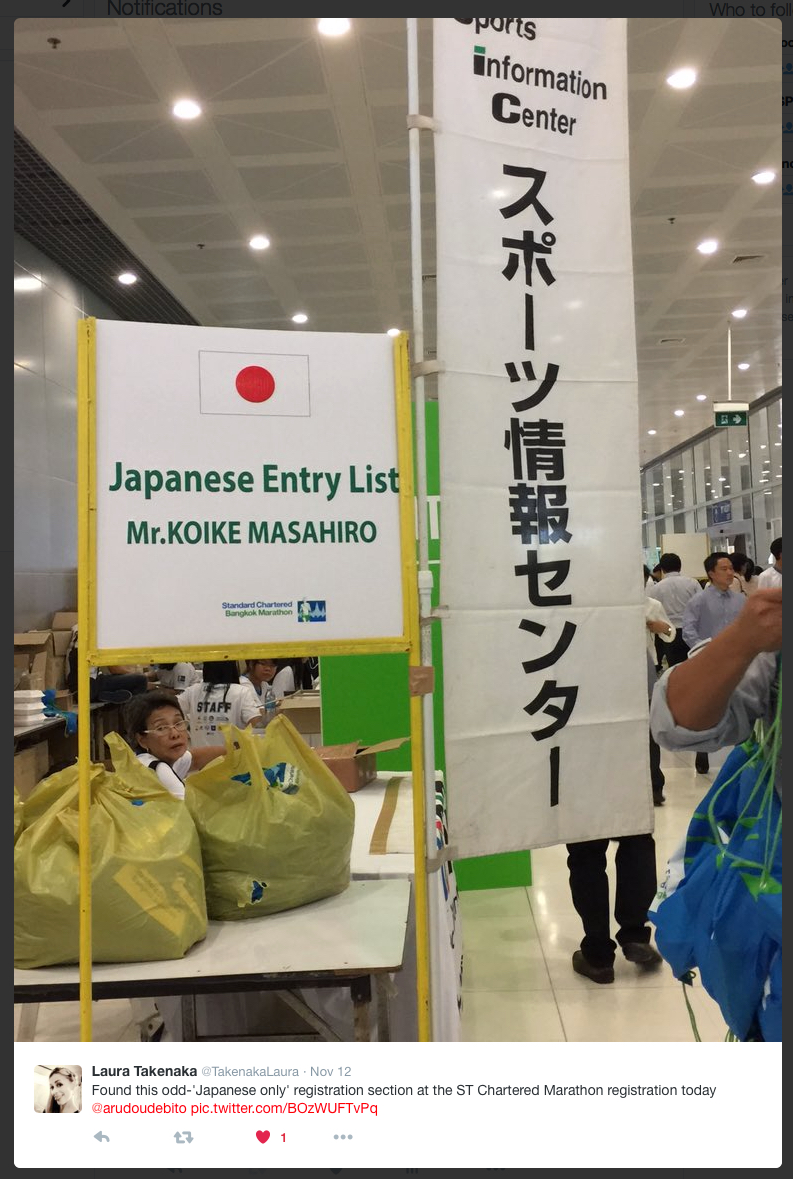
You can read a sample of the first fifteen or so pages (including the new Introduction), and download the ebook at either link:

Price:  $9.99 (a bargain considering JO is currently on sale on Amazon Japan used for 3100 yen, and at Amazon.com used for $390.93!), or the equivalent in local currency on all other Amazons (935 yen on Amazon Japan).

If you haven’t read JO yet (as clearly some media presences, like TV Tarento Daniel Kahl or decrier of “bathhouse fanatics” Gregory Clark, have not; not to mention “My Darling is a Foreigner” manga star Tony Laszlo would rather you didn’t), now is a brand new opportunity with additional context.  Here’s the Synopsis:

SYNOPSIS OF THE TENTH ANNIVERSARY EDITION OF eBOOK “JAPANESE ONLY”

If you saw signs up in public places saying “No Coloreds”, what would you do? See them as relics of a bygone era, a la US Segregation or South African Apartheid? Not in Japan, where even today “Japanese Only” signs, excluding people who look “foreign”, may be found nationwide, thanks to fear and opportunism arising from Japan’s internationalization and economic decline.

JAPANESE ONLY is the definitive account of the Otaru Onsens Case, where public bathhouses in Otaru City, Hokkaido, put up “no foreigners allowed” signs to refuse entry to Russian sailors, and in the process denied service to Japanese. One of Japan’s most studied postwar court cases on racial discrimination, this case went all the way to Japan’s Supreme Court, and called into question the willingness of the Japanese judiciary to enforce Japan’s Constitution.

Written by one of the plaintiffs to the lawsuit, a bilingual naturalized citizen who has lived in Japan for 25 years, this highly-readable first-person account chronologically charts the story behind the case and the surrounding debate in Japanese media between 1999 and 2005. The author uncovers a side of Japanese society that many Japanese and scholars of Japan would rather not discuss: How the social determination of “Japanese” inevitably leads to racism. How Japan, despite international treaties and even its own constitutional provisions, remains the only modern, developed country without any form of a law against racial discrimination, resulting in situations where foreigners and even Japanese are refused service at bathhouses, restaurants, stores, apartments, hotels, schools, even hospitals, simply for looking too “foreign”. How Japan officially denies the existence of racial discrimination in Japan (as its allegedly homogeneous society by definition contains no minorities), until the Sapporo District Court ruled otherwise with Otaru Onsens.

JAPANESE ONLY also charts the arc of a public debate that reached extremes of xenophobia: Where government-sponsored fear campaigns against “foreign crime” and “illegal foreigners” were used to justify exclusionism. Where outright acts of discrimination, once dismissed as mere “cultural misunderstandings”, were then used as a means to “protect Japanese” from “scary, unhygienic, criminal foreigners” and led to the normalization of racialized hate speech. Where even resident foreigners turned on themselves, including Japan Times columnist Gregory Clark’s repeated diatribes against “bathhouse fanatics”, and future “My Darling is a Foreigner” manga star Tony Laszlo’s opportunistic use of activism to promote his own agenda at the expense of the cause. Where the plaintiffs stay the course despite enormous public pressure to drop the lawsuit (including death threats), and do so at great personal risk and sacrifice. Remaining in print since its first publication in 2003, JAPANESE ONLY remains a testament to the dark side of race relations in Japan, and contains a taut story of courage and perseverance in the face of seemingly insurmountable odds.

Now for the first time in ebook format, this Tenth Anniversary Edition in English offers a new Introduction and Postscript by the author, updating the reader on what has changed, what work remains to be done, and how Japan in fact is reverse-engineering itself to become more insular and xenophobic in the 2010s. Called “a reasoned and spirited denunciation of national prejudice, discrimination, and bigotry” (Donald Richie, legendary Japanologist), “clear, well-paced, balanced and informative” (Tom Baker, The Daily Yomiuri), “a personal and fascinating account of how this movement evolved, its consequences and how it affected those who participated in it” (Jeff Kingston, The Japan Times), and “the book of reference on the subject for decades to come and should be required reading for anyone studying social protest” (Robert Whiting, author of You’ve Gotta Have Wa), JAPANESE ONLY is a must-read for anyone interested in modern Japan’s future direction in the world and its latent attitudes towards outsiders.

More reviews at http://www.debito.org/japaneseonly.html
ends

JT/Kyodo: Record high applicants for J refugee status. Why media fixation on refugees? Because they are a bellwether of Japan’s “legitimacy as a competent, advanced, Western democracy”

mytest

Books etc. by ARUDOU Debito (click on icon):
Handbook for Newcomers, Migrants, and Immigrants to Japan\" width=「ジャパニーズ・オンリー 小樽入浴拒否問題と人種差別」(明石書店)JAPANESE ONLY:  The Otaru Hot Springs Case and Racial Discrimination in Japansourstrawberriesavatardebitopodcastthumb
UPDATES ON TWITTER: arudoudebito
DEBITO.ORG PODCASTS on iTunes, subscribe free
“LIKE” US on Facebook at http://www.facebook.com/debitoorg
http://www.facebook.com/handbookimmigrants

Hi Blog.  Making national news whenever statistics come out is how Japan deals with (i.e., mostly rejects) refugees. I was always curious about why refugee numbers have always been considered newsworthy (when there are many other significant NJ-related statistics that merit more fanfare but don’t, such as the number of “Newcomers” with Permanent Residency overtaking the “Oldcomer” Zainichis with Special Permanent Residency in 2007, representing a sea change in the composition of permanent immigrant NJs in Japan).  But then I found something in an academic writing that put things in perspective:  Acceptance of refugees are one bellwether of Japan’s acceptance of international norms, as part of its “greater role in international cooperation” and an attempt “to increase its legitimacy as a competent, advanced Western democracy”.  First the most recent news article, then the academic article to put it in perspective:

//////////////////////////////////////////

NATIONAL
2012 saw record-high 2,545 people apply for refugee status in Japan
The Japan Times/KYODO
MAR 20, 2013, courtesy of JK
http://www.japantimes.co.jp/news/2013/03/20/national/2012-saw-record-high-2545-people-apply-for-refugee-status-in-japan

A record 2,545 foreigners applied for refugee status in Japan in 2012, the Justice Ministry’s Immigration Bureau said Tuesday.

While the figure marked an increase of 678 compared with the previous year, there was a drop in the number of those who were actually granted refugee status, the bureau said.

In 2011, there were 21 foreigners recognized as refugees, but for 2012, the number fell to 18.

Among those who applied, Turkish nationals constituted the largest group, with 423, followed by 368 from Myanmar, 320 from Nepal and 298 from Pakistan, the bureau said.

A bureau official could not provide the exact reason behind the rise in refugee applications.

Meanwhile, the number of foreigners who were denied refugee status but were allowed to stay in Japan on humanitarian grounds totaled 112, the bureau said.

Since Japan began its refugee recognition system in 1982, there have been 14,299 people who applied and 616 who were recognized as refugees.

ENDS

//////////////////////////////////////////

Now read this excerpt from Kashiwazaki Chikako (Associate Professor of Sociology at Keio University). 2000. “Citizenship in Japan: Legal Practice and Contemporary Development.” In T. Alexander Aleinikoff, and Douglas Klusmeyer, eds., From Migrants to Citizens: Membership in a Changing World. Washington DC: Carnegie Endowment for International Peace, pp. 448-50.  I retype in all paragraphs preceding the section on refugees to Japan, to give you the geopolitical context under which bureaucrats created refugee policy.

============================

INTERNATIONAL LEGAL NORMS AND CHANGES IN INTERNATIONAL CONTEXT

Since the mid-1970s, Japan has come into prominence in the international arena as a major player in the world economy.  Internationalization became a slogan for the new direction of the country, with demands from both within and abroad to open, to take a leadership role, and to assume international responsibility.  For the Japanese government, successful economic development provided the opportunity to assume a greater role in international cooperation and to increase its legitimacy as a competent, advanced Western democracy.  To do so would require accepting an emerging set of international legal norms, including those in the area of citizenship.

Among international legal norms, the most relevant to the recent development of citizenship are the UN conventions on human rights and the rights of migrant workers and noncitizen residents.  In Western Europe, international conventions on human rights have provided legal and normative underpinnings to the extension of partial citizenship rights to noncitizen residents.  The goal of economic integration through free movement of people within the common market has also facilitated legislation regarding the legal rights and protection of migrants.

Another major impetus for changing laws regarding citizenship and nationality is the principle of gender equality.  The 1979 Convention on the Elimination of All Forms of Discrimination against Women required that signatory countries accord the same rights to women as they do to men in regard to their children’s nationality.  Consequently, a number of countries that had a patrilineal jus sanguinis system shifted to the bilineal system where children obtain both their father’s and mother’s nationality.

In the absence of an equivalence in European integration, the role and the extent of international coordination are expected to be different for the Japanese case.  Nevertheless, Japan has also been under the constraints of international legal norms.  Admission of Indochinese refugees and the adoption of bilineal jus sanguinis [in 1984] are two examples that show the impact of international factors on nationality and citizenship regulations.

The end of the Vietnam War in 1975 generated refugees from Indochina.  In the same year, the G7 Summit meeting was established. As the only Asian country admitted to membership in the G7 Summit, Japan was obliged to take some steps to accommodate refugees.  In 1978, the Japanese government permitted the settlement of refugees within the set limit of the ceiling.  The initial quota was only 500 refugees, although it was gradually expanded to 10,000 by 1985.  At the end of 1997, 10,241 Indochina refugees had been accepted for settlement [Shutsunyuukoku Kanri 1998].

Although the number of refugees settled in Japan was small, their arrival had a strong impact on the social rights of resident aliens.  With the acceptance of refugees, the Japanese government was compelled to join relevant international conventions.  Japan acceded to the International Covenant on Civil and Political Rights as well as the International Covenant on Economic, Social, and Cultural, Rights in 1979, and then ratified the Convention relating to the Status of Refugees in 1981.  Provisions in these conventions required that resident aliens be treated equally with the citizens of the country in the areas of social security and welfare.  Consequently, several legal changes removed eligibility restrictions based on nationality in such areas as national pension and public housing.  Furthermore, the creation of a new residential status for refugees in 1981 contributed to improvement in the legal status of preexisting long-term resident aliens.

EXCERPT ENDS

//////////////////////////////////////////

COMMENT:  So you see, Japan basically only acceded to these international norms and agreements as a vanity project — a matter of “not looking like an outlier” in the international community.  Not because policymakers had any good-faith interest in helping NJ or outsiders in need come to Japan and settle.  That’s why we see honne hiccoughs from time to time (like the one in 2010 when a 78-year-old Zainichi granny was denied social welfare by Oita Prefectural Government — where a court ruled that “Welfare payments to non-citizens would be a form of charity“.  So much for those international treaties guaranteeing equal treatment being respected by Japan’s judiciary!).  We’ve also seen how Japan simply will not pass a law against racial discrimination (despite signing another international agreement, the UN CERD, in 1995) — and will in fact counteract anyone who does.  So in this context, Kyodo’s reporting that “since Japan began its refugee recognition system in 1982, there have been 14,299 people who applied and 616 who were recognized as refugees,” should come as no surprise.  The GOJ has no intention of keeping its international treaty promises.  They are merely national self-esteem boosters, not real guidelines or goals.  Arudou Debito

Tangent: Tsutsumi Mika’s crooked Jewish character “Goldberg” in her “USA Poverty Superpower” manga. Ironic, again, given that…

mytest

Books etc. by ARUDOU Debito (click on icon):
Handbook for Newcomers, Migrants, and Immigrants to Japan\" width=「ジャパニーズ・オンリー 小樽入浴拒否問題と人種差別」(明石書店)JAPANESE ONLY:  The Otaru Hot Springs Case and Racial Discrimination in Japansourstrawberriesavatardebitopodcastthumb
UPDATES ON TWITTER: arudoudebito
DEBITO.ORG PODCASTS on iTunes, subscribe free
“LIKE” US on Facebook at http://www.facebook.com/debitoorg
http://www.facebook.com/handbookimmigrants
UPDATES ON TWITTER: arudoudebito

Hi Blog. I’ve devoted a couple of blog entries (here and here) plus a Japan Times column to propagandizing journalist Tsutsumi Mika, who has had her “Poverty Superpower of America” book series adapted for Japanese grade-school audiences nationwide and a manga-reading Japanese public.

I’ve already gone into detail elsewhere about the latent journalistic problems with her reportage (not the least the outright falsification of evidence), and the implicit ironies involved with her demonizing a foreign society as a cautionary tale to audiences without sufficient training in comparative cultural study and critical thinking.

Now here’s another irony, sent to me by a friend who wishes to remain anonymous. Further inspection of Tsutsumi’s works reveals an odd attitude towards Jews. Consider this excerpt from her “Poverty Superpower of America” manga, courtesy of Amazon Japan:

tsutsumimikamangagoldberg

Courtesy http://www.amazon.co.jp/コミック貧困大国アメリカ-堤-未果/dp/4569708978/ref=sr_1_10?ie=UTF8&qid=1362882715&sr=8-10#reader_4569708978

Here we have a Jew named “David Goldberg” from a financial agency selling bogus house loans to an immigrant Mexican family before the whole US derivatives crisis.  Goldberg announces himself as “the ally of the weak” before destroying all of their hopes and dreams.

Interesting choice of character for Tsutsumi, reflecting the latent bias one sees in elite Japanese society regarding “rich Jews” (not to mention other stereotypes; see below) that surfaces every now and again (such as in our former Education Minister and Prime Minister, and current Deputy PM/Minister of Finance Aso Taro):

==================================
Blue eyes, blond hair: that’s US problem, says Japanese minister
Justin McCurry in Tokyo
The Guardian, Thursday 22 March 2007

http://www.guardian.co.uk/world/2007/mar/23/japan.usa

Taro Aso, Japan’s foreign minister, risked upsetting his country’s strongest ally by suggesting US diplomats in the Middle East would never solve the region’s problems because they have “blue eyes and blond hair”.

Mr Aso, a straight-talking nationalist, said the Japanese, on the other hand, were trusted because they had “yellow faces” and had “never been involved in exploitation there, or been involved in fights or fired machine guns”.

Japan has healthy relations with Arab countries and Iran and imports much of its oil from the Middle East. It is a big contributor of aid to the Palestinian Authority, but also has friendly ties with Israel.

“Japan is doing what Americans can’t do,” local media quoted Mr Aso as saying in a speech about Japan-sponsored investment in the Middle East. “Japanese are trusted. It would probably be no good to have blue eyes and blond hair. Luckily, we Japanese have yellow faces.”

Mr Aso, seen by some as a possible successor to the prime minister, Shinzo Abe, is no stranger to controversy.

In 2001 he said a member of the burakumin, Japan’s underclass, could never lead the country. He later angered Japan’s indigenous Ainu population by describing the country as unique in being “one nation, one civilisation, one language, one culture and one race”. While economics minister, he said he wanted to turn Japan into a country where “rich Jews” would want to live.

In 2003, he sparked protests when he praised imperial Japan’s often brutal colonial rule of the Korean peninsula from 1910 to 1945, and last month he described the US post-invasion plans for Iraq as “very immature”.
==================================

Back to Tsutsumi.  What makes things even more ironic is not that her current husband is an anti-discrimination activist, but that her former husband was apparently Jewish himself:

tsutumimikaSUNYNewPaltz

http://www.newpaltz.edu/alumni/lost.php?view_by=maiden_name&letter=T

tsutstumimikajeremybaummyspace

http://www.myspace.com/jeremybaum/blog/395635368

叩けば埃が出る。Tsutsumi Mika is a person replete with irony.  I wonder what the Jewish anti-defamation leagues would make of Tsutsumi’s Jewish crook?  The American Embassy (unlike the Japanese Embassy) is pretty lackadaisical about how the US is portrayed in Japan’s media.  But I doubt, say, the Simon Wiesenthal Center would be.

Anyone want to let them know about this?  Would be interesting how Tsutsumi, as she did when questioned about the misleading details of her grade-schooler Chagurin article, would defend her editorial choices.  Arudou Debito

Letters from J human rights groups to the visiting Olympic Committee re Tokyo 2020: Discrimination in Japan violates IOC Charter

mytest

Books etc. by ARUDOU Debito (click on icon):
Handbook for Newcomers, Migrants, and Immigrants to Japan\" width=「ジャパニーズ・オンリー 小樽入浴拒否問題と人種差別」(明石書店)JAPANESE ONLY:  The Otaru Hot Springs Case and Racial Discrimination in Japansourstrawberriesavatardebitopodcastthumb
UPDATES ON TWITTER: arudoudebito
DEBITO.ORG PODCASTS on iTunes, subscribe free
“LIKE” US on Facebook at http://www.facebook.com/debitoorg
http://www.facebook.com/handbookimmigrants

Hi Blog.  I received this two days ago and am reposting (as is) with permission.  The International Olympic Committee is currently in Japan considering Tokyo as a venue for the 2020 Summer Games.  In light of recent events that point to clear examples of discrimination and advocacy of violence towards, for example, Koreans (see below), human rights groups in Japan are advocating that the IOC understand that these actions violate the Olympic Charter and choose their venue accordingly.  Articles, photos, and letters follow from the Japan Federation of Bar Associations (Nichibenren), Tanaka Hiroshi in the Mainichi Shinbun, and sources demonstrating that, for example, all GOJ educational subsidies for Korean ethnic schools have been eliminated as of 2013 from government budgets.

Academic Tessa Morris-Suzuki might agree with the assessment of rising discrimination, as she documents on academic website Japan Focus the protection of xenophobic Rightists and the police harassment of their liberal opponents.  Her conclusion: “But there is no rule of law if the instigators of violence are left to peddle hatred with impunity, while those who pursue historical justice and responsibility are subject to police harassment. There is no respect for human rights where those in power use cyber bullying in an attempt to silence their opponents. And democracy is left impoverished when freedom of hate speech is protected more zealously than freedom of reasoned political debate.”  Have a look.

SITYS.  This is yet but another example of Japan’s clear and dangerous swing to the Right under PM Abe.  And granting an Olympics to this regime despite all of this merely legitimize these tendencies, demonstrating that Japan will be held to a different standard regarding discrimination.  Wake up, IOC.  Arudou Debito

REPORT BEGINS:

////////////////////////////////////////////

Date: 2013/3/3Dear Sir/Madam,

I am … an activist against racism. I hope you to know about
racism against resident Koreans, especially  emergent crisis of Korean
ethnic schools by the central and local governments’ oppression in
Japan, even though the governments would invite the Olympic Games 2020
to Tokyo.

I’ve attached a letter to you below.

The International Olympic Committee’s evaluation commission arrived in
Tokyo on last Friday and it is going to inspect Tokyo from 4th to 7th
March.

It would be great honour if you handle this issue.
All the best, [redacted]

Japan Network for the Institutionalization of Schools for
Non-Japanese Nationals and Ethnic Minorities

Email: sangosyo@gmail.com

//////////////////////////////////////

Tokyo – a city which discriminates against Korean children
January 2013

We hope to inform you that Tokyo is not an appropriate city for the
Olympic Games based on the Fundamental Principals of the Olympics,
especially that of anti-discrimination.
The main reason for this is that the central and Tokyo governments
officially discriminate against Korean children who attend Korean
schools, which are key to maintaining the Korean communities in Japan.

Koreans in Japan are an ethnic minority who were forced to come to
Japan under the Japanese colonial rule of Korea and settle there even
after WWII. Throughout their enforced stay here they have faced
various difficulties. After the liberation from the Japanese colonial
rule, Koreans in Japan established their own ethnic schools in various
places in Japan in order to maintain their own language and culture
that had been deprived from them under the Japanese colonial rule.

Although the Japanese government has not recognized Korean schools as
regular and official schools and has been imposing institutional
discrimination upon them such as exclusion from a financial support
scheme of the central government, the Korean community has been
sustaining their schools on their own for more than 60 years. The
total number of Korean schools in Japan is approximately 70, including
kindergarten, primary to high schools, and university. Nearly 10,000
Korean children whose nationality is South Korean, North Korean and
Japan are learning in those schools today, even though 80-90 % of
Korean children attend Japanese schools.

The new Democratic Party administration proposed the plan of a
so-called “Free High School Tuition” system in October 2009 as soon as
it was established. The then plan intended not to collect tuition fees
from students of public high schools in Japan and to supply students
of private schools and minority schools authorized by local
governments as “vocational school” including Korean schools with a
subsidy of the amount equivalent to the tuition fee of public high
schools.

In March 2010, the United Nations Committee on the Elimination of
Racial Discrimination expressed concern about the approach of some
politicians who had suggested the exclusion of Korean schools from the
bill of “Free High School Tuition” due to the diplomatic issues
between Japan and the Democratic People’s Republic of Korea. The
reason for this concern was the discriminatory effects of such a
policy. However, the policy was instigated in April 2010 and since
then the central government has been discriminating against Korean
school students. They have been excluded from this system for nearly
three years, although students of 37 minority high schools including
International schools, Chinese schools and Brazilian schools have been
supplied with subsidies through this system.

On the other hand, all 27 prefectural governments where Korean schools
are located accepted them as “vocational schools” and have been
providing subsidies to Korean schools for decades, even though the
central government requested prefectural governments to not accept
them as any kind of schools in 1965.

However, the decision of the central government to exclude Korean
schools from “Free High School Tuition” has led to the new
discriminative situation in which five prefectural governments
including Tokyo have stopped their subsidies to Korean schools. Tokyo
had supplied financial aid to Korean schools for at least over 15
years. In 2009, it provided about 27,000,000Yen (190,000 Pound);
however, Tokyo has stopped its subsidies to Korean schools since 2010
without providing a clear rationale.

In addition, the then Tokyo Governor Ishihara Shintaro officially said
that he would reconsider the accreditation of Korean schools in Tokyo
as “vocational schools” in March 2012. If the accreditation of
“vocational school” is revoked, it will cause extensive damages to
Korean schools. For instance, Korean schools will become completely
exempt from the “Free High School Tuition” system and there will be no
possibility to receive any financial support from local governments.
Furthermore, Korean schools will be forced to pay consumption tax for
tuition fee.

In December 2012, as soon as the Liberal Democratic Party won the
General Election and established its new government, it declared it
would revise an ordinance in order to exclude Korean schools due to
political tensions between Japan and North Korea, primarily the
abduction of Japanese citizens by North Korea.

In January 2013, Korean schools and school children in Osaka and Aichi
prefecture brought a lawsuit before the court, and Korean school
children in Tokyo are preparing lawsuit concerning these
discrimination.

Racism in Japan is generally increasing, encouraged by the racial
discrimination by the central government. The number of demonstrations
repeating hate speech against Non Japanese nationals, especially
Korean, communities has been increasing in Japan (Annex1). The police
are just gazing at the demos without restricting them because there is
no anti-discrimination law nor hate speech legislation in Japan so
that the demos has been unchecked.

ENDS

///////////////////////////////////////////

REFERENCE MATERIALS:

List of Annexs

1, The images of demonstration by anti-Korean racists in Korean Town of Tokyo

2, The Statement of President of the Japan Federation of Bar Associations objecting to exclusion of Korean Schools from applying Free High School tuition policy

3, The Article of The Mainichi Shimbun (23 February, 2013)

4, The situation of the cut of the subsidies to Korean schools from local governments in Japan

///////////////////////////////////////////

Annex 1: The Images of Demonstration by Anti-Korean Racists

(February 2013, in Korean Town of Tokyo)

 antikoreandemosShinOhkubo020913

Video URL: http://matome.naver.jp/odai/2136038266418742101

///////////////////////////////////////////

Annex2: Statement of President of the Japan Federation of Bar Associations objecting to exclusion of Korean Schools from applying Free High School tuition policy

The Ministry of Education, Culture, Sports, Science and Technology (MEXT) announced a proposed amendment to ministerial ordinance on December 28th, 2012, which amends a part of enforcement regulations regarding free tuition for public high schools and subsidies for private high schools. As for the high schools where foreign students are enrolled such as international schools and ethnic schools, the current enforcement regulations define the subject for the policy as either high schools that are confirmed through its embassy to have curriculum equivalent to that of high schools in its native state, or high schools that are certified by international evaluation body, while the rest of the schools that are evaluated as having curriculum equivalent to that of Japanese high schools can be the recipient of the subsidies, whether or not Japan has diplomatic relations with its native state, after the minister of the MEXT designates each school individually. The proposed amendment is to delete the grounds for the individual designation.

Regarding the purpose of this revision, the minister of MEXT, Hakubun Shimomura, stated at the press conference on December 28th, 2012, that the proposed amendment is aimed at deleting the grounds for designating Korean schools because there is no progress to resolve the Democratic People’s Republic of Korea’s (DPRK) abduction of Japanese citizens, which makes it clear that this proposed amendment is aimed at excluding Korean Schools from applying the Free High School tuition policy.

As we stated in the “Statement on Subject High Schools of the Free Tuition Bill” on March 5th, 2010, the main purpose of this bill is “to contribute to the creation of equal educational opportunities by alleviating the financial burdens of high school education”, which is also demanded by Article 28 of Convention on the Rights of the Child. Considering the fact that Convention on the Rights of the Child as well as International Bill of Human Rights (International Covenant on Civil and Political Rights) guarantee the right to receive education with ethnic identity being maintained, the current ministerial ordinance which would include international schools and ethnic schools is in a right direction. Furthermore, it is revealed through the process of the deliberation on the bill that, as the Government’s collective view, the designation of high schools for foreign students should not be judged by diplomatic concern but should be judged objectively through educational perspective.

On contrary to that, this proposed amendment is to refuse to provide subsidies based on the grounds that there being no diplomatic relations between Japan and DPRK or no progress to resolve the DPRK’s abduction issue, either of which has nothing to do with the right of the child to receive education. It is a discriminative treatment which is prohibited by Article 14 of the Constitution of Japan.

Korean Schools in Japan completed applying for the designation based on the current bill legitimately by the end of November, 2011, this upcoming amendment is to extinguish the regulations considered as the grounds for applying and refuse the Korean Schools’ application retroactively after more than two years from the application, which poses serious doubt on its procedure.

The Japan Federation of Bar Associations strongly urges that the proposed amendment be withdrawn whilst the review of the application from Korean schools be concluded promptly based on the current law and screening standard.

February 1st, 2013

Kenji Yamagishi, President

Japan Federation of Bar Associations

///////////////////////////////////////////

Annex3: The Article of The Mainichi Shimbun


Discrimination against Korean Schools need be reconsidered

Hiroshi Tanaka

Honorary Professor at Hitotsubashi University

24 February, 2013 

Since the host city for the 2020 Olympics and Paralympics games will be determined in September, the Governor of Tokyo Metropolitan, Naoki Inose, has started Bids for Olympics in earnest. Under such circumstances, would it be right for the Tokyo Metropolitan Government and the Japanese Government to continue discriminating Korean Schools in Japan?

At the time of Nagoya bid for the 1988 Summer Olympics, Nagoya City had “Nationality Clause” for the employment of teachers at public school which has been open to foreigners in Tokyo or Osaka, thus preventing foreigners from applying. A nongovernment human right committee in Nagoya sent an English letter to the International Olympics Committee (IOC), urging IOC to consider the serious issue on human rights of Nagoya City and to be sufficiently concerned about the improvement of moral qualification in the Olympic Movement to determine the host city. It was Seoul that was chosen as the host city in September, 1981. Though it is uncertain whether or not the letter had anything to do with the decision, it must be remembered that discrimination is unforgivable matter in the international community.

The Tokyo Metropolitan Government had previously been providing subsidies worth of 15,000 yen per a student to each of 27 schools for foreign students. However, the Metropolitan Government has stopped providing subsidies to Korean Schools alone since 2010 and not on the budget next year either. There has been no illegal act on the Korean Schools side. The education of the child should not be confounded with international affair.

So called “Free High School tuition law” was implemented in the same year 2010, which was applied not only to Japanese high schools but to vocational schools and high schools for foreign students as well. Students from each of 39 high schools, such as Brazilian Schools, Chinese Schools, (South) Korean Schools and International Schools were provided with subsidies equivalent to the tuition for the public high school.

Nevertheless, the decision over whether or not (North) Korean Schools would be applicable to the policy still remains unmade and students at Korean Schools have already graduated without ever receiving subsidies over the last two years.

Following the birth of Abe Cabinet, the Minster of the Ministry of Education, Culture, sports, Science and Technology (MEXT), Hakubun Shimomura (aka Hirohumi Shimomura) amended the enforcement regulations of Free High School tuition law with the purpose of excluding Korean Schools alone from the policy because there is no progress to resolve Democratic Peoples Republic of Korea’s abduction of Japanese citizens. The law’s main purpose is “alleviating the financial burdens of high school education” and “to contribute to the creation of equal education opportunities”. Doesn’t this amendment to the enforcement regulations go beyond the limitation of a delegated order?

UN Committee on the Elimination of Racial Discrimination (CERD)  expressed its concern about the exclusion of Korean Schools from Free High School tuition policy in the Concluding Observation in March, 2010, after reviewing the report submitted by Japanese Government and recommended Japan to consider acceding to the UNESCO Convention against Discrimination in Education (adopted in 1960, 100 signatories). The concern of CERD became realized by Abe Cabinet.

The report from Japanese Government to the UN Committee on Economics, Social and Cultural Rights is to be reviewed in coming April. List of Issues from the Committee says “Please provide information on the impact of the measures taken to address the persistent discrimination against children belonging to ethnic minorities and migrant families, in particular children of Korean origin”. Female students at Korean Schools used to go to school wearing chima jeogori, the traditional Korean form of dress. It’s been a long time since it became unseen in order to avoid harassment and assaults by heartless Japanese citizens.

Olympic Charter states “Any form of discrimination with regard to a country or a person on grounds of race, religion, politics, gender or otherwise is incompatible with belonging to the Olympic Movement.” Discrimination against Korean School is incompatible with Olympics.

Discrimination against Korean Schools need be reconsidered.

/////////////////////////////////////////

Annex4: The situation of the cut of the subsidies to Korean schools from local governments in Japan ( 2009 – 2013 )

2009

2010

2011

2012

2013

Prefecture

(start date of subsidy)

Total amount of subsidy

Total amount of subsidy

Total amount of subsidy

Total amount of subsidy

Total amount of subsidy

Tokyo

(1995)

23.5 million

0

0

0

Cut from the budget

Saitama

(1982)

9 million

0

0

0

Cut from the budget

Osaka

(1988)

185 million

87 million

0

0

Cut from the budget

Miyagi

(1992)

1.5 million

1.5 million

0

0

Cut from the budget

Chiba

(1985)

5.6 million

5.6 million

0

0

Cut from the budget

Hiroshima

(1992)

13.8

million

10.1

million

9.6

million

0

Cut from the budget

Kanagawa

(1977)

72.5

million

63

million

63

million

63

million

Cut from the budget

Yamaguchi

(1992)

2.4

million

2.4

million

2.3

million

2.2

million

Cut from the budget

Based on a survey by The Association of Korean Human Rights in Japan

All the currency unit is Japanese yen ( 1 euro≒123 yen, 1 dollar≒93 yen [as of 22 Feb 2013] )

ENDS

Japan Times JUST BE CAUSE Column 60, Feb 4, 2013: “Keep Abe’s hawks in check or Japan and Asia will suffer”

mytest

Books etc. by ARUDOU Debito (click on icon):
Handbook for Newcomers, Migrants, and Immigrants to Japan\" width=「ジャパニーズ・オンリー 小樽入浴拒否問題と人種差別」(明石書店)JAPANESE ONLY:  The Otaru Hot Springs Case and Racial Discrimination in Japansourstrawberriesavatardebitopodcastthumb
UPDATES ON TWITTER: arudoudebito
DEBITO.ORG PODCASTS on iTunes, subscribe free
“LIKE” US on Facebook at http://www.facebook.com/debitoorg
http://www.facebook.com/handbookimmigrants

justbecauseicon.jpg

Keep Abe’s hawks in check or Japan and Asia will suffer
By ARUDOU, Debito
The Japan Times, February 4, 2013
Column 60 for the Japan Times Community Page
Courtesy http://www.japantimes.co.jp/community/2013/02/04/issues/keep-abes-hawks-in-check-or-japan-and-asia-will-suffer, version with links to sources below

On Jan. 1, The Japan Times’ lead story was “Summer poll to keep Abe in check.” It made the argument that Prime Minister Shinzo Abe’s Liberal Democratic Party alliance falls short of a majority in the Upper House, so until elections happen this summer he lacks a “full-fledged administration” to carry out a conservative agenda.

I believe this is over-optimistic. The LDP alliance already has 325 seats in Japan’s overwhelmingly powerful Lower House — safely more than the 320 necessary to override Upper House vetoes. Moreover, as Japan’s left was decimated in December’s elections, about three-quarters of the Lower House is in the hands of avowed hard-right conservatives. Thus Abe already has his mandate.

So this column will focus on what Abe, only the second person in postwar Japanese history given another chance at PM, is up to this time.

Recall how Abe fluffed his first chance between 2006-7 — so badly that he made it onto a list of “Japan’s top 10 most useless PMs” (Light Gist, Sept. 27, 2011) on these pages. The Cabinet he selected was a circus of embarrassments (e.g., after his corrupt agriculture minister claimed ¥5 million for “office utility expenses,” the replacement then claimed expenses for no office at all, and the next replacement only lasted a week), with gaffe after gaffe from an elitist old-boy club whittling away Abe’s approval ratings.

Abe himself was famously incapacitated with diarrhea (spending hours a day on the john) as well as logorrhea, where his denials of wartime sexual slavery (i.e., the “comfort women”) were denounced even by Japan’s closest geopolitical allies. Finally, after the LDP was trounced in a 2007 Upper House election, Abe suddenly resigned one week after reshuffling his Cabinet, beginning a pattern of a one-year tenure for all subsequent Japanese PMs.

However, Abe did accomplish one important conservative reform in 2006: amending the Fundamental Law of Education. The law now clearly states that a right to education in Japan is restricted to “us Japanese citizens” (ware ware Nihon kokumin — i.e., excluding foreigners), while references to educational goals developing individuality have been removed in favor of education that transmits “tradition,” “culture” and “love of nation.”

In other words, building on Japan’s enforced patriotism launched by former PM Keizo Obuchi from 1999 (e.g., schoolteachers and students are now technically required to demonstrate public respect to Japan’s flag and national anthem or face official discipline), vague mystical elements of “Japaneseness” are now formally enshrined in law to influence future generations.

That’s one success story from Abe’s rightist to-do list. He has also called for the “reconsideration” of the 1993 and 1995 official apologies for wartime sexual slavery (even pressuring NHK to censor its historical reportage on it in 2001), consistently denied the Nanjing Massacre, advocated children’s textbooks instill “love” of “a beautiful country” by omitting uglier parts of the past, and declared his political mission as “recovering Japan’s independence” (dokuritsu no kaifuku) in the postwar order.

Although LDP leaders were once reticent about public displays of affection towards Japan’s hard right, Abe has been more unabashed. Within the past six months he has made two visits to controversial Yasukuni Shrine (once just before becoming LDP head, and once, officially, afterwards). Scholar Gavan McCormack unreservedly calls Abe “the most radical of all Japanese post-1945 leaders.”

Now Abe and his minions are back in power with possibly the most right-wing Cabinet in history. Academic journal Japan Focus last week published a translation of an NGO report (japanfocus.org/events/view/170) outlining the ultraconservative interest groups that Abe’s 19 Cabinet members participate in. Three-quarters are members of groups favoring the political re-enfranchisement of “Shinto values” and Yasukuni visits, two-thirds are in groups for remilitarizing Japan and denying wartime atrocities, and half are in groups seeking sanitation of school textbooks, adoption of a new “unimposed” Constitution, and protection of Japan from modernizing reforms (such as separate surnames for married couples) and outside influences (such as local suffrage for foreign permanent residents).

Abe alone is a prominent leader (if not a charter member) of almost all the ultra-rightist groups mentioned. Whenever I read rightwing propaganda, Abe’s face or name invariably pops up as a spokesman or symbol. He’s a big carp in a small swamp, and in a liberal political environment would have been consigned to a radical backwater of fringe ideologues.

But these are dire times for Japan, what with decades of stagnation, insuperable natural and man-made disasters, and the shame of no longer being Asia’s largest economy. The glory of Japan’s regional peerlessness is gone.

That’s why I have little doubt that the LDP saw this perfect storm of 3/11 disasters (which, given how corrupt the unelected bureaucracy has been after Fukushima, would have led to the trouncing of any party in power) as perfect timing to reinstall someone like Abe. Why else, except for Abe’s thoroughbred political pedigree (grandson of a suspected Class-A war criminal turned postwar PM, and son of another big LDP leader whose name is on international fellowships) and sustained leadership of back-room interest groups, would they choose for a second time this jittery little man with a weak stomach?

Why? Because LDP kingpins knew that people were so desperate for change last year they would have elected a lampshade. After all, given the nature of parliamentary systems, people vote more for (or, in this case, against) a party, less for an individual party leader. Moreover, Abe, at first glance, does not seem as extreme as the “restorationists” (Shintaro Ishihara et al) who wish to take Japan back to prewar glories by banging war drums over territorial sea specks. So, the lesser of two evils.

But look at the record more closely and these “liberal democrats” and restorationists are actually birds of a feather. Now more powerful than ever, they’re getting to work on dismantling postwar Japan. Abe announced on Jan. 31 that he will seek to amend Article 96 of the Constitution, which currently requires a two-thirds Diet majority to approve constitutional changes. That’s entirely possible. Then the rest of Japan’s “Peace Constitution” will follow.

So I end this month’s column with a caution to outside observers:

The current Abe administration is in pole position to drive Japan back to a xenophobic, ultra-rightist, militaristic Japan that we thought the world had seen the last of after two world wars. Abe can (and will, if left to his own devices) undo all the liberal reforms that postwar social engineers thought would forever overwrite the imperialist elements of Japanese society. In fact, it is now clear that Japan’s conservative elite were just biding their time all along, waiting for their rehabilitation. It has come.

One of the basic lessons of chess is that if you allow your opponent to accomplish his plans, you will lose. If Abe is not kept in check, Asia will lose: Japan will cease to be a liberal presence in the region. In fact, given its wealth and power in terms of money and technology, Japan could become a surprisingly destabilizing geopolitical force. Vigilance, everyone.

===============================

Debito Arudou and Akira Higuchi’s bilingual 2nd Edition of “Handbook for Newcomers, Migrants, and Immigrants,” with updates for 2012′s changes to immigration laws, is now on sale. Twitter @arudoudebito. Just Be Cause appears on the first Community Page of the month. Send your comments to community@japantimes.co.jp .

ENDS

BBC on Japan’s remilitarization: Island disputes justifying quiet buildup in Japan’s aircraft carriers, xenophobia in J youth

mytest

Books etc. by ARUDOU Debito (click on icon):
Handbook for Newcomers, Migrants, and Immigrants to Japan\" width=「ジャパニーズ・オンリー 小樽入浴拒否問題と人種差別」(明石書店)JAPANESE ONLY:  The Otaru Hot Springs Case and Racial Discrimination in Japansourstrawberriesavatardebitopodcastthumb
UPDATES ON TWITTER: arudoudebito
DEBITO.ORG PODCASTS on iTunes, subscribe free
“LIKE” US on Facebook at http://www.facebook.com/debitoorg
http://www.facebook.com/handbookimmigrants

Hi Blog. In one of the most haunting news dispatches I’ve seen on Japan, Rupert Wingfield-Hayes of the BBC reported from the field last November in a video I have watched several times just to take in all the points. I’ll paste the accompanying text below, but make sure you watch the video, as Wingfield-Hayes takes us to the Senkakus, before a pre-PM Abe Shinzou talking tough, to otherwise sensible-looking college students spouting in public anti-Chinese vitriol to support a remilitarizing Japan, before an equally vitriolic Ishihara Shintaro calling for Japan to unsheath its sword (who, visibly chuffed by the international attention, comes back with a smirk (and a surprising level of English) to make sure the BBC got his point), finishing aboard a brand-spanking new Japanese aircraft carrier, the Hyuuga (one of two others planned), showing an emerging arms race in Asia. Watch it!  And shudder as the dogs of war begin straining their leashes.  Arudou Debito

Video at (could not embed, so please click):

http://www.bbc.co.uk/news/world-asia-20302604

Accompanying article:

Watching Japan and China square off in East China Sea
By Rupert Wingfield-Hayes
BBC News, Japan, 12 November 2012

Who do the Senkaku or Diaoyu Islands belong to? The short answer is I don’t know.

Japan once had a small colony there for a few decades. But they left in the 1940s.

No-one has lived on the remote islands since the end of WWII. As a piece of real estate they are not very attractive. Only one is big enough to be, just possibly, habitable.

But to therefore dismiss the islands as an irrelevance would be a mistake.

China has long claimed them, and is now for the first time aggressively asserting that claim. It is equally clear Japan is not about to give them up, and is possibly prepared to fight to keep them. It is, in other words, a very dangerous situation.

The only way to get to the islands is by fishing boat. It is not a particularly pleasant journey. In late October, the seas were choppy. The small 12m (39ft) fishing boat we had chartered pitched and rolled constantly. Inside the cabin the engine-noise was almost unbearable.

After 10 hours ploughing through the waves, the islands hove in to view through the pre-dawn light.

But between our boat and the islands were two large, white coastguard cutters. Out of the gloom, a pair of speedboats came skipping across the waves towards us. The coastguard officers were extremely polite, but made it clear we must stay at least one mile off shore.

Japan has banned all civilians, including Japanese, from landing on the island. It is to stop right-wing Japanese nationalists, who have in the past attempted to build a lighthouse and other structures there. It is exactly the same reason the Japanese government gives for “nationalising” the islands in September; to stop right-wing nationalists taking control of them.

When Japan and China established diplomatic relations in 1972, the leaders of both countries agreed to put the issue of the Senkaku/Diaoyu islands to one side; to let future, supposedly wiser, generations deal with the problem. They both also agreed that neither side would unilaterally change the status quo.

That is what China says Japan has done by “nationalising” the island. Beijing is now using that alleged change to justify its own assertion of sovereignty.

Brazen tactics
As the sun rose higher over the island the radio on board our fishing boats crackled into life. It was the Japanese coastguard. “Chinese ships are heading in this direction, please immediately move around to the north of the island!”

Over the horizon we could see them coming: first two, then two more. Large, white Chinese ships with four blue stripes down the side.

Our fishing boat captain didn’t need asking twice. He was off. We sped round to the north of the main island.

But the Chinese boats kept on coming.

A Japanese P3 Orion surveillance plane then appeared from the east, swooping back and forth over the Chinese ships. The Japanese coastguard was now extremely nervous.

“Please stop filming and leave the area immediately,” came the message from the radio.

“They’re worried the Chinese will come and board us,” said the captain. If that happened it could turn into an international incident.

I don’t think that was really ever the Chinese intention. Their job was pretty simple, to brazenly sail through Japanese-controlled waters, while loudly proclaiming them to actually be Chinese.

The Chinese tactics are aggressive, but not too aggressive. The ships are “civilian” not naval. The aim is to wear down the Japanese resolve, to make Chinese control of the waters around the islands at least equal to that of the Japanese.

The Japanese government does not appear to have a counter strategy. We watched as the Japanese coastguard ships shadowed the Chinese ships, always keeping a distance.

After the anti-Japanese violence in China in September, Tokyo is understandably reluctant to do anything to antagonise Beijing further.

But China’s communist leadership, caught up with the 18th party congress, has shown no interest in dialogue.

Indeed, President Hu Jintao’s speech at the opening of the congress last week was a very public statement of China’s determination to build a powerful blue-water navy and enforce its territorial claims.

Such rhetoric is making people in Japan nervous of China’s intentions and more susceptible to the calls of right-wingers like Shintaro Ishihara, the former governor of Tokyo. He is one of many on the right who say it is time for Japan to scrap its pacifist constitution, and prepare to defend itself.
ENDS

Interesting lawsuits: French “Flyjin” sues employer NHK for firing her during Fukushima Crisis, 8 US sailors sue TEPCO for lying about radiation dangers

mytest

Books etc. by ARUDOU Debito (click on icon):
Handbook for Newcomers, Migrants, and Immigrants to Japan\" width=「ジャパニーズ・オンリー 小樽入浴拒否問題と人種差別」(明石書店)JAPANESE ONLY:  The Otaru Hot Springs Case and Racial Discrimination in Japansourstrawberriesavatardebitopodcastthumb
UPDATES ON TWITTER: arudoudebito
DEBITO.ORG PODCASTS on iTunes, subscribe free
“LIKE” US on Facebook at http://www.facebook.com/debitoorg
http://www.facebook.com/handbookimmigrants

Hi Blog.  Here’s a couple of interesting lawsuits in the pipeline:  A French woman being fired from NHK (despite 20 years working there) apparently for leaving Japan during the Fukushima crisis, and eight US Navy sailors suing TEPCO (from overseas) for lying about nuclear fallout dangers and exposing them to radiation.

No matter what you think about the act of litigation (and there are always those, such as House Gaijin Gregory Clark or tarento Daniel Kahl (see Komisarof, “At Home Abroad”, p. 100) who decry anything a NJ does in court, saying “they’re suing at the drop of a hat like the litigious Westerners they are” — even though millions of Japanese in Japan sue every year), these cases have the potential to reveal something interesting:  1) Blowing the lid off the Flyjin Myth of “fickle NJ leaving their work stations” once again, this time in the Japanese judiciary; and 2) showing whether international effects of GOJ negligence (and irradiating the food chain both domestically and internationally counts as such) is something that can be legally actionable from afar.

Anyway, power to them.  I doubt the outcome of these cases will appear much in the J media, so keep an eye out for their potential appearance in the English-language media when the decisions get handed down within the next year or two.  Arudou Debito

///////////////////////////////////////////

French woman who fled during nuclear crisis sues NHK for firing her
January 16, 2013 (Mainichi Japan), courtesy of JK
http://mainichi.jp/english/english/newsselect/news/20130116p2g00m0dm023000c.html

TOKYO (Kyodo) — A French woman on Tuesday sued public broadcaster Japan Broadcasting Corp., or NHK, for dismissing her after she left Japan in response to a French government warning issued during the Fukushima nuclear crisis.

Emmanuelle Bodin, 55, who had engaged in translation and radio work, said in a complaint filed with the Tokyo District Court that she had told her boss that she would return to work on March 30, 2011, but received a termination letter on March 22.

Two days after the earthquake-tsunami disaster triggered the accident at the Fukushima Daiichi plant on March 11 that year, the French government advised its citizens to leave the Tokyo area.

Bodin, who is demanding her dismissal be rescinded and damages be paid, had worked at NHK for over 20 years as a contract staffer, renewing her contract every year, according to the complaint. She said in a news conference no other employee in the French language section who left Tokyo at the time was fired.

NHK said the termination of her contract was not made in an unfair manner but refrained from elaborating on reasons for the dismissal.
ENDS

////////////////////////////////////////

The Japan Times, Friday, Dec. 28, 2012

Eight U.S. sailors sue Tepco for millions for falsely downplaying Fukushima radiation exposure

http://www.japantimes.co.jp/text/nn20121228a3.html

Bloomberg — Tokyo Electric Power Co. is being sued for tens of millions of dollars by eight U.S. Navy sailors who claim that they were unwittingly exposed to radiation from the Fukushima No. 1 nuclear plant meltdowns and that Tepco lied about the dangers.

The sailors aboard the nuclear-powered aircraft carrier USS Ronald Reagan were involved in the Operation Tomodachi disaster relief operations following the March 11, 2011, earthquake and tsunami that devastated the Tohoku region and led to the nuclear catastrophe, according to their complaint filed in U.S. federal court in San Diego on Dec. 21.

Tepco and the Japanese government conspired to create the false impression that radiation leaking from the Fukushima No. 1 plant didn’t pose a threat to the sailors, according to the complaint. As a result, the plaintiffs rushed to areas that were unsafe and too close to the facility, exposing them to radiation, their lawyers said.

The Japanese government was “lying through their teeth about the reactor meltdown” crisis, as it reassured the USS Reagan crew that “everything is under control,” the plaintiffs’ lawyers said in the complaint. “The plaintiffs must now endure a lifetime of radiation poisoning and suffering.”

The sailors are each seeking $10 million in damages, $30 million in punitive damages and a judgment requiring the creation of a $100 million fund to pay for their medical monitoring and treatments.

“We can’t comment as we have not received the complaint document yet,” Yusuke Kunikage, a Tepco spokesman, said Thursday. “We will consider a response after examining the claim.”

In July, the Nuclear Damage Liability Facilitation Fund took control of Tepco in return for a ¥1 trillion capital injection after the disaster left the utility on the brink of bankruptcy. The utility received ¥1.4 trillion in state funds to compensate those affected by the disaster.

ENDS

Japan Times JUST BE CAUSE Column 59: The year for NJ in 2012: a Top 10

mytest

Books etc. by ARUDOU Debito (click on icon):
Handbook for Newcomers, Migrants, and Immigrants to Japan\" width=「ジャパニーズ・オンリー 小樽入浴拒否問題と人種差別」(明石書店)JAPANESE ONLY:  The Otaru Hot Springs Case and Racial Discrimination in Japansourstrawberriesavatardebitopodcastthumb
UPDATES ON TWITTER: arudoudebito
DEBITO.ORG PODCASTS on iTunes, subscribe free
“LIKE” US on Facebook at http://www.facebook.com/handbookimmigrants

justbecauseicon.jpg

Hi Blog. Thanks everyone for putting this article in the Top Ten Most Read once again for most of New Year’s Day (and to the JT for distinguishing this with another “Editor’s Pick”). Great illustrations as always by Chris Mackenzie.  Here’s hoping I have more positive things to say in next year’s roundup… This version with links to sources. Enjoy. And Happy New Year 2013.  Arudou Debito

=================================

The Japan Times: Tuesday, Jan. 1, 2013

The year for non-Japanese in ’12: a top 10

By ARUDOU DEBITO

Back by popular demand, here is JBC’s roundup of the top 10 human rights events that most affected non-Japanese (NJ) residents of Japan in 2012, in ascending order.

10. Keene’s naturalization (March 7)
News photo

This should have occasioned great celebration in Japan’s era of crisis, but instead, scholar Donald Keene’s anointment as a Japanese citizen became a cautionary tale, for two reasons. One was his very public denigration of other NJ (despite their contributions as full-time Japan residents, taxpayers and family creators) as alleged criminals and “flyjin” deserters (JBC, Apr. 3), demonstrating how Old Japan Hands eat their young. The other was the lengths one apparently must go for acceptance: If you spend the better part of a century promoting Japanese literature to the world, then if you live to, oh, the age of 90, you might be considered “one of us.”

It seems Japan would rather celebrate a pensioner salving a wounded Japan than young multiethnic Japanese workers potentially saving it.

9. Liberty Osaka defunded (June 2)
News photo

Liberty Osaka (www.liberty.or.jp), Japan’s only human rights museum archiving the historical grass-roots struggles of disenfranchised minorities, faces probable closure because its government funding is being cut off. Mayor Toru Hashimoto, of hard-right Japan Restoration Party fame (and from a disenfranchised minority himself), explicitly said the divestment is due to the museum’s displays being “limited to discrimination and human rights,” thereby failing to present Japan’s children with a future of “hopes and dreams.”

In a country with the most peace museums in the world, this politically motivated ethnic cleansing of the past augurs ill for cultural heterogeneity under Japan’s right-wing swing (see below).

Sources:  http://www.debito.org/?p=10619 http://japanfocus.org/-Tessa-Morris_Suzuki/3818

8. Nationality Law ruling (March 23)
News photo

In a throwback to prewar eugenics, Tokyo District Court ruled constitutional a section of the Nationality Law’s Article 12 stating that a) if a man sires a child with a foreigner b) overseas, and c) does not file for the child’s Japanese citizenship within three months of birth, then citizenship may legally be denied.

Not only did this decision erode the 2008 Supreme Court ruling that granted citizenship to international children born out of wedlock, but it also made clear that having “foreign blood” (in a country where citizenship is blood-based) penalizes Japanese children — because if two Japanese nationals have a child overseas, or if the child is born to a Japanese woman, Article 12 does not apply. The ruling thus reinforced a legal loophole helping Japanese men evade responsibility if they fool around with foreign women.

Sources:  http://www.debito.org/?p=10060 http://www.debito.org/?p=1715

7. No Hague signing (September 8)
News photo

Japan’s endorsement of the Hague Convention on the Civil Aspects of International Child Abduction became a casualty of months of political gridlock, as the opposition Liberal Democratic Party blocked about a third of the ruling Democratic Party of Japan’s bills.

The treaty outlines protocol for how children of broken marriages can avoid international tugs of war. As the Community Pages have reported umpteen times, Japan, one of the few developed countries that is not a signatory, remains a haven for postdivorce parental alienation and child abductions.

Since joint custody does not legally exist and visitation rights are not guaranteed, after a Japanese divorce one parent (regardless of nationality) is generally expected to disappear from their child’s life. Former Diet member Masae Ido (a parental child abductor herself) glibly called this “a Japanese custom.” If so, it is one of the most psychologically damaging customs possible for a child, and despite years of international pressure on Japan to join the Hague, there is now little hope of that changing.

Sources:  http://www.japantimes.co.jp/text/nn20120908a2.html
http://www.debito.org/?p=10548

6. Immigration talks (May 24-August 27)
News photo

In one of the few potentially bright spots for NJ in Japan this year, the Yoshihiko Noda Cabinet convened several meetings on how Japan might go about creating a “coexistence society” that could “accept” NJ (JBC, July 3). A well-intentioned start, the talks included leaders of activist groups, local governments and one nikkei academic.

Sadly, it fell into old ideological traps: 1) Participants were mostly older male Japanese bureaucrats; 2) those bureaucrats were more interested in policing NJ than in making them more comfortable and offering them a stake in society; 3) no NJ leader was consulted about what NJ themselves might want; and 4) the Cabinet itself confined its concerns to the welfare of nikkei residents, reflecting the decades-old (but by now obviously erroneous) presumption that only people with “Japanese bloodlines” could “become Japanese.”

In sum, even though the government explicitly stated in its goals that NJ immigration (without using the word, imin) would revitalize our economy, it still has no clue how to make NJ into “New Japanese.”

Source:  http://www.debito.org/?p=10396

5. Mainali, Suraj cases (June 7, July 3)
News photo

2012 saw the first time an NJ serving a life sentence in Japan was declared wrongfully convicted, in the case of Govinda Prasad Mainali. The last time that happened (Toshikazu Sugaya in 2009), the victim was released with a very public apology from public prosecutors. Mainali, however, despite 15 years in the clink, was transferred to an immigration cell and deported. At least both are now free men.

On the other hand, the case of Abubakar Awudu Suraj (from last year’s top 10), who died after brutal handling by Japanese immigration officers during his deportation on March 22, 2010, was dropped by public prosecutors who found “no causal relationship” between the treatment and his death.

Thus, given the “hostage justice” (hitojichi shihō) within the Japanese criminal prosecution system, and the closed-circuit investigation system that protects its own, the Japanese police can incarcerate you indefinitely and even get away with murder — particularly if you are an NJ facing Japan’s double standards of jurisprudence (Zeit Gist, Mar. 24, 2009).

Sources: http://www.debito.org/?p=9265
http://www.debito.org/?p=10407
“Hostage justice”: http://www.debito.org/?p=1426

4. Visa regimes close loop (August)
News photo

Over the past two decades, we have seen Japan’s visa regimes favoring immigration through blood ties — offering limited-term work visas with no labor law rights to Chinese “trainees” while giving quasi-permanent-residency “returnee” visas to nikkei South Americans, for example.

However, after 2007’s economic downturn, blood was judged to be thinner than unemployment statistics, and the government offered the nikkei (and the nikkei only) bribes of free airfares home if they forfeited their visa status (JBC, Apr. 7, 2009). They left in droves, and down went Japan’s registered NJ population for the first time in nearly a half-century — and in 2012 the Brazilian population probably dropped to fourth place behind Filipinos.

But last year was also when the cynical machinations of Japan’s “revolving door” labor market became apparent to the world (JBC, March 6) as applications for Japan’s latest exploitative visa wheeze, “trainee” nurses from Indonesia and the Philippines, declined — and even some of the tiny number of NJ nurses who did pass the arduous qualifying exam left. Naturally, Japan’s media (e.g., Kyodo, June 20; Aug. 4) sought to portray NJ as ungrateful and fickle deserters, but nevertheless doubts remain as to whether the nursing program will continue. The point remains that Japan is increasingly seen as a place to avoid in the world’s unprecedented movement of international labor.

Sources: http://www.debito.org/?p=10010
http://www.debito.org/?p=10497
http://www.debito.org/?p=10340
International labor migration stats http://www.oecd.org/els/internationalmigrationpoliciesanddata/internationalmigrationoutlook2012.htm

3. New NJ registry system (July 5)
News photo

One of the most stupefying things about postwar Japan has been how NJ could not be registered with their Japanese families on the local residency registry system (jūmin kihon daichō) — meaning NJ often went uncounted in local population tallies despite being taxpaying residents! In 2012, this exclusionary system was finally abolished along with the Foreign Registry Law.

Unfortunately, this good news was offset by a) NJ still not being properly registered on family registries (koseki), b) NJ still having to carry gaijin cards at all times (except now with potentially remotely readable computer chips), and c) NJ still being singled out for racial profiling in spot ID checks by Japanese police (even though the remaining applicable law requires probable cause). It seems that old habits die hard, or else just get rejiggered with loopholes.

Sources:  http://www.debito.org/?p=10414
http://www.debito.org/?p=9718
Remotely readable computer chips http://www.debito.org/?p=10750

2. Post-Fukushima Japan is bust
News photo

After the multiple disasters of March 11, 2011, there was wan hope that Japan’s electorate would be energized enough to demand better governance. Nope. And this despite the revelations in December 2011 that the fund for tsunami victims was diverted to whaling “research.” And the confusing and suppressed official reports about radioactive contamination of the ecosystem. And the tsunami victims who still live in temporary housing. And the independent parliamentary report that vaguely blamed “Japanese culture” for the disaster (and, moreover, offered different interpretations for English- and Japanese-reading audiences). And the reports in October that even more rescue money had been “slush-funded” to unrelated projects, including road building in Okinawa, a contact lens factory in central Japan and renovations of Tokyo government offices.

Voters had ample reason for outrage, yet they responded (see below) by reinstating the original architects of this system, the LDP.

For everyone living in Japan (not just NJ), 2012 demonstrated that the Japanese system is beyond repair or reform.

Sources:  http://www.debito.org/?p=9745
http://www.debito.org/?p=9756
http://www.debito.org/?p=10706
http://www.debito.org/?p=10428
http://www.debito.org/?p=9698
http://japanfocus.org/-Iwata-Wataru/3841

1. Japan swings right (December)
News photo

Two columns ago (JBC, Nov. 6), I challenged former Tokyo Gov. Shintaro Ishihara (whose rabble-rousing bigotry has caused innumerable headaches for disenfranchised people in Japan, particularly NJ) to “bring it on” and show Japan’s true colors to the world in political debates. Well, he did. After a full decade of successfully encouraging Japanese society to see NJ (particularly Chinese) as innately criminal, Ishihara ratcheted things up by threatening to buy three of the privately-owned Senkaku islets (which forced the Noda administration to purchase them instead, fanning international tensions). Then Ishihara resigned his governorship, formed a “restorationist” party and rode the wave of xenophobia caused by the territorial disputes into the Diet’s Lower House (along with 53 other party members) in December’s general election.

Also benefiting from Ishihara’s ruses was the LDP, who with political ally New Komeito swept back into power with 325 seats. As this is more than the 320 necessary to override Upper House vetoes, Japan’s bicameral legislature is now effectively unicameral. I anticipate policy proposals (such as constitutional revisions to allow for a genuine military, fueling an accelerated arms race in Asia) reflecting the same corporatist rot that created the corrupt system we saw malfunctioning after the Fukushima disaster. (Note that if these crises had happened on the LDP’s watch, I bet the DPJ would have enjoyed the crushing victory instead — tough luck.)

In regards to NJ, since Japan’s left is now decimated and three-quarters of the 480-seat Lower House is in the hands of conservatives, I foresee a chauvinistic movement enforcing bloodline-based patriotism (never mind the multiculturalism created by decades of labor influx and international marriage), love of a “beautiful Japan” as defined by the elites, and more officially sanctioned history that downplays, ignores and overwrites the contributions of NJ and minorities to Japanese society.

In sum, if 2011 exposed a Japan in decline, 2012 showed a Japan closing.

Sources: http://www.debito.org/?p=10854
New arms race:  http://www.bbc.co.uk/news/world-asia-20302604 (Watch the video from minute 5.30:  the Hyuuga, Postwar Japan’s first new aircraft carrier is now in commission, two new big aircraft carriers are in production.)

Bubbling under (in descending order):

• China’s anti-Japan riots (September) and Senkaku-area maneuvers (October to now).

• North Korea’s missile test timed for Japan’s elections (December 12).

• NJ workers’ right to strike reaffirmed in court defeat of Berlitz (February 27).

• NJ on welfare deprived of waiver of public pension payments (August 10), later reinstated after public outcry (October 21).

• Statistics show 2011’s postdisaster exodus of NJ “flyjin” to be a myth (see JBC, Apr. 3).

Sources: http://www.debito.org/?p=10055
http://www.debito.org/?p=10081

Debito Arudou and Akira Higuchi’s bilingual 2nd Edition of “Handbook for Newcomers, Migrants, and Immigrants,” with updates for 2012’s changes to immigration laws, is now on sale. Twitter @arudoudebito. Just Be Cause appears on the first Community Page of the month. Send your comments to community@japantimes.co.jp.
The Japan Times: Tuesday, Jan. 1, 2013
ENDS

Japan now a place to avoid for international labor migration? NHK: Even Burmese refugees refusing GOJ invitations, electing to stay in Thai refugee camp!

mytest

Books etc. by ARUDOU Debito (click on icon):
Handbook for Newcomers, Migrants, and Immigrants to Japan\" width=「ジャパニーズ・オンリー 小樽入浴拒否問題と人種差別」(明石書店)JAPANESE ONLY:  The Otaru Hot Springs Case and Racial Discrimination in Japansourstrawberriesavatardebitopodcastthumb
UPDATES ON TWITTER: arudoudebito
DEBITO.ORG PODCASTS on iTunes, subscribe free

Hi Blog.  In this time of unprecedented migration of labor across borders (click to see some international labor migration stats from the ILO and the OECD), I think increasingly one can make a strong case that Japan is being seen as a place to avoid.  As I will be mentioning in my next Japan Times JUST BE CAUSE column (out January 1, 2013), as part of my annual countdown of the Top Ten most influential human rights issues in 2012 affecting NJ in Japan, Japan’s “revolving-door” visa regimes (which suck the most productive work years out of NJ while giving them fewer (or no) labor law protections, and no stake in Japanese society — see here and here), people who are even guaranteed a slot in Japan’s most difficult visa status — refugees (see also here) — are turning the GOJ down!  They’d rather stay in a Thai refugee camp than emigrate to Japan.  And for reasons that are based upon word-of-mouth.

That’s what I mean — word is getting around, and no amount of faffing about with meetings on “let’s figure out how We Japanese should ‘co-exist’ with foreigners” at the Cabinet level is going to quickly undo that reputation.

Immediately below is the article I’m referring to.  Below that I offer a tangent, as to why Burmese in particular get such a sweetheart deal of guaranteed GOJ refugee slots.  According to media, “From 1982 to 2004, Japan accepted only 313 refugees, less than 10 per cent of those who applied. Even after its rules were slightly liberalized in 2004, it allowed only 46 refugees in the following year. Last year it accepted only 34 of the 954 applicants.  Those numbers are tiny in comparison with Canada, which accepted more than 42,000 refugees last year, despite having a much smaller population than Japan.  But they are also tiny in comparison to European countries such as France and Italy. On a per capita basis, Japan’s rate of accepting refugees is 139th in the world, according to the United Nations.”  This means that Burmese make up between a third to a half of all refugees accepted!  Why?  As a holiday tangent, consider the elite-level intrigue of a wartime connection between the Japanese Imperial Army and SLORC…  Arudou Debito

///////////////////////////////////////////////////

Japan to receive no Myanmar refugee this year
via NHK
Published on Wednesday, 26 September 2012
http://www.houseofjapan.com/local/japan-to-receive-no-myanmar-refugee-this-year

All 16 people on a list of Myanmar refugees preparing to enter Japan have dropped out of the program. They have decided to remain in a camp in northwestern Thailand.

The 16, from 3 families, said they were worried about life in Japan. They had already quit studying Japanese language and culture.

The Japanese government started the program 2 years ago to help refugees who escaped from conflicts and persecutions in their home countries.

45 people from 9 families have used the program to move to Japan.

One of those leaving the program this year said he wanted his children to study technology in Japan, but was concerned that he had no support network in the country.

He had planned to move to Japan with his wife and 4 children.

Myanmar’s democratization has convinced some refugees to return home.

The Japanese government says it plans to continue the program next year.

ENDS

Now for the political intrigue:

/////////////////////////////////////

JPRI Working Paper No. 60: September 1999
Japan’s “Burma Lovers” and the Military Regime (excerpt)
by Donald M. Seekins
http://www.jpri.org/publications/workingpapers/wp60.html

Japanese people often claim that their nation has a “special relationship” with Burma. Most older Japanese think of Michio Takeyama’s novel Biruma no tategoto (translated by Howard Hibbett as Harp of Burma), the story of Private Mizushima, a good-hearted soldier who is separated from his comrades and dons the robes of a Buddhist monk. When his unit is repatriated to Japan after the war, he refuses to go with them, staying behind to take care of the remains of the Japanese war-dead. As many as 190,000 Japanese soldiers died in Burma in 1941-1945, and groups of veterans regularly visit the country to relive old memories and pray at the graves of fallen comrades.[…]

The most important legacy of the Japanese occupation was the establishment of a powerful national army, Tatmadaw in Burmese, which grew out of the BIA and was largely modeled on Japanese rather than British lines. Many of its officers studied at Japanese military academies during the war. Lieutenant General Khin Nyunt, a leading member of the military junta that has ruled Burma since September 1988, commented in November 1988, “We shall never forget the important role played by Japan in our struggle for national independence” and “We will remember that our Tatmadaw [army] was born in Japan.”1 Ethnic minorities like the Karens and Shans who have experienced the Tatmadaw’s counterinsurgency campaigns in the border areas claim that its brutal behavior was inspired by the Imperial Japanese Army.[…]

Postwar Economic Ties

Postwar relations between Japan and Burma were primarily economic in nature. Official ties began in 1954, after Tokyo and the U Nu government signed a peace treaty and a war reparations agreement, which brought the struggling young state some US$250 million in Japanese goods and services, supplemented by “quasi-reparations” amounting to US$132 million between 1965 and 1972. Tokyo allocated these additional “quasi-reparations” (jun baisho) on the grounds that the original funds were insufficient compared to those given other Asian countries.

During this period, many Japanese who went to Burma as diplomats or technical advisers fell in love with the country. Back home, they were called biru-kichi (Biruma-kichigai, “crazy about Burma”), a remarkable attitude given the condescension with which most Japanese officials regarded their poor Asian neighbors. Japanese were impressed by the professionalism and honesty of Burma’s civil servants, who used reparation funds conscientiously, in contrast to some other recipient governments.

Many Japanese also identified with the country because of shared Buddhist values, although the schools of Buddhism (Theravada in Burma, Mahayana in Japan) are different. Their social ethics are similar, however, stressing respect for elders and educated people, strong family ties, and a sense of mutual obligation. But while Japan had rapidly modernized and is losing many of these traditional values, Burma seemed to have preserved them uncorrupted by modernity.

According to the well-known business guru Ken’ichi Ohmae, who visited Burma in 1997 with a Japanese business delegation and was a quick convert to the biru-kichi mindset, “Even I, with much contact with many Asian countries, have seen no other country in Asia whose morality is so firmly grounded in Buddhism.”2 Ohmae compares Burma favorably with China where allegedly “they do everything for money.” Burma also evokes his nostalgia for Japan’s rural past: “Seeing the lives of the people in Myanmar [Burma], I remembered Japan in previous years. I was raised in the countryside in Kyushu, where children always walked around barefoot, the lights were not electric, and the bathrooms had no running water. The current Myanmar mirrors these memories of farming villages in Japan.” While biru-kichi is a refreshing alternative to the insular Japan-is-unique worldview, it is not unmixed with other motives, as the title of Ohmae’s November 26, 1997, article in Sapio (magazine) suggests: “Cheap and Hardworking Laborers: This country Will Be Asia’s Best.” […]

Many inside Japan’s business world–and their supporters in academia and the media–seem to share a common goal with the junta: discrediting Aung San’s daughter. Given her central role in the struggle for democracy, it is not an exaggeration to say that if she could be marginalized and lost the support of the international community, big corporations in Japan and elsewhere would find it easy to get their governments to snuggle closer to the junta. Without Suu Kyi, full economic engagement and recognition would surely follow swiftly.

Kazushige Kaneko, director of an obscure Institute of Asian Ethnoforms and Culture in Tokyo, repeats the junta’s racist charges that Aung San Suu Kyi sold out her country by marrying a foreigner, the late Oxford professor Dr. Michael Aris. He writes, “For example, if Makiko Tanaka [the daughter of former Prime Minister Kakuei Tanaka and today a member of the Diet] stayed in America for thirty years and returned with a blue-eyed American husband and children, do you think we Japanese would make her our prime minister?” (The Asia 21 Magazine, Fall 1996).

Nor is the attack on Aung San Suu Kyi confined to fringe figures. In an April 1995 article published in Bungei Shunju, Yusuke Fukada claims that Burmese are sending out a “love call” (rabu kooru) to Japan for economic assistance and that Suu Kyi is the only real obstacle to better relations. The reason she is so uncompromising with the military regime, Fukada argues, is her marriage to an Englishman. “If she had married a Japanese, she would have made quite different decisions.” In the June 1996 issue of Shokun, Keio University Professor Atsushi Kusano expresses amazement that Suu Kyi has become a figure of international stature, attributing it to a campaign by the mass media.8 […]

Two factors seem to account for Japan’s ambiguous Burma policy. One is the strength of its business interests, counterbalanced by pressure from Japan’s Western trading partners who take a less indulgent stance toward the junta. Some observers cynically suggest that Western governments, especially Washington, act as Tokyo’s “superego” on human rights, inhibiting it from pursuing its usual economics-first policies. But Liberal Democratic Party cabinets cannot ignore business interests, which have been stepping up pressure for full engagement since 1989, using means both fair and foul. The best of both worlds for policymakers in Japan would be a transition to civilian rule, either involving Aung San Suu Kyi or someone else. This could legitimize more active aid policies as well as greater investment by Japanese companies. But given the political situation, this is unlikely to happen soon.

Second, if Tokyo strongly supported the democracy movement in Burma, this would inevitably reflect on its policies toward other countries such as China and Indonesia, where the stakes for Japan are much higher. Some Americans have criticized their own government’s inconsistency on this matter: the Clinton Administration maintains sanctions on little-known Burma but maintains full economic engagement with the regime in Beijing.

Japanese elites are not used to and do not like open debate, especially on foreign policy. Some members of the Diet are interested in Burma, both pro- and anti-junta, but the issues are rarely discussed, even the junta’s misuse of debt relief funds for the procurement of weapons. Bureaucrats and LDP bigwigs keep policy initiatives to themselves, which means that their actions often appear incomprehensible or arbitrary to outsiders, including Japanese citizens. The flap over so-called humanitarian aid for Rangoon’s airport is an example of this. In a way, Tokyo’s Burma policy, deeply influenced by the sentimental Orientalism of the business world and its allies, says as much about the limitations of Japanese-style democracy as it does about the lack of democracy in Burma.

Full article at http://www.jpri.org/publications/workingpapers/wp60.html

ENDS

Kyodo: UN HRC prods Japan on sex slaves, gallows. But the elephant in the room still remains no law against racial discrimination in Japan

mytest

Books etc. by ARUDOU Debito (click on icon):
Handbook for Newcomers, Migrants, and Immigrants to Japan\" width=「ジャパニーズ・オンリー 小樽入浴拒否問題と人種差別」(明石書店)JAPANESE ONLY:  The Otaru Hot Springs Case and Racial Discrimination in Japansourstrawberriesavatardebitopodcastthumb
UPDATES ON TWITTER: arudoudebito
DEBITO.ORG PODCASTS on iTunes, subscribe free

Hi Blog.  The UN Human Rights Council has once again prodded Japan to do something to improve its record on human rights (and this time the GOJ, which must submit a report every two years, actually submitted something on time, not eight years overdue as a combined “Third, Fourth, Fifth, and Sixth Combined Report”).  Here’s how the media reported on their interplay:

////////////////////////////////////

Japan Times Sunday, Nov. 4, 2012

U.N. prods Japan on sex slaves, gallows
Kyodo
http://www.japantimes.co.jp/text/nn20121104a8.html

GENEVA — A panel under the U.N. Human Rights Council has endorsed some 170 recommendations for Japan to improve its human rights record, including Tokyo’s handling of the so-called comfort women issue, the euphemism for the Imperial army’s wartime sex slaves.

The Universal Periodic Review’s working group, which is tasked with examining the human rights records of all U.N. member states, compiled 174 proposals for Japan in a report summarizing the findings from a session held last week.

While the recommendations are not legally binding, Japan has been asked to provide a response by March, when the Human Rights Council will convene for a regular session at the United Nations office in Geneva.

During last week’s session, China, North and South Korea, and numerous other countries proposed that Japan recognize its legal responsibility and provide adequate compensation to women forced into sexual slavery across Asia by the Imperial army before and during the war.

Other recommendations include the safeguarding of Japanese citizens’ right to lead a healthy life, in light of the enormous amount of radioactive fallout spewed over a vast area by the March 2011 meltdowns at the Fukushima No. 1 plant. The town of Futaba, which found itself in the center of the nuclear storm since it cohosts the wrecked plant, had actively campaigned for the inclusion of this right.

The report also called on Japan to abolish the death penalty after more than 20 countries, including prominent EU member states, objected to its continued use of capital punishment.

ENDS

======================================

Universal Periodic Review – MEDIA BRIEF

Wednesday 31 October (afternoon)

http://www.ohchr.org/EN/HRBodies/UPR/Pages/Highlights31October2012pm.aspx

(Disclaimer: The following brief is intended for use of the information media and is not an official record. The note provides a brief factual summary of the UPR Working Group meeting with the State under review and does not cover all points addressed. An official summary of the meeting can be found in the Working Group report.)

[NB:  Emphasis in bold italics added by Debito.org.]

State under review Japan
Represented by a 30-member delegation headed by Mr. Hideaki Ueda, Ambassador in charge of Human Rights and Humanitarian Affairs, Ministry of Foreign Affairs
Documents To access national report, compilation of UN information, and summary of stakeholders’ information, visit the Japan page of the UPR website
Troika * Bangladesh, Libya, Peru
Opening statement by State under review Few points raised in the  opening statement of State under review:
(See full statement on the Japan page of the UPR extranet )

  • The head of delegation noted that in July 2009 Japan ratified the Convention on enforced disappearance and in April 2010, the Ministry of Foreign Affairs set up the Division for the Implementation of Human Rights Treaties;
  • In March 2011, Japan extended a standing invitation to the Special Procedures and the Special Rapporteur on the right to health was visiting the country next month;
  • In September 2012, the Cabinet adopted a decision confirming the content of a Bill to establish a Human Rights Commission  which will be an independent body compliant with the Paris Principles;
  • The Government of Japan was of the view that the application of the death penalty was unavoidable in the case of the most heinous crimes and therefore considered that the immediate abolition of the death penalty was not appropriate;
  • Japan has been working to realize a gender-equal society in various fields based on the Third Basic Plan for Gender Equality formulated in December 2010;  furthermore, an Action Plan for Economic Revival through Women’s Active Participation was formulated for a gender-equal society;
  • Japan drew up an Action Plan to Combat Trafficking in Persons in 2009 and in July 2011 the Government compiled guidelines outlining the measures to be taken by the concerned ministries and agencies engaged in combatting in persons;
  • Japan was carrying out intensive institutional reforms concerning persons with disabilities and was moving towards an early ratification of the Convention of the rights of persons with disabilities, which it has already signed;
  • In June 2008, the Diet adopted a resolution calling for the recognition of the Ainu as an indigenous people and in July 2009 the Advisory Council for the Future Ainu Policy proposed basic principles for the future Ainu policies aiming to build a rich and cohesive society where Ainu people can live with a sense of pride;
  • Noting that 19 months had passed since the earthquake of March 2011, the head of delegation stated that in order to achieve reconstruction the Government was committed to alleviating the continuing hardship of the people affected by the disaster and was decisively carrying out reconstruction projects without delay;
  • Responding to questions posed in advance, a member of the delegation noted that per the Constitution of direct or indirect discrimination was prohibited in Japan; as far as children who were born out of wedlock, provided that the authorities were notified of the birth the registration of the child’s birth was permissible;
  • In response to questions posed by States during the review, the delegation noted that the majority of Japanese people were of the view that the death penalty was unavoidable and that a life sentence in place of a death sentence was unfair for the prisoner as they were not given the possibility of release;
  • Discrimination in recruitment, wage disparity and dismissal on the basis of pregnancy were prohibited by law.
Participants In total 79 States participated in the dialogue:  28 HRC members and 51 observers  (Statements available onthe Japan page of the UPR extranet)
Positive achievements Positive achievements noted by delegations included, among others:

  • The promotion of disaster reduction policies and efforts to respect human rights during the reconstruction;
  • The extension of a standing invitation to the Special Procedures;
  • Measures to uphold the rights of the child and to combat human trafficking;
  • Steps to promote and protect the rights of persons with disabilities;
  • Initiatives to prevent violence against women and to advance women’s rights and the Third Basic Plan for Gender Equality;
  • Achievements in the field of socio-economic development and the realization of the MDGs.
Issues and Questions Issues and questions raised by the Working Group included, among others:

  • Plans envisaged to abolish the death penalty or impose a moratorium;
  • Efforts to reform the prison/detention system and to uphold the rights of prisoners;
  • Measures to address cases of child abduction and child pornography;
  • Plans to set up a national human rights commission in compliance with the Paris Principles;
  • Steps to enhance the gender equality and eliminate gender stereotypes;
  • Anti-discrimination legislation, particularly targeting migrants and disabled persons.
Recommendations States participating in the dialogue posed a series of recommendations to Japan. These pertained to the following issues, among others:

  • Abolishing the death penalty or establishing a moratorium on its use, and establishing a national dialogue in this regard; and considering imposing a life sentence in place of a death sentence;
  • Reforming the detention system (Daiyo Kangoku) to bring it in line with international standards;
  • Defining discrimination in national legislation in line with the CERD and prohibiting all forms of discrimination including on the basis of age, gender, religion, sexual orientation, ethnicity or nationality and adopting specific legislation to outlaw direct and indirect racial discrimination and guaranteeing access to effective protection and remedies through competent national courts;
  • Strengthening efforts to promote and protect the rights of migrants including through public awareness and implementing a comprehensive anti-discrimination law providing effective protection against discrimination against persons with disabilities;
  • Facilitating the acquisition of nationality by all children born on its territory who would otherwise be stateless and ensuring free birth registration;
  • Taking further steps to raise public awareness of, and to eliminate gender stereotypes against women and ensuring greater political representation and participation of women in public life;
  • Conducting a comprehensive study on the situation of minority women and developing a national strategy to improve living conditions for minority women;
  • Taking measures acceptable to the victims of the issue of so-called “comfort women” who were forced into sexual slavery for the Japanese Imperial Army during the Second World War;
  • Adopting a plan of action to combat sexual exploitation of children, child pornography and prostitution and to provide assistance to victims of sexual exploitation, and reviewing legislation with a view of criminalizing the possession of child pornographic materials;
  • Step up efforts to establish a national human rights institution in compliance with the Paris Principles;
  • Protecting the right to health and life of residents living in the area of Fukushima from radioactive hazards and ensuring a visit of the Special Rapporteur on the right to health in that connection;
  • Ratification of human rights instruments:  the Convention on the rights of migrant workers, the Palermo protocol on human trafficking, OP to the CESCR, the 2nd OP to the ICCPR, the OPCAT, the Hague Convention on the Civil Aspects of International Child Abduction, the 3rd OP to the CRC,  the Convention on the rights of persons with disabilities, and the OP to CEDAW.
Adoption of reportof Working Group The adoption of the report of the UPR Working Group on Japan is scheduled to take place on Friday, 2 November
  • The troikas are a group of three States selected through a drawing of lots who serve as rapporteurs and who are charged with preparing the report of the Working Group on the country review with the involvement of the State under review and assistance from the OHCHR. 

Media contact: Rolando Gómez, Public Information Officer, OHCHR, + 41(0)22 917 9711, rgomez@ohchr.org
============================

DETAILED SOURCES

http://www.ohchr.org/en/NewsEvents/Pages/DisplayNews.aspx?NewsID=12667&LangID=E

http://www.unhcr.org/refworld/country,,,,JPN,4562d8cf2,506d55922,0.html

http://www.ohchr.org/EN/HRBodies/UPR/Pages/JPSession14.aspx

============================

So you see, once again the GOJ is avoiding the topic of creating a legal framework to protect people against racial discrimination — claiming it’s already forbidden by the Japanese Constitution (but as we’ve stressed here umpteen times, no explicit law in the Civil or Criminal Code means no enforcement of the Constitution).  But all the UN HRC seems to be able to do is frown a lot and continue the talk shop.  Further, the UN still chooses the word “migrants” over “immigrants”, which makes NJ (and their J children) who need these rights look like they’re only temporary workers — the “blind spot” continues.  Meanwhile, Fukushima and the death penalty seem to have sucked all the oxygen out of the debate arena regarding other human rights issues.

What follows is what Japan submitted to the HRC for consideration.  As you can see, it’s basically cosmetic changes, open to plenty of bureaucratic case-by-case “discretion”, amounting to little promise of fundamental systemic or structural changes.  Arudou Debito

//////////////////////////////////////////////

From http://www.unhcr.org/refworld/pdfid/506d542e2.pdf
A/HRC/WG6/14/JPN/1
(screen captures of section pertinent to Debito.org, pages 15-16)

ENDS

My Japan Times JUST BE CAUSE Column 57, November 6, 2012: “If bully Ishihara wants one last stand, bring it on”

mytest

Books etc. by ARUDOU Debito (click on icon):
Handbook for Newcomers, Migrants, and Immigrants to Japan\" width=「ジャパニーズ・オンリー 小樽入浴拒否問題と人種差別」(明石書店)JAPANESE ONLY:  The Otaru Hot Springs Case and Racial Discrimination in Japansourstrawberriesavatardebitopodcastthumb
UPDATES ON TWITTER: arudoudebito
DEBITO.ORG PODCASTS on iTunes, subscribe free

justbecauseicon.jpg

The Japan Times, Tuesday, Nov. 6, 2012
JUST BE CAUSE
If bully Ishihara wants one last stand, bring it on
http://www.japantimes.co.jp/text/fl20121106da.html or
http://www.japantimes.co.jp/text/fl20121106ad.html, whichever you prefer
By ARUDOU Debito
Column 57 for the Japan Times Community Page

On Oct. 25, Tokyo Gov. Shintaro Ishihara announced his resignation from office. He now plans to stand for election to the Diet as head of a new conservative party. He suggested political alliances with other conservative reactionaries and xenophobes, including Osaka Mayor Toru Hashimoto and Tachiagare Nippon (Sunrise Party of Japan) chief Takeo Hiranuma (Just Be Cause, Feb. 2, 2010). And all before a Lower House election that must be held within two ten months.

I say: Bring it on. Because it’s time for somebody to make clear which way Japan is heading.

The world’s media has largely misunderstood — or misrepresented — what kind of an elected official Ishihara is, often portraying him as a “nationalist” (which sounds like a patriot). He is in fact a hate-mongering racist bigot.

This is the man, remember, who began his governorship by calling for foreigners to be rounded up on sight in the event of a natural disaster — for they might (unprecedentedly) riot! Cue one natural disaster in 2011: No riots. Yet no retraction. Thus he got a free pass.

This is also a man who goes beyond the standard right-wing denials of the dark side of Japanese history, such as the Nanjing Massacre and the “comfort women.” He has called the 2011 tsunami “divine retribution” for Japan’s sins, insinuated that Africans in Japan are unintelligent, said commentators on Japan “don’t matter” if they’re foreign, likened foreign judo practitioners to “beasts,” claimed Chinese are criminals due to their “ethnic DNA,” called parts of Tokyo with higher foreign populations “hotbeds of crime” too scary for even Japanese crooks to enter, and stigmatized Japanese politicians who support more rights for foreigners by saying they must have foreign roots themselves (as if Japanese with tainted bloodlines are somehow unpatriotic).

He has also stated that old women are “useless” and “toxic” to civilization, gays “gadding about” are “pitiable,” French is unqualified as an international language because of its counting system — and so on ad nauseam, painting grotesque caricatures of foreigners and minorities in broad, bigoted strokes. Just listing them all would take up my entire column.

Yet, instead of pillorying this piece of work out of office, the media has generally dismissed his statements as “gaffes.” But a gaffe is technically an error or an unintended misstatement — and Ishihara’s are too frequent to be anything but deliberate.

Sadly, due to the limited attention span inherent in media cycles, Ishihara managed to out-stare the press. They then excused their own lack of tenacity by treating his outrageous comments like a personality quirk, as if he suffers from a particularly offensive form of Tourette’s — effectively handing him a free pass.

Passes got freer after one re-election. Then another. Then another. The default theory became: Ishihara must be doing something right. Either voters actually like him, or they are just overlooking his bigoted outbursts because they have no other viable choice (or are sick of sloganeering milquetoast politicians in general).

My take is simply that Ishihara chooses his targets wisely. He never goes after the majority (who might vote him out). Good at sensing the weak minority voice behind any issue, he makes himself appear powerful at their expense — especially when he targets foreigners, who can’t vote anyway.

I also think people (including reporters) are generally suckers for celebrities and power-brokers, especially when they’re charismatic bullies picking on people. It’s amusing to watch people squirm — as long as you’re not the one being bashed.

Bearing all this in mind, Ishihara quitting his job can only be a good thing — for two reasons.

One is that the fool is giving up his self-legitimizing bully-pulpit-for-life. He’s lost the power to threaten to raid Metropolitan Tokyo’s tax coffers for bank bailouts, purchases of geopolitically sensitive ocean dots, relocation of the world’s largest fish market to a polluted empty lot, or hosting Olympic Games.

He also no longer has Japan’s most centralized police force (keishichō) at his disposal — one which, as Edward Seidensticker noted, can convert Tokyo into “a police city” whenever necessary (Zeit Gist, Apr. 22, 2008). Ishihara can no longer target people he dislikes with the same degree of public authority.

But the other, more important reason is because it’s time for the world to stop doling out free passes and realize just how far rightward Japan is swinging.

The Japan Times has reported many times (ZGs, Oct. 4, 2002, May 4, 2005, Feb. 20, 2007, Aug. 28, 2007, May 4, 2010, etc.) how Ishihara and his ilk have egregiously blamed outsiders for Japan’s domestic social ills (including crime, terrorism, subversive activities and a general undermining of all things “Japanese”) and gotten xenophobic public policies to match. However, these gradual developments have been largely ignored by outside observers and decision-makers.

Remember, the only thing that can really shame Japan into clamping down on xenophobia and chauvinism is the feeling they’re being watched by the world — i.e., gaiatsu (outside pressure). Yet international organizations, such as the International Olympic Committee, still treat Ishihara’s proposals as if they are legitimate. Again, where are the international boycotts to protest this man’s history of hate-mongering?

So, Ishihara putting his cards on the table will speak definitively about Japan’s future direction. If Ishihara gets his way (and he will win election to the Diet, comfortably) and gets, say, a Cabinet post or the prime ministership, he will legitimize a path for all the young budding Rightists (such as Hashimoto, who is half Ishihara’s age) to push their agenda of remilitarizing Japan and rekindling an ahistorical love for its fascist past.

This will finally get people to sit up and realize how much of a threat postmodern Japan — a state addicted to a discourse of self-victimization while scapegoating others for its own problems — is to stability in Asia.

If Ishihara doesn’t get his way (and becomes one of the many grumbling parliamentary pinheads within a fringe party, hamstrung by the omnipotent bureaucracy Ishihara himself so loathes), this will take the wind out of the sails of Japan’s Rightists — who are so desperate for attention they’ve reinstalled Shinzo Abe as leader of the opposition Liberal Democratic Party (even though he lacked the stomach for the job the last time he was prime minister).

Either way, I say again: Bring it on. By abdicating his otherwise permanent job, Ishihara is making one last gamble at age 80. And he’s doing it out of the hubris and addiction to power seen in other old men (such as former Peruvian President and Ishihara crony Alberto Fujimori), who have spent too long in self-affirming sound chambers surrounded by sycophants.

These megalomaniacs have convinced themselves that as part of an elite ruling class, whatever they want they will get. In Fujimori’s case, the twit gave up his extradition-proof safe haven in Japan to seek re-election back in Peru (JBC, May 5, 2009). He is now serving life in a Peruvian jail.

In Ishihara’s case, a seat in the Diet may wind up being his final sequestration. It certainly ain’t no Tokyo governorship.

Go for it, Ishihara! Let’s see what you’ve got in the time you have left. Show us clearly, once and for all, how Japan intends to position itself for the future — so the rest of the world can start making plans.

=====================

Debito Arudou’s latest writing is the Hokkaido section of the Fodor’s Japan travel guide. Twitter @arudoudebito. Just Be Cause appears on the first Community Page of the month. Send your comments to community@japantimes.co.jp
ENDS

AP: Where Japan’s Post-Fukushima rebuild cash really went: Corruption and coverup on grand scale in a crisis that even TEPCO admits “could have been avoided”

mytest

Books etc. by ARUDOU Debito (click on icon):
Handbook for Newcomers, Migrants, and Immigrants to Japan\" width=「ジャパニーズ・オンリー 小樽入浴拒否問題と人種差別」(明石書店)JAPANESE ONLY:  The Otaru Hot Springs Case and Racial Discrimination in Japansourstrawberriesavatardebitopodcastthumb
UPDATES ON TWITTER: arudoudebito
DEBITO.ORG PODCASTS on iTunes, subscribe free

Hi Blog. This story has hit a lot of newspapers worldwide.  I’ll just blog the first article I saw, and other Debito.org Readers who find articles that cover points not mentioned here can add them to the Comments Section.

For all the talk we have had in the past of Japan’s efficient government and incorruptible bureaucracy (dating from, oh, perhaps Chalmers’ MITI AND THE JAPANESE MIRACLE — even Transparency International still ranks Japan higher than say, oh, the US, France, or Spain in its “Corruption Perceptions Index 2011”), one major factor that not only despirits a nation but also steals its wherewithal is an unaccountable administrative branch robbing the public coffers blind.  In this case, the GOJ is reportedly siphoning off disaster funds that had been earmarked to save people’s lives and livelihoods and diverted to support completely unrelated projects.

The news below goes beyond the fact that TEPCO and the GOJ have finally admitted their collusion to cover up their malfeasance in preventing the nuclear meltdown (article archived below — note that the investigative committee was led by a NJ).  It shows, as Debito.org first mentioned back in December 2011 (and repeated in a different incarnation last July) that our first “see I told you so” moment (where even our critics would not capitulate for being wrong about corruption and coverup) stating that Japan’s control-freak governance system in Japan is irredeemably broken, was ever more right all along.

And more Japanese elites, as I am hearing through as-yet inconclusively-researched channels, are moving overseas to set up transplant Japanese communities away from this strangler-fig bureaucracy.  More on that later if we get something conclusive.  Arudou Debito

///////////////////////////////////////////////////

Where Japan’s rebuild cash really went
Associated Press/The New Zealand Herald, Wednesday Oct 31, 2012
http://www.nzherald.co.nz/world/news/article.cfm?c_id=2&objectid=10844050

About a quarter of the US$148 billion budget for reconstruction after Japan’s March 2011 tsunami and nuclear disaster has been spent on unrelated projects, including subsidies for a contact lens factory and research whaling.

The findings of a government audit buttress complaints over shortcomings and delays in the reconstruction effort. More than half the budget is yet to be disbursed, stalled by indecision and bureaucracy, while nearly all of the 340,000 people evacuated from the disaster zone remain uncertain whether, when and how they will ever resettle.

Many of the non-reconstruction-related projects loaded into the 11.7 trillion yen budget were included on the pretext they might contribute to Japan’s economic revival, a strategy that the government now acknowledges was a mistake.

“It is true that the government has not done enough and has not done it adequately. We must listen to those who say the reconstruction should be the first priority,” Prime Minister Yoshihiko Noda said in a speech to parliament on Monday.

He vowed that unrelated projects will be “strictly wrung out” of the budget.

But ensuring that funds go to their intended purpose might require an explicit change in the reconstruction spending law, which authorizes spending on such ambiguous purposes as creating eco-towns and supporting “employment measures.”

Among the unrelated projects benefiting from the reconstruction budgets are: road building in distant Okinawa; prison vocational training in other parts of Japan; subsidies for a contact lens factory in central Japan; renovations of government offices in Tokyo; aircraft and fighter pilot training, research and production of rare earths minerals, a semiconductor research project and even funding to support whaling, ostensibly for research, according to data from the government audit released last week.

A list of budget items and spending shows some 30 million yen went to promoting the Tokyo Sky Tree, a transmission tower that is the world’s tallest freestanding broadcast structure. Another 2.8 billion yen was requested by the Justice Ministry for a publicity campaign to “reassure the public” about the risks of big disasters.

Masahiro Matsumura, a politics professor at St. Andrews University in Osaka, Japan, said justifying such misuse by suggesting the benefits would “trickle down” to the disaster zone is typical of the political dysfunction that has hindered Japan’s efforts to break out of two decades of debilitating economic slump.

“This is a manifestation of government indifference to rehabilitation. They are very good at making excuses,” Matsumura told The Associated Press.

Near the crippled Fukushima Dai-Ichi nuclear plant, which suffered the additional blow from the worst nuclear accident since the 1986 Chernobyl disaster, recovery work has barely begun.

More than 325,000 of the 340,000 people evacuated from the disaster zone or forced to flee the areas around the nuclear plant after the March 11, 2011, disaster remain homeless or away from their homes, according to the most recent figures available.

In Rikuzentakata, a fishing enclave where 1,800 people were killed or went missing as the tsunami scoured the harbor, rebuilding has yet to begin in earnest, says Takashi Kubota, who left a government job in Tokyo in May 2011 to become the town’s deputy mayor.

The tsunami destroyed 3,800 of Rikuzentakata’s 9,000 homes. The first priority, he says, has been finding land for rebuilding homes on higher ground. For now, most evacuees are housed, generally unhappily, in temporary shelters in school playgrounds and sports fields.

“I can sum it up in two words speed and flexibility that are lacking,” Kubota said. Showing a photo of the now non-existent downtown area, he said, “In 19 months, there have basically been no major changes. There is not one single new building yet.”

The government has pledged to spend 23 trillion yen over this decade on reconstruction and disaster prevention, 19 trillion yen of it within five years.

But more than half the reconstruction budget remains unspent, according to the government’s audit report.

The dithering is preventing the government, whose debt is already twice the size of the country’s GDP, from getting the most bang for every buck.

“You’ve got economic malaise and political as well. That’s just a recipe for disaster,” said Matthew Circosta, an economist with Moody’s Analytics in Sydney.

Part of the problem is the central government’s strategy of managing the reconstruction from Tokyo instead of delegating it to provincial governments. At the same time, the local governments lack the staff and expertise for such major rebuilding.

The government “thinks it has to be in the driver’s seat,” Jun Iio, a government adviser and professor at Tokyo University told a conference in Sendai. “Unfortunately the reconstruction process is long and only if the local residents can agree on a plan will they move ahead on reconstruction.”

“It is in this stage that creativity is needed for rebuilding,” he said.

Even Sendai, a regional capital of over 1 million people much better equipped than most coastal communities to deal with the disaster, still has mountains of rubble. Much of it is piled amid the bare foundations, barren fields and broken buildings of its oceanside suburb of Arahama.

Sendai quickly restored disrupted power, gas and water supplies and its tsunami-swamped airport. The area’s crumbled expressways and heavily damaged railway lines were repaired within weeks.

But farther north and south, ravaged coastal towns remain largely unoccupied.

More than 240 ports remain unbuilt; in many cases their harbors are treacherous with tsunami debris.

Like many working on the disaster, Yoshiaki Kawata of Kansai University worries that the slow progress on reconstruction will leave the region, traditionally one of Japan’s poorest, without a viable economy.

“There is almost no one on the streets,” he said in the tiny fishing hamlet of Ryoishi, where the sea rose 17 metres. “Building a new town will take many years.”

Even communities remain divided over how to rebuild. Moving residential areas to higher ground involves cumbersome bureaucratic procedures and complicated ownership issues. Each day of delay, meanwhile, raises the likelihood that residents will leave and that local businesses will fail to recover, says Itsunori Onodera, a lawmaker from the port town of Kesennuma, which lost more than 1,400 people in the disaster.

“Speed,” he says, is the thing most needed to get the region back on its feet. -AP

ENDS

/////////////////////////////////////////////

TEPCO ADMITS FUKUSHIMA CRISIS COULD HAVE BEEN AVOIDED
By Mari Yamaguchi, Associated Press
NATIONAL OCT. 13, 2012, courtesy of JDG
http://www.japantoday.com/category/national/view/tepco-admits-fukushima-crisis-could-have-been-avoided

TOKYO — The utility behind Japan’s nuclear disaster acknowledged for the first time Friday that it could have avoided the crisis.

Tokyo Electric Power Co (TEPCO) said in a statement that it had known safety improvements were needed before last year’s tsunami triggered three meltdowns at the Fukushima Daiichi nuclear plant, but it had feared the political, economic and legal consequences of implementing them.

“When looking back on the accident, the problem was that preparations were not made in advance,” TEPCO’s internal reform task force, led by company President Naomi Hirose, said in the statement. “Could necessary measures have been taken with previous tsunami evaluations? It was possible to take action” by adopting more extensive safety measures, the task force said.

The task force said TEPCO had feared efforts to better protect nuclear facilities from severe accidents such as tsunamis would trigger anti-nuclear sentiment, interfere with operations or increase litigation risks. TEPCO could have mitigated the impact of the accident if it had diversified power and cooling systems by paying closer attention to international standards and recommendations, the statement said. TEPCO also should have trained employees with practical crisis management skills rather than conduct obligatory drills as a formality, it said.

The admissions mark a major reversal for the utility, which had defended its preparedness and crisis management since the March 2011 tsunami. The disaster knocked out power to the Fukushima plant, leading to the meltdowns, which forced massive evacuations and will take decades to clean up.

The statement was released after TEPCO held its first internal reform committee meeting, led by former U.S. nuclear regulatory chief Dale Klein. His five-member committee oversees the task force’s reform plans.

“It’s very important for TEPCO to recognize the needs to reform and the committee is very anxious to facilitate the reform necessary for TEPCO to become a world-class company,” Klein told a news conference. “The committee’s goal is to ensure that TEPCO develops practices and procedures so an accident like this will never happen again.”

The reform plans aim to use the lessons learned at TEPCO’s Kashiwazaki-Kariwa plant in northern Japan. The cash-strapped utility wants to restart that plant, but TEPCO officials denied the reform plans are aimed at improving public image to gain support for the plant’s resumption.

“The reforms are intended to improve our safety culture, and we have no intention to link it to a possibility of resuming the (Kashiwazaki-Kariwa) plant,” said Takafumi Anegawa, the TEPCO official in charge of nuclear asset management. “We don’t have any preconditions for our reforms.”

The Fukushima Daiichi plant has been substantially stabilized but is still running on makeshift equipment as workers continue their work to decommission the four damaged reactors, which could take several decades.

Additional safety measures have been installed at nuclear power plants nationwide since the accident under the government’s instructions, including enhancing seawalls, adding backup power and cooling water sources, and developing better crisis management training. But plant operators will be required to take further steps as a new nuclear regulatory authority launched in September steps up safety requirements.

Investigative reports compiled by the government and the parliament panels said collusion between the company and government regulators allowed lax supervision and allowed TEPCO to continue lagging behind in safety steps.

Despite records indicating a major tsunami had once hit off Japan’s northern coast, TEPCO took the most optimistic view of the risk and insisted that its 5.7-meter-high seawall was good enough. The tsunami that struck Fukushima Dai-ichi was more than twice that height.

The company had said in its own accident probe report in June that the tsunami could not be anticipated and that the company did the best it could to bring the critically damaged plant under control, although there were shortfalls that they had to review. TEPCO bitterly criticized what it said was excessive interference from the government and the prime minister’s office.

TEPCO’s Anegawa said the task force plans to compile by the end of the year recommendations “that would have saved us from the accident if we turn the clock back.”
ENDS

The first version of my Oct 2012 JT JUST BE CAUSE column (rejected for publication) blogged for your comments, on “sanctioned reality”: Do you “get” it?

mytest

Books etc. by ARUDOU Debito (click on icon):
Handbook for Newcomers, Migrants, and Immigrants to Japan\" width=「ジャパニーズ・オンリー 小樽入浴拒否問題と人種差別」(明石書店)JAPANESE ONLY:  The Otaru Hot Springs Case and Racial Discrimination in Japansourstrawberriesavatardebitopodcastthumb
UPDATES ON TWITTER: arudoudebito
DEBITO.ORG PODCASTS on iTunes, subscribe free

Hi Blog. Before I wrote my monthly Japan Times column on the Senkakus/Takeshima Disputes published on Oct 2 (see it here), I wrote a completely different column that approached the issue from the back door:  How Japan’s enormous focus on “genuine” and “legitimate” leads  to diversity getting subsumed.  And when it leads to diversity in opinion being subsumed, you get a society that is particularly susceptible to top-down control of not only the dominant social discourse, but also the very perception of reality within a society. And that leads us to crazy ideas such as a few far offshore rocks being worth all this fuss.

Heavy stuff. Unfortunately, the people who approve columns at The Japan Times didn’t “get” it, even after two major rewrites and sixteen drafts. (Actually, in all fairness it wasn’t only them — two other friends of mine didn’t “get” it either. But two of my friends in academia did. And we suspect that it was just too “Ivory Tower” for a journalistic audience.) So eight hours before deadline, I rewrote the damn thing entirely, and what you saw published is the result.

But The Japan Times suggested that I blog it and see what others think. So here it is: The column on the Senkakus/Takeshima Disputes that I wanted to run. I think there are plenty of ideas in there that are still worth salvaging. But let me ask you, Debito.org Readers: Do you “get” it? Arudou Debito

/////////////////////////////////////

ON SANCTIONED REALITY, MAJORITARIANISM AND JAPAN’S DEMOCRACY
By ARUDOU, Debito
JUST BE CAUSE Column 56 for the Japan Times Community Page
To be published October 2, 2012
DRAFT SIXTEEN – version submitted for edits and rejected for publication

I recently attended an interesting talk. It discussed Japan’s cultural conceit with the “real,” “genuine,” and “legitimate” as governed by the kanji “hon.” For example, genuine articles are “honmono,” the home of a famous product “honke”, one’s genuine feelings, intentions and character include “honki”, “honne,” “honshō” and “hongoshi,” you get the idea.

That made me think: What makes something legitimately “genuine” or “real” in Japan? Public acknowledgment of authenticity, of course. Certification could be an official government document, strong media attention, or even positive word of mouth.

For example, an artist or writer instantly becomes worthy of attention and accolade after becoming a “Living National Treasure” or an Akutagawa Prize winner. (Remember, this is how future Tokyo Governor Ishihara got his start.)

Of course, by definition one needs public support to become popular, and popularity begets more recognition as celebrity.

But Japan takes the “popularity = recognition” concept one step further, to “popularity = more trustworthy.” Unrecognized things tend to be seen as less legitimate in terms of quality or as a source of information.

For example, a restaurant without a write-up in the local tour guidebook can’t be any good. If something’s apparently unpopular, there must be something wrong with it. This is why tourist traps overseas pay big bucks to be featured in the Japanese “Hato Bus” media circuit.

So what is this column’s epiphany? If popularity means something is more “real” and “legitimate,” sole individuals and their opinions will have less influence over reality. This has a profound effect on Japan’s democracy. Seriously.

Start with an everyday interaction: Remember when you asked a group their opinion (particularly in classrooms). What’s the first thing most respondents do? Turn to their neighbors for affirmation.

Few are brave enough to immediately offer their “own opinion” because it might “not be commonly acceptable” (tsūyō shinai). There has to be a “consensus” before anyone declares anything definitive.

One exception, of course, is an opinion about Japanese behavior or culture. Ever notice how answers like, “because we’re an island nation” or “we have a long history of being a closed society” are immediate and standardized? Because they are the “consensus responses” – commonly-held, thus legitimate. This is one reason why Japanese society is so susceptible to talking in stereotypes.

Point is, people here have to “read the air” (kūki o yomu) first to determine reality, which takes time, energy, and guesswork to concoct. Moreover, people who buck the trend with an unpopular opinion merely look like troublemakers. This tedious dynamic forces people to default into silence.

The exception to the silent default is when someone has enough power in the group to be a sempai. Or a bully. Both will if necessary browbeat people into their mode of thinking.

Thus, reality depends on the dominant group hierarchy maintaining the dominant discourse.

One problem with a “certified reality for mass consumption” is that minority views are unacceptable. By definition, if a majority does not support a minority view, then tsūyō shinai. After all, if enough people don’t say or do it, it’s not “The Real Japan.” This majoritarianism acts as a natural brake on Japan’s diversity.

But the bigger problem is the brake on dissent.

If people are more likely to “take seriously” a fact or opinion (and, due to a lack of training in critical thinking, people often have trouble telling the difference) just because they saw that fact or opinion on TV or in a newspaper, then people who control media outlets can create “consensus” by “changing the air.”

This means that Japanese society, whose most trusted and ubiquitous media outlet is government-run, becomes more easily manipulated by officialdom.

Of course, the media manufactures public consensus in all societies. But in Japan’s case, a hierarchical social dynamic enforced at all levels of society makes people particularly susceptible to top-down decision making.

This can be taken too far. We’ve witnessed a decade of “rampant foreign crime” grounded in police media campaigns instead of careful statistical analysis (Zeit Gist Oct. 7, 2003).

But now consider the current claims that a few faraway “islands” are sufficient reason to hate the local ethnic shopkeeper. Volume has shouted down reason.

Now add one more thing to the mix: “koe.” In Japan, disembodied voices are often taken as legitimately as official voices. That’s how Japan’s media justifies rumor through anonymous sources, and how officials justify public policy by saying “koe ga atta” (there has been talk of…). This is further amplified by Japan’s anonymous Internet culture, a bullying and outrage industry in its own right (JBC Feb. 3, 2009).

Eventually any bubble of commonly-held lies and distortions will pop. But when it pops in Japan, there is little denouement. Rarely are the brave individuals who initially offered dissent commended. Most dissenters realize it’s too mendōkusai (bothersome) to pipe up and so in future just pipe down.

In sum, this social dynamic helps the ruling elite keep control of the status quo. And it’s one reason why conservatives have spent their lives dismantling liberalized education (yutori kyōiku) – for heaven forbid that Leftist teachers ever indulge in critical thinking or encourage students to question authority!

There are consequences: Every now and then Japan’s debate arenas fall into an echo-chamber “reality trap,” where circular logic based on bad social science becomes mutually-reinforcing. We’ve seen the logical excesses in public outrages about, say, human rights, gender equality, foreign suffrage, and now Japanese territorial integrity with the Senkakus and Takeshima.

Once mired in this “reality trap,” the most effective way to adjust the prevailing “reality” (aside from total defeat in a war) is by appealing to Japan’s legitimacy overseas.

Since the Meiji Era, Japan has always wanted be taken seriously by the club of powerful countries. Due to the enormous cultural value placed upon hierarchy, Japan has aspired to join the club in a superior, respected position.

Yet most people know Japan as the “fragile superpower,” and Japan’s ruling elites know well that there is much to lose by creating trouble: Not only in terms of hard-won (and paid for) international esteem, but also economic resources if bullies and zealots irritate the neighbors.

Bully celebrities and zealots have gained much ground these past decades, legitimizing jingoistic interpretations of history in mainstream media. But I think the browbeaten public is betting that reason will soon prevail amongst ruling elites.

Why? Because Japan never wants to be seen as the aggressor in any conflict, or the bad guy in any situation.

Consider the dominant discourse in postwar Japan: We didn’t engage in military conquest during WWII – a rapacious military leadership inflicted great suffering on all Japanese. Then we were subjected to horrific atomic bombings. After that, we had decades of miraculous prosperity generated from our own hard work. But then things slowed down even though we did our best. It’s not our fault: Even our current mess was caused by force majeure – our volcanic archipelago, against which we stoically persevere. We are all victims.

What about dissenting opinions to this discourse, including the public’s complicity in rooting out prewar Leftists, the wartime responsibility of the Showa Emperor, the granting of favorable terms of trade for reconstruction, and generations of government-industrial corruption through unaccountable bureaucratic rule? All drowned out under Japan’s majoritarianism, delegitimizing unpopular opinions in favor of perpetual victimhood.

But not this time. It’s pretty difficult to justify Japan’s victim status with the Senkakus and Takeshima. The rocks are just an official distraction from the irradiating food chain and accelerating economic tailspin.

Back to the concepts of “genuine” and “legitimate.” What good is this “islands” dispute if the other rich countries, looking increasingly to China as Asia’s leader, won’t see Japan as a “genuine” victim with a “legitimate” grievance?

Sooner or later the ruling elites, perpetually looking over their shoulder at world opinion, will tell the jingoists to tone it down — for business’ sake. It’s the effect of gaiatsu, or outside pressure.

Gaiatsu is basically the only way that Japan, once it gets into these ideological bully-pulpit spirals, will be calmed down. Because Japan’s general public, structurally defanged by a culture of being unable to say or think anything is “real” or “legitimate” without certified permission, cannot stop itself when domestic bullies get too powerful. It needs somebody else to put the jingoism genie back in the bottle.

Outside world, it’s nigh time to do it again.
1396 WORDS
ends

“From the Shadows” documentary on Japan’s child abductions debuts in Philly Film Festival Oct 23 & 27, tickets on sale now

mytest

Books etc. by ARUDOU Debito (click on icon):
Handbook for Newcomers, Migrants, and Immigrants to Japan\" width=「ジャパニーズ・オンリー 小樽入浴拒否問題と人種差別」(明石書店)JAPANESE ONLY:  The Otaru Hot Springs Case and Racial Discrimination in Japansourstrawberriesavatardebitopodcastthumb
UPDATES ON TWITTER: arudoudebito
DEBITO.ORG PODCASTS on iTunes, subscribe free

Hi Blog.  Great news.  A movie that has been close to a decade in the making is finally hitting the silver screen:  A documentary on child abductions after divorce in Japan (something I have personal experience with; I was interviewed regarding the Murray Wood Case six years ago; the documentary project has since expanded into something much, much bigger and my interview got cut.  Ah well, DVD extras…?).  Directors David Hearn and Matt Antell have this to say:

////////////////////////////////////////////

From The Shadows, a documentary film about Parental Child abduction in Japan, will premiere at the Philadelphia Film Festival on October 23rd and October 27th. This film follows the lives of 5 “Left Behind Parents” trying desperately to reconnect with their children after having their child-parent relationship cut by the other parent. Through their individual stories we examine why this situation is so common in Japan and hear opinions from an array of experts on the situation. The film has had work-in-progress screenings on Capitol Hill (Nov. 2011) and in Tokyo (Apr. 2012) that was attended by the foreign ministry and several embassy reps.
The screening venues and times for the Philadelphia Film Festival are:

1. Tuesday October 23rd, 5:00 pm  – Prince Music Theater – 1412 Chestnut Street  Philadelphia, PA 19102
2. Saturday October 27th 7:35 pm  – Ritz East – 125 South Second Street  Philadelphia, PA 19106

First go to this link: http://filmadelphia.festivalgenius.com/2012/films/fromtheshadows0_mattantell_filmadelphia2012
 
Then go to the bottom of the screen and make sure you select the screening(s) you want to attend and proceed through to payment.

We hope you can attend one or both screenings. There will be a Q and A session after each screening and a reception after the 27th screening. More information on the film and the trailer can be seen at www.fromtheshadowsmovie.com

Please contact David at david@fromtheshadowsmovie.com for more information.

//////////////////////////////////
Congrats, guys.  I’m nowhere near Philly, but those who are, please consider attending!  Wish I could be there!  Hope it gets picked up by a distributor!  Arudou Debito

Tangent: Newsweek column on “rising ugly nationalism towards foreign residents” in China. Hm, how about an eye on Japan?

mytest

Books etc. by ARUDOU Debito (click on icon):
Handbook for Newcomers, Migrants, and Immigrants to Japan\" width=「ジャパニーズ・オンリー 小樽入浴拒否問題と人種差別」(明石書店)JAPANESE ONLY:  The Otaru Hot Springs Case and Racial Discrimination in Japansourstrawberriesavatardebitopodcastthumb
UPDATES ON TWITTER: arudoudebito
DEBITO.ORG PODCASTS on iTunes, subscribe free

Hi Blog.  As a tangent, here’s an article looking at issues of race and ethnicity in China through a veil of vignettes.  A lot of the issues raised can be (and have been) applied to Japan.  Just not as harshly.   I’ve made the point before about how the Western media seems to give Japan a free pass regarding racism as a “friendly” state.  Yet, as per the Newsweek article below, Western media couches racism more as representative of the spectre of Chinese nationalism and bad treatment of expats.  Compare:  When we had the ultimate example of racism in Japan during the Otaru Onsens Case (1999-2005), the overseas press took it up handily, but we also had oodles of apologists rise up en masse to dismiss or defend it.  Including Western toadies like Gregory Clark (see how clumsily Clark took up this USA Today article of March 8, 2000 by Peter Hadfield on racism in Japan back in the day), who defended it as Japanese cultural uniqueness and exceptionalism to “global standards” (said pundit even went so far as to claim “antiforeigner discrimination is a right for Japanese people” — while in the process getting even the exclusionary onsen’s name wrong).  But I digress.

Again, I’m not sure why Japan is so seductive to the Western media (Dower would perhaps claim it’s part of the GOJ’s media savviness, starting with the Imperial duck hunt charm offensive of SCAP that saved the Imperial system (Embracing Defeat, p. 299-301)), while China keeps getting treated as devious.  The only theory I can come up is geopolitics (and the fear that the future of democracy and economic growth will have Chinese uniparty characteristics).  What say you, Readers?  Arudou Debito

///////////////////////////////////

China Grapples With Issues of Race and Ethnicity
Jul 30, 2012 Newsweek Magazine
By Duncan Hewitt
Courtesy of the Daily Beast and CD
http://www.thedailybeast.com/newsweek/2012/07/29/china-grapples-with-issues-of-race-and-ethnicity.html
SUBTITLE:  As China grapples with rising nationalism and an influx of foreign residents, the country’s long and contradictory relationship with outsiders is coming to the fore—and it’s turning ugly.

Beijing’s Sanlitun Village mall is the very image of cosmopolitan, modern China. Its quirky and colorful glass-fronted modern buildings are filled with top international name-brand stores. In its paved plaza, smart young Chinese shoppers rub shoulders with foreign residents and visitors of every age and nationality. Groups of young foreign students mix with smartly dressed professionals and diplomats. It’s a scene that seems to embody the “inclusiveness” that, according to an official slogan on the street nearby, is now part of the “Beijing spirit.”

But there’s a seamier side to the neighborhood too—on the small street just behind the village, several stores have sprung up with signs proclaiming, in English, the words “Sex Shop.” Pictures of attractive young women try to tempt passersby into nearby nightclubs. And over the years, local residents have complained about noise and drunkenness from the area’s bars and clubs, which attract a sizable proportion of foreigners among their clientele.

In recent months, tensions over the unsavory behavior of some of Beijing’s foreign residents have come to the fore. In May there was a furious public reaction after footage was posted online showing the aftermath of an alleged attempted sexual assault on a young Beijing woman by a drunken British man. The pictures showed angry locals beating up the supposed perpetrator. This was soon followed by film of an incident on a train in which a Russian cellist from the Beijing Symphony Orchestra insulted a Chinese passenger who asked him to take his feet off the back of her chair. The cellist eventually made a public apology, but still had to resign his post.

Amid a mood of public anger, at least in online forums, the Beijing police announced a three-month campaign to crack down on “foreigners illegally staying in the capital”—including those who had jobs but no work permit or who had overstayed their visas. They also set up a hotline and encouraged locals to “report such violations,” according to Chinese media. Several other cities, including Shanghai, also stepped up spot-checks on the documents of foreigners, in the most visible campaign of its type since the run-up to the Beijing Olympics in 2008.

All this caused some anxiety, notably among foreign residents in Beijing. And tension was stirred up further by a post on Weibo, China’s equivalent of Twitter, by Yang Rui, host of one of China Central Television’s main English-language programs. The show Yang fronts is called Dialogue, and its stated aim is to promote intercultural understanding. But that appeared to be the last thing on Yang’s mind when he tweeted, in response to the two incidents, that China should kick out “foreign trash.” He also warned of foreign “spies” shacking up with Chinese women as a cover while they tried to steal state secrets, and he gloated over the expulsion from China in May of Melissa Chan, the Beijing correspondent for Al Jazeera TV’s English channel.

Yang later sought to cool the controversy, emphasizing that he thought there were many good foreigners in China, and arguing that he had not called Chan a bitch, as had been widely reported—but rather, in his own translation, a “shrew.” And he received some criticism online, as well as from China’s official English-language newspaper, Global Times, which said his comments were “too harsh” and had “caused misunderstanding,” though it rejected calls for him to be sacked.

Yet while the paper sought to reassure readers that what it described as “the anti-foreigner campaigns seen in some Western countries will not be staged in China,” a column in another official paper, China Daily, put Yang’s comments in the context of the Opium Wars and past foreign humiliation of China. And with the nation in the midst of a sensitive political transition and anxieties about social stability growing, some observers have suggested that a more nationalistic mood is quite likely over the coming months. Chan’s expulsion (the first of a foreign journalist in more than a decade) and recent threats to other foreign journalists that their visas might be canceled if they report on sensitive subjects were seen as further evidence of a changing mood.

Not everyone thinks that China is witnessing an upsurge of xenophobia: Daniel Bell, a specialist in Chinese philosophy and values at Beijing’s Tsinghua University, says Yang’s “nationalistic” remarks are “unrepresentative” of a society that has, he says, historically welcomed outsiders who accept its values—indeed, he notes, even some of the country’s more hawkish commentators have argued that China’s current economic strength provides a prime opportunity to “compete with the U.S. to hire foreign talent,” citing the example of China’s “golden age” in the Tang dynasty when foreigners are said to have served in official posts.

Hu Xingdou, an outspoken social critic and professor at the Beijing Institute of Technology, believes that nationalism has risen in China in recent years, partly in step with the nation’s growing economic strength. Consequently, he says, “if foreigners are seen to be behaving inappropriately, this may prompt some extreme comments.” But he suggests that overall, Chinese people are welcoming to outsiders—the country’s problem, he suggests, is not so much one of “racial prejudice,” but rather of putting too much emphasis on “differentiating people by race.” Since the Chinese Communist Party came to power in 1949, he notes, it has made a point of identifying people by their ethnicity—the identity cards carried by all Chinese citizens specify which of the country’s ethnic groups they belong to. In these circumstances, he say, “it’s more likely that people who don’t have so much experience of the world will see an outsider and say, ‘Oh, there’s a foreigner,’ or ‘There’s a black person.’?”

That the use of such phrases is seen as acceptable in China was highlighted by the fact that even when TV host Yang tried to play down the controversy over his remarks, he appeared quite happy to go on record as calling Chan a “foreign shrew” and did not seek to distance himself from the phrase “foreign trash”—words that in many societies would be considered highly inflammatory.

It’s evidence of what many of China’s foreign residents and visitors know well—that it’s not uncommon to be defined, even to one’s face, by one’s ethnicity: “When I’m taking my child for a walk in the lanes near our house in Beijing, people will often point and say, look, a laowai—a foreigner,” says Bell. It is, he suggests, something one gets used to, and he adds that the best solution is often to make a joke of the situation: “Sometimes I just turn round and look behind me, as if to see where they’re pointing,” he adds, “and then everyone starts laughing.”

Cultural commentator Hung Huang, a prominent writer and editor who lived for many years in the U.S., says that for most Chinese people, the use of phrases such as laowai “carries no intention of discrimination.” China, she says, “is more claustrophobic than xenophobic—many people are still not used to foreigners and just feel awkward around them.” Still, she acknowledges that such comments highlight the fact that China has never had a public debate on how to deal with issues of race and ethnicity. “People are not so aware of ideas like political correctness. It’s not like in the U.S.,” she says. “And in fact they tend to make comments about all aspects of people’s appearance—you’re so fat, you’re not pretty—there are few taboos.”

As a result, it’s not uncommon, for example, to hear commentators on Shanghai television’s coverage of European soccer matches pointing out that a certain player is “black.” Times may have moved on from the late 1980s, when students at a university in Nanjing besieged a group of African students in their dormitory, following tensions over their relationships with local women. But a few years ago, when a Shanghai TV reality show featured a young Chinese woman whose father was black, the girl and her mother received a significant amount of abuse online.

According to Professor Hu, it’s evidence that there is still some lingering “folk prejudice towards black people” in Chinese society. Yiyi Lu, a Beijing-based sociologist, argues, however, that “Chinese people are not so much racist as snobbish—they tend to think of Africans, for example, as coming from poor countries.” Contact with wealthier Africans or African-Americans, she believes, will gradually break down such attitudes.

But not everyone is convinced. Frank Dikötter, Chair Professor of Humanities at Hong Kong University and a specialist in Chinese attitudes to race, argues that China remains “permeated with racial stereotypes—there’s an obsession with skin color and a deep-rooted fixation with blackness,” he said, adding, “When I was a kid, if I stared at someone, I got a slap. In China, staring at foreigners is allowed, sometimes even encouraged.” It is, he suggests, “completely unacceptable in the 21st century—and I’m tired of the double standards people use in their attempts to find excuses for such attitudes in China.”

Indeed, Dikötter argues that Chinese government policy has enshrined the notion of foreigners being separate since its earliest days: in the first decades of communism, he notes, foreigners were either denounced as capitalists, or, if considered friendly and therefore permitted to visit China, they were treated “as a special case and were given guides or mentors when they visited the country—so the whole idea of foreigners was loaded with all sorts of meaning.”

Perhaps it’s no coincidence, then, that foreigners have often been seen in China not just as individuals, but also as representatives of their countries—or, indeed, of the entire outside world. Some have argued that this applies particularly if they have done something bad—not least because of the emphasis on the crimes visited upon China by foreigners during and after the Opium Wars of the 19th century, which have formed a major part of China’s “patriotic education” curriculum over the past two decades. Thus the alleged British assailant in Beijing and the Russian cellist on the train were widely depicted not just as individuals doing something wrong, but as symbols of how bad foreigners could be and the threat they could pose.

But sociologist Yiyi says such attitudes work the other way, too—she notes that Chinese media recently also played up incidents where foreigners had rescued Chinese citizens from drowning and from attacks. “Suddenly the media were saying that foreigners were more public-spirited than Chinese people,” she says. “We’re still just too quick to generalize,” she adds, pointing out that “Chinese society as a whole remains quite isolated—we’re just not cosmopolitan enough to know how to interact with foreigners.”

It’s an apparently contradictory attitude summed up in the phrase “beautiful imperialist,” famously used by American academic David Shambaugh to describe China’s view of the U.S. And Hung, the cultural commentator, feels that the radical shifts in official perceptions of foreigners over the past half century have left a legacy of both confusion and some bitterness among the Chinese public. After denouncing them in the Cultural Revolution, she says, China suddenly “elevated foreigners to special-guest status” when economic reforms got underway in the 1980s: “We had hotels and shops that were only open to foreigners back then,” she recalls, “so for a long time Chinese people were artificially made to feel second class.”

As a result, she suggests, there’s still a tendency to treat foreigners as VIPs: if a foreigner commits a traffic violation, for example, she says, “the police are less likely to do anything about it—they think it’s too much trouble.” Yet now, in a nation that has grown wealthier, many people feel they deserve equal status to foreigners, she believes. “So people are very sensitive about this.” Add to this the fact that China’s growing wealth gap has given many ordinary people “a sense of resentment towards all privileged classes,” and the continuing perception that most foreigners in China are well off, and it’s hardly surprising that people have reacted angrily to the recent incidents of foreigners behaving badly, she argues. “The forced hospitality we had to show to foreigners in the past has actually been detrimental to our relations with them,” she says.

The number of foreigners in China is still relatively low, at about 1 million, but they are becoming more common in most of the country’s major cities—and farther afield, too. As numbers grow, and China’s economy attracts more and more such people, its citizens may have to get used to dealing with foreigners of all kinds—not just the “beautiful” and respected VIPs of past decades, but the arrogant or even downright criminal. It’s clearly still a steep learning curve for both sides—with foreigners’ understanding of China’s historical sensitivities often under scrutiny and Chinese attitudes toward race facing new challenges. China does not recognize dual nationality, and many people regard foreign nationals of Chinese ethnicity as basically still “Chinese.” So how will the country cope with the growing number of mixed children being born? In Shanghai alone, there are currently around 27,000 Chinese citizens married to foreign spouses, yet the offspring of such marriages are still referred to by many people as being “mixed blood” (though this also now appears to be seen as increasingly desirable by some—it’s not uncommon to hear people commenting that such children are “more intelligent” or “more beautiful”).

As China’s interaction with the outside world grows, there’s clearly going to be a lot to get used to. Some believe the outlook remains optimistic, however—Professor Hu says relations between Chinese people and foreigners “should get better … We need to look at this with an inclusive attitude,” he adds, “but I think society will become more mature and more welcoming.” Still, he says, an antiracism law would help, too. Or perhaps the authorities could simply start by telling Yang, as the host of one of China’s multibillion-dollar attempts to improve the nation’s global image by expanding its English-language media internationally, that he might try to avoid using phrases such as “foreign trash” in the future.

===========================
Duncan Hewitt, a former BBC China correspondent, writes for Newsweek and other publications from Shanghai. His book China: Getting Rich First: A Modern Social History (published in the U.K. as Getting Rich First: Life in a Changing China) focuses on social change in the country and its impact on ordinary people’s lives.

ENDS

USG Asst Sec of State links post-divorce Japan child abductions with DPRK abductions of Japanese

mytest

Books etc. by ARUDOU Debito (click on icon):
Handbook for Newcomers, Migrants, and Immigrants to Japan\" width=「ジャパニーズ・オンリー 小樽入浴拒否問題と人種差別」(明石書店)JAPANESE ONLY:  The Otaru Hot Springs Case and Racial Discrimination in Japansourstrawberriesavatardebitopodcastthumb
UPDATES ON TWITTER: arudoudebito
DEBITO.ORG PODCASTS on iTunes, subscribe free

Hi Blog.  Some news on the Japan Child Abductions Issue, where Japan has long set itself up as a safe haven for one parent to abscond with their child following separation or divorce (regardless of whether the marriage was international or domestic), what with no joint custody and no guaranteed child visitation in Japan.  Thanks to the Koseki Family Registry system, the divorced couple becomes strangers to each other, and children go on only one parent’s koseki (with the other parent losing all legal title and access to their kids unless the custodial parent approves).  In cases of international/intercontinental separation or divorce, the Japanese partner can abduct their child to Japan (since Japan is not a signatory to the Hague Convention on Child Abductions, and the Japanese embassy does not enforceably require the permission of both parents to issue a Japanese child a Japanese passport), and that’s it — the kids are gone.  Japanese courts have always ruled that the absconder has established “habitual residence” in Japan by dint, so who dares wins.  Meanwhile, despite international protests about the GOJ not being a signatory to the Hague, Japan has been dragging its feet for years now on signing (and as I have argued in the past, will probably caveat its way out of enforcing it anyway, as it has done with other treaties (like the CERD and the ICCPR)).

Finally, enough has become enough for sensible people.  According to articles below, US Assistant Secretary of State Kurt Campbell has once again come out in public making a link between the irony of all the tragedymaking regarding Japanese being kidnapped decades ago by the DPRK (which is indeed a tragedy, yes), yet the lack of tragedy over Japanese still kidnapping international kids.  Good.  We’ve made that comparison before here on Debito.org, and were roundly condemned by the usual suspects for doing so.  (And, as a related tangent, I’ve probably criticized the most by people misquoting me as advocating that foreigners shouldn’t marry Japanese.  No, for the record, I’m saying NOBODY, Japanese or NJ, should get married and have children under the insane family law system in Japan; the risks are too great if parents separate).

As per articles below, the Japanese press is of course rallying the public behind the home team via editorial camouflaged as news (it’s hard to discern even what Campbell actually said).  It’s even trying to instruct the Japanese public how English is different than Japanese.  You see, if a North Korean kidnaps a Japanese, its “abduction” (rachi).  But if a Japanese kidnaps an international child, its “tsuresari” (taking along and disappearing).  But you see, the English language is inflexible — it only has one word for this action:  “abduction”.  So it’s all one big “linguistic misunderstanding”.  Even though, in either case, abduction is what it is.

And if you really want to take this issue to the next level of linkage, consider this comment from a friend:

As noted in Wikipedia, “In 1944, the Japanese authorities extended the mobilization of Japanese civilians for labor to the Korean peninsula. Of the 5,400,000 Koreans conscripted, about 670,000 were taken to mainland Japan . . .”  And the Japanese have the audacity to complain about 20 or so Japanese abducted to North Korea?  The Japanese government should apologize and compensate the 5 million Koreans conscripted 70 years ago before uttering a single word about the actions of North Korea 35 years ago.

So underlying all of this is an issue of hypocrisy, and now the GOJ is probably going to have to resort to its only real defense when cornered on an issue:  agonistic posturing and outrage — trying to derail the issue in favor of maintaining “The Relationship”.  People have fallen for this before (after all, the US wants to keep its military bases and its market to sell inter alia weaponry).  But I’m not sure this issue is really big enough (I think Masumoto has an inflated sense of his own power) to do that.  Let’s keep our eyes on this one, since it’s a good case study of gaiatsu and GOJ policy in the making.  Arudou Debito

//////////////////////////////////////////

Abductees’ families protest Campbell’s remarks
NHK World Tuesday, May 08, 2012 14:31 +0900 (JST) Courtesy of CS
http://www3.nhk.or.jp/daily/english/20120508_22.html

Families of Japanese nationals kidnapped by North Korea have protested an attempt by a senior US diplomat to link that issue to parental child abductions.

The families met with Assistant Secretary of State Kurt Campbell in Washington on Monday. They say Campbell discussed parents who take their children to Japan without permission after the collapse of their marriages to US partners. They add that Campbell told them he wanted the 2 abduction issues simultaneously resolved and called for Japan’s cooperation.

After the meeting, a senior member of the group, Teruaki Masumoto, told reporters that they strongly rejected Campbell’s comments. He called it unacceptable to regard North Korea’s abductions, in which lives are at risk, in the same light as the custody of children between couples.

The US side reportedly explained that whether they are by a state or by parents after a failed relationship, they are still abductions, highlighting a difference in how the North Korean abductions issue is perceived.
ENDS

/////////////////////////////////////////////////

Campbell’s remarks irk kin of Japanese victims of abduction
Mainichi Shimbun May 08, 2012
http://mainichi.jp/english/english/newsselect/news/20120508p2g00m0dm011000c.html

WASHINGTON (Kyodo) — The families of some Japanese victims of abduction by North Korea said they were upset by remarks by Kurt Campbell, the top U.S. diplomat on East Asian policy, in their meeting Monday at which he urged Japan to address the issue of parental child abduction.

Campbell devoted nearly half of his time at the meeting at the State Department to stressing the importance of the parental child abduction issue, according to Teruaki Masumoto, whose sister Rumiko was abducted by North Korean agents.

The United States and other countries are currently pressing Japan to sign an international treaty on dealing with cases of parental child abductions.

Campbell brought the issue up despite saying it was not related to the abductions of Japanese by North Korean agents in the 1970s and 1980s, Masumoto said.

“I told the U.S. side that the parental child abduction is an issue that should be basically resolved between parents, while the abduction (of Japanese by North Korea) is a state crime and the abductees’ lives are at stake,” he told reporters in Washington.

“We cannot accept” that the two issues were raised at the same time, Masumoto added.

Campbell, assistant secretary of state for East Asian and Pacific affairs, was meeting with a Japanese group comprising family members of abduction victims and a cross-party group of Diet members dealing with the issue.

After Campbell later left the room, his deputy Jim Zumwalt explained to the Japanese side that Washington will continue to take up the abduction issue appropriately, Masumoto said.

If the Japanese pubic believed that Washington was linking the two issues, the relationship of trust that has been built between the two countries could collapse, he said.

“We will urge the United States to firmly understand that the abductions (by North Korea) are a vital matter,” he said.

Takeo Hiranuma, who heads the Diet members’ multiparty caucus, said he has no intention of raising the U.S. response in the meeting as a political issue.

U.S. officials with whom the families of the Japanese abductees and supporting lawmakers met included Robert King, special envoy for North Korean human rights, Glyn Davies, special representative for North Korean policy, and David Cohen, deputy secretary of treasury for terrorism and financial intelligence.

The Japanese group also provided the U.S. government with “convincing information” about David Sneddon, a native of Utah who was possibly abducted by North Korea while in China in 2004.

The group said they plan to meet with U.S. lawmakers from Utah on Tuesday.

Japan will seek Diet passage of a bill to ratify the 1980 Hague Convention on the Civil Aspects of International Child Abduction during the current session through June.

Japan is the only member of the Group of Eight developed countries yet to join the treaty.

ENDS

/////////////////////////////////////////////////
 JAPAN TIMES CITES SAME KYODO ARTICLE
http://www.japantimes.co.jp/text/nn20120509a9.html
/////////////////////////////////////////////////

拉致と親権同一視と抗議 被害者家族、米高官に
西日本新聞 2012年5月8日 Courtesy of CS
http://www.nishinippon.co.jp/nnp/item/301021

【ワシントン共同】訪米中の拉致被害者家族会の増元照明事務局長は7日、ワシントンで記者団に、キャンベル国務次官補(東アジア・太平洋担当)と同日面会した際、国際結婚が破綻した夫婦の一方が無断で子どもを日本に連れ帰る事例と、北朝鮮による拉致問題とを同一視するかのような発言があったため強く抗議したと述べた。

米側は日本政府に対し、国際的な親権問題に対処する「ハーグ条約」早期批准を要請。英語では親権問題でも子どもを一方的に連れ帰ることを「拉致」と表現する。このため米国内では北朝鮮による拉致問題を訴える日本側に対し、親権問題も同じ「拉致」問題だと主張する声がある。
ENDS

/////////////////////////////////////////////////

ハーグ条約 子の連れ去りと同一視」 拉致家族会、抗議
東京新聞 2012年5月8日 夕刊 Courtesy of CS
http://www.tokyo-np.co.jp/article/world/news/CK2012050802000236.html

【ワシントン=竹内洋一】訪米中の拉致被害者家族会の増元照明事務局長は七日、ワシントンの国務省で複数の同省高官と面会した際、キャンベル国務次官補(東アジア・太平洋担当)が、外国人と離婚した日本人の親が子どもを連れ帰る問題と、北朝鮮による拉致問題を同一視するかのような発言をしたとして、強く抗議したことを明らかにした。

面会では、家族会の飯塚繁雄代表らが拉致問題解決への協力を米側に要請。家族会側によると、キャンベル氏は拉致問題とは別の問題と断った上で、国際結婚が破綻した夫妻の子どもの扱いを定めた「ハーグ条約」を日本政府が早く批准するよう促したという。増元氏は「拉致は北朝鮮による国家犯罪であり、夫婦の親権問題とは違う」と反論した。

日本政府は米政府の要請を踏まえ、ハーグ条約加盟に向け関連法案と条約承認案を国会に提出。面会には拉致議連の平沼赳夫会長ら衆参議員も同席しており、キャンベル氏は国会の審議促進を求めたとみられる。英語では国際結婚が破綻した親が、子どもを連れ去ることを「拉致」と同じ意味の「アブダクション」と表現する。
ENDS

ENDS

Cracked.com: Racialized characters in Japanese video games

mytest

IN APPROPRIATE, A novel of culture, kidnapping, and revenge in modern Japan, By ARUDOU Debito
Novel IN APPROPRIATE by ARUDOU Debito

Handbook for Newcomers, Migrants, and Immigrants to Japan\" width=「ジャパニーズ・オンリー 小樽入浴拒否問題と人種差別」(明石書店)JAPANESE ONLY:  The Otaru Hot Springs Case and Racial Discrimination in Japansourstrawberriesavatardebitopodcastthumb
UPDATES ON TWITTER: arudoudebito
DEBITO.ORG PODCASTS on iTunes, subscribe free

Hi Blog.  As Japan switches its economic clout into more “soft power” issues (i.e., selling its culture instead of its hardware; cf. METI’s promotion of “Cool Japan”), we are seeing instances of where Japan’s conceits and “blind spots” (i.e., a lack of cultural sensitivity towards, for example, minorities both in Japanese society and in other societies) have seeped into its output, with imperfect filters in place.

Take for example one of my favorite sites for procrastination and indulging in hilarious writing:  Cracked.com.  They have a pretty good research staff, and have dug up several instances of Japanese video games (since Japan dominates the industry) that are, as they put it, “politically incorrect” (today’s word for “racist”, since you can still be “politically incorrect” yet use it as a source of, say, humor; but it’s still the same “othering”, racializing, and subordinating process).  Here’s the link:

http://www.cracked.com/article_16885_the-6-most-politically-incorrect-video-game-moments.html

I won’t appropriate the text or the images because it’s better presented there.  But we have examples of:

  • Gay characters in the Sega’s VENDETTA street-fighting game the dry-hump everything as a weapon, and in BARE KNUCKLE 3 that mince about flamingly etc. (these were left in the Japanese version but removed from the overseas versions and in subsequent versions).
  • Blackface and n*gger-lipped characters in Nintendo’s SQUARE NO TOM SAWYER game (which never got released in the US; wonder why).
  • GEKISHA BOY, where street-animal African-Americans come in three types:  “street pimp, prostitute, and Michael Jackson”.
  • Sega’s DJ BOY, which features a stereotypical Big Black Mama shooting fireballs out of her anus.

And plenty more.  As Cracked.com demonstrates, the Japanese market generally keeps these (and other) stereotypes and conceits alive and well (as if Japan doesn’t need to worry about how they affect public perceptions of minorities in Japan), while for overseas markets things get sanitized (or not, occasioning protests and backpedaling) when Japanese sellers suddenly develop a “sensitivity”.

Some (including Cracked.com) might call it “innocent”.  I won’t.  Especially when the racist versions are allowed to remain on sale in Japan regardless (“for domestic consumption only“, in that allegedly impenetrable “secret code” that many Japanese seem to think the Japanese language is).

If Japan really wants to keep its cultural exports viable, maybe it should attempt understand how other people anywhere, including within Japan, might feel about being represented in such a fashion.  Or, if stereotyping is used as a source of humor, allow for everyone to be “fair game” (which, I have argued before, doesn’t happen enough in Japan; there is certainly ample Japanese protest when Japanese get similarly stereotyped).  Arudou Debito

Asahi & AFP on GOJ proposals re observing Hague Child Abduction Treaty, more loopholes such as NJ DV, and even bonus racist imagery

mytest

IN APPROPRIATE, A novel of culture, kidnapping, and revenge in modern Japan, By ARUDOU Debito
New novel IN APPROPRIATE by ARUDOU Debito

Handbook for Newcomers, Migrants, and Immigrants to Japan\" width=「ジャパニーズ・オンリー 小樽入浴拒否問題と人種差別」(明石書店)JAPANESE ONLY:  The Otaru Hot Springs Case and Racial Discrimination in Japansourstrawberriesavatardebitopodcastthumb
UPDATES ON TWITTER: arudoudebito
DEBITO.ORG PODCASTS on iTunes, subscribe free

Hi Blog. On what looks to be the end game regarding Japan signing the Hague Treaty on International Child Abductions, here’s a quickie article saying Japan’s probably gonna do it.

Japan moves closer to child custody pact
(AFP) – March 9, 2010, courtesy of this Google link, h/t to TA

TOKYO — Japan’s government on Friday approved a bill to join a pact on settling cross-border child custody rows, opening the way for its adoption after years of foreign pressure.
The cabinet approved the bill that would mean Japan signing the 1980 Hague Convention. It would extend custody rights to non-Japanese parents whose children are moved to Japan by their former spouse.
The bill is now set to be debated in parliament.
Japan is the only major industrial nation that has not signed the treaty and has been pressured in recent years by the United States and other countries to do so.
Japanese courts almost never grant custody to foreign parents, particularly fathers, when international marriages break up.  ENDS

Nice how it’s pretty much background information by now that “Japanese courts almost never grant custody to foreign parents, particularly fathers“, which in fact can be grounded in statistics.  Now contrast that with the invective that one sees time and again in the Japanese media and GOJ debates, where we have the appearance of victimized Japanese females being harassed by NJ males (including even the threat of domestic violence), when in fact child abduction and parental alienation happens between Japanese too, given that there is no joint custody or guaranteed visitation rights in Japan. Check out this article below from the Asahi last January. Bonus:  The newspaper’s pictorially racist portrayal of the non-Distaff Side of the international couple.  And that’s before you even get to the unlikely prospect of Japan actually ever enforcing the Hague (see here also), just like it never enforces the UN Convention on Racial Discrimination.  The discourse will continue as such.  Arudou Debito

=================================

Child-custody procedures proposed, but conditions apply
Asahi Shimbun, January 12, 2012
By TSUYOSHI TAMURA / Staff Writer

http://ajw.asahi.com/article/behind_news/social_affairs/AJ201201240044

In an outline of procedures for the Hague Convention on international child-custody disputes, a government panel has proposed allowing court officials to forcibly remove a child from a Japanese parent to return him or her to the country of habitual residence.

In its draft proposal on Jan. 23, a subcommittee of the Legislative Council, an advisory panel to the justice minister, also said the child will not have to be returned if he or she may face violence from the parent back in the other country.

Japan has been under pressure to join the Hague Convention on the Civil Aspects of International Child Abduction, which is designed mainly to deal with cross-border “abductions” by parents following broken international marriages.

The government plans to draw up a bill for domestic procedures based on the panel’s proposal and seek Diet approval during the ordinary session that opened on Jan. 24.

The United States and European countries have been pressing Japan to join the Hague Convention. Passage of the bill will pave the way for Japan’s accession.

But it is still unclear whether the bill will pass the Diet because some lawmakers, both in the ruling and opposition parties, are opposed and the government has other priority legislation, such as the consumption tax hike.

The convention stipulates that it is not necessary to return a child if there is a significant risk that the child will suffer damage physically and/or mentally.

The subcommittee proposed that factors, such as the risk that the child will face violence back in the country of habitual residence and a situation in which it is difficult for the parents to take custody of the child, be considered.

Specific cases cited include: the parent demanding custody of the child commits acts of violence against the other parent in front of the child; the parent in a foreign country is addicted to drugs or alcohol; and the Japanese parent who returns with the child may be arrested.

A family court, in Tokyo or Osaka, will be responsible for deciding whether a child will have to be returned. Hearings will be held behind closed doors.

If a Japanese parent refuses the decision to return the child to the country of habitual residence, the court will order him or her to make a monetary payment. If the parent refuses to comply, the court will seize his or her property.

If the parent refuses to hand over the child for two weeks, court execution officers may forcibly remove the child from the parent.

The execution officers will be authorized to persuade parents to obey the court order and search for children. If they encounter resistance from parents, they can ask for support from the police.

These procedures will only cover cases that occur after Japan joins the Hague Convention and will not apply retroactively.

The Justice Ministry estimates that Japan will handle several dozen cases a year.

“I am afraid that children might be returned unconditionally unless detailed standards are established, including consideration of psychological violence,” Michiko Kanazumi, a lawyer familiar with domestic violence cases, said.

Kanazumi also said experts will have to be present when execution officers remove the child from the parent.

“When they suddenly try to remove the child, he or she will cry and resist,” she said.
ENDS

Mainichi and JT: Nagoya mayor Kawamura repeatedly denies Nanjing Massacre, joins ranks of revisionist J politicians

mytest

IN APPROPRIATE, A novel of culture, kidnapping, and revenge in modern Japan, By ARUDOU Debito
New novel IN APPROPRIATE by ARUDOU Debito

Handbook for Newcomers, Migrants, and Immigrants to Japan\" width=「ジャパニーズ・オンリー 小樽入浴拒否問題と人種差別」(明石書店)JAPANESE ONLY:  The Otaru Hot Springs Case and Racial Discrimination in Japansourstrawberriesavatardebitopodcastthumb
UPDATES ON TWITTER: arudoudebito
DEBITO.ORG PODCASTS on iTunes, subscribe free

Hi Blog.  This is hot news (or has been recently), so let me cut in with this issue and break the arc of immigration/labor issues.  Here’s another Japanese politician, Nagoya Mayor Kawamura Takashi, playing to type (as in, playing to a Rightist historical revisionist base) by reportedly denying that the Nanjing Massacre in WWII China ever took place.  He’s not alone.  The Japan Times article below is particularly good, as it includes other deniers and their dates in Japan’s political discourse, showing there is a longstanding arc to this discourse.

There may be a political dimension.  As a commenter mailed me, “Because I have lived in Nagoya for over 20 years, Mayor Kawamura’s atrocious lack of tact really makes me cringe. We’ve seen it before with these old boys. They reach a certain age and feel they can afford to throw caution to the wind. However, there may be some background here that isn’t being aired. The Chinese apparently had their sites on a prime piece of land near Nagoya Castle and wanted to build a consulate or trade related facility of some kind. There is local opposition. So it’s possible that the Mayor deliberately wanted to piss them off.”  Interesting if true.  Let’s have that investigated.

A little academic expostulating, if I may:  One of the things that Japan has never undergone (as opposed to, say, Germany) is a postwar examination of its colonialist/imperialist past, as Postcolonialism as an analytical paradigm seems to have passed Japanese academia by (as have many rigorous intellectual disciplines, in favor of, say, the unscientific pseudo-religion that is Nihonjinron).  Even proponent Edward Said was blind to it, by binding us to an East-West divide when encapsulating his theory of lack of minority voices in the world’s historical discourse as “Orientalism”, meaning Japan became an “Oriental” country (as opposed to a fellow colonial empire builder) and thus immune to the analysis.  Partially because of this, Japan lacks the historical conversation (and is ignored overseas for not undertaking it) that would include and incorporate the minority voices of “sangokujin” (i.e., the former peoples of empire) et.al as part of the domestic discourse.

And this is one reason why fatheads like Kawamura are able to keep on reopening old wounds and refuse to face the dark side of Japan’s history — a history which, if an honest accounting of history is done everywhere, every country has.  Arudou Debito

//////////////////////////////////////////////

Nagoya mayor repeatedly denies Nanjing massacre

Mainichi Shimbun, February 23, 2012, courtesy of JK.

http://mdn.mainichi.jp/mdnnews/news/20120223p2g00m0dm019000c.html

Nagoya Mayor Takashi Kawamura speaks to reporters on the morning of Nov. 26. (Mainichi)

Nagoya Mayor Takashi Kawamura speaks to reporters on the morning of Nov. 26. (Mainichi)

TOKYO (Kyodo) — Nagoya Mayor Takashi Kawamura said Wednesday that no incident in which hundreds of thousands of people were slaughtered in Nanjing, China, in 1937 took place, defending his earlier remarks in which he doubted the Japanese military’s massacre and rape of civilians there.

“Since I became a lawmaker I’ve said there was no massacre of hundreds of thousands” in Nanjing, Kawamura told a press conference in Tokyo. “It is better to say so openly, rather than saying it secretly.”

Asked why he doubts a massacre took place, Kawamura said, “The crucial reason is that there were no witnesses.”

His remarks about the 1937 massacre during the Sino-Japanese war have already had repercussions, with Chinese media reporting that Nanjing decided to suspend its exchanges with its sister city of Nagoya, and his latest statement could draw further fire from China.

Chief Cabinet Secretary Osamu Fujimura said Wednesday morning that Nagoya and Nanjing should settle the dispute by themselves.

“It isn’t a matter for the state to interfere in as they have sister-city relations,” Fujimura said at a news conference. “The issue should be settled appropriately by the local governments of Nagoya and Nanjing.”

Fujimura added that Tokyo has not changed its view on the Nanjing Massacre, saying, “It cannot be ruled out that the killing of noncombatants, looting and other acts occurred” following the advance of Japanese troops into the Chinese city.

China says the number of victims was more than 300,000, but Japanese academics cite various estimates ranging from 20,000 to 200,000.

The 63-year-old Nagoya mayor on Monday told Liu Zhiwei, a member of the Chinese Communist Party’s Nanjing City Standing Committee, he believes that only “conventional acts of combat” took place there, not mass murder and rape of civilians.

His comments immediately prompted Nanjing, which established a sister-city relationship with Nagoya in December 1978, to announce the suspension of exchanges on Tuesday.

Emphasizing that the Japanese city shares the same view on the Nanjing Massacre as the central government, a Nagoya government official said, “They were the mayor’s personal remarks and it is very regrettable if they are affecting the friendship” between Nagoya and Nanjing.

Aichi Gov. Hideaki Omura on Wednesday called on Kawamura to correct his comments as soon as possible, saying, “It has become a diplomatic issue.”

Nagoya is the capital city of Aichi Prefecture in central Japan.

(Mainichi Japan) February 23, 2012

ENDS

=====================================

The Japan Times Thursday, Feb. 23, 2012

Nagoya mayor won’t budge on Nanjing remark

By JUN HONGO Staff writer (excerpt), courtesy of CG

Nagoya Mayor Takashi Kawamura on Wednesday refused to retract his contentious comments about the veracity of the 1937 Nanjing Massacre and said he is ready to visit the city to explain his views.

News photo
Takashi Kawamura

Speaking Monday to a group of Chinese Communist Party members from Nanjing, Kawamura said he was skeptical about whether the Imperial Japanese Army actually raped and slaughtered thousands of Nanjing residents during the war.

The city of Nanjing responded by suspending exchanges with Nagoya, while Beijing assured him it had “solid evidence” proving the massacre took place…

Disputes over the Nanjing Massacre are a constant source of friction in Sino-Japanese relations, and Kawamura’s comments are merely another example of the skewed perceptions held by Japan’s politicans.

In May 1994, then Justice Minister Shigeto Nagano, a former chief of the Ground Self-Defense Force, said the Nanjing Massacre was a “fabrication.” Nagano, who played a key role in having references on the sexual slavery perpetrated by the Imperial army deleted from history textbooks, resigned after the comment caused outrage in China.

Three months later in August 1994, then Environment Agency chief Shin Sakurai stepped down after stating Japan “did not intend to invade” Asia.

Similarly in 1995, then Management and Coordination Agency chief Takami Eto said Japan did “some good deeds” during its colonial rule of the Korean Peninsula, resulting in the veteran lawmaker being booted from the Cabinet.

However, Kawamura’s comments come at a crucial time in bilateral relations as the two sides prepare to mark the 40th anniversary of the normalization of diplomatic ties this year…

With Xi Jinping expected to succeed Hu Jintao as China’s new leader later this year, Tokyo is eager to avoid sparking any controversy with Beijing so it can present an amicable relationship.

Kawamura said Monday that only “conventional acts of combat” took place in Nanjing and that the likelihood that mass murder took place there was doubtful.

Nanjing, the former capital of China, fell to the Imperial army on Dec. 13, 1937. Beijing says 300,000 soldiers and civilians were slaughtered during the invasion.

But loss of historical records in both Japan and China has made the task of determining the number of victims elusive to this day. Most Japanese experts claim Beijing’s figure is off, but their estimates range from at least 10,000 to more than 200,000.

Full article at http://www.japantimes.co.jp/text/nn20120223a5.html

ENDS

Mainichi: NJ held by immigration sharply down after reviewing rules

mytest

IN APPROPRIATE, A novel of culture, kidnapping, and revenge in modern Japan, By ARUDOU Debito
New novel IN APPROPRIATE by ARUDOU Debito

Handbook for Newcomers, Migrants, and Immigrants to Japan\" width=「ジャパニーズ・オンリー 小樽入浴拒否問題と人種差別」(明石書店)JAPANESE ONLY:  The Otaru Hot Springs Case and Racial Discrimination in Japansourstrawberriesavatardebitopodcastthumb
UPDATES ON TWITTER: arudoudebito
DEBITO.ORG PODCASTS on iTunes, subscribe free

Hi Blog. Speaking of incarceration of NJ under unreviewed circumstances (start here), here is what happens when the GOJ suddenly starts, as encouraged by the United Nations and even domestic think tanks such as JIPI, to actually REVIEW its own rules:  They discover that not as many NJ need to be incarcerated.  Quite a few of not as many.  Very high percentages, even.

Well, how about that.  Glad this happened, and got some press too.  May it happen more often, so that the NPA and Immigration realize that there are some boundaries to their power of interrogation and incarceration, even if (and especially if) the incarcerated happen to be NJ (who are even, according to here as well as the article below, committing suicide rather than take any more of this inhumane treatment).  Arudou Debito

///////////////////////////////////////
Foreigners held by immigration sharply down after reviewing rules
(Mainichi Japan) February 4, 2012, courtesy of JK
http://mdn.mainichi.jp/mdnnews/news/20120204p2g00m0dm013000c.html

TOKYO (Kyodo) — The number of foreign nationals detained one year or longer by Japanese immigration officials dropped significantly after a review of procedural rules for a more flexible approach in response to criticisms about the treatment of long-term detainees, data for last year showed.

As of August 2011, a total of 167 foreign nationals were held for at least six months at immigration facilities in Ibaraki, Osaka and Nagasaki prefectures, according to the Justice Ministry.

Many of them are believed to have overstayed their visas and were waiting to be deported to their native countries or undergoing procedures to seek asylum in Japan.

Those who were held for at least one year totaled 47, down sharply from 115 at the end of 2009. The Justice Ministry said it has been actively releasing those who are subject to deportation but it sees no need for holding in custody since July 2010.

The Japanese government came under fire for its long-term detentions in 2007 by the United Nations, which recommended that detention periods should be limited.

A large number of detainees staged hunger strikes as well, as a string of suicides ensued apparently over their dissatisfaction with how they were treated while in detention.

Support groups and lawyers’ associations have repeatedly called on the government to make improvements on the treatment of detainees.

Faced with claims that it was taking too long to conduct asylum reviews, the Justice Ministry has since adopted a policy to process them within six months in principle.

As a result, the number of cases without any decision to grant asylum after six months dropped to 35 as of March 31, 2011, a whopping drop from 612 at the end of June 2010.

Immigration officials also took an average 12.6 months to review asylum cases between July and September 2010 and 14.4 months between October and December 2010.

The periods were curtailed to 4.7 months and 5.2 months in the same periods the following year.

(Mainichi Japan) February 4, 2012
ends

Chris Johnson on his 2011 experiences in the “Narita Airport Gaijin Gulag”, a complement to Amnesty’s 2002 expose (Amended)

mytest

IN APPROPRIATE, A novel of culture, kidnapping, and revenge in modern Japan, By ARUDOU Debito
New novel IN APPROPRIATE by ARUDOU Debito

Handbook for Newcomers, Migrants, and Immigrants to Japan\" width=「ジャパニーズ・オンリー 小樽入浴拒否問題と人種差別」(明石書店)JAPANESE ONLY:  The Otaru Hot Springs Case and Racial Discrimination in Japansourstrawberriesavatardebitopodcastthumb
UPDATES ON TWITTER: arudoudebito
DEBITO.ORG PODCASTS on iTunes, subscribe free

Hi Blog.  Last blog entry I talked about Amnesty International’s 2002 report on horrendous treatment and conditions of NJ detainees in Narita Airport. As a complement, here is Chris Johnson, photojournalist at venues such as CNNGo and The Japan Times, offering his unexpurgated experiences there last December.  Despite having a valid visa, he was denied entry, he believes, due to his critical press coverage of TEPCO and government responses to the Fukushima disasters.  He spent 30 hours in the Narita Airport “Gaijin Tank” (which he calls a gulag) before being forced to buy an overpriced one-way ticket and deported, and it changed his views dramatically on Japan’s legal and policing system.

Excerpt follows.  Full report at http://globalite.posterous.com/inside-the-gaijin-tank-dungeon-at-narita-airp-91122

This issue deserves more attention.  Extralegality may be the norm in Customs and Immigration Zones around the world, but extreme treatment is exactly what happens when policing is unfettered and unmonitored.  It is, to put it mildly, unbefitting a society such as Japan’s, with official pretensions towards respecting the rule of law. Especially when you read about Chris’s experience with the private security goons, who seem to have gone beyond any plausible mitigation (“just following orders”) by Milgram.  Were these the people who killed Abubakar Awadu Suraj in 2010 while deporting him, and to this day have not been charged with any crime?  Arudou Debito

NB:  What follows is an updated version of Chris’s report as of January 18, 2011, amending allegations about a private security company called G4S.  Read on for disclaimers:

/////////////////////////////////////////////////

Inside the Gaijin Tank dungeon at Narita Airport in Japan

By Christopher Johnson, freelance photojournalist at CNNGo, The Japan Times, etc.

Globalite Magazine

News, photos and fiction from around the world

Version updated January 18, 2012

Full article at http://globalite.posterous.com/inside-the-gaijin-tank-dungeon-at-narita-airp-91122

Detained for 30 hours and expelled from Japan, a veteran Tokyo-based journalist gets a harrowing glimpse into the trap door at Narita Airport leading into a secretive gulag of rights abuses against thousands of foreign visitors and expats, often by guards hired by airlines 

(((This is a revised, tightened version of an earlier post. It includes a correction based on a comment from a spokesman for g4s, one of the world’s largest companies, which supplies security guards to more than 60 airports. A spokesman says g4s staff are NOT working at Narita. It is not clear who employs the guards accused of mistreating foreigners at Narita.

It includes information about other Westerners wrongfully jailed and expelled from Japan. Also includes comments via Japan Times from former immigration chief, one of the most important critics of detention policy. As previously noted, it is a raw work in progress, unedited, unpolished. Please send comments, anecdotes and info for inclusion in this story.)))

—-When you line up to get your passport stamped at Narita international airport outside Tokyo, look to your right toward a set of “special examination rooms.” That is where the trap door into Japan’s secretive gulag begins.

Most travellers, who regard Japan as a safe country of civilized people, have no idea that thousands of foreign arrivals — just like them — have fallen down that trap door into windowless dungeons in the bowels of the airport. From there, foreigners of all nationalities — seeking a pleasant vacation or a better life in Japan — have vanished into a horrific network of “detention centres” imprisoning thousands of innocent foreigners in appalling conditions.

Most red-eyed foreign arrivals also don’t realize that the immigration officers taking their fingerprints and scanning their passports are working with xenophobic colleagues who have deported on average about 20,000 foreigners every year since 2005, and who have been on trial for themurder of a longtime foreign resident of Japan last year at Narita.

They also don’t realize that airlines, according to the Immigration Bureau, are technically responsible for providing nightmarish dungeons and hiring “security guards” accused of human rights abuses — everything from extortion to theft, torture and denial of rights to call embassies, lawyers or family.

Instead of taking a public stand against the flagrant abuse of their valued customers over the last 15 years, airlines at Narita — knowingly or not — have been reaping windfalls from thousands of expelled passengers forced to purchase one-way tickets at exorbitant prices. Airline officials have not yet replied to requests over the past week for comments on the matter. 

Whether you are a fresh-minded explorer or a jaded expat fluent in the language and culture, the numbers are shocking, and an embarrassing revelation into the darkest side of Japan, a country that prides itself on safety and rule of law.

Amnesty International’s annual report for 2011 says Japan accepted 30 refugees out of about 1000 applicants this past year. It’s not clear what happened to the other 970 or so applicants. Many of them could still be incarcerated.

According to the Immigration Bureau, Japan deports on average 20,000 foreigners every year, including  33,000 in 2005, and another 18,578 in 2010. In other words, Japan kicked out about one-fifth the number of people — 91,778 — who were, as of January 2010, “overstaying their visas”. In reality, “overstaying” means they were dedicating their lives to working for Japanese bosses or employing Japanese in their own businesses, in a country that desperately needs entrepreneurs and job creators. These people, who would normally become immigrants or refugees in other countries, often become prisoners and suicide cases in Japan. All of these people were customers of airlines at Narita. 

That 2010 number — 18,578 individuals with names and families, often in Japan — is enough to fill about 100 jets flying out of Japan during the mass foreign exodus from aftershocks and radiation fears in March.

That number — 18,578 — is similar to the official death toll from the March 11 tsunami, which triggered a wave of international sympathy for the plight of Japan.

Yet other than Amnesty, the UNHCR and some courageous NGOs, few foreign organizations or celebrities have done anything about a system of abuses that ultimately damages Japan’s relations with its key trading partners, causes more than 100,000 people to bear grudges against Japan, andstains the image and balance sheets of airlines who have lost thousands of expelled foreigners as customers. 

Many immigration officers are aware of these issues, and some are trying to reform from within. One of the bureau’s main critics is their former chief, Hidenori Sakanaka. “One year of confinement is mentally tough,” Hidenori Sakanaka, who headed the Tokyo Regional Immigration Bureau from April 2002 to March 2005, told the Japan Times in July, 2010. The JT noted reports of suicides by a Brazilian and South Korean earlier that year, and hunger strikes at detention centers. “The Immigration Bureau must stop suicides and hunger strikes.”

He said detention centers and the Immigration Bureau must go public about the suicides and treatment of detainees, and also explain how a Ghanaian man, who had been working in Japan for 22 years, died in the custody of immigration officers at Narita airport in March 2010. “The incidents give the Immigration Bureau a chance to improve itself.”

Sakanaka has also authored a book asking readers whether they want “a Bigger Japan” teeming with immigrants, or a “Smaller Japan” with few foreign faces.

Japan’s Immigration Bureau declares on its website (http://www.immi-moj.go.jp/english/) that it’s motto is “internationalization in compliance with the rules.” It says the bureau makes “contributions to sound development of Japanese society” by “making efforts for smoother cross-border human mobility” and “deporting undesirable aliens”.

The problem, activists say, is their view of who is “undesirable.” In fact, few of the 18,578 deportees in 2010 were hardcore criminals threatening Japanese society. The Japanese media stereotype of them as being poor, dirty, uneducated miscreants is completely wrong. Many deportees have Japanese wives, children, friends and pets. Many are fluent in Japanese, with college degrees and successful careers.

“Jim” is a white male college professor from the United States, who began teaching in Japan about 30 years ago. I first met him in the airport’s “special examination room”. He was wearing a suit and tie like other middle-aged businessmen. He had just walked off a United Airlines flight from America. He wanted to spend Christmas with his 20-year old son, now living with his ex-wife in the Tokyo area. “I got a really cheap ticket, and decided to go for it to see my son,” he says. “The airline let me on, so there shouldn’t have been a problem.”

Jim would spend Christmas in the dank, windowless dungeon, where for 72 hours he was a victim of extortion, theft, strip-searching, abuse, denial of rights and expulsion from Japan at a rip-off price. (I would later discover that he had given speeches supporting anti-nuke protesters in Japan.)

((But even Jim was fortunate compared with Danny Bloom, an American journalist who, after working for five years at the Daily Yomiuri, says he was arrested on charges of overstaying his visa, held in solitary confinement for 41 days in 1995, and deported from Japan. He says he had Post Traumatic Stress Disorder, which affects an estimated 30 million Americans, due to a plane crash in Alaska, and couldn’t fly to Seoul to obtain a work permit. Now exiled in Taiwan, he says he can never return to “the police state” of Japan, even though he still loves Japanese people.)) 

((Other educated white males from the US, Canada, the UK and Australia, who have contacted me since this story first appeared, say privately that they were also victims of wrongful deportation and similar abuses.))


x–x—x—x—x—x—x–x–x—x–x–x—x–x–x


WHO IS WATCHING THE GUARDS?


Jim’s ordeal, and my own experience during a 30-hour detention at Narita and expulsion on Christmas Eve from Japan, confirms Amnesty’s reports dating back to the year 2000, when they first discovered a secret gulag housing thousands of foreigners.

As other victims have told Amnesty, it’s a scam, and a money-maker for the airlines and security guards. At Narita, they have arbitrary powers, and they use them. They can decide “Entry Denied”, and then find a rule or excuse to justify it. They don’t have to explain their reasons, and the appeal process is a sham.

Since there aren’t many reports of these abuses at Haneda and other airports in Japan, victims suspect there is a criminal syndicate operating at Narita since at least 1996. One guy marks a paper “Entry Denied.” He hands you off to a guy who shakes you down for 30,000 yen, who then hands you off to another guy who takes away your rights in the dungeon, who then hands you off to another guy who forces you to buy a rip-off plane ticket. If Amnesty is correct in estimating 7 cases per day on average, this syndicate could earn 200,000 yen per day in extortion fees, and 300,000 to perhaps a million yen per day on marked up airline tickets. Where does the money go? Who can stop them from doing this?

My own experience is consistent with several previous cases cited by Amnesty, and at least five other victims who have emailed me their stories. In my case, Asiana Airlines staff at the check-in counter in Seoul saw that I had a proper visa for Japan, and let me board a flight to Tokyo. The immigration officer at Narita, however, didn’t even look through my Canadian passport, where he would have found proper stamps, working visas, and multiple re-entry permits dating back years. While taking my fingerprints, he saw my name pop up on a list on his computer. (I have strong reason to believe that I have been blacklisted due to my critical coverage of TEPCO, Japan Tobacco, Olympus, JAL, the yakuza, fascists, and state neglect of tsunami survivors and nuclear refugees.) He marked a paper and gave my passport to another officer.

After leading me to the “special examinations room”, hostile immigration officials at Narita falsified my statements, disregarded my proof, confiscated my passport and belongings, and arbitrarily denied me permission to enter Japan, where I have built up a career as a journalist covering Asia since 1987.  They gave no sensible explanation for their decision. An officer simply wrote “no proof, entry denied” on a document, and asked me to sign it. I refused.

I was shocked that they could do that. But I shouldn’t have been. Thousands of foreigners arriving at Narita have been victimized by brutal thugs and racists — some of whom are not ethnically Japanese. According to Amnesty, airlines at Narita hire “security guards” to “escort” their passengers to the “detention facilities” — which are de facto maximum security jails. These guards also deny basic human rights, such as phone calls to lawyers, embassies or UNHCR. These guards harass, beat, or torture airline customers into paying “service fees”. In Jim’s case, they abused him until he finally coughed up 30,000 yen, about 400 US. They demanded the same from me, and also took money from my wallet. Gear was also stolen from my baggage.

Then, after passengers have been deported or denied landing rights, they are forced to acquire an overpriced one-way ticket. Since nobody can stop them from stealing or confiscating your possessions, the guards can use your credit cards or cash to buy tickets against your will. Since nobody is overseeing their extra-legal actions, it’s possible that the guards are taking kickbacks from airline staff selling the outrageously priced tickets.

In my case, employees at the airport said that I would have to pay as much as 400,000 yen ($5000) for a one-way ticket from Tokyo to Vancouver and Calgary. With a one-way ticket “purchased” against my will, they forced me onto a flight to Canada without much winter clothing for minus 40 temperatures in Alberta. They even called my longtime Japanese partner in Tokyo and threatened her, saying that if she didn’t pay for the ticket, her partner would face lengthy jail time.


After nearly 25 years of life in Asia, I arrived in Canada with 3-days clothing, far away from my house in Tokyo.


(((Who are these guards? Who is employing them? In my delirium during detention, I originally thought I saw “gas” written on their uniforms and van. After a rough draft of this story first appeared, several people wrote to say the guards are working for g4s, a UK-based company founded more than 100 years ago. A spokesman for g4s says this is not true. 


Adam Mynott, director of media relations at g4s, has kindly requested a correction of this. After being contacted by a reporter with The Economist, Mr. Mynott told me in an email that g4s “does not have any security business whatsoever at Narita Airport, nor are there any g4s affiliated Japanese companies working as security guards at the airport.”


I also have found no proof that g4s is operating at Narita. 


This raises key questions: who are the guards escorting detainees at Narita? What company are they working for? Why is “gas” written on the side of their van? Since “gAs” and “g4s” look quite similar, is that company “pirating” the logo of g4s, a respected international company? Or is it simply a coincidence?


A security company working behind the scenes in Japan might have good reason for wanting to somehow draw upon the global success of g4s. 


According to links sent by readers after this story first appeared, g4s is indeed one of the world’s largest companies, with more than 600,000 employees in 125 countries. They reportedly supply security guards to more than 60 airports including Heathrow, Oslo and Vancouver, US military bases in South Korea, Immigration Removal Centers in the UK and detention centres in Australia, a state prison in Birmingham, England, the 2012 London Olympics, US nuclear power plants, oil tankers facing pirate attacks off Somalia, and Japanese embassies around the world. (Note the photo of an armed woman guarding a nuclear reactor: http://careers.g4s.com/2010/11/g4s-nuclear-security-services-corporation-nssc/


It’s not clear where g4s operates in Japan. In South Korea, the US military on December 15 (only a week before I returned from Seoul), accused g4s of violating a contract to guard their bases there, according to Stars and Stripes. Former guards have refused to work for the new company for longer hours and lower wages.  These guards have protested outside U.S. Army bases, including Yongsan Garrison, Camp Red Cloud, Camp Casey, Camp Humphreys, Camp Henry and Camp Carroll. (http://www.stripes.com/news/gis-still-manning-gates-in-s-korea-as-contractor-struggles-to-fill-slots-1.163646)


A company press release said they won a $400 million contract to screen passengers and baggage at 20 airports in Canada, beginning November 1, 2011. When I passed through airports in Vancouver and Calgary on December 24, I found the security staff to be exceptionally friendly and professional. 


The company’s official website (www.g4s.com.) says they help ensure “the safety and welfare” of millions of people worldwide. “We secure airports and embassies, protect cash and valuables for banks and retailers across the globe, safeguard some of the most exciting events in the global sporting and entertainment calendar, and are a trusted partner to governments worldwide,keeping personnel and some of the world’s most important buildings safe and secure. What we do touches people’s lives in nearly every area you can imagine.”


((http://www.g4s.com) (info@jp-g4s.com, +81-42-519-9303) US media contact: Fiona Walters, Chief Communications Officer,+1 561 691 6459)


(As of January 17, it remains unclear who hired the guards accused of extortion and abuses at Narita since at least 1996. It’s also unclear if the guards, speaking foreign languages during my detention, were Gurkhas from Nepal or nationals of other countries.) 


The immigration bureau’s own documents confirm that airlines are responsible for hiring the security guards at Narita. “Concerning your expenses for being in Japan (meal, lodging, guard etc.) till your departure, the Immigration Bureau cannot take any responsibility,” said an officially stamped notice of the Ministry of Justice Tokyo Immigration Bureau, given to me a few hours before my expulsion. “This is a matter between you and your carrier (airline company).”

Many airlines gained respect for flying passengers for free or reduced prices out of danger zones after the 2004 tsunami and 2011 nuclear disaster. ANA and JAL, which use Narita as a hub for their global operations, are among the most respected airlines in the world, and they are highly-regarded for their service and safety. Yet credit card and airline employees have stated that they would not normally reimburse payments in such cases, since their passengers had technically“authorized” purchase by signing forms. As one victim of this scam has noted, it’s the moral equivalent of an armed bank robber getting off because the victimized bank teller, fearing for her life, “signed” the withdrawal slip.

ENDS

/////////////////////////////////////

UPDATE JANUARY 20, 2012 FROM DEBITO

In related news regarding violence/homicide by private security companies towards their detainees, Private Eye (UK) Issue 1291 24 June – July 7, 2011 reported the following:

=======================
PRIVATE SECURITY
G4S locks up the captive market

Scan of the article at
http://www.claresambrook.com/campaign-page/Images-campaign-page/Private-Eye-(21-June-Issue-1291).jpg

CONGRATULATIONS to G4S, the gigantic “Securing Your World” security company that has made sales of GBP 4.2 billion to the Ministry of Justice [UK] alone. Justice secretary Ken Clarke, in reply to a parliamentary question, listed ten contracts with G4S, including running prisons, escorting prisoners and tagging offenders.

This is in addition to its GBP 42 million in Foreign Office security deals (GBP million in Afghanistan alone) — although these are believed to represent the mere tip of an iceberg, because the FO said details of its numerous contracts around world “are not kept centrally and could only be obtained at disproportionate cost”.

Then there is the company’s Welfare to Work bonanza, which, as chief executive David Taylor-Smith told financial analysts last month, “when clocked in next year will be GBP 130 million”, not to mention to the “very strong pipeline”that he boasted was heading G4S’s way from the Department of Health.

Evidently profiting from the public sector carve-up, G4S is the ideal lucrative refuge for former well-connected government ministers such as John Reid, former home secretary and minister of health, defence and transport. Reid, now a peer, went on the G4S payroll in 2008 when he was a backbench MP and is now a G4S non-executive director.

Amid all this good news, only a party pooper would point out that G4S may face corporate manslaughter charges over the death last year of deportee Jimmy Mubenga, after use of “restraint” at Heathrow; or that the company is awaiting sentence in Australia in the case of an Aboriginal elder who was cooked to death (dying of heatstroke and suffer third-degree burns) as he was transported across the outback in the back of a badly maintained G4S van with no air conditioning, little water, and no way of alerting drivers in the front to his dreadful plight. The company has pleaded guilty to charges of failing to ensure the man’s health and wellbeing.

But then, with a maximum penalty of a mere AU$ 400,000 (GBP 260,000), it won’t eat into the profits too much.

——-

Last week it emerged that G4S received 773 complaints last year from removal centre detainees — an increase of 240 on the previous year.
=======================

ENDS

COMMENT: Sorry to bring in an unrelated American political “talking point”, but if “corporations are people”, it seems that unlike people, corporations really CAN get away with murder. And even if G4S was uninvolved in the Narita Airport events discussed on Debito.org, the rot and unaccountability of the thuggish private security firms managing the post 9-11 bonanza seems to be systemwide. This must be known about and done away with.

End-year Irony #1: Japan cancels free flights for NJ tourists, claims it’s “insensitive”, while funding GOJ whaling expeditions

mytest

IN APPROPRIATE, A novel of culture, kidnapping, and revenge in modern Japan, By ARUDOU Debito
New novel IN APPROPRIATE by ARUDOU Debito

Handbook for Newcomers, Migrants, and Immigrants to Japan\" width=「ジャパニーズ・オンリー 小樽入浴拒否問題と人種差別」(明石書店)JAPANESE ONLY:  The Otaru Hot Springs Case and Racial Discrimination in Japansourstrawberriesavatardebitopodcastthumb
UPDATES ON TWITTER: arudoudebito
DEBITO.ORG PODCASTS on iTunes, subscribe free

Hi Blog.  As the sands in the 2011 hourglass trickle away, here are a couple of posts to be filed away under Ironies.  Today’s deals with how the GOJ sees “Tohoku disasters relief measures” — both in terms of funding foreign tourists and in funding ships killing whales.

Looks like one ministry is more prone to feeling public shame than the other, so, according to the announcements below, the suddenly “insensitive” proposal to give free plane tickets to foreign visitors to visit Japan has been cancelled.  The Agriculture, Forestry, and Fisheries Ministry, however, is singularly shameless, so I doubt that will happen to whaling.

Now, sooner or later, we’ll have to show sensitivity somehow to those afflicted by the Tohoku disasters.  I wonder which ministry that falls under.  Probably a lot of it under the former Construction Ministry arm of MLIT (Ministry of Land, Infrastructure, Transport, and Tourism), which has a long history of being even more shameless in ripping off the Japanese public than MAFF.

Once again, evidence of just how out of touch Japanese bureaucrats are with the public they purportedly serve.  I guess the next disaster, sadly, will have to happen in Tokyo.  Arudou Debito

////////////////////////////////////

Japan Flight Give Away Not to Go Ahead
December 26, 2011, courtesy of CB
http://www.seejapan.co.uk/JNTO_Consumer/media/press-releases/press-release-detail/11-12-26/Japan-Flight-Give-Away-Not-to-Go-Ahead

This autumn there were many reports about the Japan Tourism Agency proposing to give away 10,000 free flights to Japan in 2012. After the proposal was reported, people from around the world sent messages to Japan National Tourism Organization saying they would like to participate in the programme to visit Japan and to help revitalize Japan’s tourism industry following the March 2011 earthquake. So it is with regret that the Japanese Government announced the budget for this proposal has been declined, so the flight give away will not be going ahead.

Thanks to the support of the international community, Japan is making vigorous progress towards reconstruction in the earthquake and tsunami affected northeast of Japan, but recovery from the earthquake continues to be a pressing issue.

“We realise that this announcement is going to disappoint thousands of people around the world, but we hope people will understand how insensitive it would appear for the Japanese Government to give people free flights to Japan when the cities, towns and villages devastated by the tsunami are still in desperate need of funding for reconstruction. We also would not want people thinking that the generous donations given from around the world to aide [sic] those affected by the disaster was being spent on giving people free flights.

[“]The places most popular with visitors to Japan – Tokyo, Kyoto, Hakone, Osaka, Hiroshima, Sapporo and Okinawa – were outside the earthquake and tsunami affected areas. Please do not let the fact that there will be no free flights put you off visiting Japan. There are lots of great deals available and Japan is ready and waiting to welcome back visitors more warmly than ever before,” said Kylie Clark, Head of PR & Marketing, Japan National Tourism Organization.

To find out more about the deals available on flights and holidays to Japan, please visit www.seejapan.co.uk.

For more information about this matter, please visit the Japan Tourism Agency website at www.visitjapan.jp and Japan National Tourism Organization’s global website at www.jnto.go.jp. The Japan Tourism Agency statement on this annoucement can be viewed here.

=========================

Above link reproduced below:

”Fly to Japan! Project”(10,000 FREE FLIGHTS TO FOREIGNERS)
http://www.mlit.go.jp/kankocho/en/page08_000020.html
Last Update : 2011/12/26

The project titled Fly to Japan! (to offer flight tickets to 10,000 foreigners with high potential to communicate Japan’s attractions), which had been covered in a number of media in autumn this year, was not approved as a governmental draft budget of FY 2012.

We express our hearty gratitude to a multitude of people for offering inquiries and messages to support Japan after its coverage.

As the recovery from the earthquake is an ongoing urgent task, Japan has been vigorously working towards its restoration with the support from the world. Almost all of Japan has been back to normal and ready to welcome visitors. We are sincerely looking forward to having you to see Japan with your own eyes.
Japan Tourism Agency and Japan National Tourism Organization would like to inform you of the events and promotions in 2012. If you are interested, please register as a Visit Japan fan from the site below.
http://www.jnto.go.jp/eng/fb/index.html

ENDS

////////////////////////////////////

Referential site:

You Won’t Believe How Japan Is Spending Extra Fukushima Relief Money
Business Insider.com, By Dina Spector, December 08, 2011

http://articles.businessinsider.com/2011-12-08/news/30489430_1_moratorium-on-commercial-whaling-whale-hunting-fisheries-agency#ixzz1hnDrEjHW

Of the $230 billion in government funds allocated to rebuilding Japan post-tsunami, $29 million is going toward the country’s annual whale hunt, an official from the nation’s Fisheries Agency told the AP.

The yearly whale expeditions that take place in the Antarctic Ocean are extremely controversial, often sparking aggressive anti-whaling campaigns from environmental groups like Greenpeace and the Sea Shepard Conservation Society.

But Japanese officials argue that the seasonal hunt is largely carried out for research purposes.

This year, the commercial trip will also aid whaling communities still struggling to recover from the March tsunami.

The AP reports:

Tatsuya Nakaoku, a Fisheries Agency official in charge of whaling, defended the move, saying the funding helps support Japan’s whaling industry as a whole, including some whaling towns along the devastated northeastern coast. One ship on the hunt is based in Ishinomaki, a town hit badly by the March 11 tsunami, he said.

A portion of the funds is also being funneled into efforts to protect the fleet from attacks by environmental groups. For the third year in a row, Coast Guard boats will be sent with the hunting convoy as a precautionary safety measure, reports Yoree Koh of The Wall Street Journal.

Japan has long drawn criticism from the international community for its whaling practices, which the country considers an integral part of its culture. For decades, Japansese whaling fleets have wriggled their way around a 1986 moratorium on commercial whaling by insisting that whales are captured for scientific research.

But according to Toko Sekiguchi of Time, “once a whale is killed, scientists collect data from the animal’s remains on its age, birthing rate and diet; the meat is then packaged and sold.”

Despite outrage from marine activists, whaling ships left Japan on Tuesday on a five-month journey that will return some 900 whales.

Now see what it’s actually like to go whale hunting >

Read more: http://articles.businessinsider.com/2011-12-08/news/30489430_1_moratorium-on-commercial-whaling-whale-hunting-fisheries-agency#ixzz1hnDrEjHW

Japan Times: More NPA behavioral oddities re alleged murders of Scott Kang and Matthew Lacey Cases

mytest

IN APPROPRIATE, A novel of culture, kidnapping, and revenge in modern Japan, By ARUDOU Debito
New novel IN APPROPRIATE by ARUDOU Debito

Handbook for Newcomers, Migrants, and Immigrants to Japan\" width=「ジャパニーズ・オンリー 小樽入浴拒否問題と人種差別」(明石書店)JAPANESE ONLY:  The Otaru Hot Springs Case and Racial Discrimination in Japansourstrawberriesavatardebitopodcastthumb
UPDATES ON TWITTER: arudoudebito
DEBITO.ORG PODCASTS on iTunes, subscribe free

Hi Blog.  Speaking of odd Japanese police behavior towards NJ in criminal cases:  We’ve talked about the Scott Kang and Matthew Lacey Cases here on Debito.org before.  Fortunately, these cases have gathered traction thanks to caring family members, and tenacious reporters who don’t accept the NPA’s line that both of these deaths of NJ were mere accidents (while refusing to cooperate promptly and clearly on autopsy reports).  I have argued before that Japanese justice operates on a different (and subordinate) track for NJ victims of Japanese crime (i.e., Japanese perps get off the hook, foreign perps get thrown the book).  These articles in the Japan Times help to fortify that case (not to mention further illustrate how the USG’s missions abroad are woefully inadequate in providing service and protections to their own citizens).  Arudou Debito

==================================

Japan Times, Tuesday, Sep. 6, 2011
THE ZEIT GIST
Kang family takes fight for justice to Tokyo (excerpt)
Father of young Korean-American who died in murky circumstances in Kabuki-cho feels let down by both the police and U.S. Embassy
By SIMON SCOTT
http://www.japantimes.co.jp/text/fl20110906zg.html, courtesy of the author

…Sung Won, the father of Hoon “Scott” Kang, the Korean-American tourist who died in mysterious circumstances in Shinjuku last year, arrived in Tokyo this week to continue his fight to seek justice for his son…

The Kang family is upset by the news that the official investigation into their son’s death has now been closed after the police concluded his death was accidental.

“I feel very angry and heartbroken,” says Scott’s father.

The Kangs and their supporters strongly reject the police finding of accidental death and want to see the case re-opened. They are also deeply unhappy with the way the Japanese police carried out the investigation and their failure to inform the family when they closed the case.

“Not only did they not tell my family, but we heard the news five months late. I was furious,” Kang says.

Nineteen-year-old Scott Kang was found lying unconscious in a pool of his own blood in the early hours of Aug. 26, 2010, in the sixth-floor stairwell of Collins Building 15, an eight-story high-rise of small hostess bars and clubs located near Shinjuku City Hall in Kabuki-cho. He remained in a coma for five days before dying of his injuries, his mother by his side, at the Kokuritsu Kokusai Iryo Kenkyu Center in Shinjuku.

The police investigation into his death was officially closed on Feb. 22, but the family was not informed of the fact until July — five months later…

The Tokyo Metropolitan Police say they notified the consular section of the American Embassy in Tokyo that the investigation had been closed on Feb. 22, and thought the information would be passed on to the Kang family.

But according to Mr. Kang, he received no communication from the U.S. authorities about the investigation’s closure until early July when an officer from the U.S. State Department telephoned.

Kang says that the failure of the embassy to pass on such critical information in a timely fashion shows the embassy is not taking the case seriously. “I feel the U.S. Embassy acted as if Scott was not a U.S. citizen.”…

The Kang family don’t just believe the police’s decision to close the investigation into Scott’s death was premature; they also think the police are withholding critical evidence from them that could prove Scott’s death was not accidental. One such piece of evidence is the autopsy report.

When Mr. Kang and Wozniak met with the Shinjuku police in October they requested a copy of the autopsy report into Scott’s death, but the police refused…

The refusal by police to give the next-of-kin of a deceased person a copy of the autopsy is common in Japan, but it is an approach that has attracted increasing criticism over the years. No one is more familiar with the difficulty of getting the police to release an autopsy than 50-year-old U.S. citizen and Japan resident Charles Lacey.

Lacey’s younger brother, Matthew Lacey, tragically died in Fukuoka in 2004 in suspicious circumstances. On Aug. 17 of that year, while Charles was staying in New York, he got a call from the Fukuoka Police informing him that they had found his brother’s body at the apartment where he lived and that he had died from dehydration and diarrhea…

Despite the unusual circumstances of his brother’s death, Lacey says the police initially had no plans to perform an autopsy, and it was only at his own behest that they reluctantly agreed to carry one out.

After Charles signed the necessary papers, an autopsy was performed on Aug. 19, two days after he was told of his brother’s death, at Kyushu University Hospital. Later the police told Charles that the autopsy showed a 20-cm fracture on his brother’s skull, and that based on this, their determination of cause of death had changed from death by sickness to an accident…

Lacey added that in his home country, it is standard procedure for a copy of the autopsy to be given to the next-of-kin of a deceased person when requested. In Japan, as Lacey discovered, things are not so simple, and it took him almost three years to get a copy of the report.

Full article at
http://www.japantimes.co.jp/text/fl20110906zg.html

========================================

Earlier article by the same author:

The Japan Times Tuesday, May 31, 2011
THE ZEIT GIST
Family slams stalled probe into Kabuki-cho death
Questions linger nine months after teenage American tourist was found unconscious in a Shinjuku stairwell
By SIMON SCOTT, courtesy of the author

Nine months after their only son, Hoon “Scott” Kang, a Korean-American tourist, died from severe head injuries sustained in the stairwell of a building in Kabuki-cho, his family and friends are still no closer to understanding how he died.

Although the Shinjuku police have officially opened an investigation into Scott’s death, the family has been told only that the investigation is “not complete.”

Rest of the article at http://www.japantimes.co.jp/text/fl20110531zg.html

===========================================

Earlier article on Matthew Lacey Case, by Eric Johnston:

The Japan Times, Tuesday, Feb. 6, 2007
BUNGLED POLICE PROBE; UNCOOPERATIVE PROSECUTORS
U.S. man on quest to find cause of brother’s death (excerpt)
By ERIC JOHNSTON Staff writer, courtesy of the author
http://www.japantimes.co.jp/text/nn20070206f2.html

OSAKA — Charles Lacey’s brother died mysteriously 2 1/2 years ago in Fukuoka and he’s still trying to learn the cause.

He believes police bungled the investigation, wrongly concluded the death was due to an accident and are, like prosecutors, purposely withholding key information that could suggest foul play…

At the time, the family was told by police the preliminary cause of death was thought to be severe diarrhea and dehydration. Feces stains had been found on the toilet seat and the carpet, and Matt, who suffered from irritable bowel syndrome, had recently received a prescription to treat diarrhea. Robbery did not appear to be a motive, as Japanese and U.S. currency worth nearly $1,000 was found in plain view.

But once the Lacey brothers arrived in Fukuoka, the cops changed their story. The autopsy had revealed a 20-cm crack in Matt’s skull, and “cerebral hemorrhage” was now listed as the cause of death.

The English translation of the postmortem, which was prepared by Fukuoka police and not by the doctor who performed the exam, attributed the death to an “unknown external cause” and “it is suspected the subject was hit on the head.”

To the family’s surprise, foul play was ruled out.

“We were told by police that Matt must have fallen down in the kitchen, striking his head, and that the fall resulted in the skull fracture, despite the fact there were no signs in the kitchen of a fall,” Lacey said. “Our family felt something was wrong and that the police weren’t doing their job. There were too many unanswered questions to believe this was just an accident, as the police wanted us to believe.”…

Rest of the article at http://www.japantimes.co.jp/text/nn20070206f2.html
ENDS