UPDATES ON TWITTER: arudoudebito
DEBITO.ORG PODCASTS on iTunes, subscribe free
Hi Blog. As a Weekend Tangent, let’s take a look at this oldie but a weirdie article from Fox News, about child adoption in Japan Post-3/11. Even if we can overlook the as usual careless sourcing (shall we scan the nation’s juuminhyou for an “Ogaway”, anyone?), it’s hard to take at face value the assertion that, “Osborne said a dwindling population, as well as strong family ties in the country, makes adoption fairly unnecessary, because children who can’t be cared for by their parents are usually taken in by other relatives…”, and that Japan’s “extended family system is going to consider that child their child.” Tell that to the kids in orphanages across Japan (which I have had brief contact with) who generally stay there for their childhood (there is an odd antipathy towards adoption in general in Japan; the common feeling I’ve heard is, “It’s not my kid, so I can’t trust what I would get. What if I adopt somebody who turns out to be a murderer? I’d have to take responsibility!” But anyway, this is nothing more than a throwaway article (under the category of the “Three E’s” that are a staple of Western reporting on Japan — Economics, Exotica, and Erotica) from a generally US/domestic-agenda-only news source. FYI. Arudou Debito
Foreigners looking to adopt a Japanese child orphaned by the recent earthquake may be surprised to know their help, in that respect, is not wanted at the moment.
“I have been receiving many strange emails, from mostly U.S., and was asked, ‘I want girl, less than 6 months old, healthy child,’ Tazuru Ogaway, director of the Japanese adoption agency Across Japan, told FoxNews.com. “I honestly tell you such a kind of emails makes Japanese people very uncomfortable, because for us, sound like someone who are looking for ‘what I want’ from our terrible disaster.”
In the wake of the massive January 2010 earthquake in Haiti, countries around the world almost immediately began fast-tracking adoptions from the troubled country. The United States alone took in 1,090 Haitian children as part of a Special Humanitarian Parole granted immediately following the disaster, according to the State Department’s 2010 Annual Report in Intercountry Adoptions.
But Martha Osborne, spokeswoman for the adoption advocacy website RainbowKids.com, said Japan and Haiti couldn’t be more different when it comes to adoption.
“You see that in developing nations, there’s no outlet for these children and the people left in the wake of the disaster are completely impoverished and unable to care for them, and in that case even extended relatives often say that the best case for the child is to be adopted because there are no resources,” Osborne told FoxNews.com. “But in Japan that’s just not the case, it’s a fully developed nation that’s capable of caring for its own children.”
Osborne said a dwindling population, as well as strong family ties in the country, makes adoption fairly unnecessary, because children who can’t be cared for by their parents are usually taken in by other relatives.
“I don’t believe there’s going to be a true orphan situation in Japan in the wake of this disaster. I do not believe that there are going to be children without any ties to relatives…that extended family system is going to consider that child their child,” she said.
Tom Defilipo, president of Joint Council on International Children Services, said that stress on lineage also makes the Japanese society “very averse to adoptions.”
“Very few adoptions take place in Japan domestically and only about 30-34 last year internationally” despite having “about 400 children’s homes in the country and about 25,000 children approximately in those homes,” Defilipo told FoxNews.com. “Bloodlines are exceptionally important, so the whole idea of adopting or raising a child that’s not your own or isn’t part of your extended family is relatively unheard of.”
Still, Ogaway, Osborne, and Defilipo all agree that the children whose parents died in the earthquake will likely be absorbed into extended families. It is, they say, far too early for any of the children to be considered for adoption because Japanese authorities are still searching to find which children’s parents are just missing, which are confirmed dead and which of those children have other family to care for them.
“We can’t just place children without [verifying] she or he is a complete orphan,” Ogaway said.
Those looking to help Japan are instead directed to donate to organizations that are providing direct emergency relief there.
“We all want to help in whatever way we can,” Osborne said. “But Japan is very capable, unlike many undeveloped nations, of caring for its own.”
ENDS
UPDATES ON TWITTER: arudoudebito
DEBITO.ORG PODCASTS on iTunes, subscribe free
In this podcast:
Japan Times JUST BE CAUSE Column 20, “Savoie Case shines spotlight on Japan’s ‘disappeared dads'”. (October 6, 2009)
Japan Times JUST BE CAUSE Column 21, “Demography vs. Demagoguery”, on how politics has pervaded Japanese demographic science, making the topic of “immigration” taboo for discussion as an option. (November 3, 2009)
Plus interim excerpts from Tangerine Dream “White Eagle” and an excerpt of another song from Duran Duran’s most recent album, “All You Need is Now”. Title: “Before The Rain”.
UPDATES ON TWITTER: arudoudebito
DEBITO.ORG PODCASTS on iTunes, subscribe free
Hi Blog. As a follow-up to what Debito.org covered last November, here is a Yomiuri article showing how those targeted by the Japanese police for investigation simply due to religious practices are taking action in court to defend themselves. Here’s hoping the police are found culpable, for a change. Big Japan Times expose on this issue here. Arudou Debito
A group of 14 Muslims has filed suit against the central and Tokyo metropolitan governments, demanding 154 million yen in compensation for violations of privacy and religious freedom after police antiterrorism documents containing their personal information were leaked onto the Internet.
The lawsuit filed at the Tokyo District Court accused the Metropolitan Police Department and the National Police Agency of systematically gathering their personal information, including on religious activities and relationships, merely because they are Muslims.
The lawsuit also alleged that after the information was leaked last October, the MPD failed to take sufficient action to prevent its spread.
In late November, a Tokyo-based publisher released a book carrying the leaked documents.
After the leak, “The plaintiffs were presumed to be international terrorism suspects. They were forced to leave their jobs and live apart from their families,” the petition filed Monday at the court claimed.
The MPD has said it is highly likely the leaked documents included internal information from its Public Security Bureau, and has been investigating the leak on suspicion of obstruction of police operations since December.
At a Monday press conference in Tokyo, one plaintiff said: “It’s been six months since the leak, but there’s been no [official police] apology. I haven’t been able to see my family and my life is full of anxiety.”
ENDS
UPDATES ON TWITTER: arudoudebito
DEBITO.ORG PODCASTS on iTunes, subscribe free
Hi Blog. The Sankei reports on May 25 that the Ministry of Justice will be loosening some of its strictures on NJ visas (the Sankei uses the word nohouzu in its headline; I’m not 100% sure of the nuance but it sounds like “a wild and endless expansion of favorable treatment regarding NJ entry visas”; rather snotty, but that’s the Sankei for ya).
The new Immigration policy is directed at NJ with very high skills (koudo jinzai — a good idea) and their families (who will also be allowed to work; wow, that’s a change!), will have a points system for evaluation (another good idea), will offer longer visa periods (5 years), and will loosen the specificity between work visas. It’s being touted as a means to make Japan more appealing to NJ labor (you had better!).
Sounds like a step in the right direction. But it’s still 中途半端. What’s missing is GOJ guaranteeing some degree of protection of labor and civil rights after NJ get here. And what about qualifications? Just try practicing law, medicine, or most other licensed skills in Japan now without going through the rigmarole of domestic certification, with walls so high (cf. the NJ nurses from Indonesia and The Philippines over the past few years) that almost all NJ applicants fail (and, magically, have to return home as usual after three years, just like any other revolving-door “Trainee” or “Researcher” NJ laborer).
This isn’t the first time a points system etc. has been floated (only to die the death of a thousand meddling bureaucrats) either. I guess the mandarins are realizing what a fix Japan is in without NJ labor. But if this kind of policy is going to happen at all, the almighty MOJ has to be the one proposing it. Then perhaps the waters will part for Moses. Let’s wait and see.
But this is on balance “good” news. But not “great” news unless the GOJ also does something to force domestic actors to treat NJ nicely. Which is doubtful. Arudou Debito
UPDATES ON TWITTER: arudoudebito
DEBITO.ORG PODCASTS on iTunes, subscribe free
Hi Blog. A bit of promising news here. If I had had this available to me before, during, or shortly after the Otaru Onsens Case, we might have gotten a bit more traction. Read on. Arudou Debito
The government will seek to introduce a system to enable people who claim to be victims of human rights violations to file complaints with the United Nations and other international organizations based on global treaties, sources said Thursday.
Details will be worked out among officials from relevant government bodies, mainly the Justice Ministry and the Foreign Ministry, and the government intends to obtain Cabinet consent on the matter by the end of the year, the sources said.
The individual complaint system is based on international treaties governing the protection of human rights. Under the system, when perceived rights violations are not addressed after an individual has exhausted all possible means under a country’s legal system, the person can file a complaint with certain international organizations. The relevant organization then issues warnings or advisories to the nation if it recognizes the individual’s case as a human rights violation.
After an international organization gives its opinion or recommendation to a signatory nation of the relevant international treaty, the country is asked to investigate the cases based on the international organization’s views and report back to it.
The system can be used when nations have either ratified the optional protocol to the International Covenant on Civil and Political Rights or declared their acceptance of the system. The optional protocol of the treaty, which defines the system and was adopted in 1966 by the U.N. General Assembly, has been ratified by 113 nations, including several European nations and South Korea. Japan has ratified the treaty but not the optional protocol.
The government is considering accepting the system via Cabinet consent on the following treaties: the International Convention on the Elimination of All Forms of Racial Discrimination; the Convention Against Torture and Other Cruel, Inhuman or Degrading Treatment or Punishment; and the International Convention for the Protection of All Persons from Enforced Disappearance.
The Democratic Party of Japan has long called for the introduction of the system, as it believes it would expand opportunities for human rights abuses to be settled.
The DPJ pledged to introduce the system in its manifesto for the 2009 House of Representatives election. Justice Minister Satsuki Eda has also vocally advocated its introduction, saying the nation must act in line with “international rules.”
But other government officials have said it would be difficult to balance the system with an independent judiciary, and that there would be problems keeping the legal system consistent if international organizations demanded the government make changes.
UPDATES ON TWITTER: arudoudebito
DEBITO.ORG PODCASTS on iTunes, subscribe free
Happy Weekend, Blog. Today I’d like to write about something that came to mind when I was listening to National Public Radio’s “Fresh Air” podcast of February 21, 2011, which interviewed author and Columbia University professor Eric Foner for his book “The Fiery Trial: Abraham Lincoln and American Slavery”. (NPR information site on this show, excerpt from the book, and link to audio recording here.)
Now for the disclaimers: I am aware that apparently linking the treatment of NJ in Japan to slaves in America is not an apt comparison (although Japan’s “Trainee/Researcher” system for importing cheap NJ labor has encouraged widespread labor abuses, child labor, and, yes, even slavery). I am aware that most NJ are in Japan of their own free will (if one ignores the forced labor of many Zainichi ancestors), whereas slaves were brought to the US by force. Et cetera. But the two concepts are related if not co-joined, as racial discrimination and justified unequal treatment is common to them both. What I want you to think about as you read the interview is how the contemporary debate arena and concepts of fundamental equality were blurred in both Pre-Civil-War USA and are still being blurred in contemporary Japan, tying the hands of even someone as able and firm in his convictions as Abraham Lincoln.
Excerpt of the interview follows, transcribed by me. Errors mine. Quick comment from me below. Arudou Debito
INTERVIEW BEGINS
/////////////////////////////////////////////
TERRY GROSS: Did Lincoln always believe that slavery was unjust?
ERIC FONER: […] The problem arises when you ask the question, “What do you do about slavery, given that it’s unjust?” Lincoln, like many many other Americans, took a long time to figure out exactly what steps ought to be taken…
GROSS: I want you to read a statement that he made in Peoria in 1854, and let’s start with the significance of this speech.
FONER: 1854 is when his great rival, Sen. Stephen A. Douglas forced the Kansas-Nebraska Act through Congress, which [repealed the Missouri Compromise of 1820, and] opened up a good portion of the Midwest to the possible expansion of slavery… He comes out as a leading proponent against the westward expansion of slavery. He talks about the evil of slavery in and of itself… Lincoln says,
“This declared indifference, but as I must think covert real zeal for the spread of slavery, I cannot but hate. I hate it because of the monstrous injustice of slavery itself. I hate it because it deprives our republic of its just influence in the world, enables the enemies of free institutions to a plausibility to taunt us as hypocrites, causes the real allies of freedom to doubt our sincerity, and especially because it forces so many good men among ourselves into an open war with the very fundamental principles of civil liberty, criticizing the declaration of independence, and insisting that there is no right principle of action but self interest.”
That little paragraph somehow condenses Lincoln’s thinking about slavery. “Slavery is a monstrous injustice.” That’s the language of abolitionists, not politicians… But then he goes on to more practical issues: It makes the United States look ridiculous in the world. We claim the American Revolution to be the exemplar of freedom and justice in the world. And yet, we have this giant slave system. And it enables the enemies of democracy to say, “These Americans are just hypocrites. They don’t believe in their own founding principles.
GROSS: So when hearing this you might think that Lincoln wanted to abolish slavery. But as you pointed out he wasn’t yet an abolitionist. And in another paragraph in the same speech he says some things that I think will surprise many Americans.
FONER: Well, he goes on to say that slavery is wrong, but what should we do about it? Here he candidly admits that he doesn’t know what to do about it… and Lincoln is thinking through his own position on slavery here. Lincoln:
“If all earthly power were given me, I should not know what to do as to the existing institution. My first impulse would be to free all the slaves and send them to Liberia, to their own native land. But a moment’s reflection would convince me that however high hope there may be in this, in the long run its sudden execution is impossible. What then? Free them all and keep them here among us as underlings? Is this quite certain that this betters their condition? Free them and make them politically and socially our equals? My own feelings will not admit of this, and if mine would we all know that the great mass of White people will not. Whether this feeling accords with justice and sound judgment is not the sole question if indeed it is any part of it. A universal feeling, whether well- or ill-founded, cannot be safely disregarded. We cannot, then, make them equals. It does seem to me that systems of gradual emancipation might be adopted, but for their tardiness in this I will not undertake to judge our brethrens of the South.”
Again, here are some remarkable comments by Lincoln which epitomize views until well into the Civil War. Slavery really ought to be abolished but he doesn’t really know how to do it. He’s not an abolitionist who criticizes Southerners… for not taking action. His first impulse is to free them and send them back to Liberia. At this point Lincoln does not see Black people as an intrinsic part of American society. They are kind of an alien group who have been uprooted from their own society and unjustly brought across the ocean. Send them back across the ocean. This was not an unusual position at the time.
GROSS: …I wonder how Lincoln interpreted the Declaration of Independence when it said, “All men are created equal”? Did he think it meant all White men?
FONER: No, Lincoln always insisted that that phrase meant everybody. The question is, “What does it mean when you say they are created ‘equal?'” And during the great Lincoln-Douglas Debates, Douglas is constantly badgering Lincoln, saying, “Lincoln is a believer in Negro equality.” That was like the nuclear weapon of politics back then. And Lincoln had to deny it. And he did deny it. The statements that most disturb Lincoln’s admirers come out of the Lincoln-Douglas Debates, where he explicitly denies believing in Blacks having the right to vote, the right to serve on juries, the right to intermarriage with White people. What then did “equality” mean? Lincoln is very specific about it: Equality means the right to improve your condition in life. As he had, of course, growing up in very modest circumstances. Black people, he always insisted, should have the rights to the fruits of their own labor, the right to improve their condition in society. That’s why slavery is wrong, and on that ground he says that they are equal to everybody. But these other rights — political rights, civil rights, are conventional rights, which the majority of society has the right to regulate. Women, for example, do not have the right vote, but that does not mean they should be slaves. Lincoln makes that distinction. To us, that sounds like an untenable decision. How can you improve your condition in life if you lack all the legal rights?… And Lincoln had not yet thought that through. It isn’t until the middle of the Civil War that Lincoln begins thinking seriously about the future role of Black people in American society. But on this question of Black equality, he’s walking a tightrope — between his belief in a basic equality for all people, and on the other hand the unwillingness to challenge the racist views of his state [Illinois], which was a deeply racist state…
The rest of the developed world has mostly moved on to accept universal human rights (as has Japan, both under its constitution and under the international treaties it has signed). But public awareness of the issue, as Mark in Yayoi said yesterday, is sorely lacking:
“The Twitter comments that follow [yesterday’s article] are dispiriting — nobody seems to notice the fundamental incongruousness of discussing members of a criminal organization and people who happen to have different nationalities in the same breath. And then there are the other commenters who support the idea of certain people not having human rights. Others claim that foreign embassies should be the ones to guarantee the rights of immigrants. They miss the fundamental meaning of ‘human’ rights: rights are inherent aren’t handed down by the government! The government can restrict certain people’s rights, but the default state is not ‘zero rights’.”
In the United States, it took a war to get rid of institutionalized slavery, and more than 100 years to get equal treatment by race before the law. I am not sure what it will take for Japanese society to realize that fundamentally unequal treatment towards NJ has to stop. Arudou Debito
Niconico News cites a former prosecutor who said his training was to deny human rights to organized crime members and foreign suspects.
Level3, Mark in Yayoi, and Sora amend an original translation, featured below. More commentary follows the translation:
===============================
Stunning revelation from former prosecutor on the real situation of initial training, “We were taught that yakuza and foreigners have no rights”
Niconico News, May 23, 2011 (updated May 31, 2011)
The chief prosecutor in the Saga City Agricultural Co-op case, now known to be a frame-up, spoke at a symposium held in Tokyo on May 23, 2011, offering a revealing discussion of the surprising reality of the training he received when he joined his department. “We were taught that yakuza and foreigners have no human rights,” he disclosed, and “public prosecutors were taught to make up confessions and then have suspects sign them.” Describing how terrifying this warped training system is, he added that “after being trained in that way, [he] began to almost believe that this was natural.”
The person making the statements about his erstwhile workplace was former public prosecutor Hiroshi Ichikawa. Appointed to handle the 2000 Saga City Agricultural Co-op case, he coerced a confession from the former union leader that he was interrogating, using violent language such as “Bastard! I’ll kill you!” The union leader had been indicted on suspicion breach of trust. His confession was deemed not to have been voluntary, and he was acquitted. As a result, Mr. Ichikawa was severely reprimanded and resigned his post as public prosecutor.
Mr. Ichikawa took the podium as a panelist at the symposium “Prosecution, Public Opinion, and False Convictions,” sponsored by the Graduate School of Communications at Meiji University. “I have done things that no public prosecutor should do,” he said. “I want to tell the truth about how it is that a prosecutor could say such things.” This was a shocking statement.
Mr. Ichikawa was appointed to the Yokohama District Public Prosecutor’s Office in 1993. He said that in his first year, a superior prosecutor taught him that “yakuza and foreigners have no human rights.” Describing his experiences, he mentioned that that superior said, “Foreigners don’t understand Japanese, so you can use whatever threatening language you like if it’s in Japanese.” The same superior also said that when investigating one foreign suspect, he held a pointed awl in front of the suspect’s face and shouted abuse at the suspect in Japanese. “‘That’s how you get them to confess,’ the superior said.”
In his third year, a superior taught him how to obtain a confession; this consisted of the prosecutor taking a document filled with whatever the prosecutor chose to say, threatening the suspect with it, and obtaining the suspect’s signature. What if the suspect refused to sign? “If the suspect resisted, my boss said, I should say that the document was my [investigation], not his [confession form],” said Mr. Ichikawa.
“As I continued to be educated this way, I began to think that these methods were natural. By my eighth year, I was saying things I definitely shouldn’t have; the [Saga] case resulted in an acquittal, and I ended up quitting.”
Mr. Ichikawa quit his post in 2005 and is currently practicing as an attorney. On May 22, the day before the symposium, he drew attention by offering a televised apology to the family of the union head that he had verbally mistreated, appearing on the TV Asahi program “The Scoop – Special”. This Meiji University symposium was also broadcast on Nico Nico Douga, where Mr. Ichikawa explained why he made these statements in public: “I think it is my role now to tell about what I have seen and heard in order to atone for the terrible mistakes I have made.”
ENDS
===============================
COMMENT: Good that this came out, and bravo for Mr. Ichikawa. Mark in Yayoi offers the best comment by looking at the Twitter reactions to this article (also reproduced below), where a number of posters sought to justify the status quo. In Mark’s words:
“The Twitter comments that follow it are dispiriting — nobody seems to notice the fundamental incongruousness of discussing members of a criminal organization and people who happen to have different nationalities in the same breath. And then there are the other commenters who support the idea of certain people not having human rights. Others claim that foreign embassies should be the ones to guarantee the rights of immigrants. They miss the fundamental meaning of ‘human’ rights: rights are inherent aren’t handed down by the government! The government can restrict certain people’s rights, but the default state is not ‘zero rights’.”
That is very insightful about the public awareness and understanding of human rights in Japan, including at the highest levels of law enforcement. Bear this in mind in future discussions. Arudou Debito in Sapporo.
UPDATES ON TWITTER: arudoudebito
DEBITO.ORG PODCASTS on iTunes, subscribe free
Hi Blog. This is a bit of a tangent, but what affects citizens will also affect non-citizens as well (especially so, actually), so here goes:
The Mainichi reported yesterday that two men who were wrongfully committed of a crime were finally released. The problem is that it was a 44-year ordeal for them, thirty years of it spent in prison. And they are not the only examples of this lack of due process. As the article says, “The case has become the seventh in postwar Japan involving the acquittal in a retrial of defendants previously sentenced to death or life imprisonment.”
I’ve said before (after experiencing now six civil court cases that have all been riddled with absolute illogic) that the Japanese judiciary is pretty fucked up. So this is an example of how fucked up the Japanese criminal justice system is. This deserves to be known about. So know about it. (You can also read about it in my novel IN APPROPRIATE.)
NB: Before all you relativists start looking for examples of wrongful convictions in other countries that were later overturned, don’t even bother. For a) it doesn’t justify it happening here, and b) How much of this rigmarole and unaccountability will happen in other healthy judiciaries? Thirty years is a sizeable chunk of a person’s life lost!
Is the Japanese justice system more concerned about looking like it never makes mistakes than about rectifying past ones and avoiding future ones? Arudou Debito
TSUCHIURA (Kyodo) — A district court in a retrial Tuesday acquitted two men convicted in a 1967 murder-robbery case who each served nearly 30 years in prison.
The Tsuchiura branch of the Mito District Court delivered a not guilty verdict for Shoji Sakurai and Takao Sugiyama, both 64.
They had been sentenced to life imprisonment in 1970 for the August 1967 robbery and murder of Shoten Tamamura, a 62-year-old carpenter, and were freed on parole in 1996.
The case was dubbed the Fukawa murder case, after the crime site in the town of Tone, Ibaraki Prefecture.
Presiding Judge Daisuke Kanda said in the decision that there was no objective evidence to link the defendants to the crime, noting that hairs and fingerprints detected at the crime scene did not match those of the defendants.
The judge also said witness accounts placing the two men at the victim’s home lacked credibility.
The two were arrested in October 1967, indicted in December that year and sentenced to imprisonment for life in October 1970 as suspects in the Fukawa murder case.
The case has become the seventh in postwar Japan involving the acquittal in a retrial of defendants previously sentenced to death or life imprisonment.
Sugiyama, who earlier in the day spoke to reporters at his home in Kawasaki, Kanagawa Prefecture, said he was unhappy with a mere not-guilty decision and hoped the court would look into prosecutors’ effort to conceal evidence that may have helped acquit the defendants.
Sakurai said a not-guilty decision was natural.
The three-judge panel at the court’s Tsuchiura branch held six rounds of hearings in the two men’s retrial starting in July 2010, when the two pleaded innocent.
In the hearings, the defense counsel played a tape recording of investigators interrogating Sakurai and argued that the tape was found to have been edited. The defense contended that investigators apparently coerced Sakurai into confessing.
A 78-year-old woman, who saw a man on the day of the crime at the crime scene, testified in a retrial hearing that the man was not Sugiyama.
During the original trial, the two pleaded innocent to the charges, arguing that police investigators had forced them to confess.
But the district court’s Tsuchiura branch, citing their confessions and witnesses’ accounts, found the two men guilty and sentenced them to life imprisonment in October 1970 — a decision upheld by the Tokyo High Court in 1973 and later by the Supreme Court in 1978.
They were released on parole in November 1996.
The two first filed for a retrial in 1983 when serving in prison but were rejected. They again filed for a retrial in 2001 after being freed.
In September 2005, the district court’s Tsuchiura branch accepted the two men’s second petition and decided to launch a retrial — a decision upheld by the Tokyo High Court in July 2008 and then by the top court in December 2009.
In the retrial, prosecutors again sought life imprisonment for the pair, arguing that the defendants had confessed voluntarily and their depositions were credible, urging the court to find them guilty.
The prosecutors called for conducting a DNA test on four items of evidence including underwear found wrapped around the victim’s neck. But the court turned down the prosecutors’ request.
The court was initially scheduled to give its decision on March 16.
But the court put off the date to Tuesday in the aftermath of the March 11 earthquake and tsunami that devastated northeastern Japan and parts of the Kanto region and crippled railways and other mass transit in the region.
One of the two, Sakurai, worked as a volunteer at shelters in the quake-hit city of Ishinomaki, Miyagi Prefecture, after the March disaster.
Toshikazu Sugaya, also 64, who spent 17 years in prison after being sentenced to life imprisonment for allegedly killing a kindergartener in 1960 and was acquitted in a retrial in 2009, was among the audience at the courtroom Tuesday.
Sugaya told reporters he would work with Sugiyama and Sakurai to wipe out unjust convictions.
UPDATES ON TWITTER: arudoudebito
DEBITO.ORG PODCASTS on iTunes, subscribe free
Hi Blog. Getting back to business, here is an excellent series of articles on how important NJ labor has been and will be to Japan’s future. Eighteen pages on the whos, whats, and why-you-should-cares in the Nikkei Business magazine dated May 2, 2011 (thanks to MS).
After the cover (Title: Kieta Gaikokujin Roudou Ryoku: Nihonjin dake de shokuba o mamoreru ka, or “Disappeared NJ Labor Force: Can Japanese maintain the workplaces by themselves?”) and table of contents, we open with a splash page showing Chinese waiting for their bags at the airport carousel after returning to China.
Pages 20 through 23 give us an assessment of NJ labor in several business sectors: Restaurants, Textiles, Finance, Convenience Stores, Agriculture, IT, Education, Tourism, and Airflight, headlining that the NJ labor force has “evaporated”.
Pages 24 and 25 give us the raw data, noting that the majority of NJ (55%) work in small companies of less than 100 employees, and that the near majority of NJ laborers (44%) are Chinese. The point is that “a closed Japanese labor market is impossible”.
Pages 26 and 27 give us a close up about a farm that lost none of its workers, and even asked (for a change, given the Japanese media) what NJ thought. It was all part of the magazine’s suggestions about what should be done to improve things and give NJ a stake: Accountability, Bonds, Careers, and recognizing Diversity. Even offered suggestions about how to simplify Japanese.
Pages 27 and 28 are the “money shot”, where the article says most of the things that we have said all along here on Debito.org and in my Japan Times articles: You can’t keep on using people as simple throwaway labor and expect them to stay, and you can’t keep doing things like bribe people to go back (as was done with the Nikkei in 2009) or make hurdles too high to get over (as is being done with NJ nurses) and expect a sustainable labor force.
Good stuff. And about bloody time. Scans of pages in gallery form below. Arudou Debito
UPDATES ON TWITTER: arudoudebito
DEBITO.ORG PODCASTS on iTunes, subscribe free
Hi Blog. Let me devote today’s blog entry to a fear being expressed by Debito.org Readers. Got this comment a few days ago:
///////////////////////////////////////////
May 18, 2011 Hi Debito,
I just wanted to let you know that last week on ‘tepido naruhodos’ page, I saw a thread that included a large amount of communication between some posters about the posters on debito.org. They were discussing that of that date they had collectively identified 63 debito posters through e-mail addresses and social media sites.
I don’t know if you were aware of this, or if it was brought to your attention. The posts on that subject disappeared at some point around the weekend. Quite frankly, I think that they are a strange bunch. I think tepido naruhodo/Ken YN/LB lives in my area, but I can’t identify and confront him on this issue.
I don’t know if you might want to warn your readers that they might be stalked, or if you have ideas for other action?— Anonymous
///////////////////////////////////////////
COMMENT: Thanks for letting me know. I don’t read sites that are only out there to trash me personally. I would not have heard about this unless others had taken the time to stick their head in Internet garbage. Sorry and thanks for doing so.
Yes, I have been cyberstalked by these creeps (and others; there is even a site out there devoted to the possibility of my being Jewish merely because I’m an activist) for many years now. And I am sorry that these creeps are now trying to use the same tactics towards other posters on this site. How vicious.
And hypocritical. These creeps decry their lack of freedom of speech on this blog (I no longer approve their posts here; one look at the tone and commentary on the Tepido et.al sites will give you an indication why). Yet they are taking action not only against me, but also against others who express themselves here, just because they don’t agree with Debito.org Readers or with me personally.
I’m no certified mental health specialist, but I would say that these anonymous creeps (who remain mostly anonymous, of course, to evade any semblance of responsibility or maturity) have an unhealthy obsession with me personally and the issues on this site. Makes one wonder if they devote any time to having a real life away from the keyboard.
Try tracking their obsessive one-note postings on other perfectly legitimate discussion sites, such as Japan Probe, Japan Today, Mutantfrog, Hoofin, etc.. These two are the only ones with the balls to show themselves; now just imagine what kind of creeps, the slime that stalk other people, still keep themselves underground…
(As an aside: I have also heard that the new Google Chrome browser software doesn’t allow access to Debito.org. I know somebody who works at Google, maybe I should ask him what’s with that. Freedom of speech and all that, right, Google in China?)
As for dealing with these cyberstalkers: I suggest that Debito.org Readers, when you post, from now on avoid using your real name. Choose a unique moniker and stick with it (I generally remember them). Your comments are welcome. Just protect yourself from the shit I have to deal with on a daily basis. Goes with the territory, some might say, but I disagree; it wasn’t always like this. But the Internet has become a haven for bullying and few people are doing much about it. So protect yourself and keep your privacy intact.
UPDATES ON TWITTER: arudoudebito
DEBITO.ORG PODCASTS on iTunes, subscribe free
Hi Blog. After we’ve been told long after the event that things were a lot worse than they were reported at Fukushima (in other words, we were lied to), now here we have spokespeople for Japan telling us that Japan is safe for tourism — despite having nuclear reactors still belching out radioactivity into the air, sea, water table and food chain. They are earmarking megabucks to dispel “public misperceptions about the effects of the nuclear disaster”, decrying comparisons with Chernobyl.
This is just, in a word, bullshit. GOJ: If you want international sympathy, just come clean and tell the truth — that things are not yet fixed, and that we need international help to clean up this mess that we created through our systematic negligence and continuous coverups. But that’s probably too much to ask. Instead, we just tell everyone to keep calm and carry on, as radiation accumulates and we remain unbeknownst. And invite more people over to share in it. Culture with a side order of radiation. More memorable than just boring old bedbug bites, I guess.
I’ve had this on my mind for some weeks, and now it’s time to say it:
I see slogans of “Pray for Japan“. I don’t approve.
I think the better slogan is, “Pray for the Japanese people.”
Because the Japanese people have to live under this system and government that got us in this mess in the first place. Yet the GOJ just keeps on ducking responsibility and telling us that black is white, day is night, and dangerous is safe, no matter how much of a burden gets placed on the Japanese public. Pray that either The System shows mercy, or that the Japanese people wake up and achieve demands for change. Arudou Debito
LAS VEGAS (AFP) – Japanese business leaders launched a campaign Thursday to woo tourists back to Japan after the devastating earthquake, tsunami and nuclear disaster that sent foreigners fleeing the country.
“I would like to say: Japan is safe,” said Atsutoshi Nishida, the chairman of Toshiba, told a high-powered gathering of travel and tourism executives and officials from around the world.
Accepting the group’s invitation to host the next Global Travel and Tourism Summit in Tokyo in April 2012, Nishida said he hoped to welcome participants to a Japan at “full strength” by then.
International travel to and from Japan plunged after the 9.0 magnitude quake March 11 off Sendai, Japan that sent a tsunami surging through nuclear power complexes along the coast, magnifying a disaster that killed 15,000 people.
While tourism represents only a small part of economy impacted, it is an important bellwether of confidence in Japan.
In the immediate aftermath of the quake, the number of tourists arriving in the country dropped by more than 50 percent, and leisure travel collapsed by 90 percent, according to the Japanese Tourism Agency.
Japanese departures from the country were estimated to have fallen by 18 percent in March from the same month in 2010.
There were tentative signs of recovery in May, and Japanese officials said that travel during the Golden Week holiday in late April and early May when Japanese celebrate their famed cherry blossoms, were better than expected.
But Oxford Economics, in a study released here Thursday, said the experience after other major disasters shows it can take as long as two years to get back to normal.
“Recovery rates depend not only on the extent of the damage caused but political support to rebuild infrastructure and promote travel and tourism, and crucially on the perception left on the traveling public by the disaster,” it said.
It said it took four years for New Orleans to return to baseline levels of tourism after Hurricane Katrina.
Japanese officials said their campaign to bring back tourism will begin with education campaigns to dispell what they say are public misperceptions about the effects of the nuclear disaster.
Only later will they proceed to ad campaigns and the like to get tourists to come back, they said.
Naoyoshi Yamada, of the Japan Tourism Agency, said the government has budgeted seven billion yen, or about 75 million dollars, this year for the effort.
It was clear from their presentations here that the Japanese representatives see fears over the lingering effects of the nuclear crisis as the biggest hurdle to overcome.
Nishida contended it was misleading to put the crisis at Japan’s Fukushima nuclear complex on a par with the 1986 Chernobyl disaster, telling reporters the release of radiation in that meltdown “dwarfed” the amounts released in Japan.
He said Japan’s top rating of seven on the International Nuclear Event Scale, equal to that of Chernobyl disaster, “has made many people nervous about visiting Japan.”
He said the levels radioactive material in Tokyo drinking water have remained within allowable limits for adults from the start of the crisis, and he said Japan’s standards were stricter than those of the European Union.
“By EU standards, there is absolutely nothing to worry about,” he said.
He said food in shops and restaurants were “safe to eat,” and there was no reason to worry about radiation levels outside of the immediate evacuation zone around the stricken reactors.
Despite the destruction caused by the quake, Nishida said, visitors can travel around Japan with ease. High speed rail travel has been restored, and the damaged Tohoku Expressway to the north has reopened, he said.
“Consumer confidence is on the way to full recovery, by summer I hope,” he said.
UPDATES ON TWITTER: arudoudebito
DEBITO.ORG PODCASTS on iTunes, subscribe free
Hi Blog. Got this recently from submitter SL who wrote:
//////////////////////////////////////////////
hello debito. we have never met but i wanted to make you aware of a friend of mine who has been imprisoned in japan for the last 5 months without being charged. it’s a bit of a long story, but i met nathan about 4 years ago when he first came to japan from the states to pursue his photography. to make a long story short, he met a japanese woman, got her pregnant, they got married then all hell broke loose. he has been in prison for apparently trying to abduct his child and take her back to the states. until recently i had had no contact with him except a letter in which he asked me to donate money to japan’s relief effort, then i saw this video…
i am leaving japan at the end of may, so until then i will try to get his case some more attention. i hope that this message does not fall on deaf ears nor blind eyes. any suggestions are welcome, but this is more to make you aware of his situation.
all i ask is that you watch the video and perhaps forward it to anyone you think might be able to help him. thanks! sl
//////////////////////////////////////////////
Also, according to a Facebook site devoted to his case:
“Nathan was arrested in Nov,2010 and is being held in a prison in Niigata charged with kidnapping his daughter Yukari. We are a group of his friends in Niigata who are trying to get the word about the injustice Nathan is suffering everyday as he awaits his fate in Niigata Prison. Please look at the Youtube video titled Free Nathan. Also as Nathan has no internet or telephone access if anyone would like to send Nathan any words of encouragement a letters can be sent c/o
Nathanael Teutle Retamoza
Niigata Prison 381-4-A Yamafutatsu,
Konanku,Niigata City
Niigata, Japan
950-8721
Nathan’s next hearing is May 31st ,2011, 09:30-12:00 at the Niigata District Court . In this hearing the closing arguements from both sides will be heard.
Hearings are open to the public and if anyone is interested in attending there will be transportation provided from Niigata Station to the court house. Let’s show Nathan our support!!
The courthouse address is
Niigata District Court Gakko-cho dori 1-1 Chuo-ku, Niigata City
phone number 025-222-4175
This is the website for the court house with the address in Japanese and a very limited web site in English.
For the people who have promised to come to Nathan’s hearing on May 31st Nathan will be so grateful and overwelmed by your kindness. Thank-you in advance.
It is extremely important to remember that if someone decides to attend Nathan’s hearing on May31st, it goes without saying that you must respect the courtroom and the process because if not the judges have the right to clear the courtroom. We definitely don’t want that. So let’s support Nathan respectfully and quietly. If you have never attended a Japanese hearing or have any questions what so ever I will answer and/or try to find the answer asap. Attending the hearing is an anonymous in that your name is not registered anywhere and no one will ask why you are there. There are many random people in the courtroom; law students, professors, retired individuals who are interested in the law etc. Obviously if you are not Japanese you will stand out but because there is no conversation among the spectators what so ever, there is no worry that you will be singled and questioned. I have been asked about this many times so I hope that it will put some people at ease.”
//////////////////////////////////////////////
COMMENT: I know no more about this case than what is on YouTube and Facebook. Those who wish to make enquiries can do so there or at freenathan@ymail.com. FYI. Arudou Debito
Kyodo — Large numbers of foreigners will be needed to help revive the farming and fishery industries in areas damaged by the March 11 mega-quake and tsunami, the head of a reconstruction panel said Friday.
“It is important to draw human resources, including permanent foreign residents” to the hard-hit Tohoku region, Makoto Iokibe, chair of the Reconstruction Design Council, said at the Japan National Press Club.
Iokibe said many cities and towns in the region, known for its strong farming and fishery industries, were suffering from depopulation evern before the calamities, so population growth will be vital to rebuilding the area.
Iokibe, who is also president of the National Defense Academy of Japan, said the country cannot avoid a debate on raising taxes to fund reconstruction, given its heavy debt load and fiscal constraints.
The advisory panel to Prime Minister Naoto Kan, which Iokibe took charge of in early April, has been asked to develop the first set of reconstruction proposals by the end of June.
COMMENT: As submitter CJ commented: “What foreigner WOULDN’T leap at the opportunity to perform manual labor all day bathed in background radiation while being treated like a potential criminal and expected to leave when no longer needed, sacrificing pension contributions in the course of doing so?”
Touche. Especially since day laborers are now a hot commodity for hot radioactive reactor cleanups, see below. Get freshly-imported foreign workers doing this instead and you’ll have no family in Japan complaining. Arudou Debito
OSAKA — An Osaka day laborer who responded to an ad for a truck driver in Miyagi Prefecture found himself working beside the Fukushima No. 1 nuclear power station, it was learned Monday.
The man, whose name has not been released, has filed a complaint with a job placement center in Osaka’s Airin day labor district. The Osaka district labor bureau is also investigating the case.
According to the Airin center, a job notice came around March 17 from a Gifu-based firm, Hokuriku Koki, which was seeking a truck driver in Onagawa, Miyagi Prefecture. Onagawa is also home to a nuclear power station, but Yoji Takeshita, an Airin job center official, said the ad did not specify where the driver was supposed to take the truck.
The job promised ¥12,000 a day and the contract was for one month.
But about a week later, the man called the Airin center saying he was actually in Fukushima, not Miyagi Prefecture, and that he was wearing protective clothing and cleaning up debris around the Fukushima No. 1 power plant.
On Monday, after the center spoke to the man and Hokuriku Koki, it was further learned he had spent about two weeks near reactors No. 5 and No. 6, working with water tankers to supply the pumps that were being used to keep them cool…
The man completed his work and returned to Osaka in late April. But he filed a complaint with the Airin center, saying that while he was paid ¥24,000 a day — twice what he’d been promised — he didn’t receive a radiation badge until the fourth day on the job and that the work was different from what he had been promised…
UPDATES ON TWITTER: arudoudebito
DEBITO.ORG PODCASTS on iTunes, subscribe free
Hi Blog. To commemorate today, Debito.org’s 2000th blog post since 2006 (yes, it’s been almost five years since Debito.org went daily as a blog), I would like to devote the next day or two to an important discussion regarding assimilation.
I got together with some old friends for beers some time ago (we do this whenever I’m in town), who all together have a combined tenure of more than a century of experiences living in Japan. We’re all English-native Caucasian males, for what it’s worth.
Our conversation suddenly took an interesting turn when one of our group asked a poignant question:
“How many of us have any Japanese friends with whom we can get together like this and talk as much in depth?”
There was a long pause, and we all realized, when it came to Japanese males, the answer was zero. Yes, zero.
We all said we had made Japanese female friends (we are guys, after all), finding J-women more curious and open-minded than their male counterparts (and that included relationships that weren’t all physical).
But not Japanese men.
Several theories abounded. One was that Japanese men in general make their friends in school, and view other males as rivals and competitors from that point on in life, as they climb the social and corporate ladder. Japanese men are thus some of the loneliest people in the world.
Another was that Japanese men just weren’t all that interesting. Not only are they completely work-oriented (as opposed to women, who also had social lives outside of mere drinks after work), they seemed to keep their personalities closely locked up inside, only showing a professional or socially-attuned mask to the public no matter what. So conversations inevitably went boring (notwithstanding the incipient language barriers), basically boiling down to the food and chopsticks questions if not the occasional comparative culture stuff, but nothing that would make for an interesting conversation about life in Japan or in general.
Yet another was that people did initially make male friends, but months or years later, realized that their “friend” was basically out for the “gaijin experience” (kinda like the Jimi Hendrix Experience). Felt like they had a curious cultural succubus (in male form) voyeuristically leeching off them as a gaijin, instead of a true friend out to share life with them. So they toned it down or broke it off.
Whatever the reason, the fact that ALL six of us despite an extended period felt that we had made NO particularly long-lasting friendships with our Japanese male counterparts was shocking. I thought I’d ask Debito.org Readers if they have similar or different experiences, and your theories why. People who also can speak to the female-female side of the experience are of course welcome to comment.
Keep it nice and constructive, please. It’s an essential question when it comes to issues of immigration and assimilation. Arudou Debito
UPDATES ON TWITTER: arudoudebito
DEBITO.ORG PODCASTS on iTunes, subscribe free
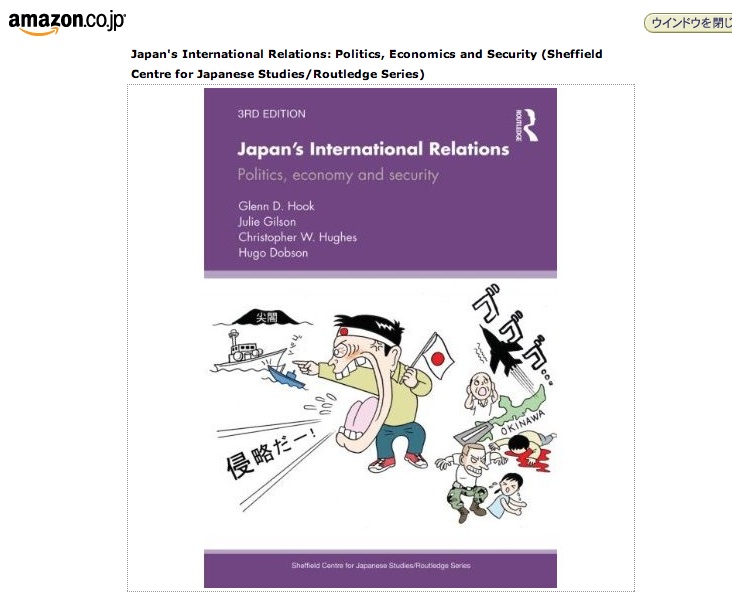
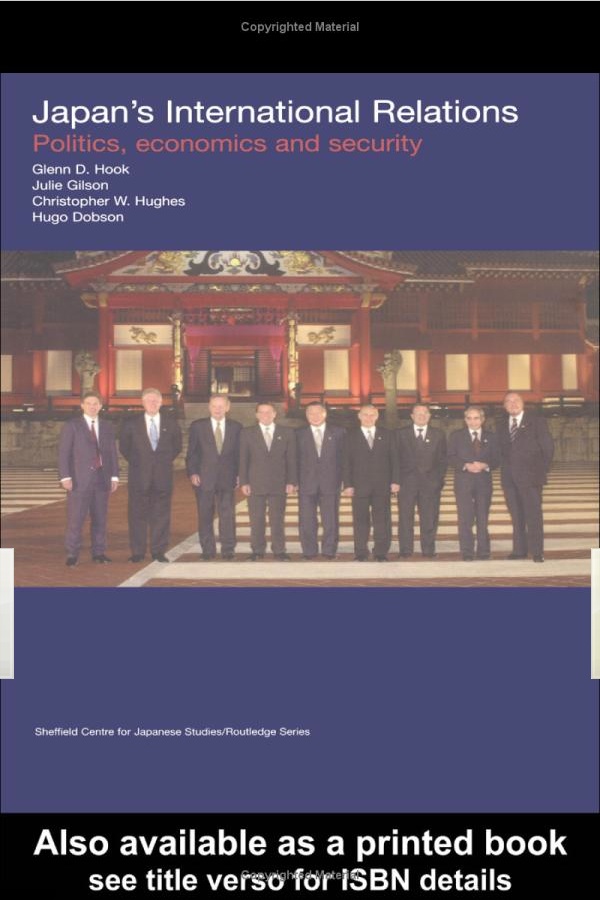
Hi Blog. Faculty members at the University of Sheffield, a venerable British institution for Japanese studies, have released their third edition of an academic book on Japan’s International Relations with a rather sensationalistic cover. I forward the letter of complaint from friend Amanda Harlow (used with permission):
[This and past editions still available on Amazon.com and Amazon.co.uk]
This cartoon panders to the worst stereotyping of Japanese people and I feel this is a surprising choice for a respected British institution such as the University of Sheffield. If this was a mob of Japan-bashers on the streets of China, or a crazy nationalistic website I would not be surprised. But the School of East Asian Studies? Really?
Is it meant to be ironic? If so, I think this illustration would be better as an inside picture and not used on the cover of a book that is supposedly about international relations.
Here in Japan (I live in Sapporo with my Japanese husband and family) there are endless gaijin-bashing images and Debito Arudou, a friend of mine, is a well known activator on discrimination issues – if he found this image of a non-Japanese on a Japanese book cover we would all shake our heads and groan.
The latest edition of this comprehensive and user-friendly textbook provides a single volume resource for all those studying Japan’s international relations. It offers a clear and concise introduction to the most important aspects of Japan’s role in the globalized economy of the twenty-first century. The book has been fully updated and revised to include comprehensive discussions of contemporary key issues for Japan’s IR, including:
the rise of China
reaction to the global economic and financial crisis since 2008
Japan’s proactive role after 9/11 and the war on terror
responses to events on the Korean Peninsula
relations with the USA and the Obama administration
relations with Russia, Central Asia and the Middle East
changing responses to an expanding and deepening European Union
Extensively illustrated, the text includes statistics, maps, photographs, summaries and suggestions for further reading, making it essential reading for those studying Japanese politics, and the international relations of the Asia Pacific.
著者について
Glenn D. Hook is Professor of Japanese Studies in the School of East Asian Studies, University of Sheffield.
Julie Gilson is Senior Lecturer in the Department of Politics and International Studies, University of Birmingham.
Christopher W. Hughes is Professor of International Politics and Japanese Studies, University of Warwick.
Hugo Dobson is Professor in the International Relations of Japan, University of Sheffield.
Product Details
ペーパーバック: 560 pages
Publisher: Routledge; 3 edition (2011/8/31)
Language: 英語, 英語, 英語
ISBN-10: 0415587433
ISBN-13: 978-0415587433
Release Date: 2011/8/31
COMMENT: Okay, I shake my head and groan. Arudou Debito
UPDATES ON TWITTER: arudoudebito
DEBITO.ORG PODCASTS on iTunes, subscribe free
Hi Blog. Here’s some news dovetailing with Japan’s unwillingness to abide by international treaty.
Japan, one of the United Nations’ largest financial contributors, has been pushing hard for decades now for a seat on the U.N. Security Council (last time in 2006), effectively to have a place at the table and more powerful voting rights with fellow big, rich, powerful nations. The GOJ has even signed treaties and created domestic laws, according to scholar John M. Peek (see below), just to make it look better internationally, i.e., more like a modern, responsible nation in the international arena. However, after signing these treaties, Japan has been quite constant in its unwillingness to actually create domestic laws to enforce international agreements (cf. the CERD), or when laws are created, they have little to no enforcement power (cf. the Equal Employment Opportunity Law, which has done little after more than a quarter century to ameliorate the wide disparity in wages between men and women in Japan).
The fact is, the GOJ does this stuff for window dressing. Now once it accomplishes its goal of getting an UNSC Seat, it will have no further incentive to sign, abide by, or obey international treaties at all. We have stated this to the United Nations at every opportunity.
Which is why Britain’s sudden turnaround to support Japan’s bid is so eye-blinkingly blind. It seems we are milking our disasters (partially caused by our government’s malfeasance in the first place) to get an international sympathy vote now. How cynical and opportunistic.
LONDON (AFP) – Britain on Tuesday backed Japan’s claim for a permanent seat on the UN Security Council and promised to support its economic integration with the EU after the two nations’ foreign ministers met in London.
Foreign Secretary William Hague also told Takeaki Matsumoto, his Japanese counterpart, that Britain had “great admiration” for Japan’s response to the March earthquake and tsunami which devastated the country’s northeast coast.
“Japan is unquestionably our closest partner in Asia,” Hague said in a statement.
“Japan is a like-minded partner and a positive force in international peace and security and I repeat our support again today for an enlarged United Nations Security Council with a permanent seat for Japan,” he added.
Britain in March urged the European Union to ease barriers between the bloc and its outside trading partners, and used Tuesday’s meeting to repeat its demands.
“The removal of tariff and non-tariff barriers could deliver over 40 billion euros ($59.2 billion) of additional European exports to Japan and more than 50 billion euros of additional exports from Japan to the EU,” argued Hague.
The pair agreed to “support the people of Libya in their aspiration to be rid of a dictator” and on the “vital need to achieve a two state solution to the Israeli-Palestinian conflict”.
Addressing the quake, Hague said: “We feel great friendship and affinity with the Japanese people in this hour of tragedy… and we have great admiration for the resilience and dignity and courage of the people of Japan.”
ENDS
//////////////////////////
EXCERPT OF ARUDOU DEBITO PAPER (Copyright ARUDOU Debito)
3. Historical context of the GOJ’s behavior
Japan has a long history of lack of initiative regarding its obligations under U.N. agreements in regards to human rights. Peek (1992) notes, “Tokyo holds that human rights issues are a domestic matter and, therefore, beyond the mandate of the U.N…. [Japan] has generally responded defensively to human rights proposals at variance with Japanese law or practice” (219). In his view, Japan’s lack of participation in the incipient stages of the U.N.’s formation (including the Universal Declaration of Human Rights in 1948) led to the lack of “significant national stake in the U.N.’s existing principles and structures” (ibid), a relative inattention in the political sphere, and an understaffing in the relevant domestic bureaucratic organs. The high-profile tenure of Ogata Sadako as the U.N. High Commissioner for Refugees notwithstanding, for decades Japan refused to even join the UNHCR in the 1960’s and 1970’s despite several direct appeals from other countries; the GOJ “feared being drawn into a public denunciation of the human rights policies of any particular state”; even after joining the UNHCR, Japan’s interest was in “protecting itself from unwanted or highly politicized criticism” (both 220), and kept its participation “low-key” and abstemious from ruling on the majority of resolutions within its mandate.
After Japan ratified the International Covenant on Civil and Political Rights and the International Covenant on Economic, Social, and Cultural Rights in 1979, it still opposed, as it had since the 1960’s the establishment of a specific high commissioner to review issues of human rights, arguing the office would be “highly politicized” and lead to bureaucratic inefficiency; Peek noted, “At the core of Japan’s position was its objection to any further encroachment on the internal affairs of sovereign nation-states” (221). It also added “reservations” to parts of the covenants (such as the review powers of the ICCPR’s Human Rights Committee), expressed objections to individuals being able to report claims directly to the HRC (arguing that U.N. relations are state-to-state), and emphasized the need for “further study” of contentious issues.
The conclusion that can be drawn from this: Postwar Japan’s leadership could not, and most likely still cannot, accept a fundamental tenet of the UN Charter — that there exists a “universal set of human rights”. This cultural relativism at first led to an attitude of, “leave us alone, we’ll leave you alone”. However, this became less tenable with the ascendancy of Japan as the number two economic power in the 1980’s, and Japan’s own repeated demand for acceptance as a permanent member of the U.N. Security Council. With greater international power came the expectation of greater international accountability, responsibility, and initiative.
Ironically, an argument can be made that some of Japan’s more liberal laws were created as a matter of opportunistic timing vis-à-vis international attention, not grassroots pressure. Peek provides the example of the Equal Employment Opportunity Law, passed in 1984, legally guaranteeing equal pay for equal work regardless of gender. It was passed into law despite the opposition of women’s groups and the opposition parties, who objected to its lack of enforceability. Peek writes, “The intent of the law seems to have been more than a symbolic bone tossed to domestic and international critics in anticipation of the upcoming 1985 world conference ending the U.N. Decade for Women” (224). Peek also notes the GOJ concurrently passed a revised Nationality Law (now granting citizenship through mother as well as father), and ratified the Convention on the Elimination of All Forms of Discrimination Against Women. Thus, it would seem that for Japan to pass a law against RD, one would need a high-profile event (such as a Decade against Racism or a International Conference for Migrants) to trigger it, or a quid pro quo of sorts (such as a UNSC seat). Even then, this author anticipates that any RD law will contain built-in safeguards (such as a lack of fines or incarceration for miscreants) to ensure that it allays international critics but does not have statutes for enforcement.
It is clear that from a historical perspective, the GOJ works on its own timetable, is largely impervious to repeated criticism both internationally and domestically, and makes reforms that do not overwhelmingly affect Japan’s “sovereignty”, however Japan’s domestic arbiters determine it. As Peek (1991) notes, the GOJ “has used the defensive tactics of denial of legitimacy, special interpretations, reservations, and symbolic change. It seeks to justify its tactics on the basis of culture differences. In essence, the Japanese government portrays its policy in terms of protecting the traditional ethic of harmonious human relations against the impersonal ethic of universalism contained in the covenants” (10).
There is of course the political dimension. Although pressure from the U.N. does, as Peek notes (1992: 226-9), lead to domestic human rights reforms, the Realpolitik of the situation indicates that NJ in Japan, a tiny minority (1.7% of the population, as opposed to women comprising half), disenfranchised without even suffrage (this will not change in the near future; the opposition to the Democratic Party of Japan’s proposal to grant suffrage in local elections to NJ Permanent Residents led to its suspension in 2010 (Mainichi Daily News 2010)), have a great uphill climb to achieving anti-discrimination legislation.
//////////////////////////////////////////////
EXCERPT ENDS
TWO MAJOR SOURCES:
Peek, J. M. 1991. “Japan and the International Bill of Rights.” Journal of Northeast Asian Studies, Fall 1991 10(3): 3-16.
_____________. (1992). “Japan, The United Nations, and Human Rights.” Asian Survey32(3): 217-229.
Japan, The United Nations, and Human Rights
Author(s): John M. Peek
Source: Asian Survey, Vol. 32, No. 3 (Mar., 1992), pp. 217-229
UPDATES ON TWITTER: arudoudebito
DEBITO.ORG PODCASTS on iTunes, subscribe free
Hi Blog. In light of Chris Savoie’s U.S. court victory the other day, where his ex-wife was ruled guilty of inter alia false imprisonment of their kids in Japan, let’s look at the bigger picture — whether or not there will be official measures taken to stop this sort of thing happening again. One means is the Hague Convention on Child Abductions, to which Japan is not a signatory, and it shows.
Japan has once again made intimations (see JT article below) that it has plans to not only consider but even perhaps join the Convention, with a schedule for when it will perhaps join being announced this month.
The point is, I’m not hopeful. And I’ll say it again: Nobody, Japanese or NJ, should get married to a Japanese and have children under the current system in Japan. Divorce in Japan generally means one parent loses the kids. And I believe that will continue regardless of Japan’s agreeing to the Hague. Arudou Debito
ADDENDUM MAY 27: One clarification that is unclear upon rereading this post: I believe that Japan SHOULD sign the Hague. I have never argued that it shouldn’t. It is a step in the right direction. I am just questioning whether it will mean much in practice and enforcement, given the GOJ’s record regarding other treaties, and advising against getting one’s hopes up for a solution to the present situation. AD
The government will announce in May a plan to join the Hague Convention, which deals with cross-border child custody rows, official sources said Wednesday.
The Democratic Party of Japan-led government is expected to instruct the Justice and Foreign ministries to develop the necessary bills, with the aim of approving the plan to join the 1980 Hague Convention on the Civil Aspects of International Child Abduction during a regular Diet session next year.
Japan has been under international pressure to join the child custody pact, which is designed to help resolve cases in which foreign parents are prevented from seeing their children in Japan after their marriages with Japanese nationals fail.
If Tokyo remains out of the pact, it could mar international confidence in Japan, the sources said. Prime Minister Naoto Kan is expected to relay Japan’s policy at a Group of Eight summit in late May in Deauville, France.
The Hague Convention sets procedures for resolving child custody cases in failed international marriages. As Japan has yet to join, non-Japanese cannot see their children if their Japanese spouse takes them to Japan from the country where the family has been residing.
There has been heated debate over whether to join the treaty, as it is customary for mothers to take sole care of children after divorces and it is not unusual for kids to stop seeing their fathers after their parents break up. Critics have raised concerns over joining the pact, saying it could endanger Japanese parents and kids who have fled abusive relationships.
ENDS
====================
Japan to Sign Hague Child Abduction Convention
05/10/2008
BY MIAKO ICHIKAWA
THE ASAHI SHIMBUN
Japan will sign a treaty obliging the government to return to the rightful parent children of broken international marriages who are wrongfully taken and kept in Japan, sources said Friday.
The Justice Ministry will begin work to review current laws with an eye on meeting requirements under the 1980 Hague Convention on Civil Aspects of International Child Abduction, the sources said. The government plans to conclude the treaty as early as in 2010.
The decision was reached amid criticism against Japan over unauthorized transfer and retention cases involving children. The governments of Canada and the United States have raised the issue with Japan and cited a number of incidents involving their nationals, blasting such acts as tantamount to abductions.
In one case, a Japanese woman who divorced her Canadian husband took their children to Japan for what she said would be a short visit to let the kids see an ailing grandparent. But the woman and her children never returned to Canada.
Once parents return to their home countries with their children, their former spouses are often unable to find their children. In Japan, court rulings and custody orders issued in foreign countries are not recognized.
Under the convention, signatory parties are obliged to set up a “central authority” within their government. The authority works two ways.
It can demand other governments return children unlawfully transferred and retained. But it is also obliged to find the location within its own country of a child unlawfully taken and retained, take measures to prevent the child from being moved out of the country, and support legal procedures to return the child to the rightful parent.
Sources said the Japanese government will likely set up a central authority within the Justice Ministry, which oversees immigration and family registry records. The ministry has decided to work on a new law that will detail the procedures for the children’s return.
In 2006, there were about 44,700 marriages between Japanese and foreign nationals in Japan, about 1.5 times the number in 1996. Divorces involving such couples more than doubled from about 8,000 in 1996 to 17,000 in 2006.(IHT/Asahi: May 10,2008)
UPDATES ON TWITTER: arudoudebito
DEBITO.ORG PODCASTS on iTunes, subscribe free
Hi Blog. Congratulations to Chris Savoie on his massive U.S. court victory against his ex-wife for, inter alia, false imprisonment of his children in Japan.
Debito.org has talked about the Savoie Case for quite some time now (do a search), but I devoted a Japan Times JUST BE CAUSE column to it back in October 2009. I’m personally glad he’s staying the course, and seeking judicial recourse that is amounting to legally-binding agreement. This is setting an important precedent regarding the issue of international child abduction, and drawing attention to a long-neglected problem. Arudou Debito
PS: Note the lame (if not just plain inaccurate) headline by the Japan Times/Kyodo News on this, “Wife fined for taking children to Japan“; makes it sound like she got punished for being a tourist. Get on the ball. Call it what it is: Child abduction.
A mother who left Middle Tennessee with her two young children to live permanently in her native Japan — leaving behind an ex-husband with joint custody rights — has been ordered to pay the father $6.1 million in damages.
But Christopher J. Savoie of Franklin said the money alone is a hollow victory. He hopes the ruling will help end a battle he has waged since 2009 to bring the children home.
“Anything about this just reopens a lot of wounds. It’s bittersweet,” said Christopher Savoie, who said he hasn’t been allowed even to speak to Isaac, 10, and Rebecca, 8, in more than a year. “At the end of the day, I’d much rather have one afternoon in the park with my kids than one penny of this judgment.”
Shortly after Noriko Esaki Savoie permanently moved with the children to Japan, a Williamson County court gave Christopher Savoie full custody, and the Franklin Police Department issued an arrest warrant for Noriko Savoie charging her with custodial interference. But because of domestic laws pertaining to custody and divorce, Japan will not help the United States resolve parental abductions to the country. The U.S. Department of State’s Office of Children’s Issues reports that it “does not have a record of any cases resolved through a favorable Japanese court order or through the assistance of the Japanese government.”
In March, Noriko Savoie was charged in federal court with unlawful flight to avoid prosecution, and an arrest warrant was issued. That effort also has failed so far.
“My understanding is we don’t have an extradition agreement with Japan as it relates to parental kidnapping,” Assistant U.S. Attorney Carrie Daughtrey said. “As far as I know, nothing has been done.”
Christopher Savoie believes Monday’s ruling may open a door. His attorney, Joseph A. “Woody” Woodruff of Waller Lansden Dortch & Davis, said that while Japan won’t enforce U.S. judgments that pertain to custody or otherwise order Japanese citizens to “do the right thing,” they will enforce money judgments.
“They will enforce orders that assess damages for breach of contract and civil wrongs,” Woodruff said. “This is a tool we’re going to try to use to convince Noriko Savoie she needs to do the right thing.”
Williamson County Chancery Court Judge Tim Easter announced the damages Monday, having previously found Noriko Savoie guilty of three crimes in September. Easter ordered Noriko Savoie to pay Christopher Savoie more than $1 million for breach of contract and the intentional infliction of emotional distress. She was ordered to pay Christopher Savoie $1.1 million, to be held for the benefit of the children, for falsely imprisoning them since August 2009. Easter ordered Noriko Savoie to pay additional damages for each day she continues to falsely imprison the children up to a maximum of $4 million.
“Every day, she has another chance to lower the amount of damages,” Christopher Savoie said. “Noriko is not an enemy here. She’s just got to do the right thing here.”
Noriko Savoie was not represented at the hearing. Marlene Moses, an attorney who represented Noriko Savoie in 2009, said she no longer represents her and is unfamiliar with the latest developments.
“She chose to ignore these proceedings,” Woodruff said. “She was served in person in Japan.”
In a related proceeding, Savoie is suing Williamson County Judge James G. Martin III for negligence and violations of his constitutional rights. Martin was the judge who lifted a restraining order on the children’s passports so that Noriko Savoie could take them on a six-week trip to Japan. He did so after Noriko Savoie promised at a hearing that she would not permanently move there. She returned from the trip as scheduled, but left again shortly thereafter and has remained in Japan since.
U.S. District Court Judge Aleta A. Trauger dismissed the case in December after ruling that Martin has judicial immunity. Savoie has taken the case to the U.S. 6th Circuit Court of Appeals.
Woodruff said Christopher Savoie’s lawyers in Japan are working to “domesticate” Easter’s orders. Christopher Savoie said he is frustrated the laws of Japan have left him with no other choice than to seek a large money judgment against his ex-wife, but hopes it will compel her to at least talk to him.
“I would much rather her return the kids than see 1 cent of this money,” he said. “I feel disappointed that the only thing we can do is ask for money. Even God can’t buy me back the year and a half I’ve missed. I feel bad for the judge even having to put a number on it.”
Christopher Savoie, a former Rhode Islander who drew international attention when he was thrown into a Japanese prison in 2009 for trying to recover his two children from his Japanese ex-wife by grabbing them as they walked to school, has won a $6.1-million judgment against his former wife.
But in an interview from his home in Franklin, Tenn., the University of Rhode Island and Bishop Hendricken High School graduate called the award issued by Franklin Chancellor Timothy Easter a “two-edged sword” in that it gives his ex-wife a strong financial incentive “to do the right thing” and allow him to see his two children, but there is no guarantee that he’ll see his 10-year-old son, Isaac, and 8-year-old daughter, Rebecca, before they reach 20, the age of majority in Japan.
“It’s bittersweet, because rather than getting any money, I’d much rather be in the park playing with my kids. No amount of money can compensate for that time with the kids,” said Savoie.
Along with his second wife, Amy, another former Rhode Islander who began a career in immunology at URI, Savoie, 40, became enmeshed in an international custody battle that unfolded two years after Christopher, who had achieved international stature as an innovator in biotechnology, returned to the United States with his children and Japanese wife, Noriko, in the hope of starting another business.
Not long after the couple arrived, Christopher sued for a divorce, and two months after being granted the divorce decree in January 2009, married Amy, whom he had known since his days at URI. Savoie says that, as part of the settlement, his ex-wife agreed to provide him custody of the children in exchange for a monthly payment of $5,500 along with other payments for their education.
Then, just days after Christopher and Amy gathered with friends and relatives and their two young children at a waterside restaurant in East Greenwich to celebrate their six-month wedding anniversary, Noriko told Savoie and the judge in Tennessee that she wanted to take the children on a brief vacation in Japan before they resumed school in the United States. It was only when the Savoies saw that there was no planned trip back that they began to suspect that their children had been abducted.
Savoie says that contrary to some reports in the media, his two children had always been brought up in an English-speaking environment. Isaac, who was born in California and went to preschool in the United Kingdom, scored in the 98th percentile on the standardized English test in Tennessee, and Rebecca was doing well, also.
In fact, he says, when he came upon their children on the street in Japan, their mother was walking closely behind because she needed to interpret for them because they were not fluent in Japanese. Savoie thought he could whisk them off the street, carry them off to the U.S. Consulate and bring them back to the U.S., only to see his plan foiled when officials at the consulate did not open the door and allowed him to be arrested by Japanese police.
Despite the exposure provided by his nearly three-week imprisonment, Savoie said he has not seen his children again. Every time he attempts to reach the children by phone, their grandparents hang up on him.
Savoie said his anxieties increased significantly after the Japanese earthquake and nuclear disaster. He said that while he was told the children are safe, by his calculations, “they are within the nuclear fallout zone.”
Savoie said the events of the last few days have given him some new hope. The judgement issued by a Tennessee court on Monday is designed to get his ex-wife’s cooperation by cutting off any future financial payments by her as soon as she agrees to return the children.
Although the court system in Japan recognizes that he has been awarded custody of the children by a Tennessee court, the problem is that Japan has no way of enforcing the custody settlement, Savoie said, but it does have a method of enforcing the financial penalties. “We have a set of lawyers waiting in the wings” to put in the mechanism to see the judgment implemented.
Savoie said he has also been buoyed by what he says is a recent announcement by Japan that it plans to sign the Hague Convention on international child abduction, a move that would make it easier for international parents to recover their children who have been taken in custody disputes.
In the meantime, Savoie said the international custody battle has caused him and Amy to reconsider their calling. Instead of immunology, both are now students at Nashville School of Law in the hope that they may be able to help parents of other children — including some 300 in Japan alone — who have been abducted by spouses and are being held in Japan.
UPDATES ON TWITTER: arudoudebito
DEBITO.ORG PODCASTS on iTunes, subscribe free
Hi Blog. Here’s a submission from Sean Maki of yet another place that excludes NJ customers, this time in the international city of Kobe. Archive of the Rogues’ Gallery of Exclusionary Establishments here, so you can see how the issue is nationwide. I will add this case to the Rogues’ Gallery presently. Thanks Sean. Arudou Debito
/////////////////////////////////////////
May 4-6, 2011
Hi Debito. On a visit to Kobe for Golden Week, I came across a bar worthy of your Rogues’ Gallery of exclusionary establisments. Ironically, it was a soul music bar called Soul Love, with a sign featuring album covers of soul artists, including prominent Motown acts, who presumably would not be welcome inside the bar.
The bar was located on Higashimon Dori, a prominent thoroughfare in Sannomiya, one of Kobe’s major entertainment districts.
Following are links to photos I took of their sign reading ‘Excuse me Japanese people only,’ as well as the main sign for the business, which includes a phone number.
All of these photos were taken with my cellphone, however, I have better quality images taken with another camera:
They were taken around 10 P.M. on Tuesday, May 3, 2011. Please feel free to name me as the source of the photos, and to use my write-up for the submitter’s comment.
You might notice the ‘Japanese only’ sign also carries a sticker advertising AU phone service. I don’t know whether this the kind of corporate branding AU would be looking for.
If so, please write in to the Japan Times and say so (community@japantimes.co.jp).
Internet bullies are writing in and once again trying to reassert their control over the debate.
Don’t let them anymore. Offer some balance.
——————————
Rationale:
My previous Japan Times JUST BE CAUSE column on ‘Fly-jin’ was, as predicted, controversial, and occasioned I’m told more comment than any column I’ve written before. Wow. Thanks for commenting.
However, I’m also told the comments were overwhelmingly negative towards my standpoint. This is fine too, since it is my job as a columnist to stimulate debate and offer alternate views.
However, remember what my column was on: How NJ are bullying each other into silence and submission in a society that already disenfranchises NJ.
If you disagree with my last column’s thesis, that’s fine. It’s your right. And clearly your voice is already being adequately represented.
However, if you agree with my thesis, and you don’t want the bashers to have the last word on this topic, I suggest you speak up now and send in your opinions to the Japan Times.
After all, it is generally the case that the critics are more likely to comment than those who agree. It’s tougher to build upon the sentiment of “I completely agree, the end”, than it is “I completely disagree and here’s why”.
But this time it’s special.
The whole point of the previous column was that media bullies have been controlling the debate on the status of NJ, and decrying them, unfairly as I argued, as deserters. “Fly-jin”.
If you don’t want them to continue to control the debate or let them have the final word on the subject, I suggest you send in your thoughts to the Japan Times via community@japantimes.co.jp
Consider offering some balance, please.
There has been too much complacency and silent victimization regarding this subject already. Speak up.
The problem is, it seems (after a short search) that this article has come out in English only — there is no link to the “original Japanese story” like many Mainichi articles have. So this may sadly may not be for domestic consumption. Or it may be available on Kyodo wire services (but again, not in Japanese for Mainichi readers). Sigh. Arudou Debito
TOKYO (Kyodo) — More than 90 percent of foreigners studying or working in Japan expressed willingness to continue staying in the country despite the March 11 disaster, according to a recent online survey by a supporting group for them.
The International Foreign Students Association conducted the survey between March 22 and 26, to which 392 people responded. Of the respondents, 60 percent were students and the remaining 40 percent were graduates, while more than 90 percent of them were from China, Taiwan and South Korea.
Those who are willing to stay in Japan said, “Because I like Japan,” or “At a time like this, I think I want to work together (with Japanese) to help the recovery,” according to the Tokyo-based nonprofit organization.
The survey also showed that 73 percent of the respondents saw information gaps between Japan and their home countries on the earthquake, tsunami and the subsequent nuclear emergency, with some saying overseas news on the nuclear crisis was “excessive.”
Some respondents also pointed out that the Japanese government does not fully disclose information on the nuclear disaster.
Foreign volunteers help clear mud from a shopping street in Ishinomaki, Miyagi Prefecture, on April 14. (Mainichi)
Around 60 percent said they have not been preparing for disasters, while some voiced the need for multilingual information on disasters.
UPDATES ON TWITTER: arudoudebito
DEBITO.ORG PODCASTS on iTunes, subscribe free
DEBITO.ORG PODCAST MAY 7, 2011
THE OTARU ONSENS CASE, TEN YEARS ON. DECEMBER 6, 2010, OTARU SHOUDAI
This month’s offering is a recording of one of my speeches given in English last December at Otaru University of Commerce, Hokkaido, Japan, sponsored by Dr. Shawn Clankie. Q&A included. It’s my standard presentation on the Otaru Onsens Case with some updates (especially given that the site of the famous standoffs with “Japanese Only” bathhouses took place in this very town) on how things have or have not changed.
If your readers are interested in learning about the Japanese earthquake insurance system, I’ve put the insurance chapter of my book on-line here: http://dilloncommunications.com/blog/?p=2113
I’ve also included links to related information in English and Japanese.
The past two months have been uncomfortable for Japan, and for the country’s foreign residents. Non-Japanese (NJ) have been bashed in the media, unreservedly and undeservedly, as deserters in the face of disaster.
Consider the birth of the epithet “fly-jin.” A corruption of the racist word gaijin for foreigners, it appeared in English-language media as a label for NJ who apparently flew the coop in Japan’s time of need. The Japanese media soon developed its own variants (e.g., Nihon o saru gaikokujin), and suddenly it was open season for denigrating NJ.
For example, the Wall Street Journal (March 23) announced in English and Japanese articles an apparent “fly-jin exodus,” portraying NJ as fleeing, then sheepishly crawling back to their Japanese workplaces to face hazing. Tokyo Sports Shimbun (April 14) ran the headline “Tokyo Disneyland’s biggest reason for closing: repatriating NJ dancers” (oddly, Disneyland reopened days later).
Tabloids reported that “all foreigners have fled Japan” (Nikkan Gendai, April 11), or that a wave of migrating “bad foreigners” would render Tokyo’s Ueno a lawless zone (SPA!, April 12). The NJ-bashing got so bad that the government — unusually — intervened, quashing Internet rumors that foreign gangs were roaming the rubble, raping and pillaging, or that foreign terrorists had caused the earthquakes.
More moderate media still reported that escaping NJ labor was hurting Japan’s economy, citing farms and factories employing NJ “trainees,” fast food outlets, convenience stores, the IT sector and language education. Mainichi Shimbun (April 25) shed crocodile tears over the possible death of Japan’s textile industry due to the lack of cheap Chinese workers.
I saw no articles putting things into perspective, comparing numbers of AWOL NJ with AWOL Japanese. Cowardice and desertion were linked with extranationality.
Don’t get me wrong: I don’t doubt that many NJ did move due to the Tohoku disasters. But my question is: So what if they did?
I have my doubts that a) it’s any more significant than the fact Japanese did, or that b) it’s worth blaming NJ anyway. Japanese overseas, if advised by their government to leave a trouble spot, would probably do the same. I also doubt overseas media would criticize the departing Japanese so harshly.
So here’s what I don’t get: Why should Japan care if NJ are leaving? Japan hasn’t exactly encouraged them to stay.
Consider some common attitudes towards NJ: Larkers and freeloaders, they’re here just to make money, enjoying our rich, safe society before going “home.” NJ also get accused of threatening our safety and stability, as criminal gang members, terrorists or illegal workers. NJ are such a threat that the National Police Agency created a Policymaking Committee Against Internationalization (sic) in 1999, deputizing the nation’s hotels, employers and general public to join in their racial profiling and help ferret out “bad foreigners committing heinous crimes.”
Moreover, NJ are publicly portrayed as people to be viewed with suspicion, justifying Japan’s first neighborhood surveillance cameras in alleged “hotbeds of foreign crime.” They are even denounced by the likes of Tokyo’s governor, Shintaro Ishihara (recently re-elected to a fourth term), for infiltrating and subverting Japan’s very democracy (JBC, May 4, 2010).
On the other hand, NJ human rights remain unprotected. They are sometimes subjected to “Japanese Only” exclusionary rules and hate speech, neither of which are (or look likely to become) illegal activities in Japan. Meanwhile, local governments asking for kinder national policies for their NJ residents (e.g., 2001’s Hamamatsu Sengen, a set of proposals put forward in Shizuoka Prefecture to help foreign residents integrate) continue to be ignored by the central government. Indicatively, we still have no official policy to support and assimilate immigrants.
Rarely are NJ residents praised for the good they do for Japan, such as increasing our taxpayer base, contributing to the labor force, even sticking around to raise funds and deliver supplies to the Tohoku disaster areas. Instead, we get sentiments like “Japan must be rebuilt by us Japanese only” from the Asahi Shimbun (March 20) and Prime Minister Naoto Kan’s speeches.
All this might change, if NJ were ever given a stake in Japan. But rarely do they get the same opportunities as Japanese.
I speak from personal experience. We were promised, during Japan’s Bubble Era and “internationalization” push in the 1980s, that if we immigrants learned the language, worked hard and waited our turn on the corporate ladder, we would be treated equitably and promoted just like our native Japanese colleagues.
A quarter-century later, how’s that going? Pretty piddling. Few NJ have advanced to the top echelons of Japanese corporations in Japan. Few NJ “trainees” can ever hope to graduate beyond temp-worker status, picking strawberries for slave wages. Few NJ have become deans of universities, let alone gotten beyond basic contract work in education. Few NJ graduates of Japanese universities, despite years of corporate promises, have gotten genuine, promotable jobs in Japanese corporations here. And even after two decades of sweetheart visa status, few nikkei South Americans who lost their jobs in the recession were considered re-employable, unlike fellow laid-off Japanese: Only 1 percent of the former were offered any government retraining, with the rest tossed bribes to give up their pensions and “go home.” (ZG April 7, 2009)
Look, Japan decided in the 1970s that it wanted a quick-fix energy source to power its high-speed growth. It neither wanted to pursue available (and potentially safer) sources (such as geothermal), nor rely on foreign oil. So it built one of the world’s highest concentrations of nuclear power plants on some of the world’s most seismically active land. Did people really expect that someday this atomic house of cards would not come crashing down? Come on — it was the classic case of accidents waiting to happen.
Then, when they did happen, and people (regardless of nationality) began to look out for themselves and leave potentially dangerous areas, they got blamed for either overreacting or deserting? That’s rubbing salt in the wounds.
But it’s the NJ who got it particularly bad, since the worst critics were from within their own ranks. The word “fly-jin,” remember, was coined by a foreigner, so this meanness isn’t just a byproduct of systematic exclusion from society. This is sociopathy within the excluded people themselves — eating their own, egging on domestic bullies, somehow proving themselves as “more dedicated than thou” to Japan. What did these self-loathers ultimately succeed in doing? Making NJ, including themselves, look bad.
The point is that Japan made a mistake with its nuclear policy, and will pay for it in land, lives and reputation. Yet the past two months have demonstrated that NJ — ever weaker and disenfranchised — are being scapegoated to draw attention away from those truly responsible for this mess: the inept, cosseted Japanese nuclear industry, perpetually in bed with a bureaucracy that turns a blind eye to safety standards and abets coverups.
So let me counterbalance “fly-jin” by coining a word too: “sheeple.” By this, I mean people who timidly follow the herd even when it hurts them as a whole. They are unwilling to impinge upon their comfortable, convenient middle-class existences, or threaten their upward social mobility, by demanding a safer or more accountable system. Worse, they decry those who do.
If these sheeple had had their way, Japan’s nuclear industry’s standard operating procedure of disinformation and coverup would have continued after Fukushima, as it did after previous nuclear accidents in Tokai and Kashiwazaki. But this time the accident was big enough to potentially irradiate the international community. Ironically, it sometimes falls upon the dread foreigners to save the sheeple from themselves.
But again, the situation is particularly pathetic for NJ (and the opportunistic NJ rents-seekers) because, given their permanent “guest status” in Japanese society, they are expected to act like sheeple without ever being a full member of the herd. They neither have the same opportunity to speak their minds as residents, nor defend themselves from unfair bashing in public.
So bully for the fly-jin, or anyone, for protecting themselves and getting out. Why stay and be a sheep or a scapegoat?
==================================
Debito Arudou’s new novel “In Appropriate” is now on sale (see www.debito.org/inappropriate.html) Twitter arudoudebito. Just Be Cause appears on the first Community Page of the month. Send comments on this issue to community@japantimes.co.jp The Japan Times: Tuesday, May 3, 2011
ENDS
UPDATES ON TWITTER: arudoudebito
DEBITO.ORG PODCASTS on iTunes, subscribe free
Hi Blog. Examiner.com’s Justin Tedaldi, also of JET organization JETAA-NY, has just put up an interview of me and a kind review of novel IN APPROPRIATE. Please go to Examiner.com to read the whole thing. Excerpt below. Thanks very much, Justin. Arudou Debito
Originally raised in rural upstate New York as David Aldwinckle, Debito is a 23-year resident of Japan who obtained Japanese citizenship (and a name change) in 2000. As the Just Be Cause columnist at The Japan Times newspaper, his nonfiction books include Handbook for Newcomers, Migrants, and Immigrants, and Japanese Only: The Otaru Hot Springs Case and Racial Discrimination in Japan.
A longtime watchdog for foreigners’ rights in Japan, Debito’s first English-language novel takes a scalpel to the polite, friendly façade that tourists typically experience. In Appropriate examines the downright ugly aspects of Japanese life when a father is cut from all ties with his children post-divorce, which is not only common in Japan, but upheld by 19th century law. In this exclusive interview, Debito discusses his personal experiences that inspired the book, his history as an activist, and his thoughts on the future of Japan.
Q: You’ve been known as an activist for over a decade and have published non-fiction works on the subject. What inspired you to write about child abduction in Japan, and what were your goals?
DEBITO: My goal with In Appropriate was to expose a dire social problem, as usual. But this time I thought fiction would be the better medium. Doing what I do, I hear a lot of stories about broken marriages in Japan, and having gone through a nasty divorce myself (seeing my children only about six times since 2003), I know a little bit about child abduction. What goes on in Japan beggars belief, but it’s hard to zero in on one non-fiction case and expect it to cover the scope of the problem.
Although international child abductions in other countries have gotten some press, the situation in Japan is much, much worse. Child abductions and parental alienation in Japan are, in a word, systematic—meaning they are hardly uncommon between Japanese, too (former prime minister Junichiro Koizumi is a famous example; he never saw one of his sons for nearly two decades). One parent after a divorce is generally expected to disappear, and have little to no contact with the children anymore. In Appropriate was meant as a primer to the issue.
Japan has no system of joint custody or guaranteed visitation rights, and under this system I cannot recommend anyone, Japanese or non-Japanese (NJ), get married under it and consider having children. The risk is too great. We need fundamental reform of the Family Registry System and the laws governing divorce and child custody first.
Give us a basic overview on the phenomenon of kidnapping and left-behind parents in Japan.
It works like this: Japan’s divorce laws have been fundamentally unaltered since 1898(!), meaning modern-day common-sense divorces based upon “we just don’t like each other any more,” aka “irreconcilable differences,” don’t fly in Japan’s Family Courts. Fact is, if both sides don’t agree to a divorce, one side will have to portray the marriage as a living hell (even when it wasn’t) in public just to satisfy the requirements, inspiring vindictiveness in the other side. (Read more at www.debito.org/thedivorce.html.)
So after a successful split, one parent (usually the mother) gets the kids, and they are put on her Family Registry (koseki). Hers only, as Japan’s laws do not permit registry of people on two koseki. This means the other parent (usually the father) has no title or custody to the children (for example, I couldn’t even get an audience with my daughters’ junior high school teachers to see their grades). Access is granted only at the whim of the mother; I haven’t so much as seen a new photograph of my kids for about five years now. Even if the father goes to court to get a ruling guaranteeing visitation or access, if the mother again decides to make excuses for denial of visitation (or worse yet, levies a claim of “domestic violence”), the father will have to go to court again to get his rights enforced. Given that Japanese courts take months or years to hand down decisions, his kids will in the interim grow up alienated and never hearing his side.
This is what happens on a domestic level between Japanese. Now add the dimension of international marriage, where the NJ parent may have visa issues, face a language/culture barrier, or be communicating from overseas, and you have a more complex case. (More information via the Children’s Rights Network at www.crnjapan.net.)
Do you think Japan has any legal grounds on an international level to justify its actions?
Japan is not a signatory to many international agreements protecting the rights of children, including the Hague Convention on Child Abductions. Its courts have also not honored overseas court decisions regarding child custody awarded to the NJ parent. According to the U.S. State Department, Japan has not returned a single child abducted to Japan after an international divorce. No doubt Japan’s judiciary would find the Elian Gonzalez Case of 2000 puzzling indeed. Japan as a country refuses to abide by international norms regarding families post-divorce. More in an upcoming documentary called From the Shadows (www.fromtheshadowsmovie.com).
Why did you choose the fiction novel format?
Because no single non-fiction case would capture the complicated dynamics of this issue properly. Besides, In Appropriate is about more than just divorce: I wanted to describe how a person would find a fascination in Japan and Japanese people, come over during Japan’s Bubble Era to see Japan ripe with opportunity, and find how Japan went sour as an economy over the past two decades. It was wonderful for me to recount this as a Bubble Era veteran—when in the late 1980s Japan looked poised to take over the world, was even challenging notions of how capitalism worked. Then see how, step-by-step, Japanese society would be squeezed and squeezed, convinced that recovery was right around the corner, just like Godot.
How a person could become an immigrant to Japan—assimilating himself to the point of founding his own company, becoming bilingual in Japanese, even taking Japanese citizenship, yet be blindsided by events that were nearly always beyond his control. In Appropriate is much more than just a story of divorce—it’s a time capsule charting Japan’s descent into mediocrity and comparative international irrelevance. That’s best portrayed in a novel format…
UPDATES ON TWITTER: arudoudebito
DEBITO.ORG PODCASTS on iTunes, subscribe free
Hi Blog. Out tomorrow will be my latest JUST BE CAUSE column in the Japan Times. I actually wrote a piece in defense of the so-called “Fly-jin”, the NJ who are being treated like deserters for protecting their own, deciding to put some distance between themselves and situations they consider dangerous post-Fukushima.
I ask the question: “So what if many NJ did leave Japan? Do you think Japan thus far has been all that encouraging of them to stay?”
I think some people might find this view refreshing and cathartic, given the increasing sociopathy I’m feeling within the already-disenfranchised NJ as they bully their own.
UPDATES ON TWITTER: arudoudebito
DEBITO.ORG PODCASTS on iTunes, subscribe free
Hi Blog. Masaki Hisane offers this sobering report in the now-defunct Kansai Time Out, February 2008, in an article on the horrible safety record of Japan’s nuclear power industry. Reprinted here as a matter of record only, since it the KTO archives seem to have disappeared. FYI. Courtesy of JK. Debito
UPDATES ON TWITTER: arudoudebito
DEBITO.ORG PODCASTS on iTunes, subscribe free
Hi Blog. Here’s a very thoughtful article from Ottawa Citizen newspaper columnist Dan Gardner on why Japan took its nuclear route. Dunno why this guy knows so much about a topic otherwise so esoteric on the other side of the world (but good research should make that irrelevant anyway). People who know more about this subject are welcome to comment, of course, but Gardner answered a number of questions I had. Give it a read. Note the citation of our new Japanese citizen applicant Donald Keene (now literally one of the movers with the shakers; sorry, couldn’t resist the pun) on Japan’s economic and emotional fragility. Arudou Debito
///////////////////////////////////////////////
Why Japan took the nuclear risk
When making choices about energy, there are no danger-free, cost-free solutions
The Japanese government undertook a rapid expansion of nuclear power after the oil shocks of the early 1970s to reduce the country’s dependence on foreign energy, despite the high earthquake risk in the region.
Three Mile Island. Chernobyl. Now this. Within hours of the first reports of trouble at Japan’s nuclear power plants, calls for abolition could be heard around the world. “Time to shut down this nation’s nuclear energy program” wrote American pundit Keith Olbermann. Greenpeace and other environmental groups mobilized. “The nuclear risk is not a risk that can really be controlled,” said a French Green party politician. Nuclear power must go.
With Japan’s plants suffering explosions and officials struggling to avoid meltdowns, it’s hard not to agree. Nuclear power is a demonstrable hazard. In Japan, a land constantly rattled by seismic activity, where a disaster like Friday’s was literally just a matter of time, nuclear power is downright dangerous. Why risk it?
People who say that seldom mean it as a question. It’s a conclusion in drag. But let’s treat it instead as a genuine question. Why risk it? Why should we build and operate nuclear power plants knowing that they do pose real dangers, whatever the magnitude of those dangers may be?
And why, in particular, would Japan build nuclear power plants on land that so often buckles and heaves? The answer to this second question lies in recent history. It’s worth having a look because it’s also a pretty good answer to the first question.
As recently as the 1950s, Japan was a poor country with a huge and growing population. Some far-sighted experts looked ahead and saw misery and mass starvation.
But in the 1960s, Japanese manufacturing grew rapidly. Its success was based on keeping things cheap. Cheap labour. Cheap prices. Cheap quality. In the United States, the main Japanese market, “Made in Japan” meant the product cost little and was worth what it cost.
Japan got wealthier. Living standards improved.
In the late 1960s, the American economy stumbled and in 1971 the dollar was devalued. The yen shot up. But the quality of Japanese goods had improved and so Japanese manufacturing thrived despite the rising cost of its goods.
Nothing less than a miracle was underway. A nation was rising from poverty to the ranks of the wealthiest people on Earth. Some even imagined a day when Japan would lead.
Then, like an earthquake, the Arab oil embargo struck.
The Japanese miracle was built on a foundation of cheap energy -mostly oil, mostly from the Middle East. The oil embargo of late 1973 plunged the world into the frightening recession of 1974, and no one suffered worse than Japan.
“The recent period of Japanese glory, from 1969 to 1973, when it seemed a small, distant country would overtake the giants of the West, lasted longer than a dream, but it has ended with dramatic suddenness,” wrote Donald Keene, an American professor of Japanese culture, in the New York Times. It was March 3, 1974. “The same people who only a few months ago were talking and acting as if the future held unlimited possibilities of economic expansion now gloomily announce, not without a touch of masochism, that they live in a country completely at the mercy of others for survival.”
Many Japanese were sure their country would sink back into poverty. The old fears of mass starvation and environmental ruin returned. “Prophecies of disaster abound,” Keene noted.
The Japanese government responded with a sweeping, multi-pronged campaign to reduce Japan’s dependency on Middle Eastern oil. Conservation and energy-efficiency was a major component. So was a rapid expansion of nuclear power.
Of course the Japanese knew their seismological reality.
Indeed, Japanese earthquake science and engineering is the best in the world. But the Japanese also knew the danger of the status quo. It was a trade-off.
The transition worked. Japan’s rise resumed and within a decade it was one of the wealthiest nations in the world. It was also one of the most energy-efficient. And one of the top producers of nuclear power, with onequarter of its electricity coming from the plants the world is watching now. This story does not demonstrate that nuclear power is right for Japan, or anyone else. But it does show, I believe, that choices about energy always involve trade-offs.
Which risks are acceptable? How much risk? And what are we prepared to pay to avoid or mitigate threats? There are costs and hazards associated with every choice and so these questions are unavoidable. There are no risk-free, cost-free solutions.
Some deny this basic reality. Certain environmental groups claim to have plans which would allow us to do away entirely with coal, oil, natural gas, and nuclear power over the next several decades. Renewable energy would replace them all. The cost would be minimal. Indeed, it would spur innovation and produce millions of new jobs.
It would be wonderful if it were possible. Unfortunately, it’s not. One of the world’s leading energy experts, Vaclav Smil of the University of Manitoba, has called these claims “not just naive [but] profoundly irresponsible.”
But Smil also criticizes those at the other extreme, who see nothing undesirable about the status quo and believe any significant shift to renewable energy would be prohibitively expensive.
We can do better. But it requires that we first understand basic realities, including the most basic: There are costs and risks in everything.
UPDATES ON TWITTER: arudoudebito
DEBITO.ORG PODCASTS on iTunes, subscribe free
Hi Blog. The Ekonomisuto Weekly of March 26, 2011, devotes three pages to the effects of the Fukushima Disasters on both Japan’s tourism/export and NJ labor markets. Scans below, courtesy of MS. In the vein of how Japanese media coverage has been unsympathetic, even critical, of NJ leaving Japan, page three is of particular note. It offers harder numbers of NJ departures (although again with no comparison with Japanese movement), does not stoop to a tone of blame, and even accepts that NJ have a choice to work in other countries, so Japan had better take some measures to make itself more attractive to NJ labor or else. That’s more like it.
I have long found the policymaking attitude of “working in Japan should be its own reward, so we needn’t try to make things more hospitable for foreign labor” puzzling, so this article is refreshing. I’ll be dealing with that attitude in part in my next Japan Times JUST BE CAUSE column, to be published in the Tuesday, May 3 edition of the JT. Enjoy. Arudou Debito
UPDATES ON TWITTER: arudoudebito
DEBITO.ORG PODCASTS on iTunes, subscribe free
Hi Blog. Here’s another article tying together more pinpoint data of NJ leaving Japan, with a focus on Chinese. Spare a tear for those poor, poor Japanese industries who took advantage of so many cheap temporary NJ workers, and are now crying because the NJ aren’t sticking around to be potentially irradiated as well as exploited. Arudou Debito
Tens of thousands of worried foreign workers left Japan shortly after a crisis at the nuclear power plant that was crippled by the March 11 earthquake and tsunami, causing serious labor shortages in some industries.
After foreign governments lifted their temporary evacuation advisories issued in the wake of the nuclear crisis at the Fukushima No. 1 Nuclear Power Plant, many Americans and Europeans started coming back to Japan, albeit gradually. But workers from neighboring countries such as China have yet to do so.
Chinese people in particular — mostly students and trainees — had occupied key parts of the workforce in many Japanese industries, and therefore if they continue to stay out of Japan for an extended period of time, they could have a grave impact on the industries and force firms to review their business strategies or cut production.
“We are closed for a while,” said a notice written in rather awkward Japanese pasted on the shutter door of a Chinese restaurant slightly away form the main street of Yokohama Chinatown, the biggest Chinese quarter in Japan.
According to the cooperative association of shop owners in Chinatown, of the total of 2,500 people working there, about 300 of them, mainly part-time workers and students from China, returned to their country. As a result, about 10 out of some 320 stores, including souvenir shops, had to suspend their business operations.
The number of visitors to Chinatown at present accounts for about 80 percent of figures before the disaster, according to Kensei Hayashi, head of the cooperative association. There are shops that have enough labor to conduct business now, but they are stretched. While Chinatown hopes to see more people visiting the quarter the way they used to, there are growing concerns that an acute labor shortage could hit the town hard.
At Yoshinoya, a major beef bowl restaurant chain in Japan, about 200 foreign part-time workers including Chinese students, or about one-fourth of the total number of such workers in the Tokyo metropolitan area, quit their jobs in the first week after the March 11 disaster. The restaurant chain has managed to continue to operate by sending its employees to the shops from stores in other areas and hiring new workers.
Lawson, a major convenience store chain in Japan, also saw a number of foreign students quitting their part-time jobs at its stores in central Tokyo, but it has managed to keep its stores open by dispatching employees from headquarters. One Chinese person who had been set to work for Lawson from spring turned down the job offer.
A large number of foreign companies operating in Japan urged their employees to evacuate to areas outside Tokyo or abroad in the wake of the nuclear disaster. But some signs are emerging now that the situation is subsiding. Those companies that moved their offices to the Kansai region or elsewhere temporarily have started moving their offices back to Tokyo.
At Berlitz, a major English conversation school in Japan, the number of foreign instructors dropped by 30 to 40 percent immediately after the earthquake, but it has come back to about 90 percent of the total workforce it had before the disaster.
In the case of Chinese workers, many of them are students or trainees, and therefore it is often difficult for them to secure enough money to return to Japan. There are cases of “worrisome parents not letting them return to the country,” said a Chinese resident of Japan. Such being the case, it is unlikely that they will return to their workplaces in Japan anytime soon.
Japan’s sewing industry, which had accepted more than 40,000 trainees from China, saw them returning to their country in droves in the wake of the nuclear crisis. The Japan Textile Federation says about 30,000 Chinese trainees remain in their home country. Each company in the industry is required to keep the number of Chinese trainees below about 20 percent of its total workforce, but if the current situation were to continue, the industry as a whole would likely be forced to cut production drastically.
If the sewing industry were to fall into stagnation, the entire textile industry, including clothing, yarn and dyeing sectors, would suffer serious damage. “While production is being shifted abroad, the domestic industry in Japan has been able to survive by making high-quality and high-value-added products. But the industry could fall apart due to the earthquake disaster and the nuclear accident,” says the Japan Textile Federation.
ENDS
UPDATES ON TWITTER: arudoudebito
DEBITO.ORG PODCASTS on iTunes, subscribe free
Hi Blog. A bit of a break from charting the arc of how the J media is bashing NJ as deserters:
Octogenarian scholar and Japan specialist Donald Keene has announced his intention to become a Japanese citizen, and move to Japan in light of the Tohoku Disasters. Well, good for him.
A bit harsh, but I do find the logic — of linking a show of solidarity in the face of a crisis with a decision as personal as changing one’s nationality (and in Japan’s case, abrogating one’s former nationality) — a bit discomfiting. As per Keene’s comments below, he’s basically falling into the ancient bad habit (a la Lafcadio Hearn’s day) of treating the Japanese people as monolithic. Plus he won’t have to live quite as long with his (last-minute) decision compared to younger people who really plighted their troth here and naturalized. A nice, but oddly-reasoned, gesture on Keene’s part. Arudou Debito
///////////////////////////////////////////
‘I want to be with Japan’ / Donald Keene discusses plan to relocate, become citizen Michinobu Yanagisawa / Yomiuri Shimbun Correspondent
(Apr. 24, 2011) Courtesy of JK http://www.yomiuri.co.jp/dy/national/20110423dy02.htm
NEW YORK–Renowned expert in Japanese literature and culture Donald Keene, who recently announced his intention to gain Japanese citizenship and move permanently to Tokyo, wants to “be with the Japanese people,” he told The Yomiuri Shimbun.
Keene, a professor emeritus at Columbia University, said the Great East Japan Earthquake had inspired the decision.
“Japan will surely resurrect itself from the disaster to become an even more splendid country than before, I believe,” the 88-year-old, speaking in Japanese, said in an interview held Friday at his home in New York. “So I’ll be moving to Japan in a positive frame of mind.”
Keene said he will shift to Kita Ward, Tokyo, where he has owned a home for more than 30 years, by September.
Born in New York in 1922, Keene attended Columbia University, where he became fascinated with Japanese culture after reading an English translation of “The Tale of Genji.”
He later served as an interpreter during the Battle of Okinawa in the closing days of the Pacific War.
Keene has traveled through the Tohoku region many times, including some research trips for “The Narrow Road to Oku,” his English translation of the classic work of literature “Oku no Hosomichi,” by haiku master Matsuo Basho (1644-1694).
While studying in Japan, “I was surrounded by many people who warmly extended a helping hand to me,” Keene said.
By obtaining Japanese citizenship, “I’d like to convey my sense of gratitude to the Japanese people, which I’ve so far been unable to do,” he said.
Referring to reactions in the United States to the earthquake, tsunami and aftermath, including the nuclear crisis, Keene said, “Not a few people in the United States have been moved to learn Japanese people are doing their utmost to rebuild.”
Even Americans who had no particular interest in Japan before March 11 have been impressed by Japanese people’s composure in the wake of the disaster, he said.
“Americans have never felt such a strong affinity with Japan before,” Keene pointed out.
“I’ve made up my mind to become a Japanese citizen to be together with the Japanese people. I believe although words are important, of course, action is even more important,” Keene said.
“My decision to become a Japanese citizen is the manifestation of my expectations and convictions,” he said, explaining that he had a positive outlook for Japan.
“When I returned to Tokyo eight years after World War II, Japan had revived to become a far different country from what I’d seen just after the war’s end. I’m convinced Japan will become an even more wonderful nation by weathering the hardships of this disaster,” he said.
Keene recalled a tour of the Tohoku region in 1955 to research “Oku no Hosomichi.” “The view of a cluster of islets from the second floor of an inn in Matsushima [in Miyagi Prefecture] was unforgettably beautiful,” he said.
“I think there may be no structure in the world as beautiful as the Chusonji temple [in Iwate Prefecture], so I wonder why UNESCO has repeatedly failed to designate the temple as a World Heritage site,” Keene said.
“I think how terrible it is that the Tohoku region, full of such beautiful places and temples, has been hit so hard by the earthquake and tsunami,” he lamented.
Looking back on his interaction with Japanese poets and writers, Keene referenced the poet and author Jun Takami. Near the end of the Pacific War, Takami wrote in his diary of being deeply moved by the sight of people waiting patiently at Tokyo’s Ueno Station, trying to get to the safety of the countryside.
“I want to live together with these people and share death with them, as I love Japan and believe in Japan,” Keene said, quoting Takami.
“I now feel better able to understand Mr. Takami’s feelings,” he said.
Keene said his lawyer has already begun procedures for obtaining Japanese nationality.
He stressed that living in Japan would bring the most meaning to the rest of his life. He plans to spend time writing biographies of Hiraga Gennai (1728-1780), a scholar of Western studies in the Edo period (1603-1868), and Takuboku Ishikawa (1886-1912), a poet in the Meiji era (1868-1912).
In the 1950s, Keene studied at the postgraduate school of Kyoto University. He forged friendships with such literary giants as Yukio Mishima, Junichiro Tanizaki and Kobo Abe.
In 2008, Keene was given the Order of Culture by the Japanese government in recognition of his contributions to promoting Japanese literature and culture in Europe and the United States.
ENDS
UPDATES ON TWITTER: arudoudebito
DEBITO.ORG PODCASTS on iTunes, subscribe free
Hi Blog. Here’s yet another article from a more reputable source, the Nihon Keizai Shinbun, talking about the phenomenon of NJ allegedly leaving Japan behind and having an adverse effect on Japan’s economy.
For the record, I don’t doubt that NJ have left Japan due to the Tohoku Disasters. I just have my doubts that a) it’s any more significant than the Japanese who also left, yet get less nasty media coverage (I have yet to see an article comparing both J and NJ “flight” in terms of numbers), b) it’s worth blaming NJ for leaving, since Japanese overseas would probably do much the same if advised to do so by their government in the face of a disaster, and c) the media is actually doing their job investigating sources to nail down the exact statistics. Let’s see how the Nikkei does below:
Some bogus journalistic practices unbecoming of something as trusted as the Nikkei, to wit:
Providing a generic photo of people drinking at a Tokyo izakaya and claiming that they’re talking about repatriating NJ (that’s quite simply yarase).
Relying on piecemeal sources (cobbling numbers together from Xinhua, some part-timer food chains, an eikaiwa, a prefectural employment agency for “Trainee” slave labor, and other pinpoint sources) that do not necessarily add up to a trend or a total.
Finishing their sentences with the great linguistic hedgers, extrapolators, and speculators (in place of harder sources), including “…to mirareru“, “… sou da“, “there are cases of…” etc. All are great indicators that the article is running on fumes in terms of data.
Portraying Japanese companies as victimized by deserting NJ workers, rather than observing that NJ thus far, to say the least, have helped Japan avoid its labor shortage (how about a more positive, grateful tone towards NJ labor?, is what I’m asking for).
And as always, not comparing their numbers with numbers of Japanese exiting. Although the article avoids the more hectoring tone of other sources I’ve listed on Debito.org, it still makes it seems like the putative Great Flyjin Exodus is leaving Japan high and dry. No mention of course in the article of how many of these NJ might also be leaving Japan because they have no stake in it, i.e. are stuck in a dead-end or part-time job with no hope of promotion, advancement, or leadership within their corporate sector.
Once again, it’s pretty flawed social science. The Nikkei could, and should, do better, and if even the Nikkei of all media venues can’t, that says something bad about Japanese journalism when dealing with ethnic issues. Read the article for yourself. Arudou Debito
UPDATES ON TWITTER: arudoudebito
DEBITO.ORG PODCASTS on iTunes, subscribe free
Hi Blog. More on the Open Season on NJ. Here is Internet news site Zakzak headlining that Yoshinoya, famous beef bowl chain restaurant, is being affected by the “big-volume escaping of NJ part-timers”. It apparently has lost a quarter of its NJ staff (over 800 souls) fleeing from the fears of radiation from the Tohoku Disasters. Then Zakzak gives us the mixed news that Yoshinoya is still profitable compared to its losses the same period a year ago, but is expected to take a hit to its profits from the Disasters.
Not sure how that relates, but again, the headline is that NJ are fleeing and that it’s raising doubts about whether the company is still “okay”. Even though Zakzak notes that the company is filling in the gaps with Japanese employees (er, so no worries, right? The Disasters, not the alleged NJ flight, are the bigger threat to solvency, no?). So… journalistically, we’ll hang the newsworthiness of a company’s profitability on the peg of “escaping NJ”?
If we’re going to have this much NJ bashing, how about an acknowledgement of how much NJ labor has meant to Japan and how we’re thankful for it, so please don’t leave?
Nah, easier to bash them. Takes the heat off the company for their own variably profitable business practices, and creates more attractive headlines for the media. It’s a win-win situation against the bullied and disenfranchised minority. Arudou Debito
As for Japanese guests? Not always better. Here’s the latest mutation: The Yomiuri reports places are refusing Japanese people too from irradiated Fukushima Prefecture because they think they might be glowing:
As the article lays out, it’s not just a hotel (although hotels have a particular responsibility, even under the law, to offer refuge and rest to the paying public). A gas station reportedly had a sign up refusing Fukushima Kenmin (they must think Fukushimans spark!), while complaints came in to official soudan madoguchi that a restaurant refused Fukushimans entry and someone had his car defaced. In all, 162 complaints reportedly came in regarding fuhyou higai, or roughly “damages due to disreputation” of being tarred by the disasters. Now that’s an interesting word for a nasty phenomenon.
Good news is that these problems are at least being reported in the media as a social problem, and Fukushima Prefecture is asking the national government to address them. Let’s hope the GOJ takes measures to protect Fukushima et.al. from further exposure to “fuhyou” and discrimination. Might be a template for getting the same for NJ.
(Okay, probably not, but it’s still the right thing to do.) Arudou Debito
UPDATES ON TWITTER: arudoudebito
DEBITO.ORG PODCASTS on iTunes, subscribe free
DEBITO.ORG NEWSLETTER APRIL 15, 2011
SPECIAL ON THE DISASTERS IN TOHOKU
Hi Blog. Here is a sampling of some of the articles that appeared on Debito.org (which took a break from hiatus briefly) regarding the March earthquake and the aftermath, particularly how it affected NJ in Japan.
Table of Contents: ////////////////////////////////////////////////
NJ PORTRAYED AS PART OF THE PROBLEM
1) Asahi Tensei Jingo (Vox Populi) Mar 20 offers ponderous column with gratuitous alienation of NJ
2) Wall Street Journal joins in bashing alleged NJ “fly-jin exodus”: “Expatriates tiptoe back to the office”
3) Tokyo Sports Shinbun blames closure of Tokyo Disneyland not on power outages, but on NJ!
4) Rumors of “Foreign Crime Gangs”; rapes and muggings, while tabloids headline “all NJ have flown Japan” etc.
5) SNA: “GOJ targets harmful internet rumors”, including the earthquake being caused by foreign terrorism
6) Tokyo Governor Election April 10 posts “expel the barbarians, Japan for the Japanese” openly xenophobic candidate, gets over 6000 votes
NJ AS PART OF THE SOLUTION
7) NJ helping Japan during this crisis: James Gibbs on his Miyagi Rescue Efforts
8 ) John Harris on how Coca Cola could help Japan save a nuclear power plant’s worth of power: Switch off their 5.5 million vending machines
9) Thinking of donating blood in Japan? Mutantfrog translates the regulations on who can’t.
RELATED ARTICLES OF NOTE
9) Tokyo Gov Ishihara calls the tsunami “divine punishment” to wipe out the “egoism” of Japan. Yet wins reelection.
10) The Nation.com on Tohoku Earthquake has shaken Japan Inc.
11) AOL News: WikiLeaks: Cables Show Japan Was Warned About Nuclear Plant Safety
12) Weekend Tangent: NYT: “Japanese Workers Braved Radiation for a Temp Job” in Japan’s nuclear industry
13) Japanese cartoon for kids depicting Fukushima nuclear issue as power plants with constipation!
… and finally…
14) My Japan Times JUST BE CAUSE Column 38, April 5, 2011 on Tohoku: “Letting radiation leak, but never information”
////////////////////////////////////////////////
By Arudou Debito, Sapporo, Japan
debito@debito.org, www.debito.org
Freely Forwardable
////////////////////////////////////////////////
NJ PORTRAYED AS PART OF THE PROBLEM
1) Asahi Tensei Jingo (Vox Populi) Mar 20 offers ponderous column with gratuitous alienation of NJ
Check out this Asahi Shinbun editorial (Japanese, then English), which offers an assessment of the victimization of Japan by 3/11, and insinuates that NJ in Japan are deserting us in our time of need:
Asahi Shinbun column Mar 20, 2011: This past weekend, there were fewer foreigners than usual to be seen in Tokyo’s typically busy Ginza and Omotesando districts. Not just tourists from abroad scrambled to leave Japan, but also business travelers, students and reportedly even diplomats.
While I am deeply grateful to people around the world for their moral and material support, I understand too well that rebuilding our country is ultimately the task of none but the Japanese…
Let us all believe that, and let us stand by our fellow citizens who survived the catastrophe. We have nowhere to go back to, except this country of ours, which we must rebuild again out of the rubble.
2) Wall Street Journal joins in bashing alleged NJ “fly-jin exodus”: “Expatriates tiptoe back to the office”
Here we have the Wall Street Journal joining in the NJ bashfest, publicizing the word “flyjin” for the Japanese market too (making one question the claim that the pejorative is restricted to the English-language market). Gotta love the Narita airport photo within that is deftly timed to make it seem as if it’s mostly NJ fleeing. “Good-natured hazing” is how one investment banker puts it below, making one wonder if he knows what hazing means. Anyway, here’s another non-good-natured article about how the aftershocks of the earthquake are affecting NJ.
WSJ: The flight of the foreigners — known as gaijin in Japanese — has polarized some offices in Tokyo. Last week, departures from Japan reached a fever pitch after the U.S. Embassy unveiled a voluntary evacuation notice and sent in planes to ferry Americans to safe havens. In the exodus, a new term was coined for foreigners fleeing Japan: flyjin.
The expat employees’ decision to leave is a sensitive cultural issue in a country known for its legions of “salarymen”: loyal Japanese employees whose lives revolve around the office, who regularly work overtime and who have strong, emotional ties to their corporations and their colleagues.
“There is a split between [the Japanese and foreigners] on where their allegiances lie. In Japan, the company and family are almost one and the same, whereas foreigners place family first and company second,” said Mark Pink, the founder of financial recruitment firm TopMoneyJobs.com, based in Tokyo.
3) Tokyo Sports Shinbun blames closure of Tokyo Disneyland not on power outages, but on NJ!
Debito.org is pleased to announce another Japan Official(TM) Open Season on NJ. We get these fads occasionally, like “NJ have AIDS” (1986), “NJ have SARS” (2003), “NJ are criminals” (2000-4).
Now, with the advent of “Fly-jin” (or the variant “Bye-jin” — which is better, some might retort, than being “Die-jin”), it’s now “NJ are deserters”. And they can be conveniently blamed for various social ills. Here, I’ll anticipate a couple:
1) “Fly-jin” are responsible for Japan’s lack of English ability because they fled their posts as English teachers. (Not so far-fetched, since they have been blamed in the past for the same thing because conversely “NJ have been in Japan too long”)…
2) “Fly-jin” are responsible for our fruits and vegetables becoming more expensive, since NJ “Trainees” deserted their posts as slaves on Japanese farms and left things rotting on the vine…
3) “Fly-jin” are responsible for a further decrease in Japan’s population, since some of them took Japanese citizens with them when they deserted Japan…
4) “Fly-jin” are responsible for a downtick in Japan’s shipping industry, since NJ accounted for 90% of Japan’s maritime crews…
5) “Fly-jin” are responsible for diplomatic snafus, since our NJ proofreaders at national government agencies did a runner…
Okay, that’s still fiction. But who says people in Japan aren’t creative? I never anticipated NJ being blamed for the closure of Tokyo Disneyland, as the Tokyo Sports Shinbun does on April 14, 2011:
No, it’s not due to power outages or rolling blackouts or anything like that. They have to have NJ faces as dancers and people in parades, therefore no parade, no Tokyo Disneyland. We’re closed, and it’s your fault, NJ. Makes perfect sense, right? Enjoy the Open Season on you, NJ, while it lasts. I anticipate it’ll dissipate with the radiation levels someday.
4) Rumors of “Foreign Crime Gangs”; rapes and muggings, while tabloids headline “all NJ have flown Japan” etc.
As promised, here we have a record of how domestic media is either reporting on nasty rumors denigrating NJ, or circulating those nasty rumors themselves. The GOJ is taking measures to quell the clacking keyboards, but the tabloids (roundly decried for spreading exaggerated information overseas about the state of radioactivity from Fukushima) are still selling papers by targeting NJ regardless. (There’s a lot of text in Japanese below; keep paging down. Brief comments in English sandwiched between.)
First, the Asahi and Sankei report “dema” swirling about saying that foreigners are forming criminal gangs (echoes of 1923’s rumored Korean well poisonings, which lead to massacres) and carrying out muggings and rapes. Yet Sankei (yes, even the Sankei) publishes that there hasn’t been a single reported case (glad they’re setting the record straight):
The GOJ is also playing a part in quelling and deleting internet rumors, thank goodness: Still, that doesn’t stop other media from headlining other (and still nasty) rumors about how (bad) NJ are heading south towards Tokyo (soon rendering Ueno into a lawless zone). Or that NJ are all just getting the hell out:
Fellow Blogger Hoofin has made an attempt to mathematically debunk this alleged phenomenon of “Fly-Jin”, noting that the person to coin this phrase has since commented with a bit of regret at being the butterfly flapping his wings and setting this rhetorical shitstorm in motion (much like GOJ shill Robert Angel regretting ever coining the word “Japan bashing”). We have enough anti-NJ rhetorical tendencies in Japan without the NJ community contributing, thank you very much.
Besides (as other Debito.org Readers have pointed out), if the shoe was on the other foot, do you think Japanese citizens living overseas would refuse to consider repatriating themselves out of a stricken disaster area (and do you think the media of that stricken country would zero in on them with the same nasty verve?).
Meanwhile, xenophobic websites continue to rail and rant against NJ, since hate speech in Japan is not an illegal activity: Here’s but one example (which has escaped the notice of the GOJ as yet, calling for the execution of foreign criminals and throwing their bodies into the sea); I’m sure readers can find more and post them in the Comments Section below:
People always need someone to blame or speak ill of, I guess. I’ll talk more soon about how Japanese from Fukushima are also being targeted for exclusion. However, it seems that hate speech directed towards NJ is less “discriminate”, so to speak — in that it doesn’t matter where you came from, how long you’ve been here, or what you’re doing or have done for Japan; as long as you’re foreign in Japan, you’re suspect and potentially subversive. Just as long as one can anonymously bad-mouth other people in billets and online, one can get away with it. Again, this is why we have laws against hate speech in other countries — to stem these nasty tendencies found in every society.
5) SNA: “GOJ targets harmful internet rumors”, including the earthquake being caused by foreign terrorism
SNA: A new project team has been created by the Ministry of Internal Affairs and Communication, the National Police Agency, and METI to combat “rumors” deemed harmful to Japanese security in the wake of the March 11 disaster.
Specifically, these government organizations asserted in a press release that the damage caused by earthquakes and by the nuclear accident are being magnified by irresponsible rumors, and that the government must take steps against this trend for the sake of the public good…
The Telecom Services Association reveals that the following requests have thus far come from the government:
March 17: Erase descriptions of the earthquake as a man-made event
March 24: Erase descriptions about the manufacturers of the troubled nuclear reactors
March 28: Erase claim that the earthquake was caused by foreign terrorism…
COMMENT: Here we have GOJ agencies working to stem malicious rumors from proliferating online, including those targeting NJ. Good. It’s also presented (by a news blog) as a debate between those who feel they have a right to know (and feel betrayed by the official media as an information source) and those who feel they can say anything they like about anybody thanks to freedom of speech. It’s a fine line, to be sure, but I’m glad to see somebody official trying to tackle (or, rather, at least thinking about tackling) the issue of hate speech against NJ. But without clear legal guidelines about what constitutes “hate speech” (or for that matter, “immoral information”) in Japan, those who don’t trust the government will no doubt foresee a wave of official censorship.
6) Tokyo Governor Election April 10 posts “expel the barbarians, Japan for the Japanese” openly xenophobic candidate, gets over 6000 votes
Let’s now start looking at some aspects of what appears to be a Post 3-11 Backlash against NJ. Let’s start with the Tokyo Governor’s Election, due April 10.
We already have one overtly racist incumbent, Ishihara Shintaro, whom I’ve heard is alas the favorite to win, again. But also on the bill is this noticeably nasty candidate Furukawa Keigo, who advocates by his very slogan the expulsion of foreigners from his jurisdictions (pedants might counter that he’s only referring to Chinese and Koreans, but a) that doesn’t make it any better, and b) you think he’s only stopping there?).
Here’s Furukawa’s public campaign announcement:
Safeguard the capital. Safeguard Japan. Japan belongs to the Japanese people.
Now more than ever, we should resolutely expel the foreign barbarians
Eject foreigners from Tokyo.
(By foreigners, I mean mainly Chinese (the pejorative “Shinajin” used for this) and north and south Koreans. In other words, the foreigners who are thought to be causing harm to Japan.
1. Change the law so that foreigners cannot purchase land in Tokyo-to.
2. Absolutely opposed to voting rights for foreigners!!
3. Ban the the use of officially recognized Japanese aliases used by so-called “Zainichi” Koreans.
4. Make conversion of pachinko shop premiums into cash illegal…
7) NJ helping Japan during this crisis: James Gibbs on his Miyagi Rescue Efforts
As I shift the focus of Debito.org to how NJ residents are being bashed in Japan post 3-11 despite their best efforts, it’s first prudent to start giving an example or two of how NJ are actually trying to help. Others who are similarly helping out are welcome to submit their stories here either by email (debito@debito.org) or as a comment below. Well done, James. Debito
===========================
Report on the Miyagi trip this past Sunday after our Saturday fundraising efforts.
By James Gibbs. April 1, 2011
After holding a fundraising event on Mar.26, the following day we delivered donated items along with a fully-loaded van of food and clothes to Onagawa next to Ishinomaki City, which is just north of Sendai in Miyagi Prefecture. I’ve made the following brief report on the trip along with first-hand observations on the situation and suggestions for future assistance as I know everyone is wanting to do something to help…
8 ) John Harris on how Coca Cola could help Japan save a nuclear power plant’s worth of power: Switch off their 5.5 million vending machines
John Harris writes: Across eastern Japan we are experiencing rolling power cuts and train service cuts to compensate for the nuclear plant outages. This interruption of normal life hugely ramps up public anxiety.
In the midst of all this, the 5,510,000 vending machines across Japan* are still operating. According to a report I read years ago, these machines require electricity equivalent to the output of an entire nuclear power plant.
The most power-hungry are the soft-drink machines that have both refrigeration and heating (for hot canned coffee). Coca-Cola has perhaps the largest network of beverage machines across Japan. Unlike domestic rivals, as a global company Coca-Cola must listen to consumers around the world. So if concerned Americans, Canadians, Europeans and everyone else speak up forcefully, Coke must act. And Japanese domestic operators will be forced to follow suit.
So, please, spread this message via email, Twitter and Facebook to everyone you know. And please email Coca-Cola’s CEO asking him to pull the plug on his vending machines in Japan.
Coca-Cola knows they have a problem, as you can tell by the message on their corporate website:
9) Thinking of donating blood in Japan? Mutantfrog translates the regulations on who can’t.
Roy Berman at Mutantfrog translates the Japanese Red Cross’s regulations on who cannot donate blood in Japan. I can’t. So if you want to help bloodwise, check here first to make sure you don’t get disqualified for your trouble.
9) Tokyo Gov Ishihara calls the tsunami “divine punishment” to wipe out the “egoism” of Japan. Yet wins reelection.
Kyodo: Tokyo Gov. Shintaro Ishihara apologized Tuesday for his remark that the devastating earthquake and subsequent tsunami last week represented “divine punishment” of the Japanese people who have been tainted with egoism.
COMMENT: This from a man who claimed in public a decade ago that foreigners in Japan would riot in the event of a natural disaster (er, such as this one?) and that the SDF should be deployed to round them up — and also questioned the kokutai loyalties of citizens who have foreign roots. It seems this time, by issuing an unusual retraction (you think he’ll ever retract the foreigner riots claim now that it hasn’t happened?), he realized that this particular Senior Moment was going too far.
But this old fool has long lost the mental software governing prudence befitting a person in high office. For a milder (but concrete) example, check out this video, where Ishihara gets all snitty because he was trying to make another speech about how the world was not going the way he wants it (when asked to offer a few seconds of encouragement to runners in this year’s Tokyo Marathon on February 27). Watch to the very end where you hear him characteristically grumbling about being cut off mid-rant:
10) The Nation.com on Tohoku Earthquake has shaken Japan Inc.
The Nation.com: But even as Japan was reeling from the disaster’s death toll — which is expected to surpass 20,000 — and growing increasingly frightened by the crisis at Tokyo Electric Power Company’s nuclear reactor complex, there was growing unease at the lack of straight information from both the government and Tepco, a utility with a troubled history of lies, cover-ups and obfuscation dating back to the late 1960s.
The information gap became an international issue on March 16, when US Nuclear Regulatory Commission chair Gregory Jaczko openly contradicted the Japanese government by declaring that water in one of Tepco’s reactors had boiled away, raising radiation in the area to “extremely high levels.” He recommended evacuation to any Americans within fifty miles of the site — nearly double the evacuation zone announced by the Japanese government (which immediately denied Jaczko’s assertions). TheNew York Times piled on the next day with a major article that pilloried the Kan government. “Never has postwar Japan needed strong, assertive leadership more — and never has its weak, rudderless system of governing been so clearly exposed,” the reporters declared.
To be sure, Tokyo’s response to the disaster has been erratic, and the paucity of information about Fukushima was one of the first complaints I heard about the situation from my friends in Japan. But much of the criticism poured on Japan has obscured the many ways its political system has shifted since a 2009 political earthquake, when the ruling Liberal Democratic Party (LDP) was swept out of power for the first time in fifty years. The changes, particularly to people who remember the government’s pathetic response to the 1995 earthquake in Kobe, which killed nearly 6,500, have been striking.
11) AOL News: WikiLeaks: Cables Show Japan Was Warned About Nuclear Plant Safety
AOL News: The Japanese government has said it is doing all it can to contain the crisis at Fukushima Dai-ichi nuclear power plant, which was critically damaged in last week’s earthquake. But according to U.S. diplomatic papers released by WikiLeaks, that atomic disaster might have been avoided if only the government had acted on earlier safety warnings.
An unnamed official from the International Atomic Energy Agency is quotedin a 2008 cable from the American embassy in Tokyo as saying that a strong earthquake would pose a “serious problem” for Japan’s nuclear power stations. The official added that the country’s nuclear safety guidelines were dangerously out of date, as they had only been “revised three times in the last 35 years.”
Following that warning, Japan’s government pledged to raise security at all of its nuclear facilities,reports The Daily Telegraph, which published the cable. But questions are now being asked about whether authorities really took the nuclear watchdog’s worries seriously…
12) Weekend Tangent: NYT: “Japanese Workers Braved Radiation for a Temp Job” in Japan’s nuclear industry
NYT: Mr. Ishizawa, who was finally allowed to leave, is not a nuclear specialist; he is not even an employee of the Tokyo Electric Power Company, the operator of the crippled plant. He is one of thousands of untrained, itinerant, temporary laborers who handle the bulk of the dangerous work at nuclear power plants here and in other countries, lured by the higher wages offered for working with radiation. Collectively, these contractors were exposed to levels of radiation about 16 times as high as the levels faced by Tokyo Electric employees last year, according to Japan’s Nuclear and Industrial Safety Agency, which regulates the industry. These workers remain vital to efforts to contain the nuclear crisis at the Fukushima nuclear plants.
They are emblematic of Japan’s two-tiered work force, with an elite class of highly paid employees at top companies and a subclass of laborers who work for less pay, have less job security and receive fewer benefits. Such labor practices have both endangered the health of these workers and undermined safety at Japan’s 55 nuclear reactors, critics charge.
“This is the hidden world of nuclear power,” said Yuko Fujita, a former physics professor at Keio University in Tokyo and a longtime campaigner for improved labor conditions in the nuclear industry. “Wherever there are hazardous conditions, these laborers are told to go. It is dangerous for them, and it is dangerous for nuclear safety.”
Of roughly 83,000 workers at Japan’s 18 commercial nuclear power plants, 88 percent were contract workers in the year that ended in March 2010, the nuclear agency said. At the Fukushima Daiichi plant, 89 percent of the 10,303 workers during that period were contractors. In Japan’s nuclear industry, the elite are operators like Tokyo Electric and the manufacturers that build and help maintain the plants like Toshiba and Hitachi. But under those companies are contractors, subcontractors and sub-subcontractors — with wages, benefits and protection against radiation dwindling with each step down the ladder…
13) Japanese cartoon for kids depicting Fukushima nuclear issue as power plants with constipation!
Here’s a novel way to explain away the entire Fukushima debacle — as a problem of nuclear waste. See video below for kids depicting Fukushima as a constipated patient who can be cured by “doctors” and “medicine”. Note how radiation is depicted as “farts”, merely amounting to “a bad smell”. English subtitles included.
If only the diagnosis and cure were so simple. Or the metaphor more accurate.
Anyway, this is part of the process of lulling the Japanese public into complacency (keeping public calm and order as people in the path of the disaster merely wait for it to play itself out). How much more distortion and deception can an educated people take?
Arudou Debito, Sapporo, Japan
debito@debito.org, www.debito.org, Twitter @arudoudebito
==================== Debito’s new novel “IN APPROPRIATE: A Novel of Culture, Kidnapping, and Revenge in Modern Japan”, now on sale.
Information site with reviews and ordering details at https://www.debito.org/inappropriate.html
If you like the information the Debito.org Newsletter brings you, please consider supporting Debito.org by buying a book.
==================== DEBITO.ORG NEWSLETTER APRIL 15, 2011 ENDS
UPDATES ON TWITTER: arudoudebito
DEBITO.ORG PODCASTS on iTunes, subscribe free
Hi Blog. Here we have GOJ agencies working to stem malicious rumors from proliferating online, including those targeting NJ. Good. It’s also presented (by a news blog) as a debate between those who feel they have a right to know (and feel betrayed by the official media as an information source) and those who feel they can say anything they like about anybody thanks to freedom of speech. It’s a fine line, to be sure, but I’m glad to see somebody official trying to tackle (or, rather, at least thinking about tackling) the issue of hate speech against NJ. But without clear legal guidelines about what constitutes “hate speech” (or for that matter, “immoral information”) in Japan, those who don’t trust the government will no doubt foresee a wave of official censorship. Arudou Debito
SNA (Tokyo) — The Japanese government has now entered into the business of deciding what citizens may or may not talk about in public.
A new project team has been created by the Ministry of Internal Affairs and Communication, the National Police Agency, and METI to combat “rumors” deemed harmful to Japanese security in the wake of the March 11 disaster.
Specifically, these government organizations asserted in a press release that the damage caused by earthquakes and by the nuclear accident are being magnified by irresponsible rumors, and that the government must take steps against this trend for the sake of the public good.
Specifically, the project team is sending “letters of request” to such organizations as telephone companies, internet providers, cable television stations, and others, demanding that they “take adequate measures based on the guidelines in response to illegal information.”
The measures envisioned seem to relate primarily to erasing any information from internet sites written by members of the general public that the authorities deem to be harmful to public order and morality. People may also receive warnings.
When the SNA asked the Ministry of Internal Affairs and Communication to provide concrete examples of how the government tracked down “immoral” information on the internet, the official in charge of the telecommunications bureau said, “We have not carried out any enforcement actions yet. I cannot explain in detail how we are operating since the roles are partly divided according to the ministries involved.”
“What we, the Ministry of Internal Affairs and Communication, are doing,” the official added, “is to urge net providers such as NTT and KDDI to follow our guidelines.”
The Telecom Services Association reveals that the following requests have thus far come from the government:
March 17: Erase descriptions of the earthquake as a man-made event
March 24: Erase descriptions about the manufacturers of the troubled nuclear reactors
March 28: Erase claim that the earthquake was caused by foreign terrorism
April 1: Eliminate the pictures of dead bodies posted on blogs
The Telecom Services Association complied with some of the government requests.
Eri Watanabe, a member of FoE Japan, an international NGO dealing with environmental issues, fears that the government’s strategy is a first step to “justify censorship.”
“If the government had conveyed the correct information from the beginning,” she asserts, “then they would have headed off the spread of rumors. The media and the government have not been properly explaining the meaning of radiation level numbers.”
Kazumi Asano, a Tokyo-based blogger, exclaimed, “They are just afraid of people exposing their close connection with TEPCO!”
Ms. Asano claims that she knew in advance that the severity of the nuclear accident would be raised to a 7 because she heard it from friends who work as TEPCO engineers.
“It is the blogs that are revealing the facts to the public,” she contends.
“The government cannot track down all of us and eliminate the people’s freedom of expression!”
————————
Makiko Segawa is a staff writer at the Shingetsu News Agency.
ENDS
UPDATES ON TWITTER: arudoudebito
DEBITO.ORG PODCASTS on iTunes, subscribe free
Hi Blog. Debito.org is pleased to announce another Official(TM) Japan Open Season on NJ. We get these fads occasionally, like “NJ have AIDS” (1986), “NJ have SARS” (2003), “NJ are criminals” (2000-4).
Now, with the advent of “Fly-jin” (or the variant “Bye-jin” — which is better, some might retort, than being “Die-jin”), it’s now “NJ are deserters”. And they can be conveniently blamed for various social ills. Here, I’ll anticipate a couple:
1) “Fly-jin” are responsible for Japan’s lack of English ability because they fled their posts as English teachers. (Not so far-fetched, since they have been blamed in the past for the same thing because conversely “NJ have been in Japan too long“)…
2) “Fly-jin” are responsible for our fruits and vegetables becoming more expensive, since NJ “Trainees” deserted their posts as slaves on Japanese farms and left things rotting on the vine…
3) “Fly-jin” are responsible for a further decrease in Japan’s population, since some of them took Japanese citizens with them when they deserted Japan…
Okay, that’s still fiction. But who says people in Japan aren’t creative? I never anticipated NJ being blamed for the closure of Tokyo Disneyland, as the Tokyo Sports Shinbun does on April 14, 2011:
Courtesy MS
No, it’s not due to power outages or rolling blackouts or the need to save power to show solidarity with the Tohoku victims or anything like that. They have to have NJ faces as dancers and people in parades, therefore no parade, no Tokyo Disneyland. We’re closed, and it’s your fault, NJ. Makes perfect sense, right?
Enjoy the Open Season on you, NJ, while it lasts. I anticipate it’ll dissipate with the radiation levels someday. Arudou Debito
UPDATES ON TWITTER: arudoudebito
DEBITO.ORG PODCASTS on iTunes, subscribe free
Hi Blog. As promised, here we have a record of how domestic media is either reporting on nasty rumors denigrating NJ, or circulating those nasty rumors themselves. The GOJ is taking measures to quell the clacking keyboards, but the tabloids (roundly decried for spreading exaggerated information overseas about the state of radioactivity from Fukushima) are still selling papers by targeting NJ regardless.
(There’s a lot of text in Japanese below; keep paging down. Brief comments in English sandwiched between.)
First, the Asahi and Sankei report “dema” swirling about saying that foreigners are forming criminal gangs (echoes of 1923’s rumored Korean well poisonings, which lead to massacres), and carrying out muggings and rapes. Yet Sankei (yes, even the Sankei) publishes that there hasn’t been a single reported case (glad they’re setting the record straight):
Still, that doesn’t stop other media from headlining other (and still nasty) rumors about how (bad) NJ are heading south towards Tokyo (soon rendering Ueno into a lawless zone). Or that NJ are all just getting the hell out:
(SPA Magazine Issue dated April 12, 2011)
(Nikkan Gendai April 11, 2011)
Despite the (uncriticizing) domestic reports of Japanese also leaving Tokyo?
Would NJ going to a hotel in another city have been okay then? Or is the problem an assumption that NJ are allegedly more likely to flee, and fly overseas at that?
Besides (as other Debito.org Readers have pointed out), if the shoe was on the other foot, do you think Japanese citizens living overseas would refuse to consider repatriating themselves out of a stricken disaster area (and do you think the media of that stricken country would zero in on them with the same nasty verve?).
Meanwhile, xenophobic websites continue to rail and rant against NJ, since hate speech in Japan is not an illegal activity: Here’s but one example (which has escaped the notice of the GOJ as yet, calling for the execution of foreign criminals and throwing their bodies into the sea etc.); I’m sure Readers can find more and post them in the Comments Section below:
People always need someone to blame or speak ill of, I guess. I’ll talk more soon about how Japanese from Fukushima are also being targeted for exclusion. However, it seems that hate speech directed towards NJ is less “discriminate”, so to speak — in that it doesn’t matter where you came from, how long you’ve been here, or what you’re doing or have done for Japan; if you’re foreign in Japan, you’re in a weakened position, suspect and potentially subversive.
As long as one can anonymously bad-mouth other people in billets and online, one can get away with this. Again, this is why we have laws against hate speech in other countries — to stem these nasty tendencies found in every society. Arudou Debito
UPDATES ON TWITTER: arudoudebito
DEBITO.ORG PODCASTS on iTunes, subscribe free
Hi Blog. Here we have the Wall Street Journal joining in the NJ bashfest, publicizing the word “flyjin” for the Japanese market too (making one question the claim that the pejorative is restricted to the English-language market). Gotta love the Narita airport photo within that is deftly timed to make it seem as if it’s mostly NJ fleeing. “Good-natured hazing” is how one investment banker puts it below, making one wonder if he knows what hazing means. Anyway, here’s another non-good-natured article about how the aftershocks of the earthquake are affecting NJ. Arudou Debito
///////////////////////////////////////////
Wall Street Journal March 23, 2011
REPORTER’S JOURNAL
TOKYO—Life in Japan is showing tentative signs of returning to normal, but a fresh challenge may be facing the expatriates and Japanese who left and are now trickling back to their offices: how to cope with ostracism and anger from their colleagues who have worked through the crisis.
One foreigner, a fluent Japanese speaker at a large Japanese company, said that his Japanese manager and colleagues were “furious” with him for moving to Osaka for three days last week and that he felt he was going to have to be very careful to avoid being ostracized upon returning to work in Tokyo.
The flight of the foreigners—known as gaijin in Japanese—has polarized some offices in Tokyo. Last week, departures from Japan reached a fever pitch after the U.S. Embassy unveiled a voluntary evacuation notice and sent in planes to ferry Americans to safe havens. In the exodus, a new term was coined for foreigners fleeing Japan: flyjin.
The expat employees’ decision to leave is a sensitive cultural issue in a country known for its legions of “salarymen”: loyal Japanese employees whose lives revolve around the office, who regularly work overtime and who have strong, emotional ties to their corporations and their colleagues.
“There is a split between [the Japanese and foreigners] on where their allegiances lie. In Japan, the company and family are almost one and the same, whereas foreigners place family first and company second,” said Mark Pink, the founder of financial recruitment firm TopMoneyJobs.com, based in Tokyo.
The head of the Tokyo Stock Exchange, at a news conference Tuesday, expressed his disappointment that so many foreigners—from the U.S., France, the U.K., China and Hong Kong, among others—had been urged to leave the country by their governments and by worried families. Their flight was at least in part due to the more alarmist tones the foreign media took in coverage of the disaster, compared with the local news that emphasized how problems were being addressed.
“Many countries arranged for planes to bring their people back home. In some embassies, they sent messages to their nationals in Japan that the situation is very dangerous, while at some companies, top executives have come to Japan to provide reassurance,” said Atsushi Saito, head of the TSE. “It may be part of TSE’s role to put down rumors and to transmit to foreign nations what a great country Japan is.”
One expat in Tokyo, who runs his own small business, decided to go to London last week with a business partner. “It has been the right thing to do from a work-productivity point of view, as we have a big deadline to meet at the end of the month,” he said. “That said, I don’t feel very good about leaving and I’m sure people will perceive it as cowardly, and I won’t object to that.”
European Pressphoto AgencyPassengers, among them foreign nationals, checking in for flights departing from Narita International Airport, near Tokyo, on Sunday.
Those foreigners who return will find life in Tokyo is largely back to normal, with trains crowded during rush hour and men in suits packing restaurants during lunchtime in the city’s main financial district. But signs of disruption linger: Many shops close at 6 p.m. to conserve electricity and many stores are still out of basics such as milk and toilet paper.
One foreign investment banker in Tokyo says he wasn’t surprised that so many employees left. “We don’t hire people into the financial industry to risk their lives—this is investment banking and we hire investment-banker types,” he said. “We are trying to avoid ostracism for those who come back—there is no upside in that—but there is good-natured hazing.”
To be sure, most foreign senior-level managers leading teams in Tokyo stayed in the capital or relocated their entire offices to other locations in Japan, according to several managers interviewed Tuesday. In most cases, the expats who left are stay-at-home mothers, their children and those workers who don’t have staff reporting to them and can work remotely from Hong Kong and Singapore. Some Japanese, of course, also left Tokyo, though mainly women and children going home to their families in other parts of Japan, while their husbands stay in behind to work.
“If I had left as the president, my role as a leader would have been diminished,” said Gerry Dorizas, the president of Volkswagen AG’s operations in Japan, who has been in that role four years. “We’ve been very transparent.”
VW Japan has moved all its staff, including 12 expats and 130 Japanese staff and their families, to Toyohashi in Aichi prefecture.
Boeing Co., which has operated in Japan for more than 50 years, says the majority of its 30-strong staff in Tokyo have remained, despite an offer to work in Nagoya, or for expats to take a home leave.
Christine Wright, managing director of Hays in Tokyo, one of the country’s leading recruitment firms, said: “I saw no reason to leave; if you have a commitment to your staff, you stay there.”
Some said the expats would likely find local colleagues to be more understanding than expected. They say a decade of deflation and economic hardship has changed the Japanese mindset. “I think the Japanese had more of the group mentality decades ago, but not so much now,” said Shin Tanaka, head of PR firm Fleishman Hillard’s operations in Japan. “I think most [Japanese] people are staying because they think there is little risk.”
A Japanese employee at a foreign investment bank said he wasn’t bothered by the fact that some of his colleagues left last week. He felt the gap was narrowed by technology, anyway, allowing some who left to do their share. “It hasn’t really been a problem,” he said. “They’re working remotely out of other countries in Asia.”
Still, the return of the “flyjin” to Tokyo and other areas of Japan will likely be an issue for management to grapple with one way or another in the coming weeks.
“Most companies are trying to give some space to people on both sides to adjust: the people who feel they were abandoned and the foreigners who are coming back and feeling some initial tension,” said Mr. Pink. “Within a week or so that may resolve itself.”
—Alison Tudor and Kana Inagaki contributed to this article.
UPDATES ON TWITTER: arudoudebito
DEBITO.ORG PODCASTS on iTunes, subscribe free
Hi Blog. I have heard before about the migrant labor force in the nuclear industry worldwide. Here’s substantiation of Japan’s example. The nuclear industry is running out of excuses. Arudou Debito
KAZO, Japan — The ground started to buck at the Fukushima Daiichi nuclear power plant, and Masayuki Ishizawa could scarcely stay on his feet. Helmet in hand, he ran from a workers’ standby room outside the plant’s No. 3 reactor, near where he and a group of workers had been doing repair work. He saw a chimney and crane swaying like weeds. Everybody was shouting in a panic, he recalled.
Mr. Ishizawa, 55, raced to the plant’s central gate. But a security guard would not let him out of the complex. A long line of cars had formed at the gate, and some drivers were blaring their horns. “Show me your IDs,” Mr. Ishizawa remembered the guard saying, insisting that he follow the correct sign-out procedure. And where, the guard demanded, were his supervisors?
“What are you saying?” Mr. Ishizawa said he shouted at the guard. He looked over his shoulder and saw a dark shadow on the horizon, out at sea, he said. He shouted again: “Don’t you know a tsunami is coming?”
Mr. Ishizawa, who was finally allowed to leave, is not a nuclear specialist; he is not even an employee of the Tokyo Electric Power Company, the operator of the crippled plant. He is one of thousands of untrained, itinerant, temporary laborers who handle the bulk of the dangerous work at nuclear power plants here and in other countries, lured by the higher wages offered for working with radiation. Collectively, these contractors were exposed to levels of radiation about 16 times as high as the levels faced by Tokyo Electric employees last year, according to Japan’s Nuclear and Industrial Safety Agency, which regulates the industry. These workers remain vital to efforts to contain the nuclear crisis at the Fukushima nuclear plants.
They are emblematic of Japan’s two-tiered work force, with an elite class of highly paid employees at top companies and a subclass of laborers who work for less pay, have less job security and receive fewer benefits. Such labor practices have both endangered the health of these workers and undermined safety at Japan’s 55 nuclear reactors, critics charge.
“This is the hidden world of nuclear power,” said Yuko Fujita, a former physics professor at Keio University in Tokyo and a longtime campaigner for improved labor conditions in the nuclear industry. “Wherever there are hazardous conditions, these laborers are told to go. It is dangerous for them, and it is dangerous for nuclear safety.”
Of roughly 83,000 workers at Japan’s 18 commercial nuclear power plants, 88 percent were contract workers in the year that ended in March 2010, the nuclear agency said. At the Fukushima Daiichi plant, 89 percent of the 10,303 workers during that period were contractors. In Japan’s nuclear industry, the elite are operators like Tokyo Electric and the manufacturers that build and help maintain the plants like Toshiba and Hitachi. But under those companies are contractors, subcontractors and sub-subcontractors — with wages, benefits and protection against radiation dwindling with each step down the ladder.
Interviews with about a half-dozen past and current workers at Fukushima Daiichi and other plants paint a bleak picture of workers on the nuclear circuit: battling intense heat as they clean off radiation from the reactors’ drywells and spent-fuel pools using mops and rags, clearing the way for inspectors, technicians and Tokyo Electric employees, and working in the cold to fill drums with contaminated waste.
Some workers are hired from construction sites, and some are local farmers looking for extra income. Yet others are hired by local gangsters, according to a number of workers who did not want to give their names.
They spoke of the constant fear of getting fired, trying to hide injuries to avoid trouble for their employers, carrying skin-colored adhesive bandages to cover up cuts and bruises.
In the most dangerous places, current and former workers said, radiation levels would be so high that workers would take turns approaching a valve just to open it, turning it for a few seconds before a supervisor with a stopwatch ordered the job to be handed off to the next person. Similar work would be required at the Fukushima Daiichi plant now, where the three reactors in operation at the time of the earthquake shut down automatically, workers say.
“Your first priority is to avoid pan-ku,” said one current worker at the Fukushima Daini plant, using a Japanese expression based on the English word puncture. Workers use the term to describe their dosimeter, which measures radiation exposure, from reaching the daily cumulative limit of 50 millisieverts. “Once you reach the limit, there is no more work,” said the worker, who did not want to give his name for fear of being fired by his employer.
Takeshi Kawakami, 64, remembers climbing into the spent-fuel pool of the No. 1 reactor at the Fukushima Daiichi plant during an annual maintenance shutdown in the 1980s to scrub the walls clean of radiation with brushes and rags. All workers carried dosimeters set to sound an alarm if exposure levels hit a cumulative dose limit; Mr. Kawakami said he usually did not last 20 minutes.
“It was unbearable, and you had your mask on, and it was so tight,” Mr. Kawakami said. “I started feeling dizzy. I could not even see what I was doing. I thought I would drown in my own sweat.”
Since the mid-1970s, about 50 former workers have received workers’ compensation after developing leukemia and other forms of cancer. Health experts say that though many former workers are experiencing health problems that may be a result of their nuclear work, it is often difficult to prove a direct link. Mr. Kawakami has received a diagnosis of stomach and intestinal cancer.
News of workers’ mishaps turns up periodically in safety reports: one submitted by Tokyo Electric to the government of Fukushima Prefecture in October 2010 outlines an accident during which a contract worker who had been wiping down a turbine building was exposed to harmful levels of radiation after accidentally using one of the towels on his face. In response, the company said in the report that it would provide special towels for workers to wipe their sweat.
Most day workers were evacuated from Fukushima Daiichi after the March 11 earthquake and tsunami, which knocked out the plant’s power and pushed some of the reactors to the brink of a partial meltdown. Since then, those who have returned have been strictly shielded from the news media; many of them are housed at a staging ground for workers that is off limits to reporters. But there have been signs that such laborers continue to play a big role at the crippled power plant.
The two workers who were injured two weeks ago when they stepped in radioactive water were subcontractor employees. As of Thursday, 21 workers at the plant had each been exposed to cumulative radiation levels of more than 100 millisieverts, or the usual limit set for nuclear plant workers during an emergency, according to Tokyo Electric. (That limit was raised to 250 millisieverts last month.)
The company refused to say how many contract workers had been exposed to radiation. Of roughly 300 workers left at the plant on Thursday, 45 were employed by contractors, the company said.
Day laborers are being lured back to the plant by wages that have increased along with the risks of working there. Mr. Ishizawa, whose home is about a mile from the plant and who evacuated with the town’s other residents the day after the quake, said he had been called last week by a former employer who offered daily wages of about $350 for just two hours of work at the Fukushima Daiichi plant — more than twice his previous pay. Some of the former members of his team have been offered nearly $1,000 a day. Offers have fluctuated depending on the progress at the plant and the perceived radiation risks that day. So far, Mr. Ishizawa has refused to return.
Working conditions have improved over the years, experts say. While exposure per worker dropped in the 1990s as safety standards improved, government statistics show, the rates have been rising since 2000, partly because there have been more accidents as reactors age. Moreover, the number of workers in the industry has risen, as the same tasks are carried out by more employees to reduce individual exposure levels.
Tetsuen Nakajima, chief priest of the 1,200-year-old Myotsuji Temple in the city of Obama near the Sea of Japan, has campaigned for workers’ rights since the 1970s, when the local utility started building reactors along the coast; today there are 15 of them. In the early 1980s, he helped found the country’s first union for day workers at nuclear plants.
The union, he said, made 19 demands of plant operators, including urging operators not to forge radiation exposure records and not to force workers to lie to government inspectors about safety procedures. Although more than 180 workers belonged to the union at its peak, its leaders were soon visited by thugs who kicked down their doors and threatened to harm their families, he said.
“They were not allowed to speak up,” Mr. Nakajima said. “Once you enter a nuclear power plant, everything’s a secret.”
Last week, conversations among Fukushima Daiichi workers at a smoking area at the evacuees’ center focused on whether to stay or go back to the plant. Some said construction jobs still seemed safer, if they could be found. “You can see a hole in the ground, but you can’t see radiation,” one worker said.
Mr. Ishizawa, the only one who allowed his name to be used, said, “I might go back to a nuclear plant one day, but I’d have to be starving.” In addition to his jobs at Daiichi, he has worked at thermal power plants and on highway construction sites in the region. For now, he said, he will stay away from the nuclear industry.
“I need a job,” he said, “but I need a safe job.”
ENDS
UPDATES ON TWITTER: arudoudebito
DEBITO.ORG PODCASTS on iTunes, subscribe free
Hi Blog. Check out this Asahi Shinbun editorial (Japanese, then English), which offers an assessment of the victimization of Japan by 3/11, and insinuates that NJ in Japan are deserting us in our time of need:
VOX POPULI: Japanese survivors have nowhere to flee to Vox Populi, Vox Dei is a daily column that runs on Page 1 of the vernacular Asahi Shimbun. http://www.asahi.com/english/TKY201103210105.html
2011/03/22
This past weekend, there were fewer foreigners than usual to be seen in Tokyo’s typically busy Ginza and Omotesando districts. Not just tourists from abroad scrambled to leave Japan, but also business travelers, students and reportedly even diplomats.
While I am deeply grateful to people around the world for their moral and material support, I understand too well that rebuilding our country is ultimately the task of none but the Japanese.
We haven’t yet got a total picture of the extent of damage wrought by the Great East Japan Earthquake. Elderly people continue to die at evacuation centers and hospitals. At the Fukushima No. 1 nuclear power plant, four reactors are taking turns in acting up.
The megaquake occurred 10 days ago, but it is still tormenting its victims, having unleashed twin monsters of a gigantic tsunami and a nuclear crisis.
On March 11, normal life fell apart in many ways, big and small. Rolling power outages have become routine in the Kanto region, where supermarket shelves are noticeably bare. Even in the Kansai region, which suffered no damage, people are reportedly hoarding gasoline and batteries. All over Japan, people are scared.
In towns that have been reduced to rubble, survivors mourn their lost loved ones, hanging on to what they remember of them before the muddy tsunami waves claimed them.
“You want to cry, but you can’t,” said a head nurse at a hospital. A survivor herself, she is risking her own life to save others.
Time is irreversible, and I feel the pain of these people. I will stand by them in spirit as they face further hardship in the days to come.
One week after the earthquake and tsunami, the Tokyo Sky Tree, now under construction in the capital’s Sumida Ward, reached its full height of 634 meters. When it surpassed Tokyo Tower in height a year ago, I noted in this column, “From that height, I would like to see Japan outgrow its introverted mentality and start moving again.”
The starting line will have to be moved back considerably. But just as people experience a sudden surge of superhuman power when their backs are against the wall, the deeper our country is steeped in crisis, the greater our ability will be to rebound.
Let us all believe that, and let us stand by our fellow citizens who survived the catastrophe. We have nowhere to go back to, except this country of ours, which we must rebuild again out of the rubble.
–The Asahi Shimbun, March 20, 2011. ENDS
==========================
COMMENT: Now, some may excuse this as a strained column created by a tired journalist during a time of great national stress. But my point is that it’s interesting what stress brings out in influential public forums — in this case, a knee-jerk belief that NJ in particular (with the assumption that Japanese are constrained from fleeing themselves) are fleeing, not helping, and have no investment in this society. How insulting, especially in light of how many NJ are also pitching in. Also, the clear and nasty assertion that it’s only the Japanese who can rebuild Japan (made also by PM Kan in his speeches) seems not only callously ethnocentric, but also in error in light all the assistance Japan has been gratefully accepting from the world.
UPDATES ON TWITTER: arudoudebito
DEBITO.ORG PODCASTS on iTunes, subscribe free
Hi Blog. Let’s now start looking at some aspects of what appears to be a Post 3-11 Backlash against NJ. Let’s start with the Tokyo Governor’s Election, due April 10.
We already have one overtly racist incumbent, Ishihara Shintaro, whom I’ve heard is alas the favorite to win, again. But also on the bill is this noticeably nasty candidate Furukawa Keigo, who advocates by his very slogan the expulsion of foreigners from his jurisdictions (pedants might counter that he’s only referring to Chinese and Koreans, but a) that doesn’t make it any better, and b) you think he’s only stopping there?).
Here’s Furukawa’s public campaign announcement, put in every Tokyoite’s mailbox through public monies:
Platform (from Campaign Video page, translation courtesy MS): Safeguard the capital. Safeguard Japan. Japan belongs to the Japanese people.
Now more than ever, we should resolutely expel the foreign barbarians
Eject foreigners from Tokyo.
(By foreigners, I mean mainly Chinese (the pejorative “Shinajin” used for this) and north and south Koreans. In other words, the foreigners who are thought to be causing harm to Japan.)
1. Change the law so that foreigners cannot purchase land in Tokyo-to.
2. Absolutely opposed to voting rights for foreigners!!
3. Ban the the use of officially recognized Japanese aliases used by so-called “Zainichi” Koreans.
4. Make conversion of pachinko shop premiums into cash illegal
5. Do not relocate the Tsukiji fish market
6. Permit opening of casinos in Toyosu
7. Continue with tuition-free high schooling. Abolish the school district system.
8. No need for Tokyo to host the Olympic Games
9. Merge Tokyo’s two subway corporations. Run the trains round the clock.
10. Revize Metropolitan Tokyo’s Ordinance No. 128 (law controlling public morals)
11. Provide more public housing
12. Revise construction safety regulations in Tokyo.
COMMENT: Although diverse elections will always contain crank candidates (after all, they have to represent their portion of the crank public), a question to be raised is what kind of people (and electoral system) would allow a campaign advocating the expulsion of taxpayers who have lived here for generations? Submitter MS says poignantly, “I’m royally pissed at having my tax money used on a document published and distributed by Met Tokyo that bears a prominent advertisement by a right-wing wacko candidate that advocates my expulsion.”
MS provides the mailing address of the office that oversees the gubernatorial election, FYI.
Secretariat to Election Administration Commission
(Senkyo Kanri Iinkai Jimukyoku)
39th Floor, Tokyo Metropolitan Government Building No. 1
8-1, Nishi Shinjuku 2-chome
Shinjuku-ku, Tokyo 163-8001
This issue is admittedly a bit tangental; these campaign stumps were probably written and submitted before 3-11, so they are but riding sentiments that were already lying latent before they could surf the current wave of public opinion. How well Furukawa does on April 10 is quite possibly a bellwether of how sentiment is turning anti-NJ (or not) in the face of the “Fly-Jin” or “Bye-Jin” pejoratives.
More on how the J media has been bashing NJ as pseudo-deserters tomorrow. Arudou Debito
UPDATES ON TWITTER: arudoudebito
DEBITO.ORG PODCASTS on iTunes, subscribe free
Hi Blog. As I shift the focus of Debito.org to how NJ residents are being bashed in Japan post 3-11 despite their best efforts, it’s first prudent to start giving an example or two of how NJ are actually trying to help. Others who are similarly helping out are welcome to submit their stories here either by email (debito@debito.org) or as a comment below. Well done, James. Debito
/////////////////////////////////////////
Report on the Miyagi trip this past Sunday after our Saturday fundraising efforts. By James Gibbs. April 1, 2011
After holding a fundraising event on Mar.26, the following day we delivered donated items along with a fully-loaded van of food and clothes to Onagawa next to Ishinomaki City, which is just north of Sendai in Miyagi Prefecture. I’ve made the following brief report on the trip along with first-hand observations on the situation and suggestions for future assistance as I know everyone is wanting to do something to help.
We collected three boxes or donated items from guests. The food preparer, Paul, had stayed in the kitchen Saturday night rather than come to event and prepared 30kg of shephard’s pie meat/vegetable mix for the trip. We spent about Y60,000 on food, which was mostly crates of fresh vegetables, fruits, 10 cases of canned coffee, and 20kg of ready to eat meat including spiral hams along with other items and another Y15,000 on accessories like paper plates, bowls, chopsticks, plastic glasses, soap, cleaning alcohol, paper towels, toilet paper, plastic bags, etc.
Early Sunday morning I drove to Maple English School in Shinurayasu where the students had gathered about ten large boxes of clothes, diapers and other supplies. With the van loaded front to back all the way to the ceiling and riding low on the back tires from the weight, I set out for Miyagi with a long-time friend, Ian Cunnold, who runs Maple English School. Our destination was Onagawa Houiku Senta (Onagawa Public Health Center) in Onagawa, which is next to Ishinomaki City, in Miyagi Prefecture. This is a small fishing village that had been mostly destroyed. A Maple student, who was the main organizer of the school’s boxes, had a relative in that particular facility and had requested us to visit there. Thus, it was selected among the hundred or so evacuation facilities. Depending on their needs we were going to unload there or move on to another facility.
Upon arrival at about 5:00p.m., the administrators, who did not know we were coming, were very happy to see us and receive the supplies. They very warmly invited us in for dinner, which was very simple but sufficient and satisfying. They also asked us to stay the night before returning to Tokyo. Roads were a little bumpy and maybe lacking street lights so we were quite happy to accept their offer. It was very cold but we had brought sleeping bags and managed to get some sleep. Our Plan B had been to sleep in the van if necessary.
At 7:30 the following morning I was awakened by a rather rough earthquake and another tsunami warning. It was an eerie feeling while lying horizontal in a sleeping bag in an evacuation center on a hill overlooking total devastation in Onagawa on one side and Ishinomaki on the other side. Later I learned that there was a nuclear power plant almost around the corner, but it was not the one having trouble. Another irony occurred when I also later learned that Onagawa/Ishinomaki was home port to some whaling ships. Driving back it was a comforting thought that we were able to make a good impression of foreigners with these people. Personally I’m not a big fan of whaling, but I stop short of militantly telling people they have to stop their livelihood. I just hope for a more moderate gradual solution to that issue.
There were about 1,500 people in three buildings at that evacuation facility. All things considered the mood among the people we met was upbeat and cheerful, but we heard that some people were starting to get irritable as the situation would tax anyone’s spirits. One young lady we spoke with described having water rushing into her car and barely escaping with her life. Her family was all safe, but two of her friends were missing and two other friends had family members missing. At one point another lady in the office was having an emotional break down, crying and retelling her ordeal as an administrator held her in her arms.
About the supplies and the need for things: There was already plenty of food, water and clothes at this shelter along with lots of cooking equipment and several large human-size gas tanks. But the food was mostly rice, dried and canned items. The kitchen staff was very excited about every other box we opened. Some things were needed and others were not needed. They were particularly happy to see the fresh fruit and vegetables, hams, shepherd’s pie mix, orange juice, paper plates, chopsticks, etc. while they said they had plenty of rice, canned foods and most of the clothes they needed. We asked them to distribute the unneeded items to the other shelters and they said they would.
My overall impression of the situation was that very basic things were needed the first week, while at the two-week mark (when we arrived), those things were in supply while more fresh items like fruits, vegetables, meat, juices, milk, eggs, etc. were needed. With the roads open and gas shortages ending, supply lines should start flowing with no real shortage of things at the three-week mark. Therefore if you are thinking about sending anything by takyubin, please do so only after contacting one of the honbu centers and after confirming their specific requests. It seems that a surplus of things is starting to accumulate and cash donations to the Red Cross might be more useful as they can probably better manage distribution.
People were just barely starting to clean up with the removal of debris. Probably the next several months will involve clean up followed by the start of rebuilding this summer. Therefore my advice to people who want to help is to send cash donations (rather than items) to the Japan Red Cross and specifically to their fund for cash payments for survivors.
Volunteers will likely be needed for debris removal and rebuilding but please find an established group for such participation before going down there to volunteer. I am still looking for a proper organization that can introduce evacuees with people who can offer their apartments as I think this would be a very effective way for individuals to help. If anyone can recommend such a bulletin board or organization please let me know.
I would also like to add that I think the government deserves an A or an A- for their handling of the tsunami relief. There was about a 50km section of road around Fukushima that had been ripped apart in 30 or 40 places with quick spot paving done, which were minor speed bumps. The fast repair of these roads was short of a miracle. Gasoline was supplied and available on the highway with only moderate lines and in the tsunami area albeit with longer lines. The police and self-defense forces were everywhere and blocking people without proper business from entering. Without any documentation the police gave us a permit and let us enter after we said we were bringing supplies. There was no bureaucratic interference at all. There was no highway charge for the Tokyo to Sanriku trip when we exited the highway. On the way back we showed our permit from the police and again there was no highway charge. This was a very pleasant surprise as we had spent considerably more on the food than the money we collected. The roads were open, and even the neighborhood grids in the tsunami area had been cleared. The shelters had food, water and blankets, and people were being taken care of. It was very clear that a lot of people had been working very hard. Everything went as it should have. All of this was no small accomplishment for the government to manage, and it should receive some credit.
Please note that these are personal observations from the area we visited and the Onagawa shelter complex. The actual situation in different areas may vary.
There were four or five people who contributed extra money and a lot of supplies, which helped make the delivery possible. It really was a group effort with a lot of people coming together. The needs up north are massive, and our delivery on Sunday was only a drop in the bucket. But there tens of millions of people in Japan who are doing things and hundreds of millions, including overseas assistance. With everyone doing a little it will surely add up to make a big difference and help the people in Tohoku recover.
I know there are so many people out there who want to do something to help. I hope these personal first hand observations will help people in better directing their donations and assistance.
March 2011 has shaken Japan to the core. The earthquake, tsunami and nuclear incident in Fukushima have given the world cause to pause and reflect on the fragility and hubris of human existence. My condolences to the victims, and their families and friends.
But it’s time for some assessments, however premature.
This time, however, Prime Minister Naoto Kan was on the scene with rescue teams almost immediately. Although Kan did resort to traditional rhetoric of “We Japanese saving ourselves” in his speeches (a callously ethnocentric way to ask Japan’s residents to dig deep emotionally), overseas aid was accepted with fanfare and gratitude. I thought Kan did the best he could, given the information at the government’s disposal.
But here endeth the praise. As Fukushima’s nuclear reactors become Japan’s perpetually burning tire-yard fire, they have laid bare the fundamental flaw of Japan’s “nanny state”: the assumption that “father knows best” and that the public are children incapable of dealing with potentially dangerous situations. The reflexive, obsessive control of information has done our people a great disservice.
Let’s start with the Tokyo Electric Power Co. They kept us woefully underinformed (to put it mildly) about the stricken reactors. Some may say that leaking limited information is standard operating procedure for the nuclear industry worldwide (justified under “avoiding public panic”), but this was not mere lipstick on a wasteful political boondoggle — it was a potential China Syndrome (or would that be South Atlantic Syndrome in this case?). And since the fallout could not be contained domestically, the story came under more demanding global standards of scrutiny.
Tragically, Tepco kept such a tight lid on information that not only was our government kept in the dark, but so were worldwide nuclear experts. This caused burgeoning speculation, a slow-breeder panic and a media meltdown poisoned by gross mutations of logic.
The increasingly senile governor of Tokyo, Shintaro Ishihara, called the disaster “divine intervention” for Japan’s “egoism” (he later apologized; now let’s have a public retraction of his 2000 speech claiming that heinous foreigners would riot during natural disasters like these). Governments began to disagree on the definition of “safe distance” from Fukushima, while Japan adjusted “safe levels of radiation exposure” to suit political expediency.
While Japan’s media cartels as usual skimped on investigative journalism, overseas and online media, running on fumes, had no choice but to fill in the gaps. When some foreign reportage became sensationalist, proponents of nuclear power utilized it to sow doubt and dissent. Commentators were derided as fearmongers for presenting the heresy that nuclear power might not be so safe after all. Eventually, if the information had not been sourced from the nuclear industry itself, it was interpreted as suspicious, culturally insensitive, even anti-Japanese.
Criticism shifted from those who caused this incident to those who wanted to do something about it. People moving to a safer location were treated as deserters. The exasperated public began to tune out and adopt a sense of futility and fatalism, even as radiation levels rose and contaminated the food chain.
Fortunately, given time, all this should pass. But one lingering afterglow will be a feeling of betrayal of the public trust.
We were told that nuclear power was safe. One assumes, not unreasonably, that this means no leaks. Zero emissions. Hence, the public should have zero tolerance for any man-made radiation. We should reject ex post facto reassurances that this amount of millisieverts is insignificant, the same as an X-ray, an airplane flight, etc. Sometimes the government’s advice was so unscientific that it tried the patience of an educated society. (In a land of poorly insulated housing, being told to “just stay indoors” is clearly stopgap.)
My point is that the public has been kept in the dark for generations about the risks of nuclear power, settling for cute cartoon characters that deliberately and persistently underinform us. Yet when the industry screws up, who takes the fallout?
Not Japan’s nuclear firms. Tepco, remember, similarly botched things after radiation leaks at Tokai, Ibaraki Prefecture, in 1999 and the Kashiwazaki- Kariwa plant in Niigata Prefecture in 2007. Yet these Homer Simpsons remain in charge, despite, according to Wikileaks, repeated warnings from overseas specialists about their outmoded and lackluster safety standards (in a land of extreme seismic activity, no less). In a society that, if anything, overcompensates in the name of safety, why is nuclear energy such a glowing exception?
Nor will the government be held accountable, despite abetting coverups, preventing more leaks of information than of radiation, and rarely coming clean about nuclear power’s dirty secrets. Part of it is due to the lack of class-action lawsuit mechanisms in Japan’s judiciary, and the fact that judges almost never rule against the government.
But most of it is rooted in one simple historical fact: The state always wins in Japan. Because it always has.
This is a society, remember, that has never experienced a popular grassroots revolution in its history. The result is that less cultural value is placed on fairness and social justice, more on personal perseverance and knuckling under — even if that means the environment gets poisoned and people die, either as volunteer fire department heroes or as silent victims after long-term radiation exposure. Afterward, we’ll salute and mourn those who sacrificed themselves for the system, feeling sad for them but grateful that it didn’t happen to us. It’s a cost of living in Japan.
One would hope that Fukushima would occasion review and reform. But I doubt it will. Fukushima has illuminated how the biggest problems facing Japan will not get fixed — because the public cannot or will not force the state to take responsibility for its mistakes. Ultimately, this is what breeds Japan’s undying fatalism.
Debito Arudou’s new novel “In Appropriate” is now on sale; see www.debito.org/inappropriate.html. Twitter @arudoudebito. Just Be Cause appears on the first Community Page of the month. Send comments on this issue to community@japantimes.co.jp
UPDATES ON TWITTER: arudoudebito
DEBITO.ORG PODCASTS on iTunes, subscribe free
Hi Blog. As Debito.org starts to emerge from vacation mode, I think the focus will be on something very much within this blog’s purview: How the events since 3/11 have affected NJ residents of Japan. But before that, here is an interesting piece on a topic that I take up in part in my most recent Japan Times JUST BE CAUSE column (out today, read it here): How the quakes and the aftermath have exposed the flaws of Japan’s corporatist governance. Arudou Debito
On March 13, forty-eight hours after Japan’s Tohoku region was rocked by a catastrophic earthquake, a ferocious tsunami and partial meltdowns at several nuclear power plants in Fukushima, Prime Minister Naoto Kan asked his citizens to unite in the face of “the toughest crisis in Japan’s sixty-five years of postwar history.” Emperor Akihito underscored the gravity of the situation by announcing his “deep concern” for the nation in his first public speech since ascending the throne in 1990. His address brought back sharp memories of his father, Emperor Hirohito, who ended World War II in a famous radio address in August 1945 that asked Japan to “endure the unendurable.”
But even as Japan was reeling from the disaster’s death toll—which is expected to surpass 20,000—and growing increasingly frightened by the crisis at Tokyo Electric Power Company’s nuclear reactor complex, there was growing unease at the lack of straight information from both the government and Tepco, a utility with a troubled history of lies, cover-ups and obfuscation dating back to the late 1960s.
The information gap became an international issue on March 16, when US Nuclear Regulatory Commission chair Gregory Jaczko openly contradicted the Japanese government by declaring that water in one of Tepco’s reactors had boiled away, raising radiation in the area to “extremely high levels.” He recommended evacuation to any Americans within fifty miles of the site—nearly double the evacuation zone announced by the Japanese government (which immediately denied Jaczko’s assertions). TheNew York Times piled on the next day with a major article that pilloried the Kan government. “Never has postwar Japan needed strong, assertive leadership more—and never has its weak, rudderless system of governing been so clearly exposed,” the reporters declared.
To be sure, Tokyo’s response to the disaster has been erratic, and the paucity of information about Fukushima was one of the first complaints I heard about the situation from my friends in Japan. But much of the criticism poured on Japan has obscured the many ways its political system has shifted since a 2009 political earthquake, when the ruling Liberal Democratic Party (LDP) was swept out of power for the first time in fifty years. The changes, particularly to people who remember the government’s pathetic response to the 1995 earthquake in Kobe, which killed nearly 6,500, have been striking.
Back then, “the central government was paralyzed, and the city, prefectural, and national police, fire brigades, water authorities, highway authorities, and Self-Defense Forces were shown to be unreliable,” the Australian historian Gavan McCormack wrote in his seminal 1996 book The Emptiness of Japanese Affluence. McCormack, who has lived in Japan for decades, documented that only twenty of sixty-two offers of foreign assistance were accepted; a US offer to dispatch an aircraft carrier as a floating refugee camp was refused; foreign doctors were initially rejected because they lacked proper registration; and “sniffer” dogs that could have been searching for victims were held for days in airport quarantine. Japan’s bureaucratic response was “cold and more concerned with the preservation of its own control” than with humanitarian relief, McCormack concluded.
Kan, who rose to fame as an opponent of Japan’s turgid bureaucracy, has been far more decisive. After a few days of delay and confusion—not surprising, given the magnitude 9.0 quake, the largest in Japanese history—his government moved swiftly on many fronts. Military relief helicopters and ships were dispatched to the worst-hit areas. A US Navy armada was welcomed to the coastal areas hit by the tsunami (although the ships have since moved far away to avoid fallout from the radiation). Foreign offers of resources, including medical and relief teams, were welcomed and teams dispatched within days. Kan’s spokesman, Chief Cabinet Secretary Yukio Edano, has constantly been on the air, briefing reporters and the public (including on Twitter). Kan himself flew by helicopter to view the stricken reactors and took personal charge of the nuclear crisis.
As the situation at the reactors deteriorated and Tepco’s explanations became increasingly opaque, Kan quickly lost patience. “What the hell is going on?” he was overheard asking on the phone to Tepco after one frustrating briefing. On March 16 Kan shifted responsibility for the crisis from the Nuclear and Industrial Safety Agency and Tepco to Japan’s Self-Defense Forces. Tepco “has almost no sense of urgency whatsoever,” he complained. By this time, too, many Japanese had grown weary of the alarmist warnings of foreign governments and journalists. One group even posted an online “Wall of Shame” to document the “sensationalist, overly speculative, and just plain bad reporting” from foreign journalists.
* * *
That reporting, and the fact that so many media organizations had to fly journalists to Japan, underscores how much that country has disappeared from our political discourse since the early 1990s, when Japan’s economic juggernaut was halted by a financial and banking crisis that led to two decades of stagnation. At the same time, some of the US criticism of Kan seems to stem from nostalgia for the years when the LDP ruled supreme through a system in which—in the Times reporters’ words—“political leaders left much of the nation’s foreign policy to the United States and domestic affairs to powerful bureaucrats.”
That is extremely misleading. Beginning in the early 1950s, the LDP was financed heavily by the CIA as a bulwark against the once-powerful Japanese left, and successive LDP governments acted as a junior partner to the United States in the cold war. While Washington provided the weapons (and the soldiers) to fight communism, the Japanese elite provided military bases and profited by funneling economic aid and investments to US allies in South Korea, Indonesia, the Philippines and elsewhere.
At home, the LDP and its corporate backers fought ferociously to suppress labor unions and civic groups that organized to protect workers, human rights and the environment. The end result was an LDP-created “Japan Inc.”—an undemocratic, corporatist state in which bureaucrats blessed and promoted nuclear power and other industries they were supposed to regulate, and then received lucrative jobs in those industries upon retirement—a system known as amakudari.
But during the ’90s the LDP-style of governing came crashing down. A key turning point—and the one that brought Naoto Kan to prominence—came in 1996 over a notorious scandal over tainted blood. The scandal began in the early ’80s, when the US government, warning that blood supplies were corrupted by HIV, licensed the production of heat-treated blood (which killed the virus) for use in transfusions. The Japanese Ministry of Health and Welfare learned of the contamination problem as early as 1983 but publicly dismissed the threat to the public. As a result, hundreds of people, primarily hemophiliacs, received transfusions of unheated, corrupted blood; more than 500 died. The Japanese public later learned that the Health Ministry deliberately refused to license heated blood for several years, not out of health concerns but because it was available only from foreign companies (“To have licensed its use before domestic firms had set up production would have significantly affected market share,” the London Independent reported at the time). Worse, the ministry’s chief adviser on blood transfusions and HIV received large sums of money from Green Cross, one of the companies that supplied unheated blood. And, in a classic form of amakudari, Green Cross hired several former high-ranking ministry officials in senior positions while the tainted blood was still an issue.
These facts were unearthed in 1996 by Naoto Kan when he was minister of health and welfare in a brief coalition government of the LDP and several small parties. Outraged by the scandal, Kan forced ministry officials to release documents showing that they had allowed public use of HIV-tainted blood, and he publicly apologized to the victims. As a result, Kan became wildly popular and at one point was dubbed “the most honest man in Japanese politics.” I was working as a journalist in Tokyo at the time and vividly recall how his embrace of accountability and sharp critique of the bureaucracy surprised and delighted the Japanese public.
But Kan, who became prime minister in June 2010, is also unusual because he isn’t part of a political dynasty. Unlike many Japanese politicians, he emerged from a middle-class family and (like President Obama) first made his mark as a civic activist for progressive causes. In 1997 he was elected to lead the Democratic Party, an amalgam of disillusioned LDP members, trade unionists and the remnants of the left-wing Social Democratic Party. As the party leader in 2003, he took on LDP Prime Minister Junichiro Koizumi for sending military forces to back up President Bush in Iraq, at one point calling Bush’s war “mass murder.”
Kan’s Democratic Party finally took control of Japan when it scored a landslide victory over the LDP in the August 2009 parliamentary elections. That contest was won by then–party leader Yukio Hatoyama, who campaigned on a plan to strike a line in foreign policy more independent of the United States. His first order of business was to scrap a 2006 agreement with the Bush administration to relocate Futenma, a US Marine Corps air base in Okinawa, to another site on the crowded island, and to send a large contingent of the Marines to Guam. By a wide majority, the people of Okinawa, home to about 75 percent of US bases in Japan, backed Hatoyama’s counterproposal to Washington, which involved removing the Marine base from Japan altogether.
To the Pentagon, however, Hatoyama’s initiative was a nonstarter. As soon as Obama took power, US officials launched a full-court press to dissuade Japan’s new ruling party from scrapping the 2006 agreement. Secretary of State Hillary Clinton and Defense Secretary Robert Gates argued relentlessly that the Marine presence in Okinawa (which has been continuously occupied by US forces since 1945) was critical, not only to Japan’s security but to US global strategy as well, and insisted it was particularly important in repelling threats from North Korea and China. Last May, Hatoyama gave in. He withdrew the proposal, reaffirmed the agreement with slight modifications and apologized to Okinawa for failing to remove the base. That cost him the leadership of his party and allowed Kan—who’d resigned as party leader in 2004—to take his place.
Kan has taken a softer line on the US bases, declaring that security agreements with the United States will remain a cornerstone of Japanese policy. But the difficulties of the US–Japan relationship were underscored a few days before the Tohoku earthquake when Kevin Maher, head of the State Department’s Japan desk, was quoted in a speech denouncing the people of Okinawa as “masters of manipulation and extortion”—apparently for their strong opposition to US bases. Maher was quickly removed from his post (he remains at State). But the incident is a sad illustration of America’s Big Brother approach to Japan and symbolizes a bilateral relationship that the lateChalmers Johnson once compared to the servile ties between the Soviet Union and East Germany. With the formerly compliant LDP out of power, US policy-makers are still trying to understand that they’re in a whole new ballgame.
But it’s unclear how Kan and his party will pull through. Just before the quake, Kan’s popularity had sunk to below 20 percent, largely as a result of a scandal involving illegal campaign donations from foreigners and stalled parliamentary negotiations over Japan’s budget; there had even been talk of new elections. In a poll published on March 27, however, Kan’s numbers rose to 28 percent, while a hefty 58 percent approved of his government’s handling of the disaster (but the same percentage disapproved of Kan’s handling of the nuclear crisis, and an astonishing 47 percent urged that atomic power plants be immediately abolished).
Meanwhile, the triple disaster continued to unfold as the smoldering reactors spewed high amounts of radioactivity into the environment and Japan began a rebuilding process that will continue for years. Despite the suffering, the Japanese press on, just as they did after World War II. A week after the earthquake and tsunami struck, my Japanese stepmother, Yasuko, who lived in Tokyo during the war, reminded me that her parents had met as Christian relief workers after the Great Kanto Earthquake of 1923, which almost wiped Tokyo off the map. “If it wasn’t for that earthquake, I wouldn’t be here today,” she told me. “Out of darkness, you know, there’s always hope.”
UPDATES ON TWITTER: arudoudebito
DEBITO.ORG PODCASTS on iTunes, subscribe free
DEBITO.ORG PODCAST APRIL 1, 2011
This month’s offering is a recording of a speech given in English last December at Sophia University, Tokyo. Their writeup:
Liberal Democracy and the Japanese Judiciary System
Is Japan’s Judiciary System Befitting a Modern Democracy?
Chris Pitts, AITEN (Amnesty International Tokyo English Network)
Mr. Pitts will be examining the general framework of the criminal investigation procedure in Japan and the trial process; how these structures fail to protect the rights of the accused; and the extent that these shortcomings have been criticized by Japanese Federation of Bar Associations & the UN Committee on Torture.
The outspoken foreigners’ rights activist will then discuss the ways in which certain elements within a modern democratic judiciary system can work to undermine the civil liberties of the individuals within that democracy; and ask: Are there authoritarian elements within the Japanese judiciary system? And are they undermining the civil liberties of those living within Japanese society?
Sophia Political Society
Thursday, December 2, 2010
From 5:30-7:00 in Bldg 4 Rm 175
UPDATES ON TWITTER: arudoudebito
DEBITO.ORG PODCASTS on iTunes, subscribe free
Hello Blog. I’m going back to vacationing Debito.org. Originally, I said that I would be doing so until April. I broke that promise to myself because of the emergency — an unforeseen perfect-storm crisis of earthquake-tsunami-nuclear accident — that has plunged my country into debilitation on many levels. However, I’m going back into hibernation and a much-needed break. It’s been tough blogging about this event. It has brought out the worst in some of the most loyal and supportive Debito.org Commenters, who have decided to impugn my very character, despite the fact I’m doing what I’ve always done: raised issues that were on my mind and that I thought deserved attention and discussion.
My fundamental attitude towards the Fukushima Crisis:
We as a people were always promised by The State that nuclear power was safe. The promise was for full containment of dangerous materials and zero emissions of radiation. Zero. That promise has been broken.
I am not one to compromise on this because of the nature of radiation. I don’t care how many millisieverts are a tolerable level or are equivalent to a chest X-ray etc. Or how many millisieverts per hour are now an acceptable dose, since radiation exposure is a cumulative process (and especially since The State feels it can adjust the minimum tolerable levels for its workers out of mere political exigency).
We have been kept largely ignorant of the process and the dangers of nuclear power for generations. Even now, we been kept in the dark about this very crisis as it unfolded. It has led to us filling the information gaps ourselves, often with speculation instead of sufficient data to make an informed decision about how to react to the nuclear reactions.
This is not what we as a people signed up for. I will not compromise with anything other than zero emissions because that necessarily leads to matters of degree, sliding scales, and dangerous tendencies towards compromise, as our land and food chain becomes irradiated for who knows how long.
Based upon that attitude, I raised issues that were on my mind on Debito.org, and as always offered a venue to minority and contrarian voices. I have done this for decades. There was nothing uncharacteristic about that.
This time, however, people who were otherwise level-headed commentators here over the years went out of their way to impugn my character — no longer restricting disagreements to the points raised — personally accusing me of trying to hurt people and scaremonger, even hawk books.
Usually I can take it — there are people out there who hate the fact that I still draw air; but I don’t expect a fair hearing from them. But when it comes from otherwise rational people in irrational times, sorry, but that hurts. I feel the need to go back to my break.
I am trying to help. Always have. But this crisis is affecting us all on some level and in many ways unpredictably. But Debito.org is not nuclear fallout, and I resent it being treated as such. The criticisms in my view should be directed at The State and the organizations that allowed people like TEPCO, once again, to get us into this mighty fine mess.
May people find the sense to level their sights on them instead, elsewhere, instead of shooting the messenger.
UPDATES ON TWITTER: arudoudebito
DEBITO.ORG PODCASTS on iTunes, subscribe free
Hi Blog. I’m sorry to keep quoting sources who wish to remain anonymous, but this is another person I trust, who says: “Prefer to remain in the background – for now. Please rest assured, my sources are VERY HIGH up in the industry in the United States and are working 24 hours a day to follow this incident due to the dramatic potential ramifications if multiple units ‘meltdown’.” However, he wishes for this information to be known, and chose Debito.org to be his venue. Take this letter within that context. Arudou Debito
/////////////////////////////////
March 18, 2011
In light of the debate occurring over the scope of the nuclear catastrophe on Debito-san’s blog I would like to present some information.
I am not the individual that made the original post (which some have asked Debito to remove) and I agree with some of the arguments refuting that post. Those who have asked Debito to remove the post should also state their credentials as well and provide a more detailed rebuttal to each issue (I do agree with some of the refuting conclusion). My credentials are presented further below.
However I would like to deal with one specific issue, using seawater to cool the reactor and reactor cooling, as this is within my area of expertise. Essentially the only thing that matters now is reactor cooling.
I am glad Debito displayed the original post. It has been interesting for me to watch others debate and react to this issue. I am flabbergasted that the Japanese government and TEPCO still call this a Level 5 incident. I believe it will end up being a Level 6, or if meltdown occurs, Level 7.
Regarding credentials; I have over 25 years experience as a registered professional engineer and have worked in the nuclear power industry. I have performed SSFI inspections (Safety System Functional Inspections) on several power plants and have performed one post accident investigation. My roles in the assessments related to the power distribution system for the reactor cooling system.
I have been discussing this issue with several colleagues, some of whom are top level experts in the nuclear industry and one who is in a position to have access to whatever information the U.S. government has. Because TEPCO has not been at all transparent and has been hesitant to issue any specific technical information on this disaster it is difficult to say for sure what is happening. We also have reason to believe that TEPCO or the government has not been completely forthright (for whatever reason) regarding radiation levels near the plant (but that is outside of my area of expertise).
One of the individuals I have been in contact with has been very accurate in predicting the events as they are unfolding. He was wrong in one of his predictions, that the situation would have resolved itself by now (either meltdown/melt through of the reactor pressure vessel of one of the units or restoration of station power).
We believe radiation is being released in three forms:
1. Slightly radioactive steam from the initial explosions. The initial explosions were caused when TEPCO vented the reactor pressure vessel, hydrogen was released and exploded.
2. Higher levels of radiation being released from burning fuel rods, especially in Unit 4, which was being used for spent fuel storage.
3. Higher levels of radiation from compromised containment in Unit 2 (and possibly other units) due to cracking or some other type of compromising of the containment. This was confirmed last Tuesday when TEPCO and the government reported the pressure in the reactor pressure vessel was at 1 atmosphere (the normal atmospheric pressure outside). Normally these are operating much higher. The fact that these units lost pressure indicates a crack or some type of other event that caused pressure to remain at atmospheric.
At this point the radiation being released is very serious and will undoubtedly cause deaths (most likely in the long term in the form of cancer) in the areas near the reactors (admitted yesterday by the head of TEPCO).
However, the level of radiation released if there is a meltdown of one reactor pressure vessel will dwarf the levels of radiation being released now (up to 10 x 10 to the 5th power higher). This is why cooling is imperative.
Below is our assessment of the situation (this is speculative because TEPCO has not released further information, which may lead us to draw more severe or less severe conclusions). I hope the situation is less severe and they have been able to provide at least minimally cooling.
We believe the cooling situation has become dire. We think at this point, barring a miracle, they clearly are not going to be able to establish any reasonable means of core cooling for the affected units before suffering severe core damage, which means the potential for large fission product release. The wind direction will be up to Mother Nature. The spent fuel pool fire is interesting and very troublesome. There are no barriers against fission product release if the spent fuel rods are involved in the fire. We don’t know the cause of the spent pool fire and nobody’s talking either, which may lead one to draw much more interesting conclusions which are too highly speculative for me to mention.
Below is a technical explanation upon which we base these conclusions.
The earthquake and tsunami caused a “perfect storm” event. That is total loss of onsite power, backup generation, utility station service power, and eventually a loss of DC power due to the fact that the AC power system was not available to charge the station batteries. This is an event that has not occurred before.
We believe that initially the plant did have some limited AC and DC power available, and thus could run pumps and operate valves. However, it appears that they were still unable to keep adequate water on the core. We believe that because of this the reactor pressure vessel (RPV) pressure was allowed to increase to a point that no available pumps had adequate discharge head to overcome the high static pressure in the PRV. In this case the pumps that were pumping try to pump but no water is going into the vessel. We believe with certainty that the most important pump, the High Pressure Coolant Injection (HPCI) pump was not and still is not available. This is a very big pump, 400 horsepower or bigger and is probably too big for the current power available. This pump is capable of dumping 6,000 gallons per minute of cooling water into the RPV.
When they were venting to atmosphere it was clear they were having problems reducing pressure by venting to the torus (which serves as a quench tank during an accident). This led us to believe that the torus was operating at saturated conditions, which means it is not possible to reduce pressure unless the steam bubble in the torus can be collapsed. Obviously they could not do this so they vented to atmosphere and the subsequent explosions occurred. The fact that these initial explosions occurred was due to the fact that hydrogen was vented from the RPV. The presence of hydrogen during the vent was almost certainly due to the fact that the fuel cladding was damaged and the process of a meltdown was in the early stages (likely started very late Friday night or early Saturday morning).
When the fuel cladding material (Zirconium) gets very hot in the presence of moisture it begins to breakdown and hydrogen is formed. The explosions at U1 and U3 were clearly very large, and thus indicative that the operators were venting large volumes of hydrogen gas (along with steam). Because of the magnitude of the explosions (especially Unit 3) this is unmistakably indication of partial melting and deformation of the fuel rod assemblies. This represents the first stage of “melt down.” The fact that the Unit 3 explosion was much, much stronger than Unit 1 indicates the melt down was continuing to get progressively worse. As this melting and deformation progress, the fuel material will eventually drop to the bottom of the RPV. This represents the next stage of meltdown in which the fuel then begins to corrode and melt through the RPV. When this phase of the accident is reached it’s time to clear out (which TEPCO has done, leaving only 50 people on site) since there remains only one of the three fission product barriers intact, the drywell containment structure. At this point we believe that fuel assembly damage has occurred for sure, the core has likely deformed and started to melt, and the process of melting through the RPV has started.
Once you melt down the RPV, you have a “meltdown”. This has not occurred yet, but is still a possible scenario. The only way to avert this is to cool the reactor.
Using seawater to cool the reactor as well as dumping water with helicopters and using water cannons are acts of desperation. Specifically the use of seawater contaminates the reactor cooling system and essentially makes all units scrap and virtually incapable of being reused (good these cannot be reused in my opinion). This is a decision not taken lightly by a utility such as TEPCO.
For your information the United States Nuclear Regulatory Commission (NRC) issued what they call a “generic letter” in 1988. In this generic letter, which I have sent to Debito-san, the NRC basically addressed this identical event (not tsunami, but total loss of grid power, station service, onsite generation, backup generation, and batteries) and recommended plants using GE Mark 1 reactors address this issue. This was 23 years ago and most or all plants in the U.S. have addressed this issue. It is obvious TEPCO did not with these units. The conclusions in the NRC letter are based on severe accident PRA analyses, which identified two critical areas for the older GE Mark 1 containments that should be improved.
• Alternate water supply to drywell spray & injection • Better PRV depressurization capability
It is ironic that these were the 2 technical problems that were preventing the plants from reestablishing control in the initial stages of this incident. Had they been able to spray down the torus and drywell, thereby rapidly decreasing RPV and torus pressure, the low head pumps would likely have been available to cover the core. If this would have occurred, they probably would not have needed to resort to seawater injection.
Regarding the management of the situation I have my opinions but will withhold them until the final resolution is reached.
I read the article in the Daily Mail, showing Akio Komiri breaking down and finally admitting that the radiation levels are potentially lethal.
Source letter from United States Nuclear Regulatory Commission (NRC) issued what they call a “generic letter” in 1988 (PDF, download, click below:) 8-29-1989-NRC
ENDS
UPDATES ON TWITTER: arudoudebito
DEBITO.ORG PODCASTS on iTunes, subscribe free
Hi Blog. Again, in a society that, if anything, overcompensates for safety, why is the handling of nuclear energy such an exception in Japan? Arudou Debito
The Japanese government has said it is doing all it can to contain the crisis at Fukushima Dai-ichi nuclear power plant, which was critically damaged in last week’s earthquake. But according to U.S. diplomatic papers released by WikiLeaks, that atomic disaster might have been avoided if only the government had acted on earlier safety warnings.
An unnamed official from the International Atomic Energy Agency is quotedin a 2008 cable from the American embassy in Tokyo as saying that a strong earthquake would pose a “serious problem” for Japan’s nuclear power stations. The official added that the country’s nuclear safety guidelines were dangerously out of date, as they had only been “revised three times in the last 35 years.”
Following that warning, Japan’s government pledged to raise security at all of its nuclear facilities,reports The Daily Telegraph, which published the cable. But questions are now being asked about whether authorities really took the nuclear watchdog’s worries seriously.
A new emergency response center was built at the Fukushima power plant. However, that facility was only designed to withstand 7.0-magnitude tremors. Friday’s seismic activity measured 9.0, and the plant has been rocked by three explosions in the past five days. It is now believed that the containment system around one of Fukushima’s reactors has cracked, allowing radioactive steam to escape into the atmosphere.
Other documents published by WikiLeaks also shine a light on Japan’s seemingly relaxed approach to nuclear safety. A 2006 cable from the Tokyo embassy detailed how a district court ordered a nuclear plant shut down in western Japan “due to safety concerns over its ability to withstand powerful earthquakes.”
The judge argued that local people might suffer radiation poisoning if there was a quake-caused accident at the Shika plant. That power station was only built to survive a 6.5-magnitude earthquake, in line with outdated regulations written two decades earlier.
However, the country’s Nuclear and Industrial Safety Agency didn’t share those concerns, the cable reports. It argued that “the reactor is safe and that all safety analyses were appropriately conducted.” And in 2009, the high court overturned the closure order and declared that the reactor’s safety measures satisfied “the government’s quake resistance guidelines.”
Another cable sent from Tokyo to Washington in October 2008 alleged that the government had hidden past nuclear accidents. In 2008, Taro Kono — a senior member of Japan’s lower house of parliament — told U.S. diplomats that the ministry of economy, trade and industry was “covering up nuclear accidents, and obscuring the true costs and problems associated with the nuclear industry.”
Kono also raised the issue of earthquakes and nuclear safety in the meeting. Citing “Japan’s extensive seismic activity” and “abundant groundwater,” he doubted government assurances that “a safe place to store nuclear waste” could be found in the “land of volcanoes.”
The overall picture that emerges from the cables is of a government afraid of interfering with the powerful nuclear industry, which supplies about one-third of Japan’s electricity. In his discussion with U.S. diplomats, Kono suggested that Japan’s culture of deference to authority and corporate power prevented officials from changing the country’s soft-touch regulation. He argued that industry ministers were “trapped” as they “inherited policies from people more senior to them, which they could then not challenge.”
Japanese officials who went on to work for the IAEA apparently shared this fear of confrontation. In 2009, the U.S. embassy in Vienna, Austria, labeled the IAEA’s outgoing safety director “a disappointment,” in part because of his failure to boost safety at home.
“[Tomihiro] Taniguchi has been a weak manager and advocate, particularly with respect to confronting Japan’s own safety practices, and he is a particular disappointment to the United States for his unloved-step-child treatment of the Office of Nuclear Security,” said the cable. “This … position requires a good manager and leader who is technically qualified in both safety and security.”
Taniguchi served as the executive director of Japan’s Nuclear Power Engineering Corp. — which is charged with addressing nuclear plant security in the aftermath of earthquakes — before becoming the deputy director general for the IAEA’s Department of Nuclear Safety and Security in 2001. Taniguchi left his job with the nuclear watchdog in September 2009, when another Japanese official, Yukiya Amano, was appointed director general of the IAEA.
Before leaving office, Taniguchi told a meeting of nuclear officials in 2008 that the international community needed to push for more nuclear power safeguards, according to a separate Vienna cable. “We should avoid another Chernobyl or nuclear 9/11,” he said. Unfortunately, such a disaster is now unfolding in Fukushima.
UPDATES ON TWITTER: arudoudebito
DEBITO.ORG PODCASTS on iTunes, subscribe free
Hi Blog. Here are some multilingual sites that might be helpful to NJ regarding disaster prevention and relief. This is by no means exhaustive. Debito.org Readers, please feel free to add more sites below that you think might be helpful. Arudou Debito
Japanese Cabinet site on policies towards NJ residents (includes disaster information) (multilingual).



 冤罪事件として知られる佐賀市農協事件に関与した元主任検事が2011年5月23日、東京都内で開かれたシンポジウムに出演し、検察内部の驚くべき新人教育の実態を生々しく語った。「ヤクザと外国人に人権はないと教えられた」「検事が勝手に自白をしゃべって、それを被疑者に署名させるよう指導された」と過去の経験を暴露したうえで、「このような教育を受ける間にそれが当たり前だとなかば思うようになる」と、ゆがんだ教育の恐ろしさを語った。