UPDATES ON TWITTER: arudoudebito
DEBITO.ORG PODCASTS on iTunes, subscribe free
Hi Blog. Here are some comments from Japan Times readers regarding my August JUST BE CAUSE column, “The Loneliness of the Long-Distance Foreigner”, how difficult it seems to make long-term Japanese friends. Good stuff within, as well as the prerequisite hate mail. A friend commented that I’d probably still get hate mail if I posted a cure for cancer! 🙂 Have a read. Arudou Debito
////////////////////////////////////////
Tuesday, Sep. 13, 2011
The Japan Times
HAVE YOUR SAY
The loneliness — or otherwise — of the long-distance foreigner
The Japan Times received a large number of readers’ emails in response to Debito Arudou’s Just Be Cause column published Aug. 2, headlined “The loneliness of the long-distance foreigner.” Here, belatedly, are a selection.
The elephant in the room
This topic is something of a elephant in the room for most foreigners I know, including myself. The number of close Japanese friends we have between us is close to zero — and not for want of trying on our part!…
UPDATES ON TWITTER: arudoudebito
DEBITO.ORG PODCASTS on iTunes, subscribe free
Hi Blog. The thing a writer likes most, aside from (hopefully) the craft of writing itself, is to be read. The second thing is, to paraphrase Gertrude Stein, is praise. But praise (or even agreement) is a huge luxury in my field. This is why whenever I put something on the market (as I have with six other books), I hope that reviewers, if they give a negative review, will at least do me the courtesy of reviewing the book, not the author. But in this small literary corner (i.e., books in English on Japan) where we have very few rewards (or awards) for quality, having a professional review one’s book professionally is also a huge luxury.
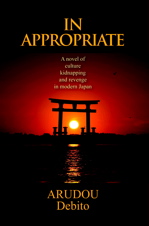
That’s why I’m pleased to mention Amanda Harlow’s review of my most recent book, novel “IN APPROPRIATE: A novel of culture, kidnapping, and revenge in modern Japan” (which just came out on Amazon Japan, so save shipping!), was featured on the Being A Broad website last week. She doesn’t really dig the book. But she actually DOES talk about the book both in terms of content and context, and offers ways in which the book might have in her opinion been better. The job of the reviewer is not simply to say what’s right or wrong about any work, but also to suggest improvements — offer the creator something he or she could learn from this experience to put into the next effort. Amanda does this, and I thank her for it.
It’s a pretty nasty world out there, and it’s easy to be a critic. It’s harder to be a good critic, and people like Amanda Harlow I would like to salute and thank for a critique well done, even if she didn’t like the book much. I of course don’t agree with all her assessments, but I think this review is fair and I can learn something from it. Thanks. Arudou Debito
Book Review: In Appropriate
BY AMANDA HARLOW
Being A Broad.com review, September 8, 2011
Courtesy http://networkedblogs.com/mHuIh
Is it a novel? Is it an opinion piece? Is it a fact-packed academic essay? Is it a thinly disguised auto-biography? What is In Appropriate by Debito Arudou? Unfortunately, all of the above.
Arudou, a former American and naturalised Japanese, is best (and worst) known as Japan’s most passionate non-Japanese residents’ rights campaigner–he of the struggles to highlight onsen and bars banning foreigners, worker rights, flyjins, and more.
Recently, he’s turned his attentions to When International Marriages Go Bad in Japan and, in particular, the many-headed monster of who gets access to, or custody of, the kids. In spring 2011, Japan finally caved to diplomatic and campaigners’ pressure and announced it would prepare legislation to bring the country in line for joining the Hague Convention on the Civil Aspects of International Child Abduction.
Japanese divorcees have long been excluded from their children’s future by a deadly combination of custom and law, but the campaign around the Hague Convention signing arose when non-Japanese parents (mainly fathers?) started fighting the status quo.
So this book is timely, and, with the speed at which legislation tends to move in Japan, will sadly probably remain timely for a while yet. It’s also a first foray into fiction for Arudou, the busy blogger and commentator.
Here is a novel about a young American guy who marries a Japanese woman, comes to Japan, has kids…and then it all unravels. Along the way we learn all about the customs and laws of divorce and child access and custody…and a whole lot more.
Our hero, Gary Schmidt, a callow youth from small-town US, gets his Japanese girlfriend pregnant. He does the decent thing and comes to Japan to marry her and raise a family. Instead, he finds himself the unwelcome son-in-law of the Matsunaga family of Fukuoka. When the English teaching business is going well, life seems good, and Gary even becomes a naturalised Japanese. However, as the economy slides at the turn of the millennium and the shine wears off the internationalisation bauble, his business and then his family life suffer. Divorce and the threat that he may never see his kids again force Gary into a desperate plot to rescue/abduct them into the hoped-for haven of the American Consulate in Fukuoka.
There are strong similarities with the Christopher Savoie case, but I imagine with enough details changed to keep the lawyers at bay.
Using fiction to explore social/political/legal issues can be an excellent way to get across facts and opinion. The author draws us in with entertainment and weaves in nitty-gritty which we might skip over in a newspaper or documentary.
However, In Appropriate isn’t a seamless weave of fiction and fact. It’s more like a hastily tacked together patchwork of Arudou’s undoubtedly vast files on human-rights issues in Japan. Gary Schmidt can hardly make a move in the novel without unleashing a couple of paragraphs of facts or opinion or statistics concerning Life in Japan.
He arrives at Narita and we get a tsunami of information about “The Eye” that guards/guides public behavior in Japan; how foreigners are natural suspects; how airport staff work; immigration lines for aliens; government terrorism fears; Chiba police checks; lunchboxes; I.D. checks and the Foreign Registry Law, Section 13, Clause 2…
STOP! Stop already! The guy just arrived at the airport.
And so it continues. Facts drowning out the fiction is the main weakness of the book. Main characters such as Keiko, Gary’s wife, remain barely drawn. In Chapter two, she is the shy foreign-language student tasting independence in the US–and then just the obedient daughter under-parental-thumbs for the rest of the book. A story about a marriage and its problems needs more depth about its protagonists. Keiko’s parents too remain cyphers for the Japanese System rather than crafted characters in their own right. The book gives Keiko’s father, Katsumaro, a bonsai-size biography to explain his anti-American feeling and one set speech where he lambastes Gary for his failings–but for a relationship spanning 14 years, it is thinly drawn.
Did Gary and Katsumaro never have male-bonding time together in an onsen? Drink together? Did this family never have happy times? There isn’t space in the novel to find out. One page has Gary suggesting a move Stateside to Keiko…only a page or two later we are into locked doors and talks about divorce.
Among other things, the novel needs a sympathetic character who gives the justification for the opposing attitude to post-divorce child access: that being brought up by one parent is best for the child and less confusing. No, I don’t agree with that–but I have a few wonderful Japanese friends and students who actually do. In Appropriate only gives us the legal situation and there is no space for the view of ordinary people who just think a clean break with a painful past is better for children.
In the Author’s Note, Arudou refers to his own divorce and subsequent lack of contact with his children. Maybe that is all too recent and raw to let him write too closely a portrayal of a Japanese woman and a family in crisis. But a more likely scenario is that he could not control the free-flow torrent of facts from his office and computer files, via his brain and on into the computer screen draft of In Appropriate. I’m linked with Arudou through Facebook and I know from his status updates that he was polishing off chapters at a rapid rate through Golden Week. He’s a great marshaller of information.
The fiction vs. facts problem does matter, though, if we are to follow Gary’s misadventures in Japan with general interest. I live in Japan and am the happy child of divorced parents who both played a big part in my life, so I’m interested in this story. Not sure of how someone with only a passing interest in Japan would feel. There is a story to be told here: How does an ordinary guy end up being dragged through the legal and media glare in Japan? It could happen to you…yes you…the non-Japanese resident in Japan who thinks all is well in your expat world. Maybe this book could be handed out to young foreign grooms at wedding chapels throughout Japan–beware marriage to a Japanese woman and the power of her family! Hold your kids close!
The Japan of the book is not the Japan of JET program recruitment talks or Yokoso! tourist campaigns because, apart from bento boxes, Gary’s world doesn’t seem too happy. We leap from Japanese sex lives to citizenship, then the economy and post-Bubble recession, off onto a sidetrack of “relaxed education,” and eikaiwa in quick succession, and into the home straight with family life, child rearing, divorce, Japan police detention, and the courts. I was grateful that Arudou isn’t really into food preparations and safety standards, or the effects of plastics on hormones–otherwise Gary would not even be able to buy his beloved bento in peace.
Interestingly, the strongest section of the novel are those regarding child rescue/abduction at the American Consulate in Fukuoka. I don’t think Arudou is writing from personal experience here, but through his campaigning activities he has certainly absorbed the emotion and details from those fathers who have and it makes sad, painful reading. The facts are so bizarre they don’t need any fictional dressing.
Who is the book for? I have an acquaintance, a non-Japanese man going through marrital problems at the moment. Should I give it to him? Would he enjoy it? Learn from it? I’m not sure. Newbies in Japan? Would they enjoy the portrayal of the country’s dark sides? Those of us living her already may recognise many of Gary’s experiences, but probably hope that our own family situation could never descend into this hell.
In Appropriate is probably best viewed as a testament to the hundreds(?) or thousands(?) of foreign spouses, mainly men, who have lost their children after divorce with a Japanese national.
One day, many years from now, will Arudou’s own daughters pick up this book in the bargain bucket of a English-language bookshop and wonder–was Japan really still like this in the opening years of the 21st century? Will they understand their father’s anguish?
UPDATES ON TWITTER: arudoudebito
DEBITO.ORG PODCASTS on iTunes, subscribe free
Hi Blog. In line with the current thread on sexuality in Japan, what follows is a testimony by a NJ female, Sexylass, about how she got into (and got out of) a sexless marriage. She also talks about “The Douzo Effect” — the chilling effect that forced sexuality has on a relationship. Have a read. Arudou Debito
//////////////////////////////////////
The Douzo Effect By SexyLass September 7, 2011
I have always had a penchant for the exotic or the different. It is not the ordinary Australian girl that marries a Japanese man. There are a few of us but the most commonly-held scenario is Western men marrying Asian women (even if more Japanese men in fact marry foreign women). I love Asian faces and even though I am separated now from my Japanese husband something inside me still gets very excited when I see a good looking Asian man.
I studied Japanese at university as a mature age student and then I moved to Japan when I was thirty so I could really immerse myself into the Japanese language. I was a very lonely Western woman shagging the local temple’s Japanese monk whenever he could ‘come over and see me’ type of thing.
I met my (future) husband on a Japanese dating website for other lonely types.He spoke to me in Japanese. This was refreshing as the sexy monk who knew English never spoke to me in Japanese. This new man, lets call him Ken, charmed me by speaking to me slowly in Japanese, the way that every person in Japan expected me to speak to them in English so I could surreptitiously teach them English. Instead Ken did this for me in Japanese. Though we could probably have very well conversed in English as he had lived in America for a year of his life.
I stopped shagging the local monk and Ken and I spoke on the phone every night for several months in Japanese. We developed a long distance relationship over the phone. We had a lot of phone sex. I really believed that he was into it and his libido seemed quite similar to mine, that is, that he needed to have sex a lot. I had more long distance phone sex with Ken than I could count. Things looked very promising though we hadn’t yet met.
Ken began sending me gifts. It started with boxes of English versions of Japanese comic books. He sent me the English version of The Parasite and a few others because he wanted me to read what he read. He also sent me an orange wallet and said he had bought two so we could be like a ‘real Japanese couple’ with matching wallets. The gifts got bigger and more extravagant as time went on. There was an ice cream maker, boxes of chocolates and cartons of Lotte and Meiji chocolates, about as much as a convenience store would sell in a week perhaps. He also used to send me lots of chilled packages of meat. There was a lot of lamb, as Ken wanted me to experience the taste of his region. There were also a lot of sausages and beef and potatoes.
After a few weeks Ken convinced me to delete my profile from the dating website where we had met. I wasn’t keen to do it, but I felt obliged to with all the gifts I was getting and accepting from him. The gifts seemed never ending. I deleted my profile from the dating website.
I decided that I didn’t want to live in the same town as the monk anymore and that the only way to really emotionally leave the monk was to also physically leave the town where we both lived. So I got a better job in another prefecture. No longer was I going to be the English Conversation school slave catching trains all over Matsuyama all day from 6 in the morning till 10 at night with classes interspersed throughout train trips each day. I was going to be a different kind of English slave, an 8am to 4pm English slave. I had got a job as an ALT (Assistant Language Teacher) for a dispatching company. I was happy as I was going to be in Japanese schools hearing Japanese all day and although I was employed to teach English, at least I was going to be immersed in a more Japanese atmosphere. I had not come all the way to Japan to be told I could only speak English all day every day. I had studied Japanese as my university major so I wanted some kind of cultural immersion. I was happy to be going to work as an ALT.
When I arrived in the new town there was one more phone call from the monk but I sent him an angry text saying not to contact me anymore as I could no longer provide him with the emotional support he needed. That is to talk to him on the phone every night when he would call me after he had drunk a bottle of whiskey. The monk had alcohol issues. He had drained me spiritually for too long.
In the new town, the phone relationship and the phone sex continued with Ken.And so did the presents, as Ken sent me presents to settle in. These presents were too extravagant and really should have been a warning bell about Ken’s personality. I should have had them returned but I was poor and lonely and I was in love with him.
So I accepted the brand new fridge, washing machine, TV, couch, bed, vacuum cleaner, and microwave. It was over the top but the presents kept arriving. I emailed my mum and my best friend in Australia and they suggested to me that it was a dubious situation and that I should suspect something was wrong with Ken. Really I should have, someone who I had never even met in person was furnishing my flat with brand new appliances. I had heard lots of outrageous stories of generosity in Japan from other non-Japanese and I thought it was just that, Japanese generosity. I didn’t have much money at the time and I welcomed the gifts.
I enjoyed my new job as an ALT in Nagoya, I was hearing Japanese every day and some teachers in some staff rooms would speak to me in Japanese. Six months went by and Ken came down south to meet me. He was everything I hoped for, tall, dark and handsome and he took me out and he kissed me passionately on the first day. That night we slept together but that should have been a warning sign too. Although we had kissed lots of times that day I had to seduce him to sleep with me. He had got me excited through the day with lots of kissing and I thought he wanted the same thing as I did, wild hot sex. I thought he was really into me like I was into him. Though it seemed I did all the work and it was over within a minute. Oh well I thought, must have been the ‘first time excitement’ for Ken and he will probably take more time as he becomes more relaxed with me.
The next day Ken surprised me with tickets to his hometown. I stayed a week in with him and also met his parents. The meeting with the parents went well. They were kind and accepting of me in the first instance. The rest of the time we drove around his prefecture exploring and staying in various Japanese inns. There was enough sex in that week of our meeting for me to be satisfied. Once per night, and though it was at my initiation it didn’t phase me as he seemed to enjoy it. I was so happy to have met such a lovely man like Ken. I felt I had found true love.
Another thing that really makes sense to me now in hindsight is that I didn’t mind the lack of sex so much then, or lack of initiation by Ken as I had had some Australian boyfriends that wanted it all night every night. At that time I was relieved to have found someone that didn’t need sex three or four times a night. Though at the time Ken was probably wondering about this woman that had him ‘working’ every night. He was probably just being too polite and Japanese to talk about the fact that he didn’t want to do it so much.
It was a gorgeous week spent in his part of Japan and I went back down south with love in my heart for Ken. Six months later I quit my ALT job and moved prefectures to be with Ken.
I remember the day I arrived in Ken’s town; it was cold, wet, slushy and snowy. There was another warning sign when I turned up at the family noodle shop where Ken worked. I turned up and he didn’t seem too phased, he just kind of said “hi” and gave me the keys to his LDK (one room flat). His dad was in the shop and he wasn’t overly friendly either, though I had met him before. Perhaps Ken hadn’t even told his parents I was moving there. I mean it could be possible they had been quite shocked to see me actually turn up to live with their son.
I got a job as an ALT on the JET Program and life began as a live-in couple. We weren’t even living together a few months and the affection from him began to noticeably diminish. I remember one occasion when he came home after work and took my pants off. Ken went down on me, but only for about a minute, it didn’t last long, and that was the only time Ken ever went down on me in the whole 10 years we stayed together. Just once for a minute. Could you imagine just having intimate oral sex only once in your defacto or married life?
You might wonder why I stayed with him. I loved him and didn’t pay too much attention to the lack of sex at the beginning. Though I thought it was unusual I didn’t realise it was going to be a very serious problem in our marriage. But as he started to refuse my affections it became an enormous source of angst for me. It was a puzzle that I couldn’t solve, something he refused to talk about and something that I just hoped would get better and not worse as time went by. He wanted to be together all the time, just never sexually. I persisted to try and talk to him about the sexlessness but every time I would try to discuss it he refused to talk about it coming back each time with the same answer “nan no hanashi o shiteiru?” (what are you going on about?). We were both in denial that the marriage was not a normal marriage. I even suggested divorce back then but he refused to talk about that too.
Despite the pain of continuous sexual rejection I believed he truly loved me and I loved him and wanted to marry him. He never agreed or proposed though I suggested it. One day he completely surprised me by taking me to his parents’ house and announced that we were going to get married. I was shocked. And his mother must have been too as she burst into tears and hugged me hard for ages. Such a great show of emotion from Ken’s Japanese parents was quite phenomenal. Twelve months later we went to Australia and got married in my hometown.
The night before I flew out to Australia to get married I met a friend downtown for a coffee. I told her I didn’t really want to get married but my mother and his parents had gone to great expense and that I felt I had to go through with it. Really I shouldn’t have been so stupid, and so dishonest. I should have been assertive enough to cancel the wedding and at least pay my mum back for any money she had spent. I should have been a runaway bride but I was delusional. There is no excuse really, obviously I just needed to learn a very hard lesson.
So we were married. After a short honeymoon in Australia we went back to Japan and we never had sex again unless I insisted on it or initiated it. It was demoralising. It was shameful. Even in the first week of marriage I found strange messages on his phone of meeting rendezvous arrangements between him and various people. I thought they were potential girlfriends but in hindsight I think they must have been prostitutes. I confronted him and said I wanted an annulment. I didn’t care anymore and even told his parents about it, his parents screamed at him and he never did it again. Looking back I should have relied on my instinct. If you feel something is wrong in your relationship, well it is. If you think your partner is playing up, they generally are, what you feel is not imaginary.
It was like a prison sentence, not a marriage. I felt like I was in a sexual prison. The life sentence was that I would never have sex again with my husband but not with anyone else either because in the hope that things could get better I chose to be faithful to this man. I would get angry about it, then I would argue with him, then he would do something nice for me, take me out or buy me a present or tell me that he loved me. Each time he convinced me to stay in the marriage with him for love. This pattern continued for years. I would get angry and confront him and he’d convince me to stay, then I would calm down for a while always hoping for the best, thinking that one day our marriage might become slightly sexually normal. By normal I mean possibly we might have sex once a year or once every six months. I know now that if things don’t start out as you’d like they are not going to change into what you would like. I really seem to need to learn the hard way.
————————–
After five years I was tired of teaching English in Japan. And there weren’t many employment opportunities for non-Japanese where we lived. I wanted to broaden my employment prospects. Ultimately I planned to return to Australia and I hoped to get a job as a Japanese translator or interpreter. I thought I would try and get into an Australian university that offered the best course in translation and interpreting. I had to pay an invigilator and that person needed to be a lecturer working at a university in Japan. I didn’t know anyone so I took a chance and emailed a fairly well known teacher and writer. I will call him John. I emailed him and asked him to come over to my place and proctor me for a fee. John agreed.
And so John came over and invigilated me. I didn’t pass. My Japanese still wasn’t as good as I had hoped it was. Though John stayed for a cup of tea and a biscuit and we chatted. It was great to get to know John. He was divorced from a Japanese woman and as a matter of course we got talking about our Japanese marriages. I spilled over that I was in a sexless marriage with a great guy. How is that for an oxymoron, sexless marriage but great guy? “He doesn’t satisfy me or give me much affection, but he is a top guy, a good husband.” John identified too that his ex-wife had also given him years of sexless marriage. We made jokes about the ridiculousness of sexless marriages, and shared demoralising stories. Most importantly though I was given some comic relief to laugh at such a sad situation, being in a marriage when clearly one person didn’t want to be intimate with the other anymore. And possibly never had really wanted to.
One of John’s stories really stood out. He coined it the ‘Douzo Effect’. John recalled to me that similarly to me he had hounded his wife a fair bit as to when they would have sex again. To appease him, he told me that one night she got in the shower, dried herself off, then with a towel around her laid on their bed and said ‘douzo’. John was horrified and completely turned off. It was as though she was offering herself, her body but she was not actually interested in any of the sex that would take place. Literally offering herself for him to do with what he wanted to do with her, but she wouldn’t be there emotionally, just physically. As demoralising as it was we still laughed a lot about this story. And so the Douzo Effect was born. I never thought I would experience the Douzo Effect. John said another thing to me that day that really made sense too, “if you don’t like who you yourself are when you are with a person, it is time to get out of the relationship”. I listened and understood those words but didn’t act on them. I just kept hoping things would get better.
So life went on and I continued to check Ken’s phone. There was no sign of anything clandestine and in my denial I convinced myself Ken just wasn’t a sexual person. Ken got a spouse visa and came back to Australia with me and we moved in with my mother for 12 months. Later we moved into my townhouse which I had bought ten years previously. He got various jobs. He became mentally unstable. Countless times I tried to hug him and he would physically push me away. On the few occasions when I did initiate sex and we did it, his forehead would be all tight and frowning when we were in the act. It looked like he was physically repulsed by me. It was always with me on top and him on the bottom. He was too lazy to even make an effort to try any other positions. As long as he didn’t have to do anything and could just lay there he would ‘participate’.
It was a couple of years later when it happened to me. After years of very little sex and fruitless discussions (initiated by me) with Ken about the marriage the Douzo Effect became reality. I had all but given up trying to resolve the problem of our sexless marriage with Ken but I still mentioned it as a joke sometimes. I think I had already forgotten about it by the time he got back from his shower and laid on his bed (as we were sleeping in separate beds by then). I went into his room to say goodnight and he said to me ‘douzo’ as he lay there naked on a towel on his single bed. I couldn’t believe it, years later exactly the same thing that John had shared with me was happening to me. Needless to say I was completely turned off and didn’t take up the offer.
That was the last time I even talked about sex with him again. The Douzo Effect had turned me off so much I stopped even mentioning anything about our sexlessness. I began to completely give up on the marriage. I gave up trying to communicate with him about it and in my mind wondered how I could continue in a marriage with a man that never wanted to have sex with me ever again. I often wondered if I would experience mutual affection or sex again in this lifetime, before I died. I knew that my marriage was not a real marriage. By then I had even talked about my sexless situation with my family. My mother, my brothers and my sister-in-law knew about my sexless marriage. It was all so shameful for me. Before I had met Ken I had never spoken to my family about my sex life, that kind of thing did not feel right. But I had become so desperate and my self image was so distorted I couldn’t help sharing the details of my stupid situation with family and even workmates. In hindsight I think the sharing about it was the beginning of me emotionally leaving the marriage. By verbalising the situation I was beginning to clear a pathway out of the marriage. Though getting out was a long process.
Eventually there was no sex at all and by this point I no longer tried to have sex with him. After years of trying I no longer WANTED to have sex with him. We had not kissed for years. If he held my hand or sat next to me I would push him away, the same way he had physically pushed me off him for years. He had hurt me so much that I would not let him back in. I got fatter and ate more and more.
Despite Ken not wanting to have sex with me he desperately wanted a child and wanted me to go through the IVF process. He wanted an incubator. Thank goodness I was barren. I entertained this stupid thought and to cure my infertility I had an operation to get fibroids removed from my uterus. At the time I thought it would be my last chance at having a child. Funnily enough Ken’s grandmother had had the same operation. Her operation was so successful that she had produced four children after, one being Ken’s father.
After my operation when I was full of stitches and could barely walk Ken became mentally unstable and was in the end committed to a mental hospital for a few weeks. His family rang me and abused me and said that it was my fault that he had had his breakdown. That was interspersed with phone calls asking me to call the mental hospital and to interpret for them. After one too many abusive phone calls, I said to his mother that they would need to come to Australia to get him out and that they would need to do it through the Japanese consulate. They did, I didn’t hear from them much after that. They came and picked up Ken and took him back to Japan for lots of promised therapy.
Ken phoned me and mailed me from Japan as though nothing was wrong. In no uncertain terms I told him to stop calling me and in the emails I said I definitely didn’t want him in my life anymore. Ken was either angry or depressed before he finally broke down. He exhibited behaviours that didn’t correspond with friendship let alone marriage. He needed professional help. I did not like the person I had become in the marriage either. I had to begin to look after myself.
Unannounced, Ken turned up on my doorstep three months later. He said he was sleeping in his car. I felt sorry for him and took him back. He lived with me again for another twelve months. We never had sex again. We continued to sleep in separate rooms for those 12 months. I had become a mother figure to him. He wanted to stay in this mother-son marriage but again I couldn’t take it anymore. I felt that he was just using me for a place to live by then. He was also planning to set up a business despite being mentally unstable and having severe health problems related to his diabetes.
I suggested he find a share-house and so instead of calmly looking for a place online or in the paper he left in a wild rage. I did not throw him out, he chose to leave the way he did.
I heard from my sister-in-law who he had gone to visit and complain about me to, that he was sleeping in his car again. I was worried about him so I checked his mail. I know that is wrong but I was genuinely worried about him. I learnt that he had been sleeping in his car and emailing prostitutes and arranging meetings.
He had emailed a woman and arranged to buy her used knickers for the sum of $60 in a car park at night. Strangely though he had been coming back to my house during the day when I was at work and doing the dishes and putting the rubbish out. Buying used knickers at night and house chores by day.
After I discovered what he was up to, the proof that Ken still had sexual desires just not with me, I sent him a text asking for my key back. I also let him know that he wasn’t welcome in my house anymore. He returned my key and took the last of his things. I didn’t tell him I knew about the prostitutes, knickers or other strange mails. It was not going to resolve anything by this stage.
I have not seen him since and I don’t wish to. I still miss him, but I realise I am probably missing the Ken that I want him to be and not the Ken that he really is. I would rather be single and a bit lonely than to live in that lonely prison of a marriage. A marriage where I couldn’t have sex with my partner but I couldn’t have sex with anyone else either. I plan to have sex again with someone who mutually wants to have sex with me before I die at least. Now I have the freedom I should have granted myself long ago. I should have ended the relationship and not married but hindsight is only valuable if we treat it as a learning experience.
Basically Ken is a good person and despite everything that happened between us I wish him all the best. I hope he is ok but we don’t need to be married anymore, that is for sure. I think we are just two people that were getting older and got married for all the wrong reasons. We certainly aren’t the first and wont be the last.
—————————–
You might wonder why I stayed for so long, ten years with this man. I took my marriage vows seriously and tried to make the best of the marriage. I continuously hoped for the best, that things would get better. I even convinced myself at times that things could be worse and that I would be able to stay in a sexless marriage. Clearly the truth is that Ken didn’t desire me, he wanted a wife who played his mother. He is still interested in sex, just not with me.
It is really important that a couple agree about sex before they get married. No one is going to change and it is really important that your idea of marriage is the same idea of your partner’s idea of marriage, before you sign up. People get married for the wrong reasons. I did. I was lonely and I was worried about my age and finding someone. I also thought I had met the most wonderful man. He was kind, hardworking, funny, cooked well and always wanted to be with me. I ignorantly thought everything would work out for the best.
Being single now is great. I don’t plan on getting married again. I have a pretty good job and have interesting hobbies. I wouldn’t mind a sex friend or two but that’s all. I don’t want to live with anyone again. I am not holding out for Mr Right or even Mr Fantastic. I am not even searching for anyone. I am enjoying my life, my friends, my work and my hobbies. I like who I am and I will not stay in a relationship again because I think I have to.
EPILOGUE
Recently I took a risk and asked an acquaintance on a date. I didn’t expect anything to come of it but since I wrote my story I have had sex with this lovely man. He worships my body with his. Sleeping with him in the last few weeks has boosted my self-image and self-esteem more than thousands of dollars worth of therapy ever could. I don’t know where this relationship will go and am not worried either. I am enjoying the intimacy. The new man never directly or indirectly criticises my body. He accepts me and loves me for who I am. I did not realise how much the sexless marriage had damaged my self esteem until I finally had mutually desired sex again. The sex I am having now has done more for me than any therapy would ever do. I cannot emphasise that enough for anyone who is coming out of a sexless marriage. Hallelujah I am a woman again, a desirable beautiful woman.
“For Readers married to a Japanese, how often on average do you have sex?” (with your spouse, you wiseacres!)
The options are:
More than once a week.
About once a week.
Less than once a week but more than once a month.
About once a month.
Less than once a month.
If this poll applies to you, please vote. See right hand column on this blog page under my IN APPROPRIATE book illustration. Your answers strictly confidential, of course. Arudou Debito
UPDATES ON TWITTER: arudoudebito
DEBITO.ORG PODCASTS on iTunes, subscribe free
Hi Blog. Thanks to everyone for reading and making this article the #2-most read article on the Japan Times online for most of the day yesterday. Here it is up for commentary. Arudou Debito
In its cover story last month, The Economist newsmagazine looked at the issue of “Asia’s lonely hearts: Why Asian women are rejecting marriage and what that means.” It offered many reasons — including economics, education level, changes in family structures and gender roles, divorce difficulties, and demographics — for why many Asian women (and of course, by extension, Asian men) are marrying later or not at all.
I commend The Economist’s well-intentioned attempt at dealing with an important social issue. But its discussion left one major stone unturned: sex.
At the risk of turning this month’s scribbling into a Hugh Hefner column, I think it incumbent upon those of us planning a life in Japan to consider a fundamentally unhealthy social phenomenon: how sexuality in Japan is downplayed, if not encouraged to be omitted completely, from many married lives.
First, an axiom: Healthy adults have sex throughout their lives, and this should not necessarily change just because people get married.
However, in Japan it often does.
A “sexless marriage,” according to the Japan Society of Sexual Sciences, is generally defined as one where couples have sex less than once a month.
Sumie Kawakami, in her book “Goodbye Madame Butterfly: Sex, Marriage, and the Modern Japanese Woman,” cites a 2006 joint survey by the Ministry of Health, Labor, and Welfare and the Japan Family Planning Association that found more than a third (34.6 percent) of all Japanese married couples could be classified as “sexless.”
This is a rise from earlier surveys and should be discussed in Japan as a social problem. After all, Japan has a falling population and a birthrate at the bottom of the world’s scales — demographic trends that garner more than their fair share of media attention.
But sexlessness is hardly seen as problematic in Japan. Quite the opposite. Hark back to the 1990s, when the sekkusuresu state was portrayed in the media positively, even as a natural outcome of marriage.
There is of course plenty of coupling and intimacy before matrimony (as I’m sure many of our readers can attest), but once kids are in the picture (people are even discouraged from having intercourse while pregnant), sex can decrease markedly or even become nonexistent for a habit-forming period of time.
Ask why and the reasons are usually forthcoming: One side is often “too tired,” “It’s a nuisance,” or the kids are sleeping in the same bed, etc. The more cynical cite the cruel aphorism, “You don’t need bait for a fish already caught”.
But there is a fundamental difference here from attitudes in other developed societies, where sex even into old age (“orgasms at sixty!” on supermarket shelves, and don’t forget Oprah, Dr. Phil, etc.) is seen regardless of family lifestyles as a healthy and essential part of a relationship.
Not in Japan, oddly in this “must try harder” society.
Then this discouraging set of expectations gets recycled back into our media and becomes self-perpetuating. Group-think gets people off the hook from trying to maintain intimacy, while people made to feel they “want sex too much” are sometimes told to take their loins elsewhere. No wonder sleeping around in Japan is a national pastime.
One might say this is just an outcome of modern life in a crowded society. But similar modern pressures and overcrowding exist in other countries.
Consider a more worldwide sampling of the issue.
In 2005, Durex, the world’s largest condom maker, conducted a Global Sex Survey (see www.durex.com/en-jp/sexualwellbeingsurvey/documents/gss2005result.pdf) involving 317,000 respondents in 41 countries. The survey found that Japanese had the least sex in the world, at 45 times a year — far less than second-from-bottom Singapore (73 times a year), and even farther from the world average (103 times a year, meaning twice a week).
Moreover, less than a quarter (24 percent) of Japanese surveyed said they were “happy” with their sex lives, significantly lower than the global average of 44 percent.
Durex’s more recent Sexual Wellbeing Survey, involving 26,000 interviews from 26 countries, found Japan at the bottom again with even lower results (15 percent satisfied).
One might counter that everyone exaggerates or is reticent about their sexuality, skewing the stats. But in international comparisons, Japanese are rarely shy about presenting an upbeat image of their society to the world. Such low figures for Japan say to me that people are being brutally honest about sex, or that a lack of sexuality is not perceived as something negative.
This matters. It is one more disincentive to marry in Japan. Indeed, why lock yourself into a marriage to someone who becomes a sibling instead of a spouse?
Sex life is not part of the dialog on the decline in Asian marriage. But in Japan’s case, it should be.
It is Japan’s worst-kept secret.
Arudou Debito’s novel “In Appropriate” is now on sale (www.debito.org/inappropriate.html) Just Be Cause appears on the first Community Page of the month. Twitter arudoudebito. Send comments to community@japantimes.co.jp. Responses to last month’s column, “The loneliness of the long-distance foreigner,” will be published and posted online next Tuesday.
Hi Debito.org Newsletter Subscribers. Let me start off with a heads-up about my next Japan Times JUST BE CAUSE column out tomorrow, Tuesday, September 6, 2011, on Japan’s Worst-Kept Secret: Sex Lives! Here’s the opening:
//////////////////////////////////////// In its cover story last month, The Economist newsmagazine looked at the issue of “Asia’s lonely hearts: Why Asian women are rejecting marriage and what that means.” It offered many reasons — including economics, education level, changes in family structures and gender roles, divorce difficulties, and demographics — for why many Asian women (and of course, by extension, Asian men) are marrying later or not at all.
I commend The Economist’s well-intentioned attempt at dealing with an important social issue. But its discussion left one major stone unturned: sex.
At the risk of turning this month’s scribbling into a Hugh Hefner column, I think it incumbent upon those of us planning a life in Japan to consider a fundamentally unhealthy social phenomenon: how sexuality in Japan is downplayed, if not encouraged to be omitted completely, from many married lives…
////////////////////////////////////////
Now for the Newsletter. It’s a short one, since I have been taking time out this summer to detox myself from the Internet:
Table of Contents:
//////////////////////////////////////// 1) BAChome: US Consulate Osaka refuses to aid American citizen child abducted in Japan who came to them for help 2) Sendaiben on MOJ interview for his naturalization, went badly: GOJ now requires applicants become STATELESS? 3) It’s time for the naysayers to capitulate regarding the Fukushima Crisis; referential articles 4) Excellent Japan Times article on GOJ reforms (and probable non-reforms) of child custody system post-divorce 5) Association for Psychological Science paper: “Ironic effects of anti-prejudice messages”; claims programs to decrease prejudices may actually increase if the prejudiced people feel they are having negative ideology forced upon them.
…and finally…
6) Japan Times JUST BE CAUSE column, August 2, 2011, “The loneliness of the long-distance foreigner”, about the difficulty for NJ to make long-term J friends
////////////////////////////////////////
By Arudou Debito (debito@debito.org)
Archives, Comments, RSS, and more at www.debito.org. Twitter arudoudebito
Freely Forwardable
////////////////////////////////////////
1) BAChome: US Consulate Osaka refuses to aid American citizen child abducted in Japan who came to them for help
BAChome: On August 24, 2011, 14 year-old Mary Victoria Lake, a U.S. citizen, who was kidnapped by her mother and taken to Japan in 2005, in one of the most high-profile international kidnapping cases in the United States, walked into the U.S. consulate in Osaka, Japan. She asked to be rescued from her kidnapper, an act of enormous bravery by a teenager who has been cut off from her father and held captive overseas for the past six years. Indifferent and incompetent U.S. Consular officials refused to aid or rescue her and instead sent her back to her kidnapper…
This is third and latest episode of gross negligence by the Department of State toward Mr. Lake and his daughter. Twice previously, they illegally issued passports for his daughter without obtaining the father’s signature, even after it had been established that her father was the lawful parent and the mother was a wanted kidnapper.
Almost all of the existing cases involve at least one parent who is Japanese. This case however is a clear exception. Neither one of the victims nor the kidnapping mother are of Japanese ancestry. There is simply no reason for Mary to be held in Japan. However, no one from the White House or The State Department is publicly demanding the return of Mary Victoria Lake or any of the other 374, and more realistically, thousands of American children held captive there.
It has become starkly apparent to the parents victimized by the crime of parental child abduction that the Department of State clearly values the relations with foreign nations over the safety, well-being and lives of U.S. citizen children being held captive in Japan.
2) Sendaiben on MOJ interview for his naturalization, went badly: GOJ now requires applicants become STATELESS?
Here is a report from Sendaiben about his experiences going through the rigmarole (found in every country) for naturalization. His most recent experience, however, was for him very negative and even off-putting, ultimately being told that he would have to render himself STATELESS in order to obtain Japanese citizenship.
Quite a different experience from what I went through more than a decade ago. And this is the country that encourages people to naturalize if they want rights? What a crock.
Sendaiben:I had a new case officer, a youngish guy in his mid-30s. He was brusque to the point of rudeness throughout our interactions, neglecting to use polite Japanese and ignoring me for extended periods several times. Not in the slightest bit friendly or encouraging, our interview went more or less as follows:…
4. He went on to explain how the system had changed from the last time I had it explained to me. For UK nationals, towards the end of the application process, there is a requirement that they formally renounce their UK citizenship, and obtain written proof of this from the UK government. At this point they become stateless, and are given special permission to remain in Japan until the naturalization process is complete. If the application is successful, they then receive Japanese citizenship. If unsuccessful, the UK will return citizenship upon request once…
I was actually very discouraged by this. Now, I am fairly sure that if I went ahead and applied, I would probably be successful. I have a good job, a Japanese family, I have been living here for eleven years, and am fairly well-integrated into society. I like Sendai, and plan to live here for a while, if not for good. However, I don’t need to naturalize, and probably won’t bother for at least another couple of years (when I will probably call up the Sendai Houmukyoku and hope that I get a more pleasant case officer).
3) It’s time for the naysayers to capitulate regarding the Fukushima Crisis; referential articles
Fukushima is a mess, just like we suspected it would be. More than five months later, the Japanese public still has insufficient information about what’s going on down there, and people are being slowly poisoned as radiation percolates through the food chain and begins to be picked up overseas. As I’ve said before, this is Japan’s long-burning tyreyard fire, and there is still no end to the crisis in sight.
But one other thing also has to be said. Back in March, when Debito.org merely had the audacity to raise some questions about the situation and the information we were getting, we were roundly criticized for being “alarmist”, “ignorant”, “wrong”, “reputation-damaging”, and even “racist”. One even said, “The greatest health effects of all nuclear incidents have been due to the anxiety that people like you are doing their best to ramp up. Thanks a lot for contributing to the problem.” That’s pretty bold — as if we were trying to instigate a panic and damage people’s health just because we wanted to know more information (which the nuclear industry worldwide keeps a lid on, down to the very science, to keep the public in the dark about their shenanigans and corruption).
Well, guess what critics — five months later, clearly YOU were wrong.
The Fukushima Crisis has exposed the inability of the GOJ (whether you mean politician or bureaucrat) to respond in a timely or safe manner, to follow the rules and safety standards (even changing safe radiation levels to suit political exigency), to show proper leadership or even adequate concern for its citizens in harm’s way, to release facts of the case so that people could make an informed decision, or to acknowledge there had even been a meltdown (something other observers knew based upon reasoned analysis of reactors’ output, but the GOJ would not admit), for months! The political culture which enables people in power in Japan to evade responsibility is now slowly poisoning Japanese society, if not eventually parts of the world, and that has to be addressed in the arena of public opinion.
Back in March, we at Debito.org did try to err on the side of caution and give some benefiting of the doubt (even shutting ourselves up when we had insufficient information). We wanted to wait and see how the cards fell. They clearly fell in favor of our original assertions that we were not being told the full story, and that things were far worse than was being let on. Now, critics, let’s have some honest capitulation on your part. You know who you are. It’s so easy to be a critic, but much harder to admit you’re wrong. Have the cojones to do that, especially about something as serious and society-changing as this.
Some referential articles follow, showing 1) the slow poisoning of children by Fukushima (NHK World), 2) how deep the institutional rot runs (NY Times), 3) more on the science of radioactivity and how seriously matters are not being taken (Japan Focus), and 4) the new attempts at spin-doctoring the situation, for starters.
4) Excellent Japan Times article on GOJ reforms (and probable non-reforms) of child custody system post-divorce
Colin Jones: Those focused on the government’s stumbling efforts to protect the children of Fukushima from radioactive contamination may find this hard to believe, but Japanese family law just got more child-friendly — maybe. If Japan finally signs the Hague Convention on child abduction, as it appears it will, it could become even more so. There is a big “maybe” here too, so it remains to be seen whether these two steps taken by the Diet will steer the country away from its status as a black hole for parental abduction or leave it treading the same sorry path.
On May 27 a law was passed amending a number of provisions in the Civil Code relating to children and their parents. First, Article 766 of the code was revised to require parents seeking a cooperative (i.e., nonlitigated) divorce to decide upon visitation, child support payments and other matters relevant to their children’s upbringing after divorce. Furthermore, the new provision says that the welfare of the children must be the primary consideration when these matters are decided…
Meanwhile, on the Hague Convention front, a legislative committee appears to be considering domestic legislation that will ensure no abducted child ever has to be returned after Japan signs it. A basic premise of the convention is that judicial determinations about children after their parents separate should be made in the country where the children have been living. Children who are unilaterally removed to another country should thus promptly be located and returned to their country of habitual residence…
Based on current proposals that I have seen, Japanese authorities may be allowed to refuse to return a child if (a) either the child or taking parent have been subject to abuse (including “violent words”), (b) the taking parent cannot return to the child’s home country because of fear of criminal prosecution upon return, (c) the taking parent is the primary caregiver but cannot raise the child in the home country for financial or other reasons, or (d) the helpfully vague “there are other circumstances” making return potentially harmful to the child.
5) Association for Psychological Science paper: “Ironic effects of anti-prejudice messages”; claims programs to decrease prejudices may actually increase if the prejudiced people feel they are having negative ideology forced upon them.
Paper: Organizations and programs have been set up all over the globe in the hopes of urging people to end prejudice. According to a research article, which will be published in an upcoming issue of Psychological Science, a journal of the Association for Psychological Science, such programs may actually increase prejudices.
Lisa Legault, Jennifer Gutsell and Michael Inzlicht, from the University of Toronto Scarborough, were interested in exploring how one’s everyday environment influences people’s motivation toward prejudice reduction…
The authors suggest that when interventions eliminate people’s freedom to value diversity on their own terms, they may actually be creating hostility toward the targets of prejudice.
According to Dr. Legault, “Controlling prejudice reduction practices are tempting because they are quick and easy to implement. They tell people how they should think and behave and stress the negative consequences of failing to think and behave in desirable ways.” Legault continues, “But people need to feel that they are freely choosing to be nonprejudiced, rather than having it forced upon them.”
6) Japan Times JUST BE CAUSE column, August 2, 2011, “The loneliness of the long-distance foreigner”, about the difficulty for NJ to make long-term J friends
All for now. Thanks for reading! Have another read again tomorrow at the Japan Times!
Arudou Debito (debito@debito.org)
Archives, Comments, RSS, and more at www.debito.org. Twitter arudoudebito
UPDATES ON TWITTER: arudoudebito
DEBITO.ORG PODCASTS on iTunes, subscribe free
Hi Blog. Here’s the USG demonstrating how much it cares for the welfare of its American citizens abroad (despite being one of the few countries that taxes its citizens abroad). One might make the case that the USG’s missions abroad are basically to project hegemony and maintain weapons sales. I wouldn’t, though, never ever. But this case is a nonsense and the State Department’s negligent Office of Children’s Issues should hang its head in shame and make people accountable for refusing to help. Arudou Debito
On August 24, 2011, 14 year-old Mary Victoria Lake, a U.S. citizen, who was kidnapped by her mother and taken to Japan in 2005, in one of the most high-profile international kidnapping cases in the United States, walked into the U.S. consulate in Osaka, Japan. She asked to be rescued from her kidnapper, an act of enormous bravery by a teenager who has been cut off from her father and held captive overseas for the past six years. Indifferent and incompetent U.S. Consular officials refused to aid or rescue her and instead sent her back to her kidnapper.
Her father, William Lake, was later informed of his daughter’s attempted return by caseworker Virginia Vause from the U.S. Department of State’s Office of Children’s Issues (OCI). During the multiple conversations with Ms. Vause that day, he learned that the consular officials had made a single attempt to call him at his residence. They did not to leave him a voicemail nor did they attempt to contact him on his cell phone or send an email. When Mr. Lake brought up the issue of why his daughter was turned away from the consulate, he was told that the consulate would not assist in his daughter’s rescue because they needed to have his written authorization to take her into custody. Furthermore, if Mary was taken into custody the Consulate would have to assign a staff member to stay with her until her return to the U.S., an inconvenience that the State Department refused to accept. They also needed him to sign an agreement, in advance, to repay any airline costs. These documents would take at least a week to process once OCI sent and received them.
None of the other parents we have checked with, who have been fighting for the return of their children for years, were aware of these consular requirements. State Department caseworkers had failed to inform them either out of negligence or purposeful deception, which leaves all internationally abducted children exposed to the same risk.
According to U.S. Department of State figures there are 268 cases involving 374 American citizen children who have been kidnapped to Japan since they started keeping track in 1994. OCI Division Chief Stefanie Eye has acknowledged “that our data is based entirely on proactive reporting and that because our database was designed primarily as a case management tool, it is difficult to provide statistical data with complete accuracy.”
Based on our statistical analysis, Bring Abducted Children Home (BACHOME.org) has estimated 4,417 American children have lost significant, meaningful access to their parent after divorce in Japan and by international abduction. Each one of these is a human rights violation.
This is third and latest episode of gross negligence by the Department of State toward Mr. Lake and his daughter. Twice previously, they illegally issued passports for his daughter without obtaining the father’s signature, even after it had been established that her father was the lawful parent and the mother was a wanted kidnapper.
Almost all of the existing cases involve at least one parent who is Japanese. This case however is a clear exception. Neither one of the victims nor the kidnapping mother are of Japanese ancestry. There is simply no reason for Mary to be held in Japan. However, no one from the White House or The State Department is publicly demanding the return of Mary Victoria Lake or any of the other 374, and more realistically, thousands of American children held captive there.
It has become starkly apparent to the parents victimized by the crime of parental child abduction that the Department of State clearly values the relations with foreign nations over the safety, well-being and lives of U.S. citizen children being held captive in Japan.
UPDATES ON TWITTER: arudoudebito
DEBITO.ORG PODCASTS on iTunes, subscribe free
Hi Blog. Here is a report from Sendaiben about his experiences going through the rigmarole (found in every country) for naturalization. His most recent experience, however, was for him very negative and even off-putting, ultimately being told that he would have to render himself STATELESS in order to obtain Japanese citizenship.
/////////////////////////////////////////////////// From: Sendaiben Subject: Sendai Houmukyoku Interview July 15, 2011
A couple of people asked me to write up my recent (well, relatively recent, given that it happened just before the earthquake) experience of talking to the Houmukyoku (Ministry of Justice office) in Sendai about naturalizing as a Japanese citizen.
I have talked to them before on a couple of occasions (most recently in 2008 or so) where they explained the procedure and the necessary paperwork, then asked me to come back when it was all done. The people I spoke to in the past were relatively friendly and encouraging, and treated me in a professional and courteous manner. I came out of the interviews fairly enthusiastic about naturalizing.
Fast forward two and a half years, when I finally had all the paperwork together. Gathering all the required pieces of paper was extremely time-consuming in my case, for a few reasons:
1. the UK has a fairly decentralized record keeping system 2. my parents both died over twenty years ago, so I was not able to get certain dates and other information from them 3. I was born outside the UK
It took several weeks of effort over a period of a couple of years to get hold of the various birth, death, marriage, and divorce certificates that I needed for my immediate family (parents and brother). I understand I will also need the full range of Japanese documents (koseki touhons, ARC printouts, tax certificates, etc.), but this will be relatively simple to do here in Sendai and as these documents expire within a few months of issue I haven’t bothered to get them yet.
I called the Houmukyoku in February and arranged to go in for an interview in early March (the Sendai office tends to take two or three weeks to make an appointment).
I had a new case officer, a youngish guy in his mid-30s. He was brusque to the point of rudeness throughout our interactions, neglecting to use polite Japanese and ignoring me for extended periods several times. Not in the slightest bit friendly or encouraging, our interview went more or less as follows:
1. I explained that I had been in before, and that I was coming in again to confirm my understanding of the process. I presented all the documents I had. 2. The officer admitted everything was in order, then asked me to fill in some forms (including a statement of intent). My handwritten Japanese in terms of kanji recall is very poor, as I do all my writing on computers and phones. Because of this, I looked up several kanji on my phone while writing. 3. The officer seized upon this as a reason why I would not be eligible to naturalize, and suggested I “go away and learn Japanese”. I should explain that I have passed the JLPT 1 and kanji kentei 7, both of which should have served as proof that my Japanese is good enough for naturalization purposes. My case officer disagreed 🙂 4. He went on to explain how the system had changed from the last time I had it explained to me. For UK nationals, towards the end of the application process, there is a requirement that they formally renounce their UK citizenship, and obtain written proof of this from the UK government. At this point they become stateless, and are given special permission to remain in Japan until the naturalization process is complete. If the application is successful, they then receive Japanese citizenship. If unsuccessful, the UK will return citizenship upon request once. 5. I gathered my notes, thanked him, and left.
I was actually very discouraged by this. Now, I am fairly sure that if I went ahead and applied, I would probably be successful. I have a good job, a Japanese family, I have been living here for eleven years, and am fairly well-integrated into society. I like Sendai, and plan to live here for a while, if not for good. However, I don’t need to naturalize, and probably won’t bother for at least another couple of years (when I will probably call up the Sendai Houmukyoku and hope that I get a more pleasant case officer).
I am a bit disappointed though. I would have thought Japan would be encouraging people to naturalize, rather than doing everything possible to discourage them.
Hong Kong or maybe Singapore are starting to look more attractive. We’ll see how it goes.
UPDATES ON TWITTER: arudoudebito
DEBITO.ORG PODCASTS on iTunes, subscribe free
Hi Blog. While I still want to reserve the summer for cycling and outdoor non-blog stuff, one thing has to be said: Fukushima is a mess, just like we suspected it would be. More than five months later, the Japanese public still has insufficient information about what’s going on down there, and people are being slowly poisoned as radiation percolates through the food chain and begins to be picked up overseas. As I’ve said before, this is Japan’s long-burning tyreyard fire, and there is still no end to the crisis in sight.
But one other thing also has to be said. Back in March, when Debito.org merely had the audacity to raise some questions about the situation and the information we were getting, we were roundly criticized for being “alarmist”, “ignorant”, “wrong”, “reputation-damaging”, and even “racist”. One even said, “The greatest health effects of all nuclear incidents have been due to the anxiety that people like you are doing their best to ramp up. Thanks a lot for contributing to the problem.” That’s pretty bold — as if we were trying to instigate a panic and damage people’s health just because we wanted to know more information (which the nuclear industry worldwide keeps a lid on, down to the very science, to keep the public in the dark about their shenanigans and corruption).
Well, guess what critics — five months later, clearly YOU were wrong.
The Fukushima Crisis has exposed the inability of the GOJ (whether you mean politician or bureaucrat) to respond in a timely or safe manner, to follow the rules and safety standards (even changing safe radiation levels to suit political exigency), to show proper leadership or even adequate concern for its citizens in harm’s way, to release facts of the case so that people could make an informed decision, or to acknowledge there had even been a meltdown (something other observers knew based upon reasoned analysis of reactors’ output, but the GOJ would not admit), for months! The political culture which enables people in power in Japan to evade responsibility is now slowly poisoning Japanese society, if not eventually parts of the world, and that has to be addressed in the arena of public opinion.
Back in March, we at Debito.org did try to err on the side of caution and give some benefiting of the doubt (even shutting ourselves up when we had insufficient information). We wanted to wait and see how the cards fell. They clearly fell in favor of our original assertions that we were not being told the full story, and that things were far worse than was being let on. Now, critics, let’s have some honest capitulation on your part. You know who you are. It’s so easy to be a critic, but much harder to admit you’re wrong. Have the cojones to do that, especially about something as serious and society-changing as this.
Some referential articles follow, showing 1) the slow poisoning of children by Fukushima (NHK World), 2) how deep the institutional rot runs (NY Times), 3) more on the science of radioactivity and how seriously matters are not being taken (Japan Focus), and 4) the new attempts at spin-doctoring the situation, for starters. Knee-jerk defensive comments that do not reflect a careful reading of these references will not be approved. I think we’ve had quite enough knee-jerk-ism regarding this subject here already. Arudou Debito
REFERENTIAL ARTICLES
(Debito.org Readers who wish to post more articles in the Comments Section, please do so with date, link, and pertinent excerpt if not entire article.)
More Fukushima-related articles on Japan Focus, a trustworthy academic site, can be found by plugging in keyword “Fukushima” in their search engine, see http://japanfocus.org/site/search
/////////////////////////////////////////
Radiation effect on children’s thyroid glands
NHK World Sunday, August 14, 2011 02:16 +0900 (JST) http://www3.nhk.or.jp/daily/english/13_26.html Courtesy BCH A survey shows that a small amount of radioactive iodine has been detected in the thyroid glands of hundreds of children in Fukushima Prefecture.
The result was reported to a meeting of the Japan Pediatric Society in Tokyo on Saturday.
A group of researchers led by Hiroshima University professor Satoshi Tashiro tested 1,149 children in the prefecture for radiation in their thyroid glands in March following the accident at the Fukushima Daiichi nuclear plant. Radioactive iodine was detected in about half of the children.
Tashiro says radiation in thyroid glands exceeding 100 millisieverts poses a threat to humans, but that the highest level in the survey was 35 millisieverts.
Tashiro says based on the result, it is unlikely that thyroid cancer will increase in the future, but that health checks must continue to prepare for any eventuality.
ENDS
/////////////////////////////////////////
Japan Held Nuclear Data, Leaving Evacuees in Peril
By NORIMITSU ONISHI and MARTIN FACKLER Published: August 8, 2011
FUKUSHIMA, Japan — The day after a giant tsunami set off the continuing disaster at the Fukushima Daiichi nuclear plant, thousands of residents at the nearby town of Namie gathered to evacuate.
Given no guidance from Tokyo, town officials led the residents north, believing that winter winds would be blowing south and carrying away any radioactive emissions. For three nights, while hydrogen explosions at four of the reactors spewed radiation into the air, they stayed in a district called Tsushima where the children played outside and some parents used water from a mountain stream to prepare rice.
The winds, in fact, had been blowing directly toward Tsushima — and town officials would learn two months later that a government computer system designed to predict the spread of radioactive releases had been showing just that.
But the forecasts were left unpublicized by bureaucrats in Tokyo, operating in a culture that sought to avoid responsibility and, above all, criticism. Japan’s political leaders at first did not know about the system and later played down the data, apparently fearful of having to significantly enlarge the evacuation zone — and acknowledge the accident’s severity.
“From the 12th to the 15th we were in a location with one of the highest levels of radiation,” said Tamotsu Baba, the mayor of Namie, which is about five miles from the nuclear plant. He and thousands from Namie now live in temporary housing in another town, Nihonmatsu. “We are extremely worried about internal exposure to radiation.”
The withholding of information, he said, was akin to “murder.”
In interviews and public statements, some current and former government officials have admitted that Japanese authorities engaged in a pattern of withholding damaging information and denying facts of the nuclear disaster — in order, some of them said, to limit the size of costly and disruptive evacuations in land-scarce Japan and to avoid public questioning of the politically powerful nuclear industry. As the nuclear plant continues to release radiation, some of which has slipped into the nation’s food supply, public anger is growing at what many here see as an official campaign to play down the scope of the accident and the potential health risks.
Seiki Soramoto, a lawmaker and former nuclear engineer to whom Prime Minister Naoto Kan turned for advice during the crisis, blamed the government for withholding forecasts from the computer system, known as the System for Prediction of Environmental Emergency Dose Information, or Speedi.
“In the end, it was the prime minister’s office that hid the Speedi data,” he said. “Because they didn’t have the knowledge to know what the data meant, and thus they did not know what to say to the public, they thought only of their own safety, and decided it was easier just not to announce it.”
In an interview, Goshi Hosono, the minister in charge of the nuclear crisis, dismissed accusations that political considerations had delayed the release of the early Speedi data. He said that they were not disclosed because they were incomplete and inaccurate, and that he was presented with the data for the first time only on March 23.
“And on that day, we made them public,” said Mr. Hosono, who was one of the prime minister’s closest advisers in the early days of the crisis before being named nuclear disaster minister. “As for before that, I myself am not sure. In the days before that, which were a matter of life and death for Japan as a nation, I wasn’t taking part in what was happening with Speedi.”
The computer forecasts were among many pieces of information the authorities initially withheld from the public.
Meltdowns at three of Fukushima Daiichi’s six reactors went officially unacknowledged for months. In one of the most damning admissions, nuclear regulators said in early June that inspectors had found tellurium 132, which experts call telltale evidence of reactor meltdowns, a day after the tsunami — but did not tell the public for nearly three months. For months after the disaster, the government flip-flopped on the level of radiation permissible on school grounds, causing continuing confusion and anguish about the safety of schoolchildren here in Fukushima.
Too Late
The timing of many admissions — coming around late May and early June, when inspectors from the International Atomic Energy Agency visited Japan and before Japan was scheduled to deliver a report on the accident at an I.A.E.A. conference — suggested to critics that Japan’s nuclear establishment was coming clean only because it could no longer hide the scope of the accident. On July 4, the Atomic Energy Society of Japan, a group of nuclear scholars and industry executives, said, “It is extremely regrettable that this sort of important information was not released to the public until three months after the fact, and only then in materials for a conference overseas.”
The group added that the authorities had yet to disclose information like the water level and temperature inside reactor pressure vessels that would yield a fuller picture of the damage. Other experts have said the government and Tokyo Electric Power Company, known as Tepco, have yet to reveal plant data that could shed light on whether the reactors’ cooling systems were actually knocked out solely by the 45-foot-tall tsunami, as officials have maintained, or whether damage from the earthquake also played a role, a finding that could raise doubts about the safety of other nuclear plants in a nation as seismically active as Japan.
Government officials insist that they did not knowingly imperil the public.
“As a principle, the government has never acted in such a way as to sacrifice the public’s health or safety,” said Mr. Hosono, the nuclear disaster minister.
Here in the prefecture’s capital and elsewhere, workers are removing the surface soil from schoolyards contaminated with radioactive particles from the nuclear plant. Tens of thousands of children are being kept inside school buildings this hot summer, where some wear masks even though the windows are kept shut. Many will soon be wearing individual dosimeters to track their exposure to radiation.
At Elementary School No. 4 here, sixth graders were recently playing shogi and go, traditional board games, inside. Nao Miyabashi, 11, whose family fled here from Namie, said she was afraid of radiation. She tried not to get caught in the rain. She gargled and washed her hands as soon as she got home.
“I want to play outside,” she said.
About 45 percent of 1,080 children in three Fukushima communities surveyed in late March tested positive for thyroid exposure to radiation, according to a recent announcement by the government, which added that the levels were too low to warrant further examination. Many experts both in and outside Japan are questioning the government’s assessment, pointing out that in Chernobyl, most of those who went on to suffer from thyroid cancer were children living near that plant at the time of the accident.
Critics inside and outside the Kan administration argue that some of the exposure could have been prevented if officials had released the data sooner.
On the evening of March 15, Mr. Kan called Mr. Soramoto, who used to design nuclear plants for Toshiba, to ask for his help in managing the escalating crisis. Mr. Soramoto formed an impromptu advisory group, which included his former professor at the University of Tokyo, Toshiso Kosako, a top Japanese expert on radiation measurement.
Mr. Kosako, who studied the Soviet response to the Chernobyl crisis, said he was stunned at how little the leaders in the prime minister’s office knew about the resources available to them. He quickly advised the chief cabinet secretary, Yukio Edano, to use Speedi, which used measurements of radioactive releases, as well as weather and topographical data, to predict where radioactive materials could travel after being released into the atmosphere.
Speedi had been designed in the 1980s to make forecasts of radiation dispersal that, according to the prime minister’s office’s own nuclear disaster manuals, were supposed to be made available at least to local officials and rescue workers in order to guide evacuees away from radioactive plumes.
And indeed, Speedi had been churning out maps and other data hourly since the first hours after the catastrophic earthquake and tsunami. But the Education Ministry had not provided the data to the prime minister’s office because, it said, the information was incomplete. The tsunami had knocked out sensors at the plant: without measurements of how much radiation was actually being released by the plant, they said, it was impossible to measure how far the radioactive plume was stretching.
“Without knowing the strength of the releases, there was no way we could take responsibility if evacuations were ordered,” said Keiji Miyamoto of the Education Ministry’s nuclear safety division, which administers Speedi.
The government had initially resorted to drawing rings around the plant, evacuating everyone within a radius of first 1.9 miles, then 6.2 miles and then 12.4 miles, widening the rings as the scale of the disaster became clearer.
But even with incomplete data, Mr. Kosako said he urged the government to use Speedi by making educated guesses as to the levels of radiation release, which would have still yielded usable maps to guide evacuation plans. In fact, the ministry had done precisely that, running simulations on Speedi’s computers of radiation releases. Some of the maps clearly showed a plume of nuclear contamination extending to the northwest of the plant, beyond the areas that were initially evacuated.
However, Mr. Kosako said, the prime minister’s office refused to release the results even after it was made aware of Speedi, because officials there did not want to take responsibility for costly evacuations if their estimates were later called into question.
A wider evacuation zone would have meant uprooting hundreds of thousands of people and finding places for them to live in an already crowded country. Particularly in the early days after the earthquake, roads were blocked and trains were not running. These considerations made the government desperate to limit evacuations beyond the 80,000 people already moved from areas around the plant, as well as to avoid compensation payments to still more evacuees, according to current and former officials interviewed.
Mr. Kosako said the top advisers to the prime minister repeatedly ignored his frantic requests to make the Speedi maps public, and he resigned in April over fears that children were being exposed to dangerous radiation levels.
Some advisers to the prime minister argue that the system was not that useful in predicting the radiation plume’s direction. Shunsuke Kondo, who heads the Atomic Energy Commission, an advisory body in the Cabinet Office, said that the maps Speedi produced in the first days were inconsistent, and changed several times a day depending on wind direction.
“Why release something if it was not useful?” said Mr. Kondo, also a retired professor of nuclear engineering at the University of Tokyo. “Someone on the ground in Fukushima, looking at which way the wind was blowing, would have known just as much.”
Mr. Kosako and others, however, say the Speedi maps would have been extremely useful in the hands of someone who knew how to sort through the system’s reams of data. He said the Speedi readings were so complex, and some of the predictions of the spread of radiation contamination so alarming, that three separate government agencies — the Education Ministry and the two nuclear regulators, the Nuclear and Industrial Safety Agency and Nuclear Safety Commission — passed the data to one another like a hot potato, with none of them wanting to accept responsibility for its results.
In interviews, officials at the ministry and the agency each pointed fingers, saying that the other agency was responsible for Speedi. The head of the commission declined to be interviewed.
Mr. Baba, the mayor of Namie, said that if the Speedi data had been made available sooner, townspeople would have naturally chosen to flee to safer areas. “But we didn’t have the information,” he said. “That’s frustrating.”
Evacuees now staying in temporary prefabricated homes in Nihonmatsu said that, believing they were safe in Tsushima, they took few precautions. Yoko Nozawa, 70, said that because of the lack of toilets, they resorted to pits in the ground, where doses of radiation were most likely higher.
“We were in the worst place, but didn’t know it,” Ms. Nozawa said. “Children were playing outside.”
A neighbor, Hiroyuki Oto, 31, said he was working at the plant for a Tepco subcontractor at the time of the earthquake and was now in temporary lodging with his wife and three young children, after also staying in Tsushima. “The effects might emerge only years from now,” he said of the exposure to radiation. “I’m worried about my kids.”
Seeds of Mistrust
Mr. Hosono, the minister charged with dealing with the nuclear crisis, has said that certain information, including the Speedi data, had been withheld for fear of “creating a panic.” In an interview, Mr. Hosono — who now holds nearly daily news conferences with Tepco officials and nuclear regulators — said that the government had “changed its thinking” and was trying to release information as fast as possible.
Critics, as well as the increasingly skeptical public, seem unconvinced. They compare the response to the Minamata case in the 1950s, a national scandal in which bureaucrats and industry officials colluded to protect economic growth by hiding the fact that a chemical factory was releasing mercury into Minamata Bay in western Japan. The mercury led to neurological illnesses in thousands of people living in the region and was captured in wrenching photographs of stricken victims.
“If they wanted to protect people, they had to release information immediately,” said Reiko Seki, a sociologist at Rikkyo University in Tokyo and an expert on the cover-up of the Minamata case. “Despite the experience with Minamata, they didn’t release Speedi.”
In Koriyama, a city about 40 miles west of the nuclear plant, a group of parents said they had stopped believing in government reassurances and recently did something unthinkable in a conservative, rural area: they sued. Though their suit seeks to force Koriyama to relocate their children to a safer area, their real aim is to challenge the nation’s handling of evacuations and the public health crisis.
After the nuclear disaster, the government raised the legal exposure limit to radiation from one to 20 millisieverts a year for people, including children — effectively allowing them to continue living in communities from which they would have been barred under the old standard. The limit was later scaled back to one millisievert per year, but applied only to children while they were inside school buildings.
The plaintiffs’ lawyer, Toshio Yanagihara, said the authorities were withholding information to deflect attention from the nuclear accident’s health consequences, which will become clear only years later.
“Because the effects don’t emerge immediately, they can claim later on that cigarettes or coffee caused the cancer,” he said.
The Japanese government is considering monitoring the long-term health of Fukushima residents and taking appropriate measures in the future, said Yasuhiro Sonoda, a lawmaker and parliamentary secretary of the Cabinet Office. The mayor of Koriyama, Masao Hara, said he did not believe that the government’s radiation standards were unsafe. He said it was “unrealistic” to evacuate the city’s 33,000 elementary and junior high school students.
But Koriyama went further than the government’s mandates, removing the surface soil from its schools before national directives and imposing tougher inspection standards than those set by the country’s education officials.
“The Japanese people, after all, have a high level of knowledge,” the mayor said, “so I think information should be disclosed correctly and quickly so that the people can make judgments, especially the people here in Fukushima.”
ENDS
////////////////////////////////////////////
Radiation Effects on Health: Protect the Children of Fukushima
Kodama TatsuhikoProfessor, Research Center for Advanced Science and Technology, the University of Tokyo Head, Radioisotope Center, the University of Tokyo
Talk at the July 27, 2011 meeting of the Committee on Welfare and Labor of the House of Representatives
…In that case, the total dose is not much of an issue; rather, the density of radiation in each individual is the focus. However, following the recent accident at the Fukushima Nuclear Power Plant, 5 μSv within 100 kilometers and 0.5 μSv within 200 kilometers from the complex were recorded. And as all of you know now, radiation reached further beyond to affect Ashigara and Shizuoka tea leaves.When we examine radiation poisoning, we look at the entire amount. TEPCO and the government have never clearly reported on the total amount of radiation doses resulting from the Fukushima nuclear accident. When we calculate on the basis of the knowledge available at our Radioisotope Center, in terms of the quantity of heat, the equivalent of 29.6 Hiroshima a-bombs leaked. Converted to uranium, an amount equivalent to 20 Hiroshima a-bombs is estimated to have leaked.
What is further dreadful is that, according to what we know so far, when we compare the amount of radiation that remained after the a-bomb and that of radiation from the nuclear plant, that of the former goes down to one-thousandth after one year whereas radioactive contaminants of the latter are reduced to only one-tenth.
In other words, in thinking about the Fukushima nuclear power plant disaster, the first premise is that, as in the case of Chernobyl, an amount of radiation equivalent to tens of a-bombs was released and far greater contamination remains afterward compared with the a-bomb…
Fukushima forced depopulation, Japanese plead world aid
Deborah Dupre, Human Rights Examiner, August 22, 2011, Examiner.com, courtesy BCH (excerpt)
After “off-scale” radiation contamination at Fukushima was reported in early August, this weekend extremely excessive radiation contamination around Fukushima reported by the Ministry of Science and Education is forcing the Japanese government toward what New York Timestermed “long-term depopulation” with an announcement making the area officially uninhabitable for decades, as Japanese people, including radiation refugees, plead for global help to survive human right to health violations experienced since March when Japan’s ever worsening nuclear power plant catastrophe began.
The government is expected to make a formal announcement telling many of the radiation refugees that they will be prohibited from returning to their homes indefinitely according to several Japanese news reports over the weekend reported theNew York Times on Monday.
“Broad areas around the stricken Fukushima Daiichi nuclear plant could soon be declared uninhabitable, perhaps for decades, after a government survey found radioactive contamination that far exceeded safe levels, several major media outlets said Monday.”
Fukushima area being uninhabited for decades is no surprise to many independent nuclear experts or lay persons aware that has been case for areas around the Chernobyl nuclear power plant in Ukraine after its 1986 catastrophic accident. Today, an estimated five million people in the Ukraine suffer Chernobyl radiation deformities and cancer, many of whom were not born when that catastrophe began, according to a recent Australia CBS report. (See: “Fukushima now radiating everyone: ‘Unspeakable’ reality,” Dupré, August 16, 2011)
Examiner colleague, Alfred Lambremont reported in early July that, “Leuren Moret [MA, PhD (ABT)] released her court statement as expert witness in a lawsuit brought to force government officials to evacuate more than 350,000 children from the Fukushima area where they are being forcibly exposed by the government to lethal doses of radiation.”
The anticipated Japanese government relocation announcement would be the “first official recognition that the March accident could force the long-term depopulation of communities near the plant” reported The New York Times.
This forced depopulation issue is one that “scientists and some officials have been warning about for months” and criticized the government for not doing sooner. New York Times reports that:
“… evacuations have been a sensitive topic for the government, which has been criticized for being slow to admit the extent of the disaster and trying to limit the size of the areas affected, despite possible risks to public health. Until now, Tokyo had been saying it would lift the current evacuation orders for most areas around the plant early next year, when workers are expected to stabilize Fukushima Daiichi’s damaged nuclear reactors.”
U.S. involvement in nuclear genocide abroad and at home has been recorded by Leuren Moret who wrote in her Court statement:
“Instead of evacuation, the government gives the children (sick with radiation symptoms) film badges to measure the external exposure dose… another study group like U.S. govt. studies on Hiroshima and Nagasaki victims (they are still being studied), Iraq victims, Gaza victims. And the U.S. government did the same thing to Americans during 1300 nuclear bomb tests in the US.”
Radiation deniers foster nuclear industry
There have been Japanese government televised programs espousing Plutonium is good for humans.
After the Fukushima nuclear power plant catastrophe began, the nuclear industry urgently redoubled efforts to convince the world that nuclear radiation is safe and even more, “they are trying to say that radiation is actually good for us” according to Noel Wauchope.
“The whole idea of radiation is good for you is not new,” said Nuclear News editor Christina MacPherson in an email to Dupré. “It was pushed a few years back by Frenchman Bruno Comby with his ‘environmentalists for nuclear power’ campaign.”
More Fukushima-related articles on Japan Focus, a trustworthy academic site, can be found by plugging in keyword “Fukushima” in their search engine, see http://japanfocus.org/site/search
ends
Those focused on the government’s stumbling efforts to protect the children of Fukushima from radioactive contamination may find this hard to believe, but Japanese family law just got more child-friendly — maybe. If Japan finally signs the Hague Convention on child abduction, as it appears it will, it could become even more so. There is a big “maybe” here too, so it remains to be seen whether these two steps taken by the Diet will steer the country away from its status as a black hole for parental abduction or leave it treading the same sorry path.
On May 27 a law was passed amending a number of provisions in the Civil Code relating to children and their parents. First, Article 766 of the code was revised to require parents seeking a cooperative (i.e., nonlitigated) divorce to decide upon visitation, child support payments and other matters relevant to their children’s upbringing after divorce. Furthermore, the new provision says that the welfare of the children must be the primary consideration when these matters are decided….
Another significant change in the law will make it possible for public authorities to suspend for up to two years the parental authority of those who abuse or neglect their children. The supposed inability of child welfare officials to act aggressively has been cited in recent high-profile child abuse cases. Under prior law the termination of parental authority was permanent, rendering it a very blunt instrument.
Of course, any change that clarifies the principles underlying the laws relating to children in Japan is certainly a welcome step forward. Yet at the same time, I believe that the character of these amendments reflects a continuation of what I see as the core problem with Japanese family law.
Both the amendments described above approach the problem by addressing deficiencies in Japanese parents. Other amendments to the Civil Code making it clear that even nondivorcing parents must exercise their parental rights and responsibilities for the benefit of their childrenfurther reinforce this impression…
Meanwhile, on the Hague Convention front, a legislative committee appears to be considering domestic legislation that will ensure no abducted child ever has to be returned after Japan signs it. A basic premise of the convention is that judicial determinations about children after their parents separate should be made in the country where the children have been living. Children who are unilaterally removed to another country should thus promptly be located and returned to their country of habitual residence.
The convention does contain an exception that says a child does not have to be returned if there is a “grave risk” that doing so “would expose the child to physical or psychological harm or otherwise place him or her in an intolerable situation.” The Japanese government appears poised to drive truckloads of abducted children through this very limited exception.
Based on current proposals that I have seen, Japanese authorities may be allowed to refuse to return a child if (a) either the child or taking parent have been subject to abuse (including “violent words”), (b) the taking parent cannot return to the child’s home country because of fear of criminal prosecution upon return, (c) the taking parent is the primary caregiver but cannot raise the child in the home country for financial or other reasons, or (d) the helpfully vague “there are other circumstances” making return potentially harmful to the child.
This may seem well-intentioned, but it is important to understand that the Hague Convention is not about “keeping” children in their home countries. It is about parents respecting the law of the countries in which their children live before they unilaterally change their residence…
Act now: Rep. Chris Smith (center), standing with relatives of American children abducted to Japan, urges swift action by Washington on the issue last September on Capitol Hill. AP PHOTO
Hague campaigners doubt Japan’s sincerity
By WILLIAM HOLLINGWORTH
Kyodo
LONDON — Campaigners in Britain welcome Japan’s plans to sign up for a treaty on settling cross-border child custody disputes but feel new procedures are needed to effectively implement the agreement.
UPDATES ON TWITTER: arudoudebito
DEBITO.ORG PODCASTS on iTunes, subscribe free
Hi Blog. As a complete tangent (and to show you how human a lot of glasses of beer/wine renders a person), here we have an interview with vlogger Tkyosam done at the FCCJ Tokyo July 27, 2011, with a bunch of friends. It’s pretty silly, but dreadfully amusing, and it makes a good case for why humans need the outlet of booze. Kanpai, everyone. Debito
A few months ago I had beers with several old Japan-hand guys (combined we have more than a century of Japan experiences), and one of them asked an interesting question:
“After all our years here, how many close Japanese male friends do you have?” (Excluding Debito, of course.)
We glanced amongst ourselves and realized that none of us hadany. Not one we would count on as a “friend.” Nobody to whom we could talk openly, unreservedly, and in depth with, about what’s on our minds. Or contact for a place to stay because our spouse was on the warpath. Or call at 3 a.m. to announce the birth of our latest baby. Or ring up on the spur of the moment because we didn’t want to drink alone that evening. Or who would care enough to check on us in the event of a natural disaster. Not one.
This occasioned much discussion and theorizing, both at the table and on my blog later (see www.debito.org/?p=8933)
(A quick note to readers already poised to strike with poison pens: None of the following theories are necessarily mine, nor do I necessarily agree with them. They are just to stimulate further discussion.)
One theory was that Japanese salarymen of our age group are generally boring people. Too busy or work-oriented to cultivate outside interests or hobbies, these one-note-Taros generally “talk shop” or resort to shaggy-dog stories about food. We contrasted them with Japanese women, who, thanks to more varied lifestyles and interests (including travel, language and culture), are more engaging and make better conversation partners (even if, my friends hastily added, the relationship had not become physical).
Another idea was that for many Japanese men, their hobby was you. By this, the speaker meant the culture vultures craving the “gaijin shiriaiexperience” or honing their language skills. This was OK in the beginning (especially when we first got here) but it got old quickly, as they realized we wanted to learn Japanese too, and when they weren’t willing to reciprocate. Not to mention that we eventually got tired of hearing blanket cultural explanations for individual issues (which is how culture vultures are hard-wired to see the world, anyway).
Another theory was that after a certain age, Japanese men don’t make “friends” with anyone. The few lifelong friends they would ever make were in school; once they entered the job market, all other males were treated as rivals or steps to promotion — meaning you put up a mask and didn’t reveal potentially compromising personal information. Thus if Japanese men were going to make friends at all, they were going to make them permanently, spending enormous time and energy imprinting themselves on precious few people. This meant they had to choose wisely, and non-Japanese — generally seen as in Japan only temporarily and with unclear loyalties — weren’t worth the emotional investment.
Related to this were issues of Japan’s hierarchical society. Everyone was either subordinate or superior — kōhai or senpai — which interfered with friendships as the years marched on: Few non-Japanese (NJ) wanted to languish as kōhai, and few Japanese wanted to deal with a foreign senpai. Besides, went the theory, this relationship wasn’t something we’d classify as a “friendship” anyway. Conclusion: Japanese men, as opposed to Japanese women with their lifetime coffee klatches, were some of the most lonely people on the planet.
Another suggestion was that this was just part of how life shakes down. Sure, when you’re young and carefree you can hang out willy-nilly, spend money with abandon and enjoy the beer-induced bonhomie (which Japan’s watering holes are very good at creating) with everyone all night. But as time goes on and people get married, have kids, take on a mortgage and a nagging spouse (who doesn’t necessarily want you spending their money on your own personal fun, especially if it involves friends of the opposite sex), you prioritize, regardless of nationality.
Fine, our group countered, but we’ve all been married and had kids, and yet we’re still meeting regularly — because NJ priorities include beers with friends from time to time. In fact, for us the older the relationship gets, the more we want to maintain it — especially given all we’ve been through together. “New friends are silver, but old friends are gold.”
Still another, intriguing theory was the utilitarian nature of Japanese relationships, i.e. Japanese make friends not as a matter of course but with a specific purpose in mind: shared lifestyles, interests, sports-team fandom, what have you. But once that purpose had run its course — because you’ve exhausted all conversation or lost the commonality — you should expect to lose contact. The logic runs that in Japan it is awkward, untoward, even rude to extend a relationship beyond its “natural shelf life.” This goes even just for moving to another city in Japan: Consider it normal to lose touch with everyone you leave behind. The thread of camaraderie is that thin in Japan.
However, one naturalized Japanese friend of mine (who just turned 70) pooh-poohed all these theories and took me out to meet his drinking buddies (of both genders, mostly in their 60s and 70s themselves). At this stage in their lives things were less complicated. There were no love triangles, no senpai-kōhai conceits, no “shop talk,” because they were all retired. Moreover they were more outgoing and interesting, not only because they were cultivating pastimes to keep from going senile, but also because the almighty social lubricant of alcohol was omnipresent (they drank like there was no tomorrow; for some of them, after all, there might not be!). For my friend, getting Japanese to lower their masks was pretty easy.
Fine, but I asked if it weren’t a bit unreasonable for us middle-aged blokes to wait for this life stage just to make some Japanese friends. These things may take time, and we may indeed have to spend years collecting shards of short interactions from the local greengrocer before we put together a more revealing relationship. But in the meantime, human interaction with at least one person of the same gender that goes beyond platitudes, and hopefully does not require libation and liver damage, is necessary now for sanity’s sake, no?
There were other, less-developed theories, but the general conclusion was: Whatever expectation one had of “friends” — either between Japanese and NJ, or between Japanese themselves — there was little room over time for overlap. Ultimately NJ-NJ relationships wound up being more friendly, supportive and long-lasting.
Fire away, but you’d be missing the point of this column. When you have a good number of NJ long-termers saying they have few to no long-term Japanese friends, this is a very serious issue — with a direct connection to issues of immigration and assimilation of outsiders. It may be a crude barometer regarding life in Japan, but let’s carry on the discussion anyway and see how sophisticated we can make it.
So let’s narrow this debate down to one simple question: As a long-term NJ resident in Japan, how many Japanese friends do you have, as defined in the introduction above? (You might say that you have no relationship with anyone of any nationality with that much depth, but that’s awfully lonely — I dare say even unhealthy — and I hope you can remedy that.) Respondents who can address the other sides of the question (i.e. NJ women befriending Japanese women/men, and same-sex relationships) are especially welcome, as this essay has a shortage of insight on those angles.
Be honest. And by “honest”, I mean giving this question due consideration and experience: People who haven’t been living in Japan for, say, about 10 years, seeing how things shake down over a significant portion of a lifetime’s arc, should refrain from commentary and let their senpai speak. “I’ve been here one year and have oodles of Japanese friends, you twerpski!” just isn’t a valid sample yet. And please come clean about your backgrounds when you write in, since age, gender, occupation, etc. all have as much bearing on the discussion as your duration of time in Japan.
Above all, remember what my job as a columnist is: to stimulate public discussion. Respondents are welcome to disagree (I actually consider agreement from readers to be an unexpected luxury), but if this column can at least get you to think, even start clacking keyboards to The Japan Times, I’ve done my job. Go to it. Consider yourself duly stimulated, and please offer us some friendly advice.
UPDATES ON TWITTER: arudoudebito
DEBITO.ORG PODCASTS on iTunes, subscribe free
Hi Blog. It’s that time of the year again (perfect Hokkaido summer!), and it’ll soon be time for me to jump on the bike and do the rounds. I’ll be vacationing the blog for a little while (meaning comments will take some time to be approved; please be patient). I will be back from time to time, with JT articles and podcasts, but barring natural disasters like last March’s we won’t be updating daily. It’s just too nice outside and life’s too short.
Let me just mention that my next Japan Times JUST BE CAUSE column will be a fat one (1400 words) on something we discussed here on Debito.org some weeks ago — why so many NJ long-termers seem to find it hard to find long term Japanese friends (particularly male ones). That will be out Tuesday August 2, so enjoy! Arudou Debito
UPDATES ON TWITTER: arudoudebito
DEBITO.ORG PODCASTS on iTunes, subscribe free
In this penultimate post before vacationing Debito.org for the summer, here’s some food for thought. According to this upcoming paper, telling prejudiced people to stop being prejudicial may be less effective than spreading a message of why diversity and equality are important to people being discriminated against. So maybe for all these years I’ve been going about this the wrong way. Arudou Debito
Organizations and programs have been set up all over the globe in the hopes of urging people to end prejudice. According to a research article, which will be published in an upcoming issue of Psychological Science, a journal of the Association for Psychological Science, such programs may actually increase prejudices.
Lisa Legault, Jennifer Gutsell and Michael Inzlicht, from the University of Toronto Scarborough, were interested in exploring how one’s everyday environment influences people’s motivation toward prejudice reduction.
The authors conducted two experiments which looked at the effect of two different types of motivational intervention – a controlled form (telling people what they should do) and a more personal form (explaining why being non-prejudiced is enjoyable and personally valuable).
In experiment one; participants were randomly assigned one of two brochures to read: an autonomy brochure or a controlling brochure. These brochures discussed a new campus initiative to reduce prejudice. A third group was offered no motivational instructions to reduce prejudice. The authors found that, ironically, those who read the controlling brochure later demonstrated more prejudice than those who had not been urged to reduce prejudice. Those who read the brochure designed to support personal motivation showed less prejudice than those in the other two groups.
In experiment two, participants were randomly assigned a questionnaire, designed to stimulate personal or controlling motivation to reduce prejudice. The authors found that those who were exposed to controlling messages regarding prejudice reduction showed significantly more prejudice than those who did not receive any controlling cues.
The authors suggest that when interventions eliminate people’s freedom to value diversity on their own terms, they may actually be creating hostility toward the targets of prejudice.
According to Dr. Legault, “Controlling prejudice reduction practices are tempting because they are quick and easy to implement. They tell people how they should think and behave and stress the negative consequences of failing to think and behave in desirable ways.” Legault continues, “But people need to feel that they are freely choosing to be nonprejudiced, rather than having it forced upon them.”
Legault stresses the need to focus less on the requirement to reduce prejudices and start focusing more on the reasons why diversity and equality are important and beneficial to both majority and minority group members.
### For more information about this study, please contact: Lisa Legault at lisa.legault@utoronto.ca.
The APS journal Psychological Science is the highest ranked empirical journal in psychology. For a copy of the article “Ironic Effects of Anti-Prejudice Messages: How Motivational Interventions Can Reduce (but also increase) Prejudice” and access to other Psychological Science research findings, please contact Divya Menon at dmenon@psychologicalscience.org.
UPDATES ON TWITTER: arudoudebito
DEBITO.ORG PODCASTS on iTunes, subscribe free
DEBITO.ORG NEWSLETTER JULY 18, 2011
Table of Contents:
/////////////////////////////////////////// DEEP THOUGHTS FROM DEEP THINKERS
1) M.G. “Bucky” Sheftall academic paper on “Shattered Gods” and the dying mythology of “Japaneseness”
2) Peter Tasker in Foreign Policy Magazine: “Japan will rebuild, but not how you think”.
Takes opportunity of Japan’s worst postwar disaster to re-advance outmoded Chrysanthemum Club-ism.
3) Terrie’s Take on how Japanese companies are too “addicted” to cheap Chinese “Trainee” labor to hire unemployed Japanese
4) Donald Keene prattles on about why he’s naturalizing in SAPIO, even takes a cheap shot at NJ
5) Tokyo Gov Ishihara bids for 2020 Olympics through earthquake sympathy vote; also calls for Japan to have nukes, military conscription, and military-led government
THE MONTHLY MODICUM OF BAD SOCIAL SCIENCE
6) Bad social paradigms encouraging bad social science: UC Berkeley prof idiotically counts “flyjin” for H-Japan listserv
7) Reuters Expose: Japan’s ‘throwaway’ nuclear workers, including NJ “temporary temps”
8 ) 2011’s annual GOJ Spot the Illegal Alien campaign enlists Tokyo Metro, deputizes general public with posters of cute and compliant NJ
LET’S NOT LEAVE OUT EXCLUSIONISM
9) Zaitokukai Neonazis march in Tokyo Shibuya July 9, 2011, with ugly invective
10) BV inter alia on J bureaucrat exclusionary attitudes when registering his newborn multicultural child at Shibuya Kuyakusho
11) Mark Austin reports that Otaru, site of the famous onsen lawsuit, still has a “Japanese Only” establishment, “Monika”
12) Kyodo: Soccer S-Pulse coach Ghotbi wants to meet banned fans over racial banner
13) Joel Legendre-Koizumi on the J media’s blackout on PM Kan’s proposals
PORTENTS OF THE FUTURE
14) Adidas assesses the “history of poor treatment of migrant workers in Japan”, now monitoring JITCO in conjunction with other major overseas outsourcers
15) US State Department report 2011: “Japan’s Foreign trainee program ‘like human trafficking'”
16) Asahi: NJ Nurse trainees leave Japan despite 1-year extension to taking qualifying test
17) Quoted in Asia Weekly: “Falling birthrate, rising life expectancy afflict Japan”
18 ) Child Abductions Issue: How Japan’s debate on defining “Domestic Violence”, the loophole in enforcing the Hague Treaty, is heading in the wrong direction
19) Weekend Tangent: The euphoria of collective attack and parental alienation syndrome
PODCASTS
20) PODCAST: KQED-FM Pacific Time broadcast 14 Dec 2000, Arudou Debito reports on naturalizing in Japan (part 1 of 3)
21) PODCAST: KQED-FM Pacific Time broadcast 21 Dec 2000, Arudou Debito reports on J naturalization process (part 2 of 3)
22) PODCAST: KQED-FM Pacific Time broadcast 28 Dec 2000, Arudou Debito reports on naturalizing and name changes in Japan (part 3 of 3)
23) PODCAST: NPR All Things Considered on Arudou Debito’s naturalization July 3, 2003
24) PODCAST: NPR All Things Considered on Brooklynite Anthony Bianchi’s election to Inuyama City Council, April 30, 2003
25) DEBITO.ORG PODCAST JULY 1, 2011: FCCJ Book Break on IN APPROPRIATE, June 28, 2011
… and finally… 26) Japan Times JUST BE CAUSE Column July 5, 2011: “Lives such as Daniel’s deserve to be honored in these pages” ///////////////////////////////////////////
By Arudou Debito (debito@debito.org, www.debito.org)
Podcast subscription available on iTunes (search term Debito.org), RSS feed at debito.org, Twitter arudoudebito.
Freely Forwardable
///////////////////////////////////////////
DEEP THOUGHTS FROM DEEP THINKERS
1) M.G. “Bucky” Sheftall academic paper on “Shattered Gods” and the dying mythology of “Japaneseness”
What follows is an academic paper that changed my world view about Japan earlier this year. Written by friend M.G. “Bucky” Sheftall, and presented at the Association of Asian Studies annual convention in Honolulu, Hawaii, on April 3, 2011, it talks about how Japan’s culture is dysfunctional and, put more metaphysically, unable to fill the need of a people to “deny death”. This will on the surface be difficult to wrap one’s head around, so read on, open the mind wide, and take it all in. Reprinted here with permission of the author and revised specially for Debito.org. Concentrate. It’s like a dense episode of the X-Files. And it will raise fundamental questions in your mind about whether it’s worth one’s lifetime doing service to and learning about a dying system, which is ascriptive and exclusionary in nature, yet essentially serving nobody.
Sheftall: In a single paragraph of brutal candor, Richie verbalized a certain metaphysical malaise in the Japanese condition that I had been vaguely aware of since arriving in the country in 1987. Outside of the jeremiads and diatribes of right-wing pundits, this metaphysical malaise (or lacuna, as I have referred to it above) is generally kept politely hidden — like an embarrassing family secret jealously protected — although I had caught many glimpses and snippets of it here and there during my long years in Japan, most often and vividly in the sake-lubricated lamentations of older Japanese men (especially those old enough to remember life when the Meiji cosmology was still vibrant and functional). Moreover, it explained the grievously conflicted belief systems (i.e., torn between lingering loyalty to the Meiji cosmology vs. necessary adjustments to the undeniable realities of the postwar present) I had observed to more or less of a degree among virtually all of the Japanese war veteran subjects of my ethnographic project. My subjects had gradually revealed their lingering emotional turmoil over the collapse of the Meiji cosmology to me over our months and years of acquaintance with displays ranging from self-deprecating humor and passive resignation on some occasions, to painful and unrestrained expressions of profound grief, humiliation, and snarling hinekuri resentment on others. But it was not until I encountered Richie’s passage — which is worth quoting at length here — that I could really grasp the “pathology”, if you will, of this “metaphysical malaise”:
Richie: “In the decades following the war Japan has vastly improved in all ways but one. No substitute has ever been discovered for the certainty that this people enjoyed until the summer of 1945 … Japan suffered a trauma that might be compared to that of the individual believer who suddenly finds himself an atheist. Japan lost its god, and the hole left by a vanished deity remains. The loss was not the emperor, a deity suddenly lost through his precipitate humanization. It was, however, everything for which he and his whole ordered, pre-war empire had stood. It was certainty itself that was lost. And this is something that the new post-war world could not replace”(120-121).
2) Peter Tasker in Foreign Policy Magazine: “Japan will rebuild, but not how you think”.
Takes opportunity of Japan’s worst postwar disaster to re-advance outmoded Chrysanthemum Club-ism.
To take us through the holiday weekend (and shortly before I vacation this blog for the summer), let’s have a discussion about this article by Peter Tasker which achieved a prominent spot in a prominent policymaker’s magazine.
The article offers hope that Japan will rebuild. But it also cherry-picks economic statistics to show that Japan isn’t as bad economically as all that (he even dismisses the “Lost Decade(s)”; does Mr. Tasker get out of Tokyo much?). And, more oddly, he takes the opportunity of Japan’s worst postwar disaster to swipe at the “Revisionists” (the contrapose to the “Chrysanthemum Club”), particularly the late Chalmers Johnson. The C-Club, a group of scholars with great sway in US-Japan Relations for just about the entire Postwar Era, generally tends to explain away most of Japan’s disinclination to follow international rules and norms by citing their own conjured-up sacerdotal cultural oddities and esoterica (or, less charitably, “intellectual chicanery” and “uncritical apolog[ism] for Japan”). It preys on the fact that it knows more Japanese words and concepts than most Western readers do, and cites them even if they aren’t grounded in much. And woe betide any competing point of view to come in and spoil the US-Japan Relationship love-in.
True to form, in the best rewarmed Reishauer, Mr. Tasker acclaims the country’s “extraordinary social cohesion and stoicism” in the name of “social stability” and “national self-respect”, thanks to “mutual respect, not victory in competition”, and of course, “gaman” and “shimaguni konjo”. This overseas school of thought once again portrays poor, poor Japan as perpetually misunderstood by the West, not as a corporatist state that serves its citizenry at times pretty poorly and seeks little consent from its governed. As Japan’s per capita incomes keep dropping, people (particularly new employment market entrants) find themselves less able to advance or improve their lives, the flaws of the state have come ever more into stark relief thanks to Fukushima.
For this time, Fukushima’s increasing radiation exposure is not something that can wait like a regular disaster (such as the slow recovery efforts after the Kobe Earthquake of 1995). Meanwhile, the ineffectual state keeps covering up information, shifting safety standards for radioactivity, and exposes more people and the international food chain to accumulating toxin. Yet it’s this much-vaunted public “stoicism” (as opposed to feelings of powerlessness and futility) that is precisely what will do people in. Mr. Tasker’s citing of the alleged common belief that “the janitor in your apartment building is not a representative of ‘the other’. He is you.” may be something the Japanese are being told to tell themselves (although I can’t find any sources for that), but I don’t believe this attitude will going to be a constructive source for recovery this time. Fukushima will, however, eventually become a source of “grand-mal victimization”, as a substitute for solution and revolution, as the malcontents who might do something will give up and/or just flee. We will quite possibly see an exodus (if there isn’t an unreported one going on already) of Japanese (which has happened periodically before during the other times Japan’s economic system broke down; hence the immigrant Japanese communities in places like South America, Hawaii, and California) from this system which quite simply cannot fix itself, and the people feel powerless to demand better even as they get slowly poisoned.
The difference this time is that the breakdown in the state is spreading toxins beyond its own borders, unabated four months later, with no end in sight. I wonder if Mr. Tasker would offer any revisions to his article now. But I doubt it. His politics come through pretty clearly below.
Finally, in contrapose to the media’s much vaunted “Japanese earthquake without looting” canard, I enclose at the very bottom two articles for the record substantiating ATM machine and convenience store theft in the earthquake areas. A friend also noted a Kyodo wire entitled “684 million yen stolen from ATMs in hardest-hit prefectures” that made the July 16 Japan Times but he says can’t be found archived anywhere. “Stoicism and social cohesion”? People are people. Shit happens and people react. Let’s not obfuscate this with cultural canards aiming at advancing the outdated politics and analytical rubric of the Chrysanthemum Club.
3) Terrie’s Take on how Japanese companies are too “addicted” to cheap Chinese “Trainee” labor to hire unemployed Japanese
Received this this morning from Terrie Lloyd. Very much worth reading, as it shows the damage done by the market aberration (if you believe in free markets as the final arbiter of fairness) of holding labor costs artificially low — you get resistance to ever raising them again once business gets used to those costs as being “normal”. As wages and working conditions in Japan continue their race to the bottom, it seems that two decades of NJ “Trainee” near-slave and slave labor will come back to haunt the Japanese economy after all.
Terrie Lloyd: According to an article in the Japan Times on Thursday, quoting numbers from a Labor Ministry report released earlier in the week, there are now 2.02m people in Japan receiving welfare checks, more than any time since 1952. “Welfare” in Japan is apparently defined as financial assistance offered by the government to a household when its total income falls below the national minimum.
Presumably a big contributor to this record number of needy people has been the Great East Japan earthquake in March. The level of joblessness has soared to around 90% of employable survivors in the worst hit areas, and by the end of May about 110,000 were out of work and applying for the dole at various Hello Work offices in Iwate, Miyagi, and Fukushima prefectures.
So, one would think that with this excess capacity of workers, many of whom are from the agricultural, fisheries, and manufacturing industries, juxtaposed with the phenomenon of disappearing Chinese trainee workers from factories around the same regions, less than half of whom are yet to return, that there would be a slew of local hirings to make up the shortfall. Certainly after the Chinese trainees fled the disaster areas, there were plenty of news reports of employers grumpily saying, “We can’t trust Chinese employees, next time we’ll hire locals.”
But are they following through with local hiring offers? Our guess is “not”.
The reason is because a Japanese breadwinner from Iwate on unemployment, or even welfare, can still receive 2-5 times more than the Chinese trainees do for the same jobs. The factory and farm operators may grizzle about their “unreliable” Chinese employees, but without this source of ultra-cheap labor, they have no way of being able to compete with the flood of goods and produce coming in from China itself. The fact is that thousands of small companies all over Japan are addicted to cheap trainee labor from China and elsewhere, and to go local they would soon go out of business…
4) Donald Keene prattles on about why he’s naturalizing in SAPIO, even takes a cheap shot at NJ
Here we have Donald Keene, our newest future Japanese naturalized citizen at age 88, prattling on in Sapio about how nice and wonderful Japanese society and culture is (citing things that happened a generation or two ago), and how he’s happy to become part of a culture so rich and able to regenerate itself after the tsunami (despite, he laments, the lack of domestic interest in Japanese culture by Japanese people; clearly in Donald’s world, culture makes the man).
This is all excusable as harmless personal preference and geriatric navel-gazing except, at the bottom of the first page, his cheap and ignorant swipe at non-Japanese (who, allegedly after coming here to make money, flee in the face of danger). Perhaps if he had had the same stake as younger people who live here full-time and languish in less elite jobs, he might understand better why some people didn’t stay in Japan, as I argued in this Japan Times column. No matter. (Oh, and we won’t deal with ongoing events and lies from Fukushima; criticism of Japan would annoy Donald’s hosts and spoil the Sapio article.)
I guess it just goes to show you that grumpy old men regardless of nationality have to latch onto the “good old days” somewhere; fortunately our Donald feels like he has a culture and a circle of friends here that encourage that. Enjoy yourself here, Donald. Just don’t bad-mouth other people who are also coming here and trying to make a life, even if eventually they decide that there are greener pastures and fairer opportunities elsewhere. At 88, you won’t have to endure Japan’s non-academic workplace culture, let alone be on this mortal coil long enough, for any denouement.
5) Tokyo Gov Ishihara bids for 2020 Olympics through earthquake sympathy vote; also calls for Japan to have nukes, military conscription, and military-led government
Okay, Tokyo, you asked for this when you revoted in this creep for a fourth term last April. Now not only is racist xenophobe and Tokyo Governor Ishihara Shintaro using the Tohoku Earthquake (which he originally called “divine retribution for Japan’s egoism”) as sympathy fodder for a renewed Olympic bid, but also, according to ANN News, he is calling for Japan to have nuclear weapons (in order to be taken seriously on the world stage, comparing it to a Mah-Jong game), military conscription, and even a military government!
Well, in my view this was only a matter of time, especially since Ishihara, if he’s not just flat-out senile, is of a generation (the Showa Hitoketa) which venerates Japan’s military past without actually serving in the military and experiencing the horrors of the Pacific War. He’s basically a warrior of words. And, again, the Tokyo electorate keeps putting him in a place where he can use those words for great effect and audience. Including advocating siphoning off funds from disaster reconstruction for the purpose of circus.
Yomiuri: Tokyo Gov. Shintaro Ishihara has expressed his intention to bid for the 2020 Summer Olympics… The message that Tokyo wants to host the 2020 Games as proof of Japan’s recovery from the catastrophic earthquake, tsunami and nuclear crisis — just as the 1964 Tokyo Olympics were symbolic of the nation’s rebuilding from the ashes of World War II … will likely be able to obtain empathy from many countries…
Nation must be united…
We realize the government must currently place top priority on securing funds to finance restoration and reconstruction projects from the March 11 disaster. But sooner or later the government will need to clarify its stance toward hosting the Olympics in this country.
The government should proactively study the feasibility of hosting the 2020 Games in tandem with such bodies as the Tokyo metropolitan government and Japanese Olympic Committee.
6) Bad social paradigms encouraging bad social science: UC Berkeley prof idiotically counts “flyjin” for H-Japan listserv
I have a real rib-tickler for you today. Here we have an academic employed at UC Berkeley trying to squeeze flawed data into an already flawed paradigm — not just that of “gaijin” [sic], but also of “flyjin” — as she goes around Tokyo counting NJ as if they were rare birds (or, rather, rarer birds, according to her presumptions under the rubric).
I raise this on Debito.org because it’s amazing how stupid concepts from Planet Japan somehow manage to entice apparently educated people elsewhere to follow suit, and… I’ll just stop commenting and let you read the rest:
========================== H-JAPAN (E)
June 19, 2011
From: Dana Buntrock, Associate Professor, Department of Architecture, University of California, Berkeley
For those of you who have not yet returned to Japan since 3/11, it may be helpful to understand how significant the absence of “gaijin” is in the capital, a point noted more than once on this list.
I am using the term “gaijin” here to refer to racially differentiated (non-Asian) individuals, including those who appear to be from the Indian subcontinent. If mixed-race children were with a non-Asian parent, I counted them. I also counted one woman in a version of the headscarf worn by Moslem women, seen from behind, and her child (in a stroller), because the attire was clearly non-Japanese in nature. That is, I tended to err on the side of counting individuals as being foreign…
==========================
OKAY, ONE MORE COMMENT FROM DEBITO: It’s also disappointing to see the racial term “gaijin” thusly being picked up unproblematized in academic circles, but that’s a long-standing terminology that people just seem to laugh off as grounded in general use. But see how it feeds into a general idiocracy and flawed paradigms vis-a-vis scholarship on Japan?
Here is a deep article from Reuters this month on how deep the rot goes in Japan’s labor market and safety practices regarding nuclear power. It’s germane to Debito.org because even NJ workers have been hired and exposed to radiation in Japan — without proper recordkeeping. Guess that’s one of the advantages of utilizing NJ laborers — they are the “temp temps” (my term) that escape any official scrutiny because imported labor “sent home” after use is somebody else’s problem.
Reuters: [I]n 1997, the effort to save the 21-year-old [Fukushima] reactor from being scrapped at a large loss to its operator, Tokyo Electric, also included a quiet effort to skirt Japan’s safety rules: foreign workers were brought in for the most dangerous jobs, a manager of the project said.
“It’s not well known, but I know what happened,” Kazunori Fujii, who managed part of the shroud replacement in 1997, told Reuters. “What we did would not have been allowed under Japanese safety standards.”
The previously undisclosed hiring of welders from the United States and Southeast Asia underscores the way Tokyo Electric, a powerful monopoly with deep political connections in Japan, outsourced its riskiest work and developed a lax safety culture in the years leading to the Fukushima disaster, experts say…
At Fukushima in 1997, Japanese safety rules were applied in a way that set very low radiation exposure limits on a daily basis, Fujii said. That was a prudent step, safety experts say, but it severely limited what Japanese workers could do on a single shift and increased costs.
The workaround was to bring in foreign workers who would absorb a full-year’s allowable dose of radiation of between 20 millisieverts and 25 millisieverts in just a few days…
It is not clear if the radiation doses for the foreign workers were recorded on an individual basis or if they have faced any heath problems. Tepco said it had no access to the worker records kept by its subcontractors. IHI said it had no record of the hiring of the foreign workers. Toshiba, another major contractor, also said it could not confirm that foreign workers were hired.
8 ) 2011’s annual GOJ Spot the Illegal Alien campaign enlists Tokyo Metro, deputizes general public with posters of cute and compliant NJ
It’s that time of the year again, when the GOJ has its monthlong campaign to enlist the general public in spotting illegal aliens. Just to make sure that anyone can feel empowered to do Immigration’s job to spot check a NJ’s Gaijin Card (when, according to the Gaitouhou, only officials given policing powers by the MOJ are empowered to demand this form of ID), here we have a poster in a public place, issued by Tokyo Metro, with all sorts of cutesy NJ happily complying with the rigmarole. After all, the small print notes that that these NJ are causing “all kinds of problems” (well, at least they’re being less demonized this time; making them well dressed and cute was a nice touch). And also after all, the slogan is “ru-ru o mamotte kokusaika” (internationalization done by the rules); which is fine, except it would be nice if the police followed their own rules regarding enforcement of Gaijin Card checks. Poster follows, received June 23, 2011.
9) Zaitokukai Neonazis march in Tokyo Shibuya July 9, 2011, with ugly invective
Once again we have the Zaitokukai demonstrating in Shibuya last Saturday, once again blurring the line between freedom of speech and the expression of racist hate speech. As hate speech in Japan is not an illegal activity (and a debate with our Resident Gaijin Handler last April had him making contrary yet ultimately unsubstantiated claims; let me head him off at the pass here), this will continue, and quite possibly continue to legitimize and foment, public expressions of xenophobia in Japan, and the perpetual unappreciation of NJ as residents, taxpayers, and mere human beings. Here’s the video, and here’s another video with them getting violent towards somebody, date and more details unclear. Very ugly stuff. And it will continue, if not get worse, until hate speech and the concomitant violence is made illegal.
10) BV inter alia on J bureaucrat exclusionary attitudes when registering his newborn multicultural child at Shibuya Kuyakusho
BV’s crie du coeur: A few weeks ago my wife gave birth to a beautiful baby girl. Not a “half” (I am British, my wife is Japanese) but a “full” person we hope will have a wonderful bicultural future. I felt encouraged when my Japanese father-in -law, who is in his 70s, beamed at her and me and said “nice mikksu!” …
But when my wife broached the subject of [our daughter’s] dual nationality with the [Shibuya Ward Office] official, the tone turned hard.
“No, she can only be registered in your name.” What about her dual nationality “No, she has no dual nationality. She is Japanese.”
Until this point, I could understand the position of the official. Not support it, but I could see the point of view. We need as many new kids as possible. This is Japan. We think she is Japanese. But it was the following elements that really angered my wife:
But as the father is English, doesn’t she get a choice? she asked.
“No, she is Japanese. This is not like America, you know, where anyone can get nationality just by being born there,” the bureaucrat spat out, obviously scornfully.
“This is JAPAN. She has Japanese blood. She is Japanese.” (My emphasis, but I could hear the horrible little person on the other end of the phone…)
Wife: But can’t she choose later?
“No, she is Japanese!”
My wife shouted down the phone to the effect of: “How dare you tell me my daughter’s business? She can be Japanese or English, or both if she wants, because she can keep both passports.”
She cut the phone and looked at me. She said: “The Japanese system is broken.”
11) Mark Austin reports that Otaru, site of the famous onsen lawsuit, still has a “Japanese Only” establishment, “Monika”
Mark Austin: On Monday evening, after I’d visited the onsen at the Dormy Inn, where I was staying, I asked a receptionist at the hotel if she could recommend a pub or bar where I could have a beer and something to eat. She pointed me in the direction of the area west of the railway. I walked there and found loads of “snack” bars, which I didn’t want to enter. Then I found Monika and was told by a Mr. XXXXX that I wasn’t welcome there.
I pointed out to Mr. XXXXX (in Japanese) that his refusal to serve me constituted racial discrimination (I used the phrase “jinshu sabetsu”) and he agreed that it was, and defended this by merely saying, “Ma, sho ga nai.”
After about 10 minutes, I gave up (politely) arguing with Mr. XXXXX and left…
As an employee of the Otaru Tourism Association, I’m sure you’ll agree that your job description is to try to boost the local economy as much as possible by advertising the many attractions of Otaru, a beautiful city with a rich history in which foreigners played an important part from the late 19th century, to Japanese and non-Japanese people alike. In Otaru, foreigners (residents and tourists) and Japanese spend the same currency — yen. Is it asking too much that we be treated the same, as far as possible?
12) Kyodo: Soccer S-Pulse coach Ghotbi wants to meet banned fans over racial banner
We have some proactive treatment against discrimination towards a NJ coach in Japan’s soccer leagues. Witness the reaction of other fans towards a nasty fan banner singling him out by his nationality, attributing to him behavior that is unrelated and unwarranted: criticism and the taking of responsibility. Good. Regardless of whether one might argue this actually constitutes “racism” or not, it is still indicative of the zero tolerance of discrimination that should be (and is, under FIFA) a hallmark of world sport leagues worldwide, including Japan’s.
I am, however, of two minds about manager Ghotbi meeting the nasty fans to somehow enlighten them. It on one hand seems a good PR strategy — engage and convince the nasties that their targets are humans with feelings after all. On the other hand, it may encourage other trolls who want attention (not to mention get a meeting with a famous NJ — just insult them and you get an audience) to do the same thing — and enough of these banners and people may start claiming “cultural misunderstandings” as justification (you get that with nasty slogans against NJ in Japanese baseball, e.g., the racist banners against Warren Cromartie). In my experience it doesn’t always work to talk to discriminators (sometimes their names exposed to social opprobrium is enough), but sometimes it does, and at least there is social opprobrium and media attention this time. Let’s keep an eye on this and see how it flies. Hopefully buds get nipped.
Kyodo: Shimizu S-Pulse manager Afshin Ghotbi has turned the other cheek toward two Jubilo fans who have been indefinitely banished from Iwata games for hoisting a racially motivated banner in the Shizuoka derby two weeks ago, wanting to meet them to try to raise international awareness throughout the J-League.
The two teenage Jubilo supporters were outlawed by their club on Monday after writing a banner that read, ”Ghotbi, stop making nuclear weapons,” in the May 28 J-League contest between Shimizu and Iwata at Outsourcing Stadium… Ghotbi, the ex-Iran national coach who is in his first season in Japan at Shimizu, is Iranian-American…
Yet rather than further fry the two fans amid arguably the nastiest controversy between the Shizuoka-based clubs, [Ghotbi] wants a clear-the-air meeting with the pair to stamp out racism in the J-League for good…
13) Joel Legendre-Koizumi on the J media’s blackout on PM Kan’s proposals
JLK, on PM Kan June 28, 2011 press conference: Unbelievable! Most questions were mere bullying and nothing concrete. Except the Mainichi and two free lance reporters the rest was on a hunt on the chief of the government. Media played themselves the Nagatacho’s game. I was shocked to see that the only of the 2 good questions asked to PM Kan was by Mr. Shimada, a free lance reporter. A good validated comment and question about actions since and after the triple catastrophes (earthquake, tsunami and nuclear contamination) and how Japan’s social aspect has changed since 3/11 and the implications in actions and behaviors of the society. Kan started to answer on his philosophy and his expectation regarding Japanese population and I really noticed he was continuing explaining and elaborating his ruling concrete plan. Fabulous. But then NHK TV suddenly cut the answers of Prime Minister Kan — very articulated ones. He offered a vision of the present and the future after these exceptional disaster circumstances, I was astonished by Kan’s words.
So now, it’s clear. One knows one cannot truly rely on kisha clubs press releases. Luckily but minor impact, Kan’s comment is available on the web page of the Kantei. Now !! Why on earth do the media shut up the prime minister when he is presenting the most important policy speech of reconstruction after Japan chaos of March 11? Would the US cut B. Obama at a major speech? Would France cut N. Sarkozy live talks on such issues? During a press conf?…
14) Adidas assesses the “history of poor treatment of migrant workers in Japan”, now monitoring JITCO in conjunction with other major overseas outsourcers
Supplementing yesterday’s report from Terrie Lloyd, concerning the aberrations from Japan’s addiction to underpaid NJ labor, Adidas (yes, the sports goods maker) suggests, as submitter Crustpunker says, “It is more or less common knowledge what goes on here regarding migrant workers I mean, ‘trainees’.”
Talk about an open secret. It only took about two decades for the GOJ to amend the laws, of course so Japan’s industry (not to mention overseas sourcers) got away with plenty while the going was good. Nevertheless, no doubt we’ll soon have laments in the Japanese media about how our industry must now suffer since either a) Japanese are underemployed, or b) Japanese industry is being hurt by NJ labor refusing to be exploited anymore. Sob away.
Adidas concludes: There is, regrettably, a history of poor treatment of migrant workers in Japan and it is not a situation which will change overnight, even with this new legislation. So we recognise that we have a role to play in improving the system for migrant workers. In collaboration with several other brands including Nike, Gap and Disney, the adidas Group has set up quarterly meetings with Japanese vendors, suppliers, government representatives and JITCO. Working together the brands are helping to bring more transparency to the Intern Training Programme and establish a standard for acceptable recruitment fees as well as offer capacity building and training on applying the immigration and labour laws.
15) US State Department report 2011: “Japan’s Foreign trainee program ‘like human trafficking'”
Yomiuri: Regarding conditions for foreign trainees in Japan, the [US State Department] noted “the media and NGOs continued to report abuses including debt bondage, restrictions on movement, unpaid wages, overtime, fraud and contracting workers out to different employers — elements which contribute to situations of trafficking.” The Japanese government has not officially recognized the existence of such problems, the report said. It also said Japan “did not identify or provide protection to any victims of forced labor.”
Asahi: The report said, “Japan is a destination, source, and transit country for men, women, and children subjected to forced labor and sex trafficking… The State Department recommended the Japanese government strengthen efforts to investigate, prosecute and punish acts of forced labor, including those that fall within the foreign trainee program.
COMMENT: The U.S. State Department report text in full included in this blog entry.
16) Asahi: NJ Nurse trainees leave Japan despite 1-year extension to taking qualifying test
The GOJ is trying to plug the leak of NJ trainee nurses leaving Japan despite their best efforts on the qualifying exam. But after all these years of insufficient institutional support, it’s too little, too late, and disorganized at that; according to the Asahi article below, morale is clearly low for them. Mayhaps the jig is up, and word is getting round at last that the NJ nurse training program was after all just another guise for a revolving-door labor force?
Asahi: Many Indonesian nurse trainees who failed their exams have returned home amid confusion over who would be allowed to stay for another year to retake the test.
The government decided to allow 68 of the 78 Indonesians who failed this year’s nursing exam to stay and take another exam next year. But 25 of the 91 Indonesians who took the exam in March have already left.
“I first heard about an extended stay some time ago, but I was not given any details,” said a woman in her 30s who failed the exam and left in April. “After all, I think we are not needed.”…
[Another] woman, who failed in the exam by a slight margin, knew she could be allowed to stay. But she said she has lost her enthusiasm to work in Japan because of a lack of support from the government.
17) Quoted in Asia Weekly: “Falling birthrate, rising life expectancy afflict Japan”
China Daily/Asia Weekly: An obvious concern is whether fewer tax-paying workers will be able to support more benefit-claiming retirees. Japan’s healthy personal savings may help in that regard. A more human question is, “Who will provide the daily care the elderly require?”…
In 2010, of the 257 Filipinos who took the [qualifying exam to become a healthcare worker in Japan], only one passed. The success rate for Filipinos and Indonesians over the first two years of the program was also less than 1 percent, prompting some to regard the exam as a contrivance designed to restrict foreign professionals’ period of stay.
“Japan has long maintained a tacit revolving-door policy for migrant labor,” says Arudou Debito, a naturalized- Japanese human-rights activist and researcher on internationalization.
“The Japanese government imports cheap young workers during their most productive labor years, but under short-term work visa regimes to ensure they don’t settle here. In that sense, what is happening to the caregivers and nurses is completely within character.”
18 ) Child Abductions Issue: How Japan’s debate on defining “Domestic Violence”, the loophole in enforcing the Hague Treaty, is heading in the wrong direction
Here is a report from a Debito.org reader who translates how the debate on Domestic Violence in Japan (being cited as a reason to create loopholes in Japan’s enforcement of the upcoming signatory status with the Hague Treaty on Child Abductions) is being stretched to justify just about any negative behavior (including non-tactile acts) as “violent”. And note how the checklist of “violent” acts below approaches the issue with the woman as perpetual victim and the man as perpetrator. If accepted as the standard definition, imagine just how much further this will weaken the fathers’ position in any Japanese divorce negotiation.
NGO Sayasaya: Checklist for Women
Please check any of these if you have experienced them:
He sulks if I deviate in any way from what he has requested of me.
He quickly blames me whenever something goes wrong.
When I go out alone, he calls my cell phone regularly.
He is reluctant to associate with my friends and parents.
He is angry if I come home late…
Checklist for Men
Please check any of these if you have experienced them:
I have yelled at her.
I wish that she would only have eyes for me.
Sometimes I don’t answer her when she wants to talk to me.
While speaking with her, I have stood up and got close to her.
She has thought that I made fun of her…
Source: Dr. Numazaki Ichirou “Why Do men choose violence?”
According to Professor Numazaki, the producer of this list, a check mark next to even ONE item indicates a DV event. (For women who checked off one item, they have been a victim of DV and, for men, any checks indicate that that man was a perpetrator of DV.)
19) Weekend Tangent: The euphoria of collective attack and parental alienation syndrome
As a Weekend Tangent, and a corollary to yesterday’s blog post about the debate on definitions of Domestic Violence in Japan, here is a discussion from a psychologist on what sort of person will probably be most likely to take advantage of “violence” that is not physically violent in nature: a bully, who uses collective attack and parental alienation as a means to extract revenge on a spouse. Under Japan’s increasingly blurry definitions of serious matters of violent behavior, this means that bullies will also be able to enlist the authorities’ help in carrying out their bullying.
Psychologist: The emotionally abusive bully who engages in mobbing (or parental alienation) revels in the excitement produced by their animosity. It produces a pleasurable buzz or rush in them. Westhues (2002) refers to this as “the euphoria of collective attack.”
20) PODCAST: KQED-FM Pacific Time broadcast 14 Dec 2000, Arudou Debito reports on naturalizing in Japan (part 1 of 3)
ARUDOU DEBITO ON JAPANESE NATURALIZATION PROCESS. Writeup from KQED-FM, San Francisco NPR:
“Pacific Time correspondent Arudou Debito in Sapporo, Japan, gives the first of three talks on the why and how of the process he underwent as a Caucasian American to become a naturalized Japanese citizen.”
Duration four minutes, broadcast on KQED-FM’s Pacific Time weekly radio segment December 14, 2000.
This is a time capsule of attitudes a decade ago, mere weeks after becoming a Japanese citizen, part one of three. Enjoy.
23) PODCAST: NPR All Things Considered on Arudou Debito’s naturalization July 3, 2003
ARUDOU DEBITO ON JAPANESE NATURALIZATION. Writeup from NPR’s “All Things Considered” program:
“NPR’s Eric Weiner tells the story of David Aldwinckle, a New York native who has taken the rare step of becoming a citizen of Japan. An outspoken man, David Aldwinckle rejects the notion that there’s one Japanese way of doing anything — an attitude that gets him into trouble sometimes. Yet he was able to get through the rigorous process of securing Japanese citizenship.”
Duration 4 minutes 45 seconds, broadcast on National Public Radio July 3, 2003. Enjoy!
24) PODCAST: NPR All Things Considered on Brooklynite Anthony Bianchi’s election to Inuyama City Council, April 30, 2003
NPR ON BROOKLYNITE ANTHONY BIANCHI’S ELECTION TO INUYAMA CITY COUNCIL, broadcast on National Public Radio April 30, 2003. Writeup from NPR:
“NPR’s Melissa Block talks with Tony Bianchi, a Brooklyn native who was elected to the Inuyama city council in Japan last Sunday, about his campaign and its outcome. Bianchi is a naturalized Japanese citizen and the first person of North American origin ever to be elected to public office in Japan.”
25) DEBITO.ORG PODCAST JULY 1, 2011: FCCJ Book Break on IN APPROPRIATE, June 28, 2011
In this podcast: Book Break at the Foreign Correspondents Club of Japan on my new book “IN APPROPRIATE: A novel of culture, kidnapping, and revenge in modern Japan”. June 28, 2011, Tokyo Yurakucho, with a large discussion on child abductions after divorce in Japan.
The presentation and Q&A in its entirety. 1 hour 20 minutes. No cuts. Enjoy!
One problem with our NJ brethren who leave us — through returning to their native countries, finding opportunities elsewhere, or, in Daniel’s case, death — is the disappearance of institutional memory. With a constant recycling of people, we as a community often know little of what happened before us, and have to start again from scratch.
That is the ultimate disempowerment: the ability to erase someone’s life work by not recognizing it.
This is why, at least in the case of death, we have an obligation to honor and remember NJ lives and efforts. Otherwise what is the point of making those efforts in the first place?
So let me propose a corrective measure: obituaries in The Japan Times. We should offer, say, a “Legacy Corner,” where someone who knew a recently deceased NJ of note well can submit a eulogy for possible publication. This way a print record remains of what they contributed to Japan and to us.
Many overseas newspapers, including The Guardian, already have this system in place. So should the JT…
All for today. Should be taking a break for the summer, meaning back by September or so so stop by Debito.org in the interim!
Arudou Debito (debito@debito.org, www.debito.org)
Podcast subscription available on iTunes (search term Debito.org), RSS feed at debito.org, Twitter arudoudebito. DEBITO.ORG NEWSLETTER JULY 18, 2011 ENDS
UPDATES ON TWITTER: arudoudebito
DEBITO.ORG PODCASTS on iTunes, subscribe free
Hi Blog. To take us through the holiday weekend (and shortly before I vacation this blog for the summer), let’s have a discussion about this article by Peter Tasker which achieved a prominent spot in a prominent policymakers’ magazine.
The article offers hope that Japan will rebuild. But it also cherry-picks economic statistics to show that Japan isn’t as bad economically as all that (he even dismisses the “Lost Decade(s)”; does Mr. Tasker get out of Tokyo much?). And, more oddly, he takes the opportunity of Japan’s worst postwar disaster to swipe at the “Revisionists” (the contrapose to the “Chrysanthemum Club”), particularly the late Chalmers Johnson. The C-Club, a group of scholars with great sway in US-Japan Relations for just about the entire Postwar Era, generally tends to explain away most of Japan’s disinclination to follow international rules and norms by citing their own conjured-up sacerdotal cultural oddities and esoterica (or, less charitably, “intellectual chicanery” and “uncritical apolog[ism] for Japan”). It preys on the fact that it knows more Japanese words and concepts than most Western readers do, and cites them even if they aren’t grounded in much. And woe betide any competing point of view to come in and spoil the US-Japan Relationship love-in.
True to form, in the best rewarmed Reishauer, Mr. Tasker acclaims the country’s “extraordinary social cohesion and stoicism” in the name of “social stability” and “national self-respect”, thanks to “mutual respect, not victory in competition”, and of course, “gaman” and “shimaguni konjo“. This overseas school of thought once again portrays poor, poor Japan as perpetually misunderstood by the West, not as a corporatist state that serves its citizenry at times pretty poorly and seeks little consent from its governed. As Japan’s per capita incomes keep dropping, people (particularly new employment market entrants) find themselves less able to advance or improve their lives, while the flaws of the state have come ever more into stark relief thanks to Fukushima.
For this time, Fukushima’s increasing radiation exposure is not something that can wait like a regular disaster (such as the slow recovery efforts after the Kobe Earthquake of 1995). Meanwhile, the ineffectual state keeps covering up information, shifting safety standards for radioactivity, and exposing more people and the international food chain to accumulating toxin. Yet it’s this much-vaunted public “stoicism” (as opposed to feelings of powerlessness and futility) that is precisely what will do people in. Mr. Tasker’s citing of the alleged common belief that “the janitor in your apartment building is not a representative of ‘the other’. He is you.” may be something the Japanese are being told to tell themselves (although I can’t find any sources for that), but I don’t believe this attitude is going to be a constructive source for recovery this time. Fukushima will, however, eventually become a source of “grand-mal victimization”, as a substitute for solution and revolution, as the malcontents who might do something will give up and/or just flee. We will quite possibly see an exodus (if there isn’t an unreported one going on already) of Japanese (which has happened periodically before during the other times Japan’s economic system broke down; hence the immigrant Japanese communities in places like South America, Hawaii, and California) from this system which quite simply cannot fix itself, and the people feel powerless to demand better even as they get slowly poisoned.
The difference this time is that the breakdown in the state is spreading toxins beyond its own borders, unabated four months later, with no end in sight. I wonder if Mr. Tasker would offer any revisions to his article now. But I doubt it. His politics come through pretty clearly below.
Finally, in contrapose to the media’s much vaunted “Japanese earthquake without looting” canard, I enclose at the very bottom two articles for the record substantiating ATM machine and convenience store theft in the earthquake areas. A friend also noted a Kyodo wire entitled “684 million yen stolen from ATMs in hardest-hit prefectures” that made the July 16 Japan Times but he says can’t be found archived anywhere. “Stoicism and social cohesion”? People are people. Shit happens and people react. Let’s not obfuscate this with cultural canards aiming at advancing the outdated politics and analytical rubric of the Chrysanthemum Club. Arudou Debito
“When my mother was 10, she was evacuated to Sendai and saw the whole town get bombed flat. My father experienced the big air-raids on Yokohama. Their generation started out when there was nothing left of Japan but smoking ruins. Don’t worry about us — we’ll definitely recover this time too.”
So read an email I received a few days ago from a family friend, a professor of literature at a prestigious Japanese university. It served as further confirmation that the earthquake that hit Japan on March 11 may have shifted the land mass of the main island by six feet, but the country’s extraordinary social cohesion and stoicism haven’t budged an inch.
In a sense, Japan has been waiting for a crisis just such as this to show its inherent strengths. The foreign media have been hyperventilating over the question of whether Japan can rebuild (and improve upon) its economy. This misconceived idea stems from the frenzy of the 1980s, when foreign writers and academics lauded and feared Japanese industrial might. But when the Japanese economy stagnated, the praise and warnings turned to lectures and self-congratulation, as the West patted itself on the back for having bested the Japanese threat. But this analysis of the rise and fall of Japan’s economy misses the point. In my three decades of residence here, Japan’s underlying reality has changed a lot less than volatile foreign perceptions.
The Japanese economic miracle had nothing to do with competitiveness or the supposed omniscience of Tokyo’s elite bureaucrats; it had everything to do with the resilience of ordinary Japanese people and the country’s deep reservoir of social capital. And when Japan’s economy faltered during the “lost decades,” this likewise had nothing to do with a stodgy growth model or Tokyo’s elite bureaucrats having dug their heads into the sand. Japan was urged to make radical economic reforms by many foreign observers, who were then disappointed by Tokyo’s glacial progress in making them. But economic efficiency was never the end goal, whether Japan’s economy was rising or falling. It was social stability. And this foundation has survived two tough decades and is now a national insurance policy being paid out in the aftermath of the recent disaster.
Japan will rebuild its economy, probably with impressive speed. But don’t expect to see a plethora of Japanese billionaires emerging, along the U.S. or Chinese model, or the adoption of hostile takeovers, Reagan-Thatcher-style supply-side reforms, and the rest of the neoliberal agenda. Instead Japan will dig deep into its own values to forge a 21st-century version of the “rise from the smoking ruins.”
If modern Japan has a common ethic, it’s based on mutual respect, not victory in competition. The most potent symbols of this Japanese sense of social cohesion are the dowdy blue overalls worn by Prime Minister Naoto Kan and his ministers at news conferences and other public appearances since the earthquake. The idea is to express solidarity with the workers at the front line and reduce the sense of separation between rulers and ruled. This was a strategy also employed by the legendary business leaders of Japan’s 1960s golden era. Soichiro Honda, for example, attended meetings with bankers in his overalls.
Indeed, the Japanese public looks back on the 1960s not primarily as a time of rapid growth, but as one of shared purpose and real equality. The 1980s, on the other hand, when Japan became a huge player on the world stage, is viewed with ambivalence. Justifiably so, as it led to the inflation of the “bubble economy,” a period of manic speculation that makes America’s subprime housing disaster look tame by comparison. Japan does gaman (endurance) superbly. It copes with the challenges of success less well.
This point was deeply misunderstood in the 1980s, when Japan inspired a mixture of respect and dread on the global stage, particularly in the United States. A group of academics and writers, most prominently the late Chalmers Johnson of the University of California, came up with the idea that the Japanese industrial challenge was so formidable that it required “containment,” just as Soviet communism had.
Almost everything these experts said turned out to be spectacularly wrong. They had misread the causes of Japan’s postwar success. The supposedly farsighted technocrats praised by Johnson in his 1982 book, MITI and the Japanese Miracle, were the same people who tried to stop Honda from getting into the auto market, poured public money into sunset industries, and built nuclear power plants on a tsunami-prone coast at sea level.
The biggest mistake was to overlook the Japanese social consensus that interpreted international economic competitiveness not as an end in itself, but as an indication of national self-respect.
The generation of Japanese brought up amid the postwar devastation was driven by a hunger to reconstruct everything — their lives, their society, their country’s standing in the world. Once Japan was strong enough to be left alone, the target had been achieved.
After the collapse of the bubble economy in 1990, Japan did indeed descend into stagnation and banking crisis. At the time it seemed as if Japan’s policymakers and bankers were uniquely incompetent in their fumbling attempts to tackle the problems. With the hindsight offered by the global financial crisis, it is clear that there are no easy fixes to the damage caused by the implosion of a large-scale bubble. And the United States is not one to judge: Washington has refused to make Wall Street take the harsh medicine it urged on Japan a decade earlier.
By the early years of this century, however, Japan had largely worked through its post-bubble malaise, and its economic performance started to improve. The Japanese corporate sector returned to record margins. The percentage of Japanese exports going to the emerging world soared to much higher levels than those from the United States and Europe. And corporate Japan’s spending on research and development was 50 percent higher (as a percentage of sales) than U.S. and European competitors.
There are two reasons that this went largely unremarked. First, economists usually discuss GDP without reference to currency markets, but this can obscure what’s really going on. Japan’s tight monetary policy has caused the yen to strengthen significantly against the dollar and dollar-linked currencies — which raises the global purchasing power of Japanese households and corporations. In comparison, U.S. growth looks impressive when denominated in dollars, but not so much when taking into account the weak dollar policy followed by Messrs. Greenspan and Bernanke. If denominated in Japanese yen, U.S. GDP has been stagnant for the past 10 years.
Second, Japanese economic output per worker actually ran ahead of U.S. levels in the 2003-2008 period. Sure, U.S. GDP growth has been boosted — but largely by the rising total number of workers, itself a result of population increase, mainly caused by immigration. This obscures what’s really happening to living standards. If the well-being of the mass of citizens is the goal of policy, Japan’s performance this century does not justify the “lost decade” sound bite.
Foreign observers often see mass immigration as a cure-all for Japan’s demographic problem. It hasn’t happened and it isn’t likely to: In the Japanese hierarchy of needs, social cohesion ranks higher than top-line growth. Japanese opinion tends to focus on the potential downsides of large-scale immigration: Inequality would probably rise; the wages of low-earning native workers would likely be deflated by the new competition, while the upper-middle class would benefit from the services of inexpensive cleaners, handymen, and baby sitters. The Japanese also fear a dilution of shimaguni konjo, the “island nation spirit” that has helped them cope with a series of disasters of apocalyptic proportions.
The quiet strength of today’s Japan is that the janitor in your apartment building is not a representative of “the other.” He is you. In fact, there are thousands of janitors in apartment buildings across Japan who cut the same rumpled figure as Kan in his blue overalls. It is this Japanese narrative of a shared suffering and renewal against all odds that will drive Japan’s post-quake development. We may wish the Japanese to become more like us, but that isn’t going to happen. As they set about the task of recovery, they will become more like themselves.
=========================== Peter Tasker is a Tokyo-based investor and commentator. ENDS
Tokyo, July 14 (Jiji Press)–Some 684.4 million yen in total was stolen from automated teller machines between March 11, the day of the major earthquake and tsunami, and the end of June in three prefectures hardest hit by the disaster, Japan’s National Police Agency reported Thursday.
The number of thefts targeting ATMs at financial institutions and convenience stores reached 56, while the number of attempted such thefts stood at seven in the northeastern Japan prefectures of Iwate, Miyagi and Fukushima, the agency said.
Fukushima Prefecture accounted for 60 pct of the number of cases and the amount stolen, with the impact of the nuclear crisis at Tokyo Electric Power Co.’s Fukushima No. 1 nuclear power plant being blamed for the high figure.
No similar cases were reported in March-June 2010. ATM thefts rose sharply after the disaster, but the situation in the prefecture is now under control, the police said.
Some 750 police officers are patrolling areas around the nuclear power plant.
(2011/07/15-05:01)
No. of crimes in 1st half down for 9th straight year
TOKYO (Kyodo) — The number of criminal cases reported to or detected by police in Japan in the January-June period fell 7.1 percent from a year earlier to 711,837, the ninth straight year of decline for the first half of the year, the National Police Agency said Thursday.
The number of crimes for which suspects were questioned totaled 223,662, down 7.2 percent, involving 146,585 suspects, down 5.2 percent. The ratio of the number of crimes in which suspects were questioned remained unchanged at 31.4 percent.
In the wake of the March 11 earthquake-tsunami and nuclear disaster at the Fukushima Daiichi power plant, many thefts and property crimes were reported in the hardest hit Iwate, Miyagi and Fukushima prefectures, the NPA said.
Some 684 million yen was stolen from March to June at convenience stores and automated teller machines in evacuated areas.
The number of burglaries also increased, jumping 109.1 percent to 481 cases in Fukushima Prefecture alone. Burglaries at empty stores rose 35.7 percent to 19 cases in Iwate, by 75.8 percent to 225 cases in Miyagi, and by 57.4 percent to 107 cases in Fukushima.
However, the overall number of offenses violating the Penal Code in the three prefectures dropped in the March-June period. Overall the number dropped by 16.3 percent to 6,895 in Miyagi, by 15.1 percent to 2,135 in Iwate and by 21.4 percent to 5,058 in Fukushima.
Throughout Japan, a total of 51 cases of fraud and criminal business scams involving donations for the March disaster victims were also registered, with damage amounting to about 12.6 million yen, the police said.
Comment with the video: “Go home now! ” “You are cockroaches. ” Stupid Racist “Zairtokukai” shout to the Koreans living in Japan.
Zaitokukai – They’re The group of Neo Nazi in Japan. They hate Chinese, Koreans and so foreigners. They always shout racist slogans. They are a group of ethnocentrism, and a group of the worst racial discrimination. Conscientious people in Japan fear that they injure foreigners. We hope many people of the world to know about the hidden crisis in Japan.
Here’s another video with them getting violent towards somebody, date and more details unclear:
UPDATES ON TWITTER: arudoudebito
DEBITO.ORG PODCASTS on iTunes, subscribe free
NPR ON BROOKLYNITE ANTHONY BIANCHI’S ELECTION TO INUYAMA CITY COUNCIL, broadcast on National Public Radio April 30, 2003. Writeup from NPR:
“NPR’s Melissa Block talks with Tony Bianchi, a Brooklyn native who was elected to the Inuyama city council in Japan last Sunday, about his campaign and its outcome. Bianchi is a naturalized Japanese citizen and the first person of North American origin ever to be elected to public office in Japan.”
UPDATES ON TWITTER: arudoudebito
DEBITO.ORG PODCASTS on iTunes, subscribe free
ARUDOU DEBITO ON JAPANESE NATURALIZATION. Writeup from NPR’s “All Things Considered” program:
“NPR’s Eric Weiner tells the story of David Aldwinckle, a New York native who has taken the rare step of becoming a citizen of Japan. An outspoken man, David Aldwinckle rejects the notion that there’s one Japanese way of doing anything — an attitude that gets him into trouble sometimes. Yet he was able to get through the rigorous process of securing Japanese citizenship.”
Duration 4 minutes 45 seconds, broadcast on National Public Radio July 3, 2003. Enjoy!
UPDATES ON TWITTER: arudoudebito
DEBITO.ORG PODCASTS on iTunes, subscribe free
ARUDOU DEBITO ON CHOOSING A JAPANESE NAME. Writeup from KQED-FM, San Francisco NPR:
“Pacific Time correspondent Arudou Debito in Sapporo, Japan, gives the last of three talks on the why and how of the process he underwent as a Caucasian American to become a citizen of Japan, and discusses the complex process of choosing a legally mandatory Japanese name.”
Duration three minutes, broadcast on KQED-FM’s Pacific Time weekly radio segment December 28, 2000. (NB: They cut off my bad pun at the end of my essay: “It’s the game of the name.”)
This is a time capsule of attitudes a decade ago, mere weeks after becoming a Japanese citizen. Enjoy. Arudou Debito still in Sapporo
UPDATES ON TWITTER: arudoudebito
DEBITO.ORG PODCASTS on iTunes, subscribe free
ARUDOU DEBITO ON JAPANESE NATURALIZATION PROCESS. Writeup from KQED-FM, San Francisco NPR:
“Pacific Time correspondent Arudou Debito in Sapporo, Japan, gives the second of three talks on the why and how of the process he underwent as a Caucasian American to become a naturalized Japanese citizen.”
Duration three minutes, broadcast on KQED-FM’s Pacific Time weekly radio segment December 21, 2000.
This is a time capsule of attitudes a decade ago, mere weeks after becoming a Japanese citizen, part two of three. Enjoy. Arudou Debito still in Sapporo
UPDATES ON TWITTER: arudoudebito
DEBITO.ORG PODCASTS on iTunes, subscribe free
ARUDOU DEBITO ON NATURALIZING IN JAPAN. Writeup from KQED-FM, San Francisco NPR:
“Pacific Time correspondent Arudou Debito in Sapporo, Japan, gives the first of three talks on the why and how of the process he underwent as a Caucasian American to become a naturalized Japanese citizen — which was officially granted on 10 October 2000.”
Duration four minutes, broadcast on KQED-FM’s Pacific Time weekly radio segment December 14, 2000.
This is a time capsule of attitudes a decade ago, mere weeks after becoming a Japanese citizen. Enjoy. Arudou Debito still in Sapporo
UPDATES ON TWITTER: arudoudebito
DEBITO.ORG PODCASTS on iTunes, subscribe free
Hi Blog. A friend of mine sends this crie du coeur about bureaucratic attitudes towards multicultural children in Japan’s most cosmopolitan city, at the Shibuya Ward Office, no less. Have a read. Used with permission. Arudou Debito
////////////////////////////////////////////
In Praise of Pediatrics but Why Bother if You Steal the Future?
July 7, 2011, by “Bitter Valley”
A few weeks ago my wife gave birth to a beautiful baby girl. Not a “half” (I am British, my wife is Japanese) but a “full” person we hope will have a wonderful bicultural future. I felt encouraged when my Japanese father-in -law, who is in his 70s, beamed at her and me and said “nice mikksu!” Good one!
I’ve promised myself that I am not going to get needled by the word “haafu” despite the fact that I don’t like it. I’ve talked to a lot of people I trust people who are my friends who are Japanese and they assure me that it’s meant as a complement. In fact women friends tell me they are jealous, and they wish they had a “haafu” as well. I still don’t like the fact that there are jarring connotations with the word and basically I would rather our daughter be considered as a person first, and not a person instantly differentiated on others based on her racial heritage. But I figure you pick and choose your battles and respect the culture you are living in, right?
Fine, right? Great. Mixed race kids of the world are the future anyway. Or so I figure.
Perhaps not in Japan, but that’s Japan’s grave to dig, isn’t it. If you’d rather have a robot help you in your own age than have a foreigner, then I think you deserve your selfish loneliness.
My dad-in-law, a traditional Japanese otosan in just about every department, is fine with me as a son-in-law. He’s able to look beyond his programming (gaijin are worse than us, better than us, gaijin are automatically this and that…gaijin…yawn)….
He’s already the doting dad-in-law. And one of my august aunties, who loves to drop names of the LDP politicians she rubs shoulders with (or maybe hair net line, she’s not that tall), you know, young radical progressives such as Nakasone and Fukuda, ASKED me to become a father, as she couldn’t have kids.
So great, mixed race, bi-nationality kids are fine with my in all other respects, conservative in-laws and inner family. Another comfy warm blanket of love enveloping my beautiful little infant daughter?
Well- NOT, according to the petty bureaucrats at Shibuya Ward Office.
But that’s getting ahead of things. I want to split this message into two parts. The first part is about the wonderful care my wife received at one of Japan’s leading pediatrics hospitals. The second half contrasts it to the shabby and stultifying misinformation she received from nobody local administrators in the ward office.
In Praise of Pediatrics
First of all, praise where praise is due. While I’ve had the odd “miss” going to a yabuisha (the neighborhood quack clinic). The best advice I’ve had from friends about going to the local clinic down the road is know what’s wrong with you first, and you’ll be fine.
But I’ve found Japan’s health service has done me fine over the last decade. Over the years, due to stress, age, Karate competitions and injuries, and even the odd car crash, I’ve broken bones and been rushed at low speed (c’mon, you know what I mean) in ambulances to around half a dozen hospitals in Japan and been saved from at least one life-threatening condition. My wife jokes that I’ve been carted around so many hospitals in Tokyo that I could write a tour guide. And I’ve found that at least the younger doctors who have treated me in major hospitals have been excellent. You have to have a lot of confidence in a stranger who is going to stick a huge needle through your back into your lung to drain it. And, as much as one can be fine about such things, most doctors I’ve had in this country have engendered confidence.
However this is submission is about my wife and daughter, not me.
Thanks to the staff at the 国立成育医療研究センター研究所, the National Center for Child Health and Development, my wife and child were pulled, lovingly and caringly, through a difficult situation. Rushed to hospital just as it turned June, the hospital managed to stop our daughter (due date July 21) being born at 32 weeks and facing weeks in an incubator, worries about her little lungs. Of course survivability is virtually guaranteed at that stage, although as an expectant father, you’d be worried about the virtually — virtually just doesn’t cut the mustard when you are talking about your own daughter. And long term health consequences are really reduced at a birth at 32 weeks, compared to a very early pre-term birth. Basically the doctor said every day in the womb is a better day for our daughter’s future.
Two and a half weeks strapped into drips in both arms was a small price to pay for a beautiful little girl born naturally.
The key message is that all the system worked as it should, and the result was a beautiful baby girl. Our local clinic spotted the symptoms early. We were informed exactly what was going on. They immediately put my wife on medication and attempted to stabilize her. They then quickly decided my wife’s condition required specialists. Instead of the nearest major hospital, they whisked her off to Japan’s number one pediatrics hospital.
Before the decision was made to take them to the National Center, we already knew the permutations, everything was done with our knowledge and consent.
And it was the same at the National Center. Where the majority of the doctors — yes the doctors — are women. If you are as cynical about Japan as I have become in some areas, then this will be a pleasant surprise. And there are male nurses there as well. It’s a great place to have a baby, frankly.
If you take away the stress and worry of the whole affair, we were treated just superbly. Dr. K (in her mid-30s) would come on duty when she was off when I rushed from the office (usually trying to get there by about 19:30) and make time to tell me exactly what was going on. She gave us permutations, told us what the options were at each stage.
The best thing about it is that she would make decisions to push for a natural birth, if (a) (b) (c) (d) (e) were to happen, whereas the older consultant (a man) was pushing for a caesarian. At every stage Dr. K made sure that we were informed, got our consent, gave us a run-down of the risks and possibilities, permutations. And, the point has to be made, in no baby or patronizing Japanese. Friendly, professional, matter-of-fact.
It was one of the times when I felt in this country that I was being treated as an intelligent, middle aged person, and not as a gaijin. Why should I be so surprised about this? Why, in my mid-40s should I just not accept this? Is this not natural?
Which brings us back to earth in part II of this long missive- dealing with the petty bureaucrats in “Bitter Valley.”
Bitter Valley
One of the things I have noticed in dealing with Shibuya Kuyakusho’s gaijin section, or what I would call brainwashed Japanese people who can speak English and are always putting barriers between themselves and gaijin while professing to do the opposite, is how we are always put back to square one.
I might own a couple of properties here, run a company, write books, be recognized as an expert in my field OUTSIDE Japan’s petty bureaucracy, but when it comes to dealing with these people, it’s always back to square one.
You are a gaijin, and therefore we will treat you as one.
In my dealings with petty bureaucrats in Shibuya Ward Office, I’ve faced the ridiculous situation where the bureaucrat will completely ignore me and just talk to my wife, mouth baby Japanese at me, tell me how good my Japanese is for doing basic things like writing my address or something. You’ll understand what comes next — and then fail to completely understand me when I ask a real question, or completely disengage when I attempt a real conversation, so that my wife re-repeats what I have told the other person. You know, the terrible triangle — we’ve all had it. I’ll say something. The person will look at me stunned or ignore me. My wife will repeat what I said. The person will engage with her and ignore me. Yes, this has happened to me at successive times at Shibuya Ward Office.
I am used to these petty insults- these people are trained to be stupid and in my cynical mind, I sometimes think getting one over the gaijin is just about the only fun they have in their petty drab paper shuffling experiences. You know, the fact that you speak read and write Japanese means nothing. You are a gaijin and you are zero. This is the basic mind set. You get people who are actually human about things, but IMO, there is almost no one more guaranteed to gaijinize you than a bureaucrat.
My wife has hitherto regarded these sort of situations as dealing with petty insects, really. To maintain the wa she never looses her temper with them, and puts up with it, although she did open up when the tax office were being particularly lazy in dealing with one of our issues. I watched as FIVE people shuffled our bits of paper around several desks at a sort of necral pace.
As for me, my core attitude is: who on earth are these people? You gotta have wa? Give me a break. Don’t patronize me!
Overall though my wife is a model of patience (she has to be, putting up with me for a start), and while on my side, tends to choose the path of least resistance to get whatever bureaucratic crap has to be got through gotten through.
But not this time. Oh no.
This time, the boot was firmly on her foot.
For the first time she was dealing with the biracial/ cultural future of our daughter close up, in focus.
Just before she was discharged from the hospital she decided to call up Shibuya-ku to find out about the teisuzuki for dealing with our little mite’s registration. I overheard the call.
My wife is already depressed that I am just a footnote on the family honseki, which she regards as a real shitsurei to me. You know, what the hell am I then, some kind of fucking appendage? Who are the racists who would do that to someone? Of course its the homusho, and frankly, they don’t give a fuck. It’s their country, they must protect the Yamato Race, and gaijin are either help or entertainment, and either way, are to be policed. End of story for them.
Let’s move on with the story.
But the attitude of the petty bureaucrat really shocked her. It was a time of really waking up to the situation. She was asking about registration, and the conversation got very heated about my daughter’s family name.
I am in the middle of changing my name by deed poll to reflect our daughter’s biracial heritage and also to pay respect to my wife’s family.
Why I am bothering to do this is to respect them, who have been completely supportive of me and repeatedly defended me against those who would gaijinize me (police, petty customs officials, etc.) by defending me as one of us, our family. I figured that if my wife’s conservative family would bring me inside and protect and defend me against anyone trying to to divide and rule us, I should honor them.
But when my wife broached the subject of dual nationality with the official, the tone turned hard.
“No, she can only be registered in your name.” What about her dual nationality “No, she has no dual nationality. She is Japanese.”
Until this point, I could understand the position of the official. Not support it, but I could see the point of view. We need as many new kids as possible. This is Japan. We think she is Japanese. But it was the following elements that really angered my wife:
But as the father is English, doesn’t she get a choice? she asked.
“No, she is Japanese. This is not like America, you know, where anyone can get nationality just by being born there,” the bureaucrat spat out, obviously scornfully.
“This is JAPAN. She has Japanese blood. She is Japanese.” (My emphasis, but I could hear the horrible little person on the other end of the phone…)
Wife: But can’t she choose later?
“No, she is Japanese!”
My wife shouted down the phone to the effect of: “How dare you tell me my daughter’s business? She can be Japanese or English, or both if she wants, because she can keep both passports.”
She cut the phone and looked at me.
She said: “The Japanese system is broken.”
We are seriously thinking of getting out of this country and its antediluvian attitudes to race and nationality. I just think this nationality by blood stuff is, quite frankly, racist. My wife thought it grossly unprofessional to flat-out misinform her about our daughter’s future.
To me, the tragedy is in the irony of the fact that Japan has a finely tuned, modern, caring, forward-thinking medical system that fought for our daughter’s life on the one hand, and a tired jaded, petty and racist legal system that would seek to deny her basic freedoms as a potential citizen of Japan or England.
It seems that one end of the Japan’s bureaucracy has invested a fortune in preserving and nurturing and promoting life, while another part of the bureaucracy seems intent on stunting it. I went from being a father to being a gaijin and an issue to be swept away like it didn’t exist in the bureaucrat’s mind. My wife is Japanese. Our daughter is Japanese, because she has Japanese blood. I am nowhere.
Thanks a lot. Cheers. But actually, up yours.
Japan’s koseki system and the sort of petty nationalism/xenophobia exhibited to my wife hark back to 19th century racism and imperialism. It made my wife, who was recovering, sick.
It would of course be shocking and horrifying if Japan had trapped its attitude to medicine, health and healing to 19th century attitudes and assumptions. Yet the legal system in this country seems trapped in some sort of filthy 19th backwater of stupidity and ignorance.
ENDS
From: Mark Austin
Subject: Re: From Otaru tourism association
Date: June 30, 2011 4:29:24 AM GMT+09:00
To: annai@otaru.gr.jp
Cc: XXXXXXXX@otaru.gr.jp
Dear XXXX-san,
Thanks very much for your mail.
I very much appreciate your kind attention to the matter of my being denied entry to a business establishment in Otaru simply because I’m not Japanese.
Thank you for taking my complaint seriously.
Of course, I fully understand that the food bar Monika may have had trouble with foreigners in the past. I’ve heard that Russian sailors in Otaru sometimes get drunk and behave badly.
I must say that I truly sympathize with the situation of Monika and other eating/drinking establishments in Otaru that have had trouble with non-Japanese people.
However, I strongly feel that banning all foreigners is not the way to solve any problems that Otaru businesses have with non-Japanese people.
As for myself, I am a British citizen who has permanent residency in Japan. I moved to this country in 1990. I now work in Bangalore, India, as a visiting professor at a journalism school, but my home is Japan. I visited Otaru on Monday to give a lecture at Otaru University of Commerce.
On Monday evening, after I’d visited the onsen at the Dormy Inn, where I was staying, I asked a receptionist at the hotel if she could recommend a pub or bar where I could have a beer and something to eat. She pointed me in the direction of the area west of the railway. I walked there and found loads of “snack” bars, which I didn’t want to enter. Then I found Monika [I think this is the place — Ed] and was told by a Mr. XXXXX that I wasn’t welcome there.
I pointed out to Mr. XXXXX (in Japanese) that his refusal to serve me constituted racial discrimination (I used the phrase “jinshu sabetsu”) and he agreed that it was, and defended this by merely saying, “Ma, sho ga nai.”
After about 10 minutes, I gave up (politely) arguing with Mr. XXXXX and left.
I felt very hurt, angry and frustrated.
I hope you’ll take a look at this United Nations report on racial discrimination in Japan, which finds that the Japanese government is not living up to its promises to stop Japanese businesses discriminating against foreigners.
The rude treatment given to me on Monday night in Otaru would be unthinkable in my country, or other European countries, or the United States, and, I guess, most other democracies in the world that I’ve visited.
As an employee of the Otaru Tourism Association, I’m sure you’ll agree that your job description is to try to boost the local economy as much as possible by advertising the many attractions of Otaru, a beautiful city with a rich history in which foreigners played an important part from the late 19th century, to Japanese and non-Japanese people alike. In Otaru, foreigners (residents and tourists) and Japanese spend the same currency–yen. Is it asking too much that we be treated the same, as far as possible?
I should tell you that I have a huge admiration and respect for Japan, the country where I’ve lived almost half my life very happily. One thing I don’t like about Japan, however, is its thinking that it is somehow “exceptional”–that normal rules that apply everywhere else in the world don’t apply here. According to this thinking, Japan is “in” the world, but not “of” the world.
If pubs, restaurants and bars in Otaru (and elsewhere in Japan) have problems with foreigners, here’s what they should do:
1 Call the police.
2 Film and photograph the troublemakers (using cell phones or CCTV).
3 Ban individual troublemakers.
4 Ask the local government to contact the foreign ministry of the troublemakers’ country, requesting that foreign ministry to advise its citizens how to behave properly in Japan (the British Foreign Ministry regularly issues such advisories to British citizens traveling abroad; I don’t know if the foreign ministries of China or Russia, two countries whose citizens regularly visit Otaru, do so).
5 Post notices in various languages giving advice on acceptable/unacceptable behavior (that is now standard with onsen and sento, which is good).
Thanks again, XXXX-san, for your kind attention to my complaint. I would like to say, respectfully, that I expect some sort of concrete resolution to this problem (in other words, not just a vague promise of “We’re sorry, and we’ll try to improve the situation”), and I’ll be very happy to help you achieve that result in any way I can.
Best regards,
Mark Austin
Visiting Professor
Indian Institute of Journalism & New Media
Bangalore, India
I had a shock in May with the death of a close friend, Daniel, a long-term Japan resident in his sixties who had been in bad health. We were close and I’ll miss him.
But my shock was less due to Daniel’s passing, more to the postmortem reaction of the people around him, and to how the system processed him. None of us even knew he was in hospital; I didn’t hear about his death for nearly two weeks. As Daniel had once invited me to be an executor of his estate, I would have hoped to have been one of the first told, since he had no wife, children or kin in Japan.
Instead — and this is only what I’ve managed to piece together — he went to a hospital after some troubling symptoms, fell into a coma, and died thereafter. His body was kept at the hospital for quite some time waiting to be claimed. His former employer, despite Daniel’s decades of service, has apparently not even acknowledged his passing. Moreover, although I do not suspect foul play, the cause of death has still not been made clear to us.
This is unacceptable. Daniel was a dedicated educator and activist for human rights, renowned for his involvement in groups such as Amnesty International. Generous with his time, he spent his final years visiting people wrongfully incarcerated in Japanese prisons or left to rot in Immigration detention centers. He cared about people, particularly non-Japanese, who were victims of abusive systems ignored by society. Yet in the end, he too was just a John Doe on ice in some hospital.
My point is, people should not be falling off the face of the Earth like this.
Related to this is another problem: the lack of awareness of non-Japanese legacies — of lifetimes devoted to making Japan a better place.
One problem with our NJ brethren who leave us — through returning to their native countries, finding opportunities elsewhere, or, in Daniel’s case, death — is the disappearance of institutional memory. With a constant recycling of people, we as a community often know little of what happened before us, and have to start again from scratch.
That is the ultimate disempowerment: the ability to erase someone’s life work by not recognizing it.
This is why, at least in the case of death, we have an obligation to honor and remember NJ lives and efforts. Otherwise what is the point of making those efforts in the first place?
So let me propose a corrective measure: obituaries in The Japan Times. We should offer, say, a “Legacy Corner,” where someone who knew a recently deceased NJ of note well can submit a eulogy for possible publication. This way a print record remains of what they contributed to Japan and to us.
Many overseas newspapers, including The Guardian, already have this system in place. So should the JT.
The JT already offers briefs on deceased Japanese politicians and assorted muckety-mucks (as well as interviews with perfectly healthy Japanese bureaucrats and international representatives). Yet there is scant print on the NJ who lived here and gave so much of themselves to our society (not to mention read this paper).
I think it is particularly incumbent on The Japan Times to do this. Rival English-language papers are less NJ-community-minded. After all, they have long purged most of their NJ full-time staff and reporters, and generally supplement whatever news they don’t import with translated in-house articles (replete with nativist and exclusivist Japan-centric editorial slants). The JT, the only independent English daily paper in Japan, is in the best position to continue providing information for the NJ community to live better, more informed lives here.
After all, the Japanese media rarely recognizes the efforts of long-term NJ in Japan. NJ are apparently just supposed to come here to work and then “go home.” Even if they live most of their lives and die here.
We should not support this attitude. Otherwise, all that remains of the NJ long-termer is a fungible gaijin on a gurney. As happened to Daniel.
We owe people like him more. We owe ourselves more. Let’s make space for eulogy and legacy, and help create a stronger institutional memory. Prove wrong the institutionalized fiction that only Japanese can change Japan. =========================
Debito Arudou’s new novel, “In Appropriate,” is on sale (www.debito.org/inappropriate.html) Twitter @arudoudebito. Just Be Cause appears on the first Community Page of the month. Comments: community@japantimes.co.jp
ENDS
Japan is aging, and fast. In fact, already it is the most aged nation in human history. A falling birthrate and rising life expectancy have tilted the nation’s demographics such that 23.1 percent of the population is now aged 65 and over – a figure that has almost doubled in the past 20 years. By 2025, Japanese who are 65 and above are expected to comprise 30 percent of the population, and by 2050 the fi gure could rise to 40 percent, with a signifi cant proportion over 80 years of age. The 2050 projection shows Japan’s population, currently 127 million, dipping under 100 million.
An obvious concern is whether fewer tax-paying workers will be able to support more benefit-claiming retirees. Japan’s healthy personal savings may help in that regard. A more human question is, “Who will provide the daily care the elderly require?”
In many countries, the solution to shortages in healthcare providers has been to bring in foreign professionals. According to the Philippine Overseas Employment Administration, 13,014 Filipino nurses found employment abroad in 2009. Leading hiring countries were Saudi Arabia (9,623), Singapore (745) and the United Arab Emirates (572). Japan accounted for just one during the same year.
Under the Japan-Philippines Economic Partnership Agreement (Japan has signed similar agreements with other Southeast Asian and Pacific Rim countries), the country pledged to import foreign caregivers and nurses, primarily from the Philippines and Indonesia. But these healthcare professionals can stay for only three years, as trainees and on a limited salary. To continue to work in Japan, they must pass a test involving the reading and writing of some 2,000 kanji characters. If they fail to do so before their three years are up, they are sent home.
In 2010, of the 257 Filipinos who took the test, only one passed. The success rate for Filipinos and Indonesians over the first two years of the program was also less than 1 percent, prompting some to regard the exam as a contrivance designed to restrict foreign professionals’ period of stay.
“Japan has long maintained a tacit revolving-door policy for migrant labor,” says Arudou Debito, a naturalized- Japanese human-rights activist and researcher on internationalization.
“The Japanese government imports cheap young workers during their most productive labor years, but under short-term work visa regimes to ensure they don’t settle here. In that sense, what is happening to the caregivers and nurses is completely within character.”
Says Professor Takeo Ogawa, founder of Kyushu-based NGO Asian Aging Business Center, “Although the Economic Partnership Agreement has brought caregivers and nurses to Japan, there are many issues with the program. I believe the Japanese system of qualifi cation for caregivers and nurses is too complex for promoting international migration.
The system here is like the Galapagos – a too-specialized evolution in a specific atmosphere. Regarding our aging society, we need to start to look at global standards for qualifying caregivers and nurses, such as the European Care Certifi cate.”
“Although inviting foreign workers is still a minority opinion in Japan, without foreign workers we cannot maintain the Japanese social system,” says Ogawa. “We need to make fundamental changes to address our labor shortage. For example, Japan still does not have an immigration law. Without such policy changes, it will be much more diffi cult to improve the situation, not only for the elderly but also for other areas of our economy.”
One factor working in Japan’s favor is the robust and selfless disposition of its elderly population. Many continue to work through their 70s and beyond. Garnering headlines in recent weeks was the Skilled Veterans Corps, a group of seniors led by retired engineers, who volunteered to help repair the stricken Fukushima Daiichi Nuclear Power Plant, with the reasoning that they will likely die by natural causes before the eff ects of radiation exposure take hold. Japanese government nuclear adviser Goshi Hosono took the flak when he dismissed the group as a “suicide corps”. The nation was enamored.
As a last-chance alternative to importing foreign caregivers and nurses, Japan is aggressively exploring the use of robots to care for its elderly. A 7.6 billion yen ($93.7 million), fi ve-year Home-use Robot Practical Application Project has so far yielded talking kitchen appliances and networked vital sign monitors, interactive electronic companion pets, smart wheelchairs, hoisting androids and movementand ambulation-assisting skeleton suits. Robot care initiatives have met with mixed views from the elderly, who are increasingly living alone, and dying alone.
“I don’t know about all this robot technology, because it is still under development,” says Shigeyoshi Yoshida, executive director of the Japan NGO Council on Aging, which represents about 60 aging groups across Japan. “But quick action is required; our culture does not change quickly enough. I know that personally; I would not want a robot taking care of me in my old age. I’d much prefer a young lady!”
UPDATES ON TWITTER: arudoudebito
DEBITO.ORG PODCASTS on iTunes, subscribe free
Hi Blog. Just a quick note to let you know that tomorrow sees my 41st Japan Times JUST BE CAUSE column, this time another segment on how NJ can help themselves in the face of perpetual disempowerment in Japanese society.
A friend of mine died last May, and it came as a shock just how fast and without fanfare he disappeared from the face of the Earth (or rather, from Japanese society). One of the problems with NJ status is that once they leave (in this case, by death), their institutionalized memory often winks out. I propose a very simple way the Japan Times could help prevent this. A simple column for a change with a point that needed to be said sometime, so why not now. Have a read! Arudou Debito
UPDATES ON TWITTER: arudoudebito
DEBITO.ORG PODCASTS on iTunes, subscribe free
Hi Blog. Pretty self explanatory. Japan’s “Trainee” program is now acknowledged by a significant authority on the subject to contribute to human trafficking. Read on. The U.S. State Department report text in full after articles from the Asahi and the Yomiuri. Arudou Debito
WASHINGTON–The U.S. State Department sharply criticized Japan’s industrial training and technical internship program in its annual report on human trafficking, citing various abuses against foreign trainees by their employers.
The Trafficking in Persons Report, released June 27, urged the Japanese government to dedicate “more government resources to anti-trafficking efforts.”
Referring to the “foreign trainees program,” the report noted “the media and NGOs continued to report abuses including debt bondage, restrictions on movement, unpaid wages … elements which contribute to … trafficking.”
The State Department recommended the Japanese government strengthen efforts to investigate, prosecute and punish acts of forced labor, including those that fall within the foreign trainee program.
The latest report covered 184 countries and regions, the largest number ever. They were classified into four categories–Tier 3, the worst rating, Tier 2 Watch List, Tier 2, and Tier 1, countries whose governments fully comply with standards set under the U.S. trafficking victims protection act.
Japan was ranked Tier 2, second from the top category, for the seventh consecutive year. Tier 2 indicates countries and regions whose governments do not fully meet the minimum standards in protecting victims of human trafficking, but are making efforts to comply with the standards.
The report said, “Japan is a destination, source, and transit country for men, women, and children subjected to forced labor and sex trafficking. ENDS
WASHINGTON–The U.S. State Department said in its annual Trafficking in Persons Report that some conditions faced by participants in Japan’s foreign trainee program were similar to those seen in human trafficking operations.
According to criteria set under the U.S. trafficking victims protection act, enacted in 2000, the report released Monday classified 184 countries and territories into four categories: Tier 3, the worst rating; Tier 2 Watch List; Tier 2; and Tier 1.
Japan was rated Tier 2 for the seventh consecutive year. Tier 2 indicates countries and territories whose governments do not fully meet the act’s minimum standards, but are making significant efforts to do so.
Twenty-three countries, including North Korea, were classified as Tier 3.
Regarding conditions for foreign trainees in Japan, the report noted “the media and NGOs continued to report abuses including debt bondage, restrictions on movement, unpaid wages, overtime, fraud and contracting workers out to different employers–elements which contribute to situations of trafficking.”
The Japanese government has not officially recognized the existence of such problems, the report said.
It also said Japan “did not identify or provide protection to any victims of forced labor.”
The foreign trainee program, run by a government-related organization, is designed to help foreign nationals, mainly from China and Southeast Asian nations, who want to learn technology and other skills by working for Japanese companies.
The majority of trainees are Chinese, who according to the report “pay fees of more than 1,400 dollars to Chinese brokers to apply for the program and deposits of up to 4,000 dollars and a lien on their home.”
The report said a NGO survey of Chinese trainees in Japan found “some trainees reported having their passports and other travel documents taken from them and their movements controlled to prevent escape or communication.”
Japan is a destination, source, and transit country for men, women, and children subjected to forced labor and sex trafficking. Male and female migrant workers from China, Indonesia, the Philippines, Vietnam, and other Asian countries are sometimes subject to conditions of forced labor. Some women and children from East Asia, Southeast Asia, and in previous years, Eastern Europe, Russia, South America, and Latin America who travel to Japan for employment or fraudulent marriage are forced into prostitution. During the reporting period, there was a growth in trafficking of Japanese nationals, including foreign-born children of Japanese citizens who acquired nationality. In addition, traffickers continued to use fraudulent marriages between foreign women and Japanese men to facilitate the entry of these women into Japan for forced prostitution. Government and NGO sources report that there was an increase in the number of children identified as victims of trafficking. Japanese organized crime syndicates (the Yakuza) are believed to play a significant role in trafficking in Japan, both directly and indirectly. Traffickers strictly control the movements of victims, using debt bondage, threats of violence or deportation, blackmail, and other coercive psychological methods to control victims. Victims of forced prostitution sometimes face debts upon commencement of their contracts as high as $50,000 and most are required to pay employers additional fees for living expenses, medical care, and other necessities, leaving them predisposed to debt bondage. “Fines” for misbehavior added to their original debt, and the process that brothel operators used to calculate these debts was not transparent. Some of the victims identified during the reporting period were forced to work in exploitative conditions in strip clubs and hostess bars, but were reportedly not forced to have sex with clients. Japan is also a transit country for persons trafficked from East Asia to North America. Japanese men continue to be a significant source of demand for child sex tourism in Southeast Asia.
Although the Government of Japan has not officially recognized the existence of forced labor within the Industrial Trainee and Technical Internship Program (the “foreign trainee program”), the media and NGOs continue to report abuses including debt bondage, restrictions on movement, unpaid wages and overtime, fraud, and contracting workers out to different employers – elements which contribute to situations of trafficking. The majority of trainees are Chinese nationals who pay fees of more than $1,400 to Chinese brokers to apply for the program and deposits – which are now illegal – of up to $4,000 and a lien on their home. An NGO survey of Chinese trainees in Japan, conducted in late 2010, found that workers’ deposits are regularly seized by the brokers if they report mistreatment or attempt to leave the program. Some trainees also reported having their passports and other travel documents taken from them and their movements controlled to prevent escape or communication.
The Government of Japan does not fully comply with the minimum standards for the elimination of trafficking; however, it is making significant efforts to do so. Although Japan provided a modest grant to IOM for the repatriation of foreign victims identified in Japan, the government’s resources dedicated specifically to assist victims of trafficking were low, particularly relative to Japan’s wealth and the size of its trafficking problem. During the year, the government published a manual for law enforcement and judicial officers on identifying trafficking victims and developed a Public Awareness Roadmap to increase prevention of trafficking in Japan. The government also reported some efforts to punish and prevent trafficking of women for forced prostitution. Nonetheless, the government made inadequate efforts to address abuses in the foreign trainee program despite credible reports of mistreatment of foreign workers. Although the government took some steps to reduce practices that increase the vulnerability of these workers to forced labor, the government reported poor law enforcement against forced labor crimes and did not identify or provide protection to any victims of forced labor. In addition, Japan’s victim protection structure for forced prostitution remains weak given the lack of services dedicated specifically to victims of trafficking.
Recommendations for Japan: Dedicate more government resources to anti-trafficking efforts, including dedicated law enforcement units, trafficking-specific shelters, and legal aid for victims of trafficking; consider drafting and enacting a comprehensive anti-trafficking law prohibiting all forms of trafficking and prescribing sufficiently stringent penalties; significantly increase efforts to investigate, prosecute, and assign sufficiently stringent jail sentences to acts of forced labor, including within the foreign trainee program, and ensure that abuses reported to labor offices are referred to criminal authorities for investigation; enforce bans on deposits, punishment agreements, withholding of passports, and other practices that contribute to forced labor in the foreign trainee program; continue to increase efforts to enforce laws and stringently punish perpetrators of forced prostitution; make greater efforts to proactively investigate and, where warranted, punish government complicity in trafficking or trafficking-related offenses; further expand and implement formal victim identification procedures and train personnel who have contact with individuals arrested for prostitution, foreign trainees, or other migrants on the use of these procedures to identify a greater number of trafficking victims; ensure that victims are not punished for unlawful acts committed as a direct result of being trafficked; establish protection policies for all victims of trafficking, including male victims and victims of forced labor; ensure that protection services, including medical and legal services, are fully accessible to victims of trafficking by making them free and actively informing victims of their availability; and more aggressively investigate and, where warranted, prosecute and punish Japanese nationals who engage in child sex tourism.
Prosecution
The Japanese government took modest, but overall inadequate, steps to enforce laws against trafficking during the reporting period; while the government reportedly increased its law enforcement efforts against forced prostitution, it did not report any efforts to address forced labor. Japan does not have a comprehensive anti-trafficking law, but Japan’s 2005 amendment to its criminal code, which prohibits the buying and selling of persons, and a variety of other criminal code articles and laws, could be used to prosecute some trafficking offenses. However, it is unclear if the existing legal framework is sufficiently comprehensive to criminalize all severe forms of trafficking in persons. These laws prescribe punishments ranging from one to 10 years’ imprisonment, which are sufficiently stringent and generally commensurate with penalties prescribed for other serious crimes. During the reporting period, the government reported 19 investigations for offenses reported to be related to trafficking, resulting in the arrest of 24 individuals under a variety of laws, including immigration and anti-prostitution statutes. Given the incomplete nature of the government’s data, it is not clear how many of these involve actual trafficking offenses. The government convicted 14 individuals of various trafficking-related offenses, though most were convicted under statutes other than those for human trafficking crimes. Of these 14 convicted offenders, six received non-suspended jail sentences ranging from 2.5 to 4.5 years plus fines, six received suspended jail sentences of approximately one to two years plus fines, and one was ordered to only pay a fine. Ten cases were not prosecuted for lack of evidence. These law enforcement efforts against sex forms of trafficking are an increase from the five convictions reported last year. The National Police Agency (NPA), Ministry of Justice, Bureau of Immigration, and the Public Prosecutor’s office regularly trained officers on trafficking investigation and prosecution techniques, including training programs conducted by IOM and NGOs. In July 2010, the government distributed a 10-page manual to assist law enforcement, judicial and other government officers in identifying and investigating trafficking offenses and implementing victim protection measures.
Nonetheless, Japan made inadequate efforts to criminally investigate and punish acts of forced labor. Article 5 of Japan’s Labor Standards Law prohibits forced labor and prescribes a penalty of one to 10 years’ imprisonment or a fine ranging from $2,400 to $36,000, but is generally limited to acts committed by the employer. A July 2010 government ordinance bans the practices of requiring deposits from applicants to the foreign trainee program and imposing fines for misbehavior or early termination. Despite the availability of these prohibitions, however, authorities failed to arrest, prosecute, convict, or sentence to jail any individual for forced labor or other illegal practices contributing to forced labor in the foreign trainee program. The government investigated only three cases of suspected forced labor during the reporting period. Most cases of abuse taking place under the foreign trainee program are settled out of court or through administrative or civil hearings, resulting in penalties which are not sufficiently stringent or reflective of the heinous nature of the crime, such as fines. For example, in November 2010, the Labor Standards Office determined that a 31-year-old Chinese trainee officially died due to overwork; although he had worked over 80 hours per week for 12 months preceding his death without full compensation, the company received only a $6,000 fine as punishment and no individual was sentenced to imprisonment or otherwise held criminally responsible for his death.
In addition, the government failed to address government complicity in trafficking offenses. Although corruption remains a serious concern in the large and socially accepted entertainment industry in Japan, which includes the prostitution industry, the government did not report investigations, arrests, prosecutions, convictions, or jail sentences against any official for trafficking-related complicity during the reporting period.
Protection
The Government of Japan identified more victims of sex trafficking than last year, but its overall efforts to protect victims of trafficking, particularly victims of forced labor, remained weak. During the reporting period, 43 victims of trafficking for sexual purposes were identified, including a male victim – an increase from the 17 victims reported last year, though similar to the number identified in 2008 (37), and lower than the number of victims identified in each of the years from 2005 to 2007. Japanese authorities produced a manual entitled, “How to Treat Human Trafficking Cases: Measures Regarding the Identification of Victims” that was distributed to government agencies in July 2010 to identify victims of trafficking. The manual’s focus, however, appears to be primarily on identifying the immigration status of foreign migrants and their methods of entering Japan, rather than identifying indicators of nonconsensual exploitation of the migrants. It is also unclear if this manual led to the identification of any victims and whether it was used widely throughout the country. Some victims were reportedly arrested or detained before authorities identified them as trafficking victims. Japan failed to identify any victims of forced labor during the reporting period despite ample evidence that many workers in the foreign trainee program face abuses indicative of forced labor. The government has no specific protection policy for victims of forced labor and it has never identified a victim of labor trafficking. Moreover, services provided to identified victims of trafficking for forced prostitution were inadequate. Japan continues to lack dedicated shelters for victims of trafficking. Of the identified victims, 32 received care at government shelters for domestic violence victims – Women’s Consulting Centers (WCCs) – but these victims reportedly faced restrictions on movement outside of these multi-purpose shelters, and inadequate services inside them. Due to limitations on these shelters’ space and language capabilities, WCCs sometimes referred victims to government-subsidized NGO shelters. For instance, due to the government’s continued lack of protection services for male victims of trafficking, the one male victim identified during the reporting period received services at an NGO shelter. IOM provided protection to 20 foreign victims of trafficking during the reporting period with government funding. Although the government paid for victims’ psychological services and related interpretation costs in the WCC shelters, some victims at NGO shelters did not receive this care. A government program exists to pay for all medical services incurred while a victim resides at the WCC, but the system for administering these services is not well organized and, as a result, some victims of trafficking did not receive all available care. The government-funded Legal Support Center provides pro bono legal services to destitute victims of crime, including trafficking victims, but information about available service was not always provided to victims in the government and NGO shelters. If a victim is a child, the WCC works with a local Child Guidance Center to provide shelter and services to the victim; the government reported that one victim was assisted in this manner during the reporting period. Furthermore, while authorities reported encouraging victims’ participation in the investigation and prosecution of their traffickers, victims were not provided with any incentives for participation, such as the ability to work or otherwise generate income. In addition, the relative confinement of the WCC shelters and the inability of victims to work led most victims to seek repatriation. A long-term residency visa is available to persons identified as trafficking victims who fear returning to their home country, but only one person has ever applied for or received this benefit.
Prevention
The Japanese government made limited efforts to prevent trafficking in persons during the reporting period. The Inter-ministerial Liaison Committee continued to meet, chaired by the cabinet secretary, and agreed on a “Public Awareness Roadmap” and released posters and distributed brochures aimed at raising awareness of trafficking. More than 33,000 posters and 50,000 leaflets were distributed to local governments, police stations, community centers, universities, immigration offices, and airports. NGOs, however, reported that this campaign had little effect and failed to reach the consumers of commercial sexual services. The Immigration Bureau conducted an online campaign to raise awareness of trafficking and used flyers to encourage local immigration offices to be alert for indications of trafficking. In July 2010, the government amended the rules of the foreign trainee program to allow first-year participants access to the Labor Standards Office and to ban the use of deposits and penalties for misbehavior or early termination, in order to prevent conditions of forced labor within this program and provide increased legal redress to participants of the program. The government did not report its efforts to enforce the ban on deposits and it is unclear whether the new rules contributed to a reduction in the number of cases of misconduct committed by the organizations that receive the interns. NGO sources report that brokers have instructed participants to deny the existence of these deposits or “punishment agreements” to Japanese authorities. The government continued to fund a number of anti-trafficking projects around the world. For years, a significant number of Japanese men have traveled to other Asian countries, particularly the Philippines, Cambodia, and Thailand, to engage in sex with children. Japan has the legal authority to prosecute Japanese nationals who engage in child sex tourism abroad and arrested one man under this law in February 2011; a total of eight persons have been convicted under this law since 2002. Japan is not a party to the 2000 UN TIP Protocol.
ENDS
UPDATES ON TWITTER: arudoudebito
DEBITO.ORG PODCASTS on iTunes, subscribe free
Hi Blog. Reporter Joel Legendre-Koizumi of RTL France had this very poignant comment on Facebook on June 28, 2011, which he has nicely granted me permission to post on Debito.org (provided I don’t over-comment on it — which I won’t, so I’ll stop here). Have a read. It’s an insider’s view on how the Japanese media is getting in PM Kan’s policymaking. A complete tangent, but worthy of a wider audience. Arudou Debito
//////////////////////////////////////////
Yesterday night 2215, at the Prime Minister Kan press conference at Kantei, Nagatacho, Tokyo. By Joel Legendre-Koizumi, RTL France reporter, informal Facebook comment
Unbelievable! Most questions were mere bullying and nothing concrete. Except the Mainichi and two free lance reporters the rest was on a hunt on the chief of the government. Media played themselves the Nagatacho’s game. I was shocked to see that the only of the 2 good questions asked to PM Kan was by Mr. Shimada, a free lance reporter. A good validated comment and question about actions since and after the triple catastrophes (earthquake, tsunami and nuclear contamination) and how Japan’s social aspect has changed since 3/11 and the implications in actions and behaviors of the society. Kan started to answer on his philosophy and his expectation regarding Japanese population and I really noticed he was continuing explaining and elaborating his ruling concrete plan. Fabulous. But then NHK TV suddenly cut the answers of Prime Minister Kan… very articulated ones. He offered a vision of the present and the future after these exceptional disaster circumstances, I was astonished by Kan’s words.
So now, it’s clear. One knows one cannot truly rely on kisha clubs press releases. Luckily but minor impact, Kan’s comment is available on the web page of the Kantei. Now !! Why on earth do the media shut up the prime minister when he is presenting the most important policy speech of reconstruction after Japan chaos of March 11? Would the US cut B. Obama at a major speech? Would France cut N. Sarkozy live talks on such issues? During a press conf? Unbelievable. Then I asked again and again. No-one dares to say a word. His political death as current prime minister is planned? I am told by a close friend of Kan that the Kantei kisha club never forgave Kan’s administration to open the kisha club to other members of the national and international press… One reason certainly to explain the DIVIDE between what Naoto Kan said and what the press prints!
Following is the kind of things which supports the nasty pressure against Kan’s administration that you can read in the local media after last night press conf’. quotes:
“Prime Minister Naoto Kan has named Ryu Matsumoto as reconstruction minister and Goshi Hosono as minister in charge of resolution to the Fukushima Daiichi nuclear plant disaster. The additional cabinet posts were created on Monday. “The move is to assuage the heavy criticism Prime Minister Kan has received for his lack of leadership in handling the March 11 catastrophe.” (Said who?) Prime Minister Kan has gone so far as to agree to resign (pushed by who?) but only after Japan is on solid footing and the passage of budget bills and a renewable energy measure. “I’m aiming at stepping down after achieving those bills” said Kan on Monday. Hosono, (he is Kan’s successor in policies) who has been director of the nuclear task force, will be in charge of power conservation.” (At last a positive note of policy reported): “Kan explained that “the main purpose of the new appointments is to push for reconstruction from the disaster and to take steps to prevent another nuclear accident.” ” End of quotes.
I have to say that Akira was not uninformed when he commented with a certain passion yesterday on my fb wall about the way the media do the OMERTA on Kan’s policies. One word of advice, one friend told me again yesterday: “Just don’t! Just don’t trust national media* about Nagatacho and Japan’s politics, reporters report but editors CUT!”
UPDATES ON TWITTER: arudoudebito
DEBITO.ORG PODCASTS on iTunes, subscribe free
Hi Blog. Here is a deep article from Reuters this month on how deep the rot goes in Japan’s labor market and safety practices regarding nuclear power. It’s germane to Debito.org because even NJ workers have been hired and exposed to radiation in Japan — without proper recordkeeping. Guess that’s one of the advantages of utilizing NJ laborers — they are the “temp temps” (my term) that escape any official scrutiny because imported labor “sent home” after use is somebody else’s problem. Courtesy JV. Arudou Debito
The March 11 earthquake and tsunami revealed the heroism of Japanese workers at the crippled Fukushima nuclear plant. But it also exposed something else — a legacy of lax safety standards for nuclear workers.
Reuters, June 2011,special report By Kevin Krolicki & Chisa Fujioka FUKUSHIMA, Japan, June 24, 2011
A DECADE and a half before it blew apart in a hydrogen blast that punctuated the worst nuclear accident since Chernobyl, the No. 3 reactor at the Fukushima nuclear power plant was the scene of an earlier safety crisis.
Then, as now, a small army of transient workers was put to work to try to stem the damage at the oldest nuclear reactor run by Japan’s largest utility.
At the time, workers were racing to finish an unprecedented repair to address a dangerous defect: cracks in the drum-like steel assembly known as the “shroud” surrounding the radioactive core of the reactor.
But in 1997, the effort to save the 21-year-old reactor from being scrapped at a large loss to its operator, Tokyo Electric, also included a quiet effort to skirt Japan’s safety rules: foreign workers were brought in for the most dangerous jobs, a manager of the project said.
“It’s not well known, but I know what happened,” Kazunori Fujii, who managed part of the shroud replacement in 1997, told Reuters. “What we did would not have been allowed under Japanese safety standards.”
The previously undisclosed hiring of welders from the United States and Southeast Asia underscores the way Tokyo Electric, a powerful monopoly with deep political connections in Japan, outsourced its riskiest work and developed a lax safety culture in the years leading to the Fukushima disaster, experts say.
A 9.0 earthquake on March 11 triggered a 15-metre tsunami that smashed into the seaside Fukushima Daiichi plant and set off a series of events that caused its reactors to start melting down.
Hydrogen explosions scattered debris across the complex and sent up a plume of radioactive steam that forced the evacuation of more than 80,000 residents near the plant, about 240 km (150 miles) northeast of Tokyo. Enough radioactive water to fill 40 Olympic swimming pools has also been collected at the plant and threatens to leak into the groundwater.
The repeated failures that have dogged Tokyo Electric in the three months the Fukushima plant has been in crisis have undercut confidence in the response to the disaster and dismayed outside experts, given corporate Japan’s reputation for relentless organization.
Hastily hired workers were sent into the plant without radiation meters. Two splashed into radioactive water wearing street shoes because rubber boots were not available. Even now, few have been given training on radiation risks that meets international standards, according to their accounts and the evaluation of experts.
The workers who stayed on to try to stabilize the plant in the darkest hours after March 11 were lauded as the “Fukushima 50” for their selflessness. But behind the heroism is a legacy of Japanese nuclear workers facing hazards with little oversight, according to interviews with more than two dozen current and former nuclear workers, doctors and others.
Since the start of the nuclear boom in the 1970s, Japan’s utilities have relied on temporary workers for maintenance and plant repair jobs, the experts said. They were often paid in cash with little training and no follow-up health screening.
This practice has eroded the ability of nuclear plant operators to manage the massive risks workers now face and prompted calls for the Japanese government to take over the Fukushima clean-up effort.
Although almost 9,000 workers have been involved in work around the mangled reactors, Tokyo Electric did not have a Japan-made robot capable of monitoring radiation inside the reactors until this week.
That job was left to workers, reflecting the industry’s reliance on cheap labor, critics say.
“I can only think that to the power companies, contract workers are just disposable pieces of equipment,” said Kunio Horie, who worked at nuclear plants, including Fukushima Daiichi, in the late 1970s and wrote about his experience in a book “Nuclear Gypsy”.
Tokyo Electric said this week it cannot find 69 of the more than 3,600 workers who were brought in to Fukushima just after the disaster because their names were never recorded.
Others were identified by Tepco in accident reports only by initials: “A-san” or “B-san.” Makoto Akashi, executive director at the National Institute of Radiological Sciences near Tokyo, said he was shocked to learn Tokyo Electric had not screened some of the earliest workers for radiation inside their bodies until June while others had to share monitors to measure external radiation.
That means health risks for workers – and future costs – will be difficult to estimate.
“We have to admit that we didn’t have an adequate system for checking radiation exposure,” said Goshi Hosono, an official appointed by Prime Minister Naoto Kan to coordinate the response to the crisis.
BROAD ROAD TO DESTRUCTION
Fujii, who devoted his career to building Japanese nuclear power plants as a manager with IHI Corporation, was troubled by what he saw at Fukushima in 1997.
Now 72, he remembers falling for “the romance of nuclear power” as a student at Tokyo’s Rikkyo University in the 1960s. “The idea that you could take a substance small enough to fit into a tea cup and produce almost infinite power seemed almost like a dream” he said.
He had asked to oversee part of the job at Fukushima as the last big assignment of his career. He threw himself into the work, heading into the reactor for inspections. “I had a sense of mission,” he said.
As he watched a group of Americans at work in the reactor one day, Fujii jotted down a Bible verse in his diary that captured his angst: “Wide is the gate and broad is the road that leads to destruction and many enter through it.”
The basis for nuclear safety regulation is the assumption that cancers, including leukemia, can be caused years later by exposure to relatively small amounts of radiation, far below the level that would cause immediate sickness. In normal operations, international nuclear workers are limited to an average exposure of 20 millisieverts per year, about 10 times natural background radiation levels.
At Fukushima in 1997, Japanese safety rules were applied in a way that set very low radiation exposure limits on a daily basis, Fujii said. That was a prudent step, safety experts say, but it severely limited what Japanese workers could do on a single shift and increased costs.
The workaround was to bring in foreign workers who would absorb a full-year’s allowable dose of radiation of between 20 millisieverts and 25 millisieverts in just a few days.
“We brought in workers from Southeast Asia and Saudi Arabia who had experience building oil tankers. They took a heavier dose of radiation than Japanese workers could have,” said Fujii, adding that American workers were also hired.
Tokyo Electric would admit five years later it had hid evidence of the extent of the defect in the shroud from regulators. That may have added to the pressure to finish the job quickly. When new cracks were found, they were fixed without a report to regulators, according to disclosures made in 2002.
It is not clear if the radiation doses for the foreign workers were recorded on an individual basis or if they have faced any heath problems. Tepco said it had no access to the worker records kept by its subcontractors. IHI said it had no record of the hiring of the foreign workers. Toshiba, another major contractor, also said it could not confirm that foreign workers were hired.
Hosono, the government official overseeing the response to the disaster, said he was not aware of foreign workers being brought in to do repair work in the past and they would not be sent in now.
Now retired outside Tokyo, Fujii said he has come to see nuclear power as an “imperfect technology.”
“This is an unfortunate thing to say, but the nuclear industry has long relied on people at the lowest level of Japanese society,” he said.
PAY-BY-THE-DAY
Since the late 1960s, the Kamagasaki neighborhood of Osaka has been a dumping ground for men battling drug and alcohol addiction, ex-convicts, and men looking for a construction job with few questions. It has also been a hiring spot for Japan’s nuclear industry for decades.
“Kamagasaki is a place that companies have always come for workers that they can use and then throw away,” said Hiroshi Inagaki, a labor activist.
The nearby Lawson’s store has a sign on its bathroom door warning that anyone trying to flush a used syringe down the toilet will be prosecuted. Peddlers sell scavenged trash, including used shoes and rice cookers. A pair of yakuza enforcers in black shirts and jeans walks the street to collect loans.
The center of Kamagasaki is an office that connects day laborers with the small construction firms that roll up before dawn in vans and minibuses.
Within a week after the Fukushima disaster, Tepco had engaged Japan’s biggest construction and engineering companies to run the job of trying to bring the plant under control. They in turned hired smaller firms, over 600 of them. That cascade brought the first job offers to Kamagasaki by mid-March.
One hiring notice sought a truck driver for Miyagi, one of the prefectures hit hard by the tsunami. But when an Osaka day laborer in his 60s accepted the job, he was sent instead to Fukushima where he was put to work handling water to cool the No. 5 reactor.
The man, who did not want to be identified, was paid the equivalent of about $300 a day, twice what he was first promised. But he was only issued a radiation meter on his fourth day. Inagaki said the man was seeking a financial settlement from Tokyo Electric. “We think what happened here is illegal,” he said.
Nearby, several men waiting to be hired in Kamagasaki said they had experience working at nuclear plants.
A 58-year-old former member of Japan’s Self Defense Forces from southern Japan who asked to be identified only by his nickname, Jumbo, said he had worked at Tokyo Electric’s Kashiwazaki-Kariwa power plant for a two-month job. He knows others who have gone to Fukushima from are starting to come back as workers far from home seek the company of bar girls.
“It’s becoming like an army base,” said Shukuko Kuzumi, 63, who runs a cake shop across from the main rail station. “There are workers who come here knowing what the work is like, but I think there are many who don’t.”
Each morning, hired workers pile into buses and beat-up vans and set out from the nearly abandoned resort. More men in the standard-issue white work pajamas pour out of the shipping containers turned into temporary housing at the Hirono highway exit where residents have fled and weeds have overgrown the sidewalks.
They gather at a now abandoned soccer complex where Argentina’s soccer team trained during the 2002 World Cup to get briefed on the tasks for the shifts ahead. They then change into the gear many have come to dread: two or three pairs of gloves, full face masks, goggles and white protective the hiring line at Kamagasaki, he said.
THE ABANDONED SPA
In Iwaki, a town south of the Fukushima plant once known for a splashy Hawaiianthemed resort, the souvenir stands and coffee shops are closed or losing money. The drinking spots known as “snacks” are starting to come back as workers far from home seek the company of bar girls.
“It’s becoming like an army base,” said Shukuko Kuzumi, 63, who runs a cake shop across from the main rail station. “There are workers who come here knowing what the work is like, but I think there are many who don’t.”
Each morning, hired workers pile into buses and beat-up vans and set out from the nearly abandoned resort. More men in the standard-issue white work pajamas pour out of the shipping containers turned into temporary housing at the Hirono highway exit where residents have fled and weeds have overgrown the sidewalks.
They gather at a now abandoned soccer complex where Argentina’s soccer team trained during the 2002 World Cup to get briefed on the tasks for the shifts ahead.
They then change into the gear many have come to dread: two or three pairs of gloves, full face masks, goggles and white protective suits. More than a dozen Fukushima workers have collapsed of heat stroke, and the rising heat weighs more heavily on the minds of workers than threat of radiation.
“I don’t know how I’m going to make it if it gets much hotter than this,” a heavyset, 36-year-old Tokyo man said as he stretched out at Hirono after a day of spraying a green resin around the plant to keep radioactive dust from spreading.
The risks from the radiation hotspots at Fukushima remain considerable. A vent of steam in the No. 1 reactor was found earlier this month to be radioactive enough to kill anyone standing near it for more than an hour.
Tokyo Electric has been given a sanctionfree reprimand for its handling of radiation exposure at Fukushima. Nine workers have exceeded the emergency exposure limit of 250 millisieverts. Another 115 have exceeded 100 millisieverts of exposure. The two workers with the highest radiation readings topped 600 millisieverts of exposure.
For context, the largest study of nuclear workers to date by the International Agency for Research on Cancer found a risk of roughly two additional fatal cancers for every 100 people exposed to 100 millisieverts of radiation.
But several Fukushima workers say they have been told not to worry about health risks unless they top 100 or near 200 millisieverts of exposure in training by contractors.
Experts say that runs counter to international standards. The International Atomic Energy Agency requires workers in a nuclear emergency to give “informed consent” to the risks they face and that they understand danger exists at even low doses.
Tokyo Electric spokesman Junichi Matsumoto said the utility could not confirm what kind of training smaller firms were providing. “The subcontractors have a responsibility as well,” he said. “I don’t know what kind of briefing they are getting.”
Kim Kearfott, a nuclear engineer and radiation health expert from the University of Michigan who toured Japan in May, said authorities needed to ensure that safety training was handled independently by outside experts.
“The potential for coercion and undue influence over a day laborer audience is high, especially when the training and consent are administered by those who control hiring and firing of workers,” she said.
Tokyo Electric has been challenged before on its training. Mitsuaki Nagao, a plumber who had worked at three plants including Fukushima, said he was never briefed on radiation dangers, and would routinely use another worker’s dosimeter to finish jobs. Some doctors worry that the same under-reporting of radiation could happen at Fukushima as well.
Nagao sued Tokyo Electric when he was diagnosed with multiple myeloma, a type of bone marrow cancer, in 2004. His lawsuit, one of two known worker cases against a Japanese utility, was rejected by a Tokyo court, which ruled no links had been proven between his radiation and his illness. He died in 2007.
Some doctors are urging Japan’s government to set up a system of health monitoring for the thousands of workers streaming through Fukushima. Some also want to see a standard of care guaranteed.
“This is also a problem of economics,” said Kristin Schrader-Frechette, a Notre Dame University professor and nuclear safety expert. “If Japan wants to know the true costs of nuclear power versus the alternatives, it needs to know what these health care costs are.” (Editing by Bill Tarrant)
UPDATES ON TWITTER: arudoudebito
DEBITO.ORG PODCASTS on iTunes, subscribe free
Hi Blog. What follows (and will take us up through the weekend) is an academic paper that changed my world view about Japan earlier this year. Written by friend M.G. “Bucky” Sheftall, and presented at the Association of Asian Studies annual convention in Honolulu, Hawaii, on April 3, 2011, it talks about how Japan’s culture is dysfunctional and, put more metaphysically, unable to fill the need of a people to “deny death“. This will on the surface be difficult to wrap one’s head around, so read on, open the mind wide, and take it all in. Reprinted here with permission of the author and revised specially for Debito.org.
A word of advice to those not used to reading dense academic papers: I suggest readers immediately skip down to the latter half of the paper (I suggest starting from the heading “A personal meditation on the “metaphysical malaise” of desymbolized postwar Japan”), and only go back and read the whole thing after that (even most academics don’t read the whole thing — they just want all ideas grounded in something and read deeper if they need the sources). Read the conclusion, in any case, and then work backwards if your interest is piqued.
Concentrate. It’s like a dense episode of the X-Files. And it will raise fundamental questions in your mind about whether it’s worth one’s lifetime doing service to and learning about a dying system, which is ascriptive and exclusionary in nature, yet essentially serving nobody. I have some comments at the very, very bottom. Arudou Debito
///////////////////////////////////////
Shattered Gods: The Unresolved Cultural Consequences of Japan’s Post-1945 Desymbolization Crisis
M.G. Sheftall, Shizuoka University
Overview
In this paper, I will discuss the state of the “cosmological health” of modern Japanese culture. As I employ the term here, a “cosmology” is the formal symbolic codification of a culture’s core beliefs regarding “the nature of the universe, human society, and the individual’s (proper) relation to them” (Charton [undated website]). Throughout history, cosmologies have tended to be theologically canonized or at least to some extent mythologically framed.[1] In terms of pragmatic function, a cosmology legitimates authority structures within a given culture and, in return, rewards its constituents (i.e., those whose “consent of the governed” legitimizes those authority structures) with existential equanimity in the form of a “transcendent ethos to provide appropriate sense of purpose…(symbolic) anchorages that can provide stable meanings…” (Bell 1976: xcix). For obvious psychological reasons, it will behoove the constituents of any given culture to believe that their cosmology is firmly grounded in ontological authority and metaphysical validity, and to have faith that it affords them access to (if not outright exclusive proprietorship of) ultimate truths about the nature of the universe and their own proper individual and collective place in it. Accordingly, when faith in a cosmology’s authority and validity is compromised, for whatever reason, the affected cultural constituents will experience this development with psychological stress in the form of what theologian Paul Tillich called “spiritual anxiety” (1952) or, to use my preferred term, “existential dread”.
From the late 19th century until Imperial Japan’s defeat in the Second World War in 1945, the native constituents of Japanese culture inhabited a reassuringly secure and intensely Emperor-centric symbolic universe I call “the Meiji cosmology”, after the historical and political circumstances of its origin (i.e., Meiji Era Japan, 1868-1912). Tokyo-based British academic Basil Hall Chamberlain, writing as a contemporary eyewitness to the earliest official mass proselytization of the Meiji cosmology, claimed that the ideological campaign he had observed constituted an “invention of a new religion” created almost entirely from scratch with the two-birds-with-one-stone aim of 1) restoring existential equanimity to the general populace, whose centuries-old traditional native cosmology the Meiji founding fathers had essentially demolished in the zealous modernizing/industrializing/militarizing pursuit of their nation-building project; and 2) legitimating and rallying popular support for Japan’s new centralized Imperial regime (Chamberlain 1912).
Whether or not this cosmology formally qualified as a “religion”, per se, is an issue beyond the scope of our present discussion. Nevertheless, across the roughly six decades during which it was still functioning “as designed” – i.e., providing its constituents with a robust sense of individual and collective purpose in life and a sense of transcendent connection to (some never more than vaguely circumscribed formulation of) the eternal and divine – the Meiji cosmology certainly displayed many of the classic hallmarks of a religion (Fujitani 1996). First of all, it clearly possessed the ability to compel its constituents (its “faithful”) to extremes of devotion and self-sacrifice, largely through the manipulation of mythology, sacred symbols, and Imperial rescripts and edicts handed down “from on high” with all the pious ceremony and heavy portent of Papal bulls (perhaps stone tablets from Mount Sinai are a more apt metaphor). In addition, it held jurisdiction over the rigid circumscription of sacrosanct “off limits” areas of political discourse. It also provided public facilities and employed clergy-like professionals for the administration of cosmology-proselytizing/legitimating rites and devotional ceremonies (e.g. Shinto shrines and their administrators constructed and salaried, respectively, with public funds) (Garon 1997). Lastly, it oversaw the “policing of the ranks” of its cosmological constituency through frequent and very public excoriation of “heretics” and “apostates” (particularly during the early Shōwa Era, e.g., the harsh professional fate and personal trauma suffered by eminent prewar political scientist Minobe Tatsukichi, who had dared to define the Emperor’s political raison d’etre as “an organ of the state” earlier in his career [Bix 2000] ).
At the peak of its metaphysical centrality in the symbolic lifeworld (Habermas et al) of the general populace – arguably, and ironically, during the years of mobilization for, and prosecution of, the “total” war of 1937-1945 that would eventually result in its catastrophic invalidation – the Meiji cosmology possessed a firm enough “claim to definitive truth and unalterable moral certainty” (Lifton 1998: 11) to compel its constituents to great extremes of individual and collective self-sacrifice in its defense. The operant constituent mindset is clearly evident in virtually any sampling of textual artifacts of contemporary Japanese establishment rhetoric, as in this example from an essay by Shintō ultranationalist Kakehi Katsuhiko published in a 1938 issue of Chuō Kōron:
No matter how much of a wrongdoer, no matter how evil, a Japanese subject may have been, when once he has taken his stand on the field of battle, all his past sins are entirely atoned for and they become as nothing. The wars of Japan are carried on in the name of the Emperor and there they are holy wars. All the soldiers who participate in these holy wars are representative(s) of the Emperor; they are his loyal subjects. To put the matter of what kind of person he may be, (he) possesses the inherent capacity of becoming a loyal subject and of being empowered to put that loyalty into operation. The matchless superiority of the Japanese national life lies just here…(quoted in Skya 2009: 205).
Minus the Japan-specific cultural signifiers, the reader would be forgiven for mistaking Kakehi’s words for quotations from modern day Jihadist recruiting copy. The fact that text as metaphysically ambitious as this appeared in a respected organ of national intellectual debate demonstrates just how compelling – even to the point of “magical thinking” – the Meiji cosmology had become by this point in Japan’s modern history. And as that history also shows, this cosmology – in its most fanatic 1930s-1940s militarist-ultranationalist incarnation – was underscored and reified in the Japanese military’s resort to kamikaze attacks and other forms of suicide tactics in the final year of the 1937-1945 war (Sheftall 2008). However, ostensibly unbeknownst to its original crafters – and perhaps only first suspected by its custodians and constituents three generations later as it neared the effective end of its ideological life in 1944-45 – the Meiji cosmology harbored a congenital flaw of extreme sensitivity to falsification by worldly events. In the end, to paraphrase Arthur C. Clarke, the Meiji cosmology turned out to be “a faith which could not survive collision with the truth”.
Theoretical framework of my concept of “cosmology”
According to the (relatively) new socio-psychological field of Terror Management Theory (TMT) (Greenberg et al 1986), from the ultimate reductionist perspective of evolutionary benefit, we human beings need cosmologies to protect ourselves against the potentially pathological existential dread that would otherwise assail us as sentient, intelligent beings conscious of our inevitable mortality and ever aware (on some level of conscious) of the possibility that the ostensibly “heroic” personal strivings and dramas of our lives may be, all things said and done, essentially “inconsequential in the cosmic scheme of things” (Raymo 1998: 110). Accordingly, when people find themselves in a position where they are unable to access a sufficiently robust cosmology – either because of individual mental health and/or philosophical crisis issues or, collectively, because their cosmology itself is for some reason no longer able to function “as designed” to provide its constituents with existential equanimity – the psychological consequences can be dire. As Sigmund Freud once wrote to one of his (many) acolytes, “The moment one inquires about the sense or value of life, one is sick” (quoted in Jones 1957: 465). When a cosmology is working “as designed”, it is supposed to inoculate its constituents against just this “sickness” Freud identifies here, which we are referring to in our present discussion as “existential dread”.
TMT marked the opening of an important new field in social psychology when it first appeared during the 1980s as the brainchild of (then) doctoral candidates Sheldon Solomon, Jeffrey Greenberg and Tom Pyszczynski. Originally inspired by the work of late cultural anthropologist and philosopher Ernest Becker (1924-1974), and since validated in hundreds of psychology and other social science discipline studies around the world (including Japan, cf. Mukai 2003; Kashima et al 2004; et al), TMT holds that a culture provides its constituents with existential equanimity by means of two mutually-supporting structural elements (which I subsume under the term “cosmology”). One of these is the culture’s “worldview” – a “social construction of ‘reality’” (Berger & Luckmann 1967) which is usefully thought of as providing a “stage” in symbolic space upon which the cosmology’s loyal constituents play out their lives in (what most cultures frame as) a fundamentally just universe where things happen for valid reasons and where virtue is rewarded. The second element in the cosmological dyad is the culture’s “hero-system(s)”, which – sticking to our dramaturgical metaphor – can be thought of as the “script” or “stage directions” for the playing out of those “meaningful” lives on their respective “worldview stages”. If all goes well, all involved in the production, performance and audience participation of this cosmological theater (if you will) will receive social feedback-reinforced self-esteem and thus a form of symbolic immortality as diligent participants in the (its constituents hope) immortal narrative of the grand cultural project itself (cf. Freud 1930, Rank 1932, Becker 1962, 1973, 1975, et al).
Regarding the taxonomic hierarchy of these terms, it is useful for our purposes to envision “hero-systems” as functioning within the context of their venue-providing “worldviews”, with both of these elements, in turn, subsumed (again, in my taxonomy) within a “cosmology”. This taxonomy reflects what I see as the relative affective scale of the respective components, and thus their relative importance to a culture. To wit, I believe that cultures can and do survive frequent “adjustments on the fly” to their respective hero-system(s) and cultural worldviews, as dictated by the constant flow of incoming new environmental information that behooves such adjustments (lest the culture “lose its grip on reality”, so to speak). Moreover, in all but the most rigid and isolated cultures, a cycle of constant hero-system and (in moderation) worldview tweaking and readjustment is the normal state of affairs, as the culture’s mores and standards of value naturally shift to accommodate social, economic, and technological changes emerging from generation to generation (e.g. the turbulent but not necessarily catastrophic effect of the decade of the 1960s on American and European middle class hero-systems and worldviews). Certainly, throughout its history, Japanese culture has repeatedly proven itself to be highly adaptable and flexible in this regard. But as both history and anthropology show us, the delegitimization of a cosmology – the ideological and ontological functions of a culture that gives its constituents’ lives meaning – is an ontological catastrophe that can have the direst consequences for the health of a culture (Wilson 1981, Mitscherlich & Mitscherlich 1975, Schivelbusch 2002[2001]). The reason for this is that when a cosmology is threatened, the normally culturally provided illusion of immortality, either symbolic (e.g., fame, glory, lasting achievements, membership in an “immortal” cultural project, etc.) or literal (as in belief in an “afterlife”, etc.) that is the basis of its constituents’ main psychological defense against existential dread is also threatened.
As long ago as Thucydides, students of human conflict have recognized that “human hopes…for immortality tend to overwhelm human fears, even of violent death” (Ahrendorf 2000:579). It is precisely these hopes that a cosmology’s concomitant array of worldview and hero-system(s) function to fulfill (immortality aspirations, after all, merely being mortality fears more heroically and romantically rephrased). Of course, in any era and culture, there will be certain individuals who will have attained the status of “heroes” in the most literal sense, both validating their respective cosmologies (and thus winning the gratitude and adulation of the constituencies of those cosmologies) through their personal glories and achievements and, in so doing, securing a level of symbolic immortality most of us can only dream about. That is all fine and well for such “immortals”, but what, one may ask (perhaps not without some trepidation), are all the rest of us “mere mortals” to do about our own existential equanimity needs? Denied even the Warholian “fifteen minutes of fame” that was supposed to be our birthright in this age of mass communications (YouTube and Facebook notwithstanding), what are we supposed to do about securing our own modest shred of symbolic immortality to leave our mark on this world before departing it forever?
“For the more passive masses of mediocre men”, in Ernest Becker’s rather blunt formulation (1973:6), the only symbolic immortality game left for us to play is diligent loyalty to the respective cosmologies into which we are born. We essentially live out our entire lives in this cultural bubble, utterly unaware that we are essentially ontological prisoners in the closed systems of our native cosmologies, each of which is itself merely one among a myriad of equally cosmologically valid culture-specific ideological modelings of reality enjoying the devoted loyalty of countless other human beings around the world and throughout history. Barring neurotic breakdown and/or catastrophic worldview invalidation by external agency (as per the case under examination in this study), most of us remain blissfully ignorant of our participation in the evolutionarily beneficial cosmological theater of worldviews and hero-systems, confident that our lives have meaning and cosmic significance simply because an accident of birth afforded us automatic congenital constituency in the one, single cosmology that just happens to possess exclusive interpretational rights to absolute truth and the ultimate secrets of meaningful human existence. Simultaneously emboldened and blindered by this illusion, we wake up every morning thanking the heavens for our good luck and pitying (while doing our best to mock, convert, kill, or just ignore) the benighted “infidels” in other cultures who are either too perverse, misguided, or just plain stupid (the poor saps!) to realize, as we do, that they live under bogus cosmologies.
While we are on the topic of effective ways of dealing with rival cosmologies, this is a good place to begin a discussion on the dangers of the mutually-reinforcing triangular relationship of: 1) cosmologies; 2) violence; and 3) the human need to feel significant. Becker terms the human need to feel significant “the problem of heroics”, an issue that is:
the central one of human life…it goes deeper into human nature than anything else because it is based on organismic narcissism and on the child’s need for self-esteem as the condition for his life. Society itself is a codified hero system, which means that society everywhere is a living myth of the significance of human life, a defiant creation of meaning (1973:7).
Unfortunately for past and current conditions – and future prospects – of the human species, the fighting of (and vigilant preparation for) war has spectacular utility in terms of addressing this “problem of heroics.” After McLuhan (1964), Gellner (1983) and Hobsbawm (1990), I would add that the traditional centrality of warfare in human cosmologies has attained a new urgency since the development of mass communication technologies and the increased lethality of industrialized armaments production facilitated the advent of new populist constructions of national subjectivity (with ideologically appropriate supportive cosmologies) in Western Europe and North America during the 18th century, followed by East Asia approximately one century later. This understanding of modern societies at war as superlative producers (as well as rabid consumers) of mass-disseminated, martially-valorized hero-systems darkly underscores Becker’s original formulation of “society” as “a symbolic action system, a structure of statuses and roles, customs and rules for behavior, designed to serve as a vehicle for earthly heroism” (1973:4). Now that an ever-increasing number of mutually antipathetic cosmological projects around the world are girding their loins with nuclear weaponry, humanity faces the ultimate irony that what must have seemed a great design solution for the problem of existential dread for our deity-inventing ancient ancestors now poses the ever-present risk of wiping us out. In other words, our cosmologies now pose the very real threat of someday ending up being the death of us all. In the next section, let us examine the background conditions and consequences of modern Japanese culture’s near-miss experience with such a fate.
A brief history of the Meiji cosmology
After many decades of postwar national psychoanalysis of Japan by scholars and public intellectuals both domestic and foreign, (by the way, I concur with historian Harry Harootunian in considering Japan’s “postwar period” to still be an ongoing condition), it is almost an academic truism to observe that Japanese culture has suffered two catastrophic cosmological upheavals in its modern history. The first of these was the Meiji “Restoration” of 1868, which itself had been triggered by the earlier crisis of the “opening” of Japan to the West in the 1850s. Although this development has tended to be glossed as a cultural triumph both in establishment interpretations and in popular consciousness of modern Japanese history, many astute pre-1945 Japanese observers – Meiji contemporary author Soseki Natsume, cultural anthropologist and folklorist Yanagida Kunio, and the thinkers of the pre-war “Kyoto School” of philosophers spring to mind as famous examples – were sensitive to the vast cosmological disruption the willfully-imposed chaos of the Restoration left in its wake, as have many postwar Japanese observers, as well (Kishida 1977, Oketani 1996, et al). The second of these upheavals – and one with a far more complicated (and still very much psychologically raw) presence in both establishment and popular consciousness – is the cosmological collapse Japanese culture experienced as a consequence of Japan’s 1945 defeat in the Second World (Asia-Pacific) War and during seven years of culturally intrusive postwar military occupation by the American-led Allied Powers (Kitahara 1984).
Psychiatrist Robert Jay Lifton, in his frequent writings on Japan, refers to the post-1868 and post-1945 cosmological upheavals as “historical dislocations”, times:
when (cultural) change is too rapid and extreme to be readily absorbed; it then impairs symbol systems having to do with family, religion, social and political authority, sexuality, birth and death, and the overall ordering of the life cycle…There is a loss of a sense of fit between what individuals feel themselves to be and what a society or culture, formally or informally, expects them to be…. At such times, our psychological viability as the cultural animal, or what might be called the “immortalizing animal” (they are virtually the same), is under duress – until new combinations can reanimate our perceived place in the great chain of being (1993: 14-15)
It is ironic to appreciate that the Meiji Restoration of 1867-1868 – the event generally recognized as marking the birth of modern Japan (Maruyama 1963[1956], Reischauer 1970, Gluck 1985, Morris-Suzuki 1998, Buruma 2003, Gordon 2003, et al) – and one that also gave birth to the superlatively compelling (but also immeasurably destructive and fatally falsifiable) Meiji cosmology – was itself a direct consequence of Japanese response to an earlier ontological/cosmological crisis, namely, the forced “opening” of Shogunate Japan by United States warships in 1853-1854. This American intrusion resulted in Japan’s abrupt emergence from two and a half centuries of self-imposed and near-total cultural and diplomatic isolation from the outside world, subjecting Japanese culture to what Lifton (1979) refers to as a crisis of “desymbolization” – that is, a period during which, in my terminology, a culture’s cosmology ceases to function properly and thus cannot provide its constituents with symbolic immortality robust enough to stave off existential anxiety.
The American interventions of 1853-1854 set in motion a fifteen-year-long chain of events that saw the collapse of the 265-year-old Shogunate regime in 1868 and its replacement by a centralized national bureaucracy (later joined by a legislature) that wielded sovereign authority under the tutelary aegis of the young Emperor Meiji (1852–1912). The society the new Imperial regime inherited from its Shogunate predecessors was one that was still, in many senses of the term, medieval. By any measure, Japan was at this point still woefully unprepared – socially, economically, culturally, and militarily – to interact from anything but the most humiliatingly obsequious subaltern position (one certainly not conducive to robust symbolic immortality provision!) with the dominant Western powers (rekkyō) that were so feared yet also so enthusiastically emulated by Japan’s new leadership (LaFeber 1997, Oguma 2002 [1996]).
Accordingly, from the outset of the great Meiji Era nation-building project, the ex-samurai running the new regime saw the correction of this unacceptably weak strategic position as Japan’s most urgent national goal. One major obstacle to this agenda was the fact that the largely uneducated rural proletariat (Gordon 2003) that was the overwhelmingly dominant demographic cohort of this still medieval society inhabited pastoral, animistic, microscopically localized cosmologies that afforded little concept of national subjectivity beyond a catalogue of vague cultural foundation myths passed down through oral tradition by troubadours and local wise men. It is doubtful that many of the Emperor’s new subjects in 1868 even had a clear conception of the institution of the Imperial throne. But long years of huge national investment in educational policy eventually bore fruit. The Emperor’s new national subjects were given an almost entirely new cosmology for their new existence as “Japanese”, replete with a robust, internationally-aware, and pride-inspiring worldview and a network of compelling hero-systems mutually supportive of one another and, most importantly of all, of and for the greater glory of the new Imperial project.
The symbolic lynchpin of the Meiji cosmology – the careful crafting of which was indelibly marked by the influence of arch-conservative Imperial Japanese Army figures such as ex-samurai Field Marshal Yamagata Aritomo (1838-1922) (Norman 1943, Smethurst 1974, Humphreys 1995, Yoshida 2002, et al) – was the notion of divinely ordained Japanese cultural infallibility manifest in the august person of the Emperor himself, from whose immortal ancestral bloodline all Japanese were descended, regardless of social station, and to whom all owed as a sacred debt their entire existence, being, loyalty, and destiny, both physical and symbolic. Proselytized with stunning efficacy by Meiji Japan’s national education system (cf. Gluck 1985, Morris-Suzuki 1998, et al) and the army (cf. Smethurst 1974), the Meiji cosmology embraced a hero-system ethos that valorized self-sacrifice for the national/cultural project as the pinnacle of symbolic immortality to which any loyal subject of the Emperor might ever hope to aspire – a somewhat more earthbound and figurative Japanese equivalent to the literal “afterlife” immortality aspired to by believers in the “revealed” faiths of Christianity and Islam. As subsequent overseas military ventures would soon prove, this was a supremely efficient ethos for the mobilization of a society in toto for the era of industrialized total war these Meiji ideologues foresaw – with a certain self-fulfilling prescience – as mankind’s glorious and terrible fate in the upcoming 20th century (Peattie 1975).
Prevented by native religious tradition and cultural pride from access to the ontological safety net (so hated by Nietzsche!) of the “revealed” (and thus unfalsifiable) theologically-based cosmologies (i.e., Christianity) animating the worldviews of Japan’s Western counterparts, the Meiji ideologues instead fashioned a self-reverential “god” out of their new formulation of Japanese national subjectivity itself. This formulation provided the theological mortar for the structure of their new cosmology. And as history would eventually prove (and as we have already observed), the new “god” of an infallible and invincible Japan these ideologues created turned out to be tragically vulnerable to falsification by worldly events – namely abject military defeat and the aforementioned humiliating and immeasurably traumatic experience of a lengthy and culturally intrusive Allied occupation that changed the political, cultural and psychological landscape of the nation forever. This fundamental flaw not only nearly pushed Japan to national extinction in 1944-45 as the culture’s constituents resorted to extreme measures to shore up their faltering cosmology in the face of impending collapse, but moreover, it left the Japanese people unprotected when that collapse finally came. The structure of the Meiji cosmology being what it was, the Japanese people had to absorb the full shock of shattering defeat without the back-up ontological “safety net” of a robust native religious tradition (having had that taken away after 1868) equipped with theological rationalizations for worldly human setbacks. The psychological aftershocks of this cosmological failure still rumble both beneath and above the surface of Japanese national subjectivity today (cf. Etō 1974, Katō 1995, Oketani 1996, Nathan 2004, et al).
Post-Meiji cosmology collapse Japan
The combined shocks of Imperial Japan’s defeat, surrender, and subsequent occupation by Allied forces proved fatal for the continued metaphysical validity of the Meiji cosmology, rendering it unable to provide for the metaphysical/spiritual needs and existential/psychological equanimity of its constituents. Nevertheless, despite (or perhaps, from a more sinister perspective, possibly because of) the Meiji cosmology’s broken condition, the Allied Occupation forces allowed its comatose body to retain a central symbolic position in the political domain of postwar national subjectivity, kept alive on a kind of ideological artificial life support system administered in turn by Occupation authorities, conservative Japanese establishment figures and institutions, and even yakuza right-wing underworld elements (Kodama 1951).
This aspect of Occupation policy was the consequence of a concatenation of several circumstantial exigencies. First was the strategic utility of promising the postwar continuation of the Imperial institution as a way of convincing hard line Japanese military leaders to accede to the Emperor’s decision to surrender to the Allies in August 1945. Another was the political consideration of the Allies appreciating the utility of the Imperial institution as an instrument of Occupation policy (including the prevention of Japan emerging from the ashes of its postwar cosmological collapse reincarnated as a communist state – a scenario which, in the Cold War era context of the times, it was in the interest of both the Imperial institution and the Allies to prevent being realized) (Matsuda 2007). Lastly, apparently, was a cultural and historical misinterpretation on the part of the Allied authorities – in large part a result of input from Japanese establishment figures in the confusion of the initial stages of the Occupation – that the basic structure of the Meiji cosmology was of such ancient and hallowed origins (as opposed to its actual late 19th century origins) that its retention would be central and indispensible to any formulation of national subjectivity that could possibly be psychologically acceptable to the Japanese populace (Dower 1999, Frank 1998, Bix 2000, Matsuda 2007)). That said, this “misinterpretation” may very well have been one of convenience, as these same Allied authorities were determined to see that while the postwar incarnation of the Meiji cosmology would of course be useful in preventing Japan from ever drifting into the Communist orbit, it would also never again be robust enough to inspire its constituents to become warriors against the West capable of the level of fanatic combat ferocity the American military had encountered on battlefields across the Pacific during the war. Appropriate measures were undertaken to ensure that the necessary ideological changes (or, as many postwar Japanese commentators have put it, ideological emasculation [Nonaka 1997]) would take place. Ostensibly, Japanese political authorities were so overcome with relief and gratitude at their country’s new occupiers’ decision to spare the central signifier of the dysfunctional Meiji cosmology – i.e., the Imperial institution – and so desperate to believe that all had not really been lost in defeat, that they failed to foresee the severe cost in terms of the metaphysical validity of Japanese culture (especially in terms of existential equanimity) this decision would end up exacting from both contemporary and later generations of Japanese.
Under pressure from Japan’s Allied occupiers, the effective metaphysical dismantling of the Meiji cosmology was personally acceded to and overseen by its primary custodians, i.e., the Emperor himself and his various relevant advisors and governmental ministries, through: deed (e.g., the infamous photograph of the Emperor visiting Occupation commander General Douglas MacArthur, published in all major national daily newspapers in September 1945) (Watanabe 1977); proclamation (e.g., the Emperor’s ningen sengen official announcement denying Imperial divinity, radio broadcast to the nation on January 1, 1946); policy (changes in national educational curricula, et al); and legislation (the largely American-written 1947 Constitution). Consequently, the Japanese populace as a whole appears to have effectively abandoned the cosmology’s more overt claims to metaphysical validity (Field 1993, et al) – a rejection motivated no doubt by the populace’s overall post-defeat psychological state of ressentiment and cultural disenchantment, but also motivated, it can probably be safely assumed, by a measure of disgust over the facility with which these custodians of the Meiji cosmology had accommodated the policies and wishes of the nation’s culturally alien Occupation Forces (Watanabe 1977).
In the aftermath of this rejection, however, the vast majority of postwar Japanese do not seem to have adopted any new cosmology to replace the dysfunctional Meiji variant they abandoned after their nation’s defeat. Although there are strong arguments (Reischauer 1970, Garon 1997, McVeigh 1997) that the phenomenal postwar popularity of the so-called “new religions” (shin shūkyō) of Sōka Gakkai, Perfect Liberty, etc., constitute just such an adoption of a form of “replacement cosmology” at the populist level, it cannot be claimed that these “new” religions – even in terms of their overall combined influence – come anywhere close to “filling the metaphysical shoes”, if you will, of the discredited Meiji cosmology.
Although most participants in Japanese political discourse from the far right-wing fringes continue to champion the metaphysically empty shell of the Meiji cosmology, it is very telling of its postwar condition of ideological impotence that these right-wing elements almost never make the cosmology’s metaphysical tenets a central element of their propaganda anymore. This is ostensibly because these discursive participants are astute enough to realize that doing so – in today’s Japanese discursive environment – would be both a waste of rhetorical airtime as well as counterproductive to their political agenda. The truth of the matter is that the dysfunctional Meiji cosmology simply is no longer capable of providing the great masses of Japanese culture’s constituents with any metaphysical benefit beyond its recognizability as a cultural signifier and the thin existential consolation of cultural/historical continuity inherent in the longevity of the Imperial institution itself. But even that thin comfort comes at the steep cultural price of successive generations shouldering the burden of various unhappy items of historical baggage associated with the tainted legacy of the Meiji cosmology’s complicity in war responsibility and/or the cultural humiliation of the 1945 defeat.
Nevertheless, the Meiji cosmology’s symbolic position in Japanese political space is still so salient, central, and sacrosanct that it prevents the emergence of any rival new cosmology to, again borrowing Lifton’s wording, “reanimate…a perceived place in the great chain of being” for the modern day constituents of Japanese culture that might serve as the foundation for a more metaphysically robust formulation of postwar Japanese national subjectivity. Moreover, the centrality and sanctity of the Meiji cosmology’s position has been regularly and spectacularly enforced by right-wing violence during Japan’s long postwar (e.g., the assassination of Japan Socialist Party chairman Asanuma Inejiro in 1960, the attempted assassination of the mayor of Nagasaki in 1989, regular violent attacks against staff of the Asahi Shimbun newspaper and other liberal rhetors, etc.) to the point where public discourse over the cosmology’s continuing validity (or lack thereof) would appear to have been effectively crushed by the weight of the so-called “chrysanthemum taboo” (Sugimoto 2010). It is my opinion that the resultant “metaphysical lacuna” in postwar Japanese culture has been kept frozen in place by fear, inertia, lack of imagination, sentimentality, and historically misinformed cultural loyalties. It is also my opinion that the resultant cultural condition has had, and is continuing to have, negative repercussions vis-a-vis the ability of modern Japanese culture to provide for the existential equanimity of its constituents over the six-decades-long postwar era, with commensurate negative effects on the ability, again, of postwar Japanese culture to serve as a framework for a more robust formulation of national subjectivity (Nosaka 1997, Kang 2008). Moreover, I believe that the inertia behind this stasis will not be budged as long as the Meiji cosmology maintains its privileged position of ideological political centrality. Any proposal for national revitalization coming from the Japanese establishment that does not take this into account will fail to accomplish anything beyond a rearrangement of the same old ultimately shallow and unconvincing postwar cultural window dressing.
A personal meditation on the “metaphysical malaise” of desymbolized postwar Japan
One afternoon in 2003, approximately one year into an ethnographic study of Japanese survivors of the wartime Kamikaze Corps that eventually became my book Blossoms in the Wind: Human Legacies of the Kamikaze (2005), I was reading a slim but engaging volume on modern day Japanese culture by film critic Donald Richie titled The Image Factory (2003). As is usually the case with Richie’s work, much of the book is comprised of observations of the many absurdities and oddities of Japan today, replete with the expected riffs on hikikomori, kosupure, pachinko, etc., all written with the author’s characteristic “Quirky Old Japan Hand” mixture of acid wit, vast expertise, and sharp eye for capturing the unique pathos of modern day life in our mutual adopted home country. However, toward the end of the book, I came upon a passage that literally took my breath away – not because it revealed something to me I had never thought of before, but rather, because it encapsulated so perfectly something I had been thinking about for a very long time.
In a single paragraph of brutal candor, Richie verbalized a certain metaphysical malaise in the Japanese condition that I had been vaguely aware of since arriving in the country in 1987. Outside of the jeremiads and diatribes of right-wing pundits, this metaphysical malaise (or lacuna, as I have referred to it above) is generally kept politely hidden – like an embarrassing family secret jealously protected – although I had caught many glimpses and snippets of it here and there during my long years in Japan, most often and vividly in the sake-lubricated lamentations of older Japanese men (especially those old enough to remember life when the Meiji cosmology was still vibrant and functional). Moreover, it explained the grievously conflicted belief systems (i.e., torn between lingering loyalty to the Meiji cosmology vs. necessary adjustments to the undeniable realities of the postwar present) I had observed to more or less of a degree among virtually all of the Japanese war veteran subjects of my ethnographic project. My subjects had gradually revealed their lingering emotional turmoil over the collapse of the Meiji cosmology to me over our months and years of acquaintance with displays ranging from self-deprecating humor and passive resignation on some occasions, to painful and unrestrained expressions of profound grief, humiliation, and snarling hinekuri resentment on others. But it was not until I encountered Richie’s passage – which is worth quoting at length here – that I could really grasp the “pathology”, if you will, of this “metaphysical malaise”:
Richie: “In the decades following the war Japan has vastly improved in all ways but one. No substitute has ever been discovered for the certainty that this people enjoyed until the summer of 1945…Japan suffered a trauma that might be compared to that of the individual believer who suddenly finds himself an atheist. Japan lost its god, and the hole left by a vanished deity remains. The loss was not the emperor, a deity suddenly lost through his precipitate humanization. It was, however, everything for which he and his whole ordered, pre-war empire had stood. It was certainty itself that was lost. And this is something that the new post-war world could not replace”(120-121).
Richie’s words haunted me for months (they still do today), becoming a central theme in my book about kamikaze survivors. But even as I was finishing writing the book, I realized that these words had, in the end, really left me with far more questions than answers. What, I wondered, does it mean for a culture to “lose its god”? What would be the psychological effect on someone who had been existentially cradled by a robust (even if eventually proved false) cosmological “certainty” in the early phases of his/her life, then be forced to live the remainder of that life bereft of that certainty? What multigenerational ramifications would be involved for a culture that loses “certainty itself”? How could such a culture provide its constituents with the “necessary illusion” of literal and/or symbolic immortality human beings in any culture need to maintain existential and psychological equanimity (Williams 1983: 221)?
Arriving as I did at the peak of the Bubble Era of the Japanese economy, it seemed to me at the time that the primary modern Japanese cultural solution to the existential issues of its constituents was to bang incessantly on the drum of the gaman/gambaru “nobility of suffering” Japanese cultural trope that psychologist George De Vos has termed “moral masochism” (1973). As far as I could tell, this cultural strategy appeared to function primarily by keeping its constituents so busy and exhausted all the time that they had neither the time nor the mental energy to expend consciously brooding over their postmodern angst. I am sure that this “quick and dirty” method of existential dread suppression will be instantly recognizable to anyone who has spent any portion of their life in military uniform.
During these days of my earliest first-hand experiences of Japanese culture, I was also aware of a secondary and somewhat more consciously ideological network of existential support. This was to be found lingering amidst the mass-produced, commercial, self-indulgent and even self-reverential immersion in kitschy cultural nostalgia I seemed to see every time I turned on the TV or opened a magazine or newspaper here or walked through a public space. This second, more consciously ideological support network seemed to be based on: 1) what Peter Dale (1986) termed “the myth of Japanese uniqueness” (which Freud would have recognized as a supreme example of his concept of “the narcissism of minor differences”); and 2) the illusion of cultural-historical continuity, homogeneity and connectedness provided by simple celebrations of “Japaneseness” for its own sake. Coming under the latter category would be the daily mass media fare of endless re-hashings of oddly self-Orientalizing cultural nostalgia tropes like samurai dramas, travel shows searching out “unspoiled pockets” of pristine natsukashii rural Japaneseness. More recently, a new trope in this rhetorical genre has been the (at least what I experience as) profoundly forlorn nostalgia boom for postwar Shōwa Era Japan (cf. Harootunian, Yoda et al 2006). Recent Japanese discourse along these lines often seek to evoke comforting Camelot-like nostalgic sentimentality even over the plastic kitsch-fest of the Osaka International Expo of 1970 – an event I actually see instead as iconic of the very postwar desymbolization crisis that is the topic of this paper. Recently, a somewhat bizarre variant of the Shōwa nostalgia genre is the so-called kōjō kengaku (“factory tour”) boom, which is characterized by sentimental waxings over the rusting hulks of 1950s-1970s industrial plant – reassuring iconography, it is assumed, of the last era in living memory when the majority of the residents of this archipelago experienced a (relatively) compelling sense of collective purpose (even as the hero-systems that sustained their existential equilibrium thusly poisoned their bodies with smog and mercury and assaulted their physical senses with some of the ugliest urban and suburban landscapes in the economically developed world).
Another key element of this “commodified cultural nostalgia” omnipresent in Japanese semiotic space today is the conspicuously ironic use of “traditional” and Edo Period (i.e., pre-Meiji desymbolization crisis)-evocative cultural signifiers in print and broadcast visual advertising copy. This very “postmodern”-flavored commercial usage of traditional cultural signifiers tends to vary in stance between unabashed self-reverence and self-parodying kitsch – and is perhaps at its most postmodern and hip when it can express both stances simultaneously.
But are these celebrations of Japaneseness a form of triumphalist cultural exclusivism, as so many critics of the Nihonjinron genre have charged over the years (Dale 1986, Van Wolferen 1989, Befu 2001)? Or are they more akin to camouflage – something to paper over and keep people’s minds off the very postwar “loss of certainty” Richie has identified? Perhaps both of these functions are not mutually exclusive, and might even actually constitute one and the same cultural/psychological defense mechanism.
I have long suspected that the “celebrations of Japaneseness”/”commodified cultural nostalgia” angle must have a particular appeal for older Japanese (either consciously or unconsciously) confronted with two mutually reinforcing negative trains of thought: 1) the specter of the supposedly timeless Japanese cultural project to which they have contributed their whole lives now framed as faltering under the unstoppable forces of globalization – a message which is pounded into their minds by Japanese mass media day in and day out;[2] and 2) the unwelcome reality of their own rapidly approaching individual mortality. It seems a natural enough reaction in such a predicament to desire some conservative cultural champion to appear magically and, in William F. Buckley’s famous phrase, “stand astride history and yell ‘Stop!’” (citation needed). Perhaps one of the secrets of Tokyo Governor Ishihara Shintarō’s electoral successes over the years is that he is the most visible Japanese today willing to take such a romantic hero-like stance in public, regularly bellowing reactionary opinions about the state of Japan and Japanese culture today that many of the governor’s compatriots apparently harbor in their hearts but are afraid to utter themselves.
Moreover, the “mortality salience” (Greenberg et al 1986) issues both generated by and, in turn, motivating and sustaining such discourse must no doubt be particularly relevant for those Japanese – certainly a substantial majority in today’s Japan – who are unable to avail themselves of the additional existential support of more robust religious faith as part of their psychological arsenal in their double-edged confrontation with the specter of a (possibly) faltering cultural project and (indubitably and inexorably) impending personal mortality. What, after all, are all those “culture centers” and kōminkan full of retirees taking up bonsai, tea ceremony, nagauta singing or buyō dancing if not facilities for the provision of some measure, however modest, of palliative existential reassurance – places where people can gather to be comforted by the idea of their culture surviving their own individual mortality with a reassuring catalogue of recognizable cultural signifiers and identity markers still in place? Such an arrangement might not afford the rock hard existential security – the literal immortality – of a belief in an afterlife in the “Heaven” or “Paradise” of other cultures’ unfalsifiable “revealed” religions, but it can nevertheless provide its patrons with a tepid sort of consolation prize symbolic immortality that is, after all, ostensibly better than having no faith in anything at all as one contemplates one’s own personal mortality.
But what is the broken postwar incarnation of the Meiji cosmology doing for young Japanese people? Can a cosmology bereft of more heroically transcendent claims to cosmic connection and significance – in other words, one bereft of a more compelling formulation of symbolic immortality – be vigorous enough to provide the younger constituents of Japanese culture with a sense of purpose in life and hopes and dreams for the future? From my personal perspective in dealing with Japanese young people (especially males) on a daily basis, it seems that they have precious little access to any cosmology more heroically compelling than video games, manga fantasies, online chat rooms, mindless consumerism, and exam-cramming for a now virtually non-existent job market. Under the circumstances, is there any wonder that so many of them seem to be tuning out, turning off, and dropping out of society, preferring the bleak sanctuary of their broadband-connected bedrooms rather than facing the world beyond their doorsteps? Is there any wonder the national birthrate is plummeting to all time lows? Who can be blamed for not bubbling over with enthusiasm at the prospect of bringing into the world new constituents of a cosmological project whose predominant milieu seemed to be one giant, mass repository for the mothball storage of the cultural signifiers and artifacts of a defunct cosmology – a national milieu that historian Harry Harootunian has recently termed “a vast theme park of bad cultural memory” (2009: 108)? I would like to think that this lack of youth engagement with the ongoing fortunes of the national project constitutes a passive-aggressive rejection of the Meiji cosmology on their part, rather than a complete loss of hope in their culture – or even in life itself. But I cannot say this is so with any confidence.
Conclusion
In recent years, I have been thinking a lot about Freud’s concept of libidinal economy in the context of Japan’s present impoverished cosmological condition. In Freud’s understanding of the self, “libido” – the life force behind not only sexual drive but also our greater natural organismic urge to self-expansiveness under which our reproductive drive is subsumed – is modeled somewhat like the hydraulics and thermodynamics of live steam in a closed network of pipes. When the pressure of the “steam” builds up beyond the ability of the “pipe network” to safely contain it, the “steam” must be “blown off” – action which in the organismic case corresponds to the expenditure of libidinal energy in the service of both reproductive and, in turn, destructive urges. But this “steam energy” is not a constant; it has a half-life, and it can be frittered away or, ultimately, it can just dissipate and die out on its own.
Regarding the condition of Japanese culture today from the standpoint of Freud’s libidinal economy model, it would appear that what we are looking at is a pipe system with decidedly low steam pressure. But the potential energy of this system has not been depleted through expenditure toward any cultural “organismic self-expansiveness”. Rather, it seems more the case that the “steam” has just fizzled, leaked away or recondensed into liquid water through a process of mature, melancholy, almost mellow cultural disenchantment that since 1945 has seen the Japanese cosmology abdicate any claim to ultimate truths about the human condition. Instead, outside of the well-regulated physical routines of their jobs and daily lives, the constituents of postwar Japanese culture seem to have been left to their own devices to carve some sense of transcendent meaning out of their existences (an existential vacuum skillfully exploited by the Japanese mass media and the primary beneficiaries of the Japanese consumer economy). There will be no culturally provided cosmological certainty “from on high” forthcoming as long as the defunct Meiji cosmology remains in place.
A reader familiar with postwar Japanese economic history might at this point be thinking “Well what about the kōdō keizai seichōki (“period of rapid economic growth” from 1955 to 1973) and the rocket sled economy of the Bubble Era? What about all those years when Ezra Vogel was telling us about “Japan as Number One”? What were those, if not great exertions of cultural libinal energy – great cultural manifestations of collective effort that put to shame even the self-expansive prowess of Imperial Era Japan? To such questions, I would answer that these were not “exertions” of cultural energy. Rather, they were evasions and denials; evasions of the culture’s unfinished “grief work” over the effective death of the Meiji cosmology and the subsequent cultural loss of existential certainty after 1945, and denials that Japanese culture and national subjectivity – in their postwar incarnations – needany functioning cosmology at all. But in the end, these evasions and denials have provided no cultural solutions to the existential issues faced by the constituents of Japanese culture today – people in need of existential equanimity just as much as humans anywhere are. The Meiji cosmology is both there and not there, sitting atop Japanese subjectivity today like a bitter old Dowager on her throne long past what should have been her natural lifespan (which should have ended in 1945) – and long past her usefulness (which did end in 1945), no longer able to generate cathexis-levels of loyalty in its constituents (certainly not its younger ones). The continued existence of this essentially libidinally dead cosmology has various implications for both current and future possible formulations of Japanese national subjectivity. For example, what historian David Williams has called Japan’s postwar “evasion of sovereignty” (2006) – an evasion which, as I have already argued, is unavoidable as long as the recognizable symbolic framework of the Meiji cosmology remains in place – will continue for the foreseeable future to severely constrain the range of Japan’s interactional possibilities in the community of other cultures/nations. I believe the ramifications here are particularly salient regarding Japanese national security policy; not even the most optimistic Japanese patriot today – certainly not one involved at present in the planning of national security policy – harbors even in his/her wildest dreams the expectation that the current formulation of Japanese national subjectivity could ever see this country – and this culture – mobilizing for war again, marching its young men off to die with brass bands and banzai cheers. Despite the most earnestly embraced fantasies of right-wing Japanese pundits today, the possibility of the Meiji cosmology ever being revalorized to the point where it could compel its constituents to such levels of devotion and self-sacrifice is effectively zero.
But then, I do not think that we necessarily have to regard this as an entirely negative development. As the constituents of a culture that in its recent history has experienced coming very close to being destroyed by its own cosmology, the Japanese people since August 1945 have perhaps been more painfully aware than anyone else of the existential conundrum posed by our survival as a species hanging on the Damoclean thread of the ability of 1) nuclear weapons and 2) cosmologies which valorize the pursuit of warfare as a means of securing symbolic immortality coexisting on this small planet. Ironically, conservative pundit Fujiwara Masahiko may be right; Japanese culture may just end up saving humanity from itself after all (Fujiwara 2006). Japan’s horrific experiences of August 1945 can sound a warning tocsin for all of us that our species has outgrown the violence-validating traditional formulations of cosmology we have depended on for our existential equanimity in fundamentally unchanged structure and function probably since the dawn of humanity, when our first existentially-challenged hominid ancestor realized that killing someone else can be a very effective way of making oneself feel heroic and immortal when one does not have any more compelling narratives to do the same existential trick. Considering that humanity no longer has the luxury of continuing to indulge such existential naiveté, maybe it would behoove all of us – not just the Japanese – to experience some “desymbolization crisis” of our own and bid farewell to cosmologies capable of compelling us to kill and die over. I believe that our descendents will have a much better chance of seeing the 22nd century if we can follow modern Japanese culture’s lead in making the mature commitment to learning to live with higher levels of existential uncertainty than our species has been accustomed to tolerating until now.
References
Ahrendorf, P. J. (2000). “The fear of death and the longing for immortality: Hobbes and Thucydides on human nature and the problem of anarchy.” American Political Science Review, Vol. 94, No. 3, September 2000, pp. 579-593.
Becker, E. (1971[1962]). The Birth and Death of Meaning: An Interdisciplinary Perspective on the Problem of Man. New York: The Free Press.
Becker, E. (1973). The Denial of Death. New York: The Free Press.
Becker, E. (1975). Escape from Evil. New York: The Free Press.
Befu, H. (2001). Hegemony of Homogeneity: An Anthropological Analysis of Nihonjinron. Melbourne: Trans Pacific Press.
Bell, D. (1988 [1960]). The End of Ideology: On the Exhaustion of Political Ideas in the Fifties. Cambridge, MA: Harvard University Press.
Bell, D. (1973) The Coming of Post-Industrial Society: A Venture in Social Forecasting, Daniel Bell. New York: Basic Books.
Berger, P.L. & Luckmann, T. (1967). The Social Construction of Reality: A Treatise in the Sociology of Knowledge. New York: Doubleday.
Buruma, I. (2003). Inventing Japan. New York: The Modern Library.
Chamberlain, B.H. (1912) The Invention of a New Religion. London : Watts & Co.
Charton, B.G. (undated website) “An evolutionary cosmology for scientists and the modern world in general” http://www.hedweb.com/bgcharlton/cosmology.html (last accessed February 19, 2011)
Dale, P.N. (1986). The Myth of Japanese Uniqueness. Oxford, UK: Nissan Institute for Japanese Studies, University of Oxford. London: SCM.
De Vos, G..A. (1973). Socialization for Achievement: Essays on the Cultural Psychology of the Japanese. Berkeley, CA: University of California Press.
Drea, E.J. (1998). In The Service of the Emperor: Essays on the Imperial Japanese Army. Lincoln, NE: University of Nebraska Press.
Etō, J. (1974). Bungaku to Watashi, Sengo to Watashi (Literature and Myself, the Postwar and Myself). Tokyo: Shinchōsha.
Freud. S. (1930). Civilization and its Discontents.
Fujitani, T. (1996). Splendid Monarchy: Power and Pageantry in Modern Japan. Berkeley, CA: University of California Press.
Fujiwara, M. (2006). Kuni no Hinkaku. Tokyo: Shinchōsha.
Garon, Sheldon. (1997). Molding Japanese Minds: The State in Everyday Life. Princeton, NJ: Princeton University Press.
Gellner, E. (1983). Nations and Nationalism. Ithaca, NY: Cornell University Press.
Gluck, C. (1985). Japan’s Modern Myths: Ideology in the Late Meiji Period. Princeton, NJ: Princeton University Press.
Gordon, A. (2003). A Modern History of Japan: From Tokugawa Times to the Present. New York: Oxford University Press.
Greenberg, J.; Pyszczynski, T., & Solomon, S. (1986). “The causes and consequences of a need for self-esteem: A terror management theory”, 189-212 in R. F. Baumeister (ed.), Public self and private self. New York: Springer-Verlag.
Harootunian, H. (2006). Japan’s long postwar: The trick of memory and the ruse of history, 98-121 in Yoda, T. & Harootunian, H. (eds), Japan after Japan: Social and Cultural Life from the Recessionary 1990s to the Present. Durham, NC: Duke University Press.
Harootunian, H. (2009). Constitutive ambiguities: The persistence of modernism and fascism in Japan’s “modern history”, 80-111 in The Culture of Japanese Fascism, Alan Tansman (ed.). Durham, NC: Duke University Press.
Hobsbawm, E.J. (1990). Nations and Nationalism since 1780: Programme, Myth, Reality. Cambridge, UK: Cambridge University Press.
Humphreys, Leonard A. (1995). The Way of the Heavenly Sword: The Japanese Army in the 1920’s. Stanford, CA: Stanford University Press.
Jones, E. (1957). The Life and Work of Sigmund Freud. (Vol 3). New York: Basic Books.
Kashima, E.S., Halloran, M., Yuki, M., & Kashima, Y. (2004). The effects of personal and collective mortality salience on individualism: Comparing Australians and Japanese with higher and lower self-esteem. Journal of Experimental Social Psychology, Vol 40, 384-392.
Katō, N. (1997). Haisengoron. (On the Post-defeat Era). Tokyo: Kōdansha.
Kishida, S. (1977). Monogusa Seishin Bunseki (Idle Psychoanalysis). Tokyo: Seidosha.
Kitahara, M. (1984). Japanese responses to the defeat in World War II. International Journal of Social Psychiatry, Vol. 30, No. 3, 178-187.
Kodama, Y. (1951). I Was Defeated. Tokyo: R. Booth & T. Fukuda.
LaFeber, W. (1997). The Clash: U.S.-Japanese Relations Throughout History. New York: Norton.
Lifton, R.J. (1979) The Broken Connection: On Death and the Continuity of Life. New York: Simon & Schuster.
Lifton, R.J. (1993) The Protean Self: Human Resilience in an Age of Fragmentation. New York: Basic Books.
Maruyama, M. (1963 [1956]). Thought and Behavior in Japanese Politics (translated by Ivan Morris). London: Oxford University Press.
Matsuda, T. (2007). Soft Power and Its Perils: U.S. Cultural Policy in Early Postwar Japan and Permanent Dependency. Stanford, CA: Stanford University Press.
McLuhan, M. (1964). Understanding Media. New York: New American Books.
McVeigh, B.J. (1997). Spirits, Selves and Subjectivity in a Japanese New Religion: The Cultural Psychology of Belief in Shukyo Makihari. Lewiston, NY: E. Mellen Press.
Mitscherlich, A. & Mitscherlich, M. (1975). The Inability to Mourn (translated by Beverley R. Placzek). New York: Grove Press.
Morris-Suzuki, T. (1998). Re-inventing Japan: Time, Space, Nation. Armonk, NY: M.E. Sharpe.
Mukai, Y. (2003). Ibunka kyozetsu to juyō: Sonzai kyōi kanri riron no kanten kara (“Intercultural rejection and acceptance: A Terror Management Theory perspective”). Toshi Bunka Kenkyū (Studies in Urban Cultures), Vol.1, 50-65.
Nathan, J. (2004). Japan Unbound: A Volatile Nation’s Quest for Pride and Purpose. Boston and New York: Houghton Mifflin Company.
Norman, E.H. (1943). Soldier and peasant in Japan: The origins of conscription. Pacific Affairs, vol. 16, No. 1, 47-64; No. 2, 149-165.
Nosaka, A. (1997). Kono Kuni no Nakushimono: Nani ga Warera wo Kyosei Shita no ka (What Our Nation Has Lost: What Emasculated Us?). Tokyo: PHP Kenkyūjo.
Oguma, E. (2002 [1996]). A Genealogy of ‘Japanese’ Self-images (translated by David Askew). Melbourne: Trans Pacific Press.
Oketani, H. (1996). Shōwa Seishinshi (A Psychiatric History of the Showa Era). Tokyo: Bungeishunju.
Peattie, M.R. (1975). Ishiwara Kanji and Japan’s Confrontation with the West. Princeton, NJ: Princeton University Press.
Rank, O. (1989 [1932]). Art and Artist: Creative Urge and Personality Development (translated by C.F. Atkinson). New York: W.W. Norton.
Raymo, C. (1998). Skeptics and True Believers: The Exhilarating Connection Between Science and Religion. New York: Walker & Co.
Reischauer, E. (1970). Japan: The Story of a Nation. New York: Alfred A. Knopf.,
Richie, D. (2003). The Image Factory: Fads and Fashions in Japan. London: Reaktion Books.
Schivelbusch, W. (2003 [2001]). The Culture of Defeat (translated by Jefferson Chase). New York: Metropolitan Books, Henry Holt & Company.
Skya, W. J. (2009). Japan’s Holy War: The Ideology of Radical Shintō Ultranationalism. Durham, NC: Duke University Press.
Smethurst, R.J. (1974). A Social Basis for Prewar Japanese Militarism: The Army and the Rural Community. Berkeley, CA, Los Angeles and London: University of California Press.
Sugimoto, Y. (2010). An Introduction to Japanese Society. Cambridge, UK: Cambridge University Press.
Tillich, P. (1952). The Courage To Be. New Haven: Yale University Press.
Van Wolferen, K. (1989). The Enigma of Japanese Power: People and Politics in a Stateless Nation. London: Macmillan.
Watanabe, K. (1977) Kudakareta Kami: Aru Fuku’in Hei no Nikki (Shattered Deity: A Repatriated Serviceman’s Diary). Tokyo: Hyōronsha.
Williams, D. (2006) “The Japanese evasion of sovereignty: Article 9 and the European canon – Hobbes, Carl Schmitt, Foucault, 42-62 in Kersten, R. & Williams, D. (eds), The Left in the Shaping of Japanese Democracy: Essays in honour of J.A.A. Stockwin. London: Routledge.
Williams, R. (1983) “Freudian psychology”, 219-222 in Richardson, A. & Bowden, J., eds., A New Dictionary of Christian Theology.
Wilson, C.R. (1980). Baptized in Blood: The Religion of the Lost Cause, 1865-1920. Athens, GA: University of Georgia Press.
Yoda, T. (2006). A roadmap to millennial Japan, 16-53 in Yoda, T. & Harootunian, H. (eds). Japan after Japan: Social and Cultural Life from the Recessionary 1990s to the Present. Durham, NC: Duke University Press.
Yoshida, Y. (2002). Nihon no Guntai: Heishitachi no Kindaishi (Japan’s Military: Modern History of Soldiers). Tokyo: Iwanami Shoten.
[1] Several major cultural cosmologies adjusted to accommodate Marxism–Leninism during the 20th century have been notable exceptions to this.
[2] Of late, I have increasingly come to think that the incessant nature of this “cultural tocsin-sounding” is actually counterproductive, sowing more dismay and resignation among its audience than it motivates them to vigilant cultural defense.
==============================
COMMENTS FROM ARUDOU DEBITO AFTER FIRST READING THIS:
Arudou Debito February 28 at 8:42am Well done, Bucky. Thanks for summarizing what I needed to know about the cosmology of cultures and the denials of death in less than 500 pages. Your paper read like one of those “mythology” episodes of X-Files, where you really had to concentrate to see where this was going, but the payoff was there all along.
Two comments:
1) Not enough time was spent on how the cosmology is not only inclusive and demanding of acolytes, but exclusive as well, demanding those acolytes not only adhere to certain beliefs, but also that they be of a certain blood. The resurgence I am feeling of Japanese be actual wajin in order to expect any benefits of the system (something I recently experienced when I was denied my sabbatical. Again. Despite having more than three times the workplace seniority of the person who did get it, and the added kicker of him lying about his letters of invitation) has always been a particular tenet of the system (from academic apartheid on down). This will doom the system in the end, as the best religions expand and cross borders, and as the Japanese economy and society goes to seed and collapses upon itself.
2) I felt you were trying to be a little too hopeful at the end. The need for cosmology in a society is very well taken. How the lack of one is making Japan act all funny for decades now is also well taken. A society losing its god is a very important point. But I don’t see it as a possibly useful alternative to cavemen hitting each other on the head to feel immortal. I see it, now that I’m really browned off at all the broken promises over the years simply on racial grounds, as an illness, not a template. I don’t think Japan is on the road to finding its way out of this existential uncertainty. I think other societies are doing a far better job shedding the need for a belief in a divinity and finding out, through encouraging individual choice, personal empowerment, and self-actualization, that it is possible for people psychologically, and not necessarily socially psychologically, to discover what they believe is their order and role in the universe without the need for national-goal-manipulated crutches. In sum, Japan is not a template. It is a society that is rotting from the inside out because individuals are being trained, even more so now than even in the Bubble Era, that the system is more important than the individual and nothing can or should change that; for the sake of national identity, knuckle under. The difference is that there is no longer a financial benefit even to back that up. So the system promises nothing except stability — although not mental stability. That is the fundamental promise of a social cosmology. In that sense, Japan’s permutation of existentialism is the biggest broken promise around. We know because we have been outside the fishbowl.
UPDATES ON TWITTER: arudoudebito
DEBITO.ORG PODCASTS on iTunes, subscribe free
Hi Blog. Okay, Tokyo, you asked for this when you revoted in this creep for a fourth term last April. Now not only is racist xenophobe and Tokyo Governor Ishihara Shintaro using the Tohoku Earthquake (which he originally called “divine retribution for Japan’s egoism“) as sympathy fodder for a renewed Olympic bid, but also, according to ANN News, he is calling for Japan to have nuclear weapons (in order to be taken seriously on the world stage, comparing it to a Mah-Jong game), military conscription, and even a military government!
Well, in my view this was only a matter of time, especially since Ishihara, if he’s not just flat-out senile, is of a generation (the Showa Hitoketa) which venerates Japan’s military past without actually serving in the military and experiencing the horrors of the Pacific War. He’s basically a warrior of words. And, again, the Tokyo electorate keeps putting him in a place where he can use those words for great effect and audience. Including advocating siphoning off funds from disaster reconstruction for the purpose of circus. Arudou Debito
///////////////////////////////
First the YouTube video from ANN News (June 20, 2011, 40 seconds):
Tokyo Gov. Shintaro Ishihara has expressed his intention to bid for the 2020 Summer Olympics.
When announcing his plan, Ishihara said he would like the envisioned Tokyo Olympiad to be held to show the world that Japan has recovered from the ravages of the March 11 Great East Japan Earthquake, which would be nine years in the past in 2020.
During a session of the metropolitan assembly Friday, Ishihara stressed the importance of Tokyo hosting the 2020 Games, saying the Olympiad “would be the best return for the friendship and encouragement extended to us from around the world” in the wake of the disaster.
If Tokyo wins the bid, the Games would be certain to serve as a key catalyst for invigorating the nation to rebuild from the disaster.
The venue of the 2020 Olympics is scheduled to be decided at a general assembly of the International Olympic Committee in 2013. We want to invigorate efforts for Tokyo to host the Games, so the flame of the Olympic torch will again be lit in this nation’s capital.
===
Clear-cut message key
Tokyo’s bid for the Games will follow its unsuccessful attempt to host the 2016 Summer Olympics. Rio de Janeiro, Tokyo’s rival in that race, won by obtaining wide-ranging support for its call to have the Olympics held for the first time in South America.
The primary lesson from Tokyo’s failure in its bid for the 2016 Olympics is that the city lacked a clear-cut message about why it wanted to host the Games.
The message that Tokyo wants to host the 2020 Games as proof of Japan’s recovery from the catastrophic earthquake, tsunami and nuclear crisis–just as the 1964 Tokyo Olympics were symbolic of the nation’s rebuilding from the ashes of World War II–will likely be able to obtain empathy from many countries.
To spur public opinion in favor of hosting the 2020 Olympics–unlike the lukewarm public support for the 2016 bid–it is important to clearly explain to the public the significance and advantages of hosting the Games.
The Tokyo metropolitan government still has a reserve fund of 400 billion yen accumulated in preparation for the 2016 Olympics. Tokyo has superb infrastructure, including high-performance transportation networks and accommodation facilities. In addition, its public order and security are known worldwide.
Such elements will be major selling points in efforts to win the Olympic bid.
Also, there reportedly are plans to hold some Olympic events in disaster-hit areas. We strongly hope this will be realized.
===
Nation must be united
Rome has already declared its candidacy for the 2020 Olympics. To win the race to host the Games, it is indispensable for the entire nation to unite behind the bid.
Ishihara has said, “It is imperative to have public opinion surge in favor of hosting the Games by rallying the entire strength of the country, the strength of all spheres, including the government, the sports world and business communities.”
Incidentally, the Sports Promotion Basic Law, which stipulates encouragement of sports policies as one of Japan’s national strategies, was enacted by the Diet on Friday. The new law says the government should “take special measures” to ensure sources of revenue and other needs for such purposes as hosting and holding the Olympics and other international sports events.
We realize the government must currently place top priority on securing funds to finance restoration and reconstruction projects from the March 11 disaster. But sooner or later the government will need to clarify its stance toward hosting the Olympics in this country.
The government should proactively study the feasibility of hosting the 2020 Games in tandem with such bodies as the Tokyo metropolitan government and Japanese Olympic Committee.
UPDATES ON TWITTER: arudoudebito
DEBITO.ORG PODCASTS on iTunes, subscribe free
Hi Blog. I have a real rib-tickler for you today. Here we have an academic employed at UC Berkeley trying to squeeze flawed data into an already flawed paradigm — not just that of “gaijin” [sic], but also of “flyjin” — as she goes around Tokyo counting NJ as if they were rare birds (or, rather, rarer birds, according to her presumptions under the rubric).
I raise this on Debito.org because it’s amazing how stupid concepts from Planet Japan somehow manage to entice apparently educated people elsewhere to follow suit, and… I’ll just stop commenting and let you read the rest. Courtesy of H-Japan’s online archives, accessible to the general public. Arudou Debito
From: H-Japan Editor
List Editor: H-Japan Editor
Editor’s Subject: H-JAPAN (E): The Great Fukushima Panic of 2011 / empirical evidence on “flyjin”
Author’s Subject: H-JAPAN (E): The Great Fukushima Panic of 2011 / empirical evidence on “flyjin”
Date Written: Sun, 19 Jun 2011 18:19:01 -0400
Date Posted: Mon, 19 Jun 2011 18:19:01 -0400
On-line editor: Janet R. Goodwin
H-JAPAN (E)
June 19, 2011
From: Dana Buntrock
For those of you who have not yet returned to Japan since 3/11, it may be helpful to understand how significant the absence of “gaijin” is in the capital, a point noted more than once on this list.
I am using the term “gaijin” here to refer to racially differentiated (non-Asian) individuals, including those who appear to be from the Indian subcontinent. If mixed-race children were with a non-Asian parent, I counted them. I also counted one woman in a version of the headscarf worn by Moslem women, seen from behind, and her child (in a stroller), because the attire was clearly non-Japanese in nature. That is, I tended to err on the side of counting individuals as being foreign.
I did a casual count Friday, June 17 through Sunday, June 19. The first two days, I went about normal activity, but the last day, I confess, I deliberately went to a tourist spot. I included those seen within my hotel, a nice business hotel that maintains a reservations web site in English and often has foreign guests.
___
Friday count: 22. (8 a.m.-7:30 p.m.) I went through 9 subway stations:
Akasaka, Meijijungumae, KitaSando, Shinjuku (Oedo at Minami Shinjuku), Aoyama Itchome, Gaienmae, Akasaka-Mitsuke to Nagatacho, and Kojimachi. I walked at least 6 kilometers: from my hotel to the first station (.6 km), from Kita Sando west for 1.2 km, from there to several floors, including the 6th, of the Kinokuniya Bookstore in Minami Shinjuku (1.8 km), from Aoyama Itchome to Gaienmae (.7 km) and from Kojimachi back to the Akasaka area (1.6 if done efficiently, which I did not).
—-
Saturday count: 135. About 15 under 5 years old.
I went through Roppongi twice, Hiro once, and Midtown twice. I went through three crowded shopping areas–Ebisu, Midtown, and Roppongi HIlls, plus the Photography Museum. I went to National Azabu (upstairs) on a Saturday.
I was out 8 and a half hours, and I went through Roppongi Station (10:30 a.m.), Ebisu (subway) Station, and HIro Station. I walked 1.5 km around Ebisu, and from Hiro to Roppongi HIlls (another 1.5 km) to Gallery Ma (another 1.5 km) to Midtown (600 meters) and back to the hotel (1 km). About 6 kilometers.
—-
Sunday count: 60. I counted 13 women; 4 were children.
Out at 9 a.m., walked from Akasaka to near the foot of Tokyo Tower via Ark Hills (1.9 km), continued on to Daimon Station, boarded a monorail to Tenozu Isle (1.5 km), Walked a very short distance from there, then boarded a cab back to Akasaka. Afterward, walked to Kasumigaseki (2 km), continued to the Imperial Palace Gardens (3 km), walked from there to Otemachi Stn (1.5), direct line back to Akasaka, and back to hotel (.5 km) about 6:30 p.m.
21 men and 8 women were seen in the area of the Imperial Palace, including joggers and apparent tourists. (Note: I attended an English-language church service, but did not count the congregants. There were about 45 people in the church, and between half and two-thirds were non-Asian. The church would normally have at least 50% more congregants, and often double.)
Walked about 10.5 km, was in three not-particularly-busy subway stations, but lingered around the Imperial Palace.
_______________________ DANA BUNTROCK
Associate Professor
Department of Architecture
University of California, Berkeley
From: H-Japan Editor
List Editor: H-Japan Editor
Editor’s Subject: H-JAPAN (E): The Great Fukushima Panic of 2011 (2 responses)
Author’s Subject: H-JAPAN (E): The Great Fukushima Panic of 2011 (2 responses)
Date Written: Mon, 20 Jun 2011 22:18:52 -0400
Date Posted: Tue, 20 Jun 2011 22:18:52 -0400
On-line editor: Janet R. Goodwin
H-JAPAN (E)
June 20, 2011
(1) From: Georg Blind
Re: empirical evidence on “flyjin” vs. “fryjin”; ample statistics available
This is both a response to an earlier question on this list, and a comment to Dana Buntrock’s post.
The latest available tables are for March 2011. Total “gaijin” departures were about 1% down from March 2010. In contrast, US citizens were down about 20%; citizens of European countries about 5%.
As soon as available, April data will show the full extent of the exodus if corrected for overall fluctuation (e.g., from a comparison of February to April changes in 2010).
While interesting as an individual observation, Dana Buntrock’s gaijin counts, are methodologically highly questionable. The following – not too serious example – might illustrate this: let’s define “fryjin” as foreigners working in Japanese KFC restaurants. Let’s assume one would count fryjin presence in 10 different locations in Tokyo. Would that yield a reliable picture of the “fryjin” situation? 1. The mere count of “fryjin” would need to be compared to the number of Japanese staff. – How many Japanese did Dana Buntrock count during her survey? 2. How many “fryjin” were there one year ago; i.e., was there a change in the number of “fryjin”? – And putting 1. and 2. together, was there some change in the share of “fryjin”? 3. Are observations at Tokyo KFC restaurants representative for the whole country? In that sense, the church example is by far more telling than the street counts.
Best, Georg
____________________________
Georg Blind
Research Fellow and Lecturer
The University of Zurich
Institute of East Asian Studies
8032 Zurich
Switzerland
(2) From: Cecilia
With respect, I am not sure how constructive it is to be adopting the term “flyjin”. Though the term may appear to be cute and clever, in reality in the Kanto area in particular it is a loaded word that in some circles has become derisive and abusive. The term flyjin trivialises the reality that there is an evacuation zone in place and that there is a serious radiation problem – the extent of which is still not clearly determined. It also fails to consider that people who left were in many cases acting on embassy advice or company instructions. I have been in Tokyo since the earthquake, except for a Golden Week sojourn in Tohoku, with no thought of leaving but have been dismayed at the macho vitriol around who stayed and who left. It’s disappointing to see the term being picked up unproblematised in academic circles.
A spot count of conspicuous foreigners on the streets of Tokyo tells nothing about the numbers of people who have left Tokyo. In particular it ignores a distinction between residents (short and long term) and tourists. It also ignores the fact that most foreigners (both resident and tourists) are Asian. A spot count that has no control, defines foreigners in racial terms (which probably labels Chinese, Korean, Taiwanese, Singaporeans and many other SE Asians as Japanese) and conflates people that have actively left with people that decided not come, is meaningless. For the dip (plunge) in foreign visitor numbers the Ministry of Justice data is much more useful. http://www.tourism.jp/english/statistics/inbound.php
Cecilia Fujishima
Tokyo
————————————————————————
OKAY, ONE MORE COMMENT FROM DEBITO: Bravo Ms. Fujishima. It’s also disappointing to see the racial term “gaijin” thusly being picked up unproblematized in academic circles, but that’s a long-standing terminology that people just seem to laugh off as grounded in general use. But see how it feeds into a general idiocracy and flawed paradigms vis-a-vis scholarship on Japan? D.
Talk about an open secret. It only took about two decades for the GOJ to amend the laws, of course, so Japan’s industry (not to mention overseas sourcers) got away with plenty while the going was good. Nevertheless, no doubt we’ll soon have laments in the Japanese media about how our industry must now suffer since either a) Japanese are underemployed, or b) Japanese industry is being hurt by NJ labor refusing to be exploited anymore. Sob away.
Anyway, here’s what Adidas has to say about Japan’s employment practices, and what measures, in conjunction with other major overseas outsourcers, they say they will be taking. Arudou Debito
/////////////////////////////////////
Case Study 2010: The challenges of migrant workers in Japan
At the end of 2009 the decision was taken to change Japan’s status to a ‘Low Risk Location’ along with other developed countries in northern Europe, New Zealand, USA and Canada. This decision was taken because of Japan’s strong legislation and comparatively robust implementation of the law. It meant that from January 2010 there would be no more regular auditing of suppliers in Japan.
Migrant worker issues However SEA continued to monitor the specific issue of foreign or migrant workers in Japan because we know that there is a significant risk of non-compliance in this area.
A series of random audits and interviews conducted during 2010 confirmed a range of non-compliances with respect to migrant workers. These include forced labour, withholding passports, not paying the legal minimum wage and lack of access to grievance channels.
The adidas Group Sourcing team in Japan acted on the audit information and sent a letter to all their suppliers calling for immediate improvements or enforcement action would follow. All 23 suppliers for the adidas Group that have technical interns from China and Vietnam will continue to be monitored by the SEA team in 2011.
Root causes One of the underlying causes of the critical migrant worker situation in Japan is that officially the Japanese government does not accept foreign workers in their domestic market. Instead a Technical Intern Training Programme is used to bring foreign workers to Japan. This programme, led by the Japan International Training Cooperation Organization (JITCO), has been widely criticised for discriminating against foreign workers. First-year trainees were not protected under Japanese labour law and it was unclear where recruitment fees and contracts were decided – the worker’s home country or Japan – and this lack of clarity meant workers were being exploited.
The Japanese government belatedly addressed the issue in 2010 when, after several delays, the new Immigration Control and Refugee Act came into force on 1 July. It promised greater protection to foreign and migrant workers in the Intern Training Programme. The new law addressed some major issues:
The residence status of trainees was changed so they are now covered by labour law
Contracts containing clauses with deposits and fines are prohibited
Organisations effectively working as employment placement agencies have to register and are obliged to visit their trainees in the workplace and monitor working conditions.
Going beyond legislation There is, regrettably, a history of poor treatment of migrant workers in Japan and it is not a situation which will change overnight, even with this new legislation. So we recognise that we have a role to play in improving the system for migrant workers. In collaboration with several other brands including Nike, Gap and Disney, the adidas Group has set up quarterly meetings with Japanese vendors, suppliers, government representatives and JITCO. Working together the brands are helping to bring more transparency to the Intern Training Programme and establish a standard for acceptable recruitment fees as well as offer capacity building and training on applying the immigration and labour laws.
UPDATES ON TWITTER: arudoudebito
DEBITO.ORG PODCASTS on iTunes, subscribe free
Hi Blog. Received this this morning from Terrie Lloyd. Very much worth reading, as it shows the damage done by the market aberration (if you believe in free markets as the final arbiter of fairness) of holding labor costs artificially low — you get resistance to ever raising them again once business gets used to those costs as being “normal”. As wages and working conditions in Japan continue their race to the bottom, it seems that two decades of NJ “Trainee” near-slave and slave labor will come back to haunt the Japanese economy after all. Arudou Debito
* * * * * * * * * T E R R I E ‘S T A K E * * * * * * * A weekly roundup of news & information from Terrie Lloyd.
(http://www.terrie.com)
General Edition Sunday, June 19, 2011, Issue No. 618
Addicted to Chinese Trainees, e-biz news from Japan
Date: June 19, 2011 11:49:26 PM JST
Presumably a big contributor to this record number of needy
people has been the Great East Japan earthquake in March.
The level of joblessness has soared to around 90% of
employable survivors in the worst hit areas, and by
the end of May about 110,000 were out of work and applying
for the dole at various Hello Work offices in Iwate,
Miyagi, and Fukushima prefectures.
So, one would think that with this excess capacity of
workers, many of whom are from the agricultural, fisheries,
and manufacturing industries, juxtaposed with the
phenomenon of disappearing Chinese trainee workers from
factories around the same regions, less than half of whom
are yet to return, that there would be a slew of local
hirings to make up the shortfall. Certainly after the
Chinese trainees fled the disaster areas, there were plenty
of news reports of employers grumpily saying, “We can’t
trust Chinese employees, next time we’ll hire locals.”
But are they following through with local hiring offers?
Our guess is “not”.
The reason is because a Japanese breadwinner from Iwate on
unemployment, or even welfare, can still receive 2-5 times
more than the Chinese trainees do for the same jobs. The
factory and farm operators may grizzle about their
“unreliable” Chinese employees, but without this source of
ultra-cheap labor, they have no way of being able to
compete with the flood of goods and produce coming in from
China itself. The fact is that thousands of small companies
all over Japan are addicted to cheap trainee labor from
China and elsewhere, and to go local they would soon go out
of business.
Thus, unless the government comes up with some kind of
subsidy system, the folks in Fukushima will stay unemployed
and the missing trainees will be replaced with new trainees
just as soon as the recruiters in the remoter regions of
China can find them.
We have mentioned before in Terrie’s Take (TT-399 —
Trainees or slaves?), foreign “trainees” in Japan are paid
a pittance. On average they make about JPY60,000 a month in
the first year, then if they are lucky, around JPY120,000 a
month for the following two years, after which they have to
return to their home country.
One of our readers alerted us to an excellent report just
put out this month by a Hong Kong labor relations think
tank called the China Labor Bulletin. The report is called
‘Throw Away Labor — The Exploitation of Chinese “Trainees”
in Japan’ and is a encapsulation of the appalling
situation involving the virtual slave trade going on
between Chinese recruiters and small- to medium-sized
companies in rural Japan who need this cheap labor to
survive.
The report chronicles the various miseries that Chinese
trainees experience once they get to Japan, including:
withheld wages, no or very underpaid overtime, withheld
passports, threats of law suits if they flee back to China,
unsanitary living conditions, extremely difficult working
conditions… well the list goes on. And of course it’s
debatable whether such trainees actually receive any
education worth taking home with them.
The problem is that when you have poor and relatively
uneducated people from the Chinese hinterland making just
2,000 yuan per month (JPY26,000), almost anything sounds
better than what they have, especially when a recruiter
mentions Japan. The report details how trainees are
inveigled into a contract, and once committed, how they are
locked in to delivering that contract under very harsh (and
real) threats of legal action back in China.
This cheap labor addiction represents the reality of the
Japanese rural labor market. No doubt we’ll see the media
highlighting how locals are landing construction jobs and
getting back on their feet — that makes for feel-good
copy. But with only a comparatively small number of such
jobs going, there may well be a larger number of new
“trainee” visas being issued so as to ensure that
the rural factories and farms stay in business for a while
longer.
Earlier on this month, the Yomiuri newspaper carried an
article about an auto parts manufacturer in Akitakata,
Hiroshima, which is being investigated for hiring more
foreign “trainees” than allowed by the rules. The company
apparently padded the number of its regular employees, so
that it could bring on an additional 3 Chinese trainees
to add to the 3 already working there. The company had
discovered that not only were the trainees able to do the
same work as locals, they are more than 50% cheaper.
While this case may not seem like such a big deal, it is
the tip of a pretty ugly iceberg. The government’s foreign
trainee program, which started with the grand design of
helping to lift the basic skills of Japan’s neighbors, now
appears to have degenerated into being little more than a
pipeline of low-cost laborers to keep struggling small
manufacturers and farmers going.
The trainees work/train under near-slavery conditions and
the fall-out from this seems to be increasing. Last year
alone, 1,888 of them ran away from their postings, many
going on to become illegal workers elsewhere in the
country. Broken down by nationality, they numbered 3,516
Chinese, 2,629 Vietnamese, and 1,498 Indonesians — pretty
much the same ratios as the nationalities being brought in
under the program.
There are about 83,000 trainees accepted into Japan each
year, about 160,000 in total, of which just over 70%
(55,000 annually) are from China. They are allowed to work
(ummm, sorry, “train”) in 62 different types of industry,
such as agriculture, food processing, construction,
apparel, and animal husbandry.
The numbers in agriculture are a particular eye-opener and
foretell labor trends in this country. Young Japanese
really don’t want to work the land and thus there are now
about 9,000 foreign trainees bolstering the sector,
compared with just 2,200 Japanese high school graduates.
That means there is a 4:1 likelihood that next time you
want to buy a daikon or eggs directly from the farm, you’d
better be able to speak Mandarin.
The trainee system has been turned into a form of legalized
“slavery”. Most trainees for the duration of their 3 years
have virtually no employment rights (they are, after all
supposed to be trainees not employees) and are paid
unbelievably low compensation — just JPY66,000 (average) a
month plus accomodation in the first year, and a more
luxurious JPY118,000 (average) or so for the following two
years. Could you survive on this? We’d have problems…
The treatment some of these trainees are receiving is
pretty shocking. The “Association Tokushima”, a group
assisting Chinese laborers with problems in Japan, says
that they have documented a case of a 27-year old female
trainee working for a Tokushima-based food processing
plant, who received just JPY70,000/month for working 8
hours a day, 6 days a week, and an overtime allowance of
just JPY300/hour. Apparently she was working 14 hours a
day, then moon-lighting doing farm work on Sundays.
In another case, covered in the Asahi Shimbun back in
August, a Chinese female trainee arrived in Japan to learn
how to grow spinach and strawberries. But somehow she wound
up in a Forestry company. While there, she was required to
clean the company president’s home and even polish his
shoes. During her first year, in 2004, she received an
allowance of JPY50,000/month and JPY300/hour for overtime.
After she “graduated” from her first year and become a
so-called documented worker, her salary was supposedly
lifted to JPY112,000/month plus overtime. But in reality
the company deducted JPY90,000/month for rent, futon lease
(really!), washing machine lease, etc. To top it all off,
one of her managers had her apartment key and about 4
months into her traineeship started visiting and demanding
sexual services.
Conditions like these came to the notice of the press in
August, when a Chinese trainee at a pig farm in Chiba
complained about the harsh work conditions and was told
that his traineeship would be terminated. This of course
meant that he would be banished back to China — trainees
seldom get an extension unless the sponsoring company wants
them. In despair, he went berserk and stabbed 3 people,
including an official of the Chiba Agricultural
Association, the very organization that had brought him to
Japan in the first place. The official died. Since then,
the Ministry of Agriculture and other trainee
program-related ministries have started to review means of
enforcing the rules of the program that are supposed to
protect the trainees from these types of abuses.
According to the Ministry of Health, Labor and Welfare,
companies accepting foreign trainees and workers are mostly
small-scale businesses with less than 19 employees. There
were more than 180 documented cases of fraud or
mistreatment last year (2005) and it is suspected that a
lot more cases go unreported. In fact a Ministry of Health
survey found that of 731 reviewed companies, a full 80% of
them were violating the minimum wage law and labor
standards law for their 2nd- and 3rd-year trainees.
Obviously the problem is severe enough that the Ministry is
allocating JPY400m (US$3.38m) to its quango looking after
the placement of trainees, JITCO, for the purpose of
monitoring participating companies to make sure that they
stay compliant with the trainee program rules.
With the falling birth rate and migration of the domestic
workforce out of hard labor jobs, Japan clearly has to turn
to foreign workers to keep things going. The government
knows this and is infact planning to expand the trainee
system. Among the proposals are to increase the number of
trainees a company can employ from just one for every 20
staff, to an unlimited number, and to increase the variety
of jobs that a trainee can fill. Some employer
organizations are even calling for rule changes to make it
legal to bring in unskilled foreign workers in the same way
that they can already do with skilled ones.
But the expansion can’t go ahead until someone takes
responsibility for properly protecting the welfare of the
trainees. Although JITCO is being assigned this role, with
the increased number of inspectors, in fact, given that
they are a major player (they account for about 60% of
trainees) in sourcing and matching the trainees, and so it
seems like the current problems are in fact JITCO’s to solve.
Instead, we feel that the government should legislate to
keep traineeships to just one year and make sure that
classes from a local education institution — which need
new students — are incorporated. Once trained, graduates
should be allowed to become regular workers and enjoy the
benefits of a minimum salary, labor rights, and the ability
to get their visas renewed. Those that don’t pass their
first year should be sent home.
Already a step in the right direction is being taken, in
the way that semi-skilled Filippino health care workers are
to be handled. If they pass their language tests and gain
a solid record during their training period they will be
allowed to stay and work in Japan indefinitely… [Note from Debito: Hah.]
ENDS
The emotionally abusive bully who engages in mobbing (or parental alienation) revels in the excitement produced by their animosity. It produces a pleasurable buzz or rush in them. Westhues (2002) refers to this as “the euphoria of collective attack.”
Parental Alienation and Personality Disorders
People that have no compunction about using their kids to hurt their exes seem to fit the profile of the emotionally abusive Cluster B personality disorders (Borderline Personality Disorder, Narcissistic Personality Disorder, Antisocial Personality Disorder). These individuals play the professional victim as they emotionally bully anyone who confronts, challenges, or criticizes them. They don’t recognize appropriate boundaries, won’t accept personal responsibility for their actions—in fact, they blame you for the horrible things they do and always have an excuse to justify their indefensible behaviors.
If your ex is actively or passively alienating your child(ren)’s normal affection toward you, he or she was probably emotionally abusive while you were together. Parental alienation is her or his way of continuing to abuse and hurt you via remote access. Generally, most bullies don’t see themselves as such. If you confront your ex about this behavior, they’ll deny it and blame you for your deteriorating relationship with your child(ren), even as you make every effort to be a present and involved parent.
Here is my cut of a translation that is being circulated by an influential NGO in Japan as the standard for recognizing Domestic Violence (“DV”) in Japan. Thanks CJ for finding and posting this!
Note that these standards or substantially similar standards will likely be applied under the new Hague implementation law to deny access and/or return of children to foreign (and Japanese) parents who are victims of parental abduction to and within Japan. Similar standards are already applied in Japanese family courts at present.
The original URL is below and this was a rushed translation, so if someone can clean it up or correct it, please do. Please feel free to forward this to folks involved with Congressional approval if HR1940.
Please note for the avoidance of doubt that I am very much for the protection of both males and females from legitimate partner abuse and certain forms of behavior (like slapping) on this list are SERIOUS infractions, represent CRIMINAL acts and are to be condemned in the STRONGEST possible terms. However, certain of the conduct described below is a given even in otherwise healthy relationships and to include such conduct alongside actual physical violence or serious verbal abuse dilutes the very necessary efforts needed to protect actual abuse victims and for this reason, such ridiculous crap science does more to endanger domestic violence victims than to help them. For these reasons, such a list is highly contemptible. Best, CJS
===============================
CITATION BEGINS
The DV Checklist
“He is kind of scary. Is this even a ’DV’?” “’DV’ I mean, I often hear the term, but I do not know specifically what ‘DV’ is!”…
Often we hear about DV in daily life. If you do too, try completing the following checklist.
We have published this checklist by Dr. Numazaki Ichirou. The survey was designed for men and women, but for sexual minorities, please complete the exercise according to one’s role in the relationship.
Checklist for Women
Please check any of these if you have experienced them:
He sulks if I deviate in any way from what he has requested of me.
He quickly blames me whenever something goes wrong.
When I go out alone, he calls my cell phone regularly.
He is reluctant to associate with my friends and parents.
He is angry if I come home late.
He says I am “stupid” or “incompetent”.
He cops an attitude so that I don’t refuse to comply with his whims.
I do not want him to be angry so I reluctantly listen to him.
I always try to wear clothes that he likes.
He has not problem pointing out my shortcomings in front of other people.
He ignores me when I want to talk with him.
Also complains vocally about my idiosyncrasies.
I am relieved when he is not around.
If I have a temper tantrum, he responds by hitting walls, or throwing objects.
I have been slapped by him.
After he hits me, he is quickly kind and gentle to me and apologizes.
In order not to offend him I have given up a lot.
He insists on sex without taking care of my needs.
Source: by Numazaki Ichirou “Why Do Men Choose Violence?”
========================
Checklist for Men
Please check any of these if you have experienced them:
I have yelled at her.
I wish that she would only have eyes for me.
Sometimes I don’t answer her when she wants to talk to me.
While speaking with her, I have stood up and got close to her.
She has thought that I made fun of her.
I think a woman should look up to her man.
I may have silently stared at her.
I am concerned when she is speaking with other men.
I have secretly checked her cell phone.
I have cheated on her.
I have told her “Don’t get smart with me.”
I may have lifted a hand to her.
I am annoyed when she talks back to me.
I have cussed at her.
I have called her a big mouth.
I feel restless if I am not with her all the time.
I feel hurt if she pushes back at me.
She incurred a debt for me without my permission.
Source: Dr. Numazaki Ichirou “Why Do men choose violence?”
According to Professor Numazaki, the producer of this list, a check mark next to even ONE item indicates a DV event. (For women who checked off one item, they have been a victim of DV and, for men, any checks indicate that that man was a perpetrator of DV.)
One of the items in the men’s list is “I wish that she would only have eyes for me.” One might question “How can ‘wishing’ or “thinking” something amount to violence?” Indeed, “just thinking” does not amount to violence. But if the thought “I think so” represents a strong belief, it is often followed by action. If one thinks “I want her only to have eyes for me” strongly, then the expression of power and domination (violence) is possible.
According to the results of a survey in 2008 by the Cabinet, “33,2% of married women over the age of 20 have been victims of DV.”
UPDATES ON TWITTER: arudoudebito
DEBITO.ORG PODCASTS on iTunes, subscribe free
Hi Blog. The GOJ is trying to plug the leak of NJ trainee nurses leaving Japan despite their best efforts on the qualifying exam. But after all these years of insufficient institutional support, it’s too little, too late, and disorganized at that; according to the Asahi article below, morale is clearly low for them. Mayhaps the jig is up, and word is getting round at last that the NJ nurse training program was after all just another guise for a revolving-door labor force? Arudou Debito
Many Indonesian nurse trainees who failed their exams have returned home amid confusion over who would be allowed to stay for another year to retake the test.
The government decided to allow 68 of the 78 Indonesians who failed this year’s nursing exam to stay and take another exam next year. But 25 of the 91 Indonesians who took the exam in March have already left.
“I first heard about an extended stay some time ago, but I was not given any details,” said a woman in her 30s who failed the exam and left in April. “After all, I think we are not needed.”
Another woman in her 30s, who also left in April after working at a hospital in the Kansai region, said, “I might have reconsidered if the government had decided (on an extended stay) earlier.”
The woman, who failed in the exam by a slight margin, knew she could be allowed to stay. But she said she has lost her enthusiasm to work in Japan because of a lack of support from the government.
The two are among 104 nurse trainees who came from Indonesia in August 2008 under a bilateral economic partnership agreement. The trainees were expected to pass the Japanese-language nursing exam in three years. But only 13 passed the exam this year, on top of the two who passed last year.
The government decided in March to allow unsuccessful trainees to stay for one more year under certain conditions.
In early June, the health ministry notified medical organizations that had accepted trainees that those who had scored at least 102 points out of a possible 300 can stay.
“I will go at it because I want to work as a nurse in Japan,” said a woman in her 20s. “But I am afraid I might not be able to get enough support.”
A trainee who scored 202, one less than the lowest successful score, said it is difficult to maintain his motivation because he cannot prepare for the exam during working hours.
Ten Indonesian trainees whose score was below 102 points will have to leave in August.
“I was shocked because I wanted to take the exam next year,” said a 34-year-old woman working at a hospital in the Kanto region. “I couldn’t hold back my tears when I was told I could not stay. My heart is broken.”
She lost her mother to disease and became a nurse in Indonesia. She came to Japan because of the country’s advanced medical technology. Her score was below 100.
The hospital introduced a new training program in April, devoting two hours during working hours to Japanese language studies.
An official at the hospital acknowledged that there are problems with trainees who cannot score 102 after studying in Japan for three years.
But the official criticized the government for rejecting “people who could be polished into diamonds” simply by their test scores.
A health ministry official said the minimum score of 102 was decided out of consideration for relations with Indonesia.
“It was designed to prevent a diplomatic problem, by keeping a large number of trainees from going back to Indonesia,” the official said. “The Foreign Ministry made the decision, considering the number of trainees that would not lead to a problem.”
The Foreign Ministry told the health ministry that trainees should be allowed to stay if their scores were among the 81 highest scores from the top, including those of successful applicants, and the health ministry decided on the minimum score of 102.
The government conducted a hearing on trainees’ enthusiasm and their hopes to stay after the exam in March, but those who should leave were eventually determined by the scores.
Japan has accepted nurse trainees from Indonesia and the Philippines under economic partnership agreements.
Seventy-three have already returned to their home countries, with 43 during the three months through May.
“If things are left as they are, nurse trainees will leave Japan one after another,” an official at a hospital that accepted trainees said. “The government needs to fundamentally revise the system at an early date.”
A health ministry official said the system is designed to accept those who pass the exam, and that it cannot be helped that those who have lost their confidence leave.
Yuko Hirano, a professor of health and medical sociology at Nagasaki University’s graduate school, said the Great East Japan Earthquake, which occurred immediately before exam results were announced, might be one factor.
“Nurse trainees might have become worried because I don’t think they were given sufficient information on the nuclear accident and other issues,” she said. “I suspect those concerns, coupled with dissatisfaction with the support provided, have led to their departures.”
UPDATES ON TWITTER: arudoudebito
DEBITO.ORG PODCASTS on iTunes, subscribe free
Hi Blog. Here we have Donald Keene, our newest future Japanese naturalized citizen at age 88, prattling on in Sapio about how nice and wonderful Japanese society and culture is (citing things that happened a generation or two ago), and how he’s happy to become part of a culture so rich and able to regenerate itself after the tsunami (despite, he laments, the lack of domestic interest in Japanese culture by Japanese people; clearly in Donald’s world, culture makes the man).
I guess it just goes to show you that grumpy old men regardless of nationality have to latch onto the “good old days” somewhere; fortunately our Donald feels like he has a culture and a circle of friends here that encourage that. Enjoy yourself here, Donald. Just don’t bad-mouth other people who are also coming here and trying to make a life, even if eventually they decide that there are greener pastures and fairer opportunities elsewhere. At 88, you won’t have to endure Japan’s non-academic workplace culture, let alone be on this mortal coil long enough, for any denouement. Arudou Debito
UPDATES ON TWITTER: arudoudebito
DEBITO.ORG PODCASTS on iTunes, subscribe free
Hi Blog. We have some proactive treatment against discrimination towards a NJ coach in Japan’s soccer leagues. Witness the reaction of other fans towards a nasty fan banner singling him out by his nationality, attributing to him behavior that is unrelated and unwarranted: criticism and the taking of responsibility. Good. Regardless of whether one might argue this actually constitutes “racism” or not, it is still indicative of the zero tolerance of discrimination that should be (and is, under FIFA) a hallmark of world sport leagues worldwide, including Japan’s.
I am, however, of two minds about manager Ghotbi meeting the nasty fans to somehow enlighten them. It on one hand seems a good PR strategy — engage and convince the nasties that their targets are humans with feelings after all. On the other hand, it may encourage other trolls who want attention (not to mention get a meeting with a famous NJ — just insult them and you get an audience) to do the same thing — and enough of these banners and people may start claiming “cultural misunderstandings” as justification (you get that with nasty slogans against NJ in Japanese baseball, e.g., the racist banners against Warren Cromartie). In my experience it doesn’t always work to talk to discriminators (sometimes their names exposed to social opprobrium is enough), but sometimes it does, and at least there is social opprobrium and media attention this time. Let’s keep an eye on this and see how it flies. Hopefully buds get nipped. Arudou Debito
TOKYO — Shimizu S-Pulse manager Afshin Ghotbi has turned the other cheek toward two Jubilo fans who have been indefinitely banished from Iwata games for hoisting a racially motivated banner in the Shizuoka derby two weeks ago, wanting to meet them to try to raise international awareness throughout the J-League.
The two teenage Jubilo supporters were outlawed by their club on Monday after writing a banner that read, ‘‘Ghotbi, stop making nuclear weapons,’’ in the May 28 J-League contest between Shimizu and Iwata at Outsourcing Stadium. The match ended in a 0-0 draw.
Ghotbi, the ex-Iran national coach who is in his first season in Japan at Shimizu, is Iranian-American.
The banner has caught fire not only for its racist undertones, but because of its insensitivity toward the ongoing nuclear power plant crisis in Fukushima Prefecture.
Yet rather than further fry the two fans amid arguably the nastiest controversy between the Shizuoka-based clubs, the former assistant to Guus Hiddink on the South Korean national team wants a clear-the-air meeting with the pair to stamp out racism in the J-League for good.
‘‘I actually suggested a meeting between the two kids, to just sit down and maybe I can inform them that what they did is wrong,’’ Ghotbi told Kyodo News by phone on Monday. ‘‘Maybe that could be a great gesture. And also because they are young, it would give them an opportunity to do some right.
‘‘Iwata could ask them to do some service work on behalf of the J-League and Iwata for the community and charity, and earn them the right to come back to the stadium.
‘‘Nobody has said anything to me, but I would love for that to happen. I think by meeting them, it would be a great gesture that when mistakes are made, you have a chance to correct it, a chance to grow.
‘‘Maybe I can show them that I’m not so different than they are.’‘
The next Shizuoka derby is on Sept. 10 at Ecopa Stadium.
Ghotbi hopes he can face the two Jubilo supporters by then so that the game won’t be one of tension, but one of a carnival atmosphere—as a derby match ought to be in his opinion.
‘‘I know the S-Pulse fans are infuriated and very upset about it and before the next derby, I want to create a situation where our fans and their fans can become closer, make the derby more of a festival and celebration for the community,’’ he said.
For all his positive spin, nevertheless, the 47-year-old Ghotbi did say that he never expected to encounter a case of racism in the J-League, which he has raved about as it being the best championship in Asia.
‘‘I personally feel sad, primarily because I see the world as one,’’ said Ghotbi, who took Iran to the quarterfinals at the Asian Cup in January that was won by Alberto Zaccheroni’s Japan. ‘‘I see all human beings the same, not divided by past or nationality. When I see behavior like that it only makes me sadder.
‘‘I also believe that particular sign by two young people is by no stretch of the imagination the vision or the behavior in Japan. It doesn’t reflect at all the way the Japanese people are and feel.
‘‘So it’s an isolated incident by two young emotional people who are misinformed, uneducated. I hope the J-League officials use this opportunity to help the J-League become even more global.’’
UPDATES ON TWITTER: arudoudebito
DEBITO.ORG PODCASTS on iTunes, subscribe free
Hello Debito.org Newsletter Readers. Here’s the second of two Newsletters. This should get us all caught up.
DEBITO.ORG NEWSLETTER JUNE 12, 2011
Table of Contents:
////////////////////////////////////////// EXCLUSIONISM AND RACIAL PROFILING
1) “Japanese Only” bar in Kobe, “Soul Bar”, Nishinomiya Yamanote Doori. Advertises the music of people they would no doubt exclude
2) Rpl on Police Gaijin Card Check in Chitose Airport this week — with cops refusing to identify themselves and even getting physical
3) Exclusionary pottery shop in Doguyasuji, Osaka, refuses service to non-Asian NJ
4) Yomiuri: Muslims file suit over National Police Agency antiterror investigations
5) Fukushima Japanese refused service at hotels etc., plus famous excluder/embezzler Toyoko Inn up to old tricks; requires guests unlawfully sign waivers just to stay
6) Tangent: Historical comparison between contemporary social attitudes justifying racial discrimination in Japan and pre-Civil-War slavery in America
7) Foreign Minister Maehara resigns due to donations from a “foreigner” (a Zainichi, that is)
INJUSTICE
8 ) NCN: Stunning revelation from former prosecutor on the real situation of initial training, “We were taught that yakuza and foreigners have no rights”
9) GOJ says it will schedule joining Hague Convention on Child Abductions this month. Wowee. Why I doubt that’ll mean anything even if signed.
10) Chris Savoie wins US court award of $6.1 million against ex-wife for breach of contract, emotional distress, and false imprisonment of his children in Japan
11) Yomiuri: Govt eyes international human rights complaint framework, where domestic claimants can take their issue to the U.N.
12) AFP: Britain now supports Japan’s bid for UN Security Council seat: How eyeblinkingly blind of GOJ history re unfollowing international agreements.
13) Tangent: Kyodo: 2 men acquitted in retrial after serving nearly 30 years in prison
… and finally … 14) Japan Times JUST BE CAUSE Column June 7, 2011: “‘English-speaking diaspora’ should unite, not backbite”
//////////////////////////////////////////
1) “Japanese Only” bar in Kobe, “Soul Bar”, Nishinomiya Yamanote Doori. Advertises the music of people they would no doubt exclude
Guest writer: Hi Debito. On a visit to Kobe for Golden Week, I came across a bar worthy of your Rogues’ Gallery of exclusionary establisments. Ironically, it was a soul music bar called Soul Love, with a sign featuring album covers of soul artists, including prominent Motown acts, who presumably would not be welcome inside the bar.
The bar was located on Higashimon Dori, a prominent thoroughfare in Sannomiya, one of Kobe’s major entertainment districts.
Following are links to photos I took of their sign reading ‘Excuse me Japanese people only,’ as well as the main sign for the business, which includes a phone number…
2) Rpl on Police Gaijin Card Check in Chitose Airport this week — with cops refusing to identify themselves and even getting physical
What follows is a report I received this week that left me feeling quite angry — at the NPA’s wanton disregard for their own rules and the laws that govern them. The common solutions suggested on Debito.org — that of carrying around and showing the police copies of the laws they must obey, and of demanding legally-entitled ID to keep the police officers accountable — seem to have been ineffectual yesterday at my local airport, Chitose New International (this after years ago having the same encounter myself there and deciding to make an issue of it with outside GOJ human rights organizations, again to no avail). I have no doubt in my mind that the NPA trains its police to racially profile, moreover to assume that NJ have no civil rights during questioning, as evidenced here. It’s a despicable and dangerous abuse of power, and unchecked it will only get worse. Read on.
3) Exclusionary pottery shop in Doguyasuji, Osaka, refuses service to non-Asian NJ
Jessica: In early June of 2011, I went to a pottery shop on Doguyasuji in Osaka. This particular shop only sells pottery and is in fact overflowing with pottery. They have too much to fit on the shelves so all the floor aisles have a row of pottery on each side, so that you have to walk very carefully so as not to kick any plates. I went into this shop twice and did not have any interaction with the salespeople the first time; the second time no salesperson approached me or seemed to take notice of me. The second time I picked out a bowl that was stacked on top of 2 others exactly like it and brought it up to the sales counter to purchase it. There were a couple salepeople there but none of them were looking at me, so I said “excuse me” in Japanese and held out the bowl to them, indicating I wanted to buy it. A saleswoman who appeared to be in her 30s looked at me, shook her head, pointed to a sign on the wall behind her (at the back of the store), turned away from me, and completely ignored me for the rest of my time in the store. Unfortunately I did not write down or take a picture of the sign, but it said in English something like, “It is not possible for us to sell any pottery because we do not have any in stock.” There was no explanation or even mention of ordering items for future pick-up either on the sign or by the salespeople. Again, this store was completely filled with pottery, and most pieces, including the bowl I wanted to buy, had identical ones on the shelves. This was definitely not a small artisan shop run by the potter, which might justify a desire to keep their personal pottery in the country; this was just a typical store that had pottery as its product. I watched for a little while and saw several Japanese people come into the store, browse a bit, pick something up off the shelf, and purchase it immediately. Nobody else had any extended discussion with a salesperson or filled out a form, and nobody appeared to come in and pick up pre-ordered pottery or get a large quantity of pottery off a shelf, as one would expect if this store was only selling to restaurant owners or only accepting pre-orders.
This is the street. http://www.osaka-info.jp/en/search/detail/shopping_5198.html It is geared towards restaurant owners, but the shops generally sell to anyone. I’ll look through my pictures and if I took one of this pottery shop I’ll send it to you, but it does stand out somewhat as the only one that is very small and overflowing with just pottery. I’m pretty sure it was the “scary shop” in this blog post. http://www.chekyang.com/musings/2010/12/30/day-9-osaka-douguyasuji/ Note that they did just buy things right off the shelves. According to their blog they were tourists, they’re from and currently live in Singapore, and they don’t speak Japanese and spoke English on that trip; the only difference between them and me is they look Asian…
4) Yomiuri: Muslims file suit over National Police Agency antiterror investigations
Yomiuri: A group of 14 Muslims has filed suit against the central and Tokyo metropolitan governments, demanding 154 million yen in compensation for violations of privacy and religious freedom after police antiterrorism documents containing their personal information were leaked onto the Internet.
The lawsuit filed at the Tokyo District Court accused the Metropolitan Police Department and the National Police Agency of systematically gathering their personal information, including on religious activities and relationships, merely because they are Muslims.
The lawsuit also alleged that after the information was leaked last October, the MPD failed to take sufficient action to prevent its spread.
In late November, a Tokyo-based publisher released a book carrying the leaked documents.
After the leak, “The plaintiffs were presumed to be international terrorism suspects. They were forced to leave their jobs and live apart from their families,” the petition filed Monday at the court claimed…
5) Fukushima Japanese refused service at hotels etc., plus famous excluder/embezzler Toyoko Inn up to old tricks; requires guests unlawfully sign waivers just to stay
Two articles of note for today. One is from the Yomiuri about the Toyoko Inn, that hotel with a history of not only embezzling monies earmarked for Barrier-Free facilities for handicapped clients, but also wantonly racially profiling and unlawfully refusing entry to NJ clients. Less than a week after the Tohoku Disasters, the Yomiuri reports, Toyoko Inns in Iwate, Miyagi, Fukushima, and Ibaraki Prefectures were requiring customers to sign waiver contracts, absolving Toyoko of any responsibility should disaster strike. No signature means you couldn’t get accommodation, which is under the Hotel Management Law (and the Consumer Contract Law, mentioned below), unlawful. What a piece of work Toyoko Inn is. Again, hotels doing things like this deserve to be boycotted for bad business practices.
Then there are the knee-jerk hotels in Japan who go into spasm to deny service whenever possible. If it’s the case of NJ guests (27% of Japanese hotels surveyed, according to a 2008 GOJ survey, indicated they want no NJ guests at all), things get even more spastic: Either a) they Japanese hotels get deputized by the NPA to racially profile their clients, refusing foreign-looking people entry if they don’t show legally-unnecessary ID, or b) they put signs up to refuse NJ clients entry because they feel they “can’t offer sufficient service” (seriously), or c) they refuse NJ because of whatever “safety issue” they can dredge up, including the threat of theft and terrorism, or even d) they get promoted by government tourist agencies despite unlawfully having exclusionary policies. What a mess Japan’s hotel industry is.
As for Japanese guests? Not always better. Here’s the latest mutation: The Yomiuri reports places are refusing Japanese people too from irradiated Fukushima Prefecture because they think they might be glowing:
As the article lays out, it’s not just a hotel (although hotels have a particular responsibility, even under the law, to offer refuge and rest to the paying public). A gas station reportedly had a sign up refusing Fukushima Kenmin (they must think Fukushimans spark!), while complaints came in to official soudan madoguchi that a restaurant refused Fukushimans entry and someone had his car defaced. In all, 162 complaints reportedly came in regarding fuhyou higai, or roughly “damages due to disreputation” of being tarred by the disasters. Now that’s an interesting word for a nasty phenomenon.
Good news is that these problems are at least being reported in the media as a social problem, and Fukushima Prefecture is asking the national government to address them. Let’s hope the GOJ takes measures to protect Fukushima et.al. from further exposure to “fuhyou” and discrimination. Might be a template for getting the same for NJ. (Okay, probably not, but it’s still the right thing to do.)
6) Tangent: Historical comparison between contemporary social attitudes justifying racial discrimination in Japan and pre-Civil-War slavery in America
Today I’d like to write about something that came to mind when I was listening to National Public Radio’s “Fresh Air” podcast of February 21, 2011, which interviewed author and Columbia University professor Eric Foner for his book “The Fiery Trial: Abraham Lincoln and American Slavery”. (NPR information site on this show, excerpt from the book, and link to audio recording here.)
It was an excellent interview, shedding insights on just how entrenched unequal treatment towards people was in a system that on paper and in its very declaration of independence proclaimed that all men are created equal. I found similarities in the attitudes that people have towards foreigners in Japan, based not only on recent confessions by a public prosecutor that criminal jurisprudence training seeks to systematically deny human rights to foreigners, but also consequent twitter comments that justified the status quo of unequal treatment for foreigners. It shows just how far Japan as a society (not to mention the GOJ’s Bureau of Human Rights, which itself misunderstands the very concept of human rights in its surveys and awareness raising efforts; see my Japan Times article, “Human Rights Survey Stinks: Government effort riddled with bias, bad science”, of October 23, 2007) has to go before it understands that concepts of human rights are universal, not based upon citizenship.
Now for the disclaimers: I am aware that apparently linking the treatment of NJ in Japan to slaves in America is not an apt comparison (although Japan’s “Trainee/Researcher” system for importing cheap NJ labor has encouraged widespread labor abuses, child labor, and, yes, even slavery). I am aware that most NJ are in Japan of their own free will (if one ignores the forced labor of many Zainichi ancestors), whereas slaves were brought to the US by force. Et cetera. But the two concepts are related if not co-joined, as racial discrimination and justified unequal treatment is common to them both. What I want you to think about as you read the interview is how the contemporary debate arena and concepts of fundamental equality were blurred in both Pre-Civil-War USA and are still being blurred in contemporary Japan, tying the hands of even someone as able and firm in his convictions as Abraham Lincoln.
Excerpt of the interview follows. Quick comment from me below.
7) Foreign Minister Maehara resigns due to donations from a “foreigner” (a Zainichi, that is)
Japan Times: Foreign Minister Maehara admitted receiving JPY50,000 in donations from a South Korean permanent resident of Japan who lives in Kyoto. But according to the Liberal Democratic Party, which brought up the issue during a Diet committee last Friday, the donations total JPY200,000 over the past four years.
Maehara said at the press conference that total donations from the person came to at least JPY250,000 over five years.
The Political Funds Control Law stipulates that it is illegal for politicians to accept contributions from non-Japanese residents and foreign companies. If found guilty, the politician could potentially face up to three years imprisonment or a fine of up to JPY500,000, and also have his or her voting rights suspended.
COMMENT from Debito.org Reader: For one, it clearly demonstrates that foreigners with special status are STILL considered foreigners regardless, and two should draw attention to the fact that this rule is meant to prevent foreigners living in Japan from gaining political power through an activity like political (and in Maehara’s case possibly even a personal) donations — something that every politician relies on, no matter the country.
8 ) NCN: Stunning revelation from former prosecutor on the real situation of initial training, “We were taught that yakuza and foreigners have no rights”
NCN: The chief prosecutor in the Saga City Agricultural Co-op case, now known to be a frame-up, spoke at a symposium held in Tokyo on May 23, 2011, offering a revealing discussion of the surprising reality of the training he received when he joined his department. “We were taught that yakuza and foreigners have no human rights,” he disclosed, and “public prosecutors were taught to make up confessions and then have suspects sign them.” Describing how terrifying this warped training system is, he added that “after being trained in that way, [he] began to almost believe that this was natural.” The person making the statements about his erstwhile workplace was former public prosecutor Hiroshi Ichikawa…
Mr. Ichikawa was appointed to the Yokohama District Public Prosecutor’s Office in 1993. He said that in his first year, a superior prosecutor taught him that “yakuza and foreigners have no human rights.” Describing his experiences, he mentioned that that superior said, “Foreigners don’t understand Japanese, so you can use whatever threatening language you like if it’s in Japanese.” The same superior also said that when investigating one foreign suspect, he held a pointed awl in front of the suspect’s face and shouted abuse at the suspect in Japanese. “‘That’s how you get them to confess,’ the superior said.”
In his third year, a superior taught him how to obtain a confession; this consisted of the prosecutor taking a document filled with whatever the prosecutor chose to say, threatening the suspect with it, and obtaining the suspect’s signature. What if the suspect refused to sign? “If the suspect resisted, my boss said, I should say that the document was my [investigation], not his [confession form],” said Mr. Ichikawa.
COMMENT FROM MARK IN YAYOI: The Twitter comments that follow [this article] are dispiriting — nobody seems to notice the fundamental incongruousness of discussing members of a criminal organization and people who happen to have different nationalities in the same breath. And then there are the other commenters who support the idea of certain people not having human rights. Others claim that foreign embassies should be the ones to guarantee the rights of immigrants. They miss the fundamental meaning of ‘human’ rights: rights are inherent aren’t handed down by the government! The government can restrict certain people’s rights, but the default state is not ‘zero rights’.”
9) GOJ says it will schedule joining Hague Convention on Child Abductions this month. Wowee. Why I doubt that’ll mean anything even if signed.
In light of Chris Savoie’s recent U.S. court victory (see immediately below), where his ex-wife was ruled guilty of inter alia false imprisonment of their kids in Japan, let’s look at the bigger picture — whether or not there will be official measures taken to stop this sort of thing happening again. One means is the Hague Convention on Child Abductions, to which Japan is not a signatory, and it shows.
Japan has once again made intimations (see JT article below) that it has plans to not only consider but even perhaps join the Convention, with a schedule of when it will perhaps join being announced this month.
This should be good news, but I’m not hopeful. Japan made similar intimations about joining this Convention more than three years ago (see Asahi article below that), so has clearly been less than keen. Moreover, during the domestic debates since then, lots of other intimations have been made that Japan will sign but will then create domestic laws and other loopholes so it doesn’t have to follow it.
This is within character. Japan has done precisely the same thing with other international agreements, including the UN Convention on the Elimination of Racial Discrimination (signed by Japan all the way back in 1995), which has similarly been exceptionalized to the point where we have no national law in the criminal code outlawing or forbidding racial discrimination and hate speech.
The point is, I’m not hopeful. And I’ll say it again: Nobody, Japanese or NJ, should get married to a Japanese and have children under the current system in Japan. Divorce in Japan generally means one parent loses the kids. And I believe that will continue regardless of Japan’s agreeing to the Hague.
10) Chris Savoie wins US court award of $6.1 million against ex-wife for breach of contract, emotional distress, and false imprisonment of his children in Japan
Congratulations to Chris Savoie on his massive U.S. court victory against his ex-wife for, inter alia, false imprisonment of his children in Japan.
Debito.org has talked about the Savoie Case for quite some time now (do a search), but I devoted a Japan Times JUST BE CAUSE column to it back in October 2009. I’m personally glad he’s staying the course, and seeking judicial recourse that is amounting to legally-binding agreement. This is setting an important precedent regarding the issue of international child abduction, and drawing attention to a long-neglected problem. Arudou Debito
PS: Note the lame (if not just plain inaccurate) headline by the Japan Times/Kyodo News on this, “Wife fined for taking children to Japan”; makes it sound like she got punished for being a tourist. Get on the ball. Call it what it is: Child abduction.
11) Yomiuri: Govt eyes international human rights complaint framework, where domestic claimants can take their issue to the U.N.
Yomiuri: The government will seek to introduce a system to enable people who claim to be victims of human rights violations to file complaints with the United Nations and other international organizations based on global treaties, sources said Thursday.
Details will be worked out among officials from relevant government bodies, mainly the Justice Ministry and the Foreign Ministry, and the government intends to obtain Cabinet consent on the matter by the end of the year, the sources said.
The individual complaint system is based on international treaties governing the protection of human rights. Under the system, when perceived rights violations are not addressed after an individual has exhausted all possible means under a country’s legal system, the person can file a complaint with certain international organizations. The relevant organization then issues warnings or advisories to the nation if it recognizes the individual’s case as a human rights violation.
After an international organization gives its opinion or recommendation to a signatory nation of the relevant international treaty, the country is asked to investigate the cases based on the international organization’s views and report back to it…
The government is considering accepting the system via Cabinet consent on the following treaties: the International Convention on the Elimination of All Forms of Racial Discrimination; the Convention Against Torture and Other Cruel, Inhuman or Degrading Treatment or Punishment; and the International Convention for the Protection of All Persons from Enforced Disappearance.
12) AFP: Britain now supports Japan’s bid for UN Security Council seat: How eyeblinkingly blind of GOJ history re unfollowing international agreements.
Here’s some news dovetailing with Japan’s unwillingness to abide by international treaty.
Japan, one of the United Nations’ largest financial contributors, has been pushing hard for decades now for a seat on the U.N. Security Council (last time in 2006), effectively to have a place at the table and more powerful voting rights with fellow big, rich, powerful nations. The GOJ has even signed treaties and created domestic laws, according to scholar John M. Peek (see below), just to make it look better internationally, i.e., more like a modern, responsible nation in the international arena. However, after signing these treaties, Japan has been quite constant in its unwillingness to actually create domestic laws to enforce international agreements (cf. the CERD), or when laws are created, they have little to no enforcement power (cf. the Equal Employment Opportunity Law, which has done little after more than a quarter century to ameliorate the wide disparity in wages between men and women in Japan).
The fact is, the GOJ does this stuff for window dressing. Now once it accomplishes its goal of getting an UNSC Seat, it will have no further incentive to sign, abide by, or obey international treaties at all. We have stated this to the United Nations at every opportunity.
Which is why Britain’s sudden turnaround to support Japan’s bid is so eye-blinkingly blind. It seems we are milking our disasters (partially caused by our government’s malfeasance in the first place) to get an international sympathy vote now. How cynical and opportunistic.
Read on for an excerpt of a research paper I wrote citing Dr. Peek above, regarding the GOJ’s history of insincere negotiations vis-a-vis international human-rights agreements. I believe Japan will similarly ratify yet unfollow the Hague Convention on Child Abductions as well. And not even bother to ratify much else once it gets on the UNSC.
13) Kyodo: 2 men acquitted in retrial after serving nearly 30 years in prison
This is a bit of a tangent, but what affects citizens will also affect non-citizens as well (especially so, actually), so here goes:
The Mainichi reported yesterday that two men who were wrongfully committed of a crime were finally released. The problem is that it was a 44-year ordeal for them, thirty years of it spent in prison. And they are not the only examples of this lack of due process. As the article says, “The case has become the seventh in postwar Japan involving the acquittal in a retrial of defendants previously sentenced to death or life imprisonment.”
I’ve said before (after experiencing now six civil court cases that have all been riddled with absolute illogic) that the Japanese judiciary is pretty f*cked up. So this is an example of how f*cked up the Japanese criminal justice system is. This deserves to be known about. So know about it. (You can also read about it in my novel IN APPROPRIATE.)
NB: Before all you relativists start looking for examples of wrongful convictions in other countries that were later overturned, don’t even bother. For a) it doesn’t justify it happening here, and b) How much of this rigmarole and unaccountability will happen in other healthy judiciaries? Thirty years is a sizeable chunk of a person’s life lost!
Is the Japanese justice system more concerned about looking like it never makes mistakes than about rectifying past ones and avoiding future ones?
14) Japan Times JUST BE CAUSE Column June 7, 2011: “‘English-speaking diaspora’ should unite, not backbite”
JT: One would think that difficult times would occasion people pulling together to help. There has of course been plenty of that, but on balance there has also been, as I wrote last month, a particularly unhelpful tendency to bash and badmouth NJ as cowards and deserters (as neatly demonstrated by the new word “flyjin”).
But this is a mere complement to the perpetually uncooperative nature of many NJ in Japan, particularly in the English-speaking community. Despite its size and stature in this society, this community has not yet fostered a comprehensive interest group to look out for the civil or political rights of NJ.
Not for lack of trying. I personally have led or been part of several groups (e.g., UMJ, The Community, Kunibengodan, FRANCA), but none garnered enough support to be an effective lobbying force. I’ll take my share of the blame for that (I am more an organizer of information than of people), but my efforts did not stop other people from organizing separately. Yet 20 years after a groundswell in the NJ population, and despite the unprecedented degree of connectivity made possible by the Internet, minority interest groups and antidefamation leagues for the English-language community have been lackluster or lacking.
Contrast this with the efforts of other ethnic or language groups in Japan. The Zainichi Koreans alone have three different organizations, which over the past 60 years have wrung political concessions from the Japanese government. The Chinese too have powerful information networks, not to mention a neighboring economic hegemon often speaking on their behalf. Even the Nikkei South Americans have their own newspapers, grass-roots schools and local human rights associations.
It’s an important question: Why are some minorities in Japan less able to organize than others? Let’s focus on the English-language community, since this very forum is part of it…
Alright, that should do it for a little while. Thanks as always for reading!
Arudou Debito
debito@debito.org, www.debito.org, Twitter arudoudebito https://www.debito.org/inappropriate.html
UPDATES ON TWITTER: arudoudebito
DEBITO.ORG PODCASTS on iTunes, subscribe free
Hello Debito.org Newsletter Readers. It’s been awhile (about two months), and a lot of blog entries have piled up over the past two months. Sorry. Let me send you two Newsletters in quick succession over the next few days. Arudou Debito
DEBITO.ORG NEWSLETTER JUNE 11, 2011
Table of Contents: ////////////////////////////////////////// TOPICS OF PERSONAL INTEREST
1) Warning to Debito.org Commenters about being cyber-stalked; don’t use your real name as moniker anymore
2) Post #2000! Special Discussion: Making “friends” in Japan, successfully?
3) FCCJ Book Break evening June 28 for my book IN APPROPRIATE in Yurakucho, Tokyo. Let me know if you want to go.
4) Review of IN APPROPRIATE and interview at JETAA-NY’s Examiner.com
5) IN APPROPRIATE now available on Amazon and Barnes and Noble
6) Donald Keene to naturalize, in a show of solidarity with the Japanese people, at age 88
7) DEBITO.ORG PODCAST MAY 7, 2011: Speech at Otaru Shoudai Dec 5, 2011: “The Otaru Onsens Case, Ten Years On”
8 ) DEBITO.ORG PODCAST JUNE 1, 2011
AFTERSHOCKS OF 3/11
9) Columnist Dan Gardner: “Why Japan took the nuclear risk”: Quick-fix energy during 1973-4 Oil Shocks
10) Kansai Time Out Feb ’08 on “Power and the People: Masaki Hisane keeps watch on Japan’s nuclear industry”
11) AFP: Japan tells tourists says ‘it’s safe’ to come back, with budgets to dispel “public misperceptions about the effects of the nuclear disaster”
12) Ekonomisuto gives better articles on effects of both NJ leaving Japan and tourists avoiding Japan
13) Nikkei reports on the effect of “nihon saru gaikokujin”, aka Fly-jin, with some pretty shaky journalistic practices
14) Mainichi: “Industries left short-handed after NJ workers flee Japan following nuke accident”
15) Zakzak headlines that NJ part-time staff flee Yoshinoya restaurant chain, and somehow threaten its profitability
16) JT/Kyodo: NJ key to Japan’s recovery, says Iokibe Makoto, chair of GOJ Reconstruction Design Council. Well, fancy that.
17) Nikkei Business magazine special (May 2, 2011) on the future and necessity of NJ labor to Japan
18) Sankei: MOJ proposes easier visas for importing “higher quality” NJ labor; neglects to offer NJ stronger civil or labor rights
19) Christopher Dillon, author of “LANDED: The Guide to Buying Property in Japan”, on earthquake insurance in Japan
20) Mainichi: “American teacher in Sendai stays in Japan to help with volunteer efforts”
21) Mainichi: “Many foreign residents wish to stay in Japan despite disaster: survey”
22) Tangent: “Foreigners Looking to Adopt Japanese Earthquake Orphans Need Not Apply”
… and finally … 23) My Japan Times JUST BE CAUSE Column 39: “Better to be branded a ‘flyjin’ than a man of the ‘sheeple'” (May 3, 2011)
(This is a culmination of all the articles cited above.)
//////////////////////////////////////////
By Arudou Debito
debito@debito.org, www.debito.org, Twitter arudoudebito
Freely Forwardable
//////////////////////////////////////////
TOPICS OF PERSONAL INTEREST
1) Warning to Debito.org Commenters about being cyber-stalked; don’t use your real name as moniker anymore
Anonymous Debito.org Reader:Hi Debito, I just wanted to let you know that last week on ‘tepido naruhodos’ page, I saw a thread that included a large amount of communication between some posters about the posters on debito.org. They were discussing that of that date they had collectively identified 63 debito posters through e-mail addresses and social media sites.
I don’t know if you were aware of this, or if it was brought to your attention. The posts on that subject disappeared at some point around the weekend. Quite frankly, I think that they are a strange bunch. I think tepido naruhodo/Ken YN/LB lives in my area, but I can’t identify and confront him on this issue.
I don’t know if you might want to warn your readers that they might be stalked, or if you have ideas for other action.
COMMENT: I have been cyberstalked by these creeps (and others; there is even a site devoted to the possibility of my being Jewish merely because I’m an activist) for many years now. And I am sorry that these creeps are now trying to use the same tactics towards other posters on this site. How vicious. And hypocritical. These creeps decry their lack of freedom of speech on this blog (I no longer approve their posts here; one look at the tone and commentary on the Tepido et.al sites will give you an indication why), yet are taking action not only against me, but also against others who express themselves here, just because they don’t agree with Debito.org Readers or with me personally.
I’m no certified mental health specialist, but I would say that these anonymous creeps (who remain mostly anonymous, of course, to evade any semblance of responsibility or maturity) have an unhealthy obsession with me personally and the issues on this site. Makes one wonder if they devote any time to having a real life away from the keyboard.
I suggest that Debito.org Readers, when you post, from now on avoid using your real name. Choose a unique moniker and stick with it. Protect yourself from the shite I have to deal with on a daily basis.
2) Post #2000! Special Discussion: Making “friends” in Japan, successfully?
To commemorate May 15, Debito.org’s 2000th blog post since 2006 (yes, it’s been almost five years since Debito.org went daily as a blog), I would like to devote the next day or two to an important discussion regarding assimilation.
I got together with some old friends for beers some time ago (we do this whenever I’m in town), who all together have a combined tenure of more than a century of experiences living in Japan. We’re all English-native Caucasian males, for what it’s worth.
Our conversation suddenly took an interesting turn when one of our group asked a poignant question:
“How many of us have any Japanese friends with whom we can get together like this and talk as much in depth?”
There was a long pause, and we all realized, when it came to Japanese males, the answer was zero. Yes, zero.
We all said we had made Japanese female friends (we are guys, after all), finding J-women more curious and open-minded than their male counterparts (and that included relationships that weren’t all physical).
3) FCCJ Book Break evening June 28 for my book IN APPROPRIATE in Yurakucho, Tokyo. Let me know if you want to go.
FOREIGN CORRESPONDENTS CLUB OF JAPAN (FCCJ)
Book Break
“IN APPROPRIATE: A novel of culture, kidnapping, and revenge in modern Japan”
By ARUDOU Debito
Tuesday, June 28, 2011 from 6.15 pm to 8.30 pm
FCCJ, Yurakucho, Tokyo (directions via www.fccj.or.jp)
(The speech and Q & A will be in English)
If you would like to attend and are not a FCCJ member, please let me know via debito@debito.org (please put “Invitation to FCCJ Book Break” in subject line) and I will add you to the guest list. (Please be absolutely sure you can attend, because I have to pay for any no-shows out of my own pocket). Thanks.
4) Review of IN APPROPRIATE and interview at JETAA-NY’s Examiner.com
Examiner.com:Divorce is tough, but divorce in Japan — especially if you’re a foreigner with kids — is a nightmare, explains Sapporo-based author Arudou Debito in his new book, “In Appropriate: A Novel of Culture, Kidnapping, and Revenge in Modern Japan”.
Originally raised in rural upstate New York as David Aldwinckle, Debito is a 23-year resident of Japan who obtained Japanese citizenship (and a name change) in 2000. As the Just Be Cause columnist at The Japan Times newspaper, his nonfiction books include Handbook for Newcomers, Migrants, and Immigrants, and Japanese Only: The Otaru Hot Springs Case and Racial Discrimination in Japan.
A longtime watchdog for foreigners’ rights in Japan, Debito’s first English-language novel takes a scalpel to the polite, friendly facade that tourists typically experience. In Appropriate examines the downright ugly aspects of Japanese life when a father is cut from all ties with his children post-divorce, which is not only common in Japan, but upheld by 19th century law. In this exclusive interview, Debito discusses his personal experiences that inspired the book, his history as an activist, and his thoughts on the future of Japan.
Q: You’ve been known as an activist for over a decade and have published non-fiction works on the subject. What inspired you to write about child abduction in Japan, and what were your goals?
DEBITO: My goal with In Appropriate was to expose a dire social problem, as usual. But this time I thought fiction would be the better medium. Doing what I do, I hear a lot of stories about broken marriages in Japan, and having gone through a nasty divorce myself (seeing my children only about six times since 2003), I know a little bit about child abduction. What goes on in Japan beggars belief, but it’s hard to zero in on one non-fiction case and expect it to cover the scope of the problem.
Although international child abductions in other countries have gotten some press, the situation in Japan is much, much worse. Child abductions and parental alienation in Japan are, in a word, systematic — meaning they are hardly uncommon between Japanese, too (former prime minister Junichiro Koizumi is a famous example; he never saw one of his sons for nearly two decades). One parent after a divorce is generally expected to disappear, and have little to no contact with the children anymore. In Appropriate was meant as a primer to the issue.
Japan has no system of joint custody or guaranteed visitation rights, and under this system I cannot recommend anyone, Japanese or non-Japanese (NJ), get married under it and consider having children. The risk is too great. We need fundamental reform of the Family Registry System and the laws governing divorce and child custody first.
Q: Give us a basic overview on the phenomenon of kidnapping and left-behind parents in Japan…
6) Donald Keene to naturalize, in a show of solidarity with the Japanese people, at age 88
Octogenarian scholar and Japan specialist Donald Keene has announced his intention to become a Japanese citizen, and move to Japan in light of the Tohoku Disasters. Well, good for him.
Submitter JK notes, “While I respect Keene’s accomplishments as an academic, I can’t help but feel that his writings are a reflection of a person inhabiting a self-constructed bubble Japan whose universe is made up of haiku masters, poets, and scholars.” There are also a few comments on Japan Probe that make light of his (in)decision given his advanced age.
A bit harsh, but I do find the logic — of linking a show of solidarity in the face of a crisis with a decision as personal as changing one’s nationality (and in Japan’s case, abrogating one’s former nationality) — a bit discomfiting. As per Keene’s comments below, he’s basically falling into the ancient bad habit (a la Lafcadio Hearn’s day) of treating the Japanese people as monolithic. Plus he won’t have to live quite as long with his (last-minute) decision compared to younger people who really plighted their troth here and naturalized. A nice, but oddly-reasoned, gesture on Keene’s part.
7) DEBITO.ORG PODCAST MAY 7, 2011: Speech at Otaru Shoudai Dec 5, 2011: “The Otaru Onsens Case, Ten Years On”
This month’s offering is a recording of one of my speeches given in English last December at Otaru University of Commerce, Hokkaido, Japan, sponsored by Dr. Shawn Clankie. Q&A included. It’s my standard presentation on the Otaru Onsens Case with some updates (especially given that the site of the famous standoffs with “Japanese Only” bathhouses took place in this very town) on how things have or have not changed.
Two hours 20 minutes (yes, I can speak for that long, and people seem to listen). No cuts. Enjoy. You can also watch it as a youtube video with my powerpoint presentation from here.
1. Japan Times JUST BE CAUSE Column 20, “Savoie Case shines spotlight on Japan’s ‘disappeared dads'”. (October 6, 2009)
2. Japan Times JUST BE CAUSE Column 21, “Demography vs. Demagoguery”, on how politics has pervaded Japanese demographic science, making the topic of “immigration” taboo for discussion as an option. (November 3, 2009)
Plus interim excerpts from Tangerine Dream “White Eagle” and an excerpt of another song from Duran Duran’s most recent album, “All You Need is Now”. Title: “Before The Rain”.
9) Columnist Dan Gardner: “Why Japan took the nuclear risk”: Quick-fix energy during 1973-4 Oil Shocks
Gardner: The Japanese government undertook a rapid expansion of nuclear power after the oil shocks of the early 1970s to reduce the country’s dependence on foreign energy, despite the high earthquake risk in the region…
Why risk it? Why should we build and operate nuclear power plants knowing that they do pose real dangers, whatever the magnitude of those dangers may be? And why, in particular, would Japan build nuclear power plants on land that so often buckles and heaves?…
The Japanese miracle was built on a foundation of cheap energy -mostly oil, mostly from the Middle East. The oil embargo of late 1973 plunged the world into the frightening recession of 1974, and no one suffered worse than Japan.
“The recent period of Japanese glory, from 1969 to 1973, when it seemed a small, distant country would overtake the giants of the West, lasted longer than a dream, but it has ended with dramatic suddenness,” wrote Donald Keene, an American professor of Japanese culture, in the New York Times. It was March 3, 1974. “The same people who only a few months ago were talking and acting as if the future held unlimited possibilities of economic expansion now gloomily announce, not without a touch of masochism, that they live in a country completely at the mercy of others for survival.”
Many Japanese were sure their country would sink back into poverty. The old fears of mass starvation and environmental ruin returned. “Prophecies of disaster abound,” Keene noted.
The Japanese government responded with a sweeping, multi-pronged campaign to reduce Japan’s dependency on Middle Eastern oil. Conservation and energy-efficiency was a major component. So was a rapid expansion of nuclear power.
Of course the Japanese knew their seismological reality. Indeed, Japanese earthquake science and engineering is the best in the world. But the Japanese also knew the danger of the status quo. It was a trade-off…
10) Kansai Time Out Feb ’08 on “Power and the People: Masaki Hisane keeps watch on Japan’s nuclear industry”
Masaki Hisane offers this sobering report in the now-defunct Kansai Time Out, February 2008, in an article on the horrible safety record of Japan’s nuclear power industry. Reprinted here as a matter of record only, since it the KTO archives seem to have disappeared. FYI
11) AFP: Japan tells tourists says ‘it’s safe’ to come back, with budgets to dispel “public misperceptions about the effects of the nuclear disaster”
AFP May 19: Japanese business leaders launched a campaign Thursday to woo tourists back to Japan after the devastating earthquake, tsunami and nuclear disaster that sent foreigners fleeing the country.
“I would like to say: Japan is safe,” said Atsutoshi Nishida, the chairman of Toshiba, told a high-powered gathering of travel and tourism executives and officials from around the world.
Accepting the group’s invitation to host the next Global Travel and Tourism Summit in Tokyo in April 2012, Nishida said he hoped to welcome participants to a Japan at “full strength” by then.
International travel to and from Japan plunged after the 9.0 magnitude quake March 11 off Sendai, Japan that sent a tsunami surging through nuclear power complexes along the coast, magnifying a disaster that killed 15,000 people. While tourism represents only a small part of economy impacted, it is an important bellwether of confidence in Japan.
In the immediate aftermath of the quake, the number of tourists arriving in the country dropped by more than 50 percent, and leisure travel collapsed by 90 percent, according to the Japanese Tourism Agency…
Japanese officials said their campaign to bring back tourism will begin with education campaigns to dispell what they say are public misperceptions about the effects of the nuclear disaster. Only later will they proceed to ad campaigns and the like to get tourists to come back, they said…
Nishida contended it was misleading to put the crisis at Japan’s Fukushima nuclear complex on a par with the 1986 Chernobyl disaster, telling reporters the release of radiation in that meltdown “dwarfed” the amounts released in Japan.
12) Ekonomisuto gives better articles on effects of both NJ leaving Japan and tourists avoiding Japan
The Ekonomisuto Weekly of March 26, 2011, devotes three pages to the effects of the Fukushima Disasters on both Japan’s tourism/export and NJ labor markets. In the vein of how Japanese media coverage has been unsympathetic, even critical, of NJ leaving Japan, page three is of particular note. It offers harder numbers of NJ departures (although again with no comparison with Japanese movement), does not stoop to a tone of blame, and even accepts that NJ have a choice to work in other countries, so Japan had better take some measures to make itself more attractive to NJ labor or else. That’s more like it.
I have long found the policymaking attitude of “working in Japan should be its own reward, so we needn’t try to make things more hospitable for foreign labor” puzzling, so this article is refreshing. I’ll be dealing with that attitude in part in my next Japan Times JUST BE CAUSE column, to be published in the Tuesday, May 3 edition of the JT. Enjoy.
13) Nikkei reports on the effect of “nihon saru gaikokujin”, aka Fly-jin, with some pretty shaky journalistic practices
Here’s yet another article from a more reputable source, the Nihon Keizai Shinbun, talking about the phenomenon of NJ allegedly leaving Japan behind and having an adverse effect on Japan’s economy.
For the record, I don’t doubt that NJ have left Japan due to the Tohoku Disasters. I just have my doubts that a) it’s any more significant than the Japanese who also left, yet get less nasty media coverage (I have yet to see an article comparing both J and NJ “flight” in terms of numbers), b) it’s worth blaming NJ for leaving, since Japanese overseas would probably do much the same if advised to do so by their government in the face of a disaster, and c) the media is actually doing their job investigating sources to nail down the exact statistics. Let’s see how the Nikkei does below: Some bogus journalistic practices unbecoming of something as trusted as the Nikkei, to wit:
Providing a generic photo of people drinking at a Tokyo izakaya and claiming that they’re talking about repatriating NJ (that’s quite simply yarase).
Providing a chart of annual numbers (where the total numbers of NJ dropped in 2009 in part due to the GOJ bribing unemployed Brazilian workers to leave), which is unrelated to the Tohoku Disasters.
Relying on piecemeal sources (cobbling numbers together from Xinhua, some part-timer food chains, an eikaiwa, a prefectural employment agency for “Trainee” slave labor, and other pinpoint sources) that do not necessarily add up to a trend or a total.
Finishing their sentences with the great linguistic hedgers, extrapolators, and speculators (in place of harder sources), including “…to mirareru”, “…sou da”, “there are cases of…” etc. All are great indicators that the article is running on fumes in terms of data.
Portraying Japanese companies as victimized by deserting NJ workers, rather than observing that NJ thus far, to say the least, have helped Japan avoid its labor shortage (how about a more positive, grateful tone towards NJ labor?, is what I’m asking for).
And as always, not comparing their numbers with numbers of Japanese exiting. Although the article avoids the more hectoring tone of other sources I’ve listed on Debito.org, it still makes it seems like the putative Great Flyjin Exodus is leaving Japan high and dry. No mention of course in the article of how many of these NJ might also be leaving Japan because they have no stake in it, i.e. are stuck in a dead-end or part-time job with no hope of promotion, advancement, or leadership within their corporate sector.
Once again, it’s pretty flawed social science. The Nikkei could, and should, do better, and if even the Nikkei of all media venues can’t, that says something bad about Japanese journalism when dealing with ethnic issues. Read the article for yourself.
14) Mainichi: “Industries left short-handed after NJ workers flee Japan following nuke accident”
Here’s another article tying together more pinpoint data of NJ leaving Japan, with a focus on Chinese. Spare a tear for those poor, poor Japanese industries who took advantage of so many cheap temporary NJ workers, and are now crying because the NJ aren’t sticking around to be potentially irradiated as well as exploited:
Mainichi: Tens of thousands of worried foreign workers left Japan shortly after a crisis at the nuclear power plant that was crippled by the March 11 earthquake and tsunami, causing serious labor shortages in some industries.
After foreign governments lifted their temporary evacuation advisories issued in the wake of the nuclear crisis at the Fukushima No. 1 Nuclear Power Plant, many Americans and Europeans started coming back to Japan, albeit gradually. But workers from neighboring countries such as China have yet to do so.
Chinese people in particular — mostly students and trainees — had occupied key parts of the workforce in many Japanese industries, and therefore if they continue to stay out of Japan for an extended period of time, they could have a grave impact on the industries and force firms to review their business strategies or cut production.
15) Zakzak headlines that NJ part-time staff flee Yoshinoya restaurant chain, and somehow threaten its profitability
More on the Open Season on NJ. Here is Internet news site Zakzak headlining that Yoshinoya, famous beef bowl chain restaurant, is being affected by the “big-volume escaping of NJ part-timers”. It apparently has lost a quarter of its NJ staff (over 800 souls) fleeing from the fears of radiation from the Tohoku Disasters. Then Zakzak gives us the mixed news that Yoshinoya is still profitable compared to its losses the same period a year ago, but is expected to take a hit to its profits from the Disasters.
Not sure how that relates, but again, the headline is that NJ are fleeing and that it’s raising doubts about whether the company is still “okay”. Even though Zakzak notes that the company is filling in the gaps with Japanese employees (er, so no worries, right? The Disasters, not the alleged NJ flight, are the bigger threat to solvency, no?). So… journalistically, we’ll hang the newsworthiness of a company’s profitability on the peg of “escaping NJ”?
If we’re going to have this much NJ bashing, how about an acknowledgement of how much NJ labor has meant to Japan and how we’re thankful for it, so please don’t leave?
Nah, easier to bash them. Takes the heat off the company for their own variably profitable business practices, and creates more attractive headlines for the media. It’s a win-win situation against the bullied and disenfranchised minority.
16) JT/Kyodo: NJ key to Japan’s recovery, says Iokibe Makoto, chair of GOJ Reconstruction Design Council. Well, fancy that.
Get a load of this:
Kyodo: Large numbers of foreigners will be needed to help revive the farming and fishery industries in areas damaged by the March 11 mega-quake and tsunami, the head of a reconstruction panel said Friday.
“It is important to draw human resources, including permanent foreign residents” to the hard-hit Tohoku region, Makoto Iokibe, chair of the Reconstruction Design Council, said at the Japan National Press Club.”
COMMENT: As submitter CJ commented: “What foreigner WOULDN’T leap at the opportunity to perform manual labor all day bathed in background radiation while being treated like a potential criminal and expected to leave when no longer needed, sacrificing pension contributions in the course of doing so?”
Touche. Especially since day laborers are now a hot commodity for hot radioactive reactor cleanups, see below. Get freshly-imported foreign workers doing this instead and you’ll have no family in Japan complaining…
17) Nikkei Business magazine special (May 2, 2011) on the future and necessity of NJ labor to Japan
here is an excellent series of articles on how important NJ labor has been and will be to Japan’s future. Eighteen pages on the whos, whats, and why-you-should-cares in the Nikkei Business magazine dated May 2, 2011.
After the cover (Title: Kieta Gaikokujin Roudou Ryoku: Nihonjin dake de shokuba o mamoreru ka, or “Disappeared NJ Labor Force: Can Japanese maintain the workplaces by themselves?”) and table of contents, we open with a splash page showing Chinese waiting for their bags at the airport carousel after returning to China.
Pages 20 through 23 give us an assessment of NJ labor in several business sectors: Restaurants, Textiles, Finance, Convenience Stores, Agriculture, IT, Education, Tourism, and Airflight, headlining that the NJ labor force has “evaporated”.
Pages 24 and 25 give us the raw data, noting that the majority of NJ (55%) work in small companies of less than 100 employees, and that the near majority of NJ laborers (44%) are Chinese. The point is that “a closed Japanese labor market is impossible”.
Pages 26 and 27 give us a close up about a farm that lost none of its workers, and even asked (for a change, given the Japanese media) what NJ thought. It was all part of the magazine’s suggestions about what should be done to improve things and give NJ a stake: Accountability, Bonds, Careers, and recognizing Diversity. Even offered suggestions about how to simplify Japanese.
Pages 27 and 28 are the “money shot”, where the article says most of the things that we have said all along here on Debito.org and in my Japan Times articles: You can’t keep on using people as simple throwaway labor and expect them to stay, and you can’t keep doing things like bribe people to go back (as was done with the Nikkei in 2009) or make hurdles too high to get over (as is being done with NJ nurses) and expect a sustainable labor force.
18) Sankei: MOJ proposes easier visas for importing “higher quality” NJ labor; neglects to offer NJ stronger civil or labor rights
The Sankei reports on May 25 that the Ministry of Justice will be loosening some of its strictures on NJ visas (the Sankei uses the word nohouzu in its headline; I’m not 100% sure of the nuance but it sounds like “a wild and endless expansion of favorable treatment regarding NJ entry visas”; rather snotty, but that’s the Sankei for ya).
The new Immigration policy is directed at NJ with very high skills (koudo jinzai — a good idea) and their families (who will also be allowed to work; wow, that’s a change!), will have a points system for evaluation (another good idea), will offer longer visa periods (5 years), and will loosen the specificity between work visas. It’s being touted as a means to make Japan more appealing to NJ labor (you had better!).
Sounds like a step in the right direction. But it’s still … What’s missing is GOJ guaranteeing some degree of protection of labor and civil rights after NJ get here. And what about qualifications? Just try practicing law, medicine, or most other licensed skills in Japan now without going through the rigmarole of domestic certification, with walls so high (cf. the NJ nurses from Indonesia and The Philippines over the past few years) that almost all NJ applicants fail (and, magically, have to return home as usual after three years, just like any other revolving-door “Trainee” or “Researcher” NJ laborer).
This isn’t the first time a points system etc. has been floated (only to die the death of a thousand meddling bureaucrats) either. I guess the mandarins are realizing what a fix Japan is in without NJ labor. But if this kind of policy is going to happen at all, the almighty MOJ has to be the one proposing it. Then perhaps the waters will part for Moses. Let’s wait and see.
But this is on balance “good” news. But not “great” news unless the GOJ also does something to force domestic actors to treat NJ nicely. Which is doubtful.
19) Christopher Dillon, author of “LANDED: The Guide to Buying Property in Japan”, on earthquake insurance in Japan
Forwarding from Christopher Dillon, author of “LANDED: The Guide to Buying Property in Japan”, which Debito.org recommended a year ago:
“Hi Debito, If your readers are interested in learning about the Japanese earthquake insurance system, I’ve put the insurance chapter of my book on-line here: http://dilloncommunications.com/blog/?p=2113
I’ve also included links to related information in English and Japanese. Stay safe, and congratulations on book IN APPROPRIATE.”
20) Mainichi: “American teacher in Sendai stays in Japan to help with volunteer efforts”
Mainichi: With the nuclear plant crisis and continuing aftershocks, many foreign assistant English teachers have left Japan to return to their home countries, but one assistant language teacher (ALT) here chose to stay behind and do what he could for volunteer efforts.
Greg Lekich, 31, is an American ALT who teaches English at a high school in Sendai. Together with around 10 others, he has been doing volunteer work such as shoveling mud and helping clean people’s debris-filled houses. He says that he has many friends and students he has taught in Japan, and has grown used to where he lives now. He says he does not have plans to leave the country any time soon.
Lekich was born in Philadelphia. He spent a year of college learning Japanese and came to the country in 2004. After teaching English in Numazu, Shizuoka Prefecture, and other locations, he started work as an ALT at Miyagi Hirose High School and Miyagiken Technical High School from 2007.
When the earthquake struck on March 11, Lekich was in the teacher’s room at Miyagi Hirose High School. It was his first experience of a large earthquake. Following the instructions of the school staff, he evacuated to the athletic field outside. After walking for three hours to return home, he used the Internet to check on the safety of his foreign friends.
As the crisis at the Fukushima No. 1 Nuclear Power Plant was added to the list of disasters, many foreigners in Japan began leaving the country. However, Lekich stayed in Sendai. His father, a former nuclear plant safety engineer, told him that under the circumstances, he didn’t think his son needed to worry so much about the radiation. His mother said she was worried, but asked him to do what he thought was right.
Lekich decided to volunteer. Together with other teachers in the prefecture, he made the website “Teachers for Japan,” through which he and the others have posted English videos of the disaster-hit areas and collected money for those orphaned by the quake or tsunami. He also helps with relief work such as cleaning debris in houses three or four days a week in Wakabayashi Ward in Sendai and the cities of Ishinomaki and Tagajo…
21) Mainichi: “Many foreign residents wish to stay in Japan despite disaster: survey”
Related to the debunkable claims of “Fly-jin” NJ deserting Japan in its time of need, here is an article in the media with a survey of how NJ are actually by-and-large NOT wanting to be “Fly-jin”. Good.
The problem is, it seems (after a short search) that this article has come out in English only — there is no link to the “original Japanese story” like many Mainichi articles have. So this may sadly may not be for domestic consumption. Or it may be available on Kyodo wire services (but again, not in Japanese for Mainichi readers). Sigh.
Mainichi: More than 90 percent of foreigners studying or working in Japan expressed willingness to continue staying in the country despite the March 11 disaster, according to a recent online survey by a supporting group for them.
The International Foreign Students Association conducted the survey between March 22 and 26, to which 392 people responded. Of the respondents, 60 percent were students and the remaining 40 percent were graduates, while more than 90 percent of them were from China, Taiwan and South Korea.
Those who are willing to stay in Japan said, “Because I like Japan,” or “At a time like this, I think I want to work together (with Japanese) to help the recovery,” according to the Tokyo-based nonprofit organization.
22) Tangent: “Foreigners Looking to Adopt Japanese Earthquake Orphans Need Not Apply”
Faux News: Foreigners looking to adopt a Japanese child orphaned by the recent earthquake may be surprised to know their help, in that respect, is not wanted at the moment.
“I have been receiving many strange emails, from mostly U.S., and was asked, ‘I want girl, less than 6 months old, healthy child,’ Tazuru Ogaway, director of the Japanese adoption agency Across Japan, told FoxNews.com. “I honestly tell you such a kind of emails makes Japanese people very uncomfortable, because for us, sound like someone who are looking for ‘what I want’ from our terrible disaster.”
In the wake of the massive January 2010 earthquake in Haiti, countries around the world almost immediately began fast-tracking adoptions from the troubled country. The United States alone took in 1,090 Haitian children as part of a Special Humanitarian Parole granted immediately following the disaster, according to the State Department’s 2010 Annual Report in Intercountry Adoptions.
But Martha Osborne, spokeswoman for the adoption advocacy website RainbowKids.com, said Japan and Haiti couldn’t be more different when it comes to adoption.
“You see that in developing nations, there’s no outlet for these children and the people left in the wake of the disaster are completely impoverished and unable to care for them, and in that case even extended relatives often say that the best case for the child is to be adopted because there are no resources,” Osborne told FoxNews.com. “But in Japan that’s just not the case, it’s a fully developed nation that’s capable of caring for its own children.”
Osborne said a dwindling population, as well as strong family ties in the country, makes adoption fairly unnecessary, because children who can’t be cared for by their parents are usually taken in by other relatives.
“I don’t believe there’s going to be a true orphan situation in Japan in the wake of this disaster. I do not believe that there are going to be children without any ties to relatives — that extended family system is going to consider that child their child,” she said.
23) My Japan Times JUST BE CAUSE Column 39: “Better to be branded a ‘flyjin’ than a man of the ‘sheeple'” (May 3, 2011)
This is a culmination of all the articles cited above:
JBC: The past two months have been uncomfortable for Japan, and for the country’s foreign residents. Non-Japanese (NJ) have been bashed in the media, unreservedly and undeservedly, as deserters in the face of disaster.
Consider the birth of the epithet “fly-jin.” A corruption of the racist word gaijin for foreigners, it appeared in English-language media as a label for NJ who apparently flew the coop in Japan’s time of need. The Japanese media soon developed its own variants (e.g., Nihon o saru gaikokujin), and suddenly it was open season for denigrating NJ…
I saw no articles putting things into perspective, comparing numbers of AWOL NJ with AWOL Japanese. Cowardice and desertion were linked with extranationality.
Don’t get me wrong: I don’t doubt that many NJ did move due to the Tohoku disasters. But my question is: So what if they did?… Why should Japan care if NJ are leaving? Japan hasn’t exactly encouraged them to stay…
Another Newsletter will be up here tomorrow, and then we should be all caught up. Thanks as always for reading!
Arudou Debito
debito@debito.org, www.debito.org, Twitter arudoudebito DEBITO.ORG NEWSLETTER JUNE 11, 2011 ENDS
UPDATES ON TWITTER: arudoudebito
DEBITO.ORG PODCASTS on iTunes, subscribe free
Hi Blog. Let me tell today about a presentation coming up in Tokyo on June 28, talking about my latest book, “IN APPROPRIATE”, at the Foreign Correspondents Club of Japan.
If you would like to attend and are not a FCCJ member, please let me know via debito@debito.org (please put “Invitation to FCCJ Book Break” in subject line) and I will add you to the guest list. (Please be absolutely sure you can attend, because I have to pay for any no-shows out of my own pocket). Thanks. Arudou Debito
===================================
FOREIGN CORRESPONDENTS CLUB OF JAPAN (FCCJ)
Book Break
“IN APPROPRIATE: A novel of culture, kidnapping, and revenge in modern Japan”
By ARUDOU Debito
Tuesday, June 28, 2011 from 6.15 pm to 8.30 pm
FCCJ, Yurakucho, Tokyo (directions via www.fccj.or.jp)
(The speech and Q & A will be in English)
IN APPROPRIATE is the story of Gary Schmidt, a small-town American teen, who meets a Japanese girl in college and follows her to Japan to start a family. Little does he know that his wife’s conservative Japanese clan has hidden agendas and secret intentions. Gary eventually realizes that he must escape their clutches – and convince his family to do the same before it’s too late!
IN APPROPRIATE is a book about child abductions in Japan, where after a divorce, a non-Japanese man comes back to Japan to retrieve his children back to America. Although a work of fiction, it is an amalgam of several true stories of divorce and Left-Behind Parents in Japan.
The author adds, “IN APPROPRIATE is about more than just divorce: I wanted to describe how a person would find fascination in Japan and Japanese people, come over during Japan’s Bubble Era to find Japan ripe with opportunity, and watch as Japan’s economy goes sour over the past two decades. It was wonderful to recount this story as a Bubble-Era veteran — when in the late 1980’s Japan looked poised to take over the world — and see how, step-by-step, Japanese society would be squeezed and squeezed, waiting for a promised recovery that would never come. IN APPROPRIATE is thus a time capsule charting Japan’s descent into mediocrity and comparative international irrelevance.”
ARUDOU Debito, the Just Be Cause columnist for The Japan Times, notorious human rights activist for non-Japanese residents in Japan, and coordinator of award-winning information website Debito.org, has written other non-fiction books featured as FCCJ Book Breaks: “JAPANESE ONLY: The Otaru Hot Springs Case and Racial Discrimination in Japan” (English and Japanese), and “Handbook for Newcomers, Migrants and Immigrants to Japan”. Although IN APPROPRIATE is his first foray into fiction, he notes, “The only way I could do justice to the complex issue of international child abduction was to combine several non-fiction cases I have heard over the years. Everything that happens in the book is based upon a true story.”
The library committee is now offering a cocktail party – “meet the author” – starting at 6:15 pm, followed by dinner at 6:45 pm. Drinks can be ordered on a pay basis from the bar in the room. Book Break charges 2,000 yen (including tax) for the event. Sign up now at the reception desk (3211-3161) or online at http://www.fccj.or.jp/node/6676. To help us plan proper seating and food preparation, please reserve in advance, preferably by noon of the day of the event. Those without reservations will be turned away once available seats are filled.
Reservations cancelled less than 24 hours in advance will be charged in full.
Library Committee, THE FOREIGN CORRESPONDENTS’ CLUB OF JAPAN ENDS
UPDATES ON TWITTER: arudoudebito
DEBITO.ORG PODCASTS on iTunes, subscribe free
Hi Blog. Here is another report of shabby treatment of NJ as customers, this time in Osaka. The writer, an exchange student in Kyoto, told me of her experience at an Osaka pottery store during my last speech, and I asked her to write it up. She did. Read on. Anonymized. Anyone nearby want to check this place out and see what’s bugging them? Arudou Debito
Hello, this is [Jessica] from the lecture to Michigan State University students at Doshisha this morning. I wrote up my experience at the pottery shop in case you wanted to check it out. Please feel free to ask me any questions you may have.
In early June of 2011, I went to a pottery shop on Doguyasuji in Osaka. This particular shop only sells pottery and is in fact overflowing with pottery. They have too much to fit on the shelves so all the floor aisles have a row of pottery on each side, so that you have to walk very carefully so as not to kick any plates. I went into this shop twice and did not have any interaction with the salespeople the first time; the second time no salesperson approached me or seemed to take notice of me. The second time I picked out a bowl that was stacked on top of 2 others exactly like it and brought it up to the sales counter to purchase it. There were a couple salepeople there but none of them were looking at me, so I said “excuse me” in Japanese and held out the bowl to them, indicating I wanted to buy it. A saleswoman who appeared to be in her 30s looked at me, shook her head, pointed to a sign on the wall behind her (at the back of the store), turned away from me, and completely ignored me for the rest of my time in the store. Unfortunately I did not write down or take a picture of the sign, but it said in English something like, “It is not possible for us to sell any pottery because we do not have any in stock.” There was no explanation or even mention of ordering items for future pick-up either on the sign or by the salespeople. Again, this store was completely filled with pottery, and most pieces, including the bowl I wanted to buy, had identical ones on the shelves. This was definitely not a small artisan shop run by the potter, which might justify a desire to keep their personal pottery in the country; this was just a typical store that had pottery as its product. I watched for a little while and saw several Japanese people come into the store, browse a bit, pick something up off the shelf, and purchase it immediately. Nobody else had any extended discussion with a salesperson or filled out a form, and nobody appeared to come in and pick up pre-ordered pottery or get a large quantity of pottery off a shelf, as one would expect if this store was only selling to restaurant owners or only accepting pre-orders.
This is the street. http://www.osaka-info.jp/en/search/detail/shopping_5198.html It is geared towards restaurant owners, but the shops generally sell to anyone. I’ll look through my pictures and if I took one of this pottery shop I’ll send it to you, but it does stand out somewhat as the only one that is very small and overflowing with just pottery. I’m pretty sure it was the “scary shop” in this blog post. http://www.chekyang.com/musings/2010/12/30/day-9-osaka-douguyasuji/ Note that they did just buy things right off the shelves. According to their blog they were tourists, they’re from and currently live in Singapore, and they don’t speak Japanese and spoke English on that trip; the only difference between them and me is they look Asian.
I really think that the sign was just a ridiculous fabricated justification in order to refuse to sell to non-Asian foreigners. There was nothing that denied me entrance to the shop, I just couldn’t purchase anything once in there. A professor in my study abroad program (a black woman) had a similar experience in Kyoto, where she was allowed into a used kimono store and allowed to browse, but the shopkeeper simply refused to sell her anything. We were already in the stores, so it’s not as if the presence of foreigners could hurt their business, and none of the other customers appeared to have a problem with us. I don’t speak Japanese so it was fairly obvious that I’m a true foreigner, but I was in no way disrespectful or a less than well-behaved customer, I was not provocatively dressed nor did I look like I would be unable to pay, and I was not trying to bargain or do anything other than just pay for the bowl. I have been in Japan a couple weeks and have traveled to 23 other countries before now, so I do have an idea how to behave acceptably, and while I may have accidentally breached some small bit of etiquette I am certain that I was not rude. It is as if the shopkeepers don’t want to acknowledge our existence even enough to bar us, or are avoiding alienating other customers as Professor [X., who also attended our lecture] suggested, but if we force them into an encounter by wanting to buy something then they respond with active discrimination. I would be interested to know their reasoning, if someone who speaks Japanese goes to the shop and can communicate with them.
Thanks again for the talk today, it was very interesting and informative. Jessica
ENDS
UPDATE: Debito.org Reader Level3 investigates the store in question, discovers this is all apparently a misunderstanding, as he is able to make to purchase there. Read his full report here.
Hi Debito, I want to share my story written below with you and your readers.
I would like to share the story that happened to me today (June 8th) at New Chitose Airport.
It was 11h55am, I was sitting in the waiting area of the domestic arrival floor, JAL-B-2, waiting for my mother to arrive about 5 minutes later.
A supposed-policeman came to me, flashed a card for less than a second, and asked me to show him my passport. I initially said that if it was voluntary, I would like to be on my way instead. After asking him several times “itte mo ii desuka?” he finally said that I was not free to go or to be on my own and that he requires seeing my ID.
I asked why I was targeted for a control, as I was not doing anything, nor carrying any luggage or any object. He replied that he was checking on me because I was the only foreigner around. He didn’t care about my remark that he had no way to know who is foreigner or not just by looking at people’s face.
The shocking part of the story starts when I required seeing his police ID with his registration number. Even though I asked many times he always refused, pretending that only I was required to show an ID. After I refused to go to the Koban, he asked another policeman, in uniform this time, to come.
After at least ten minutes of the same dialogs again and again, I finally agreed to lead them to my car, about 200 meters away, where I kept my ARC [Gaijin Card].
I took my ARC in my hands flashing it to the policemen, but that was not enough, as they wanted to copy every information written on my ARC.
I then said that I would comply as soon as I would be shown their police ID, with their number written, so I could I least formulate a complaint afterwhile about their behaviour.
They continued to refuse to show me anything, and started to pressure me more and more to let them copy information from my ARC.
As I was carrying my mobile at all time, the non-uniform policeman then accused me of taking pictures of them and requested me to put my mobile in my pocket. I asked many times whether it is illegal to have my mobile phone in my hands, and they replied yes.
After they finished copying my ARC’s info, they finally let me go to meet my mother who had arrived. However, it was not finished, as the un-uniformed policeman followed me, and then requested me (in front of my mother and other random people inside the waiting area) to show every picture from my mobile’s data, as he was scared that I could have taken a picture of him. This lasted about 10 minutes, as he was checking every picture in detail, and even checked each pictures two times.
============================
I know some of you will say that I should just have obeyed and followed all their orders.
However, don’t you think it is very strange that the policeman was so scared of being identified, be it by a picture or by his police card?
I mean, if they were not doing anything wrong they would not care about it.
But now this leaves me with no info on the policemen, and even no proof that the control even happened?
Of course I would like to file a formal complaint about the un-uniformed policeman (he was the leader, and also touched me physically many times to prevent me from using my mobile phone) ; but how can I do it without his ID number ??
Anybody here could advice how I could ID him from now on and how should I proceed for complaining about this situation ?
Thank you all in advance for your input. Best regards, Rpl
There has been an ill wind blowing around Japan, and I don’t just mean the fallout after Fukushima. I’m talking about the nasty attitude non-Japanese (NJ) residents have towards each other, even in this time of crisis.
One would think that difficult times would occasion people pulling together to help. There has of course been plenty of that, but on balance there has also been, as I wrote last month, a particularly unhelpful tendency to bash and badmouth NJ as cowards and deserters (as neatly demonstrated by the new word “flyjin”).
But this is a mere complement to the perpetually uncooperative nature of many NJ in Japan, particularly in the English-speaking community. Despite its size and stature in this society, this community has not yet fostered a comprehensive interest group to look out for the civil or political rights of NJ.
Not for lack of trying. I personally have led or been part of several groups (e.g., UMJ, The Community, Kunibengodan, FRANCA), but none garnered enough support to be an effective lobbying force. I’ll take my share of the blame for that (I am more an organizer of information than of people), but my efforts did not stop other people from organizing separately. Yet 20 years after a groundswell in the NJ population, and despite the unprecedented degree of connectivity made possible by the Internet, minority interest groups and antidefamation leagues for the English-language community have been lackluster or lacking.
Contrast this with the efforts of other ethnic or language groups in Japan. The Zainichi Koreans alone have three different organizations, which over the past 60 years have wrung political concessions from the Japanese government. The Chinese too have powerful information networks, not to mention a neighboring economic hegemon often speaking on their behalf. Even the Nikkei South Americans have their own newspapers, grass-roots schools and local human rights associations.
It’s an important question: Why are some minorities in Japan less able to organize than others?
Let’s focus on the English-language community, since this very forum is part of it.
It might be a numbers or a longevity issue, since English-speaking residents might arguably seem to be comparatively few or staying a shorter time. But the Nikkei South Americans, for example, are relative newcomers (only two decades here), yet they’ve been powerful enough to get local governments to lobby on their behalf (starting with the Hamamatsu Sengen of 2001). Besides, given Japan’s historical “wannabe” relationship with the West, Japan pays attention to nobody else like it does the United States (when the Americans actually bother to get bossy about business or military bases).
Instead, it might be a class-consciousness thing, as in people not used to being linked by an economic or occupational union. But plenty of English-speakers are from countries with a history of strong labor unions (including Canada, Ireland, New Zealand and Australia), and therefore shouldn’t need to be convinced of the benefits of group action.
Or it might be due to the type of work done. Generally, English-speakers are in the white-collar industries (education, finance, IT, etc.) while other immigrant language groups are bluer (Nikkei in major export-oriented industries, Chinese in smaller factories and agriculture, etc.). Being “working class” may make organizing easier.
But I think there is a significant and overlooked factor at work: The self-awareness of a people as part of an “immigrant class” within a country. In other words, a diaspora.
By diaspora, I mean a group arising from a large movement of people out of their homeland, as in immigration. My definition goes beyond the original meaning of the Jewish Diaspora (since migration science now talks about a Chinese Diaspora, too). The effect is still the same: In the society where people have settled for generations, people tend to clump together by ethnicity to network with each other, even create miniature versions of their “homelands” overseas.
But where are the Little Londons, Dinky Dublins, Mini Melbournes or Micro Angeles?
English-speakers don’t seem to clump together anywhere merely because they are in the same language group. I posit it’s because they don’t see themselves as a viable emigrant ethnic minority.
I co-wrote a chapter in a Japanese book series titled “The Global Disapora” (2009) where I question whether, for example, Americans have difficulty seeing themselves as an ethnicity (since “American” is a legal status, not an ethnic concept). I think Americans, even if abroad semipermanently, also have a hard time seeing themselves as an immigrant community — a diaspora.
This has political ramifications. When a people lack a sense of affinity with strangers despite potential ascriptive commonalities (be it language, culture or nationality), they are less likely to organize and agitate for their common benefit. In fact, given the cultural sensitivity training that is an intrinsic part of Western educations, it is often seen as distasteful and “culturally imperialistic” to lobby, as it apparently foists one’s value system upon a “host” society. Uncooperativeness is thus hardwired.
Then, as people cleave into an attitudinal spectrum — with “more Japanese than the Japanese” versus “my way or the highway” on opposite poles — we see fractiousness, infighting, bad-mouthing and self-interested rent-seeking. This only encourages further atomization, disenfranchisement and isolation.
This is not a criticism of how English-speakers live their lives in Japan. It is, however, an observation about one barrier to their organizing on a macro level, becoming effective lobbyists for improved civil rights and conditions. If the immigrants themselves are convinced they are not immigrants but temporary “guests,” it is no wonder they perpetually remain as such.
The lack of a self-aware English-speaking diaspora means that their voice will be comparatively less likely to be heard in Japan’s policy-making arenas. Long-term, many people will begin to despair at the lack of interest accrued on their promised stake in Japan, pull up stakes and move on.
Sadly, in Japan’s case, fellow NJ then pepper them with pejoratives (such as “flyjin”) to add insult to injury. This is a destructive dynamic.
If people ever want to settle into Japan, they had better accept their role as settlers and help each other settle. Cooperate or be isolated. It’s a conscious choice.
Debito Arudou’s new novel “In Appropriate” is now on sale (www.debito.org/inappropriate.html) Twitter arudoudebito. Just Be Cause appears on the first Community page of the month. Send comments on this issue and story ideas tocommunity@japantimes.co.jp
UPDATES ON TWITTER: arudoudebito
DEBITO.ORG PODCASTS on iTunes, subscribe free
Hi Blog. Here’s one that got lost in the shuffle between debates; was going to put it up around May 10. My commentary is a bit old, but might as well put it up for the record:
In apposite to the debunkable claims of “Fly-jin” NJ, here is an article in the media with a survey of how NJ are actually by-and-large NOT being “Fly-jin”. Good. Hope these cases have sunk in with the Japanese public by now. Arudou Debito
PHOTO CAPTION: Greg Lekich, far left, and other volunteers are pictured in Tagajo, Miyagi Prefecture, on April 20. (Photo courtesy of Greg Lekich)
SENDAI — With the nuclear plant crisis and continuing aftershocks, many foreign assistant English teachers have left Japan to return to their home countries, but one assistant language teacher (ALT) here chose to stay behind and do what he could for volunteer efforts.
Greg Lekich, 31, is an American ALT who teaches English at a high school in Sendai. Together with around 10 others, he has been doing volunteer work such as shoveling mud and helping clean people’s debris-filled houses. He says that he has many friends and students he has taught in Japan, and has grown used to where he lives now. He says he does not have plans to leave the country any time soon.
Lekich was born in Philadelphia. He spent a year of college learning Japanese and came to the country in 2004. After teaching English in Numazu, Shizuoka Prefecture, and other locations, he started work as an ALT at Miyagi Hirose High School and Miyagiken Technical High School from 2007.
When the earthquake struck on March 11, Lekich was in the teacher’s room at Miyagi Hirose High School. It was his first experience of a large earthquake. Following the instructions of the school staff, he evacuated to the athletic field outside. After walking for three hours to return home, he used the Internet to check on the safety of his foreign friends.
As the crisis at the Fukushima No. 1 Nuclear Power Plant was added to the list of disasters, many foreigners in Japan began leaving the country. However, Lekich stayed in Sendai. His father, a former nuclear plant safety engineer, told him that under the circumstances, he didn’t think his son needed to worry so much about the radiation. His mother said she was worried, but asked him to do what he thought was right.
Lekich decided to volunteer. Together with other teachers in the prefecture, he made the website “Teachers for Japan,” through which he and the others have posted English videos of the disaster-hit areas and collected money for those orphaned by the quake or tsunami. He also helps with relief work such as cleaning debris in houses three or four days a week in Wakabayashi Ward in Sendai and the cities of Ishinomaki and Tagajo.
He says that on the night of the earthquake, his Japanese girlfriend and her mother brought him food and water because they were worried. He says it made him feel strongly how people should help each other out in trying times.
Class at the high schools will start again at the end of the “Golden Week” break at the start of May. Lekich says that having class as always will help people return to their normal lives. He says he hopes the fact that he, an American, stayed where he was will bring courage to his students.
However, many ALTs have not stayed behind. According to the Council of Local Authorities for International Relations (CLAIR), which every year mediates the contracts of around 4,000 ALTs at local authorities around the country, 44 ALTs quit their jobs after the earthquake. Over half of them were at schools outside of the hardest hit Iwate, Miyagi and Fukushima prefectures. At least one had been working in Kyushu.
From this spring, English will be a mandatory subject for fifth- and sixth-graders at elementary schools. Minato Ward in Tokyo, which employs ALTs at all of its schools, has been unable to secure a complete number of ALTs in April, which delayed the start of English class by a week.
At one ALT dispatching company in Tokyo, over 100 ALTs have returned to their home countries and not come back to Japan.
“We are searching for substitutes (for those teachers who left) 24 hours a day. Among teachers who have left Japan but want to come back, many seem to have been held back by family,” said a company spokesperson.