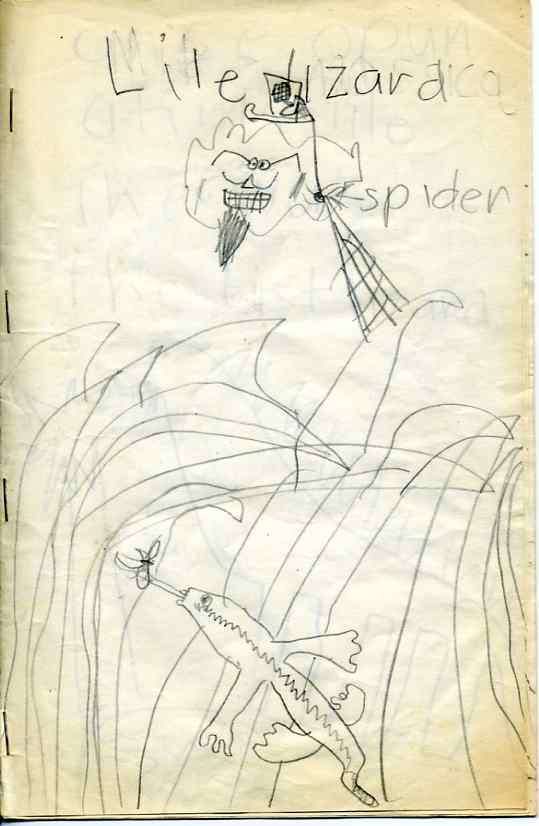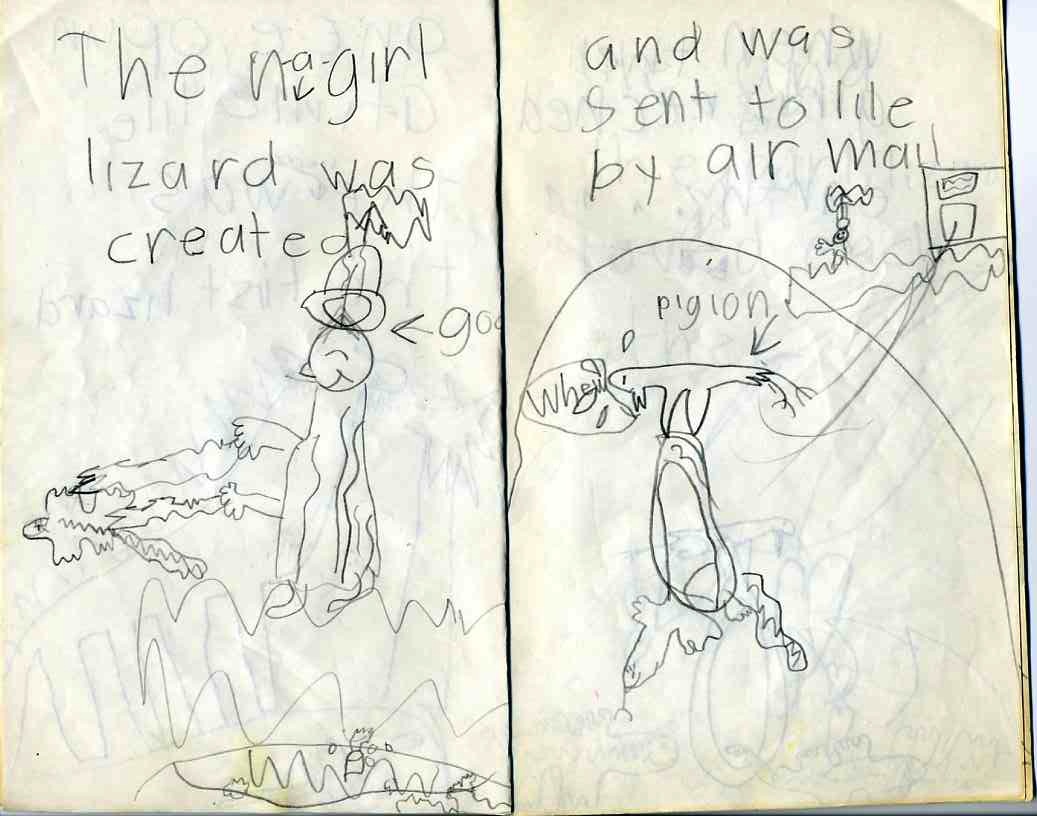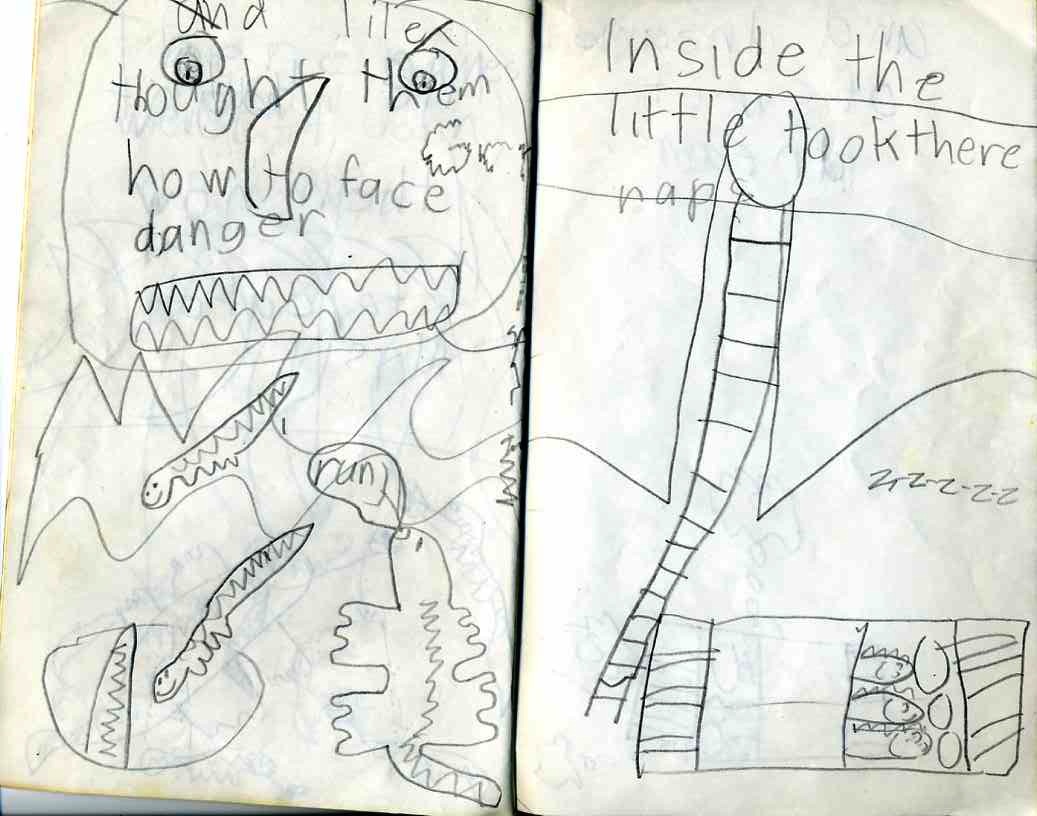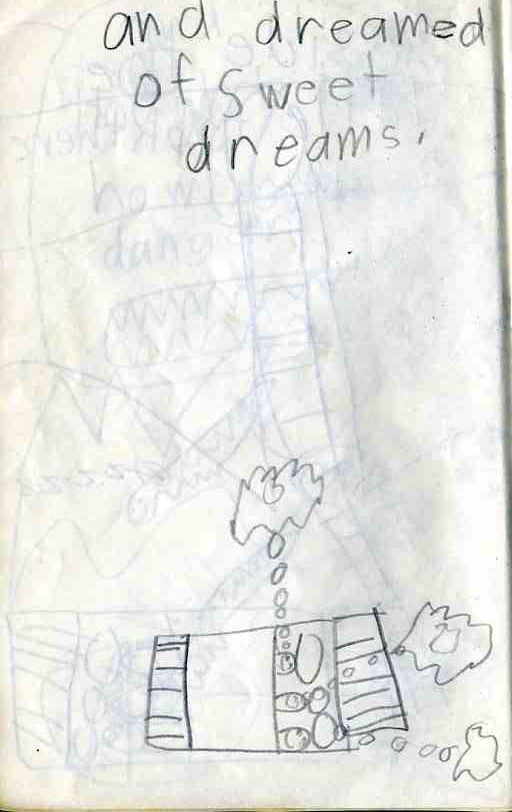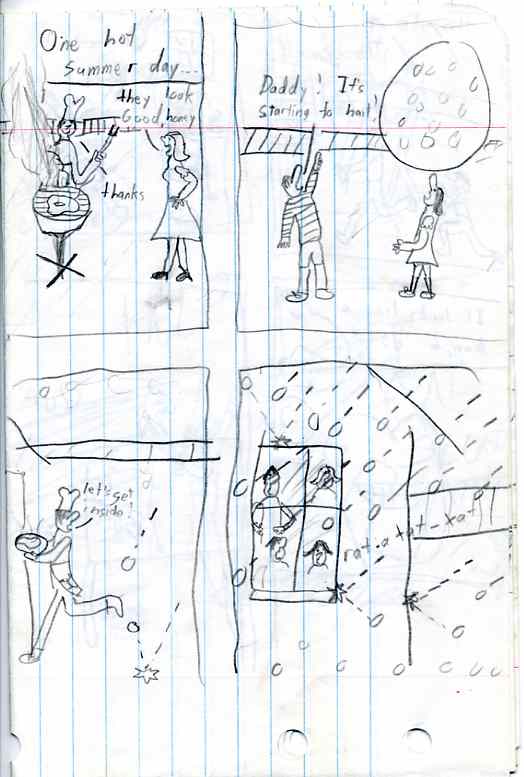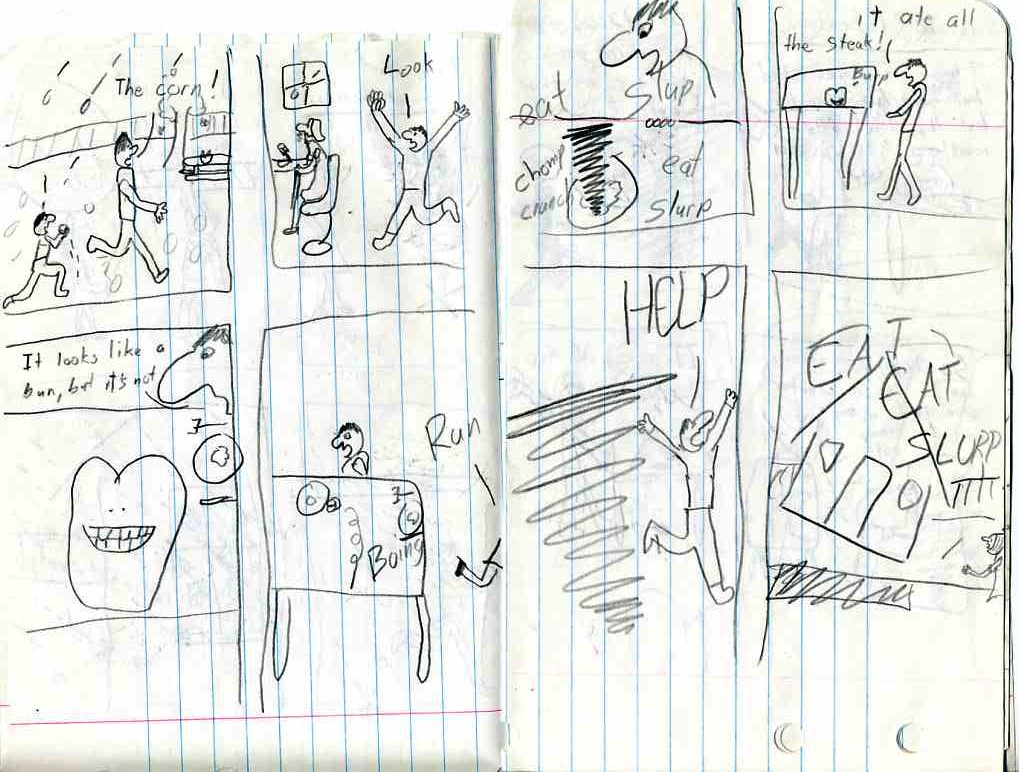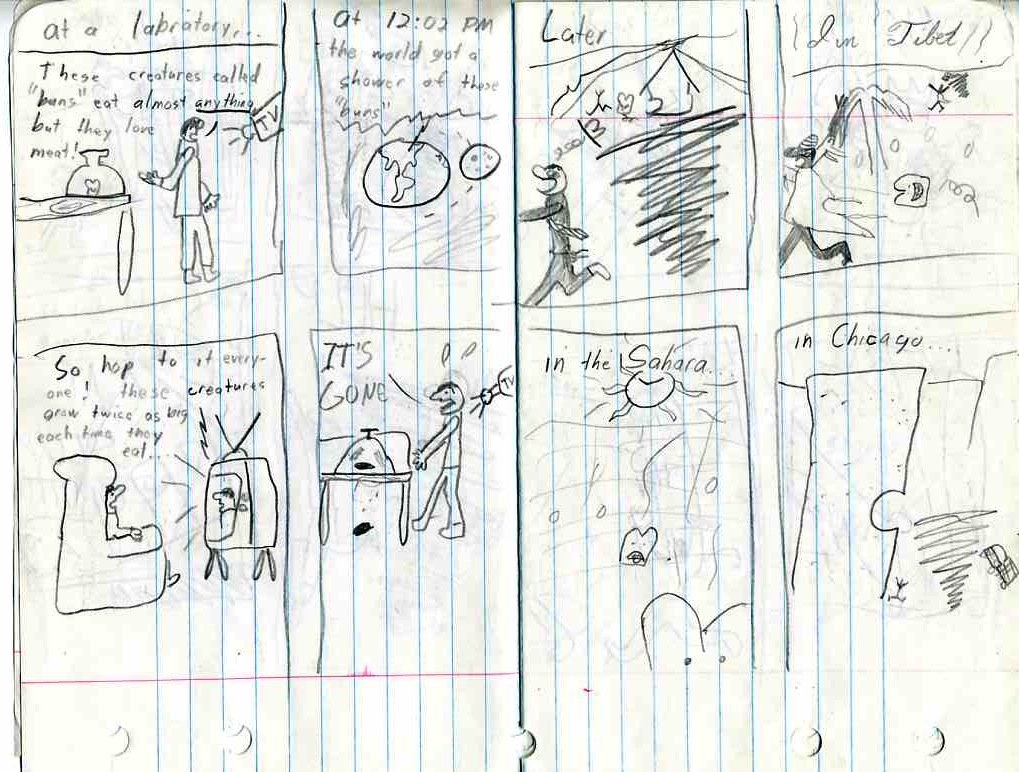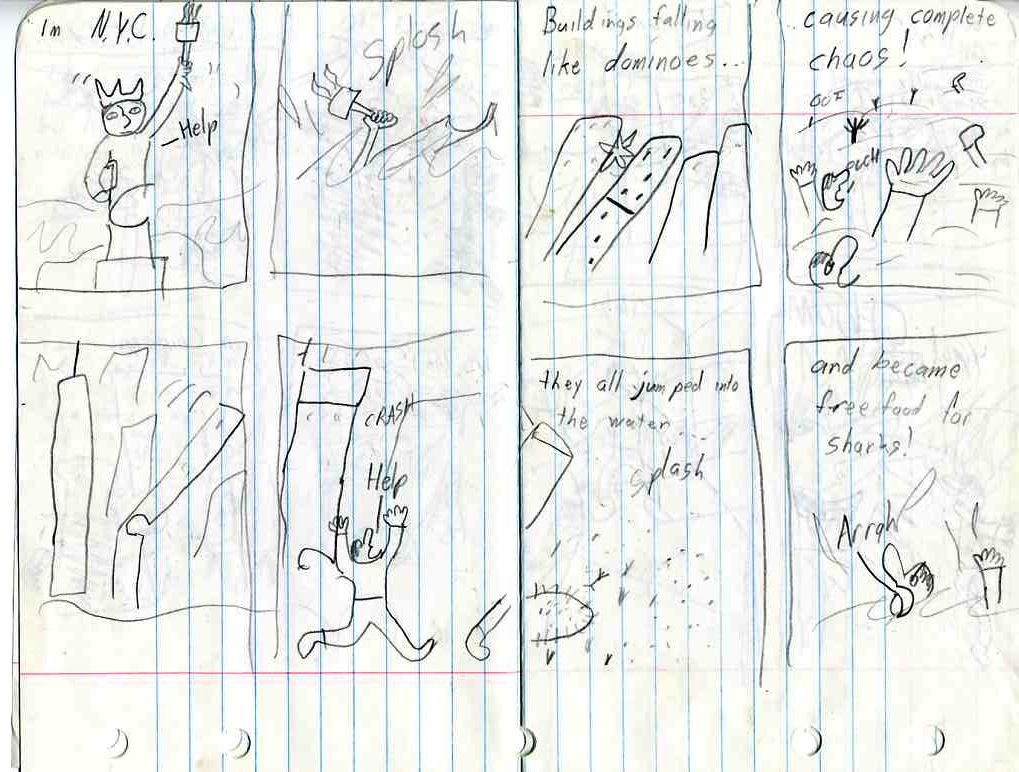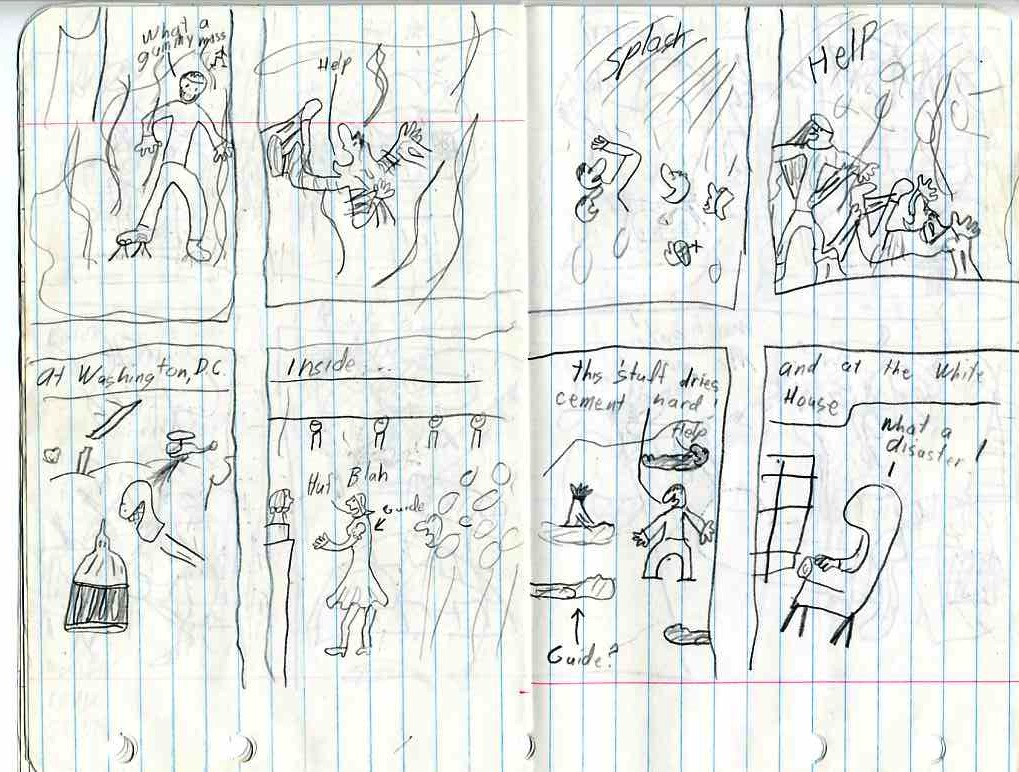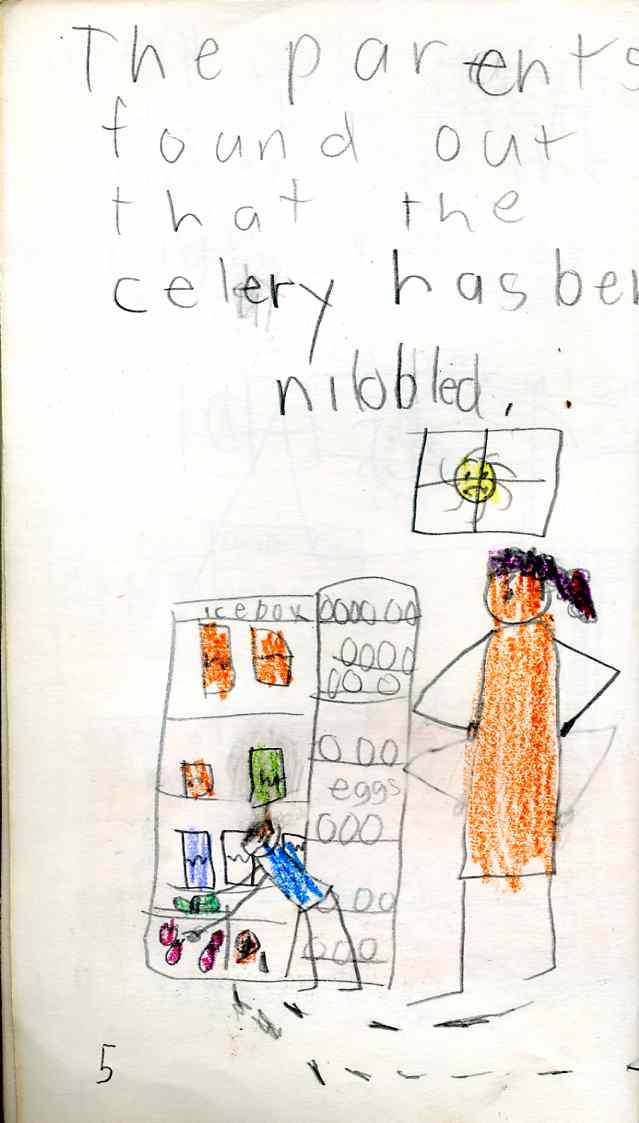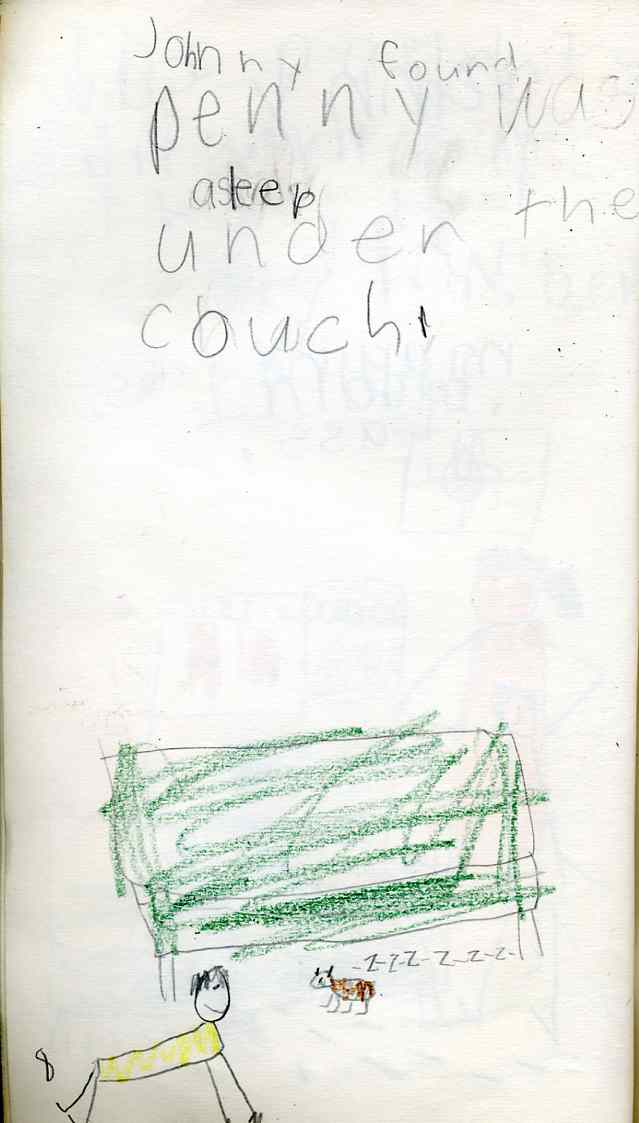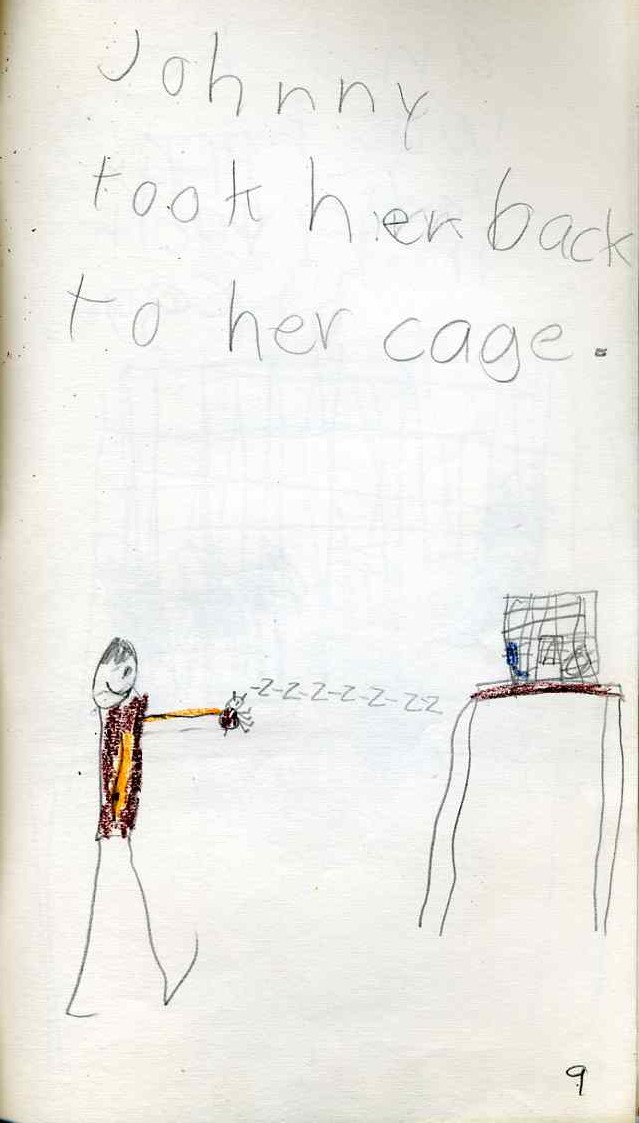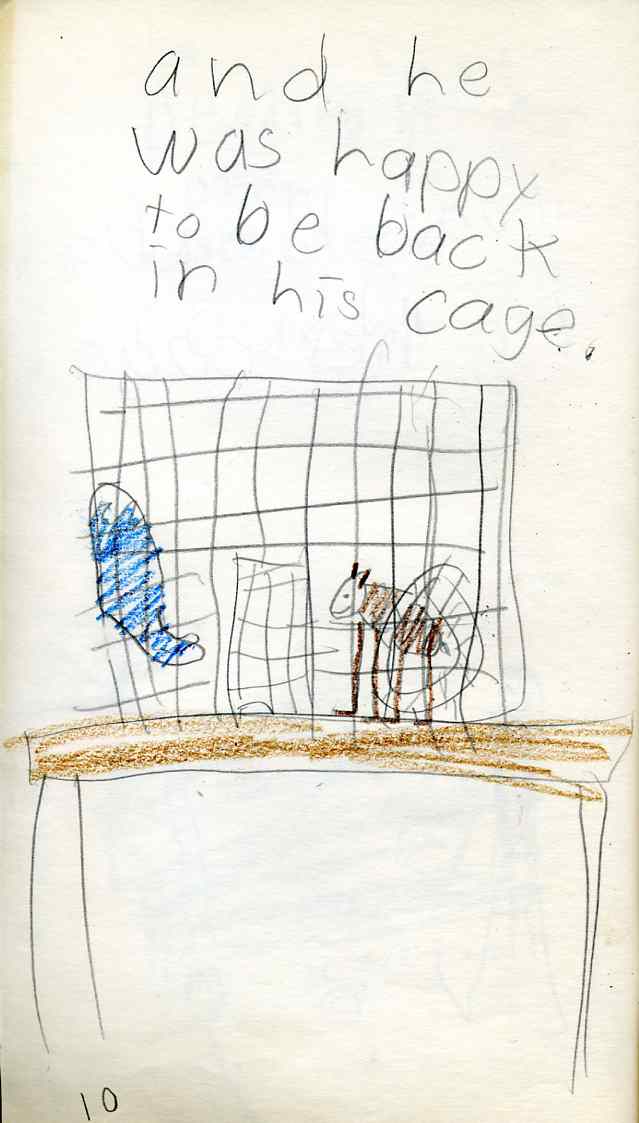




Last End-Year Tangent: “Lile Lizard”, written Second Grade aged seven, includes procreation!

mytest

Handbook for Newcomers, Migrants, and Immigrants to Japan\Foreign Residents and Naturalized Citizens Association forming NGO\「ジャパニーズ・オンリー 小樽入浴拒否問題と人種差別」(明石書店)JAPANESE ONLY:  The Otaru Hot Springs Case and Racial Discrimination in Japansourstrawberriesavatardebitopodcastthumb
UPDATES ON TWITTER: arudoudebito
DEBITO.ORG PODCASTS on iTunes, subscribe free

Hi Blog.  Here’s the last comic for the holidays, thanks for reading.  We’ll end with a sweet one.  “Lile Lizard” (I think it’s a name, not a misspelling of “little”), a reptilian reprise of Adam and Eve, rendered by me aged seven in Second Grade.  Created by god, Lile offers us a story with marriage, babies, family values, and even a mate sent by air mail!  I think the note it ends on is a good way to finish the year.  We’ll get back to the nitty-gritty hardcore human rights issues tomorrow.  Thanks to everyone for reading Debito.org daily blog as it rounds off its fifth year in operation.  Comments follow comic.

NOTES:  The cover still demonstrates I’m in my phase of putting funny faces on things in the sky, in this case a cloud, accompanied by a spider who can defy perspective.  Looking at the renderings of Lile as the comic went on, I don’t think the cover lizard was drawn by me.  The head, tongue, and left arm were probably added by awful fusspot art teacher at the time Miss Gee, who had temper tantrums at the kids if they didn’t draw things her way.  She would do things like hold people’s artwork up in front of a whole class of grade schoolers as examples of what not to do, and give them a public dressing-down (get her to a psychiatrist, someone!).  I think I completed the right arm, hind legs, and back spine afterwards.

Also telling of Miss Gee’s control freakiness is the cover’s original title (pencil erasers didn’t seem to work back then), which looks like “Mike mossicq”, perhaps my attempt to tell a story about a mosquito.  There is one on the cover, but then the metaphorical Lizard-Queen-cum-art teacher comes in and eats him, and hijacks the story.  I guess I thought I better tell the rest of the story sweetly to avoid Miss Gee’s wrath.  (Besides, mosquitoes are harder to draw, not to mention spell!)

Also, I like how god has some sort of halogen flare (not merely a halo) over his hat, not to mention the electrifying powers of Zeus.  And the globe of the world below him shows quite clearly the Old Faithful geyser, which I had seen back in August 1970.  Also, I like on the “falling in love” page how the air-mail pigeon returns to Heaven in the clouds as god seems to be watching TV.  Enjoy.  Arudou Debito

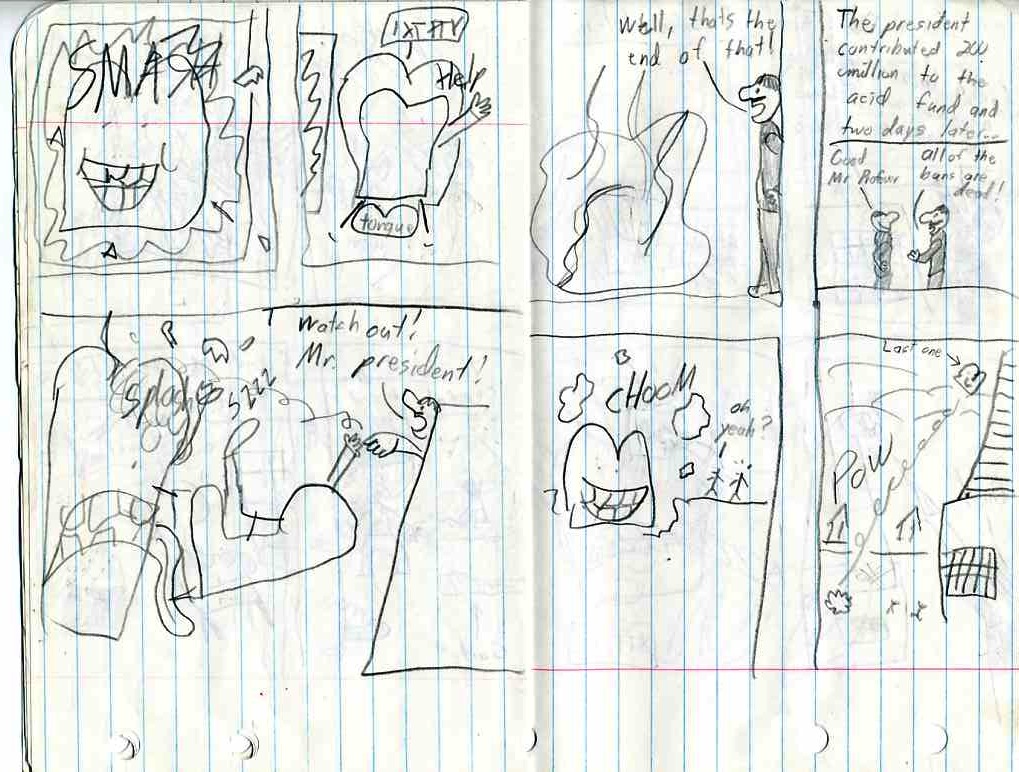
Tangent: “The Meat Eaters”: My first try at a movie storyboard, circa 1975, Fifth Grade, aged ten

mytest

Handbook for Newcomers, Migrants, and Immigrants to Japan\Foreign Residents and Naturalized Citizens Association forming NGO\「ジャパニーズ・オンリー 小樽入浴拒否問題と人種差別」(明石書店)JAPANESE ONLY:  The Otaru Hot Springs Case and Racial Discrimination in Japansourstrawberriesavatardebitopodcastthumb
UPDATES ON TWITTER: arudoudebito
DEBITO.ORG PODCASTS on iTunes, subscribe free

Hi Blog. Continuing the holiday tangents for two more days, here is my rather interesting attempt to combine disaster movie with horror flick. “The Meat Eaters”, drawn by me back in around Fifth Grade, circa 1975, when I was ten years old. Comment follows comic.

NOTES: Although at the time records indicate I was drawing a lot of battle-oriented comics (WWI, WWII, and some space alien stuff), this is perhaps my read of The Blob. Summer idyll disturbed by a bolt from the blue, and suddenly carnivorous tribbles begin to devour humanity. But of course a hero emerges, tries to save the day (especially given the do-nothing president; perhaps that’s what I thought of President Ford), and this time does NOT get what he deserves — a happily-ever-after Hollywood ending where justice is served. Oh oh, I’m starting to grow up, it seems… Arudou Debito

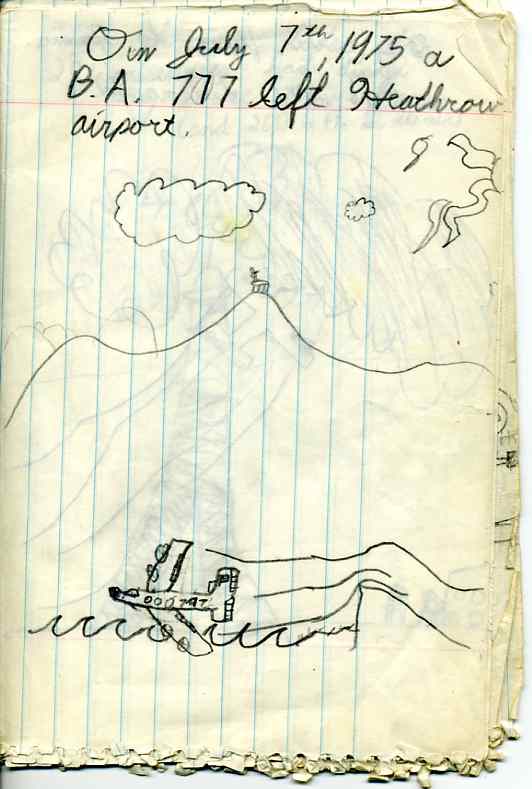
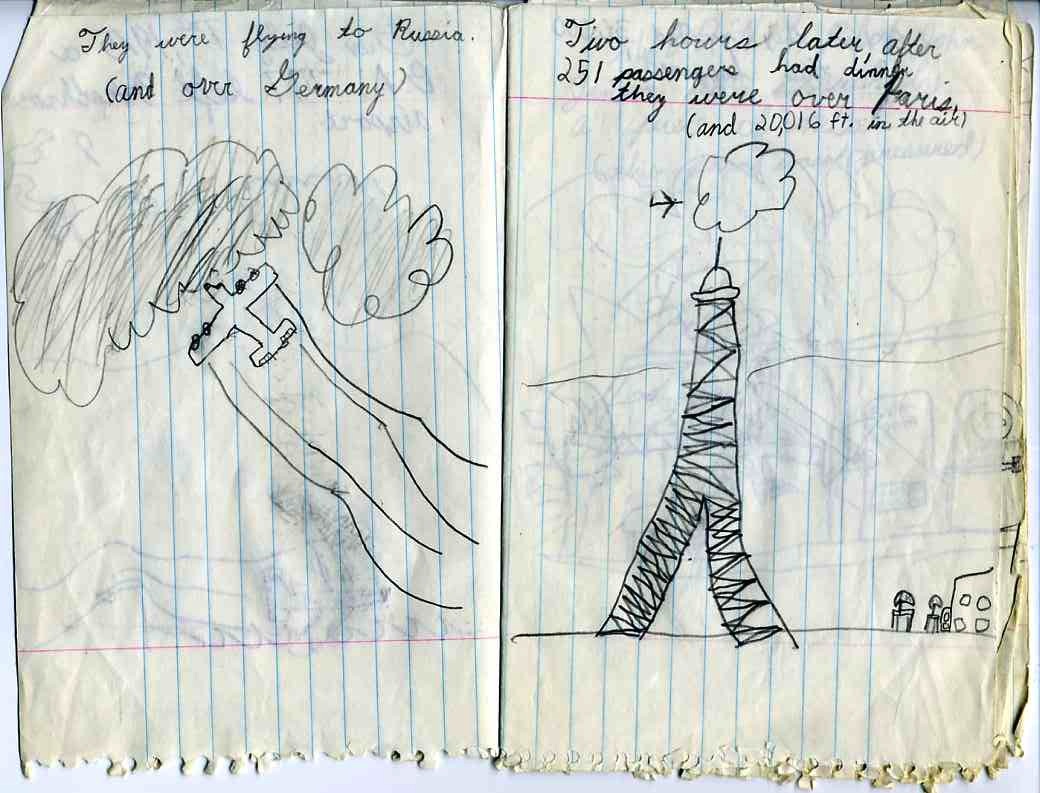
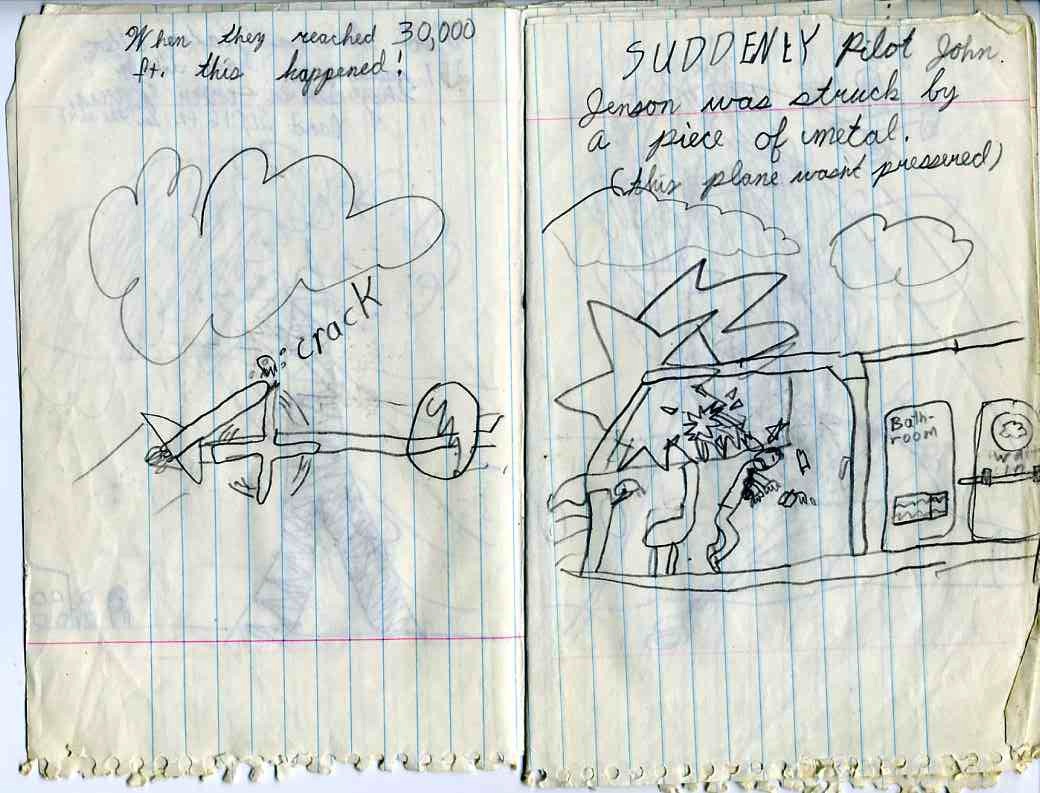
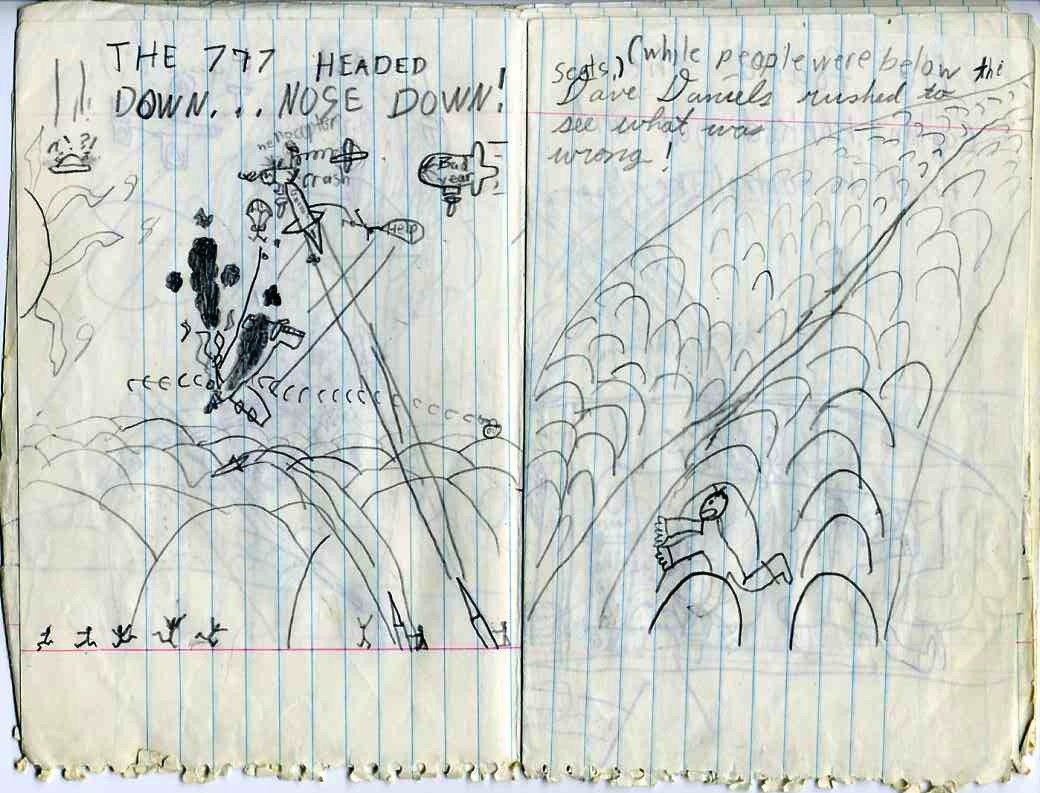
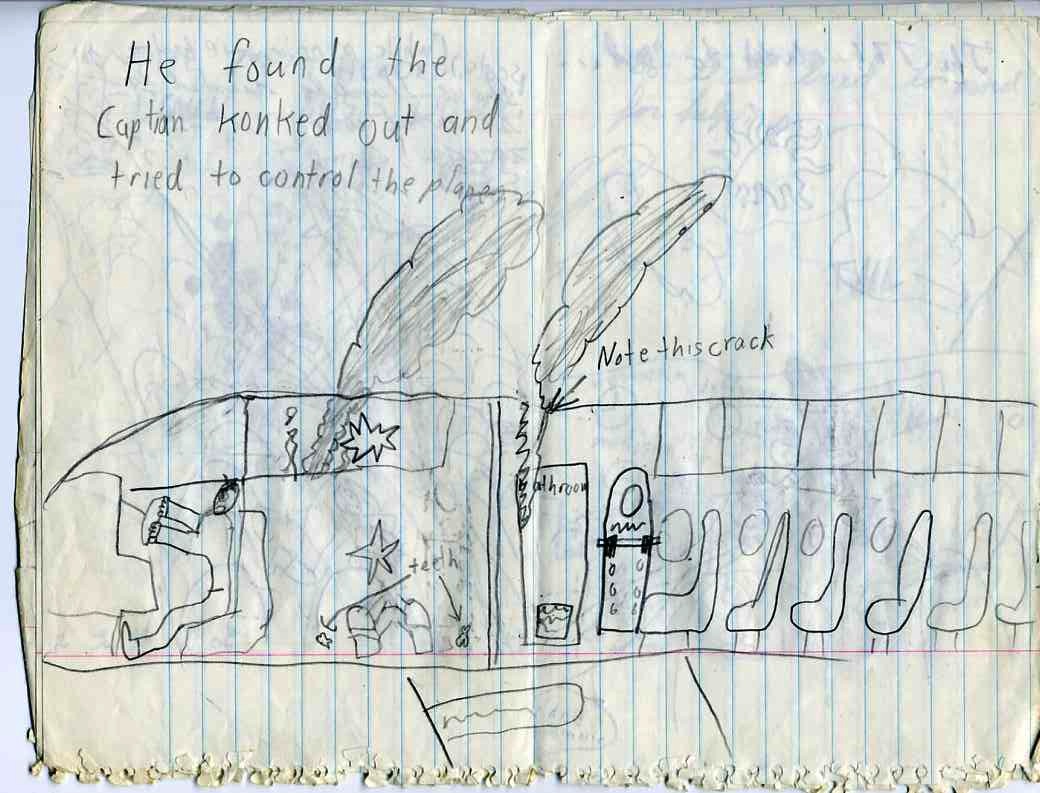
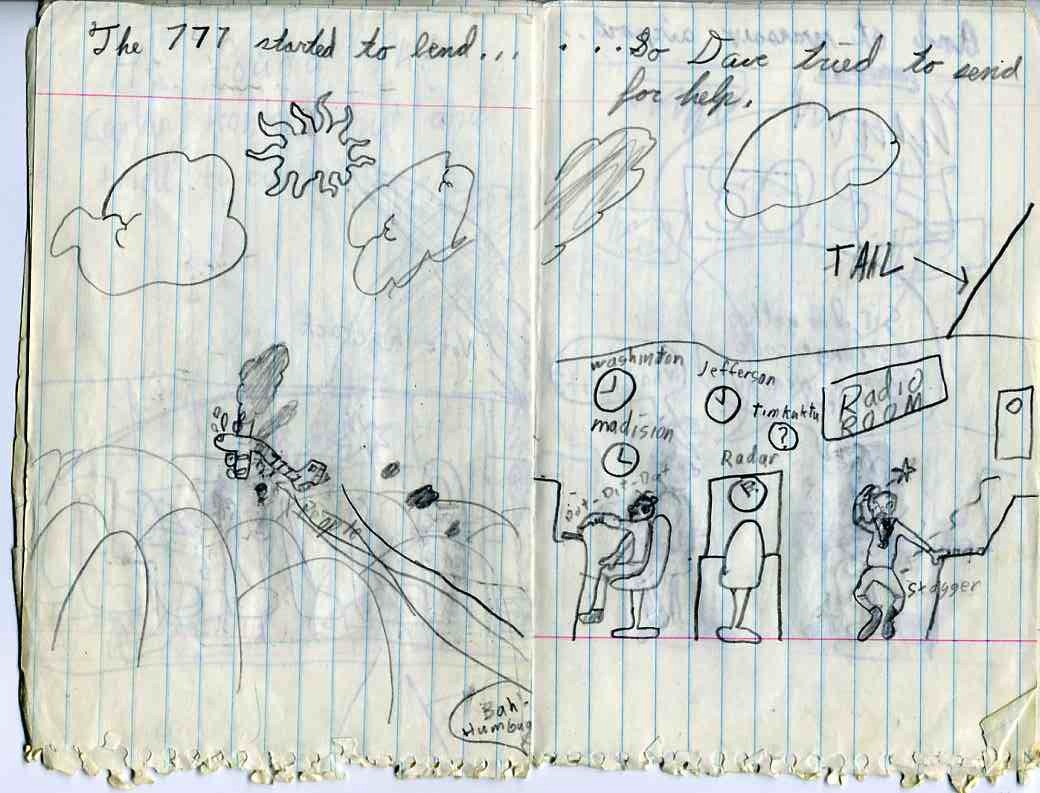
Tangent: Comic “The Flight’, drawn by me Christmas 1975 aged ten

mytest

Handbook for Newcomers, Migrants, and Immigrants to Japan\Foreign Residents and Naturalized Citizens Association forming NGO\「ジャパニーズ・オンリー 小樽入浴拒否問題と人種差別」(明石書店)JAPANESE ONLY:  The Otaru Hot Springs Case and Racial Discrimination in Japansourstrawberriesavatardebitopodcastthumb
UPDATES ON TWITTER: arudoudebito
DEBITO.ORG PODCASTS on iTunes, subscribe free

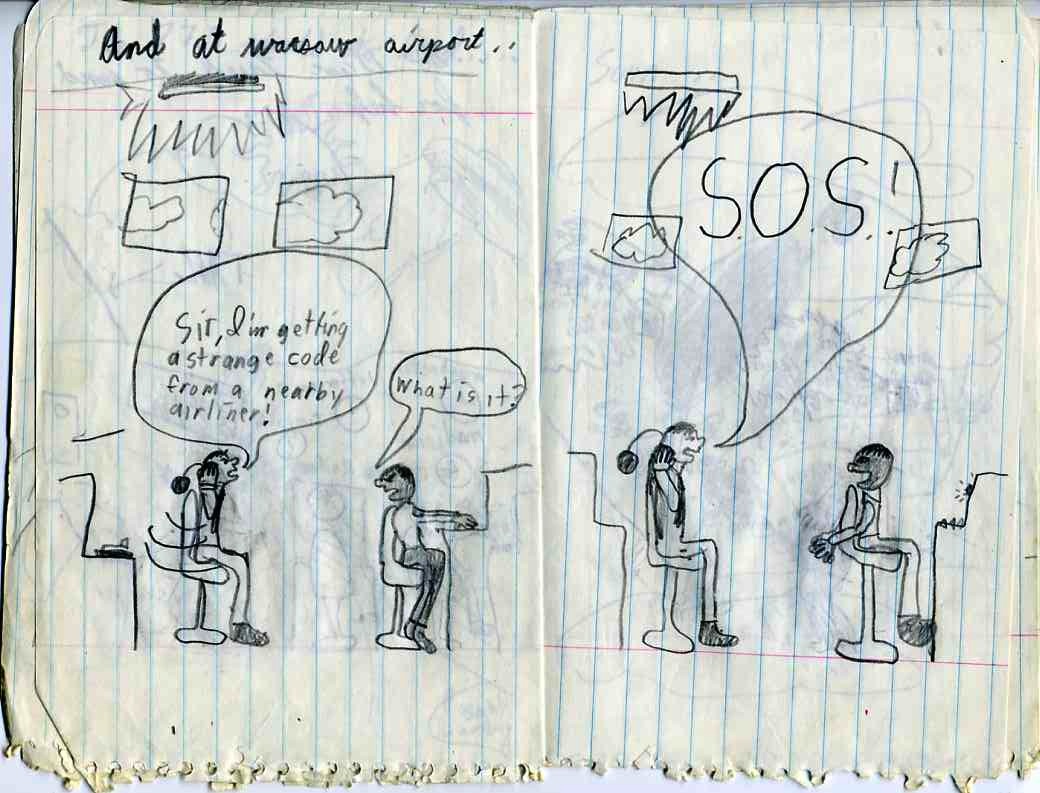
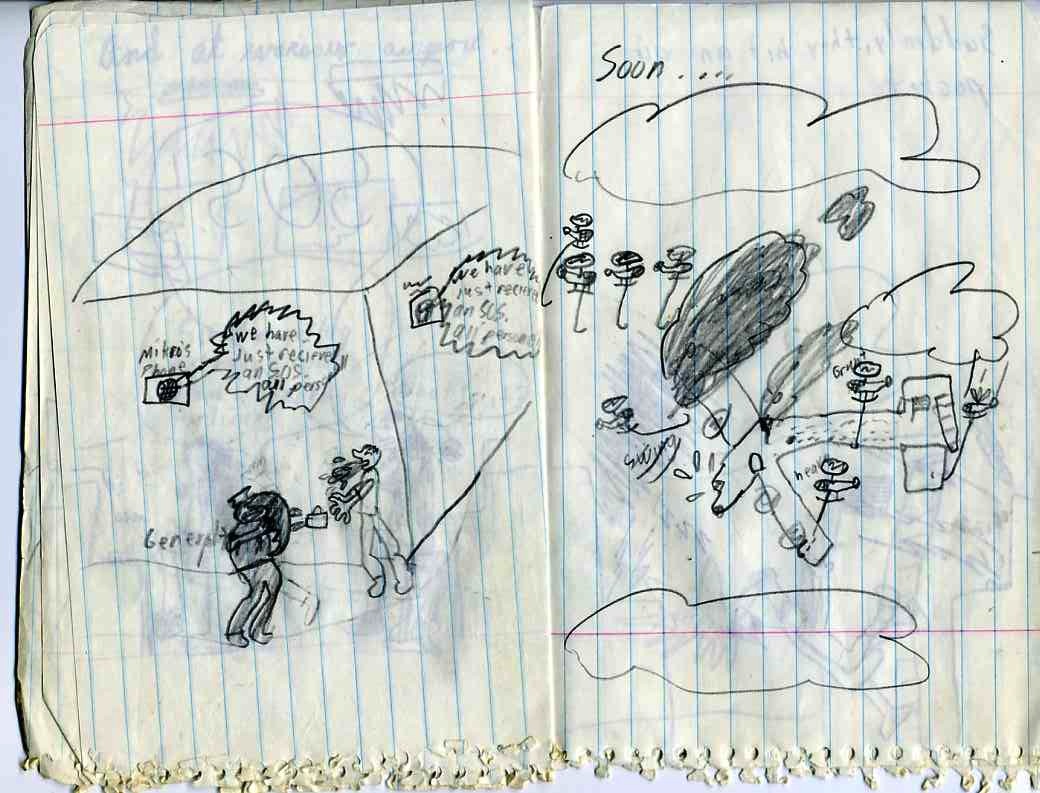
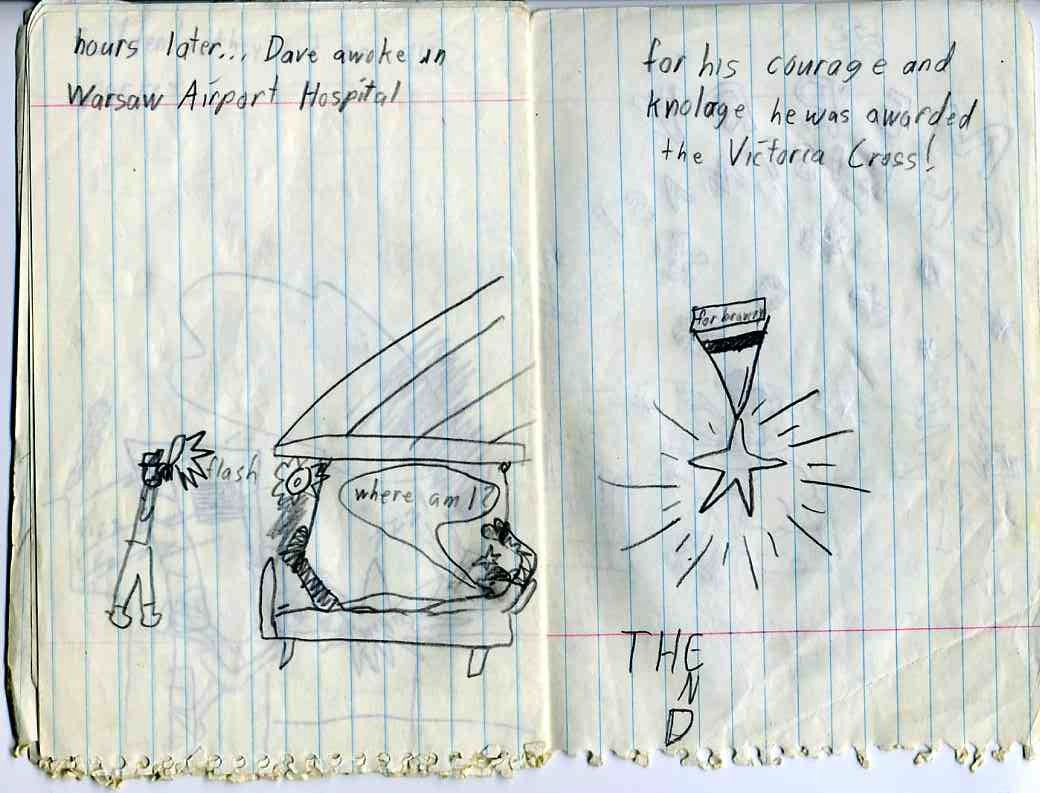
Hi Blog.  For today’s comic effect, here’s an effort by me to assimilate the experiences I was having by age ten:  Travel around Europe with my stepfather (family in England, conferences around Europe, including Germany, Czech, and Poland), drinking in lots of British comics (still do, but at that time I was reading war comics like Warlord and Victor, not to mention Hotspur and Wizard; the Brits in the 1970s still loved reliving the glories of the World Wars, and British comic books over the decades quite possibly killed cumulatively more Germans in print than on the battlefield), and watching movies like Airport (I had a longstanding fear of flying, what with either paranoid disaster flicks at the time or hijackings to Cuba).

In this ten year old’s world, here’s what comes out in the wash:  A turboprop flys Heathrow to Russia, via Paris, and over Germany, where the Nazis of course attack and put the flight in jeopardy.  But of course, a hero emerges… and, well, read the comic.  At least they made it to Warsaw.  Enjoy.  There’s even a Christmas message at the end, meaning I made this as a present for my parents.  Arudou Debito

From even farther back: “Penny the Hamster”, drawn in Second Grade when I was seven

mytest

Handbook for Newcomers, Migrants, and Immigrants to Japan\Foreign Residents and Naturalized Citizens Association forming NGO\「ジャパニーズ・オンリー 小樽入浴拒否問題と人種差別」(明石書店)JAPANESE ONLY:  The Otaru Hot Springs Case and Racial Discrimination in Japansourstrawberriesavatardebitopodcastthumb
UPDATES ON TWITTER: arudoudebito
DEBITO.ORG PODCASTS on iTunes, subscribe free

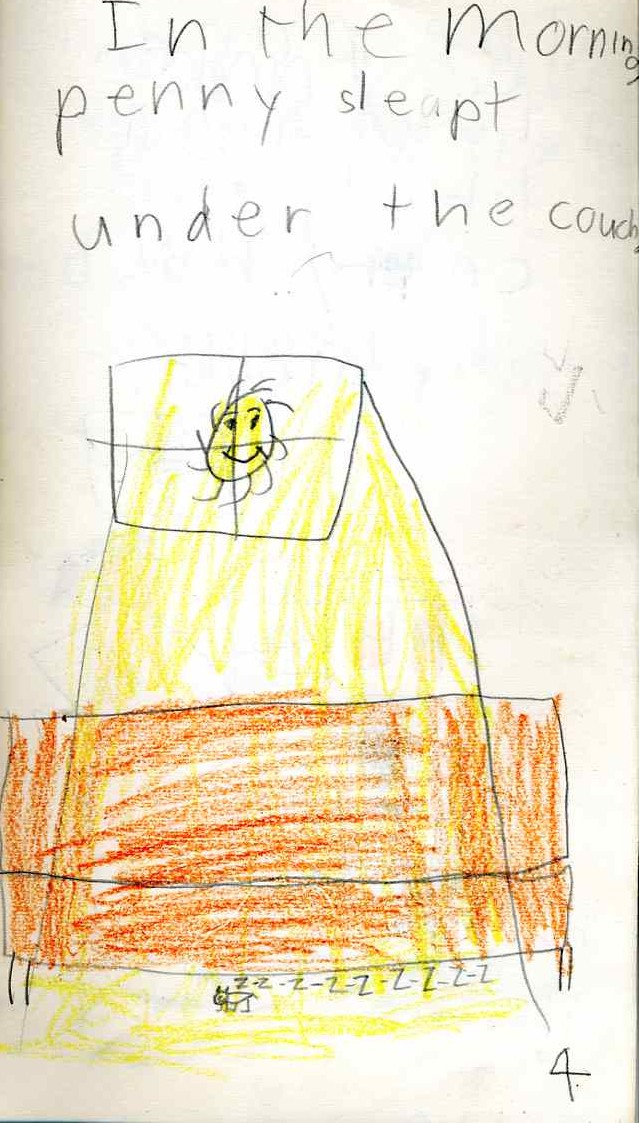
Hi Blog.  Thanks for indulging me this holiday season with archiving things that feel more precious the more I look at them.  Here is something even older than the first two entries:  “Penny the Hamster”, named after our Second Grade class’s pet, who had a history of escaping (and inspiring me to write).  The comic is more primitive in drawing (thanks to the younger age — I mean, seven years old?), but the narrative structure is, once again, still there.  Dedicated to classmate Steve Chilbert (with whom I’ve gotten back in touch with after nearly 27 years thanks to Facebook) at the bottom of the cover (until, it seems, we had some kind of fight and I tried to erase him).  Let’s see what travails await this main character in young David Aldwinckle’s world.  Arudou Debito

Holiday Tangent: “Steve Seed”, all drawed by me 1973, aged eight. C’mon, it’s kinda cute.

mytest

Handbook for Newcomers, Migrants, and Immigrants to Japan\Foreign Residents and Naturalized Citizens Association forming NGO\「ジャパニーズ・オンリー 小樽入浴拒否問題と人種差別」(明石書店)JAPANESE ONLY:  The Otaru Hot Springs Case and Racial Discrimination in Japansourstrawberriesavatardebitopodcastthumb
UPDATES ON TWITTER: arudoudebito
DEBITO.ORG PODCASTS on iTunes, subscribe free

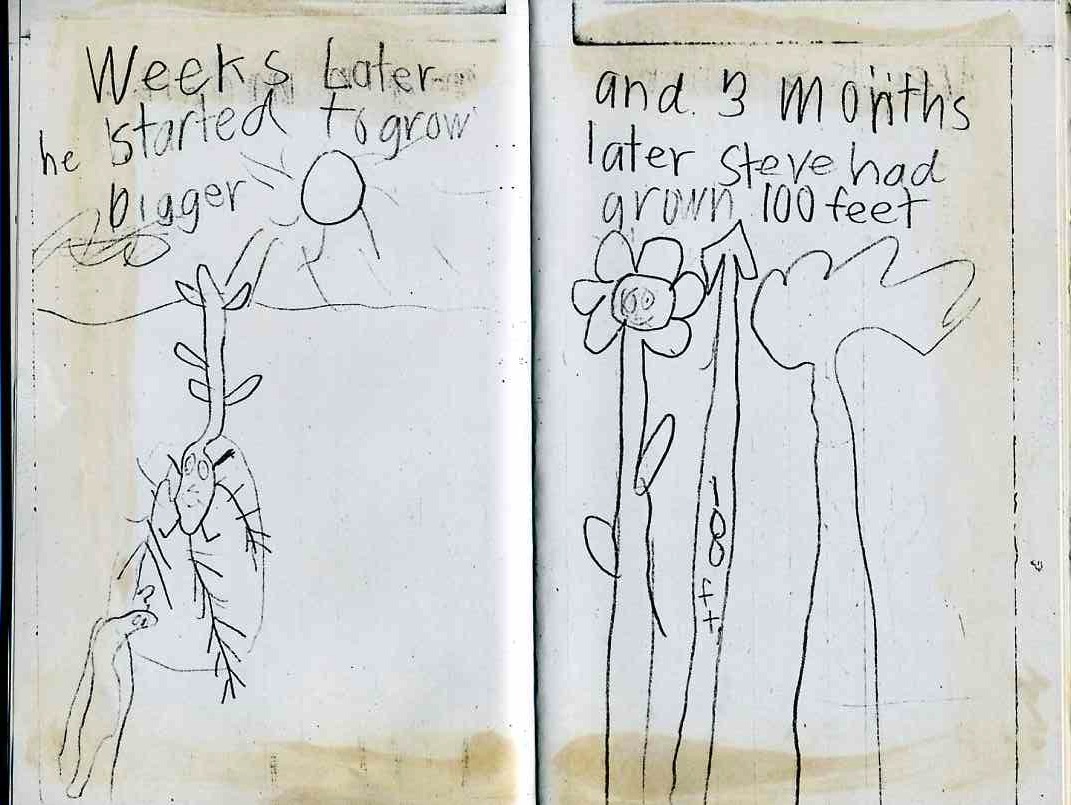
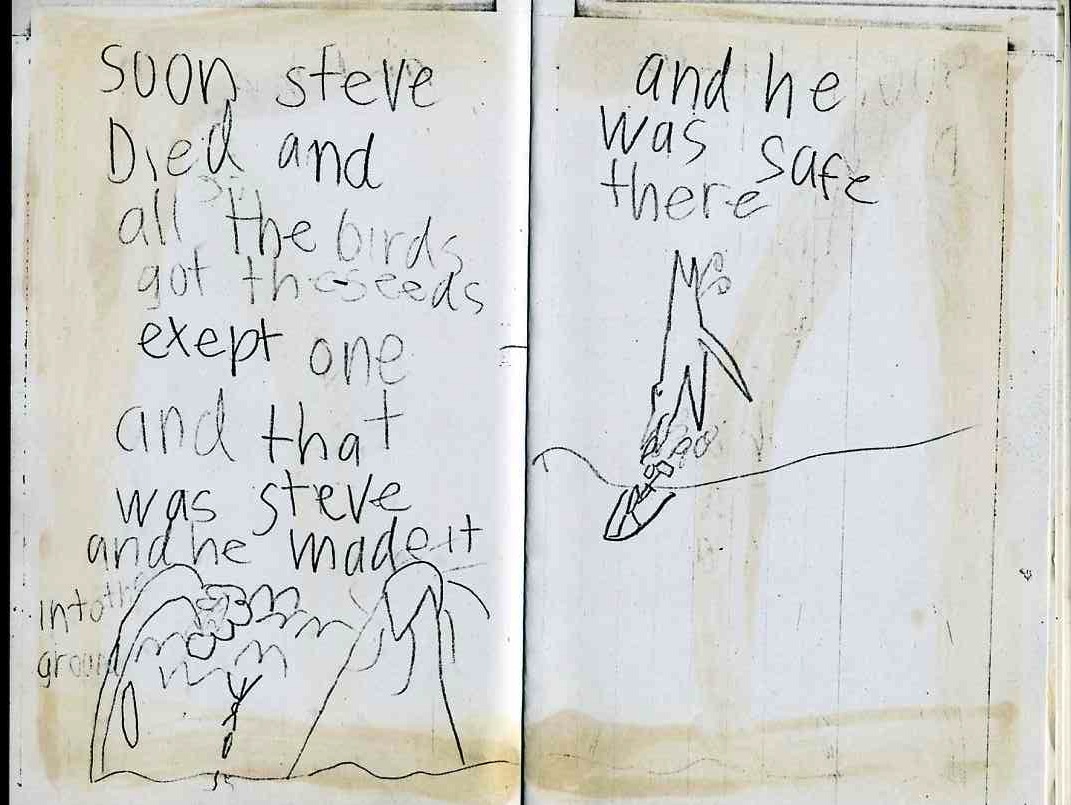
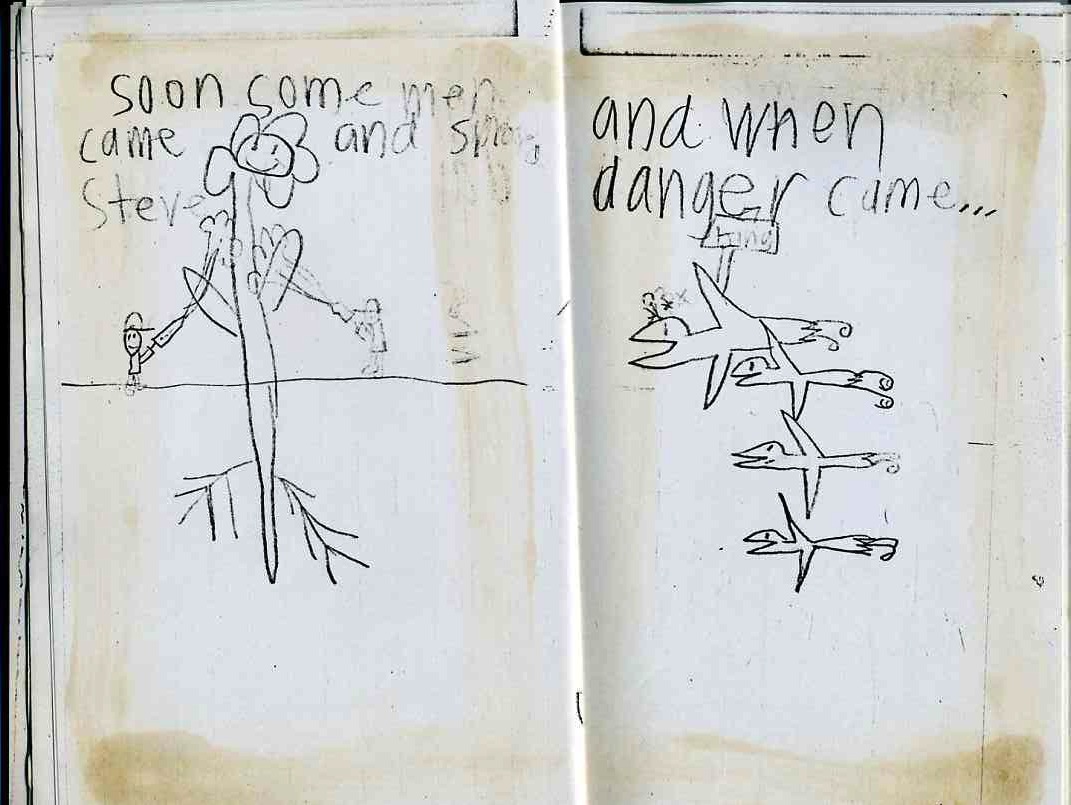
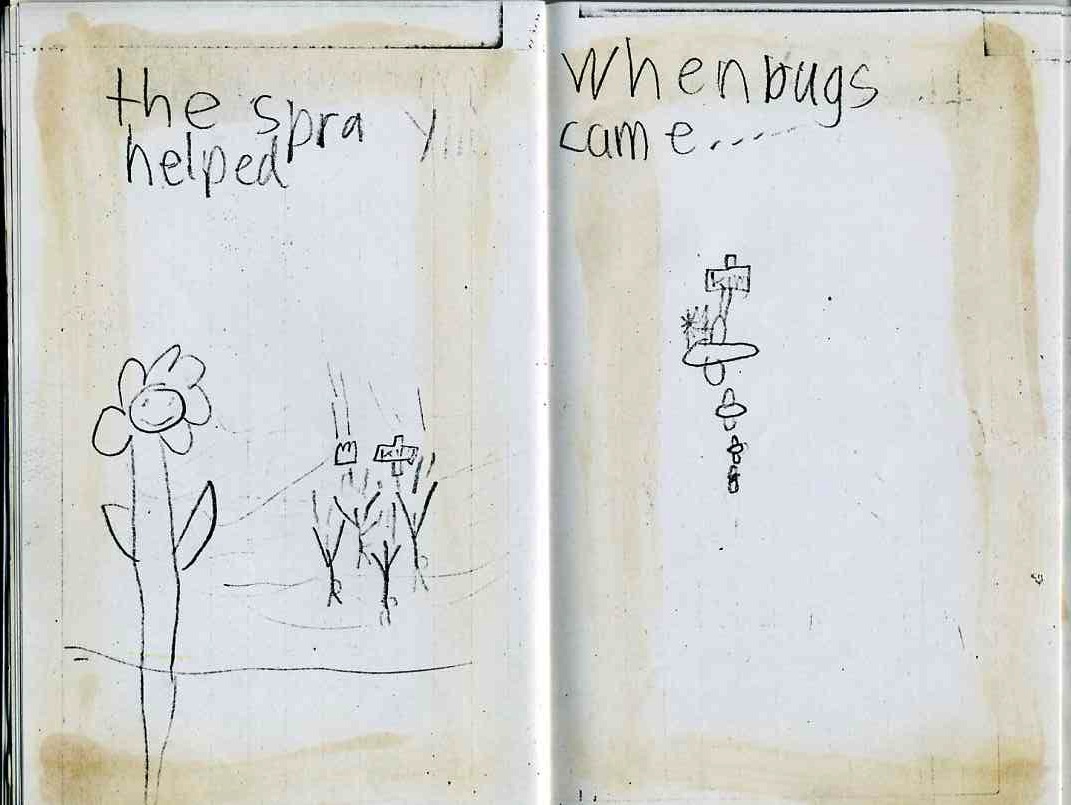
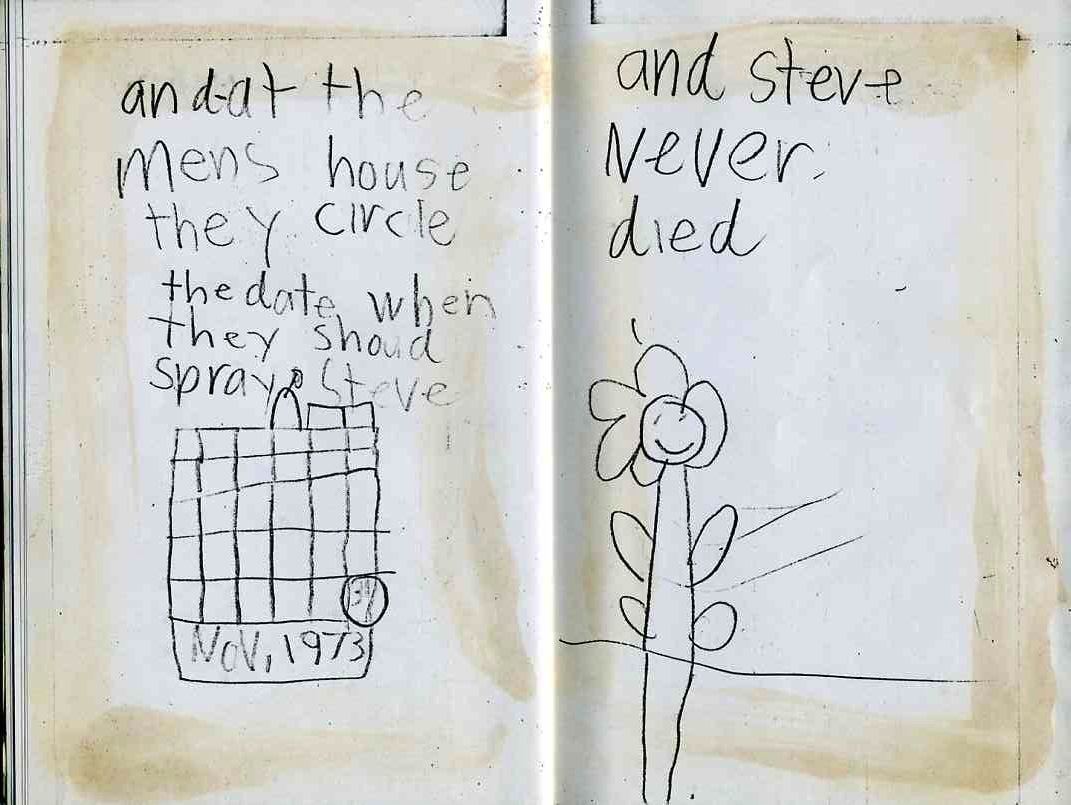
Hi Blog. Continuing the Holiday Tangents (I just don’t feel like doing anything downer-ish as we round out the year), here’s another comic drawn by me probably around November 1973. “Steve Seed”. It’s from a photocopy, alas, but even I’m a little surprised at how developed the spelling and narrative structure are at this age. Refers to the circle of life, safety, and even reincarnation. And it’s doggone cute, darn it. If I could stick my arm into a time machine, I’d reach back and pinch my cheeks. Brief notes at bottom.

NOTES: Surprisingly developed concept of how plants and seeds work. And how “spray” keeps pests away (to the point of killing off the birds — my stepfather probably still claims that there’s no clear scientific evidence against the use of DDT). Clearly the result of being raised by a plant pathologist in Upstate New York, watching things go on at an experiment station where spraying plants is the norm. Prelude to irradiated food being kept fresh forever? Finally, to a little kid, a sunflower probably does look 100 feet tall.  Enjoy.  Arudou Debito

Happy Boxing Day: From deep within the archives: “Fred Fish” comic book, 1973, drawn by me aged eight

mytest

Handbook for Newcomers, Migrants, and Immigrants to Japan\Foreign Residents and Naturalized Citizens Association forming NGO\「ジャパニーズ・オンリー 小樽入浴拒否問題と人種差別」(明石書店)JAPANESE ONLY:  The Otaru Hot Springs Case and Racial Discrimination in Japansourstrawberriesavatardebitopodcastthumb
UPDATES ON TWITTER: arudoudebito
DEBITO.ORG PODCASTS on iTunes, subscribe free

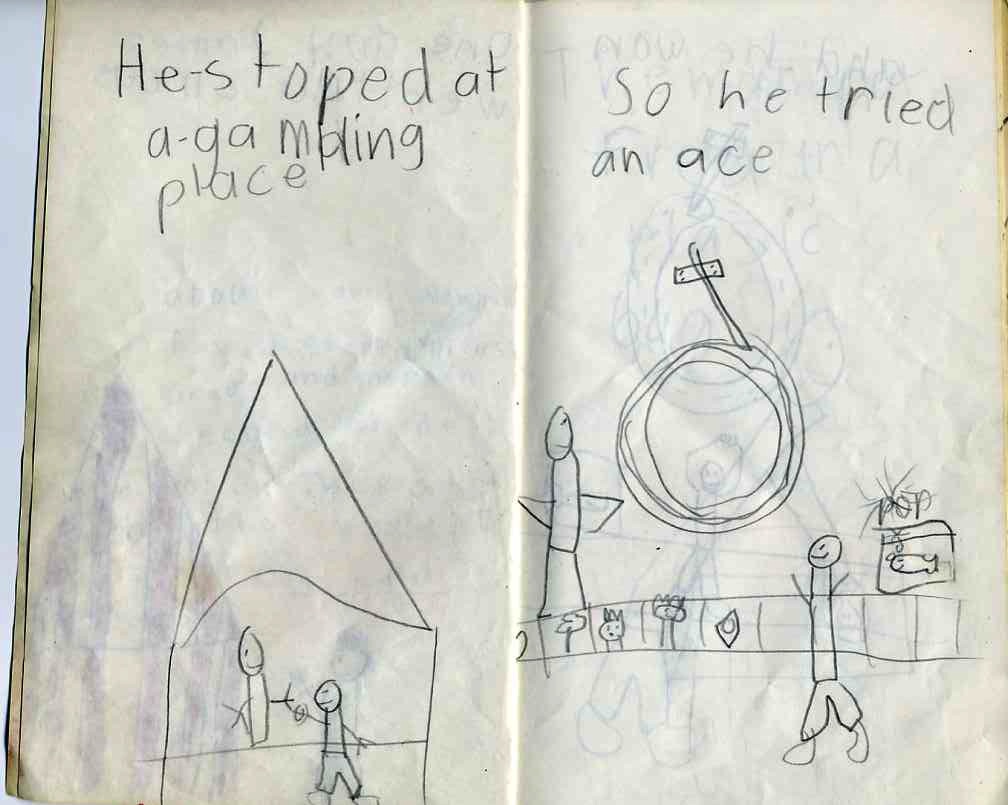
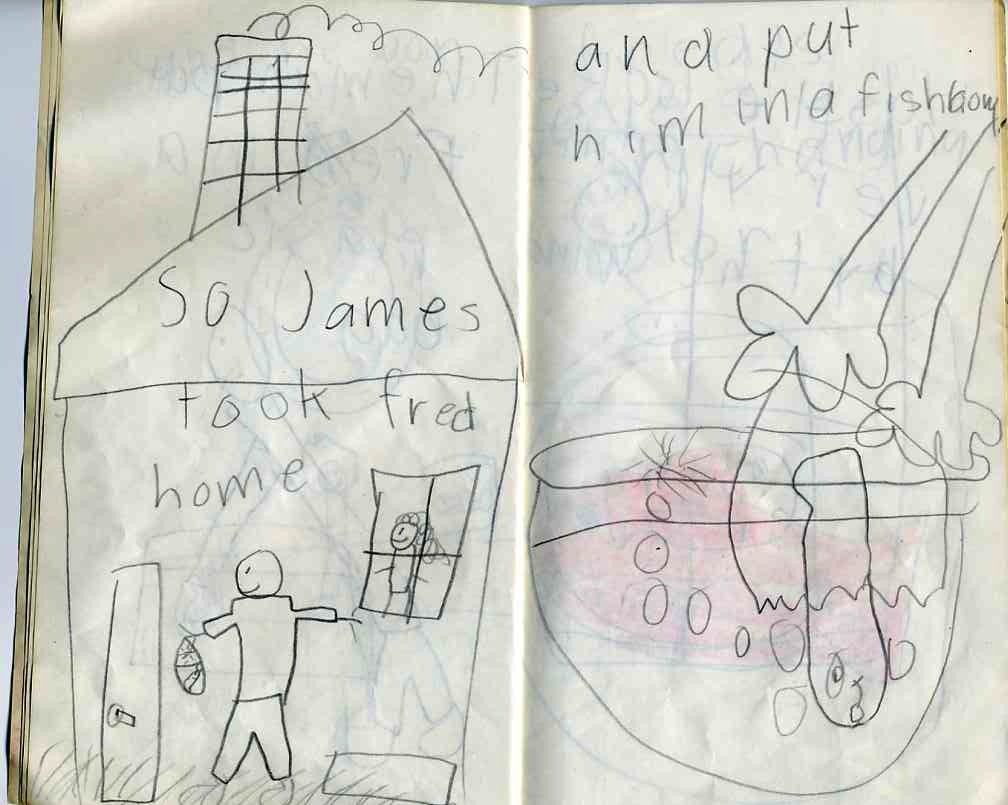
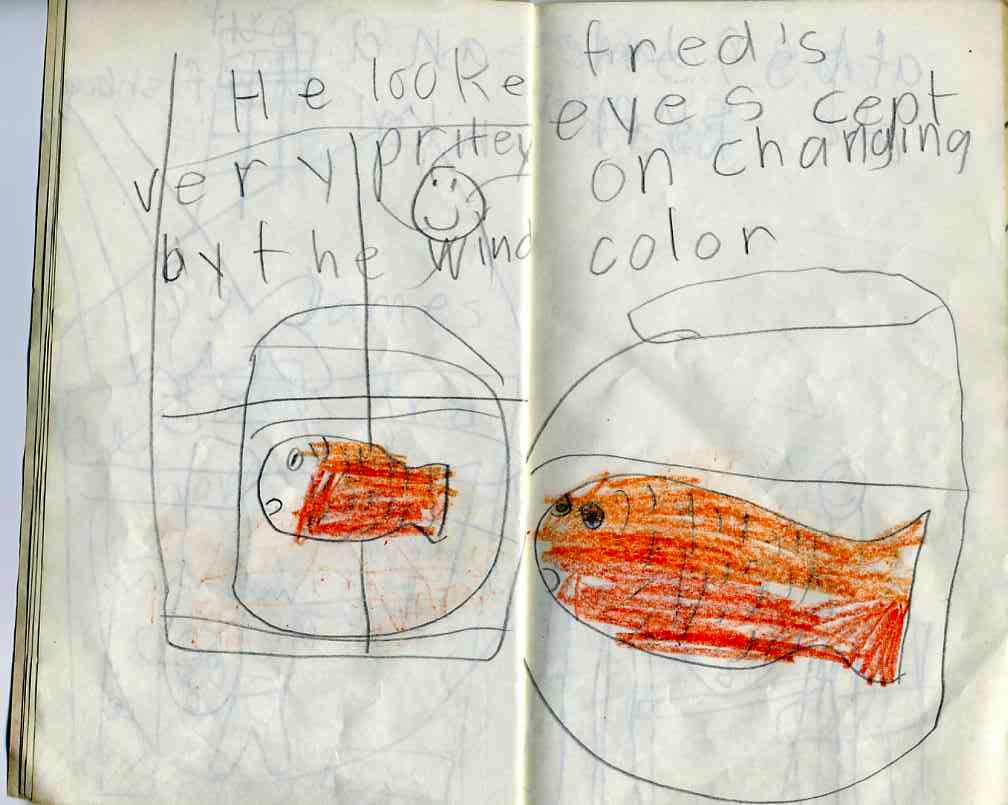
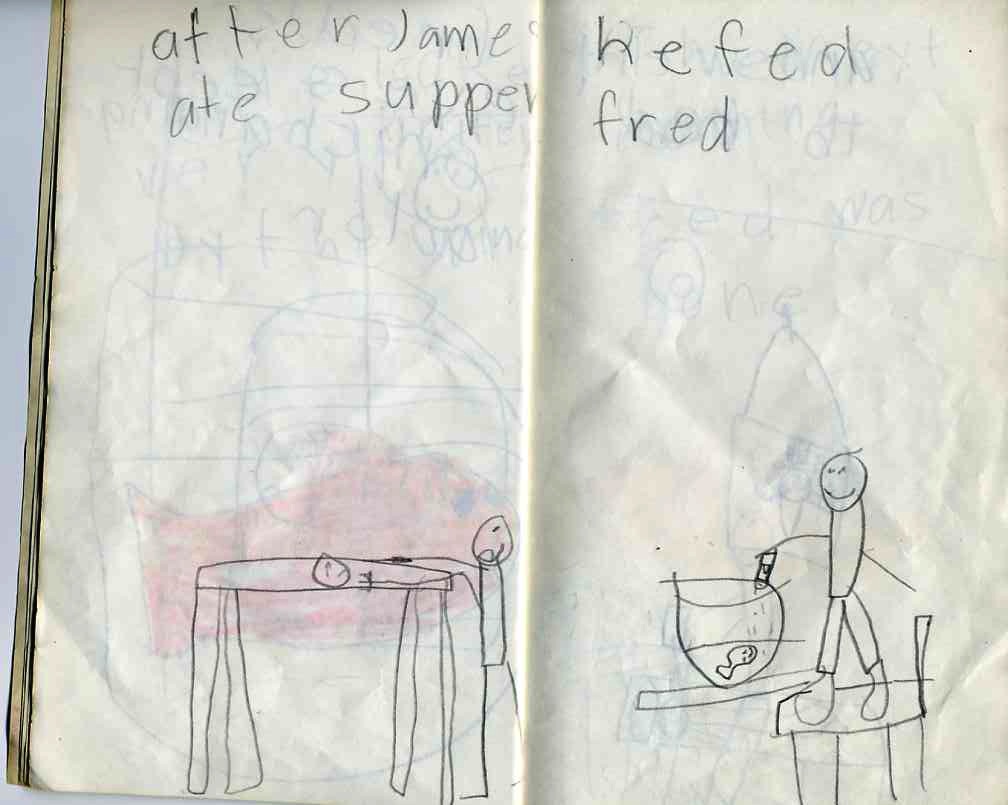
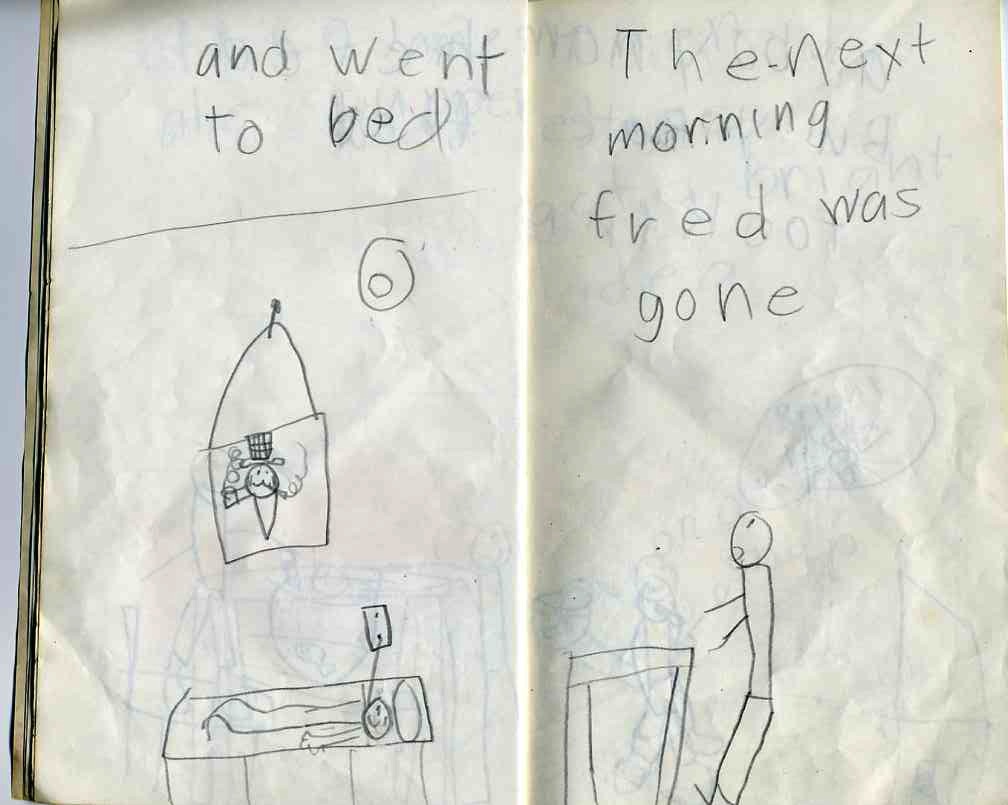
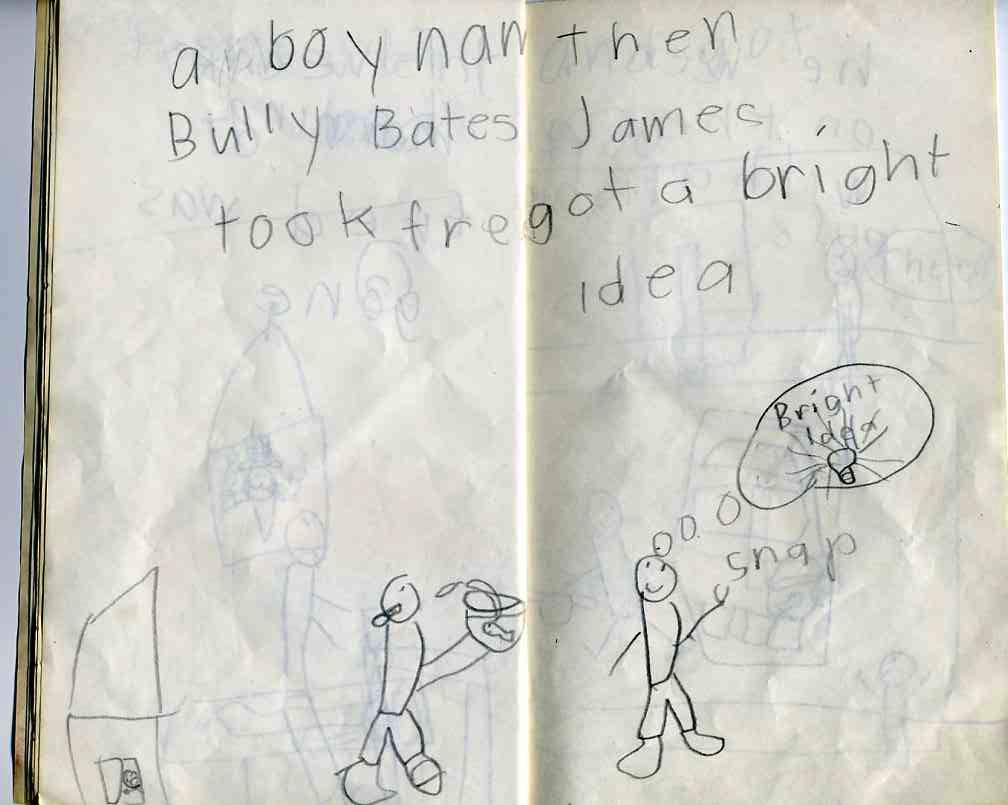
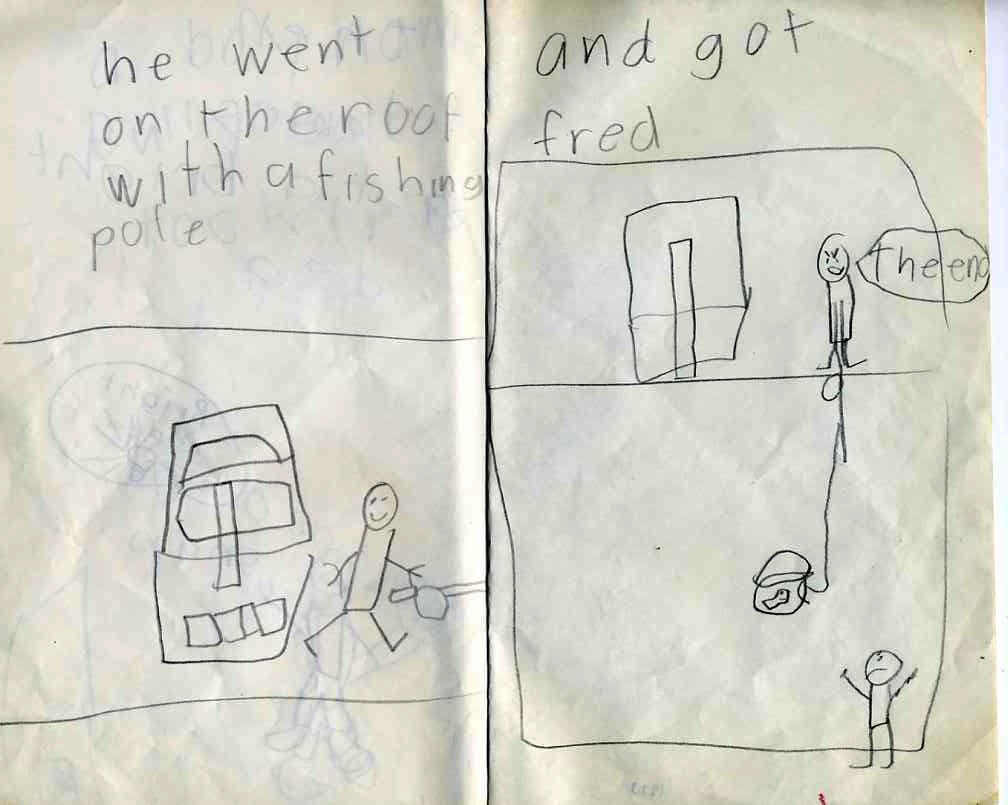
Hi Blog. Happy Boxing Day. For the holiday season, let me put up some rilly, rilly old stuff. I got a boxful of old comic books I made when I was a little kid. What follows is “Fred Fish”, from 1973. I was in second grade, just turned eight years old, and was in Mrs. Joseph’s class in North Street School, Geneva, NY, USA. I had been reading since I was about two years old (a LOT of comic books), and within five years I was producing some of my own. Mrs. Joseph saw me as reading at a level far above everyone else, she said years later, so she gave me class time to create whatever I wanted. That’s what I did — I sat down with pencil, paper, and a stapler and created what would turn out to be a pile of these mostly derivative but kinda cute works that fortunately got saved. 38 years later, here’s something for the blog, as a present and a diversion I hope you enjoy. Quick notes follow the story gallery.

NOTES:  The story ends most abruptly because I always made the books (one ream) ready stapled before I made the stories, with no advance planning.  I realized I had plenty of pages left by the time our protagonist goes to bed, so I segued into a bully story.  But justice has to prevail by the last two pages, so all is returned to normal, the end, by the last corner.  Also, I recall that people said my eyes (hazel) changed color with the light and mood (like those Mood Rings so popular in the late seventies, it was later said).  It was on my mind, so I incorporated it into the story and gave Fred Fish my eyes.  I remember my mother (who was, shall we say, quite reserved in her praise of anything I did) reserving her praise for that page in particular.  Hence this is the first comic going up on the blog — it was my first success with my harshest critic.  Arudou Debito

DEBITO.ORG END-YEAR POLL: “What do you think are the top issues in 2010 that affected NJ in Japan?”

mytest

Handbook for Newcomers, Migrants, and Immigrants to Japan\Foreign Residents and Naturalized Citizens Association forming NGO\「ジャパニーズ・オンリー 小樽入浴拒否問題と人種差別」(明石書店)JAPANESE ONLY:  The Otaru Hot Springs Case and Racial Discrimination in Japansourstrawberriesavatardebitopodcastthumb
UPDATES ON TWITTER: arudoudebito
DEBITO.ORG PODCASTS on iTunes, subscribe free

Hi Blog. As part of the end-year roundup, here are a few issues I thought would be interesting for discussion. Looking back, what do you think are the most influential events that affected NJ in Japan? Here are some of ones I thought were noteworthy, in no particular order:

What do you think are the top issues in 2010 that affected NJ in Japan?

  • Far-rightists question credentials of DPJ reformists by claiming they have NJ roots
  • Suraj Case of death during deportation
  • Long-dead Centenarians still registered as alive (yet NJ remain unregistered)
  • Nursing program only passes three NJ after two years
  • Hunger strike at Ibaraki Prison
  • GOJ apologizes to Korea for prewar annexation
  • “My Darling is a Foreigner” becomes a movie
  • Sumo Association decides to count naturalized wrestlers as still foreign
  • UN Rapporteur Jorge Bustamante’s critical Japan visit
  • NJ PR Suffrage Bill goes down in flames
  • Zaitokukai far-rightists get arrested for property damage to Zainichis
  • Child Abductions issue gathers steam with governments abroad, GOJ eyes Hague
  • The Cove engenders protests, get limited screenings anyway
  • Japan’s Kokusei Chousa pentennial census goes multilingual
  • Tokyo Police spying on Muslims
  • Futenma issue, with USG jerking GOJ’s chain
  • Renho becomes first multiethnic Cabinet member
  • Toyota’s mishandling of their runaway car recall, blaming foreign components and culture
  • Oita court ultimately rules that NJ have no rights to J pensions
  • Tourist visas eased for Chinese and Indians
  • Health insurance requirement removed from visa renewals

and/or

  • Something else

(Please tell us what you think got left out in the Comments Section below)

Please vote for three (we’ll get a decent average that way through the overlap) in the Polls section on the right-hand column of this blog.  Thanks.

If you’re celebrating, Merry Christmas Eve and Day, Debito.org Readers!  Arudou Debito

Kyodo: Stats for inflows & outflows: J exch students down, NJ up; NJ tourists also up, but none reaching GOJ goals

mytest

Handbook for Newcomers, Migrants, and Immigrants to Japan\Foreign Residents and Naturalized Citizens Association forming NGO\「ジャパニーズ・オンリー 小樽入浴拒否問題と人種差別」(明石書店)JAPANESE ONLY:  The Otaru Hot Springs Case and Racial Discrimination in Japansourstrawberriesavatardebitopodcastthumb
UPDATES ON TWITTER: arudoudebito
DEBITO.ORG PODCASTS on iTunes, subscribe free

Hi Blog. Some official numbers for who’s coming and going in and out of Japan on a temporary basis, and how they’re not meeting government targets. They were probably too ambitious to begin with, although as we noted yesterday, the numbers of J exchange students dropping is a pretty disappointing trend; Debito.org has already discussed why the NJ student inflows might be underwhelming earlier this year — lack of institutional support. Arudou Debito

/////////////////////////////////////////

Fewer studying abroad
Record number of foreigners getting education in Japan
Kyodo News/Japan Times Thursday, Dec. 23, 2010, courtesy of Peach
http://search.japantimes.co.jp/cgi-bin/nn20101223x2.html

…The number of Japanese studying abroad declined by a record level in 2008, while the number of foreign students currently studying in Japan reached a record high as of May, reports by the education ministry and an independent organization showed Wednesday.

The Japan Student Services Organization said in its report that a record-high 141,774 foreigners are studying in Japan, up 9,054 from the year before, while the Ministry of Education, Culture, Sports, Science and Technology said the number of Japanese studying abroad totaled 66,833 in 2008, 8,323 less than the previous year.

The number of Japanese students studying abroad has been on the decline since peaking at 82,945 in 2004, while that of foreigners studying in Japan has been growing. In 2008, the number of foreign students in Japan was 123,829.

Education ministry officials said the current job recruitment process in Japan is apparently discouraging Japanese students from studying abroad for fear of missing out on opportunities to apply for jobs in a given period…

The number of foreign tourists visiting Japan from January to November hit a record high for the 11-month period, but the government’s annual target of attracting 10 million overseas visitors is unlikely to be achieved, a Japan National Tourism Organization survey showed Wednesday.

The number of foreign visitors during the reporting period surged 29.2 percent from the corresponding period last year to 7.963 million, according to the organization.

Achieving the government target of 10 million tourists would require an additional 2 million tourists in December. But considering that the largest number of visitors in a single month this year was the 878,582 recorded in July, it is highly unlikely the target will be met…

Still, it is almost certain the number of foreign visitors this year will surpass the record high 8.35 million marked in 2008.

Full article at http://search.japantimes.co.jp/cgi-bin/nn20101223x2.html

ENDS

Mainichi: Global 30 strategy for bringing in more foreign exchange students to be axed, while fewer J students go overseas than Singapore

mytest

Handbook for Newcomers, Migrants, and Immigrants to Japan\Foreign Residents and Naturalized Citizens Association forming NGO\「ジャパニーズ・オンリー 小樽入浴拒否問題と人種差別」(明石書店)JAPANESE ONLY:  The Otaru Hot Springs Case and Racial Discrimination in Japansourstrawberriesavatardebitopodcastthumb
UPDATES ON TWITTER: arudoudebito
DEBITO.ORG PODCASTS on iTunes, subscribe free

Hi Blog.  Another article making the case the Japan is withdrawing inwardly these days — with fewer Japanese students going abroad than even Singapore, and a prominent program to bring foreign exchange students to Japan being axed.  Arudou Debito

/////////////////////////////////////////////

Japan’s new educational isolation
By David McNeill.  Mainichi Japan, December 20, 2010, courtesy of EK

http://mdn.mainichi.jp/perspectives/column/news/20101220p2a00m0na002000c.html

Would Mainichi readers be surprised to learn that Japan is preparing to ax one of the cornerstones of its higher education internationalization strategy?

The government’s cost-cutting panel, which is trying to slash costs in a bid to trim the country’s runaway public debt, voted on Nov. 18 to abolish and “restructure” the Global 30 project.

Launched last year with a budget of 3.2 billion yen, Global 30 envisioned “core” universities “dramatically” boosting the number of international students in Japan and Japanese students studying abroad, said the Ministry of Education, Culture, Sports, Science and Technology.

The ministry’s strict selection process, however, meant that just 13 elite universities made the initial grade. Now the project has been terminated.

Can Japan afford this? Fewer than 4 percent of Japan’s university students come from abroad — 133,000, well below China (223,000) and the U.S. (672,000). Just 5 percent of its 353,000 university teachers are foreign, according to Ministry of Education statistics. Most of those are English teachers.

At the opposite end of the education pendulum, students here are increasingly staying at home: Japanese undergraduate enrollments in U.S. universities have plummeted by over half since 2000. Numbers to Europe are also down.

Japan, in the view of many, may be entering another period of educational sakoku — or self-enforced isolation.

South Korea, with about half Japan’s population, sends over twice as many students to the U.S. At some American universities, such as Cornell, Japan is behind not just China and South Korea, but even Thailand and tiny Singapore.

Japan’s share of global research production, meanwhile, fell from 9.45 percent to 6.75 percent over the last decade, according to the latest Global Research Report. While the report noted “areas of excellence” in Japan’s profile, it blamed its faltering performance on a dearth of international collaborations.

Global 30 was supposed to partly remedy those ills, helping Japanese universities reach a government goal of 300,000 foreign students by 2020, while sending the same number of Japanese students abroad.

“We think those universities will set an example for other colleges by leading with good practice,” said Kato Shigeharu, deputy director of Higher Education Bureau at the ministry. “This practice will then diffuse to other colleges around the country.”

That interview came before the government decision.

With the worst public debt in the industrialized world — 900 trillion yen ($10.6 trillion) — Japan has much less fiscal leg-room than its competitors. So budget cutting may be inevitable, but why not intensify the effort to target useless dams or highways rather than education?

The decision has been greeted with dismay. “This government is destroying Japan,” said Yoshida Go, a professor with the Office of International Strategic Planning at Nagoya University — one of the 13 selectees.

“Quite honestly, Japan is late in the game of globalization in higher education. But the government’s left hand doesn’t know what its right hand is doing.”

(Profile)

David McNeill writes for The Independent and Irish Times newspapers and the weekly Chronicle of Higher Education. He has been in Japan since 2000 and previously spent two years here, from 1993-95 working on a doctoral thesis. He was raised in Ireland.

(Mainichi Japan) December 20, 2010

ENDS

Japan Times: Paranoia over NJ purchases of land in Niseko etc: GOJ expresses “security” concerns

mytest

Handbook for Newcomers, Migrants, and Immigrants to Japan\Foreign Residents and Naturalized Citizens Association forming NGO\「ジャパニーズ・オンリー 小樽入浴拒否問題と人種差別」(明石書店)JAPANESE ONLY:  The Otaru Hot Springs Case and Racial Discrimination in Japansourstrawberriesavatardebitopodcastthumb
UPDATES ON TWITTER: arudoudebito
DEBITO.ORG PODCASTS on iTunes, subscribe free

Hi Blog.  Now we have fears about NJ, particularly Chinese, buying up Japanese land — particularly if it involves forests or water tables!  As submitter JK put it, “This just drips with paranoia of NJ and reeks of hypocrisy.”  Or as Woody from Toy Story would put it, “Somebody’s poisoned the waterhole!”  Are we now going to get “Eco” arguments now for excluding NJ? Arudou Debito

///////////////////////////////////////

Fears growing over land grabs
Foreigners buying here; Japan may be tardy overseas
The Japan Times Saturday, Dec. 18, 2010, Courtesy JK

http://search.japantimes.co.jp/cgi-bin/nn20101218f2.html

By HIROKO NAKATA

When the news first broke in June that a Hong Kong-based investor had two years earlier purchased more than 50 hectares of forest in Kucchan, near the Niseko ski resort in Hokkaido, shock waves ran through local residents.

Then in September, the Hokkaido government confirmed that several other parcels covering more than 400 hectares were also in the hands of foreign investors.

Since then, fears have been growing that foreign interests are increasingly buying up aquifers in Hokkaido.

“Water is apparently one of their targets, along with lumber. But trees have the ability to absorb carbon dioxide and sustain biodiversity,” said Hideki Hirano of the Tokyo Foundation and the chief researcher behind two reports raising alarm bells about the increase in foreign ownership of Japan’s forests.

Such purchases have experts worried that Japan’s natural resources or even national security could be under threat. This nation has no law regulating land purchases by foreign interests and once an acquisition is made no one can infringe on the ownership, even if the land contains natural resources or is deemed crucial to national security.

With water and food security becoming a hot topic in recent years, aggressive land purchases by foreign interests are also taking place worldwide.

Many emerging economies, including China, South Korea and the United Arab Emirates, have reportedly snapped up farmland in Africa with the aim of producing crops there. Perhaps belatedly, Japan has also started investing in overseas farmland.

In Hokkaido, 29 contracts have been purchased by foreign interests, including Chinese, Australian, New Zealand and Singaporean enterprises.

It is a worrying issue not only for Hokkaido but for the rest of mountainous Japan.

Hirano said there is speculation that dozens of plots, including in Mie and Nagano prefectures, as well as on Tsushima, Amami Oshima and the Goto islands, are being targeted by Chinese and other foreign investors.

The growing sense of alarm finally prodded local governments, as well as officials in Tokyo, to start talking about ways to limit such purchases.

Last month, Hokkaido Gov. Harumi Takahashi said a local ordinance is needed to force foreign interests to report an intended land purchase before the contract is signed.

At the national level, Prime Minister Naoto Kan indicated in October the possibility of restricting foreign ownership of land where it could jeopardize national security.

Rest of the article at
http://search.japantimes.co.jp/cgi-bin/nn20101218f2.html

Fukui City now requiring J language ability for NJ taxpayer access to public housing. Despite being ruled impermissible by Shiga Guv in 2002.

mytest

Handbook for Newcomers, Migrants, and Immigrants to Japan\Foreign Residents and Naturalized Citizens Association forming NGO\「ジャパニーズ・オンリー 小樽入浴拒否問題と人種差別」(明石書店)JAPANESE ONLY:  The Otaru Hot Springs Case and Racial Discrimination in Japansourstrawberriesavatardebitopodcastthumb
UPDATES ON TWITTER: arudoudebito
DEBITO.ORG PODCASTS now on iTunes, subscribe free

Hi Blog. Word broke out this month that Fukui City is now requiring Japanese language ability from NJ taxpayers before they can be allowed into public housing run by the government. Comment from me follows news articles.

A blogger writes, courtesy of PB:

////////////////////////////////////////////////

Nihongo needed

Last April the city of Fukui adopted a “guideline” in its municipal public housing regulations that stated non-Japanese who applied for low-income housing must be able to “communicate in Japanese.” Applications for those who cannot will not be accepted. Since then various groups that work with foreigners in Japan have protested the guideline, but it still stands. Some of these groups have said that they are aware that some non-Japanese applicants, though they qualify for public housing otherwise, have been prevented from applying for housing due to the new guideline.

There are nine cities in Fukui Prefecture, but only Fukui City has such a rule. The city official in charge of public housing told a local newspaper that his office had received complaints from community associations (jichikai) of individual public housing complexes. These associations said that some non-Japanese residents were unable to communicate “very well” in Japanese, and thus it was difficult for them to understand and follow association rules regarding the “sorting of refuse” and “noise.” For that reason, the city government adopted this new guideline.

The criteria for acceptance in public housing is that the applicant’s income be below a certain level, that the applicant lives with “other family members,” and that the applicant has not been remiss or delinquent in paying his or her local taxes. Until April the only rules regarding non-Japanese applicants are that they possess either permanent resident status, “special” resident status (tokubetsu eijusha, usually people of Korean or Chinese nationality who have lived in Japan since birth), or permission to reside in Japan for at least three years. Now they also must have “Japanese communication ability.” However, there is nothing in the guideline that specifies how this ability to speak Japanese is to be assessed.

Japan’s Public Housing Law does not stipulate Japanese language ability as a requirement, but an official with the Construction Ministry told the newspaper that “individual regions can adopt their own criteria” and “local governments should make their own judgments” regarding how the law should be applied, so there is nothing legally wrong with the Fukui guideline…

Rest at http://catforehead.wordpress.com/2010/12/19/nihongo-needed/

Source:

市営住宅会話できぬ外国人除外 共生プラン逆行批判の声、福井
(2010年12月17日午前8時27分)
http://www.fukuishimbun.co.jp/modules/news0/index.php?page=article&storyid=25362&storytopic=2

福井市は今春から、外国人が市営住宅に入居する際、日本語によるコミュニケーション能力を欠く場合は申し込みを受け付けないとの規定を設けていることが、16日までに分かった。県内では県と9市のうち、こうした規定を設けているのは福井市のみ。実際、この規定を知り入居をあきらめた外国人もいた。国際交流関係者や専門家からは「言葉の問題だけをとらえ、入居できないのは行政としておかしい。外国人を排除する口実ではないか」などと批判の声が上がっている。

久保信夫・市住宅政策課長は「団地の自治会から、日本語をうまく話せない外国人と住人との間で、ごみ分別や騒音など生活ルールをめぐってトラブルがあると聞き、規定に盛り込んだ」と説明している。
同市は、本年度から多文化共生推進プランに基づく外国人と市民が安心して暮らせるための施策を展開しており、プランの趣旨に反するとの指摘も出ている。
市営住宅の入居は国籍を問わず、同居する親族がおり、市税滞納がなく、収入が一定額未満であることなどが条件。今年4月新たに「市営住宅入居事務取扱要綱」を施行、外国人の場合は▽永住者▽特別永住者▽外国人登録者で3年以上、日本に居住できると市長が認める者-のいずれかに該当し、「隣人とのコミュニケーションがとれる程度の日常会話ができる者」と規定した。
市市民協働・国際室によると、市営住宅入居を希望する外国人が6月に市役所を訪問。行政通訳員を通してこの規定を知り、「日本語を話せない知人はすでに入居しているのに、なぜ私はだめなのか」などと話していたという。
同プラン検討会の副座長を務めた県国際交流協会の高嶋起代子相談員は「プランでは外国人であっても行政サービスを受ける権利があると規定している。日本人と同じ条件で入居できないのなら分かるが、言葉を理由に排除するのは問題。団地住人との間でトラブルが生じていることは承知しているが、相互理解を深めるための支援を行うのが行政の役割ではないか」と話している。
公営住宅法は日本語能力を入居基準にしておらず、国土交通省の担当者は「ある程度、地域の実情に応じた入居基準の設定は可能だが、自治体には適切な判断が求められる」としている。
市住宅政策課によると、市営住宅は計1957戸(今年4月1日現在)あり、このうち75戸が外国人世帯。要綱施行後は外国人3世帯が入居した。福井市内の外国人登録者数は県内の自治体で最も多い3917人(12月1日現在)。
ends

//////////////////////////////////////////////////

AH adds:

December 20, 2010

Debito, I’ve just seen this in the Spanish language press. It’s the first time I’ve heard of a local council putting a language condition on getting public housing. NJ also have to be Zainichi, permanent residents or at least registered in Fukui for more than three years. According to the council, three foreigners have got into public housing since this was introduced in April this year. I expect there’s something out there in English or Japanese, but it was news to me.

Cheers, keep up the good work! AH

Source:

Fukui prohibe ingreso de extranjeros que no hablen japonés en sus viviendas municipales

El municipio de la ciudad expuso como razones para tomar la discriminatoria decisión “problemas como el ruido y la manera de tirar la basura”.
International Press Publicado en 20/12/2010 17:31
http://www.ipcdigital.com/es/Noticias/Comunidades/Comunidad-General/Fukui-prohibe-ingreso-de-extranjeros-que-no-hablen-japones-en-sus-viviendas-municipales_20-diciembre-2010

El municipio de Fukui de la provincia de Fukui impide que extranjeros que no hablen japonés alquilen una vivienda municipal, informó el diario Fukui Shimbun. El controvertido requisito que rechaza la entrada de extranjeros comenzó a aplicarse desde abril del 2010 aduciendo “problemas como el ruido y la manera de tirar la basura”.

La ciudad de Fukui es el único lugar de la provincia que tiene este requisito y el diario local confirmó que existían personas extranjeras que no pudieron optar a una vivienda municipal por no cumplir este requisito.

Nobuo Kubo, jefe de la Sección de la Política de Vivienda Municipal del Municipio de Fukui, dijo: “El requisito se aplica después de haber tenido conocimiento de problemas entre residentes japoneses y extranjeros que no hablan bien el japonés, a causa del ruido, la manera de tirar la basura y el incumplimiento de los modales”.

Actualmente, para entrar en una vivienda municipal de la ciudad de Fukui se requiere vivir con familiares, tener un ingreso menor a una determinada cantidad (según el número o la composición de la familia) y estar al día en el pago del impuesto municipal.

Además, desde abril del 2010 ha entrado en vigor la “Línea Básica de Tratamiento Administrativo para el Ingreso a la Vivienda Municipal”, de acuerdo a ella, los extranjeros tienen que cumplir uno de estos tres requisitos: “tener la visa permanente”, “tener la visa permanente especial” o “llevar más de tres años registrado en el Registro de Extranjería del Municipio”.

Además de cumplir uno de ellos, hay que ser “capaz de tener una comunicación básica con los vecinos”. Fukui tiene 1.957 departamentos municipales, en 75 de estas viviendas moran familias extranjeras. Después de estar disponible la nueva regla, han entrado tres familias extranjeras, según el municipio.

Según el Ministerio de Justicia, en la ciudad de Fukui viven 4.214 extranjeros: 1.699 chinos, 1.174 coreanos, 364 filipinos, 356 brasileños, 69 estadounidenses, 53 peruanos y otros.
ends

/////////////////////////////////////////////

COMMENT:  I’ve heard of this sort of thing happening before.  Shiga Prefecture also banned NJ who do not “speak Japanese” from its public housing back in 2002.  However, the Shiga Governor directly intervened literally hours after this was made public by the Mainichi Shinbun and rescinded this, as public facilities (and that includes housing, of course) cannot ban taxpayers (and that includes NJ, of course).  Whether or not the Fukui Governor will show the same degree of enlightenment remains to be seen.  Maybe some media exposure might help this time too.  Arudou Debito

Discussion: As a person with NJ roots, is your future in Japan? An essay making the case for “No”.

mytest

Handbook for Newcomers, Migrants, and Immigrants to Japan\" width=Foreign Residents and Naturalized Citizens Association forming NGO\" width=「ジャパニーズ・オンリー 小樽入浴拒否問題と人種差別」(明石書店)JAPANESE ONLY:  The Otaru Hot Springs Case and Racial Discrimination in Japansourstrawberriesavatardebitopodcastthumb
UPDATES ON TWITTER: arudoudebito
DEBITO.ORG PODCASTS on iTunes, subscribe free

Hi Blog. More woolgathering on the past decade, as the end of the year approaches:

I’m hearing increasing discontent from the NJ Community (assuming quite presumptuously there is one able to speak with a reasonably unified voice) about living in Japan.

Many are saying that they’re on their way outta here.  They’ve had enough of being treated badly by a society that takes their taxes yet does not respect or protect their rights.

To stimulate debate, let me posit with some flourish the negative case for continuing life in Japan, and let others give their own arguments pro and con:

////////////////////////////////////////////////////

It’s becoming increasingly difficult to expect people to want to immigrate to Japan, given the way they are treated once they get here.

We have racial profiling by the Japanese police, where both law allows and policy sanctions the stopping of people based upon having a “foreign appearance”, such as it is, where probable cause for ID checks anywhere is the mere suspicion of foreigners having expired visas.

We have rampant refusals of NJ by landlords and rental agencies (sanctioned to the point where at least one realtor advertises “Gaijin OK” apartments), with the occasional private enterprise putting up “Japanese Only” signs, and nothing exists to stop these acts that are expressly forbidden by the Japanese Constitution.  Yet now fifteen years after effecting the UN Convention on Racial Discrimination, Japan still has no law against it either on the books or in the pipeline.

With recent events both with the Northern Territories, the Takeshima/Tokdo rocks, and the Senkakus, we have a rising reactionary xenophobic wave justifying itself upon creating a stronger Japan to “protect sovereignty” through anti-foreign sloganeering. This is is very visible in the reaction to the proposed suffrage for Permanent Residents bill, which went down in flames this year and is still inspiring people to ask their local assemblies to pass “ikensho” expressly in opposition (I was sent one yesterday afternoon from a city assembly politician for comment).  Bashing NJ has become sport, especially during election campaigns.

We have people, including elected officials, claiming unapologetically that even naturalized Japanese are “not real Japanese”, with little reprisal and definitely no resignations.

We have had the NPA expressly lying and the media blindly reporting about “foreign crime rises” for years now, even as crime falls.

And we are seeing little future return on our investment: Long-term NJ bribed by the GOJ to return “home” and give up their pensions, and the longest wait to qualify for the pension itself (25 years) in the industrialized world. With the aging society and the climbing age to get it (I have little doubt that by the time I am old enough, currently aged 45, that the age will be around 70 or so), and Japan’s postwar Baby Boomers soon qualifying themselves, looks likely there won’t be much left in the public coffers when it happens.

Yet we still have little acknowledgment by our government of all that NJ and immigrants have done for this society.  Instead, the image of NJ went quite markedly from “misunderstood guest and outsider” to “criminal threat to Japan’s safe society” this decade.

Why stay in a society that officially treats its people of diversity with such suspicion, derision and ingratitude?, is a case that can be made.  Especially other NJ are getting the message and leaving — the NJ population dropped in 2009 for the first time since 1961.  As salaries keep dropping in a deflationary economy, even the financial incentives for staying in an erstwhile more hospitable society are evaporating.

That’s the negative case that can be made.  So let me posit a question to Debito.org Readers (I’ll create a blog poll to this effect):

Do you see your future as living in Japan?

  1. Definitely yes.
  2. Probably yes for the foreseeable future, but things might change.
  3. Uncertain, is all I can say.
  4. Leaning towards a probable no.
  5. Definitely no.
  6. Something else.
  7. N / A: I don’t live or will not live in Japan.

Let’s see what people think. I’ll leave this up as the top post until Tuesday or so, depending on how hot the discussion gets. Arudou Debito

DEBITO.ORG NEWSLETTER DECEMBER 18, 2010

mytest

Handbook for Newcomers, Migrants, and Immigrants to Japan\Foreign Residents and Naturalized Citizens Association forming NGO\「ジャパニーズ・オンリー 小樽入浴拒否問題と人種差別」(明石書店)JAPANESE ONLY:  The Otaru Hot Springs Case and Racial Discrimination in Japansourstrawberriesavatardebitopodcastthumb
UPDATES ON TWITTER: arudoudebito
DEBITO.ORG PODCASTS on iTunes, subscribe free

DEBITO.ORG NEWSLETTER DECEMBER 18, 2010
Table of Contents:

////////////////////////////////////////////////////////////

IMMIGRATION AND HEADS IN THE SAND
1) Latest numbers on Japan’s registered NJ population from MOJ (November 2010)
2) Economist.com special report on Japan: How it all comes back down to demographics
3) Economist.com podcast on costs and benefits of immigration
4) WSJ: Domestic Group Appeals for Overhaul of Japanese Immigration
5) Japan Times Community Page on issues of dual citizenship: “Japan loses, rest of the world gains from ‘one citizenship fits all’ policy”
6) CNNGo.com: “Will there ever be a rainbow Japan?”
7) Tangent: LA Times: PRC Census also measures for ethnicity, unlike Japan’s Census

WORKPLACE ISSUES
8 ) DEBITO.ORG PODCAST SPECIAL: Speech by Neo Yamashita of EWA Osaka union on your contract labor rights
9) Japan Times Community Page on NJ “Trainee Visa” slavery program and how crooked it still is, according to NGOs
10) McNeill in Mainichi on how Japan Inc. needs to loosen up to women and NJ executives
11) Tangent: NHK: GOJ enshrining more rights for handicapped. Hope for same for NJ?

SOMETHING SMELLS FISHY
12) Japan Times: “Darling foreigner” Tony Laszlo is “less passionate today” about discrimination against foreigners
13) “Black Melon Pan” Afros as food: Insensitive marketing by Mini-Stop Konbini
14) YouTube video showing NPA Bicycle Instant Checkpoint supersedes attention to car accident
15) Yomiuri: ‘Leaked MPD data’ out as book / Documents published as is; names of police, NJ informants revealed

… and finally …

16) Japan Times JUST BE CAUSE, Dec 7, 2010: “MOFA gets E for effort in ‘with or without U’ farce” (full text)

////////////////////////////////////////////////////////////

By Arudou Debito (debito@debito.org)
Daily blog updates, discussions, and RSS feeds at www.debito.org
Freely Forwardable

////////////////////////////////////////////////////////////

IMMIGRATION AND HEADS IN THE SAND

1) Latest numbers on Japan’s registered NJ population from MOJ (November 2010)

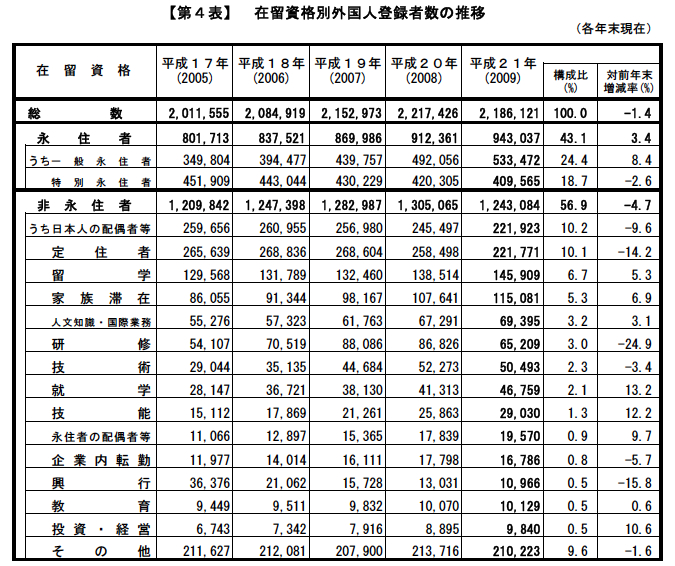
I gave two lectures a couple of weeks ago at Hokudai’s International Student Center on Japan’s multicultural future (a prognostication I find a bit weaker in recent years, what with the drop in NJ numbers in 2009 in all honesty, especially after the Nikkei Repatriation Bribe). So I went on a dig for the most recent GOJ stats on NJ residents, and think it appropriate for this weekend’s blog entry. Have a look. Six screen captures with commentary. For example:

COMMENT: Here we have the number of resident NJ by nationality. As of 2007, the Chinese residents overtook the Koreans (North and South and Zainichi) for the first time in history, and are significantly more numerous than before. Their numbers are not abating, whereas the Koreans and Brazilians are going down significantly. Up also are people from The Philippines. Peruvians and Americans down slightly, while people from “sono ta” other countries are increasing their percentage of the population by a few fractions of a percent every year. Vietnamese, Thais, Subcontinental Indians, and Nepalese are the most significant gainers in this categories, growing by more than 10,000 souls over the past decade.

COMMENT: Here we have registered NJ by Status of Residence again, showing us how the numbers have changed over time. Permanent Residents have increased significantly unabated, except that the Special PRs (Zainichis) keep dropping significantly, while the Regular (immigrants) keep increasing significantly both in number and percentage (8.4%) over 2009 (they crossed lines in 2007; there are now significantly more “Newcomer” immigrants than “Oldcomer” Zainichis). Meanwhile, the non-Permanents have dropped by nearly 5% over the past year. The largest drop percentages are the “Trainees” (generally Chinese working in factories, allegedly receiving training but often being used as slave laborers) by nearly a quarter, and the Long-Term Residents (Nikkei workers, again being offered bribes to go “home” and be somebody else’s unemployment statistic). Also significantly dropping are the “Entertainers” (often people working in the sex trades, again slavery except this time sexual), at 15.8% which to me is good news.

https://www.debito.org/?p=8032

////////////////////////////////////////////////////////////

2) Economist.com special report on Japan: How it all comes back down to demographics

Interesting podcasts from The Economist London (November 20, 2010) on how Japan’s economic future all comes down to demographics. Links to podcasts:

Eight minutes:
Economist Editor: “Unless Japan takes dramatic steps to reenergize its shrinking, greying workforce, its economy will suffer.”

Henry Tricks: “When I set about writing this report, I didn’t start out by looking at population decline. I looked at all the other problems… but everything seemed to come back down to demographics.”

My interpretation: There is no getting around immigration. NJ will come. Whether they find a weakened elderly population in the near future, or an empty island in the far future, they will come. They had better be made into Japanese or there will be no more Japanese.

https://www.debito.org/?p=8064

////////////////////////////////////////////////////////////

3) Economist.com podcast on costs and benefits of immigration

Economist: What can you tell us as far as what you know about the fiscal burden of immigration, and the fiscal benefits of immigrants?

Robert Shapiro, former Prez. Clinton advisor: Particularly in five or six states, where immigrants are highly concentrated, there’s a fiscal deficit. Much of that has to do with educating children of immigrants. That’s the single largest cost. But if you look at it more dynamically, immigrants tend to be aggressive about improving their conditions. Aggressive enough to leave their homeland. These are not the kinds of people who take life as it’s been given to them. They try to make the best of their lives, and so you would expect to see some income gains — whether they start out as a day laborer or as an entrepreneur. The whole issue of entrepreneurship is interesting, because we find that not only do you see a lot of entrepreneurship among educated immigrants, particularly from Asia — and this has been commented on: the large volume of Silicon Valley startups that were started by immigrants, particularly from India. You see this also among undocumented immigrants, who are generally low-skilled people. Now they’re different kinds of businesses they’re starting. But that’s entrepreneurship, whether it’s a software startup, or a small corner business…

[There is] another benefit of immigration — and a fiscal benefit. And that is, immigrants — and they generally come in early working age — they work their whole lives, if they stay here their whole lives, and then they retire. That’s the same as an American, except that the American working young worker has parents. Who claim social security and medicare. Immigrants come without their elderly parents, and in that sense we get a contribution to the labor force without having to pay out the benefits to the parent. When you’re talking about millions of people, that’s big money…

https://www.debito.org/?p=8059

////////////////////////////////////////////////////////////

4) WSJ: Domestic Group Appeals for Overhaul of Japanese Immigration

WSJ: A powerful group of politicians, academics and business leaders is set to launch an unusual campaign to urge Japan to pry open its doors to foreigners, saying the country’s survival hinges on revamping its immigration policy.

Japan has one of the most restrictive immigration policies in the world, and the debate over whether to allow more foreigners to settle in the country has long been a contentious, politically charged issue for the nation. But recently, calls to allow more foreign workers to enter Japan have become louder, as the aging population continues to shrink and the country’s competitiveness and economic growth pales in comparison with its neighbor to the west: China. A minuscule 1.7% of the overall Japanese population are foreigners, compared with 6.8% in the United Kingdom and 21.4% in Switzerland, according to the OECD.

The 87-member policy council of the Japan Forum of International Relations, a powerful nonprofit research foundation, will on Thursday launch a half-page advertisement in the country’s leading newspapers, urging Japan to rethink its immigration policy. They also submitted their policy recommendations to Naoto Kan, the country’s prime minister.

“If Japan wants to survive in a globalized world economy and to advance her integration with the burgeoning East Asian economy, she essentially has no other choice but to accept foreign migrants,” the advertisement says.

The policy council has issued several recommendations, including allowing more skilled workers to enter the labor market, particularly in industries where there are shortages of domestic workers, such as construction and the auto industry. Under economic-partnership agreements with Indonesia and the Philippines, Tokyo has allowed nurses and nursing-care specialists from these countries to enter Japan, but applicants are subjected to a grueling test in Japanese that only three people have passed. The council says these tests have to be made easier…

https://www.debito.org/?p=7929

////////////////////////////////////////////////////////////

5) Japan Times Community Page on issues of dual citizenship: “Japan loses, rest of the world gains from ‘one citizenship fits all’ policy”

Japan Times: What does Japan gain by, in effect, rejecting my children and thousands of other young dual citizens living in Japan and around the world, at the very moment when they come of age and are at last able to become productive members of society?

Best as I can figure, the only virtue of the “one citizenship fits all” rule is simplicity.

What does Japan lose by rejecting dual citizenship? … One wonders if the existing policy of denying permanent dual citizenship to people who possessed the status as children is motivated by a concern that altering it would lead to dual citizenship demands by others, such as ethnic Korean residents of Japan or Brazilians of Japanese descent. Rather than risk facing such demands, government officials might have concluded that it is “better to leave well enough alone.” However, allowing people who already have Japanese citizenship to keep it will not inevitably lead to more far-reaching changes to Japan’s Nationality Law.

Given its dire demographic outlook, perhaps Japan should open a dialogue on radical changes to its Nationality Law, such as a U.S.-style “birthright” giving citizenship to all people born on Japanese soil, an Israeli-style “Law of Return” allowing the ingathering of all ethnic Japanese everywhere in their ancestral homeland, or an Irish-style “Grandparent Rule” granting citizenship to anyone who can document having one Japanese grandparent. But even if Japan is not willing to open its door that widely, it should at least stop slamming the door on some of its own citizens shortly after they reach adulthood…

https://www.debito.org/?p=8019

////////////////////////////////////////////////////////////

6) CNNGo.com: “Will there ever be a rainbow Japan?”

CNNGo: Japan: The new melting pot?

Japan’s national government recently announced it is turning to travelers in a foreigner-friendly mission to boost diversity — at least in tourist spots — by paying them to provide feedback on how to increase accessibility for non-Japanese speakers.

David Askew, associate professor of law at Kyoto’s Ritsumeikan University, identifies more profound changes.

In 1965, a mere 1 in 250 of all marriages in Japan were international, he notes. By 2004, the number had climbed to 1 in 15 across the nation and 1 in 10 in Tokyo.

According to Tokyo’s Metropolitan Government, by 2005, foreign residents in the city numbered 248,363, up from 159,073 in 1990.

According to Askew, the upswing in diverse residents and mixed marriages has led to another phenomenon: between 1987 and 2004, more than 500,000 children were born in Japan with at least one foreign parent…

https://www.debito.org/?p=7995

////////////////////////////////////////////////////////////

7) Tangent: LA Times: PRC Census also measures for ethnicity, unlike Japan’s Census

LAT: “Similar to the census process in the United States, most people [in China] are given a standard [census] form with a few basic questions: 18 of them centering on names, ages, occupation. Ethnicity is also asked, but not religion, that being a sensitive subject in a communist country that is officially atheist. One-tenth of the population, meanwhile, was selected for a longer, 45-question form that includes queries about income, savings, the type of water one drinks (tap or boiled) and the number of bathrooms in the house…”

COMMENT: What’s interesting as far as Debito.org goes is that, despite some claims of Chinese homogeneity thanks to the Han majority, the PRC apparently DOES survey for ethnicity. Unlike the GOJ. Again, that’s the hegemony of homogeneity in Japan.

https://www.debito.org/?p=7920

////////////////////////////////////////////////////////////

WORKPLACE ISSUES

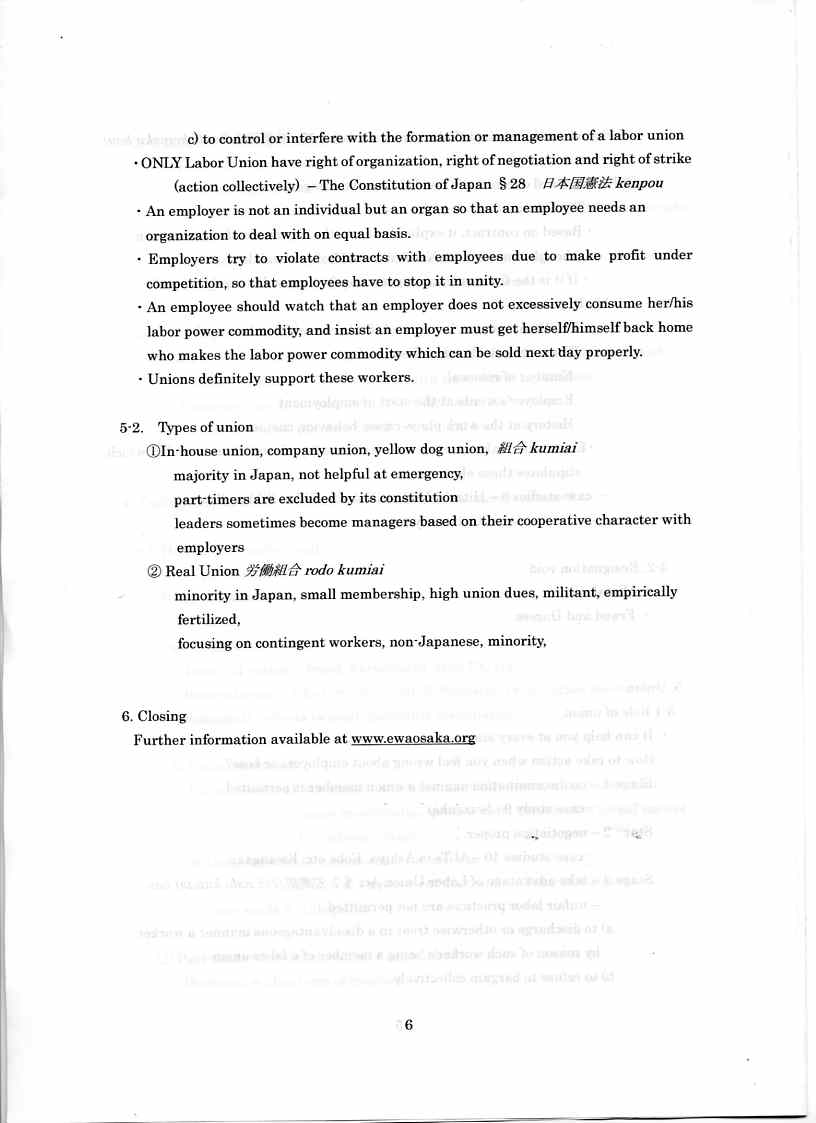
8 ) DEBITO.ORG PODCAST SPECIAL: Speech by Neo Yamashita of EWA Osaka union on your contract labor rights

DEBITO.ORG PODCAST DECEMBER 1, 2010
PALE SIG Forum: Labor relations in Japan

Language: English
From recruitment through retirement (or dismissal), labor laws, court precedents, and labor unions affect educational workers. Educational workers, especially non-Japanese, however, are not well informed or even misled about this. For example, though Westerners want written contracts, Japanese labor advocates recommend not signing contracts in some cases to protect employment rights. This recommendation is based on labor law and court precedents. Accordingly, labor unions play a more crucial role in protecting worker rights than some think.

Neo Yamashita, Vice Chair of the Education Workers and Amalgamated Union Osaka (EWA), gives us his decades of expertise on November 20, 2010. Podcast listenable from here. 87 minutes. No cuts.

https://www.debito.org/?p=7968

////////////////////////////////////////////////////////////

9) Japan Times Community Page on NJ “Trainee Visa” slavery program and how crooked it still is, according to NGOs

JT: In October 1999, 19 Chinese trainees came to the Takefu city office pleading for help. In their first year in Japan as interns, the women had been promised JPY50,000 a month, but scraped by on JPY10,000. The next year, as technical trainees, they should have received JPY115,000 a month. After health insurance, pension, rent, forced “savings” and administrative fees for the staffing agency in China were deducted, what they got was JPY15,000. The women walked for five hours from their workshop in the mountains of Fukui Prefecture to talk with the director of their placement organization at his home. Instead of receiving answers, they were turned away with harsh words — and even blows.

The incident was discussed in the Diet and became a symbol of the profound problems with the trainee system. Shortly afterwards, citizens’ groups formed to protect the rights of trainees and organizations already working to protect foreigners’ rights found a new focus. More than 10 years later, leaders of these groups say they have seen some positive changes, but abuses of the system are still endemic…

https://www.debito.org/?p=8006

////////////////////////////////////////////////////////////

10) McNeill in Mainichi on how Japan Inc. needs to loosen up to women and NJ executives

McNeill: I’ve talked about Japan’s reluctance to embrace mass immigration in this column before. Here’s something else to consider: Japan’s boardrooms are still almost completely devoid of foreigners — and females.

Women make up just 1.2 percent of top Japanese executives, according to business publisher Toyo Keizai; gaijin board members on Japan’s roughly 4,000 listed companies are as rare as hens’ teeth.

The exception is a handful of troubled giants, notably Sony Corp., which made Welshman Howard Stringer its chairman and CEO in 2005, and Nissan Motor Co., where Brazilian Carlos Ghosn has been in charge for over a decade.

That lack of diversity worries some bosses. Last year the Japan Association of Corporate Executives published the results of a two-year survey that called on its members to revolutionize boardroom practices.

“Japanese firms are terribly behind in accepting diversity,” said association vice chairman Hasegawa Yasuchika. “They should radically transform their corporate culture to provide the same opportunities to employees all around the world.”

Easier said than done, perhaps. Ever since Japan’s corporations began moving overseas in the 1970s, they have followed a tried and tested formula: Whatever happens in transplants and local operations abroad, control stays in the iron grip of the all-Japanese boardroom back home…

https://www.debito.org/?p=7948

////////////////////////////////////////////////////////////

11) Tangent: NHK: GOJ enshrining more rights for handicapped. Hope for same for NJ?

We might have the image of the DPJ being too bogged down in politics to get much done. But as NHK reports below (be sure to watch video too from the link), we have some pretty impressive lawmaking being done by a more liberal government for one underprivileged segment of Japanese society — the handicapped.

The committee’s deliberations are saying the things we want guaranteed vis-a-vis human rights for human beings — including protections enshrined in law. With this precedent and degree of enlightenment, can we but hope that they could someday stretch it to include non-citizens? The linkage, however tenuous, is there. Have a read:

https://www.debito.org/?p=7936

////////////////////////////////////////////////////////////

SOMETHING SMELLS FISHY

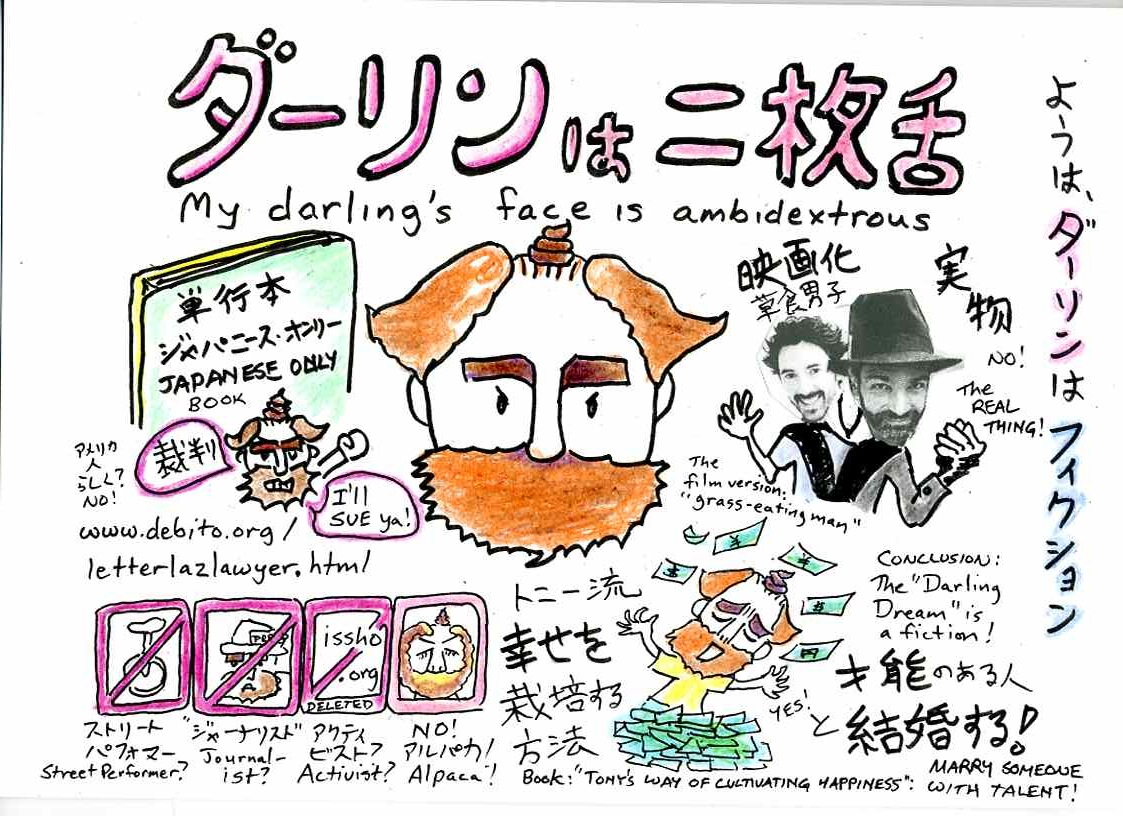
12) Japan Times: “Darling foreigner” Tony Laszlo is “less passionate today” about discrimination against foreigners

Japan Times: Apart from writing, Laszlo taught for a few years at Japanese universities, and has also set up an nongovernmental organization, Issho Kikaku, in 1992. Through this NGO, he put on theatrical shows related to multicultural issues, and later, dealt with social issues such as discrimination against foreigners.

“In those days, personally, I felt a strong desire to avoid a simple dichotomy between Japanese and non-Japanese, male and female, family and friends, handicapped and nonhandicapped,” he said. Today, he said he is less passionate about the issues, and that the group’s activities have become more low-key…

COMMENT: Low key? I’ll say. This “issho kikaku” has a one-page website which hasn’t changed for years — moreover has done away with hundreds of pages of works from other NJ and Japanese activists that were a priceless archive of domestic activism from the late 1990’s-early 2000’s. In fact, this “issho kikaku” was never an NGO at all. Never registered as one, in fact, yet still reported as extant by a too-trusting reporter. So “low-key” is an understatement: how about “no-key” or “delete-key”?…

https://www.debito.org/?p=8071

////////////////////////////////////////////////////////////

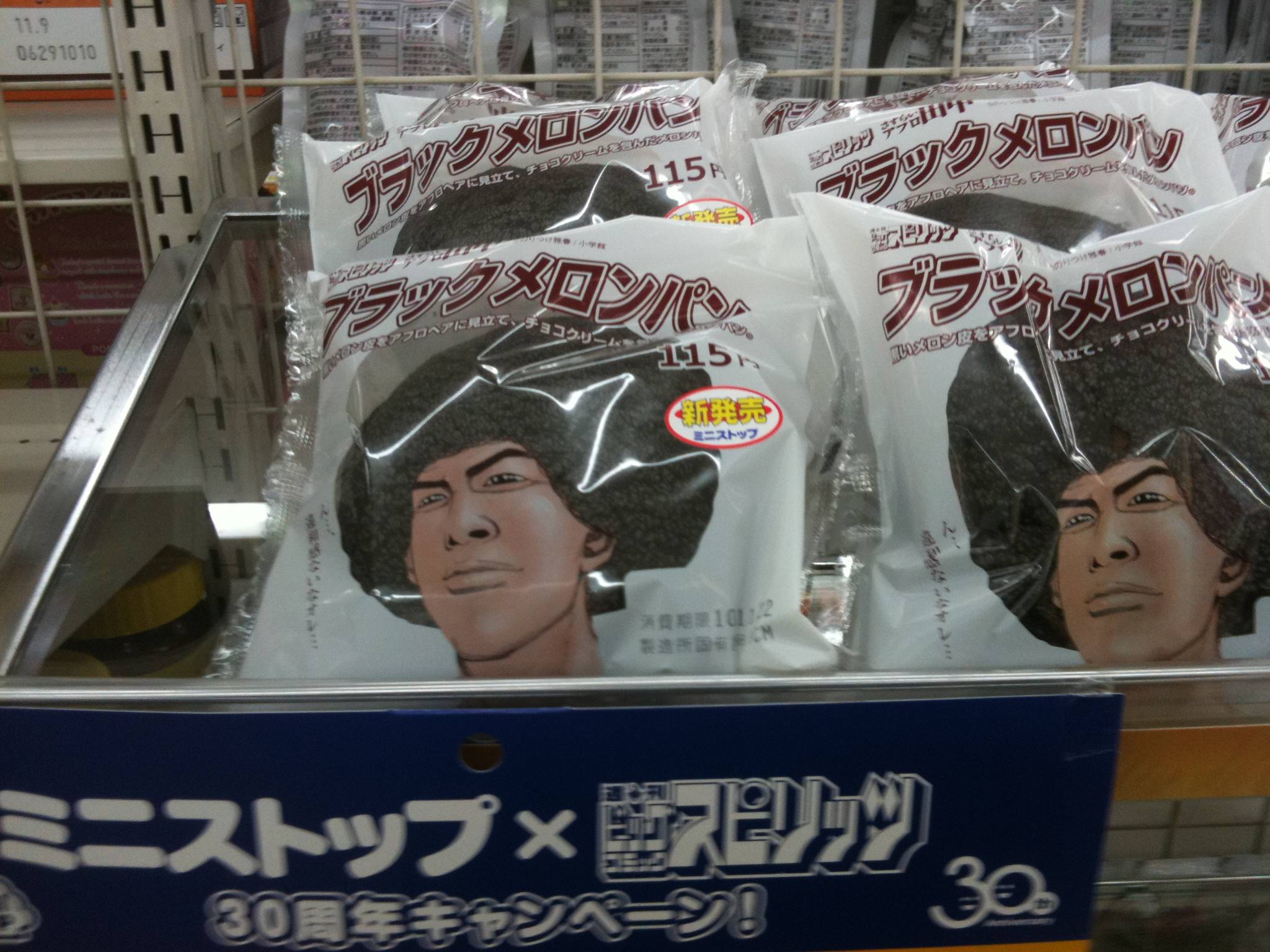
13) “Black Melon Pan” Afros as food: Insensitive marketing by Mini-Stop Konbini

Here’s a letter from cyberspace on another potentially offensive marketing campaign portraying African features as black-bread Afros to sell food.

No doubt we’ll get the defenders of this sort of marketing, e.g. “Japan has so few black people it has no sensitivity to this sort of thing”, “it’s not racist, at least not intentionally”, “lighten up guys, and stop foisting your cultural values on the Japanese”, or “it’s a Japanese character, not a real black character, so it’s not a problem”. Any other naysaying? Oh wait, yeah, “you just don’t get Japan”. Anyway, check this out:

XY: My name is XY, Founder and Director of [….] a marketing consultancy in [Japan] that researches Japanese consumer behavior on behalf of our international clients like Coca-Cola, VISA credit cards etc. As such, I often peruse the shelves of convenience stores to see what the latest trends are. I was shocked to find in my local Mini-Stop the all-new campaign for “black melon pan”, a bread that parodies a black man’s afro on the package. This is no small thing. Mini-Stop is a very large and growing combini chain and this is a signature campaign prominently advertised and displayed on their shelves…

https://www.debito.org/?p=8045

////////////////////////////////////////////////////////////

14) YouTube video showing NPA Bicycle Instant Checkpoint supersedes attention to car accident

AT: Hey Debito, you gotta check out this YouTube video showing a prime example of the incompetence of the Japanese police. A guy riding a bicycle gets stopped by a police officer for no reason, which happens a lot in Japan. As the officer is asking him questions (which the guy is under no obligation to answer), we can hear an obvious traffic accident take place in the background just around the corner, and both the police officer and the bicyclist hear it. A reasonable police officer would realize that that was a traffic accident and that people may be injured and need first aid, etc. But no, this cop continues to question the bicyclist as if nothing happened. At one point he even denies that it may be a traffic accident. After the bicyclist convinces him to do so, he notifies dispatch of the traffic accident, and then continues to question the bicyclist rather than tending to the possibly injured! This cop neglected to tend to a possibly serious and fatal traffic accident, all so he can perform shokumu shitsumon (voluntary questioning) on a bicyclist!

https://www.debito.org/?p=8050

////////////////////////////////////////////////////////////

15) Yomiuri: ‘Leaked MPD data’ out as book / Documents published as is; names of police, NJ informants revealed

This breaking news from the weekend compounds just how sinister the activities of the Japanese police can be. First spying on people in the name of combating terrorism because they’re Muslims or connected to Muslims, then losing control of the information to the point where it becomes a book on sale to the public. Shame on you, Metropolitan Police Department. Imagine how big a scandal this would have been if Japanese people had been treated similarly.

Now, of course, since this is embarrassing to the police, the book (as per checks with Amazon.co.jp and an in-person check at Kinokuniya Sapporo yesterday) is no longer being sold. Good. But that sure was quick, compared to how much comparative time and effort it took for the Gaijin Hanzai Ura Files Mook in 2007 (which I believe the police contributed information to) to go off-market. Seems to me less the need to protect individual NJ than for the police to cover their collective ketsu. Whatever. The book is off the market. The materials for it shouldn’t have been collected in the first place.

Yomiuri: A Tokyo publishing house has released a book containing what are believed to be Metropolitan Police Department antiterrorism documents that were leaked onto the Internet last month.

Released by Dai-San Shokan Thursday, the book contains the personal information of Muslim residents in this country, such as their names and addresses.

Akira Kitagawa, president of the publisher, said he decided to put out the book “to raise questions about the laxity of the police’s information control system.”…

The 469-page book, titled “Ryushutsu ‘Koan Tero Joho’ Zen Deta” (Leaked police terrorism info: all data), is on sale at some bookstores, but several major publishing agents have refused to distribute it.

If the documents are authentic, the book contains the names and photos of foreign residents being monitored by the 3rd Foreign Affairs Division at the Public Security Bureau of the MPD, the names of people who have cooperated with the police, and the photos and addresses of police officers involved in terrorism investigations.

https://www.debito.org/?p=7961

////////////////////////////////////////////////////////////

… and finally …

16) Japan Times JUST BE CAUSE, Dec 7, 2010: “MOFA gets E for effort in ‘with or without U’ farce”

JUST BE CAUSE
The Japan Times: Tuesday, Dec. 7, 2010
MOFA gets E for effort in ‘with or without U’ farce [not my title]
By ARUDOU DEBITO
Column 34 for Japan Times JUST BE CAUSE

Courtesy http://search.japantimes.co.jp/cgi-bin/fl20101207ad.html
Version with links to sources and discussion at https://www.debito.org/?p=8010

////////////////////////////////////////////////////////////

All before the holidays start. Thanks for reading!
Arudou Debito (debito@debito.org)
Daily blog updates, discussions, and RSS feeds at www.debito.org
DEBITO.ORG NEWSLETTER DECEMBER 18, 2010 ENDS

Japan Times: “Darling foreigner” Tony Laszlo is “less passionate today” about discrimination against foreigners

mytest

Handbook for Newcomers, Migrants, and Immigrants to Japan\Foreign Residents and Naturalized Citizens Association forming NGO\「ジャパニーズ・オンリー 小樽入浴拒否問題と人種差別」(明石書店)JAPANESE ONLY:  The Otaru Hot Springs Case and Racial Discrimination in Japansourstrawberriesavatardebitopodcastthumb
UPDATES ON TWITTER: arudoudebito
DEBITO.ORG PODCASTS on iTunes, subscribe free

Hi Blog. As we wind down the year and the decade, we’ll start having more retrospectives on Debito.org. Kicking this off is a fluff piece from the Japan Times from “My Darling is a Foreigner” Tony Laszlo, and how he’s put himself out to pasture from an alleged human rights activist to a cunning linguist.  A paragraph of note:

(photo courtesy Japan Times Dec 14, 2010)

////////////////////////////////////////////

WHO’S WHO
For writer, languages are his ‘darling’
Multilingual author and subject of ‘My Darling is a Foreigner’ comic celebrates joy of words
The Japan Times, Tuesday, Dec. 14, 2010

…Apart from writing, Laszlo taught for a few years at Japanese universities, and has also set up an nongovernmental organization, Issho Kikaku, in 1992. Through this NGO, he put on theatrical shows related to multicultural issues, and later, dealt with social issues such as discrimination against foreigners.

“In those days, personally, I felt a strong desire to avoid a simple dichotomy between Japanese and non-Japanese, male and female, family and friends, handicapped and nonhandicapped,” he said. Today, he said he is less passionate about the issues, and that the group’s activities have become more low-key. Now it engages in research on issues concerning human diversity, language and culture.

Full article at http://search.japantimes.co.jp/cgi-bin/fl20101214ww.html

//////////////////////////////////////////////

COMMENT: Low key? I’ll say. This “issho kikaku” has a one-page website which hasn’t changed for years — moreover has done away with hundreds of pages of works from other NJ and Japanese activists that were a priceless archive of domestic activism from the late 1990’s-early 2000‘s. In fact, this “issho kikaku” was never an NGO at all. Never registered as one, in fact, yet still reported as extant by a too-trusting reporter. So “low-key” is an understatement: how about “no-key” or “delete-key”?

But yeah, it must be nice to be the appendage-half of a very successful business partnership, one that became a social phenomenon (of debatable benefit) this past decade. It’s produced a person who reportedly once cared about helping the downtrodden in Japanese society, yet can still make media hay in places like the Japan Times just by indulging in idle sweetmeat pursuits.  I guess for him that’s better than actually losing hair being being passionate about issues that might benefit from a bit of tycoon philanthropy:   Helping people avoid that dichotomy between “Japanese and non-Japanese, male and female, family and friends, handicapped and nonhandicapped.”etc.

Better to be a Darling, and lick the buttered side of the bread.

Economist.com special report on Japan: How it all comes back down to demographics

mytest

Handbook for Newcomers, Migrants, and Immigrants to Japan\Foreign Residents and Naturalized Citizens Association forming NGO\「ジャパニーズ・オンリー 小樽入浴拒否問題と人種差別」(明石書店)JAPANESE ONLY:  The Otaru Hot Springs Case and Racial Discrimination in Japansourstrawberriesavatardebitopodcastthumb

UPDATES ON TWITTER: arudoudebito

DEBITO.ORG PODCASTS now on iTunes, subscribe free

Hi Blog. Interesting podcasts from The Economist London (November 20, 2010) on how Japan’s economic future all comes down to demographics:

Eight minutes:

Economist Editor: “Unless Japan takes dramatic steps to reenergize its shrinking, greying workforce, its economy will suffer.”

A special report on Japan

12.5 minutes:

Henry Tricks: “When I set about writing this report, I didn’t start out by looking at population decline. I looked at all the other problems… but everything seemed to come back down to demographics.”

A special report on Japan

My interpretation: There is no getting around immigration. NJ will come. Whether they find a weakened elderly population in the near future, or an empty island in the far future, they will come. They had better be made into Japanese or there will be no more Japanese. Arudou Debito

Economist.com podcast on costs and benefits of immigration

mytest

Handbook for Newcomers, Migrants, and Immigrants to Japan\Foreign Residents and Naturalized Citizens Association forming NGO\「ジャパニーズ・オンリー 小樽入浴拒否問題と人種差別」(明石書店)JAPANESE ONLY:  The Otaru Hot Springs Case and Racial Discrimination in Japansourstrawberriesavatardebitopodcastthumb
UPDATES ON TWITTER: arudoudebito

DEBITO.ORG PODCASTS now on iTunes, subscribe free
Hi Blog. Here is what Robert Shapiro, former economic adviser to President Clinton, says about the positive financial impact of new waves of immigration, in this case to the United States:

////////////////////////////////////////////////////

(Courtesy Economist.com Podcast June 23, 2010, from minute 1:44; typos mine)

Economist: Even in the best of economic times, there are concerns about the fiscal impact of immigration: How they’re using services, what they’re contributing in taxation… that’s obviously become more of a concern given the recession. What can you tell us as far as what you know about the fiscal burden of immigration, and the fiscal benefits of immigrants?

Shapiro: Particularly in five or six states, where immigrants are highly concentrated, there’s a fiscal deficit. Much of that has to do with educating children of immigrants. That’s the single largest cost. But if you look at it more dynamically, immigrants tend to be aggressive about improving their conditions. Aggressive enough to leave their homeland. These are not the kinds of people who take life as it’s been given to them. They try to make the best of their lives, and so you would expect to see some income gains — whether they start out as a day laborer or as an entrepreneur. The whole issue of entrepreneurship is interesting, because we find that not only do you see a lot of entrepreneurship among educated immigrants, particularly from Asia — and this has been commented on: the large volume of Silicon Valley startups that were started by immigrants, particularly from India. You see this also among undocumented immigrants, who are generally low-skilled people. Now they’re different kinds of businesses they’re starting. But that’s entrepreneurship, whether it’s a software startup, or a small corner business…

[There is] another benefit of immigration — and a fiscal benefit. And that is, immigrants — and they generally come in early working age — they work their whole lives, if they stay here their whole lives, and then they retire. That’s the same as an American, except that the American working young worker has parents. Who claim social security and medicare. Immigrants come without their elderly parents, and in that sense we get a contribution to the labor force without having to pay out the benefits to the parent. When you’re talking about millions of people, that’s big money…

Economist…Is immigration responsible for holding down wages in the US, or for slow wage growth?

Shapiro: If you look at the aggregate, there is no evidence that shows that immigrants have had any depressive effect on the average wage in the United States.  However, there are winners and losers. Immigration actually appears to be responsible for gains in wages for higher-skilled Americans.  The reason for this is that you have large numbers of relatively low-skilled immigrants that allow the expansion of organizations — because they can hire more people because they are less expensive.  That expansion requires more higher-skilled people to manage it, for all the ancillary services, advance services associated with a large organization. And so it seems be associated with putting upward pressure on the wages of highly-skilled people.  It also puts downward pressure on the wages of low-skilled Americans.

EXCERPT ENDS

YouTube video showing NPA Bicycle Instant Checkpoint supersedes attention to car accident

mytest

Handbook for Newcomers, Migrants, and Immigrants to Japan\Foreign Residents and Naturalized Citizens Association forming NGO\「ジャパニーズ・オンリー 小樽入浴拒否問題と人種差別」(明石書店)JAPANESE ONLY:  The Otaru Hot Springs Case and Racial Discrimination in Japansourstrawberriesavatardebitopodcastthumb
UPDATES ON TWITTER: arudoudebito
DEBITO.ORG PODCASTS now on iTunes, subscribe free
Hi Blog.  More word from cyberspace today, courtesy of AT:

/////////////////////////////////////////

December 13, 2010

Hey Debito, you gotta check out this YouTube video showing a prime example of the incompetence of the Japanese police. A guy riding a bicycle gets stopped by a police officer for no reason, which happens a lot in Japan. As the officer is asking him questions (which the guy is under no obligation to answer), we can hear an obvious traffic accident take place in the background just around the corner, and both the police officer and the bicyclist hear it. A reasonable police officer would realize that that was a traffic accident and that people may be injured and need first aid, etc. But no, this cop continues to question the bicyclist as if nothing happened. At one point he even denies that it may be a traffic accident. After the bicyclist convinces him to do so, he notifies dispatch of the traffic accident, and then continues to question the bicyclist rather than tending to the possibly injured! This cop neglected to tend to a possibly serious and fatal traffic accident, all so he can perform 職務質問 (voluntary questioning) on a bicyclist!

/////////////////////////////////////////

COMMENT:  Yes, it happens aplenty to those riding while foreign in Japan, but as I’ve argued before (in my Japan Times article Gaijin as Public Policy Guinea Pig), things foisted upon the NJ population to increase police powers are soon foisted upon the Japanese population as well.  This video is evidence of that.  Since the Keystones cannot stop people ostensibly without probable cause, stopping people with bicycles (using the excuse that they might have stolen them) or with bags (they might have knives etc.) is one way for the NPA to put the people in their place (i.e., if you can’t avoid cycling or carrying any luggage in public, too bad; suffer our suspicions).  Of course, the Keystones need no excuse to stop NJ: being foreign-looking alone in Japan is probable cause of suspicion for a visa overstay.  Again, this fortifies my theory of Japan as Mild Police State.  One that I believe is trying to increase its power in the name of “making Japan the world’s safest country again“.  Even if, in this case, the safety of others in first-aid cases is subordinated to an individual cop’s power trip.  A bit of a tangent today, but it’s germane to Debito.org.  Arudou Debito

“Black Melon Pan” Afros as food: Insensitive marketing by Mini-Stop Konbini

mytest

Handbook for Newcomers, Migrants, and Immigrants to Japan\Foreign Residents and Naturalized Citizens Association forming NGO\「ジャパニーズ・オンリー 小樽入浴拒否問題と人種差別」(明石書店)JAPANESE ONLY:  The Otaru Hot Springs Case and Racial Discrimination in Japansourstrawberriesavatardebitopodcastthumb
UPDATES ON TWITTER: arudoudebito
DEBITO.ORG PODCASTS on iTunes, subscribe free

Hi Blog.  Here’s a letter from cyberspace on another potentially offensive marketing campaign portraying African features as black-bread Afros to sell food.

No doubt we’ll get the defenders of this sort of marketing, e.g. “Japan has so few black people it has no sensitivity to this sort of thing”, “it’s not racist, at least not intentionally”, “lighten up guys, and stop foisting your cultural values on the Japanese”, or “it’s a Japanese character, not a real black character, so it’s not a problem”.  Any other naysaying?  Oh wait, yeah, “you just don’t get Japan”.  Anyway, check this out.  Arudou Debito

///////////////////////////////////////////

November 20, 2010:

Hi Debito, My name is XY, Founder and Director of [….] a marketing consultancy in [Japan] that researches Japanese consumer behavior on behalf of our international clients like Coca-Cola, VISA credit cards etc. As such, I often peruse the shelves of convenience stores to see what the latest trends are. I was shocked to find in my local Mini-Stop the all-new campaign for ブラックメロンパン, a bread that parodies a black man’s afro on the package. This is no small thing. Mini-Stop is a very large and growing combini chain and this is a signature campaign prominently advertised and displayed on their shelves.

I read your JT articles often and appreciate all of them. I figured you are the man to bring light to this latest scandal. I also read your article on the McDonald’s campaign and agree wholeheartedly… however this Mini-Stop campaign is just so much more overt and insensitive… even more so than the EMobile monkey monstrosity.

I have attached a couple photos below (click to expand in browser):


Best Regards, XY.

ENDS

Latest numbers on Japan’s registered NJ population from MOJ (November 2010)

mytest

Handbook for Newcomers, Migrants, and Immigrants to Japan\Foreign Residents and Naturalized Citizens Association forming NGO\「ジャパニーズ・オンリー 小樽入浴拒否問題と人種差別」(明石書店)JAPANESE ONLY:  The Otaru Hot Springs Case and Racial Discrimination in Japansourstrawberriesavatardebitopodcastthumb
UPDATES ON TWITTER: arudoudebito
DEBITO.ORG PODCASTS on iTunes, subscribe free

Hi Blog. I gave two lectures a couple of weeks ago at Hokudai’s International Student Center on Japan’s multicultural future (a prognostication I find a bit weaker in recent years, what with the drop in NJ numbers in 2009 in all honesty, especially after the Nikkei Repatriation Bribe). So I went on a dig for the most recent GOJ stats on NJ residents, and think it appropriate for this weekend’s blog entry. Have a look:

Source:  Ministry of Justice website, press release dated November 10, 2010

http://www.moj.go.jp/nyuukokukanri/kouhou/nyuukokukanri04_00005.html

COMMENT:  As you can see, the numbers of NJ have increased without fail every year (for 48 years, as a matter of fact) until last year, now standing at nearly 2.2 million.

Source:  Ministry of Justice website, press release dated November 10, 2010

http://www.moj.go.jp/nyuukokukanri/kouhou/nyuukokukanri04_00005.html

COMMENT:  Here we have the number of resident NJ by nationality.  As of 2007, the Chinese residents overtook the Koreans (North and South and Zainichi) for the first time in history, and are significantly more numerous than before.  Their numbers are not abating, whereas the Koreans and Brazilians are going down significantly.  Up also are people from The Philippines.  Peruvians and Americans down slightly, while people from “sono ta” other countries are increasing their percentage of the population by a few fractions of a percent every year.  Vietnamese, Thais, Subcontinental Indians, and Nepalese are the most significant gainers in this categories, growing by more than 10,000 souls over the past decade.

Source:  Ministry of Justice website, press release dated November 10, 2010

http://www.moj.go.jp/content/000049973.pdf

COMMENT:  Here we have NJ by Status of Residence (visa status).  The red and white candy stripe area indicates Permanent Residents (both Regular (immigrant) and Special (Zainichi generational foreigners), who comprise more than 43% of all registered NJ in Japan.  Nearly half (and growing, as you will see in the next graph) of all NJ here can stay here forever.  Bubbling under are Spouse of Japanese (10.2%), Long-Term Residents (generally the Nikkei workers from South America, 10.1%), and Exchange Students (6.7%).

Source:  Ministry of Justice website, press release dated November 10, 2010

http://www.moj.go.jp/content/000049973.pdf

COMMENT:  Here we have registered NJ by Status of Residence again, showing us how the numbers have changed over time.  Permanent Residents have increased significantly unabated, except that the Special PRs (Zainichis) keep dropping significantly, while the Regular (immigrants) keep increasing significantly both in number and percentage (8.4%) over 2009 (they crossed lines in 2007; there are now significantly more “Newcomer” immigrants than “Oldcomer”  Zainichis).  Meanwhile, the non-Permanents have dropped by nearly 5% over the past year.  The largest drop percentages are the “Trainees” (generally Chinese working in factories, allegedly receiving training but often being used as slave laborers) by nearly a quarter, and the Long-Term Residents (Nikkei workers, again being offered bribes to go “home” and be somebody else’s unemployment statistic).  Also significantly dropping are the “Entertainers” (often people working in the sex trades, again slavery except this time sexual), at 15.8% which to me is good news.

Source:  Ministry of Justice website, press release dated November 10, 2010

http://www.moj.go.jp/nyuukokukanri/kouhou/nyuukokukanri04_00005.html

COMMENT:  Here are the statistics on where NJ are being registered and the change over time.  Tokyo area is the most popular, rising 3.1%.  Second is Aichi (Nagoya), dropping significantly, then Osaka (also dropping slightly), Kanagawa (Yokohama) up a bit, and so on down.  Outside of the major metropolises, NJ numbers are going down significantly (-4.0%).

One more, since this is fun.  More raw numbers and rises and falls in the NJ population by prefecture:

Source:  Ministry of Justice website, press release dated November 10, 2010

http://www.moj.go.jp/nyuukokukanri/kouhou/nyuukokukanri04_00005.html

Numbers in red indicate rises.  Hey, Hokkaido rose!  Arudou Debito

My speech at Otaru Shoudai Dec 6, 2010, “The Otaru Onsens Case 10 years on”, now on YouTube in six parts

mytest

Handbook for Newcomers, Migrants, and Immigrants to Japan\Foreign Residents and Naturalized Citizens Association forming NGO\「ジャパニーズ・オンリー 小樽入浴拒否問題と人種差別」(明石書店)JAPANESE ONLY:  The Otaru Hot Springs Case and Racial Discrimination in Japansourstrawberriesavatardebitopodcastthumb
UPDATES ON TWITTER: arudoudebito
DEBITO.ORG PODCASTS on iTunes, subscribe free

Hi Blog. I gave a series of speeches over the past week, the latest one at Otaru University of Commerce, on “The Otaru Onsens Case Ten Years On”. It’s in English (as it is a lecture series in English sponsored by the university for language students and exchange students), and available for view in several parts at the Otaru Shoudai Channel on YouTube. Have a look. Links to parts one through six below.  Enjoy.  Arudou Debito

Part One:

Part Two:
http://www.youtube.com/watch?v=mKz1fm5GdN4

Part Three:
http://www.youtube.com/watch?v=p15Vrg0X_y0

Part Four:
http://www.youtube.com/watch?v=nyP2JFlvDzI

Part Five:
http://www.youtube.com/watch?v=Lw-MZ-8s7jI

Part Six:
http://www.youtube.com/watch?v=v1quOHWZUBE

ENDS

Japan Times Community Page on issues of dual citizenship: “Japan loses, rest of the world gains from ‘one citizenship fits all’ policy”

mytest

Handbook for Newcomers, Migrants, and Immigrants to Japan\Foreign Residents and Naturalized Citizens Association forming NGO\「ジャパニーズ・オンリー 小樽入浴拒否問題と人種差別」(明石書店)JAPANESE ONLY:  The Otaru Hot Springs Case and Racial Discrimination in Japansourstrawberriesavatardebitopodcastthumb
UPDATES ON TWITTER: arudoudebito
DEBITO.ORG PODCASTS on iTunes, subscribe free

Hi Blog. Thoughtful letter on a serious issue in the Japan Times Community Page again this week (Tuesday’s paper is always worth the cover price). Speaking of identity and possibilities of a “Rainbow Society” (which has become a discussion on issues of being “haafu” in Japan in the Comments Section of a recent blog post), one essential issue is the acknowledgement of “doubles” in terms of legal status: Dual Nationality. Excerpting from this week’s Hotline to Nagatacho. Arudou Debito

////////////////////////////

The Japan Times Tuesday, Dec. 7, 2010
HOTLINE TO NAGATACHO
Japan loses, rest of the world gains from ‘one citizenship fits all’ policy
(excerpt)

…What does Japan gain by, in effect, rejecting my children and thousands of other young dual citizens living in Japan and around the world, at the very moment when they come of age and are at last able to become productive members of society?

Best as I can figure, the only virtue of the “one citizenship fits all” rule is simplicity.

What does Japan lose by rejecting dual citizenship?

My daughters, for one thing (and that’s a big loss; I know, I know: oyabaka), along with many other repudiated young people whose capacity and willingness to contribute their talents, creativity, fluency in English and other languages, international experience, energy and human and financial capital to Japan as full-fledged members of society are suppressed, or snuffed out altogether, by continuing a short-sighted, anachronistic policy.

In an era of increasing global competition, a shrinking, aging and insular Japan needs all hands on deck. Japan should be actively recruiting these talented young people to come to Japan and lay down roots, not turning them away.

Some may contend that my daughters and others like them are still free to come to Japan as foreigners, procure visas and remain for as long as they like (or at least as long as they have a visa-qualifying job). But that’s a far cry from “being Japanese.”

It’s not just about avoiding the legal limits on what foreigners may do and how long they may stay in Japan. Citizens are more likely to be motivated to make the sacrifices, and take the risks necessary to improve society, such as through public service and entrepreneurial activity. The New York Times columnist Thomas Friedman has often said, in a different context, that “no one in the history of the world has ever washed a rented car.” The same holds true here. Japan cannot repossess the title to the car — citizenship — from some of its people and fairly expect that those same people will still care enough to do what it takes to keep the car — Japan — in good working order or, better yet, to add some chrome and polish.

It is a well-known secret that the Japanese government does not actively enforce the citizenship selection rule. I was even told once — by a Japanese government official no less — that my kids should simply hold on to their Japanese passports after they reach 22 and renew them when they expire, without ever making an affirmative citizenship selection. Many people do just this. It’s the dual citizenship equivalent of the U.S. armed forces’ fading “don’t ask, don’t tell” policy.

This is a very Japanese approach, but it’s not a solution. It places all “shadow” dual citizens at risk of losing their Japanese nationality any time the Japanese government decides to change its current policy of benign neglect, or if a dual citizen trips up by presenting the wrong passport to the wrong immigration official at the wrong time. Long-term planning and commitment are impossible under these circumstances.

But, more importantly, this “winks and nods” policy of lax or non-enforcement sends precisely the wrong message. Instead of laying out the welcome mat, these young people are told to sneak in through the back door (and hope it’s not locked). Many won’t even try.

One wonders if the existing policy of denying permanent dual citizenship to people who possessed the status as children is motivated by a concern that altering it would lead to dual citizenship demands by others, such as ethnic Korean residents of Japan or Brazilians of Japanese descent. Rather than risk facing such demands, government officials might have concluded that it is “better to leave well enough alone.” However, allowing people who already have Japanese citizenship to keep it will not inevitably lead to more far-reaching changes to Japan’s Nationality Law.

Given its dire demographic outlook, perhaps Japan should open a dialogue on radical changes to its Nationality Law, such as a U.S.-style “birthright” giving citizenship to all people born on Japanese soil, an Israeli-style “Law of Return” allowing the ingathering of all ethnic Japanese everywhere in their ancestral homeland, or an Irish-style “Grandparent Rule” granting citizenship to anyone who can document having one Japanese grandparent. But even if Japan is not willing to open its door that widely, it should at least stop slamming the door on some of its own citizens shortly after they reach adulthood…

Full article at
http://search.japantimes.co.jp/cgi-bin/fl20101207hn.html
ENDS

Japan Times JUST BE CAUSE column 34, Dec 7, 2010: “MOFA gets E for effort in ‘with or without U’ farce”

mytest

Handbook for Newcomers, Migrants, and Immigrants to Japan\Foreign Residents and Naturalized Citizens Association forming NGO\「ジャパニーズ・オンリー 小樽入浴拒否問題と人種差別」(明石書店)JAPANESE ONLY:  The Otaru Hot Springs Case and Racial Discrimination in Japansourstrawberriesavatardebitopodcastthumb
UPDATES ON TWITTER: arudoudebito
DEBITO.ORG PODCASTS on iTunes, subscribe free

JUST BE CAUSE
The Japan Times: Tuesday, Dec. 7, 2010
MOFA gets E for effort in ‘with or without U’ farce [not my title]
By ARUDOU DEBITO
Column 34 for Japan Times JUST BE CAUSE

Courtesy http://search.japantimes.co.jp/cgi-bin/fl20101207ad.html

My Japanese passport expired last month, meaning I’ve been a citizen here for a full decade now. Hooray.

This should have occasioned thoughts on what’s changed in Japan for the better. Instead I got to see how inflexible Japan’s bureaucracy remains. Consider what happened when I visited Sapporo’s Ministry of Foreign Affairs branch to get that passport renewed.

I walked in with all the necessary documentation and filled out the forms. The friendly clerk gave everything a once-over (very professionally; no double-takes at a Caucasian applicant), and all was going smoothly . . . until he got to the rendering of my name in Japanese.

Clerk: “Er, about your last name. You wrote ‘Arudou’ on the form. Officially we only accept Hepburn-style Romanization, so you have to write it as ‘Arudo’ or ‘Arudoh.’ “

I sighed, and said, ” ‘Arudou’ is how it is spelled. My expiring Japanese passport also had it rendered as ‘Arudou.’ Clearly that was acceptable then and should be acceptable now.”

Clerk: “Yes, you can write ‘Arudou’ on the back of your application to indicate how you would like your name rendered on the passport itself. But for our bookkeeping purposes, you must render it as ‘Arudo’ on the front. We can only take Hepburn. Please remove that superfluous ‘U.’ “

I said I could do that, but then that person would not be me.

“The name is ‘Arudou.’ That is how I render it in my native language.”

We went back and forth for quite some time. Clerk cited precedent, I cited individual choice. By naturalizing, I had been given a rare opportunity to choose my own name and identity, and no damned “bookkeeping purposes” were going to change that.

Finally, Clerk patiently asked, “Why is this so important to you?”

“Well, um . . . it is my name, the most important thing a person can have. But I can think of three more reasons.

“First, my experience with a foreign name here before naturalization. Bureaucrats converted my former surname, Aldwinckle, from Roman letters to katakana at their whim. My name wound up in so many different versions that we had trouble tracking down my nenkin pension contributions from different jobs. This time, I want control over my public identity, including spelling.

“Second, the latent arrogance. On other official forms, I’ve even been admonished by bureaucrats how to write an Arabic number 5 ‘properly.’ ” (Straight line first, then cedilla as second stroke — as opposed to my education of writing it all as one stroke.)

“You want to tell me the stroke order of go (five) in kanji, fine. But you will not tell me how to write letters and numbers in my native language.

“The worst thing is your flawed version of Hepburn, without diacritics, which means — for your sacred ‘bookkeeping purposes’ — you are forcing Japanese names through a system that can make things less comprehensible to native readers.

“For example, names like Honma and Monma become the inaccurate ‘Homma’ and ‘Momma.’ What about a name like ‘Big Hill’ (ō-oka), which becomes ‘Ooka’ or ‘Ohoka’? Let’s have some sensitivity here, if not accuracy.”

Clerk nodded, and went to a back room for a long powwow with his bosses. He came back with a longer face.

“I regret to inform you that unless you cross that ‘U,’ I will have no choice but to refuse your passport application.”

I gave him an icy stare. “You would deny me my right to travel abroad because of a single letter? Who do you think you are?

“Look, how do you think I got ‘Arudou’ rendered as such on my expiring passport? Because I had this discussion with you in 2000 when I first applied, and again in 2006 when my name changed after a divorce. When your bosses realized I was not going to budge on this, they had me write out and sign a moshitatesho (a kind of affidavit) stating that if anything were to go wrong due to the spelling of my name, the responsibility would be mine alone.

“So check your records. If you find one document where I rendered my name as ‘Arudo’ before, then I will do it again. But you won’t. You accepted my application before — twice. Find that moshitatesho and abide by it.”

Some time later, Clerk came back, offered a deep bow, said he had found my moshitatesho, and that forthwith my application would be accepted with the “U” intact. It only took two hours in total this time.

“Thanks,” I said. “Now, will I have to go through this every 10 years?” Clerk said he didn’t know. “I’d put in a good word for you, but I think I’ll be retired by then. As you can see, my hair’s pretty gray.”

“Yes, and I’m sure people like me only make it grayer.”

We shared a laugh, and he said he would pass my case up through MOFA channels as feedback for reforms.

I appreciate that. But even after 10 years as a Japanese and two Mexican standoffs, I still had to face the same old bureaucratic idiosyncrasies — those that arise when our government decides that things within the domain of the individual are instead privileges granted at the whim of The State. To name a few: middle names and different last names after marriage (forbidden by the family registry system), minority names with alternate spellings (e.g., Ainu and Ryukyuan names) — and, in more extreme examples, parental rights to child access during marital breakdowns (Zeit Gist, Feb. 2) and even to the contents of a mother’s uterus (as the old saying goes, “The womb is a borrowed thing” (hara wa karimono)).
Source: Hara wa karimono is from Kittredge Cherry, WOMANSWORD, pg 87-8.

No matter how complicated and diverse Japanese society becomes, bureaucrats will still assert old prerogatives. In my case, they even threatened to take away my fundamental rights just for refusing to abide by a system designed basically for bureaucrats’ convenience.

Nertz to that. A name fundamentally defines a person’s identity. I will Romanize it as I please, thank you.

Time for Japan’s bureaucrats to allow for more diversity and learn to have more respect for individual dignity. MOFA, this means U.

Debito ArudoU coauthored the “Handbook for Newcomers, Migrants and Immigrants.” Twitter arudoudebito. Just Be Cause appears on the first Community Page of the month. Send comments on this issue to community@japantimes.co.jp

ENDS

Japan Times Community Page on NJ “Trainee Visa” slavery program and how crooked it still is, according to NGOs

mytest

Handbook for Newcomers, Migrants, and Immigrants to Japan\Foreign Residents and Naturalized Citizens Association forming NGO\「ジャパニーズ・オンリー 小樽入浴拒否問題と人種差別」(明石書店)JAPANESE ONLY:  The Otaru Hot Springs Case and Racial Discrimination in Japansourstrawberriesavatardebitopodcastthumb
UPDATES ON TWITTER: arudoudebito
DEBITO.ORG PODCASTS now on iTunes, subscribe free

Hi Blog. Here is more information and woe about something we’ve talked about on Debito.org umpteen times before: Japan’s “Trainee Visa” program — the GOJ’s way to get cheap NJ workers into Japan’s labor-deficient factories under slave-wages and conditions. Article from the Japan Times excerpted below. Arudou Debito

//////////////////////////////////////////
THE ZEIT GIST
Abuse rife within trainee system, say NGOs
Foreigners report harsh job conditions, poverty-line pay, mistreatment under notorious program
The Japan Times, Tuesday, Dec. 7, 2010 (excerpt)
By JODY GODOY

In October 1999, 19 Chinese trainees came to the Takefu city office pleading for help. In their first year in Japan as interns, the women had been promised ¥50,000 a month, but scraped by on ¥10,000. The next year, as technical trainees, they should have received ¥115,000 a month. After health insurance, pension, rent, forced “savings” and administrative fees for the staffing agency in China were deducted, what they got was ¥15,000. The women walked for five hours from their workshop in the mountains of Fukui Prefecture to talk with the director of their placement organization at his home. Instead of receiving answers, they were turned away with harsh words — and even blows.

The incident was discussed in the Diet and became a symbol of the profound problems with the trainee system. Shortly afterwards, citizens’ groups formed to protect the rights of trainees and organizations already working to protect foreigners’ rights found a new focus. More than 10 years later, leaders of these groups say they have seen some positive changes, but abuses of the system are still endemic.

Started in 1993, the aim of the Technical Intern Training Program is to “provide training in technical skills, technology (and) knowledge” to workers from developing countries, according to the Japan International Training Cooperation Organization (JITCO), which oversees the program. But in practice, say advocacy groups, the majority of both trainees and the companies who accept them think of the relationship primarily as regular employment. A convoluted placement system complicates the situation: Between the trainees — the majority of whom come from China — and the workplace where they end up, there are usually at least three intermediary organizations involved, in Japan and the participants’ native country.

Until 2009, the number of trainees in Japan had been rising steadily, with more than 100,000 participating in the program in 2008. The majority of trainees are brought in under the auspices of JITCO. After the global economic crisis, the number of JITCO-authorized trainees fell in 2009 to 50,064 (down from 68,150). According to the latest figures, the total for 2010 was 39,151 as of October.

The Tokyo-based Advocacy Network for Foreign Trainees has served as the national umbrella organization for trainee advocacy groups since 1999. The network’s members are 90 researchers, lawyers, journalists and other individuals, and 10 groups including labor unions and local trainee advocacy groups.

The network provides legal counsel to trainees in their own language, calls on unions to negotiate with companies and contracting organizations, finds lawyers to represent trainees in court, and provides shelter for trainees who stand up to their employers.

Yang Zhen (whose name has been changed to protect his identity) is one of five former trainees and interns living in the network’s shelter in Tokyo. He came to Japan from Dalian, China, in January 2007. Working as a plasterer, he was responsible for mixing large amounts of mortar for four other workers. As a result he developed an uncommon and painful collapse of the wrist bone called Kienbock’s disease. When he sought treatment, his employers pressured him not to reveal his working conditions. Yang is now applying for workers’ compensation with the help of the Zentoitsu Workers Union and the Tokyo Occupational Safety and Health Center, and is claiming ¥3 million in unpaid wages.

To support Yang and others like him, the advocacy network relies entirely on grass-roots support in the form of volunteers and donations. Like most of its member organizations, the network receives no funding from the government, and trainees usually hear of the groups via word of mouth. The network’s members exchange and compile information from cases they have dealt with locally every month, and meet once a year to draft recommendations to the government.

But information-sharing is often a one-way street, says Hiroshi Nakajima, one of the network’s organizers…

Rest of the article at http://search.japantimes.co.jp/cgi-bin/fl20101207zg.html

Next Japan Times JUST BE CAUSE column Dec 7 2010 now up at JT site

mytest

Handbook for Newcomers, Migrants, and Immigrants to Japan\Foreign Residents and Naturalized Citizens Association forming NGO\「ジャパニーズ・オンリー 小樽入浴拒否問題と人種差別」(明石書店)JAPANESE ONLY:  The Otaru Hot Springs Case and Racial Discrimination in Japansourstrawberriesavatardebitopodcastthumb
UPDATES ON TWITTER: arudoudebito
DEBITO.ORG PODCASTS now on iTunes, subscribe free

Hi Blog. It’s been a hectic past few days traveling and speaking around Tokyo. After a night on the town on Sunday at an Amnesty International benefit, I was offered a free room with a friend (thanks) only to find I had left my toiletry bag at my previous accommodations. So I flew back to Sapporo yesterday unshaven and unkempt, arrived at Chitose Airport a mere two hours and change before my next speech in Otaru (which I recorded and will have up as a podcast sooner or later), drove the 80 or so kms, stopped off home for a shower shit and shave, and got to Otaru Shoudai with fifteen minutes to spare to give another 2.5-hour speech (my third in five days). And then came home and just crashed. Now I have 9AM classes coming up in an hour, so must blog quickly again.

Anyhoo, here is a link to my latest Japan Times column (also completed while on the speaking tour this past week). On how the Ministry of Foreign Affairs nearly refused me a passport just because I wouldn’t spell my name in English as I pleased.

http://search.japantimes.co.jp/cgi-bin/fl20101207ad.html

Have a read. I’ll have it up for commentary tomorrow. Arudou Debito

Speaking at Otaru Shoudai Mon Dec 6: “The Otaru Onsens Case, 10 Years On”

mytest

Handbook for Newcomers, Migrants, and Immigrants to Japan\Foreign Residents and Naturalized Citizens Association forming NGO\「ジャパニーズ・オンリー 小樽入浴拒否問題と人種差別」(明石書店)JAPANESE ONLY:  The Otaru Hot Springs Case and Racial Discrimination in Japansourstrawberriesavatardebitopodcastthumb
UPDATES ON TWITTER: arudoudebito
DEBITO.ORG PODCASTS on iTunes, subscribe free

Hi Blog. In what has been a busy week (two speeches and some other public get-togethers), I’m capping it off with yet another speech back in Hokkaido this coming Monday. Then an article in the Japan Times on Tuesday, but I’ll let you more about that tomorrow. Here are the details on the Hokkaido speech. Arudou Debito

////////////////////////////////////////

English Lecture Series #3
The Otaru Onsens Case-Ten Years On
Arudou Debito
Monday December 6th, 2010
4:30 p.m. Room 370
Sponsored by Otaru Shoudai

Did you know that Otaru once had onsens that said “Japanese Only”? They not only refused entry to non-Japanese residents, but also Japanese people with foreign roots, and even a naturalized Japanese citizen. Ten years later, what has changed? Come hear Arudou Debito speak about it.

////////////////////////////////////////

UPDATE:  The entire speech in English (as it is a lecture series in English sponsored by the university for language students and exchange students) is now available for view in several parts at the Otaru Shoudai Channel on YouTube. Have a look. Links to parts one through five visible from https://www.debito.org/?p=8023.

ENDS

CNNGo.com: “Will there ever be a rainbow Japan?”

mytest

Handbook for Newcomers, Migrants, and Immigrants to Japan\Foreign Residents and Naturalized Citizens Association forming NGO\「ジャパニーズ・オンリー 小樽入浴拒否問題と人種差別」(明石書店)JAPANESE ONLY:  The Otaru Hot Springs Case and Racial Discrimination in Japansourstrawberriesavatardebitopodcastthumb
UPDATES ON TWITTER: arudoudebito
DEBITO.ORG PODCASTS on iTunes, subscribe free

Hi Blog.  Speaking again today in a few hours, so let me post this one again for comment.  I’m not one to take CNNGo all that seriously as a source, but try this article on for size.  Arudou Debito

////////////////////////////////////////

Will there ever be a rainbow Japan?
Government statistics suggest multiculturalism is on the rise, but social organizations for mixed-race Japanese say ‘hafus’ still face challenges
By Tracy Slater 1 December, 2010, courtesy PKU

http://www.cnngo.com/tokyo/life/will-there-ever-be-rainbow-japan-341969#ixzz176ov3ZDy

Japan, which closed its borders from 1639 to 1854 and later colonized its neighbors, has an uneasy history with foreigners, national identity, and multiculturalism.

Yet government statistics and grassroots organizations say multiculturalism in the famously insular country is now on the rise.

Japan: The new melting pot?

Japan’s national government recently announced it is turning to travelers in a foreigner-friendly mission to boost diversity — at least in tourist spots — by paying them to provide feedback on how to increase accessibility for non-Japanese speakers.

David Askew, associate professor of law at Kyoto’s Ritsumeikan University, identifies more profound changes.

In 1965, a mere 1 in 250 of all marriages in Japan were international, he notes. By 2004, the number had climbed to 1 in 15 across the nation and 1 in 10 in Tokyo.

According to Tokyo’s Metropolitan Government, by 2005, foreign residents in the city numbered 248,363, up from 159,073 in 1990.

According to Askew, the upswing in diverse residents and mixed marriages has led to another phenomenon: between 1987 and 2004, more than 500,000 children were born in Japan with at least one foreign parent.

Celebrating diversity

A handful of new organizations are tied, at least in part, to the increase in multicultural marriages.

Groups such as Mixed Roots Japan and Hapa Japan, founded by children of mixed-Japanese couples, aim to celebrate the broadening scope of Japanese identity, both nationally and globally.

“There is a real need now to recognize that Japan is getting more multiracial,” says Mixed Roots founder Edward Sumoto, a self-described “hafu” of Japanese/Venezuelan ethnicity. “The Japanese citizen is not simply a traditional Japanese person with Japanese nationality anymore.”

The issue of the identity of hafu is also being explored in a new film titled “Hafu,” currently under production by the Hafu Project.

In support of multiracial families, Mixed Roots holds Halloween and Christmas parties, picnics and beach days.

The organization also sponsors a monthly radio show on station FMYY, and “Shakeforward” concerts in Tokyo and Kansai, accompanied by youth workshops and symposia.

“These events feature mixed-roots artists who promote social dialogue with their songs,” says Sumoto.

The next “Shakeforward” concert will be held on November 27 in Kobe.

One of Sumoto’s primary goals is to “enable mixed-race kids to meet and talk, so they know there are other people like them.”

Despite the statistics, achieving widespread recognition for Japanese diversity has been a struggle for Sumoto and other grassroots organizers.

“Mentally, do the Japanese think the country is becoming more multicultural?” asks Sumoto. “Possibly more than 20 years ago, because you see more foreigners, but people are still not sure what to do with it.”

Multiculturalism on the margins

Like Sumoto, Erin Aeran Chung, assistant professor of East Asian politics at Johns Hopkins University in Maryland, sees the issue of Japanese multiculturalism as multifaceted.

Chung has written extensively on Japan, ethnicity and citizenship, especially as relates to Zainichi Koreans, descendents of pre-war immigrants, many of whom were brought to Japan as slave labor.

Zainichi literally means “staying in Japan temporarily.”

“The concepts of ‘multicultural coexistence’ (tabunka kyōsei) and ‘living in harmony with foreigners’ (gaikokujin to no kyōsei)” — catchwords for multiculturalism used by local government officials and NGOs — “are based on the idea that Japanese nationals, assumed to be culturally homogenous, can live together peacefully with foreign nationals, assumed to be culturally different from the Japanese,” Chung said in a series of interviews.

“Rather than expand the definition of Japanese national identity to include those who are not Japanese by blood or nationality,” Chung argues, “the concept of kyōsei suggests that Japanese nationals must rise to the challenge of living with diversity,” instead of as part of a group of diverse citizens belonging to a truly multicultural nation.

A recent move by the Japan Sumo Association (JSA) suggests not even citizenship guarantees acceptance as “truly” Japanese.

At a meeting last February, the JSA administrative board mandated limiting foreign-born wrestlers to one per stable. The upshot: even if a competitor born abroad becomes a Japanese citizen, he’s still considered the stable’s token foreigner.

The myth of mono-ethnicity

Underneath the debate over Japan’s willingness to embrace multiculturalism lies the question of how mono-ethnic the nation ever really was.

According to Ritsumeikan’s David Askew, “The idea of Japan as mono-ethnic is actually a postwar belief.”

The Ainu and Ryukyuan ethnic groups, engulfed by Japan during its prewar colonial movement, are examples.

As for Taiwan and Korea, they “were part of Japan until 1945, so you could hardly talk about a homogeneous population before then.”

“The conversation about multiculturalism today is one that focuses on accepting ‘foreign’ cultures, ignoring the broad range of cultural practices within Japan itself,” says Askew.

“Unless the Okinawas and Osakas of Japan are accepted as different cultures, the discourse will continue to promote the idea of a homogeneous Japan,” says Askew.

ENDS

Fiona Graham/SAYUKI speaks at Good Day Books Ebisu Sun Dec 5

mytest

Handbook for Newcomers, Migrants, and Immigrants to Japan\Foreign Residents and Naturalized Citizens Association forming NGO\「ジャパニーズ・オンリー 小樽入浴拒否問題と人種差別」(明石書店)JAPANESE ONLY:  The Otaru Hot Springs Case and Racial Discrimination in Japansourstrawberriesavatardebitopodcastthumb
UPDATES ON TWITTER: arudoudebito
DEBITO.ORG PODCASTS on iTunes, subscribe free

Forwarding by request of the speaker:

http://www.gooddaybooks.com/contents/Booknotes
GOOD DAY BOOKS EBISU NEXT SPEAKER
Speaker: Fiona Graham

Topic: “The Japanese Company, Then and Now”
When: Starting at 6:30 p.m. on Sunday, 05 December 2010
Admission: Buy a copy of A Japanese Company in Crisis or Inside the Japanese Company from our shop

Fiona Graham is an Australian anthropologist and a producer/director of anthropological documentaries. She has directed and produced programmes for NHK – Japan’s national broadcaster – and has also worked on programs for National Geographic, Channel 4, and BBC. She was the first white woman to graduate as a regular student from Keio University. Subsequently she worked for one of the top ten Japanese insurance companies. She took her MBA and doctorate at the University of Oxford, has lectured at the National University of Singapore, and is currently lecturing at Keio University. She has done fieldwork in both the UK and Japan, in Tokyo’s night world, in Japanese companies, with Japanese traditional sports teams, and in the world of anime and popular culture. Her current fieldwork is on geisha and traditional Japanese culture. In 2007, she became the first white woman to debut as a geisha and is now a working geisha in the Asakusa district of Tokyo.

She is author of: A Japanese Company in Crisis: Ideology, Strategy, and Narrative (Routledge-Curzon, 2005); Playing at Politics: An Ethnography of the Oxford Union (Dunedin Academic Press, 2005); and Inside the Japanese Company (Routledge-Curzon, 2003).

ends

McNeill in Mainichi on how Japan Inc. needs to loosen up to women and NJ executives

mytest

Handbook for Newcomers, Migrants, and Immigrants to Japan\Foreign Residents and Naturalized Citizens Association forming NGO\「ジャパニーズ・オンリー 小樽入浴拒否問題と人種差別」(明石書店)JAPANESE ONLY:  The Otaru Hot Springs Case and Racial Discrimination in Japansourstrawberriesavatardebitopodcastthumb
UPDATES ON TWITTER: arudoudebito
DEBITO.ORG PODCASTS on iTunes, subscribe free

Hi Blog.  In between speeches today, and a quick visit to the Diet as well, so let me just put this article up for commentary.  Another insightful one from David McNeill.  Arudou Debito

///////////////////////////////////////

PERSPECTIVES
David McNeill
Japan Inc. needs to loosen up
(Mainichi Japan) November 27, 2010, courtesy JK

http://mdn.mainichi.jp/perspectives/news/20101127p2a00m0na002000c.html

I’ve talked about Japan’s reluctance to embrace mass immigration in this column before. Here’s something else to consider: Japan’s boardrooms are still almost completely devoid of foreigners — and females.

Women make up just 1.2 percent of top Japanese executives, according to business publisher Toyo Keizai; gaijin board members on Japan’s roughly 4,000 listed companies are as rare as hens’ teeth.

The exception is a handful of troubled giants, notably Sony Corp., which made Welshman Howard Stringer its chairman and CEO in 2005, and Nissan Motor Co., where Brazilian Carlos Ghosn has been in charge for over a decade.

That lack of diversity worries some bosses. Last year the Japan Association of Corporate Executives published the results of a two-year survey that called on its members to revolutionize boardroom practices.

“Japanese firms are terribly behind in accepting diversity,” said association vice chairman Hasegawa Yasuchika. “They should radically transform their corporate culture to provide the same opportunities to employees all around the world.”

Easier said than done, perhaps. Ever since Japan’s corporations began moving overseas in the 1970s, they have followed a tried and tested formula: Whatever happens in transplants and local operations abroad, control stays in the iron grip of the all-Japanese boardroom back home.

That’s partly for understandable reasons: I just watched a ridiculous CNN interview with U.S. bosses, who all said the key to the future is sacking thousands of workers. Japan rightly fears that foreign managers will bring that sort of slash-and-burn model of American capitalism to this country.

But the fact is that, in the view of many, the control-freakery of large Japanese firms is damaging their own interests.

“A lot of big companies like Toyota have to deal with very complex problems, involving foreign governments, legal processes and consumers,” says T. W. Kang, a South Korean national and one of the few foreigners to serve on a Japanese board.

“To think these problems can just be tackled with insiders is a mistake. An external director forces you to listen to external issues.”

Would Toyota have handled its recent recall problems better if it had a few non-Japanese on its board? — It’s worth thinking about.

And here’s more food for thought: What about the dearth of women? One reason why Japan still lags far behind in childcare and help for working women is that there are so few female bosses or policymakers.

Most Japanese politicians and bosses are married to someone who isn’t working. As one of my recent interviewees said, “They’re not seeing the problem because they’re not experiencing it.”

I know many conservatives here are against empowering foreigners with voting because of the changes that might bring. Empowering women is even more transformational.

Perhaps that’s why it hasn’t been tried …

(Profile)

David McNeill writes for The Independent and Irish Times newspapers and the weekly Chronicle of Higher Education. He has been in Japan since 2000 and previously spent two years here, from 1993-95 working on a doctoral thesis. He was raised in Ireland.
ENDS

Speaking PGL 2010 Sat Dec 4 ICU on “Propaganda in Japan’s Media: Manufacturing Consent for National Goals at the Expense of non-Japanese Residents”

mytest

Handbook for Newcomers, Migrants, and Immigrants to Japan\Foreign Residents and Naturalized Citizens Association forming NGO\「ジャパニーズ・オンリー 小樽入浴拒否問題と人種差別」(明石書店)JAPANESE ONLY:  The Otaru Hot Springs Case and Racial Discrimination in Japansourstrawberriesavatardebitopodcastthumb
UPDATES ON TWITTER: arudoudebito
DEBITO.ORG PODCASTS on iTunes, subscribe free

PGL Conference 2010
International Christian University, Tokyo

The Conference
The 3 R’s: Resist Business as Usual, Reclaim Space for Peace,
Revolutionise Public Consciousness

Room Number & General Theme
Media – Room 252
Saturday, December 4, Session 3 (3.15 – 4.45)

Paper Presentation Titles
Folake Abass, Kyoto Sangyo University (30 mins)
Exploring Injustice

Arudou Debito, Hokkaido Information University (60 mins)

Propaganda in Japan’s Media: Manufacturing Consent for National Goals at the Expense of non-Japanese Residents

https://sites.google.com/site/pgl2010/home/schedule

1. Paper title

PROPAGANDA IN JAPAN’S MEDIA
MANUFACTURING CONSENT FOR NATIONAL GOALS AT THE EXPENSE OF NJ RESIDENTS

2. Abstract in English

Japan has one of the most vibrant and pervasive domestic media environments in the world. This media environment can also be significantly manipulated by the Japanese government, mobilizing Japanese public opinion towards national goals even at the expense of domestic minorities — particularly non-citizens. The degree of underrepresentation and disenfranchisement of Non-Japanese residents in Japan is clear when one studies the “foreign crime wave of the 2000s”, promoted by the government in the name of “making Japan the world’s safest country again”, justifying public policy against “foreign terrorism, infectious diseases, and crime”. The domestic media’s complicity in publicizing anti-foreign sentiment without analysis has caused quantifiable social dehumanization; government polls indicate a near-majority of citizens surveyed do not agree that non-citizens should have the same human rights as citizens. This presentation studies how language and media have been used as a means for disseminating propaganda in Japan, fostering social stratification, alienation, and xenophobia.

ENDS

Speaking Dec 2 at Sophia University on Liberal Democracy and Japanese Judiciary

mytest

Handbook for Newcomers, Migrants, and Immigrants to Japan\Foreign Residents and Naturalized Citizens Association forming NGO\「ジャパニーズ・オンリー 小樽入浴拒否問題と人種差別」(明石書店)JAPANESE ONLY:  The Otaru Hot Springs Case and Racial Discrimination in Japansourstrawberriesavatardebitopodcastthumb
UPDATES ON TWITTER: arudoudebito
DEBITO.ORG PODCASTS on iTunes, subscribe free

Liberal Democracy and the Japanese Judiciary System
Is Japan’s Judiciary System Befitting a Modern Democracy?

Chris Pitts (Kyoritsu Women’s University (共立女子学園)/ AITEN (Amnesty International Tokyo English Network)

Mr. Pitts will be examining the general framework of the criminal investigation procedure in Japan and the trial process; how these structures fail to protect the rights of the accused; and the extent that these shortcomings have been criticized by Japanese Federation of Bar Associations & the UN Committee on Torture.

Arudou Debito 有道 出人 (Hokkaido Information University (北海道情報大学)

The outspoken foreigners’ rights activist will then discuss the ways in which certain elements within a modern democratic judiciary system can work to undermine the civil liberties of the individuals within that democracy; and ask: Are there authoritarian elements within the Japanese judiciary system? And are they undermining the civil liberties of those living within Japanese society?

Sophia Political Society
Thursday, December 2, 2010
From 5:30-7:00 in Bldg 4 Rm 175

COMMENT FROM DEBITO: I offer the standard disclaimers of “I am not a lawyer or a legal expert, just someone with some interesting experiences in the Japanese judiciary offering his opinions”, so don’t come expecting necessarily definitive views!  Will give it a go.  Arudou Debito

DEBITO.ORG PODCAST DECEMBER 1, 2010: SPECIAL: Speech by Neo Yamashita of EWA Osaka union on your contract labor rights

mytest

Handbook for Newcomers, Migrants, and Immigrants to Japan\Foreign Residents and Naturalized Citizens Association forming NGO\「ジャパニーズ・オンリー 小樽入浴拒否問題と人種差別」(明石書店)JAPANESE ONLY:  The Otaru Hot Springs Case and Racial Discrimination in Japansourstrawberriesavatardebitopodcastthumb
UPDATES ON TWITTER: arudoudebito
DEBITO.ORG PODCASTS on iTunes, subscribe free

Hi Blog.  What follows is a recording the PALE SIG Forum, from our specialist group with in JALT concerned with issues of Professionalism, Administration, and Leadership in Education.  Ancient archives here, current website here.

debitopodcast
DEBITO.ORG PODCAST DECEMBER 1, 2010

PALE SIG Forum: Labor relations in Japan

Context: General
Content area: Administration, Management, & Employment Issues
Format: Forum
Language: English

From recruitment through retirement (or dismissal), labor laws, court precedents, and labor unions affect educational workers. Educational workers, especially non-Japanese, however, are not well informed or even misled about this. For example, though Westerners want written contracts, Japanese labor advocates recommend not signing contracts in some cases to protect employment rights. This recommendation is based on labor law and court precedents. Accordingly, labor unions play a more crucial role in protecting worker rights than some think.

Neo Yamashita, Vice Chair of the Education Workers and Amalgamated Union Osaka (EWA), gives us his decades of expertise on November 20, 2010.  Podcast listenable from here. 87 minutes.  No cuts.
[display_podcast]

Neo Yamashita’s handouts from the day are downloadable from here (eight pages in English), so you can follow along with his speech.


Enjoy and be informed about your labor rights in Japan. Neo Yamashita’s union can be contacted at http://ewaosaka.org
Arudou Debito

Yomiuri: ‘Leaked MPD data’ out as book / Documents published as is; names of police, NJ informants revealed

mytest

Handbook for Newcomers, Migrants, and Immigrants to Japan\Foreign Residents and Naturalized Citizens Association forming NGO\「ジャパニーズ・オンリー 小樽入浴拒否問題と人種差別」(明石書店)JAPANESE ONLY:  The Otaru Hot Springs Case and Racial Discrimination in Japansourstrawberriesavatardebitopodcastthumb
UPDATES ON TWITTER: arudoudebito
DEBITO.ORG PODCASTS now on iTunes, subscribe free

Hi Blog.  This breaking news from the weekend compounds just how sinister the activities of the Japanese police can be.  First spying on people in the name of combating terrorism because they’re Muslims or connected to Muslims, then losing control of the information to the point where it becomes a book on sale to the public.  Shame on you, Metropolitan Police Department.  Imagine how big a scandal this would have been if Japanese people had been treated similarly.

Now, of course, since this is embarrassing to the police, the book (as per checks with Amazon.co.jp and an in-person check at Kinokuniya Sapporo yesterday) is no longer being sold.  Good.  But that sure was quick, compared to how much comparative time and effort it took for the Gaijin Hanzai Ura Files Mook in 2007 (which I believe the police contributed information to) to go off-market.  Seems to me less the need to protect individual NJ than for the police to cover their collective ketsu.  Whatever.  The book is off the market.  The materials for it shouldn’t have been collected in the first place.  Arudou Debito

//////////////////////////////////////////////////////

‘Leaked MPD data’ out as book / Documents published as is; names of police, informants revealed

The Yomiuri Shimbun (Nov. 28, 2010)
http://www.yomiuri.co.jp/dy/national/T101127002588.htm

A Tokyo publishing house has released a book containing what are believed to be Metropolitan Police Department antiterrorism documents that were leaked onto the Internet last month.

Released by Dai-San Shokan Thursday, the book contains the personal information of Muslim residents in this country, such as their names and addresses.

Akira Kitagawa, president of the publisher, said he decided to put out the book “to raise questions about the laxity of the police’s information control system.”

The documents in question are thought to have been leaked via file-sharing software on Oct. 28. The book is printed in the same format as the documents.

One foreign resident whose name and address are listed in the book has called for it to be immediately recalled from bookstores. However, since the MPD has not officially admitted a leak took place, they cannot suspend publication or take other measures.

The 469-page book, titled “Ryushutsu ‘Koan Tero Joho’ Zen Deta” (Leaked police terrorism info: all data), is on sale at some bookstores, but several major publishing agents have refused to distribute it.

If the documents are authentic, the book contains the names and photos of foreign residents being monitored by the 3rd Foreign Affairs Division at the Public Security Bureau of the MPD, the names of people who have cooperated with the police, and the photos and addresses of police officers involved in terrorism investigations.

One African man whose name and those of his family are in the book told The Yomiuri Shimbun he was worried how this would affect his family, and that he wanted the police to halt the book’s publication. He said he had not yet seen the book.

The MPD maintains it is still investigating the case, and has not confirmed whether the information is authentic. A senior police official said, “At present, it’s difficult for the MPD to protest the publication or demand its suspension.”

Masao Horibe, professor emeritus at Hitotsubashi University, said the publication of the data in book form could be called a human rights violation since it increases its distribution, even though the information was already available on the Internet.

“Some might argue people have the freedom to publish or know about the data. But this book is just raw unedited data, not like a newspaper would carry. I think it’s questionable whether the publication of this book is in the public interest,” he said.

Author Go Egami said the police should halt publication of the book and admit the leaked data was genuine, because its authenticity is obvious to anyone who has seen it.

“I think the government neglected the [terror information] leak because they were distracted by the coast guard’s trouble with the Chinese fishing boat,” he said.
ENDS

////////////////////////////////////////

‘MPD data’ book wreaks havoc / Foreign residents who had private info exposed express fear, anger
The Yomiuri Shimbun (Nov. 29, 2010), Courtesy of JK

http://www.yomiuri.co.jp/dy/national/T101128002788.htm

People who saw their personal information published last week in a book containing what is believed to be police antiterrorism documents are expressing anger and fear over the fallout they could face.

Many foreign residents had their photos and family members’ names revealed in the book, which some bookstores have removed from their shelves. It also carries personal information about investigators of the Metropolitan Police Department’s Public Security Bureau, as well as data on police informants.

It has been about one month since the suspected leak came to light, but the MPD has yet to confirm the data belongs to the department, only saying it is still verifying the validity of the documents. The police have not taken any action, such as requiring the publisher to stop sales of the book.

Experts have called on the MPD to quickly admit the data is real and take action.

Published by Tokyo publishing house Dai-San Shokan, the 469-page book is titled “Ryushutsu ‘Koan Tero Joho’ Zen Deta” (Leaked police terrorism info: all data) and hit the shelves Thursday.

The book carries the names, photos and addresses of foreign residents who have apparently been subject to MPD investigations, as well as those of MPD bureau investigators in charge of international terrorism.

An African man living in the Kanto region whose photo and family members’ names were carried in the book said: “After the documents were leaked online, a disease I’ve had for a long time got worse because of the stress. I’m shocked the information became a book so soon. I was just trying to forget about it.”

Another foreign resident of Tokyo said his home telephone number was carried in the book. “The publishing company didn’t contact me in advance. Now that the information’s in a book–not just on the Internet–I wonder what’ll happen to me and my family?” he said.

The book is on sale in Tokyo bookstores and via other channels, but some retailers have voluntarily decided not to sell copies. The Shinjuku branch of Kinokuniya Co. put 60 copies on sale Saturday morning, only to take it off the shelves when it realized the contents were inappropriate, but not before several copies had been sold.

MPD making no progress

The MPD did not notice the leak until Oct. 29 when it received a tip from a private telecommunications firm. Since then, the MPD’s position has been that it is verifying whether the data found online were in fact internal documents.

The MPD is stuck, because if it admits internal information was leaked, it will likely lose the trust of foreign authorities, according to a senior MPD official. One document contains an apparent request by the U.S. Federal Bureau of Investigation for cooperation in investigations.

The entire MPD is involved in the investigation into the leak–not only the Public Security Bureau but also the Personnel and Training Bureau, which investigates scandals involving police officers, and the Administration Bureau, which is in charge of information control.

A former senior official of the Public Security Bureau said “the data is absolutely the bureau’s internal documents” and includes top secret items. The data was leaked onto the Internet through a server in Luxembourg, making it difficult for investigators to track where it originated. The MPD has asked the company operating the server for cooperation, but it has yet to be given any communications records.

The MPD maintains it is unable to take any action against the publisher because it has not officially confirmed the data came from the organization.

Police appear to be divided on how to handle the problem. Some say the MPD should never admit a leak occurred, but others believe they should admit at least part of the documents are internal and take necessary action as soon as possible.

The data has continued to spread online across the globe via file-sharing software. NetAgent Co., a Tokyo private information security firm, said as of Thursday, the data had been downloaded onto 10,285 computers in 21 countries and regions.
ENDS

WSJ: Domestic Group Appeals for Overhaul of Japanese Immigration

mytest

Handbook for Newcomers, Migrants, and Immigrants to Japan\Foreign Residents and Naturalized Citizens Association forming NGO\「ジャパニーズ・オンリー 小樽入浴拒否問題と人種差別」(明石書店)JAPANESE ONLY:  The Otaru Hot Springs Case and Racial Discrimination in Japansourstrawberriesavatardebitopodcastthumb
UPDATES ON TWITTER: arudoudebito
DEBITO.ORG PODCASTS now on iTunes, subscribe free

Hi Blog.  Here’s a really good article from the WSJ which reports a lot of things that Debito.org has been saying for many years now (categories here and here).  Glad to see it gaining traction even domestically.  Arudou Debito

///////////////////////////////////////////////

Group Appeals for Overhaul of Japanese Immigration
Wall Street Journal NOVEMBER 24, 2010, courtesy of KC
By MARIKO SANCHANTA

http://online.wsj.com/article/SB10001424052748704526504575634151044954866.html?mod=WSJASIA_hpp_SecondTopStories

TOKYO—A powerful group of politicians, academics and business leaders is set to launch an unusual campaign to urge Japan to pry open its doors to foreigners, saying the country’s survival hinges on revamping its immigration policy.

Japan has one of the most restrictive immigration policies in the world, and the debate over whether to allow more foreigners to settle in the country has long been a contentious, politically charged issue for the nation. But recently, calls to allow more foreign workers to enter Japan have become louder, as the aging population continues to shrink and the country’s competitiveness and economic growth pales in comparison with its neighbor to the west: China. A minuscule 1.7% of the overall Japanese population are foreigners, compared with 6.8% in the United Kingdom and 21.4% in Switzerland, according to the OECD.

Courtesy WSJ

The 87-member policy council of the Japan Forum of International Relations, a powerful nonprofit research foundation, will on Thursday launch a half-page advertisement in the country’s leading newspapers, urging Japan to rethink its immigration policy. They also submitted their policy recommendations to Naoto Kan, the country’s prime minister.

“If Japan wants to survive in a globalized world economy and to advance her integration with the burgeoning East Asian economy, she essentially has no other choice but to accept foreign migrants,” the advertisement says.

The policy council has issued several recommendations, including allowing more skilled workers to enter the labor market, particularly in industries where there are shortages of domestic workers, such as construction and the auto industry. Under economic-partnership agreements with Indonesia and the Philippines, Tokyo has allowed nurses and nursing-care specialists from these countries to enter Japan, but applicants are subjected to a grueling test in Japanese that only three people have passed. The council says these tests have to be made easier.

“Foreign employment may create employment for the Japanese—it’s bridging Japan with the rest of the world,” said Yasushi Iguchi, a professor at Kwansei Gakuin University and a member of the policy council.

Despite Japan’s stance that it doesn’t accept unskilled foreign workers, these days, Chinese cashiers are a common sight at Tokyo’s ubiquitous convenience stores; South Asian clerks are becoming more plentiful at supermarkets and on construction sites. Their ability to work in these positions is often thanks to numerous loopholes in Japan’s immigration policy, which allows students studying in Japan to work a certain number of hours a week. The country also has a technical internship program that allows younger workers to come into Japan and work as a “trainee” for a year, though this has been maligned as a cheap way to exploit foreign workers and pay them menial wages.

Mr. Kan’s government has said it wants to double the number of high-skilled foreign workers as part of its strategy to revive Japan in its growth strategy report compiled in June. The government is eyeing the introduction of a points-based system, in which it gives favored immigration treatment to foreigners depending on their past careers, accomplishments and expertise. The government also aims to increase the number of foreign students to 300,000 through initiatives such as allowing them to accept credits earned in foreign colleges and accepting more foreign teachers.

But this doesn’t mean more foreigners will necessarily want to come to Japan: in 2009, the number of foreigners who live in Japan fell for the first time in nearly half a century. Only one group bucked the trend: the Chinese, one of the few minority groups to increase its presence last year. Chinese nationals now make up nearly a third of Japan’s foreign population.

“If we stop discussing this and stop reforming, our system will be inadequate to cope with the realities,” said Mr. Iguchi. “In rural areas, we can’t maintain local industries—it will increase our competitiveness.”
ENDS

Weekend Tangent: NHK: GOJ enshrining more rights for handicapped. Hope for same for NJ?

mytest

Handbook for Newcomers, Migrants, and Immigrants to Japan\Foreign Residents and Naturalized Citizens Association forming NGO\「ジャパニーズ・オンリー 小樽入浴拒否問題と人種差別」(明石書店)JAPANESE ONLY:  The Otaru Hot Springs Case and Racial Discrimination in Japansourstrawberriesavatardebitopodcastthumb
UPDATES ON TWITTER: arudoudebito
DEBITO.ORG PODCASTS on iTunes, subscribe free

Hi Blog. We might have the image of the DPJ being too bogged down in politics to get much done. But as NHK reports below (be sure to watch video too from the link), we have some pretty impressive lawmaking being done by a more liberal government for one underprivileged segment of Japanese society — the handicapped.

The committee’s deliberations are saying the things we want guaranteed vis-a-vis human rights for human beings — including protections enshrined in law. With this precedent and degree of enlightenment, can we but hope that they could someday stretch it to include non-citizens? The linkage, however tenuous, is there. Have a read. Anyone espying these deliberations in English as well, please send link and article, thanks. Arudou Debito

////////////////////////////////////

障害者差別禁止法案を検討へ
NHK News 2010年11月24日 4時21分 courtesy AK
Video at http://www3.nhk.or.jp/news/html/20101124/k10015410031000.html
政府の「障がい者制度改革推進会議」は、3年後の国会で、障害を理由とした差別の禁止と、被害を受けた場合の救済などを目的とした法律の制定を目指すとしており、有識者を中心とした専門の作業部会を設け、具体的な問題点の検討に入ることになりました。

政府は、ことし1月、障害者への支援策を障害者自身の視点から改める必要があるとして、障害がある人とその家族が委員の半数以上を占める「障がい者制度改革推進会議」を設け、今の障害者基本法の抜本的な見直しを進めています。そして、3年後、平成25年の国会で、障害を理由とした差別の禁止と、障害者がそうした被害を受けた場合の救済を目的とした法律の制定を目指すとして、「推進会議」のもとに大学教授や弁護士などが参加する専門の作業部会を設け、検討に入ることになりました。作業部会では、当面は2か月に1度の割合で会合を開き、諸外国の差別禁止法について、それぞれ、法律を制定するまでにどのような議論が行われたのかを調査したり、障害者差別に関する具体的な事例について、自治体や関係団体からヒアリングを行うなど、具体的な問題点の検討を進めることにしています。

ENDS

Weekend Tangent: LA Times: PRC Census also measures for ethnicity, unlike Japan’s Census

mytest

Handbook for Newcomers, Migrants, and Immigrants to Japan\Foreign Residents and Naturalized Citizens Association forming NGO\「ジャパニーズ・オンリー 小樽入浴拒否問題と人種差別」(明石書店)JAPANESE ONLY:  The Otaru Hot Springs Case and Racial Discrimination in Japansourstrawberriesavatardebitopodcastthumb
UPDATES ON TWITTER: arudoudebito
DEBITO.ORG PODCASTS now on iTunes, subscribe free

Hi Blog.  As a Weekend Tangent, here’s how China is handling their census, according to the LA Times.  What’s interesting as far as Debito.org goes is that, despite some claims of Chinese homogeneity thanks to the Han majority, the PRC apparently DOES survey for ethnicity.  Unlike the GOJ.  Again, that’s the hegemony of homogeneity in Japan.  Arudou Debito.

//////////////////////////////////////////////////

Chinese census takers have their work cut out for them
Evaded because of privacy concerns, they use the element of surprise.
THE WORLD
LA Times November 10, 2010, By Barbara Demick

http://articles.latimes.com/2010/nov/10/world/la-fg-china-census-20101110

BEIJING — How do you count 1.3 billion or so people?

Here in China this week: Door-to-door.

Politely.

Covering your dirty shoes with plastic wrappers before entering homes as you provide reassurance that sensitive information — about residency permits or babies who violate China’s one-child policy — will not be shared with other authorities.

But beware of dogs.

China on Wednesday is completing the world’s largest census, one so big that it has required 6 million census takers, more than the entire population of many countries. This is the sixth nationwide census China has conducted, its first since 2000, and one with a few new wrinkles.

In an effort to tally China’s staggering migrant population, estimated at more than 200 million, census takers are seeking to count people where they live, rather than at the homes where they have their hukous, or residency permits. Until a decade ago, people who had moved to big cities without permits could be arrested and deported.

Census takers have also offered stronger assurances this time that the information they collect will remain confidential. Data on family planning, taxes, landownership and residency permits are all, at least in theory, kept private by the census.

“This is only about statistics, but people are worried that they could get fined for having an extra child and they’ll avoid the census,” said Duan Chengrong, head of the population department at Renmin University. “Like in the U.S., the Chinese these days are paying more attention to their privacy.”

Before the 10-day census, the Chinese government began a massive awareness — some might say propaganda — campaign. Large green banners garlanded across streets throughout the country read: “Conducting a census — establishing a harmonious society.”

In alleys near the Beijing South Railway Station, where migrants from the countryside live in housing not much larger than some American bathrooms, census takers make repeat visits at different times of the day, hoping to catch otherwise elusive residents by surprise.

“They come sometimes at 10 p.m. to find us,” said a woman from Anhui province who was washing clothes in an outdoor sink.

At a neighborhood committee office, a 64-year-old woman wearing a Mao Tse-tung button on her red jacket said that she had barely slept since the census started. “The population is so mobile. And some won’t open the door. We just keep going back until we find them,” she said.

The life of a census taker is not easy. Their pay is about $150 for a month’s work and many report being bitten by dogs. In one neighborhood in the southern city of Guangzhou, 11 of 32 workers had quit by the third day of the census, according to the Southern Metropolis Daily newspaper.

Difficulties in getting information are sometimes even greater in wealthy neighborhoods than in poor ones. A Chinese journalist who went out with census takers during a preliminary census in August reported that only one resident opened the door in a posh gated community of 39 villas in the suburbs of Beijing. Often nobody answered even though people could be seen behind closed curtains.

“The rich worry more about their privacy. They may have second or third homes or mistresses they’re hiding away,” said Zhou Xiaozheng, a sociologist at Renmin University. “But it’s true of ordinary people as well; they’re not willing to cooperate with the government the way they used to in the old China.”

Many say they have been reassured by the government’s declaration that information cannot be used to levy fines, which often run as high as six times an annual income for extra births.

Census methods have varied by location. Millions in Beijing received Short Message Service communications on their cellphones instructing them to cooperate. In some neighborhoods, census takers have offered towels or shopping bags as token gifts to coax people into answering the questions. Elsewhere, census takers have been allowed to call in the police if residents refuse to answer the door.

Similar to the census process in the United States, most people are given a standard form with a few basic questions: 18 of them centering on names, ages, occupation. Ethnicity is also asked, but not religion, that being a sensitive subject in a communist country that is officially atheist. One-tenth of the population, meanwhile, was selected for a longer, 45-question form that includes queries about income, savings, the type of water one drinks (tap or boiled) and the number of bathrooms in the house.

The census data are expected to be published in April. Among the questions of keenest interest to demographers: How many people have migrated from their homes in the countryside to work in the cities? How much has the male- female ratio been skewed by the traditional preference for sons with a one-child policy in place? How has the ethnic balance changed in sensitive areas such as Tibet and Xinjiang where minorities complain that an influx of Han Chinese is diluting their cultures?

And, in the end, the ultimate census question: Just how many Chinese are there, really? At the last count, a decade ago, the figure was 1.27 billion. United Nations estimates put China’s population today near 1.4 billion.

ENDS

DEBITO.ORG NEWSLETTER NOVEMBER 27, 2010

mytest

Handbook for Newcomers, Migrants, and Immigrants to Japan\Foreign Residents and Naturalized Citizens Association forming NGO\「ジャパニーズ・オンリー 小樽入浴拒否問題と人種差別」(明石書店)JAPANESE ONLY:  The Otaru Hot Springs Case and Racial Discrimination in Japansourstrawberriesavatardebitopodcastthumb
UPDATES ON TWITTER: arudoudebito
DEBITO.ORG PODCASTS on iTunes, subscribe free

DEBITO.ORG NEWSLETTER NOVEMBER 27, 2010

Table of Contents:
////////////////////////////////////////////////

SAD STORIES
1) Mainichi: Bullying of Filipina-Japanese grade schooler in Gunma leads to suicide: NHK ignores ethnicity issue in reports
2) Japan Times: MEXT in line to deliberate on ijime after grade schooler Uemura Akiko suicide
3) French Embassy reports French father of abducted child in Japan commits suicide
4) TV America’s Most Wanted on unsolved questionable death of an American in Shinjuku Aug 2010. Any press in Japan?
5) My college mentor, Chalmers Johnson, dies at 79

SPY STORIES
6) Japan Times: Leaked documents reveal Tokyo Police spies on Muslim residents, tries to make snitches of them
7) Ministry of Justice website justifying crime prevention measures
due to “frequent occurrence of serious crimes committed by foreign nationals and increase in transnational crimes”
8 ) Eido Inoue on improbable remote tracking of RFID next-generation “Gaijin Cards”; yet “scan-proof” travel pouches now on sale
9) WB and me on what NJ tourists also need in Japan — security against NPA harassment
10) Eyewitness report on how NPA is targeting NJ in Gotanda as security risk for APEC Summit in Yokohama

STUPID STORIES
11) Daily Yomiuri eikaiwa columnist Mike Guest misrepresents not only the record, but also his own academic credentials
12) Fun and Games at MOFA Passport Renewal — almost denied a passport because of one letter
13) Weird broadside from Japan Helpline’s Ken Joseph Jr. on Facebook: Claims my naturalization queers my campaigning
14) Japan Times Amy Savoie on int’l child abductions and the manufacturing of consent for it within Japan
15) Japan businesses cry foul over UK visa regime, threaten pullout. Fancy that happening to the GOJ.

FUTURE STORIES
16) The Independent (UK) on Japan’s rising nationalism as Japan slips in world rankings
17) UK Guardian compares South Korea’s relatively open-minded future with Japan’s possible “Second Edo Period” of insulation
18) Times Higher Education on MEXT: “Japan’s entrenched ideas hinder the push to attract more foreign students and staff”
19) Eurobiz Magazine’s Tony McNicol on the future abolition of the “Gaijin Tax” Re-Entry Permits
20) CBC interview with me on Japan’s shrinking population and prospects for immigration
21) For Educators in Japan: National EFL Job Satisfaction Survey

… and finally …

22) Japan Times JUST BE CAUSE column Nov 2, 2010: ‘Homogeneous,’ ‘unique’ myths stunt discourse in Japan Studies

////////////////////////////////////////////////

By Arudou Debito, Sapporo, Japan
debito@debito.org, Daily blog updates and RSS at www.debito.org
Freely Forwardable

////////////////////////////////////////////////

SAD STORIES

1) Mainichi: Bullying of Filipina-Japanese grade schooler in Gunma leads to suicide: NHK ignores ethnicity issue in reports

For the record, here are some of the Mainichi’s articles on a recent suicide of a multiethnic Japanese due to classroom bullying. Uemura Akiko, a Filipina-Japanese grade schooler, was found dead by hanging three weeks ago in an apparent suicide, and evidence suggests that this was after being bullied for her Philippine ethnicity. Given the number of international marriages in Japan, I think we’re going to see quite a few more cases like this unless people start realizing that a multicultural, multiethnic Japan is not just something theoretical, but here and now. We need an official, MEXT and board-of-education approach of zero tolerance towards kids (who are, of course, going to tease each other no matter what) who choose to single people out due to their race or ethnic background.

As submitter JK puts it, “This is why IMO, having a law against racial discrimination on the books is only part of the solution — what is really needed is a mental shift towards creating a culture of racial inclusion. There is no future for a Japan whose modus operandi is ‘The nail that sticks out…'”

https://www.debito.org/?p=7759

////////////////////////////////////////////////

2) Japan Times: MEXT in line to deliberate on ijime after grade schooler Uemura Akiko suicide

The uproar on the Uemura Akiko Suicide has led to ministerial-level action. Good news, in that something is being done about bullying in Japanese schools. Bad news is that somebody has to die before something is done (and these crackdowns on ijime are periodical things anyway; once the furore dies down, well — let’s just wait for the next victim and we’ll have another cry and outcry).

Of course, the elephant in the room is the racially-motivated nature of the bullying, which does not seem to be being addressed. If you don’t address one of the root causes (a racial background being used as ammunition), you aren’t gonna fix things. Duh. Doesn’t anyone out there in ministry land have a degree in education?

Japan Times: The education ministry will conduct a nationwide survey of bullying in schools following the suicide last month of sixth-grader Akiko Uemura, in Kiryu, Gunma Prefecture.

Japan Times Editorial: Why does the board of education deny a cause-and-effect relationship between the bullying and her suicide? It appears as if the board and school authorities refused to squarely deal with the tragedy and their responsibility in the case.

https://www.debito.org/?p=7785

////////////////////////////////////////////////

3) French Embassy reports French father of abducted child in Japan commits suicide

The latest in a series of tragedies through child abductions by Japanese because Japan’s laws and Family Court do not prevent them (more at crnjapan.net): The tragedy is clearly not only that of children being deprived of a parent. On November 19, a Left-Behind Parent deprived himself of his life. As reports the French Embassy in French and Japanese on November 24. English translation first, then official texts from the Embassy. We’ve had government after government denouncing this practice, GOJ, as the French Embassy puts it so eruditely below. How much longer must it go on?

French Embassy: Our compatriot Arnaud Simon killed himself Friday, November 19. The French teacher in Tokyo, he was 35 years old and lived in Japan since 2006.

Separated from his wife since last March, he was the father of a boy of 20 months he had sought unsuccessfully to gain custody. Our community is in mourning and I present on behalf of all our condolences to his family and loved ones.

Nobody can speak with certainty about the reasons why a man so young to commit an act so terrible. Mr. Simon, however, had recently expressed to the consular section of our embassy in Tokyo of its difficulties to meet his son and it is very likely that the separation from her child was a determining factor. This reminds us all if need be suffering fathers of the 32 French and two hundred other cases identified by consular authorities as being deprived of because of their parental rights.

It is clear that our words and deeds are little face a dramatic situation, but I wanted to remind the determined action of the French authorities and the Embassy in connection with its German partners, American, Australian, Belgian, British, Canadian, Colombian, Spanish, Hungarian, Italian and New Zealand calling on Japan to ratify the Hague Convention on Civil Aspects of International Child Abduction and expedite a review of individual records to find appropriate solutions where they are possible, depending on circumstances.

It is the interests of children, that nobody has the right to deprive one of their parents. It is also to take into account the suffering of the fathers we have today is a tragic event.

https://www.debito.org/?p=7926

////////////////////////////////////////////////

4) TV America’s Most Wanted on unsolved questionable death of an American in Shinjuku Aug 2010. Any press in Japan?

In line with yesterday’s theme of foreign crime (in this case, crimes perpetrated against the foreign), has anyone heard of this case of a questionable death (ruled by police as an accident) of an American in Shinjuku last August in the domestic media? If the reverse were true (a US tourist killing a Japanese), you bet we’d hear about it, and have all manner of people screaming about how tourists are now part of the alleged foreign crime wave we must protect Japanese from.

I hope I don’t have to make the argument again that there is a double standard of justice and attention depending on whether the perp or the victim is Japanese or not, like I did in the Japan Times March 2009.

https://www.debito.org/?p=7771

////////////////////////////////////////////////

5) My college mentor, Chalmers Johnson, dies at 79

James Fallows: I have just heard that Chalmers Johnson died a few hours ago, at age 79, at his home near San Diego. He had had a variety of health problems for a long time.

Johnson — “Chal” — was a penetrating, original, and influential scholar, plus a very gifted literary and conversational stylist. When I first went to Japan nearly 25 years ago, his MITI and the Japanese Miracle was already part of the canon for understanding Asian economic development. Before that, he had made his name as a China scholar; after that, he became more widely known with his books like Blowback, about the perverse effects and strategic unsustainability of America’s global military commitments. Throughout those years he was a mentor to generations of students at the UC campuses at Berkeley and San Diego…

I am one of those mentored by Chal in San Diego. As the Japan Times obit mentions:

“Debito Arudou, a columnist for The Japan Times, was a student of Johnson’s at the University of California at San Diego in the early 1990s. He said that in the classroom, Johnson was the voice of Zeus.

“‘He never suffered fools gladly, but everything he said was meticulously researched. He presented his ideas with verve,’ Arudou said…”

https://www.debito.org/?p=7860

You can read a funny report about our last meeting in 2005, during a California trip. Page down quite a bit…

https://www.debito.org/californiatrek2005.html

////////////////////////////////////////////////

SPY STORIES

6) Japan Times: Leaked documents reveal Tokyo Police spies on Muslim residents, tries to make snitches of them

In probably one of the most important developments of the year (thanks again to the Japan Times Community Page, consistently offering one great expose after another), we have actual substantiation of the Tokyo Police extending their racial profiling techniques to target Muslim residents of Japan. Not only are they spying on them and keeping detailed files, they are trying to turn them against one another as if they’re all in cahoots to foment terrorism.

We all suspected as such (the very day I naturalized, I got a personal visit from Japan’s Secret Police asking me to inform on any Chinese overstayers I might happen to know; they said they read Debito.org — perhaps as assiduously as some of my Internet stalkers). Now we have proof of it. Shame, shame on a police force that has this much unchecked power. Do I smell a return to Kenpeitai tactics?

https://www.debito.org/?p=7818

////////////////////////////////////////////////

7) Ministry of Justice website justifying crime prevention measures
due to “frequent occurrence of serious crimes committed by foreign nationals and increase in transnational crimes”

MOJ: “In the past Japan was proud of its image in the world of being an exceptionally safe country, but in recent years, the number of criminal cases that have been identified by the authorities has increased remarkably, while the clearance rate has dropped drastically and remains at a very low level, which makes the deterioration of public safety an issue of grave concern to the nation. In particular, exceptionally violent crimes attracting public attention and the occurrence close at hand of many offences committed by youngsters or by foreign nationals coming to Japan are making people uneasy about the maintenance of public order. In addition, since computers and high-level information technology such as the Internet have become a common feature of daily life, new crimes abusing such advanced technology have risen in number. Further, effective measures against international terrorism such as the multiple terrorist attacks on the United States, and efforts toward solving problems concerning the abduction of Japanese nationals by North Korea, are needed…” (Cosigned by Criminal Affairs Bureau, Correction Bureau, Rehabilitation Bureau, Immigration Bureau, Public Security Intelligence Agency, and Public Security Examination Commission)

COMMENT: Well, that’s what I would call an unrepentant Bunker Mentality Mode. It’s hard not to read this as, “We were a safe society until the foreigners came along and spoiled everything for us. So now we have to crack down on the foreigners and Japanese who deal with them.” Great. Of course, we have no purely homegrown crime here, such as the Yaks, right? Why is “Recovery of Public Safety” so firmly linked in “foreigner issues”? Because they’re a soft target, that’s why. Read the whole MOJ website entry and try to suppress a wry smirk.

https://www.debito.org/?p=7781

////////////////////////////////////////////////

8 ) Eido Inoue on improbable remote tracking of RFID next-generation “Gaijin Cards”; yet “scan-proof” travel pouches now on sale

With the rerelease of an article I wrote last year (I am reading all my old articles in order for the Debito.org Podcast, so listen here or read it here) is a revisitation of an argument I made about the next-generation “Gaijin Cards” (Zairyuu Kaado), with imbedded IC Chips. I expressed a fear that these “smart cards” will be remotely scannable, meaning the NPA will be able to zap a crowd and smoke out who’s foreign or not (whereas Japanese citizens have no legal obligation to carry ID 24/7 backed up with criminal punishment) — or will further justify racial profiling of people like me who look foreign but aren’t.

Techie Eido Inoue, a naturalized J citizen himself, writes here on invitation to address this argument. He was worried that this topic might get a bit geeky (he has in fact made it very readable, thanks), but never mind, this needs to be discussed by people in the know. However, please do read or page down to the end, where I have some basic counterarguments and a scan of something I saw the other day in a travel shop — a “scan proof” pouch for your valuables on sale! Read on.

https://www.debito.org/?p=7723

////////////////////////////////////////////////

9) WB and me on what NJ tourists also need in Japan — security against NPA harassment

I get letters like this on a daily basis (thanks everyone; can’t respond to all). This one dovetails with something Debito.org is increasingly focusing attention upon: Japan’s attempts to rebrand itself as a “cool tourist destination”. This is fine, of course, but if you’re going to make it easier for NJ tourists (such as Chinese or Subcontinental Indians) to visit, you better make sure that they have a good time while here. And I certainly see some room for improvement there.

I was waking up to NHK last Monday morning, and in line with their general cluelessness about how to treat NJ (such as acclaiming 30-sen discount coupons for exchange rates), this time they were surveying airport tourists about what they’d like to see done to make Japan more attractive. Some of the advice was decent (such as making clear on menus the contents of food, as in, what items are safe for vegetarians or diabetics). But others were of the “whiny” variety (as in, “In America, we have menus in English”; this in a land where menus are very conveniently visual indeed). Nice try, but if you’re trying to appeal to Asian-Region tourists, why not ask more Asian tourists what THEY want, NHK?

But one thing is of course being overlooked — how tourists and NJ in general are being targeted and harassed by police for instant passport checks. It starts at Narita Airport, where the Narita Police are essentially using gaijin for target practice. And as Debito.org Readers keep hearing here, it keeps happening once inside as well. Witness this letter below, redacted only in name.

Point is, if you want to make Japan a more attractive tourist destination, please heel your police dogs, GOJ. The NPA is spoiling the party with its racial profiling and treating NJ as suspicious. Being treated as a criminal can really spoil one’s vacation…

https://www.debito.org/?p=7721

////////////////////////////////////////////////

10) Eyewitness report on how NPA is targeting NJ in Gotanda as security risk for APEC Summit in Yokohama

In case you haven’t heard, the latest APEC Summit is coming up in Yokohama this weekend. Aside from the regular boilerplate on places like NHK about how we’re gearing up to greet and communicate effectively with foreigners (with some smattering on the security measures — cops on every corner looking busy and alert etc.), we once again are hearing next to nothing (if any media is talking about this, please send source) about how security means targeting NJ as potential criminals and terrorists.

It’s one thing to have Police State-style lockdowns. It’s another matter of great concern to Debito.org for those lockdowns to encourage racial profiling. This seems to happen every time we have any major international summitry (see past articles here, here, here, and here), and as usual no media seems to question it. An eyewitness account redacted only in name that happened last week in Gotanda, Tokyo, quite a distance from the Yokohama site, follows. Anyone else out there getting racially profiled and zapped by the fuzz? Make sure you mention the whens and wheres, please. Thanks.

https://www.debito.org/?p=7747

////////////////////////////////////////////////

STUPID STORIES

11) Daily Yomiuri eikaiwa columnist Mike Guest misrepresents not only the record, but also his own academic credentials

Mike Guest, a columnist for the Daily Yomiuri newspaper, had a mean-spirited spoof interview on the ELT News website of a person named “Orudo Debiru”, a “naturalized Japanese citizen, originally from the U.S. His main claim to fame is his activism for human rights, especially the rights of non-Japanese in Japan” — and whose first choice for Japanese name after naturalization was “Martin Luther King”. (Mr Guest asserts that any associations with the author of this blog are our fault, “unwarranted connections”.) Interestingly enough, after misrepresenting in print both my opinions (there are no quotes, only apparent paraphrases) and the people who contribute to this blog, we gave him the same scrutiny. That’s how we found out that he also misrepresents his own academic credentials (which he even claimed were “similar to mine”) by publicly stating in lecture and in print that he graduated from a university he did not graduate from. Yet Mr Guest doesn’t quite seem to understand the gravity of this issue, as his antagonism, dismissiveness, defensiveness, and blame-shifting continues unabated online. This pattern of misrepresenting the record is most unbecoming behavior for a columnist who deals with educational issues in trusted professional forums.

https://www.debito.org/?p=7850

////////////////////////////////////////////////

12) Fun and Games at MOFA Passport Renewal — almost denied a passport because of one letter

This will no doubt be put into the “shake your head in disbelief at Debito’s stubbornness” file by some, but here goes:

Last Tuesday my Japanese passport expired. Yes, it’s been more than ten years since I became a Japanese citizen. What that means to me is a topic for another blog entry someday. But what happens every time I go in to the Foreign Ministry’s Passport Renewal Office happened again like clockwork — it’s becoming a MOFA tradition.

So I went in on Tuesday and filled out my application as per normal (answer all the “you better say no” questions, mostly along the line of “are you a terrorist or criminal?”, correctly), and got all checked as normal: current passport (MOFA will later give it back cancelled, unlike, for example, international driver licenses issued in Japan), juuminhyou, koseki touhon (these were actually not necessary if the passport is still valid, which it was, darn it), and mug shot.

But as is traditional, we got into a dispute about how to spell my name.

Clerk: “You have to spell it in Hepburn Style. That means ARUDO or ARUDOH, not ARUDOU.”

Here we go…

https://www.debito.org/?p=7750

////////////////////////////////////////////////

13) Weird broadside from Japan Helpline’s Ken Joseph Jr. on Facebook: Claims my naturalization queers my campaigning

Last Monday morning I got a request for a friending on Facebook by a Ken Joseph Jr. For those who have heard the name, he’s one of the advice columnists for the Japan Times Lifelines Page, and according to his website (email registry required), “Ken Joseph Jr. is an international columnist and speaker. He appears regularly on CNN, Foxnews, BBC, ITN and numerous radio outlets worldwide to give commentary on the news of the day from a background of personal experience. His columns regularly run in newspapers worldwide.”

So imagine my surprise when I get a broadside from a person of this standing, mere hours after I friend him, accusing me of losing the argument by taking out Japanese citizenship (“Becoming Japanese negated your ability to stand up for the international community”), claiming I look like a nut for ever doing so, and demanding I get my American passport back. Problem is, the exchange makes him look more nutty, sad to say. And a number of other people soon jumped in to dispute the claims of ineffectuality.

(Screen captures of my Facebook page where he tries to hijack an unrelated thread; printed, redacted, and scanned.)

https://www.debito.org/?p=7769

////////////////////////////////////////////////

14) Japan Times Amy Savoie on int’l child abductions and the manufacturing of consent for it within Japan

Thoughtful letter to the editor in the Japan Times on the International Child Abductions Issue. Excerpting the most interesting part for me — the rhetoric the media uses to keep the public unconsciously supporting the “home team” as their apparent members keep kidnapping kids to Japan with impunity:

Amy Savoie: The government tries to convey that it is justifiable for Japanese parents to “take kids home to Japan” (tsure-kaeri or tsurete-kikoku), but when a foreign parent takes the children to another country (that parent’s home country), the Japanese call it kidnapping (tsure-sari) or abduction (rachi). The Japanese government and media behave duplicitously every time they pretend these unilateral relocations (relocating without permission from the other parent) are not the same thing.

Instead of describing both situations only as tsure-sari (or only as tsure-kaeri), the Japanese government cleverly (and intentionally) uses different sets of words that convey two totally different meanings depending on who the kidnapper is…

https://www.debito.org/?p=7789

////////////////////////////////////////////////

15) Japan businesses cry foul over UK visa regime, threaten pullout. Fancy that happening to the GOJ.

Here’s another entry for the “shoe on the other foot” department — how Japan businesses squeal “foul!” when they face visa restrictions on their Japanese hires within Britain, and threaten sanctions and pullouts. Imagine if a foreign government were to try to do that to Japan for its visa programs, which are technically designed to give backdoor preferential treatment to unskilled workers? I’m pretty sure people would comment that the GOJ has the right to regulate its borders as it sees fit. Never mind comity, I guess.

Japan Times: “The JCCI has communicated to U.K. ministers and officials in September its strong concerns about the introduction of further limits on non-EU immigration and the possible impact on the existing operations and future investment of Japanese companies in the U.K.,” said Patrick Macartney, manager at the Japanese Chamber of Commerce and Industry…

Katsuji Jibiki, a human-resources manager at Mitsubishi Electric Europe, revealed at a recent business seminar that his firm has been denied work permits to recruit about 30 engineers from outside the European Union.

He said, “These days we have big difficulties with work permits. Every year the government changes the policy and it is a big headache for us.”

Jibiki added that if the problems persist “there is a possibility of transferring our regional headquarters from the U.K. to continental Europe. We are thinking about such contingency plans.”

https://www.debito.org/?p=7910

////////////////////////////////////////////////

FUTURE STORIES

16) The Independent (UK) on Japan’s rising nationalism as Japan slips in world rankings

Independent: Most Tokyo districts will fortunately never experience Makoto Sakurai and his noisy flag-waving mob. But the city’s normally quiet Moto-Azabu area is home to the Chinese embassy and there are few countries Sakurai hates more than China. His group’s favourite insult — directed at the embassy via megaphone — is shina-jin roughly equivalent to “chink”.

“The Chinese are making fools of us,” said Sakurai, a baby-faced 30-something and the unlikely ringleader of what one academic calls: “Japan’s fiercest and most dangerous hate group today.” Like many nationalists, he is infuriated by what he sees as Chinese expansionism.

“If Japan had any guts, it would stand up to them,” he said.

Two decades ago, Japan was the rising Asian upstart that was barging its way on to the world’s front pages. “We are virtually at the mercy of the Japanese,” The LA Times famously blared in 1989, after a slew of high-profile takeovers by Japanese companies. Now it’s faltering Japan’s turn to tremble at the power of foreign capital; Chinese capital.

Japan’s conservative media have been sounding alarm bells all year as the rumblings from China’s economic juggernaut grow louder. In a 24-page feature in March, the right-wing Sapio magazine warned that China is set to “buy up Japan”, noting how Chinese conglomerates are gobbling up real estate and forests and even eyeing uninhabited islands around Japan’s coast. Another magazine ran a front-page story titled “Your next boss could be Chinese”.

Japan’s insecurity at its reduced status has been hammered home this week in a dispute with another neighbour. Russian President Dmitry Medvedev’s decision to visit one of four islands off northern Japan, seized by Moscow after the Second World War, was called “regrettable” by Prime Minister Naoto Kan. Sakurai’s followers were more blunt — and bitter. “Russia and China are both taking advantage of Japan’s weakness,” said one. “China has a dagger pointed at Japan’s heart — what are we going to do about it?”

The disputes could not have come at a worse time…

https://www.debito.org/?p=7745

////////////////////////////////////////////////

17) UK Guardian compares South Korea’s relatively open-minded future with Japan’s possible “Second Edo Period” of insulation

Guardian: In mid-November, all eyes will shift to Seoul when G20 leaders convene for the first time in the South Korean capital. The choice is long overdue, as South Korea is a remarkable success story: in one generation — the South Koreans, formerly pummelled by civil war, under constant threat from their northern communist brethren, long mired in poverty, and ruled by military dictators for 40 years — have built the world’s 13th largest economy and Asia’s most vibrant democracy…

The Japanese knew how to co-ordinate state and private-sector goals in the 1970s, but then lost their way. “We should now emulate the South Koreans,” says Eisuke Sakakibara, a leading Japanese economist, who was one of the architects of the Japanese “miracle” of the 1980s. Japanese in search of a miracle now travel to Seoul.

“In Japan, 1990 to 2000 was called the ‘lost decade,'” says the free-market economist Fumio Hayashi. Now Japan is completing its second lost decade. Hayashi and Sakakibara — indeed, most Japanese economists– more or less agree on the fundamental reason for such spectacular stagnation: the Japanese have stopped working hard. Fewer hours worked, longer vacations, and a declining population (since 2005) have, predictably, undermined Japanese growth. To turn this situation around, says Sakakibara, “the Japanese should work more, have more children, and allow immigration.” But the incentives to make any of this happen are just not there…

More strikingly, stagnation has found its promoters in Japan itself. A leading public intellectual Naoki Inose, who is also Tokyo’s vice governor, has declared that “the era of growth is over.” When Japan was threatened by western imperialism, he says, the country had to open up (in 1868) and modernise. This process has been completed. Japan is now ready to reconnect with its own tradition of social harmony and zero growth.

Referring to the 1600-1868 period, Inose calls this future the New Edo era: “A smaller population will enjoy the sufficient wealth that has been accumulated, and, from now on, it will invest its creativity in refining the culture.”…

https://www.debito.org/?p=7794

////////////////////////////////////////////////

18) Times Higher Education on MEXT: “Japan’s entrenched ideas hinder the push to attract more foreign students and staff”

THE: Frequently used as an empty slogan in the expansive years of Japan’s economic growth, internationalisation has once more been chosen as a watchword by the government — this time as the foundation for attempts to revive the country’s moribund education system.

With only two of its institutions appearing in the top 100 of the Times Higher Education World University Rankings 2010-11, Japan’s standing has been adversely affected by a dearth of international students and scholars.

In an attempt to address the issue, the Ministry of Education last year introduced the “Global 30” project, which has set a target for more than 130 undergraduate and graduate courses to be conducted entirely in English by April 2013.

But in the wake of cuts to public spending, the ambitious plan to involve 30 colleges has been whittled down to 13 institutions seen as future “global education hubs”.

As part of the same initiative, Japan has also set a target to increase the number of international students in the country to 300,000 by 2020 from the current figure of 130,000…

https://www.debito.org/?p=7616

////////////////////////////////////////////////

19) Eurobiz Magazine’s Tony McNicol on the future abolition of the “Gaijin Tax” Re-Entry Permits

Eurobiz Magazine a couple of months ago ran an article talking inter alia about something I’ve called the “Gaijin Tax” for more than a decade now — the Re-Entry Permit system. Thought of by some as a way of punishing the Zainichi Koreans etc. for staying behind in Japan (given all the incentives for them to leave after being stripped of colonial Japanese citizenship, moreover registered as foreigners in the late 1940s), the Re-Entry Permit actually is a tax with a profit motive — even the lecturer cited by Tony McNicol below states this openly about its proposed abolition:

Without re-entry permit income, currently JPY6,000 for multiple re-entry, the changes are likely to lighten the government’s coffers. “This is a huge reduction in our revenue,” said Matsuno. “The Ministry of Finance is angry.”

What a piece of work our government can be. Charging for visas for foreigners and passports for nationals is one thing (and I just paid 16,000 yen for a new ten-year Japanese passport; ouch). But charging foreigners for their addiction to going “home” (or for even daring to leave Japan) with their visa held hostage, well, that’s just as I’ve suspected all along — a mean-spirited means to sponge off the NJ population. Good riddance to it.

https://www.debito.org/?p=7767

////////////////////////////////////////////////

20) CBC interview with me on Japan’s shrinking population and prospects for immigration

CBC Radio One, Nov 16, 2010 ● Pt 2: Japan’s Population Crash

The population of Japan is shrinking. Other countries have tackled that problem by embracing immigration. But Japan is an unusually homogenous — some say xenophobic — country. And the idea of a multi-cultural solution is ruffling some feathers.

Japan Population Crash ● Sakanaka Hidenori

The population of Japan is officially shrinking. In 2005 — the latest year for which data is available — deaths outnumbered births by 10,000 people. At that rate, Japan’s population will drop by more than 15 per cent over the next 40 years. On top of that, Japan’s population is an aging one — facing fears of labour shortages and economic stagnation in the world’s third-largest economy.

Other countries have responded to declining population pressures by increasing immigration. But Japan is an unusually homogenous nation. And the idea of multi-culturalism ruffles a lot of feathers.

Sakanaka Hidenori spent 35 years urging his country to bring in more immigrants. He is the former Director of the Tokyo Immigration Bureau. And in 2005 he wrote, Immigration Battle Diary, a book that details his own experiences and lays out a manifesto for the future of Japanese immigration policy. Sakanaka Hidenori is now the Executive Director of the Japan Immigration Policy Institute. He joined us from Tokyo this morning, as part of our project, Shift. Our producer, Chris Wodskou provided the translation.

Japan Population Crash — Ito Peng

Arudou Debito was born in the United States. He’s a naturalized citizen of Japan. He married a Japanese woman, and they had two daughters. But he’s not very optimistic when it comes to increasing immigration to Japan. We aired his story to illustrate why.

For more on how Japan has reached this demographic reckoning — And what the rest of the world should take from it, we were joined by Ito Peng. She’s the Associate Dean of Interdisciplinary and International Affairs at the University of Toronto.

Listen at https://www.debito.org/?p=7831

////////////////////////////////////////////////

21) For Educators in Japan: National EFL Job Satisfaction Survey

Forwarding: Dear colleagues: My name is Douglas Meyer, and I have been an EFL teacher in Japan for about 14 years now. Recently, I have become more and more interested in the wide-ranging working conditions at various schools in Japan, and what other teachers thought about their job. I did some looking, and found that there is very little information on this topic.

So, as a personal research project, I started to work last fall on two surveys which aim to paint a picture of the language teacher, his or her thoughts, opinions, and ideas on a number of language-related issues that we all face. If you have 5-10 minutes, I would greatly appreciate your input via the on-line survey links below. It is 100% anonymous, and I will make the results available to anyone upon request.

On-line survey for college and university language teachers:
http://www.surveymonkey.com/s/NZZ85RV

On-line survey for elementary, middle, and high school language teachers:
http://www.surveymonkey.com/s/D5LM52D

////////////////////////////////////////////////

… and finally …

22) Japan Times JUST BE CAUSE column Nov 2, 2010: ‘Homogeneous,’ ‘unique’ myths stunt discourse in Japan Studies

THE JAPAN TIMES: JUST BE CAUSE COLUMN
‘Homogeneous,’ ‘unique’ myths stunt discourse
By DEBITO ARUDOU
Courtesy
http://search.japantimes.co.jp/cgi-bin/fl20101102ad.html
Version with links to discussion and sources at
https://www.debito.org/?p=7719

////////////////////////////////////////////////

All for today. In Tokyo for most of next week, will try to have news to you about my next Japan Times column, out December 7! Thanks for reading!

Arudou Debito in Sapporo, Japan

DEBITO.ORG NEWSLETTER NOVEMBER 27, 2010 ENDS
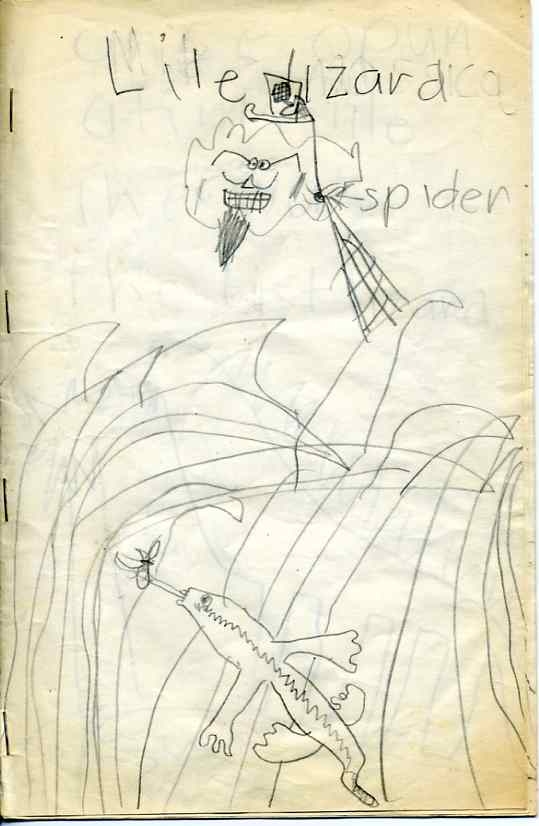
French Embassy reports French father of abducted child in Japan commits suicide

mytest

Handbook for Newcomers, Migrants, and Immigrants to Japan\Foreign Residents and Naturalized Citizens Association forming NGO\「ジャパニーズ・オンリー 小樽入浴拒否問題と人種差別」(明石書店)JAPANESE ONLY:  The Otaru Hot Springs Case and Racial Discrimination in Japansourstrawberriesavatardebitopodcastthumb
UPDATES ON TWITTER: arudoudebito
DEBITO.ORG PODCASTS now on iTunes, subscribe free

Hi Blog.  The latest in a series of tragedies through child abductions by Japanese because Japan’s laws and Family Court do not prevent them (more at crnjapan.net):  The tragedy is clearly not only that of children being deprived of a parent.  On November 19, a Left-Behind Parent deprived himself of his life.  As reports the French Embassy in French and Japanese on November 24.  English translation first, then official texts from the Embassy.

We’ve had government after government denouncing this practice, GOJ, as the French Embassy puts it so eruditely below.  How much longer must it go on?  Arudou Debito

/////////////////////////////////////////////

35 Year – old French Father kills self after loss of children in Japan.
Ambassade de France au Japon, November 24, 2010

http://www.ambafrance-jp.org/
Translation to English, courtesy of crnjapan.net
http://crnjapan.net/The_Japan_Childrens_Rights_Network/itn-fdksij.html

Our compatriot Arnaud Simon killed himself Friday, November 19. The French teacher in Tokyo, he was 35 years old and lived in Japan since 2006.

Separated from his wife since last March, he was the father of a boy of 20 months he had sought unsuccessfully to gain custody. Our community is in mourning and I present on behalf of all our condolences to his family and loved ones.

Nobody can speak with certainty about the reasons why a man so young to commit an act so terrible. Mr. Simon, however, had recently expressed to the consular section of our embassy in Tokyo of its difficulties to meet his son and it is very likely that the separation from her child was a determining factor. This reminds us all if need be suffering fathers of the 32 French and two hundred other cases identified by consular authorities as being deprived of because of their parental rights.

It is clear that our words and deeds are little face a dramatic situation, but I wanted to remind the determined action of the French authorities and the Embassy in connection with its German partners, American, Australian, Belgian, British, Canadian, Colombian, Spanish, Hungarian, Italian and New Zealand calling on Japan to ratify the Hague Convention on Civil Aspects of International Child Abduction and expedite a review of individual records to find appropriate solutions where they are possible, depending on circumstances.

It is the interests of children, that nobody has the right to deprive one of their parents. It is also to take into account the suffering of the fathers we have today is a tragic event.
ENDS

/////////////////////////////////////////////////

ORIGINAL FRENCH
Décès de M. Arnaud Simon – Message de condoléances de l’Ambassadeur
Ambassade de France au Japon, 24 novembre 2010

http://www.ambafrance-jp.org/spip.php?article4220

Notre compatriote Arnaud Simon s’est donné la mort vendredi 19 novembre. Enseignant le Français à Tokyo, il était âgé de 35 ans et vivait au Japon depuis 2006.

Séparé de sa femme depuis mars dernier, il était père d’un petit garçon de 20 mois dont il avait cherché en vain à obtenir la garde. Notre communauté est en deuil et je présente en son nom toutes nos condoléances à sa famille et à ses proches.

Personne ne peut se prononcer avec certitude quant aux raisons qui ont poussé un homme aussi jeune à commettre un geste aussi terrible. M. Simon avait toutefois fait part récemment à la section consulaire de notre ambassade à Tokyo des difficultés qu’il éprouvait pour rencontrer son fils et il est très probable que la séparation d’avec son enfant a été un des facteurs déterminants. Ceci nous rappelle à tous s’il en était besoin la souffrance des 32 pères français et des deux cents autres cas recensés par les autorités consulaires comme étant privés de fait de leurs droits parentaux.

Il est bien évident que nos paroles et nos actes sont peu de choses face à une situation aussi dramatique, mais je tenais à rappeler l’action déterminée des autorités françaises et de cette Ambassade en lien avec ses partenaires allemands, américains, australiens, belges, britanniques, canadiens, colombiens, espagnols, hongrois, italiens et néo-zélandais pour demander au Japon de ratifier la Convention de La Haye sur les aspects civils de l’enlèvement international d’enfants et procéder rapidement à un examen individuel des dossiers afin de trouver des solutions appropriées là où elles sont possibles, en fonction des circonstances.

Il s’agit de l’intérêt des enfants, que personne n’a le droit de priver de l’un de leurs parents. Il s’agit également de prendre en compte la souffrance des pères dont nous avons aujourd’hui une tragique manifestation.

Service d’Information et de Communication (24 novembre)
ENDS

/////////////////////////////////////////////////

OFFICIAL JAPANESE VERSION

アルノー・シモン氏の訃報 に対する 駐日フランス大使のお悔やみ
在日フランス大使館
http://www.ambafrance-jp.org/spip.php?article4221

私たちの同朋であるアルノー・シモン氏が11月19日(金)、自ら命を絶ちました。享年35歳、2006年から日本に滞在され、東京でフランス語教師をしていらっしゃいました。

シモン氏には生後20ヶ月の男の子がおり、本年3月のパートナーとの別離以来、親権を得ようと努力しましたがかなえられませんでした。フランス人コミュニティーを代表して、ご親族の皆様方に深い哀悼の意を表します。

若くしてこれほどまでに恐ろしい行為に及んだ理由について、確信を持って断言できる人は誰もいません。しかしシモン氏は最近、ご子息との面会が非常に難しい旨、当館の領事部に訴えており、お子さんとの別離が決定的な原因のひとつである可能性は非常に高いと言えます。このことは、同じような境遇にある32人のフランス人の父親たちや、世界中の領事関係部局が把握している限り約200名存在する、親としての権利を行使できていない方々の苦悩を、私たちに想起させます。

これだけの悲劇に対して私たちが発言や行動をもってできることは限られています。しかしフランス当局および当館は、ドイツ、アメリカ、オーストラリア、ベルギー、イギリス、カナダ、コロンビア、スペイン、ハンガリー、イタリア、そしてニュージーランドと共に、日本国に対し、国際的な子の奪取の民事面に関するハーグ条約を批准し、早急に個々の案件を検討に付し、可能な場合には、それぞれの置かれた状況に即した適切な解決法を見出すよう、断固として要請しております旨、ここに改めて確認致します。

焦点となっているのは子供たちの利益であり、片方の親との接触を妨げる権利は誰にもありません。また、この悲劇的な例が物語るように、父親たちの苦悩も考慮しなければならないのです。

Service d’Information et de Communication (11月24日)
ENDS
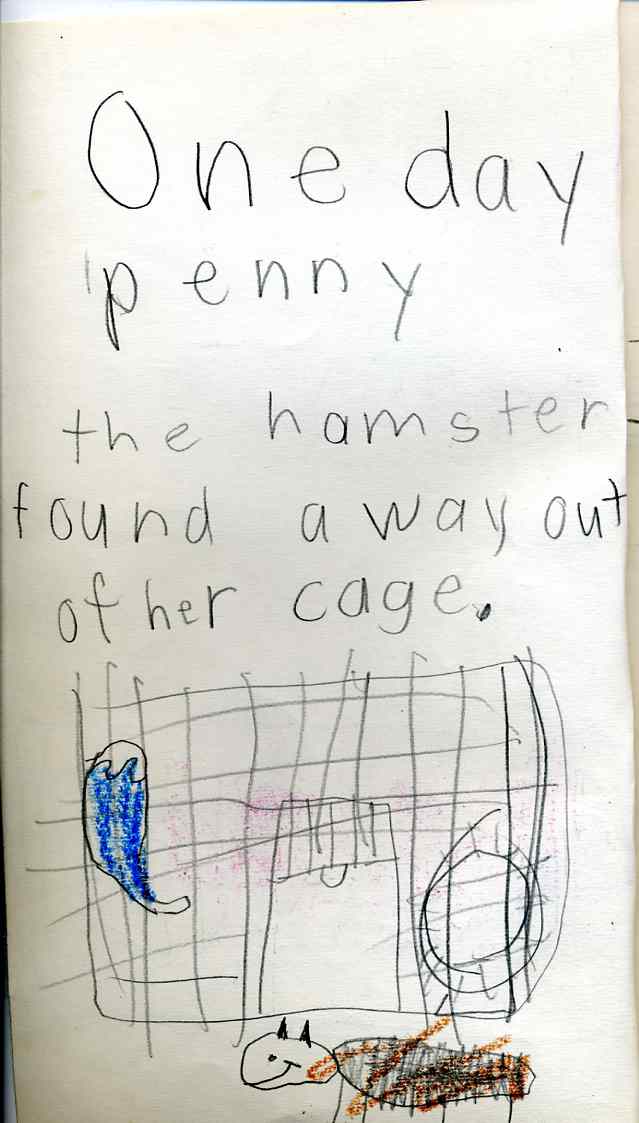
Japan businesses cry foul over UK visa regime, threaten pullout. Fancy that happening to the GOJ.

mytest

Handbook for Newcomers, Migrants, and Immigrants to Japan\Foreign Residents and Naturalized Citizens Association forming NGO\「ジャパニーズ・オンリー 小樽入浴拒否問題と人種差別」(明石書店)JAPANESE ONLY:  The Otaru Hot Springs Case and Racial Discrimination in Japansourstrawberriesavatardebitopodcastthumb
UPDATES ON TWITTER: arudoudebito
DEBITO.ORG PODCASTS now on iTunes, subscribe free

Hi Blog.  Here’s another entry for the “shoe on the other foot” department — how Japan businesses squeal “foul!” when they face visa restrictions on their Japanese hires within Britain, and threaten sanctions and pullouts.  Imagine if a foreign government were to try to do that to Japan for its visa programs, which are technically designed to give backdoor preferential treatment to unskilled workers? I’m pretty sure people would comment that the GOJ has the right to regulate its borders as it sees fit.  Never mind comity, I guess. Arudou Debito

//////////////////////////////////////////////////////

Firms pan U.K. immigration plan
Cuts in investment threatened if cap is placed on skilled workers
The Japan Times, Saturday, Nov. 20, 2010
, courtesy of Getchan
http://search.japantimes.co.jp/cgi-bin/nb20101120a1.html
By WILLIAM HOLLINGWORTH
Kyodo News

LONDON — Japanese firms are threatening to review future plans to invest in Britain if the new government follows through with its proposal to put an annual cap on immigration levels.

Corporate executives have told ministers that moves to limit the number of skilled people from outside the European Union who can be employed in Britain will seriously harm their businesses.

Japanese firms are particularly concerned about plans to curb the number of senior staff who can engage in short-term intracorporate transfers, as well as limits on recruiting skilled staff from outside the EU.

Britain’s new center-right government has decided to cap immigration due to growing concern that non-EU citizens are taking jobs away from the British.

In July, an interim cap was imposed on skilled workers, but ICTs are currently exempted. But a new cap will be introduced in April, and ministers are consulting on how big it should be and which sectors should be covered, including possibly ICTs.

Critics say Indian ICTs to Britain have been conducted in order to acquaint staff with information technology functions so the work can later be sent overseas. They also claim there are plenty of unemployed British IT workers who could perform the jobs.

The government is aiming to bring immigration down to “tens of thousands” each year compared with hundreds of thousands under the previous government.

Japanese firms say it is unfortunate that a new system designed to crack down on abuses might hamper those who have always followed the rules.

“The JCCI has communicated to U.K. ministers and officials in September its strong concerns about the introduction of further limits on non-EU immigration and the possible impact on the existing operations and future investment of Japanese companies in the U.K.,” said Patrick Macartney, manager at the Japanese Chamber of Commerce and Industry.

The local Japanese automakers, which regularly transfer high-tech engineers from Japan to Britain, have been lobbying hard to get ICTs exempted from the proposed cap. The urgency is underlined by the fact that both Nissan Motor Co. and Toyota Motor Corp. have just announced major new investments in environment-friendly cars.

But the newly imposed cap on skilled workers is already impacting Japanese firms in Britain.

Katsuji Jibiki, a human-resources manager at Mitsubishi Electric Europe, revealed at a recent business seminar that his firm has been denied work permits to recruit about 30 engineers from outside the European Union.

He said, “These days we have big difficulties with work permits. Every year the government changes the policy and it is a big headache for us.”

Jibiki added that if the problems persist “there is a possibility of transferring our regional headquarters from the U.K. to continental Europe. We are thinking about such contingency plans.”

Rest of the article at http://search.japantimes.co.jp/cgi-bin/nb20101120a1.html

///////////////////////////////////////////////////////////

Japanese firms lobby British government to rethink immigration plans

Kyodo News/Japan Today, November 23, 2010, courtesy of MMT

http://japantoday.com/category/lifestyle/view/japanese-firms-lobby-british-government-to-rethink-immigration-plans#show_all_comments

LONDON —

Japanese firms are threatening to review future investments in Britain if the government goes ahead with plans to put an annual cap on immigration levels.

Company bosses have told ministers that moves to limit the number of skilled citizens from outside the European Union that can be employed in Britain will seriously harm their businesses.

Japanese firms are particularly concerned about plans to curb the number of senior staff who can be transferred from Japan on a short-term basis, or intra-corporate transfers, as well as limits on recruiting skilled staff from outside the European Union.

The new center-right government has decided to impose a cap on immigration due to growing concern that non-EU citizens are taking jobs that could be done by skilled British people.

In July, an interim cap was imposed on skilled workers but ICTs are currently exempted. A new cap will be introduced in April and ministers are consulting on the size of the cap and which sectors should be covered, including possibly ICTs.

Critics say some Indian ICTs to Britain have been conducted in order to acquaint staff with information technology functions so that the work can later be offshored. They also claim that there are plenty of unemployed British IT workers who could carry out the jobs.

The government is aiming to bring immigration down to ‘‘tens of thousands’’ each year from hundreds of thousands under the previous government.

Japanese firms say it is unfortunate that a new system designed to crack down on abuses could hamper those who have always followed the rules.

Patrick Macartney, manager at the Japanese Chamber of Commerce and Industry, told Kyodo News, ‘‘The JCCI has communicated to UK ministers and officials in September its strong concerns about the introduction of further limits on non-EU immigration and the possible impact on the existing operations and future investment of Japanese companies in the UK.’‘

Japanese car companies in Britain, which regularly transfer high-tech engineers from Japan to Britain, have been lobbying the government hard to exempt ICTs from the proposed new cap. The urgency is underlined by the fact that both Nissan Motor Co and Toyota Motor Corp have just announced major new investments in eco-friendly cars.

But the newly imposed cap on skilled workers is already impacting on Japanese firms in Britain.

Katsuji Jibiki, a human resources manager at Mitsubishi Electric Europe, revealed at a recent business seminar that his firm has been denied work permits to recruit about 30 engineers from outside the European Union.

He said, ‘‘These days we have big difficulties with work permits. Every year the government changes the policy and it is a big headache for us.’‘

Jibiki added that if the problems persist ‘‘there is a possibility of transferring our regional headquarters from the UK to continental Europe. We are thinking about such contingency plans.’‘

And speaking at the same event, Stephen Gomersall, the European chief executive of Hitachi Ltd said, ‘‘There’s a danger that immigration legislation which is justified on totally different grounds can have operational consequences for sophisticated Japanese manufacturers.’‘

The British Parliament’s Home Affairs Committee has studied the idea of a cap and taken evidence from Professor David Metcalf, chairman of the Migration Advisory Committee, the government’s independent adviser on migration issues.

He told members about an encounter with Japanese executives ‘‘hostile’’ to the cap. They told him, ‘‘We provide huge foreign direct investments into the UK. Are you saying that it may be difficult for us to get our people in?’‘

The committee has warned that if the cap is set too high it could have a negative effect on business. Members recommend ICTs to Britain for under two years should be exempted.

The government says that it is listening to the concerns of the business community and recognizes the need to administer the cap flexibly.

Some analysts have speculated that the government could exempt certain sectors from the cap.

Firms are currently allowed to recruit skilled workers from outside the European Union if they are unable to fill posts with the local population or the job is on a list of ‘‘shortage occupations.’‘

Due to concern over immigration levels, Britain has already curbed the number of unskilled workers accepted into the country and placed tougher restrictions on student visas.

ends

ELT News and Daily Yomiuri columnist Mike Guest misrepresents not only the record, but also his own academic credentials

mytest

Handbook for Newcomers, Migrants, and Immigrants to Japan\Foreign Residents and Naturalized Citizens Association forming NGO\「ジャパニーズ・オンリー 小樽入浴拒否問題と人種差別」(明石書店)JAPANESE ONLY:  The Otaru Hot Springs Case and Racial Discrimination in Japansourstrawberriesavatardebitopodcastthumb
UPDATES ON TWITTER: arudoudebito
DEBITO.ORG PODCASTS on iTunes, subscribe free

Hi Blog.  There is a person out there (one of many, no doubt) who takes a dim view of what we do here at Debito.org.  To the point of saying things in a published column we did not say.  Have a read of this.  Comment from me follows.

///////////////////////////////////////////////////////

EFL News, October 29, 2010

The Uni-Files
A candid look at EFL life and lessons from a university teacher’s perspective.
By Mike Guest, Miyazaki University

http://www.eltnews.com/columns/uni_files/2010/10/today_a_unifiles_interview_wit.html

An “interview” with controversial human rights activist Orudo Debiru
Categories:  Amusement/Fiction foreigners in Japan

Today- a Uni-files interview with the controversial activist and newspaper columnist Orudo Debiru

(For those who don’t know, Orudo Debiru is a naturalized Japanese citizen, originally from the U.S. His main claim to fame is his activism for human rights, especially the rights of non-Japanese in Japan. He is also wholly fictional and if he happens to resemble some actual person from say, Hokkaido, that’s because you, dear reader, made an unwarranted connection. Today he joins us with one of his most ardent, and equally fictional, supporters- Jay Newbie).

Uni-files: Debiru, in a recent newspaper article you argued that even non-Japanese living outside Japan, including those who have never set foot in Japan, should have the right to vote in Japanese elections. You also argued that they should be eligible for all the public and social services offered by the Japanese government, including pensions and welfare benefits. This seems to be a bit radical don’t you think?

Debiru: No. Otherwise you’re discriminating between Japanese people and non-residents. Why should only Japanese have access to the benefits of ‘Team Japan’?

Newbie: Japan owes something to the world. It can’t just always be take, take, take. Japan has to give in return.

Debiru: Japan is the only ‘developed’ county that doesn’t provide the vote for it’s non-citizens who live elsewhere.

Uni-files: Really? No country in the EU does that, nor do Canada, U.S., or Australia.

Debiru: What other countries do is irrelevant! What’s right is right! Are you saying that it is right for Japan to be discriminatory?

Uni-files: Debiru, you and your supporters often mention that some attitudes, policies, or states of affairs occur ‘only in Japan’ among developed countries. It seems that you buy into notions of Japanese uniqueness or exclusivity. Do you?

Debiru: Not at all! The notion of Japanese uniqueness is a nationalist myth!

Newbie: Of all developed countries, only the Japanese think of themselves as being unique. It seems to be part of the Japanese mentality. They believe whatever the government tells them. You won’t find this type of belief in Western countries anymore, only in Japan.

Uni-files: Ok. Let’s move on. You’ve also blogged about “how the Japanese authorities plan to incarcerate all foreign residents as a precaution against the foreign criminals”. I haven’t come across any such policy statements. Can you ground this?

Debiru: Well, I was scouring the internet looking for anything that might prove my preconceptions about the ulterior motives of the Japanese authorities when I came across another blogger who talked about how his upholsterer in Inaka Prefecture thought he had overheard a conversation at a vegetable stand about the local district council becoming more vigilant about registering foreigners for social services and helping them with securing housing. And I can substantiate it too- with a link to the blog. Anyway, to me, being told to ‘stay in your house’ in this manner is equivalent to incarceration. And the registration is clearly a way of rounding up the foreigners- just like a crminal [sic] dragnet.

Newbie: In any civilized country this would cause mass rioting in the streets. But because the Japanese are such compliant sheep, not to mention the blatant racism here, no one will stand up for us. The Japanese just pretend that foreigners don’t exist. They stare at us like we’re from another planet.

Uni-files: That must be tough for them to do, both ignoring your existence and staring at you at the same time!

Debiru: This is just the start of the whole racist process. Next thing you know, your pension is declared null and void and your ‘ha-fu’ kids are kicked out of school for not being Japanese enough.

Newbie: Wow, Debiru. That was your best answer yet!

Uni-files: Let me ask about these racism charges a bit. For example, I know that you oppose the fingerprinting of non-Japanese at airports but can this really be called racist? After all, it is based upon citizenship, right? For example, Debiru, you are racially Caucasian but, as a Japanese citizen, you don’t have to be fingerprinted. And someone who is racially ‘Japanese’- although Japanese isn’t even a racial category- but doesn’t hold a Japanese passport still has to be fingerprinted. So while it may be other things, how can you say it is ‘racist’?

Debiru: Don’t feed the troll, Newbie. Don’t feed the troll.

Uni-files: Ok, nect [sic] question. Regarding a specific recent blog entry of yours… You recently criticized the city of Sonzainashi for exploiting non-Japanese. Apparently, the city authorities had developed a ‘Welcome Foreign Guests’ plan in which selected hotels, hot springs, eateries, bars and so on offered English information and services and had started a promotional campaign that actively encouraged non-Japanese to visit. So, what was the thrust of your criticism?

Debiru: When they carry out this facile, deceitful put-on for non-Japanese they’re only doing it because they want their business. “Let’s take the foreigner’s money away from them” is the real motivation. ‘Yohkoso Japan!’- Yeah, right!

Newbie: I consider it a form of robbery; another way of victimizing us, the weakest members of this society.

Uni-files: You guys seem to be very negative about anything to do with Japan, even when Japan scores an apparent success.

Newbie: That’s because Japan places everyone into an us and them paradigm. They do it all the time. They have institutionalized the formula. They use it to justify oppressive policies. We would never do that in the U.S. We have laws that forbid it and an education system that teaches us not to do so.

Uni-files:So, given that Debiru is Japanese, would you put him among that number?

Newbie: Well, I mean, he’s not really a Japanese in the same way they are. (Debiru stares at Newbie). Well I mean, like, he’s not exactly Japanese like them. So to speak. He’s a different Japanese from all the other Japanese. (Debiru continues staring at him). Well, of course he’s just the same as them in that he’s a Japanese citizen. But Debiru is more…ummm… progressive. (Debiru smiles).

Uni-files: OK. Back to the point. Wouldn’t you at least agree that public order and efficiency here is quite excellent?

Debiru: Japanese public order is maintained by coercion and implicit threat. It’s fifty years behind most other countries in this regard.

Uni-files: OK. How about robotics? Or even toilet technology?

Newbie: Robotics here is 36 years behind every other country in the world. And Japan is 23 years behind as far as toilets go.

Uni-files: On what basis can you make such bold claims?

Newbie: Three months ago in the U.S., before I came to Japan, I visited another state for the first time. And their toilets were better than here. Not as xenophobic.

Uni-files: Ok. How about manga and animation? Surely Japan’s ranking in these…

Newbie: You sound like a Japan apologist, acting as if racism never occurs here. Like nothing ever happened in Nanjing!

Debiru: Speaking of which, China has overtaken Japan as the world’s #2 power so Japan can’t possibly be leaders in those fields and therefore must be on the decline in all catgories.[sic] And it is this frustration at being a washed up, has-been society that it causing Japanese to lash out at foreigners.

Uni-files: Really? How so?

Debiru: It happens all the time. Read my blog.

Uni-files: I don’t doubt that there are individual cases but I don’t see it as systemic.

Debiru: If it isn’t systemic, why would I have so many blog posts? That’s all the proof you need! Anyway, just on our way over to this interview the taxi driver spat at us, called us ‘Dirty foreigners’ and told us to ‘Get out!”.

Uni-files: Wow! In twenty years in Japan I have never even come close to experiencing anything remotely like that. Can you elaborate? He spat at you?!

Debiru: Well, he was making disgusting sucking sounds with his teeth so that you could hear the saliva washing around. To me that’s spitting.

Uni-files: I wouldn’t call that spitting…

Debiru: Stay on topic! The point is he would never have done that if the passenger was visibly Japanese.

Uni-files: I see. And he called you a ‘dirty foreigner’?

Debiru: Well he called us “gaikokujin no kata”.

Uni-files: But that’s a very polite way of just saying ‘foreigner’! Where’s the ‘dirty’ part?

Newbie: Well we already know that the Japanese are racist and xenophobic so we can safely assume what he must have been thinking.

Uni-files: And the ‘Get out!’ part?

Newbie: He asked us where we wanted to “get out”. (awkward silence). It’s semantics.

Debiru: Not only that but I am not a foreigner. I’m a Japanese citizen. (starts sniffling) I was… racially profiled!

Newbie: (patting Debiru’s slumping shoulders) There, there. Now you are a racial profiling survivor!

Debiru (brightening up): If Japan had an anti-discrimination law with any teeth he’d have his ass hauled off to jail.

Newbie: Exactly. And you know what, you’ll never see the weak-kneed Japanese media or the history textbooks pick up on stories like this either. They don’t want to hear about these high-octane truths.

Debiru: This is precisely why we need laws against racism, xenophobia, being opposed to immigration, questioning multiculturalism, and other wrong and hateful thoughts.

Uni-files: So you’re in favor of more state authority and policing over what people think?

Debiru: Are you kidding? The police and judiciary here are totally inept and corrupt. They should stay out of people’s lives… ummm…except for the lives of those people who hold unhealthy views.

Uni-files: One more thing about this case. You say that you were racially profiled because the taxi driver believed that you were a foreigner, which by the way, is a mistake that most non-Japanese would probably make as well. But how do you know that the driver was in fact Japanese. Couldn’t he have been ethnically Korean or Chinese? In other words, didn’t you profile him equally?

Debiru: (closes his eyes) Don’t feed the troll, don’t feed the troll.

Uni-files: Ok. Last question. I’m wondering how you chose your Japanese name.

Debiru: It’s the closest phonetic approximation to my previous name. In fact, I asked to have a different, more suitable name first but was refused by the [iyami deleted] Japanese authorities.

Uni-files: And what name was that?

Debiru: Martin Luther King.

Leave a comment (47)

http://www.eltnews.com/columns/uni_files/2010/10/today_a_unifiles_interview_wit.html

==============================

Author’s Profile at ELT News
Mike Guest is Associate Professor of English in the School of Medicine at the University of Miyazaki. Originally from Vancouver, Canada, he has been living, working, and researching in Japan (not to mention lounging in the professors-jacuzzi and taking lengthy, fully-funded research trips to 5-star beach resorts in Bora-Bora) for almost twenty years.

///////////////////////////////////////////////////////

COMMENT:  What a card.  Well, for those unfamiliar with Mr Guest, he is a columnist at ELT News and the Daily Yomiuri (I even wrote about one of his DY columns here at Debito.org, favorably).  However, what inspired a column of this caliber and tone in the ELT News (under the heading of “a candid look at EFL life and lessons from a university teacher’s perspective”) is a bit beyond me.  Its fallacious attributions (these statements are not quotes from me; if Mr Guest had critiqued actual quotes — and lordy knows there are years of my words online he could have referred to — that would have been better, no?  Better yet, why not just interview me?), the presumption that people who support or comment at Debito.org must be malinformed Newbies, the general mean-spiritedness of it all, et cetera — are quite unbecoming for a person aiming to be a respected opinionist by taking puerile pot-shots at people on professional educational fora.

Especially in the Comments section where, amongst other obnoxious ripostes, he had this to say:

Alright, since Mr Guest decided to compare academic credentials, I decided to research his.  Here’s what I found at his university website, where he has a one-year contract as an English teacher:

This looks okay, until you do some research.  Aston University is a distance learning school in Birmingham UK that does indeed offer his degree (probably this one here).  Fine.

However, Regent College is NOT the University of British Columbia, one of Canada’s top universities.  Regent College is a Christian Studies school next door to UBC.  As was confirmed with Regent College the other day:

=========================
Subject: RE: Degree
Date: Tue, 16 Nov 2010
From: Regent College Admissions

Thanks for your email. Regent College is a completely separate institution from UBC. We have some partnerships/affiliations with UBC, but a degree awarded from Regent College is solely from Regent and unrelated to UBC entirely. [emphasis added]

I hope this helps – please don’t hesitate to ask if you have further questions! If you are interested in receiving information about our MDiv degree, I’d be happy to send you our MDiv materials.

Blessings,
Amy Petroelje, Inquiries and Housing Coordinator
Regent College
5800 University Blvd Vancouver, BC V6T 2E4

phone 604.224.3245 toll.free 800.663.8664 fax 604.224.3097
www.regent-college.edu
www.facebook.com/regentcollege
www.twitter.com/regentcollege

=========================
email ends

So when I asked Mr Guest about his qualifications last week after his presentation at JALT Nagoya, here’s what he claimed:

SOUND FILE:  mikeguestUBC112010

Reconfirmed.  No possible misunderstanding about (putting UBC in parentheses) on his school katagaki.  He says UBC only, no mention of Regent College.  He has misrepresented his educational background.

Now, some might say that this might just be a form of shorthand, for an audience that might not know what Regent College is — as Mr Guest argued shortly afterwards:

SOUND FILE:  doctorguest112010

but as even his alma mater acknowledges, a degree from Regent College is not a degree from UBC.  It’s like saying somebody who graduated from Ithaca College, or Cornell College for that matter, graduated from Cornell University.  Not an ethical thing for an educational professional to do, especially when he wishes to establish himself as a credible critiquer of educational matters.

So if Mr Guest wants to scrutinize others, I hope he will accept the same public scrutiny.  Sadly, I’m not sure he will.  The following, written shortly after our first meeting at JALT Nagoya on a site called “Tepido.org” (an interesting choice of venue; it’s a website devoted *solely* to trashing me personally and people who contribute to Debito.org, run by blogger Mr Ken Yasumoto-Nicolson and toy store employee Mr Lance Braman), indicates that Mr Guest’s antagonism, dismissiveness, defensiveness, and blame-shifting continue unabated:

====================================================

Mike Guest Says:
November 21st, 2010 at 7:51 am

http://tepido.org/heterogeneous-responses/182#comment-1204

It’s funny that this discussion about credentials should come up here now. Yesterday, Debito attended my presentation at the JALT Conference in Nagoya and confronted me afterwards. I wasn’t really surprised. First, during the Q and A session, he asked what my credentials were. A left-field question to be sure and I knew that he was up to something. Later he came to the front as I was packing up, with a bit of a manic gleam in his eye, a voice recorder in his hand, looking like an intrepid young reporter who’s ‘gonna take yer ass downtown’, and began a prepared spiel, trying very hard to be intimidating (but looking me to me a bit more like a caricature).

He said (among other things) that I was a fraud because I had misrepresented my academic credentials (I imagine this will be up on his site soon if not already). For the record, the crux was this: I have a BA from Simon Fraser Univ. (Canada) in Philosophy, an MSc in Applied Linguistics from Aston U. (U.K.) and a Masters in Theology from the graduate theological seminary on the UBC campus, Regent College. Regent issues its own independent degrees because of its religious affiliation, despite sharing the UBC campus and facilities, some teaching staff, plus several credits and classes (many of which I took for classical languages and linguistics). I also did an ESL teaching certificate course at UBC but whatever….

Anyway, when I mentioned a ‘Master’s from UBC’ in answer to his credentials question, Debito reacted like he had just found a photo of me in a compromising situation with a goat, thererafter harping upon my misrepresenting myself as having graduated from UBC.

Of course, way back when the personnel at my current university wanted to know my academic background I naturally went into detail about the relationship between Regent (the theological seminary) and UBC. Why hide anything? But when some guy asks you this from a crowd at an ESL presentation you’re not going to go into great detail. People don’t know what the theological school at UBC’s name is. It’s like if someone abroad asks where you live in Japan- you live in Chiba but you work in Tokyo. So you say Tokyo. No one expects the interlocutor to start suddenly playing prosecutor.

Debito also added that “we” (who?) had contacted Regent in Canada to find out about its relation to UBC and had also checked out my U of Miyazaki database in advance. So this underscores what I wrote in my parody, about his habit of scouring about in search of ways to find any potential striking point in any perceived adversary and then blowing the results out of proportion as if this credentials quibble constituted a weighty riposte to my earlier criticisms of him.

The upshot of this seems to be that Debito took umbrage at a comment I made here on Tepido about us having the same credentials. My comment had been in response to someone on his site saying that Mike Guest is in an isolated university bubble (or words to that effect), arguing that if someone wants to devalue my opinion based upon the claim of being an out-of-touch egghead, the same must apply to Debito. Instead, Debito seemed to take this as an invitation to an academic pissing match, and when confronting me in Nagoya, duly informed of his Ivy League school pedigree, which apparently trumps all: “So, we don’t have the same credentials do we, Mike?”

Well, I guess that’s true in a sense. For example I have two masters degrees whereas… oh, wait a second. None of this has any bearing on the validity or non-validity of my original criticisms of Debito does it? It’s just a sad attempt at rank pulling- arguing from assumed authority. I don’t know where Regent ranks in terms of thological seminaries, but even if my education was limited to Uncle Peter showing me how to bait a hook, my criticisms of Debito remain. Fishing for quibbles in how I answer an awkward question on-the-spot from the audience at an ESL presentation is rather pathetic But you know he’s going to do stuff like this.

I tried to talk with him after this, seeing if he might pull out of Debito mode but what followed was basically stonewalling on his behalf (plus a few choice words aimed in my direction) and eventually I gave up. I just look at it this way- it’s Debito being Debito. I expected a reaction from him at some point- after all, I took a shot at him and he’s trying to take one back- but the fact is that I just lose interest in these kind of one-dimensional people. I’ve already spent too much time writing about him…

====================================================

(NB:  I might add that Mr Guest suggested I “switch to decaf” during those four allegedly unantagonistic and disinterested attempts to talk with me.  Again, what a card.)

Clearly, Mr Guest doesn’t seem to understand the gravity of what he’s done.  I have no truck with someone’s right to hold opinions about someone and express them in public.  But there are limits, of course — as in, are those opinions accurate?  If not, there should be scrutiny to make those inaccuracies clear.  However, it’s hard to scrutinize someone hiding behind “parody” to claim somebody said something he never said (it absolves Mr Guest of the responsibility of providing evidence or doing verifiable research). Makes one question the professionality of the ELT editors, who should be offering better safeguards to preserve the integrity of their forum.

However, scrutinizing someone’s alleged professional background is much simpler.  You don’t say you graduated from a place you did not graduate from and expect to be treated as an honest professional.

And you don’t pick on people like this (misrepresentation of the record is definitely a pattern in Mr Guest’s world) without expecting some scrutiny yourself.  Now face the scrutiny.  Like an adult.

That’s why I decided to go ahead with this expose on Debito.org.  People can make their own decisions about what kind of future relationship they wish to maintain with Mr Guest as a columnist, scholar, and professional.  Arudou Debito

==================================

UPDATE NOVEMBER 27

The deceptions continue.  Mr Guest writes:

“Regent is a Theology School located on the UBC Endowment Lands. Many facilities are shared. If you want to do a Master’s degree in Theology you go to Regent, because UBC can’t offer Theology courses. Several credits I took as part of this Master’s I took at regular UBC classes (mostly linguistics) since some courses are cross-transferable. I also did an EFL teacher training course at UBC.”

http://www.eltnews.com/columns/uni_files/2010/10/today_a_unifiles_interview_wit.html#comment-1447

“Regardless, if you want to do a Graduate degree in Theology at UBC you have to attend Regent or Vancouver School of Theology. Both are on the campus but are required to issue their own degrees as religious institutions. At both you can take classes and get cross credits from the standard UBC curricula and have full access to all UBC facilities. I used this to take linguistics courses- which were not offered at Regent. I also did a further ESL certification course at UBC.”

http://tepido.org/more-handbags/187#comment-1288

COMMENT:  Let’s cut through the fog.  Nowhere on your degree from Regent College, the one you cite as part of your academic credentials, does it say “University of British Columbia”.  They are not the same institution.  Claiming UBC on your employer’s website and at JALT, and insinuating as such online, does not change that.

Charity Concert in Sapporo: “The Happy Prince”

mytest

Handbook for Newcomers, Migrants, and Immigrants to Japan\Foreign Residents and Naturalized Citizens Association forming NGO\「ジャパニーズ・オンリー 小樽入浴拒否問題と人種差別」(明石書店)JAPANESE ONLY:  The Otaru Hot Springs Case and Racial Discrimination in Japansourstrawberriesavatardebitopodcastthumb
UPDATES ON TWITTER: arudoudebito
DEBITO.ORG PODCASTS on iTunes, subscribe free

Forwarding. Arudou Debito

//////////////////////////////////////////
November 20, 2010
Ladies and Gentlemen, your attention please.

Please mark December 9, 2010 6:30 pm on your calendars for a Christmas Charity Concert at the Sapporo Baptist Church.

Oscar Wilde’s “The Happy Prince” will be featured in a show that features music, narration, and dance. Doors open at 6. Show starts at 6:30. Tickets are 2,000. Proceeds go to the Make-A-Wish Foundation and Project Santa Sapporo.

The Make-A-Wish Foundation reaches out to families with children who have been diagnosed with a terminal illness. And, as the name says, the child’s wish is granted. For many, it is a trip to the Tokyo Disneyland, but some from warmer climes want to make a snowman here in Hokkaido. And, sadly, a Make-A-Wish trip is often a child’s last best memory. So, please help make dreams come true for kids whose time is short and who could really use come cheer.

The Sapporo Project Santa is the work of Phred Kaufman. Each year he sequesters donations from various businesses to fill his Santa sacks. Project Santa serves four childrens’ group homes. Many of these children live in such homes because their parents cannot cope. Substance abuse, spouse abuse, and child abuse mixed with a slow economy make for a sad scenario for all too many children. So, please help to bring smiles to the faces of children who cannot be with their families this Christmas. Santa came last year, he is coming this year. Please help.

Please download the attachments to find out more about “The Happy Prince.” To reserve tickets, please contact:

Atsuki Koide: 090-2872-6855 or a2ki51de@yahoo.co.jp

The performance will be in Japanese.

Thank you very much and let’s sell out the hall!

Thomas Goetz

My college mentor, Chalmers Johnson, dies at 79

mytest

Handbook for Newcomers, Migrants, and Immigrants to Japan\Foreign Residents and Naturalized Citizens Association forming NGO\「ジャパニーズ・オンリー 小樽入浴拒否問題と人種差別」(明石書店)JAPANESE ONLY:  The Otaru Hot Springs Case and Racial Discrimination in Japansourstrawberriesavatardebitopodcastthumb
UPDATES ON TWITTER: arudoudebito
DEBITO.ORG PODCASTS on iTunes, subscribe free

It is with great sadness today that I blog about Chalmers Johnson, who died yesterday at age 79.  I was one of those students mentioned below that he mentored at the University of California, San Diego.  I last saw him at his home for dinner back in 2006.  I’m very unhappy to hear that we won’t be able to do that again.  Arudou Debito

///////////////////////////////////////////

OBITUARY:  CHALMERS JOHNSON
The Atlantic Monthly, November 21, 2010

http://www.theatlantic.com/international/archive/2010/11/chalmers-johnson/66853/
BY JAMES FALLOWS

I have just heard that Chalmers Johnson died a few hours ago, at age 79, at his home near San Diego. He had had a variety of health problems for a long time. (Photo source here.)

cj_7355.jpg

Johnson — “Chal” — was a penetrating, original, and influential scholar, plus a very gifted literary and conversational stylist. When I first went to Japan nearly 25 years ago, his MITI and the Japanese Miracle was already part of the canon for understanding Asian economic development. Before that, he had made his name as a China scholar; after that, he became more widely known with his books like Blowback, about the perverse effects and strategic unsustainability of America’s global military commitments. Throughout those years he was a mentor to generations of students at the UC campuses at Berkeley and San Diego.

Johnson and his wife and lifelong intellectual partner Sheila were generous and patient with me, as I was first trying to understand the world they had studied and analyzed. I vividly remember spending an afternoon in the early 1990s on the sunny patio at their house in Cardiff-by-the-Sea, north of the UCSD campus. I’d moved back from Japan, was working on a book about it, and spent hours writing notes as fast as I could as Johnson described Douglas MacArthur’s mistakes and (occasional) successes during the U.S. Occupation of Japan, and why Japan’s economy was unlikely to open itself on the Western model, even if U.S. or British economists kept giving lectures about the importance of deregulation. I have never concentrated harder as I tried to be sure to capture his bons mots.

Johnson would have been about 60 at the time. Even then he suffered from a rheumatoid or gout-like condition that caused him swelling and pain. “It all goes so fast,” I remember him saying. He made good use of his time. Sympathies to Sheila Johnson and their many friends.

ENDS
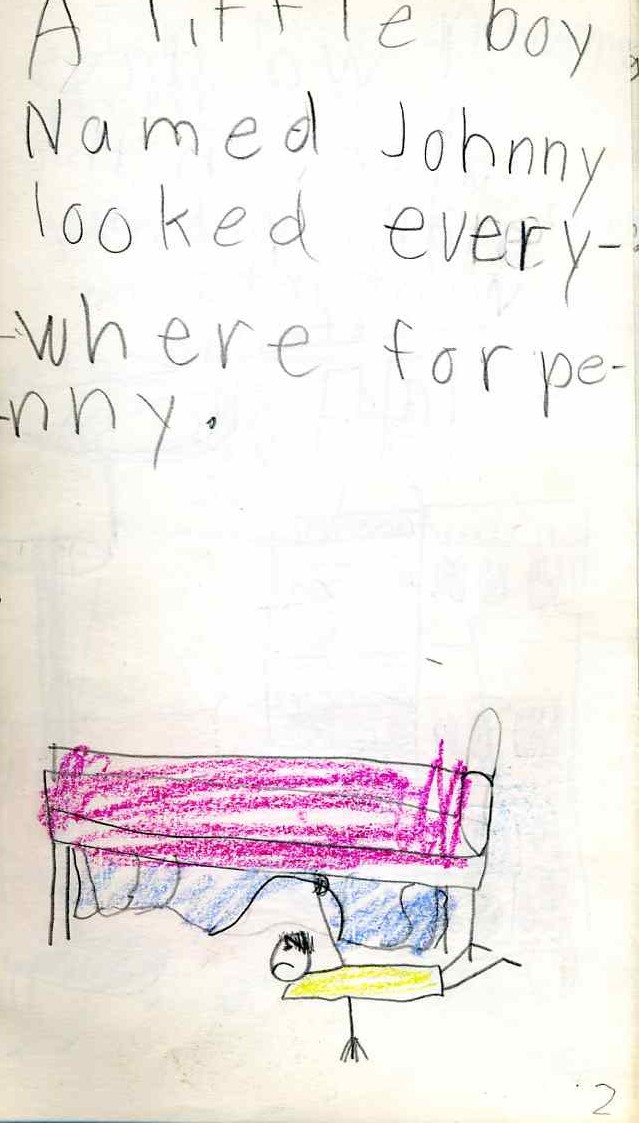
For Educators in Japan: National EFL Job Satisfaction Survey

mytest

Handbook for Newcomers, Migrants, and Immigrants to Japan\Foreign Residents and Naturalized Citizens Association forming NGO\「ジャパニーズ・オンリー 小樽入浴拒否問題と人種差別」(明石書店)JAPANESE ONLY:  The Otaru Hot Springs Case and Racial Discrimination in Japansourstrawberriesavatardebitopodcastthumb
UPDATES ON TWITTER: arudoudebito
DEBITO.ORG PODCASTS on iTunes, subscribe free

Hello Blog.  Forwarding.  Arudou Debito

=============================================

Hello Debito,

Douglas again, with the National EFL Job Satisfaction Survey links. Please take a look at the post below, check out the surveys, and consider if this is something you’d like to help disseminate. Perhaps you could pair it with a future blog on foreign workers…

Sincerely yours,
Douglas Meyer.
M.Sc.Ed. (TESOL) 教育学英語教授法修士(応用言語学)

Dear colleagues,

My name is Douglas Meyer, and I have been an EFL teacher in Japan for about 14 years now. Recently, I have become more and more interested in the wide-ranging working conditions at various schools in Japan, and what other teachers thought about their job. I did some looking, and found that there is very little information on this topic.

So, as a personal research project, I started to work last fall on two surveys which aim to paint a picture of the language teacher, his or her thoughts, opinions, and ideas on a number of language-related issues that we all face. If you have 5-10 minutes, I would greatly appreciate your input via the on-line survey links below. It is 100% anonymous, and I will make the results available to anyone upon request.

On-line survey for college and university language teachers:
http://www.surveymonkey.com/s/NZZ85RV

On-line survey for elementary, middle, and high school language teachers:
http://www.surveymonkey.com/s/D5LM52D

Thank you for taking the time to complete this survey. If you don’t mind, would you please forward this message (with links) to 3 or 4 friends? The results will only be useful if several hundred teachers respond. Thank you very much.

Sincerely yours,
Douglas Meyer.
M.Sc.Ed. (TESOL) 教育学英語教授法修士(応用言語学)
Osaka, Japan.
Inquiries welcome at: efljobsurvey@hotmail.com
ENDS
Times Higher Education on MEXT: “Japan’s entrenched ideas hinder the push to attract more foreign students and staff”

mytest

Handbook for Newcomers, Migrants, and Immigrants to Japan\Foreign Residents and Naturalized Citizens Association forming NGO\「ジャパニーズ・オンリー 小樽入浴拒否問題と人種差別」(明石書店)JAPANESE ONLY:  The Otaru Hot Springs Case and Racial Discrimination in Japansourstrawberriesavatardebitopodcastthumb
UPDATES ON TWITTER: arudoudebito
DEBITO.ORG PODCASTS on iTunes, subscribe free

Hi Blog.  Currently at JALT, so a quick one for today.  In the spirit of education in Japan, here’s an article from Times Higher Education talking about the pull for and push against importing students to fill spaces in Japan’s universities.  Funny they should want more NJ academics — they should give them better jobs.  But after more than a century of  “Academic Apartheid”, not likely.  Arudou Debito

////////////////////////////////////////

Japan’s open-door policy hinges on an attitude shift
Times Higher Education 14 October 2010, Courtesy of DK
Entrenched ideas hinder drive to attract more foreign students and staff, writes Michael Fitzpatrick

http://www.timeshighereducation.co.uk/story.asp?sectioncode=26&storycode=413828&c=1

Japan’s move to open its doors wider to foreign students and academics has come up against entrenched practices, budget cuts and a general ambivalence towards true “internationalisation”.

Frequently used as an empty slogan in the expansive years of Japan’s economic growth, internationalisation has once more been chosen as a watchword by the government – this time as the foundation for attempts to revive the country’s moribund education system.

With only two of its institutions appearing in the top 100 of the Times Higher Education World University Rankings 2010-11, Japan’s standing has been adversely affected by a dearth of international students and scholars.

In an attempt to address the issue, the Ministry of Education last year introduced the “Global 30” project, which has set a target for more than 130 undergraduate and graduate courses to be conducted entirely in English by April 2013.

But in the wake of cuts to public spending, the ambitious plan to involve 30 colleges has been whittled down to 13 institutions seen as future “global education hubs”.

As part of the same initiative, Japan has also set a target to increase the number of international students in the country to 300,000 by 2020 from the current figure of 130,000.

From a pot of ¥3.2 billion (£24 million), selected universities will receive ¥200 million to ¥400 million per annum over the next five years to recruit students and lecturers and to help with additional administrative costs.

Participating universities are expected to use these funds to recruit between 3,000 and 8,000 international students.

The scheme also aims to encourage universities to hire more overseas lecturers to teach the new courses. Currently only 3.5 per cent of tutors in Japanese universities are foreigners, and most of these are engaged in teaching English.

Japan is not alone in Asia in its determination to increase the number of foreign students and faculty. China, which has long been one of the world’s largest exporters of students, is pursuing a similar strategy, with its “C9 consortium” of nine research universities tasked with attracting 10 per cent of undergraduate students from other countries.

The Chinese government has made funding available to increase the number of courses taught in English to help participating universities achieve this goal.

In Japan, however, progress has so far been limited, according to Paul Snowden, dean of the School of International Liberal Studies at Waseda University in Tokyo.

“The effort to attract more foreign students is stepping up faster than the effort to attract more faculty,” said Professor Snowden, a Briton who grew up in Essex and is the first foreign dean at a Japanese university.

“Commensurate attempts to attract foreign faculty are not generally made. Waseda as a whole, with its eyes on rising in the world rankings, recognises the principle, but has not yet put it into sufficient practice.”

Island mentality

There are many factors contributing to the formidable barriers that prevent universities beefing up their roster of foreign staff, Professor Snowden said.

State universities do little to help foreign faculty achieve tenure, and recruitment ads are often posted only in Japanese and on obscure government websites. There is also a general reluctance to hire foreigners, as Japanese universities either prefer very long-term commitments or offer only “guest-style” short contracts.

“Attitudes have long been against foreign recruitment, and that needs to change,” Professor Snowden said.

He said it is common to encounter the view: “We’ll only take foreigners of Nobel prize standard – otherwise why should we deprive Japanese people of jobs?”

So far, the recipients of Global 30 funding have all been elite universities.

However, smaller colleges that see the educational merits of international liberal arts-type courses are also introducing foreign students to their own campuses and encouraging – or even making compulsory – a period of overseas study for their home students.

With initiatives of this kind running in parallel to the government-sponsored project, “even though the figure of 300,000 is unlikely to be reached, at least numbers will rise”, Professor Snowden said.

ENDS

The Independent (UK) on Japan’s rising nationalism as Japan slips in world rankings

mytest

Handbook for Newcomers, Migrants, and Immigrants to Japan\Foreign Residents and Naturalized Citizens Association forming NGO\「ジャパニーズ・オンリー 小樽入浴拒否問題と人種差別」(明石書店)JAPANESE ONLY:  The Otaru Hot Springs Case and Racial Discrimination in Japansourstrawberriesavatardebitopodcastthumb
UPDATES ON TWITTER: arudoudebito
DEBITO.ORG PODCASTS on iTunes, subscribe free

Hi Blog.  Here’s another article from David McNeill on how the power shift in Asia is fueling domestic xenophobic jingoism.  Although we’ve seen far too much coverage of this raving right-wingnut Sakurai in recent months, the point is still valid that people here are feeling (or at least the domestic media is promoting the feeling) that Japan is being squeezed by emerging neighboring economic powers.  How that will affect Japan’s treatment of its NJ residents is something Debito.org and journalist contributors should keep an eye on.  (A recent Debito.org Poll, currently fifth from the top, indicates that Readers don’t think it will matter much. Hope so.)  Arudou Debito on his way to JALT Nagoya

//////////////////////////////////////////////////////

The Independent, November 5, 2010
Japan: The land of the rising nationalism
By David McNeill
The emergence of China as an economic superpower is bringing out the jingoism in the Japanese

http://www.independent.co.uk/news/world/asia/japan-the-land-of-the-rising-nationalism-2125690.html

Most Tokyo districts will fortunately never experience Makoto Sakurai and his noisy flag-waving mob. But the city’s normally quiet Moto-Azabu area is home to the Chinese embassy and there are few countries Sakurai hates more than China. His group’s favourite insult – directed at the embassy via megaphone – is shina-jin roughly equivalent to “chink”.

“The Chinese are making fools of us,” said Sakurai, a baby-faced 30-something and the unlikely ringleader of what one academic calls: “Japan’s fiercest and most dangerous hate group today.” Like many nationalists, he is infuriated by what he sees as Chinese expansionism.

“If Japan had any guts, it would stand up to them,” he said.

Two decades ago, Japan was the rising Asian upstart that was barging its way on to the world’s front pages. “We are virtually at the mercy of the Japanese,” The LA Times famously blared in 1989, after a slew of high-profile takeovers by Japanese companies. Now it’s faltering Japan’s turn to tremble at the power of foreign capital; Chinese capital.

Japan’s conservative media have been sounding alarm bells all year as the rumblings from China’s economic juggernaut grow louder. In a 24-page feature in March, the right-wing Sapio magazine warned that China is set to “buy up Japan”, noting how Chinese conglomerates are gobbling up real estate and forests and even eyeing uninhabited islands around Japan’s coast. Another magazine ran a front-page story titled “Your next boss could be Chinese”.

Japan’s insecurity at its reduced status has been hammered home this week in a dispute with another neighbour. Russian President Dmitry Medvedev’s decision to visit one of four islands off northern Japan, seized by Moscow after the Second World War, was called “regrettable” by Prime Minister Naoto Kan. Sakurai’s followers were more blunt – and bitter. “Russia and China are both taking advantage of Japan’s weakness,” said one. “China has a dagger pointed at Japan’s heart – what are we going to do about it?”

The disputes could not have come at a worse time. The summer news that China overtook Japan as the world’s No 2 economy – a position Japan had held for four decades – has sparked painful soul-searching in a country that was once seen as a serious economic rival to America. Indications of Japan’s decline are all around. Per capita GDP fell from fourth in the world in 2001 to 22nd last year. Its share of global production has fallen below 10 per cent for the first time since 1982; its economy grew by a pallid 0.8 per cent in the decade till 2009. After years of government pump priming, public debt approaches 200 per cent of GDP – the worst in the developed world.

Blue-chip firms like Sony and Hitachi have lost their lustre. Last year’s decision by Toyota, once the gold standard of manufacturing, to eventually recall 14 million cars seemed symbolic of a faltering global brand – Japan Inc. Yasuchika Hasegawa, president of Takeda Chemicals, summed up Japan’s sense of crisis this year when he said: “We need a new vision or we face the decline of our nation.”

Japan is still struggling to deal with the fallout from a separate territorial dispute with Beijing over the Senkaku (as they are known in Japan) or Daiyou (as they are known in China) islands. China pressured Tokyo into releasing the captain of a fishing boat that had collided with a coastguard vessel in waters claimed by Japan, in part by choking off supplies of rare earth minerals – vital for the electronics industry. The timing of the maritime spat confirmed some fears that China’s expanding economic clout is increasingly matched by political and military muscle.

“Lots of nations disagree, but it doesn’t get down to an eyeball-to-eyeball game of chicken,” says Jeff Kingston, a China expert in Temple University Japan. “It’s about the huge shift of power from Japan toward China over the last 15 years.

“It’s about who gets to call the shots in Asia – the US or China and China is saying it wants a bigger say and the key issue is for the US to decide if it wants to cede more space to them – and history is not littered with good examples of that.”

All of which could be used to paint a very bleak picture of one of the planet’s most important bilateral relationships, were it not for cold economic facts. China gobbled up a record 19 per cent of Japan’s total exports last year, while Japan in turn bought 22 per cent of its imports from China. Two decades of often bit

ter disputes over history, territory and politics have failed to knock the onward march of economic progress off course: China last year overtook the US to become Japan’s most important trading partner.

In Tokyo’s upscale Matsuzakaya department store, a couple of miles from where Sakurai and his supporters shout racist-tinged invective at the Chinese embassy, a very different picture of Sino-Japan relations is on show. Like thousands of Japanese businesses struggling with inert domestic demand, this crusty shopping landmark is turning its gaze to an alluring new customer and as such has had to hire Mandarin-speaking staff to deal with the influx of Chinese customers. “They turn their noses up at Chinese-made goods,” explains Le Hui, one of the new assistants. “They want Japanese and European brands.”

Long seen by Japanese companies as a source of cheap labour, China is increasingly now a market for tourism and finished Japanese products. For China, meanwhile, Japan is not only an important market but a source of advanced technologies and investment. “For China to continue along its path of development, it needs a peaceful environment and a good relationship with Japan,” says Zhu Jianrong, a professor of international relations at Tokyo’s Toyo Gakuen University, who is optimistic the current tension can be overcome.

Still, the political impact of Japan’s growing despondency is unpredictable as it adapts, sometimes uncomfortably, to the growing Chinese bulk. One ominous route for frustrations was on display after the freeing of the Chinese captain, which was greeted with fury by Sakurai and some 3,000 other nationalists, who protested at the Chinese embassy.

The Yukan Fuji tabloid newspaper branded the release dogeza gaiko – appeasement diplomacy; Tokyo’s right-wing governor Shintaro Ishihara said the Chinese were acting like “gangsters” and that it was time for Japan to seriously consider developing nuclear weapons. One hero of the neo-nationalist movement, Toshio Tamogami – a sacked former air force general – even floated the possibility of war. The end result was to “increase Japanese insecurity on the one hand and greater dependency on the US on the other,” points out Mark Selden, a veteran Japan-watcher based at Cornell University in the US. That twin-punch deals a serious blow to what was once seen as a potentially promising initiative of the centre-left Democrat (DPJ) government.

The previous prime minister Yukio Hatoyama flirted with what he dubbed Yuai – a fraternal relationship with old enemy China that could have brought both sides closer: more political and cultural exchanges, an EU-style Asian market, even a military alliance were discussed.

With Hatoyama gone and both sides again in the political trenches, that initiative seems for now to be dead in the water. Prime Minister Kan, under fire for his handling of both the Chinese and Russian disputes, is suffering the consequences with approval ratings now below 40 per cent. Old rivals like former prime Minister Shinzo Abe are making political hay, advocating a much tougher diplomatic line in street protests and editorials.

Even mainstream publications like the Nikkei business daily are fuelling anti-Chinese sentiment, airing speculation – unproven – that Chinese cash is buying up Japanese land as a hedge against future food shortages at home. Conservative publications have honed in on the scenic area around Lake Kawaguchi, close to national icon Mt Fuji, where Chinese investors this year snapped up 17 luxury houses. Sakurai’s group, the Citizens League to Deny Resident Foreigners Special Rights, is far to the right of the mainstream press advocating, among other things, the expulsion of long-term Chinese residents and a beefed-up military.

But he believes the political tide is turning his way. “Japan has been asleep for a long time,” he says. “It’s time we woke up.”
ENDS

CBC interview on Japan’s shrinking population and prospects for immigration

mytest

Handbook for Newcomers, Migrants, and Immigrants to Japan\Foreign Residents and Naturalized Citizens Association forming NGO\「ジャパニーズ・オンリー 小樽入浴拒否問題と人種差別」(明石書店)JAPANESE ONLY:  The Otaru Hot Springs Case and Racial Discrimination in Japansourstrawberriesavatardebitopodcastthumb
UPDATES ON TWITTER: arudoudebito
DEBITO.ORG PODCASTS now on iTunes, subscribe free

Hi Blog.  Here’s an interview I was invited to give in early October with Canada’s CBC Radio One, which was broadcast yesterday. Thanks for that, CBC.  Link to where you can listen to it, and the writeup on their website follows:

http://www.cbc.ca/thecurrent/episode/2010/11/16/nov-1610—pt-2-japans-population-crash/

/////////////////////////////////

CBC Radio One, Nov 16, 2010 – Pt 2: Japan’s Population Crash, courtesy of MH&P.

The population of Japan is shrinking. Other countries have tackled that problem by embracing immigration. But Japan is an unusually homogenous — some say xenophobic — country. And the idea of a multi-cultural solution is ruffling some feathers.

Japan Population Crash – Sakanaka Hidenori

The population of Japan is officially shrinking. In 2005 — the latest year for which data is available — deaths outnumbered births by 10,000 people. At that rate, Japan’s population will drop by more than 15 per cent over the next 40 years. On top of that, Japan’s population is an aging one … facing fears of labour shortages and economic stagnation in the world’s third-largest economy.

Other countries have responded to declining population pressures by increasing immigration. But Japan is an unusually homogenous nation. And the idea of multi-culturalism ruffles a lot of feathers.

Sakanaka Hidenori spent 35 years urging his country to bring in more immigrants. He is the former Director of the Tokyo Immigration Bureau. And in 2005 he wrote, Immigration Battle Diary, a book that details his own experiences and lays out a manifesto for the future of Japanese immigration policy. Sakanaka Hidenori is now the Executive Director of the Japan Immigration Policy Institute. He joined us from Tokyo this morning, as part of our project, Shift. Our producer, Chris Wodskou provided the translation.

Japan Population Crash – Ito Peng

Arudou Debito was born in the United States. He’s a naturalized citizen of Japan. He married a Japanese woman, and they had two daughters. But he’s not very optimistic when it comes to increasing immigration to Japan. We aired his story to illustrate why.

For more on how Japan has reached this demographic reckoning… And what the rest of the world should take from it, we were joined by Ito Peng. She’s the Associate Dean of Interdisciplinary and International Affairs at the University of Toronto.

/////////////////////////////////////////////

COMMENT:  I come in from minute 11:55.  Sounds like I was in good voice that morning (we got to the radio station in Calgary at 8:30AM for a 9AM interview.  Good thing we did; the interviewer was late, and questions were a bit half-baked; it seemed as if she had forgotten our appointment).

Frankly, I’m a bit disappointed with the contents.  There was a good interactive interview with Sakanaka-san, who deserves it.  Also one with Dr Peng.  But all I got was a short storytelling of the Otaru Onsens Case (and an incomplete one at that — I never got my bit in about how even a naturalized citizen was treated by Yunohana Onsen, so Dr Peng then responds that it’s too bad foreigners got treated that way even though it’s not an issue of nationality); nothing else from a significantly longer interview.  Instead, we got Dr Peng talking inter alia about naturalization — incorrectly, too; one does not need a sponsor to naturalize (it’s not a work visa), one’s identity need not be that subsumed, etc.  Why doesn’t the person who actually went through the process get asked about it?  Because I’m not sure a question about it was actually prepared for my interview (don’t remember; it’s been six weeks).  Also would have liked a bit more research done and mentioned on my katagaki too (plenty of people marry and have children in Japan, so I would hope they contacted me because they thought I had something a bit more authoritative to say).

Ah well.  At least the subject of Japan’s future and the need for a possibility of immigration was broached.  Thanks for that, CBC.  Arudou Debito

Eurobiz Magazine’s Tony McNicol on the future abolition of the “Gaijin Tax” Re-Entry Permits

mytest

Handbook for Newcomers, Migrants, and Immigrants to Japan\Foreign Residents and Naturalized Citizens Association forming NGO\「ジャパニーズ・オンリー 小樽入浴拒否問題と人種差別」(明石書店)JAPANESE ONLY:  The Otaru Hot Springs Case and Racial Discrimination in Japansourstrawberriesavatardebitopodcastthumb
UPDATES ON TWITTER: arudoudebito
DEBITO.ORG PODCASTS now on iTunes, subscribe free

Hi Blog.  Eurobiz Magazine a couple of months ago ran an article talking inter alia about something I’ve called the “Gaijin Tax” for more than a decade now — the Re-Entry Permit system.  Thought of by some as a way of punishing the Zainichi Koreans etc. for staying behind in Japan (given all the incentives for them to leave after being stripped of colonial Japanese citizenship, moreover registered as foreigners in the late 1940’s), the Re-Entry Permit actually is a tax with a profit motive — even the lecturer cited by Tony McNicol below states this openly about its proposed abolition:

Without re-entry permit income, currently ¥6,000 for multiple re-entry, the changes are likely to lighten the government’s coffers. “This is a huge reduction in our revenue,” said Matsuno. “The Ministry of Finance is angry.”

What a piece of work our government can be.  Charging for visas for foreigners and passports for nationals is one thing (and I just paid 16,000 yen for a new ten-year Japanese passport; ouch).  But charging foreigners for their addiction to going “home” (or for even daring to leave Japan) with their visa held hostage, well, that’s just as I’ve suspected all along — a mean-spirited means to sponge off the NJ population.  Good riddance to it.  Arudou Debito

//////////////////////////////////////////////////////////

Eurobiz Magazine August 2010
Your new alien registration card
Changes under the new Japanese immigration system

http://www.eurobiz.jp/content/2010/august/columns/event-report
By TONY MCNICOL, courtesy of the author

Applying and paying for a re-entry permit has long been an unavoidable nuisance for foreign businesspeople traveling out of Japan. But during a recent EBC organised event at the EU-Japan Centre for Industrial Cooperation it was announced that the “gaijin tax” will soon be no more. It was just one of a raft of changes to the law explained to attendees by Hiroaki Matsuno, a deputy director at the Ministry of Justice.

The government plans to bring the revised regulations into force by July 2012 at the latest, and the Ministry of Justice is already busy at work on the details. Matsuno, who took up his current post a few months ago, has been working till midnight almost every day, he said.

The biggest change is that, rather than two tiers – immigration bureau for visas and local ward or city office for alien registration cards – everything will now be handled by the Ministry of Justice. For the first time, mid- to long-term foreign residents will come under the juminhyo (residence registry) system; good news for legal foreigners, but bad news for illegals who will not be able to receive the replacement for the current alien registration card – or services such as government healthcare.

In principle the new “residence card”, which will basically replace the “status of residence” stamp in passports, will be issued at the airport at the time of landing. “But we can’t afford to place machines at all of Japan’s airports,” stressed Matsuno. (Japan currently has over 80 airports). For those arriving in the boondocks, the card will be sent by post.

For some changes to details on the card, say a change in employer, reporting to the immigration bureau will be required by law. The ministry is investigating the use of proxies, said Matsuno, but has not yet made a decision. The ministry is also considering allowing notification by post or through the internet.

Hopefully, the changes will reduce work for the immigration bureau and shorten queues in their offices (a relief for those who have run the gauntlet of the Shinagawa bureau). “We have been very sorry to keep people waiting,” said Matsuno. Most visa categories will be extended from three to five years, and the residence card will expire after the same period. There will also be a change in the re-entry permit. Mid- to long-term foreign residents will now be exempt from needing a re-entry permit as long as they re-enter Japan within 12 months. (The re-entry permit system will remain for other cases.)

Without re-entry permit income, currently ¥6,000 for multiple re-entry, the changes are likely to lighten the government’s coffers. “This is a huge reduction in our revenue,” said Matsuno. “The Ministry of Finance is angry.”

Rest of the article at
http://www.eurobiz.jp/content/2010/august/columns/event-report

Japan Times Amy Savoie on int’l child abductions and the manufacturing of consent for it within Japan

mytest

Handbook for Newcomers, Migrants, and Immigrants to Japan\Foreign Residents and Naturalized Citizens Association forming NGO\「ジャパニーズ・オンリー 小樽入浴拒否問題と人種差別」(明石書店)JAPANESE ONLY:  The Otaru Hot Springs Case and Racial Discrimination in Japansourstrawberriesavatardebitopodcastthumb
UPDATES ON TWITTER: arudoudebito
DEBITO.ORG PODCASTS now on iTunes, subscribe free

Hi Blog. Thoughtful letter to the editor in the Japan Times on the International Child Abductions Issue. Excerpting the most interesting part for me — the rhetoric the media uses to keep the public unconsciously supporting the “home team” as their apparent members keep kidnapping kids to Japan with impunity. Well taken. More on the issue at the Children’s Rights Network Japan site. Arudou Debito

///////////////////////////////////

The Japan Times Tuesday, Nov. 9, 2010
HOTLINE TO NAGATACHO
Japan must end the scourge of parental child abduction
AMY SAVOIE, Tennessee

http://search.japantimes.co.jp/cgi-bin/fl20101109hn.html

(Dr. Amy Savoie is the wife of Christopher Savoie. In August 2009, Savoie’s children were abducted from the U.S. to Japan by his ex-wife. A few weeks later, he was arrested while trying to reclaim his children. Last month marked the one-year anniversary of his release from Yanagawa prison in Fukuoka Prefecture. Send submissions of between 500 and 600 words to community@japantimes.co.jp)

To the government of Japan:

For years, the Japanese government refused to acknowledge that parental child abduction was even a problem, but this issue has finally become too big to ignore. In September, Virginia Rep. Jim Moran warned Japan that Congress “is watching and expecting action.” Now the Japanese authorities are, at long last, talking about child abduction to the media and to foreign governments, although they are unfortunately doing so in a highly guarded and disingenuous manner, often with the complicity of the Japanese press, who use “quotes” when discussing “abduction” in order to minimize the “issue.”…

• Excuse #4: These are not really abductions. The parents are merely coming home to Japan.

Perhaps Japan was the abducting parent’s original home (where the abductor grew up), but “home” for the children was the country where custody had already been decided, i.e. where the children had been living at the time of the abduction. So this “coming home” argument is specious and hypocritical.

The government tries to convey that it is justifiable for Japanese parents to “take kids home to Japan” (tsure-kaeri or tsurete-kikoku), but when a foreign parent takes the children to another country (that parent’s home country), the Japanese call it kidnapping (tsure-sari) or abduction (rachi). The Japanese government and media behave duplicitously every time they pretend these unilateral relocations (relocating without permission from the other parent) are not the same thing.

Instead of describing both situations only as tsure-sari (or only as tsure-kaeri), the Japanese government cleverly (and intentionally) uses different sets of words that convey two totally different meanings depending on who the kidnapper is…

Rest of the letter at

http://search.japantimes.co.jp/cgi-bin/fl20101109hn.html

Japan Times: Leaked documents reveal Tokyo Police spies on Muslim residents, tries to make snitches of them

mytest

Handbook for Newcomers, Migrants, and Immigrants to Japan\Foreign Residents and Naturalized Citizens Association forming NGO\「ジャパニーズ・オンリー 小樽入浴拒否問題と人種差別」(明石書店)JAPANESE ONLY: The Otaru Hot Springs Case and Racial Discrimination in Japansourstrawberriesavatardebitopodcastthumb
UPDATES ON TWITTER: arudoudebito
DEBITO.ORG PODCASTS on iTunes, subscribe free

Hi Blog.  In probably one of the most important developments of the year (thanks again to the Japan Times Community Page, consistently offering one great expose after another), we have actual substantiation of the Tokyo Police extending their racial profiling techniques to target Muslim residents of Japan.  Not only are they spying on them and keeping detailed files, they are trying to turn them against one another as if they’re all in cahoots to foment terrorism.

We all suspected as such (the very day I naturalized, I got a personal visit from Japan’s Secret Police asking me to inform on any Chinese overstayers I might happen to know; they said they read Debito.org — perhaps as assiduously as some of my Internet stalkers).  Now we have proof of it.  Shame, shame on a police force that has this much unchecked power.  Do I smell a return to Kenpeitai tactics?  Arudou Debito

///////////////////////////////////////////////////

The Japan Times Tuesday, Nov. 9, 2010
THE ZEIT GIST
Muslims in shock over police ‘terror’ leak
Japan residents named in documents want explanation — and apology — from Tokyo police force

By DAVID McNEILL

This time last month, Mohamed Salmi says he was just another anonymous foreigner living and working in Japan. Today he fears his life here may be over, and receives phone calls from reporters asking him if he is an al-Qaida “terrorist.”

“I’ve no idea why they have picked on me,” says the Algerian, who has lived and worked in Japan for over 20 years and is married to a Japanese national. “My wife and I are still struggling to believe it.”

Salmi’s name was one of several released in extraordinary leaked documents from a counterterrorism unit of the Tokyo Metropolitan Police Department’s Public Security Bureau. Listed as “terrorist suspects,” the men are Muslims who live and work here, in many cases for decades.

The documents, which have been obtained by The Japan Times, contain vast amounts of personal information, including birthplaces, home and work addresses, names and birthdays of spouses, children and associates, personal histories and immigration records. Even the names of local mosques visited by the “suspects” are included.

In most cases, the causes of the initial police suspicion appear to have simple explanations. Salmi’s former work as a travel agent placed him in contact with Arab students, businessmen and diplomats.

“I had a lot of ambassadors as clients,” says the 47-year-old, who now works for a Japanese construction company. “I can’t believe this is enough to put me on a list of suspects.”

Apparently released via file-sharing software, the files and the background on how they were compiled reveal that Japanese police, under pressure from U.S. authorities, trawled Tokyo in the aftermath of Sept. 11, 2001, in search of intelligence data among the city’s tiny Muslim community. According to victims of the leak, in some cases the Security Bureau tried to recruit them as spies…

Rest of the article at
http://search.japantimes.co.jp/cgi-bin/fl20101109zg.html

UK Guardian compares South Korea’s relatively open-minded future with Japan’s possible “Second Edo Period” of insulation

mytest

Handbook for Newcomers, Migrants, and Immigrants to Japan\Foreign Residents and Naturalized Citizens Association forming NGO\「ジャパニーズ・オンリー 小樽入浴拒否問題と人種差別」(明石書店)JAPANESE ONLY:  The Otaru Hot Springs Case and Racial Discrimination in Japansourstrawberriesavatardebitopodcastthumb
UPDATES ON TWITTER: arudoudebito
DEBITO.ORG PODCASTS on iTunes, subscribe free

Hi Blog.  Here is a thoughtful essay alleging that Japan will lose out to South Korea due to the latter’s relative openness.  If true, that bodes ill for those of us making a life on this side.  I’ll put this article up for discussion for people who know enough about both countries to make a comparison.  Arudou Debito

///////////////////////////////////////////////

Japan’s dangerous deglobalised dream
South Korea’s economy has gone from strength to strength, while Japan’s stagnation may turn into a ‘New Edo’ era
Guy Sorman, guardian.co.uk, Tuesday 9 November 2010, courtesy of TK

http://www.guardian.co.uk/commentisfree/2010/nov/09/japan-dangerous-deglobalised-dream

In mid-November, all eyes will shift to Seoul when G20 leaders convene for the first time in the South Korean capital. The choice is long overdue, as South Korea is a remarkable success story: in one generation – the South Koreans, formerly pummelled by civil war, under constant threat from their northern communist brethren, long mired in poverty, and ruled by military dictators for 40 years – have built the world’s 13th largest economy and Asia’s most vibrant democracy.

Historically squeezed between its two giant neighbours, China and Japan, South Korea had long been perceived as an underdog with a fuzzy cultural identity. In Asia, however, Japan’s leaders are not waiting for the Seoul summit to take a closer look at South Korea. South Korea was formerly a Japanese colony (1910-1945) and the natives were treated like an inferior race. Today, South Korean’s economy has been growing annually by 5% on average for 10 years, whereas Japan grew by 0.42% per year during the same period.

One could argue that South Korea is not yet a mature economy and is only catching up with a more advanced Japan. This was the case in the 1970s, but no more. Whereas China’s growth is fuelled by low-cost labour as millions of peasants enter the industrial economy, this is not the South Korean recipe for success, which has been driven by private entrepreneurship, innovation and quality products: Samsung and Hyundai, not cheap wages, are South Korea’s growth engines.

Another key to South Korea’s success story is the well-balanced relationship between stable governments and the private sector. This was clearly demonstrated late last year when a South Korean consortium won a contract to build four nuclear reactors in the United Arab Emirates late last year, beating out the French.

The Japanese knew how to co-ordinate state and private-sector goals in the 1970s, but then lost their way. “We should now emulate the South Koreans,” says Eisuke Sakakibara, a leading Japanese economist, who was one of the architects of the Japanese “miracle” of the 1980s. Japanese in search of a miracle now travel to Seoul.

“In Japan, 1990 to 2000 was called the ‘lost decade,'” says the free-market economist Fumio Hayashi. Now Japan is completing its second lost decade. Hayashi and Sakakibara – indeed, most Japanese economists – more or less agree on the fundamental reason for such spectacular stagnation: the Japanese have stopped working hard. Fewer hours worked, longer vacations, and a declining population (since 2005) have, predictably, undermined Japanese growth. To turn this situation around, says Sakakibara, “the Japanese should work more, have more children, and allow immigration.” But the incentives to make any of this happen are just not there.

The Japanese still live comfortably, better by one-third than the South Koreans, thanks to their past investments. Japanese companies abroad remain profitable and Japan is still the global leader in high-tech niches like electronics or carbon fibres. For example, Apple’s iPhone and Boeing’s latest aeroplane rely heavily on Japanese-patented innovations. These comparative advantages may keep Japan above water for a while, but only until China or South Korea catch up.

One would thus expect Japan to be anxiety-ridden, but it is not. True, new forms of poverty and unemployment are rising, but they remain well hidden behind family solidarity or corporate customs. Companies reduce their superfluous employees’ annual bonuses, but do not get rid of them. Young Japanese tend not to work before their 30s, and married women stay at home.

Political parties that rely on an ageing constituency are not tempted to call for change. The sort of shaky short-term political coalitions that rule Japan nowadays prefer to buy time through so-called public stimulus, or to preserve inefficient companies with subsidies. Twenty years of such shortsighted policies, whatever the party in power, have fuelled government debt, hindering private investment.

More strikingly, stagnation has found its promoters in Japan itself. A leading public intellectual Naoki Inose, who is also Tokyo’s vice governor, has declared that “the era of growth is over.” When Japan was threatened by western imperialism, he says, the country had to open up (in 1868) and modernise. This process has been completed. Japan is now ready to reconnect with its own tradition of social harmony and zero growth.

Referring to the 1600-1868 period, Inose calls this future the New Edo era: “A smaller population will enjoy the sufficient wealth that has been accumulated, and, from now on, it will invest its creativity in refining the culture.” The first Edo collapsed when the United States navy opened up the Japanese market with the arrival of Commodore Perry’s “black ships” in 1853. Will the second Edo be able to resist Chinese ambitions? “The New Edo era needs a strong Japanese army,” admits Inose.

This second Edo era may sound like a poetic utopia, but it has some influence: Sakakibara observes that Japanese students do not study abroad anymore and that “nobody learns English”. At a time when South Koreans are becoming more globalised, learning English, and welcoming a growing number of immigrants, Japan is entering a “deglobalisation process”.

That is a worrying trend, and not only for Japan: South Korea can hardly stand alone as the lone Asian democracy. If the Japanese do not wake up from their Edo dream, Asia might very well become a Chinese empire.

Will this be debated at the G20? Not openly, but certainly in the corridors.
ENDS