





DEBITO.ORG RSS Feed Logo Contest Winner is Jarod Trebas

mytest

Handbook for Newcomers, Migrants, and Immigrants to Japan\Foreign Residents and Naturalized Citizens Association forming NGO\「ジャパニーズ・オンリー 小樽入浴拒否問題と人種差別」(明石書店)JAPANESE ONLY:  The Otaru Hot Springs Case and Racial Discrimination in JapansourstrawberriesavatardebitopodcastthumbUPDATES ON TWITTER: arudoudebito
Hi Blog.  Last week I put out a call for anyone to submit a logo for Debito.org’s upcoming iTunes podcast RSS Feed.  Thanks for all the submissions, everyone, especially on such short notice.  Here are the best ones:

Submitted by Manule:

DebLog_by_Manu

From Kaoru:

debitologoteian1

(A quick note on this one:  I know Kaoru is a big fan of Noh, but I face a “Culture of No” every day when dealing with bureaucrats and stoneheads in Japan, and didn’t quite want the “Oh Noh, it’s Debito.org!” feeling behind this, sorry 🙂  )

From Jarod Trebas:

debitologo_Jarod Trebas

Honorable Mention, my favorite version submitted by Chris Bartlett:

debito logo large v3 cjb357@msn.com.jpg

This one in particular encapsulates the themes of people of any race or color being part of Japan and asking for human rights and solidarity.  Like it a whole lot, and would like to use it somewhere else in future.

And the winner is…

Jarod Trebas’ alternate version:

debitologo

The reason I chose this one was because of 1) the Rising Sun emblem on white (Japan is a circle and all that), 2) the theme of equality within Japan being the fundamental essence of Debito.org, and 3) the font matching the motif of circles and maruku naru etc.  It’s also very, very simple and to the point, in the best traditions of Japanese minimalist art styles.  Thanks very much, Jarod.  If you’d like to promote something on Debito.org, let me know.

Thanks to everyone who submitted!  The podcast feed has been submitted and is pending iTunes approval.  Arudou Debito in Sapporo

UPDATE NOVEMBER 19, 2009. iTunes has approved the DEBITO.ORG Podcast. Do go and subscribe (search term: Arudou Debito). I’ve got almost all my past podcasts up there already!

AFP: PM Hatoyama strongly hints he wants immigration to Japan (bonus: PM Hatoyama Newsletter Nov 4)

mytest

Handbook for Newcomers, Migrants, and Immigrants to Japan\Foreign Residents and Naturalized Citizens Association forming NGO\「ジャパニーズ・オンリー 小樽入浴拒否問題と人種差別」(明石書店)JAPANESE ONLY:  The Otaru Hot Springs Case and Racial Discrimination in JapansourstrawberriesavatardebitopodcastthumbUPDATES ON TWITTER: arudoudebito

Hi Blog.  Hatoyama speaks at APEC last week, tells Japan it should ready itself for migration.

This should be a hopeful development, although it’s not clear how much exposure this story got (a Google news search only showed some minor hits; the AFP only seemed to cover this in any detail; there was a little more in the Japanese databases, kedo).  Submitted for your commentary.  Also below is the Nov 4 PM Hatoyama Cabinet Newsletter, full of crie du coeur but a bit sketchy on details.

Again, wait and see, but I still find it disappointing that very little that would protect NJ rights in Japan is even on the drawing board.  So we should be demanding it wherever possible.  We’ve tried bringing a million or so NJ here since 1990 without protecting their rights and lifestyles from discrimination.  Look where it got us.

Let’s learn from that already, shall we?  Arudou Debito in Sapporo

//////////////////////////////////////////////////
Japan PM says nation should open up to migrants
http://www.abs-cbnnews.com/pinoy-migration/11/14/09/japan-pm-says-nation-should-open-migrants
and
http://sg.news.yahoo.com/afp/20091114/tap-apec-japan-policy-immigration-d1078a1.html
Agence France-Presse | 11/15/2009 12:46 AM, Courtesy RI and JK

SINGAPORE – Japan’s Prime Minister Yukio Hatoyama said Saturday that his country, which is battling low birth rates and an ageing population, should make itself more attractive to migrants.

Japan has some of the world’s strictest controls on immigration, and Hatoyama admitted that he was broaching a “sensitive issue”.

But he said that as well as introducing pro-family policies, Japan should attempt to encourage migrants to live and work there.

“I think Japan should also make itself a country attractive to people so that more and more people, including tourists, hope to visit Japan, hope to live and work in Japan,” he said on the sidelines of an Asia-Pacific summit.

“I am not sure if I can call this ‘immigration policy’, but what’s important is to create an environment that is friendly to people all around the world so that they voluntarily live in Japan,” he said.

Japan has relatively few resident foreigners, although in recent years it has cautiously opened up its job market to nurses and care workers from some Southeast Asian countries.

“First, we will improve support for child-rearing by offering cash allowances for families with children,” before thinking about immigration to address the country’s low birth rate, the premier said.

Japan’s population has been shrinking since 2005. Despite efforts to raise the birth rate, a woman’s average number of offspring now hovers around 1.3, well below the 2.07 needed to maintain the population.

Japan rejected the prospect of mass immigration under the conservative government led by the Liberal Democratic Party. Hatoyama’s centre-left Democratic Party of Japan (DPJ) ousted them in September.

Some politicians have argued that an influx of immigrants would lead to lower wages for Japanese workers and a higher crime rate.

Hatoyama’s DPJ has not detailed its immigration policy.
ARTICLE ENDS
///////////////////////////////////////////

BONUS: HATOYAMA CABINET NEWSLETTER: SKETCHES OF GOALS WITH SKETCHY DETAILS, BUT EARNEST TONE

From: “Cabinet”, Courtesy of Peach
Subject: Hatoyama Cabinet E-mail Magazine No.4 (November 4, 2009)
Reply-To: kantei@mmz.kantei.go.jp

===================================================================
Hatoyama Cabinet E-mail Magazine No.4 (November 4, 2009)
===================================================================

Yukio Hatoyama’s “Yu-Ai”
— Message from the Prime Minister (Provisional Translation)

“Creating a new nation”

The new Diet session has begun under the new government.

The 173rd session of the Diet, which began on October 26, is the
first Diet session since the change of government. In delivering
the policy speech at the beginning of this extraordinary session of
the Diet and answering subsequent questions from representatives of
political parties, I strove to ensure that the message and answers
are prepared by us, politicians, and are conveyed to the people in
as clear language as possible.

This is because in thinking how to give an answer that would reach
out to the people, each minister and, of course I myself, thought
it important that our wishes become one with those of the people.

If it were just a matter of reading off a script prepared by
excellent bureaucrats, as was the tradition with former governments,
it would be possible to go through a plenary session no matter who
the prime minister or ministers were. To be honest, as my
diplomatic schedule continued, there were times when I felt
physically drained in writing from scratch the first and most
important policy speech after the inauguration of the new
government.

Then, whenever I felt so, I recalled the images of the people who
have great expectations of us and entrusted the hope for the future
of Japan to us by voting for us. This strengthened my belief that
I must express my determination in my own words no matter what;
what I want to do in this new government and what kind of nation
I want to create. I am sure that each minister felt the same way.
I believe that our Cabinet pushing Diet affairs forward in this
manner is one representation of politics of political leadership.

In terms of nation building, the nation that I aim for is a society
of “yu-ai,” or fraternity, a society of self-support and
co-existence in which each individual exerts their capabilities and
mutually supports one another. This applies to the relationships
between politics and the people, the public and private sectors,
and national and local governments. In order for each individual,
each company, and each community to fully exert their capabilities,
we must reform laws, regulations, and bad customs that hamper this.

It was only natural for the people and communities, having lost
their strengths in the devastation following the defeat in the war,
to first look for a government-led rebuilding of the nation.
However, more than 60 years have passed since then and Japan has
changed greatly. I want the people to break away from their
dependency on others to do something, to think instead what they
can do for themselves, and to show their strengths to their full
extent.

To this end, I want to value the origin of my politics of
fraternity — to ensure that the perspectives of the disadvantaged
in society and minorities are respected. Society must extend
a helping hand to the people and places that sincerely need it. The
role of politics, I believe, is to create a framework for this.

For the new government, everything is a challenge at this Diet
session. The entire Cabinet and all the Diet members will do our
utmost to always face the people and conduct Diet affairs for the
people, so that the people can feel that politics have changed and
anticipate the change that Japan is about to undergo. I invite you
all to actively participate in politics. Let us create our new
Japan together!

* Profile of the Prime Minister
http://www.kantei.go.jp/foreign/hatoyama/profile/index_e.html

===================================================================
[What’s New in Government Internet TV]

<1ch>Prime Minister
[The Prime Minister in action]
– The Prime Minister Attends a Series of ASEAN-related Summit
Meetings in Thailand (October 23 – 25, 2009)
http://nettv.gov-online.go.jp/eng/prg/prg1926.html

[Prime Minister’s Week in Review]
– Japan-ASEAN Summit Meeting and other topics
(October 19 – 25, 2009)
http://nettv.gov-online.go.jp/eng/prg/prg1925.html

– Opening Ceremony of the Tokyo International Film Festival and
other topics (October 12 – 18, 2009)
http://nettv.gov-online.go.jp/eng/prg/prg1924.html

* Please click below to open “Japanese Government Internet TV”
in English.
http://nettv.gov-online.go.jp/eng/index.html

===================================================================
[The Prime Minister in action]

– The Prime Minister Attends the Interpellation Session at the
Plenary Session of the House of Representatives (October 28, 2009)
and other topics
http://www.kantei.go.jp/foreign/hatoyama/actions/index_e.html

* Please click below to open the online magazine
“Highlighting JAPAN,” which introduces the main policies of
the Japanese Government, as well as Japan’s arts, culture,
science and technology, among other topics.
http://www.gov-online.go.jp/eng/publicity/book/hlj/

===================================================================
[Hatoyama Cabinet E-mail Magazine]

– Click below to make comments on this e-mail magazine
http://www.mmz.kantei.go.jp/enquetePcEn

– Subscription, cancellation, and backnumber of this e-mail
magazine
http://www.mmz.kantei.go.jp/foreign/m-magazine/

General Editor : Prime Minister Yukio Hatoyama
Chief Editor : Deputy Chief Cabinet Secretary Yorihisa Matsuno
Publication : Cabinet Public Relations Office
1-6-1 Nagata-cho, Chiyoda-ku, Tokyo 100-8968, Japan

ENDS

NPR interview with Jake Adelstein, author “Tokyo Vice”, on how police and laws do not stop NJ human trafficking in Japan

mytest

Handbook for Newcomers, Migrants, and Immigrants to Japan\Foreign Residents and Naturalized Citizens Association forming NGO\「ジャパニーズ・オンリー 小樽入浴拒否問題と人種差別」(明石書店)JAPANESE ONLY:  The Otaru Hot Springs Case and Racial Discrimination in JapansourstrawberriesavatardebitopodcastthumbUPDATES ON TWITTER: arudoudebito

Hi Blog. Jake Adelstein, whose new book TOKYO VICE just came out, was interviewed on America’s National Public Radio program “FRESH AIR” on November 10, 2009. What follows is an excerpt from their podcast, minute 23:45 onwards, which talks about how domestic laws hamstring the NPA from actually cracking down on human trafficking and exploiting NJ for Japan’s sex trades. Jake’s work in part enabled the US State Department to list Japan as a Tier-Two Human Trafficker, and got Japan to pass more effective domestic laws against it.

Read on to see how the process works in particular against NJ, given their especially weak position (both legally and languagewise). If NJ go to the police to report their exploitation, it’s the NJ who get arrested (and deported), not the trafficker. And then the trafficker goes after the NJ’s family overseas.  Glad people like Jake are out there exposing this sort of thing.  Arudou Debito in Sapporo

==================================

DAVE DAVIES: On a more serious note, you became aware of some women who were working in the sex industry, who appear not to be there of their own free will. There was human trafficking going on. How did it work in the cases that you found?

JAKE ADELSTEIN: Japan is much better than it was than the time I started writing about this. But essentially it works like this: You bring foreign women into the country, often under false pretences — that they would be working as hostesses, or working as waitresses in a restaurant. You take away their passports. You put them in a room. You monitor their activities so that they can’t leave. And then you take them to the clubs where they have sexual relations with the customers. And, aren’t paid. The women have no freedom of movement. They’re told, after they’ve slept with a customer, or been forced to sleep with a customer — sometimes they were raped first, so they’d get used to the job — that if they go to the police, since they’re in Japan illegally, that they would be deported and they would still owe money for their travel expenses to Japan. And very often these traffickers would have agents within the countries where they were recruiting these women, often Eastern Europe, and contact the families of the women under various pretexts, to let them know that if they disobeyed, or did something in Japan or ran away, that their families back home would be menaced or killed.

DAVE DAVIES: You worked really hard to develop sources, and get enough on the record to write a story about this going on, and identify some of the people who were operating these human trafficking sex joints. What was the reaction among the police and other authorities when you exposed this?

JAKE ADELSTEIN: The reaction was that they asked me to introduce them to some of the women who were victims, so that they could *arrest* them, and have a pretext to raid these clubs. An officer there I really liked a lot named Iida-san said, “I’d love to put these places out of business. But you have to understand that these women, while they are victims, that we can’t protect them. We have to prosecute them under Japanese law. There is no provision in the law that allows us to keep them in the country while we do the investigation. So, I *could* do the investigation, and I could put these people out of business, but in order to do that, I’m going to have to have you put me in contact with some of the women, and I’m not going to be able to take a statement from them without arresting them.” And I couldn’t do that.

I went to another division of the police department and asked them, “Can you do anything about that?” And they said, “We can do something about it, but first of all, we don’t have enough people who speak foreign languages to do a very competent investigation right now. And we’ve got a lot of other things on our plate. While your article is good, it is not something that is immediately actionable for us.”

DAVE DAVIES: Which was enormously frustrating for you.

JAKE ADELSTEIN: It was *enormously* frustrating. And when I realized of course was that, while the cops have problems with this and would like to do the investigations and put these people out of business, that essentially the law wouldn’t let them do it. That’s why I began writing about the flaws in the law, the whole legal system, and I also began taking studies and information and stories that I had written up as a reporter to the US State Department representative at the Embassy in Tokyo.

DAVE DAVIES: In effect, by embarrassing the government, you were able to get some reform?

JAKE ADELSTEIN: Yes. I can’t take total credit, but I would like to take some credit for supplying the US Government with enough information that they could embarrass Japan enough so that Japan felt compelled to actually put some laws on the books that trafficking harder to do. One of the things I was most proud of was, the International Labor Organization did a very scathing study of human trafficking problems in Japan — pointing out the victims weren’t protected, the traffickers were lightly punished, fined, and rarely did jail time. Which the Japanese Government, which sponsored this study, told them “never release”. I was able to get a copy of that report and put it on the front page of our newspaper as a scoop, while the Japanese Government was still getting ready to announce their plan of action. And I think that had a very positive effect of making them put together a plan that was actually effective.
EXCERPT ENDS

Ruling coalition currently not considering NJ human rights laws beyond PR suffrage: Dietmember Aihara

mytest

Handbook for Newcomers, Migrants, and Immigrants to Japan\Foreign Residents and Naturalized Citizens Association forming NGO\「ジャパニーズ・オンリー 小樽入浴拒否問題と人種差別」(明石書店)JAPANESE ONLY:  The Otaru Hot Springs Case and Racial Discrimination in JapansourstrawberriesavatardebitopodcastthumbUPDATES ON TWITTER: arudoudebito
Hi Blog.  I had a conversation with Upper House Dietmember Aihara Kumiko (62, from Hokkaido, elected 2007 on Proportional Representation) yesterday.  With a labor union background, she has an eye on a number of human rights issues, including the Nikkei Visa and NJ “Trainee” Programs.

I took the opportunity to ask about a few things that are overdue for NJ resident rights in Japan (which the recent polls on Debito.org cover), namely:

  1. Japan signing the Hague Convention on Child Abductions
  2. Japan passing the long-proposed general law protecting human rights (jinken yougo houan)
  3. Japan passing a law against racial discrimination
  4. Japan approving local suffrage for NJ residents with Permanent Residency

She answered that the DPJ ruling coalition would be submitting the bill for local suffrage in next year’s Diet session.

The other three were currently not being considered in any committee or study group at this time.  I asked when they might be, and she didn’t know.

Just letting readers of Debito.org know.  Comments douzo.  Arudou Debito in Sapporo

UPDATE: Kyoto Tourist Association replies, tells Kyoto hotel “Kyou no Yado” to stop “Japanese speakers only” rules

mytest

Handbook for Newcomers, Migrants, and Immigrants to Japan\Foreign Residents and Naturalized Citizens Association forming NGO\「ジャパニーズ・オンリー 小樽入浴拒否問題と人種差別」(明石書店)JAPANESE ONLY: The Otaru Hot Springs Case and Racial Discrimination in JapansourstrawberriesavatardebitopodcastthumbUPDATES ON TWITTER: arudoudebito
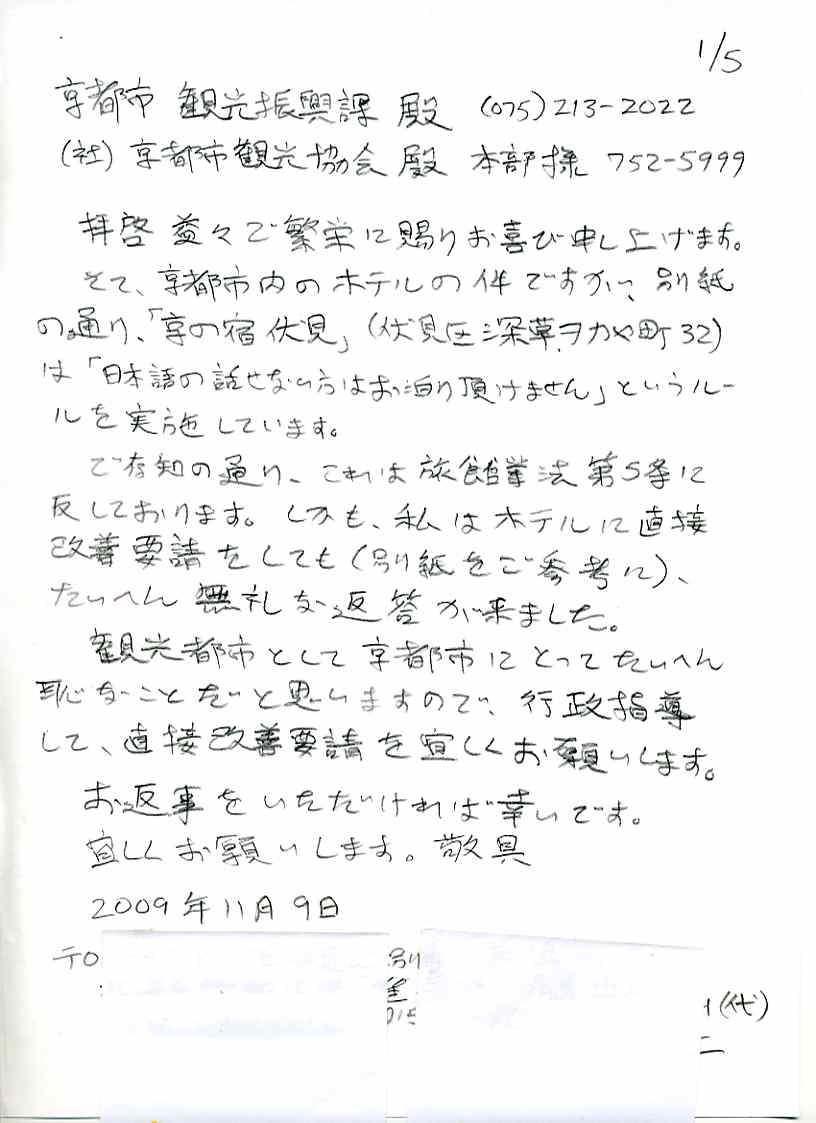
Hi Blog.  Regarding an issue I blogged here about earlier this week, about a hotel named “Kyou no Yado” that advertised on its Rakuten Travel listing that it would refuse any customer who did not speak Japanese, an update:

I contacted the Kyoto Tourist Association, the Kyoto City Tourism Board, and the National Tourism Agency in Tokyo about this issue with handwritten letters last Monday.  I received a letter yesterday sokutatsu (included below) from the Kyoto Tourist Association, as well as a personal phone call yesterday afternoon from a Mr Sunagawa there, who told me the following:

  1. The hotel was indeed violating the Hotel Management Law (which holds that people may only be refused lodgings if all rooms were booked, there was threat of contagious disease, or endangerment of “public morals”) by refusing people who could not speak Japanese,
  2. The hotel was hereby advised by KTA to change its rules and open its doors to people regardless of language ability,
  3. The hotel did not protest, and in fact would “fix” (naosu) its writeup on its Rakuten Travel entry,
  4. The hotel hasn’t gotten to it yet, but assuredly would. (It still hasn’t as of this writing.)

I asked what was meant by “fix”, and whether the language would just be shifted to find another way to refuse people again in violation of the Hotel Management Law.  Mr Sunagawa wasn’t sure what would be done, but they would keep an eye on it, he said.

Mr Sunagawa was very apologetic about my treatment, especially given the rudeness of Kyou no Yado’s written reply, and hoped that I would consider coming back to Kyoto soon and not have an unfavorable impression of it.

COMMENT:  This is far better than I expected.  The KTA had told me on Monday that they had no real authority (kyouseiryoku) here to advise a nonmember hotel, yet here they were taking this up and making the call.  I guess Kyou no Yado’s reply was really unbecoming to the situation.  Bravo.  Quite honestly, given the fact that I’ve contacted a number of authorities regarding local exclusionary signs and rules (which usually resulted in nothing being done), I wasn’t even expecting an answer (hey, bureaucrats will get paid anyway even if they sit on their hands; avoiding work is easier for them).

Find another exclusionary hotel like this?  Contact the local town or city tourist agency and include the letter from the KTA below, referring to it as a template for how some government agencies do get off their duff.  Anyone want to do that for the exclusionary hotel in Wakkanai? (“Itsuki”, the one which outright refuses all foreign clients, even cancels reservations if the customer’s name looks to be foreign).  Be my guest.  Don’t be theirs.

Meanwhile, let’s keep an eye on “Kyou no Yado’s” Rakuten Travel listing.  Arudou Debito in Sapporo

Letter from KTA follows, click to expand in browser:

kyototouristagency111109001

kyototouristagency111109002

ENDS

Brief bit on tonight’s Hatoyama-Obama press conference; discussion of Obama’s Japan visit

mytest

Handbook for Newcomers, Migrants, and Immigrants to Japan\Foreign Residents and Naturalized Citizens Association forming NGO\「ジャパニーズ・オンリー 小樽入浴拒否問題と人種差別」(明石書店)JAPANESE ONLY:  The Otaru Hot Springs Case and Racial Discrimination in JapansourstrawberriesavatardebitopodcastthumbUPDATES ON TWITTER: arudoudebito
Hi Blog.  Just a quick word, having watched the the 8:30-9:05 joint press conference tonight between PM Hatoyama and Pres Obama.

For those who did not see it, they focussed on issues that were of a larger geopolitical nature, including Afghanistan, nuclear weapons, North Korea, global warming, moving Guantanamo trials to the US, and, foremost, the need for maintaining the strength of the Japan-US Alliance and its positive effects on the wealth, security, and stability of East Asia as a region.

They took only one question each from the press corps (so each of them asked lots of questions).  The child abductions, the point most germane to Debito.org at this time, did not come up.

I open this blog entry so that others can discuss what they thought about the press conference, as well as Obama’s Japan visit this time around in general.  Go for it.  Arudou Debito in Sapporo

Watch Obama in Japan tonight (speech schedule enclosed)

mytest

Handbook for Newcomers, Migrants, and Immigrants to Japan\Foreign Residents and Naturalized Citizens Association forming NGO\「ジャパニーズ・オンリー 小樽入浴拒否問題と人種差別」(明石書店)JAPANESE ONLY:  The Otaru Hot Springs Case and Racial Discrimination in JapansourstrawberriesavatardebitopodcastthumbUPDATES ON TWITTER: arudoudebito

Hi Blog.  Courtesy of Paul Toland.  Arudou Debito in Sapporo

By the way,  For those of you who are following President Obama’s trip to Japan, here
are the two most important times to be watching:

1.  13 November, 7 PM (Japan Time), 5 AM (Eastern Standard Time) – President
Obama’s meeting with Prime Minister Hatoyama, to be followed by a Joint
Press Conference.  I don’t know the exact time of the press conference, but
I’m assuming it will be about an hour or so after their meeting.  I’ll be
watching for that tomorrow morning.

2.  14 November, 10 AM (Japan Time), 13 Nov 8 PM (Eastern Standard Time) –
President Obama will be making a speech at Suntory Hall in Tokyo, in which
he will discuss his view of U.S. engagement in Asia and reaffirm the
strength of Washington’s alliance with Japan.

While I doubt he will address the child abduction issue at the Speech at
Suntory Hall, I am hoping he does mention the issue at the Joint Press
Conference, or if he does not mention it, I am hoping the press will ask
about it during the Q&A.  Unfortunately, the Q&A is usually only about 3
questions from each country’s press (3 Questions from Japanese press, 3
questions from American Press).  There’s almost no chance that the Japanese
press will raise it, so let’s hope the US press will raise it within the
context of their 3 allowed questions.

The latest on the schedule (all times are Japan times):

6:50PM THE PRESIDENT and Prime Minister Hatoyama of Japan hold bilateral
meeting

7:10PM THE PRESIDENT and Prime Minister Hatoyama hold expanded bilateral
meeting

8:20PM THE PRESIDENT and Prime Minister Hatoyama hold joint press conference

8:45PM THE PRESIDENT and Prime Minister Hatoyama have dinner

That means the Press Conference will be held at 6:20 AM Eastern Standard
Time in the United States.  Paul

ENDS

Mainichi: DPJ split over bill to give NJ permanent residents right to vote

mytest

Handbook for Newcomers, Migrants, and Immigrants to Japan\Foreign Residents and Naturalized Citizens Association forming NGO\「ジャパニーズ・オンリー 小樽入浴拒否問題と人種差別」(明石書店)JAPANESE ONLY:  The Otaru Hot Springs Case and Racial Discrimination in JapansourstrawberriesavatardebitopodcastthumbUPDATES ON TWITTER: arudoudebito

Hi Blog.  Here’s a little update on the current debate regarding granting local suffrage to PR holders.  As ruling parties go, the Social Democrats led by Fukushima Mizuho support it, the (tiny) Kokumin Shintou led by Kamei Shizuka opposes it, and the DPJ itself (as usual) is split.  No surprises there, but we’ll see how the cards fall if and when it’s brought to a vote.  Of course, watching public policy being made is famously like watching sausages being made (you don’t want to know what goes into it), but the fact that the Cabinet in general supports it is telling.  And enough people are feeling threatened by it that there is quite visible public protest (but I’ll get to that later), which is also telling (if people felt no threat of it actually coming to pass, they wouldn’t bother).

My take is that whenever you have an opposition party in power (particularly a leftist one), you always have deep internal divisions, because the left in particular has trouble rallying around one issue.  The right has it a lot easier:  either rally around money issues (very clear cut), or else just keep the status quo (“there’s a good reason why things are the way they are, so if they ain’t broke…”).  So the DPJ having divisions and mixed feelings about this is only natural — it’s par for the course on the political spectrum.  Majority rules, anyway.  So let people grouse about it for an adequate amount of time, and let’s see how the vote turns out.  Arudou Debito in Sapporo.

//////////////////////////////////////////////////////

Government split over bill to give non-Japanese permanent residents right to vote
Mainichi Daily News November 7, 2009.
Courtesy HJ
http://mdn.mainichi.jp/mdnnews/news/20091107p2a00m0na009000c.html

A bill proposed by a key member of the ruling Democratic Party of Japan (DPJ) to grant permanent foreign residents the right to vote in local elections has split the party.

DPJ Diet Affairs Committee Chairman Kenji Yamaoka has declared that he intends to submit a bill to the current session, and recommended that parties allow their legislators to freely decide whether to vote for or against the bill.

His move is widely viewed by many politicians as an attempt to drive a wedge between the largest opposition Liberal Democratic Party (LDP), which is reluctant to give foreigners the right to vote, and its former coalition partner Komeito, which is enthusiastic about the move.

However, the issue has drawn opposition from within the DPJ and the coalition government it leads.

DPJ legislators are divided over the issue. There are numerous legislators within the governing party in favor of giving permanent foreign residents the right to vote in local elections, including Prime Minister Yukio Hatoyama, Foreign Minister Katsuya Okada and DPJ Secretary-General Ichiro Ozawa.

However, there are a certain number of opponents, including Chief Cabinet Secretary Hirofumi Hirano and Deputy Chief Cabinet Secretary Yorihisa Matsuno.

“There are over 140 new members of the House of Representatives who have just been elected to their first term in the latest general election. It’s necessary to hold in-depth discussions on the issue within the party,” Hirano told a news conference on Oct. 22.

Moreover, in order to ensure that the bill be passed into law, it will require an extension to the Diet session — which has drawn complaints from officials at the prime minister’s office and ministries, for fear that a longer Diet session could adversely affect their compilation of the fiscal 2010 state budget draft.

The government has limited the number of bills it submitted to the current Diet session to make sure that it can complete the compilation of the fiscal 2010 budget draft by the end of this year.

Even Hatoyama, who is in favor of the permanent foreign residents’ rights to vote in local elections, has taken a cautious approach toward the bill. “I’m enthusiastic about the move, but it’s an extremely serious theme within the party. There are various opinions on the issue. We have no intention of trying to forcibly push ahead with the bill,” Hatoyama told a Lower House Budget Committee session on Thursday.

Furthermore, Yamaoka’s move runs counter to the DPJ’s policy of leaving policy-making entirely to the Cabinet and banning legislator-sponsored bills in principle.

Even Komeito, which is in favor of the move, has displayed skepticism. “I don’t think we’ve completely formed a consensus among party members,” a senior member said.

LDP Secretary-General Tadamori Oshima also voiced opposition to allowing its members to decide whether to vote for or against the bill at their own discretion.

“It’s different from the Organ Transplantation Law (that political parties allowed their legislators to freely decide to vote for or against). It’s a matter involving sovereignty. I sense a bit of resistance to the recommendation,” he said.
ENDS

臨時国会:外国人参政権焦点に 政府・民主党、足並みの乱れ露呈--法案提出浮上
毎日新聞 2009年11月7日 東京朝刊
http://mainichi.jp/select/seiji/news/20091107ddm002010042000c.html
臨時国会の焦点に6日、永住外国人への地方参政権付与法案が急浮上した。民主党の山岡賢次国対委員長が今国会に議員立法で提出し、党議拘束をかけずに採決する考えを示したためだ。参政権の付与に積極的な公明党と、消極的な自民党の間にくさびを打ち込む狙いがあるとみられるが、法案の成立を図るには会期延長は必至だ。10年度予算編成への影響を懸念する政府は反発し、逆に政府・民主党の足並みの乱れが露呈する結果となった。

「今国会で(の提出を)考えている」

山岡氏は6日、民主・自民両党の国対委員長会談を終えた後、記者団に語った。民主党は政権交代後、政策決定を内閣に一元化し、議員立法を原則行わない方針だったが、早速、例外が生じる。

同党内では鳩山由紀夫首相や岡田克也外相、小沢一郎幹事長ら付与への賛成議員が多い一方で、平野博文官房長官、松野頼久同副長官ら反対派も一定数おり、意見集約は終わっていない。平野氏は10月22日の記者会見で「(衆院選で初当選した)新人が百四十数人いる。党内でしっかり議論する場面が必要だ」と強調しており、議員立法での提出は党内の意見集約を省略する意図もある、とみられる。

小沢氏は、衆院選前から在日本大韓民国民団(民団)の会合に出席するなど接触を続けており、民団側は付与に賛成する候補者の支援に踏み切っていた。

政府は10年度予算の年内編成を確実にするため、今国会への提出法案を絞り込んでいる。賛成派の鳩山首相も、5日の衆院予算委員会で「前向きに考えるが、党内でも大変大きなテーマ。さまざまな意見があり、強引に押し通さない」と述べた。

野党側も、付与に積極的な公明党でさえ「党の意思と確定したとは思えない」(幹部)と疑心暗鬼だ。自民党の大島理森幹事長は6日、党議拘束なしの採決に関し記者団に「臓器移植法とは異質だ。主権にかかわる問題で、いささか抵抗感を持つ」と反対の考えを示した。【田中成之、田所柳子】

Tangent: Korea Herald: Attitudes in Korea towards budget travelers: open up love hotels?

mytest

Handbook for Newcomers, Migrants, and Immigrants to Japan\Foreign Residents and Naturalized Citizens Association forming NGO\「ジャパニーズ・オンリー 小樽入浴拒否問題と人種差別」(明石書店)JAPANESE ONLY:  The Otaru Hot Springs Case and Racial Discrimination in JapansourstrawberriesavatardebitopodcastthumbUPDATES ON TWITTER: arudoudebito

Hi Blog. In light of the recent discussion we’ve been having about Japanese hotels, and some of their attitudes towards international travellers (many hotels refuse NJ or non-J speakers outright, claiming their lack of ability to provide service; see RELATED ARTICLE: Asahi/CNN: GOJ survey report: 38% of J hotels had no NJ guests in 2007, and 72% of those (as in 27%) don’t want NJ guests!), contrast with the situation in Korea and one columnist’s proposal.  Arudou Debito in Sapporo

NB: Before anyone begins to suspect that I think everything in Korea is gravy compared to Japan, let me say this:  of course not. I just think that given the very strong cultural similarities between Korea and Japan, what may be possible as an alternative in Korea might be some bellwether for what’s possible here too. Is all.  If Japan really wants its Yokoso Japan! to work better, it could do worse than consider promoting more open-minded hotels for international clientele.  Instead of promoting exclusionary ones (like the Fukushima Prefectural Tourist Information Association did a couple years back), for example.

FOREWARD FROM SUBMITTER:
==============================
Debito-san,

Howdy. I spotted this article on 1 person’s idea in Korea to open up cheap accommodations to foreigners: love motels. Some application to tourism in Japan and Japanese love hotels. (As an innkeeper, though, I should be worried about the idea of new competition for “Inbound” accommodation. On the other hand, if Kamesei can’t compete with love hotels, then there are other issues that need to be dealt with…)

B. Rgds, Tyler at Kamesei Ryokan, Nagano

//////////////////////////////////////////////////

“Love motels” offer more than “love”
By Brian Deutsch
The Korea Herald 2009.10.28

http://www.koreaherald.co.kr/NEWKHSITE/data/html_dir/2009/10/28/200910280062.asp

There’s been some talk about hotels and motels in the news recently, especially since Lee Charm, head of the Korea Tourism Organization, was criticized by a member of parliament for the country’s failure to provide budget accommodation to international travelers. One English-language paper indirectly quoted the lawmaker as saying “the nation is helpless in the face of the aggressive invasion of foreign budget hotels” and then said that one reason Korea can’t attract and keep foreign tourists is because accommodation is unsatisfactory.

But Korea’s lack of affordable rooms long predates Lee’s tenure. It isn’t a deficiency that can be blamed on foreign chains or foreigners-turned-Koreans, and it isn’t something that can be changed with a new slogan. Though international travellers might have few lodging options available to them, it’s helpful to learn about a fun, affordable alternative to expensive luxury hotels and overpriced tourist hotels.

International tourists relying on foreign-language information will have two choices for accommodation: rooms in luxury hotels that cost hundreds of dollars a night, and rooms in “tourist hotels” that average 100,000 won ($85) a night or more. Of course, outside of Seoul and Busan there is often nothing available for the person searching in English, Chinese or Japanese (languages spoken by almost all tourists visiting Korea).

The result: Tourists unwittingly find themselves paying twice as much for a place half as nice as the rooms hiding in plain sight.

An option I’ve always enjoyed is motels. You’ll rarely find information about them in English, but they’re certainly popular among Koreans – one recent estimate said there are 31,000 – and the newer ones are clean, conveniently-located, nicely-equipped, and a fraction of the cost of a tourist hotel.

Though they’re primarily used as a place to share an intimate moment, people are starting to realize they’re not only about sex. A Yonhap News piece in August looked at the ways motels have changed to attract not only clients looking for a few hours to get away, but people who want to relax in other ways. Competition has pushed motels to offer more, and, the piece says, “more and more motels are transforming their guest rooms into private entertainment places equipped with wide-screen TVs and other high-tech gadgets as a means of attracting clients.”

Large televisions, computers, big beds, and bathtubs are standard in the newer rooms, and some of the more stylish ones offer jacuzzis, Nintendo and PlayStation consoles, motorcycles in the room, and even telescopes on upstairs verandas, all for between 50,000 won and 100,000 won a night. The kitch of multicolored mood lights and swanky interior is a fun, welcome change from drab apartment rooms or ordinary faded beige of older tourist hotels. Prospective travellers can make informed decisions about nicer motels by browsing the maps and photographs on an online motel directory, available in Korean.

There are several such directories – Hotel365.co.kr, MotelGuide.co.kr, and Yanolja.co.kr are among my favorites – in addition to search engines on portals like Naver and Daum that will return hundreds of results, although these are inaccessible to people who can’t navigate Korean websites. A Naver search for motels in Jeollanam-do turns up 775, and a Naver search for Gwangju retrieves 464. The English-language KTO site devoted to accommodation, though, shows only six motels in Jeollanam-do, and zero for Gwangju.

This means international tourists must rely on the few tourist hotels that have English, Chinese or Japanese-language webpages, the few places that will show up on an internet search. These places are often two or three times as expensive as a motel room, though, and often not as nice. Amenities are frequently old, dirty, and disappointing. Guests often book rooms under the assumption that the hotel is in a convenient location, but arrive to find it’s in the middle of nowhere or in a seedy neighborhood. Likewise foreign-language travel websites will advertise restaurants, bakeries, and bars on the premises, though those who have seen the hotels in person will find no such features.

There is also no guarantee that you’ll find staff that can communicate in the language you need. The unsuspecting international tourist who assumes there will be staff members on hand who can clearly communicate in a foreign language will likely find themselves disappointed. But the limited information on accommodation in Korea means would-be tourists must rely on the few options that have assembled something resembling an English-language page.

In spite of their ubiquity, there is a love-hate relationship among Koreans with motels and what they stand for. After all, there aren’t hundreds of motels in each town because Koreans love to travel, and they don’t rent rooms in two-hour blocks because Koreans have evolved beyond sleep.

Motels are also often the most prominent buildings in the neighborhood, and tend to make the news only when there’s a suicide or when the police break up gambling and prostitution rings.

A newspaper in Gwangju recently complained that gaudy motels – topped with statues, domes, and flashy lights – are safety hazards and eye sores. And in May a writer for the English-language Gwangju News attracted the scorn of a local newspaper by writing about motels, the latter accusing the former of not understanding Korean culture and spreading misinformation among foreigners. Back in 2002, as a way to remove some of the stigma associated with motels, Korea designated a certain number as “World Inns.”

Foreign budget chains can succeed in Korea because there is simply no one else providing this basic service to foreigners. And in an age when Korea is trying to encourage foreign investment, scapegoating foreign companies is nothing short of xenophobic. But one option might be to invite some of the best motels into an umbrella program and create a foreign-language directory for the benefit of foreigners and international travellers.

It certainly behooves those already in Korea to take advantage of these motels. There’s a lot more to do at love motels than you might think.

——————-
The opinions expressed here do not necessarily represent those of The Korea Herald. Brian Deutsch can be reached at deutsch.brian@gmail.com, or by visiting his website at http://briandeutsch.blogspot.com – Ed.
ENDS

TODAY show (USA) on Savoie Child Abduction Case: father Chris’s treatment by J police, return to US, aftermath

mytest

Handbook for Newcomers, Migrants, and Immigrants to Japan\Foreign Residents and Naturalized Citizens Association forming NGO\「ジャパニーズ・オンリー 小樽入浴拒否問題と人種差別」(明石書店)JAPANESE ONLY:  The Otaru Hot Springs Case and Racial Discrimination in JapansourstrawberriesavatardebitopodcastthumbUPDATES ON TWITTER: arudoudebito

Hi Blog.  The Today Show (USA) has an update on the Savoie Child Abduction Case from the perspective of left-behind father Christopher, notably his treatment in Japanese police custody and how he is, in his words, “dead to my kids”.  FYI.  Debito

///////////////////////////////////////////////
Dad in Japan custody case: I’m dead to my kids
Christopher Savoie describes prison ordeal after he tried to recover children

By Michael Inbar
TODAYShow.com contributor
updated 10:00 a.m. ET Nov. 9, 2009, Courtesy of Paul Wong

http://today.msnbc.msn.com/id/33788543/ns/today-parenting_and_family/?ns=today-parenting_and_family

American Christopher Savoie is back on U.S. soil after spending a harrowing 18 days in a Japanese jail for trying to wrest his children away from his ex-wife. But the joy of being reunited with his current wife, Amy, is muted by the heartbreak of having to leave his son and daughter behind.

Savoie, 38, was locked in a bitter custody battle with his former wife, Noriko, when she fled to her native Japan with the couple’s 8-year-old son, Isaac, and 6-year-old daughter, Rebecca, on Aug. 13. On Sept. 28, Savoie flew to Japan to reclaim his children — but as he headed up the steps of the U.S. Embassy in Fukuoka with Isaac and Rebecca in tow, he was promptly arrested by Japanese police.

Appearing live in his first interview since being released on Oct. 15, Savoie, accompanied by Amy, told TODAY’s Meredith Vieira that being a free man is a hollow victory without his children beside him.

“It’s absolutely horrible; there are no words for it,” he told Vieira. “Basically, I’m dead to my children.”

Troubled relations

At issue is the sticky state of U.S.-Japan relations regarding custody of young children whose parents have gone their separate ways. According to the International Association for Parent-Child Reunion, there have been some 125 cases of American children who have been abducted by a parent to Japan. To date, not one child has ever been returned to the U.S.

Part of it is legal: Japan is the sole G7 nation not adhering to the 1980 Hague Convention calling for the return of children abducted across international borders. And part of it is cultural: According to Japanese tradition, children of divorce are given to one parent, almost always the mother, and the other parent is basically written out of their lives.

While U.S. officials try to pressure Japan to acquiesce to Hague Convention standards, Savoie is seen as a maverick who tried to take the law into his own hands in getting his kids back. But Savoie told Vieira he believes he had solid legal standing, even by Japanese law, in traveling to Japan to reclaim Isaac and Rebecca.

Savoie and Noriko were married in Japan in 1995, and he still carries a Japanese passport from his time as a student and working for a pharmaceutical company there. The couple split in 2007, and when Savoie moved back to the U.S. in 2008 for a job with a biotech company, Noriko followed a year later so the pair could both spend time with their children.

But the arrangement never worked well, Savoie told Vieira. He claims Noriko was antagonistic toward his new wife, Amy, and often threatened to take the children back to Japan with her. Savoie sought a restraining order in his adopted hometown of Franklin, Tenn., to keep Noriko from fleeing with the children, but it wasn’t granted.

‘Big shock’
On Aug. 13, Savoie was notified that Isaac and Rebecca were not present at what was supposed to be their first day of school. Savoie told Vieira that initially, he imagined even worse scenarios than the notion that Noriko had taken off with them.

“Horrible thoughts went through my mind,” he said. “The first thought wasn’t that they might have been abducted; I was worried that something might have happened to them, something horrible.”

Savoie finally reached his former father-in-law in Japan, who told him the children were safe and sound and with their mother. Savoie began plotting a course of action that led to his Sept. 28 trip to Japan and subsequent imprisonment — but he insisted to Vieira it wasn’t unlawful.

“I actually still have, and had at that time, legal custody in Japan — fifty-fifty custody,” Savoie said.

Savoie met up with Noriko as she walked the children to school, wrested them away from her, put them in a car and made a mad dash for the embassy. Noriko told police she was bruised from the scuffle between the pair as Savoie spirited the children away.

But Savoie told Vieira: “Picking my kids up, hugging them and putting them in the car — I hardly thought that would be considered criminal. So it was a big shock to me that police actually took it in that manner.”

Savoie insists he was not planning to put Isaac and Rebecca on the next plane home. “My intention was to go to the consulate and then have a discussion if the police wanted to ask about it,” he told Vieira. “I had all the custody documents with me. If they had said, ‘Please stay in Japan, and have a family court decide the custody first,’ I would have done that.”

‘Horrible’ conditions
Instead, Savoie found himself behind bars for 18 days, under conditions he said were “pretty horrible”.

“I think it is well known by the United Nations that Japan’s pre-indictment jail conditions are horrendous,” he said. “They’re quite infamous. Almost 18 days of 12 hours a day of interrogation without a lawyer; lights on all the time at night, so sleep deprivation. Really terrible sanitary conditions — it’s just too horrible to recall.”

Still, Japanese authorities released Savoie without indicting him. They say charges are still pending, but Savoie believes he is unlikely to face any charges. “I assume if they had enough evidence to indict with the crime, they would have done so.”

He also says his ex-wife’s claims that he injured her were unfounded. “There wasn’t much of a struggle,” he said. “All of these reports that there was bruising, that never was proven. And that was part of the reason I was released.”

Still, there is no short-term prospect of the dad’s being reunited with Isaac and Rebecca. Savoie’s best hope is that Japan changes its policies — and on that front, there may be a little progress. In a statement to CNN, Japan Foreign Ministry spokesman Yasuhisa Kawamura said the government is considering becoming part of the Hague treaty.

“Japanese government is … considering seriously to conclude this treaty on the grounds that this treaty would provide one of the most effective measures to protect the children after their parents divorce,” Kawamura said.

ENDS

CONTEST FOR READERS: Submit Blog/RSS logo for Debito.org?

mytest

Handbook for Newcomers, Migrants, and Immigrants to Japan\Foreign Residents and Naturalized Citizens Association forming NGO\「ジャパニーズ・オンリー 小樽入浴拒否問題と人種差別」(明石書店)JAPANESE ONLY:  The Otaru Hot Springs Case and Racial Discrimination in JapansourstrawberriesavatardebitopodcastthumbUPDATES ON TWITTER: arudoudebito
Hi Debito.org Readers.  It’s getting about time for me to put Debito.org podcasts up on iTunes, and that will mean Debito.org will have avenues to the outside world in a much smaller (and influential) audio pond.  People exercising, commuting, or otherwise exercising their ears as well as their brains will be able to hear about what’s going on here like never before.

To that end, friends have advised me to try and make Debito.org look a little more professional to the outside world.  (Well, try, anyway.)

Although Debito.org has been purely a solo effort since 1997 (I’ve archived and blogged all the many thousands of articles and posts (even those guest-written by outside contributors), read and approved each of the 10,000-plus comments here, and kept all the records alive on Google for free access for all), I’ve been told that just putting my photo up on iTunes would probably look less appealing (no wonder) than a really smart-looking logo.

This is where you come in.  Those  who have a yen for graphic design, would you please consider making a Blog/RSS image, meaning a square logo that captures, in your opinion, the essence of Debito.org?

The size that is mandatory for iTunes is 300 x 300 pixels (with a second version I have to shrink down to 144 x 144 pixels, which I can do on my iPhoto easily).  So it’s pretty small, not much detail.  It can include words or not, graphics or not, as you please.  Please send as a reproduceable graphics file (not pdf, and jpg is best)

But I’d like to open this up to anyone who’d like to submit (debito@debito.org, email subject line “DEBITO.ORG logo submission”).  Due date Tuesday November 17, 10PM JST.  Please also include the name you’d like to be called as a submitter.  I’ll have the best submissions up here on Debito.org later on.

There’s no real money involved in this, sorry (just my gratitude, and if you’d like a plug for your graphics services, I’d be happy to do so gratis on Debito.org).  But if you’ve liked what you read so far here and have thought about giving a little something back, much obliged!

Thanks for reading and considering!  Arudou Debito in Sapporo

Mutantfrog’s Joe Jones’s excellent discussion of rights and wrongs of divorce in Japan; causes stark conclusions for me

mytest

Handbook for Newcomers, Migrants, and Immigrants to Japan\Foreign Residents and Naturalized Citizens Association forming NGO\「ジャパニーズ・オンリー 小樽入浴拒否問題と人種差別」(明石書店)JAPANESE ONLY:  The Otaru Hot Springs Case and Racial Discrimination in JapansourstrawberriesavatardebitopodcastthumbUPDATES ON TWITTER: arudoudebito

Hi Blog.  I often stop by an excellent website run by some young-Turk commentators on Japan called Mutantfrog.  Full of insight and well-thought-out essays, one caught my eye a few weeks ago regarding what the Savoie Child Abduction Case has brought to the fore about divorce in Japan.  I won’t quote it in full (let’s give the hits to Mutantfrog), but here’s the link and an excerpt:

http://www.mutantfrog.com/2009/10/08/all-thats-wrong-with-international-divorce-in-japan/

Here’s Joe’s conclusion:

I don’t have a wife or kids yet. Debito, who has written extensively about his own divorce and loss of children (a dreadfully sad story, but an excellent overview of how the system works here), chided me in a Facebook comment thread for daring to state my opinions while I lack skin in the game. Lest anyone get the wrong idea, I respect Debito, who gave me, Roy and Curzon the privilege of hearing his story in person a good year before he made it public. But where I come from, having no skin in the game is called “objectivity,” and does not by any means disqualify an opinion.

For what it’s worth, I do have some skin in the game, as I am engaged to get married early next year. While I have given up on my farcical plans to transfer my kids to an offshore investment vehicle, I am still very cognizant that the law (even as I think its mechanics should work) may bite me in the rear someday if my marriage ever breaks down.

Sadly, a lot of the discussion surrounding these issues, whether regarding particular cases or the system in general, devolves into parental narcissism, envy and finger-pointing. The whole framework of marriage, divorce and custody is ultimately not about what Mom or Dad wants: it’s about protecting children and giving them a chance to inherit the world as capable individuals. So, as I see it, we have to approach it from that perspective regardless of which side we occupy on the wedding cake.

Of course.  So from a more neutral perspective, I conclude this:

NOBODY SHOULD GET MARRIED AND HAVE CHILDREN UNDER THE CURRENT MARRIAGE LAWS AND FAMILY REGISTRATION SYSTEM IN JAPAN.

NOT JAPANESE. NOT NON-JAPANESE. NOT ANYONE.

Because if people marry and have kids, one parent will lose them, meaning all legal ties, custody rights, and visitation rights, in the event of a divorce.  This is not good for the children.

Japan has had marriage laws essentially unamended since 1898!  (See Fuess, Divorce in Japan)  Clearly this does not reflect a modern situation, and until this changes people should go Common-Law (also not an option in Japan), and make it clear to their representatives that Japan’s current legal situation is not family-friendly enough for them to tie the knot.

Some reforms necessary:

  1. Abolition of the Koseki Family Registration system (because that is what makes children property of one parent or the other, and puts NJ at a huge disadvantage).
  2. Recognize Visitation Rights (menkai ken) for both parents during separation and after divorce.
  3. Recognize Joint Custody (kyoudou kango ken) after divorce.
  4. Enforce the Hague Convention on Child Abductions and the Convention on the Rights of the Child.
  5. Enforce overseas custody court decisions in Japanese courts.
  6. Recognize “Irreconcilable Differences” (seikaku no fuitchi) as grounds for divorce.  See why here.
  7. Shorten legal separation (bekkyo) times from the current benchmark of around five years to one or two.
  8. Stock the Mediation Councils (choutei) with real professionals and trained marriage counselors (not yuushikisha (“people with awareness”), who are essentially folks off the street with no standardized credentials).
  9. Strengthen Family Court powers to enforce contempt of court for perjury (lying is frequent in divorce proceedings and currently essentially unpunishable), and force police to enforce court orders involving restraining orders and domestic violence (Japanese police are disinclined to get involved in family disputes).

There are plenty more suggestions I’m sure readers could make, but chew on that for awhile, readers.  Arudou Debito in Sapporo

“Japanese speakers only” Kyoto exclusionary hotel stands by its rules, says it’s doing nothing unlawful

mytest

Handbook for Newcomers, Migrants, and Immigrants to Japan\Foreign Residents and Naturalized Citizens Association forming NGO\「ジャパニーズ・オンリー 小樽入浴拒否問題と人種差別」(明石書店)JAPANESE ONLY: The Otaru Hot Springs Case and Racial Discrimination in JapansourstrawberriesavatardebitopodcastthumbUPDATES ON TWITTER: arudoudebito

Hi Blog.  As is my wont, I don’t like to leave exclusionary business practices alone.  Even if that means letter writing and cajoling people to cease a bad habit.  What gets me is when even cajoling doesn’t work, and the cajoled turns uncharacteristically rude towards a paying customer.  Then I get mad.

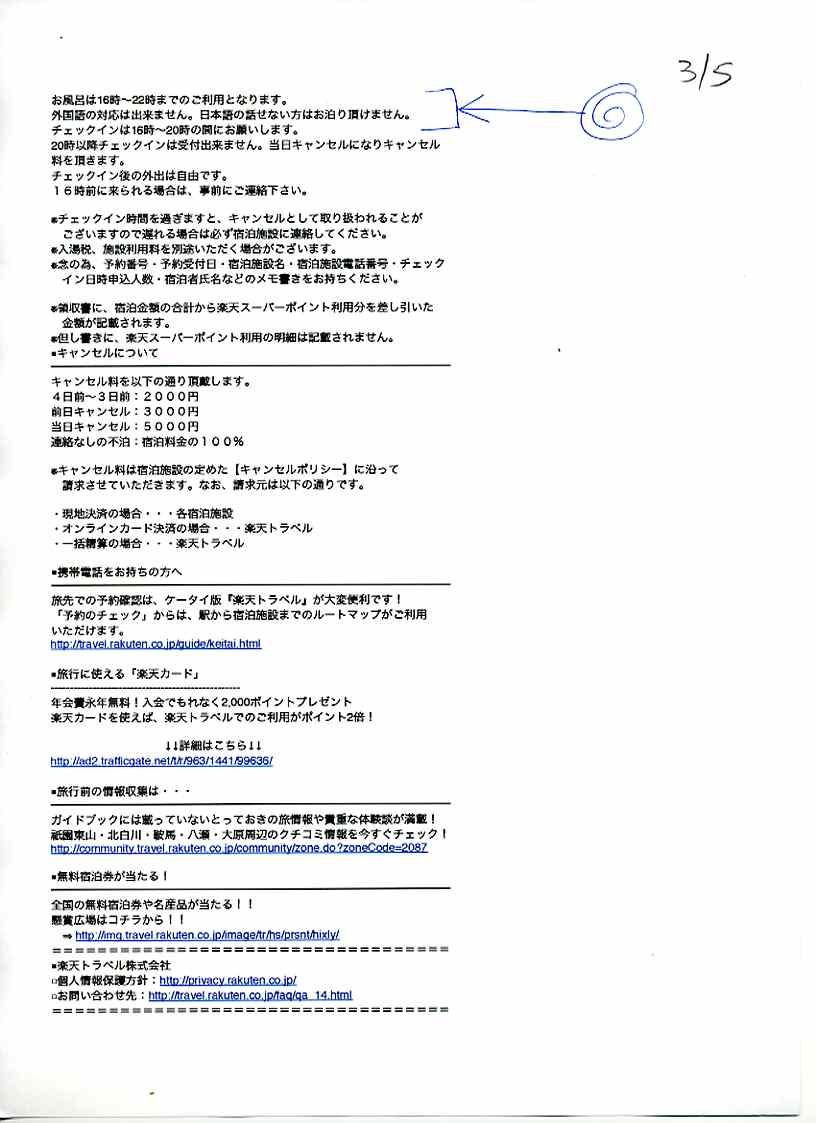
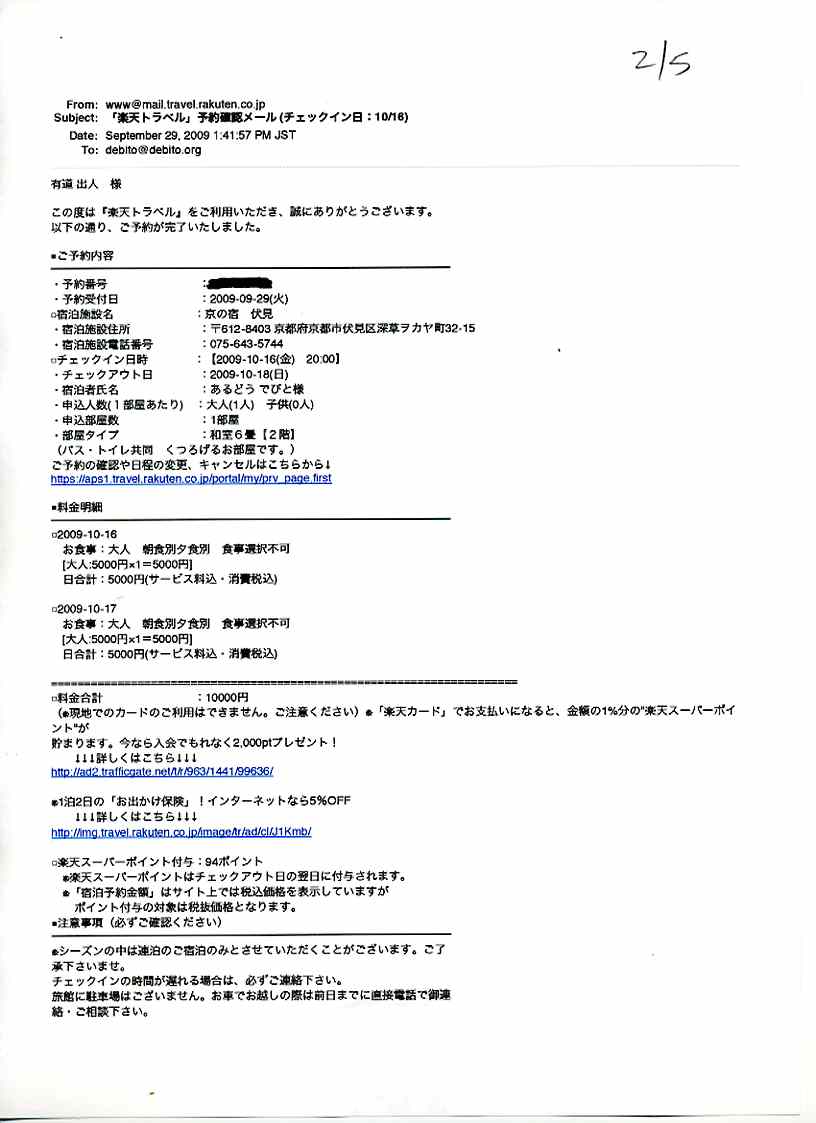
Background:  Last October, I attended a writers’ conference in Kyoto, and discovered that even in September just about all hotels in Kyoto were booked (it was approaching peak fall color season).  The only one left was a place in Fushimi that advertised online that they refused anyone who could not speak Japanese.  This is, by the way, contrary to the Hotel Management Law (Ryokan Gyouhou, which can only refuse customers if all rooms are taken, or if there is a health or a “public morals” problem).

I tried to vote with my feet and find alternative accommodation, but wound up having no choice, and made the reservation with the Fushimi place.  I did, however, the night before going down, find last-minute alternative accommodations at an unexclusionary hotel (at more than double the price).  Then I paid in cash by post to the Fushimi place the sizeable cancellation fee for the last-minute switch.

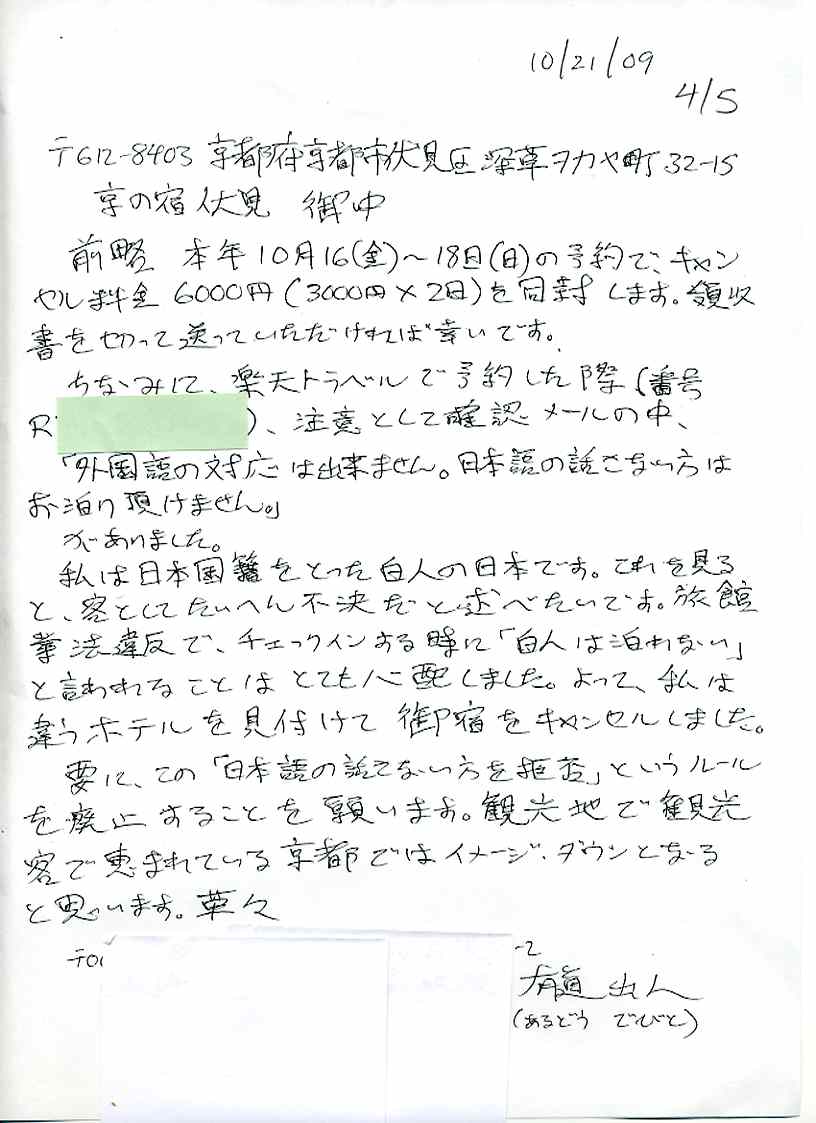
But I also enclosed a handwritten letter telling them why I cancelled, expressing my discontent with the rule that people would be refused for a lack of Japanese language ability (what with this tourist town, there are always ways to communicate — including speaking electronic dictionaries; how does one judge sufficient “language abilities”?  and what about deaf or mute Japanese? etc. etc.).  I also asked them to repeal this exclusionary rule, pointing out that it was an unlawful practice.

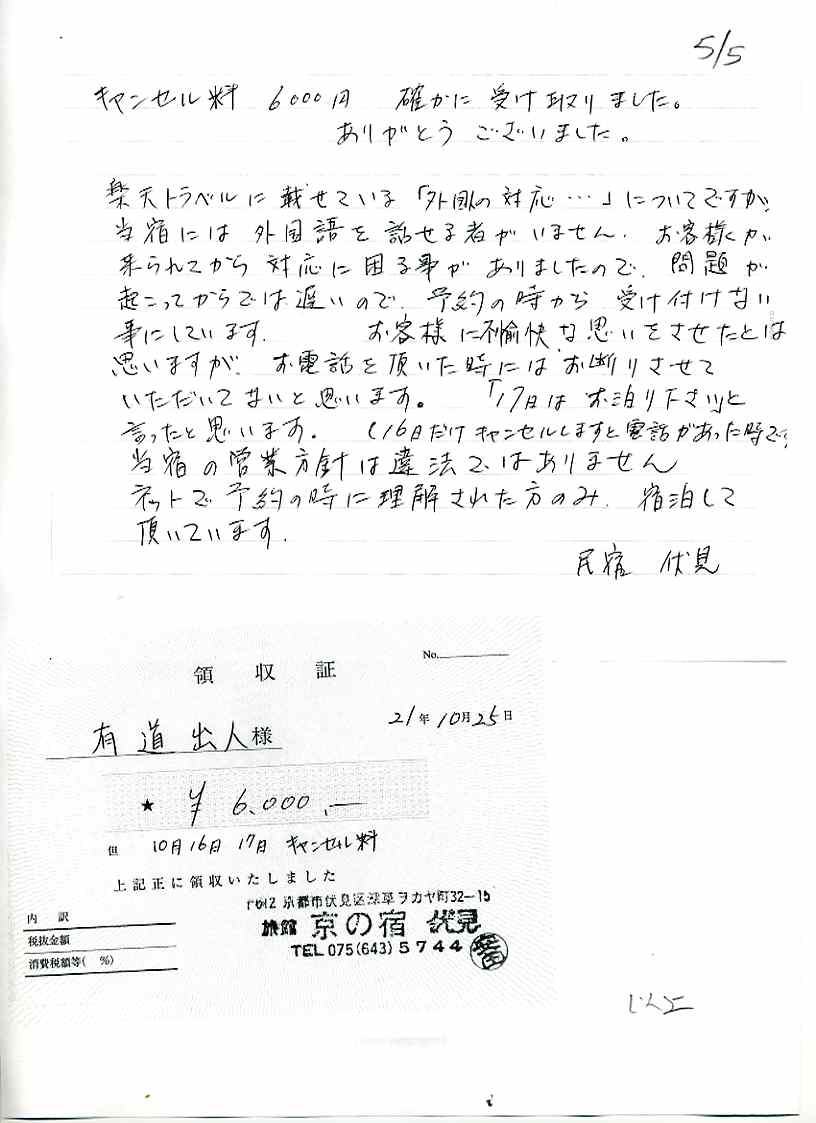
I got a rude reply back.  Without addressing me by name, I got a terse letter without any of the formal aisatsu or written tone that a customer-client relationship in this society would warrant.  It also included further spurious insinuated logic that since they couldn’t speak any foreign languages, this business open to the public was somehow not bound to provide service to the general public.  They also categorically denied that their rules are unlawful, coupled with the presumptuous claim that since they didn’t refuse me it was odd for me to feel any disfavor with their system.  And more.  In other words, thanks for your money, but we can do as we please, so sod you.

Now I’m mad.  I sent this exchange off yesterday with a handwritten note to the Kyoto City Government Department of Tourism and the Kyoto Tourist Association, advising them to engage in some Administrative Guidance.  The latter organization has already told me that they are a private-sector institution, and that since this hotel is not one of their members they have no influence in this situation.  And if the city does get back to me (I’ve done this sort of thing before; government agencies in Japan have even abetted “Japanese Only” hotels), I’ll be surprised.  But I’m not letting this nasty place slide without at least notifying the authorities.  This is just one more reason why we need a law against racial discrimination.

Here come the letters I sent, scanned, plus the reply.  Click on any image to expand in your browser. Arudou Debito in Sapporo

(And a quick word to the Protest Letter Police:  I’m not in the mood to have my grammar corrected, so don’t bother; my letters below have not been proofread by native speakers, but I think they get my points across just fine.  I’m doing the best that I can, and if you think that a letter has to be perfect before it goes out, and I’m somehow “shaming the entire gaijin community” if it’s not, fuck off.  Here are the letters warts and all.)

My letter to the Hotel, Kyou no Yado Fushimi:

kyotofushimi001

My reservation, two pages, with their exclusionary rule based upon language ability:

kyotofushimi002

kyotofushimi003

The hotel’s reply:

kyotofushimi004

My letter to the Kyoto authorities:

kyotofushimi005

UPDATE:  The Kyoto authorities respond, and the hotel rescinds its exclusionary rules.

ENDS

DEBITO.ORG NEWSLETTER NOVEMBER 9, 2009

mytest

Handbook for Newcomers, Migrants, and Immigrants to Japan\Foreign Residents and Naturalized Citizens Association forming NGO\「ジャパニーズ・オンリー 小樽入浴拒否問題と人種差別」(明石書店)JAPANESE ONLY:  The Otaru Hot Springs Case and Racial Discrimination in JapansourstrawberriesavatardebitopodcastthumbUPDATES ON TWITTER: arudoudebito

DEBITO.ORG NEWSLETTER NOVEMBER 9, 2009

Table of Contents:
///////////////////////////////////////////////////////////////////////
YET EVEN MORE ON CHILD ABDUCTIONS
1) 22 US Senators sign letter for Obama to address Child Abductions Issue during Japan visit
2) AOL on Child Abductions and child retriever Gus Zamora, letter to Debito.org from Gus
3) Open Letter to Pres. Obama re Nov 12 Japan Visit and Child Abductions from Left-Behind Parent
4) Sauce for the gander: Czech national abducts his child of J-NJ marriage; MOFA “powerless w/o Hague”

UNFINISHED BUSINESS
5) Ichihashi Tatsuya, suspect in Hawker murder, according to NPA has new face after plastic surgery
6) Japan Focus: Lawrence Repeta on DPJ and Ministry of Justice: fundamental reforms at last?
7) NYT on South Korea dealing with racism: Prosecutors spring into action. Contrast.
8 ) Greg Goodmacher’s EFL textbook on NJ issues: Why aren’t there more like these?
9) Asahi and Mainichi: J Supreme Court rules against Nationality Clause for employment in judiciary

BLOWBACK
10) NHK’s lingering bias favoring the opposition LDP. Anyone else noticing this?
11) Eyewitness report of Shinjuku’s overreaction to NJ Hallowe’en revelers on Yamanote
12) Fallout from “The Cove”: TV’s “South Park” takes on Japan’s dolphin slaughters and whale hunts

SOME STUFF I’M GETTING UP TO
13) DEBITO.ORG PODCAST OCTOBER 31, 2009
14) My Thurs Nov 5, Sapporo Gakuin Dai speech “Legal Equality for NJ Residents” (download Japanese Powerpoint)
15) “Lifer” Cartoon in SAPPORO SOURCE: “Things to do in Hokkaido”
16) New Debito.org Poll: “What are the TOP THREE things you think the DPJ should do policywise for NJ in Japan?”

… and finally …

17) Japan Times JUST BE CAUSE column: “Demography vs. Demagoguery” (full text)
///////////////////////////////////////////////////////////////////////

By Arudou Debito, Sapporo, Japan (debito@debito.org)
Daily Blog updates, RSS Feed and Subscriptions at www.debito.org
Freely Forwardable

///////////////////////////////////////////////////////////////////////

YET EVEN MORE ON CHILD ABDUCTIONS

1) 22 US Senators sign letter for Obama to address Child Abductions Issue during Japan visit

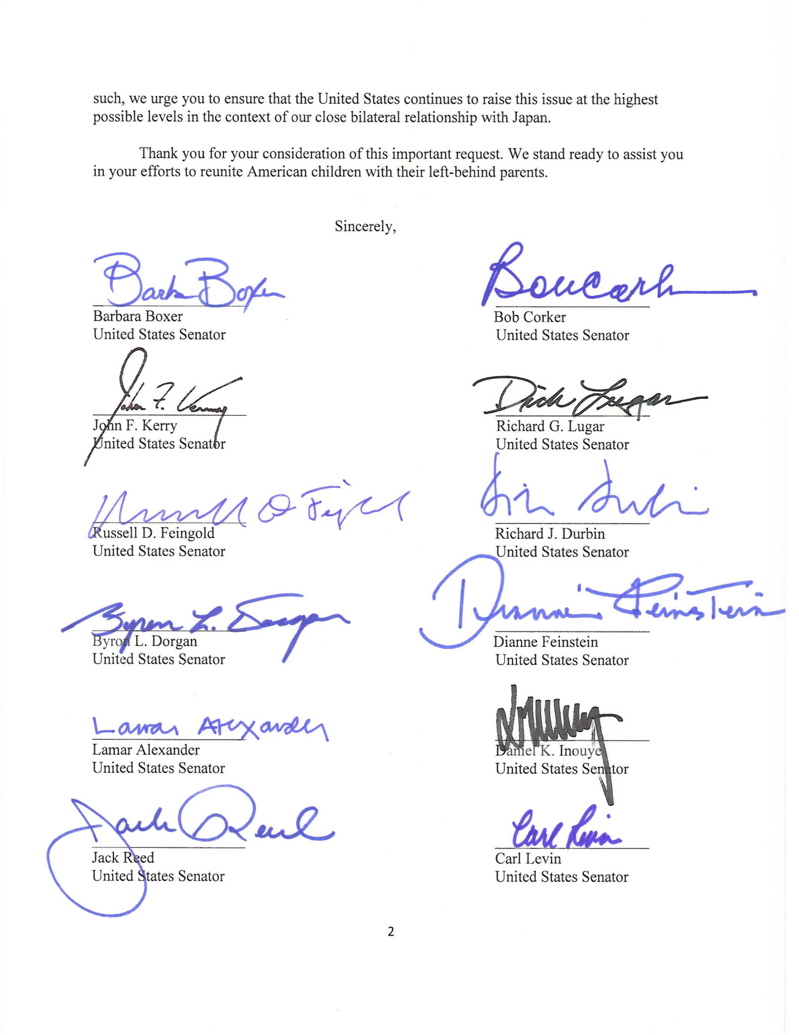
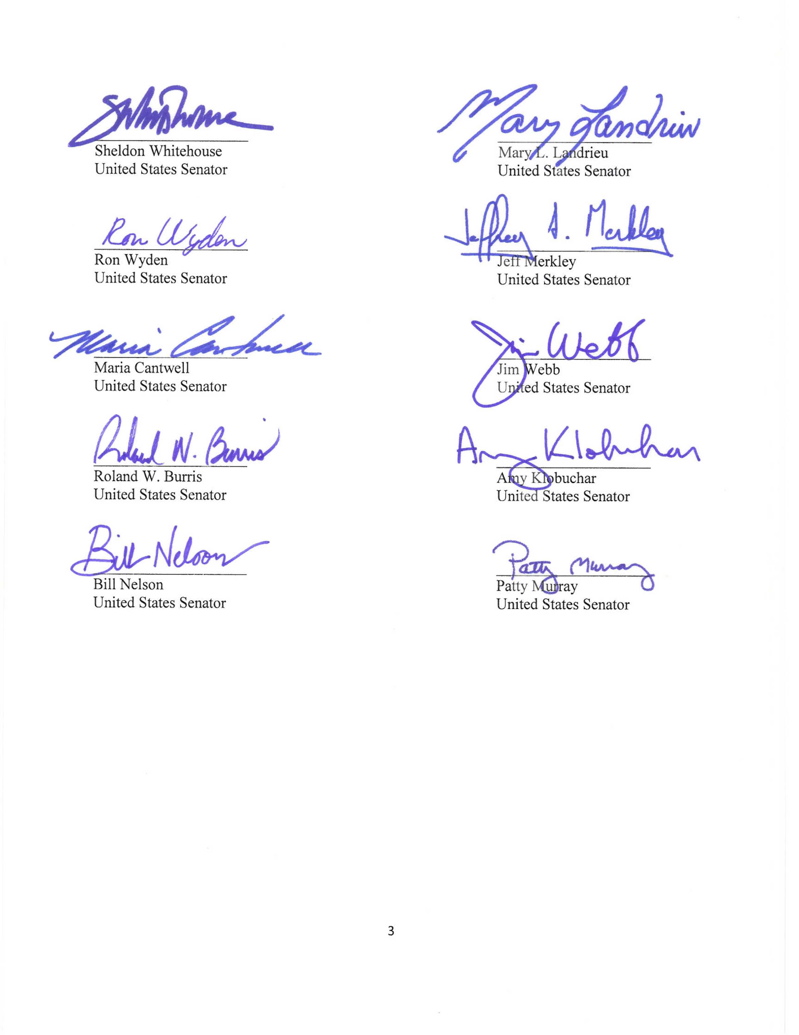
Debito.org reported on this on October 30, but back then only two US Senators had signed. Now as of November 5, 22 US Senators have signed a letter for Obama to address Child Abductions Issue during his Japan visit. Three scanned pages follow.

https://www.debito.org/?p=4984

///////////////////////////////////////////////////////////////////////

2) AOL on Child Abductions and child retriever Gus Zamora, letter to Debito.org from Gus

AOL: Say you marry someone and you have children. You get divorced. There’s a custody battle. You win. Your ex-spouse refuses to accept the decision. He or she takes the children and flees overseas to a country that doesn’t recognize your custody rights.

What do you do?

This is not a hypothetical question for thousands of parents who go through this exact scenario every year. Their options are limited.

One option, however, is Gus Zamora…

LETTER FROM GUS HIMSELF: In response to a recent post on the Internet regarding “Snatchback” in The Atlantic Monthly I felt it was important for people to know what I do and what my real success rate is. The world of International Parental Abduction is a place I have spent the last Eighteen years. I have assisted parents in over 200 cases. Fifty-five children have been returned to their custodial parent with my guidance. Three of which were successful recoveries from Japan.

In addition to the fifty-five recoveries, I have also worked on twenty to twenty five cases that were resolved through mediation, Hague convention applications, media involvement, international law enforcement involvement and negotiations directly with the abductors. Zamora and Associates is presently involved in several cases in Japan, both in and out of Japanese courts.

https://www.debito.org/?p=4975

///////////////////////////////////////////////////////////////////////

3) Open Letter to Pres. Obama re Nov 12 Japan Visit and Child Abductions from Left-Behind Parent

Conclusion: When you meet with Prime Minister Hatoyama, please remind him of his statements. There is no need to wait another two years to implement the rights Japan agreed to uphold when they became signatory to the United Nations Convention on the Rights of the Child. Please walk right up to Mr. Hatoyama, look him squarely in the eye, and tell him non-custodial parents must have immediate access to their children. Let the Japanese Government know that there is no room for negotiation. Please uphold both parental and children’s fundamental human rights. The Lord knows I have done about all I can. I have fought inside and outside of Japanese Courts with everything I’ve have left. I’ve been jailed, placed in solitary confinement, and stripped of all my assets for trying be a father.

Mr. President, like so many other left behind parents, I pray every night to see my children for years. Please use your office and your voice to make this happen. There are so many parents who have renewed hopes since you have taken office. When you come to Japan for talks with the Japanese Government please make this issue an important part of the discussion. YES WE CAN!

https://www.debito.org/?p=4960

///////////////////////////////////////////////////////////////////////

4) Sauce for the gander: Czech national abducts his child of J-NJ marriage; MOFA “powerless w/o Hague”

Finally we have the turnabout that I bet will precipitate Japan signing the Hague. A Czech father has reportedly abducted his child out of Japan, and the MOFA says it is powerless since Japan is not a party to the Hague Treaty on Child Abductions. Well, sauce for the gander, isn’t it?

Two things I find interesting about this case is 1) the MOFA is reportedly working to try and get the child back (contrast with the USG, which recently wouldn’t even open the front gates of one of its consulates to three of its citizens), and 2) once again, the same reporting agency (Kyodo) omits data depending on language, see articles below. It claims in Japanese that (as usual) the NJ husband was violent towards the J wife (in other words, it takes the claim of the wife at face value; how unprofessional), and neglects to mention that in English. Heh. Gotta make us Japanese into victims again.

Anyway, if this will get Japan to sign the Hague, great. Problem is, as usual, I see it being enforced at this point to get J kids back but never return them overseas (since the J authorities aren’t going to give more rights to foreigners than they give their own citizens, who lose their kids after divorce due to the koseki system, anyway). But I guess I’m being just a little too cynical. I hope.

https://www.debito.org/?p=5014

///////////////////////////////////////////////////////////////////////

UNFINISHED BUSINESS

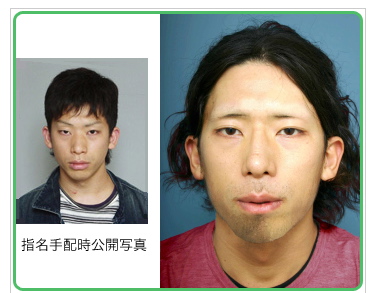
5) Ichihashi Tatsuya, suspect in Hawker murder, according to NPA has new face after plastic surgery

In probably one of the most embarrassing criminal investigation bungles in recent memory, the prime suspect in the Lindsay Ann Hawker murder case, Ichihashi Tatsuya, is still at large after closing in on three years since he gave the slip to cops who knocked on his apartment door.

Recent reports are that he has probably had cosmetic surgery and has a new face. Here are the mug shots. What gets me is that he can’t be on the lam this long without some sort of financial support. Rumors abound (from temporary work in construction to doing tricks for the gay community; all apocryphal), but his family denies that they are supporting him. I find that especially hard to believe now that he’s undergone very expensive cosmetic surgery.

Like Ichihashi, keep your eyes peeled, everyone. Let’s get this suspect in jug where he can answer a battery of questions about his whereabouts and motives for the past few years.

https://www.debito.org/?p=5011

///////////////////////////////////////////////////////////////////////

6) Japan Focus: Lawrence Repeta on DPJ and Ministry of Justice: fundamental reforms at last?

Repeta: The landslide victory of the Democratic Party of Japan (DPJ) in parliamentary elections held on August 30, 2009 is likely to result in policy change in many areas. There seems little doubt that we will see a very different approach to calibrating the balance between police power and individual rights.

One of the more startling appointments to the new Cabinet is that of Yokohama lawyer Chiba Keiko to be Minister of Justice. The authority of the Ministry is great, with responsibility to enforce criminal laws, protect individual rights, manage the immigration system, and generally oversee the legal system itself, including preparation and review of draft legislation. Ms. Chiba’s appointment should result in a sharp change in policy. She brings with her a history of more than two decades in the Diet in which she opposed nearly all LDP initiatives related to Ministry operations…

If there was any doubt on this score, she wiped it away in formal comments released on September 16, the day the new Cabinet took office. In her first message to the nation as Minister, Chiba declared that her mission is to help build a society that respects human rights and a judicial system that is “close to the people” (kokumin ni mijika na shiho). To achieve this, she listed three specific steps. First is the establishment of a new human rights agency. Second is ratification of so-called “Optional Protocols” to human rights treaties. Third is creating transparency in criminal interrogations…

https://www.debito.org/?p=4939

///////////////////////////////////////////////////////////////////////

7) NYT on South Korea dealing with racism: Prosecutors spring into action. Contrast.

NYT: On the evening of July 10, Bonogit Hussain, a 29-year-old Indian man, and Hahn Ji-seon, a female Korean friend, were riding a bus near Seoul when a man in the back began hurling racial and sexist slurs at them.

The situation would be a familiar one to many Korean women who have dated or even — as in Ms. Hahn’s case — simply traveled in the company of a foreign man.

What was different this time, however, was that, once it was reported in the South Korean media, prosecutors sprang into action, charging the man they have identified only as a 31-year-old Mr. Park with contempt, the first time such charges had been applied to an alleged racist offense. Spurred by the case, which is pending in court, rival political parties in Parliament have begun drafting legislation that for the first time would provide a detailed definition of discrimination by race and ethnicity and impose criminal penalties.

COMMENT: Well, how about that. First South Korea does away with its hojeok family registry system in 2007 (the similar koseki system, still extant in Japan, causes a lot of difficulties for NJ). This after it passes a law in 2005 with provisions against some forms of racial discrimination, such as against Koreans with mixed parentage. Now, according to the NYT below, they’re charging people in court with racism and drafting laws against it, even protecting at least one person with no blood connection to Korea. Dunno how thoroughly this is being enforced, but given the cultural similarities (and attitudes towards outsiders), it SK can do it, I daresay it’s not impossible for Japan. The discriminatory conditions described below sound eerily similar at times.

https://www.debito.org/?p=4957

///////////////////////////////////////////////////////////////////////

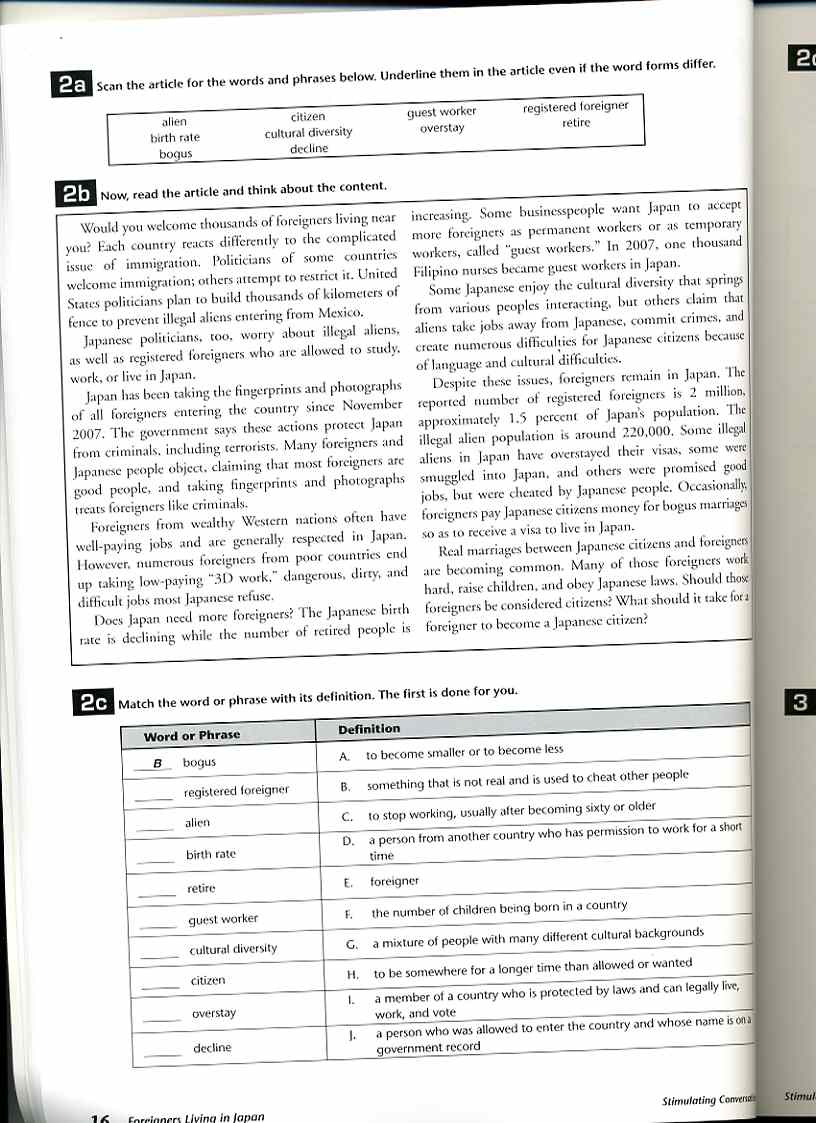
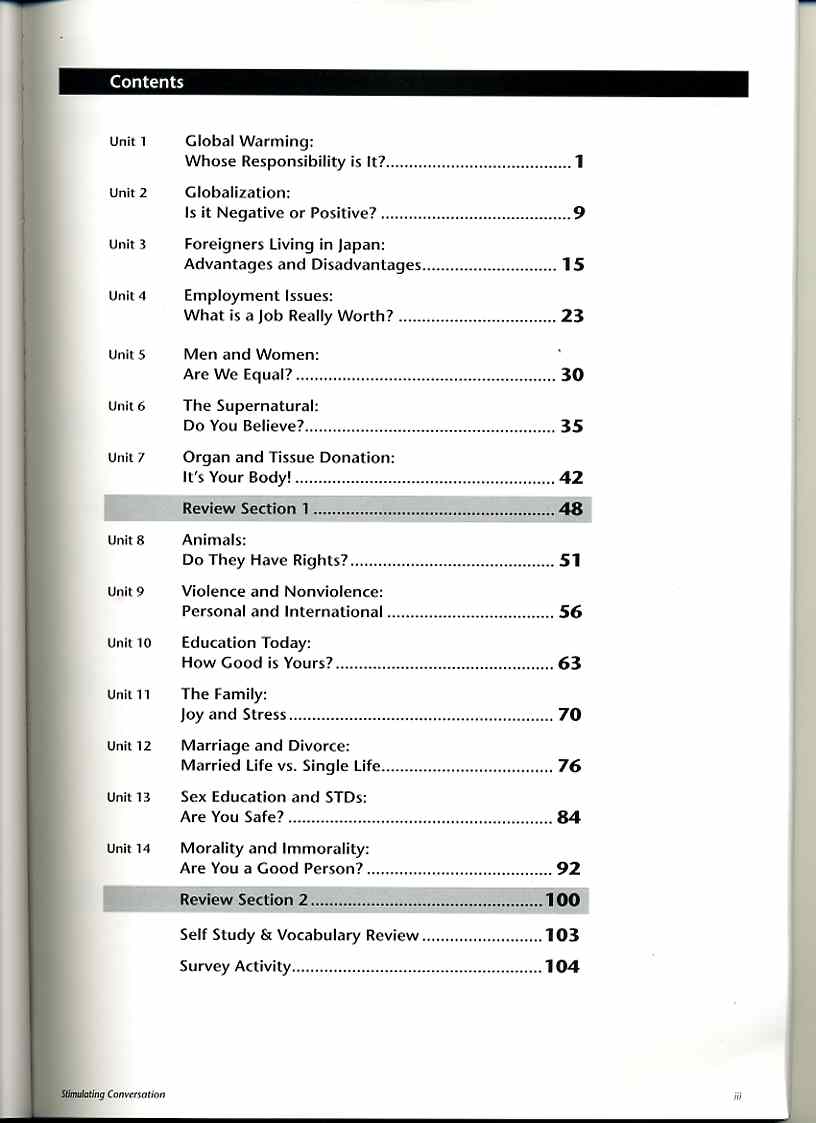
8 ) Greg Goodmacher’s EFL textbook on NJ issues: Why aren’t there more like these?

For a Sunday Tangent, I introduce the book below by Greg Goodmacher. I have no financial stake, don’t worry. Just wanted to point out that there is a book out there in the education sector which has information on NJ issues.

I think there should be more like these. After all, if MOE isn’t going to help with assimilation by approving books that toe the monocultural “Japan is unique” line (not to mention deny ethnic schools official approval as education entities, so their NJ students can’t get subsidies and student discounts), then we international residents who write and sell books should inject multiculturalism into the private sector textbook market. Hey, what’s being taught below is not unkosher, and thinking about the inevitability of Japan immigration (a tenet Debito.org subscribes to wholeheartedly, natch) is actually a very good thing to get young people thinking about.

NJ textbook writers in Japan, get cracking. Educate people. Promote Japan’s future as a multicultural multiethnic society!

https://www.debito.org/?p=4848

///////////////////////////////////////////////////////////////////////

9) Asahi and Mainichi: J Supreme Court rules against Nationality Clause for employment in judiciary

In probably one of the most important legal decisions all year, the Supreme Court has ruled that the “Nationality Clause” (kokuseki joukou), often cited as a reason for barring NJ from administrative (and often, even stable noncontracted) jobs in the public sector, has been scrapped. I’m not sure if that means it’s been ruled “unconstitutional”, but the clause in the Mainichi below, (“The citizenship requirement was eliminated because the courts could be seen as denying employment based solely on the question of citizenship,” the court stated.) could reasonably be stretched in future cases to say that barring NJ from jobs (currently allowed in places such as firefighting and food preparation, and also in Tokyo Prefecture for nursing) should not be permitted. That would be excellent news for the long-suffering NJ academics in Japan’s higher-education system of Academic Apartheid.

https://www.debito.org/?p=4898

///////////////////////////////////////////////////////////////////////

BLOWBACK

10) NHK’s lingering bias favoring the opposition LDP. Anyone else noticing this?

Has anyone noticed how NHK still reports as if the LDP is in power?

It’s been a month and a half since the DPJ assumed office, the first real bona fide party in Japan’s modern, developed, postwar history to actually offer a change of perspective and an alternative opposition. They keep surprising me with both their proposals and their competence so far.

But you wouldn’t get that impression from watching NHK. Yesterday morning’s 7AM news (Nov 2, 2009) had a smidge on the DPJ’s latest policy move, but then had a citation from former cabinet member (who nearly was booted out this election from my local electorate, Ebetsu, and had to be brought back in as a Proportional Representation “Zombie” Dietmember) Machimura Nobutaka, mentioned by name, offering a counterargument seemingly nearly as long as the airtime given the LDP. Who is he to comment and why should anyone, particularly NHK, care?

I’ve seen this time and time again on NHK, supposedly neutral — or at least pro-government. Which means it should be promoting the DPJ’s view now that it is the government. But that’s not happening. NHK, to me, seems to be treating our current government as if it’s an aberration, a lull or momentary lapse of reason before the LDP gets back in.

I’m not alone in this view…

https://www.debito.org/?p=4911

///////////////////////////////////////////////////////////////////////

11) Eyewitness report of Shinjuku’s overreaction to NJ Hallowe’en revelers on Yamanote

Eyewitness reporting to Debito.org:
Shinjuku JR minami-guchi, where, in previous years, hundreds halloweeners had gathered to start the party on a specific train of the Yamanote line. This year, there were

– at least two hundred cops all over the station.

– several dozen of cops inside, blocking the staircase leading to the Shibuya direction platform

– cops blocking every costumed person from entering the station

– per every stop of the Yamanote, there were at least half a dozen cops on the platform

– in the train, there was at least three different Japanese with video cameras with the specific purpose of documenting gaijin atrocities

– and a premier for this year, there were at least more than 100 PROTESTERS outside the kaisatsu…

https://www.debito.org/?p=4905

///////////////////////////////////////////////////////////////////////

12) Fallout from “The Cove”: TV’s “South Park” takes on Japan’s dolphin slaughters and whale hunts

This is making the rounds of the blogoverse. South Park takes on the Japanese dolphin culls and whale hunts, thanks to the publicity from “The Cove”. It’s worth seeing. As a South Park fan, I must say this is all within character for the show — and it as usual ties the issue up into large intellectual knots, and pushes the frontiers of “taboo humor”. Enjoy, I guess.

https://www.debito.org/?p=4876

///////////////////////////////////////////////////////////////////////

SOME STUFF I’M GETTING UP TO

13) DEBITO.ORG PODCAST OCTOBER 31, 2009

In this edition of the Debito.org Podcast, Debito reads three of his JUST BE CAUSE Japan Times columns. His first three, published nearly two years ago, are on the image of activists in Japan, on how public forums in Japan regarding human rights keep spinning their wheels, and on how academics should also get into activism in a show of “academic social responsibility”. This is his first podcast in nearly two years. For those who would rather listen to Debito.org during your exercise or commute than read it online, enjoy.

https://www.debito.org/?p=4917

///////////////////////////////////////////////////////////////////////

14) My Thurs Nov 5, Sapporo Gakuin Dai speech “Legal Equality for NJ Residents” (download Japanese Powerpoint)

I gave a speech with a 90-slide Powerpoint presentation to SGU last week, and it went most swimmingly. About how the GOJ and its authorities treat NJ residents in ways that are egregiously different from other developed countries, even violate international treaties and statues regarding human rights. Take a look. Download the Powerpoint in Japanese here:

https://www.debito.org/?p=4954

///////////////////////////////////////////////////////////////////////

15) “Lifer” Cartoon in SAPPORO SOURCE: “Things to do in Hokkaido”

SAPPORO SOURCE, our city’s only free bilingual newspaper, has just this month started featuring cartoons by “Lifer”, a Sapporo resident who has enough time on his hands to scribble down some doodles. Here’s the first in the series, RANDOM HOKKAIDO COMIX, click on it to focus in your browser:

https://www.debito.org/?p=4882

///////////////////////////////////////////////////////////////////////

16) New Debito.org Poll: “What are the TOP THREE things you think the DPJ should do policywise for NJ in Japan?”

In part two of a series polling what the new DPJ Administration should do regarding making life in Japan better for NJ residents, I have offered a second Debito.org poll at top right column, “What are the TOP THREE things you think the DPJ should do policywise for NJ in Japan? (choose up to 3)”, with some choices you might find delectable.

It offers the same options in the same order as the previous poll (archived here, and you can still vote on that, too), except that one only wanted the polled to chose ONE option (since politicians have trouble working on more than one than one track at a time). Now with THREE choices, we should be able to see better overlaps and midpoints, and perhaps get a better sense of what concerned readers of Debito.org think the GOJ should do for us. G’wan, let us know what you think!

https://www.debito.org/?p=4968

///////////////////////////////////////////////////////////////////////

… and finally …

17) Japan Times JUST BE CAUSE column: “Demography vs. Demagoguery” (full text)

JUST BE CAUSE
Demography vs. demagoguery: when politics, science collide

The Japan Times Tuesday, Nov. 3, 2009
By DEBITO ARUDOU
http://search.japantimes.co.jp/cgi-bin/fl20091103ad.html

Last June, I attended a symposium sponsored by the German Institute of Japanese Studies. Themed “Imploding Populations: Global and Local Challenges of Demographic Change,” I took in presentations about health care, international and domestic migration, and life in a geriatric society.

Nothing surprising. The United Nations and our government acknowledged back in 2000 that Japan was heading for a demographic nightmare: a decreasing population, more old people than we can take care of, not enough young people to pay taxes, and economic decline.

Shocking, however, was the bad science: The presenting Japanese scientists were deliberately ignoring data fundamental to their field.

One panel was particularly odd. Panelists concluded, of course, that Japan must do something to stop this demographic juggernaut. A deputy director general at Japan’s National Institute of Population and Social Security Research even extrapolated that Japanese would be extinct by the year 3000! Yet the prospect of Japan’s decimation was no match for the fear of the foreign element.

During the Q-and-A, I asked: “Sir, only briefly in your presentation do you mention letting foreigners into Japan as a possible solution. However, you depict the process not as ‘immigration’ (imin), but as the ‘active use of the foreign working labor population’ (gaikokujin rodoryoku jinko no katsuyo). Why this rhetoric?”

The speaker hedged a bit, suddenly asserting that Japan is now a crowded island society. To paraphrase, “Immigration is not an option for our country. Inflows must be strictly controlled for fear of overpopulation.”

Afterward, one on one, I reconfirmed his intellectual disconnect. He further cited “a lack of national consensus” on the issue. When I asked if this was not a vicious circle (i.e. avoiding public discussion of the issue means no possible consensus), he gave a noncommittal answer. When I asked if “immigration” had become more of a political term than a scientific one, he begged off replying further.

Seems I opened Pandora’s Box. For the rest of the conference, whenever a Japanese presenter discussed every option for Japan’s future but immigration (they all avoided it), they played dodgeball with questions from other scientists. The ignorance was systematic — only one gave a begrudging acknowledgment that foreigners might be necessary for Japan’s future, although he personally couldn’t imagine it.

As a German expert of demographics told me afterward with consternation, “Demographics is the study of population changes: births, deaths, inflows and outflows. How can the Japanese demographers ignore inflows, even the possibility of them, in their assessments and still think they are doing good science?”

The reason is because this science in Japan has become riddled with politics. We know Japan’s population will continue to drop. Yet extinction still seems preferable to letting people in to stay.

Thus “immigration,” like “racial discrimination” (JBC, June 2), has become another taboo topic. One must not mention it by name, especially if you represent a government-funded think tank.

Then, when you have whole branches of government studiously ignoring the issue (even though last June the Health Ministry proposed training for companies to hire more foreigners, the former Aso Cabinet wouldn’t consider immigration as one of its top five priority plans), we can but say that the ostrich is in full burrow mode.

This is why I’m having trouble seeing any public policy — from the Nikkei workers being bribed to go home after two decades of contributions, to the proposed imports of Indonesian and Philippine nurses — as anything more than yet another “active use of the foreign working labor population.” Or, more honestly put, programs exploiting revolving-door employment regimes.

How seriously can we continue to tempt foreigners with the promise of a life in Japan in exchange for the best years of their labor productivity, only to revoke their livelihoods and pension contributions at the first opportunity, blaming globalization’s vicissitudes? How seriously can we make continued employment contingent upon a qualification hurdle (such as a tough nursing exam) that would challenge even native speakers?

This will only hurt us as a society in future. Again, we are on the cusp of a future in a society that can’t pay or take care of itself. It’s already happening in Japan’s depopulated countryside. Demographic science, if practiced properly, leads inevitably to that conclusion.

So here’s my reality check: Either way, people will come to Japan — even if it means they find an enfeebled or empty island to live in. With a new political administration in government, we might as well consider bringing in people now while we have more energy and choices.

Time out. Just like that guy at the think tank, time for me to be hit with a Debito-style question: “Who decides what Japan wants?”

Answer: We residents do, of course. But the people who represent or make decisions for us are not necessarily receptive enough (or all that developed as human beings) to understand one simple thing: People who appear to be different are not a threat. We cannot expect leaders and bureaucrats to guide us to a world they cannot envision.

So I will keep asking the Debito Questions, and argue that people like us are a viable alternative to Japan’s slow but inexorable decline. For Japan’s sake, we must save us from ourselves. I’ll suggest how next month.

///////////////////////////////////////////////////////////////////////

That’s all for this week! Thanks for reading!
Arudou Debito, Sapporo, Japan (debito@debito.org)
Daily Blog updates, RSS Feed and Subscriptions at www.debito.org
DEBITO.ORG NEWSLETTER NOVEMBER 9, 2009 ENDS


Sauce for the gander: Czech national abducts his child of J-NJ marriage; MOFA “powerless w/o Hague”

mytest

Handbook for Newcomers, Migrants, and Immigrants to Japan\Foreign Residents and Naturalized Citizens Association forming NGO\「ジャパニーズ・オンリー 小樽入浴拒否問題と人種差別」(明石書店)JAPANESE ONLY:  The Otaru Hot Springs Case and Racial Discrimination in Japansourstrawberriesavatardebitopodcastthumb
UPDATES ON TWITTER: arudoudebito

Hi Blog. Finally we have the turnabout that I bet will precipitate Japan signing the Hague. A Czech father has reportedly abducted his child out of Japan, and the MOFA says it is powerless since Japan is not a party to the Hague Treaty on Child Abductions.  Well, sauce for the gander, isn’t it?

Two things I find interesting about this case is 1) the MOFA is reportedly working to try and get the child back (contrast with the USG, which recently wouldn’t even open the front gates of one of its consulates to three of its citizens), and 2) once again, the same reporting agency (Kyodo) omits data depending on language, see articles below. It claims in Japanese that (as usual) the NJ husband was violent towards the J wife (in other words, it takes the claim of the wife at face value; how unprofessional), and neglects to mention that in English. Heh. Gotta make us Japanese into victims again.

Anyway, if this will get Japan to sign the Hague, great. Problem is, as usual, I see it being enforced at this point to get J kids back but never return them overseas (since the J authorities aren’t going to give more rights to foreigners than they give their own citizens, who lose their kids after divorce due to the koseki system, anyway). But I guess I’m being just a little too cynical. I hope. Arudou Debito in Sapporo

//////////////////////////////////////////
Czech man takes son out of Japan in suspected child abduction
Japan Today/Kyodo Sunday 08th November, 06:05 AM JST, Courtesy of JL

http://www.japantoday.com/category/crime/view/czech-man-takes-son-out-of-japan-in-suspected-child-abduction

TOKYO —

A Czech man has taken his 5-year-old son apparently to a place overseas from his home in Gifu Prefecture, prompting the boy’s Japanese mother to seek help from the Foreign Ministry in searching for the boy’s whereabouts, sources close to the matter said Saturday.

The ministry, however, has few means in dealing with the case as Japan is not a party to the 1980 Hague Convention that standardizes laws that prevent international parental child abduction, they said.

Japan remaining a non-signatory has drawn international criticism recently after an American father who tried to take back his two children from his Japanese wife was arrested on suspicion of child abduction in Fukuoka Prefecture in September.

The children might have been handed over to the father’s side if Japan were the member of the convention, which stipulates that children should be returned to the original residing place when they are taken forcibly. The mother was reported by some American media to have unlawfully taken the children first from the United States.

While such cases of Japanese women taking their children to Japan after divorcing or separating from their non-Japanese husbands or partners are often reported and cause problems, cases in which children are taken out of Japan have been relatively rare.

In the latest case, Kayoko Yamada, a 40-year-old resident of the city of Yamagata, Gifu, sought help from the Foreign Ministry after her husband, a 31-year-old Czech Republic national, left home with their son on Aug 23, according to the sources.

Yamada received a phone call the following day from the husband, saying he and the son were in Frankfurt, Germany. She has received no contact since then, and assumes they are probably in the Czech Republic, the sources said.

Yamada and her husband have been living in Japan but recently were talking about divorce.

Experts say Japan could seek help from Czech authorities in search of the whereabouts of Yamada’s son if Japan were a member of the convention.

With the annual number of international marriages rising by almost six times over the last 30 years to some 37,000 in Japan last year as a government report indicates, divorce and such related problems have been on the rise as well.

The number of children taken by Japanese parents from the United States, Britain, France and Canada to Japan totaled over 160 as of this May, and some cases involve those wanted on abduction charges.

ENDS

////////////////////////////////////////////////

チェコ人夫が5歳児海外連れ去り 岐阜の母、返還要求できず

共同通信 2009/11/07, Courtesy of CJ

http://www.47news.jp/CN/200911/CN2009110701000443.html

岐阜県に住む女性看護師の夫のチェコ人(31)が8月、長男(5)を海外に連れ出したまま所在不明となっていることが7日、分かった。外務省は調査に着手したが、父母の一方による子供連れ去りを防ぐ「ハーグ条約」に日本が未加盟のため、女性は返還を求めるすべがない。日本女性が子連れ帰国し問題化する例は増えているが、日本からの連れ去り表面化はまれ。加盟の是非をめぐる議論に一石を投じそうだ。

女性は岐阜県山県市の山田佳代子さん(40)。 山田さんによると留学先のオーストラリアで夫と出会い、日本で結婚したが、夫の暴言や暴力で不仲になり、離婚の話が出ていた。8月23日、長男を連れて家を出た夫はそのまま戻らず、翌日「ドイツのフランクフルトにいる」と国際電話があった。その後はほぼ音信不通状態が続いている。

山田さんは、夫はチェコに帰国したとみて外務省に相談。外務省はチェコの国内法を適用し対処できないか検討しているが、今のところ有効な手段はないという。

ハーグ条約は国際結婚した父母の一方が子供を無断で連れ去った場合、それまで住んでいた国に戻す手続きを定めている。チェコを含む欧米諸国は大多数が加盟しており、専門家によると日本が加盟していればチェコへ子どもの捜索や返還を求めることが可能だ。

(共同)

ENDS

Ichihashi Tatsuya, suspect in Hawker murder, according to NPA has new face after plastic surgery

mytest

Handbook for Newcomers, Migrants, and Immigrants to Japan\Foreign Residents and Naturalized Citizens Association forming NGO\「ジャパニーズ・オンリー 小樽入浴拒否問題と人種差別」(明石書店)JAPANESE ONLY:  The Otaru Hot Springs Case and Racial Discrimination in Japansourstrawberriesavatardebitopodcastthumb
UPDATES ON TWITTER: arudoudebito
Hi Blog.  In probably one of the most embarrassing criminal investigation bungles in recent memory, the prime suspect in the Lindsay Ann Hawker murder case, Ichihashi Tatsuya, is still at large after closing in on three years since he gave the slip to cops who knocked on his apartment door.

Recent reports are that he has probably had cosmetic surgery and has a new face.  Here are the mug shots.

ichihashinewface

Fuller reports courtesy of Black Tokyo and Japan Probe here, with some TV news reportage:

http://www.blacktokyo.com/?p=4466

http://www.japanprobe.com/2009/11/08/examining-tatsuya-ichihashis-new-face/

What gets me is that he can’t be on the lam this long without some sort of financial support.  Rumors abound (from temporary work in construction to doing tricks for the gay community; all apocryphal), but his family denies that they are supporting him.  I find that especially hard to believe now that he’s undergone very expensive cosmetic surgery.

Like Ichihashi, keep your eyes peeled, everyone.  Let’s get this suspect in jug where he can answer a battery of questions about his whereabouts and motives for the past few years.  Arudou Debito in Sapporo

Greg Goodmacher’s EFL textbook on NJ issues: Why aren’t there more like these?

mytest

Handbook for Newcomers, Migrants, and Immigrants to Japan\Foreign Residents and Naturalized Citizens Association forming NGO\「ジャパニーズ・オンリー 小樽入浴拒否問題と人種差別」(明石書店)JAPANESE ONLY:  The Otaru Hot Springs Case and Racial Discrimination in Japansourstrawberriesavatardebitopodcastthumb
UPDATES ON TWITTER: arudoudebito
Hi Blog.  For a Sunday Tangent, I introduce the book below by Greg Goodmacher.  I have no financial stake, don’t worry.  Just wanted to point out that there is a book out there in the education sector which has information on NJ issues.

I think there should be more like these.  After all, if MOE isn’t going to help with assimilation by approving books that toe the monocultural “Japan is unique” line (not to mention deny ethnic schools official approval as education entities, so their NJ students can’t get subsidies and student discounts), then we international residents who write and sell books should inject multiculturalism into the private sector textbook market.  Hey, what’s being taught below is not unkosher, and thinking about the inevitability of Japan immigration (a tenet Debito.org subscribes to wholeheartedly, natch) is actually a very good thing to get young people thinking about.

NJ textbook writers in Japan, get cracking.  Educate people.  Promote Japan’s future as a multicultural multiethnic society!  Cover front and back, table of contents, and sample below, excerpted with permission. Click on any page to expand in your browser.  Arudou Debito in Sapporo

UPDATE:
Hello Debito,

Greg forwarded your message to me and noted that some readers have expressed interest in getting evaluation copies.

Would it be possible for you to add a link or a note that evaluation copies can be requested from Intercom Press.

Our website is: http://www.intercompress.com
email: texts@intercompress.com
fax: 092-726-5069

Thank you for writing about the text. We really appreciate it.

Regards,
Edward Roosa
Intercom Press, Inc.
3-9-10-701 Tenjin
Chuo-ku, Fukuoka 810-0001
Fax: 092-726-5069
http://www.intercompress.com

(Click on any page to expand in your browser)
stimulatingconversation001

stimulatingconversation002

stimulatingconversation004

stimulatingconversation005

stimulatingconversation003

ENDS

22 US Senators signed letter for Obama to address Child Abductions Issue during Japan visit

mytest

Handbook for Newcomers, Migrants, and Immigrants to Japan\Foreign Residents and Naturalized Citizens Association forming NGO\「ジャパニーズ・オンリー 小樽入浴拒否問題と人種差別」(明石書店)JAPANESE ONLY:  The Otaru Hot Springs Case and Racial Discrimination in Japansourstrawberriesavatardebitopodcastthumb
UPDATES ON TWITTER: arudoudebito
Hi Blog. We reported on this on October 30, but back then only two US Senators had signed. Now as of November 5, 22 US Senators have signed a letter for Obama to address Child Abductions Issue during his Japan visit.  Three scanned pages follow.  Courtesy of both CRN and CRC. Arudou Debito

ussenateobama110509

ussenateobama1105092

ussenateobama1105093

ENDS

AOL on Child Abductions and child retriever Gus Zamora, letter to Debito.org from Gus

mytest

Handbook for Newcomers, Migrants, and Immigrants to Japan\Foreign Residents and Naturalized Citizens Association forming NGO\「ジャパニーズ・オンリー 小樽入浴拒否問題と人種差別」(明石書店)JAPANESE ONLY:  The Otaru Hot Springs Case and Racial Discrimination in Japansourstrawberriesavatardebitopodcastthumb
UPDATES ON TWITTER: arudoudebito

Hi Blog.  More on how far people are willing to go to get their abducted kids back after divorce.  They don’t send in the SWAT team.  They hire Gus.  Gus himself comments to Debito.org below.  Arudou Debito

=======================================

Gustavo Zamora helps parents find their abducted kids.

http://www.parentdish.com/2009/11/03/vigilante-travels-world-to-save-kids/

A globe-trotting vigilante to retrieves children from foreign countries? Why would you need one?

Say you marry someone and you have children. You get divorced. There’s a custody battle. You win. Your ex-spouse refuses to accept the decision. He or she takes the children and flees overseas to a country that doesn’t recognize your custody rights.

What do you do?

This is not a hypothetical question for thousands of parents who go through this exact scenario every year. Their options are limited.

One option, however, is Gus Zamora.

He goes to other countries and gets kids back — one way or another. “There are lots of ways to recover a child,” he said in an interview with ParentDish. “There’s no one way.”


The Tampa Bay, Fla., resident and former Army Ranger prefers to do things nice and legal. If he can work through a foreign court system, fine. Failing that, he might try to bully foreign officials with threats — or at least bluffs — of crushing media attention.


As a last resort, Zamora said, he will grab the child and run. “That’s when you’ve run out of other options,” he said.


Rest of the article at http://crnjapan.net/The_Japan_Childrens_Rights_Network/itn-gzonptds.html

//////////////////////////////////////////////////////////

LETTER TO DEBITO.ORG FROM GUS:

In response to a recent post on the Internet regarding “Snatchback” in The Atlantic Monthly I felt it was important for people to know what I do and what my real success rate is. The world of International Parental Abduction is a place I have spent the last Eighteen years. I have assisted parents in over 200 cases. Fifty-five children have been returned to their custodial parent with my guidance. Three of which were successful recoveries from Japan.

In addition to the fifty-five recoveries, I have also worked on twenty to twenty five cases that were resolved through mediation, Hague convention applications, media involvement, international law enforcement involvement and negotiations directly with the abductors. Zamora and Associates is presently involved in several cases in Japan, both in and out of Japanese courts.

Over the years I have spoken at numerous International Parental Abduction conferences. Through the years I have gotten to know the victims of parental abduction both children and their left behind parent. I have met with high-powered world leaders, activists who protest against hypocrisy and that Virginia woman who attempts to manage her local 501 c3 non-profit. I will never really understand what it’s like to lose a child. I am one of the few people who fight in this arena that doesn’t belong to the left behind parents club.

Parents come to me year after year with the same story. They are spent from their losing fight in unjust courts trying to regain their flesh and blood. They have met with politicians some of whom are empathetic and some who will shut their door in your face. These parents are tired and vulnerable, and near wits end.

Organizations like the Children’s Rights Council do good work in most circumstances. Some of their offshoots however do just the opposite. Making statements such as “I know of another case Gus worked on in Japan a few years ago, which also was unsuccessful. I don’t think he’s ever gotten a child out of Japan” are counterproductive and in fact limiting to a parent who should be able to care for their child. Why would a national organization bound by the laws of the United States choose to stymie what could be the last hope a parent has.

There are a number of parents out there who are adversely affected by the way these groups operate. Over the years some parents have come to me in confidence after being told that if they did not continue to support these organizations by following their instructions, attending their conferences and assisting as a volunteer they would be shut out of the group and would be on their own.

I have supported many non-profit organizations and groups from the early evolution of my child recovery career, but very quickly withdrew my support and speaking engagements at their conferences. In the end I decided it was best to withdraw any association with them altogether because of their unproductive nature and dictatorial style. I chose however to associate myself The Children’s Rights Network due to the fact that CRN does nothing other than assists parents.

The Children’s Rights Network doesn’t ask for donations. The Japan Chapter of the Children’s Rights Network website www.crnjapan.net states “We are currently funded by a private organization and do not require donations. Thank you for your support and wish to help…” The information The Children’s Rights Network supplies to parents, attorneys, politicians, and the general public is free of charge. The Children’s Rights Network is there for the families being affected by International Parental Abduction to Japan.

CRN receives up to 20 inquiries per day through crnjapan.net requesting assistance, or just a general push in the right direction. The Children’s Rights Network supplies answers and assistance to those in need. CRN doesn’t ask for donations from a needy parent. Even when a parent makes it as high as the Supreme Court and needs assistance writing a writ. The Children’s Rights network is an organization that has been called “The closest thing I have found to a support group.” I appreciate being associated with a support group as opposed to an organization that on their website sells “items” and requests you become a paid “member.”

No two cases are alike. No two parents are the same. There are never any guarantees made to anyone on any case, at any time. When a case reaches the point that Zamora And Associates needs to be involved we are upfront with the client as to what the risks and costs are. We do the best we can and rarely do parents expect more.

The Japanese case mentioned in the Atlantic Monthly was a successful recovery until it became obvious that the parent had misrepresented their relationship with their child. The parent that hired Zamora And Associates failed to disclose that the child and the parent did not have a close, loving relationship. The child was 100% against a further relationship with said parent.

We had been told over and over again by distraught parents that their child begged for reunification and return. After working hard on plans for a recovery however, on numerous occasions we only find out once the child is in our possession that this is not the case. We will never take an unwilling child from one parent and give that child to the other. Recovery is a last resort for children in dire situations and not something that should ever be based on ego or handled by a commando.

If there is information about any case where Zamora And Associates has misrepresented ourselves or failed to perform our job professionally for a client then please speak up rather than make false claims that we have never been successful in the land of the rising sun.

Zamora and Associates will not participate in any online character assassinations or unproductive bickering when we should all be fighting the evil of International Parental Abduction together. We challenge anyone to prove that they have a track record equal to ours in International child recovery. Do not believe in the self-promoting experts but rather investigate everyone, believe in no one and remember that time is not on your side when there is a child in the balance. No one is an “expert” at something that they cannot do themselves!

I have deep and sincere respect for all those left behind parents who have lost a child or children to another country where our laws and their legal systems refuse to intervene. Over the years I have learned to understand and feel the grief and pain that left behind parents feel everyday that their children are gone. You all have my full support.

Gus Zamora
Zamora & Associates – International Security Consultants
Children’s Rights Network board member

http://www.zamoraandassociates.com

http://www.crnjapan.net

1 – 877 – KID CATCHER

ends

Japan Focus: Lawrence Repeta on DPJ and Ministry of Justice: fundamental reforms at last?

mytest

Handbook for Newcomers, Migrants, and Immigrants to Japan\Foreign Residents and Naturalized Citizens Association forming NGO\「ジャパニーズ・オンリー 小樽入浴拒否問題と人種差別」(明石書店)JAPANESE ONLY:  The Otaru Hot Springs Case and Racial Discrimination in Japansourstrawberriesavatardebitopodcastthumb
UPDATES ON TWITTER: arudoudebito

Hi Blog.  For those of you who think that the DPJ is just warmed-over LDP, or that the election last August will result in few changes, the author of this piece for the academic website Japan Focus would beg to differ.  Excerpt follows.  Again, the DPJ keeps surprising me with just how ambitious its policy proposals are.  Be skeptical, of course, since politics in Japan is the art of the stupefying, but having this sort of thing on the drawing board at last is nothing short of remarkable.  Ganbatte Chiba Daijin!  Arudou Debito in Sapporo

//////////////////////////////////////////////////

Transfer of Power at Japan’s Justice Ministry

Lawrence Repeta

Japan Focus.org, downloaded November 4, 2009

It may take a little while to get used to this. Longtime observers of the approach to criminal justice sponsored by LDP governments have grown accustomed to several disturbing aspects, including harassment and prosecution of political dissidents on trivial charges (see, e.g., David McNeill), repeated efforts to expand police power through legislation such as the wiretapping law, the long-proposed criminal conspiracy law and others, and total disregard of criticisms and recommendations from international human rights treaty organizations. (Link)

The landslide victory of the Democratic Party of Japan (DPJ) in parliamentary elections held on August 30, 2009 is likely to result in policy change in many areas. There seems little doubt that we will see a very different approach to calibrating the balance between police power and individual rights.

One of the more startling appointments to the new Cabinet is that of Yokohama lawyer Chiba Keiko to be Minister of Justice. The authority of the Ministry is great, with responsibility to enforce criminal laws, protect individual rights, manage the immigration system, and generally oversee the legal system itself, including preparation and review of draft legislation. Ms. Chiba’s appointment should result in a sharp change in policy. She brings with her a history of more than two decades in the Diet in which she opposed nearly all LDP initiatives related to Ministry operations.

Chiba at work

Ms. Chiba’s opposition to the death penalty has made headlines, but this is only one example of her progressive agenda. Among other things, she has supported local voting rights for non-citizen permanent residents, clear recognition of the injuries suffered by so-called “comfort women” and other victims of Japan’s past aggressions, and expanding the admission of refugees to Japan. Chiba’s track record should provide strong clues to the kind of attitude she brings to her new post.

If there was any doubt on this score, she wiped it away in formal comments released on September 16, the day the new Cabinet took office. In her first message to the nation as Minister, Chiba declared that her mission is to help build a society that respects human rights and a judicial system that is “close to the people” (kokumin ni mijika na shiho). To achieve this, she listed three specific steps. First is the establishment of a new human rights agency. Second is ratification of so-called “Optional Protocols” to human rights treaties. Third is creating transparency in criminal interrogations.

The baton passed from LDP Minister of Justice Mori Eisuke to DPJ Minister Chiba Keiko on September 17

Her selection of these particular measures for the spotlight displays ambition to make significant institutional reform. They strike at the heart of an established regime that allows arbitrary power to police and other officials. All three measures have been recommended many times by United Nations human rights bodies and other international organizations, but were categorically rejected by LDP governments.

An Independent Human Rights Commission for Japan?

The proposals to establish an independent human rights commission and to ratify “Optional Protocols” to several human rights treaties are each directed toward providing individuals with avenues to bring complaints of abuse to bodies outside the control of the Ministry of Justice and the courts…

Rest of the article at

http://japanfocus.org/-Lawrence-Repeta/3244

New Debito.org Poll: “What are the TOP THREE things you think the DPJ should do policywise for NJ in Japan? (choose up to 3)”

mytest

Handbook for Newcomers, Migrants, and Immigrants to Japan\Foreign Residents and Naturalized Citizens Association forming NGO\「ジャパニーズ・オンリー 小樽入浴拒否問題と人種差別」(明石書店)JAPANESE ONLY:  The Otaru Hot Springs Case and Racial Discrimination in Japansourstrawberriesavatardebitopodcastthumb
UPDATES ON TWITTER: arudoudebito

Hi Blog.  In part two of a series polling what the new DPJ Administration should do regarding making life in Japan better for NJ residents, I have offered a second Debito.org poll at top right column, “What are the TOP THREE things you think the DPJ should do policywise for NJ in Japan? (choose up to 3)”, with some choices you might find delectable.

It offers the same options in the same order as the previous poll (archived here, and you can still vote on that, too), except that one only wanted the polled to chose ONE option (since politicians have trouble working on more than one than one track at a time).  Now with THREE choices, we should be able to see better overlaps and midpoints, and perhaps get a better sense of what concerned readers of Debito.org think the GOJ should do for us.  G’wan, let us know what you think!  Thanks.  Debito in Sapporo

Open Letter to Pres. Obama re Nov 12 Japan Visit and Child Abductions from Left-Behind Parent

mytest

Handbook for Newcomers, Migrants, and Immigrants to Japan\Foreign Residents and Naturalized Citizens Association forming NGO\「ジャパニーズ・オンリー 小樽入浴拒否問題と人種差別」(明石書店)JAPANESE ONLY:  The Otaru Hot Springs Case and Racial Discrimination in Japansourstrawberriesavatardebitopodcastthumb
UPDATES ON TWITTER: arudoudebito

OPEN LETTER TO THE PRESIDENT OF THE UNITED STATES
(Released to Debito.org November 6, 2009, for Obama’s Japan visit November 12, 2009)

Dear President Obama,

Thank you for taking the time to read these thoughts I’ve put together in anticipation of your upcoming visit to Japan next week.   A few weeks ago while watching the evening news I saw you and your family taking a stroll outside the White house.  That picture reminded me of the countless times I took my sons out for a walk. The glow I saw on Sasha’s face and the confidence of Malia reminded me so much of what it means to be father. It has been four years since I last took a stroll with my boys; four years since I have been allowed to be a father.

When my wife and I divorced in Japan I was unaware that I would not be allowed to continue to be a part of my children’s lives.  Please let me explain.   In most of the civilized countries of the world we understand how important it is for children to have access to both of their parents.  Countless studies have shown that a child needs to gain insight and strength from both their mother and father.  In Japan however, children do not have the same rights.   Custody is never shared.  As stated on The Japan Children’s Rights Network website “The word most often used with the meaning of “child custody” in Japan is “shinken”.  The word consists of the characters (Japanese Kanji) for “Parent” and “Right” However, the real meaning of “shinken” in Japanese is not “Parent’s rights” but is legally more similar to “Parent’s duty”.  So shinken means a duty (or obligation) for the parent in order to bring up child in proper environment and protect him/her.  Married couples share shinken jointly.  But outside of marriage, Japanese law does not permit joint shinken.  Only one parent may hold shinken.  A common reason given to justify the prohibition of joint custody of a child is that the belief that that divorced parents are not able to cooperate in executing their duty in harmonious way.  Not all Japanese believe this, in particular the ones who each year try to obtain joint custody.  But this concept is enshrined in the law.”

For years now I’ve been writing on the Internet about Japan’s abuse of Child and Parental Rights.   At times I’ve been critical of my own government for lacking an understanding of the political, legal, and cultural issues surrounding Japan’s evil attitude.  I followed your campaign for the Presidency and prayed that you would become the first President of the United States to confront Japan on this issue.   I have been impressed with your cabinet’s proactive approach to the issue of International Parental Abduction and hope you will reach out to Prime Minister Hatoyama and help him understand how devastating the loss of a child is.  Interestingly Prime Minister Hatoyama stated that he supports ratification of The Hague Convention “for the sake of justice.”  Even the Prime Minister realizes there can never be justice when a child is deprived of either parent.

When you meet with Prime Minister Hatoyama, please remind him of his statements.  There is no need to wait another two years to implement the rights Japan agreed to uphold when they became signatory to the United Nations Convention on the Rights of the Child.  Please walk right up to Mr. Hatoyama, look him squarely in the eye, and tell him non-custodial parents must have immediate access to their children. Let the Japanese Government know that there is no room for negotiation.  Please uphold both parental and children’s fundamental human rights.  The Lord knows I have done about all I can.  I have fought inside and outside of Japanese Courts with everything I’ve have left. I’ve been jailed, placed in solitary confinement, and stripped of all my assets for trying be a father.

Mr. President, like so many other left behind parents, I pray every night to see my children for years. Please use your office and your voice to make this happen. There are so many parents who have renewed hopes since you have taken office. When you come to Japan for talks with the Japanese Government please make this issue an important part of the discussion.  YES WE CAN!

Sincerely,
Just another left behind American Dad

ends

NYT on South Korea dealing with racism: Prosecutors spring into action. Contrast.

mytest

Handbook for Newcomers, Migrants, and Immigrants to Japan\Foreign Residents and Naturalized Citizens Association forming NGO\「ジャパニーズ・オンリー 小樽入浴拒否問題と人種差別」(明石書店)JAPANESE ONLY:  The Otaru Hot Springs Case and Racial Discrimination in Japansourstrawberriesavatardebitopodcastthumb
UPDATES ON TWITTER: arudoudebito

Hi Blog. Well, look at this. First South Korea does away with its hojeok family registry system in 2007 (the similar koseki system, still extant in Japan, causes a lot of difficulties for NJ). This after it passes a law in 2005 with provisions against some forms of racial discrimination, such as against Koreans with mixed parentage.   Now, according to the NYT below, they’re charging people in court with racism and drafting laws against it, even protecting at least one person with no blood connection to Korea. Dunno how thoroughly this is being enforced, but given the cultural similarities (and attitudes towards outsiders), it SK can do it, I daresay it’s not impossible for Japan.  The discriminatory conditions described below sound eerily similar at times.  Read on. Arudou Debito in Sapporo

//////////////////////////////////////////////////////
New York Times, November 2, 2009
South Koreans Struggle With Race

http://www.nytimes.com/2009/11/02/world/asia/02race.html?_r=2&ref=global-home&pagewanted=all
By CHOE SANG-HUN, courtesy lots and lots of people

SEOUL — On the evening of July 10, Bonogit Hussain, a 29-year-old Indian man, and Hahn Ji-seon, a female Korean friend, were riding a bus near Seoul when a man in the back began hurling racial and sexist slurs at them.

The situation would be a familiar one to many Korean women who have dated or even — as in Ms. Hahn’s case — simply traveled in the company of a foreign man.

What was different this time, however, was that, once it was reported in the South Korean media, prosecutors sprang into action, charging the man they have identified only as a 31-year-old Mr. Park with contempt, the first time such charges had been applied to an alleged racist offense. Spurred by the case, which is pending in court, rival political parties in Parliament have begun drafting legislation that for the first time would provide a detailed definition of discrimination by race and ethnicity and impose criminal penalties.

For Mr. Hussain, subtle discrimination has been part of daily life for the two and half years he has lived here as a student and then research professor at Sungkonghoe University in Seoul. He says that, even in crowded subways, people tend not sit next to him. In June, he said, he fell asleep on a bus and when it reached the terminal, the driver woke him up by poking him in the thigh with his foot, an extremely offensive gesture in South Korea.

“Things got worse for me this time, because I was with a Korean woman,” Mr. Hussain said in an interview. “Whenever I’ve walked with Ms. Hahn or other Korean women, most of the time I felt hostilities, especially from middle-aged men.”

South Korea, a country where until recently people were taught to take pride in their nation’s “ethnic homogeneity” and where the words “skin color” and “peach” are synonymous, is struggling to embrace a new reality. In just the past seven years, the number of foreign residents has doubled, to 1.2 million, even as the country’s population of 48.7 million is expected to drop sharply in coming decades because of its low birth rate.

Many of the foreigners come here to toil at sea or on farms or in factories, providing cheap labor in jobs shunned by South Koreans. Southeast Asian women marry rural farmers who cannot find South Korean brides. People from English-speaking countries find jobs teaching English in a society obsessed with learning the language from native speakers.

For most South Koreans, globalization has largely meant increasing exports or going abroad to study. But now that it is also bringing an influx of foreigners into a society where 42 percent of respondents in a 2008 survey said they had never once spoken with a foreigner, South Koreans are learning to adjust — often uncomfortably.

In a report issued Oct. 21, Amnesty International criticized discrimination in South Korea against migrant workers, who mostly are from poor Asian countries, citing sexual abuse, racial slurs, inadequate safety training and the mandatory disclosure of H.I.V. status, a requirement not imposed on South Koreans in the same jobs. Citing local news media and rights advocates, it said that following last year’s financial downturn, “incidents of xenophobia are on the rise.”

Ms. Hahn said, “Even a friend of mine confided to me that when he sees a Korean woman walking with a foreign man, he feels as if his own mother betrayed him.”

In South Korea, a country repeatedly invaded and subjugated by its bigger neighbors, people’s racial outlooks have been colored by “pure-blood” nationalism as well as traditional patriarchal mores, said Seol Dong-hoon, a sociologist at Chonbuk National University.

Centuries ago, when Korean women who had been taken to China as war prizes and forced into sexual slavery managed to return home, their communities ostracized them as tainted. In the last century, Korean “comfort women,” who worked as sex slaves for the Japanese Imperial Army, faced a similar stigma. Later, women who sold sex to American G.I.’s in the years following the 1950-53 Korean War were despised even more. Their children were shunned as “twigi,” a term once reserved for animal hybrids, said Bae Gee-cheol, 53, whose mother was expelled from her family after she gave birth to him following her rape by an American soldier.

Even today, the North Korean authorities often force abortion on women who return home pregnant after going to China to find food, according to defectors and human rights groups.

“When I travel with my husband, we avoid buses and subways,” said Jung Hye-sil, 42, who married a Pakistani man in 1994. “They glance at me as if I have done something incredible. There is a tendency here to control women and who they can date or marry, in the name of the nation.”

For many Koreans, the first encounter with non-Asians came during the Korean War, when American troops fought on the South Korean side. That experience has complicated South Koreans’ racial perceptions, Mr. Seol said. Today, the mix of envy and loathing of the West, especially of white Americans, is apparent in daily life.

The government and media obsess over each new report from the Organization for Economic Cooperation and Development, to see how the country ranks against other developed economies. A hugely popular television program is “Chit Chat of Beautiful Ladies” — a show where young, attractive, mostly Caucasian women who are fluent in Korean discuss South Korea. Yet, when South Koreans refer to Americans in private conversations, they nearly always attach the same suffix as when they talk about the Japanese and Chinese, their historical masters: “nom,” which means “bastards.” Tammy Chu, 34, a Korean-born film director who was adopted by Americans and grew up in New York State, said she had been “scolded and yelled at” in Seoul subways for speaking in English and thus “not being Korean enough.” Then, she said, her applications for a job as an English teacher were rejected on the grounds that she was “not white enough.”

Ms. Hahn said that after the incident in the bus last July, her family was “turned upside down.” Her father and other relatives grilled her as to whether she was dating Mr. Hussain. But when a cousin recently married a German, “all my relatives envied her, as if her marriage was a boon to our family,” she said.

The Foreign Ministry supports an anti-discrimination law, said Kim Se-won, a ministry official. In 2007, the U.N. Committee on the Elimination of Racial Discrimination recommended that South Korea adopt such a law, deploring the widespread use of terms like “pure blood” and “mixed blood.” It urged public education to overcome the notion that South Korea was “ethnically homogenous,” which, it said, “no longer corresponds to the actual situation.”

But a recent forum to discuss proposed legislation against racial discrimination turned into a shouting match when several critics who had networked through the Internet showed up. They charged that such a law would only encourage even more migrant workers to come to South Korea, pushing native workers out of jobs and creating crime-infested slums. They also said it was too difficult to define what was racially or culturally offensive.

“Our ethnic homogeneity is a blessing,” said one of the critics, Lee Sung-bok, a bricklayer who said his job was threatened by migrant workers. “If they keep flooding in, who can guarantee our country won’t be torn apart by ethnic war as in Sri Lanka?”

ENDS

Speaking tomorrow, Thurs Nov 5, Sapporo Gakuin Dai 「法の下の平等と在住外国人」

mytest

Handbook for Newcomers, Migrants, and Immigrants to Japan\Foreign Residents and Naturalized Citizens Association forming NGO\「ジャパニーズ・オンリー 小樽入浴拒否問題と人種差別」(明石書店)JAPANESE ONLY:  The Otaru Hot Springs Case and Racial Discrimination in Japansourstrawberriesavatardebitopodcastthumb
UPDATES ON TWITTER: arudoudebito
Hi Blog. Speaking in Japanese tomorrow, FYI, at Sapporo Gakuin.
Thursday November 5, 2009 1PM. 札幌学院大学法学部公開講座リレー講義「人権・共生・人間の尊重 あらためてその理念と現実を考える」第7回「法の下の平等と在住外国人」。札幌学院大学D202教室にて。
http://www.sgu.ac.jp/other/do050b0000000bdm-att/j09tjo0000000aes.pdf

Powerpoint here.
https://www.debito.org/sgu110509.ppt

Have a look! Or come see. Debito

Japan Times JUST BE CAUSE column: “Demography vs. Demagoguery”

mytest

Handbook for Newcomers, Migrants, and Immigrants to Japan\Foreign Residents and Naturalized Citizens Association forming NGO\「ジャパニーズ・オンリー 小樽入浴拒否問題と人種差別」(明石書店)JAPANESE ONLY:  The Otaru Hot Springs Case and Racial Discrimination in Japansourstrawberriesavatardebitopodcastthumb
UPDATES ON TWITTER: arudoudebito

justbecauseicon.jpg
JUST BE CAUSE
Demography vs. demagoguery: when politics, science collide

The Japan Times Tuesday, Nov. 3, 2009
By DEBITO ARUDOU
http://search.japantimes.co.jp/cgi-bin/fl20091103ad.html

Last June, I attended a symposium sponsored by the German Institute of Japanese Studies. Themed “Imploding Populations: Global and Local Challenges of Demographic Change,” I took in presentations about health care, international and domestic migration, and life in a geriatric society.

Nothing surprising. The United Nations and our government acknowledged back in 2000 that Japan was heading for a demographic nightmare: a decreasing population, more old people than we can take care of, not enough young people to pay taxes, and economic decline.

Shocking, however, was the bad science: The presenting Japanese scientists were deliberately ignoring data fundamental to their field.

One panel was particularly odd. Panelists concluded, of course, that Japan must do something to stop this demographic juggernaut. A deputy director general at Japan’s National Institute of Population and Social Security Research even extrapolated that Japanese would be extinct by the year 3000! Yet the prospect of Japan’s decimation was no match for the fear of the foreign element.

During the Q-and-A, I asked: “Sir, only briefly in your presentation do you mention letting foreigners into Japan as a possible solution. However, you depict the process not as ‘immigration’ (imin), but as the ‘active use of the foreign working labor population’ (gaikokujin rodoryoku jinko no katsuyo). Why this rhetoric?”

The speaker hedged a bit, suddenly asserting that Japan is now a crowded island society. To paraphrase, “Immigration is not an option for our country. Inflows must be strictly controlled for fear of overpopulation.”

Afterward, one on one, I reconfirmed his intellectual disconnect. He further cited “a lack of national consensus” on the issue. When I asked if this was not a vicious circle (i.e. avoiding public discussion of the issue means no possible consensus), he gave a noncommittal answer. When I asked if “immigration” had become more of a political term than a scientific one, he begged off replying further.

Seems I opened Pandora’s Box. For the rest of the conference, whenever a Japanese presenter discussed every option for Japan’s future but immigration (they all avoided it), they played dodgeball with questions from other scientists. The ignorance was systematic — only one gave a begrudging acknowledgment that foreigners might be necessary for Japan’s future, although he personally couldn’t imagine it.

As a German expert of demographics told me afterward with consternation, “Demographics is the study of population changes: births, deaths, inflows and outflows. How can the Japanese demographers ignore inflows, even the possibility of them, in their assessments and still think they are doing good science?”

The reason is because this science in Japan has become riddled with politics. We know Japan’s population will continue to drop. Yet extinction still seems preferable to letting people in to stay.

Thus “immigration,” like “racial discrimination” (JBC, June 2), has become another taboo topic. One must not mention it by name, especially if you represent a government-funded think tank.

Then, when you have whole branches of government studiously ignoring the issue (even though last June the Health Ministry proposed training for companies to hire more foreigners, the former Aso Cabinet wouldn’t consider immigration as one of its top five priority plans), we can but say that the ostrich is in full burrow mode.

This is why I’m having trouble seeing any public policy — from the Nikkei workers being bribed to go home after two decades of contributions, to the proposed imports of Indonesian and Philippine nurses — as anything more than yet another “active use of the foreign working labor population.” Or, more honestly put, programs exploiting revolving-door employment regimes.

How seriously can we continue to tempt foreigners with the promise of a life in Japan in exchange for the best years of their labor productivity, only to revoke their livelihoods and pension contributions at the first opportunity, blaming globalization’s vicissitudes? How seriously can we make continued employment contingent upon a qualification hurdle (such as a tough nursing exam) that would challenge even native speakers?

This will only hurt us as a society in future. Again, we are on the cusp of a future in a society that can’t pay or take care of itself. It’s already happening in Japan’s depopulated countryside. Demographic science, if practiced properly, leads inevitably to that conclusion.

So here’s my reality check: Either way, people will come to Japan — even if it means they find an enfeebled or empty island to live in. With a new political administration in government, we might as well consider bringing in people now while we have more energy and choices.

Time out. Just like that guy at the think tank, time for me to be hit with a Debito-style question: “Who decides what Japan wants?”

Answer: We residents do, of course. But the people who represent or make decisions for us are not necessarily receptive enough (or all that developed as human beings) to understand one simple thing: People who appear to be different are not a threat. We cannot expect leaders and bureaucrats to guide us to a world they cannot envision.

So I will keep asking the Debito Questions, and argue that people like us are a viable alternative to Japan’s slow but inexorable decline. For Japan’s sake, we must save us from ourselves. I’ll suggest how next month.

Debito Arudou coauthored the “Handbook for Newcomers, Migrants and Immigrants.” Twitter arudoudebito. Just Be Cause appears on the first Community Page of the month.
ENDS

DEBITO.ORG PODCAST OCTOBER 31, 2009

mytest

Handbook for Newcomers, Migrants, and Immigrants to Japan\Foreign Residents and Naturalized Citizens Association forming NGO\「ジャパニーズ・オンリー 小樽入浴拒否問題と人種差別」(明石書店)JAPANESE ONLY:  The Otaru Hot Springs Case and Racial Discrimination in Japansourstrawberriesavatardebitopodcastthumb
UPDATES ON TWITTER: arudoudebito
DEBITO.ORG PODCAST OCTOBER 31, 2009

debitopodcast
In this edition of the Debito.org Podcast, Debito reads three of his JUST BE CAUSE Japan Times columns. His first three, published nearly two years ago, are on the image of activists in Japan, on how public forums in Japan regarding human rights keep spinning their wheels, and on how academics should also get into activism in a show of “academic social responsibility”. This is his first podcast in nearly two years. For those who would rather listen to Debito.org during your exercise or commute than read it online, enjoy.

NHK’s lingering bias favoring the opposition LDP. Anyone else noticing this?

mytest

Handbook for Newcomers, Migrants, and Immigrants to Japan\Foreign Residents and Naturalized Citizens Association forming NGO\「ジャパニーズ・オンリー 小樽入浴拒否問題と人種差別」(明石書店)JAPANESE ONLY:  The Otaru Hot Springs Case and Racial Discrimination in Japansourstrawberriesavatar
UPDATES ON TWITTER: arudoudebito

Hi Blog.  Just a short essay for today.  Has anyone noticed how NHK still reports as if the LDP is in power?

It’s been a month and a half since the DPJ assumed office, the first real bona fide party in Japan’s modern, developed, postwar history to actually offer a change of perspective and an alternative opposition.  They keep surprising me with both their proposals and their competence so far.

But you wouldn’t get that impression from watching NHK.  Yesterday morning’s 7AM news (Nov 2, 2009) had a smidge on the DPJ’s latest policy move, but then had a citation from former cabinet member (who nearly was booted out this election from my local electorate, Ebetsu, and had to be brought back in as a Proportional Representation “Zombie” Dietmember) Machimura Nobutaka, mentioned by name, offering a counterargument seemingly nearly as long as the airtime given the LDP.  Who is he to comment and why should anyone, particularly NHK, care?

I’ve seen this time and time again on NHK, supposedly neutral — or at least pro-government.  Which means it should be promoting the DPJ’s view now that it is the government.  But that’s not happening.  NHK, to me, seems to be treating our current government as if it’s an aberration, a lull or momentary lapse of reason before the LDP gets back in.

I’m not alone in this view.  Christopher Johnson, writing for the FCCJ’s Number One Shimbun of October 2007, commented (excerpt):

THE ELECTION : Two – Is NHK still in bed with the LDP?

State-funded network still airing views of defeated politicians

After booting them from power in a landslide vote, many Japanese were hoping to forget about the Liberal Democratic Party and its 55 years of rule, at least for now.

But not NHK.

The night of the election, when the opposition Democratic Party of Japan trounced the ruling party by a 3:1 margin, NHK paid special attention to the victory of young LDP candidate Shinjiro Koizumi, the son of former LDP leader Junichiro Koizumi.

The day after the election, when Japanese were experiencing real democratic change for perhaps the first time, NHK news featured an all-party discussion, where it allowed LDP Secretary-General Hiroyuki Hosoda to browbeat the victorious Katsuya Okada and criticize the DPJ’s plans to reward the public with free roadways and education.

It’s as if the public had never spoken, had never fired Hosoda and the LDP. NHK, which has grown accustomed to propagating the views of the almighty LDP, was apparently the last to get the message that Japanese citizens have had enough of old-guard politicians.

It’s hard to imagine CNN, after Obama’s historic victory, allowing John McCain to shoot the air out of the Democrats, or the BBC hosting a forum to gang up on a party just given a massive mandate to rule.

NHK didn’t stop there. All week, the network played up the race for the LDP leadership, as if anyone cares. It also ridiculed rookie DPJ lawmakers in their 20s and 30s, suggesting they wouldn’t know how to carry out their duties.

And then, moments after the Diet selected Yukio Hatoyama as Japan’s new prime minister, NHK focused yet again on LDP golden boy Koizumi, as if he, and not the DPJ, is the future hope of Japan…

… overall, NHK, as well as many elements of the Japanese and foreign media, has failed to realize that Japan’s election is nothing short of a social revolution, and a blow to the old-boys’ network nationwide… NHK continues to grant the LDP more air time than it ever gave opposition parties in the past.

Rest of the article at:

http://www.fccj.or.jp/node/5001

Anyone else noticing this?  Arudou Debito in Sapporo

Next Japan Times JUST BE CAUSE column tomorrow, Tues Nov 3, on how politics has infected J demographic science

mytest

Handbook for Newcomers, Migrants, and Immigrants to Japan\Foreign Residents and Naturalized Citizens Association forming NGO\「ジャパニーズ・オンリー 小樽入浴拒否問題と人種差別」(明石書店)JAPANESE ONLY: The Otaru Hot Springs Case and Racial Discrimination in Japansourstrawberriesavatar
UPDATES ON TWITTER: arudoudebito

Hi Blog.  Just a quick heads up for those in the big big cities to get a copy of the Japan Times off their newsstand tomorrow.  My next JUST BE CAUSE column will be on Japan’s demographic science:   How politics is interfering with analysis, making any official consideration of immigration as a possible factor a taboo topic.  That’s tomorrow, Tues November 3 (Weds in the provinces), Japan Times.  Arudou Debito

UPDATE:  Here it is: https://www.japantimes.co.jp/community/2009/11/03/issues/demography-vs-demagoguery-when-politics-science-collide-2/

And here it is on Debito.org: https://www.debito.org/?p=4944

Asahi and Mainichi: J Supreme Court rules against Nationality Clause for employment in judiciary

mytest

Handbook for Newcomers, Migrants, and Immigrants to Japan\Foreign Residents and Naturalized Citizens Association forming NGO\「ジャパニーズ・オンリー 小樽入浴拒否問題と人種差別」(明石書店)JAPANESE ONLY:  The Otaru Hot Springs Case and Racial Discrimination in Japansourstrawberriesavatar
UPDATES ON TWITTER: arudoudebito

Hi Blog.  In probably one of the most important legal decisions all year, the Supreme Court has ruled that the “Nationality Clause” (kokuseki joukou), often cited as a reason for barring NJ from administrative (and often, even stable noncontracted) jobs in the public sector, has been scrapped.  I’m not sure if that means it’s been ruled “unconstitutional”, but the clause in the Mainichi below, (“The citizenship requirement was eliminated because the courts could be seen as denying employment based solely on the question of citizenship,” the court stated.) could reasonably be stretched in future cases to say that barring NJ from jobs (currently allowed in places such as firefighting and food preparation, and also in Tokyo Prefecture for nursing) should not be permitted.  That would be excellent news for the long-suffering NJ academics in Japan’s higher-education system of Academic Apartheid.  Let’s hope some professor has the cojones to take it to court.  (Not me:  I’m tenured already, thank goodness.)  Arudou Debito in Sapporo

///////////////////////////////////////

Supreme Court scraps Japanese nationality requirement for legal training
THE ASAHI SHIMBUN 2009/10/29, Courtesy HH

http://www.asahi.com/english/Herald-asahi/TKY200910290213.html

Ending what has long been labeled discriminatory, the Supreme Court has scrapped a clause requiring Japanese nationality among those seeking legal training to start careers in the judiciary.

Non-Japanese who have passed the bar examination have, in fact, undergone legal training, but only under “exceptional” measures and if the Supreme Court deems them “adequate.”

Foreign nationals and officials at the Japan Federation of Bar Associations have said the clause has unfairly shut the door on many non-Japanese and demanded its elimination.

The clause stems from a Cabinet legislation bureau policy that states that Japanese nationality is a prerequisite for those applying for public service work that involves the execution of public power or has a bearing on the formulation of national intention.

That policy was extended to legal training based on the reasoning that trainees could attend prosecutors’ questioning of suspects or closed-door counsel discussions held by courts.

A Supreme Court official explained the court decided to “delete any mention that suggests that in principle (non-Japanese) cannot be accepted (for legal training).”

Tokuji Izumi, a lawyer and former Supreme Court justice, said he hopes the move will increase the number of foreign lawyers practicing in Japan and “will help in protecting the rights of foreign nationals.”

Izumi was involved in the top court’s acceptance in 1976 of Kim Kyung Duk, an ethnic Korean born in Japan, for legal training.

Kim had put consistent pressure on the Supreme Court, and became the first non-Japanese to enter legal training in 1977. He went on to become a prominent human rights lawyer in Japan before his death in 2005.

After lobbying by Kim and others, the Supreme Court agreed to allow “those deemed adequate to attend (legal training),” but it kept the nationality clause.

In 1990, the top court scrapped its policy of requiring foreign applicants to pledge to abide by the law. The court also widened the scope of those eligible for legal training to include foreign nationals who do not hold permanent residence status.

But the court still retained the nationality clause.

According to the Supreme Court, more than 140 foreign nationals who passed the bar examination have attended legal training.

In applying for legal training, applicants must submit copies of family registries known as koseki. Since foreign nationals do not hold koseki, the Supreme Court will request documents to prove their residency in Japan.

Non-Japanese are also barred from being employed as prosecutors or judges, which are national civil servant jobs.

Foreign nationals who complete legal training can enter the judiciary as lawyers, but they will have to acquire Japanese nationality before working as judges or prosecutors.

The Japan Federation of Bar Associations has also submitted a request that district and family courts accept foreign lawyers as judicial commissioners and mediators “regardless of nationality if they are qualified.”(IHT/Asahi: October 29,2009)

////////////////////////////////////////////////////

Supreme Court eliminates Japanese citizenship requirement for articling students
(Mainichi Japan) October 30, 2009, Courtesy JK

http://mdn.mainichi.jp/mdnnews/news/20091030p2a00m0na012000c.html

The Supreme Court has eliminated the Japanese citizenship requirement for student articling positions at courts of law.

“The citizenship requirement was eliminated because the courts could be seen as denying employment based solely on the question of citizenship,” the court stated. The decision will first affect those taking up articling positions in November.

Those who pass the bar exam can go on to become articling students, after which they take a final graduation exam and, if they pass, may become courtroom lawyers, judges and public prosecutors. Until the ruling, Japanese citizenship was a requirement to become an articling student at the court as, in order to prepare for jobs as judges or prosecutors, they studied “the exercise of government power involved in being a civil servant.”

In 1977, the court created exceptions to the ban on foreigners holding legal positions. Foreigners may not become public prosecutors or judges, which as civil servants must hold Japanese citizenship, but may become courtroom lawyers.

////////////////////////////////////////////////////////

「司法修習生は日本国籍必要」条項を削除 最高裁
2009年10月29日8時1分 朝日新聞
http://www.asahi.com/national/update/1029/TKY200910280425.html

最高裁は11月から修習を始める司法修習生の選考要項から日本国籍を必要とする「国籍条項」を削除した。最高裁は外国籍の司法試験合格者には30年以上、特例の形で修習を認めてきたが、在日外国人や日本弁護士連合会などが「差別だ」として条項自体の削除を求めていた。

司法試験の受験資格には以前から国籍条項はない。だが合格者が実務を学ぶ司法修習では、検察庁で容疑者の取り調べをしたり、裁判所で非公開の合議に立ち会ったりする機会がある。そのため、最高裁は「公権力の行使や国家意思の形成に携わる公務員には日本国籍が必要」との内閣法制局の見解を準用。外国籍の合格者には日本国籍取得を修習生として採用する際の条件としてきた。

しかし、76年、司法試験に合格した在日韓国人の金敬得(キム・キョンドク)さん(故人)が韓国籍のままでの採用を希望。全国的に支援が広がり、最高裁は77年に国籍条項は残したまま「相当と認めるものに限り、採用する」との方針を示し、金さんの採用を決めた。

90年には、外国籍の希望者に提出を義務づけていた法律順守の誓約書の廃止を決めた。さらに、永住権がない人に対しても修習を認めるなど特例扱いでこの問題に対応してきたが、一方で、国籍条項はそのまま記載していた。

最高裁によると、これまで140人以上の外国籍の合格者が司法修習を受けたという。国家公務員である検察官と裁判官には任用されないため、外国籍の修習生は日本国籍を取得したうえで任官するか、弁護士になっている。

司法修習生の選考を申し込む際は戸籍抄本などが必要。外国籍の場合は戸籍がないため、最高裁は、日本に定住していることを示す資料などの提出は引き続き求めるという。要項から条項を削除した理由について最高裁は「原則として採用しないと読めるような記載は削除した」と説明している。(三橋麻子、中井大助)

最高裁事務総局の任用課長として、金さんの採用問題に取り組んだ元最高裁判事の泉徳治弁護士の話 自由に職業を選択し、自己実現をはかることは基本的人権の中核をなす。実質的には外国籍の人も司法修習生に採用していたとはいえ、国籍条項は外国籍の人からすれば、差別感を感じることもあっただろう。外国籍の弁護士が増えることは、外国人の権利の救済が進むことにもつながると思う。

===========================

司法修習生:採用選考要項から国籍条項を削除 最高裁
毎日新聞 2009年10月29日
http://mainichi.jp/select/jiken/news/20091030k0000m040086000c.html
最高裁は、司法修習生の採用選考要項から「日本国籍が必要」との国籍条項を削除した。適用は、11月に司法修習を始める人たちから。外国籍の司法試験合格者は77年以降、特例として司法修習を認められているが、国籍条項は残ったままで、日本弁護士連合会などから削除を求める声が上がっていた。

司法試験合格者は、司法修習を終え卒業試験に合格して初めて、裁判官、検事、弁護士になれる。修習中には裁判官や検察官の実務を学ぶため、「公権力の行使などに携わる公務員は日本国籍が必要」として、司法修習生の採用選考を受けるには日本国籍の取得が必須とされていた。

しかし、在日韓国人の故金敬得(キム・キョンドク)さん(後に弁護士)が、「外国人に門戸を開かないのは不当だ」と韓国籍のまま採用を希望したことを受け、最高裁は77年に国籍条項を残しながらも「相当と認めた者」について採用を認める例外規定を設けた。【銭場裕司】

Eyewitness report of Shinjuku’s overreaction to NJ Hallowe’en revelers on Yamanote

mytest

Handbook for Newcomers, Migrants, and Immigrants to Japan\Foreign Residents and Naturalized Citizens Association forming NGO\「ジャパニーズ・オンリー 小樽入浴拒否問題と人種差別」(明石書店)JAPANESE ONLY:  The Otaru Hot Springs Case and Racial Discrimination in Japansourstrawberriesavatar
UPDATES ON TWITTER: arudoudebito

Hi Blog.  Forwarding.  Wasn’t there, won’t comment.  Arudou Debito

=============================

Eyewitness report of Shinjuku’s overreaction to NJ Hallowe’en revelers on Yamanote

Last night the whole city was on fire. So many Japanese dressing up,
Roppongi and especially Shibuya looked like cute horror houses, and
there was this strong (positive) tension in the air, that makes Tokyo
nights so special…

But there was one exception to the party: Shinjuku JR minami-guchi,
where, in previous years, hundreds halloweeners had gathered to start
the party on a specific train of the Yamanote line. This year, there
were

– at least two hundred cops all over the station.
– several dozen of cops inside, blocking the staircase leading to the
Shibuya direction platform
– cops blocking every costumed person from entering the station
– per every stop of the Yamanote, there were at least half a dozen
cops on the platform
– in the train, there was at least three different Japanese with video
cameras with the specific purpose of documenting gaijin atrocitiies
– and a premier for this year, there were at least more than 100
PROTESTERS outside the kaisatsu, holding up signs against – I didnt
really come close enough to see against what, but when we got close
the kaisatsu from inside (entered through another exit), they were
shouting “Hiroshima, Nagasaki” at me (!) and Dan, almost as if they
had waited for somebody to show up to be yelled at. I yelled “Dresden”
back, but then already the cops were pushing us back. Anyway, why
should we play their spiel….
This whole anti-gaijin thing was apparently organised by 2chan.

And here is the punchline: there were apparently almost no gaijin or
other people there to do the Yamanote Halloween, definitely no more
than 10 people who seemed to be there explicitly for that.

Some people got on the train in Ikebukuro (nice idea), but the party
essentially consisted of me and Dan drinking a bottle of Denki Bran.
the guys with the camera, apparently out of frustration of lack of not
finding anything illegal, finally shouted at us – “it is not allowed
to drink on the train”. I took their picture too, and they left in
Nishi-Nippori. we had upheld the tradition, so in Nippori we got off
the train and went to far more pleasant areas…

So far, nothing in the news or on youtube. if anything, it was those
protesters who were loud, aggressive, and wild. and stupid.

Sincerely, N.

Sunday Tangent: SAPPORO SOURCE DEBITO Column on the power of humor and how it preserves sanity

mytest

Handbook for Newcomers, Migrants, and Immigrants to Japan\Foreign Residents and Naturalized Citizens Association forming NGO\「ジャパニーズ・オンリー 小樽入浴拒否問題と人種差別」(明石書店)JAPANESE ONLY:  The Otaru Hot Springs Case and Racial Discrimination in Japansourstrawberriesavatar
UPDATES ON TWITTER: arudoudebito

Hi Blog.  Time for a Sunday Tangent.  My latest tangental column in SAPPORO SOURCE — not on human rights, but on humor.  And the power it has over us.

Download the entire issue of SAPPORO SOURCE here in pdf format.  Cover, scanned page, and text of the article follows.  Arudou Debito in Sapporo

(Click on images to expand in your browser)

sapporosource1109001

sapporosource1109002

Text:
ON HUMOR
SAPPORO SOURCE Column 5 to be published in November 2009 issue
DRAFT TWELVE AND FINAL DRAFT

Look at my photo above. I look like a real sourpuss, don’t I? (Hey Editor: Go ahead and insert witty comment here.) But don’t judge this puss by his fur. I am in fact the Cheshire Cat — a man who smiles and laughs a lot. In fact, without humor, I think we would all go insane.

Humor is a funny thing. Nobody can exactly define what a “joke” is, why something is “funny”, or how one develops or cultivates a “sense of humor”. But we all know its effects.

Humor, as you know, causes that wonderful instant reaction where you lose control of yourself — and emit a smile if not a full-on loud laugh. The longer you laugh, the better you feel. It is a catharsis.

You can tell when somebody’s been under a lot of stress lately when they laugh long and loud even at the lamest joke. Why? Like a volcano erupting, laughter releases the toxins of stress that build up in this modern world.

But it goes beyond that. Consider the power humor has over us.

There’s the “likeability” quotient: We might dislike a politician or opinion leader, but one good gag from him and suddenly he is “charming”. Televised debates in Japan must have the occasional joke or they get overbearing — viewers crave that spoonful of sugar for entertainment value. I know at least one politician who gets elected on amusing charisma alone. And look how much pressure is on Democratic Party of Japan’s Okada Katsuya just to smile!

There’s the popularity factor: Have a good jester attend a soiree, and suddenly he’s the “life of the party” and soon invited back. Remember your Class Clowns of yesteryear? (It’s easy to, isn’t it?) They often go on to bigger things. Some of the richest people in the world are comedians, literally laughing all the way to the bank.

Humor even influences love. One common reason for choosing a spouse? “He makes me laugh.”

Humor is also a powerful analytical tool. Consider one variant — irony — and the social service it provides. For example, listen to what comedian Stephen Colbert said about former President Bush in 2006 during a speech at the White House:

“The greatest thing about this man is that he is steady… He believes the same thing Wednesday as he did Monday, no matter what happened Tuesday.”

Not only did many laugh at that, but some also realized the Emperor Has No Clothes. A joke can penetrate farther into the psyche than reams of political commentary. Public figures: Alienate the stand-up comedians at your peril.

In Japan, however, the lack of irony as a source of humor severely impairs political analysis (one exception: outstanding political impressionist group “Newspaper”). But not to worry: Japan too has its fount of silliness and wordplay.

Thanks to a language replete with homophones, and a set time and place for laughter (be it manzai, rakugo, or konto), Japan has no shortage of belly laughs. Humorwise, I am at home here, being an incorrigible punster (so don’t encorrige me!). In fact, bring out the booze and the stereotypes of the sexes and suddenly you have an evening of mirth and jape.

Although Japan sometimes seems to have rules just to spoil your fun, it sure knows how and when to let loose and party. And laugh.

Back to my personal relationship with humor. I talk about serious topics every single day on my blog, Debito.org — so much so that people have said I depress them, and they ask why I don’t depress myself. Easy. Every single day, for at least an hour a day, I find something that is funny.

I own all of “South Park”, a show that defies gravity by getting better over the years. I collect “Simpsons”, “King of the Hill”, “Monty Python”, George Carlin, Stuart McLean, and Robin Williams. I subscribe to comic books and Britain’s Private Eye magazine (with so much irony you can’t take regular articles seriously again). I get silly in conversations with friends, and try to work in the occasional dirty joke. I guffaw at night and get back in my groove by morning.

So should you. As people who can understand English — and that means you, readers of this column — you can tap into a wellspring of well-developed humor culture, including racial and ethnic humor, accents, sarcasm, and no-holds-barred parody. Take advantage of it.

Because it is the people who do not laugh and erupt in small doses who wind up erupting in large doses — rending asunder all around them. The humorless never let themselves lose control however momentarily, and they smother their soul in the process.

Beware: It is the soulless who make the most inhumane decisions. Consider the company of some humorless historical figures: Spain’s Franco, Zaire’s Mobutu, Zimbabwe’s Mugabe, Turkmenistan’s Niyazov, Burma’s entire ruling junta. Not to mention Hitler, Stalin, Mao, and the Kims.

I agree it’s certainly less enjoyable to be laughed at than laughed with, but the people who cannot laugh at themselves are the ones who, given enough power, actively stop anyone poking fun at them. Those paranoid about not being taken seriously are the ones most likely to become dictatorial, suppressing their public until they are straddling their own political volcanoes. Yet all you have to do is laugh at them, and the walls around naked emperors come crashing down.

Humor is what will save mankind from itself, for it rehumanizes people and puts things in perspective. So, everyone, every day find a way to laugh yourself silly. Even if it means just going down to the beach alone and sniggering at the seagulls. It’s good for you. No matter what’s bothering you, I guarantee you’ll have the last laugh.
ENDS
955 WORDS

“Lifer” Cartoon in SAPPORO SOURCE: “Things to do in Hokkaido”

mytest

Handbook for Newcomers, Migrants, and Immigrants to Japan\Foreign Residents and Naturalized Citizens Association forming NGO\「ジャパニーズ・オンリー 小樽入浴拒否問題と人種差別」(明石書店)JAPANESE ONLY:  The Otaru Hot Springs Case and Racial Discrimination in Japansourstrawberriesavatar
UPDATES ON TWITTER: arudoudebito

Hi Blog.  Time for a Saturday Tangent.

SAPPORO SOURCE, our city’s only free bilingual newspaper, has just this month started featuring cartoons by “Lifer”, a Sapporo resident who has enough time on his hands to scribble down some doodles.  Here’s the first in the series, RANDOM HOKKAIDO COMIX, click on it to focus in your browser:

hokkaidocomix1shrunk

Download the entire issue of SAPPORO SOURCE here in pdf format.  Arudou Debito in Sapporo

ENDS

Fallout from “The Cove”: TV’s “South Park” takes on Japan’s dolphin slaughters and whale hunts

mytest

Handbook for Newcomers, Migrants, and Immigrants to Japan\Foreign Residents and Naturalized Citizens Association forming NGO\「ジャパニーズ・オンリー 小樽入浴拒否問題と人種差別」(明石書店)JAPANESE ONLY:  The Otaru Hot Springs Case and Racial Discrimination in Japansourstrawberriesavatar
UPDATES ON TWITTER: arudoudebito

This is making the rounds of the blogoverse.  South Park takes on the Japanese dolphin culls and whale hunts, thanks to the publicity from “The Cove“.  It’s worth seeing.  As a South Park fan, I must say this is all within character for the show… and it as usual ties the issue up into large intellectual knots, and pushes the frontiers of “taboo humor”.  Enjoy, I guess.  Debito in Sapporo

http://www.southparkstudios.com/episodes/251888/

DEBITO.ORG NEWSLETTER OCTOBER 31, 2009

mytest

Handbook for Newcomers, Migrants, and Immigrants to Japan\Foreign Residents and Naturalized Citizens Association forming NGO\「ジャパニーズ・オンリー 小樽入浴拒否問題と人種差別」(明石書店)JAPANESE ONLY:  The Otaru Hot Springs Case and Racial Discrimination in Japansourstrawberriesavatar
UPDATES ON TWITTER: arudoudebito

DEBITO.ORG NEWSLETTER OCTOBER 31, 2009

Table of Contents:

/////////////////////////////////////////////////////
CHILD ABDUCTION ISSUE STILL HAS LEGS
1) Letter from US Senators Boxer and Corker to Obama re Child Abductions, for his Nov 12 visit to Japan
2) Joint statement by eight governments re Japan’s untenable stance on international child abductions
3) Global Post’s Justin McCurry on Savoie Child Abduction Case. Issue isn’t passe yet.
4) Letter to Prime Minister Hatoyama regarding Child Abductions and legislative lag, from a Left-Behind Parent
5) MSNBC.com/AP on left-behind dads in Japan regardless of nationality

FALLOUT FROM ISSUES OF LABOR, HISTORY, IMMIGRATION, DOLPHIN AND OTHER SLAUGHTERS
6) Mainichi: Numerous foreign trainees forced to work under harsh conditions in Japan, even to death
7) Mainichi: Chinese trainees file complaint with labor bureau over 350 yen per hour overtime
8 ) Sakanaka Hidenori’s latest paper on assimilation of NJ now translated into English, full text
9) Economist.com BANYAN column on DPJ moves to right historical wrongs
10) Fallout from “The Cove”: TV’s “South Park” takes on Japan’s dolphin slaughters and whale hunts
11) Tangent: Microsoft apologizes for photoshopping out black man from its Poland advertising. Contrast with “Mr James”
12) Tangent: Japan Times reporter Eric Johnston on getting freelance reporting jobs in Japan
13) Tokyo International Players present “Honiefaith”, true story of NJ murder, Nov 6-7-8 in Shibuya’s OUR SPACE Theater
14) New Debito.org Poll: “What should be the DPJ’s NUMBER ONE priority policy for helping NJ in Japan?”

… and finally …
15) My next Japan Times JUST BE CAUSE column Tues Nov 3 on Japan politicization of demographic science
/////////////////////////////////////////////////////

By Arudou Debito, Sapporo, Japan (debito@debito.org)
Daily blog updates, RSS feed, and Newsletter signup at https://www.debito.org
Freely Forwardable

/////////////////////////////////////////////////////

CHILD ABDUCTION ISSUE STILL HAS LEGS

1) Letter from US Senators Boxer and Corker to Obama re Child Abductions, for his Nov 12 visit to Japan

Letter from two US senators to Obama on Japan’s Child Abductions issue:

“It is particularly troubling that Japan remains the only G-7 industrialized nation that has yet to accede to the 1980 Hague Convention on the Civil Aspects of International Child Abduction. The Hague Convention has been adopted by more than 70 countries and is an important tool for those seeking access to and/or the return of a child abducted across international borders. We agree that Japan’s accession to the Hague Convention would result in important reforms to Japanese family law and we are grateful that the United States continues to prioritize this issue.

“But while we acknowledge that Japan’s accession to the Hague Convention is an important goal, the United States must also work with Japan to establish a bilateral mechanism to assist with the resolution of current cases. This is critical because the Hague Convention does not pertain to already completed abductions, and therefore cannot be used as a tool to resolve existing cases. We urge your Administration to seriously consider initiatives, including mediation, to foster cooperative and coordinated engagement with the Japanese government on cases of international parental child abduction. Many parents have not seen or heard from their children in years. We cannot sit back and wait while these children grow up without one parent.

“We feel strongly that the recent election of the Democratic Party of Japan (DPJ), under the leadership of Prime Minister Hatoyama, is a unique opportunity for the United States to reinvigorate its dialogue with Japan on the issue of international parental child abduction. As such, we urge you to ensure that the United States continues to raise this issue at the highest possible levels in the context of our nations’ close bilateral relationship.”

https://www.debito.org/?p=4874

/////////////////////////////////////////////////////

2) Joint statement by eight governments re Japan’s untenable stance on international child abductions

Joint Statement on International Child Abduction

By the Ambassadors of Australia, Canada, France, Italy, New Zealand, Spain, the United Kingdom and the United States

Excerpt: “Because parental child abduction involving Japan affects so many of our citizens, we, the Ambassadors to Japan of Canada, France, Italy, New Zealand, Spain, the United Kingdom and the United States, and the Deputy Head of Mission from the Embassy of Australia, called on Justice Minister Chiba today to address our concerns.

“We place the highest priority on the welfare of children who have been the victims of international parental child abduction and believe that our children should grow up with access to both parents. Therefore, in our meeting with Minister Chiba we called upon Japan to accede to the Convention. We also urged that Japan meanwhile identify and implement measures to enable parents who are separated from their children to maintain contact with them and to visit them.

“Japan is an important friend and partner for each of our countries, and we share many values in common. This makes it all the more important to develop tangible solutions to cases of parental child abduction in Japan. We are eager to work closely and in a positive manner with the new Japanese government on this issue.”

https://www.debito.org/?p=4842

/////////////////////////////////////////////////////

3) Global Post’s Justin McCurry on Savoie Child Abduction Case. Issue isn’t passe yet.

Excerpt: Savoie’s is one of about 80 cases of international parental child abduction involving U.S. citizens, while France and Britain are dealing with 35 each.

The unofficial number is much higher, particularly when failed marriages between Japanese and people from other Asian countries are included. The Assembly for French Overseas Nationals for Japan estimates that 10,000 children with dual citizenship in Japan are prevented from seeing their foreign parent after separation or divorce.

Japanese courts habitually award custody of children to the mother. In many cases, they say they are simply trying to protect the rights of women fleeing abusive former husbands, a claim vigorously disputed by campaigners.

The country’s courts will be tested again later this week when Shane Clarke appeals in a custody battle with Japanese ex-wife…

https://www.debito.org/?p=4857

/////////////////////////////////////////////////////

4) Letter to Prime Minister Hatoyama regarding Child Abductions and legislative lag, from a Left-Behind Parent

Conclusion: While I believe you, Prime Minister Hatoyama, are sincere about resolving this issue, the facts lead me to distrust the bureaucrats in the Ministry of Justice and the Foreign Ministry. The Judicial Review Council and the Supreme Court knew about these problems in the first Judicial Reforms that began 10 years ago but chose not to face the tough issue of Parental Rights head on. Now, Mr. Hatoyama, are you relying on these same bureaucrats again? Why, is it that Professor Nishitani refers to a draft statute created by Japanese Scholars that would have paved the way for Japan to implement the Hague Convention on the Civil Aspects of International Child Abduction and the bureaucrats are sounding as though we have to start from scratch? If the Judicial Reform Council is drafting this legislation then who are the current members? I hope it is not any of the retired Supreme Court Justices that made the 2000 ruling. Furthermore, the Democratic Party of Japan’s Manifesto states the cabinet will be the center of policy-making. What happens if the DPJ loses power in the next election, which will be in two years, do we start from scratch again? Let’s see what Professor Yuko Nishitani and the Japanese Scholars proposed; maybe the cabinet can start from there. If the government wants the international community and all left-behind parents to cooperate while reforms are being created we need to know, What Are We Bargaining For?

https://www.debito.org/?p=4838

/////////////////////////////////////////////////////

5) MSNBC.com/AP on left-behind dads in Japan regardless of nationality

Slightly dated article recently published again in the South China Morning Post, but still worth a read, for how the issues of Japanese family law and child abductions affect Japanese too:

AP: [Left-behind father] Yoshida has banded together with other divorced fathers to form a support group, one of several that have sprung up in recent years.

A few lawyers and lawmakers have showed support for their cause. A bar association group is studying parenting and visitation arrangements in other countries such as Australia.

Japan also faces a growing number of international custody disputes. The U.S., Britain, France and Canada have urged Japan to sign the 1980 Hague Convention on International Child Abduction, which has been signed by 80 countries. It seeks to standardize laws among participating countries to ensure that custody decisions can be made by appropriate courts and protect the rights of access of both parents.

Japan’s government has argued that signing the convention may not protect Japanese women and their children from abusive foreign husbands. Foreign Minister Katsuya Okada said this week that officials were reviewing the matter.

Divorced fathers say that joining the Hague convention would be a major step toward bringing the possibility of joint custody to Japan because it would require a major overhaul of the country’s family laws.

https://www.debito.org/?p=4803

/////////////////////////////////////////////////////

FALLOUT FROM ISSUES OF LABOR, HISTORY, IMMIGRATION, DOLPHIN AND OTHER SLAUGHTERS

6) Mainichi: Numerous foreign trainees forced to work under harsh conditions in Japan, even to death

Mainichi: The Justice Ministry has confirmed that a record 452 companies and other organizations that accepted foreign trainees were involved in illegal practices last year. About 60 percent of them involve violations of labor-related laws, including unpaid wages and overtime allowances.

A survey conducted by the Japan International Training Cooperation Organization (JITCO) has found that a record 34 trainees died in fiscal 2008. Nearly half, or 16 of them, died of brain and heart diseases that are often caused by long working hours. Experts say that there is a high possibility that they died from overwork.

With the amendment to the Immigration Control and Refugee Recognition Law, labor related laws, which had applied to foreign trainees from their second year, now apply to those in their first year of training. As a result, it is now guaranteed that foreign trainees can sign proper employment contracts with their employers, just like Japanese workers.

The government is poised to revise its regulations to inspect companies that accept foreign trainees at least once a month to see if their working conditions are legal as well as stiffen penalties for businesses involved in illegal labor practices and strictly examine the terms of contracts between foreign trainees and employment agencies in their home countries.

However, support groups question the effectiveness of these measures, pointing out that many of those in their second year of training are subjected to illegal labor practices.

https://www.debito.org/?p=4436

/////////////////////////////////////////////////////

7) Mainichi: Chinese trainees file complaint with labor bureau over 350 yen per hour overtime

Mainichi: According to the complaint and other sources, the [Chinese “Trainee”] women each worked as many as 209 overtime hours per month, and about 2,000 hours per year. The 350-400 yen per hour the women claim they were paid for that overtime falls short of Nagasaki Prefecture’s minimum wage of 629 yen per hour, and well below the standard set by the Labor Standards Act, which requires employers to pay 1.25-1.6 times the regular wage for overtime.

The women claim that during busy periods they each worked from 8 a.m. to 12 a.m., and sometimes did not have a single day off per month. They apparently signed a contract paying them a monthly salary based on the minimum wage, but that excluded provisions for overtime. Working an average of 173 hours per month at the minimum wage would equal a monthly paycheck of about 110,000 yen.

However, the women claim that the company told them their pay was being directly deposited in their bank accounts and did not show them the payment details. Furthermore, the company held both the women’s bankbooks and passports. The company president also apparently checked the clock whenever one of the women went to the washroom and deducted that time from their breaks.

https://www.debito.org/?p=4867

/////////////////////////////////////////////////////

8 ) Sakanaka Hidenori’s latest paper on assimilation of NJ now translated into English, full text

Sakanaka Hidenori, head of the Japan Immigration Policy Institute and author of Nyuukan Senki (his experiences within Japan’s Immigration Bureau), has just had his most recent paper translated into English. Debito.org is proud to feature this paper downloadable in full here, with an excerpt immediately below.

Sakanaka-san has written for Debito.org before, and his 2007 work, “A New Framework for Japan’s Immigration Policies” can be found here. He has taken great efforts to encourage immigration policy within Japan (his prognosis on “Big Japan vs. Small Japan” is worth considering).

Now for his latest, translated by Kalu Obuka. Excerpt, then full download:

https://www.debito.org/?p=4832

/////////////////////////////////////////////////////

9) Economist.com BANYAN column on DPJ moves to right historical wrongs

Here’s The Economist’s Asia-focus “Banyan” column last week, on the DPJ’s attempt to try and redress the historical running sores that pass for diplomatic relations between Japan and the rest of Asia.

As I voted in the last Debito.org blog poll, the DPJ keeps surprising me with their progressive plans and policies. The proposal for a definitive joint-edited history book of the Asian region is precisely what UN Special Rapporteur Doudou Diene recommended as a salve years ago.

The Economist is right to express a certain degree of skepticism: so many hopes for countries to act like adults, and own up to the bad parts of history (viz. former PM Abe’s call for official whitewashing in the name of promoting Japan as “beautiful” — i.e. shame about the past just gets in the way of training Japanese to love their country), have been dashed time and time again. But as long as the DPJ can maintain the momentum of “not quite business as usual, folks”, I think we just might see decades of regional rhetorical logjam broken, and Japan discovering that international goodwill might be worth as much as good trade relations.

Economist.com: Yukio Hatoyama, Japan’s new prime minister, has pleased the neighbours by promising that rule by his Democratic Party of Japan would transform Japan’s relations with them. He made the pledge in both Seoul, where he met South Korea’s president, Lee Myung-bak, on October 8th, and then in Beijing at a three-way summit with China’s leaders. Unlike the weasel-worded Liberal Democratic Party, which long ran the country, Mr Hatoyama’s new government, he says, “has the courage to face up to history.”

Both Mr Lee and China’s prime minister, Wen Jiabao, were delighted. Dealing honestly with historical matters, they affirmed, would make it much easier to tackle contemporary challenges together●notably, getting North Korea to give up its nukes, and deepening economic co-operation. Mr Lee said Mr Hatoyama had opened the way for “future-oriented relations”. The talk now is of reviving old plans for an undersea tunnel linking South Korea and Japan. Emperor Akihito may visit South Korea, a first. Both South Korea and China have applauded Japan’s proposal for a jointly compiled history textbook…

https://www.debito.org/?p=4776

/////////////////////////////////////////////////////

10) Fallout from “The Cove”: TV’s “South Park” takes on Japan’s dolphin slaughters and whale hunts

I’m not kidding. This is making the rounds of the blogoverse. South Park takes on the Japanese dolphin culls and whale hunts, thanks to the publicity from “The Cove”. It’s worth seeing. As a South Park fan, I must say this is all within character for the show… and it as usual ties the issue up into large intellectual knots, and pushes the frontiers of “taboo humor”. Enjoy, I guess.

http://www.southparkstudios.com/episodes/251888/

/////////////////////////////////////////////////////

11) Tangent: Microsoft apologizes for photoshopping out black man from its Poland advertising. Contrast with “Mr James”

Bit of a tangent but not really. Here’s what happens when another multinational apparently caters to “regional sensibilities” — this time Microsoft photoshopping out an African-American in one of its ads to cater to a Polish audience.

Contrast with “Mr James”. We see none of the cultural relativity that the whole McDonald’s Japan “Mr James” issue got (or even claims of “just-deserts” from certain parties). And Microsoft even apologizes — something McDonald’s Japan has steadfastly refused to do (and still runs the “Mr James” campaign to this day; fortunately it finishes shortly). Any theories behind the difference?

https://www.debito.org/?p=4438

BTW, “Mr James” is saying goodbye to everyone on his “blog” today. Leaving behind such fond memories, boo hoo. He’s in Kushiro now, seems to be avoiding Sapporo. Wonder why.
http://mcdonalds.dtmp.jp/blog/2009/10/091030.html

He’s also suddenly sprouted the ability to write in kanji, hiragana, and katakana. What a quick study!

/////////////////////////////////////////////////////

12) Tangent: Japan Times reporter Eric Johnston on getting freelance reporting jobs in Japan

I attended the Japan Writers’ Conference last weekend in Kyoto (even presented, handout here). A very good time with some very good presentations, one of which was Eric Johnston’s excellent presentation on how to find freelance journalist jobs in Japan. There was so much information in his powerpoint that I asked if I could blog it here for wider consumption. Yeppers, he said, so here are some excerpts. Download the whole powerpoint below for the full story.

REPORTING OPPORTUNITIES IN JAPAN:
A Practical Guide
By Eric Johnston, Deputy Editor, The Japan Times, Osaka bureau…

https://www.debito.org/?p=4802

/////////////////////////////////////////////////////

13) Tokyo International Players present “Honiefaith”, true story of NJ murder, Nov 6-7-8 in Shibuya’s OUR SPACE Theater

BY POPULAR DEMAND, TOKYO INTERNATIONAL PLAYERS PRESENTS A SECOND PRODUCTION OF “HONIEFAITH”
Written and directed by Monty DiPietro

When a Filipino hostess’ dismembered body is discovered in a Tokyo coin locker, Manila newspaper reporter Victor Balmori is dispatched to Japan. Balmori is looking for a story, he finds a nightmare.

Written by Monty DiPietro, “Honiefaith” is a three-act play based on real events. The premiere of “Honiefaith” opened Tokyo International Players’ “Second Stage” series in June, playing to full houses at a ‘black box’ theater in Hatagaya. The November production is being directed by the author, and features Filipino television and film actor Percival Florendo Bugayong in the lead role. The play is in English, and runs about two hours with intermission.

November 6-7-8, 2009 at Our Space Theater:
Fri. Nov. 6 ● 7:00 pm
Sat. Nov. 7 ● 2:00 pm
Sat. Nov. 7 ● 7:00 pm
Sun. Nov. 8 ● 2:00 pm
Sun. Nov. 8 ● 7:00 pm
More details, flyer, and link to actual case history in this blog entry.

https://www.debito.org/?p=4826

/////////////////////////////////////////////////////

14) New Debito.org Poll: “What should be the DPJ’s NUMBER ONE priority policy for helping NJ in Japan?”

Choices:

Allowing Dual (or multiple) Nationality
Allowing noncitizen suffrage in local elections
Creating an Immigration Ministry to draft policies
Stamping out labor abuses of Trainees, NJ workers and educators
Creating stronger labor laws for everyone
Signing the Hague Convention on Child Abductions
Allowing NJ to register residency the same way as Japanese
Allowing joint custody and visitation after divorce
Creating clear guidelines preventing the Japanese police from racial profiling
Granting citizenship from birth, not blood
Easing naturalization requirements
Easing Immigration Bureau’s visa requirements
Passing a law against racial discrimination
Strengthening the MOJ Bureau of Human Rights
Easing credit and loan requirements for NJ
Making clear public statements praising and encouraging immigration
Abolishing the “Re-Entry Permit” system
Something other than the above
Don’t know / Can’t say / Don’t care etc.

Vote at any Debito.org page
https://www.debito.org

/////////////////////////////////////////////////////

… and finally …

15) My next Japan Times JUST BE CAUSE column Tues Nov 3 on Japan politicization of demographic science

Last June I went to a forum on Japan’s future as an elderly society. All the Japanese scientists, however, refused to discuss the issue of immigration as a possible alternative to Japan’s economic decline. Seriously. Demographic studies had become so riddled with politics that Japanese scientists were resorting to bad science. More in my column next Tuesday (Wednesday in the provinces).

/////////////////////////////////////////////////////

All for this week. Thanks for reading!
Arudou Debito, Sapporo, Japan (debito@debito.org)
Daily blog updates, RSS feed, and Newsletter signup at https://www.debito.org
DEBITO.ORG NEWSLETTER OCTOBER 31, 2009 ENDS
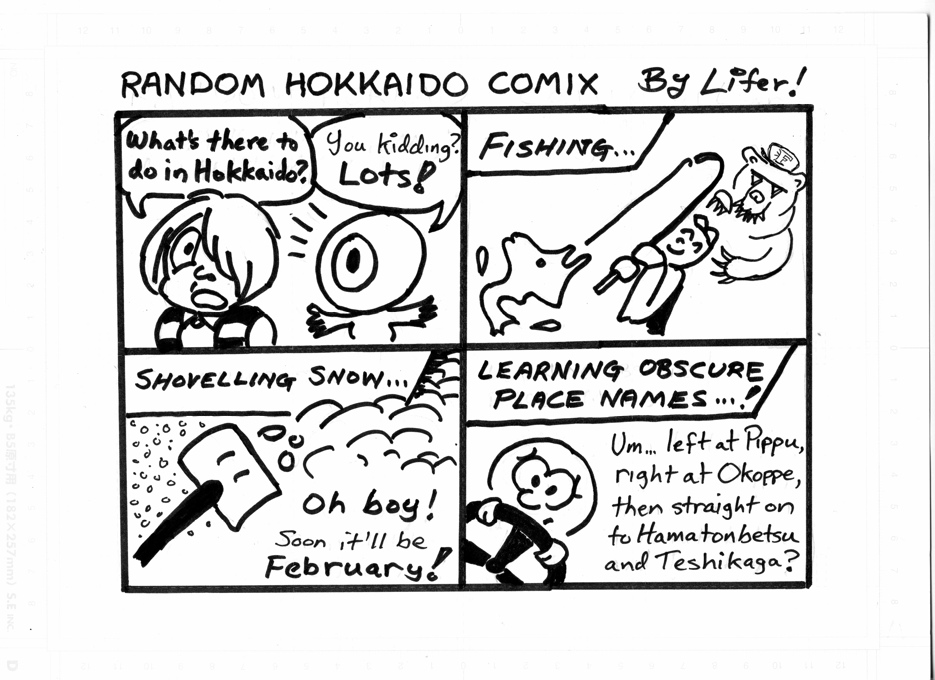
Letter from US Senators Boxer and Corker to Obama re Child Abductions, for his Nov 12 visit to Japan

mytest

Handbook for Newcomers, Migrants, and Immigrants to Japan\Foreign Residents and Naturalized Citizens Association forming NGO\「ジャパニーズ・オンリー 小樽入浴拒否問題と人種差別」(明石書店)JAPANESE ONLY:  The Otaru Hot Springs Case and Racial Discrimination in Japansourstrawberriesavatar
UPDATES ON TWITTER: arudoudebito

Hi Blog. Was just forwarded this from Steve Christie, from the offices of US Senator Barbara Boxer (D-CA), who will be sending a letter dated November 5 with Senator Bob Corker (R-TN) to President Obama regarding Japan’s record of international child abductions, in time for Obama’s visit to Japan Nov 12-13.  Letter from Boxer’s office, then the letter addressed to Obama follows.  It could very well be one of the issues brought up during the visit. It will be if these senators’ efforts are any guide. Well done. Arudou Debito in Sapporo

//////////////////////////////////////////////
From: “Reks, Ariana (Boxer)”
Date: 2009年10月30日 03:03:54JST
To: Steve Christie
Subject: Senator Boxer sending letter to Obama on Japanese abductions

Dear Mr. Christie,

Thank you for your voicemail and I apologize for not getting back to you sooner. Senator Boxer is very engaged on this issue and I wanted to email you to update you on her efforts on behalf of left-behind parents.

Senator Boxer, along with Senator Corker, will be sending a letter to President Obama next week, before his visit to Japan on November 12-13, asking him to bring up the issue of child abductions to Japan in his conversations with the new Japanese Prime Minister. The letter is currently circulating in the Senate for signatures and we hope that a large number of Senators will sign on. I have pasted a draft of the letter below. Please feel free to send the letter to any other left-behind parents and urge them to ask their Senators to sign on.

Thank you for contacting me and please stay in touch. I look forward to working with you on this very important issue.

Best,
Ariana Reks
Legislative Aide
U.S. Senator Barbara Boxer
112 Hart Senate Office Building
Washington, DC 20510
(202) 224-3553

_____________________________________________________

November 5, 2009
President Barack Obama
The White House
1600 Pennsylvania Avenue, NW
Washington, DC 20500

Dear Mr. President:

As you prepare to visit Japan on November 12, we write to respectfully request that you address the issue of international parental child abduction in your discussions with Japanese Prime Minister Yukio Hatoyama. This is a deeply important issue, as Japan currently does not recognize international parental child abduction as a crime.

There are currently 79 known cases involving over 100 American children who have been abducted by a parent to Japan. This is a heartbreaking loss for the left-behind parent and deprives the child of a relationship with two loving parents. Equally concerning is that left-behind parents typically have little recourse once their child arrives in Japan. According to the U.S. Department of State, no cases have been successfully resolved with Japan over the last few decades through the Japanese judicial system or through diplomatic or political efforts.

It is particularly troubling that Japan remains the only G-7 industrialized nation that has yet to accede to the 1980 Hague Convention on the Civil Aspects of International Child Abduction. The Hague Convention has been adopted by more than 70 countries and is an important tool for those seeking access to and/or the return of a child abducted across international borders. We agree that Japan’s accession to the Hague Convention would result in important reforms to Japanese family law and we are grateful that the United States continues to prioritize this issue.

But while we acknowledge that Japan’s accession to the Hague Convention is an important goal, the United States must also work with Japan to establish a bilateral mechanism to assist with the resolution of current cases. This is critical because the Hague Convention does not pertain to already completed abductions, and therefore cannot be used as a tool to resolve existing cases. We urge your Administration to seriously consider initiatives, including mediation, to foster cooperative and coordinated engagement with the Japanese government on cases of international parental child abduction. Many parents have not seen or heard from their children in years. We cannot sit back and wait while these children grow up without one parent.

We feel strongly that the recent election of the Democratic Party of Japan (DPJ), under the leadership of Prime Minister Hatoyama, is a unique opportunity for the United States to reinvigorate its dialogue with Japan on the issue of international parental child abduction. As such, we urge you to ensure that the United States continues to raise this issue at the highest possible levels in the context of our nations’ close bilateral relationship.

Thank you for your consideration of this important request. We stand ready to assist you in your efforts to reunite American children with their left-behind parents.

Sincerely,
_____________________________________________________
ENDS

Mainichi: Chinese trainees file complaint with labor bureau over 350 yen per hour overtime

mytest

Handbook for Newcomers, Migrants, and Immigrants to Japan\Foreign Residents and Naturalized Citizens Association forming NGO\「ジャパニーズ・オンリー 小樽入浴拒否問題と人種差別」(明石書店)JAPANESE ONLY:  The Otaru Hot Springs Case and Racial Discrimination in Japansourstrawberriesavatar
UPDATES ON TWITTER: arudoudebito

Hi Blog.  Coming on the heels of news two months ago, of GOJ reports of record numbers of labor violations and NJ Trainee deaths from overwork, here we have Nj fighting back regarding overtime.  Unpaid or underpaid, that is.  Which has been happening for decades now, since the “Trainee” and “Researcher” came online almost twenty years ago.  It’s just going to keep happening until the GOJ finally enforces its already weak labor laws, and these workers fight back through unions and courts to claim what’s rightfully theirs — minimum standards for work and pay.  Bonne chance.  Arudou Debito in Sapporo

================================

Chinese trainees file complaint with labor bureau over 350 yen per hour overtime

(Mainichi Japan) October 27, 2009, Courtesy of JK

http://mdn.mainichi.jp/mdnnews/news/20091027p2a00m0na020000c.html

Chinese trainees, including the five who filed a complaint with the Shimabara Labor Standards Inspection Office, attend a rally calling for better working conditions. (Mainichi)

Chinese trainees, including the five who filed a complaint with the Shimabara Labor Standards Inspection Office, attend a rally calling for better working conditions. (Mainichi)

SHIMABARA, Nagasaki — Five Chinese trainees at an underwear manufacturer here have filed a complaint with the local labor bureau claiming they were forced to work overtime for just 350-400 yen per hour.

“We came to Japan with hope, but we are not treated like human beings,” the five women stated. “One other trainee complained that our wages were low and was sent back to China. We want to work in Japan for three years under reasonable conditions.”

The complaint, filed on Oct. 21, also claims that the women had their break times deducted for washroom visits, and the Shimabara Labor Standards Inspection Office has launched an investigation into the company for possible violations of the Labor Standards Act.

“The labor bureau is conducting an inquiry, so I cannot comment,” said the 62-year-old company president.

The five women, aged 21 to 27, arrived in Japan between December 2006 and December 2007 under the Industrial Training and Technical Internship Program, administered by the governmental Japan International Training Cooperation Organization.

According to the complaint and other sources, the women each worked as many as 209 overtime hours per month, and about 2,000 hours per year. The 350-400 yen per hour the women claim they were paid for that overtime falls short of Nagasaki Prefecture’s minimum wage of 629 yen per hour, and well below the standard set by the Labor Standards Act, which requires employers to pay 1.25-1.6 times the regular wage for overtime.

The women claim that during busy periods they each worked from 8 a.m. to 12 a.m., and sometimes did not have a single day off per month. They apparently signed a contract paying them a monthly salary based on the minimum wage, but that excluded provisions for overtime. Working an average of 173 hours per month at the minimum wage would equal a monthly paycheck of about 110,000 yen.

However, the women claim that the company told them their pay was being directly deposited in their bank accounts and did not show them the payment details. Furthermore, the company held both the women’s bankbooks and passports. The company president also apparently checked the clock whenever one of the women went to the washroom and deducted that time from their breaks.

A person who knew of the women’s working conditions reported the company to the Kumamoto Prefecture branch of the Zenroren union, which passed on the report to the Nagasaki branch. The five women enrolled in the Nagasaki branch, and began collective bargaining with the company. That resulted in the return of their bankbooks, but apparently no progress was made on the wage issue.

In response to growing criticism from experts on the rising number of foreign worker exploitation cases, the central government amended the Immigration Control and Refugee Act in July. The changes will go into effect in July 2010, and the government continues to review the system.

ENDS

================================
中国人研修:時給350円、トイレ分は休憩減 5女性申告
毎日新聞 2009年10月27日
http://mainichi.jp/select/wadai/news/20091027k0000e040080000c.html

集会で過酷な労働実態を訴えた中国人女性=長崎市で2009年10月25日、阿部弘賢撮影

集会で過酷な労働実態を訴えた中国人女性=長崎市で2009年10月25日、阿部弘賢撮影

長崎県・島原半島内の女性下着縫製会社で働く中国人女性5人が、時給350~400円で残業させられているなどとして、島原労働基準監督署に労働基準法違反の申告をした。「トイレに行くと休憩時間から引かれた」などとも訴えている。申告を受け、同労基署は労働実態調査に乗り出した。同社の社長(62)は「労基署が調べているのでコメントできない」としている。

外国人研修・技能実習制度により、06年12月~07年12月に入国した21~27歳の中国人女性。今月21日に申告した。

申告などによると、同社は時給350~400円で多い月は1カ月に209時間、年間約2000時間の残業をさせたとしている。労基法は時間外勤務について賃金の1.25~1.6倍の割り増しを定めているが、同県の最低賃金(現在629円)も大幅に下回っていると主張している。

女性らによると、繁忙期は午前8時~午前0時ごろまで働き、休日が1カ月に1日もなかった月もあったとしている。残業代を除く1カ月の給料は、県の最低賃金で計算する契約。1カ月平均173時間で約11万円になるが、同社は「通帳に振り込んでいる」などとして明細を出さず、通帳やパスポートも預かられていたという。また、女性らが勤務時間中にトイレに行く際は、社長が時計で時間を計り、その分を休憩時間から差し引かれたという。

女性らの労働状況を知った関係者が9月上旬、熊本県労連を通じて長崎県労連に連絡。女性らは団体交渉での解決を目指し、県労連の労働組合に加入し、会社側との団交を続けている。この結果、通帳などは返されたが、賃金についての進展はみられないという。

女性らは「希望を持って日本に来たが、私たちは人間として扱われていない。実習生のうち1人は『給料が少ない』と言ったら中国に帰国させられた。私たちは適正な環境で3年間、日本で働きたい」と訴えた。

同制度を巡っては、専門家らから「労働搾取」が相次いでいると批判の声が出ており、政府は今年7月に入管法を改正したほか、来年7月の改正法施行に合わせ、更なる制度見直しを進めている。【阿部弘賢】

ENDS

Mainichi: Numerous foreign trainees forced to work under harsh conditions in Japan, even to death

mytest

Handbook for Newcomers, Migrants, and Immigrants to Japan\Foreign Residents and Naturalized Citizens Association forming NGO\「ジャパニーズ・オンリー 小樽入浴拒否問題と人種差別」(明石書店)JAPANESE ONLY:  The Otaru Hot Springs Case and Racial Discrimination in Japansourstrawberriesavatar
UPDATES ON TWITTER: arudoudebito

Numerous foreign trainees forced to work under harsh conditions in Japan
(Mainichi Japan) August 30, 2009, Courtesy of JK

http://mdn.mainichi.jp/mdnnews/news/20090829p2a00m0na019000c.html

Numerous foreign vocational trainees are being forced to work under harsh conditions in Japan, such as illegally low wages and excessive overtime.

The bereaved family of a Chinese man who died during vocational training in Japan filed for workers’ compensation on Aug. 7, claiming he died from overwork. It was the first case in which the bereaved family of a vocational trainee is seeking work-related accident compensation.

Revisions to the Immigration Control and Refugee Recognition Law that were passed into law in July call for stepped up protection of foreign trainees. However, organizations supporting foreign trainees are urging that the system be reviewed, claiming that excessive workloads are infringing on their personal rights.

In late January, a support group placed six Chinese women undergoing vocational training at a sewing factory in Yufu, Oita Prefecture, under protection after they complained of harsh working conditions.

They had been forced to work until the predawn hours every day. After the factory operator learned that one of them complained about her working conditions to a relative living in Japan, the boss attempted to force her to go back to China. However, she called the organization for help.

“I’ve worked too much and have a headache,” one of them complained to the organization.

“We’re given only 10 minutes for a meal,” another said.

The organization learned that the company paid each of them only 10,000 to 30,000 yen in overtime per month even though they performed about 270 hours of overtime a month. Moreover, the company kept the trainees’ bankbooks.

Another former Chinese trainee who worked at a sewing factory in Amakusa, Kumamoto Prefecture, received only 300 yen per hour for overtime, less then half the legal minimum wage. The former trainee has filed a suit, demanding unpaid wages.

There are also problems with employment agencies in trainees’ home countries.

One agency in China advertised on its Web site for trainees at Japanese companies under illegal working conditions, such as 300 yen per hour of overtime in the first year of training.

Before coming to Japan, many trainees are required to pay employment agencies a deposit and other fees, which are several times their annual income. They typically obtain loans to pay the fees, and are supposed to use the wages they earn in Japan to repay their debts.

“They often have no choice but to accept illegal working conditions for fear that they would be forced to go back to their home countries before repaying their debts,” a member of one of the support groups said.

The Justice Ministry has confirmed that a record 452 companies and other organizations that accepted foreign trainees were involved in illegal practices last year. About 60 percent of them involve violations of labor-related laws, including unpaid wages and overtime allowances.

A survey conducted by the Japan International Training Cooperation Organization (JITCO) has found that a record 34 trainees died in fiscal 2008. Nearly half, or 16 of them, died of brain and heart diseases that are often caused by long working hours. Experts say that there is a high possibility that they died from overwork.

With the amendment to the Immigration Control and Refugee Recognition Law, labor related laws, which had applied to foreign trainees from their second year, now apply to those in their first year of training. As a result, it is now guaranteed that foreign trainees can sign proper employment contracts with their employers, just like Japanese workers.

The government is poised to revise its regulations to inspect companies that accept foreign trainees at least once a month to see if their working conditions are legal as well as stiffen penalties for businesses involved in illegal labor practices and strictly examine the terms of contracts between foreign trainees and employment agencies in their home countries.

However, support groups question the effectiveness of these measures, pointing out that many of those in their second year of training are subjected to illegal labor practices.

Lawyer Shoichi Ibusuki, who specializes in the issue of foreign trainees, underscores the need to discuss the pros and cons of fully accepting foreign workers rather than changing the working conditions for foreign trainees.

“Legal revisions alone can’t prevent infringements of trainees’ rights and death from overwork. Rather than making superficial changes to the system, we should discuss the pros and cons of accepting foreign laborers,” he said.

Original Japanese story:
外国人研修・実習生:過酷労働に悲鳴 支援団体見直し要望

2009年8月25日 12時53分

外国人研修・技能実習制度で来日した外国人が、違法な低賃金労働や長時間残業を強いられる被害が相次いでいる。今月7日には、実習中に死亡した中国人男性の遺族が「過労死だ」と主張し、研修・実習生としては初めて労災申請。7月に成立した改正入管法は外国人の保護強化を盛り込んでいるが、支援団体は「過重労働による人権侵害はなくならない」と制度の見直しを求めている。

今年1月末、大分県由布市の縫製会社で、6人の女性中国人研修・実習生が支援団体に緊急保護された。「働き過ぎて頭が痛い」「食事時間が10分しか与えられない」。連日未明まで勤務を強いられ、1人が日本に住む親類に被害実態を打ち明けた。連絡したのが会社にばれて強制帰国させられそうになったが、公衆電話から助けを求めた。月約270時間の時間外労働に対し、残業代はわずか月1万~3万円。通帳も会社に管理されていた。

熊本県天草市の縫製工場で働いていた中国人元実習生の場合は、連日12時間以上働きながら、残業代は最低賃金の半分以下の時給300円。会社などを相手に未払い賃金を求めて訴訟中だ。

母国の派遣会社側にも問題がある。ある中国の派遣会社はホームページで「1年目の残業代時給300円」と違法な条件で研修生を募集していた。

研修生の多くは来日前、母国の派遣会社に保証金を含め年収の数倍もの出国費用を支払う。費用は借金で工面し、来日後の賃金で返済する。支援者らは「返済前の途中帰国におびえて違法な労働環境に泣き寝入りするしかない」と懸念する。

昨年1年間、法務省から「不正行為があった」と認定された受け入れ企業や団体数は過去最多の452。時間外作業や賃金不払いなどの労働関係法規違反が全体の6割を占めた。財団法人・国際研修協力機構(JITCO)の調査では、研修・実習生の08年度の死者は過去最多の34人。長時間労働が原因とされる脳・心疾患が16人を占め「過労死の疑いが強い」との指摘が出ている。

入管法改正で、来日2年目以降の実習生しか適用されなかった労働基準法や最低賃金法などの労働関係法令が1年目から適用され、日本人と同様の雇用契約が保障されるようになる。政府は省令改正などで▽受け入れ企業への月1回以上の確認・指導▽不正行為をした場合の受け入れ停止期間延長▽母国の派遣会社と外国人の契約内容の確認強化--なども実施する。

しかし、現状では2年目以降の実習生にも被害が及んでおり、支援団体などは実効性を疑問視する。外国人研修生問題弁護士連絡会の指宿昭一弁護士は「改正では人権侵害や過労死を防げない。小手先の見直しでごまかさず、外国人労働者の(本格的な)受け入れの是非を議論すべきだ」という。【河津啓介、石川淳一】

【ことば】外国人研修・技能実習制度

開発途上国の人材育成を目的とし、在留できる期間は最長3年。07年末の研修・技能実習生は約17万人。政府は単純労働力として外国人を受け入れる姿勢は示しておらず、あくまで技能習得のための受け入れという前提に立っている。
ENDS

Global Post’s Justin McCurry on Savoie Child Abduction Case. Issue isn’t passe yet.

mytest

Handbook for Newcomers, Migrants, and Immigrants to Japan\Foreign Residents and Naturalized Citizens Association forming NGO\「ジャパニーズ・オンリー 小樽入浴拒否問題と人種差別」(明石書店)JAPANESE ONLY:  The Otaru Hot Springs Case and Racial Discrimination in Japansourstrawberriesavatar
twitter: arudoudebito

Savoie’s choice: abduct or fight?
An American father wants his children back. Japan says no.
By Justin McCurry – GlobalPost.com

Published: October 27, 2009
http://www.globalpost.com/dispatch/japan/091026/child-abductions-japan
Courtesy of the author

TOKYO, Japan — Under normal circumstances it would be impossible to summon any sympathy for a man who snatches two young children as they walk to school with their mother.
But what if the “abductor” is the children’s father, and the mother, his former wife, herself the subject of an arrest warrant?

When Christopher Savoie, an American, went to these extraordinary lengths to regain custody of his children from his Japanese ex-wife last month, he not only landed himself in a police cell for more than two weeks, he also placed the spotlight firmly on Japan’s complicity in international parental child abduction — turning it from a minor irritant into a potential source of genuine tension between Washington and Tokyo.

Savoie was arrested after attempting to take his children, aged 9 and 6, to the U.S. consulate general in Fukuoka, southwestern Japan, in September.

The 38-year-old from Tennessee, and his former wife, Noriko, lived in Japan for several years before moving to the U.S. in 2008. When they divorced in the U.S. in January this year, Noriko was granted primary custody of the children.

Despite giving assurances that she would remain with the children in the U.S., in August she took them to Japan, without Savoie’s knowledge and in defiance of a court order. The U.S. authorities awarded Savoie full custody in Noriko’s absence and issued a warrant for her arrest on suspicion of “custodial interference.”

Yet Savoie has no legal right to see his children for as long as they remain in Japan, which refuses to sign the 1980 Hague Convention on International Child Abduction.

The treaty, with 81 signatories including every other member of the G7, states that a “child whose parents reside in different countries shall have the right to maintain on a regular basis … personal relations and direct contacts with both parents.”

Savoie’s is one of about 80 cases of international parental child abduction involving U.S. citizens, while France and Britain are dealing with 35 each.

The unofficial number is much higher, particularly when failed marriages between Japanese and people from other Asian countries are included. The Assembly for French Overseas Nationals for Japan estimates that 10,000 children with dual citizenship in Japan are prevented from seeing their foreign parent after separation or divorce.

Japanese courts habitually award custody of children to the mother. In many cases, they say they are simply trying to protect the rights of women fleeing abusive former husbands, a claim vigorously disputed by campaigners.

The country’s courts will be tested again later this week when Shane Clarke appeals in a custody battle with Japanese ex-wife.

The 39-year-old Briton has not seen his two young daughters since May 2008 after his ex-wife took them to Japan to visit their “ill” grandmother and never returned.

Though Britain’s media has taken an interest in his plight, Clarke says he has received little support from the authorities, despite a court order naming the U.K. as his children’s country of habitual residence.

“I have been writing repeatedly to more than a dozen government ministers, and not a single one has had the common decency to reply,” he told GlobalPost.

Legal precedent indicates that Clarke, who was denied custody at a hearing in Japan last year, will again return home without his daughters.

“We are talking about two British citizens, and no one will help me. The message our government is sending out to foreign nationals is that it’s perfectly all right for them to commit a crime on British soil, and as long as they leave the country quickly enough, they’ll get away scot-free.”

Left-alone parents in the U.S. have fared better. Chris Smith, a New Jersey congressman, recently urged the Japanese prime minister, Yukio Hatoyama, to use the Savoie arrest as a “catalyst” to end Japan’s tacit approval of international parental child abduction.

Smith has drawn up legislation that would enable the U.S. to “more aggressively” pursue the rights of American parents, including imposing sanctions against countries that habitually refuse to cooperate on international child abductions.

Pressure is also mounting in Japan, where the ambassadors of eight countries, including the U.S., have urged the justice minister, Keiko Chiba, to sign the Hague treaty.

The foreign minister, Katsuya Okada, indicated he would speed up a study into the agreement’s pros and cons, although ratifying it will require changes to domestic laws that could take years to implement.

Savoie, meanwhile, says he is struggling to come to terms with the possibility that he will not see his children again until they are adults.

“If loving my kids so much that I really want to be with them is a crime, then, well, I’m guilty,” he told CBS News after returning to the U.S. “I’m guilty of loving my kids.”

Source URL (retrieved on October 28, 2009 01:16 ): http://www.globalpost.com/dispatch/japan/091026/child-abductions-japan
ENDS

Tangent: Microsoft apologizes for photoshopping out black man from its Poland advertising. Contrast with McDonald’s Japan “Mr James”

mytest

Handbook for Newcomers, Migrants, and Immigrants to Japan\Foreign Residents and Naturalized Citizens Association forming NGO\「ジャパニーズ・オンリー 小樽入浴拒否問題と人種差別」(明石書店)JAPANESE ONLY:  The Otaru Hot Springs Case and Racial Discrimination in Japansourstrawberriesavatar
UPDATES ON TWITTER: arudoudebito

Hi Blog. Bit of a tangent but not really. Here’s what happens when another multinational apparently caters to “regional sensibilities” — this time Microsoft photoshopping out an African-American in one of its ads to cater to a Polish audience.

Contrast with “Mr James“. We see none of the cultural relativity that the whole McDonald’s Japan “Mr James” issue got (or even claims of “just-deserts” from certain parties). And Microsoft even apologizes — something McDonald’s Japan has steadfastly refused to do (and still runs the “Mr James” campaign to this day; fortunately it finishes shortly). Any theories behind the difference?

(One that comes to mind is that people are loath to criticize an apparently more esoteric and impenetrable culture, but I can poke holes in that one pretty easily — even the report below claims “Poland is ethnically homogeneous”.)

Arudou Debito in Sapporo

Original source:

http://www.theglobeandmail.com/news/technology/microsoft-apologizes-for-changing-race-in-photo/article1265096/

(site is now pay-only)

Archived at http://www.findingdulcinea.com/news/business/2009/aug/Microsoft-Photoshops-Out-Diversity-for-Polish-Ad–Sparking-Race-Controversy.html

========================================

Microsoft Photoshops Out Diversity for Polish Ad, Sparking Race Controversy

The Globe and Mail, August 27, 2009 06:00 PM
by Jill Marcellus
Microsoft has apologized for replacing a black man’s head with that of a white man in a promotional photo on its Polish Web site, but concerns linger over diversity in advertising.
RACE RETOUCHED
Sitting together and smiling over the slogan, “Empower your people with the IT tools they need,” an Asian man, an African-American man and a white woman harmoniously appear in a promotional photo on Microsoft’s U.S. Web site. When that same trio smiled over a translated slogan on the company’s Polish Web site, however, the black man’s head had been digitally exchanged for a younger white man’s face, reported BBC News.
microsoftraceretouch
Visual courtesy
http://mashable.com/2009/08/26/microsoft-photoshop-trainwreck/

The picture’s poor editing made the gaffe more embarrassing for Microsoft, since the white man’s head was simply perched atop the original African American’s body, with his distinctly black hand still intact.

Microsoft has already apologized and removed the offending photo, and a spokeswoman in Poland insisted that, “We are a multiracial company and there isn’t a chance any of us are racist,” according to The Times of London. She claimed that the photo’s editors had already left the company before the uproar arose.

While controversy often crops up when race meets Photoshop, other recent snafus have caught advertisers overplaying, not whitewashing, diversity. Researchers at Augsburg College found, Inside Higher Ed reported last year, that “more than 75 percent of colleges appeared to overrepresent black students in viewbooks,” sometimes with the help of Photoshop. Similarly, the official Toronto Fun Guide made headlines earlier this summer for itsdigitally diversified cover, which replaced a Latino father with a black man in a family picture, according to Allison Hanes of the Canadian paper National Post. Toronto officials insisted that it was an “inclusive” act, obeying a 2008 policy to “show diversity” in city publications.

These incidents fit into a larger movement toward “visual diversity” in advertising. By juxtaposing different racial groups in ads, advertisers hope to appeal to multiple audiences at once, MSNBC explained, while also “conveying a message that corporate America is not just ‘in touch,’ racially speaking, but inclusive.” According to Melanie Shreffler, editor of advertising newsletter Marketing to the Emerging Majorities, America’s shifting demographics dictate this trend. Shreffler told MSNBC that advertisers “aren’t turning out multicultural ads for the good of society,” but rather they “recognize there is money involved” in marketing to America’s rapidly expanding minority groups.

Microsoft’s blunder, rather than contradicting Shreffler’s analysis, may confirm it. Unlike America, where Microsoft displayed the multicultural photo intact, Poland is ethnically homogenous, with almost 97 percent of its people identifying as Polish, according to the C.I.A. World Factbook.

BACKGROUND: AD INDUSTRY’S HISTORY OF DISCRIMINATION ISSUES
Earlier this month, BMW’s advertiser sparked its own racially-driven controversy when it excluded “urban” radio, traditionally associated with African-American audiences, as a market for its Mini Cooper advertisements, findingDulcinea reported. “No urban dictates,” defined by The Washington Times as a policy “issued by companies who associate urban listeners with a lifestyle that they are trying to avoid,” have been banned by the Federal Communications Commission.

Although the company apologized, the National Association of Black Owned Broadcasters insisted that the incident “raises the uncomfortable specter of a corporate culture that condones discriminatory practices.”

They are not the only ones to accuse the ad industry of a discriminatory culture, despite industry initiatives to promote diversity. The Madison Avenue Project, a collaboration launched earlier this year between the NAACP and civil rights law firm Mehri & Skalet, found that African Americans earn 20 percent less than whites in advertising, and that the gap between black and white employment in the ad industry is 38 percent greater than in the overall labor market.

ENDS

Letter to Prime Minister Hatoyama regarding Child Abductions and legislative lag, from a Left-Behind Parent

mytest

Handbook for Newcomers, Migrants, and Immigrants to Japan\Foreign Residents and Naturalized Citizens Association forming NGO\「ジャパニーズ・オンリー 小樽入浴拒否問題と人種差別」(明石書店)JAPANESE ONLY:  The Otaru Hot Springs Case and Racial Discrimination in Japansourstrawberriesavatar
twitter: arudoudebito
Forwarding, courtesy of EK. Arudou Debito in Sapporo

===================================

What Are We Bargaining For?

Dear Prime Minister Hatoyama,
It’s important that left-behind parents understand what the Japanese Government mean when they say they “will need at least two more years before it will sign an international treaty (Hague Convention on the Civil Aspects of International Child Abduction) designed to settle child custodial disputes” and that “relevant legislative measures are unlikely to be submitted to the Diet until 2011 at the earliest”. The Yomiuri Shimbun article “Govt. unlikely to Sign Child Custody Pact for 2 Years” dated October 19, 2009 goes on to state that it will take “some time until the country is able to facilitate such a move by addressing the necessary domestic laws”.

Left-Behind parents have been denied access to their children for one second too long, now you’re asking us to be patient for two years. Well, What are we bargaining for? Will the process take only two years? and How will the process be carried out?

I’ll get straight to the point. There are those in the Foreign Ministry and the Justice Ministry that know very well the article written by Dr. Hans van Loon “The implementation and Enforcement of the Hague Convention of 25 October 1980 on the Civil Aspects of International Child Abduction in Comparative Perspective: It’s Japan’s Move!” and the related article by Professor Yuko Nishitani. (Tohoku University 21st Century COE Program, Gender Law and Policy Annual Review, Vol.2 2004) Dr. Hans van Loon suggested seven (7) measures were necessary for Japan to implement the Hague Convention on the Civil Aspects of International Child Abduction. I will only remind you of the second, which states:

a high level Central Authority should be designated, equipped with a small but highly competent staff with broad international experience, excellent knowledge of the convention and its operation in other States Parties and expertise in conciliation and mediation. However, conciliation and mediation should not hold up legal proceedings.

In another article, The Judges Newsletter, Enforcement and Return of Access Orders, National Report by Fourteen (14) States and The Conclusion of the Noordwijk Judicial Seminar Vol. VII Spring 2004 Professor Yuko Nishitani writes the following:

A working group of Japanese scholars have proposed a draft statute to implement this Convention in view of Japan’s possible accession in the future. In this draft, the Foreign Minister is appointed as “Central Authority,” acting through the Minister of Justice, who further delegates his duties to other institutions (e.g. police and the youth welfare office) which are to be appointed separately. The “judicial authority” is the Family Court, which has the necessary resources to carry out the required investigations and order the return of child. However, in order to comply with the obligations prescribed by the Convention, the Family Court must be provided with authority to ensure expeditious procedures and coercive enforcement, even if this represents a tough challenge for the Japanese legislature as well as for judges and practitioners. This is also crucial for other Contracting States so that they will be able to trust and rely on the Japanese judicial system for securing the return of a child abducted to Japan.

Apparently the draft statute is here, 119-2 Minshô–Hô Zasshi 302-311 (1998), but I haven’t been able to find it. It appears the administrative duties will be carried out by the Foreign Ministry, while the Family Court under the Justice Ministry will carry out the implementation and enforcement. Professor Nishitani, along with Professor Colin P.A. Jones in his research, In the Best Interest of the Court What American Lawyers Need to Know About Child Custody and Visitation in Japan, has pointed out quite clearly how joining the Hague Convention on the Civil Aspects of International Child Abduction will favor Japan. As they say, the elephant in the room is how will Japan implement and enforce the treaty? The Justice Ministry, the Supreme Court Justices, the Judicial Review Council (JRC), and possibly the Japan Federation Bar Association (JFBA) will play a critical role in crafting any new legislation required to implement and enforce the treaty. What can we expect this time from the Judicial Review Council and the Supreme Court Justices?


In Japan’s first Judicial Reforms of the 21st century the Judicial Review Council and the Supreme Court Justices chose not to address parental rights issues directly, but instead chose to try and deal with the issue by expanding the jurisdiction of the Family Court and relying on the courts so called “expert knowledge” in dealing with human relationships. The Judicial Review Council’s Initial Report, The Points at Issue in the Judicial Reform was created December 21, 1999. The Personal Status Litigation Law was approved by the Diet on July 9, 2003 and went into effect April 01, 2004 nearly five years after the process began. The Family Court was granted authority to legislate contested divorces after they failed mediation. It was clear that Family Court Judges had the authority to award visitation based on their preference, but it was also widely known any award of visitation was unenforceable. Previously contested divorces were legislated in District Court by District Court Judges, but now they are being handled by Family Court judges. This means the Supreme Court swept parental rights issue under the rug and relied heavily on the Family Courts to deal with these issues. The Diet has to take some responsibility as well because they passed the Personal Status Litigation Law without any assurances that it would protect parental rights.


The Mediators, Investigators, and Councilors (Sanyoin) which the Supreme Court and the nation put so much trust in to uphold Japanese family values let down the Justices and embarrassed the country’s international reputation in dealing with parental rights. Professor Colin P.A. Jones’ research points out the ineptitude of Family Court Mediators and Family Court Investigators. The Family Courts have failed miserably in protecting parental rights and the Supreme Court Justices have been so wishy-washy on the issue they’ve left the non-custodial parent with no choice but to take self-help measures when the custodian of the child refuses any meaningful access. Professor Colin points out that up until the Abduction for the purpose of performing an obscene act, murder and abandonment of corpse, case number: 2000 (Kyo) No.5 of the year 2000 the lower courts’ interpretations of parental rights were widely held views that he narrowed down as the following:

(i) an inherent right arising naturally from the parent-child relationship; (ii) an aspect of physical custody; (iii) a right arising in connection with physical custody; (iv) a right of children to develop emotionally through contact with their parent; and (v) a right of both parent and child.

After the 2000 ruling parental rights came down to a right to demand versus a right to request, with the right to request becoming the de facto meaning of Parental Rights. It seems that up until the 2000 ruling some of the lower court judges were determining the meaning of rights as those similar to what is proscribed in the United Nations Convention on the Rights of the Child. One significant point, the Supreme Court Judges that made the 2000 ruling, Justice FUJII Masao, Justice ENDO Mitsuo, Justice IJIMA Kazutomo, Justice OHDE Takao, and Justice MACHIDA Akira are no longer on the bench. If a similar case is brought before the Justices today we could get a different ruling. Of course, you remember the Judicial Reforms that began in December of 1999, in my opinion the Justices were aware of how their ruling would affect The Personal Status Litigation Law that was being drafted at the time.


By reviewing the work of Nishitani, Colin, Han van Loons, Bryant, the Judicial Review Council, and others I’ve been able to create a timeline that could give the left behind parents some idea as to when Japan will start to implement and enforce parental rights. I’ve compared the time it took Japan to implement and enforce the Jury System with the Personal Status Litigation Law because both legislations have a profound affect on the nation, as will the implementation and enforcement of the Hague Convention on the Civil Aspects of International Child Abduction along with the enforcement of Parental Rights of Access.

Jury System Personal Status Litigation Law
• December 21, 1999 Initial Report from the JRC 1. December 21, 1999 Initial Report from the JRC
• November 12, 2000 Sixty Five (65) Page Interim Report by JRC 2. November 12, 2000 Sixty Five (65) Page Interim Report by JRC
• June 12, 2001 Final Recommendations to the Cabinet by JRC 3. June 12, 2001 Final Recommendations to the Cabinet by JRC
• May 28, 2004 Approved by the Diet 4. July 09, 2003 Approved by the Diet
• June 01, 2009 Law went into effect 5. April 01, 2004 Law went into effect
• 9 Years 6 months to enact 6. 4 Years 5 months to enact

For simplicity, I’ve rounded the number of years and concluded it will take between 5 to 10 years before implementation and enforcement of the treaty or parental rights of access will be legally enforceable. From the article in the Yomiuri Shimbun one can assume the reform process will be carried out similar to the Judicial Reform process that started in December 1999 and took two (2) years before it actually reached the Diet.
While I believe you, Prime Minister Hatoyama, are sincere about resolving this issue, the facts lead me to distrust the bureaucrats in the Ministry of Justice and the Foreign Ministry. The Judicial Review Council and the Supreme Court knew about these problems in the first Judicial Reforms that began 10 years ago but chose not to face the tough issue of Parental Rights head on. Now, Mr. Hatoyama, are you relying on these same bureaucrats again? Why, is it that Professor Nishitani refers to a draft statute created by Japanese Scholars that would have paved the way for Japan to implement the Hague Convention on the Civil Aspects of International Child Abduction and the bureaucrats are sounding as though we have to start from scratch? If the Judicial Reform Council is drafting this legislation then who are the current members? I hope it is not any of the retired Supreme Court Justices that made the 2000 ruling. Furthermore, the Democratic Party of Japan’s Manifesto states the cabinet will be the center of policy-making. What happens if the DPJ loses power in the next election, which will be in two years, do we start from scratch again? Let’s see what Professor Yuko Nishitani and the Japanese Scholars proposed; maybe the cabinet can start from there. If the government wants the international community and all left-behind parents to cooperate while reforms are being created we need to know, What Are We Bargaining For?

Sincerely,
IGOTCHU

Joint statement by eight governments re Japan’s untenable stance on international child abductions

mytest

Handbook for Newcomers, Migrants, and Immigrants to Japan\Foreign Residents and Naturalized Citizens Association forming NGO\「ジャパニーズ・オンリー 小樽入浴拒否問題と人種差別」(明石書店)JAPANESE ONLY:  The Otaru Hot Springs Case and Racial Discrimination in Japansourstrawberriesavatar
UPDATES ON TWITTER: arudoudebito

Hi Blog. Eight governments have officially called on the GOJ to mend their ways regarding international child abductions. Now if only the US Consulates would allow their citizens in need to access their facilities. Arudou Debito in Sapporo

================================

PRESS RELEASE
Joint Statement on International Child Abduction
By the Ambassadors of Australia, Canada, France, Italy, New Zealand, Spain, the United Kingdom and the United States
October 16, 2009
Tokyo, Japan

Courtesy Paul Toland, From US Embassy Japan’s website at
http://tokyo.usembassy.gov/e/p/tp-20091016-78.html

When one parent abducts a child with the intention of denying the other parent contact with his or her child, it is a tragedy for all concerned. Australia, Canada, France, Italy, New Zealand, Spain, the United Kingdom and the United States are all parties to the 1980 Hague Convention on the Civil Aspects of International Child Abduction (“the Convention”), which was created to protect children from this tragedy.

The Convention seeks to protect children from the harmful effects of their wrongful removal or retention across international borders. The Convention further establishes procedures to ensure their prompt return to the State of their habitual residence where custody decisions can be made in the appropriate court of jurisdiction. It also secures protection for rights of access for both parents to their children. To date, over 80 countries have acceded to the Convention.

Japan is the only G-7 nation that has not signed the Convention. The left-behind parents of children abducted to or from Japan have little realistic hope of having their children returned and encounter great difficulties in obtaining access to their children and exercising their parental rights and responsibilities.

Because parental child abduction involving Japan affects so many of our citizens, we, the Ambassadors to Japan of Canada, France, Italy, New Zealand, Spain, the United Kingdom and the United States, and the Deputy Head of Mission from the Embassy of Australia, called on Justice Minister Chiba today to address our concerns.

We place the highest priority on the welfare of children who have been the victims of international parental child abduction and believe that our children should grow up with access to both parents. Therefore, in our meeting with Minister Chiba we called upon Japan to accede to the Convention. We also urged that Japan meanwhile identify and implement measures to enable parents who are separated from their children to maintain contact with them and to visit them.

Japan is an important friend and partner for each of our countries, and we share many values in common. This makes it all the more important to develop tangible solutions to cases of parental child abduction in Japan. We are eager to work closely and in a positive manner with the new Japanese government on this issue.
ENDS

Tokyo International Players present “Honiefaith” Nov 6-7-8 in Shibuya’s OUR SPACE Theater

mytest

Handbook for Newcomers, Migrants, and Immigrants to Japan\Foreign Residents and Naturalized Citizens Association forming NGO\「ジャパニーズ・オンリー 小樽入浴拒否問題と人種差別」(明石書店)JAPANESE ONLY:  The Otaru Hot Springs Case and Racial Discrimination in Japansourstrawberriesavatar
UPDATES ON TWITTER: arudoudebito
BY POPULAR DEMAND, TOKYO INTERNATIONAL PLAYERS PRESENTS A SECOND PRODUCTION OF “HONIEFAITH”

Written and directed by Monty DiPietro

With:
Percival Florendo Bugayong as Victor Balmori
Arlene Dinglasan as Cora Diaz
Elena Yankova as Nadya Karsavina
Ken Suzuki as Inspector Yutaro Mukaide
Ken-Stephano Medrano Endo as Daisuke Sakamoto
Jun Takahashi as Sakamoto Sr.
http://www.facebook.com/event.php?eid=157036074791

When a Filipino hostess’ dismembered body is discovered in a Tokyo coin locker, Manila newspaper reporter Victor Balmori is dispatched to Japan. Balmori is looking for a story, he finds a nightmare.

NB from DEBITO:  More about the Honiefaith case here.

Written by Monty DiPietro, “Honiefaith” is a three-act play based on real events. The premiere of “Honiefaith” opened Tokyo International Players’ “Second Stage” series in June, playing to full houses at a ‘black box’ theater in Hatagaya. The November production is being directed by the author, and features Filipino television and film actor Percival Florendo Bugayong in the lead role. The play is in English, and runs about two hours with intermission.

November 6-7-8, 2009 at Our Space Theater:
Fri. Nov. 6 – 7:00 pm
Sat. Nov. 7 – 2:00 pm
Sat. Nov. 7 – 7:00 pm
Sun. Nov. 8 – 2:00 pm
Sun. Nov. 8 – 7:00 pm

Our Space is located off the north side of Koshu Kaido street, a three-minute walk from Hatagaya Station, or a five-minute taxi from Shinjuku Station’s south exit.
Our Space
Toei Shopping Center 101
Hatagaya 2-1-1 #101
Shibuya-ku
Map: http://www.tokyoplayers.org/?lang=1&page=16

Our Space has a limited capacity, and so reservations are strongly recommended. (Advance ticket sales for the June production were so strong that the box office closed a week before opening night. So be sure and buy your tickets early.)

Tickets and information:
http://www.tokyoplayers.org/?lang=1&page=58&mode=detail&event=28
Prepaid tickets cost 2,000, available at Our Space, or through the TIP website (200 yen PayPal service charge applies).
Reserved tickets / Pay at the door are 2,200 yen.
Admission price includes one drink.

Some scenes in “Honiefaith” may not be suitable for small children.

FLYER:

Honiefaith Nov web flyer

ENDS

Sakanaka Hidenori’s latest paper on assimilation of NJ now translated into English, full text

mytest

Handbook for Newcomers, Migrants, and Immigrants to Japan\Foreign Residents and Naturalized Citizens Association forming NGO\「ジャパニーズ・オンリー 小樽入浴拒否問題と人種差別」(明石書店)JAPANESE ONLY:  The Otaru Hot Springs Case and Racial Discrimination in Japansourstrawberriesavatar
UPDATES ON TWITTER: arudoudebito

Hi Blog. Sakanaka Hidenori, head of the Japan Immigration Policy Institute and author of Nyuukan Senki (his experiences within Japan’s Immigration Bureau), has just had his most recent paper translated into English. Debito.org is proud to feature this paper downloadable in full here, with an excerpt immediately below.

Sakanaka-san has written for Debito.org before, and his 2007 work, “A New Framework for Japan’s Immigration Policies” can be found here. He has taken great efforts to encourage immigration policy within Japan (his prognosis on “Big Japan vs. Small Japan” is worth considering).

Now for his latest, translated by Kalu Obuka. Excerpt, then full download. Arudou Debito in Sapporo

Towards a Japanese-style Immigration Nation
Japan Immigration Policy Institute
Executive Director SAKANAKA Hidenori
Translated by Kalu Obuka

Contents
1 Policies towards non-Japanese in a shrinking society 9
2 Robots to the rescue? 11
3 Immigrants will save Japan 13
4 Getting revolutionary immigration policies on the political agenda 16
5 Envisioning a Japanese-style immigration policy 20
6 10 million immigrants: A strategy for building a new Japan 24
7 Immigration policies that develop human resources 30
8 Successful policies towards foreign students,
successful policies towards immigration 34
9 Corporate social responsibility 36
10 Revitalising Japanese farmland with 50,000 immigrants 39
11 Multiethnic societies are “spicy” societies 43
12 The demographic crisis: an opportunity to create a multiethnic nation 45
13 The development of social workers for immigrants is essential 49
14 Japanese language education and multiethnic education 51
15 The Japanese can create a multiethnic society 56
16 50 years later: An illustration of an immigrant nation 58

Full 64-page Word file from
https://www.debito.org/sakanakaimmigrationnation2009.doc

Foreword
As the population crisis deepens Japanese youth, perhaps due to increasing uncertainty about the future, are in a state of malaise. I hear that the number of Japanese who choose to study overseas has fallen. Indeed it certainly seems as though the number of young people with an interest in the world has dropped, while the number of those who choose to shut themselves up within Japan’s borders has risen. I wonder if in the age of population decline Japan is becoming an insular country.

What can be done to tackle the population crisis and offer hope for a bright future? I believe the answer to that question is to open the doors to immigrants, and entrust our younger generations with the dream of a multiethnic society. This ideal society will stir up the passions of young Japanese. Over several years, my desire to provide a national vision that could captivate young people from Japan, and across the world has culminated in this work. What is presented here is a concept for accepting ten million immigrants over the next fifty years, tackling the problems of our low fertility rate, and rapidly aging population by building a new nation with immigrants.

Should this concept be made a reality, we can expect the cooperation of an additional ten million young people, which ought to significantly ease the burden the aging of our population will place on those under thirty. Immigrants will be thought of as comrades by the birth decline generation, who would be forced to drastically adapt to our population crisis. Immigrants will not simply be brought in to rescue us from population crisis however, they are also the driving force that will change us from a country will high levels of homogeneity to a country rich with diversity.

What I most want to emphasise is that we must create a country that can give dreams to immigrants if we are to revive Japan by opening the doors to immigration. My vision has received support from elites in every field who are concerned about the fate of the nation and society. The Japan Immigration Policy Institute was formed as a base from which the work needed to achieve this vision could be carried out.

We are building a new Japan. Working towards a revolution similar to the Meiji Restoration. In order to be successful, this kind of project requires those in their twenties and thirties to rise to action, like Takasugi Shinsaku and Sakamoto Ryoma did during the Bakumatsu period (1853-1868). I am waiting for a Japanese generation X to open up a path to the future.

This book is an immigrant nation manifesto. It will discuss the process of forming Japanese-style immigration policy, and its future prospects, the synthesis of an immigrant nation, the specific mechanisms through which immigrants will be accepted, and a vision of the Japanese immigration nation of the future.

The people I most want to read this book are the immigrants who will work hand in hand with the younger generation to establish a multiethnic society. Should this booklet succeed in acting as a guiding light to a Japanese nation of immigrants, I would be overjoyed.

August 2009.

Sakanaka Hidenori
Executive Director Japan Immigration Policy Institute.

EXCERPT ENDS

Full 64-page Word file from
https://www.debito.org/sakanakaimmigrationnation2009.doc

Sunday Tangent: Eric Johnston on getting freelance reporting jobs in Japan

mytest

Handbook for Newcomers, Migrants, and Immigrants to Japan\Foreign Residents and Naturalized Citizens Association forming NGO\「ジャパニーズ・オンリー 小樽入浴拒否問題と人種差別」(明石書店)JAPANESE ONLY:  The Otaru Hot Springs Case and Racial Discrimination in Japansourstrawberriesavatar
UPDATES ON TWITTER: arudoudebito

Hi Blog.  Went out mountain cycling yesterday and became a cropper:  went over my handlebars on a steep trail (good thing I was wearing a helmet — my bike came down right on my head) and bent my fingers right back on my right hand.  Will go easy on the typing today.

I attended the Japan Writers’ Conference last weekend in Kyoto (even presented, handout here).  A very good time with some very good presentations, one of which was Eric Johnston’s excellent presentation on how to find freelance journalist jobs in Japan. There was so much information in his powerpoint that I asked if I could blog it here for wider consumption. Yeppers, he said, so here are some excerpts. Download the whole powerpoint below for the full story. Arudou Debito in Sapporo

===========================
REPORTING OPPORTUNITIES IN JAPAN:
A Practical Guide
By Eric Johnston
Deputy Editor
The Japan Times
Osaka bureau

Japan Writers Conference
October 18th, 2009

EXCERPT:

This presentation assumes. . .
You have an interest in straight reporting and writing news features on a wide variety of timely events, as opposed to writing a personal opinion column, doing book, music, art, or restaurant reviews, or writing up interview pieces.

You have a love of, and preference for, traditional print and broadcast media and appreciate the traditional editorial methods they embrace.

THE BASICS

Getting Started: What All Successful Freelance News Reporters in Japan Usually Have

1) Bilingual business cards
2) A Web page with their articles
3) A bilingual PC
4) A cell phone capable of international calls
5) Easy access to a host of basic facts and figures about Japan, including major on-line daily news stories
6) A decent digital camera
7) Receipt books and notebooks for accounting purposes
8) A local Japanese person who serves as your “fixer’’, either paid or volunteer

PART I
MAKING CONTACT WITH JAPAN-BASED NEWS MEDIA

How Much Experience Do I Need Before I Can Realistically Expect To Be Considered for a Job?

  • You Need To Have Been Published in a Similar Media Form Previously.
  • You Need To Demonstrate You Know How To Pitch A News Story To The News Editors, and Understand Their Concerns.
  • Personal References Are Helpful, But It’s No Substitute for a Decent Portfolio.

=========================

FULL PRESENTATION AT
https://www.debito.org/johnston101809.ppt
ends

Economist.com BANYAN column on DPJ moves to right historical wrongs

mytest

Handbook for Newcomers, Migrants, and Immigrants to Japan\Foreign Residents and Naturalized Citizens Association forming NGO\「ジャパニーズ・オンリー 小樽入浴拒否問題と人種差別」(明石書店)JAPANESE ONLY:  The Otaru Hot Springs Case and Racial Discrimination in Japansourstrawberriesavatar
UPDATES ON TWITTER: arudoudebito

Hi Blog.  Here’s The Economist’s Asia-focus “Banyan” column last week, on the DPJ’s attempt to try and redress the historical running sores that pass for diplomatic relations between Japan and the rest of Asia.

As I voted in the most recent Debito.org blog poll, the DPJ keeps surprising me with their progressive plans and policies.  The proposal for a definitive joint-edited history book of the Asian region is precisely what UN Special Rapporteur Doudou Diene recommended as a salve years ago.

The Economist is right to express a certain degree of skepticism:  so many hopes for countries to act like adults, and own up to the bad parts of history (viz. former PM Abe’s call for official whitewashing in the name of promoting Japan as “beautiful” — i.e. shame about the past just gets in the way of training Japanese to love their country), have been dashed time and time again.  But as long as the DPJ can maintain the momentum of “not quite business as usual, folks”, I think we just might see decades of regional rhetorical logjam broken, and Japan discovering that international goodwill might be worth as much as good trade relations.   Arudou Debito in Sapporo

==================================

Banyan

History wars

Oct 15th 2009
From
The Economist print edition

http://www.economist.com/world/asia/displayStory.cfm?story_id=14660487

JAPAN’S nearest neighbours have long been less ready than has the rest of Asia to forgive and forget the country’s aggressive past: a brutal colonisation of Korea in 1905-45 and a creeping occupation of China from 1931 leading to total war. Both projects were pursued ruthlessly and entailed civilian massacres, torture and slavery in factories, mines and military brothels.

So Yukio Hatoyama, Japan’s new prime minister, has pleased the neighbours by promising that rule by his Democratic Party of Japan would transform Japan’s relations with them. He made the pledge in both Seoul, where he met South Korea’s president, Lee Myung-bak, on October 8th, and then in Beijing at a three-way summit with China’s leaders. Unlike the weasel-worded Liberal Democratic Party, which long ran the country, Mr Hatoyama’s new government, he says, “has the courage to face up to history.”

Both Mr Lee and China’s prime minister, Wen Jiabao, were delighted. Dealing honestly with historical matters, they affirmed, would make it much easier to tackle contemporary challenges together—notably, getting North Korea to give up its nukes, and deepening economic co-operation. Mr Lee said Mr Hatoyama had opened the way for “future-oriented relations”. The talk now is of reviving old plans for an undersea tunnel linking South Korea and Japan. Emperor Akihito may visit South Korea, a first. Both South Korea and China have applauded Japan’s proposal for a jointly compiled history textbook.

If only it were so simple. For all the bonhomie now, past hopes for “future-oriented” relations have often been frustrated. One problem is disputed territory (see map). Japan contests Dokdo, a rocky outcrop controlled by South Korea, while China claims the Senkaku, held by Japan. In addition, Japan contests Russia’s control of four northern islands seized in August 1945. Over the years Chinese, Japanese, South Korean and Russian diplomats have all berated The Economist over our maps.

Japan insists Dokdo should be called “Takeshima”. The South Koreans insist on the “East Sea” in place of the Sea of Japan. Over Dokdo/Takeshima, the websites of Japan’s and South Korea’s foreign ministries wage a virtual war, with pop-up cyber “history halls” and the like (in South Korea’s case, in nine languages). Yet both sides look merely ridiculous. Japan’s justification glides over the fact that its 1905 claim marked a first step in imperial annexation. South Korea argues that Dokdo has been “Korean” since 512, but uses the name for a country that did not exist until 1948. Competing for legitimacy with North Korea, the South also insists on the “East” rather than the “Chosun” Sea, since “Chosun”, a much more common reference in old Korean documents, is these days associated with the North. Empty specks of rock do duty as stand-ins for wider and even touchier historical issues.

Things would be better if Japan were now readier to call a slave’s spade a spade. It has apologised many times for its brutal past, but only in vague terms, expressing “remorse” for ill-defined damage. Most apologies, including the one that has since become a template, by the then prime minister, Tomiichi Murayama, at the 50th anniversary of the war’s end, appear to say sorry to the Japanese people first. Mr Hatoyama does not call for the imperial family to break the so-called chrysanthemum taboo by admitting guilt on behalf of the wartime emperor, Hirohito. Nor does he suggest that the Diet (parliament) pass a law expressing national contrition instead of merely making statements. So, on this, he does not look like a mould-breaker. But then the leaders of South Korea and China may not want him to be. Being able occasionally to beat Japan for its lack of remorse is not all bad.

But Alexis Dudden of the University of Connecticut points out* that as vague apologies proliferate, the human victims of imperialism, though winnowed by old age, are ever less ready to accept them. The many wartime “comfort women”, or sex-slaves for the army, of whom South Koreans made up the biggest number, for example, want individual apologies and redress from the state. Despite abundant and harrowing testimony, Japan admits only general responsibility. The foreign ministry refers not to the women, but to “the issue known as ‘wartime comfort women’”.

When America’s Congress called on Japan in 2007 to apologise for the comfort-women system, Ichiro Ozawa of the DPJ, now the party’s secretary-general, threatened a Diet resolution damning the atomic bombings of Hiroshima and Nagasaki. His demeaning of the comfort women was grotesque but symptomatic: even today, many Japanese believe the atomic horror washed away any guilt for devastation in other parts of Asia.

Small comfort
But then the South Korean government gets more worked up about Japanese claims on a guano-flecked rock more than it does about the comfort women. After all, many of the men sending women to the front were, well, Koreans, working for the colonial authorities. Later, from 1948, the instruments and executors of Japanese repression were hitched to the new South Korean state—under American military tutelage to boot. That is all too inconvenient to highlight today.

So official versions of history tend to veer away from the truth, not towards it. You only have to look at the Chinese history on display at the extravaganzas for last year’s Beijing Olympics or this month’s National Day celebrations. The first (traumatic) 30 years of the Communist Party’s 60-year rule were airbrushed out. History, as Simon Schama, a master of the craft, says, should be the instrument of self-criticism, not self-congratulation. Not just in dictatorial China, but also in democratic South Korea and Japan, history still has far to go if it is to serve that aim.

* “Troubled Apologies: Among Japan, Korea and the United States”, Columbia University Press, 2008

Economist.com/blogs/banyan

ENDS

MSNBC.com/AP on left-behind dads in Japan regardless of nationality

mytest

Handbook for Newcomers, Migrants, and Immigrants to Japan\Foreign Residents and Naturalized Citizens Association forming NGO\「ジャパニーズ・オンリー 小樽入浴拒否問題と人種差別」(明石書店)JAPANESE ONLY:  The Otaru Hot Springs Case and Racial Discrimination in Japansourstrawberriesavatar
UPDATES ON TWITTER: arudoudebito

Hi Blog.  Slightly dated article recently published in the South China Morning Post, but still worth a read, for how the issues of Japanese family law and child abductions affect Japanese too.  Let’s have more of this info in editorials in places like the Asahi.  Arudou Debito

==========================================

Divorced fathers in Japan fight to see children
Law almost always grant custody to mothers; dads want that to change

Junji Kurokawa / AP
Divorcee Masahiro Yoshida, a 58-year-old musician, is among a small but growing number of divorced or separated fathers who have turned to the courts to get custody back, or at least gain a right to see their children.

updated 12:04 p.m. ET Oct. 8, 2009 (South China Morning Post October 20, 2009)

http://www.msnbc.msn.com/id/33225909/ns/today-parenting_and_family/

TOKYO – On Christmas Eve two years ago, Masahiro Yoshida returned to his home to find it empty. His wife had fled with their 2-year-old daughter, seeking a divorce.

Since then, he’s rarely seen his child because Japanese law grants custody to only one parent — almost always the mother. His wife has refused to allow him regular visits, accusing him of emotional swings and past verbal and sometimes physical abuse.

Yoshida, a 58-year-old musician, is among a small but growing number of divorced or separated fathers who have turned to the courts to get custody, or at least gain a right to see their children. More broadly, many are demanding a change in Japanese law to allow joint custody, as is the case in most developed countries.

“I think about my daughter all the time. I can’t believe the courts allow this,” said Yoshida, who admits hitting his wife twice but otherwise denies her claims. “This is a country that allows kidnapping.”

The law was thrown into the international spotlight last week when an American was arrested for allegedly snatching his children from his Japanese ex-wife as they walked to school in southern Japan. Christopher Savoie, a 38-year-old Tennessee man, remains in custody in the city of Fukuoka while prosecutors decide whether to press charges.

His case has received little attention in Japan, a reflection of how widely accepted it is that young children should remain with their mother in divorces or separations. The law doesn’t explicitly say mothers should get custody — only that one parent should, and by cultural default, that’s the mother.

A common issue
“In Japan, nobody thinks it’s a problem if a mother takes away her children without consent,” said Hideki Tani, a lawyer who has taken on cases of fathers seeking access to their children. “Here, it’s common for either parent to completely lose contact with children, but people outside Japan find it outrageous.”

Tani did acknowledge a need to address problems like domestic violence that can contribute to broken families.

Lately, the number of custody battles has risen as overall divorce cases have climbed and more men have become involved in child-rearing and homemaking. Divorced men also say that children should have a right to see their fathers — and that too often the kids’ interests are neglected.

“Nobody thinks about children’s well-being,” Yoshida said. “They are the victims.”

Last year, there were more than 20,000 child custody cases in Japanese family courts, up from less than 17,000 in 2000, Ministry of Justice statistics show. About 90 percent of those decisions favored the mothers — as in Yoshida’s case.

In December, a court ruled against his petition for custody of — or rights to visit — his daughter, now 4, who lives with his ex-wife and her parents.

“I’m outraged by a society that allows this,” Yoshida said.

His ex-wife, Akemi Kurahashi, 44, says she left Yoshida because she and her child needed legal protection from an abusive husband. She says most of it was verbal, but that once her eardrum burst when he hit her.

She twice left Yoshida, but returned when he begged and apologized, she said. Worn down, she eventually fled with their daughter that Christmas Eve when he was out performing with his jazz band.

Kurahashi says she is willing to consider letting him visit once a month on the condition he is emotionally stable and the visit takes place in public and in her presence. She is even open to the principle of joint custody in Japan, though she said the law must guarantee protection against domestic violence.

“I will swallow my own feelings if my daughter is happy seeing her dad,” she said. “But I still fear he may end up hurting me or her someday.”

Fathers retaliate
There have also been a few cases of fathers forcibly keeping children away from their ex-wives. In June, a 48-year-old man was arrested in Tochigi prefecture, northeast of Tokyo, after refusing to hand over his 3-year-old son to his wife, who had left them, despite a court decision that the son should be legally in the care of his former wife.

Yoshida has banded together with other divorced fathers to form a support group, one of several that have sprung up in recent years.

A few lawyers and lawmakers have showed support for their cause. A bar association group is studying parenting and visitation arrangements in other countries such as Australia.

Japan also faces a growing number of international custody disputes. The U.S., Britain, France and Canada have urged Japan to sign the 1980 Hague Convention on International Child Abduction, which has been signed by 80 countries. It seeks to standardize laws among participating countries to ensure that custody decisions can be made by appropriate courts and protect the rights of access of both parents.

Japan’s government has argued that signing the convention may not protect Japanese women and their children from abusive foreign husbands. Foreign Minister Katsuya Okada said this week that officials were reviewing the matter.

Divorced fathers say that joining the Hague convention would be a major step toward bringing the possibility of joint custody to Japan because it would require a major overhaul of the country’s family laws.

“For us it’s not a diplomatic issue. It’s a problem at home that Japan should correct,” said Mitsuru Munakata, a 34-year-old freelance writer who has seen his 3-year-old daughter only twice in the last two years.

Although he recently won court permission for a two-hour meeting with his daughter every other month, he is concerned because his ex-partner is now remarried — and if she dies the custody right would go to her new husband.

“Then I’m totally out of the picture,” Munakata said. “When I have an urge to see my daughter, I worry that I might get arrested someday.”
ENDS

Shibuya Street Rally Sat Oct 24 lunchtime on Rights of Children and the Hague Convention

mytest

Handbook for Newcomers, Migrants, and Immigrants to Japan\Foreign Residents and Naturalized Citizens Association forming NGO\「ジャパニーズ・オンリー 小樽入浴拒否問題と人種差別」(明石書店)JAPANESE ONLY:  The Otaru Hot Springs Case and Racial Discrimination in Japansourstrawberriesavatar
UPDATES ON TWITTER: arudoudebito

Forwarding. Flyer for rally also enclosed. Arudou Debito

Street Rally this Saturday (Oct. 24) on Rights of Children and the Hague Convention

Dear parents, friends, and friends of the media,

In connection with UN Week 2009, and to commemorate the founding on the UN on October 24, a street rally will be held this Saturday to support the Rights of Children, Joint Custody and Visitation, and the Hague Convention.

The rally will begin at 1:30 pm from Shibuya (meeting in front of muscle theatre at 12:30 pm) and will march to Children’s Castle in Aoyama. (Please see attached flyer below).

The rally is being collectively organized and supported by numerous organizations, including:
The Group on Joint Custody
Oyako-net
Left Behind Parents Japan
SOS Parents Japan
CRC Japan

Please invite your friends, families and everyone you know to join us for this important event in support of the Rights of Children and the Hague Convention and enjoy the beautiful fall day! Numerous members of media will also be in attendance.

Hope to see many of you this coming Saturday!

Flyer (click to expand in browser):

streetrallyflyer012409

ENDS

DEBITO.ORG NEWSLETTER OCTOBER 22, 2009

mytest

Handbook for Newcomers, Migrants, and Immigrants to Japan\Foreign Residents and Naturalized Citizens Association forming NGO\「ジャパニーズ・オンリー 小樽入浴拒否問題と人種差別」(明石書店)JAPANESE ONLY:  The Otaru Hot Springs Case and Racial Discrimination in Japansourstrawberriesavatar
UPDATES ON TWITTER: arudoudebito

DEBITO.ORG NEWSLETTER OCTOBER 22, 2009

Table of Contents:
////////////////////////////////////////////

MORE ON THE SAVOIE CHILD ABDUCTION CASE
1) CBS News interviews Chris Savoie after his return to US
2) Joseph pieces together plausible timeline in Savoie Case, finds for Christopher
3) Colin Jones in Japan Times: What the media attention from Savoie Child Abduction Case highlights
4) Colin Jones II: How J media is portraying J divorcees and child abductors as victims, NJ as perps
5) Asahi Shinbun Editorial: Child abduction in Japan, English Translation tweaks for NJ audience
6) CSM’s Kambayashi ties up Savoie Case, alludes to gender discrimination
7) The Atlantic Monthly on mercenary child-retrievers, mentions Japan
8 ) Foreign Policy.com: US Govt advised Chris Savoie to get children to Fukuoka Consulate! Plus lots more media.
9) The Toland Child Abduction Case: making waves in the wake of the Savoie Case
10) Wiegert Case of child custody awarded to NJ: In 1984! A precedent, anyway.

ASIDE FROM THE SAVOIE CASE
11) YouTube: right-wing xenophobia: rightists resort to street violence to shut people up
12) Query: Driver License schools now checking NJ visas? (UPDATE: Also Postal Savings)
13) Reuters on skater Yuko Kawaguchi: How Japan’s lack of dual nationality brands her a “traitor”
14) Sunday Tangent: China Daily on Chinese African-American girl facing racism in China
15) JK: recent moves by Japan’s Immigration Bureau that seem like loosening but not really
16) Tangent: Japanese family wants to become naturalized Korean citizens
17) McDonald’s “Mr James” in Shuukan Kin’youbi — the only Japanese press coverage the issue got
18) Contacting San Fran Human Rights Comm re Japan Times letter to the editor from exclusionary landlord

… and finally …
19) Presentation at Japan Writer’s Conference Sat Oct 17, Doshisha Women’s Univ.
On how to write quickly, concisely, and with panache (link to handout)

////////////////////////////////////////////

By Arudou Debito, Sapporo, Japan (debito@debito.org)
Updates in real time, Newsletter subscribe and unsubscribe at www.debito.org
Previous Newsletters archived at https://www.debito.org/?cat=3
Freely forwardable

////////////////////////////////////////////

MORE ON THE SAVOIE CHILD ABDUCTION CASE

1) CBS News interviews Chris Savoie after his return to US

Left-behind father in the Savoie Abduction Case, Christopher Savoie is interviewed on CBS’s Early Show earlier today (courtesy of Newscenter5 Tennessee) after his recent release. He talks about his treatment in Japanese jails and by the US Consulate Fukuoka. According to him, the Consulate knew he was coming, and a consulate official was present when he arrived there with the kids. But for some reason the Consulate front gate never opened. He also says he is not permitted any contact whatsoever with his children now and must pursue matters through Japanese courts. Well, that’s it then. He’s lost them.

See media at
https://www.debito.org/?p=4794

////////////////////////////////////////////

2) Joseph pieces together plausible timeline in Savoie Case, finds for Christopher

I received this comment from Debito.org reader Joseph regarding the Savoie Case, piecing together with a minimum of speculation a plausible timeline for what happened between Christopher and Noriko. It’s too good to be buried as a comment, so I create a separate blog entry for it. He finds for Christopher, concluding:

“In Japan, sole custody is awarded to one parent, and one parent only. This means that if there is a messy divorce, as it appears to be in this case, and the mother doesn’t want to allow the father to see his children, there is nothing that can be done. Period. Christopher was obviously well aware of this, and knew that if he wanted to have any access to his children, he needed to have his divorce here.

“Noriko, with full knowledge of Amy, came here specifically for the purpose of getting that divorce — she was not “tricked” into it. She came here, she had her day in court, she received a large financial settlement, she repeatedly assured the court that she had no intention of removing the father from his children’s lives, and then she went ahead and did just that. She took the children away, took the money, and now she happily spends her days walking the children to and from school, while he spends his being interrogated in jail. He sits there knowing that, as the Japanese courts always favor the Japanese parent in these cases, he will in all likelihood never see his children again.”

https://www.debito.org/?p=4751

////////////////////////////////////////////

3) Colin Jones in Japan Times: What the media attention from Savoie Child Abduction Case highlights

Colin Jones in the Japan Times: My own view is that as a matter of law, Japan could start returning abducted children tomorrow without having signed the Hague Convention — just as children who have been abducted to countries like the United States or England have been returned to Japan notwithstanding the country’s nonsignatory status. Mr. Savoie’s case clearly demonstrates that it is not actually necessary to waste time and money in futile family court proceedings to get your child back: The police will do it for you if it is in their interests to arrest the abducting parent. The converse is that they may not do anything if it is not, and this is also why it is conceivable that Japan could sign the Hague Convention and immediately appear on the U.S. State Department’s list of noncompliant treaty partners.

Whatever the law says, it is very hard to imagine it being in the interests of the police and prosecutors to be seen taking crying half-Japanese children away from distraught Japanese mothers.

This is why the media attention is so important on this issue. Because law in Japan tends to serve the bureaucrats first and the people second, legislation and litigation may not lead to solutions if the bureaucrats are part of the problem. Thus, it will likely be criticism — relentless pressure and attention from both domestic and foreign sources — that will probably carry the day in Japan shedding its shameful status as an abduction haven. If so, it will be because the criticism risks damaging the authority of the bureaucrats by making them look bad.

https://www.debito.org/?p=4784

////////////////////////////////////////////

4) Colin Jones II: How J media is portraying J divorcees and child abductors as victims, NJ as perps

Lawyer Colin Jones has hit us with a one-two punch this week in the JT — first by explaining what Savoie’s arrest and recent release has brought to light, and now about how the domestic media is reacting to it. He notes how they portray Japanese as perpetual victim, NJ as perp and victimizer. I’ve mentioned a biased NHK report on the subject before (so does Colin below in his article). Now, here’s a deeper roundup and some crystal-balling about how this might affect NJ particularly adversely, as wagons circle and the GOJ protects its own. Excerpt follows:

“…While Japan signing the Hague Convention is certainly a desirable goal, it is probably convenient for everyone on the Japanese government side of the issue for foreigners to be the bad guys. That way they appear to be dealing with a “new” problem, rather than one that they have already ignored for far too long. From there, the easiest way to prevent further abductions is to require foreign residents seeking to exit Japan with their children to show proof that the other parent consents to the travel. This requirement, I believe, will be the most immediate tangible result of Japan signing the Hague Convention (if in fact it ever does).

“If such a requirement is imposed, will it apply to Japanese people? Probably not: Japanese citizens have a constitutional right to leave their country. And foreigners? They apparently lack this right — the re-entry permit foreigner residents are required to have is proof that they are not equally free to come and go as they please!”

https://www.debito.org/?p=4786

////////////////////////////////////////////

5) Asahi Shinbun Editorial: Child abduction in Japan, English Translation tweaks for NJ audience

The Asahi has this editorial from Oct 20, in which it talks about the international attention being brought upon Japan for the child abductions issue. It gives a surprisingly balanced view. Although it threatens twice to devolve into issues of “differing customs and laws”, it does say that the Hague Convention should be signed, that joint custody would still be an issue even if it was signed, and that abducted children should be returned. But then it falls into parroting the claim (promoted by crank lawyers like Onuki Kensuke without any statistical evidence) that “not a small number” (sukunakunai) of Japanese wives abducting their children are victims of NJ domestic violence. It also merely alludes to the fact that child abductions happen in Japan regardless of nationality, and that conditions under the Hague would help Japanese as well. Again, there’s just a little too much “Japanese as victim” mentality that somehow always manages to sneak back into any domestic-press arguments.

Japanese here:
https://www.debito.org/?p=4799

The official English translation of this editorial has some tweaks within, eliminating “culture” as a factor in some places, while other places add it (as in, the lack of a “culture” of joint custody? Isn’t that a legal issue?). And how about the literal translation of Japan signing the Hague Convention now could be “as ineffective as grafting a shoot onto a different kind of tree” (I’m glad the original Japanese didn’t use an expression involving breeding dogs or something). Again, the need to “protect our own from NJ” is still too strong; the argument should be how everyone in Japan benefits regardless of nationality if you safeguard rights of custody and access a la international treaty.

In translation, editorial excerpt: “At present, divorced Japanese parents whose children have been taken abroad by their non-Japanese ex-spouses have no legal recourse. The ranks of Japanese citizens marrying non-Japanese are swelling steadily, and the number tops 40,000 a year. It is probably not realistic for Japan to continue avoiding the Hague Convention.”

https://www.debito.org/?p=4809

////////////////////////////////////////////

6) CSM’s Kambayashi ties up Savoie Case, alludes to gender discrimination

Just to complete the arc, here’s the CSM surveying the final chapter of Christopher Savoie’s foray into getting his kids back: He gets released from jail and gets out of Dodge. But now, as we’ve pointed out here before, there are new problems related to this issue coming to light. In sum, Savoie’s stint in the clink was worth it, for all left-behind spouses in Japan.

CSM: Still, many hurdles remain in terms of society’s view of child-rearing. Mr. Miyahara, who divorced his wife two years ago and now lives with his three children, says motherless families like his do not receive public assistance such as child-care allowances, even as there are government programs that support fatherless families.

“It is taken for granted that fathers have a certain amount of income,” he says. “The system dates back to the wartime period.”

Miyahara came to Tokyo last year to meet Health Ministry officials and DPJ lawmakers to ask for help. Since the DPJ won a landslide victory in the elections and is now in power, the change is expected to come, he says.

“Many single fathers also tend to hide [the fact that] they are motherless families. But I tell them to talk openly about it,” he says. “In fact, more people are becoming interested in our situations.”

https://www.debito.org/?p=4765

////////////////////////////////////////////

7) The Atlantic Monthly on mercenary child-retrievers, mentions Japan

Here are the lengths people will go to if there is no legal framework to enforce international child abductions: even hire a professional to retrieve your child. From The Atlantic Monthly November 2009, courtesy of Children’s Rights Network Japan. This is it, the big leagues.

Congratulations, left-behind spouses. You’ve hit a home run with this issue. All these years talking and writing about the Otaru Onsens Case and “JAPANESE ONLY” signs proliferating across Japan, and pffft — few countries really press Japan nowadays to enforce the UN CERD. Yet here practically overnight you’ve got US Congressional and State Department hearings, and Diet lobbying, and worldwide press. You’ve put Japan into the international spotlight over a problem just as long-suffering as racial discrimination in Japan. I guess Chris had to get arrested before it would happen, alas.

It will probably will get the GOJ to sign the Hague. Getting us to enforce it, however, is another matter. Keep on it.

https://www.debito.org/?p=4761

////////////////////////////////////////////

8 ) Foreign Policy.com: US Govt advised Chris Savoie to get children to Fukuoka Consulate!
Plus lots more media.

Foreign Policy.com reports something interesting, and if true, exposes a deeper grain of irresponsibility within the USG:

“Even before Savoie traveled to Japan, he contacted the State Department’s Office for Citizen Services to ask for advice on how to get his children out of Japan. State Department officials advised Savoie that because a U.S. court had awarded him sole custody on Aug. 17, he could apply for new passports for the children if he could get them to the Fukuoka consulate.”

Well, that didn’t happen. More media (not only on Savoie Case) in this blog entry, including accusations of Savoie being tortured in prison (it would be tantamount to such under international standards, as the UN has stated about Japan in the past), a divorced international family containing a child with a medical condition being financially strangled by court limbo, and Noriko Savoie reportedly complaining that she was treated “like a babysitter” and cheated out of money in the divorce settlement! Boy I’m glad I’m not a divorce lawyer.

https://www.debito.org/?p=4726

////////////////////////////////////////////

9) The Toland Child Abduction Case: making waves in the wake of the Savoie Case

I’ve been following another case of child abduction to Japan, that of Paul Toland, US Navy Commander, who lost his daughter Erika to an international divorce with a Japanese seven years ago. Then when his ex-wife died two years ago, custody went not to the only surviving parent in existence, but to the Japanese mother-in-law! Background follows, but Toland has been pushing on both sides of the Pacific for reforms, and he just might succeed. Keep an eye on this one. Media from Facebook (in Toland’s own words), a CNN interview, and news of the lobbying taking place at the Diet follows.

https://www.debito.org/?p=4737

////////////////////////////////////////////

10) Wiegert Case of child custody awarded to NJ: In 1984! A precedent, anyway.

I am forwarding this with permission from a person by the name of James Wiegert, who tells his story of how he received custody of his then 8-year-old son from a Japanese court a quarter century ago as a NJ.

He points out a number of mitigators — the clear and present unreasonableness of the mother (who first said he could have custody and then took it back), his gainful employment in a major company in Japan (and generous offer of a settlement to her), and the fact the son could only have US citizenship (i.e. could only have the citizenship of the father, which was the law at the time),

His wife did receive visitation rights, which Mr Wiegert allowed to be enforced.

Although this case is to me the exception that proves the rule (even he says he’s not sure why he was granted custody), there is indeed a legal precedent for allowing NJ to get custody in court. I hope that NJ parents in proceedings can cite this in order to tip the overwhelming one-sided judicial scales a little more in their favor.

https://www.debito.org/?p=4684

////////////////////////////////////////////

ASIDE FROM THE SAVOIE CASE

11) YouTube: right-wing xenophobia: rightists resort to street violence to shut people up

One thing I’ve noticed in this modern day is how the Internet can get around the press and show you things that editors would rather you not see, as the modus operandi of certain elements within Japan’s debate arena is embarrassing and hypocritical (especially when you expect the image of perpetual calm and civility in Japan’s “safe society”).

Not when you take it to the streets. Demonstrators here are pretty nasty when they’re expressing xenophobic views. Footage of two street demonstrations against the vote for Zainichis (one of which resulted in violence), plus a bonus round of Tokyo Gov Ishihara resorting to deligitimizing a question during a press conference because it allegedly came from a foreigner (he even questions the nationality of the questioner as if somehow unpatriotic because it went against his Tokyo Olympic plans).

These things might not make headlines. But they continue to bubble under the surface in this society. It’s amazing how these people who use their right of free speech to express xenophobic views are all to eager to silence the other side — with violence if necessary.

https://www.debito.org/?p=3714

////////////////////////////////////////////

12) Query: Driver License schools now checking NJ visas? (UPDATE: Also Postal Savings)

I got this email on October 5, 2009 from a reader who asks if Driver License schools are requiring three items of proof of valid visas from NJ before letting them take their driver’s ed classes? I said this is the first I’ve heard. Anyone else out there hearing that? Anyone even heard of the document called a “Kisai Jikou Shoumeisho”. Read on:

https://www.debito.org/?p=4679

////////////////////////////////////////////

13) Reuters on skater Yuko Kawaguchi: How Japan’s lack of dual nationality brands her a “traitor”

MOSCOW, Oct 14 (Reuters) Yuko Kawaguchi was branded a traitor in her native Japan when she changed nationality to pursue her childhood dream of competing in the Olympics.

Since Japan does not allow dual citizenship, the figure skater was forced to give up her Japanese passport in exchange for a Russian one, enabling her and partner Alexander Smirnov to represent her adopted country at next year’s Winter Games in Vancouver…

While competing internationally for Russia required approval only from the sport’s governing body, the International Skating Union (ISU), she had to obtain Russian citizenship in order to take part in the Olympics.

COMMENT: Here’s another case of how Japan’s lack of dual nationality causes unnecessary hardship and sacrifice. Figure skater Yuko Kawaguchi has to give up her Japanese nationality in order to skate — and she reportedly gets branded a “traitor” for her trouble.

Japan puts enough pressure on its athletes to be world-class (sometimes demanding no less than a gold medal), and this lack of a “personal-best” culture (i.e. Japanese athletes have to become the pride or shame of the entire nation in any international competition) means many Japanese choke and crumble under the stress. Or in this case, give up their legal ties to Japan entirely. Silly. Then again, if Kawaguchi DOES get the Gold, we might claim her all over again (like we did the emigrant “Japanese” who got Nobel Prizes last year).

It’s time to get governments off their 20th-Century war footings (as in, “If we grant dual nationality , what if we go to war with that country? Which side will you choose?”) and allow individuals more options and identities. And nationalities. Because, again, international migration warrants that.

https://www.debito.org/?p=4773

////////////////////////////////////////////

14) Sunday Tangent: China Daily on Chinese African-American girl facing racism in China

It’s not only Japan that will have to deal with a multicultural, multiracial future. Lou Jing, the daughter of a liaison with a Chinese woman and an African-American, is having to deal with small minds on the other side of our pond. China has its share of internet bullies, it seems. Read on and see if there are any lessons here. One I can think of is: At least the (English language) media in China is brave enough to call it racism.

https://www.debito.org/?p=4771

////////////////////////////////////////////

15) JK: recent moves by Japan’s Immigration Bureau that seem like loosening but not really

News Item: Minister grants Chinese daughters of Japanese war orphan permission to stay in Japan

JK COMMENTS: But this is a hollow victory at best because the zairyuu tokubetsu kyoka that was fought so hard for is only good for a year *and* with strings attached:

“Kana, 21, a first-year student at Tezukayama University, and Yoko, 19, also in her first year at Osaka University of Economics and Law, were given long-term resident visas good for one year. The visa conditions allow the sisters to work in Japan, take trips outside the country, and may be renewed if the sisters can provide for their own livelihoods.”

This whole situation is just plain wrong on so many levels  the sisters landed in Japan when they were 9 and 7 and are now attending college. The two are de facto Japanese citizens, and yet it took 6 years of churn and an act of God (well, almost!) just so that they can stay in Japan for another year on a short leash. If the archipelago was about to burst at the seams with humanity, I could understand the need for all the wrangling, but as we all know this simply isn’t the case, and in fact the opposite is true, which is why the government needs to stop picking nits already!

https://www.debito.org/?p=4705

////////////////////////////////////////////

16) Tangent: Japanese family wants to become naturalized Korean citizens

JoongAng Daily: The Masashi family’s five children are fully Japanese, but think like Koreans. They can speak their mother tongue but are more fluent in Korean. They have been to Japan but have lived in Korea all their lives. Now, the family is trying to become naturalized as Korean citizens.

Their parents, Ananose Masashi, 47, and his wife Kazuko, 46, came to Korea in 1989, a year after they got married. Like many newlywed couples before them, they started their new life in Seoul. They eventually decided to set up their own Japanese translation and interpretation company…

https://www.debito.org/?p=4703

////////////////////////////////////////////

17) McDonald’s “Mr James” in Shuukan Kin’youbi — the only Japanese press coverage the issue got

And it’s a fair article, too, trying to explain why some NJ might find “Mr James” offensive. Japanese at

https://www.debito.org/?p=4632

////////////////////////////////////////////

18) Contacting San Francisco Human Rights Comm re Japan Times letter to the editor from exclusionary landlord

Here’s a letter I emailed to San Francisco two days ago re a Letter to the Editor of the Japan Times. The author claims to engage in discriminatory practices in the US — a landlord who claims that he refuses potential foreign tenants “just because they are foreigners”. If he is a real person, at a real company, then let’s hope San Francisco’s Human Rights Commission investigates and writes back. Worth a try. Feel free to email the HRC yourself, email address included.

https://www.debito.org/?p=4691

////////////////////////////////////////////

… and finally …
19) Presentation at Japan Writer’s Conference Sat Oct 17, Doshisha Women’s Univ.
On how to write quickly, concisely, and with panache
(link to handout)

Handout for my upcoming talk in Kyoto at the Japan Writer’s Conference. Introduction:

I write a lot. Five books, umpteen academic essays and chapters, a daily diary for more than a decade, and a blog entry basically every day for more than three years. In addition to thousands of essays (all archived online at Debito.org), I write two columns a month for newspapers plus exposition for other venues upon request. I pound out a good 1500 words every day, never suffering from “Writer’s Block”.

Howcum? Here are my tricks…

https://www.debito.org/?p=4709

////////////////////////////////////////////

That’s all for this Newsletter! Thanks as always for reading!

Arudou Debito, Sapporo, Japan (debito@debito.org)
Updates in real time, Newsletter subscribe and unsubscribe at www.debito.org
Previous Newsletters archived at https://www.debito.org/?cat=3
DEBITO.ORG NEWSLETTER OCTOBER 22, 2009 ENDS

Asahi Shinbun EDITORIAL: Child abduction in Japan English Translation

mytest

Handbook for Newcomers, Migrants, and Immigrants to Japan\Foreign Residents and Naturalized Citizens Association forming NGO\「ジャパニーズ・オンリー 小樽入浴拒否問題と人種差別」(明石書店)JAPANESE ONLY:  The Otaru Hot Springs Case and Racial Discrimination in Japansourstrawberriesavatar
UPDATES ON TWITTER: arudoudebito

Hi Blog. Official English translation of the Asahi Editorial on the Child Abduction issue, with Japanese in previous entry today.  There are some tweaks within, to eliminate “culture” as a factor in some places, while other places add it (as in, the lack of a “culture” of joint custody?  Isn’t that a legal issue?).  And how about the literal translation of Japan signing the Hague Convention now could be “as ineffective as grafting a shoot onto a different kind of tree” (I’m glad the original Japanese didn’t use an expression involving breeding dogs or something).  Again, the need to “protect our own from NJ” is still too strong; the argument should be how everyone in Japan benefits regardless of nationality if you safeguard rights of custody and access a la international treaty.  Arudou Debito in Sapporo

============================

EDITORIAL: Child abduction in Japan

The Asahi Shinbun October 21, 2009, Courtesy of Matt D

http://www.asahi.com/english/Herald-asahi/TKY200910210140.html

When the United States and European nations say that more than 100 children have been “abducted” to Japan, they are not lying.

Troubles involving children of international divorces being taken from their countries of residence by their Japanese parents and brought back “illegally” to Japan are creating an international stir.

More than 100 such cases have been filed in the United States, Britain, Canada and other countries so far. Some people even accuse Japan of “encouraging child abduction.”

Last month, a U.S. citizen was arrested in Japan for attempting to snatch back his two children from his Japanese ex-wife who had returned to Japan with them in August.

The trouble occurred because of differences in the rules for dealing with children of international divorces in Japan and the United States. The Hague Convention on the Civil Aspects of International Child Abduction, to which 81 nations are signatories, states that, in principle, when a child has been taken from his or her country of residence, the child must be returned to that country. The convention requires the governments of signatory nations to comply.

Among the Group of Eight countries, Japan and Russia are the only non-signatories to the convention. Disputes occur frequently between citizens of signatory and non-signatory nations.

Japan is now coming under increased pressure from abroad to join the convention. John Roos, U.S. ambassador to Japan, last Friday joined his European counterparts in urging Justice Minister Keiko Chiba to act.

Foreign Minister Katsuya Okada told a news conference, “We are approaching the matter with an open mind, but we must also take public opinion into account.”

How should disputes related to child custody be resolved between divorced couples whose cultures differ and who are subject to different laws? The argument that everyone should abide by the rules of the Hague Convention carries conviction.

At present, divorced Japanese parents whose children have been taken abroad by their non-Japanese ex-spouses have no legal recourse. The ranks of Japanese citizens marrying non-Japanese are swelling steadily, and the number tops 40,000 a year. It is probably not realistic for Japan to continue avoiding the Hague Convention.

On the other hand, there are other issues that need working out.

The great majority of parental child abduction cases filed in North America and Europe today involve ex-wives who are Japanese. And a number of these women say they have returned to Japan with their children to escape physical abuse by their ex-husbands. How can such women and their children be saved from their predicament abroad? This question cannot be ignored.

There are cultural and legal differences between Japan and the West. In the United States, visitation rights of divorced parents are clearly defined, but they are not spelled out under the Japanese Civil Code. Joint custody is not a recognized custom in Japan, and the overwhelming tendency here is to award custody to the mother.

Furthermore, courts of law are rarely involved in forcing one parent to hand the child over to the other. If Japan were to sign the Hague Convention now, the result could prove as ineffective as grafting a shoot onto a different kind of tree.

We must never lose sight of one fundamental principle–that each child’s welfare must trump everything. How do we respect the right of children to have a relationship with both parents after they split? This is an issue that has not been properly addressed, but it pertains to all divorces, not only international break-ups.

The time has come for Japanese society to seriously debate the welfare of children of divorced parents, in Japan and overseas.

–The Asahi Shimbun, Oct. 20 (IHT/Asahi: October 21,2009)

朝日社説:「国際離婚紛争—親権や面接権の議論を」

mytest

Handbook for Newcomers, Migrants, and Immigrants to Japan\Foreign Residents and Naturalized Citizens Association forming NGO\「ジャパニーズ・オンリー 小樽入浴拒否問題と人種差別」(明石書店)JAPANESE ONLY:  The Otaru Hot Springs Case and Racial Discrimination in Japansourstrawberriesavatar
UPDATES ON TWITTER: arudoudebito

Hi Blog.  The Asahi has this editorial from two days ago, in which it talks about the international attention being brought upon Japan for the child abductions issue.  It gives a surprisingly balanced view (official English translation here).  Although it threatens twice to devolve into issues of “differing customs and laws”, it does say that the Hague Convention should be signed, joint custody would still be an issue even if it was signed, and that abducted children should be returned.  But then it falls into parroting the claim (promoted by crank lawyers like Onuki Kensuke without any statistical evidence) that “not a small number” (sukunakunai) of Japanese wives abducting their children are victims of NJ domestic violence.  It also merely alludes to the fact that child abductions happen in Japan regardless of nationality, and that conditions under the Hague would help Japanese as well.  Again, there’s just a little too much “Japanese as victim” mentality that somehow always manages to sneak back into any domestic-press arguments.  Arudou Debito in Sapporo

国際離婚紛争—親権や面接権の議論を

朝日社説2009年10月20日

http://www.asahi.com/paper/editorial20091020.html

100人を超す子どもたちが日本へ「拉致」された、と欧米諸国から声が上がっている——。

作り話ではない。国際結婚が破綻(はたん)した後、日本人の元配偶者が居住国から子どもを不法に連れ去ったとされるトラブルが、国際問題化している。米英加などで計百数十件に上っており、「日本は子の拉致を助長する国だ」との過激な批判すらある。

帰国した日本人の元妻から無理やり子どもを取り返そうとして、米国人の元夫が逮捕される事件も起きた。

背景にあるのは、国際離婚の際の子どもの扱いについて定めたルールの違いだ。81カ国が加盟する「国際的な子の奪取の民事面に関するハーグ条約」では、子が国外に連れ去られた場合、元の居住国へ戻すことを原則とし、加盟国政府は返還の協力義務を負う。

主要8カ国で締結していないのは日本とロシアのみで、加盟国と非加盟国の間で多数のトラブルが起きている。

16日にはルース駐日米国大使ら欧米の大使が法相に加盟を求めるなど、海外からの圧力は高まる一方だ。岡田克也外相は「前向きに検討したい。ただ、世論がどう受け止めるかということもある」と記者会見で語った。

文化も法も異なる国の間で、離婚後の子の親権や監護権に関する紛争をどう解決するか。ハーグ条約という共通ルールに従うべきだという主張には説得力がある。現状では日本から海外へ子を連れ去られた場合も、自力救済しか手段がない。日本人による国際結婚は着実に増加しており、年間4万件を超えている。条約加盟を避け続けるのは、現実的ではないだろう。

その一方で、解きほぐさなければならない課題も山積している。

今、欧米各国との間でトラブルとなっているのは、元妻が日本人というケースが大半だ。元夫による家庭内暴力の被害を訴えて、逃げるように帰国する場合も少なくない。海外で窮地に陥った母とその子をどう救済するのか、という問いかけは重い。

欧米と日本の法や慣習のギャップもある。米国などでは離婚後に親が子と面会する権利は厳格に定められているが、日本では民法に明記されていない。両親が親権を持つ「共同親権」も日本では認められず、親権決定で母親が優先される傾向がある。裁判所が子の強制的な引き渡しにかかわることも少ない。現状のまま条約に加盟すれば、木に竹を接ぐような事態になる。

忘れてはならないのは「子の利益」を最も重視するという大原則だ。離婚後も両親とかかわりを続ける権利をどう尊重するか。国際結婚に限らず、なおざりにされてきた問題である。

国の内外を問わず、両親の離婚に直面した子どもたちの幸せについて、真剣に議論する時が来ている。

ENDS