




祝「ダーリンは外国人」の映画化、「トニー」についてパロディーマンガ

mytest

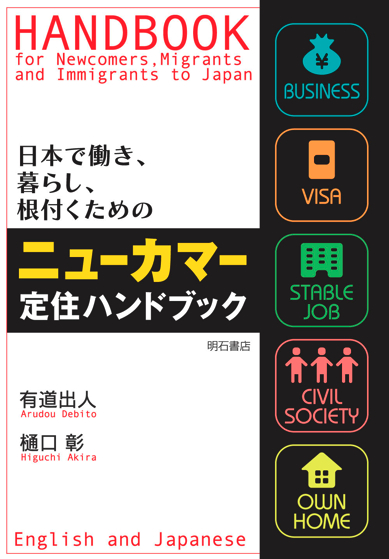
Handbook for Newcomers, Migrants, and Immigrants to Japan\Foreign Residents and Naturalized Citizens Association forming NGO\「ジャパニーズ・オンリー 小樽入浴拒否問題と人種差別」(明石書店)JAPANESE ONLY:  The Otaru Hot Springs Case and Racial Discrimination in Japansourstrawberriesavatardebitopodcastthumb
UPDATES ON TWITTER: arudoudebito
DEBITO.ORG PODCASTS now on iTunes, subscribe free

皆様こんばんは。有道 出人です。大晦日として、大栗さおりさんの大成功したシリーズ「ダーリンは外国人」の映画化を祝いたいと思います。おめでとうございます。4月ロードショーとなりますので、どうぞ皆様お楽しみに。

ちなみに、メインキャラクターの「トニーラズロ」(Tony Laszlo)の描写と実物のことは色々違いがあるように気にしてならなりません。なので、このマンガはパロディーとして載せさせていただきたいと思います。どうぞ宜しくお願い致します。良いお年を!

(イメージをクリックすると拡大されます)

Oguri’s “Darling wa Gaikokujin” becomes a movie, with parody cartoon about the “Darling Dream” being sold by all this

mytest

Handbook for Newcomers, Migrants, and Immigrants to Japan\Foreign Residents and Naturalized Citizens Association forming NGO\「ジャパニーズ・オンリー 小樽入浴拒否問題と人種差別」(明石書店)JAPANESE ONLY:  The Otaru Hot Springs Case and Racial Discrimination in Japansourstrawberriesavatardebitopodcastthumb
UPDATES ON TWITTER: arudoudebito
DEBITO.ORG PODCASTS now on iTunes, subscribe free

Hi Blog.  I want to offer my congratulations to Oguri Saori, very successful author of the “Darling wa Gaikokujin” series (translated as “My Darling is a Foreigner”, but officially subtitled “My Darling is Ambidextrous”), for the news just out this month that the first book in the series will be made into a live-action movie (starring Inoue Mao and Jonathan Share as Saori and Tonii respectively).  The empire built upon the dream being sold to Japanese women for marrying a white foreigner keeps on gathering strength.  See the movie trailer here.

More interesting to me is the mutation of the Tonii character.  It’s apparently based upon Tony Laszlo, one-time unicyclist, “journalist”, “activist” and self-proclaimed leader of unregistered NGO “Issho Kikaku” (a long-defunct group — you can’t even find their once-copious archives on the Wayback Machine because they have been blocked by the site owner — see what’s left of it at Issho.org), and now happy multimillionaire thanks to his partnership with and characterization by his very talented wife.

Although portrayed in the movie by the very handsome and disarming Jonathan as a “grass-eating man”, Tonii in real life is not as he is cartooned.  Laszlo is a big fan of putting his funds into threatening lawsuits, for one thing.  And of deleting internet archives.  And more.

It just so happens I found a cartoon parodying this phenomenon of the contrasts.  As the last post on Debito.org for this decade, enjoy.

Arudou Debito in Sapporo, wishing everyone a happy new year.  For Oguri Saori, it looks to be a fine one indeed, so, again, congratulations.

(click on image to expand in your browser)

ENDS

Book review of “Japan Took the J.A.P. Out of Me” (Pubs Simon and Schuster). Yes, that is the title.

mytest

Handbook for Newcomers, Migrants, and Immigrants to Japan\Foreign Residents and Naturalized Citizens Association forming NGO\「ジャパニーズ・オンリー 小樽入浴拒否問題と人種差別」(明石書店)JAPANESE ONLY:  The Otaru Hot Springs Case and Racial Discrimination in Japansourstrawberriesavatardebitopodcastthumb
UPDATES ON TWITTER: arudoudebito
DEBITO.ORG PODCASTS now on iTunes, subscribe free

Hi Blog.  Another holiday tangent.  Enjoy.  Debito in Monbetsu

=====================================

REVIEW OF BOOK “JAPAN TOOK THE J.A.P. OUT OF ME”

By Lisa Fineberg Cook.  Published by Simon and Schuster Inc 2009

Reviewed by Arudou Debito

Simon and Schuster sent me this book this month for review, and I know not why.  I am probably the last person to whom you’d send a “Chick Lit” book (defined by some as a genre where the protagonist is a young female trying to make it in the modern world, dealing with issues that women face, whether it be learning how to stand on their own two feet, or just about them being passionate about career, style, personal appearance, shopping…).  But I did sit down and get through it.  I agree with the reviews on Amazon.com — it’s “an easy read”.  That’s not much of a compliment, however:  If the most positive thing you can say about a literary work is that you got through it quickly, that’s damning with faint praise indeed.

So let’s get through this review and make it a quick read too.  Start with the obvious:  J.A.P.  Having a racial epithet cloaked as an ethnic slur (I hail from Cornell University, so am plenty aware of “Jewish American Princesses”) in the very title already puts me off — as very culturally insensitive.  What were you thinking, S&S?

In fact, insensitivity is the recurring theme in this tome:  The first-person narrator is so self-absorbed that there is no space for anyone else.  There are a few friends here and there (or one stellar Japanese student enlightened by the protagonist’s poetic guidance) that slot in at whim, but no particular impression is made on the reader.  In fact, aside of course from our narrator, we know more about her best friend overseas than anyone else who glides in and out of the work.  Even her newlywed husband is an undeveloped glyph who drops in occasionally, offering improbably perfect and concise bon mots designed to confirm or destroy her preconceptions.  But never mind.  The book is all about our J.A.P. girl empowering herself, moreover in a land where women apparently have no power of their own, and it’s her task to enlighten them.  You go girl, for all of us!  Feh.

Reviews are supposed to give a plot synopsis, so let’s get through that quickly too:  California Jewish girl follows her American husband to Nagoya (she even makes a “goy” joke about that) where they both teach English for one year.  She gets her comeuppance in quirky ways, as there is apparently no Starbucks in Nagoya (in 1999?  There is no date given but I place it then, since she mentions the US debut of TV show The Sopranos.), little English spoken, and few of the material or cultural creature comforts that satisfy her spoiled-girl whims.  She starts off, by design, as an unsympathetic character (hence the titled comeuppance).  However, like any newcomer in a predictable Hollywood flick, she not only learns to cope well enough (despite the natives) to stay in Japan and grow, but also to recommend to everyone (in a self-important interview in the back of the book) they try living overseas (I agree, of course, but one year abroad hardly makes one an authority on world travel).

After solipsistic battles with things like a washing machine and public transport, she finally takes us outside for some sightseeing in Japan (Hiroshima and shopping trips in Nagoya are highlights, of a kind).  But in the end the reader gets little impression of Japan beyond the stares, the crowds, some undeveloped allegations of anti-Semitism, and sundry interactions between her and some Westerners that could have taken place anywhere in the world.  Again, this character is so insensitive to anything beyond her sphere (she doesn’t even try to learn the language) that there’s no room left for Japan.  She and hubby leave after one year and return to the US to raise a family.  End of slide show.

In sum, the best I can say about the book is that the one character who counts in this book (guess who) is very well developed (if not overly so), and she has a very clear writing voice.  Hooray.  So why is she writing about Japan?  Because she has to get published by writing about something?  Hokay.  But this book is hardly something that can be advertised as a “memoir”.  Memoirs are generally an autobiography — something that give us some idea of the world people live in.  This barely gives us the world that one this one person briefly dwelled.  Japan is a difficult and time-consuming place to get to know, even when you have an interest in what’s going on around you.  Moreover even when you understand the language.  Neither happens in this book.  One year abroad — and as a functional illiterate at that — does not justify a “memoir” about a country published by one of the world’s largest publishing houses.

Good for Ms. Cook for putting one over on them.  You go, girl!  Now let’s hope S&S give some space to some more serious and knowledgeable writers about Japan.  There are plenty of them over here, trust me.  Ferret us out, Simon and Schuster.  We’ll give you something much more empowering.

Arudou Debito, author, “JAPANESE ONLY, The Otaru Onsens Case and Racial Discrimination in Japan”, and “Handbook for Newcomers, Migrants, and Immigrants” (Akashi Shoten Inc., editions 2003, 2004, 2006, 2007, 2008, and 2009 respectively); columnist, The Japan Times, and Sapporo Source.

ENDS

Yonatan Owens’ excellent riposte Letter to the Editor re J Immigration policy

mytest

Handbook for Newcomers, Migrants, and Immigrants to Japan\Foreign Residents and Naturalized Citizens Association forming NGO\「ジャパニーズ・オンリー 小樽入浴拒否問題と人種差別」(明石書店)JAPANESE ONLY:  The Otaru Hot Springs Case and Racial Discrimination in Japansourstrawberriesavatardebitopodcastthumb
UPDATES ON TWITTER: arudoudebito
DEBITO.ORG PODCASTS now on iTunes, subscribe free

Hi Blog.  A quick one, while I’m away (apologies to The Who).  I’m currently in Monbetsu, Hokkaido, enjoying a few days of post-Xmas cheer (quite a lot of it, I might add).  As a lovely present, I saw two supportive letters in the Japan Times countering the four nasty ones that came out last week (the ones I mention proving that some people really do suck).  One letter is here.  The other one, eminently satisfying, is below.  I love it when people stand up for themselves.   Thanks for writing in, folks.  Arudou Debito in Monbetsu

///////////////////////////////////

The Japan Times Sunday, Dec. 27, 2009
http://search.japantimes.co.jp/cgi-bin/fl20091222hs.html
READERS IN COUNCIL
Civil rights and immigration issues
By YONATAN OWENS Oita

Regarding the Dec. 22 article “Level playing field for immigrants: responses“: I am not surprised to see that the people who kindly told columnist Debito Arudou to mind his own business and let Japan do as it wishes have given up on Japan and left, will do so soon, or do not even live here. Maybe the ones who really should be minding their own business are those who have given up on their claim to a life here in the first place.

I am not interested in hearing how Japan has long had a fabulous system concerning immigration and how the “Western countries” should learn something from Japan’s example. The Western countries mentioned have long, complex histories of occupation, enslavement and violence in the same nations whose immigrants they now bemoan receiving.

Likewise, Japan has ethnic Chinese and Koreans who live here in a state of permanent limbo, half-assimilated, half-excluded. Japan also has many Southeast Asians who are looking for opportunities in the same nation that once came looking for opportunities in their nations. Like “the West,” Japan has a responsibility toward these individuals and cannot simply ignore them now that it is no longer socially acceptable to exploit them.

The question of civil rights in Japan is real and the question of immigration will soon be as well. Japan cannot simply turn back the clock and expel the foreigners. To avoid future confrontation and hardship for everyone — Japanese and foreigners alike — these issues require serious consideration. Some of us here are not just expatriates or perpetual tourists; some of us are trying our hardest to lead a normal life in the land that we live in and love. If you won’t help, why get in the way?
ENDS

Holiday Tangent: My Movie Review of AVATAR in 3D

mytest

Handbook for Newcomers, Migrants, and Immigrants to Japan\Foreign Residents and Naturalized Citizens Association forming NGO\「ジャパニーズ・オンリー 小樽入浴拒否問題と人種差別」(明石書店)JAPANESE ONLY:  The Otaru Hot Springs Case and Racial Discrimination in Japansourstrawberriesavatardebitopodcastthumb
UPDATES ON TWITTER: arudoudebito
DEBITO.ORG PODCASTS now on iTunes, subscribe free

Hi Blog.  Since it’s the holidays and I want to do a few things a bit more tangental, let me talk about the movie I saw today to get my mind off spending Xmas in Japan (which I have always hated doing, quite honestly, and this is about my 23rd time):

MOVIE REVIEW OF “AVATAR”

I saw AVATAR today, director James Cameron’s follow-up to his box office phenomenon TITANIC more than a decade ago.  I made sure to attend a showing in 3D, because I wanted Cameron to give me his hot dog with all the toppings (so what if I had to shell out 300 extra yen for the funny glasses we couldn’t keep, and all told including concessions I dropped about 3000 yen for the experience).  Here’s my review:

Plot summary (skip if you dislike Movie Spoilers):  AVATAR, as you’ve no doubt heard, is about a handicapped grunt who becomes a replacement footsoldier of sorts on a faraway planet that human beings, still all concerned about maximizing shareholder value while mining some Maguffin mineral resource there, are exploiting a good 150 years in the future.  The problem is some native humanoids living on the planet already aren’t happy with having their homeworld and lifestyles disrupted.  They really begin fighting for their rights when the humans become unreasonable, and decide to use their superior technology against the natives’ stone-age (but highly spiritual) weaponry.  Our protagonist, who spends his waking hours remotely inhabiting a human-cloned version of the natives (hence the “Avatar”), is sent out into the woods to infiltrate, where he increasingly becomes incorporated into the tribe, and realizes they represent the true warrior spirit he wishes he could recapture as a human.  He “goes native” himself, and for three hours we have the story arc going in predictable directions all the way to a happy ending.

Critique:  The biggest criticism I’ve seen of the movie is that it is “by the numbers”, with few surprises.  I agree.  But nobody’s going to see this flick for the story.  We’ve heard that there are some envelope-pushing special effects.  As in the 3D.

Well, how about that 3D?  Good and bad.  Good in that it is better than the old red and blue lenses we got back in childhood (and my favorite 3D movie before AVATAR was FRIDAY THE THIRTEENTH PART THREE IN 3D, with introduced me to polarized-glass 3D cardboard specs (which I still have) and lots of things leaping out at you — including popcorn, yo-yos, a spear from a harpoon gun, and an eyeball that pops at you when Jason crushes somebody’s head).  AVATAR, however, doesn’t stoop to cheap novelties — it offers some very clear scenarios that would look normal even without the funny glasses, and after awhile you forget that you’re wearing them (Cameron seems to learn midway to slow down the action a bit at times because it blurs in 3D).

Bad is that the 3D dims the color palette.  The computer-generated natives (all bright blue, tall, and more expressive than I’ve ever seen in any other computer-generated movie) and their world is darkened by the 3D glasses, and sometimes I found myself popping them up to take in some of the more phosphorescent scenes.  AVATAR is a gorgeous movie to look at (and I would expect nothing less from master storyteller James Cameron, who gave us TERMINATOR 2, ALIENS, THE ABYSS, and of course the best disaster-movie-cum-love-story ever TITANIC — all envelope pushers in terms of storytelling and special effects), but I am still waiting for 3D to catch up with the amount of information being put forth on the screen.  Again, the 3D technology right now blurs and muddies things at times, even gets in the way when the action becomes split-second reaction.

The best part of the movie for me was the environment of the planet Pandora.  Cameron (who also wrote the script) obviously put a lot of work into creating the alien civilization, making its quirky flora and fauna look genuinely alien.  There are of course essences of Vietnam and the American Indian (the soundtrack echoes that most clearly), and he resists the temptation to give us a Late Sixties or Early Seventies ending (alas, downers of a movie don’t put as many people in seats as modern-blockbuster Hollywood endings, as a rule).  As in ALIENS, Cameron is clearly in love with exoskeletons, and his weaponry and technology is utterly convincing.  As is his heartfelt need to make us emote with the natives, and we root for them to prevail over the destructive humans.  In terms of escapism and sending us to another world, Cameron does better than even George Lucas (who never really slows down enough for us to have a look around the worlds he so fastidiously creates — you have to get the spin-off comic books or animated clone wars, or worse yet shell out to see the STAR WARS movies again if you want to suck on the scenery).  Cameron delivers on his promise to make the moviegoing experience an actual drama and not just an amusement park ride.

But in terms of what lingers after AVATAR is all over, it’s not the environmental lesson, or the good versus business/military ethics, or even the 3D.  It’s the planet of Pandora, and how lovely it must be to see it in all it’s glory without the goddamn glasses on.  I hope someone who cares as much as James Cameron about movie craft comes along and makes the 3D technology something that gives us the focus and color as vibrantly as without.  Next time.  Thanks for the good college try, Mr Cameron.  You haven’t lost your touch.  Grade:  B-.

Arudou Debito in Sapporo

Merry Xmas: LIFER! cartoon on “End-Year Holiday Activities in Japan”

mytest

Handbook for Newcomers, Migrants, and Immigrants to Japan\Foreign Residents and Naturalized Citizens Association forming NGO\「ジャパニーズ・オンリー 小樽入浴拒否問題と人種差別」(明石書店)JAPANESE ONLY:  The Otaru Hot Springs Case and Racial Discrimination in Japansourstrawberriesavatardebitopodcastthumb
UPDATES ON TWITTER: arudoudebito
DEBITO.ORG PODCASTS now on iTunes, subscribe free

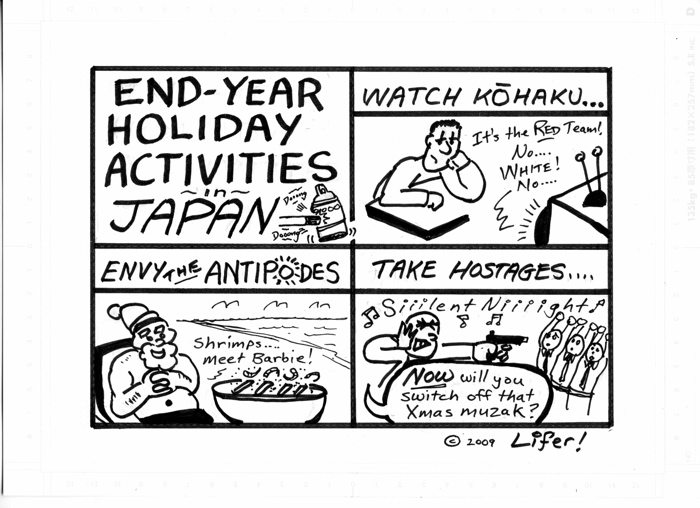
Hi Blog.  For the holidays, here’s a timely cartoon by Lifer in SAPPORO SOURCE.  How to enjoy the end-year holidays in Japan, with a twist.  Download the entire December 2009 issue of SAPPORO SOURCE here in pdf format.  Enjoy.  And for those who celebrate it, Merry Christmas, everyone!  Arudou Debito in Sapporo

(Click on image to expand in browser)

hokkaidocomix2shrunk

Proof positive that some people really do suck: JT responses to proposals for a Japanese immigration policy

mytest

Handbook for Newcomers, Migrants, and Immigrants to Japan\Foreign Residents and Naturalized Citizens Association forming NGO\「ジャパニーズ・オンリー 小樽入浴拒否問題と人種差別」(明石書店)JAPANESE ONLY:  The Otaru Hot Springs Case and Racial Discrimination in Japansourstrawberriesavatardebitopodcastthumb
UPDATES ON TWITTER: arudoudebito
DEBITO.ORG PODCASTS now on iTunes, subscribe free

Hi Blog.  It’s times like these when I think human society really has a bottomless capacity for oozing disdain for and wishing ill-will upon others.  Get a load of these letters to the editor (including authors who won’t reveal their names, or don’t live in Japan anyway) responding acidulously to my Japan Times column earlier this month, where I made constructive proposals for making Japan a place more attractive for immigration.  (Many of these proposals were made not just by me, but also by former Immigration bureaucrat Sakanaka Hidenori; so much for their pat claim below of imposing my moral values).

None of these respondents appear to be immigrants, or have any expressed interest in investing in this society, yet they heap scorn upon those who might plan to.  I know paper will never refuse ink, but surely these people have more productive uses of their time then just scribbling poorly-researched and nasty screeds that help no-one.  The self-injuring, snake-eating-its-tail mentality seen in NJ vets of Japan is something worthy of study by psychologists, methinks.  Any takers?  Arudou Debito in Sapporo

///////////////////////////////////////////

The Japan Times, Letters to the Editor Tuesday, Dec. 22, 2009

HAVE YOUR SAY
Level playing field for immigrants: responses
A selection of readers’ responses to Debito Arudou’s Dec. 1 Just Be Cause article, which proposed policy changes to “make life easier for Japan’s residents, regardless of nationality”:

Get your fill and head off
I’m getting tired of listening to foreigners moaning on Japan. The answer is very simple: You don’t like it, leave it. Why do these people want to live in Japan at all costs if they don’t like the system? The world is big; go somewhere else. I’ve been in Japan for 4 years with my Japanese wife and now we have understood it’s time to move on for our future, and therefore go back to Europe. We all know Japan is a homogeneous country. It will never become a cosmopolitan society like the West. Who are we to change a deep-rooted, xenophobic culture where Japanese have been living for centuries? It’s much easier for Japanese to live in the West than for us to live in Japan. There are big Japanese communities in every Western country. Japan is not an expats’ resort by tradition. Foreigners come here either for marriage or overseas contracts, meaning it can be a beautiful place to live for a few years but not to settle permanently. My suggestion to all those disillusioned gaijin is to make the most of your stay in Japan and return home when you think you’ve had enough.

JOHN TESTORE

Takasaki, Gunma Pref.

================================

Unwelcome, no matter what
This article implied that Japan is seeking to welcome foreigners, which is far from the case. I came here (unwillingly) under a Japanese scholarship, graduated here top of my class, work here, did volunteering to help in disaster relief . . . But everyday I wake up, I find myself in the same position: potential thief when I walk in a store; a potential terrorist when I enter a government building, even when I spend my time there volunteering; my neighbor keeping watch on me every day; unable to obtain a bank recommendation when I need it . . . In my case, I gave up on Japan and will (leave) with a bitter taste.

NAME WITHHELD

================================

Homogeneity works well
Japan has been often criticized for its immigration policy, which does make it somewhat difficult for a non-Japanese (NJ) to obtain permanent residency or citizenship. I disagree that this policy has worked to Japan’s disadvantage in the global labor market. . . . (Arudou) says Japan needs a new immigration ministry that would decide clear public standards that would give immigrants what they want. It is not an obligation of the government to give immigrants what they want. The (role of the) ministry is to be sure that the immigrants who are allowed into Japan will obey the laws of Japan and not become wards of the state.

Also, I disagree with Arudou’s desire to have citizenship based on birth in Japan. Look at the U.S.: Illegal aliens come into the U.S. and have what is called an “anchor baby.” The baby is automatically a U.S. citizen, and his/her parents then become eligible for permanent residency and then citizenship. And the American taxpayer pays for their health care, housing, food stamps, education and more. They create their enclaves, demand bilingual classes, etcetera, and never learn English.

Japan has been very fortunate to have about 98 percent of its population (form) a homogeneous society, in which the people share a common language and culture. Of course there are local variances, but by and large the people speak one language, which helps to maintain a high level of literacy and an appreciation of a common culture, language and history. . . . Debito Arudou should abide by the laws of immigration of Japan, stop whining or simply find another place to live.

KARL E. WAHL

Bellevue, Wa.

================================

Let Japan run its own shop
I am an American who lived in Japan for 4 years and find it pathetic how many people want to force Western ideologies onto Japan. Japan is its own country. Let them do as they please. At least they can control their immigration issues, unlike most European countries and the United States. I bemoan how my country, the United States, can’t tackle or has an unwillingness to tackle the issue. Japan has a right to keep the country as Japan sees fit. Forcing non-Japanese moral values on it to satisfy the short-term aging population issue is not in best interests of Japan.

MIKE TULL

Address withheld

ENDS

Guest blog post by Steve on “How to get the Japanese public to demand a non-discrimination law”

mytest

Handbook for Newcomers, Migrants, and Immigrants to Japan\Foreign Residents and Naturalized Citizens Association forming NGO\「ジャパニーズ・オンリー 小樽入浴拒否問題と人種差別」(明石書店)JAPANESE ONLY:  The Otaru Hot Springs Case and Racial Discrimination in Japansourstrawberriesavatardebitopodcastthumb
UPDATES ON TWITTER: arudoudebito
DEBITO.ORG PODCASTS now on iTunes, subscribe free

Hi Blog.  Yet another guest post today.  Thanks Steve.  Debito in Sapporo

/////////////////////////////////////////////////////
Dear Debito, I became inspired to start a new thread, I hope it sparks some ideas and real action. Thanks again for continuing to be a beacon of light for humans who want human rights! 🙂 Sincerely, Steve (a.k.a “Mr. Ittemo Ii Desu Ka”)

———————————————-
“Problem, Reaction, Solution”
or
“How to get the Japanese public to demand a non-discrimination law”

I second DM’s motion. (https://www.debito.org/?p=5475#comment-188363)

Seriously. Let’s make it happen. Our goal is a new law against discrimination here in Japan.

Who here has the courage to become this generation’s Mrs. Rosa Parks? I hope somebody reading this does.

Since currently barring entry to private establishments based on nationality is still practically legal in Japan (or at the very least, non-prosecuted and/or non-penalized), then I think DENYING JAPANESE PEOPLE entry to an establishment here in Japan will create subsequent outrage which will cause Japanese people to realize that Japan needs a law which clearly states, “Barring entry to private establishments based on nationality, or race, is hereby illegal, and violators of this law will be prosecuted and will face severe penalties.” The outraged Japanese public will DEMAND a new law like this.

Proposed plan of action: a law-abiding human here in Japan (with taxes, national insurance, and even pension – all paid-up in full (nod to Hoofin), preferably a permanent resident of Japan or Japanese national, to avoid the possibility of visa-denial retaliation) who has an establishment (a bar, restaurant, shop, whatever) AND COURAGE (very essential) and good property insurance (also essential, since some right-wing crazies will probably break some windows and/or start some fires) should put up a big sign out front proclaiming “No Japanese” and/or “No Japanese may enter” and/or “Non-Japanese Only” and/or “Entry Restricted to Non-Japanese” (in perfect Japanese of course) PLUS underneath this sign should be big poster-sized-laminated-PHOTOS of all the variations of “Japanese Only” signs found in Japan (e.g. www.debito.org/roguesgallery.html – especially photos of the signs written in Japanese such as https://www.debito.org/edensign030707.jpg) PLUS underneath those photos should be a sentence in Japanese which says, “Japan needs a law which clearly states, ‘Barring entry to private establishments based on nationality, or race, is hereby illegal, and violators of this law will be prosecuted and face severe penalties.’ “

A well-written (triple-proofread) press-release in Japanese together with this story’s dramatic money-shot: a well-taken photo which clearly shows the whole picture, meaning, the controversial “Non-Japanese Only” sign TOGETHER with the big poster-sized-laminated-photos of “Japanese Only” signs directly underneath that, TOGETHER with the solution to this problem stated underneath that, specifically, our proposed law against discrimination.

I predict many newspapers and television channels will cover this story. When the average Japanese person sees the top part of the photo (the “Non-Japanese Only” sign), they will be outraged of course. Then, when their eyes scan down to the middle part of the photo (the “Japanese Only” signs), they will realize this kind of discrimination exists here in Japan. Finally, when they scan down to the bottom of the photo they will see the new proposed law which will help prevent this kind of sign from ever being posted again, and hopefully they will clamor for this solution.

This “Problem, Reaction, Solution” technique has been used successfully by clever rulers to get the public to clamor for the wrong goals (e.g. the Problem of terrorism creates a Reaction of fear and anger, which leads to the public agreeing to the rulers’ desired “Solutions” of decreased human rights, decreased privacy, increased air-bombing of other nations, and increased taxes going towards weaponry contracts) well finally it’s about time average people create a PEACEFUL little Problem (namely, a sign which states a discriminatory entry rule) which will create a Reaction (in this case indignant outrage about such discrimination) which will lead to the public clamoring for a LAW against such discrimination.

Reducible Risk – I predict some newspapers and television channels will try to focus on just the top half of the photo, and will simply cut out the bottom half. Hmmm, then, maybe to reduce that possibility we should somehow put the photos of the “Japanese Only” signs WITHIN (e.g. in the CENTER of) our “Non-Japanese Only” sign (and maybe we should put the law proposal WITHIN that as well) so it will be harder for editors to attempt to cut out the most essential part of the story.

Now, If anyone here has a better, more effective, serious idea about how to get the Japanese public to demand a non-discrimination law, let’s hear it!

And after everyone here adds their positive ideas on this thread, let’s hope someone with courage actually steps up to “Make it happen, cap’n!”  Steve

ENDS

Yomiuri: Scriveners aid illegal marriages, work

mytest

Handbook for Newcomers, Migrants, and Immigrants to Japan\Foreign Residents and Naturalized Citizens Association forming NGO\「ジャパニーズ・オンリー 小樽入浴拒否問題と人種差別」(明石書店)JAPANESE ONLY:  The Otaru Hot Springs Case and Racial Discrimination in Japansourstrawberriesavatardebitopodcastthumb
UPDATES ON TWITTER: arudoudebito
DEBITO.ORG PODCASTS now on iTunes, subscribe free

Hi Blog.  Debito.org Reader JK comments on an article from a couple of months ago.  Letting him take the keyboard for today.  Arudou Debito in Sapporo

===============================

Hi Debito:  OK, this is good:

Scriveners aid illegal marriages, work
http://www.yomiuri.co.jp/dy/national/20091012TDY02306.htm

I assume that the clerks in question are going out of their way to assist foreigners in obtaining residency permits (even to the point of placing ads in newspapers) due to bribery (as opposed to benevolence), and that this behavior is motivated by said clerks’ cognizance of loopholes in the immigration control law.

If so, then there’s nothing less than a government-backed residency permit black market at work, which, I might add, shows no signs of going away — a simple to fix the problem would be to amend the immigration control law to punish the clerks as needed, but is that what’s happening? No. Instead the issue is being given superficial treatment:

  • a) The MPD established a ‘liaison council’ with metropolitan government and the Tokyo Regional Immigration Bureau to talk about clerks gone bad.
  • b) The Tokyo association of administrative scriveners will “keep a close watch over suspicious ads in newspapers and on the Internet”.
  • c) Japan federation of administrative scriveners associations is calling on scriveners to “behave themselves”.

If I may be facetious for just a minute, the Tokyo Regional Immigration Bureau should either fix the situation or cut the clerks out of the loop and pocket the cash for itself by establishing a legitimate residency permit market.-JK

The article:

=============================

Scriveners aid illegal marriages, work

The Yomiuri Shimbun


Ads placed by administrative scriveners offices in newspapers for Chinese and Koreans indicate they help in illegal immigration applications.

In recent years, a number of administrative scriveners have helped foreigners obtain residency permits illegally, taking advantage of the fact that the immigration control law stipulates no punitive measures for violators.

Administrative scriveners were reportedly involved in at least 10 cases of fraudulent marriage and illegal employment exposed by the Metropolitan Police Department since 2006. Some even placed ads in free newspapers for foreigners to attract customers, the MPD said.

The MPD has reported one case it deemed “heinous” to the Tokyo metropolitan government, which has the authority to punish administrative scriveners, and asked it to consider punitive action. The MPD plans to provide information on nine other cases to the relevant local governments if those cases are also judged as heinous.

The MPD arrested a 39-year-old South Korean man in May last year on suspicion of brokering a fake marriage between a 39-year-old South Korean woman and a 35-year-old Japanese man.

The Korean man told police he asked an administrative scrivener in the Tokyo metropolitan area to file an application for a residency permit that the woman needed in order to get married, a senior MPD officer said.

During police interrogations, the Japanese man and Korean woman reportedly said the scrivener filed the application on their behalf despite knowing their marriage was fake.

Given their confessions, the MPD investigated whether it could bring a criminal charge against the scrivener in question. Because the immigration control law has no punitive provisions regarding false marriage applications, the MPD examined whether the scrivener could be accused of abetting a fake marriage, or of helping a suspect to evade capture.

The scrivener voluntarily submitted to questioning but denied any wrongdoing, saying he did not know it was a fake marriage. The MPD had no alternative but to give up bringing criminal charges against the scrivener.

In July, the MPD arrested six Japanese and Chinese brokers in connection with a case in which a Chinese farmer illegally obtained a residency permit by posing as an interpreter. Police investigations discovered forged employment contracts at the office of an administrative scrivener who is different from the one who prepared the application for the residency permit.

The MPD has confirmed that scriveners were involved in 10 falsification cases since 2006. The scriveners accepted application requests from brokers and from applicants themselves.

Many of the scriveners involved in the 10 cases placed ads in newspapers catering to Chinese and free papers in Korean that are available in Shinjuku’s Kabukicho area and elsewhere, the MPD said. The ads included statements like “special procedure to obtain residency permit for illegal residents” and “marriage procedures for illegal immigrants.”

The MPD suspects that such advertising facilitates illegal employment and fake marriages.

For this reason, the MPD considers it necessary to deal harshly even with cases in which criminal charges cannot be filed, by calling for the authorities concerned to take punitive action.

Together with the metropolitan government and the Tokyo Regional Immigration Bureau, the MPD established a liaison council to discuss countermeasures against administrative scriveners involved in illegal immigration cases. Through the council, the MPD provides relevant information for the metropolitan government and bolsters its surveillance of illegal activities by scriveners.

A senior member of the Tokyo association of administrative scriveners said his organization would strictly deal with any scriveners found to have committed illegal acts.

The association is “keeping a close watch over suspicious ads in newspapers and on the Internet in an effort to be aware of their activities,” he said.

Its parent organization, the Japan federation of administrative scriveners associations, is making its own efforts to tackle the issue.

“We’ll work toward maintaining public trust in scriveners by using various occasions, such as seminars, to call on scriveners to behave themselves,” a federation official said.

(Oct. 12, 2009)  ENDS

DR on dealing with GOJ border fingerprinting: sandpaper down your fingers

mytest

Handbook for Newcomers, Migrants, and Immigrants to Japan\Foreign Residents and Naturalized Citizens Association forming NGO\「ジャパニーズ・オンリー 小樽入浴拒否問題と人種差別」(明石書店)JAPANESE ONLY:  The Otaru Hot Springs Case and Racial Discrimination in Japansourstrawberriesavatardebitopodcastthumb
UPDATES ON TWITTER: arudoudebito
DEBITO.ORG PODCASTS now on iTunes, subscribe free

Hi Blog.  As this week leads into Xmas, I will be slowing down a bit on postings (who wants to read this kind of stuff during vacation time, anyway, right?), making them less frequent until the new year starts in earnest.  Meanwhile, DR sends me this post for blogging, food for thought.  Arudou Debito in snow-inundated Sapporo

/////////////////////////////////////////////

Sanding Down Your Fingerprints.

Incensed by the Japanese government’s slavish following of the US fingerprinting program, I decided to take charge of my own biometrics.

(1)  The temptation to use harsh, large grit sanding paper was my first impulse, but I settled on a very fine black glass paper for the huge amount of 85 Yen at Jumbo Encho. Usually the packages have a window so the grade of paper can be felt without opening it.

(2)  I started sanding on my outbound journey. It was a Nagoya to Frankfurt trip, 12 hours and lots of time to gently sand all my finger and thumb prints lightly. The secret is lightly.

(3)  I was to be in the EU for almost three weeks, so about ten minutes per day I would sand a little, lightly. Even sanding lightly it’s easy to break the skin and to expose muscle fibres, causing bleeding. Any distinguishing mark makes a fingerprint more identifiable, and defeats the whole purpose. After about a week I felt like a safe-cracker. Everything I touched was more pronounced; heat, cold, textures. Everything. I couldn’t touch the strings on a guitar as my fingers were too sensitive. I could distinguish the dots on Braille texts much better than before! Eventually the fingers callous-over and, with time, the surfaces become harder.

(4)  Then I started to test what my fingerprints would leave behind using a simple, plain drinking glass. It’s almost impossible not to leave a print on a clean glass. So, one by one over the next two weeks of my stay, I systematically sanded down the spots on each finger individually until I was satisfied that I left only an indistinguishable smudge on the clean drinking glass. After that, I made a paste of white sugar and water and soaked all my fingers in the small dish of that paste for a few minutes a day. The carbonic acid in sugar puts a nice polish on fingerpads, almost “sealing in” the plain surfaces, and erasing any signs of visible alteration. (That trick I learned of a very old episode of Hawaii 5-O!)

(5)  On arrival in Chubu, Nagoya I handed in Debito’s tract protesting the fingerprinting, and the drone on the desk just sighed and went through the speech. I put my two index fingers on the pads, and he gave a “Hehhhhh!” He asked me to try all of my fingers in pairs. I did, also sighing and rolling my eyes. After they ALL came back smudges, he asked for the first set of indexes. “Sho-ga-nai!” he said, pushed the record button, snapped a very impatient looking face. With one swift motion he handed back my stamped passport, gaijin card and new in-out form, and I was on my way.

(6)  I’ve used this every time, but the last two they didn’t go through all the digits, just took the first and sent me on my way. I guess they figure I’m just a smudgy gaijin!

ENDS

Sunday Tangent: Haagen Daz ice cream excludes Indians from sampling the latest flavor — in India!

mytest

Handbook for Newcomers, Migrants, and Immigrants to Japan\Foreign Residents and Naturalized Citizens Association forming NGO\「ジャパニーズ・オンリー 小樽入浴拒否問題と人種差別」(明石書店)JAPANESE ONLY:  The Otaru Hot Springs Case and Racial Discrimination in Japansourstrawberriesavatardebitopodcastthumb
UPDATES ON TWITTER: arudoudebito
DEBITO.ORG PODCASTS now on iTunes, subscribe free

Hi Blog. For a Sunday Tangent, watch what happens when an exclusionary sign goes up in, say, India. Article from the Times of India follows (of quite questionable writing quality, but never mind). More interesting than the article are the comments from readers below it online. They are not amused, indeed. Have a read.  Arudou Debito in Sapporo
////////////////////////////////////////////

Sorry, Indians not allowed

Rajesh Kalra Tuesday December 15, 2009, 02:39 PM, Courtesy SH

http://blogs.timesofindia.indiatimes.com/randomaccess/entry/sorry-indians-not-allowed1

My friend Ramit (name changed on request) called me late Friday night. He sounded quite agitated. “You know, Haagen Dazs has opened its Delhi outlet”.  I reacted with a joke. “Good, now you can spend a lot more on an ice cream than you normally would. But why are you agitated?”

“Because I am not allowed to enter”, he said. Now, Ramit is not like one of the politician’s son or into drugs, the sort who are often in news in India’s capital for all the wrong reasons, nor is he the kind who will shoot someone down because she refused to serve him a cone of ice cream.

He did not waste much time and said he has taken a picture and is mailing me the reason. I switched on my mail, and clicked on the attachment. I couldn’t believe what I saw. Was I in India, 62 years after gaining independence, and years after South Africa officially ended apartheid?

The banners outside the outlet said: Exclusive Preview for International Travellers.  And under that, in an even finer print, the real bombshell: Access restricted only to holders of international passports.

indians not allowed

I immediately called Ramit. “You are an international traveler, and you have a passport, so you can go in”, I said. Ramit’s response was instant: I tried to enter but they said you are not allowed for you don’t have an international passport.

I am normally not given to immediate emotional reactions, but I couldn’t resist this time.  I was, to be honest, upset. How can they do this to an Indian, in India? Do a story on TOI or NBT? Do it for print or Online? Call other media friends and colleagues? I simply didn’t know how to react. Print would have a better impact, but should I wait that long?

Then I felt, why not use the power of the social media? Next thing I knew was that I had put up a few pictures on facebook, added a caption and also sent out a tweet with a request it be retweeted. In a few hours, it had turned into a viral and I started getting messages from angry Indians all over. Why just Indians, even friends in international media wrote to say “this is the stupidest thing they have seen in a long time”.

I didn’t stop at that. I ended up calling a few MPs I knew I could speak to bluntly and told them about it, taunting them about it.

I don’t know what finally worked, but it seems word did get around to the outlet’s franchisee and they started claiming there never was any restriction on anybody entering the outlet.

While this may be considered a victory for people power, I am still unable to figure out who in his right senses would have advised the dessert company to do something so stupid. Was it a way to generate controversy for free publicity? Did they think it will work subliminally on Indians mind that now that it has been ‘certified’ by international travelers it would be good for them too?

Whatever it is, it is idiotic. I checked later and found that the franchisee is an Indian company based in Delhi and the man incharge is also an Indian.

I have often maintained that we ourselves are our biggest enemies. Our mentality is that of slaves and we think anything is good only if its approved by foreigners, or the “holders of international passport”.

Perhaps the Indian franchisee had this in mind. And a comment on the picture I put up on the facebook by an Indian who migrated to Australia decades ago sums it up: Most international travellers don’t want HD in India when they can get it in their own backyard. Its a commodity not a special thing for them. They would also see this as pure cashing in and thinking they are idiots – ‘India taking them for a ride.’ Have to remember not every international traveler is American; makes an average salary of squillion dollars; can often be allergic to dairy (yes); is in India to have an ‘authentic Indian’ experience and by golly even enjoy kulfi, falooda, lassi, dosa! This is all about how India and Indians see themselves. Foreigners have nothing to do with it.

///////////////////////////////////////////

Read comments at

http://blogs.timesofindia.indiatimes.com/randomaccess/entry/sorry-indians-not-allowed1

DEBITO.ORG NEWSLETTER DECEMBER 20, 2009

mytest

Handbook for Newcomers, Migrants, and Immigrants to Japan\Foreign Residents and Naturalized Citizens Association forming NGO\「ジャパニーズ・オンリー 小樽入浴拒否問題と人種差別」(明石書店)JAPANESE ONLY:  The Otaru Hot Springs Case and Racial Discrimination in Japansourstrawberriesavatardebitopodcastthumb
UPDATES ON TWITTER: arudoudebito
DEBITO.ORG PODCASTS now on iTunes, subscribe free

Hi All. This will be the last Newsletter for this decade. I’ve been doing these Newsletters for well over a decade now anyway, so let’s turn the page and conclude the year…

DEBITO.ORG NEWSLETTER DECEMBER 20, 2009

////////////////////////////////////////////////
NEW PET PEEVES
1) The ludicrousness of Japan’s Salary Bonus System: How it contributes to Japan’s deflationary spiral
2) Health insurance advocate “Free Choice Foundation” is fronting US health insurance business
3) One NJ exchange student’s rotten experience as a J MOE-MEXT ryuugakusei
4) Mainichi: Senior Immigration Bureau officer arrested on suspicion of corruption
5) NPA now charging suspect Ichihashi with Hawker murder, not just “abandoning her corpse”. Why the delay?
6) Bern Mulvey JALT presentation on flawed MEXT university accreditation system

OLD PET PEEVES:
7) Kyodo: GOJ responsible for hardship facing Ainu, incl racial profiling by J police on the street!
8 ) GS on Michael Moore’s rights to complain about being fingerprinted at Japanese border
9) US Congress Lantos HR Commission on J Child Abductions issue: Letters to Obama & Clinton, my submission for Congressional Record
10) UN News: “Ending complacency key to fighting discrimination worldwide”
11) EU Observer: “Racism at shocking levels” in European Union

HOLIDAY TANGENTS:
12) Debito.org Podcast December 20, 2009 (with un-serious articles for a change)
13) Behind the scenes from Copenhagen EcoSummit (COP15), Eric Johnston blog
14) Headachingly bad Japan travelogue by Daily Beast’s “new travel columnist” Jolie Hunt. Whale on it.
15) Next Japan Times JUST BE CAUSE Column out Tues January 5, 2010.
Topic: Roundup: The most significant human rights advances in Japan in 2009.

… and finally …
16) SAPPORO SOURCE DEBITO column Dec 2009: Top 9 Things I Like about Japan (full text)
////////////////////////////////////////////////

By Arudou Debito, Sapporo, Japan (debito@debito.org)
Daily Blog updates, RSS feeds at www.debito.org, Podcasts at iTunes
Freely Forwardable

////////////////////////////////////////////////

NEW PET PEEVES

1) The ludicrousness of Japan’s Salary Bonus System: How it contributes to Japan’s deflationary spiral

Big news across Japan these past couple of days has been how the Winter Bonus has been slashed between 10 to 15 percent for bureaucrats. Some people might say, well, tough beans — these bureaucrats were being overpaid anyway, so it’s about time. The problem is that this practice is a bellwether: other industries see this as an excuse to cut their own salaries. My university (which is private-sector, but they directly cited the Bonus cuts to the national bureaucrats (kokka koumuin) as justification) cut all of our Bonuses this year and will continue to do so in perpetuity. As in: they cut our bonus multiple from 4.5 months’ salary total per year to 4.15 months’, and will not change that until the national bureaucrats revise their multiple upward.

I heard yesterday from a friend that he heard on the TV wide shows that only 14% of all people surveyed got a rise in Winter Bonus this December. Everyone else either had no change, a drop, or NO BONUS AT ALL. If this is true, and almost everyone is getting screwed by this system and losing money in real terms, it’s not just a labor issue anymore: We’re talking about a deflationary spiral, as domestic consumption decreases and domestic demand follows suit, and more companies find themselves yet again cutting Bonuses because they say they have to, but really because they can.

Conclusion: Lose the Bonus System. It is increasingly becoming a way to deprive workers of a third of their annual salary at corporate whim. And it only feeds the forces that are hurting Japan’s consumers.

https://www.debito.org/?p=5480

PLUS: DEBITO.ORG POLL: “What happened with your Winter Bonus 2009?”
Please tell us! Found on any Debito.org blog page.

////////////////////////////////////////////////

2) Health insurance advocate “Free Choice Foundation” is fronting US health insurance business

A friend writes, excerpt: “Moreover, Kessler K.K., the Free Choice Foundation, HealthOne and its sponsoring company, Legend Travelers, as well as “National Health Insurance Watch”–a website that shares different two ways (with a disclaimer!) how NJ can use deceit to get themselves off kokumin kenko hoken — all five are supported by the same internet server that is registered to [Free Choice Foundation chair] Mr. Kessler. In America no less!

“What is the real story? Is it about free choice? Fairness to NJ? Or simply arguing that Japan should ignore its own social insurance laws when it comes to NJ, so that someone else can make a business out of it?”

COMMENT: Yeah, come to think of it: As a person who has always had a difficult time scraping together much money for activism (believe me, I’ll always be impoverished by my activities), I was curious how this group was able to make all this money for a very flash website, lobbying, advertising in broadsheet publications…

https://www.debito.org/?p=5459

////////////////////////////////////////////////

3) One NJ exchange student’s rotten experience as a J MOE-MEXT ryuugakusei

Guest essay intro: My name is Laura Petrescu, and I am a Monbukagakusho-MEXT scholarship grantee that has been living in Japan for almost three years. When I came here, I was expecting a high-quality academic environment and an overall positive experience. I was disappointed time and again by irregularities, double standards, absurd situations and blatant displays of racism.

Therefore, I thought I’d share my ryuugaku experience so far. I think that by getting the word out I’m giving prospective foreign students a chance to learn ‘other’ truth about living and studying in Japan. On the surface, things might look good – after all, who would say no to going to college for free? Still, there are many things that can turn an average ryuugaku experience into a complete disappointment and a waste of time.

https://www.debito.org/?p=5423

////////////////////////////////////////////////

4) Mainichi: Senior Immigration Bureau officer arrested on suspicion of corruption

Let’s look how deep the rot runs. It’s not just human traffickers bringing in NJ on “Entertainer Visas” sponsored by the State. It’s not just factories bringing in NJ on “Trainee and Researcher Visas” to exploit as sweatshop labor — again, sponsored by the State. It’s even now according to the Mainichi article below the Immigration Bureau profiteering, using their power for rents-seeking (in the academic sense) to skim off money again from migrants.

Although not an elixir for all these problems, an Immigration Ministry with clear immigration policies (and not mere policing powers, given how unaccountable the Japanese police are; even below an “internal investigation” has been promised; bah!) would in my view help matters.

The big losers are of course the commodities in these exchanges — people, i.e. the NJ, who are here at the whim, pleasure, and profit of the powers that be. Sickening.

https://www.debito.org/?p=5398

////////////////////////////////////////////////

5) NPA now charging suspect Ichihashi with Hawker murder, not just “abandoning her corpse”. Why the delay?

Now here’s what I don’t get. Ichihashi’s charge has been upgraded from corpse abandonment to outright murder. But why wasn’t it before? What new information has been brought out since his apprehension? Police already knew about the body, the disposed-of hair, the fact that she accompanied Ishihashi to his apartment and was last seen there. And now suddenly his DNA matches bodily fluid found on her corpse. But didn’t the police know all of this before? It’s not as though Ichihashi’s interrogation revealed him admitting any new information (after all, he’s not talking).

Why is it that he gets charged with mere corpse abandonment (something that frequently happens when a NJ gets killed) up until now, whereas if something like this is done to a Japanese victim (as posters with Ichihashi’s fellow murder suspects indicate), it gets a full-blown murder charge? Why the delay until now? I wish I had the information to answer these questions.

Final thing I find odd: Good for father Mr Hawker being tenacious about this case. There are plenty of other murders (Tucker Murder, Honiefaith Murder, Lacey Murder, and Blackman Murder) and assaults (Barakan Assault) of NJ that the NPA and the criminal courts gave up on all too easily. Does the family of the NJ victim have to pursue things more doggedly than the police before the NPA will actually get on it (as they had to do for Lucie Blackman’s killer, and he still got acquitted for it)? It only took the NPA close to three years to get Ichihashi, and that was after a tip from a face change clinic (not any actual police investigation).

Why this half-assedness for crimes against NJ? Sorry, there’s lots of things here that just don’t make sense, and they point to different judicial standards for NJ victims of J crime.

UPDATE: For once, the Comments Section forces me to capitulate!

https://www.debito.org/?p=5413

////////////////////////////////////////////////

6) Bern Mulvey JALT presentation on flawed MEXT university accreditation system

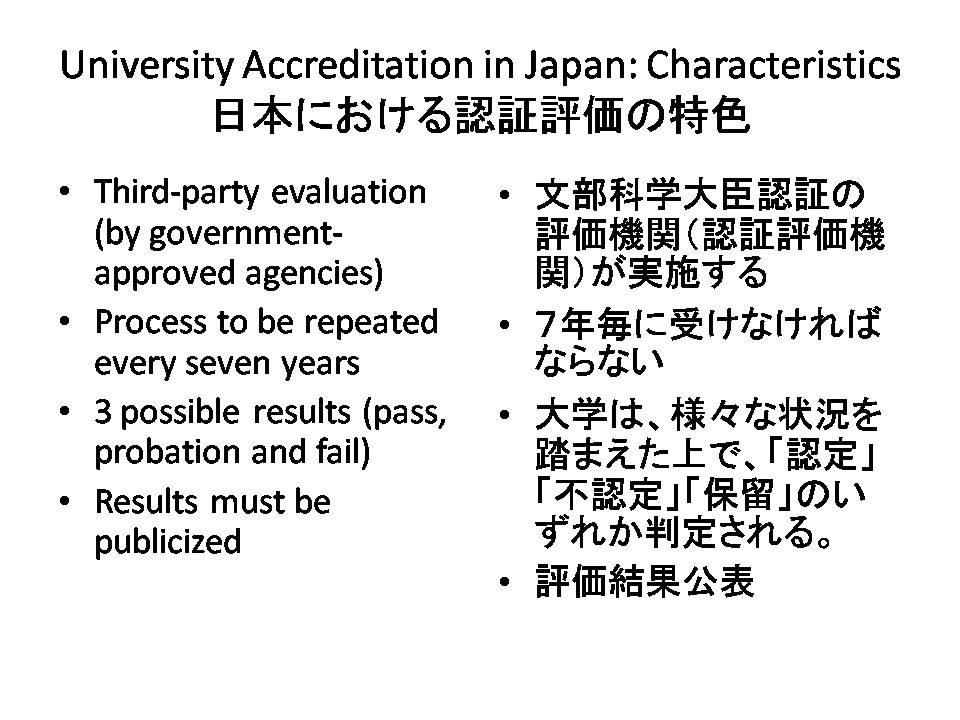
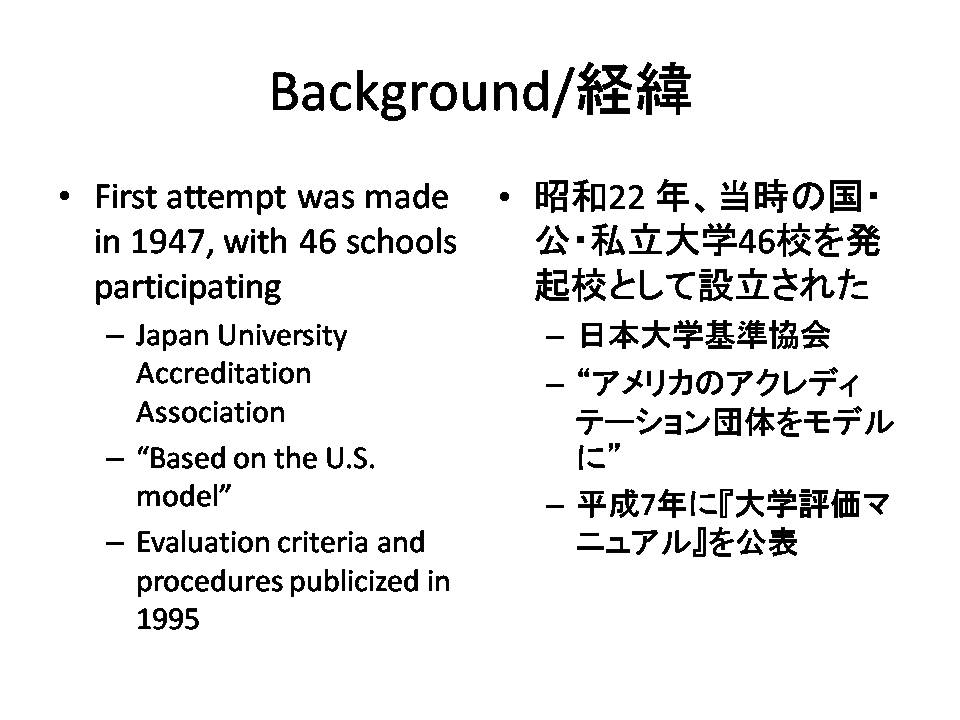
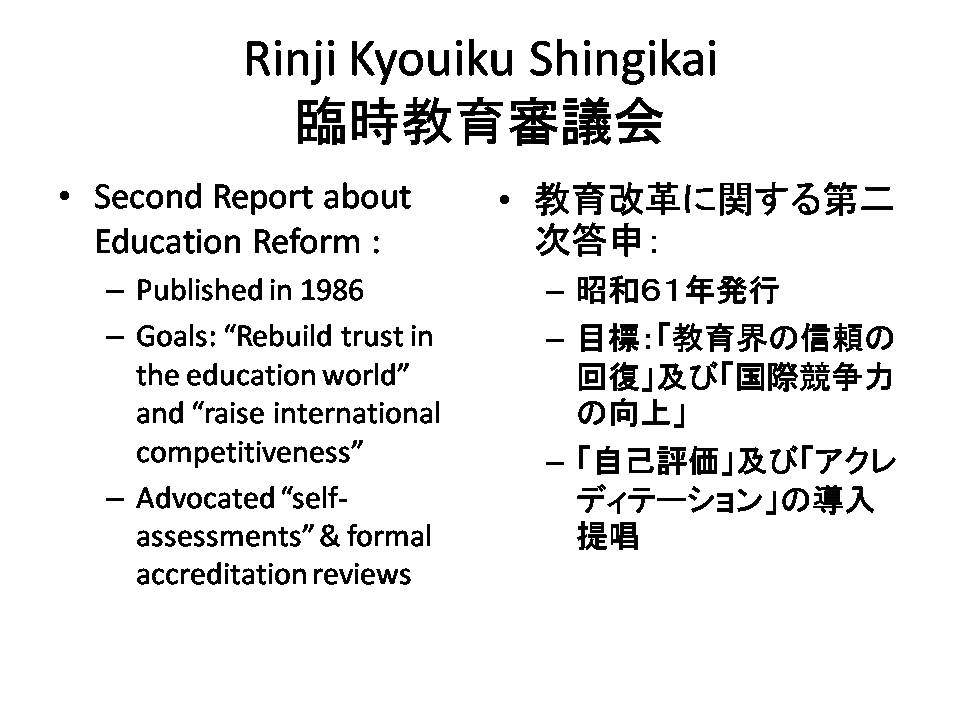
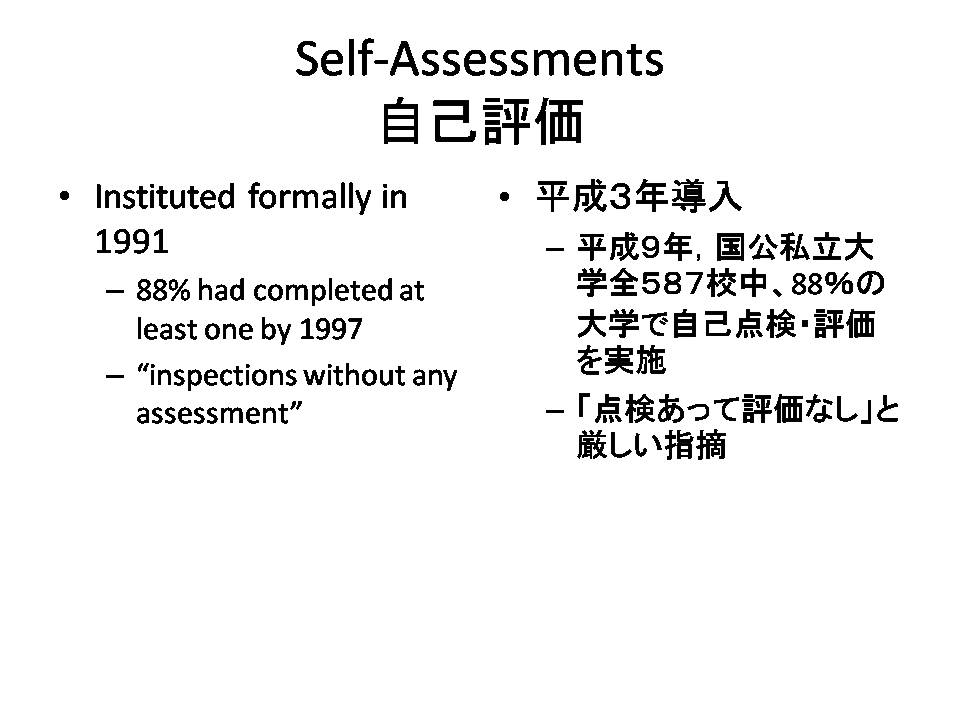
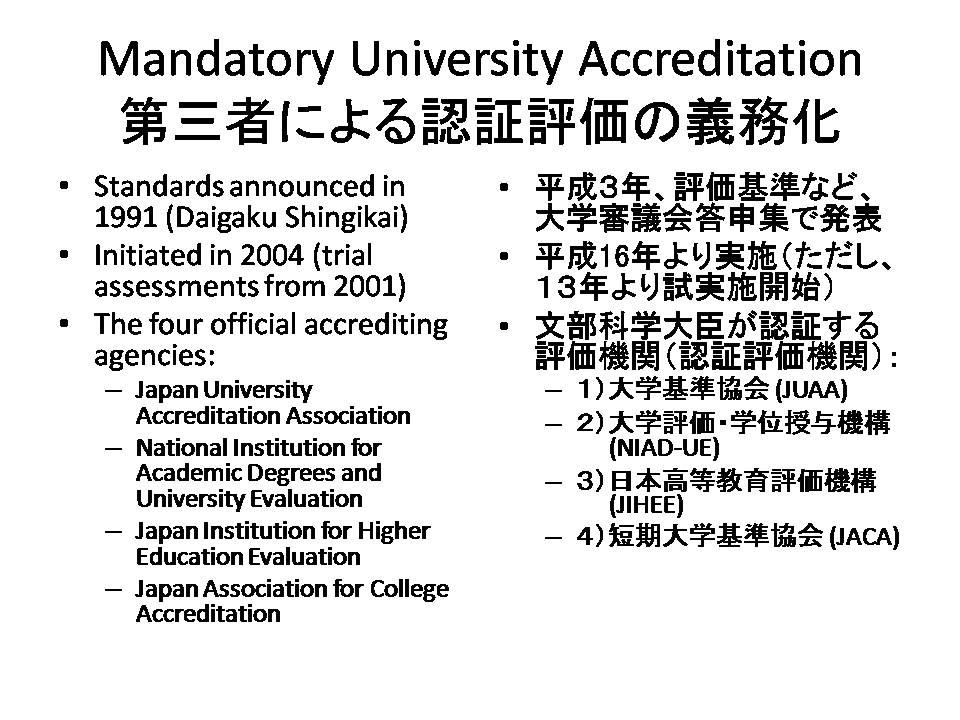
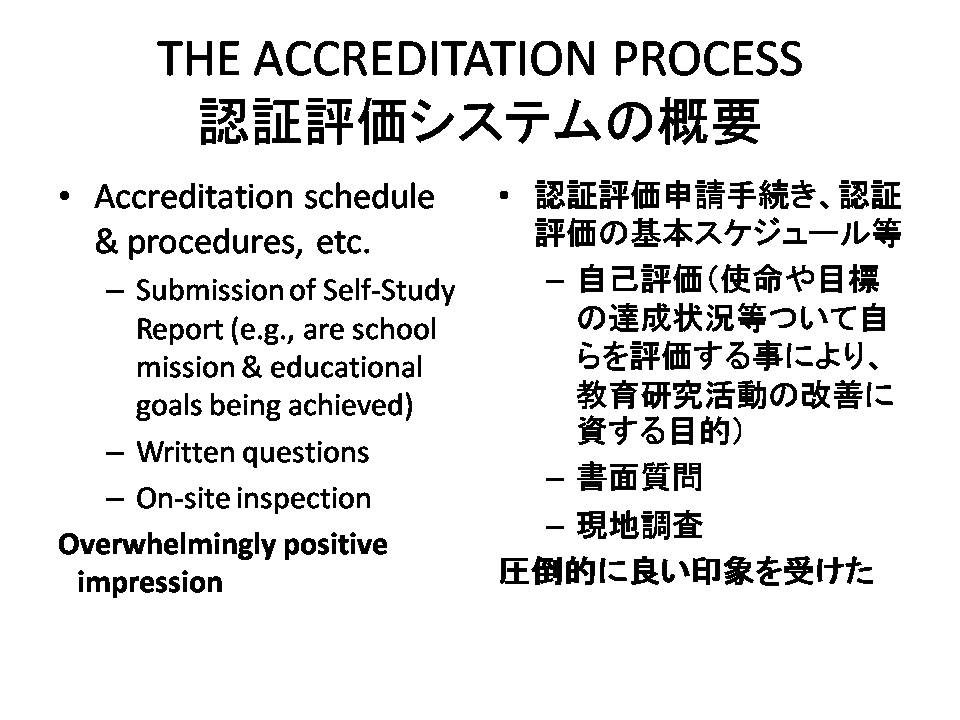
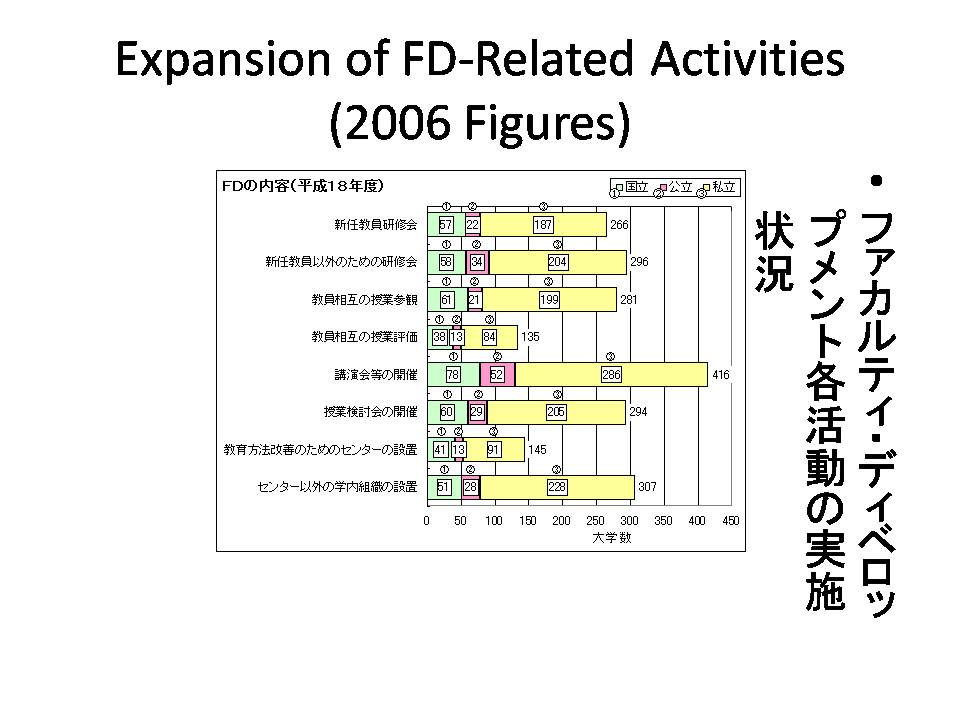
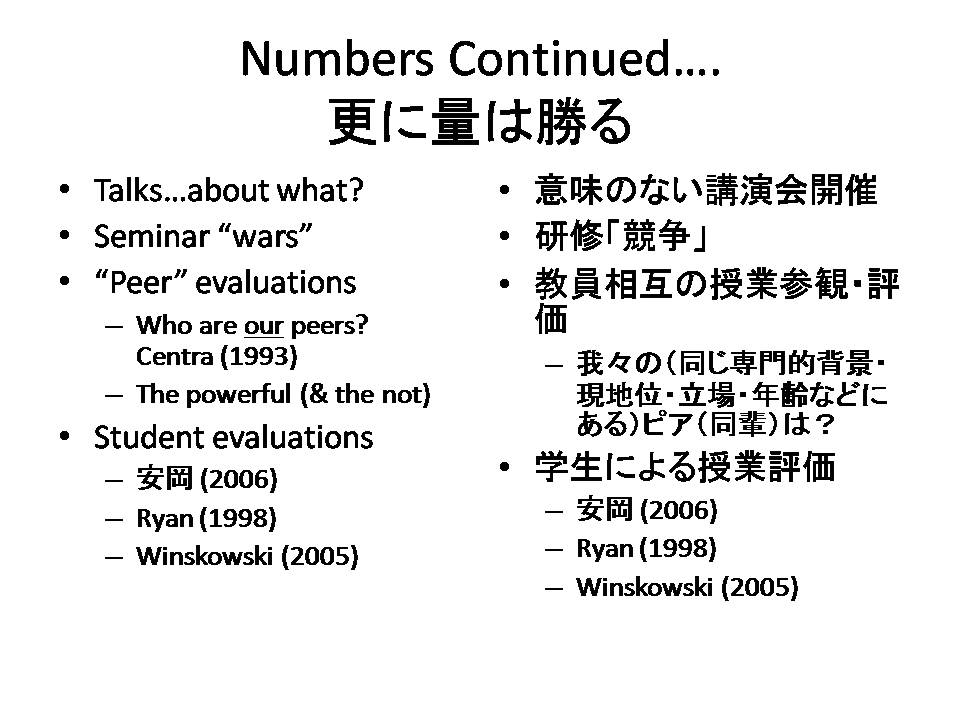
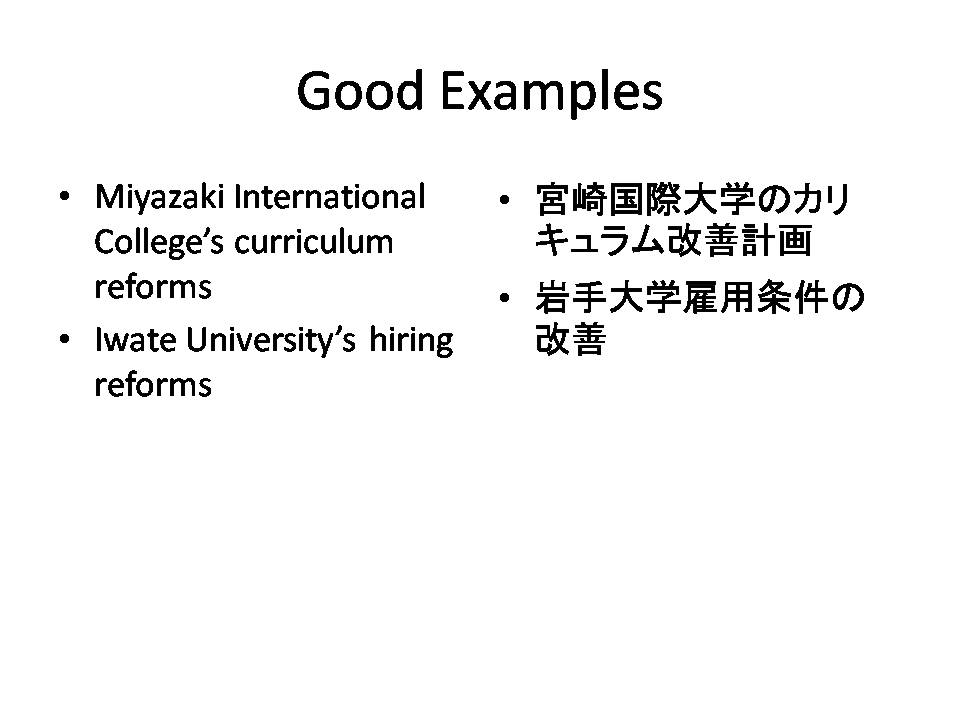
Dr Bern Mulvey of Iwate University gave a presentation for PALE at the national JALT Conference last November. Entitled “UNIVERSITY ACCREDITATION IN JAPAN: PROBLEMS AND POSSIBILITIES“, it outlines how Monkasho (the infamous Education Ministry in Japan) certifies universities as teaching institutions, and what measures it takes to ensure quality control. The presentation shows a lot of the tricks and sleights of hands the universities do to keep their status (particularly in regards to FD — as in that buzzword “Faculty Development”, and peer review) without actually changing much. I asked his permission to reproduce his powerpoint on Debito.org, so here it is as fifteen slides and downloadable ppt format:

https://www.debito.org/?p=5503

////////////////////////////////////////////////

OLD PET PEEVES:

7) Kyodo: GOJ responsible for hardship facing Ainu, incl racial profiling by J police on the street!

Kyodo: A member of a disbanded government panel on policies related to the Ainu said Saturday that the panel wanted to send a message to the government and the public that state policy has imposed hardships on the indigenous people and caused discrimination against them. ‘‘We wanted to make it clear and tell the people in our report that the state was responsible for the suffering imposed on the Ainu and the disparities (between them and the majority group),’’ Teruki Tsunemoto, head of the Hokkaido University Center for Ainu & Indigenous Studies, told a symposium on Ainu policy in Tokyo…

[Ainu panelist] Tomoko Yahata said she was stopped and searched in Tokyo nine times over the six months through October. ‘‘Responding to my question as to why they had stopped me, the police officers said it is because there are many overstaying foreigners,’’ she said. Many Ainu must be facing similar difficulties as they now live nationwide, she suggested…

Tsunemoto was one of the eight members of the panel, which was set up after Japan recognized the Ainu as an indigenous people last year and issued the report in July this year. The panel urged the government in the report to take concrete steps to improve the lives of Ainu people and promote public understanding of them through education.

https://www.debito.org/?p=5401

////////////////////////////////////////////////

8 ) GS on Michael Moore’s rights to complain about being fingerprinted at Japanese border

Introduction: Through the blog of Mr. Arudou Debito (www.debito.org), I’ve read part of Mr. Moore’s interview in Japan, in which he reported his fingerprinting experiences at the border (see https://www.debito.org/?p=5347). Though through this web form my message probably gets to the inbox of a webmaster, I hope you may find my response interesting enough to patch through to him. I would like to provide him with some hopefully interesting food for thought about fingerprinting in general, and the J-VIS (Japanese border check) system in particular.

Mr. Moore apparently got the hostile response that if he refused, he would be deported back to the United States on his question why he would have to be fingerprinted. I guess a good introduction to my story would be to point his attention to Article 4 of the Japanese “Act on the Protection of Personal Information Held by Administrative Organs”…

Conclusion: And yet more food for thought. With almost every other identifier and keys, from physical keys to credit cards to drivers’ licenses to passports, the reason we have them is that we can replace them when the legitimate user gets into trouble because something goes wrong. We would find it unacceptable to hear: “Sorry, we found out your car key / credit card / passport has been copied / isn’t accepted as well as it should be / doesn’t fit / …, but you can’t replace it, so you just have to live with the problem.” Why then do we accept that with fingerprints…?

https://www.debito.org/?p=5469

////////////////////////////////////////////////

9) US Congress Lantos HR Commission on J Child Abductions issue: Letters to Obama & Clinton, my submission for Congressional Record

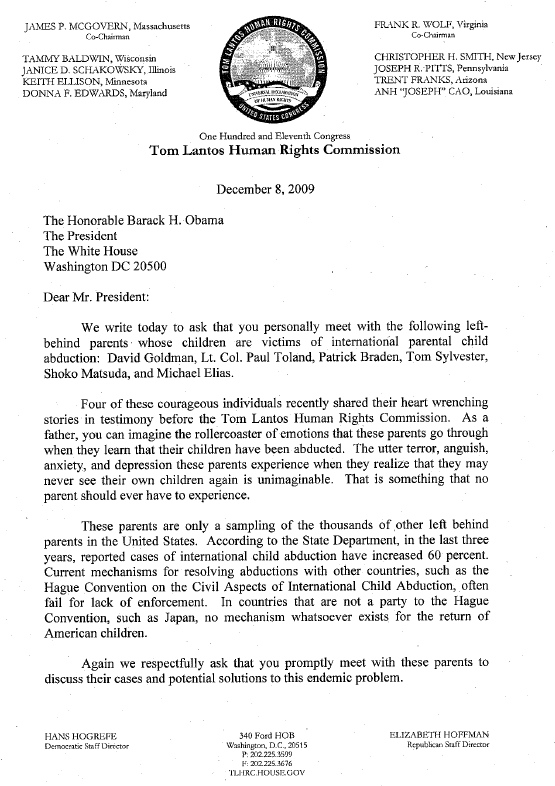
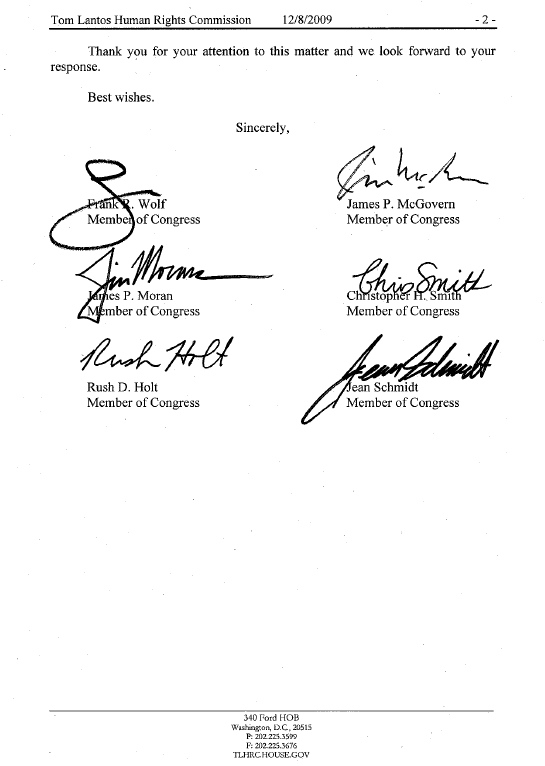
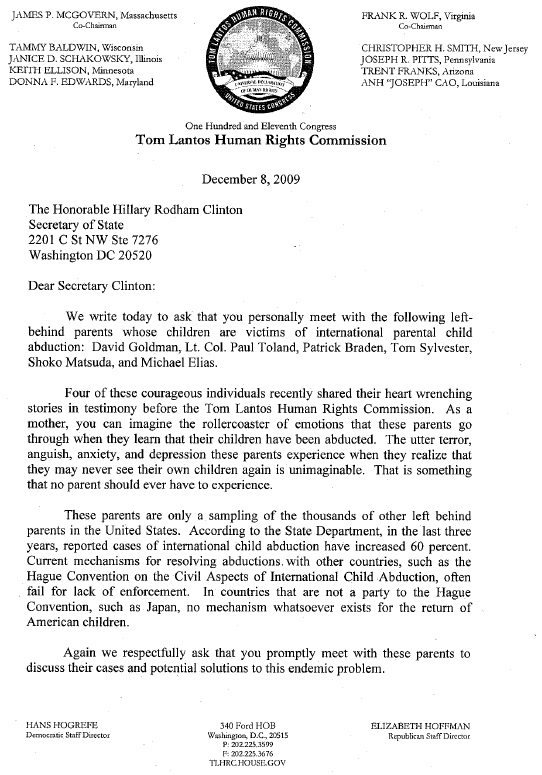
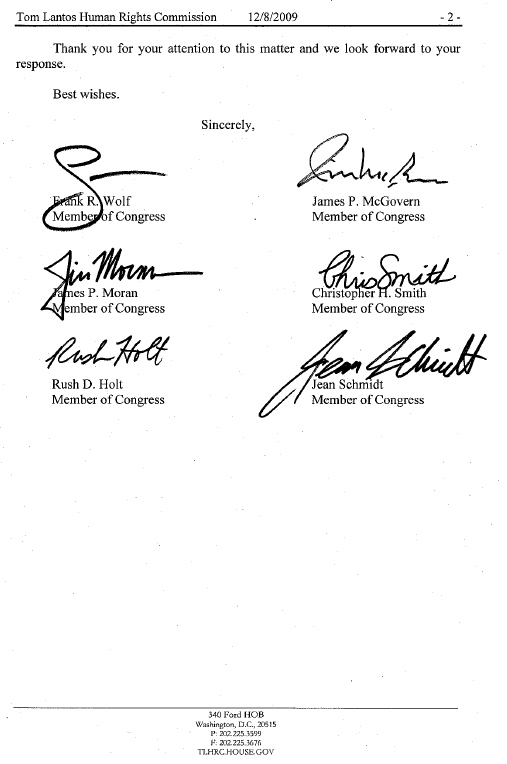
Last week I reported on the US Congress’s investigation of Japan as a haven for international child abductions, and a December 4, 2009 hearing that many of the Left-Behind Parents attended and issued statements to. The Congressman Lantos Human Rights Commission has since issued letters, signed by several Congresspeople, to President Obama and Secretary of State Clinton, requesting they personally meet with select representatives of the LBP and consider their issue. Scans of those letters enclosed below.

I was also invited to write a statement, as a LBP myself, for inclusion in the Congressional Record. The text of that follows the Obama and Clinton letters.

Conclusion to my statement: “In sum, it is my belief that, with Family Laws in Japan as they stand, nobody (Japanese citizen or non-Japanese) should get married and have children in Japan. The risk is just too great. Too many children are getting hurt by a system that encourages Parental Alienation Syndrome, and creates single-parent households that can be acrimonious to the point of deterring the children from becoming parents themselves.

“I urge Congress to encourage Japan not only to sign the Hague Convention on Child Abductions, but also reform its long-outdated Family Law structure. Allow for joint custody and enforced child visitation backed up by criminal law penalties — for the sake of not only American citizens, but also us Japanese citizens.”

https://www.debito.org/?p=5448

////////////////////////////////////////////////

10) UN News: “Ending complacency key to fighting discrimination worldwide”

UN News: The United Nations human rights chief today called on individuals everywhere to consider how they can fight discrimination beginning in their own homes and workplaces, stressing the need to overcome complacency which only contributes to the scourge.

“You cannot defeat discrimination by shutting your eyes to it and hoping that it will go away. Complacency is discrimination’s best friend,” High Commissioner for Human Rights Navi Pillay told a news conference in Geneva, ahead of this year’s Human Rights Day.

https://www.debito.org/?p=5429

////////////////////////////////////////////////

11) EU Observer: “Racism at shocking levels” in European Union

Excerpt from EU Observer: “The EU’s Fundamental Rights Agency first-ever report, published on Wednesday (8 December), attempts to map the contours of discrimination across the bloc in a comprehensive, 276-page survey of over 23,000 individuals. It reveals that over a fifth (22 percent) of sub-Saharan Africans have been discriminated against at least once in the last year while looking for work, 17 percent of Roma say they have experienced similar incidents while being seen by a doctor or nurse and 11 percent of North Africans are subjected to racism when in or simply trying to enter a shop.”

COMMENT: Wish we could get some reportage like this in the J media about domestic discrimination. Oh wait, we don’t even use the word “racial discrimination” as a term of the debate here.

https://www.debito.org/?p=5433

////////////////////////////////////////////////

HOLIDAY TANGENTS:

12) Debito.org Podcast December 20, 2009 (which un-serious articles for a change)

As the year (and the decade) runs out, let’s make my last podcast something a little merrier. I read my first three SAPPORO SOURCE columns, on 1) Hokkaido Winters, 2) Hokkaido Summers, and 3) the concept of The Album (something that is fading as an art form due to “tracks” downloading). Give them a try. Twenty minutes. Plus Duran Duran and Tangerine Dream excerpts, of course.

https://www.debito.org/?p=5522
or from iTunes

////////////////////////////////////////////////

13) Behind the scenes from Copenhagen EcoSummit (COP15), Eric Johnston blog

A reporter I really respect, Eric Johnston of the Japan Times, is currently over in Copenhagen covering the COP15 UN Conference on Climate Change. He is maintaining a daily blog on what it’s like to be a scribe in the thick of it. Interesting reading (especially the entry on a day in the life — I’d burn out at that pace long before the conference ended). A nice diversion on a holiday morning, have a read.

http://blog.japantimes.co.jp/cop15/category/behind-the-scenes/

////////////////////////////////////////////////

14) Headachingly bad Japan travelogue by Daily Beast’s “new travel columnist” Jolie Hunt. Whale on it.

I saw one of the worst Star Trek (TOS) shows ever (one that makes you say, “Give me my 50 minutes back!”, and no, it wasn’t “Spock’s Brain” — it was “Catspaw”; enough said). In the same genre of howlingly bad copy and information, let me send along this little ditty of Japan travelogue by a Ms Jolie Hunt for you to scratch at:

Excerpt: “I hadn’t been to Tokyo in three years and what struck me on a recent three-day visit was how the city seems vaster, yet more accessible for Westerners, than it did when I was last here. Now nearly everyone, from your cabbie to your masseur, can manage a few words in English. And speaking of cabbies, Tokyo’s are glorious. All wear white gloves, have doily-adorned seats, and accept American Express. And no more renting one of those weird cellphones when you visit; 3G now works here. All these comforts and conveniences have a way of making Japan feel less foreign—almost, I dare say, like any other major city.”

Open season.

https://www.debito.org/?p=5435

////////////////////////////////////////////////

15) Next Japan Times JUST BE CAUSE Column out Tues January 5, 2010.
Topic: Roundup: The most significant human rights advances in Japan in 2009.

Yes, it’s that time of the season, where we woolgather and hark back to what the past year has brought us.

And by annual tradition (okay, it’s only the second year running), I’ll be offering a round-up of the most significant human rights advances Japan has allowed us.

Out in the first Tuesday’s Japan Times in January! That’s Jan 5. Get a copy!

////////////////////////////////////////////////

… and finally …

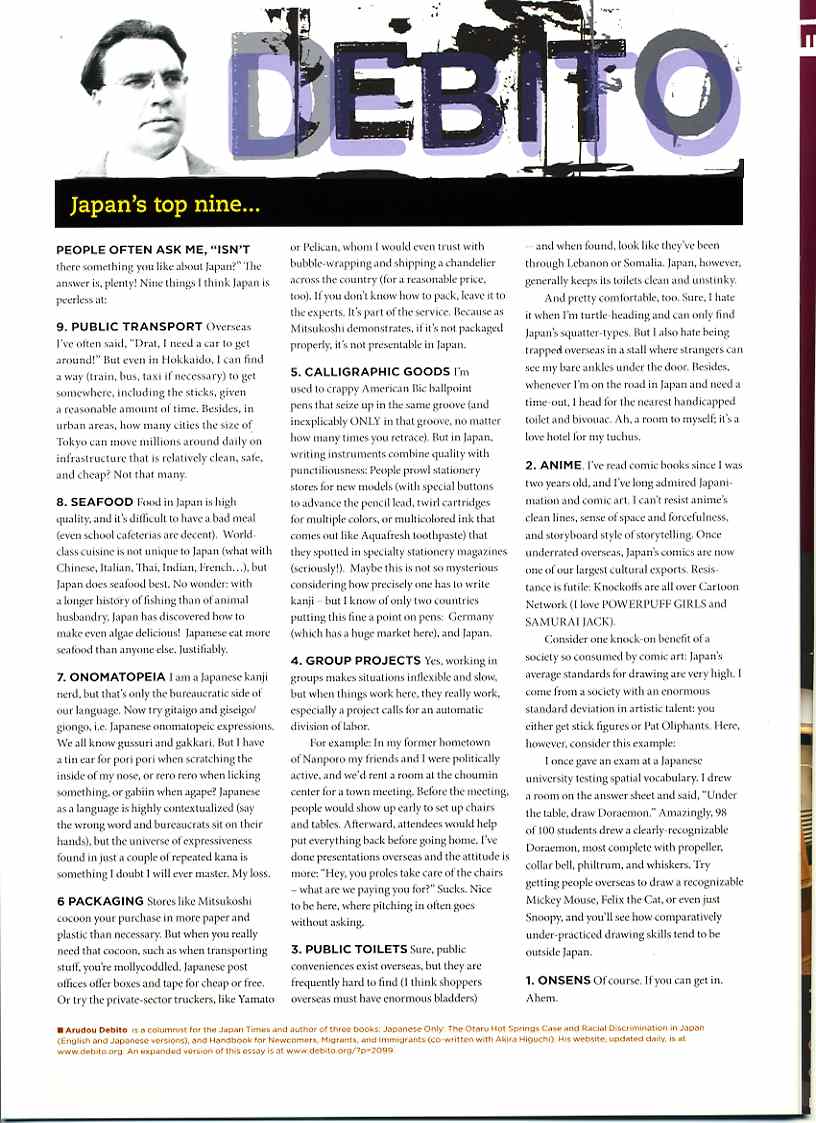
16) SAPPORO SOURCE DEBITO column Dec 2009: Top 9 Things I Like about Japan (full text)

https://www.debito.org/?p=5319

JAPAN’S TOP NINE

SAPPORO SOURCE Column 6 published in December 2009 issue

By Arudou Debito DRAFT SEVEN

People often ask me, “Isn’t there something you like about Japan?” The answer is, plenty! Nine things I think Japan is peerless at:

9) PUBLIC TRANSPORT. Overseas I’ve often said, “Drat, I need a car to get around!” But even in Hokkaido, I can find a way (train, bus, taxi if necessary) to get somewhere, including the sticks, given a reasonable amount of time. Besides, in urban areas, how many cities the size of Tokyo can move millions around daily on infrastructure that is relatively clean, safe, and cheap? Not that many.

8 )SEAFOOD. Food in Japan is high quality, and it’s difficult to have a bad meal (even school cafeterias are decent). World-class cuisine is not unique to Japan (what with Chinese, Italian, Thai, Indian, French…), but Japan does seafood best. No wonder: with a longer history of fishing than of animal husbandry, Japan has discovered how to make even algae delicious! Japanese eat more seafood than anyone else. Justifiably.

7) ONOMATOPEIA. I am a Japanese kanji nerd, but that’s only the bureaucratic side of our language. Now try gitaigo and giseigo/giongo, i.e. Japanese onomatopeic expressions. We all know gussuri and gakkari. But I have a tin ear for pori pori when scratching the inside of my nose, or rero rero when licking something, or gabiin when agape? Japanese as a language is highly contextualized (say the wrong word and bureaucrats sit on their hands), but the universe of expressiveness found in just a couple of repeated kana is something I doubt I will ever master. My loss.

6) PACKAGING. Stores like Mitsukoshi cocoon your purchase in more paper and plastic than necessary. But when you really need that cocoon, such as when transporting stuff, you’re mollycoddled. Japanese post offices offer boxes and tape for cheap or free. Or try the private-sector truckers, like Yamato or Pelican, whom I would even trust with bubble-wrapping and shipping a chandelier across the country (for a reasonable price, too). If you don’t know how to pack, leave it to the experts. It’s part of the service. Because as Mitsukoshi demonstrates, if it’s not packaged properly, it’s not presentable in Japan.

5) CALLIGRAPHIC GOODS. I’m used to crappy American Bic ballpoint pens that seize up in the same groove (and inexplicably ONLY in that groove, no matter how many times you retrace). But in Japan, writing instruments combine quality with punctiliousness: People prowl stationery stores for new models (with special buttons to advance the pencil lead, twirl cartridges for multiple colors, or multicolored ink that comes out like Aquafresh toothpaste) that they spotted in specialty stationery magazines (seriously!). Maybe this is not so mysterious considering how precisely one has to write kanji — but I know of only two countries putting this fine a point on pens: Germany (which has a huge market here), and Japan.

4) GROUP PROJECTS. Yes, working in groups makes situations inflexible and slow, but when things work here, they really work, especially a project calls for an automatic division of labor.

For example: In my former hometown of Nanporo my friends and I were politically active, and we’d rent a room at the choumin center for a town meeting. Before the meeting, people would show up early to set up chairs and tables. Afterward, attendees would help put everything back before going home. I’ve done presentations overseas and the attitude is more: ”Hey, you proles take care of the chairs — what are we paying you for?” Sucks. Nice to be here, where pitching in often goes without asking.

3) PUBLIC TOILETS. Sure, public conveniences exist overseas, but they are frequently hard to find (I think shoppers overseas must have enormous bladders) — and when found, look like they’ve been through Lebanon or Somalia. Japan, however, generally keeps its toilets clean and unstinky.

And pretty comfortable, too. Sure, I hate it when I’m turtle-heading and can only find Japan’s squatter-types. But I also hate being trapped overseas in a stall where strangers can see my bare ankles under the door. Besides, whenever I’m on the road in Japan and need a time-out, I head for the nearest handicapped toilet and bivouac. Ah, a room to myself; it’s a love hotel for my tuchus.

2) ANIME. I’ve read comic books since I was two years old, and I’ve long admired Japanimation and comic art. I can’t resist anime’s clean lines, sense of space and forcefulness, and storyboard style of storytelling. Once underrated overseas, Japan’s comics are now one of our largest cultural exports. Resistance is futile: Knockoffs are all over Cartoon Network (I love POWERPUFF GIRLS and SAMURAI JACK).

Consider one knock-on benefit of a society so consumed by comic art: Japan’s average standards for drawing are very high. I come from a society with an enormous standard deviation in artistic talent: you either get stick figures or Pat Oliphants. Here, however, consider this example:

I once gave an exam at a Japanese university testing spatial vocabulary. I drew a room on the answer sheet and said, “Under the table, draw Doraemon.” Amazingly, 98 of 100 students drew a clearly-recognizable Doraemon, most complete with propeller, collar bell, philtrum, and whiskers. Try getting people overseas to draw a recognizable Mickey Mouse, Felix the Cat, or even just Snoopy, and you’ll see how comparatively under-practiced drawing skills tend to be outside Japan.

1) ONSENS. Of course. If you can get in. Ahem.

900 WORDS

////////////////////////////////////////////////

That’s all for this decade! See you in 2010!

Arudou Debito
Sapporo, Japan (debito@debito.org)
Daily Blog updates, RSS feeds at www.debito.org, Podcasts at iTunes
DEBITO.ORG NEWSLETTER DECEMBER 20, 2009 ENDS

DEBITO.ORG PODCAST DECEMBER 20, 2009

mytest

Handbook for Newcomers, Migrants, and Immigrants to Japan\Foreign Residents and Naturalized Citizens Association forming NGO\「ジャパニーズ・オンリー 小樽入浴拒否問題と人種差別」(明石書店)JAPANESE ONLY:  The Otaru Hot Springs Case and Racial Discrimination in Japansourstrawberriesavatardebitopodcastthumb
UPDATES ON TWITTER: arudoudebito
DEBITO.ORG PODCASTS now on iTunes, subscribe free

DEBITO.ORG PODCAST DECEMBER 20, 2009
HOLIDAY VERSION (with non-serious topics)

debitopodcast

Hi Blog.  As the year (and the decade) runs out, let’s make my last podcast something a little merrier.  I read my first three SAPPORO SOURCE columns, on 1) Hokkaido Winters, 2) Hokkaido Summers, and 3) the concept of The Album (something that is fading as an art form due to “tracks” downloading).  Give them a try.  Twenty minutes.  Plus Duran Duran and Tangerine Dream excerpts, of course.

[display podcast]

Bern Mulvey on the odd MEXT university accreditation system (JALT 2009 powerpoint presentation)

mytest

Handbook for Newcomers, Migrants, and Immigrants to Japan\Foreign Residents and Naturalized Citizens Association forming NGO\「ジャパニーズ・オンリー 小樽入浴拒否問題と人種差別」(明石書店)JAPANESE ONLY:  The Otaru Hot Springs Case and Racial Discrimination in Japansourstrawberriesavatardebitopodcastthumb
UPDATES ON TWITTER: arudoudebito
DEBITO.ORG PODCASTS now on iTunes, subscribe free

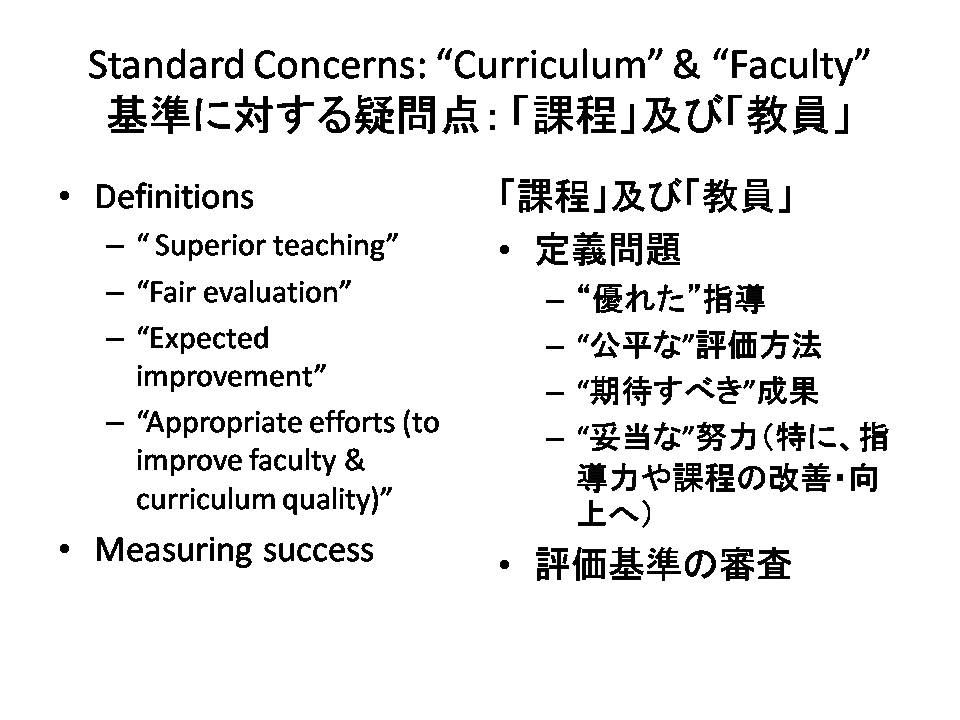
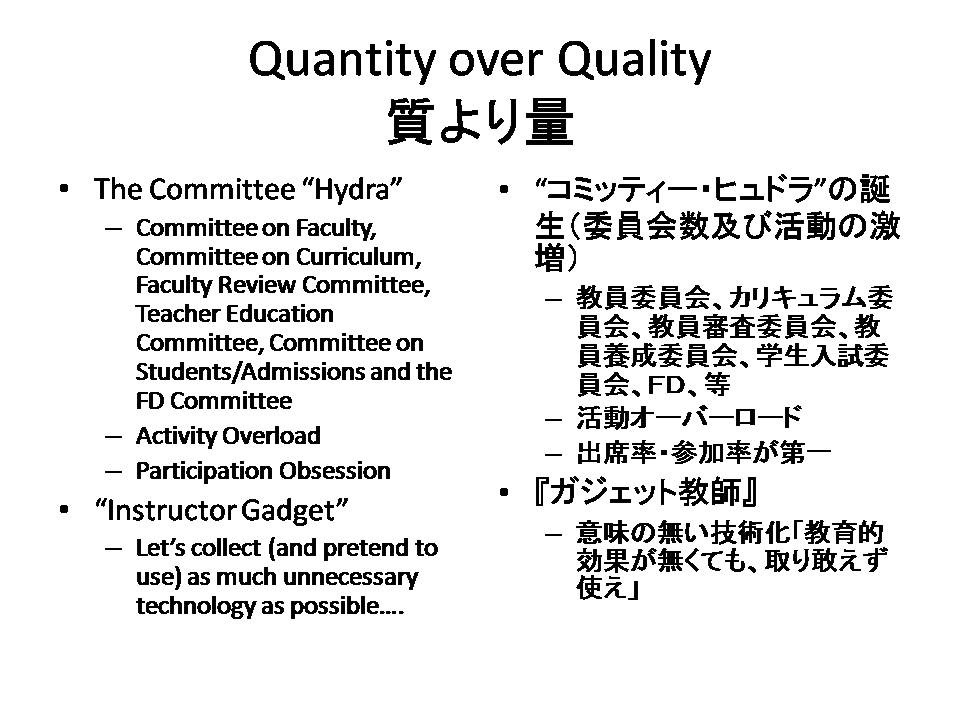
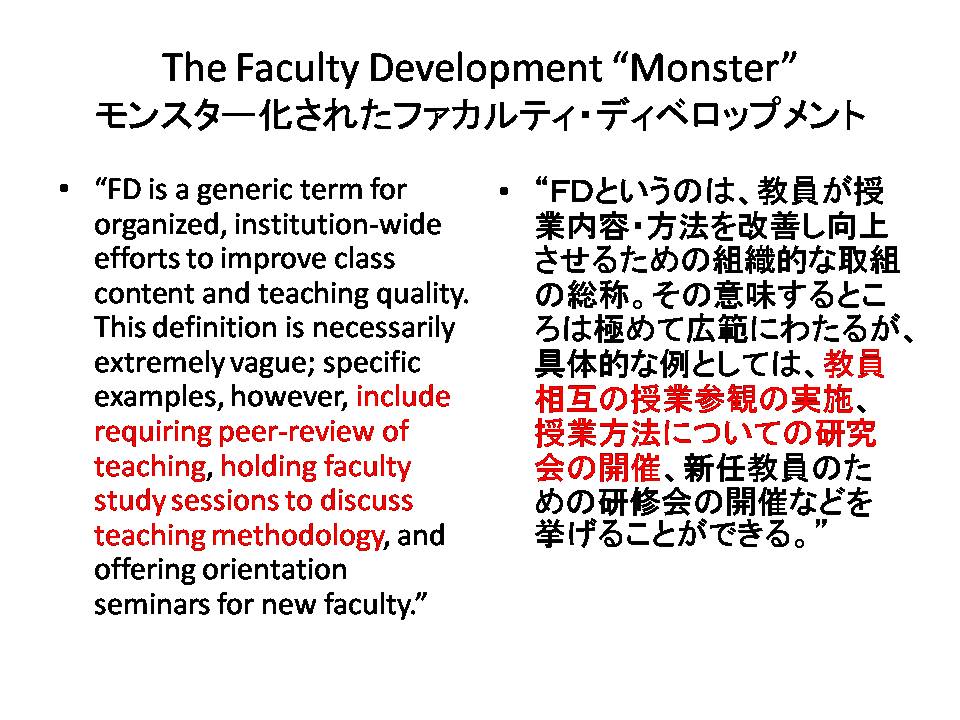
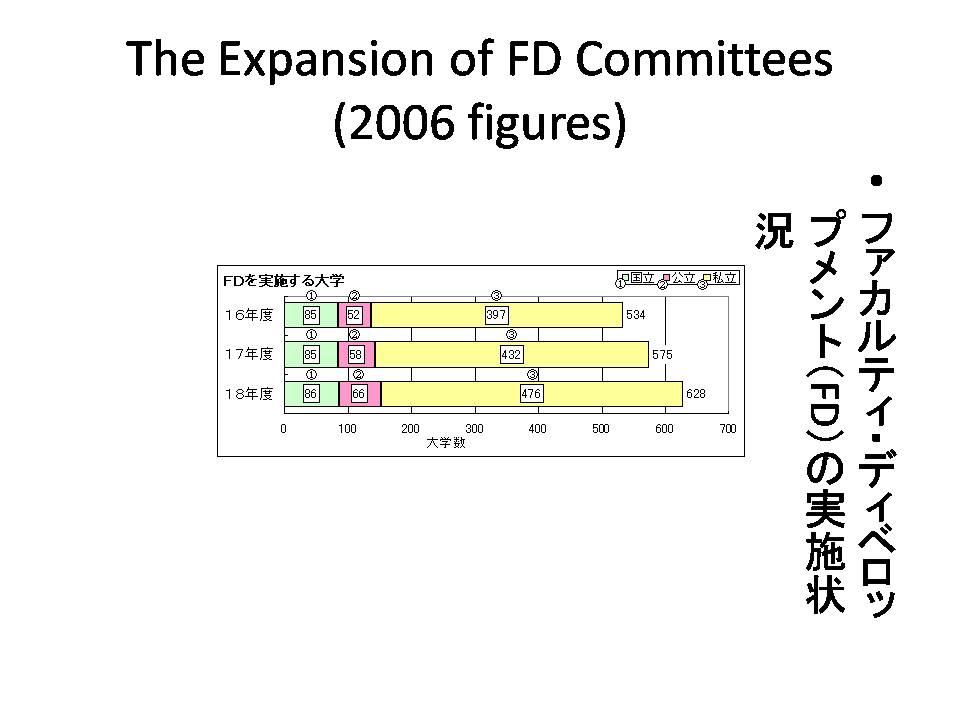
Hello Blog.  Dr Bern Mulvey of Iwate University gave a presentation for PALE at the national JALT Conference last November.  Entitled “UNIVERSITY ACCREDITATION IN JAPAN: PROBLEMS AND POSSIBILITIES“, it outlines how Monkasho (the infamous Education Ministry in Japan) certifies universities as teaching institutions, and what measures it takes to ensure quality control. The presentation shows a lot of the tricks and sleights of hands the universities do to keep their status (particularly in regards to FD — as in that buzzword “Faculty Development”, and peer review) without actually changing much.  I asked his permission to reproduce his powerpoint on Debito.org, so here it is as fifteen slides (jpg format, click to expand in browser).  Or if you prefer to download it in the original .ppt format, click here.  Arudou Debito in Sapporo

スライド 1

スライド 2

スライド 3

スライド 4

スライド 5

スライド 7

スライド 8

スライド 9

スライド 10

スライド 11

スライド 12

スライド 13

スライド 14

スライド 15

ENDS

Kyodo: GOJ responsible for hardship facing Ainu, incl racial profiling by J police on the street!

mytest

Handbook for Newcomers, Migrants, and Immigrants to Japan\Foreign Residents and Naturalized Citizens Association forming NGO\「ジャパニーズ・オンリー 小樽入浴拒否問題と人種差別」(明石書店)JAPANESE ONLY:  The Otaru Hot Springs Case and Racial Discrimination in Japansourstrawberriesavatardebitopodcastthumb
UPDATES ON TWITTER: arudoudebito
DEBITO.ORG PODCASTS now on iTunes, subscribe free

Hi Blog.  Here’s a little article about how other minorities have it in Japan — the Ainu indigenous peoples, for one.  According to this, people of Ainu descent are even being racially profiled by police on the street just like NJ!  Anyone still want to argue that the NPA is not training the police to target foreigners (defined as “foreign looking”, hence the Ainu getting snagged)?  Even the police themselves below justify their actions as ferreting out NJ overstayers.  Read on.  Arudou Debito in Sapporo

//////////////////////////////////

Former panel member says state responsible for hardship facing Ainu
Kyodo News/Japan Today Sunday 06th December 2009,
Courtesy SC
http://www.japantoday.com/category/national/view/former-panel-member-says-state-responsible-for-hardship-facing-ainu
TOKYO —
A member of a disbanded government panel on policies related to the Ainu said Saturday that the panel wanted to send a message to the government and the public that state policy has imposed hardships on the indigenous people and caused discrimination against them. ‘

‘We wanted to make it clear and tell the people in our report that the state was responsible for the suffering imposed on the Ainu and the disparities (between them and the majority group),’’ Teruki Tsunemoto, head of the Hokkaido University Center for Ainu & Indigenous Studies, told a symposium on Ainu policy in Tokyo.

Tsunemoto was one of the eight members of the panel, which was set up after Japan recognized the Ainu as an indigenous people last year and issued the report in July this year. The panel urged the government in the report to take concrete steps to improve the lives of Ainu people and promote public understanding of them through education.

Stressing the need to take specific measures for the Ainu, Tsunemoto, also a professor in constitutional law, said, ‘‘The Ainu have existed uniquely as an indigenous people and they have become a minority group not because they wanted to be but because the majority group of the Japanese advanced into their native land.’‘

‘‘The Ainu did not agree to become minority, so the state must take responsibility for driving them into their current status,’’ he said. ‘‘The panel did not propose providing ‘benefits’ to the Ainu but enhancing Ainu policies, based on the state’s political responsibility.’‘

A survey has shown that Ainu people still lead underprivileged lives, with their income levels and university advancement rate remaining low, compared with the national averages.

At the symposium, some Ainu people living in Tokyo and its vicinity shared their experiences of discrimination and expressed hope for future policy.

Akemi Shimada said, ‘‘People do not know much about the Ainu. Some people in Tokyo said to me when they saw me wearing traditional Ainu clothes, ‘Do the Ainu still exist?’ and ‘Are you from the Ainu country?’ I responded, ‘Where is the Ainu country?’‘’

Tomoko Yahata said she was stopped and searched in Tokyo nine times over the six months through October. ‘‘Responding to my question as to why they had stopped me, the police officers said it is because there are many overstaying foreigners,’’ she said.

Many Ainu must be facing similar difficulties as they now live nationwide, she suggested.

The Ainu at the meeting said they want sufficient support to improve their livelihoods while seeking their own space where they can pursue cultural activities such as traditional dancing, embroidery and cooking.

ENDS

The ludicrousness of Japan’s Salary Bonus System: How it contributes to Japan’s deflationary spiral

mytest

Handbook for Newcomers, Migrants, and Immigrants to Japan\Foreign Residents and Naturalized Citizens Association forming NGO\「ジャパニーズ・オンリー 小樽入浴拒否問題と人種差別」(明石書店)JAPANESE ONLY:  The Otaru Hot Springs Case and Racial Discrimination in Japansourstrawberriesavatardebitopodcastthumb
UPDATES ON TWITTER: arudoudebito
DEBITO.ORG PODCASTS now on iTunes, subscribe free

Hi Blog.  Big news across Japan these past couple of days has been how the Winter Bonus has been slashed between 10 to 15 percent for bureaucrats:

Japan Times Friday, Dec. 11, 2009
Bureaucrats’ winter bonuses shrink
Kyodo News (excerpt)
Central and local government employees got smaller winter bonuses than usual Thursday as the protracted recession took its toll on compensation, according to estimates from the Internal Affairs and Communications Ministry.

The bonus for a 35 1/2-year-old civil servant with a nonmanagerial job came to an average of ¥647,200, down 6.6 percent, while that for a 36.6-year-old local government employee came to ¥607,000, down 7.3 percent, the ministry said.

Rest of the article at http://search.japantimes.co.jp/cgi-bin/nb20091211a5.html

(BRIEF ASIDE FOR THOSE UNFAMILIAR WITH JAPAN’S “BONUS” SYSTEM:  Those of us on regular full-time salaries get paid monthly, then get a “bonus” of several months pay every six months (usually between two to six months’ pay total, divided by two times a year, which in effect increases your total annual salary mathematically by about a third).  This has long been standard practice in Japan, and every June and December the postwar Japanese economy suddenly becomes awash in cash, as families suddenly get a glurt of around 100 man en in their accounts.)

Some people might say, well, tough beans — these bureaucrats were being overpaid anyway, so it’s about time.  The problem is that this practice is a bellwether:  other industries see this as an excuse to cut their own salaries.  My university (which is private-sector, but they directly cited the Bonus cuts to the national bureaucrats (kokka koumuin) as justification) cut all of our Bonuses this year and will continue to do so in perpetuity.  As in:  they cut our bonus multiple from 4.5 months’ salary total per year to 4.15 months’, and will not change that until the national bureaucrats revise their multiple upward.

So that means my Winter Bonus this December dropped by 15% compared to the same Winter Bonus December of last year, or about a drop of 12 man before taxes, and man am I pissed off about it.  (I might add that this is on top of the general trend:  my total annual salary has dropped more than 200 man between 2003 and 2008.)  This means that paying off my bank loan for the house I built back in 1997 (I owe three months’ mortgage payment every bonus), and a bit of insurance on top of that, completely devoured my Bonus for the first time ever yesterday.  Any more cuts, and I’m going to lose money every Bonus period.

That’s if I get a Bonus at all.  That’s the screwy thing about this Bonus System.  It’s fine in a high-speed growth economy, where you have businesses withholding about three to six months’ pay so they can earn interest on it, then pay your employees in a glurt and keep the interest.  But banks in Japan don’t pay interest anymore, so that’s no longer an incentive.

And in a mature (or even flat or negative GDP for the past two decades) economy, the Bonus System just doesn’t make sense anymore.  When you can at whim withhold a third of somebody’s salary just because the company feels it didn’t perform well enough this quarter, that should be cause for strikes and reforms.  But Japan’s unions are pretty weak and underwhelming in negotiations (compared to, say, Korea’s), and I have heard no voices yet for abolishing the Bonus System in favor of a flat (and higher) monthly salary.

I heard yesterday from a friend that he heard on the TV wide shows that only 14% of all people surveyed got a rise in Winter Bonus this December.  Everyone else either had no change, a drop, or NO BONUS AT ALL.  (I searched for a source for this, but came up short.  Debito.org Readers, please have a look around too.)  If this is true, and almost everyone is getting screwed by this system and losing money in real terms, it’s not just a labor issue anymore:  We’re talking about a deflationary spiral, as domestic consumption decreases and domestic demand follows suit, and more companies find themselves yet again cutting Bonuses because they say they have to, but really because they can.

Considering that banks in Japan do not offer refinancing deals (mine, Hoku’you, formerly Takugin, doesn’t; I asked), this deflationary spiral just means they’re taking more money from me even if my monthly payments stayed the same.  (They’re not, by the way — they’ve gone up about 1 man per month over the past two years!  Double whammy.)  And banks are wondering why more people are defaulting on their loans these days?  They should stop being greedy and start lowering their premiums too to match the fact that people in general are being paid less.  But that’s not going to happen for the foreseeable future, because there’s no precedent for it.  Meanwhile, Japan just keeps sinking deeper, as “the system that soured” (to quote Richard Katz) gets more and more sour.

Lose the Bonus System.  It is increasingly becoming a way to deprive workers of a third of their annual salary at corporate whim.  And it only feeds the forces that are hurting Japan’s consumers.  Arudou Debito in Sapporo

====================

UPDATE DEC 17:  Courtesy of Ken.

Winter Bonuses To Fall To 20-Year Low: Nikkei Survey
http://www.nni.nikkei.co.jp/e/fr/tnks/Nni20091210D10JFF05.htm

TOKYO (Nikkei)–Overall winter bonuses to be paid this year will tumble to a level last seen 20 years ago, according to final estimates that Nikkei Inc. released Thursday.

A drop in winter bonuses may mean a gloomy year-end shopping season.

The weighted average bonus is seen falling 14.81% from the previous year to 701,571 yen before taxes, down for the second straight year. This is the sharpest drop since the survey was first conducted in 1978.

The Nikkei tabulated the bonus payment plans of 643 companies. The percentage of firms that will cut bonuses rose from 51% in last year’s survey to 83%. Meanwhile, those planning to raise bonuses fell from 44% to 12%.

The bonus cutback signals that corporations are still trying to curb personnel costs due to uncertainties over future economic trends, despite some earnings improvement from growth in emerging markets.

Bonuses are expected to fall 17.71% at manufacturers. The automobile and electronics sectors, which had increased bonuses in 2008, are poised to cut them by around 20% this year due to slumping exports caused by the global economic downturn and strong yen. Food producers plan to raise bonuses by 0.26%, making it the only group among the 18 manufacturing sectors to boost payments.

Nonmanufacturers plan to reduce bonuses by 5.17%, except for firms in the land transport sector, which plan to bump up payouts by 0.08%.

(The Nikkei Dec. 11 morning edition)

GS on Michael Moore’s rights to complain about being fingerprinted at Japanese border

mytest

Handbook for Newcomers, Migrants, and Immigrants to Japan\Foreign Residents and Naturalized Citizens Association forming NGO\「ジャパニーズ・オンリー 小樽入浴拒否問題と人種差別」(明石書店)JAPANESE ONLY:  The Otaru Hot Springs Case and Racial Discrimination in Japansourstrawberriesavatardebitopodcastthumb
UPDATES ON TWITTER: arudoudebito
DEBITO.ORG PODCASTS now on iTunes, subscribe free

Hi Blog.  I received this very thoughtful email from GS after Michael Moore’s visit to Japan, where he was perturbed by the border fingerprinting.  According to GS, he has every right to be.  Read on.  Arudou Debito in Sapporo

//////////////////////////////////////////////////

December 14, 2009
Dear Debito-san,

Thank you for the heads-up I got on Mr. Michael Moore’s comments regarding fingerprinting.

As you know from our previous e-mail conversations, I am concerned about some aspects regarding the safety of fingerprint verification in general and J-VIS in particular.

Following-up on your article, I have taken the liberty of writing a long message to the website feedback form on Mr. Moore’s website, summarizing my concerns. Please find below a copy of my writing. I hope you find it useful.

===============================

“Dear Sir, Madam,

Through the blog of Mr. Arudou Debito (www.debito.org), I’ve read part of Mr. Moore’s interview in Japan, in which he reported his fingerprinting experiences at the border (see https://www.debito.org/?p=5347). Though through this web form my message probably gets to the inbox of a webmaster, I hope you may find my response interesting enough to patch through to him. I would like to provide him with some hopefully interesting food for thought about fingerprinting in general, and the J-VIS (Japanese border check) system in particular.

Mr. Moore apparently got the hostile response that if he refused, he would be deported back to the United States on his question why he would have to be fingerprinted. I guess a good introduction to my story would be to point his attention to Article 4 of the Japanese “Act on the Protection of Personal Information Held by Administrative Organs” (see http://www.japaneselawtranslation.go.jp/law/detail/?ft=1&re=02&dn=1&x=0&y=0&co=01&ky=personal+data+administrative+organs&page=15, elements in Japanese writing have been deleted but can be seen in the original):

“Article 4 When an Administrative Organ directly acquires Personal Information on an Individual Concerned that is recorded in a document (including a record made by an electronic method, a magnetic method, or any other method not recognizable to human senses [referred to as an “Electromagnetic Record” in Articles 24 and 55]) from the said Individual Concerned, the Administrative Organ shall clearly indicate the Purpose of Use to the Individual Concerned in advance, except in the following cases:
….
(i) Where the acquisition of Personal Information is urgently required for the protection of the life, body, or property of an individual
….
(ii) Where clear indication of the Purpose of Use to the Individual Concerned is likely to cause harm to the life, body, property, or other rights or interests of the Individual Concerned or a third party
….
(iii) Where clear indication of the Purpose of Use to the Individual Concerned is likely to cause impediments to the proper execution of the affairs or business of state organs, Incorporated Administrative Agencies, etc. (which means incorporated administrative agencies prescribed in Article 2, paragraph 1 of the Act on the Protection of Personal Information Held by Incorporated Administrative Agencies, etc. [Act No. 59 of 2003; hereinafter referred to as the “IAA Personal Information Protection Act” ]; the same shall apply hereinafter), local public entities, or Local Incorporated Administrative Agencies (which means local incorporated administrative agencies prescribed in Article 2, paragraph 1 of the Local Incorporated Administrative Agencies Act [Act No. 118 of 2003]; the same shall apply hereinafter)
….
(iv) Where the Purpose of Use is found to be clear in light of the circumstances of the acquisition”

I am not a lawyer (disclaimer), but it would seem to me that when Mr. Moore asked “why?”, he made a lawful request under article 4, while the answer that if he wouldn’t, he would be deported, doesn’t appear to me to be in the spirit of this article. Not to mention that the Immigration Bureau, the responsible party in this scheme, states in their FAQ: “we will properly store and protect your data, according to the basic law for the protection of personal data, the Act for the Protection of Personal Information Retained by Administrative Institutions.” (http://www.moj.go.jp/NYUKAN/nyukan64-2-1.pdf, note by the way the spelling differences in the title…). Right……

Privacy laws generally have a common ancestor and a common purpose. In 1980, a workgroup within the OECD (http://www.oecd.org/home/0,2987,en_2649_201185_1_1_1_1_1,00.html) published the “OECD Guidelines on the Protection of Privacy and Transborder Flows of Personal Data” (http://www.oecd.org/document/18/0,3343,en_2649_34255_1815186_1_1_1_1,00.html), with eight key principles that form the basis of privacy laws worldwide. Contrary to both the statements: “If you have nothing to hide, you have nothing to fear” and “Big Brother is watching you”, these guidelines (roughly said) recognize the general legitimacy of using personal information, provided that such use is safe, sane and sensible.

Safe, sane and sensible… One is left to wonder about this when it comes to fingerprinting schemes worldwide… From what I understand, the key reason for implementing such schemes is the assumption that fingerprints provide a ‘silver bullet’ solution to identifying people, being unique, impossible to forge, and impossible to misidentify. However, by now it’s safe to say that fingerprinting schemes are not the ‘silver bullet’ hoped for, and that they are creating problems which might easily lead to grossly unfair treatment to individuals being unfortunate enough to become victims of such a problem.

Leaving all kinds of other problems aside, I would like to react to the assumption that fingerprints are impossible to forge first. One can find plenty of proof that fingerprints can be copied. The University of Yokohama (http://www.lfca.net/Fingerprint-System-Security-Issues.pdf) has published it’s groundbreaking article on this now almost 8 years ago, the Chaos Computer Club in Germany (http://dasalte.ccc.de/biometrie/fingerabdruck_kopieren), and the Mythbusters (http://www.youtube.com/watch?v=MAfAVGES-Yc) have spectacularly shown that it is possible. But the proof of the pudding is that in fact at least one person has been caught in Japan after defeating the J-VIS system (among others: http://archives.chicagotribune.com/2009/jan/02/nation/chi-090102-faked-fingerprint-japanese-airport). Some food for thought, the woman bought her fingerprints, so not only is it possible, but there are people out there making money on it. More food for thought in a few questions: Were the original prints from which the copies were made stolen? Were the copies registered as unreliable? And will the rightful owner get into trouble because someone else stole her/his fingerprints and did something unlawful? The answer is a triplicate: “We don’t know”. What we do know is that someone who is the victim of such identity theft is in for some serious trouble in those places where the assumption is still that it can’t be done…

The assumption that it’s impossible to misidentify people based on fingerprints is also incorrect. In this respect it may be the most interesting to follow the trail of the J-VIS devices.

On at least one of the airports, the devices used are from the company NEC. NEC is not very secretive about the tests proving the quality of it’s devices, they post links to the test results on their own website, with the headline NIST(= (US) National Institute for Standards and Technology)-Proven Accuracy (http://www.nec.com/global/solutions/biometrics/technologies/nist.html). But what is this accuracy?

Only the FpVTE2003 appears to test the kind of verification that is in use for J-VIS. On this, NEC says: “The FpVTE2003 was an international benchmark test of fingerprint matching, identification, and verification systems, conducted in the United States in 2003 under the control of one of the US’s most respected government authorities, the NIST.” So what does this test say? The Summary of Results (http://fpvte.nist.gov/report/ir_7123_summary.pdf) says:

“The most accurate fingerprint system tested (NEC MST) using operational quality single fingerprints:
• 99.4% true accept rate @ 0.01% false accept rate
• 99.9% true accept rate @ 1.0% false accept rate”

It is good here to explain the technical language. In the context of US-VISIT or J-VIS, fingerprints are checked against a list of unwelcome people, while NIST uses the standard terms for checking against a list of authorized (= welcome) people. This creates confusing language, but it can be explained fairly easily. A True Accept in the spirit of the US-VISIT or J-VIS system means that an unwelcome person (say, Mr. X) shows up and is recognised because of a fingerprint match. A False Accept means that a welcome person (say, Mr. Michael Moore) shows up, but is incorrectly recognized as Mr. X because of a false fingerprint match.

At this point, I would like to entertain Mr. Moore with a little side step, to which I get back later. What would a False Accept Rate of 0.01% mean? That’s infinitely small, right? Well, the J-VIS system went into operation on November 20th, 2007. I don’t have day-by-day figures on the number of visitors, but I can tell that in the year from December 1st, 2007 to November 30th, 2008, 8,513,909 visitors were registered in Japan (http://www.tourism.jp/statistics/xls/JTM_inbound20091027eng.xls). I would therefore expect 851 false alarms based on a False Accept Rate of 0.01%. It is not infinitely small.

So the question comes up: “Is fingerprint verification a form of Russian Roulette?” The answer is: “Not necessarily”. No system is perfect against theft or mistakes. But if the people running the system are well-trained and thorough, it is likely that they can spot and correct the problem before serious damage is done to the victim of either problem above. But for that to work and the people subjected to such a system to be safe, one principle is vital: Every person in the organization must have the capabilities of being able to take criticism, and also a healthy dose of self-criticism. That is never easy, and the more damage already done, the more difficult it becomes.

…And right at that point is where the comparison the officials from Japan’s Immigration Bureau made to Mr. Moore ends. One of the officials apparently told him: “But you do this in the United States, when we visit the United States.” True, they do undeniably verify fingerprints. They also undeniably verify and correct false alarms. In the words of Mr. Neil Latta, US-VISIT IDENT Program Manager at the time of writing of the following document (http://fingerprint.nist.gov/standard/archived_workshops/workshop1/presentations/Latta-LessThan10.pdf): “1:many Accuracy For a 2-finger Search Against a 6M Subject Database is 95% With a False Hit Rate of 0.08% (Exceeding US-Visit Requirements)”. And: “0.4% FAR Results in (0.4% x 100K Trxs/Day) = 400 Examiner Verifications”. Again in less technical terms, they verify false alarms, they know how many false alarms there are, and so on. Granted, given the reputation of ‘outstanding customer friendliness’ that Homeland Security has carved out for themselves, this is still likely to be a rather unpleasant experience, and there is almost certainly room for considerable improvement. But at the end of the day, here is the written proof that the Department of Homeland Security is capable of admitting mistakes.

Is this also the case on the Japanese borders? The answer is again: “We don’t know”. But in itself, this is an answer too. Just some food for thought, there’s nothing in the quoted FAQ, and the incident Mr. Moore had is not exactly the first one where the organization reacts with hostility to something that sounds remotely like criticism. It’s not exactly reassuring to have to depend for your own safety on the ability of an organisation to take (self-) criticism, while on less important details the same organisation shows a distinctive lack of that same ability.

And one detail gives more food for thought that is not very reassuring. Remember the 851 false alarms I would expect if there was a false accept rate of 0.01%? On November 29th, 2008, the Japanese Ministry of Justice (of which the Immigration Bureau is a part) made a press release stating that they had deported a total of 846 people based on fingerprint matches in the first year of operation (http://www.breitbart.com/article.php?id=D94NKV182&show_article=1). That is only five off that number… Or differently put, 846 people is 0.00994% of 8,513,909 visitors. The difference with a false accept rate of 0.01% is only 0.00006%… Is this proof that there is a Russian Roulette situation? Certainly not. From the same sources we also have the numbers for South Koreans (297 people deported, total visitors – from both Koreas, admittedly leaving a margin for doubt: 2,483,288, percentage = 0.01196%), Chinese (90 people deported, total visitors 1,000,228, percentage = 0.008998), and Filipino’s (155 people deported, total visitors 82,473, percentage = 0.18%, way off the mark). But some food for thought: Out of four groups of visitors, only the smallest group is way off the mark. The other ones are groups of more than one million visitors. And the larger the group of visitors, the closer we get to the mark of 0.01%. That is a curious set of coincidences…

And yet more food for thought. With almost every other identifier and keys, from physical keys to credit cards to drivers’ licenses to passports, the reason we have them is that we can replace them when the legitimate user gets into trouble because something goes wrong. We would find it unacceptable to hear: “Sorry, we found out your car key / credit card / passport has been copied / isn’t accepted as well as it should be / doesn’t fit / …, but you can’t replace it, so you just have to live with the problem.” Why then do we accept that with fingerprints…?

I’m sorry for this long message. I hope it has been worthwhile reading though.

Kind Regards, GS”

===============================

And of course the kind regards are for you as well.

ENDS

Hoofin: Health insurance advocate “Free Choice Foundation” is fronting US health insurance business

mytest

Handbook for Newcomers, Migrants, and Immigrants to Japan\Foreign Residents and Naturalized Citizens Association forming NGO\「ジャパニーズ・オンリー 小樽入浴拒否問題と人種差別」(明石書店)JAPANESE ONLY:  The Otaru Hot Springs Case and Racial Discrimination in Japansourstrawberriesavatardebitopodcastthumb
UPDATES ON TWITTER: arudoudebito
DEBITO.ORG PODCASTS now on iTunes, subscribe free

Hi Blog.  What follows is an essay written not by me, but by an alert friend who thinks something fishy is going on here.  Look:

///////////////////////////////////////////

Readers may remember a few months back when Debito.org posted about a new Immigration guideline that suggested the government would be checking for registration with national health insurance (kokumin kenko hoken) or the employee version (kosei kenko hoken) on visa renewals.  https://www.debito.org/?p=4026

As has been explained in Higuchi and Arudou’s Handbook for Newcomers, Migrants, and Immigrants https://www.debito.org/handbook.html, all residents are required to be enrolled in one of these, or some lesser known ones that are accepted by the government.

In the past, enforcement of this rule seems to have been lax.   So the new guideline was meant to make it less lax.

A group styling themselves as the “Free Choice Foundation”  http://www.freechoice.jp became an internet presence to object to this enforcement of the rules, which they call a “change” of the rules.    Their main theme, avoidance of kokumin kenko hoken (or kousei kenko hoken), has been couched in terms of consumer choice, language barriers, and a failure of the Japanese medicine to live up to some standard particular to “foreigners”.  But their remedy is only that NJ residents should be able to buy what amounts to gap insurance through the internet, or presumably go without insurance entirely if they choose.   They say that, for the Japanese government, this should be the end of the story.

The chairman of the Free Choice Foundation, Ronald Kessler, made his arguments in a September 29, 2009 Japan Times story, here: http://search.japantimes.co.jp/cgi-bin/fl20090929zg.html

Now blogger Hoofin, a regular commenter here, seems to have found a connection between  Kessler and HealthOne, one of the main companies in Japan using the internet to sell policies to NJ residents. http://hoofin.wordpress.com/2009/12/12/freechoice-jps-ron-kessler-is-connected-to-healthone-japan/

Moreover, Kessler K.K., the Free Choice Foundation, HealthOne and its sponsoring company, Legend Travelers, as well as “National Health Insurance Watch”–a website that shares different two ways (with a disclaimer!) how NJ can use deceit to get themselves off kokumin kenko hoken—all five are supported by the same internet server that is registered to Mr. Kessler.  In America no less! http://hoofin.wordpress.com/2009/12/13/ron-kesslers-freechoice-jp-tied-to-website-telling-foreigners-tricks-to-get-out-of-nhi/

What is the real story?   Is it about free choice?   Fairness to NJ?   Or simply arguing that Japan should ignore its own social insurance laws when it comes to NJ, so that someone else can make a business out of it?
///////////////////////////////////////////

COMMENT:  Yeah, come to think of it:  As a person who has always had a difficult time scraping together much money for activism (believe me, I’ll always be impoverished by my activities), I was curious how this group was able to make all this money for a very flash website, lobbying, advertising in broadsheet publications…

Arudou Debito in Sapporo

US Congress Lantos HR Commission on J Child Abductions issue: Letters to Obama & Clinton, my submission for Congressional Record

mytest

Handbook for Newcomers, Migrants, and Immigrants to Japan\Foreign Residents and Naturalized Citizens Association forming NGO\「ジャパニーズ・オンリー 小樽入浴拒否問題と人種差別」(明石書店)JAPANESE ONLY:  The Otaru Hot Springs Case and Racial Discrimination in Japansourstrawberriesavatardebitopodcastthumb
UPDATES ON TWITTER: arudoudebito
DEBITO.ORG PODCASTS now on iTunes, subscribe free

Hi Blog.  Last week I reported on the US Congress’s investigation of Japan as a haven for international child abductions, and a December 4, 2009 hearing that many of the Left-Behind Parents attended and issued statements to.  The Congressman Lantos Human Rights Commission has since issued letters, signed by several Congresspeople, to President Obama and Secretary of State Clinton, requesting they personally meet with select representatives of the LBP and consider their issue.  Scans of those letters enclosed below.

I was also invited to write a statement, as a LBP myself, for inclusion in the Congressional Record.  The text of that follows the Obama and Clinton letters.  FYI.  Arudou Debito in Sapporo

(click on any image to expand in your browser)

//////////////////////////////////////////////

lantoscommission1208091lantoscommission1208092lantoscommission1208093lantoscommission1208094

SUBMISSION FOR THE UNITED STATES CONGRESSIONAL RECORD
REGARDING POST-DIVORCE PARENTAL ACCESS TO CHILDREN IN JAPAN
December 10, 2009

By ARUDOU Debito, Sapporo, Japan
Associate Professor, Hokkaido Information University, and Columnist, The Japan Times newspaper (debito@debito.org, www.debito.org, cell +81[…])

I am a former American citizen (named David Christopher Aldwinckle) who became a Japanese citizen in October 2000. I have been living in Japan permanently since 1993, for a total of nearly 23 years. I wish to offer my testimony to Congress, as a divorced and left-behind father in Japan (who hasn’t seen his children for years), and from the perspective an immigrant. I hope to demonstrate how Japan needs drastic reforms to its child-custody and visitation system, not only for the benefit of its international marriages, but also for its own citizens.

Japan has not changed its divorce laws significantly since 1898 (Source: Harald Fuess, Divorce in Japan), particularly in regards to child custody and visitation. Its family registration system treats children like property, since after divorce children’s names are annotated on only one parent’s Family Register (koseki). This means joint custody is legally impossible in Japan (particularly for non-citizens, who by definition do not have a Japanese Family Register). The Registry System is used as grounds to sever one parent legally from a child’s life, a violation of children’s rights to be legally tied to and have access to both parents.

Additionally, child visitation, although technically permissible through negotiated Family Court settlement, is unenforceable in Japan. There are no criminal penalties if the custodial parent unilaterally decides to deny visitation with the non-custodial parent, and no effective enforcement mechanism exists in Japan’s administrative bodies to ensure that both sides keep their promises. Moreover, Japan’s flawed alimony child-support system (custodial mothers are legally entitled to receive benefits from the father, but custodial fathers are not; moreover enforcement in any case is often weak and needs time-consuming court orders) means that in a post-divorce dispute, “Fortress Moms” (who isolate the children) and “Deadbeat Dads” (who disappear financially, sometimes even change jobs to become untraceable) are not unusual in Japan.

None of this is beneficial to Japanese society, and if there is a (strong) chance that one parent will lose all access to his or her children after divorce, this is not encouraging for Japan’s future. Things are already unsustainable — with a rapidly-aging society and record-low birthrates below replacement levels.

In sum, it is my belief that, with Family Laws in Japan as they stand, nobody (Japanese citizen or non-Japanese) should get married and have children in Japan. The risk is just too great. Too many children are getting hurt by a system that encourages Parental Alienation Syndrome, and creates single-parent households that can be acrimonious to the point of deterring the children from becoming parents themselves.

I urge Congress to encourage Japan not only to sign the Hague Convention on Child Abductions, but also reform its long-outdated Family Law structure. Allow for joint custody and enforced child visitation backed up by criminal law penalties — for the sake of not only American citizens, but also us Japanese citizens.

ENDS

Sunday Tangent: Headachingly bad Japan travelogue by Daily Beast’s “new travel columnist” Jolie Hunt. Go to town on it.

mytest

Handbook for Newcomers, Migrants, and Immigrants to Japan\Foreign Residents and Naturalized Citizens Association forming NGO\「ジャパニーズ・オンリー 小樽入浴拒否問題と人種差別」(明石書店)JAPANESE ONLY:  The Otaru Hot Springs Case and Racial Discrimination in Japansourstrawberriesavatardebitopodcastthumb
UPDATES ON TWITTER: arudoudebito
DEBITO.ORG PODCASTS now on iTunes, subscribe free

Hi Blog. Sunday Tangent time: I saw one of the worst Star Trek (TOS) shows ever (one that makes you say, “Give me my 50 minutes back!”, and no, it wasn’t “Spock’s Brain” — it was “Catspaw”; enough said).   In the same genre of howlingly bad copy and information, let me send along this little ditty of Japan travelogue by a Ms Jolie Hunt, whose qualifications are, quote:

“Jolie Hunt travels on her own dime for more than 50 percent of the year. She is the global head of public relations for Thomson Reuters, appointed April 2008. Prior to that, she served as global director of corporate and business affairs for IBM Corporation She was the director of PR for the Financial Times. She lives between New York and London.”

Her “Catspaw Article” follows. Go to town on it. And better yet, follow the link back to The Daily Beast and see how fellow commenters go to town on it as well.

Why don’t we Japan-residents ever get any of these sweet gigs? At least they wouldn’t have to pay us intercontinental airfare.  And we’d know what we’re talking about. Arudou Debito in Sapporo

=============================

Gal With a Suitcase

by Jolie Hunt


The Daily Beast, undated, spotted by AG November 30, 2009 http://www.thedailybeast.com/blogs-and-stories/2009-11-27/gal-with-a-suitcase-2/full/


Jolie Hunt
Our new travel columnist visits Tokyo, a place at once colorfully chaotic and contemplatively serene—and more accessible to Westerners than ever before.

Welcome to Tokyo, home of Harajuku, supersonic toilets, and food that can make even the sturdiest stomach reconsider career options. Every traveler wants to visit Tokyo, but making the schlep (and it is a schlep, from virtually anywhere) is an entirely different matter. But believe me, it’s worth it.

I hadn’t been to Tokyo in three years and what struck me on a recent three-day visit was how the city seems vaster, yet more accessible for Westerners, than it did when I was last here. Now nearly everyone, from your cabbie to your masseur, can manage a few words in English. And speaking of cabbies, Tokyo’s are glorious. All wear white gloves, have doily-adorned seats, and accept American Express. And no more renting one of those weird cellphones when you visit; 3G now works here. All these comforts and conveniences have a way of making Japan feel less foreign—almost, I dare say, like any other major city.

This can be a chaotic, rebellious place, where fashionistas in Hello Kitty haute couture strut the streets of Shibuya, and young punks with 10-inch Mohawks screech from makeshift stages in grimy underground clubs.

Thankfully, what remains unchanged are the enchanting Japanese. Many of the clichés remain true: flawless etiquette in every encounter (even if I was occasionally called “mister”), exquisitely prepared food, perfect-in-every-way service, and masterful in the art of the business deal. I like that life here retains a tinge of formality, too. Take, for example, press releases, hand-delivered to all journalists in the Nikkei by a bike-messenger every day—no blast email, no fax.

But just when you think you’ve got Japan figured out, it surprises you. This can be a chaotic, rebellious place, where fashionistas in Hello Kitty haute couture strut the streets of Shibuya, and young punks with 10-inch Mohawks screech from makeshift stages in grimy underground clubs.

Before we get to the tips, one little bento box of warning: Tokyo isexpensive. If Sofia Coppola were making her movie in 2009, I’d propose the title Cost in Translation. The only place I’ve been that’s more outrageously pricey is Moscow, and you typically get caviar as part of that experience. If you’re on a budget, don’t come—you haven’t a chance in the world. Instead, arm yourself with the phrase takai neh (“How much?!”) and be prepared to shell out. GWS learned this lesson the hard way when trying to buy a basic hair band that would cost no more than $12 anywhere else, but here was quoted at $79. Suffice to say, I did not leave Japan with a new head accessory.

Hotels

Park Hyatt remains a fave. It boasts jaw-dropping views of Mt. Fuji on a clear day, and the infamous New York Grill on the 52nd floor, which I tend to give a miss due to the oppressively loud jazz music. There’s a delicious breakfast at Girandole on the 41st floor, and big, heavenly beds in every one of the 178 rooms, including 23 suites. Skip the gauche, ‘70s-styled spa called “Club on the Park,” but do everything else. Service is mwah—superb concierge. Its location in the Shibuya area is a bit of a haul, but nowhere is perfect. Starting at 35,700 yen (about $400.)

3-7-1-2 Nishi Shinjuku, Shinjuku-ku, Tokyo
03-5322-1234
www.tokyo.park.hyatt.com

Few do it better than The Peninsula, a three-minute walk from uber-posh Ginza, across from the Imperial Palace. The neighborhood is gorgeous, and the 24th floor’s restaurant, Peter, is a destination in and of itself. Also a big fat winner is their spa, Espa. 314 rooms and 47 suites, from 60,000 yen (around $685. Ouch.)

1-8-1 Yurakucho, Chiyoda-ku, Tokyo
03-6270-2888
www.tokyo.peninsula.com

Claska is, strangely, one of the only designer-boutique options in the city. 12 rooms (nine Western, three traditional tatami style) and a hopping lobby scene, but you must book early. It’s out of the way, but it’s reasonable: rooms from 12,600 yen, or approx $120 for a single.

1-3-18 Chuo-Cho, Meguro-ku, Tokyo
03-3719-8121
www.claska.com

Eat

Robataya. You just have to. This Roppongi institution is the ultimate in kitsch dining experiences. Western faces line the small, den-like robatayaki restaurant, where two large Japanese men kneeling over a grill will cook up whatever fresh food you’re in the mood for. It’s utterly delicious. I recommend the Kobe beef skewers, fresh shrimp, and any type of veg. Be prepared for a loud welcome and a wacky host called Suzuki. It’s expensive, naturally, but it’s the best meal I’ve had in Tokyo.

1F, 7-8-4, Roppongi, Minatuo-ku, Tokyo
03-3408-9674
www.roppongi-robataya.com

Make your reservation now at Aronia De Takazawa. This stunning restaurant is impossibly delicious and is fully booked far in advance. With only 10 seats, it has some of the most palate-pleasing fare Tokyo has to offer. Set menu, so your only job is getting in.

2/F Sanyo Building, 3-5-2 Arasaka, Minato-Ku, Tokyo
03-3505-5052
www.aroniadetakazawa.com

Their mantra is simplicity and their food lives up to it. Promising an “alluringly comfortable time,” Higashi-Yama’s 10-course tasting menu is a veritable sashimi-gasm. No English menu, so just nod and smile. Closed Sundays.

1-21-23 Higashiyama, Meguro-Ku
03-5720-1300
www.simplicity.co.jp

Do

Set your alarm for a visit to Tokyo’s infamous Tsukiji Market. It’s worth rising in darkness to spend an hour or two slinking amongst the frenetic commercial activity of this working fish market. The tuna auction takes place from 5 to 6:15 a.m. and must be seen to be believed. Be mindful of mad fishermen on moving vehicles; they do not stop for tourists. And dress accordingly—this place is covered in slime. Wear with old sneakers or boots and be sure your trousers don’t drag. I couldn’t bring myself to eat sushi this early, but if you’re game this is the freshest catch on earth. Closed Wednesdays and Sundays.

5-2-1 Tsukiji, Chuo-ku, Tokyo 104-0045
03-3542-1111
www.shijou.metro.tokyo.jp/

Meiji Shrine and Harajuku. A trip to the Harajuku area is daunting, but if Gwen Stefani can do it, so can you. Elaborately costumed Japanese teenagers converge here every weekend in a bizarre Japanese youth-culture ritual that has no parallel anyplace else on earth. Tucked away on the opposite side of the Harajuku train station is one of the city’s hidden gems, the Meiji Shrine. Set in a serene park oasis in the middle of Tokyo, a visit here gives visitors a real sense of history and traditional Japanese culture. On a weekend you may witness a wedding, or families paying their respects at the temple, or—my favorite—beautifully attired children in kimonos and slippers.

Once you’ve found Zen, venture into the chaotic experience of Takeshita Street. A guidebook I read aptly called it “a conveyer belt of black hair.” If you’re brave enough to shove your way through the crepes-eating teenagers (yes, crepes) you’ll be rewarded with sensory overload in its purest form. Push through to the end and you’ll come out to Omotesando Hills, where top-brand shops abound. If seeking a late lunch, one of the few options past 2 p.m. is Sin.

Avoid

Not leaving yourself enough time to get to and from the airport. It’s two hours from Narita International into central Tokyo. Cabs cost $300, or there’s the limo bus that stops at the big hotels.

Beware of eating at places without prior recommendation. Oftentimes you’ll be given a set menu, which offers little choice for diversion. GWS spent many nights staring in horror at plates of indistinguishable fried creations, or worse, raw ones. (Is that uncooked chicken?) Your Japanese hosts may be confused by your reticence. My advice? Be gracious, and carry a granola bar.

======================

Jolie Hunt travels on her own dime for more than 50 percent of the year. She is the global head of public relations for Thomson Reuters, appointed April 2008. Prior to that, she served as global director of corporate and business affairs for IBM Corporation She was the director of PR for the Financial Times. She lives between New York and London.

Now read the comments up at the site:

http://www.thedailybeast.com/blogs-and-stories/2009-11-27/gal-with-a-suitcase-2/full


ENDS

Saturday Tangent 2: EU Observer: “Racism at shocking levels” in European Union

mytest

Handbook for Newcomers, Migrants, and Immigrants to Japan\Foreign Residents and Naturalized Citizens Association forming NGO\「ジャパニーズ・オンリー 小樽入浴拒否問題と人種差別」(明石書店)JAPANESE ONLY:  The Otaru Hot Springs Case and Racial Discrimination in Japansourstrawberriesavatardebitopodcastthumb
UPDATES ON TWITTER: arudoudebito
DEBITO.ORG PODCASTS now on iTunes, subscribe free

Hi Blog.  As another Saturday tangent, here is some news from the other side of the pond (or from where we sit, the other side of the Asian land mass) regarding how widespread racism is in the European Union.  Wish we could get some reportage like this in the J media about domestic discrimination.  Oh wait, we don’t even use the word “racial discrimination” as a term of the debate here.  Arudou Debito in Sapporo

////////////////////////////////////////

Racism at ‘shocking’ levels in EU, landmark report says
LEIGH PHILLIPS EU Observer.com, 09.12.200
9 (excerpt) Courtesy of AWK
http://euobserver.com/22/29122

EUOBSERVER / BRUSSELS – Whether looking for a job, buying something from a shop or visiting the doctor, minorities in Europe commonly face discrimination, the EU’s Fundamental Rights Agency has said.

Using language rarely found in the dry reports of EU agencies, the FRA described as “shocking” the rampantly racist, anti-immigrant and Islamophobic experiences of minorities as they go about their daily lives.

The agency’s first-ever report, published on Wednesday (8 December), attempts to map the contours of discrimination across the bloc in a comprehensive, 276-page survey of over 23,000 individuals. It reveals that over a fifth (22 percent) of sub-Saharan Africans have been discriminated against at least once in the last year while looking for work, 17 percent of Roma say they have experienced similar incidents while being seen by a doctor or nurse and 11 percent of North Africans are subjected to racism when in or simply trying to enter a shop.

The original continent of emigration is now one of the world’s most popular destinations for immigration and in many countries amongst some sections of the native population, this change is unwelcome. As the economic crisis bites, discrimination is expected to intensify as people and political organisations look for outsiders to blame for the problem.

But the precise extent of racism and other forms of ethnic discrimination are often unknown, particularly in government data – no similar official effort had previously been mounted on an EU-wide basis.

Rather than simply asking who felt discriminated against, the survey used a stringent metric of exploring discrimination in nine different areas of everyday life: when looking for work or at work, when looking for a house or apartment to rent or buy, by healthcare and social services, by schools, at a café, restaurant, bar or nightclub and at shops, as well as discrimination when trying to open a bank account or obtain a loan.

The survey found that while minorities are commonly accused of criminal activity, they are in fact frequently the victims of crimes themselves: Roughly a quarter (24 percent) had been the object of a crime at least once in the last 12 months.

Rest of the article at http://euobserver.com/22/29122

ENDS

Saturday Tangent: Word from Copenhagen Summit, Eric Johnston blog

mytest

Handbook for Newcomers, Migrants, and Immigrants to Japan\Foreign Residents and Naturalized Citizens Association forming NGO\「ジャパニーズ・オンリー 小樽入浴拒否問題と人種差別」(明石書店)JAPANESE ONLY:  The Otaru Hot Springs Case and Racial Discrimination in Japansourstrawberriesavatardebitopodcastthumb
UPDATES ON TWITTER: arudoudebito
DEBITO.ORG PODCASTS now on iTunes, subscribe free

Hi Blog.  A reporter I really respect, Eric Johnston of the Japan Times, is currently over in Copenhagen covering the COP15 UN Conference on Climate Change.  He is maintaining a daily blog on what it’s like to be a scribe in the thick of it.  Interesting reading (especially the entry on a day in the life — I’d burn out at that pace long before the conference ended).  A nice diversion on a Saturday morning, have a read.  Arudou Debito in Sapporo

http://blog.japantimes.co.jp/cop15/category/behind-the-scenes/

UN News: “Ending complacency key to fighting discrimination worldwide”

mytest

Handbook for Newcomers, Migrants, and Immigrants to Japan\Foreign Residents and Naturalized Citizens Association forming NGO\「ジャパニーズ・オンリー 小樽入浴拒否問題と人種差別」(明石書店)JAPANESE ONLY:  The Otaru Hot Springs Case and Racial Discrimination in Japansourstrawberriesavatardebitopodcastthumb
UPDATES ON TWITTER: arudoudebito
DEBITO.ORG PODCASTS now on iTunes, subscribe free

Hi Blog.  I put this up on the heels of yesterday’s blog entry, where we had a couple people seriously arguing that an exchange student, who felt victimized by her unsupported status in the Japanese education system, was in some way herself to blame — in that she was being culturally ignorant or insensitive (since coping strategies for foreigners in Japan apparently shouldn’t involve complaining, or trying to change people’s hearts re discrimination).

I asserted that the UN wouldn’t agree with those sentiments.  Just letting discriminatory activities slide is precisely part of the problem, sez below.  Let’s bear that in mind when we see somebody trying to do something about people treating other people badly, and give them the benefit of the doubt that they are acting in good faith to improve the lot for everyone in Japan.  Arudou Debito in Sapporo

////////////////////////////////////////////////

ENDING COMPLACENCY KEY TO FIGHTING DISCRIMINATION, UN HUMAN RIGHTS CHIEF SAYS
UN News, New York, Dec 8 2009 4:05PM
The United Nations human rights chief today called on individuals everywhere to consider how they can fight discrimination beginning in their own homes and workplaces, stressing the need to overcome complacency which only contributes to the scourge.

“You cannot defeat discrimination by shutting your eyes to it and hoping that it will go away. Complacency is discrimination’s best friend,” High Commissioner for Human Rights Navi Pillay told a news conference in Geneva, ahead of this year’s Human Rights Day.

The theme of this year’s Day, observed annually on 10 December, is “Embrace Diversity: End Discrimination,” and Ms. Pillay shared how she confronted her own prejudices in an earlier stage of her life shaped by the fact that she grew up in apartheid-era South Africa.

“We all, and here I include myself, have a tendency to hold ingrained prejudices against certain people because of the group they belong to rather than because of who they actually are as individuals.

“It is my hope that starting on this Human Rights Day, people will begin making an extra effort to think about these issues, and about how they as individuals can take action in their own homes, in the workplace and in society at large to first of all identify discrimination, and then tackle it, wherever it raises its ugly head,” said the High Commissioner.

As part of the commemoration of the Day, Ms. Pillay will be in South Africa to preside over a panel of high-level judges sitting in the first ever World Human Rights Moot Court competition at the University of Pretoria. Students worldwide will argue a fictional human rights case on the principle of non-discrimination at the event organized by the university and supported by the UN human rights office.

Then on 10 December she will speak, along with representatives from the Government, civil society and academia, at a public celebration planned for Freedom Park, which will also feature a performance from South African singer Yvonne Chaka-Chaka.

The Day, which commemorates the adoption of the Universal Declaration of Human Rights by the UN General Assembly in 1948, will be marked with numerous other events worldwide.
________________

For more details go to UN News Centre at http://www.un.org/news

http://www.un.org/news/dh/latest/subscribe.shtml

ENDS

One NJ exchange student’s rotten experience as a J MOE-MEXT ryuugakusei

mytest

Handbook for Newcomers, Migrants, and Immigrants to Japan\Foreign Residents and Naturalized Citizens Association forming NGO\「ジャパニーズ・オンリー 小樽入浴拒否問題と人種差別」(明石書店)JAPANESE ONLY:  The Otaru Hot Springs Case and Racial Discrimination in Japansourstrawberriesavatardebitopodcastthumb
UPDATES ON TWITTER: arudoudebito
DEBITO.ORG PODCASTS now on iTunes, subscribe free

Hi Blog.  What follows is a guest essay from a 3-year exchange student on the GOJ dime who has come to Japan to study and found it highly undesirable.  Others who have had similar experiences, please comment.  All names etc have been changed to protect the guilty.  If interested in getting in touch with the author, please contact me at debito@debito.org and I’ll forward your enquiry.  Arudou Debito in Sapporo

========================================

GUEST ESSAY FOLLOWS

My name is Laura Petrescu, and I am a Monbukagakusho-MEXT scholarship grantee that has been living in Japan for almost three years. When I came here, I was expecting a high-quality academic environment and an overall positive experience. I was disappointed time and again by irregularities, double standards, absurd situations and blatant displays of racism.

Therefore, I thought I’d share my ryuugaku experience so far. I think that by getting the word out I’m giving prospective foreign students a chance to learn ‘other’ truth about living and studying in Japan. On the surface, things might look good – after all, who would say no to going to college for free? Still, there are many things that can turn an average ryuugaku experience into a complete disappointment and a waste of time.

A little background information:

I came to Japan in spring 2007. I spent my first year in Japan at the former Osaka University of Foreign Studies (currently, the Foreign Languages division of Osaka University). Here, myself and other foreign students studied Japanese and other tangent subjects.

At the beginning of our second year here, each of us was sent to a university (supposedly) of his or her choosing. Things went downhill for a lot of us afterward, and plenty of people have already given up their scholarships and returned home. Those of us who stayed are still dealing with the ups and downs of an inherenty flawed system that seems to care more about pretty numbers on a sheet of paper, and less about the overall well-being of each of us, as a person.

What follows are the ten major reasons that essentially ruined the whole “Study in Japan! Free forever!” thing for me.

#1. Double standards for Asian and non-Asian foreign students at OUFS
At the OUFS foreign students’ dorm, Asian student groups were allowed to get away with pretty much anything, from shooting fireworks indoors and setting a curtain on fire (subsequently leading to foreign students’ parties being banned on campus grounds) to using shower stalls as public restrooms and even cheating on tests. Several students displayed an increasingly reckless behavior and walked away with a mild warning and nothing more.

On a side note, the regular Monbukagakusho newsletter that gets sent to all foreign students mostly features Asians and information for Asians looking for jobs, etc. I think I’ve only seen a non-Asian interviewed once.

Back to OUFS, non-Asian students were harassed and ridiculed by teachers and dorm staff on several occasions. One particular incident comes to mind, where a white girl’s Japanese language abilities were ridiculed in class by none other than her teacher, to the point where she broke down crying. The Asian students in said class (two Koreans and two Singaporeans) watched and laughed. For the record, the girl had passed the JLPT-1 examination and was one of the best Japanese speakers I know.

Half a year later, Asian students had a barbecue. When non-Asians did the same thing one day later, the dorm supervisor called the campus guards and we were forced to “cease and desist” immediately. We asked why there was no problem if Asians did it, but if we did it, we were somehow in the wrong. Mid-conversation, he turned, said something unintelligible in English (even though we’d all been talking to him in Japanese the whole time) and stormed off.

Another time, due to a faulty English translation of a notice, almost all foreign students ended up locked out of their rooms. All rooms were scheduled for a fire alarm maintenance, and al of us were notified. The Japanese notice (which most of us couldn’t read at the time) added, “出かけるときは鍵を持って行ってください”. The English translation was, “Please keep your key.” Guess who got yelled at when gingerly trying to point out the mistake: a native English speaker, who was told by the dorm supervisor something along the lines of, “I studied in the US for 10 years, I know English!” and promptly dismissed. I got yelled at too, when I politely asked the supervisor to please let me in my own room.

#2. Pressure and “mind games” at OUFS
As far as “mind games” go, myself and another student were in dire straits for having missed some classes (although it was never made clear that attendance mattered, and in both our countries attendance does NOT count towards a grade). On a side note, I missed most of those classes due to medical reasons. The program supervisor set up a “trial” with the two of us, himself and another teacher, and spent an hour and a half making us believe that we’d screwed up irrevocably and we’d face grave consequences, possibly even failing the year and being deported straight away.

At the end of the meeting, he gave each of us a paper that said we renounced our scholarship benefits then and there. And all we had to do was to sign on the dotted line and that would be “better for us, right?”. Naturally, we both refused, much to the supervisor’s bafflement. Ironically enough, an Asian student had an even worse attendance record, but they never attempted to pressure him into giving up.

#3. Poor-quality teaching and evaluation at OUFS
Some teachers at OUFS were, in my humble opinion, hardly qualified to teach. One spent most of the class time talking about anything but what he was supposed to teach, and even going so far as to ask inappropriate questions, such as, “So, do you have a boyfriend yet?”. He’d skip from topic to topic, ramble for a bit, then move on to another topic before just as suddenly going back to supposed “teaching”.

Towards the end of the year, the same teacher called me and another student to his office and proceeded to tell us that, due to poor attendance, he would be “forced” to fail us both. He then asked us why we missed so many classes. I answered first. “You weren’t teaching anything”, I said. “And also, your class has nothing to do with my major. It’s boring. And I don’t care.” The other student said nothing… and in the end, we both passed. The bottom line is, nobody failed their first year at OUFS. The program was simply made that way.

Exams were a major pain for hard-working students. Students who couldn’t speak a lick Japanese scored top grades, while people who actually studied everything there was to study scored 80% or less. The reason? Exams always consisted of the simplest possible Japanese language questions, so that everyone would supposedy pass with flying colors. It was easy enough to lose sight of simple Kanji characters when you spent weeks drilling complicated ones into your head. To make things worse, classes moved at a pace too quick for anyone to actually understand everything, and revision time was basically limited to one or two pop quizzes a week, with new stuff to learn following straight after. The bottom line is, students who couldn’t speak a lick of Japanese got into top-level Japanese universities, while fluent speakers / writers had to settle for the “average” ones.
Besides the language itself, we were taught Economy, Culture, History and Politics in Japanese from day one, even though more than half of us had zero Japanese knowledge (our orientation guide specifically stated that no previous knowledge of the language is required – apparently, that changed from 2008). Our textbooks were in intermediate or advanced Japanese with plenty of technical terms. Some of the teachers didn’t even speak English, so they couldn’t help us understand things better, either.

#4. Disregard of personal university choices
Myself and another student with poorer grades than mine both opted for Osaka University as our first university of choice. Inexplicably, he got in, while I was sent to Tokyo ○○ University (third on my list). I had solid reasons to stay in Osaka (Osaka University had the exact course I wanted to major in, while the other one did not; and also my fiance of that time lived in Osaka with his family).

I went through every possible avenue to try and overturn the decision, but what chances would I have against a system that just doesn’t care? I wonder what was the point in making us write our “choice list” (入学希望大学リスト) in the first place, when it was clear that: a- “advanced” students were among the only ones who got into their university of choice, and b- the selection criteria were shady to say the least.

#5. Misinformation by Tokyo ○○ staff at orientation meeting
At a university orientation meeting (大学説明会) at OUFS, I asked the Tokyo ○○ representatives whether I’d be able to obtain a practice license if I completed a bachelor’s degree . The answer was, “Yes, definitely”. This is what made me include Tokyo ○○ on my options list to begin with. I only found out much, much later – after my entrance examination – that this was not the case, and I would need to also complete a masters’ course in order to get my license – maybe.

#6. Injustice at Tokyo ○○ and no intervention by university staff
This one still stings, even though it’s been more than a year and I’ve passed the class (courtesy of a much more understanding teacher) since. In my first year, my Information Technology (情報処理) teacher failed me, even though:

– My highschool major was Information Technology;

– I knew more about computers, operating systems, standard programs, programming languages and the Internet than anyone in that class, including the teacher;

– I had a good attendance record that was not in violation of university rules;

– I completed all my assignments on time, including my end-of-year presentation;

– I’ve been using computers since I was 10, and sitting through half a year of, “This is a computer. To turn it on, you press this button… no, not that one!” was a sheer nightmare.

The teacher came up with an extraordinary set of rules so he could fail me. I wrote to the teacher, then went to the Student Affairs division, then all the way to the head of my faculty — where I was promptly told that it was “his class, his rules”. The IT teacher even made an error while tallying attendance records (and I had proof). That was never even brought into discussion. In the end, I had an uncontrolled burst out (a sarcastic equivalent of “O rly?” in Japanese), for which I naturally had to apologize afterward. Nobody apologized for the “discomfort” this situation had caused me.

#7. Little to no support for “gakubu” foreign students
I’m a foreigner. I was only given one year to master the Japanese language so I could take courses in Japanese. Is that enough? With a complex language such as Japanese, definitely not. Sadly though, most courses were exclusively in Japanese, with tons of references, print-outs and projects in Japanese. Some teachers were very supportive, yes. But other teachers were not.

Some didn’t even allow the use of electronic dictionaries (電子辞書) at end-of-term examinations. While my listening and understanding (聴きとり) are on a fairly good level, academic language has never been my forte. One particular teacher didn’t want to give me the extra time I needed to finish my paper (I write very slowly), and consequently, instead of getting an A, as I should have, I got a D. I knew all the answers. I just didn’t have time to put everything on paper.
To put it bluntly, my grades sucked, and I gave it my all. At least in my first year. By the second year, I’d already earned myself the “honorable” status of being the perpetual “dumb kid”. In my country, I graduated high-school with full marks and was among the top 10 students in my promotion country-wide and with several national and international awards under my belt. Go figure.

#8. Inappropriate (and sometimes racist) student attitude; teachers do nothing
My first-ever group project at Tokyo ○○ was a four-people effort to do some research on a key Buddhist figure. After groups were made, one Japanese student exclaimed, “I can’t work with a ryuugakusei! You’ll just mess things up!”

In my second year, on a different project, I became the resident ghost: I’d speak, and the others would pretend they didn’t hear a thing. Once, I gave a suggestion and was met with silence. A few minutes later, a Japanese made the same suggestion and was granted the standard “Oooooh, you’re so SMART!” response. On the same group, I was told, “You Americans don’t understand how the Japanese think, so your opinion means nothing.” Excuse me? I’m [Eastern European]. And my opinion should weight the same as everyone else’s – if not more, considering I’ve seen the world, whilemost of these kids have lived their whole lives in their own little fairytale bubble.

#9. “If you’re sick, that’s unfortunate, but I don’t care.”
This one nearly had me in tears. I missed a class twice, both times for medical reasons. I let my teacher know and brought proof from the clinic. His response after the second time? “If you miss one more class, you’ll fail the course” – which, by the way, is compulsory. At the time of my second absence, I was a flu suspect and was expressly told to go and get myself tested ASAP, and do NOT, under any circumstances, set foot inside the campus (this was during the swine flu hysteria). Hypothetically speaking, if I had any kind of flu, this could have started an epidemic at school. Guess who would’ve gotten the blame later.

#10. “Me” vs. “them”
I’ve had plenty of cases where I’d try to strike a conversation at university, only to be met with the standard “Wa~i! It talks!” response. Nearly all the conversations I managed to have were the invariable “gaijin”-themed discussions: where I’m from, what things are like “over there”, why I came to Japan, etc., etc., interlaced with the typical “Sugo~i! Your Japanese is SO good!” (and variations). This thing dragged on even with people I’d known for months. It gets tiresome after a while. I was never a part of my class, per say; always left out of conversations, decision-making in projects, “nomikais”, etc. And I tried. I really did. It’s almost like there is an invisible wall between me and the rest of the students in my class.

To sum up…

Some people might say, “You knew what you were getting into when you came to Japan! And if you didn’t, all you had to do was research!”. I got most of my information from the Japanese embassy and from general advice websites by MEXT and JASSO. I had no idea what I was in for. That’s part of the reason I decided to write this open letter.

Yes, throughout these three years, I met some extraordinary people at both universities who genuinely tried to help. As an old [Eastern European] saying goes, “One flower doesn’t bring springtime.” It seems to me that foreign students are little more than pretty numbers on a paper as far as MEXT is concerned. (Oh, on that note, last year they cut down our scholarships in an effort to get even more foreign students into Japan, when our current scholarship was not enough to cover living expenses in certain areas to begin with – especially in Tokyo, where rent alone is sky-high. And they got away with it. Naturally.)

On the outside, I may not seem like a “serious” student as far as the Japanese standards go. The truth is, I’m already starting to give up. I realized that even though I did my best, I would never raise to the expectations of my university – especially where written papers and attendance are concerned. It still puzzles me how Japanese students can drag themselves to class even when they’re  so sick they can barely stand. I’m sorry, but I can’t do that. Doctor’s orders. (Of course, I have no paper to prove it, because my physician back home is not Japanese).

ENDS

NPA now charging suspect Ichihashi with Hawker murder, not just “abandoning her corpse”. Why the delay?

mytest

Handbook for Newcomers, Migrants, and Immigrants to Japan\Foreign Residents and Naturalized Citizens Association forming NGO\「ジャパニーズ・オンリー 小樽入浴拒否問題と人種差別」(明石書店)JAPANESE ONLY:  The Otaru Hot Springs Case and Racial Discrimination in Japansourstrawberriesavatardebitopodcastthumb
UPDATES ON TWITTER: arudoudebito
DEBITO.ORG PODCASTS now on iTunes, subscribe free

Hi Blog.  Have a look at these articles, then I’ll comment:

////////////////////////////////////////////////////////

Ichihashi gets warrant for Hawker rape-murder
Japan Times Dec 3, 2009
(excerpt)
CHIBA (Kyodo) Tatsuya Ichihashi was served a fresh arrest warrant Wednesday on suspicion of raping and killing Briton Lindsay Ann Hawker, after being charged earlier in the day with abandoning her body.

The 30-year-old was arrested on Nov. 10 in Osaka following more than 2 1/2 years on the run since Hawker was found strangled and stuffed in a tub on the balcony of his apartment in Ichikawa, Chiba Prefecture, in 2007.

Although Ichihashi has remained silent about the murder, the police believe he killed the 22-year-old language teacher and the murder warrant was so served on the last day of his detention period authorized under the initial arrest on the technical offense of abandoning a corpse.

Rest at http://search.japantimes.co.jp/cgi-bin/nn20091203a3.html

===========================

Hawker was found bound, shorn
Japan Times Dec 5, 2009
(excerpt)

CHIBA (Kyodo) Slain Briton Lindsay Ann Hawker’s hair had been cut and her hands and feet bound with ropes when her corpse was found buried in a sand-filled bathtub on the balcony of murder suspect Tatsuya Ichihashi’s apartment in Chiba Prefecture in March 2007, investigative sources revealed Friday.

Chiba Prefectural Police believe Ichihashi, 30, tied her up with polyester rope before raping her and cutting her hair, and prepared the sand and the tub to conceal her body and the smell of her decomposing corpse, the sources said, noting the rope is sold at many stores.

The police discovered an empty bag for the sand for gardening, and long tufts of hair of hair in a trash bin at Ichihashi’s apartment when they found the body of Hawker, 22, the sources said…

Rest at http://search.japantimes.co.jp/cgi-bin/nn20091205a7.html

==========================

Police charge Ichihashi with murdering British teacher Hawker
Mainichi Shinbun Dec 2, 2009
http://mdn.mainichi.jp/mdnnews/news/20091202p2a00m0na016000c.html

ICHIKAWA, Chiba — Police served a fresh arrest warrant Wednesday on Tatsuya Ichihashi — the 30-year-old man who has already been arrested on a charge of abandoning the body of 22-year-old Briton Lindsay Ann Hawker — for the victim’s murder, police said.

Ichihashi was hit with the murder charges as his legal detention period was set to expire.

He stands accused of strangling Lindsay at his home in Ichikawa sometime between March 25 and 26, 2007. He kept silent about the new charges during questioning.

DNA in body fluid detected from the victims’ body matched that of Ichihashi.

It was confirmed that Ichihashi and Hawker entered Ichihashi’s apartment on March 25, 2007, and that there were no signs that anyone else entered the apartment before the discovery of Hawker’s body the next afternoon, according to investigators.

On the afternoon of March 26, the English language school where Hawker worked reported her missing to Chiba Prefectural Police. A piece of paper with Ichihashi’s name and phone number were found at Hawker’s home in Funabashi, Chiba Prefecture.

Around 9:40 p.m. that evening, Ichihashi escaped as police were questioning him in front of his apartment. Hawker’s body was found in a bathtub on the balcony of the apartment. She had died of asphyxiation.
ENDS

市橋容疑者:リンゼイさん殺害容疑で再逮捕 千葉県警
毎日新聞 2009年12月2日
http://mainichi.jp/select/jiken/news/20091203k0000m040015000c.html

千葉県市川市で07年3月、英国人英会話講師リンゼイ・アン・ホーカーさん(当時22歳)の他殺体が見つかった事件で、県警行徳署捜査本部は2日、千葉地検が同日死体遺棄罪で起訴した市橋達也被告(30)を殺人と強姦(ごうかん)致死の両容疑で再逮捕した。捜査本部によると、再逮捕時に市橋容疑者は小さい声で「はい、分かりました」と言ったものの、容疑については無言のままという。

再逮捕容疑は07年3月25日午前から翌26日午後にかけ、市川市内のマンションの自室でリンゼイさんを性的に暴行し、首を絞め殺害したとしている。死因は窒息死で、捜査関係者によると、首の骨が折れていた。一つの行為が二つ以上の罪名に触れることを「観念的競合」といい、捜査当局は市橋容疑者の動機や事件の流れを明らかにするため、今回は殺人と強姦致死の両容疑で立件に踏み切ったとみられる。

捜査関係者によると、遺体から検出された体液と市橋容疑者のDNA型が一致。さらに遺体発見前日の同25日午前、市橋容疑者がリンゼイさんと2人で自室に入るのが防犯カメラで確認され、それ以降遺体が見つかるまで第三者が部屋に出入りした形跡がなかったという。

事件は同26日午後、「リンゼイさんの行方がわからない」と勤務先の英会話学校が県警に連絡したことから発覚。同県船橋市のリンゼイさんの自宅に市橋容疑者の電話番号や名前のメモがあり、午後9時40分ごろ、捜査員が市橋容疑者の自宅を訪れ、玄関先で職務質問しようとしたところ逃走。部屋のベランダにあった浴槽からリンゼイさんの遺体が発見された。

市橋容疑者は逃走中、大阪府内の建設会社などで働きながら整形手術を繰り返していたとみられる。今年10月には整形手術で名古屋市内のクリニックを訪れ、手術後に医師が県警に通報。訪れた際の写真が公開され、翌11月10日、大阪市住之江区の南港フェリーターミナルの待合室にいたところを通報で駆けつけた警察官に身柄を確保された。【神足俊輔、中川聡子、斎藤有香】
ENDS

COMMENT:  Now here’s what I don’t get.  Ichihashi’s charge has been upgraded from corpse abandonment to outright murder.  But why wasn’t it before?  What new information has been brought out since his apprehension?  Police already knew about the body, the disposed-of hair, the fact that she accompanied Ishihashi to his apartment and was last seen there.  And now suddenly his DNA matches bodily fluid found on her corpse.  But didn’t the police know all of this before?  It’s not as though Ichihashi’s interrogation revealed him admitting any new information (after all, he’s not talking).

Why is it that he gets charged with mere corpse abandonment (something that frequently happens when a NJ gets killed) up until now, whereas if something like this is done to a Japanese victim (as posters with Ichihashi’s fellow murder suspects indicate), it gets a full-blown murder charge?  Why the delay until now?  I wish I had the information to answer these questions.

Final thing I find odd:  Good for father Mr Hawker being tenacious about this case.  There are plenty of other murders (Tucker Murder, Honiefaith Murder, Lacey Murder, and Blackman Murder) and assaults (Barakan Assault) of NJ that the NPA and the criminal courts gave up on all too easily.  Does the family of the NJ victim have to pursue things more doggedly than the police before the NPA will actually get on it (as they had to do for Lucie Blackman’s killer, and he still got acquitted for it)?  It only took the NPA close to three years to get Ichihashi, and that was after a tip from a face change clinic (not any actual police investigation).

Why this half-assedness for crimes against NJ?  Sorry, there’s lots of things here that just don’t make sense, and they point to different judicial standards for NJ victims of J crime.  Arudou Debito in Sapporo

DEBITO.ORG NEWSLETTER DECEMBER 8, 2009

mytest

Handbook for Newcomers, Migrants, and Immigrants to Japan\Foreign Residents and Naturalized Citizens Association forming NGO\「ジャパニーズ・オンリー 小樽入浴拒否問題と人種差別」(明石書店)JAPANESE ONLY:  The Otaru Hot Springs Case and Racial Discrimination in Japansourstrawberriesavatardebitopodcastthumb
UPDATES ON TWITTER: arudoudebito
DEBITO.ORG PODCASTS now on iTunes, subscribe free

DEBITO.ORG NEWSLETTER DECEMBER 8, 2009

Table of Contents:

//////////////////////////////////////////////////////////
PUSHES ONE WAY
1) Kyodo: Municipal govts call for GOJ agency to help foreigners. Again.
2) Way cool Coldwell Banker SAPPORO SOURCE advertisement offering assistance with NJ apartment searches
3) Aly Rustom on how he got out of a Gaijin Card Check by J-cops
4) Michael Moore lambastes GOJ for being fingerprinted at border during his first Japan trip

PUSHES BACK
5) Anti-NJ suffrage protests in Shibuya Nov 28 2009. The invective in flyers and banners: “Japan is in danger!”
6) Int’l Child Abduction issue update: Chinese found guilty in J court of abducting daughters, MOFA sets up panel on issue
7) ADDENDUM: Paul Toland on US Congressional side of Japan Child Abductions Issue
8 ) Kyodo: numerical figures on how many NJ took last April’s “Nikkei Repatriation Bribe”

SOME PERSONAL PROJECTS
9) DEBITO.ORG PODCAST NOV 30, 2009 (listen at Debito.org or download from iTunes)
10) Advice re Japan Law Society, Tokyo/Osaka association of NJ lawyers: they really won’t pay you if they invite you to speak
11) Co-authored chapter in new Akashi Shoten book on “American Diaspora” (English text)
12) Letter to 4 Dietmembers re my recent JT article on immigration policy (see immediately below)

… and finally …
13) Japan Times JUST BE CAUSE column Dec 1 2009 on making Japan more attractive to immigrants (with links to sources)
//////////////////////////////////////////////////////////

By Arudou Debito (debito@debito.org)
Sapporo, Japan
RSS feeds, Daily blog updates etc at https://www.debito.org
Freely Forwardable

//////////////////////////////////////////////////////////

PUSHES ONE WAY

1) Kyodo: Municipal govts call for GOJ agency to help foreigners. Again.

We have the news of local governments calling upon the national government to do something to help the NJ residents under their charge. Some things just aren’t amendable without national government directives. Like a dedicated agency to deal with immigration.

That’s good news. The problem is, these local governments have been doing this for years now: Consider the Hamamatsu Sengen (2001), Toyoda Sengen (2004) and Yokkaichi Sengen (2006), which demanded just about the same thing. And it will be the same thing I demand in my next Japan Times column, due out next Tuesday, December 1. Have a read.

Local governments want to be nice to their NJ. It’s just that the elite Edokko bureaucrats in Kasumigaseki just don’t care. They don’t want to help NJ settle and make a life here. The people in charge of NJ affairs, mostly the Ministry of Justice, just want to control and police them. And that is pretty short-sighted, given that Japan needs immigration, and the less attractive Tokyo’s mandarins make Japan look to immigrants, the more likely the ones that will help Japan most will pass Japan by for better opportunities in other more open societies. Again, more in my JT article at the very bottom of this Newsletter.

https://www.debito.org/?p=5284

//////////////////////////////////////////////////////////

2) Way cool Coldwell Banker SAPPORO SOURCE advertisement offering assistance with NJ apartment searches

I found a really open-minded real estate agent in Sapporo advertising on the back cover of the latest SAPPORO SOURCE magazine. They promise bilinguality in negotiations and paperwork, full explanations, full disclosure of properties on offer, and full service. They’ll even help with guarantorship, regardless of nationality. Excellent. Give this place some business and let it be a template for how realtors should behave in Japan. Scan of the advertisement enclosed.

https://www.debito.org/?p=5331

//////////////////////////////////////////////////////////

3) Aly Rustom on how he got out of a Gaijin Card Check by J-cops

Quick missive from Aly Rustom a couple of weeks ago. This is how he dealt with a Gaijin Card Checkpoint by cops in Ueno last week, apparently successfully. He asked for their ID and dared to try to photograph it, and the cop. FYI. Link included on what your rights are when the Police State Tendencies have you in their sights.

https://www.debito.org/?p=5221

//////////////////////////////////////////////////////////

4) Michael Moore lambastes GOJ for being fingerprinted at border during his first Japan trip

Michael Moore: “I landed at the airport and the customs people asked me for my fingerprints. I’m 55 years old and I’ve never been fingerprinted in my life, partly because I’ve never figured out the right kind of crime to commit, and partly because there’s no reason to fingerprint me. So I stepped up to the counter and they said please put your fingers here. And I said, Why? I didn’t refuse, I just asked why. And they immediately called in a supervisor and took me away. They told me, You have to be fingerprinted. And I said, I’ve never been fingerprinted. I have privacy rights, this is a democracy, right? They said, OK, so you want to be deported to the United States. I said, No, so they took me into a room and brought in another supervisor, even higher, and he said I could either voluntarily give my fingerprints and enter the country or they would forceably put me back on a plane back the US. So it’s a lose-lose situation, I said, and he said, But you do this in the United States, when we visit the United States. And I said, Well, that’s wrong. You have a passport, you took my picture, you X-rayed me. I don’t understand the fingerprint. It’s like, if no one stands up and says every now and then, we have rights as individuals. This is a privacy issue. I’ve not committed any crime, so therefore you’re not deserving of my fingerprints. So we went back and forth and they read me my rights, which I brought along. They had me read in English. I read that. My wife had already gone through the line and my friends were waiting, so I reluctantly gave in, but I gave them a different finger than my index one. I was allowed in the country at that point.”

https://www.debito.org/?p=5347

//////////////////////////////////////////////////////////

PUSHES BACK

5) Anti-NJ suffrage protests in Shibuya Nov 28 2009. The invective in flyers and banners: “Japan is in danger!”

One of the more interesting proposals from the new DPJ-run Administration is suffrage for Permanent Residents. The Cabinet is ready to send a bill to the Diet so that Permanent Residents (in American terms, essentially “Green Card holders”) obtain the right to vote in local elections.

Regardless of whether you support or disapprove (Debito.org is in support, given how difficult it can be to get PR in Japan, not to mention how arbitrary the naturalization procedures are), what is interesting is the invective in the debate by people who oppose it. Numerous and very visible demonstrations by right-wing fringe elements (who also seem to get all xenophobic at, say, Hallowe’en being celebrated in Japan) are resorting to daft arguments that defy calm and common sense. Here are some photos and flyers, received from a witness of one demonstration in Shibuya November 28, 2009, courtesy of ER. Drink in the alarmism and panic by people who are probably going to lose the debate.

https://www.debito.org/?p=5353

//////////////////////////////////////////////////////////

6) Int’l Child Abduction issue update: Chinese found guilty in J court of abducting daughters, MOFA sets up panel on issue

Three articles (two with original Japanese) below charting a couple of interesting developments regarding Japan as an international haven for child abductions.

The first article is what happens when the shoe’s on the other foot, and the NJ parent goes on trial for allegedly abducting his or her child from Japan — the Japanese authorities eventually convict the NJ. Asahi reports a Chinese father was found guilty (sentence suspended) in Japanese court of successfully, shall we say, “committing a Savoie” — actually getting his Japanese-Chinese daughters out of Japan (moreover after a J court awarded his ex-wife custody). The story follows below, but one of the daughters came back to Japan from China and stayed on, and the father came over to get her — whereupon he was arrested and put on trial. Now the mother wants Japan to sign the Hague Convention to protect Japanese from abductions (well, fine, but neither China nor Japan is a party, so there you go; oddly enough, accusations of spousal abuse — as in this case — are being leveled conversely as reasons for Japan NOT to sign the Convention). Just sign the damn thing, already.

The second article is from the Mainichi highly critical of the Japanese consulate in Shanghai for renewing the daughters’ J passports without consent of the J mother overseas. Even though this is standard operating procedure when a Japanese spouse wants to bring the children back to Japan from overseas. It only seems to make the news when the valve is used against the Japanese spouse.

Final irony: Quoth the judge who ruled in this case, “It is impossible to imagine the mental anguish of being separated for such a long time from the children she loved.” Well, that works both ways, doesn’t it? Why has there never been a child returned by a Japanese court to a NJ parent overseas? Why didn’t this matter in, for example, the Murray Wood Case, when overseas courts granted custody to the NJ father yet the Saitama Family Court ruled against him? And how about the plenty of other cases slowly being racked up to paint a picture that NJ get a raw deal in Japanese courts?

The third article (following the original Japanese versions of the first two) is how Minister Okada of the Foreign Ministry is setting up a special task force on this issue. Good. But let’s see if it can break precedent by acknowledging that NJ have as much right to access and custody of their children as Japanese do. Dubious at this juncture.

https://www.debito.org/?p=5387

//////////////////////////////////////////////////////////

7) ADDENDUM: Paul Toland on US Congressional side of Japan Child Abductions Issue

Paul Toland: “Finally, I concluded by reading the following quote from Secretary Clinton on her first trip to Japan “I cannot imagine what it must feel like to have lost family members, and for so many years, never have heard anything about them or from them. I don’t know if I’ll be meeting as a secretary of state anymore than I will be meeting with them as a wife, a mother, a daughter, a sister. It’s important that their plight is not forgotten. I attach great importance to the abduction issue.” I then dropped the bomb that she was not talking about our issue, but rather she was talking about the abduction of Japanese citizens to North Korea over 30 years ago, and concluded bybsaying that Secretary Clinton has never once addressed our issue in any public forum OR met with a single left behind parent.

“I told the Congressman AND the press that it was up to them to spur the State Department into action. As parents, we have tried and tried, but now it is up to Congress and the Press to move the State Department forward in making this issue a central issue of US Foreign Policy.”

https://www.debito.org/?p=5408

//////////////////////////////////////////////////////////

8 ) Kyodo: numerical figures on how many NJ took last April’s “Nikkei Repatriation Bribe”

After the GOJ instituted the “Nikkei Repatriation Bribe” last April 1, bribing people with Japanese blood (only) to give up their visas, pension, and whatever contributions they made to Japan for a paltry lump-sum, “get out of our country and be somebody else’s problem” exchange, we have some possible figures coming out on perhaps how many people actually took it.

On average over the past decade, the registered NJ population in Japan has risen by about 50,000 per year. According to the figures below, we may have the first fall in the NJ population in more than four decades. Let’s wait and see, but the GOJ may have in fact succeeded in what I believe are the long-standing plans to keep the NJ labor market on a revolving-door, non-immigrant footing. As I will be writing next Tuesday in my Japan Times column, this is what happens when you leave immigration policy in the hands of elite xenophobic bureaucrats in the Justice Ministry.

https://www.debito.org/?p=5269

//////////////////////////////////////////////////////////

SOME PERSONAL PROJECTS

9) DEBITO.ORG PODCAST NOV 30, 2009 (listen at Debito.org or download from iTunes)

In this edition of the Debito.org Podcast for November 30, 2009, I will be reading three of my Japan Times JUST BE CAUSE columns:

  • “Good News from Grass Roots”, Tuesday, June 4, 2008
  • “Summit Wicked This Way Comes”, Tuesday, April 23, 2008
  • “July forecast: rough, with ID checks mainly in the north”, Tuesday, July 2, 3008

Interspliced are excerpts from Duran Duran and Tangerine Dream “White Eagle”, as always. Enjoy.

https://www.debito.org/?p=5305

//////////////////////////////////////////////////////////

10) Advice re Japan Law Society, Tokyo/Osaka association of NJ lawyers: they really won’t pay you if they invite you to speak

I gave a seminar for the Japan Law Society in Osaka a year ago, something that was even applied for legal profession education credit overseas. Checking my records recently I realized I never got paid anything for it. Contacted, they replied that they never were going to pay me anyway (not even the general minimum standard in Japan of 5000 yen for travel expenses).

More fool me, you might say, for accepting the invitation. I guess the lesson to be learned here is that when the Japan Law Society invites you as a speaker and then says it will not pay you, take it seriously. It won’t. But that’s in my opinion quite unprofessional and deserves to be known about. Professionals who want related professional assistance should be willing to compensate the provider for the service. That’s how the system works when professionals are involved.

https://www.debito.org/?p=4901

//////////////////////////////////////////////////////////

11) Co-authored chapter in new Akashi Shoten book on “American Diaspora” (English text)

I got a copy last month of a book in which I’ve co-authored a chapter with Jens Wilkinson. Entitled “Yo-roppa, Roshia, Amerika no Diasupora” (The European, Russian, and American Diaspora), published by Akashi Shoten Inc. (which published all my other books, thanks), the book is in Japanese. Scanned cover front and back and Table of Contents follow as images (click to enlarge in browser). And the English translation of the chapter follows in full afterwards for your reference. Excerpt:

“Most of the chapters in this book look at the movements of an interconnected minority people in response to some crisis. This chapter is fundamentally different in tone. Here, we discuss the movements of people from the United States of America, a country unusual in both current circumstances (the sole superpower in the world today, projecting power across what we will argue is an “empire”), and history (one of a minority of the world’s countries which were founded upon immigration, meaning that America itself has been the beneficiary of migrating Diasporas).

This is why, when discussing the situation of Americans living abroad, we will argue that may need a new paradigm to describe an “American Diaspora”– if there actually is one…”

https://www.debito.org/?p=5260

//////////////////////////////////////////////////////////

12) Letter to 4 Dietmembers re my recent JT article on immigration policy (see immediately below)

Just to let you know, last Friday I faxed four Dietmembers (PM Hatoyama, MOJ Minister Chiba, Minister Fukushima, and Tsurunen) a quick handwritten letter in Japanese, and a copy of the original newsprint article of my most recent Japan Times column on immigration policy proposals. Copy of the cover letter enclosed. Article I’m referring to immediately follows.

https://www.debito.org/?p=5389

//////////////////////////////////////////////////////////

… and finally …

13) Japan Times JUST BE CAUSE column Dec 1 2009 on making Japan more attractive to immigrants

Version with links to sources at https://www.debito.org/?p=5295

A LEVEL PLAYING FIELD FOR IMMIGRANTS
Policy suggestions to make Japan more attractive to newcomers

By Arudou Debito
JUST BE CAUSE Column 22 / ZEIT GIST Column 51
Published in the Japan Times Tues Dec 1, 2009

http://search.japantimes.co.jp/cgi-bin/fl20091201ad.html
DRAFT ELEVEN, as submitted post revisions to the Japan Times

For the first time in Japan’s postwar history, we have a viable opposition party in power, one that might stick around long enough to make some new policies stick. In my last column for 2009, let me suggest how the Democratic Party of Japan could make life easier for Japan’s residents — regardless of nationality.

My proposals can be grouped into four categories: immigration, policing, human rights protections and public relations. Each in turn:

I) Immigration. Despite Japan’s looming demographic disaster — you know, the aging society and population drop due to low birthrates and record-long life spans — we still have no immigration policy. No wonder: The people charged with dealing with Non-Japanese (NJ) — i.e. the Ministry of Justice’s Immigration Bureau and sundry business-sector organizations ● just police NJ while leeching off their labor. Essentially, their goal is to protect Japan from the outside world: keep refugees out, relegate migrant workers to revolving-door contracted labor conditions, and leash NJ to one- to three-year visas. For NJ who do want to settle, the Justice Ministry’s petty and arbitrary rules can make Permanent Residency (PR) and naturalization procedures borderline masochistic.

This cannot continue, because Japan is at a competitive disadvantage in the global labor market. Any immigrant with ambitions to progress beyond Japan’s glass ceiling (that of either factory cog or perpetual corporate flunky) is going to stay away. Why bother learning Japanese when there are other societies that use, say, English, that moreover offer better lifetime opportunities? It’s time we lost our facile arrogance, and stopped assuming that the offer of a subordinate and tenuous life in a peaceful, rich and orderly society is attractive enough to make bright people stay. We also have to be welcoming and help migrants to settle.

Suggestions: 1) We need a new immigration ministry, independent of the Ministry of Justice, to supplant the Immigration Bureau. It would decide clear and public standards for:

● what kinds of immigrants we want

● how we can give immigrants what they want, and

● how to make immigrants into Japanese, both in law and in spirit.

2) We need to loosen up a little. This would mean implementing policies often standard in countries with successful records of assimilating immigrants, such as:

● less time-consuming and arbitrary standards for awarding PR and citizenship

● faster-track PR and job-finding assistance for graduates of our schools and universities

● dual (or multiple) nationality

● citizenship granted by birth in Japan (not just blood)

● equal registration as “residents” (not merely as foreigners on separate rosters to police and track)

● equal access by merit to credit and loans (most credit agencies will not lend to NJ without PR)

● stable jobs not segregated by nationality (and that includes administrative-level positions in the civil service)

● qualifying examinations that allow for non-natives’ linguistic handicaps, including simplified Japanese and furigana above kanji characters

● visa programs that do not split families up

● periodic amnesties for long-term overstayers who have been contributing to Japan in good faith, and

● minority schools funded by the state that teach children about their bicultural heritage, and teach their parents the Japanese language

It’s not all that hard to understand what immigrants need. Most want to work, to get ahead, to make a better life for their children — just like any Japanese. Recognize that, and enforce equal access to the fruits of society — just like we would for any Japanese.

II) Policing. As in any society, police are here to maintain law and order. The problem is that our National Police Agency has an explicit policy mandate to see internationalization itself as a threat to public order. As discussed here previously, NPA policy rhetoric talks about protecting “citizens” (kokumin) from crimes caused by outsiders (even though statistics show that the insiders, both in terms of numbers and percentages, commit a disproportionate amount of crime). This perpetual public “othering and criminalizing” of the alien must stop, because police trained to see Japan as a fortress to defend will only further alienate NJ.

Suggestions: To make the NPA citadel more open and accountable, we must:

● create clear guidelines for the NPA to stop racial profiling in basic interactions, and create an agency for complaints about police that is not managed by the police

● amend laws (particularly the Foreign Registry Law; NJ should also be covered by the Police Execution of Duties Law, which forbids searches without probable cause) so that NJ are no longer more vulnerable than Japanese vis-a-vis random street investigations

● make NPA manuals public (to see how police are being trained to deal with NJ), then revise and retrain so that police see their mandate as protecting everyone (not just citizens)

● hire non-native speakers as police to work as interlocutors in investigations

● create “whistleblower status” to protect and shelter NJ who provide evidence of being employed illegally (currently, overstayers reporting their exploitative employers to the police are simply arrested, then deported to face reprisal overseas)

● take refugee issues away from the Justice Ministry and give them to a more flexible immigration ministry — one able to judge asylum seekers by conditions in their countries of origin, and by what they can offer Japan

III) Human rights protections. Once immigrants become minorities here, they must be protected from the xenophobes found in any society.

Suggestions:

● Grant the Bureau of Human Rights (or an independent human rights bureau within the proposed immigration ministry) enforcement and punitive powers (not to mention create an obligation to make the results of their investigations public).

● Strengthen labor laws so that, for example, abusive and unlawful contracts are punished under criminal law (currently, labor disputes are generally dealt with by time-consuming civil courts or ineffectual labor tribunals).

● Create and enforce laws upholding the spirit of pertinent United Nations treaties, including the Conventions on Civil and Political Rights, the Rights of the Child, and the Elimination of Racial Discrimination.

● Most importantly — and this underpins everything — create a criminal law against racial discrimination. Include criminal penalties to stop all those places we know so well (businesses, hotels, landlords etc.) enforcing “Japanese Only” rules with impunity.

Of course, some of these proposals are practically impossible to adopt now, but we had better get the public softened up to them soon. The smart migrants won’t come if they know they will remain forever second-class residents, even if they naturalize. Their rights are better protected in other countries, so that’s where they’ll head instead of our fine shores.

IV) Public relations. This is the easiest task, because it won’t involve much tax outlay. The government must make clear statements, as Prime Minister Yukio Hatoyama did last month at an APEC summit, indicating that immigration is a good thing for Japan, and stress the positive contributions that NJ have made so far. The media have focused too heavily on how NJ can’t sort their garbage. Now it’s time to show the public how NJ will sort us out for the future.

We are about to start a new decade. This past one has been pretty rotten for NJ residents. Recall the campaigns: Kicked off by Tokyo Gov. Shintaro Ishihara’s “Sankokujin Speech” in 2000, where he called upon the Self-Defense Forces to round up foreigners in the event of a natural disaster, we have had periodic public panics (al-Qaida, SARS, H1N1, the G8 Summits and the World Cup), politicians, police and media bashing foreigners as criminals and terrorists, the reinstitution of fingerprinting, and increased NJ tracking through hotels, workplaces and RFID (radio-frequency identification) “gaijin cards”. In other words, the 2000s saw the public image of NJ converted from “misunderstood outsider” to “social destabilizer”; government surveys even showed that an increasing majority of Japanese think NJ deserve fewer human rights!

Let’s change course. If Hatoyama is as serious as he says he is about putting legislation back in the hands of elected officials, it’s high time to countermand the elite bureaucratic xenophobes that pass for policymakers in Japan. Grant some concessions to non-citizens to make immigration to Japan more attractive.

Otherwise, potential immigrants will just go someplace else. Japan, which will soon drop to third place in the ranking of world economies, will be all the poorer for it.

ENDS

1381 WORDS

//////////////////////////////////////////////////////////

That’s all for this Newsletter. Thanks as always for reading!
By Arudou Debito (debito@debito.org)
Sapporo, Japan
RSS feeds, Daily blog updates etc at https://www.debito.org
DEBITO.ORG NEWSLETTER DECEMBER 8, 2009 ENDS

Mainichi: Senior Immigration Bureau officer arrested on suspicion of corruption

mytest

Handbook for Newcomers, Migrants, and Immigrants to Japan\Foreign Residents and Naturalized Citizens Association forming NGO\「ジャパニーズ・オンリー 小樽入浴拒否問題と人種差別」(明石書店)JAPANESE ONLY:  The Otaru Hot Springs Case and Racial Discrimination in Japansourstrawberriesavatardebitopodcastthumb
UPDATES ON TWITTER: arudoudebito
DEBITO.ORG PODCASTS now on iTunes, subscribe free

Hi Blog.  Let’s look how deep the rot runs.  It’s not just human traffickers bringing in NJ on “Entertainer Visas” sponsored by the State.  It’s not just factories bringing in NJ on “Trainee and Researcher Visas” to exploit as sweatshop labor — again, sponsored by the State.  It’s even now according to the Mainichi article below the Immigration Bureau profiteering, using their power for rents-seeking (in the academic sense) to skim off money again from migrants.

Although not an elixir for all these problems, an Immigration Ministry with clear immigration policies (and not mere policing powers, given how unaccountable the Japanese police are; even below an “internal investigation” has been promised; bah!) would in my view help matters.

The big losers are of course the commodities in these exchanges — people, i.e. the NJ, who are here at the whim, pleasure, and profit of the powers that be.  Sickening.  Arudou Debito in Sapporo

PS:  Note the stats of mizu shoubai workers, ahem, “Entertainers” included below.

////////////////////////////////////////////////////////
Senior immigration officer arrested on suspicion of corruption
(Mainichi Japan) December 5, 2009,
courtesy of JK, MS and others
http://mdn.mainichi.jp/mdnnews/news/20091205p2a00m0na010000c.html

A senior immigration officer arrested on suspicion of accepting bribes is believed to have told his briber to set up an office in Kawasaki as a front.

Arrested on suspicion of accepting bribes in return for favors in the screening of residence permits for female bar workers was Masashi Ogura, 54, a chief screening officer at the Narita Airport District Immigration Office. Also arrested on suspicion of bribery was Shingo Ito, 46, the president of a Shibuya company that accommodates overseas entertainers.

Ogura is accused of accepting a total of about 6 million yen from Ito between July 2007 and November this year, while he served in positions at the Yokohama and Narita Airport district immigration offices. Both parties have reportedly admitted to the allegations against them.

Police said that Ito’s company had mainly Filipino women come to Japan as dancers and singers and work at a pub that he operated in the Tokyo city of Fuchu. He also introduced them to other restaurants, investigators said. Ogura reportedly used immigration computer terminals to look up the criminal history and immigration logs of the foreign women that Ito was planning to bring to Japan, and leaked the information.

“He (Ogura) silently accepted the fact that there were false details on application forms,” Ito was reported as telling investigators.

On Friday police searched about 20 locations in connection with their investigation into the alleged bribery, including the Tokyo Regional Immigration Bureau.

Investigators suspect that Ogura had Ito set up an office under the jurisdiction of the Yokohama District Immigration Office. They said Ito had earlier heard from a man involved in the same type of business that screening at the Yokohama immigration office was lenient, and approached Ogura, treating him to meals and a round of golf.

Ito’s company did not have any business facilities under the jurisdiction of the Yokohama immigration office. To obtain residence permits at the office, the company applying must have a business facility under the office’s jurisdiction with at least five permanent employees. Ogura reportedly told Ito to get his “appearances in order” and set up an office in Kawasaki. The office had just one desk and no permanent manager.

It’s believed that tightened immigration procedures played a part in the pair’s actions. In the past, there were many cases in which women entered Japan on entertainment visas but ended up working as bar hostesses, which promoted immigration authorities to tighten screening of the places where they were working in 2005. According to the Justice Ministry, some 135,000 people entered Japan in 2004 as entertainers, but in 2005 the figure dropped to about 100,000 and in 2008 the number sunk to about 35,000.

Masahiro Tauchi, director-general of the Justice Ministry’s Immigration Bureau, expressed regret over Ogura’s arrest.

“It is extremely disappointing that a worker has been arrested. We will thoroughly carry out an internal investigation and deal with the matter strictly,” he said.

Original Japanese story follows:

入管汚職:贈賄側に事務所開設を指示…逮捕の入管職員
毎日新聞 2009年12月4日
http://mainichi.jp/select/jiken/news/20091205k0000m040106000c.html
東京入国管理局の入国審査を巡る汚職事件で、便宜を図った見返りに現金580万円を受け取ったとして逮捕された同局成田空港支局統括審査官の小倉征史容疑者(54)が横浜支局に勤務していた07年当時、贈賄側の業者が川崎市に実態のない事務所を開設していたことが警視庁捜査2課の調べで分かった。同課は、便宜を図るために小倉容疑者が横浜支局管内に開設させたとみている。同課は4日、東京入国管理局(港区)など約20カ所を家宅捜索した。

同課によると、贈賄容疑で逮捕された外国人芸能家招へい会社「パーフェクトインターナショナル」(渋谷区)社長の伊東信悟容疑者(46)は、同業の男性から「横浜支局は審査が緩い」と聞き、07年4月ごろから、ゴルフや飲食の接待で小倉容疑者に接近。事務所開設の相談を持ちかけた。

パ社は横浜支局管内に事務所を持っておらず、同支局で在留資格証明を取るには管内に5人以上の社員が常勤する事務所を構える必要があったが、小倉容疑者は「体裁を整えておけばいい」と助言。川崎市内に開設するよう指示したという。事務所には机が一脚あるだけで、事務局長も常駐していなかった。

また、同課は05年3月に施行された改正省令が事件の背景にあるとみている。以前は外国政府が発行する芸能人資格証明などの書類がそろっていれば在留を許可していた。

しかし、興行ビザで入国しながら飲食店でホステスとして働くケースが相次ぎ、入管が勤務先を調査するなど審査が厳しくなったという。

法務省によると、興行目的の入国は04年は約13万5000人だったが、05年は約10万人、08年には約3万5000人に減少した。

田内正宏・法務省入国管理局長は「職員が逮捕され誠に遺憾。内部調査を徹底し厳正に処分する」とコメントを出した。【酒井祥宏、川崎桂吾】

======================

収賄容疑で東京入管職員を逮捕 在留資格認定で便宜、580万受領
産經新聞 2009.12.4 11:52 Courtesy of MS
http://sankei.jp.msn.com/affairs/crime/091204/crm0912041105003-n1.htm
外国人ダンサーらの在留資格認定で便宜を図る見返りに、現金約580万円を受け取ったなどとして、警視庁捜査2課は4日、収賄の疑いで東京入国管理局成田空港支局統括審査官、小倉征史容疑者(54)=東京都新宿区四谷=、贈賄の疑いで外国人芸能家招聘業「パーフェクトインターナショナル」社長、伊東信悟容疑者(46)=杉並区高井戸東=を逮捕した。同課によると、2人は容疑を認めている。
同課の調べによると、小倉容疑者は平成19年7月下旬から21年11月中旬にかけ、計29回にわたり、フィリピン人ダンサーらの在留資格認定手続きで便宜を図った見返りとして、伊東容疑者から現金計約580万円を受け取った疑いが持たれている。
毎月、20万円ずつの入金を受けていたといい、同課の調べに対し、小倉容疑者は「金はパチンコなどの遊興費に使った」と供述している。
小倉容疑者は18年4月から昨年3月の間、東京入官横浜支局統括審査官を務め、同年4月以降は成田空港支局に異動。外国人の在留資格認定証明書の審査などを担当していた。
小倉容疑者は19年4月ごろ、知人を通じて伊東容疑者と知り合い、通常は1ヶ月かかる証明書発行を早めたり、記載内容が虚偽と知りながら黙認するなどの便宜を図っていた。現金供与以外にも、複数回にわたり飲食やゴルフ接待を受けていたという。

ADDENDUM: Paul Toland on US Congressional side of Japan Child Abductions Issue

mytest

Handbook for Newcomers, Migrants, and Immigrants to Japan\Foreign Residents and Naturalized Citizens Association forming NGO\「ジャパニーズ・オンリー 小樽入浴拒否問題と人種差別」(明石書店)JAPANESE ONLY:  The Otaru Hot Springs Case and Racial Discrimination in Japansourstrawberriesavatardebitopodcastthumb
UPDATES ON TWITTER: arudoudebito
DEBITO.ORG PODCASTS now on iTunes, subscribe free
Hi Blog.  I originally had this as a comment added to the previous post, but it is too good to languish there.  USAF officer and Left-Behind Parent Paul Toland reports on US Congressional hearings on the Japan Child Abductions issue.  Read up and get a feel for just how negligent the US has been towards its own citizens.  Arudou Debito in Sapporo

===================================

Received December 4, 2009 from the HELP BRING ERIKA TOLAND HOME Facebook entry:

Paul Toland:  Yesterday, The Tom Lantos Human Rights Commission held the first Congressional Hearings on International Child Abduction in over 10 years. The hearings were widely covered and I hope some success can come out of it.

Here is some of the press coverage from yesterday’s hearing (as of now).

Congressman Chris Smith press release:
http://chrissmith.house.gov/News/DocumentSingle.aspx?DocumentID=157907

Asbury Park Press story:
http://www.app.com/article/20091202/OPINION05/312020004

AFP Newswire story:
http://www.google.com/hostednews/afp/article/ALeqM5i3G1zO_vlTNuN_2QTCuH4iKWwzqQ

Stars and Stripes:
http://blogs.stripes.com/blogs/stripes-central/new-law-could-help-servicemembers-whose-children-have-been-abducted

Washington Times (scroll down to bottom of page):
http://washingtontimes.com/news/2009/dec/03/washington-in-5-minutes-29960583//print/

Yahoo News:
http://real-us.news.yahoo.com/s/afp/20091202/pl_afp/usjapanbrazilrightschildrendiplomacy_20091202230923

A CNN story on the Hearings primarily focusing on David Goldman’s case, but also mentioning the other parents, including Erika’s case.
http://us.cnn.com/video/?/video/us/2009/12/02/ferre.brazilian.hearing.cnn.

Congressman Smith’s press release has links to most testimonies, including my testimony. I HIGHLY recommend you read former Assistant Secretary of State Bernard Aronson’s testimony. Congressman Wolf said it was one of the best testimonies he has ever heard, and he received loud applause from the people in the audience, and I agree it is extremely powerful, especially the preposterous way in which the State Department acts (and he’s a former Assistant Secretary of State). Read the part about why Brazil is ranked as having “patterns of non-compliance” with the Hague vs. being “non-compliant” and about why Brazilian citizens cannot have their visa privileges lifted in the United States.

Also, Ernie Allen, President and CEO of the National Center for Missing and Exploited Children, gave his suggestions for how to improve this issue. He referred to Japan directly in his testimony, but also went off script to discuss his belief that establishing a bilateral mechanism with Japan was MORE important than simply having Japan sign the Hague.

Attorney Patricia Apy went into considerable detail on the legal
difficulties faced by military parents overseas, as she is the Liaison to
the American Bar Association Standing Committee on Legal Assistance for
Military Personnel.

As far as the Parents’ remarks, I believe all four parents strongly presented our cases. Although I don’t have the complete transcript of the Question and Answer part of our session, I will address here my remarks during the Q&A. I spoke second during testimony (after David Goldman) and spoke last during the Q&A, so my Q&A remarks concluded the parent panel.

Congressman Wolf asked what countries worldwide are the largest violators in terms of Parental Abductions. I answered that Japan accounts for nearly one-quarter of all abductions to non-Hague countries, so Japan stands head and shoulders above any non-Hague countries. In Ernie Allen’s later testimony, he stated that Japan was second among all nations, after Mexico.

Congressman Wolf said that parents should ask and demand to meet with the Secretary of State AND the President. I replied that we HAVE asked again and again for meetings. I did discuss our experience with Assistant Secretary Campbell. I told the commission about Secretary Campbell’s confirmation hearing and his response to Senator Webb that he would meet with any parents who wanted to meet with him. Then I told them about our actual experience with Secretary Campbell, and how left-behind American parents living in Japan with American citizen abducted children were turned away when Secretary Campbell visited Japan, and were told that he was “too busy” and “did not have the time”.

Then I proceeded to hold up 8X10 photos from the associated press of Secretary Campbell hosting Shigeru and Sakie Yokota and Akihiro and Kayoko Arimoto at the Ambassador’s residence…Japanese parents who had children abducted to North Korea over 30 years ago, on the same day that he turned away American parents with children abducted to Japan. It was interesting to watch CBS, NBC, CNN and others scrambling and crowding around our hearing table to get close up shots the photos of Secretary Campbell with the Yokotas.

Congressman Smith had mentioned earlier about the French meeting bilaterally with the Japanese to begin discussions toward resolving the 35 outstanding abduction cases of French children. I expanded upon this by giving some background of how the Hague is not retroactive and will not help any of the parents with children currently abducted to Japan, and that we (parents) have again and again approached State about forming a bilateral working group with Japan to address existing cases, but have been met with a tepid response by State, and that our response from State has generally been that they want Japan to sign the Hague and this will then force Japan to change their laws and provide us with “improved access” to our children. In other words, the terrible tragedies of our cases are being used by State to try to get Japan to sign the Hague, but we won’t derive any benefit from it while our children are still young. I discussed how the French have approached the issue by putting existing cases first and foremost, while treating Japan signing the Hague as a secondary long-term strategic goal that will help in cases that do not yet exist, and it’s the French government that is getting results, not necessarily by having any children returned yet, but by at least having established a bilateral forum with Japan to discuss resolution of existing cases.

Finally, I concluded by reading the following quote from Secretary Clinton on her first trip to Japan “I cannot imagine what it must feel like to have lost family members, and for so many years, never have heard anything about them or from them. I don’t know if I’ll be meeting as a secretary of state anymore than I will be meeting with them as a wife, a mother, a daughter, a sister. It’s important that their plight is not forgotten. I attach great importance to the abduction issue.” I then dropped the bomb that she was not talking about our issue, but rather she was talking about the abduction of Japanese citizens to North Korea over 30 years ago, and concluded bybsaying that Secretary Clinton has never once addressed our issue in any public forum OR met with a single left behind parent.

I told the Congressman AND the press that it was up to them to spur the State Department into action. As parents, we have tried and tried, but now it is up to Congress and the Press to move the State Department forward in making this issue a central issue of US Foreign Policy.

This was enough to get the Congressmen stirred up, so THE COMMITTEE will be preparing a letter for both the President and Secretary Clinton asking them to meet with Left-Behind parents. Congressman McGovern’s office will be providing parents with a copy of that letter once available. Additionally, Congressman Wolf said I needed to also meet with Secretary Gates and Chairman of the Joint Chiefs Admiral Mullen on this issue. However, I am unsure of the chances of this actually happening.

I want to thank everyone who made this hearing possible yesterday. Congressman Smith and other members of the Commission, the other left behind parents, David, Patrick and Tom, the attorneys and experts on the second panel, the many left-behind parents from Japan, Brazil and other areas who were present, as well as my family. Let’s hope this is a beginning. Sincerely, Paul

Int’l Child Abduction issue update: Chinese found guilty in J court of abducting daughters, MOFA sets up panel on issue

mytest

Handbook for Newcomers, Migrants, and Immigrants to Japan\Foreign Residents and Naturalized Citizens Association forming NGO\「ジャパニーズ・オンリー 小樽入浴拒否問題と人種差別」(明石書店)JAPANESE ONLY:  The Otaru Hot Springs Case and Racial Discrimination in Japansourstrawberriesavatardebitopodcastthumb
UPDATES ON TWITTER: arudoudebito
DEBITO.ORG PODCASTS now on iTunes, subscribe free

Hi Blog.  Three articles (two with original Japanese) below charting a couple of interesting developments regarding Japan as an international haven for child abductions.

The first article is what happens when the shoe’s on the other foot, and the NJ parent goes on trial for allegedly abducting his or her child from Japan — the Japanese authorities eventually convict the NJ.  Asahi reports a Chinese father was found guilty (sentence suspended) in Japanese court of successfully, shall we say, “committing a Savoie” — actually getting his Japanese-Chinese daughters out of Japan (moreover after a J court awarded his ex-wife custody).  The story follows below, but one of the daughters came back to Japan from China and stayed on, and the father came over to get her — whereupon he was arrested and put on trial.  Now the mother wants Japan to sign the Hague Convention to protect Japanese from abductions (well, fine, but neither China nor Japan is a party, so there you go; oddly enough, accusations of spousal abuse — as in this case — are being leveled conversely as reasons for Japan NOT to sign the Convention).  Just sign the damn thing, already.

The second article is from the Mainichi highly critical of the Japanese consulate in Shanghai for renewing the daughters’ J passports without consent of the J mother overseas.  Even though this is standard operating procedure when a Japanese spouse wants to bring the children back to Japan from overseas.  It only seems to make the news when the valve is used against the Japanese spouse.

Final irony:  Quoth the judge who ruled in this case, “It is impossible to imagine the mental anguish of being separated for such a long time from the children she loved.”  Well, that works both ways, doesn’t it?  Why has there never been a child returned by a Japanese court to a NJ parent overseas?  Why didn’t this matter in, for example, the Murray Wood Case, when overseas courts granted custody to the NJ father yet the Saitama Family Court ruled against him?  And how about the plenty of other cases slowly being racked up to paint a picture that NJ get a raw deal in Japanese courts?

The third article (following the original Japanese versions of the first two) is how Minister Okada of the Foreign Ministry is setting up a special task force on this issue. Good.  But let’s see if it can break precedent by acknowledging that NJ have as much right to access and custody of their children as Japanese do.  Dubious at this juncture.  Arudou Debito in Sapporo

================================
Former Chinese husband found guilty of abducting daughters
THE ASAHI SHIMBUN 2009/12/4
, Courtesy GB, FG, and HH
http://www.asahi.com/english/Herald-asahi/TKY200912040352.html

In another case highlighting legal complexities if international marriages fall apart, a court found a Chinese man guilty of “abducting and taking overseas” his two daughters from their Japanese mother 10 years ago.

The Tachikawa branch of the Tokyo District Court sentenced Qin Weijie, 55, to two years in prison, suspended for three years, on Thursday.

According to the ruling, Qin and his Japanese wife were undergoing divorce procedures in June 1999, when he talked to their daughters, then 7 and 8, on a street in Akishima in western Tokyo. He took them on a flight to Hong Kong from Kansai Airport. The girls had been living with their mother at the time.

When the divorce was finalized, a Japanese court gave the mother sole custody of the children.

But Qin refused to hand over the daughters.

“(The defendant) disrespected the law, and his behavior was malicious. The circumstances after his criminal act were not good, either,” Presiding Judge Manabu Kato said.

According to Qin’s 44-year-old former wife, she was staying at a shelter with the two girls in 1999 to escape Qin’s physical abuse. She said she spent the next 10 years searching for her children, fearing that they may be abused.

But the presiding judge said the daughters “grew up with a proper amount of love.” He also noted that the younger daughter chose to live with her father in China, even after returning to Japan temporarily earlier this year.

After the ruling, Qin said: “In Shanghai, not only my second daughter but also my 1-year-old son from my remarriage are waiting. I’d like to go home soon and fulfill my duty as their father.”

He had told the court that he took the girls to China for their own sake because “their life was unstable” in Japan at the time.

Prosecutors had demanded a three-year prison term for Qin.

When the daughters returned to Japan in January to renew their passports, the second daughter returned to China on her own will, but the elder daughter decided to stay with her mother.

Qin was arrested in September when he entered Japan for the purpose of getting the older daughter back.

According to the mother, the older daughter broke down in tears when she passed by the site where she was taken away 10 years ago. The girl is also being treated for an eating disorder, the mother said.

“My daughter is afraid of my ex-husband, and she is emotionally hurt. How can we get back the lost 10 years?” the mother said.

Disappointed with the suspended sentence, the mother urged the Japanese government to sign the Hague Convention on international child abduction and adopt measures to protect mothers and children who have escaped from abuse.

Under the convention, when a child has been taken from his or her country of residence, the child must be returned to that country.

Neither Japan nor China is party to the Hague Convention.

In recent months, cases of legal problems have surfaced concerning divorced Japanese women bringing their children to Japan without the consent of their former husbands overseas.

When the mother reported the abduction to police, she was told there was nothing they could do.

After she obtained legal custody, she asked the Foreign Ministry, the Chinese government, Diet members and lawyers for support. She even traveled to China several times but could not get her daughters back, she said.

In 2004, Tokyo police finally accepted her criminal complaint against Qin.

According to the welfare ministry, there were 37,000 international marriages in Japan last year, as well as 19,000 divorces among international couples. (IHT/Asahi: December 4,2009)
ENDS
=============================

Japanese consulate renewed passports of children taken overseas without consent
Mainichi Shinbun Dec 4, 2009
, courtesy of TC
http://mdn.mainichi.jp/mdnnews/news/20091204p2a00m0na015000c.html

The Japanese consulate general in Shanghai renewed the passports of two girls without permission from their Japanese mother in violation of the Passport Law, after their Chinese father took them to China in the wake of a marriage breakup, it has been learned.

The consulate general renewed the passports of the girls, now aged 18 and 17, in 2004, despite their mother’s repeated requests to the Ministry of Foreign Affairs not to renew the passports.

As a result of the consulate general’s actions, the girls remained in China for five more years, and the situation was not resolved until the father came to Japan in September this year and was arrested on suspicion of child abduction.

“As a result of the government’s mistake, I had to wait five years for the return of my daughters,” the children’s mother, who is in her 40s, said. “I want the government to move actively to protect the rights of children.”

Passports for minors are valid for five years. Passport Law regulations state that permission must be obtained from a person who has custody of the children for the passports to be issued.

Representatives of the woman said that she and the Chinese man, 55-year-old Qin Weijie, married in 1988 and lived in Tokyo, but she left due to domestic violence by Qin. In June 1999, Qin met his daughters as they were traveling to school near the home to which his wife had moved, and he took them to China.

Qin and his wife divorced in 2000, and she was granted custody of the children. However, as she didn’t know where they were, she repeatedly asked the Foreign Ministry not to renew their passports. She also filed a criminal complaint against Qin accusing him of abducting the children and taking them overseas. However, the consulate general renewed the passports in January 2004.

About five years later, when the deadline for renewing the passports of the children was again approaching, Qin contacted his former wife asking her to sign a consent form for renewal, but she said she wanted to meet them directly and confirm what they wanted to do, so the two came to Japan in January.

Qin was arrested after entering Japan in September this year at Narita Airport, trying to take his elder daughter, who wanted to remain in Japan, back with him. His former wife said the eldest daughter was suffering from an eating disorder and panic attacks, due in part to violent behavior from Qin.

On Thursday, Qin was sentenced to two years’ imprisonment, suspended for three years, after going on trial facing international abduction and other charges. In handing down the ruling, Presiding Judge Manabu Kato criticized Qin’s actions, saying, “His act of taking the children away without notice deserves criticism,” but noted, “At the time Qin also held custody of the children.” Commenting on the wife’s position, the judge stated: “It is impossible to imagine the mental anguish of being separated for such a long time from the children she loved.”

The Ministry of Foreign Affairs’ Japanese Nationals Overseas Safety Division admitted the mistake in renewing the passports without consent, but said it could not provide detailed background information on individual cases.

(Mainichi Japan) December 4, 2009

国際結婚破綻:母に無断で子の旅券更新…上海日本総領事館
毎日新聞 2009年12月4日
http://mainichi.jp/select/wadai/news/20091204k0000m040117000c.html
国際結婚した日本人妻との生活が破綻(はたん)した後、2人の娘(18歳と17歳)を母国に連れ去ったとして、国外移送誘拐などの罪に問われた中国出身の会社員の事件に絡み、在上海日本総領事館が04年、2人の旅券を、旅券法の規則に反し、親権者である元妻(40代)の同意を取らないまま更新していたことが分かった。元妻は外務省に対し更新しないよう繰り返し要請していた。

更新で2人はその後5年間中国にとどまることになり、元夫が今年9月に来日し逮捕されるまで解決が遅れる結果となった。元妻は「国のミスで5年間も娘の帰りを待たされた。国は子の人権を守るため積極的に動いてほしい」と訴えている。

未成年者の旅券の有効期限は5年間で、旅券法施行規則は発給を受ける際には親権者の同意書が必要と定めている。

元妻の弁護士らによると、夫婦は88年に結婚し東京都内で暮らしていたが、元妻は98年、夫だった中国出身の会社員、秦惟傑被告(55)による家庭内暴力に耐えかねて別居。秦被告は99年6月、元妻の別居先近くの路上で、小学校に登校途中だった娘2人(当時8歳と7歳)に声を掛けて連れ出し、中国に連れ去った。

離婚は00年に成立、元妻は親権も認められた。居場所も分からない娘との再会を希望し、外務省に旅券を更新しないよう何度も要請。国外移送誘拐容疑で刑事告訴もした。しかし、上海日本総領事館は更新期限の04年1月、元妻の同意なしに2人の旅券を更新した。

秦被告は5年が経過し旅券の再更新時期が迫ったため、元妻に「親権者の同意書にサインしてほしい」と連絡してきた。しかし、元妻は「直接会って意思を確認したい」と一時帰国を求め、2人は1月に来日した。結局、秦被告が今年9月、日本に残ることを希望した長女を連れ戻そうと成田空港から入国、逮捕されたことで、元妻は10年ぶりに長女との暮らしを取り戻すことができた。元妻によると、長女は秦被告の家庭内暴力などの影響で摂食障害やパニックを起こしているという。

外務省海外邦人安全課は毎日新聞の取材に「同意書がないまま旅券を発行したのは確か」とミスを認めたが、原因については「個々の案件について詳しい経緯は話せない」としている。【青木純】

◇国外移送誘拐罪 父親に有罪判決
この件で国外移送誘拐などの罪に問われた秦惟傑被告(55)に対し、東京地裁立川支部は3日、懲役2年、執行猶予3年(求刑・懲役3年)の判決を言い渡した。加藤学裁判長は「黙って連れ去った行為は非難に値する」としたが、「当時は被告も娘の親権を有していた」などと述べた。

判決によると、秦被告は99年6月8日、別居していた妻の自宅から登校途中だった娘2人に声を掛け、同日中に国外に連れ去った。

加藤裁判長は判決で「長い間愛するわが子と離れることを余儀なくされた(元妻の)精神的苦痛は察するに余りある」と述べた。【青木純】

==================================

Foreign Ministry sets up division on child custody issue
Japan Today/Kyodo News Wednesday December 2 2009
, courtesy lots of people
http://www.japantoday.com/category/national/view/foreign-ministry-sets-up-division-on-child-custody-issue

TOKYO — The Foreign Ministry on Tuesday set up a division to handle such issues as whether Japan should sign the 1980 Hague Convention, seeking to protect children from the harmful effects of failed international marriages.

Japan is the only country among the Group of Seven industrialized nations that is not a party to the convention, which provides a procedure for the prompt return of children to their habitual country of residence.

‘‘I have heard opinions from European countries and America…and I would like to consider how to deal with the matter swiftly. But it is also a fact that there are difficult problems,’’ Foreign Minister Katsuya Okada said.

The Division for Issues Related to Child Custody will consist of nine officials who are already serving the Foreign Ministry.

In a related move, the ministry held the first Japan-France liaison meeting aimed at promoting information exchanges and information sharing regarding specific cases that involve the two countries.

France is the first country with which Japan has set up such a bilateral mechanism in relation to the issue, a Japanese Foreign Ministry official said.

During the meeting, French officials handed a list of 35 cases in which Japanese women had returned to the country with their children after their marriages with French men failed.

The French officials also called for Japan to facilitate the process of identifying the children’s locations or their health condition.

ENDS

SAPPORO SOURCE DEBITO column Dec 2009: Top 9 Things I Like about Japan

mytest

Handbook for Newcomers, Migrants, and Immigrants to Japan\Foreign Residents and Naturalized Citizens Association forming NGO\「ジャパニーズ・オンリー 小樽入浴拒否問題と人種差別」(明石書店)JAPANESE ONLY:  The Otaru Hot Springs Case and Racial Discrimination in Japansourstrawberriesavatardebitopodcastthumb
UPDATES ON TWITTER: arudoudebito
DEBITO.ORG PODCASTS now on iTunes, subscribe free

Hi Blog.  Time for a Sunday Tangent.  My latest tangental column in SAPPORO SOURCE — on the top nine things I like about Japan.  (It’s a Top Nine because that’s all I could fit within 900 words.)

Download the entire issue of SAPPORO SOURCE here in pdf format.  Cover, scanned page, and text of the article follows.  Arudou Debito in Sapporo

(Click on image to expand in browser)

sapporosource1209001

sapporosource1209002

TEXT AS FOLLOWS:

JAPAN’S TOP NINE

SAPPORO SOURCE Column 6 to be published in December 2009 issue

By Arudou Debito DRAFT SEVEN

People often ask me, “Isn’t there something you like about Japan?”  The answer is, plenty!  Nine things I think Japan is peerless at:

9) PUBLIC TRANSPORT.  Overseas I’ve often said, “Drat, I need a car to get around!”  But even in Hokkaido, I can find a way (train, bus, taxi if necessary) to get somewhere, including the sticks, given a reasonable amount of time.  Besides, in urban areas, how many cities the size of Tokyo can move millions around daily on infrastructure that is relatively clean, safe, and cheap?  Not that many.

8) SEAFOOD.  Food in Japan is high quality, and it’s difficult to have a bad meal (even school cafeterias are decent).  World-class cuisine is not unique to Japan (what with Chinese, Italian, Thai, Indian, French…), but Japan does seafood best.  No wonder:  with a longer history of fishing than of animal husbandry, Japan has discovered how to make even algae delicious!  Japanese eat more seafood than anyone else.  Justifiably.

7) ONOMATOPEIA.  I am a Japanese kanji nerd, but that’s only the bureaucratic side of our language.  Now try gitaigo and giseigo/giongo, i.e. Japanese onomatopeic expressions.  We all know gussuri and gakkari.  But I have a tin ear for pori pori when scratching the inside of my nose, or rero rero when licking something, or gabiin when agape?  Japanese as a language is highly contextualized (say the wrong word and bureaucrats sit on their hands), but the universe of expressiveness found in just a couple of repeated kana is something I doubt I will ever master.  My loss.

6) PACKAGING.  Stores like Mitsukoshi cocoon your purchase in more paper and plastic than necessary.  But when you really need that cocoon, such as when transporting stuff, you’re mollycoddled.  Japanese post offices offer boxes and tape for cheap or free.  Or try the private-sector truckers, like Yamato or Pelican, whom I would even trust with bubble-wrapping and shipping a chandelier across the country (for a reasonable price, too).  If you don’t know how to pack, leave it to the experts.  It’s part of the service.  Because as Mitsukoshi demonstrates, if it’s not packaged properly, it’s not presentable in Japan.

5) CALLIGRAPHIC GOODS.  I’m used to crappy American Bic ballpoint pens that seize up in the same groove (and inexplicably ONLY in that groove, no matter how many times you retrace).  But in Japan, writing instruments combine quality with punctiliousness:  People prowl stationery stores for new models (with special buttons to advance the pencil lead, twirl cartridges for multiple colors, or multicolored ink that comes out like Aquafresh toothpaste) that they spotted in specialty stationery magazines (seriously!).  Maybe this is not so mysterious considering how precisely one has to write kanji — but I know of only two countries putting this fine a point on pens:  Germany (which has a huge market here), and Japan.

4) GROUP PROJECTS.  Yes, working in groups makes situations inflexible and slow, but when things work here, they really work, especially a project calls for an automatic division of labor.

For example:  In my former hometown of Nanporo my friends and I were politically active, and we’d rent a room at the choumin center for a town meeting.  Before the meeting, people would show up early to set up chairs and tables.  Afterward, attendees would help put everything back before going home.  I’ve done presentations overseas and the attitude is more:  “Hey, you proles take care of the chairs — what are we paying you for?”  Sucks.  Nice to be here, where pitching in often goes without asking.

3) PUBLIC TOILETS.  Sure, public conveniences exist overseas, but they are frequently hard to find (I think shoppers overseas must have enormous bladders) — and when found, look like they’ve been through Lebanon or Somalia.  Japan, however, generally keeps its toilets clean and unstinky.

And pretty comfortable, too.  Sure, I hate it when I’m turtle-heading and can only find Japan’s squatter-types.  But I also hate being trapped overseas in a stall where strangers can see my bare ankles under the door.  Besides, whenever I’m on the road in Japan and need a time-out, I head for the nearest handicapped toilet and bivouac.  Ah, a room to myself; it’s a love hotel for my tuchus.

2) ANIME.  I’ve read comic books since I was two years old, and I’ve long admired Japanimation and comic art.  I can’t resist anime’s clean lines, sense of space and forcefulness, and storyboard style of storytelling.  Once underrated overseas, Japan’s comics are now one of our largest cultural exports.  Resistance is futile:  Knockoffs are all over Cartoon Network (I love POWERPUFF GIRLS and SAMURAI JACK).

Consider one knock-on benefit of a society so consumed by comic art:  Japan’s average standards for drawing are very high.  I come from a society with an enormous standard deviation in artistic talent:  you either get stick figures or Pat Oliphants.  Here, however, consider this example:

I once gave an exam at a Japanese university testing spatial vocabulary.  I drew a room on the answer sheet and said, “Under the table, draw Doraemon.”  Amazingly, 98 of 100 students drew a clearly-recognizable Doraemon, most complete with propeller, collar bell, philtrum, and whiskers.  Try getting people overseas to draw a recognizable Mickey Mouse, Felix the Cat, or even just Snoopy, and you’ll see how comparatively under-practiced drawing skills tend to be outside Japan.

1)  ONSENS.  Of course.  If you can get in.  Ahem.

900 WORDS

================================

Arudou Debito is a columnist for the Japan Times and author of three books:  Japanese Only: The Otaru Hot Springs Case and Racial Discrimination in Japan (English and Japanese versions), and Handbook for Newcomers, Migrants, and Immigrants (co-written with Akira Higuchi).  His website, updated daily, is at www.debito.org.  An expanded version of this essay is at www.debito.org/?p=2099.

ENDS

Letter to 4 Dietmembers re my recent JT article on immigration policy

mytest

Handbook for Newcomers, Migrants, and Immigrants to Japan\Foreign Residents and Naturalized Citizens Association forming NGO\「ジャパニーズ・オンリー 小樽入浴拒否問題と人種差別」(明石書店)JAPANESE ONLY:  The Otaru Hot Springs Case and Racial Discrimination in Japansourstrawberriesavatardebitopodcastthumb
UPDATES ON TWITTER: arudoudebito
DEBITO.ORG PODCASTS now on iTunes, subscribe free

Hi Blog.  Just to let you know, yesterday I faxed four Dietmembers (PM Hatoyama, MOJ Minister Chiba, Minister Fukushima, and Tsurunen) a quick handwritten letter in Japanese, and a copy of the original newsprint article of my most recent Japan Times column on immigration policy proposals.  (Text here)

I sent the article as is without translation because 1) I know Hatoyama and Fukushima read English (and I bet that Tsurunen and Chiba do too), 2) the newsprint version of the article will have greater impact and credibility as is, and 3) no time (it’s December, after all, and as the kanji for “December” in Japanese read (師走), even the teachers are running around busy).

FYI.  Cover letter follows (click to expand in browser).  Hope they read and consider.  Arudou Debito in Sapporo

jtgiinletter120409001

ENDS

Anti-NJ suffrage protests in Shibuya Nov 28 2009. The invective in flyers and banners: “Japan is in danger!”

mytest

Handbook for Newcomers, Migrants, and Immigrants to Japan\Foreign Residents and Naturalized Citizens Association forming NGO\「ジャパニーズ・オンリー 小樽入浴拒否問題と人種差別」(明石書店)JAPANESE ONLY:  The Otaru Hot Springs Case and Racial Discrimination in Japansourstrawberriesavatardebitopodcastthumb
UPDATES ON TWITTER: arudoudebito
DEBITO.ORG PODCASTS now on iTunes, subscribe free

Hi Blog.  One of the more interesting proposals from the new DPJ-run Administration is suffrage for Special Permanent Residents.  The Cabinet is ready to send a bill to the Diet so that Permanent Residents (in American terms, essentially “Green Card holders”) obtain the right to vote in local elections.

Regardless of whether you support or disapprove (Debito.org is in support, given how difficult it can be to get PR in Japan, not to mention how arbitrary the naturalization procedures are), what is interesting is the invective in the debate by people who oppose it.  Numerous and very visible demonstrations by right-wing fringe elements (who also seem to get all xenophobic at, say, Hallowe’en being celebrated in Japan) are resorting to daft arguments that defy calm and common sense.  Here are some photos and flyers, received from a witness of one demonstration in Shibuya November 28, 2009, courtesy of ER.  Drink in the alarmism and panic by people who are probably going to lose the debate.  Arudou Debito in Sapporo

PHOTOS FROM THE PROTESTS (click to expand in browser)

IMG_0059

Lower flyer with PM Hatoyama proclaims with menace that the DPJ is trying to give foreigners the right to vote.  Chinese and Korean flags background text that is illegible.  Upper flyer proclaims opposition to the suffrage measure, declaring it unconstitutional, and throwing in a red herring that American league baseball players Ichiro and Matsui wouldn’t get suffrage in the US.  (Okay.  But Ichiro and Matsui aren’t AFAIK Permanent Residents there, nor at this time clearly immigrants; and would these opponents of suffrage for foreigners here be in opposition if fellow members of Team Japan COULD as foreigners vote in the US?  Somehow I doubt it.)

IMG_0067

The sound trucks and picketers in Shibuya depict “JAPAN IS IN DANGER” (nihon ga abunai), and “BLOCK THE DISSOLUTION (kaitai) OF JAPAN”.  If I read correctly the yellow sign on the sound truck on the left, they are even claiming that Okinawa will even be snatched away if suffrage goes through!  Not sure how that follows, but anyhoo…

IMG_0069

This shirt lumps together a completely hitherto unestablished linkage between NJ suffrage and the Protection of Human Rights Bill (the jinken yougo houan, which is another item these alarmists get all dry-throated about).  (And for those kanji nerds, the upper kanji are read soumou kukki, which I have looked up and pieced together a translation for; but never mind — it’s pretty esoteric.)

IMG_0073

And finally, some more basic “We won’t give the vote to foreigners.”  “Now this is a threat to Japan”, etc.

Freedom of speech allows more interesting arguments to be made in their flyers (click on image to expand in your browser), some of which I daresay would qualify as hate speech under UN Treaty:

antisuffrageflyer

This one makes the case that granting NJ suffrage is bad because:

1) It gives voting rights to people that don’t want to naturalize (i.e. don’t want to become Japanese), yet want to participate in the politics of this easy-to-live-in country Japan. (Oh, but you see, it’s so easy to naturalize, after all.  Not.)

2) They have voting rights already in their home country of nationality (yet want to participate… repeated argument)

3) They don’t want to give up their special rights as Zainichi (such as tax breaks (??)) [even though not all PR are Zainichi, i.e. descendants of former colonial citizens of empire, generational foreigners born in Japan yet not citizens, usually Korean or Chinese “Special Permanent Residents”] (yet want to… repeated argument)

4) There are illegal overstayers and illegal entrants amongst these Permanent Residents [wait, that’s contradictory; that’s not how the visa system works], therefore criminals (yet want to… you get the idea).

5) There are some PRs who hold grudges against Japanese and Japan… [oh?]

6) They will vote for Diet candidates who will allow in huge amounts of immigrants from their mother countries. [I bet these people would make the same argument to take away voting rights from anyone they perceive would vote against their interests.  They don’t believe in plurality and majority rule, I guess, even when they are in the majority.]

And more.  The final question, with a poke at the DPJ, “We ask you, as Japanese citizens, ARE YOU [GODDAMN] SERIOUS?” [emphasis added to accommodate for expanded font size and boldface]

Here’s another:

antisuffrageflyer2

This one’s all about protecting Japan from DPJ Dietmembers who are “selling the country off”, with little thunderbolts stabbing photos and points (particularly against Dietmember Madoka Yoriko, the Dietmember apparently submitting the suffrage proposal).  Labelled as discriminatory against Japanese (!!), we’ve now rolled into this protest the gaikokujin jinken kihon hou (Basic Law for Human Rights for NJ), which has been on the drawing board for over a decade now) but now suddenly in the crosshairs (naturally; it just might come to fruition).  Arguments against it include how it will empower Chinese and North Koreans (the perpetual boogeymen in these debates — it even asserts that the Chinese Embassy is controlling things), and how after only five years they could get the power to vote!  (Methinks they don’t actually know how difficult it is to get PR.)  And more.  Love how the invective changes font sizes for individual kanji to project even more alarmism.

antisuffrageflyer3

Here’s another target for Zeus’s lightning bolts.  Much the same arguments as above (except now accusing the media in being complicit in stifling the debate; that’s rich), except the focus is on the next “sell-out”, Dietmember Yamaoka Kenji and his treasonous gang promoting NJ suffrage and the dissolution of Japan, by merely giving a few hundred thousand NJ (far less than 1% of the entire Japanese population, and scattered around Japan) the right to vote.  Maa, you get the idea.  Moving on:

antisuffrageflyer4

Next on the laundry list of grievances against NJ is the claim that the Tsushima Islands (not the Takeshima/Tokdo disputed rocks, but the much larger islands in the channel between South Korea and Kyushu) will be invaded by Korea!  Being wheeled out for speeches is pet former LDP xenophobe Hiranuma Takeo (from Okayama; I watched him get reelected in August with a comfortable margin — see his website and enjoy his depiction in English lamenting about how kids nowadays are ignorant of the date his family mansion was burned down) and pet former Japanese military revisionist Tamogami Toshio (who is clearly more in his element with extreme rightists after being kicked out of the JSDF last year).  Oh, but these events bring out the self-important, don’t they.  Particularly those who predict that any concessions towards foreigners means that Japan gets carved up.

antisuffrageflyer5

And here’s a petition saying that Yonaguni Island, just off Taiwan, needs a JSDF military base to protect against Chinese invasion of Okinawa.  Just imagine what cases these nutcases would come up with if Japan actually had any international land borders.

antisuffrageflyer6

And here we have the webs the DPJ weaves (as opposed to the webs that the perpetually incumbent LDP wove during its 50 plus years in power):  Supporters include leftist extremists and labor unions, socialists, revolutionary laborers, the Chuukakuha, Nikkyousou, the Red Army, North Korean group Chousen Souren, South Korean Mindan, the Buraku Liberation League, the Yakuza, the media (controlled by the DPJ regarding what you see and hear; again, that’s rich), and the kitchen sink.  Great fun.

Finally:

antisuffrageflyer7

In the same vein of how the DPJ has totalitarian powers, this last flyer declares that PM Hatoyama believes the Japanese Archipelago is not the property of the Japanese.  And the DPJ’s grand plans include Okinawa getting 30 million Chinese (and, oh, giving Okinawa to China), and the abovementioned Human Rights Bill (which will allegedly enable searches without warrants, and has no Nationality Clause within to ensure that people who man the enforcement mechanisms are kept secure from foreigners).  And of course that NJ suffrage thingie.  But of course you’re not hearing about all this because the DPJ controls the media.  Naturally.

ENDS

Michael Moore lambastes GOJ for being fingerprinted at border during his first Japan trip

mytest

Handbook for Newcomers, Migrants, and Immigrants to Japan\Foreign Residents and Naturalized Citizens Association forming NGO\「ジャパニーズ・オンリー 小樽入浴拒否問題と人種差別」(明石書店)JAPANESE ONLY:  The Otaru Hot Springs Case and Racial Discrimination in Japansourstrawberriesavatardebitopodcastthumb
UPDATES ON TWITTER: arudoudebito
DEBITO.ORG PODCASTS now on iTunes, subscribe free

Hi Blog.  What follows is an excerpt of a transcript of Michael Moore’s press conference at the Tokyo Stock Exchange, dated November 30, 2009.  He too doesn’t like being fingerprinted at the border.  Fortunately, he speaks up about it, unlike most celebrities that want to bask in the lucrative glow of celebrity in Japan.  I make no claims about some of the other stuff he says, of course.  Text follows, courtesy of Philip Brasor.  (NB:  The transcript does not include the questions, only the answers Mike gave.)  FYI.  Arudou Debito in Sapporo

==================================

MICHAEL MOORE:

-This is my first day ever in Japan. I’ve always wanted to come here, so I’m grateful for the opportunity to do that. I’d hoped for many years that the island of Japan would float a little closer to America so that it wouldn’t be such a long trip, but that didn’t happen so I decided to finally come here.

-Can I explain why I’m dressed this way? The airline lost my luggage. It’s one of the two Japanese airlines, I don’t want to mention any names. OK. It begins with J and ends with L. I essentially decided to wear pajamas on the plane to sleep, and I got here with no clothes. So where in Japan am I going to find clothes that fit me? Anyway, they took to a place where sumo wrestlers buy their clothes, so i’m dressed partly in my pajamas and partly in sumo clothing. My apologies. I usually don’t look that much better anyway, so you won’t tell the difference.

-They asked me if I would share some of my impressions of my first 24 hours in Japan. The people are very friendly and nice. Well, actually, I landed at the airport and the customs people asked me for my fingerprints. I’m 55 years old and I’ve never been fingerprinted in my life, partly because I’ve never figured out the right kind of crime to commit, and partly because there’s no reason to fingerprint me. So I stepped up to the counter and they said please put your fingers here. And I said, Why? I didn’t refuse, I just asked why. And they immediately called in a supervisor and took me away. They told me, You have to be fingerprinted. And I said, I’ve never been fingerprinted. I have privacy rights, this is a democracy, right? They said, OK, so you want to be deported to the United States. I said, No, so they took me into a room and brought in another supervisor, even higher, and he said I could either voluntarily give my fingerprints and enter the country or they would forceably put me back on a plane back the US. So it’s a lose-lose situation, I said, and he said, But you do this in the United States, when we visit the United States. And I said, Well, that’s wrong. You have a passport, you took my picture, you X-rayed me. I don’t understand the fingerprint. It’s like, if no one stands up and says every now and then, we have rights as individuals. This is a privacy issue. I’ve not committed any crime, so therefore you’re not deserving of my fingerprints. So we went back and forth and they read me my rights, which I brought along. They had me read in English. I read that. My wife had already gone through the line and my friends were waiting, so I reluctantly gave in, but I gave them a different finger than my index one. I was allowed in the country at that point.

-No need to make any apologies about immigration. It was all comedy. We’re not robots, we’re human beings. I didn’t expect it to happen in Tokyo. I would expect it in Washington D.C.

-I’ve tried to film many times at the New York stock exchange, including inside the stock exchange for this film. And large news organizations in the states have requested that I be allowed there so that they can interview me on the stock exchange floor. And they’ve all been refused. So when they said to me this morning that we were going over to the Tokyo Stock Exchange, the Nikkei, I thought it was a joke. And we walked right in. No fingerprinting. I’m grateful, and thank you for allowing me in here to discuss “Capitalism” and business and the global economy. So you’ve seen me outside the New York stock exchange in the movie. I’ll tell you a funny story. At the end of the movie when I’m wrapping the stock exchange in crime scene tape, I was very afraid that I might be arrested–and fingerprinted. And sure enough, I see the police coming toward me, and I think: this is it, they’re coming to arrest me. And then I see the police officer and I said, I’ll be out of here in a minute. I promise to clean all this up and be out of your way. I won’t be any trouble. And the officer says to me, That’s OK Mike. The guys in this building have lost a billion dollars of the New York City Police pension fund. You take all the time you want. So that’s how I shot that scene.

-Generally, someone who holds some power, if they see me coming they don’t want to talk to me, and it just makes it harder. On the other hand, because so many of the people in the US see me as somebody who has not been bought by the establishment, and I’m going to do what I think is the honest and right thing to do, it’s easier for me to get the stories because the stories come to me. At the beginning of the movie, with the family that’s being evicted, and the police show up to bang in the door? The family filmed that themselves, and they sent me the videotape. So one day I just got this package in the mail and opened it up and there was a tape. Because they thought I might show what happened to them. There was one place where they could send it and perhaps someone would see what has happened to them. So in some ways it’s easier for me because I’m seen as someone who stands up to power, so people send me documents from work and things like that. But I have to say it’s not an enjoyable place to be public enemy number one for the Republicans or the conservatives or the business establishment, because it creates a lot of turmoil and hatred toward me. It’s not easy. I wouldn’t apply for this job if I had to do it over again.

-I’ve often spoken admiringly of Japan in my books and my movies. I believe that there are many things you do that are right. I know that if I lived here I would find many things that are wrong, but I don’t live here. For some strange reason you believe that if someone in Japan gets sick that person should be able to see a doctor without worrying about losing their savings or their home. Why do you do that? I’m guessing it’s because you’re all Japanese and you’re all in the same boat, and if you let some people fall out of the boat then what’s the purpose of the boat if people are drowning? An American family is evicted from their home once every seven and a half seconds. The number one cause of people losing their homes, the number one cause of bankruptcies are medical bills. People get sick and don’t have health insurance, or the right kind of health insurance, and they lose everything, including their home. The total number of Japanese who were kicked out of their homes last year because they couldn’t pay the doctor? None. Zero. Why not? Why have you decided to treat each other that way, to help each other, when you get sick, or lose your job? You’ve built a safety net. Why have you done that, and why don’t we do that? This is the eternal question in all my films, because I love the US. I love being an American. I wouldn’t want to live anywhere else. So the question I’m constantly posing to my fellow Americans is: Why do we treat each other this way, when no other civilized country that I’ve seen believes that we should punish you because you get sick, or we should punish you when your factory goes out of business. Why is that? You’re not better than us. We’re all human beings, right? Why have you structured your society in such a way that this is not allowed to happen? Why don’t you kill each other? Oh, I know, you think the murder rate has gone up, but there have been years in the past when you had zero handgun murders. You have just a few gun murders each year, compared to what we have in the US. In some years we have 15,000 murders with guns and then another 15,000 suicides with guns. So why don’t you kill each other? Because you’re better than us? I don’t think so. But in the last 20 years you started to change, because you had a series of conservative prime ministers, starting around the time of Ronald Reagan and Margaret Thatcher, Kohl in Germany, Mulrooney in Canada, and a series of prime ministers here all through the Elvis impersonator. No disrespect. So now you’re getting more of the problems we have in America. There is more crime now. More murders. When people lose their jobs… I remember as a young man, the thing about Japan was that it was shameful for a company to lay people off. Is that correct? That’s the way it used to be. So your conservative governments started to cut away at the social safety net that you created for your people. Cut money for health care. Cut money for education. Throw people out of work. Make life harder for people who don’t make as much money. Punish them for being poor. So the more you’ve done it the American way, what have you ended up with? More crime. Less educated young people, who don’t know as much as they used to know, right? So to answer your question, as much as I love America, quit being like us. Be the Japan you created after 1945, a Japan that valued education, a Japan that would not throw you out of work. A Japan that would never invade another country, and which would not support a country that would invade another country. And let me tell you, when you supported George W. Bush in his endeavors, you gave him legitimacy, because he was able to say to the American people, The Japanese, they’re with me. Prime Minister Elvis-san is with me. Tony Blair is with me. The Italians are with me. Even the Danish. It’s a legitimate war. If the Japanese prime minister, and the British prime minister, and the Italian and the Spanish and the Danish had all refused to give him his cover, I don’t know that he would have gotten away with it. So the responsibility that these countries shared by supporting anything that George W. Bush did, it made it not only difficult for people in the US, but for people who suffer in this world as a result of the foreign policies of that individual. I’m so sorry to put it this way. Please don’t take personal offense, but you asked me what would I say to the Japanese people, a society I think highly of, a society structured on peace and respect, and you’ve started to go down the other road. And my humble plea is to get off that road with your new prime minister and return to the road you used to be on.

[…]

-My father is 88 years old and I told him I was coming to Japan. He was in the first marine division in the South Pacific in WWII and fortunately survived and had me. When I told him I was coming here he was very happy. He said to me when we were discussing the wars last year, the reason Bush got us into these wars is because he’s never known war. If he had known war he would never have wanted war again. He spent part of the war on Okinawa and I said I might go there to lay some flowers for all who died there, Japanese and Americans. His brother, my uncle, was killed in the Philippines during the war. And my dad has such a loving heart–you saw him in the movie. His best friend at church is a Japanese man. And both of them, 88 years old, go to the gym together every morning and work out together. As sad and difficult as this world can be, it does eventually get better. And I have always been filled with enormous hope and optimism that we will know war no more. Tomorrow evening Pres. Obama will announce if he will expand the war in Afghanistan, and I have passed on to him a personal request from my father and his Japanese friend: Mr. Obama, you do not know war. People who know war want it no more. I’m honored to share this message of peace with you, the people of Japan, who have been beacons of peace for the past 60-plus years.
ENDS

Way cool Coldwell Banker SAPPORO SOURCE advertisement offering assistance with NJ apartment searches

mytest

Handbook for Newcomers, Migrants, and Immigrants to Japan\Foreign Residents and Naturalized Citizens Association forming NGO\「ジャパニーズ・オンリー 小樽入浴拒否問題と人種差別」(明石書店)JAPANESE ONLY:  The Otaru Hot Springs Case and Racial Discrimination in Japansourstrawberriesavatardebitopodcastthumb
UPDATES ON TWITTER: arudoudebito
DEBITO.ORG PODCASTS now on iTunes, subscribe free

Hi Blog. Sapporo’s free international magazine SAPPORO SOURCE came out on Sunday, and I saw this highly positive advertisement on the back cover (click to expand in browser). Comment afterwards.

sapporosource1209003

COMMENT: Way cool. This should be how real estate agents serve people in Japan, and let’s encourage this as a template by giving it more exposure. I hope Coldwell Bankers nationwide are this open-minded, but even if not, I suggest people in the Sapporo area give this place a try. Arudou Debito in Sapporo

Dec 3 2PM Diet Lower House Symposium on GOJ signing Hague Convention on Child Abductions, do attend

mytest

Handbook for Newcomers, Migrants, and Immigrants to Japan\Foreign Residents and Naturalized Citizens Association forming NGO\「ジャパニーズ・オンリー 小樽入浴拒否問題と人種差別」(明石書店)JAPANESE ONLY:  The Otaru Hot Springs Case and Racial Discrimination in Japansourstrawberriesavatardebitopodcastthumb
UPDATES ON TWITTER: arudoudebito
DEBITO.ORG PODCASTS now on iTunes, subscribe free
FYI. Debito

December 3 2009: Symposium on family law in other countries and amendment to domestic laws relating to the ratification of the Hague Convention

In Japan, abductions of children by parents are a growing problem as the number of failed marriages — domestic and international — is increasing rapidly. Numerous media outlets around the world have been reporting on this growing child abduction problem for Japan. Nearly one-quarter of the U.S. Senate had asked U.S. President Barack Obama to press Japan to ratify the Hague Convention on the Civil Aspects of International Child Abduction during his visit to Japan this early November.

This symposium will focus on the family law of other countries and amendment to domestic laws relating to the ratification of the Hague Convention.

We look forward to your attendance.

Date: December 3, 2009
Time: 2 pm ~ 4 pm
Place: Second Members Office Building of the Lower House
First Meeting Room

Contents:

  • 1. Treatment of children after divorce – Comparison between German Law and Japanese Law
  • Lecturer: Law Professor Hirohito Suzuki of Chuo University
  • 2. Hague Convention and Domestic Law ( Civil law, Habeas Corpus Act and Domestic Cause Inquiries Act, etc)
  • Lecturer: Professor Masayuki Tanamura of Waseda Law School
  • 3. Speakers: Professor, Diet Members, Embassy officials, Left Behind Parents

Honorary Speaker: Attorney Mamoru Isobe, former Supreme Court Probation Officer, former President of Nagoya District and Family Courts, and former President of Nagano District and Family Courts

Organizers:Rikongono Kodomoo Mamoru Kai (Separated Children’s Support)
Kyodo Shinkenno Kai (Joint Custody Group)
Left Behind Parents Japan

Contact: Hiroaki Morita Tel: 080-3482-7919;
email: saasfee88@yahoo.co.jp
Kentaro Mashito Tel: 090-6139-8609;
email: ichita555@yahoo.co.jp

From Masako
http://www.meetup.com/Left-Behind-Parents-Japan/

ENDS
UPDATE DEC 3:  A synopsis from an attendee is available below as Comment #3.

Post #1500!: Japan Times JUST BE CAUSE column Dec 1 2009 on making Japan more attractive to immigrants (with links to sources)

mytest

Handbook for Newcomers, Migrants, and Immigrants to Japan\Foreign Residents and Naturalized Citizens Association forming NGO\「ジャパニーズ・オンリー 小樽入浴拒否問題と人種差別」(明石書店)JAPANESE ONLY:  The Otaru Hot Springs Case and Racial Discrimination in Japansourstrawberriesavatardebitopodcastthumb
UPDATES ON TWITTER: arudoudebito
DEBITO.ORG PODCASTS now on iTunes, subscribe free

Hi Blog. Indulge me a sec: I’m pleased to announce that this marks my 1500th post since the Debito.org blog first began its daily updates in June 2006. Because 365 days times the 3.5 years since 2006 equals 1278 posts, that means we’ve been posting an average of more than one blog entry a day, consistently, for a third of a decade. Not bad. Carrying on — with my latest column today in the JT. Enjoy. Arudou Debito in Sapporo
justbecauseicon.jpg

A LEVEL PLAYING FIELD FOR IMMIGRANTS
Policy suggestions to make Japan more attractive to newcomers
By Arudou Debito
JUST BE CAUSE Column 22 / ZEIT GIST Column 51
Published in the Japan Times Tues Dec 1, 2009

http://search.japantimes.co.jp/cgi-bin/fl20091201ad.html
DRAFT ELEVEN, as submitted post revisions to the Japan Times
Version with links to sources

For the first time in Japan’s postwar history, we have a viable opposition party in power, one that might stick around long enough to make some new policies stick. In my last column for 2009, let me suggest how the Democratic Party of Japan could make life easier for Japan’s residents — regardless of nationality.

My proposals can be grouped into four categories: immigration, policing, human rights protections and public relations. Each in turn:

I) Immigration. Despite Japan’s looming demographic disaster — you know, the aging society and population drop due to low birthrates and record-long life spans — we still have no immigration policy. No wonder: The people charged with dealing with Non-Japanese (NJ) — i.e. the Ministry of Justice’s Immigration Bureau and sundry business-sector organizations — just police NJ while leeching off their labor. Essentially, their goal is to protect Japan from the outside world: keep refugees out, relegate migrant workers to revolving-door contracted labor conditions, and leash NJ to one- to three-year visas. For NJ who do want to settle, the Justice Ministry’s petty and arbitrary rules can make Permanent Residency (PR) and naturalization procedures borderline masochistic.

This cannot continue, because Japan is at a competitive disadvantage in the global labor market. Any immigrant with ambitions to progress beyond Japan’s glass ceiling (that of either factory cog or perpetual corporate flunky) is going to stay away. Why bother learning Japanese when there are other societies that use, say, English, that moreover offer better lifetime opportunities? It’s time we lost our facile arrogance, and stopped assuming that the offer of a subordinate and tenuous life in a peaceful, rich and orderly society is attractive enough to make bright people stay. We also have to be welcoming and help migrants to settle.

Suggestions: 1) We need a new immigration ministry, independent of the Ministry of Justice, to supplant the Immigration Bureau. It would decide clear and public standards for:

● what kinds of immigrants we want

● how we can give immigrants what they want, and

● how to make immigrants into Japanese, both in law and in spirit.

2) We need to loosen up a little. This would mean implementing policies often standard in countries with successful records of assimilating immigrants, such as:

● less time-consuming and arbitrary standards for awarding PR and citizenship

● faster-track PR and job-finding assistance for graduates of our schools and universities

dual (or multiple) nationality

citizenship granted by birth in Japan (not just blood)

● equal registration as “residents” (not merely as foreigners on separate rosters to police and track)

● equal access by merit to credit and loans (most credit agencies will not lend to NJ without PR)

● stable jobs not segregated by nationality (and that includes administrative-level positions in the civil service)

● qualifying examinations that allow for non-natives’ linguistic handicaps, including simplified Japanese and furigana above kanji characters

visa programs that do not split families up

● periodic amnesties for long-term overstayers who have been contributing to Japan in good faith, and

● minority schools funded by the state that teach children about their bicultural heritage, and teach their parents the Japanese language

It’s not all that hard to understand what immigrants need. Most want to work, to get ahead, to make a better life for their children — just like any Japanese. Recognize that, and enforce equal access to the fruits of society — just like we would for any Japanese.

II) Policing. As in any society, police are here to maintain law and order. The problem is that our National Police Agency has an explicit policy mandate to see internationalization itself as a threat to public order. As discussed here previously, NPA policy rhetoric talks about protecting “citizens” (kokumin) from crimes caused by outsiders (even though statistics show that the insiders, both in terms of numbers and percentages, commit a disproportionate amount of crime). This perpetual public “othering and criminalizing” of the alien must stop, because police trained to see Japan as a fortress to defend will only further alienate NJ.

Suggestions: To make the NPA citadel more open and accountable, we must:

● create clear guidelines for the NPA to stop racial profiling in basic interactions, and create an agency for complaints about police that is not managed by the police

● amend laws (particularly the Foreign Registry Law; NJ should also be covered by the Police Execution of Duties Law, which forbids searches without probable cause) so that NJ are no longer more vulnerable than Japanese vis-a-vis random street investigations

● make NPA manuals public (to see how police are being trained to deal with NJ), then revise and retrain so that police see their mandate as protecting everyone (not just citizens)

● hire non-native speakers as police to work as interlocutors in investigations

● create “whistleblower status” to protect and shelter NJ who provide evidence of being employed illegally (currently, overstayers reporting their exploitative employers to the police are simply arrested, then deported to face reprisal overseas)

● take refugee issues away from the Justice Ministry and give them to a more flexible immigration ministry — one able to judge asylum seekers by conditions in their countries of origin, and by what they can offer Japan

III) Human rights protections. Once immigrants become minorities here, they must be protected from the xenophobes found in any society.

Suggestions:

● Grant the Bureau of Human Rights (or an independent human rights bureau within the proposed immigration ministry) enforcement and punitive powers (not to mention create an obligation to make the results of their investigations public).

● Strengthen labor laws so that, for example, abusive and unlawful contracts are punished under criminal law (currently, labor disputes are generally dealt with by time-consuming civil courts or ineffectual labor tribunals).

● Create and enforce laws upholding the spirit of pertinent United Nations treaties, including the Conventions on Civil and Political Rights, the Rights of the Child, and the Elimination of Racial Discrimination.

● Most importantly — and this underpins everything — create a criminal law against racial discrimination. Include criminal penalties to stop all those places we know so well (businesses, hotels, landlords etc.) enforcing “Japanese Only” rules with impunity.

Of course, some of these proposals are practically impossible to adopt now, but we had better get the public softened up to them soon. The smart migrants won’t come if they know they will remain forever second-class residents, even if they naturalize. Their rights are better protected in other countries, so that’s where they’ll head instead of our fine shores.

IV) Public relations. This is the easiest task, because it won’t involve much tax outlay. The government must make clear statements, as Prime Minister Yukio Hatoyama did last month at an APEC summit, indicating that immigration is a good thing for Japan, and stress the positive contributions that NJ have made so far. The media have focused too heavily on how NJ can’t sort their garbage. Now it’s time to show the public how NJ will sort us out for the future.

We are about to start a new decade. This past one has been pretty rotten for NJ residents. Recall the campaigns: Kicked off by Tokyo Gov. Shintaro Ishihara’s “Sankokujin Speech” in 2000, where he called upon the Self-Defense Forces to round up foreigners in the event of a natural disaster, we have had periodic public panics (al-Qaida, SARS, H1N1, the G8 Summits and the World Cup), politicians, police and media bashing foreigners as criminals and terrorists, the reinstitution of fingerprinting, and increased NJ tracking through hotels, workplaces and RFID (radio-frequency identification) “gaijin cards”. In other words, the 2000s saw the public image of NJ converted from “misunderstood outsider” to “social destabilizer”; government surveys even showed that an increasing majority of Japanese think NJ deserve fewer human rights!

Let’s change course. If Hatoyama is as serious as he says he is about putting legislation back in the hands of elected officials, it’s high time to countermand the elite bureaucratic xenophobes that pass for policymakers in Japan. Grant some concessions to non-citizens to make immigration to Japan more attractive.

Otherwise, potential immigrants will just go someplace else. Japan, which will soon drop to third place in the ranking of world economies, will be all the poorer for it.

ENDS

1381 WORDS

Debito Arudou coauthored the “Handbook for Newcomers, Migrants and Immigrants.” This article with links to sources at www.debito.org/?p=5295. Just Be Cause appears on the first Community Page of the month. Send comments on this issue and story ideas to community@japantimes.co.jp

Get Japan Times tomorrow, full-page JUST BE CAUSE column with my suggestions to DPJ on immigration policies

mytest

Handbook for Newcomers, Migrants, and Immigrants to Japan\Foreign Residents and Naturalized Citizens Association forming NGO\「ジャパニーズ・オンリー 小樽入浴拒否問題と人種差別」(明石書店)JAPANESE ONLY:  The Otaru Hot Springs Case and Racial Discrimination in Japansourstrawberriesavatardebitopodcastthumb
UPDATES ON TWITTER: arudoudebito
DEBITO.ORG PODCASTS now on iTunes, subscribe free

Hi Blog. Just a quick word to let you know that my next Japan Times JUST BE CAUSE column is coming out on Tuesday, December 1, 2009 (Wednesday in the provinces).

Topic: 1300 words on what PM Hatoyama and the DPJ should be doing to make life easier for everyone in Japan, regardless of nationality, by devising immigration policies that focus more on assimilation, less on policing, for a change. Have a read! Debito in Sapporo

DEBITO.ORG PODCAST NOV 30, 2009 (listen here or download from iTunes)

mytest

Handbook for Newcomers, Migrants, and Immigrants to Japan\Foreign Residents and Naturalized Citizens Association forming NGO\「ジャパニーズ・オンリー 小樽入浴拒否問題と人種差別」(明石書店)JAPANESE ONLY:  The Otaru Hot Springs Case and Racial Discrimination in Japansourstrawberriesavatardebitopodcastthumb
UPDATES ON TWITTER: arudoudebito
DEBITO.ORG PODCASTS now on iTunes, subscribe free

Hi Blog.  In this edition of the Debito.org Podcast for November 30, 2009, I will be reading three of my Japan Times JUST BE CAUSE columns:
debitopodcast

“Good News from Grass Roots”, Tuesday, June 4, 2008

“Summit Wicked This Way Comes”, Tuesday, April 23, 2008

“July forecast: rough, with ID checks mainly in the north”, Tuesday, July 2, 3008

Interspliced are excerpts from Duran Duran and Tangerine Dream “White Eagle”, as always.  Enjoy.  Arudou Debito in Sapporo

Listen here:

[display_podcast]

or subscribe via iTunes (search term: debito.org)

Advice re Japan Law Society, Tokyo/Osaka association of NJ lawyers: they really won’t pay you if they invite you to speak

mytest

Handbook for Newcomers, Migrants, and Immigrants to Japan\Foreign Residents and Naturalized Citizens Association forming NGO\「ジャパニーズ・オンリー 小樽入浴拒否問題と人種差別」(明石書店)JAPANESE ONLY:  The Otaru Hot Springs Case and Racial Discrimination in Japansourstrawberriesavatardebitopodcastthumb
UPDATES ON TWITTER: arudoudebito
DEBITO.ORG PODCASTS now on iTunes, subscribe free

Hi Blog.  As a Sunday Tangent, let me express some long-overdue dissatisfaction with an organization that I gave a presentation to quite some time ago.

The Osaka-based Japan Law Society (AKA Kansai Attorneys Registered Abroad) invited me to speak for them on September 4, 2008.   I did just that.  According to their website: http://www.gaiben.jp/jls/cle/s

September 4, 2008 Non-Japanese Residents and the Japanese Legal System: Cognitive Dissonances to Consider Arudo, Prof. Debito (David Ardwinckle) [sic] speaker’s home page Constitutional & Civil Rights

I spent a number of days on my powerpoint (see it here) and my handout (see it here), staying a couple of days in an Osaka dive hotel at my own expense working on it.  I tried to make a seminar worthy of overseas educational credit (which is what their Continuing Legal Education program is about, see FOOTNOTE below; I have emails indicating that they applied for it, and they had me fill out an application for it).  Thus I believe people would pay money for this class if it were offered overseas.

But after I gave the presentation, I was paid not a sou.  This was not made suitably clear to me in advance, and when I inquired about this situation last month, this is the exchange we had.  I sent:

2009/10/29 Arudou Debito wrote:
To jls@gaiben.jp
Tokyo Coordinator Ms. Akane Yoshida Licensed in New York
Legal Department Kao Corporation
Tel: 03-3660-7049 Fax: 03-3660-7942 tokyo@gaiben.jp
Email: yoshida.akane@kao.co.jp

CLE Coordinator
Mr. S. McIntire ALLEN (源 眞久)
California Bar License #210750 & New York Bar License #2785913 Not licensed in Japan
phone +81-(0)50-5806-8816 or +1 (310) 929-7256 facsimile: +81-(0)6-6131-6347 mobile: +81-(0)90-5469-7675
voice/video: minamoto@gaiben.jp Skype gaikokubengoshi
cle@gaiben.jp mobile@mcintire.jp
www.mcintire.jp

To Whom it May Concern

My name is Arudou Debito, and I spoke for the CLE on September 4, 2008 on “Non-Japanese Residents and the Japanese Legal System: Cognitive Dissonances to Consider”. Record is on your website at
http://www.gaiben.jp/jls/cle/s

I apologize for the lateness of this letter, but I have been checking over my records recently, and I have yet to receive payment for costs (transportation, accommodation) or for speaking honorarium for this occasion.

Please contact me at your earliest convenience how much we have outstanding, and I will send you remittance details.

Thanks very much for your attention.
Arudou Debito in Sapporo

(debito@debito.org)

===============================

Their response:

From: “S. McIntire ALLEN”
Date: October 29, 2009 5:46:36 PM JST
To: Arudou Debito
Cc: yoshida.akane@kao.co.jp, tokyo@gaiben.jp
Subject: Re: To Japan Law Society: Some unfinished business from September 2008, from Arudou Debito

David:

From the very beginning we explained more than once that there was no honorarium, and you acknowledged that in a phone conversation with me when asking me about where to find inexpensive accommodations. I told you we are a volunteer organization, and you were our second speaker ever, and we had a negative balance in the accounts. I don’t know where you got this idea that we would reimburse you for travel.

As a consequence of you bad mouthing us on your home page, we do have a questionnaire now that enables us to have a record of the speakers acknowledgement that there will be no payment: http://www.gaiben.jp/jls/cle/spkr.

Regards,
McIntire

S. McIntire ALLEN (源 眞久)
California Bar License #210750 & New York Bar License #2785913 Not licensed in Japan
www.mcintire.jp
Sent from Osaka, 27, Japan

More fool me, you might say, for accepting this invitation. But quite honestly, I have never given a speech in Japan where there was no remuneration whatsoever. Even those organizations who said it was “volunteer” paid me 5000 yen in travel expenses without telling me in advance.  It’s common practice in this society.  It’s what professionals do.

Moreover, lawyers are not a profession short of money.  Quite a few people attended the presentation (it was even video simulcast), and when I told a couple of them (including Japan Times reporter Eric Johnston, who also attended) I never got paid, they were quite shocked.  Even they said that it would have not put them out to chip in something like 1000 yen as an entry fee.

The biggest irony here is that we’re talking about lawyers.  They’re quite willing to sell their services to the highest bidder.  But it appears that some of them aren’t willing to pay for the services that will further the interests of their organization, and their own professional and educational experience and credentials.

Mr Allen even contacted me for research purposes on July 10, 2009, and about a separate legal matter on July 12, 2009 (which I will keep confidential), despite all this.  I declined to answer.

I guess the lesson to be learned here is that when the Japan Law Society invites you as a speaker and then says it will not pay you, take it seriously.  It won’t.  But that’s in my opinion quite unprofessional and deserves to be known about.  Professionals who want related professional assistance should be willing to compensate the provider for the service.  That’s how the system works when professionals are involved.

Arudou Debito in Sapporo

=================================

FOOTNOTE about CLE credit being applied for via using volunteer professional help:

From:  http://www.gaiben.jp/jls/cle

JLS presents low-cost CLEs connected by video teleconference between Osaka and Tokyo. The CLEs permit Japan practitioners to exchange experiences in an informal setting.

Credit

JLS is an approved Multiple Provider under the auspices of the California Bar Association. Please check with your jurisdiction to see if they accept credit for CLEs approved by California, or the California Multiple Provider Rules. If you are licensed in a jurisdiction other than California, and you have information about your jurisdiction’s CLE recognition, or lack of recognition, of California CLE credits, please send that information to the CLE Coordinator so we can post the information on the Accreditation page so that other JLS members may easily find the information. Please indicate the source for your information.
California calculates credit based on 60 minutes of class time per hour.  Some jurisdictions, such as New York, accept 50 minutes of class time to qualify for one credit hour.  For instance, a two hour JLS CLE could be worth 2.4 hours of CLE credit in a 50 minute jurisdiction.  California attorneys participating in Japan in a CLE accredited by a 50 minute jurisdiction are permitted to claim a 50 minute hour of instruction as one hour of credit.  However, JLS CLEs are accredited by the Bar of California, so all credit hours must have one hour of instruction time.  Please check with your jurisdiction if you have questions about accreditation.

ENDS

Kyodo: Municipal govts call for GOJ agency to help foreigners. Again.

mytest

Handbook for Newcomers, Migrants, and Immigrants to Japan\Foreign Residents and Naturalized Citizens Association forming NGO\「ジャパニーズ・オンリー 小樽入浴拒否問題と人種差別」(明石書店)JAPANESE ONLY: The Otaru Hot Springs Case and Racial Discrimination in Japansourstrawberriesavatardebitopodcastthumb
UPDATES ON TWITTER: arudoudebito
DEBITO.ORG PODCASTS now on iTunes, subscribe free

Hi Blog.  We have the news of local governments calling upon the national government to do something to help the NJ residents under their charge.  Some things just aren’t amendable without national government directives.  Like a dedicated agency to deal with immigration.

That’s good news.  The problem is, these local governments have been doing this for years now:  Consider the Hamamatsu Sengen (2001), Toyoda Sengen (2004) and Yokkaichi Sengen (2006), which demanded just about the same thing.  And it will be the same thing I demand in my next Japan Times column, due out next Tuesday, December 1.  Have a read.

Local governments want to be nice to their NJ.  It’s just that the elite Edokko bureaucrats in Kasumigaseki just don’t care.  They don’t want to help NJ settle and make a life here.  The people in charge of NJ affairs, mostly the Ministry of Justice, just want to control and police them.  And that is pretty short-sighted, given that Japan needs immigration, and the less attractive Tokyo’s mandarins make Japan look to immigrants, the more likely the ones that will help Japan most will pass Japan by for better opportunities in other more open societies.  Again, more in my JT article on Tuesday.  Arudou Debito in Sapporo

///////////////////////////////////////////////

Municipalities calls for gov’t agency to help foreigners
Kyodo News/Japan Today Friday 27th November
, courtesy of John, Aly and others
http://www.japantoday.com/category/national/view/municipalities-calls-for-establishing-govt-agency-for-foreigners

TOKYO — Representatives from Japanese municipalities holding a large number of foreign residents called for the central government Thursday to set up a new agency aimed at improving the livelihoods of foreign people living in the country.

The proposal by a group of 28 municipalities in seven prefectures said they have recognized the need for the government to create such an entity so that foreign people in Japan would be better off at a time of economic difficulties. They also proposed that foreigners have the same rights and responsibilities as Japanese nationals and make it mandatory for children with foreign nationality to attend schools in Japan.

ENDS

Kyodo: numerical figures on how many NJ took “Nikkei Repatriation Bribe”

mytest

Handbook for Newcomers, Migrants, and Immigrants to Japan\Foreign Residents and Naturalized Citizens Association forming NGO\「ジャパニーズ・オンリー 小樽入浴拒否問題と人種差別」(明石書店)JAPANESE ONLY:  The Otaru Hot Springs Case and Racial Discrimination in Japansourstrawberriesavatardebitopodcastthumb
UPDATES ON TWITTER: arudoudebito
DEBITO.ORG PODCASTS now on iTunes, subscribe free

Hi Blog.  After the GOJ instituted the “Nikkei Repatriation Bribe” last April 1, bribing people with Japanese blood (only) to give up their visas, pension, and whatever contributions they made to Japan for a paltry lump-sum, “get out of our country and be somebody else’s problem” exchange, we have some possible figures coming out on perhaps how many people actually took it.

On average over the past decade, the registered NJ population in Japan has risen by about 50,000 per year.  According to the figures below, we may have the first fall in the NJ population in more than four decades.  Let’s wait and see, but the GOJ may have in fact succeeded in what I believe are the long-standing plans to keep the NJ labor market on a revolving-door, non-immigrant footing.  As I will be writing next Tuesday in my Japan Times column, this is what happens when you leave immigration policy in the hands of elite xenophobic bureaucrats in the Justice Ministry.  Arudou Debito in Sapporo

///////////////////////////////////////////////////
No. of immigrants applying for repatriation aid hit 16,000 by mid-Nov
Japan Today/Kyodo News Tuesday 24th November,
Courtesy of AW
http://japantoday.com/category/national/view/no-of-immigrants-applying-for-repatriation-aid-hit-16000-by-mid-nov

TOKYO — The number of immigrants of Japanese descent who had applied for government repatriation aid since the program began in April had reached roughly 16,000 by mid-November, welfare ministry officials said Monday. The bulk of the applicants were Japanese-Brazilian workers whose limited-time contracts with manufacturers have been terminated and their families, the officials said.

While around 370,000 immigrants of Japanese descent from Latin America, including Peru and Brazil, were estimated to be living in Japan as of the end of last year, about 40,000 to 50,000 are believed to have returned home at their own expense. The repatriation aid program is expected to finish at the end of the current fiscal year next March, after only a year, amid cost-cutting efforts by the administration of Prime Minister Yukio Hatoyama.

ENDS

UPDATE:  As commenter Jeff notes below, note the wording of “about 40,000 to 50,000 are believed to have returned home at their own expense” in the second paragraph above.  Even the media is complicit in defining potential immigrants as outsiders, with the assumption of Japan not being their “home”  That’s how deep this problem runs.  (And, for the record, even I didn’t pick that out when I first posted.  Silly me.)

Co-authored chapter in new Akashi Shoten book on “American Diaspora”

mytest

Handbook for Newcomers, Migrants, and Immigrants to Japan\Foreign Residents and Naturalized Citizens Association forming NGO\「ジャパニーズ・オンリー 小樽入浴拒否問題と人種差別」(明石書店)JAPANESE ONLY:  The Otaru Hot Springs Case and Racial Discrimination in Japansourstrawberriesavatardebitopodcastthumb
UPDATES ON TWITTER: arudoudebito
DEBITO.ORG PODCASTS now on iTunes, subscribe free

Hi Blog.  I just got a copy yesterday of a book in which I’ve co-authored a chapter with Jens Wilkinson.  Entitled “Yo-roppa, Roshia, Amerika no Diasupora” (The European, Russian, and American Diaspora), published by Akashi Shoten Inc. (which published all my other books, thanks), the book is in Japanese.  Scanned cover front and back and Table of Contents follow as images (so you can see contents and ISBN; click to enlarge in browser).  And then the English translation of the chapter follows in full afterwards for your reference.  Arudou Debito in Sapporo

SCANNED IMAGES, THEN ENGLISH VERSION OF CHAPTER FOLLOW (FULL TEXT)

diasporabook001

diasporabook002

diasporabook003
CHAPTER BEGINS

People of an Empire: The “American Diaspora”

By Jens Wilkinson and Arudou Debito

ジェンズ・ウィルキンソン/有道出人(あるどう でびと)

Three Japanese scientists have won this year’s Nobel Prize in Physics for their pioneering theory on elementary particles (ノーベル物理学賞:益川教授ら日本人3氏に授与)

Mainichi Shimbun (Japan), October 7, 2008

Japanese win Nobel Prize: 2 particle scientists share 2008 prize with Japan-born American

Corrected headline for English-language readers, Yomiuri Shimbun (Japan), October 8, 2008

Most of the chapters in this book look at the movements of an interconnected minority people in response to some crisis. This chapter is fundamentally different in tone. Here, we discuss the movements of people from the United States of America, a country unusual in both current circumstances (the sole superpower in the world today, projecting power across what we will argue is an “empire”), and history (one of a minority of the world’s countries which were founded upon immigration, meaning that America itself has been the beneficiary of migrating Diasporas).

This is why, when discussing the situation of Americans living abroad, we will argue that may need a new paradigm to describe an “American Diaspora”– if there actually is one.

To begin, there are four inherent difficulties with the idea of a Diaspora itself. The first is the matter of defining “Diaspora”, the second is whether Americans constitute a “people” under any “Diaspora”, the third is whether the United States is a “homeland”, and the fourth is whether Americans actually emigrate while retaining an identity as “Americans”.

First, a matter of definition.  A “Diaspora” is normally understood as a large movement of “people” out of their “homeland,” due to some force that pushes them abroad. This is certainly true of the “original” Diaspora, the Jews, who were scattered because their homeland of Palestine was conquered by the Babylonians and later the Romans. They had no desire to leave, but were forced to do so by current circumstances. However, applying this to Americans, Americans abroad are not being pushed abroad by some force, such as war, famine, political unrest, etc., making it difficult to conceive of an American Diaspora in that sense.

So for the purposes of this paper, let us create two definitions of Diaspora: one the traditional Diaspora (元ダアスポラ) using a stricter definition involving emigration by economic or political refugees, and a second, new form of Diaspora (新ダアスポラ), which simply involves a large movement of immigrants abroad, due to less dramatic reasons such as international labor migration, but who remain linked by ethnicity.

Even adopting the looser definition (新ダアスポラ), three issues arise when discussing an American Diaspora, and we will devote this paper to developing this idea. To repeat: Do citizens of the United States constitute a “people” in the sense used in the definitions above? Second, does the United States constitute a “homeland” for these people? And finally, do the people of the United States emigrate while retaining an identity as Americans?

1. Are the People of the United States a People?

To answer this question, it is worth looking at the headlines quoted in the introduction above from two Japanese newspapers. These headlines demonstrate that the Japanese media is willing to claim a “Japanese” as part of its Diaspora, even when a Japan-born “Japanese” (in this case, Yoichiro Nambu) has lived outside of Japan since 1952, worked in an American university for 40 years, and taken American citizenship in 1970 and, we assume, has given up his Japanese (it is not permitted, under Japanese law, to keep Japanese citizenship after naturalization). By most measures, such a person would no longer be “Japanese” except by dint of birth; even in terms of “ethnicity”, people with Japanese roots overseas are generally classified as Nikkei (of Japanese descent) not Nihonjin (Japanese). Yet, like the hometown boy who is celebrated when he does good (or disowned when he does bad), Japan will still claim him as a Japanese, especially when there is a Nobel Prize involved.

However, would the opposite be true? What if an American were to move to Japan, take Japanese citizenship, and give up his American citizenship for a life in Japan? It has happened. Both authors of this paper have lived in Japan for about half their lives, and one (Arudou Debito) has given up his American for Japanese citizenship. In the unlikely event that Arudou ever won a Nobel Prize, would the United States (or the author himself) similarly claim to still be an “American”? In the case of the Japanese Nobel laureate, this could be possible, since “Japanese” is seen as an ethnicity as well as a nationality. But is “American” an ethnicity, or just a nationality?

To illustrate this further, we might consider the issue of “hyphenated Americans.” Americans often call themselves Asian-American, African-American, German-American or English-American, though in most cases there is of course a mixture. This acknowledgment of “roots,” or ethnic extraction, is common in American culture. What this implies is that even when they live in the United States, Americans seem to retain an identity to some other “people.”

And then, what happens when the descendant of an immigrant to America emigrates again? Would an Italian-American immigrating to Japan consider herself part of an Italian Diaspora in the United States, or part of an American Diaspora in Japan?

This is the fundamental problem when asking whether Americans are a “people”. Any definition of a Diaspora requires a “people” to be part of it, and this sense “people” (as in Jews, Armenians, Chinese etc.) typically translates as “ethnicity”. However, with the exception of Native Americans, there is really no American “ethnicity” in itself. Americans are for the most part identified by a combination of other outside “ethnicities”.

However, Americans don’t determine “Americanness” by ethnicity. “American” is a legal status, meaning that anyone can become an American. Therefore, the borders of this “people” are unusually porous. Like many other formerly colonial countries, the United States adopts jus soli rather than jus sanguinis as a determinant of citizenship. So if anyone can become American, the historical need for ethnic ties become irrelevant.

This clearly signifies that being a full member of the American people is not something that is gained by heredity, as ethnicity would be, but rather something earned by being born in that place. So logically, a person would have to be born in the United States to be considered a full member of an American Diaspora. Thus, a person born abroad of American parents might no longer be considered a part of that Diaspora. But putting priority on birthplace instead of blood or ethnicity is clearly a contradiction of what the term Diaspora is normally understood to mean, meaning that the historical concept must be further modified if we are somehow to include Americans and other international migrants.

2. Is the United States a Homeland?

The second problem is that a Diaspora is supposed, according to the definition above, to entail a movement out of one’s “homeland.” For example, for the Jews, the Diaspora was without any doubt out of Palestine, their “homeland.” Similarly, during the “African Diaspora” caused by slavery, African peoples were forcibly taken from their “homeland” of Africa. Moreover, the Armenian Diaspora can be defined simply as the movement of Armenians out of Armenia. In addition, this historically has associated Diasporas (in the traditional sense) with refugee movements, as in migration due to economic or political compulsion.

Of course, in the American case it is hard to argue for the existence of many, if any, “refugees from America”. In an ever-shrinking world and a fluid international labor market, modern migration has not always meant immigration, because people often are neither compelled to leave home or to stay away permanently. Therefore, there is no 元ダアスポラ, since there is no real issue of “tragic history”.  How about Americans as a 新ダアスポラ, with a diaspora that has now become an issue of “one’s roots?

Even under this new definition, the United States presents conceptual difficulties. This may be an issue that plagues all former colonial countries, but America’s concept of “roots”, of a “homeland”, is somewhat ambiguous.

For example, and this relates to the question of whether Americans constitute a “people”, both the authors of this paper are of American birth, but of European extraction (Wilkinson is of mostly English and Swedish extraction, while Arudou’s ancestors came from Poland in the 1910s), and living in Asia. Hence, we are not certain if we should be considered members of a European Diaspora in the United States, or an American Diaspora in Asia! In a society such as Japan with relatively little historical immigration (particularly from developed countries), which is “home” for them, Japan or America? Is it a matter or “roots”, or a matter of “residence”? It brings us back to the original question posed earlier: How many steps from an “original” place “where you came from” over the generations can you be removed before membership in a Diaspora, or a “homeland”, is lost?

To complicate matters further, Americans tend to migrate abroad without immigrating, meaning that many eventually “go back home”. They are not the classic “Wandering Jews” destined to live and die outside the Holy Lands, and are more like people on a temporary leave from their society.

The Katrina “Diaspora”

Interestingly, there is a case where the word “Diaspora” has been used in the American media, even if Americans themselves tend not to see the movement abroad of other Americans as a Diaspora. It has been used to describe migration within America. Recently, the BBC reported thusly (“Katrina scatters a grim Diaspora”, By Will Walden, BBC News, in Baton Rouge, LA & Memphis, TN, 1 Sept. 2005) in reference to denizens of the city of New Orleans after hurricane Katrina, moving out to escape the disaster’s devastation. In this case, the implication behind “diaspora” is that the people who escaped from the city of New Orleans were in fact “natives” of a city who were forced to live elsewhere, but who would eventually return to their “homeland.” Although our evidence is basically anecdotal, it could be partly that like many American cities, New Orleans is seen as a community with a special character of its own, as if New-Orleanians are a kind of “people” in themselves This is definitely stretching the term, but this indicates how the concept of “Diaspora” is mutating in English.

3. Do Americans Immigrate Abroad While Retaining an Identity as Americans?

So we come to the fourth issue, which involves looking at some statistics. Do Americans retain an identity as they emigrate abroad? Even if they do not constitute a traditional Diaspora, the United States is clearly a country with a huge number of citizens living  overseas. It is estimated that between 3.5 and 7 million American civilians, excluding military personnel and government employees, live abroad at any time. This figure, however, is surprisingly unverifiable. The American government does not assiduously track the movements of its citizens across borders (one only needs a valid US driver license to drive to and from Canada or Mexico), and the most accurate way seems to be the number of passport applications and renewals filed at embassies abroad. Thus, these figures are probably an underestimation.

In any case, the estimate of between 4 and 7.5 million souls is not a small number. If we assume 7.5 million, then there are only 12 states in the United States with higher populations. Even the lower figure of 4 million would make the American population abroad equivalent to Kentucky, a fairly average state. Thus, even if some people are only abroad for a few years before returning to the “homeland” or moving elsewhere, the sheer numbers of Americans abroad necessitate some word to describe their force as a “people” overseas, even if “Diaspora” may be hard to apply.

US military don’t count as a Diaspora

In addition to these civilians, there are approximately 400,000 military personnel stationed abroad at any time, as well as a smaller number of State Department personnel. What this means, therefore, is that an estimated 5% to 10% of Americans living abroad are doing so as members of US military, serving the American “Empire”. Defining “empire” for the purposes of this paper in the strictest sense (under the Latin imperium) we see the United States as “a state that extends dominion over populations distinct culturally and ethnically from the culture/ethnicity at the center of power.” Few countries nowadays project this much power, in terms of dispatched military might, overseas; so under this rubric, are the American military also to be considered “Diaspora”? Many of the soldiers themselves, and especially the people hosting American military bases, would no doubt disavow that label.

Of course, the US military is a major means for Americans to go abroad. The US is the dominant military power of the world today, with a budget and technological prowess to project power that dwarfs all the world’s militaries, coming far ahead of its nearest competitors, the People’s Republic of China and the Russian Federation. In contrast, however, the US military is generally used on a geopolitical (not domestic) basis. Soldiers domestically deployed are the National Guard (better known as “weekend warriors”), dispatched only in emergencies to keep order, not specifically invade or defend against outside attack. So the US military does not foster a “Diaspora”; in fact, there is no real US policy to encourage Americans to emigrate.

This is why one must make a distinction between military and non-military Americans overseas. While the US can be rightly called an empire, it would be better to use a term like “neo-empire.” The US is not on par with the Roman or British Empires. With some exceptions made for war zones and interim governments supported by the US military (such as Iraq and Afghanistan), there are no American governors abroad. And there are no, or very few, Americans outside of the military who receive any compensation from the “empire.” For the most part, non-military Americans abroad are on their own overseas (the US embassies and consulates only assist when formally asked), and they make up from 80% to 90% of the total number of Americans abroad.
Thus members of the military are only living abroad in a technical sense. They live and work outside of the US on bases, gated communities that are economically and politically self-sufficient, who are subject to U.S. laws under a Status of Forces Agreement with many countries. They still use US dollars as currency and avail themselves of the US Postal Service on base. In essence, these people are still living within the United States, and generally return to the US after their tour of duty is finished. American soldiers are, therefore, are not even a modern Diaspora. They are not “immigrants”.

Why do Americans emigrate?

So let us confine our analysis to the remaining 80 or 90 percent, who may in fact constitute a Diaspora.

Let’s begin by considering the reasons why Americans live abroad. Some are still “serving the Empire”, even if unconnected to the military. For example, the Peace Corps, an agency established in 1961 under President Kennedy as part of his vision for raising the image of the U.S. in the third world, is one organization where Americans go abroad to serve the interests of the US Government. There are other organizations as well, but this totals to approximately 8,000 volunteers working overseas, making up just a small percentage of the US government workers abroad, and just a quarter of one percent of the conservative figure of 4 million Americans outside America.

Essentially, then, most live outside the US for personal reasons. Students travel abroad to raise their own potential and gain experience of the outside world. After graduation, there are Americans (Mormons on a mission are the most famous example, but there are others) abroad for cultural exchange, most commonly to teach English language to people in different countries. There are academics whose field of work makes it easier to find a position abroad. Many businesspeople are sent abroad by companies to promote sales in overseas branches, serving business empires. Clearly, these are émigrés by choice, not part of a 元ダアスポラ as in refugees. Do they then count as 新ダアスポラ?

American communities abroad

So let us return to the definition of Diaspora in another respect: affiliation and connectivity. One attribute of a Diaspora would seem to be that members are “sticky”, in that they congregate together in foreign lands to preserve their nationality and culture. This can be seen to some extent when Diasporas live together in connected communities like “Chinatowns” or “Little Italies” or “Little Tokyos”. Do Americans abroad similarly congregate?

In general, they do not. There are in fact some American communities abroad but they are almost always closed communities, i.e. the abovementioned military bases, corporate, and diplomatic missions, and people living in such enclaves go home as soon as their tour of duty concludes. Few settle abroad and raise their children in a new environment.

Those outside of these communities, again, are on their own, and we have yet to come across a “Little New York” -style transplant community specifically geared to contain Americans (as opposed to enforced “foreign enclaves” for all non-nationals, in places such as Saudi Arabia) anywhere in the world. It is therefore difficult to see Americans as the culturally “sticky” people that might qualify even as a 新ダアスポラ.

Linking people by tax homes: “Taxed like an American”

One other interesting way to look at the phenomenon of Americans living abroad is the issue of taxation. What we have seen is that in many cases, Americans live abroad not as part of an organized movement but merely as a means to fulfill their own goals. This is odd from a nationalistic standpoint, because one would assume the United States would encourage its citizens to live abroad to serve the aims of the empire. One would also assume that in addition to the military, there would be programs in place to encourage Americans to move internationally and set up companies to benefit American interests. In fact, it is quite the opposite. Oddly enough, despite America’s international image, American citizens have a major disincentive to living overseas. Alone among the developed countries of the world, the U.S. imposes income taxes on its citizens living abroad.

The U.S. income tax was first established in 1913, and until the 1920s there was no taxation of Americans overseas. After that, however, Americans living abroad were subjected to taxation. To this day, Americans living abroad must pay taxes both to their country of current residence and to their country of passport. It is true that there is a “foreign income earned exemption”, but anyone earning more than $82,400 US dollars annually must pay both local and American taxes.

This discourages American companies from dispatching American employees to head local branches. One irony of this is that around the world, American Chambers of Commerce (not-for-profit commercial promotion organizations set up to promote American interests abroad) are getting rid of American directors and hiring local people to represent the interests of U.S. companies.

Americans abroad are naturally aware of these problems. Over the years, they have organized to change the government’s policy on this, as well as to push for voting rights (“U.S. expats fight their soaring tax burden”, By Brian Knowlton, International Herald Tribune, April 1, 2008). One example is the Alliance for a Competitive Tax Policy, which opposes double taxation. There have also been reports of Americans renouncing their citizenship because of the double taxation (“Tax Leads Americans Abroad to Renounce U.S.”, By Doreen Carjajal, New York Times, December 18, 2006).

This may be cited as evidence of how “sticky” Americans are in the sense of government ties, but again, just being taxed because you are American does not add up to being a Diaspora. Paying your dues to a government does not necessarily foster or even qualify as a “transplant community overseas”.

“Acting American”: Political activism abroad

Then there are the links to America fostered by voting rights. American citizens living abroad are unusual in the sense that many are politically engaged –in that they maintain a concern in American domestic politics. It is hard to deny that in contrast to most developed countries, politics in the US do constitute a rather large spectacle: the unprecedented worldwide attention given the 2008 presidential election is proof enough. American election campaigns are extremely long, stretching over years, and ordinary American citizens even abroad get involved (by donating money, establishing groups such as Democrats Abroad and Republicans Abroad, getting out the vote through overseas registration, even sporting lapel buttons and bumper stickers) in a way that is uncommonly overt compared to citizens abroad from other countries.

That said, these can certainly be seen as activities of a transplant community, but they are not indicative that Americans are actually transplanting themselves overseas for good. This brings us to the last requirement of our definition of a Diaspora: Do Americans actually emigrate?

Conclusion

What we see with regard to Americans living abroad is a paradox. On one hand, it is clear that the United States is the most powerful actor in the world today, and one would assume that one would find American citizens working around the world to support this. In reality, however, the majority of American citizens abroad are there to pursue individual interests. In terms of numbers, they are rarely in the service of “fellow Americans” unless they are members of the small minority being sponsored by a United States Government agency. While it is true that many continue to see themselves as Americans, maintaining links to the “homeland” through passports, absentee voting, and taxation, the incentive to “be American” is not generally one of a concern of “race” or “ethnicity”. But do they immigrate abroad and retain an identity as Americans, even over generations?

Going on to the last question, many, if not most, Americans are not “immigrants”, in the sense of being outside of America permanently, as a large number intend to return “home”. As such, it is difficult, even under a looser definition of Diaspora as a movement of people abroad forming “sticky” transplant communities in cities organized by ethnicity, and permanent residency abroad, to talk about an “American Diaspora.”

However, this may be changing. There are some Americans who are, given trends and tendencies (and the relative ease at which Americans embrace international marriage) of international migration, demonstrating how “migration” may change into “immigration” in the future. The standard of living in other developed countries is now on par (or in some ways even superior) to life in the United States. Many Americans are making lifetime investments (such as homes and property), taking foreign citizenships, even running for political office.

Moreover, “Americanness”, generally seen as an issue of nationality and legal status, may ultimately change into a concept of ethnicity, as the authors of this chapter and their children begin adopting and popularizing the label of “American-Japanese” (as in Japanese with American roots) for international consumption. However, for this to happen definitively, we need more people to become “a people.” The Americans themselves, originating from a nation of immigrants, must embrace the concept of being immigrants themselves, accepting the fact that they making a life outside of America for good, while retaining an identity as Americans. Although numbers are not significant enough to indicate a social movement at this writing, the authors foresee this as a distinct probability for Americans in future. Only then we will see the foundations of an “American Diaspora”.

ENDS

DEBITO.ORG NEWSLETTER NOVEMBER 25, 2009

mytest

Handbook for Newcomers, Migrants, and Immigrants to Japan\Foreign Residents and Naturalized Citizens Association forming NGO\「ジャパニーズ・オンリー 小樽入浴拒否問題と人種差別」(明石書店)JAPANESE ONLY:  The Otaru Hot Springs Case and Racial Discrimination in Japansourstrawberriesavatardebitopodcastthumb
UPDATES ON TWITTER: arudoudebito,
DEBITO.ORG PODCASTS now on iTunes, subscribe free

DEBITO.ORG NEWSLETTER NOVEMBER 25, 2009
Table of Contents:

/////////////////////////////////////////////////////////
DISCRIMINATION TOPICS
1) UN CERD Questions to GOJ re elimination of racial discrim (CERD/C/JPN/Q/3-6 Nov 17 2009)
2) NPR interview with Jake Adelstein, author “Tokyo Vice”, on how police and laws do not stop NJ human trafficking in Japan
3) “Japanese speakers only” Kyoto exclusionary hotel stands by its rules, says it’s doing nothing unlawful
4) UPDATE: Kyoto Tourist Association replies, tells Kyoto hotel “Kyou no Yado” to stop “Japanese speakers only” rules

IMMIGRATION TOPICS
5) AFP: PM Hatoyama strongly hints he wants immigration to Japan (bonus: PM Hatoyama Newsletter Nov 4)
6) Ruling coalition currently not considering NJ human rights laws beyond PR suffrage: Dietmember Aihara
7) Mainichi: DPJ split over bill to give NJ permanent residents right to vote
8 ) Mainichi: Schools for foreigners, technical colleges included in DPJ’s free high school lesson plan. IF already MOE “accredited”
9) Xinhua & Chosun Ilbo: South Korea has drafted dual nationality laws
10) Scotchneat on Fuji TV show laying blind biological claims to intellectual Asian kids abroad

UPDATED TOPICS
11) TODAY show (USA) on Savoie Child Abduction Case: father Chris’s treatment by J police, return to US, aftermath
12) Mutantfrog’s Joe Jones’s excellent discussion of rights and wrongs of divorce in Japan; causes stark conclusions for me
13) Brief essay on Nov 13 Hatoyama-Obama press conference; discussion of Obama’s Japan visit

OFFBEAT TOPICS
14) DEBITO.ORG POLL: What do you think about Obama’s “deep bow cum handshake” with the Emperor?
15) Tangent: Korea Herald: Attitudes in Korea towards budget travelers: open up love hotels?
16) Holiday Tangent: Delightful Maure Memorial Museum in the middle of nowhere, Hokkaido

DEBITO.ORG TOPICS
17) All of DEBITO.ORG’S PODCASTS are now available at iTunes, subscribe for free
18) Next Japan Times JUST BE CAUSE column out Tues Dec 1, on advice to DPJ re NJ policies

… and finally …
19) Sunday Tangent: SAPPORO SOURCE DEBITO Column on the power of humor and how it preserves sanity (full text)
/////////////////////////////////////////////////////////

By Arudou Debito, Sapporo, Japan (debito@debito.org)
Newsletter subscriptions, RSS, and daily updates at www.debito.org
Debito.org Podcasts available at iTunes (search term: Debito.org)
Freely Forwardable

/////////////////////////////////////////////////////////

DISCRIMINATION TOPICS

1) UN CERD Questions to GOJ re elimination of racial discrim (CERD/C/JPN/Q/3-6 Nov 17 2009)

Here’s the United Nations CERD Committee giving the Japanese Government its due for its Third through Sixth Report (Japan is supposed to submit a report, on what it’s doing to eliminate domestic racial discrimination, every two years since it became a Signatory in 1996. That should be a total of six times by now; however, it has only submitted twice so far, lumping them together. Hazukashii). These are questions the UN wants answered before its periodic review of Japan in February of next year. Have a look.

We activists have already readied our counterreports for submission to the UN (I was asked some weeks ago to cover refusals of NJ by businesses; I handed in an 800-worder, which I’ll have up here in due course). Let’s see how the GOJ tries to squirm out of it this time (see last time and the time before that here).

https://www.debito.org/?p=5219

/////////////////////////////////////////////////////////

2) NPR interview with Jake Adelstein, author “Tokyo Vice”, on how police and laws do not stop NJ human trafficking in Japan

Jake Adelstein, whose new book TOKYO VICE just came out, was interviewed on America’s National Public Radio program “FRESH AIR” on November 10, 2009. What follows is an excerpt from their podcast, minute 23:45 onwards, which talks about how domestic laws hamstring the NPA from actually cracking down on human trafficking and exploiting NJ for Japan’s sex trades. Jake’s work in part enabled the US State Department to list Japan as a Tier-Two Human Trafficker, and got Japan to pass more effective domestic laws against it.

Read on to see how the process works in particular against NJ, given their especially weak position (both legally and languagewise). If NJ go to the police to report their exploitation, it’s the NJ who get arrested (and deported), not the trafficker. And then the trafficker goes after the NJ’s family overseas. Glad people like Jake are out there exposing this sort of thing.

https://www.debito.org/?p=5148

/////////////////////////////////////////////////////////

3) “Japanese speakers only” Kyoto exclusionary hotel stands by its rules, says it’s doing nothing unlawful

As is my wont, I don’t like to leave exclusionary business practices alone. Even if that means letter writing and cajoling people to cease a bad habit. What gets me is when even cajoling doesn’t work, and the cajoled turns uncharacteristically rude towards a paying customer. Then I get mad.

Background: Last October, I attended a writers’ conference in Kyoto, and discovered that even in September just about all hotels in Kyoto were booked (it was approaching peak fall color season). The only one left was a place in Fushimi that advertised online that they refused anyone who could not speak Japanese. This is, by the way, contrary to the Hotel Management Law (Ryokan Gyouhou, which can only refuse customers if all rooms are taken, or if there is a health or a “public morals” problem).

I tried to vote with my feet and find alternative accommodation, but wound up having no choice, and made the reservation with the Fushimi place. I did, however, the night before going down, find last-minute alternative accommodations at an unexclusionary hotel (at more than double the price). Then I paid in cash by post to the Fushimi place the sizeable cancellation fee for the last-minute switch.

But I also enclosed a handwritten letter telling them why I cancelled, expressing my discontent with the rule that people would be refused for a lack of Japanese language ability (what with this tourist town, there are always ways to communicate — including speaking electronic dictionaries; how does one judge sufficient “language abilities”? and what about deaf or mute Japanese? etc. etc.). I also asked them to repeal this exclusionary rule, pointing out that it was an unlawful practice.

I got a rude reply back. Without addressing me by name, I got a terse letter without any of the formal aisatsu or written tone that a customer-client relationship in this society would warrant. It also included further spurious insinuated logic that since they couldn’t speak any foreign languages, this business open to the public was somehow not bound to provide service to the general public. They also categorically denied that their rules are unlawful, coupled with the presumptuous claim that since they didn’t refuse me it was odd for me to feel any disfavor with their system. And more. In other words, thanks for your money, but we can do as we please, so sod you.

Now I’m mad. I sent this exchange off yesterday with a handwritten note to the Kyoto City Government Department of Tourism and the Kyoto Tourist Association, advising them to engage in some Administrative Guidance. The latter organization has already told me that they are a private-sector institution, and that since this hotel is not one of their members they have no influence in this situation. And if the city does get back to me (I’ve done this sort of thing before; government agencies in Japan have even abetted “Japanese Only” hotels), I’ll be surprised. But I’m not letting this nasty place slide without at least notifying the authorities. This is just one more reason why we need a law against racial discrimination.

https://www.debito.org/?p=4879

/////////////////////////////////////////////////////////

4) UPDATE: Kyoto Tourist Association replies, tells Kyoto hotel “Kyou no Yado” to stop “Japanese speakers only” rules

Regarding an issue I blogged here about earlier this week, about a hotel named “Kyou no Yado” that advertised on its Rakuten Travel listing that it would refuse any customer who did not speak Japanese, an update:

I contacted the Kyoto Tourist Association, the Kyoto City Tourism Board, and the National Tourism Agency in Tokyo about this issue with handwritten letters last Monday. I received a letter yesterday sokutatsu (included below) from the Kyoto Tourist Association, as well as a personal phone call yesterday afternoon from a Mr Sunagawa there, who told me the following:

The hotel was indeed violating the Hotel Management Law (which holds that people may only be refused lodgings if all rooms were booked, there was threat of contagious disease, or endangerment of “public morals”) by refusing people who could not speak Japanese,

The hotel was hereby advised by KTA to change its rules and open its doors to people regardless of language ability,

The hotel did not protest, and in fact would “fix” (naosu) its writeup on its Rakuten Travel entry,

The hotel hasn’t gotten to it yet, but assuredly would. (It still hasn’t as of this writing.)

I asked what was meant by “fix”, and whether the language would just be shifted to find another way to refuse people again in violation of the Hotel Management Law. Mr Sunagawa wasn’t sure what would be done, but they would keep an eye on it, he said.

Mr Sunagawa was very apologetic about my treatment, especially given the rudeness of Kyou no Yado’s written reply, and hoped that I would consider coming back to Kyoto soon and not have an unfavorable impression of it.

https://www.debito.org/?p=5114

/////////////////////////////////////////////////////////

IMMIGRATION TOPICS

5) AFP: PM Hatoyama strongly hints he wants immigration to Japan (bonus: PM Hatoyama Newsletter Nov 4)

AFP — Japan’s Prime Minister Yukio Hatoyama said Nov 14 that his country, which is battling low birth rates and an ageing population, should make itself more attractive to migrants.

Japan has some of the world’s strictest controls on immigration, and Hatoyama admitted that he was broaching a “sensitive issue”.

But he said that as well as introducing pro-family policies, Japan should attempt to encourage migrants to live and work there…

“I am not sure if I can call this ‘immigration policy’, but what’s important is to create an environment that is friendly to people all around the world so that they voluntarily live in Japan,” he said.

COMMENT: Again, wait and see, but I still find it disappointing that very little that would protect NJ rights in Japan is even on the drawing board. So we should be demanding it wherever possible. We’ve tried bringing a million or so NJ here since 1990 without protecting their rights and lifestyles from discrimination. Look where it got us. Let’s learn from that already, shall we?

https://www.debito.org/?p=5141

/////////////////////////////////////////////////////////

6) Ruling coalition currently not considering NJ human rights laws beyond PR suffrage: Dietmember Aihara

I had a conversation with Upper House Dietmember Aihara Kumiko (62, from Hokkaido, elected 2007 on Proportional Representation) on Saturday, November 14. With a labor union background, she has an eye on a number of human rights issues, including the Nikkei Visa and NJ “Trainee” Programs.

I took the opportunity to ask about a few things that are overdue for NJ resident rights in Japan (which the recent polls on Debito.org cover), namely:

  • Japan signing the Hague Convention on Child Abductions
  • Japan passing the long-proposed general law protecting human rights (jinken yougo houan)
  • Japan passing a law against racial discrimination
  • Japan approving local suffrage for NJ residents with Permanent Residency

She answered that the DPJ ruling coalition would be submitting the bill for local suffrage in next year’s Diet session.

The other three were currently not being considered in any committee or study group at this time. I asked when they might be, and she didn’t know.

Just letting readers of Debito.org know.

https://www.debito.org/?p=5125

/////////////////////////////////////////////////////////

7) Mainichi: DPJ split over bill to give NJ permanent residents right to vote

Here’s a little update on the current debate regarding granting local suffrage to PR holders. As ruling parties go, the Social Democrats led by Fukushima Mizuho support it, the (tiny) Kokumin Shintou led by Kamei Shizuka opposes it, and the DPJ itself (as usual) is split. No surprises there, but we’ll see how the cards fall if and when it’s brought to a vote. Of course, watching public policy being made is famously like watching sausages being made (you don’t want to know what goes into it), but the fact that the Cabinet in general supports it is telling. And enough people are feeling threatened by it that there is quite visible public protest (but I’ll get to that later), which is also telling (if people felt no threat of it actually coming to pass, they wouldn’t bother).

My take is that whenever you have an opposition party in power (particularly a leftist one), you always have deep internal divisions, because the left in particular has trouble rallying around one issue. The right has it a lot easier: either rally around money issues (very clear cut), or else just keep the status quo (“there’s a good reason why things are the way they are, so if they ain’t broke…”). So the DPJ having divisions and mixed feelings about this is only natural — it’s par for the course on the political spectrum. Majority rules, anyway. So let people grouse about it for an adequate amount of time, and let’s see how the vote turns out.

https://www.debito.org/?p=5032

/////////////////////////////////////////////////////////

8 ) Mainichi: Schools for foreigners, technical colleges included in DPJ’s free high school lesson plan. IF already MOE “accredited”

Mainichi: Technical colleges and schools attended by foreigners will be included in the Democratic Party of Japan’s pledge to make high school lessons free of charge, it has emerged…

Various schools operating under the School Education Law will be included in the measure, even if their students are of foreign nationality, meaning the DPJ’s move will apply to schools for Korean students and to international schools. However, Suzuki indicated that schools operating without approval — commonly seen among schools such as those for Brazilian children — would not be included.

https://www.debito.org/?p=5030

/////////////////////////////////////////////////////////

9) Xinhua & Chosun Ilbo: South Korea has drafted dual nationality laws

Xinhua: The South Korean government has drafted legal revisions to adopt multiple citizenship, easing regulations for foreigners seeking to become naturalized Korean citizens, to attract talent from abroad, the government Thursday.

According to the Justice Ministry, it will soon submit a proposal on the revisions to parliament for approval.

The envisioned law allows those who hold foreign passports to hold more than one nationality on condition that they provide written pledges forswearing their rights as foreigners while in the country, including tax exemptions…

“There has been a growing voice need for the revision, as the present law sat as an obstacle in attracting and retaining talented foreigners,” an official at the ministry, was quoted as saying to South Korea’s Yonhap News Agency.

“We hope the revisions will help prevent a brain drain and provide relief measures for the country’s low birth rate and its aging society,” the official told Yonhap.

According to the justice ministry figures, the number of losing or renouncing their South Korean nationality hit 6,741 between 2004 and October this year, far surpassing the 518 who opted for it.

https://www.debito.org/?p=5111

/////////////////////////////////////////////////////////

10) Scotchneat on Fuji TV show laying blind biological claims to intellectual Asian kids abroad

Guest writing an essay for Debito.org is Scotchneat, regarding how some Japanese media editorial policies bring in tribal tendencies no matter how tenuous the link to the tribe. Read and consider. Excerpt:

============================
Ironically, it seems that the Japanese, based on my impressions from watching the TV show, would like to claim the Yano siblings as their own. They get to be “Japanese”, despite being born, raised and educated in the US and having a Korean mother (normally any of these factors would raise suspicions of not being properly Japanese) and not speaking Japanese (considered mandatory for citizenship).

Moreover, child prodigies in Japan are not allowed to enter university (aside from a few small experiments), ostensibly because they lack “maturity”. Anyone familiar with Japanese university students will find that quite ironic. However, as often is the case, appeals to logic and common sense are useless in the face of entrenched prejudicial thinking. Basically, allowing two children to attend university (even for purposes of auditing) goes against an engrained dislike of breaking with conformity in Japan.
============================

https://www.debito.org/?p=4962

/////////////////////////////////////////////////////////

UPDATED TOPICS

11) TODAY show (USA) on Savoie Child Abduction Case: father Chris’s treatment by J police, return to US, aftermath

The Today Show (USA) has an update on the Savoie Child Abduction Case from the perspective of left-behind father Christopher, notably his treatment in Japanese police custody and how he is, in his words, “dead to my kids”.

https://www.debito.org/?p=5063

/////////////////////////////////////////////////////////

12) Mutantfrog’s Joe Jones’s excellent discussion of rights and wrongs of divorce in Japan; causes stark conclusions for me

I often stop by an excellent website run by some young-Turk commentators on Japan called Mutantfrog. Full of insight and well-thought-out essays, one caught my eye a few weeks ago regarding what the Savoie Child Abduction Case has brought to the fore about divorce in Japan. It made me draw some harsh conclusions. Here they are:

NOBODY SHOULD GET MARRIED AND HAVE CHILDREN UNDER THE CURRENT MARRIAGE LAWS AND FAMILY REGISTRATION SYSTEM IN JAPAN.

NOT JAPANESE. NOT NON-JAPANESE. NOT ANYONE.

Because if people marry and have kids, one parent will lose them, meaning all legal ties, custody rights, and visitation rights, in the event of a divorce. This is not good for the children.

Japan has had marriage laws essentially unamended since 1898! (See Fuess, Divorce in Japan) Clearly this does not reflect a modern situation, and until this changes people should go Common-Law (also not an option in Japan), and make it clear to their representatives that Japan’s current legal situation is not family-friendly enough for them to tie the knot.

Some reforms necessary:

  • Abolition of the Koseki Family Registration system (because that is what makes children property of one parent or the other, and puts NJ at a huge disadvantage).
  • Recognize Visitation Rights (menkai ken) for both parents during separation and after divorce.
  • Recognize Joint Custody (kyoudou kango ken) after divorce.
  • Enforce the Hague Convention on Child Abductions and the Convention on the Rights of the Child.
  • Enforce overseas custody court decisions in Japanese courts.
  • Recognize “Irreconcilable Differences” (seikaku no fuitchi) as grounds for divorce.
  • Shorten legal separation (bekkyo) times from the current benchmark of around five years to one or two.
  • Stock the Mediation Councils (choutei) with real professionals and trained marriage counselors (not yuushikisha (“people with awareness”), who are essentially folks off the street with no standardized credentials).
  • Strengthen Family Court powers to enforce contempt of court for perjury (lying is frequent in divorce proceedings and currently essentially unpunishable), and force police to enforce court orders involving restraining orders and domestic violence (Japanese police are disinclined to get involved in family disputes).

https://www.debito.org/?p=4878

/////////////////////////////////////////////////////////

13) Brief essay on Nov 13 Hatoyama-Obama press conference; discussion of Obama’s Japan visit

Just a quick word, having watched the the 8:30-9:05 joint press conference tonight between PM Hatoyama and Pres Obama.

For those who did not see it, they focussed on issues that were of a larger geopolitical nature, including Afghanistan, nuclear weapons, North Korea, global warming, moving Guantanamo trials to the US, and, foremost, the need for maintaining the strength of the Japan-US Alliance and its positive effects on the wealth, security, and stability of East Asia as a region.

They took only one question each from the press corps (so each of them asked lots of questions). The child abductions, the point most germane to Debito.org at this time, did not come up.

I open this blog entry so that others can discuss what they thought about the press conference, as well as Obama’s Japan visit this time around in general. Go for it.

https://www.debito.org/?p=5120

/////////////////////////////////////////////////////////

OFFBEAT TOPICS

14) What do you think about Obama’s “deep bow cum handshake” with the Emperor?

Here are the choices:

==============================

  • Suitably respectful. Ii n ja nai?
  • A bit clumsy, but never mind.
  • Embarrassing. Obama has minders to teach him formalities, no?
  • Appalling. World leaders should not show this much deference to any royalty.
  • He has shamed America.
  • Who cares. This is a non-issue.
  • Something else / Don’t know.

==============================

Vote at any blog page at www.debito.org

/////////////////////////////////////////////////////////

15) Tangent: Korea Herald: Attitudes in Korea towards budget travelers: open up love hotels?

In light of the recent discussion we’ve been having about Japanese hotels and some of their attitudes towards international travellers (many hotels refuse NJ or non-J speakers outright, claiming their lack of ability to provide service), contrast with the situation in Korea and one columnist’s proposal.

KOREA HERALD: There’s been some talk about hotels and motels in the news recently, especially since Lee Charm, head of the Korea Tourism Organization, was criticized by a member of parliament for the country’s failure to provide budget accommodation to international travelers. One English-language paper indirectly quoted the lawmaker as saying “the nation is helpless in the face of the aggressive invasion of foreign budget hotels” and then said that one reason Korea can’t attract and keep foreign tourists is because accommodation is unsatisfactory…

An option I’ve always enjoyed is motels. You’ll rarely find information about them in English, but they’re certainly popular among Koreans — one recent estimate said there are 31,000 — and the newer ones are clean, conveniently-located, nicely-equipped, and a fraction of the cost of a tourist hotel…

This means international tourists must rely on the few tourist hotels that have English, Chinese or Japanese-language webpages, the few places that will show up on an internet search. These places are often two or three times as expensive as a motel room, though, and often not as nice. Amenities are frequently old, dirty, and disappointing. Guests often book rooms under the assumption that the hotel is in a convenient location, but arrive to find it’s in the middle of nowhere or in a seedy neighborhood. Likewise foreign-language travel websites will advertise restaurants, bakeries, and bars on the premises, though those who have seen the hotels in person will find no such features.

https://www.debito.org/?p=5020

/////////////////////////////////////////////////////////

16) Holiday Tangent: Delightful Maure Memorial Museum in the middle of nowhere, Hokkaido

As a holiday tangent, I would like to pass along these brochures from the Maure Memorial Museum. In the middle of East Boofoo, excuse me, Maruseppu, northeastern Hokkaido, is this hidden little gem of a place, a converted schoolhouse, with all sorts of lovely little artworks by handicapped people, as well as by other artists, that is definitely worth a look somehow, somewhere. It also has a wonderful collection of butterflies, for some reason, and other bugs on pins (along with the occasional ammonite) that will delight all ages. Admission is free (there is a donation box you can ignore; I didn’t). If you have any occasion, go out there and see. Introduced me by James in Monbetsu just before it closed for winter.

https://www.debito.org/?p=5094

/////////////////////////////////////////////////////////

DEBITO.ORG TOPICS

17) All of DEBITO.ORG’S PODCASTS are now available at iTunes, subscribe for free

Last week, after a quick contest for a new moniker for Debito.org (Reader Jarod Trebas won, see https://www.debito.org/?p=5181), I have just gotten approval from iTunes to feature my DEBITO.ORG PODCASTs from my server.

So if you’d like to listen to my articles while driving or exercising, feel free to subscribe for free via iTunes (search term: Debito.org). Every podcast I ever put out is up there (there are eleven so far), and I am to put out one a month reading from my large database of articles. Enjoy!

/////////////////////////////////////////////////////////

18) Next Japan Times JUST BE CAUSE column out Tues Dec 1, on advice to DPJ re NJ policies

Now that we have a new, more progressive government in elected office, it’s long been time for us to give them advice about what we want out of them. For my end-year article, I offer my advice on what the DPJ should do to improve the lot of NJ in Japan.

Out next Tuesday, December 1 (Weds in the provinces), so have a read!

/////////////////////////////////////////////////////////

… and finally …

19) Sunday Tangent: SAPPORO SOURCE DEBITO Column on the power of humor and how it preserves sanity
(plus LIFER Cartoon on “Things to Do in Hokkaido”)

https://www.debito.org/?p=4883

My latest tangental column in SAPPORO SOURCE — not on human rights, but on humor. And the power it has over us.

Download the entire issue of SAPPORO SOURCE here in pdf format (http://www.sapporosource.com/). Text of the article follows.

ON HUMOR
SAPPORO SOURCE Column 5 published in November 2009 issue
DRAFT TWELVE AND FINAL DRAFT

Look at my photo above. I look like a real sourpuss, don’t I? (Hey Editor: Go ahead and insert witty comment here.) But don’t judge this puss by his fur. I am in fact the Cheshire Cat — a man who smiles and laughs a lot. In fact, without humor, I think we would all go insane.

Humor is a funny thing. Nobody can exactly define what a “joke” is, why something is “funny”, or how one develops or cultivates a “sense of humor”. But we all know its effects.

Humor, as you know, causes that wonderful instant reaction where you lose control of yourself — and emit a smile if not a full-on loud laugh. The longer you laugh, the better you feel. It is a catharsis.

You can tell when somebody’s been under a lot of stress lately when they laugh long and loud even at the lamest joke. Why? Like a volcano erupting, laughter releases the toxins of stress that build up in this modern world.

But it goes beyond that. Consider the power humor has over us.

There’s the “likeability” quotient: We might dislike a politician or opinion leader, but one good gag from him and suddenly he is “charming”. Televised debates in Japan must have the occasional joke or they get overbearing — viewers crave that spoonful of sugar for entertainment value. I know at least one politician who gets elected on amusing charisma alone. And look how much pressure is on Democratic Party of Japan’s Okada Katsuya just to smile!

There’s the popularity factor: Have a good jester attend a soiree, and suddenly he’s the “life of the party” and soon invited back. Remember your Class Clowns of yesteryear? (It’s easy to, isn’t it?) They often go on to bigger things. Some of the richest people in the world are comedians, literally laughing all the way to the bank.

Humor even influences love. One common reason for choosing a spouse? “He makes me laugh.”

Humor is also a powerful analytical tool. Consider one variant — irony — and the social service it provides. For example, listen to what comedian Stephen Colbert said about former President Bush in 2006 during a speech at the White House:

“The greatest thing about this man is that he is steady — He believes the same thing Wednesday as he did Monday, no matter what happened Tuesday.”

Not only did many laugh at that, but some also realized the Emperor Has No Clothes. A joke can penetrate farther into the psyche than reams of political commentary. Public figures: Alienate the stand-up comedians at your peril.

In Japan, however, the lack of irony as a source of humor severely impairs political analysis (one exception: outstanding political impressionist group “Newspaper”). But not to worry: Japan too has its fount of silliness and wordplay.

Thanks to a language replete with homophones, and a set time and place for laughter (be it manzai, rakugo, or konto), Japan has no shortage of belly laughs. Humorwise, I am at home here, being an incorrigible punster (so don’t encorrige me!). In fact, bring out the booze and the stereotypes of the sexes and suddenly you have an evening of mirth and jape.

Although Japan sometimes seems to have rules just to spoil your fun, it sure knows how and when to let loose and party. And laugh.

Back to my personal relationship with humor. I talk about serious topics every single day on my blog, Debito.org — so much so that people have said I depress them, and they ask why I don’t depress myself. Easy. Every single day, for at least an hour a day, I find something that is funny.

I own all of “South Park”, a show that defies gravity by getting better over the years. I collect “Simpsons”, “King of the Hill”, “Monty Python”, George Carlin, Stuart McLean, and Robin Williams. I subscribe to comic books and Britain’s Private Eye magazine (with so much irony you can’t take regular articles seriously again). I get silly in conversations with friends, and try to work in the occasional dirty joke. I guffaw at night and get back in my groove by morning.

So should you. As people who can understand English — and that means you, readers of this column — you can tap into a wellspring of well-developed humor culture, including racial and ethnic humor, accents, sarcasm, and no-holds-barred parody. Take advantage of it.

Because it is the people who do not laugh and erupt in small doses who wind up erupting in large doses — rending asunder all around them. The humorless never let themselves lose control however momentarily, and they smother their soul in the process.

Beware: It is the soulless who make the most inhumane decisions. Consider the company of some humorless historical figures: Spain’s Franco, Zaire’s Mobutu, Zimbabwe’s Mugabe, Turkmenistan’s Niyazov, Burma’s entire ruling junta. Not to mention Hitler, Stalin, Mao, and the Kims.

I agree it’s certainly less enjoyable to be laughed at than laughed with, but the people who cannot laugh at themselves are the ones who, given enough power, actively stop anyone poking fun at them. Those paranoid about not being taken seriously are the ones most likely to become dictatorial, suppressing their public until they are straddling their own political volcanoes. Yet all you have to do is laugh at them, and the walls around naked emperors come crashing down.

Humor is what will save mankind from itself, for it rehumanizes people and puts things in perspective. So, everyone, every day find a way to laugh yourself silly. Even if it means just going down to the beach alone and sniggering at the seagulls. It’s good for you. No matter what’s bothering you, I guarantee you’ll have the last laugh.
ENDS
955 WORDS
/////////////////////////////////////////////////////////

That’s all for this Newsletter! Thanks as always for reading!
Arudou Debito in Sapporo, Japan
debito@debito.org, https://www.debito.org
Podcasts available at iTunes. Search term: Debito.org
DEBITO.ORG NEWSLETTER NOVEMBER 25, 2009 ENDS
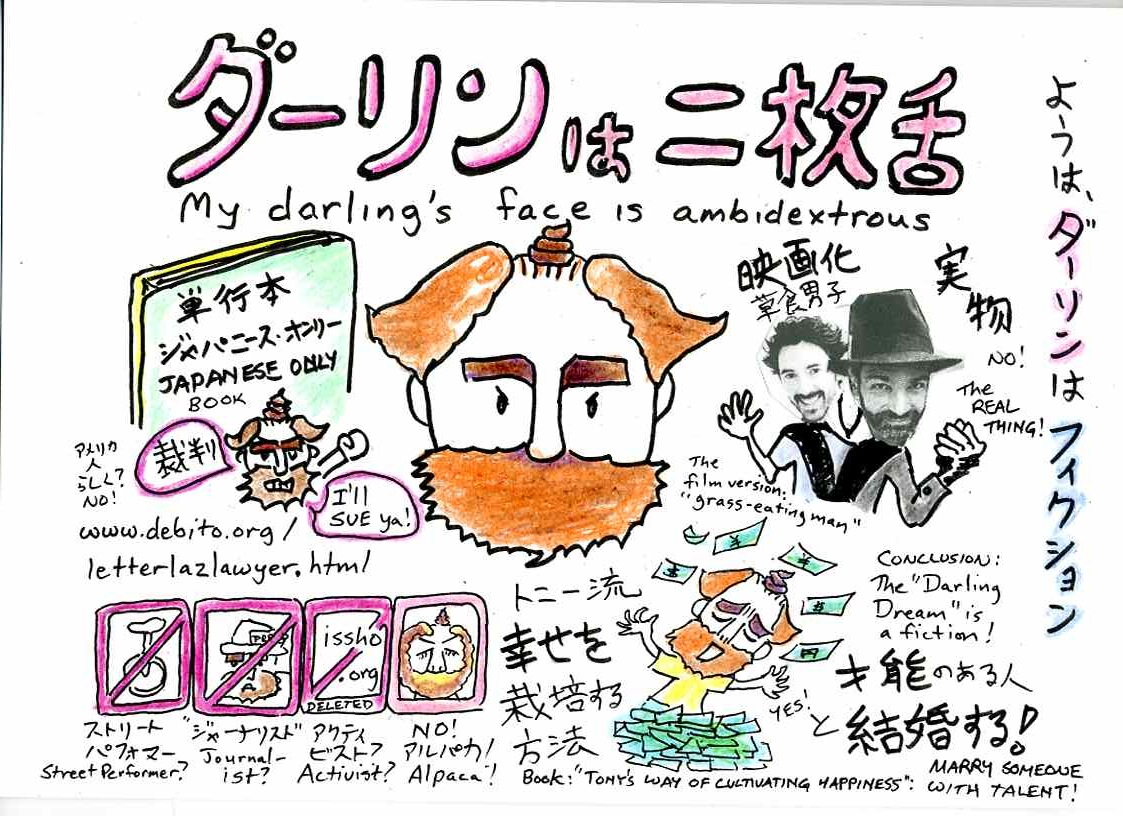

Aly Rustom on how he got out of a Gaijin Card Check by J-cops

mytest

Handbook for Newcomers, Migrants, and Immigrants to Japan\Foreign Residents and Naturalized Citizens Association forming NGO\「ジャパニーズ・オンリー 小樽入浴拒否問題と人種差別」(明石書店)JAPANESE ONLY:  The Otaru Hot Springs Case and Racial Discrimination in Japansourstrawberriesavatardebitopodcastthumb
UPDATES ON TWITTER: arudoudebito,
DEBITO.ORG PODCASTS now on iTunes, subscribe free

Hi Blog. Quick missive from Aly Rustom a couple of days ago. This is how he dealt with a Gaijin Card Checkpoint in Ueno last week, apparently successfully. FYI. More here on what your rights are when the Police State Tendencies have you in their sights. And even more here if you think that he should have filed a complaint instead with the MOJ Bureau of Human Rights for this treatment:  guess what — I’ve tried that, and they did nothing.  Arudou Debito back in Sapporo

=======================================
A FUNNY THING HAPPENED ON THE UENO TO WORK:
MY WAY OF DEALING WITH J-COPS’ GAIJIN CARD CHECKPOINTS

By Aly Rustom

Got stopped today (November 19, 2009) by a cop and was asked for my Gkjin card, and to make a long story short, I refused to show it, and they finally left me alone.

The strange thing was that I was in Ueno station walking to work. Just outside the Iriya gate. The whole conversation was in Japanese, but I will try relay this in English as best as I can.

I got stopped by a plain clothes cop whose name I got Kobayashi Keiichi or Kenichi. Anyway, he asked me for my passport, and I told him that I didn’t have it. I said that this is not an airport. He then told me to go to the Koban to which I replied, “I’m not going anywhere with you.” He then asked me if I have a gaijin card to which I said yes.

He said, “Show it to me”
“Why?”

“I want to confirm you are legal.”

“Why? I’ve done nothing wrong. I pay my taxes same as the Japanese. Why should I show it to you?”

I want to see it.

At this time a uniformed cop, also in his forties came running over. He was smiling and friendly. Unlike the idiot I was dealing with. I at first thought that this was going to get ugly, but I soon realized that he was trying to smooth the situation over.

“If you have a reason, I’ll not only show you my card, I’ll even show you my Japanese Driver’s License. But with no reason I refuse to show it to you.”

This went on back and forth. My anger clearly showing and his cold suspicious eyes never leaving me, with the uniformed cop trying hard to convince me kindly that it was the law.

I then asked to see his ID and he showed it with confidence. Pulled out my iphone and was about to take a picture of it when he snatched it away.

“What are you doing?”
“I’m going to take a picture of your ID?”
“No (DAME)”
“If not, then I will not show you mine”
“No. I showed you mine. You show me yours.”
I pulled mine out and just as he did very quickly showed it without giving it and put it back in my wallet.

“No,” he said. I can’t confirm anything like this”
“If you want to confirm I will take your ID picture.”
“No. Why?”
“I want to complain about you,” I said.
“To whom?”
“To Debito Arudou”

They didn’t seem to know who our Debito was, and I explained that he was an activist and that I wanted this cop’s ID to pass on so I could blog it.

He refused but showed it to me again and stated his name, saying that it was sufficient. I said show it to me again, and he said no. you will not take a picture of it.

I said that was fine, but that I wanted to write down his number, but he refused. Fine. Then I will not show you mine.

What’s the problem?, He asked.

You are invading my privacy. I don’t want you to know my address. And this is racism.
Its not racism, he said.
It is. Because I am not Asian.
No. You are a foreigner. That’s why I want to see it.
That’s still racism.

This also went on back and forth. The interesting thing is that he really seemed upset by the fact that I was calling him a racist. He kept coming back to this issue and trying to convince me he wasn’t a racist, but I was not convinced.

At one point he asked me to just step away from the ticket gate and I refused. He said that we were in other people’s way and to be considerate of them, to which I replied, “Why aren’t YOU considerate of my feelings? Plus, YOU are the ones who stopped me, so its YOU who has made other people’s lives more difficult.”
“That’s why I said for us to just step to the side…”
“NO! I want people to see this. I want to show them your racism”

He continued to assert that it was not racism.

In the end, he said, “Ok. You can go. I asked to see your ID, and you refused. I can’t make you show it to me. You are free to go. Thank you anyway.”

For those of you who know me you know that I don’t back down and refused to just let it go, insisting that this is not a way to catch foreigners, not a way to treat foreigners. etc etc.. I wasn’t getting to him, but I sure gave him a piece of my mind. I wanted him to feel that stopping us is more trouble than it was worth.

The uniformed cop was friendly after the other idiot cop had gone, and he said that he goes to Australia once a year etc etc. He was kind and we stayed and had lots of small talk.

In retrospect, the fact that I was raising my voice and that I seemed to have no problem with the people around seeing and hearing the conversation seemed to bother the idiot cop tremendously. The fact that it was getting more and more obvious to people around that he had stopped me for my card seemed to embarrass him. And he REALLY was rankled by the fact that I wanted to take a picture of his ID.

To everyone reading this, I don’t know how much of a legal leg we have, but it seemed to work. You want to see my card, I’ll take a picture of yours. It seems to really scare them. Or at least just this guy, but he really was a tough looking guy who looked like he had stared down and beaten down every foreigner he had met into showing him their ID.

But not this foreigner.

ENDS
Holiday Tangent: Delightful Maure Memorial Museum in the middle of nowhere, Hokkaido

mytest

Handbook for Newcomers, Migrants, and Immigrants to Japan\Foreign Residents and Naturalized Citizens Association forming NGO\「ジャパニーズ・オンリー 小樽入浴拒否問題と人種差別」(明石書店)JAPANESE ONLY:  The Otaru Hot Springs Case and Racial Discrimination in Japansourstrawberriesavatardebitopodcastthumb
UPDATES ON TWITTER: arudoudebito,
DEBITO.ORG PODCASTS now on iTunes, subscribe free

Hi Blog.  As a holiday tangent, I would like to pass along these brochures from the Maure Memorial Museum.  In the middle of East Boofoo, excuse me, Maruseppu, northeastern Hokkaido, is this hidden little gem of a place, a converted schoolhouse, with all sorts of lovely little artworks by handicapped people, as well as by other artists, that is definitely worth a look somehow, somewhere.  It also has a wonderful collection of butterflies, for some reason, and other bugs on pins (along with the occasional ammonite and other weird stuff) that will delight all ages.  Admission is free (there is a donation box you can ignore; I didn’t).  If you have any occasion, go out there and see.  Introduced me by James in Monbetsu just before it closed for winter.  Arudou Debito in Shizuoka

(click on image to expand in browser)

mauremuseum002

mauremuseum001

Xinhua & Chosun Ilbo: South Korea has drafted dual nationality laws

mytest

Handbook for Newcomers, Migrants, and Immigrants to Japan\Foreign Residents and Naturalized Citizens Association forming NGO\「ジャパニーズ・オンリー 小樽入浴拒否問題と人種差別」(明石書店)JAPANESE ONLY:  The Otaru Hot Springs Case and Racial Discrimination in Japansourstrawberriesavatardebitopodcastthumb
UPDATES ON TWITTER: arudoudebito
DEBITO.ORG PODCASTS now on iTunes

Sunday Tangent:  South Korea is creating laws allowing some degree of dual nationality.  Again, given the cultural similarities between J and ROK society, it would be nice if people on both sides of the pond recognized how acceptance of diversity even within its own citizenry is beneficial to society.  ROK seems to be inching closer to that end, according to these news reports.  Arudou Debito in Shizuoka

///////////////////////////////////////////
“S Korea seeks conditional recognition of dual nationality”
Xinhua News (China) November 12, 2009,
Courtesy of Anonymous
http://news.xinhuanet.com/english/2009-11/12/content_12442735.htm

SEOUL, Nov. 12, 2009 (Xinhua) — The South Korean government has drafted legal revisions to adopt multiple citizenship, easing regulations for foreigners seeking to become naturalized Korean citizens, to attract talent from abroad, the government said Thursday.

According to the Justice Ministry, it will soon submit a proposal on the revisions to parliament for approval.

The envisioned law allows those who hold foreign passports to hold more than one nationality on condition that they provide written pledges forswearing their rights as foreigners while in the country, including tax exemptions.

Under current law, South Korea does not allow citizens or foreigners living in the country to hold multiple citizenship.

Thus, South Koreans who obtain foreign citizenship through birth or emigration must choose a single nationality by the age of22.

Once they choose foreign citizenship, their South Korean passports are automatically nullified, even without a cancellation process.

The issue has been particularly thorny in South Korea, as foreign citizenship is occasionally used for male citizens to dodge the compulsory military drafts.

“There has been a growing voice need for the revision, as the present law sat as an obstacle in attracting and retaining talented foreigners,” an official at the ministry, was quoted as saying to South Korea’s Yonhap News Agency.

“We hope the revisions will help prevent a brain drain and provide relief measures for the country’s low birth rate and its aging society,” the official told Yonhap.

According to the justice ministry figures, the number of losing or renouncing their South Korean nationality hit 6,741 between 2004 and October this year, far surpassing the 518 who opted for it.
ENDS
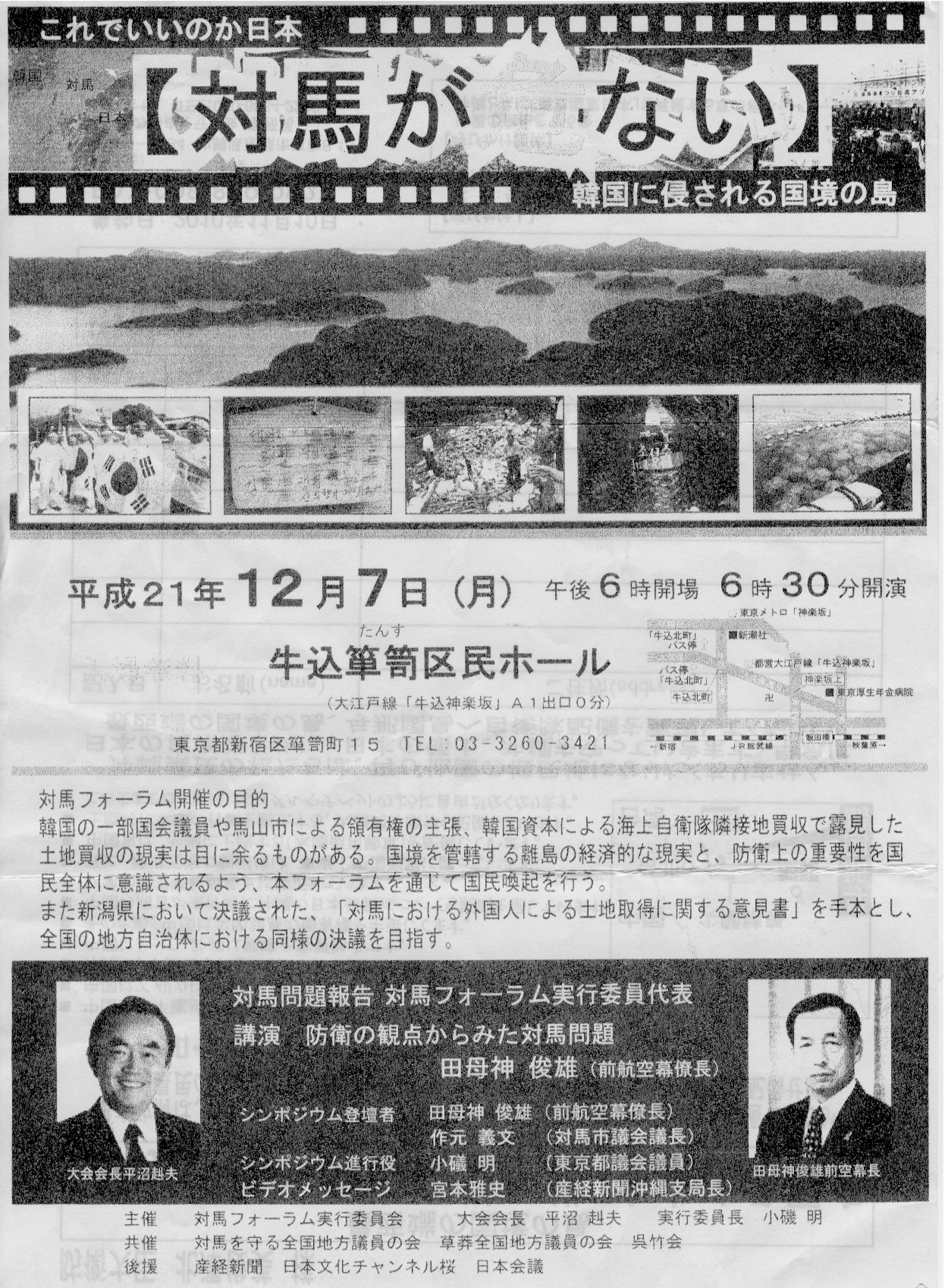
///////////////////////////////////////////

Dual Nationality to Become Legal
Chosun Ilbo (South Korea) November 13, 2009, Courtesy of JK

http://english.chosun.com/site/data/html_dir/2009/11/13/2009111300794.html

The Justice Ministry has completed a draft amendment of citizenship laws that will permit Koreans to hold dual nationality in some circumstances. Under the new law, dual nationality holders born abroad will be allowed to maintain both citizenships provided they do not exercise certain rights and privileges using their legal status of foreigners.

The ministry announced the regulations Thursday.

Those who obtain foreign citizenship by birth will be allowed to maintain it if they submit a written oath by the age of 22 not to exercise the rights and privileges of foreigners in Korea by using their second passport.

After the age of 22, men will be allowed to maintain multiple citizenship only if they complete their military service here. Under the current law, dual citizenship holders must choose one nationality by the age of 22 and submit a written pledge to give up their foreign citizenship if they choose their Korean nationality. The revision is aimed at blocking a drain on military manpower.

Those caught using their foreign passports to enter international schools or invest in Korea as foreigners will be ordered to choose a single nationality and automatically lose their Korean nationality if they fail to give up their foreign citizenship within a specified period.

The regulations also apply for other groups such as foreigners who have immigrated through marriage with Koreans; highly skilled foreigners; senior citizens living overseas; those who have regained Korean citizenship after being adopted by foreign families; and Chinese nationals who were born and have lived here for more than 20 years.

Under the current law, foreigners have to give up their foreign citizenship within six months after they obtain Korean nationality.

englishnews@chosun.com / Nov. 13, 2009 11:40 KST

ENDS
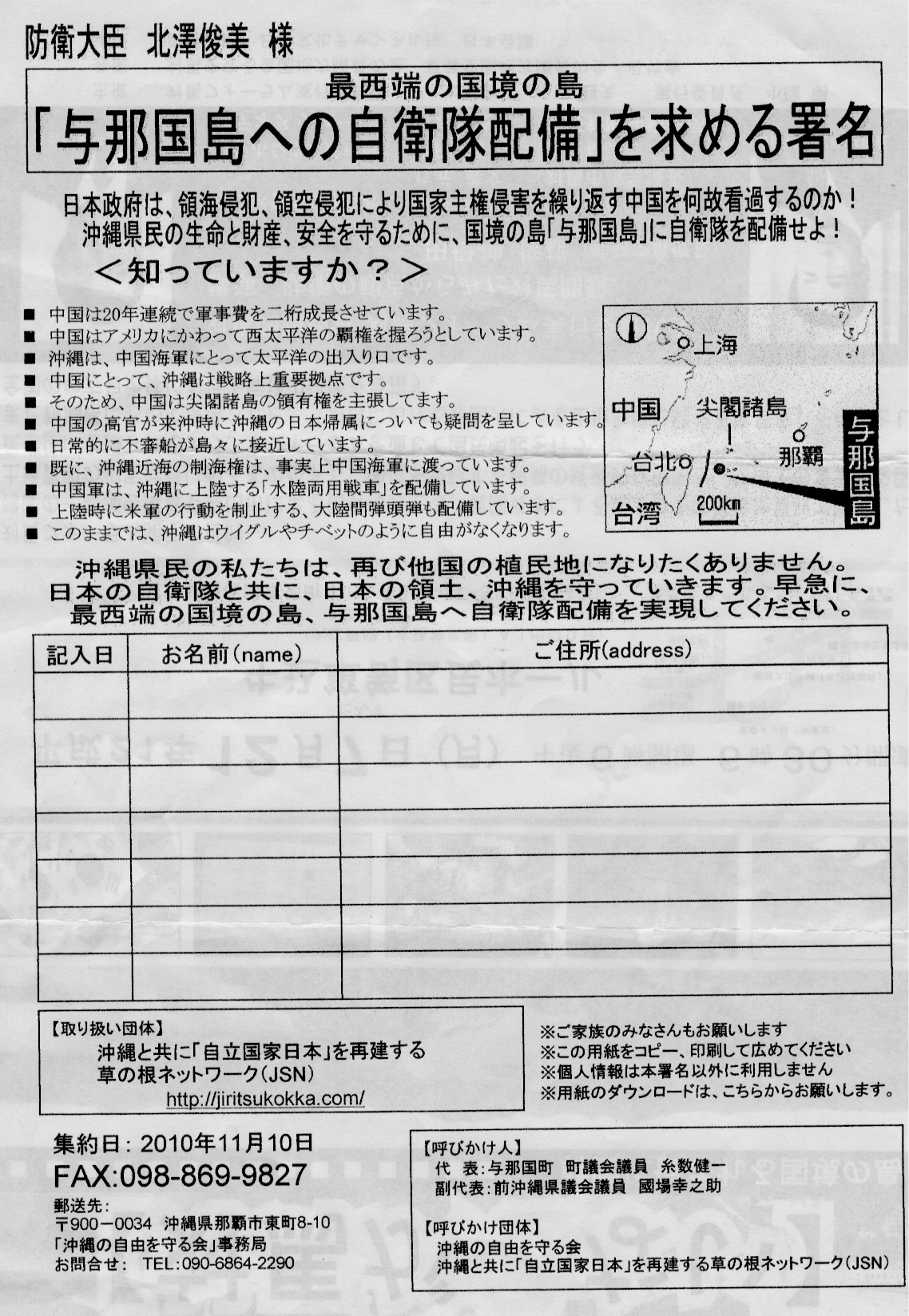
Scotchneat on Fuji TV show laying blind biological claims to intellectual Asian kids abroad

mytest

Handbook for Newcomers, Migrants, and Immigrants to Japan\Foreign Residents and Naturalized Citizens Association forming NGO\「ジャパニーズ・オンリー 小樽入浴拒否問題と人種差別」(明石書店)JAPANESE ONLY:  The Otaru Hot Springs Case and Racial Discrimination in Japansourstrawberriesavatardebitopodcastthumb
UPDATES ON TWITTER: arudoudebito

Hi Blog.  Guest writing an essay for Debito.org is Scotchneat, regarding how some Japanese media editorial policies bring in tribal tendencies no matter how tenuous the link to the tribe.  Read and consider.  Arudou Debito in Shizuoka
——————–
Re: Sho Timothy Yano
By Scotchneat

Yano siblings show what’s right with America and what’s wrong with Japan (Comment on Echika no Kagami Kokoro ni Kiku TV aired on Nov. 1, 2009 21:30-22:24エチカの鏡 ココロにキクTV 2009/11/ 1(日) 21:30~22:24)

There was a show on Sho Timothy Yano and his sister Sayuri on November 1. on Fuji TV. The two are child prodigies (http://www.facebook.com/l/aa682;en.wikipedia.org/wiki/Sho_Yano) . The story of children of a multi-cultural family being free to achieve their goals in a supportive environment shows the positive side of America.  However, the spin that show put on the story is very indicative about Japan.

The focus of the story was a mother pushing her children to succeed with much detail of the early childhood education and dietary regime of the two children. The show also put great emphasis on the prejudice that the two were subject to in America based on their Asian heritage, although it seems that the “prejudice” amounted to teasing by their fellow students, and it was unclear whether that was due to Asian heritage or the fact of the great age difference with their peers. The show claimed that Japanese and Koreans often face prejudice in the US, although no real examples were given other than a dramatization showing poor Sho being picked on by some big white bullies.

It is always strange that Japanese will point out the prejudice that exists in America while completely ignoring or being ignorant of the situation in their own country. Here we have two children with a Japanese father and Korean mother. One can only the imagine the prejudice that they would face in Japan. Although any form of prejudice is wrong, it is clear that the Yano siblings are not facing institutionalized prejudice in work and educational opportunities that they would face in Japan. Perhaps this why the show tread so lightly on the subject. One is reminded of the classic, “And you are lynching Negroes” response to the criticisms of the old Soviet Union.

Ironically, it seems that the Japanese, based on my impressions from watching the TV show, would like to claim the Yano siblings as their own. They get to be “Japanese”, despite being born, raised and educated in the US and having a Korean mother (normally any of these factors would raise suspicions of not being properly Japanese) and not speaking Japanese (considered mandatory for citizenship).

Moreover, child prodigies in Japan are not allowed to enter university (aside from a few small experiments), ostensibly because they lack “maturity”. Anyone familiar with Japanese university students will find that quite ironic. However, as often is the case, appeals to logic and common sense are useless in the face of entrenched prejudicial thinking. Basically, allowing two children to attend university (even for purposes of auditing) goes against an engrained dislike of breaking with conformity in Japan.

Perhaps, if the Japanese could get past looking at diet and over ambitious teaching regimes for toddlers, they might see the value of respecting diversity and breaking out of insular thinking.
——————–

ENDS
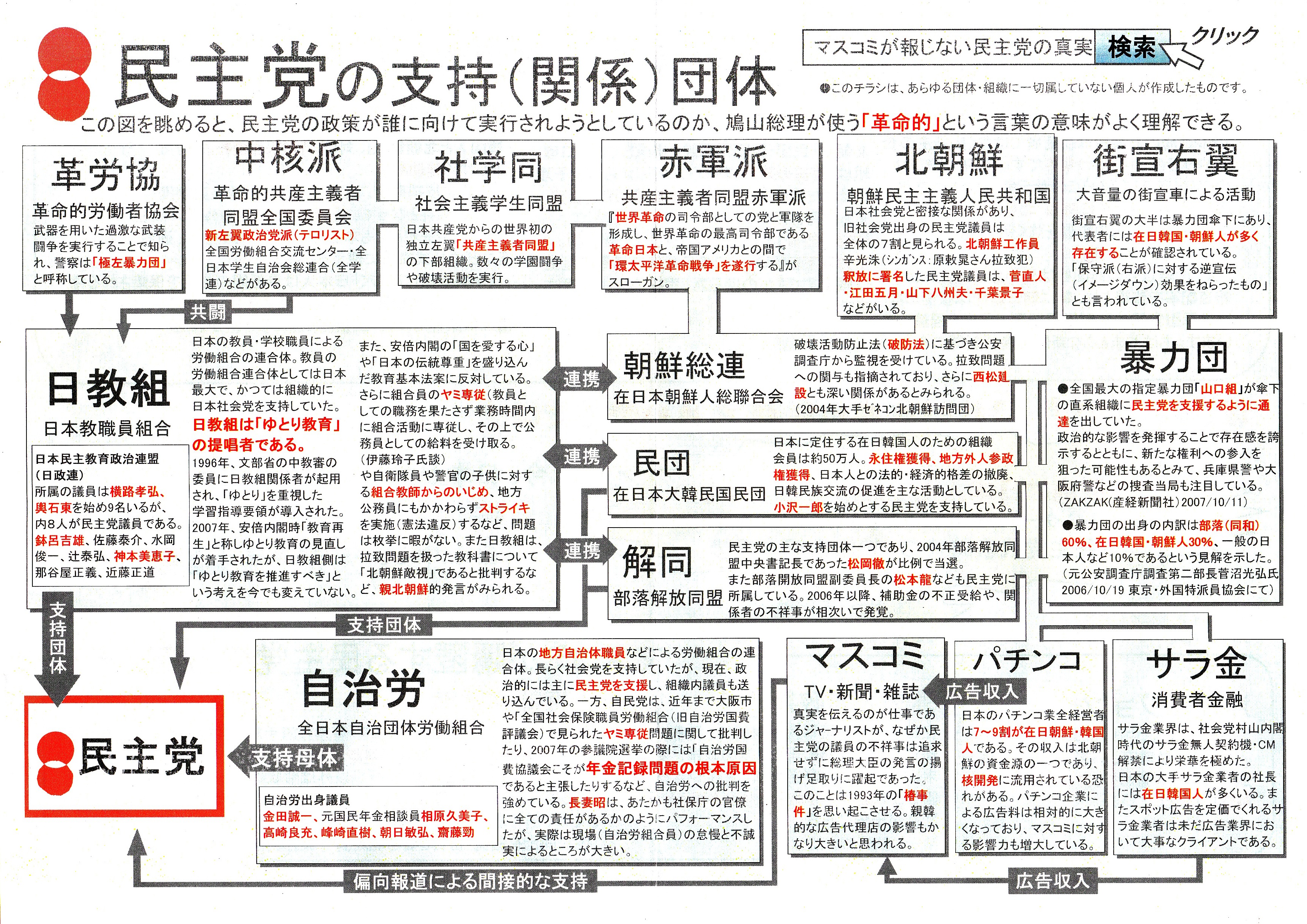
I’m current at JALT Shizuoka, until Monday

mytest

Handbook for Newcomers, Migrants, and Immigrants to Japan\Foreign Residents and Naturalized Citizens Association forming NGO\「ジャパニーズ・オンリー 小樽入浴拒否問題と人種差別」(明石書店)JAPANESE ONLY:  The Otaru Hot Springs Case and Racial Discrimination in Japansourstrawberriesavatardebitopodcastthumb
UPDATES ON TWITTER: arudoudebito,
DEBITO.ORG PODCASTS now on iTunes, subscribe free

Hi Blog.  Just to let you know, I’m currently in Shizuoka attending the annual JALT Conference.  Not giving any speeches or anything, just taking in a presentation or two and socializing.  Look for me around the PALE Table.  FYI.  Arudou Debito in Shizuoka

UN CERD Questions to GOJ re elimination of racial discrim (CERD/C/JPN/Q/3-6 Nov 17 2009, Advance Unedited Version)

mytest

Handbook for Newcomers, Migrants, and Immigrants to Japan\Foreign Residents and Naturalized Citizens Association forming NGO\「ジャパニーズ・オンリー 小樽入浴拒否問題と人種差別」(明石書店)JAPANESE ONLY:  The Otaru Hot Springs Case and Racial Discrimination in Japansourstrawberriesavatardebitopodcastthumb
UPDATES ON TWITTER: arudoudebito,
DEBITO.ORG PODCASTS now on iTunes, subscribe free

Hi Blog. Here’s the United Nations CERD Committee giving the Japanese Government its due for its Third through Sixth Report (Japan is supposed to submit a report, on what it’s doing to eliminate domestic racial discrimination, every two years since it became a Signatory in 1996.  That should be a total of six times by now; however, it has only submitted twice so far, lumping them together.  Hazukashii).  These are questions the UN wants answered before its periodic review of Japan in February of next year.   Have a look.

We activists have already readied our counterreports for submission to the UN (I was asked some weeks ago to cover refusals of NJ by businesses; I handed in an 800-worder, which I’ll have up here in due course).  Let’s see how the GOJ tries to squirm out of it this time (see last time and the time before that here).  Arudou Debito in Sapporo

UNITED NATIONS ADVANCE UNEDITED VERSION

CERD

International Convention on the Elimination of all Forms of Racial Discrimination Distr.

GENERAL

CERD/C/JPN/Q/3-6

17 November 2009

Original:  ENGLISH

COMMITTEE ON THE ELIMINATION

OF RACIAL DISCRIMINATION

Seventy- sixth session

15 February – 12 March 2010

Courtesy http://www2.ohchr.org/english/bodies/cerd/docs/AdvanceVersions/CERD-C-JPN-6-Add1.doc

QUESTIONS BY THE RAPPORTEUR

IN CONNECTION WITH THE CONSIDERATION OF

THE THIRD TO SIXTH PERIODIC REPORTS OF

JAPAN (CERD/C/JPN/3-6)

Composition of the population

1.                 As follow-up to the Committee’s previous concluding observations, [1] please provide full details on the composition of the population, including on economic and social indicators reflecting the situation of all groups covered by the Convention, including resident Koreans, returnees from China, the Buraku and Okinawa communities as well as immigrants, asylum seekers and refugees.

General information and institutional framework

2.                 Please indicate whether and to what extent non-governmental organizations were consulted in the preparation of the State party’s third to sixth periodic reports to the Committee.

Article 1

3.                 Please clarify the relationship between the Convention and domestic law, citing, where possible, examples of cases where the Convention was used by domestic courts for interpretative purposes.

4.                 Reiterating the Committee’s previous concluding observations[2]as well as the Committee’s General Recommendation No. 29 on “descent”, please indicate how the State party has integrated the concept of descent-based discrimination in its laws and regulations in order to ensure the full enjoyment of civil, political, economic, social and cultural rights by persons belonging to or descending from the Buraku community.

5.                 Please comment on reports according to which resident Koreans applying for Japanese nationality are still urged to change their Korean names to Japanese names, and that they often feel obliged to do so for fear of discrimination in the context of education, employment and marriage.

Article 2

6.                 With regard to the Committee’s previous concluding observations,[3] please indicate whether the State party intends to adopt a comprehensive anti-discrimination law in line with the provisions of the Convention.

7.                 Please indicate whether any independent body specifically appointed to respond to complaints with regard to discrimination faced by, among others, persons from the Buraku, Ainu, Okinawa and resident Korean communities exists in the State party or whether there are any plans for the establishment of such body. More generally, please indicate whether the State party intends to establish a national human rights institution in accordance with the Paris Principles (General Assembly resolution 48/134, annex).

8.                 Please comment on allegations that some professionals and local civil servants with access to confidential family registration databases use their authority to create and update lists known as “Buraku Lists” and to sell information on ancestry, birth place and domicile to credit services and private investigators conducting background investigations to determine if a potential employee or marriage partner comes from a Buraku community. Please indicate what measures have been taken by the central administrative authority to ensure respect for privacy and to address violations and abuse in this regard. Also please indicate if there are any plans to modify the existing family registration system based on ancestry and to introduce a requirement by which access to personal information would be permitted only with the informed consent of the person concerned.

9.                 Please explain why the State party has not endorsed the Human Rights Protection Bill, provide an update on its current status and indicate the measures that will be included under its revised version (State party report, CERD/C/JPN/3-6, para. 34).

10.              Please provide more detailed information on the current refugee determination procedures and the provision that financial assistance to persons with refugee status is usually granted for four months only, even though the average time required to process an application is two years (State party report, CERD/C/JPN/3-6, para. 28).

Article 4

11.              While noting that a number of measures have been adopted to guarantee  uses of the Internet which do not infringe the rights of others, the Committee nonetheless  invites comments on reports stating that instances of intolerance and discriminatory attacks through the Internet continue and include posting of anonymous hateful messages and threats against certain communities, including in particular the Buraku and resident Koreans, as well as the use of internet maps and search engines to obtain and share personal information on family names and housing location of members or descendants from these communities. Please indicate to what extent the Provider Liability Limitation Law of 2004 has been applied to counter such abuse of the Internet or what other actions have been taken.  Further, please indicate which of the findings of the “Study Group on Actions against Illegal and Harmful Information on the Internet” established in 2005 have been implemented so far (State party report, CERD/C/JPN/3-6, para. 42).

Article 5

12.              Please provide information on measures taken to recruit more members of the Ainu and Okinawa communities into the public administration of the State party, including the law enforcement agencies. Please provide additional statistical information on employment rates of members of the groups covered by the Convention in the civil service. Please also comment on reports that discrimination often occurs with regards to recruitment and employment and the fact that members of communities or their descendants, including the Ainu, Buraku and migrants of Japanese descent, are highly overrepresented in unstable, ‘blue collar’ work in small- and medium-size companies,  and underrepresented in management positions.

13.              Please provide additional disaggregated data and information on the Program to accelerate Foreigners’ Adaptation to the Life Environment established since 2007 and on the scope of recipients targeted by this programme (State party report, CERD/C/JPN/3-6, para. 55). Please indicate whether this program also covers foreign spouses of Japanese citizens and children of intercultural marriages, or whether any other programmes exist to facilitate their integration in society.

14.              Please provide detailed information on measures adopted to protect the rights of migrant workers.

15.              Please indicate the measures taken to address disadvantages faced by communities such as the Ainu, Okinawan, Buraku, resident Korean, Chinese permanent residents as well as non-nationals in their access to education, employment, adequate standards of living and healthcare. By what means are these measures monitored and what specific indicators are used to monitor progress?

16.              Please provide information on measures taken to provide remedies for resident Korean retirees who have no access to pension benefits because of the National Pension Act.[4]

17.              Please clarify the indicators and targets underlying the statement that “the decrease in public assistance ratio shows the positive effects of the Hokkaido Utari measures” (CERD/C/JPN/3-6, paras. 10-14). Please mention what the concrete effects of these measures were on higher education, stable employment, skill training and annual average household income as compared to the national average. How does the State party ensure full participation of Ainu people in the establishment of a comprehensive development policy? Further, please indicate the timeframe for the enactment of legislation on Ainu issues and the establishment of an advisory or consultative body on Ainu affairs as per the final report of the Government’s Expert Panel on Ainu Policy.

18.              Please explain why the Ryūkyūan/Okinawan Japanese are not considered an indigenous people or national minority by the State party, and state whether there are measures in place to protect, preserve and promote their cultural heritage and ways of life and recognize their land rights. Please clarify the State party’s understanding of the concept of “indigenous people”.

19.              According to information received, children of foreign origin, including South Americans of Japanese descent, children of migrant workers and resident Korean minorities, often attend parallel schools or “miscellaneous schools” whose accreditation depends on prefectural governments, and which are not always acknowledged as official schools. In this context, please indicate the disaggregated enrolment rates in compulsory education, rates of children advancing into higher education, and enrolment rates in university of children of migrant workers, resident Koreans and other minorities.  What institutional and financial measures exist to guarantee the rights of all children to receive an education, including access to education in minority languages as previously recommended by the Committee? Please specify the measures taken to prevent and counteract the harassment of resident Korean children attending North and South Korean schools (State party report, CERD/C/JPN/3-6, para. 26).

Article 7

20.              In addition to information presented in the State party report (CERD/C/JPN/3-6, paras. 35 and 46-49), please provide further information on specific human rights training programmes and courses that have been provided to members of the judiciary, law enforcement officials, teachers, social workers and other public officials. Please include information on the course contents and follow-up.

21.              With regard to the recommendations made by the Special Rapporteur on racism following his visit to Japan,[5] please provide information on measures taken concerning the process of writing and teaching of history objectively and accurately.

22.              Please provide further information on the awareness-raising activities and human rights education activities directed at the public at large at the prefectural level and throughout the country. Please provide information on the evaluation of the impact of awareness-raising campaigns, training and education programmes on entrenched attitudes and behaviour relating to issues which fall within the scope of the Convention.

– – – – –


[1] CERD/C/304/Add.114, paras. 7, 22.

[2] CERD/C/304/Add.114, para. 8.

[3] CERD/C/304/Add.114, para. 10.

[4] In this regard, see also the relevant recommendation of the Special Rapporteur on racism following his visit to Japan in July 2005, E/CN.4/2006/16/Add.2, para. 91.

[5] E/CN.4/2006/16/Add.2 para. 82.

ENDS

Mainichi: Schools for foreigners, technical colleges included in DPJ’s free high school lesson plan. IF already MOE “accredited”

mytest

Handbook for Newcomers, Migrants, and Immigrants to Japan\Foreign Residents and Naturalized Citizens Association forming NGO\「ジャパニーズ・オンリー 小樽入浴拒否問題と人種差別」(明石書店)JAPANESE ONLY:  The Otaru Hot Springs Case and Racial Discrimination in Japansourstrawberriesavatardebitopodcastthumb
UPDATES ON TWITTER: arudoudebito
DEBITO.ORG PODCASTS now on iTunes, subscribe free

Hi Blog.  JK comments:

Hi Debito:

On the one hand, it looks like there’s hope, yet on the other hand unaccredited / 無認可校 (e.g. schools for Brazilian, Peruvian, Indian, etc students) get left out in the cold:

Schools for foreigners, technical colleges included in DPJ’s free high school lesson plan
http://mdn.mainichi.jp/mdnnews/news/20091014p2a00m0na012000c.html

文科省:高専も無償化…外国人学校なども 概算要求へ
http://mainichi.jp/life/edu/news/20091014k0000e020077000c.html

Ok, I give up — what’s ‘wrong’ with the schools for foreign students that prevents them from being approved / accredited?

Barring a much-needed amendment to the Fundamental Law of Education, is there some hoop jumping that these schools can do to get the government’s 認可? -JK

===========================

Schools for foreigners, technical colleges included in DPJ’s free high school lesson plan

Mainichi Daily News October 14, 2009

Technical colleges and schools attended by foreigners will be included in the Democratic Party of Japan’s pledge to make high school lessons free of charge, it has emerged.

The Ministry of Education, Culture, Sports, Science and Technology has decided to make high school courses at technical colleges and vocational schools subject to the move, together with various schools for foreigners. It plans to include the necessary expenses in next fiscal year’s budget allocation request.

“We want to support learning chances for as many people as possible,” Deputy Education Minister Kan Suzuki said when questioned by the Mainichi.

The government plans to make lesson fees for public high schools free of charge from April next year. It also plans to provide 120,000 yen a year to households with private high school students, and raise the amount of support to a maximum of 240,000 yen for low-income families.

Suzuki said that since the average annual lesson fees at technical colleges exceeded 230,000 yen, the government planned to increase subsidies for low-income households in the same way as for students at private high schools.

Various schools operating under the School Education Law will be included in the measure, even if their students are of foreign nationality, meaning the DPJ’s move will apply to schools for Korean students and to international schools. However, Suzuki indicated that schools operating without approval — commonly seen among schools such as those for Brazilian children — would not be included.

“It is desirable that support is provided within the framework of the system,” he said, adding, “There is a need for revisions such as lowering the bar for approval.”

Across Japan there are 5,183 high schools with a combined roll of about 3.35 million students. There are also 495 vocational schools with high school courses, attended by 38,000 students, together with 64 technical colleges attended by 59,000 students.

It is expected that the budget figure will swell beyond the DPJ’s initial forecast of 450 billion yen as a result of the move.

The standard when determining whether to increase subsidies for low-income households will be an annual income of 5 million yen. The government will increase the amount of support in stages, coordinating measures with the Ministry of Finance.

Rather than the students or their guardians directly receiving financial support, the money will go directly to schools. When requesting increased support, applications are to be made to schools together with proof of the guardians’ income.

(Mainichi Japan) October 14, 2009

文科省:高専も無償化…外国人学校なども 概算要求へ

民主党が政権公約に掲げた高校授業料の実質無償化について、文部科学省は、高等専門学校や専修学校の高等課程、外国人が通う各種学校なども対象とし、必要額を来年度予算の概算要求に盛り込む方針を固めた。高専は5年制だが、第1~3学年を対象とする。

鈴木寛副文科相が毎日新聞の取材に「なるべく多くの人の学ぶ機会を応援したい」と述べ、こうした方針を明らかにした。

政府は来年4月から公立高校生の授業料を無料とし、私立高校生の世帯に年12万円(低所得世帯は最大24万円)を助成する方針。鈴木副文科相は国公立の高専について、平均授業料が23万円を超えることから、私立高校生と同様に低所得世帯への増額措置を適用する方針も明らかにした。

美容師や調理師養成校などを含む専修学校のうち、高等課程(中卒者対象)の生徒は対象とする。また、外国籍でも、学校教育法に定める各種学校の生徒は加える方針で、朝鮮人学校やインターナショナルスクールなどが該当。ブラジル人学校などに多い無認可校は「制度の枠組みの中に入れ支援するのが望ましい。認可のハードルを下げるなどの見直しが必要」とし、対象としない考えを示した。

全国の高校は5183校(生徒334万7000人)で、専修学校高等課程は495校(3万8000人)、高等専門学校は64校(5万9000人)。民主党が当初の予算額として想定した4500億円より要求額は膨らむ見通し。

支給額を増やす低所得の目安は年収500万円が基準となる見通しだが、段階的な支給額の増加なども含め、財務省と調整する。

支給は、生徒や保護者に直接ではなく学校側に渡す「間接支給」方式とする。私立高校で支給額の増額を求める場合、保護者の収入証明書を添えて学校に申請し、授業料との差額を納付する仕組みになる。【加藤隆寛、本橋和夫】

【ことば】各種学校

学校教育法第1条に定める「学校」ではないが、学校教育に類する教育機関として同法で規定され、私立校は都道府県知事の認可を受ける。カリキュラムの自由度が高く、通学定期の購入も可能。服飾や看護系学校、簿記学校などが含まれ、外国籍の子どものための教育機関の多くが該当する。予備校や自動車学校にも認可校がある。

英訳

毎日新聞 2009年10月14日 15時00分(最終更新 10月14日 15時17分)
ENDS