



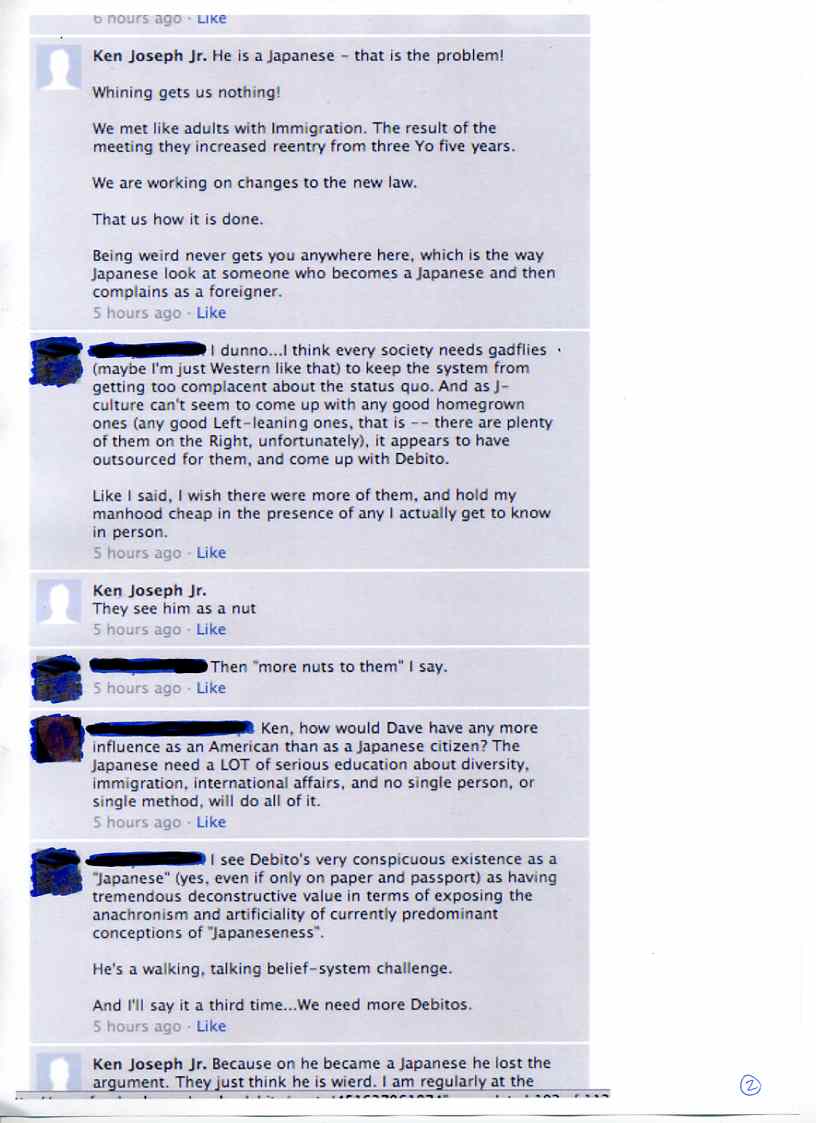
Weekend Tangent: Weird broadside from Japan Helpline’s Ken Joseph Jr. on Facebook

mytest

Handbook for Newcomers, Migrants, and Immigrants to Japan\Foreign Residents and Naturalized Citizens Association forming NGO\「ジャパニーズ・オンリー 小樽入浴拒否問題と人種差別」(明石書店)JAPANESE ONLY:  The Otaru Hot Springs Case and Racial Discrimination in Japansourstrawberriesavatardebitopodcastthumb
UPDATES ON TWITTER: arudoudebito
DEBITO.ORG PODCASTS on iTunes, subscribe free

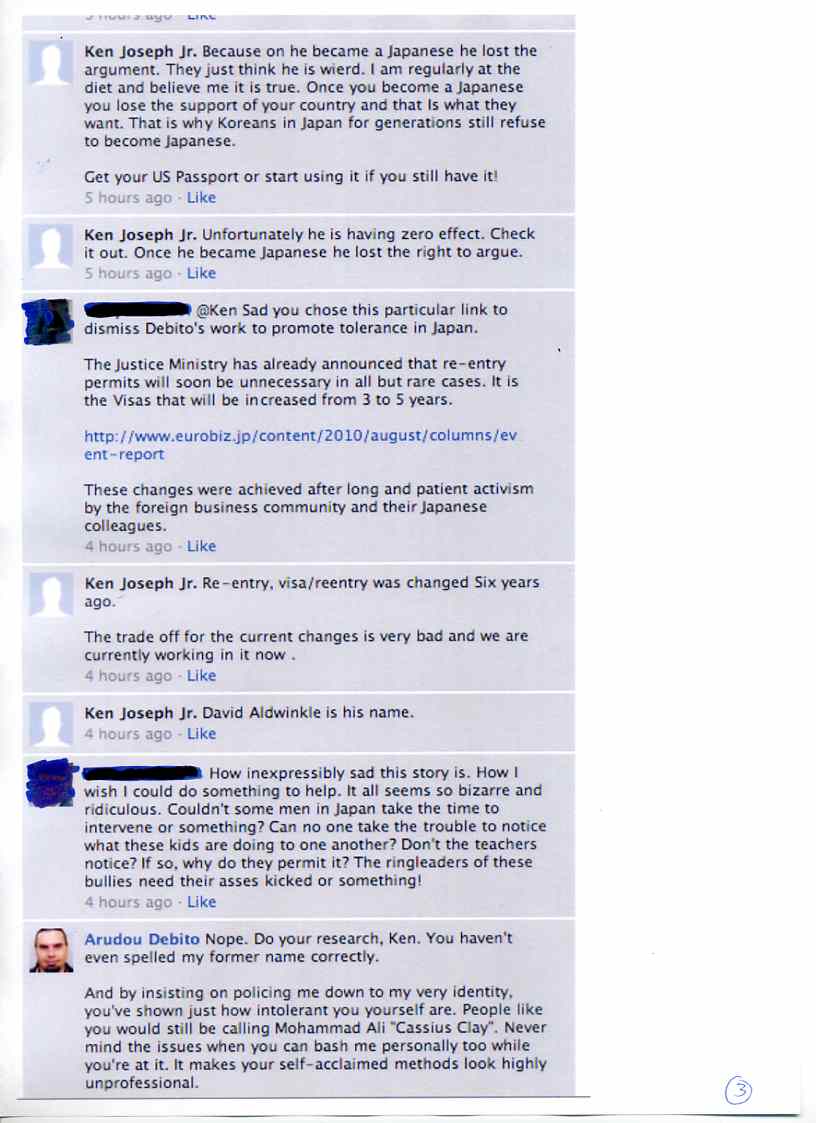
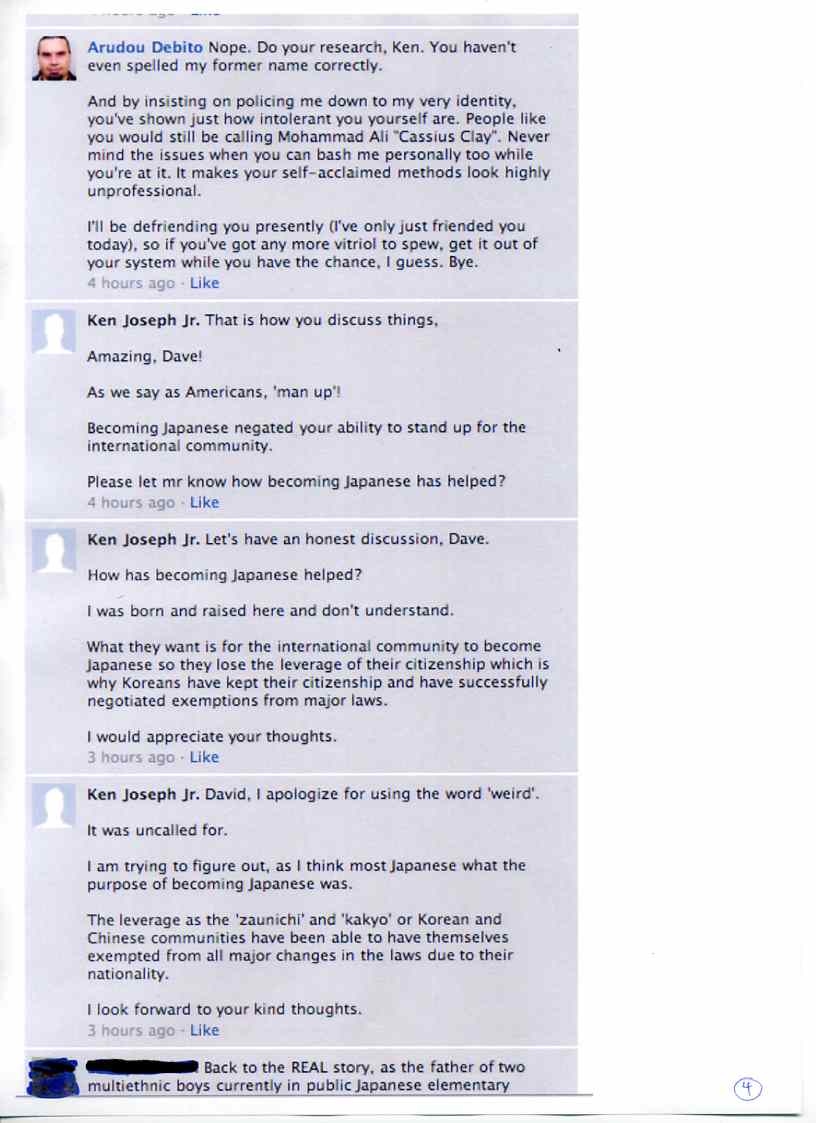
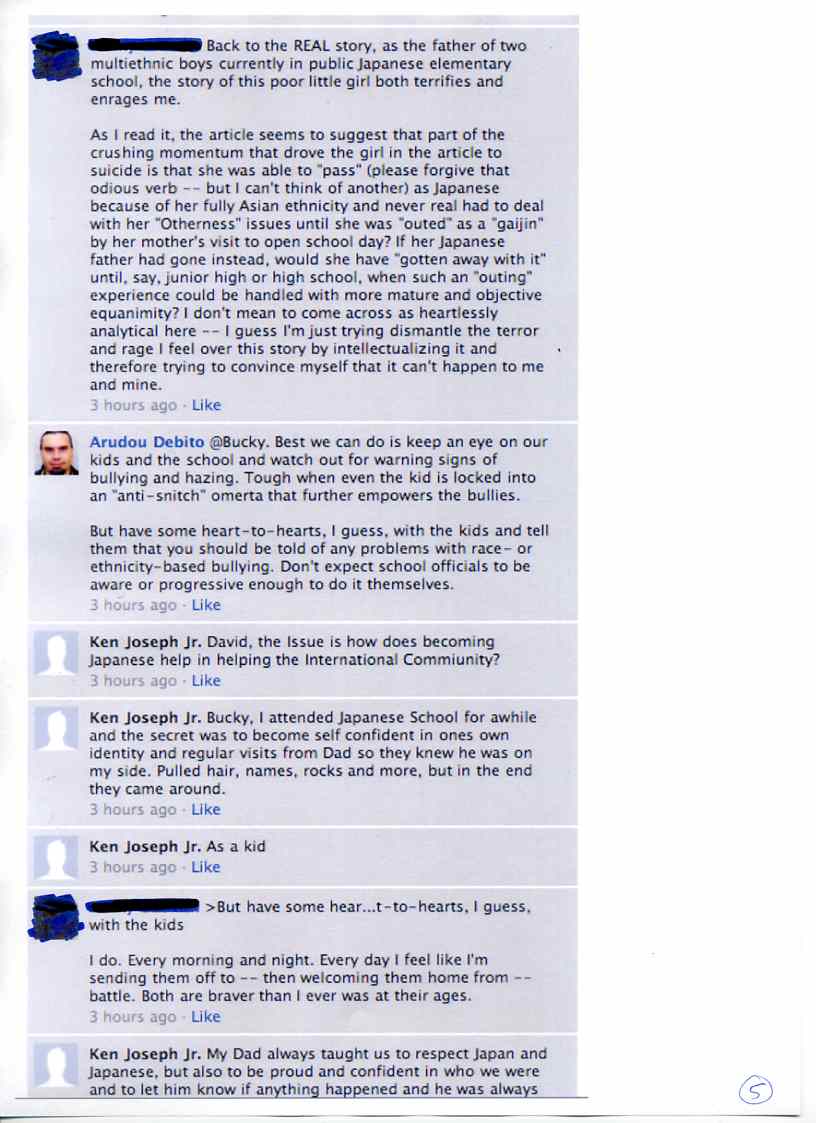
Hi Blog.  Last Monday morning I got a request for a friending on Facebook by a Ken Joseph Jr.  For those who have heard the name, he’s one of the advice columnists for the Japan Times Lifelines Page, and according to his website (email registry required), “Ken Joseph Jr. is an international columnist and speaker.  He appears regularly on CNN, Foxnews, BBC, ITN and numerous radio outlets worldwide to give commentary on the news of the day from a background of personal experience.  His columns regularly run in newspapers worldwide.”

So imagine my surprise when I get a broadside of this tone from a person of this standing, mere hours after I friend him.

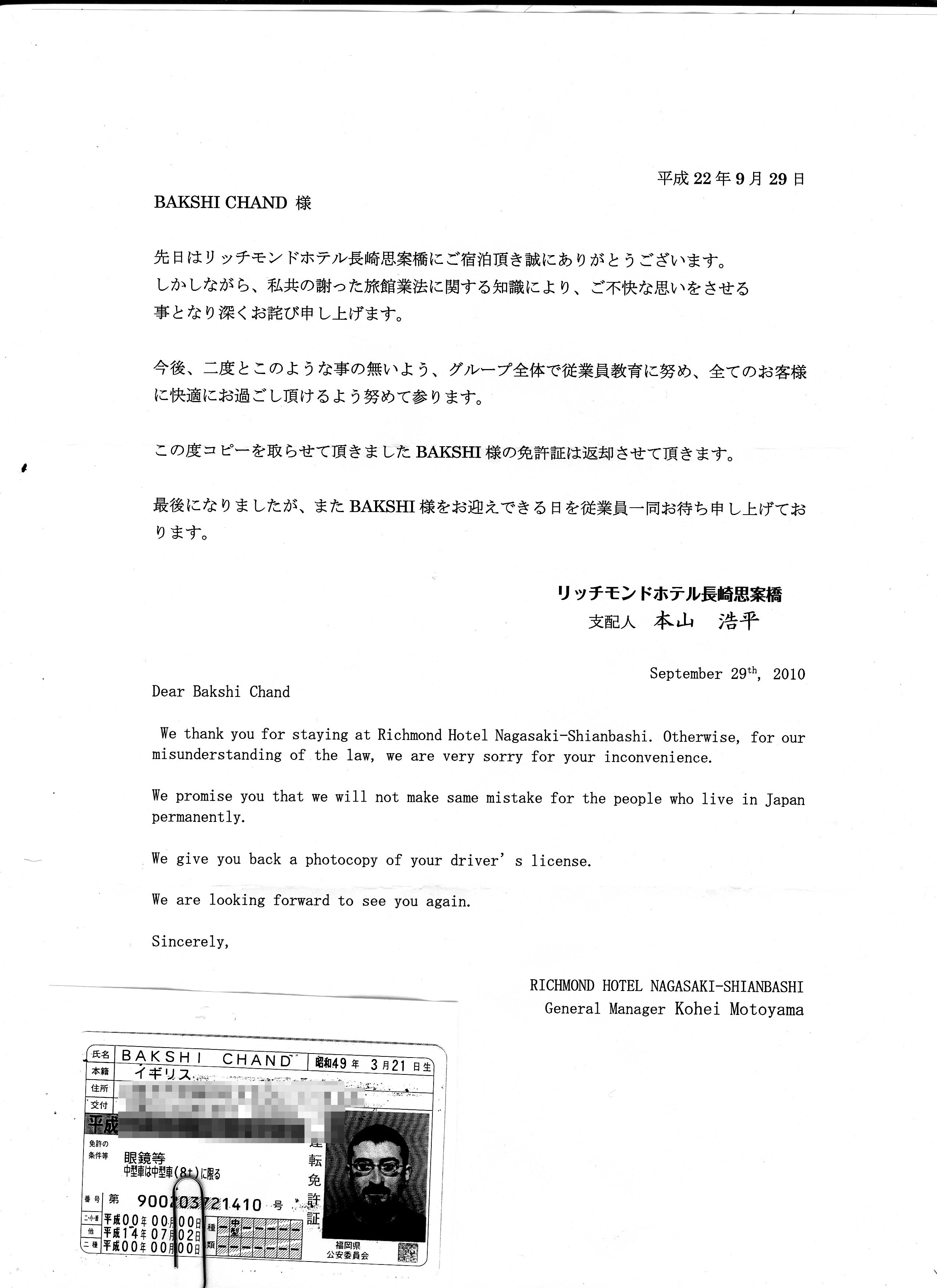
(Screen captures of my Facebook page where he tries to hijack an unrelated thread; printed, names other than Ken’s and mine redacted, and scanned.)

BROADSIDE ENDS

COMMENT:  I’m not sure why KJJ has it in for me.  I met him just once (during the Kobe Earthquake of 1995) when I went down to Kobe from Sapporo on my own dime to volunteer under the auspices of Japan Helpline.  It wasn’t a long encounter, I doubt KJJ remembers me.  But during the Otaru Onsens Lawsuit he hit me with a similar broadside, claiming online that our refusal at Onsen Osupa in Otaru was a lie because he allegedly managed to wangle his way in (this has never been substantiated, although Osupa’s “Japanese Only” signs certainly were, as was Osupa’s refusal of us on September 19, 1999).  He also popped up from time to time on an old yahoogroups discussion list called “Shakai” (half deleted by Tony “Darling Foreigner” Laszlo) under a different name “Kenichi Suzuki” with similar broadsides.  That said, we never corresponded directly like this online until Monday, when he asked to be friended.

Don’t know what’s eating him, but a person who makes himself out to be this important should show more decorum in his comments.  Leaving a record of unprofessional broadsides (of questionable veracity to boot) like this is quite unbecoming.  And unconstructive, given that we should all be working towards the same goals.  Arudou Debito

Japan Times: MEXT in line to deliberate on ijime after Uemura Akiko suicide

mytest

Handbook for Newcomers, Migrants, and Immigrants to Japan\Foreign Residents and Naturalized Citizens Association forming NGO\「ジャパニーズ・オンリー 小樽入浴拒否問題と人種差別」(明石書店)JAPANESE ONLY:  The Otaru Hot Springs Case and Racial Discrimination in Japansourstrawberriesavatardebitopodcastthumb
UPDATES ON TWITTER: arudoudebito
DEBITO.ORG PODCASTS now on iTunes, subscribe free

Hi Blog. The uproar on the Uemura Akiko Suicide has led to ministerial-level action. Good news, in that something is being done about bullying in Japanese schools. Bad news is that somebody has to die before something is done (and these crackdowns on ijime are periodical things anyway; once the furore dies down, well… let’s just wait for the next victim and we’ll have another cry and outcry).

Of course, the elephant in the room is the racially-motivated nature of the bullying, which does not seem to be being addressed. If you don’t address one of the root causes (a racial background being used as ammunition), you aren’t gonna fix things. Duh. Doesn’t anyone out there in ministry land have a degree in education?   Arudou Debito

///////////////////////////////////////////////

The Japan Times Thursday, Nov. 11, 2010
Suicide prompts major bullying study
Kyodo News, courtesy of DK

The education ministry will conduct a nationwide survey of bullying in schools following the suicide last month of sixth-grader Akiko Uemura, in Kiryu, Gunma Prefecture.

Uemura’s mother found the 12-year-old hanging by a scarf from a curtain rail in her room Oct. 23. It is believed the girl took her own life due to bullying at school that apparently started sometime last year after her mother, who is from the Philippines, visited the school for an event.

After an initial denial, Niisato Higashi Elementary School admitted Monday she had been a frequent target of abuse by classmates.

The education ministry said Tuesday it has told prefectural boards of education to conduct periodic surveys on bullying.

The ministry also urged schools and local-level authorities to cooperate with families of schoolchildren to deal with the problem.

Rest of the article at http://search.japantimes.co.jp/cgi-bin/nn20101111a6.html

///////////////////////////////////////////////////////////

The Japan Times Thursday, Nov. 11, 2010

EDITORIAL

Cause of a girl’s suicide

On Oct. 23, Ms. Akiko Uemura, a sixth-grade girl in Kiryu, Gunma Prefecture, died after hanging herself. On Nov. 8, Kiryu’s board of education made public a report saying she had been psychologically bullied. It denied a cause-and-effect relationship between the bullying and her suicide. But on Oct. 25, Mr. Yoichi Kishi, principal of the municipal Niisato Higashi Primary School, said school authorities had known that the girl “was not in good condition as indicated by her isolation at lunch time.” We wonder why the school could not act soon enough to prevent her suicide…

Why does the board of education deny a cause-and-effect relationship between the bullying and her suicide? It appears as if the board and school authorities refused to squarely deal with the tragedy and their responsibility in the case.

Whole Editorial at http://search.japantimes.co.jp/cgi-bin/ed20101111a2.html

ENDS

TV America’s Most Wanted on unsolved questionable death of an American in Shinjuku Aug 2010. Any press in Japan?

mytest

Handbook for Newcomers, Migrants, and Immigrants to Japan\Foreign Residents and Naturalized Citizens Association forming NGO\「ジャパニーズ・オンリー 小樽入浴拒否問題と人種差別」(明石書店)JAPANESE ONLY:  The Otaru Hot Springs Case and Racial Discrimination in Japansourstrawberriesavatardebitopodcastthumb
UPDATES ON TWITTER: arudoudebito
DEBITO.ORG PODCASTS now on iTunes, subscribe free

Hi Blog. In line with yesterday’s theme of foreign crime (in this case, crimes perpetrated against the foreign), has anyone heard of this case of a questionable death (ruled by police as an accident) of an American in Shinjuku last August in the domestic media? If the reverse were true (a US tourist killing a Japanese), you bet we’d hear about it, and have all manner of people screaming about how tourists are now part of the alleged foreign crime wave we must protect Japanese from.

I hope I don’t have to make the argument again that there is a double standard of justice and attention depending on whether the perp or the victim is Japanese or not, like I did in the Japan Times March 2009. Arudou Debito

////////////////////////////////////////////////////////////
FUGITIVES
AMW CASE FILE
Unknown Hoon Scott Kang Killer
Hoon Kang was in a coma for several days after cops say he accidentally fell.
America’s Most Wanted Website, courtesy of BG
http://www.amw.com/fugitives/case.cfm?id=75251

The Call

Like any concerned parent, Sung Won Kang was a little worried about his teenage son who would be vacationing in Japan, especially since his son’s cell phone didn’t have international service to call home.

Nineteen-year-old Hoon “Scott” Kang of Buford, Ga., was teaching English in South Korea. He told his father that he and two fellow teachers had exciting vacation plans in Tokyo. As the trio prepared to leave for their trip, Hoon called his dad from the airport in Seoul and reassured his father that everything would be fine. He would call home if he needed anything.

A few days later, Sung Won did get a phone call: His son was missing.

Police say that the next time anyone saw Scott, he was found lying in an emergency stairwell of 15 Collins Building, a high rise that houses several clubs.

Big Plans, Bright Future

Sung Won Kang and his wife, Geyeon, immigrated from Seoul in 1993. Like many other Korean immigrants, they gave their kids American names: Scott and Rebecca. Sung Won and Geyeon worked hard to give their kids a wonderful life. They were all proud to be living as Americans, but Scott was exceptionally patriotic. In high school, he joined ROTC and wanted to enlist in the Army one day to help serve his country.

In 2009, Scott graduated from North Gwinnett High School and was on track to realize his dream of becoming a lawyer and politician. Scott received a scholarship from ROTC that allowed him to enter the international business program at Fordham University in New York. Since his scholarship only covered his tuition, Scott still needed money for his food and lodging, and times were tight. That’s when his father suggested that Scott apply for an English teaching job in South Korea, where instructors from the United States were in high demand. Scott decided it was a great idea – not only would he be able to earn money for school, he could better learn his parents’ native tongue. He decided to take a year off from college and to be sure he saved his money, Scott would send his checks home to his dad. Everything was going well, and Sung Won couldn’t be prouder of his eldest son. In August, when Scott decided to take some time off, it was supposed to be a week of fun and exploration.

The Vacation

On Aug. 24, Scott and his friends spent their first day in Tokyo taking in the scenery. That night, they went to the Shinjuku District, a place known for its rowdy nightlife. Scott broke off from the group around 10:30 p.m. to wander on his own. When Scott’s dad got the phone call from Japan, his son was missing, after he didn’t return to his friends.

Later that same day, Minsook Lee, a guardian of one of the men who was with Scott that night, called Sung Won to report that they found Scott — he was in a local hospital, fighting for his life. Police say he was hospitalized after someone discovered Scott, lying in an emergency stairwell of 15 Collins Building, a high-rise that houses several clubs. He was unconscious and blood was trickling from his left ear.

While Scott’s parents rushed to Tokyo, Minsook instinctively took photos and video of Scott in the hospital. By the time Scott’s parents arrived, he had been in a coma for several days. He passed away the following day.

When Scott’s father met with Japanese police, he says investigators showed him surveillance video taken inside an elevator, in the same building where Scott was found. According to Scott’s dad, the video shows Kang in the elevator shortly after 11 p.m. with a man in a black hat. Scott apparently made a gesture with both hands out, as if to say “I don’t have anything,” and the man appeared to punch Kang in the stomach, his father told AMW. Scott was found around 1:30 a.m. in the stairwell between the sixth and seventh floors. Sung Won believed his son was the victim of an attempted robbery, but Japanese police reached a different conclusion.

Sung Won tells AMW that Japanese police ruled it was an accidental death — that Scott had too much to drink that night and fell down two flights of stairs. Scott’s family and friends didn’t accept that explanation and called the U.S. Embassy, pressing for more solid answers. Eventually, investigators reopened the case.

AMW decided to take the case as well, and John Walsh and his team traveled to Tokyo to shoot the story. Members of the Kang family’s church raised money to send Sung Won to Japan, and he participated in the shoot. During that visit, Sung Won was able to meet with Japanese police again, and this time, they had a different assessment. Cops apparently believe that the two men were shaking hands in the elevator. They recently identified the man from the surveillance video as an employee of a bar in the same building, but cops haven’t charged him with any crime.

The Kang family is aching for answers half a world away. Family and friends are now trying to help garner support, encouraging people to reach out to their state representatives about the suspicious death of Hoon “Scott” Kang. With America’s Most Wanted and its global reach, they’re hoping to get some justice. If you can help, call our Hotline 1-800-CRIME-TV. Remember, you can remain anonymous.

Television Airings:
»November 6, 2010
ENDS

Ministry of Justice website justifying crime prevention measures due to “frequent occurrence of serious crimes committed by foreign nationals and increase in transnational crimes”

mytest

Handbook for Newcomers, Migrants, and Immigrants to Japan\Foreign Residents and Naturalized Citizens Association forming NGO\「ジャパニーズ・オンリー 小樽入浴拒否問題と人種差別」(明石書店)JAPANESE ONLY:  The Otaru Hot Springs Case and Racial Discrimination in Japansourstrawberriesavatardebitopodcastthumb
UPDATES ON TWITTER: arudoudebito
DEBITO.ORG PODCASTS now on iTunes, subscribe free
Hi Blog.

Here’s what Debito.org has been saying all along (see here, here, here, here, here, here, here, here, here, and here): The policing agencies are justifying any programs dealing with crime by blaming it on the foreigners.

As a source, here’s the Ministry of Justice itself in unrepentant Bunker Mentality Mode. It’s hard not to read this as, “We were a safe society until the foreigners came along and spoiled everything for us. So now we have to crack down on the foreigners and Japanese who deal with them.” Great. Of course, we have no purely homegrown crime here, such as the Yaks, right? Why is “Recovery of Public Safety” so firmly linked in “foreigner issues”? Because they’re a soft target, that’s why. Read on and try to suppress a wry smirk. Arudou Debito

////////////////////////////////////////////////////////////

THE MINISTRY OF JUSTICE
Recovery of public safety

Undated article, courtesy of XY, English original
http://www.moj.go.jp/ENGLISH/issues/issues04.html

In the past Japan was proud of its image in the world of being an exceptionally safe country, but in recent years, the number of criminal cases that have been identified by the authorities has increased remarkably, while the clearance rate has dropped drastically and remains at a very low level, which makes the deterioration of public safety an issue of grave concern to the nation. In particular, exceptionally violent crimes attracting public attention and the occurrence close at hand of many offences committed by youngsters or by foreign nationals coming to Japan are making people uneasy about the maintenance of public order. In addition, since computers and high-level information technology such as the Internet have become a common feature of daily life, new crimes abusing such advanced technology have risen in number. Further, effective measures against international terrorism such as the multiple terrorist attacks on the United States, and efforts toward solving problems concerning the abduction of Japanese nationals by North Korea, are needed.

Under such circumstances, the Government, aiming at restoration of Japan as “the safest country in the world”, inaugurated the Ministerial Meeting Concerning Measures against Crime, which formulated in December 2003 “The Action Plan for the Realization of a Society Resistant to Crime”, and the Conference is actively promoting comprehensive measures such as various countermeasures against crime including shoreline countermeasures, the consolidation of a social environment under which it is difficult to commit crimes, and the strengthening of the structure of agencies and organs responsible for public safety.

Based on the important issues shown in this plan (Action Plan for the Realization of a Society Resistant to Crime), the Ministry of Justice submitted the Bill for Partial Amendment to the Penal Code and other related laws to the Diet, which raised the terms of statutory penalties for heinous and serious crimes and extended the statute of limitations for prosecution, and this Law has been in force since the beginning of 2005. Further, the Ministry of Justice, in order to better protect the economy and society from organized crime and suchlike, is engaged in getting legislation passed, including criminal provisions, to combat the obstruction of compulsory execution, which is also necessary for ratification of the United Nations Convention against Transnational Organized Crime; as well as legislation for measures against high-tech crimes, thereby enabling ratification of the Council of Europe Convention on Cybercrime.

In order to deal effectively with the frequent occurrence of serious crimes committed by foreign nationals and the increase in the number of transnational crimes, it is necessary to make the procedure for gathering evidence from abroad more effective and to enhance cooperation between the investigative authorities of foreign countries and Japan. As part of such enhancement of cooperation, the Japanese Government has concluded the Treaty between Japan and the United States of America on Mutual Legal Assistance in Criminal Matters (entered into force on 21 July 2006) and the Treaty between Japan and Korea on Mutual Legal Assistance in Criminal Matters (entered into force on 26 January 2007). These treaties have made it possible to send and receive requests not through diplomatic channel but directly between the Ministry of Justice or other competent authorities of Japan and the Ministry of Justice of respective countries, enabling the expediting of procedures. The Japanese Government is also negotiating with Hong Kong, Russia and China to conclude the Treaty on Mutual Legal Assistance in Criminal Matters. The Ministry of Justice is in the position of developing cooperation with other countries in the future.

The Bill for Partial Amendment to the Penal Code and Other Related Laws has been submitted to the 2005 Ordinary Session of the Diet, which is necessary to ratify the Protocol to Prevent, Suppress and Punish Trafficking in Persons, Especially Women and Children, supplementing the United Nations Convention against Transnational Organized Crime, and to cope with the modern crime of violation of the right to liberty, for example, confinement for long periods and the heinous kidnapping of minors, and this Law has been in force since July 2005.

In order to stabilize the public security of the nation, preventing the re-offending of offenders who have committed crimes or delinquency is also important.

Penal institutions including prisons, juvenile prisons and detention houses, are now suffering from a severe overcrowding of inmates and it is thought that this may adversely affect the treatment given by the institutions. Therefore the Ministry is striving to solve the problem by such means as the construction of prisons using private financial initiatives (PFI). Furthermore, in order to find a way to enable the large numbers of Chinese inmates, who are one of the causes of overcrowding, to be transferred to their home country, the Ministry, in collaboration with the Ministry of Foreign Affairs, is working toward early conclusion of a bilateral treaty between Japan and China and continues dialogues with China.

In addition, the Ministry is striving to prevent inmates from re-offending by improving the treatment programs for the rehabilitation and smooth resocialization of inmates.

In the field of rehabilitation of offenders in the community, the Ministry of Justice is aiming to smoothly enforce the Offenders Rehabilitation Act, which was passed by the Diet and was promulgated in June 2007 and to ensure fair application of the Act in order to improve and strengthen the offenders rehabilitation system in the community.

The Offenders Rehabilitation Act shall be enforced on a date which is specified by a Cabinet Order within a period not exceeding one year from the day of promulgation (June 15, 2007). However, some articles of the Act which relate to support of crime victims were already enforced on December 1, 2007. In order to carry out balanced probation, parole, and improvement of the system of cooperation between rehabilitation workers in the private sector such as volunteer probation officers, and public officers, the Ministry of Justice is striving to strictly enforce the lower laws and ordinances which lay down the detailed regulations of the bill of the Offenders Rehabilitation Act. In addition, the Rehabilitation Bureau is endeavoring to establish strong rehabilitation of offenders in the community in a way which will fulfill the expectations of the citizens in the future.

To ensure balanced and effective probation, the Ministry of Justice implements the following from the viewpoint of the appropriate roles for probation officers and volunteer probation officers: guidance and assistance by probation officers who give direct and intensive supervision to persons who need special consideration for treatment, reinforcement of direct participation by probation officers for persons who need focused treatment, implementation of special treatment programs for sex offenders, violent offenders and drug abusers. In addition, assisting in securing employment is extremely important to prevent re-offending. Therefore, the Ministry of Justice promotes finding employment together with public employment security offices to support probationers and parolees in finding work, promotes measures for work security in a variety of industries and fields through cooperation with the ministries concerned, and promotes the National Halfway House Project.

Concerning antiterrorism measures, the Immigration Control and Refugee Recognition Act (hereinafter to be referred to as the Immigration Control Act), was revised in the regular session of the Diet in 2005 in order to include new counter-terrorism measures, based on the Action Plan for the Prevention of Terrorism (decided on December 10, 2004 by the Headquarters for the Promotion of Countermeasures against International Terrorism including International Organized Crime) and the amended Act entered into effect in December of 2005.

Further, according to the plan, the ordinary Diet Session in 2006 amended the Immigration Control Act. The revision included the introduction of (i) regulations requiring foreign nationals to provide fingerprints and other personal identification at the landing examination, (ii) regulations regarding the grounds for deportation of foreign terrorists, and (iii) regulations requiring the captains of ships and other vessels entering Japan to report in advance information regarding crewmembers and passengers.

With regard to North Korea, the Public Security Intelligence Agency is collecting and analyzing information such as abduction, nuclear and missile issues, in order to contribute to providing solutions. Further, the Agency is endeavoring to consolidate its intelligence collection mechanism by intensifying and expanding its intelligence network and its cooperation with foreign intelligence agencies in order to prevent the occurrence of terrorist attacks by international terrorist organizations, and to clarify the actual state of such organizations as well as to detect international terrorism related activities in Japan, while making efforts to actively promote the Government’s “Action Plan for the Prevention of Terrorism” with other agencies and organizations concerned. With regard to Aum Shinrikyo (the Aum cult), taking into consideration that there is no fundamental change in its dangerous nature even after the cult split into the main stream group and the Joyu group in May 2007, the Agency is strictly implementing the measure to place the groups under surveillance thereby clarifying the organizations themselves and their activities and providing local governments at their request with the results of the surveillance, thus trying to secure the safety of the public and ease the fears and the anxiety of the Japanese people.

(Criminal Affairs Bureau, Correction Bureau, Rehabilitation Bureau, Immigration Bureau, Public Security Intelligence Agency, and Public Security Examination Commission)
ENDS

Eyewitness report on how NPA is targeting NJ in Gotanda as security risk for APEC Summit in Yokohama

mytest

Handbook for Newcomers, Migrants, and Immigrants to Japan\Foreign Residents and Naturalized Citizens Association forming NGO\「ジャパニーズ・オンリー 小樽入浴拒否問題と人種差別」(明石書店)JAPANESE ONLY:  The Otaru Hot Springs Case and Racial Discrimination in Japansourstrawberriesavatardebitopodcastthumb
UPDATES ON TWITTER: arudoudebito
DEBITO.ORG PODCASTS on iTunes, subscribe free

Hi Blog.  In case you haven’t heard, the latest APEC Summit is coming up in Yokohama this weekend.  Aside from the regular boilerplate on places like NHK about how we’re gearing up to greet and communicate effectively with foreigners (with some smattering on the security measures — cops on every corner looking busy and alert etc.), we once again are hearing next to nothing (if any media is talking about this, please send source) about how security means targeting NJ as potential criminals and terrorists.

It’s one thing to have Police State-style lockdowns.  It’s another matter of great concern to Debito.org for those lockdowns to encourage racial profiling.  This seems to happen every time we have any major international summitry (see past articles here, here, here, and here), and as usual no media seems to question it.  An eyewitness account redacted only in name that happened last week in Gotanda, Tokyo, quite a distance from the Yokohama site, follows.  Anyone else out there getting racially profiled and zapped by the fuzz?  Make sure you mention the whens and wheres, please.  Thanks.  Arudou Debito

///////////////////////////////////////////////////////////////

November 5, 2010

Hey Debito, Just to keep you abreast of a recent NPA excuse for a ‘stop and search’ shambles, here’s my story.

I have been living in Tokyo for around eight years now and this was the first time I have ever been stopped. I was on my way to meet a client in Gotanda in Tokyo on November 3rd and as I went through the ticket gate at approximately XXXpm [daytime] there were two regular police officers waiting on the other side. I saw one of them clock me and registered that he had decided to stop me for whatever purpose. Resigned to my fate, I watched him beeline his way towards me and gesture for me to stop. I took out my earbuds and responded to his question (“Can you speak Japanese?”) with a polite, “just a little.” Suprisingly, he then spoke English to me and continued to do so for the rest of the time I was delayed (I am not a fluent speaker of Japanese so I was quite happy to stay in my native tongue rather than struggle along with what little I know). First he asked if I had any I.D. such as a passport or Registration Card so I obligingly opened my bag, got out my wallet, closed my bag and handed him my I.D. I then asked him why he had stopped me and what he said was, and still is, the shocker of this whole story for me. He said that they were stopping foreigners “because of the APEC meeting being held in Yokohama.” I will refrain from launching into what I think about this ridiculous statement but I’m sure you can imagine my chagrin, so to speak. When I asked him why he had chosen to stop me, he then said that they were focusing on searching foreigners bags for “dangerous goods” and asked if it wouldn’t be too much trouble to have a look inside my bag. I said no, he couldn’t look inside my bag. He was a bit flummoxed at this and had to gather himself in order to proceed correctly. First he called over his sidekick and asked him to fill in the relevant form with my Registration details – sidekick obviously hadn’t done this before as he had a hard time guessing which bits of info to write down and had to check more than twice with the guy I was dealing with – then, he confirmed that I had just said “no” and asked me again if he could look inside my bag. We went back and forth a couple more times. Next he asked me to cooperate and that it wouldn’t take much time; I said I was cooperating and asked him if he thought I wasn’t cooperating. We went back and forth a couple more times. The discussion went round in circles a little longer but I must stress that at no point was he ever threatening or aggressive, and neither was I. In the end, I asked for his name and I.D., which he obligingly gave me. Once I had taken this down I opened my bag to put my notebook back and allowed him to have a look inside – by this time it was getting close to my appointment and I wanted to get on with my day. The one thing I forgot to ask him before I showed him the inside of my bag was if I could leave now, once they had taken my Registration details. It’s easy to think about it in retrospect… He only gave the inside of my (fairly sizable backpack, messenger style) bag a cursory look even after the reason he gave for the search, too! – I guess he supposed I would refuse if he asked to open the other bags which were inside my bag (soft lunch bag, quality waterproof bag with spare clothes, book bag). At least, in the end, he was polite, even though he was persistent. The whole affair took about 10 minutes of my time and I can’t help feeling like I was the victim of some inane body-count for administration purposes only.

Police Officer Seiya NC 217 of the Osaki Police Station looked like he was still in his 20’s and had been tasked with the job of targeting foreigners for the sole purpose of satisfying his superiors that Japan was doing it’s bit to ‘fight’ terrorism. I’m sure he believed in what he was doing and most likely still does but I’m also sure that he and many others like him have no clue that targeting foreigners and not even considering the idea that terror can be home-spun is not only hypocritical (and ironic – sarin gas, anyone?) but ultimately damaging to the good nature, honesty and humility of the vast majority of Japanese people in this country.

Isn’t there something I should download from your blog that would be ideal for explaining why I refuse to have my bag searched?

Best regards, rock on and keep banging that hammer, Debito.

Anonymous

Mainichi: Bullying of Filipina-Japanese grade schooler in Gunma leads to suicide: NHK ignores ethnicity issue in reports

mytest

Handbook for Newcomers, Migrants, and Immigrants to Japan\Foreign Residents and Naturalized Citizens Association forming NGO\「ジャパニーズ・オンリー 小樽入浴拒否問題と人種差別」(明石書店)JAPANESE ONLY:  The Otaru Hot Springs Case and Racial Discrimination in Japansourstrawberriesavatardebitopodcastthumb
UPDATES ON TWITTER: arudoudebito
DEBITO.ORG PODCASTS on iTunes, subscribe free

Hi Blog.  For the record, here are some of the Mainichi’s articles on a recent suicide of a multiethnic Japanese due to classroom bullying.  Uemura Akiko, a Filipina-Japanese grade schooler, was found dead by hanging three weeks ago in an apparent suicide, and evidence suggests that this was after being bullied for her Philippine ethnicity. Given the number of international marriages in Japan, I think we’re going to see quite a few more cases like this unless people start realizing that a multicultural, multiethnic Japan is not just something theoretical, but here and now.  We need an official, MEXT and board-of-education approach of zero tolerance towards kids (who are, of course, going to tease each other no matter what) who choose to single people out due to their race or ethnic background.

As submitter JK puts it, “This is why IMO, having a law against racial discrimination on the books is only part of the solution — what is really needed is a mental shift towards creating a culture of racial inclusion.  There is no future for a Japan whose modus operandi is 「出る杭は打たれる」.”

Articles follow.  Arudou Debito

UPDATENHK completely ignores issue of Akiko’s ethnicity as a source of her bullying in multiple reports.  See Comments Section below.

////////////////////////////////////////////////////////////

Picture of classroom out of control emerges in wake of bullied 6th grader’s suicide
(Mainichi Japan) November 5, 2010, Courtesy lots of people

http://mdn.mainichi.jp/mdnnews/national/news/20101105p2a00m0na005000c.html

MAEBASHI — Two weeks since the suicide of a sixth grader in Kiryu, Gunma Prefecture, a picture of a classroom out of control has begun to take shape.

Akiko Uemura, 12, who was found hanged by a scarf in her room on Oct. 23, transferred from an elementary school in Aichi Prefecture when her family moved to Kiryu in October 2008. It was after her Filipino mother visited the school on parents’ visitation day in 2009 that Akiko’s classmates began commenting on her appearance.

After Akiko began sixth grade this past April, classmates started saying that she smelled bad and asked her if she bathed. Akiko appealed to her parents to let her transfer to another school, saying that she was willing to walk to school no matter how far. Her parents sought advice from the school on numerous occasions, and considered moving elsewhere once Akiko finished elementary school.

In late September, Akiko’s classmates began to sit as far away from her as possible at lunchtime despite their homeroom teacher’s admonitions to stay in designated groups. According to Akiko’s mother, Akiko asked a classmate to eat lunch with her in mid-October, only to be refused.

On Oct. 19 and 20, Akiko stayed home from school. Her homeroom teacher called her at home to encourage her to come to school on the next day, as the class was going on a field trip. On Oct. 21, however, some of Akiko’s classmates questioned her about why she only came to school when there was a special event and whether she was otherwise playing hooky, and Akiko came home in tears.

Akiko stayed home from school again on Oct. 22, and when her homeroom teacher visited her home that evening — when her parents happened to be at work — to report on the school’s decision to abolish lunchtime groupings, no one answered the door. On Oct. 23, Akiko woke up around 9 a.m. and had breakfast. When her mother looked into her room around noon, she was hanging from a curtain rail by a scarf that she had been knitting for her mother.

No suicide note has been found, but after her funeral on Oct. 26, manga entitled “Friends Are Great!” that Akiko appears to have drawn before her suicide was found. In a letter addressed to Akiko’s former classmate in Aichi that was found on Oct. 29, Akiko wrote: “I’m going to Osaka for junior high. So we might pass through Aichi. I’ll visit you if I can!”

Meanwhile, the faces of 15 classmates found in a photo taken during an overnight school trip when Akiko was in fifth grade were crossed out with what looked like ballpoint pen, and in response to a question from an autograph book asking what she wanted if she were granted one wish, she had written, “make school disappear.”

At Akiko’s elementary school, located among farms and new residential areas, the sixth grade students were divided into two homerooms. One classmate said, “There was a group of students who bullied Akiko. She looked really sad when they said things like ‘Get of the way’ and ‘Go away.’ No one tried to stop them.”

Another classmate said that other students had no choice but to go along with the bullying. “There were a few people who were at the center of the group, and the other students were too scared to defy them. The class was in chaos.”

ENDS

////////////////////////////////////////////////////////////

Father of schoolgirl suicide victim says daughter was teased about mom’s nationality
(Mainichi Japan) October 27, 2010

http://mdn.mainichi.jp/mdnnews/national/news/20101027p2a00m0na007000c.html

KIRYU, Gunma — A man who says his 12-year-old daughter’s suicide was triggered by bullying at school has told the Mainichi that his wife’s Filipino nationality may have been one of the reasons for the bullying.

Ryuji Uemura, 50, made the comment on the possible cause of the bullying of his daughter Akiko, who committed suicide in Kiryu, Gunma Prefecture, in an interview with the Mainichi on Oct. 26.

“I think the fact that her mother was a Filipino was also one of the causes of the bullying,” he said.

Uemura said that when his daughter was in the fifth grade in 2009, her 41-year-old mother went to her school for a class observation day for the first time. At the time Akiko’s classmates teased her about her mother’s appearance, and after that she started to be bullied.

The 12-year-old’s memorial service was held at a funeral hall in Gunma Prefecture on Oct. 26, with about 90 people from her school and others in attendance. All 38 students in her class attended the funeral, complying with a request from the school.

“We’re very sad that she suddenly passed away. We hope she will rest in peace,” a boy representing the students said in a speech at the ceremony.

Speaking in a wavering voice, Uemura told participants, “Akiko got lonely and she always said she wanted to make lots of friends. I believe she is being watched over by her classmates today and is happy.”

ENDS

////////////////////////////////////////////////////////////

Original Japanese stories

馬・小6自殺:願いは「学校消す」 学級崩壊、孤立深め
毎日新聞 2010年11月5日
http://mainichi.jp/select/jiken/news/20101105k0000m040124000c.html

群馬県桐生市の市立新里東小6年、上村明子さん(12)が自宅で首つり自殺をしてから間もなく2週間。「臭い、あっち行け」。一部の同級生からそんな言葉を投げつけられていた彼女は、6年の2学期になると給食も独りで食べるようになっていた。担任がほかの児童に決められた席で食べるよう指導しても状況は変わらなかったという。両親や学校関係者の説明を基に過程を振り返ると「学級崩壊」の中で孤立を深めていった彼女の姿が浮かぶ。【喜屋武真之介、塩田彩、鈴木敦子、角田直哉】

明子さんの家族は派遣社員の父竜二さん(50)と母(41)、小4の妹(10)。家族によると、父親の仕事の都合で転居を重ね、08年10月に愛知県から新里東小に転校した。4校目の小学校だった。

■         ■

09年4月 5年生に進級。父親によると、フィリピン出身の母が授業参観に訪れてから一部の同級生に容姿の悪口を言われるようになった。

今年4月 6年生に進級。「臭い」「風呂に入っているのか」などと言われるようになり、両親に「どんなに遠い学校でも歩いて行く」と転校を訴えるようになった。両親は学校側にたびたび相談し、中学進学を機に引っ越すことも考えていた。

9月18日 運動会。以後、明子さんのクラス(児童数39人)では授業中に児童がふざけたり、私語にふけるようになった。

同28日 担任(40代の女性教諭)は席の間隔を広げれば私語などがやむと考え、縦8列の席を6列に減らした。しかし児童たちは給食時、給食の班(5人程度)ではなく、席を移動して友達同士で食べるようになり、明子さんは孤立した。

10月14日 担任は校長らに相談の上、再び席替えを実施。給食の班替えも行った。

同18日 再び明子さんが給食で孤立するようになった。

母親によると、勇気を出してクラスメートに「一緒に食べよう」と頼んだことがあったが「また、今度ね」と断られたという。

同19日 明子さんが学校を欠席。

同20日 再び欠席。担任が「あすは社会科見学があるから、出てくれるかな」と電話をする。

同21日 社会科見学に出席した明子さんは一部の同級生から「なんでこういう時だけ来るの」「普段はずる休み?」などと言われ、泣きながら帰宅。

同22日 再び学校を欠席。学校側はこの日、給食の班を廃止。全員を黒板に向かって食べさせた。夜、担任が上村さん宅に報告に行ったが、共働きの両親は留守で、インターホンの呼び出しに返事はなかった。

同23日 明子さんは午前9時ごろ起床、朝食を食べた。正午ごろ、母が部屋をのぞくと、母のために編んでいたマフラーをカーテンレールにかけ、首をつっていた。

■         ■

明子さんの遺書は見つかっていない。しかし10月26日の告別式後、自殺直前に描かれたとみられる漫画が自宅で見つかった。タイトルは「やっぱり『友達』っていいな!」。同29日に見つかった愛知の元同級生にあてた手紙には「中学になったら大阪に行くんだ。だから愛知県を通るかもしれない。できたら会いに行くね!」とつづられていた。

一方、自室に残されていた5年の林間学校時の集合写真には、同級生15人の顔にボールペンの先のようなもので「×」印がつけられていた。「もしもひとつだけ願いがかなうなら?」との質問が書かれた市販のプロフィル帳には「学校を消す」と書かれていた。

明子さんの小学校は学区内に農村と新興住宅地が混在する。6年生は2クラスだけで、児童の一人は「上村さんをいじめるグループがあった。上村さんは『ちょっとどいて』『あっち行って』と言われ、悲しそうな顔をしていた。注意する人はいなかった」。別の児童はこうも言う。

「いじめの中心になる子が何人かいて、ほかの子は何をされるか分からないから逆らえない。クラスはバラバラで学級崩壊みたいな感じだった」

ENDS

////////////////////////////////////////////////////////////

桐生・小6自殺:同級生が母の悪口 いじめのきっかけか
毎日新聞 2010年10月27日
http://mainichi.jp/life/edu/news/20101027k0000m040121000c.html

群馬県桐生市立新里東小6年、上村明子さん(12)が自殺し、父竜二さん(50)が「学校でのいじめが原因」と訴えている問題で、竜二さんは26日、毎日新聞の取材に「母親がフィリピン人であることもいじめの原因の一つだと思う」と述べた。

竜二さんによると、明子さんが5年生だった09年、母親(41)が初めて授業参観に訪れた。その際、明子さんは同級生から母親の容姿について悪口を言われた。その後、いじめられるようになった。

一方、明子さんの告別式が26日、同県みどり市の斎場で営まれ、学校関係者ら約90人が最後の別れを告げた。同じクラスの児童38人も学校の呼びかけに応じ、全員が参列した。

児童代表の男児が「突然亡くなってしまってとても悲しい。安らかに眠れるよう願っています」と弔辞を述べると、竜二さんは「明子は寂しがりやだったので、友達をたくさん作りたいといつも言っていた。今日は学校の同級生に見守られ、喜んでいると思う」と声を震わせながらあいさつした。【塩田彩、角田直哉】
ENDS

DEBITO.ORG NEWSLETTER NOVEMBER 1, 2010

mytest

Handbook for Newcomers, Migrants, and Immigrants to Japan\Foreign Residents and Naturalized Citizens Association forming NGO\「ジャパニーズ・オンリー 小樽入浴拒否問題と人種差別」(明石書店)JAPANESE ONLY:  The Otaru Hot Springs Case and Racial Discrimination in Japansourstrawberriesavatardebitopodcastthumb
UPDATES ON TWITTER: arudoudebito
DEBITO.ORG PODCASTS on iTunes, subscribe free

DEBITO.ORG NEWSLETTER NOVEMBER 1, 2010

Table of Contents:
///////////////////////////////////////////////////////////////

NOW THAT’S MORE LIKE IT…
1) Economist London on corrupt public prosecutors in Japan
2) Not only China, Japan eyes India for tourist influx, eases visas
3) CRNJapan’s checklist for avoiding J child abductions during marital problems
4) Weekend Tangent: What Canada does about racial slurs and abuse in public: jail time
5) Weekend Tangent: Discovering how cheap, yes cheap, parts of Japan are becoming
6) Yomiuri: Tokyo bathhouses scrub up to lure NJ visitors. My, how the worm turns. Why couldn’t they have done this ten years ago?
7) Referential website of note: Asia Pacific Memo at UBC

CHOTTO MATTA…!
8 ) Allegations that GOJ’s Hello Work refuses NJ applicants, as evidenced by “Japanese Only” employer Zeus Enterprise of Tokyo Ginza
9) JT’s Philip Brasor analyzes J media claims of bias towards Ichiro’s and Hakuho’s sports records
10) Mainichi & Asahi: “4 arrested for helping Cambodian men work illegally”. Odd, given shysterism of Trainee Visa program
11) NYT on Japan’s deflation: “Japan, Once Dynamic, Is Disheartened by Decline”
12) CJFF: Immigration raids Filipino family home, husband has heart attack
13) New Book: “In Defense of Japan: From the Market to the Military in Space Policy” by Pekkanen and Kallender-Umezu
14) CNNGo.com does odd article on “Controversial Activist David Schofill” and NJ refusals at hotels and onsens
15) NHK 7AM this morning: Offer coupons at Narita Airport to NJ with “preferential exchange rates”. The catch is…

BASTA!
16) Kyodo: Court overrules Oita Pref who tried to deny a 78-year-old NJ welfare benefits
BUT
17) Mainichi: “NJ have no right to welfare payments”, rules Oita District Court two weeks later. Gee that was a quick kibosh.
18) Hate crimes in Fukui: Car burned, “Gaijin GET OUT” message left at local mosque; flagburning at Indian restaurant
19) Japan Times: Eikaiwa Gaba: “NJ instructors independent contractors w/o labor law coverage”, could become template for entire industry
20) Fukuoka General Union info site on how BOEs are outsourcing ALTs through dispatch companies, not through JET Programme

… and finally …

21) My next Japan Times JUST BE CAUSE column Tues Nov 2: How the “Cult of Japan’s Uniqueness and Homogeneity” interferes with good scholarship on Japan

///////////////////////////////////////////////////////////////

By Arudou Debito, Sapporo, Japan
debito@debito.org, RSS and daily updates at www.debito.org
Freely Forwardable

///////////////////////////////////////////////////////////////

NOW THAT’S MORE LIKE IT…

1) Economist London on corrupt public prosecutors in Japan

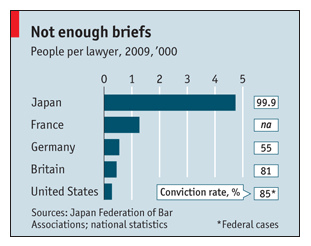
Economist: A run of recent legal scandals, including wrongful convictions and brutal incarcerations, has tested respect for Japan’s criminal-justice system. The latest example, alleged evidence-tampering by a high-flying prosecutor and a cover-up by his bosses, has rallied many who want to see more regard for individual rights and greater checks on state power. The prosecutor in question, Tsunehiko Maeda, allegedly changed the date of a file on a computer disk that was being used as evidence against a woman accused of involvement in a massive benefit fraud. When Mr Maeda admitted this to his superiors, they are said to have ordered him to produce a report explaining how it happened “unintentionally”. On October 11th the Supreme Public Prosecutors’ Office dismissed Mr Maeda, the chief prosecutor in Osaka’s special investigative unit, and pressed charges against him…

The scandal has hit a nerve. Japan takes pride in one of the world’s lowest crime rates. But it also has a fishily high conviction rate, at 99.9%. That matches China’s and is far above rates in the West (see chart). In their defence, Japanese lawyers say that the country’s under-resourced state prosecution service is only able to bring the strongest cases to trial. Fear of failure, with which all Japan’s bureaucrats are imbued, reinforces a reticence to test weaker cases in court. According to a former Tokyo district court judge, a single courtroom loss can badly damage a prosecutor’s career. A second can end it.

Yet the recent scandals suggest that miscarriages of justice are all too common. So do several quirks of the justice system, which weigh the scales against the accused. Suspects can be held for up to 23 days without charge, for example. They often have little access to a lawyer and none during questioning. Police interrogations commonly last up to ten hours and are rife with mental and verbal abuse. On October 7th a businessman in Osaka produced a surreptitious recording of his seven-hour “voluntary” questioning, in which the police threaten to hit him and destroy his life…

https://www.debito.org/?p=7693

///////////////////////////////////////////////////////////////

2) Not only China, Japan eyes India for tourist influx, eases visas

As another move by the GOJ to stimulate our economy through tourism (first big move was the Chinese back in July), we have the easing of visa restrictions for subcontinental Indians too. Good idea.

Indian Express: Visiting Japan for business or holiday will be easier after Prime Minister Manmohan Singh’s official tour to the country starting Sunday. After negotiating for four years, the two countries are set to sign a memorandum that will provide longer duration visas to Indians.

The new visa deal will benefit businesspersons the most who — on receipt of a request letter from “a duly recognized company” or from chambers of commerce or industry or trade groups — will be eligible for a five-year multiple-entry visa instead of the current “short-term” 90-day visa. Their dependents will automatically be eligible for three-year multiple entry visas. These applicants will also be exempt from submitting a host of supporting documents.

https://www.debito.org/?p=7676

///////////////////////////////////////////////////////////////

3) CRNJapan’s checklist for avoiding J child abductions during marital problems

Just In Case: A Parental Abduction Preparedness Checklist

The Japan Children’s Rights Network in response to the ever increasing number of International Parental Abductions to Japan has released a preparation guide for all of those in intimate relationships / Marriage with a Japanese citizen. This guide is the “get your affairs in order” guide to making sure that when and if your Japanese significant other abducts your child you are prepared. Please email webmaster@crnjapan.net with any questions / additions.

Here is a checklist of things to do if you are about to get a divorce, or if you are worried that the Japanese parent might try to take your children at some time in the future. (Some of this applies generally to all kinds of child abduction and is advisable to do anyways, even if you are not worried right now.) Some applies only if you are in Japan, and some applies only if you are not.

Make sure to store all information in a safe place where the child’s other parent cannot get to it, such as a safe deposit box that only you can enter, or a friend or relative’s home. Also, to help ensure that others do not misuse this information, you as the parent should be the only person to keep this information about your child. You should be wary of gadgets and gimmicks that purport to protect your child or any sort of data-collection or registration services that store information about your child. There is no substitute to collecting and storing this information yourself.

The List (a pre-divorce checklist)

1. Make sure that your marriage is registered on your Japanese spouse’s Family Registry. (koseki).

2. Make sure that you are registered on the Japanese spouse’s Family Registry. (koseki) as the parent of each of your children. (You can order these from outside Japan with forms from here.)

3. Get copies of Japanese spouse’s Family Registry. (koseki) and a current Residency Registration (juminhyou) from the appropriate local government office. Note that foreign spouses are never listed on the actual juuminhyou, but if you ask, they may list you in the remarks section. Make sure to request this so that you have proof that you were living together. (Some government offices still wont do it, but many will.)…

https://www.debito.org/?p=7651

///////////////////////////////////////////////////////////////

4) Weekend Tangent: What Canada does about racial slurs and abuse in public: jail time

Here’s what a place like Canada does when you have a thing like racially-motivated slurs and abuse: They give the abuser jail time. Fancy that. In fact, more than the prosecution was seeking. Fancy that. I’ve been told on more than one occasion to “go back to my own country” (even after naturalization, and once by a professor in my own university), and nobody has ever anything about it. Sad, innit?

Calgary Herald: A Calgary man who made racial slurs and spit in the face of a woman waiting to catch a bus has received a six-month jail sentence — twice the punishment the Crown was seeking…

Juzwiak said Richardson told the woman she was an immigrant and should go back to her own country. He spat on her, then threatened her and a man came to her rescue…

https://www.debito.org/?p=7697

///////////////////////////////////////////////////////////////

5) Weekend Tangent: Discovering how cheap, yes cheap, parts of Japan are becoming

I finished earlier this month a first draft of an update of the Hokkaido chapter in a famous travel guidebook (tell you more later after it hits the press), and thought I’d tell you what I noticed:

Japan is becoming surprisingly attractive for tourism. One thing I’ve seen when traveling overseas is just how surprisingly expensive things are — like, say, dining out. Inflation, Euro-currency-inflation, tips and service charges of ten to twenty percent, etc. have made eating in a sit-down restaurant a rather unattractive option (when traveling I usually self-cater, visiting overseas supermarkets where things are far cheaper).

In contrast, Japan’s currency sans inflation, a stable tax regime, and deflationary prices in many sectors have ultimately kept prices the same while they gradually rise overseas. After all these years of hearing about Japan as “the place where you goggle at hundred-dollar department store melons”, it’s finally reached a point where generally speaking, it’s now become cheaper in Japan. While travel costs seem about the same (if not slightly higher in some cases due to fuel-cost-appreciation), once you get here, you’re able to predict costs, stick to budgets, and pay comparatively less without hidden fees creeping in.

Then look at Hokkaido, which is becoming a bargain destination…

https://www.debito.org/?p=7619

///////////////////////////////////////////////////////////////

6) Yomiuri: Tokyo bathhouses scrub up to lure NJ visitors. My, how the worm turns. Why couldn’t they have done this ten years ago?

My, my, how the worm turns. Check out how the International Terminal at Haneda Airport has gotten Tokyo bathhouses all abuzz about profit. All those customary fears about foreigners and their troublemaking ways (cf. the Otaru Onsens Case) simply evaporate when there’s the whiff of a tidal wave of tourist money to be had.

Come back foreigners, all is forgiven! Never mind about all the hand-wringing ten plus years ago, or about actually protecting them with any laws against potential refusals nationwide. This at places with owners who aren’t quite so magnanimous (or open-minded) at restaurants, hotels, etc. No doubt if there are any problems or outright xenophobia, it’ll be depicted as the foreigners’ fault all over again.

Tokyo bathhouses scrub up to lure visitors (Yomiuri Shinbun, Oct. 22, 2010)

Public bathhouses in Ota Ward, Tokyo, are bubbling with excitement at the prospect of a flood of foreign visitors the new-look Haneda Airport will bring.

Thursday’s opening of a new runway and terminal at Haneda make the airport an international hub, an opportunity the bathhouses hope will stop their business going down the drain.

The Ota public bathhouse association has made posters in four foreign languages, which explain local bathing manners, such as entering the bathtub after washing your body. It also plans to visit local public baths with foreign residents on Oct. 31 — the day when regular international flights go operational at Haneda…

https://www.debito.org/?p=7654

///////////////////////////////////////////////////////////////

7) Referential website of note: Asia Pacific Memo at UBC

One of my hosts at the University of British Columbia turned me on to a website I thought deserved a bit more attention: their “Asia-Pacific Memo”. Although not all about Japan (Japan in overseas academia is losing out big time these days to China, (sadly) understandably), it has a lot of food for thought about how to interpret current events in Asia. Have a look:
http://www.asiapacificmemo.ca/

Japan-specific topics here:
http://www.asiapacificmemo.ca/category/japan

///////////////////////////////////////////////////////////////

CHOTTO MATTA…!

8 ) Allegations that GOJ’s Hello Work refuses NJ applicants, as evidenced by “Japanese Only” employer Zeus Enterprise of Tokyo Ginza

Yoshikawa: Hello Debito, I’m a Chinese-Canadian living in Japan and I am very supportive of your effort on anti-racism in Japan.

You mentioned in your website that you welcome people to submit “Japanese only” signs if they see one. So I decided to do so although this is from a company website on recruiting, not an actual shop sign.

I’m currently in the middle of looking for a job. I’ve been living in Japan for 10 years and because of my Asian look, Japanese language skill, and my adopted Japanese last name (from my wife), I have been facing less discrimination when applying a job, compared to many other foreigners. However every time when I visit the hellowork’s foreigner section, I can always hear some employers routinely refusing applications from foreign residents, especially those from regions such as Africa, Middle East, and Southeast Asia. The foreign residents section itself is a discriminatory practice too as foreign residents have no other choice but are required to visit a segregated “foreigner section”, even though in my case I do not need any language interpretation or counselling on Japanese life.

When I visited hellowork last week, as usual I have the staff phoning hiring businesses to introduce me as an applicant. Because all the jobs I apply require high level of trilingual (English, Japanese, Chinese) skill, most companies do not mind my background as a foreigner, however Zeus Enterprise, upon hearing that I’m a foreigner from the hellowork staff, rejected me as a valid applicant, saying that this position is for “Japanese only”…

https://www.debito.org/?p=7661

///////////////////////////////////////////////////////////////

9) JT’s Philip Brasor analyzes J media claims of bias towards Ichiro’s and Hakuho’s sports records

Japan Times: Local favoritism is built into organized sports. At the macro level you have whole countries rooting for national teams at the Olympics or the World Cup. At the micro level you have fans cheering a hometown boy who plays for a team far away. By the same token, nationalistic fans denigrate opposing countries’ players in international tournaments, while athletes from outside a locality may not receive the same level of local enthusiasm as those who grew up there.

In its Sept. 30 issue, Shukan Shincho attempted to build a story on two recent events: Hakuho’s breaking of Chiyonofuji’s record for consecutive sumo victories, and Ichiro Suzuki’s milestone 3,500th hit as a professional baseball player. That these events occurred within 24 hours of each other was irresistible, and Shincho wanted to connect them in a way that was guaranteed to attract attention. The headline of the article was, “Ichiro’s and Hakuho’s racism problem.”

Both athletes are strangers in foreign lands; or, at least, they started that way. Ichiro has been an outfielder for the Seattle Mariners in the United States since he entered the Major Leagues in 2001 after nine years playing in Japan’s Pacific League, and he has consistently been one of the game’s best hitters in both countries. Hakuho was born and raised in Mongolia, and is now the sole yokozuna (grand champion) in what is an ancient and traditional Japanese sport. Shincho’s point is that because both are “foreigners,” they do not receive the same attention and respect from the media and the public in their respective countries as native athletes, despite the enormity of their achievements.

Shincho claims that Ichiro’s 3,500th hit, a landmark that very few players in the history of the major leagues have reached, was virtually ignored by the American press. The reason, according to the magazine, is that Ichiro compiled this record in two countries, and Americans don’t take Japanese baseball seriously. To support this theory, the reporter quotes Japanese sports writers and baseball players who make the case that Ichiro’s talent is superior to that of the vast majority of currently active American baseball players.

As proof that Americans don’t evaluate Japanese players equally, the opinion of retired major leaguer Pete Rose is cited…

https://www.debito.org/?p=7571

///////////////////////////////////////////////////////////////

10) Mainichi & Asahi: “4 arrested for helping Cambodian men work illegally”. Odd, given shysterism of Trainee Visa program

Three articles here describing police actually arresting people (Japanese employers, too) for NJ employment visa violations. Interesting, given all the shysterism that goes on under the Trainee Visa etc. programs that necessitate civil (not criminal) court cases for redress, and involve few arrests. I guess it’s more important to employ people on proper visas than to employ them humanely. Get the visa right, and you can do whatever you want to your NJ workers. Perhaps that’s precisely what the Trainee Visa was designed to enable: Cheap exploitable NJ labor for companies in trouble.

Mainichi: The president of an information technology (IT)-related company and three others were arrested on Oct. 18 for helping three Cambodian men come to Japan under the guise of IT engineers and illegally work at a supermarket, police said.

Arrested for violating the Immigration Control and Refugee Recognition Law were Lim Wee Yee, 39, president of the IT company in Iizuka who is a Malaysian national; Takashi Miyazaki, 40, president of the Kurume Chimakiya supermarket chain; his younger brother and board member Yoji Miyazaki, 36; and Masaru Sakai, 30, the operator of another supermarket.

https://www.debito.org/?p=7647

///////////////////////////////////////////////////////////////

11) NYT on Japan’s deflation: “Japan, Once Dynamic, Is Disheartened by Decline”

NYT: Deflation has also affected businesspeople by forcing them to invent new ways to survive in an economy where prices and profits only go down, not up.

Yoshinori Kaiami was a real estate agent in Osaka, where, like the rest of Japan, land prices have been falling for most of the past 19 years. Mr. Kaiami said business was tough. There were few buyers in a market that was virtually guaranteed to produce losses, and few sellers, because most homeowners were saddled with loans that were worth more than their homes.

Some years ago, he came up with an idea to break the gridlock. He created a company that guides homeowners through an elaborate legal subterfuge in which they erase the original loan by declaring personal bankruptcy, but continue to live in their home by “selling” it to a relative, who takes out a smaller loan to pay its greatly reduced price.

“If we only had inflation again, this sort of business would not be necessary,” said Mr. Kaiami, referring to the rising prices that are the opposite of deflation. “I feel like I’ve been waiting for 20 years for inflation to come back.”

One of his customers was Masato, the small-business owner, who sold his four-bedroom condo to a relative for about $185,000, 15 years after buying it for a bit more than $500,000. He said he was still deliberating about whether to expunge the $110,000 he still owed his bank by declaring personal bankruptcy.

Economists said one reason deflation became self-perpetuating was that it pushed companies and people like Masato to survive by cutting costs and selling what they already owned, instead of buying new goods or investing.

“Deflation destroys the risk-taking that capitalist economies need in order to grow,” said Shumpei Takemori, an economist at Keio University in Tokyo. “Creative destruction is replaced with what is just destructive destruction.”

COMMENT: This passage resonated with me because…

https://www.debito.org/?p=7626

///////////////////////////////////////////////////////////////

12) CJFF: Immigration raids Filipino family home, husband has heart attack

CJFF: Afternoon of October 13, 2010 immigration officers questioned Victor de la Cruz in his work site at Gako Ishikaya located at the basement of Tokyo’s Shimbashi station of JR line. The immigration officer is asking if he and his wife, Susan Lubos de la Cruz who is an employee of an African embassy and Victor as her dependent are real husband and wife. There is no established case and Victor went home afterwards.

Today, October 20, 2010 at around 11:30 a.m. the immigration officers went to the home of Mr. and Mrs. de la Cruz in Meguro-ku and Victor was alone in the house. Later an immigration officer who gave his name as Mr. Kato of Shinjuku immigration with telephone number 03 5155 0496 called Susan, the wife of Victor, informing that they, the immigration officers, sent Victor to the National Organization Tokyo Medical Center at around 1:00 p.m. Victor suffered heart attack and in comatose given a 10-20 % chance to live by the doctor as of this writing (October 20, 2010, 11:50 pm).

Susan learned that her husband heart have stopped beating for an hour before Victor was sent to the hospital. Upon arriving home, Susan found all of their things and belonging are scattered and she also learned from the immigration officers that they went to their house to look for evidence if their marriage is real or not…

Susan, a member of Gabriela-Japan, a chapter of the Philippine national women organization Gabriela with 2 seats in the Philippine House of Representatives, is asking her organization for legal assistance and possibly to question the Immigration Bureau about the legality of their actions. Nobody knows what transpired and what kind of treatment, pressure, or intimidation or whatever the immigration officer employed to make Victor to suffer from heart attack. Susan is also doubtful about the legality of the immigration officers’ action in raiding her house…

https://www.debito.org/?p=7664

///////////////////////////////////////////////////////////////

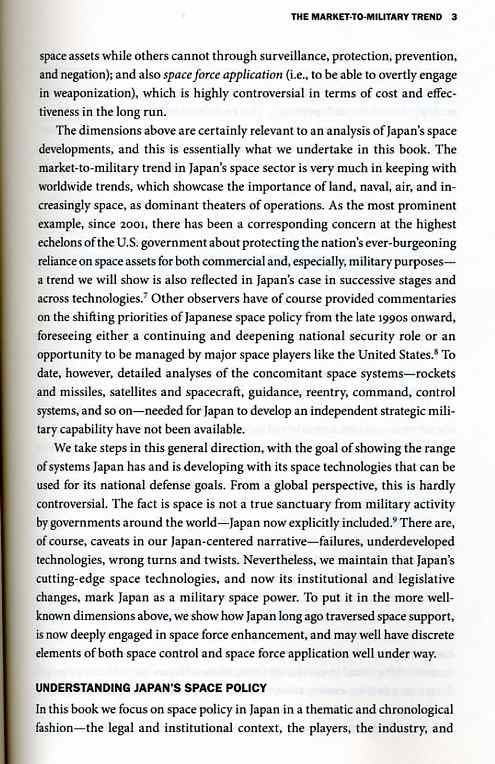
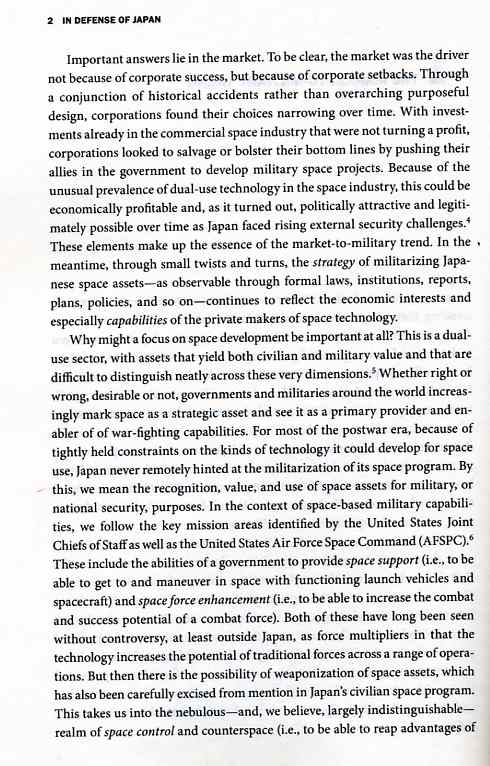
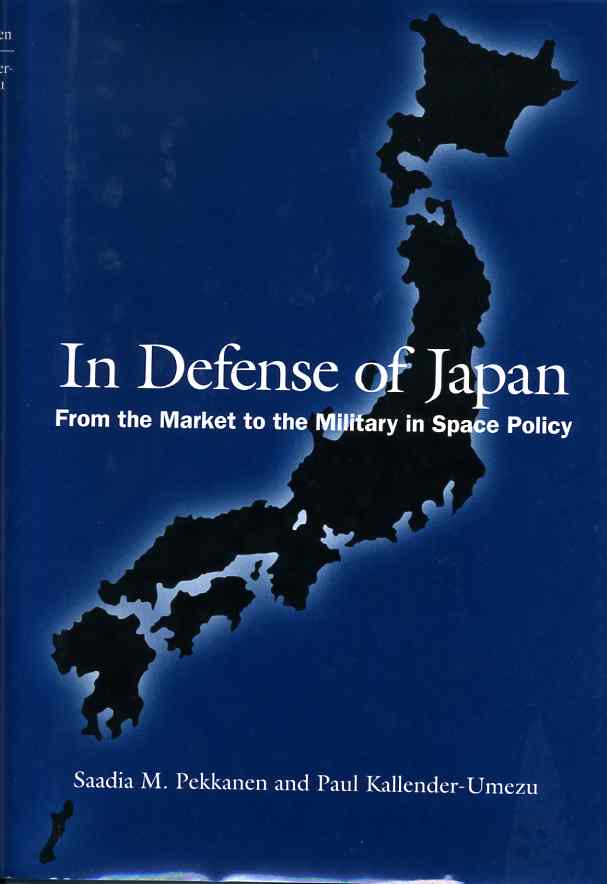
13) New Book: “In Defense of Japan: From the Market to the Military in Space Policy” by Pekkanen and Kallender-Umezu

Here are some excepts of a new book out from Stanford University Press on Japan’s space policy. “In Defense of Japan: From the Market to the Military in Space Policy” by Pekkanen and Kallender-Umezu. A complete tangent to what we do here at Debito.org, the book deserves an audience (reviewers have been a bit chary) given the subject matter: how easy it would be for Japan to become not only a nuclear power, but a military superpower in space should the situation in Asian geopolitics grow ugly. I happen to know one author (Paul, who gave me a copy) and the spouse of the other (Saadia, whose husband hosted me for a speech at UW years ago), and am happy to do them a favor and offer a little exposure here.

I haven’t read the book yet (received it Saturday, only gave it a thumb-through), but others might want to. Cover, ISBN, blurbs, and scans of the first three pages follow.

https://www.debito.org/?p=7600

///////////////////////////////////////////////////////////////

14) CNNGo.com does odd article on “Controversial Activist David Schofill” and NJ refusals at hotels and onsens

Friend Curzon alerted me to this odd little article on CNNGo.com:

Japan invites tourists — but there may be no room at the inn for foreigners
Controversial activist claims dodgy non-Japanese policies blight Japan’s hotel industry despite relaxed VISA laws
By Robert Michael Poole, CNNGo.com, 6 July, 2010

Encouraged by the boost to the economy that Chinese tourists have been giving, Japanese Foreign Minister Katsuya Okada announced only last week that VISA restrictions will be eased to allow mid-level income earners from China to make the grade. Previously only wealthy Chinese could make it through immigration, but the necessary income level of VISA applicants is being cut from 250,000 yuan (36,000 U.S. dollars) per year to just 60,000, which the government believes makes a further 16 million Chinese eligible.

The problem though, as highlighted in a column in today’s Japan Times, is that Japanese hotels are not only legally entitled to discriminate and bar non-Japanese, but many make false excuses to avoid foriegners [sic] of any sort staying in their premises. “Japanese only” signs appear not just in hotels, but at onsens (hot springs), bars, restaurants and entertainment venues too.

Despite this sometimes leading to (successful) lawsuits, including a famous case against Yunohana onsen in Otaru, Hokkaido by activist David Schofill in 2001, a government survey in 2008 found 27% of hotels did not want any non-Japanese staying with them. Schofield — better known today by his Japanese name Debito Arudou and renowned for being an outspoken and sometimes controversial activist — found excuses from hotel staff ranging from “In case of an emergency, how can we communicate with non-Japanse effectively to get them out of a burning building?” to not having western-style beds…

Er, activist David Who…?

https://www.debito.org/?p=7629

///////////////////////////////////////////////////////////////

15) NHK 7AM October 17: Offer coupons at Narita Airport to NJ with “preferential exchange rates”. The catch is…

Related to my post last Saturday talking about how things were becoming cheaper in a deflationary Japanese economy:

Something came on NHK News this morning at 7AM that nearly induced reverse peristalsis on my corn flakes due to excessive laughter. Deep breath:

The exchange rate this morning was 81 yen and change to the dollar. The (well-grounded) complaint is that this is discouraging tourism to Japan and purchases from NJ tourists, due to things being make more expensive upon exchange.

So NHK was breathlessly reporting (live) from Narita Airport this morning how authorities had come up with a great wheeze to stimulate spending!

Ready for it?

“PREFERENTIAL RATE COUPONS!!”

Meaning that if you hold one of these coupons (they provided a graphic with a big-nosed (of course) gaijin clutching this precious slip of paper), you would get a discount on your exchange from dollars (or whatever) into yen.

And that preferential rate would be?

Ready for it?…

https://www.debito.org/?p=7635

///////////////////////////////////////////////////////////////

BASTA!

16) Kyodo: Court overrules Oita Pref who tried to deny a 78-year-old NJ welfare benefits

Kyodo: A Japanese court repealed on Thursday a decision by Oita Prefecture in southwestern Japan not to examine a request from a 78-year-old Chinese woman to look into a decision by Oita City that rejected her application for welfare benefits.

A three-judge panel at the Oita District Court acted on a suit filed by the woman, who has obtained permanent residency status in Japan, against the Oita prefectural government decision that turned away the woman’s request, filed in February last year, to examine the Oita municipal government decision not to provide welfare benefits to her.

The prefectural government dismissed the woman’s request without examining it, saying she was not eligible to seek benefits because she does not have Japanese nationality.

In Thursday’s ruling, the district court said the prefectural government must review the municipal government decision in line with the woman’s request, and decide whether she should be given benefits.

Presiding Judge Kenji Kanamitsu brushed aside the prefectural government’s argument that the city’s decision not to provide her with benefits was a ”unilateral administrative action” against a foreigner who has no right to seek welfare benefits, and not an ”administrative decision” as she claimed, whose appropriateness can be reviewed under the administrative appeal law.

Judge Kanamitsu said the woman is ”obviously” eligible to ask the prefectural government to review the municipal government decision.

”An application for welfare benefits has been rejected, and it means the same to the applicants, regardless of their nationalities,” the judge said…

https://www.debito.org/?p=7563

BUT

17) Mainichi: “NJ have no right to welfare payments”, rules Oita District Court two weeks later. Gee that was a quick kibosh.

After a half-month interlude of light and reason (as in September 30 to October 18), where it actually looked like a Japanese courtroom was actually going to be nice to somebody and rule against The State, another court has come along and put things back to normal:

Mainichi: The Oita District Court ruled on Oct. 18 that foreigners with the right to permanent residence but without Japanese citizenship are not entitled to welfare benefits, rejecting the claims of a 78-year-old Chinese woman who sued after being denied benefits by the Oita city government…

According to the ruling, the woman has Chinese nationality but was born in Japan and holds the right to permanent residence. In December 2008, the woman applied to the welfare office in Oita city for welfare payments, but was turned down with the reason that she had “a comfortable amount of money” in her savings.

The main issues of the trial became whether the woman held the right as a foreigner to receive welfare payments and whether her financial status justified her receiving aid…”

COMMENT: Gee, that was quick by Japanese judicial standards! I guess they know the value of putting the kibosh on something before the floodgates open: Can’t have all the goddamn foreigners expecting to have rights to something like our social welfare benefits, especially at an advanced age.

https://www.debito.org/?p=7639

///////////////////////////////////////////////////////////////

18) Hate crimes in Fukui: Car burned, “Gaijin GET OUT” message left at local mosque; flagburning at Indian restaurant

Kyodo: A car in front of a mosque in the city of Fukui was found on fire early Wednesday and sign saying “Foreign people [gaijin] GET OUT” written in a mix of Japanese characters and English letters was found posted at the two-story building, police said Thursday.

The possible arson case follows an incident at an Indian restaurant 1.5 km away last month, when a flag was burned and a similar sign posted, they said.

The burning station wagon, owned by a Malaysian student, was discovered at around 1:15 a.m. in the parking lot of the mosque, according to police. There were no injuries.

https://www.debito.org/?p=7668

///////////////////////////////////////////////////////////////

19) Japan Times: Eikaiwa Gaba: “NJ instructors independent contractors w/o labor law coverage”, could become template for entire industry

Dovetailing with post above on NJ’s treatment at unemployment agency Hello Work, here’s more on how weak their position can be when they ARE hired, in this case by Eikaiwa company Gaba, who says their NJ staff aren’t covered by Japanese labor laws:

JT: Instructors first formed a union in September 2007 and, according to union members, met with company representatives for talks. However, managers always refused to enter into serious negotiations, arguing the instructors were not employees and, as itaku — independent contractors — weren’t covered by Japanese labor laws.

Determining who qualifies as an employee and who can be classed as an independent contractor isn’t always clear. However, the method in which workers are scheduled and their place of work are important considerations…

In its financial report, the company argues that because it doesn’t designate working time or location and doesn’t give specific instructions for lesson content, it considers its instructors to be independent contractors…

Japan’s Statistics Bureau’s annual Labor Force Survey shows the number of nonregular workers has increased steadily since 1999, after the Japanese government started relaxing regulations to make it easier for companies to hire workers outside their regular employment system. In 1999, 25.6 percent of Japan’s labor force was classified as nonregular. By 2009 the figure had increased to 33.7 percent.

Employing instructors as independent contractors allows Gaba to reduce labor costs… Combs warns that instructors at other schools may also face being shifted to independent contractor status in the future.

“Gaba lowers the bar on the entire industry, and it will tempt other companies to try the same thing,” he says.

Ringin agrees that the stakes are high in the union’s battle with Gaba over the individual contractor issue.

“If Gaba gets away with using the itaku system, Berlitz and the other chains would be crazy not to follow.”

https://www.debito.org/?p=7678

///////////////////////////////////////////////////////////////

20) Fukuoka General Union info site on how BOEs are outsourcing ALTs through dispatch companies, not through JET Programme

FGU: Throughout Japan Boards of Education have been moving away from the JET program in favour of outsourcing ALT jobs to dispatch companies. In Fukuoka it has come to the point that most BOEs subcontract out their work.

This page is aimed to shed some light on the current systems that operate to the detriment of ALTs — who are practically all non-Japanese (NJ).

– Why do BOEs outsource ALT teaching jobs.
– The difference between direct employ, sub-contract and dispatch contracts.
– What is illegal about a sub-contract ALT working at a public school.
– The tender bid process.
– How much money do dispatch companies make from ALTs?
– Dispatch company ALT and health insurance.
– How dispatch companies and BOEs get rid of ALTs they don’t like.
– Ministry of Education tells BOEs to directly employ ALTs — BOEs ignore directive.
– Labour Standards Office issue reprimand, BOE has head in the sand.
– How the sub-contracting system damages other teachers in the industry.
– Why the Fukuoka General Union is fighting for direct employment.
– Reference materials
– You Tube news reports on the ALT sub-contracting issue (Helps explain the situation to Japanese teachers)

Why do BOEs outsource ALT teaching jobs?

Up until a few years ago most local governments procured their Assistant Language Teachers (ALTs) through the JET program. However, with local government budgets tightening, they began looking for ways to cut expenditure. The cost of keeping a JET was about 6 million yen per year, so when they were approached by dispatch companies which offered to do it for less they jumped on the bandwagon. But not only did they save money, they outsourced the management of the ALTs, getting the dispatch company to take on the troublesome chore of getting the ALT accommodation, assimilating them into Japanese society and taking care of any trouble that arises. Like a cancer the number of non-JET ALTs at public schools increased to a point where they make up the bulk of ALTs in Fukuoka (and other) Prefectures. To outsource the ALT teaching jobs, they have determined that it is a “service” (gyomu)…

https://www.debito.org/?p=6537

///////////////////////////////////////////////////////////////

… and finally …

21) My next Japan Times JUST BE CAUSE column Tues Nov 2: How the “Cult of Japan’s Uniqueness and Homogeneity” interferes with good scholarship on Japan

This coming Tuesday, November 2 (in print Wednesday November 3 in the Boonies), my next Japan Times JUST BE CAUSE column will be coming out.

Topic: I attended an international conference last month, where a senior scholar of some renown gave a lecture on Japan’s uniqueness, saying that Japan is still the most homogeneous society in the world. Homogeneity he defined as the number of foreigners in Japanese society.

Armed with Google (we had Internet access in the lecture hall), I raised my hand and an issue with the claim…

And that starts the column. Have a read on Tuesday…

///////////////////////////////////////////////////////////////

All for now. Thanks for reading!
Arudou Debito, Sapporo, Japan
debito@debito.org, RSS and daily updates at www.debito.org
DEBITO.ORG NEWSLETTER NOVEMBER 1, 2010 ENDS

Weekend Tangent: Fun and Games at MOFA Passport Renewal — almost denied a passport because of one letter

mytest

Handbook for Newcomers, Migrants, and Immigrants to Japan\Foreign Residents and Naturalized Citizens Association forming NGO\「ジャパニーズ・オンリー 小樽入浴拒否問題と人種差別」(明石書店)JAPANESE ONLY:  The Otaru Hot Springs Case and Racial Discrimination in Japansourstrawberriesavatardebitopodcastthumb
UPDATES ON TWITTER: arudoudebito
DEBITO.ORG PODCASTS on iTunes, subscribe free

Hi Blog. This will no doubt be put into the “shake your head in disbelief at Debito’s stubbornness” file by some, but here goes:

Last Tuesday my Japanese passport expired. Yes, it’s been more than ten years since I became a Japanese citizen. What that means to me is a topic for another blog entry someday. But what happens every time I go in to the Foreign Ministry’s Passport Renewal Office happened again like clockwork — it’s becoming a MOFA tradition.

So I went in on Tuesday and filled out my application as per normal (answer all the “you better say no” questions, mostly along the line of “are you a terrorist or criminal?”, correctly), and got all checked as normal: current passport (MOFA will later give it back cancelled, unlike, for example, international driver licenses issued in Japan), juuminhyou, koseki touhon (these were actually not necessary if the passport is still valid, which it was, darn it), and mug shot.

But as is traditional, we got into a dispute about how to spell my name.

Clerk: “You have to spell it in Hepburn Style. That means ARUDO or ARUDOH, not ARUDOU.”

I pointed to the passport and said that ARUDOU is how it has always been spelled. “And if you check your records, you will see we have had this discussion before, both in 2000 when you first issued me a passport, and in 2007 when my name was changed legally to ARUDOU DEBITO after my divorce.”

She flipped over the application to the back where I had filled out a new special section (once a separate sheet, now as of June 2009 part of the application form) for irregular and foreign spellings/renderings. “Here it is spelled as you want it. ARUDOU DEBITO. But on the obverse of this application you must spell it ARUDO. That’s Hepburn Style. For our records. That is how we officially convert Japanese script into Romaji.” She pointed to the list of complete official transliterations for every set of kana possible in Japanese.

Me:  “I don’t think you know just how flawed the Hepburn System can be, ma’am.  You still have old spellings like Honma rendered as HOMMA. That will not be read “hon-ma” by anyone who does not understand Japanese. I had a friend by the name of Monma who was constantly annoyed because Customs read her name MOMMA. I think you ought to consider allowing more flexibility in Romajinization. That would include me.”

She reiterated that these were the rules and would I not just cross out the U on my last name for the MOFA’s recordkeeping purposes?

“That’s fine,” I said, “but I don’t care about your records. My name is spelled ARUDOU.  Always has been.  I will determine my own identity, thank you very much.”

She called over someone more senior who handled me for the rest of the day, a very friendly but persistent old man who reiterated the drill about how names were supposed to be spelled.

I told him I wasn’t going to be told how to spell my own name. Especially when it’s in my own native language. “I’ve had bureaucrats try to correct me on the stroke order of how I write a number 5.  That’s pretty arrogant.  I know how to write a number 5. I learned it as a native in my schooldays. If you want to correct my stroke order of a 五 in kanji, then fine. But I will not allow bureaucratic cultural insensitivity and arrogance to dictate how I should use the Roman alphabet to alphabetize my own name.”

Mr. Senior said, “But you see, it will come out as you want on the passport thanks to the way you wrote it on the back. ARUDOU. Is there any possible damage that could be done just by deleting that U at the end having it entered in our records properly as ARUDO?”

“Yes. ARUDO is not me. ARUDOU is. I have had many years of dealing with alternate katakanizations of my original names ARUDOUINKURU DEBITTO — so much so that it was difficult to track my nenkin records down. No thanks. It is ARUDOU on my passport now, and I will always have it rendered as ARUDOU in any records of me as such.

“I don’t think you understand just how critical this is to my identity.   Unlike most people, I chose my name.  It is me.  My choice was after a lot of time spent living in Japan, qualifying to be a citizen, and going through a rigorous test to become Japanese.   A name is the most important possession a person can have. I will not bend on this. I didn’t in 2000 or 2007. I won’t now.”

Mr. Senior went back behind the counter and shortly thereafter came out with a frown. He said:

“If you don’t cross this U off your name, I regret to inform you that we will not be able to accept or process your application.”

I gave him the stare I gave the camera for my passport picture (which does not allow smiles).

Only without the Mona Lisa upturned corners of the mouth. And held it.  For quite some time.  And said, “You would deny me my right to travel overseas just because of a letter U? Who do you think you are?

“You accepted my spelling as ARUDOU twice before. Now you will again. Check your records. Back in 2000, I went into the back room with one of your supervisors and handwrote a moushitatesho, which said that if there were any problems arising from the extra U on my name, that I would take full responsibility. Go on. Check.

“If you can find any document where I wrote my name as ARUDO in the past, then I will oblige. Otherwise you will. Because you did before. Now check.”

He did.

About a half hour later (I played a lot of Bejewelled on my iPod), he came back and offered me a deep bow.

“We found your moushitatesho in our records.  It is as you say.  We will accept your application as is. And we apologize for the delay and hassle.”

“I understand.  But don’t you think it’s time for you to relax your rules now that there are more international and multicultural Japanese citizens with more individual name spellings?  Would it really break your computer to render us as we would like to be rendered, within reason?”

Mr. Senior:  “I will pass your case onto the relevant authorities for consideration.”

“Thanks very much.  But will I have to go through this every ten years?”

“Hopefully not.  But in a decade I’m not sure I’ll still be here.  I’m getting grey, as you can see.”

“I’m sure customers like me aren’t helping with the grey hairs.”

We shared a laugh and eventually parted on very good terms.  Me especially, because I like being listened to (and I like winning arguments, of course).  But I really feel as though he finally came round to understanding why I was being so goddamn stubborn.  It only took about two hours.

I still think it’s about time for the GOJ to loosen its top button a bit and allow for some flexibility in names.  We’ve finally gotten some degree of breathing space in what constitutes a “Japanese name” after naturalization.  We’ve even gotten some flexibility in how a name is rendered on a passport.  Now let’s hope that we can at least have some wriggle room regarding the almighty Hepburn System.  The Monmas of the world who don’t like to be made into mothers (not to mention the 大岡s, who have to live with OOKA (ooka ooka ooka shaka, hooked on a feeling!) or OHOKA (おまえ、アホか?)) I think would sincerely appreciate that.  What’s the point of forcing people to render their names into a system that people can’t read properly?  ArudoU Debito

ENDS

WB and me on what NJ tourists also need in Japan — security against NPA harassment

mytest

Handbook for Newcomers, Migrants, and Immigrants to Japan\Foreign Residents and Naturalized Citizens Association forming NGO\「ジャパニーズ・オンリー 小樽入浴拒否問題と人種差別」(明石書店)JAPANESE ONLY:  The Otaru Hot Springs Case and Racial Discrimination in Japansourstrawberriesavatardebitopodcastthumb
UPDATES ON TWITTER: arudoudebito
DEBITO.ORG PODCASTS on iTunes, subscribe free

Hi Blog.  I get letters like this on a daily basis (thanks everyone; can’t respond to all).  This one dovetails with something Debito.org is increasingly focusing attention upon:  Japan’s attempts to rebrand itself as a “cool tourist destination”.  This is fine, of course, but if you’re going to make it easier for NJ tourists (such as Chinese or Subcontinental Indians) to visit, you better make sure that they have a good time while here.  And I certainly see some room for improvement there.

I was waking up to NHK last Monday morning, and in line with their general cluelessness about how to treat NJ (such as acclaiming paltry 30-sen discount coupons for exchange rates), this time they were surveying airport tourists about what they’d like to see done to make Japan more attractive.  Some of the advice was decent (such as making clear on menus the contents of food, as in, what items are safe for vegetarians or diabetics).  But others were of the “whiny” variety (as in, “In America, we have menus in English”; this in a land where menus are very conveniently visual indeed).  Nice try, but if you’re trying to appeal to Asian-Region tourists, why not ask more Asian tourists what THEY want, NHK?

But one thing is of course being overlooked — how tourists and NJ in general are being targeted and harassed by police for instant passport checks.  It starts at Narita Airport, where the Narita Police are essentially using gaijin for target practice.  And as Debito.org Readers keep hearing here, it keeps happening once inside as well.  Witness this letter below, redacted only in name.

Point is, if you want to make Japan a more attractive tourist destination, please heel your police dogs, GOJ.  The NPA is spoiling the party with its racial profiling and treating NJ as suspicious.  Being treated as a criminal can really spoil one’s vacation.  Arudou Debito

////////////////////////////////////////////////////

November 2, 2010

Hello Debito, My name is WB and I have been following your site for 3 years by now. Let me start by saying that I was very doubtful and cynical of what you mentioned in regards to racism and discrimination in Japan as I’ve noticed none when I first went there for a short 2 week trip on Dec 2008 (Narita’s fingerprints aside). As a matter of fact, I still have some reservations towards the way you approach things, though my opinion of you changed dramatically after I went back to Japan for a 3 month stay last summer.

I went on a tourist visa to Osaka to practice and learn martial arts. My experience in that regards was fantastic and I’ve have the pleasure to meet amazing people during my trip. My experiences with police checkpoints, however, we nothing but scary. During my 3 month stay, I’ve been stopped 5 times, once by undercover detectives simply because I was gaijin. Once I was stopped on my bike, asked for my residency card (which naturally, I didn’t have because I am a tourist!) and escorted back to my home like a criminal, had my privacy intruded, handed my passport to the officers to see it being inspected to the very finest bit as if I gave them some letter full of anthrax or something. One of the officers was apologetic but the other one was rude and warned me harshly. I protested but that got things escalating so I backed down with a “hai, wakarimashita” and breathed a sigh of relief as they went away from my place.

The ensuing days had left me in fear. I quickly looked in the internet for some practical solutions and yours was what I found. I printed the Japanese laws tidbit you posted and had a copy of my passport in my pocket all the times. Carrying my passport all the time is out of the question! What if I lost it here or there? Terrible treatment awaits me if they decided to check on me when that happens! Thankfully, the next few checkpoints after this incident went smoothly, but I was always in a state of fear (for a “crime” that I didn’t commit).

The passport thing also extends to hotels it seems. I went to Shikoku for a 3 day trip and I’ve been asked for my passport in two hotels I stayed in. Failure to do so apparently means that they have to deny me service. I didn’t have my passport at that time, but I managed to convince them to accept my Canadian ID. If you think of it, they’re just following “the rules”, and since my Canadian ID had an name, address, and personal information on it; I was able to “get around” those rules.

Let me stress again that my experiences there were more positive than negative, and I am hopeful to return there once again. However, I can now understand what most NJ face in their daily life. I still have don’t like some of the aggressiveness in your opinions, but I am glad that you’re putting up the fight. Your site provided me with important information at a time of need….Thank you.

PS: I am unable to connect to your site here (Nova Scotia) for the past 2 months. I had to use an anonymous surf proxy to view it. What gives…??

Regards, WB
ENDS

Friend looking for tenant for his house in Yokohama

mytest

Handbook for Newcomers, Migrants, and Immigrants to Japan\Foreign Residents and Naturalized Citizens Association forming NGO\「ジャパニーズ・オンリー 小樽入浴拒否問題と人種差別」(明石書店)JAPANESE ONLY:  The Otaru Hot Springs Case and Racial Discrimination in Japansourstrawberriesavatardebitopodcastthumb
UPDATES ON TWITTER: arudoudebito
DEBITO.ORG PODCASTS on iTunes, subscribe free

Hi Blog. A friend of mine is looking for someone to stay short or long-term in Yokohama (three months and up preferable). Happy to help get the word out. Details as follows. Arudou Debito

Beautiful furnished spacious modern 4-bedroom house for rent in Yokohama, near international schools, min. 3 months, ¥140,000 negotiable. Contact tpgill@yahoo.com

http://sabbaticalhomes.com/OfferedDetails.aspx?id=46015&i=Home_Rent_House_Rental_Yokohama_Japan

Eido Inoue on improbable remote tracking of RFID next-generation “Gaijin Cards”; yet “scan-proof” travel pouches now on sale

mytest

Handbook for Newcomers, Migrants, and Immigrants to Japan\Foreign Residents and Naturalized Citizens Association forming NGO\「ジャパニーズ・オンリー 小樽入浴拒否問題と人種差別」(明石書店)JAPANESE ONLY:  The Otaru Hot Springs Case and Racial Discrimination in Japansourstrawberriesavatardebitopodcastthumb
UPDATES ON TWITTER: arudoudebito
DEBITO.ORG PODCASTS on iTunes, subscribe free

Hi Blog.  With the rerelease of an article I wrote last year (I am reading all my old articles in order for the Debito.org Podcast, so listen here or read it here) is a revisitation of an argument I made about the next-generation “Gaijin Cards” (Zairyuu Kaado), with imbedded IC Chips.  I expressed a fear that these “smart cards” will be remotely scannable, meaning the NPA will be able to zap a crowd and smoke out who’s foreign or not (whereas Japanese citizens have no legal obligation to carry ID 24/7 backed up with criminal punishment) — or will further justify racial profiling of people like me who look foreign but aren’t.

Techie Eido Inoue, a naturalized J citizen himself, writes here on invitation to address this argument.  He was worried that this topic might get a bit geeky (he has in fact made it very readable, thanks), but never mind, this needs to be discussed by people in the know.  However, please do read or page down to the end, where I have some basic counterarguments and a scan of something I saw the other day in a travel shop — a “scan proof” pouch for your valuables on sale!  Read on.

//////////////////////////////////////////////

EIDO INOUE WRITES:

There has been a lot of concern these days about the inclusion use of NFC (near field communications) technology, which is a type of RFID (radio frequency identification), being included in the successor to the Japanese ARC (alien registration card), the 在留カード {zairyū kādo} (non-Japanese residence card). In this comment, I’ve summed up, per Debito’s request, some of the back and forth Q&A that has been occurring on other blogs:

Q: What sort of wireless technology is in these new cards? Is it reliable? Is it proven?
A: The card’s IC chip will use JIS X 6322 type B standards, which is basically the Japanese translation of ISO 14443 type B standards. This is the exact same international standard used for both Japanese and overseas e-passports, as well as Japanese driver’s licenses and the 住基カード {jūki kādo} (Japanese citizen residency card).

Q: What will be inside these chips?
A: The same information that’s printed outside the card:
* full passport/English legal name, date of birth, sex, nationality & domicile/state/locale
* resident address in Japan
* [visa] status, and status length / expiration date
* visa status grant date
* residency card number and expiration/renewal date
* work restrictions, if any
* any permitted activities outside of visa status
* color photograph

Special Permanent Residents, however, will only have the following on their cards:
* full passport/English legal name, date of birth, sex, nationality & domicile/state/locale
* resident address in Japan
* special permanent resident number and renewal date
* color photograph

Technically speaking, the 在留カード {zairyū kādo} (non-Japanese residence card) will be called and labeled as a 特別永住者証明書 {tokubetsu eijūsha shōmeisho} (Special Permanent Resident Identification [Card]) for people with this status.

[ the only thing that will not be on the chip but on the outside of the card will be the Ministry of Justice’s seal. Note that there’s much less information on this card than the ARC: no passport info, head of household, employer, etc. ]

Non-Japanese that have kanji names with their governments will have the kanji on the cards. In the case that the kanji is Chinese Simplified or Traditional and can’t be represented with using Japanese character sets, it will be converted to Japanese form.

[it was not clear from the literature I read what characters were permitted and what were not and what underlying character set encoding, such as JIS X 0208 or Unicode, would be used. It was also unclear to me from reading the literature as to whether non-Japansese without official government registered Kanji names, such as Japanese-Americans or those who just want a Kanji (or kana or hybrid) name, even if it’s 当て字 {ateji}]

Customs/airport officials plan to register / use the alphabet passport form and not the Kanji [even if it’s Japanese] form of the name as inputting / copying the kanji name takes too much time.

Unlike the previous ARC cards, there is no plan to list aliases (either katakana or kanji).

[It does not say how non-Japanese, who have Japanese aliases for anti-discrimination or other purposes, will prove what their registered legal alias is]

Years on the card will be specified in Western (ex. 2010) system, not Japanese (ex. H.22 or 平成22) system. Dates will be in Y M D order, and the fields will be labeled [so you know which is the month and which is the date]. Sex will be specified with a “M” or “F” [as opposed to 「男」, 「女」, 「♂」, or 「♀」].

[This should make the card more comprehensible to non-Japanese officials if you attempt to use it as ID overseas]

If a full name is too long for one line, it will be broken into multiple lines.

[better than the ARC and the Japanese driver’s license, which continued long (ie. Brazilian) names onto the back of the card]

Q: If the information inside the chips is the same as the information written on the outside of the card, what’s the point?
A: Three main points:

1. reduction of data entry errors (no hand copying the info from the card to some other system)
2. speed of processing (depends on the operator, processes, & hardware/software implementation)
3. [primary official reason] preventing the creation of completely bogus identifications using high tech printing, copying and manufacturing technology that is available to even amateurs today.

The info on the chip is digitally “signed” (a certificate validating that no information has been added, changed, or deleted) using PKCS (public-key cryptography standards). So long as the signing key is kept secure by the government, it’s mathematically impossible to recreate a government’s digital signature/certificate associated with a bogus identity. Now, you can clone (that is, copy the certificate along with the entire ID, including the photograph, without adding or removing anything) a digital ID. But that’s not the purpose of the certificate. The signature prevents somebody from creating a bogus ID from scratch. These days, thanks (?) to advances in technology accessibility, most professional and even some amateur forgers can create a phony identity card (“Taro McLovin”), mimicking holograms, blacklight ink, microprint, etc., that is so good it can fool a professional trained inspector.

But even the most powerful governments in the word have yet to break the modern strength digital signature/certificate algorithms — because the best mathematicians, working for the best spook agencies (NIST, NSA) in the world, created the system based on principles of impossible to solve quickly mathematics (ie. using ultra large prime numbers), then publicized all their work to have it checked by the other best mathematicians in the world. Based on what mathematicians have known for literally thousands of years, and taking into account the current state of Moore’s Law, the crypto should theoretically be safe from brute force attack for literally eternity. Where things fail is due to errors in implementing the algorithms, or theft/discovery of the secret keys, not in the algorithms themselves.

Anyway, for IDs with digital signature certificates, the forger is going to have no choice but to clone, in its entirety, somebody’s existing digital ID when they make a fake ID. Which means they’re going to have to look an awful lot like the person whose identity they stole because the picture data is calculated with the certificate’s hash. Plus they’re going to have to hope that the identity theft victim didn’t report the ID as stolen / lost or that the victim unknowingly had their ID scanned in a place that would be logically impossible for a followup scan of the cloned card. For example, a digital ID gets scanned in Hokkaidō, then the exact same digital ID with the same serial number gets scanned by another police officer in Fukuoka 5 minutes later; a computer will pick up on that.

Now, if there’s a fingerprint encoded in the chip (which is not the case for Japanese passports or the 在留カード {zairyū kādo} but is true for new European passports) and digitally signed, then even if the fraudster looks like the victim in the digitally signed photograph, they’re out of luck. They can’t remove or change the fingerprint without invalidating the certificate.

Q: Can a civilian or official read my card from a distance?
A: Extremely doubtful. The way the cards work is that while they have no power source of there own; they are powered by a minute amount of power they induce from their radio frequency for no more than a fraction of a second, and this power gives them the strength to produce a very faint signal that can only be practically read reliably by another device that’s less than four or 5cm away. The chips contain power regulators, so even if you send an extra strong signal to the chip in an effort to give the chip more power to work with, it does not produce a stronger return signal.

This is why you can see a lineup of Suica/Pasmo/Icoca/PiTaPa electronic wicket gates in a train station: the radio waves produced by those gates, which are no more than a meter apart, are so faint that each gate can’t hear and interfere with the radio waves being produced by the gates right next to it.

The maximum field range of a ISO 14443 device is less than 10cm. The maximum range that professionals have managed to get out of a ISO 14443 device in a laboratory (meaning neither the card or the reader can move for a long time, the room’s air is shielded from radio noise, and the lab’s using a very nonstandard reader) is 20cm: the length from the tip of your little finger to the tip of your thumb on an average outstretched hand.

Because the return signal from the chip inside the card is constant no matter how how power you throw at it, the only way you’re going to increase the range is by using a larger antenna. But even then there are limits, as the signal is so weak that it’s literally drowned out by the radio noise that permeates the real world.

Some professionals have speculated that, given a large enough (a very non-portable antenna; it would need to be mounted and not hand held), it is possible to increase the maximum range of ISO 14443, in a laboratory (not real world) setting, to 50cm: the length from your wrist to your elbow.

Anything longer than 20cm is suspect; anything longer than 50cm is science fiction, in my opinion.

Q: Could a crowd of people (assuming they’re in range of a reader), or even a whole bag of cards, be scanned en mass?
A: Even if it was possible to read ISO 14443 cards from a distance, ISO 14443 is designed to only work with one card at a time. It is not possible to have one reader read multiple cards, have many readers read one card, or have many readers read many cards.

It’s a matter of laws of physics (two signals being in the exact same frequency) and the way the devices were designed. Mobile phones, Bluetooth, and WiFi have very sophisticated and complicated protocols to allow them to share and operate and be individually addressed in a range of airspace, jumping and across (sometimes thousands) of frequencies and channels, sometimes using more than one simultaneously, in an elaborate cooperative ballet to prevent two devices from using the exact same airspace at the same time.

ISO 14443, on the other hand, not only doesn’t have these protocols, but in fact was specifically designed to not share airspace with anything else. There are specific fail-safe parts of the protocol that are designed to make the card/reader shut down, back out, and shut up if it detects something else using its airspace for safety/reliability reasons. It also has safety procedures to handle cases where it doesn’t have enough power or a good enough signal to complete a transaction: Everyone knows it’s futile to try to yank away your payment card or try to swipe your card for only a split second in an effort to fool the vending machine into making a transaction without having your balance debited.

If you’ve ever had two Suica Cards and/or a Japanese driver’s license in the same wallet, you know that the readers will refuse to work or will only work with one card. Again, this is not just a limitation of the technology, it is by design.

Q: But what if somehow somebody comes up with way that allows for eavesdropping of a card talking to a reader (from afar or near)? Am I safe?
A: Some people on the Internet have claimed even farther ranges than what we mentioned above: such as detecting the presence of a signal at 20 meters and actually discerning the digital bits at 10 meters. None of these claims have been independently confirmed or verified, and even if we give them the benefit of the doubt and believe for the sake of argument that it’s possible, nobody has shown they can break the cryptography gleaned from real devices in the field in real world situations.

To an eavesdropper, most ISO 14443 cards “sound alike.” This means they all — be it your e-passport or your U.S. Passport Card or your Japanese driver’s license or your FeLiCa based Suica/Pasmo/Icoca/PiTaPa or your PayPass credit card or your Japanese Taspo tobacco age-verification card — talk on the same frequency (13.56 Mhz). Furthermore, the transaction that occurs between the reader and the card is encrypted, so even if a bad person had such a clear signal that they were able to discern the individual digital bits going back-and-forth between the reader and card, it would be useless for determining the payload or even the type of card being used in most cases.

Thus, just because the card, either in your hand or concealed in a wallet, of you or the person next to you is or isn’t “ squawking” and you are or are not doesn’t mean somebody can figure out that “that person is a foreigner and that person is not” due to the presence or absence of a 13.56 Mhz encrypted squawk. That squawk could be anything, from a Japanese passport to a London train commuter Oyster Card.

NOTE: Some security journals have speculated that it may be possible to perform literally a “man-in-the-middle” attack in some cases. This means putting something physically between (the 10cm) space of air between the card and the reader that is big enough to ensure that the reader and card can’t hear each other; the bad spy device acts as a “relay” between the legit card and reader. So when you swipe, you should be absolutely sure you’re swiping the real legit reader and not something placed directly on top of it.

Q: Even if they can’t read the contents of my card, can a civilian or official detect that I’m in possession (or that I’m not in possession) of a 在留カード {zairyū kādo} (non-Japanese residence card) without my knowledge?
A: No. The reason for this in answered both in the previous question and the following question. You could easily fool an eavesdropper into thinking you swiped any arbitrary ISO 14443 Type B card that uses encryption by simply using another, completely different and unrelated ISO 14443 Type B card. You could purchase and carry your own battery powered USB portable [dummy] reader in a purse or bag, for example.

Q: Can a civilian or official read my card without my knowledge if they’re very near or next to me?
A: Japanese [and U.S. and E.U., but not all countries] e-passports, and yes, the new 在留カード {zairyū kādo} (non-Japanese residence card) have BAC (basic access control).

This means you have to know some piece of information that’s either on the card or in your head to read it.

Even if somebody manages to covertly (say, on a crowded train or bus) get a portable skimmer close enough [less than 10cm] to your back pocket, purse, bag, or briefcase to pick up your card, they still need to know some things that are on the card in order to read it.

NOTE: Not all NFC cards and RFID use this extra access control and/or encryption. So you don’t want to carry all your cards unprotected / unshielded in your back pocket. It is possible to obtain special, practical shielded slips for ISO 14443 based technology (tin foil hats sold separately). Some ISO 14443 technology (such as many, including Japanese, passports) already include a shielding envelope or technology integrated into the device. However, the presence of the shielding does not mean that the shielding is the last or only or even best line of defense against skimming; it is merely one component in a suite of many security components for the passport & residency card, already built-in by design, that would have to be compromised. To stay on topic, the NFC cards which are the discussion of the Q&A, such as Japanese passport, driver’s license, and yes, the 在留カード {zairyū kādo} (non-Japanese residence card), do implement and enforce BAC in addition to encrypting their point-to-point sessions with the readers.

Q: Can private enterprises read the IC chip?
A: Yes. The MoJ [Ministry of Justice] plans to publish the specifications for reading information from the card. However, they can’t override BAC (see above) which means a private enterprise would not be able to read your card without your knowledge.

[ This is interesting. The literature I have specifically mentions that society, especially financial institutions and mobile phone companies, needs a reliable domestic photo id for non-Japanese residents. ]

Q: What if the chip isn’t working? What if the private enterprise doesn’t have a reader? Is there an alternative electronic way to verify the card without the chip? Will I be hauled off to the police box if my chip isn’t working?
A: The MoJ [Ministry of Justice] is also going to make a website available for checking cards (which presumably could be accessed by even mobile phone browsers). The website will accept the card’s number and one other piece of information from the card to prevent people from randomly guessing 在留カード {zairyū kādo} (non-Japanese residence card) numbers. The literature suggests that this extra information be the card renewal/expiration date.

Upon submitting the number, the website will simply return 有効 {yūkō} (valid) or 失効 {shikkō} (invalid). To protect private information, no other information (such as name, date of birth, nationality, visa status, etc.) will be returned.

ENDS

/////////////////////////////////////////////////////////

COMMENT FROM ARUDOU DEBITO (donning his tinfoil hat):

One conflict I always notice from my side of the spectrum is the inherent mistrust of scientists — when they claim a new technology, open to all manner of theoretical abuses, is “safe”.  This is the same camp that tends to blame the scientists on the Manhattan Project for opening Pandora’s Box with The Bomb.

Continuing in that vein in an attempt to contrapose aarguments to Eido’s research above, a whole bunch of “what ifs” and “whys” that are not all that unreasonable quickly come to mind:

1) WHAT IF the sacred encryption keys get cracked or leaked somehowCan happen quite easily, if not in part due to government error, see here.  And hackers are forever getting increasingly sophisticated.  It’s hard to imagine the “eternity” scenario in a place when it’s techie vs. techie, and one is but a few steps ahead of the other.  The risk is too great — once the door is open, identity theft becomes possible.

2) WHAT IF the realm of “science fiction” becomes “science fact”? We once thought manned flight (with or without gravity), or portable computers, or even gigabytes of data stored in tiny places were impossible, but technology, again, has a habit of catching up and deleting the “im” prefix.  Encryption notwithstanding, decrypting computers are getting faster and smarter all the time.

3) WHY are foreigners only required to be IDed by private businesses (last two Qs above)?  Actually, I can answer that one.  Because the NPA feels the irrepressible need to track people that could commit crime.  And because they can’t do that to Japanese citizens due to the outrage — witness the flop of the Juuki Netto system.  People just don’t want to be forced to carry ID in this society, much less tracked by it.  It’s just happening to foreigners because they can’t stop it.  And it increases the Japanese police’s power by deputizing the private sector.  This is just common sense — give the police anywhere in the world extra power, and they will feel fully justified in using it to accomplish their goals until they’re told they’ve gone too far (and in Japan, they insufficiently are).

4) WHY is that same private sector now advertising preventative measures against RFID technology? Check this out — a scan-proof pouch for your valuables now on sale in travel shops in Japan (seen because I went and renewed my passport on Tuesday):

Unless this is Snake Oil (and Eido himself points out that non-contact scanning is possible), how do we deal with this?  By saying that the distance is too small or the definition of the signal is too vague to matter?  Again, I will raise the technology argument to say that once the leap is possible, it’s only a matter of degree.  This may be tinfoil-hat-ism, but to me it’s like saying, “Don’t worry about The Bomb; if there is fallout from an unlikely attack, there are anti-radiation pills you can take.”  Sorry, I don’t believe in having to put the Genie back in the Bottle.  Especially since the reasons for this measure are less a technological inevitability than a political necessity (i.e., tightened policing of the only people you can police this way, since society in general wouldn’t dare accept it).  If this is scary enough to the general public for it to be used as a preventative marketing ploy, then the foreigners should also count as members of the general public who are entitled to be scared.  Just fobbing it off on a “it probably won’t happen” “eternity scenario” ignores the political realities behind these moves.

Alright, I’ll stop there.  Let’s have a discussion.  Arudou Debito

ENDS

Japan Times JUST BE CAUSE column Nov 2, 2010: ‘Homogeneous,’ ‘unique’ myths stunt discourse in Japan Studies

mytest

Handbook for Newcomers, Migrants, and Immigrants to Japan\Foreign Residents and Naturalized Citizens Association forming NGO\「ジャパニーズ・オンリー 小樽入浴拒否問題と人種差別」(明石書店)JAPANESE ONLY:  The Otaru Hot Springs Case and Racial Discrimination in Japansourstrawberriesavatardebitopodcastthumb
UPDATES ON TWITTER: arudoudebito
DEBITO.ORG PODCASTS on iTunes, subscribe free

justbecauseicon.jpg

‘Homogeneous,’ ‘unique’ myths stunt discourse
The Japan Times: Tuesday, Nov. 2, 2010
By DEBITO ARUDOU

Courtesy http://search.japantimes.co.jp/cgi-bin/fl20101102ad.html

Last month I attended an international lecture by one of Japanology’s senior scholars. I’ll call him Dr. Frink. Decorated by the Japanese government for his contributions to the field, he talked about Japan as a “unique” state that never really changes, even as it slips to third place behind China’s economy.

One reason he gave for this was that “Japan is still the most homogeneous society in the world.” He defined homogeneity by citing Japan’s tiny percentage of resident foreigners.

That was easily disputed after a quick Google search (the lecture hall had Internet; welcome to the 21st century). I raised my hand afterwards and pointed out that some 60 countries were technically “more homogeneous” than Japan, as they have smaller percentages of foreigners, foreign-born residents and immigrants.

http://en.wikipedia.org/wiki/List_of_countries_by_immigrant_population

According to the United Nations, as of 2005, Japan’s percentage (listed at 1.6 percent, which means that the zainichi, or Japan-born foreigners, are also included) was still larger than Kenya’s (1 percent), Nigeria’s (0.7 percent), India’s (0.5 percent) and China’s (excluding Hong Kong and Macau, 0.3 percent). Of course, given the boom in international migration this decade, many countries are net exporters of immigrants. But herein lies the flaw in linking monoculturality to an absence of foreigners: Don’t all these allegedly “homogeneous” countries (including Japan) also acknowledge ethnic minorities within their borders?

However, this column will focus on a much deeper problem in Dr. Frink’s school of scholarly discourse: The fixation on Japan’s “uniqueness,” and how a cult of Japanese homogeneity interferes with good social science.

Search academic databases for publications in Japan Studies. Quite a few of them (some with Japanese authors espousing their own uniqueness) toe the line of “Japan behaves this way because it is homogeneous, etc.” Scholar Harumi Befu has written books on how this has crystallized into a pseudoscience called Nihonjinron, affecting debate worldwide.

http://tinyurl.com/2c93xbx

There is a political dimension to all this: the politics of maintaining the status quo.

The Japanese government funds chairs and departments (especially in Japan) to influence the direction of Japan Studies, and is nowadays attracting students to focus on “soft power,” “cool Japan” cultural exotica.

http://www.studyjapan.go.jp/en/

http://www.studyinjapan.org.my/

http://www.jasso.go.jp/study_j/scholarships_e.html

http://www.meti.go.jp/english/policy/mono_info_service/creative_industries/creative_industries.html

The point is, ruling elites in Japan are perfectly happy with Japan being portrayed as preternaturally intransigent — due to historical, cultural, geographical or whatever reasons — because they like Japan as it is.

However, for the rest of the people living in Japan, this status quo is sending us down a road of obsolescence.

It is clear that Japan is in a deflationary spiral with a crushing national debt and an aging workforce. Paradigm shifts are necessary, and ideas should also be welcome from knowledgeable people overseas. But some advice, bound or blinded by the cult of uniqueness, becomes muted, veers off-target or is never even offered in the first place.

This doesn’t happen everywhere. Boffins have little reservation in telling, for example, Russia what to do about its economy. Why not Japan? Because of ingrained fears about being insensitive or culturally imperialistic towards this modern-day Galapagos.

It hardly bears saying, but societies of living beings are not preserved in amber. There are constant economic, political and demographic pressures requiring changes in thought and direction. In Japan’s case, the aging society will probably lead to increased immigration and a niche-market economy, where certain things are done well, but no longer on the scale of a world power. People both inside and outside Japan will have to come to terms with that.

Yet some data sets relevant to this transition are not open to scholarship. I mentioned here last year (JBC, Nov. 3, 2009) how Japan’s demographic scientists are not including a fundamental numerator in their equations (i.e., inflows) by refusing to even discuss immigration. I also argued last month (JBC, Oct. 5) that Japan’s census, which only surveys for nationality, not ethnicity, is ignoring the possibility that there might be multiethnic Japanese here already. This is despite all the racial intermarriage, multiethnic Japanese children, naturalized citizens, and the fact there are more permanent-resident foreigners here than ever before.

Scholars should be demanding more official data on this. Instead, we are getting the Dr. Frinks of the world spouting spurious claims based on the false premise that the absence of information indicates homogeneity.

Let’s have more sophistication in the discourse. Japanology now offers the world an excellent opportunity to study how a modern, developed and educated society learns to cope with a fluctuating place in the world. Nihonjinron should be seen and dismissed for what it is: a static ideology, existing for a nostalgic public looking for a comfortable self-identity, a ruling elite unwilling to face a fundamentally different future, or an overseas audience craving exotica over science.

This means we should have a moratorium on superlatives, such as linking the “U-word” with Japan. All societies have their singular aspects, to be sure, but we should never lose sight of the fact that we’re all one big human family with more communalities than differences. To belabor the obvious, no society is “uniquely unique.”

Fixating on Japan’s illusory “uniqueness and homogeneity” takes energies away from studying the very real problems that Japan, like any other country, will be facing this century. Let’s demand better scholarship and help Japan cope with — if not get out of — this mess.

Debito Arudou coauthored the “Handbook for Newcomers, Migrants and Immigrants.” Twitter arudoudebito. Just Be Cause appears on the first Community Page of the month. Send comments on this issue to community@japantimes.co.jp
ENDS

DEBITO.ORG PODCAST NOVEMBER 1, 2010

mytest

DEBITO.ORG PODCAST

debitopodcast

In this podcast:

  1. Japan Times JUST BE CAUSE Column 15, “FUJIMORI GETS HIS: Japan left shamed”, rounding up the intriguing case of sociopath Alberto Fujimori, former president of Peru, who raped a country, claimed refuge in Japan, then flew back to Chile to face arrest, extradition, and life imprisonment (May 5, 2009)
  2. Japan Times ZEIT GIST Community Page Article 47, “IC YOU: Bugging the Alien”, on how the new Gaijin Cards (with IC Chips inside) will increase policing of NJ residents more than ever before (May 19, 2009)

Plus interim excerpts from Tangerine Dream “White Eagle” and a remix of a famous Duran Duran tune (I won’t tell you which, have a listen!).

22 minutes.  Enjoy!

[display_podcast]

Next Japan Times JUST BE CAUSE column Tues Nov 2: How the “Cult of Japan’s Uniqueness and Homogeneity” interferes with good scholarship on Japan

mytest

Handbook for Newcomers, Migrants, and Immigrants to Japan\Foreign Residents and Naturalized Citizens Association forming NGO\「ジャパニーズ・オンリー 小樽入浴拒否問題と人種差別」(明石書店)JAPANESE ONLY:  The Otaru Hot Springs Case and Racial Discrimination in Japansourstrawberriesavatardebitopodcastthumb
UPDATES ON TWITTER: arudoudebito
DEBITO.ORG PODCASTS on iTunes, subscribe free

Hi Blog.  This is just to advise you that on this coming Tuesday, November 2 (in print Wednesday November 3 in the Boonies), my next Japan Times JUST BE CAUSE column will be coming out.

Topic:  I attended an international conference last month, where a senior scholar of some renown gave a lecture on Japan’s uniqueness, saying that Japan is still the most homogeneous society in the world.  Homogeneity he defined as the number of foreigners in Japanese society.

Armed with Google (we had Internet access in the lecture hall), I raised my hand and an issue with the claim…

And that starts the column.  Have a read on Tuesday.  Arudou Debito

UPDATE:  Here it is:

http://search.japantimes.co.jp/cgi-bin/fl20101102ad.html

Weekend Tangent: What Canada does about racial slurs and abuse in public: jail time

mytest

Handbook for Newcomers, Migrants, and Immigrants to Japan\Foreign Residents and Naturalized Citizens Association forming NGO\「ジャパニーズ・オンリー 小樽入浴拒否問題と人種差別」(明石書店)JAPANESE ONLY:  The Otaru Hot Springs Case and Racial Discrimination in Japansourstrawberriesavatardebitopodcastthumb
UPDATES ON TWITTER: arudoudebito
DEBITO.ORG PODCASTS on iTunes, subscribe free

Hi Blog. Here’s what a place like Canada does when you have a thing like racially-motivated slurs and abuse: They give the abuser jail time.  In fact, more than the prosecution was seeking.  Fancy that.  I’ve been told on more than one occasion to “go back to my own country” (even after naturalization, and once by a professor in my own university), and nobody has ever anything about it.  Sad, innit?  Arudou Debito

ENDS

Economist London on corrupt public prosecutors in Japan

mytest

Handbook for Newcomers, Migrants, and Immigrants to Japan\Foreign Residents and Naturalized Citizens Association forming NGO\「ジャパニーズ・オンリー 小樽入浴拒否問題と人種差別」(明石書店)JAPANESE ONLY:  The Otaru Hot Springs Case and Racial Discrimination in Japansourstrawberriesavatardebitopodcastthumb
UPDATES ON TWITTER: arudoudebito
DEBITO.ORG PODCASTS now on iTunes, subscribe free

Hi Blog. Here’s an article I spotted last week in my issue of The Economist. Not sure I’ve ever heard of 官尊民卑 referred to below, but I certainly have heard of how skewed towards the prosecution Japan’s criminal justice system is. Here’s one symptom of the problem — falsification of evidence by prosecutors — which came to light only because the judge did the unusual step of bucking the system. Arudou Debito

//////////////////////////////////////////////////

Japan’s judiciary on trial
Prosecutors or persecutors?
A legal scandal may spark reform of the Japanese judicial system
The Economist London, Oct 14th 2010 | TOKYO

http://www.economist.com/node/17259159

AMONG the four-character idioms that all Japanese schoolchildren must learn is kan son min pi (“respect officials, despise the people”). It defines the traditional relationship of individuals as subservient to the state—among whose representatives none is accorded more authority than the public prosecutor. The great privilege this confers on the role, however, can lead to its abuse.

A run of recent legal scandals, including wrongful convictions and brutal incarcerations, has tested respect for Japan’s criminal-justice system. The latest example, alleged evidence-tampering by a high-flying prosecutor and a cover-up by his bosses, has rallied many who want to see more regard for individual rights and greater checks on state power. The prosecutor in question, Tsunehiko Maeda, allegedly changed the date of a file on a computer disk that was being used as evidence against a woman accused of involvement in a massive benefit fraud. When Mr Maeda admitted this to his superiors, they are said to have ordered him to produce a report explaining how it happened “unintentionally”. On October 11th the Supreme Public Prosecutors’ Office dismissed Mr Maeda, the chief prosecutor in Osaka’s special investigative unit, and pressed charges against him.

The scandal has hit a nerve. Japan takes pride in one of the world’s lowest crime rates. But it also has a fishily high conviction rate, at 99.9%. That matches China’s and is far above rates in the West (see chart). In their defence, Japanese lawyers say that the country’s under-resourced state prosecution service is only able to bring the strongest cases to trial. Fear of failure, with which all Japan’s bureaucrats are imbued, reinforces a reticence to test weaker cases in court. According to a former Tokyo district court judge, a single courtroom loss can badly damage a prosecutor’s career. A second can end it.

Yet the recent scandals suggest that miscarriages of justice are all too common. So do several quirks of the justice system, which weigh the scales against the accused. Suspects can be held for up to 23 days without charge, for example. They often have little access to a lawyer and none during questioning. Police interrogations commonly last up to ten hours and are rife with mental and verbal abuse. On October 7th a businessman in Osaka produced a surreptitious recording of his seven-hour “voluntary” questioning, in which the police threaten to hit him and destroy his life.

Part of the problem is that Japan has too few lawyers; one tenth the number per head of Britain (see chart, again). That is largely because the government makes it remarkably difficult to become one. For years it set the bar exam pass-rate at around 3%, though it has recently increased it to 25%. This reflects a fear, in a conflict-shy country, that more lawyers will make society more litigious, not more just.

Recent reforms have improved matters a little. A sort-of jury system, introduced last year, has a panel of six citizens review cases alongside judges, who ultimately pronounce on them. This system produced its first acquittal in June. A more important change, says Kazuko Ito, a lawyer specialising in wrongful-conviction cases, would oblige prosecutors to disclose any mitigating evidence. Former prosecutors also urge judges to be more skeptical about the word of prosecutors and the police.

In Mr Maeda’s shabby case, the court threw out much of the evidence and acquitted the accused. Mr Maeda’s supervisors have also been arrested. Now a titillated Japanese public looks forward to prosecuting the prosecutors.
ENDS

Not only China, Japan eyes India for tourist influx, eases visas

mytest

Handbook for Newcomers, Migrants, and Immigrants to Japan\Foreign Residents and Naturalized Citizens Association forming NGO\「ジャパニーズ・オンリー 小樽入浴拒否問題と人種差別」(明石書店)JAPANESE ONLY:  The Otaru Hot Springs Case and Racial Discrimination in Japansourstrawberriesavatardebitopodcastthumb
UPDATES ON TWITTER: arudoudebito
DEBITO.ORG PODCASTS on iTunes, subscribe free

Hi Blog.  As another move by the GOJ to stimulate our economy through tourism (first big move was the Chinese back in July), we have the easing of visa restrictions for subcontinental Indians too.  Good idea.  Arudou Debito

/////////////////////////////////////////////////////

Visa to Japan will come easy after PM visit
By Amitav Ranjan

Indian Express.com Sat Oct 23 2010, courtesy of JM
http://www.indianexpress.com/news/Visa-to-Japan-will-come-easy-after-PM-visit/701268

Visiting Japan for business or holiday will be easier after Prime Minister Manmohan Singh’s official tour to the country starting Sunday. After negotiating for four years, the two countries are set to sign a memorandum that will provide longer duration visas to Indians.

The new visa deal will benefit businesspersons the most who —on receipt of a request letter from “a duly recognized company” or from chambers of commerce or industry or trade groups —will be eligible for a five-year multiple-entry visa instead of the current “short-term” 90-day visa. Their dependents will automatically be eligible for three-year multiple entry visas. These applicants will also be exempt from submitting a host of supporting documents.

Tourists employed with listed firms, government or public sector undertakings and eminent persons will also be exempt from furnishing proof of funding their stay or presenting confirmed air tickets to apply for the 90-day visa. Additionally, those traveling in package tours run by operators (designated by Japan and registered in India) will get single entry 90-day visa with the tour operator merely submitting the package booking documents.

ENDS

Japan Times: Eikaiwa Gaba: “NJ instructors independent contractors w/o labor law coverage”, could become template for entire industry

mytest

Handbook for Newcomers, Migrants, and Immigrants to Japan\Foreign Residents and Naturalized Citizens Association forming NGO\「ジャパニーズ・オンリー 小樽入浴拒否問題と人種差別」(明石書店)JAPANESE ONLY:  The Otaru Hot Springs Case and Racial Discrimination in Japansourstrawberriesavatardebitopodcastthumb
UPDATES ON TWITTER: arudoudebito
DEBITO.ORG PODCASTS now on iTunes, subscribe free

Hi Blog.  Dovetailing with yesterday’s post on NJ’s treatment at unemployment agency Hello Work, here’s more on how weak NJ’s position can be when they ARE hired, in this case by Eikaiwa company Gaba, who says their NJ staff aren’t covered by Japanese labor laws. Arudou Debito

///////////////////////////////////////////////

THE JAPAN TIMES Tuesday, Oct. 19, 2010
THE ZEIT GIST
Gaba teachers challenge ‘contractor’ status
Union fears employment model could mark first step on slippery slope for eikaiwa firms
By JAMES McCROSTIE, courtesy of the author

Instructors first formed a union in September 2007 and, according to union members, met with company representatives for talks. However, managers always refused to enter into serious negotiations, arguing the instructors were not employees and, as itaku — independent contractors — weren’t covered by Japanese labor laws.

Determining who qualifies as an employee and who can be classed as an independent contractor isn’t always clear. However, the method in which workers are scheduled and their place of work are important considerations…

In its financial report, the company argues that because it doesn’t designate working time or location and doesn’t give specific instructions for lesson content, it considers its instructors to be independent contractors…

Japan’s Statistics Bureau’s annual Labor Force Survey shows the number of nonregular workers has increased steadily since 1999, after the Japanese government started relaxing regulations to make it easier for companies to hire workers outside their regular employment system. In 1999, 25.6 percent of Japan’s labor force was classified as nonregular. By 2009 the figure had increased to 33.7 percent.

Employing instructors as independent contractors allows Gaba to reduce labor costs… Combs warns that instructors at other schools may also face being shifted to independent contractor status in the future.

“Gaba lowers the bar on the entire industry, and it will tempt other companies to try the same thing,” he says.

Ringin agrees that the stakes are high in the union’s battle with Gaba over the individual contractor issue.

“If Gaba gets away with using the itaku system, Berlitz and the other chains would be crazy not to follow.”

Rest at http://search.japantimes.co.jp/cgi-bin/fl20101019zg.html
ENDS

Allegations that GOJ’s Hello Work refuses NJ applicants, as evidenced by “Japanese Only” employer Zeus Enterprise of Tokyo Ginza

mytest

Handbook for Newcomers, Migrants, and Immigrants to Japan\Foreign Residents and Naturalized Citizens Association forming NGO\「ジャパニーズ・オンリー 小樽入浴拒否問題と人種差別」(明石書店)JAPANESE ONLY: The Otaru Hot Springs Case and Racial Discrimination in Japansourstrawberriesavatardebitopodcastthumb
UPDATES ON TWITTER: arudoudebito
DEBITO.ORG PODCASTS on iTunes, subscribe free

Hi Blog.  Here’s missive from a JKY, who claims that government-run unemployment agency Hello Work not only segregates by nationality for job offers, but also promotes companies that refuse otherwise qualified candidates just because their hiring practices are “Japanese Only”.  He provides evidence that Zeus Enterprise Inc. of Tokyo Ginza is doing just that.  Since the Labor Standards Law forbids employment discrimination by nationality, the fact that a GOJ agency is doing this is shocking indeed.  But hardly out of character, alas.  Have a read.  Blogged with the author’s permission.  Arudou Debito

///////////////////////////////////////////////////////

October 22, 2010

Hello Debito, I’m a Chinese-Canadian living in Japan and I am very supportive of your effort on anti-racism in Japan.

You mentioned in your website that you welcome people to submit “Japanese only” signs if they see one. So I decided to do so although this is from a company website on recruiting, not an actual shop sign.

I’m currently in the middle of looking for a job. I’ve been living in Japan for 10 years and because of my Asian look, Japanese language skill, and my adopted Japanese last name (from my wife), I have been facing less discrimination when applying a job, compared to many other foreigners. However every time when I visit the hellowork’s foreigner section, I can always hear some employers routinely refusing applications from foreign residents, especially those from regions such as Africa, Middle East, and Southeast Asia. The foreign residents section itself is a discriminatory practice too as foreign residents have no other choice but are required to visit a segregated “foreigner section”, even though in my case I do not need any language interpretation or counselling on Japanese life.

When I visited hellowork last week, as usual I have the staff phoning hiring businesses to introduce me as an applicant. Because all the jobs I apply require high level of trilingual (English, Japanese, Chinese) skill, most companies do not mind my background as a foreigner, however Zeus Enterprise, upon hearing that I’m a foreigner from the hellowork staff, rejected me as a valid applicant, saying that this position is for “Japanese only”.


Source: http://www.zeus-enterprise.co.jp/recruit/b_coordinator.html

What I feel frustrated is that as a government agency, and as a “specialist” to assist foreign residents, hellowork’s foreign section never actively counter-argue with employers. In almost all instances they’ll simply say “I understand” and hang up, without stating that it’s a discriminatory practice and is against general human rights.

I also find it appalling that Zeus Enterprise even dare to indicate their “Japanese only” requirement on their website. (Most companies nowadays only reject verbally but do not dare to write so explicitly on job postings).

I’ll follow your suggestion to visit the local Jinken Yogo Bu for a discussion.

It will be great if there are more discussions on job discrimination against foreign and foreign-looking residents with legal employment right in Japan.

All the support from Chiba.

JKY, Chiba
ends

Hate crimes in Fukui: Car burned, “Gaijin GET OUT” message left at local mosque; flagburning at Indian restaurant

mytest

Handbook for Newcomers, Migrants, and Immigrants to Japan\Foreign Residents and Naturalized Citizens Association forming NGO\「ジャパニーズ・オンリー 小樽入浴拒否問題と人種差別」(明石書店)JAPANESE ONLY:  The Otaru Hot Springs Case and Racial Discrimination in Japansourstrawberriesavatardebitopodcastthumb
UPDATES ON TWITTER: arudoudebito
DEBITO.ORG PODCASTS on iTunes, subscribe free

Hi Blog. Here are some sketchy details from the media about hate crimes in Fukui. For the record. People who know more about this case on the ground, please feel free to comment.  A few days have passed since these events hit the news, and so far no visible police follow-up.  Arudou Debito

/////////////////////////////////////

Car burns in front of Fukui mosque
The Japan Times, Friday, Oct. 22, 2010

http://search.japantimes.co.jp/cgi-bin/nn20101022b1.html

FUKUI (Kyodo) A car in front of a mosque in the city of Fukui was found on fire early Wednesday and sign saying “Foreign people [gaijin] GET OUT” written in a mix of Japanese characters and English letters was found posted at the two-story building, police said Thursday.

The possible arson case follows an incident at an Indian restaurant 1.5 km away last month, when a flag was burned and a similar sign posted, they said.

The burning station wagon, owned by a Malaysian student, was discovered at around 1:15 a.m. in the parking lot of the mosque, according to police. There were no injuries.

ENDS

///////////////////////////////////

Also by Kyodo:

‘Foreign people GET OUT’ sign on mosque as car torched in parking lot
Japan Today, Thursday 21st October, 2010

http://www.japantoday.com/category/crime/view/foreign-people-get-out-sign-on-mosque-as-car-torched-in-parking-lot#show_all_comments

FUKUI — A car parked in front of a mosque in Fukui City was torched early Wednesday in what police believe is an arson case, and a sign saying, ‘‘Foreign people GET OUT’’ was posted at the two-story building, police said Thursday.

Police also said that a flag at an Indian restaurant about 1.5 kilometers from the building was set on fire and a similar sign posted in September, they said.

The car, a Malaysian student’s station wagon, was set on fire at around 1:15 a.m. in the mosque’s parking lot, but no one was injured, according to police.

The mosque in the capital of Fukui Prefecture can accommodate up to 80 people to attend services, according to its website.
ENDS
/////////////////////////////////////

モスクの駐車場で車両火災 外国人中傷の張り紙も 福井
朝日新聞 2010年10月22日
http://mytown.asahi.com/areanews/fukui/OSK201010210137.html

ボンネット付近が燃えたワゴン車と、福井モスクの建物=福井市文京3丁目

福井市文京3丁目のイスラム教礼拝所「福井モスク」駐車場で20日未明、ワゴン車の一部が焼ける火事があった。モスクには外国人を中傷するような張り紙があったといい、福井署が放火事件とみて調べている。

同署などによると、20日午前1時15分ごろ、駐車場に止めてあったマレーシア人留学生のワゴン車のエンジン下部付近から出火。エンジンルームや車内の一部が焼けたが、けが人はなかった。

モスクの利用者によると、建物に「外人 get out」(出て行け)と書かれた張り紙があったという。現場から南東に約1.3キロの同市学園2丁目のインド料理店では9月10日、店頭にあったインド国旗が燃やされ、同じ時間帯に近くの駐車場で普通乗用車のフロント部分が焼ける不審火があった。同署が関連を調べている。

モスクは2009年5月設立で、70〜80人が利用できる施設。利用者のほとんどが福井大学の留学生で、多い時は40人ほどが礼拝に集まるという。マレーシア人の留学生の男性(26)は「これまでトラブルはなかったからショックだ。心の狭い人がいるのかもしれないけれど、僕たちはずっと周りの人と仲良くやってきたし、日本人全体に怒りはない」と話した。(笹川翔平)
ENDS

///////////////////////////////////////

イスラム排斥? モスク駐車場やインド店で不審火 福井
産經新聞 2010.10.21 12:18
http://sankei.jp.msn.com/affairs/crime/101021/crm1010211223010-n1.htm

「福井モスク」前の駐車場で、エンジン付近が燃えたワゴン車=21日午前11時、福井市
福井市のイスラム教礼拝堂の駐車場で20日未明、ワゴン車が出火していたことが21日、分かった。モスク1階には「外国人出て行け」と英字交じりの張り紙があり、福井署は放火の可能性があるとみて調べている。
約1.5キロ離れたインド料理店でも9月、のぼりが燃え同様の張り紙がされ、福井署が関連を調べている。
同署によると、福井市文京3丁目の「福井モスク」で20日午前1時15分ごろ、駐車したワゴン車のエンジン付近が激しく燃える不審火があった。けが人はなかった。
現場はJR福井駅北西約2キロの福井大そばで、マレーシア人留学生が止めた車だったという。モスクは平成21年5月に建立され、70~80人が礼拝できる2階建て。
バングラデシュ人の留学生は「非常に残念。モスクが燃やされると思うと怖い」と話していた。

/////////////////////////////////////////

福井のモスク駐車場で車放火か インド料理店でも
西日本新聞 2010年10月21日 12:26 カテゴリー:社会
http://www.nishinippon.co.jp/nnp/item/204862

「福井モスク」前の駐車場で、エンジン付近が燃えたワゴン車=21日午前11時、福井市
福井市のイスラム教礼拝堂の駐車場で20日未明、ワゴン車が出火していたことが21日、分かった。モスク1階には「外国人GET OUT(出て行け)」と記した張り紙があり、福井署は放火の可能性があるとみて調べている。

約1・5キロ離れたインド料理店でも9月、のぼりが燃え同様の張り紙がされ、福井署が関連を調べている。

同署によると、福井市文京3丁目の「福井モスク」で20日午前1時15分ごろ、駐車したワゴン車のエンジン付近が激しく燃える不審火があった。けが人はなかった。

現場はJR福井駅北西約2キロの福井大そばで、マレーシア人留学生が止めた車だったという。モスクは2009年5月に建立され、70~80人が礼拝できる2階建て。

バングラデシュ人の留学生は「非常に残念。モスクが燃やされると思うと怖い」と話していた。

////////////////////////////////////////

ENDS

CJFF: Immigration raids Filipino family home, husband has heart attack

mytest

Handbook for Newcomers, Migrants, and Immigrants to Japan\Foreign Residents and Naturalized Citizens Association forming NGO\「ジャパニーズ・オンリー 小樽入浴拒否問題と人種差別」(明石書店)JAPANESE ONLY:  The Otaru Hot Springs Case and Racial Discrimination in Japansourstrawberriesavatardebitopodcastthumb
UPDATES ON TWITTER: arudoudebito
DEBITO.ORG PODCASTS on iTunes, subscribe free

CJFF writes:

October 21, 2010

For press/blog release…

Afternoon of October 13, 2010 immigration officers questioned Victor de la Cruz in his work site at Gako Ishikaya located at the basement of Tokyo’s Shimbashi station of JR line. The immigration officer is asking if he and his wife, Susan Lubos de la Cruz who is an employee of an African embassy and Victor as her dependent are real husband and wife. There is no established case and Victor went home afterwards.

Today, October 20, 2010 at around 11:30 a.m. the immigration officers went to the home of Mr. and Mrs. de la Cruz in Meguro-ku and Victor was alone in the house. Later an immigration officer who gave his name as Mr. Kato of Shinjuku immigration with telephone number 03 5155 0496 called Susan, the wife of Victor, informing that they, the immigration officers, sent Victor to the National Organization Tokyo Medical Center at around 1:00 p.m. Victor suffered heart attack and in comatose given a 10-20 % chance to live by the doctor as of this writing (October 20, 2010, 11:50 pm).

Susan learned that her husband heart have stopped beating for an hour before Victor was sent to the hospital. Upon arriving home, Susan found all of their things and belonging are scattered and she also learned from the immigration officers that they went to their house to look for evidence if their marriage is real or not.

The fact is Victor and Susan have been married since 1989 or 21 years now and have been living together in the same house in the past 15 years in Japan. Susan and Victor have three children.

Susan, a member of Gabriela-Japan, a chapter of the Philippine national women organization Gabriela with 2 seats in the Philippine House of Representatives, is asking her organization for legal assistance and possibly to question the Immigration Bureau about the legality of their actions. Nobody knows what transpired and what kind of treatment, pressure, or intimidation or whatever the immigration officer employed to make Victor to suffer from heart attack. Susan is also doubtful about the legality of the immigration officers’ action in raiding her house.

The Gabriela-Japan, together with its Philippine national chapter Gabriela Philippines and its parliament representatives in the Philippine House of Representatives, is launching the JUSTICE FOR VICTOR AND TO ALL FOREIGN MIGRANTS VICTIMS OF UNJUST ACT OF AUTHORITIES, ABUSE OF POWER AND MALTREATMENT. The campaign network will seek to unite various groups and individuals to push for legal actions in demanding the Ministry of Justice and legal courts to rule on the legalities on handling the Victor case.

The Justice for Victor Campaign Network is calling on all foreign migrants support groups and justice loving people of Japan to joint the cause. As initial move, we are asking all the network supporters to make a barrage of inquiry to the Justice Ministry regarding their knowledge about the Victor case and to register our strongest protest against excessive use of power of immigration officials in raiding foreign migrants suspects that cause the sufferings and being in state of comatose of Victor at present.

For all interested parties to join the Justice for Victor Campaign Network please send an email to sa_ryo AT hotmail DOT com

Justice for Victor and to all foreign migrants victims of authorities excessive abuse of power!

Cesar V. Santoyo
Mission Director, Center for Japanese-Filipino Families (CJFF)

http://home.att.ne.jp/banana/cjff/homepage.htm
ENDS

Yomiuri: Tokyo bathhouses scrub up to lure NJ visitors. My, how the worm turns. Why couldn’t they have done this ten years ago?

mytest

Handbook for Newcomers, Migrants, and Immigrants to Japan\Foreign Residents and Naturalized Citizens Association forming NGO\「ジャパニーズ・オンリー 小樽入浴拒否問題と人種差別」(明石書店)JAPANESE ONLY:  The Otaru Hot Springs Case and Racial Discrimination in Japansourstrawberriesavatardebitopodcastthumb
UPDATES ON TWITTER: arudoudebito
DEBITO.ORG PODCASTS on iTunes, subscribe free

Hi Blog. My, my, how the worm turns. Check out how the International Terminal at Haneda Airport has gotten Tokyo bathhouses all abuzz about profit. All those customary fears about foreigners and their troublemaking ways (cf. the Otaru Onsens Case) simply evaporate when there’s the whiff of a tidal wave of tourist money to be had.

Come back foreigners, all is forgiven! Never mind about all the hand-wringing ten plus years ago, or about actually protecting them with any laws against potential refusals nationwide.  This at places with owners who aren’t quite so magnanimous (or open-minded) at restaurants, hotels, etc. No doubt if there are any problems or outright xenophobia, it’ll be depicted as the foreigners’ fault all over again. Arudou Debito

//////////////////////////////////

Tokyo bathhouses scrub up to lure visitors
Yomiuri Shinbun, Oct. 22, 2010 Shinji Hijikata / Yomiuri Shimbun Staff Writer, Courtesy of JK

http://www.yomiuri.co.jp/dy/national/T101021004174.htm

Public bathhouses in Ota Ward, Tokyo, are bubbling with excitement at the prospect of a flood of foreign visitors the new-look Haneda Airport will bring.

Thursday’s opening of a new runway and terminal at Haneda make the airport an international hub, an opportunity the bathhouses hope will stop their business going down the drain.

The Ota public bathhouse association has made posters in four foreign languages, which explain local bathing manners, such as entering the bathtub after washing your body. It also plans to visit local public baths with foreign residents on Oct. 31–the day when regular international flights go operational at Haneda.

Factories and public bathhouses mushroomed in the ward during the postwar economic growth period. Although the number of public baths has declined to less than one-third of its peak, Ota Ward is home to 57 bathhouses–the most among Tokyo’s 23 wards.

Ota and its neighboring area have been known for the “kuroyu” hot spring, which has distinctive brown-black or topaz water. Ota also boasts of the most hot springs of the capital’s 23 wards, the majority of which are being tapped by public bathhouses.

Ota’s abundance of public baths and proximity to Haneda have given the association plenty of scope to target foreign customers. The illustrated posters will be put up at bathhouses in the ward to help foreign customers who are not familiar with Japanese bathing manners. Its member bathhouses have upgraded their Web sites to offer information in four foreign languages.

This month, the association started a stamp rally in which people who visit 20 of the ward’s bathhouses receive special furoshiki cloths with an illustration of Haneda and other gifts. On Oct. 31, 30 foreign residents of Ota Ward will join a walking tour that will take in public baths and other noted locations in the ward. The association hopes the foreign participants will pass on word of Ota’s bathhouses to people in their native countries.

Kazuyuki Kondo, chairman of the association and owner of Hasunuma Onsen, believes the increase in early-morning and late-night flights at Haneda could be just what the doctor ordered for bathhouses in the ward. Kondo said one man who recently planned to take an international flight came to his bathhouse late one night, saying, “I wanted to soak in a hot spring before my departure.”

Kondo, 59, said, “I want people to come to nearby hot springs and public baths instead of waiting [for their flights] at the airport.”
ENDS

/////////////////////////////////////////////////

元々日本語の記事

銭湯 世界へ羽ばたけ…羽田国際化目前の大田区

ポスター、イベント…外国客にPR 自分がデザインした特製風呂敷を手にする近藤さん。国際化を控えた羽田空港も描かれている  21日の羽田空港国際化を目前に控え、地元・大田区内の銭湯が、外国人客の誘致に

http://www.yomiuri.co.jp/e-japan/tokyo23/news/20101020-OYT8T00096.htm – 2010/10/20 00:00 – 別ウィンドウ表示

はこの記事となった。なぜかは不明だ。

================

にぎわいのテークオフ
羽田空港に新ターミナル
(2010年10月22日 読売新聞)
http://www.yomiuri.co.jp/e-japan/tokyo23/news/20101020-OYT8T00096.htm

羽田沖を遊覧する屋形船(21日)
新国際線旅客ターミナルがオープンした羽田空港は21日、午前5時過ぎに1番機が到着し、夜明け前から本格稼働した。始発電車から続々と訪れる渡航者や見物客の対応のため、航空会社や空港関係者も暗いうちから慌ただしく動き回り、「24時間空港」らしい門出となった。(土方慎二)

早朝に記念行事 次々と行われた記念行事の第1号は、ターミナルに新駅を開業した京急電鉄。午前5時半前に車両前部を花であしらった記念電車が到着し、航空ファンならぬ鉄道ファンらが新駅オープンを祝った。目黒区の会社員、山崎幸太さん(33)は「これまで鉄道一筋だったけど、今度は海外も行こうかな」と笑顔を見せた。

大きな旅行かばんを持った人が目立ち始めた6時過ぎ、3階出発ロビーでターミナルの開業セレモニーが始まった。旅行客らが見守る中で倉富隆・空港長らがテープカット。出発1番機となる韓国・金浦(キムポ)行きの日本航空機に乗り込んだ千葉県富里市の会社役員、細井卓さん(59)は、「偶然仕事が重なった。まさか1番機に当たるとは」と幸運を喜びながら、「海外客を呼ぶ時に羽田は便利なので好都合。さらに便利になってほしい」と期待を寄せた。

江戸期の街並みをイメージしたショッピング街「江戸小路」。和食店や和雑貨屋などの店舗が朝から営業を始め、ターミナル一のにぎわいを見せた。甘味喫茶店「京はやしや」の原敬之さん(31)は、「定期便が就航する31日からが本当の勝負。外国人が多いと思うが、うちの味を変えることなく、和の味を堪能してほしい」と意気込んだ。

屋形船から見物 羽田沖ではこの日午後、地元の観光協会に招待された地元住民ら約400人が屋形船に乗り込み、海上から運用開始された新滑走路(D滑走路)を眺めた。あいにくの雨で滑走路の姿はおぼろげだったが、品川区の松永紀昭さん(70)は、「雨もまた一興。新滑走路は次の楽しみにとっておきたい」と話した。

ENDS

CRNJapan’s checklist for avoiding J child abductions during marital problems

mytest

Handbook for Newcomers, Migrants, and Immigrants to Japan\Foreign Residents and Naturalized Citizens Association forming NGO\「ジャパニーズ・オンリー 小樽入浴拒否問題と人種差別」(明石書店)JAPANESE ONLY:  The Otaru Hot Springs Case and Racial Discrimination in Japansourstrawberriesavatardebitopodcastthumb
UPDATES ON TWITTER: arudoudebito
DEBITO.ORG PODCASTS now on iTunes, subscribe free

Hi Blog.  CRNJapan.net contacted me yesterday with a very useful checklist of things to do to legally protect yourself against child abductions IN .  Along the lines of Debito.org’s “What to do if…?” page, this is one-stop shopping (if not a little paranoia-inducing) info site if you feel your relationship with a Japanese spouse is on the rocks.

I’ve said it before and I’ll say it again because it is a harsh reality:

As Japan’s Family Laws stand now, nobody — regardless of nationality — should get married to a Japanese and have kids.  Because if you divorce — or even separate — somebody will quite likely lose them completely.

Remember, in Japan there is no protection against abduction, no joint custody thanks to the koseki Family Registry system, no real guarantees of child visitation, and generally whoever kidnaps the kids gets to keep them even if you go to Family Court here. More at crnjapan.net.

Excerpt sans links follows:

http://www.crnjapan.net/The_Japan_Childrens_Rights_Network/res-jicck.html

Just In Case:  A Parental Abduction Preparedness Checklist

The Japan Children’s Rights Network in response to the ever increasing number of International Parental Abductions to Japan has released a preparation guide for all of those in intimate relationships / Marriage with a Japanese citizen.  This guide is the “get your affairs in order” guide to making sure that when and if your Japanese significant other abducts your child you are prepared.  Please email webmaster@crnjapan.net with any questions / additions.

Here is a checklist of things to do if you are about to get a divorce, or if you are worried that the Japanese parent might try to take your children at some time in the future.  (Some of this applies generally to all kinds of child abduction and is advisable to do anyways, even if you are not worried right now.)  Some applies only if you are in Japan, and some applies only if you are not.

Make sure to store all information in a safe place where the child’s other parent cannot get to it, such as a safe deposit box that only you can enter, or a friend or relative’s home.  Also, to help ensure that others do not misuse this information, you as the parent should be the only person to keep this information about your child. You should be wary of gadgets and gimmicks that purport to protect your child or any sort of data-collection or registration services that store information about your child.  There is no substitute to collecting and storing this information yourself.

The List (a pre-divorce checklist)

1.Make sure that your marriage is registered on your Japanese spouse’s Family Registry. (koseki).

2.Make sure that you are registered on the Japanese spouse’s Family Registry. (koseki) as the parent of each of your children.  (You can order these from outside Japan with forms from here.)

3.Get copies of Japanese spouse’s Family Registry. (koseki) and a current Residency Registration (juminhyou) from the appropriate local government office.  Note that foreign spouses are never listed on the actual juuminhyou, but if you ask, they may list you in the remarks section.  Make sure to request this so that you have proof that you were living together.  (Some government offices still wont do it, but many will.)…

Rest at

http://www.crnjapan.net/The_Japan_Childrens_Rights_Network/res-jicck.html

ENDS

Mainichi & Asahi: “4 arrested for helping Cambodian men work illegally”. Odd, given shysterism of Trainee Visa program

mytest

Handbook for Newcomers, Migrants, and Immigrants to Japan\Foreign Residents and Naturalized Citizens Association forming NGO\「ジャパニーズ・オンリー 小樽入浴拒否問題と人種差別」(明石書店)JAPANESE ONLY:  The Otaru Hot Springs Case and Racial Discrimination in Japansourstrawberriesavatardebitopodcastthumb
UPDATES ON TWITTER: arudoudebito
DEBITO.ORG PODCASTS now on iTunes, subscribe free

Hi Blog.  Three articles here describing police actually arresting people (Japanese employers, too) for NJ employment visa violations.  Interesting, given all the shysterism that goes on under the Trainee Visa etc. programs that necessitate civil (not criminal) court cases for redress, and involve few arrests.  I guess it’s more important to employ people on proper visas than to employ them humanely.  Get the visa right, and you can do whatever you want to your NJ workers.  Perhaps that’s precisely what the Trainee Visa was designed to enable:  Cheap exploitable NJ labor for companies in trouble.

Read on.  Comment from submitter follows.

========================================

4 arrested for helping Cambodian men illegally work at supermarket
(Mainichi Japan) October 18, 2010, Courtesy of JK

http://mdn.mainichi.jp/mdnnews/news/20101018p2a00m0na007000c.html

FUKUOKA — The president of an information technology (IT)-related company and three others were arrested on Oct. 18 for helping three Cambodian men come to Japan under the guise of IT engineers and illegally work at a supermarket, police said.

Arrested for violating the Immigration Control and Refugee Recognition Law were Lim Wee Yee, 39, president of the IT company in Iizuka who is a Malaysian national; Takashi Miyazaki, 40, president of the Kurume Chimakiya supermarket chain; his younger brother and board member Yoji Miyazaki, 36; and Masaru Sakai, 30, the operator of another supermarket.

The elder Miyazaki has admitted to the allegations while the three others have denied any wrongdoing, according to investigators.

The Fukuoka Regional Immigration Bureau is considering deporting the three Cambodian men.

The four suspects conspired to help the three Cambodian men aged 24 to 27 come to Japan in early December last year on special work visas by disguising them as IT engineers at Lim’s company, and illegally work at Kurume Chimakiya supermarket, prefectural police allege.

The bearers of special work visas for IT engineers can stay and work in Japan for up to five years while those holding ordinary work visas can work here for only three years.

When they were secondary school students, the three Cambodian men got acquainted with Sakai, who was teaching Japanese in Cambodia as a volunteer, sources involved in the investigation said.

In summer last year, shortly before they graduated from university, Sakai approached them again and solicited them to work at a supermarket in Japan, according to the sources.

Fukuoka Prefectural Police investigators suspect that Sakai mediated between Lim and the elder Miyazaki.

ENDS

Submitter JK notes:
My take is that Mr. Sakai had a genuine interest in these guys as human
beings when he met them in Cambodia, and wasn’t merely looking for some
foreign labor to exploit (otherwise why take on the risk and hassle, and
why deny the allegations 「不法就労させていた認識はない」?).

Now it would have been nice if there was some actual investigation into
Mr. Sakai’s motives (read: human element in reporting). Instead we’re
left with another story about how The Man is cracking down on illegals.
Sheesh!

=======================================

Original Japanese:

不法就労助長:容疑のIT会社社長らを逮捕 福岡県警など
毎日新聞 2010年10月18日
http://mainichi.jp/select/jiken/news/20101018k0000e040035000c.html

福岡県警などは18日、IT技術者名目でカンボジア人3人を来日させ、同県久留米市内のスーパーの倉庫で働かせたとして、同県飯塚市のIT関連会社「マルテック」社長でマレーシア国籍のリム・ウィイ容疑者(39)=飯塚市下三緒=ら4人を出入国管理法違反(不法就労助長)容疑で逮捕した。また、県警は福岡入国管理局と合同で同社など関係先約20カ所を同法違反容疑で家宅捜索した。

県警によると、「マルテック」は、国の「地域再生計画」に基づく支援措置の対象として認定されていた。認定企業は、外国人IT技術者を受け入れる際、入国審査にかかる時間が短縮されるなど優先措置がある。地域再生計画に絡む不法就労事件の摘発は全国初。

他に逮捕されたのは、同県久留米市のスーパーチェーン「くるめチマキヤ」社長、宮崎貴吏(たかし)(40)=久留米市山川町▽宮崎容疑者の実弟で同社役員、陽吏(ようじ)(36)=久留米市善導寺町島▽リム容疑者の知人で、飯塚市のスーパー経営、酒井優(31)=飯塚市枝国=の各容疑者。

容疑は、共謀のうえ24~27歳のカンボジア人男性3人を、IT技術者として「マルテック」が雇用する形をとり、昨年12月5日、出入国管理法に基づく「特定活動」の在留資格で入国させ、国の資格外活動の許可を受けずに「くるめチマキヤ」で働かせたとしている。

県警によると、宮崎貴吏容疑者は容疑を認めているという。▽リム容疑者は「商品の在庫管理システム開発の勉強をさせていた」▽陽吏容疑者は「どういう経緯で彼らが働いているか分からない」▽酒井容疑者は「不法就労させていた認識はない」--とそれぞれ否認しているという。

関係者によると、カンボジア人3人は中学生だったころ、カンボジアでボランティアで日本語教師をしていた酒井容疑者と知り合い、大学卒業を控えた昨年夏、酒井容疑者から「日本のスーパーで仕事がある」と勧誘されたという。県警は、酒井容疑者が、リム容疑者と宮崎両容疑者の仲介をしたとみている。

福岡入国管理局は、カンボジア人男性3人について強制送還する方向で検討している。【伊藤奈々恵、河津啓介】
ENDS

============================

Asahi: IT技術者で来日、スーパーで働かせ月給5万円 福岡
朝日新聞 2010年10月19日, Courtesy of DC
http://www.asahi.com/national/update/1018/SEB201010180009_01.html

「外国人IT技術者」の在留資格で入国した20代のカンボジア人男性3人をスーパーで不法に働かせていたとして、福岡県警と福岡入国管理局は18日、同県飯塚市下三緒(しもみお)、ITソフト開発会社「マルテック」社長リム・ウィイ容疑者(39)ら4人を出入国管理法違反(不法就労助長)の疑いで逮捕し、発表した。

ほかに逮捕されたのは、飯塚市枝国、会社経営酒井優(31)、同県久留米市山川町、食品販売「くるめチマキヤ」社長宮崎貴吏(40)と弟で同市善導寺町島、同社役員陽吏(36)の3容疑者。県警によると4人のうち、兄の貴吏容疑者以外は容疑を否認しているという。

県警外事課によると、4人は共謀し、昨年12月5日に24〜27歳のカンボジア人男性3人をIT技術者の在留資格で来日させながら、実際は久留米市内のスーパー倉庫内で野菜詰めなどの資格外の作業をさせた疑いがある。

酒井容疑者はカンボジアの日本語学校講師だった2001年ごろ、生徒だった3人と出会ったという。3人が大学卒業を控えた昨夏、「日本のスーパーで仕事がある」と勧誘。知人のリム容疑者のマルテックと雇用契約を結ばせ、IT技術者の在留資格で12月に来日させたという。

だが、来日後、3人は宮崎貴吏容疑者が経営するスーパーに勤務し、そこから給料を受け取っていたという。ビザ申請時とは違う同市内のアパートに住み、月給5万円で1日8時間以上働いていたという。今年7月上旬、「スーパーでカンボジア人3人が厳しい労働条件で働かされている」との情報が県警などに寄せられたという。

福岡入管によると、IT技術者の資格なら、従来の技術者の就労資格よりも2年長い5年間の滞在が可能になる。

また、マルテックは国の地域再生計画に認定された飯塚市の「e—ZUKAトライバレー構想」の指定企業で、指定企業と雇用契約を結んだIT技術者のビザ審査は通常よりも優先されるという。こうした地域再生計画を悪用して、不法就労させる行為が表面化するのは初めてという。

飯塚市などによると、マルテックは1999年にマレーシアから九州工業大に留学していたリム容疑者らが設立した留学生による国内初のベンチャー企業で、04年に株式会社化した。資本金は800万円で、代表取締役のリム容疑者ら役員3人、従業員は10人。
ENDS

Mainichi: “NJ have no right to welfare payments”, rules Oita District Court two weeks later. Gee that was a quick kibosh.

mytest

Handbook for Newcomers, Migrants, and Immigrants to Japan\Foreign Residents and Naturalized Citizens Association forming NGO\「ジャパニーズ・オンリー 小樽入浴拒否問題と人種差別」(明石書店)JAPANESE ONLY:  The Otaru Hot Springs Case and Racial Discrimination in Japansourstrawberriesavatardebitopodcastthumb
UPDATES ON TWITTER: arudoudebito
DEBITO.ORG PODCASTS now on iTunes, subscribe free

Hi Blog. After a half-month interlude of light and reason (as in September 30 to October 17), where it actually looked like a Japanese courtroom was actually going to be nice to somebody and rule against The State, another court has come along and put things back to normal. Read on below.

Gee, that was quick by Japanese judicial standards! I guess they know the value of putting the kibosh on something before the floodgates open: Can’t have all the goddamn foreigners expecting to have rights to something like our social welfare benefits, especially at an advanced age.  Arudou Debito

/////////////////////////////////////////////////

Foreigners have no right to welfare payments, rules Oita District Court
(Mainichi Japan) October 18, 2010, Courtesy of KS, JK, and lots of other people

http://mdn.mainichi.jp/mdnnews/national/news/20101018p2a00m0na013000c.html

OITA — The Oita District Court ruled on Oct. 18 that foreigners with the right to permanent residence but without Japanese citizenship are not entitled to welfare benefits, rejecting the claims of a 78-year-old Chinese woman who sued after being denied benefits by the Oita city government.

In the ruling, Presiding Judge Yasuji Isshi said, “The Livelihood Protection Law is intended for Japanese citizens only. Welfare payments to non-citizens would be a form of charity. Non-citizens do not hold a right to receive payments.”

The court rejected the woman’s requests that it overturn the city’s decision and order the commencement of payments. The woman intends to appeal. The ruling is the first in the country to deal with the issue of welfare payments to people with foreign citizenship and permanent residency in Japan.

According to the ruling, the woman has Chinese nationality but was born in Japan and holds the right to permanent residence. In December 2008, the woman applied to the welfare office in Oita city for welfare payments, but was turned down with the reason that she had “a comfortable amount of money” in her savings.

The main issues of the trial became whether the woman held the right as a foreigner to receive welfare payments and whether her financial status justified her receiving aid.

“Excluding foreign citizens from the protection of welfare benefits is not unconstitutional,” said Isshi. He did not say anything about the woman’s financial status in the ruling, effectively indicating that any such discussion was overruled by the issue of nationality.

ENDS

——————————–

Original Japanese story

大分・生活保護訴訟:永住外国人、受給権なし 地裁が初判決
毎日新聞 2010年10月18日 東京夕刊
http://mainichi.jp/select/jiken/archive/news/2010/10/18/20101018dde041040058000c.html
外国籍であることなどを理由に大分市が生活保護申請を却下したのは違法として、同市の中国籍の女性(78)が処分取り消しや保護開始決定を求めた訴訟の判決が18日、大分地裁であった。一志泰滋裁判長は「生活保護法は日本国籍者に限定した趣旨。外国人への生活保護は贈与にあたり、受給権はない」として女性の請求をいずれも退けた。永住外国人の生活保護受給を巡る判決は初めてという。女性側は控訴する方針。

判決によると、女性は日本生まれで永住資格を持つ中国人。08年12月、大分市福祉事務所に生活保護申請をしたが「女性名義の預金が相当額ある」として却下された。

外国人の受給権の有無と、経済状態などからこの女性が要保護者に当たるかが争点だった。

一志裁判長は受給権について「永住外国人を保護対象に含めないことが憲法に反するとは言えない」と述べ、女性の経済状態についての判断まで示さず、事実上の門前払いとした。【深津誠】
ENDS

NHK 7AM this morning: Offer coupons at Narita Airport to NJ with “preferential exchange rates”. The catch is…

mytest

Handbook for Newcomers, Migrants, and Immigrants to Japan\Foreign Residents and Naturalized Citizens Association forming NGO\「ジャパニーズ・オンリー 小樽入浴拒否問題と人種差別」(明石書店)JAPANESE ONLY:  The Otaru Hot Springs Case and Racial Discrimination in Japansourstrawberriesavatardebitopodcastthumb
UPDATES ON TWITTER: arudoudebito
DEBITO.ORG PODCASTS now on iTunes, subscribe free

Hi Blog.  Related to my post last Saturday talking about how things were becoming cheaper in a deflationary Japanese economy:

Something came on NHK News this morning at 7AM that nearly induced reverse peristalsis on my corn flakes due to excessive laughter.  Deep breath:

The exchange rate this morning was 81 yen and change to the dollar.  The (well-grounded) complaint is that this is discouraging tourism to Japan and purchases from NJ tourists, due to things being make more expensive upon exchange.

So NHK was breathlessly reporting (live) from Narita Airport this morning how authorities had come up with a great wheeze to stimulate spending!

Ready for it?

“PREFERENTIAL RATE COUPONS!!”

Meaning that if you hold one of these coupons (they provided a graphic with a big-nosed (of course) gaijin clutching this precious slip of paper), you would get a discount on your exchange from dollars (or whatever) into yen.

And that preferential rate would be?

Ready for it?

(Rips the Post-It off the graphic…)

30 SEN!!

Yes, 0.3 OF A YEN discount off your yen exchange rate!!

They even conveniently calculated with a couple more graphic Post-Its how much you would save.  Tourists, if they could see beyond their proboscis to spending some 2300 USD or so, the amount saved would be…

Ready for it?

(Rips the Post-It off the graphic…)

EIGHT DOLLARS!!

My god, I’m surprised people aren’t lining up!  The main NHK announcers also found this decidedly uncooworthy.

They also gave a rupo afterwards (with some token NJ tourists praising Japanese food) at a Narita cafeteria that was also taking drastic (and I mean DRASTIC!) measures to encourage consumption of their meals, by dropping some prices a few hundred yen.  Some fried chicken had been reduced from 700 to 500 yen!  (Albeit this price was arguably overpriced in the first place; a captive-market airport economy tends to do that.)  We had some grateful NJ tourists praising the move, and closeups of one slurping noodles with a big grin.

For all the money they saved from the preferential coupons (provided they carry a few thousand dollars in cash on them during their stay), they could get one free entree from this cafeteria AND a can of Coke from a vending machine — and still have a few yen change!!  Roll up!  Roll up!

File under cluelessness.

Seacrest Out!

CNNGo.com does odd article on “Controversial Activist David Schofill” and NJ refusals at hotels and onsens

mytest

Handbook for Newcomers, Migrants, and Immigrants to Japan\Foreign Residents and Naturalized Citizens Association forming NGO\「ジャパニーズ・オンリー 小樽入浴拒否問題と人種差別」(明石書店)JAPANESE ONLY:  The Otaru Hot Springs Case and Racial Discrimination in Japansourstrawberriesavatardebitopodcastthumb
UPDATES ON TWITTER: arudoudebito
DEBITO.ORG PODCASTS now on iTunes, subscribe free

Hi Blog.  Friend Curzon alerted me to this odd little article yesterday on CNNGo.com:

/////////////////////////////////////////////////////////////

Japan invites tourists — but there may be no room at the inn for foreigners
Controversial activist claims dodgy non-Japanese policies blight Japan’s hotel industry despite relaxed VISA laws
By Robert Michael Poole 6 July, 2010

http://www.cnngo.com/tokyo/life/japan-invites-tourists-theres-no-room-inn-338470

Encouraged by the boost to the economy that Chinese tourists have been giving, Japanese Foreign Minister Katsuya Okada announced only last week that VISA restrictions will be eased to allow mid-level income earners from China to make the grade. Previously only wealthy Chinese could make it through immigration, but the necessary income level of VISA applicants is being cut from 250,000 yuan (36,000 U.S. dollars) per year to just 60,000, which the government believes makes a further 16 million Chinese eligible.

The problem though, as highlighted in a column in today’s Japan Times, is that Japanese hotels are not only legally entitled to discriminate and bar non-Japanese, but many make false excuses to avoid foriegners [sic] of any sort staying in their premises. “Japanese only” signs appear not just in hotels, but at onsens (hot springs), bars, restaurants and entertainment venues too.

Despite this sometimes leading to (successful) lawsuits, including a famous case against Yunohana onsen in Otaru, Hokkaido by activist David Schofill in 2001, a government survey in 2008 found 27% of hotels did not want any non-Japanese staying with them. Schofield [sic]– better known today by his Japanese name Debito Arudou and renowned for being an outspoken and sometimes controversial activist — found excuses from hotel staff ranging from “In case of an emergency, how can we communicate with non-Japanse [sic] effectively to get them out of a burning building?” to not having western-style beds.

Most curious though, is the Toyoko Inn chain of hotels which has opened a ‘Chinese-friendly’ branch in Susukino, Sapporo. Perhaps they were encouraged by the news of the largest tour group ever to visit Japan — 10,000 workers and families from Pro-Health, a Beijiing [sic]-based health product company. According to the Japan National Tourism Organization, they’ll reach Japan on Ocober [sic] 9th. Probably best to avoid the queues at immigration that day.

///////////////////////////////////////////////////

COMMENT: My name was once Schofill, when I was born and before I was adopted.  The source for my name was Good Ole Wikipedia (see the troubles I’ve had with them here), increasingly the source for busy journalists, it seems.

Anyway, I posted the following response to the article yesterday:

==================================

I wish the reporter had at least gotten my name right. I haven’t been called by my last name Schofill (or the permutation Schofield in the next line) since about 1972, and was (as my blog, www.debito.org, has always indicated) David Aldwinckle.

While I appreciate the attention to the issue, I should think a more thorough attempt at research is more appropriate under the banner of CNN.

PS: The hotel in question is [not “Chinese-friendly”] — it is indeed “Chinese Only”. Even the Japanese media has reported it as such, and a call to them revealed that they even refuse Japanese tourists. https://www.debito.org/?p=6864

==================================

The above comment was approved this morning with apologies and corrections to the name (not yet to “foriegner” etc., however).  Here’s hoping reporters at CNNGo enable their computers to run a spell check, and avail themselves of enough time to conduct research on controversial subjects that goes deeper than Wikipedia.

But seriously, thanks again for the attention to the issue.  Arudou Debito

NYT on Japan’s deflation: “Japan, Once Dynamic, Is Disheartened by Decline”

mytest

Handbook for Newcomers, Migrants, and Immigrants to Japan\Foreign Residents and Naturalized Citizens Association forming NGO\「ジャパニーズ・オンリー 小樽入浴拒否問題と人種差別」(明石書店)JAPANESE ONLY:  The Otaru Hot Springs Case and Racial Discrimination in Japansourstrawberriesavatardebitopodcastthumb
UPDATES ON TWITTER: arudoudebito
DEBITO.ORG PODCASTS on iTunes, subscribe free

Hi Blog. In yesterday’s blog entry, Doug gave us a comment referencing a NYT article on the effects of a long recession, deflation, and overall economic slippage in world rankings on Japanese society. The bit that resonated with me came at the very end:

////////////////////////////////////////////////
Japan, Once Dynamic, Is Disheartened by Decline
By MARTIN FACKLER
Published in the New York Times October 16, 2010

…Deflation has also affected businesspeople by forcing them to invent new ways to survive in an economy where prices and profits only go down, not up.

Yoshinori Kaiami was a real estate agent in Osaka, where, like the rest of Japan, land prices have been falling for most of the past 19 years. Mr. Kaiami said business was tough. There were few buyers in a market that was virtually guaranteed to produce losses, and few sellers, because most homeowners were saddled with loans that were worth more than their homes.

Some years ago, he came up with an idea to break the gridlock. He created a company that guides homeowners through an elaborate legal subterfuge in which they erase the original loan by declaring personal bankruptcy, but continue to live in their home by “selling” it to a relative, who takes out a smaller loan to pay its greatly reduced price.

“If we only had inflation again, this sort of business would not be necessary,” said Mr. Kaiami, referring to the rising prices that are the opposite of deflation. “I feel like I’ve been waiting for 20 years for inflation to come back.”

One of his customers was Masato, the small-business owner, who sold his four-bedroom condo to a relative for about $185,000, 15 years after buying it for a bit more than $500,000. He said he was still deliberating about whether to expunge the $110,000 he still owed his bank by declaring personal bankruptcy.

Economists said one reason deflation became self-perpetuating was that it pushed companies and people like Masato to survive by cutting costs and selling what they already owned, instead of buying new goods or investing.

“Deflation destroys the risk-taking that capitalist economies need in order to grow,” said Shumpei Takemori, an economist at Keio University in Tokyo. “Creative destruction is replaced with what is just destructive destruction.”
////////////////////////////////////////////////

Whole article at:
http://www.nytimes.com/2010/10/17/world/asia/17japan.html?_r=1&pagewanted=all

COMMENT:  The homey explanation of complex economics aside (which few can comment on with certainty due to the unusualness of a deflationary economy), the reason why this passage resonated with me:

As a friend of mine’s brother (who works for a major US insurance company) said to me the other night, I am “upside down” in terms of my house loan.

I recently had my house (a 49.5-tsubo structure on 169 tsubo of land), purchased in 1997, appraised. Under current market prices, I was told that I could get 65,000 yen in monthly rent should I ever try to rent it out.

However, I am paying around 115,000 yen PER MONTH in terms of mortgage, plus three months of rent out of my Bonus twice a year. Not to mention property taxes per annum of about 102,000 yen (down slightly from two years ago), and some insurance of about 60,000 yen per year. All told under current exchange rates, I have to make more than USD 25,000 per year just to feed the home front.

And if heaven forfend I were to sell the house, the market for second-hand homes is such that the house itself is basically worthless. Essentially only the land is worth something. The plot was purchased for 12,000,000 yen back in ’97. The next-door plot, of equal size and back then of equal price, is now being signposted as going for 4,500,000 yen. Event then, the plot is still unsold. So I don’t fancy my chances for recouping much of anything should I try to unload my property.  Then I would still be saddled with a vestigial loan balance with nothing to gain from it.

Of course, it was understood back then when I bought the house that it was not an investment in terms of money, but rather a chance for me to carve out a world of my own design within Japan — with a house designed to my family’s specifications with enough space to grow and be comfortable.  A place of our own.  With a lawn to cut.

It was meant to be a “Happily Ever After” scenario.  But then again few of those fairy-tale scenarios withstand the Test of Time.  I didn’t count on my asking for a divorce, on no longer living under that roof,  or on my salary going down by about a quarter as the loan premiums went up.  As frequent readers of Debito.org know, my ex and kids are still living there (I didn’t want to boot my kids out of the house they were growing up in) and I’m covering everything except utilities.  Hence my “Upside Down Mortgage” is going from financial Albatross to increasingly unsustainable.  Something’s gotta give, sooner or later.  I just hope it won’t be personal bankruptcy.

As one of Debito.org’s goals is to cover the life of one person living in Japan as a form of case study (so people can avoid and learn from my mistakes), I’ll keep you advised someday on what happens next.

When I came to Japan I said I wanted to live like other Japanese.  According to the NYT article above, it seems I’m doing just that.  Arudou Debito

Weekend Tangent: Discovering how cheap, yes cheap, parts of Japan are becoming

mytest

Handbook for Newcomers, Migrants, and Immigrants to Japan\Foreign Residents and Naturalized Citizens Association forming NGO\「ジャパニーズ・オンリー 小樽入浴拒否問題と人種差別」(明石書店)JAPANESE ONLY:  The Otaru Hot Springs Case and Racial Discrimination in Japansourstrawberriesavatardebitopodcastthumb
UPDATES ON TWITTER: arudoudebito
DEBITO.ORG PODCASTS on iTunes, subscribe free

Hi Blog.  I just finished a first draft of an update of the Hokkaido chapter in a famous travel guidebook (tell you more later after it hits the press), and thought I’d tell you what I noticed:

Japan is becoming surprisingly attractive for tourism.  One thing I’ve seen when traveling overseas is just how surprisingly expensive things are — like, say, dining out.  Inflation, Euro-currency-inflation, tips and service charges of ten to twenty percent, etc. have made eating in a sit-down restaurant a rather unattractive option (when traveling I usually self-cater, visiting overseas supermarkets where things are far cheaper).

In contrast, Japan’s currency sans inflation, a stable tax regime, and deflationary prices in many sectors have ultimately kept prices the same while they gradually rise overseas. After all these years of hearing about Japan as “the place where you goggle at hundred-dollar department store melons”, it’s finally reached a point where generally speaking, it’s now become cheaper in Japan.  While travel costs seem about the same (if not slightly higher in some cases due to fuel-cost-appreciation), once you get here, you’re able to predict costs, stick to budgets, and pay comparatively less without hidden fees creeping in.

Then look at Hokkaido, which is becoming a bargain destination.  It’s possible to get a relatively cheap flight up here (20,000-30,000 yen RT) if you plan accordingly and time it right.  Then once here (especially if you get a package tour subsidized by the Hokkaido government to include a few nights in a hotel), tourists make out.  As far as this guidebook went, just about every hotel I checked had reduced their rates (compared to the previous edition) substantially — some by half! Making them substantially cheaper than comparable hotels I saw overseas.  Further, dining out is very cheap (in Sapporo Susukino, for example, you can get a 2-hour tabe-nomi-houdai all you can eat and drink for about 3500 yen).  I can see why tourism is booming up here.  Good.  We’re no longer the poorest prefecture, IIRC.

That said, any economy increasingly being powered by tourism suffers from two major flaws:  1) a fickle market, and 2) residents may be enjoying an income, but in general the reason why things are getting cheaper here are because people are making less money themselves.  As they say:  Nice place to visit.  Wouldn’t want to live here.  Because the resident economy and the higher-income tourist economy is by nature fundamentally different in its buying and spending power.

I’m not speaking as an expert in any of these fields.  I just thought I’d comment on something I’ve observed over the past couple of days and open up the blog to discussion.  Anyone else noticing these trends?  Arudou Debito

Referential website of note: Asia Pacific Memo at UBC

mytest

Handbook for Newcomers, Migrants, and Immigrants to Japan\Foreign Residents and Naturalized Citizens Association forming NGO\「ジャパニーズ・オンリー 小樽入浴拒否問題と人種差別」(明石書店)JAPANESE ONLY:  The Otaru Hot Springs Case and Racial Discrimination in Japansourstrawberriesavatardebitopodcastthumb
UPDATES ON TWITTER: arudoudebito
DEBITO.ORG PODCASTS now on iTunes, subscribe free

Hi Blog. One of my hosts at the University of British Columbia turned me on to a website I thought deserved a bit more attention: their “Asia-Pacific Memo”. Although not all about Japan (Japan in overseas academia is losing out big time these days to China, (sadly) understandably), it has a lot of food for thought about how to interpret current events in Asia. Have a look:

http://www.asiapacificmemo.ca/

Japan-specific topics here:

http://www.asiapacificmemo.ca/category/japan

Some recent topics, according to their RSS:

China’s Directed Public Receives Nobel Peace Prize
Asia Pacific Memo
Saturday, 7:37 AM
Memo #28 (Text and Video)

North Korean Leadership Succession: What Does the First Party Conference in 44 Years Tell Us?
Asia Pacific Memo
Oct 8, 8:17 AM
Memo #27

Islands Crisis between Japan and China: Power Shift and Institutional Failure
Asia Pacific Memo
Sep 29, 8:18 AM
Memo #24

65 Years After The Asia Pacific War: The End of History Politics?
Aug 26, 2010
Memo #15

Arudou Debito

Fukuoka General Union info site on how BOEs are outsourcing ALTs through dispatch companies, not through JET Programme

mytest

Handbook for Newcomers, Migrants, and Immigrants to Japan\Foreign Residents and Naturalized Citizens Association forming NGO\「ジャパニーズ・オンリー 小樽入浴拒否問題と人種差別」(明石書店)JAPANESE ONLY:  The Otaru Hot Springs Case and Racial Discrimination in Japansourstrawberriesavatardebitopodcastthumb
UPDATES ON TWITTER: arudoudebito
DEBITO.ORG PODCASTS now on iTunes, subscribe free

Hi Blog.  Here’s an informative page from the Fukuoka General Union on how local boards of education are outsourcing ALTs through dispatch companies in place of actual JETs through the JET Programme.  Excerpt follows:

/////////////////////////////////////////////////////////////

THE ALT SCAM
By the Fukuoka General Union
Throughout Japan Boards of Education have been moving away from the JET program in favour of outsourcing ALT jobs to dispatch companies. In Fukuoka it has come to the point that most BOEs subcontract out their work.

This page is aimed to shed some light on the current systems that operate to the detriment of ALTs – who are practically all non-Japanese (NJ).

– Why do BOEs outsource ALT teaching jobs.
– The difference between direct employ, sub-contract and dispatch contracts.
– What is illegal about a sub-contract ALT working at a public school.
– The tender bid process.
– How much money do dispatch companies make from ALTs?
– Dispatch company ALT and health insurance.
– How dispatch companies and BOEs get rid of ALTs they don’t like.
– Ministry of Education tells BOEs to directly employ ALTs – BOEs ignore directive.
– Labour Standards Office issue reprimand, BOE has head in the sand.
– How the sub-contracting system damages other teachers in the industry.
– Why the Fukuoka General Union is fighting for direct employment.
– Reference materials
– You Tube news reports on the ALT sub-contracting issue (Helps explain the situation to Japanese teachers)

Why do BOEs outsource ALT teaching jobs.
Up until a few years ago most local governments procured their Assistant Language Teachers (ALTs) through the JET program. However, with local government budgets tightening, they began looking for ways to cut expenditure. The cost of keeping a JET was about 6 million yen per year, so when they were approached by dispatch companies which offered to do it for less they jumped on the bandwagon. But not only did they save money, they outsourced the management of the ALTs, getting the dispatch company to take on the troublesome chore of getting the ALT accommodation, assimilating them into Japanese society and taking care of any trouble that arises. Like a cancer the number of non-JET ALTs at public schools increased to a point where they make up the bulk of ALTs in Fukuoka (and other) Prefectures. To outsource the ALT teaching jobs, they have determined that it is a “service” (業務 gyomu)…

///////////////////////////////////////

Rest at http://fukuoka.generalunion.org/alt/index.html

Here’s an old article from the Mainichi I had lingering in my archives on this subject, to give you an idea just how widespread the practice is.  Arudou Debito in Sapporo

偽装請負:千葉・柏市小中61校で認定 外国人指導助手不在に
毎日新聞 2010年4月17日 東京朝刊, Courtesy JH
http://mainichi.jp/life/edu/news/20100417ddm041040164000c.html
◇せんせいは偽装請負でおやすみです
千葉県柏市の市立小中学校全61校で3月末まで英語を教えていた外国人の指導助手(ALT)23人について、厚生労働省千葉労働局が、業務請負契約なのに学校の指揮下で働いていたとして13日付で違法な「偽装請負」と認定した。是正指導を受けた市教委が16日発表した。これにより、学校はALTの授業が新年度始められない事態に直面。同様の実態は全国的に多数あるとみられ、影響が広がる可能性がある。

柏市教委によると、同市のALT民間委託は00年に始まり、07~09年度の3年間は東京都内の業者に委託。同期間のALT23人が3月末に契約期限切れを迎えた。これに対し、ALTを支援する労働組合「千葉労連東葛ユニオン」が市教委に雇用継続を求める一方、千葉労働局に「偽装請負だ」と申し立て、労働局が調査していた。

市教委は新年度から、業務請負を労働者派遣契約に切り替え、新たに別のALTを受け入れる予定だった。ところが、過去3年間のALTが実質は派遣労働の「偽装請負」と認定され、派遣期間が3年を超えると直接雇用申し入れの義務が生じるとする労働者派遣法の規定や、新たに派遣契約を結ぶには3カ月間以上空けるとする厚労省の指針により、新年度からのALT受け入れができなくなった。市教委は3カ月後の7月以降、ALTの授業を再開する方針だ。

文部科学省国際教育課は昨年8月、ALTの業務委託契約について直接雇用や派遣に切り替えるよう全国の自治体教委に通知。その直後の調査で、全国670教委が業務委託契約を締結しており、うち439教委は「見直しの予定はない」と回答した。同課は「各教委は労働局に相談して適切な対応を取ってほしい」としている。【早川健人】

==============

■ことば

◇偽装請負
業務を受注した請負会社が単に労働者を送り込み、発注元の指揮下で仕事をさせる行為。実態は派遣労働と変わらない。本来の業務請負契約は、請負会社が労働者を指揮して仕事をさせる。偽装請負は使用者責任があいまいになるとして、職業安定法や労働者派遣法で禁止されている。

毎日新聞 2010年4月17日 東京朝刊
ENDS

New Book: “In Defense of Japan: From the Market to the Military in Space Policy” by Pekkanen and Kallender-Umezu

mytest

Handbook for Newcomers, Migrants, and Immigrants to Japan\Foreign Residents and Naturalized Citizens Association forming NGO\「ジャパニーズ・オンリー 小樽入浴拒否問題と人種差別」(明石書店)JAPANESE ONLY:  The Otaru Hot Springs Case and Racial Discrimination in Japansourstrawberriesavatardebitopodcastthumb
UPDATES ON TWITTER: arudoudebito
DEBITO.ORG PODCASTS on iTunes, subscribe free

Hi Blog.  Here are some excepts of a new book out from Stanford University Press on Japan’s space policy.  “In Defense of Japan: From the Market to the Military in Space Policy” by Pekkanen and Kallender-Umezu.  A complete tangent to what we do here at Debito.org, the book deserves an audience (reviewers have been a bit chary) given the subject matter:  how easy it would be for Japan to become not only a nuclear power, but a military superpower in space should the situation in Asian geopolitics grow ugly.  I happen to know one author (Paul, who gave me a copy) and the spouse of the other (Saadia, whose husband hosted me for a speech at UW years ago), and am happy to do them a favor and offer a little exposure here.

I haven’t read the book yet (received it Saturday, only gave it a thumb-through), but others might want to.  Cover, ISBN, blurbs, and scans of the first three pages follow.  Arudou Debito in Sapporo

Kyodo: Court overrules Oita Pref who tried to deny a 78-year-old NJ welfare benefits

mytest

Handbook for Newcomers, Migrants, and Immigrants to Japan\Foreign Residents and Naturalized Citizens Association forming NGO\「ジャパニーズ・オンリー 小樽入浴拒否問題と人種差別」(明石書店)JAPANESE ONLY:  The Otaru Hot Springs Case and Racial Discrimination in Japansourstrawberriesavatardebitopodcastthumb
UPDATES ON TWITTER: arudoudebito
DEBITO.ORG PODCASTS on iTunes, subscribe free

Hi Blog.  Here’s a bit of good news, albeit a bit incomplete based upon this article alone.  May there be more outcomes like this.  Pity these things happen to the elderly too.  Arudou Debito in Sapporo

///////////////////////////////////////////////

Decision not to examine foreigner’s request on welfare benefits repealed in Oita
Japan Today/Kyodo Friday 01st October, 2010, Courtesy of Clankshaft

http://www.japantoday.com/category/national/view/decision-not-to-examine-foreigners-request-on-welfare-benefits-repealed-in-oita

OITA — A Japanese court repealed on Thursday a decision by Oita Prefecture in southwestern Japan not to examine a request from a 78-year-old Chinese woman to look into a decision by Oita City that rejected her application for welfare benefits.

A three-judge panel at the Oita District Court acted on a suit filed by the woman, who has obtained permanent residency status in Japan, against the Oita prefectural government decision that turned away the woman’s request, filed in February last year, to examine the Oita municipal government decision not to provide welfare benefits to her.

The prefectural government dismissed the woman’s request without examining it, saying she was not eligible to seek benefits because she does not have Japanese nationality.

In Thursday’s ruling, the district court said the prefectural government must review the municipal government decision in line with the woman’s request, and decide whether she should be given benefits.

Presiding Judge Kenji Kanamitsu brushed aside the prefectural government’s argument that the city’s decision not to provide her with benefits was a ‘‘unilateral administrative action’’ against a foreigner who has no right to seek welfare benefits, and not an ‘‘administrative decision’’ as she claimed, whose appropriateness can be reviewed under the administrative appeal law.

Judge Kanamitsu said the woman is ‘‘obviously’’ eligible to ask the prefectural government to review the municipal government decision.

‘‘An application for welfare benefits has been rejected, and it means the same to the applicants, regardless of their nationalities,’’ the judge said.

The Chinese woman has filed a separate suit against the Oita municipal government seeking a repeal of its decision not to provide welfare benefits to her. The district court is scheduled to give a ruling on the suit on Oct. 18.

The Ministry of Health, Labor and Welfare has not recognized foreigners’ legal rights to seek welfare benefits but has instructed prefectural governments to act ‘‘similarly’’ with cases of Japanese nationals in deciding on applications for such benefits from foreigners.

ENDS

JT’s Philip Brasor analyzes J media claims of bias towards Ichiro’s and Hakuho’s sports records

mytest

Handbook for Newcomers, Migrants, and Immigrants to Japan\Foreign Residents and Naturalized Citizens Association forming NGO\「ジャパニーズ・オンリー 小樽入浴拒否問題と人種差別」(明石書店)JAPANESE ONLY:  The Otaru Hot Springs Case and Racial Discrimination in Japansourstrawberriesavatardebitopodcastthumb
UPDATES ON TWITTER: arudoudebito
DEBITO.ORG PODCASTS on iTunes, subscribe free

Hi Blog.  Here’s a very interesting and nuanced article about differing treatment of sports figures in the media:  Ichiro in the US vs. Hakuho in Japan.  Excerpt follows.  Worth a read during the holidays.  Debito back in Sapporo

The Japan Times Sunday, Oct. 3, 2010
MEDIA MIX by Philip Brasor
Media racism: How unsportsmanlike

http://search.japantimes.co.jp/cgi-bin/fd20101003pb.html

Local favoritism is built into organized sports. At the macro level you have whole countries rooting for national teams at the Olympics or the World Cup. At the micro level you have fans cheering a hometown boy who plays for a team far away. By the same token, nationalistic fans denigrate opposing countries’ players in international tournaments, while athletes from outside a locality may not receive the same level of local enthusiasm as those who grew up there.

In its Sept. 30 issue, Shukan Shincho attempted to build a story on two recent events: Hakuho’s breaking of Chiyonofuji’s record for consecutive sumo victories, and Ichiro Suzuki’s milestone 3,500th hit as a professional baseball player. That these events occurred within 24 hours of each other was irresistible, and Shincho wanted to connect them in a way that was guaranteed to attract attention. The headline of the article was, “Ichiro’s and Hakuho’s racism problem.”

Both athletes are strangers in foreign lands; or, at least, they started that way. Ichiro has been an outfielder for the Seattle Mariners in the United States since he entered the Major Leagues in 2001 after nine years playing in Japan’s Pacific League, and he has consistently been one of the game’s best hitters in both countries. Hakuho was born and raised in Mongolia, and is now the sole yokozuna (grand champion) in what is an ancient and traditional Japanese sport. Shincho’s point is that because both are “foreigners,” they do not receive the same attention and respect from the media and the public in their respective countries as native athletes, despite the enormity of their achievements.

Shincho claims that Ichiro’s 3,500th hit, a landmark that very few players in the history of the major leagues have reached, was virtually ignored by the American press. The reason, according to the magazine, is that Ichiro compiled this record in two countries, and Americans don’t take Japanese baseball seriously. To support this theory, the reporter quotes Japanese sports writers and baseball players who make the case that Ichiro’s talent is superior to that of the vast majority of currently active American baseball players.

As proof that Americans don’t evaluate Japanese players equally, the opinion of retired major leaguer Pete Rose is cited…

Rest at http://search.japantimes.co.jp/cgi-bin/fd20101003pb.html

DEBITO.ORG NEWSLETTER OCTOBER 9, 2010

mytest

Handbook for Newcomers, Migrants, and Immigrants to Japan\Foreign Residents and Naturalized Citizens Association forming NGO\「ジャパニーズ・オンリー 小樽入浴拒否問題と人種差別」(明石書店)JAPANESE ONLY:  The Otaru Hot Springs Case and Racial Discrimination in Japansourstrawberriesavatardebitopodcastthumb
UPDATES ON TWITTER: arudoudebito
DEBITO.ORG PODCASTS on iTunes, subscribe free

DEBITO.ORG NEWSLETTER OCTOBER 9, 2010

Table of Contents:
///////////////////////////////////////////////
STEPS FORWARD AND BACK
1) Paul Toland on US House of Representatives vote against child abductions to Japan 416-1
2) Globe and Mail (Canada): “A black sun rises in a declining Japan”
3) Police notice: “Oreore Sagi” and other theft crimes with NJ crime placed in the proper context
4) Sendaiben and MB on Narita Airport again, this time both before and after entry
5) Discussion: Oguri Saori’s “Darling wa Gaikokujin” manga series: Does it help NJ assimilate?
6) Nagasakitabi.net uses “gaijin” stereotypes (blond wigs and fake noses) to push their website on TV

OTHERS “DOING SOMETHING ABOUT IT”
7) “Pinprick Protests”: Chand Bakshi fights back against “NJ ID Checkpoint” hotel, gets apology
8 ) “Pinprick Protests”: NJ refusing to comply with GOJ Census?
9) Japan Times “Richard Cory” updates us on child custody woes and systematic bias against NJ fathers
10) Japan Times “Richard Cory” on child custody woes part 2: Who abducts wins

TANGENTS APLENTY
11) Weekend Tangent: My great grandmother’s veal turkey stuffing recipe
12) Travel Tangent: Hell to pay at LAX
13) Transit Tangent: Visited Tokyo DisneySea and tried not to enjoy myself, unsuccessfully
14) Cultural Tangent: American Soap Operas vs. Japanese Houmu Dorama
15) Just for fun: What are the going rates for English private lessons in your neck of Japan?

… and finally…
16) Japan Times JUST BE CAUSE Oct 5 2010: “Census blind to Japan’s true diversity”
///////////////////////////////////////////////

By Arudou Debito from Sapporo, Japan (debito@debito.org)
Daily Blog updates, RSS, commentary, and podcasts at www.debito.org
Freely Forwardable

///////////////////////////////////////////////

STEPS FORWARD AND BACK

1) Paul Toland on US House of Representatives vote against child abductions to Japan 416-1

Media: The U.S. House of Representatives turned up the pressure Wednesday on Japan, strongly urging Tokyo to return immediately half-Japanese children that lawmakers say have been kidnapped from their American parents.

The House voted overwhelmingly for a nonbinding resolution that “condemns the abduction and retention” of children held in Japan “in violation of their human rights and United States and international law.”

The resolution, which passed 416 to 1, also calls for Japan to allow Americans to visit their children and for Tokyo to join a 1980 international convention on child abduction that would allow for the quick return of the children to America.

Democratic Rep Jim Moran told reporters that the resolution sends a strong signal to Japan that the U.S. Congress “is watching and expecting action.”

Republican Rep. Chris Smith said, “Americans are fed up with our friend and ally Japan and their pattern of noncooperation.”

The Japanese Embassy said in a statement that Japan is sympathetic to the plight of children caught in custody battles between Japanese and American citizens and “is continuing to make sincere efforts to deal with this issue from the standpoint that the welfare of the child should be of the utmost importance.”

https://www.debito.org/?p=7556

///////////////////////////////////////////////

2) Globe and Mail (Canada): “A black sun rises in a declining Japan”

Globe and Mail makes a case that a groundswell of far-rightism in Japan is even worrying the traditional far-rightists:

“Until recently, it was the likes of Mitsuhiro Kimura that worried Japan’s political mainstream. The leader of the far-right Issuikai movement, he counted Saddam Hussein and French far-right leader Jean-Marie Le Pen among his allies, and created friction with Japan’s neighbours by loudly denying the country’s Second World War crimes.

But now Mr. Kimura is among those concerned about a new breed of extremists, who are capitalizing on the bruised pride and swelling anger in Japan with a brand of politics that makes even a friend of the former Iraqi dictator uncomfortable. As this country staggers through a second decade of economic stagnation, and suffers the indignation of being eclipsed by historic rival China, there’s a common refrain coming from the growing ranks of this country’s young and angry: Japan must stand up for itself — and that foreigners are to blame for the country’s ills.

Take the past week alone. Infuriated by a perceived Japanese climbdown in a dispute with China over an island chain that both nations claim, right-wingers tossed smoke bombs at the Chinese consulates in the cities of Fukuoka and Nagasaki. Another man was arrested with a knife in his bag outside the Tokyo residence of Prime Minister Naoto Kan. On Friday, a motorcade of 60 cars organized by a right-wing group briefly surrounded a bus carrying Chinese tourists in Fukuoka, prompting Beijing to issue a warning to its citizens about the dangers of visiting Japan…”

https://www.debito.org/?p=7577

///////////////////////////////////////////////

3) Police notice: “Oreore Sagi” and other theft crimes with NJ crime placed in the proper context

Here we have the Hokkaido police issuing a warning (procured from a Sapporo post office ATM area last February) about “Oreore Sagi” (“Hey Mom, it’s me, I need money fast” fraud) and other types of snatch and grab thefts. As you can read below, we have 1) a shyster phoning some old mom claiming to be her son and asking for emergency funds to be sent to an account, 2) a cash card being used for theft because the owner uses his or her birthday as their PIN number, 3) people storing their inkans too close to their bankbooks, 4) mysterious people distracting marks so they can snatch their belongings, and 5) call the police immediately if they think they’ve been a victim of crime.

Item 4) below in particular is germane to Debito.org. It mentions (in passing) that grabbers might say “you dropped some money” or “your clothes are dirty”, or speak to you in a foreign language. After distracting you, then they run off with your cash or bag.

Fine. It’s in context of other crimes committed by Japanese. Compare it with some past NPA posters making foreigners out to be the main culprits, including racist caricatures (which are fortunately avoided above), like this nasty one with darkies speaking katakana:

I think this new one is a definite improvement. Perhaps we’re getting listened to.

One more thing: About this “Oreore Sagi” fraud phenomenon. One thing I’ve always wondered is, are parents so distant from their children nowadays that they can’t recognize their own child’s voice on the phone? I don’t understand how they get duped. Explain, somebody?

https://www.debito.org/?p=7116

///////////////////////////////////////////////

4) Sendaiben and MB on Narita Airport again, this time both before and after entry

Sendaiben Sept 29: Just came back through Narita and gave my usual calm and friendly rant to the immigration officer (she wasn’t particularly impressed -got a very curt “if you don’t comply you can’t come in”). Fair enough.

I then had a thought. The re-entry permit holder line anywhere I’ve been has been by far the shortest. I have never had to wait more than a minute or so, unlike the Japanese citizens who often have long lines (and let’s not talk about the tourist lines, which are often pretty bad). I can also take my family through with me (even though they have Japanese passports) and save them time standing in line too.

If you think of the re-entry line as a VIP line that requires additional security (fingerprints), does that not make the whole thing easier to swallow? After all, it’s not such a big deal, is it? It’s not worth getting het up about every single time we come back into the country, is it?

Sadly, that doesn’t work for me, however much I would like it to. I really dislike the policy, which seems pointless and needlessly offensive to me.

I will keep complaining, although I make sure I do so in a calm and friendly manner (the immigration officers on the desks didn’t make the rules, so there is no point being hostile to them). However, as public servants, they should know how the public feels about the policies they carry out: thus it is my right to talk about it in a calm and reasonable way

Ironically it is this more than anything else which is pushing me to naturalize: I don’t need the grief every time I come home. What does everyone else think?

https://www.debito.org/?p=7554

///////////////////////////////////////////////

5) Discussion: Oguri Saori’s “Darling wa Gaikokujin” manga series: Does it help NJ assimilate?

We’ve recently had a decent discussion come up within the comments section of a blog entry, and it’s good enough to warrant its own entry.

The topic was Oguri Saori’s “Daarin Wa Gaikokujin” (My Darling is a Foreigner), a best-selling series of manga depicting the life of a quirky bilingual foreigner by the name of “Tony” who marries a Japanese woman. The manga chronicles the different personalities of the husband and wife as they deal with issues in Japan, create a life and a family together, travel from one place to another, and generally try to get inside “Tony’s mind”. There are several books under Oguri’s authorship (at least one with real-life husband Tony Laszlo’s co-billing — his “Guide to Happiness”), and even a movie earlier this year, not to mention an English translation, subway and train PSAs, and an ANA advertising deal. It’s a very influential economic juggernaut that has spawned imitators (there are other “Darling”-types of books connected with different nationalities), and now with “DWG with baby” on board the epic is anticipated to continue for some years to come.

The question for Debito.org Readers: Is the DWG manga series really working in NJs best interests? As in, as far as Debito.org is concerned, helping NJ to assimilate, be treated as equals and moreover residents of Japan?

I came out in my last blog entry and said I wasn’t sure it is. Let me give my standpoint and open the floor up for discussion:

https://www.debito.org/?p=7531

///////////////////////////////////////////////

6) Nagasakitabi.net uses “gaijin” stereotypes (blond wigs and fake noses) to push their website on TV

Debito.org Reader RN sends this:

September 19, 2010

Hi Debito, Hope all is well. Not sure if I’ve told you this before but I own a Slingbox in Fukuoka which allows me to watch live Japanese television from home here in the USA. This evening I was watching (FBS) and saw a commercial that was apparently trying to depict two Japanese people feeling like they were in a foreign country while on vacation. To make them look “foreign” they placed large noses and blonde hair on them and made them speak Japanese with a distinct foreign accent. It kind of reminded me of the whole McDonald’s Mr. James deal (not as blatant but still made me think, “What the heck?!”). I was attempting to put together screen shots, etc. for you (as my Slingbox allows me to pause and back up) but I found the commercial on YouTube. The company is XXXXX [which links to an English site sponsored by the “Nagasaki Prefecture Convention and Visitors Bureau”]. Here is the CM link:

https://www.debito.org/?p=7523

///////////////////////////////////////////////

OTHERS “DOING SOMETHING ABOUT IT”

7) “Pinprick Protests”: Chand Bakshi fights back against “NJ ID Checkpoint” hotel, gets apology

Here is a report from Chand Bakshi on how he called “basta” to a hotel that was racially profiling its customers, demanding all visually-looking NJ submit to an ID check and copy — claiming erroneously that this was required by law. Chand followed up on this to the point where he got capitulation and an apology. Well done.

This is actually pretty effective. The hotel I usually stay at in Tokyo has on various occasions (depending on how I was dressed) tried to Gaijin Card me too. I told them (and later followed up with an explanation to the management) that this only applied to tourists; NJ with Japanese addresses are not required to show ID. Of course, that’s not what the NPA would have hotels believe — they have explicitly instructed hotels to inspect and photocopy ID of ALL NJ. Which is why we must fight back against this invitation to racial profiling, as Chand has below.

In my case, my Tokyo hotel yesterday asked me if I had a domestic address upon check-in (which I’m fine with). I pointed to my name on the check-in card and said, check your records — I’m not only a Japanese, but also a frequent customer. Got a deep apology. But at least now my hotel chain is more sophisticated in its approach.

Read on for Chand’s report…

https://www.debito.org/?p=7580

///////////////////////////////////////////////

8 ) “Pinprick Protests”: NJ refusing to comply with GOJ Census?

KD: “Hi Debito, Today a lady rang my door and kindly asked me to fill out the census papers. As you probably remember from previous censuses, in the spirit of civil disobedience I refuse to participate with the census, in protest of long-term resident NJ’s not having the right to vote in local elections.

I discussed this with the lady who brought the census papers. She clearly understood my position and also brought up some points herself why it was strange that long-term NJ have no voting rights.

Anyway, to make a long story short, I do not intend to be an activist, but I thought that perhaps other people who follow you might be interested in the idea of protesting our lack of voting rights in this way.

In itself it won’t get us voting rights, but it does send a message. Sending that message, whenever we can, and in every way we can, is important.”

What do others think?

https://www.debito.org/?p=7536

///////////////////////////////////////////////

9) Japan Times “Richard Cory” updates us on child custody woes and systematic bias against NJ fathers

Japan Times: In December 2009, shortly after I detailed my fears in this column (Zeit Gist, Nov. 3, 2009) about my wife’s ongoing affair potentially resulting in me losing custody of my children, family life got even worse as she became increasingly physically abusive toward our children. In fact, the police visited my home after one incident in December and recommended that I take my daughter to the Child Guidance Center (jidosodanjo) so that we could determine how to best handle her mother’s violent behavior. Over the next few months, my daughter was interviewed twice at the Child Guidance Center and a few times at her public elementary school.

Unfortunately, as we neared the abduction date, bias against her American father started to become evident. Exactly two weeks before her abduction, her female school principal met privately with my daughter, who summarized her principal’s comments as follows: “Your mother might be violent, but we know she’s a very nice mother on the inside. She will change one day. She’s just stressed right now.”

Two days before the abduction, the school principal and two child welfare officers met with my daughter in the principal’s office, and just hours after returning home, my daughter reported the following exchange between her and one of the welfare officers, an older Japanese woman: “And then she said, ‘Who are you going to choose?’ And I said, ‘Because Mama beats me, I want to go to Daddy’s side. I’m going to choose Daddy.’ Then she said, ‘Your mother does all the stuff at home, like cooking and doing the clothes and stuff like that, so I think it would be better if you choose your mother.’ “

https://www.debito.org/?p=7545

///////////////////////////////////////////////

10) Japan Times “Richard Cory” on child custody woes part 2: Who abducts wins

Japan Times: Look at my case (and what the judge wrote in her custody ruling in July). My wife had admitted to the following:

● More than three years of ongoing adultery (“The reason for the breakup of the marriage was the respondent’s adultery”); Giving large sums of money (JPY7.7 million) to her lover to help him pay off his gambling debt (“Respondent lent a large sum of money to her colleague”);

● Taking my children on dates to bet on horse racing;

● Being currently on medication for various disorders (“Respondent became mentally ill and started seeing a doctor in or around January 2010 and worried about her insufficient communication with the children”);

● Physically abusing her own spouse and children (“Respondent attacked petitioner . . . and used physical power that cannot be justified as discipline against the children”).

Her own daughter fled from her after being abducted, and then testified against her. Moreover, my wife did not even petition for custody of the children until four months after I filed for divorce and custody. I even submitted a video showing my wife with not one of the bruises or injuries she claimed to have sustained the day before the video was taken. And we even had eyewitness testimony of her trying to injure herself. Could my case be any stronger?

Nevertheless, when the judge awarded me physical custody of my daughter, she also awarded physical custody of the boys to their mother. The reason: “There’s no big problem (with the boys staying where they are).”

Based on such reasoning, you can bet the bank that this judge would have awarded custody of all three children to my wife had I not been able to rescue one. And the judge would probably have given me custody of them all had they all been able to get free.

Japan’s family court is simply a facade designed to make an unevolved system appear civilized.

Let’s not kid ourselves. In Japan, “possession of the children” trumps the “best interests of the children” every time, particularly when the “best interests of the children” are never even addressed. And when you have a country that is pouring great sums of money into a system that shuffles children off to hidden locations whenever a parent makes an unverified DV claim, the state, in essence, becomes complicit in the abduction of the children…

https://www.debito.org/?p=7548

///////////////////////////////////////////////

TANGENTS APLENTY

11) Weekend Tangent: My great grandmother’s veal turkey stuffing recipe

In honor of upcoming Canadian (and soon American) Thanksgiving:
APPOLONIA MENDIS CYPCAR’S TURKEY STUFFING
From Arudou Debito, great grandson, Debito.org
(for a 13-14 lb turkey)

1 lb ground veal
1/2 box of saltines (box 1 1b size) ground coarsely
1 pint whole milk
1/2 lb butter
4 eggs beaten
salt and pepper to taste

It’s the taste I miss most from the USA.

https://www.debito.org/?p=5796

///////////////////////////////////////////////

12) Travel Tangent: Hell to pay at LAX

Here is a summary of the hell I went through at LAX. It wasn’t passport control. It was the simply awful treatment everyone has to go through regardless of nationality, unbecoming of a first-world airport. Seems like the American airline industry is on a race to the bottom for standards of customer service. Some airports have already essentially become bus stations. Other American airport horror stories welcome, in hopes that someone will care about outsiders’ opinions as much as the Japanese airports do.

https://www.debito.org/?p=7499

///////////////////////////////////////////////

13) Transit Tangent: Visited Tokyo DisneySea and tried not to enjoy myself, unsuccessfully

I’m currently writing you from LAX from the United Airlines lounge, and am pretty zoned out at the moment what with the jetlag. Today I’ll write something a little more off-topic and talk about something more cultural: DisneySea.

I’m not generally one for theme parks. I’ve been to the occasional traveling show (cue Cher song), visited a neighborhood place a couple of times called Roseland in Canandaigua, NY (with Roaring Twenties/WWII equivalents of video games — “The Feather Dance” and “Shoot Down the Zero!”, anyone?), enjoyed the Santa Cruz Boardwalk (highlights — seeing Eighties bands doing nostalgia tours, and enjoying the video arcade with the crowded corner offering video games like Pac-Man, Gorf, Tron, and Asteroids to the post-Pong generation), gone to Six Flags in a couple of places, and been to Disneys in Anaheim and Orlando. I find the nickle-and-diming of concessions and the dodginess of the Carny booths kinda get to me.

And when I said to some drinking buddies on Saturday that I would be going to DisneySea with a friend (this would be my first time to go to Tokyo Disneyland), all the guys groaned and said, “Jeez, that’s a place for couples, all sappy’n’shit!”, while their girlfriends all gave a collective sigh of “ii naaa…” It’s the Happiest Place on the Planet(TM), they kept saying.

But I checked my machismo at the door and went anyway…

https://www.debito.org/?p=7494

///////////////////////////////////////////////

14) Cultural Tangent: American Soap Operas vs. Japanese Houmu Dorama

Completely self-indulgent tangent, but I will relate it back to Japan. I watched on a complete whim the very last episode of American soap opera “As the World Turns”. It’s been going on for 54 years, with some characters apparently going on (according to Entertainment Weekly; it’s not as if I watch this stuff) for nearly forty. It has even been parodied by the Carol Burnett Show as “As the Stomach Turns” (god I miss Carol’s comedy; what happened to her?); the soap opera has, however, outlasted her. Until now.

I watched it and felt that the parody was appropriate. Fascinating was that every scene (this was a final tie-up all the relationships, making them all “happy ever after”, no drama necessary) ended with a hug if not a hug and a kiss. Every scene, seriously. As if all conflict, inner or outer, was healed by the power of hugs. In general, I find the more lower-market (as in, shooting for a larger, “average” audience, real or imagined) the American programs aimed for, the higher the hug frequency. And the mantra of the ATWT’s last show was that “we all lead normal lives”, real or imagined. Ewg. (The commercials, aiming for a female audience of course, stressed family security and warmth of the hearth; it added to this different world of “normalness” I’ve never really been a party to.) The last scene (there was no retrospective, no cast bows at the end saying goodbye like on some American farewell stage shows) showed the anchoring-character of the doctor leaving his office for retirement, switching off his light, and leaving a spotlight on this cheesy globe (out of place in the dark-panelled room) doing, you guessed it, a long spin… Just in case you lack comprehension of metaphor.

Contrast that with the “home dramas” of Japan that I’ve managed to sit through…

https://www.debito.org/?p=7513

///////////////////////////////////////////////

15) Just for fun: What are the going rates for English private lessons in your neck of Japan?

I often get requests from people online who think about moving to Japan and supplementing their Eikaiwa income with “private lessons”, i.e. your own cottage industry of meetings with an individual or groups in an informal setting and at an hourly rate. They inquire how efficacious that plan my be.

I usually caution people against that, since the Bubble-Era fees are long gone (I was pulling down JPY10,000 an hour once upon a time). Moreover, the Post-Bubble “McDonaldization of Eikaiwa” (as I have heard it described on other listservs) by the NOVAs and ECs have driven average rates for English teaching down to hardscrabble levels, meaning people without a full-time job with health insurance and benefits will probably not be able to make a living on private lessons alone.

But that’s just what’ve I heard. I haven’t done many privates for years now (Sapporo’s market rates, if you can get privates at all, appear to be around JPY2000-3500 an hour). I thought I’d ask Debito.org Readers around Japan what they’re getting/can get for private lessons (in English or in any language you teach) in their local area. Let us know.

https://www.debito.org/?p=7542

///////////////////////////////////////////////

… and finally…

16) Japan Times JUST BE CAUSE Oct 5 2010: “Census blind to Japan’s true diversity”

Census blind to Japan’s true diversity
The Japan Times: Tuesday, Oct. 5, 2010
By DEBITO ARUDOU

http://search.japantimes.co.jp/cgi-bin/fl20101005ad.html
Commentary at http://www.debito.org/?p=7574

///////////////////////////////////////////////

All for a little while. I’m still going to be writing more and blogging less, so the next Newsletter will probably be in early November. Enjoy Canadian Thanksgiving, Canucks!

Arudou Debito from Sapporo, Japan (debito@debito.org)
Daily Blog updates, RSS, commentary, and podcasts at www.debito.org
DEBITO.ORG NEWSLETTER OCTOBER 9, 2010 ENDS

DEBITO.ORG NEWSLETTER SEPTEMBER 12, 2010 (forgot to blog)

mytest

Handbook for Newcomers, Migrants, and Immigrants to Japan\Foreign Residents and Naturalized Citizens Association forming NGO\「ジャパニーズ・オンリー 小樽入浴拒否問題と人種差別」(明石書店)JAPANESE ONLY:  The Otaru Hot Springs Case and Racial Discrimination in Japansourstrawberriesavatardebitopodcastthumb
UPDATES ON TWITTER: arudoudebito
DEBITO.ORG PODCASTS on iTunes, subscribe free

(Sorry, forgot to blog this last month.  Just realized it as the time approached for this month’s Newsletter.)

DEBITO.ORG NEWSLETTER SEPTEMBER 12, 2010

Hello all. It’s been a long, hot summer, with minimal blogging, and at the start of this month I got a call from a self-described “religious checker of Debito.org”, worried about my welfare after so few updates. Well, summer was touring Hokkaido. Points of interest: Niseko, Noboribetsu, Eniwa-Dake and Shikotsuko, Biei, Monbetsu, Saromako, Abashiri, Yanbetsu, Utoro, Shiritoko Goko and Kamuiwakka, Notsuke Hantou, Nemuro, Nosappu Misaki, Kiritappu, and Akkeshi. Capped by driving the 550 kms circuitously between Nemuro back to Sapporo in one day. Now it’s trips to Tokyo and Canada (speaking at UBC in at JSAC in late September, and the Japan Writers’ Conference in Tokyo in early October). Thanks for reading and caring, Debito.org Readers. Now for the Newsletter:

Table of Contents:

//////////////////////////////////////////////////
DEVELOPMENTS
1) The 2010 Japan Census from October 1: Flash GOJ multilingual site explaining what it’s all about
2) Summer Tangent: DailyFinance.com on Japan’s generation-long economic stagnation leading to a lost generation of youth
3) Keishicho Kouhou on organized crime in Japan: Places NJ gangs in context for a change
4) Wash Post: “Strict immigration rules may threaten Japan’s future”, focus on nursing program
5) Thrice-convicted crooked Dietmember Suzuki Muneo gets his: Supreme Court rejects appeal, jail time looms
6) Kyodo: Japan to join The Hague Convention on Child Abduction. Uncertain when.

ACTIVISM ON BOTH SIDES
7) NYT: “New Dissent in Japan Is Loudly Anti-Foreign”
8 ) Success Story: Takamado English Speech Contest reform their “Japanese Only”, er, “Non-English Speakers Only” rules
9) Meeting with US Embassy Tokyo Sept 9, regarding State Dept. Country Reports on Human Rights
10) Asahi: Zaitokukai arrests: Rightist adult bullies of Zainichi schoolchildren being investigated
11) “The Cove” Taiji Dolphin protesters cancel local demo due to potential Rightist violence
12) Japan will apologize for Korean Annexation 100 years ago and give back some war spoils. Bravo.
13) Sendaiben digs deeper on those Narita Airport racially-profiling Instant NPA Checkpoints
14) M-Net Magazine publishes FRANCA March 2010 report to UN Rapporteur in Japanese

INTERESTING TANGENTS
15) Economist.com summary of Amakudari system
16) Coleman Japan Inc. has instructions “For Japanese Consumers Only”
17) Discussion: “If you could change one thing about a society…”

… and finally …
18) Japan Times JUST BE CAUSE column: ‘Don’t blame JET for Japan’s bad English”
//////////////////////////////////////////////////

By Arudou Debito, currently in Tokyo in air conditioning
Daily Blog updates at www.debito.org, email debito@debito.org, twitter arudoudebito
Freely Forwardable

//////////////////////////////////////////////////

DEVELOPMENTS

1) The 2010 Japan Census from October 1: Flash GOJ multilingual site explaining what it’s all about

Japan is gearing up to take another big Census of the population come October. This time, fortunately, we have a flash site explaining what it’s all about in Japanese, Chinese, Korean, Portuguese, and English.

Jolly decent of the GOJ to make the effort to explain what’s going on, if in prime Japanicana schoolteacher style.

As for the Census itself. I’ve always had a problem about it not measuring people (using optional questions) about their ethnicity (minzoku). Up until now, respondents were always asked about their nationality (kokuseki), never their roots, meaning someone like me can’t indicate anywhere that I’m ethnically an American-Japanese (amerika kei nihonjin). But I see that as political: This way Japan in government statistics officially remains the nondiverse Monocultural Society, with only 1.6% or so of the population as “foreign”. If anyone sees that being handled differently this time, please let us know.

https://www.debito.org/?p=7449

//////////////////////////////////////////////////

2) Summer Tangent: DailyFinance.com on Japan’s generation-long economic stagnation leading to a lost generation of youth

Daily Finance.com: What happens to a generation of young people when:

They are told to work hard and go to college, yet after graduating they find few permanent job opportunities?
Many of the jobs that are available are part-time, temporary or contract labor?
These insecure jobs pay one-third of what their fathers earned?
The low pay makes living at home the only viable option?
Poor economic conditions persist for 10, 15 and 20 years in a row?

For an answer, turn to Japan. The world’s second-largest economy has stagnated in just this fashion for almost 20 years, and the consequences for the “lost generations” that have come of age in the “lost decades” have been dire. In many ways, Japan’s social conventions are fraying under the relentless pressure of an economy in seemingly permanent decline.

While the world sees Japan as the home of consumer technology juggernauts such as Sony and Toshiba and high-tech “bullet trains” (shinkansen), beneath the bright lights of Tokyo and the evident wealth generated by decades of hard work and Japan Inc.’s massive global export machine lies a different reality: increasing poverty and decreasing opportunity for the nation’s youth.

Suddenly, It’s Haves and Have Nots

The gap between extremes of income at the top and bottom of society — measured by the Gini coefficient — has been growing in Japan for years. To the surprise of many outsiders, once-egalitarian Japan is becoming a nation of haves and have-nots.

The media in Japan have popularized the phrase “kakusa shakai,” literally meaning “gap society.” As the elite slice prospers and younger workers are increasingly marginalized, the media has focused on the shrinking middle class. For example, a best-selling book offers tips on how to get by on an annual income of less than 3 million yen ($34,800). Two million yen ($23,000) has become the de-facto poverty line for millions of Japanese, especially outside high-cost Tokyo.

More than one-third of the workforce is part-time as companies have shed the famed Japanese lifetime employment system, nudged along by government legislation that abolished restrictions on flexible hiring a few years ago. Temp agencies have expanded to fill the need for contract jobs as permanent job opportunities have dwindled.

https://www.debito.org/?p=7409

//////////////////////////////////////////////////

3) Keishicho Kouhou on organized crime in Japan: Places NJ gangs in context for a change

Got this from friend MS yesterday, a monthly publication from the Tokyo Police letting us know what they’re up to regarding fighting crime. In this case, the Yakuza. Have a look:

I’m happier with this than usual. Yes, we have the regular report on the evils that foreign criminals get up to. But this time, it’s not a major focus, and it’s within a context of all the other evils that Japanese criminals get up to.

Fine. Go get the bad guys. Just don’t make it seem the bad guys are bad because they are foreign. As the past NPA notices have taken great pains (and taxpayer outlay) to make clear (archive here at Debito.org).

This is an improvement. It provides context as well as content. And the appropriate weight.

https://www.debito.org/?p=7466

//////////////////////////////////////////////////

4) Wash Post: “Strict immigration rules may threaten Japan’s future”, focus on nursing program

Here’s more information that we’re making public seeping into overseas media. Nothing terribly new to regular readers here (but no doubt new to many readers overseas). But brace yourself for the Comments section of this article, full of the nastiness that goes beyond cultural relativity. Amazing how immigrants are the eternal bashables, told to abide by whatever vague rules the nativists come up with (and don’t always follow themselves), told to accept inferior wages and working conditions, and told to go home if they have any problems or complaints. Worse yet is when the government is essentially saying the same thing by setting up hurdles that are nearly insurmountable. As the article gets into below. Enjoy.

Wash Post: “There’s a lack of urgency or lack of sense of crisis for the declining population in Japan,” said Satoru Tominaga, director of Garuda, an advocacy group for Indonesian nurse and caretaker candidates. “We need radical policy change to build up the number” of such workers. “However, Japan lacks a strong government; if anything, it’s in chaos.”

When Japan struck economic partnership agreements with Indonesia and the Philippines, attracting nurses and caretakers wasn’t the primary objective. Japan sought duty-free access for its automakers to the Southeast Asian market. Accepting skilled labor was just part of the deal.

But by 2025, Japan will need to almost double its number of nurses and care workers, currently at 1.2 million. And because of the test, substandard language skills, not substandard caretaking skills, are keeping the obvious solution from meeting the gaping need.

The 998 Filipino and Indonesian nurses and caretakers who’ve come to Japan since 2008 all have, at minimum, college educations or several years of professional experience. Nurses can stay for three years, with three chances to pass the test. Other caregivers can stay for four years, with one chance to pass. Those who arrive in Japan take a six-month language cram class and then begin work as trainees.

They are allotted a brief period every workday — 45 minutes, in Paulino’s case — for language study. Many also study for hours at night.

“The language skills, that is a huge hurdle for them,” said Kiichi Inagaki, an official at the Japan International Corporation for Welfare Services, which oversees the program. “However, if you go around the hospital, you understand how language is important. Nurses are dealing with medical technicalities. They are talking to doctors about what is important. In order to secure a safe medical system, they need a very high standard of Japanese.”

Advocates for foreign nurses and caregivers do not play down the importance of speaking and understanding Japanese. But they emphasize that the Japanese characters for medical terminology are among the hardest to learn; perhaps some jargon-heavy portion of the certification test, they say, could be given in English or workers’ native language.

https://www.debito.org/?p=7348

//////////////////////////////////////////////////

5) Thrice-convicted crooked Dietmember Suzuki Muneo gets his: Supreme Court rejects appeal, jail time looms

Good news. Former LDP kingpin (now in his own little Hokkaido-based Party of One) Suzuki Muneo, who was twice convicted in lower courts of corruption charges, has just been convicted a third time by having his appeal rejected by the Supreme Court.

This ‘orrible little man has been of concern to Debito.org for many years now, because he has shown just how some people (one of us Dosanko, no less) are above the law. His life as case study demonstrates how in Japanese politics, a bent LDP bigwig could manipulate public policy (he was once known as the Shadow Foreign Minister, establishing under-the table kickback relationships — using GOJ discretionary budgets — with places like Russia and Tanzania, putting “Muneo Houses” in places like the Northern Territories (which he claimed were within his electorate in Outback Hokkaido). Not only that, he could get reelected despite repeated convictions just by appealing to a higher court. See more on Muneo here, and here’s a contemporary essay from 2002 (shortly before his downfall) depicting what shenanigans he was up to in real time.

Well, it only took eight years since his arrest to get this guy properly sentenced, but there you go: That’s how slowly our judiciary moves. Muneo faces jail time and loss of Diet seat. Good. Sadly, we’re bound to see this guy turn up again like a bent yen coin in our pocket. He’ll be incarcerated for a couple of years, wait out his five-year ban on running again, and no doubt throw his hat back in the ring before he hits his seventieth birthday. Hokkaido people can be that desperate to elect this man (one of the most charismatic Japanese politicians I’ve ever met) and he’ll be back protesting the rapaciousness of the Public Prosecutor. Article excerpt from the Japan Times follows.

https://www.debito.org/?p=7484

//////////////////////////////////////////////////

6) Kyodo: Japan to join The Hague Convention on Child Abduction. Uncertain when.

The GOJ just said it will join the Hague Convention (on Child Abductions, not child custody, as entitled below; guess that’s more palatable to readers), something sorely needed in in a society which acts as a haven for international child kidnapping after divorce. It’s an important announcement, with a couple of caveats: 1) It hasn’t happened yet (or it’s uncertain when it will happen, so it’s not quite news), and 2) it’s unclear, as the article notes (and many Debito.org Readers believe, according to a recent poll here) that Japan will properly enforce it if it does ratify (as it has done in the past with, say, the Convention on Racial Discrimination) with laws guaranteeing joint custody and/or visitation rights. Good news, kinda. Wait and see.

Kyodo: Japan has decided to become a party to a global treaty on child custody as early as next year amid growing calls abroad for the country to join it to help resolve custody problems resulting from failed international marriages, government sources said Saturday.

The government will develop domestic laws in line with the Hague Convention on the Civil Aspects of International Child Abduction, which provides a procedure for the prompt return of ”abducted” children to their habitual country of residence and protects parental access rights, the sources said.

Complaints have been growing over cases in which a Japanese parent, often a mother, brings a child to Japan without the consent of the foreign parent, or regardless of custody determination in other countries, and denies the other parent access to the child…

However, the government has yet to determine when to ratify the treaty, as it is expected to take time to develop related domestic laws because of differences in the legal systems of Japan and other signatory nations.

https://www.debito.org/?p=7419

//////////////////////////////////////////////////

ACTIVISM ON BOTH SIDES

7) NYT: “New Dissent in Japan Is Loudly Anti-Foreign”

NYT: The [xenophobic] protests also signaled the emergence here of a new type of ultranationalist group. The groups are openly anti-foreign in their message, and unafraid to win attention by holding unruly street demonstrations.

Since first appearing last year, their protests have been directed at not only Japan’s half million ethnic Koreans, but also Chinese and other Asian workers, Christian churchgoers and even Westerners in Halloween costumes. In the latter case, a few dozen angrily shouting demonstrators followed around revelers waving placards that said, “This is not a white country.”

Local news media have dubbed these groups the Net far right, because they are loosely organized via the Internet, and gather together only for demonstrations. At other times, they are a virtual community that maintains its own Web sites to announce the times and places of protests, swap information and post video recordings of their demonstrations.

While these groups remain a small if noisy fringe element here, they have won growing attention as an alarming side effect of Japan’s long economic and political decline. Most of their members appear to be young men, many of whom hold the low-paying part-time or contract jobs that have proliferated in Japan in recent years.

Though some here compare these groups to neo-Nazis, sociologists say that they are different because they lack an aggressive ideology of racial supremacy, and have so far been careful to draw the line at violence. There have been no reports of injuries, or violence beyond pushing and shouting. Rather, the Net right’s main purpose seems to be venting frustration, both about Japan’s diminished stature and in their own personal economic difficulties…

https://www.debito.org/?p=7446

//////////////////////////////////////////////////

8 ) Success Story: Takamado English Speech Contest reform their “Japanese Only”, er, “Non-English Speakers Only” rules

Debito.org (via The Community) originally reported about a decade ago that the Takamado English speech contest, for junior-highschooler English speaking ability name-sponsored by a member of the Japanese royalty, was refusing foreign children enrolled in Japanese schools entry. This might seem reasonable, since native English speakers competing with Japanese L2 students would indeed have an unfair advantage.

However, Takamado’s rules excluded ALL foreigners, including those from countries that are not native English-speaking countries (such as Chinese or Mongolians). Moreover, the rules also excluded ALL Japanese who had foreign blood, as far back as grandparents.

So I wrote about it for The Community. Nothing happened. Then I wrote about it for The Japan Times back in 2004. Then something happened. I checked the rules for Takamado yesterday, and they’ve been revised to be more sophisticated about deeming who has a linguistic advantage. A foreigner is no longer just a foreigner and not a blanket tainter of Japanese student blood. Pays to say something. No longer is it a blanket system of “a foreigner is a foreigner is a foreigner”, and the attitude is less that any foreigner is a blanket tainter of Japanese student blood. Okay, better. Pays to say something. Especially in print.

https://www.debito.org/?p=7423

//////////////////////////////////////////////////

9) Meeting with US Embassy Tokyo Sept 9, regarding State Dept. Country Reports on Human Rights

Yesterday three friends and I visited the US Embassy in Tokyo to discuss employment and other issues of discrimination in Japan. The consular official who received us, a Mr Thomas Whitney, kindly gave us 90 minutes to give as much information as we liked for consideration in the US State Department Country Reports on Human Rights, an annual report given by the USG on individual countries that has in past years included information on even the Otaru Onsens Case (thanks). What follows are the summaries provided in advance of what we would say. Here’s mine, since it’s shortest:

The Japanese Government (GOJ) has a history of not abiding by its treaty obligations. With “Japanese Only” signs and rules in businesses nationwide (despite unlawfulness under both the Japanese Constitution and the UN CERD) and clear and present inequality towards non-Japanese in both the workplace and in protections under the law, Japan still has no national law with penalties against racial discrimination. The GOJ continues to make arguments to the UN against adopting one (i.e., freedom of speech and the efficacy of the Japanese judiciary for redress), while abuses towards non-Japanese and ethnically-diverse Japanese worsen (e.g., new and overt examples of hate speech and xenophobia, racist statements by politicians and media, even targeting of naturalized citizens for suspicion and exclusion). The GOJ has had more than a decade (having effected the CERD in 1996) to make legislative attempts to rectify this system, and its negligence presents ill precedent for abiding under future treaty signings (such as the Hague Convention on Child Abductions). Friends must help friends break bad habits, and gentle international pressure to assist the GOJ under a new reformist administration move in the right direction is a good thing for all concerned.

NB: Since our focus was on employment issues, I cited my experiences with TADD and Ambassador Mondale back in 1995 (See Ivan Hall CARTELS OF THE MIND), and the systematic full-time contracting of NJ in academia as witnessed through the Blacklist of Japanese Universities. I also mentioned that the GOJ has constantly refused attempts to release hard numbers on how many NJ academics in Japan have contracts vs tenure compared to Japanese academics getting contracts vs tenure (see more on this Academic Apartheid here). I also tied everyone’s presentations at the end with a request for USG visits to the Ministries of Education and Labor (following on Mondale’s precedent), to express awareness of the problem and the desire for proper enforcement of existing labor laws (if not the creation of a law against racial discrimination). Finally, I gave Mr Whitney the FRANCA handouts I gave the United Nations last March regarding general issues of discrimination in Japan (here and here).

https://www.debito.org/?p=7480

//////////////////////////////////////////////////

10) Asahi: Zaitokukai arrests: Rightist adult bullies of Zainichi schoolchildren being investigated

We’ve seen plenty of cases where Far-Right protesters who harass and even use violence towards people and counter-demonstrators doing so with impunity from the Japanese police (examples here, here, here, and within the movie Yasukuni). However, it looks as though they went too far when this case below was brought up before a United Nations representative visiting Japan last March, and now arrests and investigations of the bullies are taking place (youtube video of that event here, from part two). Good.

Asahi: Senior members of a group of “Net rightists” who hurled abuse at elementary schoolchildren attending a pro-Pyongyang Korean school were arrested by police on Tuesday.

The group, part of a new wave of extreme nationalist groups that use video-sharing websites to promote their activities, targeted children at Kyoto Chosen Daiichi Elementary School in the city’s Minami Ward with taunts including “Leave Japan, children of spies” and “This school is nurturing North Korean spies.”

A janitor, a snack bar operator, an electrician and a company employee, all men in their 30s and 40s, are suspected of playing leading roles in the demonstration near the school on Dec. 4 last year.

On Tuesday, police began questioning four people, including Dairyo Kawahigashi, 39, an executive of Zainichi Tokken o Yurusanai Shimin no Kai, which literally means, “a citizens group that does not approve of privileges for Korean residents in Japan,” and is known as Zaitokukai for short.

Police also searched the Tokyo home of the group’s chairman, Makoto Sakurai, 38…

https://www.debito.org/?p=7406

//////////////////////////////////////////////////

11) “The Cove” Taiji Dolphin protesters cancel local demo due to potential Rightist violence

To: Members in “The Cove” — Save Japan Dolphins
UPDATE: Sept.1 Taiji events cancelled
Received August 20, 2010

For several important reasons, we have decided to cancel our plans in Taiji, Japan for Sept. 1st (the first day of the annual dolphin slaughter.)

Most importantly, we received word that an extreme nationalist group known to be violent is set to confront us in Taiji. Our work in Japan has never been about physical confrontation. Since “The Cove” premiered in theaters earlier this Summer, we believe we are making progress by bringing the truth to the people of Japan about the dolphin slaughter and about mercury-poisoned dolphin meat in markets. We will not play the game that the nationalist groups want us to play — we will not have it become “us versus them.” — The militant nationalist groups may gather as they like in Taiji; we will be elsewhere in Japan, talking to the media, explaining the problem, and making sure the public understands that we are not there to fight, but to work together.

COMMENT: The development above has stirred mixed feelings in me because: 1) The decision to cancel and move elsewhere the demonstration is understandable because we don’t want violence to mar the demos (and I think some of the groups will make good on their threat of violence — the police have a habit of not stopping public violence if it’s inflicted by the Right Wing. Only a violence-free demo will reassure an already tetchy Japanese public that not all demonstrators are extremists.

Yet 2) In principle, giving in to bullies only makes them stronger, and if the Rightists are able to deter demos in Taiji by threatening violence, then what’s to stop them from threatening the same elsewhere? Whenever any group is able to successfully hold public safety hostage, violence (or the threat of it) will in fact be more encouraged. This is just an internal debate I have going on inside of me. What do others think? Blog poll also included.

https://www.debito.org/?p=7432

//////////////////////////////////////////////////

12) Japan will apologize for Korean Annexation 100 years ago and give back some war spoils. Bravo.

In another big piece of news, Japan is taking another step closer to healing the wounds around Asia of a cruel colonial past by saying sorry to South Korea. Good. Bravo. Sad that it took a century for the apologies and return of some war spoils, but better now than never. Let’s hope it further buries the ahistorical revisionist arguments that basically run, “We were invited to Korea, and did them a favor by taking them over.” — arguments that help nobody get over the past or help with neighborly Asian cooperation.

Kyodo: Prime Minister Naoto Kan is scheduled to release a statement for South Korea on Tuesday regarding the centenary later this month of Japan’s annexation of the Korean Peninsula, ruling party lawmakers said Monday.

The statement will include a phrase expressing deep remorse and apologizing for Japan’s colonial rule, stating also that Japan will return cultural artifacts taken from the peninsula that South Korea has been demanding, according to sources familiar with the matter…

On the transfer of cultural artifacts, the items in question are believed to be held by the Imperial Household Agency, including the Joseon Wangsil Uigwe, a meticulous record of Korean royal ceremonies and rituals.

The statement to be released Tuesday will only be directed at South Korea, whereas the Murayama statement apologized to Asian victims of Japan’s past aggression, the sources said.

https://www.debito.org/?p=7397

//////////////////////////////////////////////////

13) Sendaiben digs deeper on those Narita Airport racially-profiling Instant NPA Checkpoints

Sendaiben: Flying out of Narita on September 5th, I had a few hours to kill after connecting from Sendai. I was alone, reading on a bench in the restaurant area. After about 20 minutes, a young and very pleasant policeman came up and asked to see my passport in passable English. I replied in Japanese, and we had an interesting conversation. Unfortunately I was mentally unprepared for all of this, so gave him my passport from which he noted down all the details. I refused to provide a contact phone number, however…

Some important points:

1. It seems that the whole exercise is voluntary, something he mentioned when I refused to provide the phone number.

2. I reminded him of the law on the management of personal information, but he was unable to tell me why they needed my passport details or how long they would be kept on file.

3. He claimed it was a random check but that they asked ‘people who seemed foreign’. I asked him to ask some Asian people next, and he said he would

The whole thing seemed like a training exercise, down to the silent sempai observing from ten metres away…

https://www.debito.org/?p=7461

//////////////////////////////////////////////////

14) M-Net Magazine publishes FRANCA March 2010 report to UN Rapporteur in Japanese

Here is my FRANCA report last March delivered to UN Rapporteur Jorge Bustamante, rendered into Japanese (English original from here).

https://www.debito.org/?p=7029

//////////////////////////////////////////////////

INTERESTING TANGENTS

15) Economist.com summary of Amakudari system

For a Summer Tangent, here’s a good summary of Japan’s Amakudari system, and its effects on politics and prospects for reform. The Economist has come a long way from when I first read it back in the Eighties, when it basically assumed that Japan’s postwar economic miracle was due to theoretical economic efficiencies (as opposed to a closed captive domestic market and sweetheart-deal overseas trade access). Now they have people here on the ground (well, one that I’ve met, and I found him knowledgeable and impressive) who aren’t blinkered by mere Adam-Smithism and clearly know their way around. Good. Have a read. It’s short and sweet.

Economist: A swathe of high-ranking bureaucrats from Japan’s biggest ministries began in new posts on July 30th, doled out as part of an annual summer rite. A gaggle of even more senior ones were asked to retire — and immediately won cushy, lucrative jobs at quasi-public agencies and private foundations. Some were even sent to companies in industries they had previously regulated.

The practice is called amakudari (meaning “descent from heaven”). It has long reflected unhealthily close relations between bureaucrats and business, distorting the work of civil servants on the look out for a plum job, and burdening firms with the deadweight of ex-pen pushers serving as “senior advisers”. At its worst, it lets civil servants enrich themselves, pay back vested interests and resist economic reform. One reason why Japan’s banking crisis in the 1990s took so long to fix was because former senior staff from the finance ministry and Bank of Japan had moved to the banks that needed fixing. They pressed their former deputies to bail them out on soft terms, and then failed to carry out much-needed surgery…

https://www.debito.org/?p=7403

//////////////////////////////////////////////////

16) Coleman Japan Inc. has instructions “For Japanese Consumers Only”

As a lighter post, Debito.org Reader SW sends these words and a silly instruction booklet from Coleman Japan Inc., saying their instructions are “For Japanese Consumers Only”.

I think Coleman HQ (in the US) has let their oversight of their licensee go a bit, allowing the assumption that only Japanese can read Japanese. A bit of sense and sensitivity would have rendered it as “For Consumers in Japan Only” (which I’ve seen enclosed for some products in terms of warranties). Or else this needn’t be put on the form at all: I doubt anyone will panic if they see a page of gibberish as long as there is another page with something legible. But this carelessness has left a bit of a sour taste in one consumer’s mouth, quite unnecessarily.

Or, more to the point, considering how anally-retentive people can get here about rules, business practices, outside impressions, what have you, it’s a stark contrast to see this much carelessness and half-assedness in preparation and presentation. It should be out of character. The fact that it’s not, i.e. we see half-assed and careless translations like these all the time (and this time from an American-brand licensee, no less), gets to the point where it begs a lot of questions about sensitivity and cultural awareness, not to mention professionality…

https://www.debito.org/?p=7390

//////////////////////////////////////////////////

17) Discussion: “If you could change one thing about a society…”

In one of my nights out here in Tokyo (we have a lot of deep conversations), friend HippieChris brought up an interesting question:

“If you could wave a magic wand and change one thing about a society, what would that be?”

I thought I’d pose that to the blog. Rules are: What one thing would you change about Japan, and what one thing would you change about your society of origin, if different? Two places. (It’s a useful exercise. It’s actually surprisingly difficult to find something fundamentally changeworthy about your society of origin, since it’s hard for a fish to see the water in the fishbowl until s/he’s been out of it for awhile.)

I’ll start:

The one thing I’d change about Japan would be the lack of “Do Unto Others…” Not enough people see a problem as something that warrants attention because it doesn’t affect them. “Hey, that’s your problem, not mine, so why create more bother for myself by considering it or asking for it to stop?” The lack of a universal, “this hurts people, so stoppit” has created numerous issues for me in my calls for “Japanese Only” signs to come down, for example. A common attitude: “Well, it doesn’t affect me”, meaning they’re not going to be stopped by the sign, has let countless apathetics off the hook of caring. Even if we try to say, “Well, what if you went overseas and it happened to you?” doesn’t always work either: They just say, “Well, I’m not going overseas.” For all the trappings of the “Omoi Yari” society, people here are surprisingly diffident about the plights of others, not walking a mile in their shoes. Magic-wanding that away would take care of a lot of social ills that affect people who aren’t in the majority.

The one thing I’d change about the United States would be the arrogance. It’s amazing how much ignorance the “We’re Number One” attitude breeds, shutting Americans off to so many cultural influences. Worse yet, a common assumption that everyone wants to be American, and that every society is eventually going to be (or want to be) like America, makes people blind to alternative ways of life (not a good thing when you’re trying to promote democracy as a system overseas; that ultimately puts more Americans in harm’s way). A sobering belief that other people might be happy in their “foreign lifestyles”, even might find objectionable the things that Americans take for granted without much reflection (e.g., food as fuel, judging value in terms of money, seeing success as how rich you are, etc.), might open a few doors to a more self-examined life.

These aren’t all that different, actually. The undercurrent is the need to understand the values and life choices of others, and treat them with the respect they deserve. But that’s my magic wand. How about other Debito.org Readers? I’d rather people offer their visions rather than take apart mine (participate in the exercise rather than be a critic, please). Go for it.

https://www.debito.org/?p=7489

//////////////////////////////////////////////////

… and finally …

18) Japan Times JUST BE CAUSE column: ‘Don’t blame JET for Japan’s bad English”

NB: This article became the #1 most read article all day last Tuesday, then very unusually remained #2 all day Wednesday before bumping back up to #1 again. It’s probably the most-read article I’ve ever written for the JT. Enjoy.

The Japan Times Tuesday, Sept. 7, 2010
JUST BE CAUSE
Don’t blame JET for Japan’s poor English
By DEBITO ARUDOU
Courtesy
http://search.japantimes.co.jp/cgi-bin/fl20100907ad.html
Feedback and links to sources at
https://www.debito.org/?p=7474

//////////////////////////////////////////////////

All for today. Thanks for reading!
Arudou Debito of Sapporo, Japan

DEBITO.ORG NEWSLETTER SEPTEMBER 12, 2010 ENDS

Weekend Tangent: My great grandmother’s veal turkey stuffing recipe

mytest

Handbook for Newcomers, Migrants, and Immigrants to Japan\Foreign Residents and Naturalized Citizens Association forming NGO\「ジャパニーズ・オンリー 小樽入浴拒否問題と人種差別」(明石書店)JAPANESE ONLY:  The Otaru Hot Springs Case and Racial Discrimination in Japansourstrawberriesavatardebitopodcastthumb
UPDATES ON TWITTER: arudoudebito
DEBITO.ORG PODCASTS now on iTunes, subscribe free

Hi Blog.  This is some serious business for me, although a tangent for others (but not so as Canadian Thanksgiving is mere days away; American readers, stock up!).

This here’s a family recipe, handed down through now four generations, for the thing I miss the most about the US:  turkey stuffing.  As any aficionado of turkeys knows, if the stuffing is subpar, then the turkey also comes out dry and bland (this is one of the reasons why so many Japanese I believe find turkey underwhelming, and don’t know what the fuss is about).

I grew up on this, but since I can’t get it here (turkeys cooked here are often killed by a soy sauce, not a butter, base; they are smoked up here in Hokkaido rather than baked as well, which to me is underwhelming), there’s no reason why I shouldn’t propagate this recipe worldwide.  It’s very simple.  The only thing you have to do is convert Imperial to metric, and Bob’s Your Uncle.  From my great grandmother Appolonia Mendis Cypcar, born in Southern Poland, emigrated to the US at the turn of the 20th Century, survivor of one of the world’s biggest nautical disasters (the capsizing of The Eastland in Chicago harbor on July 24, 1915), survivor of the Great Influenza Pandemic of 1918 (my great grandfather Mendis did not survive it), survivor of the Great Depression, who died at the age of 96 in the 1980s.

APPOLONIA MENDIS CYPCAR’S TURKEY STUFFING
From Arudou Debito, great grandson, Debito.org

(for a 13-14 lb turkey)

  1. 1 lb ground veal
  2. 1/2 box of saltines (box 1 1b size) ground coarsely
  3. 1 pint whole milk
  4. 1/2 lb butter
  5. 4 eggs beaten
  6. salt and pepper to taste

And that’s it. Mix together and stuff family turkey as normal.  Enjoy.  Arudou Debito in Tokyo

“Pinprick Protests”: Chand Bakshi fights back against “NJ ID Checkpoint” hotel, gets apology

mytest

Handbook for Newcomers, Migrants, and Immigrants to Japan\Foreign Residents and Naturalized Citizens Association forming NGO\「ジャパニーズ・オンリー 小樽入浴拒否問題と人種差別」(明石書店)JAPANESE ONLY:  The Otaru Hot Springs Case and Racial Discrimination in Japansourstrawberriesavatardebitopodcastthumb
UPDATES ON TWITTER: arudoudebito
DEBITO.ORG PODCASTS on iTunes, subscribe free

Hi Blog. Here is a report from Chand Bakshi on how he called “basta” to a hotel that was racially profiling its customers, demanding all visually-looking NJ submit to an ID check and copy — claiming erroneously that this was required by law. Chand followed up on this to the point where he got capitulation and an apology. Well done.

This is actually pretty effective. The hotel I usually stay at in Tokyo has on various occasions (depending on how I was dressed) tried to Gaijin Card me too. I told them (and later followed up with an explanation to the management) that this only applied to tourists; NJ with Japanese addresses are not required to show ID. Of course, that’s not what the NPA would have hotels believe — they have explicitly instructed hotels to inspect and photocopy ID of ALL NJ. Which is why we must fight back against this invitation to racial profiling, as Chand has below.

In my case, my Tokyo hotel yesterday asked me if I had a domestic address upon check-in (which I’m fine with). I pointed to my name on the check-in card and said, check your records — I’m not only a Japanese, but also a frequent customer. Got a deep apology. But at least now my hotel chain is more sophisticated in its approach.

Read on for Chand’s report. Thanks Chand. Arudou Debito in Tokyo

//////////////////////////////////////////////////////////

October 7, 2010

Dear Debito,

I’d like to share a recent experience I had with a hotel that was discriminating against NJ and it’s somewhat positive outcome.

I live in Kyushu and took a trip to Nagasaki with a Japanese friend; we decided to stay at the Richmond Hotel in Nagasaki. It’s one of a countrywide chain.

http://www.richmondhotel.jp/en/nagasaki/index.php

When we checked in the staff asked for my passport or gaijin card. Now, since living in Japan I’ve had my share of bad hotel experiences, refused service etc, but I tend not to get too upset when asked for my gaijin card as I realize its often a communication error and what the staff really want is any ID from all customers and they just presume NJ are unlikely to have Japanese driving licenses etc. So I offered the staff my Japanese driving license instead. However they wouldn’t accept it. They wanted a gaijin card or passport only. I explained to them that as a resident of Japan it wasn’t required that I show my gaijin card to a hotel and any ID should suffice. They continued to insist I had to give them my gaijin card and I refused. I brought up the topic of discrimination and the staff seemed to have an automatic English response,

‘It is not discrimination, it is required by law, please understand.’

Finally they accepted my driving license, as ID and all seemed ok, check in completed they handed over our keys and wished us a happy stay. I then realized they hadn’t asked my Japanese friend for any ID. I asked them why they hadn’t checked my friend. Their reply was ‘only gaikokujin need to show ID, please understand.”

I started telling them off again much to the embarrassment of my Japanese friend, a supervisor came and said rudely the now all too familiar line. ‘It is not discrimination, it is required by law, please understand’

I asked what law, and was told ‘the Ryokan Gyouhou, please understand it is not discrimination.’

As an avid debito.org reader I was pretty sure this was incorrect, but there was the chance the law had changed and more importantly my Japanese friend was becoming frustrated/embarrassed and wanted to get on with sightseeing so I let the issue drop.

When I returned home I check with Debito that the Ryokan Gyouhou hadn’t changed and contacted the hotel again via telephone.

I got explained my unhappiness to various staff who where much more friendly over the phone than they had been in person. The lobby staff still kept saying it was required by law, but when I asked them if they had actually read the Gyouhou as I had they passed me up the management chain.

Finally I got to a lady who told me it wasn’t actually the law but was in fact a request from the Nagasaki police, she listened to my concerns that I basically summarized as:

* NJ are particularly sensitive to discrimination in hotels as we are sometimes refused service.

*NJ aren’t required by law to give their gaijin cards to hotel staff, they should ask for ID only, insisting on the gaijin card could be discrimination and ideally the word ‘gaijin card’ should never come out of hotel staff’s mouths.

* Requiring ID from NJ and not Japanese is discrimination, no argument about it.

*Its racial profiling as my children could look NJ despite holding Japanese citizenship. And why wasn’t my Japanese friend checked in case they were Zainichi Korean as they too hold gaijin cards.

*If they’re collecting this data on NJ what is being done with it?

She said she understood, and that they were just following the police’s instructions. Nothing was done with the copies of the IDs and they were shredded after a month.

I told her as the copy of my ID had been copied under a discriminatory policy I would like it returned to me.

The lady said she couldn’t approve that but would get her boss to call me in a few days.

A few days later the manager, a Mr. Motoyama contacted me, he was very apologetic. They said that they were sorry they had offended me, and they would return the copy of my ID.

I told him I was concerned that this was going to happen again and what was their hotel was going to do about it. Mr. Motoyama said he would inform head office of the error and in his own hotel advise the staff to follow the Gyomhou not the instructions of the police and that this shouldn’t happen again.

I asked him if this was because of the 2005 memo. (previously discussed on debito.org at https://www.debito.org/japantimes101805.html and www.debito.org/newhotelpassportlaw.jpg)

However Mr. Motoyama informed me that the police had asked for the information to be collected in 2007 when they visited the hotel in person.

They had been collecting copies of all ‘gaijin’s ‘ cards since then but hadn’t actually been passing them to the police, just shredding them after a month.

A few days later the copy of my ID and an apology letter arrived in the post. (see JPEG attached.)

So this all had a fairly satisfactory outcome, however it’s frustrating to constantly have hassle when traveling. Here the hotel staff were just being stupid. They had an automatic English response ready with their ‘It is not discrimination, it is the law please understand.” so, they must’ve been getting complaints fairly regularly. They should’ve read the Ryokan Gyouhou.

But the real culprits here are the police, I can understand how a Japanese might be tempted to follow instructions from the police without checking first if it was the law or not. Now I haven’t contacted the police (yet), but this hotel problem isn’t going to be solved one hotel at a time or even one police station at a time. It needs sorting out once and for all and I think we can do it.

We need to create some kind of guide/pamphlet/oshirase explaining the law. Maybe use some cute characters, ‘anti-sabetsu chan or something’. Then we need to get it to every hotel in the country.

So if anyone wants to help out with this project over the next few months, has some ideas, or contacts, especially with how to distribute any notices we make to literally 1000’s of hotels drop me a line at my email address:

chandbakshi AT gmail DOT com

To avoid the spam filters mark it ‘hotels’ or something. I’ll look forward to hearing from people.
Chand
ENDS

Globe and Mail (Canada): “A black sun rises in a declining Japan”

mytest

Handbook for Newcomers, Migrants, and Immigrants to Japan\Foreign Residents and Naturalized Citizens Association forming NGO\「ジャパニーズ・オンリー 小樽入浴拒否問題と人種差別」(明石書店)JAPANESE ONLY:  The Otaru Hot Springs Case and Racial Discrimination in Japansourstrawberriesavatardebitopodcastthumb
UPDATES ON TWITTER: arudoudebito
DEBITO.ORG PODCASTS on iTunes, subscribe free

Hi Blog. The Globe and Mail (Canada) makes a case that a groundswell of far-rightism in Japan is even worrying the entrenched far-rightists.  Putting this article up for comments. While in Canada, I was contacted by the CBC Radio One for an interview on Japan’s immigration issues (that interview happened on Monday morning, recorded in Calgary). Perhaps this issue is making the rounds within Canadian media?  Arudou Debito in Sapporo

/////////////////////////////////////

October 5, 2010
A black sun rises in a declining Japan
By MARK MacKINNON
From Wednesday’s Globe and Mail (Canada)
Amidst another decade of economic stagnation, far-right nationalism threatens the country’s foundation

http://www.theglobeandmail.com/news/world/asia-pacific/a-black-sun-rises-in-a-declining-japan/article1744434/
Courtesy of MS and AC

Until recently, it was the likes of Mitsuhiro Kimura that worried Japan’s political mainstream. The leader of the far-right Issuikai movement, he counted Saddam Hussein and French far-right leader Jean-Marie Le Pen among his allies, and created friction with Japan’s neighbours by loudly denying the country’s Second World War crimes.

But now Mr. Kimura is among those concerned about a new breed of extremists, who are capitalizing on the bruised pride and swelling anger in Japan with a brand of politics that makes even a friend of the former Iraqi dictator uncomfortable. As this country staggers through a second decade of economic stagnation, and suffers the indignation of being eclipsed by historic rival China, there’s a common refrain coming from the growing ranks of this country’s young and angry: Japan must stand up for itself – and that foreigners are to blame for the country’s ills.

Take the past week alone. Infuriated by a perceived Japanese climbdown in a dispute with China over an island chain that both nations claim, right-wingers tossed smoke bombs at the Chinese consulates in the cities of Fukuoka and Nagasaki. Another man was arrested with a knife in his bag outside the Tokyo residence of Prime Minister Naoto Kan. On Friday, a motorcade of 60 cars organized by a right-wing group briefly surrounded a bus carrying Chinese tourists in Fukuoka, prompting Beijing to issue a warning to its citizens about the dangers of visiting Japan.

No one was hurt in any of the incidents. But they highlight a tide of rising nationalism that is just one of the new social ills afflicting a country that 20 years ago was the richest and most stable on the planet. Two consecutive “lost decades” and a dearth of political leadership – five prime ministers in the past four years – have unmoored Japan.

“There is a deepening sense that society is at an impasse,” Mr. Kan told an extraordinary session of Japan’s parliament convened last week. He went on to list off Japan’s many and deepening problems: economic stagnation; rising unemployment; an aging society and the highest suicide rate in the developed world.

One issue Mr. Kan didn’t mention is that more and more Japanese are turning away from traditional politics and embracing extremist ideologies laced with chilling hints of the country’s militaristic history.

On Saturday, an estimated 2,700 rightists marched through Tokyo’s main shopping district, decrying the government’s perceived weakness in the dispute with Beijing and calling for Chinese and Koreans to leave Japan. Several smaller anti-Chinese and anti-foreigner marches took place again Sunday, with some in the crowd wearing military-style black uniforms and others waving the Rising Sun flag the country’s military flew while conquering nearly all of East Asia during the Second World War.

“If you are not tough enough to stand up for Japan, get out of Japan! We need to fight against China!” a member of the extremist Zaitokukai movement shouted through a bullhorn Sunday morning, his anger echoing through the high-end shopping malls and coffee shops of Tokyo’s Shibuya district.

Another marcher switched targets when it was his turn at the bullhorn. “Throw illegal immigrants into Tokyo Bay!” he yelled to loud cheers from his fellow marchers and silent stares from shoppers who paused to watch the procession. If anyone disagreed with the sentiment, no one said so publicly.

The weekend rallies were organized over the Internet by new right-wing organizations that, unlike their predecessors, don’t play by the staid rules of Japanese politics. Dubbed the “Net far right” by local media and police, groups such as Zaitokukai have capitalized on the anger and despair many Japanese feel as this proud country struggles to come to grips with its economic malaise, as well as a sense that Japan is losing relevance and respect on the international stage. Founded three years ago, Zaitokukai claims to have more than 10,000 active members, with several times that number quietly following them and reading their xenophobic postings online.

“These Net right-wingers have no rules, no restrictions … . I’m against this kind of hate speech, these ugly comments. Their thoughts and ideas are okay, but the way they express them is not,” said Mr. Kimura, whose own Issuikai movement made headlines earlier this year by hosting an international gathering of right-wingers, including Mr. Le Pen, that featured a visit to the controversial Yasukuni shrine, which honours Japanese war dead, including several convicted war criminals.

The return of Japanese extremism is in many ways unsurprising. While economists fret over the country’s slow overall growth and the threat of deflation, it’s the microeconomic picture that can be truly shocking.

With unemployment at a historic high of over 5 per cent – a number that understates the problem since many Japanese have given up looking for work altogether – the newly homeless now fill the country’s parks and Internet cafés. Twenty-three per cent of Tokyo schoolchildren will rely on government aid for things such as school supplies this year. Depression stalks the country and 26,500 people committed suicide in 2009, the highest rate in the world. If the Great Recession is over, it doesn’t feel like the recovery has started yet in Japan.

As in Europe 80 years ago, blame for the country’s troubles has fallen on foreigners. The No. 1 target is ethnic Koreans who live in Japan (Zaitokukai is the Japanese acronym for the group’s unwieldy formal title, Citizens’ Group That Will Not Forgive Special Privileges for Koreans in Japan), followed by the Chinese. A liberalized immigration system, which pundits across the spectrum agree is desperately needed to help deal with a rapidly aging population, is considered too sensitive to touch for any politician concerned about keeping his job in the next election.

“There are of course some similarities with the fascist and Nazi movements. Those who join Zaitokukai are the jobless and the underemployed, those on the periphery of the established society. They’re disheartened, and they have a lot of frustration,” said Gemki Fujii, a right-wing intellectual and author. However, he said that Zaitokukai is doomed to remain a fringe group because few Japanese admire the group’s abrasive tactics.

But the xenophobia that Zaitokukai helps spread via the Internet and its street demonstrations appears to be taking hold in Japan, which has a long tradition of isolating itself from the world. Racist comments about the country’s ethnic Korean and Chinese citizens are startlingly common, while other foreigners – including some long-term residents of Japan – say they also feel increasingly unwelcome, and complain of police harassment and rules that prevent non-Japanese from renting homes or gaining professional tenure.

While many of Japan’s neighbours – including China and both North and South Korea – say Tokyo still needs to do more to atone for its wartime misdeeds, academics say the country is moving in the opposite direction.

“There’s been a re-emergence of a right-wing, nationalistic discourse and reinterpretation of history,” said Koichi Nakano, an associate professor of political science at Sophia University in Tokyo. “Go into a Tokyo bookstore and you’re bound to run into piles of books that would not be acceptable in Western society – Holocaust denials and the such. If it were Germany, there would be a big scandal in the international community. But because it’s Japan and [the books are] in Japanese, it makes it kind of invisible.”

Despite its status as one of Japan’s leading academic institutions, even Sophia University found itself on Zaitokukai’s target list last year when a small crowd gathered in front of the campus gates to shout “Christians, get out of Japan!”

“Badmouthing Chinese or Koreans in a very racist way is so abundant that it doesn’t even offend people any more,” Prof. Nakano said. “There was a taboo and now the taboo is gone. They kind of things they say, even in the late 1990s were almost unthinkable.”
ENDS

Japan Times JUST BE CAUSE Oct 5 2010: “Census blind to Japan’s true diversity”

mytest

Handbook for Newcomers, Migrants, and Immigrants to Japan\Foreign Residents and Naturalized Citizens Association forming NGO\「ジャパニーズ・オンリー 小樽入浴拒否問題と人種差別」(明石書店)JAPANESE ONLY:  The Otaru Hot Springs Case and Racial Discrimination in Japansourstrawberriesavatardebitopodcastthumb
UPDATES ON TWITTER: arudoudebito
DEBITO.ORG PODCASTS on iTunes, subscribe free

Hi Blog. Back from abroad, currently in Tokyo recovering from jetlag, getting ready for my speech at Nihon University this Sunday. Here’s my column from yesterday for commentary.  Enjoy.  Arudou Debito

JUST BE CAUSE
justbecauseicon.jpg
Census blind to Japan’s true diversity

The Japan Times: Tuesday, Oct. 5, 2010

By DEBITO ARUDOU
http://search.japantimes.co.jp/cgi-bin/fl20101005ad.html

It’s that time of the decade again. By now, all households in Japan should have received and submitted Japan’s National Census (kokusei chousa), a survey taken every five years expressly to assist in policymaking, drawing up electoral districts and other matters of taxation and representation. This of course includes non-Japanese (NJ) on visas of three months or longer. Get yours?

This time the Japanese government did some nice things for NJ: It offered a multilingual website (Japanese, Korean, Chinese, Portuguese and English) explaining the hows and whys of the census. It also offered the census itself in 27 different languages, along with enhanced privacy protection measures. You can send the form in yourself, for example, so you don’t have some nosy census-taker peering over your shoulder (with the white-hot curiosity some people display over anything an NJ does).

Class act. A golden “Attaboy!” from this columnist.

However, one thing is still unfortunately being overlooked in the census: Japan’s ethnic diversity.

Postwar Japan has officially maintained (justified in part by the feel-good pseudoscience of nihonjinron) that Japan is a monocultural, monoethnic and homogeneous society.

It wasn’t until 1997 that the government officially recognized that any kind of minority even exists in Japan (the Ainu), and it took until 2008 before the Diet passed a resolution recognizing the Ainu as an indigenous people “with a distinct language, religion and culture.”
https://www.debito.org/?p=1719

Nevertheless, this time around Japan’s census does not measure for ethnicity (minzoku). It still measures only for nationality (kokuseki). In other words, on the form you indicate that you are Japanese or that you are miscellaneous (indicate nationality).

So what does that mean for the Ainu? They are Japanese citizens, of course, but their indigenous status remains unaccounted for.

Then how about naturalized citizens? I of course wrote down “Japanese” for my nationality on the census. But I would also have liked to indicate that I am a hyphenated Japanese — a Japanese with American roots, an Amerika-kei Nihonjin.

But it’s not just about me. How about children of international marriages? My kids are just as American as they are Japanese, so why not have it formally acknowledged? It would be in other societies with ethnic diversity. Why can’t we show how genetically diverse Japanese society is, or is becoming?

Because of politics. I believe the government still wants to maintain the image of Japan’s ethnic homogeneity, as it justifies a lot of status-quo policymaking (e.g., a closed-door refugee regime, no official immigration policy, the firm and oft-repeated belief that Japan is not and will never be an “immigration nation”).

After all, Japan’s identity is currently based on the ideals of cultural and even racial purity. Why would one dare to collect official data that would undermine that?

The official reason I keep getting from the Census Bureau is that this is a privacy issue. Asking people for their ethnic backgrounds is apparently too personal.

So you’re saying other questions on the census, such as household income, are not? Our personal information, according to your flash website, is properly protected anyway, right? If privacy is a concern, why does Japan have such an intrusive, even door-to-door, census at all?

Again, the government says it is for the creation of good policy in Japan. Which means, by extension, that matters of diversity and ethnicity are not part of good policymaking?

Sure, it’s nice to believe that by not making an issue of one’s roots, naturalized and multiethnic Japanese are officially treated the same as any other Japanese. But invisibility and accuracy are two different things. If accuracy is what the census is aiming for, it would be better to acknowledge that people of a wide range of ethnicities hold Japanese nationality.

Here a statistic the government already knows: International marriages in Japan have increased from 30,000 to 40,000 couples per year this past decade. Assuming not unreasonably that each couple has two children, mathematically Japan must be home to hundreds of thousands of multiethnic Japanese children. We would know better how many if we only asked.

Moreover, we have more naturalized citizens in Japan than ever before. That matters.

My suggestion: To alleviate privacy concerns, make ethnicity an optional question on the census form. Other questions are optional. Why not this one?

Be accurate. Count us as hyphenated citizens if that’s what we choose. Because like it or not, Japan is becoming multiethnic. Better get some policies ready for it.

Debito Arudou coauthored the “Handbook for Newcomers, Migrants and Immigrants.” Twitter arudoudebito. Just Be Cause appears on the first Community Page of the month. Send comments on this issue to community@japantimes.co.jp
The Japan Times: Tuesday, Oct. 5, 2010

ENDS

Sendaiben and MB on Narita Airport again, this time both before and after entry

mytest

Handbook for Newcomers, Migrants, and Immigrants to Japan\Foreign Residents and Naturalized Citizens Association forming NGO\「ジャパニーズ・オンリー 小樽入浴拒否問題と人種差別」(明石書店)JAPANESE ONLY:  The Otaru Hot Springs Case and Racial Discrimination in Japansourstrawberriesavatardebitopodcastthumb
UPDATES ON TWITTER: arudoudebito
DEBITO.ORG PODCASTS on iTunes, subscribe free

Hi Blog. Have just finished giving a presentation and partaking in a PhD workshop at the University of British Columbia (getting ready for those sucked all the time out of blogging, sorry). But we have some updates to some recent posts on how Immigration (and extensions thereof) is treating people crossing borders and afterwards. Sendaiben and MB comment:

//////////////////////////////////////////////

September 29, 2010
From Sendaiben:

Just came back through Narita and gave my usual calm and friendly rant to the immigration officer (she wasn’t particularly impressed -got a very curt “if you don’t comply you can’t come in”). Fair enough.

I then had a thought. The re-entry permit holder line anywhere I’ve been has been by far the shortest. I have never had to wait more than a minute or so, unlike the Japanese citizens who often have long lines (and let’s not talk about the tourist lines, which are often pretty bad). I can also take my family through with me (even though they have Japanese passports) and save them time standing in line too.

If you think of the re-entry line as a VIP line that requires additional security (fingerprints), does that not make the whole thing easier to swallow? After all, it’s not such a big deal, is it? It’s not worth getting het up about every single time we come back into the country, is it?

Sadly, that doesn’t work for me, however much I would like it to. I really dislike the policy, which seems pointless and needlessly offensive to me.

I will keep complaining, although I make sure I do so in a calm and friendly manner (the immigration officers on the desks didn’t make the rules, so there is no point being hostile to them). However, as public servants, they should know how the public feels about the policies they carry out: thus it is my right to talk about it in a calm and reasonable way 😉

Ironically it is this more than anything else which is pushing me to naturalize: I don’t need the grief every time I come home. What does everyone else think?

/////////////////////////////////////////////

MB adds what happens once within the pale:

/////////////////////////////////////////////

July 14, 2010
From MB:

It seems that Narita cops still practice racial profiling even after all the protests lodged at their office in Narita…this is sad because it shows we foreigners count like zero.

I frequently use Narita and to say the truth this was the first time I saw this bad practice at work. Hearsay is one thing, seeing something with your eyes is very different and I have to be honest to say that I got angry.

In the open space just before the Narita Express entrance two policemen
had stopped two people and were asking them various things.

Those two people of course were also showing their passports. They were foreigners. At that point I took one picture. I thought to myself, “Well, they will also stop Japanese….”. So I purposedly waited nearby to see what the two cops would do next.

When I saw that the next people they stopped were foreigners too I began to feel angry. Welcome to Japan.

Then, after these two people the policemen stopped another couple of…. foreigners.

All of this lasted like 30 minutes and they only stopped foreigners (all white, no asians etc.).

I also walked around to see if they stopped me but they didn’t. Maybe I look “mendokusai” ? One of the two cops looked at me after I was staring him for a long time but he didn’t make any move. The pattern I noticed is:

Target:
– white only
– two people for two cops
– tourist looking type
– normal looking person (with this I mean
those people they stopped were not really “suspicious” looking !!)

The cops always asked for:
– passports
and, this is interesting, I also noticed that in all three cases they talked to their targets for a while, THEN, when they were about to let them go, they asked again, casually, for some last thing (which I couldn’t hear). I am curious to know what it was…

The pattern was something like: “Thanks, now you may go. (then with a surprised face) Ah…I forgot to ask….”

I really do hope they also start stopping anybody not only practice dummies. This practice doesn’t make me feel safer at all, instead it makes me think of all those people that just pass through Narita without any fear to be stopped by these robo-cops.

ENDS

Paul Toland on US House of Representatives vote against child abductions to Japan 416-1

mytest

Handbook for Newcomers, Migrants, and Immigrants to Japan\Foreign Residents and Naturalized Citizens Association forming NGO\「ジャパニーズ・オンリー 小樽入浴拒否問題と人種差別」(明石書店)JAPANESE ONLY:  The Otaru Hot Springs Case and Racial Discrimination in Japansourstrawberriesavatardebitopodcastthumb
UPDATES ON TWITTER: arudoudebito
DEBITO.ORG PODCASTS on iTunes, subscribe free

Hi Blog.  Busy day today speaking today and tomorrow at the University of British Columbia, so no commentary.  Important news.  Arudou Debito in Vancouver

September 29 2010

Paul Toland writes:

I know coincidences happen, but the coincidence of timing of today’s date seems almost too significant to be simple coincidence. It was one year ago today, on September 29, 2009, that major networks throughout the United States picked up on the story of a Tennessee man (Chris Savoie) who had been arrested in Japan for trying to recover his children. On that date, a number of parents appeared on major news programs throughout the US to discuss Christopher’s case.

As important as that day was for bringing the child abduction issue into the national spotlight, today was even more significant. In fact, from beginning to end, today was perhaps the most significant day ever for advancing the issue of returning abducted children from Japan. Here is how the day unfolded:

The day started with a press conference at the House Triangle at 11:00 AM. Present were CNN, the Associated Press, Kyodo News Service and others. Congressman Moran began with a passionate speech condemning Japan for Child Abduction. He then introduced parents. First up was Chris Savoie, followed by Paul Toland. At that point, Congressman Chris Smith showed up and as always, he was able to speak eloquently of the abduction issue without the assistance of any notes. Congressman Smith is so vested in our issue that he can simply speak from the heart when speaking of our issue. Next up was Nancy Elias, followed by Doug Berg, William Lake and Patrick Braden. All of the parents spoke eloquently, and the common factor among all of us was the love for our children. Each of us had something different to add. From Chris’ discussion of how the Resolution has already been used to prevent abductions, to Doug’s discussion of his bedtime talks with his kids that are now only memories, to Nancy’s tears that brought the rest of us to tears, it was a great opportunity to get our stories out to the world.

After having a quick lunch, we headed over to the House Floor to watch the vote, but Congressman Smith’s staffer sent us an email informing us of a 2 PM Foreign Affairs Hearing at which Assistant Secretary Campbell would be testifying and that Congressman Smith would then be asking questions at the hearing about Japan Child Abduction. We immediately left the House and headed over to the Rayburn Building for the Hearing. Upon entering the hearing room, Assistant Secretary Campbell saw the lineup of Bring Abducted Children Home (BAC Home) members in the second row and immediately came back and spoke to us, holding up the hearing for a few minutes. He told us about some recent White House involvement in our issue. Congressman Smith once again gave an amazing opening speech about child abduction in Japan (there was a large Japanese press contingent). Assistant Secretary Campbell then opened his speech with an extended discussion of Japan Child Abduction. Later in the question and answer session, Congressman Smith asked some pointed and direct questions about whether or not President Obama discussed the abduction with Prime Minister Kan at the recent UN General Assembly in New York. Assistant Secretary Campbell was somewhat evasive in his answer, stating that Secretary Clinton addressed the issue, but not discussing whether President Obama addressed the issue.

Immediately after the Q&A, Congressman Smith had to depart for the floor vote on H.Res 1326, so we accompanied him to Congress and sat in the “Member’s guests” section of the House Gallery to watch the vote. As we walked into the gallery, the entire Congress was cheering and looking up at the gallery to exactly where we were. As we looked around we realized that we were surrounded by New York City Firefighters and Police Officers. Congress had just passed the 911 First Responder’s Bill to pay for the variety of heath conditions incurred by the brave firefighters and police who were the first to respond on 9/11/2001. It was an honor to be in their presence.

Soon after, the vote came on H. Res 1326. 416-1, with only Ron Paul of Texas voting against it. Randy Collins has already been in touch with Ron Paul’s opponent in this November’s election and they are VERY interested in Ron Paul’s vote in favor of the abduction of US Citizen children to Japan. Additionally, there were some Congressmen who voted for both the bill preceeding and the bill immediately after H.Res 1326, leading me to believe that those Congressmen “abstained” from voting on H.Res 1326 due to some possible Japanese influence.

From there we went back to the House offices to thank both Congressman Smith and Congressman Moran’s offices. While we were in Congressman Moran’s office, he walked in and a big cheer went up. He presented BAC Home members with the poster he used at the Press Conference earlier in the day, and signed the poster for us, writing “your children would be very proud of you” on the poster. We concluded the day with a visit to Ron Paul’s office, but, as we figured, they would not see us, so we left a BAC Home book with them.

Overall, it was a whirlwind day, and without a doubt our biggest day yet. However, as we have said again and again, today was only the “first step” and we still have a way to go before we are reunited with our children. As mentioned in my speech today, there is an old Irish Proverb that states “Hope is the physician of each misery.” While hope alone can never fully heal us, hope is the physician that provides us with the daily medicine we need to remain standing, with our heads held high, and carry on to fight another day for our children. Today, Congressman Jim Moran, Congressman Chris Smith and their colleagues in the House of Representatives have provided us with hope. Hope that Japan can change its’ ways and join the family of nations that understands that children require love from both parents to grow up healthy in body and mind. Hope that President Obama and Secretary Clinton will address this problem forcefully and demonstrate to the world that they truly care about the security and well-being of abducted American children. Hope that someday soon we may again be able to share the love of our children. Hope that Erika Toland may someday meet the grandparents, aunts, uncles and cousins who are waiting for her with open arms, and hope that Erika and I are reunited once again, so she may know and feel the love I so wish to give to her. Thank you all. Sincerely, Paul

www.bachome.org
ENDS

MEDIA:

U.S. lawmakers pressure Japan on child custody rights
Thursday 30th September 2010, 05:47 AM JST

http://www.japantoday.com/category/politics/view/us-lawmakers-push-japan-on-child-custody-rights

WASHINGTON —
The U.S. House of Representatives turned up the pressure Wednesday on Japan, strongly urging Tokyo to return immediately half-Japanese children that lawmakers say have been kidnapped from their American parents.

The House voted overwhelmingly for a nonbinding resolution that “condemns the abduction and retention” of children held in Japan “in violation of their human rights and United States and international law.”

The resolution, which passed 416 to 1, also calls for Japan to allow Americans to visit their children and for Tokyo to join a 1980 international convention on child abduction that would allow for the quick return of the children to America.

Democratic Rep Jim Moran told reporters that the resolution sends a strong signal to Japan that the U.S. Congress “is watching and expecting action.”

Republican Rep. Chris Smith said, “Americans are fed up with our friend and ally Japan and their pattern of noncooperation.”

The Japanese Embassy said in a statement that Japan is sympathetic to the plight of children caught in custody battles between Japanese and American citizens and “is continuing to make sincere efforts to deal with this issue from the standpoint that the welfare of the child should be of the utmost importance.”

The United States often calls Japan its lynchpin ally in Asia, and tens of thousands of U.S. troops are stationed in Japan. But Japan’s stance on custody rights has been a source of friction. U.S. lawmakers say that at least 121 American children currently are being held in Japan.

Japanese law allows only one parent to have custody in cases of divorce, usually the mother. Activists say the court system in Japan is tilted against fathers and foreigners.

Assistant Secretary of State Kurt Campbell, the top U.S. diplomat for East Asia, told lawmakers at a hearing Wednesday that the issue is a priority, with Secretary of State Hillary Rodham Clinton raising it in meetings with her Japanese counterpart.

Campbell said that he would also raise the matter when he travels to Tokyo next week and that Japan should act urgently.

“We’re going to need to see some progress on this,” Campbell said.

Christopher Savoie, a father who was arrested last year after going to Japan in a failed attempt to reclaim his two children, joined lawmakers and other fathers at a news conference before the House vote. Japan, Savoie said, should be ashamed for keeping parents from seeing their children.

However, the problem is not only restricted to abductions by Japanese citizens, according to William Lake, whose daughter was taken without his knowledge by his ex-wife, who is not Japanese, to Osaka.

In several cases like Lake’s, non-Japanese parents have fled to Japan with their children so as to take advantage of permissive child custody laws that have led some to describe Japan as a ‘‘black hole’’ for abducted children, a fact that illustrates the depth and seriousness of the problems with the current system.

‘‘Neither I, my ex-wife, or my daughter are Japanese in any way shape or form,’’ Lake noted, adding ‘‘The Japanese government should have no say in this issue whatsoever, other than to choose what airline they’re going to send the children home on.’

Wire reports
ENDS

Japan Times “Richard Cory” on child custody woes part 2: Who abducts wins

mytest

Handbook for Newcomers, Migrants, and Immigrants to Japan\Foreign Residents and Naturalized Citizens Association forming NGO\「ジャパニーズ・オンリー 小樽入浴拒否問題と人種差別」(明石書店)JAPANESE ONLY:  The Otaru Hot Springs Case and Racial Discrimination in Japansourstrawberriesavatardebitopodcastthumb
UPDATES ON TWITTER: arudoudebito
DEBITO.ORG PODCASTS on iTunes, subscribe free

As part two to yesterday’s excerpt, here’s how Richard Cory managed to save one of his children from a cheating, insane, abusive mom — by simply abducting her. Too bad for the other two. Godspeed. Arudou Debito in transit

THE ZEIT GIST
Behind the facade of family law
Having been reunited with his daughter, Richard Cory faces a tougher battle for custody of his sons
By Richard Cory
The Japan Times Tuesday, Sept. 28, 2010

(excerpt): Look at my case (and what the judge wrote in her custody ruling in July). My wife had admitted to the following:

• More than three years of ongoing adultery (“The reason for the breakup of the marriage was the respondent’s adultery”); Giving large sums of money (¥7.7 million) to her lover to help him pay off his gambling debt (“Respondent lent a large sum of money to her colleague”);

• Taking my children on dates to bet on horse racing;

• Being currently on medication for various disorders (“Respondent became mentally ill and started seeing a doctor in or around January 2010 and worried about her insufficient communication with the children”);

• Physically abusing her own spouse and children (“Respondent attacked petitioner . . . and used physical power that cannot be justified as discipline against the children”).

Her own daughter fled from her after being abducted, and then testified against her. Moreover, my wife did not even petition for custody of the children until four months after I filed for divorce and custody. I even submitted a video showing my wife with not one of the bruises or injuries she claimed to have sustained the day before the video was taken. And we even had eyewitness testimony of her trying to injure herself. Could my case be any stronger?

Nevertheless, when the judge awarded me physical custody of my daughter, she also awarded physical custody of the boys to their mother. The reason: “There’s no big problem (with the boys staying where they are).”

Based on such reasoning, you can bet the bank that this judge would have awarded custody of all three children to my wife had I not been able to rescue one. And the judge would probably have given me custody of them all had they all been able to get free.

Japan’s family court is simply a facade designed to make an unevolved system appear civilized.

Let’s not kid ourselves. In Japan, “possession of the children” trumps the “best interests of the children” every time, particularly when the “best interests of the children” are never even addressed. And when you have a country that is pouring great sums of money into a system that shuffles children off to hidden locations whenever a parent makes an unverified DV claim, the state, in essence, becomes complicit in the abduction of the children…

Full article at http://search.japantimes.co.jp/cgi-bin/fl20100928zg.html

Japan Times “Richard Cory” updates us on child custody woes and systematic bias against NJ fathers

mytest

Handbook for Newcomers, Migrants, and Immigrants to Japan\Foreign Residents and Naturalized Citizens Association forming NGO\「ジャパニーズ・オンリー 小樽入浴拒否問題と人種差別」(明石書店)JAPANESE ONLY:  The Otaru Hot Springs Case and Racial Discrimination in Japansourstrawberriesavatardebitopodcastthumb
UPDATES ON TWITTER: arudoudebito
DEBITO.ORG PODCASTS on iTunes, subscribe free

Hi Blog. Here’s the first part of a sad story from a friend whose marriage broke down, and how the system is geared against NJ (particular fathers) who want custody of and access to their children.  This came out last week, and part two came out today.  You can also read about it in Japanese here.  Wow.  May more stories like these get into print and offer cautionary tales.  Arudou Debito in Calgary.

////////////////////////////////////////////////

The Japan Times THE ZEIT GIST
Battling a broken system
A left-behind father tells the story of his fight to find and win custody of his lost daughter
By RICHARD CORY
September 21, 2010

(excerpt) In December 2009, shortly after I detailed my fears in this column (Zeit Gist, Nov. 3, 2009) about my wife’s ongoing affair potentially resulting in me losing custody of my children, family life got even worse as she became increasingly physically abusive toward our children. In fact, the police visited my home after one incident in December and recommended that I take my daughter to the Child Guidance Center (jidosodanjo) so that we could determine how to best handle her mother’s violent behavior. Over the next few months, my daughter was interviewed twice at the Child Guidance Center and a few times at her public elementary school.

Unfortunately, as we neared the abduction date, bias against her American father started to become evident. Exactly two weeks before her abduction, her female school principal met privately with my daughter, who summarized her principal’s comments as follows: “Your mother might be violent, but we know she’s a very nice mother on the inside. She will change one day. She’s just stressed right now.”

Two days before the abduction, the school principal and two child welfare officers met with my daughter in the principal’s office, and just hours after returning home, my daughter reported the following exchange between her and one of the welfare officers, an older Japanese woman: “And then she said, ‘Who are you going to choose?’ And I said, ‘Because Mama beats me, I want to go to Daddy’s side. I’m going to choose Daddy.’ Then she said, ‘Your mother does all the stuff at home, like cooking and doing the clothes and stuff like that, so I think it would be better if you choose your mother.’ “

Rest of the article at http://search.japantimes.co.jp/cgi-bin/fl20100921zg.html

What are the going rates for English private lessons in your neck of Japan?

mytest

Handbook for Newcomers, Migrants, and Immigrants to Japan\Foreign Residents and Naturalized Citizens Association forming NGO\「ジャパニーズ・オンリー 小樽入浴拒否問題と人種差別」(明石書店)JAPANESE ONLY:  The Otaru Hot Springs Case and Racial Discrimination in Japansourstrawberriesavatardebitopodcastthumb
UPDATES ON TWITTER: arudoudebito
DEBITO.ORG PODCASTS on iTunes, subscribe free

Hi Blog.  I often get requests from people online who think about moving to Japan and supplementing their Eikaiwa income with “private lessons”, i.e. your own cottage industry of meetings with an individual or groups in an informal setting and at an hourly rate.  They inquire how efficacious that plan my be.

I usually caution people against that, since the Bubble-Era fees are long gone (I was pulling down JPY10,000 an hour once upon a time).  Moreover, the Post-Bubble “McDonaldization of Eikaiwa” (as I have heard it described on other listservs) by the NOVAs and ECs have driven average rates for English teaching down to hardscrabble levels, meaning people without a full-time job with health insurance and benefits will probably not be able to make a living on private lessons alone.

But that’s just what’ve I heard.  I haven’t done many privates for years now (Sapporo’s market rates, if you can get privates at all, appear to be around JPY2000-3500 an hour).  I thought I’d ask Debito.org Readers around Japan what they’re getting/can get for private lessons (in English or in any language you teach) in their local area.  Let us know.  Arudou Debito not in Sapporo

“Pinprick Protests”: NJ refusing to comply with GOJ Census?

mytest

Handbook for Newcomers, Migrants, and Immigrants to Japan\Foreign Residents and Naturalized Citizens Association forming NGO\「ジャパニーズ・オンリー 小樽入浴拒否問題と人種差別」(明石書店)JAPANESE ONLY:  The Otaru Hot Springs Case and Racial Discrimination in Japansourstrawberriesavatardebitopodcastthumb
UPDATES ON TWITTER: arudoudebito
DEBITO.ORG PODCASTS on iTunes, subscribe free

Hi Blog.  I got this a couple of days ago, and am hearing that others are now getting their 5-year Japan Census forms (recently discussed on Debito.org here).

Friend KD writes the following:

////////////////////////////////////

September 23 2010

Hi Debito, Today a lady rang my door and kindly asked me to fill out the census papers. As you probably remember from previous censuses, in the spirit of civil disobedience I refuse to participate with the census, in protest of long-term resident NJ’s not having the right to vote in local elections.

I discussed this with the lady who brought the census papers. She clearly understood my position and also brought up some points herself why it was strange that long-term NJ have no voting rights.

Anyway, to make a long story short, I do not intend to be an activist, but I thought that perhaps other people who follow you might be interested in the idea of protesting our lack of voting rights in this way.

In itself it won’t get us voting rights, but it does send a message. Sending that message, whenever we can, and in every way we can, is important.

////////////////////////////////////

COMMENT:  I am of two minds about this.  As KD says, one way to make the GOJ take notice of NJ needs is to deny the GOJ something it wants (information from us all).  But then again, I also want the GOJ to record how diverse Japanese society is (even if it won’t do it properly, by providing an optional question to indicate ethnicity; as it stands, it keeps the “pure Japanese society” (as in, no visibly off-color Japanese citizens) discourse secure).

Another person commented back at the previous thread on the Census:

///////////////////////////////////

Anton:  According to this:
http://www.stat.go.jp/data/kokusei/2010/special/english/lecture/lecture_02.htm– the census questionnaire must be available in 27 languages. Got mine yesterday, in Japanese of course. And all foreigners I know got it in Japanese. And the only contact phone is Japanese only. So, OK guys, I can’t help you here, you’ll get no data from my family.

///////////////////////////////////

What do others think about this?  Yet another discussion.  Arudou Debito in Calgary

Discussion: Oguri Saori’s “Darling wa Gaikokujin” manga series: Does it help NJ assimilate?

mytest

Handbook for Newcomers, Migrants, and Immigrants to Japan\Foreign Residents and Naturalized Citizens Association forming NGO\「ジャパニーズ・オンリー 小樽入浴拒否問題と人種差別」(明石書店)JAPANESE ONLY:  The Otaru Hot Springs Case and Racial Discrimination in Japansourstrawberriesavatardebitopodcastthumb
UPDATES ON TWITTER: arudoudebito
DEBITO.ORG PODCASTS on iTunes, subscribe free

Hi Blog. We’ve recently had a decent discussion come up in my previous blog entry, and it’s good enough to warrant its own entry.

The topic was Oguri Saori’s Daarin Wa Gaikokujin” (My Darling is a Foreigner), a best-selling series of manga depicting the life of a quirky bilingual foreigner by the name of “Tony” who marries a Japanese woman. The manga chronicles the different personalities of the husband and wife as they deal with issues in Japan, create a life and a family together, travel from one place to another, and generally try to get inside “Tony’s mind”. There are several books under Oguri’s authorship (at least one with real-life husband Tony Laszlo’s co-billing — his “Guide to Happiness”), and even a movie earlier this year, not to mention an English translation, subway and train PSAs, and an ANA advertising deal. It’s a very influential economic juggernaut that has spawned imitators (there are other “Darling”-types of books connected with different nationalities), and now with “DWG with baby” on board the epic is anticipated to continue for some years to come.

The question for Debito.org Readers: Is the DWG manga series really working in NJs best interests? As in, as far as Debito.org is concerned, helping NJ to assimilate, be treated as equals and moreover residents of Japan?

I came out in my last blog entry and said I wasn’t sure it is. Let me give my standpoint and open the floor up for discussion:

First a disclaimer: I knew Oguri Saori personally, stayed with Laszlo and Saori for many days during trips to Tokyo, and even helped Saori with some grunt work (as in erasing pencil lines) in earlier non-DWG works. We were quite close. I have immense respect for her as an illustrator (as I too like to draw) and a storyteller. I think she has earned every bit of her success after developing her talent and investing years of hard work in her craft. Bully for her. May she earn millions more.

But the problem I have had with the DWG series (and I’ve come to this conclusion after many years of watching how DWG appeals to people) is that it is selling “foreigner” as “exotic” and “different” all over again. A friend of mine concurs, seeing the appeal of DWG as “making foreigners into things, even accessories, for collection and display”. I won’t go quite that far. But watching what kind of audience the DWG media machine generally seeks to appeal to (young to middle-aged women who might want to date a foreigner — or are dating/married to a foreigner), I see that they are being encouraged to view DWG as a guide to “foreigners’ minds”. This might be an overstatement, but the title itself (“Gaikokujin”) already sets Tony-chan apart as something perpetually different, moreover something to be studied (and there is enough bad social science in Japan treating NJ as cultural representatives, worthy of petri-dish examination). Regardless of how Saori originally intended, the marketing of these books plays right into this. Tony-chan is cute, sure. Eccentric and interesting, sure. Representative of anything? No.

Imagine if we were to publish a book, “My Darling is a Japanese”, and we had this quirky Japanese man who spoke geeky English and studied all sorts of [insert country here] cultural norms and had all sorts of eccentric tics? Then imagine a publisher pushing it as having insight into how Japanese men (or for that matter, any kind of Asian man) behave within this cultural context? We’d have people buying it if it were funny, sure. But I bet there would be a little more care against pushing it as something representative of anything. Even Borat, for example, was sold as performance art, not fodder for the study of Kazakhstan or foreigners in general.

In sum, I initially liked the idea of DWG as an eye-opener and a softener. But subsequent mutations of the phenomenon have turned it into simply more of the same: Quirky foreigner comes here and still is seen as quirky because he is foreign. Not because he is a quirky person. And people lap it up because they think it offers insights. Doubt that? Read this.

I don’t see it furthering the cause of helping NJ assimilate and being treated as equals and residents, not foreigners. DWG has been a wasted opportunity.

Now let’s open up the floor to discussion. I ask respondents to please try to leave Laszlo’s and my personal relationship out of this (because it’s irrelevant, and the DWG books are not Laszlo’s anyway). Please critique the DWG phenomenon on its own merits. I seriously look forward to seeing what people (especially fans) say. Arudou Debito in Radium Hot Springs, BC

Nagasakitabi.net uses “gaijin” stereotypes (blond wigs and fake noses) to push their website on TV

mytest

Handbook for Newcomers, Migrants, and Immigrants to Japan\Foreign Residents and Naturalized Citizens Association forming NGO\「ジャパニーズ・オンリー 小樽入浴拒否問題と人種差別」(明石書店)JAPANESE ONLY:  The Otaru Hot Springs Case and Racial Discrimination in Japansourstrawberriesavatardebitopodcastthumb
UPDATES ON TWITTER: arudoudebito
DEBITO.ORG PODCASTS on iTunes, subscribe free

Hi Blog. Debito.org Reader RN sends this:

September 19, 2010

Hi Debito, Hope all is well. Not sure if I’ve told you this before but I own a Slingbox in Fukuoka which allows me to watch live Japanese television from home here in the USA. This evening I was watching 福岡放送 (FBS) and saw a commercial that was apparently trying to depict two Japanese people feeling like they were in a foreign country while on vacation. To make them look “foreign” they placed large noses and blonde hair on them and made them speak Japanese with a distinct foreign accent. It kind of reminded me of the whole McDonald’s Mr. James deal (not as blatant but still made me think, “What the heck?!”). I was attempting to put together screen shots, etc. for you (as my Slingbox allows me to pause and back up) but I found the commercial on YouTube. The company is ながさき旅ネット [which links to an English site sponsored by the “Nagasaki Prefecture Convention and Visitors Bureau“]. Here is the CM link:

http://www.youtube.com/watch?v=9oflFjeLo5c

(Now made “private”. New link at
http://www.youtube.com/watch?v=DUmazv7UTXI)

And here are some screen captures.  How nice.  Not.  Arudou Debito

nagasakitabinetto2

nagasakitabinetto

ENDS

Tangent: American Soap Operas vs. Japanese Houmu Dorama

mytest

Handbook for Newcomers, Migrants, and Immigrants to Japan\Foreign Residents and Naturalized Citizens Association forming NGO\「ジャパニーズ・オンリー 小樽入浴拒否問題と人種差別」(明石書店)JAPANESE ONLY:  The Otaru Hot Springs Case and Racial Discrimination in Japansourstrawberriesavatardebitopodcastthumb
UPDATES ON TWITTER: arudoudebito
DEBITO.ORG PODCASTS on iTunes, subscribe free

Hi Blog.  Completely self-indulgent tangent, but I will relate it back to Japan, never fear.

I watched on a complete whim the very last episode of American soap opera “As the World Turns”.  It’s been going on for 54 years, with some characters apparently going on (according to Entertainment Weekly; it’s not as if I watch this stuff) for nearly forty.  It has even been parodied by the Carol Burnett Show as “As the Stomach Turns” (god I miss Carol’s comedy; what happened to her?); the soap opera has, however, outlasted her.  Until now.

I watched it and felt that the parody was appropriate.  Fascinating was that every scene (this was a final tie-up all the relationships, making them all “happy ever after”, no drama necessary) ended with a hug if not a hug and a kiss.  Every scene, seriously.  As if all conflict, inner or outer, was healed by the power of hugs.  In general, I find the more lower-market (as in, shooting for a larger, “average” audience, real or imagined) the American programs aimed for, the higher the hug frequency.  And the mantra of the ATWT’s last show was that “we all lead normal lives”, real or imagined.  Ewg.  (The commercials, aiming for a female audience of course, stressed family security and warmth of the hearth; it added to this different world of “normalness” I’ve never really been a party to.)  The last scene (there was no retrospective, no cast bows at the end saying goodbye like on some American farewell stage shows) showed the anchoring-character of the doctor leaving his office for retirement, switching off his light, and leaving a spotlight on this cheesy globe (out of place in the dark-panelled room) doing, you guessed it, a long spin…  Just in case you lack comprehension of metaphor.

Contrast that with the “home dramas” of Japan that I’ve managed to sit through.  Wataru Sekai ni Oni Bakari, a couple of Matsuda Seiko throwaway vehicles, and the second Fuyuhiko (Dare ni mo Ienai), which I actually kinda liked.  I haven’t tried the grandmaster of all dramas, Fuyu no Sonata, but that’s Korean (even if it’s probably a bigger hit in Japan).  My point is, if you can get past the interminably loooooong pauses for dramatic effect, Japanese dramas seem to me to have more fighting and less (in fact, NO) hugging, sappy music (especially in Wataru Sekai, my ex-wife’s favorite) to cover up the nastiness of the fight.  I feel there’s a nastier edge, of people never forgiving and alway collecting resentments and slights (sometimes making those slights incredibly contrived!) until somebody blows up like a grenade, and makes unretractable declarations in front of a whole family or crowd of onlookers.  It seems that drama without reconciliation (in such as self-avowedly “conflict-free society”; bullpucky) makes for better “dorama” in Japan.  Don’t know how they end the long-running ones for good (William Penn of the Yomiuri, feel free to comment), ‘cos I never last that long, but I have the feeling there might be a higher body count.

Anyhoo, I find this genre on either side of the Pacific to be pretty unwatchable (which is why my comments above are probably half-baked, apologies; feedback welcome) if only because they’re so cheesy and seem to claim that they’re not.  The only dramas I can watch with any semblance of self-mockery seem to be the Mexican ones (I can’t understand a word, but the over-the-top spitfire diction is hilarious; plus the people in it are way hotter than you get in the well-scrubbed, relatively averagely-beautiful faces found on American soaps).  Oh, and pro wrestling.  Vince McMahon, you are shameless, and we love to hate you.

Hey, this blog is about writing what’s on my mind, and at the moment, that’s it.  End tangent.  Arudou Debito in Calgary

Police notice: “Oreore Sagi” and other theft crimes with NJ crime placed in the proper context

mytest

Handbook for Newcomers, Migrants, and Immigrants to Japan\Foreign Residents and Naturalized Citizens Association forming NGO\「ジャパニーズ・オンリー 小樽入浴拒否問題と人種差別」(明石書店)JAPANESE ONLY:  The Otaru Hot Springs Case and Racial Discrimination in Japansourstrawberriesavatardebitopodcastthumb
UPDATES ON TWITTER: arudoudebito
DEBITO.ORG PODCASTS now on iTunes, subscribe free

Hi Blog.  In the same vein as a previous post putting Japanese and NJ crime in context, we have the Hokkaido police issuing a warning (procured from a Sapporo post office ATM area last February) about “Oreore Sagi” (“Hey Mom, it’s me, I need money fast” fraud) and other types of snatch and grab thefts.  As you can read below, we have 1) a shyster phoning some old mom claiming to be her son and asking for emergency funds to be sent to an account, 2) a cash card being used for theft because the owner uses his or her birthday as their PIN number (duh…), 3) people storing their inkans too close to their bankbooks, 4) mysterious people distracting marks so they can snatch their belongings, and 5) call the police immediately if they think they’ve been a victim of crime.

Item 4) below in particular is germane to Debito.org.  It mentions (in passing) that grabbers might say “you dropped some money” or “your clothes are dirty”, or speak to you in a foreign language.  After distracting you, then they run off with your cash or bag.

Fine.  It’s in context of other crimes committed by Japanese.  Compare it with some past NPA posters making foreigners out to be the main culprits, including racist caricatures (which are fortunately avoided above), like this nasty one:

Darkies speaking katakana.  How nice.  More at https://www.debito.org/TheCommunity/communityissues.html#police

I think this new one is a definite improvement.  Perhaps we’re getting listened to.

One more thing:  About this “Oreore Sagi” fraud phenomenon.  One thing I’ve always wondered is, are parents so distant from their children nowadays that they can’t recognize their own child’s voice on the phone?  I don’t understand how they get duped.  Explain, somebody?  Arudou Debito in Calgary