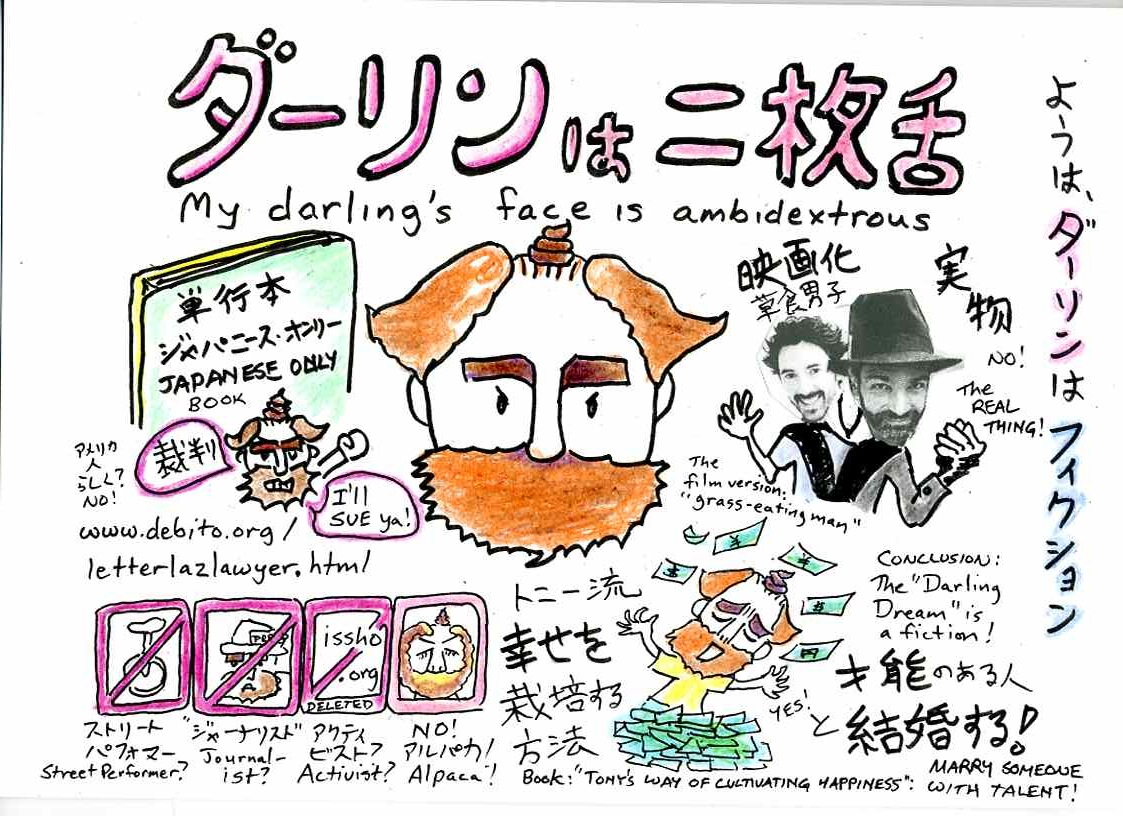





Oguri’s “Darling wa Gaikokujin” becomes a movie, with parody cartoon about the “Darling Dream” being sold by all this

mytest

Handbook for Newcomers, Migrants, and Immigrants to Japan\Foreign Residents and Naturalized Citizens Association forming NGO\「ジャパニーズ・オンリー 小樽入浴拒否問題と人種差別」(明石書店)JAPANESE ONLY:  The Otaru Hot Springs Case and Racial Discrimination in Japansourstrawberriesavatardebitopodcastthumb
UPDATES ON TWITTER: arudoudebito
DEBITO.ORG PODCASTS now on iTunes, subscribe free

Hi Blog.  I want to offer my congratulations to Oguri Saori, very successful author of the “Darling wa Gaikokujin” series (translated as “My Darling is a Foreigner”, but officially subtitled “My Darling is Ambidextrous”), for the news just out this month that the first book in the series will be made into a live-action movie (starring Inoue Mao and Jonathan Share as Saori and Tonii respectively).  The empire built upon the dream being sold to Japanese women for marrying a white foreigner keeps on gathering strength.  See the movie trailer here.

More interesting to me is the mutation of the Tonii character.  It’s apparently based upon Tony Laszlo, one-time unicyclist, “journalist”, “activist” and self-proclaimed leader of unregistered NGO “Issho Kikaku” (a long-defunct group — you can’t even find their once-copious archives on the Wayback Machine because they have been blocked by the site owner — see what’s left of it at Issho.org), and now happy multimillionaire thanks to his partnership with and characterization by his very talented wife.

Although portrayed in the movie by the very handsome and disarming Jonathan as a “grass-eating man”, Tonii in real life is not as he is cartooned.  Laszlo is a big fan of putting his funds into threatening lawsuits, for one thing.  And of deleting internet archives.  And more.

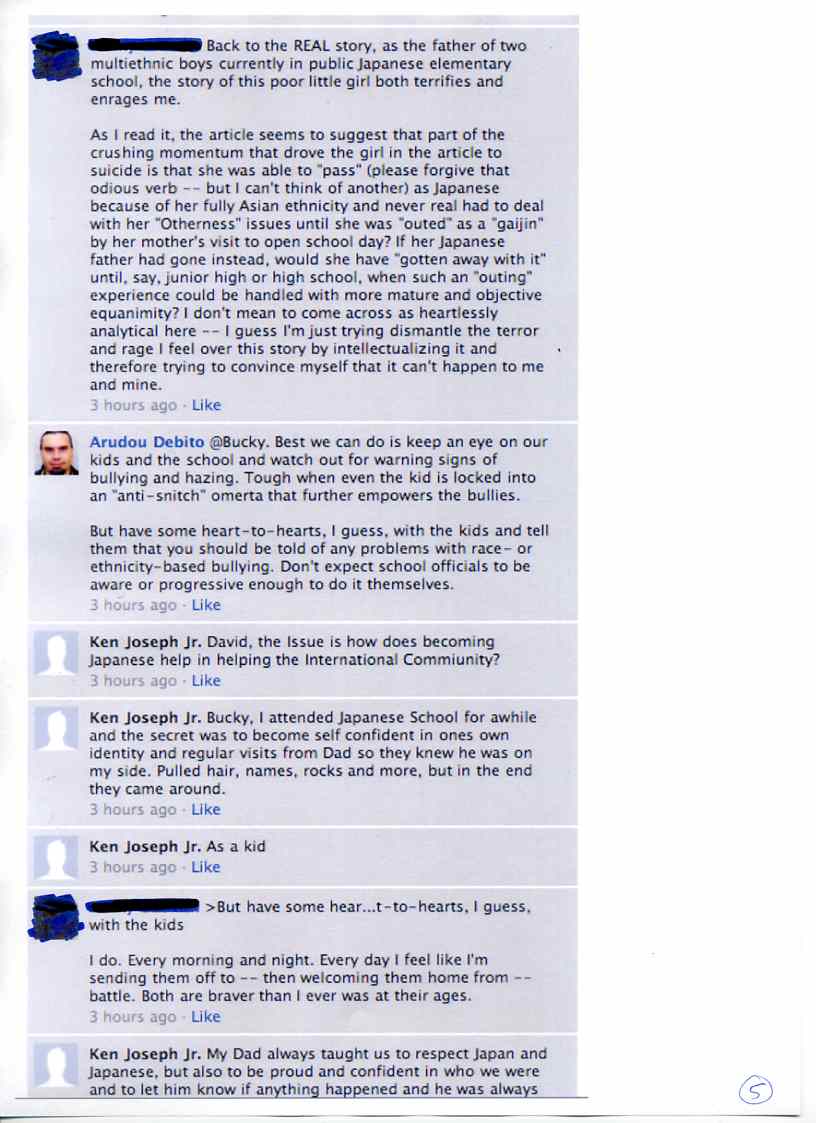
It just so happens I found a cartoon parodying this phenomenon of the contrasts.  As the last post on Debito.org for this decade, enjoy.

Arudou Debito in Sapporo, wishing everyone a happy new year.  For Oguri Saori, it looks to be a fine one indeed, so, again, congratulations.

(click on image to expand in your browser)

ENDS

Proof positive that some people really do suck: JT responses to proposals for a Japanese immigration policy

mytest

Handbook for Newcomers, Migrants, and Immigrants to Japan\Foreign Residents and Naturalized Citizens Association forming NGO\「ジャパニーズ・オンリー 小樽入浴拒否問題と人種差別」(明石書店)JAPANESE ONLY:  The Otaru Hot Springs Case and Racial Discrimination in Japansourstrawberriesavatardebitopodcastthumb
UPDATES ON TWITTER: arudoudebito
DEBITO.ORG PODCASTS now on iTunes, subscribe free

Hi Blog.  It’s times like these when I think human society really has a bottomless capacity for oozing disdain for and wishing ill-will upon others.  Get a load of these letters to the editor (including authors who won’t reveal their names, or don’t live in Japan anyway) responding acidulously to my Japan Times column earlier this month, where I made constructive proposals for making Japan a place more attractive for immigration.  (Many of these proposals were made not just by me, but also by former Immigration bureaucrat Sakanaka Hidenori; so much for their pat claim below of imposing my moral values).

None of these respondents appear to be immigrants, or have any expressed interest in investing in this society, yet they heap scorn upon those who might plan to.  I know paper will never refuse ink, but surely these people have more productive uses of their time then just scribbling poorly-researched and nasty screeds that help no-one.  The self-injuring, snake-eating-its-tail mentality seen in NJ vets of Japan is something worthy of study by psychologists, methinks.  Any takers?  Arudou Debito in Sapporo

///////////////////////////////////////////

The Japan Times, Letters to the Editor Tuesday, Dec. 22, 2009

HAVE YOUR SAY
Level playing field for immigrants: responses
A selection of readers’ responses to Debito Arudou’s Dec. 1 Just Be Cause article, which proposed policy changes to “make life easier for Japan’s residents, regardless of nationality”:

Get your fill and head off
I’m getting tired of listening to foreigners moaning on Japan. The answer is very simple: You don’t like it, leave it. Why do these people want to live in Japan at all costs if they don’t like the system? The world is big; go somewhere else. I’ve been in Japan for 4 years with my Japanese wife and now we have understood it’s time to move on for our future, and therefore go back to Europe. We all know Japan is a homogeneous country. It will never become a cosmopolitan society like the West. Who are we to change a deep-rooted, xenophobic culture where Japanese have been living for centuries? It’s much easier for Japanese to live in the West than for us to live in Japan. There are big Japanese communities in every Western country. Japan is not an expats’ resort by tradition. Foreigners come here either for marriage or overseas contracts, meaning it can be a beautiful place to live for a few years but not to settle permanently. My suggestion to all those disillusioned gaijin is to make the most of your stay in Japan and return home when you think you’ve had enough.

JOHN TESTORE

Takasaki, Gunma Pref.

================================

Unwelcome, no matter what
This article implied that Japan is seeking to welcome foreigners, which is far from the case. I came here (unwillingly) under a Japanese scholarship, graduated here top of my class, work here, did volunteering to help in disaster relief . . . But everyday I wake up, I find myself in the same position: potential thief when I walk in a store; a potential terrorist when I enter a government building, even when I spend my time there volunteering; my neighbor keeping watch on me every day; unable to obtain a bank recommendation when I need it . . . In my case, I gave up on Japan and will (leave) with a bitter taste.

NAME WITHHELD

================================

Homogeneity works well
Japan has been often criticized for its immigration policy, which does make it somewhat difficult for a non-Japanese (NJ) to obtain permanent residency or citizenship. I disagree that this policy has worked to Japan’s disadvantage in the global labor market. . . . (Arudou) says Japan needs a new immigration ministry that would decide clear public standards that would give immigrants what they want. It is not an obligation of the government to give immigrants what they want. The (role of the) ministry is to be sure that the immigrants who are allowed into Japan will obey the laws of Japan and not become wards of the state.

Also, I disagree with Arudou’s desire to have citizenship based on birth in Japan. Look at the U.S.: Illegal aliens come into the U.S. and have what is called an “anchor baby.” The baby is automatically a U.S. citizen, and his/her parents then become eligible for permanent residency and then citizenship. And the American taxpayer pays for their health care, housing, food stamps, education and more. They create their enclaves, demand bilingual classes, etcetera, and never learn English.

Japan has been very fortunate to have about 98 percent of its population (form) a homogeneous society, in which the people share a common language and culture. Of course there are local variances, but by and large the people speak one language, which helps to maintain a high level of literacy and an appreciation of a common culture, language and history. . . . Debito Arudou should abide by the laws of immigration of Japan, stop whining or simply find another place to live.

KARL E. WAHL

Bellevue, Wa.

================================

Let Japan run its own shop
I am an American who lived in Japan for 4 years and find it pathetic how many people want to force Western ideologies onto Japan. Japan is its own country. Let them do as they please. At least they can control their immigration issues, unlike most European countries and the United States. I bemoan how my country, the United States, can’t tackle or has an unwillingness to tackle the issue. Japan has a right to keep the country as Japan sees fit. Forcing non-Japanese moral values on it to satisfy the short-term aging population issue is not in best interests of Japan.

MIKE TULL

Address withheld

ENDS

Guest blog post by Steve on “How to get the Japanese public to demand a non-discrimination law”

mytest

Handbook for Newcomers, Migrants, and Immigrants to Japan\Foreign Residents and Naturalized Citizens Association forming NGO\「ジャパニーズ・オンリー 小樽入浴拒否問題と人種差別」(明石書店)JAPANESE ONLY:  The Otaru Hot Springs Case and Racial Discrimination in Japansourstrawberriesavatardebitopodcastthumb
UPDATES ON TWITTER: arudoudebito
DEBITO.ORG PODCASTS now on iTunes, subscribe free

Hi Blog.  Yet another guest post today.  Thanks Steve.  Debito in Sapporo

/////////////////////////////////////////////////////
Dear Debito, I became inspired to start a new thread, I hope it sparks some ideas and real action. Thanks again for continuing to be a beacon of light for humans who want human rights! 🙂 Sincerely, Steve (a.k.a “Mr. Ittemo Ii Desu Ka”)

———————————————-
“Problem, Reaction, Solution”
or
“How to get the Japanese public to demand a non-discrimination law”

I second DM’s motion. (http://www.debito.org/?p=5475#comment-188363)

Seriously. Let’s make it happen. Our goal is a new law against discrimination here in Japan.

Who here has the courage to become this generation’s Mrs. Rosa Parks? I hope somebody reading this does.

Since currently barring entry to private establishments based on nationality is still practically legal in Japan (or at the very least, non-prosecuted and/or non-penalized), then I think DENYING JAPANESE PEOPLE entry to an establishment here in Japan will create subsequent outrage which will cause Japanese people to realize that Japan needs a law which clearly states, “Barring entry to private establishments based on nationality, or race, is hereby illegal, and violators of this law will be prosecuted and will face severe penalties.” The outraged Japanese public will DEMAND a new law like this.

Proposed plan of action: a law-abiding human here in Japan (with taxes, national insurance, and even pension – all paid-up in full (nod to Hoofin), preferably a permanent resident of Japan or Japanese national, to avoid the possibility of visa-denial retaliation) who has an establishment (a bar, restaurant, shop, whatever) AND COURAGE (very essential) and good property insurance (also essential, since some right-wing crazies will probably break some windows and/or start some fires) should put up a big sign out front proclaiming “No Japanese” and/or “No Japanese may enter” and/or “Non-Japanese Only” and/or “Entry Restricted to Non-Japanese” (in perfect Japanese of course) PLUS underneath this sign should be big poster-sized-laminated-PHOTOS of all the variations of “Japanese Only” signs found in Japan (e.g. www.debito.org/roguesgallery.html – especially photos of the signs written in Japanese such as http://www.debito.org/edensign030707.jpg) PLUS underneath those photos should be a sentence in Japanese which says, “Japan needs a law which clearly states, ‘Barring entry to private establishments based on nationality, or race, is hereby illegal, and violators of this law will be prosecuted and face severe penalties.’ “

A well-written (triple-proofread) press-release in Japanese together with this story’s dramatic money-shot: a well-taken photo which clearly shows the whole picture, meaning, the controversial “Non-Japanese Only” sign TOGETHER with the big poster-sized-laminated-photos of “Japanese Only” signs directly underneath that, TOGETHER with the solution to this problem stated underneath that, specifically, our proposed law against discrimination.

I predict many newspapers and television channels will cover this story. When the average Japanese person sees the top part of the photo (the “Non-Japanese Only” sign), they will be outraged of course. Then, when their eyes scan down to the middle part of the photo (the “Japanese Only” signs), they will realize this kind of discrimination exists here in Japan. Finally, when they scan down to the bottom of the photo they will see the new proposed law which will help prevent this kind of sign from ever being posted again, and hopefully they will clamor for this solution.

This “Problem, Reaction, Solution” technique has been used successfully by clever rulers to get the public to clamor for the wrong goals (e.g. the Problem of terrorism creates a Reaction of fear and anger, which leads to the public agreeing to the rulers’ desired “Solutions” of decreased human rights, decreased privacy, increased air-bombing of other nations, and increased taxes going towards weaponry contracts) well finally it’s about time average people create a PEACEFUL little Problem (namely, a sign which states a discriminatory entry rule) which will create a Reaction (in this case indignant outrage about such discrimination) which will lead to the public clamoring for a LAW against such discrimination.

Reducible Risk – I predict some newspapers and television channels will try to focus on just the top half of the photo, and will simply cut out the bottom half. Hmmm, then, maybe to reduce that possibility we should somehow put the photos of the “Japanese Only” signs WITHIN (e.g. in the CENTER of) our “Non-Japanese Only” sign (and maybe we should put the law proposal WITHIN that as well) so it will be harder for editors to attempt to cut out the most essential part of the story.

Now, If anyone here has a better, more effective, serious idea about how to get the Japanese public to demand a non-discrimination law, let’s hear it!

And after everyone here adds their positive ideas on this thread, let’s hope someone with courage actually steps up to “Make it happen, cap’n!”  Steve

ENDS

Yomiuri: Scriveners aid illegal marriages, work

mytest

Handbook for Newcomers, Migrants, and Immigrants to Japan\Foreign Residents and Naturalized Citizens Association forming NGO\「ジャパニーズ・オンリー 小樽入浴拒否問題と人種差別」(明石書店)JAPANESE ONLY:  The Otaru Hot Springs Case and Racial Discrimination in Japansourstrawberriesavatardebitopodcastthumb
UPDATES ON TWITTER: arudoudebito
DEBITO.ORG PODCASTS now on iTunes, subscribe free

Hi Blog.  Debito.org Reader JK comments on an article from a couple of months ago.  Letting him take the keyboard for today.  Arudou Debito in Sapporo

===============================

Hi Debito:  OK, this is good:

Scriveners aid illegal marriages, work
http://www.yomiuri.co.jp/dy/national/20091012TDY02306.htm

I assume that the clerks in question are going out of their way to assist foreigners in obtaining residency permits (even to the point of placing ads in newspapers) due to bribery (as opposed to benevolence), and that this behavior is motivated by said clerks’ cognizance of loopholes in the immigration control law.

If so, then there’s nothing less than a government-backed residency permit black market at work, which, I might add, shows no signs of going away — a simple to fix the problem would be to amend the immigration control law to punish the clerks as needed, but is that what’s happening? No. Instead the issue is being given superficial treatment:

  • a) The MPD established a ‘liaison council’ with metropolitan government and the Tokyo Regional Immigration Bureau to talk about clerks gone bad.
  • b) The Tokyo association of administrative scriveners will “keep a close watch over suspicious ads in newspapers and on the Internet”.
  • c) Japan federation of administrative scriveners associations is calling on scriveners to “behave themselves”.

If I may be facetious for just a minute, the Tokyo Regional Immigration Bureau should either fix the situation or cut the clerks out of the loop and pocket the cash for itself by establishing a legitimate residency permit market.-JK

The article:

=============================

Scriveners aid illegal marriages, work

The Yomiuri Shimbun


Ads placed by administrative scriveners offices in newspapers for Chinese and Koreans indicate they help in illegal immigration applications.

In recent years, a number of administrative scriveners have helped foreigners obtain residency permits illegally, taking advantage of the fact that the immigration control law stipulates no punitive measures for violators.

Administrative scriveners were reportedly involved in at least 10 cases of fraudulent marriage and illegal employment exposed by the Metropolitan Police Department since 2006. Some even placed ads in free newspapers for foreigners to attract customers, the MPD said.

The MPD has reported one case it deemed “heinous” to the Tokyo metropolitan government, which has the authority to punish administrative scriveners, and asked it to consider punitive action. The MPD plans to provide information on nine other cases to the relevant local governments if those cases are also judged as heinous.

The MPD arrested a 39-year-old South Korean man in May last year on suspicion of brokering a fake marriage between a 39-year-old South Korean woman and a 35-year-old Japanese man.

The Korean man told police he asked an administrative scrivener in the Tokyo metropolitan area to file an application for a residency permit that the woman needed in order to get married, a senior MPD officer said.

During police interrogations, the Japanese man and Korean woman reportedly said the scrivener filed the application on their behalf despite knowing their marriage was fake.

Given their confessions, the MPD investigated whether it could bring a criminal charge against the scrivener in question. Because the immigration control law has no punitive provisions regarding false marriage applications, the MPD examined whether the scrivener could be accused of abetting a fake marriage, or of helping a suspect to evade capture.

The scrivener voluntarily submitted to questioning but denied any wrongdoing, saying he did not know it was a fake marriage. The MPD had no alternative but to give up bringing criminal charges against the scrivener.

In July, the MPD arrested six Japanese and Chinese brokers in connection with a case in which a Chinese farmer illegally obtained a residency permit by posing as an interpreter. Police investigations discovered forged employment contracts at the office of an administrative scrivener who is different from the one who prepared the application for the residency permit.

The MPD has confirmed that scriveners were involved in 10 falsification cases since 2006. The scriveners accepted application requests from brokers and from applicants themselves.

Many of the scriveners involved in the 10 cases placed ads in newspapers catering to Chinese and free papers in Korean that are available in Shinjuku’s Kabukicho area and elsewhere, the MPD said. The ads included statements like “special procedure to obtain residency permit for illegal residents” and “marriage procedures for illegal immigrants.”

The MPD suspects that such advertising facilitates illegal employment and fake marriages.

For this reason, the MPD considers it necessary to deal harshly even with cases in which criminal charges cannot be filed, by calling for the authorities concerned to take punitive action.

Together with the metropolitan government and the Tokyo Regional Immigration Bureau, the MPD established a liaison council to discuss countermeasures against administrative scriveners involved in illegal immigration cases. Through the council, the MPD provides relevant information for the metropolitan government and bolsters its surveillance of illegal activities by scriveners.

A senior member of the Tokyo association of administrative scriveners said his organization would strictly deal with any scriveners found to have committed illegal acts.

The association is “keeping a close watch over suspicious ads in newspapers and on the Internet in an effort to be aware of their activities,” he said.

Its parent organization, the Japan federation of administrative scriveners associations, is making its own efforts to tackle the issue.

“We’ll work toward maintaining public trust in scriveners by using various occasions, such as seminars, to call on scriveners to behave themselves,” a federation official said.

(Oct. 12, 2009)  ENDS

The ludicrousness of Japan’s Salary Bonus System: How it contributes to Japan’s deflationary spiral

mytest

Handbook for Newcomers, Migrants, and Immigrants to Japan\Foreign Residents and Naturalized Citizens Association forming NGO\「ジャパニーズ・オンリー 小樽入浴拒否問題と人種差別」(明石書店)JAPANESE ONLY:  The Otaru Hot Springs Case and Racial Discrimination in Japansourstrawberriesavatardebitopodcastthumb
UPDATES ON TWITTER: arudoudebito
DEBITO.ORG PODCASTS now on iTunes, subscribe free

Hi Blog.  Big news across Japan these past couple of days has been how the Winter Bonus has been slashed between 10 to 15 percent for bureaucrats:

Japan Times Friday, Dec. 11, 2009
Bureaucrats’ winter bonuses shrink
Kyodo News (excerpt)
Central and local government employees got smaller winter bonuses than usual Thursday as the protracted recession took its toll on compensation, according to estimates from the Internal Affairs and Communications Ministry.

The bonus for a 35 1/2-year-old civil servant with a nonmanagerial job came to an average of ¥647,200, down 6.6 percent, while that for a 36.6-year-old local government employee came to ¥607,000, down 7.3 percent, the ministry said.

Rest of the article at http://search.japantimes.co.jp/cgi-bin/nb20091211a5.html

(BRIEF ASIDE FOR THOSE UNFAMILIAR WITH JAPAN’S “BONUS” SYSTEM:  Those of us on regular full-time salaries get paid monthly, then get a “bonus” of several months pay every six months (usually between two to six months’ pay total, divided by two times a year, which in effect increases your total annual salary mathematically by about a third).  This has long been standard practice in Japan, and every June and December the postwar Japanese economy suddenly becomes awash in cash, as families suddenly get a glurt of around 100 man en in their accounts.)

Some people might say, well, tough beans — these bureaucrats were being overpaid anyway, so it’s about time.  The problem is that this practice is a bellwether:  other industries see this as an excuse to cut their own salaries.  My university (which is private-sector, but they directly cited the Bonus cuts to the national bureaucrats (kokka koumuin) as justification) cut all of our Bonuses this year and will continue to do so in perpetuity.  As in:  they cut our bonus multiple from 4.5 months’ salary total per year to 4.15 months’, and will not change that until the national bureaucrats revise their multiple upward.

So that means my Winter Bonus this December dropped by 15% compared to the same Winter Bonus December of last year, or about a drop of 12 man before taxes, and man am I pissed off about it.  (I might add that this is on top of the general trend:  my total annual salary has dropped more than 200 man between 2003 and 2008.)  This means that paying off my bank loan for the house I built back in 1997 (I owe three months’ mortgage payment every bonus), and a bit of insurance on top of that, completely devoured my Bonus for the first time ever yesterday.  Any more cuts, and I’m going to lose money every Bonus period.

That’s if I get a Bonus at all.  That’s the screwy thing about this Bonus System.  It’s fine in a high-speed growth economy, where you have businesses withholding about three to six months’ pay so they can earn interest on it, then pay your employees in a glurt and keep the interest.  But banks in Japan don’t pay interest anymore, so that’s no longer an incentive.

And in a mature (or even flat or negative GDP for the past two decades) economy, the Bonus System just doesn’t make sense anymore.  When you can at whim withhold a third of somebody’s salary just because the company feels it didn’t perform well enough this quarter, that should be cause for strikes and reforms.  But Japan’s unions are pretty weak and underwhelming in negotiations (compared to, say, Korea’s), and I have heard no voices yet for abolishing the Bonus System in favor of a flat (and higher) monthly salary.

I heard yesterday from a friend that he heard on the TV wide shows that only 14% of all people surveyed got a rise in Winter Bonus this December.  Everyone else either had no change, a drop, or NO BONUS AT ALL.  (I searched for a source for this, but came up short.  Debito.org Readers, please have a look around too.)  If this is true, and almost everyone is getting screwed by this system and losing money in real terms, it’s not just a labor issue anymore:  We’re talking about a deflationary spiral, as domestic consumption decreases and domestic demand follows suit, and more companies find themselves yet again cutting Bonuses because they say they have to, but really because they can.

Considering that banks in Japan do not offer refinancing deals (mine, Hoku’you, formerly Takugin, doesn’t; I asked), this deflationary spiral just means they’re taking more money from me even if my monthly payments stayed the same.  (They’re not, by the way — they’ve gone up about 1 man per month over the past two years!  Double whammy.)  And banks are wondering why more people are defaulting on their loans these days?  They should stop being greedy and start lowering their premiums too to match the fact that people in general are being paid less.  But that’s not going to happen for the foreseeable future, because there’s no precedent for it.  Meanwhile, Japan just keeps sinking deeper, as “the system that soured” (to quote Richard Katz) gets more and more sour.

Lose the Bonus System.  It is increasingly becoming a way to deprive workers of a third of their annual salary at corporate whim.  And it only feeds the forces that are hurting Japan’s consumers.  Arudou Debito in Sapporo

====================

UPDATE DEC 17:  Courtesy of Ken.

Winter Bonuses To Fall To 20-Year Low: Nikkei Survey
http://www.nni.nikkei.co.jp/e/fr/tnks/Nni20091210D10JFF05.htm

TOKYO (Nikkei)–Overall winter bonuses to be paid this year will tumble to a level last seen 20 years ago, according to final estimates that Nikkei Inc. released Thursday.

A drop in winter bonuses may mean a gloomy year-end shopping season.

The weighted average bonus is seen falling 14.81% from the previous year to 701,571 yen before taxes, down for the second straight year. This is the sharpest drop since the survey was first conducted in 1978.

The Nikkei tabulated the bonus payment plans of 643 companies. The percentage of firms that will cut bonuses rose from 51% in last year’s survey to 83%. Meanwhile, those planning to raise bonuses fell from 44% to 12%.

The bonus cutback signals that corporations are still trying to curb personnel costs due to uncertainties over future economic trends, despite some earnings improvement from growth in emerging markets.

Bonuses are expected to fall 17.71% at manufacturers. The automobile and electronics sectors, which had increased bonuses in 2008, are poised to cut them by around 20% this year due to slumping exports caused by the global economic downturn and strong yen. Food producers plan to raise bonuses by 0.26%, making it the only group among the 18 manufacturing sectors to boost payments.

Nonmanufacturers plan to reduce bonuses by 5.17%, except for firms in the land transport sector, which plan to bump up payouts by 0.08%.

(The Nikkei Dec. 11 morning edition)

GS on Michael Moore’s rights to complain about being fingerprinted at Japanese border

mytest

Handbook for Newcomers, Migrants, and Immigrants to Japan\Foreign Residents and Naturalized Citizens Association forming NGO\「ジャパニーズ・オンリー 小樽入浴拒否問題と人種差別」(明石書店)JAPANESE ONLY:  The Otaru Hot Springs Case and Racial Discrimination in Japansourstrawberriesavatardebitopodcastthumb
UPDATES ON TWITTER: arudoudebito
DEBITO.ORG PODCASTS now on iTunes, subscribe free

Hi Blog.  I received this very thoughtful email from GS after Michael Moore’s visit to Japan, where he was perturbed by the border fingerprinting.  According to GS, he has every right to be.  Read on.  Arudou Debito in Sapporo

//////////////////////////////////////////////////

December 14, 2009
Dear Debito-san,

Thank you for the heads-up I got on Mr. Michael Moore’s comments regarding fingerprinting.

As you know from our previous e-mail conversations, I am concerned about some aspects regarding the safety of fingerprint verification in general and J-VIS in particular.

Following-up on your article, I have taken the liberty of writing a long message to the website feedback form on Mr. Moore’s website, summarizing my concerns. Please find below a copy of my writing. I hope you find it useful.

===============================

“Dear Sir, Madam,

Through the blog of Mr. Arudou Debito (www.debito.org), I’ve read part of Mr. Moore’s interview in Japan, in which he reported his fingerprinting experiences at the border (see http://www.debito.org/?p=5347). Though through this web form my message probably gets to the inbox of a webmaster, I hope you may find my response interesting enough to patch through to him. I would like to provide him with some hopefully interesting food for thought about fingerprinting in general, and the J-VIS (Japanese border check) system in particular.

Mr. Moore apparently got the hostile response that if he refused, he would be deported back to the United States on his question why he would have to be fingerprinted. I guess a good introduction to my story would be to point his attention to Article 4 of the Japanese “Act on the Protection of Personal Information Held by Administrative Organs” (see http://www.japaneselawtranslation.go.jp/law/detail/?ft=1&re=02&dn=1&x=0&y=0&co=01&ky=personal+data+administrative+organs&page=15, elements in Japanese writing have been deleted but can be seen in the original):

“Article 4 When an Administrative Organ directly acquires Personal Information on an Individual Concerned that is recorded in a document (including a record made by an electronic method, a magnetic method, or any other method not recognizable to human senses [referred to as an “Electromagnetic Record” in Articles 24 and 55]) from the said Individual Concerned, the Administrative Organ shall clearly indicate the Purpose of Use to the Individual Concerned in advance, except in the following cases:
….
(i) Where the acquisition of Personal Information is urgently required for the protection of the life, body, or property of an individual
….
(ii) Where clear indication of the Purpose of Use to the Individual Concerned is likely to cause harm to the life, body, property, or other rights or interests of the Individual Concerned or a third party
….
(iii) Where clear indication of the Purpose of Use to the Individual Concerned is likely to cause impediments to the proper execution of the affairs or business of state organs, Incorporated Administrative Agencies, etc. (which means incorporated administrative agencies prescribed in Article 2, paragraph 1 of the Act on the Protection of Personal Information Held by Incorporated Administrative Agencies, etc. [Act No. 59 of 2003; hereinafter referred to as the “IAA Personal Information Protection Act” ]; the same shall apply hereinafter), local public entities, or Local Incorporated Administrative Agencies (which means local incorporated administrative agencies prescribed in Article 2, paragraph 1 of the Local Incorporated Administrative Agencies Act [Act No. 118 of 2003]; the same shall apply hereinafter)
….
(iv) Where the Purpose of Use is found to be clear in light of the circumstances of the acquisition”

I am not a lawyer (disclaimer), but it would seem to me that when Mr. Moore asked “why?”, he made a lawful request under article 4, while the answer that if he wouldn’t, he would be deported, doesn’t appear to me to be in the spirit of this article. Not to mention that the Immigration Bureau, the responsible party in this scheme, states in their FAQ: “we will properly store and protect your data, according to the basic law for the protection of personal data, the Act for the Protection of Personal Information Retained by Administrative Institutions.” (http://www.moj.go.jp/NYUKAN/nyukan64-2-1.pdf, note by the way the spelling differences in the title…). Right……

Privacy laws generally have a common ancestor and a common purpose. In 1980, a workgroup within the OECD (http://www.oecd.org/home/0,2987,en_2649_201185_1_1_1_1_1,00.html) published the “OECD Guidelines on the Protection of Privacy and Transborder Flows of Personal Data” (http://www.oecd.org/document/18/0,3343,en_2649_34255_1815186_1_1_1_1,00.html), with eight key principles that form the basis of privacy laws worldwide. Contrary to both the statements: “If you have nothing to hide, you have nothing to fear” and “Big Brother is watching you”, these guidelines (roughly said) recognize the general legitimacy of using personal information, provided that such use is safe, sane and sensible.

Safe, sane and sensible… One is left to wonder about this when it comes to fingerprinting schemes worldwide… From what I understand, the key reason for implementing such schemes is the assumption that fingerprints provide a ‘silver bullet’ solution to identifying people, being unique, impossible to forge, and impossible to misidentify. However, by now it’s safe to say that fingerprinting schemes are not the ‘silver bullet’ hoped for, and that they are creating problems which might easily lead to grossly unfair treatment to individuals being unfortunate enough to become victims of such a problem.

Leaving all kinds of other problems aside, I would like to react to the assumption that fingerprints are impossible to forge first. One can find plenty of proof that fingerprints can be copied. The University of Yokohama (http://www.lfca.net/Fingerprint-System-Security-Issues.pdf) has published it’s groundbreaking article on this now almost 8 years ago, the Chaos Computer Club in Germany (http://dasalte.ccc.de/biometrie/fingerabdruck_kopieren), and the Mythbusters (http://www.youtube.com/watch?v=MAfAVGES-Yc) have spectacularly shown that it is possible. But the proof of the pudding is that in fact at least one person has been caught in Japan after defeating the J-VIS system (among others: http://archives.chicagotribune.com/2009/jan/02/nation/chi-090102-faked-fingerprint-japanese-airport). Some food for thought, the woman bought her fingerprints, so not only is it possible, but there are people out there making money on it. More food for thought in a few questions: Were the original prints from which the copies were made stolen? Were the copies registered as unreliable? And will the rightful owner get into trouble because someone else stole her/his fingerprints and did something unlawful? The answer is a triplicate: “We don’t know”. What we do know is that someone who is the victim of such identity theft is in for some serious trouble in those places where the assumption is still that it can’t be done…

The assumption that it’s impossible to misidentify people based on fingerprints is also incorrect. In this respect it may be the most interesting to follow the trail of the J-VIS devices.

On at least one of the airports, the devices used are from the company NEC. NEC is not very secretive about the tests proving the quality of it’s devices, they post links to the test results on their own website, with the headline NIST(= (US) National Institute for Standards and Technology)-Proven Accuracy (http://www.nec.com/global/solutions/biometrics/technologies/nist.html). But what is this accuracy?

Only the FpVTE2003 appears to test the kind of verification that is in use for J-VIS. On this, NEC says: “The FpVTE2003 was an international benchmark test of fingerprint matching, identification, and verification systems, conducted in the United States in 2003 under the control of one of the US’s most respected government authorities, the NIST.” So what does this test say? The Summary of Results (http://fpvte.nist.gov/report/ir_7123_summary.pdf) says:

“The most accurate fingerprint system tested (NEC MST) using operational quality single fingerprints:
• 99.4% true accept rate @ 0.01% false accept rate
• 99.9% true accept rate @ 1.0% false accept rate”

It is good here to explain the technical language. In the context of US-VISIT or J-VIS, fingerprints are checked against a list of unwelcome people, while NIST uses the standard terms for checking against a list of authorized (= welcome) people. This creates confusing language, but it can be explained fairly easily. A True Accept in the spirit of the US-VISIT or J-VIS system means that an unwelcome person (say, Mr. X) shows up and is recognised because of a fingerprint match. A False Accept means that a welcome person (say, Mr. Michael Moore) shows up, but is incorrectly recognized as Mr. X because of a false fingerprint match.

At this point, I would like to entertain Mr. Moore with a little side step, to which I get back later. What would a False Accept Rate of 0.01% mean? That’s infinitely small, right? Well, the J-VIS system went into operation on November 20th, 2007. I don’t have day-by-day figures on the number of visitors, but I can tell that in the year from December 1st, 2007 to November 30th, 2008, 8,513,909 visitors were registered in Japan (http://www.tourism.jp/statistics/xls/JTM_inbound20091027eng.xls). I would therefore expect 851 false alarms based on a False Accept Rate of 0.01%. It is not infinitely small.

So the question comes up: “Is fingerprint verification a form of Russian Roulette?” The answer is: “Not necessarily”. No system is perfect against theft or mistakes. But if the people running the system are well-trained and thorough, it is likely that they can spot and correct the problem before serious damage is done to the victim of either problem above. But for that to work and the people subjected to such a system to be safe, one principle is vital: Every person in the organization must have the capabilities of being able to take criticism, and also a healthy dose of self-criticism. That is never easy, and the more damage already done, the more difficult it becomes.

…And right at that point is where the comparison the officials from Japan’s Immigration Bureau made to Mr. Moore ends. One of the officials apparently told him: “But you do this in the United States, when we visit the United States.” True, they do undeniably verify fingerprints. They also undeniably verify and correct false alarms. In the words of Mr. Neil Latta, US-VISIT IDENT Program Manager at the time of writing of the following document (http://fingerprint.nist.gov/standard/archived_workshops/workshop1/presentations/Latta-LessThan10.pdf): “1:many Accuracy For a 2-finger Search Against a 6M Subject Database is 95% With a False Hit Rate of 0.08% (Exceeding US-Visit Requirements)”. And: “0.4% FAR Results in (0.4% x 100K Trxs/Day) = 400 Examiner Verifications”. Again in less technical terms, they verify false alarms, they know how many false alarms there are, and so on. Granted, given the reputation of ‘outstanding customer friendliness’ that Homeland Security has carved out for themselves, this is still likely to be a rather unpleasant experience, and there is almost certainly room for considerable improvement. But at the end of the day, here is the written proof that the Department of Homeland Security is capable of admitting mistakes.

Is this also the case on the Japanese borders? The answer is again: “We don’t know”. But in itself, this is an answer too. Just some food for thought, there’s nothing in the quoted FAQ, and the incident Mr. Moore had is not exactly the first one where the organization reacts with hostility to something that sounds remotely like criticism. It’s not exactly reassuring to have to depend for your own safety on the ability of an organisation to take (self-) criticism, while on less important details the same organisation shows a distinctive lack of that same ability.

And one detail gives more food for thought that is not very reassuring. Remember the 851 false alarms I would expect if there was a false accept rate of 0.01%? On November 29th, 2008, the Japanese Ministry of Justice (of which the Immigration Bureau is a part) made a press release stating that they had deported a total of 846 people based on fingerprint matches in the first year of operation (http://www.breitbart.com/article.php?id=D94NKV182&show_article=1). That is only five off that number… Or differently put, 846 people is 0.00994% of 8,513,909 visitors. The difference with a false accept rate of 0.01% is only 0.00006%… Is this proof that there is a Russian Roulette situation? Certainly not. From the same sources we also have the numbers for South Koreans (297 people deported, total visitors – from both Koreas, admittedly leaving a margin for doubt: 2,483,288, percentage = 0.01196%), Chinese (90 people deported, total visitors 1,000,228, percentage = 0.008998), and Filipino’s (155 people deported, total visitors 82,473, percentage = 0.18%, way off the mark). But some food for thought: Out of four groups of visitors, only the smallest group is way off the mark. The other ones are groups of more than one million visitors. And the larger the group of visitors, the closer we get to the mark of 0.01%. That is a curious set of coincidences…

And yet more food for thought. With almost every other identifier and keys, from physical keys to credit cards to drivers’ licenses to passports, the reason we have them is that we can replace them when the legitimate user gets into trouble because something goes wrong. We would find it unacceptable to hear: “Sorry, we found out your car key / credit card / passport has been copied / isn’t accepted as well as it should be / doesn’t fit / …, but you can’t replace it, so you just have to live with the problem.” Why then do we accept that with fingerprints…?

I’m sorry for this long message. I hope it has been worthwhile reading though.

Kind Regards, GS”

===============================

And of course the kind regards are for you as well.

ENDS

One NJ exchange student’s rotten experience as a J MOE-MEXT ryuugakusei

mytest

Handbook for Newcomers, Migrants, and Immigrants to Japan\Foreign Residents and Naturalized Citizens Association forming NGO\「ジャパニーズ・オンリー 小樽入浴拒否問題と人種差別」(明石書店)JAPANESE ONLY:  The Otaru Hot Springs Case and Racial Discrimination in Japansourstrawberriesavatardebitopodcastthumb
UPDATES ON TWITTER: arudoudebito
DEBITO.ORG PODCASTS now on iTunes, subscribe free

Hi Blog.  What follows is a guest essay from a 3-year exchange student on the GOJ dime who has come to Japan to study and found it highly undesirable.  Others who have had similar experiences, please comment.  All names etc have been changed to protect the guilty.  If interested in getting in touch with the author, please contact me at debito@debito.org and I’ll forward your enquiry.  Arudou Debito in Sapporo

========================================

GUEST ESSAY FOLLOWS

My name is Laura Petrescu, and I am a Monbukagakusho-MEXT scholarship grantee that has been living in Japan for almost three years. When I came here, I was expecting a high-quality academic environment and an overall positive experience. I was disappointed time and again by irregularities, double standards, absurd situations and blatant displays of racism.

Therefore, I thought I’d share my ryuugaku experience so far. I think that by getting the word out I’m giving prospective foreign students a chance to learn ‘other’ truth about living and studying in Japan. On the surface, things might look good – after all, who would say no to going to college for free? Still, there are many things that can turn an average ryuugaku experience into a complete disappointment and a waste of time.

A little background information:

I came to Japan in spring 2007. I spent my first year in Japan at the former Osaka University of Foreign Studies (currently, the Foreign Languages division of Osaka University). Here, myself and other foreign students studied Japanese and other tangent subjects.

At the beginning of our second year here, each of us was sent to a university (supposedly) of his or her choosing. Things went downhill for a lot of us afterward, and plenty of people have already given up their scholarships and returned home. Those of us who stayed are still dealing with the ups and downs of an inherenty flawed system that seems to care more about pretty numbers on a sheet of paper, and less about the overall well-being of each of us, as a person.

What follows are the ten major reasons that essentially ruined the whole “Study in Japan! Free forever!” thing for me.

#1. Double standards for Asian and non-Asian foreign students at OUFS
At the OUFS foreign students’ dorm, Asian student groups were allowed to get away with pretty much anything, from shooting fireworks indoors and setting a curtain on fire (subsequently leading to foreign students’ parties being banned on campus grounds) to using shower stalls as public restrooms and even cheating on tests. Several students displayed an increasingly reckless behavior and walked away with a mild warning and nothing more.

On a side note, the regular Monbukagakusho newsletter that gets sent to all foreign students mostly features Asians and information for Asians looking for jobs, etc. I think I’ve only seen a non-Asian interviewed once.

Back to OUFS, non-Asian students were harassed and ridiculed by teachers and dorm staff on several occasions. One particular incident comes to mind, where a white girl’s Japanese language abilities were ridiculed in class by none other than her teacher, to the point where she broke down crying. The Asian students in said class (two Koreans and two Singaporeans) watched and laughed. For the record, the girl had passed the JLPT-1 examination and was one of the best Japanese speakers I know.

Half a year later, Asian students had a barbecue. When non-Asians did the same thing one day later, the dorm supervisor called the campus guards and we were forced to “cease and desist” immediately. We asked why there was no problem if Asians did it, but if we did it, we were somehow in the wrong. Mid-conversation, he turned, said something unintelligible in English (even though we’d all been talking to him in Japanese the whole time) and stormed off.

Another time, due to a faulty English translation of a notice, almost all foreign students ended up locked out of their rooms. All rooms were scheduled for a fire alarm maintenance, and al of us were notified. The Japanese notice (which most of us couldn’t read at the time) added, “出かけるときは鍵を持って行ってください”. The English translation was, “Please keep your key.” Guess who got yelled at when gingerly trying to point out the mistake: a native English speaker, who was told by the dorm supervisor something along the lines of, “I studied in the US for 10 years, I know English!” and promptly dismissed. I got yelled at too, when I politely asked the supervisor to please let me in my own room.

#2. Pressure and “mind games” at OUFS
As far as “mind games” go, myself and another student were in dire straits for having missed some classes (although it was never made clear that attendance mattered, and in both our countries attendance does NOT count towards a grade). On a side note, I missed most of those classes due to medical reasons. The program supervisor set up a “trial” with the two of us, himself and another teacher, and spent an hour and a half making us believe that we’d screwed up irrevocably and we’d face grave consequences, possibly even failing the year and being deported straight away.

At the end of the meeting, he gave each of us a paper that said we renounced our scholarship benefits then and there. And all we had to do was to sign on the dotted line and that would be “better for us, right?”. Naturally, we both refused, much to the supervisor’s bafflement. Ironically enough, an Asian student had an even worse attendance record, but they never attempted to pressure him into giving up.

#3. Poor-quality teaching and evaluation at OUFS
Some teachers at OUFS were, in my humble opinion, hardly qualified to teach. One spent most of the class time talking about anything but what he was supposed to teach, and even going so far as to ask inappropriate questions, such as, “So, do you have a boyfriend yet?”. He’d skip from topic to topic, ramble for a bit, then move on to another topic before just as suddenly going back to supposed “teaching”.

Towards the end of the year, the same teacher called me and another student to his office and proceeded to tell us that, due to poor attendance, he would be “forced” to fail us both. He then asked us why we missed so many classes. I answered first. “You weren’t teaching anything”, I said. “And also, your class has nothing to do with my major. It’s boring. And I don’t care.” The other student said nothing… and in the end, we both passed. The bottom line is, nobody failed their first year at OUFS. The program was simply made that way.

Exams were a major pain for hard-working students. Students who couldn’t speak a lick Japanese scored top grades, while people who actually studied everything there was to study scored 80% or less. The reason? Exams always consisted of the simplest possible Japanese language questions, so that everyone would supposedy pass with flying colors. It was easy enough to lose sight of simple Kanji characters when you spent weeks drilling complicated ones into your head. To make things worse, classes moved at a pace too quick for anyone to actually understand everything, and revision time was basically limited to one or two pop quizzes a week, with new stuff to learn following straight after. The bottom line is, students who couldn’t speak a lick of Japanese got into top-level Japanese universities, while fluent speakers / writers had to settle for the “average” ones.
Besides the language itself, we were taught Economy, Culture, History and Politics in Japanese from day one, even though more than half of us had zero Japanese knowledge (our orientation guide specifically stated that no previous knowledge of the language is required – apparently, that changed from 2008). Our textbooks were in intermediate or advanced Japanese with plenty of technical terms. Some of the teachers didn’t even speak English, so they couldn’t help us understand things better, either.

#4. Disregard of personal university choices
Myself and another student with poorer grades than mine both opted for Osaka University as our first university of choice. Inexplicably, he got in, while I was sent to Tokyo ○○ University (third on my list). I had solid reasons to stay in Osaka (Osaka University had the exact course I wanted to major in, while the other one did not; and also my fiance of that time lived in Osaka with his family).

I went through every possible avenue to try and overturn the decision, but what chances would I have against a system that just doesn’t care? I wonder what was the point in making us write our “choice list” (入学希望大学リスト) in the first place, when it was clear that: a- “advanced” students were among the only ones who got into their university of choice, and b- the selection criteria were shady to say the least.

#5. Misinformation by Tokyo ○○ staff at orientation meeting
At a university orientation meeting (大学説明会) at OUFS, I asked the Tokyo ○○ representatives whether I’d be able to obtain a practice license if I completed a bachelor’s degree . The answer was, “Yes, definitely”. This is what made me include Tokyo ○○ on my options list to begin with. I only found out much, much later – after my entrance examination – that this was not the case, and I would need to also complete a masters’ course in order to get my license – maybe.

#6. Injustice at Tokyo ○○ and no intervention by university staff
This one still stings, even though it’s been more than a year and I’ve passed the class (courtesy of a much more understanding teacher) since. In my first year, my Information Technology (情報処理) teacher failed me, even though:

– My highschool major was Information Technology;

– I knew more about computers, operating systems, standard programs, programming languages and the Internet than anyone in that class, including the teacher;

– I had a good attendance record that was not in violation of university rules;

– I completed all my assignments on time, including my end-of-year presentation;

– I’ve been using computers since I was 10, and sitting through half a year of, “This is a computer. To turn it on, you press this button… no, not that one!” was a sheer nightmare.

The teacher came up with an extraordinary set of rules so he could fail me. I wrote to the teacher, then went to the Student Affairs division, then all the way to the head of my faculty — where I was promptly told that it was “his class, his rules”. The IT teacher even made an error while tallying attendance records (and I had proof). That was never even brought into discussion. In the end, I had an uncontrolled burst out (a sarcastic equivalent of “O rly?” in Japanese), for which I naturally had to apologize afterward. Nobody apologized for the “discomfort” this situation had caused me.

#7. Little to no support for “gakubu” foreign students
I’m a foreigner. I was only given one year to master the Japanese language so I could take courses in Japanese. Is that enough? With a complex language such as Japanese, definitely not. Sadly though, most courses were exclusively in Japanese, with tons of references, print-outs and projects in Japanese. Some teachers were very supportive, yes. But other teachers were not.

Some didn’t even allow the use of electronic dictionaries (電子辞書) at end-of-term examinations. While my listening and understanding (聴きとり) are on a fairly good level, academic language has never been my forte. One particular teacher didn’t want to give me the extra time I needed to finish my paper (I write very slowly), and consequently, instead of getting an A, as I should have, I got a D. I knew all the answers. I just didn’t have time to put everything on paper.
To put it bluntly, my grades sucked, and I gave it my all. At least in my first year. By the second year, I’d already earned myself the “honorable” status of being the perpetual “dumb kid”. In my country, I graduated high-school with full marks and was among the top 10 students in my promotion country-wide and with several national and international awards under my belt. Go figure.

#8. Inappropriate (and sometimes racist) student attitude; teachers do nothing
My first-ever group project at Tokyo ○○ was a four-people effort to do some research on a key Buddhist figure. After groups were made, one Japanese student exclaimed, “I can’t work with a ryuugakusei! You’ll just mess things up!”

In my second year, on a different project, I became the resident ghost: I’d speak, and the others would pretend they didn’t hear a thing. Once, I gave a suggestion and was met with silence. A few minutes later, a Japanese made the same suggestion and was granted the standard “Oooooh, you’re so SMART!” response. On the same group, I was told, “You Americans don’t understand how the Japanese think, so your opinion means nothing.” Excuse me? I’m [Eastern European]. And my opinion should weight the same as everyone else’s – if not more, considering I’ve seen the world, whilemost of these kids have lived their whole lives in their own little fairytale bubble.

#9. “If you’re sick, that’s unfortunate, but I don’t care.”
This one nearly had me in tears. I missed a class twice, both times for medical reasons. I let my teacher know and brought proof from the clinic. His response after the second time? “If you miss one more class, you’ll fail the course” – which, by the way, is compulsory. At the time of my second absence, I was a flu suspect and was expressly told to go and get myself tested ASAP, and do NOT, under any circumstances, set foot inside the campus (this was during the swine flu hysteria). Hypothetically speaking, if I had any kind of flu, this could have started an epidemic at school. Guess who would’ve gotten the blame later.

#10. “Me” vs. “them”
I’ve had plenty of cases where I’d try to strike a conversation at university, only to be met with the standard “Wa~i! It talks!” response. Nearly all the conversations I managed to have were the invariable “gaijin”-themed discussions: where I’m from, what things are like “over there”, why I came to Japan, etc., etc., interlaced with the typical “Sugo~i! Your Japanese is SO good!” (and variations). This thing dragged on even with people I’d known for months. It gets tiresome after a while. I was never a part of my class, per say; always left out of conversations, decision-making in projects, “nomikais”, etc. And I tried. I really did. It’s almost like there is an invisible wall between me and the rest of the students in my class.

To sum up…

Some people might say, “You knew what you were getting into when you came to Japan! And if you didn’t, all you had to do was research!”. I got most of my information from the Japanese embassy and from general advice websites by MEXT and JASSO. I had no idea what I was in for. That’s part of the reason I decided to write this open letter.

Yes, throughout these three years, I met some extraordinary people at both universities who genuinely tried to help. As an old [Eastern European] saying goes, “One flower doesn’t bring springtime.” It seems to me that foreign students are little more than pretty numbers on a paper as far as MEXT is concerned. (Oh, on that note, last year they cut down our scholarships in an effort to get even more foreign students into Japan, when our current scholarship was not enough to cover living expenses in certain areas to begin with – especially in Tokyo, where rent alone is sky-high. And they got away with it. Naturally.)

On the outside, I may not seem like a “serious” student as far as the Japanese standards go. The truth is, I’m already starting to give up. I realized that even though I did my best, I would never raise to the expectations of my university – especially where written papers and attendance are concerned. It still puzzles me how Japanese students can drag themselves to class even when they’re  so sick they can barely stand. I’m sorry, but I can’t do that. Doctor’s orders. (Of course, I have no paper to prove it, because my physician back home is not Japanese).

ENDS

NPA now charging suspect Ichihashi with Hawker murder, not just “abandoning her corpse”. Why the delay?

mytest

Handbook for Newcomers, Migrants, and Immigrants to Japan\Foreign Residents and Naturalized Citizens Association forming NGO\「ジャパニーズ・オンリー 小樽入浴拒否問題と人種差別」(明石書店)JAPANESE ONLY:  The Otaru Hot Springs Case and Racial Discrimination in Japansourstrawberriesavatardebitopodcastthumb
UPDATES ON TWITTER: arudoudebito
DEBITO.ORG PODCASTS now on iTunes, subscribe free

Hi Blog.  Have a look at these articles, then I’ll comment:

////////////////////////////////////////////////////////

Ichihashi gets warrant for Hawker rape-murder
Japan Times Dec 3, 2009
(excerpt)
CHIBA (Kyodo) Tatsuya Ichihashi was served a fresh arrest warrant Wednesday on suspicion of raping and killing Briton Lindsay Ann Hawker, after being charged earlier in the day with abandoning her body.

The 30-year-old was arrested on Nov. 10 in Osaka following more than 2 1/2 years on the run since Hawker was found strangled and stuffed in a tub on the balcony of his apartment in Ichikawa, Chiba Prefecture, in 2007.

Although Ichihashi has remained silent about the murder, the police believe he killed the 22-year-old language teacher and the murder warrant was so served on the last day of his detention period authorized under the initial arrest on the technical offense of abandoning a corpse.

Rest at http://search.japantimes.co.jp/cgi-bin/nn20091203a3.html

===========================

Hawker was found bound, shorn
Japan Times Dec 5, 2009
(excerpt)

CHIBA (Kyodo) Slain Briton Lindsay Ann Hawker’s hair had been cut and her hands and feet bound with ropes when her corpse was found buried in a sand-filled bathtub on the balcony of murder suspect Tatsuya Ichihashi’s apartment in Chiba Prefecture in March 2007, investigative sources revealed Friday.

Chiba Prefectural Police believe Ichihashi, 30, tied her up with polyester rope before raping her and cutting her hair, and prepared the sand and the tub to conceal her body and the smell of her decomposing corpse, the sources said, noting the rope is sold at many stores.

The police discovered an empty bag for the sand for gardening, and long tufts of hair of hair in a trash bin at Ichihashi’s apartment when they found the body of Hawker, 22, the sources said…

Rest at http://search.japantimes.co.jp/cgi-bin/nn20091205a7.html

==========================

Police charge Ichihashi with murdering British teacher Hawker
Mainichi Shinbun Dec 2, 2009
http://mdn.mainichi.jp/mdnnews/news/20091202p2a00m0na016000c.html

ICHIKAWA, Chiba — Police served a fresh arrest warrant Wednesday on Tatsuya Ichihashi — the 30-year-old man who has already been arrested on a charge of abandoning the body of 22-year-old Briton Lindsay Ann Hawker — for the victim’s murder, police said.

Ichihashi was hit with the murder charges as his legal detention period was set to expire.

He stands accused of strangling Lindsay at his home in Ichikawa sometime between March 25 and 26, 2007. He kept silent about the new charges during questioning.

DNA in body fluid detected from the victims’ body matched that of Ichihashi.

It was confirmed that Ichihashi and Hawker entered Ichihashi’s apartment on March 25, 2007, and that there were no signs that anyone else entered the apartment before the discovery of Hawker’s body the next afternoon, according to investigators.

On the afternoon of March 26, the English language school where Hawker worked reported her missing to Chiba Prefectural Police. A piece of paper with Ichihashi’s name and phone number were found at Hawker’s home in Funabashi, Chiba Prefecture.

Around 9:40 p.m. that evening, Ichihashi escaped as police were questioning him in front of his apartment. Hawker’s body was found in a bathtub on the balcony of the apartment. She had died of asphyxiation.
ENDS

市橋容疑者:リンゼイさん殺害容疑で再逮捕 千葉県警
毎日新聞 2009年12月2日
http://mainichi.jp/select/jiken/news/20091203k0000m040015000c.html

千葉県市川市で07年3月、英国人英会話講師リンゼイ・アン・ホーカーさん(当時22歳)の他殺体が見つかった事件で、県警行徳署捜査本部は2日、千葉地検が同日死体遺棄罪で起訴した市橋達也被告(30)を殺人と強姦(ごうかん)致死の両容疑で再逮捕した。捜査本部によると、再逮捕時に市橋容疑者は小さい声で「はい、分かりました」と言ったものの、容疑については無言のままという。

再逮捕容疑は07年3月25日午前から翌26日午後にかけ、市川市内のマンションの自室でリンゼイさんを性的に暴行し、首を絞め殺害したとしている。死因は窒息死で、捜査関係者によると、首の骨が折れていた。一つの行為が二つ以上の罪名に触れることを「観念的競合」といい、捜査当局は市橋容疑者の動機や事件の流れを明らかにするため、今回は殺人と強姦致死の両容疑で立件に踏み切ったとみられる。

捜査関係者によると、遺体から検出された体液と市橋容疑者のDNA型が一致。さらに遺体発見前日の同25日午前、市橋容疑者がリンゼイさんと2人で自室に入るのが防犯カメラで確認され、それ以降遺体が見つかるまで第三者が部屋に出入りした形跡がなかったという。

事件は同26日午後、「リンゼイさんの行方がわからない」と勤務先の英会話学校が県警に連絡したことから発覚。同県船橋市のリンゼイさんの自宅に市橋容疑者の電話番号や名前のメモがあり、午後9時40分ごろ、捜査員が市橋容疑者の自宅を訪れ、玄関先で職務質問しようとしたところ逃走。部屋のベランダにあった浴槽からリンゼイさんの遺体が発見された。

市橋容疑者は逃走中、大阪府内の建設会社などで働きながら整形手術を繰り返していたとみられる。今年10月には整形手術で名古屋市内のクリニックを訪れ、手術後に医師が県警に通報。訪れた際の写真が公開され、翌11月10日、大阪市住之江区の南港フェリーターミナルの待合室にいたところを通報で駆けつけた警察官に身柄を確保された。【神足俊輔、中川聡子、斎藤有香】
ENDS

COMMENT:  Now here’s what I don’t get.  Ichihashi’s charge has been upgraded from corpse abandonment to outright murder.  But why wasn’t it before?  What new information has been brought out since his apprehension?  Police already knew about the body, the disposed-of hair, the fact that she accompanied Ishihashi to his apartment and was last seen there.  And now suddenly his DNA matches bodily fluid found on her corpse.  But didn’t the police know all of this before?  It’s not as though Ichihashi’s interrogation revealed him admitting any new information (after all, he’s not talking).

Why is it that he gets charged with mere corpse abandonment (something that frequently happens when a NJ gets killed) up until now, whereas if something like this is done to a Japanese victim (as posters with Ichihashi’s fellow murder suspects indicate), it gets a full-blown murder charge?  Why the delay until now?  I wish I had the information to answer these questions.

Final thing I find odd:  Good for father Mr Hawker being tenacious about this case.  There are plenty of other murders (Tucker Murder, Honiefaith Murder, Lacey Murder, and Blackman Murder) and assaults (Barakan Assault) of NJ that the NPA and the criminal courts gave up on all too easily.  Does the family of the NJ victim have to pursue things more doggedly than the police before the NPA will actually get on it (as they had to do for Lucie Blackman’s killer, and he still got acquitted for it)?  It only took the NPA close to three years to get Ichihashi, and that was after a tip from a face change clinic (not any actual police investigation).

Why this half-assedness for crimes against NJ?  Sorry, there’s lots of things here that just don’t make sense, and they point to different judicial standards for NJ victims of J crime.  Arudou Debito in Sapporo

Mainichi: Senior Immigration Bureau officer arrested on suspicion of corruption

mytest

Handbook for Newcomers, Migrants, and Immigrants to Japan\Foreign Residents and Naturalized Citizens Association forming NGO\「ジャパニーズ・オンリー 小樽入浴拒否問題と人種差別」(明石書店)JAPANESE ONLY:  The Otaru Hot Springs Case and Racial Discrimination in Japansourstrawberriesavatardebitopodcastthumb
UPDATES ON TWITTER: arudoudebito
DEBITO.ORG PODCASTS now on iTunes, subscribe free

Hi Blog.  Let’s look how deep the rot runs.  It’s not just human traffickers bringing in NJ on “Entertainer Visas” sponsored by the State.  It’s not just factories bringing in NJ on “Trainee and Researcher Visas” to exploit as sweatshop labor — again, sponsored by the State.  It’s even now according to the Mainichi article below the Immigration Bureau profiteering, using their power for rents-seeking (in the academic sense) to skim off money again from migrants.

Although not an elixir for all these problems, an Immigration Ministry with clear immigration policies (and not mere policing powers, given how unaccountable the Japanese police are; even below an “internal investigation” has been promised; bah!) would in my view help matters.

The big losers are of course the commodities in these exchanges — people, i.e. the NJ, who are here at the whim, pleasure, and profit of the powers that be.  Sickening.  Arudou Debito in Sapporo

PS:  Note the stats of mizu shoubai workers, ahem, “Entertainers” included below.

////////////////////////////////////////////////////////
Senior immigration officer arrested on suspicion of corruption
(Mainichi Japan) December 5, 2009,
courtesy of JK, MS and others
http://mdn.mainichi.jp/mdnnews/news/20091205p2a00m0na010000c.html

A senior immigration officer arrested on suspicion of accepting bribes is believed to have told his briber to set up an office in Kawasaki as a front.

Arrested on suspicion of accepting bribes in return for favors in the screening of residence permits for female bar workers was Masashi Ogura, 54, a chief screening officer at the Narita Airport District Immigration Office. Also arrested on suspicion of bribery was Shingo Ito, 46, the president of a Shibuya company that accommodates overseas entertainers.

Ogura is accused of accepting a total of about 6 million yen from Ito between July 2007 and November this year, while he served in positions at the Yokohama and Narita Airport district immigration offices. Both parties have reportedly admitted to the allegations against them.

Police said that Ito’s company had mainly Filipino women come to Japan as dancers and singers and work at a pub that he operated in the Tokyo city of Fuchu. He also introduced them to other restaurants, investigators said. Ogura reportedly used immigration computer terminals to look up the criminal history and immigration logs of the foreign women that Ito was planning to bring to Japan, and leaked the information.

“He (Ogura) silently accepted the fact that there were false details on application forms,” Ito was reported as telling investigators.

On Friday police searched about 20 locations in connection with their investigation into the alleged bribery, including the Tokyo Regional Immigration Bureau.

Investigators suspect that Ogura had Ito set up an office under the jurisdiction of the Yokohama District Immigration Office. They said Ito had earlier heard from a man involved in the same type of business that screening at the Yokohama immigration office was lenient, and approached Ogura, treating him to meals and a round of golf.

Ito’s company did not have any business facilities under the jurisdiction of the Yokohama immigration office. To obtain residence permits at the office, the company applying must have a business facility under the office’s jurisdiction with at least five permanent employees. Ogura reportedly told Ito to get his “appearances in order” and set up an office in Kawasaki. The office had just one desk and no permanent manager.

It’s believed that tightened immigration procedures played a part in the pair’s actions. In the past, there were many cases in which women entered Japan on entertainment visas but ended up working as bar hostesses, which promoted immigration authorities to tighten screening of the places where they were working in 2005. According to the Justice Ministry, some 135,000 people entered Japan in 2004 as entertainers, but in 2005 the figure dropped to about 100,000 and in 2008 the number sunk to about 35,000.

Masahiro Tauchi, director-general of the Justice Ministry’s Immigration Bureau, expressed regret over Ogura’s arrest.

“It is extremely disappointing that a worker has been arrested. We will thoroughly carry out an internal investigation and deal with the matter strictly,” he said.

Original Japanese story follows:

入管汚職:贈賄側に事務所開設を指示…逮捕の入管職員
毎日新聞 2009年12月4日
http://mainichi.jp/select/jiken/news/20091205k0000m040106000c.html
東京入国管理局の入国審査を巡る汚職事件で、便宜を図った見返りに現金580万円を受け取ったとして逮捕された同局成田空港支局統括審査官の小倉征史容疑者(54)が横浜支局に勤務していた07年当時、贈賄側の業者が川崎市に実態のない事務所を開設していたことが警視庁捜査2課の調べで分かった。同課は、便宜を図るために小倉容疑者が横浜支局管内に開設させたとみている。同課は4日、東京入国管理局(港区)など約20カ所を家宅捜索した。

同課によると、贈賄容疑で逮捕された外国人芸能家招へい会社「パーフェクトインターナショナル」(渋谷区)社長の伊東信悟容疑者(46)は、同業の男性から「横浜支局は審査が緩い」と聞き、07年4月ごろから、ゴルフや飲食の接待で小倉容疑者に接近。事務所開設の相談を持ちかけた。

パ社は横浜支局管内に事務所を持っておらず、同支局で在留資格証明を取るには管内に5人以上の社員が常勤する事務所を構える必要があったが、小倉容疑者は「体裁を整えておけばいい」と助言。川崎市内に開設するよう指示したという。事務所には机が一脚あるだけで、事務局長も常駐していなかった。

また、同課は05年3月に施行された改正省令が事件の背景にあるとみている。以前は外国政府が発行する芸能人資格証明などの書類がそろっていれば在留を許可していた。

しかし、興行ビザで入国しながら飲食店でホステスとして働くケースが相次ぎ、入管が勤務先を調査するなど審査が厳しくなったという。

法務省によると、興行目的の入国は04年は約13万5000人だったが、05年は約10万人、08年には約3万5000人に減少した。

田内正宏・法務省入国管理局長は「職員が逮捕され誠に遺憾。内部調査を徹底し厳正に処分する」とコメントを出した。【酒井祥宏、川崎桂吾】

======================

収賄容疑で東京入管職員を逮捕 在留資格認定で便宜、580万受領
産經新聞 2009.12.4 11:52 Courtesy of MS
http://sankei.jp.msn.com/affairs/crime/091204/crm0912041105003-n1.htm
外国人ダンサーらの在留資格認定で便宜を図る見返りに、現金約580万円を受け取ったなどとして、警視庁捜査2課は4日、収賄の疑いで東京入国管理局成田空港支局統括審査官、小倉征史容疑者(54)=東京都新宿区四谷=、贈賄の疑いで外国人芸能家招聘業「パーフェクトインターナショナル」社長、伊東信悟容疑者(46)=杉並区高井戸東=を逮捕した。同課によると、2人は容疑を認めている。
同課の調べによると、小倉容疑者は平成19年7月下旬から21年11月中旬にかけ、計29回にわたり、フィリピン人ダンサーらの在留資格認定手続きで便宜を図った見返りとして、伊東容疑者から現金計約580万円を受け取った疑いが持たれている。
毎月、20万円ずつの入金を受けていたといい、同課の調べに対し、小倉容疑者は「金はパチンコなどの遊興費に使った」と供述している。
小倉容疑者は18年4月から昨年3月の間、東京入官横浜支局統括審査官を務め、同年4月以降は成田空港支局に異動。外国人の在留資格認定証明書の審査などを担当していた。
小倉容疑者は19年4月ごろ、知人を通じて伊東容疑者と知り合い、通常は1ヶ月かかる証明書発行を早めたり、記載内容が虚偽と知りながら黙認するなどの便宜を図っていた。現金供与以外にも、複数回にわたり飲食やゴルフ接待を受けていたという。

Int’l Child Abduction issue update: Chinese found guilty in J court of abducting daughters, MOFA sets up panel on issue

mytest

Handbook for Newcomers, Migrants, and Immigrants to Japan\Foreign Residents and Naturalized Citizens Association forming NGO\「ジャパニーズ・オンリー 小樽入浴拒否問題と人種差別」(明石書店)JAPANESE ONLY:  The Otaru Hot Springs Case and Racial Discrimination in Japansourstrawberriesavatardebitopodcastthumb
UPDATES ON TWITTER: arudoudebito
DEBITO.ORG PODCASTS now on iTunes, subscribe free

Hi Blog.  Three articles (two with original Japanese) below charting a couple of interesting developments regarding Japan as an international haven for child abductions.

The first article is what happens when the shoe’s on the other foot, and the NJ parent goes on trial for allegedly abducting his or her child from Japan — the Japanese authorities eventually convict the NJ.  Asahi reports a Chinese father was found guilty (sentence suspended) in Japanese court of successfully, shall we say, “committing a Savoie” — actually getting his Japanese-Chinese daughters out of Japan (moreover after a J court awarded his ex-wife custody).  The story follows below, but one of the daughters came back to Japan from China and stayed on, and the father came over to get her — whereupon he was arrested and put on trial.  Now the mother wants Japan to sign the Hague Convention to protect Japanese from abductions (well, fine, but neither China nor Japan is a party, so there you go; oddly enough, accusations of spousal abuse — as in this case — are being leveled conversely as reasons for Japan NOT to sign the Convention).  Just sign the damn thing, already.

The second article is from the Mainichi highly critical of the Japanese consulate in Shanghai for renewing the daughters’ J passports without consent of the J mother overseas.  Even though this is standard operating procedure when a Japanese spouse wants to bring the children back to Japan from overseas.  It only seems to make the news when the valve is used against the Japanese spouse.

Final irony:  Quoth the judge who ruled in this case, “It is impossible to imagine the mental anguish of being separated for such a long time from the children she loved.”  Well, that works both ways, doesn’t it?  Why has there never been a child returned by a Japanese court to a NJ parent overseas?  Why didn’t this matter in, for example, the Murray Wood Case, when overseas courts granted custody to the NJ father yet the Saitama Family Court ruled against him?  And how about the plenty of other cases slowly being racked up to paint a picture that NJ get a raw deal in Japanese courts?

The third article (following the original Japanese versions of the first two) is how Minister Okada of the Foreign Ministry is setting up a special task force on this issue. Good.  But let’s see if it can break precedent by acknowledging that NJ have as much right to access and custody of their children as Japanese do.  Dubious at this juncture.  Arudou Debito in Sapporo

================================
Former Chinese husband found guilty of abducting daughters
THE ASAHI SHIMBUN 2009/12/4
, Courtesy GB, FG, and HH
http://www.asahi.com/english/Herald-asahi/TKY200912040352.html

In another case highlighting legal complexities if international marriages fall apart, a court found a Chinese man guilty of “abducting and taking overseas” his two daughters from their Japanese mother 10 years ago.

The Tachikawa branch of the Tokyo District Court sentenced Qin Weijie, 55, to two years in prison, suspended for three years, on Thursday.

According to the ruling, Qin and his Japanese wife were undergoing divorce procedures in June 1999, when he talked to their daughters, then 7 and 8, on a street in Akishima in western Tokyo. He took them on a flight to Hong Kong from Kansai Airport. The girls had been living with their mother at the time.

When the divorce was finalized, a Japanese court gave the mother sole custody of the children.

But Qin refused to hand over the daughters.

“(The defendant) disrespected the law, and his behavior was malicious. The circumstances after his criminal act were not good, either,” Presiding Judge Manabu Kato said.

According to Qin’s 44-year-old former wife, she was staying at a shelter with the two girls in 1999 to escape Qin’s physical abuse. She said she spent the next 10 years searching for her children, fearing that they may be abused.

But the presiding judge said the daughters “grew up with a proper amount of love.” He also noted that the younger daughter chose to live with her father in China, even after returning to Japan temporarily earlier this year.

After the ruling, Qin said: “In Shanghai, not only my second daughter but also my 1-year-old son from my remarriage are waiting. I’d like to go home soon and fulfill my duty as their father.”

He had told the court that he took the girls to China for their own sake because “their life was unstable” in Japan at the time.

Prosecutors had demanded a three-year prison term for Qin.

When the daughters returned to Japan in January to renew their passports, the second daughter returned to China on her own will, but the elder daughter decided to stay with her mother.

Qin was arrested in September when he entered Japan for the purpose of getting the older daughter back.

According to the mother, the older daughter broke down in tears when she passed by the site where she was taken away 10 years ago. The girl is also being treated for an eating disorder, the mother said.

“My daughter is afraid of my ex-husband, and she is emotionally hurt. How can we get back the lost 10 years?” the mother said.

Disappointed with the suspended sentence, the mother urged the Japanese government to sign the Hague Convention on international child abduction and adopt measures to protect mothers and children who have escaped from abuse.

Under the convention, when a child has been taken from his or her country of residence, the child must be returned to that country.

Neither Japan nor China is party to the Hague Convention.

In recent months, cases of legal problems have surfaced concerning divorced Japanese women bringing their children to Japan without the consent of their former husbands overseas.

When the mother reported the abduction to police, she was told there was nothing they could do.

After she obtained legal custody, she asked the Foreign Ministry, the Chinese government, Diet members and lawyers for support. She even traveled to China several times but could not get her daughters back, she said.

In 2004, Tokyo police finally accepted her criminal complaint against Qin.

According to the welfare ministry, there were 37,000 international marriages in Japan last year, as well as 19,000 divorces among international couples. (IHT/Asahi: December 4,2009)
ENDS
=============================

Japanese consulate renewed passports of children taken overseas without consent
Mainichi Shinbun Dec 4, 2009
, courtesy of TC
http://mdn.mainichi.jp/mdnnews/news/20091204p2a00m0na015000c.html

The Japanese consulate general in Shanghai renewed the passports of two girls without permission from their Japanese mother in violation of the Passport Law, after their Chinese father took them to China in the wake of a marriage breakup, it has been learned.

The consulate general renewed the passports of the girls, now aged 18 and 17, in 2004, despite their mother’s repeated requests to the Ministry of Foreign Affairs not to renew the passports.

As a result of the consulate general’s actions, the girls remained in China for five more years, and the situation was not resolved until the father came to Japan in September this year and was arrested on suspicion of child abduction.

“As a result of the government’s mistake, I had to wait five years for the return of my daughters,” the children’s mother, who is in her 40s, said. “I want the government to move actively to protect the rights of children.”

Passports for minors are valid for five years. Passport Law regulations state that permission must be obtained from a person who has custody of the children for the passports to be issued.

Representatives of the woman said that she and the Chinese man, 55-year-old Qin Weijie, married in 1988 and lived in Tokyo, but she left due to domestic violence by Qin. In June 1999, Qin met his daughters as they were traveling to school near the home to which his wife had moved, and he took them to China.

Qin and his wife divorced in 2000, and she was granted custody of the children. However, as she didn’t know where they were, she repeatedly asked the Foreign Ministry not to renew their passports. She also filed a criminal complaint against Qin accusing him of abducting the children and taking them overseas. However, the consulate general renewed the passports in January 2004.

About five years later, when the deadline for renewing the passports of the children was again approaching, Qin contacted his former wife asking her to sign a consent form for renewal, but she said she wanted to meet them directly and confirm what they wanted to do, so the two came to Japan in January.

Qin was arrested after entering Japan in September this year at Narita Airport, trying to take his elder daughter, who wanted to remain in Japan, back with him. His former wife said the eldest daughter was suffering from an eating disorder and panic attacks, due in part to violent behavior from Qin.

On Thursday, Qin was sentenced to two years’ imprisonment, suspended for three years, after going on trial facing international abduction and other charges. In handing down the ruling, Presiding Judge Manabu Kato criticized Qin’s actions, saying, “His act of taking the children away without notice deserves criticism,” but noted, “At the time Qin also held custody of the children.” Commenting on the wife’s position, the judge stated: “It is impossible to imagine the mental anguish of being separated for such a long time from the children she loved.”

The Ministry of Foreign Affairs’ Japanese Nationals Overseas Safety Division admitted the mistake in renewing the passports without consent, but said it could not provide detailed background information on individual cases.

(Mainichi Japan) December 4, 2009

国際結婚破綻:母に無断で子の旅券更新…上海日本総領事館
毎日新聞 2009年12月4日
http://mainichi.jp/select/wadai/news/20091204k0000m040117000c.html
国際結婚した日本人妻との生活が破綻(はたん)した後、2人の娘(18歳と17歳)を母国に連れ去ったとして、国外移送誘拐などの罪に問われた中国出身の会社員の事件に絡み、在上海日本総領事館が04年、2人の旅券を、旅券法の規則に反し、親権者である元妻(40代)の同意を取らないまま更新していたことが分かった。元妻は外務省に対し更新しないよう繰り返し要請していた。

更新で2人はその後5年間中国にとどまることになり、元夫が今年9月に来日し逮捕されるまで解決が遅れる結果となった。元妻は「国のミスで5年間も娘の帰りを待たされた。国は子の人権を守るため積極的に動いてほしい」と訴えている。

未成年者の旅券の有効期限は5年間で、旅券法施行規則は発給を受ける際には親権者の同意書が必要と定めている。

元妻の弁護士らによると、夫婦は88年に結婚し東京都内で暮らしていたが、元妻は98年、夫だった中国出身の会社員、秦惟傑被告(55)による家庭内暴力に耐えかねて別居。秦被告は99年6月、元妻の別居先近くの路上で、小学校に登校途中だった娘2人(当時8歳と7歳)に声を掛けて連れ出し、中国に連れ去った。

離婚は00年に成立、元妻は親権も認められた。居場所も分からない娘との再会を希望し、外務省に旅券を更新しないよう何度も要請。国外移送誘拐容疑で刑事告訴もした。しかし、上海日本総領事館は更新期限の04年1月、元妻の同意なしに2人の旅券を更新した。

秦被告は5年が経過し旅券の再更新時期が迫ったため、元妻に「親権者の同意書にサインしてほしい」と連絡してきた。しかし、元妻は「直接会って意思を確認したい」と一時帰国を求め、2人は1月に来日した。結局、秦被告が今年9月、日本に残ることを希望した長女を連れ戻そうと成田空港から入国、逮捕されたことで、元妻は10年ぶりに長女との暮らしを取り戻すことができた。元妻によると、長女は秦被告の家庭内暴力などの影響で摂食障害やパニックを起こしているという。

外務省海外邦人安全課は毎日新聞の取材に「同意書がないまま旅券を発行したのは確か」とミスを認めたが、原因については「個々の案件について詳しい経緯は話せない」としている。【青木純】

◇国外移送誘拐罪 父親に有罪判決
この件で国外移送誘拐などの罪に問われた秦惟傑被告(55)に対し、東京地裁立川支部は3日、懲役2年、執行猶予3年(求刑・懲役3年)の判決を言い渡した。加藤学裁判長は「黙って連れ去った行為は非難に値する」としたが、「当時は被告も娘の親権を有していた」などと述べた。

判決によると、秦被告は99年6月8日、別居していた妻の自宅から登校途中だった娘2人に声を掛け、同日中に国外に連れ去った。

加藤裁判長は判決で「長い間愛するわが子と離れることを余儀なくされた(元妻の)精神的苦痛は察するに余りある」と述べた。【青木純】

==================================

Foreign Ministry sets up division on child custody issue
Japan Today/Kyodo News Wednesday December 2 2009
, courtesy lots of people
http://www.japantoday.com/category/national/view/foreign-ministry-sets-up-division-on-child-custody-issue

TOKYO — The Foreign Ministry on Tuesday set up a division to handle such issues as whether Japan should sign the 1980 Hague Convention, seeking to protect children from the harmful effects of failed international marriages.

Japan is the only country among the Group of Seven industrialized nations that is not a party to the convention, which provides a procedure for the prompt return of children to their habitual country of residence.

‘‘I have heard opinions from European countries and America…and I would like to consider how to deal with the matter swiftly. But it is also a fact that there are difficult problems,’’ Foreign Minister Katsuya Okada said.

The Division for Issues Related to Child Custody will consist of nine officials who are already serving the Foreign Ministry.

In a related move, the ministry held the first Japan-France liaison meeting aimed at promoting information exchanges and information sharing regarding specific cases that involve the two countries.

France is the first country with which Japan has set up such a bilateral mechanism in relation to the issue, a Japanese Foreign Ministry official said.

During the meeting, French officials handed a list of 35 cases in which Japanese women had returned to the country with their children after their marriages with French men failed.

The French officials also called for Japan to facilitate the process of identifying the children’s locations or their health condition.

ENDS

Anti-NJ suffrage protests in Shibuya Nov 28 2009. The invective in flyers and banners: “Japan is in danger!”

mytest

Handbook for Newcomers, Migrants, and Immigrants to Japan\Foreign Residents and Naturalized Citizens Association forming NGO\「ジャパニーズ・オンリー 小樽入浴拒否問題と人種差別」(明石書店)JAPANESE ONLY:  The Otaru Hot Springs Case and Racial Discrimination in Japansourstrawberriesavatardebitopodcastthumb
UPDATES ON TWITTER: arudoudebito
DEBITO.ORG PODCASTS now on iTunes, subscribe free

Hi Blog.  One of the more interesting proposals from the new DPJ-run Administration is suffrage for Special Permanent Residents.  The Cabinet is ready to send a bill to the Diet so that Permanent Residents (in American terms, essentially “Green Card holders”) obtain the right to vote in local elections.

Regardless of whether you support or disapprove (Debito.org is in support, given how difficult it can be to get PR in Japan, not to mention how arbitrary the naturalization procedures are), what is interesting is the invective in the debate by people who oppose it.  Numerous and very visible demonstrations by right-wing fringe elements (who also seem to get all xenophobic at, say, Hallowe’en being celebrated in Japan) are resorting to daft arguments that defy calm and common sense.  Here are some photos and flyers, received from a witness of one demonstration in Shibuya November 28, 2009, courtesy of ER.  Drink in the alarmism and panic by people who are probably going to lose the debate.  Arudou Debito in Sapporo

PHOTOS FROM THE PROTESTS (click to expand in browser)

IMG_0059

Lower flyer with PM Hatoyama proclaims with menace that the DPJ is trying to give foreigners the right to vote.  Chinese and Korean flags background text that is illegible.  Upper flyer proclaims opposition to the suffrage measure, declaring it unconstitutional, and throwing in a red herring that American league baseball players Ichiro and Matsui wouldn’t get suffrage in the US.  (Okay.  But Ichiro and Matsui aren’t AFAIK Permanent Residents there, nor at this time clearly immigrants; and would these opponents of suffrage for foreigners here be in opposition if fellow members of Team Japan COULD as foreigners vote in the US?  Somehow I doubt it.)

IMG_0067

The sound trucks and picketers in Shibuya depict “JAPAN IS IN DANGER” (nihon ga abunai), and “BLOCK THE DISSOLUTION (kaitai) OF JAPAN”.  If I read correctly the yellow sign on the sound truck on the left, they are even claiming that Okinawa will even be snatched away if suffrage goes through!  Not sure how that follows, but anyhoo…

IMG_0069

This shirt lumps together a completely hitherto unestablished linkage between NJ suffrage and the Protection of Human Rights Bill (the jinken yougo houan, which is another item these alarmists get all dry-throated about).  (And for those kanji nerds, the upper kanji are read soumou kukki, which I have looked up and pieced together a translation for; but never mind — it’s pretty esoteric.)

IMG_0073

And finally, some more basic “We won’t give the vote to foreigners.”  “Now this is a threat to Japan”, etc.

Freedom of speech allows more interesting arguments to be made in their flyers (click on image to expand in your browser), some of which I daresay would qualify as hate speech under UN Treaty:

antisuffrageflyer

This one makes the case that granting NJ suffrage is bad because:

1) It gives voting rights to people that don’t want to naturalize (i.e. don’t want to become Japanese), yet want to participate in the politics of this easy-to-live-in country Japan. (Oh, but you see, it’s so easy to naturalize, after all.  Not.)

2) They have voting rights already in their home country of nationality (yet want to participate… repeated argument)

3) They don’t want to give up their special rights as Zainichi (such as tax breaks (??)) [even though not all PR are Zainichi, i.e. descendants of former colonial citizens of empire, generational foreigners born in Japan yet not citizens, usually Korean or Chinese “Special Permanent Residents”] (yet want to… repeated argument)

4) There are illegal overstayers and illegal entrants amongst these Permanent Residents [wait, that’s contradictory; that’s not how the visa system works], therefore criminals (yet want to… you get the idea).

5) There are some PRs who hold grudges against Japanese and Japan… [oh?]

6) They will vote for Diet candidates who will allow in huge amounts of immigrants from their mother countries. [I bet these people would make the same argument to take away voting rights from anyone they perceive would vote against their interests.  They don’t believe in plurality and majority rule, I guess, even when they are in the majority.]

And more.  The final question, with a poke at the DPJ, “We ask you, as Japanese citizens, ARE YOU [GODDAMN] SERIOUS?” [emphasis added to accommodate for expanded font size and boldface]

Here’s another:

antisuffrageflyer2

This one’s all about protecting Japan from DPJ Dietmembers who are “selling the country off”, with little thunderbolts stabbing photos and points (particularly against Dietmember Madoka Yoriko, the Dietmember apparently submitting the suffrage proposal).  Labelled as discriminatory against Japanese (!!), we’ve now rolled into this protest the gaikokujin jinken kihon hou (Basic Law for Human Rights for NJ), which has been on the drawing board for over a decade now) but now suddenly in the crosshairs (naturally; it just might come to fruition).  Arguments against it include how it will empower Chinese and North Koreans (the perpetual boogeymen in these debates — it even asserts that the Chinese Embassy is controlling things), and how after only five years they could get the power to vote!  (Methinks they don’t actually know how difficult it is to get PR.)  And more.  Love how the invective changes font sizes for individual kanji to project even more alarmism.

antisuffrageflyer3

Here’s another target for Zeus’s lightning bolts.  Much the same arguments as above (except now accusing the media in being complicit in stifling the debate; that’s rich), except the focus is on the next “sell-out”, Dietmember Yamaoka Kenji and his treasonous gang promoting NJ suffrage and the dissolution of Japan, by merely giving a few hundred thousand NJ (far less than 1% of the entire Japanese population, and scattered around Japan) the right to vote.  Maa, you get the idea.  Moving on:

antisuffrageflyer4

Next on the laundry list of grievances against NJ is the claim that the Tsushima Islands (not the Takeshima/Tokdo disputed rocks, but the much larger islands in the channel between South Korea and Kyushu) will be invaded by Korea!  Being wheeled out for speeches is pet former LDP xenophobe Hiranuma Takeo (from Okayama; I watched him get reelected in August with a comfortable margin — see his website and enjoy his depiction in English lamenting about how kids nowadays are ignorant of the date his family mansion was burned down) and pet former Japanese military revisionist Tamogami Toshio (who is clearly more in his element with extreme rightists after being kicked out of the JSDF last year).  Oh, but these events bring out the self-important, don’t they.  Particularly those who predict that any concessions towards foreigners means that Japan gets carved up.

antisuffrageflyer5

And here’s a petition saying that Yonaguni Island, just off Taiwan, needs a JSDF military base to protect against Chinese invasion of Okinawa.  Just imagine what cases these nutcases would come up with if Japan actually had any international land borders.

antisuffrageflyer6

And here we have the webs the DPJ weaves (as opposed to the webs that the perpetually incumbent LDP wove during its 50 plus years in power):  Supporters include leftist extremists and labor unions, socialists, revolutionary laborers, the Chuukakuha, Nikkyousou, the Red Army, North Korean group Chousen Souren, South Korean Mindan, the Buraku Liberation League, the Yakuza, the media (controlled by the DPJ regarding what you see and hear; again, that’s rich), and the kitchen sink.  Great fun.

Finally:

antisuffrageflyer7

In the same vein of how the DPJ has totalitarian powers, this last flyer declares that PM Hatoyama believes the Japanese Archipelago is not the property of the Japanese.  And the DPJ’s grand plans include Okinawa getting 30 million Chinese (and, oh, giving Okinawa to China), and the abovementioned Human Rights Bill (which will allegedly enable searches without warrants, and has no Nationality Clause within to ensure that people who man the enforcement mechanisms are kept secure from foreigners).  And of course that NJ suffrage thingie.  But of course you’re not hearing about all this because the DPJ controls the media.  Naturally.

ENDS

Advice re Japan Law Society, Tokyo/Osaka association of NJ lawyers: they really won’t pay you if they invite you to speak

mytest

Handbook for Newcomers, Migrants, and Immigrants to Japan\Foreign Residents and Naturalized Citizens Association forming NGO\「ジャパニーズ・オンリー 小樽入浴拒否問題と人種差別」(明石書店)JAPANESE ONLY:  The Otaru Hot Springs Case and Racial Discrimination in Japansourstrawberriesavatardebitopodcastthumb
UPDATES ON TWITTER: arudoudebito
DEBITO.ORG PODCASTS now on iTunes, subscribe free

Hi Blog.  As a Sunday Tangent, let me express some long-overdue dissatisfaction with an organization that I gave a presentation to quite some time ago.

The Osaka-based Japan Law Society (AKA Kansai Attorneys Registered Abroad) invited me to speak for them on September 4, 2008.   I did just that.  According to their website: http://www.gaiben.jp/jls/cle/s

September 4, 2008 Non-Japanese Residents and the Japanese Legal System: Cognitive Dissonances to Consider Arudo, Prof. Debito (David Ardwinckle) [sic] speaker’s home page Constitutional & Civil Rights

I spent a number of days on my powerpoint (see it here) and my handout (see it here), staying a couple of days in an Osaka dive hotel at my own expense working on it.  I tried to make a seminar worthy of overseas educational credit (which is what their Continuing Legal Education program is about, see FOOTNOTE below; I have emails indicating that they applied for it, and they had me fill out an application for it).  Thus I believe people would pay money for this class if it were offered overseas.

But after I gave the presentation, I was paid not a sou.  This was not made suitably clear to me in advance, and when I inquired about this situation last month, this is the exchange we had.  I sent:

2009/10/29 Arudou Debito wrote:
To jls@gaiben.jp
Tokyo Coordinator Ms. Akane Yoshida Licensed in New York
Legal Department Kao Corporation
Tel: 03-3660-7049 Fax: 03-3660-7942 tokyo@gaiben.jp
Email: yoshida.akane@kao.co.jp

CLE Coordinator
Mr. S. McIntire ALLEN (源 眞久)
California Bar License #210750 & New York Bar License #2785913 Not licensed in Japan
phone +81-(0)50-5806-8816 or +1 (310) 929-7256 facsimile: +81-(0)6-6131-6347 mobile: +81-(0)90-5469-7675
voice/video: minamoto@gaiben.jp Skype gaikokubengoshi
cle@gaiben.jp mobile@mcintire.jp
www.mcintire.jp

To Whom it May Concern

My name is Arudou Debito, and I spoke for the CLE on September 4, 2008 on “Non-Japanese Residents and the Japanese Legal System: Cognitive Dissonances to Consider”. Record is on your website at
http://www.gaiben.jp/jls/cle/s

I apologize for the lateness of this letter, but I have been checking over my records recently, and I have yet to receive payment for costs (transportation, accommodation) or for speaking honorarium for this occasion.

Please contact me at your earliest convenience how much we have outstanding, and I will send you remittance details.

Thanks very much for your attention.
Arudou Debito in Sapporo

(debito@debito.org)

===============================

Their response:

From: “S. McIntire ALLEN”
Date: October 29, 2009 5:46:36 PM JST
To: Arudou Debito
Cc: yoshida.akane@kao.co.jp, tokyo@gaiben.jp
Subject: Re: To Japan Law Society: Some unfinished business from September 2008, from Arudou Debito

David:

From the very beginning we explained more than once that there was no honorarium, and you acknowledged that in a phone conversation with me when asking me about where to find inexpensive accommodations. I told you we are a volunteer organization, and you were our second speaker ever, and we had a negative balance in the accounts. I don’t know where you got this idea that we would reimburse you for travel.

As a consequence of you bad mouthing us on your home page, we do have a questionnaire now that enables us to have a record of the speakers acknowledgement that there will be no payment: http://www.gaiben.jp/jls/cle/spkr.

Regards,
McIntire

S. McIntire ALLEN (源 眞久)
California Bar License #210750 & New York Bar License #2785913 Not licensed in Japan
www.mcintire.jp
Sent from Osaka, 27, Japan

More fool me, you might say, for accepting this invitation. But quite honestly, I have never given a speech in Japan where there was no remuneration whatsoever. Even those organizations who said it was “volunteer” paid me 5000 yen in travel expenses without telling me in advance.  It’s common practice in this society.  It’s what professionals do.

Moreover, lawyers are not a profession short of money.  Quite a few people attended the presentation (it was even video simulcast), and when I told a couple of them (including Japan Times reporter Eric Johnston, who also attended) I never got paid, they were quite shocked.  Even they said that it would have not put them out to chip in something like 1000 yen as an entry fee.

The biggest irony here is that we’re talking about lawyers.  They’re quite willing to sell their services to the highest bidder.  But it appears that some of them aren’t willing to pay for the services that will further the interests of their organization, and their own professional and educational experience and credentials.

Mr Allen even contacted me for research purposes on July 10, 2009, and about a separate legal matter on July 12, 2009 (which I will keep confidential), despite all this.  I declined to answer.

I guess the lesson to be learned here is that when the Japan Law Society invites you as a speaker and then says it will not pay you, take it seriously.  It won’t.  But that’s in my opinion quite unprofessional and deserves to be known about.  Professionals who want related professional assistance should be willing to compensate the provider for the service.  That’s how the system works when professionals are involved.

Arudou Debito in Sapporo

=================================

FOOTNOTE about CLE credit being applied for via using volunteer professional help:

From:  http://www.gaiben.jp/jls/cle

JLS presents low-cost CLEs connected by video teleconference between Osaka and Tokyo. The CLEs permit Japan practitioners to exchange experiences in an informal setting.

Credit

JLS is an approved Multiple Provider under the auspices of the California Bar Association. Please check with your jurisdiction to see if they accept credit for CLEs approved by California, or the California Multiple Provider Rules. If you are licensed in a jurisdiction other than California, and you have information about your jurisdiction’s CLE recognition, or lack of recognition, of California CLE credits, please send that information to the CLE Coordinator so we can post the information on the Accreditation page so that other JLS members may easily find the information. Please indicate the source for your information.
California calculates credit based on 60 minutes of class time per hour.  Some jurisdictions, such as New York, accept 50 minutes of class time to qualify for one credit hour.  For instance, a two hour JLS CLE could be worth 2.4 hours of CLE credit in a 50 minute jurisdiction.  California attorneys participating in Japan in a CLE accredited by a 50 minute jurisdiction are permitted to claim a 50 minute hour of instruction as one hour of credit.  However, JLS CLEs are accredited by the Bar of California, so all credit hours must have one hour of instruction time.  Please check with your jurisdiction if you have questions about accreditation.

ENDS

Kyodo: Municipal govts call for GOJ agency to help foreigners. Again.

mytest

Handbook for Newcomers, Migrants, and Immigrants to Japan\Foreign Residents and Naturalized Citizens Association forming NGO\「ジャパニーズ・オンリー 小樽入浴拒否問題と人種差別」(明石書店)JAPANESE ONLY:  The Otaru Hot Springs Case and Racial Discrimination in Japansourstrawberriesavatardebitopodcastthumb
UPDATES ON TWITTER: arudoudebito
DEBITO.ORG PODCASTS now on iTunes, subscribe free

Hi Blog.  We have the news of local governments calling upon the national government to do something to help the NJ residents under their charge.  Some things just aren’t amendable without national government directives.  Like a dedicated agency to deal with immigration.

That’s good news.  The problem is, these local governments have been doing this for years now:  Consider the Hamamatsu Sengen (2001), Toyoda Sengen (2004) and Yokkaichi Sengen (2006), which demanded just about the same thing.  And it will be the same thing I demand in my next Japan Times column, due out next Tuesday, December 1.  Have a read.

Local governments want to be nice to their NJ.  It’s just that the elite Edokko bureaucrats in Kasumigaseki just don’t care.  They don’t want to help NJ settle and make a life here.  The people in charge of NJ affairs, mostly the Ministry of Justice, just want to control and police them.  And that is pretty short-sighted, given that Japan needs immigration, and the less attractive Tokyo’s mandarins make Japan look to immigrants, the more likely the ones that will help Japan most will pass Japan by for better opportunities in other more open societies.  Again, more in my JT article on Tuesday.  Arudou Debito in Sapporo

///////////////////////////////////////////////

Municipalities calls for gov’t agency to help foreigners
Kyodo News/Japan Today Friday 27th November
, courtesy of John, Aly and others
http://www.japantoday.com/category/national/view/municipalities-calls-for-establishing-govt-agency-for-foreigners

TOKYO — Representatives from Japanese municipalities holding a large number of foreign residents called for the central government Thursday to set up a new agency aimed at improving the livelihoods of foreign people living in the country.

The proposal by a group of 28 municipalities in seven prefectures said they have recognized the need for the government to create such an entity so that foreign people in Japan would be better off at a time of economic difficulties. They also proposed that foreigners have the same rights and responsibilities as Japanese nationals and make it mandatory for children with foreign nationality to attend schools in Japan.

ENDS

Kyodo: numerical figures on how many NJ took “Nikkei Repatriation Bribe”

mytest

Handbook for Newcomers, Migrants, and Immigrants to Japan\Foreign Residents and Naturalized Citizens Association forming NGO\「ジャパニーズ・オンリー 小樽入浴拒否問題と人種差別」(明石書店)JAPANESE ONLY:  The Otaru Hot Springs Case and Racial Discrimination in Japansourstrawberriesavatardebitopodcastthumb
UPDATES ON TWITTER: arudoudebito
DEBITO.ORG PODCASTS now on iTunes, subscribe free

Hi Blog.  After the GOJ instituted the “Nikkei Repatriation Bribe” last April 1, bribing people with Japanese blood (only) to give up their visas, pension, and whatever contributions they made to Japan for a paltry lump-sum, “get out of our country and be somebody else’s problem” exchange, we have some possible figures coming out on perhaps how many people actually took it.

On average over the past decade, the registered NJ population in Japan has risen by about 50,000 per year.  According to the figures below, we may have the first fall in the NJ population in more than four decades.  Let’s wait and see, but the GOJ may have in fact succeeded in what I believe are the long-standing plans to keep the NJ labor market on a revolving-door, non-immigrant footing.  As I will be writing next Tuesday in my Japan Times column, this is what happens when you leave immigration policy in the hands of elite xenophobic bureaucrats in the Justice Ministry.  Arudou Debito in Sapporo

///////////////////////////////////////////////////
No. of immigrants applying for repatriation aid hit 16,000 by mid-Nov
Japan Today/Kyodo News Tuesday 24th November,
Courtesy of AW
http://japantoday.com/category/national/view/no-of-immigrants-applying-for-repatriation-aid-hit-16000-by-mid-nov

TOKYO — The number of immigrants of Japanese descent who had applied for government repatriation aid since the program began in April had reached roughly 16,000 by mid-November, welfare ministry officials said Monday. The bulk of the applicants were Japanese-Brazilian workers whose limited-time contracts with manufacturers have been terminated and their families, the officials said.

While around 370,000 immigrants of Japanese descent from Latin America, including Peru and Brazil, were estimated to be living in Japan as of the end of last year, about 40,000 to 50,000 are believed to have returned home at their own expense. The repatriation aid program is expected to finish at the end of the current fiscal year next March, after only a year, amid cost-cutting efforts by the administration of Prime Minister Yukio Hatoyama.

ENDS

UPDATE:  As commenter Jeff notes below, note the wording of “about 40,000 to 50,000 are believed to have returned home at their own expense” in the second paragraph above.  Even the media is complicit in defining potential immigrants as outsiders, with the assumption of Japan not being their “home”  That’s how deep this problem runs.  (And, for the record, even I didn’t pick that out when I first posted.  Silly me.)

Scotchneat on Fuji TV show laying blind biological claims to intellectual Asian kids abroad

mytest

Handbook for Newcomers, Migrants, and Immigrants to Japan\Foreign Residents and Naturalized Citizens Association forming NGO\「ジャパニーズ・オンリー 小樽入浴拒否問題と人種差別」(明石書店)JAPANESE ONLY:  The Otaru Hot Springs Case and Racial Discrimination in Japansourstrawberriesavatardebitopodcastthumb
UPDATES ON TWITTER: arudoudebito

Hi Blog.  Guest writing an essay for Debito.org is Scotchneat, regarding how some Japanese media editorial policies bring in tribal tendencies no matter how tenuous the link to the tribe.  Read and consider.  Arudou Debito in Shizuoka
——————–
Re: Sho Timothy Yano
By Scotchneat

Yano siblings show what’s right with America and what’s wrong with Japan (Comment on Echika no Kagami Kokoro ni Kiku TV aired on Nov. 1, 2009 21:30-22:24エチカの鏡 ココロにキクTV 2009/11/ 1(日) 21:30~22:24)

There was a show on Sho Timothy Yano and his sister Sayuri on November 1. on Fuji TV. The two are child prodigies (http://www.facebook.com/l/aa682;en.wikipedia.org/wiki/Sho_Yano) . The story of children of a multi-cultural family being free to achieve their goals in a supportive environment shows the positive side of America.  However, the spin that show put on the story is very indicative about Japan.

The focus of the story was a mother pushing her children to succeed with much detail of the early childhood education and dietary regime of the two children. The show also put great emphasis on the prejudice that the two were subject to in America based on their Asian heritage, although it seems that the “prejudice” amounted to teasing by their fellow students, and it was unclear whether that was due to Asian heritage or the fact of the great age difference with their peers. The show claimed that Japanese and Koreans often face prejudice in the US, although no real examples were given other than a dramatization showing poor Sho being picked on by some big white bullies.

It is always strange that Japanese will point out the prejudice that exists in America while completely ignoring or being ignorant of the situation in their own country. Here we have two children with a Japanese father and Korean mother. One can only the imagine the prejudice that they would face in Japan. Although any form of prejudice is wrong, it is clear that the Yano siblings are not facing institutionalized prejudice in work and educational opportunities that they would face in Japan. Perhaps this why the show tread so lightly on the subject. One is reminded of the classic, “And you are lynching Negroes” response to the criticisms of the old Soviet Union.

Ironically, it seems that the Japanese, based on my impressions from watching the TV show, would like to claim the Yano siblings as their own. They get to be “Japanese”, despite being born, raised and educated in the US and having a Korean mother (normally any of these factors would raise suspicions of not being properly Japanese) and not speaking Japanese (considered mandatory for citizenship).

Moreover, child prodigies in Japan are not allowed to enter university (aside from a few small experiments), ostensibly because they lack “maturity”. Anyone familiar with Japanese university students will find that quite ironic. However, as often is the case, appeals to logic and common sense are useless in the face of entrenched prejudicial thinking. Basically, allowing two children to attend university (even for purposes of auditing) goes against an engrained dislike of breaking with conformity in Japan.

Perhaps, if the Japanese could get past looking at diet and over ambitious teaching regimes for toddlers, they might see the value of respecting diversity and breaking out of insular thinking.
——————–

ENDS

Sauce for the gander: Czech national abducts his child of J-NJ marriage; MOFA “powerless w/o Hague”

mytest

Handbook for Newcomers, Migrants, and Immigrants to Japan\Foreign Residents and Naturalized Citizens Association forming NGO\「ジャパニーズ・オンリー 小樽入浴拒否問題と人種差別」(明石書店)JAPANESE ONLY:  The Otaru Hot Springs Case and Racial Discrimination in Japansourstrawberriesavatardebitopodcastthumb
UPDATES ON TWITTER: arudoudebito

Hi Blog. Finally we have the turnabout that I bet will precipitate Japan signing the Hague. A Czech father has reportedly abducted his child out of Japan, and the MOFA says it is powerless since Japan is not a party to the Hague Treaty on Child Abductions.  Well, sauce for the gander, isn’t it?

Two things I find interesting about this case is 1) the MOFA is reportedly working to try and get the child back (contrast with the USG, which recently wouldn’t even open the front gates of one of its consulates to three of its citizens), and 2) once again, the same reporting agency (Kyodo) omits data depending on language, see articles below. It claims in Japanese that (as usual) the NJ husband was violent towards the J wife (in other words, it takes the claim of the wife at face value; how unprofessional), and neglects to mention that in English. Heh. Gotta make us Japanese into victims again.

Anyway, if this will get Japan to sign the Hague, great. Problem is, as usual, I see it being enforced at this point to get J kids back but never return them overseas (since the J authorities aren’t going to give more rights to foreigners than they give their own citizens, who lose their kids after divorce due to the koseki system, anyway). But I guess I’m being just a little too cynical. I hope. Arudou Debito in Sapporo

//////////////////////////////////////////
Czech man takes son out of Japan in suspected child abduction
Japan Today/Kyodo Sunday 08th November, 06:05 AM JST, Courtesy of JL

http://www.japantoday.com/category/crime/view/czech-man-takes-son-out-of-japan-in-suspected-child-abduction

TOKYO —

A Czech man has taken his 5-year-old son apparently to a place overseas from his home in Gifu Prefecture, prompting the boy’s Japanese mother to seek help from the Foreign Ministry in searching for the boy’s whereabouts, sources close to the matter said Saturday.

The ministry, however, has few means in dealing with the case as Japan is not a party to the 1980 Hague Convention that standardizes laws that prevent international parental child abduction, they said.

Japan remaining a non-signatory has drawn international criticism recently after an American father who tried to take back his two children from his Japanese wife was arrested on suspicion of child abduction in Fukuoka Prefecture in September.

The children might have been handed over to the father’s side if Japan were the member of the convention, which stipulates that children should be returned to the original residing place when they are taken forcibly. The mother was reported by some American media to have unlawfully taken the children first from the United States.

While such cases of Japanese women taking their children to Japan after divorcing or separating from their non-Japanese husbands or partners are often reported and cause problems, cases in which children are taken out of Japan have been relatively rare.

In the latest case, Kayoko Yamada, a 40-year-old resident of the city of Yamagata, Gifu, sought help from the Foreign Ministry after her husband, a 31-year-old Czech Republic national, left home with their son on Aug 23, according to the sources.

Yamada received a phone call the following day from the husband, saying he and the son were in Frankfurt, Germany. She has received no contact since then, and assumes they are probably in the Czech Republic, the sources said.

Yamada and her husband have been living in Japan but recently were talking about divorce.

Experts say Japan could seek help from Czech authorities in search of the whereabouts of Yamada’s son if Japan were a member of the convention.

With the annual number of international marriages rising by almost six times over the last 30 years to some 37,000 in Japan last year as a government report indicates, divorce and such related problems have been on the rise as well.

The number of children taken by Japanese parents from the United States, Britain, France and Canada to Japan totaled over 160 as of this May, and some cases involve those wanted on abduction charges.

ENDS

////////////////////////////////////////////////

チェコ人夫が5歳児海外連れ去り 岐阜の母、返還要求できず

共同通信 2009/11/07, Courtesy of CJ

http://www.47news.jp/CN/200911/CN2009110701000443.html

岐阜県に住む女性看護師の夫のチェコ人(31)が8月、長男(5)を海外に連れ出したまま所在不明となっていることが7日、分かった。外務省は調査に着手したが、父母の一方による子供連れ去りを防ぐ「ハーグ条約」に日本が未加盟のため、女性は返還を求めるすべがない。日本女性が子連れ帰国し問題化する例は増えているが、日本からの連れ去り表面化はまれ。加盟の是非をめぐる議論に一石を投じそうだ。

女性は岐阜県山県市の山田佳代子さん(40)。 山田さんによると留学先のオーストラリアで夫と出会い、日本で結婚したが、夫の暴言や暴力で不仲になり、離婚の話が出ていた。8月23日、長男を連れて家を出た夫はそのまま戻らず、翌日「ドイツのフランクフルトにいる」と国際電話があった。その後はほぼ音信不通状態が続いている。

山田さんは、夫はチェコに帰国したとみて外務省に相談。外務省はチェコの国内法を適用し対処できないか検討しているが、今のところ有効な手段はないという。

ハーグ条約は国際結婚した父母の一方が子供を無断で連れ去った場合、それまで住んでいた国に戻す手続きを定めている。チェコを含む欧米諸国は大多数が加盟しており、専門家によると日本が加盟していればチェコへ子どもの捜索や返還を求めることが可能だ。

(共同)

ENDS

Speaking tomorrow, Thurs Nov 5, Sapporo Gakuin Dai 「法の下の平等と在住外国人」

mytest

Handbook for Newcomers, Migrants, and Immigrants to Japan\Foreign Residents and Naturalized Citizens Association forming NGO\「ジャパニーズ・オンリー 小樽入浴拒否問題と人種差別」(明石書店)JAPANESE ONLY:  The Otaru Hot Springs Case and Racial Discrimination in Japansourstrawberriesavatardebitopodcastthumb
UPDATES ON TWITTER: arudoudebito
Hi Blog. Speaking in Japanese tomorrow, FYI, at Sapporo Gakuin.
Thursday November 5, 2009 1PM. 札幌学院大学法学部公開講座リレー講義「人権・共生・人間の尊重 あらためてその理念と現実を考える」第7回「法の下の平等と在住外国人」。札幌学院大学D202教室にて。
http://www.sgu.ac.jp/other/do050b0000000bdm-att/j09tjo0000000aes.pdf

Powerpoint here.
http://www.debito.org/sgu110509.ppt

Have a look! Or come see. Debito

Japan Times JUST BE CAUSE column: “Demography vs. Demagoguery”

mytest

Handbook for Newcomers, Migrants, and Immigrants to Japan\Foreign Residents and Naturalized Citizens Association forming NGO\「ジャパニーズ・オンリー 小樽入浴拒否問題と人種差別」(明石書店)JAPANESE ONLY:  The Otaru Hot Springs Case and Racial Discrimination in Japansourstrawberriesavatardebitopodcastthumb
UPDATES ON TWITTER: arudoudebito

justbecauseicon.jpg
JUST BE CAUSE
Demography vs. demagoguery: when politics, science collide

The Japan Times Tuesday, Nov. 3, 2009
By DEBITO ARUDOU
http://search.japantimes.co.jp/cgi-bin/fl20091103ad.html

Last June, I attended a symposium sponsored by the German Institute of Japanese Studies. Themed “Imploding Populations: Global and Local Challenges of Demographic Change,” I took in presentations about health care, international and domestic migration, and life in a geriatric society.

Nothing surprising. The United Nations and our government acknowledged back in 2000 that Japan was heading for a demographic nightmare: a decreasing population, more old people than we can take care of, not enough young people to pay taxes, and economic decline.

Shocking, however, was the bad science: The presenting Japanese scientists were deliberately ignoring data fundamental to their field.

One panel was particularly odd. Panelists concluded, of course, that Japan must do something to stop this demographic juggernaut. A deputy director general at Japan’s National Institute of Population and Social Security Research even extrapolated that Japanese would be extinct by the year 3000! Yet the prospect of Japan’s decimation was no match for the fear of the foreign element.

During the Q-and-A, I asked: “Sir, only briefly in your presentation do you mention letting foreigners into Japan as a possible solution. However, you depict the process not as ‘immigration’ (imin), but as the ‘active use of the foreign working labor population’ (gaikokujin rodoryoku jinko no katsuyo). Why this rhetoric?”

The speaker hedged a bit, suddenly asserting that Japan is now a crowded island society. To paraphrase, “Immigration is not an option for our country. Inflows must be strictly controlled for fear of overpopulation.”

Afterward, one on one, I reconfirmed his intellectual disconnect. He further cited “a lack of national consensus” on the issue. When I asked if this was not a vicious circle (i.e. avoiding public discussion of the issue means no possible consensus), he gave a noncommittal answer. When I asked if “immigration” had become more of a political term than a scientific one, he begged off replying further.

Seems I opened Pandora’s Box. For the rest of the conference, whenever a Japanese presenter discussed every option for Japan’s future but immigration (they all avoided it), they played dodgeball with questions from other scientists. The ignorance was systematic — only one gave a begrudging acknowledgment that foreigners might be necessary for Japan’s future, although he personally couldn’t imagine it.

As a German expert of demographics told me afterward with consternation, “Demographics is the study of population changes: births, deaths, inflows and outflows. How can the Japanese demographers ignore inflows, even the possibility of them, in their assessments and still think they are doing good science?”

The reason is because this science in Japan has become riddled with politics. We know Japan’s population will continue to drop. Yet extinction still seems preferable to letting people in to stay.

Thus “immigration,” like “racial discrimination” (JBC, June 2), has become another taboo topic. One must not mention it by name, especially if you represent a government-funded think tank.

Then, when you have whole branches of government studiously ignoring the issue (even though last June the Health Ministry proposed training for companies to hire more foreigners, the former Aso Cabinet wouldn’t consider immigration as one of its top five priority plans), we can but say that the ostrich is in full burrow mode.

This is why I’m having trouble seeing any public policy — from the Nikkei workers being bribed to go home after two decades of contributions, to the proposed imports of Indonesian and Philippine nurses — as anything more than yet another “active use of the foreign working labor population.” Or, more honestly put, programs exploiting revolving-door employment regimes.

How seriously can we continue to tempt foreigners with the promise of a life in Japan in exchange for the best years of their labor productivity, only to revoke their livelihoods and pension contributions at the first opportunity, blaming globalization’s vicissitudes? How seriously can we make continued employment contingent upon a qualification hurdle (such as a tough nursing exam) that would challenge even native speakers?

This will only hurt us as a society in future. Again, we are on the cusp of a future in a society that can’t pay or take care of itself. It’s already happening in Japan’s depopulated countryside. Demographic science, if practiced properly, leads inevitably to that conclusion.

So here’s my reality check: Either way, people will come to Japan — even if it means they find an enfeebled or empty island to live in. With a new political administration in government, we might as well consider bringing in people now while we have more energy and choices.

Time out. Just like that guy at the think tank, time for me to be hit with a Debito-style question: “Who decides what Japan wants?”

Answer: We residents do, of course. But the people who represent or make decisions for us are not necessarily receptive enough (or all that developed as human beings) to understand one simple thing: People who appear to be different are not a threat. We cannot expect leaders and bureaucrats to guide us to a world they cannot envision.

So I will keep asking the Debito Questions, and argue that people like us are a viable alternative to Japan’s slow but inexorable decline. For Japan’s sake, we must save us from ourselves. I’ll suggest how next month.

Debito Arudou coauthored the “Handbook for Newcomers, Migrants and Immigrants.” Twitter arudoudebito. Just Be Cause appears on the first Community Page of the month.
ENDS

NHK’s lingering bias favoring the opposition LDP. Anyone else noticing this?

mytest

Handbook for Newcomers, Migrants, and Immigrants to Japan\Foreign Residents and Naturalized Citizens Association forming NGO\「ジャパニーズ・オンリー 小樽入浴拒否問題と人種差別」(明石書店)JAPANESE ONLY:  The Otaru Hot Springs Case and Racial Discrimination in Japansourstrawberriesavatar
UPDATES ON TWITTER: arudoudebito

Hi Blog.  Just a short essay for today.  Has anyone noticed how NHK still reports as if the LDP is in power?

It’s been a month and a half since the DPJ assumed office, the first real bona fide party in Japan’s modern, developed, postwar history to actually offer a change of perspective and an alternative opposition.  They keep surprising me with both their proposals and their competence so far.

But you wouldn’t get that impression from watching NHK.  Yesterday morning’s 7AM news (Nov 2, 2009) had a smidge on the DPJ’s latest policy move, but then had a citation from former cabinet member (who nearly was booted out this election from my local electorate, Ebetsu, and had to be brought back in as a Proportional Representation “Zombie” Dietmember) Machimura Nobutaka, mentioned by name, offering a counterargument seemingly nearly as long as the airtime given the LDP.  Who is he to comment and why should anyone, particularly NHK, care?

I’ve seen this time and time again on NHK, supposedly neutral — or at least pro-government.  Which means it should be promoting the DPJ’s view now that it is the government.  But that’s not happening.  NHK, to me, seems to be treating our current government as if it’s an aberration, a lull or momentary lapse of reason before the LDP gets back in.

I’m not alone in this view.  Christopher Johnson, writing for the FCCJ’s Number One Shimbun of October 2007, commented (excerpt):

THE ELECTION : Two – Is NHK still in bed with the LDP?

State-funded network still airing views of defeated politicians

After booting them from power in a landslide vote, many Japanese were hoping to forget about the Liberal Democratic Party and its 55 years of rule, at least for now.

But not NHK.

The night of the election, when the opposition Democratic Party of Japan trounced the ruling party by a 3:1 margin, NHK paid special attention to the victory of young LDP candidate Shinjiro Koizumi, the son of former LDP leader Junichiro Koizumi.

The day after the election, when Japanese were experiencing real democratic change for perhaps the first time, NHK news featured an all-party discussion, where it allowed LDP Secretary-General Hiroyuki Hosoda to browbeat the victorious Katsuya Okada and criticize the DPJ’s plans to reward the public with free roadways and education.

It’s as if the public had never spoken, had never fired Hosoda and the LDP. NHK, which has grown accustomed to propagating the views of the almighty LDP, was apparently the last to get the message that Japanese citizens have had enough of old-guard politicians.

It’s hard to imagine CNN, after Obama’s historic victory, allowing John McCain to shoot the air out of the Democrats, or the BBC hosting a forum to gang up on a party just given a massive mandate to rule.

NHK didn’t stop there. All week, the network played up the race for the LDP leadership, as if anyone cares. It also ridiculed rookie DPJ lawmakers in their 20s and 30s, suggesting they wouldn’t know how to carry out their duties.

And then, moments after the Diet selected Yukio Hatoyama as Japan’s new prime minister, NHK focused yet again on LDP golden boy Koizumi, as if he, and not the DPJ, is the future hope of Japan…

… overall, NHK, as well as many elements of the Japanese and foreign media, has failed to realize that Japan’s election is nothing short of a social revolution, and a blow to the old-boys’ network nationwide… NHK continues to grant the LDP more air time than it ever gave opposition parties in the past.

Rest of the article at:

http://www.fccj.or.jp/node/5001

Anyone else noticing this?  Arudou Debito in Sapporo

Eyewitness report of Shinjuku’s overreaction to NJ Hallowe’en revelers on Yamanote

mytest

Handbook for Newcomers, Migrants, and Immigrants to Japan\Foreign Residents and Naturalized Citizens Association forming NGO\「ジャパニーズ・オンリー 小樽入浴拒否問題と人種差別」(明石書店)JAPANESE ONLY:  The Otaru Hot Springs Case and Racial Discrimination in Japansourstrawberriesavatar
UPDATES ON TWITTER: arudoudebito

Hi Blog.  Forwarding.  Wasn’t there, won’t comment.  Arudou Debito

=============================

Eyewitness report of Shinjuku’s overreaction to NJ Hallowe’en revelers on Yamanote

Last night the whole city was on fire. So many Japanese dressing up,
Roppongi and especially Shibuya looked like cute horror houses, and
there was this strong (positive) tension in the air, that makes Tokyo
nights so special…

But there was one exception to the party: Shinjuku JR minami-guchi,
where, in previous years, hundreds halloweeners had gathered to start
the party on a specific train of the Yamanote line. This year, there
were

– at least two hundred cops all over the station.
– several dozen of cops inside, blocking the staircase leading to the
Shibuya direction platform
– cops blocking every costumed person from entering the station
– per every stop of the Yamanote, there were at least half a dozen
cops on the platform
– in the train, there was at least three different Japanese with video
cameras with the specific purpose of documenting gaijin atrocitiies
– and a premier for this year, there were at least more than 100
PROTESTERS outside the kaisatsu, holding up signs against – I didnt
really come close enough to see against what, but when we got close
the kaisatsu from inside (entered through another exit), they were
shouting “Hiroshima, Nagasaki” at me (!) and Dan, almost as if they
had waited for somebody to show up to be yelled at. I yelled “Dresden”
back, but then already the cops were pushing us back. Anyway, why
should we play their spiel….
This whole anti-gaijin thing was apparently organised by 2chan.

And here is the punchline: there were apparently almost no gaijin or
other people there to do the Yamanote Halloween, definitely no more
than 10 people who seemed to be there explicitly for that.

Some people got on the train in Ikebukuro (nice idea), but the party
essentially consisted of me and Dan drinking a bottle of Denki Bran.
the guys with the camera, apparently out of frustration of lack of not
finding anything illegal, finally shouted at us – “it is not allowed
to drink on the train”. I took their picture too, and they left in
Nishi-Nippori. we had upheld the tradition, so in Nippori we got off
the train and went to far more pleasant areas…

So far, nothing in the news or on youtube. if anything, it was those
protesters who were loud, aggressive, and wild. and stupid.

Sincerely, N.

Tangent: Microsoft apologizes for photoshopping out black man from its Poland advertising. Contrast with McDonald’s Japan “Mr James”

mytest

Handbook for Newcomers, Migrants, and Immigrants to Japan\Foreign Residents and Naturalized Citizens Association forming NGO\「ジャパニーズ・オンリー 小樽入浴拒否問題と人種差別」(明石書店)JAPANESE ONLY:  The Otaru Hot Springs Case and Racial Discrimination in Japansourstrawberriesavatar
UPDATES ON TWITTER: arudoudebito

Hi Blog. Bit of a tangent but not really. Here’s what happens when another multinational apparently caters to “regional sensibilities” — this time Microsoft photoshopping out an African-American in one of its ads to cater to a Polish audience.

Contrast with “Mr James“. We see none of the cultural relativity that the whole McDonald’s Japan “Mr James” issue got (or even claims of “just-deserts” from certain parties). And Microsoft even apologizes — something McDonald’s Japan has steadfastly refused to do (and still runs the “Mr James” campaign to this day; fortunately it finishes shortly). Any theories behind the difference?

(One that comes to mind is that people are loath to criticize an apparently more esoteric and impenetrable culture, but I can poke holes in that one pretty easily — even the report below claims “Poland is ethnically homogeneous”.)

Arudou Debito in Sapporo

Original source:

http://www.theglobeandmail.com/news/technology/microsoft-apologizes-for-changing-race-in-photo/article1265096/

(site is now pay-only)

Archived at http://www.findingdulcinea.com/news/business/2009/aug/Microsoft-Photoshops-Out-Diversity-for-Polish-Ad–Sparking-Race-Controversy.html

========================================

Microsoft Photoshops Out Diversity for Polish Ad, Sparking Race Controversy

The Globe and Mail, August 27, 2009 06:00 PM
by Jill Marcellus
Microsoft has apologized for replacing a black man’s head with that of a white man in a promotional photo on its Polish Web site, but concerns linger over diversity in advertising.
RACE RETOUCHED
Sitting together and smiling over the slogan, “Empower your people with the IT tools they need,” an Asian man, an African-American man and a white woman harmoniously appear in a promotional photo on Microsoft’s U.S. Web site. When that same trio smiled over a translated slogan on the company’s Polish Web site, however, the black man’s head had been digitally exchanged for a younger white man’s face, reported BBC News.
microsoftraceretouch
Visual courtesy
http://mashable.com/2009/08/26/microsoft-photoshop-trainwreck/

The picture’s poor editing made the gaffe more embarrassing for Microsoft, since the white man’s head was simply perched atop the original African American’s body, with his distinctly black hand still intact.

Microsoft has already apologized and removed the offending photo, and a spokeswoman in Poland insisted that, “We are a multiracial company and there isn’t a chance any of us are racist,” according to The Times of London. She claimed that the photo’s editors had already left the company before the uproar arose.

While controversy often crops up when race meets Photoshop, other recent snafus have caught advertisers overplaying, not whitewashing, diversity. Researchers at Augsburg College found, Inside Higher Ed reported last year, that “more than 75 percent of colleges appeared to overrepresent black students in viewbooks,” sometimes with the help of Photoshop. Similarly, the official Toronto Fun Guide made headlines earlier this summer for itsdigitally diversified cover, which replaced a Latino father with a black man in a family picture, according to Allison Hanes of the Canadian paper National Post. Toronto officials insisted that it was an “inclusive” act, obeying a 2008 policy to “show diversity” in city publications.

These incidents fit into a larger movement toward “visual diversity” in advertising. By juxtaposing different racial groups in ads, advertisers hope to appeal to multiple audiences at once, MSNBC explained, while also “conveying a message that corporate America is not just ‘in touch,’ racially speaking, but inclusive.” According to Melanie Shreffler, editor of advertising newsletter Marketing to the Emerging Majorities, America’s shifting demographics dictate this trend. Shreffler told MSNBC that advertisers “aren’t turning out multicultural ads for the good of society,” but rather they “recognize there is money involved” in marketing to America’s rapidly expanding minority groups.

Microsoft’s blunder, rather than contradicting Shreffler’s analysis, may confirm it. Unlike America, where Microsoft displayed the multicultural photo intact, Poland is ethnically homogenous, with almost 97 percent of its people identifying as Polish, according to the C.I.A. World Factbook.

BACKGROUND: AD INDUSTRY’S HISTORY OF DISCRIMINATION ISSUES
Earlier this month, BMW’s advertiser sparked its own racially-driven controversy when it excluded “urban” radio, traditionally associated with African-American audiences, as a market for its Mini Cooper advertisements, findingDulcinea reported. “No urban dictates,” defined by The Washington Times as a policy “issued by companies who associate urban listeners with a lifestyle that they are trying to avoid,” have been banned by the Federal Communications Commission.

Although the company apologized, the National Association of Black Owned Broadcasters insisted that the incident “raises the uncomfortable specter of a corporate culture that condones discriminatory practices.”

They are not the only ones to accuse the ad industry of a discriminatory culture, despite industry initiatives to promote diversity. The Madison Avenue Project, a collaboration launched earlier this year between the NAACP and civil rights law firm Mehri & Skalet, found that African Americans earn 20 percent less than whites in advertising, and that the gap between black and white employment in the ad industry is 38 percent greater than in the overall labor market.

ENDS

CSM’s Kambayashi ties up Savoie Case, alludes to gender discrim

mytest

Handbook for Newcomers, Migrants, and Immigrants to Japan\Foreign Residents and Naturalized Citizens Association forming NGO\「ジャパニーズ・オンリー 小樽入浴拒否問題と人種差別」(明石書店)JAPANESE ONLY:  The Otaru Hot Springs Case and Racial Discrimination in Japansourstrawberriesavatar
UPDATES ON TWITTER: arudoudebito

Hi Blog.  Just to complete the arc, here’s the CSM surveying the final chapter of Christopher Savoie’s foray into getting his kids back:  He gets released from jail and gets out of Dodge.  But now, as we’ve pointed out here before, there are new problems related to this issue coming to light.  In sum, Savoie’s stint in the clink was worth it, for all left-behind spouses in Japan.  Arudou Debito in Sapporo

===================================

Released, American father still faces uphill child custody battle in Japan

American Christopher Savoie was arrested Sept. 28 in Japan after trying to get his children back from his ex-wife. The case has underscored widely different views in the US and Japan of parental rights and child-rearing.

Christian Science Monitor October 15, 2009 edition

http://www.csmonitor.com/2009/1015/p06s11-woap.html

By Takehiko Kambayashi | Correspondent of The Christian Science Monitor
TOKYO

Japanese police have released an American father who was imprisoned for allegedly kidnapping his own children despite his sole legal custody of them.

Prosecutors have not pressed charges against the American, Christopher Savoie, but they haven’t yet dropped the case. Officials said they decided to release him on grounds that he was not a flight risk.

The case, which is among a growing number of international custody disputes in Japan, highlights widely varying views of divorce and child-rearing.

After Christopher and Noriko Savoie divorced in the United States, Mrs. Savoie defied a court order and took their two children to Japan. Mr. Savoie then came to Japan to get the children back. On Sept. 28, he forcefully took them and tried to get them into the American Consulate in Fukuoka. He was arrested for kidnapping them, the police say.

Tadashi Yoshino, Mr. Savoie’s Japanese lawyer, said before his client’s release that the American should not be indicted. “All he did was to exercise his legitimate right,” Mr. Yoshino said, “though technically he may have committed a crime according to Japanese law.”

US CRITICAL OF JAPAN
US officials have long criticized Japan for its failure to sign a 1980 international agreement governing child abductions, known as the Hague Convention on Civil Aspects of International Child Abduction.

“Until now, this issue received scant media attention [in Japan]. However, with the Savoie case, Japan has earned a worldwide reputation as a safe haven for abductions,” writes Debito Arudou, a columnist for the Japan Times.

In Japan, women usually gain custody of the children after a divorce. The number of cases where mothers have parental authority increased from about 50 percent in 1970 to 80 percent in 2005, according to government reports.

“In Japan, divorce means that one side [usually the father] can lose all contact with the kids,” says Mr. Arudou, a naturalized Japanese citizen who himself is divorced and has no contact with his children. He says he has seen one of his daughters only once over the past five years.

“After divorce, dual custody of children is not allowed here,” says Reichi Miyahara, the leader of fathers’ rights group, who supports single-parent families in Fukuoka. He adds that the nation’s family registry system, known as koseki, does not allow placement of a child on two people’s registry.

In the Savoie case, the issue is further tangled by the fact that the couple, who had lived in Japan, never divorced in Japan, though they did in the US. Japanese officials also say that the children hold Japanese passports.

JAPAN MORE OPEN TO REVISING LAW?
Some lawmakers in the ruling Democratic Party lawmakers are now in favor of abolishing the controversial system. In a July interview with the Japan Times Herald, Yukio Hatoyama, then-opposition leader and now prime minister, said that “We support ratifying and enforcing the Hague Convention, and involved in this is a sweeping change to allow divorced fathers visitation of their children. That issue affects not just foreign national fathers, but Japanese fathers as well. I believe in this change.”

According to the major daily Yomiuri, the Fukuoka District Prosecutor’s Office says Savoie has pledged to resolve the issue of custody and rearing through dialogue between agents.

NO AID FOR MOTHERLESS FAMILIES
Still, many hurdles remain in terms of society’s view of child-rearing. Mr. Miyahara, who divorced his wife two years ago and now lives with his three children, says motherless families like his do not receive public assistance such as child-care allowances, even as there are government programs that support fatherless families.

“It is taken for granted that fathers have a certain amount of income,” he says. “The system dates back to the wartime period.”

Miyahara came to Tokyo last year to meet Health Ministry officials and DPJ lawmakers to ask for help. Since the DPJ won a landslide victory in the elections and is now in power, the change is expected to come, he says.

“Many single fathers also tend to hide [the fact that] they are motherless families. But I tell them to talk openly about it,” he says. “In fact, more people are becoming interested in our situations.”

ENDS

Reuters on skater Yuko Kawaguchi: How Japan’s lack of dual nationality brands her a “traitor”

mytest

Handbook for Newcomers, Migrants, and Immigrants to Japan\Foreign Residents and Naturalized Citizens Association forming NGO\「ジャパニーズ・オンリー 小樽入浴拒否問題と人種差別」(明石書店)JAPANESE ONLY:  The Otaru Hot Springs Case and Racial Discrimination in Japansourstrawberriesavatar
UPDATES ON TWITTER: arudoudebito

Hi Blog.  Here’s another case of how Japan’s lack of dual nationality causes unnecessary hardship and sacrifice.  Figure skater Yuko Kawaguchi has to give up her Japanese nationality in order to skate — and she reportedly gets branded a “traitor” for her trouble.

Japan puts enough pressure on its athletes to be world-class (sometimes demanding no less than a gold medal), and this lack of a “personal-best” culture (i.e. Japanese athletes have to become the pride or shame of the entire nation in any international competition) means many Japanese choke and crumble under the stress.  Or in this case, give up their legal ties to Japan entirely.  Silly.  Then again, if Kawaguchi DOES get the Gold, we might claim her all over again (like we did the emigrant “Japanese” who got Nobel Prizes recently).

It’s time to get governments off their 20th-Century war footings (as in, “If we grant dual nationality , what if we go to war with that country?  Which side will you choose?”) and allow individuals more options and identities.  And nationalities.  Because, again, the state of modern international migration warrants that.  Arudou Debito in Sapporo

======================================

FEATURE-Olympics-Kawaguchi braves taunts to skate for Russia
Reuters, on Yahoo Sports Oct 14, 8:02 am EDT
By Gennady Fyodorov

http://sports.yahoo.com/olympics/news?slug=reu-figure_skatingkawaguchi_feature_pix&prov=reuters&type=lgns

MOSCOW, Oct 14 (Reuters) – Yuko Kawaguchi was branded a traitor in her native Japan when she changed nationality to pursue her childhood dream of competing in the Olympics.

Since Japan does not allow dual citizenship, the figure skater was forced to give up her Japanese passport in exchange for a Russian one, enabling her and partner Alexander Smirnov to represent her adopted country at next year’s Winter Games in Vancouver.

“It was a very hard choice for me to make. But since I was a little girl I wanted to compete in the Olympics so in the end I had to make that choice in order for me to fulfil my childhood dream,” the Aichi native told Reuters in an interview.

While competing internationally for Russia required approval only from the sport’s governing body, the International Skating Union (ISU), she had to obtain Russian citizenship in order to take part in the Olympics.

Kawaguchi, who turns 28 next month, made her international debut for Russia at the 2007 world championships in Tokyo, where she and Smirnov finished ninth.

They have steadily improved in each of the last two seasons, coming fourth in the world in 2008 before taking bronze at this year’s world championships in Los Angeles.

While switching countries is common among athletes nowadays, Kawaguchi’s decision met with angry reaction back in Japan.

“I’ve read some nasty comments on the Internet. Those who don’t know how international rules work in sports even called me a traitor but I don’t get angry at them,” she said.

PAIRS SKATING

“People who follow sports understand that I’m not a traitor. I still consider myself Japanese. I chose to compete for Russia because I didn’t have a (good) partner in Japan.”

Japan have regularly produced world-class skaters in individual events for men and women but struggled to find top-level performers for pairs competition.

Russia have dominated Olympic pairs skating for nearly half a century, winning gold at every Winter Games since 1964.

Despite the fact that Kawaguchi and Smirnov represent their best hope for a medal in Vancouver, there was some resentment towards the Japan native among Russian sports officials who felt the country should develop their own skaters.

The pair’s coach, Tamara Moskvina, disagreed.

“Unlike some nations who pay millions to lure top athletes, we didn’t buy Kawaguchi,” the renowned trainer, who has guided three different pairs to Olympic titles, told Reuters.

“It was strictly her own decision and she paid her own way to come to Russia and train here. It was her perseverance and hard work that made her a top skater.”

Kawaguchi’s resilience was the main reason she ended up in Russia in the first place.

Inspired by watching Russia’s Yelena Berezhnaya and Anton Sikharulidze compete at the 1998 Nagano Olympics, Kawaguchi wrote to their coach Moskvina, asking if she could also train her.

“I enjoyed watching Yelena skate. She was the most graceful skater; she was also very small, just like myself, but with a very big heart,” said the 1.57-metre tall Kawaguchi, who looks even smaller skating alongside the powerfully-built Smirnov.

DIFFERENT PARTNERS

“She was very persistent, so I finally agreed to take her aboard,” Moskvina recalled. “She also had to come to America as I was working in Hackensack, New Jersey, at the time.”

After spending several years in the United States, Kawaguchi followed Moskvina to St Petersburg when she returned home after leading Berezhnaya and Sikharulidze to the 2002 Olympic gold.

Kawaguchi and Smirnov, 25, each had two different partners before deciding to work together. She first skated with Russian-born Alexander Markuntsov, representing Japan.

“We had a good working relationship,” said Kawaguchi, who became the first pairs skater from Japan to medal at an international competition when she and Markuntsov won silver at the 2001 world junior championships.

“But it was very difficult for Alexander to acquire Japanese citizenship, thus we couldn’t represent Japan in the Olympics so after a while we decided to break up.”

Kawaguchi then teamed up with American Devin Patrick.

“It was a different story with Patrick. We had problems on the ice; we weren’t getting along too well,” she said.

St Petersburg-based Smirnov, who had skated with Alexandra Danilova and Yekaterina Vasilyeva before teaming up with Kawaguchi, was quick to pay compliments to his new partner.

“We often trained at the same rink and I could see how hard she works,” said Smirnov. “I thought I was a hard worker but after watching her I was really amazed by her work level.”

Moskvina said: “The combination of Japanese discipline and work ethic together with Russian artistry and elegance is what makes them unique.”

Asked to asses their Olympic chances, she was cautious, however, saying: “Don’t forget they have only been together for three years.

“Winning any medal in Vancouver would be a great success because time is on their side.” (Editing by Clare Fallon; To query or comment on this story email sportsfeedback@thomsonreuters.com)

ENDS

Author’s blog at

http://blogs.reuters.com/gennady-fyodorov/

Joseph pieces together plausible timeline in Savoie Case, finds for Christopher

mytest

Handbook for Newcomers, Migrants, and Immigrants to Japan\Foreign Residents and Naturalized Citizens Association forming NGO\「ジャパニーズ・オンリー 小樽入浴拒否問題と人種差別」(明石書店)JAPANESE ONLY:  The Otaru Hot Springs Case and Racial Discrimination in Japansourstrawberriesavatar
UPDATES ON TWITTER: arudoudebito

Hi Blog. I received this comment early this morning from “Joseph” regarding the Savoie Case, piecing together with a minimum of speculation (shame on all you online rumormongers) a probable plausible timeline for what happened between Christopher and Noriko. It’s too good to be buried as a comment, so I create a separate blog entry for it. He finds for Christopher, concluding:

In Japan, sole custody is awarded to one parent, and one parent only. This means that if there is a messy divorce, as it appears to be in this case, and the mother doesn’t want to allow the father to see his children, there is nothing that can be done. Period. Christopher was obviously well aware of this, and knew that if he wanted to have any access to his children, he needed to have his divorce here.

Noriko, with full knowledge of Amy, came here specifically for the purpose of getting that divorce – she was not “tricked” into it. She came here, she had her day in court, she received a large financial settlement, she repeatedly assured the court that she had no intention of removing the father from his childrens’ lives, and then she went ahead and did just that. She took the children away, took the money, and now she happily spends her days walking the children to and from school, while he spends his being interrogated in jail. He sits there knowing that, as the Japanese courts always favor the Japanese parent in these cases, he will in all likelihood never see his children again.

Read on. Arudou Debito in Sapporo

===============================
LETTER FROM JOSEPH BEGINS

Hello, This is a very confusing case due to all of the “facts” that are flying around. I have read everything that I can find, including the court transcripts (http://wtvf.images.worldnow.com/images/incoming/Investigates/savoie1.pdf and http://wtvf.images.worldnow.com/images/incoming/Investigates/savoie2.pdf) and I’m wondering whether anyone can add to any of this:

It has been reported that Noriko has either US citizenship or US permanent residency status. Some have suggested that this is false because she only just came here this year, and could not have gotten either in such a short amount of time. However, in the transcripts I mentioned above, Noriko states that she and Christopher have known each other for 18 years, and have been married for 14 years (See page 79 http://wtvf.images.worldnow.com/images/incoming/Investigates/savoie2.pdf).

This would mean that they met sometime in or around 1991, and married sometime in or around 1995. From reading around, it seems that they had lived in Japan from 2001 through 2008. That would mean that they met outside of Japan? This seems to corroborate the information relayed on this message board by Amy Savoie (http://www.topix.net/forum/source/wtvf/T40LV9OOMRME6BAHB/p2) Specifically, she stated that Noriko had been working in Silicon Valley, and that Isaac was born at Stanford University, in California. This suggests that the claims of Noriko’s US citizenship / permanet residency status might have some truth after all.

Combining those dates, with the other significant dates, allows one to contruct a possible timeline:

– 1991: Noriko and Christopher met in California, where Noriko was working? (Partial Speculation)

[correction from Joseph: -1995 ~ ? Christopher begins work at Kyushu University]
– 1996: Noriko and Christopher were married in California? (Partial Speculation)
– 2001: Issac was born at Stanford University, in California? (Partial Speculation)
– 2001: Noriko, Christopher, and Issac moved to Japan after Issac’s birth (Confirmed)
– 2003: Rebecca is born in Japan (Confirmed)
– 2005: Noriko and Christopher were separated. (Confirmed)
– 2005-2008?: Noriko asks for a divorce in Japan (Confirmed)
– January 2009: Noriko comes to Tennessee for the divorce (Confirmed)
– September 2009: Noriko takes children, and returns to Japan (Confirmed)

I will state outright that this timeline is partial speculation, but it fits the facts, and it does seem to paint a somewhat more sympathetic picture of Christopher.

He meets a Japanese woman in California in 1991. They are married, in California, in 1996. Their first child, Isaac, is born at Stanford University, in California, in 2001. Shortly after Issac’s birth, Noriko convinces Christopher to move to Japan. What the reasoning for that move was, only those two can know for sure, but knowing what I know of Japanese families (I am married to a Japanese national. My wife’s sister is a happily married Japanese woman, married to a Japanese man, and she and the children spend 75% of their time at her mother’s house. This is common over there), I am going to assume the reason was so that she could have lots of help raising Isaac (and eventually Rebecca) from her mother and extended family. Again, whatever the reason, the three of them move to Japan. Rebecca is born there three years later. Sometime between Rebecca’s birth and 2005, things fall apart, and he and Noriko are separated.

Once again, the reasons for the divorce are known only to Noriko and Christopher. People can speculate that it was because of Amy, but we do not yet know if the relationship with Amy started before or after the separation. Additionally, I have also read speculation or accusations that it was becasue Christopher was abusive, but the facts do not support this. Noriko was divorced here, and had her day in court. If he was abusive, she easily could have brought that up, received sole custody of the children, alimony, and carte blanche to return to Japan with the children permanently. She made no such claims, and Christopher was awared substantial visitation rights.

Either way, during this separation, Noriko asks Christopher for a divorce in Japan. Christopher knows that if he divorces in Japan, he will, with almost absolute certainty, have no contact whatsoever with his children, and refuses. He then talks Noriko into coming to Tennessee for the divorce, where he will receive the visitation rights he would never get in a Japanese court, and where she would recieve a large monetary settlement that she would never receive in a Japanese court.

She accepts this arrangement, comes to the US specifically for the divorce, and receives: (1) $800,000 in a lump sum; (2) $30,000 in an account for Isaac; (3) $30,000 in an account for Rebecca; (4) an unspecified (in the transcript) amount money for Noriko’s education; (5) unspecified (in the transcript) monthly alimony payments; (6) primary custody of the children (7) The right to take the children to Japan for 6 weeks every summer, with Christopher paying for all airfare (please see page 95-96 http://wtvf.images.worldnow.com/images/incoming/Investigates/savoie2.pdf)

While staying here, the two of them continuously spar via email, culminating in an email from Noriko in which she basically threatens to take the children to Japan, and cut off all contact with him. This causes Christopher to file for a restraining order preventing Noriko from taking the Children to Japan for the six week vacation awarded in the marriage dissolution agreement, out of fear that she will not return, and that he will never see his children again.

It is at that hearing (again, the transcripts can be found at http://wtvf.images.worldnow.com/images/incoming/Investigates/savoie1.pdf and http://wtvf.images.worldnow.com/images/incoming/Investigates/savoie2.pdf), that Noriko repeatedly lies to the court:

Pg 77————————————————————–

Q: And do you think it’s important for the children to visit their father?

A: Yes, of course.

Q: Do you have plans to move permanently to Japan since we signed the – since you signed the permanent parenting plan and the final decree was enacted?

A. No, I haven’t.

PG 88————————————————————–

Q. Ms. Savoie, you know that one of Dr. Savoie’s biggest fears is that you will take the children to Japan, and he will never see them again –

A. Right

Q. — you know that correct?

A. Yes, I do.

Q. And he’s expressed that to you many, many times?

A. Yes, he did.

Q. But even knowing that, you put in writing to him, february 12th that “it is very hard to watch the kids become American and losing their Japanese identity. I have tremendous fear for my children and myself. I’m overwhelmed without a problem. Therefore, please cooperate with me in order for us to stay here”?

A. Correct.

Q. The only way I can read that is that was a threat to him; that if you don’t do what I want you to do, I’m going to take your children away and you will never see them again. You understand the fear?

A. I do understand his fear, however –

Q. Well, what can you do today to alleviate that fear; what can you do, what can you say to Judge Martin, what can you say to their father that assures us that when you get to Japan –

A. Yes

Q. — you will not let your parents and your friends and your — as you said, all the people that came to the airport, influence you to just stay there, what assurance do we have?

A. Yes, actually that’s why I brought this here. First of all, I have never thought about taking children away from their father, never. And — but based on that –

Q. Well, let me ask you this — and I’ll ask the questions, if you would — do you have plans to take your children and move to Japan?

A. No, I don’t.

Q. And are your plans to take the children for a vacation and return home?

A. Return home means –

Q. To Tennessee.

A. Yes.

p 100————————————————————–

Q How can we know that when you go, that you won’t let your family persuade you to stay there;

A. Because I won’t; I mean, because I won’t stay there.
———————————————————————

In the end, it is that lying, and that dishonesty, that I have a real problem with. That, and the fact that the Japanese courts, with regards to this sort of thing, are a complete and total mess.

In Japan, sole custody is awarded to one parent, and one parent only. This means that if there is a messy divorce, as it appears to be in this case, and the mother doesn’t want to allow the father to see his children, there is nothing that can be done. Period. Christopher was obviously well aware of this, and knew that if he wanted to have any access to his children, he needed to have his divorce here.

Noriko, with full knowledge of Amy, came here specifically for the purpose of getting that divorce – she was not “tricked” into it. She came here, she had her day in court, she received a large financial settlement, she repeatedly assured the court that she had no intention of removing the father from his childrens’ lives, and then she went ahead and did just that. She took the children away, took the money, and now she happily spends her days walking the children to and from school, while he spends his being interrogated in jail. He sits there knowing that, as the Japanese courts always favor the Japanese parent in these cases, he will in all likelihood never see his children again.
ENDS

Foreign Policy.com on Savoie Case: US Govt advised father Chris to get children to Fukuoka Consulate! Plus lots more media.

mytest

Handbook for Newcomers, Migrants, and Immigrants to Japan\Foreign Residents and Naturalized Citizens Association forming NGO\「ジャパニーズ・オンリー 小樽入浴拒否問題と人種差別」(明石書店)JAPANESE ONLY:  The Otaru Hot Springs Case and Racial Discrimination in Japansourstrawberriesavatar
UPDATES ON TWITTER: arudoudebito

Hi Blog.  I’m through giving opinions on the Savoie Child Abduction Case (see my final word on that here).  However, there is plenty of press coming out related to this, and to the issue of Japan as safe haven for child abductions, that is worth your attention.  We have to be grateful to the Savoie Case for bringing that to light.  Pertinent articles follow (excerpts, then full text):

Particularly this bit from Foreign Policy.com, courtesy of Matt D:

Another significant article on the Savoie case:
The U.S. Japan child-custody spat
Link:
http://thecable.foreignpolicy.com/posts/2009/10/08/the_us_japan_child_custody_spat
Here’s something interesting:

“Even before Savoie traveled to Japan, he contacted the State Department’s Office for Citizen Services to ask for advice on how to get his children out of Japan. State Department officials advised Savoie that because a U.S. court had awarded him sole custody on Aug. 17, he could apply for new passports for the children if he could get them to the Fukuoka consulate.”

Well, that didn’t happen.

If true, this exposes a deeper grain of irresponsibility within the USG — advising its citizens one thing, and then washing their hands of it when they do precisely that.

More on Savoie:

American father mistreated in Japanese jail, attorney says

http://edition.cnn.com/2009/WORLD/asiapcf/10/12/japan.savoie.custody.battle/index.html

TOKYO, Japan (CNN) October 13, 2009 — An American father jailed in Tokyo has been harshly treated, his attorney said Monday, while Japanese authorities said he is getting “special” treatment.

Attorney Jeremy Morley, in a statement released Monday, said Christopher Savoie — accused of trying to kidnap his children after his ex-wife took them to Japan — is being held without trial, interrogated without an attorney present and denied needed medical treatment for high blood pressure.

Savoie has also been exposed to sleep deprivation, and denied private meetings with attorneys and phone calls to his wife, according to Morley, who said the way his client has been treated amounts to “torture.”…

Actually, it’s pretty much Standard Operating Procedure for Japanese police interrogations (which would be tantamount to torture in many societies; the UN has criticized Japan precisely for this, see here and here), especially when the police have a suspect who needs medicine they can withhold (see the Valentine Case here).

And according to the Associated Press, Savoie has just gotten his second round of ten days’ interrogation for the full 23.   The difference is that unlike the Japanese press (which has a very fickle cycle of news, particularly in regards to human rights), the longer the police hold him, the more the foreign press is going to zero in on his plight and explore how nasty and unaccountable the Japanese incarceration and interrogation system is.  Good for exposure, bad for Christopher Savoie.  He’s apparently considering a hunger strike, according to Nashville TN’s Newschannel 5.

Meanwhile, the Asahi (Oct 9, 2009) reports ex-wife Noriko Savoie complaining to prefectural police that she was “treated like a babysitter” in the US (as opposed to not having any contact whatsoever with your children, perfectly permissible here but generally impermissible there?), and for not getting enough money from her ex-husband in the divorce settlement (hey, three-quarters of a million bucks is far more than what anyone gets after divorces here, even for many celebrities!)

Kyung Lah on CNN continues reporting on the issue, this time on a different case:

U.S. divorcee’s Japanese custody heartache

CNN October 13, 2009

http://edition.cnn.com/2009/WORLD/asiapcf/10/13/japan.us.custody.battles

…Spencer has severe cerebral palsy and requires constant, 24-hour medical care.

In Japan, a country that lacks sufficient medical services for disabled children, the only person to care for Spencer is his father. Morrey says his wife left, overwhelmed by the strain of their son’s medical condition.

That would be pain beyond what most parents could imagine. But Spencer’s mother fled while pregnant with Morrey’s daughter, Amelia. In more than a year, Morrey says he has only seen his daughter four times…

Morrey, a native of Chicago and a U.S. citizen, was married to a Japanese woman with Brazilian citizenship. They divorced in a Japanese court.

Under U.S. law, Morrey would likely have joint custody of both children, and Brazil has already recognized him as the joint custodian of the children…

He is afraid that if he heads home for the U.S. with Spencer without that, he could be subject to international child abduction laws, and he also fears such a move could hurt his chances of getting the Japanese family court to give him joint custody of his daughter.

Morrey has been forced to quit work to care for Spencer. The financial strain of living off his credit cards is adding to the stress of caring for a disabled child alone in a foreign country…

This is a much cleaner case, except that somebody could argue that this divorce between an American and a Brazilian of Japanese descent is not a matter concerning Japan and the Hague Treaty.  Even then, the Morrey Case is grinding along in Japan’s Family Court and bankrupting him with the legal limbo.

Man, I’m glad I’m not a divorce lawyer.  Full text of articles excerpted above follows.  Arudou Debito in Sapporo

====================================

The U.S. Japan child-custody spat

Thu, 10/08/2009 – 12:04pm

While most recent news and commentary about Japan has understandably been focused on that country’s dramatic election results, the U.S. government has been quietly working on a parental-custody case that has become an irritant in the budding relationship between the new Japanese and American administrations.

State Department officials in Japan met yesterday with Christopher Savoie, an American citizen whose recent attempt to reassert custody of his children landed him in a Japanese prison under investigation for kidnapping.

The prospects are not good for Savoie. Local prosecutors in Fukuoka, the western Japanese prefecture where Savoie is being held, are nearing a deadline to decide what charges to bring against the Tennessee native, who traveled to Japan to take back the children his Japanese ex-wife Norikoabsconded with in August. He faces deportation at best, five years in a claustrophobic Japanese prison at worst, and the chances that the Japanese legal system will ever grant him rights to see, much less be a parent to, his 8-year-old son Isaac and 6-year-old daughter Rebecca are slim to none.

State Department officials have been intimately involved in the Savoie case, even before Savoie traveled to Japan, but their ability to sway local Japanese officials is negligible. They point to Japan’s cultural and legal aversion to cooperating at all on international child-abduction cases, while expressing very cautious hope that the new Japanese government might relax that country’s famously intransigent stance on such issues.

In interviews with The Cable, three State Department officials detailed the extensive set of interactions between the U.S. government and Savoie and the ongoing efforts to advocate for him and the dozens of other Americans fighting custody battles in Japan.

Savoie’s communication and coordination with State began shortly after Noriko left for Japan with the children on Aug. 13, never to return. A longtime former resident of Japan, he knew what he what was up against and tried to plan a trip to Japan and then return to the United States with the children.

Even before Savoie traveled to Japan, he contacted the State Department’s Office for Citizen Services to ask for advice on how to get his children out of Japan. State Department officials advised Savoie that because a U.S. court had awarded him sole custody on Aug. 17, he could apply for new passports for the children if he could get them to the Fukuoka consulate.

On Sept. 28, Savoie drove alongside his ex-wife and children while they were walking to school, forced the children into his car, and headed for the consulate. By the time he got there, his wife had alerted the local police, who arrested him on the spot and placed him under investigation for “kidnapping minors by force,” according to the officials.

U.S. consular officials met with Savoie the next day, gave him legal advice, and passed some messages back to his family in the States. Since then, State Department officials have brought up the Savoie case “at the highest levels” of their interactions with Japanese officials, including between the embassy in Tokyo and the Japanese Ministry of Foreign Affairs, officials said, but to no avail.

In addition to working with Savoie’s Japanese and American lawyers, consular officials also approached Savoie’s ex-wife after yesterday’s meeting and asked for permission to visit the children to check on their welfare. She declined. The embassy plans to ask the Tokyo government to compel her to make the children available, officials said.

Multiple units within the State Department have some activity ongoing in the Savoie case, including the Office of Children’s Issues, the section of the Office of Citizen’s Services that overseas Asia cases, the U.S. Embassy in Tokyo, the consulate in Fukuoka, and even the East Asian and Pacific Bureau in Washington.

But since Japan is not a signatory to the Hague Convention on Civil Aspects of International Child Abduction, which would have given jurisdiction to the American court system, there is little the U.S. government can do.

“Japan stands alone as the only G-7 country that is not a signatory to the convention,” said one official, adding that even if the country had signed it, local laws in Japan would still have to be altered to allow implementation.

There are 82 outstanding child abduction cases in Japan, and U.S. officials are constantly trying to press the Japanese to change their approach. “Every time there is a meeting the issues get raised,” one official said.

U.S. Amb. John Roos told reporters last week, “This is an important disagreement between our two countries.”

But the State Department has said it is not aware of any case where the Japanese courts have returned a child abducted to Japan to the United States. And besides, Japanese cultural and legal norms often result in custody being assigned to one parent only, usually the mother.

But State Department officials point to an interview new Japanese Prime Minister Yukio Hatoyama gave in July, where he said he supports signing the convention and giving fathers visitation rights.

“That issue affects not just foreign national fathers, but Japanese fathers as well. I believe in this change,” Hatoyama said.

Back in Washington, New Jersey Congressman Chris Smith has called onHatoyama to follow through with this promise. Supporters of Savoy staged asmall protest at the Japanese Embassy in Washington on Monday.

The view from Foggy Bottom is one of very guarded optimism.

“We have received communications from the Japanese government through the embassy in Washington that they are seriously looking at it … we are very hopeful,” one official said, adding, “At this point it’s wait and see.”

ENDS

=================================

http://edition.cnn.com/2009/WORLD/asiapcf/10/12/japan.savoie.custody.battle/index.html

Christopher Savoie is in jail in Japan after trying to get back his son, Isaac, and daughter, Rebecca.

Christopher Savoie is in jail in Japan after trying to get back his son, Isaac, and daughter, Rebecca.

TOKYO, Japan (CNN) — An American father jailed in Tokyo has been harshly treated in the Japanese prison system, his attorney said Monday

Attorney Jeremy Morley, in a statement released Monday, said Christopher Savoie — accused of trying to kidnap his children after his ex-wife took them to Japan — is being held without trial, interrogated without an attorney present and denied needed medical treatment for high blood pressure.

Savoie has also been exposed to sleep deprivation, and denied private meetings with attorneys and phone calls to his wife, according to Morley, who said the way his client has been treated amounts to “torture.” He acknowledged that some of the claims are based on second-hand information from Savoie’s wife, Amy, saying she has communicated with people familiar with her husband’s case.

Japanese officials could not immediately be reached for comment.

Savoie, 38, a Tennessee native and naturalized Japanese citizen, allegedly abducted his two children — 8-year-old Isaac and 6-year-old Rebecca — as his ex-wife walked them to school on September 28 in a rural town in southern Japan.

With the children, Savoie headed for the nearest U.S. consulate, in the city of Fukuoka, to try to obtain passports for them. Screaming at guards to let him in the compound, Savoie was steps away from the front gate but still standing on Japanese soil when he was arrested.

Savoie and his first wife, Noriko Savoie, were married for 14 years before their bitter divorce in January. The couple, both citizens of the United States and Japan, lived in Japan, but had moved to the United States before the divorce.

Noriko Savoie was given custody of the children and agreed to remain in the United States. Christopher Savoie had visitation rights. During the summer, she fled with the children to Japan, according to court documents. A U.S. court then granted Christopher Savoie sole custody.

Japanese law, however, recognizes Noriko Savoie as the primary custodian, regardless of the U.S. court order. The law there also follows a tradition of sole-custody divorces. When a couple splits, one parent typically makes a complete and life-long break from the children.

Complicating the matter further is the fact that the couple is still considered married in Japan because they never divorced there, police said Wednesday. And, Japanese authorities say, the children are Japanese and have Japanese passports.
ENDS
=======================================

http://edition.cnn.com/2009/WORLD/asiapcf/10/13/japan.us.custody.battles

By Kyung Lah
CNN
Decrease font
Enlarge font

U.S. divorcee’s Japanese custody heartache

OKAZAKI, Japan (CNN) — At Spencer Morrey’s home, there are two constant sounds: His dad, Craig, murmuring, “You’re okay, Spence. You’re okay, buddy,” and the sound of a machine clearing the toddler’s airway.

Both sounds come every few minutes, in between hugs, tears and kisses.

Spencer has severe cerebral palsy and requires constant, 24-hour medical care.

In Japan, a country that lacks sufficient medical services for disabled children, the only person to care for Spencer is his father. Morrey says his wife left, overwhelmed by the strain of their son’s medical condition.

That would be pain beyond what most parents could imagine. But Spencer’s mother fled while pregnant with Morrey’s daughter, Amelia. In more than a year, Morrey says he has only seen his daughter four times.

“She wouldn’t recognize me,” Morrey said, with Spencer propped on his lap. “She wouldn’t call me daddy. She’s just starting to talk now. But she’s not going to know who I am. I think she deserves my love. And I think she deserves to be with Spencer and Spencer deserves to be with her.”

Morrey, a native of Chicago and a U.S. citizen, was married to a Japanese woman with Brazilian citizenship. They divorced in a Japanese court.

Under U.S. law, Morrey would likely have joint custody of both children, and Brazil has already recognized him as the joint custodian of the children. What do you think about Spencer’s case? Have your say

But in Japan, where only one parent gets custody of a child in a divorce, the family courts have left the case in legal limbo for a year because they have not decided which parent legally has custody of the children. Typically, the parent with physical custody of a child retains custody.

Morrey has stayed in Japan the last year, trying to get the courts to recognize that he has joint custody of the children in Brazil (he has not yet applied for such custody under U.S. law).

He is afraid that if he heads home for the U.S. with Spencer without that, he could be subject to international child abduction laws, and he also fears such a move could hurt his chances of getting the Japanese family court to give him joint custody of his daughter.

Morrey has been forced to quit work to care for Spencer. The financial strain of living off his credit cards is adding to the stress of caring for a disabled child alone in a foreign country.

Despite his pleading with court mediators and repeated court filings claiming that joint custody is the law in both the U.S. and Brazil, Japan’s slow and antiquated family courts have let the case languish.

“Kids need both parents,” Morrey said. “Whether the parents are married or not is irrelevant in my mind. The Japanese courts, and I realize you’re going against years and years of cultural differences and everything else, but they don’t care about the welfare of the child.

“In Japan, it’s considered too messy. It’s too complicated. It deals with personal feelings so they don’t want to deal with it. So the best way is to not deal with it.”

CNN contacted Morrey’s ex-wife four times by telephone and once by fax. She declined to discuss the case.

The International Association for Parent and Child Reunion believes there are an estimated 100 American families in situations like Morrey’s in Japan and dozens involving those from Britain, France and Canada.

One of those cases is that of American Christopher Savoie.

Savoie, 38, a Tennessee native and naturalized Japanese citizen, was arrested on September 28 in Yanagawa, Japan, for attempting to abduct his two children, eight-year-old Isaac and six-year-old Rebecca.

Savoie drove his children to the nearest U.S. consulate in the city of Fukuoka to try and obtain passports for them.

Steps away from the front of the consulate, Japanese police arrested him. Savoie is now in jail, awaiting a decision by prosecutors on a possible indictment.

Savoie and his first wife, Noriko Savoie, were married for 14 years before their bitter divorce in January. According to court documents, she fled with the children to Japan in the summer. A U.S. court then gave Christopher Savoie sole custody of the children.

But Japanese law recognizes Noriko Savoie as the sole custodian, despite the U.S. order.

“It’s like a black hole,” Morrey said. “If you go through a divorce, there’s this joke. If you have an international marriage with a Japanese, don’t piss them off because you’ll never see your kids again.”

Not seeing his daughter Amelia again is what is keeping Morrey in Japan. He has been selling off everything he owns, trying to keep himself and Spencer afloat, hoping the Japanese court will bring him some legal connection to his child. He is stuck choosing between caring for his son, who needs the better resources of the U.S., and hoping to be a father to his daughter.

“How do you make that choice? It’s not — once you’re a dad, you’re always a dad.”

ENDS
================================

Custody extended for US man for snatching own kids

By MARI YAMAGUCHI (AP) – October 10, 2009

http://www.google.com/hostednews/ap/article/ALeqM5i1wNIMvNzJOj4tJ3S-nfVaZ6lCGAD9B7NH1O7

TOKYO — Japanese police said Friday that they are keeping an American man in custody for 10 more days before authorities decide whether to press charges against him for snatching his children from his ex-wife.

Christopher Savoie, of Franklin, Tenn., was arrested Sept. 28 after allegedly grabbing his two children, ages 8 and 6, from his Japanese ex-wife as they walked to school. He will remain held in city of Yanagawa where he was arrested, on the southern island of Kyushu, police official Kiyonori Tanaka said.

Savoie’s Japanese lawyer, Tadashi Yoshino, was not immediately available for comment.

“Obviously it’s a huge disappointment,” Savoie’s current wife, Amy Savoie, told The Associated Press in a phone interview. “It’s a court system over there unlike what we have here, there’s no due process at all.”

Amy Savoie, who remains in Tennessee, said she considers the extra jail time to be a delay tactic on the part of Japanese authorities.

“They enable the children to reside with the Japanese native as long as possible, so they can say ‘Well, the children are here now and they have adjusted, so it would be disruptive to return them,'” she said. “So this is a delay tactic in order to keep the children in that country.”

The case is among a growing number of international custody disputes in Japan, which allows only one parent to be a custodian — almost always the mother. That leaves many divorced fathers without access to their children until they are grown up.

That stance has begun to raise concern abroad, following a recent spate of incidents involving Japanese mothers bringing their children back to their native land and refusing to let their foreign ex-husbands visit them.

The United States, Canada, Britain and France have urged Japan to sign the 1980 Hague Convention on International Child Abduction. The convention, signed by 80 countries, seeks to ensure that custody decisions are made by the appropriate courts and that the rights of access of both parents are protected.

Tokyo has argued that signing the convention may not protect Japanese women and their children from abusive foreign husbands, but this week Foreign Minister Katsuya Okada said officials were reviewing the matter.

Tanaka said that Savoie’s Japanese ex-wife, Noriko Savoie, is staying with her Japanese parents in Yanagawa with the children, but they have refused to talk to the media.

The family lived in Japan beginning in 2001 and moved to the U.S. in 2008. The couple was divorced in Tennessee in January 2009. In August, Noriko secretly brought the children to Japan.

Savoie could face up to five years in prison if convicted of the crime of kidnapping minors. Tanaka said Savoie has told investigators that he was aware what he did was in violation to Japanese law.

U.S. Consulate spokeswoman Tracy Taylor said Thursday that American officials have visited Savoie regularly since his arrest, and that he appeared “OK physically.”

Amy Savoie said she’s only been able to communicate with her husband through letters and U.S. consular officials, but that she has resisted the urge to go to Japan.

“I’ve thought about going, but I think right now I can do more good here,” she said. “The story is not just about Christopher. There are other families contacting me stating that Japan has treated them horrifically, too.”

Associated Press Writer Erik Schelzig contributed to this report from Nashville, Tenn.

ENDS

=================================

米から子どもと帰国の元妻「ベビーシッター扱い受けた」

朝日新聞 2009年10月9日3時16分

http://www.asahi.com/national/update/1009/SEB200910080034.html

日本人の元妻が米国から連れ帰った2人の子どもを無理やり連れ去ったとして、米国人の男が福岡県警に逮捕された事件で、元妻が県警の調べに「(男に)ベビーシッターのような扱いを受けた」などと話していることが、捜査関係者への取材でわかった。一方、米国では、子どもを勝手に日本に連れ帰った元妻に対する批判が強い。逮捕された男も取材に対し、「親が自分の子に会うことに刑法がかかわるのは違和感がある」などと正当性を主張。お互いに譲らない。

捜査関係者によると、元妻は離婚や子どもと帰国した経緯を説明する中で、男の態度に不満があったという趣旨の話をしているという。「離婚後の財産分与でも財産を隠された」とも話しているらしい。

一方、逮捕された男は8日、柳川署で朝日新聞記者との接見に応じ、「元妻が連れ去った自分の子どもを連れ帰ろうとした。その因果関係がなければ僕はここにはいない」と述べた。今年1月の離婚後、子どもは元妻と一緒に米国の男の自宅近くで住むことで合意していた点について「元妻は自分の意思で(子どもと米国に住むことを)決めたはず。決めた通りに戻してほしい」とも語った。

関係者らによると、夫婦は95年に米国で結婚。その後、日本での生活を経て、男は日本国籍を取得したが、08年6月に家族で渡米。離婚後、男は別の女性と再婚。元妻が8月に子どもと帰国し、男は9月、福岡県柳川市内で登校中の子ども2人を連れ去ったとして未成年者略取容疑で逮捕された。(小浦雅和、小林豪)

ENDS

YouTube: right-wing xenophobia: how the rightists will resort to intimidation and even violence to shut people up

mytest

Handbook for Newcomers, Migrants, and Immigrants to Japan\Foreign Residents and Naturalized Citizens Association forming NGO\「ジャパニーズ・オンリー 小樽入浴拒否問題と人種差別」(明石書店)JAPANESE ONLY:  The Otaru Hot Springs Case and Racial Discrimination in Japansourstrawberriesavatar
UPDATES ON TWITTER: arudoudebito

Hi Blog. One thing I’ve noticed in this modern day is how the Internet can get around the press and show you things that editors would rather you not see, as the modus operandi of certain elements within Japan’s debate arena is embarrassing and hypocritical (especially when you expect the image of perpetual calm and civility in Japan’s “safe society”).

Not when you take it to the streets. Demonstrators here are pretty nasty when they’re expressing xenophobic views.

For example, this demo against giving the Zainichis the vote in local elections.

All one person on the sidewalk had to do is hold up an A4-sized piece of paper offering a mild counter opinion, and the crowd attacked. And the police took their time intervening, to be sure.

Same thing happened in a scene in the movie YASUKUNI, which featured people (including Tokyo Gov) singing patriotic songs at Yasukuni Jinja about things that could be interpreted as wartime atrocities. When one demonstrator appeared and voiced his opinion (disruptively), the footage showed him being near-strangled and quite bloodied. The police intervened to take the demonstrator away, but not to arrest, detain, or even question the assailants. It’s as if the police considered demonstrator to be in the wrong for spoiling the party, and deserved to be bloodied for it. Briefly alluded to in the trailer:

Back to street demonstrations. Enjoy the invective in this one:

That invective stretches all the way up to the top levels of government, where Tokyo Gov Ishihara tries to deligitimize a point being made by saying it came from a foreigner. And more.

These things might not make headlines. But they continue to bubble under the surface in this society. It’s amazing how these people who use their right of free speech to express xenophobic views are all to eager to silence the other side — with violence if necessary. Arudou Debito in Sapporo

PS: Because this is getting overwhelmingly grim these days, here’s some humor. FLIGHT OF THE CONCHORDS (I’ve been told I look like one of the members of this comedy team; no comment) on racism:

ENDS

Japan Times JUST BE CAUSE on Savoie Child Abduction Case and Japan’s “Disappeared Dads”

mytest

Handbook for Newcomers, Migrants, and Immigrants to Japan\Foreign Residents and Naturalized Citizens Association forming NGO\「ジャパニーズ・オンリー 小樽入浴拒否問題と人種差別」(明石書店)JAPANESE ONLY:  The Otaru Hot Springs Case and Racial Discrimination in Japansourstrawberriesavatar
UPDATES ON TWITTER: arudoudebito

Hi Blog. Here’s the JT version of my column with links to sources. Arudou Debito in Sapporo
justbecauseicon.jpg
===================================
The Japan Times, Tuesday, Oct. 6, 2009
JUST BE CAUSE
Savoie case shines spotlight on Japan’s ‘disappeared dads’
By DEBITO ARUDOU

http://search.japantimes.co.jp/cgi-bin/fl20091006ad.html

Making international (and to a lesser extent, national) news recently has been the Savoie child abduction case. Briefly: After a couple divorced in America, ex-wife Noriko Savoie absconded with their children to Japan. Then ex-husband Christopher, who had been awarded custody in the U.S., came to Japan to take the kids back. On Sept. 28 he tried to get the children into the American Consulate in Fukuoka, but was barred entry and arrested by the Japanese police for kidnapping.

The case is messy (few divorces aren’t), and I haven’t space here to deal with the minutia (e.g. Christopher’s quick remarriage, Noriko’s $800,000 divorce award and ban on international travel, both parents’ dual U.S.-Japan citizenship , etc.). Please read up online.

So let’s go beyond that and focus on how this case highlights why Japan must make fundamental promises and reforms.

In Japan, divorce means that one side (usually the father) can lose all contact with the kids. Thanks to the koseki family registry system, Japan has no joint custody (because you can’t put a child on two people’s koseki). Meanwhile, visitation rights, even if mandated by family court, are unenforceable. This happens in Japan regardless of nationality. (I speak from personal experience: I too am divorced, and have zero contact with my children. I’ve seen one of my daughters only once over the past five years.)

Standard operating procedure is the three Ds: Divorced Daddy Disappears. Add an international dimension to the marriage and it’s stunningly difficult for a non-Japanese parent of either gender to gain child custody (as foreigners, by definition, don’t have a koseki). Add a transnational dimension and the kids are gone: Many left-behind parents overseas receive no communication whatsoever until the children become adults.

There is no recourse. Although Japan has ratified the United Nations Convention on the Rights of the Child (UNCRC), it has not signed the Hague Convention on Child Abductions (the only holdout among the G7 developed countries). If brought to trial in Japan, our judges do not honor overseas court orders granting custody to the non-Japanese parent. In fact, according to the documentary “From the Shadows,” an estimated 300 such children are abducted to or within Japan each year, and none has ever been returned by Japanese authorities to a foreign parent.

Until now this issue received scant media attention. However, with the Savoie case, Japan has earned a worldwide reputation as a safe haven for abductions. This is, given the inhuman North Korean kidnappings of Japanese, an ironic position to be in.

Before we get relativistic, be advised there is no comity here. Although few (I know of none) foreigners have ever won repatriation rights or even custody in Japanese courts, the converse is not true in, for example, American courts. The U.S. recognizes the Hague-mandated concept of “habitual residence,” even if that doesn’t mean America. The most famous abduction-then-repatriation case involved Elian Gonzalez from Cuba.

According to court transcripts, Noriko Savoie did have a fair hearing abroad. The judge heard her out, believed her sworn testimony that she would not abduct the kids, and lifted the restraining order against her. She and the kids could travel to Japan briefly to explore their Japanese heritage.

Then Noriko broke her oath. And Christopher boarded a plane.

The point: Regardless of any extenuating circumstances in this messy affair, the lack of a post-divorce legal framework to prevent abductions, secure joint custody and guarantee visitation rights forced Christopher to take the law into his own hands.

Needless to say it’s the children that get hurt the most in this tug of war. If Japan’s policymakers would secure the right of the child to know both their parents and heritages, this nonsense would cease.

But as with all social problems left to fester, things are only getting worse. U.S. Congressman Chris Smith announced Sept. 29 that reported child abductions have increased “60 percent in the last three years.” No doubt contributing to this rise is the grapevine effect among expat Japanese — a quick Web search shows that all a potential abductor needs do is board a plane to Japan and they’re scot-free.

Injustice breeds drastic actions. How long before a vigilante parent takes the law so far that somebody gets injured or killed?

Japan wants to avoid a demographic nightmare as its population drops. International marriage is one solution. But this threat of abduction is now a prime deterrent to marrying any Japanese. One domestic spat with a threat to kidnap the kids and conjugal trust is permanently destroyed.

But just signing the Hague convention won’t fix things. Japan has, after all, inked umpteen international treaties (like the above-mentioned UNCRC), and ignores them by not enacting enforceable domestic laws. I don’t anticipate any exception here: Japan giving more parental rights to non-Japanese through treaties than they would their own citizens? Inconceivable.

What’s necessary is more radical: Abolish the koseki system so that legal ties can extend to both parents regardless of nationality after divorce. In addition, our authorities must create more professional domestic-dispute enforcement and mediation mechanisms (consider the farcical chotei pre-divorce process).

Inevitable problems arise in that complicated institution called marriage. Anyone, including Japanese, must have recourse, remedy and redress. Without it people will take matters into their own hands.

There are plenty of times when adults just won’t act like adults. But their children should not have to suffer for it.

Reforms are necessary not just to prevent future cases like the Savoies’; Japan also needs more secure family laws for its own long-suffering, disappeared Japanese parents.

—————————–

Debito Arudou coauthored the “Handbook for Newcomers, Migrants and Immigrants.” Twitter arudoudebito. Just Be Cause appears on the first Community Page of the month.

BONUS STATISTICS, Courtesy of RedJoe the Lawyer:

In [Japan] divorces finalized in 2007, fathers got custody 15% of the time, while women got custody 81% of the time. So the system is clearly biased, but men win in a significant (if not fair) number of cases. Interestingly, men used to get custody more often than women. The sexes reached parity in the late 60s and women reached their current ~80% success rate around 2000. Stats are here: http://www.e-stat.go.jp/SG1/estat/List.do?lid=000001032162

US Census figures from 2004 (http://www.census.gov/prod/2008pubs/p70-114.pdf):
58.3% of kids live with both married parents
29.5% live with their mother but not their father

4.7% live with their father but not their mother

Granted, a lot of single-mother families in the US are not formed by a divorce, but rather by the father being incarcerated. Still, that doesn’t account for a 25 percentage point difference across the whole population.

ENDS

Terrie’s Take offers the best piece yet on the Savoie Child Abduction Case

mytest

Handbook for Newcomers, Migrants, and Immigrants to Japan\Foreign Residents and Naturalized Citizens Association forming NGO\「ジャパニーズ・オンリー 小樽入浴拒否問題と人種差別」(明石書店)JAPANESE ONLY:  The Otaru Hot Springs Case and Racial Discrimination in Japansourstrawberriesavatar
UPDATES ON TWITTER: arudoudebito

Hi Blog.  Just received this.  It’s good enough to quote in full.  It’s the best, most thorough, most balanced opinion yet on the case, in my view.  Let’s see if I can do better tomorrow in my Japan Times JUST BE CAUSE column.  Arudou Debito in Sapporo

=================================

* * * * * * * * * T E R R I E ‘S T A K E * * * * * * *
A weekly roundup of news & information from Terrie Lloyd.
(http://www.terrie.com)

General Edition Sunday, October 4, 2009 Issue No. 536

+++ WHAT’S NEW

On September 28th this last week, news starting emerging on CNN and several other media about an American dad who was arrested in Fukuoka for trying to abduct his kids back, after his Japanese ex-wife had first abducted them from him in the USA. The Dad, 38-year old Chris Savoie, is now in jail in Fukuoka for some indeterminate period, while the police try to extract a confession from him.

Well… at least we think this is what is going on, because as many readers will know, the police can keep a suspect in detention for months for questioning, with very limited access to a lawyer, until they think the case is ready to send to the courts. This process is partly the reason why Japan has a successful conviction rate (versus a relatively low prosecution rate) in the 99%+ range.

Chris Savoie is not a wet-behind-the-ears foreigner who knows nothing about Japan and its customs. Indeed, he has led a highly successful business career here, and amongst other things built a pharmaceutical business called GNI in Fukuoka that went on to do an IPO on the Mothers market in September 2007. He is a strong Japanese speaker, has a PhD, and according to press reports naturalized as a Japanese national several years ago. So his being in jail is both a surprise and then again it isn’t.

No one other than Savoie himself knows what was going through his mind when he had a friend drive a car along side his ex-wife and two children, aged 6 and 8, while they were walking to school. However, according to reports he jumped out of the vehicle, bundled the kids into the car and raced to the U.S. Consul’s compound in Fukuoka. This was a big mistake, because at the compound he was not allowed entry by the guards, and since his ex-wife had already alerted the police, they soon arrived on the scene and nabbed both him and the kids.

While we don’t know what Savoie was thinking, we do know the facts surrounding his decision to try to get his kids back:

1. His wife is on record in a U.S. divorce court as stating that she would not abduct the kids, despite Savoie’s fears that this might happen.

2. She did abduct the kids and she clearly didn’t expect to return them to the U.S. Indeed, she was taking them to school, meaning that they weren’t just on holiday.

3. As readers will know from our previous commentary on this subject (http://www.japaninc.com/child_abduction), there are NO recorded cases of U.S.-Japanese kids abducted from the U.S. being returned to the custodial parent in the U.S. by court action, and only 3 that were mutually resolved between the parties. This among 102 open cases of abduction known to the U.S. Embassy in Tokyo, and possibly several thousand unreported cases which have probably happened over the last ten years.

4. Previous cases we have heard of indicate that it is not a crime for a spouse to take the kids into hiding in Japan. The idea being that the abductor waits until the kids acclimate to them, before resurfacing. If the kids have been with that abducting spouse for more than a year, then typically judges will award that spouse custody on the basis that the kids should have a “stable home life” and better to have them not experience another major change. Until now that’s been the pattern of rulings, anyway.

5. While joint custody may be legally allowed in Japan, there has been no tradition nor legal enforcement of joint custody arrangements. So if a spouse, almost always the Japanese spouse, has possession of the kids and doesn’t want the other parent to see them, then the left-behind spouse can’t.

Given that Savoie has probably been aware of the legal situation, it is not so surprising that he attempted to get his kids back by taking preemptive action. He will have realized that the Family courts in Japan would pay no heed to his U.S. custodial rights (he has sole custody) and that Japan is well known globally as a destination for child abductors, not all of whom are Japanese. If he wanted to see his kids again, kidnapping them back again was about all he really could do. Otherwise he would have joined the ranks of hundreds of other left-behind parents who desperately miss their kids and can’t do anything about it. They are powerless in the face of a 19th century judicial values system.

But what is surprising is that he chose to get his kids back in a way that exposed him to many untested theories. One of these theories has been that it is OK to abduct your kids back. Indeed the police often do turn a blind eye to home disputes and will allow “mini-abductions” to happen. There was a case some years ago where Chinese American Samuel Lui tried, like Savoie, to abduct his child back on the streets of Osaka. Like Savoie, he also had sole custody rights awarded in the USA. Lui failed in his attempt, subsequently turning himself in to the Osaka police, who after questioning him for a day, rapped his knuckles and effectively said, “Don’t do it again.”

But in trying to regain possession of your kids, once trespass and violence or threat of violence are used, that is where a person steps over the line. Savoie must have known that the police here can pretty much arrest people whenever they want. If we’d been him, and were committed to such a drastic action, we would have used our local contacts to hide out for a while and figured out how to get the kids out of the country. As a Japanese, if he’d successfully kept off the police radar for more than 6 months, he might have even been able to apply to the courts for sole custody in Japan and have gotten away with it.

In the last couple of days, details surrounding Savoie’s divorce have emerged that paint him in a less than flattering light. In particular he seems to have been engaged in an affair with a person who has since become his new wife, and that this probably occurred around the same time he brought his ex-wife and kids to the USA. Comments of disgust about his possible manipulation of the ex-wife abound on U.S. comment boards of major news sites carrying stories about the case.

HOWEVER, again, we can only speculate about what really happened, and until the facts are made public, we can probably assume that Savoie was acting logically throughout — in that he was trying to get his soon-to-be ex-wife and kids into a jurisdiction (the U.S.) where the law protects BOTH parents rights and upholds the concept of joint custody. Whether his behavior is cruel or is manipulative is beside the point. Savoie would have known that if his divorce was contested in Japan, he would have been 100% guaranteed to have lost his kids, and would have been at the whim of his wife whether or not he would be able to see them ever again as children.

This situation is caused by the Japanese judiciary’s refusal to accept that divorced parents should have equal access to their children. The view of most judges (based on interviews with judges that we have done in the past) is that kids need to be insulated from the hurt between divorcing parents by giving them just one care-giver. But this is a traditional view and has no basis in fact. Child psychologists outside Japan generally agree that kids need the love and attention of both parents, even if they are divorced. Splitting the kids from one parent naturally causes them to side with the other (Parental Alienation Syndrome: PAS), which causes them to have complexes about the missing parent later in life.

PAS also works in reverse, because as the left-behind parent gets alienated, they simply stop paying child support, causing poverty and depression for the (typically) single-mother family. The fact is that if the Dads are not encouraged to feel a connection to their kids, and given that Japanese family law courts have little or no power to enforce child support judgments, then why would ex-Dads feel like paying for offspring who won’t even acknowledge them as a parent? Yes, the law says they should pay, but given the lack of legal enforcement, building a feeling of responsibility by the Dads is the only other way to get the money flowing again.

This situation is wrong and needs fixing.

Since there appears to be little will by the judiciary to change their ways or values, any change in the status quo needs to be a political one — using outside political pressure (“Gaiatsu”). This is a long-term project unfortunately, but it does give us a possible motive why an otherwise intelligent individual such as Savoie may have been driven to try kidnap his kids when such an undertaking would have such a high possibility for failure.

Finally, our take is that what he did is not right, but under the current legal system, it is understandable. We think similar incidents will happen again until things change.

ends

SUBSCRIBE to, UNSUBSCRIBE from Terrie’s Take at:
http://mailman.japaninc.com/mailman/listinfo/terrie

BACK ISSUES
http://www.japaninc.com/terries_take, or,
http://mailman.japaninc.com/pipermail/terrie/

Brett Weed on US State Dept Human Rights Bureau’s willful ignorance of Japan’s child abduction

mytest

Handbook for Newcomers, Migrants, and Immigrants to Japan\Foreign Residents and Naturalized Citizens Association forming NGO\「ジャパニーズ・オンリー 小樽入浴拒否問題と人種差別」(明石書店)JAPANESE ONLY:  The Otaru Hot Springs Case and Racial Discrimination in Japansourstrawberriesavatar
UPDATES ON TWITTER: arudoudebito

Hi Blog. The following letter received from the author, blogging here with permission. Part of the problem of any international issue (especially one involving the protection of the rights of its own citizens) is allies turning a blind eye to it. Friends must help friends break bad habits. And Japan as safe haven for child abductions is certainly a bad habit. Shame on Japan for letting it happen. And shame on the US for ignoring the issue for so long. Still no mention of it in the 2008 Country Reports on Human Rights Practices (the most recent, covering the previous year, coming out more than a year from the date of the letter below). Read on. The letter, BTW, went unanswered. Arudou Debito in Sapporo

=============================
Brett Weed
P.O. Box 1466
Clackamas, OR 97015
E-mail: bweed6@hotmail.com
Cell: [removed, available to media upon request to debito@debito.org]

January 14, 2008

Julie Turner
Section Head, Asia Section
Office of Asian and Western Hemisphere Affairs
Bureau of Democracy, Human Rights and Labor
U.S. Department of State
2201 C Street, NW,
Washington D.C. 20520

Via: E-mail & Facsimile

Re: Official reason international child abduction language is not being included in the next report on Japan

Dear Ms. Turner:

On 10/31/07 you wrote:
The Department of State prepares the annual Country Reports on Human Rights Practices in accordance with legislation passed by Congress. Specifically, Section 502(b) of the 1961 Foreign Assistance Act, which requires the Secretary of State to provide a report prepared by the Assistant Secretary of the Bureau of Democracy, Human Rights and Labor. The Country Reports cover internationally recognized individual, civil, political and worker rights, as set forth in the Universal Declaration of Human Rights of December 10, 1948. These rights include freedom from torture or other cruel, inhuman or degrading treatment or punishment, from prolonged detention without charges, from disappearance or clandestine detention, and from other flagrant violations of the right to life, liberty and the security of the person.”

I believe we are in agreement with regards to the Department of State preparing the annual Country Report on Human Rights Practices. Nevertheless the Department of State annual County Report is not complete according to legislation passed by Congress contained within Section 116(d) & 502(b) of the 1961 Foreign Assistance Act and the Universal Declaration of Human Rights of December 10, 1948. Section 502(b) states: [Such report shall also include, for each country with respect to which the report indicates that extrajudicial killings, torture, or other serious violations of human rights have occurred in the country, the extent to which the United States has taken or will take action to encourage an end to such practices in the country.]

Other omissions of the report are not in accordance with Section 502(b). I noted a few key words you omitted from your October 31st, 2007 Email reply such as: “abduction”. In fact, from the perspective of an internationally abducted child, left-behind parent and specifically by definition contained within Section 502(b), any participating country which allows the abduction of children is in gross violation of internationally recognized human rights. [the term ‘‘gross violations of internationally recognized human rights’’ includes torture or cruel, inhuman, or degrading treatment or punishment, prolonged detention without charges and trial, causing the disappearance of persons by the abduction and clandestine detention of those persons, and other flagrant denial of the right to life, liberty, or the security of person]. It also states: [Except under circumstances specified in this section, no security assistance may be provided to any country the government of which engages in a consistent pattern of gross violations of inter-nationally recognized human rights.]

Please explain what the applicable circumstances are, contained within Section 502(b), that allow security assistance to be provided to Japan, Russia, Saudi Arabia, Philippines, Taiwan and other countries which participate in child abduction in gross violation of internationally recognized human rights.

Participating child abducting countries/states are in contempt of multiple violations under the Universal Declaration of Human Rights of December 10, 1948, specifically:

Article 1 states: “All human beings are born free and equal in dignity and rights.”

Internationally abducted children have their freedom, dignity, rights and God-given inalienable rights restricted to approximately half of their respective cultures, family heritage, social interaction and exposure to their blood relatives.

Article 2. states: “Everyone is entitled to all the rights and freedoms set forth in this Declaration, without distinction of any kind, such as race, color, sex, language, religion, political or other opinion, national or social origin, property, birth or other status. Furthermore, no distinction shall be made on the basis of the political, jurisdictional or international status of the country or territory to which a person belongs, whether it be independent, trust, non-self-governing or under any other limitation of sovereignty.”

This speaks for itself in terms of “Everyone” including internationally abducted children and left-behind parents being entitled to rights and freedoms set forth in this Declaration.

Article 3. states: “ Everyone has the right to life, liberty and security of person.”

Abducted American children are in effect stripped of their constitutional and basic human rights by their abductors until such time as they come to the age of majority in the host country. They are denied liberty in terms of their right to choose without being constrained, freedom from mental and physical captivity and inherent basic rights given to all individuals. How can an abducted child be secure without access to both parents? They are not; in fact many suffer from parental alienation syndrome.

D.C. Rand, The Spectrum of the Parental Alienation Syndrome, 15 Amer. J. Forensics Psychology 3 (1997).

http://www.fact.on.ca/Info/pas/rand01.htm

An abducting parent views the child’s needs as secondary to the parental agenda which is to provoke, agitate, control, attack or psychologically torture the other parent.

—–

Symptoms of P.A.S.

http://www.parentalalienation.com/PASfound3.htm

Article 5. . states: “No one shall be subjected to torture or to cruel, inhuman or degrading treatment or punishment.”

Left-behind parents and internationally abducted children are subject to the most excruciating form of mental torture and cruel and inhuman treatment after having their flesh and blood taken from them. These children are forever scarred by their experience.

From “Child Abduction is Child Abuse” by Dr. Nancy Faulkner to United Nations Convention on Child Rights:

As an early leader in the relatively new field of parental child abduction issues, Dr. Dorothy Huntington wrote an article published in 1982, Parental Kidnapping: A New Form of Child Abuse. Huntington contends that from the point of view of the child, “child stealing is child abuse.” According to Huntington, “in child stealing the children are used as both objects and weapons in the struggle between the parents which leads to the brutalization of the children psychologically, specifically destroying their sense of trust in the world around them.” Because of the events surrounding parental child abduction, Huntington emphasizes that “we must reconceptualize child stealing as child abuse of the most flagrant sort” (Huntington, 1982, p. 7).

McKeon,”International Parental Kidnapping; A New Law, A New Solution,” 30 Fam. L.Q. 235, 244 (1996); see, Note, “Access Rights: A Necessary Corollary to Custody Rights Under the Hague Convention on the Civil Aspects of International Child Abduction,” 21 Fordham Int’l L.J. 308, 318 & n.64 (1997). The mere threat of child abduction is also a form of patent abuse. People v. Beach, 194 Cal. App. 3d 955, 240 Cal. Rptr. 50 (1987).

Article 6. states: “Everyone has the right to recognition everywhere as a person before the law.”

United States GAO Report, 1999 “Federal Response to International Parental Child Abductions”

There are a number of problems and issues related to the federal response to international parental child abduction. These problems have been identified by the key agencies involved—the State and Justice Departments and the National Center for Missing and Exploited Children—as well as left-behind parents and others. Together, they present obstacles to left-behind parents in their attempts to locate, gain access to, and return their children. Four problems and issues have received substantial attention. These are:

1) Gaps in federal services to left-behind parents, which make it difficult for parents to recover their abducted children;

2) Weaknesses within the existing State Department case-tracking process, which impair case and program coordination;

3) Lack of systematic and aggressive diplomatic efforts to improve international responses to parental child abductions; and

4) Limited use of the International Parental Kidnapping Crime Act of 1993 to pursue abducting parents and bring them to justice.

Article 7. states: “All are equal before the law and are entitled without any discrimination to equal protection of the law. All are entitled to equal protection against any discrimination in violation of this Declaration and against any incitement to such discrimination.”

http://www.ncjrs.gov/html/ojjdp/ojjdp_report_ip_kidnapping/section2.html

FROM: National Criminal Justice Reference System

BY: Office of Juvenile Justice and Delinquency Prevention program

“Section 2: Improving Federal Responses to International Parental Kidnapping”

There also is no central point of contact for information and guidance for parents, their advocates, other assisting organizations, or for State and local law enforcement, all of whom turn to the Federal Government for help in international abduction cases. Much more could be done to provide information to these interested parties about assistance that may be available and how to obtain it, and to facilitate coordination and communication among relevant agencies. In addition, there are significant gaps in services provided, for example, in the area of counseling and support to left-behind parents and to families and children even at the end of the ordeal.

Article 8. states: “Everyone has the right to an effective remedy by the competent national tribunals for acts violating the fundamental rights granted him by the constitution or by law.”

Parents enjoy a right to associate with their children. Mabra v Schmidt, 356 F. Supp. 620 (1973)

This right is guaranteed by the First Amendment as incorporated in the Fourteenth. Alternatively, this right is embodied in the concept of “liberty” as that word is used in the Due Process Clause of the Fourteenth Amendment. Whatever the constitutional provision or provisions by which it is protected, the right is fundamental.

Congress has also made attempts to recognize the protected right of parenting whether from the passages of court or in legislation. “The role of parents in the raising and rearing of their children is of inestimable value and is deserving of praise and protection by all levels of government.” Proposed Parental Rights and Responsibilities Act of 1995 H.R. 1946 104th Cong., 1st Sess §2(a)(2) (1995) (findings). “Congress finds that the Supreme Court has regarded the right of parents to direct the upbringing of their children as a fundamental right implicit in the concept of ordered liberty within the 14th Amendment of the Constitution of the United States, as specified in Meyer v Nebraska, 262 U.S. 390 (1923) and Pierce v Society of Sisters, 268 U.S. 510 (1925). Note: Meyer and Pierce have become the foundation cases by the U.S. Supreme Court in the process of constitutionalizing a wide range of parental powers.

Article 15. states: “(1) Everyone has the right to a nationality.”

Internationally Abducted Children are deprived of one half of their nationality.

It also states: “(2) No one shall be arbitrarily deprived of his nationality nor denied the right to change his nationality.”

Internationally abducted American children are greatly disadvantaged to choose the nationality of choice after exposure to one nationality is eliminated at an influential and vulnerable age.

Article 16. states: “(1) Men and women of full age, without any limitation due to race, nationality or religion, have the right to marry and to found a family. They are entitled to equal rights as to marriage, during marriage and at its dissolution.”

Left-behind parents of internationally abducted children have their dissolution rights violated if the dissolution of marriage includes a valid custody order that includes having any access to their children. According to Walter Benda (CRC Japan co-founder) “there is a clearly anti-foreigner bias in the Japanese system handling of foreign spouses’ rights in marriage matters.”

It also states: “(3) The family is the natural and fundamental group unit of society and is entitled to protection by society and the State.”

Both States involved in international cases of abduction are in violation of the Universal Declaration of Human Rights of December 10, 1948, if uncompromising efforts are not made in recovery efforts of an abducted child.

Article 18. states: “Everyone has the right to freedom of thought, conscience and religion; this right includes freedom to change his religion or belief, and freedom, either alone or in community with others and in public or private, to manifest his religion or belief in teaching, practice, worship and observance.”

If parents have differences in thought and belief, internationally abducted children are restricted in this right because they are not exposed to both parents at an influential and vulnerable age.

Article 19. states: “Everyone has the right to freedom of opinion and expression; this right includes freedom to hold opinions without interference and to seek, receive and impart information and ideas through any media and regardless of frontiers.”

If parents have differences in thought and belief, internationally abducted children are restricted in this right because they are not exposed to both parents at an influential and vulnerable age.

Article 20. states: “(1) Everyone has the right to freedom of peaceful assembly and association.”

Abducted children are limited in their past, present and future association choices.

Article 22. states: “Everyone, as a member of society, has the right to social security and is entitled to realization, through national effort and international co-operation and in accordance with the organization and resources of each State, of the economic, social and cultural rights indispensable for his dignity and the free development of his personality.”

If one’s government puts diplomatic and economic interest ahead of the security and well being of its most vulnerable citizens, its children, then the government is in violation of the article.

Article 25. states: “(1) Everyone has the right to a standard of living adequate for the health and well-being of himself and of his family, including food, clothing, housing and medical care and necessary social services, and the right to security in the event of unemployment, sickness, disability, widowhood, old age or other lack of livelihood in circumstances beyond his control.”

In many cases internationally abducted children are deprived or restrictive of their standard of living adequate for the health and well-being of themselves because left-behind parents are allocating limited resources toward recovery efforts without meaningful assistance from their respective government entities. Additionally, abducted children can inherently be cut off from support by a left-behind parent in an abduction situation.

It also states: “(2) Motherhood and childhood are entitled to special care and assistance. All children, whether born in or out of wedlock, shall enjoy the same social protection.”

If the Universal Declaration of Human Rights of December 10, 1948 were brought up to date, this would be worded as: “(2) Parenthood and childhood…” and parents and children in international abduction cases are entitled to special care and assistance.

Article 26. states: “ (2) Education shall be directed to the full development of the human personality and to the strengthening of respect for human rights and fundamental freedoms. It shall promote understanding, tolerance and friendship among all nations, racial or religious groups, and shall further the activities of the United Nations for the maintenance of peace.”

If the governments of internationally abducted children are allowed to break international human rights declarations and ignore valid custody orders by habitual resident countries of internationally abducted children, how can this Article be upheld?

It also states: “(3) Parents have a prior right to choose the kind of education that shall be given to their children.”

A left-behind parent does not have a say in choosing an internationally abducted child’s kind of education and an abducted child is limited in education options that would otherwise be available.

Article 27. states: “(1) Everyone has the right freely to participate in the cultural life of the community, to enjoy the arts and to share in scientific advancement and its benefits.”

Internationally abducted children are deprived of approximately half of their respective cultural life of the community and arts.

Article 28. states: “Everyone is entitled to a social and international order in which the rights and freedoms set forth in this Declaration can be fully realized.”

Internationally abducted children are deprived in this sense.

Article 29. state: “(1) Everyone has duties to the community in which alone the free and full development of his personality is possible.”

Internationally abducted children are restricted in this sense.

It also states: “(2) In the exercise of his rights and freedoms, everyone shall be subject only to such limitations as are determined by law solely for the purpose of securing due recognition and respect for the rights and freedoms of others and of meeting the just requirements of morality, public order and the general welfare in a democratic society.”

The Fourteenth Amendment’s Due Process Clause has a substantive component that “provides heightened protection against government interference with certain fundamental rights and liberty interests,” Washington v. Glucksberg, 521 U. S. 702, 720, including parents‘ fundamental right to make decisions concerning the care, custody, and control of their children, see, e.g., Stanley v. Illinois, 405 U. S. 645, 651.

It also states: “(3) These rights and freedoms may in no case be exercised contrary to the purposes and principles of the United Nations.”

Japan, Russia, Saudi Arabia, Philippines, Taiwan and other abduction countries do not uphold their treaty obligations of the UN Convention on the Rights of the Child.

Article 30. states: “Nothing in this Declaration may be interpreted as implying for any State, group or person any right to engage in any activity or to perform any act aimed at the destruction of any of the rights and freedoms set forth herein.” “It is the duty of courts to be watchful for the constitutional rights of the citizen, and against any stealthy encroachments thereon”. Boyd v. U.S., 116 U.S. 616, 635, (1885).

This speaks for itself with respect to internationally abducted American children.

“It has been repeatedly decided that these amendments should receive a liberal construction, so as to prevent stealthy encroachment upon or ‘gradual depreciation’ of the right secured by them, by imperceptible practice of courts or by well-intentioned, but mistakenly over zealous, executive officers.” Gouled v. United States, 255 U. S. 298, 304, 41 S.Ct. 261, 263 (1921).

Section 502(b) of the 1961 Foreign Assistance Act states: [The Secretary of State shall transmit to the Congress, as part of the presentation materials for security assistance programs pro-posed for each fiscal year, a full and complete report, prepared with the assistance of the Assistant Secretary of State for Democracy, Human Rights, and Labor and with the assistance of the Ambassador at Large for International Religious Freedom, with respect to practices regarding the observance of and respect for inter-nationally recognized human rights in each country proposed as a recipient of security assistance.] In accordance with this legislation passed by Congress and the Universal Declaration of Human Rights of December 10, 1948 and the statements above; I am respectfully requesting that a full and complete, accurate and comprehensive, international parental child abduction language be included in the next annual Country Reports on Human Rights Practices scheduled for release in February 2008 without further delay. This should be done for Japan, Russia, Saudi Arabia, Philippines, Taiwan and all applicable country reports with internationally abducted children.

Continuing to omit this information in Country Reports on Human Rights Practices for all applicable country’s for diplomatic, economic or any other reasons are in violation of U.S. law, and the Universal Declaration of Human Rights, this is completely and totally unacceptable. The inherent conflict of interest that exist between the Department of State OCI, CEOS, DRL, EAP and diplomatic interest intrinsic within the operation of the Department of State are apparently obvious to every left-behind parent. This conflict of diplomacy and lack of assistance to U.S. citizen children subject to human rights violation by way of parental abduction is no longer acceptable excuses for omission of this information. This policy is considered “Dangerous Diplomacy” as described by Joel Mowbray’s in his book on how the State Department Threatens America’s Security. I can’t imagine Congress would approve or take lightly their reports being “washed” in the name of diplomacy with respect to practices regarding the observance of and respect for internationally recognized human rights in each country proposed as a recipient of security assistance.

The United States shall stand as role model to promote the increased observance of internationally recognized human rights by all countries. These fundamental rights, reflected in the United Nations Universal Declaration of Human Rights, constitute what President Bush calls the “non-negotiable demands of human dignity.”

Sincerely,

Brett Weed

(Father of Takoda and Tiana abducted, held in Japan)

(V.P. Children’s Rights Council, Oregon Chapter)

C.C. Mr. Walter Benda

Mr. Paul Toland

Mr. Patrick Braden

Mr. Stephen Eisenbraun

Mr. Michael Orona

Ms. Victoria Middleton

Mr. Marshall Derks

Ms. Ann McGahuey

ENDS

Terrie’s Take on Tokyo’s 2016 Olympic bid, decision due Oct 2. Debito.org wa hantai.

mytest

Handbook for Newcomers, Migrants, and Immigrants to Japan\Foreign Residents and Naturalized Citizens Association forming NGO\「ジャパニーズ・オンリー 小樽入浴拒否問題と人種差別」(明石書店)JAPANESE ONLY:  The Otaru Hot Springs Case and Racial Discrimination in Japansourstrawberriesavatar
UPDATES ON TWITTER: arudoudebito

Hi Blog.  Something coming up next week of surprising interest to Debito.org:  Guv Ishihara’s pet project to bring the 2016 Olympic Games to Tokyo.  We’ll hear the decision on October 2.  Here’s where Debito.org stands:

While understandable a sentiment (what booster wouldn’t want to bring such a probable economic boon home?), Debito.org has been unflinching in its criticism both of Ishihara (for his xenophobic rantings over the years, start here) and of the Tokyo Police (keishicho), who will no doubt be given charge of the security at the event.  As history has shown repeatedly (G8 Summits, overt and unapologetic racial profiling — even public scapegoating of NJ, border fingerprinting justified on bigoted grounds, deliberate misconstruing of crime data to whip up public fear, even spoiling one of the last Beatles concerts!), you don’t want to hand over matters of public security to a police force without proper checks and balances — because as even Edward Seidensticker noted, Keishicho will convert Tokyo into a police city if the event is big enough.   The Olympics is just that, and it really complicates things by bringing in foreigners, for the police get particularly carrot-arsed when they feel the outside world is watching.  As I wrote for the Japan Times some months ago:

Point is, international events bring out bad habits in Japan. And now we have Tokyo bidding for the 2016 Olympics? Cue yet another orgiastic official fear and crackdown campaign foisted on the Japanese public, with the thick blue line of the nanny state the biggest profiteer.

Conclusion: I don’t think Japan as a polity is mature enough yet to host these events. Japan must develop suitable administrative checks and balances, not to mention a vetting media, to stop people scaring Japanese society about the rest of the world just because it’s coming for a visit. We need to rein in Japan’s mandarins converting Japan into a Police State, cracking down on its already stunted civil society. (Zeit Gist, SUMMIT WICKED THIS WAY COMES, Japan Times April 22, 2008).

Terrie below (understandably) hopes Tokyo gets the Olympics.  I, for the record, hope it doesn’t.  It’s not because I live in Sapporo (I would have mildly supported Fukuoka’s bid, even despite the NPA, simply because Fukuoka never had the chance — unlike Sapporo — to be an Olympic host).  But the fact remains, as Terrie alludes to below, this is just a vanity project for one mean old man, working through Japan’s elite society to get what he wants, who feels as though he’s got one good deed to redeem all his bad works and ill-will over the years.  Other rich elites in their twilight years, such as Andrew Carnegie, have historically felt the same impetus.  But this Olympic bid certainly seems far more half-baked and far less philanthropic than, say, Carnegie’s legacy attempts.

O IOC, don’t fall for Ishihara’s ego.  Spare Tokyo, its tourists, and its ever-more-policed international residents yet another fear and social-control media blitz.  Give the Olympics to somebody else.  Arudou Debito in Sapporo

* * * * * * * * * T E R R I E ‘S T A K E * * * * * * *
A weekly roundup of news & information from Terrie Lloyd.
(
http://www.terrie.com)

General Edition Sunday, September 27, 2009 Issue No. 535

+++ WHAT’S NEW

On October 2nd an important overseas decision will be made that will determine the future of Tokyo as a city of international standing. That decision will be made by the International Olympic Committee (IOC), whose members will convene in Copenhagen to decide which of Rio de Janeiro, Chicago, Tokyo, or Madrid will get to host the 2016 summer Olympic games. All the big wigs involved with trying to get the Games for Tokyo, from Tokyo Governor Shintaro Ishihara on down, flew out to Copenhagen on Saturday (Sep 26th) for their date with fate.

They won’t have to wait long.

Ishihara is trying his best to swing things Tokyo’s way, and reportedly has even asked newly elected PM Yukio Hatoyama and Seattle Mariners batter Ichiro Suzuki to attend the Copenhagen vote. However, he may have left his final run for the finish line too late. In its report released earlier this month (September), the IOC Evaluation Commission had some criticisms for Tokyo after their visit in April to examine the city’s facilities and planning. They particularly referred to a February poll that the IOC commissioned itself and which found that Tokyoites who “Support Strongly” the Games was just 25.2% — a surprisingly low number compared to any of the other three contenders. Strong support in Madrid, for example was 57.9%.

Indeed, as a result of the poll, the IOC Evaluation Commission specifically noted that Japan’s bid had the strong support of government but correspondingly lacked support by the public. Put another way, we have a classic case of those in charge of the local bid trying hard to get Japan’s “establishment” on board so as to provide sufficient financial support, which was indeed forthcoming, but they somehow forgot to involve the little people — the general public.

When the results of the February poll became public, we don’t know, but the Bid Committee finally “fixed” their PR problem a few days ago (in September, months too late), when a moving, talking 20-meter Gundam character robot was parked in Odaiba to pull in a reported 400,000 people who came to demonstrate their support for the Games bid. As a result, the public support in Tokyo for the Games is now supposed to be around 70%. The only trouble is that few members of the IOC can actually read Japanese newspapers or watch Japanese TV, and so these last minute efforts are unlikely to have much effect.

Indeed, this lack of reach by Japanese media to a world audience is frequently lost on Japanese politicians and governmental organizations, who think that because they can view the media, everyone can. This, in our opinion, is a good reason why Japan fails so frequently in its international bids for just about anything. A good example of this very domestic thinking can be found in the recent “Yokoso Japan” (Visit Japan) campaign. As far as we understand, almost all of the billions of yen allocated by the government to promote tourism were spent in Japan in the Japanese media.

It’s true that domestic tourism was also part of the agenda but foreign tourism was the main target, as proven by setting a high target for increased foreign visitor numbers. As it happened, luckily a short-lived economic boom in China and Korea in 2005-2007 helped pulled in several extra million Asian tourists, but despite some mutual back-patting this was largely accidental, and was certainly not the result of the almost non-existent overseas PR campaign.

Back to the local Bid Committee. In our view, not only did they forget to get buy-in from the man-in-the-street, but they seem have also bypassed 10% of those people who will be paying extra taxes to pay for the extravaganza (Minato-ku, Shibuya-ku, Chiyoda-ku, etc.). We refer, of course, to the invisible foreign community.

Yes, there is an English-language website, which from the dates of the photos and videos we presume was mainly put together for the benefit of the visiting IOC evaluation committee in April to show how cosmopolitan Tokyo is. But frankly it’s embarrassing to look at. Take the the section that carefully provides one and one-only restaurant (well, OK, there are two French establishments) representing 12 different national cuisines. Why couldn’t they make a proper effort to garner support of those hundreds of English-speaking venues that will actually be called upon to look after tens of thousands of non-Japanese speaking guests if we actually win the games?

You can see the Olympic bid English site at http://www.tokyo2016.or.jp/en/. You can see the IOC Evaluation Commission’s report, which includes the Tokyo bid at: http://multimedia.olympic.org/pdf/en_report_1469.pdf

As a further comment to the Bid Committee’s lack of awareness that the Olympics might actually be an international affair, if you go to the site’s organization chart, you will quickly notice that of the 19 officials named on the site, not one is a non-Japanese, and of the 56 “advisors” not one is a non-Japanese either. So we can only assume that foreigners will be asked to keep a low profile while Japan hosts the Games… and to pay their taxes on time.

OK, enough of the sour grapes. It’s not like Tokyo has no chance of winning, although with the Beijing Olympics only just done here in Asia, and there never having been a Games in South America before, the odds are apparently on Rio taking the honors for 2016. You won’t read that fact in the Japanese press, since they’re all saying Tokyo will win.

But it’s not a shoe-in for Rio. In their review, the IOC evaluation commission was concerned about the fact that Rio’s games facilities are spread out over hilly terrain, and the city will need an overhaul of its public transport systems to get guests around. There was also concern about violent crime.

Chicago also has a strong chance according to observers, but it has the problem of whether or not it can really afford the expense of the Games, given the poor shape the local economy after the meltdown of the U.S. auto industry. Also some of the Chicago venues are apparently a long way out of the city and not currently well serviced by public transport.

The other contender, Madrid, got a reasonably negative response that they may not fully appreciate the complexity of management required to host the Games.

Thinking positively, though, if we do win the right to host the Games, it will give the Tokyo metropolitan government a worthy project to focus on, and will cause them to finally do something with those ugly vacant lots built during the bubble era, that they are stuck with out at Odaiba. The venue plan for Tokyo calls for substantial planting of greenery in the area, as well as making the entire athlete’s village ecologically sound — with the latest solar, waste processing, and transport technologies being employed to give Japan a showcase to the world.

To wrap up, we do in fact hope that by some miracle Tokyo wins the 2016 Olympic Games. It would be a blast to be in the middle of all the buzz that will come with such an event. It will also significantly ramp up the world’s awareness of what a great place Tokyo is to live and visit — doing wonders for tourism.

But, in our heart of hearts, we fear that those handling the city’s bid may not have realized that to play a global game, you need to have a world-class team, not just money and government support. We’re not sure that such a team was brought to bear, and so we’re betting that Rio will probably win the hearts of IOC members — especially since South America is long overdue to host what should be a global event.

**************
SUBSCRIBE to, UNSUBSCRIBE from Terrie’s Take at:
http://mailman.japaninc.com/mailman/listinfo/terrie

BACK ISSUES
http://www.japaninc.com/terries_take, or,
http://mailman.japaninc.com/pipermail/terrie/
ENDS

Otaru Onsens 10th Anniv #6: How the J media whipped up fear of foreign crime from 2000 and linked it with lawsuit

mytest

Handbook for Newcomers, Migrants, and Immigrants to Japan\Foreign Residents and Naturalized Citizens Association forming NGO\「ジャパニーズ・オンリー 小樽入浴拒否問題と人種差別」(明石書店)JAPANESE ONLY:  The Otaru Hot Springs Case and Racial Discrimination in Japansourstrawberriesavatar
UPDATES ON TWITTER: arudoudebito

Hi Blog.  In Part Six of this retrospective on the Otaru Onsens Case a decade on, I talk about how the J media misinterpreted the issues revolving around the “JAPANESE ONLY” signs up at Otaru Onsen Yunohana et al., and how they wound up fanning the fires of exclusionism by spreading fear of foreigners (particularly vis-a-vis foreign crime).

As I chart in book “JAPANESE ONLY“, when we first started this case in September 1999, NJ were seen as “misunderstood outsiders”, impaired by “culture” as their monkey on their back.  But following GOJ policy putsches by politicians like then-PM Koizumi and Tokyo Gov Ishihara (who in April 2000 famously called upon the Nerima SDF to prepare for “foreigner roundups” to prevent riots in the case of a natural disaster), NJ became a public threat to Japan’s safety and internal security (even though NJ crime was always less than J crime both as a proportion and of course in terms of absolute numbers).  Then more doors slammed shut and more signs barring NJ from entry went up — some of them direct copies of the signs in Otaru.  Hey, as those onsens indicated, exclusionary signs are not illegal.

Thus, although we made progress in the first six months of the Otaru Onsens Case, getting signs down in two of Otaru’s three exclusionary onsen, we could not compete with the national government and media saturation, and lost all the ground we gained and then some.  The media’s overfocus on NJ crime to this day affects the debate regarding assimilation.

Embedded videos of how the media could not escape linking NJ rights with foreign crime follow.  Arudou Debito in Sapporo.

===============================

OTARU ONSENS TAPE (1999-2003) PART FOUR

INDEX OF PREVIOUS PARTS HERE

By Arudou Debito (www.debito.org, debito@debito.org)

6) UHB SUPER NEWS Beginning of the new year special on THE YEAR 2001 (Locally broadcast January 3, 2002) (15 minutes).  Discourse on the nature of internationalization.  Also brings in the spectre of foreign crime and terrorism, first brought up from April 2000 with the “Ishihara Sangokujin Speech”, and later used to justify further exclusionism towards foreigners.  Part One of Two 

(Part Two features me trying to explain “kokusaika” in terms of immigration and tolerance; love how the commentators then struggle to square the circles:)

7) NHK CLOSE UP GENDAI on FOREIGN CRIME (Nationally broadcast November 7, 2003) (26 minutes).  The fix is in:  Foreigners and the crimes they bring is now publicly portrayable as fearful, with no comparison whatsoever made to stats of crimes by Japanese (except those connected again with foreigners).  A PSA posing as a news special, to warn Japanese about foreigners and their specific methods of crime.

Part One of Three:


ENDS

Otaru Onsens 10th Anniv #5: How the debate still rages on, article by TransPacific Radio

mytest

Handbook for Newcomers, Migrants, and Immigrants to Japan\Foreign Residents and Naturalized Citizens Association forming NGO\「ジャパニーズ・オンリー 小樽入浴拒否問題と人種差別」(明石書店)JAPANESE ONLY:  The Otaru Hot Springs Case and Racial Discrimination in Japansourstrawberriesavatar
UPDATES ON TWITTER: arudoudebito

Hi Blog.  In their own commemorative-edition article, TransPacific Radio last night came out with a synopsis of how the Otaru Onsens Case is very much alive and well today as an issue, at least in terms of the NJ community and a few NJ pundits in particular (one of whom obsesses over it to the point of distraction and inaccuracy).  Excerpting TPR:

In the ten years since the case, much has changed and debate over Arudou’s goal and tactics continues apace. As with any heated issue (and human rights issues are always heated), the disagreements range from perfectly legitimate concerns to objections that are, to put it nicely, based on misinformation or incorrect assumptions.

It is no secret that Arudou has many critics (in the interest of disclosure, it is worth it to point out that while we here at TPR pull no punches with the man and feel it necessary to play Devil’s Advocate at the least, we do know him sociably and will say that, politics aside, he’s a likable guy – just exercise caution before bringing up the topic of Duran Duran.) It is also no secret that, for a variety of reasons, his most vocal critics are almost entirely non-Japanese.

Among the most high profile of those critics is Gregory Clark, whose column in the Japan Times gives him perhaps a wider audience than most other writers on the topic. On January 15th of this year, Clark wrote a risible and deeply disingenuous column for the paper headlined “Antiforeigner discrimination is a right for Japanese people”.

In the column, Clark tries to paint a picture of a contemptible rabble-rousing jerk that he very clearly hints is Arudou (it’s not. As far as we can tell, there is no such person as the one Clark is writing about.) Wondering at Clark’s vitriol and some of his more outlandish statements, this observer settled on the following paragraph:

(…)

TPR article continues here:
http://www.transpacificradio.com/2009/09/24/otaru-10-years/
Have a read and a comment there if you like.  More TV media from the case blogged on Debito.org tomorrow.  Arudou Debito in Sapporo

Otaru Onsens Case 10th Anniv #4: J Media reportage of the Feb 1, 2001 Lawsuit Filing in Sapporo District Court

mytest

Handbook for Newcomers, Migrants, and Immigrants to Japan\Foreign Residents and Naturalized Citizens Association forming NGO\「ジャパニーズ・オンリー 小樽入浴拒否問題と人種差別」(明石書店)JAPANESE ONLY:  The Otaru Hot Springs Case and Racial Discrimination in Japansourstrawberriesavatar
UPDATES ON TWITTER: arudoudebito

Hi Blog.  In Part Four of this retrospective on the Otaru Onsens Case a decade on, I talk about how the J media received and reported on our filing of the lawsuit against Otaru Onsen Yunohana on February 1, 2001.  The answer:  Not well.  Comment from me follows embeds:

OTARU ONSENS TAPE (1999-2003) PART FOUR

INDEX OF PREVIOUS PARTS HERE

By Arudou Debito (www.debito.org, debito@debito.org)

4) HBC NEWS (Locally broadcast March 27, 2001) on the OTARU ONSENS LAWSUIT FIRST HEARING (3 minutes).  Otaru City claims impunity from CERD responsibilities due to local govt. status, while Yunohana Onsen tries to claim it was the victim in this case.

5) VARIOUS NEWS AGENCIES (Dosanko Wide, Hokkaido News, STV, and HBC) with various angles on OTARU ONSENS LAWSUIT FILING (Locally broadcast February 1, 2001) (15 minutes total).  NB:  HBC contains the only public interview given by Defendant Yunohana Onsen owner Hashimoto Hiromitsu.  This interview was given live (the only way Hashimoto would agree to be interviewed, so that his comments would not be edited, according to reporter sources), where he states that he has never met us (of course; he always refused to meet us; the only time we would ever cross paths would be November 11, 2002, in the courtroom, when the Sapporo District Court came down in Plaintiffs’ favor).

COMMENT:  By parroting the views of racists (such as the owner of Yunohana) and the completely negligent City of Otaru (which claimed on record, as you will see in the broadcasts above, that the UN Convention on Racial Discrimination does not apply to local governments; a complete lie obviated by a cursory reading of the CERD (Article 2 1(c))(*), they wound up perpetuating the dichotomy and convincing some that it’s perfectly okay to discriminate.  Hey, it’s not illegal, is it?

This is one more, less obvious, reason why we need a law against racial discrimination in Japan.  Because if this is not criminal activity, you wind up promoting the racist side as well for the sake of “balance”.  For example, when lynchings were not illegal in the US South, you’d get reporters having to “tell both sides”, as in, “that black man looked at that white woman funny” or “he was getting too uppity, had to make an example”.  And it becomes an example.  However, if it’s illegal, then it’s a crime, and you don’t have to “give the other side” when the other side is already criminalized.  Thus you nip promoting further racism in the bud.  This does not happen in the broadcasts above, alas. Arudou Debito in Sapporo

(*) Regarding Otaru City’s assertion of exemption under the CERD, they had a good reason to be confident:  Unbeknownst to us until April 15, 2002, during cross-examination in court, it turns out the City of Otaru had been coached by the Ministry of Justice, Bureau of Human Rights, Sapporo Branch, on November 29, 1999, that they need not take any measures to comply with the CERD.  See original document in JAPANESE ONLY page 347.  Why a GOJ agency entrusted with protecting human rights in Japan would coach a fellow government administration not to bother following the CERD remains one of the more disingenuous things I’ve ever seen in my life.

ENDS

Otaru Onsens Case 10th Anniv #3: “KokoGaHen” Feb 28 2001 and their critique of us plaintiffs

mytest

Handbook for Newcomers, Migrants, and Immigrants to Japan\Foreign Residents and Naturalized Citizens Association forming NGO\「ジャパニーズ・オンリー 小樽入浴拒否問題と人種差別」(明石書店)JAPANESE ONLY:  The Otaru Hot Springs Case and Racial Discrimination in Japansourstrawberriesavatar
UPDATES ON TWITTER: arudoudebito

OTARU ONSENS TAPE (1999-2003) PART THREE

By Arudou Debito (www.debito.org, debito@debito.org)

3) TV ASAHI tabloid show “KOKO GA HEN DA YO NIHONJIN”, on exclusionism in Wakkanai, Monbetsu, and Otaru (Nationally broadcast Feb 28, 2001) (16 minutes).  Complete with brickbats for the Plaintiffs for filing suit from the screaming foreign panelists.

If you would like to download and watch this broadcast in mp4 format on your iPod in one part, click here: http://www.debito.org/video/kokogahen022801.mp4. (NB: if you want it to download as a file, not open up in a different browser: right-click for Windows users, or Control + Click for Macs)

There is also a complete transcript and English translation at http://www.debito.org/KokoGaHen1.html
Comment follows video embed (part one):

COMMENT: I remember clearly three things about that evening:

1) That ALL the panelists (the half-baked comment from Terii Itoh notwithstanding) on the Japanese side of the fence were very supportive — in fact, they wished us luck and success in the lawsuit.

2) That ALMOST ALL of the panelists on the NJ side did the same. In fact, it looked in danger of becoming a boring debate because it seemed so cut and dried. It was a tiny minority who stood up to offer brickbats. They were there, at least two of the panelists told me later, because they were chosen precisely because they had strong views antipathetic towards the case. Hence the emphasis, on foreigners who would oppose the lawsuit, as it would make for better television.

3) That Konishiki, sitting next to me, was goddamn HUGE! His chair, custom-made, needed four people to carry it on stage. We had a few words. Nice guy.

Quite honestly, I miss the show. Nowhere else offers opinions from NJ, however raw and ill-conceived, in their own words on a regular basis. Arudou Debito in Sapporo

LA Times: “Charisma Man: An American geek is reborn in Japan”

mytest

Handbook for Newcomers, Migrants, and Immigrants to Japan\Foreign Residents and Naturalized Citizens Association forming NGO\「ジャパニーズ・オンリー 小樽入浴拒否問題と人種差別」(明石書店)JAPANESE ONLY:  The Otaru Hot Springs Case and Racial Discrimination in JapansourstrawberriesavatarUPDATES ON TWITTER: arudoudebito

Hi Blog.  One of the most controversial characters I’ve ever seen come out of the NJ (Eikaiwa) community has been the character of “Charisma Man”, as described in the LA Times below.  Compare and contrast him with McDonald’s “Mr James”.  I won’t right now, but readers feel free.  Arudou Debito in Tokyo

=======================================

latimes.com

FOREIGN EXCHANGE

Charisma Man: An American geek is reborn in Japan

The anime character is coming back from hiatus to his Calvin and Hobbes-type fantasy world in which he is super. But he has his own version of debilitating kryptonite.

By John M. Glionna September 1, 2009

Reporting from Tokyo

From his window seat in the Roppongi bar district, Neil Garscadden eyes an exotic street parade: the reggae-styled hipsters, the Nigerian nightclub hawkers, the soft-stepping geishas, the secretaries in miniskirts and impossibly heavy eye shadow.

The nuances of the scene, Garscadden insists, would be lost on a mere tourist.

This, he says, is a job for Charisma Man.

With his blue eyes, tousled blond hair and foreign passport, Charisma Man is a sake-sipping man about town, suavely negotiating the intricacies of Japanese culture. Women adore him. Men respect, even fear, him. Life in the East bends to his every whim.

“It’s great to be a Western guy in Asia,” he says. “I’ve got lots of money, chicks dig me — everybody respects me.”

Well, not everybody.

In this land of anime, Charisma Man is a comic strip character created in 1998 by Larry Rodney, a Canadian then teaching English in Nagoya, to lampoon what he saw as the absurd hubris of many Western men in Japan. Capitalizing on their novelty status, they prowled for cheap thrills, an easy paycheck and sex — not necessarily in that order. Many were slackers posing as teachers (a job for which they were underqualified) to continue the charade of their low-wattage celebrity.

Even with Charisma Man’s limited knowledge of Japanese language or culture, he nonetheless sees himself as a self-styled Superman — albeit with a debilitating kryptonite: Western Woman.

“She sees him as the loser he really is,” says Garscadden, who penned the comic strip after Rodney returned to Canada. “When she’s around, he reverts back into an average Joe Blow.”

After an eight-year run in an alternative expat magazine, the black-and-white five-panel monthly strip was discontinued in 2006.

But now Charisma Man is back.

Following their 2002 collection of the first four years of Charisma Man adventures, Rodney and Garscadden are teaming up to publish a book containing both old and new installments. And there’s even talk of a new monthly strip.

(They dismiss Charisma Man comics between 2002 and 2006, saying the writers took the character in an uncharismatic direction after Garscadden also left the picture.)

The reprise comes at a much different time than the 1990s heyday, when fewer Westerners living in Japan meant bigger egos for the ones who were there.

But Charisma Man still reigns supreme, the pair says.

“Part of his success comes from the fact that many Japanese women are frustrated by their choices — Japanese men who often are very conservative, old-fashioned and not very romantic,” says Rodney, 41, who now lives in Vancouver.

“And even after all these years, many still have a romanticized view of what Western men are all about.”

Stereotypical fantasy is a main theme of the comic strip. Charisma Man is like the boy in the Calvin and Hobbes comic whose stuffed tiger comes alive only when he’s alone.

In the presence of Japanese women, Our Hero is a muscular he-man. Readers only see his true loser self when Western Woman shares the frame. Likewise, the Japanese girls in Charisma Man’s arms are all Barbie-like — until someone else shows up. Then they’re often rather plump.

“I guess I spent too much time on trains without much else to think about,” Rodney says of his inspiration for Charisma Man. “Maybe I saw too many of these geeky social misfits living above their station in Japan. Something snapped.”

In the strip, Charisma Man hails from the planet Canada, where he works as a McDonald’s fry cook, scorned by the opposite sex.

In an early strip, he snags a job in Japan over a much more qualified Western Woman, leading his foil to seek revenge.

One favorite strip by Garscadden, a former editor at the now-defunct Alien magazine, which carried the series, features the character as Commander Charisma, a submarine captain who spots an approaching battleship just in time to save his crew.

The final frame shows Charisma Man at a bar with his cronies hiding from “the battleship”: Western Woman, who strides through the joint.

For years, Charisma Man ruled Tokyo, at least among expatriates.

“I found references to Charisma Man in academic journals dissecting cross-cultural aspects of Asian studies,” Rodney says. “Years after I moved back to Canada and forgot all about the character, I mentioned to some guy who used to live in Japan that I invented Charisma Man. He shook my hand like I was Mick Jagger.”

There were some critics. One reader of the 2002 collection complained that the entire strip was one joke repeated.

“I loved that,” Garscadden says, “because that’s exactly what Western Woman would say about Charisma Man.”

Garscadden, 43, from Dayton, Ohio, says he recently called Rodney about reviving the character: “I just said, it would be stupid to let this guy die.” Under the new arrangement, Rodney will write the strip and Garscadden will edit.

“I’m already thinking of new directions,” Rodney says. “There might be a new foil other than Western Woman — a new sexy Western Man who threatens to usurp Charisma Man’s powers.

“That would be his worst nightmare.”

john.glionna@latimes.com

ENDS

Former PM Aso’s last mail magazine: still a sore loser

mytest

Handbook for Newcomers, Migrants, and Immigrants to Japan\Foreign Residents and Naturalized Citizens Association forming NGO\「ジャパニーズ・オンリー 小樽入浴拒否問題と人種差別」(明石書店)JAPANESE ONLY:  The Otaru Hot Springs Case and Racial Discrimination in JapansourstrawberriesavatarUPDATES ON TWITTER: arudoudebito

Hi Blog. Here’s Aso’s final email mag, with his capitulation, kinda.  No gracious nods to the victors (perhaps because the LDP has never been so soundly the non-victor).  Note how the major issue Aso mentions below, other than the usual fluff about serving the people, is his stance against North Korea. Maybe that in the end is not “the essence of conservative politics”, but of LDP politics:   scare the electorate into accepting the status quo, since who know what lies ahead if you ever diverge from the precedented path? Fortunately, it didn’t sell this election. Arudou Debito in Shikoku

//////////////////////////////////////////////////////

From: “Cabinet”
Date: September 3, 2009 14:32:38 GMT+09:00
Subject: [Aso Cabinet E-mail Magazine No.44] (September 3, 2009)
Reply-To: kantei@mmz.kantei.go.jp

===================================
Aso Cabinet E-mail Magazine No.44 (September 3, 2009)
===================================

Thank you very much for subscribing to the Aso Cabinet E-mail
Magazine.

*** Notification from the Cabinet Public Relations Office ***
Please be informed that the Cabinet Public Relations Office may
send you e-mails regarding the e-mail magazine.

===================================

“Politics will continue”
— Message from the Prime Minister (Provisional Translation)

In the recent general election of members of the House of
Representatives, we failed to meet the expectations of the people
with a regrettable result.

I accept with sincerity the people’s dissatisfaction with the
government and ruling parties and criticism toward them.

We must seriously reflect upon matters such as whether we responded
effectively to the people’s dissatisfaction over the various social
issues, including the disparity issue and the sense of helplessness
in the society, and whether we sent out a message on policies fully
and unfailingly.

I have boldly advanced policies, placing the foremost priority on
reviving the economy.

Japan was facing a historic global recession and experiencing
a downturn of its economy when I assumed the office of
Prime Minister on September 24 last year. At that time, I had given
priority to policy over politics, or economic and unemployment
countermeasures over a general election, in order to safeguard the
daily lives of the Japanese people.

Abnormal circumstances require extraordinary countermeasures;
we have passed four budgets in six months. This could not have been
realized were bureaucrats to take the rein. The result was a 3.7%
annualized real economic growth rate for April to June this year,
the highest rate among the developed nations. The economic
countermeasures have thus started to bring about their results.

Yet, we have only reached half-way. If we were to think of the
people’s daily lives, I am convinced that I have made the right
decision to prioritize policy over politics.

I am also confident that I have advanced the correct policies on
the North Korean issue, the fight against terrorism, and measures
to counter piracy, with an aim to safeguard the nation and the
people.

However, my inadequacy led to this result. I offer a frank apology
and take sincere heed of the people’s voice, determined to make
a fresh start. Safeguard what must be safeguarded. Reform to
safeguard what must be safeguarded. Change what must be changed.
This is the essence of conservative politics.

I would like to express my gratitude to all the readers of this
e-mail magazine for having taken the time to read it. The various
opinions for criticism and encouragement have all spurred me on and
given me the courage to drive forward policies. Thank you so very
much.

I pledge that I will continue to make my utmost efforts and achieve
politics that meets public expectations.

* Profile of the Prime Minister
http://www.kantei.go.jp/foreign/asoprofile/index_e.html

===================================
[What’s New in Government Internet TV]

<1ch>Prime Minister
[Prime Minister’s Week in Review]
– The Prime Minister Attends the Memorial Ceremony for the War Dead
and other topics (August 3 – 16, 2009)
http://nettv.gov-online.go.jp/eng/prg/prg1905.html

* Please click below to open “Japanese Government Internet TV”
in English.
http://nettv.gov-online.go.jp/eng/index.html

===================================
[What’s up around the Prime Minister]

– Consumer Committee (September 1, 2009) and other topics
http://www.kantei.go.jp/foreign/asophoto/index_e.html

* Please click below to open the online magazine
“Highlighting JAPAN,” which introduces the main policies of
the Japanese Government, as well as Japan’s arts, culture,
science and technology, among other topics.
http://www.gov-online.go.jp/eng/publicity/book/hlj/

===================================
[Aso Cabinet E-mail Magazine]

– Click below to make comments on this e-mail magazine
http://www.mmz.kantei.go.jp/enquetePcEn

– Subscription, cancellation, and backnumber of this e-mail
magazine
http://www.mmz.kantei.go.jp/foreign/m-magazine/

General Editor : Prime Minister Taro Aso
Chief Editor : Deputy Chief Cabinet Secretary Jun Matsumoto
Publication : Cabinet Public Relations Office
1-6-1 Nagata-cho, Chiyoda-ku, Tokyo 100-8968, Japan
ENDS

San Francisco Chronicle on McDonald’s Japan “Mr James” campaign, and similar ethnically-insensitive sales campaigns overseas

mytest

Handbook for Newcomers, Migrants, and Immigrants to Japan\Foreign Residents and Naturalized Citizens Association forming NGO\「ジャパニーズ・オンリー 小樽入浴拒否問題と人種差別」(明石書店)JAPANESE ONLY:  The Otaru Hot Springs Case and Racial Discrimination in JapansourstrawberriesavatarUPDATES ON TWITTER: arudoudebito

Hi Blog.  Here’s a column to bushwhack your way through.  I’m not sure whether the article is about the “Mr James” campaign or about me, but I appreciate the feedback.  I also stand corrected:  I thought McD’s in America would never try an Asian version character like “Mr James” in the US.  Seems McD’s is a serial stereotyper.  As I wrote on Tuesday in the Japan Times, protest media images if you don’t like them, wherever they occur.  A letter to the company may just kick off a constructive discussion.  Arudou Debito in Muroto, southern Shikoku

=================
McRacism in Japan?
By Jeff Yang, Special to SF Gate
Wednesday, September 2, 2009

http://sfgate.com/cgi-bin/article.cgi?f=/g/a/2009/09/02/apop090209.DTL

The blogosphere has been aflame over the last month as a group of marginalized and disenfranchised (and mostly Caucasian) individuals have fought back against a juggernaut that has, in their eyes, compromised their personal rights and cast aspersions upon them.

No, I’m not talking about health care reform protestors or tea party organizers. These angry activists are in Japan, not the U.S. — and the monolith they’re fighting against isn’t the federal government, but an entity whose worldwide influence is possibly even more potent: Global burgermeister McDonald’s.

Last month, Mickey D’s began an advertising campaign for four new Japan-only burgers it dubbed the “Nippon All-Stars.” These include the “Tamago Double Mac” (two all-beef patties, bacon, mushrooms, a fried egg and instant cardiac arrest), the “Tsukimi Burger” (a one-story version of the Tamago), the Chicken Tatsuya (battered chicken sandwich, heavy on the mayo) and the Gracoro (a cheesy, saucy deep-fried croquette on a bun).

But it’s not the taste or the health implications of the sandwiches that has led to this backlash — it’s the marketing.

That’s because the national face of the Nippon All-Stars campaign is a happy, dorky, bespectacled white tourist named “Mr. James.” Clad in regulation nerd uniform — red short-sleeved shirt, mismatched tie, rumpled khakis and a permanently stunned expression — Mr. James shouts about the deliciousness of the burgers in broken Japanese on commercials that have saturated TV, the Internet and print publications.

“What’s the matter [with this depiction]? Put the shoe on the other foot,” wrote foreigner-rights advocate Debito Arudou (nee David Ardwinckle) [sic] in a column for The Japan Times. “Imagine McDonald’s, a multinational that has long promoted cultural diversity, launching a McAsia menu in America, featuring a deep-bowing, grimacing Asian in a bathrobe and platform sandals saying, ‘Me likee McFlied Lice!’ or, ‘So solly, prease skosh honorable teriyaki sandrich?'”

McHatin’ It

Of course, in the past, McDonald’s has essentially done just that. During last year’s Olympics, it unveiled a commercial featuring two Chinese kids engaged in high-flying wire-fu combat in an ancient temple, dueling it out with fists and feet and chopsticks over the last McNugget in the pack.

Seeing that ad brought back memories of McDonald’s limited-edition “Shanghai” Chicken McNuggets, which briefly appeared on menus back in 1986. Served in a red takeout box stamped with cartoon-Chinese lettering, they came with a fortune cookie, chopsticks and three absurdly non-Shanghainese dippings: “duck sauce,” hot mustard and … teriyaki sauce.

Worst of all, to complete the pseudo-Sino experience, the chain’s employees were forced to wear conical McCoolie hats — a bit of irony given their minimum-wage status — while commercials ended with mascot-clown Ronald McDonald throwing a karate chop to faux Asian music.

Lame, ignorant campaigns like this one may seem innocuous. But they give people license to mock and exclude people based on racial or cultural difference, which in turn can lead down a slippery slope to more troubling outcomes.

(My own private Shanghai McNugget trauma came when I found myself pelted with them by a bunch of leering, gibberish-spouting fellow high schoolers while quietly eating a non-oriental menu item. Although I wouldn’t exactly assign the experience hate crime status, the pointier, vaguely Indiana-shaped nuggets could have put an eye out, and had things gone McBad escalation might have led to my getting a Quarter Pounding — or even a full-on Big Mac Attack.)

Given that, two decades later, offensive images of Asians are still common in American media, it’s understandable that some Asian Americans have reacted to the outcry against the Mr. James campaign with “turnabout is fair play” schaudenfreude rather than sympathy.

I’ll admit that my own initial reaction wasn’t far from that of the authors of the blog Disgrasian, whose gleeful post included the line “karma is a b*tch.” But upon further reflection, it’s not clear how the depiction of white stereotypes in Japan is appropriate payback for media abuses against Asians in the U.S.

Besides, asks James S., founder and editor-in-chief of the popular Japan-based blog Japan Probe, “Are we in some kind of race to win last place in the stereotyping Olympics? Foreign residents in Japan shouldn’t be held accountable for bad things other people in their country of origin are doing. Arguing about which countries have worse stereotyping accomplishes nothing.”

Here and There

Even if who-has-it-worse debates are unproductive, as James S. suggests, a comparison of cultural landscapes is an illuminating way of providing context around our own experiences. America’s diversity of race, origin and belief, and the standards that protect us against discrimination via those categories, are unique among nations. They’re at the core of our democracy, and they’re the foundation of our national identity.

Japan, meanwhile, is a largely homogenous society with certain factors that have contributed to a very strong “insider-outsider” sensibility.

“There’s undoubtedly a strong distinction between Japanese and non-Japanese in Japan, largely due to Japan’s history of isolation, its island geography, and the population itself, which is largely Japanese,” says Gen Kanai, a veteran blogger who writes about Japanese cultural and technological trends. “These aren’t factors that can or will change quickly, so I believe this distinction will stay with Japan for the foreseeable future.”

The insider-outsider distinction is integrated into Japan’s very language, as Kanai points out. “In Japanese, all non-Japanese words are put into their own writing system, katakana,” he says. “And the adjectives gai — outside — and nai — inside — are often used to indicate whether an idea or product is from Japan, or from elsewhere.”

Or, for that matter, a person: The term “gaijin,” a casual shortening of the more formal “gaikokujin,” is Japan’s default expression for foreigner — to the dismay of activists like Debito Arudou, who has publicly argued that gaijin is as offensive a term for non-Japanese as “n*gger” is for blacks.

Debito’s point is that the term reinforces a dismissive, permanent “alien” status that allows foreigners to be offhandedly discriminated against, by both institutions and individuals.

“Gaijin is not a nice word, and I have not modified my opinion that it is akin to ‘n*gger’ in application,” says Debito. “Is that stance confrontational? That’s a matter of opinion, but people are debating the issues and that’s what matters in the end.”

Debito has spent much of the quarter-century he’s lived in Japan pushing for such reactions. His most famous campaign remains his 2001 lawsuit against a hot spring resort in the small village of Otaru [sic], which displayed a “JAPANESE ONLY” sign at its entrance; the resort’s operators indicated that the policy against non-Japanese guests was due to previous problems with “drunken Russian sailors.” Debito and two co-plaintiffs won their anti-discrimination suit, each receiving $25,000 in damages.

His latest cause has been challenging the “gaijin cards” that foreigners in Japan must keep with them at all times, noting that the IC chips within the cards could be used to track non-Japanese “like the aliens in ‘Aliens 2.'” (He acknowledges that there’s a “tinfoil hat” aspect to his concerns, but as with most of his causes, he believes that doing something is always better than doing nothing.)

These flamboyant initiatives and contentious pronouncements in the pages of The Japan Times have not won him unalloyed support even among his fellow expatriates.

“I can’t really say I agree with the causes Debito chooses or many of the tactics he uses,” says Japan Probe’s James S. “His methods lead to the lumping of all foreign residents together, creating an ‘us versus them’ mentality for the Japanese. I think that any approach to fighting discriminatory practices needs to include the Japanese in the movement.”

As sympathetic as James S. is to Debito’s fight to win open access to hot springs resorts, he points to more serious concerns foreign residents in Japan face, such as housing discrimination. “It is common for landlords to absolutely refuse to rent apartments or houses to foreigners, regardless of employment status, language ability, or type of visa,” he says. “It is not a fun to have a real estate agent tell you that he or she must phone a landlord to ‘check if gaijin are okay’ before you can view an apartment.”

That’s a situation that might shock Americans, who’ve grown up with the expectation that all residents of our country have equal protection under law. And though it’s not always easy, much less automatic, anyone can become an American citizen, and once you’re a citizen, you’re an American, period.

At least, officially. One of the things that’s troubling about the state of political discourse in this country is that Americanness has become less and less absolute. Politicians of both parties, but especially the Right, have taken to reflexively invoking the concept of “real” Americans, with a greater degree of realness ascribed to those upholding their standards of religion (Christianity), residency (rural and smalltown Midwest and South), place of birth (the mainland U.S.), and class (blue-collar and working class). It’s a terrible trend, and its consequences are toxic.

Japan, driven by demographic imperatives, is slowly lowering its “outsider/insider” firewall. As its society ages and fewer children are born — Japan has one of the lowest birthrates in the world — welcoming foreigners in may be critical to maintaining a productive society. And with newly elected Yukio Hatayama poised to become the first Prime Minister from the reformist Democratic Party of Japan, which won a shocking landslide victory this week to break the conservative Liberal Democratic Party’s decades-long stranglehold on power — it’s thought that the new regime might be open to revisiting of Japan’s absurdly restrictive immigration policies.

“I’m hopeful for the future,” says James S. “I think that Japan will gradually become more open and diverse.”

Meanwhile, America seems headed in the opposite direction, with backlashes against immigrants, a return to isolationism and even questions about the legitimacy and birth status of the President becoming surprisingly mainstream. Red-meat issues for some — but for the idea of America, a recipe for disaster.

Jeff Yang forecasts global consumer trends for the market-research company Iconoculture (www.iconoculture.com). He is the author of “Once Upon a Time in China: A Guide to the Cinemas of Hong Kong, Taiwan and Mainland China,” co-author of “I Am Jackie Chan: My Life in Action” and “Eastern Standard Time,” and editor of the forthcoming “Secret Identities: The Asian American Superhero Anthology” (www.secretidentities.org). He lives in New York City. Go to http://altreviews.com/cgi-bin/dada/mail.cgi to join INSTANT YANG, Jeff Yang’s biweekly mailing list offering updates on this column and alerts about other breaking Asian / Asian American pop-culture news, or connect with him on Facebook: www.facebook.com/profile.php?id=1074720260, LinkedIn: www.linkedin.com/in/jeffcyang, or Twitter:http://twitter.com/originalspin.

http://sfgate.com/cgi-bin/article.cgi?f=/g/a/2009/09/02/apop090209.DTL

ENDS

Japan Times JUST BE CAUSE column Sept 1 2009 on McDonald’s “Mr James” campaign: Why it’s a problem

mytest

Handbook for Newcomers, Migrants, and Immigrants to Japan\Foreign Residents and Naturalized Citizens Association forming NGO\「ジャパニーズ・オンリー 小樽入浴拒否問題と人種差別」(明石書店)JAPANESE ONLY:  The Otaru Hot Springs Case and Racial Discrimination in JapansourstrawberriesavatarUPDATES ON TWITTER: arudoudebito

Japan Times Tuesday, Sept. 1, 2009
JUST BE CAUSE
Meet Mr. James, gaijin clown
Not everyone is laughing at McDonald’s Japan’s latest wheeze, a hapless foreigner who’ll never fit in
http://search.japantimes.co.jp/cgi-bin/fl20090901ad.html
By DEBITO ARUDOU
justbecauseicon.jpg

“Director’s Cut” with links to sources:

If you want to sell stuff, it helps to have a recognizable “mascot” representing your company.  Disney has Mickey Mouse, Sanrio Hello Kitty, Studio Ghibli Totoro.  These imaginary characters grace many a product and ad campaign.

However, McDonald’s Japan dropped a clanger on August 10 with its new burger meister:  “Mr. James”.

Fronting the “Nippon All Stars” campaign (American hamburgers with a Japanese twist) for three months is a bespectacled grinning Caucasian wearing mismatched red shirt and chinos.  Created by ad agency Dentsu, “Mr. James” is touring the burghers of Japan, offering money for photo ops.  His blog effuses perpetual wonderment at all things Japanese.  His obsession is McDonald’s:  he’s a burger nerd.

http://mcdonalds.dtmp.jp/blog/

http://www.time.com/time/world/article/0,8599,1918246,00.html

Not necessarily a problem so far.  But some non-Japanese residents have protested that this (human, not imaginary) character perpetuates Japanese stereotypes about other humans — foreigners.

“Mr. James” (defying standard etiquette of addressing adults with “last name plus -san”, reflecting how Japanese manners aren’t always applied to Caucasians) effuses in fluent katakana only.  Everything is in broken accented Japanese.  “Watakushi nippon daisuki” etc.

What’s the matter?  Put the shoe on the other foot:  Imagine McDonald’s, a multinational long promoting cultural diversity, launching a new “McAsia Menu” in America, featuring a deep-bowing grimacing Asian in a bathrobe and platform sandals saying, “Me likee McFlied Lice!”, or “So solly, prease skosh honorable teriyaki sandrich?”

This would of course occasion protest from minority groups and the Japanese embassy (as happened in Hungary in 2003, regarding a racist TV show).

http://search.japantimes.co.jp/cgi-bin/nn20030516b5.html

And rightly so.  But so far the media reaction towards “Mr. James” has been mixed.  The Japanese press has ignored it.  The Western press has been nonplussed.  Respectable websites have quoted some Asian-Americans’ acidulous Schadenfreude:  “Karma’s a bitch.”  As in, Asians have suffered Western stereotyping long enough, so this is cosmic retribution towards Caucasians.

http://www.huffingtonpost.com/disgrasian/in-mcdonalds-new-japanese_b_263770.html

Others fail to see beyond the weird or exotic (of course; not everyone lives here or understands what straight katakana does to Japanese speech).  Still others think it’s just humor, so let it go:  Get a life, you humorless killjoys.

http://consumerist.com/5340185/japanese-mcdonalds-campaign-makes-fun-of-white-people-foreigners

But this overlooks what activists are trying to do:  Give a point of view that goes against the mainstream — because Japanese media generally stereotypes foreigners in an unbalanced and unfair manner.  Mr. James is but the most recent incarnation, and an offensive one at that.

I personally have three tests for whether stereotyping is offensive or unfair:

1) Does it suit the purposes of humor and satire, or is it just mean-spirited?

2) Has it any redeeming social value?

3) Is there turnabout in fair play?

Regarding 1), yes, I grant that “Mr. James” is disarmingly funny.  However, it still takes mean cheap shots at foreigners for a purported lack of language ability.  Allow me to elaborate from decades of personal experience what this stereotype does:

When asked if the Japanese language is difficult, I say it isn’t.  What’s difficult is talking to Japanese people.  One has to overcome so much ingrained baggage — often instilled from childhood in approved textbooks — that foreigners, particularly the non-Asians, are “guests and outsiders” — illiterate, inscrutable, and incomprehensible.  Thanks to this, I daresay in the majority of random interactions, foreigners who do not “look Japanese” have to prove every day to new listeners that they speak Japanese just fine.

http://debito.org/TheCommunity/communityissues.html#gaijinimages

It’s like having to untangle your headphones before you listen to music.  Every.  Single.  Time.  And “Mr. James” just pulls the knots tighter.

Now 2) Redeeming social value.  For example, when we see stereotyped characters on TV show “The Simpsons”, fun is poked.  But eventually the characters become humanized, part of the neighborhood in The Simpsons’ universe.  Is “Mr. James” similarly humanized and included?

Well, “Mr. James” has a backstory, but it’s one of “bedazzled tourist and guest”.  It’s not one of inclusiveness:  no matter how hard he tries (especially since McDonald’s rendered his every utterance in katakana), he’ll never be Japanese.  He is the perpetual “other”.

Nothing new, since “othering foreigners” into a skin of differences is a national pastime.  But it’s not pleasant for Caucasians who actually live here, and now have to deal with the reconfirmed “Mister First-Name-Outsider-speaking-incomprehensibly” stereotype in public as far down as children (one of McDonald’s target customers).  Besides, how many will get the online backstory?  Most will only spot his banners and full-body cutouts and see him as a flat cartoon, not a potential neighbor.

Will McDonald’s ever wink to the audience that it’s “all in fun”, and let on that “Mr. James” is a member of this society after all his hard work fitting in and fawning?  Highly unlikely.  Because by design he doesn’t belong here.

That leads us to 3) “fair play”.  Is everyone “fair game” for stereotyping, and do the stereotyped have the chance to reply and balance views?  I would argue no.  The Japanese media very rarely gives a voice to non-Japanese residents, offering their perspective on life in Japan unadulterated.  In fact, the image most often transmitted is that Japan is that of the hackneyed “unique island society” — and foreigners, however long-established, even married to Japan, have enormous difficulty fitting in and expressing themselves.

To test “fair play”, imagine if roles were reversed, with a Caucasian in Japan unilaterally poking fun at Japanese?  I can, from experience.  Outrage, even cries of racism.  Domestic media isn’t fair, and most non-Japanese who try to balance their praise with critique or criticism get tossed aside as “Japan-haters”.  Only “Japan-lovers”, as “Mr. James” is to the core, need apply as foreign shills.

http://www.debito.org/chibikurosanbo.html

http://www.debito.org/chibikurosanbo.html#parody

In sum, the “Mr. James” character is a “gaijin” — the embodiment of an epithet.  Something for Japanese to feel comfortable with, even if non-Japanese bear the brunt.  McDonald’s Japan is pandering to Japanese stereotypes without offering any sense of balance or inclusion.

You are welcome to disagree and see this as not worth protesting.  I’m just making the case for protest and beginning a discussion.  What I don’t quite get is why people, especially those affected by this campaign, snarl:  “I personally don’t find ‘Mr. James’ offensive, so shut up.”

That’s the thing about how one “takes offense”.  It’s not just subjective.  It’s subliminally contextual as well.  Read history.  Any number of media icons once seen as inoffensive now cause cringes:  The Yellow Kid.  Gollywogs.  Minstrel shows.  Jose Jimenez.  Aunt Jemima.  Little Black Sambo.  Stepin Fetchit.  Fu Manchu.  Charlie Chan.  Mr. Moto.  Plenty more.  You watch and wonder what people were thinking back then.

http://en.wikipedia.org/wiki/José_Jiménez_(character)

http://en.wikipedia.org/wiki/Ethnic_stereotypes_in_comics

http://en.wikipedia.org/wiki/Aunt_Jemima

http://en.wikipedia.org/wiki/Charlie_Chan

http://en.wikipedia.org/wiki/Mr._Moto

Yet these characters survived for decades as mainstream icons, regardless of how overgeneralizing or degrading they might be to the ethnicities they portrayed.  That’s because those ethnicities did not speak up, or were not heard when they did.  So apparently nobody “took offense”.

Times change.  Minorities assembled into pressure groups and shifted the very parameters of the debate.  Raising public awareness of how stereotyping affects them is precisely what made the stereotypes cringeworthy.  Even when there are lapses, such as Abercrombie and Fitch’s “two Wongs can make it white” Chinese-laundry shirts in 2002, minorities complain and product lines get discontinued.

http://www.hawaiistories.com/archives/004641.shtml

http://www.geocities.com/tarorg/shirts.html

http://www.sfgate.com/cgi-bin/article.cgi?file=/c/a/2002/04/18/MN109646.DTL

Protesters want the same thing to happen to “Mr. James” in 2009.  That’s what’s so weird:  Did McDonald’s seriously think there are no Caucasian minorities in Japan who might be affected or bothered?  That a multinational company, with decades of experience selling goods to other societies, can show this degree of insensitivity?  That nobody would cringe at the very sight of “Mr. James”?

Let me quote Ben Shearon, one officer of the newly-registered lobbying group FRANCA (Foreign Residents and Naturalized Citizens Association; which, in the interests of full disclosure, your correspondent chairs):

“The people complaining about this ad live in Japan, pay taxes here, and in some cases have naturalized and become Japanese citizens.  We find this campaign reinforces unwelcome stereotypes that affect our lives here.  I have been denied housing, bank loans, and even entry to businesses specifically because of my race/nationality.

“By pandering to the ‘hapless foreigner’ stereotype, McDonald’s is reinforcing the idea that non-Japanese cannot speak Japanese or conduct themselves properly in Japan.  A multinational corporation like McDonald’s should be more careful about the subliminal messages they put out, and we are just trying to bring that to their attention.”

That’s it.  We’ve made our case.  Still think that “Mr. James” is not worth protesting?  That’s your prerogative.  But don’t tell people who feel adversely affected by media campaigns to just suck it up.  That’s not how minorities finally gain recognition and a voice as residents in a society.

McDonald’s Japan should have known better, and it is reacting to the pressure:  A letter in English (responding to FRANCA’s letter sent in Japanese, naturally) has Director of Corporate Relations Junichi Kawaminami claiming, “no offence was meant” (oh, so that’s okay then), but not apologizing or promising any changes.  Meanwhile, certain restaurants in areas with concentrations of non-Japanese don’t seem to be carrying the “Mr James” campaign.

http://www.debito.org/?p=4243

And suddenly “Mr. James’s” blog has hiragana too.  Maybe after enough complaints he’ll be a quick study in kanji.  If he’s not cringed out of commission.  And rightly so.

Debito Arudou coauthored the “Handbook for Newcomers, Migrants and Immigrants.” Twitter arudoudebito. Just Be Cause appears on the first Community Page of the month. Send comments on this issue and story ideas to community@japantimes.co.jp
ends

Sports drink uses katakana- and KANJI speaking alien: Contrast with McDonald’s “Mr James” katakana-only character

mytest

Handbook for Newcomers, Migrants, and Immigrants to Japan\Foreign Residents and Naturalized Citizens Association forming NGO\「ジャパニーズ・オンリー 小樽入浴拒否問題と人種差別」(明石書店)JAPANESE ONLY:  The Otaru Hot Springs Case and Racial Discrimination in JapansourstrawberriesavatarUPDATES ON TWITTER: arudoudebito

Hi Blog. Saw something surprising on the road down in southernmost Shikoku today:

At a convenience store (Lawsons), we have a sports drink company which uses an alien character to promote its products.  Visual:
alienkanji

(ad tab borrowed from Lawsons Shimanto City, Kochi-ken, September 1, 2009)

Note that like McDonald’s Japan “Mr James” Character, he too speaks katakana.

But UNlike “Mr James”, even the space alien speaks kanji!

Somebody please explain to me again why space aliens but not Caucasians are allowed to speak in more natural Japanese? We can’t use the “island society” mentality against fellow humans in favor of extraterrestrials, can we?

Is there a backstory where this space alien came here with his daughter many years ago, and enjoyed the space drinks to the degree where he returned to shill?

Or is it just anti-Caucasian “Karma”?

Either way, this helps to show just how alienating this “Mr James” campaign actually is.

Arudou Debito in Shikoku

SITYS: Japan Times confirms that 74-year-old tourist WAS indeed incarcerated for 10 days for carrying a pocket knife

mytest

Handbook for Newcomers, Migrants, and Immigrants to Japan\" width=Foreign Residents and Naturalized Citizens Association forming NGO\" width=「ジャパニーズ・オンリー 小樽入浴拒否問題と人種差別」(明石書店)JAPANESE ONLY:  The Otaru Hot Springs Case and Racial Discrimination in JapansourstrawberriesavatarUPDATES ON TWITTER: arudoudebito

Hi Blog.  After a very nasty discussion on Debito.org last month, regarding the validity of a story by Brian Hedge that a 74-year-old tourist was incarcerated for more than a week just for holding a pocket knife, the Japan Times has come through (The only media to bother — subscribe to the paper, everyone!  Who else you gonna call?) and confirmed that it actually did happen.

It sure would be nice for the anonymous nasties who raked people over the coals to capitulate now.  How ’bout it?  Arudou Debito in Sapporo

==================================

The Japan Times Wednesday, Aug. 26, 2009
Tourist’s 10-day detention rapped
Lawyers say elderly American should never have been jailed for holding small pocketknife
By MINORU MATSUTANI Staff writer (excerpt)

http://search.japantimes.co.jp/cgi-bin/nn20090826a4.html

It all started when an American tourist asked a police officer for directions to the Kinokuniya bookstore in Shinjuku Ward, Tokyo.

The Californian, 74, could never have imagined the officer would reply to his question with: “Do you have a knife?”

He could never have dreamed, either, that his possession of a pocketknife, which he calls a “customary personal item,” would be illegal in Japan and lead to 10 nights in detention, the man told The Japan Times during a recent interview.

“It was unpleasant and disappointing,” he said.

The actions by police, including asking the man if he was carrying a knife, are questionable, lawyers said.

In particular, they say 10 days in detention is problematic — although unfortunately in Japan not uncommon.

“I seriously doubt the man needed to be detained at all,” said lawyer Kazuharu Suga, who has been assigned to defend the American.
“Police should have confiscated the knife and released him after getting answers for why he came to Japan, where and how long he plans to stay in Japan and how he got the knife,” Suga said.

“Unfortunately, in cases like this, 10 days of detention is not unusual,” he said, adding that a foreigner could be held longer if police have linguistic trouble communicating with the suspect…

Rest of the article at:
http://search.japantimes.co.jp/cgi-bin/nn20090826a4.html

The Japan Times Community Page ran a series of responses on Tuesday from readers, many outraged, by this treatment. Here they are:

============================
One pocket knife, nine days’ lockup
Following are a selection of readers’ responses to the July 28 Hotline to Nagatacho column headlined “Pocket knife lands tourist, 74, in lockup.”
The Japan Times Tuesday, Aug. 25, 2009


“Truly a horror story…”

Rest at http://search.japantimes.co.jp/cgi-bin/fl20090825hs.html

ENDS

South China Morning Post on McDonald’s Japan “Mr James” Campaign, quotes FRANCA

mytest

Handbook for Newcomers, Migrants, and Immigrants to Japan\Foreign Residents and Naturalized Citizens Association forming NGO\「ジャパニーズ・オンリー 小樽入浴拒否問題と人種差別」(明石書店)JAPANESE ONLY:  The Otaru Hot Springs Case and Racial Discrimination in JapansourstrawberriesavatarUPDATES ON TWITTER: arudoudebito

Hi Blog.  SCMP reports:

======================
Foreigners fail to see joke over McDonald’s dorky-white-guy ad
Julian Ryall in Tokyo
South China Morning Post, August 21, 2009

http://www.scmp.com/portal/site/SCMP/menuitem.2c913216495213d5df646910cba0a0a0/?vgnextoid=9dedf41d04833210VgnVCM100000360a0a0aRCRD&vgnextfmt=teaser&ss=Asia+%26+World&s=News (registration required)

He’s white, dorky and speaks mangled Japanese.

Meet Mr James, McDonald’s Japan’s fictitious white envoy, who has managed to outrage foreigners’ rights groups, which labelled him an offensive racial stereotype.

The chain began its “Nippon All Stars” campaign on August 10, fronted by what the Foreign Residents and Naturalised Citizens’ Association (Franca) said was an “oddball-looking Caucasian” praising a new line of burgers in pitifully broken Japanese.

With trousers worn high, Mr James’ thick-framed glasses and polo-shirt-and-tie combination is unmistakably nerdy. He is travelling around Japan and keeping a blog of the places that he visits. As part of the advertising campaign, people who see him are encouraged to take a photo and send it to McDonald’s, with the best one photo winning a 100,000 yen (HK$8,220) prize.

“The idea behind the campaign is that Mr James used to live in Japan as a student, heard about the new McDonald’s product and wanted to try it again, so he has come back to travel around the country,” spokesman Junichi Kawaminami said.

The actor playing Mr James, whom the company declined to identify or provide contact details for, was until recently in the southern city of Fukuoka.

“McDonald’s has obviously put a lot of money into this campaign as there are full-length posters and banners in every restaurant that I see as well as by the side of roads here, and the company is apparently not concerned that they are offending people and hope we continue to buy their burgers,” Franca chairman Debito Arudou, a naturalised Japanese born in the United States, said.

“This is untenable in a Japan with ethnic minority residents,” he said. “They are being ill-portrayed by this stereotype and their lives may be affected by this careless campaign by one of the world’s most influential multinational companies.”

McDonald’s Japan confirmed that it had received complaints about the campaign and said it was examining the matter. Similar complaints to its US headquarters have been referred back to the Japanese firm.

“What really angers me is that no one involved in the process here thought that anyone would take offence to see a caricature such as this advertising their company,” Mr Arudou said. “Can you imagine the outrage there would be in the US or any other country if a restaurant chain used an image of a Japanese man with big, round glasses, buck teeth, geta sandals and a kimono telling people to `buy flied lice, is velly good! “That’s the sort of thing that gets embassies and global human rights’ groups angry and involved,” he said.
ENDS

McDonald’s “Mr James” Campaign: FRANCA’s downloadable protest letter in Japanese

mytest

Handbook for Newcomers, Migrants, and Immigrants to Japan\Foreign Residents and Naturalized Citizens Association forming NGO\「ジャパニーズ・オンリー 小樽入浴拒否問題と人種差別」(明石書店)JAPANESE ONLY:  The Otaru Hot Springs Case and Racial Discrimination in JapansourstrawberriesavatarUPDATES ON TWITTER: arudoudebito

Hi Blog.  Here is the Japanese translation for the FRANCA letter protesting the “Mr James” burger campaign currently underway at McDonald’s Japan.  You can see the original English here.

Please feel free to copy and send this letter to McDonald’s yourself via their feedback inlets on their website.  (try here in particular)  Better yet, take it to your local McDonald’s doing this campaign, ask for the manager, and hand them this letter to express your disgruntlement.  You can download the Word version of it here:

http://www.debito.org/FRANCAMrJamesJpublic.doc

Please also consider not buying food at McDonald’s for the duration of this (three-month) campaign.  Maybe tell the manager that when you submit your letter.

Talked to the media yesterday.  An article on this issue should be appearing in the South China Morning Post tomorrow (Friday).  It’s already appeared on Consumerist.com.  Arudou Debito in Sapporo

================================

Foreign Residents and Naturalized Citizens Association forming NGONPO Foreign Residents and Naturalized Citizens Association

(一般社団法人)日本永住帰化移民住民協会

会社法人等番号 4300-05-005413  www.francajapan.org

〒163-1339. 本社住所, 東京都新宿区西新宿6-5-1 新宿アイランドタワー
日本マクドナルド株式会社 代表取締役会長 原田 泳幸 様  当店舗担当者 方

拝啓 ますますご繁栄の事をお喜び申し上げます。

突然の失礼をお許し下さい。在日外国人・帰化人のための非政府組織であり人権擁護団体「日本永住帰化移民住民協会」(FRANCA Japan)と申します。FRANCAは、下記の目標を達成するために努めております:1)外国人及び複数の文化背景を持つ日本人に対するマイナスイメージ及びステレオタイプの公の場からの除去に努めること。2)人種・国籍・民族・出身地などによる差別の除去に努めること。3)移民及び文化の多様性の利点に関する理解を広めるのに努めること。FRANCAは長期間にわたる効率的な陳情・情報交換・広報を通じて、日本国民の意識を高めることにより、上記の目標を達成することを目標としております。

今月、貴社が全国的に打ち上げた「Mr.ジェームス」のキャンペーンの件ですが、たいへん不快な気持ちを受けたことをお伝えしたいと思います。

白人のマスコットは日本流のマクドナルドハンバーガーを過剰に評価するキャラクター認識しておりますが、以降はたいへん遺憾な内容であることを申し上げます。

1)「ニッポンタマランデス」「ニッポンサイコーデス」「ワタシニッポンダイスキ」などの片言日本語、ましてはカタカナ日本語。日本に住んでいる外国人や外見が外国人みたいな人の過半数は日本語が堪能です。しかし、宣伝から「ガイジンは日本語ができないだろう」という印象は強まるでありましょう。このようなステレオタイプを助長してはいけません。

2)「Mr.ジェームス」という名称。なぜ「Mr.(下の名前)」にしましたか。言うまでもなく日本のマナーは「名字」+さんです。「ガイジン扱いをやめよう」と努めている弊団体にとっても、国際化を目指している日本にとっても、これは時代と逆行しているという宣伝にならないでしょうか。これから「ガイジンの場合はマナーを守らなくてもいい」と助長したいのでしょうか。

3)「Mr.ジェームズ」のイメージ。いくら「元気なオタク」というイメージでも、日本の白人住民にとって非常に恥ずかしいイメージであります。これからも永年にわたり、暮らす者の立場を考慮なさいましたでしょうか。

もっと分かりやすく例えると、海外のマクドナルドで新しいライスのメニューをキャンペーンしようとしたら、小柄で眼鏡をかけ少し前歯が出ている、アジア人と思われる男性が片言英語で「Ah so solly, prease to eeto honorable McLice!」を言うキャラなら抗議の対象になるでしょう。国内のマイノリティも「差別」と叫んで人権擁護団体もキャンペーンを取り止める要求もきて、不買運動もすることがよくあるパターンです。

同様に、この「Mr.ジェームス」キャンペーンをすぐに撤回することを要求します。このように日本国内のマイノリティに対するステレオタイプを助長することは一流企業としての良識とは思いがたいのです。こちらでも不買運動を検討しております。

ご返答をお待ちしております。宜しくお願いします。敬具
平成21年8月20日 有道 出人(あるどう でびと)FRANCA Japan 会長
ENDS

From the food tray inserts:

mcdonaldsmrjames001

From stickers on every table:

mcdonaldsmrjames002

At every restaurant, a full-size cutout of “Mr James”:

090813mrjamesfull

Close up of the cutout:

090813mrjamescloseup

Outdoors in Sapporo, so you don’t even have to go into the restaurant itself to see the image perpetuated (photo taken August 15, 2009, Sapporo Nakanosawa Branch):

mrjamesoutdoorssmall

ends

Aso Cabinet Email Mag: Aso explains himself away to the outside world as he asks for renewed power

mytest

Handbook for Newcomers, Migrants, and Immigrants to Japan\Foreign Residents and Naturalized Citizens Association forming NGO\「ジャパニーズ・オンリー 小樽入浴拒否問題と人種差別」(明石書店)JAPANESE ONLY:  The Otaru Hot Springs Case and Racial Discrimination in JapansourstrawberriesavatarUPDATES ON TWITTER: arudoudebito

Hi Blog. On the eve of Aso finally dissolving his Cabinet and reading the country for another election, bashing politicians resumes its role in society as one of the national sports. And it times like these one enjoys watching politicians kinda squirm to explain themselves. Here’s Aso doing his, asking for more tenure because, well, he’s entitled to it. Direct from the Aso Cabinet, his mail magazine justifying himself. Enjoy it as a time capsule of attitude and rhetoric, as he flies his LDP into the group. Assume crash positions, everyone. Arudou Debito in Sapporo

From: “Cabinet”
Date: July 15, 2009 11:27:11 PM MDT (CA)
Subject: [Aso Cabinet E-mail Magazine No.39] (July 16, 2009)
Reply-To: kantei@mmz.kantei.go.jp
Courtesy of Peach
========================
Aso Cabinet E-mail Magazine No.39 (July 16, 2009)
========================
“A time of decision”
— Message from the Prime Minister (Provisional Translation)

On Monday this week, I made the decision to dissolve the House of Representatives early next week.

Since taking office last September, I have consistently stated that the responsibility of politics is to ensure the peace of mind of our citizens and to safeguard people’s daily lives.

In order to discharge this responsibility, my cabinet has focused all its energies on economic and stimulus measures. Abnormal circumstances require extraordinary countermeasures. We have passed four budgets.

Although we are still facing austere economic circumstances, the policy effects are gradually appearing, bringing some bright signs in the Japanese economy. Production has started to grow in business with many related industries and a broad base, such as eco-cars and energy-saving home appliances.

We have placed particular emphasis on maintaining employment. For businesses which fail to increase sales despite all efforts and find it difficult to maintain employment, we have expanded the employment adjustment subsidies, thus supporting the employment of more than 2.5 million people.

We have also enhanced support for micro, small and mid-sized enterprises. Approximately 800,000 companies, or one in five of about 4.2 million small and mid-sized enterprises nationwide, are making use of a total of approximately 16 trillion yen in loans and credit guarantees. Securing their cash-flow has led to the job security of a great many people, numbering more than 5 million.

I will resolutely pursue economic countermeasures so that Japan will regain its vitality and each household and micro, small and mid-sized enterprise can sense economic recovery.

Meanwhile, I have also done my utmost for the security of Japan.

We have strengthened the Japan-US alliance, the cornerstone of Japanese foreign policy and the pillar of our security. In close communication, President Barack Obama of the United States and I are collaborating in efforts to address issues, not least the financial crisis and others including the North Korean issue and the fight against terrorism.

North Korea’s missile launches and nuclear tests are a real threat to the safety and peace of mind of the Japanese people in their daily lives. Japan took a leading role in the United Nations Security Council in sending a resolute message to North Korea. We are currently preparing a law for inspection of North Korean cargo, so as to render the Security Council resolution effective. The bill has already been passed by the House of Representatives, and I call for the cooperation of the opposition in the Diet for its enactment.

To Japan, which relies on the Middle East for 90 percent of its crude oil, measures to counter piracy off the coast of Somalia and in the Gulf of Aden and the fight against terrorism in Afghanistan and Pakistan are of vital importance for maintaining our livelihoods. In order to achieve peace in the region, we have responded boldly in cooperation with other countries around the world.

The responsibility of politics is none other than to safeguard people’s daily lives and to protect Japan.

As I am in a position of responsibility, I must clarify the fiscal revenues for policies and the path to restore fiscal health in the long term. I must also show a clear diplomatic vision to protect the people. I will work together with the people to create a vision of the future of Japan.

How do we balance the enhancement of the social security system, such as pensions, medical care, and nursing care, with the rebuilding of public finances? How do we work with the international community to address the North Korean issue, which threatens the security of Asia, and the piracy issue, and to fight against terrorism?

For these difficult issues, I will listen to what the people have to say and dedicate myself to fulfilling my political responsibility to safeguard people’s daily lives and to protect Japan.

Lastly, on the website of the Prime Minister of Japan and His Cabinet we created a new section under the title of a “Japan which I Seek to Achieve,” which introduces my views on the following four topics*: achieving a society providing peace of mind; foreign policy; growth strategy; and global environmental issues. Please take a look.

* The section is currently prepared in Japanese only. For the English translation of the Prime Minister’s speeches and the transcript of a press conference on these topics, please click below.

– Speech by Prime Minister Taro Aso on A “Society Providing Peace
of Mind which I Seek to Achieve” (June 25, 2009)
http://www.kantei.go.jp/foreign/asospeech/2009/06/25speech_e.html

– Japan’s Diplomacy: Ensuring Security and Prosperity Speech
by H.E. Mr. Taro Aso, Prime Minister of Japan (June 30, 2009)
http://www.kantei.go.jp/foreign/asospeech/2009/06/30speech_e.html

– Japan’s Future Development Strategy and Growth Initiative
towards Doubling the Size of Asia’s Economy (April 9, 2009)
http://www.kantei.go.jp/foreign/asospeech/2009/04/09speech_e.html

– Speech on the Environment by Prime Minister Taro ASO (June 10,
2009)
http://www.kantei.go.jp/foreign/asospeech/2009/06/10kaiken_e.html

* Profile of the Prime Minister
http://www.kantei.go.jp/foreign/asoprofile/index_e.html

========================
[What’s New in Government Internet TV]

<1ch>Prime Minister
[Prime Minister’s Week in Review]
– Ceremony to Present the National Honor Award and other topics
(June 29 – July 5, 2009)
http://nettv.gov-online.go.jp/eng/prg/prg1900.html

* Please click below to open “Japanese Government Internet TV”
in English.
http://nettv.gov-online.go.jp/eng/index.html

========================
[What’s up around the Prime Minister]

– Ministerial Council on Monthly Economic Report and Other Relative
Issues (July 13, 2009) and other topics
http://www.kantei.go.jp/foreign/asophoto/index_e.html

* Please click below to open the online magazine
“Highlighting JAPAN,” which introduces the main policies of
the Japanese Government, as well as Japan’s arts, culture,
science and technology, among other topics.
http://www.gov-online.go.jp/eng/publicity/book/hlj/

========================
[Aso Cabinet E-mail Magazine]

– Click below to make comments on this e-mail magazine
http://www.mmz.kantei.go.jp/enquetePcEn

– Subscription, cancellation, and backnumber of this e-mail
magazine
http://www.mmz.kantei.go.jp/foreign/m-magazine/

General Editor : Prime Minister Taro Aso
Chief Editor : Deputy Chief Cabinet Secretary Jun Matsumoto
Publication : Cabinet Public Relations Office
1-6-1 Nagata-cho, Chiyoda-ku, Tokyo 100-8968, Japan

ENDS

IHT/Asahi on Japan’s reticence to sign Hague Treaty on Child Abduction

mytest

Handbook for Newcomers, Migrants, and Immigrants to Japan\Foreign Residents and Naturalized Citizens Association forming NGO\「ジャパニーズ・オンリー 小樽入浴拒否問題と人種差別」(明石書店)JAPANESE ONLY:  The Otaru Hot Springs Case and Racial Discrimination in Japansourstrawberriesavatartwitter: arudoudebito

Hi Blog. Follow-up to the biased coverage by NHK two days ago on this issue of international divorces, we have the Japanese media once again quoting crank lawyer Ohnuki, depicting Japanese divorcees as refugees of violent NJ spouses. “Abductions”, of course, gets rendered in tentative “quotes”, and also you see how Japanese spouses have their cake and eat it too, with an example of the British legal system returning a child to the J side. Japan hasn’t signed the Hague Convention on Child Abductions yet, and why should it increase expectations of international cooperation by doing so?

I’ll say it:

The GOJ doesn’t want to cooperate with these international treaties because we have enough trouble getting Japanese to have babies. We don’t want to surrender them to NJ overseas. I have heard that theory off the record from an international lawyer quoting somebody in the ministries.

And I bet that even if Japan signs the Hague, it won’t enforce it (similar in the ways it will not enforce the CCPR or the CERD treaties). Why would the GOJ ever give more power over custody to NJ than it would its own citizens, who can already abduct and shut out one parent after divorce thanks in part to the koseki system? Arudou Debito in Sapporo

=============================
Tokyo in bind over treaty on child abduction
BY MIYUKI INOUE AND SATOSHI UKAI
THE ASAHI SHIMBUN 2009/7/16

http://www.asahi.com/english/Herald-asahi/TKY200907160027.html
Courtesy of Paul Wong

Broken international marriages involving Japanese in which one parent takes offspring overseas without the other’s consent are on the rise, putting the government in a bind about how to deal with such cases.

The question is whether Japan should be a party to an international treaty aimed at settling such parental “abduction” disputes across national borders.

Tokyo is under pressure–from within and from outside–to join the Hague Convention on the Civil Aspects of International Child Abduction of 1980, which now has 81 parties.

The rise in cases involving Japanese parents as “abductors” has led to stepped-up calls from countries in North America and Europe for Tokyo’s accession.

Some divorced parents say their children would not have been taken overseas by their ex-spouses had Japan ratified the treaty; or it would have been much easier to have them returned.

Opponents, however, say Japan’s ratification would make it difficult for victims of domestic violence to flee with children.

There are also cultural and systematic factors to consider, given that under Japanese law only one parent is granted custody of offspring after a divorce.

The convention, which went into force in 1983, requires a child to be promptly returned to the country of their habitual residence.

It also requests contracting parties to take “all appropriate measures” to expedite the return of a child.

Senior officials and diplomats of the United States, Britain, France and Canada held a news conference in Tokyo in May to press Japan to join the treaty.

They said if children of broken marriages are taken to Japan, a non-party nation, there is “little realistic hope” of having them returned.

According to embassies here, there have been 73 child abductions by Japanese parents from the United States, 36 from Britain and 33 each from Canada and France. [NB: Time period not indicated.]

Kurt Campbell, the U.S. assistant secretary of state for East Asia and Pacific affairs who is visiting Japan from today, told a Senate committee in June that he would raise this issue in his first meeting with Japanese officials.

As it stands, the Foreign Ministry can only serve as “liaison” when it receives an inquiry from other countries.

The government has said it “is seriously considering” accession as it would help Japanese parents retrieve children from their ex-spouses.

A 40-year-old self-employed Japanese woman who faced difficulty regaining custody of her children said Japan should join. In 2007, her British husband went on a “trip” to Britain with the children, aged 5 and 9, and then told her they would never return. Communications were severed.

It took a month and a British lawyer’s services before she located the children at a school near London.

She finally got them back after a divorce mediation in Britain. She said lawyer fees alone cost 7 million yen to 8 million yen.

“Had Japan been a party to the treaty, their whereabouts would have been known right away,” she said. “It should have been much easier, too, to get them back.”

Another self-employed woman, 51, was cautious, however. She had long been a victim of domestic violence by her American husband.

The family moved from the United States to Chiba Prefecture in 1992, and she fled with two children to Tokyo in 1995.

She is now on an international wanted list on suspicion of abduction because the husband, saying the mother and children’s legal abode is in the United States, brought the matter before U.S. authorities.

The woman, who says “all I could do was flee,” thinks the treaty would make such escape difficult.

Lawyer Kensuke Ohnuki, who handles about 200 divorces among international matches a year, says most child “abductions” by Japanese women are a result of spousal violence.

The treaty does not take a parent’s reason for fleeing into consideration, he said.(IHT/Asahi: July 16,2009)
ENDS

Japan Times, NHK, Terrie’s Take & Mainichi on Japan’s child abductions from broken marriages, and Hague Treaty developments

mytest

Handbook for Newcomers, Migrants, and Immigrants to Japan\Foreign Residents and Naturalized Citizens Association forming NGO\「ジャパニーズ・オンリー 小樽入浴拒否問題と人種差別」(明石書店)JAPANESE ONLY:  The Otaru Hot Springs Case and Racial Discrimination in JapansourstrawberriesavatarUPDATES ON TWITTER: arudoudebito

Hi Blog. I received word from Paul Wong yesterday that NHK would be doing a segment this morning on child abductions after divorce, and Japan’s negligence towards signing the Hague Convention on this.

=========================
昨日、NHKのディレクターさんより連絡が来ました。

また、国会勉強会も7.15(水)13時です。
ぜひ、みなさんのサイトでもご案内お願いします。
〜〜〜〜〜〜〜〜〜〜〜〜〜〜〜〜〜〜〜〜〜〜〜〜〜〜
以下NHKから頂いたメールです。

さて、国際離婚とハーグ条約についてですが、
7月15日(水)のおはよう日本特集枠で放送する運びとなりました。
朝の7時台に全国放送をいたします。
具体的には7:00−7:45のどこかで放送する予定ですが、
政局関連や事件・事故・災害などの場合は延期する可能性もございます。

また、ハーグ条約賛成・反対どちらかを一方的に訴えるというものではなく、事例を紹介し視聴者の方に考えていただくという趣旨になろうかと思いますが、その点ご容赦ください。

また何か新しい情報などあれば、いつでもご連絡ください。
今後ともどうぞよろしくお願いいたします。
=========================

As the Japan Times reports:
/////////////////////////////////////
Japan’s allies urge government to sign Hague convention on child abduction
By KAZUAKI NAGATA
Friday, May 22, 2009
Full article at http://search.japantimes.co.jp/cgi-bin/nn20090522a4.html
Excerpt:

The United States, Canada, France and the U.K. jointly urged the Japanese government Thursday to sign the Hague Convention on international child abduction, which is aimed at preventing parents from wrongfully keeping or taking their children to their countries before and after they divorce.

“Our joint statement demonstrates that very clearly Japan’s allies are united in their concern regarding this tragic issue of international child abduction,” said Michele Bond, a deputy assistant secretary for consular affairs for overseas citizen services at the U.S. Department of State, at the U.S. Embassy in Tokyo. “We are acting together at this point to ensure that our concern for the children is heard.”

Diplomats from the U.S., Canadian, French and British embassies attended the press conference.

The Hague Convention on the Civil Aspects of International Child Abduction is a multilateral treaty that entered into force between signatory members on Dec. 1, 1983.

The convention states that children who are abducted from their country of residence, or retained in a state that is not their country of normal residence, must be returned promptly to their original country of residence.

More than 80 countries have signed the convention, but Japan is the only nonsignatory state among the Group of Seven nations.

Among abductions involving Japanese whose parents have wrongfully taken or kept their children, Britain has reported 36 cases since 2003, with none of them resolved. There are currently 11 active cases, said David Fitton, deputy head of mission to the British Embassy in Japan. France has had 26 cases, half of which are still active, and the U.S has 73 active cases.
///////////////////////////////////
Full article at http://search.japantimes.co.jp/cgi-bin/nn20090522a4.html

I watched the NHK report this morning, and was, frankly, gravely disappointed. After giving some stats on international divorce (around 20,000 cases last year, about double that ten years ago), NHK gave three case studies in brief:

1) One of an an American father in America who had lost his child to his abducting Japanese ex-wife. Point: How he loves his child and would like to be part of her life.

2) One of a Japanese mother with custody of kids trapped in America working waitress jobs because her Japanese passport has been impounded by an American court ruling (which is bullshit, as she can go to any Japanese consulate in the US and get new passports without the permission of both parents; the converse is not true), with bonus time devoted to how much she and her daughters would like to return home, see relatives, and eat Japanese food.

3) One of a Japanese mother from an international divorce who abducted her kids to Japan; she opposes Japan signing the Hague Convention because of her violent American husband (which she somehow blamed on differing cultures), and wouldn’t want to give up custody to him.

Then we had a Hitotsubashi prof who said Japan must sign because child abduction was unjust. And a lawyer named Onuki (who has represented these cases before, and claimed in the international media that somehow 90% of these abductions are due to NJ domestic violence.)

It even concluded with the typical relativities (i.e. how everyone’s doing it, therefore Japanese can too), mentioning in passing alleged cases of how NJ mothers were abducting Japanese kids overseas (meaning that now suddenly Japanese fathers were kawaisou; the bottom line was that Japanese are being kawaisoued). The MOFA was quoted as not being able to comment on whether Japan would be able to sign Hague.

No mention at all was made by NHK that there has not been a single case of children being returned to the NJ parent by Japanese courts (the converse is untrue), that Japanese are committing crimes (and not honoring overseas court custody rulings, such as the Murray Wood Case), or that (and I speak from experience of not seeing my kids for about five years now) the Koseki system will deny all title and access to Japanese parents too after divorce.

NHK tried too hard to be sympathetic to either abducting Japanese mothers, or the position of Japanese in general (not the kids and how they’re affected by not having both parents in their lives). What a crock.

Consider that biased coverage in light of the following articles. If you find the NHK report online, please feel free to send a link to the Comments section.

Other links on Debito.org:
http://www.debito.org/?p=2095
http://www.fromtheshadowsmovie.com/
http://www.debito.org/?s=%22child+abduction%22
Arudou Debito in Sapporo

///////////////////////////////////

* * * * * * * * * T E R R I E ‘S T A K E * * * * * * *

A weekly roundup of news & information from Terrie Lloyd.
(http://www.terrie.com)
General Edition Sunday, May 24, 2009 Issue No. 518

After the U.S. presidential election, the first foreign trip by his new Secretary of State, Hillary Clinton, was to Japan. This was presumably to send a symbol to the Japanese that the U.S. values their relationship and not to cash in all those U.S. Treasuries that they are holding! Then in a symbolic action within a symbolic trip, Clinton visited with the Japanese families whose children and relatives were abducted by the North Koreans over a 30-year period since the 1970’s.

Clinton told reporters, “On a very personal and, you know, human basis, I don’t know that I’ll be meeting as a secretary of state any more than I will be meeting with them as a wife, a mother, a daughter, a sister.” This was the right thing to say in response to a situation that has the Japanese public outraged.

But there was one segment of the population in Japan that felt Clinton’s words were more like daggers than bandages. That segment is the foreign parents of children from international marriages, who have had their children kidnapped by the Japanese parent back to Japan, never to see them again. For these people the North Korean abductions of possibly 70 or 80 people pales into insignificance when compared to the hundreds (yes, that’s the number the CRC-Japan people are stating) of kids abducted to Japan.

And while there have been a handful of those North Korean abductees returned to Japan, there has NEVER been a successful return of a mixed nationality child to the foreign parent through diplomacy or court action. Further, U.S. officials say they only know of 3 cases where mutually agreed returns have occurred. And yet many court actions have been brought against Japanese abductors over the years.

This unbelievable state of affairs has started to cause major headaches for both legal and diplomatic agencies of Japan’s allies, and the U.S. in particular appears to be looking for ways to pressure Japan to mend its ways and to institute the necessary legal changes needed so as to support and enforce an eventual signing of the 1980 Hague Convention on the Civil Aspects of International Child Abduction. Japan is the only member of the Group of Seven not to have signed this important treaty.

The pressure ratcheted up several weeks ago when the embassies of the U.S., Canada, Britain, and France, along with various representatives from other nations and foreign parents trying to get their kids back, participated in a joint conference to discuss the issue and taking action that will precipitate change. While similar conferences have happened in previous years without much more than a bout of hand-wringing, this time, the U.S. and the other Japanese allies held a rare press conference to urge Japan to sign the treaty. Furthermore, they provided information on cases where foreign parents have been cut off from their kids.

The U.S. said it has been informed of 73 abduction cases of 104 kids with a U.S. parent but where that parent is not resident in Japan, and another 29 cases where the U.S. parent is here. The other allied nations reported an additional 95 cases. As this writer can testify, these cases are just the tip of the iceberg. Most foreign parents give up after going through the farcical proceedings of the Japanese Family Courts — realizing that there is no justice when there is no law to even enact justice in the first place.

For, above all, we need to remember that Japan has no concept of joint child custody and that abduction by one parent is not a crime. The judiciary in its wisdom still follows the feudal “Iie system” (House system) whereby it believes that the child should belong to one house only. Certainly, having a child undergo emotional surgery by cutting off one of the parents is a lot cleaner than the bickering and fighting that many western parents go through in their shared custody divorces. But for those parents adult enough to share their kids civilly, the law offers only heartbreak and no compromise. Officially, of the 166,000 children involved in divorces in Japan every year, less than 20% of them wind up with the father, and of course in the case of foreign fathers, the number is zero. One particularly poignant case of child abduction does not even include the Japanese parent absconding with the child, but rather her parents — who were able to convince a Japanese judge to give the child to them based on trumped up charges, rather than return her to her foreign father.

The story of Paul Wong is a story that epitomizes the problem — that of the judiciary and their slanted views on untrustworthy foreigners versus nice decent Japanese. Wong was happily married in the U.S. to a Japanese women, Akemi, and after many years of partnership, they finally had a daughter, Kaya. Unfortunately, his wife was diagnosed with a brain tumor before the birth in 2004 and this got much worse following the birth. Akemi and daughter Kaya went to stay with the grandparents in Japan one last time before she died in 2005. Akemi on her death bed asked Wong to leave Kaya in Japan with her parents for a while, so that Kaya could learn something about her heritage. Wong kept his promise, and after his wife died he made the decision to settle down in Japan so that Kaya could continue seeing her grandparents. He left Kaya with the grandparents while working his lawyer job in Hong Kong and looking for a transfer to Japan. He commuted back and forth for a year and eventually found a position in Japan.

After returning to Japan, he found that the grandparents wouldn’t let Kaya return to him, and they eventually claimed to the police that Wong had sexually molested Kaya during a visit — something which has since been disproven after a medical exam. Wong took the case to court, and despite evidence that contradicted the grandparents claims, the Judge decided that “The grandparents would have no reason to not make such claims,” so he sided with them and awarded custody to them, despite them being in their 70’s. After they die, Kaya will become a ward of the state.

And thus Wong was arbitrarily banned from access to his own daughter. He knows where she lives and where she goes to school, but thanks to trespass laws, he is unable to visit her. Wong reckons one of the grandparents’ motives for taking Kaya is the monthly government stipend they get for her, given that they are desperately poor themselves — and of course now they have a small piece of their dead daughter, so the emotional ties must be strong as well. So what to do? Wong has since spent millions of yen trying to work with the Japanese legal system, but has been stymied at every step. As other foreign parents quickly find out, there is no pre-trial disclosure of evidence and no cross-examination rights. Further, there is no ability to bring in outside counselors and child psychology experts to testify for either side. In the end, the judge makes their own decision, based on serial presentations, with little apparent interest in whether each side is telling the truth. Indeed, several years ago, this writer interviewed a retired Family Court judge who intimated that he expected both sides in a child custody dispute to be lying, so “evidence” didn’t really mean much.

So there really isn’t much that Wong can do, except hope that the recent pressure for Japan to sign the Hague convention will start a legal review of the current family law system. There are over 15 domestic NPO groups who are hoping for the same changes — since these outmoded laws also affect Japanese parents as much as foreign ones. But we think change will be unlikely. So perhaps Wong should take the advice of an old friend of this writer, who had a single piece of advice to counter the Japanese condition…

“…Get yourself another family, and next time don’t get divorced in Japan!”

For more on this subject, go to www.crnjapan.net.

////////////////////////////////////////////////
Japan urged to sign treaty against parental child abductions
(Mainichi Japan) June 2, 2009, Courtesy of Jeff K.

http://mdn.mainichi.jp/mdnnews/news/20090602p2a00m0na014000c.html
Diplomats from the U.S., France, Canada and the U.K. are pressing Japan to sign an international treaty against parental child abductions.

The number of cases of parental child abduction being committed by Japanese is rising sharply. Officials from the four embassies say there have been 168 reported cases to date involving 214 children, and that there could be many more.

As a result, they are urging Japan to sign the Hague Convention, which came into force in 1983 and provides a legal means for returning abducted children. The country’s refusal to sign means that the government is not legally required to release any information in such cases and prevents it from soliciting help in repatriating children to Japan.

“If the well-being of the child is given top priority, he or she should be brought up with links to both parents. For a situation to not be addressed at all is a big problem,” said the officials during a press conference at the U.S. Embassy in Minato Ward, Tokyo, on May 21.

The U.S. Embassy reported one case of a Japanese woman divorcing her American husband, taking their child back to Japan with her and preventing her former husband from seeing the child. In another case, letters sent by a foreign father living abroad were returned, and all contact was effectively severed.

In the U.S., such parental abductions are considered a crime, with suspects placed on international watch lists by the FBI in some cases.

However, critics say that signing the convention will prevent Japan from protecting its citizens fully.

“The attitude of the government is non-involvement in civil affairs,” said the Ministry of Foreign Affairs’ International Legal Affairs Bureau.

“However, with the number of international marriages and divorces rising, the possibility of signing is under consideration.”
ENDS
////////////////////////////////////////////

国際離婚:急増で紛争多発、日本に「ハーグ条約締結」要請

毎日新聞 2009年5月31日 22時59分

http://mainichi.jp/life/kirei/news/20090601k0000m040086000c.html

 国際結婚した日本人が離婚後、子供を日本に連れ帰り、相手方とトラブルになるケースが急増している。米国、英国、カナダ、フランスの4カ国との間に限っても、現在把握しているだけでトラブルは168件に上り、214人の子供が紛争に巻き込まれていることが各国の大使館の調査で分かった。国際結婚を巡る紛争の解決ルールを定めた「ハーグ条約」を日本が締結していないことが原因だとして、4カ国はこのほど日本政府に早期締結を求める異例の合同記者会見を開いた。

 4カ国の大使館によると、国際結婚の破綻(はたん)に伴うトラブルの報告件数は▽米国73件(子供104人)▽英国36件(同39人)▽カナダ33件(同39人)▽フランス26件(同32人)。この多くで解決の見通しが立っていないという。

 米国大使館などによると、米国人の父親と日本人の母親が離婚し、母親が子供とともに帰国した後、連絡が取れなくなり、父親が子供と一回も会えない事例が報告されている。外国人の父親が日本の娘に手紙を書いても、すべて返送されてしまい、連絡がつかないという訴えもある。米国では、こうした事態は「子供を奪取する犯罪行為」として非難され、FBI(米連邦捜査局)が幼児誘拐の疑いで国際指名手配するケースもある。

 4カ国が日本を問題視するのは、ハーグ条約を締結していないため、海外に住む親が子の居場所を捜してもらうなどの協力を日本政府から得られないためだ。日本から海外に子を連れて行かれた場合も、日本人の親は日本政府を通じ子の面会請求などができない。

 4カ国の大使館公使らは5月21日、東京都港区の米国大使館で会見を開き、「子の福祉を最優先に考えれば、両方の親と接しながら成長していくべきだ。事態が一向に解決しないのは大きな問題」と、日本側の事態改善を訴えた。

 しかし、現状のまま締結した場合、十分な自国民の保護ができるのかなどの理由から慎重論もある。外務省国際法課は「『民事不介入』が日本政府の立場。ただ、国際結婚と離婚は増えており、締結できるか検討中だ」としている。

 厚生労働省の人口動態統計によると、一方が外国人の夫妻の離婚件数は07年で1万8220件(離婚総数の7.1%)。97年の9149件(同4.1%)から倍近くに増えた。【工藤哲、坂本高志】

 ◇ハーグ条約

 国際的な子の奪取の民事面に関する条約。1983年発効。離婚などから生じる子供の国境を越えた移動自体が子供の利益に反し、子どもを養育する「監護権」の手続きは移動前の国で行われるべきだとの考えに基づいて定められた国際協力のルール。子を奪われた親が返還を申し立てた場合、相手方の国の政府は迅速に子の場所を発見し、子を元の国に返還する協力義務を負う。今年5月現在、米欧を中心に81カ国が加盟しているが、G8(主要8カ国)のうち日本とロシアは未締結。

ENDS

UPDATE: Murder suspect Ichihashi’s reward upped to 10 million yen

mytest

Handbook for Newcomers, Migrants, and Immigrants to Japan\Foreign Residents and Naturalized Citizens Association forming NGO\「ジャパニーズ・オンリー 小樽入浴拒否問題と人種差別」(明石書店)JAPANESE ONLY:  The Otaru Hot Springs Case and Racial Discrimination in JapansourstrawberriesavatarUPDATES ON TWITTER: arudoudebito

Hi Blog. Just noticed this July 8 on my way to work outside two Police Boxes:

Murder suspect Ichihashi Tatsuya, who escaped from the police some months ago, leaving behind the murdered and mutilated corpse of English teacher Lindsay Ann Hawker in a tub of sand on his apartment balcony, is still on the loose.

That’s not news. What is news is how the reward has now been multiplied by 10. It once was, as you can see on the old poster of other fellow murder suspects, 100 man.

090708_114035
wantedposter090309

Now (love those golden JACKPOT! numbers) it’s 1000 man!
090708_114018
Pachinko-parlor-style bonanza for anyone who decides to turn him in at last. Gotta love those horrible mugshots too of him, two of him sticking out his tongue.

Photos taken outside Odori Police Box just below the Sapporo TV Tower July 8, 2009.

Oh, and slight correction. Ichihashi, unlike his other fellow murder suspects, is still not wanted for “murder”. Only for the “abandonment of a corpse”. A charge that seems to pop up quite a bit, I argued in a Japan Times article last March, in cases involving murders of foreigners. Ah well. At least he’s ten times more wanted than the others by value.

Anyway, somebody find this guy and collect your reward. Get this creep off the streets. Arudou Debito in Sapporo

TIME Mag: 20 UC Davis students at Kyoudai quarantined after J tutors diagnosed with Swine Flu. Despite NJ showing no symptoms.

mytest

Handbook for Newcomers, Migrants, and Immigrants to Japan\Foreign Residents and Naturalized Citizens Association forming NGO\「ジャパニーズ・オンリー 小樽入浴拒否問題と人種差別」(明石書店)JAPANESE ONLY:  The Otaru Hot Springs Case and Racial Discrimination in JapansourstrawberriesavatarUPDATES ON TWITTER: arudoudebito

Hi Blog. Here’s a rum punch. From Debito.org Reader JT. Debito

======================

Hello Mr. Debito

I found an article on TIME Magazine’s website this morning reporting the quarantine of some college exchange students in Kyoto. The text is below:

/////////////////////////////////////////
U.S. Students Quarantined in Japan
By AP TIME Magazine, July 8, 2009

http://www.time.com/time/nation/article/0,8599,1909386,00.html
(DAVIS, Calif.) — A group of 20 students studying in Japan through the University of California Davis have been quarantined after two of their Japanese tutors were diagnosed with swine flu.

UC Davis summer abroad coordinator Kathy Cunningham said Wednesday the students arrived in Kyoto, Japan, on June 27 and were quarantined to a dormitory on July 3.

She says Japanese health officials are monitoring the group for symptoms and that no students have shown any sign of the disease so far. She also says the quarantine is set to end Friday.
/////////////////////////////////////////

ENDS

[That’s the entire article.] I find it somewhat disturbing that the students had no symptoms, yet were still quarantined, as well as no mention about the treatment of the tutors who were diagnosed. Does anyone know the full story? I haven’t heard anything from the Asahi, Yomiuri, or Japan Times english pages yet. Thanks. JT.
ENDS

Japan Times et al: Four people snagged for fingerprints over 7 months. No longer an “anti-terrorism” measure. Of questionable effectiveness anyway.

mytest

Handbook for Newcomers, Migrants, and Immigrants to Japan\Foreign Residents and Naturalized Citizens Association forming NGO\「ジャパニーズ・オンリー 小樽入浴拒否問題と人種差別」(明石書店)JAPANESE ONLY:  The Otaru Hot Springs Case and Racial Discrimination in JapansourstrawberriesavatarUPDATES ON TWITTER: arudoudebito

Hi Blog. Debito.org Reader AS makes the following poignant comment:

Hi Debito, You’ve probably seen this already, but just in case here is a link to a JT article on the “effectiveness” of fingerprinting at airports. http://search.japantimes.co.jp/cgi-bin/nn20090630a4.html

Article excerpt:
=========================
The Japan Times Tuesday, June 30, 2009
Biometric ID system catches four

NARITA, Chiba Pref. (Kyodo) Immigration authorities have successfully detected four people since January trying to enter Japan illegally by trying to fool the biometric identity system…

The authentication system is designed to detect foreign nationals with a history of deportation from Japan based on fingerprint data…

The biometric identification system was introduced in November 2007 as part of antiterrorism measures under a revised Immigration Control Law.
=========================
Full article at
http://search.japantimes.co.jp/cgi-bin/nn20090630a4.html

COMMENT FROM AS: Apparently the system has resulted in a grand total of four people getting caught in the last seven months. To me that seems like a massive waste of national resources, especially since there are other ways of detecting illegal re-entrants.

Also, the article drops the pretense that fingerprinting is an anti-terroism measure:

“The authentication system is designed to detect foreign nationals with a history of deportation from Japan based on fingerprint data.”

So now apparently the purpose of the system is cracking down on illegal entry and over-staying.ENDS
===========================

Another Debito.org Reader commented thusly on much the same subject:

===========================
Dear Debito-San,

Last Monday, June 29th, Kyodo released a press anouncement from the Immigration Bureau that shows that fingerprint evasion happens on a larger scale than previously assumed (see http://www.japantoday.com/category/crime/view/altered-fingerprints-detected-in-illegal-immigration-attempts).

According to a friend of mine, an article on page 29 of the Kobe Newspaper (evening edition) had additional information. Note that I could not confirm the contents personally. But I send you the highlights anyway, with added personal comments.

Apparently one of the Immigration Officers was quoted saying that the machines could not be trusted anymore as so many new ways to attempt to evade them show up.

Comment: If this statement was quoted correctly as an official statement, it took the Immigration Bureau long enough considering that the groundbreaking article from Yokohama National University (http://www.lfca.net/Fingerprint-System-Security-Issues.pdf) on this subject was published more than seven years ago.

For me, two questions follow this anouncement: Did the Immigration Bureau also miss that people can become victims of such identity theft? And did they also miss that the machines can get it wrong even when there is no foul play at all. These two problems form parts of two branches of a fault tree (http://en.wikipedia.org/wiki/Fault_tree) where the undesired event of trouble for me as an innocent person is the root. The first step to cutting down this rather unwelcome tree is for the Immigration Bureau to know it’s business…

The article apparently went on to state two measures the Immigration Bureau announced to take against the problem of people trying to fool the system. First of all, they apparently wish to opt for checking the prints visually if the machine gives an error. Second, they apparently wish to install monitors on which the prints can be seen by the officers.

Comments: I will start with the second measure. By default, fingerprint scanners encrypt the captured images on the device itself. This is done as an extra measure of protection, mostly because hacking of computers – even ATM machines.

(http://searchfinancialsecurity.techtarget.com/news/article/0,289142,sid185_gci1357926,00.html) – is so widespread these days. To be able to put the prints on a monitor, that encryption must be turned off, or the images decrypted on the computer.

This is important. Identity systems such as this hinge upon the assumption that the rightful owner has the only key. Mind you, this is already so doubtful (see above) that the focus must be on protecting the owner from the bad consequences of other matching keys instead of beating the dead horse of keeping the key unique.

Nevertheless, removing the encryption opens two new branches in the fault tree of duplicate prints, the computer may not be trusted and the user behind the computer may not be trusted. It is against best practices and about the most irresponsible thing the Immigration Bureau could do. The mere fact that trying to go against a certain flow will not work is not an excuse for making the current run faster…

The good part is that it shows such an action is technically possible. Cybercriminals will find that out anyway, but at least the good willing people can know that too now…

The first measure doesn’t really impact me either way, though I would have preferred to hear something about informing the victims of identity theft as it is discovered and similar things… But it also casts doubt on the Immigration Bureau knowing it’s business, which we have established as a condition for acceptable levels of my safety under this program.

Why does this cast doubt? When someone turns up with fake fingerprints and the machine accepts that the pattern it acquires is not on the searchlist, that is in professional terms a negative. One can argue, depending on whether or not the machine should detect them as fakes, if it’s a true negative or a false one. In a true negative, the machine works as designed, it’s just a very smart attacker. But I digress.

When the machine gives an error, this is most likely a failure to acquire. The machine doesn’t get a useful pattern, or it concludes it’s not offered a live finger.

The two may coincide, but they’re not one and the same. After we already got in the situation where one can conclude that the Immigration Bureau missed a few things, it’s not very hopeful news that they send out an announcement suggesting that they can’t keep their errors apart. I would hope I’m never forced to fly with an airline which has just had a crash due to problems with the ailerons and announce that they are going to fix the flaps, at least not without explaining what they’re doing so that people can verify it was the right decision even though it sounds strange…

When I see things schemes like this fingerprinting, my first question will be: “Am I as an innocent person really reasonably safe with this system, given my overall situation?” The answer to that will almost always be yes, unless there’s a very cynical organization involved. My second question follows just as naturally: “Show me”. To me that’s the issue involved, they declined to show me, and when I started looking myself I increasingly find evidence I would have preferred to point to a different conclusion…

Coupled to this comes the use of a Hobson’s choice to extract the information, give or don’t show. Am I to be blamed that I view the combination of these effects as a sign of desiring not to invest the time and money to counter the risks to me precisely because they are that, risks-to-me (instead of them?). Is it strange therefore that I explain my point of view to people who may consider visiting Japan, and also to people with possibly enough influence to advocate my case, in both situations hurting Japan’s public relations? ENDS
=============================

What do Debito.org Readers think? Debito

Japan Times JUST BE CAUSE Col 17 July 7 2009 on Roppongi Urine Samples: “Cops crack down with ‘I pee’ checks”

mytest

Handbook for Newcomers, Migrants, and Immigrants to Japan\Foreign Residents and Naturalized Citizens Association forming NGO\「ジャパニーズ・オンリー 小樽入浴拒否問題と人種差別」(明石書店)JAPANESE ONLY:  The Otaru Hot Springs Case and Racial Discrimination in Japansourstrawberriesavatartwitter: arudoudebito
JUST BE CAUSE
The Japan Times: Tuesday, July 7, 2009
Cops crack down with ‘I pee’ checks
By ARUDOU DEBITO

Column 49 for the Zeit Gist Community Page/Column 17 for the JBC column
http://search.japantimes.co.jp/cgi-bin/fl20090707ad.html
Version with links to sources

My blog has been getting periodic pings about rumblings in Roppongi: Tokyo cops cleaning out pesky foreign touts before Olympic inspectors see them; the U.S. Embassy warning Americans to stay away from the area after reports of drugged drinks and thefts.

The latter was particularly embarrassing (coming from the Americans, of all people) given Japan’s reputation for having the world’s safest streets. So police have begun reasserting their control, cracking down on — you guessed it — foreigners. And where might you find them? You guessed that too.

I heard about police raids in Roppongi in May and June. But now they are going beyond ID checks for visa overstayers. Regular customers have been apprehended for drinking while foreign, bundled into police vans and shuttled off to HQ for urine tests for drugs. According to their associates, those testing positive for controlled substances have been deported.
http://www.debito.org/?p=3709

What triggered this drugs dragnet? A few months ago, several sumo wrestlers (Japanese and otherwise) were discovered possessing and puffing marijuana. Then it turned up in universities and rugby teams, and suddenly reefer madness was toking its toll on Japan’s youth. Some reeferers referred the cops to foreign dealers in — where else? — Roppongi.
http://search.japantimes.co.jp/cgi-bin/ss20080903a1.html

This justified a budget for new trooper toys. An alert Debito.org reader sent in an article reporting that the National Police Agency bought 78 spectrometers in May from Thermo Fischer Scientific Inc. designed for quick drug analysis.
http://www.thermo.com/com/cda/newsevents/news_detail/0,3081,20517,00.html

Back to the Roppongi smoke-out: Witnesses told Debito.org they saw foreigners being rounded up at bar exits for a piss take. However, few people who looked Japanese were detained, they said.

Of course, if cops are looking for the dealers (as opposed to users) who corrupted our youth, I’m not sure how a tinkle test would uncover them. But never mind — the police have to do something, or at least be seen to be doing something.

But watch the policy creep beyond suspected dope dens. Another blog reader, motorbiking at sunrise to a Roppongi dojo in April, said that patrolling cops ignored him parking until he took off his helmet. Then they made a beeline and demanded to search his luggage compartment. “I hear that marijuana is pretty popular in Canada,” one cop commented after finding out he was Canadian, implying that he was possibly carrying the demon weed. Finally, they had him reach for the sky while they searched his pockets.

Yet another reader reported that he was approached last March in Roppongi Hills by a young trainee cop who demanded his bag for inspection. Explicitly accusing him of carrying drugs and knives, moreover talking down to him like he was “a child or a mental incompetent,” the cub cop kept snarling until his handler intervened. Seeing their prey was a Hanshin Tigers fan ,they let him go. Phew. Go Tigers!

But the metastasis of the surveillance society is only just beginning. Reports from Tokyo’s Shibuya, Yoyogi and Akihabara indicate that even Japanese are being targeted for these surly satchel searches. Meanwhile, The Japan Times reported on June 26 that spy cameras — staffed by neighborhood associations, not trained professionals — are being installed in 15 other residential areas nationwide. So don’t expect this to be a temporary anticrime campaign.

Again, as I’ve argued before (Zeit Gist, July 8, 2008), this is a case of “gaijin as guinea pig.” Laws bent to target foreigners will ultimately be stretched to target everyone else.
http://www.debito.org/?p=1802

And here’s what’s bent: By law, cops need a warrant to do a bag inspection, not to mention take a urine sample.

Last Wednesday, I telephoned Azabu Police Station to find out how this circle was being squared. I was connected to a Mr. Teshima, who was in no mood for questions. After identifying myself by name and affiliation (that of human rights group FRANCA), he repeatedly refused to give me straight answers.

I did get Mr. Teshima to confirm that the police were subjecting foreigners to urine tests. But, he averred, not only foreigners. When I asked him to explain the criteria for deciding whom to stop and detain, he refused to elaborate.

When I asked if a warrant for a pee check was necessary, he said it depended on the situation. What kind of situation? Not gonna say, but if the individual agrees to submit to this wee procedure, “we no longer need a warrant.” What happens if they don’t submit? Not gonna say.

When I asked if noncooperation could lead to arrest, he said he was now too busy to answer any more questions. When I asked him what his position was in the police department, he enforced his right to remain silent and hung up on me.

In a separate inquiry, The Japan Times wrung these clarifications out of the Tokyo Metropolitan Police Public Relations Center: 1. Police raids on businesses only happen after a reliable tip; 2. Urine testing is not a new procedure, and has always been done whenever necessary; 3. Only those who look wasted on drugs will be asked for a urine sample; 4. Urine samples are only ever taken after persuasion, never under threat.

Sure. But something still stinks. Much ink has been expended exploring how the Japanese police lack accountability. They can detain you for “voluntary questioning” with or without probable cause for days at a time, convert that into an arrest for up 23 days, carry out unrecorded grillings that famously crack detainees into making false confessions, interpret the constitutionally guaranteed right to remain silent as a sign of guilt, and otherwise just make your life miserable in detention if you don’t “cooperate.”
http://www.debito.org/whattodoif.html#arrested

The police, however, as Mr. Teshima demonstrated, often see themselves as under no compulsion to cooperate — even when you need information to make your rights and their legal obligations clear.

If this were a contractual relationship, and an agent took advantage of your ignorance to lock you into a punitive agreement, it would be considered fraud. But police hold themselves to a different standard. Never mind informed consent — your ignorance becomes leverage for them to detain, arrest and imprison you.

Thus, without checks and balances, things stretch to their logical extremes. Random street stoppages have crept beyond simple ID checks into “I pee” checks. These are clearly more invasive, more intrusive, and more easily mixed up (urine samples require scientific precision — they can be spilled or misplaced; it’s not as if they have photo ID). They are in any case beyond the current bounds of the law regarding search and seizure without a warrant.

Don’t get me wrong. I believe that drugs are a bad thing and that people must obey narcotics laws. But there are also issues of law enforcement here that must be obeyed.

These checks take on added importance since it seems these “random” pee searches, done without accountability or appeal to counteract “false positives” (such as from poppy seeds, nasal sprays, medicines for colds, migraines and allergies, and even tonic water), may in fact not be all that random after all. One mistake and your life in Japan as you know it is over.
http://www.askdocweb.com/falsepositives.html

So let me enlighten. This is the law:

Police cannot search your person, property or possessions without a warrant. Ask for one: “Reijou ga arimasu ka?”

If they threaten to take you to a police box for questioning, refuse and don’t move. Police cannot force you to go anywhere without a formal arrest (taiho).

But be careful. Do not raise your voice. And never ever touch the cop, or they could arrest you for “obstruction of duty.” This is why sometimes you see street standoffs between cops and questionees during which nobody moves or talks until somebody gets tired and goes home.

Know your rights by checking out www.debito.org/whattodoif.html, or read more in our “Handbook for Newcomers, Migrants, and Immigrants.” But don’t assume the police will give the public the same cooperation they demand from the public. Accountability gets in the way of their modus operandi. Laws protecting people against invasive procedures interfere with keeping the streets safe from foreigners.

Anyway, shouldn’t Roppongi also be protesting this? Inconveniencing customers to this extent without probable cause is bad for business.

It’s also bad for society in general. What happens to a small minority sets precedents for the rest of the population. Ignore this at your peril.

Debito Arudou is the author of “Japanese Only.” Twitter arudoudebito. Just Be Cause appears on the first Community Page of the month. Send comments to community@japantimes.co.jp
The Japan Times: Tuesday, July 7, 2009
ENDS

Japan Times: Suspected int’l drugs ring by Japanese students. How about urine tests for all students now?

mytest

Handbook for Newcomers, Migrants, and Immigrants to Japan\Foreign Residents and Naturalized Citizens Association forming NGO\「ジャパニーズ・オンリー 小樽入浴拒否問題と人種差別」(明石書店)JAPANESE ONLY:  The Otaru Hot Springs Case and Racial Discrimination in Japansourstrawberriesavatartwitter: arudoudebito

Hi Blog. Just a little addendum pursuant to the whole Roppongi “random” NJ street searches for drugs involving urine tests without warrants.

Japan Times reports that it’s not just the occasional rugby team). students in Japan aren’t just using drugs. They’re even possibly creating international drug rings! Kinda hard to blame foreigners in Roppongi for that like the sumo wrestlers did.

However, are we going to see random searches for drugs on university campuses, bundling students off to police HQ in paddy wagons for a little urine sample without a warrant? Somehow I doubt it.

Excerpt of JT article follows. Arudou Debito in Sapporo
=============================================
The Japan Times Sunday, July 5, 2009
Student behind stimulant ring sought
OSAKA (Kyodo)

…[Former Waseda student] Kondo’s name surfaced during an investigation last November into Hiroshi Osaka, a 26-year-old unemployed man who was arrested for possessing about 992 grams of stimulants from Malaysia in his luggage upon arrival at Kansai International Airport in Osaka Prefecture, the police said.

Later, in February, Osaka’s accomplice, Kyo Watanabe, a 21-year-old Toyo University student at the time, was arrested for allegedly posting a mobile phone Web ad seeking drug couriers. He allegedly arranged the plane tickets and accommodations for the Osaka’s trip to Kuala Lumpur.

Watanabe reportedly told police he recruited 15 smugglers on the Web. Since last year, several Japanese have been arrested for drug possession in South Korea, and police believe they were among the 15 recruited by Watanabe.

Full article at http://search.japantimes.co.jp/cgi-bin/fl20090602hs.html
ENDS