




UNHCHR CERD Recommendation 30 (2004): UN says Non-citizens equally protected under treaty and domestic law as citizens

mytest

Handbook for Newcomers, Migrants, and Immigrants to Japan\Foreign Residents and Naturalized Citizens Association forming NGO\「ジャパニーズ・オンリー 小樽入浴拒否問題と人種差別」(明石書店)JAPANESE ONLY:  The Otaru Hot Springs Case and Racial Discrimination in Japansourstrawberriesavatardebitopodcastthumb
UPDATES ON TWITTER: arudoudebito
DEBITO.ORG PODCASTS now on iTunes, subscribe free

Hi Blog.  Here’s a valuable document I unearthed when doing research yesterday.  One of the major arguments put forth by nativists seeking to justify discrimination against minorities (or rather, against foreigners in any society) is the argument that foreigners, since they are not citizens, ipso facto don’t have the same rights as citizens, including domestic protections against discrimination.  The GOJ has specifically argued this to the United Nations in the past, repeatedly (see for example GOJ 1999, page down to Introduction, section 3).  However, the UN, in a clarification of the Convention on the Elimination of Racial Discrimination, has made it clear that non-citizens are supposed to be afforded the same protections under the CERD as citizens.  To quote the most clear and concise bit:

II. Measures of a general nature

7. Ensure that legislative guarantees against racial discrimination apply to non-citizens regardless of their immigration status, and that the implementation of legislation does not have a discriminatory effect on non-citizens;

This was issued way back in 2004.  I’m reading a transcript of the discussions between the GOJ and the CERD Committee review during their review Feb 24-25 2010 (in which it was referred, and even mentioned granting foreigners suffrage not beyond the pale of rights to be granted).  I’ll have the full text of that up on Debito.org tomorrow with some highlighting.  Meanwhile, enjoy this gem.  Something else for the GOJ to ignore.  Arudou Debito in Sapporo

///////////////////////////////////////////

UNITED NATIONS

General Recommendation No.30: Discrimination Against Non Citizens : . 01/10/2004.
Gen. Rec. No. 30. (General Comments)

Convention Abbreviation: CERD
General Recommendation XXX
Discrimination Against Non Citizens

http://www.unhchr.ch/tbs/doc.nsf/0/e3980a673769e229c1256f8d0057cd3d?Opendocument

The Committee on the Elimination of Racial Discrimination,

Recalling the Charter of the United Nations and the Universal Declaration of Human Rights, according to which all human beings are born free and equal in dignity and rights and are entitled to the rights and freedoms enshrined therein without distinction of any kind, and the International Covenant on Economic, Social and Cultural Rights, the International Covenant on Civil and Political Rights and the International Convention on the Elimination of All Forms of Racial Discrimination,

Recalling the Durban Declaration in which the World Conference against Racism, Racial Discrimination, Xenophobia and Related Intolerance, recognized that xenophobia against non-nationals, particularly migrants, refugees and asylum-seekers, constitutes one of the main sources of contemporary racism and that human rights violations against members of such groups occur widely in the context of discriminatory, xenophobic and racist practices,

Noting that, based on the International Convention on the Elimination of All Forms of Racial Discrimination and general recommendations XI and XX, it has become evident from the examination of the reports of States parties to the Convention that groups other than migrants, refugees and asylum-seekers are also of concern, including undocumented non-citizens and persons who cannot establish the nationality of the State on whose territory they live, even where such persons have lived all their lives on the same territory,

Having organized a thematic discussion on the issue of discrimination against non-citizens and received the contributions of members of the Committee and States parties, as well as contributions from experts of other United Nations organs and specialized agencies and from non-governmental organizations,

Recognizing the need to clarify the responsibilities of States parties to the International Convention on the Elimination of All Forms of Racial Discrimination with regard to non-citizens,

Basing its action on the provisions of the Convention, in particular article 5, which requires States parties to prohibit and eliminate discrimination based on race, colour, descent, and national or ethnic origin in the enjoyment by all persons of civil, political, economic, social and cultural rights and freedoms,

Affirms that:

I. Responsibilities of States parties to the Convention

1. Article 1, paragraph 1, of the Convention defines racial discrimination. Article 1, paragraph 2 provides for the possibility of differentiating between citizens and non-citizens. Article 1, paragraph 3 declares that, concerning nationality, citizenship or naturalization, the legal provisions of States parties must not discriminate against any particular nationality;

2. Article 1, paragraph 2, must be construed so as to avoid undermining the basic prohibition of discrimination; hence, it should not be interpreted to detract in any way from the rights and freedoms recognized and enunciated in particular in the Universal Declaration of Human Rights, the International Covenant on Economic, Social and Cultural Rights and the International Covenant on Civil and Political Rights;

3. Article 5 of the Convention incorporates the obligation of States parties to prohibit and eliminate racial discrimination in the enjoyment of civil, political, economic, social and cultural rights. Although some of these rights, such as the right to participate in elections, to vote and to stand for election, may be confined to citizens, human rights are, in principle, to be enjoyed by all persons. States parties are under an obligation to guarantee equality between citizens and non-citizens in the enjoyment of these rights to the extent recognized under international law;

4. Under the Convention, differential treatment based on citizenship or immigration status will constitute discrimination if the criteria for such differentiation, judged in the light of the objectives and purposes of the Convention, are not applied pursuant to a legitimate aim, and are not proportional to the achievement of this aim. Differentiation within the scope of article 1, paragraph 4, of the Convention relating to special measures is not considered discriminatory;

5. States parties are under an obligation to report fully upon legislation on non-citizens and its implementation. Furthermore, States parties should include in their periodic reports, in an appropriate form, socio-economic data on the non-citizen population within their jurisdiction, including data disaggregated by gender and national or ethnic origin;

Recommends,

Based on these general principles, that the States parties to the Convention, as appropriate to their specific circumstances, adopt the following measures:

II. Measures of a general nature

6. Review and revise legislation, as appropriate, in order to guarantee that such legislation is in full compliance with the Convention, in particular regarding the effective enjoyment of the rights mentioned in article 5, without discrimination;

7. Ensure that legislative guarantees against racial discrimination apply to non-citizens regardless of their immigration status, and that the implementation of legislation does not have a discriminatory effect on non-citizens;

8. Pay greater attention to the issue of multiple discrimination faced by non-citizens, in particular concerning the children and spouses of non-citizen workers, to refrain from applying different standards of treatment to female non-citizen spouses of citizens and male non-citizen spouses of citizens, to report on any such practices and to take all necessary steps to address them;

9. Ensure that immigration policies do not have the effect of discriminating against persons on the basis of race, colour, descent, or national or ethnic origin;

10. Ensure that any measures taken in the fight against terrorism do not discriminate, in purpose or effect, on the grounds of race, colour, descent, or national or ethnic origin and that non-citizens are not subjected to racial or ethnic profiling or stereotyping;

III. Protection against hate speech and racial violence

11. Take steps to address xenophobic attitudes and behaviour towards non-citizens, in particular hate speech and racial violence, and to promote a better understanding of the principle of non-discrimination in respect of the situation of non-citizens;

12. Take resolute action to counter any tendency to target, stigmatize, stereotype or profile, on the basis of race, colour, descent, and national or ethnic origin, members of “non-citizen” population groups, especially by politicians, officials, educators and the media, on the Internet and other electronic communications networks and in society at large;

IV. Access to citizenship

13. Ensure that particular groups of non-citizens are not discriminated against with regard to access to citizenship or naturalization, and to pay due attention to possible barriers to naturalization that may exist for long-term or permanent residents;

14. Recognize that deprivation of citizenship on the basis of race, colour, descent, or national or ethnic origin is a breach of States parties’ obligations to ensure non-discriminatory enjoyment of the right to nationality;

15. Take into consideration that in some cases denial of citizenship for long-term or permanent residents could result in creating disadvantage for them in access to employment and social benefits, in violation of the Convention’s anti-discrimination principles;

16. Reduce statelessness, in particular statelessness among children, by, for example, encouraging their parents to apply for citizenship on their behalf and allowing both parents to transmit their citizenship to their children;

17. Regularize the status of former citizens of predecessor States who now reside within the jurisdiction of the State party;

V. Administration of justice

18. Ensure that non-citizens enjoy equal protection and recognition before the law and in this context, to take action against racially motivated violence and to ensure the access of victims to effective legal remedies and the right to seek just and adequate reparation for any damage suffered as a result of such violence;
19. Ensure the security of non-citizens, in particular with regard to arbitrary detention, as well as ensure that conditions in centres for refugees and asylum-seekers meet international standards;

20. Ensure that non-citizens detained or arrested in the fight against terrorism are properly protected by domestic law that complies with international human rights, refugee and humanitarian law;

21. Combat ill-treatment of and discrimination against non-citizens by police and other law enforcement agencies and civil servants by strictly applying relevant legislation and regulations providing for sanctions and by ensuring that all officials dealing with non-citizens receive special training, including training in human rights;

22. Introduce in criminal law the provision that committing an offence with racist motivation or aim constitutes an aggravating circumstance allowing for a more severe punishment;

23. Ensure that claims of racial discrimination brought by non-citizens are investigated thoroughly and that claims made against officials, notably those concerning discriminatory or racist behaviour, are subject to independent and effective scrutiny;

24. Regulate the burden of proof in civil proceedings involving discrimination based on race, colour, descent, and national or ethnic origin so that once a non-citizen has established a prima facie case that he or she has been a victim of such discrimination, it shall be for the respondent to provide evidence of an objective and reasonable justification for the differential treatment;

VI. Expulsion and deportation of non-citizens

25. Ensure that laws concerning deportation or other forms of removal of non-citizens from the jurisdiction of the State party do not discriminate in purpose or effect among non-citizens on the basis of race, colour or ethnic or national origin, and that non-citizens have equal access to effective remedies, including the right to challenge expulsion orders, and are allowed effectively to pursue such remedies;
26. Ensure that non-citizens are not subject to collective expulsion, in particular in situations where there are insufficient guarantees that the personal circumstances of each of the persons concerned have been taken into account;

27. Ensure that non-citizens are not returned or removed to a country or territory where they are at risk of being subject to serious human rights abuses, including torture and cruel, inhuman or degrading treatment or punishment;

28. Avoid expulsions of non-citizens, especially of long-term residents, that would result in disproportionate interference with the right to family life;

VII. Economic, social and cultural rights

29. Remove obstacles that prevent the enjoyment of economic, social and cultural rights by non-citizens, notably in the areas of education, housing, employment and health;
30. Ensure that public educational institutions are open to non-citizens and children of undocumented immigrants residing in the territory of a State party;

31. Avoid segregated schooling and different standards of treatment being applied to non-citizens on grounds of race, colour, descent, and national or ethnic origin in elementary and secondary school and with respect to access to higher education;

32. Guarantee the equal enjoyment of the right to adequate housing for citizens and non-citizens, especially by avoiding segregation in housing and ensuring that housing agencies refrain from engaging in discriminatory practices;

33. Take measures to eliminate discrimination against non-citizens in relation to working conditions and work requirements, including employment rules and practices with discriminatory purposes or effects;

34. Take effective measures to prevent and redress the serious problems commonly faced by non-citizen workers, in particular by non-citizen domestic workers, including debt bondage, passport retention, illegal confinement, rape and physical assault;

35. Recognize that, while States parties may refuse to offer jobs to non-citizens without a work permit, all individuals are entitled to the enjoyment of labour and employment rights, including the freedom of assembly and association, once an employment relationship has been initiated until it is terminated;

36. Ensure that States parties respect the right of non-citizens to an adequate standard of physical and mental health by, inter alia, refraining from denying or limiting their access to preventive, curative and palliative health services;

37. Take the necessary measures to prevent practices that deny non-citizens their cultural identity, such as legal or de facto requirements that non-citizens change their name in order to obtain citizenship, and to take measures to enable non-citizens to preserve and develop their culture;

38. Ensure the right of non-citizens, without discrimination based on race, colour, descent, and national or ethnic origin, to have access to any place or service intended for use by the general public, such as transport, hotels, restaurants, cafés, theatres and parks;

39. The present general recommendation replaces general recommendation XI (1993).

©1996-2001
Office of the United Nations High Commissioner for Human Rights
Geneva, Switzerland

ENDS

Kyodo: GOJ criticized by UN CERD (once again) for inaction towards racial discrim; GOJ stresses “discrim not rampant”

mytest

Handbook for Newcomers, Migrants, and Immigrants to Japan\Foreign Residents and Naturalized Citizens Association forming NGO\「ジャパニーズ・オンリー 小樽入浴拒否問題と人種差別」(明石書店)JAPANESE ONLY:  The Otaru Hot Springs Case and Racial Discrimination in Japansourstrawberriesavatardebitopodcastthumb
UPDATES ON TWITTER: arudoudebito
DEBITO.ORG PODCASTS now on iTunes, subscribe free

Hi Blog. Here we have some preliminary reports coming out of Geneva regarding the UN CERD Committee’s review of Japan’s human rights record vis-a-vis racial discrimination. We have the GOJ claiming no “rampant discrimination”, and stressing that we still need no law against RD for the same old reasons. This despite the rampant discrimination that NGOs are pointing out in independent reports. Read on. And if people find other articles with interesting tacks (the second Kyodo version in the JT below feels decidedly muted), please include whole text with link in the Comments Section below. Thanks. Arudou Debito in Sapporo

///////////////////////////////////////////

Japan disputes racism allegations at U.N. panel
Feb 25 2010 The Associated Press

http://www.breitbart.com/article.php?id=D9E38OV00&show_article=1

GENEVA, Feb. 25 (AP) – (Kyodo)—Japan does not need laws to combat racial discrimination, a Japanese official said Thursday as Japan’s racism record was examined by the U.N. Committee on the Elimination of Racial Discrimination.

“Punitive legislation on racial discrimination may hamper legitimate discourse,” Mitsuko Shino of the Japanese Foreign Ministry told a session in Geneva. “And I don’t think the situation in Japan is one of rampant discrimination, so we will not be examining this now.”

The review, the first since 2001, is a required procedure for countries signatory to the 1965 Convention on the Elimination of All Forms of Racial Discrimination, which Japan ratified in December 1995.

It is conducted by a committee composed of 18 legal experts who act in their professional capacity.

Fourteen Japanese government officials from five ministries, headed by Ambassador in charge of Human Rights and Humanitarian Affairs Hideaki Ueda, spent the morning answering questions about Japanese legislation and practices to fight racism and protect minority rights.

The committee was critical of the lack of antidiscrimination legislation in Japan, and the treatment of Japanese minorities and its large Korean and Chinese communities.

Prior to the start of the review on Wednesday, Japanese nongovernmental organizations presented to the committee issues they wanted raised.

They showed a video of a group of Japanese nationalist protesters waving flags and protesting in front of a North Korean school in Kyoto Prefecture, shouting phrases such as “This is a North Korean spy training center!”

An official of Japan’s Justice Ministry said such behavior could be explained as a reaction to “intermittent nuclear and missile tests” by North Korea, although any consequent human right violations were investigated.

Many committee members asked questions about the Okinawan population, some groups of which are fighting to obtain recognition as an indigenous population.

“There is no clear definition of an indigenous people, even in the U.N. declaration,” Ueda said. “But Okinawan people are Japanese, and their language is the Japanese language,” he said.

Concerns were also expressed by committee members about the treatment of descendants of people in discriminated communities called “buraku.”

Committee members admitted they had difficulty understanding whether they were a caste, or a separate ethnic group.

“What makes them different from the average Japanese?” committee member Jose Augusto Lindgren Alves asked.

“There are no differences at all, they are like us, we are the same,” Ueda answered.

Other questions raised included educational opportunities for students of non-Japanese schools, and reports that some individuals had to change their last name to a pre-approved Kanji when obtaining Japanese citizenship.

Foreign schools in Japan get tax credits and subsidies, a delegate from the Education Ministry said, and students from many, especially Korean, schools had access to Japanese universities.

Counselors are available for foreign students joining Japanese schools, the delegate added.

On the name-change allegation, “in order not to create inconvenience in their social life, it would be better to pick an easier to use character,” a member of the Justice Ministry said. “But you can also use hiragana and katakana.”

After the review, Ralph Hosoki of the Solidarity Network with Migrants Japan, one of the NGOs, told Kyodo News, “The government only regurgitates what’s already in place…There is no imaginative dialogue to work towards concrete changes.”

In concluding remarks, committee member Patrick Thornberry said, “A lot of the responses are that you do not need legislation…My concern is that your information…may not be proper to make such a conclusion.”
ENDS

//////////////////////////////////////////////

The Japan Times, Friday, Feb. 26, 2010
Japan faces U.N. racism criticism

http://search.japantimes.co.jp/cgi-bin/nn20100226a4.html

GENEVA (Kyodo) Japan’s record on racism has improved, but there is still room for progress, according to the U.N. Committee on the Elimination of Racial Discrimination.

“We heard today much that is good and positive, but I think a deepened engagement would be welcomed and necessary,” Patrick Thornberry, the member of the committee responsible for Japan’s review, said Wednesday.

The review, the first for Japan since 2001, is required of signatory countries to the 1965 Convention on the Elimination of All Forms of Racial Discrimination, which Japan ratified in December 1995.

Fourteen Japanese officials from five ministries, headed by Ambassador in Charge of Human Rights and Humanitarian Affairs Hideaki Ueda, flew from Japan to field questions and comments from the committee of 18 legal experts.

Thornberry particularly criticized Japan’s lack of laws to combat hate speech, saying “in international law, freedom of expression is not unlimited.”

The convention commits states to fight racial discrimination by taking such steps as restricting racist speech and criminalizing membership in racist organizations. Japan has expressed reservations about some of the provisions, which it says go against its commitment to freedom of expression and assembly.

Prior to the review, Japanese nongovernmental organizations presented various examples they say highlight the need for legislative action to fight racism in their country.

“There seems to have been little progress since 2001,” when the last review was held, committee member Regis de Gouttes said. “There is no new legislation, even though in 2001 the committee said prohibiting hate speech is compatible with freedom of expression.”

Committee members also criticized the treatment of certain segments of society, such as the “burakumin” (descendants of Japan’s former outcast class), and the people of Okinawa.

“The ‘buraku’ situation is a form of racial discrimination,” committee member Fatimata-Binta Victoire Dah said. “It is frighteningly similar to the caste system in Africa.”

Many members of the committee, however, praised the government’s recent recognition of the Ainu as an indigenous people.

But there was also criticism of the treatment of Chinese and Korean nationals, in matters ranging from the lack of accreditation of their schools, to the necessity, at times, for them to change their names when they obtain Japanese citizenship.

The NGOs, before the review, showed the committee members a video of a group of nationalists waving flags and protesting aggressively in front of a North Korean school in Kyoto Prefecture, shouting phrases such as “This is a North Korean spy training center!”

“Why are these children guilty of what North Korea is doing?” committee member Ion Diaconu asked.

Some members of the committee also expressed concern that such schools did not receive any government funding at a time when the government is considering removing tuition fees for public high schools.
ENDS

======================================

Feedback from a Debito.org Reader, who cced me in this letter yesterday to a UN official, disputing the lack of “rampant discrimination”. Forwarding:

Dear Gabriella,

I am writing this email in the hope that it will find Mr. Patrick
Thornberry as he is conducting a review on Japan’s Elimination of Racial
Discrimination. I read briefly of the review on the Japan Times website
(URL below).

http://search.japantimes.co.jp/cgi-bin/nn20100226a4.html

I am concerned that a very important human right is not being protected
in Japan. I am referring to the child’s right to an education. In Japan,
the child’s right to an education is ensured by law. Students must
attend school as compulsory education until they graduate from junior
high school. However, this legislation is only applicable to Japanese
citizens. Non-Japanese do not have the same rights/obligations regarding
education and this violates the right of the non-Japanese to an
education.

I direct your attention to the Convention on the Rights of the Child of 1989.

CHAPTER IV
HUMAN RIGHTS
11 . Convention on the Rights of the Child
New York, 20 November 1989

Apparently, Japan became a signatory on 21 Sep 1990 and ratified it on
22 Apr 1994. However, practice in Japan does not appear to be in line
with the articles of the convention. Specifically article 3 and article 28.

——-
Article 28
1. States Parties recognize the right of the child to education, and
with a view to achieving this right progressively and on the basis of
equal opportunity, they shall, in particular:

(a) Make primary education compulsory and available free to all»
(b) Encourage the development of different forms of secondary
education, including general and vocational education, make them
available and accessible to every child, and take appropriate measures
such as the introduction of free education and offering financial
assistance in case of need;

——-

In Japan, education until Junior high school is compulsory for Japanese
students only. For non-Japanese it would appear that the legislation
provides compulsory primary education only. In reality, this is not
ensured. There are many families whose children are not enrolled in any
part of the Japanese education system. Some cite the language barrier as
problem with sending their children to a Japanese school. Education is
not “available to all”. This leads to some students being enrolled in
“schools” that are not required to comply with any standards. This leads
to a conflict in Article 3.

——-
Article 3 Paragraph 3
3. States Parties shall ensure that the institutions, services and
facilities responsible for the care or protection of children shall
conform with the standards established by competent authorities,
particularly in the areas of safety, health, in the number and
suitability of their staff, as well as competent supervision.

——-

There are thousands of Brazilian families living and working in Shizuoka
Prefecture. Many of these families send their children to “Brazilian
schools” that do NOT conform with the standards of Japanese schools. In
fact, many of these so-called schools have no standards with which they
have to comply.

On the other hand, Japanese students have access to compulsory,
standards-compliant education until the end of junior high school.
Non-Japanese children are being discriminated against to the point that
their universal and inalienable right to a quality education is not
being protected.

Enforcing compulsory education in Japan is necessary. Japan may not have
the multilingual schools that would be ideal but a standards compliant
education is better than what these children get now which is either a
non-standards compliant education or no education at all. Enforcing
compulsory education would surely see the current situation improve.

In the news article I cited at the beginning of this email there was no
mention to this issue. That leaves me with my sole question, is
eliminating hate speech really more important to the UN than children’s
education?

AUTHOR’S NAME WITHHELD UPON REQUEST
ends

///////////////////////////////////////////

UPDATE.  RESPONSE FROM UNITED NATIONS

——- Forwarded Message ——–
From: Harumi Fuentes
Cc: Gabriella Habtom , sthodiyil@ohchr.org,
p.thornberry@keele.ac.uk
Subject: Re: Fw: JAPAN – U.N. Committee on the Elimination of Racial
Discrimination
Date: Mon, 1 Mar 2010 11:10:06 +0100

Dear Mr. (anonymized),

In response to your email, the Committee is in charge of monitoring
the implementation of the Convention for all the persons under the
jurisdiction of the State party and the right to education is covered.
Please rest assured that despite what reports or news articles may
write or omit, the issue of education was addressed extensively by the
Committee. In fact, going over the summary record, I’d like to inform
you that education, including Peruvian and Brazilian schools and
miscellaneous schools, was taken up by almost all the members of the
Committee and discussed in length with the State party.

We appreciate the useful information you provided on legislation on
compulsory education for Japanese and non-nationals and thank you for
your interest in the work of the Committee.

Best regards,
Harumi Fuentes

Harumi Fuentes Furuya (Ms.)
Associate Human Rights Officer

Human Rights Council and Treaties Division
OHCHR-Palais Wilson 1-075
tel. +41-22-917 9699
hfuentes@ohchr.org
wwww.ohchr.org
END

SMJ/NGO combined report for UN CERD Committee regarding Japan’s human rights record

mytest

Handbook for Newcomers, Migrants, and Immigrants to Japan\Foreign Residents and Naturalized Citizens Association forming NGO\「ジャパニーズ・オンリー 小樽入浴拒否問題と人種差別」(明石書店)JAPANESE ONLY:  The Otaru Hot Springs Case and Racial Discrimination in Japansourstrawberriesavatardebitopodcastthumb
UPDATES ON TWITTER: arudoudebito
DEBITO.ORG PODCASTS now on iTunes, subscribe free

Hi Blog.  Double feature for today:  The Government of Japan comes under review this month in Geneva by the United Nations Committee on the Elimination of Racial Discrimination. I was invited to submit a chapter for a report to the UN by the NGO Solidarity with Migrants Japan (SMJ) on how Japan is doing with enforcing it.  As I conclude:

“In conclusion, the situation is that in Japan, racial discrimination remains unconstitutional and unlawful under the ICERD, yet not illegal. Japan has had more than a decade since 1996 to pass a criminal law against RD. Its failure to do so can only be interpreted as a clear violation of ICERD Article 2(1): “States Parties condemn racial discrimination and undertake to pursue by all appropriate means and without delay [emphasis added] a policy of eliminating racial discrimination.” We urge the Committee to make the appropriate advisements to the Japanese government to pass a law against racial discrimination without any further delay.”

Full text below (mine is chapter two), sans photos of “Japanese Only” signs.  You can download the report in its entirety (including signs) as a Word file from:

http://www.debito.org/SMJCERDreport2010.doc

Enjoy.  Let’s see how the UN and GOJ respond.  Here’s how the GOJ responded in 2008 — read and guffaw at their claim that they have taken “every conceivable measure to fight against  racial discrimination”.  Arudou Debito in Calgary

////////////////////////////////////////////////

NGO Report Regarding the Rights of Non-Japanese Nationals, Minorities of Foreign Origins, and Refugees in Japan
Prepared for the

76th United Nations Committee on the Elimination of Racial Discrimination Session

Solidarity Network with Migrants Japan (SMJ)
February 2010
Compiled and published by: Solidarity Network with Migrants Japan (SMJ)

Edited by: Ralph Hosoki (assisted by Nobuyuki Sato and Masataka Okamoto)

Address: Tomisaka Christian Center 2-203, 2-17-41 Koishikawa, Bunkyo-ku, Tokyo, JAPAN 112-0002         Phone: (+81)(0)3-5802-6033; Fax: (+81)(0)3-5802-6034; E-mail: fmwj@jca.apc.org

TABLE OF CONTENTS

FOREWORD

Ralph Hosoki 1

NOTES ON TERMINOLOGY.. 2

CHAPTER 1

Introduction: Migrants, Migrant Workers, Refugees and Japan’s Immigration Policy

Kaoru Koyama and Masataka Okamoto. 3

CHAPTER 2

Race and Nationality-based Entrance Refusals at Private and Quasi-Public Establishments

Debito Arudou. 7

CHAPTER 3

Anti-Korean and Chinese Remarks Made by Public Officials

Nobuyuki Sato. 10

CHAPTER 4

Nationality Acquisition and Name Changes: The Denial of Han and Korean Ethnic Surnames through Limitations in Kanji Characters Designated for Personal Names

Masataka Okamoto. 12

CHAPTER 5

The Education of the Children of Migrants and Ethnic Minorities

Yasuko Morooka. 15

CHAPTER 6

Discriminatory Administrative Government Procedures in Residence Status Application Approval Procedures and Employment

Satoru Furuya and Kaoru Koyama. 20

CHAPTER 7

Migrant Women in Japan: Victims of Multiple Forms of Discrimination and Violence and the Government’s Lack of Concern

Leny Tolentino. 25

CHAPTER 8

Racial Discrimination within the Refugee Recognition System

Kenji Iwata. 30

CREDITS.. 34

FOREWORD

Ralph HOSOKI

(Division of International Human Rights, Solidarity Network with Migrants Japan (SMJ))

This NGO report has been compiled by the Solidarity Network with Migrants Japan (SMJ), and contains chapters prepared by various SMJ member organizations for the reference of the Committee on the Elimination of Racial Discrimination in its consideration of the third to sixth periodic reports submitted by the Japanese government in accordance with Article 9 of the International Convention on the Elimination of All Forms of Racial Discrimination (CERD/C/JPN/3-6).

Evolving from the Forum on Asian Immigrant Workers established in 1987, SMJ was established in April 1997 with the aim to promote communication and common action among organizations throughout Japan working to provide assistance and relief and striving to protect, promote, and realize the human rights of migrants, migrant workers, refugees, and their families in Japan.  Since then, SMJ has grown into a nationwide network of 87 NGOs, civil society organizations, labor unions, religious organizations, professional associations, and women’s rights organizations, with an individual member base of 337 (2008 figures).

Domestically, SMJ has organized annual conferences and symposia on migrant and migrant worker rights, published books and monthly newsletters that have been widely used and consulted throughout domestic civil society circles, organized empowerment events and activities for migrants and non-Japanese national residents, engaged in annual negotiations with government ministries involved in drafting policies that affect migrants and their families, and networked with politicians and bureaucrats from various political parties and ministries.  SMJ also recognizes that concerns surrounding migrant rights are also rooted within a broader international context, and has collaborated with regional and international migrant rights organizations and networks to bring awareness of migrant rights issues in Japan to the fore.

The report’s contributors, while being active members of the migrant rights advocacy community in Japan, are also migrants, academics, researchers, lawyers, civil servants, and lobbyists who are authoritative experts in not only the various social, economic, political, cultural, and legal challenges that ethnic minorities and non-Japanese nationals, residents, and workers face in Japan, but also on the intersections of these complex issues and the interactions between the government, Japanese civil society, and migrants/ethnic minorities themselves.  Each chapter addresses specific issues that non-Japanese nationals, ethnic minorities of foreign origins, migrants, and refugees face in Japan, and highlights the current state of affairs, the main challenges and problems, and various NGO policy recommendations.

Please direct any inquiries or requests for additional information to the following contacts.

1)    Solidarity Network with Migrants Japan Secretariat (office):

Address: Tomisaka Christian Center 2-203, 2-17-41 Koishikawa, Bunkyo-ku, Tokyo, JAPAN 112-0002; Phone: (+81)(0)3-5802-6033; Fax: (+81)(0)3-5802-6034; E-mail: fmwj@jca.apc.org

2)    Report editors:

Ralph Hosoki: ittonen@hotmail.com

Nobuyuki Sato: raik@abox5.so-net.ne.jp

Masataka Okamoto: okamoto@fukuoka-pu.ac.jp

NOTES ON TERMINOLOGY

To provide nuanced disambiguation and to avoid the exclusionary overtones of the terms “foreign” and “foreigner,” various (and sometimes overlapping) terms have been used throughout this report.

When referring to government documents or statistics, policy-related pronouns, and direct quotes, terms such as “foreigner” or “foreign resident” are used because they reflect the terminology used in official translations.

However, unless otherwise stated:

Migrants” and “migrant workers” are used to refer to old and newcomer[1] residents of non-Japanese nationalities and/or minority ethnic backgrounds, with the latter emphasizing the engagement in remunerative activities – both de facto and de jure – and including short-term or temporary workers of non-Japanese nationalities who are commonly referred to in government documents as “foreign workers.”

The following two terms are used in contexts where one’s nationality is emphasized.  “Non-Japanese national” refers to anyone who does not possess Japanese nationality, regardless of the individual’s length of stay in Japan.  In contrast, the term “non-Japanese national residents” refers to non-Japanese nationals who have set roots or grounds for basic livelihood in Japan.

Additionally, with regard to non-Japanese national ethnic Koreans in Japan, “Korean residents” refers to both old and newcomer individuals of Korean ethnic background.  However, “Resident Koreans” refers specifically to oldcomers and their descendants.  Ethnic Koreans with Japanese nationality residing in Japan are referred to as “Korean Japanese.”

CHAPTER 1

Introduction:

Migrants, Migrant Workers, Refugees and Japan’s Immigration Policy

Kaoru KOYAMA

(Solidarity Network with Migrants Japan (SMJ))

Masataka OKAMOTO

(Vice Secretary-General, Solidarity Network with Migrants Japan (SMJ))

Introduction

As of the end of 2008, the number of registered non-Japanese national residents in Japan totaled 2,217,000 (1.7% of Japan’s total population) – a 30% (531,000) increase from 1,686,444 in 2000, right before the Japanese government’s previous CERD review in March 2001 (see table below).  There are also an additional 110,000 “overstayers” and other undocumented residents.

In tandem with this trend, 121,000 non-Japanese national residents acquired Japanese nationality between 2001 and 2008 (76,500 Korean residents and 35,500 Chinese residents; the total number of Korean and Chinese resident naturalizations between 1952 and 2008 were 320,000 and 88,000, respectively).  Additionally, between 1985 and 2006, the percentage of marriages between Japanese and non-Japanese nationals increased from 0.93% to 6.1%, and with the birth of 225,000 children born between parents through international marriages in the 10 years between 1999 and 2008, there has been a rapid increase in ethnic minorities with Japanese nationality.

According to the Ministry of Health, Labour and Welfare’s May 2008 estimates, there were 925,000 (2006 figure) migrant workers working in Japan.  Since the 1980s, the number of migrant workers has increased, and with the 1990 revision to the Immigration Control and Refugee Recognition Act, it became possible for non-Japanese nationals of Japanese descent from South America and the families of returnees from China[2] to migrate to Japan.  However, despite these realities, the government has pushed through with its stance of not recruiting “low-skilled” migrant workers, and has not attempted to implement policies to protect the rights of migrants and migrant workers.

Registered Non-Japanese National Residents in Japan (end of 2008 figures)

Total China Korea Brazil Philippines Peru U.S.A. Thailand Vietnam Indonesia Others
2,217,426

100%

655,377

29.6%

589,239

26.6%

312,582

14.1%

210,617

9.5%

59,723

2.7%

52,683

2.4%

42,609

1.9%

41,136

1.9%

27,250

1.2%

226,210

10.2%

Increase in the Number of Refugees, Migrant Workers, and Their Families

  1. 1. Indochinese Refugees and Convention Refugees

Due to shifts in political regimes and civil war within Vietnam, Laos, and Cambodia after the end of the Vietnam War in 1975, an exodus of two million Indochinese refugees flowed into the neighboring countries.  Initially, the Japanese government took a stance of only allowing the temporary entry of refugees and not settlement.  However, this was criticized by the G7 countries among others, so in 1978, the government announced that it would allow the settlement of Indochinese refugees.  Despite this concession, the designated number of refugees allowed to settle was small (the designated number was 500 refugees in 1979, and this was subsequently expanded to 10,000) while refugee recognition was strict, and many refugees eventually moved on to the U.S. and Canada, thinking that no matter how hard they tried, ethnic and racial discrimination would foreclose their success in Japan.  Due to such reasons, as of the end of 2005, Japan had only accepted 11,319 Indochinese refugees for settlement (of which 76% were Vietnamese).

Additionally, in adherence to its obligations stemming from the ratification of the Convention Relating to the Status of Refugees, the Japanese government implemented the Immigration Control and Refugee Recognition Act in 1982.  However, the government has been passive in its recognition of Convention refugees, and between 1982 and the end of 2008, only 508 of the 7,297 individuals who applied for refugee status have been recognized as refugees (see table below).

Numbers of Refugee Status Recognition Applicants and Recognized Persons in Japan (2001–2008)

Year 2001 2002 2003 2004 2005 2006 2007 2008
Applicants 353 250 336 426 384 954 816 1,599
Recognized Persons 26 14 10 15 46 34 41 57

These Indochinese refugees and Convention refugees have encountered various forms of ethnic and racial discrimination within Japanese society, and their children have had to cope with identity conflicts and crises (i.e. cultural and linguistic gaps between parents who can only speak their native tongues and children who can only speak Japanese).  However, ethnic and racial discrimination against refugees rarely surface because given their status as refugees, it is difficult for them to raise a unified critical voice against Japanese society.

  1. 2. Migrant Workers and Their Families

As stated in paragraph 17 of its report[3] to the Committee, the Japanese government maintains its stance that “the acceptance of foreign workers in professional and technical fields should be more actively promoted,” and that “with respect to the matter of accepting workers for so-called unskilled labor,” there are some “concerns.”  This stance remains unchanged, even in the Basic Policy on Employment that the Minister of Health, Labour and Welfare established in February 2008.

However, in tandem with the upturn of the Japanese economy in the late 1980s, labor “inflow pressures” surged from neighboring countries, while “recruitment pressures” for migrant workers strengthened as small and medium sized domestic companies – many of which were labeled as 3D (Dirty, Dangerous, and Demanding) companies – were having difficulty securing Japanese workers.  As a result, the number of migrant workers entering Japan increased.  Various structural changes within Japanese society – increasing wage disparities between Japan and neighboring Asian countries, an aging domestic society, the decline in the population of youth, shifts in work values, etc. – paints the backdrop for these changes.  However, because the government strictly held on to its aforementioned stance, many migrant workers could not secure working visas, and by entering Japan on short-term visas (e.g. tourist visas) to work, many continued to reside in Japan even after their visas expired and became “illegal foreign workers” and “overstay foreigners.”  Some of these individuals have come to live and settle in Japan and many have married and have children who attend Japanese elementary and secondary schools.

In response to these circumstances, in 1989, the Japanese government revised the Immigration Control and Refugee Recognition Act[4] and implemented the following measures:

(a)   The establishment of new regulations to punish employers who hire non-Japanese nationals that do not possess residence statuses that permit work (up to 3 years of imprisonment and up to 2 million yen in fines; approximately $20,000 USD) in aim to strengthen measures to prevent the entry of unauthorized workers;

(b)  The provision of permission for entry to non-Japanese nationals of Japanese descent (as well as their descendants and those individuals who have previously renounced their Japanese nationality) by issuing “long-term resident” residence statuses that have no restrictions on type of work – skilled or unskilled – so that they can be utilized as labor; and

(c)   The establishment of the “industrial trainee and technical intern system” that mixes training with employment, so that trainees and technical interns can be utilized as labor.  It is important to note that as trainees are not workers and are therefore not protected under the Labor Standards Law, many cases have been reported where they have been forced into de facto slave labor.

As a result of these policy changes, between 1990 and 2008, the number or “Nikkeijin” (i.e. non-Japanese nationals of Japanese descent) – mostly from Brazil and Peru – increased from 71,000 to 370,000, and individuals with “training” and “designated activities” residence statuses, including “trainees” and “technical interns,” increased from 3,000 to 121,000.  These individuals became the de facto “unskilled foreign workers” in Japan.  During the same period, the total number of migrant workers increased from 260,000 to 900,000, and came to compose 1.4% of Japan’s total working population of 66,500,000.

With regard to “overstay foreigners,” the number peaked in 1993 at 296,000, and since then has declined to 113,000 by 2009.  The following measures underlie this trend:

(a)    With the 1998 revision to the Immigration Control Act, the Japanese government newly established the “illegal (over)stay crime,” which made staying in Japan upon illegal entry/landing and/or overstaying, a crime that is subject to punishment.  Furthermore, for those deported, the landing denial period (for re-entry) was extended from one year to five years (effective as of February 2002).

(b)    In its 2004 “Action Plan for the Realization of a Society Resistant to Crime” the government set a goal to halve the number of “illegal foreigners” within 5 years.  Additionally, in order to reach this goal, the government revised the Immigration Control Act by (1) steeply increasing fines for “illegal entry” (from 300,000 yen to 3,000,000 yen, or $3,000 USD to $30,000 USD); (2) extending the landing denial period for individuals with a history of deportation to 10 years; (3) establishing the “Departure Order System” where the landing denial period for qualifying individuals[5] would be shortened to one year; and 4) establishing the “Residence Status Revocation System.”[6]

(c)    Under the name of terrorism prevention, in 2008, the government revised the Immigration Control Act and established obligatory measures for non-Japanese nationals entering Japan to provide biometric personally-identifying information (i.e. fingerprints and face images).  Additional measures were also made for the deportation of non-Japanese national terrorists and the establishment of obligations for captains of in-bound aircraft and maritime vessels to report passenger and crewmember registries to immigration inspectors in advance.

Furthermore, to supplement these measures, a “foreigner crime” campaign that utilizes select (and convenient) data to “prove” the “increase in heinous crimes by foreigners” has been carried out by the National Police Agency.

Through the combination of these government measures to tighten control over non-Japanese national residents and the campaigns carried out by the National Police Agency, a push has been made for schemes attempting to encourage ordinary Japanese citizens into assuming “monitoring roles” to weed out “illegal” non-Japanese national residents from local communities.  In contrast, nowhere can measures and attempts to “prevent racial discrimination” be glimpsed from these extant policies.

Various Problems and Challenges that Migrants and Migrant Workers Face

In Japan, there is a substantial number of people who hold discriminatory sentiments and feelings of superiority towards other Asian people.  In the 19th century, when most countries in the Asia region were colonized by Western powers, Japan, following the semantical scheme of “leaving Asia and entering the West” after the Meiji Restoration, joined the ranks of Western countries.  Through the colonization of Taiwan and the Korean Peninsula, and entry into the League of Nations as a member state, a sense of superiority for having developed into a military superpower that invaded China and Southeast Asia emerged.  After World War II, another sense of superiority – one premised on the “industriousness” of the Japanese people that catapulted Japan into an economic superpower – formed the foundation for a mentality that viewed “the weak, poor, and backward Asia” as an object of scorn.

In March 2003, the Ministry of Justice announced the “Third Basic Plan for Immigration Control,” but even in this, there is no change in the government’s basic stance regarding the national interest-based recruitment of and increased control over non-Japanese nationals in Japan.

Furthermore, due to the global recession that swept throughout the world after fall of 2008, there has been a sudden increase in the number of unemployed.  Many of those who lost their jobs were “contingent workers” – or temporary employees with one-year employment contracts and dispatched workers who worked for small manufacturing contractors.  Already, by 2008, one in three (non-executive-level) employees was a contingent worker.  The fact that they only earned roughly the same amount as what one would receive on livelihood assistance made it impossible for them to engage in savings, and their livelihoods took a nosedive once they lost their jobs.  Many migrant workers worked as “contingent workers” even before the economic crisis, and given the government’s restrictions on the eligibility of non-Japanese nationals for social insurance and livelihood assistance, their lives were hit especially hard by unemployment.
style=’layout-grid:18.0pt’>

CHAPTER 2

Race and Nationality-based Entrance Refusals at

Private and Quasi-Public Establishments

Debito ARUDOU

(Chair, NGO Foreign Residents and Naturalized Citizens Association (FRANCA))

Introduction

Despite the recommendation to the Japanese government by the CERD in 2001 (CERD/C/304/Add.114, C.10) stating, “it is necessary to adopt specific legislation to outlaw racial discrimination, in particular legislation in conformity with the provisions of articles 4 and 5 of the Convention,” eight years later the Japanese Civil or Criminal Code still has no law specifically outlawing Racial Discrimination (hereinafter RD).

Repercussions of the Absence of an Anti-RD Law

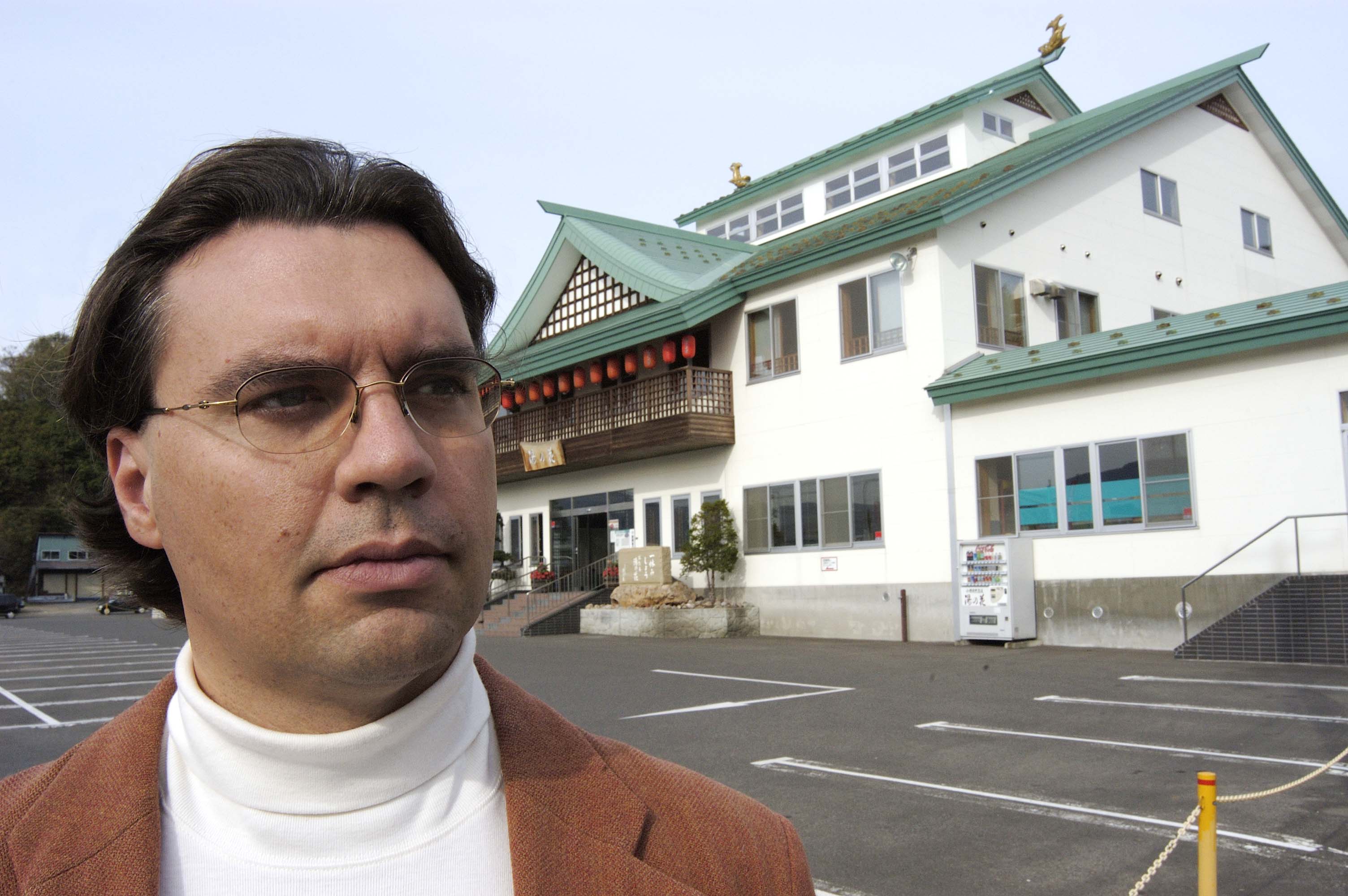
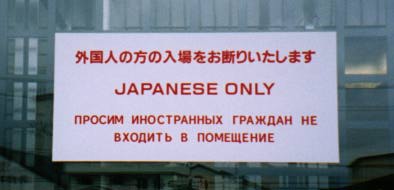
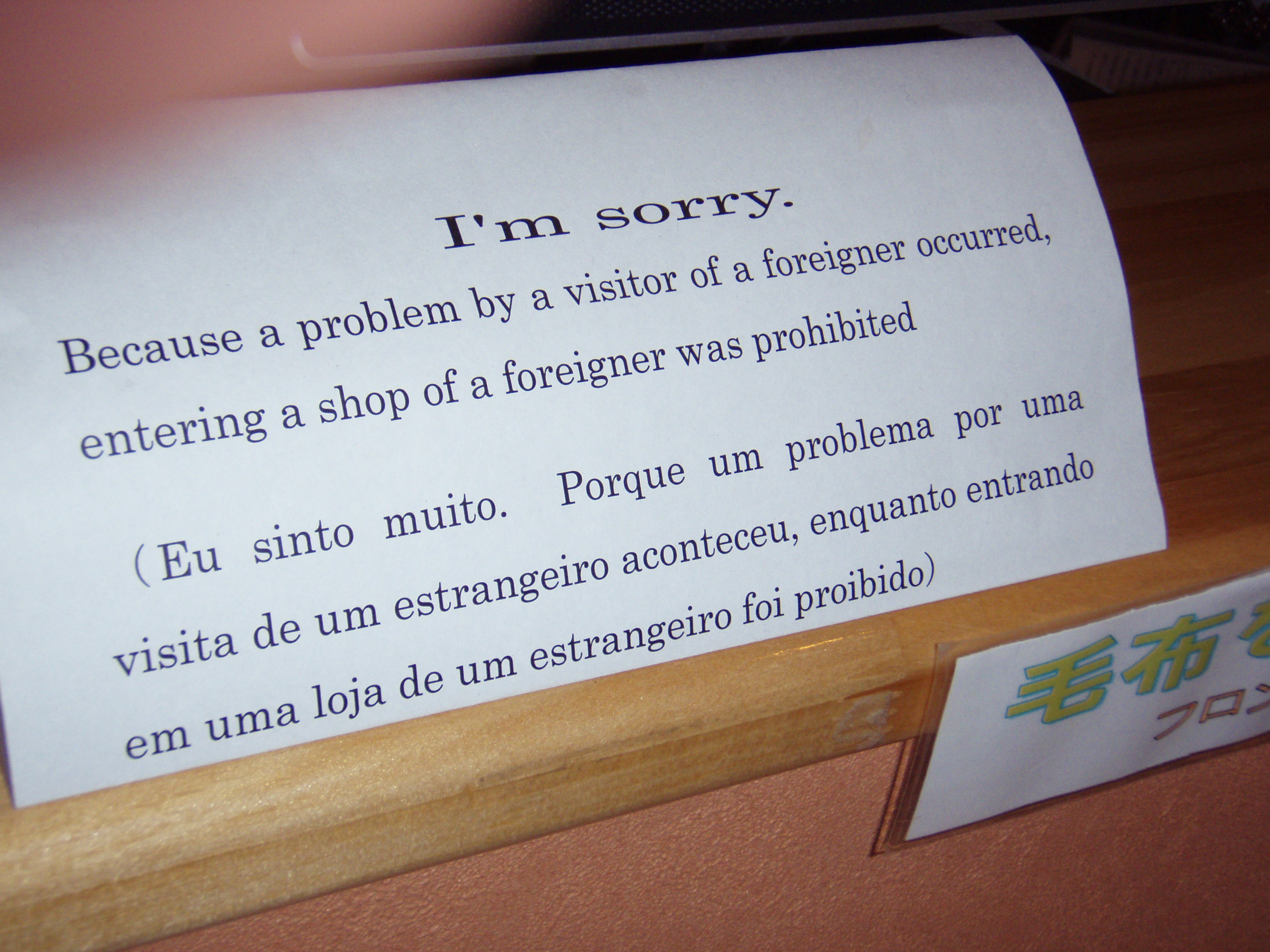
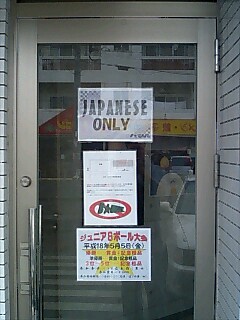
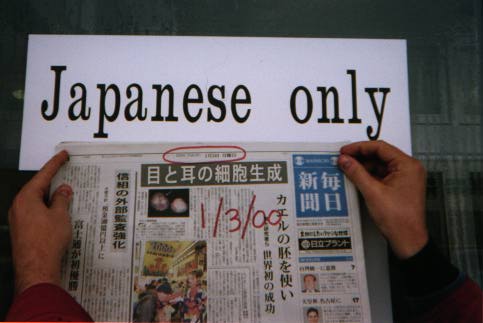
Sign up at a public bathhouse in Otaru, Hokkaido, Japan; 1998-2001 (from the below-mentioned Otaru Onsens Case) Standardized signs around Kabukicho, Shinjuku-ku, Tokyo; 2008 to present day
Sign up at a women’s boutique on Aoyama Douri (Street), Minato-ku, Tokyo; 2005 to present day Standardized signs around Hamanasu Douri, Monbetsu, Hokkaido; saying in Russian, “Store Only For Japanese”; 1999 to present day

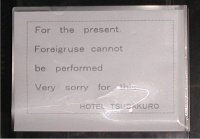
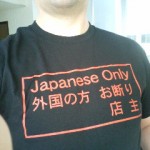
A lack of an Anti-RD law enables clear and present discriminatory practices in Japan, including refusals at businesses and establishments open to the general public.  Many places, including stores, restaurants, hotels, family public bathhouses, bars, discos, an eyeglass outlet, a ballet school, an internet café, a billiards hall, a women’s boutique, and a newspaper subscription service, have signs out front explicitly saying “Japanese Only,” or using a milder exclusionary equivalent clarifying that people who are not Japanese nationals, do not look “Japanese,” or do not speak Japanese, are barred from entry and service.[7] For example:

Although pressure from mostly civil society groups has resulted in some of the exclusionary signs being removed, many are still extant.  More recently, in the case of hotels: Local government agencies[8] and internet booking companies[9] are even promoting establishments that explicitly “refuse foreign customers,” or expressly deny bookings to people who “cannot speak Japanese” etc. – even though this practice is unlawful under the Hotel Management Law (ryokan gyouhou) in the Civil Code governing public accommodations.

Regarding redress for RD, in March 2001 the Japanese government replied to the CERD report (CERD A/56/18 (2001)) that the “Japanese judicial system is […] functioning sufficiently at present” (Paragraph 20.2), therefore a formalized Anti-RD law is unnecessary.  However, judicial precedent does not support this claim.  The Otaru Onsens Case[10], where several non-Japanese customers (including Japanese nationals who “looked foreign”) were refused entry to public bathhouses displaying “Japanese Only” signs, demonstrated that both the current legal situation in Japan was powerless to outlaw this practice, and that Japanese authorities were unable or unwilling to mediate effectively to stop this form of RD.  The Otaru City Government was taken to court under the ICERD in 2001, but the case was summarily denied review by the Japanese Supreme Court (April 7, 2005) for “lacking any Constitutional issues,” refusing to consider the validity of the ICERD.  Sapporo District and High Court decisions (November 11, 2002 and September 16, 2004, respectively) also ruled that RD was not the illegal activity in question in this case, therefore the ICERD is immaterial.  They also ruled that forcing the Otaru City Government to pass any local ordinance against RD would be a “violation of the separation of powers.”  A separate civil lawsuit[11] in Daito City, Osaka, where an African-American was denied entry in 2004 to an eyeglass store explicitly because the manager “dislikes black people,” found the Osaka District Court ruling against the African-American plaintiff (January 30, 2006).  Court cases take years, cost victims money, do not result in criminal penalties enforceable by police agencies, may result in civil court rulings that expressly ignore the ICERD, and otherwise absolve the government of any responsibility of systematically eliminating RD on a national level.

Although some local governments have taken measures to deal with discrimination in housing and rentals, legislation connected with RD has resulted in failure.  The first local government (Tottori Prefecture, 2005) to pass a local ordinance that explicitly criminalized and punished behavior tantamount to RD, found itself in the rare situation of repealing the ordinance in 2006[12], due to a public and media panic that too much power was being consolidated in human rights enforcement organs.  A similar bill guaranteeing human rights (the jinken yougo houan), first proposed at the national level in 2002, was shelved in 2003 and again in 2006 due in part to alarmist counterarguments and publications[13] that giving human rights to non-Japanese would enable them to abuse their power over Japanese people.

Conclusion

In conclusion, the situation is that in Japan, racial discrimination remains unconstitutional and unlawful under the ICERD, yet not illegal.  Japan has had more than a decade since 1996 to pass a criminal law against RD.  Its failure to do so can only be interpreted as a clear violation of ICERD Article 2(1): “States Parties condemn racial discrimination and undertake to pursue by all appropriate means and without delay [emphasis added] a policy of eliminating racial discrimination.”  We urge the Committee to make the appropriate advisements to the Japanese government to pass a law against racial discrimination without any further delay.

CHAPTER 3

Anti-Korean and Chinese Remarks Made by Public Officials

Nobuyuki SATO

(Research Action Institute for the Koreans in Japan (RAIK))

Introduction

In the previous concluding observations adopted by the Committee (paragraph 13), the Committee addressed the “Sangokujin remark”[14] made in April 2000 by Tokyo Metropolitan Governor Shintaro Ishihara as being racially discriminatory, and expressed its concern over “the lack of administrative or legal action taken by the authorities.”  However, Governor Ishihara has repeatedly made discriminatory remarks in May 2001, August 2003, and September 2006.

The “Sangokujin” Remark

On April 9, 2000, Governor Ishihara conducted a speech before members of the Japan Self-Defense Force:

“Looking at the present Tokyo, many Sangokujin and foreigners who have illegally entered the country have repeated very heinous crimes. […] Under such circumstances, if an extremely catastrophic disaster were to occur, we cannot discount the possibility that a huge, huge rioting incident could occur. […] This is precisely why, when dispatched in such times, I would like all of you [Self-Defense Force personnel] to consider the maintenance of public security to be one of your important purposes in addition to the provision of emergency help.”[15]

Governor Ishihara has specifically stressed “crimes committed by foreigners” (which only compose a very small proportion of the total crimes committed in Japan), and by intentionally using the “Sangokujin” term – which was formerly used to discriminate against and drive out Resident Koreans and Taiwanese residents who were liberated from Japanese colonial rule in 1945 – and creating the false threat that “we cannot discount the possibility that a huge, huge rioting incident could occur,” he has tried to arouse prejudice and animosity among Japanese against non-Japanese nationals so that the dispatch of Self-Defense Force personnel for public security maintenance purposes could be realized.

Furthermore, Governor Ishihara’s statement, “We need to break [China] up.  No matter how small the contribution, Japan should assist in this process and should also take initiatives both before and after the break up,”[16] violates Article 7.  However, Tokyo residents reelected him in 2003.

Remarks on “Chinese DNA”

In a Japanese newspaper (Sankei Shimbun) article titled “A Message to Japan: The Necessity of Internal Defense” dated May 8, 2001, Governor Ishihara groundlessly asserted that “[e]very year, there are about 10,000 illegal entrants, and Chinese compose 40% of these numbers.  Because they are illegal entrants, they cannot land regular jobs and are inevitable criminal factors.”  Additionally, after raising the example of a brutal murder case between Chinese nationals involving the scalping of facial skin, he wrote the following:

“We cannot deny the possibility that the quality of Japanese society as a whole might change as a result of the proliferation of crimes that indicate such ethnic DNA.  To avoid turning a blind eye to future trouble, we have no choice but to do what we can do now to expel such impending threats.”

This statement spread prejudiced sentiments that associated Chinese ethnic DNA (Governor Ishihara implicitly meant the Han people) to the execution of savage crimes.

Two years later, in an August 4, 2003 Sankei Shimbun (newspaper) article, Governor Ishihara wrote:

“The extremely pragmatic DNA of Chinese, who do not trust any sort of politics whatsoever, takes the improvement of one’s own economic situation as an absolute purpose, and while bearing in mind the [economic] disparities [between China and Japan], invades Japan in large numbers, and openly commits theft to satisfy one’s own desires.”

This is an attitude meant to thoroughly demean individuals of a specific ethnicity/nationality.

In January 2006, a report on Japan written by the UN Commission on Human Rights-appointed Special Rapporteur on contemporary forms of racism, racial discrimination, xenophobia and related intolerance Doudou Diène was released.  The following quote was made in paragraph 62 of the report:

“Most worryingly, elected public officials make xenophobic and racial statements against foreigners in total impunity, and affected groups cannot denounce such statements.”

However, by stating, “The Special Rapporteur doesn’t understand the governor’s real meaning in the whole context of his statement,” the Japanese government responded that his remarks were not discriminatory.[17]

Conclusion

These statements may act to instill groundless fears about “the rampant spread of crime by Asian foreigners” throughout the Japanese public and may also incite discriminatory stereotypes against particular ethnic minority groups in Japan.  As such, by not attempting to take any corrective actions against Governor Ishihara’s remarks, the Japanese government has not fulfilled its State Party obligation to uphold ICERD Article 4(c).

CHAPTER 4

Nationality Acquisition and Name Changes:

The Denial of Han and Korean Ethnic Surnames through Limitations in Kanji Characters Designated for Personal Names

Masataka OKAMOTO

(Vice Secretary-General, Solidarity Network with Migrants Japan (SMJ))

Background

In the concluding observations adopted on March 20, 2001 (CERD/C/58/Misc.17/Rev.3), CERD stated:

“Noting that although there are no longer any administrative or legal requirements for Koreans applying for Japanese nationality to change their names to a Japanese name, the Committee expresses its concern that authorities reportedly continue to urge applicants to make such changes and that Koreans feel obliged to do so for fear of discrimination.”

In the Upper House Judicial Affairs Committee that immediately followed this statement, when asked to remark on the concerns and recommendations of CERD’s concluding observations, Minister of Justice Masahiko Koumura replied:

“If the authorities have continued to demand applicants to change their names, this would be something outrageous, and since 1983, we have decided that such requests should not and will not be made, so if those types of cases actually do exist, we would like to take the appropriate measures.”[18]

Unfortunately, “those types of cases” abound.

Cases

Even in 2003, a case was reported by a Resident Korean from the Kanto area, that when he went to the Legal Affairs Bureau and received an “Information on Naturalization Application Procedures” leaflet and attended the briefing session, in response to his question, “Am I not allowed to continue using my current name after I naturalize?” the counseling staff replied, “Since you will become a Japanese, it is necessary that you change your name to one that is Japanese.”[19]

The Ministry of Justice itself has also revealed in different forms that with regard to post-naturalization “names,” instead of “instructing” the applicants, it has given “advice” and has also urged them to “consider” the implications of which type of name they choose to have.  During the 1991 Upper House Judicial Affairs Committee, the Director-General of the Civil Affairs Bureau of the Ministry of Justice Atsushi Shimizu stated, “Considering that it is acceptable for individuals to decide that they would like to retain and pass on last names such as ‘朴’ [Pak] and ‘金’ [Kim] for the next two or three generations, we have made it a point to advise applicants to carefully decide whether they would like to have such names after naturalization.”[20] Under the auspices of such government stances, the “instructing” and “coaxing” of Japanese name acquisition has occurred in practice.  For example, a woman from Cambodia who acquired Japanese nationality in late 1990 testified that when she applied for naturalization, the office representative insistently encouraged her to acquire a Japanese-like name like “Suzuki” for the “benefit of her children.”[21] Very recently, on January 7, 2010, a Thai woman who went to the Chiba Legal Affairs Office to apply for Japanese nationality was also told by the office representative that “Japanese names are more convenient,” so “[n]ext time, come back with a Japanese name in mind for when you acquire Japanese nationality.”[22]

In tandem with the aforementioned incidents, even in 2005, an administrative scrivener accounted that, through his experiences handling naturalization applications, among applicants who decide on Japanese names as their naturalized names, many actually “prefer to apply with their Korean ethnic names,” but many Korean residents think that “the Legal Affairs Bureau and the Ministry of Justice implicitly demand the use of Japanese names,” and if they do not use such Japanese names when they apply, “they would be at a disadvantage in the naturalization application process.”[23] A guidebook published by a different administrative scrivener in the same year also states that for “post-naturalization names,” one must choose a “Japanese-like name” (i.e. a name that is “appropriately” Japanese).  This is the reality of the issue in Japan.

Even the Ministry of Justice’s most recent (2009) “Guidebook for Naturalization Procedures” uses language that persuades name changes by stating that “one may freely choose […] what name he/she would like to use after naturalization,” and in addition to this, limitations are placed by stating, “In principle, names for use after naturalization cannot contain characters other than hiragana and katakana letters and those characters listed in the National List of Chinese Characters in Common Use and the List of Kanji Officially for Use in Names.”  Because characters such as “崔” (Cuī/Choi), “姜” (Jiāng/Kang), “趙” (Zhào/Cho), and “尹” (Yǐn/Yoon) that are frequently used in Korean and Han ethnic surnames are not even listed in these two lists, there are still many ethnic Korean and Han applicants who have no choice but to renounce their ethnic surnames.

In a magazine interview, a third generation Chinese man in Japan who applied for naturalization in 1997 was asked, “Were you forced to take a Japanese name?”  In response, the man replied “no,” but said, “I was told that my name after naturalization must include characters in the List of Kanji Officially for Use in Names, and my surname character was not in the list.”[24] A former Chinese national who acquired Japanese nationality in 1998-99 claimed, “I really like the name that my parents gave me, so it was painful to have to change it to get naturalized.  I wish I could have retained my name, even after becoming a Japanese national.”[25] If we consider the fact that the majority of applicants for naturalization are Korean and Chinese/Taiwanese nationals, it is likely that since 1983, a substantial number of people were forced to renounce their ethnic names, due to the limitations imposed by the List of Kanji Officially for Use in Names.

Given the fact that the aforementioned characters for common ethnic Korean and Han surnames are commonly used on the computer and are also entered into the system during “foreign resident registration” procedures, there is nothing logical about not allowing their use in names for the family register in Japan.

Conclusion

In its 2004 General Recommendation 30, CERD recommended that State Parties should “[t]ake the necessary measures to prevent practices that deny non-citizens their cultural identity, such as legal or de facto requirements that non-citizens change their name in order to obtain citizenship, and to take measures to enable non-citizens to preserve and develop their culture” (paragraph 37).

Therefore, the Japanese government should first eliminate the limitations imposed by the List of Kanji Officially for Use in Names, and allow ethnic Korean and Han applicants to retain their original Chinese character surnames when acquiring Japanese nationality.  The “Guidebook for Naturalization Procedures” should also refrain from using language that persuades applicants to change their names when naturalizing.  Additionally, on the application form, there should not be a column for “name after naturalization.”  Even under the current law, Japanese nationals wishing to change their names are required by Article 107 of the Family Registration Law to file a request to a family court.  Nationality acquisition and name changes are intrinsically unrelated issues.

CHAPTER 5

The Education of the Children of Migrants and Ethnic Minorities

Yasuko MOROOKA

(Japanese Network for the Institutionalization of Schools for

Non-Japanese Nationals and Ethnic Minorities)

Education of Non-Japanese National Children

1. Despite the recommendation made in paragraph 7 of the Committee’s previous concluding observations, the central government has not conducted a nationwide survey on non-Japanese national and/or ethnic minority children.  According to the various surveys carried out by the local governments,[26] 60% of the children of migrants and migrant workers such as Nikkei-Brazilians, Nikkei-Peruvians, and Filipinos among others (mostly with non-Japanese nationalities) are reported to be attending Japanese public schools, while 20% attend schools for non-Japanese national children (gaikokujin gakkou), and the remaining 20% are estimated not to be attending school at all.  On the other hand, among the children of the 600,000 non-Japanese national Korean residents, 80 to 90% are reported to be attending Japanese schools and the rest attend schools for non-Japanese national or ethnic minority children, such as North Korean and South Korean schools.  The majority of the children of the 500,000 Korean Japanese (i.e. Japanese national ethnic Koreans) are reported to be attending Japanese schools.

2. Regardless of the statement made in paragraph 15 of the Committee’s previous concluding observations, non-Japanese national children living in Japan are still excluded from the compulsory education system, and in violation of Article 5(e)(v) of the Convention, the right to education is not equally ensured at the same level as that of Japanese children.  In its “Third, Fourth, Fifth and Sixth Combined Periodic Report,”[27] the Japanese government announced that “Japanese public schools at the compulsory education level guarantee foreign nationals the opportunity to receive education if they wish to attend such [a] school by accepting them without charge, just as they do with Japanese school children” (paragraph 24), but this simply means that “permission” will be given if the non-Japanese national “wishes” to enroll.  However, the school/administration does not have the legal obligation to accept such students, and for non-Japanese nationals, education is not “secured” as a legal “right.”  This is the actual situation regarding the government’s contention.[28] For example, the annual “Survey on Children of School Age Who Do Not Attend School” carried out by the Ministry of Education, Culture, Sports, Science and Technology (MEXT), clearly states that “foreigners are excluded from the survey.”

The extent to which information is adequately disseminated – including translation of information into the non-Japanese nationals’ languages – for those “wishing” to enter Japanese schools varies among local governments.

As for the percentage of students continuing on to higher education, according to the 2001 survey conducted by the Council for Cities of Non-Japanese Residents (where many Brazilians and non-Japanese nationals live), the average of the 14 local government areas in which non-Japanese national children were enrolled in Japanese schools was 51.6%.  Though there is no data on student enrollment rates into Japanese high schools from schools for non-Japanese national or ethnic minority children, since there are almost no considerations in the high school entrance examination system that cater to the needs of students whose first language is not Japanese, it is clear that such enrollments are extremely difficult.  Consequently, the percentage of children of migrants and migrant workers who go on to high school is estimated to be below 30%.  This figure is less than one-third of 97% high school enrollment rate of Japanese nationals in 2008.

3. In paragraph 24 of the government’s report[29], the government states:

“Furthermore, when these foreign children enter school, maximum attention is given to ensure that they can receive, without undue difficulty, the education in Japanese normally taught to Japanese children.  Toward this end, they are provided with, among other things, guidance in learning Japanese and are supported by their regular teachers as well as by others who can speak their native language.”

However, this contradicts reality.  Even according to the survey conducted by MEXT, as of September 2008, there were 28,500 students enrolled in Japanese elementary, junior high, and high schools that needed Japanese language instruction, and this number has continued to increase annually.  Compared to the previous year, there was an increase of 12.5%.  Furthermore, due to the fact that measures to accommodate Japanese language instruction are not taken unless there are 5 or more students who need such instruction, 15.1% of these students are not receiving any Japanese language instruction.  Besides, in the aforementioned MEXT-commissioned survey on children of school age who do not attend school, 12.6% of the children not attending school answered that they did not attend because they “did not understand Japanese.”  It is evident from this that there is not enough Japanese language instruction.[30]

4. In response to the Committee’s recommendation to “ensure access to education in minority languages in public Japanese schools” in paragraph 16 of its previous concluding observations, the government claimed that “a school subject called sogo-gakushu (general learning) […] allows […] children of foreign nationalities [to] receive education in their native tongues (minority languages) and learn about their native cultures”[31] (paragraph 24).  However, the government has not established any specific education policies for minority children, and within MEXT’s curriculum guidelines for this “general learning” subject, there is neither any mention of minority language and culture education nor any financial support for such classroom activities.  As the choice over the content of the “general learning” subject/class period is left to the discretion of each school, the government’s claim simply means that this class period could, in theory, be used for minority language and culture education.

The public schools that do provide minority language and culture classes are those that have been established in specific areas in Osaka prefecture and Kyoto City with “ethnic classrooms.”  Because these classes are not recognized as accredited classes by the central government’s educational curriculum policy, they are taught as once-a-week extracurricular classes that include Korean language and culture education.  However, the salaries of the lecturers/instructors of these “ethnic classrooms” are paid fully by the local municipalities, and compared to regular full-time teachers, their pay is very low.  In addition to these schools, there are only a few schools that offer mother tongue language education in “special support” classes for Chinese and Brazilian children.

Over 80% of the children of Korean residents who attend Japanese schools use Japanese names instead of their real names,[32] and are placed in situations in which they have no other option but to conceal their own identities.  From this, it is obvious how deficient the current education system is in terms of the provision of a curriculum that not only respects the identities of minority children, but enables them to hold pride in their ancestral roots.

Schools for Non-Japanese National and Ethnic Minority Children

1. Today, there are about 200 schools for non-Japanese national and ethnic minority children that offer general education in languages other than Japanese.  These include 100 national and international schools such as North Korean, South Korean, and Chinese schools that were established before the war or during the early years after the war.  Brazilian, Peruvian, and Filipino schools that were established as the numbers of migrant workers and migrants started to rapidly increase in the 1990s number about 100 as well.[33]

2. According to the School Education Act, for a school to become recognized as an accredited school, it must implement the designated subjects set forth in the curriculum guidelines created by MEXT (for the purpose of educating Japanese nationals), and must use MEXT-approved Japanese textbooks.  Due to this, it is impossible to adequately teach languages other than Japanese and English in regular classes.  Therefore, such schools are not recognized as accredited schools.  Even if a student were to graduate from one of these schools, his/her graduation credential would not be recognized as an accredited one.  As a result, such students encounter various disadvantages when they try to enroll in Japanese schools or take national examinations.

3. In 2003, the college entrance qualification system was revised.  With this, for (1) individuals graduating from twelve-year curriculum schools for non-Japanese national children (e.g. international schools) that have been accredited by international evaluation associations (WASC, ACSI, and ECIS); and (2) individuals graduating from schools for non-Japanese national children (South Korean, Chinese, Brazilian schools, etc.) that have been recognized by the Japanese government as schools that carry out curriculums that are equivalent to high school curriculums in each respective country, eligibility to take the entrance examinations and apply for Japanese universities and technical/vocational schools was granted.  However, graduates of North Korean schools were not included, and because their eligibility is either dependent on the individual decisions of each university or conditional on passing the Senior High School Graduate Equivalence Qualifying Examination, they experience disadvantages.

4. Most schools established before the 1990s for non-Japanese national and ethnic minority children, such as North and South Korean schools and Chinese schools, have been recognized as “miscellaneous category schools” (kakushu gakkou).  But these schools are not “official” or “accredited” ordinary schools under the Japanese Educational School System whose aim is to provide general or regular education, and are therefore, educational institutions that are institutionally treated no differently from vocational driving or cooking schools.  Because they are not “officially accredited” schools, the central government has provided no subsidies for these schools for non-Japanese national children.  Instead, it is only from the subsidies provided by certain portions of the local municipalities’ budgets that these schools are funded.  However, these subsidies from local municipalities only amount to one-tenth to several fractions of the funding received by Japanese private schools.  Due to the absence of state subsidies, these schools are supported by tuition fees paid by the parents, donations from co-ethnics, and subsidies from local municipalities.

As for donations made to schools, “official” or “accredited” general schools can unconditionally receive special tax breaks, but “miscellaneous category schools” are in principle, ineligible.  On March 31, 2003, MEXT approved tax exemption measures for donations that were specific to a portion of European/American “miscellaneous category schools” with English curriculums.  In response to this, concrete recommendations for the equal treatment of North Korean and Chinese schools were made to the Japanese government by the Japan Federation of Bar Associations (JFBA) in March 2007 and by the UN Human Rights Committee in October 2008.[34]

5. Among the Brazilian and Peruvian schools that have increased after 1995, only 5 schools have been approved as “miscellaneous category schools” and the majority are only treated as mere “private preparatory schools.”  Due to this, (1) there are no subsidies from local municipalities, (2) consumption tax is placed on tuition, (3) students are ineligible for discounted student commuter passes, (4) students cannot participate in inter-school sports events and activities, etc.  Such schools experience great difficulties in operating the school itself.

Above all, because the schools’ running costs are almost completely secured by tuition fees paid by the parents, monthly tuition fees are inevitably expensive and range from 30,000 to 50,000 yen (approximately $300 to $500 USD).  Furthermore, in addition to tuition, the parents must also pay for textbooks, school lunch fees, school bus passes and/or non-discounted adult-rate commuter passes, etc.

Strict requirements, such as the private possession of school grounds and buildings, are enforced by local municipalities for the approval of “miscellaneous category schools.”  It is very difficult for newly established Brazilian and Peruvian schools to pass such criteria.

Most of the parents of students who attend these schools are contingent/dispatch workers, and have been hit extremely hard by the Lehman Shock of September 2008.  For example, in half a year, approximately 60% of Brazilian migrant workers lost their jobs, and as a result, in one year, 16 Brazilian schools closed down because parents were no longer able to pay the expensive tuition and had to withdraw approximately half of the students from school.  Half of the students who withdrew from school returned to Brazil, but 22% still remain completely out of school in Japan.

Recommendations

1. The government should confirm that it has an international legal obligation to ensure the right to education regardless of residence status and nationality.

2. The government should establish an education policy to secure the right to education for non-Japanese national and ethnic minority children in Japan.  The content of the policy should first and foremost, respect the children’s identities and ensure the right to learn minority languages and cultures; and secondly, it should ensure the right to learn Japanese if a child’s first language is not Japanese.  Additionally, in order to establish a concrete education policy, the voices of non-Japanese national and ethnic minority residents themselves should be directly sought, and a detailed nationwide survey should be carried out on the realities of language development, rates of non-attendance, acceptance rates into top tier schools, costs of educational fees, economic situations of the parents, etc., and disaggregated by nationality, ethnicity, sex, and age.

3. In order to ensure the right to education for non-Japanese national and ethnic minority children, and in particular, the right to learn one’s language and culture, the government should allow these children to actually exercise choice between Japanese schools and schools for non-Japanese national and ethnic minority children by recognizing these schools as a type of “officially accredited” ordinary school (and not as “miscellaneous category schools”) and allowing the recognition of these schools’ graduation credentials as ones that are equivalent to those of Japanese schools while providing these schools with at least the same amount of government funding that Japanese private schools receive.  Additionally, until such fundamental policy reforms are established, the government should immediately amend the unfair policies extant within the current “miscellaneous category schools” framework with regard to tax exemption measures on donations and the differential recognition of college entrance eligibility between different schools for non-Japanese national and ethnic minority children.  Finally, the government should take immediate actions to bail out schools that are not even recognized as “miscellaneous category schools,” and in particular, Brazilian and Peruvian schools that are at risk of closing down.

CHAPTER 6

Discriminatory Administrative Government Procedures in

Residence Status Application Approval Procedures and Employment

Satoru FURUYA

(Rights of Immigrants Network in Kansai (RINK))

Kaoru KOYAMA

(Solidarity Network with Migrants Japan (SMJ))

  1. 1. The Requirement to Present Proof of a Clean Criminal Record for Residence Status Approval: The Additional “Good Behavior and Conduct” Criterion for Third Generation Non-Japanese Nationals of Japanese Descent and Their Families

Introduction

In November 2005, there was an incident where a Japanese girl was murdered in Hiroshima.  One week later, a Peruvian man – who had a “long-term resident” residence status (i.e. visa) as a third generation non-Japanese national of Japanese descent – was arrested.  On March 29, 2006, as a measure to both deal with this incident and maintain general public security, the Ministry of Justice added a “good behavior and conduct” requirement – a requirement stating that one must prove not to have a criminal record for the approval of “long-term resident” residence statuses.

In other words, instead of taking measures to mitigate racial prejudices that could have resulted from the media’s excessive reports on crimes committed by non-Japanese nationals, the Ministry of Justice – which should be protecting human rights – did the opposite by enforcing a measure that was predicated on the linkage of crime to non-Japanese nationals with certain attributes.  As a result of this, members of minority groups became targets of racial discrimination, and stereotypes against them were widely spread throughout Japanese society.

Therefore, this measure violates Articles 2(1(a)) and 4(c) of the ICERD.  Additionally, in lawsuits related to this, the defendant (the Japanese government) has argued that this new requirement does not violate the ICERD, and a district court verdict has supported this claim.

Background

With the 1989 revision to the Immigration Control Act, non-Japanese nationals of Japanese descent and their families were issued “long-term resident” residence statuses that allowed one to engage in remunerative activities.  To second generation non-Japanese nationals of Japanese descent, there was the “spouse or child of a Japanese national” residence status, and for the spouses of second generation non-Japanese nationals of Japanese descent and third generation non-Japanese nationals of Japanese descent and their spouses and/or unmarried minor children, there was the “long-term resident” residence status.  According to statistics on the number of “registered foreigners” in Japan, in 2008, there were 258,000 individuals with “long-term resident” residence statuses of which 137,000 were Brazilian and 19,000 were Peruvian.

On the other hand, with regard to public security policy, a trend toward “penal populism” has recently become salient in Japan, and non-Japanese national residents have been the first to be targeted.  Discourse claiming that crimes have increased in number and level of atrocity thereby leading to the critical deterioration of public security throughout society at large, has circulated among the media, police, and Diet, and took a turn for the worse, creating a dangerous situation which peaked in 2003 but continued to exist as several murder incidents were extensively broadcasted in 2005.  The aforementioned incident in Hiroshima where a non-Japanese national was said to have “murdered a Japanese girl for sexual motivations” was one of those extensively broadcasted incidents.

Under these circumstances, by stating that (1) due to this incident, there is “heightened anxiety among the Japanese people,” and (2) there are many foreigners[35] with “long-term resident” residence statuses who have been arrested for criminal offenses,[36] the Ministry of Justice announced the amendment to the “Official Gazette Regarding ‘Long-term Residents’” that will be discussed in this chapter.  Subsequently, this amendment and the reasons behind it were picked up and broadcasted by the media.

The Content of the “Official Gazette” Amendment

The amendment to the Ministry of Justice’s “official gazette” (announced in March 2006) regarding “long-term residents” contains the following criteria:

(a)   “Good behavior and conduct” was added as an additional criterion for qualifying as a “long-term resident.”  In concrete terms, possession of a criminal record of imprisonment (with or without hard labor) and/or pecuniary offenses (i.e. fines; but excluding fines from violations of the Road Traffic Law) within or outside of Japan reflects negatively on one’s application.  Probation under the Juvenile Law and having a record of “repeated violations of the law throughout one’s everyday life” are also evaluated negatively.

(b)  To verify “good behavior and conduct,” when applying for landing permission or residence status, applicants are asked to present background records issued by the police in their respective home countries.

(c)   This new “good behavior and conduct” criterion is applied to third generation non-Japanese nationals of Japanese descent and their families, mainly from South America.  In other words, of all the non-Japanese nationals of Japanese descent and their families, second generation non-Japanese nationals of Japanese descent and their spouses are exempt.  From the differential treatment here, it is obvious that there is a standard of judgment with racist motivations borne from distrust and public security anxieties toward individuals that are “less akin” to Japanese nationals.  Additionally, among those who qualify as “long-term resident” applicants, the “Japanese war orphans left behind in China” and Indochinese refugees were exempt from this new criterion due to policy considerations.

Possession of a criminal record is a criterion that forecloses the possibility of residence status approval in general, and can also be used as a reason for deportation (under the Immigration Control Act).  For such instances, being sentenced to “a year or more” of imprisonment or a crime involving drugs become reasons for adverse disposition for disapproval of residence status.  In contrast to this, in the case of this amendment to the “official gazette” regarding “long-term residents,” all criminal punishments as well as minor punishments and juvenile probation become reasons for rejection.  Although the presentation of background records issued by the police of the applicant’s home country is not required in regular screenings for residence status approval, the amended “official gazette” demands the presentation of such documentation for the aforementioned “long-term resident” applicants, and therefore, even background activities that fall short of criminal record offenses[37] are also available for consideration and could work against the applicants.

The Discriminatory Effects and Cultivation of Stereotypes Caused by the “Official Gazette” Amendment

All of the following cases occurred after the amendment to the “official gazette” was made, and involve “long-term resident” residence status extension applications that were rejected because the applicant had been punished for a prior offense.

(a)   Third generation male Peruvian national of Japanese descent, A, caused a traffic accident, and in a 2002 summary court ruling, was charged with professional negligence resulting in bodily injury and was fined on a summary order.  The following year, his residence status extension was approved, and the next year, his license was approved.  However, after the “official gazette” amendment, in August 2006 his residence status extension was rejected on the grounds of the aforementioned offense.  Furthermore, A’s wife, who was also living in Japan with a “long-term resident” residence status also had her extension application rejected.

(b)  A male Bolivian national, B, who is married to a third generation Bolivian woman of Japanese descent, caused a traffic accident, and his residence status extension application was rejected on the grounds that he was charged with a pecuniary offense for professional negligence resulting in bodily injury.[38]

There are also cases in which the possession of a spouse or minor child has been considered, ultimately resulting in the approval of residence status extension applications despite the fact that one has a prior criminal record.  However, in the two aforementioned cases, such considerations were not adequately made.[39]

(c)   In October 2002, a third generation male Peruvian national of Japanese descent, C, dumped a refrigerator in an empty lot, and in January 2003, was fined 200,000 yen (approximately $2,000 USD) on a summary order by the summary court for “a violation of the Waste Management and Public Cleansing Law.”  In August 2003, his residence status extension was approved.  However, in August 2006, after the “official gazette” amendment, his extension was rejected on the grounds of the same pecuniary offense, and since his “period of preparation to leave Japan” ended in October of the same year, he has remained in Japan without legal documentation.

In August 2007, C brought charges claiming the invalidity of his residence status extension rejection, but lost the case in the district court.  He is currently residing in Japan without legal documentation, and no remedies have been sought.

In court, the plaintiff claimed that the “official gazette” amendment not only “poses a significantly grave discriminatory effect on the entire Nikkeijin [non-Japanese nationals of Japanese descent] population as a group that has been categorized on the basis of race and other attributes,” but also embodies the racial discrimination stipulated in ICERD Article 1(1) while violating Articles 2(1(a)) and 4(c).

Additionally, this “official gazette” amendment has promoted the entrenchment of media-instigated stereotypes that link non-Japanese nationals to crime.  Wide-scale coverage and explanations that linked the amendment to the murder incident in Hiroshima and other crime statistics were made by the Minster of Justice in a press conference the day before the “official gazette” was amended, as well as on the Ministry of Justice Immigration Bureau’s homepage (since April 2006), the official announcement in the aforementioned Immigration Control Report (footnote 1), and the media.

Conclusion

Therefore, this measure violates ICERD Articles 2(1(a)) and 4(c).

  1. 2. Employer Obligations to Report the Employment Status of “Foreign Workers” and the Use of “Ordinary Powers of Attention” to Ascertain Who is a “Foreign National”

The Problem

With the recent revision of the Employment Measures Act, since October 2007, the government made it mandatory for employers when hiring non-Japanese nationals to confirm and notify the head of the local public employment security office of their names, residence statuses, and lengths of stay.  A punishment of up to 300,000 yen (approximately $3,000 USD) for violating employers was also established.

When hiring, employers are required to ascertain whether a job applicant is a “foreign national” by means of using one’s “ordinary powers of attention” to make judgments based on the applicant’s “name or native language.”[40]

As mentioned in Chapter 1 of this report (p.3), there has been a rapid increase in Japanese nationals who have ethnic roots in other parts of the world.  To require employers to judge applicants by their names is predicated on the assumption that Japanese nationals all have Japanese-like names, but this assumption contradicts the Ministry of Justice’s claim that it does not demand that non-Japanese nationals change their names upon naturalization (for more details, see Chapter 4).  In reality, there are also many Japanese nationals whose native language is not Japanese.

Instead of providing employers with a means for differentiation between Japanese nationals and non-Japanese nationals, this new guideline poses the risk of facilitating segregation as well as arbitrary judgment and discrimination on the basis of race, skin color, and ethnic/tribal origins.

Conclusion

Therefore, this measure violates ICERD Articles 2(1) and 4(c).

CHAPTER 7

Migrant Women in Japan: Victims of Multiple Forms of Discrimination and Violence and the Government’s Lack of Concern

Leny TOLENTINO

(KALAKASAN Migrant Women Empowerment Center)

Introduction

Japan has continuously needed migrant women for its sex industry, shortage of wives for its male nationals, and replacement unskilled labor for its service and manufacturing industries.  In response to these needs, migrant women – mostly from Asia and Latin America – have come or have been brought to Japan on tourist, entertainer, spouse or relative of a Japanese national (Nikkeijin), and trainee visas since the 1980s.

However, even after nearly three decades, many migrant women are still treated as the “other” and excluded from Japanese society and its social safety nets.  Widespread discriminatory attitudes and prejudices on the basis of appearance, speech, customs, and cultures, as well as feelings of indifference toward migrant women among government officials and the populace continue to exist and are also codified in extant policies and legislation.  Many migrant women survive with minimal protection under the law, have limited access to basic information and opportunities for training, empowerment, and development, and are also almost completely deprived of opportunities to participate in decision-making processes.  Most vulnerable are those migrant women who are victims of DV and/or trafficking.

Multiple Forms of Discrimination and Disadvantages That Migrant Women Face

  1. 1. In Trafficking

(a)   Recent Developments in Policy

The government adopted the Comprehensive Action Plan of Measures to Combat Trafficking in Persons (2004), which was followed by amendments to the penal code (2005) and the Immigration Standard Ministerial Ordinance (2006) – regarding the cut down of “entertainer” visa issuances – and an amendment to the Entertainment Business Law (2005).

Yet, in response to stricter regulations, trafficking operations have simply become more invisible, coercive, and controlling, and there has been a tangential increase in migrant women who are lured to come to Japan with non-entertainer visa statuses – such as tourist, trainee, and marriage visas – and are later forced to go into prostitution by their husbands or brokers.  In some instances, if they enter into fake marriages, they are forced to pay both the broker and the husband for 2 to 3 years, or as long as the fake marriage lasts.  A typical case in point would be a Filipino woman who wanted to end her marriage with her abusive Japanese husband.  He had assured her legal stay in Japan as his wife for a monthly fee of 50,000 yen (approximately $500 USD) but refused her divorce request because she had not finished paying the 3 million yen ($30,000 USD) she had agreed to pay him.[41]

2.  In Domestic Violence

(a)   Examples of DV in International Marriages

International marriages in Japan have been increasing since the 1980s,[42] and domestic violence remains a major problem for non-Japanese women in such marriages where they are six times more likely to be abused than Japanese women (Table 1).  DV often originates from their partners’ prejudices against migrant women and from their low regard for people from developing countries.  Aside from life endangering physical and sexual abuse, threats and derogatory judgmental insults inflict psychological damage and lower self-esteem and confidence.  Threats like, “You cannot live in Japan without me,” “I will not extend your visa,” and “This is Japan, and custody over the child will always be mine [husband] – if you leave, I will report it to the immigration authorities and they will not believe what you say,” are examples of such derogatory treatment that have been reported to KALAKASAN over the past 7 years.  Their lives are sometimes circumscribed by their spouses’ intent to force them to “become Japanese” by being over-critical of the way they rear and discipline their children, and by prohibiting them from speaking their own language inside the house and associating with co-ethnics.

Table 1. Percentage of DV Victims per 100,000 People[43]

2003 2004 2005 2006 2007
Non-Japanese women 28.9 33.8 36.0 34.8 35.4
Japanese women 6.2 6.5 6.3 6.5 6.4

(b)  Current Policy Limitations

There is a dire need for gender- and multiculturalism-sensitive training programs for government staff and interpreters at all levels of the government to assume responsibility for supporting migrant women victims so that victimization is not repeated.

In 2007, 8.95% of women in protective custody at women’s counseling centers were non-Japanese women.[44] Though the DV Law guarantees protection to all women victims, undocumented migrant women and their children are minimally protected, and are only eligible to stay in a shelter for two weeks, and are excluded from long-term support and particularly access to livelihood assistance and other support services.  At the same time, it takes months or years before undocumented DV victims and their children are granted residence permits in Japan.  Relegated to an even lower social existence are undocumented migrant women without children or those who have children who are in the custody of the abusive partner.  Such women are frequently forced to go back to their country of origin.  For such reasons, a significant number of undocumented migrant women and children choose to bear abuses, or if they are already in a shelter, to return to their violent partners or become homeless.[45] Many of these women do not have understandable and accessible information about support services and details about their legal and human rights.  It is therefore paramount that the government effectively disseminates such information in a systematic and culturally sensitive way.

3.  Migrant Single Mother Families

(a)   Lack of Support and Information Services

Every year, the number of migrant single mother families is increasing as international marriage divorce rates increase.  In 2007, 7.15% of all divorces in Japan were international marriage divorces.[46] Migrant single mother families face many difficulties and are marginalized due to the government’s lack of interest to provide them with adequate protection.  Migrant single mothers have often experienced discrimination and abuse or abandonment from their partners and/or in-laws, and report such experiences as the main reasons for the divorce or separation.[47]

4.  Discriminatory Policy and Unfair Court Procedures

(a)   Repercussions of the Revised Immigration Control Act (July 2009) on the Livelihoods of Migrant Women

The fact that visa extensions for migrant women often depend on the will and discretion of their Japanese husbands and whether or not the woman has Japanese children, makes their legal standing and livelihood stability in Japan very precarious and vulnerable to the whims of their spouses and the government.  Unfortunately, the government passed an amendment to the Immigration Control Act in July 2009, specifying that migrant women must report any changes to their livelihood situations like changes in address and workplace.  Individuals who fail to do this within 14 days are subject to a fine, and failure to do anything for 3 months could result in visa cancellation.  This revision could escalate fear among migrant women – especially those who are married to or living with an abusive Japanese partner – and would allow Japanese husbands to take advantage of their vulnerabilities thereby putting them in more risk of being abused, while making it more difficult for DV victims to seek rescue and protection.

(b)  Indifference Among Government and Court Officials

A migrant woman who escaped from the abuse and maltreatment of her husband and in-laws who is presently undergoing court procedures for the custody of her child and divorce, was denied a visa extension even with a note from her lawyer stating that she was in the middle of settling a divorce case.  When she verbally appealed to the immigration officer, she was called a liar.  It was not until her lawyer accompanied her that she was considered.[48] From this example, we can see that the court also uses the unstable visa statuses of migrant women as bases for giving custody of the child to the Japanese spouse, thereby denying the woman of the same right to custody, simply because she is “non-Japanese.”  There are many other migrant women who experience similar situations.

(c)   Lack of Means to Claim Rights and Obtain Public Assistance

Furthermore, under the revised immigration law, undocumented residents can no longer claim any public services and assistance through the local municipality offices in the areas in which they live.  Before a local municipal office assumes the responsibilities of accepting a registrant’s child into a local school, extending public assistance to migrant women, etc., it requires one to prove his/her residence in the area.  Proving and registering one’s residence is possible if one obtains a Resident Card from the immigration authorities, but these cards are only issued to “legal” migrants.  The exclusion from local municipal registration therefore means the denial of rights and exclusion from public assistance.  Many undocumented migrants are women who are former wives of Japanese nationals, and are pregnant with or live with children who were born between them and their Japanese partners but have not received official recognition from the father, due to the father’s failure or refusal to do so.  It is these people who are put at risk the most by the revised law.

NGO Recommendations: Summary of Overarching Problems, How They Violate ICERD, and How They are Relevant to the Committee’s List of Issues

Though migrant DV victims, trafficked victims, and single mothers each experience distinct hardships and require policy improvements that are tailored to eradicate the relevant forms of discrimination and disadvantages that they face, five common sources for these problems exist:

  1. The lack of a comprehensive policy that protects the social, economic, cultural, and human rights of migrants, and in particular, migrant women

In violation of Article 2, and in cross-reference to paragraphs 2, 6, 9, and 14 in the Committee’s List of Issues:

l  Currently, within the Basic Law for a Gender-equal Society (which is the national gender equality policy), there is no clause that refers to the considerations that must be made to ensure gender equality for migrant women.  We recommend that within the current deliberations over the Third Basic Plan for Gender Equality, there should be an independent clause that addresses measures to be taken to ensure gender equality for migrant and minority women in Japan so that they can possess peace of mind, freedom, and dignity in employment, livelihood, and social participation without being subject to violence, discrimination, and prejudice.  In addition to measures to eradicate DV and trafficking, specific measures for the protection, empowerment, and relief of DV and trafficked victims should be clearly stated in this clause.  Additionally, the government should guarantee permission for NGOs and civil society groups to participate in these deliberations and processes.

  1. Existence of discriminatory policies or policies that disadvantage migrant women in practice

In violation of Articles 2 and 5, and in cross-reference to paragraphs 6, 7, 9, and 14 in the Committee’s List of Issues:

l  The revised Immigration Control Act newly states that status of residence can be revoked for “[f]ailing to continue to engage in activities as a spouse while residing in Japan for more than 6 months,” and for “[f]ailing to register the place of residence within 90 days after newly entering or leaving a former place of residence in Japan.”[49] Such obligations endanger the safety and legal standings of DV victims and their children who intend to flee or have fled from abusive spouses to live separately, and must therefore be eliminated.

l  Before the revision, non-Japanese national residents – regardless of the type or legality of their residence status – were entitled to receiving a local municipality-issued Alien Registration Card if they could provide proof of residence within that local municipality.  This entitled non-Japanese national residents to receive national health insurance and livelihood support services.  However, the new revision abolishes the Alien Registration Card, replacing it with the Residence Card issued and managed by the central government.  Changes in address and workplace must now be reported to local immigration control offices, and failure to do so could result in fines or the revocation of one’s residence status.  Residence Cards are issued to “proper foreign residents” at the discretion of the Minister of Justice, and therefore, undocumented residents and asylum seekers are ineligible.  To receive health and livelihood support in the new system, one must be registered in the newly created Basic Register for Foreign Residents, but registration for this basic registry is contingent on possessing a Residence Card.  In sum, the new revision works as a catch-22 to exclude the most vulnerable migrants – undocumented (women) migrants (many of whom are DV and trafficked victims) – from social services, and must be reevaluated and immediately revised.

  1. Indifference and discriminatory attitudes among public officials (e.g. at immigration control offices, police offices, courts, etc.)

In violation of Articles 2, 4, 6, and 7, and in cross-reference to paragraph 20 in the Committee’s List of Issues:

l  Given the multiple reoccurrences of insensitive, discriminatory, and disadvantageous comments, actions, and attitudes of public officials, sensitivity training on human rights, diversity, and multiculturalism should be more strictly implemented.

  1. Lack of government efforts to establish services to assist, educate, empower, and protect migrant women and their families

In violation of Articles 2 and 5, and in cross-reference to paragraphs 15 and 22 in the Committee’s List of Issues:

l  Although some social and medical services exist for migrant and minority women as well as DV and trafficked victims, they are inadequate (e.g. understaffed and lacking in personnel who possess the necessary professional, linguistic, and cultural knowledge to adequately assist migrant women).  Furthermore, information on support services and the rights that migrant women are entitled to are not adequately disseminated and often do not reach migrant women.  Even if they do, many forms of information are either not detailed enough, or are presented in Japanese.  These inadequacies must be addressed.

  1. Limited government collection and disclosure of crucial statistics concerning migrant women

In violation of Article 7, and in cross-reference to paragraphs 12 and 13 in the Committee’s List of Issues:

l  The government neither collects nor discloses adequate vital statistics that are necessary for the government and the public to assess the current situation of the wellbeing of migrant women in Japan.  For example, the government collects statistics on non-Japanese nationals and residents, but not on individuals who have naturalized (i.e. ethnic minorities with Japanese nationality).  It is possible that such individuals also encounter disadvantages and discrimination, but as of now, there is no systematic way to find out if they do.  In order to develop a more comprehensive and sensitive plan or policy for the protection, integration, and empowerment of migrant women, the Gender Equality Bureau should conduct an in-depth study on the situation and causes of difficulties migrant women face, based on more detailed disaggregated data and in consultation with migrant women support groups.


CHAPTER 8

Racial Discrimination within the Refugee Recognition System

Kenji IWATA

(Rights of Immigrants Network in Kansai (RINK))

Introduction

The Japanese government’s long-standing reluctance to give protection to asylum seekers has been criticized domestically and internationally.[50] The “refugee recognition system” is at best, only ostensibly racism-neutral, and in violation of Articles 2(1(a)) and 5(a), it suffers from unfairness caused by systematic racism that stems from the discriminatory dispositions of the decision makers involved.  More specifically, the government lacks in its efforts to:

  1. adequately disseminate information regarding the refugee recognition process;
  2. provide adequate language assistance during the application and appeals processes;
  3. provide adequate human rights training to its staff; and
  4. implement effective measures to monitor racially discriminatory biases within the system so that the individual racial prejudices of immigration officials and government appointed actors in the refugee recognition process will not be systematically reflected in the outcomes of such procedures.

In addition to paragraphs 2, 3, 6, 7, and 22, and in specific relation to paragraphs 10[51], 15, and 20 in the Committee’s List of Issues (CERD/C/JPN/Q/3-6), we would like to bring to the Committee’s attention, several defining examples of the aforementioned violations to the Convention.

Specific Cases of Procedural Malpractices and Negligence

Case 1 (July 7, 2009):

In 2009, a refugee examination counselor[52] reviewed the testimonies of a Tamil asylum seeker who claimed that he had fled Sri Lanka after his house was shot by suspected LTTE members.  In response to this, and to the surprise of the asylum seeker and his lawyer, the counselor concluded that the attack to the asylum seeker’s house did not constitute a direct threat to his life.  It is disconcerting that the counselor was an honorary professor of a prestigious university in Osaka, Japan, and although many wonder why he was selected as a refugee examination counselor, there is no way to find out because the government does not disclose information on the selection criteria for examination counselors.

Case 2 (November 20, 2006):

The following statement made in 2009 by another Tamil asylum seeker from Baticaloa, Sri Lanka, was documented by an immigration official, but even a cursory glance through the statement reveals blatant contradictions and inconsistencies resulting from communication difficulties between the official and the asylum seeker and the official’s indifference to the asylum seeker’s claims:

“I intended to flee [Sri Lanka] and go to Canada, where my elder brother stayed for asylum because the hostilities between the military and the LTTE have been exacerbated. […] I did not flee the country because I was targeted due to my political opinion, ethnicity, food practices, or religion, and I am not a Convention refugee.  I would like to go back to Sri Lanka without applying for refugee status here.”[53]

The asylum seeker is still having great difficulties communicating in English, and it is likely that in the interview, the asylum seeker could only randomly juxtapose the limited English vocabulary that he had.  In the conversation between the asylum seeker and the official, it is highly unlikely that there was any interaction in English about the applicability of the Convention’s definition for refugees to his case.  This is apparent in the blatant contradictions in the testimonial of this asylum seeker who claimed that he spent a great sum of money to go to Canada for asylum, only to instantly confess that he was not a refugee, abandon his attempt to claim refugee status, and return to the battlefields of Baticaloa.  Of course, the official did not and will not confess his indifference or any underlying racist sentiments he may have had.  Additionally, during the interview, it is unlikely that he used any racist language.  However, his apparent negligence of his duty to accurately communicate with a potential refugee in a language that is well understood by the asylum seeker, and his complete indifference to the highly apparent and inconsistent content of the interview illuminates the racist tendencies he may have had.

Case 3 (May 16, 2006):

Another Sri Lankan man, who could not speak Japanese, was surprised to find out that his interview record stated that he had said in Japanese, that he had overstayed in Japan to earn the necessary money to pay back his debts.  The interview records prepared in advance by the immigration officials as a part of the deportation procedures often serve as convenient excuses for denying the credibility of the claims of asylum seekers.  For example, immigration officials will claim that the asylum seeker initially did not report that he/she was a refugee, and that only later was a claim made for fear of persecution in the home country.

These kinds of procedural malpractices have never been questioned by the refugee counselors.  Regrettably, some refugee counselors also harbor similar racist sentiments, prejudices, and preconceptions – as demonstrated by the counselor in Case 1.  Prejudiced assumptions that asylum seekers are disguised economic migrants often override their ability to make fair judgments and pay serious attention to the provision of due process to the claims presented before them.

The Passive Stance of the Japanese Government

Although the 1951 Convention Relating to the Status of Refugees requests signatory states, including Japan, to provide protection to refugees and asylum seekers, the Japanese government has long neglected efforts to make the interview process comply with the due process requirements concerning adequate communication and the verification over whether the examiners’ decisions are made in the “spirit of justice and understanding” consistent with the UNHCR’s established guidelines.

The Japanese refugee recognition system is formalized by law.  But in reality, there are many informal and clandestine “traps” for making refugee status claims fail.  For example, the Ministry of Justice has yet to publish detailed information on the refugee recognition process on its website,[54] and the Immigration Bureau (which is part of the Ministry of Justice) has never spent a fraction of its billion yen budget to directly inform potential asylum seekers of the system to encourage them to voluntarily apply for refugee status.  Therefore, many asylum seekers only come to understand the recognition system only after having lived in Japan for many years.  This delay serves as another excuse for denying the seriousness of the asylum seekers’ applications.  As such, without the dissemination of such information, many asylum seekers are being subject to deportation procedures and are being misled into giving up their untold rights before they come to understand the system.  Additionally, their contradictory behavior and statements before immigration officials that arise from the lack of information or communication difficulties are conveniently used to defame and delegitimize their refugee claims.  In sum, the de facto “no information policy” embodies the “informality” of Japan’s refugee recognition system.

Disproportionate Recognitions as a Sign of Non-methodological Recognition Methods

The unreasonably disproportionate recognition of Burmese asylum seekers as refugees is also a reflection of the whimsical nature of Japan’s current refugee recognition process.  In 2008, 1,599 individuals applied for refugee status, of which 954 were Burmese nationals, accounting for 61% of the total.  However, in the same calendar year, 417 individuals were granted refugee status or visas on humanitarian grounds, and the overwhelming majority, or 382, were Burmese asylum seekers, accounting for 92% of all applicants recognized.[55] Of course, from these statistics alone, we cannot deduce whether immigration officials prefer Burmese asylum seekers over others, but with little doubt, we can see the systematic disregard that both the current refugee recognition and appeals process as well as the immigration officials and refugee examination counselors have of the methodologically established procedures that are stated in the UNHCR handbook on criteria for determining refugee status (HCR/IP/4/Eng/REV.1).[56] Given this disregard, the system risks lacking the impartiality of a fair recognition process that does not discriminate on the basis of race.

Conclusion and NGO Recommendations

In sum, in addition to being victims of racist prejudices held by individuals within the Japanese populace, non-Japanese nationals including refugees and asylum seekers in Japan are also vulnerable to systematic and structural racism that is embedded within various institutional and legal frameworks such as the refugee recognition and appeals system.  In addition to making the system more transparent by passing legislation that will allow the videotaping of all interviews during refugee recognition and deportation processes and providing the right for all stakeholders to retrospectively verify all procedures to determine their sincere compliance with the internationally established refugee review procedures, the Japanese government must also be held responsible for the provision of:

  1. language considerations that ensure accurate communication between asylum seekers and immigration officials;
  2. the dissemination of information regarding the refugee recognition and appeals process and one’s rights through posters, brochures, and websites;
  3. comprehensive human rights training programs for government staff/officials; and
  4. more stringent initiatives to monitor, detect, and rectify unlawful and racially discriminatory acts within detention facilities and review/court procedures.

CREDITS

Report contributors (member organizations):

FOREWORD

Ralph Hosoki

(Division of International Human Rights, Solidarity Network with Migrants Japan (SMJ))

CHAPTER 1

Kaoru Koyama

(Solidarity Network with Migrants Japan (SMJ))

Masataka Okamoto

(Vice Secretary-General, Solidarity Network with Migrants Japan (SMJ))

CHAPTER 2

Debito Arudou

(Chair, NGO Foreign Residents and Naturalized Citizens Association (FRANCA))

CHAPTER 3

Nobuyuki Sato

(Research Action Institute for the Koreans in Japan (RAIK))

CHAPTER 4

Masataka Okamoto

(Vice Secretary-General, Solidarity Network with Migrants Japan (SMJ))

CHAPTER 5

Yasuko Morooka

(Japanese Network for the Institutionalization of Schools for Non-Japanese Nationals and Ethnic Minorities)

CHAPTER 6

Satoru Furuya

(Rights of Immigrants Network in Kansai (RINK))

Kaoru Koyama

(Solidarity Network with Migrants Japan (SMJ))

CHAPTER 7

Leny Tolentino

(KALAKASAN Migrant Women Empowerment Center)

CHAPTER 8

Kenji Iwata

(Rights of Immigrants Network in Kansai (RINK))

Editors:

Ralph Hosoki

(Division of International Human Rights, Solidarity Network with Migrants Japan (SMJ))

Nobuyuki Sato

(Research Action Institute for the Koreans in Japan (RAIK))

Masataka Okamoto

(Vice Secretary-General, Solidarity Network with Migrants Japan (SMJ))

Translator:

Ralph Hosoki

(Division of International Human Rights, Solidarity Network with Migrants Japan (SMJ))


[1] “Oldcomer” refers mainly to the Koreans and Chinese (and their descendants) who came (in many cases by means of force) to Japan prior to the end of the war, and remained in Japan.  In contrast, “newcomer” refers to more recent non-Japanese nationals who have come to Japan and settled in and after the 1980s.

[2] “Returnees from China” refer to war-displaced people left behind in China by their Japanese relatives after World War II who returned to Japan in the 1980s.

[3] Ministry of Foreign Affairs. (2008). Third, Fourth, Fifth and Sixth Combined Periodic Report on the Implementation of the International Convention on the Elimination of Racial Discrimination in Japan. Retrieved January 18, 2010, from the Ministry of Foreign Affairs website: http://www.mofa.go.jp/policy/human/race_rep3.pdf

[4] The Act was passed in 1989 and came into effect on June 1, 1990.

[5] An “overstayer” qualifies if he/she voluntarily turns him/herself in to one of the immigration offices for deportation, and does not have prior records of deportation/use of the Departure Order System and/or imprisonment after entry into Japan.

[6] This new rule stipulates that one’s residence status may be revoked if the individual is found to have submitted false statements or documents and/or if the individual has not engaged in the activities corresponding to those of the residence status issued for three or more months without justifiable reason.

[7] Primary source materials archived at www.debito.org/roguesgallery.html

[8] For example, Fukushima Prefectural Tourist Information Association listed “No Foreigner” hotels on their official website; 2007-2010 (see http://www.tif.ne.jp/).

[9] Arudou, D. (2009). “Japanese Speakers Only” Kyoto Exclusionary Hotel Stands by its Rules. Retrieved November 10, 2009, from Debito.org website: www.debito.org/?p=4879

[10] Arudou, D. (2006). “Japanese Only”: The Otaru Hot Springs Case and Racial Discrimination in Japan. Tokyo: Akashi Shoten.

[11] The Japan Times. (2006, 2 7). Twisted Logic Deals Rights Blow to Foreigners. The Japan Times .

[12] The Japan Times. (2006, 5 2). How to Kill a Bill: Tottori’s Human Rights Ordinance is a Case Study in Alarmism. The Japan Times.

[13] For example: Jinken Yougo Houan wo Kangaeru Shimin no Kai (Citizens’ Group for Thinking about the Human Rights Protection Bill). (2006). Abunai! Jinken Yougo Houan: Semarikuru Senshinkokukei Zentai Shugi no Kyoufu (Danger! The Human Rights Protection Bill and the Impending Threat of the Totalitarianism of the Developed Countries). Tokyo: Tendensha.

[14] “Sangokujin” literally means “third-country nationals,” and is a term which came into use after the war and often connotes derogation and prejudice against individuals – such as Resident Koreans and Taiwanese residents and their descendants – from former Japanese colonies.

[15] Quote taken from an April 11, 2000 Mainichi Daily News article

[16] Bungeishunju. (2003). Shokun! Tokyo: Bungeishunju.

[17] Permanent Mission of Japan to the United Nations Office at Geneva. (2006). Comments on the Report of the Special Rapporteur on Contemporary Forms of Racism, Racial Discrimination, Xenophobia and Related Intolerance, Mr. Doudou Diène. Retrieved January 20, 2010, from the IMADR website: http://www.imadr.org/en/pdf/Noteverbale.pdf

[18] In a “comment” made by the government in August 2001 in response to CERD’s recommendations, the government claimed, “[T]here is no fact in the claim that the authorities are urging individuals applying for Japanese nationality to change their names, but instead, the authorities are extensively informing applicants that they can freely determine their post-naturalization names.”

[19] Hangetsujou. (2003). Gendaiban no Soushi-kaimei (The Modern Soshi-kaimei Policy). Hangetsujou Tsuushin, 97.

[20] Ijichi, N. (1994). Zainichi Chosenjin no Namae (The Names of Resident Koreans in Japan). Tokyo: Akashi Shoten.; Also, the following source states in its section on “Names after Naturalization” that, “Newly established names from naturalization will be passed on to one’s descendants, and it is necessary for applicants to take serious consideration of this.” (Ministry of Justice Bureau of Ethnography Fifth Division Research Committee for Nationality Matters (Houmushou Minzokukyoku Dai Go Ka Kokuseki Jitsumu Kenkyuukai) (Ed.). (1990). Shintei Kokuseki/Kika no Jitsumu Soudan (New and Revised Edition: Nationality and Naturalization Consultations). Tokyo: Nihon Kajo Shuppan.)

[21] Yoon, C. (n.d.). Yi Chojya no Sawayaka Intabyuu: Pen Setarin San (Yi Chojya’s Fresh Interview with Penn Setharin). Niji no You Ni , 1.

[22] Input from Toako Matsushiro (member of hand-in-hand Chiba (Chiba Group for Holding Hands with Foreign Residents in Japan))

[23] Tazawa International Administrative Scrivener Office. (2005). Kikago no Shimei ni tsuite Omou Koto: Zainichi Korian no Katagata no Kika Shinsei wo Otetsudai Shiteite (Thoughts about “Name Changes after Naturalization”: Through Helping Resident Koreans with Their Naturalization Applications). Retrieved February 2005, from Tazawa International Administrative Scrivener Office website: http://www.tazawa-jp.com/office/kikago-shimei.htm

[24] Zheng, Y. (1998). Kikasha he no Intabyuu (1) “Zainichi Chuugokujin 3 Sei” (Interviews with Individuals Who have Naturalized (1) “A Third-generation Resident Chinese”). Retrieved December 2009, from Nihonseki Korian Mainoriti no Hiroba (Plaza for Japanese National Korean Minorities): http://www.geocities.jp/yonamugun/intabyu1.htm

[25] Asakawa, A. (2003). Zainichi Gaikokujin to Kika Seido (Resident Foreigerns in Japan and the Naturalization Process). Tokyo: Shinkan Sha.

[26] According to a 2007 MEXT-commissioned survey on non-Japanese national children conducted by 13 cities and 1 prefecture with high percentages of newcomer non-Japanese national residents, 61% of non-Japanese national children attended Japanese schools, 21% attended schools for non-Japanese national children, 1.1% did not attend school at all, and 17.5% were “unknown.”  It is estimated that a large portion of these “unknown” respondents are also not attending school.  However, according to this study, even Kani City in Gifu prefecture, which has taken the most progressive measures to leave no non-Japanese national child behind, had a non-attendance rate of 7% in 2006.

[27] Ministry of Foreign Affairs. (2008). Third, Fourth, Fifth and Sixth Combined Periodic Report on the Implementation of the International Convention on the Elimination of Racial Discrimination in Japan. Retrieved January 18, 2010, from the Ministry of Foreign Affairs website: http://www.mofa.go.jp/policy/human/race_rep3.pdf

[28] “With regard to the implementation of compulsory education for foreigners, no such imperative exists in the Constitution and Basic Education Law. […] As long as the individual is a foreigner, no obligation arises to send the child to elementary or junior high school.” (Suzuki, I. (Ed.). (2006). Chikujyou Gakkou Kyouiku Hou (Clause-by-Clause Review of the School Education Act). Tokyo: Gakuyo Shobo.)

[29] Ministry of Foreign Affairs. (2008). Ibid.

[30] Ministry of Education, Culture, Sports, Science and Technology. (2007). Gaikokujin no Kodomo no Fushuugaku Jittai Chousa no Kekka ni Tsuite (On the Results of the Study on the Situation of Non-attendance Among Foreign Children). Retrieved January 10, 2010, from the Ministry of Education, Culture, Sports, Science and Technology website: http://www.mext.go.jp/a_menu/shotou/clarinet/003/001/012.htm

[31] Ministry of Foreign Affairs. (2008). Ibid.

[32] Kyoto City Foreigner Education Project and Kyoto City Education Board (Kyoutoshi Gaikokujin Kyouiku Purojekuto and Kyoutoshi Kyouiku Iinkai). (2008). Gaikokuseki oyobi Gaikoku ni Ruutsu wo Motsu Jidou Seito ni Kansuru Jittai Chousa no Matome (Summary of the Study on the Situation of Foreign National Students and Students with Foreign Roots). Retrieved September 19, 2008, from the Kyoto City website: http://www.city.kyoto.lg.jp/kyoiku/cmsfiles/contents/0000059/59348/zittait.pdf

[33] As of October 2007, there were 96 Brazilian schools, 5 Chinese/Taiwanese schools, 73 North Korean schools, 4 South Korean schools, 2 Peruvian schools, 2 German schools, 1 Indian school, 1 Indonesian school, 1 Turkish school, 1 Filipino school, 1 Amerasian school, 1 French school, and 24 international schools in Japan. (2007 Forum for Multiethnic Co-existence Education in Tokyo Executive Committee (Taminzoku Kyousei Kyouiku Foramu 2007 Toukyou Jikkou Iinkai). (2007). 2007 Forum for Multiethnic Co-existence Education in Tokyo Information Packet. 2007 Forum for Multiethnic Co-existence Education in Tokyo Executive Committee.)

[34] On March 24, 2007, the Japan Federation of Bar Associations submitted a recommendation to the Prime Minister and Minister of Education, Culture, Sports, Science and Technology “concerning the human rights redress petition for discriminatory treatment regarding the application of designated donations to Chinese and North Korean schools.” (Japan Federation of Bar Associations. (2008). Kankokusho (Recommendation). Retrieved January 10, 2010, from the Japan Federation of Bar Associations website: http://www.nichibenren.or.jp/ja/opinion/hr_case/data/080324.pdf);

Additionally, in paragraph 31 of its concluding observations, the Human Rights Committee also issued a recommendation of the same nature to the Japanese government in October 2008. (United Nations Human Rights Committee. (2008). Consideration of Reports Submitted by States Parties Under Article 40 of the Covenant: Concluding Observations of the Human Rights Committee (Japan). Retrieved January 10, 2010, from the Office of the High Commissioner for Human Rights website: http://www2.ohchr.org/english/bodies/hrc/docs/co/CCPR-C-JPN-CO.5.doc)

[35] Besides claiming that there are “many” who were arrested, no further analyses have been conducted.  Such comments only serve to create vague impressions and are misleading.

[36] From a press conference with the Minister of Justice (March 28, 2006), Internet official government announcements, the 2006 Immigration Control Report, etc.  However, the English version of the 2006 Immigration Control Report does not make reference to point (1). (Ministry of Justice. (2006, 3 28). Daijin Kakugigo Kisha Kaiken no Gaiyou (Summary of the Post-cabinet Meeting Minister News Conference). Retrieved November 24, 2009, from the Ministry of Justice website: http://www.moj.go.jp/kaiken/point/sp060328-01.html; Ministry of Justice Immigration Bureau. (2006). 2006 Immigration Control Report. Retrieved November 24, 2009, from the Ministry of Justice Immigration Bureau website: http://www.moj.go.jp/NYUKAN/nyukan54-3.pdf)

[37] This refers to crimes that have been recorded in police records, but not recorded in legal criminal records.

[38] The Yomiuri Shimbun (The Yomiuri Newspaper). (2007, 6 23). “Teijyuusha” Biza Koushin wo Keishou Jiko Riyuu ni Fukyoka: Nikkei Kazoku “Sabetsu” to Teiso/Toukyou Chisai (Minor Injury Accident as Reason for “Long-term Resident” Visa Extension Rejection: “Discrimination” Against a Nikkei Family and Lawsuit/Tokyo District Court). The Yomiuri Shimbun.

[39] However, in both cases, by claiming changes to their personal (or spousal) relationships to Japanese nationals or reapplying, both individuals were eventually able to obtain residence statuses.

[40] Ministry of Health, Labour and Welfare. (2008). For Foreign Nationals Wishing to Work in Japan (Nihon de Hatarakou to suru Gaikokujin no Minasama he). Retrieved January 3, 2010, from the Ministry of Health, Labour and Welfare website: http://www.mhlw.go.jp/bunya/koyou/gaikokujin12/pdf/english.pdf

[41] From an informal sharing with a victim by a KALAKASAN staff member (2009)

[42] Ministry of Health, Labour and Welfare. (2009). Annual Number of Marriages by Nationality of Husband and Wife. Retrieved January 20, 2010, from the Portal Site of Official Statistics of Japan: http://www.e-stat.go.jp/SG1/estat/List.do?lid=000001057779

[43] Ministry of Health, Labour and Welfare. (2009). Population by Year and Sex. Retrieved January 21, 2010, from the Portal Site of Official Statistics of Japan: http://www.e-stat.go.jp/SG1/estat/List.do?lid=000001057781;

Ministry of Justice Immigration Bureau. (2004-2008). Number or Registered Foreigners. Retrieved January 21, 2010, from the Ministry of Justice Immigration Bureau website: http://www.immi-moj.go.jp/toukei/index.html

[44] Ministry of Health, Labour and Welfare. (2008). 2008 Government Information Session for the National Research Commitee for Counselors at Facilities for the Protection of Women. Retrieved January 20, 2010, from the Welfare and Medical Service Network System: http://www3.wam.go.jp/wamappl/bb16GS70.nsf/0/806448c690707b914925750500052b90/$FILE/20081117_2shiryou1.pdf

[45] Experiences from cases handled by KALAKASAN

[46] Ministry of Health, Labour and Welfare. (2009). Annual Number and Percentages of Divorces by Nationality of Husband and Wife. Retrieved January 20, 2010, from the Portal Site of Official Statistics of Japan:

http://www.e-stat.go.jp/SG1/estat/List.do?lid=000001057780

[47] Experiences from cases handled by KALAKASAN

[48] This is one of the cases that KALAKASAN started handling in 2009.

[49] Immigration Bureau of Japan. (2009). Changes to the Immigration Control Act. Retrieved January 10, 2010, from the Immigration Bureau website: http://www.immi-moj.go.jp/newimmiact/pdf/leaflet_english.pdf

[50] Isozaki, Y. (2002). Questioning Japan’s “Closed Country” Policy on Refugees. Retrieved November 1, 2009, from the Iwanami Shoten website: http://www.iwanami.co.jp/jpworld/text/ClosedCountry01.html; Japan Federation of Bar Associations. (2002). Toward the Reform of the Refugee Recognition System. Retrieved November 1, 2009, from the Japan Federation of Bar Associations website: http://www.nichibenren.or.jp/en/activities/meetings/20021201.html

[51] No financial assistance is granted to persons with refugee status, although some refugee applicants receive under 100,000 yen (about $1,000 USD) per month for a limited period during their administrative refugee review process.

[52] Refugee examination counselors are third-party part-time public servants (on two year contracts) who serve as observers/advisors during appeals to refugee recognition denials. (also see: Ministry of Justice. (2006). Immigration Control and Refugee Recognition Act. Retrieved November 1, 2009, from the Ministry of Justice website: http://www.moj.go.jp/ENGLISH/information/icrr-20.html)

[53] Interview document disclosed by the Immigration Bureau in 2007

[54] Ministry of Justice. (n.d.). Ministry of Justice Home Page. Retrieved November 1, 2009, from the Ministry of Justice website: http://www.moj.go.jp/ENGLISH/

[55] Ministry of Justice Immigration Bureau. (2009). Press Release on the Number of Recognized Refugees in 2008. Retrieved November 1, 2009, from the Ministry of Justice website: http://www.moj.go.jp/PRESS/090130-1.html

[56] United Nations High Commissioner for Refugees. (1992). Handbook on Procedures and Criteria for Determining Refugee Status under the 1951 Convention and the 1967 Protocol Relating to the Status of Refugees. Retrieved November 1, 2009, from the UNHCR website: http://www.unhcr.org/publ/PUBL/3d58e13b4.pdf

ENDS

Calling all Debito.org readers: “Japanese Only” signs in Kansai, Nagoya, and Kanto areas? For March 2010 UN inspection.

mytest

Handbook for Newcomers, Migrants, and Immigrants to Japan\Foreign Residents and Naturalized Citizens Association forming NGO\「ジャパニーズ・オンリー 小樽入浴拒否問題と人種差別」(明石書店)JAPANESE ONLY:  The Otaru Hot Springs Case and Racial Discrimination in Japansourstrawberriesavatardebitopodcastthumb
UPDATES ON TWITTER: arudoudebito
DEBITO.ORG PODCASTS now on iTunes, subscribe free

Hi Blog.  Japan is coming under review this month at the OHCHR CERD Committee again (it happens every two years), and I have submitted chapter to them in as part of an NGO group effort (more on that later).

I have just heard that the United Nations will be coming to visit Japan again in late March to see how she’s doing regarding keeping her promise to eliminate with racial discrimination.  (Information about previous UN visits here.)

I know for a fact that “Japanese Only” etc. signs and rules are up around Japan in various guises and places of visit.  After all, there’s no law against it.  So I have been asked to help out giving a tour of these places in the Osaka, Kyoto, Nagoya, and/or Tokyo areas.

So let me ask Debito.org readers:  Do you know of any places open to the public in these areas that explicitly refuse NJ (or those who look like NJ) entry and service?  The best places actually have a sign up saying so.  If so, please send me (to debito@debito.org) 1) a snap photo (cellphone ok) of the sign, 2) a snap of the storefront with the sign visible, 3) the name and approximate address of the place and date of photos.  I’ll do the rest.

(Please say “Japanese Only sign submission for UN” in the submission’s subject line?)

Thanks for helping out.  Arudou Debito in Banff.

Saturday Tangent: Word from Copenhagen Summit, Eric Johnston blog

mytest

Handbook for Newcomers, Migrants, and Immigrants to Japan\Foreign Residents and Naturalized Citizens Association forming NGO\「ジャパニーズ・オンリー 小樽入浴拒否問題と人種差別」(明石書店)JAPANESE ONLY:  The Otaru Hot Springs Case and Racial Discrimination in Japansourstrawberriesavatardebitopodcastthumb
UPDATES ON TWITTER: arudoudebito
DEBITO.ORG PODCASTS now on iTunes, subscribe free

Hi Blog.  A reporter I really respect, Eric Johnston of the Japan Times, is currently over in Copenhagen covering the COP15 UN Conference on Climate Change.  He is maintaining a daily blog on what it’s like to be a scribe in the thick of it.  Interesting reading (especially the entry on a day in the life — I’d burn out at that pace long before the conference ended).  A nice diversion on a Saturday morning, have a read.  Arudou Debito in Sapporo

http://blog.japantimes.co.jp/cop15/category/behind-the-scenes/

UN News: “Ending complacency key to fighting discrimination worldwide”

mytest

Handbook for Newcomers, Migrants, and Immigrants to Japan\Foreign Residents and Naturalized Citizens Association forming NGO\「ジャパニーズ・オンリー 小樽入浴拒否問題と人種差別」(明石書店)JAPANESE ONLY:  The Otaru Hot Springs Case and Racial Discrimination in Japansourstrawberriesavatardebitopodcastthumb
UPDATES ON TWITTER: arudoudebito
DEBITO.ORG PODCASTS now on iTunes, subscribe free

Hi Blog.  I put this up on the heels of yesterday’s blog entry, where we had a couple people seriously arguing that an exchange student, who felt victimized by her unsupported status in the Japanese education system, was in some way herself to blame — in that she was being culturally ignorant or insensitive (since coping strategies for foreigners in Japan apparently shouldn’t involve complaining, or trying to change people’s hearts re discrimination).

I asserted that the UN wouldn’t agree with those sentiments.  Just letting discriminatory activities slide is precisely part of the problem, sez below.  Let’s bear that in mind when we see somebody trying to do something about people treating other people badly, and give them the benefit of the doubt that they are acting in good faith to improve the lot for everyone in Japan.  Arudou Debito in Sapporo

////////////////////////////////////////////////

ENDING COMPLACENCY KEY TO FIGHTING DISCRIMINATION, UN HUMAN RIGHTS CHIEF SAYS
UN News, New York, Dec 8 2009 4:05PM
The United Nations human rights chief today called on individuals everywhere to consider how they can fight discrimination beginning in their own homes and workplaces, stressing the need to overcome complacency which only contributes to the scourge.

“You cannot defeat discrimination by shutting your eyes to it and hoping that it will go away. Complacency is discrimination’s best friend,” High Commissioner for Human Rights Navi Pillay told a news conference in Geneva, ahead of this year’s Human Rights Day.

The theme of this year’s Day, observed annually on 10 December, is “Embrace Diversity: End Discrimination,” and Ms. Pillay shared how she confronted her own prejudices in an earlier stage of her life shaped by the fact that she grew up in apartheid-era South Africa.

“We all, and here I include myself, have a tendency to hold ingrained prejudices against certain people because of the group they belong to rather than because of who they actually are as individuals.

“It is my hope that starting on this Human Rights Day, people will begin making an extra effort to think about these issues, and about how they as individuals can take action in their own homes, in the workplace and in society at large to first of all identify discrimination, and then tackle it, wherever it raises its ugly head,” said the High Commissioner.

As part of the commemoration of the Day, Ms. Pillay will be in South Africa to preside over a panel of high-level judges sitting in the first ever World Human Rights Moot Court competition at the University of Pretoria. Students worldwide will argue a fictional human rights case on the principle of non-discrimination at the event organized by the university and supported by the UN human rights office.

Then on 10 December she will speak, along with representatives from the Government, civil society and academia, at a public celebration planned for Freedom Park, which will also feature a performance from South African singer Yvonne Chaka-Chaka.

The Day, which commemorates the adoption of the Universal Declaration of Human Rights by the UN General Assembly in 1948, will be marked with numerous other events worldwide.
________________

For more details go to UN News Centre at http://www.un.org/news

http://www.un.org/news/dh/latest/subscribe.shtml

ENDS

Post #1500!: Japan Times JUST BE CAUSE column Dec 1 2009 on making Japan more attractive to immigrants (with links to sources)

mytest

Handbook for Newcomers, Migrants, and Immigrants to Japan\Foreign Residents and Naturalized Citizens Association forming NGO\「ジャパニーズ・オンリー 小樽入浴拒否問題と人種差別」(明石書店)JAPANESE ONLY:  The Otaru Hot Springs Case and Racial Discrimination in Japansourstrawberriesavatardebitopodcastthumb
UPDATES ON TWITTER: arudoudebito
DEBITO.ORG PODCASTS now on iTunes, subscribe free

Hi Blog. Indulge me a sec: I’m pleased to announce that this marks my 1500th post since the Debito.org blog first began its daily updates in June 2006. Because 365 days times the 3.5 years since 2006 equals 1278 posts, that means we’ve been posting an average of more than one blog entry a day, consistently, for a third of a decade. Not bad. Carrying on — with my latest column today in the JT. Enjoy. Arudou Debito in Sapporo
justbecauseicon.jpg

A LEVEL PLAYING FIELD FOR IMMIGRANTS
Policy suggestions to make Japan more attractive to newcomers
By Arudou Debito
JUST BE CAUSE Column 22 / ZEIT GIST Column 51
Published in the Japan Times Tues Dec 1, 2009

http://search.japantimes.co.jp/cgi-bin/fl20091201ad.html
DRAFT ELEVEN, as submitted post revisions to the Japan Times
Version with links to sources

For the first time in Japan’s postwar history, we have a viable opposition party in power, one that might stick around long enough to make some new policies stick. In my last column for 2009, let me suggest how the Democratic Party of Japan could make life easier for Japan’s residents — regardless of nationality.

My proposals can be grouped into four categories: immigration, policing, human rights protections and public relations. Each in turn:

I) Immigration. Despite Japan’s looming demographic disaster — you know, the aging society and population drop due to low birthrates and record-long life spans — we still have no immigration policy. No wonder: The people charged with dealing with Non-Japanese (NJ) — i.e. the Ministry of Justice’s Immigration Bureau and sundry business-sector organizations — just police NJ while leeching off their labor. Essentially, their goal is to protect Japan from the outside world: keep refugees out, relegate migrant workers to revolving-door contracted labor conditions, and leash NJ to one- to three-year visas. For NJ who do want to settle, the Justice Ministry’s petty and arbitrary rules can make Permanent Residency (PR) and naturalization procedures borderline masochistic.

This cannot continue, because Japan is at a competitive disadvantage in the global labor market. Any immigrant with ambitions to progress beyond Japan’s glass ceiling (that of either factory cog or perpetual corporate flunky) is going to stay away. Why bother learning Japanese when there are other societies that use, say, English, that moreover offer better lifetime opportunities? It’s time we lost our facile arrogance, and stopped assuming that the offer of a subordinate and tenuous life in a peaceful, rich and orderly society is attractive enough to make bright people stay. We also have to be welcoming and help migrants to settle.

Suggestions: 1) We need a new immigration ministry, independent of the Ministry of Justice, to supplant the Immigration Bureau. It would decide clear and public standards for:

● what kinds of immigrants we want

● how we can give immigrants what they want, and

● how to make immigrants into Japanese, both in law and in spirit.

2) We need to loosen up a little. This would mean implementing policies often standard in countries with successful records of assimilating immigrants, such as:

● less time-consuming and arbitrary standards for awarding PR and citizenship

● faster-track PR and job-finding assistance for graduates of our schools and universities

dual (or multiple) nationality

citizenship granted by birth in Japan (not just blood)

● equal registration as “residents” (not merely as foreigners on separate rosters to police and track)

● equal access by merit to credit and loans (most credit agencies will not lend to NJ without PR)

● stable jobs not segregated by nationality (and that includes administrative-level positions in the civil service)

● qualifying examinations that allow for non-natives’ linguistic handicaps, including simplified Japanese and furigana above kanji characters

visa programs that do not split families up

● periodic amnesties for long-term overstayers who have been contributing to Japan in good faith, and

● minority schools funded by the state that teach children about their bicultural heritage, and teach their parents the Japanese language

It’s not all that hard to understand what immigrants need. Most want to work, to get ahead, to make a better life for their children — just like any Japanese. Recognize that, and enforce equal access to the fruits of society — just like we would for any Japanese.

II) Policing. As in any society, police are here to maintain law and order. The problem is that our National Police Agency has an explicit policy mandate to see internationalization itself as a threat to public order. As discussed here previously, NPA policy rhetoric talks about protecting “citizens” (kokumin) from crimes caused by outsiders (even though statistics show that the insiders, both in terms of numbers and percentages, commit a disproportionate amount of crime). This perpetual public “othering and criminalizing” of the alien must stop, because police trained to see Japan as a fortress to defend will only further alienate NJ.

Suggestions: To make the NPA citadel more open and accountable, we must:

● create clear guidelines for the NPA to stop racial profiling in basic interactions, and create an agency for complaints about police that is not managed by the police

● amend laws (particularly the Foreign Registry Law; NJ should also be covered by the Police Execution of Duties Law, which forbids searches without probable cause) so that NJ are no longer more vulnerable than Japanese vis-a-vis random street investigations

● make NPA manuals public (to see how police are being trained to deal with NJ), then revise and retrain so that police see their mandate as protecting everyone (not just citizens)

● hire non-native speakers as police to work as interlocutors in investigations

● create “whistleblower status” to protect and shelter NJ who provide evidence of being employed illegally (currently, overstayers reporting their exploitative employers to the police are simply arrested, then deported to face reprisal overseas)

● take refugee issues away from the Justice Ministry and give them to a more flexible immigration ministry — one able to judge asylum seekers by conditions in their countries of origin, and by what they can offer Japan

III) Human rights protections. Once immigrants become minorities here, they must be protected from the xenophobes found in any society.

Suggestions:

● Grant the Bureau of Human Rights (or an independent human rights bureau within the proposed immigration ministry) enforcement and punitive powers (not to mention create an obligation to make the results of their investigations public).

● Strengthen labor laws so that, for example, abusive and unlawful contracts are punished under criminal law (currently, labor disputes are generally dealt with by time-consuming civil courts or ineffectual labor tribunals).

● Create and enforce laws upholding the spirit of pertinent United Nations treaties, including the Conventions on Civil and Political Rights, the Rights of the Child, and the Elimination of Racial Discrimination.

● Most importantly — and this underpins everything — create a criminal law against racial discrimination. Include criminal penalties to stop all those places we know so well (businesses, hotels, landlords etc.) enforcing “Japanese Only” rules with impunity.

Of course, some of these proposals are practically impossible to adopt now, but we had better get the public softened up to them soon. The smart migrants won’t come if they know they will remain forever second-class residents, even if they naturalize. Their rights are better protected in other countries, so that’s where they’ll head instead of our fine shores.

IV) Public relations. This is the easiest task, because it won’t involve much tax outlay. The government must make clear statements, as Prime Minister Yukio Hatoyama did last month at an APEC summit, indicating that immigration is a good thing for Japan, and stress the positive contributions that NJ have made so far. The media have focused too heavily on how NJ can’t sort their garbage. Now it’s time to show the public how NJ will sort us out for the future.

We are about to start a new decade. This past one has been pretty rotten for NJ residents. Recall the campaigns: Kicked off by Tokyo Gov. Shintaro Ishihara’s “Sankokujin Speech” in 2000, where he called upon the Self-Defense Forces to round up foreigners in the event of a natural disaster, we have had periodic public panics (al-Qaida, SARS, H1N1, the G8 Summits and the World Cup), politicians, police and media bashing foreigners as criminals and terrorists, the reinstitution of fingerprinting, and increased NJ tracking through hotels, workplaces and RFID (radio-frequency identification) “gaijin cards”. In other words, the 2000s saw the public image of NJ converted from “misunderstood outsider” to “social destabilizer”; government surveys even showed that an increasing majority of Japanese think NJ deserve fewer human rights!

Let’s change course. If Hatoyama is as serious as he says he is about putting legislation back in the hands of elected officials, it’s high time to countermand the elite bureaucratic xenophobes that pass for policymakers in Japan. Grant some concessions to non-citizens to make immigration to Japan more attractive.

Otherwise, potential immigrants will just go someplace else. Japan, which will soon drop to third place in the ranking of world economies, will be all the poorer for it.

ENDS

1381 WORDS

Debito Arudou coauthored the “Handbook for Newcomers, Migrants and Immigrants.” This article with links to sources at www.debito.org/?p=5295. Just Be Cause appears on the first Community Page of the month. Send comments on this issue and story ideas to community@japantimes.co.jp

UN CERD Questions to GOJ re elimination of racial discrim (CERD/C/JPN/Q/3-6 Nov 17 2009, Advance Unedited Version)

mytest

Handbook for Newcomers, Migrants, and Immigrants to Japan\Foreign Residents and Naturalized Citizens Association forming NGO\「ジャパニーズ・オンリー 小樽入浴拒否問題と人種差別」(明石書店)JAPANESE ONLY:  The Otaru Hot Springs Case and Racial Discrimination in Japansourstrawberriesavatardebitopodcastthumb
UPDATES ON TWITTER: arudoudebito,
DEBITO.ORG PODCASTS now on iTunes, subscribe free

Hi Blog. Here’s the United Nations CERD Committee giving the Japanese Government its due for its Third through Sixth Report (Japan is supposed to submit a report, on what it’s doing to eliminate domestic racial discrimination, every two years since it became a Signatory in 1996.  That should be a total of six times by now; however, it has only submitted twice so far, lumping them together.  Hazukashii).  These are questions the UN wants answered before its periodic review of Japan in February of next year.   Have a look.

We activists have already readied our counterreports for submission to the UN (I was asked some weeks ago to cover refusals of NJ by businesses; I handed in an 800-worder, which I’ll have up here in due course).  Let’s see how the GOJ tries to squirm out of it this time (see last time and the time before that here).  Arudou Debito in Sapporo

UNITED NATIONS ADVANCE UNEDITED VERSION

CERD

International Convention on the Elimination of all Forms of Racial Discrimination Distr.

GENERAL

CERD/C/JPN/Q/3-6

17 November 2009

Original:  ENGLISH

COMMITTEE ON THE ELIMINATION

OF RACIAL DISCRIMINATION

Seventy- sixth session

15 February – 12 March 2010

Courtesy http://www2.ohchr.org/english/bodies/cerd/docs/AdvanceVersions/CERD-C-JPN-6-Add1.doc

QUESTIONS BY THE RAPPORTEUR

IN CONNECTION WITH THE CONSIDERATION OF

THE THIRD TO SIXTH PERIODIC REPORTS OF

JAPAN (CERD/C/JPN/3-6)

Composition of the population

1.                 As follow-up to the Committee’s previous concluding observations, [1] please provide full details on the composition of the population, including on economic and social indicators reflecting the situation of all groups covered by the Convention, including resident Koreans, returnees from China, the Buraku and Okinawa communities as well as immigrants, asylum seekers and refugees.

General information and institutional framework

2.                 Please indicate whether and to what extent non-governmental organizations were consulted in the preparation of the State party’s third to sixth periodic reports to the Committee.

Article 1

3.                 Please clarify the relationship between the Convention and domestic law, citing, where possible, examples of cases where the Convention was used by domestic courts for interpretative purposes.

4.                 Reiterating the Committee’s previous concluding observations[2]as well as the Committee’s General Recommendation No. 29 on “descent”, please indicate how the State party has integrated the concept of descent-based discrimination in its laws and regulations in order to ensure the full enjoyment of civil, political, economic, social and cultural rights by persons belonging to or descending from the Buraku community.

5.                 Please comment on reports according to which resident Koreans applying for Japanese nationality are still urged to change their Korean names to Japanese names, and that they often feel obliged to do so for fear of discrimination in the context of education, employment and marriage.

Article 2

6.                 With regard to the Committee’s previous concluding observations,[3] please indicate whether the State party intends to adopt a comprehensive anti-discrimination law in line with the provisions of the Convention.

7.                 Please indicate whether any independent body specifically appointed to respond to complaints with regard to discrimination faced by, among others, persons from the Buraku, Ainu, Okinawa and resident Korean communities exists in the State party or whether there are any plans for the establishment of such body. More generally, please indicate whether the State party intends to establish a national human rights institution in accordance with the Paris Principles (General Assembly resolution 48/134, annex).

8.                 Please comment on allegations that some professionals and local civil servants with access to confidential family registration databases use their authority to create and update lists known as “Buraku Lists” and to sell information on ancestry, birth place and domicile to credit services and private investigators conducting background investigations to determine if a potential employee or marriage partner comes from a Buraku community. Please indicate what measures have been taken by the central administrative authority to ensure respect for privacy and to address violations and abuse in this regard. Also please indicate if there are any plans to modify the existing family registration system based on ancestry and to introduce a requirement by which access to personal information would be permitted only with the informed consent of the person concerned.

9.                 Please explain why the State party has not endorsed the Human Rights Protection Bill, provide an update on its current status and indicate the measures that will be included under its revised version (State party report, CERD/C/JPN/3-6, para. 34).

10.              Please provide more detailed information on the current refugee determination procedures and the provision that financial assistance to persons with refugee status is usually granted for four months only, even though the average time required to process an application is two years (State party report, CERD/C/JPN/3-6, para. 28).

Article 4

11.              While noting that a number of measures have been adopted to guarantee  uses of the Internet which do not infringe the rights of others, the Committee nonetheless  invites comments on reports stating that instances of intolerance and discriminatory attacks through the Internet continue and include posting of anonymous hateful messages and threats against certain communities, including in particular the Buraku and resident Koreans, as well as the use of internet maps and search engines to obtain and share personal information on family names and housing location of members or descendants from these communities. Please indicate to what extent the Provider Liability Limitation Law of 2004 has been applied to counter such abuse of the Internet or what other actions have been taken.  Further, please indicate which of the findings of the “Study Group on Actions against Illegal and Harmful Information on the Internet” established in 2005 have been implemented so far (State party report, CERD/C/JPN/3-6, para. 42).

Article 5

12.              Please provide information on measures taken to recruit more members of the Ainu and Okinawa communities into the public administration of the State party, including the law enforcement agencies. Please provide additional statistical information on employment rates of members of the groups covered by the Convention in the civil service. Please also comment on reports that discrimination often occurs with regards to recruitment and employment and the fact that members of communities or their descendants, including the Ainu, Buraku and migrants of Japanese descent, are highly overrepresented in unstable, ‘blue collar’ work in small- and medium-size companies,  and underrepresented in management positions.

13.              Please provide additional disaggregated data and information on the Program to accelerate Foreigners’ Adaptation to the Life Environment established since 2007 and on the scope of recipients targeted by this programme (State party report, CERD/C/JPN/3-6, para. 55). Please indicate whether this program also covers foreign spouses of Japanese citizens and children of intercultural marriages, or whether any other programmes exist to facilitate their integration in society.

14.              Please provide detailed information on measures adopted to protect the rights of migrant workers.

15.              Please indicate the measures taken to address disadvantages faced by communities such as the Ainu, Okinawan, Buraku, resident Korean, Chinese permanent residents as well as non-nationals in their access to education, employment, adequate standards of living and healthcare. By what means are these measures monitored and what specific indicators are used to monitor progress?

16.              Please provide information on measures taken to provide remedies for resident Korean retirees who have no access to pension benefits because of the National Pension Act.[4]

17.              Please clarify the indicators and targets underlying the statement that “the decrease in public assistance ratio shows the positive effects of the Hokkaido Utari measures” (CERD/C/JPN/3-6, paras. 10-14). Please mention what the concrete effects of these measures were on higher education, stable employment, skill training and annual average household income as compared to the national average. How does the State party ensure full participation of Ainu people in the establishment of a comprehensive development policy? Further, please indicate the timeframe for the enactment of legislation on Ainu issues and the establishment of an advisory or consultative body on Ainu affairs as per the final report of the Government’s Expert Panel on Ainu Policy.

18.              Please explain why the Ryūkyūan/Okinawan Japanese are not considered an indigenous people or national minority by the State party, and state whether there are measures in place to protect, preserve and promote their cultural heritage and ways of life and recognize their land rights. Please clarify the State party’s understanding of the concept of “indigenous people”.

19.              According to information received, children of foreign origin, including South Americans of Japanese descent, children of migrant workers and resident Korean minorities, often attend parallel schools or “miscellaneous schools” whose accreditation depends on prefectural governments, and which are not always acknowledged as official schools. In this context, please indicate the disaggregated enrolment rates in compulsory education, rates of children advancing into higher education, and enrolment rates in university of children of migrant workers, resident Koreans and other minorities.  What institutional and financial measures exist to guarantee the rights of all children to receive an education, including access to education in minority languages as previously recommended by the Committee? Please specify the measures taken to prevent and counteract the harassment of resident Korean children attending North and South Korean schools (State party report, CERD/C/JPN/3-6, para. 26).

Article 7

20.              In addition to information presented in the State party report (CERD/C/JPN/3-6, paras. 35 and 46-49), please provide further information on specific human rights training programmes and courses that have been provided to members of the judiciary, law enforcement officials, teachers, social workers and other public officials. Please include information on the course contents and follow-up.

21.              With regard to the recommendations made by the Special Rapporteur on racism following his visit to Japan,[5] please provide information on measures taken concerning the process of writing and teaching of history objectively and accurately.

22.              Please provide further information on the awareness-raising activities and human rights education activities directed at the public at large at the prefectural level and throughout the country. Please provide information on the evaluation of the impact of awareness-raising campaigns, training and education programmes on entrenched attitudes and behaviour relating to issues which fall within the scope of the Convention.

– – – – –


[1] CERD/C/304/Add.114, paras. 7, 22.

[2] CERD/C/304/Add.114, para. 8.

[3] CERD/C/304/Add.114, para. 10.

[4] In this regard, see also the relevant recommendation of the Special Rapporteur on racism following his visit to Japan in July 2005, E/CN.4/2006/16/Add.2, para. 91.

[5] E/CN.4/2006/16/Add.2 para. 82.

ENDS

Speaking tomorrow, Thurs Nov 5, Sapporo Gakuin Dai 「法の下の平等と在住外国人」

mytest

Handbook for Newcomers, Migrants, and Immigrants to Japan\Foreign Residents and Naturalized Citizens Association forming NGO\「ジャパニーズ・オンリー 小樽入浴拒否問題と人種差別」(明石書店)JAPANESE ONLY:  The Otaru Hot Springs Case and Racial Discrimination in Japansourstrawberriesavatardebitopodcastthumb
UPDATES ON TWITTER: arudoudebito
Hi Blog. Speaking in Japanese tomorrow, FYI, at Sapporo Gakuin.
Thursday November 5, 2009 1PM. 札幌学院大学法学部公開講座リレー講義「人権・共生・人間の尊重 あらためてその理念と現実を考える」第7回「法の下の平等と在住外国人」。札幌学院大学D202教室にて。
http://www.sgu.ac.jp/other/do050b0000000bdm-att/j09tjo0000000aes.pdf

Powerpoint here.
http://www.debito.org/sgu110509.ppt

Have a look! Or come see. Debito

UN Refugee Film Festival Oct 1-8 in Tokyo Shibuya-ku

mytest

UNHCR Refugee Film Festival in Tokyo (October 1-8, 2009), bringing 20 feature and
documentary films from around the globe, including several Oscar-nominated movies
about refugees. More info to come on: http://unhcr.refugeefilm.org
Several international and Japanese filmmakers are attending the event.

Kirill Konin
Refugee Film Festival in Tokyo
Oct 1-8, 2009
http://unhcr.refugeefilm.org/index-e.php

UN Refugee Agency
Tokyo Office
6th floor, UN House
5-53-70 Jingumae, Shibuya-ku, Tokyo,
150-0001, Japan
Cell +81 (0)90-923-555-77
Tel: +81-3-3499-2308
Fax: +81-3-3499-2272
ENDS

Otaru Onsens Case 10th Anniv.#1: News Station Oct 12, 1999 on Ana Bortz Verdict YouTubed

mytest

Handbook for Newcomers, Migrants, and Immigrants to Japan\Foreign Residents and Naturalized Citizens Association forming NGO\「ジャパニーズ・オンリー 小樽入浴拒否問題と人種差別」(明石書店)JAPANESE ONLY:  The Otaru Hot Springs Case and Racial Discrimination in Japansourstrawberriesavatar
UPDATES ON TWITTER: arudoudebito

OTARU ONSENS TAPE (1999-2003) PART ONE

All TV shows in Japanese (no subtitles or dubbing) with amateur editing

By Arudou Debito (www.debito.org, debito@debito.org)

Total time:  2 hours 20 minutes.  Recorded on one VHS tape in 3X format.

CONTENTS WITH TEACHING NOTES

1) TV ASAHI NEWS STATION on ANA BORTZ DECISION (Nationally broadcast October 12, 1999) (10 minutes).  National broadcast.  Describes the first court decision regarding racial discrimination in Japan, citing the UN Convention on the Elimination of Racial Discrimination, and the fact that Japan has no law against racial discrimination.

Imbedded video follows.  If you would like to download and watch this broadcast in mp4 format on your iPod, click here:  http://www.debito.org/video/anabortz101299.mp4 (NB:  if you want it to download as a file, not open up in a different browser:  right-click for Windows users, or Control + Click for Macs)

COMMENT:  What’s remarkable about this broadcast is how thoroughly it describes the Bortz Case and the UN CERD.  Also the videotape, from Sebido Jewelry Store security cameras in Hamamatsu, showing the owner refusing Ana quite forcefully.  It is the most sympathetic broadcast to come out during the Otaru Onsens Case, and unfortunately it would come at the very beginning, before the media really lost the point.

(Shortly after being YouTubed, there was a complaint from a viewer in Japanese that this report wasn’t balanced because it didn’t give the store’s perspective.  Actually, the store refused to comment for this broadcast.)

The Ana Bortz Lawsuit would inject new energy into the Otaru Onsens Case (which first started in earnest on September 19, 1999, about a month before), offering positive legal precedent for the onsens to take their signs down.  Shortly afterwards, one did (Onsen Panorama).  The other two, Onsen Osupa, would take until March 2000 and a lot of beers and making friends with the owner.  The last one (in Otaru, at least), Onsen Yunohana would take until January 2001, nearly fifteen months and a lot of events later, on the day that we announced that we would be suing them.  Then, and only then, and Yunohana only replaced it with a new set of exclusionary rules.  It would take several years to prove this, but these moves would be a losing formula for them in court.  More in my book JAPANESE ONLY.

Next up, the broadcasts which painted this issue as a matter of “cultural misunderstandings” and lost the point — that this discrimination is a matter of race, not culture.

Arudou Debito in Sapporo

THE OTARU ONSENS LAWSUIT, TEN YEARS ON: Article for Japonesia Review

mytest

Handbook for Newcomers, Migrants, and Immigrants to Japan\Foreign Residents and Naturalized Citizens Association forming NGO\「ジャパニーズ・オンリー 小樽入浴拒否問題と人種差別」(明石書店)JAPANESE ONLY:  The Otaru Hot Springs Case and Racial Discrimination in Japansourstrawberriesavatar
UPDATES ON TWITTER: arudoudebito

Hi Blog.  Today is the tenth anniversary of our visit, on September 19, 1999,  to “Japanese Only” Yunohana Onsen et al in Otaru, a life-changing event that to this day has not been fully resolved — mainly because we still don’t have a law against racial discrimination in Japan.  This situation remains more than 13 years after Japan effecting of the UN Convention on the Elimination of Racial Discrimination, where it promised to take “all measures, including legislation” to effectively eliminate all forms of RD.  And it deserves comment and reflection after years of protests, two books, countless articles, and successful lawsuits against the onsen (albeit not against the negligent City of Otaru).

I wrote this article by invitation for the Japonesia Review last January and submitted it in February.  After more than seven months’ wait, I see no reason not to publish it here in advance on Debito.org on this auspicious occasion.  Written in a simpler style for a non-native audience, there are some anachronisms within (such as regarding FRANCA’s founding).  Enjoy.

My thoughts on this day are bittersweet.  I know we did the right thing (as Olaf noted, when I called him today, people are still talking about the case), and we had a good outcome in court.  But I judge things like this based upon whether or not they could ever happen again.  The answer is, unfortunately, yes.  After all, all Yunohana Onsen has to do is put up another “Japanese Only” sign and we’d have to take them to court all over again just to get it down.  There is no law to stop it, nothing for authorities to enforce.  Ten years later, it feels more overdue now than in 1999.

Arudou Debito in Sapporo

ARTICLE BEGINS:

======================================

THE OTARU ONSENS LAWSUIT:  TEN YEARS ON

What has and has not changed regarding human rights for Non-Japanese in Japan.

ARUDOU DEBITO

DebitoYunohana5

Photo Caption:  The author in front of Yunohana Onsen, Otaru.

(Photo courtesy Shouya Grigg of Kookan.com)

For publication in Japonesia Review 2009, Submitted February 3, 2009 and still not published.

DRAFT ONE

PREFACE:  BACKGROUND ON THE OTARU ONSENS CASE

On September 19, 1999, a group of seventeen people went to take a bath at a “super sento” (public bathhouse) named Yunohana Onsen (www.yunohana.org) in Otaru, Hokkaido.  All seventeen were Japanese, except for three Caucasian males (including the author) from America and Germany, and one Chinese woman from Shanghai.  She, like the non-Japanese (NJ) men, was married to a Japanese and came to Yunohana as an international family.  We had heard over the Internet that Yunohana, Otaru’s largest bathhouse, was not only refusing entry to NJ, they were even openly displaying a “JAPANESE ONLY” sign on their front door in three languages (Japanese, English, and Russian).

onsenyunohanasign.jpg

Caption:  Yunohana Onsen’s exclusionary sign, 1999

As soon as everyone had entered and bought tickets, we were told that the three Caucasian males in our group (your author included) were not allowed inside.

Consulting with the manager on duty, we heard Yunohana’s justification:  Russian sailors (who at the time were frequent visitors to and traders with Otaru) had a history of not following bathhouse rules, therefore were not allowed in because they might cause trouble and inconvenience Japanese customers.  When we made it clear that we were neither Russian sailors nor troublemakers, Yunohana said it did not matter:  “Refusing only Russians would be discrimination.  So we refuse all foreigners equally.”

All foreigners?  All.  “How about our Chinese friend you allowed in?”  As soon as they realized their mistake, management showed her the door.  We asked them further about their criteria for determining who was “Japanese”, since it was clear by this example that it was whether somebody looked “Asian” enough.  So my wife at the time asked about our daughters, both of whom were born and raised in Japan, spoke Japanese as their first language, and have Japanese citizenship.

Amy

One looks more Asian, with black hair and brown eyes, while one looks more Western, with brown hair and bluish eyes.  How would they be treated under Yunohana’s rules?

“The Japanese-looking one can come in.  But the younger one who looks like a gaijin will be refused entry.”

This made it clear to everyone, nationwide, that “Japanese Only” signs and rules would affect Japanese citizens too.

TEN YEARS LATER:  WHAT HAS CHANGED?

If you want to know more about what happened next in the Otaru Case, please read (in English or Japanese) Arudou Debito, “JAPANESE ONLY” — The Otaru Hot Springs Case and Racial Discrimination in Japan[1] (Akashi Shoten Inc, 2003 and 2004, both books revised 2006).  The books describe the worldwide debate on the issue; the months of extralegal efforts made to get “Japanese Only” signs down at Yunohana, at other onsens, in other business sectors, and in other cities around Japan; and the successful lawsuit filed against Yunohana Onsen and the City of Otaru that went all the way up to the Supreme Court.

September 19, 2009 marks ten years since we visited Yunohana.  Here is a survey of how things have changed, or not changed, in the past decade regarding human rights for NJ in Japan:

1) A spread of “Japanese Only” signs and rules around Japan.[2]

A website devoted to businesses with exclusionary signs and rules called “The Rogues’ Gallery” (www.debito.org/roguesgallery.html), coordinated by the author, has collected photographic evidence on over 150 places, in 29 cities and towns across Japan, with “Japanese Only” signs and rules.  Some places (such as Yuransen bathhouse in Wakkanai, Hokkaido, and bars in Misawa, Aomori Prefecture) directly copied the very substance and style of Otaru’s “Japanese Only” signs.

osupasign1300close

Bathhouse “Osupa”, Otaru, 2000.   Hands holding up newspaper substantiating the date are the author’s.

globesign

Bar “Globe”, Misawa, Aomori Prefecture, 2002.  Note capital “J”, small “o”, font style of “a”, and “y” with a tail.

The language of “Japanese Only” has clearly become established as a “meme” (learned cultural behavior), as a concise and comprehensive way of saying “stay out” to undesirable customers — who just happen to lack (or look like they lack) Japanese citizenship.[AD1]

tsubakuroesign072103

Hotel “Tsubakuro”, Hyakunincho, Shinjuku-ku, Tokyo, 2003.

dragonbozsign

Internet café “Dragon BOZ”, Okazaki, Aichi Prefecture, 2006.

bballbilliardssign051306

B-Ball billiards hall, Uruma, Okinawa, 2006

santamonicarefusal

Bar “Santa Monica”, Kurashiki, Okayama Prefecture 2004.  Manager confirming author’s Japanese passport before telling him to leave the premises, as the bar is “Japanese Only”.

Cause:  Despite signing the United Nations (UN) Convention on the Elimination of Racial Discrimination (CERD) in 1995 (effected 1996), and despite Article 14 of the Japanese Constitution banning discrimination by “race, creed, sex, social status, or family origin”, Japan still has no law against discrimination by race.  This means that if a “Japanese Only” sign goes up, there is no law in the Civil or Criminal Code for police or authorities to enforce, demanding that signs come down and rules change.  To the present day, as in 1999, there are no legal means, outside of a courtroom, for people who are discriminated against to stop it.

Effect:  If there are no means to stop this kind of discrimination, it spreads, because it is a “quick fix”.  It is convenient for vigilantes (who dislike, fear, or do not want to be bothered with NJ) to put a sign barring them.  A “Japanese Only” sign up in public lends legitimacy to the exclusion, and encourages copycatting.  Numerous interviews carried out by the author of exclusionary establishments have demonstrated a theme of, “We’re not the only ones with the sign up, so why pick on us?”  Like any “tipping point”, enough occurrences can lead to a threshold where isolated instances become legitimized by numbers and precedent, leading to an established practice.  That is how discrimination spreads:  strength in numbers.

2) The rubric of “Japanese Only” is still based upon physical appearance.

The author of this essay is a naturalized Japanese citizen.  However, as the reader can see from his photo at the very beginning, a change of passport has not led to a change from Caucasian to Asian.  In the majority of interviews I have had with exclusionary businesses, they have said that even after seeing proof of my Japanese citizenship (my passport or driver license), I would still be excluded from the premises.  “You don’t look Japanese.  It’ll cause misunderstandings,” was the standard reason.

Cause:  Japan still makes a strong association with face/race and nationality, i.e. Japanese people look “Japanese”.  Indubitably part of the reason is that Japanese society and media have had limited exposure to “non-Asian Japanese”, such as soccer star Ramos Rui, tarento Konda Bobbi (ne Bobby Ologun), and Dietmember Tsurunen Marutei, to name but a few.  There has, however, been copious exposure to international Japanese children Miyazawa Rie, Umemiya Anna, Rebecca Eri RayVaughan (aka “Bekkii”), and also to naturalized citizens with more Asian faces like sumo wrestlers Konishiki and Akebono.  However, it is unclear that the public eye has done a complete connect between “Japanese citizenship through roots” and “Japanese citizenship by legal application”, which would mean that “Japaneseness is a legal status”, not a blood status.  Reinforcing this disconnect are Japan’s nationality laws, currently under consideration for revision, which explicitly say that Japanese status is something inherited.  The laws are jus sanguinis, meaning you must have a Japanese blood relative in order to automatically get Japanese citizenship.

Effect:  Many Japanese citizens who do not “look Japanese” will be treated as NJ — not only this author, but also many hundreds of thousands of children of international marriages.  Japan’s international marriages are currently about 40,000 per year, up substantially from about 30,000 in 2000, and the number of “mixed children” born annually to be about 21,000[3].  Like the “tipping point” mentioned above that encourages the spread of “Japanese Only” signs, I anticipate that there will be a similar “tipping point” where people realize that racial admixtures are still Japanese.  “Conditional Japanese” (as in “half”, “quarter”, “double”, “mix”) have been in the lexicon for quite some time.  I think the qualifiers will fade as the numbers increase.  Accepting naturalized “non-blood Japanese” will take longer.  However, without laws against racial discrimination, one’s face will still not save many “people of mixture” from capricious or ignorant treatment as apparent NJ.

3) “Monocultural, monoethnic Japan” is officially no longer.

Japan’s public policy is also surprisingly exclusionary.  Postwar Japan has had public speech at the highest levels (most famously former Prime Minister Nakasone in 1986) extolling “ethnic homogeneity” and “racial purity” as a strength.  The Japanese government has repeatedly reported to the UN that the CERD treaty was not applicable to Japan.  Japan apparently has no racial minorities (moreover that all people who were in fact racially different were not citizens, therefore also not covered)[4].  This is reinforced in public policymaking.  When one reads white papers and laws, the rubric is that the policy is for the benefit of “citizens” (kokumin)[5], as opposed to “taxpayers” (nouzeisha) or “residents” (juumin).  Thanks to the vagaries of the Residency Certificate (juuminhyou) system[6], NJ are still not officially listed or counted as “juumin“.  Local governments (such as Tokyo Nerima-ku[7]) also do not include NJ in their tally of “residents”.  Nor does the National Census (kokusei chousa) survey residents for ethnicity (minzoku) — only nationality (kokuseki).  Nor does the Ministry of Health always include NJ (or even newly-naturalized citizens) in its tally of population growth or shrinkage:  preferring to use a simple calculation of “births minus deaths”[8].

That said, in June 6, 2008, the Diet for the first time unanimously passed a resolution stating that the Ainu aboriginal people of Hokkaido were a “indigenous people with a distinct language, religion, and culture”.  For the first time, Japan’s government did not ignore an ethnic minority in its public policy, and in fact had set up a government panel to study remedial actions.

Cause:  It was good timing.  As was discussed in this forum (Ota Masakuni, Japonesia Review No. 5, 2008), both the confluence of a UN Human Rights Council Universal Periodic Review on Japan in May, and the Hokkaido G8 Summit (where Hokkaido minority issues were gaining attention and traction) in July that same year, contributed to a push the Fukuda Administration to offer this showcase for human rights.  A multi-partisan “Concerned Diet Members’ Group for the Rights of the Ainu” spearheaded the drive.

Effect:  On September 28, 2008, new Transport Minister Nakayama Nariaki resigned over various gaffes (including calling Nikkyouso schoolteacher union “a cancer”) that reflected older-school thinking:  Speaking on behalf of Japan’s new tourism agency, he mentioned that Japan was “ethnically homogeneous” and in general “Japanese don’t like foreigners”.  He was roundly criticized, notably by Social Democratic Party leader Fukushima Mizuho, who said, “Is he ignorant of a Diet resolution which all the members (of both houses of the Diet) supported?”[9] Thus began an ignominious start to the 2008 Aso Cabinet, which helped set the tone for the rest of his unpopular administration.  This is the first time a resignation has resulted from a “homogeneous” remark, a far cry from the days of Nakasone.

That said, Ota notes that without a supplemental change in historical perspective in the Japanese public, the consequences for Ainu and other (unrecognized) minority rights may be “inconclusive” (the abovementioned government panel, after all, only has one Ainu member).  Similarly, it is probably too early to draw conclusions or show undue pessimism at this time.  Wait and see.

4) Japan’s economics and demographics are making immigration inevitable.

Japan is still the second-largest economy by GDP and by most measures larger than all other Asian economies combined.  The current worldwide economic downturn notwithstanding, Japan has for three decades had a labor shortage.  The government recognized this in 1990 and, at the behest of the industrial lobby, inaugurated a backdoor “Trainee”, “Researcher”, and “Returnee” (teijuusha for overseas Nikkei) working visa program.  This regime brought over millions of cheap Asian and South American laborers, more than doubled the NJ population of 1990 from one million to two, and fundamentally shifted the top three NJ ethnicities from 1) Korea (North and South), 2) China, and 3) The Philippines[10] to 1) China, 2) Korea, and 3) Brazil.  Industrial towns in Shizuoka, Gifu, and Aichi Prefectures showed NJ population percentages in the double digits, and for the first time mayors of these towns were demanding the national government secure equal rights and enhanced access to social services for their NJ residents[11].  NJ were coming to Japan, being welcomed, and put to work.

They were filling a gap.  Thanks to the low birthrate and long life expectancies of the Japanese public, the UN and the Obuchi Administration in 2000 jointly recognized that the Japanese population was aging, and would decrease by the late 2000s if Japan did not import 600,000 NJ per annum[12].  Japan has, on average this decade, imported a net total of 50,000 NJ per annum.  Sure enough, by 2007, Japan’s population was first officially announced as dropping.  If trends continue, by 2050, according to Shuukan Ekonomisuto (January 15, 2008, pg 16), the percentage of Japanese over retirement age (65) is projected to be more than half of the entire population.  Who will man the factories, pay in taxes, and maintain social security pension payments?  NJ keep Japanese society young and the birthrate from falling further.  The government is currently deliberating scrapping the current backdoor-labor visa regime, and establishing an official immigration policy.

EPILOGUE:  TEN YEARS LATER, WHAT HAPPENED IN THE OTARU ONSENS CASE?

The author and two other plaintiffs sued both Yunohana Onsen and the City of Otaru for racial discrimination and negligence under the CERD.  Yunohana lost both in Sapporo District and High Court, and was ordered to pay plaintiffs one million yen each for “unrational discrimination”.  The City of Otaru won in Sapporo District Court, High Court, and the Supreme Court; the District and High Courts grounded their arguments in “separation of powers” arguments (as in, the judiciary cannot force a government body to pass laws against discrimination, and cannot hold one accountable for not doing so).  The Supreme Court ruled that this contravention of Article 14 was “not a Constitutional issue”[13].

Yunohana Onsen took their “Japanese Only” sign down shortly before the lawsuit began, but never apologized for its action.  It took advantage of the publicity from the lawsuit to open new branches.  Yunohana is now a chain with outlets in Otaru Temiya, Otaru Asari, Sapporo Jozankei, and Ebetsu.  Other places and business sectors around Hokkaido and Japan still have their “Japanese Only” signs up.

The Japanese government made it clear to the UN again in March 2008 that it has no intention of creating a law against racial discrimination, reiterating that it has an active judiciary for grievances, therefore no laws are necessary.  It stressed in the indicatively-named “Third, fourth, fifth, and sixth combined periodic report to the UN HRC”[14] that it had taken “every conceivable measure to fight against racial discrimination” (begging the question why passing a law is “inconceivable”).  Several draft bills have been submitted to the Diet and to the Otaru City Government, but all have died in deliberation.

Author and plaintiff Arudou Debito still works as a university educator at Hokkaido Information University in Ebetsu.  Author of two books on the Otaru Onsens Case, Arudou, 44, has recently co-authored another book to help NJ make more secure lives in Japan:  Handbook for Newcomers, Migrants, and Immigrants to Japan (Akashi Shoten Inc. 2008, English and Japanese).  He also is setting up an NPO called FRANCA[15] to better lobby for rights of NJ in the political sphere.  He sees the Ebetsu branch of Yunohana every day on his drive to work.

ENDS

2600 WORDS


[1] www.debito.org/japaneseonly.html

[2] More information on this in Japanese in「『外国人』入店禁止という人種差別」(有道 出人 著)、単行本『日本の民族差別 人種差別撤廃条約からみた課題)』p218ー229、岡本雅享先生監修・編著、明石書店(株)2005年6月出版

[3] “Japanese youth help compatriots embrace diversity”, Christian Science Monitor, January 18, 2008, www.debito.org/?p=933

[4] The text of the debate between Japan and the United Nations may be found at www.debito.org/japanvsun.html

[5] See example at “Forensic Science Fiction:  Bad science and racism underpin police policy.”  Japan Times, January 13, 2004, at www.debito.org/japantimes011304.html, particularly sidebar at bottom.

[6] www.debito.org/activistspage.html#juuminhyou

[7] www.debito.org/?p=1972

[8] “Japan sees biggest population fall”, Associated Press, printed in the Manchester Guardian, January 2, 2009, www.debito.org/?p=2117

[9] www.debito.org/index.php/?s=Ainu+resolution+June

[10] www.stat.go.jp/data/chouki/02.htm

[11] See for example the Hamamatsu Sengen at www.debito.org/hamamatsusengen.html

[12] Arudou, Debito, “The Coming Internationalization:  Can Japan assimilate its immigrants”.  Japan Focus, January 12, 2006, www.japanfocus.org/products/details/2078

[13] www.debito.org/otarulawsuit.html

[14] www.debito.org/?p=1927

[15] www.francajapan.org


[AD1]To Hikaru:  Play with the layout and put these signs around the article as you like.  More at www.debito.org/roguesgallery.html

Yomiuri: UN set to criticize Japan for lack of gender equality and flawed marriage law (read: child abductions after divorce)

mytest

Handbook for Newcomers, Migrants, and Immigrants to Japan\Foreign Residents and Naturalized Citizens Association forming NGO\「ジャパニーズ・オンリー 小樽入浴拒否問題と人種差別」(明石書店)JAPANESE ONLY:  The Otaru Hot Springs Case and Racial Discrimination in JapansourstrawberriesavatarUPDATES ON TWITTER: arudoudebito

Hi Blog.  A bit of a tangent, as it doesn’t talk about human rights for NJ in specific, but it shows how in other areas the GOJ plays the same old game of bait and switch with the UN and human rights groups, and refuses to come to terms with trends and pressures one finds in other fellow modern, industrialized countries.

Comment from submitter:  Excellent Yomiuri article on gender inequality in Japan – While this article doesn’t directly touch on child abduction issues it does discuss issues that might lead to and allow forced retention. A very good read.

========================================

Gender equality long overdue / U.N. set to rap govt stance on women’s rights, marriage law, education
By Mihoko Tsukino / Yomiuri Shimbun Staff Writer

Daily Yomiuri Jul. 30, 2009
http://www.yomiuri.co.jp/dy/national/20090730TDY04302.htm

The U.N. watchdog panel on gender equality is poised to issue recommendations to Japan in which it will address this nation’s delay in implementing policies to bring about equality between men and women.

The government should humbly accept the findings of the expert U.N. panel known as the Committee on the Elimination of Discrimination against Women, and lawmakers are urged to buckle down and begin implementing a wide range of gender equality measures.

The pact that sets out the principles covering equality of the sexes– officially called the Convention on the Elimination of All Forms of Discrimination against Women–was adopted by a meeting of the U.N. General Assembly in 1979. Japan ratified the convention in 1985.

Known as the women’s rights version of the Bill of Rights, the convention stipulates the equality of women and men in political and public activities, calls for the prohibition of sexual exploitation of women and inequality in access to education and employment, as well as discrimination on the basis of sex in marital and family relations.

Signatory countries to the convention, now numbering 186, are required to periodically undergo monitoring by CEDAW by submitting reports to the panel on measures taken to comply with their obligations under the treaty.

CEDAW tracks the progress of parties to the treaty in rectifying inequalities and draws up recommendations to address shortcomings, prodding nations to take legislative and other remedial actions, including changing their social systems.

===

Japan severely criticized

Last Thursday, CEDAW screened a report presented by the Japanese government at the U.N. headquarters in New York.

The screening of Japan’s records on elimination efforts of discrimination against women was the first in six years. Japan had previously been screened three times.

CEDAW singled out various areas in which efforts by the Japanese government were considered to have fallen short of addressing problems linked to gender discrimination. Among them were a failure to conduct in-depth discussions on the need to revise the Civil Code–which leads to discriminatory treatment of children born outside of marriage in inheritance procedures–and a provision that stipulates married couples should have the same surname.

The U.N. committee also took note of what it regards as Japan’s retrogressive gender equality education and sex education, as well as a slow pace of improvement in women’s social participation.

The Japanese officials who replied to questioning at the CEDAW screening session were drawn from the Cabinet Office, the Justice Ministry and the Education, Science and Technology Ministry.

Some of them were reportedly subject to such warnings from panel members as “not to repeat replies to the same effect” as those given by previous Japanese officials, or asked sternly to “provide explanations in more concrete terms.”

Yoko Osawa, a member of a Japanese nongovernmental body called mNet- Information Network for Amending the Civil Code, who sat in on the committee session, said, “Most members of the Japanese government delegation made a point of repeating prepared, boilerplate explanations of systems and laws in response to the various questions posed by the CEDAW members.

“Several CEDAW members pulled the translation headphones out of their ears, apparently because they were so disgusted,” Osawa said.

As lawyer Mikiko Otani, an expert in international human rights law, put it, “The way the Japanese officials responded to the panel members should be considered a reflection of their lack of knowledge of the U.N. treaty and also Japan’s lack of a sense of responsibility as a signatory country to the treaty.”

“I think Japan, a country that seeks to hold a permanent seat on the U.N. Security Council, should be ashamed of being subject to such criticism from the gender equality panel,” she added.

The pact for abolishing discrimination against women has led Japan to enact a number of laws, including the Equal Employment Opportunity Law in 1985 and laws requiring both boys and girls to take a homemaking course in middle school and high school, enacted in 1993 and 1994, respectively.

Although CEDAW recommendations have no binding power, they nonetheless have been a catalyst for advancing gender equality, such as spurring this nation’s legislation to bring about the Basic Law for a Gender- Equal Society in 1999 and the Domestic Violence Prevention Law in 2001.

However, a mountain of issues remain unaddressed.

Japan ranked 58th among 108 countries on the most recent U.N. index on women’s social participation, one of the the lowest among industrially advanced nations.

Highlighting the disparity between women and men in this nation, women account for less than 10 percent of the members of the House of Representatives, while women section chiefs in private sector companies stand at a mere 6.6 percent.

===

Optional Protocol left unratified

Every one of this nation’s lawmakers should be held responsible for failing to pay due attention to the international gender equality treaty and related U.N. recommendations that have resulted in delays in ending the disparities that disadvantage women.

A legislator-sponsored bill calling for a revision of the Civil Code in response to CEDAW recommendations has been repeatedly presented to the Diet. But the bill that would delete provisions that discriminate against women has been scrapped every time without in-depth deliberation.

Japan’s failure to ratify the Optional Protocol on the convention on the elimination of discrimination against women also is being questioned by the international community.

The protocol stipulates that a mechanism should be put in place that would allow individual women who have exhausted legal and other avenues available within Japan to report directly to CEDAW to ask them to inquire into alleged human rights violations against them.

As Japan has been repeatedly urged to ratify the protocol, government ministries and agencies concerned have been studying the wisdom of doing so.

However, with many politicians expressing wariness about signing a protocol they say might come into conflict with the principle of independence of the nation’s judiciary, no earnest discussions have yet to take place in the political arena.

Following the latest screening by CEDAW, a new set of recommendations will be issued as early as late August, around the time new members of the lower house have been elected in the coming general election.

Judging from the way CEDAW carried out the screening of the Japanese government-submitted report, its recommendations will most likely be pretty tough.

This country should be humble in accepting the forthcoming recommendations and both the government and legislature should be ready to tackle the task of adopting and enforcing gender equality policies in a way considered worthy of a full member of the international community.

(Jul. 30, 2009)
ENDS

UN NEWS: UN expert calls on Japan to boost action in combating human trafficking

mytest

Handbook for Newcomers, Migrants, and Immigrants to Japan\Foreign Residents and Naturalized Citizens Association forming NGO\「ジャパニーズ・オンリー 小樽入浴拒否問題と人種差別」(明石書店)JAPANESE ONLY:  The Otaru Hot Springs Case and Racial Discrimination in JapansourstrawberriesavatarUPDATES ON TWITTER: arudoudebito

UN NEWS 17 JULY 2009

http://www.un.org/apps/news/story.asp?NewsID=31500&Cr=human+trafficking&Cr1=

UN expert calls on Japan to boost action in combating human trafficking

17 July 2009 — Although Japan recognizes the seriousness of the problem of human trafficking within its borders, the East Asian nation must take more concrete action to fight the scourge, an independent United Nations human rights expert said today.

“Human trafficking affects every country of the world, and Japan is clearly affected as a destination country for many of those victims,” said Joy Ngozi Ezeilo, the Special Rapporteur on Trafficking in Persons, wrapping up a six-day visit to the country.

The majority of trafficking is for prostitution and other forms of sexual exploitation in Japan, but she pointed out that trafficking for labour exploitation is also cause for great concern.

The country has adopted a National Plan of Action on trafficking. Further, Japan has granted victims special residence permits if they wish to stay in Japan and is also cooperating with sending countries, including Thailand, to support victims’ reintegration in their home countries.

But Japan must ratify relevant international treaties; adopt a clearer identification procedure to lessen cases of victims’ misidentification; and boost training and coordination of law enforcement officials, Ms. Ngozi Ezeilo said.

She also urged the country to take greater action at the regional level to combat trafficking and consider entering into bilateral agreements with source countries to address the problem on a long-term basis.

ENDS

Background information:

***************************************************************************************************************************************
United Nation Information Centre, Tokyo
UNIC

*************************************************************************************************************************************

(FOR USE OF INFORMATION MEDIA – NOT AN OFFICIAL RECORD)
Press Release 09-033-E
21 July 2009

Visit of the Special Rapporteur on trafficking in persons, especially women and children to Japan

12-18 July 2009

Related PR: http://unic.or.jp/unic/press_release/1211

Outline and Purpose of the visit:

The Special Rapporteur, Ms. Joy Ngozi Ezeilo, will undertake a visit to Japan from 12-18 July 2009 to examine the human rights aspects of the victims of trafficking in persons, especially women and children in Japan. She will meet with governmental representatives, non-governmental organizations, and other members of civil society in Tokyo and Nagoya. The objective of the visit is to engage with these various actors and seek information on a variety of issues to address trafficking in persons, including legislation, statistical information, perceived root causes, as well as regional and international cooperation to combat human trafficking. She will also emphasize protection and assistance to victims of trafficking, including steps being taken by the government of Japan and partners towards rehabilitation, reintegration and redress violations suffered by victims.

Scope of the mandate of the Special Rapporteur:

The scope of the Special Rapporteur’s mandate covers all forms and manifestations of trafficking, including:

(1) Trafficking in children – children who are trafficked for sexual purposes, adoption, child labour (e.g. domestic work, babysitters/nannies, begging, criminal activities like selling drugs, etc.), and participation in armed conflict – mercenaries/child soldiers, sex slaves. The initial belief that only girl children were being trafficked for sexual purposes no longer holds true as the incidence of young boys being trafficked and sexually exploited through unsuspecting areas like sports is fast gaining ground;

(2) Trafficking in men for forced labour and other exploitation – not much attention has been paid to this form of trafficking but the reality is that it is also becoming rampant. Men and boys in particular are trafficked for labour exploitation in construction work, in agriculture, and also in fishing and mining;

(3) Trafficking in women and girls for forced marriage, forced prostitution, sexual exploitation and forced labour (including domestic work, working in factories and mines and other forms of labour) – understandably, much attention has been paid to sex trafficking and available data on trafficking in persons are mainly on this aspect. The Special Rapporteur will explore further trafficking of women for labour exploitation, especially in domestic work and other sectors;

(4) Trafficking in human beings for organs, human body parts and tissue – obtaining facts and figures on this form of trafficking is quite challenging, but it is becoming a growing trend with a ready market, and needs to be studied closely with a view to framing appropriate interventions;

(5) There are other forms that have been sporadically recorded, such as trafficking in persons for ritual purposes as well as trafficking of prisoners.[1]

Trafficking in Human Beings – brief overview at the international level.

The Protocol to Prevent, Suppress and Punish Trafficking in persons, especially women and children, supplementing the United Nations Convention against Transnational Organized Crime, defines “trafficking in persons” as: “the recruitment, transportation, transfer, harbouring or receipt of persons, by means of the threat or use of force or other forms of coercion, of abduction, of fraud, of deception, of the abuse of power or of a position of vulnerability or of the giving or receiving of payments or benefits to achieve the consent of a person having control over another person, for the purpose of exploitation. Exploitation shall include, at a minimum, the exploitation of the prostitution of others or other forms of sexual exploitation, forced labour or services, slavery or practices similar to slavery, servitude or the removal of organs;” Over 117 countries have signed the Protocol. Japan has signed but not ratified the Palermo Protocol (December 2002).

In carrying out her mandate, the Special Rapporteur also refers to the Recommended Principles and Guidelines on Human Rights and Human Trafficking developed by the Office of the High Commissioner for Human Rights (OHCHR) to provide practical, rights-based approach policy guidance on the prevention of trafficking and the protection of trafficked persons and with a view to facilitating the integration of a human rights perspective into national, regional, and international anti-trafficking laws, policies and interventions. At the global level, UN.GIFT (UN Global Initiative to Fight Trafficking) was launched in March 2007 by the UN Office on Drugs and Crime (UNODC) with a grant made on behalf of the United Arab Emirates. (Please see http://www.ungift.org/ungift/index.html) It is managed in cooperation with the International Labour Organization (ILO); the International Organization for Migration (IOM); the UN Children’s Fund (UNICEF); the Office of the High Commissioner for Human Rights (OHCHR); and the Organization for Security and Co-operation in Europe (OSCE). UN.GIFT is based on the principle that this global problem requires a global, multi-stakeholder strategy that builds on national efforts throughout the world. Stakeholders must coordinate efforts already underway, increase knowledge and awareness, provide technical assistance; promote effective rights-based responses; build capacity of state and non-state stakeholders; foster partnerships for joint action; and above all, ensure that ever ybody takes responsibility for this fight. UN.GIFT works with all stakeholders – governments, business, academia, civil society and the media – to support each other’s work, create new partnerships and develop effective tools to fight human trafficking.

On 13 May 2009, the United Nations General Assembly held an Interactive Thematic Dialogue on “Taking Collective Action to End Human Trafficking,” at which the Special Rapporteur participated. (Please see:
http://www.un.org/ga/president/63/interactive/humantrafficking.shtml)

Biography of the Special Rapporteur

Ms. Joy Ngozi Ezeilo, a Nigerian national, assumed her functions as Special Rapporteur on trafficking in persons, especially in women and children on 1 August 2008. Ms. Ezeilo is a human rights lawyer and professor at the University of Nigeria. She has also served in various governmental capacities, including as Honourable Commissioner for Ministry of Women Affairs & Social Development in Enugu State and as a Delegate to the National Political Reform Conference. She has consulted for various international organizations and is also involved in several NGOs, particularly working on women’s rights. She has published extensively on a variety of topics, including human rights, women’s rights, and Sharia law.

The Special Rapporteur’s annual report to the Human Rights Council (presented in March 2009) can be found at
http://www2.ohchr.org/english/issues/trafficking/docs/HRC-10-16.pdf.

For more information on the mandate of the Special Rapporteur on
trafficking in persons, especially women and children, please visit our
website: Special Rapporteur on trafficking in persons, especially in
women and children.
(Please see:
http://www2.ohchr.org/english/issues/trafficking/standards.htm)

The Special Rapporteur will present a report of the visit at a forthcoming session of the Human Rights Council at the beginning of 2010.

For more information, please contact Valentina Milano
Phone: +41 79 444 6129, e-mail: vmilano@ohchr.org

Office of the High Commissioner for Human Rights – Media Unit
Rupert Colville, Spokesperson: + 41 22 917 9767
Xabier Celaya, Information Officer: + 41 22 917 9383

For inquiries and media requests: press-info@ohchr.org

* *** *
—————————————————————————–
[1] A/HRC/10/16, para. 16.

United Nations Information Centre, Tokyo
UNU HQs bldg. 8th floor
5-53-70, Jingumae
Shibuya-ku Tokyo, 151-0001
Japan
tel: 8-3-5467-4451
fax: 8-3-5467-4455
e-mail: unicmail@untokyo.jp

////////////////////////////////////////////

(重複投稿すみません)7月12日(日)から17日(金)にかけて、人身売買に関する国連特別報告者が日本を公式訪問して、日本における状況を調査していましたが、昨日17日に東京都内で、日本での調査を振り返って記者会見を行いました。

下記は、NHKニュースのウェブサイトと、国連のウェブサイトの国連ニュースセンターでの報告です。

日本はたくさんの人身売買の被害者の目的地国になっており、性的搾取だけでなく、労働搾取(研修生・技能実習生制度)に関しても大きな懸念事項である、と述べています。

今回の調査では、日本政府関係者への聞き取りだけでなく、被害者当事者をはじめ、外国人研修生権利ネットワークやJNATIP(人身売買禁止ネットワーク)などのNGOセクターの支援者などが、情報提供を行ったり、意見交換を行っています。

おそらく、2010年初頭に開かれる会期の国連人権理事会で、正式な報告書が提出される見通しです。

http://www3.nhk.or.jp/news/k10014344811000.html#
7月17日 19時57分
海外から日本に来て強制的に働かされるなど、人身取引の日本での現状を調査した国連の担当者は、被害がいっそう深刻化しているとして懸念を示したうえで、日本政府に被害者の保護対策を強化するよう求めたことを明らかにしました。

人身取引をめぐる各国の状況を調査するため、国連から任命されたジョイ・ヌゴジ・エゼイロ氏は今月12日から日本を訪れ、政府当局者やNGOの関係者などと面会したりして調査を行ってきました。

エゼイロ氏は17日、都内で開いた記者会見の中で、日本では周辺のアジアの国々から多くの人たちが連れてこられ、性的な仕事を強要されたり、きわめて安い賃金で重労働を強いられたりするなど、深刻な人身取引が起きていると指摘し、「日本は人身取引の多くの被害者たちがたどり着く国だ」と述べ、日本の現状に懸念を示しました。

さらに最近は技能実習といった政府の奨励する制度に基づいて来た人たちが強制的に安い賃金で働かされる事例が増えており、被害は水面下でいっそう深刻化していると指摘しました。

またエゼイロ氏は日本政府に対し、多言語で対応する保護施設をつくったり、人身取引を防ぐ法律の整備を急いだりして被害者の保護対策を強化するよう求めたことを明らかにしました。今回エゼイロ氏が行った調査は、来年の国連の人権理事会に報告されることになっています。

ENDS

Sunday Tangent: Economist on UN racism conference fiasco, April 2009

mytest

Handbook for Newcomers, Migrants, and Immigrants to Japan\Foreign Residents and Naturalized Citizens Association forming NGO\「ジャパニーズ・オンリー 小樽入浴拒否問題と人種差別」(明石書店)JAPANESE ONLY:  The Otaru Hot Springs Case and Racial Discrimination in Japansourstrawberriesavatar

Hi Blog.  Here’s what happened some weeks ago, regarding how the April UN conference on racism, the Olympics for human rights worldwide, turned into a bit of a fiasco, what with competing interests hijiacking the event.  Again.  A bit old, but still worth blogging on Debito.org nonetheless, because it shows that what goes on in Japan is comparatively small potatoes, and how our issues are probably not going to get the attention from outside that they should.  Pity.  Racism is one hard mother to define, unite against, and defeat.  Arudou Debito in Sapporo

===============================

UN conference on racism

Avoiding the worst
Apr 23rd 2009 | GENEVA
From The Economist print edition

http://www.economist.com/world/international/displaystory.cfm?story_id=13527953

Despite the indignation caused by an Iranian tirade, some gallant souls were accentuating the positive after a UN deliberation on race

IN ONE of the more dramatic scenes in modern diplomacy, a resolution describing Zionism as a form of racism, adopted by the UN General Assembly in 1975, was excoriated by Daniel Patrick Moynihan, America’s UN ambassador, as an “infamous act” and a “terrible lie”. Then in 1991, the resolution was reversed and (to quote another senior American diplomat) consigned “to the dustbin of history”.

In both votes, the outcome matched the times: the first resolution was promoted by a Soviet-Muslim coalition in a spirit of cold-war antagonism; the second reflected expectations of a “new world order” with America at the helm. To judge by the disorderly scenes that unfolded in Geneva this week, at a UN conference on racism, today’s international climate is far more rancorous than it was 18 years ago, and not too far from the poisonous mood that prevailed in 1975.

At this week’s gathering, expectations were cautious, to put it mildly. A legion of critics (in governments and elsewhere) said the affair would just be a hatefest directed at Israel and the Jews: no better, they said, than the UN’s anti-racism conference in 2001. Fear of a repetition had persuaded Australia, Canada, Israel and four European countries to stay away. So, at the last minute, did America, dashing hopes that a black president would warm to a discussion, however flawed, on racism.

The sceptics’ case received a huge fillip from Iran’s president, Mahmoud Ahmadinejad, who railed not only against Israel but the Western countries which helped found the Jewish state, and “under the pretext of protecting the Jews…made a nation homeless with military expeditions and invasion.” Although in his public remarks he dropped an earlier formula which directly called in question the Holocaust, the speech led to a walkout by 23 European delegations. The governments that walked out (or stayed away) got notes of thanks from Binyamin Netanyahu, Israel’s prime minister.

That scene is undoubtedly the thing that the world will remember most about the week’s proceedings. Yet only a day later, supporters of the conference (including some sane-ish governments and NGOs) were speaking of success: the adoption of a resolution that might just be a landmark in the battle for tolerance and free speech.

Most of the European countries that walked out of Mr Ahmadinejad’s speech made clear soon after that they were not quitting the whole conference. (Only the Czech Republic did; it now holds the European-Union presidency, but on this matter it was not acting for the EU.)

For those who walked back in, another source of relief was the fact that few were inclined to follow the lead of Mr Ahmadinejad (the only head of government who was present) and focus mainly on Israel and the Middle East. This change of tone, plus the fact that a carefully drafted resolution was adopted by consensus, led some Western governments to claim that the sharp-tongued visitor had been neutralised. It all “showed just how out of step the Iranian government is,” said Peter Gooderham, Britain’s envoy to the UN in Geneva.

For diehard optimists in the human-rights world, Mr Ahmadinejad’s intervention was only a hiccup in the process of crafting a charter setting out principles that could guide national legislation and other efforts to combat racism.

It is true that some hard work went into making the final resolution easier for Western governments to sign. In early drafts, Islamic countries had sought to introduce a clause making defamation of religion a breach of human rights, with disturbing implications for freedom of expression. Iran, alone, had also sought to exclude any reference to the Holocaust.

The document finally adopted makes no explicit reference to Israel and the Middle East. Its chief flaw, in the eyes of critics, is that it reaffirms the outcome of the 2001 conference, where the Jewish state had come in for much criticism. Despite that, Western human-rights groups hailed the new text’s exclusion of illiberal language deploring the “defamation” of faith; instead, it deplores the “derogatory stereotyping and stigmatisation of persons based on their religion or belief”. Thus “it recognises the primacy of individuals, not the primacy of religions or ideologies,” noted Agnes Callamard of the London-based free-speech group, Article 19.

For B’nai B’rith, one of a raft of Jewish groups which came to Geneva to voice alarm over the UN proceedings, the final text was still “fatally flawed” because of its allusion to the 2001 meeting in Durban. “The adoption of this document shows nothing has changed since 2001, no lessons have been learnt—and the hope for a unified approach to fighting racism and intolerance around the world will again go unfulfilled,” B’nai B’rith said.

But several human-rights groups concurred with Mr Gooderham’s view that the final statement “covers the ground pretty well”. It avoids some of the unwelcome language (from a Western standpoint) that was initially mooted.

“It’s a breakthrough because it overcomes the polarisation that existed between the Islamic countries and the Western world. It shows they can find common ground on issues that had caused this polarisation,” said Julie de Rivero, Geneva representative of Human Rights Watch (HRW), a global civil-liberties group.

For HRW, the outcome added weight to its contention that liberal-minded governments should stay in the room and argue rather than storming out and leaving the ground to noisy extremists. Perhaps so—but it might be a tad too optimistic to say that polarisation between the West, the Islamic world and other ideological and regional blocks has been overcome. In any case, some fresh evidence on that question will emerge next month—when the United States stands for election to the UN Human Rights Council in the hope of changing that body and making it less inclined to direct all its fire at Israel.
ENDS

UN News: US among 18 nations elected to UN Human Rights Council

mytest

Handbook for Newcomers, Migrants, and Immigrants to Japan\Foreign Residents and Naturalized Citizens Association forming NGO\「ジャパニーズ・オンリー 小樽入浴拒否問題と人種差別」(明石書店)JAPANESE ONLY:  The Otaru Hot Springs Case and Racial Discrimination in Japansourstrawberriesavatar

Hi Blog.  Let’s do some catching up with UN stuff for the weekend.  Some of this stuff regarding membership on the UN Human Rights Council is pretty rich, especially given the US’s record on torture during the Bush II Admin.  But again, it’s time to see the back of that dark era.  And let’s hope the HRC actually becomes a meaningful organization that can pressure Japan to pass laws against racial discrimination.  Arudou Debito in Sapporo

////////////////////////////////////////

US AMONG 18 NATIONS ELECTED TO UN HUMAN RIGHTS COUNCIL
UN News, New York, May 12 2009 3:00PM

The General Assembly today <“http://www.un.org/News/Press/docs//2009/ga10826.doc.htm“>elected 18 countries to serve on the Geneva-based United Nations <“http://www2.ohchr.org/english/bodies/hrcouncil/”>Human Rights Council for three-year terms starting next month, including – for the first time – Belgium, Hungary, Kyrgyzstan, Norway and the United States.

The 47-member Council replaced the Human Rights Commission – which faced increasing criticism over the years as being ineffective and not accountable – in 2006.

The Assembly also re-elected Bangladesh, Cameroon, China, Cuba, Djibouti, Jordan, Mauritius, Mexico, Nigeria, Russia, Saudi Arabia, Senegal and Uruguay. All 18 members elected today will begin their terms on 19 June.

In March, Secretary-General Ban Ki-moon had welcomed the announcement by the US that it would seek a seat on the Council, saying it embodies the country’s commitment to a “new era of engagement.”
________________

MEMBERSHIP IN UN RIGHTS COUNCIL BRINGS GREATER RESPONSIBILITY, SCRUTINY – PILLAY
UN News New York, May 14 2009  7:00PM

In becoming a member of the United Nations Human Rights Council, a country not only takes on greater responsibility for tackling abuses worldwide, but also lays bear its own record for the scrutiny of others, the world body’s top rights official said today. 

“Council membership is not a reward for good behaviour. It is a responsibility, one that exposes members to increased accountability before their peers,” High Commissioner for Human Rights Navi Pillay wrote in an <“http://www.nytimes.com/2009/05/14/opinion/14iht-edpillay.html?_r=1“>opinion piece published today in the International Herald Tribune. 

She noted that critics of the Council point to the fact that among its 47 members are countries with “less-than-pristine” human rights records. 

“To those critics I say two things: Is there any country that has a blemish-free record? Human rights violations are not the bane of any particular country or region. And even if such a thing were possible, what impact would a club of the virtuous have on those outside?” 

Ms. Pillay called the Universal Periodic Review – by which the human rights record of every country in the world, including its own members, is examined – one of the “true innovations” of the three-year-old body. Almost 80 countries have already been scrutinized. 

This week the United States became one of five countries – along with Belgium, Hungary, Kyrgyzstan and Norway – elected to the Council for the first time. “President [Barack] Obama’s decision to seek membership is a welcome step to restoring international trust in US support for human rights,” noted the High Commissioner.

She added that participation in the Council is indispensable if States wish to influence how it develops, and also crucial to confront global human rights challenges and threats.

On terrorism, Ms. Pillay said that, in their countermeasures, the US and other governments have expanded executive power at the expense of the legislature and the courts, and eroded many of the most basic human rights guarantees of the modern era. “Experience shows that if checks and balances are not adequate, the margin of abuse is high.

“Although much more needs to be done, President Obama’s determination to resolve the untenable situation of detainees at Guantánamo Bay, ban CIA prisons and implement the prohibition on torture in compliance with international standards is highly welcome,” she wrote. 

“The US should also shed light into the still opaque areas that surround capture, interrogation methods, rendition and detention conditions of those alleged to have been involved in terrorism, and ensure that perpetrators of torture and abuse are held to account,” Ms. Pillay added. 

The Geneva-based Council replaced the Human Rights Commission – which faced increasing criticism over the years as being ineffective and not accountable – in 2006.
________________

For more details go to UN News Centre at http://www.un.org/news

ENDS

UN News posts on Durban Review Conference on human rights, Geneva Apr 20 2009

mytest

Handbook for Newcomers, Migrants, and Immigrants to Japan\Foreign Residents and Naturalized Citizens Association forming NGO\「ジャパニーズ・オンリー 小樽入浴拒否問題と人種差別」(明石書店)JAPANESE ONLY:  The Otaru Hot Springs Case and Racial Discrimination in Japansourstrawberriesavatar

Hi Blog. Expanding the scope of the fight for human rights beyond Japan’s borders, here’s what’s happening on a macro scale: The UN “Olympics” on human rights (held quite infrequently) has become a right mess, from what I saw of Ahmadinejad’s speech live on CNN Monday night (there was nasty invective marbling whatever salient points he was there to make; generated more heat than light). Here is the UN’s point of view. Doesn’t give me a lot of hope for seeing Japan’s issues as all that urgent. Arudou Debito in Sapporo

======================================
UN RIGHTS CHIEF ‘SHOCKED’ AT US WITHDRAWAL FROM ANTI-RACISM CONFERENCE
UN News, New York, Apr 19 2009 1:00PM

Sent directly to debito.org

Expressing her deep regret that the United States has decided to not attend the global anti-racism gathering beginning tomorrow, the top United Nations human rights official has called on States shift their priorities to prohibiting racism over politics.

The US withdrawal from the Durban Review Conference in Geneva comes on the heels of nations agreeing on a draft outcome document just last Friday, said High Commissioner for Human Rights Navi Pillay.

“I am shocked and deeply disappointed by the United States decision not to attend a conference that aims to combat racism, xenophobia, racial discrimination and other forms of intolerance worldwide,” she said.

Several states have permitted one or two issues to dominate their approaches to the entire issue of racism, Ms. Pillay said, “allowing them to outweigh the concerns of numerous groups of people that suffer racism and similar forms of intolerance to a pernicious and life-damaging degree on a daily basis all across the world, in both developed and developing countries.”

She stressed that no matter how sensitive and difficult they are, these issues must be discussed on a global level.

The statement by the US announcing that it will not be attending the Conference nonetheless praised the significant progress made in recent weeks, culminating in nations attending the Preparatory Committee agreeing on a 16-page document last week.

The main stumbling block for the US is the current text’s reaffirmation of the landmark Durban Declaration and Programme of Action (DDPA) agreed by consensus at the end of the 2001 World Summit against Racism in Durban, South Africa.

The US, along with Israel, had withdrawn from the 2001 conference citing concerns the forum was being used by some to push an anti-Israel agenda. Israel has already declared that it will not be taking part in the Review Conference.

Ms. Pillay stressed that that the US’ objections could have been overcome.

“It would have been possible to make it clear in a footnote that the US had not affirmed the original document and therefore is not in a position to reaffirm it, which is a routine practice in multilateral negotiations to enable consensus-building while allowing for individual positions to be expressed,” she noted. “And then we could have all moved on together, and put the problems of 2001 behind us.”

According to the US statement, the nation also finds the draft outcome’s reference to incitement to hatred as problematic, even though it is a well-established concept under the International Covenant on Civil and Political Rights (ICCPR).

That pact, the High Commissioner highlighted, was “intended to ensure that the type of incitement to hatred employed by the Nazi propaganda machine in the 1930s and 40s would be prohibited by law.”

The need for such an agreement, she said, was underscored by the creation of an environ
ment by the media and politicians in which the Rwandan genocide occurred 15 years ago this month, when 800,000 ethnic Tutsis and Hutu moderates died, mostly by machete, during a period of less than 100 days.

“We should not underestimate the power of incitement to hatred to fuel violence, conflict and even genocide,” the High Commissioner maintained. “I therefore believe it is very relevant to include this concept in a conference designed to tackle racism and xenophobia.”

According to some media reports, the US’ withdrawal centres around the continued use of language on defamation of religion and anti-Semitism in the outcome document, but she pointed out that no such language exists in the text adopted last week.

Further, it clearly calls for the Holocaust to “never be forgotten” and also deplores all forms of racism, including Islamophobia and anti-Semitism, Ms. Pillay noted.

“I fail to see why, given that the Middle East is not mentioned in this document, that politics relate
d to the Middle East continue to intrude into the process,” she said.

Hailing the flexibility of member States in the difficult negotiations that ended with agreement on a revised text last week, the High Commissioner said that the draft document “still provides us with a meaningful outcome.”

Nearly 4,000 people — including Secretary-General Ban Ki-moon — have registered to participate in the week-long gathering, including more than 100 heads of delegation from Member States and over 2,500 representatives from non-governmental organizations (NGOs).
_______________

For more details go to UN News Centre at http://www.un.org/news

////////////////////////////////////////////////////

DIVISIVENESS PERPETUATES RACISM, SECRETARY-GENERAL WARNS

UN News, New York, Apr 20 2009 2:00PM

Sent directly to debito.org

Unity is essential to moving past intolerance, Secretary-General Ban Ki-moon underscored today, lamenting the decision by several nations not to attend the United Nations anti-racism conference which kicked off today and deploring remarks made by Iranian President Mahmoud Ahmadinejad.

“Some nations, who by rights should be helping to forge a path to a better future, are not here,” Mr. Ban <“http://www.un.org/apps/news/infocus/sgspeeches/statments_full.asp?statID=467“>said at the start of the <“http://www.un.org/durbanreview2009/“>Durban Review Conference in Geneva, referring to countries such as the United States and Israel which have refused to attend the five-day gathering.

He also spoke out against the comments made by Mr. Ahmadinejad at today’s session which he said were intended to “accuse, divide and even incite,” calling them a roadblock to tackling the scourge of racism.

“This is the opposite of what this Conference seeks to achieve,” noted the Secretary-General in a <“http://www.un.org/apps/news/infocus/sgspeeches/statments_full.asp?statID=466“>statement, who, at an earlier meeting with the Iranian official, emphasized the importance of the gathering to galvanize global will to fight intolerance.

During their talks, Mr. Ban said that he also underlined the need to look ahead to the future, not to the past of divisiveness, reminding Mr. Ahmadinejad that the UN General Assembly has adopted resolutions rejecting the equation of Zionism with racism and reaffirming the Holocaust’s historical facts.

In a statement directed at the Iranian President’s subsequent remarks, however, he said “we must all turn away from such a message in both form and substance.”

In his address to the Geneva gathering today, he called for nations to move beyond old divisions and form a united front against racism.

“Let us recognize the difference between honest disagreement and mere divisiveness – or worse, sheer obstructionism,” the Secretary-General said.

If left unchecked, he warned that racism could spiral into social unrest and violence, especially during the current economic crisis.

“If ever there were a cause in which we can all believe, this is it – a truly great and noble cause that binds [us] as human beings,” Mr. Ban maintained, calling on nations to seize the moment to work together to combat racism in all its manifestations.

Nearly 4,000 people have registered to take part in the Conference, including more than 100 heads of delegation from Member States and over 2,500 representatives from non-governmental organizations (NGOs).

The event seeks to assess progress and implementation thus far of the landmark Durban Declaration and Programme of Action (DDPA) agreed on by States eight years ago.

“The hopes of millions of victims are pinned on the implementation of this document, but the noblest charter is reduced to empty rhetoric if the commitments it enshrines are given no practical effect,” UN High Commissioner for Human Rights Navi Pillay said in <“http://www.un.org/durbanreview2009/stmt20-04-09_pillay.shtml“>remarks to the Conference today.

She pointed out that “a failure to agree on the way forward would negatively reverberate on the human rights agenda for years to come,” stressing that “each and every one of us has a stake in the fight against racism.”

Participants at the Conference are expected to consider and adopt a 16-page draft outcome, agreed on last Friday by States attending the Preparatory Committee.

Drafting the text was not an “easy process, but it is excellent that delegates have agreed on the key issues,” the High Commissioner said in welcoming agreement on the outcome document, voicing hope that this week’s Conference will send an unequivocal message that “we are, indeed, united against racism.”
________________

For more details go to UN News Centre at http://www.un.org/news

Japan ‘regrets’ US boycott of UN racism conference

TOKYO (AFP) – Japan said Monday that it would attend a UN conference on racism and regretted a US boycott of the event, which has been overshadowed by fears of a Western walkout and a verbal onsault on Israel.

“I regret that the United States cannot participate in the conference,” Chief Cabinet Secretary Takeo Kawamura told reporters. “Japan will send our delegation led by Ambassador to Geneva (Shinichi) Kitajima.”

UN chief Ban Ki-moon was due to open the anti-racism conference in Geneva later Monday amid fears Iran’s president will attack Israel.

The US government decided Saturday to join Canada and Israel in staying away from the Geneva meeting. The boycott has snowballed as Australia, Germany, Italy and the Netherlands have also followed suit.

Iranian President Mahmoud Ahmadinejad — who has called for Israel to be “wiped off the map” and described the Holocaust as a “myth” — arrived in Geneva late Sunday as one of the few heads of state attending the conference.

Before setting off for Switzerland, Ahmadinejad — who is seeking re-election in June — was quoted by Iran’s state broadcaster as saying that “the Zionist ideology and regime are the flag-bearers of racism”.

Similar sentiments expressed by some Arab and African countries eight years ago prompted a US and Israeli walkout during the World Conference against Racism in Durban, South Africa, and the five-day Geneva follow-up this week has descended into what Israel called a “tragic farce” even before it starts.

In a rare break with its Western allies, Japan has historically enjoyed warm relations with Iran, although ties have recently soured somewhat as Tokyo has backed international efforts to stop Tehran’s nuclear drive. (AFP)

ENDS

UN News on upcoming Durban human rights summit and Gitmo

mytest

Handbook for Newcomers, Migrants, and Immigrants to Japan\Foreign Residents and Naturalized Citizens Association forming NGO\「ジャパニーズ・オンリー 小樽入浴拒否問題と人種差別」(明石書店)JAPANESE ONLY:  The Otaru Hot Springs Case and Racial Discrimination in Japan
Hi Blog.  Two posts from UN NEWS that are tangental but within the pale of Debito.org.

First up is news about the next big human rights summit in Durban, South Africa.  The last one was at the beginning of this decade.  Those interested in attending (I would, but again, no money) might want to start making plans.

Second, I was asked recently by a friend, “What do you want to see Obama do immediately after taking office?”  I answered back with a question, “You mean personally, or big-picture?”  Both.  “Okay, personally, state publicly that the USA will not support any application by Japan to the UN Security Council until it honors its treaty promises, including passing an enforceable law against racial discrimination.”  But that’s easily backburnerable.  “But big-picture, I want to see Obama close Guantanamo, that running sore of human-rights abuses that is arguably doing more to encourage anti-American sentiment worldwide than anything else.”

Well, the big-picture was precisely what Obama took steps to do his first working day in office.  Bravo.  And the UN recognizes it as such.  Arudou Debito in Sapporo

=============================
MEMBER STATES BEGIN PREPARATORY TALKS FOR UPCOMING UN ANTI-RACISM CONFERENCE
UN NEWS New York, Jan 20 2009 3:00PM

A working group made up of United Nations Member States has begun formal negotiations on a draft outcome document for the so-called Durban Review Conference later this year, which will examine the progress made worldwide since the 2001 global anti-racism summit held in the South African city.

The review conference will be held in Geneva in April to monitor and accelerate progress towards the implementation of measures adopted at the landmark 2001 World Conference against Racism, Racial Discrimination, Xenophobia and Related Intolerance.

Members of the working group have agreed to use a 38-page draft document as the basis for their negotiations, which will take place during its formal session ending on Friday and continue afterwards in informal meetings.

The group has two further formal meetings before the Review Conference is held from 20 to 24 April, and the UN Office of the High Commissioner for Human Rights (OHCHR) has launched a website dedicated to the Conference and its preparatory process.

The website is online in English at www.un.org/durbanreview2009 and will soon be available in the other official UN languages: Arabic, Chinese, French, Russian and Spanish.
________________

For more details go to UN News Centre at http://www.un.org/news

===============================
US DECISION TO CLOSE GUANTÁNAMO BAY DETENTION CENTRE HAILED BY UN RIGHTS CHIEF
UN NEWS New York, Jan 22 2009 3:00PM

The United Nations High Commissioner for Human Rights has welcomed today’s decision by the new United States administration to close the detention facility in Guantánamo Bay, as well as the decision to ban methods of interrogation that contravene international law.

Navi Pillay also called for a review of the US approach to detaining individuals abroad, in countries such as Afghanistan and Iraq, as well as the practice of ‘rendition,’ in order to ensure conformity with international law.

“The fact that President [Barack] Obama has placed such a high priority on closing Guantánamo and set in motion a system to safeguard the fundamental rights of the detainees there is extremely encouraging,” she stated.

“The United States has in the past been a staunch supporter of international human rights law, and this is one of the reasons that the regime that was established in Guantánamo has been viewed as so damaging,” the High Commissioner added.

“Water-boarding and other forms of interrogation that may amount to torture, detention for prolonged periods without trial or proper judicial review, and what became known as ‘extraordinary rendition’ – these are all aberrations that should never have happened,” stated Ms. Pillay.

The UN’s human rights chief also welcomed the fact that President Obama’s Executive Order issued today sets a framework for regularizing the situation of the remaining detainees in Guantánamo.

She also raised the issue of compensation for those judged to be innocent and called for a thorough investigation into allegations of torture at the Guantánamo centre.

“Under international law, there is an absolute prohibition against torture, and other cruel, inhuman and degrading treatment,” she said. “There must be accountability for those who have ordered such practices or carried them out, and victims should receive recompense.”

Ms. Pillay saluted Mr. Obama for taking such an important step so swiftly upon taking office. “This is a good day for the rule of law,” she noted.
________________

For more details go to UN News Centre at http://www.un.org/news

ENDS

Excerpts and critique of the Japanese Govt’s “Third, Fourth, Fifth, and Sixth Combined Periodic Report” to UN HRC

mytest

Handbook for Newcomers, Migrants, and Immigrants to Japan\Foreign Residents and Naturalized Citizens Association forming NGO\「ジャパニーズ・オンリー 小樽入浴拒否問題と人種差別」(明石書店)JAPANESE ONLY:  The Otaru Hot Springs Case and Racial Discrimination in Japan
Hi Blog. I last reported on this issue in a blog entry last August 30, when the Japan Times covered it.  Sorry to have taken so long to get around to digging deeper.

Long-time readers may find the following entry guffaw-worthy, from it’s very title: “The third, fourth, fifth and sixth combined periodic report” to the United Nations Human Rights Council” [Japanese pdf, English pdf] — indicating just how late the GOJ is filing a report, on what it’s doing towards the promotion of human rights in Japan, that is actually due every two years.

Then get a load of the bunkum the GOJ reports with a straight face. More on the rather antigonistic relationship the GOJ has with the UN here. To me, it’s indicative — when you have a government “seeking input from human rights groups”, but not really (when they allowed right-wingers to shout down a meeting last year), you aren’t going to get a report that reflects what’s going on amongst the shomin.

Finally, just a point of logic: If the GOJ had taken “every conceivable measure to fight against racial discrimination”, as it claims below, that would naturally include a law against it, wouldn’t it?  Like South Korea did in 2007.  But no. And look what happens as a result. Arudou Debito in Sapporo

////////////////////////////////////////////

EXCERPTS FOLLOW FROM THE THIRD, FOURTH, FIFTH, AND SIXTH COMBINED PERIODIC REPORT TO THE UNITED NATIONS HUMAN RIGHTS COUNCIL ON HOW WHAT IT’S DOING TO PROMOTE HUMAN RIGHTS IN JAPAN:  Commentary and links follow paragraphs with spurious claims.

Full text here:  [Japanese pdfEnglish pdf]

///////////////////////////////////////////

International Convention on Elimination of Racial Discrimination

(Third, Fourth, Fifth, and Sixth Combined Periodic Report)

MARCH 2008  Submitted by the Government of Japan

I. Introduction

1. Based on the provisions of Article 9 of the International Convention on the Elimination of All Forms of Racial Discrimination (hereinafter referred to as the “Convention on the Elimination of Racial Discrimination”), the Government of Japan hereby submits its Third, Fourth, Fifth and Sixth Combined Periodic Report on the Convention on the Elimination of Racial Discrimination. This is the updated version of the Initial and Second Periodic Report (CERD/C350/Add. 2) submitted in January 2000. This report also describes the measures that the Government of Japan has taken to eliminate racial discrimination from the time when the Initial and Second Periodic Report was submitted to March 2008.

2. Japan has taken every conceivable measure to fight against racial discrimination. The Constitution of Japan, the supreme law of Japan, guarantees equality under the law without any form of discrimination, as is evidenced by the provision laid down in Paragraph 1 of Article 14 that ‘all of the people are equal under the law and there shall be no discrimination in political, economic or social relations because of race, creed, sex, social status or family origin’. Based on this principle of the Constitution, Japan has striven to realize a society without any form of racial or ethnic discrimination, and will continue to make efforts to achieve a society in which each person is treated without any discrimination and respected as an individual and can fully develop his or her own personality….

=============================

COMMENT:  Just suck on the opening admissions.  Six years overdue on a report due in 2002, updating one that was already two years overdue to begin with.  And does “taking every conceivable measure” include an anti-discrimination law?  South Korea passed one in 2007.  For Japan, the answer is no, the GOJ once again will not pass a law, for justifications we shall see below.

=============================

17. The ‘Ninth Basic Plan of Employment Measures’ was adopted by the Cabinet in August 1999. The plan espouses the following principle regarding the acceptance of foreign workers: “From the perspective of further promoting the rejuvenation and internationalization of the Japanese economy and society, the acceptance of foreign workers in professional and technical fields should be more actively promoted. On the other hand, with respect to the matter of accepting workers for so-called unskilled labor, there is a concern that the Japanese economy and society as well as people’s livelihood may be adversely affected by such an action. For example, problems may break out in the domestic labor market as a result of accepting unskilled workers. At the same time, accepting unskilled foreign workers may also adversely affect themselves as well as their countries of origin. For these reasons, the idea of accepting unskilled workers requires careful consideration, while taking into account of a consensus among the Japanese people”.

COMMENT:  Gotta love the logic.  Migration hurts Japan (even though the GOJ has a had a visa regime for nearly 20 years, bringing in unskilled labor with a backdoor system and doubling the registered NJ population, at the very behest of the Keidanren business lobby to prevent the “hollowing out” (kuudouka) of Japanese industry with a labor shortage)?.  It’s what factories wanted.  Now we’re claiming it hurts us, and might even hurt workers and their home countries!  Please don’t make such policy that hurts everyone, including yourself, GOJ.

And to finish up, we’ll appeal to a phantom “Japanese public consensus”.  Have your cake and eat it too.  Just don’t give Trainee Visa workers any Japanese labor law rights protections and the cake has icing.  Who’s hurting whom?

=============================

20. The Basic Plan for Promotion of Human Rights Education and Encouragement (See Part VII (Article 7) of this Report) takes up the problems concerning the human rights of foreigners as one of the human rights issues to be addressed. The human rights organs of the Ministry of Justice expands and strengthens their promotion activities to disseminate and enhance the idea of respect for human rights with the view to fostering a human rights awareness as appropriate for the age of globalisation by eliminating prejudice and discrimination against foreigners, holding an attitude of tolerance towards and respect for diverse cultures, religions, lifestyles and customs that people of different origins practice.

COMMENT:  The Bureau of Human Rights (Jinken Yougobu) organ of the Ministry of Justice is a pretty much useless organization, with no sanction or enforcement powers.  It exists merely to be wheeled out at opportune times like this for window dressing.

=============================

24. Japanese public schools at the compulsory education level guarantee foreign nationals the opportunity to receive education if they wish to attend such school by accepting them without charge, just as they do with Japanese school children.

COMMENT:  Oh?  In fact, compulsory education only applies to citizens, under the Kyouiku Kihon Hou.  And there are cases of students being refused entry to schools.  “We have no facilities” (setsubi ga nai), is the reported excuse.

The GOJ is, in a word, lying.

In addition, a school subject called “sogo-gakushu” (general learning), which primarily aims at developing children’s learning ability beyond the borders of conventional subjects, allows conversational foreign language classes and opportunities to study traditional cultures, to be provided as part of the education for cultivating international understanding. In the case of children of foreign nationalities, they can even receive education in their native tongues (minority languages) and learn about their native cultures, according to local circumstances and situation of school children such as the number of children of a particular nationality and their command of Japanese.

COMMENT:  Gosh, I’d like to know where those schools are and how widespread this subject is. I’ve never even heard of it.  Instead, we hear of 20-40% of all Brazilian children are not attending school at all because they find it so hard to fit in. I smell Potemkin system.

Furthermore, when these foreign children enter school, maximum attention is given to ensure that they can receive, without undue difficulty, the education in Japanese normally taught to Japanese children. Toward this end, they are provided with, among other things, guidance in learning Japanese and are supported by their regular teachers as well as by others who can speak their native language….

COMMENT:  See above two comments.  Again, “setsubi ga nai”…  And little to no support for ethnic schools in Japan, either. “Maximum attention”??  Hogwash!

=============================

55. Regarding the treatment of foreign children in Japan in relation to their education in public schools at the compulsory education level (elementary schools and lower secondary schools) and upper secondary schools in Japan, see Paragraphs 138 to 140 of the Initial and Second Periodic Report.

Those foreigners who wish to attend public schools for compulsory education may do so free of class fee , including the free supply of textbooks and school expense subsidies, thus guaranteeing the same educational opportunities as for Japanese citizens. In addition, Japanese language teachers are dispatched to schools, providing parents with a guidebook on schooling, and conducting meetings with experts on policies to enhance education for foreigners.

Also, in order for foreigners to become accustomed to the living environment in Japan and to be able to receive the same residential services as members of Japanese society, a Program to Accelerate Foreigners’ Adaptation to the Life Environment in Japan was formed in 2007.

This program covers the establishment of language classes for foreigners of Japanese descent, teacher training for foreigners who speak Japanese, consultations with the governments of the children’s country of origin, as well as model programs to support the school enrollment of foreign children and to set up a Japanese language instruction system.

Some schools for foreigners, such as international schools, are approved as miscellaneous schools by prefectural governors, and their independence is respected.

COMMENT:  Just saying they can attend doesn’t mean they can under the same circumstances, see comments in previous section, particularly the question regarding the programs’ widespreadness.  As for that 2007 program, this is a local-level initiative, not a national one, something demanded by the Hamamatsu and Yokkaichi Sengens for nearly a decade now (and duly ignored by the national govt; how nice of them to claim it as their own).

Finally, “their independence is respected” is another way of saying, “They’re on their own.  We don’t even officially recognize them as schools, and we won’t fund them with public money” like “real Japanese schools”. Students (often from low-income families, such as Brazilian workers) don’t even qualify for student discounts for bus passes!

=============================

25. Most of the Korean residents who do not wish to be educated in Japanese schools attend North/South Korean schools established in Japan. Most of these schools have been approved by prefectural governors as ‘miscellaneous schools’.

COMMENT:  And again, they don’t get Ministry of Education funding, meaning they pay a heck of a lot more in tuition etc. just for the privilege.  Miscellaneous means separate but unequal.

=============================

28… Data on the refugee recognition administration from 1982 to the end of December 2007 are as follows:

Applications accepted 5,698
Results Approved 451
Denied 3,608
Withdrawn and others 584

COMMENT:  This is a pretty shameful ratio, don’t you think?  Look at the timeline — a total of 451 people granted refugee status over 25 years!  More than 90% of a pretty negligible number to begin with rejected or withdrawn.  As I wrote for the Japan Times last December:

“Japan even refuses to fulfill simple obligations as a developed nation–not only because it won’t pass a law against racial discrimination.  It won’t even take people who would come here no matter how poorly they’re treated.  Despite being the third-largest donor to the United Nations High Commission for Refugees, Japan accepted only 34 asylum-seekers in 2006 (compared to 23,296 in the US and 6,330 in Britain that year), and a total of only 1,975 since it signed the Refugee Convention back in 1951!  Take our money, keep your aliens.”

http://www.debito.org/japantimes121807.html

The things you can say with a straight face…

=============================

34… The Human Rights Protection Bill, which was repealed in October 2003 and is under further elaboration by the Ministry of Justice, expressly prohibits any unfair treatment or discriminatory acts based on race, ethnicity and other criteria. It provides that the independent human rights committee take redress measures in a simple, quick and flexible manner against these human rights abuses, thereby creating a human rights redress system that is more effective than the existing system.

COMMENT:  This is “Vaporware“, or “unrealized gains”.  You’re talking about the good a law does even though it doesn’t even exist — in fact, was repealed?  What a sorry excuse of a spin.

=============================

35. Given that the police becomes deeply involved in human rights issues when it performs its duties such as investigating crimes, the ‘Rules Governing Police Officer’s Ethics and Service’ (National Public Safety Commission Rule No. 1 of 2000) prescribe ‘Fundamentals of Service Ethics’, which rests upon respect for human rights as one of its pillars. The Government also proactively implements human rights education for police since it considers education on service ethics as the top priority among the various themes covered by the education of police officers.

Newly hired police officers and those who are about to be promoted are educated at police academies with regard to human rights through classes of jurisprudence including the Constitution and the Code of Criminal Procedure and service ethics.

Police officers who are engaged in crime investigations, detainment operations, and assistance for victims are thoroughly educated to acquire the knowledge and skills necessary to ensure appropriate execution of duties that takes into consideration the human rights of suspects, detainees, crime victims, and others. Such education is offered using every possible occasion such as police academy classes and training sessions provided at police headquarters and police stations.

COMMENT:  Given police’s rights of search, seizure, lack of habeas corpus, and official policy targeting of NJ as potential criminal suspects, terrorists, and carriers of contagious diseases, it’s hard to argue this human rights training is having much effect.

=============================

37. Regarding the reservations made by Japan on Paragraphs (a) and (b) of Article 4 of the Convention on the Elimination of All Forms of Racial Discrimination, see Paragraphs 72-74 of the Initial and Second Periodic Report.

38. The concept laid down in Article 4 may cover an extremely wide range of acts carried out in various situations and in various manners. Restricting all these acts with punitive laws that go beyond the existing legal system in Japan may conflict with what the Constitution guarantees, including the freedom of expression that strictly demands the necessity and rationale for its restrictions, and with the principle of legality of crime and punishment that requires concreteness and clarity in determining the punishable acts and penalties. It is on the basis of this judgment that the Japanese Government made its reservations about Article 4 (a) and (b) of the Convention.

In addition, the Government of Japan does not believe that in present-day Japan racist thoughts are disseminated and racial discrimination are fanned to the extent that would warrant consideration of enactment of laws to administer punishment by retracting the above reservation even at the risk of unduly stifling legitimate speech.

COMMENT:  So once again, for the second decade now, we have Japan saying that we’ll sign the CERD but we won’t enforce it through any anti-discrimination laws.  We don’t need laws (after all, we don’t have racist thoughts being disseminated — never mind GAIJIN HANZAI Magazine — or racial discrimination being fanned) — actually, those laws may even be unconstitutional!  The UN does not agree, as they GOJ says immediately following:

Japan was advised to retract the reservation it made about Article 4 (a) and (b) in the concluding observations of the Committee on the Elimination of Racial Discrimination in consideration of the Initial and Second Periodic Report. However, for the reasons given above, Japan does not intend to retract the said reservation.

=============================

Right to utilize Places or Services Intended for Use by the General Public

56. In terms of equal treatment in using the services at hotels, restaurants, cafes, and theaters, the Law Concerning Proper Management and Promotion of Businesses related to Environment and Hygiene provides that measures should be taken to safeguard the benefit for users and consumers at such services. For instance, Centers for Environment and Sanitation Management Guidance ensure proper response to complaints from the consumers.

COMMENT:  Sure.  How many of these places fall under these laws have JAPANESE ONLY signs and policies up and in practice?  Those measures are supposed to work, no?  They didn’t in the Otaru Onsens Case, when we were told by the Hokensho and other administrative bodies that laws only covered sanitation and environment, not racial discrimination.

This is another GOJ lie.

In particular, the Hotel Business Law prohibits hotels from refusing a customer merely on the basis of race or ethnicity. Likewise, the Regulations for the Enforcement of the Law for Improvement of International Tourist Hotel Facilities prohibit discriminatory treatment according to the nationality of guests, such as charging different rates depending on guests’ nationality for services such as accommodation and meals provided by registered inns and hotels.

COMMENT:  And this is why we have hotels with JAPANESE ONLY signs up, and why even local government tourist boards (such as Fukushima Prefecture) provides online advertising to hotels that refuse foreigners?  Having it on the books does not mean it gets enforced.

=============================

40. With regard to ‘acts of violence … against any race or group of persons of another colour or ethnic origin’, Japan’s position remains unchanged from the last report. Meanwhile, the amendment of the Penal Code in 2004 established the crime of gang rape as an act of violence (Article 178-2), and increased the severity of the punishment for a number of crimes, including that of homicide (Article 199), bodily injury (Article 204), and robbery (Article 236).

COMMENT:  Read the above carefully.  The GOJ is asked about racially-motivated violence, and it answers saying that punishments have been made more severe.  But not pertaining to racially-motivated violence.  Because there is no specific law banning racially-motivated violence in Japan.  The UN is asking a pineapple question and getting a banana answer.

=============================

42…In particular, the ‘Guidelines for Defamation and Privacy’, which were adopted by the Telecommunications Carriers Association as a code of conduct for Internet service providers (ISPs) and similar businesses, at the same time of the enforcement of the Provider Liability Limitation Law, were revised in October 2004. The revision introduced a procedure for fighting serious human rights abuse cases, in which the human rights organs of the Ministry of Justice are authorized to request ISPs to delete information that infringes on the rights of others. The Ministry of Internal Affairs and Communications has supported efforts to widely disseminate awareness of these guidelines.

Furthermore, since August 2005, the Government has convened the ‘Study Group on Actions against Illegal and Harmful Information on the Internet’ comprised of academics and members of industry associations to examine the voluntary measures taken by ISPs against illegal and harmful information on the Internet and to discuss effective ways to support those measures.

COMMENT:  Thanks for discussing.  But that’s just more Vaporware.  Meanwhile, online libel still continues apace, and offenders are not being prosecuted for ignoring court orders because contempt of court in Japan is too weak to convert civil court cases into criminal offenses.

=============================

66. Below are examples of civil cases which are recognized as ‘racial discrimination’ cases.

(a) Sapporo District Court Decision on November 11, 2002

A community bathhouse proprietor refused to allow foreign nationals or naturalized citizens to bathe in his bathhouse because they were “foreigners”. The proprietor’s act was judged as constituting an illegal act of racial discrimination that violated Paragraph 1, Article 14 of the Constitution of Japan, Article 26 of the International Covenant on Civil and Political Rights, and the spirit of the International Convention on the Elimination of All Forms of Racial Discrimination. Recognizing the tort liability of the defendant, the court granted the plaintiffs right to claim compensation for damages from mental suffering etc.

COMMENT:  Nice way to tell half the story (our story, the Otaru Onsens Case) to your apparent advantage.  For one thing, the court did NOT rule that racial discrimination was the illegal activity; “discriminating too much” was, so that’s a lie.

Also not told is that the local government of Otaru was also sued for violating the UN CERD and let off the hook:  The Supreme Court of Japan did not consider this adjudged case of racial discrimination (Sapporo District and High Courts, and this GOJ report) “a Constitutional issue”.  And the case took four years plus to wend its way through court (2001-2005), hardly an effective means of eliminating racial discrimination that isn’t illegal anyway.

=============================

71. During the course of 2007, there were 21,506 human rights infringement cases for which remedy procedures were commenced, 115 of which were cases where foreigners were unfairly discriminated against because they were foreigners.

Below are two typical cases of discrimination against foreigners based on race and ethnicity that human rights organs disposed of in 2007.

(a) A rental apartment agent refused to act as an agent for two visitors solely because they looked like foreigners. The human rights organ of the Ministry of Justice investigated and concluded that the agent did not have any reasonable grounds for the refusal and gave a warning to the agent. (The result of the disposition was ‘warning’.)

(b) A food products company canceled the informal dicision [sic] to employ a job applicant solely because he is a Korean resident in Japan. The human rights organ of the Ministry of Justice investigated and concluded that the company did not have any reasonable grounds for the cancellation and gave a warning to the president of the company. (The result of the disposition was ‘warning’.)

COMMENT:  Yes, warnings.  No suspension of business licenses.  No arrests.  Nothing else that would actually stop racial discrimination effectively.  So much for the claims above that the Human Rights organs within the Ministry of Justice mean anything.

It’s not worth the time and energy to take these issues up, for many people — think cosmetic and milquetoast measures from the GOJ if not years in court.  No wonder there were so few cases actually filed in 2007 for NJ discrimination.  What difference would it make?  Dig through the report, and you’ll find self-evident weaknesses and contradictory claims throughout.

ENDS

Japan Times: GOJ claims to UN that it has made “every conceivable” effort to eliminate racial discrim

mytest

Handbook for Newcomers, Migrants, and Immigrants to Japan\Foreign Residents and Naturalized Citizens Association forming NGO\「ジャパニーズ・オンリー 小樽入浴拒否問題と人種差別」(明石書店)JAPANESE ONLY:  The Otaru Hot Springs Case and Racial Discrimination in Japan
Hi Blog.  Long-time readers may find this guffaw-worthy.  I did.  Especially since it’s titled “the third, fourth, fifth and sixth combined periodic report”  [Japanese pdfEnglish pdf]–indicating just how late they’re filing a report that is actually due every two years.  What bunkum.  More on the GOJ’s relationship with the UN here.  And more here about how the GOJ seeks input from human rights groups but not really (when they allowed right-wingers to shout down a meeting last year).

Finally, just a point of logic: If the GOJ had taken “every conceivable measure” as it claims below, that would naturally include a law against racial discrimination, wouldn’t it?  But no.  And look what happens as a result. Arudou Debito in transit.

==========================
Japan Times Tuesday, Aug. 26, 2008

Japan defends steps to end discrimination 

http://search.japantimes.co.jp/cgi-bin/nn20080826a3.html

Staff writer
OSAKA — In a new report to the United Nations [Japanese pdf, English pdf] the government outlines the situation of ethnic minorities and foreign residents in Japan, claiming it has made “every conceivable” effort over the past several years to eliminate racial discrimination. 

Occasionally sounding on the defensive, the report, released Friday, sidesteps the issue of a comprehensive law prohibiting discrimination between individuals.

Human rights groups and Doudou Diene, the U.N. special rapporteur on contemporary forms of racism, have called for the passage of a law clearly against racism and xenophobia, as well as the establishment of an independent national human rights monitoring body.

The government has long held that Article 14 of the Constitution, which guarantees equality under the law, makes any antidiscrimination legislation superfluous, a point reiterated in the report.

“Japan has taken every conceivable measure to fight against racial discrimination,” the report’s introduction says, later adding that apartheid is unknown in Japan.

The report covers the situation of the Ainu, Korean residents and other foreigners. The government noted that there were an estimated 23,782 Ainu in 2006.

A Hokkaido Prefectural Government survey in 2006 showed 93.5 percent of Ainu youths go on to high school, and 17.4 percent go on to university, an improvement from recent years but below the national average, in which 98.3 percent of all youths enter high school. About 38 percent of all people who live in municipalities where Ainu reside go on to university, the survey noted.

About 30 percent of Hokkaido’s Ainu said they had experienced discrimination at school, in job interviews or when getting married, or that they knew of someone who had experienced such discrimination, the same survey indicated.

The report to the U.N. notes the Diet’s passage of a resolution in June recognizing the Ainu, and that the government has set up an advisory panel to discuss Ainu policies.

ENDS


UNHCR on Japan’s UN Human Rights Review, June 30, 2008

mytest

 Handbook for Newcomers, Migrants, and Immigrants to Japan\Foreign Residents and Naturalized Citizens Association forming NGO\「ジャパニーズ・オンリー 小樽入浴拒否問題と人種差別」(明石書店)JAPANESE ONLY:  The Otaru Hot Springs Case and Racial Discrimination in Japan

(Latest UN report.  Lots on trafficking, some on child rights and corporal punishment, very little to nothing on racial discrimination in general.  Anyway, baby steps.  Data of note to Debito.org italicized.  Debito)

30/06/2008
Office of the United Nations High Commissioner for Human Rights
Summary of the State under Review
Interactive dialogue and responses by the State under Revi
ew
Courtesy of Eric Kalmus

Conclusions and/or Recommendations

On 28 February 2008, the Human Rights Council selected the following group
of rapporteurs (troika) to facilitate the review of Japan: Djibouti, France
and Indonesia. The delegation of Japan was headed by H.E. Mr Yoshitaka
Akimoto, Ambassador in charge of United Nations Affairs, Ministry of Foreign
Affairs.

(i) Summary of the State under Review
Japan stated that it regards the Hague Convention on the Civil Aspects of
International Child Abduction and the Convention on Jurisdiction, Applicable
Law, Recognition, and Cooperation in respect of Parental Responsibility and
Measures for the Protection of Children as effective tools for children’s
rights and welfare, and will continue to study the possible conclusion of
the two conventions by giving due consideration to, inter alia, the current
social system, and the cultural situation of Japan.

[NB:  Even though PM Fukuda has recently made it clear he sees no need for legislation to back up aspects of the treaty, so one wonders how the Convention will be enforced.]

– On the question of the marriageable age in Japan, it was explained that in
February 1996, the Legislative Council of the Minister of Justice submitted
an outline of a Bill to Revise Part of the Civil Code suggesting that the
marriageable age should be 18 years for both men and women. Japan stated
that this issue constitutes an important subject involving the marriage
system and the concept of a family and since there were various opinions
across all levels of civil society, close attention was being paid to trends
in public opinion.

(ii) Interactive Dialogue with the State under Review
– Algeria recommended that Japan implement the calls by, inter alia, the
Committee on the Rights of the Child to establish human rights institutions
in accordance with the Paris Principles as soon as possible.

– Algeria also asked for information on how Japan proposes to address the
issue of violence against women and girls.

– Philippines encouraged Japan to further develop appropriate strategies and
programmes to counter the negative effects of ‘ijime’ or bullying in
schools.

– China welcomed the implementation of comprehensive legal support and
awareness activities, including on child abuse and child pornography.

– Referring to reports indicating, inter alia, a high prevalence of
gender-based violence and child abuse, Canada recommended that Japan
continue to take measures to reduce the incidence of violence against women
and children, inter alia, by ensuring that law enforcement officials receive
human rights training, and funding recovery and counselling centres for
victims of violence.

– Canada referred to studies showing that an increase in international
marriages has resulted in an increase in complex divorce and custody cases
and noted that there is no formal mechanism to deal with international child
custody cases. It recommended that Japan develop a mechanism to ensure the
prompt return of children who have been wrongfully removed from or prevented
from returning to their habitual place of residence, and also examine the
possibility of acceding to the 1980 Hague Convention on Civil Aspects of
International Child Abduction.

– While recognizing measures already taken by Japan, Canada recommended that
it continue its efforts to combat trafficking in persons with a special
emphasis on women and children.
– With regard to measures to prevent trafficking in persons, Japan provided
information, inter alia, on special provisions enabling victims of
trafficking to stabilise their legal status, and that they are provided with
medical treatment. An anonymous reporting line was established in 2007 to
assist victims, and leaflets with information are published in nine
languages. If victims wish to return to their home countries, Japan closely
coordinates with interested agencies to support this and with other
countries on these issues.
– The Ministry of Justice has developed protection systems to address the
issue of bullying in schools, including the establishment of the Children’s
Rights Hotline and the circulation of Children’s Rights SOS lettercards to
all elementary and secondary schools. The Ministry of Education, Culture,
Sports, Science and Technology is promoting the activities of the local
schools and the boards of education through such activities as the provision
of guidance and seminars, organizing model programmes to solve problems of
bullying and violence at school, and supporting the school counselling
system.
– Japan noted that various foreigners’ schools, including Korean schools,
are accepted as miscellaneous schools by the prefectures and that there is
no discrimination between other miscellaneous schools and Korean schools.
– With respect to the international standards concerning the rights of the
child and women, Mexico would appreciate information on measures that may
currently be applied concerning civil rights and protection against violence
and trafficking and the necessary support for these victims.

– The Netherlands recommended that Japan adhere to the 1980 Hague Convention
of Civil Aspects of International Child Abduction.

– Brazil thanked Japan for its full support and participation in the Third
World Congress Against Sexual Exploitation of Children and Adolescents, to
be held in Rio de Janeiro in November 2008. While recognizing measures taken
by Japan in various other fields of human rights, it asked Japan about the
main concrete steps taken in the promotion and the fulfilment of the rights
of the child and of women.

– Turkey noted the high legal standards in Japan for the protection of
vulnerable groups, in particular children, elderly and the people with
disabilities. It noted that there are specific legal provisions aimed to
protect the children from abuse, prostitution and child pornography and
encouraged Japan to take further steps related to recovery and counselling
services for victims.
– Regarding corporal punishment of children, it noted that the existing law
does not cover punishment at home and wished to learn whether there is any
plan to extend the scope of the concerned legislation.

– Ukraine noted with satisfaction the measures regarding the rights of the
child and encouraged Japan to continue its efforts in this area.

– Azerbaijan asked for Japan’s views on implementing the recommendation of
the Committee on the Rights of the Child to amend its legislation to
eliminate any discrimination against children born out of wedlock.
– Following the interventions, Japan noted significant changes including in
the social environment, and that child prostitution, child pornography and
child abuse are becoming more serious and referred to measures taken in
order to address such changes, inter alia, to recent legislation passed on
these issues.

– Jordan commended Japan on the effort to establish a legal and
institutional framework for the promotion of human rights and asked about
the challenges that it faces in protecting the victims of trafficking.

– Italy noted that corporal punishment, although legally prohibited in
schools, continues to be widely practiced and asked what measures had been
taken to address the concerns expressed by the Committee on the Rights of
the Child in this regard and recommended that Japan expressly prohibit all
forms of corporal punishment of children and promote positive and
non-violent forms of discipline.
– Japan informed that corporal punishment by teachers and principals is
prohibited in the School Education Law and also that it promotes non-violent
measures based on trust between the teachers and students. In the case that
corporal punishment is actually carried out by school teachers, they are
reprimanded through the appropriate procedures.

(iii) Conclusions and/or Recommendations
In the course of the discussion, the following recommendations were made to
Japan:
– Consider ratifying/Ratify the Hague Convention on Civil Aspects of
International Child Abduction, 1980 (Canada, Netherlands);
– Encourage the continued taking of measures relating to discrimination
against women in particular to raise the age of marriage to 18 for women as
for men (France);
– Continue to take measures to reduce the incidence of violence against
women and children, inter alia, by ensuring that law enforcement officials
receive human rights training, and to fund recovery and counselling centres
for victims of violence (Canada);
– Continue the efforts to combat trafficking in persons with a special
emphasis on women and children (Canada);
– Develop a mechanism to ensure the prompt return of children who have been
wrongly removed from or prevented from returning to their habitual place of
residence (Canada);
– Prohibit expressly all forms of corporal punishment of children and
promote positive and non-violent forms of discipline (Italy);

Organisation Contact Details:

Office of the United Nations High Commissioner for Human Rights
United Nations Office at Geneva
1211 Geneva 10, Switzerland

ENDS

Japan Times 4th JUST BE CAUSE column on “Good Grass Roots” June 3 2008

mytest

Handbook for Newcomers, Migrants, and Immigrants to Japan\Foreign Residents and Naturalized Citizens Association forming NGO\「ジャパニーズ・オンリー 小樽入浴拒否問題と人種差別」(明石書店)JAPANESE ONLY:  The Otaru Hot Springs Case and Racial Discrimination in Japan

GOOD NEWS FROM GRASS ROOTS
JUST BE CAUSE COLUMN 4
By Arudou Debito
Japan Times June 3, 2008
Draft ten with links to sources.

Courtesy http://search.japantimes.co.jp/cgi-bin/fl20080603ad.html

Reader Rodney in Vancouver recently emailed:  “I’ve often found your articles informative and useful, but they tend to take a tone of complaint.  Please tell us about some face-to-face, grassroots efforts that have helped make Japanese more considerate and respectful of those who are different.”

Thanks.  Yes, my essays sound like “complaints” because I focus on ongoing issues that need redress.  That doesn’t mean I don’t see the good news too.  Here are 700 words to prove that (apologies for leaving out anyone’s favorite topic):

First up, the labor unions (i.e. the ones that let non-Japanese join, even help run).  Their annual Marches in March, for example, have made it clear to the media (and nasty employers like NOVA) that non-Japanese workers are living in and working for Japan–and that they are ready to stand up for themselves, in both collective bargaining and public demonstrations.

These groups have gained the ear of the media and national Diet members, pointing out the legal ambiguity of Trainee Visas, and systematic abuses of imported labor such as virtual slavery and even child labor. For example, Lower House member (and former Prime Ministerial candidate) Taro Kono in 2006 called the entire work visa regime “a swindle”, and opened ministerial debate on revising it.

In the same vein, local NGOs are helping NJ workers learn Japanese and find their way around Japan’s social safety net.  Local governments with high NJ populations have likewise begun multilingual services; Shizuoka Prefecture even abolished their practice of denying Kokumin Hoken health insurance to NJ (on the grounds that NJ weren’t “kokumin”, or citizens).

These governments are holding regular meetings, issuing formal petitions (such as the Hamamatsu and Yokkaichi Sengens) to the national government, recommending they improve NJ education, social insurance, and registration procedures.

Still more NGOs and concerned citizens are petitioning the United Nations.  Special Rapporteur Doudou Diene has thrice visited Japan on their invitation, reporting that racial discrimination here is “deep and profound” and demanding Japan pass laws against it.

Although the government largely ignored Diene’s reports, United Nations representatives did not.  The Human Rights Council frequently referenced them when questioning Japan’s commitment to human rights last May.  That’s how big these issues can get.

More successes from the grassroots:  Separated/divorced NJ parents with no custody (or even access) to their Japanese children have drawn attention to Japan’s unwillingness to abide by international standards against child abduction.  After international media coverage and pressure, Japan announced last month it would finally sign the Hague Convention on Child Abductions by 2010.

Decades of civil disobedience by “Zainichi” Korean Permanent Residents led to the abolition of all NJ fingerprinting in 1999.  Although claims of “terrorism and crime” led to Japan reinstating NJ fingerprinting at points of entry into the country in November, the Zainichis were granted an exception.

Last year, a viciously racist magazine on foreign crime entitled “Gaijin Hanzai” found its way into convenience stores nationwide (Zeit Gist March 20, 2007).  Internet mail campaigns and direct negotiation with store managers occasioned its withdrawal from the market–even helped bankrupt the publisher.

And of course, there is the perennial campaign against “Japanese Only” establishments, which often exclude any customer who doesn’t “look Japanese”.  Following Brazilian Ana Bortz’s 1999 court victory against a Hamamatsu jewelry store, I was one plaintiff in another successful lawsuit (2001-2005) against a public bath.  The Otaru Onsens Case has become, according to law schools, a landmark lawsuit in Postwar Japan.

It’s a long story, but here’s the “face-to-face” for Rodney:  Only one Otaru bathhouse got sued because we went to each one (and a number of others around the country) for long chats.  One owner even became my friend, and, heartsick at what he was doing, took his “no foreigner” signs down.  As did many other places when persuaded politely by us. (More in my book Japanese Only.)

These are the butterflies flapping up a storm, sweeping down barrier after barrier.  Things are indeed getting better in many ways for NJ residents.

And that’s partly because we have shed our “cultural relativism” and “guestism”, pushing more for our due in a society that needs us.

People are listening.  Some steps forward, some back.  But we shall proceed and succeed, as the above examples demonstrate.

====================

HANDBOOKcover.jpgArudou Debito is co-author of Handbook For Newcomers, Migrants, and Immigrants to Japan. A version of this essay with links to these issues at www.debito.org/japantimes060308.html

720 words

ENDS

Terrie’s Take 469: GOJ to sign Hague Convention on Child Abduction by 2010

mytest

HANDBOOKsemifinalcover.jpgwelcomesticker.jpgFranca-color.jpg
Hi Blog. The GOJ recently told the United Nations Human Rights Council that it suddenly has an interest in upholding international treaty against child abductions. Witness:

============================
HUMAN RIGHTS COUNCIL
Working Group on the Universal Periodic Review
Second session, Geneva, 5 – 19 May 2008
A/HRC/WG.6/2/L.10 14 May 2008
DRAFT REPORT OF THE WORKING GROUP ON THE UNIVERSAL PERIODIC REVIEW
Japan
(excerpt)
6. “Responding to various written questions submitted in advance, Japan stated its
willingness to cooperate with Special Rapporteurs, including arranging visits to the country
as time permits. Japan was also studying the relationship between the provisions of the
Optional Protocol to the Convention against Torture protocol and domestic legislation,
including on how the “visits” mentioned in the protocol will be carried out in practice. It
stated that it regards the Hague Convention on the Civil Aspects of International Child
Abduction and the Convention on Jurisdiction, Applicable Law, Recognition, and
Cooperation in respect of Parental Responsibility and Measures for the Protection of
Children as effective tools for children’s rights and welfare, and will continue to study the
possible conclusion of the two conventions by giving due consideration to, inter alia, the
current social system, and the cultural situation of Japan.”

http://www.upr-info.org/IMG/pdf/UPR-_Japan_WG_report__text.pdf

(More excerpts on Debito.org here.)

============================

Well, what a nice little article in ABC News and a bit of pressure from a couple of governments won’t do! As witnessed in this nice little roundup in Terrie’s Take from last weekend. Forwarding in its entirety. Bests, Arudou Debito in Sapporo

* * * * * * * * * T E R R I E ‘S T A K E * * * * * * *
A weekly roundup of news & information from Terrie Lloyd.
(
http://www.terrie.com)

General Edition Sunday, May 18, 2008 Issue No. 469 (excerpt)

Two weeks ago, the Japanese government made a notable announcement that may make Japan more compatible with the legal conventions used internationally, and will be of particular benefit to non-Japanese spouses of Japanese. The announcement was that by 2010, Japan would sign the the 1980 Hague Convention on Civil Aspects of International Child Abduction, an international legal construct that attempts to deal with the thorny issue of court jurisdiction when children of international marriages are moved cross-border, often by a parent trying to thwart a court ruling in the previous jurisdiction.

Currently, Japan is known as a haven for disaffected Japanese spouses who, in getting divorced, abscond with their kids back to Japan. Once in Japan they can dare their foreign spouses to try getting the kids back — something that despite around 13,000 international divorces a year in Japan and more overseas, has NEVER happened.

The reason for this astounding statistic, that of zero repatriations of abducted children from international marriages after the kids have been abducted to Japan, is entirely to do with the attitudes of the Japanese judiciary and their wish to maintain 19th Century customs in the face of international pressure. Japan has ratified many parts of the Hague Convention treaties over the years, but in terms of repatriation of kids, they have been claiming for 20 years now to be “studying” the issue. That’s Japan-speak for “we’re not interested in making any changes”.

Our guess is that the recent announcement occurred after pressure from the USA and Canada, in particular. Things started to come to a head about 5 years ago, when fed up by repeating occurences of child abductions from both of those countries, and despite court decisions there for custody to go to the local parent, the consular staff of a number of these foreign embassies started holding annual summits to discuss the problem. These discussions escalated to pressure on foreign governmental agencies and politicians in some of Japan’s biggest trading partners — and finally someone spoke to the Japanese government at a sufficiently high enough level to get their attention.

The subject became especially sensitive when the Japanese were at the peak of their indignation over the North Korean abductions of Japanese citizens several years ago, and were seeking international support. All the while, Japanese law allowed similar types of abductions here.

In case you’re not up on the state of play, there were 44,000 international marriages registered in Japan in 2006, and probably a good percentage of that number again of Japanese marrying overseas but not bothering to register back in Japan. The divorce rate within Japan is about 30%, and for Japanese living overseas (take the US as an example), it is typical of the local population, so more like 50%-60%. Thus there are a lot of international separations — many of which are not amicable.

But it’s when the kids are involved that things start getting really nasty. Usually in the case of a divorced international couple going to court overseas and after custody is awarded, if one of the parents fears a possible adbuction situation, the couple can be placed under a restraining order not to travel without the other spouse’s consent. The USA, Canada, Australia, and UK all do this. The kids’ passports will often be withheld as well. Unfortunately, there have been a number of cases where the Japanese spouse then “loses” the kids Japanese passports and applies to the local consulate for replacements — only to hop a flight back to Tokyo a few hours later, with the kids in tow.

Once in Japan, the jurisdiction suddenly falls to the Japanese courts, even if there is a foreign arrest warrant out for the absconding partner, and in several cases, even if there is an Interpol arrest warrant out. In Japan, there is no concept of joint custody, and the partner allowed to keep the kids is the one that has held them for the previous few months.

The courts’ opinion here is that kids need a stable environment, and the act of being the only guardian for a period of time, even if that guardian was in hiding, qualifies for this — unless the kids are under 5 years old, in which case they will typically be returned to the mother (if the father is the abscondee), or to the father if the mother has deceased. But not always. There are cases where the Japanese mother has died and the Japanese grandparents have kept the kids, instead of returning them to the foreign father. You can read more about this sad state of affairs at http://www.crnjapan.com/en/.

You won’t believe that this kind of thing is still going on in a first-world country like Japan in the 21st century.

The Japanese court attitude thereby encourages Japanese spouses wanting to hang on to their kids to hightail it back to Japan and lie low for 6 months. Currently there has been no case, even after the Japanese Supreme Court has awarded rightful custody to the foreign parent, where that aggrieved foreign parent has been able to go get their kids back. The reason is quite simply that Japan doesn’t have a mechanism for properly enforcing civil suit judgments, and typically a breach of an order in a civil suit does not result in the offender being subject to a subsequent criminal suit.

Thus, the Hague Convention on child abduction provides a mechanism whereby if children are illegally removed from their country of habitual residence, they must be returned, and the jurisdiction for subsequent court decisions is taken out of the hands of the Japanese courts. This is the first step in making international court rulings involving kids, stick.

We believe that this is going to be a long and slow process, but once the treaty is signed and the first few cases start to be heard, either the kids involved will be returned or the parent trying to hang on to them will create an international brouhaha that will highlight to the world the lack of protection of rights for international parents here in Japan. Who knows, maybe this will start another process — that of allowing foreigners actually residing within Japan to also regain the simple right of access to their children after a divorce.

But in reality we think this level of change will take several more generations and a lot more foreigners living in Japan to achieve…
ENDS

Highlights of UN OHCHR Universal Periodic Review of Japan’s Human Rights Record, May 14, 2008

mytest

HANDBOOKsemifinalcover.jpgwelcomesticker.jpgFranca-color.jpg

Hi Blog. Here’s what investigating countries at the United Nations are saying about Japan’s human rights record.

Full file at http://www.upr-info.org/IMG/pdf/UPR-_Japan_WG_report__text.pdf, or
http://www.debito.org/UPR-JapanWGreport051408.pdf

First, some highlights of what the GOJ itself says it’s doing about following treaties and human rights standards, then other countries respond with a surprising degree of awareness. The biggest issues seem to be the death penalty, human trafficking, and rights for women (with historical issues brought up by neighboring Asian countries), but as far as Debito.org is concerned, there is plenty of attention devoted to issues we’ve been raising all along. Even if Special Rapporteur Doudou Diene’s reports on racism in Japan are mostly being ignored by our government, they certainly are being read by members of the UN.

Do try to read parts of the UPR Report with a straight face, as that’s what our government is making a number of risible claims with. I offer links to sections on Debito.org that are at odds with the GOJ’s claims. Arudou Debito in Sapporo

==============================
HUMAN RIGHTS COUNCIL
Working Group on the Universal Periodic Review
Second session, Geneva, 5 – 19 May 2008
A/HRC/WG.6/2/L.10 14 May 2008
DRAFT REPORT OF THE WORKING GROUP ON THE UNIVERSAL PERIODIC REVIEW
Japan
(excerpt)
7. Japan attached great importance to human rights education, based on the conviction that in order for all people to enjoy human rights and live contented lives, each citizen must fulfil his or her responsibility to uphold the freedoms and rights guaranteed to them, and at the same time must correctly understand and respect other people’s human rights. It referred to initiatives taken. Regarding the human rights of foreign residents in Japan, it is responding to various needs by establishing Human Rights Counseling Offices for Foreign Nationals with interpretation services at some Legal Affairs Bureaus. It was explained that in March 2002, the Ministry of Justice submitted the Human Rights Bill to establish a new Human Rights Commission which was not completed because of the dissolution of the lower house in October 2003, and the Ministry of Justice continued to review the Bill. Japan explained, inter alia, that it has been striving to realize a society without any form of racial or ethnic discrimination and that in order to prevent such human rights violations it pursues the strict implementation of relevant domestic laws and promotes activities for raising public awareness.

[COUNTERARGUMENT regarding the efficacy of these oft-cited “Human Rights Counseling Offices” here: http://www.debito.org/policeapology.html
also http://www.debito.org/japantimes070803.html]

8. …With regard to the police detention system, it was explained that the necessity of detention was strictly examined by the police, a prosecutor, and a judge in due order, and that a judge decides on its necessity and the placement of the detention for a maximum of 10 days. A prosecutor and a judge respectively review the necessity of the extension of the detention, and a judge order is also necessary for the extension, which cannot exceed 20 days in total. The Delegation stated that the substitute detention system was indispensable to carrying out prompt and effective investigations. At the police detention facilities, investigative officers were not allowed to control the treatment of detainees; detention operations were conducted by the detention division of the facility, which is not involved in investigations at all. The Delegation also explained that, regardless of the type of crime committed, detainees can have consultations with their lawyer at anytime and there is no official watch person during the meeting and no time limitation. Under the Penal and Detention Facilities Act, a new system has been introduced to make up a third party committee to inspect detention facilities and to state their opinions on the management of the facilities. In addition, a complaints mechanism has been developed in order to ensure the appropriate treatment of detainees…

[COUNTERARGUMENT regarding the underlined sections above:
http://www.debito.org/?p=1437
http://www.debito.org/whattodoif.html#arrested
http://www.debito.org/japantimes102305detentions.html
http://www.debito.org/japantimes081407.html
http://www.debito.org/?s=Idubor]

11. On the question of civil society cooperation in the process of drafting the national report, the Delegation indicated, inter alia, that the Ministry of Foreign Affairs posted information on the UPR system and process on its website, and asked for opinions ofNGOs and ordinary citizens about the government report and that as a result, it received opinions from 11 NGOs and 214 ordinary citizens. Additionally, the Delegation stated that Japan
recognized that there was still room for improvement, and stated that in the international community, due to globalization and environmental changes, new challenges were being faced and that Japan will continue its contribution to achieve better results for the human rights in the international community, in close cooperation with the United Nations, regional communities, other national Governments, and civil society.

[COUNTERARGUMENT: Read what happened at one of their attempts to ask for opinions of civil society–they refused to calm right-wing agitators and brought the meeting to a close, never to open again:
http://www.debito.org/?p=544]

QUESTIONS FROM OTHER COUNTRIES:
16. …Belgium also noted concerns about the prolonged detention in police stations’daiyo kangoku’, the high conviction rate and that several recent cases have indicated that forced confessions have been made, giving rise to regrettable judicial errors. Belgium recommended that in order to avoid the police and the judiciary putting excessive pressure on an accused person to confess: (i) there should be more systematic and intensive work to bring the risk of forced confession to the attention of the police, (ii) interrogation monitoring procedures should be reviewed, (iii) the use of prolonged police detention should be re-examined and (iv) the Criminal Code should be reviewed to ensure its conformity with article 15 of the Convention against Torture.

[MORE ON THIS: http://www.debito.org/?p=415]

18. …It also noted that the Special Rapporteur on contemporary forms of racism has requested the Japanese Government to eliminate racial discrimination and xenophobia. China hoped that the Japanese Government will seriously address those concerns and adopt effective measures to implement the recommendations of those mechanisms.

[MORE ON THIS: http://www.debito.org/rapporteur.html]

19. …Canada referred to studies showing that an increase in international marriages has resulted in an increase in complex divorce and custody cases and noted that there is no formal mechanism to deal with international child custody cases. It recommended that Japan develop a mechanism to ensure the prompt return of children who have been wrongfully removed from or prevented from returning to their habitual place of residence, and also examine the possibility of acceding to the 1980 Hague Convention on Civil Aspects of International Child Abduction.

[MORE ON THIS: http://www.debito.org/?p=798
http://www.debito.org/?p=607
http://www.debito.org/?p=1370]

…[Canada also] referred to reports which indicate the prevalent use of prolonged detention of arrested persons, including detention after they appear before a court and up to the point of indictment and recommended that Japan institute mechanisms to enhance procedural guarantees for the detention of detainees.

[MORE ON THIS: http://www.debito.org/?p=1652]

21. …[The] United Kingdom recommended that Japan implement the relevant recommendations of the Committee against Torture with regard to external monitoring of police custody and that it ratify the Optional Protocol to CAT as soon as possible. It also recommended that Japan review the Daiyo Kangoku system in order to ensure that the detention procedure is consistent with its obligations under human rights law. It also wished to know whether the Government is intending to take further measures in response to the concerns raised on these issues in other reports provided for this review. It further recommended that civil society be fully involved in the follow-up process to the UPR at the national level.

THE JAPANESE GOVERNMENT RESPONDS

28. Following the interventions, Japan noted that the Government pursues the goals of ensuring equal rights and opportunities for foreigners, respecting foreigners’ culture and values, and promoting mutual understanding to realize a society in which Japanese and foreigners can live together… Japan stressed its efforts, based on its Constitution and the International Convention on the Elimination of All Forms of Racial Discrimination, to realize a society where there is no discrimination due to race, ethnic groups or others and its active work towards the elimination of racial discrimination in the United Nations and other forums. The Government noted that foreigners who wish to obtain Japanese nationality are not requested to change their names to Japanese names, and stated that foreigners can decide on their names on their own after naturalization…

OTHER COUNTRIES CONTINUE

33. …Brazil recommended that Japan consider adhering to the compliant procedures of the Convention on the Elimination of All Forms of Discrimination against Women and the International Convention on the Elimination of All Forms of Racial Discrimination and that it ratify the Optional Protocol to the Convention against Torture. It recommended that Japan consider establishing legislation defining and prohibiting discrimination in all forms and recommended that it consider a standing invitation to the special procedures.

34. …[Iran] strongly recommended that the Government adopt, as a matter of urgency, a national law against
racism, discrimination and xenophobia and set up an independent mechanism for investigating complaints ofhuman rights violations.

35. The United States of America expressed the hope that Japan’s commitment to democracy and the protection and promotion of human rights would serve as an example for others and wished to know what protections the Government has put in place to ensure that abuses do not occur in immigration detention centres. It also asked whether Japan will allow international monitors to examine the immigration detention centres and make recommendations to strengthen protections, and recommended that Japan permit international monitors to examine immigration centres.

36. …Germany also made reference to the concerns expressed by the Committee against Torture about the systematic use of the Daiyo Kangoku substitute prison system for the prolonged detention of arrested persons. It also noted that nongovernmental organizations had expressed concern regarding the non-regulation of the length of interrogations, restricted access of lawyers to their clients, and non-recording of sessions of interrogation.

40. Guatemala noted that racism and discrimination still exist in the Japanese society, indicating that the fight against all forms of discrimination and the protection of minorities, and especially vulnerable groups, required an appropriate legislative framework and therefore urged Japan to consider introducing a definition of discrimination in its criminal law. In the area ofprotection of the human rights of migrants and the fight against xenophobia, Guatemala noted the recommendation of the Special Rapporteur on contemporary forms of racism in favour of abolishing the system established by the Migration Office of the Ministry of Justice, calling upon citizens to proceed to anonymous denunciations on its website, of migrants suspected of being in an irregular situation, and recommended that it be abolished because this might constitute an incitation to racism, racial discrimination and xenophobia.

[MORE ON THIS: http://www.debito.org/japantimes033004.html]

THE JAPANESE GOVERNMENT RESPONDS

46. …Regarding the question on immigration detention centres, the Government noted that due attention is paid to the human rights of the detainees, and the cases where officials were accused to have committed violence mostly happened coincidently in the course of those official’s controlling the violation ofthe rules in those facilities. Detainees can submit complaints against their treatment to the Minister of Justice. Additionally, to prevent violence at penitentiary institutions, Japan provides officers with education to promote necessary human rights protection measures, and establishes complaints mechanisms and inspection committees. Medical services are provided to prisoners by doctors, and prisoners are transferred to medical prisons to receive necessary medical treatment.

[NOT ALWAYS, ACCORDING TO THE VALENTINE CASE: http://www.debito.org/japantimes081407.html]

OTHER COUNTRIES CONTINUE

50. …According to the information of the Special Rapporteur on contemporary forms of racism, in Japan there are still cases of racial discrimination and xenophobia affecting national minorities, foreigners and migrants. Minorities are in a vulnerable economic and social situation with respect to employment, access to housing, marriage, pension coverage, access to health facilities and education and the State institutions. Russian Federation asked about steps taken to combat the manifestation of racial discrimination and xenophobia.

THE JAPANESE GOVERNMENT RESPONDS

59. Japan stated that, in penal institutions, attention should be paid to helping inmates sentenced to the death penalty maintain emotional stability as well as to ensure secure custody. Inmates sentenced to death are notified of their execution on the day of the execution. Japan is concerned that inmates should become emotionally unstable and could suffer serious emotional distress if they are notified in advance of the exact date. For this reason, Japan believes that the current practice is inevitable. The Government did not have statistics on the number of death penalty sentences in 2007, and thus was unable to respond whether there was an increase since 1980 or not. With regard to calls for a moratorium on the death penalty, Japan considered that it would be very cruel to first give the expectation to the prisoners that they will not be executed, and later inform them that they will be executed. With regard to imprisonment without parole, Japan considered that this may be a cruel and problematic system that has the possibility to destroy the personal character of prisoners; therefore the introduction of such a system needs to be considered very carefully.

[COUNTERARGUMENT: Fascinating logic, not based upon any science. Not everyone agrees: http://www.debito.org/?p=1426]

…On the question of the high rate of convictions, the Government noted that this is the aggregated result of the judgements given by each court, and that the criminal procedures are based on the very thorough investigation, very restrictive indictment based on the investigation and the proper proving at the trial, thus it does not consider high conviction rates as abnormal.

[COUNTERARGUMENT: 99.9% CONVICTION RATES ARE “NOT ABNORMAL”? Again, not everyone agrees, including former NPA prosecutor and now Dietmember Kamei Shizuka: http://www.debito.org/?p=1426]

…While it acknowledged criticism against the substitute detention system, the Government noted that it makes various efforts to ensure appropriate treatment of the detainees. It also pointed out that the system does not discriminate between Japanese and foreign detainees.

[COUNTERARGUMENT: Except that foreigners cannot be released bail, and cannot be released under any circumstances even when declared innocent by a court, during the prosecution’s appeal. That’s discriminating between Japanese and foreign detainees.
http://www.debito.org/?p=1447
http://www.debito.org/?p=1659]

…Japan also noted operations of the substitute detention system continue to be improved. On the issue of the video-recording of interrogations, the Delegation stated that statements by the suspect is important in order to elucidate the truth in investigations and that the mandating to record all interrogation sometimes can hamper relations between the investigator and the criminal, and may serve to stop the suspect from telling the truth. Japan noted that a careful consideration is needed of the introduction of such monitoring and video-taping.

[COUNTERARGUMENT: Fascinating logic, again not based upon any science. Better not videotape or the suspect might lie? That reason was made up on the fly.]

SUMMARY RECOMMENDATIONS MADE WHICH ARE RELEVANT TO DEBITO.ORG

6. Adapt national legislation to bring it into line with the principles of equality and non-discrimination. (Slovenia); Consider establishing legislation defining and prohibiting discrimination in all forms (Brazil); Consider introducing a definition of discrimination in its criminal law (Guatemala); Adopt, as a matter of urgency, a national law against racism, discrimination and xenophobia (Islamic Republic of Iran);

13. Ensure that the interrogation of detainees in police custody are systematically monitored and recorded and that the Code of Criminal Procedure is harmonized with article 15 of the Convention against Torture and article 14, paragraph 3, of the International Covenant on Civil and Political Rights, and uphold the right of defence to have access to all relevant materials (Algeria); (i) Work more systematically and intensively to bring the risk of forced confession to the attention of the police, (ii) review interrogation monitoring procedures, (iii) re-examine the use of prolonged police detention and (iv) review the Criminal Code to ensure its conformity with article 15 of the Convention against Torture, in order to avoid the police and judiciary putting excessive pressure on the accused to confess (Belgium); Institute mechanisms to enhance procedural guarantees for the detention of detainees (Canada); Review the Daiyo Kangoku system in order to ensure that the detention procedure is consistent with its obligations under human rights law and implement the Committee against Torture’s recommendation with regard to external monitoring ofpolice custody (United Kingdom);

16. Develop a mechanism to ensure the prompt return of children who have been wrongly removed from or prevented from returning to their habitual place of residence (Canada);
ENDS

UN OHCHR Minority Update: Japan reviewed by Human Rights Council

mytest

HANDBOOKsemifinalcover.jpgwelcomesticker.jpgFranca-color.jpg

Hi Blog. Here are two updates on Japan’s human rights behavior being considered for periodic review by the UN Human Rights Council. This is a new activity by the UN after the old Human Rights Commission was disbanded, accused for many years of having the world’s worst human-rights offenders as leaders, covering up their own abuses.

Now under this new organ with the same acronym, everyone is being subject to review once every four years. And according to the press releases below, Japan’s turn came last week. Forwarding primary-source documents to you. Pertinent sections underlined.

As it says below, you can also submit documents to the OHCHR if you want about human rights abuses in Japan. Five pages max, deadline July 14, 2008, by email (UPRsubmissions AT ohchr DOT org). Arudou Debito in Sapporo

///////////////////////////////////////////
Minority Update
N°12 – March-April 2008
United Nations
OHCHR Indigenous Peoples and Minorities Unit
Courtesy Ilona Klímová-Alexander
ialexander AT ohchr DOT org
(excerpt)

Universal Periodic Review (UPR)
General Assembly Resolution 60/251, decided that the Human Rights Council (HRC) shall “undertake a universal periodic review, based on objective and reliable information, of the fulfillment by each State of its human rights obligations and commitments…”.

The first session of the UPR Working Group (UPR WG) of the HRC took place from 7-18 April 2008 and considered the human rights record of the following countries: Bahrain, Ecuador, Tunisia, Morocco, Indonesia, Finland, United Kingdom, India, Brazil, Philippines, Algeria, Poland, Netherlands, South Africa, Czech Republic, and Argentina.

The second session of the UPR WG is taking place from 5-19 May 2008 and considers the human rights record of the following countries: Gabon, Ghana, Peru, Guatemala, Benin, Republic of Korea, Switzerland, Pakistan, Zambia, Japan, Ukraine, Sri Lanka, France, Tonga, Romania, and Mali.

The reports, as adopted by the UPR WG, as well as statements by States, are accessible at the UPR section of the Extranet at http://www2.ohchr.org/english/bodies/hrcouncil/form.htm. The meetings of the sessions can be viewed through the UN webcast, either live or archived (http://www.un.org/webcast/unhrc/index.asp).

OHCHR posts daily highlights of the sessions of the UPR WG, providing an overview of the interactive dialogues by listing the issues raised, and which are prepared for use by the media, i.e. they are not an official record. The daily highlights can be accessed at http://www.ohchr.org/EN/HRBodies/UPR/Pages/MeetingsHighlightsSession2.aspx.

In June 2008, at the eighth session of the Human Rights Council (HRC), the HRC plenary will adopt outcome documents on each country reviewed at the 1st and 2nd sessions of UPR WG. At the HRC plenary, one hour has been allotted for each country, during which NGOs have the possibility to make interventions (differently from the 3-hour country sessions at the WG on the UPR, where interventions are limited to States).

The third session of the UPR WG is scheduled from 1 to 12 December 2008 and will consider the following countries: Botswana, Bahamas, Burundi, Luxembourg, Barbados, Montenegro, United Arab Emirates, Israel, Liechtenstein, Serbia, Turkmenistan, Burkina Faso, Cape Verde, Colombia, Uzbekistan, and Tuvalu.

NGOs, wishing to submit information for consideration and possible inclusion by OHCHR in a summary of stakeholders’ input for this UPR review, are invited to send their contributions. The deadline for submission of contributions by NGOs to the third session of the WG on the UPR has been set at 14 July 2008. Please note that the page limit for submissions is 5 pages when submitted by individual stakeholders, and 10 pages when submitted by large coalitions of stakeholders. More detailed reports may be attached for reference only. This information will be available on line for others to access. Submissions should be sent to the following email address: UPRsubmissions AT ohchr DOT org.

For more information see http://www.ohchr.org/EN/HRBodies/UPR/Pages/UPRMain.aspx
Contact person: Erik Friberg efriberg AT ohchr.org.

===========================
(skip)

17 March to 7 April 2008 – CCPR
The Human Rights Committee (CCPR) held its 92nd session from 17 March to 7 April 2008 in New York. The following State party reports were examined during this session: Tunisia, Botswana, Republic of Macedonia, and Panama. The Committee expressed concern at the persisting problems faced by minorities in the Republic of Macedonia, such as police violence, lack of language support in judicial proceedings, inadequacy of educational opportunities and lack of a protective and non-discriminatory learning environment. The Country Report Task Forces considered and adopted a list of issues on reports submitted by Japan, France, Nicaragua and Ireland. Concluding observations and more information are available at:
http://www2.ohchr.org/english/bodies/hrc/hrcs92.htm

//////////////////////////////////////////////////////

How did things turn out? Here is the overview from the Universal Periodic Review (UPR) group of the Human Rights Commission.

Again, this is only an overview. I’ll have the full review up here on Japan on Debito.org this evening. Arudou Debito in Sapporo

//////////////////////////////////////////////////////
Japan’s review in the Working Group,
Friday 09 May 2008, Afternoon 2.30 pm– 5.30 pm
Overview of the Working Group session
Courtesy of UPR-Info.org and IMADR-JC
http://www.upr-info.org/IMG/pdf/Summary_of_Japan_s_review.pdf
The Troika
The Troika was composed of representatives from France, Indonesia and Djibouti. Only France took the floor during the interactive dialogue, mentioning its membership in the Troika.
Presentation by Japan
Speaking time: 22 minutes
Speaker: H.E. Mr. Yoshitaka Akimoto, Ambassador in charge of UN Affairs, Ministry of
Foreign Affairs of Japan

Recognition of problems and/or concerns: the delegation didn’t point out challenges or recognized concerns.

Achievements made: signature of the Convention on the Rights of Persons with Disabilities and the International Convention for the Protection of All Persons from Enforced Disappearances and is making efforts to ratify them; became party of the Rome Statute in the International Criminal Court (in October 2007); Basic Plan for the Promotion of Human Rights Education and Encouragement (2002); establishment of Human Rights Counseling Offices for Foreign Nationals; submission by the Minister of Justice of the Human Rights Bill to establish a new independent Human Right commission; access to the ICERD in 1995 and domestic laws for racial discrimination; adoption of the Second Basic Plan for gender Equality (2005); laws in 2005 and 2006 for improving the conditions of detainees; the Constitution emphasises respects for fundamental human rights;

Other issues: supports the view that human rights are a legitimate concern of the international community;

Answers to written questions: cooperation with Special Rapporteurs (Latvia); intention to ratify the Optional Protocol to CAT (UK); adherence to The Hague Convention on Child Abduction of 25 October 1980” and “The Convention Parental Responsibility and Protection of Children of 19 October 1996 (UK); existence and status of National Human Rights Organizations (UK); measures to eliminate racial discrimination; discrimination against women (including marriageable age); conditions of detention; police detention system; death penalty; participation of the civil society for the national report. Interactive dialogue

Number of countries that took the floor

42 States took the floor during the interactive dialogue: 26 members States of the Human Rights Council (the Philippines, Malaysia, China, Canada, UK, Egypt, France, Slovenia, Mexico, the Netherlands, Brazil, Germany, Republic of Korea, Guatemala, Switzerland, Bangladesh, Ukraine, Azerbaijan, Jordan, Italy, Russian Federation, Qatar, Sri Lanka, Romania, Pakistan, Peru); 16 non-member States (Algeria, Democratic Peoples Republic of Korea, Belgium, Tunisia, Luxemburg, Portugal, Poland, Albany, Islamic Republic of Iran, USA, Mauritania, Latvia, Turkey, Argentina, Slovakia, Vietnam).

Questions/issues raised

Indigenous Peoples – Algeria, Peru; Women’s rights – Portugal, Brazil, Pakistan; Violence against women – Algeria, Philippines (trafficking), China, Canada, Iran (domestic violence); gender equality – Portugal (stereotypes in labour market and political field), Slovenia, Iran (stereotypes); Discrimination against women – France, Slovenia (marriageable age), Germany (women from minorities), Azerbaijan, Romania; Trafficking in persons – Philippines, Canada, Netherlands (Slavery practice of comfort women during WWII), Jordan, Iran (prostitution and exploitation), Romania; Bullying in schools “ijime” – Philippines; Japanese Military Sexual Slavery – North Korea; Death Penalty – Belgium, Luxemburg, Mexico, Switzerland (moratorium), Portugal, Netherlands (training for judges), Brazil; Pre-trial and Detention conditions – Algeria (police custody), Canada, Iran (health care and torture in prison); Police stations “daiyo kangoku” – Algeria, Belgium, Malaysia, United Kingdom; Training in human rights of law enforcement officials – Canada, Tunisia; Rights to development – Egypt; Technique cooperation for developing countries – Tunisia; International human rights instruments – Algeria; Luxemburg; Albania, Mexico, Azerbaijan; Cooperation with Special Procedures – Latvia; Violations on the Internet – Poland; Rights of the Child – China (child abuse and child pornography), Mexico, Brazil, Turkey, Azerbaijan, Italy (corporal punishment in school), Sri Lanka (National Youth Policy); Conscientious objection – Slovenia; National Human Rights Institution – Philippines, Canada, Mexico, Turkey, Qatar; Migrants – Philippines, Brazil, USA (immigration detention centres), Azerbaijan (workers); Racial discrimination – North Korea (against Koreans), China, Brazil, Iran, South Korea, Guatemala; Torture – Brazil; Human Rights education – Ukraine; Old population – Vietnam, Mauritania (old workers); Minorities – Philippines, Peru; Refugees – Slovakia; Asylum seekers – Slovakia;

Recommendations

Conditions of detention

– Review the monitoring of interrogation of detainees to be in accordance with CAT and humanitarian law (Algeria, Belgium, UK)

– Institute procedural measures which protect detainees (Canada)

– Respect of the safeguard guaranty, including in death penalty case (Italy) NHRI

– Establishment of a NHRI in accordance with Paris Principles (Algeria, China, Canada, Qatar)

Human trafficking

– To take measures to deal with military sexual slavery (DPRK)

– To take measures against discrimination against Koreans (unemployment, obligation to change the name) (DPRK)

– Continue efforts in this regard (Canada)

Racial Discrimination

– Immediate measures (DPRK)

– Measures to implement the recommendations made by the SR (China)

– Measures for complaints procedures (France) Women’s rights

– Continuation of the measures for violence against women, including reparations (Canada)

– Measures for gender identity (Canada)

– Measures for comfort women during WWII (France, Republic of Korea)

Death Penalty

– Moratorium in order to abolish death penalty (UK, Luxemburg, Portugal, France, Albany, Netherlands, Switzerland, Italy)

Participation of civil society

– Integration of the civil society in the following of the report (UK) International Instruments

– Ratification of CAT (UK, Albania)

– Ratification of OP-CEDAW (Portugal, Mexico)

– Ratification of OP-CAT (Mexico, Brazil)

– Ratification of Convention on the Rights of Persons with Disabilities (Mexico)

– Ratification of International Convention on the Protection of the Rights of All Migrant Workers and Members of Their Families (Peru)

– Adhere to the complaints procedures of CEDAW and CERD (Brazil)

– Visit of SR (Brazil)

Migrants

– Permit international monitoring for immigration detention centres (USA) Indigenous People

– Review the land rights and other rights of the Ainu population and harmonize it with the United Nations Declaration on the Rights of Indigenous Peoples (Algeria)

– Make a dialogue with indigenous people (Guatemala)

Rights to development

– continue development assistance (Bangladesh)

– extend the efforts regarding to MDG’s (Bangladesh) Minorities

– Establishment of a independent body (Slovakia) Rights of the Child

– Develop a mechanism to ensure the prompt return of children who have been wrongfully removed from or prevented from returning to their habitual place of residence (Canada)

Sexual orientation

– Take measures to eliminate discrimination based on sexual orientation (Canada) Answers provided by Japan on questions/issues raised and recommendations Racial discrimination (Brazil); Trafficking in persons (Philippines, Canada); Bullying of children in schools (Philippines); Women’ rights; Relationship between North Korea and Japan (North Korea); Sexual orientation (Canada);

Second Round: Rights of the Child; Indigenous peoples (Guatemala); Monitoring of immigration detention centres; Investigation in penal institutions; Death penalty and moratorium; Refugees; National police agency; Immigration; Corporal punishment in schools (Italy).

Issues for follow-up

The delegation argued that it is ready to cooperate with Special Representatives, in order to visit the country. Besides, the Bill to establish a new Human Rights Commission is currently reviewed by the Ministry of Justice.

Pakistan asks for the measures taken for the inclusion of gender perspective in the following of UPR. Furthermore, Slovenia recommends the State to integrate the gender perspective in the following of the report.

States that made solely welcoming statements

Argentina

Human Rights mentioned during the review but on which the delegation did not give a response

Rights to development (Bangladesh); Torture;

Speaking times Overall duration of the review: 2 hours and 41 minutes Of the State under Review – During its opening statement: 24 minutes – Overall speaking time employed to respond to other States’ questions during the interactive dialogue: 38 minutes – Concluding remarks: 1 minute

Disclaimer: note that this document only represents an overview with the aim of providing the list of issues that were raised during the discussion and should therefore not be quoted as an official document of the UPR process.
=================================
ENDS

UN News: first group of 16 nations reviewed by HRC

mytest

HANDBOOKsemifinalcover.jpgwelcomesticker.jpgFranca-color.jpg
Hi Blog.  Japan’s not yet under the UN Human Rights Council microscope.  But at this rate it soon will be.  And I’m looking forward to seeing comments and excuses about why we still have no law against racial discrimination twelve years after effecting the ICERD.  Arudou Debito in Kurashiki 

//////////////////////////////////////////////

From: UNNews@un.org
Subject: UN REVIEW OF FIRST GROUP OF COUNTRIES’ HUMAN RIGHTS RECORDS WRAPS UP
Date: April 19, 2008 4:01:07 AM JST

The
United Nations Human Rights Council has concluded its review of the first batch of countries as part of the Universal Periodic Review (UPR) – a new mechanism to examine the record of every UN Member State.

The mechanism’s Working Group wrapped up its first session in Geneva today after evaluating the rights records of 16 nations: Bahrain, Ecuador, Tunisia, Morocco, Indonesia, Finland, the United Kingdom, India, Brazil, the Philippines, Algeria, Poland, the Netherlands, South Africa, the Czech Republic and Argentina.

“Having witnessed the energy which you have all displayed during this session, I have no doubt that we shall collectively rise to the occasion and achieve the primary goal of the UPR, which is the improvement of the human rights situation on the ground,” said Council President Doru Romulus Copstea in a message delivered at the meeting’s close by Vice President Boudewijn Van Eenennaam.

The Working Group’s next session will be held from 5 to 19 May, during which 16 more Member States’ records will be reviewed.

The UPR is one of the reforms which differentiate the Council from the Commission on Human Rights, which it succeeded in 2006.

Under the Review’s work plans, 48 countries are scheduled to be reviewed each year, so that the UN’s complete membership of 192 countries will be reviewed once every four years.

Last month, Secretary-General Ban Ki-moon urged the Council to ensure that all countries were scrutinized equally. “The Review must reaffirm that just as human rights are universal, so is our collective respect for them and our commitment to them,” he said.

ENDS

/////////////////////////////////////////////////////////////////////////// 

From: UNNews@un.org
Subject: SOME STATES STILL DO NOT RECOGNIZE RACISM’S EXISTENCE, UN RIGHTS CHIEF CAUTIONS
Date: April 22, 2008 8:00:31 AM JST

As
preparatory meetings kicked off today in Geneva in preparation for next year’s review of the landmark 2001 global conference against racism, the top United Nations human rights official warned that some States still do not recognize the existence of racism as a phenomenon.

“National laws and measures to ensure its elimination in most countries are either inadequate or ineffective,” said High Commissioner for Human Rights Louise Arbour. “As a result, vulnerable groups continue to suffer aggression while abusers enjoy impunity.”

She added that few nations have implemented the necessary action plans to remedy this situation.

The process to prepare for the 2009 Durban Review Conference began in 2006, but its first substantive meeting was held by the Preparatory Committee today.

The Conference will assess progress and implementation at the regional, national and international levels of the Declaration and Plan of Action adopted by the 2001 World Conference Against Racism, Racial Discrimination, Xenophobia and Related Intolerance.

“The Durban Review Conference is not, and should not be seen as, a repetition of the 2001 World Conference,” Ms. Arbour pointed out at the opening meeting of the Preparatory Committee.

Instead, “it is a platform to evaluate progress, an opportunity to reinvigorate commitments, and a vehicle to fine-tune responses in a purposeful and contextual manner.”

According to a press release from Ms. Arbour’s Office, known as OHCHR, progress since the 2001 meeting – a huge event which attracted some 18,000 people – has been patchy.

The High Commissioner acknowledged that the controversy surrounding the original Durban Conference has not completely subsided.

“There is no hiding the fact that the Durban Review Conference, even before moving its first, preparatory steps, has already elicited criticism and continues to raise concerns which, if not squarely confronted and resolved, may ultimately jeopardize a successful outcome of this process,” she said.
ENDS

UN News recent articles on Human Rights Council

mytest

Hi Blog. Here are a gaggle of recent UN News articles on the Human Rights Council, the one which monitors countries (like Japan) on their human rights practices. Here’s hoping they’ll be coming down on Japan soon for it’s broken promises regarding establishing a law against racial discrimination. Arudou Debito in Sapporo

==================================

UN HUMAN RIGHTS BODY BEGINS FIRST-EVER EXAMINATION OF ALL COUNTRIES�-? RECORDS
UN NEWS @un.org, New York, Apr 7 2008 5:00PM
The Universal Periodic Review, a new mechanism to examine the human rights record of every United Nations Member State, was launched today at the Human Rights Council in Geneva.

Over the next two weeks, a first group of 16 countries �-? starting with Bahrain and Ecuador �-? will have their records scrutinized, as part of the Review, one of the reforms which differentiate the Council from the Commission on Human Rights, which it succeeded in 2006.

The Review meetings will feature interactive discussions between the States in question and a working group comprises all of the Council�-?s 47 members, according to a UN spokesperson.

The discussions will be based on national reports and information from a variety of sources, including treaty bodies, Special Rapporteurs �-? independent experts on specific topics that report to the Council �-? non-governmental organizations, national human rights institutions and academics.

Algeria, Argentina, Brazil, Czech Republic, Finland, India, Indonesia, Morocco, the Netherlands, the Philippines, Poland, South Africa, Tunisia and the United Kingdom are the other countries being reviewed over the next two weeks.

Under the Review�-?s work plans, 48 countries are scheduled to be reviewed each year, so that the UN�-?s complete membership of 192 countries will be reviewed once every four years.

Last month, UN Secretary-General Ban Ki-moon urged the Council to assure that all countries were scrutinized equally. �-�The Review must reaffirm that just as human rights are universal, so is our collective respect for them and our commitment to them,�-? he said.
2008-04-07 00:00:00.000

==================================

KICKING OFF NEW REVIEW REGIMES, HUMAN RIGHTS COUNCIL NEARS END OF SESSION
UN NEWS at un.org, New York, Mar 28 2008 6:00PM

Having initiated the first periodic review of the human rights performance of all States and established rapporteurs on groundbreaking new rights topics, the seventh session of the United Nations Human Rights Council finished the bulk of its work today in Geneva.

The session, which was opened by Secretary-General Ban Ki-moon on 3 March, did not conclude formally today as expected, but instead decided to continue for one more half-day session to be held next week, to finish hearing statements from delegations and to adopt its report to the General Assembly.

Among the major accomplishments of the session was the inauguration of the first Universal Periodic Review, under which all UN Member States will be examined to assess whether they have fulfilled their human rights obligation, at the rate of 48 a year.

In addition, 11 special rapporteurs were nominated, including an independent expert with a new mandate to cover rights obligations related to access to safe drinking water and sanitation.

Among other achievements, the 47-member Council elected the 18 members of its Advisory Committee, which will hold its first session from 4 to 15 August.

The Committee�-?s experts will function as a think-tank for the Council, which was created in 2006 to replace the Human Rights Commission as part of ongoing UN reform.

At the Council�-?s eighth session, which will take place from 2 to 13 June, the Council will examine the first report of its working group on the Universal Periodic Review, which will start its work on individual countries on 7 April.

Speaking to reporters today, Council President Doru Costea said he was �-�rather optimistic�-? about the start of the Universal Review. However, he cautioned: �-�The proof of the pudding is in eating it.�-?
2008-03-28 00:00:00.000
==================================

UN RIGHTS BODY SAYS STATES MUST REFRAIN FROM PROFILING WHILE COMBATING TERRORISM
UN NEWS @un.org, New York, Mar 27 2008 6:00PM
The United Nations Human Rights Council in Geneva today passed a resolution calling on States to not resort to racial, ethnic or religious profiling while countering terrorism.

Adopted without a vote, the text urges States to fully comply with their obligations regarding torture and other forms of cruel, inhuman or degrading treatment or punishment.

It also �-�opposes any form of deprivation of liberty that amounts to placing a detained person outside of the protection of the law.�-?

Additionally, the 47-member body adopted five other resolutions.

It extended the mandates by three years of its Independent Experts on the effects of foreign debt and other related international financial obligations of States on the full enjoyment of all human rights; on human rights and solidarity; and on minority issues.

The Council also adopted texts pertaining to the staff composition of the UN Office of the High Commissioner for Human Rights (OHCHR), as well as on the enhancement of global cooperation in the field of human rights.

The body will wrap up its seventh session, which began on 3 March, tomorrow.
2008-03-27 00:00:00.000
==================================

WORLD HAS COLLECTIVE RESPONSIBILITY TO ELIMINATE RACISM, BAN KI-MOON SAYS
UN NEWS @ un.org, New York, Mar 21 2008 4:00PM

Racism still hurts too many individuals and communities around the world, Secretary-Ban Ki-moon said today, calling on all countries and civil society groups to play their part in the fight to stamp out both racism and racial discrimination.

In a message to mark the International Day for the Elimination of Racial Discrimination, which is celebrated today, Mr. Ban said next year’s formal review of actions taken since the 2001 World Conference against Racism, Racial Discrimination, Xenophobia and Related Intolerance adopted its Declaration and Programme of Action offered an opportunity to make important progress.

“Racial discrimination is a concern to all peoples and countries,” he said. “This review process is an opportunity to engage in an inclusive and transparent manner on an issue that demands our urgent and close attention.

“I call on all countries and civil society to make constructive use of the time between now and the formal review process to work out their differences so that we can seize this opening to boost our collective efforts to stamp out racism. This issue is too important; we cannot fail.”

The Secretary-General noted that the General Assembly proclaimed 21 March as the International Day to honour the memory of the scores of peaceful protesters who were massacred on this day in 1960 in the South African township of Sharpeville as they demonstrated against the racist apartheid-era ‘pass laws.’

“There has been significant progress since then, not least through the dismantling of the apartheid system. But racism continues to plague too many individuals, communities and societies the world over.”
2008-03-21 00:00:00.000
==================================

ALL STATES SHOULD SIGN GLOBAL PACT AGAINST RACIAL DISCRIMINATION �-? UN RIGHTS CHIEF
UN NEWS @ un.org, New York, Mar 18 2008 5:00PM

The United Nations human rights chief issued a call today for all the world�-?s States to both sign on to the International Convention on the Elimination of All Forms of Racial Discrimination and to strengthen their law enforcement so that victims of such discrimination can receive greater justice.

So far, 173 out of 192 UN Member States have ratified the convention, which came into force in 1969 and was the first human rights treaty to be adopted by the General Assembly. But many countries that have ratified have also included formal reservations.

Speaking before a high-level panel in Geneva, UN High Commissioner for Human Rights Louise Arbour said it was time for all the States that are yet to do so to become party to the convention and for other States to withdraw their reservations and to accept the complaints jurisdiction of the treaty�-?s supervisory committee.

�-�Racism lies at the roots of many conflicts,�-? she said to the panel, convened just ahead of the International Day for the Elimination of Racial Discrimination, which is observed on 21 March. �-�It poses risks to international peace and security. Racism is the springboard for extremism and all types of intolerance.�-?

Ms. Arbour noted that the world has made substantial progress in fighting racism since the General Assembly inaugurated the International Day in 1966, six years after the notorious Sharpeville massacre in South Africa.

However, �-�48 years after the Sharpeville shootings, no country can claim to be free of racism�-?s destructive influence.�-?

The High Commissioner also called on all parties to engage constructively in the follow-up process to the 2001 World Conference against Racism, Racial Discrimination, Xenophobia and Related Intolerance, held in Durban, South Africa.

The theme of this year�-?s International Day is the key role that dignity and justice play in combating racial discrimination, and Ms. Arbour said this �-�reminds us that equality under the law and equal protection of the law are central pillars of the fight against racial discrimination.�-?
2008-03-18 00:00:00.000
==================================

BAN KI-MOON PAYS TRIBUTE TO HUMAN RIGHTS CHIEF, FOLLOWING EXIT ANNOUNCEMENT
UN NEWS @ un.org, New York, Mar 7 2008 3:00PM

Secretary-General Ban Ki-moon expressed �-�great regret�-? at the decision of United Nations High Commissioner for Human Rights Louise Arbour to step down at the end of her first four-year term, which she confirmed today in Geneva.

�-�I have been most impressed by her extraordinary courage, energy and integrity in speaking out forcefully on human rights, which is among the UN�-?s most important mandates,�-? Mr. Ban said, following the announcement Ms. Arbour made at the Human Rights Council �-? the UN body inaugurated under her tenure, which ends in June.

Mr. Ban said that she never hesitated to incur the criticism of States or other parties by highlighting the victims of abuses or pointing out the inadequacies of national legal systems, and she consistently represented the highest ideals of the Organization.

�-�Her legacy will be one of a strengthened and more wide-ranging United Nations human rights system, a stronger focus on justice and accountability, reformed protection mechanisms, and a more balanced approach to the full range of civil, political, economic, social and cultural rights,�-? he said.

Ms. Arbour, a Canadian Supreme Court Justice and ex-prosecutor of UN war crimes tribunals for the former Yugoslavia and Rwanda, assumed the post of High Commissioner in 2004, after her predecessor, Sergio Vieira de Mello, was killed in a terrorist attack in Baghdad.

Along with announcing her departure, Ms. Arbour today presented her final annual report to the Council, highlighting the distressing human rights implications of renewed conflict in West Darfur and Sri Lanka.

In regard to the Council itself, she said the report stressed the need to support the participation of the least-developed countries in the first-ever Universal Periodic Review, which will assess the rights situation in all UN Member States.

She promised to share reflections on her tenure as High Commissioner at the Council�-?s next session in June.
2008-03-07 00:00:00.000
=============================================

For more details go to UN News Centre at http://www.un.org/news
ENDS

UN’s Mr Ban calls for all nations to face UN Human Rights Council scrutiny

mytest

HANDBOOKsemifinalcover.jpg
Here are some news updates on the UN and the Human Rights Council. Put the magnifying glass on Japan, too. Given its past excuses re racial discrimination (and the fact that it’s only submitted one human rights report since it effected the UNCERD twelve years ago–it should have submitted one every two years, or by now its sixth report), the GOJ has been unbecomingly and grossly negligent. We still have no law against racial discrimination. And nothing really even in the pipeline. That should be known about. By anyone who seriously thinks that Japan should get its wish to become a UN Security Council member. Just say no until the GOJ shapes up. Debito

=========================
From: UNNews@un.org
Subject: BAN KI-MOON CALLS FOR EQUAL SCRUTINY OF ALL COUNTRIES BY UN HUMAN RIGHTS ORGAN
Date: March 5, 2008 12:00:52 AM JST

BAN KI-MOON CALLS FOR EQUAL SCRUTINY OF ALL COUNTRIES BY UN HUMAN RIGHTS ORGAN
New York, Mar 4 2008 10:00AM UN News

Opening the seventh session of the United Nations Human Rights Council in Geneva today, Secretary-General Ban Ki-moon today called on its members to ensure that all nations are held equally accountable for the protection of rights as the new body begins its first-ever universal review of their performance.

“No country, however powerful, should escape scrutiny of its record, commitments and actions on human rights,” Mr. Ban said, hailing the start of the Universal Periodic Review, under which all UN Member States – at the rate of 48 a year – will be reviewed to assess whether they have fulfilled their human rights obligations.

“The Review must reaffirm that just as human rights are universal, so is our collective respect for them and our commitment to them. It must help prevent the distrust that surrounded the work of the Commission on Human Rights in its final years,” he added, recalling the accusations of bias and politicization that dogged the predecessor body whose work was taken over by the new Council in 2006.

Looking back at progress since the issuance of the Universal Declaration of Human Rights, which will celebrate its sixtieth anniversary in December, Mr. Ban said that it had become clear that commitments and accountability are crucial factors in the effort to make those rights a reality for all.

That accountability, in turn, depends on the collective scrutiny of international organizations, governments and civil society, he said, calling it “a duty of the highest order for each individual State, and the raison d’être of the Human Rights Council.”

As for the record of the Council itself, Mr. Ban said that the establishment of its mechanisms and procedures had been on the right track over the nearly two years of its existence.

But he posed the question to Council members of whether they were fully meeting the high expectations of the international community, which included the application of human rights values “without favour, without selectivity, without being impacted by any political machinations around the world.”

“If you meet this benchmark,” he said, “you can count on my fullest support and defence in the face of criticisms and attacks, wherever they may come from.”

The Council’s seventh session, including a high-level portion for the views of government representatives, as well as expert panels and presentations by Special Rapporteurs, will run through 28 March.
2008-03-03 00:00:00.000
ENDS

==========================
BAN KI-MOON PAYS TRIBUTE TO HUMAN RIGHTS CHIEF, FOLLOWING EXIT ANNOUNCEMENT
New York, Mar 7 2008 3:00PM UN News

Secretary-General Ban Ki-moon expressed “great regret” at the decision of United Nations High Commissioner for Human Rights < " http://www.ohchr.org/EN/AboutUs/Pages/HighCommissioner.aspx">Louise Arbour to step down at the end of her first four-year term, which she confirmed today in Geneva.

“I have been most impressed by her extraordinary courage, energy and integrity in speaking out forcefully on human rights, which is among the UN’s most important mandates,” Mr. Ban said, following the announcement Ms. Arbour made at the Human Rights Council – the UN body inaugurated under her tenure, which ends in June.

Mr. Ban said that she never hesitated to incur the criticism of States or other parties by highlighting the victims of abuses or pointing out the inadequacies of national legal systems, and she consistently represented the highest ideals of the Organization.

“Her legacy will be one of a strengthened and more wide-ranging United Nations human rights system, a stronger focus on justice and accountability, reformed protection mechanisms, and a more balanced approach to the full range of civil, political, economic, social and cultural rights,” he said.

Ms. Arbour, a Canadian Supreme Court Justice and ex-prosecutor of UN war crimes tribunals for the former Yugoslavia and Rwanda, assumed the post of High Commissioner in 2004, after her predecessor, Sergio Vieira de Mello, was killed in a terrorist attack in Baghdad.

Along with announcing her departure, Ms. Arbour today presented her final annual report to the Council, highlighting the distressing human rights implications of renewed conflict in West Darfur and Sri Lanka.

In regard to the Council itself, she said the report stressed the need to support the participation of the least-developed countries in the first-ever Universal Periodic Review, which will assess the rights situation in all UN Member States.

She promised to share reflections on her tenure as High Commissioner at the Council’s next session in June.
2008-03-07 00:00:00.000
ENDS
________________

For more details go to UN News Centre at http://www.un.org/news

Patricia Aliperti & Catherine Makino on NJ Sexual Slavery/Human Trafficking in Japan

mytest

Hi Blog. Here is a situation covered only infrequently by the media and by the likes of Debito.org (mainly because there is so little public information out there, and it’s a topic I’m not at liberty to research myself)–how sex trafficking, particularly that involving non-Japanese, is a flourishing business. And how Japan is one of the world’s major trading posts for it.

I’ve dealt with issues of slavery before (to this day, it exists in just about every country on the planet), but Japan’s has always had a wink-wink attitude towards the water trades–even by Prime Ministers regarding Japan’s historical connections–and especially when it comes to its particularly nasty variant involving foreigners. NJ “entertainers” (there was even an official visa category for it) are in a much weaker position linguistically (language barrier), economically (in more desperate straits) and legally (NJ have visas, meaning bosses can use denial of visa status as a further means for forcing compliance). This means it took gaiatsu (i.e. an unfavorable report from the US State Department) before the GOJ actually did anything meaningful about it.

Older article from Catherine Makino follows. And if you hope or think the situation has improved, check out this incredible Powerpoint presentation by Ms. Patricia Aliperti, Rotary World Peace Fellow at the International Christian University in Tokyo, which she gave me after a speech I attended at the Peace as a Global Language Conference in Kyoto last October 27:

http://www.debito.org/HumanTraffickingShortPresentation.ppt

Breathtaking in its breadth and depth, it will open your eyes to the issue. Arudou Debito in Sapporo

////////////////////////////////////////////////////////////

Japan Installs Caution Signal for Sex Traffic
Run Date: 07/18/05
By Catherine Makino WeNews correspondent
http://www.womensenews.org/article.cfm/dyn/aid/2378/context/archive
Courtesy of Aly Rustom

Japan has revised its criminal law to stipulate human trafficking as a crime and punish those involved. Activists, however, remain alarmed by foreign-staffed sex parlors that have made the country a haven for traffickers.

TOKYO (WOMENSENEWS)–There are about 10,000 parlors in Japan that offer sex to patrons.

Many advertise that they have foreign women by using such names as Filipina Pub, Russian Bar or Thai Delight. The patrons pay $60 to $100 for drinks and then an additional $150 to $300 to take women out of the bar to have sex with them.

Most of these women come to Japan on falsified passports or with entertainer or short-term visas, says Hidenori Sakanaka, who until a year ago was the director of the Tokyo Immigration Bureau. They are told that they have to pay off fake debts and their passports often are taken away upon arrival in Japan. The women are beaten and controlled by threats to family members in their home countries.

“Most women are moved from place to place and are too scared to complain,” Sakanaka says.

Sakanaka, who now directs the Japan Aid Association for North Korean Returnees, is credited with pushing through revisions to the law to combat trafficking while in his former post. Passed by the National Diet last month, it has helped abate international concerns about a country that has long been criticized for a too-tolerant an approach to trafficking.

On Saturday, the National Police Agency said police had uncovered 29 cases of human trafficking of foreign women from January to the end of June, up by five from the same period last year.

Despite these and other promising moves by Japan–brought about in part by the activism of Japanese women’s groups–international and local advocates continue to worry about the country’s problem with human trafficking, the world’s third-largest underworld business after trade in drugs and arms, netting $9.5 billion annually.

In a recent report the Japan Network against Trafficking in Persons said that the government’s heightened anti-trafficking efforts had so far not “made a dent.”

Fact-Finding Mission Last Week

Last week, Sigma Huda, the special rapporteur on trafficking for the U.N. Commission on Human Rights, came here on an unofficial fact-finding mission with activists, lawyers, lawmakers, academics and others concerned about human trafficking. The visit followed widespread reports–including by Amnesty International Japan–of South Asian women from developing nations being trafficked in this highly developed country.

“It’s the dark side of globalization,” says Huda, who is based in Bangladesh.

Reports indicate that about 130,000 women come to Japan on entertainer visas every year, but only about 10 percent of them actually perform in legitimate shows at hotels and other venues. Many obtain entertainment visas through agents who recruit them to Japan with promises of jobs that don’t exist.

Sakanaka traces the problem to immigration officials who bend to politicians and businessmen who hire foreign women for illicit purposes. “Some men even said I was out of my mind to try to do something about human trafficking,” he says. “They claimed it was part of Japanese culture to have sex with foreign women. They were addicted to the parlors. I received phone calls from politicians and anonymous threats on my life.”

Japan Kept Off Worst-Trafficker List

Earlier this month, the U.S. State department removed Japan from a special watch list of countries that were to be included on an updated listed as the worst condoners of human trafficking after the Japanese government compiled an action program to combat human traffickers. The State Department had put Japan on that list a year ago.

Under the new Japanese legislation, those who “purchase” people in order to control their activities will face punishment of up to five years in prison. The maximum punishment could be increased to seven years imprisonment if the victim is a minor.

The new legislation will also grant victims, on a case-by-case basis, special residency status even if they have overstayed their original visa, so that they can be rehabilitated.

Before these revisions, police dealt with trafficking by arresting the victims as illegal aliens, jailing them and deporting them as soon as they had enough money to fly home. Traffickers received a fine or a short jail sentence.

One of the most notorious traffickers, Koichi Hagiwara, known as Sony for his habit of videotaping his victims while he humiliated and tortured them, was sentenced in March 2003 and served less than two years in prison for violating labor laws.

Japanese Women Enraged

Japanese women have also pressured the government to do something about human trafficking.

“Many women were enraged by an article in the Asahi Shimbun, a major daily newspaper in Japan, about the practice,” says Sakanaka, the former director of the Immigration Bureau, referring to an investigative article published Oct. 18, 2003. “Until this article came out, Japanese women knew little about the situation. Women’s groups mobilized, and called up magazines and newspapers to protest the treatment of the women victims.”

The government, Sakanaka says, has neglected to investigate many of the abuse cases. These women, he says, live horrific, lonely lives, forced into having unprotected sex and perform other risky acts with dozens of customers a day. “These new laws are valuable. But they also need to strike at the center of organized crime.”

Sakanaka is concerned that most foreign women will be too scared to go to the police because they think they will be killed if they try to escape.

Chieko Tatsumi, an official in the International Organized Crime Division of Japan’s Foreign Ministry, disagrees. She believes the victims would seek protection from the police.

“There has already been an increase in the number of women asking for protection,” Tatsumi says. “In 2002, there were only two Thais who sought help, but in 2004 there were 25.”

She says that the government set a budget of $100,000 in April for helping women who come to a public shelter.

“The government will pay for rehabilitation for the victims of sexual enslavement and tickets for them to return to their home countries,” Tatsumi says. Not enough, says Sono[ko] Kawakami, campaign manager for Victims of Violence of Japan Amnesty International. The government’s measures fail to sufficiently protect victims and the amount of money budgeted to stop trafficking is insufficient, she says.

Her organization wants separate facilities for trafficking victims, rather than housing them with victims of domestic violence. Many victims are so traumatized that they won’t talk to anyone, so they require specialists to handle them, Kawakami says. Since many do not speak Japanese she also wants language translation support for the victims and specialists in human trafficking to assist them.

Although she believes the government can do more, she says the revisions to the criminal law affecting trafficking are a good start.
Keiko Otsu, director of Asian Women’s Shelter in Tokyo, is also pleased with the new laws, but says there are currently only two shelters available for these women.

“The women don’t have any income, assistance or support,” she says. “Some may be pregnant and many have mental and other health problems, including AIDs and other sexually transmitted diseases and need expensive medial care.”

Catherine Makino is a freelance writer in Tokyo. She has written for San Francisco Chronicle, the Japan Times, The Asian Wall Street Journal and the China Morning Post.

For more information:

Japan Network Against Trafficking in Persons:
http://jnatip.blogspot.com
International Organization for Migration:
http://www.iom.int/
ENDS

mpeg movies squirtthing movie sweetestbeast teen moviesmovies teenytitmans moviesused cars movievoyer movieswelivetogether.com movies Map

IMADR: Connect Mag on UN Human Rights Council’s first year

mytest

Hi Blog. Here’s a synopsis from Tokyo human rights group IMADR of how the new UN Human Rights Council is doing over its first year of existence. This has been discussed on Debito.org at the following links:

=================
Economist: UN Human Rights Council in trouble (Posted on Thursday, March 29th, 2007)

A LOT of optimism attended the birth of the UN Human Rights Council, created last year by a 170-4 vote of the General Assembly. Whereas the United States kept on the sidelines (and confirmed this month it would stay away), many Western states saw the new body as an improvement on the discredited Human Rights Commission it replaced. But now some of the commission’s critics are fretting that the Geneva-based council may prove only a little better, or perhaps even worse, than its predecessor…
http://www.debito.org/?p=297

Economist: UN Human Rights Council “adrift on human rights” (Posted on Tuesday, April 17th, 2007)

I’ve been trying to get an opportunity to speak at the UN HRC regarding the Otaru Onsens Case, yet these articles from the Economist keep coming out and offering bad news about the meetings I’ve missed. Would be nice to believe that human rights, from the organization which has established some of the most important conventions and treaties in history, still matter in this day when rules seem grey, and even the most powerful country in the world dismisses long-standing international agreements as “outmoded” and “quaint”…
http://www.debito.org/?p=344

UN.ORG on pushes to make sure HRC holds all countries accountable (Posted on Wednesday, July 25th, 2007)

The UN News has been issuing press releases to make sure the Human Rights Council doesn’t become as emasculated as the former Human Rights Commission–by holding all countries accountable with periodic reviews of their human rights records. Good. Japan in particular is particularly remiss, given its quest for a seat on the UNSC without upholding its treaty obligations…
http://www.debito.org/?p=470

UN News: UNHCR urges HRC to begin reviews of every country’s human rights record (Posted on Saturday, September 15th, 2007)

UN News agency press release reports: United Nations High Commissioner for Human Rights Louise Arbour today urged the Human Rights Council to press forward with its Universal Periodic Review (UPR) mechanism, which allows the human rights records of every country to be scrutinized. Under this new mechanism, over the course of four years, all UN Member States – at the rate of 48 a year – will be reviewed to assess whether they have fulfilled their human rights obligations.
http://www.debito.org/?p=574

=================
Here’s IMADR. Arudou Debito in Sapporo
(click on image to expand in your browser)
imadrconnectsept2007001.jpg

imadrconnectsept2007002.jpg

imadrconnectsept2007003.jpg

imadrconnectsept2007004.jpg
ENDS

UN Universal Declaration of Human Rights 60th Anniversary Dec 10, 2007

mytest

HUMAN RIGHTS ENSHRINED IN UN DECLARATION APPLY UNIVERSALLY, SAYS BAN KI-MOON
Courtesy UN News New York, Dec 10 2007 4:00PM

The freedoms upheld in the historic United Nations Universal Declaration of Human Rights must be enjoyed by everyone, Secretary-General Ban Ki-moon said today on the occasion of Human Rights Day.

The Day also kicked off a year-long UN system-wide campaign, with the theme “Dignity and Justice for All of Us,” to raise awareness of the Declaration, which turns 60 on 10 December 2008.

“The Declaration remains as relevant today as it did on the day it was adopted,” Mr. Ban said. “But the fundamental freedoms enshrined in it are still not a reality for everyone. Too often, Governments lack the political will to implement international norms they have willingly accepted.”

He said that this year leading up to the 60th anniversary of the landmark document provides an opportunity to reinvigorate efforts to ensure that the Declaration’s freedoms apply to all.

“It is a chance to ensure that these rights are a living reality – that they are known, understood and enjoyed by everyone, everywhere,” the Secretary-General noted. “It is often those who most need their human rights protected, who also need to be informed that the Declaration exists – and that it exists for them.”

UN High Commissioner for Human Rights Louise Arbour, in a separate message, paid tribute to those who have given their lives in the pursuit of transforming the ideals of the Declaration – inherent human dignity, justice, non-discrimination, equality, fairness and universality – into reality.

“Today is also the day to reflect upon our individual and collective failures to stand up against violence, racism, xenophobia, torture, repression of unpopular views and injustices of all sorts,” she observed.

Efforts to make sure that every person can rely on just laws for his or her protection must be stepped up in the year leading up to the Declaration’s 60th anniversary, the High Commissioner said.

“In today’s growing divisions between the rich and the poor, the powerful and the vulnerable, the technologically advanced and the illiterate, the aggressors and the victims, the relevance of the Declaration and the universality of enshrined rights need to be loudly reaffirmed,” she declared.

The President of the General Assembly also sounded the alarm about those who are denied the Declaration’s rights, stating that “it is incumbent upon us to champion their cause.”

Srgjan Kerim urged that measures to promote rights should “live up to the spirit embodied by those who had the courage and conviction to leave us with this great legacy.”

Underscoring the rights of girls and women, who continue to be subjected to discrimination and violence, the head of the UN Population Fund (UNFPA) stressed that “every human being should be able to live and make decisions free of coercion, discrimination and violence.”

Executive Director Thoraya Ahmed Obaid pointed out that although it has been long-recognized that all couples and individuals have a right to decide whether and when to have children, some 200 million women worldwide have no access to modern contraception.

She also noted that while the right to health has similarly long been recognized, a woman dies every minute during pregnancy and childbirth because of lack of maternal health services.

The UN’s independent rights experts marked the Day with a call for the elimination of the twin scourges of discrimination and exclusion.

“Discrimination continues to distort the economic, social and political contours of societies,” the UN special procedures mandate holders – ranging from rapporteurs and experts to working groups – said in a joint statement. “Individuals and communities face discrimination and exclusion on the basis of their race, ethnicity, religion, language, sex or sexual orientation amongst many other grounds.”

The group emphasized that if left unchecked, the consequences of discrimination and exclusion “can begin to create fault lines within society between those who have full rights, justice and dignity respected, and those who do not.”

Events commemorating the Day are taking place throughout the world. At UN Headquarters today, panel discussions on human rights will be held, while a special celebration was held at the world body’s Geneva office, where the Office for the High Commissioner for Human Rights and the Human Rights Council are based.

An essay competition for teenagers is being held on the occasion of the Day in Parwan province, north of Afghanistan’s capital Kabul. Meanwhile, in Paktia province, the UN Assistance Mission in Afghanistan (UNAMA) celebrated the Day at an event attended by victims of the country’s three decades of conflict, Government authorities, tribal officials and the Afghanistan Independent Human Rights Commission (AIHRC).

The UN Mission in Sudan (UNMIS) has organized a series of activities across the country, including workshops, campaigns and panel discussions in Darfur, as well as marches to promote human rights messages in southern Sudan.

Several events will also be taking place in the lead up to the 60th anniversary of the Declaration. In Rome, illustrations inspired by Human Rights Day by 17 artists from around the world will be exhibited as part of an initiative called “Cartooning for Human Rights.” The artwork will travel around the world next year.

Next September, a conference to celebrate the Declaration will be held in Paris, while a series of five human rights capacity-building trainings will take place in the Asia-Pacific region next year as part of the Diplomacy Training Programme, a non-governmental organization (NGO) founded by Nobel Peace Prize laureate José Ramos-Horta.
2007-12-10 00:00:00.000
ends

UN News: UNHCR dismayed by secret death penalty of J convicts

mytest

Hi Blog. This is tangental to Debito.org, as it involves issues of the death penalty, not internationalization and multiculturalization. But it’s yet another example of Japan not following treaties. Do read to the very end, and goggle at a comment from Justice Minister Hatoyama…

//////////////////////////////////

TOP UN HUMAN RIGHTS OFFICIAL DISMAYED BY EXECUTION OF THREE JAPANESE PRISONERS
UN News.org. New York, Dec 7 2007 7:00PM
Courtesy UNNews AT un.org

The top United Nations human rights official today deplored the execution of three prisoners – including one aged over 75 – in Osaka, Japan, and appealed to the East Asian nation to reassess its approach to the death penalty.

The executions reportedly took place suddenly and neither the convicts nor their families were given advance warning.

“This practice is problematic under international law, and I call on Japan to reconsider its approach in this regard,” Louise Arbour, the High Commissioner for Human Rights, said.

Expressing particularly dismay at the execution of the prisoner over the age of 75, she said that “it is difficult to see what legitimate purpose is served by carrying out such executions of the elderly, and at the very least on humanitarian grounds, I would urge Japan to refrain from such action.”

In contrast to carrying out executions in secret as it has done in the past, Japan publicly released the names of those executed, the High Commissioner noted.

Japan is a party to the International Covenant on Civil and Political Rights (ICCPR), which legally obligates States Parties to ensure strict safeguards when applying the death penalty. It is widely accepted that executions cannot be carried out in secret and without warning, as this could be seen as inhuman punishment and treatment under the ICCPR.

Ms. Arbour urged the Japanese Government to implement a moratorium on executions or ban the practice altogether, as a growing number of nations have.
2007-12-07 00:00:00.000
ENDS

//////////////////////////////////

COMMENT: And this is where our Justice Minister, Hatoyama “al-Qaeda” Kunio, was referring to about the higher value put on life in Japan than in the West? I included this in an earlier Newsletter, but it bears repeating:

========================================
Interview with Justice Minister Kunio Hatoyama
Shuukan Asahi, October 26, 2007 P.122.
Title: “The Reason I will carry out Executions.”

Partial translation by Michael H. Fox, Director, Japan Death Penalty Information Center
http://www.jdpic.org

Q: There is a big trend to abolish the death penalty worldwide. Why do you want to keep it in Japan?

HATOYAMA: The Japanese place so much importance on the value of life, so it is thought that one should pay with one’s life after taking the life of another. You see, the Western nations are civilizations based on power and war. So, conversely, things are moving against the death penalty. This is an important point to understand. The so called civilizations of power and war are opposite (from us). From incipient stages, their conception of the value of life is weaker than the Japanese. Therefore, they are moving toward abolishment of the death penalty. It is important that this discourse on civilizations be understood.
========================================

Go figure.
The entire article translated with commentary by Michael H. Fox was recently published on Japan Focus. See
http://japanfocus.org/products/details/2609
Debito in Sapporo

J Times: UNHCR’s Guterres bravely spins on Japan’s exclusionary refugee policy

mytest

Hi Blog. The United Nations drops in, and tries to put a brave face on Japan’s inability to accept refugees or asylum seekers like any other developed country. Stressing improvements when there really aren’t any. He’s a diplomat, all right. Debito in Sapporo

===============================

UNHCR chief pitches third-country resettlement
By KAHO SHIMIZU Staff writer
The Japan Times November 29, 2007
http://search.japantimes.co.jp/print/nn20071129a5.html

Japan is notorious for accepting very few refugees, despite making a significant financial contribution to the office of the U.N. High Commissioner for Refugees.

But the visiting head of the U.N. organization said Tuesday that Japan is making steady progress in improving the situation facing asylum seekers here.

“Japan is not a country with many refugees . . . but the asylum system is moving in the right direction,” U.N. High Commissioner for Refugees Antonio Guterres told reporters during his three-day visit to Tokyo.

After arriving Monday, Guterres met with government officials, including Justice Minister Kunio Hatoyama and Foreign Minister Masahiko Komura, and left the country Wednesday morning.

Japan was the UNHCR’s third-largest donor country in 2006, with a $75 million (¥8.1 billion) contribution, after being the second-largest donor for eight years through 2005.

However, the number of people granted refugee status in Japan remains small. In 2006, the government recognized only 34 people as refugees, compared with 23,296 in the U.S. and 6,330 in Britain.

Since assuming the top position at the UNHCR in 2005, Guterres, 58, said he has witnessed some improvements in Japan. These include the introduction of an appeal system to review cases of people whose applications for refugee status have been turned down, and the move by authorities to grant protection for people whose applications have been rejected but are allowed to stay for humanitarian reasons.

Above all, the most encouraging development for Guterres was that Japan has begun discussing the possible introduction of the third-country resettlement program, which means accepting refugees who sought asylum in other countries.

The UNHCR views resettlement in a third country as an important tool of protection and a durable solution for refugees, especially when voluntary repatriation to their home countries and local integration are difficult.

In September, the government set up a working group involving officials of the Justice Ministry, Foreign Ministry and other bodies, and began studying the program.

The U.S., Canada and Australia were among the first countries that began offering third-country resettlement opportunities, but although countries in South America, including Brazil and Argentina, recently introduced such a system, no Asian country has done so.

Guterres said he felt there is political will from the Justice Ministry and the Foreign Ministry to introduce the system because they are making a serious analysis of conditions to bring it about.

“We would very much appreciate that (if Japan becomes) the first Asian country to install the program,” Guterres said. But at the same time, the former Portuguese prime minister said the UNHCR does not want Japan to rush, nor is it necessary for Japan to accept a great number of refugees from the beginning, because the U.N. organization wants a system that really works to help asylum seekers.

People’s awareness about refugees in Japan is relatively low due in part to its geographical location, but Guterres said he was encouraged by growing interest among young people.

The Japan Times: Thursday, Nov. 29, 2007
ENDS

UN Rapporteur Doudou Diene warns “racism is increasingly manifest as violence”

mytest

Hi Blog. Giving a speech in a few hours, so I’ll be brief. Here’s a recent report from Doudou Diene, who has been so assiduous in reporting on Japan’s human rights violations to the UN.. Not about Japan in specific, but still worth a read. Debito in Tokyo.

///////////////////////////////////////////////////////

From: UNNews@un.org
Subject: UN EXPERT WARNS THAT RACISM IS INCREASINGLY MANIFEST AS VIOLENCE
Date: November 8, 2007 7:00:28 AM JST

UN EXPERT WARNS THAT RACISM IS INCREASINGLY MANIFEST AS VIOLENCE
New York, Nov 7 2007 5:00PM

Racism is increasingly being expressed through violence, and is also being institutionalized by xenophobic political parties in what amounts to a grave threat to human rights, an independent United Nations expert told a General Assembly committee meeting in New York today.

Doudou Diene, the Special Rapporteur on contemporary forms of racism, racial discrimination, xenophobia and related intolerance, said a �??resurgence of racist and xenophobic violence, in particular its most serious expression a shift from words to action�?? �?’ can be seen in the growing number of acts of physical violence and murders targeting members of ethnic, cultural or religious communities.

He also spoke of the �??political normalization and democratic legitimization of racism and xenophobia,�?? resulting from the ability of political parties advocating racist and xenophobic platforms to apply these platforms through government alliances.

This tendency, he said, �??represents the gravest threat to democracy and human rights.�??

Mr. Diene was presenting to the Assembly�?Ts Social, Humanitarian and Cultural Third Committee his latest report, which warns of a decline in the political and ethical determination to combat racism and discrimination, calling this �??an alarming feature of a new ideological landscape characterized by discrimination that is more complex in nature owing to the conflation of race, culture and religion.�??

He says a new discourse of legitimization of racism, xenophobia and intolerance is developing. �??It is seen not merely in individual actions, but is becoming a social and collective practice by virtue of its use as a political, intellectual and media tool.�??

The new trend is rooted in the �??old ideology of the hierarchy of cultures, races and civilizations, on which all subjugation of peoples and legitimization of racist culture and mentalities have historically been founded, creating fertile ground for all old and new forms of racism and xenophobia, from anti-Semitism to Islamophobia, and serving to justify incitement to racial or religious hatred.�??

The report recommends that the Assembly draw attention to the �??alarming signs of a retreat in the struggle against racism, racial discrimination and xenophobia as a result of two serious developments: the growing acceptance of racism and xenophobia through the impact of racist and xenophobic platforms on the political programmes of democratic parties and the rise in racist political violence.�??

It also calls for attention to the �??serious nature of the defamation of religions�?? and for the strengthening the role of the UN in interreligious, intercultural and intrareligious dialogues.�??

The Special Rapporteur also recommends that the Assembly underscore �??the urgency and necessity of approaching immigration and asylum issues, which are major sources of the current resurgence of racism and xenophobia, with a view to respecting and protecting immigrants�?T and asylum-seekers�?T human rights, as guaranteed by the relevant international instruments, and not solely on the basis of such considerations as security and defence of national identity.�??
2007-11-07 ENDS

Nick Wood on NJ Fingerprinting policy as breach of international treaty

mytest

Hi Blog. Nick Wood reports:

===============================

Legal challenge to the fingerprinting and photographing of foreign residents of Japan on their re-enter to the country

The fingerprinting and photographing of (permanent and non-permanent) foreign residents on their re-entry to Japan (with the implementation of the revised Immigration Control and Refugee Recognition Act) constitutes a discriminatory action in breach of the Universal Declaration of Human Rights (UDHR) and International Covenant on Civil and Political Rights (ICCPR).

Relevant International Law

The Universal Declaration of Human Rights (UDHR) establishes the principle that “[e]veryone has the right to leave any country, including his own, and to return to his country.”(1) The International Covenant on Civil and Political Rights (ICCPR) similarly establishes that “[e]veryone shall be free to leave any country, including his own,”(2) and that “[n]o one shall be arbitrarily deprived of the right to enter his own country.”(3)

The right to return extends to those who have obtained citizenship in a third state, since the definition of “own country” in these provisions of the ICCPR is not limited to “country of nationality.” According to the U.N. Human Rights Committee, it applies as well to “an individual who, because of his or her special ties to or claims in relation to a given country, cannot be considered to be a mere alien.” (See ICCPR General Comment No. 27, para. 20 (U.N. DOC. CCPR/ C/21/Rev.1/Add.9, 2/11/199): “The scope of ‘his own country’ is broader than the concept ‘country of his nationality.’ It is not limited to nationality in a formal sense, that is, nationality acquired at birth or by conferral; it embraces, at the very least, an individual who, because of his or her special ties to or claims in relation to a given country, cannot be considered to be a mere alien.”)

Present Practice

The present practice (to be terminated on 20 November 2007) of allowing foreign residents with re-entry visas to enter Japan through the same passport control as Japanese citizens is de facto recognition of their right of return and to be accorded the same treatment as those carrying Japanese passports.

The issuance of a re-entry visa by the Ministry of Justice provides a foreign resident with a legitimate basis to consider Japan as “his own country”.

Argument

Predicated on the provisions of UDHR and ICCPR, foreign residents have a justifiable claim to a “special tie” to Japan and cannot be considered “mere aliens”. They therefore have a right to return. Moreover, this right to re-enter Japan has been equated through custom and practice with that of Japanese citizens whose right to return is based on nationality. Thus, to treat foreign residents differently from Japanese nationals (that is, by insisting on the collection of biometric data before admission to Japan is allowed, and to thereby hinder the exercise of their right to return) is a discriminatory action in breach of UDHR and ICCPR.

In order to comply with relevant international law, Japan should either a) collect biometric data from both foreign residents and Japanese nationals as they re-enter the country, or b) terminate the discriminatory treatment of foreign residents.

Nick Wood, University Teachers Union

Notes
1. Universal Declaration of Human Rights, Article 13(2).
2. International Covenant on Civil and Political Rights, Article 1(2).
3. International Covenant on Civil and Political Rights, Article 12(4).

Based on: Human Rights Watch Publications
IV. Freedom of Movement in International Law
http://hrw.org/reports/2005/cuba1005/4.htm#_ftn199
ENDS

UN News: UNHCR urges HRC to begin reviews of every country’s human rights record

mytest

Go for it, UN. About time. Arudou Debito in Sapporo

TOP UN OFFICIAL URGES HUMAN RIGHTS BODY TO BEGIN COUNTRY REVIEWS
New York, Sep 14 2007 12:00PM

Courtesy UNNews@un.org

United Nations High Commissioner for Human Rights Louise Arbour today urged the Human Rights Council to press forward with its Universal Periodic Review (UPR) mechanism, which allows the human rights records of every country to be scrutinized.

“We are acutely aware that the credibility of the United Nations human rights system hinges upon satisfactory implementation of the review, since the UPR has the potential to greatly influence and address human rights situations on the ground,” she told the Council which is currently meeting in its sixth session in Geneva.

Under this new mechanism, over the course of four years, all UN Member States – at the rate of 48 a year – will be reviewed to assess whether they have fulfilled their human rights obligations.

“Through the UPR all UN Member States will now be reviewed in the same comprehensive manner on the basis of universal and equal parameters and standards,” she said. “At the same time, countries under review will be fully involved in what is envisaged as a participatory and inclusive review process.”

In her address to the 47-member body, the High Commissioner also highlighted problems faced by countries such as the Democratic Republic of the Congo (DRC), Iran and Myanmar.

On the DRC, Ms. Arbour voiced concern over the lack of progress in the vast Central Africa nation which is seeking to rebuild after a brutal six year civil war that killed 4 million in fighting, attendant hunger and disease.

The High Commissioner pointed out that no perpetrators who committed serious crimes committed in the first half of this year have been arrested and brought to justice. “Interference by military and political authorities in the administration of justice is prevalent, particularly in high-profile cases,” she noted. “Recent trials raise serious questions about the independence of the judiciary.”

While visiting Teheran, Iran’s capital, earlier this month, Ms. Arbour met with senior Government officials as well as with local women’s rights defenders on how to improve respect for human rights. She expressed to them her particular concerns regarding the death penalty being applied to juveniles and the need to defend the right to peaceful public expression, she told the Council, which began its session on 10 September.

Ms. Arbour also said that she has been following the suppression of peaceful protests in Myanmar with mounting concern. “I urge the authorities to release detainees and political prisoners and ensure respect for fundamental rights,” she told the Council, whose three-week session wraps up on 28 September.

In a related development, UN independent experts today jointly called on Myanmar to immediately release over 150 people brutally arrested last month after protesting the surge in fuel prices.

“It is shocking that peaceful demonstrators have received life sentences in trials without any basic guarantee of the due process of law and that local journalists were prevented from reporting on these measures,” three Special Rapporteurs said in a joint statement.

Noting the “important and courageous role” that women, student leaders and monks played in the protests, the experts said that the “Myanmar authorities should be proud of its vibrant civil society and engage without hesitations in a constructive and transparent dialogue with all parties so as to lay down a roadmap for a healthy and empowered democratic society, for the benefit of the country and the region at large.

They also warned that Myanmar can push forward with political transition unless “ordinary people have the space to express their views and discontent, peacefully and in public.”

The three experts who issued today’s statement are Paulo Sérgio Pinheiro, the Special Rapporteur on the situation of human rights in Myanmar; Ambeyi Ligabo, the Special Rapporteur on the promotion and protection of the right to freedom of opinion and expression; and Leandro Despouy, the Special Rapporteur on the independence of judges and lawyers.
2007-09-13 00:00:00.000
ENDS

UN passes resolution on indigenous peoples (hello Ainu, Ryukyuans)

mytest

Hi Blog. Sorry for not talking about the PM Abe resignation (truth is, I don’t know what to say. Yet. Nor does anyone, really). Instead, topics germane to the focus of Debito.org:

Just received this from the United Nations. This may become a historical event, especially given the indigenous peoples in Japan (Ainu, Ryukyuans) and their lack of official recognition (in 1997, the Ainu received tentative recognition for their aboriginal status from the GOJ, not that it meant they got any money or special favors for it). FYI. Debito

////////////////////////////////////////////////////////////////////

UNITED NATIONS ADOPTS DECLARATION ON RIGHTS OF INDIGENOUS PEOPLES
New York, Sep 13 2007 3:00PM

Courtesy of UNNews@un.org

The General Assembly today adopted a landmark declaration outlining the rights of the world’s estimated 370 million indigenous people and outlawing discrimination against them – a move that followed more than two decades of debate.

The United Nations Declaration on the Rights of Indigenous Peoples has been approved after 143 Member States voted in favour, 11 abstained and four – Australia, Canada, New Zealand and the United States – voted against the text.

A non-binding text, the Declaration sets out the individual and collective rights of indigenous peoples, as well as their rights to culture, identity, language, employment, health, education and other issues.

The Declaration emphasizes the rights of indigenous peoples to maintain and strengthen their own institutions, cultures and traditions and to pursue their development in keeping with their own needs and aspirations.

It also prohibits discrimination against indigenous peoples and promotes their full and effective participation in all matters that concern them, and their right to remain distinct and to pursue their own visions of economic and social development.

General Assembly President Sheikha Haya Rashed Al Khalifa, Secretary-General Ban Ki-moon and High Commissioner for Human Rights Louise Arbour have all welcomed today’s adoption.

Sheikha Haya said “the importance of this document for indigenous peoples and, more broadly, for the human rights agenda, cannot be underestimated. By adopting the Declaration, we are also taking another major step forward towards the promotion and protection of human rights and fundamental freedoms for all.”

But she warned that “even with this progress, indigenous peoples still face marginalization, extreme poverty and other human rights violations. They are often dragged into conflicts and land disputes that threaten their way of life and very survival; and, suffer from a lack of access to health care and education.”

In a statement released by his spokesperson, Mr. Ban described the Declaration’s adoption as “a historic moment when UN Member States and indigenous peoples have reconciled with their painful histories and are resolved to move forward together on the path of human rights, justice and development for all.”

He called on governments and civil society to ensure that the Declaration’s vision becomes a reality by working to integrate indigenous rights into their policies and programmes.

Ms. Arbour noted that the Declaration has been “a long time coming. But the hard work and perseverance of indigenous peoples and their friends and supporters in the international community has finally borne fruit in the most comprehensive statement to date of indigenous peoples’ rights.”

The UN Permanent Forum on Indigenous Issues estimates there are more than 370 million indigenous people in some 70 countries worldwide.

Members of the Forum said earlier this year that the Declaration creates no new rights and does not place indigenous peoples in a special category.
2007-09-13 ENDS

TPR editorial on SNAFU at MOFA: Uyoku disrupt human rights meeting

mytest

Hi Blog. An editorial I wrote quickly for Trans Pacific Radio was put up two days ago. Have a read. Excerpt follows. Debito in Sapporo

///////////////////////////////////////////////////

TRANS PACIFIC RADIO SHASETSU

Arudou Debito: Rumble at the Ministry of [Foreign Affairs]

Filed under: Shasetsu – Op/Ed

Posted by Debito Arudou at 3:44 pm on Monday, September 10, 2007

Courtesy http://www.transpacificradio.com/2007/09/10/debito-rumble-at-moj/

(Editor’s note: Debito wrote this piece, and even recorded it, quite some time ago. Unfortunately, for reasons we can’t quite fathom, the audio file has. . . well. . . apparently disappeared. This is the text of his Shasetsu, a bit late. We apologize for the tardiness of the publication, for the missing audio, and for dropping the ball on this one in general. Nevertheless, it’s a well-done piece, well worth reading and discussing and we hope you enjoy it.

The second part of Arudou Debito’s appearance on TPR Spotlight (part one is here) will be up before you can say “Vast Right Wing Conspiracy.”)

===========================

RUMBLE AT THE MINISTRY OF [FOREIGN AFFAIRS]

A hearing on human rights is disrupted by right-wingers

In 1995, Japan signed the United Nations Convention against all forms of Racial Discrimination. By doing so, it promised “without delay” to take all measures, including legislation, to eliminate racial discrimination within its borders. However, more than a decade later, Japan still has not passed any laws against discrimination by race. And as the spread of “Japanese Only” signs and rules nationwide attests, laws are sorely needed.

So is the urge to come clean. Under this treaty, the Japanese government must submit a report every two years on what it is doing to eliminate racial discrimination. It is mighty late, filing its first report, due in 1998, in 2001. And it has filed no reports since then.

In preparation for the next report, and to avoid charges that the bureaucrats were not listening to the public, the Ministry of Foreign Affairs has held open hearings, attended over the years by NGOs and “concerned citizens”. The latest meeting took place yesterday afternoon, August 31, and I attended. It was, in a word, a disaster…

===========================

Rest at http://www.transpacificradio.com/2007/09/10/debito-rumble-at-moj/

ENDS

Transcript of disrupted MOFA Aug 31 07 hearing blogged

mytest

Hello Blogosphere. Arudou Debito here.

TRANSCRIPT OF MOFA MEETING PROCEEDINGS BLOGGED
AND FURTHER EVIDENCE THE GOJ HAS NO INTEREST IN LIMITING HATE SPEECH
BY ALLOWING A CONVICTED AGENT PROVOCATEUR INTO THE MEETING

Regarding a post I put out recently
http://www.debito.org/?p=544
on the August 31 Ministry of Foreign Affairs meeting, regarding Japan’s next report to the United Nations Convention on the Elimination of Racial Discrimination (http://www.debito.org/cerd.html), I have some new information.

I have received a transcript of the meeting, which was disrupted by Right-Wingers, and blogged it in Japanese at
http://www.debito.org/?p=545

I received a call moments ago from someone else who attended the meeting, about one of the participants:

A Mr Nishimura Shuuhei, who sat in the back of the room that day, was taken to court for his behavior of disrupting public meetings on the Comfort Women issue. According to my source, he was sentenced for “illegal obstruction of official duties” (iryou gyoumu bougai–a charge I don’t completely understand myself) on October 4, 2001, at the Yokohama District Court, to 1 year and 6 months of prison, suspended for five years.

Despite his criminal record of disrupting public meetings and acting as agent provocateur, the MOFA allowed Nishimura to attend this meeting, and help disrupt it.

This issue was taken before the Bureau of Human Rights this morning, but my source indicates that they do not intend to do much about it (agreed, see my experience with the BOHR at http://www.debito.org/policeapology.html –they even have a history of advising the Otaru City Government in the Otaru Onsens Case that “there will be no penalty” if they neglect to pass any laws against racial discrimination: http://www.debito.org/jinkenyougobu112999.jpg)

The GOJ shows little willpower indeed to deal with issues of hate speech, or even show resolve to keep their meetings calm and debate reasoned.

================================

On a different note, please read the Japan Times Community Page tomorrow (Wednesday in the provinces). Another article coming out, this time as co-author. Arudou Debito in Sapporo

ENDS

外務省:人種差別撤廃条約政府報告に関する意見交換会07年8月31日:議会記録(抜粋)

mytest

Sorry, I had to remove the MOFA Aug 31 Meeting transcript for the time being at the author’s request. I’m afraid there won’t be an authorized version later either, because the writer meant for it to be a reference document for my use only. If you want to know more, contact me at debito@debito.org. Arudou Debito in Sapporo

Archives: Report Aug 1, 2006 on Diene, MOFA mtg, and Kouno Taro

mytest

Hi Blog. Somehow this never got archived last year, but it’s an important report. And since I’ve got a follow-up article to blog here after this, let me add this to the blog out of turn and refer to it in my current report. Arudou Debito in Tokyo.

===========================

From: Arudou Debito
Subject: [debito.org] Taro Kono and MOFA Tokyo mtgs update, Aug 1, 2006

Hello All. Arudou Debito here emailing you from near Todai in Tokyo. Two more mailings to send you before summer break. The first is an update on some things that happened during my current Tokyo trip. As follows:

////////////////////////////////////////////
1) DIETMEMBER KOUNO TARO PRESS CONFERENCE JULY 31
2) FOREIGN MINISTRY FORUM ON UN CERD AND DIENE REPORT JULY 28

////////////////////////////////////////////
Preliminary report dated August 1, 2006. Freely forwardable.

DIETMEMBER KOUNO TARO PRESS CONFERENCE
AT THE FOREIGN CORRESPONDENTS’ CLUB, YURAKUCHO, TOKYO

Monday, July 31, 2006, 12PM-1:30PM

Attending as a guest of a FCCJ member, I listened to Lower House Dietmember, Senior Vice Justice Minister, and Prime Ministerial hopeful KOUNO Tarou give his thoughts at a luncheon on the future of Japan.

Kouno, 43, comes from a family of politicians. His father, current Dietmember Kouno Youhei, is a former cabinetmember and long-respected political powerhouse himself. A graduate of Georgetown University in the US and former employee of Fuji Xerox, Tarou is bilingual in English and gave his speech in that language. Now in his fourth term, Tarou was the first to announce his candidacy for the Prime Minister’s job back in May because, he said in the press conference, he was disturbed by the next-likely Prime Minister, Abe Shinzou, stating that the latter had stated the current pension system was financially sound despite the clear demographics of a shrinking Japanese population. His website can be found at http://www.taro.org.

His ideas have made some media waves (particularly his proposed 3% cap on the foreign population), and I have critiqued his proposed immigration policy plan in one of my Japan Times columns (July 11, 2006, see http://www.debito.org/japantimes071106.html).

He opened with his platform on energy, education, taxation, and pension policies, which I will skip for the purposes of this newsletter. When he opened the floor for questions, his answers were fortunately very indicative.

When asked about where he had gotten the “3% foreign population cap” (when if the population is projected to drop to 100 million by 2050, this means that the foreign population can only increase by another million–from the current population of 2 million–by then). He said that the 3% “is a cap but is not a cap”, stressing the need for the population to increase gradually. “When it reaches 3%, then we can talk about it again. The foreign population will increase, just not to the levels of 5% or 7% like we see in Europe in one step. It’s too early for Japan.”

He was especially critical of the “lying” he sees behind Japan’s immigration policy. “The front door is closed, yet the back door is open–for Nikkei workers and foreign trainees.” He called the early-1990’s policy to import Nikkei workers, ostensibly because they are “Japanese” by blood but in reality because they were simply cheap labor, “the biggest mistake”.

He favors a work environment where women and senior citizens can work to a more elderly age, but since even that will not make up the shortfall, there must be a national policy regarding immigration. The local governments should not have to suffer financially for hosting an unassimilated community of minorities which have grown big enough to become a self-sufficient language subculture. Rather, the national government should take it upon itself to take steps to assimilate these people in ways he outlined in my Japan Times article linked above.

However, if the national government is to try harder to assimilate immigrants, then the potential immigrant has to do the same. He stressed that there must be quantifiable language ability before arrival and improvement afterwards. “Give them three to five years to learn the language”, with tutelage and evaluation in ways not elaborated upon. As the situation for foreign residents stands right now, he called it “very sad”, as Nikkeis came over and found things different than they expected.

When asked whether or not he would favor the establishment of a racial discrimination law (no, it wasn’t me asking–I’m not a working journalist and thus not allowed to raise any questions), Kouno Tarou said that he was not: “Even if there is a law, the attitudes of society will not change.” He cited an example which is not even covered by international treaty (as it is an interaction between individuals): “If a foreigner asks for a date and is refused, is that racial discrimination?” He concluded with the importance of culture and nature before codifying change.

There were other points raised and questions asked, but for our readership these are the bullet points. I went up to him after the luncheon ended, gave him a copy of my book JAPANESE ONLY in Japanese (http://www.debito.org/japaneseonly.html), and said this might help him understand why we need a racial discrimination law.

////////////////////////////////////////////

2) FOREIGN MINISTRY FORUM ON UN CERD AND DIENE REPORT JULY 28

Last Friday, I attended an 2-hour “iken koukan kai” (the second in what will hopefully be a series) at the Ministry of Foreign Affairs building in Kasumigaseki, Tokyo. Around eighty people and dozens of human-rights groups (we don’t know precisely who-the MOFA wouldn’t release the guest list) attended, to discuss how the UN Convention on the Elimination of All Forms of Racial Discrimination (CERD, http://www.debito.org/cerd.html) should be implemented.

More specifically, our meeting would discuss Japan’s follow-up to the UN Reports of 2001 (see http://www.debito.org/japanvsun.html), now many years overdue, and to the Diene Reports of 2005 and 2006 where racism in Japan was reported as “deep and profound” and “practiced undisturbed” (see http://www.debito.org/rapporteur.html). Several ministries, namely the Ministry of Justice, the National Police Agency, the Ministry of Health, Labour, and Welfare, the Transportation Ministry [due to public works interfering with Ainu lands], and the Education Ministry, were in attendance. The Ministry of Foreign Affairs hosted.

We had a pre-meeting at 1PM with our network of 30 NGOs and 5 concerned individuals (including volunteers, lawyers, businesspeople, students, and group representatives). Convocating and organizing was the group International Movement Against All Forms of Discrimination and Racism (IMADR, see http://www.imadr.org ), fronted by the very capable and young Mr Morihara (a person I see as a probable historical figure), who was largely behind UN Special Rapporteur Doudou Diene’s visits to Japan these past two years. Although the contents of this meeting are not something I can release to the public at this time, be it known that there was some trepidation expressed at the possibility of opponents attending to deliberately throw sand in the negotiations…

At 3PM the meeting started. The bureaucrats attending were almost all juniors in their twenties and thirties, except the chair of the meeting who was of kachou class (as usual, so nobody could speak on behalf of their ministries). After some preliminary remarks on the good works each ministry is doing in the name of human rights, we went person by person, row by row, with attendees making their stump speeches of being done wrong and how the government is in fact not helping out. We were told to limit our comments to one minute, though nobody did (it was impossible anyway), then the bureaucrats would respond after each row was finished. Six rows and three and a half hours later, we were done. Highlights:

I made a speech on how each ministry has ignored or overlooked human rights: Justice Ministry not even mentioning the possibility of an anti-racial discrimination law, Police targeting foreigners through campaigns and even DNA racial profiling (http://www.debito.org/NPAracialprofiling.html), Education Ministry talking about educating people about foreigners and foreign cultures instead of telling people how foreigners are residents too, and how the judiciary is not protecting us (Steve McGowan, losing plaintiff in the Osaka Eyeglass Exclusion Case, http://www.debito.org/mcgowanhanketsu.html, was in attendance, and sat next to me as I made the speech).

Others talked about problems with housing, health insurance, juuminhyou residency certificates, and the fact that the Diene Reports are were generally going ignored or justified out of existence. (Foreign Minister Aso Tarou spoke of the Diene report, in Gaikou Bouei Iinkai Meeting of May 18, 2006, to say essentially “that Diene’s visit was done as an individual, therefore the report is not binding as a UN report” (kankoku wa kojin no shikaku ni yoru no de, kokuren no kouteki kenkkai de wa naku houteki kousoku ryoku wa nai), and how Japan’s government would simply argue against it (nihon seifu to shite hanron bunsho o teishutsu suru). In the same month, leaders within the Foreign Ministry dismissed historical claims made by the Ainu, Zainichi Koreans, etc. as no longer modern (gendai teki keitai) enough to matter anymore to the discussion.

The right wing did indeed attend, with three old fogies (who mumbled their last names and refused to disclose their affiliations) waffling on about how it was all very well to talk about minority rights, but what of the majority of Japanese being “exploited” (sakushu) and Japan’s mythology (jinwa) no longer being taught in schools? After all, they said, what good is learning about foreigners if Japanese don’t learn about themselves properly? That was quickly shot down by one of our party who said, “Mythology and the CERD are unrelated, so can we move on?” We did.

At the end we did our standard practice of going up to shake hands with the bureaucrats, thank them for coming, and exit for a postmortem at a follow-up meeting. That meeting’s particulars are not something I can make public again, except to say that we established a specific network to deal with this situation. Not entitled “Coexistence with Foreigners” or some other such othering guff. It was a group (official title TBD) to fight against *racial discrimination*–because race, not nationality, is the issue here, and enough people now recognize it as such. This, above all, is the big victory of this trip.

////////////////////////////////////////////

Enough for now. More good news to follow in a few days. Thanks for reading.

Arudou Debito
Nezu, Tokyo
debito@debito.org
www.debito.org
August 1, 2006
EMAIL ENDS

UN.ORG on pushes to make sure HRC holds all countries accountable

mytest

Hi Blog. The UN News has been issuing press releases to make sure the Human Rights Council doesn’t become as emasculated as the former Human Rights Commission–by holding all countries accountable with periodic reviews of their human rights records.

Good. Japan in particular is particularly remiss, given its quest for a seat on the UNSC without upholding its treaty obligations, particularly regarding Japan’s refusal to pass a law against racial discrimination, and file reports in a timely manner (last report was due the HRC all the way in 2002!). The UN is quite well aware of this, and has been highly critical of Japan’s unfettered racism in recent years. UN Special Rapporteur Doudou Diene has been well recorded on the Debito.org Blog as well. Debito in Sapporo

//////////////////////////////////////////////////

From: UNNews@un.org
Subject: SECRETARY-GENERAL WELCOMES AGREEMENT ON DETAILS OF UN HUMAN RIGHTS REVIEW
Date: June 21, 2007 7:00:24 AM JST
To: news5@secint00.un.org
Reply-To: UNNews@un.org

SECRETARY-GENERAL WELCOMES AGREEMENT ON DETAILS OF UN HUMAN RIGHTS REVIEW
New York, Jun 20 2007 6:00PM

Secretary-General Ban Ki-moon today welcomed the Human Rights Council’s agreement setting out how its universal periodic review mechanism will work, saying it “sends a clear message” that the rights record of every country faces serious and meaningful examination.

“No country – big or small – will be immune from scrutiny,” Mr. Ban’s spokesperson said in a statement, adding that non-governmental organizations (NGOs) and other civil society groups need to play an active role in the review to ensure the process works.

“The periodic review holds great promise for opening a new chapter in human rights promotion and underscores the universality of human rights.”

Council members agreed yesterday on the modalities for universal periodic review after several days of marathon discussions. Each year 48 nations, comprising a mixture of Council members and observer States, will be reviewed to assess whether they have fulfilled their human rights obligations.

The modalities were decided as part of a package of new measures and decisions that includes the continuation of the work of Special Rapporteurs and other independent human rights experts.

But in today’s statement, Mr. Ban voiced disappointment at the Council decision to single out Israel as the only specific regional item on its agenda, “given the range and scope of allegations of human rights violations throughout the world.”

The 47-member Council also agreed to end the mandate of the Special Rapporteurs on the situations in Belarus and Cuba, while retaining the other 39 mandates under the so-called “special procedures” system.

Mr. Ban noted “that not having a Special Rapporteur assigned to a particular country does not absolve that country from its obligations under the Universal Declaration on Human Rights and every other human rights treaty.”

The statement from his spokesperson added that the Secretary-General “trusts that members of the Council will take seriously their responsibilities and continue to seek out ways to improve the Council’s work in the months and years ahead.” He also noted that Council members “worked hard to reach consensus on a number of issues.”

Meeting today in Geneva, the Council also adopted resolutions on the situation in Lebanon, the occupied Palestinian territory and Darfur.
2007-06-20 00:00:00.000

/////////////////////////////////////////////////////

From: UNNews@un.org
Subject: UN HUMAN RIGHTS COUNCIL URGED TO KEEP SYSTEM OF INDEPENDENT EXPERTS
Date: June 12, 2007 6:00:23 AM JST
To: news5@secint00.un.org
Reply-To: UNNews@un.org

UN HUMAN RIGHTS COUNCIL URGED TO KEEP SYSTEM OF INDEPENDENT EXPERTS
New York, Jun 11 2007 5:00PM

The United Nations High Commissioner for Human Rights today urged the Human Rights Council to maintain its system of independent experts and others who shine a spotlight on troubling situations around the world.

Louise Arbour told the Council, meeting in Geneva for the start of its fifth session, that the special procedures system – or the mechanisms, from rapporteurs and experts to working groups, which the Council can use to explore either specific country situations or thematic issues – “represents a critical component in the protection and promotion of human rights.”

She also underscored the importance of the system known as “universal periodic review,” which allows the Council to scrutinize the human rights records of all countries in a regular, rotating manner, predicting it “will develop into a leading instrument” for upholding human rights.

“Reaching an agreement on its framework was not an easy task, but the Council is set to achieve that goal,” she said, urging members to “bring your institution-building efforts to completion.”

The General Assembly resolution that set up the Council last year to replace the discredited Commission on Human Rights agreed that the universal periodic review mechanism must be created by June this year and the special procedures system – kept on from the Commission – must undergo a review during the same period.

Over the course of its current session, Council members will hear from a number of its special rapporteurs and independent experts on country-specific situations and thematic issues, including Belarus, Cambodia, Somalia, adequate housing, judicial independence and the right to food. In addition, the Council’s Expert Group on Darfur is expected to present its report.
2007-06-11 00:00:00.000

FT: UN Committee against Torture castigates Japan’s judiciary

mytest

Hello Blog. The Financial Times (London) reports that more bodies within the UN are joining the fray and pointing out Japan as not only a slacker in the human rights arenas, but also as sorely lacking in terms of checks and balances regarding the criminal procedure and the judiciary.

We’ve been saying things like this for years, glad to see it catching fire.

Pertinent UN Press Releases on this subject dated May 2007 are in the Comments section below the article (to save space), so do click on “Comments” at the very bottom if you are interested. Related article on how this pressure is starting to affect things (such as recording interrogations) blogged here.

The entire 11-page report being referred to in the FT article below is downloadable in MS Word format at
UNComttTortureMay2007.doc

Arudou Debito in Sapporo

=======================================

UN body attacks Japan’s justice system
By David Turner in Tokyo
Financial Times, May 23 2007

http://www.ft.com/cms/s/3dfc6122-08ca-11dc-b11e-000b5df10621.html
Courtesy of Ludwig Kanzler and Olaf Karthaus

A United Nations committee has castigated Japan’s criminal justice and prison system, listing a wide range of problems including the lack of an independent judiciary, an extremely low rate of acquittal and human rights abuses among detainees. The UN Committee Against Torture takes a broad interpretation of its brief, criticising the state’s physical treatment of citizens and the fairness of the justice system.

The report comes at an embarrassing time for Japan. The government has been trying to restore the country’s status as a nation with the moral and political authority of a world power, in addition to an economic powerhouse. Shinzo Abe has tried to accelerate this process since he became prime minister since last year, but with mixed results.

In an 11-page report completed last week, scarcely any part of the system escapes criticism. For example, it raises suspicions over a “disproportionately high number of convictions over acquittals”. There were only 63 acquittals in the year to March 2006, compared with 77,297 convictions, among criminal cases that had reached court, according to Japan’s Supreme Court.

In a version of the report released in Tokyo on Monday and described as “advanced unedited” [sic], the committee links the high conviction rate to the state’s emphasis on securing confessions before trial.

It cites fears about “the lack of means to verify the proper conduct of detainees while in police custody”, in particular “the absence of strict time limits for the duration of interrogations and the absence of mandatory presence of defence counsel”.

Parts of the law relating to inmates on death row “could amount to torture”, it says, criticising the “psychological strain imposed upon inmates and families” by the fact that “prisoners are notified of their execution only hours before it is due to take place”.

The committee also “is concerned about the insufficient level of independence of the judiciary”.

It attacks Japan’s dismissal of cases filed by “comfort women”, who were forced to work in military-run brothels during the war, on the grounds that the cases have passed the country’s statute of limitations.

The report, written after an 18-day session of the committee in Geneva, asks the Japanese government to consider a slew of measures, including “an immediate moratorium on executions”.

The committee issued its attack after receiving a report from the Japanese government on its efforts to prevent human rights abuses. All UN member states must submit such reports regularly, although the UN Committee scolds Japan for filing its report “over five years late”.

The committee’s findings are in line with complaints by human rights lawyers. But the report has attracted controversy within the UN.

Keiichi Aizawa, director of the Japan-based United Nations Asia and Far East Institute for the Prevention of Crime and the Treatment of Offenders, told the Financial Times: “The treatment of offenders in Japan is fair.”

Japan’s Justice Ministry declined to comment on the report.
ENDS
============================

REFERENCED UN COMMITTEE AGAINST TORTURE REPORT ON JAPAN MAY 2007 AVAILABLE IN FULL IN MS WORD FORMAT:
UNComttTortureMay2007.doc

Click on “Comments” below to see UN Press Releases.

Economist: UN Human Rights Council “adrift on human rights”

mytest

Hi Blog. I post on this topic because (follow the daisy chain):

1) As the new UN Human Rights Council does, given Japan’s shabby record on following human rights treaties

2) so Japan will do when it comes to Japan’s aspirations for a UN Security Council Seat…

3) which is really the only ace in the hole for putting pressure on Japan to finally pass a law against racial discrimination…

4) which Japan lacks, yet promised to establish all the way back in 1996 when it effected the UN Convention on the Elimination of All Forms of Racial Discrimination.

I’ve been wanting to present the indicative Otaru Onsens Case to the HRC for some years now, but bureaucratic snafus, and warnings from my activist friends that doing so would probably be a disappointment, have kept me at bay. Meanwhile, these articles from The Economist keep coming out and offering bad news about the meetings I’ve missed.

Would be nice to believe that human rights, from the organization which has established some of the most important conventions and treaties in history, still matter in this day when rules seem grey, and even the most powerful country in the world dismisses long-standing international agreements as “outmoded” and “quaint”…

Debito in Sapporo
(Referential Links follow the article)

=============================

BACKGROUND INFO FROM THE ECONOMIST:
The United Nations
Jan 10th 2007
(From Economist.com, from link followed from article below)

Since its foundation in 1945 the United Nations has grown in remit and size. Its main job is keeping the peace, but its Security Council is forever hobbled by squabbling over membership and doubts about its legitimacy. When the UN acts, it often fails to provide its peacekeepers with adequate means. The organisation enjoys greater success raising living standards through its specialised agencies.

Kofi Annan, the UN’s secretary-general from 1997 to 2006, presided over an organisation accused of inefficiency and scandal and subject to constant attack from America’s legislators. George Bush opposed the UN’s plans for an international court and agreements on abortion and torture, and then invaded Iraq without its backing. Mr Annan’s successor, Ban Ki-moon, may get on better with America—which would leave him with a host of other, institutional problems to face.

=============================

NOW THE ARTICLE:

=============================

Human rights: Bad counsel
THE UN ADRIFT ON HUMAN RIGHTS
THE ECONOMIST Apr 4th 2007
http://economist.com/world/international/displaystory.cfm?story_id=E1_RJGGNJP

“WE WANT a butterfly,” John Bolton, then America’s ambassador to the United Nations, said a year ago when explaining his country’s rejection of plans to replace the UN’s High Commission on Human Rights with a leaner and supposedly more credible Human Rights Council. “We don’t intend to put lipstick on a caterpillar and call it a success.” Mr Bolton, now in enforced retirement from the UN, may feel vindicated as the ludicrously painted creature creeps along, seemingly doomed never to metamorphose and take wing.

In its fourth regular session, which ended in Geneva on March 30th, the 47-member council again failed to address many egregious human-rights abuses around the world. Even in the case of Darfur, on which one of its own working groups had produced a damning report, it declined to criticise the Sudanese government directly for orchestrating the atrocities, limiting itself to an expression of “deep concern”. Indeed, in its nine months of life, the council has criticised only one country for human-rights violations, passing in its latest session its ninth resolution against Israel.

This obsession with bashing Israel and turning a blind eye to so much else has disappointed those who hoped that the new council might perform better than its predecessor. Now alarm is growing that its anti-Israel bias is going to be compounded by an excessive zeal to defend the good name of religions, and especially that of Islam, at the expense of free speech.

A new resolution, proposed by Pakistan, on the need to combat the “defamation of religions”, has drawn sharp criticism from watchdogs. Human Rights Watch pointed out that a focus on the protection of religions, rather than individuals, could be used to justify curbs upon free thought and conscience. Freedom House said the resolution was inimical to free speech and constituted “a perversion of the language and institutions hitherto used to protect human rights”.

The actual wording of most of the resolution is not in fact so objectionable. After voicing concern at “attempts to identify Islam with terrorism, violence and human-rights violations”, it urges states to prohibit the dissemination of “racist and xenophobic ideas and material aimed at any religion or its followers that constitute incitement to racial and religious hatred, hostility or violence”. So far so good, perhaps. But it goes on to say that free expression should be exercised “with responsibility”, and may be limited in regard to “public health and morals”, and, worse still, “respect for religions and beliefs”.

There’s not much encouragement for future Voltaires in that. As a piece of advice on manners, the proposition that freedom of expression should be exercised responsibly may well be sound. As a principle on which to organise society, it is not. The right to free speech is not a right if it cannot be exercised irresponsibly and, so long as it does not promote violence, jinx trials, libel individuals without cause or, in rare circumstances, threaten national security, freely is how many feel it is best exercised. Mankind has long advanced in the slipstream of ruffled feathers: a society in which no one may cause offence is likely to moulder in unquestioning obedience to the rules of those in authority.

Of the 17 members of the Organisation of Islamic Conference on the council, all but one voted for the resolution, along with China, Russia and South Africa. Fourteen Western countries voted against, including all eight EU states, plus Japan, Ukraine and South Korea (home of the UN’s new secretary-general). Nine countries, all from the developing world, abstained.

A central task for the new council was supposed to be regular reviews of human rights in each of the UN’s 192 member states. But nine months since its founding, nothing has happened. A key test of whether the council would prove any better than its derided predecessor would be to get this “universal periodic review” under way, Louise Arbour, the UN’s respected High Commissioner for Human Rights, told the Geneva meeting. The council has now given itself a year to establish such a mechanism.

ARTICLE ENDS

=============================

REFERENTIAL LINKS:

UN HRC SPECIAL RAPPORTEUR DOUDOU DIENE ON JAPAN’S HUMAN RIGHTS RECORD
http://www.debito.org/rapporteur.html

UNITED NATIONS ICERD COMMITTEE ON JAPAN’S HUMAN RIGHTS RECORD (1998-2002):
http://www.debito.org/japanvsun.html
(Note that Japan is now five years late on handing in its biennial report on human rights to the ICERD Committee…)

Washington Times on UN Diene visit, Ibuki, Gaijin Hanzai mag etc
Insular power poses unique issues on bias
Published March 9, 2007 Washington Times
By Takehiko Kambayashi
http://www.debito.org/?p=255

Japan Times: U.N. special rapporteur challenges Ibuki’s ‘homogenous’ claim
February 28, 2007
http://www.debito.org/?p=239

Transcript of Press Conference with United Nations Special Rapporteur Doudou Diene and Debito Arudou at Foreign Correspondents Club of Japan
Feb. 26th, 2007, 12:30 to 2PM
http://www.debito.org/?p=238

Endgame on GOJ push for UNSC seat?
Japan’s eyes still on UN seat
Asia Times January 3, 2007
http://www.debito.org/?p=173

Japan Times: JAPAN’S DISINGENUOUSNESS
“We support human rights!” Just don’t scratch the surface.
On how Japan finagled its way onto the newfound HRC, November 7, 2006
http://www.debito.org/japantimes110706.html

PLUS: ECONOMIST: Human Rights Council in Trouble (March 22, 2007)
http://www.debito.org/?p=297

ENDS

Economist: UN Human Rights Council in trouble

mytest

Hi Blog. Bad news from The Economist. I really have no comment at this juncture, as I don’t have enough information about the situation to draw conclusions, and don’t want to bend over backwards to paint an overly rosy picture. Debito

==================================

Human Rights and the UN
Great expectations
Hopes fade for a fairer UN policy on human rights
Mar 22nd 2007 | NEW YORK
From The Economist print edition

http://www.economist.com/world/international/displaystory.cfm?story_id=E1_RRJQQJQ

A LOT of optimism attended the birth of the UN Human Rights Council, created last year by a 170-4 vote of the General Assembly. Whereas the United States kept on the sidelines (and confirmed this month it would stay away), many Western states saw the new body as an improvement on the discredited Human Rights Commission it replaced.

But now some of the commission’s critics are fretting that the Geneva-based council may prove only a little better, or perhaps even worse, than its predecessor. What they are watching keenly is the council’s reaction to the massacres and humanitarian disaster in Darfur.

This month the council received a report on Darfur which did at least spell out some basic facts. It said the Sudanese government has aided janjaweed militias, “including in violations of human rights”. The council’s investigators had to glean this from refugees in Chad and elsewhere, as they were denied visas to visit Sudan. But the UN investigation managed to bring certain harsh truths to light: at least 200,000 are dead (many think the number is double that), the situation is getting worse not better, and the government is largely to blame.

Sadly, though, the full council is unlikely to draw the logical conclusion and hold Sudan’s rulers to account. That is partly because Muslim countries, along with various non-democracies with a soft spot for tyrants, hold a majority of the council’s 47 seats; between them they are shielding the Khartoum regime.

More surprisingly, countries such as South Africa and India are siding with Sudan. The best that can be expected is a weak EU-sponsored resolution that vows to monitor events and urges all parties to do their bit. That would leave Israel the only state to have been condemned by the council—eight times.

This sort of imbalance is all too reminiscent of the old commission. One much-vaunted improvement was a new universal-review system—under which every country’s record would be scrutinised from time to time. This would at least force human-rights abusers to answer some hard questions.

But it now looks clear that any follow-up to these inquiries will be feeble; and a group led by the Cubans wants to use the universal review as an excuse to get rid of the special rapporteurs who keep an eye on places such as Belarus, North Korea—and Cuba.

At best, the council is a declamatory body; real power lies with the Security Council in New York. But the mess in the UN’s top human-rights agency augurs ill for the reform of the UN as a whole.
ENDS

Excellent article on “Comfort Women” on Japan Focus

mytest

Hi Blog. Here’s a pretty much perfect article on the “Comfort Women” Issue at Japan Focus, which ties everything we need for this debate together: The USG and GOJ’s reaction to the issue, the UN’s reports, the background of the primary agents in the process of denial, and all contextualized within a comparison of Nazi Germany’s and Imperial Japan’s wartime behavior and postwar followup.

Japan’s “Comfort Women”: It’s time for the truth (in the ordinary, everyday sense of the word)
By Tessa Morris-Suzuki
(Professor of Japanese History and Convenor of the Division of Pacific and Asian History in the College of Asia and the Pacific, Australian National University)
Japan Focus Article 780
http://japanfocus.org/products/details/2373
Some select quotes:

=================================
Reading these remarks [from Abe and Aso regarding “coercion” and “facts”], I found myself imagining the international reaction to a German government which proposed that it had no historical responsibility for Nazi forced labour, on the grounds that this had not been “forcible in the narrow sense of the word”. I also found myself in particular imagining how the world might react if one of the German ministers most actively engaged in this denial happened (for example) to be called Krupp, and to be a direct descendant of the industrial dynasty of that name….
=================================

=================================
Many people were involved in the recruitment of “comfort women” – not only soldiers but also members of the Korean colonial police (working, of course, under Japanese command) and civilian brokers, who frequently used techniques of deception identical to those used by human traffickers today. Forced labour for mines and factories was recruited with the same mixture of outright violence, threats and false promises…

To summarise, then, not all “comfort women” were rounded up at gunpoint, but some were. Some were paid for “services”, though many were not. Not all “comfort stations” were directly managed by the military. None of this, however, negates the fact that large numbers of women were violently forced, coerced or tricked into situations in which they suffered horrible sexual violence whose consequences affected their entire lives. I doubt if many of those who, “suffered immeasurable pain and incurable physical and psychological wounds” have spent a great deal of time worrying whether these wounds were the result of coercion in the “broad” or the “narrow” sense of the word.

And none of this makes the Japanese system any different from the Nazi forced labour system…
=================================

=================================
In 1996, a Special Rapporteur appointed by the United Nations Commission on Human Rights issued a detailed report on the “comfort women” issue. Its conclusions are unequivocal:

“The Special Rapporteur is absolutely convinced that most of the women kept at the comfort stations were taken against their will, that the Japanese Imperial Army initiated, regulated and controlled the vast network of comfort stations, and that the Government of Japan is responsible for the comfort stations. In addition, the Government of Japan should be prepared to assume responsibility for what this implies under international law”. [11]
=================================

=================================
This denial [from members of the LDP] goes hand-in-hand with an insistence that those demanding justice for the “comfort women” are just a bunch of biased and ill-informed “Japan-bashers”. An article by journalist Komori Yoshihisa in the conservative Sankei newspaper, for example, reports that the US Congress resolution is “based on a complaint which presumes that all the comfort women were directly conscripted by the Japanese army, and that the statements by Kono and Murayama were not clear apologies.” [15]

Komori does not appear to have read the resolution with much attention…
=================================

=================================
What purpose do Abe’s and Aso’s denials serve? Certainly not the purpose of helping defeat the US Congressional resolution. Their statements have in fact seriously embarrassed those US Congress members who are opposed to the resolution. [18] The main strategy of these US opponents of Resolution 121 was the argument that Japanese government had already apologized adequately for the sufferings of the “comfort women”, and that there was no need to take the matter further. By their retreat from remorse, Abe and Aso have succeeded in neatly cutting the ground from beneath the feet of their closest US allies.
=================================

Well done that researcher! Debito in Sapporo

Wash Times on UN Diene visit, Ibuki, Gaijin Hanzai etc

mytest

Hi Blog. Two nice articles on issues we’re covering on this blog: UN Rep Doudou Diene’s recent Japan visit and the forces working against Japan’s inevitable internationalization(including Ed Minister Ibuki’s comments, PM Abe’s support of Japan’s alleged homogeneity, and “Japanese Only” signs nationwide). Bravo. Thanks to the author for notifying me. Arudou Debito in Sapporo

///////////////////////////////////////////////////

Insular power poses unique issues on bias
Published March 9, 2007 Washington Times
By Takehiko Kambayashi

http://www.washingtontimes.com/world/20070308-111427-2527r.htm

Doudou Diene, the United Nations’ special rapporteur on contemporary forms of racism, racial discrimination, xenophobia and related intolerance, who was in Tokyo last week, spoke with Takehiko Kambayashi of The Washington Times about racism and xenophobia in Japan. His report to the U.N. Human Rights Commission last year urged Japan to immediately adopt a law against racism, race discrimination and xenophobia.

Question: What made you investigate racism in Japan?

Answer: I was elected by the United Nations Human Rights Commission as a special rapporteur and given a mandate to investigate racism, racial discrimination and xenophobia. I issue a yearly report on racism worldwide and investigate racism in different countries.

First, Japan is a global economic power, but the country is insular. This contradiction interested me, and I investigated racism in Japan. Japan’s population had been isolated for long [from the 1630s to the 1850s, under a national policy], but it is now becoming more multicultural and multiethnic. So I wanted to investigate how Japan is coping with this.

Second, I’ve come to Japan many times. I knew about the Burakumin, which made me interested. I visited Buraku communities. I spent a great amount of time with the people and looked at their situations and listened to them.

I also met the Ainu, [indigenous people living mostly on Hokkaido, Japan’s northernmost main island] and learned how they tried to save their identity and were facing different forms of discrimination. And finally, I realized the complexities among Japan, China and Korea. I also learned of the discrimination Koreans and Chinese suffered in Japan.

[Editor’s note: The Burakumin are not a racial minority but a castelike minority among the Japanese. They are recognized as descendents of an outcast population of the feudal days. According to the Buraku Liberation League, Japan has 6,000 Buraku communities with more than 3 million people.]

Q: Can you tell us how the issues of racism in Japan differ from those in other countries?

A: Each country has its own history, its own culture and dynamic population. It is difficult to compare.

In Japan, one of the deep roots of discrimination is history – not only the history of Japan but the history of the relationship between Japan and neighboring countries. It is in the context of this history that discrimination has been built up strongly. It is clear that the history of discrimination against the Burakumin and the Ainu has been profoundly related with the history of Japanese feudal society and Japan’s history.

It is also clear that discrimination against Koreans living in Japan is also the consequence of the history of Imperial Japan, the way Japan dominated their country with an ideology of cultural domination and contempt. History is a very important factor.

Q: So this is a challenge to Japan?

A: The challenge to Japan is the writing and teaching of history. The Ainu and the Burakumin are absent in national history. Their history, their culture, the process of the discrimination, the deep causes of the discrimination, all of these are absent in Japanese history.

Japanese history, as it’s taught in schools, is also silent about the way China and Korea profoundly influenced the construction of Japanese identity. China and Korea are considered to be the father and mother of Japan, in a way, in terms of language, culture and religion.

My recommendation is for Japan to agree with China, Korea and other countries in the region and start a joint drafting of the region’s history. I recommended that these countries call upon [the United Nations Educational, Scientific and Cultural Organization] to coordinate.

ARTICLE ENDS
//////////////////////////////////////////////////

SECOND WASHINGTON TIMES ARTICLE BEGINS

Japanese confront differences
By Takehiko Kambayashi
THE WASHINGTON TIMES Published March 9, 2007

http://www.washingtontimes.com/world/20070308-111434-8198r.htm

TOKYO–While Japan is becoming more multicultural and multiethnic, some say coping with it is still a daunting task. That is exemplified by recent comments by Japan’s Education Minister Bunmei Ibuki, critics say.

“Japan has been historically governed by the Yamato race [ethnic Japanese],” Mr. Ibuki told a convention of the Liberal Democratic Party’s chapter in Nagasaki late last month, adding that the country is “extremely homogeneous.”

However, international marriages in Japan increased from 27,727 in 1995 to 41,481 in 2005.

Mr. Ibuki, who describes himself on his Web site as an “internationally minded person acquainted with many foreign dignitaries,” shocked the Japanese with his comments and infuriated minorities like the Ainu indigenous people.

Yupo Abe, vice president of the Ainu Association of Hokkaido, said he was astonished to hear Mr. Ibuki’s comments, adding that the head of Japan’s Education Ministry “lacks an understanding of history.”

Mr. Abe said the Ainu people had long lived in Hokkaido, Japan’s northernmost main island, which makes up about 20 percent of the country’s land mass, but in 1869 Japan took away their land.

The stir created by Mr. Ibuki’s remarks coincided with a visit by Doudou Diene, the United Nations special rapporteur on contemporary forms of racism, racial discrimination, xenophobia and related intolerance who wrote a report on Japan.

“I am surprised that these comments were made by the minister of education, whose function is to educate children, enlighten them and transmit values to them,” said Mr. Diene. “There is no such thing as a homogeneous society.”

Prime Minister Shinzo Abe, however, said there was nothing wrong with Mr. Ibuki’s remarks.

“I think he was referring to the fact that we [the Japanese] have gotten along with each other fairly well so far,” he said. “I don’t see any specific problem with that.”

“Such words will only fuel doubts about Mr. Abe’s integrity as a national leader,” countered the Japan Times, an English-language daily, in an editorial.

Last year, Mr. Diene submitted his report on Japan to the U.N. Commission on Human Rights and U.N. General Assembly, urging Japan to recognize the existence of racial discrimination and immediately adopt a law against it.

Some recent incidents seem to indicate the need for such a law.

Last month a sensational magazine titled “Secret Files of Foreigners’ Crimes” went on sale across the country with its cover screaming “Will we let gaijin [foreigners] lay waste to Japan?” and “Everyone will become a target of foreign crime in 2007!” [“Gaijin” is a loaded word that literally means “outsider.”] The magazine provoked outrage over its garish depictions of Chinese, Koreans, Iranians and U.S. servicemen.

A boycott movement prompted major convenience stores like Family Mart, 7-Eleven and others to pull the magazines off their shelves.

The magazine’s editor Shigeki Saka of Eichi Publishing was not apologetic. He said the magazine wanted to discuss crimes committed by foreigners and how to be prepared for them.

The Japanese press generally ignored the issue, said U.S.-born Debito Arudou, a Japanese citizen. “There’s a reason for that: It’s not something that people want to discuss when it comes to real, naked racism.”

Moreover, in a nation that aspires to a permanent seat on the U.N. Security Council, some businesses still display “Japanese Only” signs. In Koshigaya, a bedroom community of Tokyo, Eden, an “adult entertainment shop,” has posted a sign saying “Pure-Blooded Japanese Male Only,” and “Chinese and Naturalized people, Japanese war orphans left in China, people of mixed race with Chinese origin, Absolutely No Entry.”

A manager said the shop itself did not mean to discriminate against those at whom it pointed a finger, but its female staff members don’t want them.

Such “Japanese Only” signs can be seen across Japan, said Mr. Arudou, author of “Japanese Only.”

“It’s getting worse. It’s nationwide.”

” ‘Japanese Only’ signs are unconstitutional, but they are not illegal because there is no law to enforce the constitution,” Mr. Arudou said.

Ironically, since Japan’s current population of 127 million is expected to fall to below 100 million by 2050, some say more foreigners should be encouraged to live and work in Japan for the country’s own survival.

ARTICLES END

Ibuki & Abe on human rights & butter, plus reactions from media and UN

mytest

Hi All. Sorry to be slow on this issue, but for the record, let me blog a few articles and reactions on this issue without much time right now for comment (will include comments from others). Debito in Youga, Tokyo

////////////////////////////////////////////////////////////////

Ibuki: Japan ‘extremely homogenous’
The Japan Times Feb 26, 2007

http://www.japantimes.co.jp/cgi-bin/nn20070226a6.html

NAGASAKI (Kyodo) Education minister Bunmei Ibuki said Sunday that
Japan is an “extremely homogenous” country, a type of comment that in
the past has drawn criticism.

In 1986, Prime Minister Yasuhiro Nakasone described Japan as a
“homogenous race” nation and faced strong criticism, mainly from Ainu
indigenous people.

Speaking at a convention of the ruling Liberal Democratic Party’s
chapter in Nagasaki Prefecture, Ibuki said, “Japan has been
historically governed by the Yamato (Japanese) race. Japan is an
extremely homogenous country.

“In its long, multifaceted history, Japan has been governed by the
Japanese all the way,” Ibuki said in a 40-minute speech on education
reform. Ibuki is minister of education, culture, sports, science and
technology.
////////////////////////////////////////////////////////////////
ENDS

QUICK COMMENT FROM DEBITO: Just like, “In it’s long, multifaceted history, America has been governed by the Americans all the way.”?

Or how about Japan’s postwar SCAP? Oh, that doesn’t count, I guess. The issue is too silly to dwell upon any further. Let’s get to what makes this more problematic:

////////////////////////////////////////////////////////////////

Abe sees no problem in education minister calling
Japan ‘homogeneous’
TOKYO, Feb. 26 KYODO

Prime Minister Shinzo Abe on Monday downplayed
criticisms over his education minister’s remarks a day
earlier and said there was nothing wrong with the
minister calling Japan an ”extremely homogenous”
country.
”I think he was referring to the fact that we
(the Japanese public) have gotten along with each
other fairly well so far,” Abe said when asked to
comment on the remarks by education minister Bummei
Ibuki. ”I don’t see any specific problem with that.”
Abe, who has been hit by a series of gaffes by
members of his Cabinet recently, added, ”Of course
there have been battles in our history, as in the
Sengoku (warring states) era, but it was rare that one
side would completely wipe out their opponents, so I
believe we’ve cooperated well with each other through
history.”
Chief Cabinet Secretary Yasuhisa Shiozaki, the
top government spokesman, also said he did not find
the remarks ”specifically problematic” but warned
that ”Cabinet ministers must be responsible for their
own words.”
Ibuki said Sunday at a convention of the ruling
Liberal Democratic Party’s chapter in Nagasaki
Prefecture that ”Japan has been historically governed
by the Yamato (Japanese) race. Japan is an extremely
homogenous country.”
Remarks regarding homogeneity have drawn
criticisms in the past, such as in 1986 when then
Prime Minister Yasuhiro Nakasone described Japan as a
nation with a ”homogenous race.” He faced strong
criticism mainly from Ainu indigenous people.
In his 40-minute speech on education reforms,
Ibuki, who is minister of education, culture, sports,
science and technology, also said, ”In its long,
multifaceted history, Japan has been governed by the
Japanese all the way.”
Ibuki also issued a warning about paying too much
respect to human rights, illustrating his remark by
pointing out what happens if one eats too much butter.
”No matter how nutritious it is, if one ate only
butter every single day, one would get metabolic
syndrome,” he said. ”Human rights are important, but
if we respect them too much, Japanese society will end
up having human rights metabolic syndrome.”
==Kyodo

//////////////////////////////////////////////////////////////

Abe fine with ‘homogeneous’ remark
The Japan Times Feb 27, 2007
http://www.japantimes.co.jp/cgi-bin/nn20070227a9.html

Prime Minister Shinzo Abe on Monday downplayed criticism of remarks
by his education minister the day before and said there was nothing
wrong with Bunmei Ibuki calling Japan an “extremely homogenous” country.

“I think he was referring to the fact that we (the Japanese public)
have gotten along with each other fairly well so far,” Abe said. “I
don’t see any specific problem with that.”

Ibuki said Sunday at a convention of the Liberal Democratic Party’s
chapter in Nagasaki Prefecture that “Japan has been historically
governed by the Yamato (Japanese) race. Japan is an extremely
homogenous country.”

Remarks regarding homogeneity have drawn criticism in the past. For
instance, Prime Minister Yasuhiro Nakasone faced a strong backlash,
mainly from Ainu indigenous people, when in 1986 he described Japan
as a nation with a “homogenous race.”
ENDS

/////////////////////////////////////////////////////////////////

COMMENTS FROM AMNESTY INTERNATIONAL AND THE UNITED NATIONS (earlier blog post on debito.org):
http://www.debito.org/?p=239

COMMENTS FROM MATT DIOGUARDI:

/////////////////////////////////////////////////////////////////

Bunmei Ibuki’s comments were *worse* than I realized. If this isn’t
big news, in my opinion, it *should* be. If I have time I will blog
on this tomorrow. I hope others do as well.

The Japan Times articles did *not* report on other comments that
*did* get reported in the Japanese press. Searching around I did find
that some of these comments got reported in at least one English
newspaper, the Telegraph.

Ibuki makes comments that show on a fundamental basis he
misunderstands constitutional government.

He seems to view rights as entitlements sort of handed out by the
government. However, these rights can be overemphasized and to the
detriment of the minzoku.

Minzoku translates as folk, but it’s code words for *race*, as in
Yamato Minzoku.

Ibuki’s opinion is that rights should not be overemphasized at the
expense of the minzoku. And he explicitly identifies the Yamato Minzoku.

This is the *same* minzoku that so many Japanese lost their lives
over during WWII.

This is sort of like saying, yes, it’s nice to have rights, but don’t
forget that the heart and soul of Japan is the Yamato minzoku, our
homogenous race heritage.

This is really unbelievable and stunning. The fact that Abe does not
see a problem with these comments is also political miscalculation he
hopefully will suffer for.

Ibuki should resign and Abe should profusely apologize.

Because of the importance with which I see this issue, I’m posting
the entire Telegraph article:

==================================
Minister’s human rights rant shocks Japan
By Colin Joyce in Tokyo
Last Updated: 6:39am GMT 27/02/2007

Japan’s education minister has stunned the country with a gaffe-
strewn speech in which he claimed that too much emphasis has been
put on human rights.

Bunmei Ibuki, 69, also said that Western-style individualism is
damaging Japan, while he praised Japan’s racial homogeneity and
appeared to denigrate minorities.

Japanese newspapers reported yesterday that Mr Ibuki, a veteran
politician who worked at the Japanese embassy in London for four
years in the 1960s, implied in his speech in Nagasaki that problems
with Japan’s education policy stemmed from the fact that it was
imposed by the US occupation authorities after the Second World War.

“Japan has stressed the individual point of view too much,” he
said. He also argued that a society gorged on human rights was like
a person with an obesity-related illness.

“If you eat butter everyday you get metabolic syndrome. Human
rights are important but a society that over indulges in them will
get ‘human rights metabolic syndrome’,” he said.

The speech raises questions about Tokyo’s commitment to concepts
such as human rights and democracy, which Japanese commentators
note were brought to Japan by defeat in the war rather than created
independently by domestic reforms.

It is unclear whether Mr Ibuki’s choice of the word “butter” was
intentional or unfortunate, but it echoes an old disparaging
Japanese expression for Western ideas: “stinking of butter”.

The term came about because Westerners traditionally had a far
higher dairy content in their diet than Japanese and hence were
thought to smell of butter.

Link: http://www.telegraph.co.uk/news/main.jhtml?xml=/news/2007/02/27/wjapan27.xml

==================================

Here is a link to his comments in Japanese:
http://headlines.yahoo.co.jp/hl?a=20070226-00000022-mai-pol

Some of his comments:
1. 人権だけを食べ過ぎれば、日本社会は人権メタボ
リック症候群になる
ningendake wo tabesugireba, nihonshakai wa ninken metaborikku shoukougun
“If we (eat) partake too much of human rights, our society will
degrade as the human body does when it partakes of unhealthy food.”

2. 権利と自由だけを振り回している社会はいずれだ
めになる。これが今回の教育基本法改正の一番のポ
イント
kenri to jiyuu dake wo furimawashite iru shakai wa irzure dame ni
naru. kore ga konnkai no kyouiku kihonn houkaisei no ichiban no pointo
“If we only brandish our desire for freedom and rights, then society
becomes useless. That is the number one point of our educational
reforms.”

The idea that there is some kind of trade off between rights and a
“good” society is completely misconstrued. A good society is one
where people have rights and those rights are protected, period.

If we allow that rights can be curbed at the needs of *society* we
introduce a random variable that can be interpreted however one wants
to interpret it. We *all* have different views on what a *good*
society would be. This is why we have democracy.

Moreover, Ibuki doesn’t seem to grasp that freedom in a political
sense *only* means freedom from (physical) coercion. The government
cannot grant freedom in any other sense of the word. We accept that
the government will have to use a limited amount of (physical)
coercion to carry out its job, this is why we recognized the
fundamental danger inherent in governmental power.

Shall we allow more government physical coercion in in order to
support the Yamato minzoku. This is absurd. And its coming from the
minister of education!

The primary function of government is not to create a utopian
society, be it the Yamato minzoku, or some extreme form of Islam or
Christianity. The *fundamental* function of government is to
*protect* our rights. Through the exercise of those rights, we might
be able to help society, physical coercion should not shape those
decisions.

I’ll note that at least one politician has a nice come back to Ibuki.
Kiyomi Tsujimoto stated:
「日本は人権意識が足りない国だと国際的に見られ
ている。メタボリックどころか栄養不足だ」
nihon wa ninken ishiki ga tarinai kuni da to kokusaiteki ni mirarete
iru. metaborikku dokoro ka eiyou busoku da.

“As from an international perspective Japan does not have enough of a
human rights sense of consciousness, I’d say as far as human rights
rather than having a human rights syndrome, we’re undernourished.”

http://headlines.yahoo.co.jp/hl?a=20070227-00000046-mai-pol

COMMENTS FROM MATT DIOGUARDI END

////////////////////////////////////////////////////////////////

EDITORIAL
Beating the Yamato drum
The Japan Times March 1, 2007

http://search.japantimes.co.jp/cgi-bin/ed20070301a1.html

With health minister Hakuo Yanagisawa’s gaffe remark that women are “childbearing machines” still fresh in people’s memory, yet another Cabinet member has put his foot in his mouth. This time, education minister Bunmei Ibuki has voiced objectionable ideas on the general character of the Japanese state and human rights issues.

In his speech about “education resuscitation” in a meeting of a Liberal Democratic Party chapter in Nagasaki Prefecture, Mr. Ibuki said the Yamato race has ruled Japan throughout history and that Japan is an extremely homogeneous country. He also expressed the idea that there should be limits to the enhancement of human rights. Likening human rights to butter, he said, “However nutritious butter is, if one eats only butter every day, one acquires metabolic syndrome. Human rights are important. But if they are respected too much, Japanese society will end up with human rights metabolic syndrome.”

Mr. Ibuki’s comment is ideological. It is known that Japan’s ancient culture, the foundation of Japan’s present culture, was an amalgamation of various roots. No one single race formed Japanese culture. Referring to Prime Minister Yasuhiro Nakasone’s remark in 1986 that Japan is a nation with a “homogeneous race,” Mr. Ibuki said, “I did not say homogeneous race.” Even so, his mentioning the homogeneous character of Japan shows he does not altogether accept Japanese society as a composite also of Korean, Chinese and other foreign residents as well as Japanese nationals who do not identify themselves as members of the Yamato race — Ainu people, for example.

His human rights comment is also troublesome. It is clear that Japan has many human rights problems that must be addressed. Mr. Ibuki should remember that various rights and freedoms guaranteed by the Constitution are the basis of a healthy democracy. Strangely, Prime Minister Shinzo Abe defended Mr. Ibuki, saying his statements are not problematic. Such words will only fuel doubts about Mr. Abe’s integrity as a national leader.
////////////////////////////////////////////////////////////////
ENDS

ASAHI SHINBUN EDITORIAL, ENGLISH FIRST, THEN JAPANESE ORIGINAL

EDITORIAL/ Ibuki in the dark on rights
Asahi Shinbun 02/28/2007
http://www.asahi.com/english/Herald-asahi/TKY200702280167.html

Addressing at a convention of the Liberal Democratic Party’s chapter in Nagasaki Prefecture on Sunday, education minister Bunmei Ibuki said: “If you eat only butter every day, you develop metabolic syndrome. If Japanese overindulge themselves on human rights, the nation will develop what I’d call ‘human rights metabolic syndrome.'”

Metabolic syndrome’s telltale symptom is abdominal obesity, which could cause strokes and other diseases. Ibuki used this medical case to voice his view that society will become “diseased” if human rights are overemphasized.

Speaking on the present and future of educational revival, he also asserted: “Any society that goes hog-wild for rights and freedoms is bound to fail eventually. For every right, there is obligation.”

Perhaps Ibuki wanted to point out the mistake of asserting one’s rights without accepting the obligations that go with them.

However, although “rights” and “human rights” can overlap each other in some areas, they are not completely interchangeable concepts.

The very fact that Ibuki coined the expression “human rights metabolic syndrome” revealed his insensitivity to human rights issues. Is there truly a glut of human rights in Japan today?

In the education world in which Ibuki has the top administrative responsibilities, suicides among bullied children continue because they are unable to cope with the torment.

Elderly people are increasingly becoming victims of abuse. There are also endless cases of domestic violence and threats from spouses. Foreigners and people with disabilities continue to face discrimination.

Last week, a Kagoshima District Court ruling condemned the persistent police practice of using heavy-handed interrogation tactics to force “confessions” out of crime suspects and making up investigation reports.

The situation in Japan is alarming not because of human rights excesses, but rather because there are too many human rights issues that are being ignored by our society.

The abduction of Japanese citizens by North Korean agents constituted a grave violation of human rights. Therefore, the Japanese government submitted a United Nations resolution condemning Pyongyang’s violations of human rights. The resolution was adopted by the world body.

Prime Minister Shinzo Abe stated in his policy speech last month that he would work closer with nations that share such basic values as freedom, democracy, fundamental human rights and the rule of law. But what we don’t understand is that the same Abe sees “nothing wrong” with Ibuki’s comment.

Human rights issues are among the primary concerns of the world today. It is surely Japan’s role to continue upholding democracy and human rights in the fast-evolving international community and situation in Asia. Japan will be held in higher esteem only if it strives to become a “human rights nation” where every individual is respected as a person.

It is all the more regrettable that Ibuki, the very minister in charge of Japanese education and culture, has uttered remarks that revealed his lack of respect for human rights. The last thing we want the education minister to do is give the rest of the world the wrong message–that the Japanese people are quite satisfied with the present state of human rights.

Where human rights are concerned, Japan is nowhere near developing any disease from overindulging. It is still undernourished.

–The Asahi Shimbun, Feb. 27(IHT/Asahi: February 28,2007)

////////////////////////////////////////////////////////////////
人権メタボ 文科相のひどい誤診だ
http://www.asahi.com/paper/editorial20070227.html

 「毎日バターばかり食べていれば、皆さんはメタボリック症候群(内臓脂肪症候群)になる。人権だけを食べ過ぎれば、日本社会は人権メタボリック症候群になるんですね」

 伊吹文部科学相は長崎県での自民党支部大会でこう語った。

 内臓に脂肪がつきすぎると心筋梗(こう)塞(そく)など様々な病気を起こしやすくなる。そんな医学的な症状に例えて、人権をあまり重んじすぎると、社会がおかしくなる、と言ったのだ。

 講演のテーマは「教育再生の現状と展望」だった。伊吹文科相は「権利と自由だけを振り回している社会はいずれ駄目になる。権利には義務が伴う」とも語っている。

 人権を振りかざして義務を果たさずに権利ばかりを主張するのはおかしい。そう言いたかったのかもしれない。

 しかし、「権利」と「人権」は重なり合うが、同じではない。

 「人権メタボリック症候群」という言葉から伝わってくるのは、人権に対する文科相の感性の乏しさだろう。

 本当に「人権過多」の状況がいまの日本社会にあるのだろうか。周りを見渡してみよう。

 文科相の足元では、いじめに耐えられずに自殺する子どもが絶えない。子どもだけでなく、お年寄りへの虐待も頻発している。配偶者らからの暴力や脅迫の被害も数え切れない。障害者や外国人などへの差別もなくならない。

 先週には、強圧的な取り調べで自白を迫り、事実をでっちあげる捜査がいまだに行われていることが、裁判所で断罪されたばかりだ。

 社会が取り組まなければならない人権問題の多さに戸惑いこそすれ、行き過ぎではないかと心配するような状況ではまったくない。

 北朝鮮による拉致問題も重大な人権侵害だ。そう日本政府も考えて、北朝鮮に対する人権非難決議を国連に提出し、採択されたのではなかったか。

 この問題の解決のためにも、自由、民主主義、基本的人権、法の支配といった基本的価値を共有する国々との連携を強化する。安倍首相は1月の施政方針演説でそう述べていた。

 その首相が伊吹発言を「問題ない」と言うのも、おかしな話だ。

 「人権」はいまや世界のキーワードだ。大きく変動する国際社会、アジア情勢の中にあって、民主主義と人権を掲げ続けることが日本の役割だろう。一人ひとりが尊重される「人権立国」をめざす姿勢こそが国際的な評価を高める。

 それだけに、日本の教育や文化を担う大臣が人権をないがしろにするような発言をしたのはとても残念だ。日本人は今の人権状況で十分だと思っている。そんな間違ったメッセージを世界に発してほしくはない。

 メタボリック症候群になるどころか、人権はまだまだ栄養が足りない。

J Times quotes UN’s Doudou Diene re Ibuki comments

mytest

Hi Blog. Writing this between speeches. Got Eric Johnston of the Japan Times on the phone yesterday to UN Special Rapporteur Doudou Diene for some exclusive responses about Education Minister Ibuki’s quotes (and PM Abe’s defense of them). Ibuki compared paying (too much?) attention to human rights to Metabolic Syndrome, like ingesting too much butter. Huh?

I’ve been slow on the uptake recently (I have averaged about two speeches a day this week), but I’ll add Ibuki’s comments later for the record to this blog with a link from here.

Anyway, glad we got Diene on the record giving this administration the criticism it deserves. I made sure to get Kyodo and Japan Times articles on Ibuki and Abe into his hands. (As well as the Gaijin Hanzai Mag, of course, which he promised will go into his next report.) Great timing by these fools in the Abe Administration all around.

Got a speech in an hour to the Roppongi Bar Association, so signing off here. Sorry to be so slow recently. Debito in Roppongi Hills.

//////////////////////////////////////////////////////////

U.N. special rapporteur challenges Ibuki’s ‘homogenous’ claim
By ERIC JOHNSTON Staff writer

http://search.japantimes.co.jp/cgi-bin/nn20070228a5.html

The U.N. special rapporteur on racism countered Education Minister Bunmei Ibuki’s claim over the weekend that Japan is a homogenous country.

“There is no such thing as pure blooded or a pure race. Where do the Ainu fit in to Japanese society? Or the Chinese and Koreans?” Doudou Diene, the United Nations special rapporteur on contemporary forms of racism, racial discrimination and xenophobia, said Tuesday in a telephone interview with The Japan Times.

“I am absolutely shocked at his remark. Here is the education minister, the person who in charge of educating Japan’s children about their history, saying something that is so outdated.”

Diene is in Tokyo to follow up on last year’s U.N. report on racial discrimination in Japan.

On Sunday, Ibuki told the Liberal Democratic Party’s Nagasaki chapter that Japan has been historically governed by the Yamato — Japanese — race and that Japan is an extremely homogenous country.

Prime Minister Shinzo Abe on Tuesday defended Ibuki’s comments, which have also drawn criticism from human rights groups.

Abe said he thought there was no problem with Ibuki’s remarks as he believed the education minister was referring to the fact that Japanese have gotten along with each other well so far.

The special rapporteur said Japanese, South Korean, and Chinese history scholars should work together through the United Nations to resolve historical issues.

By doing this, he said, not only historical tensions but also the deeper racism in East Asia that has led to those tensions can be addressed in an atmosphere free from domestic politics.

Diene said Ibuki’s remarks and Abe’s comments about them will likely be included in the new report he will submit to the U.N. later this year.

///////////////////////////////////////

Amnesty lashes out
Kyodo News

Amnesty International Japan on Tuesday harshly attacked education minister Bunmei Ibuki for saying too much respect for human rights would give Japan “human rights metabolic syndrome.”

In a letter sent to Ibuki, Amnesty demanded he retract his remarks, saying they “ignore the human rights of citizens.”

“It is true that exercising rights carries with it obligations,” the human rights group said. “But it is states and governments which undertake obligations to guarantee citizens their rights.”

Through the remark, Ibuki has neglected his obligations and is trying to restrict human rights, Amnesty said.

The Japan Times: Wednesday, Feb. 28, 2007
ENDS

Transcript of FCCJ luncheon w. UN’s Doudou Diene, Feb 26, 2007 (UPDATED)

mytest

Transcript of Press Conference with United Nations Special Rapporteur Doudou Diene and Debito Arudou at Foreign Correspondents Club of Japan
Feb. 26th, 2007, 12:30 to 2PM

(photo with Doudou Diene and Kevin Dobbs courtesy Kevin)
dienedobbsdebito.jpg

Note: This is an unofficial transcript with some minor editing for repetition, taken from a recording of the event. It is not an official FCCJ transcript.

PIO: Good afternoon ladies and gentlemen. Welcome to the Foreign Correspondents Club of Japan. My name is Pio d’E,millia, and I’m moderating today. Let me introduce our guests for today’s professional luncheon.

On my right, are the uyoku, Debito Arudou, probably the first time in his life he has been called uyoku…

DEBITO: I’ve been called worse.

PIO: . . . but I’m sorry for this discrimination. And then Doudou Diene, who is the UN Rapporteur on Racism, Xenophobia and Racial Discrimination. I think it’s a good idea that we organized this without knowing that, because today, as some of you may have noticed from the wires, we have another, probably historical statement by the minister of the government, of Education, Mr. Ibuki, who stated in Nagasaki that, thanks to the homogeneous society, Japan “has always been governed by the same race.’’
Now, I think this is a good starting point for today’s debate, because I was going to ask Mr. Diene, who has a very hectic schedule this week. He’s under the invitation of several groups in Japan, namely IMADR, the bar association of Japan, the University of Osaka, and excuse me if I’ve forgotten any others. Anyway, he’s on a lecture tour. He has been invited as Rapporteur to talk on racism in Japan. But, he’s also back from two other reports that he just finished. One is about Italy, and the other is about Switzerland. So, since I see other Italian press here, I’m sure Mr. Diene will be happy to answer questions on the other side of Europe. I’m sure that we will find out we’re far from being an innocent society.

Anyway, without further ado, I will leave microphone to Arudou Debito, the very famous initiator of a historical suit called Otaru Onsen suit. I asked him to be very, very brief because, by now, everybody knows that issue and you can take nice bath in Otaru. Please update recent us on not only the issues of the onsens but that of the “Gaijin Hanzai Ura Files.’’ It’s a magazine I’ve here. It’s become a collector’s item, and is selling on E-bay for 40,000 yen. So, I’m sorry, if you didn’t get by now, you won’t get it any more, and I’m sure Arudou can explain what is behind this. Just for the record, the FCCJ Professional Activities Chairman did try to contact both the publisher and editor of this magazine. The editor seemed to be interested in coming here to make his case. He did an interview with Japan Today, but he was stopped from coming by the omnipotent publishers in Japan. So, he’s not here. Arudou, please try to fill in both sides and be very objective.

DEBITO: Hello everyone. It’s a pleasure to be back here. It’s always a pleasure. Thank you very much. First of all, I have a handout for everybody.
[DOWNLOAD THE WHOLE FCCJ HANDOUT AT http://www.debito.org/dienefccjhandout022607.doc]

It’s three pages, starting with the report to Special Rapporteur Dr. Doudou Diene, on his third trip to Japan, February 2007. These are the contents of a folder I’m going to be giving him, along with several articles and several books, including the Gaijin Hanzai file, of course. I’m not going to be focusing on this. This is for you to take home. There’s lots of information, too much to get into within 10 minutes.

So, let me go over the visuals. Take a look at the screen.
[DOWNLOAD THE WHOLE FCCJ POWERPOINT PRESENTATION AT http://www.debito.org/fccj022607.ppt]

Is anything changing? That’s what I was asked and I’m going to fill you in on a few things that might interest you. This is, for example, a Japanese Only sign in 2000. These things still exist in Japan. In fact, they’re spreading. And that’s what I’m going to make the case to you today.

All right, moving on. First of all, why does this matter? For one thing, 40,000 international marriages in Japan. In 2000, it was 30,000 marriages. It’s going up, and quite dramatically. And, children of these registered marriages do not show up as foreigners. Because they’re not foreigners, they’re Japanese citizens. Therefore, children of these marriages are coming into our society as Japanese, even though they might not necessarily look Japanese. That will make for a sea change in Japan’s future.

And, you’ll never see where they are because they are invisible statistically. Japan’s census bureau does not measure for ethnicity. If you write down your nationality, in my case “Japanese’’, there is no way for me to write that I am a Japanese with American roots. That’s a problem. You have to show ethnicity because Japan is diversifying. It is a fact, and one reason is international marriages.

And Japan needs foreigners. They are not here by accident. One reason: record low birthrates and record high lifetime expectancy. The United Nations now says Japan will soon have the largest percentage of elderly in the world. That’s old news. As of 2006, the Health Ministry says Japan’s population is actually decreasing, and will fall to 100 million in 50 years, actually 43 years. So, that means the number of foreigners who came in 2005 actually plugged the hole. We have a net annual of 50,000 foreigners per year influx. Now keep in mind that 50,000 for a minute because it’s important. Both the United Nations and the Obuchi Cabinet in 2000 said that Japan must import 600,000 workers per year.

How many are we now importing? 50,000, or less than 1/10th of what we need in order to maintain our current standard of living. That is a fact. Even our government acknowledges that. Japan is already importing workers to make up for the labor shortage and alleviate the hollowing out of domestic industries. We’re not going to let our factories go overseas. We’ll hire cheap workers, and give them trainee and researcher visas. One result of that is, between 1990 and 2007, we now have more than 300,000 Brazilians. They are now the third largest minority, and the numbers are increasing.

Given that there is this many foreigners here, more than 2 million total, without legal protections against discrimination, will foreigners want to stay in Japan and contribute? Japan’s government says we need them. So, help make it easy for them to stay. Well, let’s talk about problems with that. For example, and this isn’t a problem per say. This is Newsweek Japan from September of last year. All of these three people in the picture? They’re Japanese citizens, just like me. We are the future. Japan’s media is also talking about this as well. Look at that. Imin Rettou Nippon. Without foreigners, the Toyota system won’t work. This is the cover of Shukan Diamond, June 5th, 2004. Why is Toyota at number two in the world now? Foreigners. Cheap labor. Working for half the pay of their Japanese counterparts and no social benefits. However, Japan is the only major industrialized nation without any form of a law against racial discrimination.

And it shows. For example, the Otaru Onsens case. Pio said we all know it, so I’m going to skip it. Well, if you want information on it, here are my books, in English and in Japanese. And you can go to my website at debito.org for all the information you’ll ever need.

Let’s take a look at one case study. Who are these two here? Can I have a little bit of reaction here? An “awwww” Those are my kids, 10 years ago, maybe a little more. They were born and raised in Japan and are native speakers of Japanese and are Japanese citizens. Now look at this. They’re actually a little bit different-looking, aren’t they, even though they have the same parents –as far as I know! We went to one particular onsen in Otaru. What do you think happened? They said, “This one can’t come in.’’ Ha-ha-ha. Your daughter looks foreign. We’ll have to refuse her entry, even though she’s a Japanese citizen.

I’m summarizing the case to the bare fingertips, all the way down to the cuticles. That’s the best I can do in 10 minutes. We have another case here where I got Japanese citizenship in 2000. And there I am in front of the onsen. A nice big onsen, not a mom-and-pop place. I went back there on October 31st, and what do you think they said? Not “Take off your mask.’’ They said, “We accept that you have citizenship (I showed them proof)’’. But they said, “You don’t look Japanese, therefore in order to avoid misunderstandings, we’ll have to refuse you entry.’’

So, it’s no longer a matter of foreigner discrimination. It’s a matter of racial discrimination. They refused one of my daughters and they refused me. There’s a couple of signs there saying `Japanese Only’. Also, in Mombetsu, Wakkanai, there are signs, including in the middle of the mountains, where people say, “Russian sailors, this. . .’’ There are no Russian sailors in the middle of the mountains. Even in Sapporo. There are signs up in every language but Japanese for the 2002 World Cup. Those signs are still up today, except for the ones in Otaru. The moral of this tale is if you don’t have the legal means to stop this sort of thing, it spreads nationwide. Misawa. Akita. Tokyo. Saitama. . . here’s a few signs. Is the point becoming clear? Nagoya. Kyoto. Hamamatsu. Kurashiki. Hiroshima. Kitakyushu. Fukuoka. Okinawa. All of this information in on the website.

It’s getting worse, it’s nationwide. “Japanese Only’’ signs have been found at bathhouses, discos, stores, hotels, restaurants, karaoke lounges, pachinko parlors, ramen shops, barber shops, swimming pools, an eyeglass store, a sports store, and woman’s footbath establishment. Huh? “Japanese Women Only’’ They said they would not allow foreign women in because their feet are too big. (sounds of audience laughter) That is quote. “Because their feet are too big.’’ Give them a call, ask them.

Conclusions? It’s difficult to establish who is Japanese and who is not just by looking at their face. Which, as for “Japanese Only’’ signs, means let’s get out of the exclusivity thing. Things that happen to foreigners only affect foreigners? You’re wrong. Because of Japan’s internationalization, we’re going to have situations where even Japanese citizens get refused. A more profound conclusion is that “Japanese Only’’ signs are unconstitutional. They also violate international treaties, which Japan affected in 1996. They promised over 10 years ago to pass a law, but they never did.

These “Japanese Only’’ establishments are unconstitutional, but they are not illegal because there is no law to enforce the constitution. We took it to the streets and did what we could. The Hokkaido Shimbun agreed that refusing bathing was racial discrimination. We also took it to the courts. To summarize it, even the Supreme Court dismissed the case against the city of Otaru, saying it’s not involving any constitutional issues, which is ludicrous. It touches on article 14.

Here’s what everybody wants to know. We still have no form of law against racial discrimination in Japan. “Japanese Only’’ signs are still legal. We have official policy pushes against foreigners, and shadowy propaganda campaigns against any bill protecting their rights. For example, Shizuoka’ policy agency had a crime pamphlet in 2001. “Characteristics of Foreign Crime’’. It was put out by the police and distributed to shopkeepers. There were also NPA notices against foreign bag-snatchers and knifers. You can find such signs at bank ATMs and subways. You have a darkie guy speaking in katakana to a pure white Japanese, speaking in Japanese. So, the message is that foreigners are off-color and carry knives. These are put out by police.

Also, the NPA decided to deputize every hotel in Japan. How? If you take a look here. “Japanese legislation makes it mandatory that you, as a non-resident foreign guest, present your passport and have it photocopied. It says that all non-resident foreigners must show their passport. But the notice that the customers see is this one: “Japanese law requires that we ask every foreign guest for a passport.’’ That’s willful misinterpretation of the law. I’ve been asked for my passport even though I’m a Japanese citizen.

Now, we talked about this a minute ago. Here’s the Gaijin Underground Crime Files. It says on the cover that “everyone will be a target of foreign crime in 2007.’’ It further says, “Will we let gaijin lay waste to Japan?’’ That’s how foreigners are portrayed in this magazine. It is by Eichi Shuppan. Cheap. No advertising. The publisher is Mr. Joey H. Washington. Who is Joey H. Washington? I’ve asked, but have not gotten an answer. No advertising at all.

Who is funding this? We don’t know. There’s been no answer. Sold it in convenience stores nationwide. You can see the whole thing on-line for free at this address. Now, Pio is giving me the time thing. Gotta go. As far as the United Nations is concerned, it says that in the ICERD that “all dissemination of ideas on racial superiority, hatred, and incitement to racial discrimination shall be a declared offense punishable by law, including the financing thereof’’. A little bit more succinct is the International Convention on Civil and Political Rights which Japan affected in 1979. “Any advocacy, etc. etc.’

Moving on, let’s talk about incitement to hatred. . . “You bitches! Are gaijin really that good?’’ This is from the crime magazine. Is this a crime? Groping might be a crime, stalking might be a crime. But kissing on the street? It’s not crime. And here, they’re talking about male member size. This is not exactly friendly stuff. “Hey, nigger! Get your hands off that Japanese girl’s ass!’’ Then there is the manga, where a Chinese drowns a Japanese wife, and says, “right, that’s put paid to one of them. I wonder where they got the evidence that he smiled as he drowned this person? And to conclude it, the manga says, “Can they kill people this way, in a way that is unthinkable to Japanese? Is it just because they’re Chinese?’’ Is this encouraging brotherly love? How we doing on time, Pio? Let me cut it off there.

PIO: If you lose your job as a professor, you can go around the world and do presentations. You’re really good at presentations. Doudou Diene has been waiting for a long time. Thank you for your patience and please go ahead.

DIENE: Thank you very much. I will be brief. I very much enjoyed this encounter. Anytime I come to Tokyo, and I would like to share with you two points. One, my main observation worldwide and after my visit to Japan and my follow up visit, on the world scene, there are three points that are strongly indicated in my report. One is the increase of violence, violent acts and killings due to racism. . .[garbled] In Russia, I was there to investigate racism. People had been killed in the streets of Moscow. Second, and more serious, is what I call the democratization or legislation of racism which is expressed by two things. One, is the way the racist political platforms are slowly but deeply infiltrating the democratic system and political parties under the guise of debating illegal immigration, asylum seekers, and now terrorism. When you analyze the program of political parties in many countries, you will see the rhetorical concepts, views being banalized. But more serious than the concept of banalization, is that you’re now seeing more and more governments composed of democratic parties and extreme right parties. You have it in Denmark, Switzerland, and we’ll know by May if we have it in France.

But when you analyze it more carefully, you see that extreme right party leaders were getting into government, to the center of power, and occupying strategic posts like the Minister of Justice. They are then in a position to implement their agenda. We are witnessing this development. It is a very serious one.

More serious, but in the same dynamic, is the fact that extreme right parties are advocating a xenophobic agenda, and they are being elected because of this agenda, especially in regional parliaments. Berlin elected seven representatives of extreme right parties. In the European Parliament, the extreme right has enough seats to constitute a parliamentary group.

So, the point is democratization and banalization of racism and xenophobia. Third point is the emergence of development of the racism of the elites, especially the upper class, intellectual and political. We are seeing now more and more books and studies being published by intellectuals, like Samuel Huntingdon’s “Who are We?’’ The central point of the book was that the increasing presence of Latinos was a threat to America’s identity. You’re seeing more and more crude expressions of racism in publications by university publishers. But the racism of the elites is also expressed by the birth of uncontrolled sensitivities? One French author said Africans were undeveloped because of their penis size. He added that they should be sterilized. So, he has crossed two red lines. One is an old racial stereotype about Africans and sex, and bestiality of Africans. It was largely forgotten, but is being revived by people like this man. Why did he call for sterilization? Historically, this has been the first step to advocating genocide, because sterilization means elimination of a group. This opinion was expressed by a key member of the French public on television.

Another example, also in France, [garbled] a local politician said there were too many black people on the French national soccer team, and that there should be more white people. It was a member of the Socialist Party, not an extreme right-wing party that said this. I provide these examples to show that we are seeing these statements by a growing number of elites.

You may ask why. I think that from this racism of the elites, which is coming strongly. . . because of the banalization, the opening of the door, anti-Semitism and racism are now coming back, being legitimized, despite very strong opposition in Europe. My role is not to denounce or to only present a dark picture of racism worldwide but also to share with the international community and the UN General Assembly the attempts to understand why it is happening internationally. Here, I’m trying to get something more positive. Postive in the sense that I really believe it, behind the increase of violence and killings due to racism, this verbal increase in racism by the so-called elites, I think we are witnessing something deeper, which is one of the causes of what I call a crisis of identity. The fact that in Europe, Africa, and Japan, the national identity, as it was framed by the elites, as it was put into the Constitution, disseminated through education, appeared in literature, and then in the minds and psyche of people, the national identity in the form of a nation-state is no longer conformed to the multi-cultural dynamic of societies.

The societies are becoming more pluralistic, multicultural. This trend contradicts the national identity as it was once defined, and still being promoted. It is precisely this clash which is being politically used by extreme right wing groups, penetrating the programs of political parties, whenever the issue of foreigners is concerned, especially in the debates on immigration and asylum seekers and their integration.
Indeed, if you take the debates on immigration in many countries, it’s what I call and “integration strip-tease’’. It’s a strip-tease in the sense that what governments are asking is for foreign immigrants to “undress’’ at the border. To undress their cultural, religious, and ethnic specificity. This discourse is being discussed and put into law. One discussion we here in the EU is on Turkey. Fundamentally, the issue of identity is at the core of the development of racism. The way the elites and, indeed, societies themselves, are facing their multiculturalization. The refusal to accept this reality is one of the sources of racism. It expressed by the elites because they are the ones who construct national identities, and they feel threatened. Now, what is the dynamic behind it? This means that the combat against racism and violent acts associated with racism has to be linked to the construction of truly multicultural societies, democratic, interactive, multicultural, and equal.

This point leads me to Japan. As you know, my report was submitted to the Human Rights Council and to the UN General Assembly last November. Three points on this report. One, I think there were many interesting developments after my report. The issue of racism is now a key issue here in Japan. It has been for a while. But my report has contributed in a way to help the issue be discussed. Second, my report had a very important consequence, which I’ve been advocating in all countries I visited. This is the mobilization of civil society and human rights organizations on the issue of racism. Japan has been advancing the issue, I must say. Japan’s civil society has organized around my report and created a network of minority communities and human rights organizations, and are acting by helping victims of discrimination, publishing reports, and drawing the attention of the media.

For me, this is central. Combating racism is not the exclusive domain of government. Civil society has to be involved and a key actor. This is happening now in Japan. The last consequence of last November’s report on Japan is that the way my report was received by the Japanese government. As you know, the initial reaction was very negative. Indeed, the Foreign Ministry told me they were not happy.
One key point the Japanese government made to the Human Rights Council in Geneva was to say that I had gone beyond my mandate in touching upon the role of history in racism. I put it as one sample point. Racism does not come from the cosmos. Racism is a historical construction. You can retrace how racism was born and developed, and how it manifests itself. This means that history is a sin for which communities have been demonized and discriminated. So, I did make that point in my report, referring to both the internal discrimination in referring to Japanese communities like the buraku community and the Ainu, and it is indeed linked to Japanese history and society. And the racism against Koreans and Chinese is part of the history of Japan from which all this racism eminated.

One of my conclusions was, beyond calling for the adoption of national legislation against racism and all forms of discrimination, I did invite the Japanese government to cooperate with regional governments like China to start cooperating on a general history of the region. And I did propose in my report, and we’ve done this elsewhere, a group of international historians to develop a report. I said that by drafting this history, it will help touch on the deeper issue of racism and discrimination against Koreans, Chinese here. Japanese may also be discriminated elsewhere. The process may lead to a more profound re-encounter and reassessment of the old linkages and legacies. I pointed out that if you read Japanese history books, the picture given of the history of Japan, China, and Korea is that of the short-term. I did say that if the Japanese government decides to teach the longer-term histories of the relations of these countries, Japanese will remember that Korea and China are the mother and father of Japan, for language and religion, and whatever else. The Japanese make it original, something Japanese. But the deeper source is more profound and comes from China and Korea, but this is forgotten. I did say that if you teach this clearly, Japanese will realize this, and realize that discrimination is occurring against Koreans and Chinese.

There is something going on in the Japanese government, I think the fact that the accepted my visit was an indication that they place the human rights issue of some importance. It is never pleasant for a government to invite a special Rapporteur. You are considered a nuisance. But, they did invite me to come, so I came. This means that, somehow, they recognize there is an issue here. I take it that sense. So, on the historical issue, after having negatively reacted in Geneva last summer to my conclusions by saying I’d gone beyond my mandate with regards to bringing up historical issues, in November, at the UN, the Japanese delegates informed the UN that the process has started of contacts between Japanese, Chinese, and Korean historians. I say excellent. But my recommendation was that this process of drafting historical revisions to get to the deep root causes of these issues should be coordinated by UNESCO, as UNESCO has done it in the past. They can give it a more objective framework, and can eliminate the political tensions which may come from this process.

So, I think this is a demonstration that something is going on. Now, in conclusion, my visit to Japan is not a one-time, final act. It is a beginning of a process for which Japanese racism will be monitored as we monitor it other countries: Russia, or my own country, Senegal. Each and every year, I will come back to the situation in Japan as follow-up. I will inform the international community of whatever developments occur, negative or positive, to bring the issue to the attention of the United Nations where it can be discussed. Tonight, there is a debate at the Japanese Bar Association from 6 p.m. to 9 p.m. on racism. So, the mobilization of legal establishment to engage in the combat against racism is a fantastic step. I am now ready to answer any questions you might have. Thank you.

PIO: Thank you, and the next time you come to Japan, I hope you can meet with the Education minister, Ibuki.

DIENE: I do hope so. But I will quote him in my next report.

Q: Stefano XXXX, Italian Daily News [garbled] What were your findings in Europe and Italy, especially compared to Japan? For Debito, I have a question. There is no way to raise the interest of my foreign desk editor in the magazine you mentioned (Gaijin Hanzai File) because they will say, “Well, it’s not on the front page of the Yomiuri Shimbun’’. Why is it important to raise this issue, even if there are, in other countries, garbage press saying some bad things, especially in Europe?

DIENE: On Italy, I visited Italy in October. My demand to visit Italy dated from a year and a half ago when Berlisconi was Prime Minister. I was concerned of the policies I’d been informed of and wanted to check the reality with the new government. In my report, I formulated three recommendations and conclusions. One, racism is not a profound reality in Italy.

But, my second conclusion was that there was a dynamic of racism and xenophobia. There is no deeply-rooted racism. At least I did not find it in my investigations. But there is dynamic of racism caused by two developments. One is the legacy of the previous government. The government was composed of democratic parties and extreme right parties.

This agenda influenced the previous government’s policies towards immigration and was translated into law. That government, by their policies and programs, have created this dynamic. The second reason was that Italy was confronted in the past few years with a very dramatic migration and immigration process. You know, all of these boats coming from Africa, north and south. The dying of hundreds on the sea, and camps being established in Italy and Sicily, and these were shown in the media every day. Certainly, showing this in the media every day had an impact. Lastly, the political manipulation by the extreme right parties and Italy was also facing an identity crisis because the national identity of Italy is no longer framed to the process of multiculturalization. This created a tension. There is a dynamic. If it is not checked, racism will become rooted in Italy. So these are my main conclusions.

DEBITO: All right. I think the root of your question is, what is the peg for the Italian press? If it’s not on the cover of the Yomiuri, who cares? Well, why should you let the Yomiuri decide what you report in Italy? That seems illogical to me to begin with.

You’re looking for a peg? Here’s your peg: we got the book off the shelves. That book right there is a screed. You think it’s only going to affect non-Japanese? Well, it’s going to affect Japanese, too. We’re talking about the incipient racist reaction to Japan’s internationalizing society. That is news, and it’s not reported on enough. Look, the fact that we got the book off the shelves is pretty remarkable. I mean, as I wrote in my rebuttal to Mr. Saka when he said, “Hey, we just published this because it’s freedom of speech about a taboo subject’’. Wrong.

As I wrote here, it’s not like this is a fair fight. We don’t have an entire publishing house at our disposal with access to every convenience store in Japan so we can publish a rebuttal side-by-side. And the fact that the Japanese press has completely ignored this issue is indicative of how stacked the domestic debate is against us. You think the domestic press is going to go to bat for us and naturally restore balance to the national debate on foreign crime and on internationalization? The domestic press completely ignored this. There’s a reason for that. Real, naked racism is not something that people want to discuss. The fact that we actually stood up for ourselves and said, “Look, we might be foreigners but we do count. We do have money.’’ Myself, I said that, OK, I’m not a foreigner but this kind of thing is going to affect me, too.

And we’re going to exercise the only invaluable right we have in this country: the right where to spend our money. If you sell it at this place, we’re not going to buy anything at this place. Take it off your shelves. We actually took the book off the shelves, and said, “Look, it says `nigger’ here. Look, it shows Chinese killing people and smiling about it. This is gutter press. Do you really want to sell this sort of thing?’’ And they said, “No, we don’t really.’’ And every single place eventually took it off the shelves. This happened only because the strength of our conviction. The press didn’t shame anybody into doing that. We did that. That’s news, because we count now. We are not going to be ignored. We’re going to stand up for ourselves. And that, I think, is a peg.

PIO: The problem is the peg is now sold on e-bay for 40,000 yen. But, OK.

Q: My name is {garbled} I’m from the economic and political weekly of India. I have two questions, one for Dr. Diene and one for Mr. Arudou. For Dr. Diene: do you think your report will have any reprocussions on Japan entering the Security Council? Or should it have any reprocussions on Japan’s entry? Can a nation that practices racism so avidly be a member of the Security Council? For Mr. Arudou, I’ve followed your efforts. I believe the legal route is one route to go in attacking this problem. The other way is hitting them in the pocketbook. Japanese are great exporters of their tourist sites, and there is nothing like the Japanese tourist industry. How should we hit them there?

DEBITO: We meaning who?

Q: Us, and the press. Because I think that once you have frontally faced them through the press. There are a lot of cyberworkers from India who come here. I think we can do something by petitioning the Indian government through our journals and writings.

DIENE: On the first question. It was raised the last time I was here. I did say it was a very dangerous question for me to answer. The Japanese government is going to monitor my answer very closely. But I will give you my reading of it. I don’t think that the existence and the relative presence of racism should be one of the criteria for a country to get to the Security Council when racism is not an official policy or position of the government in question. Indeed, I did not say anywhere in my report that racism is the official policy of the [Japanese] government. This is contrary to South African apartheid. If the simple existence of racism was one of the criteria, the Security Council would be emptied. No country would be there. What should be part of the criteria is they way the Japanese government accepts the international rules of human rights and accepts the international instruments it has signed.

And I do think, indeed, that they are doing so because they accepted my visit. Some governments don’t. For example, I’m still waiting for the Indian government to accept my visit. I’ve been waiting for two years. They told me, “come’’ but don’t touch on the [garbled]. So, the fact that the Japanese government has accepted my visit is a very positive sign. And I do think that in the coming years they are going to implement some of my recommendations. I have no guns, armies or weapons of mass destructions to make them oblige.

But my reports keep going to Human Rights Council and General Assembly. I do think we are in the process of change. I don’t want to isolate, punish, or condemn any government. Racism is a deeply rooted reality in whatever form, whatever society. It exists everywhere. My role is to contribute to its recognition and the way it is being fought. I’m interested in cooperating with Japanese government and Japanese society in helping face these deeply rooted issues. Now, just before Arudou, you touch on something that is often forgotten when combating racism, the role of tourism. People don’t realize that tourism is the most fantastic dynamic of human encounter. Tourism, the way it is practiced now, is only on the economic dimension. It’s not helping promoting a deeper human encounter and interaction. I’ve been launching a program in UNESCO, my Silk Road. We are trying to develop a new concept of intercultural tourism. Tourism should promote a more profound knowledge.

DEBITO: Thank you. I almost got what I was looking for here right now on the Internet, but the connection in this room is a little slow. To answer the question about tourism. Why is the Japanese government doing the `Yokoso Japan’ tourism campaign? Because our exports aren’t doing so hot, and our imports aren’t doing so hot and we ought to do something about our economy. So, let’s bring in more tourists. Well, what are you doing to make it a bit more welcoming? That’s what they want. Well, what about those “Japanese Only’’ signs that are up? What about the fact that every time you check into a hotel you’re going to be treated like a criminal?

The Japanese embassy in Washington is telling foreigners they’ll have their passports checked when the check into a hotel for “effective control of infectious diseases and terrorism”(audience laughter). Now, infectious diseases? Japanese don’t carry infectious diseases, do they? Of course not. And terrorism? The biggest terrorist attacks we’ve had in this country have all been carried out by Japanese. There’s an air of hypocrisy in saying “come here, we’ll take your money. But we’re not going to welcome you in the same standard you’d be welcomed overseas.

DIENE: Just to contradict a little bit my friend Arudou. On the issue of passports and checking in at hotels. As an African, I travel quite a bit and in most of the countries I visited, I’ve been asked the same question. Not only at the border but also at the hotel. Since 9/11, it has become a general reality that a foreigner is suspect. When the foreigner is ethnically or religiously different, he is more suspect. This is the reality.

DEBITO: Just a caveat, though. As I said earlier, they are corrupting the law to say all foreigners must show their passports. That is against the law and should be pointed out. It’s happening in Japan to all foreigners.

PIO: I sympathize with you. Because even Italy checks with Italian citizens in hotels.

Q: My name is Lewis Carlet from the National Union of General Workers and I’d like to follow up on the gentleman from the Italian press about his comment that it’s not front-page news on the Yomiuri. I’d like to point out that, between January 30th and Feb. 6th, Asahi Shimbun ran a series called “Africans of Kabuki-cho’’. Several articles, though not quite as vicious as the magazine we saw up on the screen, portrayed stereotypical images of Africans as criminals, that they only marry Japanese for a visa, that they force young Japanese women into their bars. I’d like to give these articles to Doudou Diene and Debito for your reference.

Q: Yuri Nagano, freelance. I have a question for Dr. Diene. You’ve seen racism all around the world. How would you compare Japan against the United States? There’s a lot of hate crimes in the U.S., so if you could give me, in a nutshell, an idea of the differences. On a scale of 1 to 10, how bad is Japan’s racism compared to other countries, especially compared to countries with genocide, where they are killing off people?

DIENE: My position is to avoid any comparisons. Because I learned that I am mandated on something that is very complex and each country has its own specificities. There is no possibility, now, when racism is not an official policy of any government, but it is a practice that is culturally rooted.

My reports have three purposes. One, it is a contribution to society. I put what I’m told by the governments and civil societies I meet with in my report and the governments are welcome to correct the report with regard to laws I got wrong. So, my report’s first objective is to mirror society, to say that this is what I’ve seen. Is it true? That’s for you to decide. The second dimension of my report in which we try to describe the policies of the government, what kind of laws have been approved and what kinds of mechanisms have been put in place to combat racism and to describe them as precisely as possible. And to describe what the communities told me.

Internationally, my reports are a comparison between governments. When a government elsewhere reads my report on Japan, they may find a practice that interests them. They are trying to frame their policy against racism. Internally, most of my reports are part of the public debate once they are published. Like in Brazil, I issued a critical report. Racism is deeply rooted in Brazil. I expressed the strong political will of the Brazilian government to combat the problem. So, I want to help the different countries share their practices. I cannot give a scale. I try to take each case on its own reality and complexity.

Q: [garbled] Sato, a stringer for German television. I have a question for Arudou-san. According to the front page of the magazine “Gaijin Hanzai Ura File’’, it seems to rather target Korean, Chinese, maybe Arabs and those faces. I can’t see any Caucasian, so-called “gaijin’’ in Japanese. I’m interested in learning who funded the magazine and if you’re investigation uncovered them. Who are they? Also, you are American and Caucasian. . .

DEBITO: No, I’m not. I’m Japanese.

PIO: Don’t give me more information for Mr. Diene! (nervous laughter from Sato)

Q: In appearance. You enjoy kind of reverse discrimination. Do you take it as discrimination also, or do you enjoy it?

DEBITO: I’m not sure what you mean. I’m sorry. I don’t know what you mean by reverse discrimination in this situation.

Q: Well, Japanese people, I think, generally speaking, like Caucasians, so-called gaijin people.

DEBITO: Not the publishers of this magazine.

Q: Well, they have something of an inferiority complex, all very complex feelings. Sometimes, you are treated very specially. So, how do you deal with it?

PIO: She’s talking about two different types of approaches. One is against the sankokujin, as Ishihara Shintaro would say, and then the trendy gaijin.

DEBITO: Well, let’s start with “Gaijin Hanzai’’ There’s plenty of stuff in there about the so-called gaijin, or white people. That’s your definition. I don’t buy it, but even on the cover, you can see a white-looking guy. Before you comment on the contents, look at the contents please.

Now, about me getting special treatment as a Caucasian, I’m not really sure that’s the case. I generally live my life like anybody else in this society. I don’t pay attention to my own race except when it’s pointed out to me. And it is, of course, often pointed out to me. It happened yesterday when I was asked yesterday what country I was from. I said “Japan’’. That’s generally where the conversation stops because they think I’m a weirdo. But the point is still that I don’t really pay much attention to it and I don’t consider my status to be anything special, except that I’m a rare citizen. That’s the best way I can answer your question.

[ADDENDUM FROM DEBITO: In hindsight, I would have answered that even if there is differing treatment based upon race in Japan, there shouldn’t be. Race shouldn’t be an issue at all in human interaction. Also, the conversations I have about nationality with people do continue to flesh out that I am naturalized, and after that, we communicate as normal, with race or former nationality becoming a non-issue.]

Q: Bloomberg News. Mr. Diene, when you were talking about criteria for Japan entering the Security Council, you did make the distinction as to whether or not Japan has a policy of racism in the government or whether it just exists. But, just a question. How do you distinguish a pamphlet from the National Police Agency or the lack of a law outlawing discrimination, how can you distinguish that state of affairs with the government’s policy on racism? And just as a clarification. When you said that in Europe the racism comes in some way from immigration or globalization, does that also apply to Japan based on what you’ve seen?

DIENE: It’s a good question. What I meant by distinguishing government policy and social and cultural deep reality of racism in the society is to compare with the situation of South Africa’s apartheid when racism was officially advocated. Japan does not have that policy. It is true that in my work I have found institutions practicing racism. I denounce this in my reports. But whenever this reality is identified, the governments either deny it or recognize it and take steps to settle the issue. I have to look at my mandate in a long-term perspective. Getting out of racism is the permanent work of all governments.
Even the most democratic institutions have the reality of racism. Often, you find silence and invisibility contributing to racism. The invisibility factor is important to remember. In Sweden, you have five members of Parliament from immigrant community. The realities are different. I have not found any official policy of racism from the Japanese government. I’ve found many practices and manifestations, deep rooted in the history and culture of the country. It’s deep within the psyche of Japan.

Q: Edwin Karmol, Freelance. I don’t know if there are any Japanese journalists representing Japanese media here, but there weren’t any questions asked. It’s even more surprising that you don’t get front-page coverage.

DIENE: I must say that the issue was raised when I came, just a few months ago. I would have liked to have been invited by the Japanese press. But, at the end of my visit, I did meet the Japanese press at a university. There was a press conference and they came. Indeed, I had an interview from the Asahi Shimbun. But, certainly, I profoundly regret. I am not just down from the cosmos. I come based on the international convents a country has signed. Indeed, my work is ineffective if the society is not informed of my visit. If the media is not reflecting on my visit known. . . In other countries, the first thing I do –I did not do this in Japan –but I organize a press conference to say I’m here for this and this. So, the public will not. At the end of my visit, I have a press conference. And I do regret that here in Japan such coverage didn’t come. But I think it may come.

PIO: Have you ever asked, formally, the Nihon Shimbun Kyokai for a press conference?

DIENE: No, I usually don’t ask. I usually don’t ask. I let the media freely decide if they want to invite me.

PIO: Well, we can do a swap with the Kyokai. We’ll give them Diene and we can get Bush or Chirac. Thank you very much.

dienedobbsdebito.jpg

(photo with Doudou Diene and Kevin Dobbs courtesy Kevin–click on image to see whole photo, not just me. Sorry, could not create thumbnail)

[ends]