




お知らせ:2008年7月29日(火)午後6時30分 JIPI 外国人政策研究主催:「日本型値移民政策がめざすもの」

mytest

Hi Blog.  July 29 Symposium on Japan’s immigration policy, sponsored by Japan Immigration Policy Institute.  Courtesy of the sponsor. Arudou Debito 

シンポジウム開催のお知らせ
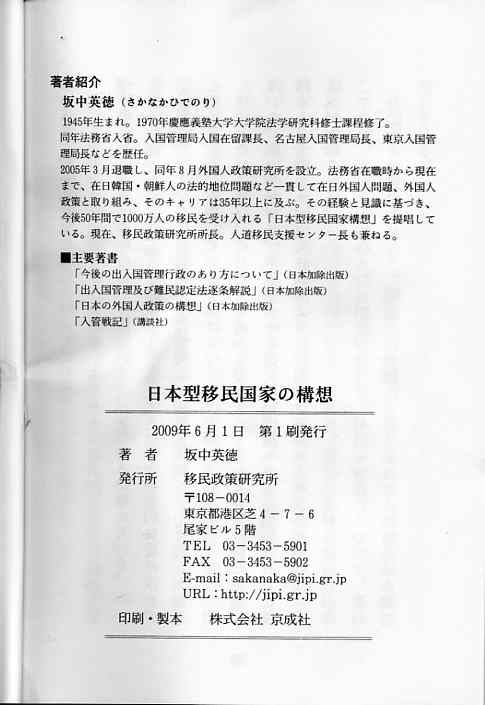
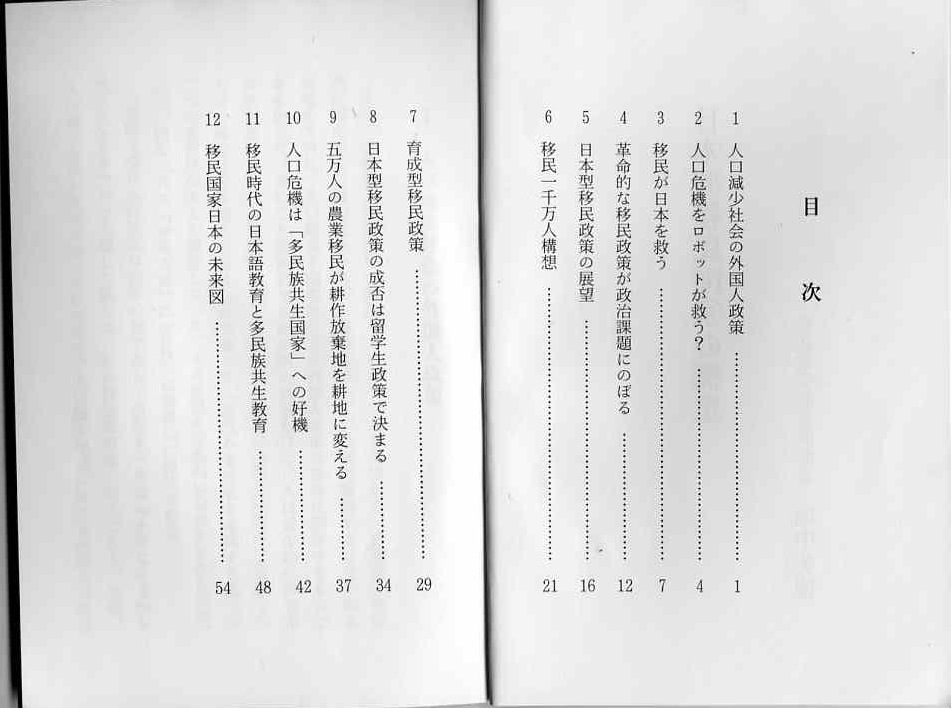
シンポジウム「日本型移民政策がめざすもの」,主催・外国人政策研究所 

http://www.jipi.gr.jp/
開催主旨

自民党国家戦略本部が6月20日、福田首相に「日本型移民政策の提言」を提出しました。この提言は実際には自民党人材交流推進議員連盟(会長・中川秀直元幹事長 約80人)がまとめ、党国家戦略本部がオーソライズしたものです。    

外国人政策研究所は、当初から議員連盟の議論に参加し、提言のベースになる構想を作成、提案しました。福田首相は提言を「真剣に受け止めたい」と前向きに検討する考えを示しています。 

人口危機に対応するための移民政策は、新たな開国であり、新たな国づくりでもあります。福田内閣の今後どのように移民政策を扱うのか。その取り組みに内外から注目が集まるとみられます。 

シンポジウムでは提案作成に中心的な役割を果たした坂中所長をはじめ議連の議論に参加した4氏が、日本型移民政策の狙いやその中身を詳しく解説するとともに、今後とり組むべき課題などについて意見を交換します。

パネリスト

コーディネーター

インフォメーション

[主催]JIPI 外国人政策研究所|HP:http://jipi.gr.jp
[後援]UNHCR 国連難民高等弁務官事務所|IOM国際移住機関|
[日時]2008年7月29日(火)午後6時30分|開場:午後6時|
[会場]女性と仕事の未来館ホール|港区芝5-35-3|HP:http://www.miraikan.go.jp
[お申し込み]>> こちらからメールにてお申し込み下さい。|入場無料:先着250名|
[お問い合わせ]JIPI 外国人政策研究所|電話:03-3453-5901|E-mail:info@jipi.gr.jp
ENDS

SMJ Tokyo July 21 Tokyo Symposium on amnesty for visa overstayers

mytest

Handbook for Newcomers, Migrants, and Immigrants to Japan\Foreign Residents and Naturalized Citizens Association forming NGO\「ジャパニーズ・オンリー 小樽入浴拒否問題と人種差別」(明石書店)JAPANESE ONLY:  The Otaru Hot Springs Case and Racial Discrimination in Japan

FORWARDING:

Please forward information below to anyone interested in this issue.
**************************************************************
July 21 Symposium

“Unqualified Foreign Residents (Overstaying Foreign Residents)”:

Do we build a Multi-Ethnic, Multi-Cultural Society over the Elimination?
**************************************************************

Date: Monday July 21
Time: 14:00〜17:00 (door opens at 13:30)
Where: Korea YMCA 9th floor
(2-5-5 Sarugaku-cyo Chiyoda-ku)
Access: http://www.ymcajapan.org/ayc/jp/map1.htm
JR “Suidobashi-station” (6 min walk)/ JR”Ochanomizu-station” (9 min walk) /Tokyo
Subway “Jinboucyo-station”(7 min walk)
Admission: 1000yen

* English-Japanese simultaneous interpretation available

It has past almost 20 years since the arrival of “new comers”. The number of the unqualified foreign residents who recorded its peak in 1993 started to decline and currently there are about 170,000 living in Japan. Until now, tens of thousands of unqualified foreign residents were amnestied by receiving “special permanent residents”. On the other hand, in Japan, people started to see unqualified residents as “Illegal residents” which is considered as a nest of crime. In this circumstance, the government has strengthened its regulation. In addition, from 2008, the new system to control residents was built and the government is trying to eliminate the unqualified foreign residents completely.

Take place the background of declining birth rate; the argument on “acceptance” of immigrants is developing among various fields as using a keyword of “multi-cultural society”. However, that is the “society” over the elimination of unqualified foreign residents, and it differs from “multi-ethnic, multi-cultural society” that the NGOs and civil societies have been aiming to create.

In this symposium, from the viewpoint of the unqualified residents, we will be discussing the current situation that the “multi-cultural society” and “elimination of unqualified residents” is preceding simultaneously.

Program (tentative)
● Transformation of the surrounding circumstances of the unqualified residents in the
past 20 years.
● Panel discussion
「Amnesty Now!〜the unqualified residents -then and now-〜」
panelists:
Mr. Akira Hatate(Japan Civil Liberties Union: JCLU)/ Mr.Ippei Torii(Zentoitsu(All United)
Workers Union, Solidarity Network with Migrants Japan (SMJ)/ others
● Mr. Rey Ventura and the film “DEKASEGI”screen
Mr. Rey Ventura:born in Philippine Isabela. The author of books “I have always hidden-a
diary of illegal work by a Filipino student” and “Yokohama Kotobuki Filipinos”.

Comments from other foreign residents

Q&A

Contact: Solidarity Network with Migrants Japan (SMJ)
Bunkyo-ku,Koishikawa 2-17-41, TCC 2-203, Tokyo, Japan
tel: 03-5802-6033, fax: 03-5802-6034, mail: fmwj@jca.apc.org
ENDS

2008緊急シンポジウム 非正規滞在(オーバーステイ)2008年7月21日東京都千代田区、など

mytest

Handbook for Newcomers, Migrants, and Immigrants to Japan\Foreign Residents and Naturalized Citizens Association forming NGO\「ジャパニーズ・オンリー 小樽入浴拒否問題と人種差別」(明石書店)JAPANESE ONLY:  The Otaru Hot Springs Case and Racial Discrimination in Japan
Subject: 【IMADR-INFO N0.123】イベントのご案内
Date: July 16, 2008 3:33:57 PM JST
To: debito@debito.org
Reply-To: imadrjc@imadr.org

**********************************************************************
                             2008年7月16日
          ★IMADRインフォメーション★
                               【No.123】
**********************************************************************

———————————————————————————————————  
◆目次◆
——————————————————————————————————— 
1)2008緊急シンポジウム 非正規滞在(オーバーステイ)者
2)第3回人権市民会議シンポジウム 戸籍って何?
3)イベントなどの予定
4)IMADR-INFO配信について

━━━━━━━━━━━━━━━━━━━━━━━━━━━━━━━━━━━
1.2008緊急シンポジウム
非正規滞在(オーバーステイ)者〜排除の上に築く共生でいいのか?〜
───────────────────────────────────
※IMADR-JCが参加する外国人人権法連絡会の共催イベントです。

■日時:2008年7月21日(月・祝日) pm. 2:00〜5:00 (開場 pm. 1:30)
■会場:韓国YMCA (東京都千代田区猿楽町2-5-5)
    JR水道橋駅徒歩6分、御茶ノ水駅徒歩9分、地下鉄神保町駅徒歩7分
    地図は以下URLを参照 http://www.ymcajapan.org/ayc/jp/map1.htm 
■参加費:1000円  通訳:英語

「ニューカマー」の来日から20年以上が経過しました。当初、そのほとんどを
占めた非正規滞在者は1993年をピークに減少し、2008年には約17万人となって
います。しかし現在も、多くの非正規滞在者がこの社会で暮らしています。こ
の間、数万人の非正規滞在者が、在留特別許可によって合法化されてきました。

その一方で、非正規滞在者を犯罪の温床である「不法滞在者」として捉えるま
なざしが定着し、政府も2003年から取り締まりを強化してきました。加えて来
年、新たな在留管理制度を構築し、非正規滞在者をいっさい排除しようとして
います。

少子化を背景に、移民の「受け入れ」議論が「多文化共生」をキーワードに各
界で始まっています。しかしそれは、非正規滞在者を排除した上での「共生」
でしかなく、NGOや市民団体が長年訴えてきた「多民族・多文化共生」とは異
なっています。

シンポジウムでは、こうした「共生」と「排除」が同時進行する現状を、非正
規滞在者の視点から考えてみたいと思います。ぜひご参加ください。

【プログラム(予定)】
◇ 20年の総括
◇ パネルディスカッション:
  今すぐ合法化を!〜非正規滞在者のこれまでとこれから
  旗手明(自由人権協会)/鳥井一平(移住連事務局長)/金哲敏(弁護士)
  ほか
◇ レイ・ベントゥーラさん発題と“DEKASEGI”上映
  レイ・ベントゥーラさん…『ぼくはいつも隠れていた——フィリピン人
  学生不法就労記』(草思社、1993年)、『横浜コトブキ・フィリピーノ』
  (現代書館、2007年)著者
◇(元)当事者からの発言
◇ 質疑応答

【主催】
外国人人権法連絡会/移住連/差別ウォッチ・ネットワーク

【連絡先】
移住労働者と連帯する全国ネットワーク(移住連)
東京都文京区小石川2-17-41 T C C 2-203
tel: 03-5802-6033, fax: 03-5802-6034, email: fmwj@jca.apc.org

━━━━━━━━━━━━━━━━━━━━━━━━━━━━━━━━━━━
2.第3回人権市民会議シンポジウム
「戸籍」って何? 〜戸籍をめぐる問題と国内人権救済機関の役割〜
———————————————————————————————————
※IMADR−JCが参加する人権市民会議の主催イベントです。

法律婚をしていないフィリピン人の母と日本人の父の間に生まれた婚外子の日
本国籍をめぐる最高裁の違憲判決、民法772条の「300日」規定により無戸籍と
なった母から生まれた子の戸籍の問題、性同一性障害を持つ人の性別変更につ
いて定めた性同一性障害特例法の改正、婚外子差別の撤廃を含む野党の民法改
正案など、最近、戸籍にかかわる問題が報道され、クローズアップされていま
す。

日常生活において戸籍を意識して生活している人はどれほどいるでしょうか?
戸籍は、パスポートの申請や相続登記の際などに役所へ必要書類として提出さ
れますが、手続きの必要書類として提出しなければならないという場面に遭遇
したことのない人には、もしかしたら「自分の戸籍を見たことがない」、「本
籍地を知らない」という人もいるかも知れません。

しかし一方で、無戸籍であるために基本的な社会サービスを受けられなかった
り、戸籍に記載された内容をもとに公的サービスの利用、就職、結婚などにお
いて差別的取り扱いを受けるといったことが今なお起きています。

戸籍とはそもそも何なのでしょうか?戸籍が存在するために直面する困難は?
戸籍をもとにした差別には具体的にどのようなものがあるのでしょうか?

こんなことを、戸籍にかかわる困難や人権侵害に直面しているみなさん、そし
て、戸籍と人権侵害なんて考えたことがない」というみなさんと一緒に考え、
議論したいと思います。また、日本にはまだない「国内人権救済機関」につい
て、そもそも国内人権救済機関とは何なのか、日本に国内人権救済機関ができ
たら戸籍をめぐる困難や人権侵害、その他の人権問題がどのように救済可能な
のかを考えてみたいと思います。

■日時:2008年7月26日(土)13:00〜16:00
■場所:松本治一郎記念会館 3F会議室
   (東京都港区六本木3-5-11 TEL. 050-3532-5523)
■参加費:500円(資料代として)
■主催・問い合わせ・申し込み先:人権市民会議事務局
    TEL.050-3532-5523 FAX.03-3585-8966 EMAIL. cc.for.hr@gmail.com

■内容:
【13:00〜13:30 全体会】
 カナダ人権委員会について
 ……金子 匡良さん(高松短期大学講師)
【13:30〜15:00 グループワーク】
 参加者のみなさんに3グループに分かれ、各グループで「戸籍」について気軽
 に、そして率直に意見交換・学習していただきます。
 各グループのモデレーター:黒坂 愛衣さん(ハンセン病首都圏市民の会)
              佐藤 文明さん(元区役所職員、『戸籍が作る
                      差別』著者)
              李 嘉永さん(部落解放・人権研究所)
【15:00〜15:20 休憩】
【15:20〜16:00 まとめ】
 国内人権機関はなぜ必要か
 ……山崎 公士・人権市民会議代表(新潟大学法科大学院教授)

※資料準備のため、事前にお申し込みをいただければ幸いです(必須ではあり
 ません)
※要約筆記をご用意いたします。
※ご不明な点等ありましたら、上記問い合わせ先(人権市民会議事務局)まで
 ご連絡ください。

━━━━━━━━━━━━━━━━━━━━━━━━━━━━━━━━━━━
3.イベントなどの予定
———————————————————————————————————
◇7月◇

21(月・祝)2008緊急シンポジウム
      非正規滞在(オーバーステイ)者〜排除の上に築く共生でいい
      のか?〜
      http://www.imadr.org/japan/event/IMADR_IMADR-JC_sub/2008_1/

26(土)  第3回人権市民会議シンポジウム
     「戸籍」って何? 〜戸籍をめぐる問題と国内人権救済機関の役割〜
      http://www.imadr.org/japan/event/IMADR_IMADR-JC_sub/3/

31(木)〜8月2(土) 
      「部落問題の今」をめぐる若手研究者の国際ワークショップと
      シンポジウム
      http://www.imadr.org/japan/event/IMADR_IMADR-JC_sub/post_31/

◇9月◇
8(月)  第17回ヒューマンライツセミナー「スリランカの平和構築と人権」

━━━━━━━━━━━━━━━━━━━━━━━━━━━━━━━━━━━
4.IMADR-INFO配信について
———————————————————————————————————
このメールマガジンは、まぐまぐが提供するサービスにより運営しています。
配送停止を希望される方は、お手数ですが下記IMADRホームページより配送解
除を行って下さい。メールアドレスを変更される際は、現在のアドレスへの配
送解除の後、新しいアドレスをご登録ください。
なお、「ウィークリーまぐまぐ」は、http://www.mag2.com/wmag/
から解除することができます。

購読登録・解除用アドレス
http://www.imadr.org/japan/joinus/#a000200

※訂正とお詫び 本メールマガジン前号(122号、2008年7月3日発行)にタイ
 トルが付いていませんでした。タイトルは「G8へのNGO共同提言書等」で
 した。お詫びして訂正します。

**********************************************************************
発行元:
 反差別国際運動(IMADR)    
  Tel: 03-3586-7447  Fax: 03-3586-7462 E-mail: imadris@imadr.org
 反差別国際運動日本委員会(IMADR-JC) 
  Tel: 03-3568-7709  Fax: 03-3586-7448 E-mail: imadrjc@imadr.org

 〒106-0032 東京都港区六本木3-5-11  Website: http://www.imadr.org
**********************************************************************

◎IMADRインフォメーション
のバックナンバー・配信停止はこちら
http://archive.mag2.com/0000169133/index.html
このメールに返信すれば、発行者さんへ感想を送れます

Jenkins get his Permanent Residency in record time. Congratulations, but…

mytest

Handbook for Newcomers, Migrants, and Immigrants to Japan\Foreign Residents and Naturalized Citizens Association forming NGO\「ジャパニーズ・オンリー 小樽入浴拒否問題と人種差別」(明石書店)JAPANESE ONLY:  The Otaru Hot Springs Case and Racial Discrimination in Japan
Hi Blog.  Just heard yesterday that Charles Jenkins, long-suffering veteran of North Korea (who got a very harsh life after defecting from the US military from South Korea, before I was even born!), just got his Permanent Residency (eiuuken) in record time (a coupla weeks).  And with fewer years spent here (four) than the average applicant (generally five years if married to a Japanese, ten if not married).  With personal consideration from Justice Minister Hatoyama.

Congratulations Mr Jenkins.  Seriously.  I’m very happy you can stay here with your family as long as you like, and may you have a peaceful and happy rest of your life out on Sadogashima.  

But I wish the often strict procedures given other applicants could have applied to him as well.  Again, as with the case of Fujimori (who was “naturalized” in about the same amount of procedural time) and certain sports figures, politics keeps infiltrating the application process for assimilation.  Inevitable, some might say, but still a shame when there are people as eminently qualified as Mr Jenkins also being refused.  More on that here from the Japan Times.  Arudou Debito in Sapporo

===========================
ジェンキンスさん、永住許可へ…鳩山法相が指示
7月11日12時36分配信 読売新聞
http://headlines.yahoo.co.jp/hl?a=20080711-00000019-yom-pol
Courtesy of oogu

 鳩山法相は11日午前の閣議後の記者会見で、北朝鮮による拉致被害者の曽我ひとみさん(49)の夫、チャールズ・ジェンキンスさん(68)の永住を許可するよう、同日、入国管理局に指示したことを明らかにした。

 入管は同日中にジェンキンスさんに連絡し、ジェンキンスさんが入管を訪れれば永住が認められる運びだ。

 ジェンキンスさんは曽我さんの配偶者として在留資格があるが、3年ごとの資格更新が必要なため、6月24日に東京入国管理局新潟出張所に永住許可を申請していた。通常は「許可までに数か月かかる」(法務省幹部)が、約半月の早さでの許可となった。

最終更新:7月11日12時36分

===========================

Jenkins granted permanent residency status

http://www.japantoday.com/category/national/view/jenkins-granted-permanent-residency-status
Courtesy of oogu

TOKYO —The Japanese government will grant U.S. citizen Charles Jenkins, the husband of a repatriated Japanese abductee to North Korea, permanent residency status, Justice Minister Kunio Hatoyama said Friday. Jenkins, a former U.S. Army sergeant who deserted to North Korea, married Hitomi Soga there and lived in the country almost 40 years, came to Japan with the couple’s two North Korean-born daughters in July 2004 after being reunited with Soga in Jakarta.

The Justice Ministry made the decision only half a month after Jenkins applied for the status June 24. Usually, foreign nationals need about six months to obtain permanent residency status. Jenkins, 68, has been living in his wife’s hometown on Sado Island in the Sea of Japan since completing a 30-day detention for desertion at a U.S. Army base in Japan. He acquired temporary residency status as Soga’s spouse and is required to renew it every three years. With permanent residency status, Jenkins will not be required to go through further renewals.
===========================
ENDS

World-famous company, Tohoku branch, refuses to employ Japanese kid expressly because he’s “half”–even retracts original job offer

mytest

Handbook for Newcomers, Migrants, and Immigrants to Japan\Foreign Residents and Naturalized Citizens Association forming NGO\「ジャパニーズ・オンリー 小樽入浴拒否問題と人種差別」(明石書店)JAPANESE ONLY:  The Otaru Hot Springs Case and Racial Discrimination in Japan

Hello Blog. Got this yesterday. I’ve anonymized it for now because the family fears that the employer will refuse to employ the job candidate further if this article can be traced back to him. Summary: A world-famous company in northern Japan, with branches and products overseas for generations, refuses to employ a young Japanese (despite giving him a job offer)–expressly, despite being a citizen, because he’s “half”.

This could have major repercussions in Japan if other Japanese with international roots get discriminated against similarly. Read on. More details to reporters if they want a story. I have the feeling we have a major lawsuit here. Arudou Debito in Sapporo

=====================================
Dear Debito San,

Thank you very much for your advice on the phone on Friday June 13th.
I will give you all the information that I have to date about my son’s problem.

My son, 21 years old, phoned a company in [Tohoku, Northern Japan] [Headhunters KK] to apply for a job advertised in “XXXXX” (a flyer with available jobs). The job he applied for was at the [World Famous Company] factory near [our town in Tohoku]. The job is a full time Syain job with bonus, Kousainenkin and Koyouhoken. Monday to Friday and 850 yen per hour plus 10,000 yen Koutsuhi per month. The return trip to [World Famous Company] is 13km from our home. The [World Famous Company] factory is new and nice with canteen. Saturday, Sunday and public holidays off.

He went for the interview on Tuesday June 10th at 10am. The interviewer a Mr. M of [Headhunters KK]. After the interview my son was told that he had the job at the [World Famous Company] factory and would start work on Monday June 16th.

(My son was very excited that he got the job because when he went for an interview at a different company one week earlier that interviewer told him that because he is half Japanese that he most likely wouldn’t be able to get a job locally and would probably have to go to Tokyo to work. Of course he didn’t get that job, but that interviewer asked him to go out with him for dinner or lunch. Also he has phoned him a few times to ask him to dinner. (My son has a girlfriend and is not gay) what this guy wants I don’t know but I think that it is inappropriate for any job interviewer to ask the applicant out for dinner).

At the interview on Tuesday June 10th my son was asked to get a medical check Kenkoushindan form 5 and to come back on Friday June 13th with it and bank book, mitomein, drivers license, syakensyo, jibaiseki hoken syoumeisyo, nini hoken syoumeisyo and nenkin techo. The medical check includes height, weight, blood pressure, urine check, sight and hearing check, blood check, chest xray and heart check. He passed all checks and cost 10,000 yen.

When he returned on Friday June 13th the same interviewer Mr. M took him away from the other 3 people which also passed for the jobs at [World Famous Company]. And told him that he would be working at a different factory and not at [World Famous Company]. My son knew that he was a victim of racial discrimination but couldn’t say anything for fear of not getting the other job. He was told that it has nothing to do with him being half Japanese. But it seems his katakana name is 面倒くさい、ハーフだからというわけでは無いけれども、[一流の会社]では[東北]の人しか働いていないし、あとあと面倒なことになると困るし、

But the interviewer knows from my son’s rirekisyo that my son was born in this area went to youchien, elementary school, junior high and high school here in [the town which contains this World Famous Company] so he is a Tohoku person and can speak the local dialect and has Japanese Koseki.

The interviewer was very uneasy telling my son this information and was also told that they no longer need the medical check form because that was only for the [World Famous Company] job. Also they never mentioned compensating him the 10,000 yen for that medical check which they asked for and then told him he didn’t need.

The other job which he started today Monday June 16th is only a two month contract, doesn’t include a bonus or any of the other things included in the [World Famous Company] job, the hourly rate is 50yen less than the [World Famous Company] job plus he has to work on some Saturdays with only Sunday off.

The factory is 20km return from out home as compared to 13km at the [World Famous Company] factory. There is no canteen and it is just not a full time position at [World Famous Company] that he was interviewed for and then promised.

My thinking is that Mr. M is a good man and didn’t discriminate against my son for not being 100% Japanese but [World Famous Company] did refuse my son on the grounds of racial discrimination and then Mr. M had to do as [World Famous Company] wished.

My son has been at the new job for just over a week now and doesn’t want to risk losing his job by causing any trouble to [World Famous Company] or [Headhunters KK]. Not for the moment anyway as he doesn’t know how permanent this job will be. The contract is only for two months.

My wife phoned a few government departments and was told that a verbal promise of a job is the same as a written promise, so we have good grounds to take action against [Headhunters KK] and maybe [World Famous Company].

My son’s friend who did get a job in [World Famous Company] said that he has heard my son’s name mentioned a few times in the [World Famous Company] factory and my son’s boss Mr. M also asked my son about a rumor at the [World Famous Company] factory that he was discriminated against for being half. My son said he knew nothing of that rumor.

This is all we have at the moment. I will keep you informed of any changes. If you have any other ideas then we would be very happy to hear them.

Again many thanks for your advice.
Keep up your good work.

Best regards

Anonymous Dad

J Times: Radical GOJ immigration plan under discussion

mytest

Handbook for Newcomers, Migrants, and Immigrants to Japan\Foreign Residents and Naturalized Citizens Association forming NGO\「ジャパニーズ・オンリー 小樽入浴拒否問題と人種差別」(明石書店)JAPANESE ONLY:  The Otaru Hot Springs Case and Racial Discrimination in Japan

Hi Blog.  Excellent article on the future of Japan’s immigration policy.  Yes, policy.  From–where else?–the Japan Times.  Debito
==================================
The Japan Times Thursday, June 19, 2008

Radical immigration plan under discussion

By MINORU MATSUTANI Staff writer

Foreigners will have a much better opportunity to move to, or continue to live in, Japan under a new immigration plan drafted by Liberal Democratic Party lawmakers to accept 10 million immigrants in the next 50 years.

“The plan means (some politicians) are seriously thinking about Japan’s future,” said Debito Arudou, who is originally from the United States but has lived in Japan for 20 years and became a naturalized citizen in 2000. “While it is no surprise by global standards, it is a surprisingly big step forward for Japan.”

The group of some 80 lawmakers, led by former LDP Secretary General Hidenao Nakagawa, finalized the plan on June 12 and aims to submit it to Prime Minister Yasuo Fukuda later this week.

The plan is “the most effective way to counter the labor shortage Japan is doomed to face amid a decreasing number of children,” Nakagawa said.

While establishing an environment to encourage women to continue to work while rearing children is important to counter the expected labor shortage, bringing in foreign workers is the best solution for immediate effect, said the plan’s mastermind, Hidenori Sakanaka, director general of the private think tank Japan Immigration Policy Institute.

“We will train immigrants and make sure they get jobs and their families have decent lives,” Sakanaka said in explaining the major difference between the new plan and current immigration policy. “We will take care of their lives, as opposed to the current policy, in which we demand only highly skilled foreigners or accept foreigners only for a few years to engage in simple labor.”

Japan had 2.08 million foreign residents in 2006, accounting for 1.6 percent of the population of 128 million. Raising the total to 10 million, or close to 10 percent of the population, may sound bold but is actually modest considering that most European countries, not to mention the U.S., have already exceeded this proportion, Sakanaka said.

Fukuda outlined in a policy speech in January his aim to raise the number of foreign students to 300,000 from the current 130,000, but without specifying a timetable.

However, the immigration plan calls for the goal to be achieved soon and for the government to aim for 1 million foreign students by 2025. It also proposes accepting an annual 1,000 asylum seekers and other people who need protection for humanitarian reasons.

Akio Nakayama, manager of the Tokyo office of the Geneva-based International Organization for Migration, said the important thing about the new plan pitched by the LDP members is that it would guarantee better human rights for immigrants.

“The plan emphasizes that we will accept immigrants, not foreign workers, and let them live in Japan permanently,” Nakayama said.

“The most remarkable point is that immigrants’ family members are included,” he said. “I have never seen this in similar proposals.”

Also, he praised the plan for proposing changes to the resident registration law to allow children born in Japan to foreign parents to have Japanese citizenship. Under the current Nationality Law, one of the parents must be Japanese and the parents must be legally married for their children to have Japanese citizenship.

This provision, however, was recently ruled unconstitutional by the Supreme Court, allowing 10 children born to Filipino mothers and Japanese fathers out of wedlock to gain the right to Japanese nationality.

The plan also includes establishing an entity to be called the Immigration Agency to integrate related duties that are now shared by multiple government bodies.

Among other proposals, the plan calls for extending the maximum duration of student and working visas to five years from the current three, easing the conditions for granting permanent resident status, setting up more Japanese-language and culture centers overseas and outlawing racism.

Arudou, a foreigners’ rights activist, noted the importance of establishing a legal basis for specifically banning discrimination against non-Japanese.

“Founding a legal basis is important because people do not become open just because the government opens the door,” he said.

Also under the plan, the foreign trainee program, which supports Japanese companies and organizations that hire foreigners to work up to three years in Japan, would be abolished. Some trainees who have come to Japan under the program have sued their employers, claiming they have been abused with minimal pay and harsh working conditions.

This set of bold proposals appears positive, but Minoru Morita, a political critic at Morita Research Institute Co., doubts Nakagawa’s plan will be formally adopted by the LDP anytime soon.

“Expanding immigrants to this large of a scale may cause social instability,” he said. “Nakagawa will face difficulty gaining support from LDP colleagues and ministry officials.”

He added that Nakagawa may have come up with the plan because he could be angling to become the next prime minister and would therefore want to stand out with a bold policy proposal. “Nakagawa may have to water down the proposals,” Morita said.

Fears over the consequences of bringing in more foreigners are probably shared by many in a country where people consider themselves highly homogeneous.

“Immigrants surely bring dynamism to the Japanese economy, as well as crime,” said a researcher at a public entity studying crimes committed by foreigners. The researcher asked not to be named.

While the researcher admitted immigrants would be better treated if the new plan were adopted and thus their motivation for committing crimes would decrease, he added: “But what if they lose their jobs? What if the economy worsens? We cannot take better care of unemployed immigrants than Japanese because we should treat them equally.”

Goro Ono, author of “Bringing Foreign Workers Ruins Japan,” does not think bringing in immigrants is necessary.

Ono, an honorary professor at Saitama University, said he does not believe Japan is facing a labor shortage now or in the future.

“If industries where labor is in high demand pay adequate salaries, people will work there,” he said.

Ono said nursing is a good example. Japan is actively bringing in Indonesians and other foreigners to cover a dire shortage because nurses here are woefully underpaid, he said, while on the other hand public entities never have trouble finding garbage collectors because they get decent salaries.

Ono also brought up the lack of discussion about the cost of preparing the infrastructure to accept more immigrants.

Sakanaka is ready to face such criticism just as all revolutionaries have in the past. His proposals would shake up Japan from the inside and it would be a historical moment if they all became law, he said.

“The Meiji Restoration was the first stage in opening up the country to foreigners,” he said. “Now we are entering the second stage.”

ENDS

The Australian: PM Rudd spearheading “Asia-Pacific Union” like the EU, Japan “interested”

mytest

Handbook for Newcomers, Migrants, and Immigrants to Japan\Foreign Residents and Naturalized Citizens Association forming NGO\「ジャパニーズ・オンリー 小樽入浴拒否問題と人種差別」(明石書店)JAPANESE ONLY:  The Otaru Hot Springs Case and Racial Discrimination in Japan

Hi Blog.  On the road for a few days, here’s something for the Antipodean readers to tell us more about.  Arudou Debito in Tochigi

===============================================

Kevin Rudd to drive Asian union

Matthew Franklin, Chief political correspondent | The Australian June 05, 2008

http://www.theaustralian.news.com.au/story/0,25197,23812768-601,00.html

Courtesy Tony Desapien

KEVIN Rudd wants to spearhead the creation of an Asia-Pacific Union similar to the European Union by 2020 and has appointed veteran diplomat Richard Woolcott – one of his mentors – as a special envoy to lobby regional leaders over the body.

The Prime Minister said last night that the union, adding India to the 21-member APEC grouping, would encompass a regional free-trade agreement and provide a crucial venue for co-operation on issues such as terrorism and long-term energy and resource security.

And he outlined his plans for his visits to Japan and Indonesia next week, saying he would explore greater defence co-operation between Australia, Japan and the US – an approach that had been championed by John Howard.

Speaking in Sydney last night to the Asia Society Australasia Centre, the Mandarin-speaking Mr Rudd said global power and influence was shifting towards the Asia-Pacific region and that Australia must drive the creation of a new global architecture for the Asia-Pacific century.

“We need to have a vision for an Asia-Pacific community, a vision that embraces a regional institution, which spans the entire Asia-Pacific region – including the United States, Japan, China, India, Indonesia and the other states of the region,” said the Prime Minister.

The body would be “able to engage in the full spectrum of dialogue, co-operation and action in economic and political matters and future challenges related to security”.

“The purpose is to encourage the development of a genuine and comprehensive sense of community whose habitual operating principle is co-operation,” Mr Rudd said.

“The danger of not acting is that we run the risk of succumbing to the perception that future conflict within our region may somehow be inevitable.”

Government sources said last night that Mr Rudd was attempting to revive the reformist spirit of former Labor prime minister Bob Hawke, who successfully pressed for the creation of the Asia-Pacific Economic Co-operation group 20 years ago.

Mr Woolcott, 80, was Mr Hawke’s right-hand man in establishing APEC and was a frequent critic of the Howard government’s foreign policy.

Mr Woolcott told The Australian last night that Mr Rudd had made it clear there was great scope to co-ordinate existing regional organisations.

“This fits neatly into the concept of greater middle-power diplomacy,” Mr Woolcott said.

“If the US or China or Japan or some other big power were to suggest it, other nations might be apprehensive and back away. It’s better for a middle power like Australia to take the initiative.

“I’ve always thought that this was the part of the world where Australia lives, and if an Asia-Pacific community does develop, it’s essential that Australia be part of it.”

The proposed new pan-Asian body would come in addition to a range of existing forums through the region, including ASEAN, ASEAN Plus Three and the East Asian Summit.

But Mr Rudd said now was the appropriate time to re-examine the regional diplomatic and economic architecture because foreign policy based only on bilateral agreements had “a brittleness”.

“To remove some of that brittleness, we need strong and effective regional structures,” Mr Rudd said.

“Strong institutions will underpin an open, peaceful, stable, prosperous and sustainable region.”

Mr Rudd said the existing forums were not configured to promote co-operation across the entire region.

And he said his proposal was consistent with US President George W.Bush’s call for the development of an Asia-Pacific free trade area.

While the EU should not provide “an identikit model”, the Asia-Pacific region could learn much from the union, which in the 1950s had been seen by sceptics as unrealistic.

“Our special challenge is that we face a region with greater diversity in political systems and economic structures, levels of development, religious beliefs, languages and cultures, than did our counterparts in Europe,” Mr Rudd said. “But that should not stop us from thinking big.”

Mr Rudd said he would send Mr Woolcott to complete the “unfinished business” he had begun with Mr Hawke. “Subject to that further dialogue, we would envisage the possibility of a further high-level conference of government and non-government representatives to advance this proposal,” he said.

“I fully recognise this will not be an easy process … but the speed and the scope of changes in our region means we need to act now. Ours must be an open region – we need to link into the world, not shut ourselves off from it.

“And Australia has to be at the forefront of the challenge, helping to provide the ideas and drive to build new regional architecture.”

Mr Rudd said his Government’s foreign policy was based on three pillars: its relationship with the US; its links with the UN; and “comprehensive engagement with Asia”.

Discussing his visits to Japan and Indonesia next week, Mr Rudd said he would continue talks with Japanese Prime Minister Yasuo Fukuda toward the creation of a free-trade agreement as well as advancing talks on security co-operation between Australia, Japan and the US. In Indonesia, he would pursue talks about a free-trade agreement and anti-terrorism co-operation with President Susilo Bambang Yudhoyono, as well as seeking a template for greater co-operation on dealing with natural disasters.

ENDS

=========================

Former PMs douse Rudd’s Asian union

Australlian AAP June 06, 2008 01:29am

http://www.news.com.au/story/0,23599,23819466-29277,00.html

FORMER prime ministers Paul Keating and Bob Hawke have cast doubt on the Rudd government’s push to form a European Union-style body in the Asia-Pacific, saying it would be inappropriate for the region.

On Wednesday night Prime Minister Kevin Rudd put forward an ambitious vision for an Asia-Pacific community, possibly modelled on the European Union, to be adopted by 2020. He wants any new regional creation to span the entire Asia Pacific, including the United States, Japan, China, India and Indonesia.    

While Mr Hawke and Mr Keating supported Mr Rudd’s focus on the region, both said an EU-styled system would be unachievable in Asia, News Ltd has reported.

“God knows, it has taken the Chinese 350 years of the modern age to truly recover their sovereignty – I do not see them sharing much of it with anyone else,” Mr Keating said. 

“And Japan remains one of the most insular, monocultural countries in the world, whose political leadership, at least for the last Japanese prime minister, was still reminiscing about China’s war experiences…” 

Mr Hawke said much could be done to better integrate the Asia Pacific region, without the need for an overarching body. 

“I don’t want to knock references to the EU but don’t let us say that’s the way it must be for Asia,” he said. 

“We can do a hell of a lot without necessarily having the full degree of integration that has occurred with the European Union.” 

ENDS

Friday, June 20th, 2008 Symposium “Migration in East Asia: Cases Studies from Japan, China and Taiwan”, Waseda University

mytest

Handbook for Newcomers, Migrants, and Immigrants to Japan\Foreign Residents and Naturalized Citizens Association forming NGO\「ジャパニーズ・オンリー 小樽入浴拒否問題と人種差別」(明石書店)JAPANESE ONLY:  The Otaru Hot Springs Case and Racial Discrimination in Japan
Forwarding… Arudou Debito

Dear Professors and colleagues,

Re: Friday, June 20th, 2008 Symposium “Migration in East Asia: Cases Studies from Japan, China and Taiwan”

Greetings from Waseda University!

The Waseda University Doctoral Student Network (WUDSN), with the generous support of Waseda University’s Global Institute for Asian Regional Integration (GIARI) will hold a symposium on Friday, June 20th 2008, from 15:00 to 18:30. The symposium is entitled “Migration in East Asia: Cases Studies from Japan, China and Taiwan”.

At this meeting we our fortunate enough to have speakers with expertise on issues related to migration in East Asia and in particular, Japan, China, and Taiwan. Please see the symposium schedule below for more information about the speakers, titles of presentations, and attending discussants.

Welcome Address: Prof. Satoshi Amako
Session 1 : 15:00 to 17:00
“Dejima: Legacies of Exclusion and Control”
– Dr. David Blake Willis (Soai University)
“Sealing Japanese Identity”
– Dr. David Chapman (University of South Australia)
“The Underlying Myths, Beliefs and Calculations Reflected In the Naturalization Policy in Japan”
– Dr. Soo Im Lee (Ryukoku University)
“Examining the Role of Local Governments in Social Integration: A Comparative Examination of Social Integration Practices at the Local Government Level in Japan”
– Stephen R. Nagy Research Associate (Waseda University)

Discussant for speakers: Prof. Glenda S. Roberts

Session 2 : 17:15 to 18:30
“Creating a Transnational Community: Chinese Newcomers in Japan”
– Dr. Gracia Liu-Farrer (Sophia University)
“Hidden “In between-ness”: an Exploration of Taiwanese Transnational Identity
in Contemporary Japan”
– Peichun Han PhD Candidate (Waseda University)

Discussant for speakers: Prof. Shigeto Sonoda

Closing Remarks: Stephen R. Nagy

I would like to take this opportunity to invite all of you to this symposium meeting which aims to examine the issue of migration in East Asia from both sending and receiving countries’ perspectives. The event will be held at the Graduate School of Asia Pacific Studies, Building 19, Rm 710 from 15:00 to 18:00. Please see attachments for details on presentation and the aims of the Waseda University Doctoral Student Network.

For information on how to get to Waseda University and about up coming events please refer to our homepage: http://www.waseda-giari.jp/jpn/wudsn/contact.html

Although registration is not necessary, organizers would greatly appreciate an email confirming your interest in attending. Please send email to Stephen Robert Nagy (s.nagy@aoni.waseda.jp) with name, affiliation, research area and email contact.

We hope that you will be able to join us for a stimulating afternoon of presentations and ample opportunity to exchange opinions, ideas and comments with our panelists.

Sincerely,
Stephen R. Nagy
ENDS

2008年6月20日(金)15:00から18:30まで、“Migration in East Asia: Cases Studies from Japan, China and Taiwan”と題するシンポジウム(早大)

mytest

Handbook for Newcomers, Migrants, and Immigrants to Japan\Foreign Residents and Naturalized Citizens Association forming NGO\「ジャパニーズ・オンリー 小樽入浴拒否問題と人種差別」(明石書店)JAPANESE ONLY:  The Otaru Hot Springs Case and Racial Discrimination in Japan
先生方各位
シンポジウムのご案内
2008年6月20日(金)
“Migration in East Asia: Cases Studies from Japan, China and Taiwan”

平素より大変お世話になっております。早稲田大学のStephen R. Nagyです。

さて、早稲田大学博士課程学生ネットワークでは、早稲田大学グローバルCOEプログラム「アジア地域統合のための世界的人材育成拠点(GIARI)」からの全面的支援を得て、2008年6月20日(金)15:00から18:30まで、“Migration in East Asia: Cases Studies from Japan, China and Taiwan”と題するシンポジウムを開催する運びとなりました。

 今回のシンポジウムでは、東アジアとりわけ日本、中国、台湾に関する移民研究の専門家をお招きしてご発表いただきます。シンポジウムの発表者、発表タイトル、討論者に関する詳細は、下記をご参照くださいませ。

Welcome Address: Prof. Satoshi Amako
Session 1 : 15:00 to 17:00
“Dejima: Legacies of Exclusion and Control”
– Dr. David Blake Willis (Soai University)
“Sealing Japanese Identity”
– Dr. David Chapman (University of South Australia)
“The Underlying Myths, Beliefs and Calculations Reflected In the Naturalization Policy in Japan”
– Dr. Soo Im Lee (Ryukoku University)
“Examining the Role of Local Governments in Social Integration: A Comparative Examination of Social Integration Practices at the Local Government Level in Japan”
– Stephen R. Nagy Research Associate (Waseda University)

Discussant for speakers: Prof. Glenda S. Roberts

Session 2 : 17:15 to 18:30
“Creating a Transnational Community: Chinese Newcomers in Japan”
– Dr. Gracia Liu-Farrer (Sophia University)
“Hidden “In between-ness”: an Exploration of Taiwanese Transnational Identity
in Contemporary Japan”
– Peichun Han PhD Candidate (Waseda University)

Discussant for speakers: Prof. Shigeto Sonoda
Closing Remarks: Stephen R. Nagy

お忙しい中とは思いますが、是非ご参加いただけましたら幸甚です。ご参加の皆様との討論によって東アジアの移民研究に関して多様な角度から議論できればと思っております。シンポジウムは、早稲田大学アジア太平洋研究科19号館710号室にて、15:00~18:30までを予定しております。シンポジウムのプログラム、早稲田大学博士課程学生ネットワークの概要に関しましては添付ファイルの資料をご参照くださいませ。

早稲田大学までの行き方、博士課程学生ネットワークの今後のイベントに関しては、下記の博士課程学生ネットワーク・ホームページをご参考くださいませ。
http://www.waseda-giari.jp/jpn/wudsn/contact.html

シンポジウムの申し込むは不要ですが、ご出席いただけます方は、事前にお名前、ご所属、研究(関心)領域を明記してEメールにてStephen Robert Nagy (s.nagy@aoni.waseda.jp)までご連絡いただけましたら幸いです。

皆様のご参加を心よりお待ち申し上げております。皆様と発表者との討論によって、シンポジウムが実りあるものになることを期待いたしております。シンポジウムにて皆様にお会いできることを楽しみにしております。

Stephen R. Nagy

外国人政策研究所 事務局 坂中英徳 著:「日本型移民政策の提言」

mytest

Handbook for Newcomers, Migrants, and Immigrants to Japan\Foreign Residents and Naturalized Citizens Association forming NGO\「ジャパニーズ・オンリー 小樽入浴拒否問題と人種差別」(明石書店)JAPANESE ONLY:  The Otaru Hot Springs Case and Racial Discrimination in Japan

Hi Blog.  This is Japan Immigration Policy Institute’s Mr Sakanaka Hidenori’s proposal for a new immigration policy for Japan (more from Mr Sakanaka on Debito.org here).  Dated June 12, 2008.  Arudou Debito in Sapporo

私が作成に関わった「日本型移民政策の提言」を添付します。ご覧ください。

外国人政策研究所所長 坂中英徳

*****************************
外国人政策研究所 事務局
〒108-0014
東京都港区芝4-7-6 尾家ビル5F
TEL 03−3453−5901
FAX 03−3453−5902
*****************************

E−mail info@jipi.gr.jp
URL        http://www.jipi.gr.jp/

人材開国!

日本型移民政策の提言

世界の若者が
移住したいと憧れる国の構築に向けて

中間とりまとめ=

Ⅰ 政策の理念

1.移民立国で日本の活性化を図る

2.日本文明の底力を活かす

Ⅱ 日本型移民政策の骨格

1.日本人口の10%を移民が占める「移民国家」へ

2.「育成型」移民政策を推進する

3.日本型移民政策の基盤整備

4.社会統合・多民族共生のための施策

5.人道的配慮を要する移民の受け入れ

Ⅲ 直ちに取り組むべき事項

2008.6.12

自由民主党 外国人材交流推進議員連盟


Ⅰ 政策の理念

1.移民立国で日本の活性化を図る

    日本は世界のどの国も経験したことのない高齢化社会の道を歩み始めた。

  加えて、 ほぼ時期を同じくして、未体験の人口減の時代に入った。人口減はテンポを速め、その重圧が社会全体を覆いつつある。

    50年後の日本の人口は3分の2に落ち込み、9000万人を下回るという政府推計がある。

  そのとおりだとすると、国の様相は一変しているはずである。過疎が進む日本の原風景はどのような姿をさらしているのだろうか。社会の活力は枯渇していないだろうか。

    一国の人口推移は、人の出生、死亡、国際人口移動の3つの要因によって決まる。

人口減少問題への取り組みとして、政府は出生率を高めるため保育サービスの充実などに全力を挙げている。しかし、人口問題の専門家によると、少子化対策の効果が現れるとしても、それは遠い将来の話ということである。

したがって、日本の人口危機を救う効果的な治療法は、海外からの移民の受け入れ以外にないのである。日本の生きる道は、世界に通用する国際国家として自らを世界に開き、移民の受け入れにより日本の活性化を図る「移民立国」への転換である。

    新しい国づくりのためには、適正な移民受け入れを進める「移民政策」を打ち出す必要がある。

国民のコンセンサスも不可欠だ。だが、何より求められるのは、移民開国への国民の決意と覚悟がいることである。外国人を移民として迎える以上、彼らが安心して働くことができる職場を用意しなければならない。移民ニーズに対応した社会経済制度の改革が必要である。

 日本が未曾有の数の移民を受け入れるのであれば、日本民族と他の民族がお互いの立場を尊重し合って生きる社会、すなわち「多民族共生社会」を作るという日本人の覚悟が求められる

そのとき日本人に求められるのは、自らの民族的アイデンティティを確認し、かつ異なる民族すべてを対等の存在と認める心構えを持つことである。日本民族の根本精神を堅持するとともに、少数民族の固有文化を尊重しなければならない。

    日本型移民政策を提唱する。

ここで「日本型」と言うのは、人材を「獲る」のではなく「育てる」姿勢を基本にする、日本独自の「育成型移民政策」であることを強調するためである

意欲のある外国人材を、各産業分野を支える技能者・職人などに育成し、できるだけ早く日本国民として地域社会に根を下ろしてもらうようにするものである。

移民に対する手厚い教育を施し、日本人と良好な関係を築く「新たな国民」を生み出すのが、日本型移民政策の核心である。国民が懸念する治安の悪化を招くことのない外国人受け入れ制度である。


<移民の定義>

国連事務総長報告書による「通常の居住地以外の国に移動し少なくとも12ヵ月間当該国に居住する人のこと(長期の移民)」国連事務総長報告書による)


     日本の文化と伝統を世界に開放し、日本列島に住む様々な人間が切磋琢磨することで新しい価値を創造する「多文化社会」の構築も課題となる。

そして、高い志を持つ世界の若者がこぞって移住したいと憧れる国、人道支援・国際貢献のための移民受け入れにも力を入れて、世界から評価される国を目指す。

     改革に消極的だとして海外から「日本売り」が言われている今こそ、政治の責任で、人口危機にある日本がどんな国家を目指すのか、明確なビジョンを発信すべきである

「人口危機に立ち向かうため日本は『移民国家』へ移行する」と政治が決断すれば、国際社会は国の形を「多民族国家」に変える究極の構造改革を評価し、「日本買い」に転じるだろう。


2.日本文明の底力を活かす

     極東に位置する島国であり、社会の均一性が相対的に高いとみなされている日本は、移民の受け入れに適さないという声がある。欧米に比べて移民の受け入れ経験が少ないことは事実である。

しかし、厳しい試練の時を迎えて、日本の未来に危機感を抱く国民が移民国家建設のため立ち上がれば、50年間で1000万人規模の移民受け入れを達成することも決して夢でない。幸い日本には、移民が快適に暮らすことができる制度、精神風土、環境が整っている。


第1に、長年にわたり蓄積されてきた産業技術と、卓越する世界企業の存在である。

高い生産効率を実現することで世界経済を先導してきた産業立国としての日本のネームバリューは、気概に満ちた世界の若者を惹きつけるに違いない。

高い教育水準と充実した高等教育施設も、今後、留学生の受け入れを大幅に増やすための教育資源となる。


第2に、日本社会には「人の和」や「寛容の心」を重んじる精神的基盤がある。

日本の社会は、宗教を見ても神道・仏教・キリスト教などが仲良く共存している。古来、日本は「和をもって貴しとなす(十七条憲法)」を基本とする国柄であった。多様な価値観や存在を受け入れる「寛容」の遺伝子を脈々と受け継いできた日本人は、世界のどの民族も成功していない「多様な民族との共生社会」を実現する潜在能力を持っている。


第3に、恵まれた自然環境と豊穣な文化がある。

四季折々の風景、歴史遺産の水田や森林、地方ごとに特色ある日本料理や伝統芸能は、海外からの旅行者にすでに認知されており、今では年間800万人を超す観光客が日本を訪れている。亜熱帯のさんご礁、日本情緒豊かな温泉街、良質の雪に恵まれたスキーリゾートにはリピーターも多い。この「癒しの島」には理想の移住地としての条件が備わっている。


第4に、日本社会にすでにいる「移民の背景を持つ人々」の存在がある。

何世代にもわたって多くの苦難を乗り越えて社会的地位を確立してきたオールドカマーに加えて、ニューカマーも来日からすでに20年を経て、200万人を大きく超える外国出身者とその子孫は、市民・永住者・定住者として、日本社会に根を張って生活している。すでに日本で生きるノウハウを身につけた彼らは、新来の移民たちと地域社会をつなぐ貴重な人材である。


     日本は移民受け入れの後発国としての利点もある。カナダ等の伝統的な移民国家の経験に学び、日本と似通った国家形成の歴史を持つ欧州各国の最近の問題状況も参考にできる。

     日本型移民政策は、日本人口の10%を移民が占める未来の日本人が、「移民が日本の危機を救ってくれた」と感謝し、「世界で保護を求めている人々の救済に日本が貢献した」と誇りを持てる社会の実現を目標とする。


Ⅱ 日本型移民政策の骨格

1.日本人口の10%を移民が占める「移民国家」へ

     欧州の移民先進国の受け入れ数や日本社会の受け入れ能力などを勘案すると、日本は、今後50年で総人口の10%程度の移民を受け入れるのが相当である

そこで日本政府は、1年以内に「移民国家宣言」を世界に発信する。


【日本が受け入れる移民のカテゴリー】

     高度人材(大学卒業レベル)

     熟練労働者(日本で職業訓練を受けた人材)

     留学生

     移民の家族(家族統合の権利保障)

     人道的配慮を要する移民(難民、日本人妻等北朝鮮帰国者、その他日本が人道上受け入れを考慮すべき人々)

     投資移民(富裕層)

などを想定する。

     移民受け入れに際しては、移民先進国の例を参考に、ポイント制の導入など分かりやすい公平なルールを策定する。


2.育成型移民政策を推進する

1)留学生100万人構想

    留学生の受け入れを育成型移民政策の要と位置づける。

     外国人職業訓練制度を支える農業・工業・水産学校や職業訓練学校、専修学校、各種学校等で学ぶ外国人はすべて「留学生」と位置づける。

     育成型移民政策が成功するか否かは、世界の青少年を日本の高等教育機関に引きつけ、高度人材に育て上げることができるかどうかにかかっている。

    少子化により定数に余剰が生じる短大・大学・大学院を活用し、専門知識や先端技術を修得する外国人材を育成・支援する。

    留学生30万人の受け入れを早期に達成したうえで、有為な外国人材をさらに多く確保するため、2025年までの長期目標として「留学生100万人構想」を立てる。(5年以内に実施)

    日本版ブリティッシュカウンシル(兼Japan LCC)を創設する。(1年以内に実施)

    留学生に対する奨学金制度の充実、学生寮の建設などの支援策を拡充するとともに、留学生に対する手厚い就職支援を行う。(1年以内に実施)

    当面、留学生の国内就職率7割を目標とする。大学・大学院を卒業して日本で就職する者に対しては、入管法上の「定住者」の在留資格を付与する。(1年以内に実施)


2)外国人職業訓練制度の新設 (3年以内に実施)

    大学等に進学前の世界の若者に対して、国内人材の育成・確保と知識・技術の国際移転の観点から、教育および職業訓練の機会を提供する。

    その施設として少子化により定員割れが生じている農業・工業・水産高校や職業訓練学校等を活用し、それぞれに「外国人職業訓練課程」(3年制)を設け、そこで日本語をはじめ専門的技術などを教える。

    外国人職業訓練課程修了者に対しては、さらに第1次産業などの生産現場で1年間の実技職業訓練を受ける機会を与える。

    外国人は実際の業務に就いて技術や技能を修得する。

    4年間の一連のプログラムを終えた外国人が日本で働くことを希望し、職業訓練を実施した企業などが正社員で雇用することを条件に就労を認め、入管法上の「技能」または「定住者」の在留資格を付与する。

    一方、すべてのプログラムを終えて帰国した者は、日本で学んだ知識や技術を活かして母国の経済発展に貢献する。

    外国人職業訓練プログラムは官民一体型で運営するものとし、プログラムの評価機関を設け、実施状況を評価・検証する。

    外国人職業訓練制度の発足に伴い、外国人技能実習制度は発展的に解消する。

    本プログラムに基づく人材育成に要する経費にあてるため、政府と産業界が出資する「外国人材育成基金」を創設する。

    以上のプログラムは、今後締結する経済連携協定(EPA)等に盛り込む。


3)外国人看護師・外国人介護福祉士育成プランの推進

    少子高齢化の進行に伴い人材不足が深刻化する看護・介護福祉分野の人材を確保するため、2025年までの長期目標として「外国人看護師・外国人介護福祉士30万人構想」を立てる。(1年以内に実施)

    外国人材を育成するための施設として少子化で定員数が大幅に減り続けている看護専門学校(3年制)および介護福祉士養成学校(2年制)を活用し、それぞれに「外国人材養成課程」を設け、そこで日本語をはじめ専門知識などを教える。(3年以内に実施)

    外国人材養成課程修了者に対しては、さらに病院や介護施設で1年間の実技研修を受ける機会を与える。

    外国人は実際の業務に就いて技術や技能を修得する。

    一連のプログラムを終えた外国人が日本で働くことを希望し、病院・介護施設などが正規職員で雇用することを条件に就労を認め、入管法上の「医療・社会福祉」または「定住者」の在留資格を付与する。

    一方、すべてのプログラムを終えて帰国した者は、日本で学んだ知識や技術を活かして母国の医療・社会福祉の分野で貢献する。

    本プログラムに基づく人材育成に要する経費にあてるため、政府と関係団体が出資する「社会福祉外国人材育成基金」を創設する。

    以上のプログラムは、今後締結する経済連携協定(EPA)等に盛り込む


4)日本語&日本文化センター(Japan LCC)の創設と拡充  (1年以内に実施)

    世界の主要都市に設置している日本語・日本文化の学習拠点である「日本語&日本文化センター(Japan LCC)」を欧米先進国並みに拡充する。

    東南アジア各国の主要都市に重点整備する。

    ブラジルなど日系人が多く住む国にもJapan LCCを設置し、日系人に対する日本語教育を行う。

    「外国人材育成のためのODAプログラム」を策定し、海外に派遣する日本語教員の養成、日本語教育用教材の開発などの事業を展開する。

    JFLJapanese as Foreign Language:外国語としての日本語)による日本語資格認定試験の確立と機会の提供を強化する。


3.日本型移民政策の基盤整備

1)入管法および国籍法の改正

    育成型移民政策の観点から、入管法の定める在留資格制度を改正するとともに、同制度の運用を見直す。(1年以内に実施)


【在留資格制度の改正】

     技能実習生を受け入れるため「実習」の在留資格を新設する。

     介護福祉士など社会福祉関係の業務に従事する外国人を受け入れるため「医療」の在留資格を「医療・社会福祉」に改める。

     「留学」および「就学」の在留資格を「留学」に一本化する。

     在留期間を最長5年とする。

     再入国許可の有効期間を最長10年とする。


    国籍法を改正し、永住者の子として日本で出生した者については、出生により日本国籍を付与する(22歳までは二重国籍)。(3年以内に実施)

○ 永住許可制度の運用緩和(入国後7年以内に永住許可)および帰化制度の運用緩和(入国

後10年以内に国籍付与)を図る。また、永住許可制度と帰化制度の整合性を図る観点から、永住者に対して日本国籍を付与することを原則とする。 (1年以内に実施)

    認知した父または母が日本国民である子への国籍付与について、婚姻の有無にかかわらず認める(平成20年6月、最高裁判決を踏まえた改正)。(1年以内に実施)

また、日本人の父親の認知を受けていない外国人の子への国籍付与および入国許可についても、人道的見地から弾力的に認める(1年以内に実施)


2)移民の受け入れおよび外国人の社会統合に関する基本法の整備  (3年以内に実施)

    移民基本法の制定

・日本型移民政策の理念、日本が受け入れる移民の類型および受け入れ枠、移民処遇の基本方針などを定めた「基本法」を制定する。

○ 外国人との共生社会を実現するため「社会統合基本法」を制定する。


3)外国人住民基本台帳制度の創設  (1年以内に実施)

    地方自治体が定住外国人に対し各種行政サービス(教育、医療、福祉)を漏れなく提供できる体制を敷くため、外国人住民基本台帳制度を創設する。


4)経済連携協定等に基づく移民の受け入れ

    国際法秩序のもとで計画的に移民を受け入れることを内外に表明する。(1年以内に実施)

    日本が受け入れる移民の職種と人数を盛り込んだ経済連携協定等を人材送り出し国との間で結び、秩序ある移民受け入れ制度を確立する。 (3年以内に実施)

    同一職務・労働同一賃金の遵守(同等報酬)を徹底する。


5)移民庁の創設  (3年以内に実施)

    移民基本法の制定に合わせ、「外国人」という法的地位に関する施策を一元的に実施する国家行政機関として「移民庁」を設置し、専任の国務大臣を置く。 

    それまでの間、内閣府に「外国人材戦略本部」を設置する。(1年以内に実施)

    移民庁は、次の3部門から構成される。

    移民・国籍政策部門:移民の受け入れ基準および国籍付与基準を策定し、整合性のとれた移民政策および国籍政策を遂行する。

    出入国管理部門:外国人の出入国管理および難民の認定に関する職務を遂行する。

    社会統合部門:在日外国人の社会への適応を進めるための施策を総合的に実施するとともに、多民族共生教育を行う。


4.社会統合・多民族共生のための施策

1)法制面の整備 (3年以内に実施)

     日本が加入している人種差別撤廃条約の精神を踏まえ「民族差別禁止法」を制定する。

     地方自治体による「多文化共生条例」の制定を推進する。


2)施策面の整備 (3年以内に実施)

     定住外国人に対する社会保障制度の適用については、内外人平等の観点からこれを実施する。年金受給資格の短期化についても検討する。

    小中学校において定住外国人の子供に対する日本語補習授業制度、学習サポーター派遣等に必要な予算を確保し、外国人教育体制を整備する。

  外国人が集住する都市に、母国語を理解する多様な出身国のソーシャルワーカーを養成・配置するとともに、日本語教育センター、定住外国人雇用促進センター、民族差別等相談窓口を設置する。


3)日本人の意識改革 (3年以内に実施)

  日本人の青少年に正しい外国人観を持たせるため、小中学校で多民族共生教育を実施する。

・多民族共生社会を作るための啓発課目を小中学校のカリキュラムのなかに入れる。

     成人に対しては、外国人との共生を推進するための生涯学習の場を提供する。

     官民を挙げて、外国人との共生をすすめる文化交流・啓発などのコミュニティ活動を展開する。


5.人道的配慮を要する移民の受け入れ (3年以内に実施)

○ 難民をはじめ人道的配慮を要する以下の定住外国人を積極的に受け入れる。

当面、年間1000人の受け入れを目標とする。)

                  第三国定住難民

                  日本人妻等北朝鮮帰国者およびその家族

                  日本人の父親の認知を受けていない外国人子供およびその母親

・「新日系フィリピン人」「新日系タイ人」など

                  その他日本が人道上受け入れを考慮すべき人々

・帰国を希望しない人身取引被害者など


Ⅲ 直ちに取り組むべき事項

    法律改正を待たずとも、現行法のもとで運用の見直しや必要な予算措置を講じることにより、日本の外国人受け入れ態勢は目に見えて改善される。

     日本型移民政策を全面的に展開するための基盤整備にもなる。

     政府が直ちに取り組むべき事項を以下に列挙する。


第1に、深刻の度を増している定住外国人の子供の教育、特に南米からUターンしてきた日系移民の子供に対する日本語教育の徹底である。

外国人教育の充実に必要な予算を大幅に増額する。

第2に、国が先頭に立って留学生に対する就職支援を行う。

日本の大学等を卒業し、日本企業に就職した留学生に対しては、入管法上の「定住者」の在留

資格を付与する。

第3に、インドネシアおよびフィリピンと締結した経済連携協定等のもとで実施する看護・介護分野の外国人材の受け入れについて、育成型移民政策の観点から受け入れ条件を大幅に緩和する

また、国家試験に不合格になった者が引き続き日本で働くことができる制度を検討する。

第4に、海外において日本の魅力をアピールし、外国人に日本語教育を実施する体制を早急に整備する。

第5に、日本社会に根付いて生活している外国人の法的地位を早期に安定させることは移民政策の 要請であるから、永住許可要件を大幅に緩和する。

最後に、労働関係法規違反、人身売買の恐れなど多くの問題が指摘されている外国人技能実習制度は、外国人職業訓練制度の新設に伴い発展的に解消する。

新しい制度が発足するまでの間は、技能実習生に対する労働基準法の適用等必要な改善措置を講じることを条件に、現行技能実習制度を存続させる。

その間の外国人技能実習制度の運用は、国内人材確保・定住促進の観点から、これまでに技能実習生として成果のあった優良なプログラムのなかから人材を受け入れる。

送り出しおよび受け入れにかかわる機関・団体による不正・不当なシステムを排除する。情報開示を徹底する。

通算6年間の研修・技能実習プログラムを終えて就労を希望する者に対して、一定の条件のもとで就労・定住を認める。

入管法上の「技能」または「定住者」の在留資格を付与する。

国際研修協力機構(JITCO)は、廃止も含め機構・業務のあり方を抜本的に見直す。

ENDS

GOJ Panel: Japan should welcome skilled foreign workers, also create Immigration Agency, and increase the NJ population to 10 million!

mytest

Handbook for Newcomers, Migrants, and Immigrants to Japan\Foreign Residents and Naturalized Citizens Association forming NGO\「ジャパニーズ・オンリー 小樽入浴拒否問題と人種差別」(明石書店)JAPANESE ONLY:  The Otaru Hot Springs Case and Racial Discrimination in Japan
Hi Blog.  Well, well.  Common sense does eventually trickle uphill after all.  The GOJ is finally considering immigration as a possibility for Japan’s future.  The Reuters article below touches upon that, but does not mention some important things:  The creation of a “Immigration Agency” (Imin cho–as in an agency to manage an imported population growth strategy, not the one we have now that merely polices you, taxes you with Re-Entry Permits, and tries to reset your visa clock to void your getting Permanent Residency).  And reduce the 10-year requirement for PR to 7 years.  Or, most importantly (I can’t see how they could have left this out!) over the next fifty years increase the NJ population to 10% of Japan’s population, meaning 10 million people (as opposed to the two million plus we have now)!

You can see more on these unturned stones in the previous Japanese blog entry, in an article from the Yomiuri.

This is a revolutionary proposal, make no mistake.  And if the GOJ takes measures to warm the Japanese population up to the idea (not to mention passing laws against discrimination by race and national origin), so much the smoother the transition for everyone.  Good positive steps here.  Debito

==============================

Japan should welcome skilled foreign workers-panel

http://uk.reuters.com/article/marketsNewsUS/idUKT28006320080610

Reuters, June 10, 2008.  Courtesy of Colin

TOKYO, June 10 (Reuters) – Japan should open its doors to more skilled workers from abroad in order to boost economic growth, the government’s top advisory panel said on Tuesday.

The council called on the government to come up with programmes by the end of this fiscal year to create a business and living environment that would attract highly skilled workers from around the globe.

“It is impossible to achieve economic growth in the future if we do not press forward with the ‘open country’ policy,” the Council on Economic and Fiscal Policy said in its annual growth plan, which was released on Tuesday.

The panel, which is chaired by Prime Minister Yasuo Fukuda, did not set a specific target for the number of foreign workers. There were 158,000 foreigners in Japan with visas categorised as skilled workers in 2006.

The strategy also includes a plan to nearly triple the number of foreign students to 300,000 by 2020 as well as increase foreign visitors to 10 million in 2010 from 8.35 million in 2007.

The proposals, many of which have already been partly announced by government ministries and panels, will be incorporated into the government’s annual policy guidelines to be released by the end of June.

Following are key points of the growth plan:

— Extend assistance to 2.2 million people who are having difficulties finding jobs because of their age, childcare problems or their lack of experience.

— Discuss tax reforms, including corporate tax of nearly 40 percent, to boost foreign direct investment. 

— Introduce reforms to induce repatriation of corporate funds held at overseas affiliates, in order to promote spending on research and job creation at home. 

— Increase the number of countries with which Japan forms an economic partnership to 12 countries and areas by early next year from currently nine. 

(Reporting by Yuzo Saeki)

ENDS

——————————-

UPDATE–WITH A MUCH BETTER ARTICLE

Let 10% of Japan be foreigners: Nakagawa
The Japan Times: Friday, June 13, 2008
By MASAMI ITO and SETSUKO KAMIYA Staff writers
Courtesy of Peter

Liberal Democratic Party lawmakers made an ambitious proposal Thursday to raise the ratio of immigrants in Japan to about 10 percent over the next 50 years.

The frankness of the suggestion reflects the seriousness of Japan’s population decline, which is marked by a rapid increase in the elderly population and a falling birthrate that threatens to undermine future economic growth.

“There is no effective cure to save Japan from a population crisis,” the proposal said. “In order for Japan to survive, it must open its doors as an international state to the world and shift toward establishing an ‘immigrant nation’ by accepting immigrants and revitalizing Japan.”

Headed by ex-LDP Secretary General Hidenao Nakagawa, the group of about 80 lawmakers drafted a “Japanese-model immigration policy” that they plan to submit to Prime Minister Yasuo Fukuda next week.

The group said its definition of “immigrant” is the same as that used by the United Nations, and can count individuals who have lived outside their home countries for more than 12 months. This includes asylum-seekers, people on state or corporate training programs, and even exchange students.

In what might be the government’s first time using the word “immigrant” in this context, the proposal calls for enacting a law that specifies Japan’s basic principles and policies on immigrants.

It also says immigration policy should place importance on nurturing the talent of newcomers, adding that providing more education and training opportunities is indispensable.

In addition, an “immigration agency” should be set up within three years to unify the management of foreigner-related affairs, including legal issues such as nationality and immigration control.

“This (proposal) covers a wide range of issues that need to be taken care of both in the short term and the long term, but as members of the legislature, we’re determined to make the necessary changes to the law,” Nakagawa said, noting the group will ask its peers in the ruling and opposition camps for their support. “We’re going to move swiftly.”

According to Immigration Bureau data, the number of registered foreigners in Japan set a record high of about 2.08 million in 2006. Among them, permanent residents have continued to grow, reaching 837,000, or 40 percent, of all registered foreigners in 2006.

Hirohiko Nakamura, an Upper House lawmaker and secretary general of the LDP group, said increasing the recognition of refugees is also on their agenda. The group proposes accepting up to 1,000 asylum-seekers and other foreigners who need protection for humanitarian reasons.

The proposal also said a foreigner who has lived in Japan for 10 years or longer should be given nationality if the person wishes to become a Japanese citizen. The group also says citizenship should be given to all permanent residents.

The Japan Times: Friday, June 13, 2008
ENDS

読売:移民、1000万人受け入れ提言…自民議連案

mytest

Handbook for Newcomers, Migrants, and Immigrants to Japan\Foreign Residents and Naturalized Citizens Association forming NGO\「ジャパニーズ・オンリー 小樽入浴拒否問題と人種差別」(明石書店)JAPANESE ONLY:  The Otaru Hot Springs Case and Racial Discrimination in Japan
移民、1000万人受け入れ提言…自民議連案
http://www.yomiuri.co.jp/politics/news/20080608-OYT1T00264.htm

 自民党の「外国人材交流推進議員連盟」(会長=中川秀直・元幹事長)がまとめた日本の移民政策に関する提言案が7日、明らかになった。
 人口減少社会において国力を伸ばすには、移民を大幅に受け入れる必要があるとし、「日本の総人口の10%(約1000万人)を移民が占める『多民族共生国家』を今後50年間で目指す」と明記した。
 週明けの会合で正式に取りまとめ、福田首相に提案する。
 1000万人規模の移民は、現在、永住資格を持つ一般・特別永住者(87万人)の約12倍にあたる。
 案では、これら移民と共生する「移民国家」の理念などを定めた「移民法」の制定や「移民庁」の設置を提言。地方自治体に外国人住民基本台帳制度を導入し、在日外国人に行政サービスを提供しやすい態勢を整えることなども盛り込んだ。
 入国後10年以上としている永住許可を「7年」に緩和するよう求めたほか、年齢や素行など様々な要件を課している帰化制度も、「原則として入国後10年」で日本国籍を取得できるように改めるべきだとした。
(2008年6月8日10時38分 読売新聞)

GOJ: Chinese are largest NJ group in Japan as of end-2007

mytest

Handbook for Newcomers, Migrants, and Immigrants to Japan\Foreign Residents and Naturalized Citizens Association forming NGO\「ジャパニーズ・オンリー 小樽入浴拒否問題と人種差別」(明石書店)JAPANESE ONLY:  The Otaru Hot Springs Case and Racial Discrimination in Japan

Hi Blog.  Here are some articles about a matter of some import–at least to the long-established Postwar order of Koreans being Japan’s top-dog NJ residents (in terms of numbers; they still are the most influential in terms of organization).  

As of the end of last year, the Chinese (with higher numbers of immigration, and the dwindling Zainichi Korean population) have overtaken the Koreans to become the largest NJ group in Japan, the GOJ says.

Here are some articles from Kyodo/Japan Times, Mainichi, and Yomiuri (love their respective angles–the Yomiuri just has to point out the issue that some Zainichi Koreans are pro-Pyongyang).  I’ll try to have some analysis in a later post of the GOJ raw numbers being referred to.  Arudou Debito in Sapporo

=====================================

Chinese now No. 1 foreign group
Kyodo News/The Japan Times: Wednesday, June 4, 2008

Chinese became the largest group of foreign residents in Japan at the end of 2007, outnumbering Koreans, the Immigration Bureau said Tuesday.

Of the 2.15 million registered foreigners in Japan, Chinese numbered 606,889, or 28.2 percent, while Koreans totaled 593,489, or 27.6 percent, the bureau said. They were followed by Brazilians, Filipinos and Peruvians.

The number of registered foreigners is about 50 percent higher than a decade ago and constitutes 1.7 percent of Japan’s dwindling population.

Among the registered foreigners are students, spouses of Japanese and “special” permanent residents, most of whom are of Korean descent.

Among registered Koreans, 426,227 were special permanent residents — those who were forcibly brought to Japan from the Korean Peninsula when it was under Japanese colonial rule, and their offspring.

The Japan Times: Wednesday, June 4, 2008
ENDS
===============================

Japan says Chinese are now country’s No. 1 minority

http://mdn.mainichi.jp/national/news/20080603p2a00m0na025000c.html

courtesy of Jeff Korpa

TOKYO (AP) — Chinese eclipsed Koreans as Japan’s largest group of foreign residents last year, fueled by an influx of workers and students, the government said Tuesday.

Chinese-speaking residents — from the Chinese mainland, Hong Kong and Taiwan — accounted for 28.2 percent of Japan’s 2.15 million registered foreigners at the end of December, while Koreas dropped to 27.6 percent.

As more Chinese have come to Japan, many Koreans — often longtime residents of Japan — have increasingly taken Japanese citizenship, said Koji Nakagawa, a spokesman at Japan’s Immigration Bureau.

Koreans, many of them descendants of laborers brought to Japan during Tokyo’s 1910-1945 colonization of the Korean peninsula, have long been the country’s largest foreign group.

Japan does not grant citizenship automatically to people born on its territory, and many Koreans born in Japan have traditionally kept their North or South Korean passports.

But that tendency is eroding as the younger generation, many of whom do not speak Korean, have adopted Japanese citizenship. The older population of Koreans, meanwhile, has dwindled as they enter their 80s and 90s.

There were 606,889 Chinese residents and 593,489 Korean residents in Japan last year.

Brazilians and Filipinos are Japan’s third- and fourth-largest foreign groups. Americans accounted for just 2.4 percent of foreign residents.

Foreign residents have been steadily increasing and now make up about 1.7 percent of Japan’s population of 127.8 million.

(Mainichi Japan) June 3, 2008

ENDS
===============================

Chinese largest foreign group in Japan

The number of Chinese residents in Japan has reached 606,889, making them the largest group of registered foreigners, according to the Justice Ministry.

The ministry said Tuesday that Chinese had claimed the top spot from Koreans–mainly South Koreans and pro-Pyongyang Koreans–who had held it since 1959.

The ministry believes the number of ethnic Korean special permanent residents is declining because of an aging Korean population. The trend is likely to continue, and the number of Koreans will continue to shrink, it said.

As of the end of 2007, the number of registered foreign residents was 2,152,973, up 68,054 from the previous year. The number of Koreans was 593,489, followed by 316,967 Brazilians and 202,592 Filipinos.

In 1959, when such statistics were first recorded, about 610,000 Koreans were registered, while there were only about 40,000 Chinese.

In 1997, Koreans still remained the largest group, about 650,000, while there were about 250,000 Chinese living in the country.

Since then, the number of Chinese increased rapidly because more Chinese companies that were growing rapidly sent trainees to Japan and more Chinese students came to study. At the same time, the number of Koreans began to decline.

Under the current system, foreigners who stay in Japan for 90 days or more are required to notify municipalities with their addresses and visa statuses.

There are two categories of residents that are approved for permanent stay in Japan.

Descendants of those originally from former Japanese colonies who moved to or were brought to Japan before and during World War II are recognized as special permanent residents. Most of them are ethnic Koreans. Also, foreigners whose contribution to Japan is recognized are given general permanent resident status.

As of the end of 2007, general permanent residents totaled 440,000, surpassing about 430,000 for the first time.

In 1992, the year following the introduction of the category, the number of special permanent residents was about 590,000. The figure has been declining since.

In 2007, the number of registered foreign residents accounted for 1.69 percent of the overall population, up 0.06 percentage point from the previous year.

Tokyo has the largest number of registered foreigners at 380,000.

Aichi Prefecture has the next largest number, with about 220,000, surpassing Osaka Prefecture’s 210,000 for the first time in 2007.

(Jun. 4, 2008)
ENDS

Japan’s Supreme Court rules Japan’s marriage requirement for Japanese nationality unconstitutional

mytest

Handbook for Newcomers, Migrants, and Immigrants to Japan\Foreign Residents and Naturalized Citizens Association forming NGO\「ジャパニーズ・オンリー 小樽入浴拒否問題と人種差別」(明石書店)JAPANESE ONLY:  The Otaru Hot Springs Case and Racial Discrimination in Japan
Hi Blog.  I think this will be the best news we’ll hear all year:

Thanks to the vagaries (and there are lots of them) of Japan’s koseki Family Registry system, if a child is born out of wedlock to a Japanese man and a NJ woman, and the father’s parentage is not acknowledged BEFORE birth, Japanese citizenship up to now has NOT been conferred.  Japanese citizenship is still NOT conferred EVEN IF the J man acknowledges parentage AFTER birth.  

(If the situation was reversed i.e. J mother-NJ father, it doesn’t matter–obviously the mother and child share Japanese blood, therefore Japanese citizenship is conferred.  Of course, the NJ father has no custody rights, but that’s a separate issue…  More in HANDBOOK pp 270-2.)

But as NHK reported tonight, that leaves tens of thousands of J children with J blood (the main requirement for Japanese citizenship) either without Japanese citizenship, or completely *STATELESS* (yes, that means they can never leave the country–they can’t get a passport!).  It’s inhumane and insane.

But the Japanese Supreme Court finally recognized that, and ruled this situation unconstitutional–conferring citizenship to ten international children plaintiffs.  Congratulations!

News photo

Photo by Kyodo News

(NHK 7PM also reported last night that three Supreme Court judges wrote dissents to the ruling, some claiming that the Diet should pass a law on this, not have the judiciary legislate from the bench.  Yeah, sure, wait for enough of the indifferent LDP dullards in the Diet to finally come round, sounds like a plan; not.)

Read on.  I’ll add more articles to this blog entry as they come online with more detail.  One more step in the right direction for Japan’s internationalizing and multiculturalizing society!  Arudou Debito in Sapporo

======================================

Top court says marriage requirement for nationality unconstitutional

TOKYO, June 4, 2008 KYODO

http://www.breitbart.com/article.php?id=D9133QJG2&show_article=1

     The Supreme Court on Wednesday declared unconstitutional a Nationality Law article requiring parents to be married in order for their children to receive Japanese nationality, ruling in favor of 10 Japanese-Filipino children.

     The top court’s grand bench made the landmark decision in two separate cases, filed in 2003 by one such child and in 2005 by a group of nine who were born out of wedlock to Japanese fathers and Filipino mothers and who obtained recognition of the paternity of their fathers after birth.

     After the ruling, the children — boys and girls aged 8 to 14 years who live in areas in eastern and central Japan — and their mothers celebrated in the courtroom by exchanging hugs, with some bursting into tears.

     One of the children, Jeisa Antiquiera, 11, told a press conference after the ruling, ”I want to travel to Hawaii with on Japanese passport.”

     One mother, Rossana Tapiru, 43, said, ”I am so happy that we could prove that society can be changed,” while another said, ”It was truly a long and painful battle.”

     Hironori Kondo, lawyer in one of the two cases, said it is the eighth top court ruling that has found a law unconstitutional in the postwar period and that ”it will have a significant bearing on the situation facing foreign nationals in Japan.”

     Yasuhiro Okuda, law professor at Chuo University who has submitted an opinion on the case to the Supreme Court, said that in the past 20 years tens of thousands of children are estimated to have been born out of wedlock to foreign mothers, citing data by the Health, Labor and Welfare Ministry.

     A majority of the 15 justices including Presiding Justice Niro Shimada on the grand bench ruled the Nationality Law clause goes against the Constitution.

     The justices said in a statement, ”there might have been compelling reasons that the parents’ marriages signify their child’s close ties with Japan at the time of the provision’s establishment in 1984.”

     ”But it cannot be said that the idea necessarily matches current family lifestyles and structures, which have become diversified,” they said.

     In light of the fact that obtaining nationality is essential in order for basic human rights to be guaranteed in Japan, ”the disadvantage created by such discriminatory treatment cannot easily be overlooked,” the justices stated in the document.

     Without nationality, these children face the threat of forced displacement in some cases and are not granted rights to vote when they reach adulthood, according to lawyer Genichi Yamaguchi, who represented the other case.

     Chief Cabinet Secretary Nobutaka Machimura told a press conference following the ruling, ”I believe the government needs to take the verdict seriously, and we will discuss what steps should be taken after examining the ruling carefully.”

     Three justices countered the majority argument, saying it is not reasonable to take into consideration the recent trend in Western countries that have enacted laws authorizing nationality for children outside marriages, on the grounds that the countries’ social situations differ from that in Japan.

     In both of the cases, the Tokyo District Court in its April 2005 and March 2006 rulings granted the children’s claims, determining that the differentiation set by the parents’ marital status is unreasonable and that the Nationality Law’s Article 3 infringes Article 14 of the Constitution, which provides for equality for all.

     Overturning the decisions, however, the Tokyo High Court in February 2006 and February 2007 refused to pronounce on any constitutional decisions, saying it is the duty of the state to decide who is eligible for nationality, not the courts.

     Under Japan’s Nationality Law that determines citizenship based on bloodline, a child born in wedlock to a foreign mother and Japanese father is automatically granted Japanese nationality.

     A child born outside a marriage, however, can only obtain nationality if the father admits paternity while the child is in the mother’s womb. If the father recognizes the child as his only after the child’s birth, the child is unable to receive citizenship unless the parents get married.

     In short, the parents’ marital status determines whether the child with after-birth paternal recognition can obtain nationality.

     Children born to Japanese mothers are automatically granted Japanese nationality, irrespective of the nationality of the father and whether they are married.

==Kyodo  ENDS

JAPAN TIMES EDITORIAL

EDITORIAL

June 6, 2008
Giving children their due

http://search.japantimes.co.jp/cgi-bin/ed20080606a2.html

In a landmark ruling, the Supreme Court on Wednesday declared unconstitutional a Nationality Law clause that denies Japanese nationality to a child born out of wedlock to a foreign woman and Japanese man even if the man recognizes his paternity following the birth.

It thus granted Japanese nationality to 10 children who were born out of wedlock to Filipino women and Japanese men. The ruling deserves praise for clearly stating that the clause violates Article 14 of the Constitution, which guarantees equality under the law. The government should immediately revise the law.

The 12-3 grand bench decision concerned two lawsuits filed by the 10 children aged 8 to 14, all living in Japan. The Tokyo District Court, in two rulings, had found the clause unconstitutional, thus granting Japanese nationality to the children. But the Tokyo High Court had overturned the rulings without addressing the issue of constitutionality.

Under the Nationality Law, a child born to a foreign woman married to a Japanese man automatically becomes a Japanese national. Japanese nationality is also granted to a child of an unmarried foreign woman and Japanese man if the man recognizes his paternity before the child is born. If paternal recognition comes after a child’s birth, however, the child is not eligible for Japanese nationality unless the couple marries.

The law lays emphasis on both bloodline and marriage because they supposedly represent the “close connection” of couples and their children with Japan.

The Supreme Court, however, not only pointed out that some foreign countries are scrapping such discriminatory treatment of children born out of wedlock but also paid attention to social changes. It said that in view of changes in people’s attitude toward, and the diversification of, family life and parent-child relationships, regarding marriage as a sign of the close connection with Japan does not agree with today’s reality.

The ruling is just and reasonable because children who were born and raised in Japan but do not have Japanese nationality are very likely to face disadvantages in Japanese society.

The Japan Times: Friday, June 6, 2008
ENDS

Free Multilingual Legal Advice Hotline open Sunday June 1, 1-5PM, from Japan Law Foundation

mytest

HANDBOOKsemifinalcover.jpgwelcomesticker.jpgFranca-color.jpg
Hi Blog.  Information courtesy of Kirill Konin at the United Nations…

I just received information about a hotline which will be open from 1 to 5pm on Sunday June 1st providing free legal advice to foreigners living in Japan. This is to test the demand for such a service in relation to research by the Japan Law Foundation being made by lawyers, NGOs and researchers on the necessity of starting a specialized law office/center for foreigners/refugees. Interpretation will be provided, in many languages.

If the hotline receives many calls, this will strengthen the case for such a service, which seems to be to be sorely needed.

If you also feel this could be an important service, please pass this information on.

For further information, please contact: Ms. Masako Suzuki on 03-5269-7773, at the  Executive Committee for Foreigners Legal Counseling (c/o ALT Law Firm)

MULTILINGUAL POSTER AVAILABLE FOR DOWNLOAD IN PDF FORMAT AT
=====================================

Free Legal Telephone Counseling for Foreigners/Refugees

– By lawyers in different languages –

We, the Executive Committee for Foreigners Legal Counseling, have planned a one-day free legal telephone counseling for foreigners and refugees.  Such a nationwide free legal telephone counseling focused on foreigners/refugees by lawyers has never been held so far.  More than 10 lawyers will join this event and multilingual interpretation service will be provided.  This event is held in cooperation with the Center for Multilingual Multicultural Education and Research of Tokyo University of Foreign Studies, the Solidarity Network with Migrants Japan, the Catholic Tokyo International Center (CTIC), Japan Association for Refugees (JAR), and the House in Emergency of Love and Peace (HELP)

Up to now, specialized legal consultations for foreigners/refugees are available only in regions around big city areas. The purpose of this event is to make it possible for foreigners who have difficulty accessing legal consultation to consult with lawyers.

It would be highly appreciated if you can help us disseminate information regarding this significant event.  Please feel free to contact us at the following contact for any questions or further information.

This event has been planned in relation to the research of the Japan Law Foundation being made by lawyers, NGOs and researchers on the necessity of starting a specialized law office/center for foreigners/refugees, to cope with the rapid increase of the non-citizen population in Japan.

Date: Sunday June 1, 2008 13:00 – 17:00

Tel: 03-3547-0300

Languages Available: Japanese, English, French, Spanish, Portuguese, Chinese, Korean, Tagalog, Thai, Russian, Indonesian, Burmese, Romanian and others.

Contact: Executive Committee for Foreigners Legal Counseling (c/o ALT Law Firm)

Tel:03-5269-7773 Fax:03-5312-4543

MULTILINGUAL POSTER AVAILABLE FOR DOWNLOAD IN PDF FORMAT AT
ENDS

Nikkei Portuguese newspaper Jornal Tudo Bem: Partial Pensions denied NJ who don’t pay in full 24 years

mytest

HANDBOOKsemifinalcover.jpgwelcomesticker.jpgFranca-color.jpg

Hi Blog.  Got this message from a friend, “Shinrin Woods”, who reads Portuguese (I don’t, sorry).  His translation of the points of an article (which you can find in its entirety at the bottom of the page):

========================

Hi Debito,

The front page of weekly Portuguese-Language newspaper “Jornal Tudo Bem (EDITION 793 This week)”  points out to a quite disturbing issue facing many foreigners who want to collect retirement (Aposentadoria) benefits in Japan… The point is (below)

Shakai Hoken não garante aposentadoria

http://tudobem.uol.com.br/2008/05/24/shakai-hoken-nao-garante-aposentadoria

[Full article in Portuguese at the bottom of this blog entry.]

– If a Japanese “Citizen” pays for 25 years he gets all of it.

– If a Japanese “Citizen” pays for 24 years he gets a little bit less.

– If a Japanese “Citizen” pays for 10 years he gets less than half of it… Everything FAIR ENOUGH ! Deshou !

BUT…

If a Gaijin “Citizen” pays for 25 years he gets all of it.

If a Gaijin “Citizen” pays for 24 years he gets NOTHING…

I have talked to some Japanese about it, but nobody could tell me if it is the reality or not. 

Do you know something about it ? 

The image “http://jbchost.com.br/tudobem/imgmat/edicoes/edicao_793.jpg” cannot be displayed, because it contains errors.

========================

COMMENT:  I asked Administrative Solicitor, consultant on Immigration issues, and co-author of HANDBOOK FOR NEWCOMERS, MIGRANTS, AND IMMIGRANTS Akira Higuchi about this.  Here is his reply:

========================

The nationality doesn’t matter if you live in Japan.  I.e. If you have paid for 25 + years, you will be entitled to kokumin nenkin regardless of nationality. If not, you will not be entitled, this is same for Japanese.

But there are complicated rules on how to count 25 years.

Plus there have been many changes to the laws and NJ couldn’t join the scheme in the past. I don’t know if the article is talking about this.

Also, if you are in Japan and reach 60 but haven’t paid for 25, you can keep paying the premium (nini kanyu) until you reach 70. This way you will be entitled to receive pension.

========================

Thanks Akira.  I hope we can get a final clarification on this somehow–one would expect the media would double-check their data before putting something on the front page…  Arudou Debito

========================

ARTICLE IN PORTUGUESE FOLLOWS:

========================

Comunidade

Shakai Hoken não garante aposentadoria

Mesmo fazendo a contribuição para o plano de previdência, brasileiros podem não receber o benefício como os japoneses

por Claudio Endo
24.05.2008

Recentemente, muitos brasileiros estão sendo inscritos nos planos de seguro social e previdência da empresa (shakai hoken), por exigência das fábricas, e uma boa parte já contribui para o seguro nacional de saúde (kokumin kenko hoken), cuja administração é feita pelas prefeituras.

Com base nisso, é bom saber que os estrangeiros que planejam ficar definitivamente no Japão, de uma forma geral, não têm direito a receber a “aposentadoria incompleta”, benefício concedido para quem contribuiu por menos tempo que os 25 anos obrigatórios. Já os japoneses têm direito de receber essa aposentadoria.

Segundo o escritório do Shakai Hoken da região oeste, em Hamamatsu (Shizuoka), o que faz um japonês receber a aposentadoria incompleta é a validade do kara kikan (período vazio). Ou seja, o tempo que ele deixou de contribuir para a previdência social por algum motivo. No entanto, o kara kikan não se aplica ao estrangeiro no período em que ele viveu no Japão, ou que ainda vai viver, sem estar inscrito no shakai hoken ou kokumin kenko hoken.

Por exemplo, um brasileiro veio ao Japão com 20 anos e trabalhou outros 20 sem estar inscrito no seguro. Agora, aos 40, ele entra no shakai hoken e quando completar 65 anos terá contribuído por 25. Nesse caso, ele terá direito à aposentadoria, mas se nesse período de 25 anos a pessoa deixar de contribuir por algum tempo – que seja dez anos – por trabalhar em uma empresa que não oferecia o shakai hoken, perde o benefício sem ter nem mesmo direito aos 15 anos que pagou.

Leia mais na edição 793 do jornal Tudo Bem.

========================

ENDS


Japan Times Community Page May 28, 2008 on Permanent Residency: “Bad PR for Japan”

mytest

HANDBOOKsemifinalcover.jpgwelcomesticker.jpgFranca-color.jpg

Arbitrary rulings equal bad PR

Article 44, May 27, 2008, Courtesy of http://search.japantimes.co.jp/cgi-bin/fl20080527zg.html
“Director’s Cut” with links to sources.
Getting to know Japan is hard work: a complicated language, cultural esoterica, mixed messages about prudent paths to take. People who find their way around and assimilate deserve kudos and respect.
News photo
Never enough?: Sayuki attended Japanese high school, graduated from Keio University, earned a Japanese teaching qualification, worked at Kyodo photo News and NHK, made TV programs and published books about Japan, lectured in Japanese studies in Singapore, and then became the first-ever white geisha. Despite having spent 15 years in Japan, her application for Permanent Residency was refused. KERRY RAFTIS PHOTO
 

And reward. The Japanese government should welcome them by granting Permanent Residency (“eijuken”). But recently people eminently qualified under PR guidelines are being rejected — even Japan’s first Caucasian geisha!

First, why PR? Well, try buying a house without it; most legitimate financial institutions (those run by individuals who still have pinkies) will not grant major loans.

Also, goodbye visa-renewal hassles, and you can take any kind of employment, change jobs, get divorced, etc., all without the risk of visa violation. PR is the next best thing to citizenship, without the identity sacrifice of giving up your native passport (since Japan doesn’t allow dual nationality).

Who qualifies? According to Immigration ( www.immi-moj.go.jp/), PR is a matter of time, visa tenure, and marital status.

In principle, people of moral fiber and legal solvency qualify after 10 years’ consecutive stay — half that if you are deemed to have “contributed to Japan.” For those with Japanese spouses or descendants (“Nikkei” Brazilians, for example), three to five consecutive years are traditionally sufficient.

That’s pretty long. The world’s most famous PR, the U.S. “green card,” only requires two years with an American spouse, three years’ continuous residency without. (Source: UCSIS.gov Section (I)8/(1)(A))

Still, record numbers of non-Japanese are applying. The population of immigrants with PR has increased about 15 percent annually since 2002. That means as of 2007, “newcomer” PRs probably outnumber the “Zainichi” Special PRs (the Japan-born “foreigners” of Korean, Chinese, etc. descent) for the first time in history.

At these growth rates, by 2010 Japan will have a million PRs of any nationality — close to half the registered non-Japanese population will be permitted to stay forever.

But I wonder if Japan’s mandarins now feel PRs have reached “carrying capacity” and have started throwing up more hurdles. Let’s triangulate from three examples this past month.

Jack Dawson (a pseudonym) is the head of an English department in Fukuoka, one of only a few NJ permanently employed at Japanese elementary schools. Having worked continuously in Japan for nine years, he has been married for six with a Japanese and sired two children.

Under PR guidelines, he should be a shoo-in. But Fukuoka Immigration told Dawson he didn’t qualify. “They said I needed to be here 10 years,” he says.

Mark Butler (also a pseudonym), an unmarried Ph.D candidate at Tokyo University, has worked for a Tokyo securities firm for 8 1/2 years. He’s been on a work visa for 9 1/2 years, after spending his initial six months here on a student visa.

“I want a mortgage,” said Mark, “but despite a lucrative job, seven banks refused me outright because I didn’t have PR. Some banks even told me to naturalize, just for a loan!

“So after 10 years, I asked Immigration if I qualified for PR. They said I’d probably get rejected because I’m six months short; when I changed my visa from student to work, the timer reset to zero. But they said I could still apply — a rejection now wouldn’t affect future PR applications.

“So I applied, and was rejected. They suggested I get married, change to a spouse visa, and wait three more years. But we can’t afford to keep renting!”

Mark stresses he’s not angry, and will reapply later this year.

But the case that takes the cake is Japan’s first Caucasian geisha.

Sayuki, a 15-year non-continuous resident of Japan, thought she qualified under “contributions to Japan.” Immigration’s Web site (www.immi-moj.go.jp/english/tetuduki/zairyuu/contribution.html ) includes examples like awards “internationally evaluated as authoritative” (such as a Nobel Prize or an Olympic medal), domestic medals (such as the Order of Culture), or other activities helping Japan “through medical, educational and other vocational activities.” They also gave 38 examples of successful candidates ( www.immi-moj.go.jp/english/tetuduki/zairyuu/eizyuu.html ).

Sayuki hasn’t gotten her Nobel yet, but felt she had done plenty. Attending Japanese high school and university for 10 consecutive years (the first Caucasian woman accepted and the first to graduate as a regular student from Keio), she earned a teaching qualification in Japanese, and became a regular journalist at Kyodo News and NHK.

After making more than 10 television programs about Japan, publishing three academic books and lecturing in Japanese Studies at the National University of Singapore, Sayuki topped these achievements off by becoming a geisha. Hence the name.

Nevertheless, Immigration rejected Sayuki’s application, with the stock answer of, “Your actual achievements up to now cannot be acknowledged as sufficient for granting PR.” [Original Japanese is あなたのこれまでの在留実績からみて,永住を許可するに足りる相当の理由が認められません。]

It was a slap.

Don’t let your ‘visa clock’ reset

“Continuous residence in Japan” is crucial for upgrading your visa status or getting Permanent Residency. Stays of five to 10 years are meaningless if they are discontinuous.

If you go outside Japan for any length of time, you must get a Re-Entry Permit (“sai nyukoku kyoka”) beforehand. Without it, your “visa clock” will reset to zero.

Even if you already have PR, if you leave Japan without a valid REP (or it expires while overseas), you will lose your PR and have to start all over again.

More information in “Handbook for Newcomers, Migrants, and Immigrants to Japan” (Akashi Shoten Inc. 2008).

“The utter ridiculousness of me being rejected just because my fifteen years were nonconsecutive!” wrote an indignant Sayuki. “Whether or not I was here, I have been contributing to Japan since I was 22 years old. I was busy making television programs, lecturing and writing books on Japan overseas, and promoting Japanese culture to hundreds of students and academics worldwide.

“Then I became the first foreigner to represent Japan as a geisha, the most recognizable icon of Japaneseness. They wouldn’t take any of that into consideration.”

So maybe people shouldn’t bother learning Japan’s language and culture. Why not just put in the time, get married, and let inertia coast you through?

Because even that is no guarantee. PR requirements seem to depend on at which Immigration branch you apply, and which bureaucrat you talk to. Immigration’s English and Japanese Web sites even differ, according to respondents to the Debito.org blog (www.debito.org/?p=1664 ). Some applicants wrote that they got PR after only three years, others were told they needed to have put in the better part of a decade — yet others closer to 20 years!

“Looks like Immigration bureaus have no standard procedure,” says Dawson. “It’s poor management by the government.”

Most ironic is that naturalization requires only five years’ continuous residence regardless of marital status. It’s arguably easier to qualify for citizenship than PR!

The point is that Immigration seems overly eager to reset the “visa clock,” as opposed to judging people on their individual merits and contributions. Sorry, but too much emphasis seems to be put on continuous residence and spouse. Life is often more complicated for those of us who aren’t bureaucrats.

In some ways, the PR regime appears to be anti-assimilative, especially when you consider the lack of transparency. For one, despite the deliberation process being supposedly case-by-case, the “rejection process” is anything but: The mandarins need not reveal their reasons for turning down an application. What’s to keep officials from denying PR because, say, they had a bad “bento” boxed lunch that day, or because your revenue stamp was stuck on crooked? We’d never know.

You can appeal the ruling but, according to Akira Higuchi, administrative solicitor and Immigration consultant, precedent won’t be on your side.

“One time the High Court ordered Immigration to reverse their rejection of a PR application. But that was partly because Immigration made a mistake collecting information. If you appeal but there were no mistakes, you must show PR guidelines are wrong or too inflexible. That’s extremely difficult to accomplish,” says Higuchi.

“You can contact Immigration lawyers (“bengoshi” or “gyosei shoshi”). An hour or so consultation shouldn’t cost too much, and they may come up with a better solution after examining your explanations/documents. But I suggest people just wait and reapply later. . . . There may be major changes to the PR regime next year.”

Whether Immigration is planning to ease or standardize the qualifications is unclear, but without more transparency, the results will be largely the same: We reject you — tough nuts.

Ultimately, this degree of arbitrary rigmarole puts Japan at a competitive disadvantage for attracting qualified, educated migrants. As the New York Times reported May 17, 2008, “Japan is running out of engineers,” adding that “Japan had 157,719 foreigners working in highly skilled professions in 2006, a far cry from the 7.8 million in the United States.”

Lots of newcomers not only know Japan, but also know stuff Japan needs. Must we require they devote up to an eighth of their life-span without a break, or else get married (the worst kind of “local content” requirement, and not a legal option for many; Japan does not recognize same-sex civil unions) before deigning to allow them to stay here securely?

Many of them might (and do) think twice about coming here at all.

Wise up, Immigration, and help Japan face its future. We need more people to stay on and pay into our aging society and groaning pension system.

Remember, non-Japanese do have a choice: They can either help bail the water from our listing ship, or bail out altogether.

Sayuki can be contacted via her Web site at www.sayuki.net. Send comments and story ideas to community@japantimes.co.jp
ENDS

Kyodo/Japan Today on Anthony Bianchi’s moves as Inuyama City Councilor

mytest

HANDBOOKsemifinalcover.jpgwelcomesticker.jpgFranca-color.jpg

Hi Blog.  Old friend Anthony is showing great sustainability in his work as an elected town councilor–as the article below shows.  However, as commenters to Japan Today noted, the article neglects to mention one more factor in how difficult it is to be where he is today:  “Gives readers the wrong impression that any old Gaijin could do this if they want to. You have to become Japanese first!”  Anyway, good work, Bianchi-san.  Keep it up!  Debito in Sapporo

==============================================

New Yorker, now councilman in Japan, aims to inspire American high schoolers
By Kevin Kuo
Kyodo/Japan Today, Undated, downloaded May 22, 2008
http://www.japantoday.com/category/lifestyle/view/new-yorker-now-councilman-in-japan-aims-to-inspire-american-high-schoolers
Courtesy of Dave Spector

NEW YORK —
Anthony Bianchi, a native New Yorker and current councilman in the rural Japanese city of Inuyama, recently hosted the first-ever Japan Day at his alma mater in Brooklyn, bringing with him some 30 students, local artists and craftsman from the Aichi Prefecture city as part of a cultural exchange program.

Widely known in Japan as the first North American councilman, the 49-year-old is currently serving out his fifth year in office in the central Japan city. But in his native Brooklyn he is mostly seen as an active alumnus of Xaverian High School with a penchant for promoting better Japan-U.S. relations.

‘‘The experience changed my life,’’ said Joe Giamboi, a senior who traveled to Japan last year. ‘‘It opened up the world to me.’’

The cultural exchange program, Building Bridges, aims to expose teens like Giamboi to the many aspects of contemporary and traditional Japan while also offering students an opportunity to showcase their musical talents to a foreign audience.

The program was established five years ago by Bianchi and Joe Loposky, Xaverian High’s music program director.

Since its inception, more than 100 Xaverian students have traveled to Japan to experience living with Japanese families, performing their repertoire of American tunes as well as opening up their perspectives on the world.

‘‘It’s more than just a home-stay program,’’ Loposky said. ‘‘Our boys are going over there to serve. They perform Jazz and Doowop, examples of American culture that Japanese over there may never have a chance to experience.’’

Building Bridges alternates trips annually, sending teens to Inuyama one year and then taking Inuyama residents to Xaverian the next.

This year the visitors from Inuyama City, a quaint locale of approximately 73,000 residents, showcased their talents and crafts for the program’s first-ever Japan Day festival.

The American students were offered chances to don traditional kimonos and watched a master craftsman bind the laces onto geta or traditional Japanese shoes.

They were also awestruck by Ouson Ito, who artfully combined her Japanese calligraphy with dramatic performance.

Ito, who began learning her trade at 6, drew the word ‘‘musubu’’ which means link or connection. She described how the original Chinese character consisted of two kanji, on the left a character representing string and on the right happiness.

She drew the character with the hope that Xaverian High School and Inuyama city would continue to maintain strong ties in the future.

The ties are already being established by other young students, such as Patrick Borja, a senior who thinks of Japan as another home. Though born in America, he has traveled to his parents’ native home in South America.

‘‘Japan has become my third home,’’ Borja said, explaining that ‘‘through the experience, I came back with greater confidence.’’

While Xaverian does not yet have a Japanese program, it is testing the waters with the hopes of setting up a teacher exchange between schools in Inuyama and Xaverian that would be mutually beneficial, Bianchi said.

Bianchi, whose first experience in Japan came through a home-stay program advertised in a newspaper, hopes that the program will encourage students to build international friendships.

‘‘If it weren’t for that home-stay experience in Japan, none of this would have happened,’’ Bianchi said, referring to his life in Japan. ‘‘I think it’s important for people to meet. I hope the relationships continue to develop and blossom.’’

The councilman smiled when asked about the similarities between his hometown in Brooklyn and his new home in Inuyama.

‘‘I liked Inuyama because it had a nostalgic feeling,’’ he said. ‘‘It was like an Italian household where they had three generations under one roof.’’ He said jokingly that one of the main differences between families in Inuyama and Brooklyn is that in Inuyama, ‘‘they don’t eat pasta.’’

Despite having distinct cultures, in both places he sensed a commonality in their deep respect for community.

The Building Bridges program, while not funded by Inuyama City, has benefited from Bianchi’s role as councilman. The city government has provided buses and the use of facilities which is sometimes ‘‘more helpful than money,’’ he said.

Before becoming a councilman, Bianchi worked first as an English teacher on the Japan Exchange and Teaching Program and then spent eight years with Inuyama City’s Department of Education.

His move to the political arena was sparked by his desire to improve the city he had grown to love.

Although he doesn’t think of himself as a politician, Bianchi has had a significant impact on the image of Japan and Japanese politics both in his hometown of Brooklyn as well as in Japan.

One parent of a student who traveled to Japan last year said of Bianchi’s role as a councilman of Inuyama city, ‘‘I think it’s fantastic. I didn’t know an American could do that in Japan.’’

He hopes that his experience will encourage others to take more active roles in their local communities and governments.

‘‘Sometimes you think that you can’t change Japan because it’s this big monolithic thing.’’ he said. ‘‘To some people it represents change…I think it gives other Japanese the encouragement to do something…If you don’t like how the government is run, you can do something about it.’’

In his thick Brooklyn accent, the gregarious Bianchi repeated, ‘‘Hey… If I can do it you can do it.’’

ENDS

NYT on Japan’s dearth of NJ techies, scientists, and engineers

mytest

HANDBOOKsemifinalcover.jpgwelcomesticker.jpgFranca-color.jpg

Hi Blog. I have an article coming out next Tuesday (Weds in the provinces) in the Japan Times Community Page section, on Permanent Residency and how tough and arbitrary it seems to be to get sometimes. I refer to the article below within it–since denying qualified (and trained) people PR definitely sets Japan at a competitive disadvantage vis-a-vis the international brain drain.

(NB: The article doesn’t talk about PR per se–just gives evidence that Japan needs people, once again. And this time not merely unskilled migrant work.)

Debito in Sapporo

===================================
High-Tech Japanese, Running Out of Engineers
By MARTIN FACKLER
New York Times May 17, 2008
Courtesy of James Bond
http://www.nytimes.com/2008/05/17/business/worldbusiness/17engineers.html?_r=2&scp=8&sq=japan&st=nyt&oref=slogin&oref=slogin

TOKYO — Japan is running out of engineers.

After years of fretting over coming shortages, the country is actually facing a dwindling number of young people entering engineering and technology-related fields.

Universities call it “rikei banare,” or “flight from science.” The decline is growing so drastic that industry has begun advertising campaigns intended to make engineering look sexy and cool, and companies are slowly starting to import foreign workers, or sending jobs to where the engineers are, in Vietnam and India.

It was engineering prowess that lifted this nation from postwar defeat to economic superpower. But according to educators, executives and young Japanese themselves, the young here are behaving more like Americans: choosing better-paying fields like finance and medicine, or more purely creative careers, like the arts, rather than following their salaryman fathers into the unglamorous world of manufacturing.

The problem did not catch Japan by surprise. The first signs of declining interest among the young in science and engineering appeared almost two decades ago, after Japan reached first-world living standards, and in recent years there has been a steady decline in the number of science and engineering students. But only now are Japanese companies starting to feel the real pinch.

By one ministry of internal affairs estimate, the digital technology industry here is already short almost half a million engineers.

Headhunters have begun poaching engineers midcareer with fat signing bonuses, a predatory practice once unheard-of in Japan’s less-cutthroat version of capitalism.

The problem is likely to worsen because Japan has one of the lowest birthrates in the world. “Japan is sitting on a demographic time bomb,” said Kazuhiro Asakawa, a professor of business at Keio University. “An explosion is going to take place. They see it coming, but no one is doing enough about it.”

The shortage is causing rising anxiety about Japan’s competitiveness. China turns out some 400,000 engineers every year, hoping to usurp Japan’s place one day as Asia’s greatest economic power.

Afraid of a hollowing-out of its vaunted technology industries, Japan has been scrambling to entice more of its younger citizens back into the sciences and engineering. But labor experts say the belated measures are limited and unlikely to fix the problem.

In the meantime, the country has slowly begun to accept more foreign engineers, but nowhere near the number that industry needs.

While ingrained xenophobia is partly to blame, companies say Japan’s language and closed corporate culture also create barriers so high that many foreign engineers simply refuse to come, even when they are recruited.

As a result, some companies are moving research jobs to India and Vietnam because they say it is easier than bringing non-Japanese employees here.

Japan’s biggest problem may be the attitudes of affluence. Some young Japanese, products of a rich society, unfamiliar with the postwar hardships many of their parents and grandparents knew, do not see the value in slaving over plans and numbers when they could make money, have more contact with other people or have more fun.

Since 1999, the number of undergraduates majoring in sciences and engineering has fallen 10 percent to 503,026, according to the education ministry. (Just 1.1 percent of those students were foreign students.) The number of students majoring in creative arts and health-related fields rose during that time, the ministry said.

Applications to the engineering program at Utsunomiya University, an hour north of Tokyo, have fallen one-third since 1999. Starting last year, the school has tried to attract students by adding practical instruction to its theory-laden curriculum. One addition was a class in making camera lenses, offered in partnership with Canon, which drew 70 students, twice the expected turnout, said Toyohiko Yatagai, head of the university’s center for optics research.

But engineering students see themselves as a vanishing breed. Masafumi Hikita, a 24-year-old electric engineering senior, said most of his former high school classmates chose college majors in economics to pursue “easier money” in finance and banking. In fact, friends and neighbors were surprised he picked a difficult field like engineering, he said, with a reputation for long hours.

Mr. Hikita and other engineering students say their dwindling numbers offer one benefit: they are a hot commodity among corporate recruiters. A labor ministry survey last year showed there were 4.5 job openings for every graduate specializing in fields like electronic machinery.

“We don’t need to find jobs,” said Kenta Yaegashi, 24, another electrical engineering senior. “They find us.” He said his father, also an engineer, was envious of the current sellers’ market, much less crowded than the packed field he faced 30 years ago. Even top manufacturers, who once had their pick of elite universities, say they now have to court talent. This means companies must adapt their recruiting pitches to appeal to changing social attitudes.

So, Nissan tells students they can advance their careers more quickly there than at more traditional Japanese companies. The carmaker emphasizes that it offers faster promotions, bigger pay raises and even “career coaches” to help young talent ascend the corporate ladder.

“Students today are more demanding and individualistic, like Westerners,” said Hitoshi Kawaguchi, senior vice president in charge of human resources at Nissan.

On the more offbeat side, an ad for the steel industry features a long-haired guitarist in spandex pants shouting, “Metal rocks!”

One source Japan has not yet fully tapped is foreign workers — unlike Silicon Valley, filled with specialists in information technology, or IT, from developing nations like India and China.

According to government statistics, Japan had 157,719 foreigners working in highly skilled professions in 2006, twice as many as a decade ago, but still a far cry from the 7.8 million in the United States. Britain has also been aggressively recruiting foreign engineers, as have Singapore and South Korea, labor experts say.

“Japan is losing out in the global market for top IT engineers,” said Anthony D’Costa, a professor at Copenhagen Business School, who has studied the migration of Indian engineers.

Companies are scrambling to change tactics now.

For instance, Kizou Tagomori, director of recruitment at Fujitsu, said the computer maker and its affiliates routinely fell about 10 percent shy of their annual hiring goal of 2,000 new employees. Fearing chronic shortages, the company has begun hiring foreigners to work in Japan.

Starting in 2003, Fujitsu began hiring about 30 foreigners a year, mostly other Asians who had graduated from Japanese universities. Initially, many managers were reluctant to accept them. Mr. Tagomori said they are now gaining acceptance.

Fujitsu’s 10 Indian employees in Japan won over some of their co-workers by organizing a cricket team, he said.

But Fujitsu remains an exception. In an economic ministry survey last year, 79 percent of Japanese companies say they either have no plans to hire foreign engineers or are undecided. The ministry said most managers still feared that foreigners would not be able to adapt to Japan’s language or corporate culture.

To combat these attitudes, the ministry began the Asian Talent Fund, a $30 million-a-year effort to offer Asian students Japanese language training and internships in order to help them find work here.

“If these students do well, they can change Japanese attitudes drastically,” said Go Takizawa, deputy director of the ministry’s human resource policy division.

Nonetheless, labor experts warn Japan may be doing too little, too late. They say the country has already gained a negative reputation as discriminating against foreign employees, with weak job guarantees and glass ceilings. Experts say Indian and other engineers will often opt for more open markets like the United States.

Indeed, a growing number of Japanese companies are having more success by building new research and development centers in countries with surpluses of engineers. Toyo Engineering, which designs chemical factories, said it and its affiliates now employ more engineers abroad — 3,000, mostly in India, Thailand and Malaysia — than in Japan, where they have 2,500 workers.

With corporate Japan still reluctant to accept foreigners, a half-dozen staffing companies have stepped into the breach by hiring Chinese and South Korean engineers to send to Japanese companies on a temporary basis. One of the biggest is Altech, which has set up training centers at two Chinese universities to recruit engineering students and train them in Japanese language and business customs. Of Altech’s roughly 2,400 engineers, 138 are Chinese, and the company plans to hire more at a rate of 200 per year.

One of the first it hired was He Xifen, a 27-year-old mechanical engineer from Qingdao University of Science and Technology who joined Altech two and a half years ago. She said her friends back home envy her because she works with advanced Japanese technology, and earns three or four times more than she would in China.

While Japanese clients appear uncertain at first about how to deal with foreigners, she said, they quickly catch on and she usually feels welcome.

“Foreign engineers are becoming accepted,” said Shigetaka Wako, a spokesman for Altech. “Japan is slowly realizing that its economy cannot continue without them.”
ENDS

Sayuki et al: People clearly qualifying for J Permanent Residency are being rejected by Immigration

mytest

HANDBOOKsemifinalcover.jpgwelcomesticker.jpgFranca-color.jpg

Hi Blog. I have been receiving emails recently from people saying that the essential benchmark qualifications for Permanent Residency (eijuuken, or PR)–i.e. five years’ continuous residency if married to a Japanese, ten years’ continuous if not (aside from the obvious bits about law-abidingness and stable income)–don’t seem to be sufficient anymore, even in some cases where one would think candidates would be a shoo-in. Witness:

Dear David, I have just been to the Fukuoka Immigration center at Fukuoka Airport and was planning to submit my forms for Permanent Resident Status (永住権) after taking advice from your web page on this issue.

When I explained myself to the first staff member they said there was no way I would obtain this status because I have not been in Japan 10 years.

But I replied that I have lived in Japan over nine years, employed for all that time, married for six, two children who are Japanese nationals, and I am one of only a handful of people in Japan who has a permanent full-time position in an Elementary School.

I was passed onto another member of staff who told me to fill out some more forms for this application (which is fair enough) but I am seeking advice on this issue – espeically about application and marriage time – for they seemed not to understand the rule about five years of marriage to a Japanese national allows you to apply for Permanent Resident Status.

Any information, English or Japanese, which I could take down and show them on the date of my next meeting with them would be gratefully received.

According to HANDBOOK co-author Akira, Immigration says the requirements for PR are:

Guidelines for Permission for Permanent Residence

Legal requirements
(1) The person is of good conduct.
The person observes Japanese laws and his/her daily living as a resident does not invite any social criticism.
(2) The person has sufficient assets or ability to make an independent living.
The person does not financially depend on someone in the society in his daily life, and his/her assets or ability, etc. are assumed to continue to provide him/her with a stable base of livelihood into the future.
(3) The person’s permanent residence is regarded to be in accord with the interests of Japan.

In principle, the person has stayed in Japan for more than 10 years consecutively. It is also required that during his/her stay in Japan the person has had work permit or the status of residence for more than 5 years consecutively.

The person has been never sentenced to a fine or imprisonment. The person fulfills public duties such as tax payment.

The maximum period of stay allowed for the person with his/her current status of residence under Annexed Table 2 of the Immigration Control and Refugee Recognition Act is to be fully utilized.
There is no possibility that the person could do harm from the viewpoint of protection of public health.

※ The requirements (1) and (2) above do not apply to spouses and children of Japanese nationals, special permanent residents or permanent residents, and requirement (2) does not apply for those who have been recognized as refugees

Special requirements for 10-year residence in principle

(1) The person is a spouse of a Japanese national, special permanent resident or permanent resident, and has been in a real marital relationship for more than 3 years consecutively and has stayed in Japan more than 1 year consecutively. Or, the person is a true child of a Japanese national, special permanent resident or permanent resident, and has stayed in Japan more than 1 year consecutively.
(2) The person has stayed in Japan for more than 5 years consecutively with the status of long term resident.
(3) The person has been recognized as a refugee, and has stayed in Japan for more than 5 years consecutively after recognition.
(4) The person has been recognized to have made a contribution to Japan in diplomatic, social, economic, cultural or other fields, and has stayed in Japan for more than 5 years.
※ Please see “Guidelines for Contribution to Japan.”
[which are not linked from this site, and unavailable despite a MOJ website search; see them here in Japanese]
March 31, 2006, Immigration Bureau of Japan, The Ministry of Justice

Source: http://www.immi-moj.go.jp/english/tetuduki/zairyuu/guide_residence.html
Japanese original: http://www.moj.go.jp/NYUKAN/nyukan50.html

Would have thought the first case cited above would suffice. Same with this case I just heard about the other day:

Bad news on my PR application — I was turned down after half a year on a student visa and 9 1/2 years on the current work visa. They want me to get married, change to a spouse visa, and then wait three more years before trying again. I hate to wait that long — I want to get a mortgage and buy a home; we can’t afford to keep renting!

The above is from a graduate student at Japan’s top university, who got in after passing his entrance exams in Japanese!

But what really beats all is the fact that SAYUKI, Japan’s first NJ geisha (more on her here.) was also recently refused her PR! This despite:
================================
1) A total of fifteen years in Japan, ten consecutive in high school and university
2) Attending Japanese high school
3) Being the first caucasian woman ever to be accepted and graduate as a normal student from Keio University
4) Probably the first NJ caucasian woman to get the teaching degree in Japan (kyoushoku katei)
5) Being the first to work in the Japanese life insurance industry (ippanshoku to shite)
6) Being employed at Kyodo Tsushi, Reuters, NHK etc as a journalist
7) Making more than ten television programmes about Japan
8) Publishing three academic books on Japan
9) Being a Lecturer in Japanese Studies at university (National Univ of Singapore)
10) Currently the first foreign woman ever to be accepted as a geisha.

================================

She concludes that it was in fact easier to get into Keio! This despite guidelines (Article 2(4) above) saying that ten years need not be continuous if, “The person has been recognized to have made a contribution to Japan in diplomatic, social, economic, cultural or other fields (which she clearly has) and has stayed in Japan for more than 5 years” (which she has). So why refused? Unclear.

There is, however, an unusual right of appeal for PR applications (not for other visa statuses), within six months. A person in the know advised:

There are many lawyers (bengoshi or gyoseishoshi) in Tokyo who deal with immigration matters. How about consulting with them? Just one hour or so consultation shouldn’t cost much. They may come up with a better solution after thoroughly examining your explanations/documents.

There is a high court case in which the court ordered to cancel the immigration decision of “non-permission of permanent residency.” But this is (partly) because of Immigration’s fault in the factual finding phase, not because “the guideline” is prejudiced or irrational. So you (or your lawyer) will have to overturn this kind of judgement in court. Hiring a lawyer will take a lot of time and money, and most of all, it’s very difficult even for a specialist lawyer.
http://www.courts.go.jp/search/jhsp0030?action_id=dspDetail&hanreiSrchKbn=01&hanreiNo=35728&hanreiKbn=04

So a practical solution would be to wait for another couple of years and re-reapply IF you still can/want to extend your current visa for three more years.

The govenment is planning to change the law next year, and there may be major changes to permanent residency system.

Yeah great. But cripes, how many hoops must one jump through these days just to upgrade to PR? A Green Card in the US, for example, certainly doesn’t take this many years, and without PR in Japan, you can’t get home/car/etc. loans from financial institutions with pinkies, qualify for many credit cards, or, say, obtain the ability to divorce without the threat of visa violation. Also having Immigration demand that people marry or else (not everyone has that affectional preference; civil unions are not legal in Japan) is one of the worst kinds of “local-content requirements” for your working environment.

This much rigmarole from Immigration only puts Japan at a competitive disadvantage for attracting qualified, educated migrants to stay in Japan permanently. After this much dedication from them, then a slap in the face, many of them might think twice about staying on after all. Wise up, Immigration. You’re supposed to be helping Japan face it’s future.

Comments from others with successful (or not) experiences getting PR are welcome. Arudou Debito in Sapporo

Japan Today: Gov’t looks to immigrants as population shrinks

mytest

HANDBOOKsemifinalcover.jpgwelcomesticker.jpgFranca-color.jpg

Hi Blog. Good news. The LDP (yes, the LDP!) is actually considering a proposal for not only an immigration policy, but even an immigration ministry, addressing problems we’ve raised here all along regarding seeing NJ as disposable labor, not immigrants.

No word yet on how to make NJ into actual legal residents, but these are still steps in the right direction. There are still politicians mouthing the same old canards at the end of the article, but one doesn’t expect everyone to see sense all at once. Let’s see how the proposals turn out when officially released. Arudou Debito in Sapporo

/////////////////////////////////////////////////////////
Gov’t looks to immigrants as population shrinks
AFP/Japan Today Tuesday 06th May, 07:17 AM JST
Courtesy of Scott Walker
http://www.japantoday.com/category/national/view/govt-looks-to-immigrants-as-population-shrinks

TOKYO –Japan’s ruling party is considering plans to encourage foreign workers to stay in the country long-term, a daily reported Monday after the birth rate fell for the 27th successive year.

The Liberal Democratic Party (LDP) has proposed setting up an “immigration agency” to help foreign workers—including providing language lessons, the Nikkei economic daily said without naming sources.

The party also intends to reform current “training” programs for foreign workers, which have been criticized for giving employers an excuse for paying unfairly low wages, the paper said.

LDP lawmakers believe that immigration reform will help Japanese companies secure necessary workers as the declining birthrate is expected to further dent in the nation’s workforce, it said.

A group of about 80 LDP lawmakers will draw up a package of proposals by mid-May, it said. No immediate comment was available from the party on Monday.

A government report on the falling birthrate warned in April that Japan’s workforce could shrink by more than one-third to 42.28 million by 2050 if the country fails to halt the decline.

The government said Monday the number of children in Japan has fallen for the 27th straight year to hit a new low.

Children aged 14 or younger numbered 17,250,000 as of April 1, down by 130,000 from a year earlier, the internal affairs ministry said in an annual survey released to coincide with the May 5 Children’s Day national holiday.

The figure is the lowest since 1950 when comparable data started.

The ratio of children to the total population sank for 34 years in a row to 13.5%, also a record low, the ministry said.

Local media said it was also believed to be the world’s lowest, coming below 14.1% for both Italy and Germany.

Japan has struggled to raise its birthrate with many young people deciding that families place a burden on their lifestyles and careers.

Japan’s population has been shrinking since 2005 and the country is not producing enough children to prevent the drop.

Government leaders in Japan, which largely thinks of itself as ethnically homogeneous, have rejected the idea of allowing mass-scale immigration.

Some politicians have argued an influx of immigrants would lead to lower wages for Japanese workers and a higher crime rate.

AFP
ENDS

Japan Times Feb 16 Symposium, my question from the floor makes the paper

mytest

HANDBOOKsemifinalcover.jpgwelcomesticker.jpgFranca-color.jpg

Hi Blog. On March 1, The Japan Times published a two-page report on their Feb 16 Tokyo University Symposium (commemorating their 110th year of publication) discussing the future of print journalism. Invited, along with specialists, were editors from two other English-language dailies in the region, the Korea Herald and the Taipei Times. You can see the whole report in pdf format on the Japan Times site:
http://www.japantimes.co.jp/info/pdf/symposium.pdf

I was also invited to attend as a guest (thanks!), and you can see the back of my fat head in the front row (second from the left, orange shoulder).
japantimes0301082.jpg

And of course, during the Q&A Session, my hand was first up. My question made the Symposium writeup:
jt030108question.jpg

The answer was a bit of a non-answer, but I had a chat with Ms. Daimon afterwards. I have also offered my opinion on how the Japan Times could improve its readership in the past on this blog (the JT is uniquely poised to offer something more independently, as a newspaper not controlled as a vanity project by the other Japanese newspapers, such as the doctrinaire Yomiuri, or a union-busting, closed-circuit Asahi (just try to contact the English-language section editors by telephone, and find yourself turned away at the switchboard!)).

I’m hoping this finally sinks in: that the JT can most easily change its editorial stance, and offer information not only for English-language readers, but also the immigrants who want to make a life in Japan (who need essential information even in non-calamitous times). The JT has already done so for years now with the Community Page on Tuesdays. Let’s hope we get a further expansion of this editorial bent as soon as possible, for in this days of withering print journalism, that is its competitive advantage. Arudou Debito in Sapporo

Mainichi: MOJ overturns deportation order, allows NJ couple to stay with child in Japan.

mytest

HANDBOOKsemifinalcover.jpgwelcomesticker.jpgFranca-color.jpg
Hi Blog. Good news from MOJ (despite Immigration’s intent to split this couple apart). The ruling elite are indeed capable of compassion after all. Kudos. Arudou Debito in Miyazaki

///////////////////////////////////////////////
Kurdish man, Filipino wife granted special residence permission after overstaying visas
Mainichi Shinbun March 25, 2008
http://mdn.mainichi.jp/national/news/20080325p2a00m0na009000c.html
Courtesy Jeff Korpa

KAWAGUCHI, Saitama — The Justice Ministry has decided to grant special residence permission to a Kurdish man, his Filipino wife and their 7-year-old daughter, overturning its earlier decision to deport the couple for overstaying their visas.

The ministry’s move came after the Tokyo High Court suggested a settlement in the case in which the family’s request to nullify the ministry’s order to deport them had been turned down by the Tokyo District Court.

“After the high court proposed a settlement, we determined that this would be the best way to grant them special residence permission from a humanitarian perspective,” said Justice Minister Kunio Hatoyama during a press conference following a Cabinet meeting on Tuesday.

As early as Tuesday, special residence permission will be granted to Taskin, 32, a Kurdish man with Turkish citizenship, his Filipino wife, Beltran, 41, and their daughter, Zilan, who live together in Kawaguchi, Saitama Prefecture.

Taskin and Beltran met each other in 1998 while they were overstaying their visas in Japan. They got married after Zilan was born. However, the Tokyo Regional Immigration Bureau issued an order in 2004 to deport Taskin to Turkey and Beltran and Zilan to the Philippines.

The family filed a suit against the order, saying, “If we were deported, it would be difficult for us to live together because of religious and other reasons.” Taskin also maintained that he could be persecuted if he returns to Turkey because he had refused to serve in the military.

In March last year, the Tokyo District Court dismissed the family’s demand to nullify the deportation order, but the Tokyo High Court proposed in November that the case should be discussed with an eye to an interim solution.

The family is currently on provisional release status. They are poised to drop their appeal once they are actually granted special residence permission.
ENDS

毎日:強制退去訴訟:ジランちゃん一家に在留特別許可 法務省

mytest

HANDBOOKsemifinalcover.jpgwelcomesticker.jpgFranca-color.jpg
強制退去訴訟:ジランちゃん一家に在留特別許可 法務省
毎日新聞 2008年3月25日
http://mainichi.jp/select/jiken/news/20080325k0000e040041000c.html

 埼玉県川口市に住むトルコ国籍のクルド人タスクンさん(32)とフィリピン国籍の妻ベルトランさん(41)、長女ジランちゃん(7)の一家3人が、強制退去処分の取り消しを求めた訴訟を巡り、法務省は一家に在留特別許可を与える方針を決めた。鳩山邦夫法相が25日、閣議後会見で明らかにした。同日中にも1年更新の定住資格を与える見通し。

 1審は一家の訴えを退けたが、控訴審で東京高裁の寺田逸郎裁判長が外国人の強制退去を巡る訴訟では異例の和解を打診し、法務省が処分見直しを含め対応を検討していた。

 父母は来日して不法残留中の98年に知り合い、ジランちゃんが生まれ結婚。東京入管は04年、退去強制令書を発付し、父はトルコ、母子はフィリピンに強制送還されることになった。一家は「退去させられれば、宗教上の理由などから一緒に暮らすのは困難」と主張、兵役拒否したタスクンさんは帰国すれば迫害の恐れがあるとも訴えていた。

 東京地裁判決(07年3月)は「父母どちらかの母国で一緒に暮らすことに著しい困難は認められない」と請求を棄却したが、高裁の寺田裁判長は07年11月、「暫定的な解決を含め話し合いをしたら」と提案していた。

 現在、一家は仮放免中。鳩山法相は「高裁の提案を受け、人道的配慮から、在留特別許可が最善の方法と判断した」と述べた。原告側も在留特別許可を得られれば訴えを取り下げる方針。【北村和巳、坂本高志】
ENDS

「移民政策学会」設立記念大会 5月17日 東洋大学・白山キャンパス

mytest

HANDBOOKsemifinalcover.jpgwelcomesticker.jpgFranca-color.jpg
Hi Blog. Speech on Immigration Policy at Toyo University in May. Debito

■■「移民政策学会」設立記念大会
日 時:5月17日(土)13:00〜17:30 (懇親会18:00〜20:00)
場 所:東洋大学・白山キャンパス(東京都文京区白山5−28−20)
        都営地下鉄三田線「白山」駅A3出口歩5分            
http://www.toyo.ac.jp/campus/index.html
プログラム
13:00〜14:30 設立総会(白山キャンパス・6号館)
14:30〜17:30 第1回研究大会(白山キャンパス・6号館)
■基調講演「なぜ移民政策なのか−移民の概念、入管政策と多文化共生政策の課題、移
民政策学会の意義−」近藤敦(名城大学)
■記念シンポジウム「日本における移民政策の課題と展望」
司会:渡戸一郎(明星大学)
1.「外国人政策の改革と新たなアジアの経済連携の展望−入管政策と統合政策を基盤と
して−」井口泰(関西学院大学)
2.「統合政策の構築に向けて」山脇啓造(明治大学)
3.「日本における外国人教育政策の問題と課題」佐藤郡衛(東京学芸大学)
4.「難民政策の推移 −NGOから見た10年間−」石川えり(難民支援協会)

■懇親会:18:00〜20:00(2号館16Fスカイホール)

■参加費:総会・大会1000円/懇親会4000円
■参加申込:お申し込みは、つぎのURLからお願いいたします。
http://www.iminseisaku.org/top/application.html
■移民政策学会HP http://www.iminseisaku.org/top/

 すでにある日本移民学会にくらべ、immigrationに中心が置かれる日本でのはじめて
の学会になるとともに、狭い意味でのimmigration policyではなく、immigrant policy
(integration policy), ethnic studyなどに関心のある多様な学問分野の研究者(社
会学、法学、政治学、経済学、人口学、人類学、歴史学、地理学など)と多様な実践者
(NGO・NPO、政策担当者、法律家、国際機関など)からなる幅広い学会となるのではな
いかと思います。

近藤 敦
468−8502 名古屋市天白区塩釜口1−501
名城大学 法学部
akondo ATMARK ccmfs.meijo-u.ac.jp
Tel 052 838 2087 Fax 052 833 7247(法学資料室 気付)
ENDS

Yomiuri: 80% of hospitals interested in employing foreign nurses

mytest

HANDBOOKsemifinalcover.jpgwelcomesticker.jpgFranca-color.jpg
Hi Blog. Here’s something to point to next time you get the boilerplate about the Japanese public being unprepared for a foreign influx. We know Keidanren has long wanted foreign labor so the nation’s factories can stay afloat with cheap workers. Now it’s clearer, according to the survey below, that the medical industry expressly wants them because they have NO workers. Now let’s stop putting up so many hurdles for Filipina nurses to become “qualified” (and for crissakes belay the pipedreams of robot caregivers!). Debito in Sapporo

==========================
80% of hospitals interested in employing foreign nurses
Yomiuri Shinbun Mar. 12, 2008
http://www.yomiuri.co.jp/dy/national/20080312TDY02301.htm
Courtesy of Jeff Korpa

More than 80 percent of medium- or large-sized hospitals have indicated an interest in accepting foreign nurses, while about 40 percent are actually considering hiring such nurses, according to a survey by a research team at the Kyushu University Asia Center.

Following bilateral economic partnership agreements signed between Japan and the Philippines and Indonesia, Japan likely will start accepting nurses and caregivers from those countries as early as this summer.

“There were more hospitals that showed interest in accepting foreign nurses than we’d expected,” said Sadachika Kawaguchi, professor at University of Occupational and Environmental Health, Japan, who also was involved in the survey.

“The high interest among hospitals is not only because they hope to address the shortage of nurses, but rather, many apparently are hoping to revitalize themselves by having foreign nurses on staff,” he said.

“But many hospitals seem hesitant to [move to accept foreign nurses] due to a lack of information about them,” Kawaguchi added.

The survey, conducted in February, covered 1,604 hospitals nationwide with more than 300 beds, and 522 hospitals, or 32.5 percent, submitted valid responses.

More than 80 percent of respondents expressed interest in hiring foreign nurses, with 28.7 percent saying they were “very” interested and 54.2 percent “a little” interested.

Asked whether they hoped to accept Indonesian and Filipino nurses coming to Japan under the EPAs, 7.3 percent said they were eager to accept them, while 30.3 percent said they would like to if possible, meaning that 37.6 percent of the respondents, or 196 hospitals, showed positive attitudes toward accepting such skilled workers.

Among the 196 hospitals, 129 indicated they would accept two or three nurses, followed by 27 hospitals saying they wanted to accept between four and six. Three hospitals said they would like to hire 11 nurses each.

In a multiple-answer question on the reasons why they wanted to take on foreign nurses, 53.8 percent said it was due to a shortage of nurses, while 53.1 percent cited international exchange.

Meanwhile, 61.9 percent of the hospitals, or 323 hospitals, said they did not want to accept foreign nurses. Asked the reasons why, and allowed to give multiple answers, 61.3 percent expressed concern about the nurses’ communication skills with patients, followed by 55.7 percent who said they would have to spend much time or staff resources to train them, and 46.4 percent citing a lack of knowledge of the level of their nursing techniques.

Yomiuri Shinbun Mar. 12, 2008
ENDS

読売:病院の8割超、外国人看護師に関心…4割は受け入れ検討

mytest

HANDBOOKsemifinalcover.jpgwelcomesticker.jpgFranca-color.jpg
病院の8割超、外国人看護師に関心…4割は受け入れ検討
読売新聞 2008年3月10日22時24分
http://www.yomiuri.co.jp/national/news/20080310-OYT1T00657.htm

 経済連携協定(EPA)により、今夏にもフィリピン、インドネシアから看護師・介護士が来日する見通しが強まる中、中規模以上の病院の8割以上が外国人看護師の導入に関心があり、4割近くは具体的に受け入れを検討していることが、九州大アジア総合政策センター研究班の調査で明らかになった。

 共同研究者の川口貞親・産業医科大教授は「想定よりも外国人受け入れへの関心が高かった。単なる人手不足の穴埋めでなく、病院活性化への期待も高いが、情報不足でちゅうちょする病院も多い」と分析している。

 調査は2月、300床以上の全国1604病院を対象に行い、522病院(32・5%)から回答を得た。

 外国人看護師の導入について「とても関心がある」は28・7%、「少し関心がある」は54・2%で、8割超が関心を示した。EPAで来日する外国人看護師については、「ぜひ受け入れたい」が7・3%、「出来れば受け入れたい」が30・3%で、全体の37・6%(196病院)が前向きに検討する姿勢を見せた。

 この196病院のうち、受け入れ希望人数は「2~3人」が129病院で最も多く、「4~6人」が27病院、「11人以上」も3病院。希望する理由(複数回答)は、〈1〉看護労働力の不足(53・8%)〈2〉国際交流(53・1%)が目立った。

 受け入れたくないと答えたのは61・9%の323病院に上ったが、理由(複数回答)は〈1〉患者とのコミュニケーション能力が不安(61・3%)〈2〉指導の人手や時間を取られる(55・7%)〈3〉看護技術のレベルが分からない(46・4%)などだった。

(2008年3月10日22時24分 読売新聞)

Japan Times: Critics deride future extra policing of NJ under new proposed registration policy

mytest

HANDBOOKsemifinalcover.jpgwelcomesticker.jpgFranca-color.jpg
Hi Blog. Here’s another article for the debate bonfire. This one stresses better administrative services for NJ. However, as commenters to Debito.org Blog have pointed out, it’s unclear how centralizing everything in the Justice Ministry is going to make applications any smoother or the lines any shorter at Immigration, if that is the agency which will be handling this matter. More criticisms follow. Debito in Sapporo

—————————————–
Report urges closer watch on foreigners
Critics deride proposal to let Justice Ministry handle all data
By JUN HONGO
The Japan Times: Thursday, March 27, 2008
http://search.japantimes.co.jp/member/member.html?mode=getarticle&file=nn20080327a1.html
Courtesy of Steve Silver

Foreigners living in Japan should be allowed five-year visas but kept under the eye of a new unified Justice Ministry-run nationwide identification system, a government panel on immigration control said in its report released Wednesday.

The panel, made up of university professors and private-sector executives, said a new foreigner registration system and revision of the Immigration Control and Refugee Recognition Law should aim at creating “a symbiotic community” by providing a “pleasant environment for foreign residents in Japan.”

While the report emphasizes that the proposed measures will enable the government to provide better services for foreign residents, critics view the new registry system as increased state control.

Key pitches in the proposal include abolishing the current alien registration cards and replacing them with IDs issued by the Justice Ministry and creating a registry system of foreign residents on a household basis — rather than an individual basis.

The report also proposes deregulation, including extending the renewal period for visas to a maximum of five years. Currently, visas must be renewed every one to three years.

Justice Ministry officials said they are in talks with the Internal Affairs and Communications Ministry over the structure of a new registry system and would review the proposals by the panel and prepare relevant bills to be submitted to the regular Diet session next year.

Critics were quick to voice their concern over the proposals.

“It remains unclear how the government will respond under the proposed system to each unique case of overstayers. Unified control by the Justice Ministry could result in aggressive deportations,” said Hiroo Osako, chief secretary of the nongovernmental group 119 Network for Foreigners.

The Saitama Prefecture-based activist said improving administrative support for foreigners can be achieved without revising current regulations. The proposed tighter controls, he warned, endanger privacy and basic human rights of foreign residents in Japan.

“For the government to think that strict control over foreigners will solve their issues is wrong,” Osako said.

Information on foreigners in Japan is kept separately by the Justice Ministry, which controls immigration, and local governments, which issue alien registration cards.

The government panel said in its report that the dual control complicates “proper management of foreign residents” because of difficulties in obtaining information. The setup not only allows overstayers to remain in Japan but also leads to inefficiencies in providing administrative services to legitimate foreign residents, it said.

Under the proposal, long-term foreign residents, excluding special permanent residents such as Korean residents as well as diplomats, will be issued new identification cards at local immigration offices upon arriving in Japan or when they have their visas renewed.

Holders of such cards, as well as special permanent residents, will use their IDs to register with their local governments.

The new database, to be managed by the Justice Ministry, would keep tabs on cardholders’ employment status and personal information, including place of residence.

By unifying the database on foreign residents in Japan, it will also become easier to “crack down on illegal residents and illegal workers,” the report says.

In return, foreigners in Japan will “receive better administrative services,” including simplified procedures for renewing stay permits and a possible extension of the maximum stay period, as well as easier access to health-care and educational services.

The panel also called for a review of the current system whereby long-term residents are required to have a re-entry permit when they leave Japan.

“The proposed system may provide some convenience, but it is unclear why the Justice Ministry needs to single-handedly control all the data concerning foreigners,” said Naomi Hayazaki, representative of the nongovernmental group Rights of Immigrants Network in Kansai.

The Japan Times: Thursday, March 27, 2008
ENDS

Asahi on new “Gaijin Cards” with greater policing powers over “NJ overstayers”

mytest

HANDBOOKsemifinalcover.jpgwelcomesticker.jpgFranca-color.jpg
Sorry, forgot to put this article up… similar to the recent Yomiuri article, except it makes the new NJ registration policy’s policing aims clearer. Remember, it’s there to make things more convenient for NJ, if the Yomiuri is to be believed… No, it will make it easier for the authorities. Debito

====================================
New registration card in the cards
03/28/2008 THE ASAHI SHIMBUN
http://www.asahi.com/english/Herald-asahi/TKY200803270408.html

Courtesy of Matt Dioguardi

An advisory group to Justice Minister Kunio Hatoyama has proposed changes to the alien registration card system to crack down on people overstaying their visas.

The new registration card would make it easier for the authorities to keep track of foreign nationals staying in Japan.

Under current provisions of the Alien Registration Law, foreign residents must register with their local municipality within 90 days of their arrival in Japan. They are required to provide their name, nationality and address.

In return, they are issued with a card by the municipal government or ward office that is valid for a specified duration.

Separately, the Justice Ministry is in charge of deciding their status of residence and period of stay.

Critics of the system claim that problems arise when there is a lack of information exchange between the two entities that hold information on foreign residents.

For example, if a foreign resident changes address, notifying the municipality, the Justice Ministry may not be informed. Likewise, municipalities may not be aware of changes made by the Justice Ministry to a person’s status of residence.

The current system even allows overstayers to apply for and receive an alien registration card. Problems have arisen when companies hire foreign nationals with such cards on the assumption that they are legally residing in Japan.

Under the new system, foreign nationals would receive a registration card on their arrival in Japan that includes not only their name and photo but also records of their status of residence and period of stay.

Foreign residents will be required to carry this new card at all times and report any changes in details to the Immigration Bureau of the Justice Ministry.

As the validity of the card will coincide with the period of stay, it will be easier to determine if someone has overstayed their visa– based on whether or not they have a valid card.

The government plans to submit legislation in next year’s Diet session to revise the Immigration Control and Refugee Recognition Law as well as enact a law to replace the Alien Registration Law.

Permanent foreign residents, such as ethnic Koreans, will not be issued with the new registration card.(IHT/Asahi: March 28,2008)
————————————
ENDS

Mainichi: MOJ delays decision on requiring Zainichi to carry ID, with abolition of old NJ Registry System

mytest

Hi Blog. In case you haven’t heard, the GOJ is abolishing the old Gaijin Card system. In its place, a “Zairyuu Card”, which you must carry around 24-7 (same as before), only with more centralized policing power and more tracking capability. Except if you’re a Zainichi (Special Permanent Resident) “generational foreigner”, it seems, according to the article below.

Good for them. However, this exemption doesn’t apply to the other “Regular Permanent Residents”, who emigrated here, can stay here forever like the Zainichi, and who probably outnumber the Zainichi for the first time in history as of 2007. How about concerns for their “human rights”, then? Never mind. This is a matter of politics, not logic. Read on. Arudou Debito in Sapporo

=====================================
Japan to delay decision on requiring special permanent residents to carry ID
http://mdn.mainichi.jp/national/news/20080310p2a00m0na013000c.html
Mainichi Shinbun March 10, 2008
Courtesy Jeff Korpa

The Justice Ministry will postpone until next fiscal year a decision on whether to require special permanent residents such as Koreans to carry identification cards after the government abolishes the alien registration system, ministry sources said.

Ministry officials have deemed that they need more time to carefully consider the matter as the human rights of permanent foreign residents are involved, according to the sources.

An advisory council to the government on immigration policies will submit its final report to the justice minister by the end of this month, recommending that the alien registration system be abolished and a system similar to the basic resident register system for Japanese nationals be introduced for permanent residents.

However, it will not incorporate in the report whether the ministry should issue identification cards to special permanent residents or if they should be required to carry such ID cards at all times.

Under the Alien Registration Law, permanent foreign residents are required to carry their alien registration cards.

A final decision on the issue may not be made until the government submits a bill on a new resident register system for foreign nationals to a regular Diet session early next year, the sources suggest.

In January, the Justice Ministry and Internal Affairs and Communications Ministry decided to replace the current foreigner registration system based on the Alien Registration Law with a system similar to the basic resident register system for Japanese nationals.

Mainichi Shinbun March 10, 2008
ENDS

毎日:特別永住者:身分証携帯義務化の結論先送り 法務省

mytest

特別永住者:身分証携帯義務化の結論先送り 法務省
毎日新聞 2008年3月10日
http://mainichi.jp/select/wadai/news/20080310k0000e040078000c.html

 外国人登録法に基づく在留管理制度を撤廃することを決めている法務省が、今月末までにまとめる予定の新制度の骨子案に、在日韓国・朝鮮人など特別永住者に新たな身分証を発行し携帯を義務付けるかどうかについては盛り込まず、結論を来年度以降に先送りすることが分かった。特別永住者への対応は、来年の通常国会に提出予定の法案作成時までずれ込む可能性もある。

 法務、総務両省は1月、現行の外国人登録制を廃止し、日本に中長期滞在する外国人について、日本人の住民基本台帳と同様の制度に改編する方針を決めた。

 特別永住者については、法相の私的諮問機関「出入国管理政策懇談会」が今月中に提出する法相への最終報告で、台帳制度に加えることを盛り込む予定だが、現行の外国人登録証明書に代わる新たな身分証の発行や、身分証の携帯義務を課すかどうかは報告に明記しない方針が固まった。人権問題などが絡むため、結論を出すにはさらに慎重な論議が必要と判断したとみられる。これを受け、法務省も今月末の骨子案では結論を出さない見通しだ。

 現行の外国人登録証明書は携帯が義務付けられており、反発も強い。一方で、公安当局の中には携帯義務の継続を求める声もある。新制度では特別永住者を除く中・長期滞在の外国人については、身分証の携帯義務の方針が決まっている。【桐野耕一】

外国人登録証明書の携帯義務

〓〓〓〓 外国人登録法で定められている。政府が93年、特別永住者と一般の永住者(永住者資格を取得した外国人)に対し登録時の指紋押なつを廃止した際も、証明書の携帯義務は存続させた。在日韓国・朝鮮人から反発が出て、証明書を首相に送り付ける抗議もあった。98年には国連規約人権委員会が携帯義務に刑事罰を科すことに是正を勧告し、00年から特別永住者については行政罰に変更された。
毎日新聞 2008年3月10日 15時00分

Yomiuri: GOJ revising NJ registry and Gaijin Card system: More policing powers, yet no clear NJ “resident” status

mytest

HANDBOOKsemifinalcover.jpgwelcomesticker.jpgFranca-color.jpg

Hi Blog. Comment follows article.

============================
Ministry plans to strengthen visa system / Plan includes 5-year stay extension
The Yomiuri Shimbun Mar. 21, 2008
http://www.yomiuri.co.jp/dy/national/20080321TDY01305.htm
Courtesy of Jeff Korpa

The Justice Ministry intends to extend the current period of stay issued for foreigners from a maximum of three years to up to five years, based on the recommendation of a government panel on immigration control policies, sources said Thursday.

The panel, which has been discussing ways to improve the system for foreign residents, will submit to Justice Minister Kunio Hatoyama within this month the proposals aiming to boost convenience for foreigners living in Japan lawfully as well as strengthening measures against foreigners who overstay their visas, according to the sources.

The ministry will present to an ordinary Diet session in 2009 related bills to revise the Immigration Control and Refugee Recognition Law, the sources said.

The main pillars of the proposals will be:

— Issuing a new “foreign resident’s card” by the Immigration Bureau and abolishing foreign resident’s registration cards issued by ward, city, town and village governments.

— Requiring foreigners to report to the justice minister any changes in their places of work during their stay in Japan and other personal information.

— Requiring organizations that accept foreigners as students or trainees to report how they study or undergo training programs.

The measures are aimed at unifying and tightening government management on the control on foreign residents as well as enhancing the convenience for foreigners living in the nation lawfully, the sources said.

With the enactment of the revised Employment Measures Law in October, companies hiring foreigners are required to report to job-placement offices their names, visa statuses and other personal information.

With the panel’s recommendation the ministry intends to widen this mandatory reporting to other organizations, including universities, the sources said.

The duration of stay for foreign nationals is determined according to visa status. For example, one or three years are allowed as the duration of stay for a foreign national with the visa status of a spouse of a Japanese or of an intracompany transferee. At first, the duration of stay is one year. But if the person has no problems after this first year, it is common for the duration of stay to be extended to three years.

If the duration of stay is extended up to five years as the envisioned system suggests, renewal procedure burdens over the duration of stay would be lessened for long-stay foreign residents with Japanese spouses.

There were about 2.09 million foreign nationals with alien registrations in Japan as of Dec. 31. Of them, those subject to the envisioned system will include permanent residents (about 780,000 people), spouses of Japanese and intracompany transferees.

The envisioned system will exclude about 440,000 special permanent residents such as ethnic Korean residents in Japan. It also will exclude temporary visitors who are allowed to stay a maximum of 90 days, as well as diplomats and officials.

In response to an increase in the number of illegally overstaying foreigners, the panel set up in February last year a special committee to examine a new resident entry system for foreign nationals living in Japan, under which members conduct hearings with officials at the local municipalities, the Japan Business Federation (Nippon Keidanren) and the Japan Federation of Bar Associations.

(Mar. 21, 2008)
ENDS
===================================

COMMENT: Don’t know what to make of this policy revision yet. On one hand, we have the abolition of the old Gaijin Card and Registry system, in place since shortly after WWII to police foreigners, and registry more akin (they say) to to the current Family Registry system we have for Japanese citizens (in case you don’t know, NJ are “invisible residents”, as Japan is the only country I know of that requires citizenship to register people as juumin “residents” (cf. the juuminhyou mondai)). It also will extend the legitimacy of the former “Gaijin Cards” (which all NJ must carry 24-7 or face arrest) from three years to five. That’s the good news.

The bad news is that this measure, despite claims that it will make life “more convenient” for NJ living in Japan, is mainly a further policing measure. Registration will be centralized in the police forces (not the local municipalities any more), the replacement Cards will have more biometric data and tracking capability (RFID, anyone?), and the cards, as labelled, are rhetorically old wine in new bottles. Despite the translation of “foreigner residents’ card” below, the “zairyuu kaado”, as it’s called in the original Japanese, are not “zaijuu” cards (indicating residency with juumin no juu), rather “zairyuu” (ryuugakusei no ryuu), indicating merely a stay here from overseas.

How nice. We still have to get beyond seeing NJ in Japan as “not really residents”, and all our protestations thus far clearly have not sunk yet in with policymakers at the national level. Arudou Debito

読売:外国人在留を5年に延長、管理厳格化を機に…法務省方針

mytest

HANDBOOKsemifinalcover.jpgwelcomesticker.jpgFranca-color.jpg
外国人在留を5年に延長、管理厳格化を機に…法務省方針
2008年3月21日03時03分 読売新聞
http://www.yomiuri.co.jp/politics/news/20080320-OYT1T00662.htm

 外国人の在留管理制度の改善を検討してきた法相の諮問機関「出入国管理政策懇談会」(座長・木村孟(つとむ)大学評価・学位授与機構長)が月内に鳩山法相に提出する「新たな在留管理制度に関する提言」の全容が20日、明らかになった。

 身分証となる「在留カード」を入国管理局が発行し、不法滞在対策などを強化する一方で、「在留期間の上限の延長」を盛り込んだのが柱だ。提言を受け、法務省は、原則3年が上限の現在の外国人の在留期間を5年に延長する方針だ。来年の通常国会に出入国管理・難民認定法などを改正する関連法案を提出する。

 提言は、不法滞在外国人の増加などを受けて対策を講じるもので、〈1〉市区町村が発行する外国人登録証明書を廃止し、入管が「在留カード」を発行する〈2〉外国人に、在留期間中の勤務先などの変更を入管に届け出ることを義務づける〈3〉外国人の留学、研修先などの所属機関に在籍状況などの報告を義務づける――ことなどが柱となっている。国が在留管理を一元化し、厳格化する一方で、適法に在留する外国人の利便性を向上させることを目指している。

 日本国内では、昨年10月の改正雇用対策法の施行により、外国人を雇用する事業主には、氏名、在留資格などをハローワークへ報告することが義務づけられ、在留管理が厳格化された。提言を受け、法務省は、この報告義務を、大学など他の所属機関にも拡大する。

 外国人の在留期間は在留資格ごとに決まっており、「日本人の配偶者等」「企業内転勤」などの在留資格では、「1年または3年」となっている。最初は1年で、問題などが起きなければ、3年に延長されるのが一般的だ。5年に延長されれば、日本人の配偶者などの長期滞在の外国人は、在留期間更新手続きなどの負担が軽減される。

 現在、外国人登録をして日本に滞在している外国人は、約208万5000人(2006年12月31日現在)。このうち、新たな在留管理制度の対象となるのは、「永住者」をはじめ、「日本人の配偶者等」「企業内転勤」の外国人などだ。

 今回の提言は、「外交・公用」が目的で滞在する外国人や、「特別永住者」と呼ばれる在日韓国・朝鮮人(約44万人)などは対象としていない。

 出入国管理政策懇談会は不法滞在外国人の増加などを受け、昨年2月に「在留管理専門部会」を設置。新たな在留管理制度について検討してきた。

(2008年3月21日03時03分 読売新聞)

Taste the irony: Japan proposes language requirement for foreign long-term visas, yet protests when Britain proposes the same

mytest

HANDBOOKsemifinalcover.jpgwelcomesticker.jpgFranca-color.jpg

Hi Blog. Yes, you read that right. The GOJ wants to issue Japanese language tests for long-term NJ visa renewals, yet protests when Great Britain proposes the same. Moral: We Japanese can treat our gaijin any way we like. But don’t you foreign countries dare do the same thing to members of Team Japan. Bloody hypocrites. Debito in Sapporo

=================================
Long-term residents may face language test
By KAHO SHIMIZU Staff writer
The Japan Times: Wednesday, Jan. 16, 2008
http://search.japantimes.co.jp/cgi-bin/nn20080116a1.html

The government may require long-term foreign residents to have a certain level of Japanese proficiency, Foreign Minister Masahiko Komura said Tuesday.

The Foreign and Justice ministries will begin discussing the envisioned Japanese-language requirement, Komura said without providing further details, including when the talks will start or who would be subject to the obligation.

“Being able to speak Japanese is important to improve the lives of foreign residents in Japan, while it is also essential for Japanese society,” Komura told reporters.

“I think (the potential requirement) would be beneficial because it would not only prompt long-stay foreign residents to improve their Japanese ability but also promote awareness among people overseas who are willing to come to (and work in) Japan to study Japanese.”

A Foreign Ministry official in charge of the issue stressed that the idea is not exclusionary. “It is not about placing new restrictions by imposing a language-ability requirement,” the official said on customary condition of anonymity.

Someone with high Japanese proficiency may be given favorable treatment in return, including easing of other existing visa requirements, he said. “(High Japanese proficiency) may actually make it easier to come and work in Japan,” he said. “We want to provide incentives for foreigners to learn Japanese.”

A Justice Ministry official said the discussions are neither intended to expand nor restrict the flow of foreign workers to Japan.

He also said the requirement should not be uniformly applied.

“We don’t want to prevent talented foreign workers from immigrating,” he said.

Some media speculated that the move is intended to expand the acceptance of unskilled foreign workers, given Japan’s shrinking population and expected long-term labor shortage.

But the Foreign Ministry official said the government’s stance — which is to issue work visas for foreigners applying for specific jobs that require particular qualifications while restricting foreigners seeking manual labor — remains unchanged.

According to the Foreign Ministry official, the two ministries hope to reach a conclusion on the matter within a year.

The idea of a language requirement emerged as part of the government debate on the conditions of a large number of foreign nationals of Japanese descent in such areas as Hamamatsu, Shizuoka Prefecture, which has a large population of Brazilians of Japanese descent.

Many such residents, who are often engaged in manual labor because they obtained ancestry visa permits that allow them to do so, are not covered by the social security system and their children are not enrolled in schools.

The Japan Times: Wednesday, Jan. 16, 2008
ENDS
=================================

The MOFA offers more details on this in a February 12, 2008 Press Conference here:
http://www.debito.org/?p=1225

But put the shoe on the other foot and see how the MOFA reacts…

=================================
Japanese community concerned about Britain’s plans for English tests
Japan Today.com/Kyodo News Friday, March 21, 2008 at 04:43 EST
http://www.japantoday.com/jp/news/431717
Courtesy of Mark Mino-Thompson and Paul Hackshaw

LONDON — The Japanese community in Britain is hoping the government will rethink plans for a new English language requirement for foreign nationals coming to work in the country.

The Japanese Embassy in London has expressed “serious concern” at initial government plans to ensure that all skilled workers from outside the European Union seeking work visas have an “acceptable” level of English language proficiency.

It was felt that the level suggested was too high for the many Japanese who come to Britain on “intra-corporate transfers” (ICTs) for periods of around three years.

The Japanese Embassy in London, along with other foreign governments, has been lobbying hard to ensure that ICTs are exempted from the English language requirement or that the level of English required is reduced.

An embassy spokesman told Kyodo News that the initial level of English proficiency suggested by the government would have been a “hindrance” to Japanese firms dispatching staff on regular transfers. But the spokesman said he now feels the government was listening to the concerns of the Japanese and is awaiting a statement from the government in the next few weeks.

The Japanese Chamber of Commerce and Industry in Britain said it believes that, if implemented in its present form for ICTs, the plan would have a “profoundly negative impact” on Japanese firms here, and could lead to some relocating to other parts of the European Union.

However, there are indications the government may be about to water down its plan following pressure from foreign governments.

The government says no final decision has been taken on the English language requirement for ICTs but a statement will be made shortly. Informed sources have told Kyodo News that the Home Office is likely to lower the level of the English requirement for ICTs.

The English requirement is due to be introduced toward the year-end.

It is part of a general tightening up of Britain’s visa regime in an effort to make it fairer and more objective. The requirement is designed to ensure that foreign nationals can properly integrate into the country and are best equipped for working here.

Patrick Macartney, spokesman for the Japanese Chamber of Commerce and Industry, said the majority of Japanese expatriates are working in Britain for a limited period of between three and five years and should therefore be treated differently from immigrants who are seeking to work and stay indefinitely.

He said, “If the English proficiency requirement were to be compulsory, even for people who stay for such limited periods in this country, this would create a huge problem for the personnel rotation policy of many Japanese companies.

“This is especially true in cases where companies need to send their technical or engineering experts, for whom the priority is their skills and/or knowledge and not language.

“The impact would be most severely felt by the manufacturing industry. Japanese companies who have factories in the United Kingdom might be forced to scale down or even relocate their operations because they could not secure the necessary number of technical people from Japan whose knowledge or experience was crucial to their operations.”

Danny Sriskandarajah, from the left-leaning think tank the Institute of Public Policy Research, said, “It (the English test) is going to be an issue. I don’t actually know the level required, but if it is to be meaningful it has to be reasonably high. It will pose a challenge for people.

“A significant proportion of the work permits are intra-corporate transfers. If you assume that some of those are coming from non-English speaking countries that do jobs which might not require English, they may be affected.”

Liam Byrne, the minister in charge of visa rules, acknowledged Japanese concerns at a recent parliamentary committee when he said, “If you talk to many Japanese investors, they will say that people coming over under intra-corporate transfers from a Japanese company, skilled engineers contributing quite considerably to the strength of the U.K. manufacturing base, are quite nervous about the kinds of English requirements that we would insist on.

“You cannot look at migration policy purely in terms of the economics. I think you do have to look in terms of the wider impact that migration has on Britain and that is why the prime minister has been right to stress the ability to speak English,” he said.

A spokeswoman for Britain’s Home Office said, “We will publish a statement of intent shortly setting out the detailed policy in this area. We are fully aware of the concerns expressed by Japanese businesses operating in the United Kingdom over the proposed English requirements, especially in relation to ICTs.”

In order to simplify immigration procedures, Britain has recently introduced a points-based system, similar to that in Australia. Basically, applicants are given more points the higher the level of skills they possess.

Entrepreneurs and scientists are classed as tier one and are very likely to get a visa. Skilled workers with an offer of a job in occupations such as nurses, teachers and engineers are classed as tier two and must also have met the English language requirement. This tier also includes those on intra-corporate transfers.

Under Home Office plans, tier two applicants should have reached level B2 in English according to the Common European Framework of Reference for Languages.

This would require applicants to “understand the main ideas of complex text on both concrete and abstract topics.” And they should be able to “interact with a degree of fluency and spontaneity that makes regular interaction with native speakers quite possible without strain for either party.”
ENDS

NEWCOMER HANDBOOK excerpt on JAPAN FOCUS website

mytest

HANDBOOKsemifinalcover.jpgwelcomesticker.jpgFranca-color.jpg
Hi Blog. I still haven’t quite gotten into the groove of blogging once per day, so please me punt for today (if I have any more energy tonight, I’ll write another entry) and just blog a link to an excerpt of our new book HANDBOOK FOR NEWCOMERS, MIGRANTS AND IMMIGRANTS. It came out on academic website JAPAN FOCUS about a week and a half ago.

http://www.japanfocus.org/products/details/2708

If you want a peep inside the book’s covers, here’s the place to go! Arudou Debito still recovering in Sapporo

Outgoing BOJ chief Fukui Toshihiko proposes debate on immigration

mytest

HANDBOOKsemifinalcover.jpgFranca-color.jpg
Hi Blog. Here’s something getting buried with all the debate over who’s going to be the next Bank of Japan Governor (for the LDP, when in doubt, put the same guy up again). Surprise to all those who think immigration is meaningless for Japan’s future–even the most influential economist in Japan disagrees.

Bonus: Proof positive (see Nonaka comment below) that even J immigration policy, such as it was, was based on racial paradigms of analyzing “foreigners” (bring in Nikkei to “ease social frictions”; boy were you wrong). Debito in Sapporo

////////////////////////////////////////////////////////
ANALYSIS: BOJ chief Fukui proposes debate on immigration
Associated Press, Mar 7 2008 09:59 PM US/Eastern
http://www.breitbart.com/article.php?id=D8V8V76O0&show_article=1
Courtesy of Adam Wallace

TOKYO, March 8 (AP) – (Kyodo)—Outgoing Bank of Japan Governor Toshihiko Fukui believes Japan ought to hold an in-depth discussion on immigration in the face of its aging and declining population.

In a lecture late last month, Fukui, who is due to retire March 19, said the source of economic growth is an infusion of labor and the accumulation of capital but that manpower is decreasing in Japan because of the ongoing rise in the number of the elderly and fall in the number of newborns.

He said European countries and the United States face the same population problem but maintain higher economic growth than Japan, citing immigration as a primary reason for it.

“The time has come for Japan to thoroughly discuss whether it expects society to grow (by accepting immigrants) or hopes for a single-race society without much growth,” he said.

The number of Japanese aged 65 or older accounted for 21.0 percent of the population, the highest percentage in the world, according to a preliminary census in 2005. The rate of those aged 13 or younger was 13.6 percent, the lowest in the world.

The issue of the aging society with a falling birthrate has been discussed and various proposals made by business circles. Fukui’s comments appear to be a call for the issue to be taken up in the political arena.

But, in fact, the government of the late Prime Minister Keizo Obuchi addressed the matter after it was inaugurated in July 1998. Taichi Sakaiya, a Cabinet minister and director general of the Economic Planning Agency, stressed the need for acceptance of immigrants.

The Economic Strategy Council, an advisory body to the prime minister, called for acceptance and expansion of immigrants in a report titled “Strategy for revitalization of the Japanese economy” that was submitted to Obuchi in 1999. The expert panel, working on devising a “concept of Japan in the 21st century” under the direct control of the prime minister, clearly stated the need for an immigration policy in its final report compiled in 2000. It reportedly reflected the intent of the prime minister’s office.

Hiromu Nonaka, then chief Cabinet secretary and a powerful political figure at the time, said in response to a question from Kyodo News that Japan should accept immigrants “in the future.” To begin with, he suggested that Japan start accepting descendants of Japanese immigrants abroad to help ease social frictions at home.

The Obuchi government, however, was up to its ears working out pump- priming measures for the economy and coping with a political power struggle. Obuchi died of a cerebral infarction at age 62 in May 2000 after suffering a stroke and falling into a coma.

Subsequently, Nonaka quit politics and the immigration issue never got off the ground for comprehensive discussion.

An awareness of belonging to a single race has been deeply rooted in Japan, generating a feeling of reluctance to accept immigrants. Furthermore, income disparities among people between big cities and local areas have become a big issue in the past few years, depriving society of any leeway to receive immigrants and creating circumstances that make it difficult for the immigration issue to become a topic for politicians to discuss.

The question of whether it is right or wrong to accept immigrants will inevitably become a political issue since Japan has entered the era of coping with an aging society with fewer children in the absence of any conspicuously effective measures to wrestle with a dwindling birthrate.

Hidenori Sakanaka, director of the Japan Immigration Policy Institute and a former Justice Ministry bureaucrat, said acceptance of immigrants by Japan would be a “social revolution.” His institute has proposed that the nation receive 10 million immigrants over a 50-year period to bolster its aging and declining population.

As Fukui is preparing his exit as central bank chief, his comments on Japan’s immigration policy are leaving Japanese politicians battling over his successor with a lot of food for thought.

Press Release: First NGO FRANCA meetings Sendai Mar 15, Osaka Mar 25

mytest

HANDBOOKsemifinalcover.jpg
======= PRESS RELEASE =========

FORMING NGO FRANCA
(FOREIGN RESIDENTS AND NATURALIZED CITIZENS ASSOCIATION)
FIRST SENDAI AND OSAKA MEETINGS
SAT MARCH 15 AND TUES MARCH 25 RESPECTIVELY
OPEN TO THE PUBLIC, ARUDOU DEBITO WILL SPEAK
Franca-color.jpg

BACKGROUND: FRANCA as an idea was first conceived last November, in the wake of the Japanese Government’s decision to fingerprint almost all Non-Japanese residents whenever they re-enter Japan. This caused great consternation amongst NJ residents and taxpayers, who disliked being officially associated with criminals, terrorists, and carriers of infectious diseases “There are many interest groups out there that support minority views, but none for long-term NJ residents and immigrants,” was the sentiment. So throughout December and January, FRANCA as a group was established, with the intention of formally registering as an NGO with the Japanese government by the end of 2008.
http://www.debito.org/?p=789
http://www.debito.org/?s=FRANCA

In the wake of our first FRANCA meeting in Tokyo last January, we decided to chair two more meetings around Japan, organized by local members, to spread the word. Arudou Debito will discuss the hows and whys of creating this NGO. Those dates are:

==============================
Sat March 15 6PM-8PM
Sendai FRANCA inaugural meeting
Sendai Fukushi Plaza Meeting Room 2 (10F), by Itsutsubashi subway station)
http://www1.neweb.ne.jp/wb/kenmin/sisetu/sisetu/01/01_12.htm

Tues March 25, 7PM-9PM
Osaka FRANCA inaugural meeting
Osaka Shiritsu Shimin Gakushuu Center 4F
http://www.ocat.jp/center.html

FRANCA’s information website is
http://www.francajapan.org
==============================

Open to the public. Admission free. More about what we stand for:

==============================
FRANCA’S MISSION STATEMENT:
The Foreign Residents’ And Naturalized Citizens Association (FRANCA) Japan commits itself to:

1. equal and nondiscriminatory treatment for all foreign residents and naturalized citizens in Japan;
2. their fair representation and inclusion in Japan’s economic and social processes;
3. the promotion of positive perceptions of non-Japanese peoples and multiple cultures in Japanese society.

FRANCA’S GOALS:
1. To eliminate negative public images and stereotypes of non-Japanese and multi-cultural Japanese.
2. To eliminate discrimination by race, nationality, ethnicity, and national origin.
3. To highlight the benefits of immigration and a multi-cultural society.

To this end, FRANCA works to achieve these goals through sustainable and effective lobbying, networking and public relations campaigns aimed at educating the public.
==============================

Thanks for reading. Hope to see you there!
Arudou Debito in Sapporo (debito@debito.org)

Our online discussion group may be found at:
http://groups.yahoo.com/group/francajapan/

======= PRESS RELEASE ENDS =========

「外国人との共生と治安の確保」フォーラム(警察大学校警察政策研究センター開催)

mytest

HANDBOOKsemifinalcover.jpg
Forum being put on by the Japan Police University involving experts from England, Germany, and Japan to discuss how to deal with crime and security with foreign immigration into Japan (due to, of course, not only foreign gangs, but also, paraphrasing, “troubles with language, customs, and juvenile delinquency”). March 11, all afternoon. Debito

     「外国人との共生と治安の確保」

1 開催趣旨
  我が国の外国人登録者数は200万人を超えており、北関東や中部地方には、住民の1割以上を外国人が占める地方自治体も見られます。こうした状況において、我が国の社会を安全で安定したものとするためには、慣れない異国の地で暮らす外国人と既存の社会の共生が不可欠ですが、言語や生活習慣の違いから生じるトラブルも発生しており、外国人犯罪組織だけでなく、一部外国人少年の不良化なども、治安にとって不安定要因となっています。
  そこで、今回は、移民問題等に詳しい英・独の専門家を招へいして、これらの国における外国人の既存社会との共生と治安への影響等について講演をしていただくとともに、我が国の抱える課題について、研究者、実務家等も交えて議論をし、今後の外国人政策のあるべき姿についての道筋を照らすことを試みます。

2 日時、場所等
  平成20年3月11日(火) 午後1時00分 〜 午後6時00分
  虎ノ門パストラルホテル 本館1階「葵の間」(東京都港区虎ノ門4−1−1)
    参加費:無料
    フォーラム詳細は、こちらをご覧ください。

3 申込方法
  参加ご希望の方は、次のいずれかの方法で、3月10日(月)午後1時までにお申し込みください。
  なお、申込み多数の場合、会場スペースの都合上、ご参加いただけない場合があることをあらかじめご承知おきください。
(1) E-mailによる申込み
   次の事項を入力の上、お申し込みください。
     会場名(「東京フォーラム参加」と入力) ※:
     氏名(ふりがな) ※:
     勤務先・役職 ※:
     電話番号(自宅又は勤務先等) ※:
     住所(自宅又は勤務先等):
     E-mailアドレス:
     FAX番号:               ※は必須事項
   申込みE-mailアドレス:MAILTO:hanforum@npa.go.jp

(2) FAXによる申込み
   別紙の参加申込書に必要事項を記入の上、
     警察政策研究センター(FAX:042−330−1308)
までお申し込み(参加申込書はこちら)ください。

  ※ お送りいただいた個人情報は、本フォーラムに必要な事務処理及び連絡以外の目的で使用することはございません。

お問い合わせ先   
〒183-8558
 東京都府中市朝日町3−12−1
  警察大学校警察政策研究センター(担当:黒川、深澤)
  TEL042-354-3550(内線3413・3416) FAX042-330-1308
ENDS

出版発表:「ニューカマー定住ハンドブック」新発売

mytest

HANDBOOKsemifinalcover.jpg
======== 出版・ブック・ツアー発表 ========

有道 出人です。ご無沙汰しております。しばらく連絡していない理由は単行本を共著したのです。明細(まえがき、書評、ブック・ツアー日程、目次)はこれから発表します。宜しくお願い致します。
HANDBOOKsemifinalcover.jpg

========================================================
タイトル:「ニューカマー定住ハンドブック 日本で働き、暮らし、根付くために」
英語タイトル:Handbook for Newcomers, Migrants, and Immigrants to Japan
ISBN: 978-4-7503-2741-9
著者:樋口 彰 と 有道 出人
言語:日英対訳
ページ数:372ページ
出版社:明石書店(株)http://www.akashi.co.jp
発売日:2008年3月15日
値段:2300円(本体)税込み2415円
ブック・カバーなど、もっと詳しくは:http://www.debito.org/?page_id=582
========================================================

書評:
========================================================
 樋口氏と有道氏によるこの「ハンドブック」は、日本に在住する外国人にとって「第2のパスポート」になるだろう。現代日本における、法律・経済・社会的な「迷路」を歩んでいく人々にとっての「案内図」となっている。この「ハンドブック」は実用的でわかりやすく、「ニューカマー」の生活向上だけではなく、日本の人道社会の発展にも大きく貢献する内容となっている。
ーージョン・リー博士
カリフォルニア大学バークレイ校社会学部教授国際・地域研究所長、「MULTIETHNIC JAPAN」著者
========================================================

まえがき

 労働者の移住はグローバル化する世界では無視できない現実だ。日本も例外ではなく、近年の日本の外国人登録者数、国際結婚数、永住権取得外国人は記録的な数となっている。本書は、日本人でない人たちが日本に定着し、安定した生活を送り、日本社会にも貢献できるようなるためのガイドブックである。

 日本は、世界有数の裕福国であるだけでなく、生活水準も非常に高い。日本に来たいと思う人はたくさんいる。実際に多くの人が日本にやって来ている。一方で日本でも外国人に来てもらいたいと考える人は多い。内閣府のレポート、経済団体、そして国連も日本が高齢化、少子化、納税者層の縮小に対応するには、さらに外国人が必要だと提言している。しかし、残念なことに移住に関する政府の対応は十分とはいえない。ニューカマーたちが、日本に定着し、住民として安定した仕事と生活を送るために必要となる施策・情報提供がまだ十分とはいえない。私たちは、この実用ガイドブックがその一助になれば良いと考えている。

 この実用ガイドブックは、どのような社会に溶け込むためにも必要となるそれぞれのステージに対応した7つの章から構成されており、1)入国の手続、2)雇用の確保・安定、3)起業、4)諸問題への対処、5)将来・定年への備え、6)シビルソサエティーの発展への寄与という流れになっている。多くの読者に読んでもらえるように、簡単な英語(英語を第二言語とする読者のため)とふりがなつきの日本語からなる見開き構成となっている。

 この実用ガイドブックは、全ての情報を網羅的に提供するものではない。むしろ、効率よく必要な情報を捜すことができる簡潔で気軽に買うことができる一冊としてつくられている。他に詳しい情報を載せた「生活マニュアル」やホームページ(役所の電話番号一覧などについて)がある場合には、情報の重複しないように参照先を記載するのみに留めてある。又、この本は日本の法令を遵守する読者向けのものである(そのつもりのない方はおことわり!)。この本が、日本の制度に精通した者からのアドバイスとして、皆さんの時間を節約し、無用のトラブルを避け、日本で生活していく上での選択肢を探す上で、役に立つことを願っている。

 この2007年度版は、実用ガイドブックの初版である。本書でのアドバイスは全て、著者の意見に基づくものであり、最初から全ての点について一番良いアドバイスをできるとは考えていない。将来の改訂にむけて、皆さんからの情報提供を頂き、より皆さんのニーズにあったないように改良を加えていければ幸いである。皆様のご意見・ご感想は大歓迎であり、さらに将来中国語、ポルトガル語、スペイン語、タガログ語、ヒンディー語、ウルドゥー語等の他言語への翻訳を協力して頂ける方がでてくることを期待している。

 皆さんが、この素晴らしい国で豊かな暮らしを送ることを願って。

— 樋口 彰、行政書士
(higuchi DOT akira AT gmail DOT com)
— 有道 出人、JAPANESE ONLY著者 
(www.debito.org, debito@debito.org)

有道 出人のブック・ツアー(3月15日から4月1日まで):
========================================================
3月15日(土) 仙台FRANCA 福祉プラザにて
3月16日(日) 東京新橋 NUGW本部にて
3月17日(月) Roppongi Bar Association, Century Courtにて
3月18日(火) 外国特派員協会(FCCJ) Book Break 有楽町にて
3月19日(水) アムネスティ インタナショナル 高田馬場にて
3月21日(金) 長野 亀清(かめせい)旅館にて
3月22日(土) 長野 亀清(かめせい)旅館にて
3月23日(日) Good Day Books 東京都恵比寿にて
3月25日(火) 大阪FRANCA 大阪市立市民学習センターにて
3月27日(木) 滋賀大学にて
3月28日(金) 日本全国語学学会(JALT) 神戸支部 国際会館にて
3月29日(土) 日本全国語学学会(JALT) 和歌山支部 ビッグアイにて
3月29日(土) 日本全国語学学会(JALT) 大阪支部 生涯教育センターにて
3月30日(日) 日本全国語学学会(JALT) 岡山支部 表町サンカクAビルにて
4月1日(火)  福岡 福岡ゼネラル・ユニオンにて
開催場所へのリンク先は http://www.debito.org/?page_id=582
========================================================

目  次
========================================================
第1章 来日のための手続
1 - 日本のビザ制度を理解する(ビザ、在留資格(SOR)、在留資格認定証明書(COE))の違い   
2 – 日本に来るための手続
  - 在留資格認定証明書を国外から取得する
  - 在留資格を日本国内で取得・変更する
  - ビザ、在留資格、在留資格認定証明書のまとめ
3 – 日本に来てからの手続
  - 家族を呼び寄せる
  - 一時出国する
  - 滞在期間を延長する
  - 転職する
  - 就職のため在留資格を変更する
  - 入国管理局での手続のまとめ
4 –  どんな在留資格があるのか?
  - 全27種類の在留資格の一覧
  - 職種にあわせた在留資格の例
  - 在留資格をとるための条件の例
5 -  オーバーステイや資格外の活動をすると?
 - 最近の入管法の改正
  - 知らずに違反してしまう例
  - オーバーステイした場合のアドバイス
6 – 永住許可と日本国籍
  - 違いと取得のための条件
7 –  まとめと安定した在留資格に向けてのアドバイス

第2章 安定した仕事と生活のために
1 - 日本の労働環境の特徴
2 – 労働に関する法律
3 - 労働契約
4 – 給料の制度
5 – 源泉徴収と税金
6 – 労働者のための労働保険と社会保険
7 - まとめ

第3章 事業を始める
1 – なぜ起業か
2 – 個人事業か法人事業か?
3 – 会社の種類
4 – その他の事業形態(NPO、LLP)
5 – 株式会社を設立して事業を開始する方法
6 – 事業の許可
  7 – 事業を続けていくために必要な定期的な手続
  8 – 事業を成功させるためのアドバイス
  9 – 用語集

第4章 こんなときはどうするか? トラブルへの対処法
警 察:
(オーバーステイ、外国人登録証やその他の入管に関することは第1章を参照)
   警察官からパスポートや身分証明書(「外国人カード」)のチェックを受けたとき
   警察官以外からパスポートや外国人カードのチェックを受けたとき
   警察に逮捕や拘留されたとき
   交通事故にあったとき
   犯罪の被害者になったとき

差 別:
(差別の定義については、 )
   商業施設への入場を断られたとき
   ホテルの利用を断られたとき
   アパートへの入居を断られたとき
   貸主と問題があったとき、退去するよういわれたとき
   ローン利用を拒否されたとき
   差別と感じることについて抗議したいとき

裁 判:
(日本の裁判制度については、 )
   法律的アドバイスが必要なとき、弁護士が必要なとき
   裁判を起こしたいとき
   少額訴訟(詐欺、契約違反等)を起こしたいとき

職場での問題:
(労働に関係する法律、労働条件その他の職場についての内容で、一般的なことは第2章参照)
   労使問題で行政機関からの支援が必要なとき
   労働組合に参加したり、労働組合を設立したいとき
   転職したいとき

家族に関する問題:
(家族について、結婚や子供の入学といった一般的なことは、  章参照)
   日本人の子に、外国人親の氏をつけるには
   子供が学校での問題(イジメ)にあったときは
   子供の学校をかえるには
   家庭内暴力(ドメスティックバイオレンス)にあったら
   離婚したいときは
   子供との面会、親権、監護に関する問題があるときは
   未婚で日本人男性の子を妊娠したら

生活一般:
(日本で生活するうえで障害克服や生活改善についてよくある質問。銀行口座開設などの一般的な内容は  章参照)
   日本語を勉強したいとき
   クレジットカードを取得したいとき
   保険に加入したいとき(自動車保険、生命保険、損害保険)
   運転免許証を取得したいとき
   永住権を取得したいとき
   家やマンションを購入したいとき
   自分で事業を始めたいとき
   カウンセリングや精神的な支援が必要なとき
   日本国籍を取得したいとき
   公職選挙にでたいとき

未来、定年、死に備える:
(年金、長期投資等については、第6章参照)
   遺言の書き方
   相続に関する日本のルール
   母国の文化にあわせた葬式をするには
   母国で葬式をするために遺体を送還するには
   墓地を確保するには

第5章 こんなときはどうするか? トラブルへの対処法
  1-経済的な備え
     -退職金制度
-年金制度
-民間の保険制度
-その他の長期的投資
  2-生活・医療についての備え
     -介護
     -老人保健
-成年後見
  3-遺言・相続について
     -相続と税金
-遺言書

第6章 社会へ還元する: シビルソサエティーの発展
1. 団体を探す
2. 新たに自分で団体を設立する
3. 団体を正式なものにする
4. 行動から主義・主張へ
5. 「日本は決して変わらない」という主張を前向きにとらえる
6. 結論

第7章 まとめとアドバイス
索引
以上

Mainichi: Official figures for NJ visa overstayers drop again in 2007 (UPDATED)

mytest

HANDBOOKsemifinalcover.jpg
Hi Blog. Here’s another bit of good news as far as the GOJ is concerned–their tabulations indicate that NJ overstayers have dropped for the fourteenth straight year. Comment follows article.

/////////////////////////////////////////////////
Nearly 150,000 visa overstayers in Japan as of Jan. 1: Justice Ministry
Mainichi Daily News February 29, 2008
http://mdn.mainichi.jp/national/news/20080229p2a00m0na018000c.html
Courtesy of Jeff Korpa

Nearly 150,000 foreigners were illegally residing in Japan on expired visas as of the beginning of this year, the Justice Ministry said Friday.

As of Jan. 1, there were 149,785 foreigners staying in Japan without valid visas, down 21,054 or 12.3 percent from the year earlier, according to the ministry’s Immigration Bureau.

South Korean nationals account for the largest number at 31,758, followed by Chinese (25,057) and Filipinos (24,741), accounting for more than half of illegally residing foreign nationals in total.

The number of illegal residents in Japan has been declining since it peaked in 1993, bureau officials said.
(Mainichi Japan) February 29, 2008
/////////////////////////////////////////////////
ENDS

COMMENT: The stated goal in 2003 under Koizumi was to cut the number of overstayers by half.

But then again we could spin this development as bad news. There were an estimated 220,000 illegals in Japan back in 2003. It’s estimated at 150,000 now. That’s only a 32% drop. Oh oh. Looks like they won’t make their target by next year.

So here’s the spin: “The numbers have fallen, but they’re still much higher than they were twenty years ago. They’ve just plateaued at a high level.” Use this logic to justify another crackdown, like the NPA did a few days ago in the face of falling NJ crime rates?

Fortunately, the article below doesn’t get into that. Perhaps the Justice Ministry is a little less pandering to the fear factor than the NPA? In any case, I’m sure the NPA will somehow continue to say the number of visa overstayers is rising (they have insinuated as such during the past fourteen years even when both NJ crime and overstaying fell), or that the fall doesn’t matter.

NJ can’t win. If you follow GOJ pretzel logic, the only way they can “win” is if they aren’t here at all, I guess.
————————
Some more insights on overstaying (and the GOJ overdoing it policywise) in Japan:
Japan Times, June 29, 2004
http://www.debito.org/japantimes062904.html
and also
http://www.debito.org/immigrationsnitchsite.html
///////////////////////////////////
UPDATE
Oops, in my zeal to research past NPA and GOJ data spins, I neglected to mention a spin within the Mainichi Shinbun itself:

The Japanese version of the article mentions:
 また、昨年1年間で有効な査証の不所持などで上陸を拒否された外国人は前年比986人減の1万424人。このうち128人は、昨年11月20日以降の指紋・顔写真を提供させる入国審査で上陸が拒否された。
http://www.debito.org/?p=1375

My translation: “In addition, the number of people refused entry at the border for not having valid visas last year dropped from the the previous year by 986 people, to 10,424. Of that total, 128 of them were refused entry by Immigration through the new fingerprinting and photograph system, in effect since November 20 last year.”

Odd how this news on the fingerprinting stuff was left out of the English translation. Not of interest to English-language readers? Or just of more interest to Japanese readers ‘cos the media wants to show the Japanese public that their new tax boondoggle is actually somehow working?

But reporting this is a little premature (hard to say anything definitive about the system after only six weeks in operation)–unless you want to help the system out with some boosterism (as opposed to news).

Arudou Debito in Sapporo
ENDS

毎日新聞: 不法残留外国人:年頭で14万9785人 前年比2万人減

mytest

HANDBOOKsemifinalcover.jpg

不法残留外国人:年頭で14万9785人 前年比2万人減
毎日新聞 2008年2月29日 12時30分
http://mainichi.jp/select/world/news/20080229k0000e040061000c.html
Courtesy of Jeff Korpa

 法務省入国管理局は29日、不法残留する外国人が今年1月1日現在で14万9785人で、前年より2万1054人(12.3%)減ったと発表した。不法残留者は93年の29万8646人をピークに減り続けている。国別では▽韓国3万1758人▽中国2万5057人▽フィリピン2万4741人の順に多く、この3カ国で半数を超えている。

 また、昨年1年間で有効な査証の不所持などで上陸を拒否された外国人は前年比986人減の1万424人。このうち128人は、昨年11月20日以降の指紋・顔写真を提供させる入国審査で上陸が拒否された。

 一方、不法入国や不法残留など入管法違反に問われ強制退去させられた数は前年比1万908人減の4万5502人。国別では中国が最多で全体の26.3%を占めている。【坂本高志】
ENDS

Quick Report on Okinawa Trip: AmerAsian School, Kina Shoukichi

mytest

HANDBOOKsemifinalcover.jpg
Hi Blog. Quick report about my recent trip to Okinawa, February 28-March 1, 2008:
debitonahaairport.JPG
I was invited by a troupe of academics (Dr Lee Setsuko of Seibold University, Nagasaki; Dr Kojima of Osaka Shukutoku University; and Dr Tanaka Hiroshi, of Ryuugoku University, and one of Japan’s foremost academics of NJ activism in Japan) down to Ginowan, Okinawa, to check out the local AmerAsian School.
amerasianschoolsign.JPG

(Ginowan-Shi Shimashi 1-15-22, phone 098-896-1215)
http://www.city.ginowan.okinawa.jp/2556/2552/2553/taiiku/2378.html
Some pertinent links:
http://naha.usconsulate.gov/wwwh-20061128.html
http://www.japanupdate.com/?id=4968
http://www.trackpads.com/forum/marine-corps/5254-marine-volunteers-make-kids-smile.html

The Amerasian School is a very worthwhile organization. amerasianschoolfront.JPG Located in a local city-run center and about to celebrate its tenth anniversary, it provides an education to children who fall through the cracks in Japan’s education system.

An estimated ninety percent of children there are from relationships from the US military bases, mostly single Japanese parents raising their children in Japan, but unable to fit into regular Japanese schools (due to bullying etc. issues). As the USG only allows those who are currently connected to US military to attend its free on-base schools (meaning children born out of wedlock, or left behind after divorce or desertion, are not entitled to on-base education), these are case of families that cannot afford the local Christian international school (with tuition fees of 80,000 yen a month; the AmerAsian School only charges 25,000 yen a month).

The AmerAsian School, which covers American elementary and junior high, lives on tuition, donations, and cheap perpetual lease agreements from Ginowan City. It was created to avoid embarrassment before the 2000 Nago Summit, when local activists offered to bring the subject of left-behind uneducated American-citizen children up with Hillary Clinton. However, as with most “ethnic schools” in Japan, it is in no way funded by the Education Ministry and enjoys no official “student discounts” etc. for transportation, food, etc.

From what your correspondent could see in a two-hour stay, the school is clean, orderly, and systematic. amerasianschoolclassJPG.JPGThe children are spritely, friendly, bilingual (for most of them, their first language is Japanese), with the majority a lovely blend of Japanese and African-American or Hispanic. The teachers, and principal Asano Makoto, are very dedicated folk indeed, and forgo a lot to make sure these children get at least a basic education.

What happens when the kids reach high-school age? Well… some of them there were many questions I would have liked to ask, but I wasn’t there to specifically interview them, so only got a few queries in edgewise. What I know I’ve written down for your information. If you want to know more, two books in Japanese (which alas I have not had time to read yet) you might consider tracking down:
————————-
Teramoto Hirotaka, ed. “Amerajian Suku-ru–Kyousei to Chihei o Okinawa Kara” (Fukinotou Shobou, 2001). ISBN 4-434-0958-3

Uezato Kazumi, “Amerajian–Mou Hitotsu no Okinawa” (Shin Nichi Purosesu KK, 1998). ISBN 4-87699-398-X
————————-
Suggest that anyone who can try to visit and contribute something.

////////////////////////////////////////////////

By the way, we spent two evenings in Kina Shoukichi’s Live House “Chakra” on Kokusai Doori, Naha, taking in his brand of Okinawan music (guitars and jamisen combined masterfully, and incredibly hooky songs). Picture of his troupe in action:
kinachakura.JPG
http://www.champloose.co.jp/

His Wikipedia entry, for what it’s worth:
——————————-
Kina Shokichi (Kina Shōkichi, 喜納昌吉, born June 10, 1948 in Koza (now part of the city of Okinawa), Okinawa, is a Ryukyuan rock musician who, along with his band Champloose, played a large role in the Japanese home-grown “folk rock” scene in the 70s and 80s. His first big hit was “Haisai Ojisan” (Hey, old man) in 1972, which he wrote when he was in high school. (He was actually in prison on drug-related charges when the song became a hit.) He is now perhaps equally well-known for his ongoing activism in the name of peace.
He was elected a member of the House of Councillors in July 2004.
http://en.wikipedia.org/wiki/Shoukichi_Kina

——————————-

He performed on Friday night; forty minutes of masterful jams and danceable sets. Met him afterwards for a small chat and got a signed copy of his CD. He’ll get copies of my books later.

I was less than 48 hours on Okinawa, but saw a hell of a lot. Even took a quick taxi ride up to Kadena Gate Doori (where we were admonished by an automatic-weapon toting Beigun guard not to take pictures by the gate), where we saw the effects of the current “lock down”. debitokadena.JPGThe Japanese press that morning made a big deal about the shuttered shopfronts due to lack of business. It didn’t look all that bad to me, and it looked more prosperous (such as it was) than outside Misawa Air Base sans lock down.

kokusaidoorimarket.JPGdebitokokusaidoori.JPG

Hope to get down to Okinawa again someday soon. Was very impressed by the friendliness of the people and the relative responsiveness of even shopkeeps in the tourist traps. Should linger longer next time to let impressions sink in deeper.
okinawapighead.JPG

Arudou Debito back in Sapporo
ENDS

Reuters: Study says Immigrants commit less crime (in California)

mytest

HANDBOOKsemifinalcover.jpg
Hi Blog. Let me just quote somebody else, since she put it so well on The Community List:

=======================
Did anyone happen to catch this story on Yahoo today? I wonder if Japan will get a clue and follow with similar (i.e. realistic) statistics or if they will continue hyping “increase in foreign crime” for political purposes? Tina Koyama, Niigata
=======================

Given how the J NPA is using completely unscientific methods to portray foreign crime (even calling another recent drop in foreign crime a “comparative increase”, as further justification for yet another crackdown), she has a very good point. Arudou Debito in Okinawa

//////////////////////////////////

Study finds immigrants commit less California crime
Tue Feb 26, 2008 2:39 AM ET SAN FRANCISCO (Reuters)
http://news.yahoo.com/s/nm/20080226/us_nm/usa_immigration_crime_dc

Immigrants are far less likely than the average U.S.-born citizen to commit crime in California, the most populous state in the United States, according to a report issued late on Monday.

People born outside the United States make up about 35 percent of California’s adult population but account for about 17 percent of the adult prison population, the report by the Public Policy Institute of California showed.

According to the report’s authors the findings suggest that long-standing fears of immigration as a threat to public safety are unjustified. The report also noted that U.S.- born adult men are incarcerated at a rate more than 2 1/2 times greater than that of foreign-born men.

“Our research indicates that limiting immigration, requiring higher educational levels to obtain visas, or spending more money to increase penalties against criminal immigrants will have little impact on public safety,” said Kristin Butcher, co-author of the report and associate professor of economics at Wellesley College.

The study did not differentiate between documented immigrants and illegal immigrants.

The question of what to do about the millions of undocumented workers living in the United States has been one of the major issues in the U.S. presidential election. Mexico, which accounts for a high proportion of illegal immigrants in California, was deeply disappointed at the U.S. Congress’ failure to pass President George W. Bush’s overhaul of immigration laws last year.

When Butcher and her co-author, Anne Morrison Piehl, associate professor of economics at Rutgers University, considered all those committed to institutions including prison, jails, halfway houses and the like, they found an even greater disparity.

Among men 18 to 40, the population most likely to be in institutions because of criminal activity, the report found that in California, U.S.-born men were institutionalized 10 times more often than foreign-born men (4.2 percent vs. 0.42 percent).

Among other findings in the report, non-citizen men from Mexico 18 to 40 — a group disproportionately likely to have entered the United States illegally — are more than eight times less likely than U.S.-born men in the same age group to be in a correctional institution (0.48 percent vs. 4.2 percent).

“From a public safety standpoint, there would be little reason to further limit immigration, to favor entry by high-skilled immigrants, or to increase penalties against criminal immigrants,” the report said.

(Reporting by Duncan Martell; Editing by Adam Tanner and Bill Trott)
ends

Yomiuri: Govt to help NJ primary- and secondary-ed students learn Japanese

mytest

HANDBOOKsemifinalcover.jpg
Hi Blog. Speaking of language requirements for visa renewals, this may be good news, albeit it only applies to youth (very good news in itself). Sorry I left this article sitting in my inbox for so long. Friend who sent me this has this comment immediately below. Arudou Debito in Sapporo

====================
There is one line that bothers me though: “Because these students do not speak Japanese, some have had trouble fitting in with classmates, which has led to behavior problems or even crimes.” They just had to throw that in. Reminds me of the anti-Mexican comments my grandfather is always sending me.
====================

///////////////////////////////////////////////
Govt to help foreign students learn Japanese
The Yomiuri Shimbun Nov. 6, 2007
http://www.yomiuri.co.jp/dy/national/20071106TDY03104.htm

The Education, Science and Technology Ministry will launch a program to help the increasing number of foreign students at public primary, middle and high schools to acquire Japanese language skills.

Currently, local governments handle Japanese language education for foreign students at public schools.

The ministry plans to provide financial and other support to the local governments to employ part-time instructors, who are proficient both in Japanese and a foreign language, with the goal of enhancing students’ understanding in classes and Japanese lessons.

According to the ministry, foreign nationals at public primary, middle and high schools throughout the country numbered 70,936 as of May 2006.

Of those students, 22,413 at a total of 5,475 schools did not understand Japanese sufficiently to absorb their lessons.

The number of these students increased by 8.3 percent from the previous year, and had been increasing annually.

Since the Immigration Control Law was revised to permit the employment of ethnic-Japanese foreign nationals for unskilled jobs in 1990, a growing number of people have come to Japan from South America.

Portuguese, spoken in Brazil, is the most common language among foreign students at 38 percent, followed by Chinese at 20 percent and Spanish at 15 percent.

Because these students do not speak Japanese, some have had trouble fitting in with classmates, which has led to behavior problems or even crimes.

The ministry is taking the increase in problems associated with Japanese language ability seriously and decided the central government needs to support local governments in this concern.

It has included 1.96 billion yen in its budget request for the next fiscal year for hiring about 1,600 bilingual instructors around the country by the end of that year.

(Nov. 6, 2007)
ENDS

Terrie’s Take 456 on Immigration’s looming crackdown on NJ residents

mytest

HANDBOOKsemifinalcover.jpg
Hi Blog. Here’s an excellent article from Terrie Lloyd, as usual. Debito in transit.

///////////////////////////////////////////
Terrie’s Take General Edition Sunday, February 10, 2008
Issue No. 456 A weekly roundup of news & information from Terrie Lloyd. (http://www.terrie.com)

We have been through Narita immigration 3 times now since the November 20th, 2007, implementation of taking fingerprints and facial images. Prior to the changes, many foreign residents were concerned about being forced to separate with their Japanese spouses and kids and having to join the tourist lines, thus enduring a blow-out on waiting times at immigration while the family waited at the other side. In the past, permanent residents could slip through in the Japanese-only lines, in just 10-20 minutes.

After the implementation date started to loom and enough people became concerned, a number of foreign chambers of commerce got involved and made submissions to the Justice Ministry to ensure that the changes wouldn’t be detrimental to international commerce (a great platform to argue from). At the eleventh hour, the Ministry decided that there should be a separate purpose-made Permanent Resident line, so as to allow foreign permanent residents traveling frequently to China and elsewhere an easy passage in and out of Japan. It is no secret that despite the costs, some foreign multinationals prefer to have their senior management for the region reside in Japan. This proved an important point of leverage in getting the initial arrangements changed.

As a result, the reality is that now Permanent Residents (PR) wait even less time than Japanese nationals to get through immigration, and sometimes there are only 2-3 people queued at the PR line for an entire airplane arrival. It’s embarrassing to see the number angry or puzzled looks from Japanese herded into half the number of lines they once had, while the PRs waltz through.

Even the foreign tourist lines are a lot shorter than they once were, so we don’t think the Immigration folks will maintain such one-sided preference for foreign visitors for long — but it’s nice while it lasts. Perhaps more importantly, the presence of this special line (actually there are now two) proves that the Justice Ministry does in fact listen to the foreign business organizations.

And that’s probably just as well, because there appears to be a clear intention by the government to start tightening up controls on foreigners living in Japan. Foreign chambers of commerce need to start looking at these measures before they become committed to law later this year.

Over the last 2 years, there have been a number of legislatory submissions and trial PR balloons floated that indicate that the government is intending to significantly increase its control over foreigners living here. Given that many other countries also impose strict tracking and controls on foreign residents who are not migrants, this wouldn’t necessarily be such a bad thing providing that there was some upside offered such as by those other countries. In particular, Japan needs to make laws and apply the proper enforcement of UN human rights to foreign residents. Rights such as anti-discrimination, right to impartial justice, fair treatment of refugees, proper criminalization of human trafficking, and rights of children are all severely lacking. But these unfortunately don’t seem to be part of the agenda at this time.

The latest round of controls was initiated by the Justice Ministry at the end of January, and was subsequently reported on by the Japan Times, http://search.japantimes.co.jp/cgi-bin/nn20080126a1.html. The Ministry has submitted legislation to the Diet for approval this year that will scrap the Alien Registration system and replace it with a pseudo Family Register modeled on the Japanese one. The idea is that the current system tracks people as individuals, and so as their circumstances change and they get married and have kids, it is not obvious to the local authorities that these changes have occurred.

Commentary in the Japanese press seems to indicate that a driver for this change was the many Brazilian kids of Japanese-Brazilian families living in Gunma who don’t attend local schools and/or whose parents would move frequently and thus the kids were not at the schools the local authorities expected them to be at — thus causing the local government guys to embark on frequent goose chases to find out where they moved to. A Family Register would clearly alleviate this problem.

One thing to note about this proposed legislation is that the collection and distribution of data on all foreign residents in the future will become the job of the Justice Ministry, not that of the various local governments all over Japan. Centralization of the data would be achieved by collecting information from returning foreign residents at airports and/or at immigration offices, and would be keyed into central servers, as well as being encoded in to IC cards issued in replacement of the current Alien Registration card.

In and of itself, the idea of creating family registers for mid- and long-term residents in Japan is not such a bad idea. Yes, it would require that foreigners be more conscientious about registering changes of address and personal circumstance, but this would be no more onerous than for any of our Japanese colleagues. However, when you start looking at the change in context with some other recent Justice Ministry (and other Ministries) announcements, one wonders if there isn’t a larger agenda at work?

For example, take the January 2007 announcement, reported in the Nikkei, that the children of long-term foreign residents will be required in the future to attend local Japanese schools rather than English-speaking International ones, as the the current grey zone situation allows. Or the October implementation of compulsory employer reporting of foreign workers — which effectively makes employers the decision-makers on whether someone is working legally or not.

And the real kicker in December where a minister suggested that long-term residents will be given a Japanese language test before their visas are renewed. This point has got a lot of long-term Western foreign residents worried, because until now it has been perfectly feasible for someone to work for decades within the foreign community and never really become fluent in the language. Then of course, there are all the 3- to 5-year foreign CEOs appointed to manage their companies’ operations in Japan. What becomes of them and their families? We will find out when the Justice Ministry makes its final recommendations in the next month or so.

The message coming from the Justice Ministry is that they want to gain direct control over foreign residents in Japan and that they want people to be properly assimilated into society, by ensuring adequate language capabilities and their children attending regular local schools. At the same time, the number of foreign residents has been increasing at a steady rate, and so the controls don’t seem to be part of a general xenophobic trend (at least, no worse than it is at present) in government policy. Even after the highly publicized 2003 murder of a family by Chinese students, although the following year the number of students dropped by 20%, now in 2008 the total number is rising again, and will soon exceed 100,000.

Indeed, stepping back from the immediate, “What is Hatoyama and his Justice pals up to?” many of these announcements and new rules sound more like they are part of a larger plan to prepare for a large future influx of foreign residents. We speculated on this fact back at the beginning of 2007, but now it is much more obvious that this is the case. We all know that it is inevitable that the number of foreigners will increase, since not only will the nation’s factories need another 4m people in the next 10 years, but rest homes for the aged will need another 500,000 able-bodied, low-cost employees as early as 2014.

Most likely the reason the government hasn’t said publicly that they are in fact preparing the ground for a lot more foreign workers is that as polls have shown, many Japanese voters are still xenophobic, with up to 60% saying that they blame foreigners for a rise in crime, for example. So, instead, these new foreigner control law reforms are being carried out under the guise of “anti-terrorism” or “anti-crime,” which plays well to conservative voters.

So if there is a master plan, what other changes should we be expecting as foreigners living in Japan? Our guess is that the biggest change will simply be the absolute loss of privacy. Every foreign resident will be carefully checked on whether they are contributing to the social insurance program and paying their taxes. Those not complying will probably lose their residency rights — and we imagine that there will be few avenues of appeal where an administration mistake has been made. You only need to look at the process and meager results for refugee status appeals to see what the outcome is likely to be.

There will also be substantial increase in governmental department sharing of foreign resident data. A police check of all foreign fingerprints will become standard practice for all unsolved crimes. Even minor infractions of the law (fines, etc.) will become factors in evaluating continued residence, or for refusal of entry at Immigration. Less obvious will be the likely mis-use of the database for private purposes. Already private detective agencies use senior ex-police to gain inside information on individuals they are checking out (we know because we were offered to subscribe to just such a service several years ago). With the new centralized database, this will become a lot easier to do.

Then there is the issue of education of one’s children. This is a thorny issue, and probably one that will be met with significant response from the foreign community. Our guess is that this aspect of the integration program (pogrom?) will take much longer, and will require the Ministry of Education to agree to create a special category of state support for schools that don’t meet its curriculum, providing they do at least offer sufficient Japanese language exposure.

There will probably be several new visa categories. One that industry obviously wants is something that lets them bring low-cost workers in and prevents those people from using the constitutional right of freedom to work to skip off to a better paying job. Until now, the Trainee category filled that role, but industry needs something that will keep people here longer than 2-3 years. An appropriate nickname for the document will be the “slavery visa”.

Lastly, there is the even thornier question of what to do about expats. Our guess is that any new legislation passed will create a set of exemptions for those who are legitimate expat appointees in Japan. This mechanism already exists in other countries. In Australia, for example, those working on a 457 visa (Temporary Long Stay Business work visa) and earning over AUD75,000 a year can be exempt from the English language requirements normally needed.

This would conveniently provide Japan with an all-important loophole to deal with tough cases, and at the same time allow those foreign residents wanting to continue sending their kids to international schools to do so. Our guess is that this will be tacitly accepted so long as those on higher salaries keep contributing to the social insurance program!
ENDS

MOFA Feb 12, 2008 Press Conference on language requirement for NJ Visas

mytest

HANDBOOKsemifinalcover.jpg
Hi Blog. FYI. The GOJ has plans for everyone. Linguistically… According to the MOFA in a press conference last week, conclusions on what kinds of Japanese language tests will be required for visas are due March 2008. But you look to be exempt if you bring enough money and political clout. And note the Japan Foundation’s pole position to profiteer. Anyway, check out the embryonic policy directions… Arudou Debito in Tokyo

///////////////////////////////////////////////

Ministry of Foreign Affairs Feb 12, 2008 Press Conference by Deputy Press Secretary Tomohiko Taniguchi (EXCERPT):
http://www.mofa.go.jp/u_news/2/20080212_201139.html

IV. Questions concerning the possible Japanese-language proficiency requirements for foreigners

Q: Good afternoon. I have questions regarding the immigration laws. In France, our government, as well as Japan, is at the moment thinking about granting visas to people who get language skills first. I heard there is the same kind of project in Japan. For France the aim is really to lower immigration entries. What are the motivations for Japan, and what kind of visas will it be? Is it for long-term residents or is it for short-term residents?

Mr. Taniguchi: Speaking of people from France, many people in Japan are being reminded of two outstanding individuals: Carlos Ghosn and Philippe Troussier. Those people are not going to be required to undergo any linguistic test or examination. They can come to Japan and start working instantaneously. The same applies to other professionals like bankers, dealers and traders who would find job opportunities in Tokyo’s central district, in the financial center.

The idea is to open the entry door a little bit wider to other categories. By “other” I mean other than professionals like bankers or coaches of professional football, and so on. That said, the idea is still hotly debated at the intra-government level, especially between the Ministry of Justice and the Ministry of Foreign Affairs. But we are not spending that much time. We are going to come to a tentative conclusion sometime by the end of March. But how soon we can implement that is going to be a matter of the pace and tempo with which we can solve minute details about what sort of arrangement can be provided to what sort of people. So I am not sure how soon we can implement this program, but that is basically the situation.

Q: When you say it would not concern bankers or automotive company CEOs, then what kind of jobs or what kind of population are you talking about?

Mr. Taniguchi: Well, even in terms of professionals or people with some kind of expertise – suppose, under the current framework, you have got to prove you have in the past 10 years’ worth of work experience as a consultant, let’s imagine. Then, the idea is not to de-incentivize those people from coming to Japan, but incentivize those people to come to Japan. Therefore, probably, the entry barrier is going to be lowered from 10 years to five years depending on the linguistic skill you have. So that applies to the professionals, people with expertise. For those in other categories, people engaged in rather more simplistic kinds of work, it will affect the easiness for them to enter Japan if the applicant can prove that he or she is capable in the Japanese language.

Q: Some people say this measure is also part of the wish of Japan to take care or protect itself against some terrorist actions or things like that. Is this kind of motivation behind it, like knowing better who is coming into your country?

Mr. Taniguchi: That is not necessarily the case. The Japanese Ministry of Justice already started to require bio ID when non-Japanese visitors enter Japan – you probably have gone through the same procedure, like fingerprinting or face photo. The idea of that initiative, of course, was to check the inflow of people so that any dubious potentially terrorist sort of people could not come into Japan. So that is more to do with preventing those people from entering Japan.

But the linguistic part, the language initiative, is rather to incentivize people not only to come to Japan, but also to feel more relaxed in their working conditions and environment. The two initiatives are totally different from one another.

Q: I just have a last question, and then my colleagues could ask you questions as well. Japanese is not an easy language, like I would say French is not an easy one as well. Don’t you fear that asking people to have linguistic skills in Japan is going to have people say, “OK, I will go someplace else,” and not try to come to Japan.

Mr. Taniguchi: That is the last kind of scenario that the Japanese Government wants. Therefore, we have to stress once again, and again and again, that the new initiative is not to dis-incentivize people from coming to Japan, but to incentivize, encourage people from abroad to come to Japan. So the idea is, if you speak Japanese it will be made easier for you to find job opportunities in Japan. So that is the basic outline.

Q: In terms of language skills, what kind of level are you thinking about?

Mr. Taniguchi: It is another matter of concern. It is one area that we have to spend a lot of time on, because at the moment the Japan Foundation is conducting the language examination only once a year or so. The frequency is much less than would be required. But we have to work together with the Japan Foundation, which is the body implementing the linguistic examination. So, ranging from that to many other minute details, we have to work out many things in order for it to be implemented.

Q: While we are on the topic, a related question. You mentioned intra-governmental discussions: how frequently are these held?

Mr. Taniguchi: Rather more frequently than you could imagine, because we are thinking of coming up with a tentative proposal by the end of March. Overall direction will be set sooner rather than later, within this fiscal year – that is, obviously, by the end of March.

Q: Is this a regular meeting?

Mr. Taniguchi: Well, it is an ad hoc meeting, so it is not the regular kind of meeting between the Ministry of Justice and the Ministry of Foreign Affairs.

Q: Do you know anything about the pace, and how many meetings have been held?

Mr. Taniguchi: Well, I do not know. I will have to check it out.

Q: Can you confirm that?

Mr. Taniguchi: Yes, I can.

(skip)

VI. Follow-up questions on the possible Japanese-language proficiency requirements for foreigners

Q: You mentioned the Japan Foundation’s role in this immigration measure. Very concretely, how would it work? Is that like your embassies or consulates would check the level of people before granting a visa?

Mr. Taniguchi: The honest answer is: I don’t know yet. The Japan Foundation is not a government body: it is an independent administrative agency, partially supported by taxpayers’ money. The Japan Foundation’s prime role is to enhance Japanese-language education as much as possible, just like Academie Francaise. The frequency of the Japanese-language test normally is once a year, which is far less than sufficient. In order for the Japanese Government to implement this program to require newly entering people to go through the language test it will of course take much, much more effort to be done by the Japan Foundation. So we have to work it out. No concrete picture has emerged yet.

Q: Because when you talk about the yearly test: this is conducted in any country where the Japan Foundation has some kind of representation? Is there one in Paris, for example?

Mr. Taniguchi: In Paris, I understand, it is a regular event.

Q: Okay, thank you.
ENDS
EXCERPT OF PRESS CONFERENCE ENDS

Advance reviews for forthcoming HANDBOOK FOR NEWCOMERS, MIGRANTS, AND IMMIGRANTS, by Akira Higuchi and Arudou Debito

mytest

Hi Blog. In Tokyo doing some finishing touches on our forthcoming book. Here are some things we can announce now: the book cover, advance reviews, and a nationwide book tour March 15 to April 1:

Japan’s biggest human rights publisher Akashi Shoten will publish my third book (first two are here), coauthored with Akira Higuchi. Table of contents follow after advance book review, cover image, and quick notice of the book tour:

Advance book reviews:
========================
“Higuchi and Arudou’s HANDBOOK promises to be the second passport for foreigners in Japan. It provides a map to navigate the legal, economic, and social mazes of contemporary Japanese life. Practical and affordable, clear and concise, the Handbook should contribute not only to a better life for newcomers to Japan but also to a more humane society in Japan.”

–Dr John Lie, Dean of International and Area Studies, University of California Berkeley, and author of MULTIETHNIC JAPAN.

“Finally, the book I always wished I had, explaining in clear and precise language the legal labyrinths that make life interesting and sometimes treacherous for non-Japanese trying to find their way in Japan. This is the A-Z what to watch out for and how to do it guide that will help all non-Japanese living in Japan. Whether it is visas, workers’ rights, starting a business, pensions, naturalizing, divorcing, etc. this is essential reading. For non-Japanese this is truly a godsend, but even better the entire text is bilingual so Japanese who have extensive dealings with non-Japanese can also better understand the rules of the game and avoid mishandling what can be difficult situations. I can think of no other book that comes close in promoting mutual understanding, one that is grounded in the law and brimming with practical advice.”

–Jeff Kingston, Director of Asian Studies, Temple University Japan
========================
HANDBOOKsemifinalcover.jpg
(semifinalized cover, click to see full image)

===================================
“HANDBOOK FOR NEWCOMERS, MIGRANTS, AND IMMIGRANTS TO JAPAN” BOOK TOUR
Arudou Debito will be traveling around Japan during the latter half of March 2008 to promote his co-authored new book. If you’d like him to drop by your area for a speech, please be in touch with him at debito@debito.org. (This way travel expenses are minimalized for everyone.)

Tentative schedule follows, subject to change with notice on this blog entry.

March 15-23, Tokyo/Tohoku area.
Sat March 15 7PM FRANCA Speech Sendai Fukushi Plaza #2 Kenkyuushitsu) (FIXED)
Sun March 16 5PM National Union of General Workers Tokyo Nambu HQ, Shinbashi, Tokyo (FIXED)
Mon March 17 Roppongi Bar Association (being finalized)
Tues March 18 6:30-8:30 PM, Foreign Correspondents Club of Japan, Tokyo BOOK BREAK (FIXED)
Weds March 19, 7:30-9:30 PM Amnesty International Tokyo Group 78 Meeting (FIXED)
Fri March 21, 7PM, An evening with Debito, Kamesei Ryokan, Nagano (FIXED)
Sat March 22 Noon Lunch with Debito, Kamesei Ryokan, Nagano, Sponsored by 千曲(ちくま)市国際交流協会 (FIXED)
Sun March 23 6:30 PM Good Day Books Tokyo Ebisu (FIXED)

March 24-April 1, Kansai/Chubu area.
Tues March 25, FRANCA Speech Osaka (being finalized)
Thurs March 27, Speech at Shiga University (FIXED)
Fri March 28 Speech in JALT Kobe 5PM (FIXED)
Sat March 29, afternoon, Speech in Wakayama (being finalized)
Sat March 29, evening, Speech for JALT Osaka (FIXED)
Sun March 30, Speech at JALT Okayama 2-4 PM (FIXED)
Tues April 1, Speech in Fukuoka (being finalized)

Due back in Sapporo by April 2, so three weeks on the road. Interested? Please drop him a line at debito@debito.org
===================================

More information on the contents of the book at
http://www.debito.org/?page_id=582

See you at one of the venues! Please consider buying a book? Thanks for reading. Arudou Debito in Tokyo
ENDS

Japan Today/Kyodo on US pressure re Japan’s NJ fingerprinting

mytest

Hi Blog. Thus spake the hegemon:
========================

U.S. official hopes Japan will shift to 10-finger immigration screening
Wednesday, February 6, 2008 at 07:00 EST
http://www.japantoday.com/jp/news/427187

TOKYO — A U.S. Homeland Security Department official voiced hope Tuesday that the Japanese government will start sometime in the future to take the fingerprints of all 10 fingers of each foreign visitor to step up accuracy of the screening system at immigration.

Robert Mocny, head of the US-Visit Program of the department, told Kyodo News the U.S. government is “willing to talk with the government of Japan to follow what we’ve done,” referring to the 10-finger system the United States has launched at some airports since November.
ENDS
========================

COMMENT: Once again, the US is sticking their fingers where they don’t belong… I don’t really understand why the US is so concerned about how other countries fingerprint (when Japan is already doing more biometric border control than most countries). The last gasps of a waning administration pulling whatever levers they can before November elections? Or just lobbying for more business for Accenture?

To me, this is just more proof that the NJ Fingerprinting policy in Japan is but a clone of the US’s. For once, I’m in agreement with the likes of Ishihara about a Japan that can say no. Arudou Debito
ENDS

Sankei snipes at Chinese workers, comparing Pension System temp inputters with toxic gyouza

mytest

–FIRST OFF, WANT TO THANK ALL THOSE IN THE COMMENTS SECTION BELOW FOR TAKING THE TROUBLE TO CORRECT MY POOR TRANSLATION. SORRY. CORRECTING MY BLOG POST PROPERLY TO MATCH. DEBITO

Hi Blog. Get a load of this. The Sankei trowels on the insinuations–by comparing the Chinese gyouza poisonings with Chinese temporary workers inputting data into the troubled Japanese pension system. As if letting in Chinese workers to do a Japanese’s work is like letting in toxic gyouza.

Whatta headline. True colors disguised as wry humor by the good ol’ Sankei Shinbun. Somebody reel in the editor… Arudou Debito

====================

IS IT ONLY GYOUZA? ARE FOREIGN TEMP WORKERS AT FAULT FOR RECORDKEEPING MISTAKES WITHIN THE NENKIN PENSION SYSTEM?
Sankei Shinbun January 30, 2008
http://sankei.jp.msn.com/affairs/crime/080130/crm0801302223050-n1.htm
Courtesy of C, translated by Arudou Debito and online assistants

On January 29, it became clear at a DPJ General Meeting for Health Welfare and Labor issues that Chinese temporary workers (haken sha-in), have caused problems with digital conversion of handwritten data into online computer databases.

The old system using handwritten passbooks has resulted in about 14,660,000 future pensioners, who have paid into the system but are not yet recorded as eligible for benefits, going unrecorded digitally.

According to the Social Insurance Agency, between December 10 and 20 of last year, about 60 foreign temp workers were inputting data. However, their inability to input correct kanji readings, or separate surname and first names of entrants, had caused errors in the system. The Social Insurance Agency says that by switching all these workers with Japanese people, they’ve corrected all errors, and are now considering lowering the amount of money paid out to the companies brokering their temp workers.
====================
ENDS

Asahi Watashi no Shiten: Schools for NJ children deserve GOJ support

mytest

Hi Blog. An excellent roundup of what’s been covered on Debito.org for quite some time–the emerging underclass of NJ children without an education guaranteed them in Japan. Here are the problems in nutshell. Debito

===============================

POINT OF VIEW/ Nobuyuki Sato: Schools for foreign children deserve support

01/28/2008 The Asahi Shinbun

http://www.asahi.com/english/Herald-asahi/TKY200801280049.html

Courtesy of Steve Silver

More than 2.08 million foreigners now live in Japan. With the rise in international marriages between Japanese and non-Japanese, the number of children who have dual nationality is also increasing. Of them, tens of thousands attend schools for foreigners.

Currently, there are about 100 schools for North and South Korean and Chinese children. In recent years, a growing number of people from South America and elsewhere have settled in Japan.

Schools to accommodate children of such “newcomers” are also increasing. There are 94 Brazilian schools and also schools for children from Peru, India, the Philippines and other countries. The total number of schools for newcomers exceeds 100.

Chinese schools in Japan have a history of more than 100 years, while ethnic Koreans from North and South Korea established schools for their children after World War II to teach them the language and cultures of their motherland. Thus, schools for foreigners in Japan have various backgrounds.

Schools for newcomers are concentrated in the Tokai and northern Kanto regions, home to many Brazilians and Peruvians who work as dispatch employees at automakers and other factories.

A Brazilian school in Ibaraki Prefecture celebrated its 10th anniversary last year. It started out as an unauthorized day-care center for children whose parents work at factories from early morning until late at night. As the children grew, the center set up elementary and junior high school classes.

The government does not recognize schools for foreigners as regular schools that provide general education. Therefore, they do not receive any government subsidies. Most of the schools are supported by donations from fellow countrymen.

While donations to European and American schools are now tax-exempt, the same rule does not apply to North and South Korean and Chinese schools, which are also categorized as kakushu gakko (miscellaneous schools).

Since most schools of newcomers are not even recognized as kakushu gakko but are treated as “private juku,” they are not even eligible for subsidies from local governments.

Some local governments have eased authorization standards for kakushu gakko. But in Gunma, Saitama and other prefectures that apply strict standards for authorization, it is difficult for most schools for newcomers to meet the requirements. Many of them rent small factories that went out of business and split them into six to nine classrooms to give lessons. Such schools do not even have gymnasiums or schoolyards.

Japanese children are guaranteed free compulsory education at public elementary and junior high schools. Accredited private schools also receive generous government subsidies. However, when parents of foreign nationality enroll their children at foreign schools because they want them to learn the languages and cultures of their homelands, they are not eligible for public support measures.

Moreover, at schools not authorized as kakushu gakko, consumption tax is imposed on tuition. Since students are not eligible for a student commuter pass, parents are required to bear a heavier financial burden than their counterparts at Japanese schools.

Although there are more than 200 foreign schools in Japan, few public subsidies apply to them. Most of the schools rely on the self-help efforts of foreign communities alone and are excluded from the realm of public education.

I believe there are few countries in the world like Japan where foreign schools are at a disadvantage compared with regular schools.

As Japan is about to become a “multinational, multiracial and multicultural” society, it is time we break away from “national education” and switch to “multiracial and multicultural symbiotic education.”

For that, we must establish guidelines for education that embrace multiracial and multicultural values and immediately implement systematic support, such as legislation to promote measures for schools for foreigners.

Doing so also meets Japan’s obligation under the international conventions on human rights including the U.N. Convention on the Rights of the Child.

It is also the duty of adults for children of the 21st century.

* * *

The author heads the research-action institute for Koreans in Japan. (IHT/Asahi: January 28,2008)

ENDS