




5月13日(水)2PM院内集会「在留カードに異議あり!」NGO実行委員会

mytest

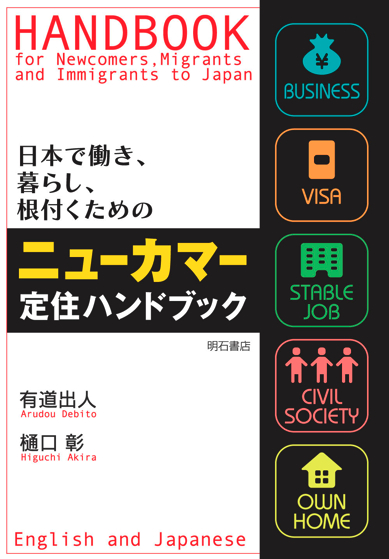
Handbook for Newcomers, Migrants, and Immigrants to Japan\Foreign Residents and Naturalized Citizens Association forming NGO\「ジャパニーズ・オンリー 小樽入浴拒否問題と人種差別」(明石書店)JAPANESE ONLY:  The Otaru Hot Springs Case and Racial Discrimination in Japansourstrawberriesavatar
■□□■□□■□□■□□■□□■□□■□□■□□■□□■
審議真っ最中!
ここが問題!入管法・入管特例法改定案&住基法改定案
5月13日(水) 院内集会 第4弾
「特別永住者にとってプラスになるか?」
■□□■□□■□□■□□■□□■□□■□□■□□■□□■
【日時】 5月13日(水) 14:00〜15:00
【場所】 衆議院第二議員会館 第一会議室
【主催】 「在留カードに異議あり!」NGO実行委員会
◆ますます広がる批判と不安の声に耳を傾けて!
【4回目のテーマ】「永住者・特別永住者にとって今回の法改定は」
【集会内容】○NGOからの問題提起
田中宏さん(外国人人権法連絡会共同代表)/佐藤信行さん(RAIK)

○当事者からの発言
○各党議員からの発言
現在国会で審議中の入管法・入管特例法の改定案の上程理由には、「適法に在留す
る外国人の利便性を向上させる」という文言が含まれています。では、永住資格を持
つ人たちにとっては、どんな利便性向上が用意されているのでしょうか?
たとえば、在日コリアンなど「特別永住者」は、永住者を含めた他の「中長期在留
者」とは異なり、IC在留カードではなく、「特別永住者証明書」を持つこととされて
います。しかし、従来の外国人登録制度が持つ問題点として、国連の自由権規約委員
会からも指摘されてきた常時携帯・提示義務は、今回も残されています。また、「朝
鮮籍」の特別永住者にとっては、再入国許可制度において不当な扱いを受ける恐れが
あります。今回の法改定案はどう見ても、管理維持・強化の部分ばかりが目について
しまいます。
また、今回の法改定に限らず、「一般永住者」と「特別永住者」の扱いが大きく異
なってきています。歴史的経緯を持つ朝鮮半島・台湾・中国出身者の中にも、一般永
住者が多く存在しています。在日コリアンの中でも、特別永住者/一般永住者/永住
者の配偶者等……と混在する家族が多いのです。
そもそも「一般永住者」ですら、なぜ在留カードを常時持ち、職場や学校などの情報
を逐次報告しなければならず、日本に再入国する際に指紋情報を提供しなければなら
ないのでしょうか? 結局、永住を持つほど日本に定着したとしても、強い管理の下
で生活せざるを得ないということになるでしょう。これらの問題は、永住資格を持つ
者だけの問題ではなく、外国人の人権をどう考えるかという根本に触れる問題です。
戦前から日本に住むオールドカマーも、今回の法改定には強く反対しています。そ
の主張をぜひ一度聞いてください。
◆本集会前には、13:45より同会場で、キリスト教会関係者らによる
今回の問題への声明文発表に関する記者会見を開く予定です。
◆「改定法案」批判の詳細は⇒  http://www.repacp.org/aacp/
◆お問合せ先
移住労働者と連帯する全国ネットワーク(移住連) 
TEL:03-5802-6033   fmwj@jca.apc.org
社団法人アムネスティ・インターナショナル日本 
TEL:03-3518-6777
◆「在留カードに異議あり!」NGO実行委員会
移住労働者と連帯する全国ネットワーク(移住連)/在日韓国人問題研究所(RAIK)/
社団法人アムネスティ・インターナショナル日本/(社)自由人権協会/
日本カトリック難民移住移動者委員会/反住基ネット連絡会/
在日大韓基督教会関東地方会社会部/フォーラム平和・人権・環境/
外登法問題と取り組む全国キリスト教連絡協議会/カラバオの会/
在日本朝鮮人人権協会/中崎クィアハウス/山谷争議団 反失業闘争実行委員会/
山谷労働者福祉会館活動委員会/在日アジア労働者と共に闘う会/
在日コリアン青年連合(KEY)/聖公会平和ネットワーク

ENDS

Japan Times JUST BE CAUSE column May 5, 2009 on Alberto Fujimori

mytest

Handbook for Newcomers, Migrants, and Immigrants to Japan\Foreign Residents and Naturalized Citizens Association forming NGO\「ジャパニーズ・オンリー 小樽入浴拒否問題と人種差別」(明石書店)JAPANESE ONLY:  The Otaru Hot Springs Case and Racial Discrimination in Japansourstrawberriesavatar
Hi Blog. What follows is yesterday’s Japan Times JUST BE CAUSE Column on former Peruvian president Alberto Fujimori, and the precedents left behind by his antics.  A “Director’s Cut” with links to sources, it contains an extra paragraph (in italics only) I couldn’t fit into a very limited column space.  Enjoy.  Arudou Debito in Sapporo

justbecauseicon.jpg

JUST BE CAUSE


Fujimori gets his; Japan left shamed
 

Finally, an outlaw president sets a good legal precedent

The Japan Times: Tuesday, May 5, 2009

By ARUDOU DEBITO

News item: Alberto Fujimori, former president of Peru, was sentenced last month to 25 years in prison by a Peruvian court for connections to death squads.

In my humble but loud opinion, hurrah! World media headlined it “a victory for the rule of law.” It was the first time an elected world leader in exile had been extradited back to his home country, tried, and found guilty of human-rights abuses. Take that, Pinochet, Amin and Milosevic.

That’s the only positive precedent set by an outlaw president who made a career of putting himself above the law. Lest we forget, Fujimori spoiled things for a lot of people, exploiting his Japanese roots in a ruthless pursuit of power.

Recap: Fujimori was elected in 1990 as South America’s first leader descended from Japanese immigrants. As the Japanese government likes to claim anyone with the correct blood as one of its own (recall 2008’s emigre Nobel Prize winners), out came the predictable cheers and massive investment.

Giving credit where credit’s due, Fujimori’s much-ballyhooed successes included economic development, antiterrorism programs, and a famous hostage situation at the Japanese ambassador’s residence (which ended with every insurgent executed). But Fujimori’s excesses eventually caught up with him. His corrupt administration (right-hand man Vladimiro Montesinos is serving 20 years for bribery) skimmed at least $1 billion of public money. He also suspended Parliament, purged the judiciary, and amended the constitution, allowing him to claim a hitherto illegal third term after rigged elections in 2000.

(BTW, I saw on the Discovery Channel early April 12 2009 a Canadian documentary (「ゼロアワー・ペルー日本大使館人質事件」) about the siege of the Japanese Ambassador to Peru’s house in 1996-7. When the commandos were on tiptoe for 34 hours ready to go in, deputy Montesinos was trying to contact Fujimori to get final approval. Guess what. It took a while to reach Fujimori, because he was dealing with personal stuff — his divorce hearing! One would expect Fujimori to be on tiptoe too, what with a looming assault on your biggest national donor’s sovereign territory!  Not as high a priority for a president like Fujimori.)

Four months later Fujimori bailed out. On the pretext of visiting an international conference in Brunei, he surfaced in Japan, faxed a letter of resignation from his Tokyo hotel room, and claimed he was a Japanese.

Legal contortionism ensued. Although Japan does not recognize dual nationality and spends at least a year deliberating bona fide naturalization applications, our government decided within three weeks to issue him a passport. Reasoning: Fujimori’s parents had registered his Peruvian birth with the Japanese Embassy. Since he hadn’t personally renounced his Japanese citizenship, he was to our justice minister still a Japanese citizen, and therefore immune from Peru’s demands for extradition.

http://news.bbc.co.uk/2/hi/asia-pacific/1065667.stm 

For the next five years, despite Interpol arrest warrants for murder, kidnapping and crimes against humanity, Fujimori lived a comfortable exile in multiple residences within Japan’s elite society. Supported by the likes of Tokyo Gov. Shintaro Ishihara, Fujimori was for a time the toast of Tokyo, charming all manner of nationalistic authors, rightwing politicians, diplomats and journalists with his celebrity. Meanwhile he plotted his political comeback through the Internet. “I live as if I were in Peru,” he told the New York Times in 2004.

http://www.bigempire.com/sake/fujimori.html

http://metropolis.co.jp/tokyo/609/feature.asp

http://www.nytimes.com/2004/02/24/world/an-ex-president-of-peru-plots-his-return.html?sec=&spon=&pagewanted=2

You can’t keep a bad man down. In 2005 he renewed his Peruvian passport, formally declared his candidacy for Peru’s 2006 presidential election, and abandoned his safe haven for a chartered flight to Chile. Chilean authorities immediately put the fool under arrest.

Then it got comical. Fujimori was trounced in Peru’s presidential election, so he ran in absentia in 2007 for the Japanese Diet (under the Kokumin Shinto Party). He was trounced here too. Chile then extradited him to Peru for trial. In 2007 he got six years for abuses of power. Last month he got an additional quarter-century for murder, bodily harm, and kidnapping — and there are still more trials outstanding.

That should put him out of harm’s way. Now 70, Fujimori will be three digits old before he sees turnkeys, unless his daughter — chip off the old block — carries out her platform plank to become president and pardon him. Fujimori is a political vampire who makes one wish wooden stakes were part of the political process.

But seriously, consider the precedents set by this megalomaniac:

First, Fujimori rent asunder Japan’s due process for both naturalization and asylum-seekers (while dozens of North Korean children of Japanese mothers who have clear blood ties to Japan remain STATELESS). He made it clear that Japanese elites arbitrarily enforce our laws to benefit their own.

Now contrast him with fellow nikkei in Japan. It’s obviously OK for an overseas citizen with Japanese blood to assume dictatorial powers, pillage the public purse, then slither off to Japan. But how about the thousands of nikkei Peruvian workers in Japan who are now being told — even bribed — to go home?

Then contrast him with fellow nikkei overseas. If any nikkei despot can parachute into Japan and be granted asylum through mere tribalism, what country would want to elect another Fujimori as head of state? Although wrong-headed and racist, this precedent hurts future prospects for nikkei assimilation.

But sociopaths like Fujimori are by definition incurious about how they affect others, especially when granted power in young, weak constitutional democracies. At least Peru and Chile had the sense (and the chance) to lock him up and re-establish the rule of law.

No thanks to Japan, of course, from whom the world expects more maturity. Rumor has it the International Olympic Committee has been nudged by rival candidate cities about Ishihara and Fujimori. If this knocks Tokyo out of contention for the 2016 Olympics, more hurrahs for poetic justice.

In sum, Fujimori is a classic case of how power corrupts. A former math teacher comes to power, comes to believe that he can do anything, then comes to a dazzlingly rich society run by elites who shelter him and further encourage his excesses.

A pundit friend said it well: “Fujimori is an accident of birth. If he had been born in North America, he’d have been a dentist, not a dictator.”

At least this time, this kind of “accident” has not gone unpunished.

Debito Arudou is coauthor of the “Handbook for Newcomers, Migrants, and Immigrants.” Just Be Cause appears on the first Tuesday (Wednesday in some areas) Community Page of the month. Send comments tocommunity@japantimes.co.jp
ENDS

Kambayashi Column: Self-censoring media abets incompetent politicians.

mytest

 Handbook for Newcomers, Migrants, and Immigrants to Japan\Foreign Residents and Naturalized Citizens Association forming NGO\「ジャパニーズ・オンリー 小樽入浴拒否問題と人種差別」(明石書店)JAPANESE ONLY:  The Otaru Hot Springs Case and Racial Discrimination in Japansourstrawberriesavatar
Hi Blog. In concert with yesterday’s blog posting on politicians hijacking events for their own ends, here’s Takehiko Kambayashi on how the media lets them hijack their airwaves and printing presses without sufficient critique, letting the incompetent drift to the top. Arudou Debito in Sapporo

/////////////////////////////////
Self-censoring media abets incompetent politicians.
THE DIPLOMAT
By Takehiko Kambayashi 30-Apr-2009

http://www.the-diplomat.com/article.aspx?aeid=13420
Courtesy of the author.

Media outlets here have been heralding an apparent jump in the approval ratings of Prime Minister Taro Aso’s Cabinet, with a recent poll by major daily The Sankei Shimbun and the Fuji News Network suggesting that 28.2 percent of Japanese approve of the government’s performance, up from 20.8 percent in late March. But what the media doesn’t want to talk about is the 60 percent of those surveyed who still disapprove of the Cabinet.

Aso continues to struggle to win over the rest of the Japanese public because of his lack of leadership and because of his predilection for embarrassing himself. But this begs the question: why was such a weak and controversial politician able to climb to the top of the political heap in the first place?

Putting his foot in his mouth is hardly a recent problem for Aso. As a candidate in the 2001 Liberal Democratic Party presidential elections, for example, he suggested to reporters at the Foreign Correspondent Club in Tokyo that the best country would be one “where the richest Jewish people would want to live.”

He later apologized. But he hardly needed to, because the Japanese media ignored this blatant example of bigotry from the then-economics minister of the world’s second largest economy – a man who went on to serve as the country’s top diplomat under two prime ministers. Fortunately for Aso, the media in Japan censors itself even when politicians err blatantly.

A prime example of this kid-glove approach with Aso came in July 2006, when prominent journalist Ryuichi Teshima, a former Washington bureau chief for state broadcaster NHK, praised Aso for his “steadiness” as foreign minister in a “time of crisis,” following an attempted North Korean missile launch earlier that month.

Nonsense. A string of gaffes convincingly demonstrate Aso’s tin ear for diplomacy and international affairs, not least when dealing with Japan’s supposed allies. For instance, Aso has argued that U.S. diplomats in the Middle East can’t solve the region’s problems because of their “blue eyes and blond hair.” He said the Japanese would be more likely to be trusted because they have “yellow faces.” Yet this stunning display of ignorance elicited barely a murmur from the mainstream Japanese media. And sadly, this is hardly an isolated case. Every news outlet scrambles to follow LDP politicians around, and the LDP in turn loves the attention its lawmakers get. This is especially true during elections for the party leadership, when its candidates often get a free ride in newspapers and on television, with the pervasive coverage serving to boost the LDP’s popularity even though the vast majority of the public do not even have a say in choosing the party’s leader.

Former Prime Minister Shinzo Abe is a case in point. He took office in 2006 with great fanfare and approval ratings that hovered around 65 percent. But his treatment during the LDP leadership contest was telling. During an “NHK Special” aired before the race, reporter Akiko Iwata bragged about her interview with Abe, saying as she sat on his couch that such media access was almost impossible to get. Yet Iwata, who ostensibly became a journalist because she wanted to work for “social justice,” proceeded to lob softball questions for the entire interview.

Why doesn’t the media do its job? One reason is that it is common knowledge that, in the quirky world of Japanese journalism, when a politician is awarded an influential post, the reporter covering that politician earns a promotion.

Yasushi Kawasaki, himself a former political reporter for NHK, told me that many political reporters become politicians of a sort themselves, seeking to bolster their backroom influence. Major news organizations are “in collusion with those in power.”

Kawasaki is a refreshingly honest voice on the cozy relationship between the Japanese media and politicians. Unfortunately, it is also a very lonely voice.
ENDS

Thoughts on May Day 2009 in Odori Park, Sapporo

mytest

Handbook for Newcomers, Migrants, and Immigrants to Japan\Foreign Residents and Naturalized Citizens Association forming NGO\「ジャパニーズ・オンリー 小樽入浴拒否問題と人種差別」(明石書店)JAPANESE ONLY:  The Otaru Hot Springs Case and Racial Discrimination in Japansourstrawberriesavatar

Hi Blog.  A little post for the holidays:

I was cycling on my way to work on May 1 and going through Odori Park, where the 80th Annual Hokkaido May Day labor union rallies were taking place.  They’re fun affairs (you get the pretentious lefties spouting off about protecting human rights, but then with no sense of irony whatsoever refuse to give me a flyer as I’m walking past…), and it’s always interesting to see who’s speaking.

I had just missed Hokkaido Governor Takahashi Harumi’s speech (but I saw her in the speaker gallery — she’s a tiny little person!), but Sapporo Mayor Ueda Fumio gave a short and well-tailored speech designed for the workers:  about how Hokkaido’s in the job market toilet and we have to keep it from getting worse; and we’d better make sure that no more companies go bankrupt (I raised an eyebrow at that; that doesn’t sound all that populist anymore).

But then came the rabbit out of the hat.  DPJ leader Ozawa Ichiro (yes, THAT Ozawa) gave a ten-minuter about how the LDP was about to lose power and how the DPJ and associated allies were going to kick butt in the next unavoidable election.  I snickered a bit, about how the worm had turned (given Ozawa’s history as a LDP kingpin dealing within the smoke-filled rooms of Kanemaru and PM Takeshita), and renewed my distrust of him.  He’ll say anything to get into power, which might indeed be the job description of any politician, but I still felt after he left the podium that he lacked any personal convictions except getting his own back on the LDP.

But he was soon overshadowed two speakers later.  After the vice-prez of Shamintou gave the proper address about unemployed workers, the Japanese Constitution, and various other leftie issues that I agreed with to the core but noticed how smoothly they were served up, out came the person that should be banished from any public event with crucifixes:  Suzuki Muneo.  Yes, another former LDP kingpin, now twice-convicted for corruption (and in office only because his case is on appeal in the Supreme Court, and because Hokkaido people can be pretty stupid), up at the podium protesting his innocence yet again.  Yes, no kidding, in between the pat statements that Hokkaido is underrepresented and kept poor by the mainland (I agree, but I wouldn’t want Muneo to be the representer), he talked about how the police are going after people like Ozawa and himself unfairly because the latter are challenging the ruling class.  And how he looked forward to being part of the new ruling DPJ even if his one-person party has only elected him (played that one for laughs; it worked).  The shikai who came on after that noted how suddenly May Day had taken on a different tone.  No wonder.  The politicians had hijacked it for their own purposes, not for the promotion of worker rights.

Anyway, back to Muneo.  He had clearly hitched his wagon to the left.  At about 150 decibels, he was the most attention-getting speaker of the day (I admit he’s an incredible speaker; even if you don’t trust him, you’ll be boxed about the ears by his high-volume convictions).  He walked off with more applause than anyone (Ozawa got some desultory claps; he’s a by-the-numbers speaker because he believes in very little fervently; Muneo, a performance artist like Iggy Pop, would cut his chest on stage if he got your support — he certainly shredded his vocal cords) and probably garnered a few more votes from desperate Dosanko.  Sigh.

I resumed my trek to work after that.  As always, I’m fascinated by Japanese politics, because I like to see what appeals.  Very little of it is as well-thought-out or as inspiring as a single Obama speech.  That’s one reason that Obama’s speeches are best-sellers in Japan.  The Japanese electorate is thirsting for someone to show some impressive leadership.  All the left got today in Sapporo, however, were Ichiro and Muneo.  And they are hardly leftists.  

Arudou Debito in Sapporo

TIME Mag, Asahi, NY Times: “Japan to Immigrants: Thanks, but go home”

mytest

Handbook for Newcomers, Migrants, and Immigrants to Japan\Foreign Residents and Naturalized Citizens Association forming NGO\「ジャパニーズ・オンリー 小樽入浴拒否問題と人種差別」(明石書店)JAPANESE ONLY:  The Otaru Hot Springs Case and Racial Discrimination in Japansourstrawberriesavatar

Hi Blog. Three articles that echo much of the sentiment I expressed in my April 7, 2009 Japan Times article on the Nikkei repatriation bribe. First TIME Magazine, then a blurb (that’s all) from the Asahi on how returned Nikkei are faring overseas, and than finally the New York Times with some good quotes from the architect of this policy, the LDP’s Kawasaki Jiro (who amazingly calls US immigration policy “a failure”, and uses it to justify kicking out Japan’s immigrants). Arudou Debito in Sapporo

PS:  Here’s a political comic based upon the NY Times photo accompanying the article below.  Courtesy of creator RDV:

http://politicomix.blogspot.com/2009/04/foreigners-fuck-off.html

/////////////////////////////////////////////////////////////

TIME Magazine, Monday, Apr. 20, 2009
Japan to Immigrants: Thanks, But You Can Go Home Now
By Coco Masters / Tokyo,
Courtesy Matt Dioguardi and KG
http://www.time.com/time/world/article/0,8599,1892469,00.html

When union leader Francisco Freitas has something to say, Japan’s Brazilian community listens. The 49-year old director of the Japan Metal and Information Machinery Workers called up the Brazilian Embassy in Tokyo April 14, fuming over a form being passed out at employment offices in Hamamatsu City, southwest of Tokyo. Double-sided and printed on large sheets of paper, the form enables unemployed workers of Japanese descent — and their family members — to secure government money for tickets home. It sounded like a good deal to the Brazilians for whom it was intended. The fine print in Portuguese, however, revealed a catch that soured the deal: it’s a one-way ticket with an agreement not to return.

Japan’s offer to minority communities in need has spawned the ire of those whom it intends to help. It is one thing to be laid off in an economic crisis. It is quite another to be unemployed and to feel unwanted by the country where you’ve settled. That’s how Freitas and other Brazilians feel since the Japanese government started the program to pay $3,000 to each jobless foreigner of Japanese descent (called Nikkei) and $2,000 to each family member to return to their country of origin. The money isn’t the problem, the Brazilians say; it’s the fact that they will not be allowed to return until economic and employment conditions improve — whenever that may be. “When Nikkei go back and can’t return, for us that’s discrimination,” says Freitas, who has lived in Japan with his family for 12 years.

With Japan’s unemployment rate on the rise — it reached a three-year high of 4.4% in February — the government is frantic to find solutions to stanch the flow of job losses and to help the unemployed. The virtual collapse of Japan’s export-driven economy, in which exports have nearly halved compared to the first two months of last year, has forced manufacturers to cut production. Temporary and contract workers at automotive and electronics companies have been hit especially hard. Hamamatsu has 18,000 Brazilian residents, about 5% of the total in Japan, and is home to the nation’s largest Brazilian community. After immigration laws relaxed in 1990, making it easier for foreigners to live and work in Japan, Brazilians have grown to be the country’s third largest minority, after Koreans and Chinese. But as jobs grow scarce and money runs out, some Nikkei ironically now face the same tough decision their Japanese relatives did 100 years ago, when they migrated to Brazil.

Japan can scarcely afford to lose part of its labor force, or close itself off further to foreigners. Japan, with its aging population that is projected to shrink by one-third over the next 50 years, needs all the workers it can get. The U.N. has projected that the nation will need 17 million immigrants by 2050 to maintain a productive economy. But immigration laws remain strict, and foreign-born workers make up only 1.7% of the total population. Brazilians feel particularly hard done by. “The reaction from the Brazilian community is very hot,” says a Brazilian Embassy official. The embassy has asked Japan’s Ministry of Health, Labor and Welfare to “ease the conditions” of reentry for Brazilians who accept the money. (Paradoxically, the Japanese government had recently stepped up efforts to help Brazilian residents, with programs such as Japanese-language training and job-counseling.) This particular solution to unemployment, however, is perceived as a misguided gift. “Maybe there were good intentions, but the offer was presented in the worst way possible,” says the Brazilian official. The program applies to Brazilians who have long-term Nikkei visas, but restricts their right — and that of their family members — to reentry until jobs are available in Japan. The terms are vague and will probably stay that way. Tatsushi Nagasawa, a Japanese health ministry official says it’s not possible to know when those who accept the money will be allowed back into Japan, though the conditions for reentry for highly skilled positions might be relaxed.

The Brazilian community plainly needs some help. The Brazilian embassy normally pays for between 10 and 15 repatriations each year, but in the last few months it has already paid for about 40. Since last September, Carlos Zaha has seen many in his Hamamatsu community lose their jobs. In December, he helped start Brasil Fureai, or “Contact Brazil,” an association to help unemployed Brazilian residents find jobs. He’s thankful to the Japanese government for the offer of assisted repatriation, but says the decision will be a rough one for workers. “I don’t think [the government] thought this through well,” Zaha says. “If someone is over 50 years old and is already thinking of returning to Brazil then it might work. But there are many people in their 20s and 30s, and after two or three years they’re going to want to come back to Japan — and they won’t be able to.”

Lenine Freitas, 23, the son of the union leader, lost his job at Asmo, a small motor manufacturer, one month ago, but says he plans to stay in Japan and work. Freitas says that there would be no problem if the Japanese government set a term of, say, three years, after which Brazilians who took the money could return. But after nine years working at Suzuki Motor Corp., he thinks that the government should continue to take responsibility for foreigners in Japan. “They have to help people to continue working in Japan,” he says. “If Brazilians go home, what will they do there?”

And if Nikkei Brazilians, Peruvians and others who have lost their jobs go home, what will Japan do? Last week, Prime Minister Taro Aso unveiled a long-term growth strategy to create millions of jobs and add $1.2 trillion to GDP by 2020. But the discussion of immigration reform is notoriously absent in Japan, and reaching a sensible policy for foreign workers has hardly got under way. Encouraging those foreigners who would actually like to stay in Japan to leave seems a funny place to start.

ENDS

=========================================

http://www.asahi.com/english/Herald-asahi/TKY200904170104.html

Returnees to Brazil finding it tough

THE ASAHI SHIMBUN

2009/4/17, courtesy of KG
SAO PAULO–Many Brazilians of Japanese ancestry returning here from recession-struck Japan are struggling to find work, according to Grupo Nikkei, an NGO set up to support the job-seekers.

The group said the number of returnees seeking help had more than doubled from 70 a month last year to 150 a month this year.

Some returnees who performed unskilled labor in Japan have found it difficult to return to old jobs that require specific expertise, according to Leda Shimabukuro, 57, who heads the group. Some youths also lack Portuguese literacy skills, Shimabukuro said.(IHT/Asahi: April 17,2009)

ENDS (yes, that’s all the space this merits in the Asahi)

==========================================

New York Times April 23, 2009

Japan Pays Foreign Workers to Go Home

The government will pay thousands of dollars to fly Mrs. Yamaoka; her husband, who is a Brazilian citizen of Japanese descent; and their family back to Brazil. But in exchange, Mrs. Yamaoka and her husband must agree never to seek to work in Japan again.

“I feel immense stress. I’ve been crying very often,” Mrs. Yamaoka, 38, said after a meeting where local officials detailed the offer in this industrial town in central Japan.

“I tell my husband that we should take the money and go back,” she said, her eyes teary. “We can’t afford to stay here much longer.”

Japan’s offer, extended to hundreds of thousands of blue-collar Latin American immigrants, is part of a new drive to encourage them to leave this recession-racked country. So far, at least 100 workers and their families have agreed to leave, Japanese officials said.

But critics denounce the program as shortsighted, inhumane and a threat to what little progress Japan has made in opening its economy to foreign workers.

“It’s a disgrace. It’s cold-hearted,” said Hidenori Sakanaka, director of the Japan Immigration Policy Institute, an independent research organization.

“And Japan is kicking itself in the foot,” he added. “We might be in a recession now, but it’s clear it doesn’t have a future without workers from overseas.”

The program is limited to the country’s Latin American guest workers, whose Japanese parents and grandparents emigrated to Brazil and neighboring countries a century ago to work on coffee plantations.

In 1990, Japan — facing a growing industrial labor shortage — started issuing thousands of special work visas to descendants of these emigrants. An estimated 366,000 Brazilians and Peruvians now live in Japan.

The guest workers quickly became the largest group of foreign blue-collar workers in an otherwise immigration-averse country, filling the so-called three-K jobs (kitsui, kitanai, kiken — hard, dirty and dangerous).

But the nation’s manufacturing sector has slumped as demand for Japanese goods evaporated, pushing unemployment to a three-year high of 4.4 percent. Japan’s exports plunged 45.6 percent in March from a year earlier, and industrial production is at its lowest level in 25 years.

New data from the Japanese trade ministry suggested manufacturing output could rise in March and April, as manufacturers start to ease production cuts. But the numbers could have more to do with inventories falling so low that they need to be replenished than with any increase in demand.

While Japan waits for that to happen, it has been keen to help foreign workers leave, which could ease pressure on domestic labor markets and the unemployment rolls.

“There won’t be good employment opportunities for a while, so that’s why we’re suggesting that the Nikkei Brazilians go home,” said Jiro Kawasaki, a former health minister and senior lawmaker of the ruling Liberal Democratic Party.

“Nikkei” visas are special visas granted because of Japanese ancestry or association.

Mr. Kawasaki led the ruling party task force that devised the repatriation plan, part of a wider emergency strategy to combat rising unemployment.

Under the emergency program, introduced this month, the country’s Brazilian and other Latin American guest workers are offered $3,000 toward air fare, plus $2,000 for each dependent — attractive lump sums for many immigrants here. Workers who leave have been told they can pocket any amount left over.

But those who travel home on Japan’s dime will not be allowed to reapply for a work visa. Stripped of that status, most would find it all but impossible to return. They could come back on three-month tourist visas. Or, if they became doctors or bankers or held certain other positions, and had a company sponsor, they could apply for professional visas.

Spain, with a unemployment rate of 15.5 percent, has adopted a similar program, but immigrants are allowed to reclaim their residency and work visas after three years.

Japan is under pressure to allow returns. Officials have said they will consider such a modification, but have not committed to it.

“Naturally, we don’t want those same people back in Japan after a couple of months,” Mr. Kawasaki said. “Japanese taxpayers would ask, ‘What kind of ridiculous policy is this?’ ”

The plan came as a shock to many, especially after the government introduced a number of measures in recent months to help jobless foreigners, including free Japanese-language courses, vocational training and job counseling. Guest workers are eligible for limited cash unemployment benefits, provided they have paid monthly premiums.

“It’s baffling,” said Angelo Ishi, an associate professor in sociology at Musashi University in Tokyo. “The Japanese government has previously made it clear that they welcome Japanese-Brazilians, but this is an insult to the community.”

It could also hurt Japan in the long run. The aging country faces an impending labor shortage. The population has been falling since 2005, and its working-age population could fall by a third by 2050. Though manufacturers have been laying off workers, sectors like farming and care for the elderly still face shortages.

But Mr. Kawasaki said the economic slump was a good opportunity to overhaul Japan’s immigration policy as a whole.

“We should stop letting unskilled laborers into Japan. We should make sure that even the three-K jobs are paid well, and that they are filled by Japanese,” he said. “I do not think that Japan should ever become a multi-ethnic society.”

He said the United States had been “a failure on the immigration front,” and cited extreme income inequalities between rich Americans and poor immigrants.

At the packed town hall meeting in Hamamatsu, immigrants voiced disbelief that they would be barred from returning. Angry members of the audience converged on officials. Others walked out of the meeting room.

“Are you saying even our children will not be able to come back?” one man shouted.

“That is correct, they will not be able to come back,” a local labor official, Masahiro Watai, answered calmly.

Claudio Nishimori, 30, said he was considering returning to Brazil because his shifts at a electronics parts factory were recently reduced. But he felt anxious about going back to a country he had left so long ago.

“I’ve lived in Japan for 13 years. I’m not sure what job I can find when I return to Brazil,” he said. But his wife has been unemployed since being laid off last year and he can no longer afford to support his family.

Mrs. Yamaoka and her husband, Sergio, who settled here three years ago at the height of the export boom, are undecided. But they have both lost jobs at auto factories. Others have made up their minds to leave. About 1,000 of Hamamatsu’s Brazilian inhabitants left the city before the aid was even announced. The city’s Brazilian elementary school closed last month.

“They put up with us as long as they needed the labor,” said Wellington Shibuya, who came six years ago and lost his job at a stove factory in October. “But now that the economy is bad, they throw us a bit of cash and say goodbye.”

He recently applied for the government repatriation aid and is set to leave in June.

“We worked hard; we tried to fit in. Yet they’re so quick to kick us out,” he said. “I’m happy to leave a country like this.”

ENDS

Japan Times: DPJ slams new Gaijin Cards and further tightening of NJ policing

mytest

Handbook for Newcomers, Migrants, and Immigrants to Japan\Foreign Residents and Naturalized Citizens Association forming NGO\「ジャパニーズ・オンリー 小樽入浴拒否問題と人種差別」(明石書店)JAPANESE ONLY:  The Otaru Hot Springs Case and Racial Discrimination in Japansourstrawberriesavatar
Hi Blog.  Here’s a Japan Times article that is rather incomplete as is, but depicts the rumblings between the status-quo LDP (not to mention the bureaucracy and police forces) and the neophyte DPJ:  the frictions over foreigners in Japan.  This could be quite significant.  It’s not the first time NJ issues have caused rifts in the highest echelons of Japanese politics.  See here and here.  Courtesy of Black Tokyo and Ben Shearon.  Arudou Debito in Sapporo

========================================

DPJ slams strict bills on foreign residents
By MINORU MATSUTANI
The Japan Times, Friday, April 17, 2009

A Democratic Party of Japan legal affairs panel has drafted proposals to soften the rules and punishments stipulated in government-sponsored bills to tighten immigration regulations on foreign residents, DPJ lawmaker Ritsuo Hosokawa said Thursday.

The panel called for eliminating eight provisions in the bills, including one that would oblige foreigners to always carry residency cards, Hosokawa told The Japan Times.

These cards, called “zairyu,” would replace alien registration cards if the bills now before the Diet are passed. Foreigners are currently required to carry their alien cards at all times, but unlike at present, a failure to carry the zairyu could draw a ¥200,000 fine. Also subject to the fine would be failure to promptly report changes in personal information, including residential address, place of employment or marital status.

“The control (over foreign residents) is too tight” in the bills, said Hosokawa, who is the justice minister in the DPJ’s shadow Cabinet. Under the proposed system, resident registrations would be handled by the Justice Ministry, not the municipalities where people live.

The bills to revise the immigration law, which were submitted to the Diet in March, have drawn fire from foreigners, lawyers and nonprofit organizations, who complain the proposed stricter monitoring is a violation of human rights…

Rest of the article at http://search.japantimes.co.jp/mail/nn20090417a1.html

========================================

ENDS

Books recently received by Debito.org: “Japan’s Open Future”, et al.

mytest

Handbook for Newcomers, Migrants, and Immigrants to Japan\Foreign Residents and Naturalized Citizens Association forming NGO\「ジャパニーズ・オンリー 小樽入浴拒否問題と人種差別」(明石書店)JAPANESE ONLY:  The Otaru Hot Springs Case and Racial Discrimination in Japan
Hi Blog.  Some very friendly people out there send me books from time to time for review, or just because they think it might be of interest to Debito.org.  I’m grateful for that, and although time to read whole books is a luxury (I just got a pile of them for my own PhD thesis in two languages, anticipate a lot of bedtime reading), I thought it would be nice to at least acknowledge receipt here and offer a thumb-through review.

Last week I got a book from John Haffner, one author of ambitious book “JAPAN’S OPEN FUTURE:  An Agenda for Global Citizenship” (Anthem Press 2009).  The goal of the book is, in John’s words:

As our aim is ultimately to contribute to the policy debate in Japan, I’d also be grateful if you’d consider mentioning or linking to our book and/or my Huffington piece via your website or newsletter. I took the liberty of linking to debito.org on our (still embryonic) “Change Agents” page on our book website: http://www.japansopenfuture.com/?q=node/22

The Huffington Post article being referred to is here:

http://www.huffingtonpost.com/john-haffner/japan-in-a-post-american_b_171933.html

Excerpt:

===================================

In our book Japan’s Open Future: an Agenda for Global Citizenship, my co-authors and I contend that if Japan wishes to escape a future of decline and irrelevance, and if it wants to take meaningful steps towards a more secure, contented and prosperous future, it needs to think big. Japan really has only one sustainable option: to become a more open, dynamic, conscientious, engaged, globally integrated country. In our book we show why this is so, and we offer a set of interconnected policy prescriptions for how Japan could undertake this radical transformation. There are many things Japan could do, but especially by moving beyond a rigid and inflexible conception of its national identity, by opening up to trade and immigration, by learning to communicate more effectively, including with the English language as the global lingua franca, and by undertaking a much more spirited commitment to global development and security, Japan has the potential to make a profound contribution to domestic, regional, and global challenges.

To pursue this path, however, Japan must think beyond isolationism and the US security alliance. Japan must begin to see itself as a global citizen and as an Asian country, and it must walk the walk on both counts.

At a time when multilateralism is imperiled, the United States would also benefit from such a radical shift in Japan’s posture: it would find an expanded, wealthy market for its exports, a more secure Asian region, and a talented civil society capable of constructively contributing to global issues. President Obama understands that multilateralism is the only path forward for the world, and that its importance is even greater in dark economic times. As a grand strategy for Asia, therefore, President Obama should encourage Japan to pursue policies leading to a peaceful and integrated Asian community, one rooted in reasonably harmonious and dynamic relations between those (highly complementary) leading economies, Japan and China.

Now more than ever, the United States needs Asia to prosper, and Japan must play its part.

=========================

Thumbing through the book, I feel as though it adds a necessary perspective (if not a reconfirmation of Japan’s importance) to the debate, especially in these times when “Asia Leadership” in overseas policymaking circles increasingly means China.  If not cautioned, the media eye may begin truly overlooking Japan as a participant in the world system (particularly, as far as I’m of course concerned, in terms of human rights).  I don’t want Japan to be let off the hook as some kind of “quaint hamlet backwater of erstwhile importance, so who cares how it behaves towards outsiders?” sort of thing.  How you treat foreigners inside your country is of direct correlation to how you will treat them outside.  I think, on cursory examination, the book provides a reminder that Japan’s economic and political power should not be underestimated just because there are other rising stars in the neighborhood.

(And yes, the book cites Debito.org, regarding the GAIJIN HANZAI Magazine issue two years ago, on page 194.  Thanks.)

////////////////////////////////////////////

Now for two other books I received some months ago.  One is Minoru Morita, “CURING JAPAN’S AMERICA ADDICTION:  How Bush & Koizumi destroyed Japan’s middle class and what we need to do about it” (Chin Music Press 2008).  Rather than give you a thumbed-review, Eric Johnston offers these thoughts in the Japan Times (excerpt):

In “Curing Japan’s America Addiction,” Morita says publicly what a lot of Japanese think and say privately, in sharp contrast to whatever pleasantries they offer at cocktail parties with foreign diplomats and policy wonks, or in speeches they give abroad. For that reason, “Curing Japan’s America Addiction” deserves to be read by anybody tired of the Orwellian doublespeak coming out of Washington and Tokyo and interested in an alternative, very contrarian view on contemporary Japan, a view far more prominent among Japanese than certain policy wonks and academic specialists on Japan-U.S. relations want to admit.

http://search.japantimes.co.jp/cgi-bin/fb20080928a1.html

The other is Sumie Kawakami, “GOODBYE MADAME BUTTERFLY:  Sex, Marriage and the Modern Japanese Woman” (Chin Music Press 2007; I seem to be on their mailing list, thanks), a handsome little tome,which, according to the blurb on the back, “offers a modern twist on the tradition in Japanese literature to revel in tales of sexual exploits.  Kawakami’s nonfiction update on this theme offers strands of hope for women struggling to liberate themselves from joyless, sexless relationships.”

It is that, a page-turner indeed.  In the very introduction (which is as far as I got, sorry; I’m a slow reader, and reading this cover to cover wasn’t a priority), Kawakami says:

“[W]hile the sex industry maintains a high profile in Japan, the nation doesn’t seem to be having much actual sex.  A case in point is the results of the Global Sex Survey by Durex (http://www.durex.com/cm/gss2005results.asp), the world’s largest condom maker.  In its 2005 survey, the company interviewed 317,000 people from forty-one countries and found that Japan ranked forty-first in terms of sexual activity.  The survey found that people had sex an average of 103 times a year, with men (104) having more sex than women (101).  The Japanese, at the very bottom, reported having sex an average of forty-five times a year.  

Japan also ranked second to last, just ahead of China, in terms of sexual contentment…” (pp. vi. – vii).

See what I mean?  The book explores this, with case studies of Japanese women’s sexuality.

Thanks for the books, everyone.  If others want to send their tomes to Debito.org, I’d be honored, but I can’t promise I’ll get to them (I spend eight hours a day reading and mostly writing a day already).  Arudou Debito in Sapporo

================================

UPDATE MARCH 13, 2009

I got round to reading one of the books, GOODBYE MADAME BUTTERFLY. I generally write reviews on the back pages if and when I get through a book, something brief that fills the page (or two). Here’s what I scribbled:

Started March 10, 2009, Finished March 13, 2009, Received Gratis from publisher 2007.

REVIEW: A gossipy little book. The best, most scientific part of the book is the introduction, which introduces the point of this book as an exploration of why sex doesn’t seem to happen much in Japan, according to a Durex survey. So one plunges into some very obviously true stores that are well-charted gossip, but not case studies of any scientific caliber. If Iate-night unwinding or beach-blanket reading is what you’re after, this book is for you. If you’re after the promise of why Japanese apparently don’t have much sex, you’ll end up disappointed. The author isn’t brave enough to try and draw any conclusions from the scattering of stories. I wouldn’t have, either. But I felt lured by the promise the foreword. And left the book in the end disappointed.

The best thing about the book is, sadly, the handsome, well-designed print and cover, making the fluff a joy to look at. Just not think about.

ENDS

Tsukuba City Assemblyman Jon Heese Pt II: Why you should run for office in Japan

mytest

Handbook for Newcomers, Migrants, and Immigrants to Japan\Foreign Residents and Naturalized Citizens Association forming NGO\「ジャパニーズ・オンリー 小樽入浴拒否問題と人種差別」(明石書店)JAPANESE ONLY:  The Otaru Hot Springs Case and Racial Discrimination in Japan
Hi Blog. Jon Heese, recently-elected Tsukuba City Assemblyman, wrote an entry on Debito.org a month ago on how and why to get elected to local politics as naturalized Japanese. By popular demand, here’s his follow-up, in the same wiseacre style you’ve come to know and expect. Arudou Debito in Sapporo

=============================

Yes you can. Yes you Should! Part Duh
By Jon Heese, Tsukuba City Assemblyman.  
Debito.org, March 3, 2009

http://aishiterutsukuba.jp/

Thanks to all the well wishers who left very positive comments and well wishes on Debito’s page. Some of the commenters had some questions which I hope to address in this installment. Many of you are very supportive of Debito’s candidacy. I just want to make a point crystal clear: Debito is the low-hanging fruit. He’s grabbed the bait and already being reeled in. He was not my target. You were. I don’t want to read any more comments about the obvious. Of course Debito will be a great politician.

Now, let’s start thinking about how we are going to get your ass in the queue. With the few visits Debito has made to various offices, he has confirmed everything I said in the last post: 1. you don’t need money; 2. the system is designed to get you elected. I understand you don’t know me from Adam. I am not insulted that you will not take my word for it. Debito will now weigh in: Cue Debito ->

DEBITO:  Er, yes, uh, hi everybody, how ya doin’?  Ahem, I have indeed visited the city elections office and gotten documentation on how to get registered for election, and indeed all costs are covered for reasonable candidacies (i.e. any candidacy that you or I would like to run as underdogs).  Do not be deterred by potential costs.  You can do this without spending any of your own money.  And it looks quite likely you just might be elected by an electorate as jaded as this.  Back to you, Jon.

Here is a rundown of what the job entails.

Sessions in Tsukuba are every 3 months consisting of about 25 hours over 8 days spread over the first 3 weeks of the month. For this I get ¥5.4 million/year. If I serve 12 years I get a ¥15 万 pension for the rest of my life (yeah me). Salaries and perks are probably higher in the larger cities. There may be some restrictions on working but in Tsukuba I can continue doing my other jobs when I’m not obliged to be in session. I can’t say it will be the same in Sapporo but I would guess Debito would be free to continue his teaching after making arrangements.

DEBITO:  Haven’t quite thought that far ahead regarding holding two jobs, but according to Sapporo City websites non-boss Sapporo City Assemblypeople make 86万 per month before taxes.  That’s not chump change.  It’s significantly more than I make right now.  I have the feeling, however, that Sapporo City Assemblypeople treat this as a full-time job.  They certainly are getting pay commensurate to that.  Back to Jon:

About that pension (yeah, me?). As with the regular pension, I probably will end up paying for all the retired politicians and not collect anything myself. I recently attended a meeting where some dude explained to a passel of rabid local politician from southern Ibaraki how the pension system is going broke. With all the mergers of towns and cities in the last 20 years, the number of councilors nationwide has dropped from 60,000 to around 35,000. For the system to fulfill its published obligations they will be in the red to the tune of Y77 billion in the next 13 years (when they expect I/O to balance again). After the presentation, the speaker was damned near lynched by the howling mob. I’d just as soon opt out. As it stands, us newbies are stuck. We can either suck it up or vote for the taxpayer to cough up the shortfall. I hate baby boomers!

The job is only full time if you want to make it so. Personally, the meetings are only a minor aspect of the job. I see myself more as a low level statesman, explaining government to the unwashed. As a first term councilor I have no clue how things work so I mostly have to “get back” to my constituents. That said, when the local international school wanted to get a bus to stop in front of their school, they got no response to their request. When I made the same request, the bus bucho was on the phone to the principal in a flash.

I asked Anthony Bianchi about his experience in Inuyama. He gets about the same salary and has similar working conditions. However, just working on things he wanted to get done and fielding concerns from citizens made it a full time job for him from the start. Now that he is in his second term, he points out that he has become much busier with council business and projects. He stresses that anyone wanting the job should understand that the city should take priority. Just because a lot of the councilors sit on their “laurels” doesn’t mean you should. I agree.

James N commented to Debito.org last time:
I think Debito, unless he requires ZERO sleep and is Super Man incarnate, would risk having his voice silenced due to the fact that he would be getting pressure from the “Good-Ole-Boys” club to clamor down as it were. Debito may put these Good-Ole-Boys in their place, but the time and effort to accomplish these things would inevitably drain him of the energy needed to do the very valuable work he is currently doing for the disenfranchised.

Debito made similar bleatings to me. To which I say, “BOLLOCKS!” In fact the opposite is true. As a unelected representative of the disenfranchised Debito is a fart in a feedlot. As an elected rep people will listen. Yes, they WILL LISTEN! The hard part is having something constructive to say. It is one thing to complain about a problem and completely another to propose a workable solution.

Something I learned during my election, there is no more “I” in my new job. If anything is to get done, it can only be done by “We.” Look at all the problems we face, from global warming to “pick your your favourite gripe.” Everyone has said, “If enough people would just get their head out of their asses, we could change things.”? Here is the scoop, boys and girls, things change when everyone wants them to change. When things are not changing… well, clearly people don’t want to change.

No change may be a result of not knowing of the problem. This is where debito.org is making a difference. However, elected reps no longer have the option to just bitch about bad situations. You may call it co-option, I call it planning the fights you can win. And you win those fights because you have the support of the masses, not just because something is the right thing to do.

As for getting co-opted, squeaky wheels get silenced when given the responsibility to fix the f***ing problem instead of just moaning about it. Personally, I’d rather see Debito grabbing those horns and steering the bull than to see another blog posting which only makes me feel better by pointing out how much crappier many NJ’s lives are than my own.

Ask yourself, do I read Debito’s blog because I really want to help, or just because I want to feel superior to both the poor bastards being taken advantage of and the morally inferior perpetrator of any given infraction of human rights? If you really want to help, then morally, you must begin the process of citizenship today. Otherwise you are just as guilty for inaction as your favourite nemesis. Well, OK, maybe not quite as guilty. Anyhoo, just remember, build a man a fire and you’ll keep him warm for a night. Set a man on fire and you’ll keep him warm for life.

You may now go and wash. With soap. And don’t forget to wash behind the ears.

ENDS!

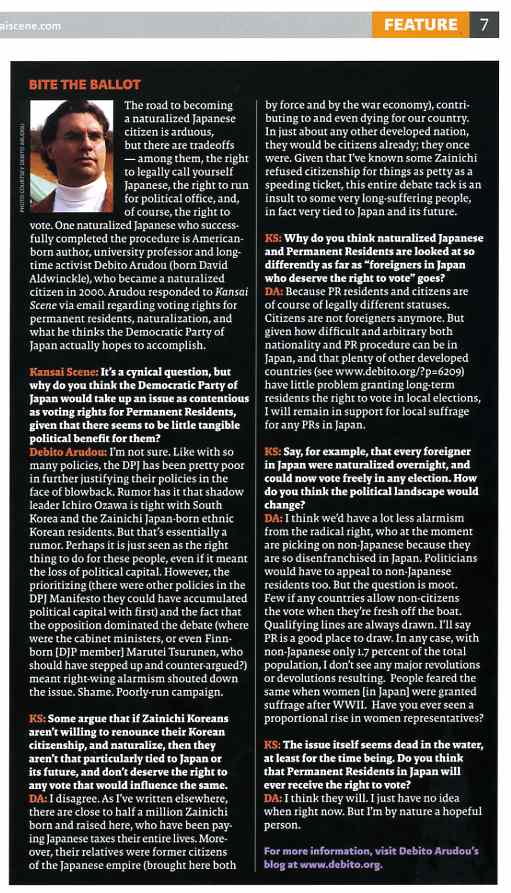
Newly-elected Tsukuba City Assemblyman Jon Heese on the hows and whys of getting elected in Japan

mytest

Handbook for Newcomers, Migrants, and Immigrants to Japan\Foreign Residents and Naturalized Citizens Association forming NGO\「ジャパニーズ・オンリー 小樽入浴拒否問題と人種差別」(明石書店)JAPANESE ONLY:  The Otaru Hot Springs Case and Racial Discrimination in Japan

Hi Blog.  What follows is an interesting (and in places deliciously irreverent) essay by Jon Heese, newly-elected naturalized Tsukuba City Assemblyperson, who encourages others to join him as elected local officials in Japan.  He shows in this essay how he did it (he even looks a lot like Bill Clinton), with an important point:  As long as you do your homework and figure out how your local system works, it should be possible for any number of people with international backgrounds (such as Inuyama’s Anthony Bianchi) to get in office and start making a difference.  Enjoy.  Arudou Debito in Sapporo

Some background links, courtesy of Jeff Korpa:

Jon Heese Running for City Council « TsukuBlog:
http://blog.alientimes.org/2008/10/jon-heese-running-for-city-council/

Jon’s Stunning Victory « TsukuBlog:
http://blog.alientimes.org/2008/10/jons-stunning-victory/

ヘイズジョンの「愛してる、つくば」 Jon Heese -Aishiteru Tsukuba-:
http://aishiterutsukuba.jp/

=======================================

Yes you can. Yes you should. -jon heese

October 26, 2008 was a very satisfying day. I woke up around the crack of noon, went to the local polling station to vote in the city election and took my family to the park for a beautiful afternoon. Dinner was a relaxed affair. All in all, it was quite a change from the previous seven days. The week beginning the previous Sunday was rather more hectic since I was quite busy kissing hands and shaking babies as I began my campaign for city councilor in Tsukuba-shi, Ibaraki-ken.

The election was the culmination of years of plodding…(plotting?). Four years before, after a few gin and tonics (four parts gin, one part ice and a whiff of tonic) in my favourite bar, I happened to mention to the barkeep how if I had half a mind, I should run for city council. Clearly, he believed I did in fact have only half a mind since he immediately became extremely excited and began to encourage me to take the plunge. He went on for awhile, trying to explain the election system to me, but as I had had at least 3 of those gin and tonics by that time, I was rather befuddled. What I did understand was that he believed I could win, if I ran. I had more than a hangover to think about the next morning.

It was one thing to convince myself that running for office was a good idea. Convincing my wife, Nori, was rather more arduous. Fortunately I had subjected her to many a crazy idea in the past so didn’t really need to convince her per se. She listened to my rant and more or less wrote off this latest plan as just another harebrained scheme. That said, she was willing to help do the necessary paperwork to get me started, the first step on the long road: citizenship.

I had quite a few obstacles to pass to get my citizenship, least of which was the actual application. My first task was to get my taxes paid off. That was not as easy as that sounds since I owed considerable sales taxes from a business that went south. I also needed to get birth records for my large family from various local governments. In any case, I finally managed to get all the required records together at the same time and applied.

The actual citizenship process wasn’t so difficult. My case officer was a friendly guy. No one in his office had ever processed a Canuck before so I believe he was rather excited by the challenge. Other than providing endless copies of paperwork, there really wasn’t much for me to do, with the exception of writing the requisite essay in Japanese. This essay was the one real challenge, the one actual test in Japanese-ness. The original request was for a one page essay written in pencil. At the next meeting I presented my case officer the essay and he claimed it was good enough. Now please rewrite it in ink. Could I just copy over the existing essay and erase the pencil after? Sure, no problem. I presented the ink version the next week. Ah, Heese-san, that’s great. Could you please make one more copy in ink? No, a photocopy was not good enough. Well, I didn’t choke the snivel serpent on the spot, so I guess I passed the “gaman” (patience) test. From start to finish, the process took about 6 months. This meant that the tax documents needed to be renewed and resubmitted since official docs expire after 3 months. More “gaman”.

On June 5th, 2007 I officially became Japanese. By this time pretty much anyone who bothered to listen to my blathering had heard of my political ambitions. Curiously, getting my citizenship did not convince many people of my seriousness. Even my wife still thought that the whole citizenship hoop-jump was a big step forward, but when push came to shove, I’d chicken out or find some excuse not to run.

Fast forward to spring of 2008. By then most of the candidates who were planning to run already had their flyers and campaign posters designed and their meishi printed. They had their political support clubs already registered and were gathering funds. Nori had been emphasizing for months I should stop my candidacy, since she felt that to lose would be a severe blow and not worth risking. True, many a losing Japanese candidate also loses vast amounts of face. I, however, was not afraid of losing since that would imply I had some pride (Bzzzz, wrong answer). In fact, the way I saw it, to run and lose would still prove to be a plus. In spite of the many foreigners in our city the principals have never really had anyone they could approach for advice whenever serious issues arose. Sure there were a few of the usual suspects that attended the various advisory boards and panels, but no one was really seen as a definitive voice for the foreign community. Worst case, by stepping forward for the election and losing, I would still become the go-to guy for any future dialogue. That couldn’t be bad.

When I approached my barkeep in July 2008 to see about selecting a campaign manager, he pretty much bit my head off for being so slow off the mark. OK, well, I had no answer but “Gomen nasai.” Still, I give barkeep a lot of credit since once he saw I was serious about running, in spite of my slow start, he started to make a few calls to a few of the movers and shakers around town. The first heavyweight to show up was Mr. O, a real firecracker. He’d spent his youth hitching around Europe and Asia, a true English speaking internationalist. That first meeting was just to satisfy him that I really was serious. Some days later, I got a call from the challenging mayoral candidate, and would I be interested in meeting? Mr. F is a sweet old guy, 72 in 2008. Would I support him in the coming election? Sure would, especially as his group promised to distribute 20,000 of my pamphlets throughout the city for free.

Ah, shit, those pamphlets… Ever notice that whenever you procrastinate for a long time, suddenly you get that feeling that everything needs to be done at once? Nori, my lovely and supporting wife, now had me over a barrel. As the designer-in-chief, she knew that if she was to get her best deal, that was the time. Working full time 6:30 AM to 11 PM in Tokyo, she was not at all interested in having even more work thrust on her because I needed something translated or designed for free. If she was going to support me in the campaign, it would be as an advisor only. She would not campaign with me, knocking on doors and generally bothering others. More importantly, if I won, she would not read the voluminous documentation, the many bills or other paperwork. She had her own job and I was on my own. But yes, she’s do the necessary design work for the election only. She sat down at the Mac and whipped up both my meishi and the pamphlet, sent everything off to the the printers in time to have everything back 3 weeks before the election and just in time for the challenger’s campaign supporters to stuff into mailboxes. In the meantime she also managed to get my web page up. And just 3 days before the actual campaign started, my posters arrived. Whew, safe.

By now the buzz was starting to happen. The pamphlets in the mailboxes were having an effect. People were approaching me and mentioning they’d seen my flyer in their post. Was I really going to run? YES PEOPLE, DAMMIT! I’M SERIOUS!!! The reactions were naturally varied. Many of my Japanese friends were all very supportive. The strangest reactions tended to come from my foreign friends. One guy even had the temerity to say his wife, a doctor, was a member of the Pink Ribbon society, a breast cancer awareness group. Since I was going to get my ass thumped in this first election he didn’t want his wife to use up her sway in the group for this election, but perhaps during the next election she might bring me around and introduce me. Well f*** you very much, friend. Generally, the only negative responses came from my foreign acquaintances. And when I say negative, I mean there was a lot of disbelief that I stood any chance. But “E” for effort Jon. Gambatte!

October 19th, the official start of the campaign. All my paperwork was done, posters ready and all the candidates gathered at the city office for the official kickoff. The atmosphere was more gold rush than election. Every candidate had his paperwork re-examined (we’d all had the paperwork gone over by the election officials the week before). As soon as the candidate was processed, out the door they raced, ready to stake their claim. The reality is that we all had to get our posters put up on the official boards erected throughout the city. This was no small feat as there were 450 locations, many in the middle of nowhere. The maps provided by the city were crappy photocopies at best. Fortunately I had made another connection to a group of like-minded candidates who divvied up the locations. My poster team would put up the posters of 6 other candidates at 30 locations and they would do the same for me around the city. Score.

Nori’s advice now came into effect. Number one: NO LOUDSPEAKER CAR. Yes, we all complain about it. The other candidates claimed that they too hate the damn cars and the grief they cause the voters. Well, I had to walk the walk. Number 2: forget about the train stations, especially in the early mornings. Everyone is in a rush and no one wants my damn meishi or flyer. If I want to catch the morning rush, stand outside the daycares and kindergartens and greet the mothers as they drop off their kids. The mothers will encouraged their husbands vote for me too, those same husbands rushing off to work on the trains. Number three: put a pole with my poster on the back of my bicycle and ride around town to my campaign stops. All good advice.

That first Sunday was rather special. It was the first day of campaigning so my manager and I went downtown and greeted the shoppers. As the other candidates were driving around and making a ruckus, I shouted “My name is Jon Heese and I’m running for city council” to all and sundry. A lot tougher than it sounds. After a couple of hours, my voice was thrashed. Towards the evening, we moved to another location and canvased local businesses until around 8 PM. Officially, campaigning can only occur between 8 AM to 8 PM. One day down.

Weekdays my manager and I got into a rhythm. We picked a daycare, greeted parents (see above) until just before 9, moved to the nearby kindergarten and greeted the mothers who usually formed a gaggle around the entrance. Unlike daycare parents, kindergarten mothers often don’t have a job to go to so this presented a nice opportunity to talk briefly about what I wanted to do. My manager had a real job to go to in the afternoons so I went home, had a short nap and lunch and went on the trail by myself in the afternoons and evenings. I tried doing the door to door a few times, but realistically, that’s a losing strategy. The few people at home on weekdays usually don’t open their doors, using their inter-phones. As soon as they heard I was a politician and a foreign one to boot, they’d hang up, some more politely than others.

While the other candidates went around bugging everyone with their loudspeakers, I spent my afternoons and evenings bothering people in their businesses. The nice thing about a business is that the staff are all trained to be polite to everyone. No slammed doors, no rude gestures, no buckets of blood thrown in my face. I walked in, asked for the boss, introduced myself and left. At the beginning of the week the news that a foreigner was running still wasn’t generally known. Over the course of the week, that changed somewhat. I still surprised a lot of folk. I’m sure there were a few people who were wondering which comedy show I was working for and where the hidden cameras were. Day 2 ~ 6 done.

Saturday rolled around; last day of campaigning. No daycares or kindergartens so I went back downtown and accosted, uhh, I mean greeted people. By this time my candidacy was common knowledge. Pretty much everyone had seen my posters and/or heard stuff via the grape-net or the inter-vine. I had many positive responses, people coming up to me and wanting to shake my hand and encourage me. Many voters told me they had used the early voting system to vote for me already. By the end of the 7th and final day, I knew I had at least 50 votes. Eight PM rolled around I was delighted to be able to take off my sash and take a long deserved sauna. The campaign was officially over. I was very confident that I was going to kick ass the next day. For my friends who really wanted to know what I thought my chances were, I told them top five. Otherwise, I just espoused optimism. I didn’t want to come across as over confident.

Sunday came, polling started and I relaxed. Candidates traditionally spend election day on the phones, encouraging the folk credulous enough to give out a working phone number to go vote. Campaigning is verboten, but burning up the land lines is fair game. I only had a few phone numbers of Japanese friends or foreign friends married to Japanese. Five calls later I was done. Time to relax and enjoy the day with my family. Polls closed at 8 PM. Counting began around 9. Mayor votes are counted first. My wife and I went to Mr. F’s campaign headquarters around 10:30 PM. We were late. The results were already in and he’d lost again. Sucked to be him. We arrived to doom and gloom, some of the supporters in tears. I wasn’t surprised. F-san is really a sweet guy, but he just didn’t have the charisma of his opponent. Piss-pots of money yes, but his oomph was gone.

Around 11 we went to my campaign headquarters, my favourite bar, to await the outcome. The first results came in around 11:30. I had been told that the winning candidates, based on previous elections, needed at least 1,600 votes. Someone at the computer was hitting refresh every 10 second or so from around 11:15. Another was on the phone talking to someone at the counting station. A cheer from the computer brought the whole bar to the monitor. After 30% of votes counted, there I was, tied for 1st place with 1,800 votes. It was all over but the cheering, multiple rounds of toasts, hugs, pictures and a special present from my brother, a stack of bribe envelopes with a million yen as the minimum amount. By midnight the final tally was in. I’d moved down to 2nd place with a total of 4,011 votes. First came in with 4,500. Still, not bad for a beginner.

OK, a nice story. Yeah me! What does this have to do with you? Well, here’s the dope. All city elections are pretty much run the same, following rules set up by the national government. Ergo, if you understand the structure, my story is repeatable… by you! “Me?” you say. Yes you. Let me explain.

Most cities have between 25 and 30 seats in their council. Usually there are around 10 ~ 20% more candidates than there are seats in any given city election. In Tsukuba, I had 40 competitors running for 33 seats. That is worth considering on its own. How much easier for me, all things being equal, to place in the winning 33 than to place in the losing 7?

The remarkable characteristic about most of candidates is how they are mostly nice gray men in nice gray suits. They are all very amiable and, above all, competent guys but pretty much lacking in charisma. They are all looking to make the city a better place by keeping the mayor in check. I say good for them. I’ve gotten to know our winning clutch over the last few months and I think they are a nice bunch. My opinion may change in the coming years, but so far, very positive.

Let’s have a look at the voters. The nice gray men all have their support groups and the better ones have better machines. However, in any given election, there are about 30% independent voters. In Tsukuba, about 90,000 citizens voted, meaning 30,000 voters were not aligned to any organization. Here are the numbers needed to win. The winner of seat 33 garnered 1577 votes (the guy below him had 1,552). The numbers show that anyone who can get 5% of independent voters will win. Now add on the votes from your spouse’s family, friends, the shopkeepers where you are known, your students/co-workers/underlings and all their friends and pretty soon you are vying for top dog.

How do independent voters decide who to vote for? Well, we can assume they have no clue who to vote for or they’d already be aligned. In 2004, the first time I paid attention to a local election, the number one vote getter was a 26 year old who went around saying, “Vote for me, I’m 26.” Of course he had a pamphlet with all the changes he wanted to make but his real message was very clear. This year I came in a respectable second. I also had a policy-filled flyer but my underlying campaign message was, “I’m foreign, vote for me.” OK, I’m being cynical, but sue me!

My impression is that independent voters are attracted to different and new things. Figure out what your attraction might be and play it for all it’s worth and you will do just fine. Just your foreignness already makes you prominent. Elections are really just advertising campaigns and if your product is being talked about, you will get votes. Remember, voters unhappy with your candidacy can’t vote you off the islands. At worst, they can only not vote for you. Certainly the other candidates will not waste their breath trying to block you as mud slinging just makes you even more famous.

OK, so you’ve read this far and maybe even have a dreamy “What if” look as you imagine the possibilities. Here is a brief overview of what you’ll need: 1. You need to be Japanese. Get over it. It is not that hard to do. The biggest obstacle will be giving up your previous citizenship. Chances are you are already here for the duration. Why not let everyone else know too. It will be cathartic. 2. If you have been a good boy or girl you have not only learned to speak Japanese fairly well, but can even read a significant amount of kanji. Everything else is just details. Is that brief enough?

Things you won’t need: lots of money, lots of friends. Both help but are not deal breakers. As for money, campaigns are funded by the city. The nice gray men need to spend the big yen over and above the city funding to get their “Look at me!” message out. I was stupid and wasted Y400,000 of my own money. If I’d procrastinated less, I could have been elected for free. As for friends, they are useful. That said, I have no clue who cast most of the 4,000 votes I got. I’ll never know and it’s not important. One advantage you have already that I did not is my help and experience. Contact Debito if you need my e-mail or phone number (don’t call before noon).

The fact you are reading this on Arudou Debito’s blog tells me you are a concerned inhabitant and hopefully future citizen. You are interested in the way Japan is being run. That you own a computer and are net literate already makes you exceptional when compared to the nice gray men running your city. Consider this, Tsukuba is hailed as Japan’s Science City, it’s Palo Alto. And yet, fewer than 30% of the candidates even had an election home page. Doesn’t that strike you as more than just odd, but disastrous for this country? When the country’s smartest city (highest average IQ) elects a majority of its councilors with no net presence, that is worrying. Chances are it’s worse where you are.

In spite of all of the negative shit you read on this blog, there is another side to Japan that Debito freely recognizes. There are so many super kind and generous Japanese out there who will gladly support you in your efforts, should you decide to try to be the next foreign candidate. The silent majority in Japan are just keeping their heads down and trying not to get singled out. However, there is an active minority who really do believe in Japan’s place in the fabric of humanity, that Japan should honour their pledges to the world.

Debito’s blog often points out where Japan is falling down on their commitments because good people do nothing. However, there are plenty of people out there who are doing great things but don’t have the charisma to get into politics. You’ve met them, your spouse knows them. This is a fifth column that is just waiting for you to stand up and be counted. They will stand behind you and find the resources you need to win.

I praise Debito for his work in poking the establishment in the eye for their lack of backbone and I hope my story provides a little balance to Debito’s efforts. Now imagine what will happen when Debito, and yes, I do mean WHEN Debito takes his scrotum in hand and changes Hokkaido forever by becoming Sapporo’s first western politician. Can you imagine the changes that will take place when Japan’s biggest pain in the ass foreigner starts to point the spotlight on all those politicians who are not living up to our obligations because they do nothing? Oh Happy Day! Now imagine, 30 of us throughout the nation. This is not a dream, this is very doable. The election system is designed with you in mind. Take advantage of it. Yes you can. YES YOU SHOULD!

January 30, 2008

ENDS

IHT on Buraku Nonaka vs Barack Obama

mytest

Handbook for Newcomers, Migrants, and Immigrants to Japan\Foreign Residents and Naturalized Citizens Association forming NGO\「ジャパニーズ・オンリー 小樽入浴拒否問題と人種差別」(明石書店)JAPANESE ONLY:  The Otaru Hot Springs Case and Racial Discrimination in Japan
Hi Blog. What with the impending Obama Presidency, there is a boom in “change” theory, with press speculation whether a landmark incident that so countermands a society’s history could likewise do the same in other (apparently historically-intransigent) societies. Here’s an article on the NYT/IHT on what happened when a minority in Japan, a member of the Buraku historical underclass, got close to the top job, and what the current blue-blooded leader (Aso) allegedly did to stop it. The article about former Dietmember Nonaka Hiromu ends on a hopeful note, but I’m not so positive.

Quoting from one of my Japan Times articles, December 18, 2007:

“After the last election, 185 of 480 Diet members (39%) were second- or third- (or more) generation politicians (seshuu seijika). Of 244 members of the LDP (the ruling party for practically all the postwar period), 126 (52%) are seshuu seijika. Likewise eight of the last ten Prime Ministers, andaround half the Abe and Fukuda Cabinets. When the average turnover per election is only around 3%, you have what can only be termed a political class.”

Until the electorate realizes that their legislative body is a peerage masquerading as an elected body, and vote out more technically-inherited seats, “change” in terms of minority voices being heard will be much slower in coming. Arudou Debito in Sapporo

==============================

International Herald Tribune
Japan’s outcasts still wait for society’s embrace
Friday, January 16, 2009
Courtesy of Yuko S.

KYOTO, Japan: For Japan, the crowning of Hiromu Nonaka as its top leader would have been as significant as America’s election of its first black president.

Despite being the descendant of a feudal class of outcasts, who are known as buraku and still face social discrimination, Nonaka had dexterously occupied top posts in Japan’s governing party and served as the government’s No. 2 official. The next logical step, by 2001, was to become prime minister. Allies urged him on.

But not everyone inside the party was ready for a leader of buraku origin. At least one, Taro Aso, Japan’s current prime minister, made his views clear to his closest associates in a closed-door meeting in 2001.

“Are we really going to let those people take over the leadership of Japan?” Aso said, according to Hisaoki Kamei, a politician who attended the meeting.

Mr. Kamei said he remembered thinking at the time that “it was inappropriate to say such a thing.” But he and the others in the room let the matter drop, he said, adding, “We never imagined that the remark would leak outside.”

But it did — spreading rapidly among the nation’s political and buraku circles. And more recently, as Aso became prime minister just weeks before President-elect Barack Obama’s victory, the comment has become a touchstone for many buraku.

How far have they come since Japan began carrying out affirmative action policies for the buraku four decades ago, mirroring the American civil rights movement? If the United States, the yardstick for Japan, could elect a black president, could there be a buraku prime minister here?

The questions were not raised in the society at large, however. The topic of the buraku remains Japan’s biggest taboo, rarely entering private conversations and virtually ignored by the media.

The buraku — ethnically indistinguishable from other Japanese — are descendants of Japanese who, according to Buddhist beliefs, performed tasks considered unclean. Slaughterers, undertakers, executioners and town guards, they were called eta, which means defiled mass, or hinin, nonhuman. Forced to wear telltale clothing, they were segregated into their own neighborhoods.

The oldest buraku neighborhoods are believed to be here in Kyoto, the ancient capital, and date back a millennium. That those neighborhoods survive to this day and that the outcasts’ descendants are still subject to prejudice speak to Japan’s obsession with its past and its inability to overcome it.

Yet nearly identical groups of outcasts remain in a few other places in Asia, like Tibet and Nepal, with the same Buddhist background; they have disappeared only in South Korea, not because prejudice vanished, but because decades of colonialism, war and division made it impossible to identify the outcasts there.

In Japan, every person has a family register that is kept in local town halls and that, with some extrapolation, reveals ancestral birthplaces. Families and companies widely checked birthplaces to ferret out buraku among potential hires or marriage partners until a generation ago, though the practice has greatly declined, especially among the young.

The buraku were officially liberated in 1871, just a few years after the 13th Amendment abolished slavery in the United States. But as the buraku’s living standards and education levels remained far below national averages, the Japanese government, under pressure from buraku liberation groups, passed a special measures law to improve conditions for the buraku in 1969. By the time the law expired in 2002, Japan had reportedly spent about $175 billion on affirmative action programs for the buraku.

Confronting Prejudice

Fumie Tanaka, now 39, was born just as the special measures law for the buraku went into effect. She grew up in the Nishinari ward of Osaka, in one of the 48 neighborhoods that were officially designated as buraku areas.

At her neighborhood school, the children began learning about discrimination against the buraku early on. The thinking in Osaka was to confront discrimination head on: the problem lay not with the buraku but with those who harbored prejudice.

Instead of hiding their roots, children were encouraged to “come out,” sometimes by wearing buraku sashes, a practice that Osaka discontinued early this decade but that survives in the countryside.

Sheltered in this environment, Tanaka encountered discrimination only when she began going to high school in another ward. One time, while she was visiting a friend’s house, the grandparents invited her to stay over for lunch.

“The atmosphere was pleasant in the beginning, but then they asked me where I lived,” she said. “When I told them, the grandfather put down his chopsticks right away and went upstairs.”

A generation ago, most buraku married other buraku. But by the 1990s, when Tanaka met her future husband, who is not a buraku, marriages to outsiders were becoming more common.

“The situation has improved over all,” said Takeshi Kitano, chief of the human rights division in Osaka’s prefectural government. “But there are problems left.”

In Osaka’s 48 buraku neighborhoods, from 10 to 1,000 households each, welfare recipient rates remain higher than Osaka’s average. Educational attainment still lags behind, though not by the wide margins of the past.

What is more, the fruits of the affirmative action policies have produced what is now considered the areas’ most pressing problem: depopulation. The younger buraku, with better education, jobs and opportunities, are moving out. Outsiders, who do not want to be mistaken for buraku, are reluctant to move in.

By contrast, Tokyo decided against designating its buraku neighborhoods. It discreetly helped buraku households, no matter where they were, and industries traditionally dominated by buraku groups. The emphasis was on assimilation.

Over time, the thinking went, it would become impossible to discriminate as people’s memory of the buraku areas’ borders became fuzzier. But the policy effectively pushed people with buraku roots into hiding.

In one of the oldest buraku neighborhoods, just north of central Tokyo, nothing differentiates the landscape from other middle-class areas in the city. Now newcomers outnumber the old-timers. The old-timers, who all know one another, live in fear that their roots will be discovered, said a 76-year-old woman who spoke on the condition that neither she nor her neighborhood be identified.

“Me, too, I belong to those who want to hide,” she said. “I’m also running away.”

A Politician’s Roots

Nonaka is one of the rare politicians who never hid his buraku roots. In 2001, he was considered a leading contender to become president of the long-governing Liberal Democratic Party and prime minister.

Now 83, he was born into a buraku family from a village outside Kyoto. On his way home at the end of World War II, he considered disappearing so that he would be declared dead, he once wrote. With the evidence of his buraku roots expunged, he had thought, he could remake himself in another part of Japan, he wrote.

Nonaka eventually entered politics, and, known for his fierce intelligence, he rose quickly. By 2001, he was in a position to aim for the prime ministership. But he had made up his mind not to seek the post. While he had never hidden his roots, he feared that taking the top job would shine a harsh spotlight on them. Already, the increasing attention had hurt his wife, who was not from a buraku family, and his daughter.

“After my wife’s relatives first found out, the way we interacted changed as they became cooler,” Nonaka said in an interview in his office in Kyoto. “The same thing happened with my son-in-law. So, in that sense, I made my family suffer considerably.”

But rivals worried nonetheless. One of them was Aso, now 68, who was the epitome of Japan’s ruling elite: the grandson of a former prime minister and the heir to a family conglomerate.

Inside the Liberal Democratic Party, some politicians gossiped about Nonaka’s roots and labeled some of his closest allies fellow buraku who were hiding their roots.

“We all said those kinds of things,” recalled Yozo Ishikawa, 83, a retired lawmaker who was allied with Aso.

“That guy’s like this,” Ishikawa said, lowering his voice and holding up four fingers of his right hand without the thumb, a derogatory gesture indicating a four-legged animal and referring to the buraku.

And so, at the closed-door meeting in 2001, Aso made the comment about “those people” in a “considerably loud voice,” recalled Kamei, the politician. Kamei, now 69, had known Aso since their elementary school days and was one of his biggest backers.

Aso’s comment would have stayed inside the room had a political reporter not been eavesdropping at the door — a common practice in Japan. But because of the taboo surrounding the topic of the buraku, the comment was never widely reported.

Two years later, just before retiring, Nonaka confronted Aso in front of dozens of the party’s top leaders, saying he would “never forgive” him for the comment. Aso remained silent, according to several people who were there.

It was only in 2005, when an opposition politician directly questioned Aso about the remark in Parliament, that Aso said, “I’ve absolutely never made such a comment.”

The prime minister’s office declined a request for an interview with Aso. A spokesman, Osamu Sakashita, referred instead to Aso’s remarks in Parliament.

In the end, Nonaka’s decision not to run in 2001 helped a dark-horse candidate named Junichiro Koizumi become prime minister. Asked whether a Japanese Obama was now possible, Nonaka said, “Well, I don’t know.”

Hopes for the Future

That is also the question asked by many people of buraku origin recently, as they waver between pessimism and hope.

“Wow, a black president,” said Yukari Asai, 45, one of the two sisters who owns the New Naniwa restaurant in Osaka’s Naniwa ward, in Japan’s biggest buraku neighborhood, reflecting on Obama’s election. “If a person’s brilliant, a person’s brilliant. It doesn’t matter whether it’s a black person or white person.”

After serving a bowl of udon noodles with pieces of fried beef intestine, a specialty of buraku restaurants, Asai sounded doubtful that a politician of buraku origin could become prime minister. “Impossible,” she said. “Probably impossible.”

Here in Kyoto, some had not forgotten about Aso’s comment.

“That someone like that could rise all the way to becoming prime minister says a lot about the situation in Japan now,” said Kenichi Kadooka, 49, who is a professor of English at Ryukoku University and who is from a buraku family.

Still, Kadooka had not let his anger dim his hopes for a future buraku leader of Japan.

“It’s definitely possible,” he said. “If he’s an excellent person, it’s just ridiculous to say he can’t become prime minister because he just happened to be born a buraku.”

ENDS

Excellent Japan Times roundup on debate on J Nationality Law and proposed dual citizenship

mytest

Handbook for Newcomers, Migrants, and Immigrants to Japan\Foreign Residents and Naturalized Citizens Association forming NGO\「ジャパニーズ・オンリー 小樽入浴拒否問題と人種差別」(明石書店)JAPANESE ONLY:  The Otaru Hot Springs Case and Racial Discrimination in Japan
Hi Blog. Here’s an excellent Japan Times roundup of the debate which came out of nowhere last year regarding Japan’s loopy nationality laws, which were once based on what I would call a “culture of no”, as in rather arbitrary ways to disqualify people (as in babies not getting J citizenship if the J father didn’t recognize patrimony before birth). A Supreme Court decision last year called that unconstitutional, and forced rare legislation from the bench to rectify that late in 2008.  Now the scope of inclusivity has widened as Dietmember Kouno Taro (drawing on the shock of a former Japanese citizen getting a Nobel Prize, and a confused Japanese media trying to claim him as ours) advocates allowing Japanese to hold more than one citizenship. Bravo. About time.

The article below sets out the discussions and goalposts for this year regarding this proposal (using arguments that have appeared on Debito.org for years now). In a year when there will apparently be a record-number of candidates running in the general election (which MUST happen this year, despite PM Aso’s best efforts to keep leadership for himself), there is a good possibility it might come to pass, especially if the opposition DPJ party actually takes power.

2009 looks to be an interesting year indeed, as one more cornerstone of legal exclusionism in Japan looks set to crack. Arudou Debito

/////////////////////////////////////

THE MANY FACES OF CITIZENSHIP
Debate on multiple nationalities to heat up
Diet battle lines being drawn in wake of law change and amid Kono effort to rectify dual citizenship situation
By MINORU MATSUTANI, Staff writer
The Japan Times: Thursday, Jan. 1, 2009

First in a series

The issue of nationality had never been discussed more seriously than it was in 2008.

News photo
Big decision ahead: Students of an international school in Tokyo gather for an event. Some will have to choose their nationality in some 10 years if the current Nationality Law prevails. THE JAPAN TIMES PHOTO

In a specific legal challenge in June, the Supreme Court ruled it was unconstitutional to deny Japanese citizenship to children of unwed Filipino mothers whose Japanese fathers had not acknowledged paternity before their birth. Lawmakers quickly went to work to pass a revised Nationality Law in December.

Now, Taro Kono, a Lower House member of the Liberal Democratic Party, the larger of the two-party ruling coalition, is trying to iron out another wrinkle in the law that became apparent in October when it was learned that Tokyo-born Nobel Prize winner Yoichiro Nambu had given up his Japanese nationality to obtain U.S. citizenship.

People like Nambu follow the letter of the law with respect to the Constitution’s Article 14, which requires that Japanese renounce other nationalities by the age of 22 if they wish to keep Japanese citizenship. Yet, according to Kono, there are 600,000 to 700,000 Japanese 22 or older with two nationalities, if not more. In other words, fewer than 10 percent of Japanese with more than one nationality make that choice by the time they turn 22, Kono said.

“The current system puts honest people and those who appear in the media at a disadvantage,” Kono said. In November, he submitted a proposal to an LDP panel he heads calling for the Nationality Law to be revised to allow Japanese to hold other nationalities.

The Justice Ministry acknowledges there are Japanese with other nationalities but does not press them to choose only one.

“Technically, the justice minister can order us to crack down on multiple-nationality holders. But none of the past ministers has,” said Katsuyoshi Otani, who is in charge of nationality affairs at the ministry. By law, someone ordered by the minister to choose a single nationality has a month to do so before Japanese citizenship is automatically revoked.

Lawmakers are divided on Kono’s proposal, which also requires that royalty, Diet members, Cabinet ministers, diplomats, certain members of the Self-Defense Forces and judges hold only Japanese nationality. Liberals stress the need for Japan to globalize, while conservatives express concern that opening up too much will diminish the country’s sense of unity.

Shinkun Haku, a member of the Democratic Party of Japan, the largest opposition party, supports the proposal.

Born to a Japanese mother and a South Korean father, Haku became a naturalized Japanese citizen in January 2003 and won a seat in the Upper House the following year.

Kono’s multiple citizenship plan

• The government allows Japanese nationals to be citizens of other countries.

• Japanese holding other nationalities must declare this to the local authorities where their Japanese residency is registered. Those who fail to do so may be fined or lose their Japanese citizenship.

• Japanese can obtain citizenship elsewhere, except for locations Japan does not recognize, and continue to hold Japanese nationality as long as the other countries allow multiple nationalities.

• People from countries other than North Korea or other areas lacking Japanese diplomatic recognition can obtain Japanese nationality without losing their original citizenship as long as their home countries allow multiple nationalities.

• The Imperial family, Diet members, Cabinet ministers, diplomats, certain members of the Self-Defense Forces or court judges can only hold Japanese nationality.

• Japanese who become presidents, lawmakers, Cabinet ministers, diplomats, soldiers, court judges or members of royalty of other countries will lose their Japanese nationality.

• Japanese who have a Japanese parent and hold multiple nationalities will lose their Japanese citizenship if they have not lived in Japan for 365 days or more by the time they turn 22.

• If Japan goes to war against a country, Japanese public servants cannot hold citizenship in that country.

• Japanese holding other nationalities will lose their Japanese citizenship if they apply for and join the military of other countries.

He was not allowed to have Japanese nationality at birth because the children of a foreign father and Japanese mother were barred from having Japanese nationality until the Nationality Law was revised in 1985.

Multiple-nationality holders were also then required to choose one nationality before their 22nd birthday. Before then, Japanese could be citizens of other countries as well.

Those with multiple nationalities who were 20 or older as of Jan. 1, 1985, were supposed to declare a single choice to local authorities by the end of 1986, and if they had not, it would be assumed they had chosen Japanese citizenship and abandoned any others. Those with a Japanese mother and foreign father who were under age 20 as of Jan. 1, 1985, had until the end of 1987 to settle on a nationality.

Japan is the only developed country that does not automatically grant citizenship to babies born within its territory, allow its nationals to have multiple citizenship or let foreigners vote in local-level elections, Haku said.

“I am not criticizing Japan for that, but now we have 2 million registered foreigners, and one in every 30 babies born here has at least one foreign parent. We are in the midst of globalization whether we like it or not,” Haku said. “We have to discuss very seriously how we should involve foreign residents in building our society.”

He is urging Japanese to change their outlook. “For example, we shouldn’t think we ought to give foreigners local government voting rights out of pity. We should think Japan can become a better country by doing so,” Haku said.

Other lawmakers oppose Kono’s proposal, especially those troubled by the revised Article 3 of the Nationality Law. It previously only granted citizenship to a child born out of wedlock to a foreign mother and a Japanese father if the man admitted paternity before birth, but not after.

LDP lawmaker Hideki Makihara fears that granting nationality easily will bring more problems than benefits.

“I think the immigration policy of many European countries has failed as they have had some serious problems” regarding foreign residents, Makihara said. “We need to be very prudent.”

Makihara also noted that citizens who gave up their non-Japanese nationality will feel cheated if Japan allows multiple nationalities, because “there is no guarantee they will regain their renounced citizenships.”

The proposed revision has also stirred nationalists to action. During Diet deliberations on the bill in November and early December, anonymous bloggers posted messages expressing their concern that foreigners may approach Japanese men to falsely claim paternity in illicit bids to gain citizenship.

Although the bill cleared the Diet on Dec. 5, LDP lawmaker Takeo Hiranuma established a lawmaker group scrutinizing the Nationality Law to prevent bogus claims.

While the LDP is divided on the revision of Article 3, the party is also busy dealing with other important issues. This could mean Kono’s proposal will not be deliberated seriously anytime soon, political scientist Hirotada Asakawa said.

With Prime Minister Taro Aso’s approval rate declining and the global economy in serious recession, Aso wants to impress voters by swiftly passing bills on the supplementary budget for the current fiscal year that would finance a ¥2 trillion cash handout program during the Diet session starting later this month, Asakawa said. The LDP then has to pass the budget for the next fiscal year during the same Diet session.

“These issues are enough of a handful. The LDP will also have to prepare for an anticipated Lower House election, which could happen who knows when,” he said. “In such a crucial time, the LDP will not want to discuss Kono’s proposal, which is likely to divide the LDP.”

Nevertheless, many lawmakers seem to agree that the current situation, in which many Japanese unlawfully hold multiple nationalities, needs to be fixed.

The case of former Peruvian President Alberto Fujimori, born to a Japanese couple who emigrated to Peru early last century, is an extreme but forceful example. Kokumin Shinto (People’s New Party) asked Fujimori, who holds Peruvian and Japanese nationalities, in June 2007 to run for the Upper House election when he was detained in Chile. He ran in and lost. After Fujimori fled to Japan in exile, Tokyo declared he has Japanese citizenship, because of his parental roots.

What if he had won a Diet seat?

“Japan escaped by a hair’s breadth as Fujimori lost the election,” Kono said. “I have no idea what lawmakers would have done (if Fujimori had won). Legislation was a step behind the reality.”

To be sure, the proposal has a long way to go to be legalized. A typical process would be that the panel deliberates, finalizes and submits it to LDP executives, who would then decide whether to create a bill to be submitted to the Diet. However, it is unknown if Kono can sway his party.

“I have created a draft for everybody, not just lawmakers, to discuss the nationality issue,” Kono said. “I want to tell Japanese nationals, ‘Let’s discuss it.’ “

The Japan Times: Thursday, Jan. 1, 2009
 

More on nationality law and children born out of wedlock: Conservatives causing policy balk

mytest

Handbook for Newcomers, Migrants, and Immigrants to Japan\Foreign Residents and Naturalized Citizens Association forming NGO\「ジャパニーズ・オンリー 小樽入浴拒否問題と人種差別」(明石書店)JAPANESE ONLY:  The Otaru Hot Springs Case and Racial Discrimination in Japan

Hi Blog.  More on the debate on recognizing paternity and plugging loopholes in the nationality law — and how the conservatives are throwing up roadblocks in between houses of parliament… and blaming a “constituency” of blog messages for it.  Arudou Debito in Iwate

=============================

Nationality Law tweak lacks DNA test: critics
The Japan Times, November 27, 2008
By KAZUAKI NAGATA Staff writer

With the revised Nationality Law expected to clear the Diet soon, some ruling party lawmakers are at the last minute claiming the amendment may spark problems, such as possibly creating a “black market” in false paternal recognition.

However, it seems too late in the day for them to block passage, because the revised bill cleared the Lower House last week and the Upper House Justice Committee is entering the last stage of deliberations and is expected to vote as early as next week.

The amendment will allow children born out of wedlock to Japanese men and foreign women to obtain Japanese nationality if the father acknowledges paternity after the birth.

The revision is in line with a Supreme Court ruling on June 4 that a provision of the law on the status of such children is unconstitutional, because it states the children can only receive Japanese nationality if the father admits paternity during the mother’s pregnancy, or if the couple get married before the child turns 20.

The government reportedly wants to swiftly pass the revision to correct this unconstitutional provision, but the opposing lawmakers claim the revision, which was brought to the Diet earlier this month, needs to be thoroughly discussed.

“If a law like this is misused, what will happen to the Japanese identity?” asked Takeo Hiranuma, a former trade minister widely considered a hardcore hawk, at an emergency meeting with 13 Liberal Democratic Party lawmakers last week to discuss issues arising from the revision.

Since the revision does not require any scientific evidence to prove a biological family link, many are now arguing that some kind of scientific proof, such as a DNA test, should be applied. Hiranuma criticized the revision for granting Japanese nationality without evidence, providing the father admits paternity.

It is rare for lawmakers to raise a bill’s technical problems after it has already been approved by both ruling parties and Cabinet members.

Many admitted it is their own fault that they did not become aware of the details of the revision until only recently, but claimed they were busy in the past few months preparing for the next general election, which, it had been widely assumed, would be held this fall.

One reason that made them act at this late stage was what they claim is the public questioning the amendment. Some lawmakers said there have been hundreds of comments written in their blogs, mostly warning of the potential problems the revision may bring.

“The comments will keep increasing and would go crazy if the revision clears the Diet,” said LDP Lower House member Toru Toida, who has been getting hundreds of comments in his blog.

If the revision clears the Diet, then “people would claim that the Diet is not doing a proper job,” Toida said.

The lawmakers’ concerns arose when the bill was scheduled to clear the Lower House on Nov. 18 after just three hours of deliberations.

On Nov. 17, Hiranuma and the other LDP lawmakers met and agreed more time was needed before a vote.

The revision cleared the Lower House as scheduled, but the group managed to attach an additional resolution submitted jointly by the ruling parties and from some of the opposition camp who have raised doubts about the revision.

The additional resolution contains four suggestions, including applying a scientific method to prove paternity.

The lawmakers opposed to the revision have also compared the revision with the cases of other countries. In a meeting last week, Hideki Makihara, an LDP Lower House member, pointed out the case of Germany, which revised its nationality law in 1998 and experienced the problem of false recognition, saying the situation is similar and Japan is likely to follow the same path.

But Yasuhiro Okuda, a Chuo University Law School professor, said the German and Japanese cases are not similar.

He pointed out that in Japan there are two checks before Japanese nationality is granted, as two separate documents must be submitted — one to recognize paternity and another to acquire nationality. In Germany, however, only a document of paternal recognition is required, he added.

This is a considerable difference, Okuda said, as applicants in Japan will have to go through various checks at legal affairs bureaus when they file to acquire nationality.

Therefore, the increase in false paternity recognition in Germany is not comparable with the case of Japan, where it would be difficult to forge all the necessary documents, Okuda said.

An official at the Justice Ministry also said the checks will be strict so it won’t be easy to forge the recognition.

Okuda also said that while the focus is being placed on false and fraudulent recognitions, the emphasis should instead be on the protection of true recognitions.

The Japan Times: Thursday, Nov. 27, 2008
ENDS

Japan Times: PM Aso “stimulus plan” bribe taking flak, also still unclear if NJ get handout

mytest

Handbook for Newcomers, Migrants, and Immigrants to Japan\Foreign Residents and Naturalized Citizens Association forming NGO\「ジャパニーズ・オンリー 小樽入浴拒否問題と人種差別」(明石書店)JAPANESE ONLY:  The Otaru Hot Springs Case and Racial Discrimination in Japan

Hi Blog.  It’s getting clearer to me that PM Aso’s “economic stimulus package” of cash back to citizens is nothing more than a bribe to voters.  Yes, to voters.  Again, as the plan nears approval, it’s still unclear whether NJ residents also get any money.  However, it’s pretty clear why this fence sitting:  NJ can’t vote, so they don’t count.  Even though they spend money like citizens, so they should count.  

Thus this is not an economic stimulus package (which would naturally and unequivocally include everyone in Japan who spends money).  It’s a political stimulus, to popularity polls for the LDP.  Because as critics point out below, it’s unclear that it’ll have any economic effect at all.  It didn’t before.

So let’s not fall for the guise of economics anymore.  Arudou Debito in Sapporo

=====================================

Cash handout finding few fans

Local leaders say the economy needs a government stimulus plan with greater focus

By REIJI YOSHIDA, Staff writer
The Japan Times Monday, Nov. 17, 2008
   

In 1999, the coalition government was bashed for what was dubbed “one of the silliest policy measures of the century.”

Is the current government ready to repeat that blunder as early as this year or early next year?

The answer is probably yes, according to numerous governors and mayors across the country as well as most commentators.

Criticism for a planned ¥2 trillion cash handout program, formally decided by the government led by the ruling Liberal Democratic Party and New Komeito on Wednesday, hasn’t ceased over the weekend, reviving the memory of the 1999 coupon program that cost ¥700 billion but had little benefit for the economy.

Kanagawa Gov. Shigefumi Matsuzawa, appearing on a TV news program Saturday, waved a ¥10,000 bill before the camera and argued that the government should not be scattering cash around among people with no strategic economic focus.

“The previous coupon handout program boosted the individual consumption portion of gross domestic product by only 0.1 percent. The Economic Planing Agency admitted that it had little economic effect,” Matsuzawa pointed out.

Dozens of governors and mayors similarly have called on the government to spend that amount of money, if ever it will, with a clear strategic focus.

“(The government ) will spend ¥2 trillion, which is equal to the budget of the Tottori Prefectural Government for five years. I cannot even visualize that amount of money,” Tottori Gov. Shinji Hirai said Thursday.

Under the program announced by Prime Minister Taro Aso, the government plans to distribute ¥12,000 to every citizen, plus an additional ¥8,000 for each child 18 or younger and elderly person 65 or older. Whether foreigners will be covered has not been decided yet.

The handouts are supposed to total ¥2 trillion, nearly three times as much as the notorious coupon program.

Analysts say the handouts are as unlikely as the 1999 coupons to spark a consumption boom, because people probably won’t spend much amid the global financial crisis and a looming rise in the unpopular consumption tax, which Aso said may be increased in three years.

Even government economists agree. Kaoru Yosano, economic and fiscal policy minister, revealed at a news conference Oct. 31. that the Cabinet Office estimated that doling out ¥2 trillion in cash will boost total GDP by only 0.1 percent.

What particularly astounded local government leaders was Aso’s decision to let municipalities decide whether to put an income cap on applicants so people making a lot of money would not be eligible.

Mayors worry about chaos at their municipal offices as thousands of people are expected to rush to apply for the handout in a short period of time, and local officials would have a giant task checking the annual income levels of applicants.

Norihisa Satake, mayor of Akita and head of the national association of mayors, argued that it’s simply impossible for city offices to handle all the clerical work.

“If 137,000 households (in Akita) come to City Hall over two weeks, about 10,000 people will come a day,” said Satake, adding the building only has parking for 400 automobiles.

The central government reportedly hopes to start handing out the cash after having a second supplementary budget enacted by the Diet in March.

But March is also the time when workers at municipal offices are extremely busy as the fiscal year ends later in the month.

“Even if we stop all the (other) work, we would not be able to handle (the applications). Do Diet members understand the reality of this?” Satake asked at a news conference in Akita last week, according to minutes of the conference posted on the city’s Web site.

ENDS


janjan.jp: 河野太郎氏 2008/11/17付 国籍法の改正について

mytest

政治

国籍法の改正について(ごまめの歯ぎしり)

河野太郎2008/11/17
国籍法の改正について、お問い合わせをいただいております。いろいろなご意見、ご質問、ありがとうございました。しかし残念ながら国籍法の改正に関して、事実と全く違うことに基づいた誹謗中傷や、看過できない人種差別的、外国人蔑視的なご意見などが寄せられています。
日本国会NA_テーマ2


国籍法の改正について(ごまめの歯ぎしり) |

ごまめの歯ぎしりメールマガジン版
衆議院外務委員長河野太郎の国会日記
 08年11月14日号


 国籍法の改正について、お問い合わせをいただいております。

Q.なぜ、河野さんは、この国籍法の改正案を国会に提出したのですか。

A.なぜかインターネット上でそう言われているようですが、この国籍法の改正案は、議員が提出した法案ではありません。法務省が作成し、政府が閣議決定した内閣提出の法案です。私が提出したわけではありません。

 今年6月5日、最高裁判所大法廷で、国籍法第三条一項が違憲とされました。違憲判決の翌日から10月9日までに93件の国籍取得届が出されていますが、法務省はこれを全て留保している状況です。法務省は、この届けを受理するためには最高裁判決に沿った法改正が必要だと修正案を作成し、閣議決定を経て、内閣提出の国籍法改正案としてこの臨時国会に提出されています。

Q.この法案の国会審議の見込みはどうなっていますか。

A.この改正案は、衆議院では自民、公明、民主等各党が賛成し、来週にも衆議院を通過する見込みです。

Q.最高裁が違憲だといっても、国籍法を改正する必要はないのではないですか。

A.最高裁の違憲判決が出て、国籍法の第三条が違憲であるということが確定した時点で、認知届けが受理された子供の国籍取得届を却下することはできなくなります。

 そのため、法改正をして国籍届けを受理する必要があります。もしも、何らかの理由で法改正ができない場合は、そのまま届けを受理せざるをえなくなるかもしれず、法律的に安定しません。政府としては、そういう状況を避けなければなりません。

Q.この改正案が成立すると日本国籍を取るために偽装認知しやすくなりませんか。外国人女性がホームレスにお金を渡して認知届を出させるだけで、子供が日本国籍を取ることができるようになったりしませんか。

A.ホームレスにお金を渡して届けを出させればといえば、改正前のルールでも、お金を渡して認知届けと婚姻届を出させれば国籍が取れてしまうということになってしまいます。現実には、事情を聞いて認知届けを受け付けるかどうか審査をしていますので、単に誰かに頼んで届を出させただけではそれは認められません。

 この改正案が成立しても、認知届けを出せば簡単に日本国籍がとれるわけではありません。認知届けが真正なものかどうか、父親と母親を別々に呼んでの審査等がありますので、実態がない認知届けによる国籍取得が簡単にできるわけではありません。

Q.偽装認知により国籍を得た後で、認知が偽装だということがわかったらその国籍はどうなりますか。

A.認知が無効であれば、それに伴う国籍取得も無効になります。認知が偽装であったことがわかれば、国籍取得も無効になりますから、国籍はそもそも最初から与えられなかったことになります。

Q.偽装認知による国籍取得の罰則が一年以下の懲役または二十万円以下の罰金というのは軽くないですか。

A.偽装認知により国籍を不正に取得することに対する罰則は、まず認知届を市町村に出すことによって公正証書原本不実記載罪、法務局に国籍取得届を出すことによりこの改正で新設される罰則、子の戸籍を編成するために市町村に国籍取得届を出すことにより、公正証書原本不実記載罪に再び問われ、併合して七年六ヶ月以下の懲役または百二十万円以下の罰金になります。

Q.審査があるといっても完璧ではないので、外国籍の女性の子供を認知する際にはDNA鑑定を必要とするべきではないですか。

A.偽装認知を防ぐためには、DNA鑑定も一つの方法だと思います。私が自民党の国籍プロジェクトチームに出した私案では、外国籍の女性の子供を認知するときはDNA鑑定を条件とすることを提案しています。

 ただし、DNA鑑定を必須とすることには、自民党内でもいろいろな懸念も出されていますので、これからの検討課題です。

Q.この国籍法の改正で、日本も二重国籍を認めることになるのですか。

A.今回の国籍法の改正は、二重国籍とは全く関係ありません。

Q.「二重国籍に関する座長私案」とはなんですか。

A.現在の国籍法では、両親の国際結婚などで重国籍を持つ者が二十二歳になったときにどちらかの国籍を選択しなければならないという国籍法の規定があります。しかし、この規定が有名無実化しているという問題があります。現時点でおそらく六十万人以上の重国籍者が二十二歳での国籍選択をしていないという状況にあります。

 国籍選択を厳密に実施するか、重国籍を認めるのかという議論をこの一年続けてきましたが、重国籍を認めるとしたらどう認めるべきかという議論のたたき台を「座長私案」という形で出すことになりました。これをもとに今後、じっくりと重国籍に関する議論を進めていくことになります。

 いろいろなご意見、ご質問、ありがとうございました。

 これからも様々なご意見をお待ちしておりますが、残念ながらこの国籍法の改正に関して、事実と全く違うことに基づいた誹謗中傷や看過できない人種差別的、外国人蔑視的なコメントが数多く寄せられたこともあり、ブログのコメント欄を一時閉鎖しております。

 しばらくの間、ご意見は、http://www.taro.org/contact/ からお寄せ下さい。


メルマガバックナンバーはこちら(ブログ版)↓
http://www.taro.org/blog/
コメント歓迎します!

■発行:河野太郎
●購読申し込み・解除:http://www.taro.org/blog/
●関連ホームページ:http://www.taro.org/
●ご意見・お問い合わせ:http://www.taro.org/contact/

(当レポートに掲載された記事は、全文を掲載する場合に限り転載・再配布できます。)

LDP’s Kouno Taro submits J dual nationality proposal to Diet

mytest

Handbook for Newcomers, Migrants, and Immigrants to Japan\Foreign Residents and Naturalized Citizens Association forming NGO\「ジャパニーズ・オンリー 小樽入浴拒否問題と人種差別」(明石書店)JAPANESE ONLY:  The Otaru Hot Springs Case and Racial Discrimination in Japan

Morning Blog.  Good news.  Followup to yesterday’s post regarding granting Japanese citizenship to people in uncertain parentage circumstances:  Granting dual citizenship to people in international family circumstances.  Thanks to Kouno Taro, LDP Dietmember, for submitting a proposal to the Diet, after a good think about dual nationality following the paradoxes of Japanese-born American citizens winning Nobel Prizes. Let’s hope the proposal goes somewhere.  It’s about time the unnecessary identity sacrifices of enforced mononationality are resolved.  There is no need in this day and age to force multicultural people to legally deny themselves the existence of international roots.  (And note the caveats in the proposal below to make sure people like Alberto Fujimori don’t abuse their possible J citizenship for political purposes.)  Arudou Debito in Sapporo

=============================== 
LDP panel mulls easing law on dual citizenship
Mixed couples’ kids could have two nationalities
By MINORU MATSUTANI  Staff writer
The Japan Times: Friday, Nov. 14, 2008
Courtesy of Sendaiben and Mark MT

Liberal Democratic Party member Taro Kono said Thursday he has submitted a proposal to an LDP panel he heads calling for the Nationality Law to be revised to allow offspring of mixed couples, one of whom being Japanese, to have more than one nationality.

The panel will scrutinize the proposal, but there is no time limit to formalize it as “this is not something that needs to be done anytime soon,” he said.

Under the current system, Japan, in principle, requires Japanese nationals who also hold citizenship in another country to choose one or the other before they turn 22.

However, there is no punishment for violators, and the Justice Ministry does not search for or even request people who publicly proclaim possession of multiple citizenship to choose one.

“The current law works unfavorably for honest people and those exposed to the media,” Kono said. “If we think about Japan’s future, we should establish a system as a nation to secure necessary human resources.”

The proposal calls for Japanese who hold other nationalities to report to local authorities. Those failing to do so would be subject to a fine and possible loss of their Japanese citizenship.

While the proposal allows for multiple nationalities, the government will not let Japanese hold nationalities of countries or regions that Japan does not recognize as nations, including North Korea.

Also under the proposal, foreigners would be able to obtain Japanese citizenship without giving up their original one. But the proposal does not say whether those who had had multiple nationalities and gave up one or more to retain their Japanese citizenship can regain other nationalities.

The proposal would also affect babies born in countries that grant nationality to those born there regardless of their parents’ nationalities, including the United States, Brazil and Australia.

Royalty, Diet members, Cabinet ministers, diplomats, certain members of the Self-Defense Forces and court judges can only hold Japanese nationality.

If holders of more than one nationality take such positions in other countries, they will lose their Japanese nationality, the proposal says.

To avoid granting citizenship to those with a limited connection to Japan, the proposal stipulates that those who have not lived in Japan for a total of 365 days until their 22nd birthday will lose their Japanese nationality.

The Japan Times: Friday, Nov. 14, 2008
ENDS

Aso’s new wheeze: Teigaku Kyuufukin. Bribe voters as “economic stimulus”. Might not include NJ, though.

mytest

Handbook for Newcomers, Migrants, and Immigrants to Japan\Foreign Residents and Naturalized Citizens Association forming NGO\「ジャパニーズ・オンリー 小樽入浴拒否問題と人種差別」(明石書店)JAPANESE ONLY:  The Otaru Hot Springs Case and Racial Discrimination in Japan
Hi Blog. Here’s a post from another friend (anonymized as XYZ) regarding PM Aso’s new wheeze: the “teigaku kyuufukin”.  Get people more positively predisposed towards the LDP by putting money in their pockets (as in, not to get too technical about it, a bribe). According to NHK, that means anyone over the age of fifteen and under 65 gets 12,000 yen in their pockets, and anyone under 15 and over 65 gets 8000 yen.  Wonderful stimulus package, like the LDP’s wheeze some years ago which IIRC gave something like 10,000 yen per household as coupons (which did nothing to boost GDP in the end, and just increased the national debt).  Except that back then, foreigners could not qualify as coupon receivers (as NJ are not, again, officially-registered residents — they’re just taxed like residents).

This time around, NHK and others have been debating whether NJ deserve to be bribed (after all, they can’t vote; but neither can people under 20 and they qualify).  I guess the fact that any discussion of it is happening is an improvement over the last round of bribes.  But the assumption that NJ don’t really count is once again disconcerting.  Read on for XYZ’s read.  Arudou Debito in Sapporo

===========================

Hello Debito,

I assume you have been following the news about the LDP’s proposals to shower money on Japan, ostensibly as an economic stimulus measure, and doubtless to buy voter sentiment in advance of the Lower House election that must be held by September 2009.

Until recently, the discussion was a typical “bread and circuses” policy of the LDP. However, unlike the 2003 plan that distributed shopping vouchers to all registered residents who met certain conditions, the LDP has started to talk of limiting distributions to permanent resident foreigners. If the handout is an economic policy, this makes no sense, since foreigners as well as Japanese patronize Japanese shops, and a foreigner with Y100 yen in her pocket is as valuable to the shopkeeper as a Japanese with Y100 in his pocket.

Of course, one cannot expect Japan to give every tourist money as they deplane, and Aso’s policies may never pass money even to Japanese citizens, but until recently the talk was of distribution to all taxpayers, or households, without a nationality element.

There is one school of thought that suggests that the LDP may actually be trying to court permanent residents in preparation for their being given some kind of vote, but predictably suggesting that foreigners receive even 1 yen brings out the “Japan for the Japanese only” voices that would have been clueless if the Aso administration had just rammed through the legislation and quietly distributed the money to taxpayers.

Presumably, foreign taxpayers who fall short of permanent residence will still be entitled to deductions for housing loans or tax rate reductions.

Here is the only report I could find in print; I heard the report on the television originally. Regards, XYZ, November 6, 2008

http://mainichi.jp/select/seiji/news/20081108ddm002010088000c.html

 自民、公明両党は7日、定額給付金について、支給額を1人当たり1万2000円とし、18歳以下の子供と65歳以上の高齢者には8000円を加算する方向で調整に入った。高額所得者を対象外にする基準額については結論を持ち越した。来週半ばまでにまとめる。

 自民党の園田博之政調会長代理と公明党の山口那津男政調会長が7日、国会内で協議した。公明党は15歳未満と65歳以上に1万円を加算する案を示していたが「高校生を持つ家庭が一番お金がかかる」(山口氏)との判断から加算対象のさらなる拡大を主張。自民党側も「総額2兆円の枠内なら可能」と容認した。永住権を持つなど一定の要件を満たす外国人も支給対象とする方針。法務省によると、永住外国人は約87万人(07年末現在)。一方、窓口となる市町村が所得を把握する必要がない「自己申告方式」を含め、支給方法は引き続き検討する。政府側も、総務省が11日に「生活支援定額給付金実施本部」を設置し、支給方法の具体的な検討を本格化させる。【仙石恭】

毎日新聞 2008年11月8日 東京朝刊

ENDS

Reuters: Keidanren business lobby calls for more immigrants

mytest

 Handbook for Newcomers, Migrants, and Immigrants to Japan\Foreign Residents and Naturalized Citizens Association forming NGO\「ジャパニーズ・オンリー 小樽入浴拒否問題と人種差別」(明石書店)JAPANESE ONLY:  The Otaru Hot Springs Case and Racial Discrimination in Japan

Hi Blog.  Here’s some good news.  Keidanren is no longer just calling for more NJ workers to man our factories (and effectively provide cheap, disposable contract labor to keep us internationally competitive).  They are also using the word “immigrants”, meaning they want them to stay.  That’s good news.  Perhaps our questioning of one of the policy designers last year has had an effect (see below).  More commentary on Keidanren’s historical record after the article:

===================================

Japan business group calls for more immigrants

http://www.forbes.com/reuters/feeds/reuters/2008/10/13/2008-10-13T070921Z_01_T156821_RTRIDST_0_JAPAN-IMMIGRATION-KEIDANREN.html

    TOKYO, Oct 13 (Reuters) – Japan’s most powerful business lobby will change its long-held policy and call on the nation to accept more immigrants, Mainichi newspaper reported on Monday, as the world’s fastest ageing nation faces serious labour shortages.

    The Japan Business Federation (Keidanren), whose policy on immigration to date has been to limit foreign labourers to fixed contracts, will announce the change on Tuesday, the Mainichi newspaper said.

    Keidanren officials could not immediately be reached for comment as Monday is a national holiday in Japan.

    The idea of allowing in more foreigners is seen by some Japanese as a risk to the country’s relatively crime-free and homogeneous society, and few Japanese employers offer immigrant workers the same rights as their Japanese colleagues.

    Mainichi’s report comes as Japan, with its shrinking population, faces serious economic consequences including labour shortages that could weigh on its GDP.

    Japan expects more than a quarter of its citizens to be aged over 65 by 2015 and its population is set to shrink by a third in 50 years if current trends continue.

    In its recommendations, Keidanren will note the necessity of changing laws to promote immigration as well as call for enhancements in Japanese language education and social security for immigrants, Mainichi said.

    Foreigners made up less than 2 percent of Japan’s nearly 128 million population in late 2007, government statistics show.

    Earlier this year, a group of ruling party lawmakers called on Japan to allow immigrants to make up 10 percent of the population in 50 years’ time.

////////////////////////////////////////

FURTHER COMMENT:  To demonstrate how this is a development from the past, here’s what I wrote in the Debito.org Newsletter dated May 27, 2006:

////////////////////////////////////////

2) SHUUKAN DIAMONDO ON “IMMIGRATION ARCHIPELAGO JAPAN”

Since a major overseas magazine will soon be doing a large article on foreign labor in Japan, I finally sat down and webbed something I keep referring to in my Japanese writings on immigration and foreign labor in Japan: Fifteen pages of a special report in Shuukan Diamondo (Weekly Diamond) economics magazine, concerning the importance of Immigration to Japan, which ran on June 5, 2004. All scanned and now available at:
http://www.debito.org/shuukandiamondo060504.html

Highlights:

Cover: “Even with the Toyota Production style, it won’t work without foreigners. By 2050, Japan will need more than 33,500,000 immigrants!! Toyota’s castle town overflowing with Nikkei Brazilians. An explosion of Chinese women, working 22 hour days–the dark side of foreign labor”

Page 32: “If SARS [pneumonia] spreads, factories ‘dependent on Chinese’ in Shikoku will close down”.

Page 40-41: Keidanren leader Okuda Hiroshi offers “five policies”: 1) Create a “Foreigners Agency” (gaikokujin-chou), 2) Create bilateral agreements to receive “simple laborers” (tanjun roudousha), 3) Strengthen Immigration and reform labor oversight, 4) Create policy for public safety, and environments for foreigner lifestyles (gaikokujin no seikatsu kankyou seibi), 5) Create a “Green Card” system for Japan to encourage brain drains from overseas.

Remember that powerful business league Keidanren was the one lobbying in the late 80’s and early 90’s for cheap foreign workers (particularly Nikkei Brazilians) to come in on Trainee Visas, working for less than half wages and no social benefits, to save Japanese industry from “hollowing out”.

Now that Keidanren boss Okuda has stepped down in favor of Mitarai Fujio (http://search.japantimes.co.jp/cgi-bin/nb20060525a3.html), it’s time to see what Keidanren’s new tack on foreign labor, if any, will be. At 7:50 AM yesterday morning, NHK interviewed Mitarai, and made much of his 23 years living overseas with foreigners (and his comments were, sigh, directed towards “understanding foreign culture and traditions”; when will we outgrow that hackneyed and sloppy analytical paradigm?). The interview made no mention of foreigners within Japan, however. Do I hear the sound of hands washing?

////////////////////////////////////////

Here’s something else I wrote for the November 19, 2007 Debito.org Newsletter when I realized how ugly Keidanren’s underlying policy attitudes actually were last year:

////////////////////////////////////////

10) “NO BORDERS” MEETING NOV 18: KOKUSAIKA AND KEIDANREN LAID BARE

GROUP “NO BORDER” SECOND FORUM 2007
HOSEI DAIGAKU, ICHIGAYA, TOKYO NOV 18, 2007

I spoke at the above gathering (http://www.zainichi.net) for about 40 minutes today. This is a little note to tell you what transpired:

1) HEARING FROM THE NEW GENERATION OF “NON JAPANESE”

This is essentially a misnomer, as these kids (college age already) are fluent in Japanese with some background in the native tongue of their immigrant parents. I met youth from China, Brazil, Peru, and most famously a young lady from Iran who came here at age seven, overstayed with her parents for a decade, and was granted a visa after many misgivings from the GOJ. Same with a young Chinese lady whose family had to go through the courts (lower court denied, high court granted) for a stay of deportation and one-year visas. Although all of these kids were just about perfectly culturally fluent in Japan (having grown up here as a product of the new visa regime, which started from 1990), they had a variety of faces and backgrounds that showed a lovely blend–a very hopeful one for Japan’s future. They made the best argument possible for visa amnesties for NJ with families–an extended life here that they have not only adapted to, but even thrived under.

The problem was they were grappling with things they really shouldn’t have to to this degree–identity. Being pulled one way by family ties overseas, and then another by the acculturation of being in a society they like but doesn’t necessarily know what to do with them. And refuses to let them be of both societies, either way their phenotypes swing. I suggested they escape this conundrum of wasted energy by ignoring the “identity police” (people who for reasons unknown either take it upon themselves to tell people they are not one of them, or who find the very existence of Japanized non-Japanese somehow threatening their own identity). They should decide for themselves who they are. After all, the only person you have to live with 24 hours a day is yourself (and believe me it’s tough)–so you had better do what you have to do to be happy. That means deciding for yourself who you are and who you want to be without regard for the wishes (or random desires) of millions of people who can’t appreciate who you are by any means considered a consensus. Trying to second-guess yourself into the impossibly satisfied expectations of others is a recipe for mental illness.

2) SPEAKING ON WHAT’S NECESSARY FOR JAPAN’S FUTURE

Rather than telling you what I said, download my Powerpoint presentation here (Japanese):
http://www.debito.org/noborder111807.ppt

3) HEARING FROM A POWER THAT BEES–KEIDANREN

Coming late to the second talk sessions was a representative of Keidanren (Japan’s most powerful business lobby), who was actually in charge of the federation’s policy towards business and immigration. He gave us a sheet describing future policy initiatives they would undertake, focusing optimistically on creating synergy between the varied backgrounds and energies of NJ and the diligence of Japanese companies.
http://www.keidanren.or.jp/english/policy/2007/017.html
Yet Keidanren is still trying to create an ultracentrifuge of “quality imported foreigners” over quantity (or heavens forbid–an open-door policy!). Orderly systematic entry with proper control, was the theme. And Taiwan’s system (for what it was worth, unclear) was cited.

When question time came up, I asked him whether Keidanren had learned anything from the visa regime they helped create (something he acknowledged) in 1990. All this talk of orderly imports of labor and synergy are all very well, but business’s blind spot is the overwhelming concern with the bottom line: People are imported and treated like work units, without adequate concern for their well-being or welfare after they get here. After all, if their standard of living was ever a concern, then why were the hundreds of thousands of people brought in under Researcher, Intern, and Trainee Visas made exempt from Japan’s labor laws–where they have no safeguards whatsoever (including health insurance, minimum wage, unemployment insurance, education? (Or anything save the privilege of living here with the dubious honor of paying taxes into the system anyway.) Did they expect to create a system where there are no legal sanctions for abuse, and expect employers not to abuse it?

The Keidanren rep’s answer was enlightening. He said, in essence:
========================================
1) Japan’s labor laws are sloppy anyway, and don’t protect people adequately enough as they are. (So that justifies exempting people from them completely?)

2) Japanese society is not wired for immigration. (So why bring in so many foreigners then? The expectation was that they would not stay — meaning the system was only designed to exploit?)

3) There are plenty of elements of civil society out there filling the gaps. (So you’re trying to take credit for those who try to clean up your messes?)
========================================

To me, quite clear evidence that they powers that be just don’t care. And it’s very clear it’s not clear that they’ve learned anything from the 1990s and the emerging NJ underclass.
http://www.debito.org/?p=678

////////////////////////////////////////

Let’s hope Keidanren actually encourages immigration as opposed to just plain migration.  For a change.   Arudou Debito in Sapporo

JK asks what happens to scandalized Japanese politicians

mytest

Handbook for Newcomers, Migrants, and Immigrants to Japan\Foreign Residents and Naturalized Citizens Association forming NGO\「ジャパニーズ・オンリー 小樽入浴拒否問題と人種差別」(明石書店)JAPANESE ONLY:  The Otaru Hot Springs Case and Racial Discrimination in Japan

Hi Blog.  Good question from cyberspace, if anyone can help answer it:

==============================
Hi Debito: Say, I’d like to ask a question — what becomes of ‘radioactive’ (i.e. scandal-ridden) ministers in Japan?

For example, take former Agriculture, Forestry and Fisheries Minister Seiichi Ota and his partner in crime former Administrative Vice Agriculture, Forestry and Fisheries Minister Toshiro Shirasu — in a country like Japan, knowingly using tainted rice for consumer products is, in my view, tantamount to deficating in an onsen, and since the tainted rice drama occurred on their watch, these two guys have, ironically enough, been tainted themselves by the whole affair. Unless I am grossly mistaken, they can never hope to hold government office again. In this case where do they go? Do they quit government and open a ramen or udon shop? Since they’re radioactive, I am willing to wager that they can’t (or won’t) find meaningful employment, so do they take menial jobs instead? Do they leave the country when nobody’s looking? Do they retire for life? If so, where? Tokyo? Do they have enough yen to live there, or do they go to the countryside?

In the case of former Land, Infrastructure, Transport and Tourism Minister Nariaki Nakayama, his crime was putting his foot in his mouth too many times, so I don’t see suicide in his future — in fact, I wouldn’t be surprised if one day he makes a return to government. But still, where do the likes of him go?

At any rate, to my knowledge, unless ministers commit suicide, the media never follows-up on them once they resign.

Hey, I’ve got an idea — track these guys via a dead pool on debito.org! It’s morbid, but it would sure as hell boost hits to the website! 🙂  Best Regards, -JK

==============================

It’s a good question, and I only answered JK a smidge:

==============================

Hi JK.   My theory is they just keep a low profile (but stay in govt).  All you have to do to qualify for a former politician’s pension in this country is be re-elected twice (i.e. serve three terms).  Then you’re set for life with a little something.  But you have to wait until 65 before you can collect.  No problem with most in this gerontocracy.  Anyway, for the most part, they lead quiet and ignored lives, but retain political power.  But let’s pose that to the blog. 

==============================

I’m thinking people like Fukuoka Dietmember Yamasaki Taku, tainted with sexual harassment charges yet reelected two years later.  Or Hokkaido Dietmember Suzuki Muneo, twice convicted of taking bribes yet still re-elected to the Diet.  Or “Knock” Yokoyama, former dietmember and Governor of Osaka, convicted with a suspended sentence of groping a woman and forced to resign his office (never to return to politics).  Etc.

So, let’s pose it to everyone.  What do you know about the elephant’s, er, politician’s graveyard in Japan?  Try to provide sources if possible.  Thanks.  Debito in Sapporo

First Aso Cabinet member resigns — tripped up (inter alia) by comments regarding Japan’s ethnic mix

mytest

Handbook for Newcomers, Migrants, and Immigrants to Japan\Foreign Residents and Naturalized Citizens Association forming NGO\「ジャパニーズ・オンリー 小樽入浴拒否問題と人種差別」(明石書店)JAPANESE ONLY:  The Otaru Hot Springs Case and Racial Discrimination in Japan
Well, well, what surprising news tonight.  Ministry of Transport etc. resigned today over comments he made, among others, about Japan’s ethnic homogeneity.  As I wrote two days ago, I’m pleased that comments like these aren’t allowed to pass any more.  

Then again, it’s probably not so surprising — given a litany of comments this twit has a habit of making, such as calling Japan’s largest teacher’s union a “cancer for Japanese education”.  See second article below.

In the longer view, however, this resignation isn’t all that earth-shattering.  This first Aso Cabinet was always meant to be a stopgap measure until the next election in a month and change.  But it can’t help the LDP’s image to have this much “thoroughbredness” (or, in my view, inbredness, the media has talked a lot about Aso and company’s relatives as political giants) — and it will (hopefully) convince the voters that the Tired Old Party needs a break from power.  Debito in Haneda

=======================================

New Japanese minister steps down

Nariaki Nakayama  

Mr Nakayama had made a series of controversial remarks

Japanese Transport Minister Nariaki Nakayama has resigned, just four days after taking the job.

BBC News, Page last updated at 08:19 GMT, Sunday, 28 September 2008 09:19 UK

http://news.bbc.co.uk/2/hi/asia-pacific/7640197.stm

The resignation will be seen as a setback for new Prime Minister Taro Aso, who took office on Wednesday.

Mr Nakayama was criticised over a series of controversial remarks. He called Japan’s largest teachers’ union a “cancer” in the education system.

He also angered Japan’s indigenous Ainu people last week, when he described the country as ethnically homogeneous.

The remark was seen as particularly insensitive because Japanese parliament passed a landmark resolution in June recognising the Ainu as “an indigenous people with a distinct language, religion and culture”.

Chief Cabinet Secretary Takeo Kawamura said the controversy of Mr Nakayama had been “damaging”.

“We must show the people how hard the Aso government is working, and try to win back the public’s confidence. That is all that we can do,” he told a news conference.

‘Birth machines’

Mr Nakayama is no stranger to controversy, having previously angered China by saying that reports of Japanese wartime atrocities, including the 1937 Nanjing Massacre, were exaggerated.

He joins a growing line of Japanese ministers who have risked their jobs by sharing unguarded opinions.


Japanese Prime Minister Taro Aso speaks at the UN General Assembly in New York (25/09/2008)  

Mr Aso is under pressure to call a general election

Earlier this month, farm minister Seiichi Ota resigned after admitting that his ministry had known about a rice contamination scandal but that he had seen no need to make “too much of a fuss over it”.

Fumio Kyuma resigned as defence minister in July 2007 after implying that the US atomic bombing of Nagasaki and Hiroshima in 1945 was inevitable.

And in January 2007, former health minister Hakuo Yanagisawa was sharply criticised for referring to women as “birth-giving machines” during discussions about Japan’s low birth rate.

Mr Nakayama, a former minister for education, had said he would “stand at the forefront to destroy the Japan Teachers’ Union, which is a cancer for Japanese education”.

Defending his comments, he said he had “meant to stir the interest of the Japanese people that distorted education is now conducted in schools”.

“If my remarks have made any impact on parliamentary proceedings, it would not be what I had intended,” he said.

The union’s secretary general said he was “flabbergasted” by the comments” and questioned Mr Nakayama’s judgement.

Low support

Pressure is growing on Mr Aso to call a snap election in a effort to shore up his authority.

His Liberal Democratic Party (LDP) has dominated Japanese politics for more than 50 years, but is now facing a resurgent opposition.

The latest newspaper opinion polls show public support for Mr Aso at lower than 50% and the country is facing stormy economic conditions.

Last week, Japan announced its sharpest fall in economic output in almost seven years.

The last prime minister, Yasuo Fukuda, resigned earlier this month after less than a year in office, frustrated by the ability of the opposition-controlled upper house of parliament to stymie his legislative plans.

ENDS

============================

 
LEAD: Nakayama calls schoolteachers’ union ‘cancer,’ dismissal calls to rise+
http://www.breitbart.com/article.php?id=D93EVH8G0&show_article=1
Sep 27 05:07 AM US/EasternCourtesy of Dave Spector  
(AP) – MIYAZAKI, Japan, Sept. 27 (Kyodo)—(EDS: UPDATING WITH MORE REMARKS)   

New transport minister Nariaki Nakayama, already embroiled in fallout from a series of comments seen as verbal gaffes he made since his appointment this week, called the nation’s biggest school teachers’ union “cancer” on Saturday and said it should be disbanded.


The latest remark, combined with others he made earlier, is expected to prompt opposition parties to intensify calls for Prime Minister Taro Aso to dismiss him.

His possible dismissal would deal a blow to Aso’s Cabinet as the prime minister is seeking to dissolve the House of Representatives at an early date for a general election.

At a meeting in Miyazaki organized by the prefectural chapter of the ruling Liberal Democratic Party, Nakayama said, “I’ve been thinking Nikkyoso should be disbanded.”

Nikkyoso refers to the Japan Teachers Union, the nation’s largest union of schoolteachers and staff members.

“I have things to say about Nikkyoso. The biggest problem is that it opposes ethics education. Some of the people in Nikkyoso have taken actions that are unthinkable to me,” he said, in apparent reference to the demonstration union members staged around the Diet buildings in Tokyo in 2006.

At the time, lawmakers were deliberating revisions to the Fundamental Law of Education in an extraordinary session of parliament.

The revisions that passed the Diet and were enforced in December 2006 were aimed at instilling patriotism in classrooms and nurturing respect for the public spirit.

After Saturday’s meeting, the land, infrastructure, transport and tourism minister told reporters, “I will stand at the forefront to destroy Nikkyoso, which is a cancer for Japanese education.”

He also said of his ministerial post, “I don’t mean to cling to my post saying, ‘I will never resign.’ I want to see what happens.”

In media interviews this week, Nakayama, a former education minister, said the union is to blame for the bribery scandal involving the Oita prefectural board of education.

“The woeful state of Oita Prefecture’s board of education boils down to Nikkyoso. Nikkyoso (members’) children can become teachers even if their grades are bad. That’s why the aptitude levels in Oita Prefecture are low,” he said.

In the media interviews, Nakayama also referred to the government’s policy to attract foreign tourists to Japan and called Japan “ethnically homogenous,” a description that drew protests in 1986 from the Ainu indigenous people when then Prime Minister Yasuhiro Nakasone made a similar remark.

Nakayama also said that those who have engaged in years of struggle against the construction of Narita airport near Tokyo are “more or less squeaky wheels, or I believe they are (the product) of bad postwar education.”

The series of controversial remarks have drawn complaints from lawmakers from both the ruling and opposition parties, with the opposition camp calling for his immediate dismissal from the Cabinet post.

Nakayama has retracted the series of remarks in the media interviews and apologized.

ENDS


The Aso Cabinet gaffes start from day one: Minister retracts “ethnically homogeneous Japan” remark

mytest

Handbook for Newcomers, Migrants, and Immigrants to Japan\Foreign Residents and Naturalized Citizens Association forming NGO\「ジャパニーズ・オンリー 小樽入浴拒否問題と人種差別」(明石書店)JAPANESE ONLY:  The Otaru Hot Springs Case and Racial Discrimination in Japan
Hi Blog. As AdamW sent yesterday, the Aso Cabinet is already starting to show the shortsightedness of a “thoroughbred” cabinet (no fewer than four cabinet members are related to former Prime Ministers!)–with a standard comment about Japan’s monocultural nature being taken to task at last (in the bad old days, i.e. last year, this would probably be let slide without much comment).

Looks as though there is a good legacy happening here for a change. PM Obuchi left us with an anthem and flag which is used to beat the Left over the head and enforce patriotism. Koizumi left us with increased surveillance of NJ. Abe left us with an education system which legally requires people to be taught to love their country. But Fukuda has left us with a resolution that works in our favor for a change… Read on. Arudou Debito in Tokyo
===============================

LEAD: Nakayama apologizes over gaffes, opposition demands dismissal+
Sep 26 2008 02:30 AM US/Eastern
Courtesy http://www.breitbart.com/article.php?id=D93E84O00&show_article=1
TOKYO, Sept. 26 (AP) – (Kyodo)—(EDS: RECASTING, ADDING INFO)New transport minister Nariaki Nakayama on Friday apologized over his controversial remarks that included calling Japan “ethnically homogenous,” in face of criticism triggered not only from opposition parties but from ruling party members.While Nakayama denied resigning over his verbal gaffes, made just a day after he assumed the post under Prime Minister Taro Aso, opposition parties called for his dismissal and said they will question Aso’s responsibility for appointing the minister. Yukio Hatoyama, secretary general of the Democratic Party of Japan, called the remarks extremely rude, telling reporters a mere retraction of them is not enough and that Nakayama “needs to give up his post, not the remarks.”

Similar previous remarks by lawmakers that Japan is a mono-racial society drew protests mainly from the Ainu indigenous people in Japan.

Mizuho Fukushima, leader of the Social Democratic Party, said, “Is he ignorant of a Diet resolution which all the members (of both houses of the Diet) supported?” referring to the parliamentary resolution that urged the government to recognize the Ainu as an indigenous people and to upgrade their status as they have led underprivileged lives under the past assimilation policy.

Fukushima said her party will pursue Aso’s responsibility for appointing a person who is insensitive to human rights to the Cabinet.

Nakayama offered an apology in a news conference Friday, saying, “My recognition is that the Ainu are an indigenous people with various distinctive points.”

He also apologized for another remark in media interviews about those who have engaged in years of struggle against the construction of Narita airport, calling them “more or less squeaky wheels, or I believe they are (the product) of bad postwar education.”

“I’m very sorry for causing much trouble. I retract the comment,” he told a press conference Friday, while refusing to step down to take responsibility over the remarks.

Members of the New Komeito party, the coalition partner of Aso’s ruling Liberal Democratic Party, also complained about the remarks, with Diet affairs chief Yoshio Urushibara saying, “They are not something that a minister should say.”

Chief Cabinet Secretary Takeo Kawamura told a regular press conference that he told ministers during an informal session following the day’s official Cabinet meeting “to be careful not to make remarks that would cause misunderstanding among the public.”

ENDS

Some thoughts on former PM Koizumi as he resigns his Diet seat

mytest

Hi Blog. Don’t know if you heard the news, but former PM Koizumi Junichiro announced last night that he won’t seek reelection for his Diet seat in the upcoming election. NHK called it a retirement, although the Yomiuri podcast this morning quoted him as saying he’ll still be involved in politics, albeit not as a Dietmember. “I’ve already been PM”, he was quoted as saying.

My thoughts: As always, Koizumi shows what a master of timing he is, be it calling an election on one issue (Postal Savings) and sweeping in for a landslide victory (one of the few world leaders in history most anywhere who enjoyed his political honeymoon his last year in office), or knowing when to quit — after becoming one of the few PMs in history to serve a full five-year term. Calling it quits right now is just about the right time in his lifetime (as opposed to people like former PM Nakasone, who was being reelected into his eighties, and had to be told to quit, along with former PM Miyazawa, after being barked at by the media and public opinion at the time that octogenarians can’t represent a younger generation of Japan effectively; I agree, but how ignominious an end after being such political giants).

I consider Koizumi to be the third most effective PM, after 2) Tanaka Kakuei (the architect of our current corrupt LDP porkbarrel system) and of course, 1) Yoshida Shigeru (the person who gave dignity and reasonable credibility back to Japan’s postwar parliamentary system after many, many militarist years, followed by the Occupation). Whatever your politics, these people shaped the future of Japan’s political landscape and established the primacy of their political party, which is ultimately (in this kind of system) their job.

With Koizumi, however, we have had two PMs who have not been able to build upon that. We had Abe, who backtracked on K’s reforms (even welcoming back anti-reformers back into the LDP fold; why the hell did we have the Postal Savings election in 2005 in the first place?) then went nuts. Then Fukuda, whose heart was in the right place regarding issues relating to Debito.org (the Ainu ethnic minority recognition thing was unprecedented, and a stark contrast to Abe’s idiotic treatment of the Comfort Women Issue, not to mention Abe’s reform of the Basic Law of Education which still only guarantees compulsory education to citizens, moreover enshrines love of country as a graded subject), but was saddled with the destruction Abe wrought — after probably the most disastrous election result ever which lost the Upper House and created a year of logjam; Fukuda resigned before he himself went nuts.

Now Aso is in charge. He inherits the legacy of an ineffective LDP that actually still wants Koizumi back (how many times have we ever seen in opinion polls that people want the old guy back in Japan?). According to the Yomiuri podcast this morning, Aso has a cabinet rating (at 49%) lower than Fukuda did at his start (although Aso is still far and away more popular than opposition DPJ’s Ozawa). I expect we’ll see that climb a bit, provided he keeps looking presidential and doesn’t gaffe. But I think Aso’s biggest liability is the impression that people just don’t trust the LDP. The LDP can still claim Koizumi as part of their legacy (as the GOP in the US keeps claiming Lincoln), but the LDP is the TOP (Tired Old Party), and that will be his albatross if he doesn’t strike out and do something charismatically Koizumiesque.

As I mentioned yesterday, Aso is doing better, as far as debito.org is concerned, by not pandering to the rightists and bureaucrats (diddling on about Yasukuni or bashing foreigners on allegations of crime and terrorism), at least in formal policy speeches so far. But now Koizumi’s gone, and is little more than a living Lincoln for many — meaning the LDP has lost an asset. Still, I think the Aso administration is going to make Japanese politics interesting all over again after a couple of lousy years. Or else, he’ll be the one known as the person who handed the reins over to the DPJ. As always, wait and see.

Prognostications on a Friday morning, Arudou Debito in Sapporo

(Too busy to add links to sources right now, will try to get to it later. Apologies.)

Glimmers of hope: New PM Aso does not single out NJ as potential terrorists or agents of crime

mytest

Handbook for Newcomers, Migrants, and Immigrants to Japan\Foreign Residents and Naturalized Citizens Association forming NGO\「ジャパニーズ・オンリー 小樽入浴拒否問題と人種差別」(明石書店)JAPANESE ONLY:  The Otaru Hot Springs Case and Racial Discrimination in Japan
Hi Blog. As everyone no doubt knows by now, we have a new PM, Aso Taro. And it was with great interest I watched his inaugural press conference last night (I thought he came off looking very presidential and organized).

But the good news as far as Debito.org is concerned is how he sketched his new administration’s goals and cabinet profiles. Full text here (Japanese).

I was pleased how he approached items such as “terrorism” and “crime”, often portrayed as something that NJ (within and without) get up to. That’s not how Aso portrayed it at all yesterday: Excerpts:

 防衛大臣、浜田靖一。もともと防衛関係はいろいろやってこられたこともありますが、テロの戦いというものは、世界中がテロと戦っているところでもありますので、我々としてはこのテロとの問題は、我々とは全然関係ないという話では全くないと思っております。少なくとも地下鉄サリン事件などなど、忘れられつつありますけれども、あれはテロであります。そういったことを考えますと、いろんな意味でこのテロとの戦いというのは大事なところだと思っておりますので、浜田先生にお願いをさせていただきました。

(my translation) “As for Minister of Defense, Hamada Yasukazu. People connected to our defense departments have done quite a bit fighting against terrorism already, as has the rest of the world, but I don’t think that we can say that we’re completely disconnected from this problem. We had the Sarin Subway Gas Attacks, etc, and although that seems to be slowly forgotten, that’s an act of terrorism. With that in mind, in many ways I consider fighting against terrorism important, and that’s why I chose Hamada-sensei.”

国家公安委員長・沖縄及び北方対策担当・防災担当大臣、佐藤勉。凶悪犯罪防止、日本というのはかなり少ない、先進国の中では少ないと言われますけれども、明らかに異常なものが起きてきていることも事実だと思いますので、そういった意味においては、国家公安委員長の責務は大きいと思いますし、同時に災害も台風の代わりに局地的な豪雨などなど、我々は今までとは違ったもので1時間に100ミリも140ミリも降るという前提で我々の防災ができ上がっているわけではありませんし、また沖縄の振興の問題も含めて担当していただかなければならぬところだと思っております。

(my translation) “Head of National Public Safety Commission, Okinawa, the Northern Territories Issues, and Disaster Prevention [too busy right now to find out official English translations of these offices] Satou Tsutomu. Regarding prevention of heinous crimes: It is said that amongst the developed countries Japan has a very low crime rate. But I believe it’s a fact that these are times where clearly unusual things happen, so in that regard the responsibilties of the head of the NPSC are heavy. Not to mention that at the same time we have natural disasters, if not typhoons, then heavy rains in many quarters etc… [digression about the weather and the importance of Okinawan issues]

There was one more mention of terrorism during the Q&A and its connection with Afghanistan and imports of oil through the Indian Ocean. But nowhere was there an express interest in linking terrorism to foreigners.

Contrast that with the 2003 PM Koizumi Cabinet, where stomping on foreign crime was explicitly stated as a national goal (and its alarmism even played down in the English-language media).

And that included Aso making statements about foreign crime as Public Management Minister in that cabinet. See “Time to come clean on Foreign Crime”, The Japan Times October 7, 2003, authorship unbilled.

Perhaps Aso read the JT article? He does read English. In any case, this is progress — at least compared to Koizumi’s cabinet statements.  Wait and see what comes next, shall we?  Arudou Debito in Sapporo

Japan Times on worries about Post-Fukuda immigration policies

mytest

Handbook for Newcomers, Migrants, and Immigrants to Japan\Foreign Residents and Naturalized Citizens Association forming NGO\「ジャパニーズ・オンリー 小樽入浴拒否問題と人種差別」(明石書店)JAPANESE ONLY:  The Otaru Hot Springs Case and Racial Discrimination in Japan
Hi Blog. Nice little article here from Masami Ito about some worries now that Fukuda (who not only recognized the Ainu as an ethnic minority for the first time, but also had pleasant predispositions towards immigrations, see more below) has resigned, that the next probable PM, Aso, might not be quite so inclined. Speculation at this stage, but forewarned… Arudou Debito in Sapporo

=====================================

Will open-door immigration plan die after Fukuda?

The Japan Times Friday, Sept. 19, 2008

By MASAMI ITO Staff writer

Japan isn’t exactly known as an open country to foreigners, but there was a recent brief ray of hope in June.

News photo
Open-door advocate: Diet lawmaker Hirohiko Nakamura of the Liberal Democratic Partyis interviewed this month in Tokyo. SATOKO KAWASAKI PHOT

The hope was provided by a group of lawmakers from the ruling Liberal Democratic Party who drafted a bold proposal to create a new immigration policy that would raise the population of foreigners in Japan to 10 percent of the overall population in the next 50 years.

The proposal was handed to Prime Minister Yasuo Fukuda, but his sudden resignation announcement Sept. 1 is raising concerns the proposal will be buried by the next prime minister.

“I am disappointed,” said lawmaker Hirohiko Nakamura, who helped draft the proposal. In a recent interview with The Japan Times, Nakamura said Fukuda was instrumental in getting the proposal off the ground.

“We got this far because it was Fukuda. . . . Fukuda was willing to listen to the proposal and it was about to move forward.”

Japan’s immigration policy largely depends on its leader, but when the prime minister keeps changing, consistency goes out the window.

Prime Minister Shinzo Abe was known for his hawkish views, but his successor Fukuda was relatively open-minded. He even wanted to increase the number of foreign students in Japan to 300,000 by 2020.

The LDP will choose its new leader Monday. The front-runner is LDP Secretary General Taro Aso, who also is known for his hawkish diplomatic views. The new party president will almost certainly become the next prime minister.

“There is no way of knowing what will happen to the proposal,” Nakamura said. “Of course, we will keep pushing the proposal no matter who the next leader is. But I am concerned.”

The group’s report is titled “Proposal For a Japanese-style Immigration Policy.” It aims to address the problem of Japan’s shrinking population by raising the number of foreign residents. Nakamura was secretary general of team, which was was chaired by former LDP Secretary General Hidenao Nakagawa.

“The only effective treatment to save Japan from a population crisis is to accept people from abroad,” the proposal says. “For Japan to survive, it needs to open its doors as an international state passable to the world and shift toward establishing an ‘immigrant nation’ by accepting immigrants and revitalizing Japan.”

The group’s definition of “immigrant” is consistent with that of the United Nations: individuals who have lived outside their home countries for more than 12 months. This includes people on state or corporate training programs, exchange students and asylum seekers.

One major aspect of the proposal, Nakamura explained, is protecting the rights of foreigners in Japan so they can work safely and securely.

“Japanese people are pretending not to see the human rights situation of foreign laborers,” Nakamura said. “In a world where even animal rights are protected, how can we ignore the human rights of foreign workers?”

According to data from the Immigration Bureau, the number of registered foreigners in Japan hit a record high of about 2.08 million in 2006. Among them, permanent residents have been increasing, reaching 837,000, or 40 percent, of all registered foreigners.

The LDP proposal says having 10 million foreigners in Japan “is no longer a dream,” stating the necessity of providing more education and training opportunities.

Nakamura stressed that not only is the overall population on the decline, the number of working people will shrink dramatically in the near future.

He explained that the 10 percent figure comes from a calculation of how big a labor force Japan will need in 50 years.

“What are politicians doing to solve this problem?” Nakamura asked. “They are at the beck and call of the bureaucrats who are just trying to protect their vested interests.”

Nakamura faulted the bureaucrats for not creating a warmer society for foreigners. For example, they don’t bring up the poor labor conditions for foreign workers, but when a foreigner is suspected of a crime, the information is spread immediately, Nakamura said.

“Bureaucrats don’t want (many foreigners in Japan),” Nakamura said. “Otherwise, it would be so easy (for bureaucrats) to start an educational campaign on living symbiotically with foreigners.”

Admitting that lawmakers have also dragged their feet, Nakamura said the key to breaking the vertically structured bureaucrat-led administration is to establish an official “immigration agency” to unify the handling of foreigner-related affairs, including legal issues related to nationality and immigration control.

Those problems are currently managed by various ministers. For example, anything related to immigration goes to the Justice Ministry, labor issues to the Health, Labor and Welfare Ministry, and livelihood in general to the Internal Affairs and Communications Ministry.

“We need to integrate all of the power, and that is why an immigration agency” is necessary, Nakamura said. “If the power is scattered around, we can’t move forward.”

If this ambitious proposal is to take shape, Japan will need a strong leader, he said.

But he expressed disappointment that none of the five candidates in the LDP presidential election fits the bill.

“The political leaders of the 21st century will be those who can destroy the bureaucrat-led government,” Nakamura said.

ENDS

Jon Dujmovich speculates on media distractions: PM Fukuda’s resignation vs. alleged NJ Sumo pot smoking

mytest

Handbook for Newcomers, Migrants, and Immigrants to Japan\Foreign Residents and Naturalized Citizens Association forming NGO\「ジャパニーズ・オンリー 小樽入浴拒否問題と人種差別」(明石書店)JAPANESE ONLY:  The Otaru Hot Springs Case and Racial Discrimination in Japan
Hi Blog. In lieu of writing something more substantial today (got a speech for lawyers in Osaka and Tokyo in a few hours. See my powerpoint presentation for this event here:  http://www.debito.org/CLEosaka090408.ppt ), let me give the keyboard over to Jon Dujmovich, who sponsored one of my recent speeches.  

Disclaimer:  This is Jon’s opinion and only Jon’s opinion, not mine or anyone’s affiliated with Debito.org.  I make a subsidiary comment at the end.  Have a read.  

======================================

Broadcast media silent on Fukuda, but not about foreigners.

A keen observation of two Japanese media sources over the past few days that has me scratching my head and thinking “Hmmm…”

24 hours after Japanese prime minister Fukuda announced his resignation to the nation (September 1), BS 1 news had nothing to say about the story. Nothing. I watched 4 consecutive broadcasts of the news at the top of each hour from 10:00 p.m. to 2:00 am (September 2/3) and there was nothing. Oh sure, there was a story about a car slamming into a ramen shop in Nagoya, and even stories from the American G.O.P. convention, but no Japanese politics. In fact, the lead story was about two Russian sumo wrestlers, Roho and Hakurozan testing positive for marijuana in their urine.

Again, 2:00 p.m., 3:00 p.m., Wednesday September 3rd nothing regarding Japanese politics, plenty on the U.S. elections and lead off story Roho and Haurozan. “Hmmmm…”

Compare this to the Japan Times Online (September 3) for which I subscribe and receive daily, and we see Aso’s bid to follow Fukuda as Prime Minister is the lead story, followed by a story on the G 8 summit, and one on Okinawa. To find the story on the sumo wrestlers one has to scroll down past the TOP STORIES section, NATIONAL NEWS, OTHER NEWS, BUSINESS, OPINION, FEATURES, and finally to SPORTS, where you will find the sumo story just before tennis, second to last. “Hmmm…”

Now comes the most interesting part. In the Japan Times article (Wednesday, Sept. 3, 2008, “Aso gets set for run at LDP presidency: Party election slated for Sept. 22” by Jun Hongo and Setsuko Kamiya) there is a line that reads “…senior members of the LDP scrambled from early Tuesday to control the damage in the wake of Fukuda’s hasty departure.”

http://search.japantimes.co.jp/mail/nn20080903a1.html

Is this coincidence? Does “control damage” include media censorship? Hmmm…I wonder.

Now I am not qualified enough to speak officially on the subject, nor do suggest this is good social science, I am merely pointing out a very suspicious coincidence where smoke and mirrors seem to be employed to deflect media attention from the LDP and government woes, to an easy minority group target. For heaven’s sakes why does a story about two foreigners who may or may not have smoked pot trump a story (that is less than 48 hours cold I might add) about the nation’s prime minister resigning!?!

TBS 11:00 pm news (September 3) top story sumo wrestlers testing positive for THC, Fukuda’s resignation second. “Hmmm…”

Is back room coercion of broadcast media by politicians taking place? Something is very fishy, and I suggest we all keep a particularly close eye on media coverage of these events in the days to come.

Jon Dujmovich

==========================

SUBSIDIARY COMMENT:  I have been watching how the Sumo marijuana story has been covered by the media, and so far I’m very pleased to report that I found the court of public opinion to be quite fair.  Commentators have been very careful to note that there is no physical evidence of the wrestlers toking.  There is a presumption of innocence first.  Good.

And it has not been made into an issue of “foreigners”, either.  On this morning’s TV Asahi Super Morning Wide Show at 9:23AM, one of the younger male commentators tried to make a point about the rikishi being foreign, using the word “kokuminsei” (national/ethnic character) etc., but the anchor, Torisei Shuntaro, immediately cut him off, told him not to make it a “gaikokujin” issue, and bowed in apology to the camera.

Bravo.  That’s progress indeed (especially compared to the errant media speculation last year re the Sasebo gym murders). Thank you.  Arudou Debito in Osaka

Japan Today: Gov’t looks to immigrants as population shrinks

mytest

HANDBOOKsemifinalcover.jpgwelcomesticker.jpgFranca-color.jpg

Hi Blog. Good news. The LDP (yes, the LDP!) is actually considering a proposal for not only an immigration policy, but even an immigration ministry, addressing problems we’ve raised here all along regarding seeing NJ as disposable labor, not immigrants.

No word yet on how to make NJ into actual legal residents, but these are still steps in the right direction. There are still politicians mouthing the same old canards at the end of the article, but one doesn’t expect everyone to see sense all at once. Let’s see how the proposals turn out when officially released. Arudou Debito in Sapporo

/////////////////////////////////////////////////////////
Gov’t looks to immigrants as population shrinks
AFP/Japan Today Tuesday 06th May, 07:17 AM JST
Courtesy of Scott Walker
http://www.japantoday.com/category/national/view/govt-looks-to-immigrants-as-population-shrinks

TOKYO –Japan’s ruling party is considering plans to encourage foreign workers to stay in the country long-term, a daily reported Monday after the birth rate fell for the 27th successive year.

The Liberal Democratic Party (LDP) has proposed setting up an “immigration agency” to help foreign workers—including providing language lessons, the Nikkei economic daily said without naming sources.

The party also intends to reform current “training” programs for foreign workers, which have been criticized for giving employers an excuse for paying unfairly low wages, the paper said.

LDP lawmakers believe that immigration reform will help Japanese companies secure necessary workers as the declining birthrate is expected to further dent in the nation’s workforce, it said.

A group of about 80 LDP lawmakers will draw up a package of proposals by mid-May, it said. No immediate comment was available from the party on Monday.

A government report on the falling birthrate warned in April that Japan’s workforce could shrink by more than one-third to 42.28 million by 2050 if the country fails to halt the decline.

The government said Monday the number of children in Japan has fallen for the 27th straight year to hit a new low.

Children aged 14 or younger numbered 17,250,000 as of April 1, down by 130,000 from a year earlier, the internal affairs ministry said in an annual survey released to coincide with the May 5 Children’s Day national holiday.

The figure is the lowest since 1950 when comparable data started.

The ratio of children to the total population sank for 34 years in a row to 13.5%, also a record low, the ministry said.

Local media said it was also believed to be the world’s lowest, coming below 14.1% for both Italy and Germany.

Japan has struggled to raise its birthrate with many young people deciding that families place a burden on their lifestyles and careers.

Japan’s population has been shrinking since 2005 and the country is not producing enough children to prevent the drop.

Government leaders in Japan, which largely thinks of itself as ethnically homogeneous, have rejected the idea of allowing mass-scale immigration.

Some politicians have argued an influx of immigrants would lead to lower wages for Japanese workers and a higher crime rate.

AFP
ENDS

Mainichi: MOJ delays decision on requiring Zainichi to carry ID, with abolition of old NJ Registry System

mytest

Hi Blog. In case you haven’t heard, the GOJ is abolishing the old Gaijin Card system. In its place, a “Zairyuu Card”, which you must carry around 24-7 (same as before), only with more centralized policing power and more tracking capability. Except if you’re a Zainichi (Special Permanent Resident) “generational foreigner”, it seems, according to the article below.

Good for them. However, this exemption doesn’t apply to the other “Regular Permanent Residents”, who emigrated here, can stay here forever like the Zainichi, and who probably outnumber the Zainichi for the first time in history as of 2007. How about concerns for their “human rights”, then? Never mind. This is a matter of politics, not logic. Read on. Arudou Debito in Sapporo

=====================================
Japan to delay decision on requiring special permanent residents to carry ID
http://mdn.mainichi.jp/national/news/20080310p2a00m0na013000c.html
Mainichi Shinbun March 10, 2008
Courtesy Jeff Korpa

The Justice Ministry will postpone until next fiscal year a decision on whether to require special permanent residents such as Koreans to carry identification cards after the government abolishes the alien registration system, ministry sources said.

Ministry officials have deemed that they need more time to carefully consider the matter as the human rights of permanent foreign residents are involved, according to the sources.

An advisory council to the government on immigration policies will submit its final report to the justice minister by the end of this month, recommending that the alien registration system be abolished and a system similar to the basic resident register system for Japanese nationals be introduced for permanent residents.

However, it will not incorporate in the report whether the ministry should issue identification cards to special permanent residents or if they should be required to carry such ID cards at all times.

Under the Alien Registration Law, permanent foreign residents are required to carry their alien registration cards.

A final decision on the issue may not be made until the government submits a bill on a new resident register system for foreign nationals to a regular Diet session early next year, the sources suggest.

In January, the Justice Ministry and Internal Affairs and Communications Ministry decided to replace the current foreigner registration system based on the Alien Registration Law with a system similar to the basic resident register system for Japanese nationals.

Mainichi Shinbun March 10, 2008
ENDS

Interview (sound files) with Debito on KPIJ re activism, new book, the GOJ, and “The Japanese Way”

mytest

HANDBOOKsemifinalcover.jpg
Hi Blog. I had an interview a few days ago with Turner, webmaster of “Keeping Pace in Japan”, regarding the following topics. Go to his site for clickable sound files and audible answers.
http://www.keepingpaceinjapan.com/2008/03/newcomer-handbook-speaking-with-debito.html
Structure of the interview as follows:
===========================
KEEPING PACE IN JAPAN.COM
SUNDAY, MARCH 02, 2008

Newcomer Handbook: Speaking with Debito
From a phone interview, which took place on Thursday, February 21st over Skype.

I’m speaking tonight with Arudou Debito, formerly Dave Aldwinckle, naturalized Japanese citizen since 2000, human rights activist, and author of Japanese Only: The Otaru Hot Springs Case and Racial Discrimination in Japan and most recently the Handbook for Newcomers, Migrants, and Immigrants to Japan. Welcome, Arudou-san.

First of all, please tell us about your new book.

New book, answer

Would you recommend this book even to those who are just going to stay a year with the eikaiwa and then return home?

Eikaiwa, answer

Is there anything in the book we can’t find on the “what to do if…” section of your website?

What to do if, answer

How would you respond to people who say you don’t do things “the Japanese way”? More to the point, do you think there is such a thing?

Japanese way, answer

(Debito’s first experience in “thinking outside the box”)

Recently, there was a case involving a Pakistani girl being refused admission to a ballet school in Tokyo on what appeared to be racial discrimination. However, and correct me if I’m wrong, it turned out to be just a simple misunderstanding…

Ballet school, answer

Do you think you jumped the gun a little when you posted the story on your blog, without first contacting the school?

Jumping the gun, answer

Has there ever been a time in your activism work that you thought you acted overzealously? Were there any consequences to such actions?

Zealous, answer

There seems to a pattern among Japanese to be proud of being a monoethnic culture – do you think Japan is gradually starting to get a sense of pride from the growing diversity, or is there still this old school “closed-off island nation” mentality?

Monoethnic, answer

Ok, let me rephrase that – as far as the government is concerned, do you think there is an unspoken policy of trying to discourage immigration?

Government, answer

The basis of that question was really along the lines of your theory surrounding the police and the Gaijin Ura Hanzai File.

Police, answer

What’s your opinion about the new language requirement under consideration by the government – they haven’t really gone into specifics, but do you think a language requirement in general is a good idea for Japan?

Language requirement, answer

(Followup: Debito’s definition of a “gaijin”)

Do you think this policy is designed to – and I hate to put it this way – increase the “quality” of foreigners coming to Japan, the intelligence? In general, do you believe it’s intended to discourage or encourage immigration?

Quality of foreigners, answer

Anything else you’d like to get the word out about?

Debito’s book tour

All right, talking to Arudou Debito. Thank you very much.
————————

The book, “Handbook for Newcomers, Migrants, and Immigrants to Japan” is now available for order by fax through Debito’s website.
HANDBOOKsemifinalcover.jpg
Labels: crime in Japan, legal issues, politics in japan, racial discrimination in japan
ENDS
=========================
http://www.keepingpaceinjapan.com/2008/03/newcomer-handbook-speaking-with-debito.html
Have a listen! Debito in Sapporo

LA Times: Okinawa, alleged rape, and “outrage for show”

mytest

Hi Blog. Not sure what to make of this, since it’s unclear whether it’s indecent assault or rape, but in any case, this does the US forces in Japan no good. I’ll put this up for discussion, since rapes no doubt happen more often between Japanese and Japanese, but it’s the NJ allegations that get the press. Given the history of the US military stationed in Okinawa, scant wonder. Interesting quote from now PM Fukuda also included. Debito in Sapporo

///////////////////////////////////////////////

Alleged rape angers Japan
The suspect is a U.S. Marine on politically sensitive Okinawa. Some say official outrage is more for show.
From the Los Angeles Times, February 22, 2008
By Bruce Wallace
Los Angeles Times Staff Writer
http://www.latimes.com/news/nationworld/world/la-fg-rape22feb22,1,2542396.story
Courtesy of Jon Lenvik

TOKYO — The Japanese prime minister has described the alleged rape of a 14-year-old girl by an American Marine as “unforgivable.” The foreign minister declared that Japan has “had enough” of such incidents. And the government’s most senior Cabinet official promised that Japan would raise the issue of misconduct with Secretary of State Condoleezza Rice when she visits next week.

Few events have animated the top levels of government recently as much as the alleged rape this month on Okinawa Island, which has a large U.S. military presence that has long been a source of tension with residents. Senior Japanese politicians have continued to berate the United States, citing other less serious incidents involving troops, despite expressions of regret from U.S. Ambassador Thomas Schieffer and new restrictions on off-base travel for U.S. forces in Japan.

The suspect, 38-year-old Staff Sgt. Tyrone Luther Hadnott, is in Japanese custody. Japanese news media, quoting police sources, have reported that he denies raping the girl but admits forcibly kissing her.

The intensity of the reaction arises, in part, from a 1995 gang rape of a 12-year-old Okinawa girl by three U.S. servicemen that provoked massive anti-American demonstrations, and from the desire of the United States and Japan to avoid similar protests.

And the mood was darkened further Thursday with reports of another U.S. serviceman under investigation on suspicion of raping a Filipino woman in an Okinawa hotel.

But many here, though they share in the condemnation of sexual assault, argue that Japanese politicians are speaking out forcefully only because of the acute sensitivities of Okinawa’s status as host to about 42,500 Americans, the bulk of the U.S. military presence in Japan.

Japanese officials privately acknowledge that their recent criticisms are motivated, in part, by the need to assuage Okinawa public opinion, especially at a time when Washington and Tokyo are seeking to relocate a major Marine air base in the face of strong local opposition.

“It’s all a performance,” said Kantoku Teruya, an Okinawa lawmaker in the upper house of Japan’s parliament.

“They are afraid of Okinawa’s growing rage over the base relocation, so they imposed a curfew and promised to tighten discipline.

“But they’ve promised this before. And it is not working.”

Critics of the government say serious crimes committed on Japan’s main island have never drawn such stern rebukes, pointing out that the 2006 slaying of a 56-year-old Japanese woman by a U.S. sailor, later sentenced to life in prison, was handled without fanfare.

Japanese police and U.S. military statistics show that serious crimes committed by American servicemen in Japan have decreased in the last five years. And critics say the lecturing tone of the Japanese government is discordant in a country where rape victims are so poorly treated that there is no 24-hour rape crisis hotline, and the 1,948 rapes reported to police in 2006 are believed to be far below the actual number.

“Most of the clients I see won’t go to the police because of the way they are treated,” said Takako Konishi, a psychologist who assists female victims of violence at Tokyo’s Musashino University. “There is still a concept in Japan that women are responsible for putting themselves in bad situations, and women don’t want to risk criticism from their friends and family by going public.”

Some rape victims in Japan describe their experience with police as deeply humiliating. An Australian woman raped by an American serviceman in 2002 recalls being questioned for several hours without police providing medical care or an opportunity to shower.

They also demanded that she return to the scene of the crime to reenact the rape for police photographers, a standard Japanese police practice. Prosecutors would not press charges, but she won damages in a civil case.

Critics of the government also note that U.S. military authorities continue to investigate allegations of rape against four Marines in Hiroshima last fall, whereas the Japanese justice system refused to press charges. The initial investigation was led by Japanese police, but prosecutors dropped the case without explanation in November.

The problem, many here contend, is that Japanese attitudes toward violence against women remain rooted in antiquated male beliefs.

In 2003, the Weekly Bunshun magazine quoted then- Chief Cabinet Secretary Yasuo Fukuda telling reporters in an off-the-record briefing that “there are lots of women who dress in a seductive way. I wonder if they know that half of human beings in the world are male. All men are black panthers.”

He later said his message was intended to be completely different.

Fukuda, 71, is now the prime minister, leading his government’s condemnation in the Marine’s case.

“It’s good to hear their formal condemnation of rape, but I fear our politicians are just behaving paternally,” said psychologist Konishi. “They single out American soldiers because they see this as a matter of Japanese property being violated by outsiders.”

——————–

bruce.wallace@latimes.com, Hisako Ueno of The Times’ Tokyo Bureau contributed to this report.

Japan Today: DPJ at odds with itself over PR Suffrage

mytest

Hi Blog. Oh well, never mind the DPJ trying to split New Komeito off from the LDP. Seems the Suffrage for Permanent Residents issue has set the DPJ against itself as well, according to Japan Today. This issue is not settled by any means (the DPJ is all over the map ideologically anyway, so this degree of dissent is quite normal, actually), so let’s see where the kerfuffle goes. But for all the people that say that Japan’s NJ demographics and labor issues are politically insignificant, we may in fact be seeing quite a few fault lines between old and new Japan after all… Arudou Debito

//////////////////////////////////////////////

POLITICS
DPJ holds opposing meetings on foreigners voting in local elections
Japan Today/Kyodo News Thursday, January 31, 2008 at 07:04 EST
http://www.japantoday.com/jp/news/426622
Courtesy of Adam Wallace

TOKYO — Members of the Democratic Party of Japan on Wednesday held two separate meetings, one involving lawmakers and proxies who support allowing foreigners with permanent residence status to vote in local elections and another involving those opposed to the idea.

While DPJ members emphasize that they will not allow the issue to create an intra-party division, the development apparently shows that members of the largest opposition party do not see eye-to-eye on the matter.

About 80 DPJ lawmakers and proxies attended an inaugural meeting of a group supporting the idea shortly past noon, while approximately 50 gathered in the afternoon for a study session opposing it.

Both gatherings, held in the Diet building, were attended by 23 parliamentarians each.

DPJ Vice President Katsuya Okada, who was elected chairman of the group supporting the idea, expressed his readiness to work on drafting a bill to grant local suffrage to permanent residents for submission to the Diet during the ongoing regular session through June.

“This issue has been an ardent wish for the DPJ for many years. There are various opinions within the party, but we want to gain the understanding of many and to present the bill” to parliament, Okada said at the outset of the group’s meeting.

In the other gathering, Kozo Watanabe, the DPJ’s top adviser, said it was necessary to discuss the issue cautiously while seeking unity among all party members.

“It is a very important issue. We will not start out with a conclusion but rather study how we can gain the understanding of the people,” Watanabe said.

Those attending the meeting opposing the idea decided to request that the issue be discussed by the DPJ’s shadow cabinet.

DPJ President Ichiro Ozawa has expressed support for the idea to allow permanent residents to vote in local elections and made remarks to that effect when he met with an envoy of South Korea’s President-elect Lee Myung Bak in Tokyo in mid-January.

The South Korean government has repeatedly called on Japan to allow permanent residents of Korean descent, who make up the bulk of foreign residents in Japan, to vote in local elections. South Korea allowed foreigners who have lived in the country for more than three years after obtaining permanent residency to vote in local elections for the first time in June 2006. (emphasis added)

While many members of Japan’s ruling Liberal Democratic Party are opposed to granting local suffrage to permanent residents, its coalition partner, the New Komeito party, has long pushed for the move.

LDP lawmakers who oppose the idea argue it could violate the Constitution, saying the supreme law gives the Japanese people the “inalienable right” to choose electorates in Japan.

Under current laws, only citizens with Japanese nationality aged 20 or over are eligible to vote in local and national elections.

Some municipalities in Japan have passed ordinances to allow foreign citizens with permanent resident status to vote in local referendums. (Kyodo News)
ENDS

Asahi: LDP project team considering making naturalization easier for Zainichis

mytest

Hi Blog. Interesting development. Comment follows article:

==============================
TOWARDS SUBMITTING A BILL REGARDING RECEIVING J CITIZENSHIP
LDP PROJECT TEAM: FOR SPECIAL PERMANENT RESIDENTS [ZAINICHIS]
Asahi Shinbun Jan 24, 2008
Translated by Arudou Debito, Original Japanese at http://www.asahi.com/politics/update/0124/TKY200801240498.html, or see previous blog entry.

TOKYO: A legal division within the Liberal Democratic Party, the “Project Team (PT) on Nationality Issues” (Kouno Taro, Lower House, Chair), decided at a meeting on January 24 to submit to this session of the Diet a bill, entitled “Special Exemption for Special Permanent Residents to Obtain Japanese Nationality”, which would simplify the procedure for Zainichi North and South Koreans etc. to become Japanese.

The bill would in essence provide a special procedure within the Nationality Law, limited to Zainichis, for them to receive fast-track approval within one year after application. Although in 2001 a similar bill was deliberated upon within the same committee, it was not formally submitted. Voices within the three-party ruling coalition countered, “If you create a fast-track for naturalization, you don’t need the [then-proposed] local-election suffrage bill [for Zainichis].” New Komeito countered, “We just can’t give up the Zainichi vote”, and both proposals fell through.

After January 24’s meeting, the 2001 Project Team’s former chair, Lower House Dietmember Ohta Seiichi, stressed, “I was particularly annoyed back then because we tried to take up the issue of local voting rights for Zainichis at the same time as amending the Nationality Laws. We didn’t listen properly to the needs of the actual Zainichi themselves, and look what happened. So this time, we’re only concentrating on simplifying the naturalization procedures, and not touching the local suffrage issue.”
==========================
ENDS

COMMENT: Understood. But what of just granting Zainichis (or everyone who wants Japanese citizenship) Dual Nationality, and just being done with it? That would cut many a Gordian Knot–not the least being naturalization as an issue of identity sacrifice.

A major barrier to taking Japanese citizenship is indeed procedural (says I, a person who went through it), but the bigger barrier is the issue of having to decide whether or not you can stop being “Korean”, “American”, whatever, and start being “Japanese” only. You’re not allowed to be both, even though you WILL (and should) be both in a modern society, suitably tolerant of differences and plurality, as befits Japan.

EVERY ONE of Japan’s developed-country brethren allows somewhere, sometime, somehow, and officially, a measure for dual nationality. So should Japan.

No doubt Kouno Taro, a man who is doing very good works indeed (and I stress this here because I know he reads this blog), would argue that we have to do this step by step–one development here, another there. Or else, like in 2001, both issues will crowd each other out from getting through the door.

The above news is a step in the right direction, to be sure (especially if the bill actually does get passed). But people like me want more than just baby steps, and indeed would like it if naturalization were easier for everybody.

And the easiest way to make it easier for everybody would be to make dual nationality possible. Is my take.

Anyway, kudos to Kouno Taro once again. Arudou Debito in Yurakucho, Tokyo

国籍取得法案提出へ 自民PT、特別永住者対象に

mytest

国籍取得法案提出へ 自民PT、特別永住者対象に
朝日新聞 2008年01月24日23時41分
http://www.asahi.com/politics/update/0124/TKY200801240498.html

 自民党法務部会の「国籍問題に関するプロジェクトチーム(PT)」(座長・河野太郎衆院議員)は24日の会合で、在日韓国・朝鮮人などの特別永住者が日本国籍を簡単に得られるようにする「特別永住者国籍取得特例法案」を議員立法で今国会に提出する方針を決めた。

 法案は、国籍法の手続きに特例を設け、特別永住者に限って通常1年近くかかる許可手続きを法相への届け出制に変えるのが柱。01年に与党3党が議員立法での提案を目指して自民党の党内手続きは終えたものの、党内に「特例法ができれば参政権法案は必要ない」といった意見が出たことなどから、公明党内から「参政権法案が棚上げされては困る」との懸念が広がり、提出できなかった経緯がある。

 当時、与党PTの座長として要綱案をとりまとめた太田誠一衆院議員は会合後、「前回も地方参政権との関連で取り上げられたが、心外だ。戦後、本人の意思を聞かれずに韓国朝鮮籍になった特別永住者に『申し訳ない』ということで、簡単に国籍を取得できるようにするもので、地方参政権の問題は視野に入っていない」と強調した。
ENDS

Komeito leader agrees with DPJ proposal to give NJ Permanent Residents the right to vote

mytest

Hi Blog. Do I hear the sound of a wedge being driven into the ruling LDP/Komeito coalition? Debito in Tokyo

/////////////////////////////////////////////////
Komeito leader welcomes Ozawa’s proposal to give foreigners voting rights
http://mdn.mainichi.jp/national/news/20080124p2a00m0na011000c.html
Courtesy of Stephen Vowles

Kazuo Kitagawa, secretary-general of ruling coalition partner Komeito, has voiced support for opposition Democratic Party of Japan (DPJ) leader Ichiro Ozawa’s suggestion of considering submitting a bill to give foreigners with permanent residence status the right to vote in local elections.

“I would like a bill to be compiled and submitted,” Kitagawa said of the proposed move, adding that there had been arguments against it within the DPJ. “If they compiled it I would welcome that,” he said.

In a news conference on Tuesday, Ozawa said, “I’ve stressed before that the right for foreigners to vote in local elections should be granted. I’ve been criticized by long-time supporters, but the bottom line doesn’t change.”

There has been a strong tendency within the ruling Liberal Democratic Party (LDP) to take a cautious approach over granting foreigners with permanent residence status the right to vote in local elections. In 2005 Komeito submitted its own bill to the Diet, and the bill remains under deliberation.

Some LDP members have expressed concern over Ozawa’s comments, calling them a move to break up the ruling coalition.
/////////////////////////////////////////////////
ENDS

毎日:外国人選挙権:小沢代表の付与提案に公明歓迎

mytest

外国人選挙権:小沢代表の付与提案に公明歓迎
毎日新聞 2008年1月23日 18時02分
http://mainichi.jp/select/seiji/news/20080124k0000m010019000c.html

 公明党の北側一雄幹事長は23日の記者会見で、民主党の小沢一郎代表が永住外国人に地方選挙権を付与する法案の提出を検討する考えを示したことについて「ぜひまとめて、提出してもらいたい。民主党には反対論もあった。まとめていただくなら歓迎だ」と述べた。

 小沢氏は22日の会見で「以前から(地方選挙権を)認めるべきだと主張してきた。旧来の支持者からしかられたこともあったが、結論は変わらない」と語った。

 永住外国人の地方選挙権付与について、自民党内では慎重論が根強い。公明党は05年に単独で付与法案を国会提出、法案は継続審議となっており、自民党内には小沢発言を「与党分断策」と警戒する向きもある。【西田進一郎】
ENDS

朝日:永住外国人の選挙権案、与党揺るがす火種 民主提出方針

mytest

永住外国人の選挙権案、与党揺るがす火種 民主提出方針

永住外国人の選挙権案、与党揺るがす火種 民主提出方針
朝日新聞 2008年01月24日08時08分
http://www.asahi.com/politics/update/0124/TKY200801230409.html

永住外国人に地方自治体の選挙権を認める法案が、与党の結束を揺さぶる波乱要因となる可能性が出てきた。在日韓国人を中心に待望論があり、公明党などが繰り返し提出してきたが、そのつど自民党内から反発が出て成立していない。ところが、民主党の小沢代表が成立に向けて踏み出し、公明党がその動きに期待を表明した。民主党案が提出されれば、与野党で賛否が入り乱れる構図となりそうだ。

「ぜひ党内をまとめ、提出してもらいたい。私としては歓迎だ」

公明党の北側一雄幹事長は23日の記者会見で、民主党の動きをこう評した。さらに、自民党内の保守色の強い議員らの反発を念頭に「自民党内でも理解いただけるようお願いしたい」とも語り、今国会での成立に向け、自民党の協力に期待を表明した。

この法案は、公明党にとって自民党と連立を組んだ当初からの悲願だった。連立参画を翌年に控えた98年に当時の新党平和として提出したのを皮切りに、これまでに衆院だけで計5回提出。しかし、自民党の賛否がまとまらずに廃案を繰り返し、5回目の法案は継続審議となっている。

ところが、ここにきて最近にない「追い風」が吹いてきた。参院第1党の民主党が小沢代表主導で独自に法案提出に動き出した。そして何より、福田政権になって、こうした法案に理解を示す議員らの発言力が強まってきているのだ。23日には、参院の代表質問で自民党の鶴保庸介氏(二階派)が人権擁護法案の成立を促し、福田首相も「人権擁護は重要な課題だ。政府も真摯(しんし)な検討を図る」と応じた。

ただ、道は平坦(へいたん)ではない。22日にあった中川昭一氏が会長を務める「真・保守政策研究会」の会合で、最高顧問の平沼赳夫氏がこうのろしを上げた。「2年余り前に幕を下ろした人権擁護法案のほか、外国人の地方参政権問題も動きが出てきた。我々は、いわゆる保守の旗をしっかりと掲げていかねばならない」

民主党は週明けにも、法案とりまとめに向け議員連盟を発足させる。小沢代表自らが旗をふり、約50人が参加する見通しだ。

「我々がまとめれば、公明党を追い込んでいける。そうしたら自民党はどうしようもない」。小沢氏は18日の韓国特使との会談で、今国会に法案提出する狙いをこう説明した。民主党が動けば公明党も同調し、慎重論が強い自民党との間を分断できる、という読みだ。

もちろん、民主党内にも異論はくすぶる。00年7月を最後に提出していないのも、議員連盟で法案作成を進める手法をとるのも反対意見に配慮するためだ。だが、政局優先で小沢代表が主導していることから、最終的にはまとまるものとみられている。

〈永住外国人地方選挙権付与法案〉 日本に永住が認められた20歳以上の外国人による申請をもとに、地方自治体の首長や議員の投票権を認める法案。最高裁が95年に「(選挙権付与は)憲法上禁止されていない」との判断を示し、在日本大韓民国民団を中心に地方選挙権を求める運動が広がった。98年以降、公明、共産両党などが法案提出を繰り返している。
ends

Yomiuri: DPJ pushing bill for NJ voting rights in local elections

mytest

Hi Blog. Here’s some very good news. Somebody at least is recognizing the reality that you can’t keep people who live here permanently for generations permanently disenfranchised from the democratic process. One more reason to support the DPJ (or the New Komeito, depending on your politics–hopefully enticing it out of its Faustian deal with the devil just to share power with the LDP).

Wouldn’t it be interesting if in the end what made the LDP finally fall from power was issues of immigration and assimilation? Arudou Debito in Sapporo

====================================

DPJ lawmakers to push foreigner suffrage bill
The Yomiuri Shimbun, Jan. 7, 2008
http://www.yomiuri.co.jp/dy/national/20080107TDY03102.htm
Courtesy of Chris Gunson

Lawmakers in the Democratic Party of Japan are stepping up efforts to resubmit a bill that would grant permanent foreign residents the right to vote in local elections, according to sources.

With New Komeito also strongly demanding local suffrage for permanent foreign residents, DPJ lawmakers hope in the upcoming Diet session “to split the ruling camp by submitting the bill to the House of Councillors and call on New Komeito to endorse it,” according to one of the sources.

But some conservative lawmakers in the party are determined to block the resubmission.

“Looking at this constitutionally and from the state of the nation, there’s no way we can approve this,” one party conservative said.

The DPJ previously submitted the bill to the House of Representatives on two occasions–in 1998 and 2002–but it was scrapped after failing to pass both times.

New Komeito also submitted to the lower house in 2005 a bill for granting permanent foreign residents voting rights in local elections, and discussions have spilled over into the current Diet session.

The passing of any bill of this nature has been stopped in its tracks mostly due to deep-rooted resistance mainly in the Liberal Democratic Party.

Yoshihiro Kawakami, a DPJ upper house member, plans to call on supporters in the party and establish a league of Diet members aimed at resubmitting the DPJ’s bill.

In the new bill, a “principle of reciprocity” will be introduced, in which local voting rights would only be granted to permanent residents who hold the nationality of a country that allows foreigners to vote in elections.

“New Komeito’s proposed bill has for sometime contained the principle of reciprocity, and so New Komeito won’t be able to oppose the DPJ’s bill,” Kawakami said.

Kawakami and his supporters hope to gain approval from the party leadership and submit the bill for prior consideration by the upper house. (Jan. 7, 2008)
ENDS

読売:外国人の地方参政権法案、民主内で再提出の動き

mytest

外国人の地方参政権法案、民主内で再提出の動き
 永住外国人に地方参政権を付与する法案を巡り、民主党内で次期通常国会に再提出を目指す動きが活発化してきた。
2008年1月5日21時23分 読売新聞
http://www.yomiuri.co.jp/politics/news/20080105ia22.htm

 地方参政権付与は公明党が強く求めており、「参院に民主党が法案を提出し、公明党に賛成を呼びかければ、与党の分断を図ることができる」との狙いからだ。ただ、党内の保守派議員は「憲法上も、国のあり方という観点からも、絶対に認められない」として阻止する構えだ。

 民主党は、同法案を1998年と2000年の2度にわたって衆院に提出したが、いずれも成立せず、廃案となった。一方、公明党は05年に衆院に「永住外国人地方選挙権付与法案」を提出、今国会でも継続審議になっている。自民党を中心に慎重論が根強いことが背景にある。

 民主党の川上義博参院議員は、党内の有志議員に呼びかけ、民主党案の再提出を目指す議員連盟を近く結成する方針だ。今回の法案には、相手国で外国人に対する選挙権を認めている場合にのみ、その国の国籍を持つ人に選挙権を付与する「相互主義」を新たに採用することを検討している。「公明党案にも、当分の間は相互主義をとることが盛り込まれており、公明党も民主党案に反対できなくなる」との判断がある。

 民主党の小沢代表は、「一定の要件のもとに地方参政権を与えるべきだ」と主張してきた経緯がある。川上氏らは、党執行部の賛同を得て、参院先議で法案を提出したい考えだ。

 これに対し、党内の保守派議員は「選挙権は、日本国籍を有する者に対してのみ保障されている。政局的な狙いから、『国のかたち』をゆがめるべきではない」と反発している。

(2008年1月5日21時23分 読売新聞)

Japan Focus: Michael H. Fox translates Justice Minister Hatoyama interview re capital punishment

mytest

Hi Blog. I mentioned in my last Japan Times Article (December 18, 2007) the following oddity about our Justice Minister:

As the party cream floats to the top, debates become very closed-circuit, intellectually incestuous–and even oddly anti-gaijin. For example, Justice Minister Kunio “friend of a friend in al-Qaeda” Hatoyama was quoted as saying (Shuukan Asahi Oct 26, 2007 p. 122), “The Japanese place more importance on the value of life… European civilizations of power and war mean their concept of life is weaker than the Japanese. This is why they are moving towards abolishing the death penalty.” Then he approved three execution orders. Earth to Kunio, come in?

The thing is, there’s a lot more screwballity here. Here’s a link to the whole Shuukan Asahi interview I referred to translated by Michael H. Fox. I’ll excerpt Mike’s commentary here, but the interview is a long one, so I’ll let you go directly to the Japan Focus page for it.

Pretty remarkable opinions from a politico who has risen this far. Then again, as I’ve said, Japan’s parliament is a peerage in disguise, so for anyone who comes from a country with an inherited ensconced class, we all know what silly things their “upper-class twits” get up to. Pity they get elected and given this much unvetted political power here. Debito in Monbetsu
//////////////////////////////////////////////////

“Why I Support Executions”
An interview with Justice Minister Hatoyama Kunio
Translation and Commentary by Michael H. Fox
http://japanfocus.org/products/details/2609

COMMENTARY:

Hatoyama Kunio, current Justice Minister of Japan, is one of Japan’s most candid politicians. He has a penchant for speaking his mind, and startling the public, his party and even his ministry. In the wide ranging interview below, originally published in the weekly magazine Weekly Asahi (Shukan Asahi) on October 26 [2007], he sounds off on a number of timely and important issues regarding Japan’s justice system, particularly the death penalty, and upcoming changes to the socio-legal structure.

Hatoyama was born into a political dynasty. His father Seiichiro served in the Diet and was a Minister of Foreign Affairs. His grandfather Hatoyama Ichiro was Prime Minister from December 1954 to December 1956. And his great-grandfather Kazuo, served in the Diet and was president of Waseda University. His elder brother Yukio, is a Diet member and a leader of the opposition Minshuto (Democratic Party of Japan). According to his website, Hatoyama declared that he would enter politics when he was in the second year of elementary school. His wish started to materialize when he became a secretary to Prime Minister Tanaka Kakuei after graduating from Tokyo University’s Department of Law in 1972.

Hatoyama has had a long political career. Elected to the Diet in 1976, he has served as Education Minister and Labor Minister. He left the LDP in 1996, and was elected to the Diet as a Minshuto candidate. Three years later, he abandoned the party and resigned his seat in the Diet. He ran unsuccessfully for Governor of Tokyo in 1999. Soon after, he returned to the LDP and won a seat in the diet in 2000 under the system of proportional representation. He became Minister of Justice under previous Prime Minister Abe Shinzo in August of 2007, and continued in the post in the present cabinet of Prime Minister Fukuda Yasuo. At what turned out to be the last press conference for the Abe cabinet, he suggested that “executions should be carried out automatically without involving the Minister of Justice.”

The comment sent shock waves through the country. The last step in the long process of trying, sentencing and finally executing a convicted criminal is the signature of the minister of justice. Once signed, the execution of a death warrant must be carried out within five days. The justice minister’s involvement in the process is so critical that several of Hatoyama’s predecessors refused to carry out executions.

As a result of his reluctance to sign death warrants and a desire to continue executions, Hatoyama was widely criticized. Kamei Shizuka, a former director of the National Police Agency and LDP bigwig, now represents The People’s New Party in the diet. He was progenitor of the non-partisan Parliamentary League for the Abolition of the Death Penalty. Hosaka Nobuto, a member of the Social Democratic Party, is one of the country’s most progressive politicians and an outspoken opponent of the death penalty.

In addition to the death penalty, Hatoyama has voiced opinions on other areas of the criminal justice system, including the upcoming quasi-jury system for major criminal trials scheduled to begin in May 2009. Suspects charged with committing crimes that carry a sentence of three years or more will have the right to a jury composed of three sitting judges and six citizens. While supporting the quasi-jury system, in this interview he attacks the policy of increasing the number of attorneys in Japan’s severely under-lawyered society. Currently, approximately 1,200 people, or roughly two percent of candidates pass the National Bar Exam and begin careers as lawyers, prosecutors, or judges. This number is scheduled to grow to 3,000 in the near future as the first crop of students graduate from newly established law schools.

Also mentioned in the interview is the Toyama Rape Case, a now infamous miscarriage of justice. In 2002, a man was wrongly convicted of rape and attempted rape in Toyama Prefecture and served twenty-five months in prison before being exonerated this year when the real culprit confessed. The conviction was based on a coerced confession and the suppression of exculpatory evidence. This case has galvanized public opinion and stimulated the need for greater transparency in police investigations, especially the filming of interrogations.

Hatoyama suggests that executions should be carried out automatically after an objective examination by a third party who will “review the transcripts.” However, no such system has ever been proposed or even discussed in Japan. The idea of an objective third party seems to be a face-saving measure designed to deflect the storm of criticism that followed Hatoyama’s comments. He also suggests that executions should only be carried out after retrial requests and petitions for amnesty have been exhausted. The Japanese Code of Criminal Procedure does not limit retrial requests — Sakae Menda, the first Japanese man freed from death row – went through six retrials. Likewise, the mention of amnesties is irrelevant: none have been granted since the mid 1970’s.

Other Hatoyama comments are puzzling. He mentions that “some countries do not even have laws banning jeopardy” as if to infer that Japan is superior in this respect. Though Article 39 of the constitution prohibits double jeopardy, the prosecution in Japan may appeal any verdict, and almost always appeals innocent verdicts and sentences considered too light. Likewise, his statement that “in Japan there is a right to silence, but in England, if you keep silent, this means you acknowledge guilt.” In fact the complete opposite is true. Silence in Japan is considered an acknowledgement of guilt.

Hatoyama’s preference for reducing the number of lawyers is reactionary and contrary to his ministry’s policy. The increase occurred after a long process of judicial policy making involving the Japan Federation of Bar Associations, the Ministry of Justice, the Ministry of Education (which has set up law schools) and Parliament. All agreed that Japan has far too few lawyers, and is ill equipped for dealing with the complexities of International business law.

Hatoyama, like many of his LDP colleagues, has capitalized on the mostly docile electorate. An increase in lawyers, despite the pressing need, will certainly agitate this mind set. His comment about lawyers being unable to find work in contemporary Japan is completely askew from reality. His opinions indicate a deep mistrust of empowering the public and independent legal policy, and strong support for top-down decision making and bureaucratic control.

Just over a month after this interview was originally published, Hatoyama demonstrated his resolve to execute: three convicts, two in Tokyo and one in Osaka, were hung on December 7. Hatoyama’s imprint on the process was clear. In a clear break with previous policy, the ministry openly announced the names of the executed, and the crimes leading to conviction. From 1998, the ministry only announced the number of executions, omitting all other details. Before 1998, there were not even any announcements. In both cases the names of the executed were revealed only to attorneys and designated guarantors of the accused. These parties were charged with directly informing the press, or informing the public indirectly through the offices of Amnesty International.

The dramatic increase in executions –thirteen– over the last 12 months signifies a departure from policy. Double digit hangings in such a span have not occurred since 1975.

The flurry has generated a shock-wave of concern in a society trying to grapple with a rapidly ageing population: three of those executed have been over age 70. Akiyama Yoshimitsu, one of four convicts hung on Christmas Day 2006, became the oldest person executed in post-war Japan. Aged 77 and quite infirm, he was transported to the gallows in a wheel chair. Ikemoto Noboru, executed in Osaka on December 7th, was hung two weeks before his 75th birthday. Originally sentenced to life imprisonment, his sentence was raised to death upon appeal. Had the government allowed the original sentence to stand, Ikemoto would most likely have been paroled in 2006, eighteen years into his sentence.

INTERVIEW:
Go to
http://japanfocus.org/products/details/2609
ENDS

Yomiuri: GOJ shutting out ‘hooligans’ (i.e. antiglobalization activists) from Hokkaido G-8 summit

mytest

Hi Blog. Today’s moral: All it takes is a new vague law to be passed, and the government will find ways to tweak it to filter out things at its own convenience.

Witness what’s going on in the Yomiuri article below with the “new immigration laws” (i.e. fingerprinting and photographing at the border for NJ only). First it was justified on the grounds of preventing terrorism in the Post-9/11 World. Then with the SARS Pneumonia outbreak in 2003 (seen as an illness only foreigners carry, which is why some hotels began banning foreign guests), suddenly it was also justifiable as a way to prevent infectious diseases. Then just as it was coming online it became an “anti-foreign crime” measure. Then right afterwards it became (with the stroke of a bureaucrat’s pen) a means to forcibly incarcerate anyone who doesn’t cooperate with immigration discretion for whatever reason.

And as of a few days ago, it’s going to be instrumental in keeping out “antiglobalization activists” (whatever that means)… It’s become an “anti-hooligan” measure. As though G-8 Summits are football matches.

It makes no sense until you look at it in terms of politics, not logic. The National Police Agency sold the J public on “anti-hooliganism” specifically before in 2002, during the World Cup. It was a very effective scare campaign and made life pretty miserable for a lot of NJ residents (especially in Sapporo). Pity no hooligans showed up. But say “Open Sesame” with any hint of foreign danger, and police budgets get soaked with more public cash. People get stupid when motivated by fear. The NPA knows that, and now that next year’s budgets are being debated, its the perfect time to make house calls on the Finance Ministry. It’s a virtuous circle as long as you’re not a foreigner or a taxpayer.

As a friend pointed out, the hard-core American and European protestors wouldn’t really bother coming to Japan. It’s too far and too expensive, and too alien in language and cultural values for them to find much in the way of support from local Japanese before they come or after they arrive. And even fewer of them really care what Japan says or does in G-8. The sense is that, like a growing number of people elsewhere, they see Japan as a fading regional power that the world is listening to less and less. And if anything, this is probably more a way to please ascendant China in its Olympic Year–keep out Falun Gong and Free Tibet types in this very carefully-controlled media event.

Why does Japan even bother to hold any international events if they’re just going to put the J public through another fear campaign? I shudder to think what would happen if Tokyo actually does succeed in its bid to get another Olympics…

Arudou Debito in Sapporo

////////////////////////////////////////////////////////

Govt to keep ‘hooligans’ away from G-8 summit
The Yomiuri Shimbun Dec. 31, 2007
http://www.yomiuri.co.jp/dy/national/20071231TDY01301.htm
Courtesy of Jeff Korpa

The Justice Ministry has begun preparations to put into force a hooligan provision of the immigration law to prevent antiglobalization activists from entering the country to protest the Group of Eight summit meeting to be held in Hokkaido in July.

Relevant ministries and agencies will discuss criteria for defining antiglobalization activists, to whom the provision will be applied for the first time, and seek additional information from other countries.

The hooligan provision was added when the Immigration Control and Refugee Recognition Law was revised in 2001 and enforced in 2002 to keep hooligans out of the country for the 2002 World Cup soccer finals.

The provision states immigration authorities can refuse entry to people who have injured, assaulted, threatened or killed people or damaged buildings to disrupt international sports events or meetings.

It also disallows entry to people who have been imprisoned in Japan or other countries or have been deported before if immigration officials believe they might be involved in similar actions again.

Under the provision, 19 hooligans were prohibited from entering the country in 2002. The provision has not been applied in other cases.

Unions and environmental protection groups have often been involved in protests against economic globalization, which activists assert has widened the gaps between rich and poor and harmed the environment.

(Dec. 31, 2007)
ENDS

GOJ now worried about aliens. No, not foreigners.

mytest

Hi Blog. It must be Christmas or New Year Holiday craziness (I too intend to limit myself to one blog entry per day, off the beaten track from the usual fare on Debito.org)–but get a load of this:

==================================
Japan’s defence minister braces for aliens
AFP Dec 19, 2007
http://afp.google.com/article/ALeqM5hHGF47XsVoM_97L8olNf_j3b1MBA
Courtesy Monty DiPietro

TOKYO (AFP) — As Japan takes a more active role in military affairs, the defence minister has more on his mind than just threats here on Earth.

Shigeru Ishiba became the second member of the cabinet to profess a belief in UFOs and said he was looking at how Japan’s military could respond to aliens under the pacifist constitution.

“There are no grounds for us to deny that there are unidentified flying objects (UFOs) and some life-form that controls them,” Ishiba told reporters, saying it was his personal view and not that of the defence ministry.

Ishiba, nicknamed a “security geek” for his wonkish knowledge of defence affairs, noted that Japan deployed its military against Godzilla in the classic monster movie.

“Few discussions have been made on what the legal grounds were for that,” the minister said with a slight grin, drawing laughter from reporters.

Due to the US-imposed 1947 constitution, Japan’s de facto military is known as the Self-Defence Forces and has never fired a shot in combat since World War II.

But Japan has gradually sought a greater global military role, sending troops to support US-led operations in Afghanistan and Iraq.

Ishiba said he was examining different scenarios for an alien invasion.

“If they descended, saying ‘People of the Earth, let’s make friends,’ it would not be considered an urgent, unjust attack on our country,” Ishiba said.

“And there is another issue of how can we convey our intentions if we don’t understand what they are saying,” he said.

“We should consider various possibilities,” he said. “There is no need at all to do this as the defence ministry, but I want to consider what to do by myself.”

Ishiba’s remarks came after the government this week said it had no knowledge of UFOs, prompting a surprise rebuttal from the top government spokesman.

“Personally, I absolutely believe they exist,” Chief Cabinet Secretary Nobutaka Machimura said on Tuesday.
ENDS

==============================
Japanese Minister O.K.’s Fighting Godzilla
By MARTIN FACKLER The New York Times: December 21, 2007
http://www.nytimes.com/2007/12/21/world/asia/22japan-briefs.html?_r=1&ref=world&oref=slogin

TOKYO — Japan’s defense minister stirred a minor media squall after joking with reporters about possible invasions by space aliens and movie monsters during a regular news conference.

Responding to a question, Defense Minister Shigeru Ishiba told reporters on Thursday that he was studying whether the nation’s pacifist Constitution would limit a military response to an attack by space aliens.

“There are no grounds to deny that there are unidentified flying objects and some life-forms that control them,” Mr. Ishiba said, smiling at first, but then launching into a straight-faced explanation. “If Godzilla attacked, that would probably be a natural disaster relief operation,” making military action legally permissible, he said.

But the legal grounds for mobilizing militarily against a U.F.O. would be less clear unless the aliens attacked first, he said.

The comments drew widespread disbelief here, coming after verbal gaffes that helped sink the previous prime minister’s administration, and days after the chief cabinet secretary, who is the government’s top spokesman, professed a belief in U.F.O.’s.
==============================
ENDS

COMMENT: No mention if Godzilla or E.T. would be fingerprinted upon entry. Or whether E.T.’s “ouch” finger would fit properly into the biometric machinery.

An off-the-cuff remark here or there, okay. But this discussion has gone on too long and taken too much media and time from real govt. business. And these representatives of the world’s second biggest economy still want to be taken seriously? Are there not more important things to discuss, such as the ongoing Nenkin debacle? I told you in my most recent Japan Times essay that Japan’s legislative peerage was out of touch with reality. They lining up to prove it?

Somebody call a snap election and get these fools out. Arudou Debito in Sapporo
ENDS

Japan Times: My Dec 18 Zeit Gist column on premeditated xenophobia in Japan

mytest

Hello Blog. Here’s the last Japan Times column I’ll do this year–and it’s a doozy. I’m very happy with how it came out, and judging by the feedback I’ve gotten others are too.

It’s about how Japan’s xenophobia is in fact by public policy design, due to unchallenged policymakers and peerage politicians, and how it’s actually hurting our country. Have a read if you haven’t already.

Best wishes for the holiday season, Arudou Debito in Sapporo, Japan

=====================================

“THE MYOPIC STATE WE’RE IN”

Fingerprint scheme exposes xenophobic, short-sighted trend in government

By ARUDOU DEBITO

THE JAPAN TIMES COMMUNITY PAGE

Column 42 for The Zeit Gist, Tuesday, Dec. 18, 2007

“Director’s Cut” of the article with links to sources at

http://www.debito.org/japantimes121807.html

Excellent illustration by Chris MacKenzie at the Japan Times website at

http://search.japantimes.co.jp/cgi-bin/fl20071218zg.html

We all notice it eventually: how nice individual Japanese people are, yet how cold — even discriminatory — officialdom is toward non-Japanese (NJ). This dichotomy is often passed off as something “cultural” (a category people tend to assign anything they can’t understand), but recent events have demonstrated there is in fact a grand design. This design is visible in government policies and public rhetoric, hard-wiring the public into fearing and blaming foreigners.

Start with the “us” and “them” binary language of official government pronouncements: how “our country” (“wagakuni”) must develop policy for the sake of our “citizens” (“kokumin”) toward foreign “visitors” (rarely “residents”); how foreigners bring discrimination upon themselves, what with their “different languages, religions, and lifestyle customs” an’ all; and how everyone has inalienable human rights in Japan — except the aliens.

The atmosphere wasn’t always so hostile. During the bubble economy of the late ’80s and its aftermath, the official mantra was “kokusaika” (internationalization), where NJ were given leeway as misunderstood outsiders.

But in 2000, kicked off by Tokyo Gov. Shintaro Ishihara’s “sangokujin” speech — in which he called on the Self-Defense Forces to round up foreigners during natural disasters in case they riot — the general attitude shifted perceptibly from benign neglect to downright antipathy….

==============

REST AT

http://www.debito.org/japantimes121807.html

http://search.japantimes.co.jp/cgi-bin/fl20071218zg.html

ENDS

Economist on J Media (particularly political collusion between LDP, DPJ, and Yomiuri Shinbun!)

mytest

Hi Blog. Finally, we are getting the articles coming out that should have done so long ago–and would have been done if reporters were either competent or not complicit in the media machine. What follows is an excellent article in The Economist (London) on that very media machine in Japan, and how it meddles with the political process here. (Pity it’s only confined to the web–the weekly article from Japan in the print version was a different one about Ozawa only.)

Let’s hope The Economist or someoone else someday does an entire survey on the situation. This kind of corruption runs very, very deep in Japan, and will ultimately keep our country on its future path to economic obscurity (and an untoward degree of xenophobic isolation) unless something drastically changes in the power structure. Exposing it to the light of the media spotlight is one way. Have a read. Arudou Debito in Sapporo

(PS: I will be on the road for the next couple of days, and not sure how many blog updates I’ll be able to do. FYI)

///////////////////////////////////////////////////////////////

Asia.view: Japan’s media don
Nov 14th 2007 From Economist.com
http://www.economist.com/world/asia/displaystory.cfm?story_id=10127783
Courtesy of DMG

Japan’s politics
The most powerful publisher you’ve never heard of
watanabetsuneo.tiff

FOR its Tokyo bureau The Economist rents a room in the headquarters of the conservative Yomiuri Shimbun, Japan’s most popular newspaper that also happens to own the country’s best-known baseball team. Or is it the other way around? Either way, the building brings to mind nothing commercial or sporting, but a vast government ministry in some bygone socialist country.

The floors are linoleum and the corridors endless, with way stations every 50 metres for smokers. The fourth floor boasts a proper newsroom; otherwise, with its fusty offices and featureless hallways, the place exudes the atmosphere of a massive, shabby bureaucracy.

The building boasts canteens, a phalanx of white-coated medical staff, a dormitory and even a proper bathhouse (for men only). The group has its own army of security guards, whose main job seems to be to stop you using the lift reserved for the chairman, 81-year-old Tsuneo Watanabe. His imperious arrival is heralded by bows and salutes.

The main difference between this building and a government ministry, however, is that Mr Watanabe is more powerful than almost any government minister in Japan could ever hope to be. Privately, Yomiuri journalists tell you that they have no choice but to follow the editorial line Mr Watanabe lays down. They are nowhere near as forthcoming to their readers.

Take the political farce of the past couple of weeks. On November 2nd Ichiro Ozawa, the fiery leader of the opposition Democratic Party of Japan (DPJ), which had seized control of the upper house of the Diet (parliament) in summer elections, sat down with the prime minister, Yasuo Fukuda, who heads the ruling Liberal Democratic Party (LDP).

Hitherto, Mr Ozawa had promised voters that he would bring down the LDP-led government, win a general election and prove the DPJ was able to govern. November 2nd, by contrast, was spent cutting deals: what would he and his party get in return for bringing the DPJ into a “grand coalition” with the LDP? Mr Fukuda, it seems, offered him the post of deputy prime minister, among other goodies.

When Mr Ozawa brought the deal back to his party’s executive the following day, it was outraged. Mr Ozawa resigned. Lacking a suitable replacement, however, the party reinstated him. Mr Ozawa sounded uncharacteristically contrite, though his old form re-emerged when he railed at journalists who had reported that it was he, not Mr Fukuda, who had made the first approach about a grand coalition. A few days later, he backtracked, explaining that “a certain person” had mediated his first contact with Mr Fukuda about it. The certain person was in fact Mr Watanabe.

Mr Watanabe’s credentials to speak on behalf of the 71-year-old Mr Fukuda and other members of the LDP’s old guard who backed the idea of a grand coalition are not in doubt. In September, after Shinzo Abe suddenly resigned as prime minister, having suffered a loss of nerve that was aggravated by Mr Ozawa’s attacks, Mr Watanabe convened the crucial meeting of party kingmakers where Mr Fukuda was persuaded to run for the LDP presidency.

Not only have the Yomiuri’s readers been kept in the dark about these events, so largely have those of the paper’s four national rivals. All that has appeared so far is just two editorials politely questioning Mr Watanabe’s involvement. A quip among Japan’s political class is that editorials are read only by their authors.

Political and cultural factors produce such opacity: the mainstream media are neither analytical nor adversarial; less charitably, they mostly serve the ruling party. But there is also a commercial dimension. The three most successful dailies (the Yomiuri, the Asahi Shimbun and the Nikkei) have a common interest in putting the two smallest nationals (the Mainichi Shimbun and the Sankei Shimbun) out of business and are not inclined to antagonise each other—indeed they even share commercial ventures.

As for the smaller two, their revenues would be in even worse shape were it not for the system of price-fixing the government allows for the newspaper industry. The powerful Mr Watanabe protects the industry in government circles, allowing the anti-competitive status quo to persist.

Consequently, newspapers provide little criticism of Mr Watanabe, or of his string-pulling to create a grand coalition, born from his belief that the affairs of state should be left in the hands of a few experienced men without the messy distractions of democratic politics—just like the old-school LDP in the old days. Indeed, Mr Ozawa cut his political teeth in that school, and Mr Watanabe and his kind have long regarded the DPJ as just an errant LDP faction.

But a grand coalition is a terrible idea. It would leave Japan without an opposition to keep the government clean, and it would deprive voters of political choice: most Japanese oppose it. The advancement of the idea has brought out the incompetence of both main parties, reducing Japanese politics to farce. Might the arrogant Mr Watanabe be humbled by the experience? That, says Minoru Morita, a venerable commentator, would be like asking the sun to rise in the west.
ENDS

Jeff Korpa on Diet debates regarding Anti-Terrorism

mytest

Hi Blog. Busy day today, so I’m not going to do much with the blog today, sorry. Here’s a message from Jeff Korpa, regarding the Japanese Diet ever rescinding or tempering the anti-terrorism putsches which have resulted in our upcoming fingerprinting laws (but have recently become hung up on whether or not Japanese ships should refuel coalition ships in the Indian Ocean).

As Jeff notes, even if the LDP is stymied at the moment, anti-terrorism moves in future will probably not be deep-sixed, even if the DPJ were to somehow assume power. Forwarding with permission. Arudou Debito in Sapporo

====================================

Hi Debito:

In a previous message I said: “Regarding the Anti-terrorism Law, my belief is that reports of its demise are premature. Despite Ozawa having the power to snuff out the legislation, and his rhetoric about how the change in the LDP leadership would not change DPJ’s resolve on the issue, Ozawa has long supported lifting restrictions on Japan’s security forces. For instance, in 1998 he remarked that it only required a reinterpretation of the constitution to allow Japanese defense forces to take part in overseas combat operations. And less than a year later, Ozawa warned that the SDF needed strengthening.”

Well, even though Fukuda has been unable to get support from Ozawa in order to attain upper house approval for an extension to the Anti-terrorism Law, I *still* don’t this is the end of the road for this legislation — as long as Fukuda can secure two-thirds of the lower house in a subsequent vote (which he can since the lower house is controlled by the LDP), the Anti-terrorism Law (and the controversial refueling missions) will live to see another day.

OK, so why aren’t the two boys playing nice together? I have two theories — Small Politics and Big Politics:

Small Politics: Ozawa is playing games trying to capitalize on the MSDF refelling issue so he steal back some popularity that Fukuda won in the aftermath of Abe’s resignation.

Big Politics: With regard to Japan’s military future, the long-term goals of the DPJ and LDP are the same, but the two men are at odds as to what role the United States should play.

Ozawa (once an LDP member himself mind you), has long accused the LDP of being too closely tied to the U.S. for Japan’s own defense. He has also been a strong voice for Japan taking part in international peacekeeping operations (albeit by reinterpreting the constitution), which would be a step toward redefining Japanese military capabilities and actions. For instance, in 1999, Ozawa called for deployment of Japanese peacekeepers to East Timor. And more recently, he said Tokyo should send peacekeepers to Sudan. In fact, he has gone further than that — in 2003 he said that should China become too “conceited,” the Japanese could grow “hysterical,” and that, “If Japan desires, it can possess thousands of nuclear warheads.”

So Ozawa’s vision is a strong, independent Japanese military. It seems to me that he and his supporters want Japanese military development to occur under the guise of international cooperation — the country should participate in U.N. missions but keep from being drawn into U.S. conflicts.

In contrast, I believe that Fukuda and the rest of the LDP brain trust are of the opinion that hooking up with the U.S. is the quickest and easiest road to realizing a militarily independent Japan. It looks like the LDP wants to let Washington continue to provide for Japan’s security so that they can focus on building up the nation’s defense capabilities (e.g. taking advantage of technology transfers and joint development of defense systems with the U.S.).

At any rate, another reason why I think the Anti-terrorism Law will be back sooner or later is because of outside pressure from the U.S. in the form of Defense Secretary Robert Gates who will arrive in Tokyo during the week of November 4th. By an amazing coincidence, Mr. Gates’ visit is due to come a week after the MSDF finished refueling their last customer (a Pakistani navy destroyer) under the Anti-terrorism Law.

It will interesting to see what the two boys do after Gates has come and gone.

Regards, Jeff Korpa
ENDS

J Times on new Justice Minister Hatoyama Kunio

mytest

Hi Blog. Just ran across this in the Japan Times. Decent profile by Jun Hongo on new Justice Minister Hatoyama Kunio.

I enclose the entire article, but boldface the bits pertinent to Debito.org. Comment follows article.

/////////////////////////////////////////////////////////////
The Japan Times: Tuesday, Sept. 4, 2007
CABINET INTERVIEW
NEW JUSTICE MINISTER
Hatoyama a hawk on death penalty, illegal immigrants

By JUN HONGO, Staff writer
Courtesy http://search.japantimes.co.jp/cgi-bin/nn20070904a5.html

When he appointed Kunio Hatoyama as justice minister Aug. 27, Prime Minister Shinzo Abe requested that the veteran lawmaker help Japan regain its recognition as one of the world’s safest countries.

Facing reporters later that day, Hatoyama was quick to display his determination to heed Abe’s call, quickly supporting capital punishment and pointing to the threat of crimes committed by foreigners.

“The death penalty embodies preventive functions against crimes. I disagree with abolishing the system,” the 58-year-old stated in his first news conference at the Justice Ministry. “Cutting the number of illegal immigrants in half is also a goal for this administration. We must tighten up immigration management to achieve that,” he said, referring to the growing perception that more crimes are being committed by foreign nationals.

Hatoyama, a conservative hawk who makes frequent visits to Yasukuni Shrine, hails from a prominent political family. His grandfather, Ichiro, was a prime minister, and his father, Iichiro, a foreign minister. Hatoyama’s older brother, Yukio, is secretary general of the Democratic Party of Japan.

The Tokyo native began his political career as a secretary to his father and the late Prime Minister Kakuei Tanaka before winning a seat in the 1976 Lower House election.

Hatoyama later went through a period of turbulence, leaving the Liberal Democratic Party in 1993 and helping form the DPJ in 1996, only to resign as a lawmaker three years later and run for Tokyo governor in 1999. When that failed, he ran on the LDP ticket and won a Lower House seat in 2000.

Although Hatoyama has served as both education and labor minister, the tasks he faces at the Justice Ministry require trickier decision-making, especially authorizing hangings. But he pledged to make advancements during his stint in office.

In an interview Friday, he said the death-row population, reduced to 103 after Hatoyama’s predecessor, Jinen Nagase, sent three to the gallows last month, is still “a large number.”

“One must be extra careful in approving death penalties because it is about ending human life,” Hatoyama said, but added that failure to authorize capital punishment runs against the nature of the legal system.

“Executions should be carried out aptly” under the Constitution, he said.

Regarding long-term policies for accepting overseas workers, Hatoyama said the government could add more job categories for which foreign nationals with skills and expertise can apply.

But he disagreed with some of Nagase’s proposals to open the market and accept manual laborers and unskilled workers.

“Considering Japan’s culture, I must question whether that is a good idea,” Hatoyama said. “This may not be the right thing to say, but that could provoke an increase in crimes by foreign nationals.”

Asked if he intends to reject Nagase’s proposal, Hatoyama simply stated, “I am the justice minister (now).”

A close friend to LDP Secretary General Taro Aso, Hatoyama promised not only to “become a good justice minister” but also support Abe and his Cabinet in the wake of the LDP-New Komeito ruling bloc’s loss of its majority in the July Upper House election.

“This Cabinet is facing a difficult time, but I believe it’s healthy for Cabinet members to feel pressure and tension,” he said. “I will make use of my connection with my brother if that is required anytime in the future.”

———————-
The Japan Times: Tuesday, Sept. 4, 2007
Other JT Cabinet Member profiles (August 2007 – )
/////////////////////////////////////////////////////////////

COMMENT: I don’t think the JT article has it quite right regarding former Justice Minister’s stance on guest workers. It’s not a complete “opening up of the market”–Nagase supported a program in which people would be sent back within three years, regardless of any experience they gained under Japan’s two-decade old “trainee etc” program. It’s not an open-door policy; it’s a revolving-door policy.

I agree with Hatoyama that we need to create a brain drain into Japan with encouragement of skilled labor. But he’s barking up the wrong tree (as is the JT article’s claim of a “growing perception” of rising foreign crime, which is unsubstantiated and debatable given last season’s quietly-announced drop in NJ crime) when it comes to claiming that bringing in foreigners will result in more illegals and proportionally more crime. The historical record suggests the opposite.

The onus must also be placed upon the employer to make sure they are passing skills and employing NJ laborers as they promised to. Up to now, the “researcher” and “trainee” visas have had widespread examples of just employing people (even in violation of even Japanese labor laws) to (famously) pound sheet metal and clean pig sties at ridiculously low wages. In other words, an “unskilled guest worker” program is already in place without calling it as such. Nagase just wanted to call it as such, and cap the contracts.

Sorry, neither plan will work properly and to Japan’s long-term benefit (demographically and fiscally) until you give people a stake in living here. And that is called immigration.

Arudou Debito in Sapporo

Archives: Report Aug 1, 2006 on Diene, MOFA mtg, and Kouno Taro

mytest

Hi Blog. Somehow this never got archived last year, but it’s an important report. And since I’ve got a follow-up article to blog here after this, let me add this to the blog out of turn and refer to it in my current report. Arudou Debito in Tokyo.

===========================

From: Arudou Debito
Subject: [debito.org] Taro Kono and MOFA Tokyo mtgs update, Aug 1, 2006

Hello All. Arudou Debito here emailing you from near Todai in Tokyo. Two more mailings to send you before summer break. The first is an update on some things that happened during my current Tokyo trip. As follows:

////////////////////////////////////////////
1) DIETMEMBER KOUNO TARO PRESS CONFERENCE JULY 31
2) FOREIGN MINISTRY FORUM ON UN CERD AND DIENE REPORT JULY 28

////////////////////////////////////////////
Preliminary report dated August 1, 2006. Freely forwardable.

DIETMEMBER KOUNO TARO PRESS CONFERENCE
AT THE FOREIGN CORRESPONDENTS’ CLUB, YURAKUCHO, TOKYO

Monday, July 31, 2006, 12PM-1:30PM

Attending as a guest of a FCCJ member, I listened to Lower House Dietmember, Senior Vice Justice Minister, and Prime Ministerial hopeful KOUNO Tarou give his thoughts at a luncheon on the future of Japan.

Kouno, 43, comes from a family of politicians. His father, current Dietmember Kouno Youhei, is a former cabinetmember and long-respected political powerhouse himself. A graduate of Georgetown University in the US and former employee of Fuji Xerox, Tarou is bilingual in English and gave his speech in that language. Now in his fourth term, Tarou was the first to announce his candidacy for the Prime Minister’s job back in May because, he said in the press conference, he was disturbed by the next-likely Prime Minister, Abe Shinzou, stating that the latter had stated the current pension system was financially sound despite the clear demographics of a shrinking Japanese population. His website can be found at http://www.taro.org.

His ideas have made some media waves (particularly his proposed 3% cap on the foreign population), and I have critiqued his proposed immigration policy plan in one of my Japan Times columns (July 11, 2006, see http://www.debito.org/japantimes071106.html).

He opened with his platform on energy, education, taxation, and pension policies, which I will skip for the purposes of this newsletter. When he opened the floor for questions, his answers were fortunately very indicative.

When asked about where he had gotten the “3% foreign population cap” (when if the population is projected to drop to 100 million by 2050, this means that the foreign population can only increase by another million–from the current population of 2 million–by then). He said that the 3% “is a cap but is not a cap”, stressing the need for the population to increase gradually. “When it reaches 3%, then we can talk about it again. The foreign population will increase, just not to the levels of 5% or 7% like we see in Europe in one step. It’s too early for Japan.”

He was especially critical of the “lying” he sees behind Japan’s immigration policy. “The front door is closed, yet the back door is open–for Nikkei workers and foreign trainees.” He called the early-1990’s policy to import Nikkei workers, ostensibly because they are “Japanese” by blood but in reality because they were simply cheap labor, “the biggest mistake”.

He favors a work environment where women and senior citizens can work to a more elderly age, but since even that will not make up the shortfall, there must be a national policy regarding immigration. The local governments should not have to suffer financially for hosting an unassimilated community of minorities which have grown big enough to become a self-sufficient language subculture. Rather, the national government should take it upon itself to take steps to assimilate these people in ways he outlined in my Japan Times article linked above.

However, if the national government is to try harder to assimilate immigrants, then the potential immigrant has to do the same. He stressed that there must be quantifiable language ability before arrival and improvement afterwards. “Give them three to five years to learn the language”, with tutelage and evaluation in ways not elaborated upon. As the situation for foreign residents stands right now, he called it “very sad”, as Nikkeis came over and found things different than they expected.

When asked whether or not he would favor the establishment of a racial discrimination law (no, it wasn’t me asking–I’m not a working journalist and thus not allowed to raise any questions), Kouno Tarou said that he was not: “Even if there is a law, the attitudes of society will not change.” He cited an example which is not even covered by international treaty (as it is an interaction between individuals): “If a foreigner asks for a date and is refused, is that racial discrimination?” He concluded with the importance of culture and nature before codifying change.

There were other points raised and questions asked, but for our readership these are the bullet points. I went up to him after the luncheon ended, gave him a copy of my book JAPANESE ONLY in Japanese (http://www.debito.org/japaneseonly.html), and said this might help him understand why we need a racial discrimination law.

////////////////////////////////////////////

2) FOREIGN MINISTRY FORUM ON UN CERD AND DIENE REPORT JULY 28

Last Friday, I attended an 2-hour “iken koukan kai” (the second in what will hopefully be a series) at the Ministry of Foreign Affairs building in Kasumigaseki, Tokyo. Around eighty people and dozens of human-rights groups (we don’t know precisely who-the MOFA wouldn’t release the guest list) attended, to discuss how the UN Convention on the Elimination of All Forms of Racial Discrimination (CERD, http://www.debito.org/cerd.html) should be implemented.

More specifically, our meeting would discuss Japan’s follow-up to the UN Reports of 2001 (see http://www.debito.org/japanvsun.html), now many years overdue, and to the Diene Reports of 2005 and 2006 where racism in Japan was reported as “deep and profound” and “practiced undisturbed” (see http://www.debito.org/rapporteur.html). Several ministries, namely the Ministry of Justice, the National Police Agency, the Ministry of Health, Labour, and Welfare, the Transportation Ministry [due to public works interfering with Ainu lands], and the Education Ministry, were in attendance. The Ministry of Foreign Affairs hosted.

We had a pre-meeting at 1PM with our network of 30 NGOs and 5 concerned individuals (including volunteers, lawyers, businesspeople, students, and group representatives). Convocating and organizing was the group International Movement Against All Forms of Discrimination and Racism (IMADR, see http://www.imadr.org ), fronted by the very capable and young Mr Morihara (a person I see as a probable historical figure), who was largely behind UN Special Rapporteur Doudou Diene’s visits to Japan these past two years. Although the contents of this meeting are not something I can release to the public at this time, be it known that there was some trepidation expressed at the possibility of opponents attending to deliberately throw sand in the negotiations…

At 3PM the meeting started. The bureaucrats attending were almost all juniors in their twenties and thirties, except the chair of the meeting who was of kachou class (as usual, so nobody could speak on behalf of their ministries). After some preliminary remarks on the good works each ministry is doing in the name of human rights, we went person by person, row by row, with attendees making their stump speeches of being done wrong and how the government is in fact not helping out. We were told to limit our comments to one minute, though nobody did (it was impossible anyway), then the bureaucrats would respond after each row was finished. Six rows and three and a half hours later, we were done. Highlights:

I made a speech on how each ministry has ignored or overlooked human rights: Justice Ministry not even mentioning the possibility of an anti-racial discrimination law, Police targeting foreigners through campaigns and even DNA racial profiling (http://www.debito.org/NPAracialprofiling.html), Education Ministry talking about educating people about foreigners and foreign cultures instead of telling people how foreigners are residents too, and how the judiciary is not protecting us (Steve McGowan, losing plaintiff in the Osaka Eyeglass Exclusion Case, http://www.debito.org/mcgowanhanketsu.html, was in attendance, and sat next to me as I made the speech).

Others talked about problems with housing, health insurance, juuminhyou residency certificates, and the fact that the Diene Reports are were generally going ignored or justified out of existence. (Foreign Minister Aso Tarou spoke of the Diene report, in Gaikou Bouei Iinkai Meeting of May 18, 2006, to say essentially “that Diene’s visit was done as an individual, therefore the report is not binding as a UN report” (kankoku wa kojin no shikaku ni yoru no de, kokuren no kouteki kenkkai de wa naku houteki kousoku ryoku wa nai), and how Japan’s government would simply argue against it (nihon seifu to shite hanron bunsho o teishutsu suru). In the same month, leaders within the Foreign Ministry dismissed historical claims made by the Ainu, Zainichi Koreans, etc. as no longer modern (gendai teki keitai) enough to matter anymore to the discussion.

The right wing did indeed attend, with three old fogies (who mumbled their last names and refused to disclose their affiliations) waffling on about how it was all very well to talk about minority rights, but what of the majority of Japanese being “exploited” (sakushu) and Japan’s mythology (jinwa) no longer being taught in schools? After all, they said, what good is learning about foreigners if Japanese don’t learn about themselves properly? That was quickly shot down by one of our party who said, “Mythology and the CERD are unrelated, so can we move on?” We did.

At the end we did our standard practice of going up to shake hands with the bureaucrats, thank them for coming, and exit for a postmortem at a follow-up meeting. That meeting’s particulars are not something I can make public again, except to say that we established a specific network to deal with this situation. Not entitled “Coexistence with Foreigners” or some other such othering guff. It was a group (official title TBD) to fight against *racial discrimination*–because race, not nationality, is the issue here, and enough people now recognize it as such. This, above all, is the big victory of this trip.

////////////////////////////////////////////

Enough for now. More good news to follow in a few days. Thanks for reading.

Arudou Debito
Nezu, Tokyo
debito@debito.org
www.debito.org
August 1, 2006
EMAIL ENDS

ELECTION SPECIAL JULY 29, 2007

mytest

Hello Blog. Here’s a briefish essay with my thoughts on the results of the recent Upper House Election in Japan:

////////////////////////////////////////////////////////

UPPER HOUSE ELECTION JAPAN JULY 29, 2007

THE OPPOSITION PARTIES GAIN MOMENTUM

////////////////////////////////////////////////////////

By Arudou Debito (www.debito.org, debito@debito.org) in Sapporo, Japan

Released August 1, 2007

CAVEAT

I am not a political insider by any means–just an opinionated writer with a degree in Government and an armchair interest in Japanese elections (both as a citizen and a hobbyist). All information contained in this writeup has been gleaned from Japanese sources (particularly the figures and some interpretations are from the Yomiuri July 30, and the Asahi July 30 and 31, 2007), and is geared to those who do not necessarily have access to similar sources. This isn’t really news to most, so I hope to hold your interest with some interpretations:

Table of Contents:

////////////////////////////////////////////////////////

THE OPPOSITION PARTY ROUTS THE RULING COALITION

WHAT WENT WRONG FOR THE LDP

RESULTS OF PARTICULAR INTEREST TO DEBITO.ORG

WHAT NOW? I WAS WRONG ABOUT PM ABE RESIGNING…

////////////////////////////////////////////////////////

THE OPPOSITION PARTY ROUTS THE RULING COALITION

Most of you know this, but of the half of the 242 seats in the House of Councilors (the “Upper House”) up for grabs this election, the majority went to the opposition parties (Minshutou/Democratic Party of Japan (DPJ), Kyousantou/Japan Communist Party, Shamintou/Social Democratic Party (SDP), Kokumin Shintou/New People’s Party, Nippon Shintou/New Japan Party (NJP), plus independents. A total gain of 31 seats.

Meanwhile, the ruling coalition–Jimintou/Liberal Democratic Party (LDP) (which has mostly run Japan since the WWII), and Koumeito (the Souka Gakkai’s pseudo-Buddhist party) lost a total of 30 seats, and control of the Upper House. Altogether, the ruling coalition have 103 seats, the DPJ 109, and the remainder (30 seats) are with parties or with independents that have questionable or no inclinations towards the LDP.

In terms of vote totals, the DPJ got more than 18 million compared to the LDP’s 10, and the seat shifts (thankfully we have no US-style Electoral College) properly reflect that. In fact, according to the Asahi (July 30, page 5), there has never been a time in Japan’s postwar history where ONE opposition party has ever gained, or held, so many seats at once in the Upper House. This is historic.

asahi073007.jpg

(Click on the image to see it full-screen. This is as much as I could fit into the scanner. Couldn’t fit the Yoshida Administrations in, sorry.)

Although the Upper House is clearly the weaker side of the legislature (the Lower House can override any Upper House veto later), it certainly will as a check to any further LDP ramming through of laws, and a clear sign to the LDP that the halcyon days of Koizumi-created LDP domination are over for the foreseeable future.

Moreover, looking at the political maps, there has been a tectonic shift in prefectural party affiliation. According to page 20 of July 30’s Yomiuri, ten one-seat rural prefectures that were straight LDP strongholds for the past two elections (Yamagata, Toyama, Ishikawa, Tottori, ALL four Shikoku prefectures, Saga, and Kumamoto), all went DPJ (one more, Shimane, went Kokumin Shintou, which is not friendly to the LDP either). The opposite, DPJ going LDP, happened nowhere. In 15 other prefectures (Osaka, Kyoto, Hiroshima, Hyogo, Aichi, Kanagawa, Shizuoka, Tokyo, Chiba, Ibaraki, Saitama, Nagano, Tochigi, Fukushima, and Hokkaido), the previous top vote-getter switched from an LDP candidate to a DPJ one. And I haven’t even touched upon the places that were DPJ last election already. As I said, it was a rout.

////////////////////////////////////////////////////////

WHAT WENT WRONG FOR THE LDP

This loss isn’t incomprehensible–in fact it’s almost precisely how the polls predicted it would come out. And no wonder.

Abe’s cabinet has been a disaster. Witness:

1) The embarrassment of a Health Minister calling women “birth machines”,

2) Ditto for a Minister of Defense insinuating the WWII bombings were “a matter or course”,

3) An Agriculture Minister committing suicide,

4) His replacement covering up his political expenses by making his home into his political support group’s office, even fudging his receipts; then showing up with his face all covered in bandages and not coming clean about what happened in either case (he finally got fired today–too little, too late),

5) His Foreign Minister making light of people with Alzheimer’s Disease,

6) A slight economic recovery being interpreted as a reason to let a tax regime lapse, lowering everyone’s paychecks noticeably by hundreds of USD a month right before the election campaign period,

7) Unannounced plans to raise taxes yet again, which Abe refused to come clean on for obvious reasons,

8) “Forgiving” several ousted LDP members booted out during the postal-savings election two years ago by bringing them back into the LDP (which begged the question why we went through that election in the first place),

9) Plus the much-touted (turned out to be the biggest issue in polls) unregistered pension issues (which the LDP tried to blame on DPJ’s Kan Naoto),

10) The relatively-unnoticed issues (but a bigger influence on the Left in Japan): the December 2006 revisions to the Fundamental Law of Education (now requiring patriotism be instilled in students), the denial of the WWII “Comfort Women” sexual slaves issue (resolution conveniently passing the US H of R just after the election), Abe’s Minister of Education saying we have too many human rights in Japan (comparing the situation to butter and Metabolic Syndrome), and even an (unfairly-criticized) first speech by Abe in which he used too many katakana loanwords…

11) And the final nail in the coffin: Former PM Koizumi, the IMHO third-most influential PM in postwar Japanese history (behind Yoshida and Tanaka), being a hard act to follow.

////////////////////////////////////////////////////////

RESULTS OF PARTICULAR INTEREST TO DEBITO.ORG

THE GOOD GUYS WON

1) Finnish-born naturalized Japanese citizen Tsurunen Marutei was re-elected by a comfortable margin (242,742 votes) on the Proportional Representation ticket. Last time he just bubbled under, and got in when a different DPJ candidate (Ohashi Kyosen) resigned his seat in disgust a short time after the election. This time he got in with a much clearer vote of confidence from the electorate (coming in 19th, out of 48 elected). Congratulations.

2) HIV-infected candidate Kawada Ryouhei was elected in Tokyo in his own right (683,629 votes), running on a ticket of anti-corruption (the Health Ministry in the 1990’s had covered up HIV-tainted blood products and infected a huge number of Japan’s hemophiliacs; this was exposed by DPJ’s Kan Naoto in his short stint as Health Minister, during the former Socialist Party’s short stint as the ruling party back then). Also congrats.

3) Perpetual political iconoclast (former Nagano Prefectural Governor, confirmed and eccentric bachelor, who enclosed his office in glass walls, and stopped local porkbarrel dam projects) Tanaka Yasuo, for whom I have a soft spot (he’s shown some friendly inclinations towards Japan’s internationalization), formed his own party (the Nippon Shintou) and got a PR seat for himself (coming in eighth with 458,211 votes).

==================================

THE BAD GUYS LOST. AND HOW

4) Former Peruvian Prez and wanted criminal suspect Alberto Fujimori, running under the Nihon Hanzaisha Tou, excuse me, the Kokumin Shintou, did not even come close to getting a seat. He did, however, glean 51,612 votes. Not bad for a crook who couldn’t campaign ‘cos he’s under house arrest in another country. But that doesn’t make him as good a crook (i.e. good enough to convince enough people that he’s not a crook) as he (and party kingpin Kamei Shizuka) seems to think he is.

5) Ainu candidate Tahara Kaori, running under convicted crook (his case is on perpetual appeal; that’s why he’s still in office) Suzuki Muneo’s Shintou Daichi Party, advertised herself as the “Female Muneo” and still lost by nearly 136,000 votes.

6) Party turncoat and former Dietmember from Hokkaido (and our former lawyer in the Otaru Onsens Case) Itou Hideko, who will do anything to get back into office, lost yet again in Hokkaido’s PR race, gleaning a measly 19,289 votes, thank goodness. (She has been formally warned by Japan’s Bar Association for misinforming and overcharging her clients, yours truly included; it took me 17 months for me to get my lawsuit damages, and it happened only after the Hokkaido Bar Association intervened on my behalf and ruled in my favor in January 2006. Remind me to tell you that story some time…)

7) And revanchist candidate Tojo Yuuko, granddaughter of Tojo Hideki (yes, THAT Tojo, for you History Channel buffs), who wants the proper respect restored to WWII Class-A War Criminals, lost badly with 59,607 votes in Tokyo, coming in twelfth out of twenty Tokyo candidates. As did far-right party “Shinpuu” (New Wind), the only party bringing up issues of “recovery of the social order” (read: fear of foreigners–which was not at all an issue in this campaign) and “restoration of Japan”, never came out of the bottom three (of eleven political parties) in any electoral district. Suggests the perceptible lurch to the right in Japanese society may be confined to the political, policymaking, and law enforcement sectors…

==================================

SPLIT DECISIONS

8) In Shimane Prefecture, on the tail end of Honshu above LDP stronghold Yamaguchi Prefecture (where PM Abe is from), the LDP fell to Kamei Shizuka’s Kokumin Shintou (which was formed by people kicked out by former PM Koizumi during the postal savings reform issue a couple of years ago, who refused to return when PM Abe offered the abovementioned amnesty back into the LDP). This further weakens the LDP’s standing to be sure, but the person elected, Kamei Akiko, just happens to be Kamei Shizuka’s daughter. I am not a fan of political families becoming dynasties in Diets (since it fosters a political class, with privileges gleaned over generations making representatives far removed from the average voter), especially when a huge number of people in Japan’s Diet are already of that status. And Kamei Akiko is yet another example.

9) Social commentator and Class Brain Masuzoe Youichi, after receiving the most votes of any candidate in the last cycle of UH elections, saw his vote tally (470,571) plummet by more than half this time, and his standing from first place in the PR rankings drop to seventh. I watched him carefully from friends Mark and Minas’ apartment as he tried to explain away the LDP’s crushing defeat–saying little of substance and hoping that would do. My, how being a politician muzzles you. He’s a cautionary example, and one reason why I doubt I’ll ever enter politics. I like to speak my mind too much…

////////////////////////////////////////////////////////

WHAT NOW? I WAS WRONG ABOUT PM ABE RESIGNING…

I think I’ll change my tune. It’s better for our side of the fence if Abe stays on as PM. He’s shown abysmal communication skills (watch his eyes go all shifty when he’s under pressure; very unprofessional in terms of nonverbals), and will have a hard time extricating himself from the political basement (he even seems to make DPJ leader Ozawa, whom even I don’t trust given his past with Kanemaru money politics, look better!). He’s caused many a discontented person within the LDP (some of whom, including prototypical LDP Gorilla Katayama Toranosuke of Okayama, blame him for losing their seats). And the longer he continues to ride his more obscure hobby horses (reforming the Constitution, enforcing patriotism, creating this “Beautiful Country Japan”–whatever that means) instead of looking at issues that the general public sees as important (pension reforms, high taxes and reduced disposable income, the fact that politicians can write off their expenses invisibly unlike any business in Japan, etc.), the more likely he’s going to run the LDP into the ground in time for the next election (in the more-powerful Lower House) in two years.

For however hapless the DPJ seems at capitalizing on issues and setting the agenda, Abe’s Administration often seems to look worse in comparison. Instead of appealing to the public, it seems the LDP can only achieve their goals by ramming bills through one after another, regardless of how it looks on the evening news. Now it’s not going to be so easy to keep ramming, with the Upper House in opposition control by a wide margin. If this trend continues, it’s entirely possible we could either see another loss for the LDP in the next Lower House election, or even a revolt within the LDP itself (with people joining in to vote “No Confidence”) causing a snap election.

Not implausible. But it becomes more and more possible the longer Abe refuses to change HIS tune and learn some public appeal skills. And it’s not at all clear to me at this stage that he will.

////////////////////////////////////////////////////////

That’s enough armchair politico. Thanks very much for reading!

Arudou Debito

Sapporo, Japan

debito@debito.org, http://www.debito.org

DEBITO.ORG ELECTION SPECIAL JULY 29, 2007 ENDS

TPR: Election Day Prognostications by Arudou Debito

mytest

Hi Blog. Trying to make this as timely as possible:

Trans Pacific Radio put up last night an audio interview with me about how I think today’s Japan Upper House election will turn out.

In sum: I think Abe will have to resign over the poor performance of the LDP in this election. He’s had one of the worst cabinets in Japan’s postwar history, and he’s definitely become a political liability (to the point where at least one poll indicates a majority believe we should have a snap election in the Lower House now too).

(I am of course an armchair observer, not a true politico, but for what it’s worth. You can of course throw Internet raspberries at me within 24 hours if I’m wrong…)

Have a listen at:

http://www.transpacificradio.com/2007/07/29/seijigiri-29-seijigiris-election-day-special-with-debito-arudo/

How it’s written up at TPR follows. Arudou Debito in Sapporo

===========================

Seijigiri #29: Seijigiri’s Election Day Special with Debito Arudou

For our election day special release, Garrett and Ken sat down with Debito Arudou for a quick and dirty discussion (just under 20 minutes) of elections in Japan, what the voting process actually involves, the difference between voting for a party and voting for a candidate, and some speculation on what results we may see from today’s election.

Discussed in this edition of Seijigiri is a recent article by Adam Richards (Upper House Prediction http://www.mutantfrog.com/2007/07/16/upper-house-prediction/) at the Mutant Frog Travelogue.

Seijigiri will be back soon with a rundown and discussion of the election results, as well as the usual analysis into what we should expect to see in Japan’s political scene for the upcoming months…

ENDS

TPR “Last Word” essay on “Why I love Japanese Elections”

mytest

Hi Blog. Got inspired on my way down to Tokyo yesterday, and wrote this on the fly for Trans Pacific Radio. I also read it for TPR as part of its news segment (trying my hand at podcasting there for the first time) for July 27, 2007. Have a listen at

http://www.transpacificradio.com/2007/07/27/tpr-news-07-27-07-elections-business-kyoto-protocol/

Some interviews we did for them also coming up (one due out tomorrow on some crystal balling for the elections), so have a look at their site. Arudou Debito in Tokyo.

/////////////////////////////////////////////////////////

The Last Word

Hello Trans Pacific Radio listeners. Arudou Debito from Debito.org here. Okay, I’m going to give you another one of my outlandish opinions. Wouldja expect anything less from me? Here it comes:

I love Japanese elections.

Yeah, I know, there’s a lot to be sick of. Sound truckery full of meaningless platitudes at high volume. Cookie-cutter candidates in thrall to money politics. And an electorate that never seems to throw the bums out.

But I say it again, I love the stuff.

I admit a natural bias. I was a government major in college, and I always found the science of popular appeal to be fascinating. How can you be a man (usually a man) for all seasons, saying as little as possible as many times as possible, and not alienating any potential votes by tailoring your talks to the audience? Especially in other systems (not enough in Japan, I admit) where the press tags along more, to hold candidates’ feet to the fire whenever there are contradictions in their platform.

But the main reason I love hanging around Japanese elections is because I can vote. I’ve voted four times now in national and local elections, and always love to hang around candidates during the only times they’re out of their bolt holes, and want anything to do with you. I mean when they’re speaking, or out cupping hands with the public.

Witness my sociological experiment:

You can’t see me, but I’m a six-foot white boy, aged 42, who is learning how to wear more colorful clothes as I get older. Anyway, whenever I come onto the scene, the reactions are always indicative of what kind of campaign is being run.

Up in Hokkaido, where I’m from, I’ve watched three candidates speak this election. One from the far-right “Shinpuu”, or “New Wind” party. They don’t like foreigners much, as they are the only party out there this election that even mentions public safety as part of their platform. Their handlers, who pass out pamphlets around the trucks, wouldn’t give me one, even after I asked for one. Within character. Burn in hell.

I also saw Ms Tahara, the fabled Ainu candidate, this morning in her sound truck. She’s running under convicted felon Suzuki Muneo’s splinter party. Her handlers gave me a good wave, but she saw me, she quickly averted her glance, and focused her bows and smiles on people she though would be more worth the extra second or two.

Pretty stupid, really, since even if I couldn’t vote (which I can), I might just have family here which I might influence with a bit of bad-mouthing. Bad-mouthing politicians over booze in this country is a national sport, so she’s obviously not professional enough to avoid alienating people.

Then just before I got on the train to the plane down to Tokyo this morning, there was the Social Democratic Party’s Mr Asano stepping down from his sound truck and catching the tail-end of the morning rush. He’s quite left wing, has a clear and emotive campaign stump, and basically hasn’t got a hope in this election.

Ah, so what. I like underdogs, especially when they are on my side of the fence, and actually happened to vote for him yesterday during absentee balloting. So I went up and told him so.

He turned out to be very friendly, especially after I told him I was on facetime terms with party leader Fukushima Mizuho. But more to my liking was that he even knew about the “Japanese Only” Otaru Onsens Case, and recognized me after that. He then said all the things I wanted to hear without a whiff of irony. Five minutes later out of his busy schedule we had exchanged meishi and seen each other off with waves. Godspeed. Glad I wasted my vote on him.

Anyway, the lesson to be learned here: Elections are as inevitable as taxes, and when they’re not, the country is in trouble. So if you have to learn to live with them, learn how to enjoy them.

One thing I suggest you do is to actually wave at the sound trucks. As a veteran of sound trucks myself, I speak from personal experience when I say we really appreciate it. Somebody is paying attention to us. Even if you can’t vote–or rather, especially if they think you can’t vote, the reaction you get is usually priceless.

‘Cos if they don’t wave back, don’t even deign to treat you like a human being, then let others know. Politicians of all people have gotta learn that foreigners are people too. And that some of them, no matter how they look, have got the vote now.

Listen Now:

http://www.transpacificradio.com/2007/07/27/tpr-news-07-27-07-elections-business-kyoto-protocol/

ENDS

Yomiuri: Nikkei defecting from DPRK are stateless, have trouble becoming J citizens

mytest

Hi Blog. Here’s another interesting angle to Japan’s funny nationality laws. First we get a person like Alberto Fujimori, who parachutes into Japan on the lam from international law, essentially claims asylum (leaping over the thousands of candidates waiting in line for years to naturalize or become refugees), does a runner to another country on another passport, and gets brought back to run in absentia in this current Japanese election as a candidate. All because of his Japanese blood.

Yet here we have a situation where people also have the same legitimate claim (Japanese blood) and are being denied citizenship anywhere, let alone Japan. All due to the politics of the region. Anyone find any consistency in Japan’s citizenship law application, please try to explain it to me.

Looking forward to this weekend’s election results. If Fujimori actually gets elected, I will, er, well, I don’t know what I will do. Perhaps be speechless for once. Debito in Sapporo

=================================

24 defectors from DPRK still stateless / Prejudice rife in catch-22 situation
The Yomiuri Shimbun Jun. 13, 2007

http://www.yomiuri.co.jp/dy/world/20070613TDY01003.htm
Courtesy Jeff Korpa

At least 24 defectors from North Korea living in Japan remain stateless, largely due to the lack of clear government guidelines on how to determine the nationalities of such defectors, it has been learned.

The statelessness of the 24 people also is a result of each local government having been left to its own devices regarding how to deal with the registration of the foreign defectors.

Observers have pointed out that the North Koreans face discrimination in finding employment and encounter difficulties earning a regular income as long as they remain stateless, hampering their efforts to become naturalized Japanese.

While the number of North Korean defectors living in Japan is rapidly increasing, the government has virtually no support system in place for them, they said. North Koreans have been defecting to Japan since the late 1990s. Many of them fled to China overland, before seeking shelter in the Japanese Consulate General in Shengyang, China.

The government permits Japanese wives of former pro-Pyongyang Korean residents of Japan and their descendants to live in Japan, as they are seen to have relatives here. Many pro-Pyongyang residents emigrated to North Korea in the resident repatriation project from 1959 to 1984. Under the scheme about 93,340 pro-Pyongyang residents in Japan, their Japanese wives and children left for North Korea.

By the end of last year, about 130 defectors were living in Japan, with nine people having entered the country this year, government sources said.

A support group for the defectors interviewed 82 defectors residing in Japan in February and confirmed 24 children and grandchildren of the Japanese wives remain stateless, the group’s official said.

Among the remaining 58 defectors, some Japanese wives reobtained Japanese nationality after they became naturalized citizens. Others gained Korean nationality and later changed to South Korean nationality in most cases.

In 1966, the Justice Ministry issued a notice to municipal governments to describe the nationality of North and South Koreans as Korean when they made their initial application for a foreign registration card. In a 1971 precedent, the nationality of those who were born on the Korean Peninsula stated on foreign registration cards was Korean.

The immigration authorities insist that every municipal government is supposed to follow this precedent. But some municipal government officials said such defectors are recognized as stateless as they do not have passports or any identification documents.

Under the current Nationality Law, Japanese wives of former pro-Pyongyang Korean residents can reobtain Japanese nationality easily, but their children and grandchildren face difficulties in naturalization unless they have sufficient income to support themselves.

(Jun. 13, 2007) ENDS

Asahi and JT on Alberto Fujimori’s J Diet candidacy, with commentary

mytest

Hi Blog. The Asahi of July 12 has run an editorial on Alberto Fujimori, wanted by Interpol on suspicion of murder and kidnapping, and his incredible candidacy for the Japanese Diet. The JT of July 18 reports that Fujimori intends to return to Japan if elected. Comments from cyberspace follow articles:

================================

EDITORIAL: Fujimori’s candidacy
07/12/2007 The Asahi Shinbun

http://www.asahi.com/english/Herald-asahi/TKY200707120092.html
Courtesy of Claire Debenham

It is no longer unusual today for show-biz personalities and professional athletes to stand in elections for public offices. But we are surprised at the news that a former president of a foreign country will run for the Upper House election. Former Peruvian President Alberto Fujimori, 68, decided to run as a proportional representation candidate of Kokumin Shinto (People’s New Party) for the July 29 election.

“I would like to show my gratitude to Japan, the home of my parents, by making use of my presidential experiences,” Fujimori explained.

A son of Japanese immigrants from Kumamoto Prefecture, Fujimori was born in Peru, where his parents registered him as a Japanese citizen at the Japanese Consulate. Fujimori holds dual citizenship, but this in itself poses no problem legally.

Shizuka Kamei of the Kokumin Shinto noted: “Including myself, Japanese lawmakers have become a pretty useless bunch. I want Fujimori to be ‘the last samurai’ who will whip them into shape.”

Fujimori was president at the time of the 1996 hostage crisis at the Japanese ambassador’s residence in Lima. We presume Kamei and his party were impressed by Fujimori’s decisive handling of the crisis.

But we definitely do not think this is a good enough reason for anointing him as the party’s Upper House candidate.

In 1990, Fujimori became the first Peruvian president of Japanese ancestry. He rehabilitated the nation’s near-bankrupt economy and settled a century-old border dispute with Ecuador. These achievements are held in high regard by many. However, in the course of his long administration, a spate of scandals surfaced–corruption by his aide and repression of dissidents and human rights abuses by the military.

Yusuke Murakami, an expert on Latin American politics and associate professor at Kyoto University, said: “Fujimori was ensnared in Peru’s history of authoritarian rule by a handful of strongmen, and became part of that history himself.”

While visiting Japan on his way home from an international conference in Brunei in 2000, Fujimori was forced into resignation. He remained in Japan where he sought asylum. His exile, coupled with people’s memories of the hostage crisis four years before, made him a big name in Japan.

We presume this was what made Fujimori an attractive choice for Kokumin Shinto, a minor entity overshadowed by the ruling Liberal Democratic Party and opposition Minshuto (Democratic Party of Japan).

But Peruvian authorities have an arrest warrant for Fujimori for his alleged embezzlement of public funds and involvement in the massacre of civilians during his presidency.

Fujimori was detained in Chile when he moved there two years ago in preparation for a political comeback. He is now under house arrest. The Peruvian government is demanding his extradition, and the case is currently being deliberated by the Chilean Supreme Court.

Fujimori is in no state whatsoever now to conduct an election campaign in Japan. There is even speculation in Peru that Fujimori is running for the Japanese Diet in order to escape extradition.

Even if he should win the election, he will hardly be in a position to attend Diet sessions. There will arise the question, too, of whether he should be allowed to keep his dual citizenship.

Fujimori ought to be seeking the trust of Peruvian voters, not Japanese. And we believe that he should show his gratitude to Peru, not Japan.

–The Asahi Shimbun, July 11 (IHT/Asahi: July 12,2007)
=============================

japantimes071807.jpg
Click on article to see entire scan

COMMENT: Sloppy editorializing by the Asahi. Lots of topics glazed over here, and it’s not merely a matter of editorial constraint. A couple of examples that weaken their otherwise correct conclusions:

1) Fujimori wasn’t just “forced into resignation”. He quit quite flippantly, famously faxing his resignation from a Tokyo hotel room. That’s part of the lore of this man’s history, and it shouldn’t be portrayed with any possible “kawai-sou” bent.

2) Fujimori didn’t just “move to Chile”. He did an overnight runner. He went there surreptitiously and opportunistically, applying for a Peruvian passport in advance (and getting it, contravening Japan’s dual nationality issues), and then was arrested for his trouble at the Santiago airport:

=============================
Fujimori was arrested Monday, a day after leaving Tokyo. The 67-year-old former president secretly left Tokyo on a chartered plane, apparently seeking to prepare for a political comeback in Peru. Japanese Ambassador to Chile Hajime Ogawa claims Japan only learned of Fujimori’s passage to Chile via media reports. But Santiago believes Tokyo must have known about his plans before his arrival. Lagos also urged Japan to explain its position on protecting Fujimori as a Japanese national, with the former fugitive having entered Chile on a Peruvian passport.
=============================
“Diplomats visit Fujimori in Chilean jail”, The Japan Times, Friday, Nov. 11, 2005
http://search.japantimes.co.jp/cgi-bin/nn20051111a3.html

I think Claire and Dave raise some other points well. From the Life in Japan list:

=============================
The editorial in this morning’s English-language Asahi criticizing Alberto Fujimori’s candidacy in the Upper House elections says in passing that

“Fujimori holds dual citizenship, but this in itself poses no problem legally.”

Is that because he was born before 1985, when the revised nationality law came into effect? I thought that strictly speaking, according to the letter of the law, even people born before then were obliged to choose one nationality and renounce the other, and that the Ministry of Justice was just turning a blind eye. If Fujimori is allowed to have dual nationality and run for the Diet, what’s the problem with dual nationality for people like our children?

Claire Debenham
=============================
=============================
Claire,

You raise a good question, and one that I have been pondering a lot recently for various reasons.

A recent link posted either here or on “The Community” list (sorry, I can’t find it at the moment) provided an essay by someone who had researched dual nationality. In it, it said that there was no law strictly forbidding dual citizenship. Unfortunately, the essay was not complete, and so it lacked more detail.

But ultimately it means that there is a difference between criminal law, and rules and regulations about citizenship and immigration. Laws are codified and testable. Rules are at the discretion of the body making them.

One thing you have to keep in mind, and it is written in various places on various forms you see at the immigration office, is that the ministry in charge of nationality and immigration issues ultimately has the authority to decide who gets and doesn’t get citizenship or visas.

It’s like the sign on a restaurant door that says “We reserve the right to refuse service to anyone”. 99.99% of the time there are rules applied that can be readily understood by watching them in practice. But, there is also an undercurrent of discretion that can be applied at any time, to suit the needs of the management.

The bottom line is that Fujimori has been given special exception, and it does expose a lot of unfairness in the current rules.

However, his existence is also an opportunity, in that we can hold him up as an example to say “why is it that someone who is wanted for questioning in massive human rights abuses allowed dual citizenship, and yet I am not?”

The trick is knowing where and how to ask that question. Dave M G
=============================

Which means the Asahi editorial has left a major stone unturned–what the Fujimori Case means for definitions of citizenship in Japan. If anything, his should be the case which says that Dual Nationality is okay.

More feedback:
=============================
Jens wrote:
—————————————————-
Let me actually make a
slightly controversial proposal, though I’m really
just wondering. We all know that Fujimori is a
controversial figure – he’s accused of human rights
violations and corruption. But from a positive point
of view, Fujimori seems to be an example of how
bicultural children can rationally share loyalty in a
way that many seem to think can’t exist. He acted as
president of Peru, and apparently worked hard in
defense of his new country (as well as for his own
pocket, obviously). But he also seems very capable of
taking a “Japanese perspective”. So maybe he should be
used as an argument in favor of allowing double
nationality. . .
—————————————————-

That was my first reaction, too. Permitting dual nationality actually benefits nations, in terms of nurturing people who can create social, economic, and cultural ties. Not that Fujimori would be my personal poster boy, but still…

There’s a website here that has both the Japanese and English text of the Nationality Law, just for reference.

http://info.pref.fukui.jp/kokusai/tagengo/html_e/konnatoki/5kekkon/c_hou/hou.html

The crunch clauses seem to be Articles 12, 14, and 16.

**********

Article 12
A Japanese national who was born in a foreign country and has acquired a foreign nationality by birth shall lose Japanese nationality since the time of birth, unless the Japanese national clearly indicates her/his volition to reserve Japanese nationality according to the provisions of the Family Registration Law (Law No. 224 of 1947).

Article 14
A Japanese national having a foreign nationality shall choose either of the nationalities before s/he reaches 22 years of age if s/he has acquired both nationalities on and before the day when s/he reached 20 years of age, or within 2 years if s/he acquired such nationality after the day when s/he reached 20 years of age.

Article 16

A Japanese national who has made the declaration of choice shall endeavor to deprive her/himself of the foreign nationality.

2
In the case where a Japanese national who has made the declaration of choice but still possesses a foreign nationality has voluntarily taken public office in the foreign country (excluding an office which a person not having the nationality of such country is able to take), the Minister of Justice may pronounce that s/he shall lose Japanese nationality if the Minister finds that taking such public office would substantially contradict her/his choice of Japanese nationality.

*******

Fujimori’s parents registered his birth in their Japanese family register, so he meets the criteria of Article 12. But he neither chose a nationality by his 22nd birthday nor endeavored to deprive himself of the foreign nationality, AND he took public office in another country. So it looks as if, strictly speaking, the Ministry of Justice has sufficient grounds to deprive him of Japanese nationality.

My fear, I guess, is that if Fujimori were to get into the Diet his dual nationality would become an issue, and he’d be forced to renounce his Peruvian passport. At least that might open a debate on the issue, but if it ultimately resulted in a crackdown on other dual nationals that would be quite a negative outcome. Claire Debenham
=============================

Then the voice from the sky:

=============================

The Japan Children’s Rights Network website also has a section on citizenship that may have some additional information.

http://www.crnjapan.com/citizenship/

There is info and links to some MOJ descriptions of the choice requirement also. Does seem to be a requirement….

http://www.crnjapan.com/citizenship/en/japan_dual_citizenship.html

Even some historical info on amendments, courtesy of the Japan Supreme Court:

http://www.crnjapan.com/citizenship/en/nationalitylawcitizenship.html

And finally another copy of the law itself in English. (Ill update the Japanese version soon after seeing your link Claire – very nice, thank you.) Mark Smith
=============================

Last word from me. More on what I dislike about the antics of Alberto Fujimori archived at Debito.org, starting from:
http://www.debito.org/?p=120.
Arudou Debito in Sapporo
ENDS

J Focus on PM Abe’s Fundamental Education Law reforms

mytest

Hi Blog. Let me post this before I put up my July 17, 2007 Japan Times article, since it has bearing on Japan’s fundamental attitude towards education.

Japan Focus.com online academic site has just put up (July 9) an excellent analysis of PM Abe’s “teach primary students patriotism and love of Japan” reforms to the Fundamental Law of Education, passed December 2006.

Entitled, “Hammering Down the Educational Nail: Abe Revises the Fundamental Law of Education”, by Adam Lebowitz and David McNeill, the conclusion of the article is the most excerptable part:

====================================
Changes to the Fundamental Law of Education: From Citizens to National Subjects?

Much criticism of the amended education law has focused on statements clearly privileging the state over the individual; that is, statements affirming civil liberties still appear, often unchanged, from the original version, but are often undercut and diluted by new language. Perhaps more importantly, however, what makes the amended version of the law appear less a legal document than an expression of authoritarian will is not so much what is said, but how it is said. That is, the language of mystique and belief makes the very notion of individual rights seem anachronistic at best. For this reason the amended version is not a reflection of a democratic and constitutionally law-driven society but resembles in content and in intent the Edict, a product of a wartime regime.
====================================

The article contains an unofficial translation of the changes to the Fundamental Law of Education, side-by-side with the original 1947 document, at http://japanfocus.org/products/details/2468

Of course, left out of the article (as it is tangental) is the issue of how Japan’s children of international roots–including both the children of immigrant workers and the children of international marriages–will be affected by these revisions.

Even from the change in the word “we” (meaning Japan’s residents/citizens–still not completely overlapping), I see great problems in interpretation and exclusion. Excerpting again:

====================================
Old: Warera

Amended: Wareware Nihon Kokumin [We the Countrymen of Japan]

Comment:

Warera is a non-partisan and generalized grammatical subject written phonetically. The new form in kanji is long and bombastic, and most notably conceptualizes “Japan” in an essentialist manner eliding a legalistic framework. The Constitution is not mentioned until the third paragraph. In short, the “we” of the old law were citizens of a constitutionally based body politic; now, “we” are in effect national subjects.
====================================

Thanks to PALE’s Robert Aspinall for notifying me. Arudou Debito in Sapporo