Der Spiegel: “Border Controls: Japan’s fear of foreigners”

mytest

SPIEGEL ONLINE – 26. November 2007, 16:30
URL: http://www.spiegel.de/reise/fernweh/0,1518,519596,00.html

Translated by Ralph, original German at
http://www.debito.org/?p=803
==============================
Border Controls
Japan’s fear of foreigners
by Christoph Neumann

No Japanese citizen even needs an Identity Card; yet the biometric data of foreigners will be stored for 70 years. Civil rights campaigners can smell the terrorism hysteria and racism, while the National Tourist Office fears for the country’s image.

“Yokoso!” Welcome! The Japanese National Tourism Office greets visitors to Japan at the airport by displaying giant-sized notice boards with the word Yokoso! in red letters. The Japanese Immigration Department however is somewhat less exuberant in its welcome for arriving foreigners: since last week, foreigners no longer have to just show their passports as previously, but also, as in the USA, have to provide their fingerprints, have their photos taken and survive a short interrogation. This regulation concerns not just tourists and people travelling on business, but also applies to foreigners who are resident in Japan. Excepted are only diplomats, children under 16 years of age and family members of Korean nationals who were forcibly brought to Japan during the Second World War.

JAPAN: PROTESTS AGAINST FINGERPRINTING
(A selection of photographs starts. Click on any one of four.)

Yuki Ogawa from the National Tourist Office does not at first regard the measures as being a contradiction to the heartfelt welcome: ” Just like us, the Immigration Department officials could be relied upon to extend a warm and hearty welcome to Japan to foreign visitors. But there have been some cases….”

These “cases” are highlighted by the Japanese Ministry of Justice in an information video. Scenes from the collapsing World Trade Center and the bomb-destroyed Atocha Railway Station in Madrid appear. The smiling woman speaker then links the increased security measures explicitly with the “ever-growing threat of terrorism”. When the new system was officially inaugurated at Tokyo’s Narita Airport, the Minister of Justice, Kunio Hatoyama, promised that:” Now we will be able to prevent any Al-Qaida terrorists from entering the country”.

“I’m making my contribution”

Over several years the promotion of a very selective terrorism hysteria within Japan has failed to achieve any actual results. On Tokyo’s gigantic railway stations, such as Shinjuku and Ikebukuro, both of which see over one million passengers every day, almost no real security measures are apparent. Instead, passengers even on slow trains and barely used country lines are being bombarded with announcements and posters urging them to immediately report unattended baggage: all of this in the name of “measures to protect against terrorism”.

For a while last winter, women working at the country-wide chain of railway station kiosk shops wore a sticker proclaiming:
“Me too, I’m making my contribution to the battle against international terrorism”. As to how exactly she would do this, when she was squeezed in between plastic bottles of tea, sandwiches and newspapers, the determined woman brusquely brushed off the question: “We all have to wear this, but I don’t have any time to think what they might actually mean by it”.

In fact Japan as a rich Westernised industrial power and an ally of the USA in the Iraq war has reasons to fear a terrorist attack. Actually, not so long ago, Japan was the victim of several terrorist attacks, such as the sarin gas attack on the Tokyo underground network in March, 1995. However, even such Draconian immigration controls as those they have now would not have prevented a single one of these attacks, because up to now all terrorist attacks on Japanese soil, have been carried out by Japanese citizens.

Protests against ID cards

The Japanese Ministry of Justice does not even have photographs of many of its own citizens, let alone their fingerprints. Japanese commonly identify themselves by means of their Health Insurance card. For many mobile phone providers in trusting Japan, all Japanese need to do to prove their identity is to show their latest electricity bill. A few years ago, when the Government finally got round to proposing the introduction of ID cards for its citizens, something which most of the rest of the world has had for ages- and these were just cards with a photo, but no fingerprint- there arose cries of protest throughout the country. In 2006, the Japanese Constitutional Court even declared that such cards would be unconstitutional.

In comparison however, there is no problem with storing the fingerprints and photographs of all foreigners in Japan for 70 years, and even to share them with the “authorities of other countries” “under certain conditions”. At the National Police Agency, they may well be rubbing their hands in glee, but Japanese civil rights activists are in an uproar. Debito Arudou, the author of a book about racism in Japan, calls the new regulations “a part of a government plot to have all foreigners declared criminals”.

Makoto Teranaka from Amnesty International Japan explained at a protest meeting: “Since 9/11, even in Japan, under the banner of the fight against terrorism, all sorts of human rights have been being cold-bloodedly eliminated. The fact that our government is going after foreigners using these measures is nothing other than racism”.

Meanwhile, the conservative Japanese media are having a field day over the news that since the introduction of the new system, eleven foreigners, who had overstayed their visas and previously been deported, were able to be discovered and refused entry.

Discrimination becomes socially acceptable

Nevertheless, most Japanese are still helpful and friendly to foreigners and curious to know more about them. But the 15-year economic crisis and a visibly increasing foreign population have made many Japanese jittery and open discrimination has become surprisingly socially acceptable.
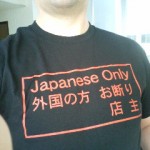
Many clubs, public bathhouses and even noodle shops have notices at their entrance stating Japanese Only, explicitly forbidding entry to foreigners. The police in Nagano Prefecture had notices displayed at ATMs, in which white-skinned confidence tricksters are to be seen, who are in the process of Japanese of the money, which they have just withdrawn.

Moreover, the popular leading politician, Shintaro Ishihara, the Governor of Tokyo, a man notorious for his racist outbursts, recently became responsible for the promotion of a campaign to bring the Olympics to Tokyo in 2016, something which does not bide well as a symbol of interracial understanding.

And Ms. Ogawa from the Tourism Office fears that worse may still come: ” The Government has asked us to carefully observe tourists’ mood regarding these changes over the coming few weeks. If Japan’s image really does drastically deteriorate, then in our final report, we may have to include the recommendation that that these measures be abandoned.”

===================

以上
Hopefully, all this typing has helped to destroy some of my fingerprints….
Ralph

Anonymous on NJ Fingerprinting: Pre-registering in Shinagawa a farce.

mytest

Hi Blog. Just sent to me by a friend. It’s important enough to deserve its own blog entry. Arudou Debito

==========================

Ah, human rights. I have just come from the Shinagawa Immigration office where I went to pre-register my fingerprints and photograph pending my upcoming Christmas trip to the US with my children. Here are my few observations with some venting, I fear, in between. Is the US this bad about this process?

1. Process is disorganized. A makeshift area has been set up at the counter where people apply for re-entry permits. The area is closed off by privacy screens, so it is impossible to find the machine where you are supposed to take a number. Many people, including me, mistakenly took number cards from the machine reserved for re-entry applicants. Eventually they stationed an immigration officer with a fistful of number cards in the vicinity, but they neglected to paste onto his forehead a sign that says “get your numbers here”, so there was confusion whenever someone stepped up to the area to start the process.

2. None of the officers in attendance can speak English, even though many people had questions.

3. The fingerprint machines were not working. Some people had to wait and then redo their fingerprints. They could not read my index fingers with the machines and eventually had to read my middle fingers. One woman standing next to me could not read any of her fingers despite repeated attempts with both hands. I have no idea how she will re-enter the country.

4. There was not an excessive wait.

5. The officers in attendance do not have any idea how the process will work for the exit from Japan or the re-entry. There were maps of the Narita immigration area pasted up on screens, but the attending officers did not seem to know what the maps meant and responded Shirimasen when asked questions in Japanese. And even more helpful, these maps were pasted on the INSIDE of the screens, not on the OUTSIDE where they could be examined by the hordes of gaijins who presumably need to know where to go when they get to Narita.

6. Most important, it seems that if parents residing in Japan wish to use the automated gate process when leaving Japan or when returning, they will have to be separated from their children. Children are not required to give finger prints, but at the same time, at the automated re-entry gates there will be no human beings to inspect the passports of the children. Thus, for re-entering families, it appears that the adults can go through the automated gates but the children, if they have re-entry permits, must stand in the line like we always did for returning Japanese and re-entry permit holders and will enter Japan separately. Except that, obviously, if the child is a baby or not experienced enough to do this alone, then they have to come in through the tourist line with a parent. So at the end of the day, if a family wishes to stay together, or has to stay together because of the age of the child, they must go through the tourist line (Yes, I know, it seems obvious that we need fingerprint taking capability at the re-entry permit line). This question was asked many times by parents who came to immigration to get their re-entry pre-registration, but none of the officers in attendance could answer the question clearly, and there is no information available in English to explain this. They could not even answer when asked in Japanese. I found out because while I was standing in line I asked my secretary to call the Ministry of Justice to find out the procedure. And of course, I let it be known to the gaijins around me what she had learned. Boy, let me tell you, there was a ton of frustration among these parents who had taken time to come all the way out to Shinagawa to pre-register themselves thinking to spare their family and tired children the agony of the tourist line only to find out that it was a complete waste of time.

7. Another confusing point in the process relates to the distinction between passports that are machine readable and those that are not. US, UK and other countries issue machine readable passports. Philippines, Pakistan and many other countries do not. For those countries, the immigration office has to put a bar code sticker onto the passport so that it can be read by the machines. This resulted in the creation of two separate application lines, one for the star belly sneetches and one for those who have none. Unfortunately, there was only one fellow holding a fist full of numbers. So the result was that he would call a number, determine whether the applicant was a star belly sneetch or one who has none, and then would allocate people to separate sub-lines. Then there was the comedy of calling out numbers in apparently random order to deal with the separate lines. Number 30, number 16, number 33, number 17. Very confusing, and they did not explain to people why they were treated differently, until I asked in Japanese and explained to a Philipino in the line, so that the information about the bar codes was thereafter passed down the plain belly sneetch line among the Philippinos and Pakistanis.

So, in conclusion, it appears that the much touted automatic gate line is useful only for returning businessmen, single residents of Japan and families with children over the age of 16. Otherwise, brace yourself.

Enough said? not sure what I will do when I come home from the states. Have a great day.
ENDS

Manitoban: NJ FP etc. “The Land of the Rising Shun”

mytest

Hi Blog. An article in The Manitoban (Canada) using lots of information from Debito.org, dispersing what’s been going on in Japan vis-a-vis NJ in Japan legally, socially, and logistically over the past 50 years throughout the Canadian steppes. Mottainai. Best to also put it on Debito.org for a wider audience.

Article courtesy of the author, thanks. Arudou Debito in Sapporo

===============================
THE LAND OF THE RISING SHUN
THE MANITOBAN (Canada), November 14, 2007
By Trevor Bekolay
http://www.themanitoban.com/2007-2008/1114/127.The.Land.of.the.Rising.Shun.php

If you or anyone you know is planning to go to Japan, be advised that beginning Nov. 20, all non-Japanese people will be fingerprinted and photographed upon entering Japan.

Unlike other fingerprinting laws, such as the U.S.’s, Japan requires permanent residents (the equivalent of Green Card holders in the U.S.) to be fingerprinted and photographed every time they re-enter the country. Those fingerprints and photographs are kept on file for 70 years and can be made available to the police and other government agencies.

While one could argue that permanent residents should just apply for Japanese citizenship, obtaining citizenship is a long and arduous process, which requires residents to give up their current citizenship. Unless you are willing to make those sacrifices, you are a foreigner, and you must give up your biometric information every time you cross the Japanese border.

History of the fingerprinting law

This Japanese fingerprinting law is an updated version of a fingerprinting program implemented in 1952, after the American occupation of Japan following the Second World War. The original fingerprinting law met with firm opposition from foreign residents in Japan, especially the Zainichi. The Zainichi are ethnic Korean and Chinese people born and raised in Japan. Despite living most or all of their lives in Japan, and despite 90 per cent of Zainichi adopting Japanese names, the Zainichi must go through the same application process as other foreign residents to obtain citizenship.

The 1952 law was opposed on the grounds that it was an official expression of mistrust for all things foreign. It was an unnecessary humiliation and alienation of residents who had lived their whole lives alongside their Japanese peers — Zainichi children were often not aware that they were of a different ethnic background than their schoolmates until they were contacted at their school to have their fingerprints taken. Further, it associated all non-Japanese people with crime. By law, a Japanese person may only be fingerprinted if officially charged with a crime.

Eventually, people started refusing to submit to fingerprinting; first the Zainichi, then other foreign residents. Since this refusal meant jail for some, the number of legal battles skyrocketed — enough so that overseas media like Time Magazine and the New York Times picked up the story. In 1989, under heavy pressure, the government of Japan granted general amnesty, and by 1998 the law was completely abolished.

After the dust had settled, Immigration Bureau officials said that “the fingerprinting system appears to be ineffective in stopping or reducing the growing number of illegal immigrants and visa overstays in Japan.” The Ministry of Justice noted that “the practice could be construed as a violation of human rights.” Then why is this law being reinstated?

Fears of terrorism and foreign crime

Japan’s Ministry of Justice explains the motivation for reinstating the fingerprinting law: “By collecting personally identifying data, such as fingerprints and facial photos of visitors to Japan, we will be able to identify persons considered to pose security risks, such as terrorists, and persons travelling with passports that are not their own. This will help us prevent terrorist attacks.”

If Japan wishes to fight terrorism, then history tells us that it is the Japanese population that should be policed. The Sarin gas attack that took place on the Tokyo subway in 1995 was perpetrated by members of the Japanese religious group Aum Shinrikyo. In the 1970s, two Japan Airlines flights were hijacked by a terrorist group called the Japanese Red Army. There have been no terrorist attacks in Japan by non-Japanese in recent history.

The public support for the fingerprinting law could also be attributed to a fear of foreign crime among the Japanese. Since 2000, the National Police Agency (NPA) has been releasing updates on foreign crime every six months with detailed press releases. The media has been quick to report on these releases, and further support this with unbalanced reporting of foreign crime compared to Japanese crime. One study found that crimes by foreigners were 4.87 times more likely to be covered than crimes by Japanese. Even more frustrating is the way the NPA twists the statistics.

The semi-annual press releases note increases in foreign crime without a comparison to the state of Japanese crime. The increases in foreign crime do not take into account the increase in the foreign population; while the Japanese population has remained relatively static, the foreign population has been growing steadily over the past decade. Foreign crime is inflated by including visa overstays (a crime that a Japanese person cannot commit) with harder crimes. When proper statistical practices are used, foreign crime is rising in proportion to the rate of population increase, while Japanese crime has doubled within the past 10 years.

It is interesting to note that in 1999, before the first press release detailing foreign crime statistics, the NPA established the “Policy-making Committee Against Internationalization.” Would such a committee receive taxpayer money if foreign crime was on the decline?

If fears of terrorism and foreign crime are unfounded, then what is the main issue that surrounds the fingerprinting debate? It’s the same issue that has been the subject of many recent legal battles: racism and xenophobia.

Racism and xenophobia

By most accounts, since the Second World War, Japan has a good international record as a modern industrialized nation. Japan has the third largest economy in the world, manufacturing and designing goods for a worldwide market. Despite claims of homogeneity, Japan is home to over 2.5 million residents of non-Japanese ethnic backgrounds. Japan is a member of the United Nations Human Rights Council. Yet walking through Tokyo, you can find buildings with “Japanese only” signs posted on the front door. “Japanese only” signs have been found at bathhouses, bars, stores, hotels, restaurants, karaoke parlors, and pachinko parlors. How is this legal?

The unfortunate answer is that Japan has no law against racial discrimination. It is unconstitutional — article 14 of the Japanese Constitution states that there shall be no discrimination on the basis of race. Further, Japan signed and ratified the UN Convention on the Elimination of Racial Discrimination in 1996. So, in theory, racial discrimination should not be tolerated; in practice, the lack of a law forbidding racial discrimination allows discriminatory behaviour, such as the “Japanese only” signs, to continue.

And these signs are unarguably discriminating on the basis of race. Social activist Arudou Debito became a naturalized citizen in 2000, after being denied entrance to a public hot springs in Hokkaido. Upon returning to the establishment a Japanese citizen, he was still refused entry to avoid confusion from the other customers. He sued the owner of the hot springs for racial discrimination and was met with moderate success. While he won some judgments, he lost an important decision when his appeal to the Supreme Court was dismissed for “not involving any constitutional issues.” The story of the incident at the hot springs and the ensuing legal battle is chronicled in his book Japanese Only.

Debito is not the only person to take these matters to the courtroom. In 1997, Brazilian Ana Bortz was asked by a jewelry store’s owner to leave his store, which had a strict no-foreigners policy. The store owner accused Bortz of planning a robbery. Bortz sued the store owner for violating her human rights, using the security camera footage as evidence. The judge ruled in Bortz’s favour, sentencing the store owner to pay 1,500,000 yen (approximately C$12,300) in damages and legal fees. The judge cited two articles of the UN Convention on the Elimination of Racial Discrimination, setting a good legal precedent for future discrimination cases.

Or did it? In 2004, Steven McGowan, a 41-year-old black man residing in Kyoto, was refused entry to an eyeglasses store in Osaka. Steve claims that the store owner said, “Go away. I hate black people.” Steve lost his case in a lower court because the judge did not believe that Steve’s Japanese language ability was good enough to accurately determine what the store owner said. Even after further investigation by McGowan’s Japanese spouse, the judge was not convinced that Steve was discriminated against because of his race, rather than his foreign status (the Japanese words for black person and foreigner are very similar). McGowan appealed to a higher court and was awarded 350,000 yen in damages; yet even at the high court, the judge remarked that the store owner’s remarks were “not enough to be considered racially discriminatory.” These decisions set the dangerous precedent that testimony by non-Japanese cannot be trusted if they are not completely fluent in Japanese. It also demonstrates the power one judge can have in Japan’s juryless court system.

A plea to Japan

In discussing these issues, it may seem that I have some disdain for Japanese culture. This can’t be farther from the truth — it is my fascination with and interest in Japanese culture that compels me to bring these issues to the forefront. It is only through open dialogue that conditions will improve for both Japanese and non-Japanese residents.

If Japan does not change its immigration policies, and birth rates continue at the current rate, Japan’s population will plummet from today’s 127 million to 100 million in 2050. It will become very difficult to maintain economic strength with such a reduced work force. Immigration is the easiest and most sustainable answer to Japan’s population crisis.

With increased immigration, there will have to be widespread changes in media and education. Though this seems prohibitively difficult at the moment, Japan’s rapid industrialization is proof that it is possible. By working together with its new generation of international citizens, I foresee Japan having a modernization of culture that will rival its rise to economic greatness.
—————————-

Trevor Bekolay studied Japanese language, history and culture at Tokyo’s Kokugakuin University in 2005.
ENDS

Der Spiegel: GRENZKONTROLLEN: Japans Furcht vor dem Fremden

mytest

Hi Blog. It’s not as though I can read German (the author sent this to me), but he says it’s more media favorable to our cause. English translation here. Thanks to Christoph. Debito in Sapporo

==============================
SPIEGEL ONLINE – 26. November 2007, 16:30
URL: http://www.spiegel.de/reise/fernweh/0,1518,519596,00.html

GRENZKONTROLLEN
Japans Furcht vor dem Fremden

Von Christoph Neumann
Ein Japaner braucht noch nicht einmal einen Personalausweis – biometrische Daten von Ausländern jedoch werden für 70 Jahre gespeichert. Bürgerrechtler wittern Terrorhysterie und Rassismus, das Fremdenverkehrsamt fürchtet um das Image des Landes.

“Yokoso!” – Willkommen! In leuchtend roten Lettern auf riesigen Plakaten begrüßt das Japanische Fremdenverkehrsamt ausländische Besucher am Flughafen. Der japanische Zoll empfängt die Einreisenden etwas weniger überschwänglich: Seit vergangener Woche müssen Ausländer nicht nur wie bisher den Pass vorzeigen, sondern wie in den USA auch ihre Fingerabdrücke abgeben, Fotos von sich machen lassen und ein kurzes Verhör durchstehen. Die Regelung gilt nicht nur für Touristen und Geschäftsleute, sondern auch für in Japan wohnhafte Ausländer. Ausgenommen werden nur Diplomaten, Kinder unter 16 Jahren sowie die Familien der im II. Weltkrieg nach Japan verschleppten Koreaner.

JAPAN: PROTEST GEGEN DEN FINGERABDRUCK
Fotostrecke starten: Klicken Sie auf ein Bild (4 Bilder)
Yuki Ogawa vom Fremdenverkehrsamt empfindet die Maßnahmen erst einmal nicht als Widerspruch zum herzlichen Willkommen: “Genau wie wir sind ja auch die Zöllner sind angewiesen, ausländische Gäste warm und offenherzig in Japan zu empfangen. Und es gab eben gewisse Fälle…”

Die “Fälle” illustriert das japanische Justizministerium mit einem Informationsvideo. Zunächst werden Szenen vom einstürzenden World Trade Center und vom zerbombten Madrider Atocha-Bahnhof gezeigt. Danach begründet eine lächelnde Sprecherin die verschärften Einreisebestimmungen explizit mit der “ständig wachsenden Terrorgefahr”. Bei der Feier zur offiziellen Inbetriebnahme des neuen Systems am Tokioter Flughafen Narita hatte Justizminister Kunio Hatoyama versprochen: “Damit werden wir wohl verhindern, dass in Zukunft al-Qaida-Terroristen ins Land kommen.”

“Ich leiste meinen Betrag”

Eine sehr selektive Terrorhysterie treibt bereits seit einigen Jahren seltsame Blüten in Japan. Auf Tokios Megabahnhöfen wie Shinjuku oder Ikebukuro mit über einer Million Passagieren täglich sind nach wie vor keine Sicherheitskräfte zu sehen. Dagegen werden Fahrgäste selbst in Bummelzügen und auf einsamen Landbahnhöfen mit Durchsagen und Plakaten traktiert, unbeaufsichtigtes Gepäck sofort zu melden, “als Maßnahme zur Terrorabwehr”.

Die Mitarbeiterinnen der weit verbreiteten “Kiosk”-Verkaufsbuden trugen im vergangenen Winter eine Zeitlang Anstecker: “Auch ich leiste meinen Beitrag im Kampf gegen den internationalen Terrorismus.” Die Frage, wie sie, eingeklemmt zwischen Tee-Plastikflaschen, Sandwiches und Tageszeitungen, sich denn konkret ihren Beitrag vorstelle, bürstet die resolute Verkäuferin unwirsch ab: “Das müssen wir jetzt alle anstecken, aber ich hab jetzt keine Zeit, darüber nachzudenken, was die damit eigentlich meinen.”

Dabei hat Japan als reiche westliche Industriemacht und Verbündeter der USA im Irak-Krieg einigen Grund, Terrorattacken zu fürchten. In jüngerer Zeit war Japan auch bereits Opfer mehrerer Terroranschläge, so beim Nervengas-Angriff auf die Tokioter U-Bahn im März 1995. Nur hätte auch eine noch so scharfe Zollkontrolle keinen Einzigen der Anschläge verhindert, denn alle Attentate auf japanischem Boden wurden bisher ausschließlich von Japanern verübt.

Protest gegen Personalausweis

Von vielen der eigenen Bürger aber hat das japanische Justizministerium nicht einmal Fotos, geschweige denn Fingerabdrücke. Japaner weisen sich oft nur mit ihrer Krankenversicherungskarte aus. Manchen Handy-Providern im vertrauensseligen Japan genügt sogar nur die letzte Stromrechnung als Identitätsnachweis. Als die Regierung vor ein paar Jahren endlich, wie sonst auf der Welt längst üblich, einen Personalausweis einführen wollte, nur mit Foto und ohne Fingerabdrücke, rollte ein Aufschrei des Protestes durch das Land. 2006 erklärte das japanische Verfassungsgericht den Ausweis schließlich sogar für verfassungswidrig.

Die Fingerabdrücke und Fotos der Ausländer in Japan dagegen sollen 70 Jahre lang gespeichert und “unter bestimmten Bedingungen” auch mit “Behörden anderer Länder” geteilt werden. Im Bundeskriminalamt reibt man sich vielleicht schon die Hände, aber japanische Bürgerrechtler sind in Aufruhr. Arudou Debito, Autor eines Buches über Rassismus in Japan, nennt die neuen Bestimmungen einen “Teil eines offiziellen Putsches, um alle Ausländer zu Verbrechern zu erklären”.

Makoto Teranaka von Amnesty International Japan erklärte bei einer Protestveranstaltung: “Seit dem 11. September werden auch in Japan unter dem Vorwand der Terrorismusbekämpfung alle möglichen Menschenrechte kaltblütig verletzt. Dass unsere Regierung mit den Maßnahmen jetzt die Ausländer zur Zielscheibe macht, ist nicht anderes als Rassismus.”

Die konservativen japanischen Medien feiern derweil, dass in den wenigen Tagen seit der Einführung des neuen Systems bereits elf Ausländer, die wegen Visavergehens ausgewiesen worden waren, beim Versuch der illegalen Einreise überführt werden konnten.

Diskriminierung wird gesellschaftsfähig

Zwar sind die meisten Japaner Ausländern gegenüber nach wie vor neugierig, freundlich und hilfsbereit. Aber die 15-jährige Wirtschaftskrise und ein sichtbar steigender ausländischer Bevölkerungsanteil haben viele Japaner nervös und offene Diskriminierung erstaunlich gesellschaftsfähig werden lassen.

Viele Clubs, öffentliche Bäder und selbst Nudelküchen verbieten auf Tafeln am Eingang explizit “Ausländern” den Zutritt: “Japanese only”. Die Polizei der Provinz Nagano hängte an den örtlichen Geldautomaten Plakate auf, auf denen Trickbetrüger weißer Hautfarbe zu sehen sind, die Japanern ihr gerade erst abgehobenes Geld rauben. Und der populäre Spitzenpolitiker Shintaro Ishihara, Tokios Gouverneur, ist berüchtigt für seine rassistischen Ausfälle. Dabei hat er sich vor kurzem offiziell mit Tokio für die Ausrichtung der Olympiade 2016 beworben, des Symbols der Völkerverständigung schlechthin.

Und auch Frau Ogawa vom Fremdenverkehrsamt ahnt doch noch Schlimmes: “Wir sind von der Regierung gebeten worden, das Stimmungsbild der Touristen in den nächsten Wochen genau zu beobachten. Wenn sich das Image Japans tatsächlich drastisch verschlechtert, kann es durchaus sein, dass wir in unserem Abschlussbericht eine Aussetzung der Maßnahmen empfehlen.”

ENDS

Chuugoku Shinbun: Fingerprinting “a new form of discrimination”

mytest

Foreign residents oppose fingerprinting as “a new form of discrimination against foreigners”
Chuugoku Shimbun 2007/11/18
Translated by Stephanie Coop
Original Japanese at http://www.chugoku-np.co.jp/News/Sp200711180227.html

Ahead of its implementation on Nov. 20, foreign residents in Japan are protesting the new immigration system requiring foreigners to be fingerprinted and photographed when entering Japan, arguing that “it’s a new form of discrimination.”

“I’m really sad that we will be forced to give our fingerprints even though we have committed no crimes. It’s just one more form of discrimination against foreigners,” a 29-year-old Turkish Kurdish man living in Tokyo said disgustedly. “Japan just meekly went along with what the U.S. wanted and got involved in the war in Iraq. I’d like to ask the government about the real reason for having to be worried about terrorism in the first place.”

“I’ve lived here for 15 years and was thinking of applying for permanent residence, but now I feel for the first time as if I’m being institutionally discriminated against. I feel really sad and angry about this,” said Australian national Stephanie Coop (38), a graduate student at a university in Tokyo. “I think that the previous attitude in Japanese society — being concerned about crime without automatically assuming that everyone is a criminal — is far safer and far more attractive [than the new system].”

Lawyer Chang Hannyon [note: not sure if this is the correct transliteration] (44), a third-generation Korean in Japan who was arrested under the Alien Registration Act in 1985 for refusing to give his fingerprints, is a special permanent resident. “If [the new system] is supposed to be an anti-terrorism measure, it’s strange that they are not also fingerprinting Japanese nationals and special permanent residents,” he said. “Why are only foreigners being treated like terrorists? There’s no rational reason for it, which means it is nothing but discrimination.”
ENDS

中国新聞:「新たな外国人差別」指紋採取に在住者反発

mytest

「新たな外国人差別」 指紋採取に在住者反発
中国新聞 2007/11/18
http://www.chugoku-np.co.jp/News/Sp200711180227.html
Thanks to Stephanie Coop

 「新たな差別だ」―。外国人に指紋と顔写真の提供を義務付ける入国審査制度が二十日から始まるのを前に、日本在住の外国人から反発の声が上がっている。

 東京都内に住むトルコ国籍のクルド人男性(29)は「何の犯罪もしていないのに、指紋採取を強制されるのは悲しい。外国人差別がまた一つ増えた」とやりきれない様子。「日本は米国に追従してイラク戦争に首を突っ込んだ。テロの心配をする必要があるのはなぜなのか、聞きたい」

 「日本で十五年暮らして永住も考えているが、制度的に差別されるのは初めて。とても悲しく、怒りを感じている」と話すのは、都内の大学院で学ぶオーストラリア国籍のステファニー・クープさん(38)。「人を見たら泥棒ではなく友達と思え。その上で犯罪は許さないという、これまでの日本社会の方が安全で魅力的だ」と嘆いた。

 一九八五年に指紋押なつを拒否し、外国人登録法違反容疑で逮捕された在日韓国人三世の張学錬チャン・ハンニョン弁護士(44)は特別永住者。「テロ対策というなら日本人も特別永住者も指紋を採らないとおかしい。なぜ外国人だけテロリスト扱いなのか。合理性がないということは、差別にほかならない」と怒りをあらわにした。
ENDS

NJ FP issue: Newsweek on damage done by model US-VISIT Program

mytest

Hi Blog. Only tangentially related to Debito.org, here is a Newsweek article quantifying the damages done by the US-VISIT Program, upon which Japan’s fingerprinting of NJ residents and tourists is based. As it says below, “The United States is the only major country in the world to which travel has declined in the midst of a global tourism boom.” Well, let’s watch Japan become the second country on that list.

It’s nice that we can have this dissent from a domestic outlet (unlike the completely stifled debate on, say, NHK), pity it took even an effervescent debate media like the US so long to start coming to its senses.

Points of interest in the article underlined. Arudou Debito in Sapporo

///////////////////////////////////////////

America the Unwelcoming
The United States is the only major country in the world to which travel has declined amid a tourist boom.

By Fareed Zakaria
NEWSWEEK Nov 26, 2007 Print Issue
Updated: 1:23 PM ET Nov 17, 2007
http://www.newsweek.com/id/70991
Courtesy of Shaney and others

As an immigrant, I’ve always loved Thanksgiving for all the corniest reasons. It’s a distinctly American holiday, secular and inclusive, focused on food, family and gratitude. But the one Thanksgiving tradition I try strenuously to avoid is travel. For those of you who must do it—and that’s 27 million people this year—brace yourselves for massive delays and frayed tempers. President Bush announced a few measures to ease congestion, describing this week as “a season of dread for too many Americans.” I only wish he would keep in mind that for foreigners now traveling to America, the dread is far more acute, and it’s lasted far longer than a few days in November.

Every American who has a friend abroad has heard some story about the absurd hassle and humiliation of entering or exiting the United States. But these pale in comparison to the experience of foreigners who commit minor infractions. A tourist from New Zealand, Rick Giles, mistakenly overstayed his visa in America by a few days and found himself summarily arrested for six weeks earlier this fall. Treaty obligations say his country’s embassy should have been informed of the arrest, but it wasn’t. A German visitor, Valeria Vinnikova, overstayed her visa by a couple of days and tried to remedy the situation—so that she could spend more time with her fiancé, the Dartmouth College squash coach. Instead she was handcuffed and had her feet shackled, then was carted off to be imprisoned. She now faces deportation and a 10-year ban on entering the United States. (Thanks to AndrewSullivan.com for drawing attention to these.)

According to the Commerce Department, the United States is the only major country in the world to which travel has declined in the midst of a global tourism boom. And this is not about Arabs or Muslims. The number of Japanese visiting the United States declined from 5 million in 2000 to 3.6 million last year. The numbers have begun to increase, but by 2010 they’re still projected to be 19 percent below 2000 levels. During this same span (2000–2010), global tourism is expected to grow by 44 percent.

The most striking statistic involves tourists from Great Britain. These are people from America’s closest ally, the overwhelming majority of them white Anglos with names like Smith and Jones. For Brits, the United States these days is Filene’s Basement. The pound is worth $2, a 47 percent increase in six years. And yet, between 2000 and 2006, the number of Britons visiting America declined by 11 percent. In that same period British travel to India went up 102 percent, to New Zealand 106 percent, to Turkey 82 percent and to the Caribbean 31 percent. If you’re wondering why, read the polls or any travelogue on a British Web site. They are filled with horror stories about the inconvenience and indignity of traveling to America.

For many, the trials begin even before they arrive. In a world of expedited travel, getting a visa to enter the United States has become a laborious process. It takes, on average, 69 days in Mumbai, 65 days in São Paolo and 44 days in Shanghai simply to process a request. It’s no wonder that quick business trips to America are a thing of the past. Business travel to the United States declined by 10 percent between 2004 and 2005 (the most recent data available), while similar travel to Europe increased by 8 percent. Discover America, a travel-industry-funded organization that tries to boost tourism, estimates that the 17 percent overall decline in tourism since 9/11 has cost America $94 billion in lost tourist spending, 200,000 jobs and $16 billion in tax revenues.

The administration and Congress say the right things, have passed a few measures to improve matters and keep insisting that the problem has been solved. But the data and loads of anecdotal evidence suggest otherwise. The basic problem remains: no bureaucrat wants to be the person who lets in the next terrorist. As a result, when one spots any irregularity—no matter how minor—the reflex is to stop, question, harass, arrest and deport. If tens of thousands of foreigners are upset, so what? But if one day a jihadist manages to slip in, woe to the person who stamped his passport. The incentives are badly skewed.

In his 2003 book “Courage Matters,” Sen. John McCain writes, “Get on the damn elevator! Fly on the damn plane! Calculate the odds of being harmed by a terrorist. It’s still about as likely as being swept out to sea by a tidal wave.” He added what seemed like a sound rule of thumb: “Watch the terrorist alert and when it falls below yellow, go outside again.”

Except that since 9/11, the alert has never dropped below yellow (which means an “elevated” level of risk from a terrorist attack). At airports, we have been almost permanently at orange—”high risk,” or the second highest level of alertness. Yet the Department of Homeland Security admits that “there continues to be no credible information at this time warning of an imminent threat to the homeland.” The department’s “strategic threat perspective … is that we are in a period of increased risk.” What is this “strategic perspective?” Is it the same as the “gut feeling” that Secretary Michael Chertoff cited when he warned, in July, that we were likely to be attacked during the summer? Or is it a bureaucratic mind-set, the technical term for which is CYA? [Cover Your Ass]

URL: http://www.newsweek.com/id/70991
ENDS

Peter Barakan to talk about NJ Fingerprinting etc. on NHK radio Dec 6 5PM

mytest

Hi Blog. Got this info from Japanese TV personality, music specialist, and all-around nice guy Peter Barakan. Edited for public consumption. Listen in if you can, even contribute your opinions… Arudou Debito in Sapporo

===============================
Hi Dave. It’s been quite a while since I met you at that Amnesty get together. I try to keep up with your posts as far as I can.

I’m writing today to let you know about a radio show on NHK’s AM radio in which I’ll be taking part. It’s “Iki-iki Hotline,” on Thursday Dec. 6th, from 5 to 6 pm, and is the fourth of five shows on topics related to foreigners in Japan.

The details are not yet up on NHK’s website, but the show I’ll be on is entitled:
外国人はどう望む? 日本社会での暮らし (外国人の意見)

and the accompanying blurb goes:
均一傾向の強い日本人は、文化の異なる外国人との付き合いが得意でないといわれている。しかし国際化・グローバル時代を迎えた現在、様々な場面で多くの外国人と付き合わざるを得ない。外国人と共生していくための知恵と工夫を、外国人のサイドから考える。

I’ll be the only guest that day, but they take faxes, emails, and in some cases phone calls from listeners during the show, which is live. I met with the director today, and he said he would welcome input from foreign residents, so I immediately thought of [Debito.org].

I intend to talk about the new immigration fiasco, among other things, but something on human rights, for example, might be interesting. I’ll leave it to you. Please feel free to pass the word on to anyone else who might be interested.

Cheers
Peter Barakan
===============================
ENDS

Reminder: Online Petition against NJ Fingerprinting

mytest

Hi Blog. Thanks to the FP issue, we get a huge turnover of posts. This one deserves a reminder:

Online Petition against NJ Fingerprinting. If anyone else is blogging in Japan or anywhere in the world, because the petition is for anyone with an interest in Japan, please do the same. Right now we don’t have enough names to make a difference. Please sign and get your voice heard!

http://www.ipetitions.com/petition/fingerprints-japan/

Go sign if you haven’t. Tell your friends to sign if they haven’t. I have. Debito in Hirosaki

James Fallows of The Atlantic Monthly on NJ Fingerprinting

mytest

Hi Blog. They fingerprinted the wrong guy already… Given how critical Jim Fallows was when he lived in Japan more than a decade ago (famously writing “Containing Japan” for The Atlantic in 1989–something I read in grad school!), this was not long in coming… And as always he produces angles we never thought of–such as how if China instead had instituted this, the Western Media would be talking about “Big Brother in Beijing”. Touche. Arudou Debito in Hirosaki.

=================================

Not so thankful for this at Thanksgiving (Japan Big Brother dept)
The Atlantic Magazine online 24 Nov 2007 09:39 am
By James Fallows, courtesy of Yanpa
http://jamesfallows.theatlantic.com/archives/2007/11/not_so_thankful_for_this_at_th.php

Flying from Beijing to Tokyo this morning — generally an invigorating experience! Japan looks startlingly neat and organized even if you’re arriving from Switzerland. And when you’re coming not from Switzerland but from China…. Anyhow I arrived excited at the prospect of a few days here.

Unfortunately Japan’s way of ushering in the Thanksgiving holidays has been to institute mandatory fingerprinting and photographing of all foreigners entering the country. Let me put this bluntly: this is an incredibly degrading, offputting, and hostility-generating process. The comment is not anti-Japanese: when the U.S. does this to foreigners, it’s wrong and degrading too (as many people, including me, have pointed out over the years). But Japan has just ushered in this procedure, and they deserve to take some heat for it.

Partly this is a nuisance because of the sheer time drag. Today’s flight time Beijing->Tokyo: 2 hours, 50 minutes. Today’s time spent in the passport clearance line for foreigners at Narita: 1 hour, 30 minutes. But mainly there is no getting around the insult factor of having entry to the country be like getting booked into County Jail.

In specific this means: you have to stick your left and right index fingers simultaneously into a scanner, and press them down until a signal shows that the system has captured both prints. A sign that flashes up in a variety of languages — Korean, English, Portuguese, Chinese, Spanish, etc — tells people that if “for whatever reason” they are “unable” to offer prints, then they can ask to see the supervisor. I assume that they’re talking about people who have no hands etc. (Or Japanese gangsters, yakuza, who often get fingers cut off as part of their careers? Oh, wait: they’re not foreigners.) I was considering saying that my “whatever reason” is that I objected to the policy. Then I realized how much good that would do, and stuck my fingers into the contraption.

Five seconds after the prints, a camera snaps a picture. As a long time admirer of Nick Nolte, and in a state of mind enhanced by the forced-fingerprinting, I made sure my photo looked very much like this:
nicknolte.tiff

Does this requirement make any practical difference to me? No. I’ll only be here a few days, and if I’m going to rob a bank in that time, I’ll put tape over my two index fingers so they’ll never catch me. Presumably most of the several million foreigners who are long-time permanent residents of Japan, and who will be required to go get prints and photos too, will avoid the practical consequences as well.

But it’s worth saying this is a bad policy, because:

– The reasoning is predictably fatuous. A video explains the change as an important anti-terrorist tool. Puh-leeze.

– It’s one thing, and wrong enough, for the U.S. to apply similar measures in the panicky, immediate, “we’re for anything that is called ‘anti-terrorist’ ” mood of the 9/11 aftermath, which is when the U.S. began discussing similar “biometric” measures. It’s even worse to do it six years later, after a chance for cold deliberation about the prices society is and is not willing to pay to keep itself “secure.”

– Fewer tourists are visiting the U.S. because we’ve made it such a nightmare for foreigners to get in. That is just deserts for a misguided policy on America’s side. Japan is repeating the same mistake — with eyes wide open.

– Think how the alarm bells would go off if China tried to impose a scheme like this! The editorials about “Big Brother in Beijing” practically write themselves. But now the two countries that apply the most intrusively big-brotherish surveiliance over those trying to visit are two liberal societies: the United States and Japan.

C’mon Japan, set a good example for America rather than imitating something stupid we do now. The people around me in the passport line — and, in 90 minutes, we had time to talk – were from a dozen different countries and many walks of life. But they were united in one sentiment as they moved toward the fingerprint machine, and it’s not one that Japan’s diplomacy is designed to foster.
ENDS

Irony: Japan Post Office issuing “YOKOSO JAPAN” stamps January

mytest

Hi Blog. Here’s your daily hohoemi–with irony. Courtesy of HG:

===========================
Hey Debito, Japanese Post is planning 10 commemorative stamps for Jan. 23, 2008 to promote the YOKOSO JAPAN campaign.

http://www.post.japanpost.jp/kitte_hagaki/stamp/tokusyu/2007/h190123_t.html

(Nothing on the stamps in English, of course. And nothing on the official YOKOSO JAPAN Blogs about the new Fingerprinting rules, of course.)

10 million foreign tourists by 2010? Say WHAT?

So far, less stringent measures (Green Card holders are exempt) in the US have led to a drop totalling 6 million tourists on a yearly basis since introduction of the FP requirement. Despite an ever weaker dollar (shall we now call it “North American Peso”?? *ggg*).

BTW, face value of the stamps is 80 yen each – domestic first class postage. So the foreign tourists are mainly left out of this… ;-).
===========================

Amazing. Stamps for tourists that tourists can’t even use to send a letter home? Provided the tourists want to come here anyway and be treated like terrorists and criminals. Makes you wonder if policymakers ever think things through. Debito

Japan Times: Mark Schreiber gives Immigration the finger at Narita

mytest

Hi Blog. Mark Schreiber from the Japan Times gives us an amusing account on what happened to him when he took a junket to Saipan, just to test the Fingerprinting machines on the way back… Debito in Sapporo
=============================

THE ZEIT GIST
Prints rejected, scribe accepted
Our writer attempts to give Immigration the finger at Narita
By Mark Schreiber
The Japan Times November 27, 2007

http://search.japantimes.co.jp/cgi-bin/fl20071127zg.html

The center of the little monitor — I’d guess about 20 cm from the looks of it — flashed the word “Yokoso” (welcome). Its colored border was festooned with a collage of images near and dear to visiting tourists’ hearts: “torii” gates, the shinkansen, Zen gardens, Mount Fuji . . .

“Please place your fingers on the pad,” ordered the immigration officer from behind the counter.

Before I relate more sordid details, let’s begin at the beginning. Having heard much emotional debate on the new fingerprinting system, I decided that I would leave and re-enter Japan for the express purpose of subjecting myself to this supposed indignity, and then deal with it in the most exhibitionistic manner possible: the article you are now reading.

It seemed reasonable to give Narita Immigration five days to get its act together, so I flew down to Saipan and entertained myself with a visit to Banzai Cliff. My return flight, Northwest Airlines 75, touched down at Narita at 6:50 p.m. on Nov. 24.

First and foremost, let me make it crystal clear where I stand on this matter: I don’t particularly like to give my fingerprints. Nevertheless, my strongest objection to the new system relates less to my human rights than to my wanting to exit the airport as expeditiously as possible. Since 9/11, air travel has become a nightmare, and after undergoing security checks up the kazoo and being cooped up in a stuffy tourist-class cabin for 12 hours on a flight from Chicago or Detroit, I’m in no mood for further torment.

One more thing: For more than 20 years, holders of re-entry permits were permitted to use the same gates as Japanese nationals, with no questions asked. I’ve always appreciated this privilege and felt aggravated that, through no malfeasance on my part, this consideration — a great time-saver — was apparently being withdrawn.

That said, if I were to report that I was forced to cool my heels in a long queue last Saturday, it would be an outrageous lie. The fact was, it was the mostly Japanese passengers who did the slow shuffle. At that particular time few foreigners were in evidence and as a result, fingerprinting aside, I was probably one of the first ones out of the place.

As soon as I made my approach, a senior official pounced on me like he’d been waiting there all day just for my arrival.

“Have you filled out one of these E/D cards?” he asked with an encouraging smile, waving one of those familiar entry/departure cards with its incomprehensible questionnaire on the back.

Indeed I had, so I was sent straight to the nearest vacant counter.

The young inspector was all friendly and smiley. He took one look at my passport and knew I was going to be a piece of cake: a permanent resident, papers in order, and nobody named “Mark Schreiber” on Interpol’s terrorist watchlist. (Little did he know, nya-ha-haa . . .)

Then the moment of truth arrived, and he requested me to place my left and right index fingers on the little glass pads. I sighed, set down my six-pack of duty-free macadamia and chocolate chip cookies on the floor, and followed his instructions.

The green lights beside my fingers changed to red. Something was not working properly.

“Um, I can’t seem to get a clear reading off your fingers,” he said, popping open a container of premoistened finger wipes. “Please use this to clean them and try again.”

I gave both fingertips a quick but thorough rubdown and repeated the process.

After several clicks from his keyboard he shook his head again.

He stood up, reached over, and used the same wipe to polish the glass surface of the fingerprint reader.

“OK, uh, this time, let’s try your middle fingers,” he encouraged, holding up his digit in an unintentionally rude gesture some people refer to as “flipping the bird.”

Once again I complied. Click-click-click. Click-click. Click.

“Please, would you mind not pressing down so hard on the pad?”

“But I’m not pressing down hard,” I countered.

From his exasperated reaction I got the distinct impression my middle fingers were not providing usable prints either.

“Well, anyway, let’s take a picture,” he grimaced, standing up and tilting the camera angle upwards to accommodate my 189 cm height.

And that was that. Confirming that I looked like the captured image, and that both resembled the mug shot in my passport, he waved me through.

“Gokuro-sama,” I told him — by which I meant “Sorry to give you such a rough time” — and headed for the baggage carousel.

But wait a minute: My prints didn’t take. Why wasn’t I dragged off into a separate room and interrogated? Why, after all the fuss, was I simply admitted on the strength of my passport, status of residence and re-entry permit?

It would seem that human officials, at their discretion, are empowered to overrule the almighty fingerprint thingamajig.

After relating my experience to a friend on Sunday, he directed me to a BBC News item dated Oct. 17, 2005, in which a fingerprint expert is quoted as saying that “Work such as laboring and typing (italics mine) wears down those ridges and affects the smoothness of the skin. It can make fingerprints very hard to read.”

So my first encounter left me chuckling that the government laid out ¥36 billion for something anyone can outwit by pounding a keyboard, as I do, for 14 hours a day.

Just think: four of my fingers, with no help from their owner, pulled off a courageous feat of passive resistance. In the ongoing struggle for foreigners’ rights in Japan, let them henceforth be known as the “Narita Four.”

On a separate note, there’s been much talk about a system that permits residents to pre-register their biometric data prior to departure, either at the main Immigration office in Shinagawa or in the departure areas at Narita.

I hate to be the bearer of bad news, but I can’t see any point to this, either in terms of time savings or exemption from the big, bad biometric bogeyman. Pre-registration or not, unless you’re a Japanese national or a “special permanent resident” (and if you have to ask what that is, you’re almost certainly not one), you will still be obliged to give your fingerprints every time you enter the country.

So unless Japan suffers a drastic dropoff of foreign visitors and operators of hotels with single-digit occupancy rates begin screaming bloody murder to their Diet representatives, I suppose we’re stuck with this newfangled nuisance for the duration.

At least the government ought to consider a way to recover some of its outlays. Let’s turn the immigration gates over to a private operator and put the system on a paying basis. For instance, they could program the fingerprint and face scanners to detect things like razor nicks and chipped nails that invite commercial exploitation.

Upon giving one’s fingerprints, personalized messages would scroll across the monitor. “Yokoso to Japan, Mark Schreiber-sama. While here, check out our latest USB-portable multi-blade shaver.” Or, “Yo, Schreiber-kun. Pamper your fingers, and give their ridges the nutrients they need with Mother-of-Pearl Cream — for typists, pianists and . . .”

Yokoso, anybody?

Send comments on this issue and story ideas to community@japantimes.co.jp
The Japan Times: Tuesday, Nov. 27, 2007

ENDS

Economist on NJ Fingerprinting

mytest

Here’s The Economist (London) on the NJ Fingerprinting Debacle. FYI. Nothing really new (except a silly bit on butterflies), but ample airtime given to the critics and the controversy, thanks. NHK, take note. Debito

==============================

Japanese immigration control
Giving you the finger
Nov 22nd 2007 | TOKYO
From The Economist print edition

http://www.economist.com/world/asia/displaystory.cfm?story_id=10184633
A controversy over fingerprinting foreigners

IN 1641 Japan’s shogunate designated an artificial island in Nagasaki harbour as the only place foreigners could live. Japan has of late been more welcoming to gaijin. Yet this week it began to photograph and take digital fingerprints of all foreigners entering the country—residents as well as tourists and visiting businessmen. Privacy advocates deplore the emergence of a surveillance state. Pundits say it panders to anti-foreign sentiment in Japan, and undermines the country’s ambitions to increase tourism and make Tokyo a global financial centre. Angry expats expect long waits at immigration.

In defence, the government says the measures are simply to keep terrorists out. As an example, Japan’s justice minister, Kunio Hatoyama, a butterfly enthusiast, explained that a friend of a lepidopterist friend was an al-Qaeda operative, who for years travelled in and out of Japan on fake passports; the new measures would block the chap. Mr Hatoyama was quickly forced to backtrack lest it appear that ministers run around netting butterflies with terrorists. Yet the truth remains: terrorism in Japan has only ever been home-grown, most recently in 1995, when a sarin gas attack by a religious cult killed 12 in Tokyo’s subway.

The system mirrors America’s equally controversial US-VISIT programme. In principle, it should not cause such a fuss. All countries are moving towards the collection of “biometric” information: from next year, Britain will collect such data from visa-holders. The problem comes with implementation. America’s US-VISIT system is fraught with flaws and cost overruns. Technical problems have delayed Europe’s introduction of digital passports. For all Japan’s prowess in designing computers, the government is peculiarly inept at running them. This year, it admitted it had lost 50m electronic-pensions records.

Exempt from the new screening are diplomats, children under 16 and certain permanent residents (ethnic Korean and Taiwanese who have lived in the country for generations). Why only gaijin? Japan already has all sorts of ways to keep watch on its own people, such as “neighbourhood associations”. Foreigners are outside these social controls. Yet fingerprinting foreigners is just a first step to securing the biometric details of everyone entering and leaving: as it is, frequent travellers, Japanese as well as foreign residents, may save time by pre-registering to use an unmanned automatic gate at airports that takes photographs and fingerprints.

Mr Hatoyama says people should not be delayed more than the 20 minutes it already takes immigration officers to process visitors. This week some of the machines played up, but most travellers fell into line. Officials even claimed to have caught a handful of people who had already been deported at least once. They did not reveal whether they were butterfly collectors.

ENDS

Towards founding a “Permanent Residents/Naturalized Citizens” organization

mytest

Hi Blog. With all the NJ anger regarding the new Fingerprint Laws–moreover the GOJ’s tendency of consistently showing indifference, if not outright antipathy, towards the needs and interests of Japan’s international residents–there have been comments in several Debito.org blog entries calling for the creation of a new organization to represent the Permanent Residents and Naturalized Citizens of Japan.

I agree the time is nigh. And I am very supportive of the founding of such an organization. We are talking as far as establishing a dues-paying registered NGO/NPO to that end, with the ability to lobby and lend support to other groups to pursue the interests of Japan’s international residents.

The organization is still in its embryonic stage. But let me create this separate special blog entry for people to discuss and pound out questions and concerns.

Steve Koya (who says he can take care of accounting, a job I detest) and I will meet sometime next week in Sapporo to chew things over. If you’d like to contribute your thoughts and feelings, please do so now.

My first thought: The very name in Japanese–which is fundamental to credibility in this country.
HIEIRI DANTAI NIHON EIJUU KIKA IMIN JUUMIN KYOUKAI

Translated literally as:
NPO Japan Association for Permanent Residents, Immigrants, and Naturalized Citizens
(JAPRINC)
Okay needs work. Anyone good with anagrams? Scrabble players?

I’ll leave you with some questions I got from John L. tonight. Arudou Debito in Sapporo

================================
 Hey…it’s John again writing you on a business trip in Shanghai.

My two conference calls this morning were canceled, so I decided put my time to use on homebound issues, such as this association which seems to have gained some significant – and surprising – traction over the past 24 hours.

I am submitting, for approval to post on your blog as a new and separate topic, a set of questions we should consider, a mission statement draft and, lastly, a small opinion piece.

Now, if you’ll pardon me, I have to go and sand down my fingerprints in anticipation of my return to Japan on Sunday.

Cheers,
– John

*****

It appears that the call for an association of resident foreigners is gathering steam. To that end, I have some questions and would like to take a stab at a mission statement here.

QUESTIONS:

1) Is this association for PRs only or for all foreign residents, regardless of status? If for all, how do we handle issues which may affect only certain segments of the foreign resident population, such as voting rights (which could be reasonably applied only to PRs)?
2) What are our membership requirements? (i.e. can anyone join, even if they are not living in Japan? In other words, for instance, can someone living in England who has a strong interest in Japan join?)
3) Related to 2) above, what different level of memberships could be available?
4) Can Japanese nationals join? (Of course they can, but we need to attend to other details, such as: are they given voting status in issues, can they hold official titles, etc.)
5) What is our stance on illegal immigrants? This is a policy debate that we can take up after we do form, but I want to put this on deck now so we can all start to consider the kinds of questions we will be tackling after forming.

MISSION STATEMENT DRAFT

The association is committed to protecting and enhancing the rights of foreign residents in Japan, abolishing systematic discrimination and changing the perception of foreign residents in Japan. We are committed to instituting persistent campaigns to educate, inform and motivate change at all levels of Japanese society in order to integrate new and progressive attitudes of foreign residents.

Our goals

– To promote the image of foreign residents of Japan to the indigenous population as well as globally.
– To highlight the benefits and positive impacts of foreign nationals to Japanese society
– To organize and campaign against negative or demeaning views of foreign residents as stated by certain politicians, pundits and media outlets.
– To educate foreign residents on the immigration laws of Japan
– To negate and diminish the negative views of foreign residents among the Japanese public
– To organize as a group and lobby for equal rights for resident foreigners under the law.
– To abolish systematic discrimination against the foreign community
– To participate in activities highlighting discriminatory practices against foreign residents

QUICK OPINION PIECE

The association is, by its very definition, an activist organization, but the activities must take on a multiple facets. Naturally, we must continue to highlight those instances where discrimination does exist and call with a unified voice for its removal. However, we should not focus only on the perceived wrongs committed by society as that tends to play us as victims and people tend to tune out after hearing complaint after complaint, but we should shed light on the positive aspects of resident foreigners in Japan. We know that the system can be rigged against us in many instances. We should concentrate on those who have overcome the difficulties, who have succeeded against the challenges. We can show that people can move to Japan and make a change for the better.

ENDS

Fingerprinting protest tract for Immigration & new FP protest info website

mytest

Hi Blog. Thomas Bertrand writes:

==========================
Hi there, the trilingual (Japanese, French, and English) tract against fingerprints policy is done!

More info on fingerprinting protest site reentry japan:
http://reentryjapan.blogspot.com/2007/11/here-is-tract-you-may-consider-using-to.html

Download it, print it, show it, put in your bar, restaurant, on your car, on your desk, give it to the immigration officer, to your friends…

(click on image to expand in your browser)
ReentryJapanProtest.jpg

Thomas Bertrand and friends.
==========================

COMMENT: Well done. Pass it around online and make copies for distributing in the real world. Arudou Debito in Sapporo

Asahi: US-VISIT database riddled with mistakes: 38% of entries

mytest

Forwarded by a friend. So much for the effectiveness of the US-VISIT system the current Japanese NJ fingerprinting regime is modeled upon. First the source of the article (the table of contents), then the article with pertinent sections underlined. The article, btw, has long been unavailable online at Asahi.com. No wonder. Which is why I had to wait until I got this source. Arudou Debito

======================================
AMERICAN EMBASSY, TOKYO
PUBLIC AFFAIRS SECTION
OFFICE OF TRANSLATION AND MEDIA ANALYSIS
INQUIRIES: 03-3224-5360
INTERNET E-MAIL ADDRESS: otmatokyo@state.gov
DAILY SUMMARY OF JAPANESE PRESS
November 21, 2007

INDEX:
(1) US needs to see progress in nuclear, abduction issues for N. Korea delisting: Bush [Sankei] 2
(2) Fukuda diplomacy takes first step toward “synergy”: Premier Wen reacts favorably [Asahi] 3
(3) Leaders of Japan, China, South Korea play up friendly mood, laying aside pending issues [Nikkei] 4
(4) Nukaga treated by Mitsubishi [Akahata] 6
(5) Editorial: Do we want to entrust the compilation of the state budget to Finance Minister Nukaga? [Asahi] 6
(6) Ruling, opposition parties to find way to reach agreement on bills [Asahi] 7
(7) US N-flattop unsettles local host communities [Tokyo Shimbun] 9
(8) US system of screening visitors: mistakes, contradictions found in 38% of those cited on monitoring list [Asahi] 10
(9) Policy watch: Face up to the economy slipping [Sankei] 11
(10) TOP HEADLINES 13
(11) EDITORIALS 13
(12) Political Cartoon 15
** Next Daily Summary will be issued on November 26. **

EXCERPT

(8) US system of screening visitors: mistakes, contradictions found in 38% of those cited on monitoring list

ASAHI (Page 2) (Excerpts)
November 19, 2007

Arriving foreign visitors form a long line at the immigration section at John F Kennedy Airport in New York to have their fingerprints taken from the index finger of each hand. Visitors have to wait for more than one hour when a number of flights arrive.

The US-visit system was introduced in 2004. The system is almost the same as Japan’s. Anna Hinken, an officer of the US Department of Homeland Security, proudly said: “We have rejected the entry of more than 2,000 persons who were considered a security risk since the system was introduced.”

But a US government agency poses questions about the system’s technology and credibility. This July, the US General Accounting Office criticized the US-visit system as seriously fragile in view of information control. He pointed out the possibility that personal data, including fingerprint data, might be altered or copied by someone from the outside due to insufficient security measures.

In September, an auditor of the Justice Department emphasized how inaccurate US blacklists are. The auditor said that as a result of a sampling check of the terrorism-affiliates included in a monitoring list, mistakes or contradictions were found in 38% of those checked, with the names of some terror suspects left out of the list or innocent persons appearing on it.

The monitoring list was compiled by integrating those of such government agencies as the FBI and the Transportation Security Administration, and the list is not open to the public. As of April this year, the number of those listed was 700,000. The number reportedly increases by 20,000 per month.

American Civil Liberties Union member Barry Steinhardt said: “There should not be so many terrorists. The list is unreliable. In addition, since the list is classified and not publicized, it is impossible to check how effectively it has worked to prevent terrorism.”

The monitoring list has also affected civic life. There are cases in which citizens unrelated to terrorism appeared on the list or in which a person who has the same family and personal name as a certain suspect was stopped at an airport security check.

The US-visit system also tends to give travelers an unpleasant impression about the nation.
ENDS

Accenture, producer of NJ fingerprinting machines, is hiring in Japan, thru Tiger Woods!

mytest

Hi Blog. Accenture ( formerly the crooked and now defunct Arthur Andersen, accounting firm and book-cooker for Enron), is riding the wave of its cheap bid to build Japan’s biometric machines by expanding its operations in Japan! As reader Leslie writes:

//////////////////////////////////////////////
Debito,

Saw this ad in the subway yesterday. Seems Accenture, the offshore company with the contract to collect biometric data on foreigners in Japan, is hiring!

(Click on image to expand in your browser)
accenture.jpg

I am also astounded that foreigners arriving in Japan and refusing to give MOJ/Accenture their data will now officially have physical force used against them to force the extraction of the personal data. Nightmarish. Leslie
//////////////////////////////////////////////

The profiteering never stops from companies like these, especially when the GOJ is under pressure from the local hegemon to contribute to the war effort (plus, buying American sure helps). Perhaps Tiger Woods, pictured in the advertisement, would enjoy being treated as a potential terrorist and criminal next time he comes for a round of golf in Miyazaki?

See more about Accenture’s involvement in the biometric data market on Debito.org here. Arudou Debito in Tokyo
ENDS

Fingerprinting: Anger in the Blogosphere

mytest

Hi Blog. Lots to do this weekend in Tokyo at JALT, so I’ll be brief:

In all my twenty years of Japan, I’ve never seen the NJ communities so angry.

Not during the “gaijin all have AIDS” scare of 1986, the Otaru Onsens Case of 1999, the Ishihara anti-gaijin anti-crime “Sangokujin Speech” media campaigns of 2000, the “anti-hooligan” scare before and during World Cup 2002, the Al-Qaeda scare of 2005, or the “foreign crime is rising” National Police Agency media campaigns every six months. This time, there’s a very “faith no more” element to it all.

I am receiving links to angry diatribes on the Fingerprint policy in the Blogosphere. Two that leave a lasting impression:

Running Gaijin Card Checks
http://www.keepingpaceinjapan.com/2007/11/running-in-fear.html

Oppose Japan’s bid for The Olympics
http://nofj16.googlepages.com/home

If you know of any more, please send links to the comments section below. Angry, humorous, ironic, and/or poignant is fine, racist is not, so exercise discretion.

The point is, how else are NJ going to express their anger when they are this disenfranchised in Japanese society? Where the media machines for manufacturing consent will ultimately pit the entire Japanese society against the “gaijin”–through completely unfounded assertions of criminality, terrorism, and allegedly effective preventative measures which single people out for discrimination by race, nationality, and national origin.

How else? The Blogosphere. Vent away.

How things work over here to create “Team Japan vs. The World” has never come out as clearly as now. Arudou Debito in Tokyo

France 24 TV & Trans Pacific Radio on Fingerprinting: “Japan’s 1984”

mytest

Hi Blog. TV Network France 24 has a good report on the FP policy, with an interview with a national bureaucrat, Teranaka Makoto of Amnesty International, and yours truly.

////////////////////////////////////////////
English:
Tuesday, November 20, 2007
Japan’s 1984: Japanese authorities have introduced American-style immigration law. Foreigners will have to be fingerprinted and photographed evey time they enter the country – a law that some regard as Orwellian. (Report: N. Tourret)

http://www.france24.com/france24Public/en/reportages/20071120-japan-society-immigration-law-fingerprint.html

Francais:
mardi 20 novembre 2007
Le Japon durcit les conditions de circulation: Le Japon a durcit sa législation vis-à-vis des voyageurs étrangers. Désormais, photographies et empreintes digitales seront imposés dans les aéroports. Le sujet suscite un large débat. (Reportage : N. Tourret)
http://www.france24.com/france24Public/fr/reportages/20071120-japon-loi-immigration-empreinte-digitale-photographie.html
////////////////////////////////////////////

While I’m at it, here is a link to my latest podcast, up on Trans Pacific Radio. Yes, it has information on fingerprinting, of course…

http://www.transpacificradio.com/2007/11/22/debitoorg-newsletter-for-november-19-2007/

Also, to people who have written me emails recently–they’re piling up in my in-tray at the moment, sorry. I will get to them when I have some time (and also translate a couple of favorable articles on the FP issue from the Hokkaido Shinbun), but I’ve got two speeches I’ve gotta work on coming up this weekend at JALT Tokyo, regarding job searches for their Job Information Center:

==========================
Getting a job in Japanese academia: Avoiding pitfalls
Arudou Debito

* Saturday, 4:10 pm – 5:10 pm, Room 102
* Sunday, 9:50 am – 10:50 am, Room 102

Japanese academia is in crisis. Although demand for language education is not in jeopardy, the number of secure jobs for both Japanese and non-Japanese is shrinking, as contracted work replaces tenure. The times require job searches with eyes wide open. This workshop will give some advice on how to avoid the potentially lousy jobs, some job-condition benchmarks, and some things to ask your potential employer before taking a job that could have no secure future.
==========================
http://conferences.jalt.org/2007/pd-workshops

Perhaps see you there. Jumping on a plane to Tokyo in a few hours, Arudou Debito in Sapporo

Mainichi: MOJ will force NJ refusers to be incarcerated, fingerprinted

mytest

Hi Blog. According to the Mainichi today, the Justice Ministry has now issued a “tsuuchi” directive (the GOJ Mandarins’ way of minting laws without going through a legislative body) granting Immigration more powers. People who refuse to get fingerprinted will not only be refused at the border, but also forced to have fingerprints taken. as well as a physical inspection and incarceration in the airport Gaijin Tank.

What this means in the event uncooperative Permanent Residents and their Japanese spouses, the article notes, is incarceration with “extra persuasion”–without, they say, the threat of force. With all this extralegality going on, fat chance. Arudou Debito in Sapporo

/////////////////////////////////////////

FOREIGN FINGERPRINTING: NONCOMPLIERS FORCED TO BE FINGERPRINTED: MOJ
Mainichi Shinbun November 21, 2007
http://headlines.yahoo.co.jp/hl?a=20071121-00000017-mai-soci&kz=soci
Translated by Arudou Debito, Courtesy of Tony K

As an anti-terrorism etc. measure under the new Immigration inspection system, requiring fingerprints from all foreigners coming to Japan [sic], the Mainichi has learned that The Ministry of Justice’s Immigration Bureau has issued a directive (tsuuchi) to all regional divisions, saying that foreigners who refuse fingerprinting and rejection at the border [sic] are to be forced to be fingerprinted.

Although the Ministry of Justice originally explained this system as an “offering” (teikyou) of fingerprints without coercion, they have now indicated that they will impliment this measure with the option of compulsion (kyouseiryoku) against anyone who refuses. It is anticipated that this will strengthen criticisms that “this system is treating foreigners as criminals”.

This policy of collecting biometric data is being effected at airports and seaports whenever foreigners enter the country, compared on the spot with stored Immigration data of people with histories of being deported from Japan, or blacklisted overseas. If fingerprints match, entry into the country will be denied, as will people who refuse to cooperate with the collection of data.

If the person denied refuses to comply with the deportation order, Immigration will impliment forceable deportation orders and render the person to a holding cell within the airport. Whether or not fingerprints will be taken during incarceration had until now not been made clear.

However, based upon an Immigration directive issued during the first week of this month, it is now clear that “for safety concerns, when necessary people may now have their bodies inspected (shintai kensa)”, and Immigration officers have now been empowered to take fingerprints from those who refuse to cooperate. The directive also demands video recording of the proceedings.

Afterwards, refusers will be rendered to the appropriate transportation authorities for deportation. However, in the case of Permanent Residents and their Japanese spouses who have livelihoods in Japan, what the “country of return” for deportation will exactly mean is bound to present a problem. Immigration officials reply, “We will sufficiently persuade (settoku) the refuser to cooperate, and endeavor not to do this by force.”

According to a source familiar with Immigration laws, Immigration searches are something done in the case when a foreign national is under suspicion for breaking the law, such as overstaying his visa. In principle, fingerprinting is a voluntary act, and forceable fingerprinting rarely occurs. The source adds, “If we just don’t let the refuser into the country, there’s nothing dangerous they can do.” He questions whether or not it is justifiable to forceably fingerprint the person and add them to a blacklist of deportees.

Ryuugoku University Professor Tanaka Hiroshi, a specialist on human rights involving non Japanese, adds, “This type of foreigner fingerprinting system was once in place and people refused to cooperate. But now in its place we have not only criminal penalities, but also the extreme measure of refusing them entry into the country. This ministerial directive has little legal basis in its extreme sanctions.”

ENDS

===========================

OFFICIAL TRANSLATION BY THE MAINICHI, FOR YOUR COMPARISON:

Gov’t orders forced fingerprinting of foreigners refusing to give prints at entry ports
Mainichi Shinbun Nov 21, 2007
http://mdn.mainichi.jp/national/news/20071121p2a00m0na033000c.html

The Justice Ministry has instructed regional immigration bureaus to forcibly take fingerprints from foreigners who refuse to be fingerprinted or to leave the country, sources close to the ministry said.

The ministry’s Immigration Bureau sent the directive to regional immigration bureaus prior to the introduction of a system on Tuesday, under which all foreigners who enter Japan, except for a limited number of people such as special permanent residents and visitors under the age of 16, must be photographed and fingerprinted at airports and ports.

The ministry had explained that it had no intention of forcibly taking fingerprints from foreigners who visit Japan.

The directive cites a clause in the Immigration Control and Refugee Recognition Law, which empowers immigration officers to conduct body checks on foreign visitors if such measures are necessary for safety reasons. It then urges immigration officers to forcibly take fingerprints from those who refuse to cooperate and film them on video.
ENDS

毎日:<外国人指紋採取>「拒否者には強制力行使も」…法務省通知

mytest

<外国人指紋採取>「拒否者には強制力行使も」…法務省通知
11月21日2時31分配信 毎日新聞
http://headlines.yahoo.co.jp/hl?a=20071121-00000017-mai-soci&kz=soci
Courtesy of Tony K

 テロ対策などのため、20日始まった来日外国人に指紋提供を義務付ける入国審査制度で、法務省入国管理局が、指紋提供と退去を拒否する外国人は収容し強制的に採取するよう地方の各入国管理局に通知していたことが分かった。同制度について、法務省は強制的に指紋採取はしないとして「提供」と説明してきたが、拒否者に対して強制力で臨む措置を指示した形だ。「外国人を犯罪者扱いする運用」との批判が強まりそうだ。

 指紋の採取や顔写真の撮影は、空港、港での入国審査時に実施し、その場で入管が保有する過去の強制退去者、国際指名手配犯などのリストと照合。一致した者は入国拒否され、提供拒否も国外退去となる。退去命令にも従わない場合、入管は強制退去手続きに移行し、身柄を空港内の収容場に収容する。その際に指紋を採るかどうかは明らかにされてなかった。

 ところが、今月上旬に出た法務省入管局警備課長通知は「保安上の必要がある時は身体検査できる」などの入管法の規定を根拠に、入国警備官に強制力をもって拒否者から指紋を採取するよう指示。同時にビデオ撮影することも求めている。

 その後、拒否者は運航業者に引き渡し、強制退去させる流れとなるが、永住者や日本人の配偶者がいるなど国内で生活する人は「戻る国」がなく、対応が問題になりそうだ。入管局幹部は「拒否者にも十分に説得を重ね、強制しなくてもすむよう努める」と話す。

 入管法に詳しい関係者によると、不法残留容疑などで外国人の違反調査を行い、指紋を採るのは任意が原則で、強制採取はほとんどないという。関係者は「拒否者は入国できない以上、危険が国内に持ち込まれることはない。さらに指紋を強制的に採取し強制退去者リストに保存する正当性はあるのか」と批判する。

 外国人の人権問題に詳しい田中宏・龍谷大教授は「全廃された外国人登録の際の指紋押なつ拒否についても、刑事罰のうえに再入国不許可という過剰な制裁を加えていた。今回の通知内容も法的根拠に乏しく、同様の発想による過剰制裁だ」と話している。
ENDS

Primary source info: Application Form for NJ preregistry of fingerprints

mytest

Hi Blog. No matter where you are in Japan, if you want to play ball and preregister your biometric data, go to Tokyo. More on the difficulties involving that procedure here, from somebody who made the trip from Kobe and had a pretty lousy time once there.

Never mind–even permanent residents are still gaijin and potential terrorists, so lump it. It’s for our safety–“our” especially meaning us “kokumin”. How many more hoops will Japan make its residents jump through before it realizes this will lead to an exodus of business and money? Text courtesy of Shaney. Arudou Debito

===========================

Please find the attached “Application Form for User Registration of the Automated Gates” and “User’s guide”. If you wish pre-registration, please complete the application form and bring in the application counter.

To: All foreign national employees,

We would like to advise you of an important change in immigration procedures for foreign nationals.

The change is intended to prevent terrorism and is due to a partial amendment of the Immigration Control and Refugee Recognition Act.

With effect from 20 November 2007, fingerprints and a facial photograph will be taken as mandatory requirement when foreign nationals enter Japan.

This will not only apply to tourists but also to holders of foreign registration card holders and/or re-entry permit.

If foreign nationals refuse to provide fingerprints and a facial photo, the entry will be denied and such person will be asked to leave Japan.

For details, please view the video “Landing Examination Procedures for Japan are Changing!” available in English, Chinese and Korean.

The video runs for approximately five and a half minutes.

For English http://nettv.gov-online.go.jp/prg/prg1203.html

For Chinese http://nettv.gov-online.go.jp/prg/prg1204.html

For Korean http://nettv.gov-online.go.jp/prg/prg1205.html

Also here is the link in English & Japanese.

English: http://www.immi-moj.go.jp/english/keiziban/happyou/video.html

Japanese: http://www.immi-moj.go.jp/keiziban/happyou/biometric.pdf

At the same time, from 20 November 2007, Narita airport will implement an automated gate system.

The system is designed to simplify and accelerate emigration and immigration procedures.

Foreign nationals who wish to go through the automated gate are required to pre-register by submitting their ID (face photograph & fingerprint).

The application for registration will be accepted at Tokyo Immigration Bureau in Shinagawa or Tokyo Immigration Bureau Narita Airport Branch.

You will be asked to submit your passport and the registration application form, and your face will be photographed and both index fingers be fingerprinted.

Please find attached the English translation of the official document by Ministry of Justice. 
ENDS

Yomiuri & Nikkei trumpet 5 NJ snagged by Fingerprinting system. Sankei says FP system not snagger.

mytest

Hi Blog. Here is a link to three articles in Japanese trumpeting the success of the new Fingerprinting system–all done in the middle of the night so as to make the morning editions. Hey, we caught ’em, see how the system is working and how much we need it? Despite the fact that it was also reported yesterday that nobody was refused at all.

That’s right, actually. Read beyond the Sankei headline. Three of the five were caught for funny passports, the other two for other reasons left unclear but at Immigration’s discretion. Which means bagging these five was unrelated to the Fingerprint policy. In other words, this sort of thing happens on a daily basis and is not news. Unless there is a political reason for making it so. Guess what that political reason is. The fix is really in.

Anyway, two of the articles follow in translation. Two associations to make: fingertips and sandpaper. You’ll see what I mean in the Sankei article. Arudou Debito in Sapporo

================================

FIVE PEOPLE REFUSED ENTRY TO JAPAN FOR “PREVIOUS HISTORY”

System to inspect fingerprints and facial photos

Sankei Shinbun November 21, 2007 02:02AM

http://sankei.jp.msn.com/affairs/crime/071121/crm0711210203000-n1.htm

(Translated by Arudou Debito)

With the new new Immigration system requiring facial photos and finger from all foreigners over the age of 16 [sic–not completely correct as stated] being launched from November 20, five people’s fingerprints matched those of people who had been refused entry in the past in the database, according to the Ministry of Justice.

Of those five, it seems three were using altered or falsified passports, and were processed for deportation. The remaining two were given orders to leave. No foreigner was refused entry at the border due to them refusing to give fingerprints.

The Justice Ministry also announced that at Obihiro, Narita, Chubu International, and Fukuoka Airports, as well as at Hakata seaport, a total of 21 people’s fingerprints were impossible to read. The reason seems to be that they were elderly and thus had worn-down fingers.

Those 21 were given oral interviews by Immigration and allowed in. The Ministry added that “Under Immigration directives, if we can’t scan their fingerprints properly, we still will process them for entry into Japan.”

Only one machine was completely inoperative, at Fushiki Toyama Port. Immigration said, “We had problems for a little while and there were cases of delays in processing, and our standards slipped due to all the rush.”

================================

FIVE PEOPLE MATCH FINGERPRINT BLACKLIST; DENIED ENTRY AT THE BORDER

Yomiuri Shinbun November 21 2007 03:09AM

(Translated by Arudou Debito)

http://www.yomiuri.co.jp/national/news/20071121i401.htm

With the amendment of the Immigration and Refugee Control Act, as of November 20 all foreigners [sic again] coming to Japan must be fingerprinted. As a result, 5 people were denied entry, as their fingerprints matched those on a “blacklist”.

Most of those people had been deported in the past, or had tried to come into Japan on fake passports. One person was immediately deported, while the remainder were issued orders to leave.

The blacklist includes data such as 1) 14,000 names created by Interpol (ICPO) with the Japanese police, 2) about 800,000 names of people who have been deported for overstaying their visas in Japan.

With the advent of the Immigration Act revisions, new entry procedures were enacted in ports of entry such as Narita, Kansai and Osaka Airports, and those five people matched the fingerprints on the blacklist.

On the other hand, there were several problems with people not having their fingerprints readable.

At Hakata seaport, several tourist groups from Pusan, Korea, had trouble having their fingerprints scanned upon entry. So four people were waived through with a passport check. According to Immigration at Fukuoka Hakata, “They were elderly whose fingerprints are hard to read.”

According to the Ministry of Justice Immigration Bureau, there were a total of 21 cases where people’s fingerprints were unscanable, at places such as Hakata, Narita, and Chubu International. Also, at Toyama Port, one of five scanning machines was inoperable and decommissioned.

ENDS

読売・産經・日経:「5人強制退去」だが、指紋採取制度と無関係

mytest

ブロブの皆様、きのう「誰も断らなかった」が報道されたが、こうやってメディアは正当化するね。特にこの新聞は早い者勝ちしているのは意外ではないね。しかし、見出し以外を読むと、「うち3人は偽造・変造パスポートを使用したとみられ、強制退去の手続きに入った。残る2人にも退去命令が出される見通し。 指紋や顔写真の提供を拒んで入国拒否となった外国人はいなかった。」(産經)。つまり、これは新制度と無関係だった。これは毎日の出来事みたいで、なぜニュースになったのでしょうか。有道 出人

=====================

5人に「前歴」 強制退去へ 指紋・顔写真の新入国審査
産經新聞 2007.11.21 02:02
http://sankei.jp.msn.com/affairs/crime/071121/crm0711210203000-n1.htm

 16歳以上の外国人に入国審査で指紋、顔写真の提供を義務付ける新制度の運用が20日始まり、法務省によると、計5人の指紋が、過去に強制退去となって来日が許可されていない人物のデータベースと一致した。

 うち3人は偽造・変造パスポートを使用したとみられ、強制退去の手続きに入った。残る2人にも退去命令が出される見通し。 指紋や顔写真の提供を拒んで入国拒否となった外国人はいなかった。

 法務省はまた、この日帯広、成田、中部国際、福岡の4空港と博多港で、計21人の指紋がスキャナーで読み取れなかったと発表。高齢で指紋がすり減るなどしたのが理由とみられるという。

 この21人は口頭での審査を経て入国。同省は「省令などに基づき、指紋が読み取れない場合でも入国審査手続きを進めることができる」としている。

 不具合で使用できなかった指紋読み取り装置は伏木富山港の1台だけ。法務省入管局は「一時的なトラブルで審査時間が延びたケースがあったことは反省すべきだが、大きな混乱はなく順調な滑り出し」としている。

=====================

入管指紋採取でブラックリストと一致、5人の入国認めず
(2007年11月21日3時9分 読売新聞)
http://www.yomiuri.co.jp/national/news/20071121i401.htm

 改正出入国管理・難民認定法の施行初日の20日、来日外国人に義務づけられた指紋採取の結果、5人について、入国が認められない「ブラックリスト」の人物の指紋と一致したことが明らかになった。

 過去に日本から強制送還となり、偽造パスポートなどで入国しようとした人物が大半と見られる。法務省入国管理局は1人を強制送還とし、4人に退去命令などを出す方向だ。

 リストは、〈1〉国際刑事警察機構(ICPO)と日本の警察が指名手配した約1万4000人〈2〉不法滞在するなどして強制送還となった約80万人――らの指紋のデータが含まれている。

 改正入管法の施行に伴い、成田、関空両空港や大阪港などで新たな入国管理が実施され、このうちの5人の指紋がブラックリストと一致した。

 一方、各地の空港や港などで指紋が採取できないなどのトラブルが相次いだ。

 博多港では、韓国・釜山からの数十人の団体客が入国審査を受けた際、指紋採取にトラブルが発生したため、4人の指紋採取を断念、旅券審査などを行った上で、入国を許可した。福岡入国管理局博多港出張所は「高齢の方で指紋が読み取りにくくなり、採取できなかった」としている。

 法務省入国管理局によると、指紋が採取できなかったケースは博多港、成田空港、中部国際空港などで計21件あった。また、富山港では5台ある指紋採取用の機器のうち1台が不調となり、使用を中止した。

(2007年11月21日3時9分 読売新聞)
=====================

Nikkei112007.jpg

ENDS

NYT on Fingerprinting: “Disaster for J business”

mytest

Hi Blog. Much the same ground covered in this article as others. But good to see a write-up this thorough making a splash throughout the US East Coast–in the Old Grey Lady, no less (a paper the GOJ takes most seriously of all overseas publications). Debito in Sapporo

================================

New Japanese Immigration Controls Worry Foreigners
New York Times November 18, 2007
By MARTIN FACKLER
http://www.nytimes.com/2007/11/18/world/asia/18japan-1.html?_r=1&oref=slogin

TOKYO, Nov. 17 — Japan has tried hard in recent years to shake its image as an overly insular society and offer a warmer welcome to foreign investors and tourists. But the country is about to impose strict immigration controls that many fear could deter visitors and discourage businesses from locating here.

On Tuesday, Japan will put in place one of the toughest systems in the developed world for monitoring foreign visitors. Modeled on the United States’ controversial U.S.-Visit program, it will require foreign citizens to be fingerprinted, photographed and questioned every time they enter Japan.

The screening will extend even to Japan’s 2.1 million foreign residents, many of whom fear they will soon face clogged immigration lines whenever they enter the country. People exempted from the checks include children under 16, diplomats and “special permanent residents,” a euphemism for Koreans and other Asians brought to Japan as slave laborers during World War II and their descendants.

The authorities say such thorough screening is needed to protect Japan from attacks by foreign terrorists, which many fear here because of Japan’s support for the United States in the wars in Iraq and Afghanistan.

But the measures, part of an immigration law enacted last year, have been criticized by civil rights groups and foreign residents’ associations as too sweeping and unnecessarily burdensome to foreigners. They note that the only significant terrorist attack in Japan in recent decades was carried out by a domestic religious sect, which released sarin nerve gas in the Tokyo subway in 1995, killing 12 people.

Some of the most vocal critics have been among foreign business leaders, who say the screening could hurt Japan’s standing as an Asian business center, especially if it is inefficiently carried out, leading to long waits at airports. Business groups here warn that such delays could make Japan less attractive than rival commercial hubs like Hong Kong and Singapore, where entry procedures are much easier.

The business groups also contend that the screening runs counter to recent efforts by the government to attract more foreign investment and tourism.

“If businessmen based here have to line up for two hours every time they come back from traveling, it will be a disaster,” said Jakob Edberg, policy director in the Tokyo office of the European Business Council. “This will affect real business decisions, like whether to base here.”

Business groups also fault the government for bungling the few attempts it has made at explanation. Two weeks ago, the justice minister created a commotion when he defended the new measures by stating that “a friend of a friend” who belonged to Al Qaeda had entered the country repeatedly using forged passports. The government scrambled to say that the minister, Kunio Hatoyama, had never had direct contact with the alleged Qaeda member.

However, some civil rights groups worry that the government is using terrorism to mask a deeper, xenophobic motive behind the new measures. They say that within Japan, the government has justified the screening as an anticrime measure, playing to widely held fears that an influx of foreigners is threatening Japan’s safe streets.

These groups also note that fingerprinting of foreigners is not new here. Until fairly recently, all foreign residents were routinely fingerprinted. That practice was phased out after years of protest by foreign residents and civil rights groups.

“Terrorism looks like an excuse to revive to the old system for monitoring foreigners,” said Sonoko Kawakami at Amnesty International in Japan. “We worry that the real point of these measures is just to keep foreigners out of Japan.”

One request made by the European Business Council, the American Chamber of Commerce in Japan and other business groups is to add special lines at airports for foreign residents, and especially frequent business travelers.

Until now, foreign residents have been allowed to use the same lines at airport immigration as Japanese citizens, speeding their entry. But the new law will bar them from doing so.

Only the Tokyo area’s main international airport at Narita has agreed to set aside lines for foreign residents. Others, including the nation’s second-largest airport, Kansai International near Osaka, will force these residents to line up with other foreigners, who even before the new screening often waited an hour or more to pass through immigration.

That irks Martin Issott, 59, a Briton and the regional director for a British chemical company who has lived in Japan for 20 years. Mr. Issott said he used the Kansai airport two or three times a month for business trips. He uses the immigration line for Japanese citizens and never waits more than five minutes. He said he feared that the change in rules would result in long waits at the end of every trip.

“I have no problem complying with the letter of this law,” said Mr. Issott, who lives in the western city of Kobe. “But I am utterly disgusted that they haven’t found a way to make this quicker and more painless.”
ENDS

Asahi: Tokyo Narita Immigration loses personal data for 432 NJ

mytest

Hi Blog. Been a busy day, what with the Fingerprinting fiasco. This will be the last article (for tonight anyway) related to the issue.

One of Immigration’s mantras has been how they will take proper care of all the biometric data they drag out of their gaijin patsies.

I’m not confident of that, in light of what happened last May. This article has been sitting in my blog intray for months now, but I had a feeling it would become very relevant soon. Here it is. Incompetence in spades, these people. Arudou Debito in Sapporo

=======================

TOKYO IMMIGRATION BUREAU LOSES PERSONAL DATA FOR TOTAL 432 FOREIGNERS
Asahi Shinbun March 28, 2007
http://www.asahi.com/national/update/0528/TKY200705280376.html
or
http://www.debito.org/?p=437
(Translated by Arudou Debito)

TOKYO – Tokyo Immigration announced on March 28 that it had lost flash memory at its headquarters and Narita Airport Branch, regarding personal information for visa overstayers and deported foreigners. They say that no trace of it remains, and there is no danger of the data being misused.

The same agency said last December that an Immigration official in his thirties, based at headquarters, had lost saved memory–names, dates of birth, embarkation points, and other documented details–for 137 foreign overstayers currently being processed for deportation. Also last December, another official in his twenties based at Narita had lost saved memory in the form of a “deportation notebook”. In that, an additional 295 foreigners had had their names, dates of birth, reasons for deporting etc. recorded for deportation.
ENDS

朝日:外国人計432人分の個人情報を紛失 東京入管

mytest

ブログの皆様、入管は「指紋などのデータを大事にする」というものの、こういうことも今年5月にあったことです。きちんと管理することに自信はありません。有道 出人

=======================

外国人計432人分の個人情報を紛失 東京入管
朝日新聞 2007年05月28日18時47分
http://www.asahi.com/national/update/0528/TKY200705280376.html

 東京入国管理局は、外国人の不法残留者や強制送還対象者の個人情報が書き込まれた小型記録媒体(フラッシュメモリー)を本庁舎と成田空港支局内でそれぞれ紛失した、と28日発表した。現時点では情報が悪用された形跡はないという。

 同局によると、昨年12月、本庁舎内で30代の入国警備官が不法残留・滞在などで退去手続き中の外国人137人分の氏名や生年月日、入国の経緯などの調査書類を保存したメモリーを紛失した。成田支局でも昨年12月、20代の入国警備官が「送還台帳」を保存したメモリーを紛失。強制送還対象の外国人295人分の氏名や生年月日、送還理由などが記録されていたという。
ENDS

Kobe Regatta Club Prez Dr Sadhwani on NJ Fingerprinting debacle

mytest

Hi Blog. This is a letter from Dr Deepu Sadhwani, President of the oldest group of long-term NJ in the Kansai, Kobe Regatta & Athletic Club. These are his thoughts on the NJ Fingerprinting policy, blogged with permission. Arudou Debito in Sapporo

===================================
Hi All,

An unedited version of an article that will go in our monthly mag. this weekend. It also goes out electronically to hundreds on our list both here and abroad.

Regards, Deepu

Many of you will probably be travelling out of the country during the next few weeks. When you return you will find that you will be treated as a second class citizen or worse. The new immigration law that came into effect on November 20th. 2007 treats all expatriates as such. You will be finger-printed and photographed each time you re-enter Japan. George Orwell would say, i told you so!!

The local authorities even contradict their own laws and resolutions by not installing proper equipment in all the airports and therefore it will take you hours before you can exit the terminal due to the long queues you will have to face. Narita airport being the exception. In a country that has had the Alien Registration system in place for years, a system that was already regarded as being insulting, why would the authorities need to verify information they already have?

It may be understandable in today’s difficult world that a first time visitor be obliged to go through this procedure. But for one who has all the proper documentation, for one who has visited on numerous occasions or lived here for a long time and for those who have Japanese partners and/or permanent residency, how can you sit back passively and see these perverted laws being enacted before your very eyes? It is time for each and everyone of us to make a stand. You have all recently been forwarded mail received from Mr. Debito and Mr. Issott, two concerned people who are really trying, mail that gives plenty of information and suggestions as to what we can do.

The way the authorities are going about welcoming expatriates to Japan is the equivalent of International political Hara-Kiri. Why would any expatriate business people who travel a lot want to be based in Japan? Most of the other countries in South East Asia offer simplified procedures that allow for easy travel and or transit. With the way it’s going now, i fear that we will lose many more expatriates and Kobe most of all can least afford that scenario.

We can all sit back and say, well if they’re going to get you they’re going to get you. Just like Asashoryu, they’re going to get you. We can also make a stand and express our grievances starting with our embassies. Isn’t that what they are there for? Don’t let them pass the buck. It is their duty, one where they must act in the interest of all the expatriates.

The new law is not the only area of major concern. In case you missed it, Mr. Debito wrote a very informative article in the Japan Times regarding the laws on checking of Alien Registration cards and with his permission, for which i am very thankful, reproduce some of the pertinent facts.

“The police have now deputized the whole nation to check on our cards and they get away with it as most of us do not know our rights and or the laws. When a cop demands to see your card on the street, you are not required to show it unless the officer shows you his ID first under the Foreign Registry Law (Article 13). Ask for the officer’s card and write it down. Furthemore, under the Police Execution of Duties Law (Article 2), cops aren’t allowed to ask anyone for ID without probable cause for suspicion of crime. Just being a foreigner doesn’t count. Point that out. And as for gaijin-carding by employers, under the new law (Article 28) you are under no obligation to say anything more than what your visa status is, and that it is valid.”

So you see dear readers, there’s possibly much more to come if we don’t utilize all of our forces at our command now to point out these fallible procedures and laws. Please send your comments to the General Committee to give us more strength in conveying this message to the authorities. Tell everyone you know to write to any figure of authority. Any help from you will make this wave of protest that much stronger. Do not remain silent.

Yours sincerely,
Dr. Deepu Sadhwani
President
KR&AC
ENDS

NHK 7PM on Fingerprinting (You Tube), plus 11PM news programs and CNN

mytest

Vincent has uploaded the Nov 20 NHK 7pm Evening News segment about fingerprinting (2 min 52 sec, English dubbing) on YouTube:

http://www.youtube.com/watch?v=6XZzPg9pk5U

Same with NHK Newswatch 9pm. Somewhat longer and more detailed than Evening News 7pm. Uploaded in Youtube (6 min 10 sec), and with a greater attempt at balance (but still far more airtime given to making the GOJ’s case). Link:

http://www.youtube.com/watch?v=XA9wYkwvaIQ

==============

As for the Nov 20 11PM News shows (10PM’s News Station put it on as a blurb at the very end).

I watched Chikushi Tetsuya’s News 23–they featured the FP story very prominently with an interview with critics (Amnesty’s Teranaka saying that FP has caught very few people, if any, and is in no way an effective measure) and even a rupo at the AI/SMJ demonstration at noon today. There were some interviews included with NJ who grumbled about the wait. Summary comments by anchors at the end questioned why Japan was even instituting the program at all.

Also Zero news gave it about five minutes early, with some more coverage of machines not behaving properly, and very annoyed tourists (one elderly Korean using some really impressive angry English). The point of both was that this whole thing was a mess.

NHK BS 10:50 didn’t even bother to have it in their headlines. As others have said, it makes one wonder why NJ would ever bother to pay any NHK fees. When something like this affects at least 1.5 million Japanese residents (millions more if you include their Japanese families), this is unignorable news. Whatever coverage there was basically toed the GOJ line and gave little, if any, coverage to the controversy. Very, very disappointing NHK.

Finally, CNN, courtesy of Olaf:
=====================================
Japan begins identifying foreigners
CNN, November 20, 2007
http://edition.cnn.com/2007/WORLD/asiapcf/11/20/japan.foreigners.ap/index.html
STORY HIGHLIGHTS
Diplomats, government workers, permanent residents exempt from practice
Japan is second country after U.S. to implement practices
Tokyo says move made to combat international terrorism
Critics say practice is discriminatory and violates privacy

NARITA, Japan (AP) — Japan started fingerprinting and photographing arriving foreigners Tuesday in a crackdown on terrorists, despite complaints that the measures unfairly target non-Japanese.

Nearly all foreigners age 16 or over, including longtime residents, will be scanned. The only exceptions are diplomats, government guests and permanent residents such as Koreans who have lived in Japan for generations.

Tokyo has staunchly backed the U.S.-led attacks on Iraq and Afghanistan, raising fears Japan could be targeted by terrorists.

Officials said the new security measures, while inconvenient for visitors, were necessary.

“There are people who change their names, use wrongly obtained passports, and pretend to be other people,” said Toshihiro Higaki, an immigration official at Narita International Airport near Tokyo. “The measure also works as a deterrent.”

The fingerprints and photos will be checked for matches on terrorist watch lists and files on foreigners with criminal records in Japan. People matching the data will be denied entry and deported.

Japan is the second country after the United States to implement such a system, said Immigration Bureau official Takumi Sato.

He said there had been no reports of trouble since the checks began Tuesday morning.

Critics, however, said the measures discriminate against foreigners and violate their privacy. A group of nearly 70 civic groups from around the world delivered a letter of protest Monday to Justice Minister Kunio Hatoyama.

“We believe that your plans … are a gross and disproportionate infringement upon civil liberties, copying the most ineffective, costly and risky practices on border management from around the world,” the letter said.

Immigration officials say the bureau plans to store the data for “a long time,” without saying how long. It is unclear how many people will be affected; Japan had 8.11 million foreign entries in 2006.

Concerns about extremists coming into Japan spiked when reports emerged in May 2004 that Lionel Dumont, a French citizen with suspected links to al Qaeda and a history of violent crime, repeatedly entered the country on a fake passport.

Dumont, who was later sentenced to 30 years in prison in France, was reportedly trying to set up a terror cell when he lived undisturbed in Japan in 2002 and 2003.

Last month, Justice Minister Hatoyama came under fire over his assertion that a friend of his had an acquaintance who was a member of the al Qaeda terrorist group.
ENDS

Sankei Shinbun on Fingerprinting equipment SNAFUs

mytest

Hi Blog. Here’s a funny article. In high school psychology class, we learned about a mental process called “projection”, where a batter blames the bat instead of himself for the strike-out. Well, Immigration today was a paragon of projection. Maybe the system is just no damn good from the start. Or maybe it’s just plain Karma. Read on. Arudou Debito in Sapporo

========================

First Day of New Immigration System: Continuous Troubles
Sankei Shinbun Nov 20, 2007

http://sankei.jp.msn.com/life/lifestyle/071120/sty0711201251002-n1.htm
(Translated by Arudou Debito)

November 20, the day the new biometric system was inaugurated for foreigners at Immigration, has seen continuous troubles at every port of entry with taking prints and equipment failure.

There were errors with reading data for about 30 people at Hakata Port, and after redoing the procedure, only four people were recorded. The Immigration official in charge decided to waive the procedure and everyone in. The official claimed the equipment was not faulty, rather, “It seems there were a lot of elderly people whose fingerprints had been worn down after years on the farm.”

At Narita Airport, one Australian man’s fingerprints were unreadable, and the process took more than an hour. According to the Immigration Bureau at at Narita, there are cases where people’s fingertips were too dry to be read. At Shin-Chitose Airport in Hokkaido, there were reports of more failures, the cause seen as dry skin.

At Fushiki Toyama Port, Toyama Prefecture, three out of five portable fingerprint readers were inoperative right after the start of usage. After rebooting their systems, only one machine became operable, and it died after 30 minutes. Use was discontinued.

ENDS

産經新聞:新入国審査システム初日 トラブル続出

mytest

新入国審査システム初日 トラブル続出
2007.11.20 12:51
このニュースのトピックス:事件・トラブル
http://sankei.jp.msn.com/life/lifestyle/071120/sty0711201251002-n1.htm

フォート:入国時に「生体情報」を採取するシステムが導入され、端末機の説明を受ける外国人=20日午前、関西空港

 外国人の入国審査で導入された新システムで20日、指紋読み取りの失敗など装置の不調が各地で相次いだ。

 博多港では約30人の指紋読み取りでエラーが発生し、やり直しの末、4人は記録を断念。入国審査官の判断で入国を許可した。入管担当者は「長く農作業に従事していた高齢者が多く、すり減ってしまったようだ」と話し、装置に問題はないとしている。

 成田空港では、オーストラリア国籍の男性(42)の指紋が認識できず、1時間以上かかった。東京入管成田空港支局によると、指先の乾燥などで十分認識できないケースがあるという。北海道の新千歳空港でも読み取りに何度も失敗するケースがあり、肌の乾燥が関係するとみられるという。

 富山県の伏木富山港では、持ち運び型の装置5台のうち3台で、使用開始直後に接続の不具合が発生。再起動して復旧した後、1台は約30分後に再び不具合が生じ、使用を中止した。

Yomiuri Editorial justifying NJ Fingerprinting as anti-crime measure

mytest

Hoo-hah. Here’s the best argument yet for fingerprinting almost all foreign visitors, er, all foreigners, yet–all put together nicely for one-stop shopping. November 19, 2007 editorial in the Yomiuri–with its fundamental association of extranationality with criminality and insecurity. Note how anti-crime has been Trojan-Horsed into the arguments for anti-terrorism now. Thanks Yomiuri, wouldn’t have expected anything less from you. Arudou Debito in Sapporo

//////////////////////////////////////////////////

Use fingerprints, photos to boost security
The Yomiuri Shimbun Nov 19, 2007
http://www.yomiuri.co.jp/dy/editorial/20071119TDY04310.htm
Courtesy of Thomas Bertrand

The revised Immigration Control and Refugee Recognition Law will go into effect Tuesday, introducing new immigration checks that require foreign visitors to be fingerprinted and photographed when they enter the country.

The main objective of the revised law is to block terrorists and foreign criminals from entering the country. If it is proven to be effective, Japan’s reputation as a safe country will be bolstered.

Foreign visitors, including tourists, aged 16 or older will be subject to the new immigration examinations with the exception only of diplomats and special permanent residents such as South and North Korean residents in Japan.

The number of foreigners visiting Japan has been steadily rising. Last year, it totaled about 8.1 million, up more than 650,000 from the previous year.

One reason behind the increase is that the government, which has been trying to strengthen the tourism industry, has implemented measures to woo foreign tourists.

The government needs to give careful consideration in conducting the immigration checks to avoid a system breakdown or possible confusion in connection with the new examination procedures.

===

Electronic data collection

An electronic reading device will be used to collect fingerprint data from the index finger of each hand and foreign visitors’ faces will be digitally photographed. The scanned fingerprint data will be cross-checked against a blacklist on a database in a few seconds. If the data matches that of suspected criminals on the police’s wanted list or information on terrorists obtained through the United Nations and Interpol, the Immigration Bureau will immediately reject their entry into Japan and notify the police.

In the past, a man linked to Al-Qaida passed through Japan’s immigration despite the fact there was an international warrant for his arrest, complete with his fingerprints. Such a blunder must not be repeated. Fingerprint data collected at immigration can be used in criminal investigations in cases in which police find fingerprints at the scene of a crime believed to have been committed by non-Japanese.

The blacklist includes people who have been deported from Japan in the past. An increasing number of people who were once kicked out have later reentered the country with a fake passport or a passport that they obtained by changing their name. The new immigration checks will be useful in preventing such illegal entries into Japan.

===

International effort needed

The government needs to cooperate with other countries and constantly update the database. The bureau apparently expects the new measures will bring about a deterrent effect, which could make suspicious foreign visitors abandon their attempt to enter the country.

The United States has already introduced measures to fingerprint and photograph all foreign visitors in principle. Britain obliges visa applicants to be fingerprinted upon issuance. Indeed, many other countries are interested in obtaining personal identification data from foreign visitors, including fingerprints.

The government dispatched relevant officials to China, South Korea and Taiwan to explain Japan’s new immigration check system. The Asian neighbors, according to the government, basically expressed understanding for the envisioned measures. Fighting terrorism is a common task for the international society. These countries obviously recognize its importance.

Japan will host the Group of Eight summit meeting at the Lake Toya hot spring resort in Toyakocho, Hokkaido, next year. Together with strengthening immigration checks, we hope the government will take all possible means to ensure coastal security and prevent terrorism in this country.

(From The Yomiuri Shimbun, Nov. 19, 2007)
ENDS

読売社説: 改正入管法 指紋・顔写真を治安改善に生かせ

mytest

ブログの読者諸君、読売社説は「反テロ措置」の外国人一般永住者でも指紋採取となる正当化は益々、「外国人犯罪の未然防止」まで走っていますね。それであっても、なぜ日本のマスコミはどうしても「外国人=テロ・犯罪」を描写するのですか。そこまで防犯・テロを防止したければ、漏れなく日本国民も指紋採取もしなければいけないですよね。特に、殆どの国内犯罪は日本人に犯され、いままで全ての国内テロ事件は日本人(赤軍、アウム等)に行われました。そう考えれば、この読売社説はアジトだと主張するのは過言ではないと思います。有道 出人

/////////////////////////////////////

改正入管法 指紋・顔写真を治安改善に生かせ(11月19日付・読売社説)
http://www.yomiuri.co.jp/editorial/news/20071118ig90.htm

 指紋情報を読み取り、顔写真を撮影する。改正入管法が20日に施行され、こんな新しい入国審査がスタートする。

 最大の目的は、テロリストや外国人犯罪者の入国を阻止することにある。実効が上がれば、安全な国との評価も高まるだろう。

 観光客を含め、16歳以上の外国人が対象となる。外交官や、在日韓国・朝鮮人などの特別永住者が除かれるだけだ。

 来日する外国人は増加の一途だ。昨年は前年より65万人以上多い810万人に上った。観光立国を目指す政府の観光客誘致の施策も背景にある。

 システムが故障したり、入国審査に手間取ったりして混乱しないよう、運用には細心の配慮が必要だ。

 指紋情報は、両手人さし指について読み取り機器で採取する。顔写真はデジタルカメラで撮影する。指紋情報は、データベースの要注意人物リストと数秒のうちに照合される。

 警察が指名手配中の容疑者や、国連や国際刑事警察機構(ICPO)を通じて入手したテロリストと一致すれば、入国管理局は直ちに入国を拒否したり、警察に通報したりする。

 テロ組織「アル・カーイダ」に関係する男が、指紋付きで国際手配されていたのに、日本の入国審査を何度もすり抜けていた。こんな失態を繰り返してはならない。外国人の犯行と見られる事件現場から指紋が採取された場合など、犯罪捜査にも活用できる。

 要注意人物リストには、過去に退去強制処分になった人物も含まれる。退去させられても、偽造旅券を使ったり、改名して旅券を手に入れたりして、その後も来日する者が後を絶たない。こうした不法入国の防止にも役立つ。

 各国とも連携し、絶えずデータベースの充実を図っていく必要がある。入管局では、不審人物が最初から日本を避けるような“抑止効果”も期待している。

 すでに米国では、原則すべての外国人入国者から指紋を採取し、顔写真を撮影している。英国は査証を発給する時点で指紋の採取を義務づけている。指紋を含む個人識別情報の取得に、関心を示す国は少なくない。

 政府は中国や韓国、台湾に職員を派遣し、新しい仕組みを説明したが、基本的には理解を示したという。テロとの戦いは国際社会の共通の課題だ。その重要性をわかっているからだろう。

 来年は北海道洞爺湖サミット(主要国首脳会議)も開かれる。入国審査の強化と併せ、沿岸警備や国内のテロ対策にも万全を期してほしい。

(2007年11月19日1時31分 読売新聞)
ENDS

Mainichi on Fingerprinting protests outside MOJ

mytest

20071120p2a00m0na015000p_size5.jpg

An inflatable finger protestors used outside the Justice Ministry in Tokyo on Tuesday. (MDN)
(article follows photos)
20071120p2a00m0na016000p_size5.jpg20071120p2a00m0na017000p_size5.jpg20071120p2a00m0na018000p_size5.jpg20071120p2a00m0na023000p_size5.jpg

Pictures of protestors (MDN)

Protesters ‘flip the bird’ at Justice Ministry over forced fingerprinting
Mainichi Daily News Nov 20, 2007

http://mdn.mainichi.jp/national/news/20071120p2a00m0na020000c.html

Protestors inflated a 3-meter-high yellow hand with an extended forefinger and thrust it toward the Justice Ministry’s offices in Tokyo on Tuesday to demonstrate against a controversial fingerprinting policy beginning at ports of entry across the country the same day.

About 80 protestors turned toward the ministry building and shouted in unison their opposition to the new policy, which requires all but a handful of foreigners to have their fingerprints and face photos taken to gain entry into Japan.

Representatives of human rights groups, labor unions, foreigners’ groups and individuals spoke out against the system — similar to the US-VISIT policy operating in the United States since 2004, but also targeting residents and not just tourists — calling it, among other things, “racist,” “xenophobic,” “retrogressive” and “an invasion of human rights and privacy.”

“It’s an expression of Japanese xenophobia. Japan is using this system as a tool to control foreigners. For the past few years, the government has been associating foreigners with things like crime and terrorism,” said Sonoko Kawakami, campaign coordinator for Amnesty International Japan, which organized Tuesday’s demonstration.

Lim Young-Ki, a representative of the Korean Youth Association in Japan, pointed out how ethnic Koreans had fought for decades until the 2000 abolition of fingerprinting on Alien Registration Certificates only to see the process revived through the back door now.

“This system is ostensibly an anti-terrorism measure, but it is extremely harmful to individuals and only applying the system to foreigners shows a lack of consideration for foreigners’ human rights. Even though the system of fingerprinting foreigners was completely abolished in April 2000, it’s infuriating that the Japanese government has reinstated this practice and this entry inspection system,” Lim said, reading a statement issued by his organization. “We want to use this demonstration to call on the Japanese government to promptly redress this system obligating foreigners to provide their fingerprints and face photos whenever they enter the country.”

Catherine Campbell of the National Union of General Workers Nanbu, whose ranks contain many foreigners, echoed a similar line.

“This is a big step backward and I really think it’s sad,” she said.

Another foreign woman who identified herself only as Jennifer said she is a permanent resident, having lived in Japan for 38 years and with a Japanese husband and Japanese national children. She spoke about having previously provided authorities with her fingerprint and face photo while taking out and updating her Alien Registration Certificate.

“They already have my photo and my fingerprint…many times over,” she said. “This step is quite unnecessary.”

But an official from the Justice Ministry’s Immigration Bureau dismissed the protestors’ claims.

“This system was introduced to protect the lives and safety of citizens by preventing terrorism. There were rational reasons and necessities in introducing the system, which was approved by the Diet,” Yasuhiro Togo of the Immigration Bureau said, adding that the methods of fingerprinting differ from the abolished Alien Registration Certificate system. “The aim of taking fingerprints is different — we’re fighting against terrorism — and we will not be forcing people to put their fingers into ink as used to be the case. The fingerprints will all be taken and stored electronically.”

Changes to the immigration law in May last year allowed for the collection of biometric data. Now, except for special permanent residents — who are largely people born and bred in Japan — diplomats, children under 16 and others the government deems can be excluded, any non-Japanese entering the country must provide the fingerprints from the index fingers on both hands and a photo of their face before they can be permitted to enter the country.

The government says the new system is aimed at combating terrorism, but has also said it will provide data to crime-fighting authorities upon request. The Immigration Bureau’s Togo said such information would be handled in accordance with the Private Information Protection Law. He added that information collected by immigration authorities would not be handed over to foreign governments. (By Ryann Connell)
ENDS

Immig Fingerprinting NJ from today, media coverage (or lack of), GOJ data security breaches

mytest

Hi Blog. It’s Nov 20, FP Day. Keep your eyes peeled for how the media talks about the event, send in briefs (or copies of whole articles, duly credited) about what you see. A reader wrote in last night to say:

===========================
NHK 7PM NEWS NOV 19TH
Absolutely no mention of fingerprinting NJ entering Japan starting tomorrow. I’ll give them another chance tomorrow night, but that’s it. If they don’t find this new policy newsworthy, why should the foreign community pay for NHK?

Also notable that it is still hard to find a regular Japanese person who is even aware the policy is coming into effect. Not surprising really if NHK has nothing to say about it.
===========================

Wow, the anger runneth over these days. Quite so. Speaking of media, here’s a post from a friend who also considers the dearth of coverage (except to justify it as a domestic crime-prevention measure by hiring former baseball pitchers as spokespeople). Have a read. Debito in Sapporo

===========================

Hi Debito. Guess what was just posted to YouTube? If you guessed official (painless looking) instructions for fingerprinting and photographing, complete with elevator music and a smiling foreigner, you’d be right!

http://youtube.com/watch?v=ZiBFYSXKu10

Is this the official video to be shown on flights entering Japan??? Doh! To be fair, I don’t know how they can offer in-flight instructions without coming across like they see us as criminals.

Again…

I really hope someone can post a catchy video on YouTube WITH a link to the petition right below this watered-down load of rubbish! So far, only TWO videos uploaded to YouTube on fingerprinting in Japan. I’m surprised no one else has thought to do this, yet. The other video is a news clip from Japanese television. Anyway, only 38 “views” so far on that link I included.

Also found some information on Japan Today that may interest you. I’m going to quote it since it didn’t come from me:

=============
“Here’s an interesting development…”
WhatJapanThinks (Nov 19 2007 – 17:07)

http://www.chunichi.co.jp/article/national/news/CK2007111902065426.html
外国人の指紋、20日から採取 「テロ対策」で入国時
2007年11月19日 朝刊 中日新聞
 16歳以上の外国人を対象に、入国審査で指紋と顔写真の提供を義務付ける改正入管難民法が20日施行され、全国の27空港や126の港で一斉に運用が始まる。
 こうした「生体情報」採取システムは、米中枢同時テロ後に導入した米国に次いで2番目。政府はテロ対策のためとしているが、日弁連や人権団体などから「情報の保存期間が不明で、犯罪捜査に際限なく利用される」と懸念の声が出ている。
 新システムでは、スキャナーで両手人さし指の指紋を読み取り、続いて顔写真を撮影。パスポートに記載された氏名などの情報とともに電磁記録として保存する一方、過去に強制退去処分を受けた外国人や警察による指名手配者など、計80万−90万件の生体情報データベースとその場で照合する。
 指紋や顔写真の提供を拒んだり、生体情報がデータベースと一致した場合、別室で特別審理官による口頭審理などを経て、強制退去や警察への通報などの処分を受けることがある。
 16歳以上でも(1)在日韓国・朝鮮人ら特別永住者(2)外交・公用での来日(3)国の招待者−などは制度の対象外。
 入管が収集した情報は捜査当局が必要に応じて照会し、利用できる。保存期間について、法務省は「テロリストに有益な情報を与えることになる」として明らかにしていない。
 日本人や特別永住者らが事前に指紋を登録しておき、指紋照合だけで出入国できる「自動化ゲート」も20日から、成田空港で先行導入される。
—————

Focus on last paragraph:

日本人や特別永住者らが事前に指紋を登録しておき、指紋照合だけで出入国できる「自動化ゲート」も20日から、成田空港で先行導入される。

Japanese and Zainichi, etc (or since this is news to me, “also”) can preregister their fingerprints for the express lane(s).”

——

Posted by: nigelboy (Nov 19 2007 – 18:31)

“Posted by nigelboy November 14th 14:04

http://www.moj.go.jp/NYUKAN/nyukan63-3.pdf

It’s part of the SPT program (Simplyfying Passenger Travel)

http://www.spt.aero/about

Also some stories in there regarding the current conditions before the procedures are brought in:

——-

“Today at Narita”
genkidave (Nov 19 2007 – 23:55)

“went to see a buddy off back to New Zaland and as usual showed my alien card as ID after getting off the train. Was then singled out by an overzealous policemen for no reason (apparently spot checks) and given the 3rd degree. I even had to hand over my current mobile number. While asking me many questions he was flatout filling in a form. I guess they are trying to get more data than they have now on record. We must be given a chance to register our prints and a photo once and that should be the end of it. From then on we should be in the re-entry line!!”

———

“Immigration fingerprinting, photographing device unveiled at Narita”
Richard_III (Nov 19 2007 – 16:59)

“I flew out of Narita a couple of weeks ago and they were separating gaijin from J then. That pretty much narked me off as I had to queue for 25 mins (this is in spite of paying J taxes and employing people here). The thought of then either having to queue and answer questions or go through the typically bureaucratic and petty minded pre-application procedure – which would nark me even more – then the stresses of flying out of Narita are bound to quadruple.”

——–

All these quotes come from:
http://www.japantoday.com/jp/news/421530

By the way: I love the idea of having a page for the stories of those that are coming through the airports. That’s apparently being done over here too:

http://reentryjapan.blogspot.com/

Well worth a look. I, too, am interested in hearing those stories.

You may also want to do a small story on how the government is losing personal info right, left, and center these days. I can point you in the right direction:

///////////////////////////////////////////////////

731 SDF applicants’ details leaked onto Internet

http://www.yomiuri.co.jp/dy/national/20071118TDY02309.htm
731 SDF applicants’ details leaked onto Internet
The Yomiuri Shimbun

Personal details of 731 people who passed the first-stage entrance examination for recruitment by the Self-Defense Forces have been accidently uploaded onto the Internet, it has been learned.

The Defense Ministry learned the list had been online for six weeks and has begun investigating how the information was compromised.

The list–confidentially created using spreadsheet software by Yokohama-based SDF Kanagawa Provincial Cooperation Office, which recruits self-defense officers in Kanagawa–included Kanagawa Prefecture-based applicants’ personal details including their name, sex, date of birth, address, cell phone number and parents’ names.

On the list, each candidate’s former high school was recorded as well as the prefectural rankings of the high schools, taken from a commercially available information book for high school examinations.

In addition, the list was sorted by applicants’ preferred personnel assignments such as the Ground, Maritime or Air Self-Defense Forces. The list also included the names of self-defense officers–likely the recruiters of the individual candidates.

The recruitment office said it conducted the first-stage entrance examination in September. Though the office intended to make only the identification number of those who passed the first-round examination available online, the office likely mistakenly posted the entire list on the Internet on Oct. 1 when it uploaded the ID numbers.

Later, the site was updated, hiding the list, but the Web page remained accessible via search engines.

After a family member of an examinee whose name was on the list made the office aware of the problem Friday evening, the office barred access to the list.

“We intend to inform the examinees [about the leak] and apologize to them,” the office said. “We’ll study what measures should be taken to prevent such leaks occurring in the future.”

Families of examinees have expressed their dismay over the mishandling of the information.

“The situation, which saw detailed personal information made available online, is a serious error that caused problems for the examinees,” the man who told the office of the errors said. “They have to realize the severity of the situation.”

“I worked as an SDF officer. I think it was disgraceful,” the father of a male examinee said. “They let their guard down…now we’re afraid what the information could be used for. The Defense Ministry has been hit by so many scandals that even as a former officer, I find it hard to be proud of it.”

The Defense Ministry and SDF have been hit by a succession of information leaks. In February last year, confidential data on the MSDF destroyer Asayuki was leaked onto the Internet through members’ privately owned computers, which had been installed with a file-exchange program.

In April last year, the Defense Ministry prohibited the use of privately owned computers in the workplace, and barred personnel from handling business data on privately owned computers. Then, SDF members were visited at home by inspectors who checked whether personnel had stored business data on their computers.
(Yomiuri Nov. 18, 2007)

///////////////////////////////////////////////////

Japanese finger virus for police document leak

http://www.theregister.co.uk/2004/04/07/japanese_keystone_cops/

Japanese finger virus for police document leak
Bug in Japan
By John Leyden The Register
Published Wednesday 7th April 2004 14:56 GMT

Japanese police are blaming a computer virus for a leak of information about criminal investigations.
Information from 19 documents – including investigation reports, expert opinions and police searches – found its way from the hard disk of an officer from Shimogamo Police Station in Sakyo Ward, Kyoto, onto the Net last month.

The names, birthdays, addresses and other personal data of 11 people were listed in the leaked documents, along with a detailed description of an alleged crime. Police have promised to notify the 11, including an alleged crime victim, to explain the cock-up.

Japanese newspaper Daily Yomiuri reports that police suspect that a computer virus might have sucked up this sensitive data and spread it over the Net. Viruses like SirCam are capable of this kind of behaviour but an equally likely scenario is that the hapless officer’s PC was hacked into.

The leak only came to light after the data was made available to all and sundry over the popular Winny P2P network, the Asahi Shimbun reports.

The officer at the centre of the debacle created the leaked documents in 2002 while practicing how to fill out forms using real data instead of dummy entries.

He was on police box duty and authorised to use his own PC but not to save sensitive data on it, a violation in police procedures that has become the subject of disciplinary inquiry.

///////////////////////////////////////////////////

Nine laptop computers stolen from Japanese Embassy in Belgium

http://mdn.mainichi.jp/national/news/20071105p2a00m0na005000c.html
Nine laptop computers stolen from Japanese Embassy in Belgium

BRUSSELS, Belgium — Thieves broke into the Japanese Embassy in Belgium and stole nine laptop computers, including one belonging to the consul, embassy officials have announced.

The break-in is believed to have occurred between the evening of Nov. 2 and the predawn hours of Nov. 3. Officials said nothing besides the computers had been stolen. They added that no confidential diplomatic information had been leaked outside the embassy.

The embassy is located on the sixth and seventh floors of a seven-story building in the middle of Brussels. Investigators said the locks on double-layer doors at the entrance on the sixth floor had been broken.

The embassy was closed between Nov. 1 and 4 for national holidays and the weekend. Japanese officials have asked the government in Belgium to boost security in the wake of the incident.
(Mainichi Japan) November 5, 2007
///////////////////////////////////////////////////
Original Japanese story:
ベルギー:日本大使館でノートパソコン9台盗難
http://mainichi.jp/select/jiken/news/20071105k0000m040100000c.html

 【ブリュッセル福原直樹】ブリュッセルの在ベルギー日本大使館は4日、何者かが大使館に侵入し、領事をはじめ館員のノートパソコン計9台が盗まれたことを明らかにした。侵入は2日夕から3日未明の間とみられる。パソコン以外に被害はなく、外交上の秘密情報は外部に持ち出されていないという。

 同大使館は王宮やベルギー政府庁舎が並ぶ市内中心部にある7階建てビルの6~7階部分に入居する。調べでは、6階入り口の2重ドアの鍵が壊されており、ここから侵入されたらしい。地元警察は窃盗事件として捜査を始めた。

 同大使館は1~4日の間、ベルギーの祝日と週末で休館中だった。事件後、日本側はベルギー政府に大使館の警備強化を求めたという。
毎日新聞 2007年11月5日 1時10分 (最終更新時間 11月5日 1時13分)
///////////////////////////////////////////////////

Yomiuri has it at eleven laptops with details on the contents of those laptops —

///////////////////////////////////////////////////

11 laptop PCs stolen from Brussels embassy

http://www.yomiuri.co.jp/dy/world/20071115TDY02303.htm
11 laptop PCs stolen from Brussels embassy
The Yomiuri Shimbun

Eleven laptop computers were stolen from the Japanese Embassy in central Brussels earlier this month, leading to fears that personal information on about 12,700 Japanese living in Belgium may have been exposed, the embassy said Wednesday.

The robbery is believed to have taken place early Nov. 3. Security guards alerted by an alarm found the lock broken on the seventh-floor entrance to the embassy in an office building.

Some of the stolen computers held electronic data on matters such as the expats’ residence certification, overseas voting registration and passport information, according to the embassy.

The residence certification contains details such as a person’s name, birthdate, permanent address in Japan, occupation, family information and passport number.

(Yomiuri Nov. 15, 2007)
///////////////////////////////////////////////////

If they can’t take care of personal information for their own citizens, how can they be expected to take care of foreigners’ information?

Still digging around and keeping my eyes open for new information. I will contact you again if I find anything. Hope this helps! M
============================
ENDS

American Chamber of Commerce Japan on negotiations re NJ Fingerprinting

mytest

FYI: THE AMERICANS GET INVOLVED IN THE NJ FINGERPRINTING ISSUE

Subject: Info. on New Japan Immigrations Entry Procedures eff. from Nov. 20th

Dear SCCJ Member,

Re. New Immigration Entry Procedure, we send you the following mail sent by ACCJ for your information.

**************
Dear ACCJ Member,

As most undoubtedly are aware, this coming week, new immigrations procedures will go into effect in Japan requiring the collection of biometric data (facial photograph and fingerprints) for most foreign citizens entering the country.

Your Transportation and Logistics Committee as well as Board leaders have been working hard with local Immigrations authorities at the international airports as well as the Ministry of Justice, Immigration Bureau.

We believe that the Government of Japan is well aware of the issues of concern to the foreign business community and has worked collaboratively with us to mitigate any major difficulties at the transition. We are committed to closely monitoring implementation and will keep you apprised of any developments.

The following is a recap of measures that will be introduced to ensure that the new procedures are implemented as smoothly as possible:

Narita International Airport – Tokyo: – Add 100 immigration officers during the transition period – Provide dedicated queues for foreigners with re-entry permits – Provide dedicated queues for airline crew members and disabled/ reduced mobility passengers – Offer automated immigration gates in Terminal 1 South Wing and Terminal 2 for pre-registered travelers. Registration is available at the Tokyo Regional Immigration Bureau or the Narita District Office – Install cameras/fingerprint readers at all positions and dynamically expand number of queues available to foreigners – At least initially, allow mixed nationality families with children under the age of 16 and one Japanese parent to use the Japanese passport holder lanes

Central Japan International Airport – Nagoya: – Add 18 immigration officers during the transition period – Provide a dedicated queue for airline crew members and disabled/ reduced mobility passengers – Install cameras/fingerprint readers at all positions and dynamically expand number of queues available to foreigners – At least initially allow mixed nationality families (at least one Japanese parent) to use Japanese passport holder lanes – Consider installing automated immigration gates during 2008

Kansai International Airport – Osaka: – Add immigrations officers (number under study) during transition period – Provide a dedicated queue for airline crew members and disabled/ reduced mobility passengers – Install cameras/fingerprint readers at all positions and dynamically expand number of queues available to foreigners – Consider installing automated immigration gates during 2008 Note: the Kansai region is home to a large number of Korean special permanent residents who will use the Japanese passport holders lanes and are not subject to biometric data collection

Other airports: The U.S. carriers have met with the local immigrations authorities and believe that because a high percentage of passengers using these secondary airports, foreign citizens will encounter few problems.

Airlines: – Will actively advise foreign arriving passengers of the new procedures–onboard videos and/or announcements – Will actively encourage/monitor completion of Embarkation/ Disembarkation forms to minimize secondary queuing of passengers

If you have any questions or wish to provide feedback, please direct an email to the Transportation and Logistic Committee.

Sincerely,

Charles Duncan and Masamichi Ujiie,
Co-Chairs Transportation and Logistics Committee (Sent by ACCJ Communications)

****************************
The Swedish Chamber of Commerce and Industry in Japan – SCCJ
6-12 Kioicho Chiyoda-ku, Tokyo 102-0094
Tel: 03-5211-2101 Fax: 03-5211-2102 http://www.sccj.org
****************************
ENDS

Letter to Dr Deepu Sadhwani, President, Kobe Regatta & Athletic Club, re protesting NJ Fingerprint policy

mytest

Hi Blog. This is a letter I sent out tonight in response to Dr Deepu Sadhwani, President, Kobe Regatta & Athletic Club, who introduced himself today, and asked what he and his members (long-term residents of the Kansai) could do to protest the NJ Fingerprinting policy. Feel free to forward my response around to others that need convincing of the the whats, whys, and hows. Arudou Debito in Sapporo

ORIGINAL LETTER

////////////////////////////////////////////////////
From: Deepu Sadhwani
Subject: RE: DR D SADHWANI KOBE KRAC CLUB PRESIDENT
Date: November 15, 2007

Dear Debito,

Hi, my name is Deepu Sadhwani currently serving as President of the Kobe Regatta & Athletic Club. As mentioned by Mr. Issott, i am prepared to help in any way i can. I have many city councilmen amongst my contacts. They have been helping me in our fight with City Hall for the land rights of our Club. They are all stand up people and will fight a good fight. I understand the immediate priority is to get the scans installed at airports besides Narita but i believe we should carry this fight all the way. The whole process stinks and the airport checks is but only a start of many other hassles to come.

Please let me know how we can be of assistance. For your information the KR&AC was given a manifesto way back in the late 1800’s by the Embassies that said that the President and Committee of the KR&AC were to be the de facto leaders of the foreign community of Kobe, something that has never been changed though has not been used in decades either. I intend reminding City Hall of this.

Awaiting your advise, Deepu.
====================
UPDATE NOV 19

Debito……You can quote me on anything i write and put it in your blog if you like. I will be writing a special report for our KR&AC magazine and will be quoting from your article in the Japan Times that appeared on Nov. 13th. I will also be making representation to City Hall shortly and meet a group of concerned city councilmen. Best regards, Deepu

Sorry, forgot to mention. When i was at immigration this morning the tanto sha did mention that there would be officials pointing out booths for re-entry permit holders but that these booths would be the ones that the Japanese go through. In other words till the Japanese are done we’re still in line.
////////////////////////////////////////////////////

MY RESPONSE

////////////////////////////////////////////////////
Hello Dr Sadhwani. Arudou Debito in Sapporo here. Thank you very much for your email. Received with great honor and gratitude. Let me take this opportunity to make a few suggestions to your membership about activities you might engage in to protest the fingerprinting policy:

ACTIVE:
1) At any public opportunity you have, in any venue you deem appropriate, slip in a subtle (or not so subtle) indication that you have serious misgivings about a policy that follows the logic of treating all non-Japanese axiomatically as “terrorists and carriers of infectious diseases”.
http://www.us.emb-japan.go.jp/english/html/033005b.htm
And one that treats all long-term non-Japanese residents and taxpayers as tourists, non-residents, and aliens unconnected to their Japanese families–no matter how long they’ve lived here and contributed to this society’s demographically-troubled future.

Suggested venues include meetings with public officials, members of the government and bureaucracy, the diplomatic corps, press outlets, agencies connected with tourism and foreign exchange, and especially politicians. A mention in passing is fine. But do a little something. Remind them that this issue is not going to go away, and we are not just good little “guests” that will take a slight as deep as this lightly.

2) Encourage your friends to take their trips elsewhere–tell them you’ll meet them overseas. Even encourage them to join in the fight. For example, a contributor wrote me tonight:

=============================
Hello there, It really may sound quite a childish step to take, but if people wish to show their displeasure with the
fingerprinting/photo issue, then send a query to the JNTO in the UK (or any other office in an industrialised nation whose visitors and cash Japan would like to attract) asking about the new immigration rules as if you were thinking of bringing
your family to Japan for an extended visit (don’t use an obviously Japanese email address–plenty of Yahoo.uk etc addresses available).

http://www.jnto.go.jp/eng/contact/index.html

When they reply with a raft of information about the new entry procedures, write back and tell them that it’s all too much and that sadly you will have to forgo the treat of a visit to ‘beautiful Japan’ and that you will visit somewhere else (how about Korea or China!?).

If enough people do this, negative feedback about these measures from the JNTO may be heard where the rising sun doesn’t shine. Best regards, G. Alexander.
———————————————————————
http://www.thehungersite.com/cgi-bin/WebObjects/CTDSites
=============================

3) Write letters of your own to pertinent ministries and outlets. A template letter and suggestions on places to send it are available at
http://www.debito.org/?p=652
Consider even handing it to Immigration every time you clear Customs.

Others have proposed protest t-shirts, buttons, or other means to show your discomfort that are public and vocal. If you can help out with any of these efforts (if you have the means), please let me know. If you have other suggestions, please feel free to visit my blog and leave a comment and/or suggestion, anonymously if you prefer, or write me at debito@debito.org

———————-

PASSIVE: Refuse to be separated from your Japanese families at the border. Stand in the same line. Slow things up. Make it clear that Japan is not immune to the effects of immigration and globalization, and that it must remember that Japan’s international residents are as integrated into and contributing to this society as any other citizen.

In short, please don’t do nothing. Please consider showing that the “gaijin” being targeted by this policy (essentially anyone who is not US Military under SOFA, Diplomats, or Zainichi Korean/Chinese etc.–since their being exempted is purely political; they would have more effectively fought back if fingerprinted as well) are neither docile nor impervious to being treated as suspicious criminals–by a government that is happy to take their resident taxes and tourist dollars, yet not treat them with the commensurate respect.

If you need more background on the issue, my files on fingerprinting issue may be found on my blog under a special category, through the link below:
http://www.debito.org/?cat=33

If you still need convincing of the gravity of this situation, please consider reading my essay in Metropolis (October 26), about why this policy is such a bad idea.
http://metropolis.co.jp/tokyo/709/lastword.asp

And if you need a second opinion, consider that of Terrie Lloyd, entrepreneur, publisher of Japan Inc and Metropolis, and fellow long-term resident, in a recent “Terrie’s Take” (November 11). He calls this “an unmitigated public relations disaster for the Japanese government and the Justice Ministry in particular” :
http://www.debito.org/?p=724
Also recent protest letters from the European Business Council and the Australian/NZ Chambers of Commerce:
http://www.debito.org/?p=689

I hope that this inspires you do to what you can. Please consider forwarding my message around to anyone you like. We probably cannot stop the promulgation of this law from November 20 (and it will affect you down in the Kansai much worse than those coming through Narita–see Martin Issott’s evidence of this at http://www.debito.org/?p=656). But we can certainly inconvenience the promulgators right back. And so far, sustained protest has had a discernible effect on the authorities.
http://www.debito.org/?p=701

Thanks for reading and considering.

With best wishes, Arudou Debito in Sapporo, Japan
debito@debito.org, www.debito.org
November 15, 2007
ENDS

Official instructions on Narita automated gate for NJ fingerprinting

mytest

[For Foreigners]
(Reference Material for the PR Dept.)

Operation of the Automated Gate

Ministry of Justice, Immigration Bureau

1. Introduction
Automated gates will be placed at Narita Airport from November 20th, 2007, in order to improve convenience of immigration procedures by simplifying and accelerating them. We would like to ask foreigners who wish to use the automated gates to provide their personal identification information (fingerprints and a facial portrait) in advance and register themselves as applicants in order to use the gate.

2. Registration as an Applicant to Use the Automated Gate
(1) Required Items for Registration
1. Valid passport (including Re-entry Permit) and re-entry permission
2. Application form to use the automated gate
(2) Where and When to Register
We will be accepting applications from November 20th at the locations stated below:
1. Tokyo Regional Immigration Bureau
Application Counter for re-entry permission (2F) 9:00-16:00 (Except Saturdays, Sundays, National Holidays and December 29th to January 3rd)
2. Narita Airport District Immigration Office
The departure inspection area at South Wing of Passenger Terminal 1: 9:00-17:00
The departure inspection area at the South Exit of Passenger Terminal 2: 9:00-17:00
(3) Registration Procedures
Submit your application form with your passport and provide fingerprints of both index fingers and a facial portrait.
Then, when the official affixes a registration stamp on your passport, the registration procedure is complete. In principle, you can use the gate from that day forward.
(4) Points of Concern for the Registration
1. Time Limit of Registration
You can register until the expiration date of your passport or the expiration date of your re-entry permit, whichever comes earlier.
2. Registration Restrictions
In some cases, such as when you cannot provide fingerprints, you may not be able to register.
3. Using and Providing the Registered Information
We will manage information including fingerprints and facial portraits provided at the registration as personal information set forth in laws on protection of personal information held by administrative agencies, and the information will not be used or provided beyond the range allowed for in these laws.
4. Deletion of Registration
Submit the application form to delete registration if you wish to delete your registration. Then, your registration will be deleted and the fingerprints and facial portrait you provided will be erased.

3. How to Use the Gate
(1) How to Use the Gate
1. When you arrive
Step forward before the immigration officer and place your passport over the Passport Reader. After being recognized as a registrant, provide your fingerprints and facial portrait. Then, submit your passport and ED card to the immigration officer. After checking, the gate will open. Arrival inspection procedures are now complete.
2. When you depart
Step forward before the immigration officer and place your passport over the Passport Reader. After being recognized as a registrant, provide your fingerprints. Then, submit your passport and ED card to the immigration officer. After checking, the gate will open. Departure inspection procedures are now complete.
(2) When you use the automated gate, as a rule, the entry/departure record (a stamp) will not be left on your passport.
ENDS

Former Giants pitcher tarento promotes Narita Fingerprinting NJ system as “Anti-Crime” measure

mytest

Well, here’s the ultimate in government greenmailing: Get a real pitcher to pitch the system. Check out this chucklehead:

========================================
miyamotokazutomo1.jpg
FINGERED — TV celebrity Kazutomo Miyamoto tries out the new foreigner fingerprinting system at Narita Airport. As a Japanese national, Miyamoto will not need to have his fingerprints taken when the new system comes into operation from Nov. 20. (Mainichi)

Celebrity uses fingerprint photo-op to call for cut in foreign crime
http://mdn.mainichi.jp/national/news/20071114p2a00m0na030000c.html

NARITA — TV celebrity Kazutomo Miyamoto urged immigration officials during a photo-op to use a new process to fingerprint inbound foreigners to fight foreign crime, not terrorism as the government claims the system will be used for.

“I think it’d be best if we could cut the amount of crime foreigners are committing and make Japan a safer place,” Miyamoto said at Narita Airport, where he was serving as the Tokyo Regional Immigration Bureau Chief For a Day as a promotional event for the fingerprinting process.

Starting from Nov. 20, Japan will follow the United States to become the second country in the world to implement individual recognition software for foreigners entering and leaving the country.

With the new system, nearly all foreigners will have to have fingerprints from both hands and a picture of their face recorded. Fingerprints will be verified with a list in what the government says will be an attempt to prevent terrorists or known criminals from entering Japan.

Japanese nationals will be able to pass through Immigration via an automated gate instead of waiting in line to be processed by officials if they have applied for permission and submitted fingerprints in advance.

Miyamoto, 43, was once a pitcher for the Yomiuri Giants.

======================================

COMMENT: Anything for a photo-op–even if it’s at the expense of Japan’s NJ residents (whom Kazutomo-kun probably knows next to nothing about). He isn’t going to be fingerprinted under any circumstances anyway, so I guess this is his only chance.

Pity he thinks that it’s for stopping foreign crime (which is, in fact, falling). Sorry chum, it’s allegedly for preventing terrorism and disease; and if you think it will make Japan a safer place, your publicist is as uninformed as you.

Then again, profiteering helps. According to a reliable source, these photo-ops run JPY 300,000 to 500,000. Nice bit of pocket change to get your fingers on afterwards.

Let Kazutomo-kun know your feelings at his official site:
http://www.m-bravo.com/

Steve Koya below also notes that Mr Miyamoto’s manager’s office number is Tel:03-3224-1681 Fax:03-3224-1682 for anyone else who would like to make a complaint.

Arudou Debito in Sapporo
ENDS

毎日:タレント宮本和知は東京入管成田支局で指紋採取について、「外国人犯罪が減り、日本が安全になればベストだと思う」

mytest

一日入国管理局長:宮本さん、個人識別の手続き体験−−東京入管成田支局 /千葉
11月14日12時5分配信 毎日新聞 11月14日朝刊
http://headlines.yahoo.co.jp/hl?a=20071114-00000132-mailo-l12
miyamotokazutomo.jpg

 東京入国管理局成田空港支局は13日、タレントの宮本和知さん(43)を「一日入国管理局長」に招き、指紋などの個人識別情報を活用した新しい入国審査手続きを公開した。個人識別情報を出入国手続きに用いるのは、米国に続き世界で2番目。全国の空港や港湾で20日、一斉に導入される。
 新たな手続きでは、外国人旅客の両手人さし指の指紋採取と顔写真の撮影を実施。指紋情報をリストと照合し、テロリストや犯罪者の入国を防止する。事前申請と指紋提供をした日本人旅客を対象に、出入国審査の自動ゲートの運用も始まる。
 宮本さんは入国審査場で指紋採取などの手続きを体験。「外国人犯罪が減り、日本が安全になればベストだと思う」と話した。【倉田陶子】11月14日朝刊

==========================

コメント:(ちなみに減っている)「外国人犯罪」と無関係で、「反テロ措置」というのは入管の正当化でしたよ。和知君、何という無知ですよ。どうせあなたの指紋は入管で採取されないので、なぜプロモーションに加わるのですか。

どうぞ、感想は和知君のオフィシャルサイトへ
http://www.m-bravo.com/
ENDS

Fingerprinting Protest: Lionel Dersot on making your own “WANTED” poster

mytest

Hi Blog. Here’s something I just got from Lionel Dersot out in cyberspace. If the idea tickles you, go for it. It does me. Arudou Debito in Sapporo

/////////////////////////////////////////////////

Hello, I am Lionel Dersot, a French resident of 22 years in Tokyo. Following a post on my French blog about alternative, vital ways to express discontent with the biometric filling of foreigners reaching Japan from November 20, I have created a Flickr public photo gallery where I will host any Wanted Poster candidate picture of people wishing to tell others that ” I am not a terrorist”.

My original post that shows my own Wanted Poster is here:

http://tokyo.blog.lemonde.fr/2007/11/09/wanted-in-tokyo/

The method to create and have you own WANTED poster uploaded is fairly simple. I did it in less than five minutes and I am no image application wizard. You need a free software and a decent digitized portrait picture of yourself.

Download the free PC software Poster Forge here:

http://www.ronyasoft.com/products/poster-forge/index.html

– Use the WANTED template and replace the fox picture with your own portrait picture.
– Modify the text as you wish. You can even mix Japanese and alphabet.
– Save your poster as a jpeg file, if possible at a size of 450 x 600 pixel and no more.
– If you don’t know how to do this, just save it as a jpeg document.
– Send it to my email ID: ldersot [at] gmail [dot] com, and I will post it in the gallery whenever I have time.

The gallery is here:

http://www.flickr.com/photos/77816505@N00/sets/72157603114510839/

Rules:

1. Use your own real name, no pseudonym
2. Use a decent picture of yourself, no provocative pose, no NOVA bunny or sunglasses or weird face
3. Be creative with the wording but polite, no slang, no harsh words
4. Spread the word and tell other people

Note: If you know of a less time consuming method to store pictures in a shared gallery and save me time, I will gladly modify the scheme.

Regards, Lionel Dersot

****************************************
Lionel Dersot
Japanese-English-French
Business & Technology Interpretation
Face to face & Over-the-Phone
http://ldersot.googlepages.com/
Skype ID: lionelskp
****************************************
ends

Global Voices Online: Some J bloggers’ view of NJ Fingerprinting

mytest

Hi Blog. Here are some translations, by Hanako Tokita at Global Voices Online, of some domestic voices in Japanese regarding the NJ Fingerprinting issue. Japanese and English T.

I won’t cut and paste them all here, since it is an elaborate site, but it’s worth a look. If only to see how half-baked the domestic debate has been.

http://www.globalvoicesonline.org/2007/11/12/japan-fingerprints-mugshot-welcome-to-japan/

Courtesy of Chris Salzberg. I hope Hana does more domestic comments, because given what I know and have experienced about how anonymity affects the responsibility of posters, I bet the ill-considered/reactionary/xenophobic comments are the majority. The ones up on GVO are surprisingly intelligent in places. Arudou Debito in Sapporo

PS: GVO has appropriated Nick Wood’s excellent animation gif portraying the issue. Bravo.

LA Times and Terrie’s Take on NJ Fingerprinting: “an unmitigated public relations disaster for the GOJ”

mytest

Hi Blog. The issue just keeps on rolling. LA Times yesterday below says everything we’ve been saying, for a big US Pacific Coast audience with close ties to Japan (the article even includes Hatoyama and Al-Qaeda, just didn’t mention the GOJ’s connecting “contagious diseases and terrorism” to all NJ only); Terrie’s Take this morning even gives a shout-out to Debito.org as an “excellent” source (thanks!). Notable quotes:

================================
LAT: “Japan’s justice minister… even offered a bizarre personal anecdote to explain how easy it was for non-Japanese to sneak into the country. “A friend of my friend is a member of Al Qaeda,” Kunio Hatoyama told foreign reporters in Tokyo, saying that the man had entered Japan numerous times using fake passports and disguises. Hatoyama later backtracked slightly on his story, distancing himself from any connection to Al Qaeda and raising suspicions that he had embellished his anecdote to press the case for fingerprinting foreigners.”
================================
================================
Terrie’s Take: “We’ll say up front that the proposed measures have been an unmitigated public relations disaster for the Japanese government and the Justice Ministry in particular. Although the basic idea was to cooperate with the USA and other nations to try to catch potential terrorists at the borders, the measures have in fact proven to be disjointed, unorganized, and ultimately unworkable. They have also managed to infuriate pretty much every long-term, tax-paying, foreign resident in Japan.”
================================

I’ll put Terrie Lloyd’s write up first, then Bruce Wallace of the LAT’s second. Arudou Debito in Sapporo

///////////////////////////////////////////////////////////////

* * * * * * * * * T E R R I E ‘S T A K E * * * * * * *

A weekly roundup of news & information from Terrie Lloyd. (http://www.terrie.com)
General Edition Sunday, November 11, 2007 Issue No. 445

+++ WHAT’S NEW

Back in early October (TT-440) we talked about the coming changes at Immigration, where the authorities have decided in their wisdom that every foreigner in the land except those who are third generation Koreans and Taiwanese, diplomats, US soldiers, and kids, will be subject to anti-terrorist biometric checks at the airport every time we come into Japan. Since writing about that, we have had lots of email and have been following the situation pretty closely. Many thanks to all those people dropping us notes about the changes as they have been happening.

We’ll say up front that the proposed measures have been an unmitigated public relations disaster for the Japanese government and the Justice Ministry in particular. Although the basic idea was to cooperate with the USA and other nations to try to catch potential terrorists at the borders, the measures have in fact proven to be disjointed, unorganized, and ultimately unworkable. They have also managed to infuriate pretty much every long-term, tax-paying, foreign resident in Japan.

Let’s get an update on what is happening now.

As many readers will already know, the Immigration folks have decided to put in place a pre-registration system and an “automatic” gate at Narita, so that permanent residents and others with re-entrant visas will be able to by-pass the tourist lines so long as they are pre-registered. You can apparently pre-register either at the Tokyo Immigration Bureau at Konan, inconvenient at the best of times, or at Narita Airport.

The pre-registration counters will be at the South Wing of Terminal 1 and South Side of Terminal 2. Note that the opening times at Narita are limited to 9.00am-5.00pm. So it’s probably a good idea to go early. There is no indication of how long the pre-registration process takes, but comments we’ve heard so far are a few minutes if there is no queue.

However, having said that, since literally tens of thousands of people with re-entry visas will be leaving for Christmas, you should leave plenty of time to get the pre-registration done. For documentation you just need the application form (presumably they’ll give it to you) and your up-to-date passport.

Now, if you happen to be using an airport other than Narita, including Haneda, Nagoya, and Osaka, there will be no automatic gates, and thus pre-registration isn’t going to do you much good. We can see this riling a lot of foreign business people who have picked Japan for lifestyle but who frequently travel to China and elsewhere in Asia for business. For those people, moving to Singapore right now has to look pretty good. It seems that the Japanese government isn’t really that interested in foreign investment after all…

Now for those of you used to the Japanese floating new laws and changing them after feeling the heat from the public, there is some hope. We have heard through a well-placed friend that the Immigration senior management are surprised at the amount of negative reaction by the foreign community. While their being surprised shows just how out of touch they are, in any case we heard that Immigration may in fact consider exempting permanent residents from the re-entry procedure after-all. If they do this, at least they’ll be bringing themselves back in line with the USA, where this whole biometric fiasco started in the first place. There, the green card holders are allowed to enter immigration through the US Citizen lines.

As the procedures have started to unfold (why do we get the sense that they’re making this up as they go along?), there has been plenty of newspaper reader feedback in the Daily Yomiuri and other foreign press. You have the Japan apologists stating, “Well, these measures aren’t so bad, what’s a little fingerprinting and eye scanning every now and again if it keeps the country safe?” through to “Oh, those whiney foreigners, if they don’t like it, let them go home.”

The fact is that the fingerprinting and eye scanning really are just an irritating inconvenience. What is making people mad is how the government has decided that foreigners living in Japan for decades, and in a number of cases those who were even born here, are now lumped in with tourists coming in for a week on the way to China or elsewhere. This seemingly insignificant rule change has woken up a lot of resentment over how Japan treats its foreign residents in general.

Getting past the feelings of shabby treatment, you then get to a more disturbing situation — what happens to the data after it is collected? At the end of October, we attended an Amnesty International Japan press conference, where a prominent leader of the American Civil Liberties Union (ACLU), Barry Steinhardt, related what is done with the data collected in the USA’s US-VISIT program.

He made some very interesting points. Firstly, that the terrorist alert database being used by the USA contains 750,000 names — an order of magnitude larger than the actual number of likely terrorists in the world — meaning that there are a lot of people on that list who shouldn’t be there.

Secondly, the database has been proven many times to be flawed thanks to its very superficial data. Essentially, any person with a suspicious first name/last name, like that of Dr. Robert J. Johnson, is flagged at the port of entry and they are regularly dragged off for grilling. Treatment like this of innocent people has naturally caused tourism to the USA as a percentage of the global travel market to fall — in fact by 35% since 1992. Japan can look forward to much the same result.

Thirdly, although no one has admitted as such, the ACLU suspects from recent cases involving activists prevented from entering Canada, that the USA is now sharing its database with other nations.

The announcements by Immigration say that the new biometric checks are being put in place to detect known terrorists as they enter the country. However, Japan doesn’t possess its own list of foreign terrorists, mainly because there hasn’t been an incident of foreign terrorism on Japanese soil (well, OK, North Korean abductions, maybe) since WWII. Thus, for them to correlate tourists entering the country, they’ll have to borrow someone else’s list. The ACLU and Amnesty are hinting that it will be the faulty US list. Too bad if your name happens to match one of the 750,000… Any Bob Johnsons among our readers? Let’s hope “Taru Suzuki” or a similarly popular Japanese name doesn’t suddenly make it to the list.

What is interesting, too, is that while Japanese names and biometrics are not on the Japanese database because the electorate wouldn’t stand for it, for those Japanese nationals traveling to the USA and UK, their data is indeed being captured — and it is only a matter of time before this data is fed back to Immigration here in Japan. This smacks very much of a back door effort by the powers that be to collect global data — and there isn’t much the civil rights people can do about it.

Then we heard another interesting tidbit. Now you might think that with all the hot technology for accurately scanning fingerprints and eyes, this data would be whizzing back in real time to some massive Interpol-like database, and that if there was a match then the Immigration officer’s screen would start flashing red and bells would start clanging.

Nope, nothing like that. What we heard is that the data is “batched” and sent to a screening center for analysis. Apparently it takes up to 24 hours to turn the data around! That’s probably just the right amount of time for an earnest terrorist to catch a bus over to the Tokyo Stock Exchange, let off some sort of device, and high-tail it back overseas.

So what we have here is a FUBAR situation of the highest order. 1) A law that no one really thought too hard about, but which will irritate the hell out of a lot of tax-paying, law-abiding permanent residents. 2) A computer database that is riddled with inaccuracies and is being adopted to buttress the Japanese screening effort. Let’s hope it gets some important Middle-eastern customer of Mitsui or Marubeni locked up for a week or two until the authorities find out that the database is unreliable. 3) A processing system that is so slow that a real terrorist could enter and exit the country without being detected in time.

There is a petition that you can sign to protest the new procedures. The URL is: http://www.ipetitions.com/petition/fingerprints-japan/index.html. This petition will be presented to the General Affairs Division, Immigration Bureau, at the Ministry of Justice.

Also, we can recommend the website of Debito Arudou, which has an excellent running log of developments on fingerprinting and similar human rights issues. You can find it at:
http://www.debito.org/?cat=33

We’d be interested in hearing the experiences of people who have pre-registered on November 20th, and/or who passing back into Japan as permanent residents.

terrie.lloyd@japaninc.com.
ENDS

///////////////////////////////////////////////////////////////

Japan’s welcome mat getting prickly
New rules requiring fingerprints and digital photos of visitors are revealing about attitudes toward foreigners, critics say.
From the Los Angeles Times November 11, 2007
By Bruce Wallace, Los Angeles Times Staff Writer

http://www.latimes.com/news/nationworld/world/la-fg-screening11nov11,1,4675245.story?coll=la-headlines-world&ctrack=8&cset=true
Courtesy of Jon Lenvik

TOKYO — The kind of greeting a foreigner receives at immigration upon arrival at an international airport can be a good, if imperfect, indication of the country that waits on the other side of the barrier.

London’s Heathrow? Long queues and lousy service.

New Delhi’s Indira Gandhi International? Crumbling infrastructure and over-the-top bureaucracy.

Some Middle Eastern airports? Slow-moving lines that can be circumvented with the right connections and cash.

Now the Japanese government has created new immigration procedures for foreign visitors — rules that critics say are all too revealing about official attitudes toward foreigners.

On Nov. 20, Japan will begin fingerprinting and photographing non-Japanese travelers as they pass through immigration at air and sea ports. The government says the controls are a necessary security measure aimed at preventing a terrorist attack in Japan.

The new system is modeled on the U.S. program instituted in 2004 that takes digital photos and fingerprints of travelers entering the United States on visas. But the Japanese system goes further by requiring foreign residents — in addition to visitors — to be photographed and fingerprinted.

There are exceptions: diplomats, children younger than 16, U.S. military personnel serving in Japan, and long-term residents of Korean or Chinese descent whose presence here is largely owed to Imperial Japan’s overseas conquests. But all other foreigners will be scanned each time upon entry.

Critics say the data collection is a dubious terrorism-fighting measure, instead reflecting the government’s desire for closer surveillance of foreigners.

“The Japanese government has a long history of not wanting long-term foreign residents, and they really feel they need more control over foreigners,” said Sonoko Kawakami of the Japanese chapter of Amnesty International. “The government just wants to gather as much information as possible on people.”

The only terrorist spectaculars in Japanese history have come from homegrown groups: the Japanese Red Army, which conducted attacks around the world in the 1970s and ’80s, and the Aum Shinrikyo cult, which carried out a sarin gas attack on the Tokyo subway in 1995.

But officials say Tokyo’s support for the U.S.-led wars in Iraq and Afghanistan makes Japan a target, and taking biometric data such as fingerprints and digital facial photos is the only way to nab terrorists traveling on fake passports.

At least that was the recent contention of Japan’s justice minister. He even offered a bizarre personal anecdote to explain how easy it was for non-Japanese to sneak into the country. “A friend of my friend is a member of Al Qaeda,” Kunio Hatoyama told foreign reporters in Tokyo, saying that the man had entered Japan numerous times using fake passports and disguises.

Hatoyama later backtracked slightly on his story, distancing himself from any connection to Al Qaeda and raising suspicions that he had embellished his anecdote to press the case for fingerprinting foreigners.

But Hatoyama has long been among the senior public officials who believe Japan is already too open to overseas workers. When he became justice minister in August, Hatoyama made it clear he had no intention of proceeding with earlier plans to allow in more unskilled workers.

That, he warned, could lead to an increase in crime.

Statistics, however, show that the number of crimes committed by foreign visitors is falling. And despite alarm about particularly sensational crimes that attract media attention, Japan’s overall crime rate is declining or flat.

That hasn’t stopped some senior Japanese politicians from stoking anti-immigrant fires by contending that foreigners living in Japan commit a higher proportion of crimes. And those contentions have sent bureaucrats in search of ways to weed out the “good” foreigners, presumably those with money to invest, from “bad” ones, such as the Chinese pickpocket gangs that get so much media attention here.

The new immigration system appears to be one answer. Fingerprinting is actually a resumption of a system that was abandoned in 2000 after strong protests by long-term Korean, Chinese and Taiwanese residents who resented being fingerprinted in their own country. A jittery, post-9/11 America provided the initiative for the Japanese to revive it.

The law instituting the new regime passed parliament last year with very little outcry. The Federation of Japanese Bar Assns. was a lonely critical voice, complaining that fingerprinting people who had already been granted residency was an infringement on civil liberties. But the government avoided a repeat showdown with the Koreans and Chinese by exempting them from the new requirements.

“The Japanese public does not see this as ‘our’ problem,” said Masashi Ichikawa, a human rights lawyer in Tokyo. “The climate is that it is legitimate to be ‘against terrorism,’ and that people just have to follow the rules.”

The fingerprinting issue underscores the Japanese dilemma in dealing with foreigners.

On the one hand, in this age of increased global mobility, the threat of terrorism, though remote, is a plausible one.

But on the other, the Japanese government needs more foreigners. Japan has low unemployment by global standards and faces a demographic crunch as its population ages and workforce shrinks. Tokyo is fighting to preserve its position as a world financial center as competitors such as Singapore actively cultivate a welcoming aura for foreign businesses.

And Japan is still searching for ways to address its tourist deficit at a time when well-heeled travelers have a widening array of Asian destination choices.

It remains to be seen whether treating every visitor as a potential terrorist, until their fingerprints prove otherwise, is the best way to roll out the welcome mat.

———————
bruce.wallace@latimes.com

Naoko Nishiwaki of The Times’ Tokyo Bureau contributed to this report.
ENDS

Fingerprinting of NJ issue summarized as animation. Spread it around.

mytest

Hi Blog. Fingerprinting of NJ issue aptly summarized in animation. Spread it around.

Welcome to Japan.gif

Download it from here and use as you like:

http://www.debito.org/WelcometoJapan.gif

Courtesy of UTU’s Nick Wood. Thanks very much, and well done. Arudou Debito in Sapporo

Japan Times: Fingerprinting NJ won’t stop terrorists, critics say

mytest

Hi Blog. One more before the blog server goes down for maintenance all day tomorrow:

//////////////////////////////////////////////

Will entry checks cross the line?
Fingerprinting foreigners won’t stop terrorists, critics say
The Japan Times: Thursday, Nov. 8, 2007

By JUN HONGO, Staff writer
http://search.japantimes.co.jp/cgi-bin/nn20071108f1.html

Despite government claims it is necessary to counter terrorism, a new immigration procedure obliging most foreigners to be fingerprinted and photographed upon entry to Japan has come under fire as an unwarranted invasion of privacy.

Critics also contend the new policy, which takes effect Nov. 20, will result in even longer waits at immigration control gates.

More to the point, experts doubt whether it will even stop potential terrorists from entering the country.

Under the procedure, visitors whose biometric data match those on confidential terrorist watch lists will be denied entry to Japan. The lists are believed to include one compiled by the U.S. government and contain the names of about 750,000 “terror suspects.”

Justice Minister Kunio Hatoyama has said Japan will cooperate with U.S. authorities in exchanging immigration data.

But Barry Steinhardt, director of the American Civil Liberties Union’s Program on Technology and Liberty, said the U.S. watch list is “bloated and full of inaccuracy.”

“The U.S. immigration policy is a total failure,” Steinhardt warned, expressing concern that Japan’s version of biometric verification will likely be built on a flawed foundation.

Exempt from the new measure are “special permanent residents” of Korean and Taiwanese descent who had Japanese nationality before the end of the war and their descendants. Also exempt are diplomats, children under age 16 and those visiting at the invitation of the government. Foreigners with permanent residency status will be obliged to submit to fingerprinting every time they enter the country.

Speaking at the Foreign Correspondents’ Club of Japan in Tokyo last month, Steinhardt alleged that not only will the immigration system put all visitors to Japan into an antiterrorist database, it will also fail to provide the defenses against terrorism that it promises.

He questioned the credibility of the U.S. terrorist list, noting it remains unclear how it is compiled — and how people get onto or off of it.

Steinhardt pointed out that pop singer Yusuf Islam, formerly known as Cat Stevens, was denied entry to the U.S. in 2004 apparently after being mistaken for another person with the same name (though spelled differently) on the watch list.

“It’s full of mistakes. That is the reality in the U.S. and it’s likely to become reality in Japan,” Steinhardt said. “Whether or not the loss of liberty is worth the security gained is not a question — because no security is gained.”

According to the Justice Ministry’s Immigration Bureau, all foreigners ineligible for exemption will be directed to special equipment — similar in appearance to a small computer display — for taking fingerprints and photos upon arrival in Japan.

Questioning by an immigration inspector will follow. Those who refuse will be automatically deported.

Naoto Nikai, an Immigration Bureau official, said passengers who preregister their biometric data can use an automated gate system. But of all Japan’s international airports, such gates are scheduled to be installed only at Narita International Airport, while preregistration can only be accepted at an immigration office in Shinagawa Ward or at Narita’s departure area beginning on Nov. 20.

“This is an important tool against international terrorist activity,” Nikai repeated to reporters during a briefing last month.

Asked whether the new process will cause longer lines at immigration, Nikai only said the bureau will try to maintain its current goal of getting each passenger through immigration within 20 minutes.

He wouldn’t answer whether foreign mothers traveling with Japanese infants would be separated at immigration gates. “The immigration officer at the airport will (make the judgment),” Nikai said.

Japan has also not decided how long biometric information collected under the new procedure will be stored in the system.

Although Nikai gave assurances that only the minimum number of personnel would have access to the data, Makoto Teranaka, secretary general of Amnesty International Japan, called the procedure a “violation of human rights to privacy.”

During a recent news conference, Teranaka pointed out that the database will likely be shared by police and other government agencies — and possibly their counterparts in other countries as well.

“We can’t see any justification for introducing this system,” he said, adding that the group will ask the government to reconsider.

Stressing the need to fingerprint and photograph even Japan’s longtime foreign residents, however, Justice Minister Hatoyama claimed to know about a disguised al-Qaida member who repeatedly entered the country on fake passports.

“A friend of a friend of mine is a member of al-Qaida,” the minister said in a speech at the FCCJ last month — a remark that stirred up controversy for which Hatoyama was rebuked by his fellow Cabinet members. He also said he had been told that terrorists were sneaking across borders using fake IDs.

“I realize this is arduous, but (biometric verifications) must be carried out (even on permanent residents) to fight terrorism,” Hatoyama said.

Daisuke Arikado, a representative of Tokyo-based nonprofit group Foreign Criminal Expulsion Movement, welcomes the strict procedure in hopes that it will make Japan safer “not only for Japanese, but for foreigners living here as well.”

While acknowledging cases of human rights abuses overseas resulting from strict immigration procedures, Arikado argues that as a country that hosts many U.S. military bases, Japan is obliged to ensure that terrorists are stopped at its borders.

Arikado also says the system will help keep previous deportees from re-entering the country, which he claims will reduce the crime rate by foreigners in Japan.

“It wouldn’t bother me to provide fingerprints and photographs upon arriving in the U.S.,” Arikado said. “When visiting a foreign country, it’s obvious that one should abide by its rules.”

The United States has fingerprinted and photographed visitors since 2004. Japan will become only the second country in the world to introduce such a system.

Longtime permanent foreign residents in Japan have protested the new procedure.

Louis Carlet, deputy general secretary of the National Union of General Workers Tokyo Nambu, whose members include many foreign workers, claimed that the system would be ineffective because any determined terrorist would likely find a way through the biometric verifications.

“The union is against the system,” said Carlet, 41, who has lived in Japan for 12 years and holds a permanent resident visa. “Fingerprinting blameless foreigners and treating them as criminals is counterproductive, and a violation of their human rights. If Japan wants to fight terrorism, it should stop cooperating in a war that is itself an act of terror.”

The Japan Times: Thursday, Nov. 8, 2007
ENDS
///////////////////////////////////////////////////

RELATED STORY

Arriving outside Narita will be worse, By Eric Johnston. Japan Times same day.

Fingerprinting: Amnesty/SMJ Appeal for Noon Nov 20 Public Appeal outside Justice Ministry

mytest

Hi Blog. Here’s the public appeal I was asked to translate for sponsoring groups Amnesty International/Solidarity with Migrants Japan. This is their upcoming November 20 Public Action in front of the Justice Ministry against Fingerprinting NJ. Attend if you like. Details in the appeal below. More on the event also here. Arudou Debito in Sapporo

///////////////////////////////////////////////////

PROTEST JAPAN’S VERSION OF THE “US-VISIT PROGRAM”!
STOP FINGERPRINTING NON-JAPANESE!
TOKYO PUBLIC ACTION OUTSIDE THE JUSTICE MINISTRY, NOON, NOVEMBER 20!

(translated by Arudou Debito)

From November 20, 2007, the Japanese government will put into effect the Japan version of the US-VISIT Program, where all non-Japanese entering Japan (with the exception of children under age 16, Diplomats, and “Special Permanent Residents” (i.e. ethnic Koreans, Chinese, etc.) will have their fingerprints and facial photographs taken every time they cross the border.

This is none other than a system to track and tighten controls on foreigners, including residents. The government and the Justice Ministry loudly claim that this is an “anti-terror measure”, but consider the US-VISIT Program, inaugurated four years ago in the United States, that this policy is modeled upon: “It has been completely ineffective at uncovering terrorists. Rather, it has been used as a way for the government to create a blacklist and stop human rights activists from entering the country.” (Barry Steinhardt, American Civil Liberties Union, Foreign Correspondents Club of Japan October 29, 2007). We see Japan heading down the same path as the US.

Japan’s version of the US-VISIT Program is so laden with problems, and passed without adequate deliberation by the Diet, that we call for the government and the Justice Ministry to immediately suspend it. To his end, we will assemble before the Justice Ministry on the day of its promulgation, November 20, 2007, for a public action and protest. We call on the public to join us at noon that day and lend your support and participation.

=========================
DATE: Tuesday, November 20, 2007
TIME: Noon (public action will take 30 minutes to an hour)
PLACE: Ministry of Justice, Kasumigaseki, Tokyo (Goudou Chousha #6)
(Subway Marunouchi Line to Kasumigaseki Station, Bengoshi Kaikan exit)

ACTIVITIES: Sound truck with speeches
Placards, Message boards (NO TO FINGERPRINTING, FINGERPRINTING NON-JAPANESE IS DISCRIMINATION, “NON-JAPANESE” DOES NOT MEAN “TERRORIST” etc.–create your own slogan and bring your own sign!)
=========================

CONTACT:
Amnesty International Japan (Tel 03-3518-6777)
http://www.amnesty.or.jp/

Solidarity Network with Migrants Japan (SMJ) (Tel:03-5802-6033)
http://www.jca.apc.org/migrant-net/
See you there!
ENDS

アムネスティ/移住連アピール: 「日本版US−VISIT」施行に抗議する! 11.20昼、法務省前に集まろう!

mytest

 「日本版US−VISIT」施行に抗議する! 11.20昼、法務省前に集まろう!

 「日本版US−VISIT」が11月20日から施行されようとしています。16歳未満と特別永住者 を除く全ての外国人から、入国時に指紋・顔写真などの個人識別情報を採取するこの制度 は、外国人に対する管理・支配をますます強めるものにほかなりません。政府・法務省は「テロ 対策のため」と声高に主張しますが、4年前からこの制度を実施しているアメリカでは「US−VI SITは『テロリストの摘発』には何の役にも立たず、むしろ政府がブラックリストに挙げた人権活 動家などの入国拒否のためにのみ使われている」ことが明らかになっています。先日来日され た米自由人権協会のバリー・スタインハードさんはその実態をくわしく証言されました。日本もこ の制度を導入すれば、アメリカと同じ道を進むことは目に見えています。

 私たちは、さまざまな問題を孕みながら国会での審議も不十分なまま成立してしまった「日本 版US−VISIT」の施行を即時中止するよう政府・法務省に強く求めるとともに、施行開始の当 日、11月20日に、以下の通り法務省前での抗議行動を行います。平日の昼ですが、ぜひ多く の皆さんが参加されますよう呼びかけます。
 
日時:11月20日(火)正午から(30分〜1時間)
場所:法務省前(合同庁舎6号館)地下鉄丸の内線霞ヶ関下車 弁護士会館となり)

★宣伝カーを使ってのアピール
指紋の紙型(厚紙で)、メッセージボード(「指紋押捺にNO!」「指紋押捺は外国人差別」「外国人は『テロリスト』じゃないぞ!」など、各自工夫をこらしたものをお持ち下さい。

呼びかけ団体:
アムネスティ・インターナショナル日本 TEL:03-3518-6777」
移住労働者と連帯する全国ネットワーク  TEL:03-5802-6033

*****************************************************
川上園子
社団法人アムネスティ・インターナショナル日本
ホームページ:http://www.amnesty.or.jp/
101-0054 東京都千代田区神田錦町2-2 共同(新錦町)ビル4F
TEL. 03-3518-6777 FAX. 03-3518-6778
E-mail:ksonoko AT amnesty.or.jp
★アムネスティ・メールマガジンのお申し込みはこちらから!
http://secure.amnesty.or.jp/campaign/
ENDS

Japan Times on Immigration’s fingerprinting of NJ outside of Narita

mytest

Here’s another article to show we’re being listened to… Debito

=====================================

Arriving outside Narita will be worse
By ERIC JOHNSTON Staff writer
The Japan Times November 8, 2007

http://search.japantimes.co.jp/cgi-bin/nn20071108f2.html

OSAKA — As annoying as the new fingerprinting procedure will be for non-Japanese going through immigration at Narita International Airport, it is going to be much worse for foreign residents who don’t live in the Tokyo area.

Unlike at Narita International Airport, those passing through regional airports will have to go through the fingerprint registration process every time they re-enter Japan.

This is because only Narita, which handled half of all non-Japanese coming into the country in 2006, will introduce a new automated system that officials hope will speed up the new rules requiring most foreigners to have their fingerprints and photographs taken upon entry.

The Justice Ministry’s Immigration Bureau plans to introduce the automated gate system at Narita on Nov. 20.

Registration for the automated gate system is optional. Those who choose to do so must provide their passport information and have their fingerprints scanned and photographs taken. This has to be done first at select locations in and around Tokyo, including the immigration office at Narita airport.

Once registered, participants will go through the immigration line by having their passport electronically scanned and fingerprints confirmed.

They may still face questioning by immigration officials before being allowed to officially enter Japan. However, officials say people who are registered are likely to get through immigration quicker than those who aren’t.

While all of Japan’s international airports and ports will have the new equipment to take fingerprints and photos, Narita will be the only entry point where people will be able to register with the automatic gate system. There are no plans anytime soon to introduce it elsewhere.

Martin Issott, a Kobe-based British businessman, is calling on the Kansai region’s foreign residents, especially members of the business community, to lodge a protest to the Immigration Bureau over a policy he says is unfair and discriminatory.

“For foreign residents living in the Kansai, indeed, for all those living outside of the immediate Tokyo area, we will have no option but to be fingerprinted and photographed on each and every occasion we enter the country,” Issott said.

Kansai International Airport had little comment on Narita’s system, except to say it has no plan to introduce the automatic system.

Nor does the Immigration Bureau have the ability to preregister resident foreigners, Tokyo-based or not, before the system goes on line Nov. 20.

After Nov. 20, preregistration will be possible in Tokyo.

There are also questions on a separate matter. To date, airports have usually allowed foreigners with alien registration cards and re-entry permits to pass through immigration counters reserved for Japanese nationals.

At the moment, it remains unclear if fingerprinting and photographing machines will be set up at immigration counters reserved for Japanese citizens. During the initial period after Nov. 20, it could be the case that foreign residents will have to stay in the lines for foreign visitors only.

“That policy may change after Nov. 20, but it depends on the airport,” said Takumi Sato, an Immigration Bureau official in Tokyo.

In fact, the Justice Ministry has told the European Business Council in Japan that separate lines at immigration might be established for those foreign residents with re-entry permits who pass through certain regional airports. But the council warns this is merely an oral commitment.

On Oct. 26, the European Business Council and the Australian and New Zealand Chamber of Commerce sent a joint letter to Akira Tamura, director of the Immigration Bureau’s entry and status division, calling for a fingerprinting system that does not adversely affect foreign residents, businesspeople or companies in Japan.

“Foreign residents are currently allowed to line up together with Japanese citizens when re-entering Japan. Suddenly grouping long-term residents and taxpayers in Japan with occasional visitors risks creating excessive delays for frequent business travelers and imposing unacceptable costs on businesses that are heavily reliant on the efficient and rapid mobility of executives,” the letter states.

The letter calls on the ministry to notify regional airports in writing of the need to establish a separate line for foreign residents until the automatic gate system is introduced. As of early this week, the Justice Ministry had not formally responded to the letter, said Jakob Edberg, the European Business Council’s policy director.

According to the Immigration Bureau, about 8.1 million foreigners passed through the immigration centers at 10 airports and eight ports in 2006. About 50 percent arrived via Narita, while about another third entered via Kansai, Chubu, New Chitose and Fukuoka airports.

The remainder arrived at Haneda and smaller, international terminals at airports in Sendai, Naha, Okinawa Prefecture, Hiroshima, and Hakodate, Hokkaido, while a little more than 187,000 people, or 1.1 percent of the total, arrived by ship.

The Japan Times: Thursday, Nov. 8, 2007
ENDS

Protest pays off: Now separate lines for residents when fingerprinting NJ at Narita

mytest

Well, well, well. Look what cyberspace just sent me…

“On the way out of the country, I picked up an Immigration form. There WILL be a special booth for re-entry visa holders. But there WON’T be a card and we WILL have to be fingerprinted and photographed EVERY time we re-enter the country.”
naritanewbooths.jpg

COMMENT: You see, protest does have an effect.

But it still hasn’t resolved the problem of how this is going to impede businesspeople (especially APEC Business Travel Card holders…), not to mention the issues of treating every non-Japanese as a potential Typhoid Mary or Osama Junior… every time. Or the fact that the letter of the law is still not being followed nationwide. As Steve Koya poignantly commented today:

========================================
We have a loophole, or at least a stay of execution! All we need is a decent lawyer and we can stop this legislation.

It is a simple argument, following on from my note yesterday about the Automatic gates. A chat to Sapporo Immigration confirmed that there were no plans to have the gates at Chitose or at any other airport other than Narita, giving lack of time and money as a reason.

Well, despite the fact they may have no time or insufficient funds, unfortunately Immigration are required by the new law to make the Automated Gates available to non-Japanese residents, at all airports within 18 months from the promulgation of the legislation, 24th May 2006. There is no “Only Narita” clause, there is no post promulgation amendment.

If they are not able to apply the law, then it should be rescinded. You could also state that failure to apply the law in full would also make it non-binding, so refusing to give your prints would theoretically not be illegal.

All we need is a decent lawyer! Amnesty, show us your muscle!
========================================

I still say you should not be separated from your Japanese families. Stand together in the same line, everyone. Debito in Sapporo